Media
Issue Date
1991-02-01
Volume
53
Issue Number
2
Plaintext
Seafyrers Reflect on Desert Stonn Run • Vr '- •
SEAXAMCEKS
y.'..
'Mr''-'
y-.-; .;^v- •
L:- -.•r-'--
:-«l .S.'y.i»5>«yy
,, , AV.tf• •
i .-
volume 53, Number 2 February 1991
AT&T Signs 4-Ship Pad '3:cc c>o
C'iC/5 rj-<
iC-is: "•
-H/>.4,C_
mod)
Two New Vessels Join Cable Fle(
a-i<
The new AT&T cable ship, the Global Link, will be crewed by members of
the Seafarers International Union.
The AmeriGan flag will submarine cable-layii
be flying on two new AT&T business,
cable-laying ships in A contract covering t
addition to those currently hours, wages and workij ^
operated by the company— conditions for Seafar^
the Charles L. Brown and working aboard the t
the Long Lines. All of new vessels and, ^
the telecommunications extension, the two shi
company's vessels will be currently operating in 1
used to compete in the trades was signed by AT&T
international fiber-optic and the SID late last month.
.• •. Page 3
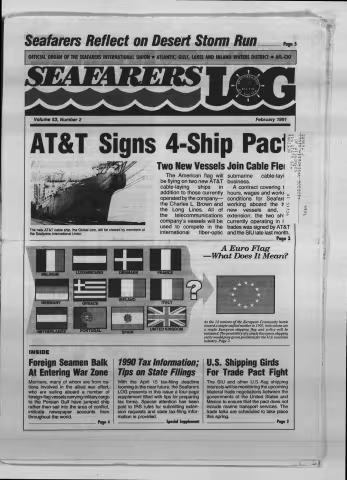
A Euro Flag
What Does It Mean?
SPAIN
UNITED KINGDOM:
As the 12 nations of the European Community hurtle
toward a single unified market in 1992, indications are
a single European shipping flag and policy will be
instituted The possibility of a single European shipping
entity would pose grave problems for the U.S. maritime
industry. Page 7.
INSIDE
Foreign Seamen Balk
At Entering War Zone
Mariners, many of whom are from na
tions involved in the allied war effort,
who are sailing aboard a number of
foreign-flag vessels carrying military cargo
to the Persian Gulf have jumped ship
rather than sail into the area of conflict,
indicate newspaper accounts from
throughout the world.
—- foge 4
1990 Tax Information;
Tips on State Fiiings
With the April 15 tax-filing deadline
looming in the near future, the Seafarers
LOG presents in this issue a four-page
supplement filled with tips for preparing
tax fprms. Special attention has been
paid to IRS rules for submitting exten
sion requests and state tax-filing infor
mation is provided.
^ - Spedol Suppjemeiit
U.S. Shipping Girds
For Trade Pact Fight
The SlU and other U.S.-flag shipping
interests will be monitoring the upcoming
bilateral trade negotiations between the
governments of the United States and
Mexico to ensure that the pact does not
include marine transport services. The
trade talks are scheduled to take place
this spring.
Poge2
• • ;'t- .Ol.'' ^ ^.n- • • ,
''-T.
-'A-
.1
['• 'I-
'Mt-'y
3 • "
- --f. , .
r":
V
•vf,. J - >- •-:.••"•
j •:"• ' "'-'u •'. - • •'• '•
• .-i '
'.', ' '' .
\AM: '" ">••' •
&'•• -'•• '•'> • •• '-•; '•
W&IM
• •-<'•;( • • ••
0'f-l •ii".
••.' '-••J.'.'
. 1,1- ,••-'{ ^ . ^ . • -
Jr-:-.Vv:--:-
•>•• • ''i'
¥1
!r.
K':-
S ,:•'./• •
5--,>•• 'i •-• .'•
l^al'
•.^-•V-'^' '•.• v./'v
mtutm LOG
President's Report
In Pursuit of Workers'Welfare
When the Executive Board of the AFL-CIO Maritime Trades Depart
ment holds its two-day meeting this month, representatives of the affili
ated unions will face an agenda loaded with a wide range of issues
critical to America's working men and women and their families.
As the membership is aware, the MTD is an APT.-CIO department in
which there are 43 national and international union affiliates working to
gether to promote the interests of their members, many
of whom are employed in the maritime industry and re
lated sectors. The MTD, in addition to maintaining an
active operation in the nation's capital, also operates a
network of local port councils which provide and coor
dinate support in behalf of member unions who request
assistance.
It is anticipated that decisions will be made and ac-
Michael tions planned at the MTD meeting this month that will
Sacco attempt to deal positively with many of the matters fac
ing working Americans and their families. Some will
call for legislative action, some will require attention by the executive
branch of government, others will have to be dealt with through the col
lective bargaining process.
One thing is gertain: there is no shortage of challenges facing this na
tion, and, thus, the union movement. The greatest one, of course, is the di
abolical conduct of one man who has threatened the world with violence
and instability—Hussein of Iraq. Fortunately, history is not repeating it
self. Unlike the situation in the 1930s, when the world was intimidated
into appeasement of that other madman, Adolf Hitler, today, the commu
nity of nations, led by the United States, has acted promptly to effec
tively halt Hussein in his tracks.
Courageous Military Personnel
But as the fighting goes on in the Persian Gulf and the military men
and women at the front are performing with such great skill and courage,
the home front features an array of problems, any one of which by itself
would be a handful in normal times. Just look them over:
• The so-called S&L crisis, for which the American people must ante
up billions of dollars to make up for the bank failures that have
been breaking out across the land.
• The almost uncontrollable mounting costs of health care that have
threatened the ability of many plans and insurance companies to
continue to pay out hospital and medical costs for their constituents.
• The continuing export of American jobs and the consequent loss of
available trained, skilled manpower.
• The continuing and expanding trade and balance of payment defi
cits that are draining the nation's resources, endangering its posi
tion as the leading force in the world, and causing increasing
unemployment of skilled workers.
• The problems of the disintegrating cities, poor quality education,
the drug and AIDS crises and more.
No one feels the brunt of these pressing problems like the working
men and women of this country. And no one will speak out in their be
half like the trade union movement.
That is why the positions and programs that are adopted by the Mari
time Trades Department Executive Board and those of the AIT.-CIO Ex
ecutive Council which will follow, are so import^t to the welfare of the
worker.
Scholarship Note
I would like to urgently remind all Seafarers and their dependents who
might be eligible to apply for the scholarships available to SIU members
and their children. Since the Seafarers Scholarship Program was insti
tuted in 1952, 184 SIU members and their children have been awarded fi
nancial stipends to pursue higher education.
April 15 is the deadline for applying for this year's scholarship awards
that will go to two Seafarers and four children of SIU members. Details
are available at all Seafarers union halls, or by writing to the SIU Scholar
ship Program, Seafarers Welfare Plan, 5201 Auth Way, Camp Springs,
Maryland 20746.
Volume 53, Number 2 February 1991
The Seafarers LOG (ISSN 0160-2047>) is published
monthly by the Seafarers International Union; Atlantic,
Gulf, Lakes and Inland Waters District; AFL-CIO; 5201
Auth Way; Camp Springs, MD 20746. Telephone (301)
899-0675. Second-class postage paid at MSC Prince
Georges, MD 20790-9998 and at additional mailing of
fices. POSTMASTER: Send address changes to the Seafar
ers LOG, 5201 Auth Way, Camp Springs, MD 20746.
Communications Department Director and Editor, Jessica
Smith; Associate Editors, Daniel Duncan, Max Hall and Tim
Liszewski; Associate Editor/Production, Deborah Greene,
Art Director, Bill Brower.
Another Potential
For U.S. Shipping
The SIU will be monitoring the up
coming bilateral trade negotiations
with Mexico to ensure that U.S. ship
ping interests are not forsaken in |he
American government's desire to nail
down a trade treaty with the neighbor
ing country.
The administration currently is
seeking authority from Congress to
engage in bilateral trade talks with
Mexico, a parallel process to the nego
tiations that took place five years ago
when the U.S. government entered
into a pact with Canada.
Industry Protected
During the U.S./Canada Free Trade
Agreement talks, the SIU vigorously
worked with congressional allies to
have maritime omitted from the treaty.
Excluding shipping from the pact as
sured the industry that existing and
future government protections of U.S.
shipping and maritime promotional
programs would remain intapt and
Battle Looms
in Mexioan Talks
could be expanded.
A trade agreement with Mexico
that includes a maritime section has
the potential for wreaking havoc on
the U.S. shipping sector. In particular
danger of being wiped out in any
U.S./Mexico trade talks is the Jones
Act, which ensures that domestic
water routes will be reserved to U.S.-
flag vessels operated by American-
owned companies and crewed by
American mariners. Given the prox
imity of Mexico and the deplorable
economic conditions its citizens face,
any opening in U.S. cabotage laws
would, be seen as a big source of po
tential jobs for Mexican workers.
Discussions between the United
States and Mexico are scheduled to
begin soon. Protecting the jobs of
American seamen and defending the
U.S. shipping industry during the talks
will be a number one priority for the
SIU in 1991.
GATT World Trade Talks Bogged Down;
Water Transport Appears Safe for How
Chances of reviving the current
round of the world's General Agree
ment on Trade and Tariffs (GATT)
appear to be getting slimmer as a
March 1 deadline imposed by the U.S.
Congress gets closer.
The SIU has been monitoring the
talks to make sure that maritime is not
included in a final settlement. The
Jones Act, which limits domestic com
merce to vessels built in the U.S. oper
ating under a U.S. flag and crewed by
American seamen, would be in jeop
ardy if maritime is included. A major
ity of the Senate and more than 150
House members in the last Congress
urged the U.S. Trade Representative to
exclude maritime from the trade talks.
The trade talks,, which began in
1986 and collapsed in December
1990, were called to amend the GATT
process and to expand it to include
services and agriculture. Such items as
agriculture, telecommunications, fi
nancial services and transportation
were to be included in the proposed
pact. Previous agreements only cov
ered manufactured goods.
The talks reached an impasse when
an agreement on agricultural subsidies
could not be reached among several
European nations, Japan and South
Korea. More than 100 nations had
been involved in the negotiations.
Should no agreement be reached by
March 1, congressmen and senators
have said they will not support an ex
tension of the fast-track process to ap
prove GATT. This procedure would
limit the legislators to only a yes or no
vote on the final pact. Without it,
amendments could be debated and
added, thus slowing down or killing
the whole agreement.
ATTENTION SEAFARERS
A Seafarer or his or her dependents interested in pursuing higher
educational opportunities should apply for an SIU scholarship.
Applications are due April 15. Pick up an information kit and an
application form at any SIU hall, or see page 16 of this issue of
the LOG.
Emphasis Is on Service
As part of the union's continuous program to provide the highest quality of
service to its membership, SIU Secretary-Treasurer John Fay (standing, second
from left) and Executive Vice President Joseph Sacco (standing, third from left)
are conducting regional meetings with SIU officials. Pictured above are the
participants of the Atlantic Coast regional meeting. From left are: (seated)
Assistant Vice President Dave Heindel, New York Port Agent Kermett Mangram,
Norfolk Port Agent Mike Paladino, Baltimore Port Agent Nick Kratsas; (standing)
Santurce Port Agent Angel Hernandez, Fay, Sacco, Vice President Atlantic
Coast Jack Caffey, Assistant Vice President George Ripoll, New Bedford Port
Agent Henri Francois and Representative Carl Peth.
J;
m
FEBRUARY 1991
{•''- j;
M
New Ships to Operate Under the U.S. Flag
AT&T, SlU Ink 5-Year Labor Pact
The cable ship Long Lines at its dock in Baltimore. The vessel is one of four
AT&T ships that are or will be engaged in the submarine cable-laying trades.
Seafarers man both the Long Lines arid the Charles L. Brown and will crew
the company's new ships, the Global Link and the Global Sentinel, soon.
Maritmw Pm^ams Suffer
tn 19SZ Fedend fidget
From the standpoint of a Sea
farer and his or her family, the
federal government's staggering
$1.45 trillion budget for the up
coming fiscal year offers little in
the way of support for U.S. ship
ping.
In the fiscal year 1992 budget
submitted by President George
Bush to Congress earlier this
month, maritime programs and
agencies took a back seat to the
nation's infrastructure.
The Department of Transpor
tation budget included funding in
creases for roadway, bridge and
railway construction and mainte
nance as well as airline safety
personnel while most maritime
agencies barely kept pace with
inflation and other cost factors.
The Maritime Administration
suffered a loss of $3 million to
$555 million in the budget which
would be implemented October 1
if it is approved by Congress.
The Mar Ad budget included $225
million for the Ready Reserve
Force. Of that amount, $117 mil
lion will be used to provide main
tenance for the 96 vessels already
in the fleet with the remainder
being used to help increase the
force to 142 ships by 1994.
The Coast Guard was the only
maritime agency to receive a sig
nificant budget increase. The $284
mijlion hike to $3.6 billion was
earmarked to pay for an additional
1,252 people who will help enforce
the 1990 Oil Pollution Act.
Both branches of Congress will
hold hearings on the proposed
budget and may make changes in
the amount of money to be spent.
The House of Representatives and
Senate must pass a final budget
resolution which the president has
to sign before the start of Fy 1992
in October.
NMU Rank-and-File Wonder
Who's in Charge of Union
In the absence of any clear pres
entation of a status of the orga
nization following the routing of
all the top officials in the licensed
division of District I Marine En
gineers Beneficial Association/
National Maritime Union, seamen
aboard NMU-manned vessels-have
been subjected to a rumor mill
creating confusion.
NMU members are asking
themselves and each other who
really is in charge of their union.
Waterfront observers report that
the unlicensed seamen of the so-
called merged union are getting
very little assistance in answering
this question from officials be
cause the lines of communication
seem to be frayed.
Adding to the confusion is the
sudden retirement announcement
of District 1 Executive Vice Pres
ident Shannon Wall, who served
as president of the NMU prior to
what some observers have char
acterized as the takeover ofThe
union by the licensed officers. Press
accounts indicate Wall had been
asked to give up the post in order
to run a newly-formed organiza
tion representing foreign seamen.
In waterfront spots frequented
by American seamen, discussions
among NMU members continued
to center on the nature of the
merger agreement with MEBA and
the manner in which it doomed
unlicensed seamen to a form of
"second class citizenship" within
the organization.
At one such location a heated
discussion revealed anger over the
fact that "nobody is considering
us." It is no secret among these
NMU seamen that they feel their
interests were subordinated to
those of a handful of officers who
reportedly were motivated by a
desire to acquire substantial sev
erance pay arrangements, accord
ing to waterfront observers.
The American flag will be flying on the Global
Link and the Global Sentinel, AT&T's new cable-
laying ships, and the vessels will be manned by
American crewmembers.
The decision to keep the
AT&T fleet operating under
the American banner was reported
late last month in conjunction with
an announcement that a collective
bargaining agreement had been
reached between the giant tele
communications company and the
Seafarers International Union.
The five-year labor pact covers
hours, wages and working condi
tions of unlicensed seamen sailing
on the two new ships and, by
extension, the Charles L. Brown
arid the Long Lines, the two
American Telephone & Telegraph
Company (AT&T) vessels already
operating in the cable-laying trades.
Although AT&T's subsidiary.
Transoceanic Cable Ship Com
pany, with which the SIU has had
an exemplary labor/management
relationship for more than 30 years,
had negotiated with the union last
summer on manning levels for the
two new ships, this fall rumors
began to surface that the enter
prise was considering abandoning
the U.S. flag to operate the Global
Link and Global Sentinel under a
foreign registry.
Globally Competitive
In announcing the decision to
maintain the AT&T fleet under the
American flag, AT&T Submarine
Systems President William Carter
explained why the company had
looked into the foreign flag option.
"In recent years it has become
apparent that AT&T had to inves
tigate all options to keep its sub
marine systems business globally
competitive. Hence, with the con
struction in Singapore of two new
AT&T ships, we examined care
fully any competitive advantage
that could be gained through for
eign flagging," Carter said.
"We concluded from our over
all evaluation to continue staffing
our ships with the U.S. maritime
unions that have served us to date
and we have secured their com
mitment to continue to pursue ways
to insure AT&T's competitive
success," said the AT&T official.
SIU President Michael Sacco
said he was "extremely pleased"
with the new agreement and
AT&T's decision to retain the U.S.
flag on all of its cable-laying ships.
He said, "We applaud AT&T for
a decision which signals a com
mitment to keeping a U.S.-flag
capability on the high seas, an
action we regard as of enormous
importance to the nation and to
the American people, as well as
to the seamen who are employed
aboard the company's ships."
Support for U.S. Flag
AT&T's interest in a foreign-
flag option drew wide-spread con-
Continued on page 9
Deliveiy of Goods Continues
Despite Outbreak of Guff War
As of February 4, the U.S. gov
ernment had sent 5 billion pounds
of dry cargo and 8.6 billion pounds
of fuel by ship, many of them
ere wed by Seafarers, to the allied
armed forces stationed in the Per
sian Gulf. Converted into short
tons, the logistical supply line has
transferred 2.5 million short tons
See page 5 for reports from Sea
farers on the gulf run.
of dry cargo and 4.3 million short
tons of fuel to the gulf since the
United States began its military
deployment last August.
"The outbreak of hostilities has
not significantly altered the smooth
delivery operation of military ma
terial to the gulf; an effort coor
dinated under the auspices of the
Military Sealift Command (MSC).
To date, the MSC's sealift pro
gram in Operation Desert Shield
and Operation Desert Storm has
involved 232 ships. Of these ves
sels, the majority have been U.S.-
flag ships, including the eight fast
sealift ships, the 21 prepositioning
vessels, six ships on long-term
charter to the agency, 27 of 40
tankers, 20 of 99 charters, two
marine aviation support vessels,
two hospital ships and 54 vessels
in operational status from the gov
ernment's Ready Reserve Force.
SIU members are manning many
of these vessels. In addition, SIU
crews are aboard liner ships that
are delivering containerized cargo
to the gulf.
Seafarers in the SIU's Govern
ment Services Division are also
serving in Operation Desert Storm.
The union's Government Services
Division, formerly known as the
Military Sealift Transport Union
(MSTU), crew vessels in the MSC
Pacific fleet.
NOTICE TO FAMILIES
OF MERCHANT SEAMEN
The Military Sealift Command
(MSC), the Department of Defense
agency responsible for coordinat
ing the delivery of supplies by ships
to the Persian Gulf-stationed Armed
Forces, has instituted a telephone
center for families of merchant sea
men who are seeking information
on their kin.
The MSC special telephone
number is (202) 433-0332.
III
Hr
-1 V- •? • '• - •-• •, t\:
1
-M
J:,
f "
I:"
Vi
•L';"
N'
*•
SEAFARERS LOG
I ̂
T'- •' '- • '-
'i"%p '. ••''• Vi -''V
M§W:
\ • / •
"y;
....
-'Sr;.
. 5 -i- '' •• --•.'V.'V.?. •'•-'VAy-^-.if, .
jrf •
Foreign Crews Balk at Persian Gulf Run
As the progression of the Persian Gulf war unfoldss, an aspect of.
history is repeating itself. According to press reports, on several
occasions, foreign seamen have refused to sail on ships assigned to
carry American military cargo to the area of conflict. Moreover, one
article says foreign crewmembers have unloaded military cargo destined
for Saudi Arabia at ports outside of the Persian Gulf, thereby delaying
the delivery of supplies.
The dependability of foreign mariners charged with the responsibility
of getting vital military materiel to an area of hostilities has long been
questioned by proponents of a strong American-flag merchant fleet.
The proponents also have noted that a viable U.S.-flag fleet with
sufficient American seamen to crew the ships is an integral component
of any national defense strategy.
SIU President Michael Sacco, appearing before the Senate Merchant
Marine Subcommittee during hearings on America's sealift capability
held in July of 1989, said the accelerated decline of the American-flag
, fleet was creating a "worsening shortage of skilled manpower to build,
repair and operate merchant vessels." "When our boys overseas look
for the equipment they need to defend their lives and freedom, it will
be too late to put out 'help wanted' notices," Sacco warned during
those hearings.
Seamen from Allied Nations
According to the press accounts, seamen from many nations have
been involved in the incidents of foreign mariners balking at a Persian
Gulf run — including individuals from countries that are part of the
allied effort. Seamen from Germany, Japan, India, Spain and Bang
ladesh are among those who have left their gulf- assigned ships.
Two incidents, as reported in the press, occurred before the outbreak
of hostilities. But since the war broke out in January, there have been
more articles outlining the actions of skittish foreign seamen.
What follows are excerpts from accounts reported in the press on
foreign seamen refusing to sail on ships bound for the gulf:
Reuters; August 31, 1990; Japanese Ship Owners, Union,
Leery of Gulf Transport Callup
"Japanese shipowners are taking their time sighing up after a
transport recruiting drive launched by their government as part of a
Persian Gulf aid package, industry sources said Friday. . .
Industry leaders have said they would cooperate on condition that
their craft be used only for non-military purposes."
"There are two main problems, industry sources said. The first is
that the government wants participants to include increasingly scarce
Japanese-registered ships. The second is that the All Japanese Sea
men's Union, the industry's umbrella labor body, has shown its
reluctance to allow its members to be exposed to risk by urging
Parliament to clarify the goals of the mission."
One Japanese shipping official is quoted in the article as saying,
"We understand this plan is vital to diplomacy, but the timing is bad.
The shipping market has recovered and ship availability is tight."
- ^ ^
Lloyd's List; October 10,1990; Iraq-Kuwait Dispute '
Noted as a UPl report from Hamburg on October 8, the piece stated
that most of the crewmembers on the Western Gallantry "which is
due to deliver aviation fuel in the gulf had to be replaced because
they "refused to remain onboard the vessel."
A person identified as "a union spokesman" said 13 of the 15 crew
had "asked to be taken off the vessel because they considered it too
dangerous to sail into the gulf. He said the company originally turned
down the request by the German and Spanish crew but eventually
gave in because of a clause in the crew's contracts which allows for
refusal to carry out high-risk duties. The fuel was loaded in Texas."
The Journal of Commerce; January 22, 1991; APL-Hired Ship's Crew
Refuses Gulf Orders
"The crew of a foreign-flag feeder vessel chartered by American
President Lines Ltd. refused to enter the Persian Gulf las week,
prompting the carrier to send in one of its U.S.-flag vessels instead,
the Journal of Commerce learned."
The Eagle Nova, a feedership that can carry 400 20-foot containers,
is registered in Cyprus. "The officers and crew of the vessel refused
to enter the gulf because of the threat of war in the region, according
to labor and industry sources."
"The President Buchanan, a U.S.-flag APL liner ship, was ordered
to deliver the needed supplies to Dammam, not one of its regularly
scheduled calls. The American crew was issued gas masks and told
to watch for 19 mines believed to be adrift in the area, according to
a ship telex."
Sea-Land Experiences Problems
With Crews of Foreign-Flag Ships
^—== ^
I I r<>nfiiCnm'FmnSb»l
BuHArwjiy J j
MM WBBdll I
Fwefgn Merchant Crew Balks at Gulf
|^wiggg!g,""kJ
la the Gi
Ezrg2E3
aflPANESE SHIP OWNERS, UNION, LEERY OF GULF TRANSPORT CALLUP
,_r.- ir- . • • « ^
£
maMi
FORBaN VESSEL'S REFUSAL TO ENTER OULF SHOWS NEED FOR STBONO MERCHANT MARIN^ • j
III 1 —iriil.or'Krt I: si}m •: ' •*-' •
•i'Mmsm
Headlines from press accounts of skittish foreign seamen are compiled above.
The Journal of Commerce; January 24, 1991; Indian Air, Ship Crews
Refuse Duty in the Gulf
"The government is facing a mutiny of sorts, with crews of Shipping
Corp. of India and pilots of Air India, both state owned, refusing to
take ships and aircraft to the Persian Gulf war region."
The government ordered the Shipping Corp of India "to resume
loading oil from Iran." The crews refused to go to the area.
"Transport Minister Manubhai Kotadia appealed Wednesday to
crews and officers of the shipping line to 'rise to the occasion and
bring much-needed crude oil to the country. The bulk of India's oil is
transported by the carrier and comes from the Middle East."
Wall Street Journal; January 30, 1991; Foreign Crews' Fears Slow Some
U.S. Gulf Shipments
"Some foreign crews of ships carrying U.S. military cargo are
refusing to sail into the Persian Gulf, causing shippers to turn
increasingly to vessels manned by U.S. citizens."
"So far, industry executives count a half-dozen examples of delays
to U.S. military cargo in the past two weeks caused by foreign crews'
unwillingness to sail to northern Persian Gulf ports."
The article references the Eagle Nova case and quotes George
Hayashi, president of American President's shipping subsidiary. Hay-
as hi explained that the German master of the Eagle Nova "didn't
want to endanger the lives of the crew and be an object of the
shooting."
"Lykes Bros. Steamship Co., New Orleans, said foreign crews on
several occasions have unloaded U.S. military cargo bound for Saudi
Arabia at ports outside the Persian Gulf, delaying the shipments by a
couple of days."
4 j/
Daily Shipping News; February 1, 1991; Freighter Crew Refuses MSC
Gulf Area Trip
Datelined London and taken off the KRFITNT wire, the paper
reported that 30 crewmembers of the Banglar Mamata, a Bangladesh
freighter, "jumped ship at San Francisco to avoid sailing to the Persian
Gulf, according to Lloyd's Intelligence."
MSC chartered the 15,877 dwt vessel to take supplies to the Persian
Gulf. The article reported that the vessel was laying idle until a
replacement crew could be found.
4 4
The Journal of Commerce; February 1, 1991; Sea-Land Experiences
Problems wUh Crews of Foreign-Flag Ships
A Sea-Land official confirmed the dompany "has encountered
problems in getting foreign nationals to crew cargo ships entering the
Persian Gulf war zone."
Sea-Land Service Inc., Edison, N.J., experienced an incident in
January when the crew of a foreign-flag ship carrying military cargo
balked at entering the gulf just as hostilities became imminent."
Outside sources said one problem encountered by Sea-Land in
volved Japanese officers aboard a containership that normally travels
from Europe to the Persian Gulf and Asia. This service, operated by
Sea-Land in conjunction with Swiss shipping company Norasia Ltd.,
uses no U.S.-flag vessels."
According to reliable sources, the Japanese officers aboard one
vessel refused to take the ship into the gulf acting under a directive
from the All Japan Seamens Union , a labor group that has also
instructed Japanese tanker officers to avoid the gulf."
•m
if--;
I ••
•-• i--> ••:'•>•'•'yifr.
FEBklUm J99I
With Seafarers on the Persian Gulf Run
SlU Crew Is Somber but Determined
SIU crewmembers aboard the
USNS Regulus who were in the
Persian Gulf when war broke out
last month met the situation calmly
by drawing upon previous wartime
experiences, shipboard skills ac
quired through extensive training
and years of sailing, and a sense of
duty to their country and its armed
forces.
The USNS Regulus is one of the
military's eight fast sealift ships,
former Sea-Land containerships
that were purchased and converted
to a state of military usefulness by
the U.S. Department of Defense
between 1984 and 1986.
The SlU-crewed ships can at
tain speeds of up to 33 knots at full
load and together are capable of
transporting a full Army mecha
nized division. During Operation
Desert Shield and Operation Des
ert Storm, the ships have carried
Army tanks, artillery and other
heavy equipment to the Middle
East. One of those ships, the USNS
Regulus, just returned to Jackson
ville, Fla. after being docked in the
Persian Gulf hours after the war
with Iraq began.
'Did the Job'
Bosun George Wilson was one
of several Vietnam veterans serv
ing aboard the Bay Tankers civil-
ian-crewed cargo ship. "When we
heard the news that the war was on,
we noticed the radar screen looked
like a beehive with all that activity.
I guess they carried a sting with
them."
The 47-year-old, who had sailed
with the SIU's Government Ser
vices Division before joining the
SIU's Atlantic, Gulf, Lakes and
Inland Waters District three years
ago, said there was no fear or real
concern among the USNS Regulus
crew. "We knew we had a job to do
and we did it. There is a lot of
common sense and knowledge
among these guys. Everything on
here since the beginning of the op
eration [in August] has gone with
out a hitch."
Wilson was aboard several ves
sels that were either hit by missiles
or collided with other vessels in the
waters around Vietnam. Although
the Regulus was in port for two
missile attack wamings, he said he
was never afraid that the ship
would be hit. However, he donned
his gas mask and equipment like
the other members onboard.
Junior Engineer Donald Davis
coined the ship's motto, "Piece of
cake." To Davis, a former Marine
who served three tours in Vietnam,
the whole trip to the Middle East
and back was "another day in a war
zone."
Davis started sailing in 1971,
but had come ashore for nine years
until the call from Operation Des
ert Shield became too great. "This
was the straw that broke the
camel's back. I had missed the sea,
but I came ashore for my wife."
overhead. "We knew something
was on.
The events of that evening made
him remember when he sailed dur
ing the Vietnam conflict. "We used
to sit in DaNang harbor loaded
with ammo while the enemy was
lobbing mortars over us onto the
airfield."
OMU Dan Wagner recalled the
crew was ready for the fighting to
begin. Noting the air strikes, he
Junior Engineer Donald Davis checks
the control boards in the engineroom.
Wife Supports Volunteering
Checking out the lines on the deck of the USNS Regulus are, from the left, ABs
Robert Delaware, Darrell Rivera and Bud Roper.
Once the bui Idup began, Davis'
wife, Jeanette, agreed that he
should do something to help. She
had served in Vietnam as an Army
clerk. "My wife is all for this. She
understands and I'm happy to be
back out here."
Many of the crewmembers did
not have to wait for Armed Ser
vices Radio to tell them the war
was on as they approached the
Saudi shore.
Captain Mark Sliwoski noted
the gulf was "deathly quiet" as the
Regulus entered. "Usually there is
a lot of gibberish on the radios.
That night, there was nothing and
there were no fishing boats out."
AB Bud Roper remembered
the time was around 3 a.m. on Jan
uary 17 [Saudi time] when he and
others, saw 70 to 80 bombers fly
said, "We saw that first wave and
knew this was no play day—this
was for real. When they came
back, we were glad for them."
Wagner said the Regulus crew
knows it has to continue to deliver
the goods for the armed forces in
Operation Desert Storm. "We're
their supply line. We keep them
going."
Help Country
OMU Dan Wagner fleft), who sails out of Philadelphia, and Wiper Angel Rivera place
cooling tubes into the evaporator.
AB Darrell Rivers of Hawaii
admitted he was nervous about
sailing into a war zone but over
came the anxiety because he
wanted to help his country's cause.
"This is the closest I, as a civilian,
can come to being involved. I
didn't just want to say I support the
troops; I wanted to show it."
"Neat!" was the reaction of OS
Scott Kreger, when asked about
his first voyage as a merchant sea
man. Kreger's run on the USNS
Regulus was his first as a mariner
having just graduated from the
Lundeberg School. "I was glad to
be over there doing my part of the
job. When I went to Piney Point,
none of this was going on. Then all
this. I got psyched up for it."
Kreger received the praise of
Bosun Wilson for his work on his
first-ever voyage. "He probably
doesn't know just how much he
has leamed since coming aboard,"
Wilson said. "He was really deter
mined to come on here and work
and leam."
One of the crewmembers who
gave up time ashore to help during
the military buildup and now dur
ing the war effort was Chief Stew
ard George Quinn. The 31-year
veteran SIU member decided to
hold off attending the winter stew
ard recertification class, to which
he had been admitted, to stay
aboard the Regulus. "I figured
staying on and shipping during this
time would be more beneficial to
my country and union than attend
ing the class."
Quinn's daughter won an SIU
scholarship last year and she is
now attending Tulane University.
"For all the years that I have been
going to sea, that was icing on the
cake when that daughter of mine
became a scholarship winner."
Like other crewmembers,
Quinn said he felt no fear entering
the gulf waters. The Vietnam
draftee said, "Being around Viet
nam tends to make you more com
fortable entering this situation."
Perhaps the most unique ap
proach to dealing with arriving in
a war zone the day the shooting
started came from AB Robert Del
aware: "When my grandchildren
come to me and say they studied
Desert Storm in school, I'll be able
to put them on my knees and tell
them I was there when it began,"
• •
Ik i\
Steward Assistant Tim Robinson, who
sails out of Jacksonville, stacks the
newly delivered stores.
This was the first voyage as a merchant seaman for OS Scott Kreger, who uses the
hoist to deliver stores to the galley area. At right, supervising the operation, is Bosun
George Wilson, who previously sailed with the SIU's government division.
Chief Steward George Quinn, a Viet
nam vet, reflects on the present situa
tion in the Persian Gulf.
'V. •-
;:.;Y
/
'mSm
•rfT.. .'••5
, 'J-'
lu V f•>
m . •• ,
#1 •
iiiiiMi
• jc-
•,S?'
,,;j .:,K-v:§Lis;«4S^;®;, ;;': . „• •/•^
mmm
SaFAReKS LOG
;X'..Vl-,;". ;
fs;.' vj":. • ;;•-
li"' i-i -
I":, ;e ;,:
' ..'V^--'
V'
f''.v 1; : '•
V / . /' • ^
ii'T ;.v',"Vi
jT?: •r: •
: •.
\-
'r •'
i' 1«"i.. • r ' • • •
J--V
^,-
•iV^..:y;"
mimn
-ri ': •
#;/-i" •.••
When it docked January 4, the Charles E. Wilson
once again was one of the last Great Lakes fteighters
to lay up for the winter. Bosun Mike LaFoille told a
reporter for the Seafarers LOG that this had been
another good year for the SIU crew onboard. "We
really have a great bunch of guys on here," he said.
"They make sure we are able to keep running through
whatever weather."
The Wilson has a tradition of being one of the last
ships to seek shelter in winter, according to Algonac
Patrolman Andy Goulet. Having sailed aboard the
American Steamship Company vessel several times,
Goulet relayed one experience involving the ship
following an icebreaker in a winter convoy.
Part of Winter Convoy
"Being one of the last to lay up, we were still
sailing when the St. Mary's River (between Lakes
Superior and Huron) was switched to one-way traf
fic," he recalled. "We got stuck for a couple of days. Bosun Mike La Follle (left) and AB Bob Hedine talk with Duluth Port Repre-
Then we followed the Buffalo in the convoy. The path sentative Delores Cheslak before a ship's union meeting,
was just wide enough for us to follow and thick
enough that there was no way to get out of the path."
Despite the bad conditions, the Wilson still made one
more trip that winter before tying up, he added.
The Wilson usually carries iron ore from Mar
quette (on Michigan's upper peninsula's Lake Supe
rior shore) to Trenton (south of Detroit near Lake
Erie) or Ashtabula, Ohio (on Lake Erie between
Cleveland and Erie, Pa.). The vessel sometimes car- __ ___
ries coal from Toledo Ohio (on Lake Erie 's western AB Watchman Ron Bochek listens to AB Watchman Lowell Amundsen
border) or Superior, Wis. (on Lake Superior s west- adiscussion during a meeting aboard joins in at the union meeting held
em shore) to Marquette. the Wilson. aboard the Charles E. Wilson.
Watchman Mike Keoqh lis
tens (0 a union discussion.
Taking care of the pots and
pans is the dominion of Porter
Roger Flaherty.
Second Cook Marianne Audette and Steward Jim
Budnick prepare the salad bar for the Wilson's crew.
Bosun Bill Mulcahy (left) and Deckhand Michael Wikaryasz are pictured in front of the Christmas tree they
decorated aboard the MV St. Clair. Both members told the Seafarers LOG the galley gang prepared
excellent holiday meals for the crew of the American Steamship Company vessel.
SIU Members Escort USS Lexington
When the USS Lexington gets
orders to set sail or retum to port,
SIU members for Admiral Towing
also get a call to duty. Six tugboats
and their crews are assigned the
responsibility of escorting the Lex
ington into and out of her anchor
age at the Pehsacola (Fla.) Naval
Air Station. The Lexington serves
as a training vessel for Navy pilots
learning how to fly off and land on
aircraft carriers.
30-minute Standby
The SIU members who sail
aboard Admiral tugs have to be
ready for action at any time, ac
cording to Mobile (Ala.) Port
Agent Dave Carter. 'They are on
30-minute standby, 24 hours a
day," he said. When they are not
escorting the Lexington through
the harbor, the crewmembers keep
their boats up and ready to go. The
tugs also are used to help dock
other vessels at the base.
Former Navy Personnel
Carter noted most of the SIU
members who sail for Admiral are
retired Navy personnel. "They are
familiar with the procedures within
a Navy base and can adapt to fast
call-ups. They all live in the Pensa-
cola area because of the nature of
their jobs."
Admiral Towing is a subsidiary
of Great Lakes Towing, an SIU-
cohtracted company.
Some of the SIU members who escort the Lexington in harbor are (left to right, front
row) W.T. Taylor, Pete Popour, Charlie Lester, (middle row) Joe Mahan, Joe Brown,
(back row) John Roberts, E.J. Hargrove and Mike Stawn.
Mobile Port Agent Dave Carter meets with SIU crewmembers for Admiral tugs.
From the left are (front row). Carter, Jim Kuzma, John Roberts (middle row) W.T.
Taylor, Joe Brown, (back row) Mike Stawn and Charlie Lester.
, • " • i .-ii'ifE-i ••
J,-:"'
• • •, • • : •" ';,::;',Y;-' Y:"
Continent-Wide Cabotage, Singie Register Among Hems that May Be Adopted
The European Community (EC) is vigorously
pursuing plans to bolster the shipping fleets of
its 12 member nations^—Belgium, Luxembourg,
Denmark, France, Germany, Greece, Ireland,
Italy, the Netherlands, Portugal, Spain and the
United Kingdom. The discussion on shipping
dovetails with the EC's intent to have in place
a single European-wide market by the end of
1992.
Noting the decline in the EC nations' mer
chant fleets, the European Commission launched
a series of proposals in 1989 that have stimulated
debate on the needs of the EC shipping com
munity among shipowners, seamen and their
unions and government offlcials.
Central to the various suggestions of the
European Commission, the executive body
charged with initiating and implementing EC
policy, is the creation of a single, parallel ship
registry—known as EUROS—and the opening
to the U.S.—utilize EC vessels for carriage of
nearly 40 percent of their world trade.
Maritime Administration data indicates that
in 1988 the EC nations had a combined total of
3,519 privately-owned ships of 1,000 gross tons
or more, while the United States had 444.
(Parenthetically, it should be noted that in 1990
the U.S.-flag fleet had 379 active vessels of over
1,000 gross tons.)
Proposals Before the EC
up of national coastal trade routes which have
been plied exclusively by the vessels of the
sarhe country to the fleets of other EC nations.
Like the U-S.-flag fleet, the shipping lines
based in EC member nations have been expe
riencing a sharp decline in numbers of vessels
and tonnage, with many owners transferring
ships to flag of convenience registers or to so-
called second registers. (The offshore registers,
or second registers, are instituted by developed
nations with strong maritime traditions but offer
the same kind of goodies peddled by runaway-
flag operations.)
A Lloyd's of London study found the EC in
1989 had only 50 percent of the gro^s tonnage
it had in 1980 and 73 percent of the total number
of ships. Concern has been expressed through
out the EC over the plummeting percentage of
exports and imports of member nations carried
on their own flag vessels. In 1987, Eurostat's
publication on transport and communication
statistics indicated that German-flag vessels were
carrying only 15.4 percent of German trade in
1987. In the same year UK-flag ships carried
21.7 percent of British trade and Italian-flag
ships carried 14.9 percent of their commerce.
America's Perspective
The irony from the American shipping com
munity's point of view is that the perceived
hemorrhaging of the European fleet is a far cry
from the substantial losses in vessels operating
under the U.S. flag. American-flag carriers in
1987 transported only 3.9 percent of American
exports and imports, compared toa 15.2 percent
average of transporting their own country's
trade by EC nations' fleets. Further, EC coun-
tries-with size, wealth and wages comparable
When the European Commission presented
its proposal to the EC's main decision-making
body, the Council of Ministers, in August 1989,
it noted "only a combination of concerted
measures, taken at Community and national
levels with the necessary participation and co
operation of shipowners and seafarers, could
have the required positive impact oh the oper
ation conditions of Community shipping."
The Commission's communication, entitled
"A future for the Community shipping industry:
measures to improve Community shipping,"
contained four specific proposals. It called for
the establishment of an EC ship register that
"could contribute to the achievement of the
single market in the Community. . . ." The
EUROS operation, the Commission proposed,
would be a parallel register to existing EC
registers and not a substitute.
The Commission also recommended a Series
of proposals designed to improve the effective
ness of port state control in. enforcing the
application of safety and health and environ
mental standards by vessels entering EC waters.
The third item put forth in the 1989 Commission
document attempted to develop a common def
inition of a Community shipowner.
The fourth plan raised by the Commission
sought to liberalize cabotage restrictions prac
ticed by some member nations. The Commission
proposed opening up intra-country marine coastal
trade routes that previously had been the domain
of national-flag vessels to all EC-flag ships.
Standing of Debate
In December, the EC's transport ministers
announced that headway had been made on
adopting a Community cabotage policy. A Brit
ish transport official indicated the agreement
reached calls for a two-step approach to the
implementation of EC-wide coastal trades.
The first phase will open marine routes along
the coastal mainland to all ships from EC nations
by the end of 1993. Offshore islands are ex
empted from this provision. For instance, any
EC vessel could carry cargo from France to
THE EC AND U.S. FLEETS, 1988
Ocean-going Steam & Motor Ships of 1,0W) GT and Over
^(Number;of:Ships). : '
n
tfountry Total Freighters Bulk Tankers
Belgium 63 23 24 . 15
Denmark 211 10 56
France 185 92 ••y,-.2ll: 1 66
F.R. Germany y I 376 300 15 -S 55 ,
Greece 1,030 293 498 207
Ireland 32 27 '•..bm::: 0 5
Italy 525 206 , 83 . .. 225 .. 'f
Netherlands J 385 306 15 60
Portugal 50 23 11 .•Y 15 .yy
Spain Y 389 236 63 90 •
United Kingdom 273 117 50 92
Tqtel^ 3,519 1,765 790 ,' 886^y;;yi
United States 444 192 26 221
Source: Maritime Adininlshaaon.. Repartment of Transportation:
The EC is moving toward a continental cabotage
policy that will allow the fleets from all member nations
access to intra-country marine transport routes.
Greece, but would not be eligible to transport
goods from the mainland of Greece to any of
the Greek islands.
The second stage, which would open up all
routes in EC waters to EC ships, was not given
a date for implementation. Other aspects of the
cabotage proposal remain to be ironed out at
the Commission level. There is a question as to
whether the plan should include a floor of 300
tons or 500 tons. There also is a move by France
to develop a procedure for granting exemptions
based on strategic and national defense con
cerns.
While no agreement was reached by the
transport ministers on a EUROS register, the
transport ministers also agreed to the principle
of facilitating the transfer of vessels from one
EC nation to another and called for the plan to
be instituted by January 1992. To prevent run
down and unsafe ships from being transferred,
a country can conduct inspections and refuse
to issue a certificate if a vessel poses a serious
danger to safety or the environment.
Last October, the European Parliament (EP),
a body with primarily consultative powers,
debated an amended version of the Commis
sion's four-point proposal released in 1989. The
EP's Transport and Tourism committee, prior
to reporting to the full parliament on the Com
mission's shipping plan, considered more than
160 resolutions—an indication of the depth of
debate within the Community on the future of
its maritime industry.
The EP's document calls for a EUROS reg
ister that provides significant tax breaks to EC
shipowners and seafarers and in some cases
direct subsidies. The tax plan calls for a lump
sum payment based on a combination of gross
tonnage and the age of the ship. Under the EP
proposal, officers on EUROS vessels would be
EC nationals and 50 percent of the remaining
crew also would be from EC countries, except
on passenger ships where ICQ percent of the
crew would be from the EC.
Europeans Take Sides
While the European Parliament's actions do
not carry the weight of law and are only taken
under consideration by the EC's Council of
Ministers in this case, there has been a great
deal of debate among European shipowners and
shipping unions concerning the various pro
posals.
While many EC shipowners are seeking
schemes that parallel the so-called second reg
isters, European seafaring unions have strongly
opposed any efforts to allow 50 percent of the
unlicensed crew to be recruited from the ranks
of seamen in developing nations.
Continued on page 9
' ' .
' y .• .
f • fcjgl)' •
4fr;'
a i-
^'•rr
%-"-r 'i '''-4:''
v,r • •'
•I''';
>1'^
ft •;•.•/•:• •
•WA':
8 «».'--i7-i,v ' • '•
1 iifcHiW IP w-^-r-"
SBVARfSSlOG
Electrical Maintenance Class Vital to QMED Training
The Marine Electrical Mainte
nance (MEM) class is one of three
required courses to upgrade a black
gang member's QMED classifica
tion at the Seafarers Harry
Lundeberg School of Seamanship.
This course is considered criti
cal because it gives members vital
information they need to advance
their electrical knowledge, accord
ing to instructor Byron Hohrein.
The course was included as a re
quired field of study, along with
Pumproom Maintenance and Op
erations and Refrigeration Systems
Maintenance and Operations, last
year in a Seafarers Appeals Board
ruling pertaining to yearly upgrad
ing by QMEDs.
The MEM class lasts eight
weeks and includes classroom and
hands-on shop training. Students
first learn about tool and electrical
Inspecting electrical
Laurence Gilley and John Wong.
panels p
John Wc
ripr to connecting loads are (left to right) Tom Doran,
ment. The charts then can be used
to determine the causes of system
malfunctions.
MEM applicants must hold a
QMED Any Rating endorsement
or an Electrician endorsement or
have equivalent experieiice. Appli
cants should possess good reading
and writing skills and have a math
ematics background including
basic algebra. Good eyesight is a
must, sp students should have an
eye exam prior to this course if
problems are suspected. Appli
cants can contact the admissions
office at the Lundeberg School for
more information.
Upgrader Paul Peterson works On the
motor lead to an air conditioning unit.
safety as well as safe work prac
tices.
Next, they study electrical the
ory and magnetism. Within this
session, students leam how electric
and magnetic fields are produced
and how to work with various elec
trical and magnetic devices such as
multi-meters and meg-ohm meters.
A major portion of the eight
weeks is spent studying actual
equipment such as lighting sys
tems, motors and motor control
lers. The upgraders also leam the
principles of operation, mainte
nance procedures, overhaul, instal
lation and troubleshooting of
electrical equipment.
The class wraps up with stu
dents leaming to read schematic
diagrams. They use these diagrams
to make a sequence chart for the
operation of galley and deck equip-
Engine department upgraders Robert
Hamil (left) and Charles Betz wire ma
rine receptacles and lights.
Bliackgang upgrader Tom Doran prac
tices connecting the wires in an air
conditioning controller.
Work Continues on S-L Explorer After Brief Lay up
The SlU-crewed Sea-Land Ex
plorer is back on its round trip voy
ages from the West Coast of the
United States to the far East after a
brief layup in Kobe, Japan.
Ship's Chairman Ted Tolentino,
62, reported that all is running
smoothly aboard the vessel which
docks in Long Beach and Oakland,
Calif, before sailing to Japan, Tai
wan, South Korea and Hong Kong
on its 42-day round trip.
Tolentino, who has been an SIU
member since 1966, said he had a
great crew with which to work. He
praised the work of the deck de
partment in remodelling the gar
bage room during the layup. He
noted that there were no beefs or
problems onboard as the ship was
preparing for its December pay
off.
Crewmembers hailed the work
and food of the galley gang, headed
by Chief Steward William H.
Hawkins. He, in tum, thanked the
crew for keeping the lounge and
mess clean.
Hawkins forwarded photo
graphs taken by AB Freddy
Milabo, DEU P. Capito and Cap
tain R.H. Hemingson to the Seafar
ers LOG while the ship was in the
Japanese port. Cfiief Cook B.L. Mack (left) serves a delicious hot meal to Chief Mate D. Dennison.
Dinner is almost ready to be served by Chief Steward William Hawkins (left) and
Chief Cook B.L. Mack. The ship's steward department received high praise from
fellow shipmates Jor consistently serving good meals.
Bosun Ted Tolentino (at bottom left)
supervises the work of AB Freddy
Milatjo on the lifeboat davit.
AB Jabez Pegg adds a coat of primer
to the radar mast crosstree of the Sea-
Land Explorer.
•—' ••''"r'''.''^^;n '>ii r:-;rT: - x.^~ 'i-t':'n !i';'iji"'i.wj!!.')ip»t!itfy' ^riSi
' :'•••• y.'."-"yw
• 1-
mi ••' V.
Europe Debates
A New Ship Policy
Continued from page 7
Unions representing EC seamen
have called on the Community to
develop a register that provides
jobs for European seafarers and
to institute measures designed to
improve the competitive advan
tage of EC shipping.
Agreement Will Emerge
Many who follow the European
maritime scene believed the EC
would not promulgate a policy of
opening up cabotage rights in EC
member nations' waters to the
shipping fleets of other European
countries. Such observers cited
the intransigence of Greece and
Italy—two nations that were re
luctant to open up their signiflcant
coastal and offshore island trade.
But with the actions taken by
the EC transport ministers last
September, EC-wide cabotage is
close to becoming a reality.
The Europeans keep proving to
the United States and to the world
that they are fully capable of ar
riving at a consensus and an agree
ment on the most thorny issues.
Such was the case in 1986 when
the EC adopted its first common
European shipping posture— four
rules which entered force in 1987
and established a foundation for
an EC maritime transport policy
and paved the way for direct in
volvement of the Commission in
regulating the industry.
The four principles were freedom
for all fleets in the EC to provide
shipping services between EC na
tions and third countries, rules en
suring competition, allowing for re
lief from unfair practices of foreign
carriers—such as rate undercutting
and predatory pricing policies—and
allowing for coordinated counter
measures when EC shipowners are
denied access to the shipping busi
ness in a third country trade.
A United Europe
The United States, by the end
of 1992, will face a united Europe
insofar as its economy is con
cerned. The 12 nations that make
up the EC account for over 320
million consumers. The EC is the
largest trading partner of the United
States. The two-way trade be
tween the U.S. and the EC in 1988
had a value of $1,612 billion.
EC merchant fleets operated
1,765 freighters in 1988, at a time
when the U.S. had 192 of the same
type of vessels operating under its
flag. The numbers for bulk carriers
were more frightening. EC fleet
accounted for 790 of the world's
bulkers. U.S.-flag bulk carriers
numbered 26 (today that figure has
been reduced to 22).
Moreover, in Europe there is a
far-reaching debate taking place,
fueled by the engine of economic
unity, on a variety of measures
that would bolster the EC fleet.
With America's economic secu
rity at stake, the federal govern
ment and private maritime inter
ests cannot afford to simply watch
Europe protect and promote its
fleets without faking stock of the
condition of U.S. shipping capabil
ities and implementing programs to
ensure equal footing for the Amer
ican-flag merchant marine in the
world's shipping trades.
Hawaii-Based Seafarers Extend Thanks
To Sen. inouye for Support of iiflaritinie
Taking time out of their busy
upgrading schedule at the union's
school, four SIU members who
sail from Hawaii took a trip to the
nation's capital to meet with Sen
ator Daniel K. Inouye, the "Aloha"
State's senior senator and a long
time advocate of a strong U.S.-
flag merchant marine.
Gregory "Broyles" Tudor, Marty
Josephson, Wigoberto "Wiggle"
Reyes and Yvonne De Silva, all
steward department SIU members
currently enrolled in the Lunde-
berg School's cook and baker pro
gram, recognized the importance
of Congress and the federal gov
ernment in protecting the jobs of
seafarers.
"We know Senator Inouye's ef
forts have been instrumental in
providing job security for mer
chant mariners," noted Tudor, who
also reported that the close to 30-
year veteran of the Congress
seemed "genuinely interested" in
the welfare of SIU members.
Tudor remarked that it was "a
pleasure and an honor to meet
onCe again with Senator Inouye.
On behalf of each visiting SIU
member and the SIU in its en
tirety, I was able to thank Senator
Inouye for his continued support
SIU member Gregoty "Broyles" Tudor (left) presents Senator Inouye (middle)
with a Lundeberg School cap and seabag. Marty Josephson, Yvonne De Silva
and Wigoberto Reyes, all cook and baker upgraders, look on.'
of American shipping and invite
him to visit the union's school."
The I '/2-year member of the SIU
said the senator responded to the
invitation by replying, "The Lun
deberg School at Piney Point . . .
that's my school."
Passenger Ships
The four upgraders ship on the
two U.S.-flag passenger vessels
operated by American Hawaii
Cruise Lines, the only deep sea
cruise ships in the American fleet.
The two ships were brought into
the passenger trades as a result of
legislation enacted by Congress a
decade ago. Senator Inouye was
instrumental in passing the bill.
While the SIU members were
in Washington, DC, they took the
opportunity to tour the Capitol,
making stops at the Senate gallery,
the old House and Senate office
chambers, the Senate Appropria
tions Committee chambers and the
Supreme Court.
Brothers Reyes and Tudor are
Oahu residents and Sister DeSilva
lives on Hawaii's "Big Island."
Entire AT&T Cable Fleet Under U.S. Flag
Continued from page 3
cern from members of Congress
and patriotic and veterans orga
nizations. Numerous congress
men and senators communicated
with the company regarding their
support for a strong and techno
logically-advanced U.S.-flag fleet.
The elected officials expressed
concern over the consequences to
America's national security inter
ests and economic advancement
if AT&T's vessels were trans
ferred to foreign registry.
Upon hearing of AT&T's deci
sion to operate its new cable ships
under the U.S. flag. Senator Bar
bara Mikulski (D-Md.) said, "I
commend AT&T for its decision
to register two new ships under
the U.S. flag. A strong U.S. mer
chant marine is critical to our
nation's security."
Advanced Design
The Global Link and Global
Sentinel feature a bow thruster to
help the vessels move sideways
and maintain their positions. Each
is 479 feet long and 70 feet wide.
The first new cable-laying vessel
will be in full operation shortly,
while the second is due out of the
shipyard later this year.
The 7,900-deadweight-ton ves
sels have a full-load draft of 26
feet and can cruise at speeds of
up to 15 knots. Each can keep up
a speed of 6 to 8 knots while laying
the company's fiber-optic cable
and a speed of 4 knots when tow
ing a sea plow and laying cable.
Equipped with the most ad
vanced technology in the field, the
two new ships have been built to
ensure the productivity, safety and
comfort of the crew. The standard
safety items of the ships include
water-tight transverse bulkheads
at various locations, a back-up
diesel-driven generator for emer
gency electrical power, fire-resist
ant furnishing and four encapsu
lated lifeboats.
AT&T's fleet of cable ships
competes with foreign companies
operating foreign-flag vessels to
build, lay and maintain undersea
fiber-optic cables.
In the past three years, AT&T's
cable-laying ships have spanned
the Atlantic, Pacific and Carib
bean with fiber- optic cable.
SIU School's Students Must Have
Valid Drag-Free Clearance Tests
SIU members who plan to study
at the Seafarers Harry Lundeberg
School of Seamanship will have
to possess a valid drug-free clear
ance to upgrade or renew a doc
ument or license at the school as
a result of a United States Coast
Guard ruling.
Augie Tellez, SIU assistant vice
president and the union official
who has been following closely
the federal government's drug
testing initiatives, said the Coast
Guard ruling affects only those
members who are required by the
course for which they are upgrad
ing to take a physical before re
porting to the school.
"The type of people affected
would be an ordinary seaman who
has to take a physical before re
porting for the school to upgrade
to AB (able bodied seaman)," Tel
lez noted. "So would a wiper
upgrading to FOWT (fireman, oiler
and watertender).
"Who it does not affect would
be a QMED who is adding another
specialty course to his Lundeberg
School classification card. He
would not have to take a physical
prior to enrolling in the class and
this does not affect his merchant
marine document."
It Affiects Documents
The Lundeberg School received
a letter from the Coast Guard
dated December 28, 1990 an
nouncing the need for upgraders
to have valid drug-free clearances
if" the upgrading or renewal af
fected the members' documents
or licenses.
According to the letter, "All
applications requiring a physical
examination submitted to the Re
gional Examination Center after
21 December 1990 (e.g., requests
for license upgrades or renewals
or MMD [merchant marine doc
uments] endorsements) must be
accompanied by proof that the
individual is free of dangerous
drugs."
If members have questions con
cerning the drug-testing policy for
upgraders, they should Contact
their port agent or the admissions
office at the Lundeberg School.
-
- i;f /V,-:
I w •:
'i- .
?! •
'!'».• it
•Jk-i? •
1 i.
•a®
•i'
-Bi
in;-,./a5Si:i.tt:d.'•/
•; /' --,';Vi> •'*•• >, •-
^•'••\ • 7v'-.i :.v'f: ••;: "•^. ' '
j'.. ••' *• ' ;•-•
I'v-- -'j V
' - y.'sw".' , ' V? : • • • '..•.
1
10
-:i.y4^*-:=.-=Uk'v.-
• - .J-
siuuaaioe
Bosnn Herb LIbby Retires After Nearly 30 Years Aboard Cable Sblp
Bosun Herbert Libby shows off the
ship's bell presented by the crew and
officers of the Long Lines upon his
retirement from the ship and the union.
Bosun Herbert Libby took a
look at the ship's bell that the crew
and officers of the Cable Ship Long
Lines gave to him two days before
he retired from the vessel and the
SlU. It would be the one tangible
piece of the vessel he would take to
his Maine home when he walked
off the vessel after calling it home
for almost 30 years.
"There are a lot of memories
aboard here," he said on January
30, the day before he would pack
his bag and go down the gangplank
a last time.
The Amesbury, Mass. native
was part of the original crew on the
Long Lines. "I came with the ship,"
he recalled. "I flew to Germany in
1963 to pick her up. It has been a
terrific job."
When a Seafarers LOG reporter
asked Libby if he had any stories he
could share about his years on the
cable ship, a wry smile came across
the mouth of the 43-year SIU vet
eran. When he finally spoke after a
few moments of pondering, he
looked out at his crew and said,
"No, none that I would like to see
in print."
Took Care of Crew
Many of the crewmembers who
had gathered around started to
laugh. They related that Libby had
taken care of them over the years
and continued to do so even when
discussing his retirement and the
history of the vessel.
"He has been fantastic to sail
with," said Chief Steward Ken
Rosick. "We are going to miss
him."
"He has always been there for
us," added Cook Gary Lackey.
"You could always count on him
and you can ask anybody onboard
if this isn't true." The others listen
ing nodded in agreement.
Libby went to sea in 1943 when
he was 15 years old. "I wanted to
be part of the war effort," he stated.
He proudly notes that he is a vet
eran of World War II, having re
ceived his Defense Department
discharge certificate shortly after
the federal government gave the
status to merchant mariners of that
era. He sailed in the North and
South Atlantic, Pacific and Carib
bean theatres. "I was very fortu
nate. I sailed in two North Atlantic
convoys and never lost a ship. I did
see others go, however."
The Long Lines still was being
built in Germany when
Transoceanic's predecessor com
pany signed a contract with the
SIU. Libby decided to sign on be
cause "I knew cable work would be
different."
SIU Since 1951
Although he had worked as a
bosun in the union since 1951 and
served as a relief bosun on the
Long Lines since it came out,
Libby became its second perma
nent bosun in 1973.
One of the things of which he
said he was most proud has been
the consistent quality of the
crewmembers aboard the Long
Lines. "You have got to have a
good quality of seamen working
cable and we have maintained it
over the years." He also noted he
has been proud to be part of im
proving communications around
the world.
As he left the vessel, Libby said
he had no regrets. But he quickly
added, "After 47 years of sailing,
there is very little that I will
miss."
His plans include some fishing
and hunting near his home in
Maine. He also will be building
furniture for his five children and
12 grandchildren in a small wood
working area he has created in his
house.
Before he signed off, his ship
mates threw a party for him where
they presented the bell attached to
9 plaque that read: "CS Long
Lines, Herbert Libby, 1963-1991.
» In honor of lifelong dedication to
the men and ships that sail the sea
(from the) Officers and Crew."
Judge Uses Experiences Learned on the Lakes
When Michigan Circuit Court
Judge Michael Cherry looks across
his bench at the people who will
speak before him that day, he re
members a lesson he learned sail
ing as an SIU member aboard
Great Lakes vessels.
"No one is better or worse or
more important than anyone else,"
the former oiler told a reporter for
the Seafarers LOG.
Cherry, 47, is the highest
elected official in Branch County,
which located in south central
Michigan along the Indiana bor
der.
He was re-elected without op
position last year to the judgeship
he first won in 1984.
"When I sailed on the Lakes, I
learned to take people for what
they are," he said. "That philoso
phy still helps me today."
Cherry, who grew up in the sub
urbs of Cleveland, presides over a
mainly rural county of40,000 peo
ple. Working on the ships "helped
me to adapt to the farmers and their
plights. I leamed to keep my mouth
shut, my eyes open and to learn and
listen a lot."
Part of Bet
Although he joined the Seafar
ers in June 1963 in the port of
Buffalo, Cherry's initiation into
sailing on the Lakes involved
much more.
"I had dropped out of Wooster
College halfway through my soph
omore year. We had a neighbor
associated with a shipping com
pany who told my parents he could
get me a job aboard a Lakes vessel.
Little did I know that he had a bet
with my parents that I would not
last a month aboard a ship .he had
in mind for me."
That neighbor who lost the bet
tumed out to be George Steinbren-
ner, owner of Kinsman Lines, an
SlU-contracted company. He got a
job through the union for the
Cherry as a wiper aboard the hand-
fired coal-burning Henry
Steinbrenner.
"It was a wonderful experi
ence," Cherry recalled. "I signed
on in spring and lasted until the
winter when we laid up. I still don't
know what the bet was or if he paid
it.
"I carried my paint brush, wire
brush and scraper with me to what
ever assignment I was given. I'd be
singing and whistling while I was
painting and the others would look
at me because I didn't know any
better. The chief engineer adopted
me as a surrogate grandchild and
helped me."
Cherry remembered that being
"a college boy" did not endear him
with some of the crewmembers. So
he had to find ways to prove he was
one of the fellows. One incident
took place in his first weeks on the
Henry Steinbrenner.
"There was this gruff, old fire
man who never would speak to me
or call me by name. When we
would eat, he always brought a full
garlic bulb with him. With each
bite of food, he would bite off a
garlic clove. One day, he saw me
watching and challenge me to do it.
I must have had a cold or some
thing that day and couldn't breathe,
so I did it and didn't get sick. From
that day on, I was Mike to him."
SIU Fisherman Commended for Helping Others
When Captain Jose Branco
came to the U.S. some 50 years
ago, he brought with him some
very special skills that made him
the best at his trade.
After years of fishing out of
New Bedford and, most impor
tantly, years of helping other immi
grants in the area, more than 200 of
his friends gathered to salute him
Dec. 27. The awards ceremony
drew a number of officials, includ
ing Henri Francois, the SIU port
agent there.
Branco, 80, sailed in the Amer
ican merchant fleet during World
War n and was commended by
then-President Harry S Truman for
his courage and fortitude. After the
war, Branco went back to sea. He
mastered the art of fishing, helping
m^y others with his knowledge.
Francois commended Branco
for "sharing his knowledge, which
made it possible for many men to
succeed in the fishing industry.
Many SIU fishermen, just like him,
got their start with Captain Branco.
He was a symbol to the Portuguese
community."
Congressman Gerry Studds (D-
Mass.) sent his best wishes in a
certificate of special congressional
recognition. Representatives from
Mayor John Bullard's office and
the Portuguese Consulate also at
tended, as did state representative
TonyCabral.
New Bedford Port Agent Henri Francois
presents an award to Jose Branco, rec
ognizing his lono record of contributing
to the New Bedford fishing industry.
Judge Michael Cherry as he appears
today (top) and when he started sailing
on the Great Lakes.
By his third summer on the
Lakes, Cherry had upgraded to
fireman and oiler.
That tumed out to be his final
year on the Lakes. Cherry had
saved enough money to retum to
college and was nearing gradua
tion from Kent State University.
Upon graduation, he taught En
glish at Central Michigan Univer
sity for four years. He and his wife,
Dorothy, decided they wanted to
work for themselves and they
headed for University of Toledo
Law School. They moved to Col-
dwater, Mich, after they got their
degrees.
When Cherry decided to run for
the judgeship in 1984, he sought
support from the county's local for
the United Automobile Workers.
"This is not a strong labor commu
nity, so I pulled out my SIU retire
ment card and told them I was the
only judicial candidate who had
been a union member," he recalled.
"I got their endorsement and a do
nation."
IMVMiiMg
"• I'* V ' -•;. ^ , .(
Volum»S3, Numbers February 1991
Special
Supplement
A guide for Seafarers to refer
to when preparing 1990 tax
returns due to the Internal
Revenue Service and state
governments on April 15,1991.
TAX T PS FOR SEAMEN
With 1990 lax returns due April 15, now is the time for Seafarers to
prepare the annual filings. Because of the transient nature of Seafarers'
employment, the SIU member often finds the tax-filing procedure some
what more complicated than it is for the shoreside worker.
This special supplement of the February Seafarers LOG attempts to
provide SIU members with some helpful information on the tax-filing
process. Special attention is paid to two issues that seem to crop up time
and again for seamen: procedures for filing an extension request and
determining residency status for purposes of filing state tax re
turns.
The information compiled on these four pages was prepared by a certified
public accountant with experience in the maritime field.
Deadline for Filing Taxes:
April 15,1991
For More Information
Information by Phone
To make tax calculations
easier, the IRS has informa
tion arid material available by
phone. The Tele-Tax Service
has recorded tax information
covering more than 140 top
ics.-^ • •• A? i .
1-800-829-4477 is the
IRS's 24-hour automated
"Tele-Tax" system. When
calling, remember the "#"
sign will repeat the topic and
the will stop the message.
When the iriitial recording
torries on, diar 323 from a
toUch tone phone to hear the
categories of information.
•Beginning March 1, Tele-
Tax can provide information
on the status of refunds if the
tax return in question has
been filed.
General Information: l-
800-829-1040 can be called
for general information, IRS
staff answer questions from
8:00 a.m. to 4:15 p.m. Monday
through Friday. •
Publicatlpns: 1-800-829-
3676 operators will take or
ders for publications. "#553
Highlights of 1990 Tax
Changes" and "#552 Record
Keeping for Individuals" are
two publications that many
people find especially useful.
Walk-lnHelp: IRS represen
tatives are available in many
IRS offices around the coun
try to help with tax questions
lhaf cannot be answered easily
by telephone. To find the loca
tion of an IRS office, look in
the phone book under "United
States Government, Internal
Revenue Service."
Telephone Help: IRS repre
sentatives are available to help
with tax questions. If needed,
call the IRS using the toll-free
number listed in the telephone
directory.
Send IRS Written Ques
tions: Written questions re
garding the tax retums can be
sent directly to an IRS District
Director. Include a social se
curity number with the letter.
Where to File
U.S. Embassies and Consulates
Providing IRS Assistance
Bonn
United States Embassy
Deichmanns Aue 29
5300 Bonn 2, West Germany
Tel.# [49] (228^ 339-2119
Caracas
United States Embassy
Avenida Wncipal La Floresta
Caracas, Venezuela
Tel.# [58] (2) 285-311.1,
ext. 333
London
United States Embassy
24/31 Grosvenor Square
London, England
Tel.# [44] (1)408-8076
or 408-8077
Mexico City
United States Embassy—IRS
Avenida Reforma 305
Col. Cuauhtemoc
Mexico, D.F., 06000 Mexico
Tel.# [52] (5)211-0042,
ext. 3559
Nassau
United States Embassy
Queen Street
Nassau, Bahamas
Tel.# (809) 322-1181
Ottawa
United States Embassy
60 Queen Street
Suite 201
Ottawa, Ontario, Canada
KIP5Y7
Tel.# (613) 238-5335
Paris
United States Embassy
2 Avenue Gabriel
F 75382 Paris Cedex 08
France
Tel.# [33] (1) 4296-1202
-IRS
Riyadh
American Embassy-
P.O. Box 9041
Riyadh, Saudi Arabia
Tel.# [00966] (1) 488-3800,
ext. 206
Rome
United States Embassy Annex
Via Sardegna 49
Rome, Italy
Tel.# [39] (6)4674-2560
Sao Paulo
American Consultate General
Rua Padre Joao Manoel 933
Sao Paulo, S.P., Brazil 01411
Tel.# [55] (11) 881-6511,
ext. 287
Singapore
American Embassy
30 Hill Street
Singapore, Singapore (0617
Tel.# [65] 338-0251, ext. 247 •
Sydney
American Consulate General,
IRS
Hyde Park Tower
Park and Elizabeth Streets
Sydney NSW 2000
Australia
Tel.# [61] (2) 261-9275
Tokyo
United States Embassy, IRS
1-10-5 Akasaka, 1-Chrome
Minato-ku, Tokyo 107
Japan
Tel.# [81] (03) 224-5466
Mail retums to the Internal Revenue Service Center designated for the following areas. No
street address is needed for the IRS.
For individuals Hvtng
in the foiiowing states:
Florida, Georgia, South Carolina
New Jersey, New York (New York City and counties
of Nassau, Rockland, Suffolk and Westchester)
New York (all other counties), Connecticut, Maiiiej ̂ r
Massachusetts, New Hampshire, Rhode Island,
Vermont
Illinois, Iowa, Minnesota, Missouri, Wisconsin
'fifc^aw^,1&isttict of Maryland,. :
Pennsylvania, Virginia
Iiidiana, Kentucky, Michigan, Ohio, West Virginia
Kansas, New Mexico, Oklahoma, Texas ^,
Alaska, Arizona, California (counties of Alpine,
Amador, Butte, Calaveras, Colusa, Contra Costa,
Del Norte, El Dorado, Glenn, Humboldt, Lake,
Lassen, Marin, Mendocino, Modoc, Napa, Nevada,
Placer, Plumas, Sacramento, San Joaquin, Shasta,
Sierra, Siskiyou, Tehama, Trinity, Yolo and Yuba),
Colorado, Idaho, Montana, Nebraska, Nevada,
North Dakota, Oregon, South Dakota, Utah,
Washington, Wyoming
Califtmaia (aU other cpunti^), Haty^
Alabama, Arkansas, Louisiana, Mississippi, North
Carolina, Tennessee
American!
Guam
Use this address:
IRS
Atlanta.GA 39901
IRS
Holtsville, NY 00501
• IRS ' \ • . '
Andover, MA 0550f
IRS
Kansas City, MO 64999
r IRS
Philadelphia, PA 19255
IRS
_ (Tincinnati, OH 45999
IRS
. Austin, TX 73301
IRS
Ogden, UT 84201
i, .V' '•
Puerto Rico (or if excluding income under
section 933)
|: l^pnpermanent residents , ^ ^
Virgin Islands
.•j.^IRSf®'
g3Fre^;t!if'^93888:i
IRS
Memphis, TN 37501
Commissioner of Revenue
and Taxation
855 West Marine Dr.
Agana, GU 96910
•JRS V
Philadelphia, PA 19255
V.I. Bureau of Internal
Revenue
Lockharts Garden No. lA
Charlotte Amalie
St. Thomas, VI 00802
All A.P.O. F.PiO. addrrases
SeafmrsLOG, Ftbruary Supplement—Page 1
'j--.
m'i
"II-• •
fe:
• ."1
. .
i : . •• •'
•t f-
-ff^y
] V ;••,.
•r'-h- ••'
1, ' '•
vS"'-
• VW' =" .
::fe"
l^v, ~|'ij';'7-'"'
««2:-
— —• ••' I—————— - f liir •m i ir T | l I— . • I I •! .1* —' - • • . I. ' I I _ • ,.. • . I y. f .'I -
Preparing a Return
. •••• • '•;.V:^.Ar'''r •
5te/; /. Get all records together.
• Income Records. These include any Forms W-2, W-2G, W-2P and 1099.
• Itemized deductions and Tax Credits.
• , Medical and dental payment records.
• Real estate and personal property tax receipts.
• Interest payments records for items such as a home mortgage, car or appliances.
• Records of payments for child care so an individual could work.
Step 2. Get any forms, schedules or publications necessary to assist in filing the return.
Most IRS offices and many local banks, post offices and libraries have publications designed
to provide individuals with information on correctly filing tax returns. An order blank for IRS
publications is available on the next to the last page of their instruction booklet.
S/cp J. Fill in the return.
S/c/» 4. Check the return to make sure it js correct.
Step 5. Sign and date the return.
Form 1040 is not considered a valid return unless signed. A spouse must also sign if it is a joint
return.
S/ep 6. Attach all required forms and schedules.
Attach the first copy of Copy B of Forms W-2, W-2G and W-2P to the front of the Form 1040.
Attach all other schedules and forms behind Form 1040 in order of the attachment sequence
number. If tax is owed, attach the payment to the front of Form 1040.
Standard Deduction
This is the standard deduction chart for most people. It
should not be used if taxpayer is 65 or older or blind or if a
dependent.
Filing Status Standard Deduction
'•'•'•r-w-
Single ... . .$ 3,250
Married filing joint return
or
Qualifying widow(er)
with dependent children . ^,. . $ 5,450
Married filing separate return . .$ 2,725
Head of household . . . ... . . $ 4,750
Reported income
The following kinds of income should be reported on Form
1040, or related forms and schedules, in addition to the types
of income listed on Form 1040.
• Original Issue Discount.
• Distributions from SEP's and DECs.
• Amounts received in place of wages from accident and
health plans (including sick pay and disability pensions) if
employer paid for the policy.
• Bartering Income (fair-market value of goods or services
received in return for services).
• Tier 2 and supplemental annuities under the Railroad Re
tirement Act.
• Life insurance proceeds from a policy cashed in if the
proceeds are more than the premium paid.
• Profits from corporations, partnerships, estates and trusts.
• Endowments.
• Lump-sum distributions.
• Gains from the sale or exchange (including barter) of real
estate, securities, coins, gold, silver, gems or other property
(capital gains).
• Accumulation distributions from trusts.
• Prizes and awards (contests, raffles, lottery and gambling
winnings).
« Earned income from sources outside the United States.
' Director's fees.
' Fees received as an executor or administrator of an estate.
' Embezzled or other illegal income.
Deductions, W-2's and
Other information
Non-Reported income
Do not include these amounts under income reported.
• Welfare benefits.
• Disability retirement payments (and other benefits) paid by
the Veterans' Administration.
• Workers' compensation benefits, insurance damages, etc.
for injury or sickness.
• Child support.
• Gifts, money or other property inherited or willed.
• Dividends on veterans' life insurance.
• Life insurance proceeds received because of a person's
death.
• Amounts received from insurance because of loss of the
use of a home due to fire or other casualty to the extent the
amounts were more than the cost of normal expenses whilfe
living in the home.
• Certain amounts received as a scholarship.
FAST REFUND: If a tax
refund is expected for 1990,
instead of mailing the return
to the Internal Revenue Ser
vice, it can be filed electron
ically. When filed
electronically, a refund will
be received in about 3 weeks,
or in 2 weeks if it is deposited
directly into a savings or
checking account. For a
charge, many professional
tax return preparers offer
electronic filing in addition
to their return preparation
services. If an individual pre
pared his or her own return,
a preparer or transmitter in
their area can file the return
electronically. For a list of
who can file a tax return elec
tronically in any given area,
call the IRS toll-free number,
I -800-829-1040, and ask for
the Electronic Filing Of
fice.
INCREASED DEDUC
TIONS: The deduction for
each exemption—for the in
dividual, his or her spouse
and dependents has increased
to $2,050 per person.
STANDARD DEDUC
TION HAS INCREASED:
The standard deduction has
increased for most people.
Because of this increase, it
may be to an individual's
benefit to take the standard
deduction this year even if
that person has itemized de
ductions in the past.
DEPENDENT'S SOCIAL
SECURITY NUMBER: If
an individual claims an ex
emption for a dependent who
is at least 2 years old by De
cember 31,1990, he must list
the dependent's social secu
rity number on Form 1040 or
Form 1040A. A social secu
rity number requirement ap
plies to all dependents (not
just children) claimed on the
tax retum who are at least 2
years old.
GIFT TO REDUCE THE
PUBLIC DEBT: An indi
vidual may make a gift to
reduce the public debt. To do
so, enclose a separate check
with the income tax retum.
Make it payable to "Bureau
of the Public Debt." Do not
add it to any tax owed.
HOW LONG SHOULD
RECORDS BE KEPT?
Keep records of income, de
ductions and credits shown
on the tax retum, as well as
any worksheets used to fig
ure them, until the statute of
limitations mns out for that
retum, usually 3 years from
the dat^ the retum was due or
filed, or 2 years from the date
the tax was paid, whichever
is later. However, it is recom
mended that all records be
kept for about 6 years.
CHANGE OF ADDRESS:
If there is a change of address.
Form 8822, Change of Ad
dress, should be used to no
tify the IRS.
COLLECTING W-2's:
Employers are required to
mail W-2 forrns to employ
ees by January 31. If an indi
vidual believes he or she is
missing W-2's, contact the
employer. For seamen who
have ever used a union hall
as a retum address, check
with the SIU port agent to
determine if a W-2 has been
sent to that address. If a Sea
farer has received monies
from the SIU Vacation Plan,
he or she should receive a
W-2 from that fund.
Seafarers should not have
problems obtaining accurate
W-2 forms for monies
earned in 1990 by the com
panies that employed
them.
PERSONAL INTEREST
DEDUCTIONS: For 1990,
the portion of personal inter
est expense one can deduct is
smaller. Personal interest in
cludes interest on car loans,
credit cards and personal
loans. An individual can de
duct only 10 percent of the
personal interest paid in
1990.
INTEREST ON SE
CURED LOANS DE
DUCTIBLE: Interest paid
on mortgages or secured
loans is I(X) percent deduct
ible.
EDUCATION SAVINGS
BONDS PROGRAM: Be
ginning in 1990, all or part of
the interest for certain U.S.
savings bonds can be ex
cluded from income if one
pays qualified higher educa
tion expenses during the year
he redeems the bonds.
UNION DUES DEDUC
TION: Union dues i^e only
deductible if they ex:ceed 2
percent of gross income. If
they do, only the portion over
the 2 percent is deductible.
SPAD contributions have
never been deductible.
DEATH OF A TAX
PAYER: If a taxpayer died
before filing a required re
tum for 1990, the taxpayer's
personal representative (and
spouse, in the case of a joint
retum) must file and sign the
retum for that person. A per
sonal representative can be
an executor, administrator or
anyone who is in charge of
the taxpayer's property.
ROUNDING OFF TO
WHOLE DOLLARS:
Cents may be rounded off to
the nearest whole dollar on
the tax retum and schedules.
To do so, raise amounts from
50 to 99 cents to the next
dollar. For example, $1.39
becomes $1 and $2.50 be
comes $3.
UNEMPLOYMENT COM
PENSATION: Unemploy
ment compensation
(insurance) is fully taxable.
By January 31, 1991, an in
dividual who has received
unemployment compensa
tion should receive a Form
1099-G showing the total un
employment compensation
paid during 1990.
Use line 20 on the tax re
tum to report unemployment
compensation.
EARNED INCOME
CREDIT: If an individual's
eamed income and adjusted
gross income are both less
than $20,264, and has a child
who lived with him for more
than half the year, he may be
entitled to a refunded credit
of up to $953.
' ''
Seafarers LOG, Hbraary Supplement-Page 2
t-.^r • :r:#^-v .^::4K' mti' • pil-
Filing an Extension
REMINDER:
Be sure to in
clude all tax
monies due
when submit
ting an exten
sion to file
application.
Away at
Tax Time?
Being out of the coun
try may have its advan
tages, especially at tax
time. If you are required
to file a U.S. income tax
return and are traveling
or living outside the
United States on April
15, you may be allowed
an extension to file.
By filing Internal Rev
enue Service Form 4868,
travelers can receive an
extension until August
15 to file their federal
income tax returns. Pay
ment of additional taxes
must accompany the re
quest. Both Form 4868
and your payment must
be filed by April 15.
U.S. residents in for
eign countries usually
qualify for automatic ex
tensions of time to file
until June 17. They must
attach a statement to
their tax returns explain
ing that their home and
main place of business
were outside the United
States or Puerto Rico on
April 15.
Visit the nearest U.S.
Embassy or Consulate
for forms or write to In
ternal Revenue Service,
Forms Distribution Cen
ter, P.O. Box 25866,
Richmond, VA USA.
(Reprinted from IRS Pub
lication I049I3, Rev. 10-90)
Persian Guif
Assignment
Seafarers stationed
in the Persian Gulf dur
ing Operation Desert
Shield and Operation
Desert Storm, who are
working on vessels
under the direction of
the military, may qual
ify for certain special
tax-filing procedures.
Watch for informa
tion on this matter in the
March edition of the
Seafarers LOG.
IRS Form 4868 can be used to ask for a four-month extension
to file IRS Form 1040A or Form 1040. An individual requesting
an extension is under no obligation to explain why the additional
time is needed. The IRS will only contact the individual directly
if the request for an extension is denied.
To receive an extension to file, an individual must correctly
fill out Form 4868 and pay all of the tax monies due (as noted
on line 6).
If the filing of Form 4868 and the subsequent four month
extension to file does not provide the individual with enough
time, he or she can then file Form 2688, known as "Application
for Additional Extension of Time to File U.S. Individual
Income Tax Return." Another option open to the person
seeking more time in which to file is to write a letter to the IRS
stating the reason the extension is necessary and mailing it to
the correct IRS location (see "Where to File" on page 1 of
this supplement).
An individual seeking an extension is advised by the IRS to
file Form 4868 before filing Form 2688.
Form 4868 should be mailed to the appropriate IRS location
listed in the "Where to File" column on page 1 of this supple
ment.
Extension Application Form
This copy of IRS Form
4868 can be used to apply for
a tax-filing extension. Simply
clip it out of the LOG, com
plete the requested infor
mation and sign the docu
ment. Use the guide on page
1 of this supplernent to locate
the correct IRS mailing ad
dress for a specific state. The
form must be filed by April
15, 1991. Remember that the
form does not extend the
time to pay taxes. Form 4868
must be accompanied by all
tax monies due.
4868
Department of the Treasury
Internal Revenue Service
Application for Automatic Extension of Time
To File U.S. individuai income Tax Return
OMBNo. 1545-0188
)90
1 •
1
1
1
Your first name and initial Last name Your social security number 1
1
1 •
1
I
1
1
Pleaie
Typ«
or
Print
If a joint return, spouse's first name and initial , Last name Spouse's social security number •
1
1 •
1 • • Pleaie
Typ«
or
Print
Present liome address (number, street, and apt. no. or rural route). (If you have a P 0. box, see the instructions.)
• •
1
1
1
•
1
1 •
1
City, town or post office, state, and ZIP code
1
1
1
Note: File this form with the Internal Revenue Service Center where you are required to file your income tax return, and pay any
amount(s) you owe. This Is not an extension to pay your tax. • ' .
I request an automatic 4-month extension of time to August 15,1991, to file Form 1040A or Form 1040 for the calendar year 1990 (or if a
fiscal year Form 1040 to ............ 19.......for the tax year ending ---.19
1 Total tax liability for 1990. This is the amount you expect to enter on line 27 of Form 1040A, or line 54 of
Form 1040. If you do not expect to owe tax, enter zero (-0-) .
Caution: Kou MUST enter an amount on line 1 or your extension will be denied. You can estimate this
amount; but be as exact as you can with the information you have. If we later find that your estimate was
not reasonable, the extension will be null and void.
2 Federal income tax withheld
3 1990 estimated tax payments (include 1989 overpayment allowed as a credit).
4 Other payments and credits you expect to show on Form 1040A or Form 1040 .
5 Add lines 2, 3, and 4
6 BALANCE DUE (subtract line 5 from line 1). In order to get this extension, you MUST pay In full the
balance due with this form. (\t Wne 5 \s more than \ine 1. enter zero (-0-) . . . . ... . . . •
Complete line 7 (and 8a or 8b If applicable) only If you expect to owe gift or generation-skipping transfer
(GST) tax. Do not include income tax on these lines. (See the instructions.)
7 if you or your spouse expect to file a gift tax return (Form 709 or 709-A) for 1990,
generally due by April 15,1991, see the instructions and check here . . .
8a Enter the amount of gift or GST tax thatyou are paying with this form . ....
b Enter the amount of gift or GST tax thatyoufspouse is paying with this form . .
Yourself.
Spouse .
•' V •• ^
-.|i' -i • .
,,
• • •..
•|w- • •••
... 3
r-. ,
Signature and Verification
Under penalties of perjury, I declare that I have examined this form, including accompanying schedules and statements, and to the best of my
knowledge and belief, it is true, correct, and complete; and, if prepared by someone other than the taxpayer, that l am authorized to prepare this form.
Signature of taxpayer •
Signature of spouse •
Signature of preparer
other than taxpayer •
(If filing jointly, BOTH must sign even if only one had income)
Date •_
Date •_
Date •
If correspondence regarding this extension is to be sent to you at an address other than that shown above, or to an agent acting for you,
please enter the name of the agent and/or the address where it should be sent.
Name
Please
Type Number and street (or P.O. box number if mail is not delivered to street address)
or
Print City, town or post office, state, and ZIP code
General Instructions
Paperwork Reduction Act Notice.—We
ask for the information on this form to carry
out the Internal Revenue laws of the United
States. You are required to give us this
information. We need it to ensure that you
are complying with these laws and to allow
us to figure and collect the right amount of
tax.
The time needed to complete and file this
form will vary depending on individual
circumstances. The estimated average time
is: Recordkeeping, 26 minutes; Learning
about the iaw or the form, 11 minutes;
Preparing the form, 20 minutes; and
Copying, assembiing, and sending the
form to IRS, 20 minutes.
If you have comments concerning the
accuracy of these time estimates or
suggestions for making this form more
simple, we would be happy to hear from
you. You can write to both the Internal
Revenue Service, Washington, DC 20224,
Attention: IRS Reports Clearance Officer,
T:FP; and the Office of Management and
Budget, Paperwork Reduction Project
(1545-0188), Washington, DC 20503.
DO NOT send the tax form to either of
these offices. Instead, see the instructions
below for information on where to file.
Form 4868 (1990)
J..
Stafuws LOG, Febnmy Suppkment—Pa^ 3
V.
jv-
r
I f'
••§;-
;|;;
.. iv'
Vf •
f'i,
i
'•••••• •••
•'>
FMingStateTaxes
Withholding of Seamen's State Taxes
Believe it or not, the federal
government has done a great deal
to make a seaman's life easier.
An Act of March 4, 1915 (38
Stat. 1169, 46 U.S. Code 601)
prohibits companies from with
holding state and local taxes for
any "master or seaman on a ves
sel in the foreign, coastwise,
intercoastal, or noncontiguous
trade or an individual employed
on a fishing vessel."
Employers can only file in
come tax information with the
state that the seafarer claims in
his or her employ ment records as
their state of residency and any
state in which they earn 50 per
cent or moie of their income, also by
federal law.
but for the seafarer who lives in
a different state from the one
from which he ships, tax-filing
can be more complicated. Since
a home state gets all income in
formation, a seafarer must file a
resident's tax form in the state
from which he shipped.
For those who sail primarily
out of a port in their home state,
this is not so usually a problem.
If a home state does collect
state income taxes, as most do,
the seafarer's primary responsi
bility is to that state. There are
two things that can happen with
the money earned in other states.
The best case is that state and the
home state have a "reciprocal"
agreement. That way, a seafarer
won't have to pay taxes in more
than one state. Otherwise, if a
seafarer is forced to pay taxes in
his non-resident state, nearly all
states will give him a full tax
credit for those taxes.
it's the Law
The text of the law which prohibits
states from withholding taxes from
wages due to seamen who are mem
bers of the crew of a vessel engaged
in foreign, coastwise, intercoastal, in-
sterstate or noncontiguous trade is as
follows: 46 U.S.C.A. §11108(11).
No wages due or accruing to any
seaman, or apprentice shall be sub
ject to attachment or arrestmentfrom
any court, and every payment of
wages to a seaman, or apprentice
shall be valid in law, notwithstanding
any previous sale or assignment of
wages or of any attachment, encum
brance, or arrestment thereon; and
no assignment or sale of wages or of
salvage made prior to the accruing
thereof shall bind the party making
the same, except such allotments as
are authorized by this title. This sec
tion shall apply to fishermen em
ployed on fishing vessels as well as to
seamen: Provided, That nothing con
tained in this or any preceding section
shall interfere with the order by any
court regarding the payment by any
seaman of any part of his wages for
the support and maintenance of his
wife and minor children: And pro
vided further, That no part of the
wages due or accruing to a master,
officer, or any other seaman who is a
member of the crew on a vessel en
gaged in the foreign, coastwise, inter
coastal, interstate, or noncon
tiguous trade shall be withheld pur
suant to the provisions of the tax laws
of any State, Territory, possession,or
Commonwealth, or a subdivision of
any of them, but nothing in this, sec
tion shall prohibit any such withhold
ing of the wages of any seaman who
is employed in the coastwise trade
between ports in.the same ^^tqte if
such withholding is pursuanr to d vol
untary agreement between such sea
man and his employer.
For Additional State Tax Information, Call or Write . .
STATE LINE OR DEPARTMENT
(address written inquiries to "Taxpayer Information")
LOCAL# TOLL FREE # ^ '
(if any) •Uni-Ai
ALABAMA
ALASKA *
ARIZONA
ARKANSAS
CALIFORNIA
COLORADO
CONNECTICUT *
DELAWARE
DC
FLORIDA *
GEORGIA
HAWAII
IDAHO
ILLINOIS
INDIANA
IOWA
KANSAS
KENTUCKY
LOUISIANA
MAINE
MARVLANB
MASSACHUSCT
MICHIGAN
MINNESOTA
MISSISSIPPI
MISSOURI
MONTANA
NEBRASKA
NEVADA*
NEW HAMPSHIRE *
NEWJERSEV
NEW MEXICO
NEW YORK
NORTH CAROLINA
NORTH DAKOTA
OHIO
OKLAHOMA
OREGON
PENNSYLVANIA
RHODE ISLAND
SOUTH CAROLINA
SOUTH DAKOTA *
TENNESSEE*
TEXAS*
UTAH
VERMONT
VIRGINIA
WASHINGTON *
WEST VIRGINIA
WISCONSIN
WYOMING *
Taxpayer's Assistance, P.O. Box 327410, Montgomery AL 36132-7410 .
Department of Revenue, Pouch SA, Juneau, AK 99811-0400 ;
Department of Revenue, P.O. Box 29086, Phoenix, AZ 85038-9086
Tax Administrator, P.O. Box 3628, Little Rock, AR 72203-3628
Taxpayer Information, P.O. Box 942857, Sacramento, CA* ?42^:JOOJP;|4 !
Taxpayer's Assistance, 1375 Sherman St., Denver, CO 80261
Taxpayer's Assistance, 92 Farmington Ave., Hartford, CT 06105
Taxpayer's Assistance, Ninth and French Streets, Wilmington, DE 19801
Taxpayer's Assistance, 300 Indiana Avenue, NW, Washington, DC 20001
Department of Revenue, Carlton BIdg, Tallahassee, FL 32399-0135
Revenue Information, P.O. Box 38007, Atlanta, GA 30334
Department of Taxation, P.O. Box 3559, Honolulu. HI 96811-3559
Tax Commission, P.O. BOx 56, Boise, ID 83756
Tax Information, P.O. Box 19001, Springfield, IL 62794-9001
iTaxpayer Information;, top N. Senate Ave., Rm. ^9, Indianapolis, IN 462P4'-2253
Taxpayer Services, Hoover State Office BIdg, Des Moines, lA 50319
Department of Revenue
Revenue Cabinet, Frankfort, KY 40620
Taxpayer Information, P.O. Box 3440, Baton Rouge, LA 70823-0001
Bureau of Taxation, State Office Building, Augusta, ME 04332-1067
^Tiax Infohnatiori tine
taxpayer Information . .
Taxpayer Information, Treasury BIdg, Walnut & Allegan Streets, Larlsingi Ml 48922
Taxpayer's Assistance. St. Paul, MN 55146-4450
Tax Commission, P.Q. Box 23050, Jackson, MS 39225^3050
Department of Revenue, P.O. Box 2200, Jefferson City, MO 65105-2200
Department of Revenue, P.O. Box 5805, Helena, MT 59604
Taxpayer's Assistance, 301 Centennial Mall South, Lincoln, NE 68509-4818
Department of Taxation
Department of Revenue, P.O. Box 637, Concord, NH 03302-0637
laxp^er InfonmaHori, 50 Ban^kSt., CN 269, trenklS N^
Dept. of Taxation & Revenue, P.O. Box 630, Santa Fe, NM 67509-0630I
Taxpayer's Assistance, W.A. Harriman Campus, Albany, NY 12227-0125?
Department of Revenue, Two South SafisiMry St., Raleigh, NC 27602;
Taxpayer Informs^n, State C^tol;
State Information, P.O. Box 2476, Columbus, OH 43266-0076
Taxpayer Information, 2501 Lincoln Blvd., Oklahoma City, OK 73194-0009
Tax Help Office, 955 Center St., NE, First Floor, Room 135, Salem, OR 97310
Taxpayer's Assistance, Department 280504, Harrisburg, PA 17128-0504
Taxpayer's Assistance, One Capitol Hill, Providence, Rl 02908-5801
Public Assistance, P.O. Box 125, Columbia, SC 29214 ' "
»C apartment 0t Revenue
Taxpayer's Resource. 807 Andrew Jackson State Office BIdg, NaCMie, TN 37242-04132
feUT
Tax Commissioner, Paviliion Office BIdg., Montpelier, VT 05602
Taxpayer Information, P.O. Box 1115, Richmond, VA 23208-1115
Taxpayer Information & Education
taxpayer Services, P.O. Box 3784, Charleston, WV 25337-3784
State Government Switchboard, 4638 University Ave., Madison, Wi 53705
Department of Revenue
* No state income tax; there may be tax on other types of income such as dividends and interest. There may
# 800 number good only within the state
(205)242-1175
(907) 272-3146
(602) 255-3381
(501) 682-7250
,(916)852-5711
(303)866-4360
(203) 566-8520
(302) 577-3310
(202) 727-6103
(904) 488-9750
(404) 656-4188
(808) 548-6515
(208) 334-3660
(217) 782-3336
(317) 232-2240
(515)281-3114
(913) 296-3051
(502) 564-4581
(504) 925-4611
(207) 626-8475
,^301) 974-322{f
jsltoi7) 727-4545
(517) 373-3386
(612) 296-3781
(601) 3594140i
(314) 751-3505
(406) 444-2837
(402) 471-5729
(702) 687-4820
(603) 271-2191
(609) 292-6.
(505) 827-0
(518)438-858t
(919)733-4682
(701) 22.
(614) 846-6712
(405) 521-3127
(503) 378-4988
(717) 787-8210
(401) 277-2905
p3t73T-4660'
(605)773-3311
(615) 741-2481
(800) 252-5555
(801)530-4848
(802) 828-2865
(804) 367-8031
(206) 753-5525
(304) 348-3333
(608) 266-2772
(307) 777-7962
also be local, county
•
(800)352-4090# ^ „
(800)482-8811 tFC''- V
(800)352-5711
(800) 332-2097 it
(800) 321-7829 #
(800) 292-7826#
(800)222-3229
' ; (800) 732-8866 #iv:,l
(800)452-1983#
(800)638-2937#
(800) 392-6089#
r (800) 652-9094
I l-
(800) 332-6103#
(800)626-7899#
(800) 323-4400 ..
. jr'
* (800)225-5829#
(800) 222-9^5
•• --...vn
(800)282-1780#
(800)522-8165#
(800)356-4222#
1800)1— -
(800)642-9016#
or municipal taxes.
NOTE: Most states allow extensions for filing if a federal tax extension has been requested. An individual should check with the individual state for specific rules.
'.i*
Seafarers LOG, February Supplaamt-Page 4
FCBRUARY1991
Dispatchers' Report for Deep Sea
JANUARY 1-31, 1991
•TOTAL REGISTERED
All Groups
Class A Class B Class C
TOTAL SHIPPED
All Groups
Class A Class B Class C
Trip
Reliefs
••REGISTERED ON BEACH
All Groups
Class A Class B Class C
Port
New York
DECK DEPARTMENT
Philadelphia - •
Baltimore
Norfolk
Mobile
New Orleans
^Jacksonville
San Francisco
Wilmington
Seattle
Puerto Rico
Honolulu
19 •
idustoh
St. Louis
K"®!' .MSL
Totals
16" 17 • ^25 n"
225
:
148 199 108 351
ENGINE DEPARTMENT
iMEi
Noi^iic
Mobile
New Orleans
Seattle
Puerto Rico
Honolulu
6 5
7 14 10
15 13 5
9 10 10
; '
11
St. Louis
Piney Point
Totals
1
.. 'i..'. ..5' ....
131
4 12 •. 7 • 5 5 •: 0 18 4 • 12 1
11 6 10 8 6 1 18 5 1
2 0 3 2 0 0 6 3 0
9
2
4
6
3
,} '
1 /'
2
9
!
1
4
\
•• 2
0
4
18
ft 0
10
5
-1 ^
5
•0 1
2 ' .0 iill 0 0 2 • 5 • -3 >
106 91 121 82 73 • 3 185 85 62
Port
WWW
Philadelphi
Baltimore
Norfolk "
Mobile
New Orleans
Jacksonville f
San Franciscpl
Wilmingtpn^
Seattle
Puerto Rico
Honolulu
Houstoh
St. Louis
iHixJ
Totals
STEWARD DEPARTMENT
'
'4 X •
4 1""
1 • 1
3 2 3 5
3 4 10 6
•
18
hgSs
61
3 0
1 0
2 0
5 0
1 •
0
0 0
7 50
: : : . 0
0 0
31 52
11
84
Port
New York ,
Philadelphia
Norfolk
Mobile
New Orleans
I Jacksonville
I San Francisco
I Wilmington
Seattle
Puerto Rico
Honolulu
i Houston
I St. Louis
I Piney Poiiit
Totals
ENTRY DEPARTMENT
< 4 7 11 29 0
0 0 1 0
1 6 2 0
2 8 6 0
20
5 3
" " ^45
' -5
75 0
8 " '
Totals All Departments 566 ' 544 632 474 430 425 59 896 554 617
•"Total Registered" means the number of men who actually registered for shipping at the port last month.
••"Registered on the Beach" means the total number of men registered at the port at the end of last month.
Shipping in the month of January was down from the month of December. A total of 1,388 Jobs were shipped
on SlU-contracted deep sea vessels. Of the 1,388 Jobs shipped, 474 Jobs or about 34 percent were taken by
"A" seniority members. The rest were filled by "B" and "C" seniority people. A total of 59 trip relief jobs
were shipped. Since the trip r^ef program began on April 1, 1982, a total of 13,599 Jobs have been shipped.
• . -.-i :
77
rnanh &
j^ril
Z' MembSiship
Meetings; Deep
Sea, Lakes, Inland
Waters
'
• .
r : t ;
ISt .1' •
• ii.
Piney Point
Monday, March 4
Monday, April 8
New York
Tuesday, March 5
Tuesday, April 9
Philadelphia
Wednesday, March 6
Wednesday, April 10 i
Baltimore
Thursday, March 7
Thursday, April II ;
Norfolk
Thursday, March 7 .
Thursday, April 11
Jacksonville
Thursday, March?
. Thursday, April 11
, Algonac
Friday, March 8
Friday, April 12
Houston
Monday, March 11
Monday, April 15
New Orleans
' , Tuesday, March 12
C * < I-* "
•' '.'p: Tuesday April.16
Mobfie
,, „ . Wednesday^ fcch 13
Wednesday, April 17
San Francisco
Thursday, March 14
Thursday, April 18
WQmingtdn
Monday, March 18
Monday, April 22
Seattle
. Friday, March 22
Friday, April 26
San Juan
Thursday, March 7
Thursday, April 11
St. Louis
Friday, March 15
Friday, April 19
Honolulu
Friday, March 15
Friday, April 19
Duluth
.-4; "
. . J
Wednesday, March 13
1 Wednesday, April 17
Jersey City
^ Wednesday, March 20
Wednesday, April 24 '
New Bedford
Tuesday, March 19
Tuesday, April 23
Uijmfis m00§iKg ftarft at
llh^aja.
•* " ';'A ^ ^
m
IJj:- /•
4' •.
- - v .'/'; I t-,:. •• I
I'-. . I
-•\
•fe.
,-. ' u • " V'
»5 J"
12
PiMnitchMs' Report toi Cieat tofces
CU-Company/Lakes
JAN. 1-31, 1991
U_Lakes NP—Non Priority
•TOTAL REGISTERED TOTAL SHIPPED
ai;?lSc".::NP a«»CL^"&Tc...NP CE.CL^''^a.tc...NP
Port ^
Algona^
23
Port
Algonac
Port
Algonta:
N - ,5;; >; 0,
0
DECK DEPARTMENT
..> 0 0
ENGINE DEPARTMENT
STEWARD DEPARTMENT
WE- 0 ^
ENTRY DEPARTMENT
0 0 0 0
ii-' 1 •
. -> 0 11 ,1
k ^
45 13 - !
— 3 0 0 0 0 113 17 ,
^-'Registered on the Beach" means tne toia. muuu^^_^^
Dispatchen' Report hw Inland waleis
JANUARY 1-31, 1991
•TOTAL REGISTERED
All Groups
Class A Class B Class C
TOTAL SHIPPED
All Groups
Class A Class B Class C
••REGISTERED ON BEACH
All Groups
Class A Class B Class C
Port
DECK DEPARTMENT
0 :Qm
4ew Yor 0 0 ^
I
'Philadelphia
Baltimore
Norfolk
Mobile
New Orleans
Jacksonville ^
San Franciscpi't
0
0
Seattle
Puerto Rico
Houston
f5Algonac|
1 • St. Louiis
Piney Point
Totals
0 * 9 '
0
W, 0
2%
0 0
0 0
0 0
0 I -
39
:4 w
D ' ' 9-
'o 9/:
18 6
Port
ENGINE DEPARTMEOT
New York
Philadelphia.
Baltimore
Norfolk "
Mobile
New Orleans
Jacksonville
: San Francisco
9 ^9'
0 9
1 9
9 0 9
9 0 9
III 9 9
0 •-
Seattle
Puerto Rico
Houston
Algonac
1 St. Louis
|-Piney.P^^
Totals
0
,9 9
9 9
9 9
9 9
0 9**
0 9
0 9
0 0
SMMMRSIOG
SMfaren Monalhttdl
Union KfOitoiy
President
Michael Sacco
Secretary-Treasurer
John Fay
Executive Vice President
Joseph Sacco
Vice President Collective Barpmiog
Angus "Red" Campbell
Vice President West Coast
George McCartney _
Vice President Government Services
Roy A. "Buck" Mercer .
Vice President Atlantic Coast
Vice President Lakes and Inland Waters
Byron Kelley
Vice President Gulf Coast
Dean Corgey
•Vi.
k •
•m, • :'
0 9 :
8 1 9
0 9 1
0 9 9
0 9 1
0 9 9
.. •
ipi sS:s^
Port
STEWARD DEPARTMENT
New York
Philadelphia
Baltimore
Norfolk
Mobile
New Orleans
Jacksonville
9
9 6
San Francisco > ,
WUmingl^
Seattle
l9aiP^„
'9. ....
'9
Puerto Rico
Houston
pAlgonac'^
St. Louis
Piney
Totals
9
>.¥S-
9 m
Xi^
9 0 5 223 85 31
Totab All Departments 69 27 actually registered for shipping at the port last month.
S.-" he .ca. number of me, registered a. .he port a. .he end of las, •nonlh.
HEADQUARTERS
5201 Auth Way
Camp Springs, MD 20746
(301) 899-0675
ALGONAC
520 St. Clair River Dr.
Algonac, MI 48001
(313) 794-4988
BALTIMORE
1216 E. Baltimore St.
Baltimore, MD 21202
(301) 327-4900
DULUTH
705 Medical Arts Buildmg
Duluth, MN 55802
(218)722-4110
HONOLULU
636 Cooke St.
Honolulu, HI 96813
(808) 523-5434
HOUSTON
1221 Pierce St.
Houston, TX 77002
(713) 659-5152
JACKSONVILLE
3315 Liberty St.
Jacksonville, PL 32206
(904) 353-0987
JERSEY CITY
99 Montgomery St.
Jersey City, NJ 07302
(201) 435-9424
MOBILE
1640 Dauphin Island Pkwy,
Mobile, AL 36605
(205) 478-0916
NEW BEDFORD
50 Union St.
New Bedford, MA 02740
(508) 997-5404
NEW ORLEANS
630 Jackson Ave.
New Orleans, LA 70130
^ (504) 529-7546
NEW YORK
675 Fourth Ave.
J Brooklyn, NY 11232
(718) 499-6600
NORFOLK
115 Third St.
Norfolk, VA 23510
(804) 622-1892
PHILADELPHIA
2604 S. 4 St.
Philadelphia, PA 19148
(215) 336-3818
PINEY POINT
St. Mary's County
Piney Point, MD 20674
(301) 994-0010
SAN FRANCISCO
350 Fremont St.
San Francisco, CA 94105 ,
(415) 543-5855
Government Services Division
(415) 861-3400
SANTURCE
1057 Fernandez Juncos St.
Stop 16
Santurce, PR 00907
(809) 721-4033
SEATTLE
' 2505 First Ave.
^ Seattle, WA 98121
(206) 441-1960
ST. LOUIS
4581 Gravois Ave.
St. Louis, MO 63116
(314) 752-6500
WILMINGTON
510 N. Broad Ave.
Wilmington, CA 90744
(213) 549-4000
S-.'S-'
;
Mfo-
7'J'
• f-
'i,'
-'4<:
'%. 'V
" • ' •V52'»3«R
;; • t-;:'- ^ -r''m:.:
I •• ,i' ;• •
-av;
FEBRUARY 199t »
The Seafarers Pension Flan an
nounces the retirement of 28
SIU members this month. The deep
sea division accounts for 20 retire
ments, the inland division has two,
the Great Lakes division three and
the railroad mariners three.
Brother Jerry Z. Miller was with
the SIU for the longest time of this
group; he joined in 1940, signing on
in the port of New Orleans.
Brother James F. Welch is the
oldest of the pensioners. The black
gang member is 74.
Brief biographical sketches of
these and the other 26 retiring mem
bers follow:
DEEP SEA
JAMES C.
BROOKS, 60,
joined the union
in 1966 in the
port of Mobile.
The able bodied
seaman was bom
in Alabama but
now makes his home in Voosburg,
Miss.
JAMES CATANIA, 66, joined the
SIU in the port of New York in Octo
ber 1967. The retiring bosun was .
bom in Connecticut and lives in Val-
lejo, Calif.
DONNIE W.
COLLINS, 65,
before retiring
rose to attain the
rating of chief
steward after join
ing the Seafarers
in July 1948 in
New York. The Mississippi native
was graduated from the Lundeberg
School's steward recertification
course in 1979. Kenner, La., is now
his hometown.
STEPHEN H.
FULFORD, 64,
joined the SIU in
his native Mobile
in 1944. He be
came a recerti
fied bosun after
completing the
designated course work at the
union's Lundeberg School. Mobile
remains his home.
BILLY HARRIS, 61, joined the
union in September 1955 in the port
of Seattle. The bosun now resides in
Indianapolis.
NOLAN H.
HURTT, 57,
joined the Seafar
ers in September
1965 in the port
of Baltimore. A
native of the city.
Brother Hurtt
sailed in the galley department. He
plans to stay in his hometown.
CLARENCE JONES, 57, is an
other steward bom in Baltimore. He
joined the SIU at that port in May
1956, rising to chief steward before
his retirement. Jones too will remain
in Baltimore.
• •
To Our New Pensioners
. Thanks for a Job Well Done
Each month in the Seafarers LOG, the names of SIU members who
recently have become pensioners appear with a brief biographical
sketch. These men and women have served the maritime industry
well, and the SIU and all their union brothers and sisters wish
them happiness and health in the days ahead.
JAMES E.
KIRCHNER,
65, joined the
union in the port
of New York in
June 1944. The
retired bosun
now calls Hardin,
Texas home.
FRANCISCO P. LATORRE, 67,
who joined the SIU in the port of
New Orleans in 1956, is a native of
Panama. The former bosun gained
his third mate's license before retir
ing to Metairie, La.
JERRY Z.
MILLER, 69,
joined the union
in October 1940
in the port of
New Orleans. He
spent the next
two years in the
Navy, retuming to the SIU to sail in
the steward department. The Louisi
ana native will remain in New Or
leans.
WILLIAM S. MONTGOMERY,
65, joined the Seafarers in 1959 in
the port of Houston. The able bodied
seaman was bom in Iowa but now
calls Houston home.
DALLAS T.
NEWSOME, 65,
joined the union
in the port of Nor
folk, Va. in May
1955. He
switched from
the steward de
partment to the engine department,
upgrading his rating in May 1967.
Brother Newsome lives in Virginia
Beach.
CHARLES E. PERDUE, 63,
joined the SIU in the port of New
York in October 1957. A black gang
member, he was bom in Old Glory,
Texas. Brother Perdue is retiring to
New Orleans.
JOSE P. RI
VERA, 57, a na
tive of Puerto
Rico, joined the
union in 1957 in
the port of New
York. He up
graded at the
Lundeberg School to a QMED rat
ing in 1975. He lives in his home
town of Bayamon.
ROY SHORTT, 53, joined the Sea
farers in the port of San Francisco in
June 1968. The deckhand sailed on a
number of Hudson Waterways ves
sels. He is retiring to his hometown
of Pound, Va.
EDWARD
STANKIEWICZ,
65, joined the
SIU in November
1968 in the port
of Philadelphia,
his hometown. A
Navy veteran of
World War II (1943-46), he sailed as
a deckhand. He continues to reside
in Philadelphia.
EARLC.
TYLER, 65,
joined the Seafar
ers in the port of
Jacksonville in
November 1969.
A Navy veteran
of World War II,
the QMED upgraded his rating at
the Lundeberg School in 1974. He
retires to Tallahassee, Fla.
FRANCISCO E.
URBINA, 65,
joined the union
in the port of
Houston in Octo
ber 1959. The
Galveston,
Texas, native was
in the Army's infantry from 1944-
52. The former FOWT continues to
live in Galveston.
ESTEBAN M. VILLAPOL, 67,
joined the SIU in the port of New
York in June 1948. The FOWT was
bom in Venezuala, but calls Balti
more home.
JOHN
VORCHAK JR^,
65, joined the Sea
farers in the port
of Houston in
Febmary 1960.
The deckhand
sailed aboard
many Sea-Land vessels. He lives in
Wilmington, Calif.
JAMES F. WELCH, 74, joined the
union in the port of New York in
March 1949. The retiring engine de
partment member now lives in
Brooklyn.
INLAND
WILLIAM A.
UMPHLETT,
67, joined the
Seafarers in his
hometown port of
Norfolk in 1964.
The tugboat cap
tain sailed on Al
lied Towing Co. vessels. He calls
White Stone, Va., home.
JOHN
WOZUNKJR.,
57, was also a tug
captain. He
joined the SIU in
1964 in the port
of Philadelphia
and upgraded his
rating in 1973. The Somerdale, N.J.
native plans to retire there.
GREAT LAKES
DONALD D. MENTER, 55, joined
the union in July 1961 in the port of
Sault Ste. Marie. The Oswego, N.Y.,
native was an oiler, sailing^hostly
on Great Lakes Dredge and Dock
Co. vessels. He lives in Conneaut,
Ohio.
LEO R. TROY,
65, joined the
SIU in June 1960
in the port of De
troit. The deck
hand served in
the Army from
1941-47. Brother
Troy continues to call Detroit his
home.
RAILROAD MARINE
GEORGE A.
BUCHANAN,
62, joined the
Seafarers in the
port of Norfolk in
July 1959. Bom
in Salva, N.C., he
sailed as a deck
hand on Chesapeake and Ohio Rail
road tugs. Brother Buchanan lives in
Smithfield, Va.
GEORGE A.
BUTLER, 62,
joined the SIU in
August 1963 in
the port of New
York. A deck
hand, sailing pri
marily on
Erie-Lackawana Railroad Marine
Department vesssels, the Passaic,
N.J., native now resides in Eastport,
Maine.
SALVATORE
NOTARILE, 62,
ship[>ed as a cap
tain aboard Erie-
Lackawana
tugboats at its
New York Cross
Harbor terminal
and its Brooklyn Eastem District ter
minal. He joined the union in Octo
ber 1963 in the port of New York
and has made Red Bank, N.J., home.
felcf
©«eMoe^,efe.
for dwSlDi'ai'miMS
•• --s:;
m
if J-', •
•'A i-
Ufa-"
v V V ; J"; • • •
4;&:
^:-C:
•:kv
','i.-. .,
l-»k
W:sX
':' r i V' E
E-
fW:
14
Esr Ships minutes are teviewPd h^ the unions
upon receipt of the ships minutes.
"" * ~ - — - j-v J
USNS LYNCH (Mar Shipping Co.), Oc
tober 29—Chairman Larry Manry, Sec
retary and Deck Delegate Henry
Richard, Treasurer Billy Paiante. Clean
ing of mess hall is everyone's responsi
bility. Chairman talked with Jacksonville
agent about switching departments. De
cided it would cause conflicts,^ various
ports. Engineers told ofcrew'sbattf-
room; it will be fixed in yard. Chairman
talked with crew about importance of
timely payments of union dues. Steward
department doing good job. Steward
upset that he could not inspect stores be
cause they arrive too close to sailing
time. Not enough time to check stores
properly. Engine department reports beef
about OMU's duties. Steward depart
ment said stores should be put onboard
in time for ship and crew's inspection.
No beefs in deck department. LOGs and
welfare forms received. A new entertain
ment system was brought up and new an
tenna installed.
Christmas Dinner at Sea
The mess hall of theSea-Land Express
is decorated for the holiday dinner.
Members of the galley crew include,
from the left. Chief Steward Joe John
son, Chief Cook Charlie Gooch and
Steward Assistant Harry Bourne.
USNS ALTAIR(Bay Tankers, Inc.),
November 11—Chairman Larry Ambr-
ous. Secretary Roosevelt J. Martin, En
gine Delegate Paul D. Remium,
Steward Delegate Ralph A. Farr. Bosun
reports ship is going to Norfolk, Va. but
that is subject to change. Crew asked
contracts department to pursue imple
mentation of the standard contract on all
SIU vessels engaged in providing sup
plies for Operation Desert Shield. Stew
ard mentioned the ship has received two
VCRs and one went to the 0-2 level and
the other to the 0-5 level. Also received
two new microwave ovens and installed
them in each mess hall. Deck and engine
delegates wanted steward to post on the
chalkboard in galley when linen is
changed. Steward's reply: "Will be 10
a.m. and 3 p.m. every Saturday." Feed
ing of Egyptian salesmen was okayed
after a crew vote. Key machine and
locks are on order by the company from
chief mate. Will check on getting a sys
tem for the crew to mail letters in foreign
ports from ship.
CAPEDUCATOilOM), November
25—Chairman William E. Lough, Sec
retary Raymond L. Jones, Education Di
rector J. Griffith, Deck Delegate
Harlan G. Lay, Engine Delegate Mi
chael S. Novak, Stewards Delegate
David M. Rogers. Crew is hungry for
news. Still reading August 15 L.A.
Times. Request old Seafarer LOGs. En
gine department beef on OMU or oiler
wages. T-shirt committee established.
$10-12 cap decided upon; will begin to
collect funds. Captain says members can
not trade movies as they are company
property. Keep antennas strung in a neat,
discreet, seamanlike manner. Money re
lays will be sent as they have been. Need
overtime sheets and book renewal forms.
No beefs or disputed OT from the deck
or steward delegates.
GUAYAMA (Puerto Rico Marine), No
vember 18—Chairman G,R. Kidd, Sec
retary J. Chacon. Please have someone
check ^tenna. Vote of thanks to steward
department for good job on Thanksgiv
ing and every day at sea.
ITS PHILADELPHIA (Sheridan Trans
portation Co.), November 25—Chair
man V.T. Nielsen, Secretary and
Treasurer John C. Bamman, Deck Dele
gate Ronald Gillette, Engine Delegate
B. Camacho, Steward Delegate Ali
Hydoin. Crew urged to upgrade at Piney
Point. Steward department given vote of
thanks for wonderful Thanksgiving
meal. Next port: New York.
OVERSEAS HARRIETTE (Maritime
Overseas), November 11—Chairman
W.D. Jefferson, Secretary J. White, Ed
ucation Director David Williams, Deck
Delegate Lawrence Parker, Engine Del
egate J. Williams Jr., Stewards Dele
gate Leon J. Grut. Company asked SIU
to ship engine room relief so watch
stander could have time off boat. SIU
complied. Crew asked SIU to investigate
reason for delay in receiving vacation
checks. The men also inquired on pay
differential when the ship was chartered
by Germany. Ship will be at anchor in
Congo River while unloading cargo.
There will be no launch service, but cap
tain will pay each person who attains
own boat ride to shore ($5 as con
tracted). Education director asked each
member to go to Piney Point to upgrade
as soon as possible, for his own good. 75
new ntovies were purchased this trip. No
beefs or disputed OT from any depart
ment. The chief would like for everyone
to be more precise when writing in his
OT. Next port: Congo.
SEA-LAND CONSUMER (Sea-Land
Service), November 18—Chairman Wil
liam Mortier, Secretary E, Vasquez, En
gine Delegate Jose E. Villot Jr.
Everything running smoothly. No beefs
or disputed OT. Payoff in Elizabeth, N.J.
on arrival. Vote of thanks given crew
and steward department for a nice job.
Next port: San Juan.
ULTRAMAR (American Marine Trans
port), December 23—Chairman Paul
King, Secretary R.R. Poovey, Educa
tional Director Doug Turner, Steward
Delegate Glenn Bertrand. Deck depart
ment reports beef as mates doing AB
work. No beefs or disputed OT from en
gine or steward departments. Crew re
ports need for new chairs and couches in
lounge. Steward department was com
mended and thanked.
EQUALITY STATE (lOM), December
28—Chairman Wilfredo Rice, Secretary
Pat Rawley, Education Director Steve
Foster. Some crew rooms still flooding
and problem with water reported. Beef
with food. Leftovers are too old. Need
more communications from union. Elec
tion held for new ship's secretaiy.
FALCON CHAMPION (Seahawk), De
cember 30—Chairman T.S. Barnes, Sec
retary M.P. Cox, Education Director
D.R. Ingram, Deck Delegate Scott J.
Jones, Engine Delegate Michael J.
Langenbach, Steward Delegate Ciar-
ence Willey. No beefs or disputed OT re
ported. Crew asked to cooperate in keep
ing mess halls and laundry clean. Special
vote of thanks to Steward Paul Cox and
Chief Cook Clarence Willey for excep
tional Thanksgiving and Christmas din
ners.
GAL VESTON BA /(Sea-Land Ser
vices), December 23—Chairman David
Manson, Secretary R. Hicks, Education
Director Michael Kovach. Captain will
close the books out for the year by check
only. Chairman received message stating
there will be no relief due to Persian
Gulf crisis; Eight extra men are to ride
ship. Ship will pay off in Elizabeth, N.J.
Vote of thanks to steward department for
job well done. Crew lounge needs coffee
maker.
GOPHER STA TE (Interocean Manage
ment Corp.), December 9—Chairman
John E. Stout, Secretary B. Stearns, En
gine Delegate R J. Baumgardner, Stew
ard Delegate Robert A. Lang. No beefs
or disputed OT reported. LOGs and mail
received periodically. Crew reports one
washing machine broken. Steward tak
ing measures to correct cold food com
ing out of galley. Crew suggested
messman continue making coffee during
meals.
Ht/MACAO (Puerto Rico Marine), De
cember 9—Chairman L. Rodrigues, Sec
retary Cassia B. Carter Jr., Education
Director Charles Clausen, Steward Del
egate D. Herrera. Water cooler on
crew's deck, which was supposed to be
installed in Elizabeth last trip, is still not
there. Captain says will be installed this
trip. Ship will pay off in Elizabeth. Chair
man reminded those getting off to leave
rooms clean. Deck department wants to
know why San Juan longshoremen do
not secure the hatches with hair pins, as
in other ports. Deck crew is doing .
longshoremen's job. Crew is receiving
LOGs and mail periodically. Next port:
Elizabeth, N.J.
HUMACAO (Puerto Rico Marine), De
cember 30—Chairman L. Rodrigues,
Secretary Henry Gallckl, Deck Delegate
D. Miller, Engine Delegate C. Clausen,
Steward Delegate D. Herrera. Water
fountain fixed and replaced on crew's
deck. Chairman and crew thanked Stew
ard Skippy Galicki and Chief Cook
Danny Herrera for great Christmas din
ner. LOG read and discussed. Ship may
be going to yard at end of month for 10
days. May keep crew. Everything run
ning smoothly. Still cannot keep
longshoremen out of mess halls in San
Juan. They eat up everything in sight.
Next port: Elizateth, N.J.
LAWRENCE GIANELLA (Ocean
Ships), December 16—Chairman P.
Hulsenbosch, Secretary D. Cunning
ham, Education Director D. Gardener,
Deck Delegate Donald E. Gates, Engine
Delegate Earnest Lacunga Jr. Last
meeting's minutes read. Nordic Track
Exerciser was bought with'$480 of
ship's fund and $ 108 donated by com
pany. Procedures for disposal of plastics
brought to new crewmembers' attention.
Payoff for year's end will be Jan. 1.
Chairman made everyone aware of alco
hol testing program. Education director
said education and Piney Point were two
forces joining together to protnote excel
lent seamanship. $12 reported currently
in ship's fund. Chairman notified crew
of new vice presidents, wishing VPs
good luck. Captain Worth donated
radio/cassette player for exercise room.
Crew reminded to not slam doors and to
help keep laundry room clean. Chairman
said entire crew is of the opinion steward
department is one of finest — firom stew
ard-baker to chief cook to GSUs. They
are truly a credit to SIU and deserve spe
cial thanks.
USNS LYNCH (Mar Shipping), Decem
ber 12—Chairman Larry Manry. Dis
abled lifeboat engine replaced. 30-ton
AC unit went out, but temporarily fixed.
Repair parts ordered. Not enough time to
check stores out when they arrived.
Chairman talked with engineers to fix
crew's toilet in the port of Mobile. AC
SEAFARiRS LOS
parts should be there as well. Request for
patrolman in Mobile. Not enough money
for draws and payoff. Chairman asked
for courtesy from crewmembers when
eating. New education director to try to
get books for deck and engine depart
ment upgrading to study and learn. No
disputed OT in any department. Steward
delegate reports AC causing sleep, prob
lems. Radio operator working on new
TV system.
MA YAGUEZ (Puerto Rico Marine), De
cember 30—Chairman Victor L.
Kelsey, Secretary Jose Ross, Education
Director Jon Walsh. Ship to be paid in
Puerto Rico Jan. 1. No beefs or disputed
OT in any department.
ITS MOBILE (Sheridan Transporta-
tion), December 2—Chairman Fred Jen
sen, Secretary Gregory K. Lee.
Chairman told crew he has asked to have
patrolman meet ship several times but
has yet to see one. Deck delegate re
ported disputed OT. No beefs or dis
puted OT reported by engine and
steward delegates. Crew asked for copies
of new agreement and to have patrolman
come to vessel and explain it. Next port:
New York.
NEDLLOYD HUDSON (Sea-Land Ser
vice), December 30—Chairman John
Neff, Secretary R.G. Connolly, Educa
tion Director Mike Overgaard, Deck
Delegate Jose A. Martinez, Steward
Delegate M. Hassan. Chairman reported
receiving telex from union concerning
no reliefs until further notice. Requests
reconsidering the order, considering ship
board circumstances. Bosun discussed
drugs testing procedures. Crew com
mends chief cook and GSUs for very
good job on food and keeping things in
order. Next port: Elizabeth, N.J.
NEWARK 0A Y(Sea-Land Service),
December 30—Chairman John Frazier,
Secretary E.M. Douroudous, Deck Dele
gate William E. Lowen, Engine Dele
gate David Simmons, Steward Delegate
Jerome Johnson. Chairman reports tele
gram received regarding new SIU posi
tions on permanent and relief jobs. No
beefs or disputed OT in deck or engine
departments. Stewards department re
ports OT dispute. Crew requests new
washer and dryer.
Continued on page 15
Obregon Captain Dies
Captain Joseph S. Roney, master of
the S.S. PFC Eugene A. Obregon, died
aboard ship of a heart attack in Rota,
Spain Nov. 26.
The crew reported his death in its'
ship's minutes dated Dec. 9. The mem
bers also included the following state
ment on their friend:
"Unlicensed seaman lost a good
fiiend and supporter. ... He will be
missed by all of the, Obregon crew.
Augie Tellez, SIU assistant vice
president, wrote the crew: "We are sad
dened by your loss. I had an opportunity
to spend some time with Captain Roney
when I was in Spain and found him, as
you put it, a good friend and supporter
of the unlicensed seaman. ... "
Captain Roney, right, picks up his
lunch from Chief Cook "Big Al"
Hendricks onboard the PFC Eu
gene A. Obregon.
' 'i' " I 1 .-.'L
mm
mRUARY 7997
Ships' Digests
Continued from page 14
OMI CHAMPION (OMl), December
1—Chairman J.B. Wilson, Secretary G.
Meivin, Education Director David
Davis, Deck Delegate Mark Lance, En
gine Delegate Wayne Lanear, Steward
Delegate Donald Williams. Still waiting
on word from SIU pertaining to restric
tions to ship from previous voyage.
Chairman reports good' voyage, crew is
pleasure to sail with. Looking for good
bunch of replacements as many are get
ting off. Secretary reports crew is wait
ing for word about disputed OT from
last payoff. Treasurer noted need to de
cide during next voyage how to generate
money for new VCR and tapes. No beefs
or disputed OT this trip from any depart
ment. Vote of thanks to steward depart
ment for good food, service. Next port:
Honolulu.
OMI CHARGER (OMl), December
30—Chairman F. Schwartz, Secretary
Neville Johnson, Deck Delegate D.B.
Campbell, Engine Delegate Nathaniel
Lamb, Stewards Delegate Herbert
Archer. Chairman expects year-end pay
off in Texas City, Texas. After mattress
inspection, secretary will order needed
new ones with 120 days storing. Educa
tion director urged everyone to attend
Piney Point. He also reminded the crew
to use the gym system. No beefs or dis
puted OT reported. The crew wished
Captain Rogers a speedy recovery. Next
port: Texas City.
OMI COLUMBIA (OMI), December
30—Chairman James L. Carter, Secre-
taiy Chester R. Moss, Education Direc
tor A. Bombita, Deck Delegate J.A.
Casugay. Chairman informed crew of
six extra men from union hall to clean up
from ship repair. Reported news from
headquarters: No more trips off for next
60 days. Education director reported one
GSU getting off to upgrade. Encouraged
more to follow suit. Treasurer reported
$400 in ship's fund. No beefs, no dis
puted OT in any departments. Stewards
thanked for Christmas dinner.
OMI MISSOURI (OMI), December
16—Chairman Carl L. Francum, Secre
tary Ernie Hoitt, Engine Delegate Nich
olas Fablia, Steward Delegate RLE.
Thomas. Beef about officers getting
paid off night of arrival and crew not get
ting paid off until next day without that
day's pay. Chairman reports ship head
ing for Norfolk, Va. Treasurer reports
bosun's wife brought 30 VCR tapes this
trip and will bring another 30 next trip,
with about 120 movies on them. Steward
delegate stated more portion control
foods should be put on ships with 3-man
departments. Chief cook shouldn't have
to make everything from scratch. No
other beefs, no disputed OT. Stewards
department received vote of thanks for
great Thanksgiving dinner and job well
done during voyage. Radio operator Ron
Dole also thanked for letting crew have
access to video tapes and for his newslet
ters about world events. Next port: Nor
folk, Va.
OVERSEAS CHICAGO (Maritime:
Overseas), December 27—Chairman
George A. Giraud, Secretary C.
Navarro. Chairman reported end of year
payoff to occur in Hawaii Dec. 30. Then
ship going back to Valdez, Alaska. No
beefs or disputed OT. Next port: Valdez,
Alaska.
OVERSEAS HARRIETTE (Maritime
Overseas), December 2—Chairman
W.D. Jefferson, Secretary Jonathan
White, Education Director David Wil
liams, Deck Delegate Lawrence Par
ker, Engine Delegate J. Williams Jr.,
Stewards Delegate Leon J. Grut. No
launch service in Banana, Zaire. Fresh
water was low; captain cut off water to
crew only at certain times. Deck depart
ment has many disputed OT hours. En
gine and stewards departments have no
beefs or OT disputes. Received LOG in
Zaire. Crew asked union to investigate
officers' guests from port eating on crew
side aboard ship. Crew also voiced con
cern about the port at which the mem
bers needed to register to reclaim their
jobs. Next port: Port Arthur, Texas.
RFC EUGENE A. OBREGON (Water
man), December 9—Chairman J.D. Fos
ter, Secretary Patrick D. Helton, Deck
Delegate Robert G. Van Brunt, Engine
Delegate John L. McCabe, Steward Del
egate Albert L. Hendricks. Chairman
reported he thoroughly enjoyed working
with all crewmembers. Thanked steward
department for outstanding job and
called them the finest steward depart
ment afloat. Education director declared
anyone eligible should attend Piney
Point as soon as possible. No beefs or
OT disputes from any department.
SEA-LAND ATLANTIC (Sea-Land Ser
vice), December 16—Chairman M.A.
Galliano, Secretary John Darrow, Edu-
by all. Presents were received from
Seaman's Church of Houston and
Seaman's Club of Filexstowe, England.
Education director says all movies
should be returned to captain per his di
rection. No beefs or disputed OT re
ported. Vote of thanks to steward
department for wonderful Christmas din
ner. No LOGs or mail received yet.
Crew asked to help keep ship clean.
Next port: Houston.
SEA-LAND QUALITY (Sea-Land Ser
vice), December 9—Chairman C.
James, Secretary J. De Lise, Deck Dele
gate Bobby L. Riddick, Steward Dele
gate William Perry. Chairman plans to
ask patrolman about smoking on bridge.
Members asked to not put their feet on
chairs and tables. Treasurer reports $120
in ship's fund. Chief steward is leaving
after payoff, will leave fund with cap
tain. Deck and steward delegates report
Preparing for a Life Boat Drill
Crewmembers aboard a ship heading for the Persian Gulf make sure the lifeboats
are In proper working condition.
cation Director E.A. Richman, Deck
Delegate Alex Vincent. Chairman an
nounced expected arrival in Charleston
Dec. 19. Shortage of foods, lack of vari
ety. Message received concerning sus
pension of relief for permanent people.
No beefs or disputed OT reported from
departments. Antenna partially repaired;
some rooms still lack working antennae.
Next port: Charleston, S.C.
SEA-LAND CHALLENGER (Sea-
Land Service), December 9—Chairman
no beefs or disputed OT. Engine depart
ment reports OT dispute from electri
cian. Vote of thanks for steward
department for a job well done. Next
port: Boston.
SEA-LAND PACIFIC (Sea-Land Ser
vice), December 26—Chairman M.
S. Ballo, Secretary L. Ferales, Educa
tion Director D. Baker, Deck Delegate
J J. Bermudez. Crew reminded of un
safe conditions with gangway in Jack
sonville. Secretary reports no major
problems. No beefs or disputed OT. Edu
cation director encourages upgrading at
Piney Point.
SEA-LAND DISCOVERY (Sea-Land
Service), December 23—Chairman
Harry Fisher, Secretary Jose R. Colls,
Deck Delegate Reyes Flores, Engine
Delegate Pedro Gago, Stewards Dele
gate Jorge Salazar. Crew awaiting pa
trolman for payoff. Ship to lay up some
time next month in Tampa, Fla. Beef
about gangway. Steward thanked the
crew for keeping messroom and pantry
clean. Crew gave vote of thanks to stew
ard department. A letter received on per
manent jobs. Deck delegate reported
beef. Engine and stewards departments
report no beefs, no disputed OT. Next
port: Elizabeth, N.J.
SEA-LAND EXPEDITION (Sea-Land
Service), December 31—Chairman Mar
vin ZImbro, Education Director David
J. Dukehart. Crew reminded to keep
mess hall clean and to let the captain
know if member is getting off. Steward
.delegate reported disputed OT. No beefs
or OT disputes from other departments.
Crew gave vote of thanks to steward de
partment for a job well done.
SEALAND INTEGRITY (Sea-Land
Service), December 30—Chairman E.
Wallace, Secretary N. Evans, Education
Director A.O. Cuevos, Deck Delegate
H. Smith, Engine Delegate V. Limon,
Steward Delegate J. O'Reilly. Telex on
no reliefs posted. Referral to patrolman.
Chairman reports everything running
smoothly. A merry Christmas was had
Whitsitt, Secretary M.S. Scardino,
Deck Delegate Bob Trainer, Engine
Delegate Larry Mills, Stewards Dele
gate Kassam A. Harhara. Chairman re
ported payoff to be Dec. 30 in Long
Beach. $50 reported in ship's fund. Edu
cation director expressed need for mem
bers to upgrade at Piney Point, stressing
job security. Engine and steward depart
ments reported disputed OT. No beefs or
OT disputes in deck department. Re
ceived telex about no reliefs due to Pers
ian Gulf events, and received Christmas
greetings from headquarters. Clarifica
tion requested as to which AB will stand
which watch when taking jobs from
union hall. Answer: First aboard gets
first choice unless specified on shipping
card. Crew getting off asked to clean
quarters. Chief electrician only received
$20 per day subsistence and lodging. Of
ficers reported to have two washers,
crew only one. Steward department
thanked for good food selection and for
Christmas spread. Oakland terminal has
forbidden officers and crew from park
ing in Sea-Land lot. Next port: Long
Beach, Calif.
SEA-LAND PRODUCER (Sea-Land
Service), December 30—Chairman Jack
Edwards, Secretary John Bulawan, Ed
ucation Director M. Bang, Deck Dele
gate Troy Smith, Engine Delegate Mike
Veigel, Steward Delegate John Shaw.
Chairman reports ETA Long Beach,
Calif, on Jan. 7. Crew fund remains at
$70; received no additional funds. Re
ceived LOGs in Long Beach. Shore gang
members should not feed before
crewmembers are fed, as happened in
Oakland. Next port: Oakland.
SEA-LAND VALUE (Sea-Land Ser
vice), December 8—Chairman Gerald
M. Lopes, Secretary L.E. Winfield, Ed
ucation Director S J. Kues, Deck Dele
gate Enrique Velez, Steward Delegate
Stanley J. Kriptosiak. Safety meeting
held Nov. 23. Payoff to be at Elizabeth,
N.J. Nothing in ship's fund. No beefs, no
disputed OT. Vote of thanks extended to
steward department.
SEA-LAND VALUE (Sea-Land Ser
vice), Dec. 30—Chairman G.A. Burke,
Secretary M. McDermott, Education Di
rector S.J. Kues. Chairman reports ev
erything going smoothly. No beefs or
disputed OT reported from any depart
ment. LOGs are being received. Stew
ards commended on well prepared
Christmas dinner. Next port: Elizabeth,
N.J.
USNSSEALIFTPACIFIC(iMC), De
cember 24—Chairman Ferdinand
Gongora, Secretary Bill Collins, Deck
Delegate Dave Knuth, Engine Delegate
Joseph A. Michael, Steward Delegate
James Robinson. No beefs or disputed
OT. Steward asked crew to return dishes
and silverware to galley, as there are no
steward assistants. Special thanks to
radio operator Sonja M. Clements for
keeping Christmas spirit alive by pur
chasing two Christmas trees. Crew dis
cussed poor mail delivery. Several
members said they had not received mail
since coming aboard more than 30 days
ago. Asked union for help. Next port:
Greece.
USNS WORTHY (US Marine Manage
ment Inc.), December 29—Secretary
Vikki Van Buren, Deck Delegate Al
bert Austin Jr., Engine Delegate Jack
Stevenson, Steward Delegate Andrew
Isom. Deck delegate requested more
reading and educational material. Stew
ards had personal beef. No ship's fund at
this time due to recent manning of vessel
from MSG. Next port: Bergen, Norway.
AMERICAN HERITAGE (Apex Ma
rine), January 6—Chairman Clyde J.
Smith, Secretary A. Holland, Educa
tional Director W. Robinson, Deck Dele
gate J. Cooper, Engine Delegate Kevin
Quinlan, Steward Delegate John Col
lins. Chairman announced ship will pay
off in the Virgin Islands on January 9.
He urged all members to keep working
in a safe and orderly manner. No beefs
or disputed OT reported.
USNSBELLATRIX(Bay Tankers),
January 20—Chairman R.M. Wiles, Sec-
retaiy Clarence D. Coleman, Educa
tional Director Michael Johnson, Deck
Delegate R. Haggery, Engine Delegate
R.W. Wolfe, Steward Delegate Hazel
Johnson Jr. Chairman noted crew's re
quest for athletic equipment, library
books and VCR tapes. He said aft crew
needed VCR and television. Educational
director urged members to attend
Lundeberg School. Steward delegate re
ported beef about lack of pay for feeding
extra personnel aboard vessel. No beefs
or disputed OT reported by deck and en
gine delegates. Crewmembers stated
they were looking forward to shore time
in United States.
Shipboard Meeting Heid
Members on the Sea-Land Enterprise
take part in a shipboard meeting.
""'M V
m
•i'" -f' ^
1.3.
.'3
* fgyiwwn I
T'tJ, •
. ,f;
;'^:y' v^s..
li
iS' m-
'' :'t: . '•• %• '• •••
"rJV;.;
:V:j: "
• i5'-
- i( •
•'• ':•":
.-'I •
:;h.
/:.;::••••••
'V
. "r.-
;.v '•..'',^•.1 '-y .
Applications A vailable
For Union's 1991
Scholarship Program
• - nfe ••:•?:" •
Some 35 years ago, the Seafarers International Union's
Atlantic and Gulf District became the first maritime union in
America to establish a scholarship program to help quali
fied members and their dependents finance college and vo
cational education.
Every year, four scholarships are given to children of
SlU members. These are worth $15,000 each over a four-
year period at the college of the winner's choice.
In addition, three scholarships are reserved annually for
SlU members, themselves. One is a $15,000 four-year
scholarship. Each of the other two is a $6,000 two-year
scholarship for study at a vocational school or community
collie.
Since the inception of the program, the impartial commit
tee of professional educators from the college and univer
sity level has awarded 184 scholarships to Seafarers and
their children. It has produced doctors, lawyers, engineers,
pharmacists, librarians, teachers, computer specia ists and
scientists—most of whom have pointed out that without the
SlU's help, they never would have had the opportunity to
pursue their education.
The scholarship materials are
available at any SlU union hall.
Prospective applicants also may
request a copy by filling in the re
quest form below.
Mail the completed form to:
SIU Scholarship Program
Seafarers Welfare Plan
5201 Auth Way
Camp Springs, MD 20746
E
l IJlease send me the 1991 SIU Scholarship Program booklet which
JL contains eligibility information, procedures for applying and the
application form.
I
I Name ' ' "
I Book Number
I Address
City, State, Zip Code •
Telephone number
This application is for
• Self ^
• Dependent.
2/91
April 15,1991 is the submission deadline.
SEAFARERS EOG
Know Your Rights
FINANCIAL REPORTS. The
constitution of the SIU Atlantic, Gulf,
Lakes and Inland Waters District
makes specific provision for safe
guarding the membership's money
and Union finances. The constitution
requires a detailed audit by Certified
Public Accountants every year, which
is to be submitted to the membership
by the Secretary-Treasurer. A yearly
finance committee of rank and file
members, elected by the membership,
makes examination each year of the
finances of the Union and reports fully
their findings and recommendations.
Members of this committee may make
dissenting reports, specific recom
mendations and separate findings.
TRUST FUNDS. All trust funds of
the SIU Atlantic, Gulf, Lakes and In-
I^d Waters District are administered
in accordance with the provisions of
various trust fund agreements. All
these agreements specify that the trust
ees in charge of these funds shall
equally consist of Union and manage
ment representatives and their alter
nates. All expenditures and
disbursements of trust funds are made
only upon approval by a majority of
the trustees. All trust fund financial
records are available at the headquar
ters of the various trust funds.
SHIPPING RIGHTS. A
member's shipping rights and senior
ity are protected exclusively by con
tracts between the Union and the
employers. Members should get to
know their shipping rights. Copies of
these contracts are posted and avail
able in all Union halls. If members
believe there have been violations of
their shipping or seniority rights as
contained in the contracts between the
Union and the employers, they should
notify the Seafarers Appeals Board by
certified mail, return receipt re
quested. The proper address for this is:
Angus "Red" Campbell
Chairman, Seafarers Appeals
Board
5201 Auth Way
Camp Springs, Md. 20746
Full copies of contracts as referred
to are available to members at all
times, either by writing directly to the
Union or to the Seafarers Appeals
Board.
CONTRACTS. Copies of all SIU
contracts are available in all SIU halls.
These contracts specify the wages and
conditions under which an SIU mem
ber works and lives aboard a ship or
boat. Members should know their con
tract rights, as well as their obligations,
such as filing for overtime (OT) on the
proper sheets and in the proper man
ner. If, at any time, a member believes
that an SIU patrolman or other Union
offlcial fails to protect their contrac
tual rights properly, they should con
tact the nearest SIU port agent.
EDITORIAL POLICY—THE
SEAFARERS LOG. The Seafarers
LOG traditionally has refrained from
publishing any article serving the po
litical purposes of any individual in the
Union, officer or member. It also has
refrained from publishing articles
deemed harmful to the Union or its
collective membership. This estab
lished policy has been reaffirmed by
membership action at the September
1960 meetings in all constitutional
ports. The responsibility for Seafarers
LOG policy is vested in an editorial
board which consists of the Executive
Board of the Union. The Executive
Board may delegate, from among its
ranks, one individual to carry out this
responsibility.
PAYMENT OF MONIES. No
monies are to be paid to anyone in any
official capacity in the SIU unless an
official Union receipt is given for
same. Under no circumstances should
any member pay any money for any
reason unless he is given such receipt.
In the event anyone attempts to require
any such payment be made without
supplying a receipt, or if a member is
required to make a payment and is
given an official receipt, but feels that
he should not have been required to
make such payment, this should im
mediately be reported to Union head
quarters.
CONSTITUTIONAL RIGHTS
AND OBLIGATIONS. Copies of the
SIU constitution are available in all
Union halls. All members should ob
tain copies of this constitution so as to
familiarize themselves with its con
tents. Any time a member feels any
other member or officer is attempting
to deprive him of any constitutional
right or obligation by any methods
such as dealing with charges, trials,
etc., as well as all other details, the
member so affected should immedi
ately notify headquarters.
EQUAL RIGHTS. All members
are guaranteed equal rights in employ
ment and as members of the SIU.
These rights are clearly set forth in the
SIU constitution and in the contracts
which the Union has negotiated with
the employers. Consequently, no
member may be discriminated against
because of race, creed, color, sex and
national or geographic origin. If any
member feels that he is denied the
equal rights to which he is entitled, he
should notify Union headquarters.
SEAFARERS POLITICAL AC-
TIVITY DONATION—SPAD.
SPAD is a separate segregated fiind.
Its proceeds are used to further its ob
jects and purposes including, but not
limited to, furthering the political, so
cial and economic interests of mari
time workers, the preservation and
furthering of the American Merchant
Marine with improved employment
opportunities for seamen and boatmen
and the advancement of trade union
concepts. In connection with such ob
jects, SPAD supports and contributes
to political candidates for elective of
fice. All contributions are voluntary.
No contribution may be solicited or'
received because of force, job discrim
ination, financial reprisal, or threat of
such conduct, or as a condition of
membership in the Union or of em
ployment. If a contribution is made by
reason of the above improper conduct,
the member should notify the Seafar
ers Union or SPAD by certified mail
within 30 days of the contribution for
investigation and appropriate action
and refund, if involuntary. A member
should support SPAD to protect and
further his economic, political and so
cial interests, and American trade
union concepts.
If at any time a member feels that
any of the above rights have been
violated, or that he has been denied
his constitutional right of access to
Union records or information, he
should immediately notify SIU Pres
ident Michael Sacco at headquar
ters by certified mail, return receipt
requested. The address is 5201 Auth
Way, Camp Springs, Md. 20746.
•' ^v.
' >\
-'^_- -C' 'i
WiuMYm
m
DEEP SEA
MICHAEL T. BRADY
Michael T. Brady, 39, died
early last year. The engine de
partment crewman joined the
SIU in February 1970 in the
port of New York. Brother
Brady hailed from Pennsylva
nia.
WALTER G.
BUTTERTON SR.
Pensioner
Walter G.
Butterton
Sr., 65,
passed
away Jan.
1,1991.
The Vir
ginia na
tive joined the union in August
1946 in Norfolk, Va. and grad
uated from the bosun recertifi-
cation program at Piney Point
in 1973. Brother Butterton re
tired in 1984.
RONALDCANADY
Pensioner
Ronald
Canady,
56,
passed
away
Dec. 25,
1990.
The deck
department member from Geor
gia joined the union in August
1955 in the port of Savannah.
He retired in 1989.
SALVATORE CAPRIOCA
Salvatore Caprioca, 60, died
Dec. 25,1990. The able bodied
seaman was an active member
at the time of his death.
Brother Caprioca joined the
SIU in 1980 in the port of New
York, his hometown. He was a
five-year Marine veteran.
DOMENICK CIANCI
Domenick Cianci, 32, passed
away Dec. 23,1990. Bom in
Camden, N.J., he joined the
union in the port of Philadel
phia in May 1984. He was an
active member at the time of
his death.
JAMES E. COLLINS
Pensioner James E. Collins, 65,
passed away Nov. 29,1990.
The Georgia-bom steward
joined the union in 1952 in the
port of New York. Brother Col
lins retired in July, 1986.
GEORGE D. COOPER
George
D. Coo
per, 46,
died Dec.
12,1990.
He was
an active
member
of the
union who joined in the port of
Wilmington, Calif, in 1989.
The deck department member
was bom in Yonkers, N.Y.
ANTONIO COSPITO
Pensioner Antonio Cospito, 80,
passed away Dec. 28,1990.
Bom in Union City, N.J., he
joined the SIU in March 1958
in the port of New York.
Brother Cospito started sailing
in the engine room, eventually
rtures
working in the deck and stew
ard departments as well. He
also served aboard the S.S. Ra
phael Semmes in voyages to
South Vietnam during that war.
MIKE DIKUN
Pensioner Mike Dikun, 71,
passed away Jan. 13. He joined
the SIU in June 1943 in the en
gine department. Brother
Dikun was a Pennsylvania na
tive who retired in March 1980.
ANTHONY FERRARA
Pensioner Anthony Ferrara, 70,
passed away Dec. 21, 1990.
The able bodied seaman up
graded his rating at the
Lundeberg School to AB un
limited. He joined the union in
January 1949 in the port of
New York, his hometown.
Brother Ferrara retired in April
1986.
DAVID T. GOLDEN
David T.
Golden,
37, died
Nov. 3,
1990.
The Phila
delphia
native, a
Piney
*oint graduate, was a Navy vet
eran who eamed the National
Defense Service Medal in
1975. Brother Golden, a third
cook, was an active SIU mem
ber.
JUAN M. GONZALEZ
Pensioner Juan M. Gonzalez,
88, died July 8, 1990 of cancer.
Bom in Havana, Cuba, he
joined the SIU in the port of
New Orleans in June 1950.
Brother Gonzalez, a steward,
retired in 1968.
WILFRED E. GRANT
Wilfred
E. Grant,
93,
passed
away
Dec. 15,
1990 in
the
Bronx,
N.Y. of natural causes. A char
ter member of the SIU, Brother
Grant joined in the port of Bos
ton in November 1938. He
sailed in the steward depart
ment. He was bom in Barbados
and retired in 1964.
JASPER HARMASON
Jasper Harmason, 64, died
Dec. 29,1990. He joined the
union in the port of Houston in
July 1967 as a steward. The
Louisiana native served in the
Navy from 1944 to 1946. His
last working day was in Febm-
aiyl987.
HARRILL HILL
Harrill Hill, 62, passed away
Dec. 24,1990. He joined the
imion in the port of San Fran
cisco in Febmary 1967.
Brother Hill, a member of the
steward department, was bom
in Texas and served in the
Army from 1952 to 1955.
JOHN E. LONG
Pensioner John E. Long, 68,
died Jan. 12. Long, who sailed
in the galley gang, joined the
SIU in the port of Norfolk, Va.
in May 1955. Brother Long, a
native of Pickens, W. Va., was
a 10-year Navy veteran, serv
ing from 1943 to 1953.
ROSE M. LOVERIN
Pensioner Rose M. Loverin,
72, passed away Oct. 28, 1990.
Sister Loverin, an Oregon na
tive, joined the union in 1968
in the port of San Francisco.
She was a steward before retir
ing in 1980.
JOHN McCARVILLE
Pensioner John McCarville,
72, died
Nov. 28,
1990.
The Bos
ton native
sailed
with the
Marine
Cooks
and Stewards Union and, after
the 1978 MCS merger with the
SIU-AGLIWD, shipped with
the SIU. He retired in 1983.
ROBERT F.MYRICK
Pensioner Robert F. Myrick,
78,
passed
away Jan.
2. Bom
in Illi
nois, he
worked
in the
deck
crew from the time he joined
the union in October 1944 in
the port of New York. His trav
els took him to Vietnam during
the war, and he retired in 1977
as an able bodied seaman.
OSCAR OZER
Pensioner Oscar Ozer, 62,
passed away Dec. 18,1990. He
joined the SlU in the port of
New York in 1955 and sailed
in the black gang, later switch
ing to the steward department.
Brother Ozer was a Philadel
phia native.
JAN RANI
Pensioner Jan Rani, 85, died
Dec. 20,
1990 of a
heart at
tack after
along
bout with
Paikinson's
disease.
He joined
the SIU in April 1943 in the
port of New York and retired
as an able bodied seaman in
1970. The Philippine native
lived in Brooklyn.
JOHN W. SAMSEL
John W. Samsel, 65, passed
away Jan.
30,1990.
The deck
depart
ment
member,
bom in
Southingto
n. Conn.,
joined the union in the port of
Boston in August 1944.
Brother Samsel died in New
Orleans.
ALEX SANTIAGO
Alex San
tiago, 36,
died early
last year.
Bom in
Santurce,
P.R.he
graduated
from the
Lundeberg School in January
1975' Brother Santiago saw ac
tion in Viemam while in the
Army, eaming a National De
fense Service Medal. He was
an active QMED at the time of
his death.
MAX P. SAROL
Pensioner
Max P.
Sarol, 86,
died of a
heart at
tack Jan.
8. The
former
chief
cook joined the union in the
port of New York in April
1953. Brother Sarol, bom in
Hawaii, retired in 1976. He
was buried in Glenwood Me
morial Park in Bromall, Penn.
RONALD M. SAUNDERS
Pensioner Ronald M.
Saunders, 72, passed away
Dec. 14,1990. He joined the
Marine Cooks and Stewards in
1955 in the port of Portland,
Ore., working his way to chief
steward. The Seattle native,
who joined the SIU after the
1978 merger, became a recerti
fied steward at the Lundeberg
School in 1982.
ADAM E.SLOWIK
Pensioner
Adam E.
Slowik,
76, died
of compli
cations
following
heart sur
gery Dec.
17,1990. He sailed in the en
gine room after joining the
union in the port of New York
in July 1944. Brother Slowik
retired to Chicago in 1980 and
was buried in Mt. Emblem
Cemetery in nearby Elm
hurst.
HOMER STARLING
Homer
Starling,
82, died
Jan. 2. He
retired as
a QMED.
He
joined the
SIU in
Febmary 1939 in the port of
Mobile and received a safety
award in 1960. The Mississippi
native was a three-year Navy
veteran and eight-year Coast
Guard veteran. He last sailed in
August 1973.
AQUILINO S. VILLARIZA
Pensioner Aquilino S.
Villariza, 71, passed away Jan.
4,1991. The cook, bom in
Iliolo City, Philippines, joined
the union in November, 1953
in the port of New York. He re
tired in 1985.
ROBERT M.TULLER
Pensioner
Robert
M. Tuller,
62, died
of cancer
Dec. 25,
1990. An
engine
room sea
farer bom
in Montpelier, Vt., he joined
the union in the port of San
Francisco in March 1962. A
World War II veteran. Brother
Tuller was buried in the Spring
Road Cemetery in Tumbridge,
Vt.
INLAND
RICHARD E. BRISSON
Richard E. Brisson, 57, died re
cently. He was bom in Stillwa
ter, Minn., and joined the SIU
in the port of Norfolk in May
1975. A retired Navy veteran
(1952-1973), he sailed as a
chief engineer primarily on Al
lied Towing Corp. vessels.
BENJAMIN H. HAYMAN
Pensioner Benjamin H. Hay-
man, 75, passed away Dec. 24,
1990. The tug captain was bom
in Columbia, N.C., and joined
the union in December 1972 in
the port of Baltimore. He was a
Navy veteran. Brother Hayman
retired in 1985.
HERBERT W. MATHEWS
Pensioner Herbert E. Mathews,
71, passed away Jan. 2. He
joined the SIU in the port of
Norfolk, Va., his hometown, in
May 1961. Brother Mathews
retired in 1981.
WILLIAM D. SAVAGE
Pensioner
William
D. Sav
age, 64,
died of
cancer
Dec. 11,
1990. A
tanker-
man, he joined the union in
May 1969 in the port of New
Orleans. The former Marine
was bom in Louisiana and
shipped on Dixie Carriers ves
sels. He retired in 1986. Burial
was at Garden of Memories
Cemetery in Gray, La.
GREAT LAKES
JAMES W. BIEL
James W. Biel, 78, passed
away Dec. 20,1990. The Penn
sylvania native was a dredge-
man who joined the union in
July 1961 in the port of Erie,
Penn. His last active working
day was in 1974.
Continued on page 18
¥<"•
'•'S
' ir :,.'•!
-•• v"
18 SCAFARERS LOG
Harry Lundeberg School
Graduates Four Classes
Vs|sf ,., J;'"' ''•
T rainee Lifeboat Claiss 464—Graduating from trainee lifeboat class 464 are (from
left, kneeling) Terrance Dorsey, Garland Tyson, Avoirs Reid, William Kehoe, Robert Fenton,
Malcolm Poe, Darren Walker, Peter Littman, Van Russ, (second row) Frank Markva, Mike
Maynor, Robert Worrell, Marsha Dawson, Louis Mastrototaro, Granville Reader, Daniel
Vasquez, Scott Doering, Andy Cook, Gordon Adams III, (third row) Shedrick Hunter, Alan Day,
William Clifford and Ken Kehoe. .
Trainee Lifeboat Class 465—Recently graduating from trainee lifeboat class
465 are (from left, kneeling) Mark'Castillo, Joshua Schmidt, Bradley Redoute, Kevin Reagan,
Jamal Gregory, Ronald Yeatts, (second row) Leah Gay, Michael Rawlins, Trent Sterling,.
Richard Russ, Joseph DeCicco, George Galanis, Erik Bekkelund, Sean Sullivan, (third row)
James Ball Jr., Raymond Mulligan, William Kane, Bruce Bradley, Bobby Pytka, Mark Perry,
Derek Fye and Chris Zubowicz. (Not pictured is James Lopez.)
Firemen, Oilers, Watertenders—Moving up the ladder in the engine depart
ment are these FOWT graduates. From the left are (front row) Carlton Lewis, Keith L. Jordan
Sr., Roy Speed, Diana Thomas, Van Jones, Howard Schoenly, Bill Foley (instructor), (second
row) Robert Lee Baptiste, Samuel Billups, James Clement, Michael Aubain, John Langley,
Tim O. Burnett and Randolph Patterson.
UpgradefS Lifeboat—The members pictured above completed their lifeboat studies.
learning about emergency drills, basic,compass navigation and the use of all lifeboat and life
raft equipment. They are, from the left (front row) Rick Patek, Walt Ritvalsky, Jonathan Balico,
Gregory Jfenkeins, Carlos Goncalves, Mark Storer, Lugmari Ali, (second row) Jake Karaczynski
(instructor), David McComas (MSC),' Tim Thompson, Matthew Holley, Chuck Larson, Mark
Stabler, Nicholas Carey, Thomas Merlino, Stephen Blanchard. Chris Martinez (MSC) and Phil
Maguire (instructor)
Final Departures
Continued from page 17
JOHN J. DOYLE
Pensioner John J.
Doyle, 75. lost a
battle to cancer and
.Alzheimer's
disease Jan. 6. He
joined the SIU in
June 1964 in the
port of Detroit. The
wheelsman was
JOHN F. SCANLON
Pensioner John P. Scanlon, 79. died Dec.
12. 1990. The oiler joined the union in
1961 in the port of Buffalo, shipping pri
marily on Great Lakes Dredge and Dock
Co. and Meitilt vessels. The Buffalo na
tive retired in 1976.
GERALD F. .SCOTT
Pensioner Gerald
bom in Pittsburgh and had retired in
1982. ,
CHRISTOPHER J.
HARRINGTON
Christopher J. Harrington. 25. died Oct.
7, 1990. The Michigan native joined the
union in May 1990 in the port of Al-
gonac. He was an active SIU member at
the time of his death.
ARTHUR C, NOTTEN
Pensioner Arthur C. Notten, 76, passed
away Jan. 6. He was a lead deckhand
who joined the SIU in October 1961 in
Duluth, Minn. An Ashlaiid, Wis. native.
Brother Notten retired in 1976.
F. Scott. 67. died
Jan. 10. 1991 from
a heart attack. The
oiler was born in.
Cleveland and
joined the SIU in
October 1961 in
the port of Buffalo.
An Anny veteran. Brother Scott sailed
on Great Lakes Dredge and Dock Co.
vessels. He retired in 1985. Burial was at
Calvary Cemetery in Cleveland.
ATLANTIC FISHERMEN
JOSEPH SCOLA
Pensioner Joseph Scola. 77. died Jan. 8.
1991. The fisherman joined the SIU in
the port of Boston in October 1939.
Born in Springfield. 111. Brother Scola re
tired in 1982.
The SIU has created
a new t-shirt design
which is available
to all our mem
bers on a first-
come, first-
served basis.
The shirts feature the SIU logo
in full color on the front and
"Politics is Porkchops" in blue
on the back. They are
American-made.
Please fill out the application
below and mail it to:
John Fay, Secretary-Treasurer
Seafarers International Union
5201 Auth Way
Camp Springs, MD 20746
Please send the new SIU t-shirt to:
: NAME
I ADDRESS
I CITY, STATE, ZIP
: SOCIAL SECURITY # • •
j PHONE #
BOOK #
j T-SHIRT SIZE (circle one) M
RATING
XL
2/91
Seafarers Welfare Plan Notice
COBRA: Continuation Health Coverage
Seafarers or their dependents who have lost eligibility for health care coverage under
the rules and regulations of the Seafarers Welfare Plan, may be eligible to purchase, at
a premium, welfare coverage directly from the plan.
Seafarers who have lost their eligibility for plan coverage must notify the plan of
fice immediately to find out whether or not they or their dependents may elect to con
tinue benefits under this program.
To obtain more information about this program. Seafarers may call the member
ship services office at: 1-800-CLAIMS-4 (1-800-252-4674) or may write to:
COBRA Program
Seafarers Welfare Plan
5201 Auth Way
Camp Springs, MD 20746
(The April 1989 edition of the Seafarers LOG contains a complete description of the
Consolidated Omnibus Budget Reconciliation Act—or COBRA—program.)
-J'
T,.r
;||||
•••'i.'VL, - \'."i. ..'.j
FEBRUARY 1991 19
1991 UPGRADING COURSE SCHEDULE
The following is the current course schedule for March-July 1991 at the
Seafarers Harry Lundeberg School of Seamanship. All programs are geared
to improve job skills of SIU members and to promote the American maritime
industry.
The course schedule may change to reflect the membership's and
industry's needs as well as the national emergency mobilization in the
Persian Gulf.
Deck Upgrading Courses
Check-In Completion
Course Date Date
Able Seaman March 18 April 26
May 13 June 21
July 8 August 16
All .students must take the Oil Spill Prevention and Containment class prior
to the Sealift Operations and Maintenance course.
Lifeboatman March 4 March 15
March 18 March 29
April I April 12
April 15 April 26
April 29 May 10
- May 13 ; . May 24
• . May 27 June 7
June 10 June 21
June 24 July 5
July 8 July 19
July 22 August 2
Ship Handling March 18 March 29
May 27 - ; • June 7
June 24 July 5
Radar Observer Unlimited April 1 April 5
April 22 April 26
May 20 May 24
July8 July 12
Inland Deck Licenses June 10 August 16
Celestial Navigation April 22 May 10
July 15 August 2
Upon completion, the Sealift Operations course must he taken.
Tankerman March 4 March 29
May 27 June 21
SHLSS Coilege Program Scheduie for 1991
FULL 8-week Sessions March 25 May 17
June 3
•
July 26
Recertification Programs
Check-In Completion
Course Date Date
Bosun Recertification March 25 May 6
Steward Recertification June 3 July 8
UPGRADING APPLICATION
Oil Spill Course
1 Check-In Completion
Course Date Date
Oil Spill Prevention &
Containment (1 week)
April 1 April 5
May 13 May 17
June 24 June 28
Upon completion, the Sealift Operations course must he taken.
Steward Upgrading Courses
Course
Check-In
Date
Completion
Date
Assistant Cook, Cook and Baker, All open-ended (contact admissions
Chief Cook, Chief Steward office for starting dates)
Upon completion, all students will take a Sealift Familiarization class.
Engine Upgrading Courses
Course
Check-In
Date
Completion
Date
QMED-Any Rating
Fireman/Watertender and Oiler
May 13 August 2
March IS April 26
April 29 June 7
June 10 July 19
All students must take the Oil Spill Prevention and Containment class.
Pumproom Maintenance & Operations April 15 May 24
Marine Electrical Maintenance April I May 24
Refrigeration Systems
Maintenance & Operations May 27 July 5
Diesel Engine Technology March 18 April 12
Marine Electronics Technician May 27 August 16
Assistant Engineer (Deep Sea & Inland) March 11 May 17
Electro-Hydraulics June 10 July 19
Deep Sea/Inland Engineers March 11 May 17
Basic Electronics April 15 May 10
Hydraulics June 10 July 5
July 22 August 16
All students in the Engine Department will have a two-week Sealift
Familiarization class at the end of their regular course.
1991 Adult Education Schedule
Check-In Completion
Course Date Date
High School Equivalency (GED) March 4 April 19
April 29 June 14
July 29 September 13
Adult Basic Education (ABE) March 4 April 19
April 29 June 14
July 29 September 13
English as a Second Language (ESL) April 29 June 14
July 29 September 13
ABE/ESL Lifeboat Preparation Course April 22 May 17
June 17 July 12
Namc- Date of Birth.
(l.ilsti (I irsi) (Micldli.-) Mo. I)a> Year
Address.
(Sirceli
TclephoncL )
(Cilyl iSlalc) (Zrpt'odcl OArcaC'ode)
Deep Sea Member • L^'kes Member • Inland Waters Member • Pacific •
If the following information is not filled out completely your
application will not be processed.
Social Security #.
Seniority^
Book #-
Department.
U.S. Citizen; • Yes • No Home.Port.
t
Endorsement(s) or License(s) now held
Are you a graduate of the SHLSS trainee program.' • Yes Q No
If ye.s. which program: from — ^— to — —
Last grade of school completed
Have you attended any SHLSS upgrading courses'.'
If yes, course(s) taken
tJulcs atlcnJcii)
• Yes . • No
Have you taken any SHLSS Sealift Operations courses.' Q. Yes Q No
If yes, how many weeks have you completed'.' ^
Do you hold the U.S. Coast Guard Life Boatman Endorsement'.'
• Yes • No Firefighting; • Yes • No CPR: • Yes • No
Date available for training ^^^—
Primary language spoken —^ — —
With this application COPIES of your discharges must be submitted
showing sufficient time to qualify yourself for the course(s) requested.
You also must submit a COPY of each of the following: the first page of
your union book indicating your department and seniority, your clinic
card and the front and back of your Lundeberg School identification
card listing the course(s) you have taken and completed. The Admissions
Office WILL NOT schedule you until all of the above are received.
VESSEL
RATING
HELD
DATE
SHIPPED
DATE OF
DISCHARGE
SIGNATURE. ^ DATE-
I am interested in the following
course(s) checked below or
indicated here if not listed
DHCK
• AB/Sealift
• I St Class Pilot
• Third Mate
• Radar Observer Unlimited
• Master Inspected Towing
Vessel
• Towboat (Operator Inland
• Celestial Navigation
Q Simulator Course
ENGINI-;
• FOWT
• QMEO—.Any Rating
• Variable Speed DC Drive
Systems (Marine Ideclronics)
O Marine Electrical
Maintenance
• Pumproom Maintenance &
Operation
• Refrigeration Systems
Maintenance & Operation
• Diesel Ivngine Technology
• Assistant lingineer'C'hicf
Engineer Motor Vessel
• Original 3rd lingineer Steam
or Motor
• Refrigerated Containers
Advanced Maintenance
• Electro-Hydraulic Systems
|~1 Automation
• Hydraulics
Q Marine Electronics
Technician
STEWARD
• Assistant Cook Utility
• Cook and Baker
• Chief Cook
• Chief .Steward
r~l Towboat Inland Cook
Al.1. DEPARTMENTS
• Welding
Q i-ifeboatman (Must, be taken
with another course)
ADUl.T EDUCATION
DEPARTMENT
• Adult Basic Education (ABE)
• High School liquivalency
Program (GED)
• Developmental Studies (DVS)
• English as a Second
Language (ESI.)
• ABE/ESI. Lifeboa)
Preparation
COLLEGE PROGRAM
• Associates in Arts Degree
• Cenificate Programs
.No Imnsporlation wilt be paid unless you present original receipts and successfully complete the course.
RETURN COMPI.ETEb APPl.lC.ATION TO Seafarers Harrs l.undctscrp Upgrading t enter. Piney Poinl. Idl) 20(i74
t- - v-' : •; >sSV
r-.'d'
, 7..-. U':;
• ' d-
.. ' "' L-. " ..
aBjgSBF
.•-•*-•••••-•TK-jr-S.'r .•_
•' v- •.
•- ^r -.'
••I.
' > V .-
SEAEUtEMBS
•'?•••• •.'•^ '•,. •••-.' . •• •
Volume 53, Number 2 February 1991
Seafarers Remember
The deadline for submission
of scholaiship applications
Is April 15.
See page 16 for details.
U,S. Seamen Awarded Russian Medals 45 Years Later
Angus "Red" Campbell, SID vice president collective bargaining, left, speaks with
Purser William E. McReynolds, one of the medal recipients. McReynolds sailed
aboard the William H. Wilmer during the Murmansk run.
Revenge may be sweet, but rec
ognition goes down just as easily.
Just ask the 54 American mer
chant seamen awarded medals by
the Soviet Union Jan. 31—for per
ilous missions they undertook
more than 45 years ago.
All were veterans of the dan
gerous Murmansk run, a vital sup
ply link in the Allied effort to help
a desperate Soviet Union fight off
Germany during World War II.
The men received commemo
rative medals for their parts in
keeping the deep sea supply lines
open by Soviet Charge d'Affaires
Sergi Chetverikov, who presented
them with the medals and certifi
cates signed by Mikhail
Gorbache v, president of the USSR
That ceremony was closed to U.S.
groups also wishing to honor the
seafarers.
They also were toasted by
members of American maritime
unions and the Maritime Adminis
tration at a reception afterward in a
Washington, D.C. hotel. SIU Vice
President for Collective Bargain
ing Angus "Red" Campbell, hini-
self a World War II Merchant
Marine veteran, was on hand to
swap stories with the awardees.
While the largest losses of
WWII were inflicted on allied con
voys in the North Atlantic, the
most perilous voyages were those
to Murmansk. Ships in those con
voys—some of which had no war
ship escort—were subjected to
constant submarine and air attack
and frequent naval bombardment.
One ill-fated convoy, PQ17, was
trimmed from 34 merchant ships to
11 by the time it arrived in the
Soviet Union.
SIU Saw Action
In all, 1,200 SIU members were
killed in WWII. Six thousand mer
chant ships saw action in the war.
Help Sought in Locating Missing Child
The National Center for Miss
ing and Exploited Children has
forwarded to the Seafarers LOG
information on the disappearance
of Debra Ann-Marie Polzin. The
center hopes that by distributing
photos of the young woman,
chances of her being found will
increase.
The 17-year-old disappeared
from Toledo, Ohio on Jan. 30,
1989. The center considers her an
endangered runaway. She may be
with a male companion. At the
time of her disappearance when
she was 15, Debra Ann-Marie
Polzin was 5 ft. 8 in., weighed 118
pounds and had brown/blonde
hair and brown eyes.
Anyone with information on
the whereabouts of Debra Ann-
Marie Polzin should contact The
Debra Ann-Marie Polzin
National Center for Missing and
Exploited Children at 1-800-
843-5678 or the Toledo (Ohio)
Police Department Missing Per
sons Unit at 1-419-245-3150.
delivering guns, tanks ammuni
tion, fuel, food, medical supplies
and clothing to allied forces.
Though the recognition was be
lated, the seafarers appreciated all
the attention. First hand accounts
of torpedoes, German bombers and
close calls were recounted, bring
ing life to a harrowing past on
which the veterans could now look
back with relief.
Remembering the Raids
"I can still remember sailing on
the Paul Luckenbach in 1942,"
said Virgil Sharp, a merchant mar-
ships were lost to German bomb
ing raids. "The Russian people
were great; they had nothing—and
they gave us half," LeCato
quipped.
' 'We got there in March. It took
so long to get the ship unloaded
that we had to wait for the ice to
thaw before we could make the
return voyage," he said. "Then we
had to wait because the summer
months had so much sunlight."
Bill Davenport, then a radio
man, remembered listening to Ger
man sub communications on his
way back from the Soviet Union.
William Davenport's family and friends admire the commemorative Murmansk
medal he received at a recent gathering in Washington, D.C.
iner with the Sailor's Union of the
Pacific after the war. The SUP is a
SIUNA affiliate. "We were in
PQ15 [a convoy of 23 ships]. I
signed on as a carpenter.
"Our ship was loaded with ex
plosives, gunpowder and shell cas-
ings," said Sharp. "They
alternated the cargo, putting cas
ings next to gunpowder next to cas
ings—iin essence making the ship
one huge bomb.
"One day we came under at
tack by German bombers. I looked
out my porthole and saw a torpedo
coming dead on at us. I figured we
had had it, but at the last minute the
torpedo swerved at a 45 degree
angle, barely missing us."
Another ship in the convoy, the
Mary Luckenbach, suffered a
worse fate; the torpedo didn't
change course, killing all aboard.
Sharp spent five years sailing
the North Atlantic, but said that
was his most eye-opening experi
ence.
John LeCato made three runs,
including one which kept him in
the USSR for eight months. "They
called it the 'Forgotten Convoy',"
said LeCato, who served as third
mate on the Thomas Hartley.
The ship, part of convoy PQ18,
was one of 20 which survived the
voyage to Archangel. Another 13
Thanks in part to a battle group
concealed in the middle of the con
voy group, his trip was a little less
dangerous, though they did have
some trying times.
"We knew what we were get
ting into when we shipped out," he
said.' 'Once you could accept what
that meant, there was no such ani
mal as fear. You were past the
point."
That may be a sentiment for
modem mariners—especially in
the Persian Gulf—to explore.
>- . r
Captain A.K. Malaney, left, and Cap
tain John LeCato, are two of the 54
merchant seamen awarded medals for
helping the Soviets during WW II.
t—- r;.'V
' -i
SEAXAMCEKS
y.'..
'Mr''-'
y-.-; .;^v- •
L:- -.•r-'--
:-«l .S.'y.i»5>«yy
,, , AV.tf• •
i .-
volume 53, Number 2 February 1991
AT&T Signs 4-Ship Pad '3:cc c>o
C'iC/5 rj-<
iC-is: "•
-H/>.4,C_
mod)
Two New Vessels Join Cable Fle(
a-i<
The new AT&T cable ship, the Global Link, will be crewed by members of
the Seafarers International Union.
The AmeriGan flag will submarine cable-layii
be flying on two new AT&T business,
cable-laying ships in A contract covering t
addition to those currently hours, wages and workij ^
operated by the company— conditions for Seafar^
the Charles L. Brown and working aboard the t
the Long Lines. All of new vessels and, ^
the telecommunications extension, the two shi
company's vessels will be currently operating in 1
used to compete in the trades was signed by AT&T
international fiber-optic and the SID late last month.
.• •. Page 3
A Euro Flag
What Does It Mean?
SPAIN
UNITED KINGDOM:
As the 12 nations of the European Community hurtle
toward a single unified market in 1992, indications are
a single European shipping flag and policy will be
instituted The possibility of a single European shipping
entity would pose grave problems for the U.S. maritime
industry. Page 7.
INSIDE
Foreign Seamen Balk
At Entering War Zone
Mariners, many of whom are from na
tions involved in the allied war effort,
who are sailing aboard a number of
foreign-flag vessels carrying military cargo
to the Persian Gulf have jumped ship
rather than sail into the area of conflict,
indicate newspaper accounts from
throughout the world.
—- foge 4
1990 Tax Information;
Tips on State Fiiings
With the April 15 tax-filing deadline
looming in the near future, the Seafarers
LOG presents in this issue a four-page
supplement filled with tips for preparing
tax fprms. Special attention has been
paid to IRS rules for submitting exten
sion requests and state tax-filing infor
mation is provided.
^ - Spedol Suppjemeiit
U.S. Shipping Girds
For Trade Pact Fight
The SlU and other U.S.-flag shipping
interests will be monitoring the upcoming
bilateral trade negotiations between the
governments of the United States and
Mexico to ensure that the pact does not
include marine transport services. The
trade talks are scheduled to take place
this spring.
Poge2
• • ;'t- .Ol.'' ^ ^.n- • • ,
''-T.
-'A-
.1
['• 'I-
'Mt-'y
3 • "
- --f. , .
r":
V
•vf,. J - >- •-:.••"•
j •:"• ' "'-'u •'. - • •'• '•
• .-i '
'.', ' '' .
\AM: '" ">••' •
&'•• -'•• '•'> • •• '-•; '•
W&IM
• •-<'•;( • • ••
0'f-l •ii".
••.' '-••J.'.'
. 1,1- ,••-'{ ^ . ^ . • -
Jr-:-.Vv:--:-
•>•• • ''i'
¥1
!r.
K':-
S ,:•'./• •
5--,>•• 'i •-• .'•
l^al'
•.^-•V-'^' '•.• v./'v
mtutm LOG
President's Report
In Pursuit of Workers'Welfare
When the Executive Board of the AFL-CIO Maritime Trades Depart
ment holds its two-day meeting this month, representatives of the affili
ated unions will face an agenda loaded with a wide range of issues
critical to America's working men and women and their families.
As the membership is aware, the MTD is an APT.-CIO department in
which there are 43 national and international union affiliates working to
gether to promote the interests of their members, many
of whom are employed in the maritime industry and re
lated sectors. The MTD, in addition to maintaining an
active operation in the nation's capital, also operates a
network of local port councils which provide and coor
dinate support in behalf of member unions who request
assistance.
It is anticipated that decisions will be made and ac-
Michael tions planned at the MTD meeting this month that will
Sacco attempt to deal positively with many of the matters fac
ing working Americans and their families. Some will
call for legislative action, some will require attention by the executive
branch of government, others will have to be dealt with through the col
lective bargaining process.
One thing is gertain: there is no shortage of challenges facing this na
tion, and, thus, the union movement. The greatest one, of course, is the di
abolical conduct of one man who has threatened the world with violence
and instability—Hussein of Iraq. Fortunately, history is not repeating it
self. Unlike the situation in the 1930s, when the world was intimidated
into appeasement of that other madman, Adolf Hitler, today, the commu
nity of nations, led by the United States, has acted promptly to effec
tively halt Hussein in his tracks.
Courageous Military Personnel
But as the fighting goes on in the Persian Gulf and the military men
and women at the front are performing with such great skill and courage,
the home front features an array of problems, any one of which by itself
would be a handful in normal times. Just look them over:
• The so-called S&L crisis, for which the American people must ante
up billions of dollars to make up for the bank failures that have
been breaking out across the land.
• The almost uncontrollable mounting costs of health care that have
threatened the ability of many plans and insurance companies to
continue to pay out hospital and medical costs for their constituents.
• The continuing export of American jobs and the consequent loss of
available trained, skilled manpower.
• The continuing and expanding trade and balance of payment defi
cits that are draining the nation's resources, endangering its posi
tion as the leading force in the world, and causing increasing
unemployment of skilled workers.
• The problems of the disintegrating cities, poor quality education,
the drug and AIDS crises and more.
No one feels the brunt of these pressing problems like the working
men and women of this country. And no one will speak out in their be
half like the trade union movement.
That is why the positions and programs that are adopted by the Mari
time Trades Department Executive Board and those of the AIT.-CIO Ex
ecutive Council which will follow, are so import^t to the welfare of the
worker.
Scholarship Note
I would like to urgently remind all Seafarers and their dependents who
might be eligible to apply for the scholarships available to SIU members
and their children. Since the Seafarers Scholarship Program was insti
tuted in 1952, 184 SIU members and their children have been awarded fi
nancial stipends to pursue higher education.
April 15 is the deadline for applying for this year's scholarship awards
that will go to two Seafarers and four children of SIU members. Details
are available at all Seafarers union halls, or by writing to the SIU Scholar
ship Program, Seafarers Welfare Plan, 5201 Auth Way, Camp Springs,
Maryland 20746.
Volume 53, Number 2 February 1991
The Seafarers LOG (ISSN 0160-2047>) is published
monthly by the Seafarers International Union; Atlantic,
Gulf, Lakes and Inland Waters District; AFL-CIO; 5201
Auth Way; Camp Springs, MD 20746. Telephone (301)
899-0675. Second-class postage paid at MSC Prince
Georges, MD 20790-9998 and at additional mailing of
fices. POSTMASTER: Send address changes to the Seafar
ers LOG, 5201 Auth Way, Camp Springs, MD 20746.
Communications Department Director and Editor, Jessica
Smith; Associate Editors, Daniel Duncan, Max Hall and Tim
Liszewski; Associate Editor/Production, Deborah Greene,
Art Director, Bill Brower.
Another Potential
For U.S. Shipping
The SIU will be monitoring the up
coming bilateral trade negotiations
with Mexico to ensure that U.S. ship
ping interests are not forsaken in |he
American government's desire to nail
down a trade treaty with the neighbor
ing country.
The administration currently is
seeking authority from Congress to
engage in bilateral trade talks with
Mexico, a parallel process to the nego
tiations that took place five years ago
when the U.S. government entered
into a pact with Canada.
Industry Protected
During the U.S./Canada Free Trade
Agreement talks, the SIU vigorously
worked with congressional allies to
have maritime omitted from the treaty.
Excluding shipping from the pact as
sured the industry that existing and
future government protections of U.S.
shipping and maritime promotional
programs would remain intapt and
Battle Looms
in Mexioan Talks
could be expanded.
A trade agreement with Mexico
that includes a maritime section has
the potential for wreaking havoc on
the U.S. shipping sector. In particular
danger of being wiped out in any
U.S./Mexico trade talks is the Jones
Act, which ensures that domestic
water routes will be reserved to U.S.-
flag vessels operated by American-
owned companies and crewed by
American mariners. Given the prox
imity of Mexico and the deplorable
economic conditions its citizens face,
any opening in U.S. cabotage laws
would, be seen as a big source of po
tential jobs for Mexican workers.
Discussions between the United
States and Mexico are scheduled to
begin soon. Protecting the jobs of
American seamen and defending the
U.S. shipping industry during the talks
will be a number one priority for the
SIU in 1991.
GATT World Trade Talks Bogged Down;
Water Transport Appears Safe for How
Chances of reviving the current
round of the world's General Agree
ment on Trade and Tariffs (GATT)
appear to be getting slimmer as a
March 1 deadline imposed by the U.S.
Congress gets closer.
The SIU has been monitoring the
talks to make sure that maritime is not
included in a final settlement. The
Jones Act, which limits domestic com
merce to vessels built in the U.S. oper
ating under a U.S. flag and crewed by
American seamen, would be in jeop
ardy if maritime is included. A major
ity of the Senate and more than 150
House members in the last Congress
urged the U.S. Trade Representative to
exclude maritime from the trade talks.
The trade talks,, which began in
1986 and collapsed in December
1990, were called to amend the GATT
process and to expand it to include
services and agriculture. Such items as
agriculture, telecommunications, fi
nancial services and transportation
were to be included in the proposed
pact. Previous agreements only cov
ered manufactured goods.
The talks reached an impasse when
an agreement on agricultural subsidies
could not be reached among several
European nations, Japan and South
Korea. More than 100 nations had
been involved in the negotiations.
Should no agreement be reached by
March 1, congressmen and senators
have said they will not support an ex
tension of the fast-track process to ap
prove GATT. This procedure would
limit the legislators to only a yes or no
vote on the final pact. Without it,
amendments could be debated and
added, thus slowing down or killing
the whole agreement.
ATTENTION SEAFARERS
A Seafarer or his or her dependents interested in pursuing higher
educational opportunities should apply for an SIU scholarship.
Applications are due April 15. Pick up an information kit and an
application form at any SIU hall, or see page 16 of this issue of
the LOG.
Emphasis Is on Service
As part of the union's continuous program to provide the highest quality of
service to its membership, SIU Secretary-Treasurer John Fay (standing, second
from left) and Executive Vice President Joseph Sacco (standing, third from left)
are conducting regional meetings with SIU officials. Pictured above are the
participants of the Atlantic Coast regional meeting. From left are: (seated)
Assistant Vice President Dave Heindel, New York Port Agent Kermett Mangram,
Norfolk Port Agent Mike Paladino, Baltimore Port Agent Nick Kratsas; (standing)
Santurce Port Agent Angel Hernandez, Fay, Sacco, Vice President Atlantic
Coast Jack Caffey, Assistant Vice President George Ripoll, New Bedford Port
Agent Henri Francois and Representative Carl Peth.
J;
m
FEBRUARY 1991
{•''- j;
M
New Ships to Operate Under the U.S. Flag
AT&T, SlU Ink 5-Year Labor Pact
The cable ship Long Lines at its dock in Baltimore. The vessel is one of four
AT&T ships that are or will be engaged in the submarine cable-laying trades.
Seafarers man both the Long Lines arid the Charles L. Brown and will crew
the company's new ships, the Global Link and the Global Sentinel, soon.
Maritmw Pm^ams Suffer
tn 19SZ Fedend fidget
From the standpoint of a Sea
farer and his or her family, the
federal government's staggering
$1.45 trillion budget for the up
coming fiscal year offers little in
the way of support for U.S. ship
ping.
In the fiscal year 1992 budget
submitted by President George
Bush to Congress earlier this
month, maritime programs and
agencies took a back seat to the
nation's infrastructure.
The Department of Transpor
tation budget included funding in
creases for roadway, bridge and
railway construction and mainte
nance as well as airline safety
personnel while most maritime
agencies barely kept pace with
inflation and other cost factors.
The Maritime Administration
suffered a loss of $3 million to
$555 million in the budget which
would be implemented October 1
if it is approved by Congress.
The Mar Ad budget included $225
million for the Ready Reserve
Force. Of that amount, $117 mil
lion will be used to provide main
tenance for the 96 vessels already
in the fleet with the remainder
being used to help increase the
force to 142 ships by 1994.
The Coast Guard was the only
maritime agency to receive a sig
nificant budget increase. The $284
mijlion hike to $3.6 billion was
earmarked to pay for an additional
1,252 people who will help enforce
the 1990 Oil Pollution Act.
Both branches of Congress will
hold hearings on the proposed
budget and may make changes in
the amount of money to be spent.
The House of Representatives and
Senate must pass a final budget
resolution which the president has
to sign before the start of Fy 1992
in October.
NMU Rank-and-File Wonder
Who's in Charge of Union
In the absence of any clear pres
entation of a status of the orga
nization following the routing of
all the top officials in the licensed
division of District I Marine En
gineers Beneficial Association/
National Maritime Union, seamen
aboard NMU-manned vessels-have
been subjected to a rumor mill
creating confusion.
NMU members are asking
themselves and each other who
really is in charge of their union.
Waterfront observers report that
the unlicensed seamen of the so-
called merged union are getting
very little assistance in answering
this question from officials be
cause the lines of communication
seem to be frayed.
Adding to the confusion is the
sudden retirement announcement
of District 1 Executive Vice Pres
ident Shannon Wall, who served
as president of the NMU prior to
what some observers have char
acterized as the takeover ofThe
union by the licensed officers. Press
accounts indicate Wall had been
asked to give up the post in order
to run a newly-formed organiza
tion representing foreign seamen.
In waterfront spots frequented
by American seamen, discussions
among NMU members continued
to center on the nature of the
merger agreement with MEBA and
the manner in which it doomed
unlicensed seamen to a form of
"second class citizenship" within
the organization.
At one such location a heated
discussion revealed anger over the
fact that "nobody is considering
us." It is no secret among these
NMU seamen that they feel their
interests were subordinated to
those of a handful of officers who
reportedly were motivated by a
desire to acquire substantial sev
erance pay arrangements, accord
ing to waterfront observers.
The American flag will be flying on the Global
Link and the Global Sentinel, AT&T's new cable-
laying ships, and the vessels will be manned by
American crewmembers.
The decision to keep the
AT&T fleet operating under
the American banner was reported
late last month in conjunction with
an announcement that a collective
bargaining agreement had been
reached between the giant tele
communications company and the
Seafarers International Union.
The five-year labor pact covers
hours, wages and working condi
tions of unlicensed seamen sailing
on the two new ships and, by
extension, the Charles L. Brown
arid the Long Lines, the two
American Telephone & Telegraph
Company (AT&T) vessels already
operating in the cable-laying trades.
Although AT&T's subsidiary.
Transoceanic Cable Ship Com
pany, with which the SIU has had
an exemplary labor/management
relationship for more than 30 years,
had negotiated with the union last
summer on manning levels for the
two new ships, this fall rumors
began to surface that the enter
prise was considering abandoning
the U.S. flag to operate the Global
Link and Global Sentinel under a
foreign registry.
Globally Competitive
In announcing the decision to
maintain the AT&T fleet under the
American flag, AT&T Submarine
Systems President William Carter
explained why the company had
looked into the foreign flag option.
"In recent years it has become
apparent that AT&T had to inves
tigate all options to keep its sub
marine systems business globally
competitive. Hence, with the con
struction in Singapore of two new
AT&T ships, we examined care
fully any competitive advantage
that could be gained through for
eign flagging," Carter said.
"We concluded from our over
all evaluation to continue staffing
our ships with the U.S. maritime
unions that have served us to date
and we have secured their com
mitment to continue to pursue ways
to insure AT&T's competitive
success," said the AT&T official.
SIU President Michael Sacco
said he was "extremely pleased"
with the new agreement and
AT&T's decision to retain the U.S.
flag on all of its cable-laying ships.
He said, "We applaud AT&T for
a decision which signals a com
mitment to keeping a U.S.-flag
capability on the high seas, an
action we regard as of enormous
importance to the nation and to
the American people, as well as
to the seamen who are employed
aboard the company's ships."
Support for U.S. Flag
AT&T's interest in a foreign-
flag option drew wide-spread con-
Continued on page 9
Deliveiy of Goods Continues
Despite Outbreak of Guff War
As of February 4, the U.S. gov
ernment had sent 5 billion pounds
of dry cargo and 8.6 billion pounds
of fuel by ship, many of them
ere wed by Seafarers, to the allied
armed forces stationed in the Per
sian Gulf. Converted into short
tons, the logistical supply line has
transferred 2.5 million short tons
See page 5 for reports from Sea
farers on the gulf run.
of dry cargo and 4.3 million short
tons of fuel to the gulf since the
United States began its military
deployment last August.
"The outbreak of hostilities has
not significantly altered the smooth
delivery operation of military ma
terial to the gulf; an effort coor
dinated under the auspices of the
Military Sealift Command (MSC).
To date, the MSC's sealift pro
gram in Operation Desert Shield
and Operation Desert Storm has
involved 232 ships. Of these ves
sels, the majority have been U.S.-
flag ships, including the eight fast
sealift ships, the 21 prepositioning
vessels, six ships on long-term
charter to the agency, 27 of 40
tankers, 20 of 99 charters, two
marine aviation support vessels,
two hospital ships and 54 vessels
in operational status from the gov
ernment's Ready Reserve Force.
SIU members are manning many
of these vessels. In addition, SIU
crews are aboard liner ships that
are delivering containerized cargo
to the gulf.
Seafarers in the SIU's Govern
ment Services Division are also
serving in Operation Desert Storm.
The union's Government Services
Division, formerly known as the
Military Sealift Transport Union
(MSTU), crew vessels in the MSC
Pacific fleet.
NOTICE TO FAMILIES
OF MERCHANT SEAMEN
The Military Sealift Command
(MSC), the Department of Defense
agency responsible for coordinat
ing the delivery of supplies by ships
to the Persian Gulf-stationed Armed
Forces, has instituted a telephone
center for families of merchant sea
men who are seeking information
on their kin.
The MSC special telephone
number is (202) 433-0332.
III
Hr
-1 V- •? • '• - •-• •, t\:
1
-M
J:,
f "
I:"
Vi
•L';"
N'
*•
SEAFARERS LOG
I ̂
T'- •' '- • '-
'i"%p '. ••''• Vi -''V
M§W:
\ • / •
"y;
....
-'Sr;.
. 5 -i- '' •• --•.'V.'V.?. •'•-'VAy-^-.if, .
jrf •
Foreign Crews Balk at Persian Gulf Run
As the progression of the Persian Gulf war unfoldss, an aspect of.
history is repeating itself. According to press reports, on several
occasions, foreign seamen have refused to sail on ships assigned to
carry American military cargo to the area of conflict. Moreover, one
article says foreign crewmembers have unloaded military cargo destined
for Saudi Arabia at ports outside of the Persian Gulf, thereby delaying
the delivery of supplies.
The dependability of foreign mariners charged with the responsibility
of getting vital military materiel to an area of hostilities has long been
questioned by proponents of a strong American-flag merchant fleet.
The proponents also have noted that a viable U.S.-flag fleet with
sufficient American seamen to crew the ships is an integral component
of any national defense strategy.
SIU President Michael Sacco, appearing before the Senate Merchant
Marine Subcommittee during hearings on America's sealift capability
held in July of 1989, said the accelerated decline of the American-flag
, fleet was creating a "worsening shortage of skilled manpower to build,
repair and operate merchant vessels." "When our boys overseas look
for the equipment they need to defend their lives and freedom, it will
be too late to put out 'help wanted' notices," Sacco warned during
those hearings.
Seamen from Allied Nations
According to the press accounts, seamen from many nations have
been involved in the incidents of foreign mariners balking at a Persian
Gulf run — including individuals from countries that are part of the
allied effort. Seamen from Germany, Japan, India, Spain and Bang
ladesh are among those who have left their gulf- assigned ships.
Two incidents, as reported in the press, occurred before the outbreak
of hostilities. But since the war broke out in January, there have been
more articles outlining the actions of skittish foreign seamen.
What follows are excerpts from accounts reported in the press on
foreign seamen refusing to sail on ships bound for the gulf:
Reuters; August 31, 1990; Japanese Ship Owners, Union,
Leery of Gulf Transport Callup
"Japanese shipowners are taking their time sighing up after a
transport recruiting drive launched by their government as part of a
Persian Gulf aid package, industry sources said Friday. . .
Industry leaders have said they would cooperate on condition that
their craft be used only for non-military purposes."
"There are two main problems, industry sources said. The first is
that the government wants participants to include increasingly scarce
Japanese-registered ships. The second is that the All Japanese Sea
men's Union, the industry's umbrella labor body, has shown its
reluctance to allow its members to be exposed to risk by urging
Parliament to clarify the goals of the mission."
One Japanese shipping official is quoted in the article as saying,
"We understand this plan is vital to diplomacy, but the timing is bad.
The shipping market has recovered and ship availability is tight."
- ^ ^
Lloyd's List; October 10,1990; Iraq-Kuwait Dispute '
Noted as a UPl report from Hamburg on October 8, the piece stated
that most of the crewmembers on the Western Gallantry "which is
due to deliver aviation fuel in the gulf had to be replaced because
they "refused to remain onboard the vessel."
A person identified as "a union spokesman" said 13 of the 15 crew
had "asked to be taken off the vessel because they considered it too
dangerous to sail into the gulf. He said the company originally turned
down the request by the German and Spanish crew but eventually
gave in because of a clause in the crew's contracts which allows for
refusal to carry out high-risk duties. The fuel was loaded in Texas."
The Journal of Commerce; January 22, 1991; APL-Hired Ship's Crew
Refuses Gulf Orders
"The crew of a foreign-flag feeder vessel chartered by American
President Lines Ltd. refused to enter the Persian Gulf las week,
prompting the carrier to send in one of its U.S.-flag vessels instead,
the Journal of Commerce learned."
The Eagle Nova, a feedership that can carry 400 20-foot containers,
is registered in Cyprus. "The officers and crew of the vessel refused
to enter the gulf because of the threat of war in the region, according
to labor and industry sources."
"The President Buchanan, a U.S.-flag APL liner ship, was ordered
to deliver the needed supplies to Dammam, not one of its regularly
scheduled calls. The American crew was issued gas masks and told
to watch for 19 mines believed to be adrift in the area, according to
a ship telex."
Sea-Land Experiences Problems
With Crews of Foreign-Flag Ships
^—== ^
I I r<>nfiiCnm'FmnSb»l
BuHArwjiy J j
MM WBBdll I
Fwefgn Merchant Crew Balks at Gulf
|^wiggg!g,""kJ
la the Gi
Ezrg2E3
aflPANESE SHIP OWNERS, UNION, LEERY OF GULF TRANSPORT CALLUP
,_r.- ir- . • • « ^
£
maMi
FORBaN VESSEL'S REFUSAL TO ENTER OULF SHOWS NEED FOR STBONO MERCHANT MARIN^ • j
III 1 —iriil.or'Krt I: si}m •: ' •*-' •
•i'Mmsm
Headlines from press accounts of skittish foreign seamen are compiled above.
The Journal of Commerce; January 24, 1991; Indian Air, Ship Crews
Refuse Duty in the Gulf
"The government is facing a mutiny of sorts, with crews of Shipping
Corp. of India and pilots of Air India, both state owned, refusing to
take ships and aircraft to the Persian Gulf war region."
The government ordered the Shipping Corp of India "to resume
loading oil from Iran." The crews refused to go to the area.
"Transport Minister Manubhai Kotadia appealed Wednesday to
crews and officers of the shipping line to 'rise to the occasion and
bring much-needed crude oil to the country. The bulk of India's oil is
transported by the carrier and comes from the Middle East."
Wall Street Journal; January 30, 1991; Foreign Crews' Fears Slow Some
U.S. Gulf Shipments
"Some foreign crews of ships carrying U.S. military cargo are
refusing to sail into the Persian Gulf, causing shippers to turn
increasingly to vessels manned by U.S. citizens."
"So far, industry executives count a half-dozen examples of delays
to U.S. military cargo in the past two weeks caused by foreign crews'
unwillingness to sail to northern Persian Gulf ports."
The article references the Eagle Nova case and quotes George
Hayashi, president of American President's shipping subsidiary. Hay-
as hi explained that the German master of the Eagle Nova "didn't
want to endanger the lives of the crew and be an object of the
shooting."
"Lykes Bros. Steamship Co., New Orleans, said foreign crews on
several occasions have unloaded U.S. military cargo bound for Saudi
Arabia at ports outside the Persian Gulf, delaying the shipments by a
couple of days."
4 j/
Daily Shipping News; February 1, 1991; Freighter Crew Refuses MSC
Gulf Area Trip
Datelined London and taken off the KRFITNT wire, the paper
reported that 30 crewmembers of the Banglar Mamata, a Bangladesh
freighter, "jumped ship at San Francisco to avoid sailing to the Persian
Gulf, according to Lloyd's Intelligence."
MSC chartered the 15,877 dwt vessel to take supplies to the Persian
Gulf. The article reported that the vessel was laying idle until a
replacement crew could be found.
4 4
The Journal of Commerce; February 1, 1991; Sea-Land Experiences
Problems wUh Crews of Foreign-Flag Ships
A Sea-Land official confirmed the dompany "has encountered
problems in getting foreign nationals to crew cargo ships entering the
Persian Gulf war zone."
Sea-Land Service Inc., Edison, N.J., experienced an incident in
January when the crew of a foreign-flag ship carrying military cargo
balked at entering the gulf just as hostilities became imminent."
Outside sources said one problem encountered by Sea-Land in
volved Japanese officers aboard a containership that normally travels
from Europe to the Persian Gulf and Asia. This service, operated by
Sea-Land in conjunction with Swiss shipping company Norasia Ltd.,
uses no U.S.-flag vessels."
According to reliable sources, the Japanese officers aboard one
vessel refused to take the ship into the gulf acting under a directive
from the All Japan Seamens Union , a labor group that has also
instructed Japanese tanker officers to avoid the gulf."
•m
if--;
I ••
•-• i--> ••:'•>•'•'yifr.
FEBklUm J99I
With Seafarers on the Persian Gulf Run
SlU Crew Is Somber but Determined
SIU crewmembers aboard the
USNS Regulus who were in the
Persian Gulf when war broke out
last month met the situation calmly
by drawing upon previous wartime
experiences, shipboard skills ac
quired through extensive training
and years of sailing, and a sense of
duty to their country and its armed
forces.
The USNS Regulus is one of the
military's eight fast sealift ships,
former Sea-Land containerships
that were purchased and converted
to a state of military usefulness by
the U.S. Department of Defense
between 1984 and 1986.
The SlU-crewed ships can at
tain speeds of up to 33 knots at full
load and together are capable of
transporting a full Army mecha
nized division. During Operation
Desert Shield and Operation Des
ert Storm, the ships have carried
Army tanks, artillery and other
heavy equipment to the Middle
East. One of those ships, the USNS
Regulus, just returned to Jackson
ville, Fla. after being docked in the
Persian Gulf hours after the war
with Iraq began.
'Did the Job'
Bosun George Wilson was one
of several Vietnam veterans serv
ing aboard the Bay Tankers civil-
ian-crewed cargo ship. "When we
heard the news that the war was on,
we noticed the radar screen looked
like a beehive with all that activity.
I guess they carried a sting with
them."
The 47-year-old, who had sailed
with the SIU's Government Ser
vices Division before joining the
SIU's Atlantic, Gulf, Lakes and
Inland Waters District three years
ago, said there was no fear or real
concern among the USNS Regulus
crew. "We knew we had a job to do
and we did it. There is a lot of
common sense and knowledge
among these guys. Everything on
here since the beginning of the op
eration [in August] has gone with
out a hitch."
Wilson was aboard several ves
sels that were either hit by missiles
or collided with other vessels in the
waters around Vietnam. Although
the Regulus was in port for two
missile attack wamings, he said he
was never afraid that the ship
would be hit. However, he donned
his gas mask and equipment like
the other members onboard.
Junior Engineer Donald Davis
coined the ship's motto, "Piece of
cake." To Davis, a former Marine
who served three tours in Vietnam,
the whole trip to the Middle East
and back was "another day in a war
zone."
Davis started sailing in 1971,
but had come ashore for nine years
until the call from Operation Des
ert Shield became too great. "This
was the straw that broke the
camel's back. I had missed the sea,
but I came ashore for my wife."
overhead. "We knew something
was on.
The events of that evening made
him remember when he sailed dur
ing the Vietnam conflict. "We used
to sit in DaNang harbor loaded
with ammo while the enemy was
lobbing mortars over us onto the
airfield."
OMU Dan Wagner recalled the
crew was ready for the fighting to
begin. Noting the air strikes, he
Junior Engineer Donald Davis checks
the control boards in the engineroom.
Wife Supports Volunteering
Checking out the lines on the deck of the USNS Regulus are, from the left, ABs
Robert Delaware, Darrell Rivera and Bud Roper.
Once the bui Idup began, Davis'
wife, Jeanette, agreed that he
should do something to help. She
had served in Vietnam as an Army
clerk. "My wife is all for this. She
understands and I'm happy to be
back out here."
Many of the crewmembers did
not have to wait for Armed Ser
vices Radio to tell them the war
was on as they approached the
Saudi shore.
Captain Mark Sliwoski noted
the gulf was "deathly quiet" as the
Regulus entered. "Usually there is
a lot of gibberish on the radios.
That night, there was nothing and
there were no fishing boats out."
AB Bud Roper remembered
the time was around 3 a.m. on Jan
uary 17 [Saudi time] when he and
others, saw 70 to 80 bombers fly
said, "We saw that first wave and
knew this was no play day—this
was for real. When they came
back, we were glad for them."
Wagner said the Regulus crew
knows it has to continue to deliver
the goods for the armed forces in
Operation Desert Storm. "We're
their supply line. We keep them
going."
Help Country
OMU Dan Wagner fleft), who sails out of Philadelphia, and Wiper Angel Rivera place
cooling tubes into the evaporator.
AB Darrell Rivers of Hawaii
admitted he was nervous about
sailing into a war zone but over
came the anxiety because he
wanted to help his country's cause.
"This is the closest I, as a civilian,
can come to being involved. I
didn't just want to say I support the
troops; I wanted to show it."
"Neat!" was the reaction of OS
Scott Kreger, when asked about
his first voyage as a merchant sea
man. Kreger's run on the USNS
Regulus was his first as a mariner
having just graduated from the
Lundeberg School. "I was glad to
be over there doing my part of the
job. When I went to Piney Point,
none of this was going on. Then all
this. I got psyched up for it."
Kreger received the praise of
Bosun Wilson for his work on his
first-ever voyage. "He probably
doesn't know just how much he
has leamed since coming aboard,"
Wilson said. "He was really deter
mined to come on here and work
and leam."
One of the crewmembers who
gave up time ashore to help during
the military buildup and now dur
ing the war effort was Chief Stew
ard George Quinn. The 31-year
veteran SIU member decided to
hold off attending the winter stew
ard recertification class, to which
he had been admitted, to stay
aboard the Regulus. "I figured
staying on and shipping during this
time would be more beneficial to
my country and union than attend
ing the class."
Quinn's daughter won an SIU
scholarship last year and she is
now attending Tulane University.
"For all the years that I have been
going to sea, that was icing on the
cake when that daughter of mine
became a scholarship winner."
Like other crewmembers,
Quinn said he felt no fear entering
the gulf waters. The Vietnam
draftee said, "Being around Viet
nam tends to make you more com
fortable entering this situation."
Perhaps the most unique ap
proach to dealing with arriving in
a war zone the day the shooting
started came from AB Robert Del
aware: "When my grandchildren
come to me and say they studied
Desert Storm in school, I'll be able
to put them on my knees and tell
them I was there when it began,"
• •
Ik i\
Steward Assistant Tim Robinson, who
sails out of Jacksonville, stacks the
newly delivered stores.
This was the first voyage as a merchant seaman for OS Scott Kreger, who uses the
hoist to deliver stores to the galley area. At right, supervising the operation, is Bosun
George Wilson, who previously sailed with the SIU's government division.
Chief Steward George Quinn, a Viet
nam vet, reflects on the present situa
tion in the Persian Gulf.
'V. •-
;:.;Y
/
'mSm
•rfT.. .'••5
, 'J-'
lu V f•>
m . •• ,
#1 •
iiiiiMi
• jc-
•,S?'
,,;j .:,K-v:§Lis;«4S^;®;, ;;': . „• •/•^
mmm
SaFAReKS LOG
;X'..Vl-,;". ;
fs;.' vj":. • ;;•-
li"' i-i -
I":, ;e ;,:
' ..'V^--'
V'
f''.v 1; : '•
V / . /' • ^
ii'T ;.v',"Vi
jT?: •r: •
: •.
\-
'r •'
i' 1«"i.. • r ' • • •
J--V
^,-
•iV^..:y;"
mimn
-ri ': •
#;/-i" •.••
When it docked January 4, the Charles E. Wilson
once again was one of the last Great Lakes fteighters
to lay up for the winter. Bosun Mike LaFoille told a
reporter for the Seafarers LOG that this had been
another good year for the SIU crew onboard. "We
really have a great bunch of guys on here," he said.
"They make sure we are able to keep running through
whatever weather."
The Wilson has a tradition of being one of the last
ships to seek shelter in winter, according to Algonac
Patrolman Andy Goulet. Having sailed aboard the
American Steamship Company vessel several times,
Goulet relayed one experience involving the ship
following an icebreaker in a winter convoy.
Part of Winter Convoy
"Being one of the last to lay up, we were still
sailing when the St. Mary's River (between Lakes
Superior and Huron) was switched to one-way traf
fic," he recalled. "We got stuck for a couple of days. Bosun Mike La Follle (left) and AB Bob Hedine talk with Duluth Port Repre-
Then we followed the Buffalo in the convoy. The path sentative Delores Cheslak before a ship's union meeting,
was just wide enough for us to follow and thick
enough that there was no way to get out of the path."
Despite the bad conditions, the Wilson still made one
more trip that winter before tying up, he added.
The Wilson usually carries iron ore from Mar
quette (on Michigan's upper peninsula's Lake Supe
rior shore) to Trenton (south of Detroit near Lake
Erie) or Ashtabula, Ohio (on Lake Erie between
Cleveland and Erie, Pa.). The vessel sometimes car- __ ___
ries coal from Toledo Ohio (on Lake Erie 's western AB Watchman Ron Bochek listens to AB Watchman Lowell Amundsen
border) or Superior, Wis. (on Lake Superior s west- adiscussion during a meeting aboard joins in at the union meeting held
em shore) to Marquette. the Wilson. aboard the Charles E. Wilson.
Watchman Mike Keoqh lis
tens (0 a union discussion.
Taking care of the pots and
pans is the dominion of Porter
Roger Flaherty.
Second Cook Marianne Audette and Steward Jim
Budnick prepare the salad bar for the Wilson's crew.
Bosun Bill Mulcahy (left) and Deckhand Michael Wikaryasz are pictured in front of the Christmas tree they
decorated aboard the MV St. Clair. Both members told the Seafarers LOG the galley gang prepared
excellent holiday meals for the crew of the American Steamship Company vessel.
SIU Members Escort USS Lexington
When the USS Lexington gets
orders to set sail or retum to port,
SIU members for Admiral Towing
also get a call to duty. Six tugboats
and their crews are assigned the
responsibility of escorting the Lex
ington into and out of her anchor
age at the Pehsacola (Fla.) Naval
Air Station. The Lexington serves
as a training vessel for Navy pilots
learning how to fly off and land on
aircraft carriers.
30-minute Standby
The SIU members who sail
aboard Admiral tugs have to be
ready for action at any time, ac
cording to Mobile (Ala.) Port
Agent Dave Carter. 'They are on
30-minute standby, 24 hours a
day," he said. When they are not
escorting the Lexington through
the harbor, the crewmembers keep
their boats up and ready to go. The
tugs also are used to help dock
other vessels at the base.
Former Navy Personnel
Carter noted most of the SIU
members who sail for Admiral are
retired Navy personnel. "They are
familiar with the procedures within
a Navy base and can adapt to fast
call-ups. They all live in the Pensa-
cola area because of the nature of
their jobs."
Admiral Towing is a subsidiary
of Great Lakes Towing, an SIU-
cohtracted company.
Some of the SIU members who escort the Lexington in harbor are (left to right, front
row) W.T. Taylor, Pete Popour, Charlie Lester, (middle row) Joe Mahan, Joe Brown,
(back row) John Roberts, E.J. Hargrove and Mike Stawn.
Mobile Port Agent Dave Carter meets with SIU crewmembers for Admiral tugs.
From the left are (front row). Carter, Jim Kuzma, John Roberts (middle row) W.T.
Taylor, Joe Brown, (back row) Mike Stawn and Charlie Lester.
, • " • i .-ii'ifE-i ••
J,-:"'
• • •, • • : •" ';,::;',Y;-' Y:"
Continent-Wide Cabotage, Singie Register Among Hems that May Be Adopted
The European Community (EC) is vigorously
pursuing plans to bolster the shipping fleets of
its 12 member nations^—Belgium, Luxembourg,
Denmark, France, Germany, Greece, Ireland,
Italy, the Netherlands, Portugal, Spain and the
United Kingdom. The discussion on shipping
dovetails with the EC's intent to have in place
a single European-wide market by the end of
1992.
Noting the decline in the EC nations' mer
chant fleets, the European Commission launched
a series of proposals in 1989 that have stimulated
debate on the needs of the EC shipping com
munity among shipowners, seamen and their
unions and government offlcials.
Central to the various suggestions of the
European Commission, the executive body
charged with initiating and implementing EC
policy, is the creation of a single, parallel ship
registry—known as EUROS—and the opening
to the U.S.—utilize EC vessels for carriage of
nearly 40 percent of their world trade.
Maritime Administration data indicates that
in 1988 the EC nations had a combined total of
3,519 privately-owned ships of 1,000 gross tons
or more, while the United States had 444.
(Parenthetically, it should be noted that in 1990
the U.S.-flag fleet had 379 active vessels of over
1,000 gross tons.)
Proposals Before the EC
up of national coastal trade routes which have
been plied exclusively by the vessels of the
sarhe country to the fleets of other EC nations.
Like the U-S.-flag fleet, the shipping lines
based in EC member nations have been expe
riencing a sharp decline in numbers of vessels
and tonnage, with many owners transferring
ships to flag of convenience registers or to so-
called second registers. (The offshore registers,
or second registers, are instituted by developed
nations with strong maritime traditions but offer
the same kind of goodies peddled by runaway-
flag operations.)
A Lloyd's of London study found the EC in
1989 had only 50 percent of the gro^s tonnage
it had in 1980 and 73 percent of the total number
of ships. Concern has been expressed through
out the EC over the plummeting percentage of
exports and imports of member nations carried
on their own flag vessels. In 1987, Eurostat's
publication on transport and communication
statistics indicated that German-flag vessels were
carrying only 15.4 percent of German trade in
1987. In the same year UK-flag ships carried
21.7 percent of British trade and Italian-flag
ships carried 14.9 percent of their commerce.
America's Perspective
The irony from the American shipping com
munity's point of view is that the perceived
hemorrhaging of the European fleet is a far cry
from the substantial losses in vessels operating
under the U.S. flag. American-flag carriers in
1987 transported only 3.9 percent of American
exports and imports, compared toa 15.2 percent
average of transporting their own country's
trade by EC nations' fleets. Further, EC coun-
tries-with size, wealth and wages comparable
When the European Commission presented
its proposal to the EC's main decision-making
body, the Council of Ministers, in August 1989,
it noted "only a combination of concerted
measures, taken at Community and national
levels with the necessary participation and co
operation of shipowners and seafarers, could
have the required positive impact oh the oper
ation conditions of Community shipping."
The Commission's communication, entitled
"A future for the Community shipping industry:
measures to improve Community shipping,"
contained four specific proposals. It called for
the establishment of an EC ship register that
"could contribute to the achievement of the
single market in the Community. . . ." The
EUROS operation, the Commission proposed,
would be a parallel register to existing EC
registers and not a substitute.
The Commission also recommended a Series
of proposals designed to improve the effective
ness of port state control in. enforcing the
application of safety and health and environ
mental standards by vessels entering EC waters.
The third item put forth in the 1989 Commission
document attempted to develop a common def
inition of a Community shipowner.
The fourth plan raised by the Commission
sought to liberalize cabotage restrictions prac
ticed by some member nations. The Commission
proposed opening up intra-country marine coastal
trade routes that previously had been the domain
of national-flag vessels to all EC-flag ships.
Standing of Debate
In December, the EC's transport ministers
announced that headway had been made on
adopting a Community cabotage policy. A Brit
ish transport official indicated the agreement
reached calls for a two-step approach to the
implementation of EC-wide coastal trades.
The first phase will open marine routes along
the coastal mainland to all ships from EC nations
by the end of 1993. Offshore islands are ex
empted from this provision. For instance, any
EC vessel could carry cargo from France to
THE EC AND U.S. FLEETS, 1988
Ocean-going Steam & Motor Ships of 1,0W) GT and Over
^(Number;of:Ships). : '
n
tfountry Total Freighters Bulk Tankers
Belgium 63 23 24 . 15
Denmark 211 10 56
France 185 92 ••y,-.2ll: 1 66
F.R. Germany y I 376 300 15 -S 55 ,
Greece 1,030 293 498 207
Ireland 32 27 '•..bm::: 0 5
Italy 525 206 , 83 . .. 225 .. 'f
Netherlands J 385 306 15 60
Portugal 50 23 11 .•Y 15 .yy
Spain Y 389 236 63 90 •
United Kingdom 273 117 50 92
Tqtel^ 3,519 1,765 790 ,' 886^y;;yi
United States 444 192 26 221
Source: Maritime Adininlshaaon.. Repartment of Transportation:
The EC is moving toward a continental cabotage
policy that will allow the fleets from all member nations
access to intra-country marine transport routes.
Greece, but would not be eligible to transport
goods from the mainland of Greece to any of
the Greek islands.
The second stage, which would open up all
routes in EC waters to EC ships, was not given
a date for implementation. Other aspects of the
cabotage proposal remain to be ironed out at
the Commission level. There is a question as to
whether the plan should include a floor of 300
tons or 500 tons. There also is a move by France
to develop a procedure for granting exemptions
based on strategic and national defense con
cerns.
While no agreement was reached by the
transport ministers on a EUROS register, the
transport ministers also agreed to the principle
of facilitating the transfer of vessels from one
EC nation to another and called for the plan to
be instituted by January 1992. To prevent run
down and unsafe ships from being transferred,
a country can conduct inspections and refuse
to issue a certificate if a vessel poses a serious
danger to safety or the environment.
Last October, the European Parliament (EP),
a body with primarily consultative powers,
debated an amended version of the Commis
sion's four-point proposal released in 1989. The
EP's Transport and Tourism committee, prior
to reporting to the full parliament on the Com
mission's shipping plan, considered more than
160 resolutions—an indication of the depth of
debate within the Community on the future of
its maritime industry.
The EP's document calls for a EUROS reg
ister that provides significant tax breaks to EC
shipowners and seafarers and in some cases
direct subsidies. The tax plan calls for a lump
sum payment based on a combination of gross
tonnage and the age of the ship. Under the EP
proposal, officers on EUROS vessels would be
EC nationals and 50 percent of the remaining
crew also would be from EC countries, except
on passenger ships where ICQ percent of the
crew would be from the EC.
Europeans Take Sides
While the European Parliament's actions do
not carry the weight of law and are only taken
under consideration by the EC's Council of
Ministers in this case, there has been a great
deal of debate among European shipowners and
shipping unions concerning the various pro
posals.
While many EC shipowners are seeking
schemes that parallel the so-called second reg
isters, European seafaring unions have strongly
opposed any efforts to allow 50 percent of the
unlicensed crew to be recruited from the ranks
of seamen in developing nations.
Continued on page 9
' ' .
' y .• .
f • fcjgl)' •
4fr;'
a i-
^'•rr
%-"-r 'i '''-4:''
v,r • •'
•I''';
>1'^
ft •;•.•/•:• •
•WA':
8 «».'--i7-i,v ' • '•
1 iifcHiW IP w-^-r-"
SBVARfSSlOG
Electrical Maintenance Class Vital to QMED Training
The Marine Electrical Mainte
nance (MEM) class is one of three
required courses to upgrade a black
gang member's QMED classifica
tion at the Seafarers Harry
Lundeberg School of Seamanship.
This course is considered criti
cal because it gives members vital
information they need to advance
their electrical knowledge, accord
ing to instructor Byron Hohrein.
The course was included as a re
quired field of study, along with
Pumproom Maintenance and Op
erations and Refrigeration Systems
Maintenance and Operations, last
year in a Seafarers Appeals Board
ruling pertaining to yearly upgrad
ing by QMEDs.
The MEM class lasts eight
weeks and includes classroom and
hands-on shop training. Students
first learn about tool and electrical
Inspecting electrical
Laurence Gilley and John Wong.
panels p
John Wc
ripr to connecting loads are (left to right) Tom Doran,
ment. The charts then can be used
to determine the causes of system
malfunctions.
MEM applicants must hold a
QMED Any Rating endorsement
or an Electrician endorsement or
have equivalent experieiice. Appli
cants should possess good reading
and writing skills and have a math
ematics background including
basic algebra. Good eyesight is a
must, sp students should have an
eye exam prior to this course if
problems are suspected. Appli
cants can contact the admissions
office at the Lundeberg School for
more information.
Upgrader Paul Peterson works On the
motor lead to an air conditioning unit.
safety as well as safe work prac
tices.
Next, they study electrical the
ory and magnetism. Within this
session, students leam how electric
and magnetic fields are produced
and how to work with various elec
trical and magnetic devices such as
multi-meters and meg-ohm meters.
A major portion of the eight
weeks is spent studying actual
equipment such as lighting sys
tems, motors and motor control
lers. The upgraders also leam the
principles of operation, mainte
nance procedures, overhaul, instal
lation and troubleshooting of
electrical equipment.
The class wraps up with stu
dents leaming to read schematic
diagrams. They use these diagrams
to make a sequence chart for the
operation of galley and deck equip-
Engine department upgraders Robert
Hamil (left) and Charles Betz wire ma
rine receptacles and lights.
Bliackgang upgrader Tom Doran prac
tices connecting the wires in an air
conditioning controller.
Work Continues on S-L Explorer After Brief Lay up
The SlU-crewed Sea-Land Ex
plorer is back on its round trip voy
ages from the West Coast of the
United States to the far East after a
brief layup in Kobe, Japan.
Ship's Chairman Ted Tolentino,
62, reported that all is running
smoothly aboard the vessel which
docks in Long Beach and Oakland,
Calif, before sailing to Japan, Tai
wan, South Korea and Hong Kong
on its 42-day round trip.
Tolentino, who has been an SIU
member since 1966, said he had a
great crew with which to work. He
praised the work of the deck de
partment in remodelling the gar
bage room during the layup. He
noted that there were no beefs or
problems onboard as the ship was
preparing for its December pay
off.
Crewmembers hailed the work
and food of the galley gang, headed
by Chief Steward William H.
Hawkins. He, in tum, thanked the
crew for keeping the lounge and
mess clean.
Hawkins forwarded photo
graphs taken by AB Freddy
Milabo, DEU P. Capito and Cap
tain R.H. Hemingson to the Seafar
ers LOG while the ship was in the
Japanese port. Cfiief Cook B.L. Mack (left) serves a delicious hot meal to Chief Mate D. Dennison.
Dinner is almost ready to be served by Chief Steward William Hawkins (left) and
Chief Cook B.L. Mack. The ship's steward department received high praise from
fellow shipmates Jor consistently serving good meals.
Bosun Ted Tolentino (at bottom left)
supervises the work of AB Freddy
Milatjo on the lifeboat davit.
AB Jabez Pegg adds a coat of primer
to the radar mast crosstree of the Sea-
Land Explorer.
•—' ••''"r'''.''^^;n '>ii r:-;rT: - x.^~ 'i-t':'n !i';'iji"'i.wj!!.')ip»t!itfy' ^riSi
' :'•••• y.'."-"yw
• 1-
mi ••' V.
Europe Debates
A New Ship Policy
Continued from page 7
Unions representing EC seamen
have called on the Community to
develop a register that provides
jobs for European seafarers and
to institute measures designed to
improve the competitive advan
tage of EC shipping.
Agreement Will Emerge
Many who follow the European
maritime scene believed the EC
would not promulgate a policy of
opening up cabotage rights in EC
member nations' waters to the
shipping fleets of other European
countries. Such observers cited
the intransigence of Greece and
Italy—two nations that were re
luctant to open up their signiflcant
coastal and offshore island trade.
But with the actions taken by
the EC transport ministers last
September, EC-wide cabotage is
close to becoming a reality.
The Europeans keep proving to
the United States and to the world
that they are fully capable of ar
riving at a consensus and an agree
ment on the most thorny issues.
Such was the case in 1986 when
the EC adopted its first common
European shipping posture— four
rules which entered force in 1987
and established a foundation for
an EC maritime transport policy
and paved the way for direct in
volvement of the Commission in
regulating the industry.
The four principles were freedom
for all fleets in the EC to provide
shipping services between EC na
tions and third countries, rules en
suring competition, allowing for re
lief from unfair practices of foreign
carriers—such as rate undercutting
and predatory pricing policies—and
allowing for coordinated counter
measures when EC shipowners are
denied access to the shipping busi
ness in a third country trade.
A United Europe
The United States, by the end
of 1992, will face a united Europe
insofar as its economy is con
cerned. The 12 nations that make
up the EC account for over 320
million consumers. The EC is the
largest trading partner of the United
States. The two-way trade be
tween the U.S. and the EC in 1988
had a value of $1,612 billion.
EC merchant fleets operated
1,765 freighters in 1988, at a time
when the U.S. had 192 of the same
type of vessels operating under its
flag. The numbers for bulk carriers
were more frightening. EC fleet
accounted for 790 of the world's
bulkers. U.S.-flag bulk carriers
numbered 26 (today that figure has
been reduced to 22).
Moreover, in Europe there is a
far-reaching debate taking place,
fueled by the engine of economic
unity, on a variety of measures
that would bolster the EC fleet.
With America's economic secu
rity at stake, the federal govern
ment and private maritime inter
ests cannot afford to simply watch
Europe protect and promote its
fleets without faking stock of the
condition of U.S. shipping capabil
ities and implementing programs to
ensure equal footing for the Amer
ican-flag merchant marine in the
world's shipping trades.
Hawaii-Based Seafarers Extend Thanks
To Sen. inouye for Support of iiflaritinie
Taking time out of their busy
upgrading schedule at the union's
school, four SIU members who
sail from Hawaii took a trip to the
nation's capital to meet with Sen
ator Daniel K. Inouye, the "Aloha"
State's senior senator and a long
time advocate of a strong U.S.-
flag merchant marine.
Gregory "Broyles" Tudor, Marty
Josephson, Wigoberto "Wiggle"
Reyes and Yvonne De Silva, all
steward department SIU members
currently enrolled in the Lunde-
berg School's cook and baker pro
gram, recognized the importance
of Congress and the federal gov
ernment in protecting the jobs of
seafarers.
"We know Senator Inouye's ef
forts have been instrumental in
providing job security for mer
chant mariners," noted Tudor, who
also reported that the close to 30-
year veteran of the Congress
seemed "genuinely interested" in
the welfare of SIU members.
Tudor remarked that it was "a
pleasure and an honor to meet
onCe again with Senator Inouye.
On behalf of each visiting SIU
member and the SIU in its en
tirety, I was able to thank Senator
Inouye for his continued support
SIU member Gregoty "Broyles" Tudor (left) presents Senator Inouye (middle)
with a Lundeberg School cap and seabag. Marty Josephson, Yvonne De Silva
and Wigoberto Reyes, all cook and baker upgraders, look on.'
of American shipping and invite
him to visit the union's school."
The I '/2-year member of the SIU
said the senator responded to the
invitation by replying, "The Lun
deberg School at Piney Point . . .
that's my school."
Passenger Ships
The four upgraders ship on the
two U.S.-flag passenger vessels
operated by American Hawaii
Cruise Lines, the only deep sea
cruise ships in the American fleet.
The two ships were brought into
the passenger trades as a result of
legislation enacted by Congress a
decade ago. Senator Inouye was
instrumental in passing the bill.
While the SIU members were
in Washington, DC, they took the
opportunity to tour the Capitol,
making stops at the Senate gallery,
the old House and Senate office
chambers, the Senate Appropria
tions Committee chambers and the
Supreme Court.
Brothers Reyes and Tudor are
Oahu residents and Sister DeSilva
lives on Hawaii's "Big Island."
Entire AT&T Cable Fleet Under U.S. Flag
Continued from page 3
cern from members of Congress
and patriotic and veterans orga
nizations. Numerous congress
men and senators communicated
with the company regarding their
support for a strong and techno
logically-advanced U.S.-flag fleet.
The elected officials expressed
concern over the consequences to
America's national security inter
ests and economic advancement
if AT&T's vessels were trans
ferred to foreign registry.
Upon hearing of AT&T's deci
sion to operate its new cable ships
under the U.S. flag. Senator Bar
bara Mikulski (D-Md.) said, "I
commend AT&T for its decision
to register two new ships under
the U.S. flag. A strong U.S. mer
chant marine is critical to our
nation's security."
Advanced Design
The Global Link and Global
Sentinel feature a bow thruster to
help the vessels move sideways
and maintain their positions. Each
is 479 feet long and 70 feet wide.
The first new cable-laying vessel
will be in full operation shortly,
while the second is due out of the
shipyard later this year.
The 7,900-deadweight-ton ves
sels have a full-load draft of 26
feet and can cruise at speeds of
up to 15 knots. Each can keep up
a speed of 6 to 8 knots while laying
the company's fiber-optic cable
and a speed of 4 knots when tow
ing a sea plow and laying cable.
Equipped with the most ad
vanced technology in the field, the
two new ships have been built to
ensure the productivity, safety and
comfort of the crew. The standard
safety items of the ships include
water-tight transverse bulkheads
at various locations, a back-up
diesel-driven generator for emer
gency electrical power, fire-resist
ant furnishing and four encapsu
lated lifeboats.
AT&T's fleet of cable ships
competes with foreign companies
operating foreign-flag vessels to
build, lay and maintain undersea
fiber-optic cables.
In the past three years, AT&T's
cable-laying ships have spanned
the Atlantic, Pacific and Carib
bean with fiber- optic cable.
SIU School's Students Must Have
Valid Drag-Free Clearance Tests
SIU members who plan to study
at the Seafarers Harry Lundeberg
School of Seamanship will have
to possess a valid drug-free clear
ance to upgrade or renew a doc
ument or license at the school as
a result of a United States Coast
Guard ruling.
Augie Tellez, SIU assistant vice
president and the union official
who has been following closely
the federal government's drug
testing initiatives, said the Coast
Guard ruling affects only those
members who are required by the
course for which they are upgrad
ing to take a physical before re
porting to the school.
"The type of people affected
would be an ordinary seaman who
has to take a physical before re
porting for the school to upgrade
to AB (able bodied seaman)," Tel
lez noted. "So would a wiper
upgrading to FOWT (fireman, oiler
and watertender).
"Who it does not affect would
be a QMED who is adding another
specialty course to his Lundeberg
School classification card. He
would not have to take a physical
prior to enrolling in the class and
this does not affect his merchant
marine document."
It Affiects Documents
The Lundeberg School received
a letter from the Coast Guard
dated December 28, 1990 an
nouncing the need for upgraders
to have valid drug-free clearances
if" the upgrading or renewal af
fected the members' documents
or licenses.
According to the letter, "All
applications requiring a physical
examination submitted to the Re
gional Examination Center after
21 December 1990 (e.g., requests
for license upgrades or renewals
or MMD [merchant marine doc
uments] endorsements) must be
accompanied by proof that the
individual is free of dangerous
drugs."
If members have questions con
cerning the drug-testing policy for
upgraders, they should Contact
their port agent or the admissions
office at the Lundeberg School.
-
- i;f /V,-:
I w •:
'i- .
?! •
'!'».• it
•Jk-i? •
1 i.
•a®
•i'
-Bi
in;-,./a5Si:i.tt:d.'•/
•; /' --,';Vi> •'*•• >, •-
^•'••\ • 7v'-.i :.v'f: ••;: "•^. ' '
j'.. ••' *• ' ;•-•
I'v-- -'j V
' - y.'sw".' , ' V? : • • • '..•.
1
10
-:i.y4^*-:=.-=Uk'v.-
• - .J-
siuuaaioe
Bosnn Herb LIbby Retires After Nearly 30 Years Aboard Cable Sblp
Bosun Herbert Libby shows off the
ship's bell presented by the crew and
officers of the Long Lines upon his
retirement from the ship and the union.
Bosun Herbert Libby took a
look at the ship's bell that the crew
and officers of the Cable Ship Long
Lines gave to him two days before
he retired from the vessel and the
SlU. It would be the one tangible
piece of the vessel he would take to
his Maine home when he walked
off the vessel after calling it home
for almost 30 years.
"There are a lot of memories
aboard here," he said on January
30, the day before he would pack
his bag and go down the gangplank
a last time.
The Amesbury, Mass. native
was part of the original crew on the
Long Lines. "I came with the ship,"
he recalled. "I flew to Germany in
1963 to pick her up. It has been a
terrific job."
When a Seafarers LOG reporter
asked Libby if he had any stories he
could share about his years on the
cable ship, a wry smile came across
the mouth of the 43-year SIU vet
eran. When he finally spoke after a
few moments of pondering, he
looked out at his crew and said,
"No, none that I would like to see
in print."
Took Care of Crew
Many of the crewmembers who
had gathered around started to
laugh. They related that Libby had
taken care of them over the years
and continued to do so even when
discussing his retirement and the
history of the vessel.
"He has been fantastic to sail
with," said Chief Steward Ken
Rosick. "We are going to miss
him."
"He has always been there for
us," added Cook Gary Lackey.
"You could always count on him
and you can ask anybody onboard
if this isn't true." The others listen
ing nodded in agreement.
Libby went to sea in 1943 when
he was 15 years old. "I wanted to
be part of the war effort," he stated.
He proudly notes that he is a vet
eran of World War II, having re
ceived his Defense Department
discharge certificate shortly after
the federal government gave the
status to merchant mariners of that
era. He sailed in the North and
South Atlantic, Pacific and Carib
bean theatres. "I was very fortu
nate. I sailed in two North Atlantic
convoys and never lost a ship. I did
see others go, however."
The Long Lines still was being
built in Germany when
Transoceanic's predecessor com
pany signed a contract with the
SIU. Libby decided to sign on be
cause "I knew cable work would be
different."
SIU Since 1951
Although he had worked as a
bosun in the union since 1951 and
served as a relief bosun on the
Long Lines since it came out,
Libby became its second perma
nent bosun in 1973.
One of the things of which he
said he was most proud has been
the consistent quality of the
crewmembers aboard the Long
Lines. "You have got to have a
good quality of seamen working
cable and we have maintained it
over the years." He also noted he
has been proud to be part of im
proving communications around
the world.
As he left the vessel, Libby said
he had no regrets. But he quickly
added, "After 47 years of sailing,
there is very little that I will
miss."
His plans include some fishing
and hunting near his home in
Maine. He also will be building
furniture for his five children and
12 grandchildren in a small wood
working area he has created in his
house.
Before he signed off, his ship
mates threw a party for him where
they presented the bell attached to
9 plaque that read: "CS Long
Lines, Herbert Libby, 1963-1991.
» In honor of lifelong dedication to
the men and ships that sail the sea
(from the) Officers and Crew."
Judge Uses Experiences Learned on the Lakes
When Michigan Circuit Court
Judge Michael Cherry looks across
his bench at the people who will
speak before him that day, he re
members a lesson he learned sail
ing as an SIU member aboard
Great Lakes vessels.
"No one is better or worse or
more important than anyone else,"
the former oiler told a reporter for
the Seafarers LOG.
Cherry, 47, is the highest
elected official in Branch County,
which located in south central
Michigan along the Indiana bor
der.
He was re-elected without op
position last year to the judgeship
he first won in 1984.
"When I sailed on the Lakes, I
learned to take people for what
they are," he said. "That philoso
phy still helps me today."
Cherry, who grew up in the sub
urbs of Cleveland, presides over a
mainly rural county of40,000 peo
ple. Working on the ships "helped
me to adapt to the farmers and their
plights. I leamed to keep my mouth
shut, my eyes open and to learn and
listen a lot."
Part of Bet
Although he joined the Seafar
ers in June 1963 in the port of
Buffalo, Cherry's initiation into
sailing on the Lakes involved
much more.
"I had dropped out of Wooster
College halfway through my soph
omore year. We had a neighbor
associated with a shipping com
pany who told my parents he could
get me a job aboard a Lakes vessel.
Little did I know that he had a bet
with my parents that I would not
last a month aboard a ship .he had
in mind for me."
That neighbor who lost the bet
tumed out to be George Steinbren-
ner, owner of Kinsman Lines, an
SlU-contracted company. He got a
job through the union for the
Cherry as a wiper aboard the hand-
fired coal-burning Henry
Steinbrenner.
"It was a wonderful experi
ence," Cherry recalled. "I signed
on in spring and lasted until the
winter when we laid up. I still don't
know what the bet was or if he paid
it.
"I carried my paint brush, wire
brush and scraper with me to what
ever assignment I was given. I'd be
singing and whistling while I was
painting and the others would look
at me because I didn't know any
better. The chief engineer adopted
me as a surrogate grandchild and
helped me."
Cherry remembered that being
"a college boy" did not endear him
with some of the crewmembers. So
he had to find ways to prove he was
one of the fellows. One incident
took place in his first weeks on the
Henry Steinbrenner.
"There was this gruff, old fire
man who never would speak to me
or call me by name. When we
would eat, he always brought a full
garlic bulb with him. With each
bite of food, he would bite off a
garlic clove. One day, he saw me
watching and challenge me to do it.
I must have had a cold or some
thing that day and couldn't breathe,
so I did it and didn't get sick. From
that day on, I was Mike to him."
SIU Fisherman Commended for Helping Others
When Captain Jose Branco
came to the U.S. some 50 years
ago, he brought with him some
very special skills that made him
the best at his trade.
After years of fishing out of
New Bedford and, most impor
tantly, years of helping other immi
grants in the area, more than 200 of
his friends gathered to salute him
Dec. 27. The awards ceremony
drew a number of officials, includ
ing Henri Francois, the SIU port
agent there.
Branco, 80, sailed in the Amer
ican merchant fleet during World
War n and was commended by
then-President Harry S Truman for
his courage and fortitude. After the
war, Branco went back to sea. He
mastered the art of fishing, helping
m^y others with his knowledge.
Francois commended Branco
for "sharing his knowledge, which
made it possible for many men to
succeed in the fishing industry.
Many SIU fishermen, just like him,
got their start with Captain Branco.
He was a symbol to the Portuguese
community."
Congressman Gerry Studds (D-
Mass.) sent his best wishes in a
certificate of special congressional
recognition. Representatives from
Mayor John Bullard's office and
the Portuguese Consulate also at
tended, as did state representative
TonyCabral.
New Bedford Port Agent Henri Francois
presents an award to Jose Branco, rec
ognizing his lono record of contributing
to the New Bedford fishing industry.
Judge Michael Cherry as he appears
today (top) and when he started sailing
on the Great Lakes.
By his third summer on the
Lakes, Cherry had upgraded to
fireman and oiler.
That tumed out to be his final
year on the Lakes. Cherry had
saved enough money to retum to
college and was nearing gradua
tion from Kent State University.
Upon graduation, he taught En
glish at Central Michigan Univer
sity for four years. He and his wife,
Dorothy, decided they wanted to
work for themselves and they
headed for University of Toledo
Law School. They moved to Col-
dwater, Mich, after they got their
degrees.
When Cherry decided to run for
the judgeship in 1984, he sought
support from the county's local for
the United Automobile Workers.
"This is not a strong labor commu
nity, so I pulled out my SIU retire
ment card and told them I was the
only judicial candidate who had
been a union member," he recalled.
"I got their endorsement and a do
nation."
IMVMiiMg
"• I'* V ' -•;. ^ , .(
Volum»S3, Numbers February 1991
Special
Supplement
A guide for Seafarers to refer
to when preparing 1990 tax
returns due to the Internal
Revenue Service and state
governments on April 15,1991.
TAX T PS FOR SEAMEN
With 1990 lax returns due April 15, now is the time for Seafarers to
prepare the annual filings. Because of the transient nature of Seafarers'
employment, the SIU member often finds the tax-filing procedure some
what more complicated than it is for the shoreside worker.
This special supplement of the February Seafarers LOG attempts to
provide SIU members with some helpful information on the tax-filing
process. Special attention is paid to two issues that seem to crop up time
and again for seamen: procedures for filing an extension request and
determining residency status for purposes of filing state tax re
turns.
The information compiled on these four pages was prepared by a certified
public accountant with experience in the maritime field.
Deadline for Filing Taxes:
April 15,1991
For More Information
Information by Phone
To make tax calculations
easier, the IRS has informa
tion arid material available by
phone. The Tele-Tax Service
has recorded tax information
covering more than 140 top
ics.-^ • •• A? i .
1-800-829-4477 is the
IRS's 24-hour automated
"Tele-Tax" system. When
calling, remember the "#"
sign will repeat the topic and
the will stop the message.
When the iriitial recording
torries on, diar 323 from a
toUch tone phone to hear the
categories of information.
•Beginning March 1, Tele-
Tax can provide information
on the status of refunds if the
tax return in question has
been filed.
General Information: l-
800-829-1040 can be called
for general information, IRS
staff answer questions from
8:00 a.m. to 4:15 p.m. Monday
through Friday. •
Publicatlpns: 1-800-829-
3676 operators will take or
ders for publications. "#553
Highlights of 1990 Tax
Changes" and "#552 Record
Keeping for Individuals" are
two publications that many
people find especially useful.
Walk-lnHelp: IRS represen
tatives are available in many
IRS offices around the coun
try to help with tax questions
lhaf cannot be answered easily
by telephone. To find the loca
tion of an IRS office, look in
the phone book under "United
States Government, Internal
Revenue Service."
Telephone Help: IRS repre
sentatives are available to help
with tax questions. If needed,
call the IRS using the toll-free
number listed in the telephone
directory.
Send IRS Written Ques
tions: Written questions re
garding the tax retums can be
sent directly to an IRS District
Director. Include a social se
curity number with the letter.
Where to File
U.S. Embassies and Consulates
Providing IRS Assistance
Bonn
United States Embassy
Deichmanns Aue 29
5300 Bonn 2, West Germany
Tel.# [49] (228^ 339-2119
Caracas
United States Embassy
Avenida Wncipal La Floresta
Caracas, Venezuela
Tel.# [58] (2) 285-311.1,
ext. 333
London
United States Embassy
24/31 Grosvenor Square
London, England
Tel.# [44] (1)408-8076
or 408-8077
Mexico City
United States Embassy—IRS
Avenida Reforma 305
Col. Cuauhtemoc
Mexico, D.F., 06000 Mexico
Tel.# [52] (5)211-0042,
ext. 3559
Nassau
United States Embassy
Queen Street
Nassau, Bahamas
Tel.# (809) 322-1181
Ottawa
United States Embassy
60 Queen Street
Suite 201
Ottawa, Ontario, Canada
KIP5Y7
Tel.# (613) 238-5335
Paris
United States Embassy
2 Avenue Gabriel
F 75382 Paris Cedex 08
France
Tel.# [33] (1) 4296-1202
-IRS
Riyadh
American Embassy-
P.O. Box 9041
Riyadh, Saudi Arabia
Tel.# [00966] (1) 488-3800,
ext. 206
Rome
United States Embassy Annex
Via Sardegna 49
Rome, Italy
Tel.# [39] (6)4674-2560
Sao Paulo
American Consultate General
Rua Padre Joao Manoel 933
Sao Paulo, S.P., Brazil 01411
Tel.# [55] (11) 881-6511,
ext. 287
Singapore
American Embassy
30 Hill Street
Singapore, Singapore (0617
Tel.# [65] 338-0251, ext. 247 •
Sydney
American Consulate General,
IRS
Hyde Park Tower
Park and Elizabeth Streets
Sydney NSW 2000
Australia
Tel.# [61] (2) 261-9275
Tokyo
United States Embassy, IRS
1-10-5 Akasaka, 1-Chrome
Minato-ku, Tokyo 107
Japan
Tel.# [81] (03) 224-5466
Mail retums to the Internal Revenue Service Center designated for the following areas. No
street address is needed for the IRS.
For individuals Hvtng
in the foiiowing states:
Florida, Georgia, South Carolina
New Jersey, New York (New York City and counties
of Nassau, Rockland, Suffolk and Westchester)
New York (all other counties), Connecticut, Maiiiej ̂ r
Massachusetts, New Hampshire, Rhode Island,
Vermont
Illinois, Iowa, Minnesota, Missouri, Wisconsin
'fifc^aw^,1&isttict of Maryland,. :
Pennsylvania, Virginia
Iiidiana, Kentucky, Michigan, Ohio, West Virginia
Kansas, New Mexico, Oklahoma, Texas ^,
Alaska, Arizona, California (counties of Alpine,
Amador, Butte, Calaveras, Colusa, Contra Costa,
Del Norte, El Dorado, Glenn, Humboldt, Lake,
Lassen, Marin, Mendocino, Modoc, Napa, Nevada,
Placer, Plumas, Sacramento, San Joaquin, Shasta,
Sierra, Siskiyou, Tehama, Trinity, Yolo and Yuba),
Colorado, Idaho, Montana, Nebraska, Nevada,
North Dakota, Oregon, South Dakota, Utah,
Washington, Wyoming
Califtmaia (aU other cpunti^), Haty^
Alabama, Arkansas, Louisiana, Mississippi, North
Carolina, Tennessee
American!
Guam
Use this address:
IRS
Atlanta.GA 39901
IRS
Holtsville, NY 00501
• IRS ' \ • . '
Andover, MA 0550f
IRS
Kansas City, MO 64999
r IRS
Philadelphia, PA 19255
IRS
_ (Tincinnati, OH 45999
IRS
. Austin, TX 73301
IRS
Ogden, UT 84201
i, .V' '•
Puerto Rico (or if excluding income under
section 933)
|: l^pnpermanent residents , ^ ^
Virgin Islands
.•j.^IRSf®'
g3Fre^;t!if'^93888:i
IRS
Memphis, TN 37501
Commissioner of Revenue
and Taxation
855 West Marine Dr.
Agana, GU 96910
•JRS V
Philadelphia, PA 19255
V.I. Bureau of Internal
Revenue
Lockharts Garden No. lA
Charlotte Amalie
St. Thomas, VI 00802
All A.P.O. F.PiO. addrrases
SeafmrsLOG, Ftbruary Supplement—Page 1
'j--.
m'i
"II-• •
fe:
• ."1
. .
i : . •• •'
•t f-
-ff^y
] V ;••,.
•r'-h- ••'
1, ' '•
vS"'-
• VW' =" .
::fe"
l^v, ~|'ij';'7-'"'
««2:-
— —• ••' I—————— - f liir •m i ir T | l I— . • I I •! .1* —' - • • . I. ' I I _ • ,.. • . I y. f .'I -
Preparing a Return
. •••• • '•;.V:^.Ar'''r •
5te/; /. Get all records together.
• Income Records. These include any Forms W-2, W-2G, W-2P and 1099.
• Itemized deductions and Tax Credits.
• , Medical and dental payment records.
• Real estate and personal property tax receipts.
• Interest payments records for items such as a home mortgage, car or appliances.
• Records of payments for child care so an individual could work.
Step 2. Get any forms, schedules or publications necessary to assist in filing the return.
Most IRS offices and many local banks, post offices and libraries have publications designed
to provide individuals with information on correctly filing tax returns. An order blank for IRS
publications is available on the next to the last page of their instruction booklet.
S/cp J. Fill in the return.
S/c/» 4. Check the return to make sure it js correct.
Step 5. Sign and date the return.
Form 1040 is not considered a valid return unless signed. A spouse must also sign if it is a joint
return.
S/ep 6. Attach all required forms and schedules.
Attach the first copy of Copy B of Forms W-2, W-2G and W-2P to the front of the Form 1040.
Attach all other schedules and forms behind Form 1040 in order of the attachment sequence
number. If tax is owed, attach the payment to the front of Form 1040.
Standard Deduction
This is the standard deduction chart for most people. It
should not be used if taxpayer is 65 or older or blind or if a
dependent.
Filing Status Standard Deduction
'•'•'•r-w-
Single ... . .$ 3,250
Married filing joint return
or
Qualifying widow(er)
with dependent children . ^,. . $ 5,450
Married filing separate return . .$ 2,725
Head of household . . . ... . . $ 4,750
Reported income
The following kinds of income should be reported on Form
1040, or related forms and schedules, in addition to the types
of income listed on Form 1040.
• Original Issue Discount.
• Distributions from SEP's and DECs.
• Amounts received in place of wages from accident and
health plans (including sick pay and disability pensions) if
employer paid for the policy.
• Bartering Income (fair-market value of goods or services
received in return for services).
• Tier 2 and supplemental annuities under the Railroad Re
tirement Act.
• Life insurance proceeds from a policy cashed in if the
proceeds are more than the premium paid.
• Profits from corporations, partnerships, estates and trusts.
• Endowments.
• Lump-sum distributions.
• Gains from the sale or exchange (including barter) of real
estate, securities, coins, gold, silver, gems or other property
(capital gains).
• Accumulation distributions from trusts.
• Prizes and awards (contests, raffles, lottery and gambling
winnings).
« Earned income from sources outside the United States.
' Director's fees.
' Fees received as an executor or administrator of an estate.
' Embezzled or other illegal income.
Deductions, W-2's and
Other information
Non-Reported income
Do not include these amounts under income reported.
• Welfare benefits.
• Disability retirement payments (and other benefits) paid by
the Veterans' Administration.
• Workers' compensation benefits, insurance damages, etc.
for injury or sickness.
• Child support.
• Gifts, money or other property inherited or willed.
• Dividends on veterans' life insurance.
• Life insurance proceeds received because of a person's
death.
• Amounts received from insurance because of loss of the
use of a home due to fire or other casualty to the extent the
amounts were more than the cost of normal expenses whilfe
living in the home.
• Certain amounts received as a scholarship.
FAST REFUND: If a tax
refund is expected for 1990,
instead of mailing the return
to the Internal Revenue Ser
vice, it can be filed electron
ically. When filed
electronically, a refund will
be received in about 3 weeks,
or in 2 weeks if it is deposited
directly into a savings or
checking account. For a
charge, many professional
tax return preparers offer
electronic filing in addition
to their return preparation
services. If an individual pre
pared his or her own return,
a preparer or transmitter in
their area can file the return
electronically. For a list of
who can file a tax return elec
tronically in any given area,
call the IRS toll-free number,
I -800-829-1040, and ask for
the Electronic Filing Of
fice.
INCREASED DEDUC
TIONS: The deduction for
each exemption—for the in
dividual, his or her spouse
and dependents has increased
to $2,050 per person.
STANDARD DEDUC
TION HAS INCREASED:
The standard deduction has
increased for most people.
Because of this increase, it
may be to an individual's
benefit to take the standard
deduction this year even if
that person has itemized de
ductions in the past.
DEPENDENT'S SOCIAL
SECURITY NUMBER: If
an individual claims an ex
emption for a dependent who
is at least 2 years old by De
cember 31,1990, he must list
the dependent's social secu
rity number on Form 1040 or
Form 1040A. A social secu
rity number requirement ap
plies to all dependents (not
just children) claimed on the
tax retum who are at least 2
years old.
GIFT TO REDUCE THE
PUBLIC DEBT: An indi
vidual may make a gift to
reduce the public debt. To do
so, enclose a separate check
with the income tax retum.
Make it payable to "Bureau
of the Public Debt." Do not
add it to any tax owed.
HOW LONG SHOULD
RECORDS BE KEPT?
Keep records of income, de
ductions and credits shown
on the tax retum, as well as
any worksheets used to fig
ure them, until the statute of
limitations mns out for that
retum, usually 3 years from
the dat^ the retum was due or
filed, or 2 years from the date
the tax was paid, whichever
is later. However, it is recom
mended that all records be
kept for about 6 years.
CHANGE OF ADDRESS:
If there is a change of address.
Form 8822, Change of Ad
dress, should be used to no
tify the IRS.
COLLECTING W-2's:
Employers are required to
mail W-2 forrns to employ
ees by January 31. If an indi
vidual believes he or she is
missing W-2's, contact the
employer. For seamen who
have ever used a union hall
as a retum address, check
with the SIU port agent to
determine if a W-2 has been
sent to that address. If a Sea
farer has received monies
from the SIU Vacation Plan,
he or she should receive a
W-2 from that fund.
Seafarers should not have
problems obtaining accurate
W-2 forms for monies
earned in 1990 by the com
panies that employed
them.
PERSONAL INTEREST
DEDUCTIONS: For 1990,
the portion of personal inter
est expense one can deduct is
smaller. Personal interest in
cludes interest on car loans,
credit cards and personal
loans. An individual can de
duct only 10 percent of the
personal interest paid in
1990.
INTEREST ON SE
CURED LOANS DE
DUCTIBLE: Interest paid
on mortgages or secured
loans is I(X) percent deduct
ible.
EDUCATION SAVINGS
BONDS PROGRAM: Be
ginning in 1990, all or part of
the interest for certain U.S.
savings bonds can be ex
cluded from income if one
pays qualified higher educa
tion expenses during the year
he redeems the bonds.
UNION DUES DEDUC
TION: Union dues i^e only
deductible if they ex:ceed 2
percent of gross income. If
they do, only the portion over
the 2 percent is deductible.
SPAD contributions have
never been deductible.
DEATH OF A TAX
PAYER: If a taxpayer died
before filing a required re
tum for 1990, the taxpayer's
personal representative (and
spouse, in the case of a joint
retum) must file and sign the
retum for that person. A per
sonal representative can be
an executor, administrator or
anyone who is in charge of
the taxpayer's property.
ROUNDING OFF TO
WHOLE DOLLARS:
Cents may be rounded off to
the nearest whole dollar on
the tax retum and schedules.
To do so, raise amounts from
50 to 99 cents to the next
dollar. For example, $1.39
becomes $1 and $2.50 be
comes $3.
UNEMPLOYMENT COM
PENSATION: Unemploy
ment compensation
(insurance) is fully taxable.
By January 31, 1991, an in
dividual who has received
unemployment compensa
tion should receive a Form
1099-G showing the total un
employment compensation
paid during 1990.
Use line 20 on the tax re
tum to report unemployment
compensation.
EARNED INCOME
CREDIT: If an individual's
eamed income and adjusted
gross income are both less
than $20,264, and has a child
who lived with him for more
than half the year, he may be
entitled to a refunded credit
of up to $953.
' ''
Seafarers LOG, Hbraary Supplement-Page 2
t-.^r • :r:#^-v .^::4K' mti' • pil-
Filing an Extension
REMINDER:
Be sure to in
clude all tax
monies due
when submit
ting an exten
sion to file
application.
Away at
Tax Time?
Being out of the coun
try may have its advan
tages, especially at tax
time. If you are required
to file a U.S. income tax
return and are traveling
or living outside the
United States on April
15, you may be allowed
an extension to file.
By filing Internal Rev
enue Service Form 4868,
travelers can receive an
extension until August
15 to file their federal
income tax returns. Pay
ment of additional taxes
must accompany the re
quest. Both Form 4868
and your payment must
be filed by April 15.
U.S. residents in for
eign countries usually
qualify for automatic ex
tensions of time to file
until June 17. They must
attach a statement to
their tax returns explain
ing that their home and
main place of business
were outside the United
States or Puerto Rico on
April 15.
Visit the nearest U.S.
Embassy or Consulate
for forms or write to In
ternal Revenue Service,
Forms Distribution Cen
ter, P.O. Box 25866,
Richmond, VA USA.
(Reprinted from IRS Pub
lication I049I3, Rev. 10-90)
Persian Guif
Assignment
Seafarers stationed
in the Persian Gulf dur
ing Operation Desert
Shield and Operation
Desert Storm, who are
working on vessels
under the direction of
the military, may qual
ify for certain special
tax-filing procedures.
Watch for informa
tion on this matter in the
March edition of the
Seafarers LOG.
IRS Form 4868 can be used to ask for a four-month extension
to file IRS Form 1040A or Form 1040. An individual requesting
an extension is under no obligation to explain why the additional
time is needed. The IRS will only contact the individual directly
if the request for an extension is denied.
To receive an extension to file, an individual must correctly
fill out Form 4868 and pay all of the tax monies due (as noted
on line 6).
If the filing of Form 4868 and the subsequent four month
extension to file does not provide the individual with enough
time, he or she can then file Form 2688, known as "Application
for Additional Extension of Time to File U.S. Individual
Income Tax Return." Another option open to the person
seeking more time in which to file is to write a letter to the IRS
stating the reason the extension is necessary and mailing it to
the correct IRS location (see "Where to File" on page 1 of
this supplement).
An individual seeking an extension is advised by the IRS to
file Form 4868 before filing Form 2688.
Form 4868 should be mailed to the appropriate IRS location
listed in the "Where to File" column on page 1 of this supple
ment.
Extension Application Form
This copy of IRS Form
4868 can be used to apply for
a tax-filing extension. Simply
clip it out of the LOG, com
plete the requested infor
mation and sign the docu
ment. Use the guide on page
1 of this supplernent to locate
the correct IRS mailing ad
dress for a specific state. The
form must be filed by April
15, 1991. Remember that the
form does not extend the
time to pay taxes. Form 4868
must be accompanied by all
tax monies due.
4868
Department of the Treasury
Internal Revenue Service
Application for Automatic Extension of Time
To File U.S. individuai income Tax Return
OMBNo. 1545-0188
)90
1 •
1
1
1
Your first name and initial Last name Your social security number 1
1
1 •
1
I
1
1
Pleaie
Typ«
or
If a joint return, spouse's first name and initial , Last name Spouse's social security number •
1
1 •
1 • • Pleaie
Typ«
or
Present liome address (number, street, and apt. no. or rural route). (If you have a P 0. box, see the instructions.)
• •
1
1
1
•
1
1 •
1
City, town or post office, state, and ZIP code
1
1
1
Note: File this form with the Internal Revenue Service Center where you are required to file your income tax return, and pay any
amount(s) you owe. This Is not an extension to pay your tax. • ' .
I request an automatic 4-month extension of time to August 15,1991, to file Form 1040A or Form 1040 for the calendar year 1990 (or if a
fiscal year Form 1040 to ............ 19.......for the tax year ending ---.19
1 Total tax liability for 1990. This is the amount you expect to enter on line 27 of Form 1040A, or line 54 of
Form 1040. If you do not expect to owe tax, enter zero (-0-) .
Caution: Kou MUST enter an amount on line 1 or your extension will be denied. You can estimate this
amount; but be as exact as you can with the information you have. If we later find that your estimate was
not reasonable, the extension will be null and void.
2 Federal income tax withheld
3 1990 estimated tax payments (include 1989 overpayment allowed as a credit).
4 Other payments and credits you expect to show on Form 1040A or Form 1040 .
5 Add lines 2, 3, and 4
6 BALANCE DUE (subtract line 5 from line 1). In order to get this extension, you MUST pay In full the
balance due with this form. (\t Wne 5 \s more than \ine 1. enter zero (-0-) . . . . ... . . . •
Complete line 7 (and 8a or 8b If applicable) only If you expect to owe gift or generation-skipping transfer
(GST) tax. Do not include income tax on these lines. (See the instructions.)
7 if you or your spouse expect to file a gift tax return (Form 709 or 709-A) for 1990,
generally due by April 15,1991, see the instructions and check here . . .
8a Enter the amount of gift or GST tax thatyou are paying with this form . ....
b Enter the amount of gift or GST tax thatyoufspouse is paying with this form . .
Yourself.
Spouse .
•' V •• ^
-.|i' -i • .
,,
• • •..
•|w- • •••
... 3
r-. ,
Signature and Verification
Under penalties of perjury, I declare that I have examined this form, including accompanying schedules and statements, and to the best of my
knowledge and belief, it is true, correct, and complete; and, if prepared by someone other than the taxpayer, that l am authorized to prepare this form.
Signature of taxpayer •
Signature of spouse •
Signature of preparer
other than taxpayer •
(If filing jointly, BOTH must sign even if only one had income)
Date •_
Date •_
Date •
If correspondence regarding this extension is to be sent to you at an address other than that shown above, or to an agent acting for you,
please enter the name of the agent and/or the address where it should be sent.
Name
Please
Type Number and street (or P.O. box number if mail is not delivered to street address)
or
Print City, town or post office, state, and ZIP code
General Instructions
Paperwork Reduction Act Notice.—We
ask for the information on this form to carry
out the Internal Revenue laws of the United
States. You are required to give us this
information. We need it to ensure that you
are complying with these laws and to allow
us to figure and collect the right amount of
tax.
The time needed to complete and file this
form will vary depending on individual
circumstances. The estimated average time
is: Recordkeeping, 26 minutes; Learning
about the iaw or the form, 11 minutes;
Preparing the form, 20 minutes; and
Copying, assembiing, and sending the
form to IRS, 20 minutes.
If you have comments concerning the
accuracy of these time estimates or
suggestions for making this form more
simple, we would be happy to hear from
you. You can write to both the Internal
Revenue Service, Washington, DC 20224,
Attention: IRS Reports Clearance Officer,
T:FP; and the Office of Management and
Budget, Paperwork Reduction Project
(1545-0188), Washington, DC 20503.
DO NOT send the tax form to either of
these offices. Instead, see the instructions
below for information on where to file.
Form 4868 (1990)
J..
Stafuws LOG, Febnmy Suppkment—Pa^ 3
V.
jv-
r
I f'
••§;-
;|;;
.. iv'
Vf •
f'i,
i
'•••••• •••
•'>
FMingStateTaxes
Withholding of Seamen's State Taxes
Believe it or not, the federal
government has done a great deal
to make a seaman's life easier.
An Act of March 4, 1915 (38
Stat. 1169, 46 U.S. Code 601)
prohibits companies from with
holding state and local taxes for
any "master or seaman on a ves
sel in the foreign, coastwise,
intercoastal, or noncontiguous
trade or an individual employed
on a fishing vessel."
Employers can only file in
come tax information with the
state that the seafarer claims in
his or her employ ment records as
their state of residency and any
state in which they earn 50 per
cent or moie of their income, also by
federal law.
but for the seafarer who lives in
a different state from the one
from which he ships, tax-filing
can be more complicated. Since
a home state gets all income in
formation, a seafarer must file a
resident's tax form in the state
from which he shipped.
For those who sail primarily
out of a port in their home state,
this is not so usually a problem.
If a home state does collect
state income taxes, as most do,
the seafarer's primary responsi
bility is to that state. There are
two things that can happen with
the money earned in other states.
The best case is that state and the
home state have a "reciprocal"
agreement. That way, a seafarer
won't have to pay taxes in more
than one state. Otherwise, if a
seafarer is forced to pay taxes in
his non-resident state, nearly all
states will give him a full tax
credit for those taxes.
it's the Law
The text of the law which prohibits
states from withholding taxes from
wages due to seamen who are mem
bers of the crew of a vessel engaged
in foreign, coastwise, intercoastal, in-
sterstate or noncontiguous trade is as
follows: 46 U.S.C.A. §11108(11).
No wages due or accruing to any
seaman, or apprentice shall be sub
ject to attachment or arrestmentfrom
any court, and every payment of
wages to a seaman, or apprentice
shall be valid in law, notwithstanding
any previous sale or assignment of
wages or of any attachment, encum
brance, or arrestment thereon; and
no assignment or sale of wages or of
salvage made prior to the accruing
thereof shall bind the party making
the same, except such allotments as
are authorized by this title. This sec
tion shall apply to fishermen em
ployed on fishing vessels as well as to
seamen: Provided, That nothing con
tained in this or any preceding section
shall interfere with the order by any
court regarding the payment by any
seaman of any part of his wages for
the support and maintenance of his
wife and minor children: And pro
vided further, That no part of the
wages due or accruing to a master,
officer, or any other seaman who is a
member of the crew on a vessel en
gaged in the foreign, coastwise, inter
coastal, interstate, or noncon
tiguous trade shall be withheld pur
suant to the provisions of the tax laws
of any State, Territory, possession,or
Commonwealth, or a subdivision of
any of them, but nothing in this, sec
tion shall prohibit any such withhold
ing of the wages of any seaman who
is employed in the coastwise trade
between ports in.the same ^^tqte if
such withholding is pursuanr to d vol
untary agreement between such sea
man and his employer.
For Additional State Tax Information, Call or Write . .
STATE LINE OR DEPARTMENT
(address written inquiries to "Taxpayer Information")
LOCAL# TOLL FREE # ^ '
(if any) •Uni-Ai
ALABAMA
ALASKA *
ARIZONA
ARKANSAS
CALIFORNIA
COLORADO
CONNECTICUT *
DELAWARE
DC
FLORIDA *
GEORGIA
HAWAII
IDAHO
ILLINOIS
INDIANA
IOWA
KANSAS
KENTUCKY
LOUISIANA
MAINE
MARVLANB
MASSACHUSCT
MICHIGAN
MINNESOTA
MISSISSIPPI
MISSOURI
MONTANA
NEBRASKA
NEVADA*
NEW HAMPSHIRE *
NEWJERSEV
NEW MEXICO
NEW YORK
NORTH CAROLINA
NORTH DAKOTA
OHIO
OKLAHOMA
OREGON
PENNSYLVANIA
RHODE ISLAND
SOUTH CAROLINA
SOUTH DAKOTA *
TENNESSEE*
TEXAS*
UTAH
VERMONT
VIRGINIA
WASHINGTON *
WEST VIRGINIA
WISCONSIN
WYOMING *
Taxpayer's Assistance, P.O. Box 327410, Montgomery AL 36132-7410 .
Department of Revenue, Pouch SA, Juneau, AK 99811-0400 ;
Department of Revenue, P.O. Box 29086, Phoenix, AZ 85038-9086
Tax Administrator, P.O. Box 3628, Little Rock, AR 72203-3628
Taxpayer Information, P.O. Box 942857, Sacramento, CA* ?42^:JOOJP;|4 !
Taxpayer's Assistance, 1375 Sherman St., Denver, CO 80261
Taxpayer's Assistance, 92 Farmington Ave., Hartford, CT 06105
Taxpayer's Assistance, Ninth and French Streets, Wilmington, DE 19801
Taxpayer's Assistance, 300 Indiana Avenue, NW, Washington, DC 20001
Department of Revenue, Carlton BIdg, Tallahassee, FL 32399-0135
Revenue Information, P.O. Box 38007, Atlanta, GA 30334
Department of Taxation, P.O. Box 3559, Honolulu. HI 96811-3559
Tax Commission, P.O. BOx 56, Boise, ID 83756
Tax Information, P.O. Box 19001, Springfield, IL 62794-9001
iTaxpayer Information;, top N. Senate Ave., Rm. ^9, Indianapolis, IN 462P4'-2253
Taxpayer Services, Hoover State Office BIdg, Des Moines, lA 50319
Department of Revenue
Revenue Cabinet, Frankfort, KY 40620
Taxpayer Information, P.O. Box 3440, Baton Rouge, LA 70823-0001
Bureau of Taxation, State Office Building, Augusta, ME 04332-1067
^Tiax Infohnatiori tine
taxpayer Information . .
Taxpayer Information, Treasury BIdg, Walnut & Allegan Streets, Larlsingi Ml 48922
Taxpayer's Assistance. St. Paul, MN 55146-4450
Tax Commission, P.Q. Box 23050, Jackson, MS 39225^3050
Department of Revenue, P.O. Box 2200, Jefferson City, MO 65105-2200
Department of Revenue, P.O. Box 5805, Helena, MT 59604
Taxpayer's Assistance, 301 Centennial Mall South, Lincoln, NE 68509-4818
Department of Taxation
Department of Revenue, P.O. Box 637, Concord, NH 03302-0637
laxp^er InfonmaHori, 50 Ban^kSt., CN 269, trenklS N^
Dept. of Taxation & Revenue, P.O. Box 630, Santa Fe, NM 67509-0630I
Taxpayer's Assistance, W.A. Harriman Campus, Albany, NY 12227-0125?
Department of Revenue, Two South SafisiMry St., Raleigh, NC 27602;
Taxpayer Informs^n, State C^tol;
State Information, P.O. Box 2476, Columbus, OH 43266-0076
Taxpayer Information, 2501 Lincoln Blvd., Oklahoma City, OK 73194-0009
Tax Help Office, 955 Center St., NE, First Floor, Room 135, Salem, OR 97310
Taxpayer's Assistance, Department 280504, Harrisburg, PA 17128-0504
Taxpayer's Assistance, One Capitol Hill, Providence, Rl 02908-5801
Public Assistance, P.O. Box 125, Columbia, SC 29214 ' "
»C apartment 0t Revenue
Taxpayer's Resource. 807 Andrew Jackson State Office BIdg, NaCMie, TN 37242-04132
feUT
Tax Commissioner, Paviliion Office BIdg., Montpelier, VT 05602
Taxpayer Information, P.O. Box 1115, Richmond, VA 23208-1115
Taxpayer Information & Education
taxpayer Services, P.O. Box 3784, Charleston, WV 25337-3784
State Government Switchboard, 4638 University Ave., Madison, Wi 53705
Department of Revenue
* No state income tax; there may be tax on other types of income such as dividends and interest. There may
# 800 number good only within the state
(205)242-1175
(907) 272-3146
(602) 255-3381
(501) 682-7250
,(916)852-5711
(303)866-4360
(203) 566-8520
(302) 577-3310
(202) 727-6103
(904) 488-9750
(404) 656-4188
(808) 548-6515
(208) 334-3660
(217) 782-3336
(317) 232-2240
(515)281-3114
(913) 296-3051
(502) 564-4581
(504) 925-4611
(207) 626-8475
,^301) 974-322{f
jsltoi7) 727-4545
(517) 373-3386
(612) 296-3781
(601) 3594140i
(314) 751-3505
(406) 444-2837
(402) 471-5729
(702) 687-4820
(603) 271-2191
(609) 292-6.
(505) 827-0
(518)438-858t
(919)733-4682
(701) 22.
(614) 846-6712
(405) 521-3127
(503) 378-4988
(717) 787-8210
(401) 277-2905
p3t73T-4660'
(605)773-3311
(615) 741-2481
(800) 252-5555
(801)530-4848
(802) 828-2865
(804) 367-8031
(206) 753-5525
(304) 348-3333
(608) 266-2772
(307) 777-7962
also be local, county
•
(800)352-4090# ^ „
(800)482-8811 tFC''- V
(800)352-5711
(800) 332-2097 it
(800) 321-7829 #
(800) 292-7826#
(800)222-3229
' ; (800) 732-8866 #iv:,l
(800)452-1983#
(800)638-2937#
(800) 392-6089#
r (800) 652-9094
I l-
(800) 332-6103#
(800)626-7899#
(800) 323-4400 ..
. jr'
* (800)225-5829#
(800) 222-9^5
•• --...vn
(800)282-1780#
(800)522-8165#
(800)356-4222#
1800)1— -
(800)642-9016#
or municipal taxes.
NOTE: Most states allow extensions for filing if a federal tax extension has been requested. An individual should check with the individual state for specific rules.
'.i*
Seafarers LOG, February Supplaamt-Page 4
FCBRUARY1991
Dispatchers' Report for Deep Sea
JANUARY 1-31, 1991
•TOTAL REGISTERED
All Groups
Class A Class B Class C
TOTAL SHIPPED
All Groups
Class A Class B Class C
Trip
Reliefs
••REGISTERED ON BEACH
All Groups
Class A Class B Class C
Port
New York
DECK DEPARTMENT
Philadelphia - •
Baltimore
Norfolk
Mobile
New Orleans
^Jacksonville
San Francisco
Wilmington
Seattle
Puerto Rico
Honolulu
19 •
idustoh
St. Louis
K"®!' .MSL
Totals
16" 17 • ^25 n"
225
:
148 199 108 351
ENGINE DEPARTMENT
iMEi
Noi^iic
Mobile
New Orleans
Seattle
Puerto Rico
Honolulu
6 5
7 14 10
15 13 5
9 10 10
; '
11
St. Louis
Piney Point
Totals
1
.. 'i..'. ..5' ....
131
4 12 •. 7 • 5 5 •: 0 18 4 • 12 1
11 6 10 8 6 1 18 5 1
2 0 3 2 0 0 6 3 0
9
2
4
6
3
,} '
1 /'
2
9
!
1
4
\
•• 2
0
4
18
ft 0
10
5
-1 ^
5
•0 1
2 ' .0 iill 0 0 2 • 5 • -3 >
106 91 121 82 73 • 3 185 85 62
Port
WWW
Philadelphi
Baltimore
Norfolk "
Mobile
New Orleans
Jacksonville f
San Franciscpl
Wilmingtpn^
Seattle
Puerto Rico
Honolulu
Houstoh
St. Louis
iHixJ
Totals
STEWARD DEPARTMENT
'
'4 X •
4 1""
1 • 1
3 2 3 5
3 4 10 6
•
18
hgSs
61
3 0
1 0
2 0
5 0
1 •
0
0 0
7 50
: : : . 0
0 0
31 52
11
84
Port
New York ,
Philadelphia
Norfolk
Mobile
New Orleans
I Jacksonville
I San Francisco
I Wilmington
Seattle
Puerto Rico
Honolulu
i Houston
I St. Louis
I Piney Poiiit
Totals
ENTRY DEPARTMENT
< 4 7 11 29 0
0 0 1 0
1 6 2 0
2 8 6 0
20
5 3
" " ^45
' -5
75 0
8 " '
Totals All Departments 566 ' 544 632 474 430 425 59 896 554 617
•"Total Registered" means the number of men who actually registered for shipping at the port last month.
••"Registered on the Beach" means the total number of men registered at the port at the end of last month.
Shipping in the month of January was down from the month of December. A total of 1,388 Jobs were shipped
on SlU-contracted deep sea vessels. Of the 1,388 Jobs shipped, 474 Jobs or about 34 percent were taken by
"A" seniority members. The rest were filled by "B" and "C" seniority people. A total of 59 trip relief jobs
were shipped. Since the trip r^ef program began on April 1, 1982, a total of 13,599 Jobs have been shipped.
• . -.-i :
77
rnanh &
j^ril
Z' MembSiship
Meetings; Deep
Sea, Lakes, Inland
Waters
'
• .
r : t ;
ISt .1' •
• ii.
Piney Point
Monday, March 4
Monday, April 8
New York
Tuesday, March 5
Tuesday, April 9
Philadelphia
Wednesday, March 6
Wednesday, April 10 i
Baltimore
Thursday, March 7
Thursday, April II ;
Norfolk
Thursday, March 7 .
Thursday, April 11
Jacksonville
Thursday, March?
. Thursday, April 11
, Algonac
Friday, March 8
Friday, April 12
Houston
Monday, March 11
Monday, April 15
New Orleans
' , Tuesday, March 12
C * < I-* "
•' '.'p: Tuesday April.16
Mobfie
,, „ . Wednesday^ fcch 13
Wednesday, April 17
San Francisco
Thursday, March 14
Thursday, April 18
WQmingtdn
Monday, March 18
Monday, April 22
Seattle
. Friday, March 22
Friday, April 26
San Juan
Thursday, March 7
Thursday, April 11
St. Louis
Friday, March 15
Friday, April 19
Honolulu
Friday, March 15
Friday, April 19
Duluth
.-4; "
. . J
Wednesday, March 13
1 Wednesday, April 17
Jersey City
^ Wednesday, March 20
Wednesday, April 24 '
New Bedford
Tuesday, March 19
Tuesday, April 23
Uijmfis m00§iKg ftarft at
llh^aja.
•* " ';'A ^ ^
m
IJj:- /•
4' •.
- - v .'/'; I t-,:. •• I
I'-. . I
-•\
•fe.
,-. ' u • " V'
»5 J"
12
PiMnitchMs' Report toi Cieat tofces
CU-Company/Lakes
JAN. 1-31, 1991
U_Lakes NP—Non Priority
•TOTAL REGISTERED TOTAL SHIPPED
ai;?lSc".::NP a«»CL^"&Tc...NP CE.CL^''^a.tc...NP
Port ^
Algona^
23
Port
Algonac
Port
Algonta:
N - ,5;; >; 0,
0
DECK DEPARTMENT
..> 0 0
ENGINE DEPARTMENT
STEWARD DEPARTMENT
WE- 0 ^
ENTRY DEPARTMENT
0 0 0 0
ii-' 1 •
. -> 0 11 ,1
k ^
45 13 - !
— 3 0 0 0 0 113 17 ,
^-'Registered on the Beach" means tne toia. muuu^^_^^
Dispatchen' Report hw Inland waleis
JANUARY 1-31, 1991
•TOTAL REGISTERED
All Groups
Class A Class B Class C
TOTAL SHIPPED
All Groups
Class A Class B Class C
••REGISTERED ON BEACH
All Groups
Class A Class B Class C
Port
DECK DEPARTMENT
0 :Qm
4ew Yor 0 0 ^
I
'Philadelphia
Baltimore
Norfolk
Mobile
New Orleans
Jacksonville ^
San Franciscpi't
0
0
Seattle
Puerto Rico
Houston
f5Algonac|
1 • St. Louiis
Piney Point
Totals
0 * 9 '
0
W, 0
2%
0 0
0 0
0 0
0 I -
39
:4 w
D ' ' 9-
'o 9/:
18 6
Port
ENGINE DEPARTMEOT
New York
Philadelphia.
Baltimore
Norfolk "
Mobile
New Orleans
Jacksonville
: San Francisco
9 ^9'
0 9
1 9
9 0 9
9 0 9
III 9 9
0 •-
Seattle
Puerto Rico
Houston
Algonac
1 St. Louis
|-Piney.P^^
Totals
0
,9 9
9 9
9 9
9 9
0 9**
0 9
0 9
0 0
SMMMRSIOG
SMfaren Monalhttdl
Union KfOitoiy
President
Michael Sacco
Secretary-Treasurer
John Fay
Executive Vice President
Joseph Sacco
Vice President Collective Barpmiog
Angus "Red" Campbell
Vice President West Coast
George McCartney _
Vice President Government Services
Roy A. "Buck" Mercer .
Vice President Atlantic Coast
Vice President Lakes and Inland Waters
Byron Kelley
Vice President Gulf Coast
Dean Corgey
•Vi.
k •
•m, • :'
0 9 :
8 1 9
0 9 1
0 9 9
0 9 1
0 9 9
.. •
ipi sS:s^
Port
STEWARD DEPARTMENT
New York
Philadelphia
Baltimore
Norfolk
Mobile
New Orleans
Jacksonville
9
9 6
San Francisco > ,
WUmingl^
Seattle
l9aiP^„
'9. ....
'9
Puerto Rico
Houston
pAlgonac'^
St. Louis
Piney
Totals
9
>.¥S-
9 m
Xi^
9 0 5 223 85 31
Totab All Departments 69 27 actually registered for shipping at the port last month.
S.-" he .ca. number of me, registered a. .he port a. .he end of las, •nonlh.
HEADQUARTERS
5201 Auth Way
Camp Springs, MD 20746
(301) 899-0675
ALGONAC
520 St. Clair River Dr.
Algonac, MI 48001
(313) 794-4988
BALTIMORE
1216 E. Baltimore St.
Baltimore, MD 21202
(301) 327-4900
DULUTH
705 Medical Arts Buildmg
Duluth, MN 55802
(218)722-4110
HONOLULU
636 Cooke St.
Honolulu, HI 96813
(808) 523-5434
HOUSTON
1221 Pierce St.
Houston, TX 77002
(713) 659-5152
JACKSONVILLE
3315 Liberty St.
Jacksonville, PL 32206
(904) 353-0987
JERSEY CITY
99 Montgomery St.
Jersey City, NJ 07302
(201) 435-9424
MOBILE
1640 Dauphin Island Pkwy,
Mobile, AL 36605
(205) 478-0916
NEW BEDFORD
50 Union St.
New Bedford, MA 02740
(508) 997-5404
NEW ORLEANS
630 Jackson Ave.
New Orleans, LA 70130
^ (504) 529-7546
NEW YORK
675 Fourth Ave.
J Brooklyn, NY 11232
(718) 499-6600
NORFOLK
115 Third St.
Norfolk, VA 23510
(804) 622-1892
PHILADELPHIA
2604 S. 4 St.
Philadelphia, PA 19148
(215) 336-3818
PINEY POINT
St. Mary's County
Piney Point, MD 20674
(301) 994-0010
SAN FRANCISCO
350 Fremont St.
San Francisco, CA 94105 ,
(415) 543-5855
Government Services Division
(415) 861-3400
SANTURCE
1057 Fernandez Juncos St.
Stop 16
Santurce, PR 00907
(809) 721-4033
SEATTLE
' 2505 First Ave.
^ Seattle, WA 98121
(206) 441-1960
ST. LOUIS
4581 Gravois Ave.
St. Louis, MO 63116
(314) 752-6500
WILMINGTON
510 N. Broad Ave.
Wilmington, CA 90744
(213) 549-4000
S-.'S-'
;
Mfo-
7'J'
• f-
'i,'
-'4<:
'%. 'V
" • ' •V52'»3«R
;; • t-;:'- ^ -r''m:.:
I •• ,i' ;• •
-av;
FEBRUARY 199t »
The Seafarers Pension Flan an
nounces the retirement of 28
SIU members this month. The deep
sea division accounts for 20 retire
ments, the inland division has two,
the Great Lakes division three and
the railroad mariners three.
Brother Jerry Z. Miller was with
the SIU for the longest time of this
group; he joined in 1940, signing on
in the port of New Orleans.
Brother James F. Welch is the
oldest of the pensioners. The black
gang member is 74.
Brief biographical sketches of
these and the other 26 retiring mem
bers follow:
DEEP SEA
JAMES C.
BROOKS, 60,
joined the union
in 1966 in the
port of Mobile.
The able bodied
seaman was bom
in Alabama but
now makes his home in Voosburg,
Miss.
JAMES CATANIA, 66, joined the
SIU in the port of New York in Octo
ber 1967. The retiring bosun was .
bom in Connecticut and lives in Val-
lejo, Calif.
DONNIE W.
COLLINS, 65,
before retiring
rose to attain the
rating of chief
steward after join
ing the Seafarers
in July 1948 in
New York. The Mississippi native
was graduated from the Lundeberg
School's steward recertification
course in 1979. Kenner, La., is now
his hometown.
STEPHEN H.
FULFORD, 64,
joined the SIU in
his native Mobile
in 1944. He be
came a recerti
fied bosun after
completing the
designated course work at the
union's Lundeberg School. Mobile
remains his home.
BILLY HARRIS, 61, joined the
union in September 1955 in the port
of Seattle. The bosun now resides in
Indianapolis.
NOLAN H.
HURTT, 57,
joined the Seafar
ers in September
1965 in the port
of Baltimore. A
native of the city.
Brother Hurtt
sailed in the galley department. He
plans to stay in his hometown.
CLARENCE JONES, 57, is an
other steward bom in Baltimore. He
joined the SIU at that port in May
1956, rising to chief steward before
his retirement. Jones too will remain
in Baltimore.
• •
To Our New Pensioners
. Thanks for a Job Well Done
Each month in the Seafarers LOG, the names of SIU members who
recently have become pensioners appear with a brief biographical
sketch. These men and women have served the maritime industry
well, and the SIU and all their union brothers and sisters wish
them happiness and health in the days ahead.
JAMES E.
KIRCHNER,
65, joined the
union in the port
of New York in
June 1944. The
retired bosun
now calls Hardin,
Texas home.
FRANCISCO P. LATORRE, 67,
who joined the SIU in the port of
New Orleans in 1956, is a native of
Panama. The former bosun gained
his third mate's license before retir
ing to Metairie, La.
JERRY Z.
MILLER, 69,
joined the union
in October 1940
in the port of
New Orleans. He
spent the next
two years in the
Navy, retuming to the SIU to sail in
the steward department. The Louisi
ana native will remain in New Or
leans.
WILLIAM S. MONTGOMERY,
65, joined the Seafarers in 1959 in
the port of Houston. The able bodied
seaman was bom in Iowa but now
calls Houston home.
DALLAS T.
NEWSOME, 65,
joined the union
in the port of Nor
folk, Va. in May
1955. He
switched from
the steward de
partment to the engine department,
upgrading his rating in May 1967.
Brother Newsome lives in Virginia
Beach.
CHARLES E. PERDUE, 63,
joined the SIU in the port of New
York in October 1957. A black gang
member, he was bom in Old Glory,
Texas. Brother Perdue is retiring to
New Orleans.
JOSE P. RI
VERA, 57, a na
tive of Puerto
Rico, joined the
union in 1957 in
the port of New
York. He up
graded at the
Lundeberg School to a QMED rat
ing in 1975. He lives in his home
town of Bayamon.
ROY SHORTT, 53, joined the Sea
farers in the port of San Francisco in
June 1968. The deckhand sailed on a
number of Hudson Waterways ves
sels. He is retiring to his hometown
of Pound, Va.
EDWARD
STANKIEWICZ,
65, joined the
SIU in November
1968 in the port
of Philadelphia,
his hometown. A
Navy veteran of
World War II (1943-46), he sailed as
a deckhand. He continues to reside
in Philadelphia.
EARLC.
TYLER, 65,
joined the Seafar
ers in the port of
Jacksonville in
November 1969.
A Navy veteran
of World War II,
the QMED upgraded his rating at
the Lundeberg School in 1974. He
retires to Tallahassee, Fla.
FRANCISCO E.
URBINA, 65,
joined the union
in the port of
Houston in Octo
ber 1959. The
Galveston,
Texas, native was
in the Army's infantry from 1944-
52. The former FOWT continues to
live in Galveston.
ESTEBAN M. VILLAPOL, 67,
joined the SIU in the port of New
York in June 1948. The FOWT was
bom in Venezuala, but calls Balti
more home.
JOHN
VORCHAK JR^,
65, joined the Sea
farers in the port
of Houston in
Febmary 1960.
The deckhand
sailed aboard
many Sea-Land vessels. He lives in
Wilmington, Calif.
JAMES F. WELCH, 74, joined the
union in the port of New York in
March 1949. The retiring engine de
partment member now lives in
Brooklyn.
INLAND
WILLIAM A.
UMPHLETT,
67, joined the
Seafarers in his
hometown port of
Norfolk in 1964.
The tugboat cap
tain sailed on Al
lied Towing Co. vessels. He calls
White Stone, Va., home.
JOHN
WOZUNKJR.,
57, was also a tug
captain. He
joined the SIU in
1964 in the port
of Philadelphia
and upgraded his
rating in 1973. The Somerdale, N.J.
native plans to retire there.
GREAT LAKES
DONALD D. MENTER, 55, joined
the union in July 1961 in the port of
Sault Ste. Marie. The Oswego, N.Y.,
native was an oiler, sailing^hostly
on Great Lakes Dredge and Dock
Co. vessels. He lives in Conneaut,
Ohio.
LEO R. TROY,
65, joined the
SIU in June 1960
in the port of De
troit. The deck
hand served in
the Army from
1941-47. Brother
Troy continues to call Detroit his
home.
RAILROAD MARINE
GEORGE A.
BUCHANAN,
62, joined the
Seafarers in the
port of Norfolk in
July 1959. Bom
in Salva, N.C., he
sailed as a deck
hand on Chesapeake and Ohio Rail
road tugs. Brother Buchanan lives in
Smithfield, Va.
GEORGE A.
BUTLER, 62,
joined the SIU in
August 1963 in
the port of New
York. A deck
hand, sailing pri
marily on
Erie-Lackawana Railroad Marine
Department vesssels, the Passaic,
N.J., native now resides in Eastport,
Maine.
SALVATORE
NOTARILE, 62,
ship[>ed as a cap
tain aboard Erie-
Lackawana
tugboats at its
New York Cross
Harbor terminal
and its Brooklyn Eastem District ter
minal. He joined the union in Octo
ber 1963 in the port of New York
and has made Red Bank, N.J., home.
felcf
©«eMoe^,efe.
for dwSlDi'ai'miMS
•• --s:;
m
if J-', •
•'A i-
Ufa-"
v V V ; J"; • • •
4;&:
^:-C:
•:kv
','i.-. .,
l-»k
W:sX
':' r i V' E
E-
fW:
14
Esr Ships minutes are teviewPd h^ the unions
upon receipt of the ships minutes.
"" * ~ - — - j-v J
USNS LYNCH (Mar Shipping Co.), Oc
tober 29—Chairman Larry Manry, Sec
retary and Deck Delegate Henry
Richard, Treasurer Billy Paiante. Clean
ing of mess hall is everyone's responsi
bility. Chairman talked with Jacksonville
agent about switching departments. De
cided it would cause conflicts,^ various
ports. Engineers told ofcrew'sbattf-
room; it will be fixed in yard. Chairman
talked with crew about importance of
timely payments of union dues. Steward
department doing good job. Steward
upset that he could not inspect stores be
cause they arrive too close to sailing
time. Not enough time to check stores
properly. Engine department reports beef
about OMU's duties. Steward depart
ment said stores should be put onboard
in time for ship and crew's inspection.
No beefs in deck department. LOGs and
welfare forms received. A new entertain
ment system was brought up and new an
tenna installed.
Christmas Dinner at Sea
The mess hall of theSea-Land Express
is decorated for the holiday dinner.
Members of the galley crew include,
from the left. Chief Steward Joe John
son, Chief Cook Charlie Gooch and
Steward Assistant Harry Bourne.
USNS ALTAIR(Bay Tankers, Inc.),
November 11—Chairman Larry Ambr-
ous. Secretary Roosevelt J. Martin, En
gine Delegate Paul D. Remium,
Steward Delegate Ralph A. Farr. Bosun
reports ship is going to Norfolk, Va. but
that is subject to change. Crew asked
contracts department to pursue imple
mentation of the standard contract on all
SIU vessels engaged in providing sup
plies for Operation Desert Shield. Stew
ard mentioned the ship has received two
VCRs and one went to the 0-2 level and
the other to the 0-5 level. Also received
two new microwave ovens and installed
them in each mess hall. Deck and engine
delegates wanted steward to post on the
chalkboard in galley when linen is
changed. Steward's reply: "Will be 10
a.m. and 3 p.m. every Saturday." Feed
ing of Egyptian salesmen was okayed
after a crew vote. Key machine and
locks are on order by the company from
chief mate. Will check on getting a sys
tem for the crew to mail letters in foreign
ports from ship.
CAPEDUCATOilOM), November
25—Chairman William E. Lough, Sec
retary Raymond L. Jones, Education Di
rector J. Griffith, Deck Delegate
Harlan G. Lay, Engine Delegate Mi
chael S. Novak, Stewards Delegate
David M. Rogers. Crew is hungry for
news. Still reading August 15 L.A.
Times. Request old Seafarer LOGs. En
gine department beef on OMU or oiler
wages. T-shirt committee established.
$10-12 cap decided upon; will begin to
collect funds. Captain says members can
not trade movies as they are company
property. Keep antennas strung in a neat,
discreet, seamanlike manner. Money re
lays will be sent as they have been. Need
overtime sheets and book renewal forms.
No beefs or disputed OT from the deck
or steward delegates.
GUAYAMA (Puerto Rico Marine), No
vember 18—Chairman G,R. Kidd, Sec
retary J. Chacon. Please have someone
check ^tenna. Vote of thanks to steward
department for good job on Thanksgiv
ing and every day at sea.
ITS PHILADELPHIA (Sheridan Trans
portation Co.), November 25—Chair
man V.T. Nielsen, Secretary and
Treasurer John C. Bamman, Deck Dele
gate Ronald Gillette, Engine Delegate
B. Camacho, Steward Delegate Ali
Hydoin. Crew urged to upgrade at Piney
Point. Steward department given vote of
thanks for wonderful Thanksgiving
meal. Next port: New York.
OVERSEAS HARRIETTE (Maritime
Overseas), November 11—Chairman
W.D. Jefferson, Secretary J. White, Ed
ucation Director David Williams, Deck
Delegate Lawrence Parker, Engine Del
egate J. Williams Jr., Stewards Dele
gate Leon J. Grut. Company asked SIU
to ship engine room relief so watch
stander could have time off boat. SIU
complied. Crew asked SIU to investigate
reason for delay in receiving vacation
checks. The men also inquired on pay
differential when the ship was chartered
by Germany. Ship will be at anchor in
Congo River while unloading cargo.
There will be no launch service, but cap
tain will pay each person who attains
own boat ride to shore ($5 as con
tracted). Education director asked each
member to go to Piney Point to upgrade
as soon as possible, for his own good. 75
new ntovies were purchased this trip. No
beefs or disputed OT from any depart
ment. The chief would like for everyone
to be more precise when writing in his
OT. Next port: Congo.
SEA-LAND CONSUMER (Sea-Land
Service), November 18—Chairman Wil
liam Mortier, Secretary E, Vasquez, En
gine Delegate Jose E. Villot Jr.
Everything running smoothly. No beefs
or disputed OT. Payoff in Elizabeth, N.J.
on arrival. Vote of thanks given crew
and steward department for a nice job.
Next port: San Juan.
ULTRAMAR (American Marine Trans
port), December 23—Chairman Paul
King, Secretary R.R. Poovey, Educa
tional Director Doug Turner, Steward
Delegate Glenn Bertrand. Deck depart
ment reports beef as mates doing AB
work. No beefs or disputed OT from en
gine or steward departments. Crew re
ports need for new chairs and couches in
lounge. Steward department was com
mended and thanked.
EQUALITY STATE (lOM), December
28—Chairman Wilfredo Rice, Secretary
Pat Rawley, Education Director Steve
Foster. Some crew rooms still flooding
and problem with water reported. Beef
with food. Leftovers are too old. Need
more communications from union. Elec
tion held for new ship's secretaiy.
FALCON CHAMPION (Seahawk), De
cember 30—Chairman T.S. Barnes, Sec
retary M.P. Cox, Education Director
D.R. Ingram, Deck Delegate Scott J.
Jones, Engine Delegate Michael J.
Langenbach, Steward Delegate Ciar-
ence Willey. No beefs or disputed OT re
ported. Crew asked to cooperate in keep
ing mess halls and laundry clean. Special
vote of thanks to Steward Paul Cox and
Chief Cook Clarence Willey for excep
tional Thanksgiving and Christmas din
ners.
GAL VESTON BA /(Sea-Land Ser
vices), December 23—Chairman David
Manson, Secretary R. Hicks, Education
Director Michael Kovach. Captain will
close the books out for the year by check
only. Chairman received message stating
there will be no relief due to Persian
Gulf crisis; Eight extra men are to ride
ship. Ship will pay off in Elizabeth, N.J.
Vote of thanks to steward department for
job well done. Crew lounge needs coffee
maker.
GOPHER STA TE (Interocean Manage
ment Corp.), December 9—Chairman
John E. Stout, Secretary B. Stearns, En
gine Delegate R J. Baumgardner, Stew
ard Delegate Robert A. Lang. No beefs
or disputed OT reported. LOGs and mail
received periodically. Crew reports one
washing machine broken. Steward tak
ing measures to correct cold food com
ing out of galley. Crew suggested
messman continue making coffee during
meals.
Ht/MACAO (Puerto Rico Marine), De
cember 9—Chairman L. Rodrigues, Sec
retary Cassia B. Carter Jr., Education
Director Charles Clausen, Steward Del
egate D. Herrera. Water cooler on
crew's deck, which was supposed to be
installed in Elizabeth last trip, is still not
there. Captain says will be installed this
trip. Ship will pay off in Elizabeth. Chair
man reminded those getting off to leave
rooms clean. Deck department wants to
know why San Juan longshoremen do
not secure the hatches with hair pins, as
in other ports. Deck crew is doing .
longshoremen's job. Crew is receiving
LOGs and mail periodically. Next port:
Elizabeth, N.J.
HUMACAO (Puerto Rico Marine), De
cember 30—Chairman L. Rodrigues,
Secretary Henry Gallckl, Deck Delegate
D. Miller, Engine Delegate C. Clausen,
Steward Delegate D. Herrera. Water
fountain fixed and replaced on crew's
deck. Chairman and crew thanked Stew
ard Skippy Galicki and Chief Cook
Danny Herrera for great Christmas din
ner. LOG read and discussed. Ship may
be going to yard at end of month for 10
days. May keep crew. Everything run
ning smoothly. Still cannot keep
longshoremen out of mess halls in San
Juan. They eat up everything in sight.
Next port: Elizateth, N.J.
LAWRENCE GIANELLA (Ocean
Ships), December 16—Chairman P.
Hulsenbosch, Secretary D. Cunning
ham, Education Director D. Gardener,
Deck Delegate Donald E. Gates, Engine
Delegate Earnest Lacunga Jr. Last
meeting's minutes read. Nordic Track
Exerciser was bought with'$480 of
ship's fund and $ 108 donated by com
pany. Procedures for disposal of plastics
brought to new crewmembers' attention.
Payoff for year's end will be Jan. 1.
Chairman made everyone aware of alco
hol testing program. Education director
said education and Piney Point were two
forces joining together to protnote excel
lent seamanship. $12 reported currently
in ship's fund. Chairman notified crew
of new vice presidents, wishing VPs
good luck. Captain Worth donated
radio/cassette player for exercise room.
Crew reminded to not slam doors and to
help keep laundry room clean. Chairman
said entire crew is of the opinion steward
department is one of finest — firom stew
ard-baker to chief cook to GSUs. They
are truly a credit to SIU and deserve spe
cial thanks.
USNS LYNCH (Mar Shipping), Decem
ber 12—Chairman Larry Manry. Dis
abled lifeboat engine replaced. 30-ton
AC unit went out, but temporarily fixed.
Repair parts ordered. Not enough time to
check stores out when they arrived.
Chairman talked with engineers to fix
crew's toilet in the port of Mobile. AC
SEAFARiRS LOS
parts should be there as well. Request for
patrolman in Mobile. Not enough money
for draws and payoff. Chairman asked
for courtesy from crewmembers when
eating. New education director to try to
get books for deck and engine depart
ment upgrading to study and learn. No
disputed OT in any department. Steward
delegate reports AC causing sleep, prob
lems. Radio operator working on new
TV system.
MA YAGUEZ (Puerto Rico Marine), De
cember 30—Chairman Victor L.
Kelsey, Secretary Jose Ross, Education
Director Jon Walsh. Ship to be paid in
Puerto Rico Jan. 1. No beefs or disputed
OT in any department.
ITS MOBILE (Sheridan Transporta-
tion), December 2—Chairman Fred Jen
sen, Secretary Gregory K. Lee.
Chairman told crew he has asked to have
patrolman meet ship several times but
has yet to see one. Deck delegate re
ported disputed OT. No beefs or dis
puted OT reported by engine and
steward delegates. Crew asked for copies
of new agreement and to have patrolman
come to vessel and explain it. Next port:
New York.
NEDLLOYD HUDSON (Sea-Land Ser
vice), December 30—Chairman John
Neff, Secretary R.G. Connolly, Educa
tion Director Mike Overgaard, Deck
Delegate Jose A. Martinez, Steward
Delegate M. Hassan. Chairman reported
receiving telex from union concerning
no reliefs until further notice. Requests
reconsidering the order, considering ship
board circumstances. Bosun discussed
drugs testing procedures. Crew com
mends chief cook and GSUs for very
good job on food and keeping things in
order. Next port: Elizabeth, N.J.
NEWARK 0A Y(Sea-Land Service),
December 30—Chairman John Frazier,
Secretary E.M. Douroudous, Deck Dele
gate William E. Lowen, Engine Dele
gate David Simmons, Steward Delegate
Jerome Johnson. Chairman reports tele
gram received regarding new SIU posi
tions on permanent and relief jobs. No
beefs or disputed OT in deck or engine
departments. Stewards department re
ports OT dispute. Crew requests new
washer and dryer.
Continued on page 15
Obregon Captain Dies
Captain Joseph S. Roney, master of
the S.S. PFC Eugene A. Obregon, died
aboard ship of a heart attack in Rota,
Spain Nov. 26.
The crew reported his death in its'
ship's minutes dated Dec. 9. The mem
bers also included the following state
ment on their friend:
"Unlicensed seaman lost a good
fiiend and supporter. ... He will be
missed by all of the, Obregon crew.
Augie Tellez, SIU assistant vice
president, wrote the crew: "We are sad
dened by your loss. I had an opportunity
to spend some time with Captain Roney
when I was in Spain and found him, as
you put it, a good friend and supporter
of the unlicensed seaman. ... "
Captain Roney, right, picks up his
lunch from Chief Cook "Big Al"
Hendricks onboard the PFC Eu
gene A. Obregon.
' 'i' " I 1 .-.'L
mm
mRUARY 7997
Ships' Digests
Continued from page 14
OMI CHAMPION (OMl), December
1—Chairman J.B. Wilson, Secretary G.
Meivin, Education Director David
Davis, Deck Delegate Mark Lance, En
gine Delegate Wayne Lanear, Steward
Delegate Donald Williams. Still waiting
on word from SIU pertaining to restric
tions to ship from previous voyage.
Chairman reports good' voyage, crew is
pleasure to sail with. Looking for good
bunch of replacements as many are get
ting off. Secretary reports crew is wait
ing for word about disputed OT from
last payoff. Treasurer noted need to de
cide during next voyage how to generate
money for new VCR and tapes. No beefs
or disputed OT this trip from any depart
ment. Vote of thanks to steward depart
ment for good food, service. Next port:
Honolulu.
OMI CHARGER (OMl), December
30—Chairman F. Schwartz, Secretary
Neville Johnson, Deck Delegate D.B.
Campbell, Engine Delegate Nathaniel
Lamb, Stewards Delegate Herbert
Archer. Chairman expects year-end pay
off in Texas City, Texas. After mattress
inspection, secretary will order needed
new ones with 120 days storing. Educa
tion director urged everyone to attend
Piney Point. He also reminded the crew
to use the gym system. No beefs or dis
puted OT reported. The crew wished
Captain Rogers a speedy recovery. Next
port: Texas City.
OMI COLUMBIA (OMI), December
30—Chairman James L. Carter, Secre-
taiy Chester R. Moss, Education Direc
tor A. Bombita, Deck Delegate J.A.
Casugay. Chairman informed crew of
six extra men from union hall to clean up
from ship repair. Reported news from
headquarters: No more trips off for next
60 days. Education director reported one
GSU getting off to upgrade. Encouraged
more to follow suit. Treasurer reported
$400 in ship's fund. No beefs, no dis
puted OT in any departments. Stewards
thanked for Christmas dinner.
OMI MISSOURI (OMI), December
16—Chairman Carl L. Francum, Secre
tary Ernie Hoitt, Engine Delegate Nich
olas Fablia, Steward Delegate RLE.
Thomas. Beef about officers getting
paid off night of arrival and crew not get
ting paid off until next day without that
day's pay. Chairman reports ship head
ing for Norfolk, Va. Treasurer reports
bosun's wife brought 30 VCR tapes this
trip and will bring another 30 next trip,
with about 120 movies on them. Steward
delegate stated more portion control
foods should be put on ships with 3-man
departments. Chief cook shouldn't have
to make everything from scratch. No
other beefs, no disputed OT. Stewards
department received vote of thanks for
great Thanksgiving dinner and job well
done during voyage. Radio operator Ron
Dole also thanked for letting crew have
access to video tapes and for his newslet
ters about world events. Next port: Nor
folk, Va.
OVERSEAS CHICAGO (Maritime:
Overseas), December 27—Chairman
George A. Giraud, Secretary C.
Navarro. Chairman reported end of year
payoff to occur in Hawaii Dec. 30. Then
ship going back to Valdez, Alaska. No
beefs or disputed OT. Next port: Valdez,
Alaska.
OVERSEAS HARRIETTE (Maritime
Overseas), December 2—Chairman
W.D. Jefferson, Secretary Jonathan
White, Education Director David Wil
liams, Deck Delegate Lawrence Par
ker, Engine Delegate J. Williams Jr.,
Stewards Delegate Leon J. Grut. No
launch service in Banana, Zaire. Fresh
water was low; captain cut off water to
crew only at certain times. Deck depart
ment has many disputed OT hours. En
gine and stewards departments have no
beefs or OT disputes. Received LOG in
Zaire. Crew asked union to investigate
officers' guests from port eating on crew
side aboard ship. Crew also voiced con
cern about the port at which the mem
bers needed to register to reclaim their
jobs. Next port: Port Arthur, Texas.
RFC EUGENE A. OBREGON (Water
man), December 9—Chairman J.D. Fos
ter, Secretary Patrick D. Helton, Deck
Delegate Robert G. Van Brunt, Engine
Delegate John L. McCabe, Steward Del
egate Albert L. Hendricks. Chairman
reported he thoroughly enjoyed working
with all crewmembers. Thanked steward
department for outstanding job and
called them the finest steward depart
ment afloat. Education director declared
anyone eligible should attend Piney
Point as soon as possible. No beefs or
OT disputes from any department.
SEA-LAND ATLANTIC (Sea-Land Ser
vice), December 16—Chairman M.A.
Galliano, Secretary John Darrow, Edu-
by all. Presents were received from
Seaman's Church of Houston and
Seaman's Club of Filexstowe, England.
Education director says all movies
should be returned to captain per his di
rection. No beefs or disputed OT re
ported. Vote of thanks to steward
department for wonderful Christmas din
ner. No LOGs or mail received yet.
Crew asked to help keep ship clean.
Next port: Houston.
SEA-LAND QUALITY (Sea-Land Ser
vice), December 9—Chairman C.
James, Secretary J. De Lise, Deck Dele
gate Bobby L. Riddick, Steward Dele
gate William Perry. Chairman plans to
ask patrolman about smoking on bridge.
Members asked to not put their feet on
chairs and tables. Treasurer reports $120
in ship's fund. Chief steward is leaving
after payoff, will leave fund with cap
tain. Deck and steward delegates report
Preparing for a Life Boat Drill
Crewmembers aboard a ship heading for the Persian Gulf make sure the lifeboats
are In proper working condition.
cation Director E.A. Richman, Deck
Delegate Alex Vincent. Chairman an
nounced expected arrival in Charleston
Dec. 19. Shortage of foods, lack of vari
ety. Message received concerning sus
pension of relief for permanent people.
No beefs or disputed OT reported from
departments. Antenna partially repaired;
some rooms still lack working antennae.
Next port: Charleston, S.C.
SEA-LAND CHALLENGER (Sea-
Land Service), December 9—Chairman
no beefs or disputed OT. Engine depart
ment reports OT dispute from electri
cian. Vote of thanks for steward
department for a job well done. Next
port: Boston.
SEA-LAND PACIFIC (Sea-Land Ser
vice), December 26—Chairman M.
S. Ballo, Secretary L. Ferales, Educa
tion Director D. Baker, Deck Delegate
J J. Bermudez. Crew reminded of un
safe conditions with gangway in Jack
sonville. Secretary reports no major
problems. No beefs or disputed OT. Edu
cation director encourages upgrading at
Piney Point.
SEA-LAND DISCOVERY (Sea-Land
Service), December 23—Chairman
Harry Fisher, Secretary Jose R. Colls,
Deck Delegate Reyes Flores, Engine
Delegate Pedro Gago, Stewards Dele
gate Jorge Salazar. Crew awaiting pa
trolman for payoff. Ship to lay up some
time next month in Tampa, Fla. Beef
about gangway. Steward thanked the
crew for keeping messroom and pantry
clean. Crew gave vote of thanks to stew
ard department. A letter received on per
manent jobs. Deck delegate reported
beef. Engine and stewards departments
report no beefs, no disputed OT. Next
port: Elizabeth, N.J.
SEA-LAND EXPEDITION (Sea-Land
Service), December 31—Chairman Mar
vin ZImbro, Education Director David
J. Dukehart. Crew reminded to keep
mess hall clean and to let the captain
know if member is getting off. Steward
.delegate reported disputed OT. No beefs
or OT disputes from other departments.
Crew gave vote of thanks to steward de
partment for a job well done.
SEALAND INTEGRITY (Sea-Land
Service), December 30—Chairman E.
Wallace, Secretary N. Evans, Education
Director A.O. Cuevos, Deck Delegate
H. Smith, Engine Delegate V. Limon,
Steward Delegate J. O'Reilly. Telex on
no reliefs posted. Referral to patrolman.
Chairman reports everything running
smoothly. A merry Christmas was had
Whitsitt, Secretary M.S. Scardino,
Deck Delegate Bob Trainer, Engine
Delegate Larry Mills, Stewards Dele
gate Kassam A. Harhara. Chairman re
ported payoff to be Dec. 30 in Long
Beach. $50 reported in ship's fund. Edu
cation director expressed need for mem
bers to upgrade at Piney Point, stressing
job security. Engine and steward depart
ments reported disputed OT. No beefs or
OT disputes in deck department. Re
ceived telex about no reliefs due to Pers
ian Gulf events, and received Christmas
greetings from headquarters. Clarifica
tion requested as to which AB will stand
which watch when taking jobs from
union hall. Answer: First aboard gets
first choice unless specified on shipping
card. Crew getting off asked to clean
quarters. Chief electrician only received
$20 per day subsistence and lodging. Of
ficers reported to have two washers,
crew only one. Steward department
thanked for good food selection and for
Christmas spread. Oakland terminal has
forbidden officers and crew from park
ing in Sea-Land lot. Next port: Long
Beach, Calif.
SEA-LAND PRODUCER (Sea-Land
Service), December 30—Chairman Jack
Edwards, Secretary John Bulawan, Ed
ucation Director M. Bang, Deck Dele
gate Troy Smith, Engine Delegate Mike
Veigel, Steward Delegate John Shaw.
Chairman reports ETA Long Beach,
Calif, on Jan. 7. Crew fund remains at
$70; received no additional funds. Re
ceived LOGs in Long Beach. Shore gang
members should not feed before
crewmembers are fed, as happened in
Oakland. Next port: Oakland.
SEA-LAND VALUE (Sea-Land Ser
vice), December 8—Chairman Gerald
M. Lopes, Secretary L.E. Winfield, Ed
ucation Director S J. Kues, Deck Dele
gate Enrique Velez, Steward Delegate
Stanley J. Kriptosiak. Safety meeting
held Nov. 23. Payoff to be at Elizabeth,
N.J. Nothing in ship's fund. No beefs, no
disputed OT. Vote of thanks extended to
steward department.
SEA-LAND VALUE (Sea-Land Ser
vice), Dec. 30—Chairman G.A. Burke,
Secretary M. McDermott, Education Di
rector S.J. Kues. Chairman reports ev
erything going smoothly. No beefs or
disputed OT reported from any depart
ment. LOGs are being received. Stew
ards commended on well prepared
Christmas dinner. Next port: Elizabeth,
N.J.
USNSSEALIFTPACIFIC(iMC), De
cember 24—Chairman Ferdinand
Gongora, Secretary Bill Collins, Deck
Delegate Dave Knuth, Engine Delegate
Joseph A. Michael, Steward Delegate
James Robinson. No beefs or disputed
OT. Steward asked crew to return dishes
and silverware to galley, as there are no
steward assistants. Special thanks to
radio operator Sonja M. Clements for
keeping Christmas spirit alive by pur
chasing two Christmas trees. Crew dis
cussed poor mail delivery. Several
members said they had not received mail
since coming aboard more than 30 days
ago. Asked union for help. Next port:
Greece.
USNS WORTHY (US Marine Manage
ment Inc.), December 29—Secretary
Vikki Van Buren, Deck Delegate Al
bert Austin Jr., Engine Delegate Jack
Stevenson, Steward Delegate Andrew
Isom. Deck delegate requested more
reading and educational material. Stew
ards had personal beef. No ship's fund at
this time due to recent manning of vessel
from MSG. Next port: Bergen, Norway.
AMERICAN HERITAGE (Apex Ma
rine), January 6—Chairman Clyde J.
Smith, Secretary A. Holland, Educa
tional Director W. Robinson, Deck Dele
gate J. Cooper, Engine Delegate Kevin
Quinlan, Steward Delegate John Col
lins. Chairman announced ship will pay
off in the Virgin Islands on January 9.
He urged all members to keep working
in a safe and orderly manner. No beefs
or disputed OT reported.
USNSBELLATRIX(Bay Tankers),
January 20—Chairman R.M. Wiles, Sec-
retaiy Clarence D. Coleman, Educa
tional Director Michael Johnson, Deck
Delegate R. Haggery, Engine Delegate
R.W. Wolfe, Steward Delegate Hazel
Johnson Jr. Chairman noted crew's re
quest for athletic equipment, library
books and VCR tapes. He said aft crew
needed VCR and television. Educational
director urged members to attend
Lundeberg School. Steward delegate re
ported beef about lack of pay for feeding
extra personnel aboard vessel. No beefs
or disputed OT reported by deck and en
gine delegates. Crewmembers stated
they were looking forward to shore time
in United States.
Shipboard Meeting Heid
Members on the Sea-Land Enterprise
take part in a shipboard meeting.
""'M V
m
•i'" -f' ^
1.3.
.'3
* fgyiwwn I
T'tJ, •
. ,f;
;'^:y' v^s..
li
iS' m-
'' :'t: . '•• %• '• •••
"rJV;.;
:V:j: "
• i5'-
- i( •
•'• ':•":
.-'I •
:;h.
/:.;::••••••
'V
. "r.-
;.v '•..'',^•.1 '-y .
Applications A vailable
For Union's 1991
Scholarship Program
• - nfe ••:•?:" •
Some 35 years ago, the Seafarers International Union's
Atlantic and Gulf District became the first maritime union in
America to establish a scholarship program to help quali
fied members and their dependents finance college and vo
cational education.
Every year, four scholarships are given to children of
SlU members. These are worth $15,000 each over a four-
year period at the college of the winner's choice.
In addition, three scholarships are reserved annually for
SlU members, themselves. One is a $15,000 four-year
scholarship. Each of the other two is a $6,000 two-year
scholarship for study at a vocational school or community
collie.
Since the inception of the program, the impartial commit
tee of professional educators from the college and univer
sity level has awarded 184 scholarships to Seafarers and
their children. It has produced doctors, lawyers, engineers,
pharmacists, librarians, teachers, computer specia ists and
scientists—most of whom have pointed out that without the
SlU's help, they never would have had the opportunity to
pursue their education.
The scholarship materials are
available at any SlU union hall.
Prospective applicants also may
request a copy by filling in the re
quest form below.
Mail the completed form to:
SIU Scholarship Program
Seafarers Welfare Plan
5201 Auth Way
Camp Springs, MD 20746
E
l IJlease send me the 1991 SIU Scholarship Program booklet which
JL contains eligibility information, procedures for applying and the
application form.
I
I Name ' ' "
I Book Number
I Address
City, State, Zip Code •
Telephone number
This application is for
• Self ^
• Dependent.
2/91
April 15,1991 is the submission deadline.
SEAFARERS EOG
Know Your Rights
FINANCIAL REPORTS. The
constitution of the SIU Atlantic, Gulf,
Lakes and Inland Waters District
makes specific provision for safe
guarding the membership's money
and Union finances. The constitution
requires a detailed audit by Certified
Public Accountants every year, which
is to be submitted to the membership
by the Secretary-Treasurer. A yearly
finance committee of rank and file
members, elected by the membership,
makes examination each year of the
finances of the Union and reports fully
their findings and recommendations.
Members of this committee may make
dissenting reports, specific recom
mendations and separate findings.
TRUST FUNDS. All trust funds of
the SIU Atlantic, Gulf, Lakes and In-
I^d Waters District are administered
in accordance with the provisions of
various trust fund agreements. All
these agreements specify that the trust
ees in charge of these funds shall
equally consist of Union and manage
ment representatives and their alter
nates. All expenditures and
disbursements of trust funds are made
only upon approval by a majority of
the trustees. All trust fund financial
records are available at the headquar
ters of the various trust funds.
SHIPPING RIGHTS. A
member's shipping rights and senior
ity are protected exclusively by con
tracts between the Union and the
employers. Members should get to
know their shipping rights. Copies of
these contracts are posted and avail
able in all Union halls. If members
believe there have been violations of
their shipping or seniority rights as
contained in the contracts between the
Union and the employers, they should
notify the Seafarers Appeals Board by
certified mail, return receipt re
quested. The proper address for this is:
Angus "Red" Campbell
Chairman, Seafarers Appeals
Board
5201 Auth Way
Camp Springs, Md. 20746
Full copies of contracts as referred
to are available to members at all
times, either by writing directly to the
Union or to the Seafarers Appeals
Board.
CONTRACTS. Copies of all SIU
contracts are available in all SIU halls.
These contracts specify the wages and
conditions under which an SIU mem
ber works and lives aboard a ship or
boat. Members should know their con
tract rights, as well as their obligations,
such as filing for overtime (OT) on the
proper sheets and in the proper man
ner. If, at any time, a member believes
that an SIU patrolman or other Union
offlcial fails to protect their contrac
tual rights properly, they should con
tact the nearest SIU port agent.
EDITORIAL POLICY—THE
SEAFARERS LOG. The Seafarers
LOG traditionally has refrained from
publishing any article serving the po
litical purposes of any individual in the
Union, officer or member. It also has
refrained from publishing articles
deemed harmful to the Union or its
collective membership. This estab
lished policy has been reaffirmed by
membership action at the September
1960 meetings in all constitutional
ports. The responsibility for Seafarers
LOG policy is vested in an editorial
board which consists of the Executive
Board of the Union. The Executive
Board may delegate, from among its
ranks, one individual to carry out this
responsibility.
PAYMENT OF MONIES. No
monies are to be paid to anyone in any
official capacity in the SIU unless an
official Union receipt is given for
same. Under no circumstances should
any member pay any money for any
reason unless he is given such receipt.
In the event anyone attempts to require
any such payment be made without
supplying a receipt, or if a member is
required to make a payment and is
given an official receipt, but feels that
he should not have been required to
make such payment, this should im
mediately be reported to Union head
quarters.
CONSTITUTIONAL RIGHTS
AND OBLIGATIONS. Copies of the
SIU constitution are available in all
Union halls. All members should ob
tain copies of this constitution so as to
familiarize themselves with its con
tents. Any time a member feels any
other member or officer is attempting
to deprive him of any constitutional
right or obligation by any methods
such as dealing with charges, trials,
etc., as well as all other details, the
member so affected should immedi
ately notify headquarters.
EQUAL RIGHTS. All members
are guaranteed equal rights in employ
ment and as members of the SIU.
These rights are clearly set forth in the
SIU constitution and in the contracts
which the Union has negotiated with
the employers. Consequently, no
member may be discriminated against
because of race, creed, color, sex and
national or geographic origin. If any
member feels that he is denied the
equal rights to which he is entitled, he
should notify Union headquarters.
SEAFARERS POLITICAL AC-
TIVITY DONATION—SPAD.
SPAD is a separate segregated fiind.
Its proceeds are used to further its ob
jects and purposes including, but not
limited to, furthering the political, so
cial and economic interests of mari
time workers, the preservation and
furthering of the American Merchant
Marine with improved employment
opportunities for seamen and boatmen
and the advancement of trade union
concepts. In connection with such ob
jects, SPAD supports and contributes
to political candidates for elective of
fice. All contributions are voluntary.
No contribution may be solicited or'
received because of force, job discrim
ination, financial reprisal, or threat of
such conduct, or as a condition of
membership in the Union or of em
ployment. If a contribution is made by
reason of the above improper conduct,
the member should notify the Seafar
ers Union or SPAD by certified mail
within 30 days of the contribution for
investigation and appropriate action
and refund, if involuntary. A member
should support SPAD to protect and
further his economic, political and so
cial interests, and American trade
union concepts.
If at any time a member feels that
any of the above rights have been
violated, or that he has been denied
his constitutional right of access to
Union records or information, he
should immediately notify SIU Pres
ident Michael Sacco at headquar
ters by certified mail, return receipt
requested. The address is 5201 Auth
Way, Camp Springs, Md. 20746.
•' ^v.
' >\
-'^_- -C' 'i
WiuMYm
m
DEEP SEA
MICHAEL T. BRADY
Michael T. Brady, 39, died
early last year. The engine de
partment crewman joined the
SIU in February 1970 in the
port of New York. Brother
Brady hailed from Pennsylva
nia.
WALTER G.
BUTTERTON SR.
Pensioner
Walter G.
Butterton
Sr., 65,
passed
away Jan.
1,1991.
The Vir
ginia na
tive joined the union in August
1946 in Norfolk, Va. and grad
uated from the bosun recertifi-
cation program at Piney Point
in 1973. Brother Butterton re
tired in 1984.
RONALDCANADY
Pensioner
Ronald
Canady,
56,
passed
away
Dec. 25,
1990.
The deck
department member from Geor
gia joined the union in August
1955 in the port of Savannah.
He retired in 1989.
SALVATORE CAPRIOCA
Salvatore Caprioca, 60, died
Dec. 25,1990. The able bodied
seaman was an active member
at the time of his death.
Brother Caprioca joined the
SIU in 1980 in the port of New
York, his hometown. He was a
five-year Marine veteran.
DOMENICK CIANCI
Domenick Cianci, 32, passed
away Dec. 23,1990. Bom in
Camden, N.J., he joined the
union in the port of Philadel
phia in May 1984. He was an
active member at the time of
his death.
JAMES E. COLLINS
Pensioner James E. Collins, 65,
passed away Nov. 29,1990.
The Georgia-bom steward
joined the union in 1952 in the
port of New York. Brother Col
lins retired in July, 1986.
GEORGE D. COOPER
George
D. Coo
per, 46,
died Dec.
12,1990.
He was
an active
member
of the
union who joined in the port of
Wilmington, Calif, in 1989.
The deck department member
was bom in Yonkers, N.Y.
ANTONIO COSPITO
Pensioner Antonio Cospito, 80,
passed away Dec. 28,1990.
Bom in Union City, N.J., he
joined the SIU in March 1958
in the port of New York.
Brother Cospito started sailing
in the engine room, eventually
rtures
working in the deck and stew
ard departments as well. He
also served aboard the S.S. Ra
phael Semmes in voyages to
South Vietnam during that war.
MIKE DIKUN
Pensioner Mike Dikun, 71,
passed away Jan. 13. He joined
the SIU in June 1943 in the en
gine department. Brother
Dikun was a Pennsylvania na
tive who retired in March 1980.
ANTHONY FERRARA
Pensioner Anthony Ferrara, 70,
passed away Dec. 21, 1990.
The able bodied seaman up
graded his rating at the
Lundeberg School to AB un
limited. He joined the union in
January 1949 in the port of
New York, his hometown.
Brother Ferrara retired in April
1986.
DAVID T. GOLDEN
David T.
Golden,
37, died
Nov. 3,
1990.
The Phila
delphia
native, a
Piney
*oint graduate, was a Navy vet
eran who eamed the National
Defense Service Medal in
1975. Brother Golden, a third
cook, was an active SIU mem
ber.
JUAN M. GONZALEZ
Pensioner Juan M. Gonzalez,
88, died July 8, 1990 of cancer.
Bom in Havana, Cuba, he
joined the SIU in the port of
New Orleans in June 1950.
Brother Gonzalez, a steward,
retired in 1968.
WILFRED E. GRANT
Wilfred
E. Grant,
93,
passed
away
Dec. 15,
1990 in
the
Bronx,
N.Y. of natural causes. A char
ter member of the SIU, Brother
Grant joined in the port of Bos
ton in November 1938. He
sailed in the steward depart
ment. He was bom in Barbados
and retired in 1964.
JASPER HARMASON
Jasper Harmason, 64, died
Dec. 29,1990. He joined the
union in the port of Houston in
July 1967 as a steward. The
Louisiana native served in the
Navy from 1944 to 1946. His
last working day was in Febm-
aiyl987.
HARRILL HILL
Harrill Hill, 62, passed away
Dec. 24,1990. He joined the
imion in the port of San Fran
cisco in Febmary 1967.
Brother Hill, a member of the
steward department, was bom
in Texas and served in the
Army from 1952 to 1955.
JOHN E. LONG
Pensioner John E. Long, 68,
died Jan. 12. Long, who sailed
in the galley gang, joined the
SIU in the port of Norfolk, Va.
in May 1955. Brother Long, a
native of Pickens, W. Va., was
a 10-year Navy veteran, serv
ing from 1943 to 1953.
ROSE M. LOVERIN
Pensioner Rose M. Loverin,
72, passed away Oct. 28, 1990.
Sister Loverin, an Oregon na
tive, joined the union in 1968
in the port of San Francisco.
She was a steward before retir
ing in 1980.
JOHN McCARVILLE
Pensioner John McCarville,
72, died
Nov. 28,
1990.
The Bos
ton native
sailed
with the
Marine
Cooks
and Stewards Union and, after
the 1978 MCS merger with the
SIU-AGLIWD, shipped with
the SIU. He retired in 1983.
ROBERT F.MYRICK
Pensioner Robert F. Myrick,
78,
passed
away Jan.
2. Bom
in Illi
nois, he
worked
in the
deck
crew from the time he joined
the union in October 1944 in
the port of New York. His trav
els took him to Vietnam during
the war, and he retired in 1977
as an able bodied seaman.
OSCAR OZER
Pensioner Oscar Ozer, 62,
passed away Dec. 18,1990. He
joined the SlU in the port of
New York in 1955 and sailed
in the black gang, later switch
ing to the steward department.
Brother Ozer was a Philadel
phia native.
JAN RANI
Pensioner Jan Rani, 85, died
Dec. 20,
1990 of a
heart at
tack after
along
bout with
Paikinson's
disease.
He joined
the SIU in April 1943 in the
port of New York and retired
as an able bodied seaman in
1970. The Philippine native
lived in Brooklyn.
JOHN W. SAMSEL
John W. Samsel, 65, passed
away Jan.
30,1990.
The deck
depart
ment
member,
bom in
Southingto
n. Conn.,
joined the union in the port of
Boston in August 1944.
Brother Samsel died in New
Orleans.
ALEX SANTIAGO
Alex San
tiago, 36,
died early
last year.
Bom in
Santurce,
P.R.he
graduated
from the
Lundeberg School in January
1975' Brother Santiago saw ac
tion in Viemam while in the
Army, eaming a National De
fense Service Medal. He was
an active QMED at the time of
his death.
MAX P. SAROL
Pensioner
Max P.
Sarol, 86,
died of a
heart at
tack Jan.
8. The
former
chief
cook joined the union in the
port of New York in April
1953. Brother Sarol, bom in
Hawaii, retired in 1976. He
was buried in Glenwood Me
morial Park in Bromall, Penn.
RONALD M. SAUNDERS
Pensioner Ronald M.
Saunders, 72, passed away
Dec. 14,1990. He joined the
Marine Cooks and Stewards in
1955 in the port of Portland,
Ore., working his way to chief
steward. The Seattle native,
who joined the SIU after the
1978 merger, became a recerti
fied steward at the Lundeberg
School in 1982.
ADAM E.SLOWIK
Pensioner
Adam E.
Slowik,
76, died
of compli
cations
following
heart sur
gery Dec.
17,1990. He sailed in the en
gine room after joining the
union in the port of New York
in July 1944. Brother Slowik
retired to Chicago in 1980 and
was buried in Mt. Emblem
Cemetery in nearby Elm
hurst.
HOMER STARLING
Homer
Starling,
82, died
Jan. 2. He
retired as
a QMED.
He
joined the
SIU in
Febmary 1939 in the port of
Mobile and received a safety
award in 1960. The Mississippi
native was a three-year Navy
veteran and eight-year Coast
Guard veteran. He last sailed in
August 1973.
AQUILINO S. VILLARIZA
Pensioner Aquilino S.
Villariza, 71, passed away Jan.
4,1991. The cook, bom in
Iliolo City, Philippines, joined
the union in November, 1953
in the port of New York. He re
tired in 1985.
ROBERT M.TULLER
Pensioner
Robert
M. Tuller,
62, died
of cancer
Dec. 25,
1990. An
engine
room sea
farer bom
in Montpelier, Vt., he joined
the union in the port of San
Francisco in March 1962. A
World War II veteran. Brother
Tuller was buried in the Spring
Road Cemetery in Tumbridge,
Vt.
INLAND
RICHARD E. BRISSON
Richard E. Brisson, 57, died re
cently. He was bom in Stillwa
ter, Minn., and joined the SIU
in the port of Norfolk in May
1975. A retired Navy veteran
(1952-1973), he sailed as a
chief engineer primarily on Al
lied Towing Corp. vessels.
BENJAMIN H. HAYMAN
Pensioner Benjamin H. Hay-
man, 75, passed away Dec. 24,
1990. The tug captain was bom
in Columbia, N.C., and joined
the union in December 1972 in
the port of Baltimore. He was a
Navy veteran. Brother Hayman
retired in 1985.
HERBERT W. MATHEWS
Pensioner Herbert E. Mathews,
71, passed away Jan. 2. He
joined the SIU in the port of
Norfolk, Va., his hometown, in
May 1961. Brother Mathews
retired in 1981.
WILLIAM D. SAVAGE
Pensioner
William
D. Sav
age, 64,
died of
cancer
Dec. 11,
1990. A
tanker-
man, he joined the union in
May 1969 in the port of New
Orleans. The former Marine
was bom in Louisiana and
shipped on Dixie Carriers ves
sels. He retired in 1986. Burial
was at Garden of Memories
Cemetery in Gray, La.
GREAT LAKES
JAMES W. BIEL
James W. Biel, 78, passed
away Dec. 20,1990. The Penn
sylvania native was a dredge-
man who joined the union in
July 1961 in the port of Erie,
Penn. His last active working
day was in 1974.
Continued on page 18
¥<"•
'•'S
' ir :,.'•!
-•• v"
18 SCAFARERS LOG
Harry Lundeberg School
Graduates Four Classes
Vs|sf ,., J;'"' ''•
T rainee Lifeboat Claiss 464—Graduating from trainee lifeboat class 464 are (from
left, kneeling) Terrance Dorsey, Garland Tyson, Avoirs Reid, William Kehoe, Robert Fenton,
Malcolm Poe, Darren Walker, Peter Littman, Van Russ, (second row) Frank Markva, Mike
Maynor, Robert Worrell, Marsha Dawson, Louis Mastrototaro, Granville Reader, Daniel
Vasquez, Scott Doering, Andy Cook, Gordon Adams III, (third row) Shedrick Hunter, Alan Day,
William Clifford and Ken Kehoe. .
Trainee Lifeboat Class 465—Recently graduating from trainee lifeboat class
465 are (from left, kneeling) Mark'Castillo, Joshua Schmidt, Bradley Redoute, Kevin Reagan,
Jamal Gregory, Ronald Yeatts, (second row) Leah Gay, Michael Rawlins, Trent Sterling,.
Richard Russ, Joseph DeCicco, George Galanis, Erik Bekkelund, Sean Sullivan, (third row)
James Ball Jr., Raymond Mulligan, William Kane, Bruce Bradley, Bobby Pytka, Mark Perry,
Derek Fye and Chris Zubowicz. (Not pictured is James Lopez.)
Firemen, Oilers, Watertenders—Moving up the ladder in the engine depart
ment are these FOWT graduates. From the left are (front row) Carlton Lewis, Keith L. Jordan
Sr., Roy Speed, Diana Thomas, Van Jones, Howard Schoenly, Bill Foley (instructor), (second
row) Robert Lee Baptiste, Samuel Billups, James Clement, Michael Aubain, John Langley,
Tim O. Burnett and Randolph Patterson.
UpgradefS Lifeboat—The members pictured above completed their lifeboat studies.
learning about emergency drills, basic,compass navigation and the use of all lifeboat and life
raft equipment. They are, from the left (front row) Rick Patek, Walt Ritvalsky, Jonathan Balico,
Gregory Jfenkeins, Carlos Goncalves, Mark Storer, Lugmari Ali, (second row) Jake Karaczynski
(instructor), David McComas (MSC),' Tim Thompson, Matthew Holley, Chuck Larson, Mark
Stabler, Nicholas Carey, Thomas Merlino, Stephen Blanchard. Chris Martinez (MSC) and Phil
Maguire (instructor)
Final Departures
Continued from page 17
JOHN J. DOYLE
Pensioner John J.
Doyle, 75. lost a
battle to cancer and
.Alzheimer's
disease Jan. 6. He
joined the SIU in
June 1964 in the
port of Detroit. The
wheelsman was
JOHN F. SCANLON
Pensioner John P. Scanlon, 79. died Dec.
12. 1990. The oiler joined the union in
1961 in the port of Buffalo, shipping pri
marily on Great Lakes Dredge and Dock
Co. and Meitilt vessels. The Buffalo na
tive retired in 1976.
GERALD F. .SCOTT
Pensioner Gerald
bom in Pittsburgh and had retired in
1982. ,
CHRISTOPHER J.
HARRINGTON
Christopher J. Harrington. 25. died Oct.
7, 1990. The Michigan native joined the
union in May 1990 in the port of Al-
gonac. He was an active SIU member at
the time of his death.
ARTHUR C, NOTTEN
Pensioner Arthur C. Notten, 76, passed
away Jan. 6. He was a lead deckhand
who joined the SIU in October 1961 in
Duluth, Minn. An Ashlaiid, Wis. native.
Brother Notten retired in 1976.
F. Scott. 67. died
Jan. 10. 1991 from
a heart attack. The
oiler was born in.
Cleveland and
joined the SIU in
October 1961 in
the port of Buffalo.
An Anny veteran. Brother Scott sailed
on Great Lakes Dredge and Dock Co.
vessels. He retired in 1985. Burial was at
Calvary Cemetery in Cleveland.
ATLANTIC FISHERMEN
JOSEPH SCOLA
Pensioner Joseph Scola. 77. died Jan. 8.
1991. The fisherman joined the SIU in
the port of Boston in October 1939.
Born in Springfield. 111. Brother Scola re
tired in 1982.
The SIU has created
a new t-shirt design
which is available
to all our mem
bers on a first-
come, first-
served basis.
The shirts feature the SIU logo
in full color on the front and
"Politics is Porkchops" in blue
on the back. They are
American-made.
Please fill out the application
below and mail it to:
John Fay, Secretary-Treasurer
Seafarers International Union
5201 Auth Way
Camp Springs, MD 20746
Please send the new SIU t-shirt to:
: NAME
I ADDRESS
I CITY, STATE, ZIP
: SOCIAL SECURITY # • •
j PHONE #
BOOK #
j T-SHIRT SIZE (circle one) M
RATING
XL
2/91
Seafarers Welfare Plan Notice
COBRA: Continuation Health Coverage
Seafarers or their dependents who have lost eligibility for health care coverage under
the rules and regulations of the Seafarers Welfare Plan, may be eligible to purchase, at
a premium, welfare coverage directly from the plan.
Seafarers who have lost their eligibility for plan coverage must notify the plan of
fice immediately to find out whether or not they or their dependents may elect to con
tinue benefits under this program.
To obtain more information about this program. Seafarers may call the member
ship services office at: 1-800-CLAIMS-4 (1-800-252-4674) or may write to:
COBRA Program
Seafarers Welfare Plan
5201 Auth Way
Camp Springs, MD 20746
(The April 1989 edition of the Seafarers LOG contains a complete description of the
Consolidated Omnibus Budget Reconciliation Act—or COBRA—program.)
-J'
T,.r
;||||
•••'i.'VL, - \'."i. ..'.j
FEBRUARY 1991 19
1991 UPGRADING COURSE SCHEDULE
The following is the current course schedule for March-July 1991 at the
Seafarers Harry Lundeberg School of Seamanship. All programs are geared
to improve job skills of SIU members and to promote the American maritime
industry.
The course schedule may change to reflect the membership's and
industry's needs as well as the national emergency mobilization in the
Persian Gulf.
Deck Upgrading Courses
Check-In Completion
Course Date Date
Able Seaman March 18 April 26
May 13 June 21
July 8 August 16
All .students must take the Oil Spill Prevention and Containment class prior
to the Sealift Operations and Maintenance course.
Lifeboatman March 4 March 15
March 18 March 29
April I April 12
April 15 April 26
April 29 May 10
- May 13 ; . May 24
• . May 27 June 7
June 10 June 21
June 24 July 5
July 8 July 19
July 22 August 2
Ship Handling March 18 March 29
May 27 - ; • June 7
June 24 July 5
Radar Observer Unlimited April 1 April 5
April 22 April 26
May 20 May 24
July8 July 12
Inland Deck Licenses June 10 August 16
Celestial Navigation April 22 May 10
July 15 August 2
Upon completion, the Sealift Operations course must he taken.
Tankerman March 4 March 29
May 27 June 21
SHLSS Coilege Program Scheduie for 1991
FULL 8-week Sessions March 25 May 17
June 3
•
July 26
Recertification Programs
Check-In Completion
Course Date Date
Bosun Recertification March 25 May 6
Steward Recertification June 3 July 8
UPGRADING APPLICATION
Oil Spill Course
1 Check-In Completion
Course Date Date
Oil Spill Prevention &
Containment (1 week)
April 1 April 5
May 13 May 17
June 24 June 28
Upon completion, the Sealift Operations course must he taken.
Steward Upgrading Courses
Course
Check-In
Date
Completion
Date
Assistant Cook, Cook and Baker, All open-ended (contact admissions
Chief Cook, Chief Steward office for starting dates)
Upon completion, all students will take a Sealift Familiarization class.
Engine Upgrading Courses
Course
Check-In
Date
Completion
Date
QMED-Any Rating
Fireman/Watertender and Oiler
May 13 August 2
March IS April 26
April 29 June 7
June 10 July 19
All students must take the Oil Spill Prevention and Containment class.
Pumproom Maintenance & Operations April 15 May 24
Marine Electrical Maintenance April I May 24
Refrigeration Systems
Maintenance & Operations May 27 July 5
Diesel Engine Technology March 18 April 12
Marine Electronics Technician May 27 August 16
Assistant Engineer (Deep Sea & Inland) March 11 May 17
Electro-Hydraulics June 10 July 19
Deep Sea/Inland Engineers March 11 May 17
Basic Electronics April 15 May 10
Hydraulics June 10 July 5
July 22 August 16
All students in the Engine Department will have a two-week Sealift
Familiarization class at the end of their regular course.
1991 Adult Education Schedule
Check-In Completion
Course Date Date
High School Equivalency (GED) March 4 April 19
April 29 June 14
July 29 September 13
Adult Basic Education (ABE) March 4 April 19
April 29 June 14
July 29 September 13
English as a Second Language (ESL) April 29 June 14
July 29 September 13
ABE/ESL Lifeboat Preparation Course April 22 May 17
June 17 July 12
Namc- Date of Birth.
(l.ilsti (I irsi) (Micldli.-) Mo. I)a> Year
Address.
(Sirceli
TclephoncL )
(Cilyl iSlalc) (Zrpt'odcl OArcaC'ode)
Deep Sea Member • L^'kes Member • Inland Waters Member • Pacific •
If the following information is not filled out completely your
application will not be processed.
Social Security #.
Seniority^
Book #-
Department.
U.S. Citizen; • Yes • No Home.Port.
t
Endorsement(s) or License(s) now held
Are you a graduate of the SHLSS trainee program.' • Yes Q No
If ye.s. which program: from — ^— to — —
Last grade of school completed
Have you attended any SHLSS upgrading courses'.'
If yes, course(s) taken
tJulcs atlcnJcii)
• Yes . • No
Have you taken any SHLSS Sealift Operations courses.' Q. Yes Q No
If yes, how many weeks have you completed'.' ^
Do you hold the U.S. Coast Guard Life Boatman Endorsement'.'
• Yes • No Firefighting; • Yes • No CPR: • Yes • No
Date available for training ^^^—
Primary language spoken —^ — —
With this application COPIES of your discharges must be submitted
showing sufficient time to qualify yourself for the course(s) requested.
You also must submit a COPY of each of the following: the first page of
your union book indicating your department and seniority, your clinic
card and the front and back of your Lundeberg School identification
card listing the course(s) you have taken and completed. The Admissions
Office WILL NOT schedule you until all of the above are received.
VESSEL
RATING
HELD
DATE
SHIPPED
DATE OF
DISCHARGE
SIGNATURE. ^ DATE-
I am interested in the following
course(s) checked below or
indicated here if not listed
DHCK
• AB/Sealift
• I St Class Pilot
• Third Mate
• Radar Observer Unlimited
• Master Inspected Towing
Vessel
• Towboat (Operator Inland
• Celestial Navigation
Q Simulator Course
ENGINI-;
• FOWT
• QMEO—.Any Rating
• Variable Speed DC Drive
Systems (Marine Ideclronics)
O Marine Electrical
Maintenance
• Pumproom Maintenance &
Operation
• Refrigeration Systems
Maintenance & Operation
• Diesel Ivngine Technology
• Assistant lingineer'C'hicf
Engineer Motor Vessel
• Original 3rd lingineer Steam
or Motor
• Refrigerated Containers
Advanced Maintenance
• Electro-Hydraulic Systems
|~1 Automation
• Hydraulics
Q Marine Electronics
Technician
STEWARD
• Assistant Cook Utility
• Cook and Baker
• Chief Cook
• Chief .Steward
r~l Towboat Inland Cook
Al.1. DEPARTMENTS
• Welding
Q i-ifeboatman (Must, be taken
with another course)
ADUl.T EDUCATION
DEPARTMENT
• Adult Basic Education (ABE)
• High School liquivalency
Program (GED)
• Developmental Studies (DVS)
• English as a Second
Language (ESI.)
• ABE/ESI. Lifeboa)
Preparation
COLLEGE PROGRAM
• Associates in Arts Degree
• Cenificate Programs
.No Imnsporlation wilt be paid unless you present original receipts and successfully complete the course.
RETURN COMPI.ETEb APPl.lC.ATION TO Seafarers Harrs l.undctscrp Upgrading t enter. Piney Poinl. Idl) 20(i74
t- - v-' : •; >sSV
r-.'d'
, 7..-. U':;
• ' d-
.. ' "' L-. " ..
aBjgSBF
.•-•*-•••••-•TK-jr-S.'r .•_
•' v- •.
•- ^r -.'
••I.
' > V .-
SEAEUtEMBS
•'?•••• •.'•^ '•,. •••-.' . •• •
Volume 53, Number 2 February 1991
Seafarers Remember
The deadline for submission
of scholaiship applications
Is April 15.
See page 16 for details.
U,S. Seamen Awarded Russian Medals 45 Years Later
Angus "Red" Campbell, SID vice president collective bargaining, left, speaks with
Purser William E. McReynolds, one of the medal recipients. McReynolds sailed
aboard the William H. Wilmer during the Murmansk run.
Revenge may be sweet, but rec
ognition goes down just as easily.
Just ask the 54 American mer
chant seamen awarded medals by
the Soviet Union Jan. 31—for per
ilous missions they undertook
more than 45 years ago.
All were veterans of the dan
gerous Murmansk run, a vital sup
ply link in the Allied effort to help
a desperate Soviet Union fight off
Germany during World War II.
The men received commemo
rative medals for their parts in
keeping the deep sea supply lines
open by Soviet Charge d'Affaires
Sergi Chetverikov, who presented
them with the medals and certifi
cates signed by Mikhail
Gorbache v, president of the USSR
That ceremony was closed to U.S.
groups also wishing to honor the
seafarers.
They also were toasted by
members of American maritime
unions and the Maritime Adminis
tration at a reception afterward in a
Washington, D.C. hotel. SIU Vice
President for Collective Bargain
ing Angus "Red" Campbell, hini-
self a World War II Merchant
Marine veteran, was on hand to
swap stories with the awardees.
While the largest losses of
WWII were inflicted on allied con
voys in the North Atlantic, the
most perilous voyages were those
to Murmansk. Ships in those con
voys—some of which had no war
ship escort—were subjected to
constant submarine and air attack
and frequent naval bombardment.
One ill-fated convoy, PQ17, was
trimmed from 34 merchant ships to
11 by the time it arrived in the
Soviet Union.
SIU Saw Action
In all, 1,200 SIU members were
killed in WWII. Six thousand mer
chant ships saw action in the war.
Help Sought in Locating Missing Child
The National Center for Miss
ing and Exploited Children has
forwarded to the Seafarers LOG
information on the disappearance
of Debra Ann-Marie Polzin. The
center hopes that by distributing
photos of the young woman,
chances of her being found will
increase.
The 17-year-old disappeared
from Toledo, Ohio on Jan. 30,
1989. The center considers her an
endangered runaway. She may be
with a male companion. At the
time of her disappearance when
she was 15, Debra Ann-Marie
Polzin was 5 ft. 8 in., weighed 118
pounds and had brown/blonde
hair and brown eyes.
Anyone with information on
the whereabouts of Debra Ann-
Marie Polzin should contact The
Debra Ann-Marie Polzin
National Center for Missing and
Exploited Children at 1-800-
843-5678 or the Toledo (Ohio)
Police Department Missing Per
sons Unit at 1-419-245-3150.
delivering guns, tanks ammuni
tion, fuel, food, medical supplies
and clothing to allied forces.
Though the recognition was be
lated, the seafarers appreciated all
the attention. First hand accounts
of torpedoes, German bombers and
close calls were recounted, bring
ing life to a harrowing past on
which the veterans could now look
back with relief.
Remembering the Raids
"I can still remember sailing on
the Paul Luckenbach in 1942,"
said Virgil Sharp, a merchant mar-
ships were lost to German bomb
ing raids. "The Russian people
were great; they had nothing—and
they gave us half," LeCato
quipped.
' 'We got there in March. It took
so long to get the ship unloaded
that we had to wait for the ice to
thaw before we could make the
return voyage," he said. "Then we
had to wait because the summer
months had so much sunlight."
Bill Davenport, then a radio
man, remembered listening to Ger
man sub communications on his
way back from the Soviet Union.
William Davenport's family and friends admire the commemorative Murmansk
medal he received at a recent gathering in Washington, D.C.
iner with the Sailor's Union of the
Pacific after the war. The SUP is a
SIUNA affiliate. "We were in
PQ15 [a convoy of 23 ships]. I
signed on as a carpenter.
"Our ship was loaded with ex
plosives, gunpowder and shell cas-
ings," said Sharp. "They
alternated the cargo, putting cas
ings next to gunpowder next to cas
ings—iin essence making the ship
one huge bomb.
"One day we came under at
tack by German bombers. I looked
out my porthole and saw a torpedo
coming dead on at us. I figured we
had had it, but at the last minute the
torpedo swerved at a 45 degree
angle, barely missing us."
Another ship in the convoy, the
Mary Luckenbach, suffered a
worse fate; the torpedo didn't
change course, killing all aboard.
Sharp spent five years sailing
the North Atlantic, but said that
was his most eye-opening experi
ence.
John LeCato made three runs,
including one which kept him in
the USSR for eight months. "They
called it the 'Forgotten Convoy',"
said LeCato, who served as third
mate on the Thomas Hartley.
The ship, part of convoy PQ18,
was one of 20 which survived the
voyage to Archangel. Another 13
Thanks in part to a battle group
concealed in the middle of the con
voy group, his trip was a little less
dangerous, though they did have
some trying times.
"We knew what we were get
ting into when we shipped out," he
said.' 'Once you could accept what
that meant, there was no such ani
mal as fear. You were past the
point."
That may be a sentiment for
modem mariners—especially in
the Persian Gulf—to explore.
>- . r
Captain A.K. Malaney, left, and Cap
tain John LeCato, are two of the 54
merchant seamen awarded medals for
helping the Soviets during WW II.
t—- r;.'V
' -i