Media
Issue Date
1991-06-01
Volume
53
Issue Number
6
Plaintext
• •; ,: r ... -:y ' ,-••^•'•••',^^^(--•'1^:^ -7: ^..-i-'-'. ••:7..W-'-S'.!tS;i:.~ "iVAe .:.-v :;;• , , - ;-. . A"'.:A,...._ ,.,;.
SEAEiREMtS
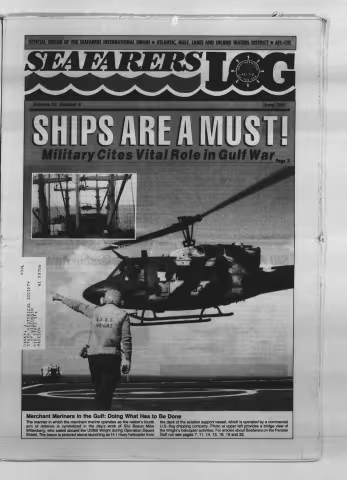
Merchant Mariners in the Gulf: Doing What Has to Be Done
The manner in which the merchant marine operates as the nation's fourth the deck of the aviation support vessel, which is operated by a commercial
arm of defense is symbolized in the day's work of SlU Bosun Mike U.S.-flag shipping company. Photo at upper left provides a bridge view of
Wittenberg, who sailed aboard the USNS Wright during Operatiqn Desert the Wright's helicopter activities. For articles about Seafarers on the Persian
Shield. The bosun is pictured above launching an H-1 Huey helicopter from ^ulf run see pages 7,11,14, 15,18,19 and 32.
• • • Av'i#
..4
i: W^s^i ^ '• '•• - •• 7A i, .
.- A--.' •:' 7
im
W:y-} •.
H
• 'f 'iW ^"''-
-•1I7C
J.
• '• i '-V' -1
.fc.',
^.y; •
•h-P
•4!
My': P'
•yimimy.
•>. -
•• i '!'':u"-'' "''.V
SEAFARERS LOG
President's Report
The Struggle Goes On
The life of the working person is one of struggle, and continuous
struggle at that. The recent vote in Congress that will allow the adminis
tration to negotiate a trade treaty with Mexico without having to submit
the proposal for a full legislative debate was a big blow to American
workers.
The administration was seeking — and got — the right to negotiate a
U.S./Mexico so-called free trade agreement under "fast
track" authority. Such a procedure gives the U.S. Trade
Representative the ability to bring back a proposed deal
and all Congress can do about it is vote the package up
or down — no amendments, no significant input from
the American people.
Congress, pressured heavily by a powerful Big Busi
ness which stands to make big gains through access to
59 cent-an-hour Mexican labor, by a vote of 231 to 191
Michael Sacco gave the administration the fast track aiuthority it
sought. Despite a formidable legislative effort by the AFL-CIO, its affili
ated unions, including the SIU, and farmers and groups concerned over
the environment, a majority of the House decided to give the president
wide latitude to come up with a trade deal.
Although the fast track forces won out, it is heartening that as many as
191 representatives felt a responsibility to the American people to put
such a trade deal to the true test of worth — a full and fair debate in the
U.S. Congress.
Ready for Round Two
As a result, American workers and their unions must stay on their toes
and keep a constant eye on the administration's negotiating strategy.
And we must be prepared to make our case to Congress when that group
of elected officials is presented with a final U.S./Mexico trade agreement.
This recent fight to try and keep decent, good-paying jobs for Ameri
can citizens within our national boundaries reminds us that the struggle of
working people versus those who control the machinery of commerce
and government is a never-ending one and certainly is not a piece of
cake. But this union was bom out of stmggle and strengthened in con
flict. The disappointing vote of Congress on the U.S./Mexico free trade
agreement means we'll just have to come back tougher on the next round.
Who's Kidding Who?
In a proclamation issued on the day set aside to take stock of the
nation's maritime assets. President George Bush acknowledged the im
portance of sealift in the liberation of Kuwait and noted that "recent
events have fostered renewed pride in America s merchant seafarers.
He saluted "all those who serve in our vital maritime industries."
Whoever is writing the president's stuff knows enough to pay lip ser
vice to American shipping.' Unfortunately his policy-makers and cabinet
members, the Ones whose hands crank the wheels of government, move
merrily along slamrtiing and undercutting U.S.-flag shipping at any
chance they get.
The fancy words in the president's proclamation praising the role of
the merchant marine in Operation Desert Shield and Desert Storm are in
consistent with the administration's maritime policy which can be charac
terized as neglectful and disinterested at best and non-existent or
downright hostile at worst. Looking at the administration's actions over
the past two years, it is possible to accuse the government of attempting
to kill off the maritime industry.
Words Are Nice but Actions Are Better
It is the administration's energy policy, recently sent to Congress, that
in calling for the creation of a Defense Petroleum Reserve establishes
waivers of national laws governing cabotage and cargo preference. This
is the administration that negotiated a toothless bilateral maritime agree
ment with the Soviet Union, a treaty that provides no cargo for U.S.
ships. This year, the State Department, through some fast shuttling of
funds from one agency to another, got around U.S. cargo preference laws
and allowed housing bought by Israel with American financing to be car
ried on foreign flag ships.
These examples are typical of the problems the industry is up against
-in coping with the anti-merchant marine policies of the executive branch
of government. With so much energy directed at bending the letter and
spirit of our laws that promote a healthy U.S.-flag fleet, is it any wonder
the president's Maritime Day proclamation rings a little hollow?
The ball is in the administration's court, if for no other reason than the
recent examples of the role of U.S. shipping and American seamen in Op
eration Desert Shield and Desert Storm and now in Desert Sortie. It is
time for the administration to put the president's words into some sort of
action and support a policy which will allow a merchant marine to thrive
instead of shrill.
Operation Desert Shield and Desert Storm proved President George
Bush has it in him to exercise leadership, develop a program, seek and se
cure the support of Congress and execute a plan of action with swifmess
and courage. A true Maritime Day pledge would utilize all of those presi
dential assets'pn behm of the industry which, once again, has vividly
proved its wortli as the nation's fourth arm of defense.
SIU Announces Winners of Scholarshiu Awards
The Seafarers has announced
the winners of its 1991 scholarship
awards. They include three SIU
members: AB Danny Arthur
Kayser of Prescott, Ariz., a four-
year scholarship winner; Cook and
Baker Roberta Blum of the
Bronx, N.Y., a two-year scholar
ship winner; Chief Steward Re
becca Sleeper Manion of Port St.
Lucie, Fla., a two-year winner.
The four dependents of SIU
members who were awarded
scholarships in this year's program
were: Michelle Lee Budnik of
Posen, Mich., daughter of Great
Lakes member Michael F.
Budnik, a four-year scholarship
winner; Carl R. Chavez of Seattle,
son of deep sea pensioner Vincent
Chavez, a four-year scholarship
winner; Peter Joseph Sheehan of
Staten Island, N.Y., son of deep sea
member John J. Sheehan, a four-
year winner; and Jeri N. Tucker
of Mobile, Ala., daughter of deep
sea memijer James Tucker, a
four-year scholarship winner.
Four-year scholarships provide
the winners with $15,000 each to
wards their college tuition and ex
penses. The two-year awards total
$6,000 each.
Pursuing Goals
In announcing their selection,
SIU President Michael Sacco con
gratulated each one of the scholar
ship winners. "The Seafarers
International Union is proud of its
members and their dependents
who pursue advanced academic
Volume 53, Number 6 June 1991
The Seafarers LOG (ISSN 0160-2047) is published
monthly by the Seafarers International Union; Atlantic,
Gulf, Lakes and Inland Waters District; AFL-CIO; 5201
Auth Way; Camp Springs, Md. 20746. Telephone (301)
899-0675. Second-class postage paid at MSC Prince
Georges, Md. 20790-9998 and at additional mailing of
fices. POSTMASTER: Send address changes to the Seafar
ers LOG, 5201 Auth Way, Camp Springs, Md. 20746.
Communications Department Director and Editor, Jessica
Smith; Associate Editors, Daniel Duncan and Max Hall;
Associate Editor/Production, Deborah Greene, Art Direc
tor, Bill Brewer.
The applications for scholarships being awarded by the SIU were examined by
a panel of professional educators who determined the winners. From the left are
Dr. Gayle A. Olson, Dr. Charles Lyons Jr., Dr. Henry Toutain, Dr. Trevor
Carpenter, Father David Albert Boileau, Dr. Michael Glaser and Dr. Charles D.
O'Connelldr.
and vocational goals," Sacco noted
in a communication to each of the
seven awardees.
With these newest recipients, a
total of 210 scholarships have been
awarded since the program began
in 1952.
The seven were chosen on the
basis of their academic perfor
mance by an impartial panel of pro
fessional educators appointed by
the Board of Trustees of the Sea
farers Welfare Plan.
Seven professional educators
composed the 1991 scholarship
panel.
They were Father David Albert
Boileau of Loyola University, Dr.
Trevor Carpenter of Charles
County (Md.) Community Col
lege, Dr. Michael Glaser of St.
Mary's College of Maryland, Dr.
Charles Lyons Jr. of the American
Association of Colleges and Uni
versities, Dr. Charles D.
O'Connell Jr. of the University of
Chicago, Dr. Gayle A. Olson of the
University of New Orleans and Dr.
Henry Toutain of Gustavus Ad-
olphus College (Maryland).
rf'y'-f.
.;. 7.;
/ J ^ ... <
y'"'
juNi m S'i:
M'-
In the Wake of Desert Storm •"M
Militaiy Verdict: U.S. Siii^ Key to Defense
officers and strategists from the U.S.
Armed Forces, who were deeply
involved in the recent Persian Gulf operation,
proclaimed the essentiality of American ship
ping and stressed the need for a balanced U.S.-
flag fleet.
Top military leaders observe that rapid sealift
and the ability to project forces to any area of
the world are critical ingredients in the nation's
defense strategy, particularly in light of the
lessons learned from Operation Desert Shield/
Storm and the changes in the world brought
about by the collapse of communist govern
ments in East and Central Europe and the
opening up of the Soviet system.
Secretary of Defense Dick Cheney has high
lighted the importance of mobility for the pur
pose of an adequate defense.
A priority of DOD is "the ability to project
military power rapidly to areas of U.S. strategic
The Senator—an SlU-crewed, U.S.-flag commercial carrier—was chartered by the military to transport materiei
during the Persian Quit engagement. Beginning in December, Crowiey Maritime, the vessel's operator, pulled
the ship from its commercial run between Florida and Central America and dedicated its use to Operation
Desert Shieid/Storm. Above, the vessel is loading guif-bound cargo.
*A DOD priority
is the ability to
project military
power rapidly to
areas of US.
strategic interest.'
Secretary
Cheney
interest," Cheney said. Additionally, in restruc
turing the nation's conventional forces, DOD
"will include a high airlift and sealift capacity."
He told the House Foreign Affairs Committee
in March that the nation's new defense posture
focuses on "regional contingencies and on sus
taining the forward military presence" while
the defense budget directs "resources for in
creased mobility."
'Highly Responsive' Force
The Department of Defense chief said, "The
General
Powell
*The experience
of Desert Shield
offers some
valuable lessons
that we intend to
use in structuring
our future lift
forces.'
Seafarers, Pensimers, dailies
rate Psut HI First BawHts Talks
in Houston and Mobile, active and retired
Seafarers and their families met with officials
of the various benefits programs which serve
their medical, pension, vacation and education
needs.
The conferences, which are designed to as
sure that all Seafarers and their families receive
the maximum entitlements provided for by the
Seafarers plans, began last month in Houston
and Mobile. Similar benefits talks are scheduled
to take place in other SIU halls. (See schedule
on page 13.)
OMU Orlin Sargent, who attended the con
ference in Mobile, said "I heard a lot of ques
tions and a lot of answers. I thought the con
ference was good because it keeps people up-
to-date on all that the plans give." He added
that the materials provided to conference par
ticipants would be particularly helpful to the
spouses of Seafarers. "To have the information
around while we are out at sea, will be a big
help to the wives."
"I had a question I've been meaning to ask
for years," said DEU Fortune McCants Jr.,
who sails from the Mobile hall. The session
provided "a good chance to go over that and
learn from other people's questions," McCants
said. The DEU saw the conferences as a positive
trend. "I'm proud of the SIU—I've been here
23 years—and things just keep getting better."
Retired Seafarer Charles "Chuck" HOI said
after attending the session in Houston, "We
need more of this type of meetings to educate
our members about benefits." Retired member
Arthur Finnell and his wife, Judy, said they felt
more confident about the plans after participat
ing in the workshops.
Nick Marrone, the administrator of the var
ious Seafarer plans—including medical, pension
and vacation, reported that the workshop struc
ture of the sessions encouraged a good give-
and-take discussion. Leo Bonser, the plan's
Continued on page 13
regional contingencies we might face are many
and varied, including differences in terrain,
climate, distance from the U.S., nature of threat
forces, potential for outside involvement, and
level of infrastructure and host nation support."
However, the common thread running through
any potential regional conflict, he observed, "is
that they will arise on very short notice, and
therefore require a highly responsive military
capability. As we have learned again most
clearly in Operation Desert Shield/Desert Storm,
a regional crisis can also mean mounting a very
large military operation."
In testimony presented as early as September
11,1990 before the Senate Committee on Armed
Services, General Colin L. Powell, chairman of
the Joint Chiefs of Staff, voiced concern over
the nation's sealift assets.
Lack of U.S. Ships
In responding to a written question from
Senator John Warner (R-Va.), General Powell
said, "Our nation's sealift capability needs im
provement. The decline of our merchant marine
continues unabated. As a result, the non-avail-
ability of militarily useful U.S. merchant ship
ping and the lack of sufficient numbers of the
kind of ships we need in the Ready Reserve
General
Johnson
'The solution to
our future sealift
capacity ...
must include
efforts to improve
the US.
merchant
marine.
The wife of QMED/Pumpman Larry W. Philpot gathers
information on the array of Seafarers benefits avail
able to her family. Novelyn Philpot is pictured above
with her grandson Jonathan during the Houston
benefits conference.
Force (RRF) drove the requirement to charter
foreign-flagged ships. . ."
During a follow-up hearing by that Senate
committee on December 3, in answering a
question on American airlift and sealift capacity
submitted by Senators Warner and William
Cohen (R-Maine), General Powell said, "The
experience of Desert Shield offers some valu
able lessons that we intend to use in structuring
our future lift forces."
Continue on page 12
In the aftermath of the actual physical conflict if^e Persian Gulf, the American military is evaluating the effectiveness
of all elements that went into Operation Desert Shield and Desert Storm. Insofar, as U.S. shipping is concerned, the verdict
of commanders and planners throughout the military is that the nation's defense interests require more sealift capability
and a healthy American-flag merchant marine.
In a series of congressional hearings.
•• . . -• •••••=:, s
, y •£ "• • • t-.'-v ii.
V fet
.n., :
;,r. • ••
srr-/
•
m -ii''
, v- I';- > •
J::: I f
.m :#Sfi
-fs:-
/ --tv
Pi
, I' ;!
y''
1
• ^ W''
• (4'-y' ''PPPi
• ^ f ... •
."C-.r-VV . .-r
i'i.
• :• fV •nm
• ''t'4 &
• 'i.4'44
2- .'.-.U'-.v
•4S"r •• ••'
«-•; i':'
•V. .-•
'-•ir •
•ri-
•% ^ .VVVA:,'.
t'i ' - .
,iVr, • '••
m-
' ."i ••, ,
'• --'.rv
suFJumm
Hea¥y Gulf Ship Sumly Une Goes In Gev&se
While the Persian Gulf military
deployment may be over for most
of the world, the same cannot be
said for the men and women who
make up the American merchant
marine. Currently, 111 U.S.- flag
vessels—^the majority of which are
manned by Seafarers—are taking
part in Operation Desert Sortie,
the military's name for the mas
sive redeployment of materiel
shipped to the Persian Gulf after
Iraq invaded Kuwait last August.
U.S. military and maritime of
ficials estimate that what took seven
months to amass could easily take
as long to disperse. Consequently,
Seafarers can expect that most of
the vessels brought into service
from the Ready Reserve Force
(RRF), as well as ships cranked
up from reduced-operating-status
(ROS), will continue to sail on the
Persian Gulf run through the fall.
The Operation Desert Shield/
Storm deployment to the gulf lifted
540,000 troops, 2,000 Army tanks,
2,200 armored vehicles, hundreds
of self-propelled Howitzers, 1,000
helicopters for the Army as well
as hundreds of aircraft, trucks and
combat equipment for the other
branches of the armed services.
with redeployed materiel destined
for the United States. The Bella-
trix arrived in Savannah on April
7.
Currently, MSC is utilizing the
services of 111 U.S.-flag ships-
The SlU-crewed Cape Ducato, a roll-on/roll-off vessel in the Ready Reserve
Force, brings home 197 M-1A tanks. The mliitary equipment, which arrived at
the Port of Charieston in April, awaits rail shipment to Anniston Army Depot in
Alabama and to Fort Stewart, Georgia.
Largest Seaiift
All-in-all more than 10 million
tons of military equipment, sup
plies and fuel were carted over to
the gulf, making the operation the
largest American seaiift since
World War 11. Ships carried 86
percent of the dry cargo and 99
percent of the fuel in a seven-
month period, an average of 84
million pounds of cargo per day.
General Hansford T. Johnson,
commander-in-chief of United
States Transportation Command,
the military's supervisory agency
for transport logistics, told a
congressional panel in March that
the United States had "sealifted
over 32 million square feet of unit
equipment—enou^ tanks, trucks,
ammunition, foodstuffs and other
equipment to cover every square
foot of 676 football fields."
"The volume of ship traffic
across the seas between the U.S.
and the Persian Gulf became so
great during the deployment that
we frequently referred to the sea-
lift operation as 'the steel bridge,' "
said General Johnson, whose
agency coordinated the land, air
and sea transport of materiel for
Operation Desert Shield/Storm and
now Sortie.
Surge in Reverse
That 'steel bridge' is operating
today in reverse. The Military
Seaiift Command (MSC) reported
by early April, 10 ships were trans
porting equipment of the Marine
Expeditionary Forces, the Army's
82nd and 101st Airborne and 24th
Mechanized Infantry Divisions.
The SlU-crewed USNS Bella-
trix, one of the military's eight fast
seaiift ships, was among the first
vessels to leave the Persian Gulf
including 8 fast seaiift ships, 66
RRF vessels, 37 chartered bot
toms—and 71 foreign-flag carriers
in the redeployment effort. The
ships are delivering the military
cargo to the ports of Wilmington,
N.C.; Houston; Baltimore; San
Diego, Calif.; Charleston, S.C.;
Jacksonville, Fla. and Hawaii.
MSC said 150,000 tons of mili
tary hardware has been returned
to the United States. Additionally,
340,000 tons of cargo was never
unloaded in the gulf. The ships,
originally heading toward the gulf,
simply did a "U-tum" when the
shooting war was over and have
brought or are in the process of
bringing the 340,000 tons of ma
teriel back to its original loading
points.
Considering 3.4 million tons of
dry cargo was shipped to the gulf
for the military engagement, to
date that leaves just under 3 mil
lion tons to be removed or left in
the region.
Press reports indicated Secre
te of Defense Dick Cheney was
discussing the possibility of leav
ing some of the military equipment
in the Gulf during his meetings
with gulf state leaders last month.
However, to date, no formal
agreements regarding either the
sale or positioning of American
materiel has been announced.
Merchant Marine Assists in Relief Efforts for Kurds, Bangladeshis
By quickly transferring seaiift
assets from Operation Desert Sor
tie or changing course in mid
stream, American ships have been
aWe to come to the aid of the
Kurdish refugees and victims of a
cyclone in Bangladesh.
Under the auspices of the Mil-
itap^ Seaiift Command (MSC), U.S.
ships are assisting in relief efforts.
The SIU- crewed Noble Star, which
serves in MSC's afloat proposi
tioning force, brought 223 40-foot
containers of foodstuffs to Mersin,
Turkey in late April.
Another vessel crewed by Sea
farers, Waterman Steamship
Corp.'s Green Valley, carried
Kurdish aid cargo but was pre
vented from delivering it, reported
the Journal of Commerce last
nionth. The lighter-aboard-ship
(LASH) was unable to deliver close
to 6,000 tons of bagged food in 18
barges because U.S. and allied
naval personnel could not inspect
the cargo to ensure compliance
with the United Nation's man
dated economic sanctions against
Iraq.
Known as Operation Provide
Comfort, the effi)rt to organize
relief, camps and security for the
Kurdish refugees involves a three-
service task force and the coop
eration of several military agen
cies, including MSC.
More than a million Kurds raced
from their homes to Iran or the
mountainous region between
northern Iraq and Turkey in March
and April after launching unsuc
cessful attempts to defeat Saddam
Hussein's army. When a multi-
nation group began organizing re
lief efforts, the vast majority of
Kurds returned to their homes or
set up residence in the tent cities
erected by the allies.
The SlU-crewed USNS Pessumpsick sailed to Bangladesh to assist seven
amphibious ships of the Marines which were assigned to the Bangladesh relief
effort following the Persian Gulf cease-fire.
Bangladesh Aid
After a cyclone slammed into
Ban^adesh April 30, U.S. Armed
Services personnel were moved to
that country to begin distributing
food, water and medical supplies.
Additionally, American troops are
assisting in the effort to locate
survivors and assess damages.
According to Navy Times, an
SlU-crewed maritime preposi-
tioning ship, the Lt. Jack Lum-
mus, brought water and fuel. The
MSC Pacific fleet oiler USNS Pes
sumpsick, which is manned by
members of the SIU's government
services division, assisted seven
Marine Corps amphibious ships
which were diverted to Bangla
desh while en route to their home
ports from the Persian Gulf.
The humanitarian assistance is
designed to help the Bangladesh
government ward off the threat of
wide-spread disease and famine in
the wake of the cyclone and sub
sequent flooding and storms. Re
lief workers estimate as many as
10 million Ban^adeshis are in dan
ger of contracting an illness, starv
ing or dying of exposure.
Thousands of Bangladeshis look for a
loaf of bread being brought by relief
workers to the Island of Urir In the Bay
of Bengal. The devastating April 30
cyclone left some 16,000 survivors
with very little shelter, food or water.
k
Leaving makeshift encampments In
treacherous mountains on the Turklsh-
fraq border, thousands of Kurdish ref
ugees make their way to tent cities
established by allied military forces.
-r
;-*/t ' .. i .•• -1
JUNE 1991
, •••I,'/.:.!-
-,jJ
•'^ ;i"r-KiWV "l-, •; • - .' ,•."
•v.,.V-
Government procedures affect
ing the issuance of U.S. Coast
Guard seamen's licenses, docu
ments and certificates are in the
process of changing as a result of
recently enacted legislation origi
nating in response to marine oil
spills and an attempt to bring the
nation's federal budget into line.
The U.S. Coast Guard has be
gun placing an expiration date on
U.S. Merchant Mariners' docu
ments—also known as "Z" cards—
and Certificates of Registry issued
by the agency to merchant sea
men. Additionally, the agency is
preparing to implement a proce
dure by which the National Driver
Register (NDR) is checked for any
records of an applicant for Coast
Guard-issued licenses, documents
or certificates. Furthermore, in the
near future, the Coast Guard will
begin requiring a fee for the issu
ance of licenses, documents or
certificates.
The five-year renewal process
and the National Driver Register
check are mandated by the Oil
Pollution Act of 1990 (CPA 90),
the legislation that cleared Con
gress in the wake of the Exxon
Valdez oil spill in March 1989.
After President Bush signed the
legislation in August 1990, CPA
90 became law.
Although CPA 90 became law
last year, it has taken some time
for the Coast Guard to begin ad
dressing the provisions of the stat
utes concerning the licenses, doc
uments and certificates of seamen.
The legislation has many wide-
ranging and varied sections, many
of which had to be implemented
immediately. Among the first OPA
90 provisions to be instituted were
a mandate to have double hulls on
oil carriers operating in U.S. waters
by certain years, a limiting of con
tinuous hours of work aboard U.S.-
flag tankers and the establishment
of a national oil spill response
mechanism.
5-Year Renewal
All of the Coast Guard's Re
gional Exam Centers (RECs)
throughout the country have been
advised by the chief of the agen
cy's headquarters office of Marine
Safety, Security and Environmen
tal Protection, Rear Admiral J.D.
Sipes, to begin issuing documents
and Certificates of Registry with
expiration dates.
All new or original documents
and Certificates of Registry will
be valid for a five-year period and
will be marked with an expiration
date. All upgrades of ratings on
documents submitted now also will
be marked with a five-year expi
ration date.
Coast Guard RECs have been
advised by the agency's head
quarters to notate new or up
graded merchant marine docu
ments with a typed or stamped
expiration date below the logo and
above the name on the front and
a typed or stamped expiration date
in place of the issue date on the
reverse. (See document on this
page.)
The Coast Guard urges holders
of both a license and a document
to convert their merchant mariner
document at the same time as
license renewal in order to allow
for concurrent expiration dates.
Any individual obtaining a Mer
chant Mariners' Document or a
Certificate of Registiy will be asked
to sign an affidavit indicating that
they acknowledge the expiration
date and that they will be subject
National Driver Register for any
individual applying for a license,
document or certificate, including
ones that are being renewed. While
the exact process for the check
has not yet been developed, the
agency is asking applicants for
licenses, documents or certificates
to sign an affidavit authorizing the
National Driver Register through
a designated state department of
motor vehicles to fiimish the Coast
DATE MATURAUZEO NATURAUZATION Na DATE FIRST PAPERS 1 1 AUEN REGISTRATION NO. l
.AIJIIJEA.AIJIALIIIJIIJEJ
HneNT WEIGHT COMPLEXION COLOR HAIR COLOR EYES | SOCIAL SECURITY ttO. |
71" 200 FAIR BRONN BRONN 1 117 52 6308
ISSUED BY U. S. COAST GUARD
BALTIMORE; MMtYlAND
Expires 20„Harch 1996
1 QMED-ANY RAli
1 LIFEBOATNANi
I ORDINARY Sf
^ " STEMARD'S
I.S.MJ MARlNERSJLOCllEl!
Carl Ludm'g
PETH III
I OB BK WUMBER ~
417 52 6308 12 Apr 4
'ym-
Amis
HOME ADDRESS
DATE OF BIRTH
USA
ORE OF MARINER
The front and back of a recently-issued "Z" card include an expiration date
limiting the life of the document to five years.
to the renewal requirements listed
in regulations when they apply for
renewal in five years.
Current holders of documents
and certificates that have been
issued in the past will be required
to go through a renewal process
once the agency has put a system
in place for issuing renewals of
previously issued documents and
certificates.
Currently there is no require
ment for a seaman to renew his
document or certificate. The Coast
Guard is in the process of devel
oping these requirements. Once
the Coast Guard issues rules and
regulations establishing a proce
dure for issuing renewals, then all
seamen will have to renew their
documents or certificates accord
ing to the renewal scheme listed
in OPA 90. The renewal scheme
allows a seaman to restart his or
her document on the five-year an-.
niversary (or five-year incre
ments) of its date of issue. For
example, if a document was issued
on June 10, 1954, the five-year-
incremental- anniversary would fall
on June 10, 1994. Or if the docu
ment was originally dated August
30,1969, the five-year-incremental
anniversary would be August 30,
1994.
The Coast Guard has been man
dated by law to run a check of the
Guard with any information per
taining to their driving record.
Driver Register Check
The agency's headquarters has
directed all Coast Guard offices to
retain the affidavit (also called a
"release') in a separate file, pend
ing implementation of policies and
procedures regarding access to the
National Driver Register.
The Coast Guard currently is
developing the process for a check
of the driver register. The law
allows the Coast Guard to review
back three years from the sea
man's date of application for a
license, document or certificate,
unless a sanction issued earlier
was still in effect during the three-
year window.
However, a number of issues
must be settled. For example, will
a single drinking and driving in
cident constitute grounds for not
issuing a license or document or
certificate? What kind of appeal
process will be implemented?
Initially, the Coast Guard will
use the National Driver Register
information to support the present
process of screening applicants for
licenses and documents. Any new
uses or consequences will be an
nounced to the general public in
the Federal Register prior to final
implementation. When the proc-
-'Tiri
Check of National Driver Register, 5-Yoar Renewal and Fees
Are Among the Coast Guard's Plans for Seamen's Documents
ess hits the Federal Reg
ister, any interested party can
comment and urge changes. The
Coast Guard will take these rec
ommendations into consideration
before issuing the final rule on the
procedure.
The SIU is monitoring the agen
cy's moyes closely in this regard.
The union fully intends to provide
input on the process to ensure the
rights of its members are safe
guarded. As more information on
this matter is available it will be
presented to SIU members at
monthly union meetings and in the
Seafarers LOG.
The legislation mandating a
check of the NDR also gives the
secretary of transportation (Or his
agent, in this case the Coast Guard)
the latitude to review a seaman's
criminal record and to test for use
of illegal drugs and alcohol. The
law allows for licenses, documents
or certificates to be revoked or
suspended based on information
obtained by the secretary of trans
portation that the individual has
abused drugs or alcohol.
Seamen may be required to re
port any traffic violations and other
offenses that the Coast Guard
deems would prevent the issuance
of a license, document or registry.
Like the process on the NDR
check, there are still a number of
issues to be resolved; For exam
ple, what constitutes an "of
fense?" The Coast Guard must
publish in the Federal Register its
preliminary plans detailing how
the agency expects to comply with
the law. As with the NDR review,
the SIU wiU be following this
closely.
Fees for Documents
The Omnibus Budget Reconcil
iation Act passed by Congress and
signed into law by the president
last year sought to raise funds for
the financially strapped federal
government. As a result, the mar
itime industry was socked with so-
called user fees for Coast Guard
services. Among the fees man
dated by the Act is a charge for
the issuance of licenses, docu
ments or certificates.
The Coast Guard is in the proc
ess of developing a scale of fees
so to date no monies are being
sought when the agency issues or
renews a license, document or
certificate.
However, the agency expects
to, issue a scale of fees in the
Federal Register in the near fu
ture. There will be a comment
period in which all interested par
ties can have a say on the Coast
Guard's proposal for fees. This
input will be taken into consider
ation by the agency and a final
rule will be put into place.
Currently, seamen applying for
or upgrading or renewing licenses,
documents and certificates will not
be asked to pay a charge. But
every seafarer should be aware
that in the near future there will
be a fee associated with the ap
plication for Coast Guard-issued
licenses, documents or certifi
cates.
• 'v'
V ' 'i V' * ' "'•J' '' •
k-f..
T,
-Ws-
-. •-, P'V"-"
'.^y, • .,
j:
s0'-y
s-Ir-.. • ••
: .ifew;;.:,;
t •
•i. -Sr , ••" •• T- <.. . .}i-;^ 'f.;'
i"- '• . i •'
1 ;• " ' ' •
JVr ••,>
?: • =-•• i]<r.,-.-'i- \. \ "•
1': „
v'^y.•
; 'iSSsy'S'"'
I
w
•v,y SeAFARiltS 106
Congress Granfs ̂ st Track Schedule
for Trade Talks with Mexico, GATT
Both the House of Represen
tatives and Senate granted Presi
dent George Bush's request for a
two-year extension of' 'fast track''
legislation to negotiate a U.S./
Mexico trade agreement in floor
votes taken last month. Congress
also extended the administration's
time frame to negotiate a world
trade agreement, known as GATT.
Under fast track, first author
ized in 1986, Congress gives up
its right to amend any agreement
the administration may reach with
other countries. The legislative
branch can vote only to accept or
reject the total package.
The fast track measure passed
the Congress after much intensive
lobbying by industries that stand
to gain from the lower wages and
lax government environmental
standards of Mexico. While Amer
ican workers' wages start at $4.25
an hour, the dollar equivalent in
Mexico is $0.59 an hour. The av
erage U.S. worker earns $13.85
hourly. The average Mexican
hourly wage is $1.99.
Learn from Canada
The vote to allow the adminis
tration to vigorously pursue the
U.S./Mexico trade treaty came af
ter Congress was warned by Ca
nadian parliamentarians that their
experience with so-called free trade
agreements had not been com
pletely rosy.
Refering to the U.S./Canada
trade pact that went into effect in
1988, David Barrett, head of the
New Democratic Party in the
House of Commons, told U.S.
lawmakers, "We're here to point
out your possible grapes of wrath."
Congressman David Nagle (D-lowa) is told about Canada's bad experience
with free trade agreements. Making this case were Canadian parliarnentarians
Steve Butland and David Barrett, Canadian Labour Congress economist /Andrew
Jackson and SIU of Canada Secretary Treasurer Andrew Boyle. Pictured
above (from left to right) Nagle, Boyle, Jackson, SIU Director of Governmental
and Congressional Affairs Terry Tumer, Barrett and Butland.
Parliamentarian Barrett, who
was joined by Steve Butland, an
other member of Canada's House
of Commons, noted how Canadian
jobs had been lost to lower wage
areas within the United States.
Barrett and Butland, whose meet
ings with Congress were coordi
nated under the auspices of the
AFL-CIO Maritime Trades De
partment, testified before the
House Task Force on Economic
Policy, Projections and Revenues.
Remaining Alert
The AFL-CIO, which brings to
gether more than 100 national
unions under one roof, had urged
legislators to deny the administra
tion fast track authority. The AFL-
CIO, and its affiliated unions—
including the SIU, argued that a
single up or down vote would not
allow the American public ample
opportunity to debate the merits
of any free trade agreement.
Now that both the U.S./Mexico
trade treaty and the GATT talks
are moving forward, the SIU
Washington team will closely
monitor the nitty-gritty items raised
in the discussions. SIU legislative
representatives will be working to
ensure that the maritime industry
is exempted from any trade pacts.
The maritime industry, includ
ing the SIU, has been working to
keep waterbome transit out of the
GATT talks. The industry has long
held that subjecting maritime serv
ices to global trade negotiations
could endanger existing U.S. laws
that promote the use of American
bottoms—such as the Jones Act
and cargo preference.
The labor movement will mon
itor and fight any attempt by the
administration to make the U.S./
Mexico free trade agreement a job-
export program.
MSG Chief Inspects School, Cites Seafarers
The head of the military's agency
in charge of the waterbome move
ment of cargo cited Seafarers for
their contribution to the gulf war
efforts during an inspection of the
SIU's training center.
While on tour of the SIU's Lun-
deberg School, Vice Admiral
Francis Donovan, Commander-in-
Chief of the Military Sealift Com
mand (MSC), thanked SIU mem
bers for their role in supplying
materiel for the troops in Opera
tion Desert Shield/Storm and urged
them to continue their hard work
and studies.
Donovan inspected all aspects
of the Seafarers Harry Lundeberg
School of Seamanship curriculum
and facility. The Vice Admiral met
with staff members and students
in the ship handling simulator, the
vocational and educational class
rooms and the manpower opera
tion center.
A Personal Thanks
While visiting the manpower
center, the Donovan commended
its employees. "Your efforts and
hard work in assisting the Military
Sealift Command to man our ships
during Desert Storm are greatly
appreciated," he said in an im
promptu speech. "I'd like to thank
you dl personally for a job well
done."
Donovan also addressed the May
membership meeting at Piney
Point. He pointed out that 80 per
cent of all the materiel transported
to fight the Iraqis was delivered
by U.S-flag vessels.
Donovan called the efforts of
the U.S-flag fleet an "unbelievable
performance. For the speed in
which it has been done, it has not
been equalled any time in history.
And the folks of your organization
were the key people who got out
and got that moving for us."
A Promising Career
The vice admiral, noting the
trainees in the audience, said it
made him proud to see young
people wanting to go to sea. "You
are willing to become part of a
disciplined system that is going to
require a lot of you, but you have
the tremendous benefit to belong
to an organization that knows what
loyalty up and loyalty down
means."
He compared his own experi
ence as being "someone who
walked into the Navy much the
same way you have here, as a 17-
year-old, with no promises except
that if you do a good day's work,
someone is going to look out for
you and take care of you."
"Now, 39 years later, I am still
here and still enjoying it as much
as I did the first day. The same
thing is open to you," summed up
the vice admiral.
At the SIU manpower center, MSC
commander Francis Donovan reviews
the union's registration and shipping
procedures with Manpower Coordi
nator Bart Rogers.
Senate Panel
OKs Exploring
Oil in Alaska
The Senate Energy Committee
approved last month the explora
tion of oil in the Arctic National
Wildlife Refuge (ANWR). The
proposal, part of a comprehensive
national energy policy currently
being considered by Congress, next
moves to the full Senate which
will take up the debate of whether
to develop the nation's domestic
oil-producing capability.
Alaskan oil from the state's
North Slope is allocated for do
mestic consumption and therefore
carried to U.S. ports on American-
flag tankers. Because the currently
available supply of Alaskan oil is
being depleted, the administration
and many in Congress are seeking
the opening of ANWR to oil ex
ploration and ultimately drilling.
The oil reserve in ANWR, lo
cated beneath the tundra east of
the Prudhoe Bay fields in northern
Alaska, is estimated to possess
one the largest oil reservoirs in
the U.S. The energy legislation
looks to tap the oil as a way to
decrease American dependence on
foreign oil.
For Domestic Use
While approving the explora
tion, the Senate committee also
forbade exportation of any oil from
the fields to foreign markets. This
would mean only U.S.-flag tank
ers, using the Jones Act provisions,
will transfer the ANWR oil from
the Trans-Alaska Pipeline to refin
eries along the west coast of the
United States. (The Jones Act is a
1920 federal law limiting the trans
fer of cargo between two American
ports to U.S.-flag vessels.)
Approval of the national energy
package as it is now written in the
Senate is expected to be tough.
Environmentalists have an
nounced they will offer several
amendments on the Senate floor
to kill any development of ANWR
despite the fact that the bill limits
the exploration of the Coastal Plains
to a 1.5 million acre area of the
19 million included in ANWR.
White House Support
Estimates of the oil contained
within the northeastern corner of
Alaska run as high as 3.6 billion
barrels. President George Bush and
Senator Bennett Johnson (D-La.),
who serves as energy committee
chairman, view ANWR oil as a
way to raise revenues to implement
energy efficiency programs. The
secretary of energy has announced
that President Bush would veto
any energy policy that did not in
clude ANWR oil exploration.
While some type of national en
ergy legislation is expected to pass
the Senate before the end of sum
mer, the House of Representatives
still is holding hearings in the sev
eral committees with jurisdiction
over such a policy. The House is
not expected to take any action on
a national energy policy before the
Senate completes its work.
, -; V • ,:V< '/:'V.'.-v
. • r-.'>A
mttm
M'":
'••vi I^__
' :
;,-v ;^'.,-'„;^.'•, ••
.. • -••'-••< f. •' ••
•• ^''•-^: • :r"' ^
j\ v'-.-;^v.'..-,.py''",.
v''-t'
1*'^',-":.'•-VV'i'" '-
!-:v:y;i'^' o?j"
„ .•••'vr ;y
Vr"'- -''J''': •'
;:^y'^': •• •
Seaferers Acclaimed for Role in Desert Shieid/Stonn
Bronstein, Grosso and Hoffman Represent SIU Members in National Maritme Dt^ Ceremonies
of The "herculean" efforts
American merchant mariners in
the military's gulf war operations
were praised by President George
Bush, administration officials,
military officers and members of
Congress in a series of ceremonies
held in observance of National
Maritime Day, an annual event
every May established in 1933 to
promote public awareness of
America's shipping heritage.
On hand to represent Seafarers
who participated in Operation Des
ert Shield/Storm were Bosun Er-
vin I. Bronstein, QMED Richard
V. "Rick'* Grosso and AB Doro
thea "Dotty" Hoffman, all of whom
were aboard ships in the Persian
Gulf when the shooting war began.
The three Seafarers were pre
sented by Maritime Administrator
Captain Warren Leback with cer
tificates for a medal that will be
issued to civilian mariners who
served in the gulf engagement.
In extending his congratulations
to all civilian mariners for a job
well done. Captain Leback said,
"I'd like to express my appreci
ation for the unions, their mem
bers and officials involved... It
was a herculean effort to activate
theRRF... The unions did a yeo
man's Job in crewing the ships."
During the program held on the
grounds of the U.S. Capitol build
ing, the Maritime Day proclama
tion of President Bush was pre
sented by Robert S. Silberman,
principal deputy assistant secre
tary of defense for force manage
ment and personnel.
The statement noted that
"members of the American mer
chant marine cairry on a long and
distinguished tradition of service
to our country... Recent events
have fostered renewed pride in
America's merchant seafarers:
providing essential support for
Representing all Seafarers who played a role In Operation Desert Shield/Storm are (left to right In white jackets) QMED
Richard V. "Rick" Grosso, Bosun Ervin I. Bronstein and AB Dorothea "Dotty" Hoffman. They are joined by SIU Assistant
Vice President Augle Tellez (left) and Vice President Angus "Red" Campbell (second from right). Captain Warren Leback
(right), the head of the Maritime Administration, presented the Seafarers with certificates representing the Desert Shield/
Storm medal to be Issued to all civilian rharlners Involved In the Persian Gulf deployment.
Operations Desert Shield and Des
ert Storm, these individuals played
a key role in the liberation of
Kuwait."
'Unsung Heroes'
Three senators participating in
the ceremony represented the ap
preciation of Congress for the U.S.
merchant marine. Each senator
noted that it was not enough to
issue nice words one day out of
the year. "We may be celebrating
National Maritime Memorial Day,
but we ought to have national
maritime legislation. This should
be a commitment that we can no
longer wait" to see, said Senator
John Breaux (D-La.).
Senator Daniel Inouye (D-Ha.)
said, "There have been jparades,
ceremonies and yellow ribbons,
but people forget to ask who de
livered the tanks, who carried the
food, uniforms and munitions. As
from the days of the Revolutionary
War, the men and women of the
merchi^nt fleet have made sure of
victory. Without them, I doubt if
we would have celebrations."
Desert Storm!Shield Medal for Mariners
Merchant seafarers serving in
the gulf war operation are eligible
to receive a medal being prepared
by the U.S. government.
The Merchant Marine Expedi
tionary Medal will be issued to
American mariners who sailed on
U.S. vessels operating in support
of American militap' forces in Op
eration Desert Shield/Storm, an
nounced Captain Warren Leback,
the Department of Transporta
tion's maritime administrator.
Captain Leback, who heads the
Maritime Administration (MarAd)
said the medal will be for service
after August 2, 1990 in the areas
of the Persian Gulf, Red Sea, Gulf
of Oman, Gulf of Aden and the
portion of the Arabian Sea that
lies north of 10 degrees north lat
itude and west of 68 degrees east
longitude.
The cutoff date for service time
in these areas has not been set.
As the medal is in the process of
being made, the Maritime Admin
istration notes it will be several
months before civilian mariners
will begin receiving it through the
mail.
An artist's rendition of the medal which
will be awarded to every civilian mar
iner who participated In Operation
Desert Shield/Storm.
Applications for the Merchant
Marine Expeditionary Medal
should be made to the Office of
Maritime Labor and Training,
Maritime Administration, Depart
ment of Transportation, 4(X) 7th
Street, S.W.; Washington, DC
20590. Mariners who qualify for
the medal should submit their
complete name, "Z" card num
ber, rating, name of vessel, period
of service, a copy of their dis
charge and an address for mailing
purposes.
Speaking directly to the mer
chant mariners present at the event,
the senator from Hawaii said, "You
are the unsung heroes of America.
Without the men and women of
the merchant fleet, I doubt if the
country would be as great as it is
today."
Republican senator from Mis
sissippi, Trent Lott, said "The
merchant marine did a magnificent
job in World War II, Korea and
Vietnam. Again this year they an
swered the call of the country and
rose to the occasion, Without the
link they provide, we couldn't do
what we did in Desert Storm."
Admiral Stephen Loftus, Dep
uty Chief of Naval Operations for
theuU.S. Navy, thanked the mer
chant marine on behalf of the
American Armed Forces. He noted
that the press tended to focus "on
the fighting forces and high tech
nology" but the real story was in
how the forces got it all to Saudi
Arabia.
War Run Events Recalled
Bosun Ervin I. Bronstein's ex
perience in the gulf began when
he boarded the Cape Cod, oper
ated by OMI, on December 14
after having been on the beach for
only a week and a half. "The union
said we needed bosuns, and I
knew my country needed me, so
I went," said the 1980 Lundeberg
School graduate.
"We set sail from Beaumont,
loaded in Jacksonville with mili
tary trucks, fuel trucks, jeeps and
water buffaloes-small water tank
like equipment—and made it to
Saudi with no breakdowns. We
had a great crew, a good engi
neer," recounted Bronstein who
sails from the hall in Houston.
"We started with extra lookouts
for mines once we were in the
Arabian Sea. I oiganized the watch
system and the whole crew par
ticipated, including a couple wip
ers and the entire steward depart
ment... We got to Saudi Arabia
on the 21st of January—the height
of the SCUD attacks."
Although the Cape Cod was not
ready to unload the equipment,
the crew soon found that if the job
was going to get done they would
have to do it themselves. After
rigging the jumbo and other booms,
the crew unloaded 55 percent of
the cargo with their own gear. This
required almost 40 hours straight
at the winch controls unloading
cargo.
Thanks to Entire Crew
Bronstein throughout the cer
emonies recognized the contribu
tions of the entire Cape Cod crew.
He thanked Captain James Thomas
Tray, Chief Mate Manning, Chief
Engineer Stan Stadnicki, Cook
Gary Damron, AB's James Hig-
gins, Jacob Groby and Charles
Thompson. Bornstein gave a spe
cial thanks to AB Harold Horn
who he said was "72 years young."
"He was my best AB. He was
great. He survived two sinkings
in World War II. When this thing
broke out he packed his sea bags
to join up and he was a big help,"
said Bronsteiii.
QMED Richard "Rick" Grosso
got on the American Cormorant
in January 1990, expecting to do
a good job and make a nice com
fortable living based out of Diego
Garcia. But on August 3, "Big
Red," as the ship is known to her
crew, "pulled up the hook and we
were on our way to the gulf,"
recalls Grosso.
Despite the hostilities and lack
of information about Iraq's inten
tions, Grosso said he was not
concerned. "That was easy, we
knew it was hostile territory, but
I wasn't really worried then."
Grosso puts the emphasis on the
word "then" because the stakes
got somewhat higher on his next
trip to the gulf.
Just 10 Days Off
"I got off Big Red in Violet, La.
on October 3. Ten days later I was
on the USNS Algol," one of the
fast sealift ships which is operated
by Bay Ship Management.
"My second trip on the Alliga
tor—that's what we called the Al
gol—everything was lovely. I mean
the air conditioning was working
and the toilets were flushing. I'm
standing on watch, we were in
Saudi, and the chief engineer comes
down in his chemical suit and gas
mask. When I saw him I got this
feeling in my stomach, a feeling I
never had before. He said, 'Boys,
we are at war.' Well, you never
saw guys move so fast to the
Continued on page 11
' ' 'S - V v."
•Hi •III nd0m
• ••i-i
. •% :
f .••r? •
i- •'
. I: • :•
'i -J'.
AJ
M:-.
gf;
k v''V-
.•!
-i-
8 SEAFARERS LOG
BtMmue SlU Clinic Moves to IMversity Center
A noted university's center on
occupational medicine is the site
of the new SIU Baltimore clinic.
Seafarers using the services of the
Baltimore clinic will find it located
at a new address and staffed by
doctors and nurses who have spe
cialized in the field of medical care
for working people.
SIU pensioner Woodrow W.
"Bob" Reid was one of the first
Seafarers to visit the new clinic,
which moved from the fourth floor
of the Baltimore union hall to the
John Hopkins Center for Occu
pational and Environmental
Health. Brother Reid, who sailed
in the steward department from
1944 until he retired in 1979, found
the operation to be "first class."
Reid said he was impressed by
how modem all the equipment
looked at the John Hopkins cen
ter, which is located less than four
miles from the SIU Baltimore hall.
"I found it a beautiful place and
very professional" in the way it
was ran, he added.
found the center to be well re
spected within the medical com
munity.
The move to contract SIU clinic
and welfare plan operations to the
John Hopkins Center for Occu
pational and Environmental Health
is part of an ongoing process to
continue to provide Seafarers with
the best quality of medical service
in light of today's soaring cost of
health care. Throughout the coun
try, the Seafarers Welfare Plan is
contracting with a preferred pro
vider in each of the cities where
an SIU clinic has been located.
(The term "preferred provider" is
used to designate the single med
ical facility selected to serve Sea
farers.)
To date, the SIU has designated
the following preferred provider
organizations: Seattle—Virginia
Mason Hospital; San Francisco—
St. Mary's Hospital; Honolulu—
Straub Hospital; New Orleans—
Tulane University Hospital and
Medical Center; New York—
Coming into the Baltimore clinic at the Johns Hopkins Center, one Is greeted
by guard Tina Howard, here at left. Moving right are photos of Karen
Roulhac, the secretary at the union hall who helps Seafarers make
appointments for the clinic; Cathy LIppa, a clinic staff person and Arthur
James, an SIU trainee at the center to take his physical.
Five Seafarers attending the en
try rating program at the union's
Harry Lundeberg School of Sea
manship echoed Brother Reid's
comments. "I got prompt, cour
teous service," said 28- year-old
Brian Oisen, who calls Philadel
phia home.
Seattle-resident Ernest Dash, 22,
said "The staff was friendly and
competent." Carl Edward Ernst,
the 24-year-old Class 473 assistant
bosun from Buffalo, N.Y., added,
"It was clean and well orga
nized." Chris Davis, 21, from Va-
caville, Calif., said the clinic was
"very relaxing." Mobile, Ala. res
ident Arthur James, 22, noted that
the "nurses are very nice."
New Preferred Provider
The Seafarers Welfare Plan has
contracted with the John Hopkins
Center for Occupational and En
vironmental Health to provide fit-
for-duty physicals, care for illness
and treatment of injuries. Addi
tionally, the John Hopkins affili
ated Francis Scott Key Hospital,
located on the same grounds as
the occupational health center, has
been designated as the Seafarers'
plans preferred provider hospital.
The union's welfare plan se
lected the John Hopkins center
after careful review of the various
medical faciUties in the Baltimore
area. The welfare plan determined
the John Hopkins center was able
to provide all of the medical serv
ices required by the Seafarers.
Additionally, the welfare plan
Methodist Hospital; Philadel
phia—Methodist Hospital; and
Baltimore—^John Hopkins Uni
versity Center for Occupational
and Environmental Health and
Francis Scott Key Hospital.
Announcements of additional
preferred provider institutions will
be made in the Seafarers LOG and
by the welfare plan as they are
arranged.
Experts in Field
The Baltimore-based Center for
Occupational and Environmental
Health, which has been in exist
ence for 10 years, draws upon the
expertise of two schools within
the John Hopkins University sys
tem—the School of Medicine and
the School of Hygiene and Public
Health. It is staffed by Doctors
James R. Nethercott, Melissa A.
McDiarmid and Brian S. Schwartz.
The center's project coordinator
is Theresa A. "Terry" Pluth, who
received her degree in nursing from
Cornell University and her mas
ters in the field from the University
of Virginia.
Dr. Nethercott, who is director
of the center, also serves as a
professor at John Hopkins. He has
taught at the University of To
ronto and was head of the Division
of Dermatology at St. Michael's
Hospital in Toronto from 1977
until 1988. Both Drs. McDiarmid
and Schwartz are assistant pro
fessors in the university's Depart
ment of Environmental Health
Continued on page 15
As of May 1, the SIU Baltimore clinic Is operated by the' Center for Occupational
and Environmental Health of John Hopkins University. The facility is located four
miles from the union hall at 4940 Eastem Avenue In the Asthma and Allergy Center
building of the Francis Scott Key Medical Center's grounds.
One of the first Seafarers to visit the new Balti
more clinic was retired steward department mem
ber Woodrow W. "Bob" Reid. He Is pictured
above In the Baltimore hall with SIU Acting Port
Agent Salvatore Aqula.
Dawn Novak, one of the clinics'
medical office assistants, takes
the pulse of Seafarer Carl
Edward Ernst.
Medical office assistant Rae Ann Glass an
swers the questions of a retired Seafarer.
Nurse Theresa A. Pluth prepares
the equipment for a hearing test
being taken by Seafarer Brian
Olsen.
The center's director, Dr. James R. Nethercott,
examines Class 473's assistant bosun, Carl
Edward Ernst.
Seafarer Chris Davis looks up for
a moment during his vision test.
The center's Dr. Vaden Blackwood exam
ines Ernest Dash.
• A •
_;v.-
J
•4,
• mtiil'-
mi 1991
Twelve Seafarer Bosuns Are Recertified
Set your goals high, listen to
fellow shipmates and work with
your union were some of the words
of advice left by 12 members of
the deck department who gradu
ated as recertified bosuns during
the May membership meeting at
Seafarers Hairy Lundeberg School
of Seamanship.
The bosuns, who came from
across the country to complete the
highest curriculum available to
Seafarers sailing in the deck de
partment, finished advanced
classes in firefighting, safety and
first aid as well as deck skills
courses in wire-splicing, knot-tying
and navigation.
During the six-week course, ship
handling procedures were prac
ticed in the Lundeberg School's
simulator, which recreates sailing
periods, providing an opportunity
for in-depth discussions. This por
tion of the bosuns' riecertification
program is designed to equip the
ship's chairman in executing his
role.
All Aspects of Union
The bosuns inspected the union's
headquarters and met with each
of the SIU's top elected leaders.
The group talked with officials
from the union's congressional af
fairs department about legislative
issues of concern to the maritime
industry and working people. In
meetings with officials in the
union's collective bargaining de
partment, the bosuns discussed
the union contract—its enforce-
conditions—including weather.
geographic locations, dockside fa
cilities and other items encoun
tered when navigating a vessel.
A key aspect of the bosuns'
curriculum concentrated on learn
ing the ins-and-outs of the union
and its various plans. The program
brought the bosuns into contact
with every department of the SIU
for intensive question-and-answer
ment and implementation, the
shipping rules, the SIU constitu
tion and other hindamentals of the
Seafarers.
The procedures of the SIU's
plans—welfare, vacation and pen
sion—were reviewed by the bo
suns with representatives from each
of the trust funds.
In addition, communication
methods and leadership skills were
practiced by the bosuns in work
shop-like sessions with Lundeberg
School instructors. The bosuns
reviewed conflict resolution
mechanisms, group dynamics,
problem solving techniques and
other approaches geared towards
resolving issues that can crop up
on the job and increasing the ef
fectiveness of any individual's
work.
Several of the bosuns noted a
highlight of the six weeks of train
ing was working with the trainees
at the Lundeberg School. Course
participant Luke Wells, who was
one of three former Lundeberg
School trainees in this class of
recertified bosuns, noted in his
graduation remarks, "There is
more fraternization than when I
was here. We (bosuns and train
ees) got to talk and work with
each other."
Good Exchange of Ideas
Brother Wells said this was a
positive development because it
would help entry level Seafarers
become somewhat familiar with
life aboard a vessel prior to ac
tually shipping out.
Upon acceptance of his gradu
ation certificate presented at the
May Piney Point membership
meeting, Jeremiah Harrington, who
completed the Lundeberg School's
entry level program in April 1979,
told the trainees that after gradu
ating from high school and finding
a job flipping burgers for the min
imum wage, he was not sure what
he wanted to do with his life. Then
he came to the Lundeberg School
and began a career as a Seafarer.
Brother Harrington said, "I
really enjoy this life aboard ship,
as does my father before me. He
raised eight children bn a seaman's
salary." Harrington continued with
some advice for the trainees,
"Keep your eyes and ears open,
respect your shipmates, work hard
and stay away from alcohol and
drugs."
Joseph Mele, the third member
of the bosuns' class to have started
Continued on page 22
Bosuns Howard Gibbs (left) and Jeremiah
Harrington (right) work as a team during
a wire-splicing exercise while fellow up-
grader Sam Johnson watches.
Members of the graduating bosun recertification course include (kneeling, left to
right) Earl Brannan, Robert McGonagle, Abdulla Mohsin, Jeremiah Harrington,
(standing) instructor Bill Hellwege, J. R. Wilson, Howard Gibbs, Mauro de la Cerda,
Joseph Mele, Claude Leycock, Hayden Gifford, Henry Bentz, Luke Wells and instructor
Tom Gilliam.
Recertified Bosun Jeremiah Harring
ton (standing right) instructs trainees
Luke Wells (right) teaches two trainees at the Lundeberg School how to use Luke Wells talks with the membership at
the fine art of knot tying. a stage for painting and chipping. the May meeting in Piney Point.
J. R. Wilson of Houston has his hands
full trying to splice a wire.
Instructor Kate Richardson (standing) works with the bosuns to Improve their communication skills.
U.S. Transportation Commander General. Hans
ford Johnson shakes hands with Bosun Earl Bran-
nan while Robert McGonagle obsenres.
.. .. • SSSs^--
"'-4'
I
M' N-:^--.b,-^?V .."
WMX-:,
S«cU.:
'Ws' '•''.j''4'''.'-° ' "• t' ••
A.;-
.•ff' •
^-f
•;4f '
ii •• • "
^:V
10 soFARmm
1991 SlU Scholarship Winners Announced;
Three Seafarers, Four Dependents Named
Three Seafarers and four chil
dren of SIU members were named
recipients of this year's SIU schol
arship awards. With these seven
students, the program has awarded
210 scholarships since its in
ception in 1952.
An impartial panel of profes
sional educators from across the
country, appointed by the Board pf
Trustees of the Seafarers' Welfare
Plan, selected this year's seven
winners from among the many de
serving applications submitted.
4-Year Seafarers Awards
The four-year
seafarer award of
$15,000 was
given to Danny
Arthur Kayser
of Prescott, Ariz.
Kayser, 32, who
sails deep sea as
an AB, joined the SIU in 1978 as a
graduate of the Harry Lundeberg
School's trainee program. He has
since attended several upgrading
courses there ^d has acquired a
third mate's license as well.
Kayser plans to pursue a bache
lor degree in engineering with an
emphasis on sanitation. This edu
cational plan, he believes, came
about because of his seafaring ca
reer. He has had the opportunity to
travel the world, and through these
trips "I have constantly been re
minded of the urgent need for pre
serving and cleaning up our natural
and man-made resources." Kayser
sees a vast need to plan and de
velop recycling efforts and hopes
his college education will help hint
be a part of a better world.
2-Year Seafarers Awards
Two two-year seafarer awards
of $6,000 were awarded to two
women this year.
Roberta
Blum of the
Bronx, N.Y.
joined the union
in 1980 and sails
in the steward
department. The
36-year-old
member has shown a zest for learn
ing, earning a certificate in nautical
science and an Associate in Arts
degree from Charles County Com
munity College in LaPlata, Md.
and a Bachelor of Science degree
from Frostburg State University
(Md.) in 1989. She also has up
graded her skills at the Lundeberg
School a number of times, com
pleting the entry rating program,
third cook, cook and baker, oil spill
and sealift operations and firefight-
ing courses.
Blum believes her seafaring ca
reer has inspired in her a thirst for
a formal education. "With each
new port came the desire to learn
•'R ^
more about its natives and their
way of life." She discovered she
possessed an aptitude for lan
guages and has recorded her trav-
els through the medium of
photography. She returned to col
lege in 1987 to pursue her bachelor
degree, concentrating in cartogra
phy—which, she said, only
scratched the surface of the sci
ence.
With her two-year scholarship,
Blum plans to pursue graduate
studies at Hunter College in New
York and apply her knowledge of
cartography and remote sensing to
finding solutions to many of the
world's current problems.
Rebecca Jean
Sleeper Manion
of Port St. Lucie,
Fla. is the second
recipient of the
two-year sea
farer award.
Sleeper Manion,
31, began her seagoing career in
1984 when she graduated from the
entry level training program at the
Lundeberg School. She then up
graded through the ranks of the
steward department, receiving her
chief steward endorsement in
1989. Recently, she sailed to the
Persian Gulf aboard the Cape Hud-
Michelle Lee
Budnik is the
I daughter of Mi
chael F. Budnik,
who joined the
union in 1977,
sailing on the
Great Lakes,
most recently aboard American
Steamships Company's American
Republic.
The 17-year-old senior is grad
uating second in a class of 40 from
Posen High School. In addition to
her outstanding academic perfor
mance, Michelle Budnik has been
a member of the National Honor
Society since her sophomore year,
a four-year member of the pep club
and band boosters and a member of
the student council during her ju
nior and senior years.
She plans to attend Saginaw
Valley State University, majoring
in computer information systems
and eventually enter the world of
business.
son.
There is another aspect to
Sleeper Manion's SIU career—
that of union organizer—which
she claims "was one of the most
eye-opening experiences of my
life." It was then she leamed ho\v
important a union is to job security
and was surprised to find out under
what conditions some people are
willing to work.
Carl Robert
Chavez is the son
of pensioner
Vincent Chavez
who joined the
union in 1944
and retired
1985.
in
Sleeper Manion has chosen to
continue her studies, in business
management, at Indian River
Community College in Ft. Pierce,
Fla., both to develop her academic
skills and broaden her knowledge.
Dependents Awards
The four winners of the four-
year dependent awards were given
to Michelle Lee Budnik of Posen,
Mich.; Carl R. Chavez of Seattle;
Peter J. Sheehan of Staten Island,
N.Y. and Jeri N. Tucker of Mo
bile, Ala.
The Shorewood High School
senior's immense talents were ac
knowledged when he was recog
nized as a National Merit
Scholarship winner and a National
Hispanic Scholar semifinalist. He
also is a member of the National
Honor Society, competed in the
1991 Science Olympiad and
helped bring one of the school's
teams to fourth place in the 1991
Knowledge Bowl (similar to the
quiz show "Jeopardy"). Addition-
dly, Carl Chavez helped on many
school committees, was assistant
computer editor for the school's
literary magazine and helped man
age its main Apple Macintosh lab.
The graduating senior plans to
use the scholarship award to study
computer science at the University
of Washington.
He has made several friends
around the world through "pen
pal" writing. Those friends and his
father's stories of his 40 years of
sea life around the world "have
Seafaring Parents of Scholarship Winners
James Tucker,
engine
department
memljer,
father of Jeri N.
Tucker
John J.
Sheehan,
steward depart
ment member,
father of Peter
Joseph Sheehan
Vincent
Chavez, retired
galley gang
member, father
of Carl Robert
Chavez
Michael F.
Budnik, steward
department
member, father
of Michelle Lee
Budnik
expanded my worldly conscious
ness, and I may travel to teach the
uninitiated in less-developed coun
tries on computer use."
Peter Joseph
Sheehan is the
son of John J.
Sheehan who
joined the SIU in
1964. From 1987
to the present he
has worked with
the Sea-Land shoregang.
Peter Sheehan has already
started his college career at the
State University of New York
(SUNY) in Albany. As a student at
Msgr. Farrell High School, he first
became involved with the Muscu
lar Dystrophy Association and its
campaign to raise money. "My
first encounter with children af
flicted with muscular dystrophy
was a very memorable event in my
life. The children truly amazed me.
Despite their disease, they were al
ways optimistic and enthusiastic...
It made me realize how lucky I
was. . . I was determined to do
anything I could to help those chil
dren." He worked hard to help
make the school's fund raiser a
success and was one of four stu
dents chosen to present a check of
$72,000 to Jeiry Lewis on the na
tionally televised Muscular Dys
trophy Association's Labor Day
Telethon.
Peter Sheehan is not certain of
his career plans, but will try to help
others as much as possible, possi
bly entering the field of law en
forcement "or some type of
government agency where I wiQ be
direcdy benefitting my community."
Jeri Nichole
Tucker is the
daughter of
James Tucker, a
member of the
union's deep sea
division since
1964, who most
recently sailed aboard the Seahawk
Management Spirit of Texas.
The 19-year-old Jeri Tucker has
just completed her senior year at
S.S. Murphy High School in Mo
bile, Ala., where she maintained an
A/B average and was on the honor
roll. She also participated in the
Girl's Service Club and an engi
neering service club. After com
pleting high school, Jeri plans to
attend the University of South Al
abama at Mobile. She has chosen
engineering as her course of study.
Jeri Tucker also is very active in
her church and has attended na
tional, state and local conventions.
She belongs to a local community
choir that has national affiliations.
Her participation in their work
shops has afforded her the oppor
tunity to travel and be a part of the
recordings for some best-selling
albums.
Mr
Mm m
juNim i--' -T,, •
Seafarers aboard the Cape Ann
earned the appreciation of the U.S.
Navy's Sixth Fleet for "outstand
ing performance" and a "superb
job" as a ammo resupply/delivery
platform during Operation Desert
Shield/Storm.
The Ready Reserve Force ves
sel's crew received a communi
cation from the Mediterranean
from the
Gulf Run
MAILBAG
fleet's top officer. Vice Admiral
William A. Owens. The Sixth Fleet
commander said, "My hat is off
to you. You can take great pride
in your performance and in your
contributions to Desert Shield/
Storm ops in both the Red Sea
and in the Med."
The vice admiral said the Cape
Ann's "contributions to Sixth
Fleet's support of Desert Shield/
Desert Storm have been invalu
able."
Commander Owens continued,
"Everything^ Sixth Fleet has asked,
you have done and you have ex
celled while doing it. From a
standing start to MSNAP [mer
chant ship naval augmentation
program] installation, training,
loading out to an outstanding per
formance as a VERTREP, CON-
REP and UNREP 'Navy' ammo
ship. You have done it all without
missing a beat."
The "rep" activities of the Cape
Ann cited by Vice Admiral Owens
included vertical replenishment,
connected replenishment and un
derway replenishment.
Served as 'Ammo' Ship
In another communication to
the Cape Ann crew. Sixth Fleet
Commodore Nelson advised the
Ready Reserve Force vessel's
crew, "The professionals aboard
SS Cape Ann can be assured their
contribution toward raising the
level of ammo logistics support
within Med/Red Sea and Persian
Gulf has been sincerely appreci
ated."
The naval commander noted that
all of the groups making up the
Sixth Fleet "have voiced a con
sensus in praising the services pro
vided by SS Cape Ann," which is
operated by SlU-contracted com
pany Interocean Management.
"Working with you and watching
your performance during Opera
tion Desert Shield/Storm has been
most gratifying. To the crew of
the SS Cape Ann, 'Job Well
Done,' " concluded Nelson.
Serving aboard the Cape Ann
during Operation Desert Storm
were the following Seafarers: Bo
sun William R. Dawson, ABs Harry
G. Champagne, Leslie R. Choice,
Douglas K. Buchanan, Howard F.
Hare, Joseph W. Whitehead, WU-
liam E. Honehrink, Thomas R.
"Tommy" Temple, Raymond R.
Marquis, Thomas E. Myers and
Stephen Smith.
Ordinaries included Gregory A.
Alstrom, Craig M. Storms, Wil
liam E. Chaput, Thomas F. Ster-
enchak, Stacy A Grazette, Mark
A. Rivers, Jason L. Frazee, Tim
othy C. Ryan, Charles L. Frazer,
Gaston Watkins, Kevin M. Camp-
hell, Fernando Auhain, Robert M.
Cando, Christopher Curtis, Ken
neth M. Frankiewicz, Darrell
Brashear, Matthew P. Young, Ar-
nett C. Ware, Geoffrey P. Denesse,
Joseph H. Dean, Jason R. Wyatt,
Eugene Scandurra and Otto D.
Borden.
Black-gang members were
Electrician Paul L. Painter, En
gine Utilities Victor C. Mull and
James P. Clement, Oiler John E.
Routsis, Firemen Mark P. Moran,
Dennis J. Baldassaro and Wiper
Robert E. Fox.
Oakland Shoregang Is a Good, Solid Crew
SIU shoregang members get together with San Francisco-based Port Agent
Nick Celona and Patrolman Gentry Moore. A good many of the Oakland
shoregang members are shown above. They are (from left, kneeling) Stoney
Hardy, John Phillips, Greg Stone, L.A. Trout, George Pino, Moore, Larry Harris,
(second row) Art Montenegro, Lou Centeno, Celona, Bosun Floyd Selix, Kevin
Gibbons, George Bronson, Port Steward Harold Strauss, Tom Hartman, Dan
King Hom, M. Abdula and S. Green.
Cape Ann crewmembers eamed the respect of the Navy's Sixth Fleet for its
work as an ammo ship during the Persian Gulf conflict. SIU member Tommy
Temple took the above photo of the Cape Ann, an RRF ship, while it was
stationed in the Persian Gulf.
Ivan R. Salis was the steward
aboard the Cape Ann. He was
joined in the galley by Chief Cook
Curtis L. Brodnax, Chief Baker
Eric J. Loret, Assistant Cook Ken-
Seafarers Saluted on Maritime Day
U.S. Transportation Command chief. General H.T. Johnson, pictured above
congratulating AB Dotty Hoffman, greeted the SIU members who represented
Seafarers on Maritime Day after an MSC ceremony. Behind Johnson are
Assistant Cook Nancy Davis and Bosun Ervin Bronstein. MSC civilian mariner
AB Ralph Carlton (center), one of MSC's seamen present for the day's events,
joined the Seafarers group to talk shipping. QMED Rick Grosso is at right.
Continued from page 7
middle of the control room where
the box was with the suits."
Grosso, who graduated from the
Lundeberg School trainee class
number 148, continued. "We had
just started unloading when the
war started. So the war is on and
we are working, eating and sleep
ing in these rubber suits. Four
days in a rubber suit!"
Steward Was Great
The QMED, who sails from Wil
mington, Calif, said the Algol's
crew was fantastic. He remem
bered the Chief Steward Suzanne
Cake. "She was really good. She
said, 'war or no war, we have eggs
benedict every Sunday.' And she
did too." Chief Engineer Daniel
Perry and First Assistant Robert
A. Petersen were also "really
good."
Dorothea Hoffman, or "Dotty"
as she is known aboard ship, sailed
on the Cape Edmont, one of the
RRF's roll-on/roll-oflf vessels.
Hoffman recollected the moth-
balled ship's troubles, which in
cluded a major fire. "We had an
engineroom fire in the Arabian
Sea... the main line vibrated loose."
Despite the shape of the ship.
said the AB, who started her sea
going career on the passenger ships
in Hawaii, crewmembers pulled
together and did the job. "What
a good crew we had, it was an
excellent crew. Three of them were
retired—"Ten Speed Harry", the
wiper; L. Rene, the chief steward,
and James Moye, the steward.
These guys were ready to go."
DriUed to a "T"
The crew on the lOM ship was
able to tackle the fire and other
shipboard problems with the as
surance born from constant prep
aration. "Thanks to a really good
chief mate, we had drilled exten
sively. He thought because of all
the mechanical problems we should
do our fire and boat drill at least
twice a week and BR drill once a
week. So everybody knew what
to do when the real thing hap
pened," recounted Hoffman.
Hoffman added that it was good
to come home and find that people
appreciated the job mariners had
done for their country. "While we
were out there it seemed like we
were alone. But I've met so many
people who have thanked me for
our efforts. That has made it all
seem worthwhile."
J- r'-7" ' '•
Mkiii
, f.
U.S. Navy's Sixth Fleet lauds Cape Ann Crew for 'Supeit Job'
neth W. Bethea and the following
Steward Assistants: Masiya S.
Saiat, James L. Robertson, Robert
A. Nicholas, Edward Dorsey and
David R. Bevington.
••V
:•••-vV 4-4^4.
>•1: i:..
I'y
-A'
r-im
mmmmmi
r
'M.
V-.j, - n soFmns 100
Iplll;
• • . .^^ -'t. -. ' . <•>:
. -i^l-''..':, "-I.MV '•
;:ll'
\'ir' •;,
". i-p^ '• "••
li :•.:
fm
iy.
:'t'' ' •'
'?:'
i'
:•. • •. • ••-
;. •• • \V... • ,.'
;w , ;;»rt '
1 • •• :* . - ' .
B . ' • 'y
^''yy
ifK;'
,•0
Militaiy Calls for More Sealift Capacity
Continued from page 3
The same concerns were observed by the
man who heads up the military's vast transpor
tation network.
In testimony before a Senate panel last month,
General Hansford T. Johnson, commander-in-
chief of the United States Transportation Com
mand noted, "Our ability to hght and win is
dependent upon the effectiveness with which
we project U.S. forces to any theater of con
flict."
Addressing a Senate panel on projection forces
last month. General Johnson, called for im
proving the Ready Reserve Force, increased
roll-on/roll-off (RO/RO) capability, adding ves
sels to the military's prepositioning fleet and
building more strategic sealift ships.
Private U.S. Ships Key
Johnson pointed out that U.S.-flag shipping
is an integral component to the nation's defense
equation. The general warned "The solution
to our future sealift capability as a nation,
however, must include efforts to improve the
U.S. merchant marine. A revitalized merchant
marine supplemented with an organic capability
of well maintained militarily useful ships, along
with the establishment of a merchant marine
reserve, would provide us a sealift mobility
structure designed to meet the evolving threats
of the 21st century."
Major General Fred E. Elam, the Army's
assistant deputy chief of staff for logistics,
testified before a House panel in April that
Operation Desert Storm proved even the best
army in the world is of little value if it cannot
go to war rapidly.
Major General Elam, one of the Army's top
logistics officers, told the House Armed Serv
ices Subcommittee on Seapower and Critical
Materials that his branch of the service needs
The Army needs
at least 20 fast
sealift ships-
enough to
'project two
armored
divisions,* Maj. Gen.
Elam
at least 20 fast sealift ships—enough to "project
two armored divisions" from ports in the U.S.
to anywhere in the world.
Sufficient ships to carry two armored divi
sions—which includes 600 tanks and supplies
for 35,000 soldiers—should be ready to sail
within four days of a presidential order for the
Army to deploy, said Elam.
Army for More Sealift
Major General Elam called for "increased
capacity and availability of fast RO/RO sealift
assets." He said the Army supports "an in
crease in RO/RO capability in the Ready Re
serve Force" in conjunction with programs
designed to ensure that the "responsiveness of
the RRF" will be improved "so it can better
follow the initial fast sealift surge."
Elam said the Army advocates continued
efforts in sealift research and development to
meet the long term needs of the force and to
take advantage of emerging technology."
In testimony before the same house panel last
February, Vice Admiral Francis R. Donovan,
commander of the Military Sealift Command
(MSG), said Operation Desert Storm demon
strated the soundness of the military's invest
ment in "surge sealift" which he described as
the RRF, MSG'S prepositioning forces, the fast
sealift ships, aviation support ships and two
hospital ships. Of these ships, all are operated
by private shipping companies except the hos
pital ships. The investment in the surge sealift
ships, all of which are manned by civilian
mariners, proved to be "invaluable," observed
Vice Admiral Donovan.
Donovan went on to say that "U.S.-flag surge
sealift was inadequate to meet all DOD require
ments, and the charter of foreign-flag breakbulk
and roll-on/roll-off ships was necessary."
'Unilateral'Strength
The head of MSG, which is charged with
coordinating all waterbome movements of ma
teriel for the armed forces, echoed the prevailing
sense that Operation Desert Shield/Storm was
distinctive because the engagement brought to-
'We must be
prepared to
respond
unilaterally to
security threats in
. , . areas not
covered by
alliance
commitments
Vice Adm.
Donovan
gether committed coalition partners with a com
mon goal. Thus, the United States was able "to
obtain sealift capability from our allies, friends
and the world shipping market."
Donovan pointed out the nation should not
forget it is "essential that we maintain the
capability to respond to regional threats to our
national security decisively and with sufficient
force to produce a favorable outcome. We must
be prepared to respond unilaterally to security
threats in geographic areas not covered by
alliance commitments when allied shipping would
not be available."
Robert H. Moore, director for transportation
policy of the office of the assistant secretary of
defense for production and logistics told a House
panel meeting in April the Department of De
fense is coordinating an intensive, ongoing re
view of the nation's sealift requirements in light
of the Desert Shield/Storm experience.
*, . . future force
deployments will
be extremely
demanding . . .
there is clearly a
requirement for
additional lift.*
DOD official
Moore
Speaking to the House Subcommittee on
Merchant Marine, Moore said, "It is clear from
our experience during the Persian Gulf crisis
and the scenarios analyzed thus far that future
force deployments will be extremely demanding
and that there is clearly a requirement for
additional sealift."
The Persian Gulf experience demonstrated
the "importance of a balanced maritime pro
gram and the contribution of our maritime
industrv to national defense," said Moore.
Vice Adm.
Loftus
A military study
'identified a
general
requirement for
more sealift—
large, medium
speed roll-on!roll-
off ships.*
Military Initiatives
Vice Admiral Stephen F. Loftus, the U.S.
Navy's chief of naval operations for logistics,
advised Gongress in May that his service is
moving ahead on a near-term strategic sealift
acquisition program and is making progress in
the area of sealift research and development
(R&D).
He listed sealift initiatives, among which the
first is a mobility requirements study, known to
the military as MRS, designed to define the
logistics needs of the U.S. Armed Forces through
the remainder of the decade. An interim MRS
findings "identified a general requirement for
more sealift—large, medium speed, roll-on/roll-
off ships," said Vice Admiral Loftus, who
described his section of the Navy as the "re
source sponsor of strategic sealift."
The Navy officer advised the Senate Armed
Forces Subcommittee on Projection Forces and
Regional Defense that another Navy initiative
is the expansion of the RRF by purchasing
existing RO/RO ships from the commercial
market.
Loftus said the Navy's sealift ship construc
tion program offers some alternatives including
building either prepositioning or fast sealift
vessels or both and a build-and-charter program
which provides for allocating carriers to com
mercial service that can be quickly converted
to military service.
Consensus Deafening
Reviewing the combined experience of all of
the U.S. Armed Forces in the Persian Gulf
Operation, SIU President Michael Sacco said,
"The military forces of this nation have made
the case for an American merchant marine. It
would seem to us that to ignore their advise
and concern would be to play carelessly with
the security of our nation.
"For our own organization's part, we are
going to carry this message to everybody we
can, in the hope that we can finally achieve an
intelligent maritime policy that will result in a
balanced fleet which is consistent with the needs
of the world's greatest power."
1 ,•
Operated by private U.S. shipping companies and
crewed by merchant seamen, the military's eight fast
sealift ships proved to be the workhorses of the
Persian Gulf supply line. Above, the USNS Algol,
manned by Seafarers, prepares to load cargo des
tined for the Middle East.
,-', 7". i' •,'*>->
JUNC1991
1 A •••'
•'1 V-.v.'. ':•-
• V' •" .'w ',•
7 : •; \''i
'^'zi •' j'' . '.' ''<1- ':••• S •
Continued from page 3
education director and Marrone
were able to answer questions and
make note of ideas presented by
those in attendance.
Some of the questions raised by
conference participants in Hous
ton and Mobile concerned medical
benefits eligibility, self-paid med
ical plan premiums for individuals
who have stopped shipping, sick
ness and accident benefits, cir
cumstances when the medical plan
covers reconstructive surgery,
protecting a member's beneficiary
in the event of his or her death,
medical benefits for pensioners,
the different kinds of pensions.
Vesting service credits and benefit
service differences and the easiest
calculations to figure out vacation
pay.
At the May membership meetr
ing in Piney Point, SIU President
Michael Sacco encouraged all
Seafarers and their families to at
tend. He urged members aboard
ships to send their dependents.
"The information being discussed
at these benefits conferences is
very important to the people we
leave behind," he said.
Mobile-based pensioner Devaugh Ro
binson Said he would not miss the
conference "no matter what."
SA Kenneth Brown brought his wife,
Linda, and daughter, Candis, to the
Mobile benefits conference.
Retired member Arthur Finnell and his
wife Judy grab a quick bite before the
Houston conference begins.
John and Camilla Christopher retired
on his disability pension years ago.
They said the presentation during the
Mobile benefits conference was very
informative.
Becky Galbraith, wife of Recertified
Bosun Mike Galbraith, attended the
Houston benefits talk. She is holding
her newphew, Clifford, the son of AB
Scott Galbraith.
Seafarers Plans' Administrator Nick
Marrone explains to the group assem
bled in Mobile the increased pension
benefits for eligible Seafarers which
became effective after July 1 of 1990.
Valuable for Families
"While we are on a ship and
out at sea and something happens
to one of our dependents, it is
important for our wives and hus
bands to know what to do. It is
important for them to have the
proper documentation filled out
before you go to sea." Sacco urged
all Seafarers, pensioners and their
families to attend the meetings and
ask questions, voice concerns and
make suggestions.
Seafarers, pensioners and fam
ily members interested in attend
ing future conferences should con
sult the schedule of talks and
contact their union halls to confirm
attendance. Each hall can also
provide the interested party with
a time for each workshop session.
Pensioner Charles "Chuck" Hill asks
a question during the Houston benefits
conference.
Pensioner George Stropich, who sailed
as a QMED, participates in the Hous
ton session.
Pensioner Jewel Dearing partakes in
the lunch served just before the Hous
ton session began.
Seafarer Bertrand Wright asks a ques
tion regarding optical and dental ben
efits.
Seafarer Torry Kidd and his wife Mar- Mrs. Charles Hill attended the Houston
garet were among the Mobile confer- session with her husband, retiree Chuck
ence participants. Hill.
Schedule of Conferences
On Seafarers Benefits
• What are the benefits? • How do they work? • How
do you get everything to which you are entitled?
Seafarers, pensioners and their families are invited to attend the
conferences being held at union halls around the country to review the
benefits provided by the SlU's medical, pension, vacation and education
plans. For further information on the time of the workshops or other
details, contact the union hall or write to the Seafarers Benefits Plans
Education Office, Piney Point, Maryland 20674. Active member Richard McCali brought
his wife to the Mobiie benefits talk.
Recently retired bosun, Marion Beach
ing, listens to the presentation.
New York June 4, Tuesday
Norfolk June 6, Thursday
St. Louis June 14, Friday
Philadelphia July 10, Wednesday
San Francisco July 18, Thursday
Wilmington July 22, Monday
Seattle July 26, Friday
Baltimore August 8, Thursday
New Orleans September 10, Tuesday
Honolulu September 13, Friday
Jacksonville October 10, Thursday
San Juan November 7, Thursday
Algonac December 6, Friday Leo Bonser, the director of the plans' education office, talks with Mobile-based
pensioners on medical benefits.
.
FF- ••••J •
-•/ - v-
I
-J'.'
f'r
;,.1^
7,1
14 SEAFARERS LOG
.'• •• • -. '• •'-..; ''
SIU crewmembers aboard the
Cape Mendocino still were excited
about being in the Persian Gulf for
the beginning of Operation Desert
Storm when the vessel docked in
Jacksonville, Fla. in February.
Although the Ready Reserve
Force freighter had sailed from
Saudi Arabia on January 13, the
ship still was in the region when
fighting began four days later.
Members reported seeing U.S. na
val men-of-war sailing into posi
tion while Iraqi mines floated by.
AB Charles Alana said waiting
for the action to begin was the
worst part of being in the gulf for
both the mariners and soldiers
aboard the former Doctor Lykes.
"It was a relief especially for the
soldiers," he recalled.
Alana, who served in the Navy
during Vietnam, observed, "The
attitude of the troops is better than
in Vietnam but they have worse
conditions with no lakes or wa
terfalls. There was a lot of tension
but they were real focused on their
job."
Ordinary Seaman Elton Wilde,
who has been sailing for 34 years.
Cape Mendocino Crew Reflects
On Being in Gulf at War Start
from the Gulf Run m mallbag
noted he was "scared more (in the
Persian Gulf) than in Vietnam. The
possibility that they'll use chemi
cal weapons—-you've got to be
more alert in Saudi Arabia than in
Vietnam."
After leaving the United States
in the fall, the OMI Corporation
vessel had-^sailed to the gulf then
made a shuttle to Germany to pick
up more materiel. Crewmembers
had to remain onboard or were
restricted to the docks for more
than two months before the vessel
docked in Bahrain on January 13.
"We bunkered in Bahrain and
got some shore time," remem
bered Steward Baker Charles Scott.
"It was great for the whole crew.
Then we left Bahrain on January
16 (the day before the U.S. initf
ated its air strikes)."
The steward, who served in the
Navy during the Korean War and
sailed as a Seafarer into Vietnam,
reported great cooperation be
tween the soldiers and crew.
"When we got near Saudi, we felt
bad for them. They had to stay
while we knew we were coming
home," Both Scott and Bosun
Orla Ipsen praised the work of the
crewmembers.
Ipsen joined the Cape Mendo
cino in December in Bremer-
haven, Germany. "The trip was
not bad," he said. "They were
good guys." The 31-year SIU vet-
Ordinai^ Seaman Elton Wilde
adds his signature as the deck
department delegate.
AB Charles Alana (left) askes Jacksonville (Fla.)
Patrolman Anthony McQuay a question about a
health care claim.
eran stated he did not see any fear
exhibited by crewmembers when
they were performing their jobs.
Ordinary Seaman Norm Danao
admitted the one time he got wor
ried was when the ship passed
through the Suez Canal. "All you
need to do is sink the lead ship.
We went through after the war
started. Egyptian forces were in
all the bunkers-—like in the days
when they were fighting the Isra
elis."
Wiper John Hiltner said he was
"scared and worried while waiting
for word on the war. When we got
out of Saudi Arabia that eased a
lot of pressure and stress."
One member of the crew, GSU
Tim Shifflet, was on his second
vessel in the Persian Gulf. Early
in Operation Desert Shield, he
heard his step-sister was in the
Army reserves stationed near Ad
Damman, Saudi Arabia as he was
sailing aboard the American Ea
gle. When that ship docked near
there in October, he talked with
troops ashore but was not able to
find her.
Chief Steward Charles i I i|
Scott (Left) and Chief Cook ...
Floyd Harmanson discuss Wiper John Hiltner
the evening's meal. action
as a merchant
mariner aboard
the Cape
Mendocino.
The SlU-crewed hospital ship Mercy is
flanked by the battleships Missouri
(left) and Wisconsin in this photo
; taken neat Bahrain by Cape
i Mendoclr^ Searnan Norm
Listening tO a discussion during a ship's
meeting are (left to right) AB Shane
Curci, OMU Allen Todd and Wiper John
Bragg.
Steward Assistant
Mohammed
Elalikhidr checks
on food in the
deep fryer.
AB Francis Hennessey is
ready to hit the beach
after several rnorrths at.
sea.
V- V- .
JUN[ mi •' '',1^ ,,r- _
15
Master, Inspectors Hail Work Of Seafarers Aboard Silas Bent
Thanks to the no-nonsense at
titude, hard work and willingness
to go the extra mile of Seafarers,
the USNS Silas Bent and its crew
passed a U.S. Navy expanded
quality assurance inspection with
flying colors, reported the ship's
master in a recent letter to the
Seafarers LOG.
The strict and detailed inspec
tion, wrote Captain G. M. Leber,
is conducted by the Navy to
"evaluate adherence to the MSG
contract by the operating com
pany" and to check on the "per
formance by the ship's crew in
operating the vessel."
Captain Leber said that while
aboard the Silas Bent, which is
managed by MarShip Operators,
Inc., the Navy inspectors re
viewed the following areas: "deck,
communications, supply, engi
neering, damage control equip
ment condition, engineering and
damage control drills, medical,
ship's appearance," Navy safety
and health standards and sanita
tion.
"In all areas covered, the ship
won high praise from the inspec
tors." said I eber; "Accolades such
as "best food;' "cleanest ship' and
"best looking engineroom" were
heard from the chief inspector and
his area inspectors. The chief in
spector also noted the courtesy
and cooperation shown by the
crew."
Grades Seldom Equaled
The Silas Bent master noted in
the areas where specific grades
are given by the Navy. Seafarers
scored close to. the top of the
charts. "The steward department
earned a 94.4 percent score in
sanitation and the ship's store
keeper scored a 95.8 percent in
the validity check of his store
rooms. These are grades which
have seldom been equaled or sur
passed by this or other ships sub
jected to these rigorous inspec
tions."
Baltimore Clinic
Moves to Hopkins
Continued from page 8
Sciences. Division of Occupa
tional Health.
Dr. Nethercott notes that the
center's connection to John Hop
kins means Seafarers will "have
access to hundreds of specialists
in medical and surgical fields."
Appointments Through Hall
Seafarers and pensioners wish
ing to utilize the services of the
Baltimore clinic should continue
to make appointments by calling
the union's Baltimore hall at
(301)327-4900.
The John Hopkins Center for
Occupational and Environmental
Health' is located in the Asthma
and Allergy Center building on the
grounds of the Francis Scott Key
Medical Center at 4940 Eastern
Avenue, about a ten-to-fifteen-
minute drive from the SIU's Ba|-
tim.ore hall.
"The excellent inspection re-
fhip tnF suits were mainly due to'the
professionalism and c'oncern of
the ship's crew," said Captain
Leber. "Although these traits are
common to the crew in their
everyday work, I was truly im
pressed.by their response when
the Silas Bent received only a
short notice of the upcoming in
spection."
"Despite ongoing around-the-
clock operations, all hands will
ingly participated in many extra
drills and performed other ex
traordinary tasks necessary to
prepare the ship properly for in
spection." added the master.
In closing his communication to
the LOG. Captain Leber stated,
"In my 13 years with MEBA-2, I
have sailed with many fine SIU
crews, but I have never had the
good fortune of working with a
group so thoroughly professional
across-the-board."
The deck department Seafarers
who participated in the Navy in
spection were Bosun Robert Vaz
quez. ABs George Torngren. David
Milligan. Peter Poree, Gary Adair
Jennings, Gerald Beuk and Ordi
naries Steven Flaherty, Khamisi
Kayanda and Joseph Devlin.
Engineroom Seafarers aboard
were C}MED Electrician Rohroy
Adams, QMED Machinist Donald
Smith, OMUs Chris Coots, Mark
Dehley and James Lloyd, GUDE
John Von Sprecken.
In the Silas Bent galley at the
time of the inspection were SIU
members Chief Steward Ursula
Ihert. Chief Cook Cas.sie Tourere,
Cook Baker Timothy Frierson. As
sistant Cook Bertram Hickman,
and Steward Assistants William
Sylvester, Clarence Swidas, Mo-
hamed Ghaleh. Musa Ahmed. For
rest Burris and Jeanette Ball.
"It is due to such crews that
SIU maintains its excellent repu
tation. and that contract operators
arc able to extend and renew their
contracts with the government,"
concluded the Silas Bent master;
Serving the U.S. in War Is SchwaB Tradition
Dan Schwall was following in
the footsteps of his father and
grandfather when he told the pa
trolmen in the New York union
hall he wanted to help in Operation
Desert Shield.
"I thought my mother would be
upset." the 28-year-oId told the
Seafarers LOG of his decision to
go aboard the Flickertail State, a
Ready Reserve Force vessel. "In
stead. she is taking it quite well."
She told Schwall his father joined
the Navy to be an aviator shortly
after World War II started and her
father volunteered for the Navy
the day after Pearl Harbor was
bombed.
"We go where we are needed,"
' the able bodied seaman said of his
family. "I owe a lot to the SIU
and the United States of America.
It's the least I could do. I have a
skill that is needed."
The 1981 graduate of the Lun-
deberg School already has served
in one war zone. He was aboard
the Falcon Champion, which was
refueling Sixth Fleet vessels be
yond the "line of death" declared
by Libya's dictator Muammar
Qaddafi. when U.S. bombers at
tacked that African nation in 1986.
"When we heard the raid was
launched, we were .apprehen
sive." Schwall recalled. "We were
sent away from the region." When
the Champion docked two days
later in Italy, he and the rest of
the crew were astounded by the
firetrucks. police, divers and mil
itary on the pier for protection.
He admitted he was nervous
about going to the Persian Gulf.
"I have my concerns like every
one else over there. Ijust feel like
I'm doing my role." Dan Schwall
Father, Son Train at Union's School
Josh Mele (left) is following his father Joseph's footsteps by graduating as a
trainee from the Lundeberg School and shipping in the deck department. The
eider Mele, who was at the school with his son, just, completed the recertified
bosun program.
William "Josh" Mele. a trainee
at the Seafarers Harry Lundeberg
School of Seamanship, received
special attention, from one of the
members of the recertified bosun
program—his father^ Joseph Mele.
"It makes me proud to follow
in my father's footsteps." the
younger Mele told a reporter for
the Seafarers LOG shortly after
watching his father graduate as a
recertified bosun during the May
membership meeting at Piney
Point. "It was inspiring to have
my father here."
As part of their training; recer
tified bosuns work with the train
ees to let them know what will be
expected of them when they board
their first ship. Josh got the added
benefit of a knowledgeable tutor
working with him after hours on
his studies and training. "It helped
me a lot to have him here." Josh
stated.
The younger Mele had no idea
that his dad would be at the schtK)l
while he was studying there. How
ever. the bosun contacted his son
as soon as he found out he would
be upgrading. "I was glad to know
we would be there together." Jo
seph remarked.
Josh also plans to work in the
deck department. "I'd love to have
him onboard my ship," Joseph
beamed. "But there would be no
breaks." "I wouldn't expect any."
Josh quipped and smiled. Before
coming to Piney Point and becom
ing a member of the cok)r guard
for class 472. Josh had tried his
hand as a rock musician. "I was
tired of hanging on. Dad advised
me to get a career and make a
living. I can always play music."
Josh became the second gen
eration to graduate as a trainee
from the Lundeberg School late
last month. His father completed
his entry training in March 1974.
'V':
V ^ IR '
•':V,vrs-.,;.,rP.- .••-p. - , ::'v^^ v; V^•.•.P.iv; • • v • "' •
'.••.:,--'.!>-r-' i
16
•''*•••' -'• . ^ -r' •. '••• p---'"'••'••P'.'/.; / P"''' •'••.7^'-4VT:^>•;'T^..'"-,••'" :•-' v" /.'y-..'/^^ .'••••• 7'"','P^p".'-.
.. fv .:vv^:v " "'y' '""••• M ^ 7'P/^P:
-P'^77',• • .''P'P
•'J'. ••; •':? •»••-?•• '
77
k
P'-7 |'-7-7r.p •
^ I -PPP.
>41
i '• <
' I ' '• pvi-"N" ... •"
»<
; ••• w •<'"• ••-:'•/•'i
p'" ^ • •
|;. P:::Pr;:7p- ppPpP- .N
IP1 ;7®3is^p
^
•'-7
••" • i' . •
:P*
AB Billy Mulcahy replaces a
hatch cover after a hold Is
filled.
;- L •-'.'Tl-'-iS---, .= -., • • ••
-tei p-
•rim:.yy, :•••':
pppsp- p? '' p'
P'.:f 77-' /-ij'P •
•.-:IP-pp 7 P- ̂ 7 rpP:'
iw- /\3
[["PSviP'-- 7PPP¥P;IPP''; .'"^3':.PPpPi-P^.P:' '7
P'p: '''| i
fS^J
Twenty-year mem
ber porter Yehia
Kaid says he is
proud to serve
aboard the Ameri
can Republic.
Crewmembers have nothing but
••' "fe:-
[ i'-''^^'-r'- ''.-, •.•.i-'*-'i.'.^ • '• ivr-^ "^v: ;• '. ' - 7-" ''"I ASC
'•.'M..V-::f' ,7;' ',y "•' ' -•
-P:P;PP |
: |p:77pipiip|
|P|P-:77P7PSiP|
Second Cook Henry Peterson makes
sure the lunch salad bar is ready.
fj
,, •' -. T ; m
• -i". ' - '' \ •
• •.; .•'•"P-'i."" 'l/' '1 P - i .
PPPPr j|r^
The American Republic makes M
a roundtrip between Lorain,
Ohio and Cieveiand aiong Lake
Erie aimost daiiy. At the bot
tom of the page, crewmem- P
bers scurry aiong the deck to |
prepare the vessei for depar- \
ture. 'J
'p"- ' . •."
H • - '
^vu-' •• f?f"T' ;,.i-y:;. ."iv y ". y vf
P'P^'pPPTi.'" 7
twyfeics4^&;:;'r? ""'t7
ppp
%i y
ig'tj'SlS's
p.. -.w^
With safety gear in
place, Deckhand
Mohamed Saedi is
Wheelsman Rick Roussin receives orders to move ready for work,
the vessel down the dock to load another hold.
li^
•'7"',^'. 7';7'
Deckhand Joe Hance replaces one of the lines as the ship
is ready to sail.
I HE AMERICAN REPUBLIC is truly a
24-hour ship keeping its SIU crew on alert
any time of the day or night for docking
operations to load or offload ore for pro
ducing steel. Because of the bulker's limited run,
crewmembers have to perform their jobs when
sailing operations permit.
Members signing aboard each spring know the
work will be constant. "There is a lot of work on
this ship," said Terry Henrietta, ship's bosun since
1986. "It can make you feel old in a hurry, but the
crew knows its job and does it well."
The American Republic is set up to make a
roundtrip between Cleveland and Lorain, Ohio ev
ery 24 hours, weather and conditions permitting. It
carries approximately 20,000 tons of taconite from
the mouth of the Lorain River to three locations in
the twisting, snake-like Cuyahoga River that divides
Cleveland. The trip across Lake Erie—a distance
of about 40 miles—can take just over two hours.
Navigating the Cuyahoga to the first docking loca
tion—almost five miles up river—may last up to
three hours depending on conditions and traffic.
Chipping and painting over the side is done during
the short stays dockside. Black-gang members in
spect and repair rollers on the conveyor belts in the
hours while sailing. Although the galley maintains
normal hours for meals, it also must be prepared in
case operations call the crew back to work.
The American Steamship Company vessel, which
started sailing in 1981, was designed specifically for
the Lorain-Cleveland route. The 635-foot self-un-
loader was built with bow and stem thrusters to
help it negotiate the tight turns in the Cuyahoga. In
open water, it is one of the fastest vessels on the
Great Lakes. Once in the river, it can make speeds
up to eight miles per hour in the few straight
stretches.
With night falling, Bosun
Terry Henrietta handles the
stem-line controls to bring
the vessei closer to the
dock.
1^- -
^ ,';;j j
Mike LaBar of the maintenance Gateman Clifford "Scratchy"
team saws a block of wood Kracht has to loosen a conveyor
needed for repairing a conveyor belt to replace the roller under-
belt roller. neath.
'yyf'¥i=- :
Conveyorman Rick Springs
is known throughout the
ship for very hot atomic fire-
bail candies.
lA:t.
Wheelsman Ron Vandercook
checks to see that the American
Republic has not drifted too far
from the dock.
w:
.
As Rrst Mate Bill Miller (back) gives the orders.
Wheelsman Larry Dudek adjusts the ship's
course.
• r-
.'J:
QMED Dave Cameron inspects
the control board in the engine-
room.
'' ?'k'
7:-;,
;,7' • • . , •
8
' '' -.-sfei-'' . ,
Deckhand Ray Eggers (right) inspects the
loading operation at Lorain
with a dockworker.
Mmms
km
Black-gang crewmembers do
their best to work in cramped
quarters on the conveyor belt.
A' '^'AyAsfAAy -'^ •
7 : • '7. '-^-L V'v.-
. .y 7
7
t ' 7
m *1
- m-
; ' " -liiS
rs
. •• ^ .J ,1-1^ 'r . , ,. J .;r'
W k
Bi
7/:-
'^y
j',; w
••at.
"1 'V ' "i.p>
i «
YS'iiYtSi
m i > • • •••:><>' •:. .:•-'
l£ Y- _ r
r •sP'H; V" Y
K/^^ifJ.rrV'-•'- rl m-
Going cloclmlse, the self-un-
loader ieayes Lorain as load^
Ing Is finished. Seas were rough
that day as waves crash Into
the Cleveland harbor light
house and over the deck. The
wheelsmen use Cleveland sky-
scrapers to line the bulker Into
the mouth of the Cuya
hoga River. Once In the river,
the captain, lookouts and
wheelsman must be prepared
^r traffic, drawbridges and
messels tled along the river-
p}ank while the ship navigates
kill thetedlous twists and turns.
yyy'-:. i
Wheelsman John Norton keeps a steady
hand as the vessel sails from Lorain haibor.
.-7,
f'.yn I I'- I'
-iY' :,'V
'MY?.'".
, r''-. "•. •' :f V'v'..-. k'- =f?rt „
• 7 7; YY:77- v.-- .777; ^ •, . 7^: 'Y'.7-.:V •••; "7^ ' 7'^ •
?llf l®S77f77 Y|;7'7 AAA'A >-'7;7'
7YY-\;'.YYf>"Y7'7'Y'7' •••''''•
: -a. . ,
' "I'l. .1^ •
777;;: 7-vv.v;7, 7,, 7,,
YYi
.Kl.
/•
'•'''• ih''
ty :X'>-
%:
U":
III
B";0
'-'lli
;-gvr!
ii'-'Ju.ik-
a.
:3r
18 SlAFARiRS lOG
AfterAction^ackedGidf Tom\ Bosun Is AiiXwus to Return
Bosun Michael Wittenberg of
the USNS Wright is proud to have
lent a hand in the nation's moves
to liberate Kuwait from Iraqi
aggression.
The four-and-a-half year vet
eran of the aviation logistics sup-
At the time he left the area,
Wittenberg said he and the crew
knew war was imminent. Along
the pier, offloading was taking place
around the clock. "As soon as one
ship was emptied, they would push
it away from the dock and bring
from the Gulf Run A maiibag
port ship was among the first sea
men to go to the Gulf after Iraq
invaded Kuwait last August.
Wittenberg participated in the
ship's maneuvers and military
support activities until he signed
off in January. Once home he said,
"I feel like I'm missing some
thing" by being back in the U.S.
"(The Wright) feels like home to
me. My friends are there."
Wittenberg, who graduated from
Piney Point 11 years ago, said his
wife is concerned for him and does
not understand why he wants to
return to the ship. The emotions
are compounded by the fact that
she is expecting a baby and would
like to have her husband shoreside
for the delivery.
The bosun signed off the Wright
January 7 and caught one of the
last commercial flights out of Saudi
Arabia before the war closed the
skyways. He stated he had no idea
how he was going to return to the
ship in February if no civilian
flights were going into the Persian
Gulf.
in another," he reported.
Morale remained high among
the crew of the Wright, which was
deployed to the Persian Gulf shortly
after the Iraqi invasion in August
1990. But with the outbreak of
war, Wittenberg noted, "I don't
think anybody thought it would
come to this."
After being one of the first ship's
to dock in A1 Jubayl, Saudi Arabia,
the Wright sailed to Bahrain where
it served as a logistics focal point
for other military ships until it
returned to the Saudi port in late
December. Upon arrival in A1 Ju
bayl, Wittenberg stated the docks
were bursting with supplies, ma
teriel, hospitals and a morgue.
The USNS Wright deck department launches a lifeboat during safety drills.
From left to right are OS Bob Thompson, AS Ray Moore, Bosun Mike Wittenberg,
Third Mate Gllllgan and AB Gary Smith.
The Wright's unlicensed divi
sion is crewed by SIU members.
The ship serves as a floating ware
house for Marine Corps helicop
ters. It features a landing pad on
the deck and repair facilities in
shipboard containers. While at sea,
parts can be dropped off or picked
up via the choppers.
Waiting to Initiate docking operations In Al Jubayl, Saudi Arabia are AB Sam
Solomon (left) and OS Randy Moore^
..•v>
Missile Alert Means Tense'Moments for USNS Bellatrix Crew
Bosun Jim Mitchell and the crew
of the USNS Bellatrix knew the
Persian Gulf war was days away
when the fast sealift vessel left
Ad Damman , Saudi Arabia on Jan
uary 5.
Members were forced to carry
their gas masks and nerve gas
injection vials with them at all
times. A decontamination shelter
was constructed inside the ship.
Then a missile alert was sounded.
"We put our masks on," Mitchell
recounted for the Seafarers LOG.
When the alarm sounded mili
tary personnel headed for their
shelters, while about 10 Bellatrix
deck crew members darted for the
bowels of the vessel, Mitchell
reported.
"When the siren went off, I got
a shiver up my back. We went
inside the ship into the (decontam
ination) tunnel. After two hours,
the mate said 'Let's get out of
here.' "
With full protective gear on, the
crew secured the Bellatrix. Just
as it was leaving the dock, the "all
clear" alarm sounded. "We later
heard the alarm was sounded be
cause the Iraqis were warming up
their missile launchers," he added.
Mitchell said the crew remained
pretty tense until the Bellatrix had
passed through the Suez Canal on
January 15. He noted crewmem-
bers did not know the range of the
SCUD missiles and did not feel
safe until the ship was in the Med-
OS Emo Aulelava (left) and AB David Crisp help In a special detail aboard the
USNS Bellatrix, a fast sealift vessel.
Even the Army pitches In as OS Bob Haggerty (forward) and Sgt. Wade Garret
struggle to loosen some tough bolts on a turbine cover.
iterranean Sea.
The 20-year SIU veteran spoke
very highly of the crew aboard the
Bellatrix. "We have a real heads-
up crew on the ship." Because of
the ship's fast turnaround, crew-
members had not had shore leave
for months until a December dock
ing at Bremmerhaven, Germany.
"I have sailed for 20 years. I
consider these trips patriotic as
well as depressing. As we're tak
ing these guys (soldiers) over, we
get to know them. They are as
uncertain of the future as we are.
All of the guys onboard feel the
same way. We had big events for
Thanksgiving and Christmas, we
treat them nice and we contact
their families when we get back
to the States."
Bosun Jim Mitchell (left) and OS Emo
Aulelava work to remove stubborn
bolts from a shaft casing.
-f-
' "Mr
:..r
c/V'-i-;
•M'-T;..-*
-.rfllli
0
J0Hej99l
A State of Heaj
^'"*'«Pher Koben Chubb
The Seafarer ^
•''r-'r-
irt
K.nubb
I
f'"''f'ckertail leaves
homeland shores
for months well nuuu.u
'"ouihs sim'rlZ'eZ'"
sit'y"
propelled girl of, h
n
•V,-
C^^Kysa.'-nas supplied the Hammer ,
Kuwait City. ^ar-ravaged
crew'^onS fi?sl
to enter ™®tohant vessel to enter Kuwait'« vessel
damagi'S)ne to^th?^
destroyed military t facility,
the beach and black davr""®"^
created by the skies
fires. ^^nierous oil-well
. .r.
f
11
Flickertail owes
'"""y'hank-yous
Godspeeds
Sr-ST"""-
and see off • •
to /Ae Gulf War
"ff^mlles norih
"he sZjf"'' fears
<fthe enemy's
Purningoil
ond we smell '
of 90 mites north. :
PUckertah sees
• f"" and gull
'euhtheglrl
^ho is she *u
" rainbows
m
• s. ..
••• ' -•••if: itr'3':}. '?:•••.•
m
bombs from 90 mT
^ing dnd falling
"^Pod our dock
<>•'oZX':"* •"•'"••
JriT-•;«-.«>
to keep a KrbU- f hearts
soldiers'rZJf
mr
•lSgl0g:
'^' , •> s
19 iff
Z""djers-remZ'
and Home.
'E
•'\:-
•:'
.': p' -.
'k
. 'i, •••
•• •• :
m •
M
20
• :!'••.. --:J'
•.; i;,%;;•;?• SOFAREKS LOG
5^,"? '{' »7-
tetev
my
Jufy Jt Augyst
Meetii^ Deep
lakes. Inland Wafers
:<rr 'A::-
. •- • ' - 'fe-'
iiv
ISSil
Piney Point
Monday, July 8
Monday, August 5
New Ywris
Tuesday, July 9
Tuesday, August 6
PhUadelpfila
Wednesday, July 10
I ' Wednesday, August 7
'-ym
fy
-vV
%'i'i
iy'y
V/
yyy
•yyyyy '•<
>%f?. v'7;'", f,
p-
I •
I' )'
'y<y'
Mi".
'-' I , vsyWiM ." . •••' .
y:r • •
iyy
I! •'•••/-
hfi,
wmyMy.
•77i-77;7;'
, V"- ,• ' "-r' • y - yyy-' '•-•• ' •
[ . •{-•' , . •
_iV
m
'.:"l
I -- • -fl'.-.y. • /:••
Baltimore
Thursday, July 11
Thursday, Aii^st B
Thursday, July 11
Tliursday, August 8
Jacksonville
Thursday, July II
Thursday, August 8
Algonac
Friday, July 12
Friday, August 9
Houston
Monday, July 15
Monday, August 12
New Oiieans
Tuesday, July 16 7
Tuesday, August 13
MobOe
Wednesday, July 177
Wednesday, August 14
San Francisco
Thursday, July 18
Thursday, August 15
Wihniii^n
Monday, July 22
Monday, August 19
Seattle
Friday, July 26
Friday, August 23
San Juan
« Thursday, July 11
Thursday, August 8 ;
St. Louis
Friday, July 19
Friday, August 16
Honolulu 7?i
Friday, July 19
Dispatchers Report for Deep Sea
APRIL l(h-MAY 15, 1991
*TOTAL REGISTERED
All Groups I
Class A Class B Class C
TOTAL SHIPPED
All Groups
Class A Class B Class C
^•REGISTERED ON BEACH
Trip All Groups
Relleb Class A Class B Class C
Port ..w
I%iladelphii
Baltimore
Norfolk
Mobile
New Orleans
7 Jacksonville
7 San Francisco
iWlnimgton
Seattle
Puerto Rico
Honolulu
DECK DEPARTMENT
P"
1"
14
21
23
i33
18
25
7
3
. ^ 7 •
Friday, August 16
! Myyy;
• iyyy
fc-;
Sea
-iSy
y'-
Duluth
Wednesday, July 17
Wednesday, August 14
Jersey City
Wednesday, July 24
Wednesday, August 2l
New Bedford
Tuesday, July 23
Wednesday, August 21
-
1^90 SUHU
yy
'/•: -• r.•
if:--\v
7-v;^
y -
NOTICE
January through June 1990
Maersk-Sh^ EPA Adjustments
Any Seafarer who sailed aboard any
of the following Maersk ships during
January and June of 1990 may now
apply for an EPA adjustment to wages:
PFC Willaim Baugh, Cpl. Louis J.
Hauge, PFC. James Anderson, 1st Lt.
Aex Bonnyman, Pvt. Franklin J. Phil
lips (formerly the Pvt. Harry Fisher).
Payment of the EPA adjustment can
be obtained by submitting copies of
discharges and pay vouchers to any
SIU port agent or by sending the
materials to the union's contracts de
partment at headquarters—^5201 Auth
Way; Camp Springs, Maryland 20756.
Be sure to include a current mailing
address with all correspondence.
Algonac
Totals
6 4 8
12 20 10
10 18 20
8 17 24
15 6 25
19 8 18
11 13 30
3 0 4
11 7 2
12
2
If
0
" •" 3^
®7::i
9 7
2 0
137 138 211
j^rt
New York
Philadelpbiht
Baltimore
Norfolk
Mobile
New Orleans
acksoiiville
an Francisco
tlmingtbri
Seattle
Puerto Rico
Honolulu
ENGINE DEPARTMENT
Bt. Louis^
^J^Piney Poi
Algdhac
Totals
Port
j ~ New Yori
\ Philadelp
, Baltimore
Norfolk
Mobile
New Orleans
Jacksonville
. San Francisco
. Wilmington
Seattle
Puerto Rico
Honolulu
|Sit, Louis
!^Piney Poin
Algonac
Totals
Port
iiadeiphii
ENTRY DEPARTMENT
CORRECTION
The May issue of the Seafarers LOG
identified the Matson Lurline as a
former Puerto Rico Marine ship. It is
not. It was buUt for service with Mat-
son and continues to be operated to
this day by that company.
17 - . ,2 i . 4 :
0 0 0
% (\ "y
1 0 0
236 76 55
San Francisco
.WUmmgton
Seattle
Puerto Rico
Honolulu
Houston?
St. Louis
Piney Point -
Algonac
Totals
29
3
7
14
23
27
13
31
15
6
11
50
3
34
2
282
48
yM
6
16
61
^1
• 121'
9
4
196
f'2
2
0
471
Totals All Departments 623 . 501 629 504 397 503 229 883 563 693
* "Total Registered" means the number of nien who actually registered for shipping at the port last month.
**"Registered on the Beach" means the total number of men registered at the port at the end of last month.
A total Of 1,633 jobs were shipped on. SlU-contracted deep sea vessels. Of the 1,633 jobs shipped, 504 jobs or
about 31 percent were taken by "A" seniority members. The rest were filled by "B" and "C" seniority
people. From April 16 to May 15, a total of 229 trip relief jobs were shipped. Since the trip relief program
began on April 1, 1982, a total of 14,027 jobs have been shipped.
' - :n M-• • ' '' '
/• 10.7 7"
•- ."•"•••'7 5i'..,
- .'.v ..*1'..
•: 7-'
•j ifcifeg?'
'"•••'...v. 7'.
','1
7:0.,'P
•' 7 .A
':-yyyy
mm. m >. •! /• ,;r-
^•t;''•'•/_%••
> f-'; •" •„ •
mi m 21
The Seafarers Pension Plan an
nounces the retirement of 44
members this month. A total of 34
sailed in the deep sea division while
seven were members of the inland di
vision and three came from the
Great Lakes.
At the age of 71, Brother Frank
Benevento is the oldest to sign off
this month. He sailed from the west
coast in the galley gang.
Six of the deck department retir
ees were recertified bosuns. They in
clude Brothers Steven Fulford, Gary
L. Hoover, Glenn Miller, Leonard
Olbrantz, Horace B. Rains and Ed
ward P. Wallace. Brother Eddie H.
Jackson is the only one of the riew
pensioners to have completed the
steward recertification program of
fered at the Lundeberg School.
Brief biographical sketches of
these and the other new pensioners
follow:
DEEP SEA
JUAN S.
AQUIRRE, 70,
joined the Seafar
ers in 1967 in the
port of San Fran
cisco. He was
bom in the Philip
pines and sailed
in the deck department. Brother
Aquirre's last vessel was the Sea-
Land Pacer. He lives in San Fran
cisco.
DEWEY C.
BELL, 63,
joined the SIU in
1956 in the port
ofHouston. A na
tive of Alabama,
he last shipped as
an able bodied
seaman aboard the Ultramar.
Brother Bell has retired to Century,
Fla.
FRANK
BENEVENTO,
71, joined the
union in 1955 in
the port of Seat
tle. Bom in New
Jersey, Brother
Benevento's last
ship was the Matson Manulani
where he sailed as a messman. He
calls Seattle home.
WILLIAM
BURKEEN, 63,
joined the Seafar
ers in December
1958 in the port
of New York. A
native of Texas,
he shipped in the
deck department. His last vessel was
the Overseas Arctic. Brother
Burkeen resides in Texas City,
Texas.
HERBERT P.
CALLOE,65,
joined the SIU in
1960 in the port
of Jacksonville,
Fla. The chief
electrician was
bom in Massa-
To Our New Pensioners
.. Thanks for a Job Well Done
Each month in the Seafarers LOG, the names of SIU members who recently
have become pensioners appear with a brief biographical sketch. These men
and women have served the maritime industry well, and the SIU and all their
union brothers and sisters wish them happiness arid health in the days ahead.
chiisetts. He last sailed aboard the
Sea-Land Commitment. Brother
Calloe has retired to Jacksonville.
RICHARD E.
CHARROIN,
63, joined the
union in 1946 in
the port of New
York. The native
of Dayton, Ohio
last shipped as an
able bodied seaman aboard the Sea-
Land Mariner. Brother Charroin
lives in Seattle.
DANIEL G.
COMPEAU,66,
joined the Seafar
ers in 1963 in the
port of New
York. Bom in
Michigan, he
sailed as a
QMED electrician. Brother Com-
peau upgraded his engine depart
ment rating at the Lundeberg School
in 1983. His last ship was the Sea-
Land Independence. He calls Shel-
ton. Wash. home.
PAUL R. CROW, 65, joined the
SIU in 1963 in the port of Seattle. A
native of Arkansas, he upgraded his
black-gang rating in 1987 at the
Lundeberg School. Brother Crow
last shipped as a QMED aboard the
Sea-Land Mariner. He has retired to
Terrell, Texas.
FELIX DIAZ, 64, joined the union
in 1958 in the port of New York. He
was bom in Cuba. Brother Diaz last
sailed as a member of the engine de
partment aboard the Inger. He re
sides in Miami.
ALBERT W.
DYKES, 65,
joined the Seafar
ers in 1956 in the
port of Lake
Charles, La. A na
tive of Arkansas,
he shipped in the
black-gang. Brother Dykes' last ves
sel was the SS Maine. He lives in
Houston.
STEVEN H.
FULFORD, 65,
joined the SIU in
May 1944 in the
port of Mobile,
Ala. He first
sailed as a mess-
man aboard the
Golden Reece. Four years later, the
Alabama native acquired his AB's
ticket. Brother Fulford upgraded to
recertified bosun at Piney Point in
1981. His last ship was the Sea-Land
Challenger. He cdls Mobile home.
TRINIDAD
GARCIA JR.,
65, joined the
union in 1951 in
the port of Hous
ton. Bom in Mex
ico, he shipped
in the engine de
partment. Brother Garcia sailed last
as a wiper aboard the Cape Meteor.
He has retired to Texas City, Texas.
WILLARD
GRAYSON, 65,
joined the Seafar
ers in 1968 in the
port of Houston.
The native of
Texas shipped in
the engine depart
ment. Brother Grayson's last vessel
was the USNS Bellatrix. He lives in
Houston.
RICHARD H. GUERIN, 68, joined
the SIU in 1953 in the port of New
York. He was bom in New York and
sailed in the deck department.
Brother Guerin shipped as an able
bodied seaman aboard his last ves
sel, the Sea-Land Nedlloyd Hudson.
He calls Las Vegas, Nev. home.
GUSTAVO GUERRERO, 59,
joined the union in 1958 in the port
of New Orleans. Bom in Ecuador,
he shipped in the engine department.
Brother Guerrero upgraded his rat
ing to QMED in 1976 at the
Lundeberg School. He last sailed
aboard the Sea-Land Discovery. He
resides in San Juan, P.R.
RICHARD
HENEKE,65,
joined the Seafar
ers in 1967 in the
port of Seattle.
The Indiana na
tive shipped in
the engine depart
ment. His final vessel was the West
ward Venture where he sailed as a
QMED. Brother Heneke has retired
to Renton, Wash.
GARY L.HOO
VER, 45, joined
the SIU in 1967
in the port of San
Francisco. A na
tive of Missouri,
he sailed in the
deck department.
Jrother Hoover became a recertified
bosun at the Lundeberg School in
August 1979. The Sea-Land Pacific
was his last ship. He calls Pittsburg,
Calif, home.
EDDIE H.
JACKSON, 56,
joined the union
in 1957 in his na
tive Mobile, Ala.
The galley gang
member up
graded to recerti
fied steward in May 1981 at the
Lundeberg School. His last vessel
was the Sea-Land Independence.
Brother Jackson lives in Seattle.
STANLEY A. JAMES SR., 53,
joined the Seafarers in 1978 in the
port of New Orleans. Bom in Missis
sippi, he sailed in the deck depart
ment. Brother James last shipped as
an AB aboard the John Paul Bobo.
He resides in Hazelhurst, Miss.
CHARLES P. JOHNSEN, 66,
joined the SIU in March 1952 in the
port of New Orleans. He was bom in
Missouri. Brother Johnsen last sailed
as an able bodied seaman aboard the
PRMMl Mayaguez. He has retired
to New Orleans.
JOHN I. Mc-
AVOY,65,
joined the union
in 1965 in the
port of Jackson
ville, Fla. The
Chicago native
was a Navy vet
eran of World War 11 and the Ko
rean conflict. He first sailed in the
black-gang aboard the Cities Service
Miami. He upgraded his engine de
partment rating to QMED in 1975 at
Piney Point. Brother McAvoy last
shipped aboard the American Eagle.
He lives in Jacksonville.
ROYC.Mc-
CAWLEY, 65,
joined the Seafar
ers in 1970 in his
native Baltimore.
He upgraded his
engine depart
ment rating to
QMED in 1983 at the Lundeberg
School. Brother McCawley last
shipped aboard the Sugar Island. He
still calls Baltimore home.
BERNARD MICIAK, 65, joined
the SIU in 1963 in his native Balti
more. The deck department veteran
last sailed as an AB aboard the
Nuevo San Juan. Brother Miciak
still resides in Baltimore.
GLENN D.
MILLER, 57,
joined the unioii
in 1956 in the
port of Seattle.
Bom in West Vir
ginia, he became
arecertified
bosun in 1982 at the Lundeberg
School. Brother Miller's last vessel
was the Cape Catoche. He lives in
Kenna, W.Va.
CHARLES O'BRIEN, 56, joined
the Seafarers in June 1959 in the
port of New York. Bom in New
York, he shipped in the deck depart
ment. Brother O'Brien has retired to
Sierra Vista, Ariz.
Continued on page 22
-r
... ->• •
• . .8-
V •-
t
.i:
•vf'^
• .r J i •
X" I
.. 5 i
If'/f "•
"1>.
••"i-
y\
Til-'
yj - • -i .
":v:
p'/« .
P'^
|iP'"v---^
>;>h::::'i:.Ati'-'-'' ••
liis-:.
r'^
h'~ v>- '.
. ;iT • ••-••-
rii ' '. • • •
SSAFARERS LOG ",<y:v.'.
... Thanks For a Job Well Done to Our New Pensioners
Continued from page 21
i;
LEONARD
OLBRANTZ, 57,
joined the union in
1954 in the port of
Detroit. A native
of Wisconsin, he
completed the
bosun recertifica-
tion course at the Lundeberg School
, in 1975. Brother Olbrantz last sailed
as a bosun aboard the Overseas Viv
ian. He lives in San Francisco.
HENRY J. PETERSON, 56, joined
the SIU in 1951 in the port of New
York. The New York native's en
gine department career was inter
rupted by the Army from 1957 to
1959. Brother Peterson upgraded at
the Lundeberg School in 1984. He
last shipped aboard the OMI
Wabash. He resides in Jackson
Heights, N.Y.
HORACE
RAINS, 63,
joined the union
in 1945 in the
port of New Or
leans. Bom in
Kentucky, he
served in the
Army from 1953 to 1954. Brother
Rains completed the bosun recertifi-
cation program at Piney Point in
1974. The Cove Liberty was his last
ship. He calls Houston home.
JOSE A. ROMERO, 66, joined the
Seafarers in 1960 in his native San
Juan, P.R. The steward department
veteran last sailed aboard the Cable
Ship Long Lines. He still lives in
San Juan.
CLIFFORD A.
SEWELL,66,
joined the SIU in
1951 in the port
of Galveston,
Texas. The na
tive of Michigan
shipped in the en
gine department. Brother Sewell last
sailed aboard the Sea-Land Con
sumer before he retired to Houston.
WALTER
SZCZEPANEK,
64, joined the
union in Febm-
ary 1952 in the
port of Galves
ton, Texas. Bom
in Pennsylvania,
tie sailed in the black-gang. The Sea-
Land Kodiak was his last vessel.
Brother Szczepanek resides in Read
ing, Pa.
WILLIAM
TRICE,70,
joined the Seafar
ers in November
1947 in the port
of Philadelphia.
The Texas native
shipped in the
galley gang. His last vessel was the
Cove Liberty on which he sailed as
chief cook. Brother Trice calls Mid
land, Texas home.
EDWARD P.
WALLACE, 63,
joined the SIU in
1944 in the port
of New York. He
was bom in Illi
nois. Brother
Wallace gradua
ted as a recertified bosun from the
Lundeberg School in 1974. He last
sailed aboard the Sea-Land Integrity.
He lives in Chicago.
JOSEPH
WOLANSKI,
67, joined the
union in 1956 in
the port of New
York. A native
of New Jersey,
he joined the
union in 1956 in the port of New
York. The deck department veteran
last sailed aboard the Sea-Land In
tegrity. Brother Wolanski resides in
Baltimore.
INLAND
HOMER A.
BAKER, 62,
joined the Seafar
ers in 1962 in the
port of St. Louis.
Bom in Illinois,.
he sailed in the
engine depart
ment. Boatman Baker calls West
Memphis, Ark. home.
RUDOLF BLAZEVICH, 66,
joined the SIU in Febmary 1982 in
the port of Wilmington, Calif. A na
tive of Yugoslavia, he sailed as a
cook aboard Crowley Towing tug
boats. Boatman Blazevich lives in
San Pedro, Calif.
FREDERICK J. CHANSON, 62,
joined the union in 1968 in his na
tive New Orleans. He was a shores-
ide worker for Dravo Basic
Materials Company. Boatman Chan
son still resides in New Orleans.
FLOYD
HAYNES, 70,
joined the Seafar
ers in April 1989
in the port of
Jacksonville, Fla.
The Erwin, Tenn.
native sailed as a
chief engineer for NATCO. Boat
man Haynes calls Tampa, Fla. home.
EDWARD E.
MORRIS, 62,
joined the SIU in
1953 in the port
of Houston. Bom
in Altus, Okla.,
he sailed as a
chief engineer for
G&H Towing. Boatman Morris has
retired to Arkansas Pass, Texas.
WILLIAM T. PARKS, 62, joined
the union in 1970 in the port of Nor
folk, Va. A native of Virginia, he
sailed as a mate for Steuart Transpor
tation. Boatman Parks lives in Vir
ginia B^ch, Va.
RUBEN PASAMONTE, 65, joined
the Seafarers in March 1977 in the
port of Norfolk, Va. He was bom in
Panama and sailed as a tankerman
for Allied Towing, Boatman
Pasamonte resides in Chesapeake,'
Va.
GREAT LAKES
STANLEY W.
BLIX, 65, joined
the SIU in Au
gust 1962 in his
native Duluth,
Minn. The deck
department vet
eran last sailed as
an able bodied seaman aboard Kins
man Lines ships. Brother Blix has re
tired to Superior, Wise.
ROBERT R.
HOLLENBECK,
65, joined the
union in January
1964 in the port
of Frankfort,
Mich. Bom in
Michigan, he
sailed in the deck department for
Luedtke Engineering. Brother
Hpllenbeck calls Frankfort home.
JOHN Mc-
CLINTON, 66,
joined the Seafar
ers in 1961 in the
port of Alpena,
Mich. The Michi
gan native sailed
as an able bodied
seaman aboard the Paul Townsend.'
Brother Mc|Clinton lives in Alpena.
12 Graduate from Bosun Program
Continued from page 9
his career at the Lundebei^g School,
had a special reason to be proud.
Among the trainees in the audi
ence was his son. Josh Mele. The
March 1974 graduate also ad
dressed his remarks to the future
merchant mariners. "A lot of you
trainees here are accepting a re
warding and respectable career.
Respect your union—(it) will treat
you right when you get out there.''
Besides those who started their
SIU careers at Piney Point, sev
eral other bosuns chose to talk
with the trainees in their gradua
tion addresses. "There are a lot
of things you can look forward to,
like having a job—having a job
you enjoy—and being able to make
a better than decent living," said
23-year member James R. Wilson.
Reaching the Top
"I'd like to tell you that you
belong to one of the finest mari
time organizations in the coun
try," said Robert McGonagle of
Honolulu. "You can come back
any time you want to upgrade.
You can go as high as you want.
The union will back you all the
way:"
Houston's Mauro de la Cerda
told trainees and members to take
advantage of all they could while
attending the school. "Work on
the simulator and get as much
experience as possible."
AbduUa Mohsin, a 22-year SIU
member who sails from the port
of Baltimore, told the audience he
can remember some trainees with
whom he sailed now are sailing as
"captains, mates and engineers.
This is a great opportunity for
you."
Eleven-year member Hayden
Gifford urged SIU members to
read the Seafarers LOG and stay
up-to-date on all issues of concern
to the maritime industry. Being
knowledgeable is critical, he said,
"because a well-informed mem
bership is a strong membership."
Henry Bentz urged members to
realize "the tremendous impor
tance of SPAD." The 38-year vet
eran added, "With our support of
SPAD, I know our leaders will do
all they can to make the SIU
stronger than ever."
Howard Gihbs, who sails from
the port of San Francisco, re
minded members and trainees of
"the importance of registering to
vote for the candidates who are
going to help us in the merchant
marine." He urged all those lis
tening to register when they get
back home if they have not already
done so.
New York's Claude Leycock
thanked the school's staff and in
structors for a "wonderful course-
one of the best I've ever been to."
The graduate who has been with
the Seafarers for the longest pe
riod of time was Earl Brannan. He
joined the union in December 1945.
He thanked the instructors for
being "very professional in pro
viding on-the-job training."
The 12 bosuns attend the May membership meeting at Piney Point to receive
their certificates of graduation for completing the recertification course.
• %
- •
• .. xx,- . ; • 7,• 1'.; •;]
.:-U.r•; ::|^^;:-Vv';
-•• '" -iS ;•';, • -•^'' • 23
Waitina to talk over a welfare matter
is AB Pablo Pacheco.
Recertified Bosun Joseph Anthony OS Pedros Santos (left) and Tankerman
Osorio, on vacation after 132 days Sheldon Duplantis display their merchant
out, is in the Santurce hall to register, mariner documents.
The Santurce, P.P. union hall is busy on this Monday morning. Lined up at the counter are (from Stepping outside the hall for a moment are (from left) Steward
left) Recertified Bosun Joseph Anthony Osorio, FOWT Pablo Albino, AB Ralph K. Capetta, AB Assistant Catalino Diaz, AB Pedro Torres and AB Ralph K.
Manual Sabater, Chief Cook Daniel Herrera and OS Abraham Gonzalez. Capetta.
With Seafarers in the San Juan Union Hall
Mid-moming finds the Santurce union
hall jumping with activity. While some
members line up at the counter to register
and to file vacation and welfare claims,
others shoot a game of pool or talk over
shipping while awaiting the next job call.
On a recent Monday morning, mem
bers and pensioners in the Santurce hall
talked with a LOG reporter. Joseph An
thony Osorio, a recertified bosun filing
for his vacation check, said after 132 days
on the Sea-Land Crusader he was glad to
have some time off.
Many of the members in the hall also
most recently had sailed on Sea-Land
ships. Among them were Steward Utility
Roberto P. Fox, AB Oswaldo Gonza
lez—both of whom last sailed on the Sea-
Land Consumer—and AB Pedro
Torres.
Sheldon Duplantis, a new member of
the SIU, said he was looking forward to
working under a union contract. The tan
kerman is in a good position to make
comparisons because some of his jobs in
the past have been for non-union compa
nies out of the Gulf of Mexico.
QMED Alberto Garcia, who recently
sailed on the Sealift Caribbean, and
Crane Electrician Tony Mohammed,
while talking with the LOG reporter,
urged all SIU members to upgrade at the
Seafarers Harry Lundeberg School of
Seamanship. Brother Mohammed noted
that upgrading made it possible to attain
greater skill levels and, consequently,
higher pay.
Chief Cook Daniel Herrera com
mented that the Santurce hall was func
tioning smoothly. Brother Herrera said he
appreciated the union's Santurce staff.
In addition to Port Agent Angel
Hernandez, the SIU members and pen
sioners are served by Bill Dolk and Abra
ham Aragones—two of the union's
oldrtimers who put their many years of
experience to work on behalf of the
union. AnaMercado, the hall's secretary,
spends much of her time assisting mem
bers and pensioners with the filing of
their welfare and pension forms.
OS Abraham Gonzalez looks over
the counter while registering. Oswaldo Gonzalez, an able bodied Keeping the union hall running smoothly
seaman, recently sailed aboard the are retired members Bill Dolk (left) and
Sea-Land Consumer. Abraham Aragones.
Tony Mohammed, a crane electrician
on the Puerto Rico Marine
shoregang, frequently lends a hand
at the union hall.
Jose Ramos sails as an FOWT out of Santurce Port Agent Angel Hernandez
the Santurce hall. goes through the day's mail.
QMED Alberto Garcia (left); Antonio de
AB Pedro Torres (left) and Steward Assistant Ana Mercado, the secretary in the Steward Utility Roberto P. Fox reads Jesus (standing), a retired Sea-Land
Catalino Diaz shoot a game of pool while wait- Santurce hall, assists members and the the latest edition of the Seafarers shoregang member, and Chief Cook Dan-
ing for the job call. pensioners with claims forms. LOG in the Santurce hall. iel Herrera go over an article in the LOG.
• V 'r ' "• . f' • 'i'"''**;'. • ' V' ! •' ''V -1 -"t I."-'/'
'mrm
iiCta
#1
..i
J A • '• 1 ' Vv
yy-v •-' .
• v' A. 5
-A
•. A A- if, •
• _ .'v yy ,
A''
- hi' " ~
•VU.-
A.I-.-'
aBS
M^'-
w .lit: •••. 'V •••
IrJ
:;|g|«ei^
• rif ^-^ '1-^ • I • v,
.*;• JfMV/--V ;v- . A , - •'.
i!'-:^r:-
|; #v;.•.••
W';
piK
W:;'
l-ir "•-
i 0t''\r
,H
iifS'
MM
Al-ii-l
I'M-: |^:r-
c.:. • •:
tl ,••.'•<> '•
; J i'w
24
i. 7 ^ ^
SUPAKIRS LOG
Dispatchers' Report for Great Lakes
CU-Company/Lakes L—Lakes NP—Hon Priority
APR. 16-MAY 15,1991 •TOTAL REGISTERED TOTAL SHIPPED ••REGISTERED ON BEACH
All Groups All Groups All Groups
Class CL Class L Class NP Class CL Class L Class NP Class CL Class L Class NP
DECK DEPARTMENT
A~ - - 4 • 28
ENGINE DEPARTMENT
STEWAR^E^AJL-m^NT,
ENTRY DEPARTMENT
0 0 0 c
Totals All Departments 0 63 24 0 58 2 0 99 . 33
*"Total Registered" means the number of men who actually registered for shipping at the port last month.
**"Registered on the Beach" means the total number of men registered at the port at the end of last month.
Dispatchers' Report for iniand Waters
APRIL 16-MAY 15, 1991
•TOTAL REGISTERED
All Groups
Class A Class B Class C
TOTAL SHIPPED
All Groups
Class A Class B Class C
••REGISTERED ON
All Groups
Class A Class B
BEACH
Class C
Port
0 Bm
0 • .'.v .-^7 , 0
0 ft
0
0 0
1 1
Piney Point
Totals
_ lew Yorii
jPhiladeiphia
Norfolk
Mobile
New Orleans
Jacksonville^
San Francisco
Wilmington
Seattle
Puerto Rico
Houston
DECK DEPARTMENT
0
mi. .;W
s»S
0
0
0
0
0
Algonac
. St. Loiiis;^' 'si-ggi
4)
2
0
0
0
0
0
0
2
0
0
0
6
0
0
4
0
6
0
0
4
''W
0
0
14
0
0
0
70
0
2
w-^
• 0
1
0
0
5
0 0
0
i'-'ft- 0
12 4
0 0
1 2
:'.:;'ft" -ftl
0
• 4
0 0
0 0
2 16
t. '
0
0
43 " 29"
Port
New York
Philadelphia
Baltimore V !-y.: " .s-..v^4a«ia»«is
Norfolk
Mobile
ENGINE DEPARTMENT
New Orleans
Jacksonville •
San Francisco
Wilmington
Seattle
Puerto Rico
Houston
Algonac
St. Louis
Piney ^int
Totals
0
0
0
6
0
0
i:0:
0
0
0
0
0
0
0
0
0
4
0
0
0
0
0
0
0
42'
0
0
46
M
0
0
6
0
0
0
0
0
0
0
25
0
25
Port
K.-iiSiVi:'?..
I New York
Philadelphia
.Baltimore
Norfolk
Mobile
New Orleans
Jacksonville
;||San Francisco
0
•*' 0
0
0
0
STEWARD DEPARTMENT
0 ,;t 0
0 0
0
1
0
ft - i .V
0
0
0 0
0 • V 1 > - 0
0 0 0 0
0 0 0 0
r.;vAsetffi*f«n3 -
Seattle
Puerto Rico
Houston
Algonac
St. Louis
Totals
0 on bi/ . V < 0 0
0 0 0 0 0
0 i :0\ J ft. 0 0
0 0 4 0 0
0 0 0 0 0
0 0 0 0
- • - • 0
0 .'7>ft7,;: 0 --0"''y7 0
0 0 , 1 0 0
0 0 0 0 , 0
0 0 0 0 0
0 0 0 0 4
••-•-Tr"
0 0 " 0 0 0
0
0
0
1
0
35
0
13
0
7
Totals AU Departments 70 23 15 33 2 15 229 81 39
•"Total Registered" means the number of men who actually registered for shipping at the port last month.
••"Registered on the Beach" means the total number of men registered at the port at the end of last month.
S^dHma hleniathmil
UmoH Duwtoiy
President
Michael Sacco
Secretary-Treasurer
John Fay
Executive Vice President
Joseph Sacco
Vice President Collective Bargaining
Angus "R«l" Campbell
Vice President West Coast
George McCartney
li; Vice President Government Serviceis:
Roy A. "Buck" Mercer
Vice President Atlantic Coast
JackCafley
Vice President Lakes and Inlmid Watei^
Byron Kelley
Vice President Gulf Coast j.
Dean Corgey
?S#'
'imp- V.'.Vfi;
si:
>»ui: •'
is-'
if •
HEADQUARTERS
5201 Aulh Way
Camp Springs, MD 20746
. . (301) 899-0675
ALGONAC
520 St. Clair River Dr.
Algonac, MI 48001
(313) 794-4988
BALTIMORE
1216 E. Baltimore St.
Baltimore, MD 21202
(301) 327-4900
DULUTH
705 Medical Arts Building
Duluth, MN 55802
(218)722-4110
HONOLULU
606 Kalihi Street
Honolulu, HI 96819
f (808) 845-5222
HOUSTON
1221 KerceSt.
Houston, TX 77002
(713)659-5152
JACKSONVILLE
3315 Liberty St.
Jacksonville, FL 32206
(904) 353-0987
JERSEY CITY
99 Montgomery St.
Jersey City, NJ 07302 i •
(201)435-9424
MOBILE
1640 Dauphin Island Pkwy. •
Mobile, AL 36605
(205) 478-0916
NEW BEDFORD
50 Union St.
-New Bedford, MA 02740'
(508)997-5404
NEW ORLEANS
630 Jackson Ave.
New Orleans, LA 70130
(504)529-7546
NEW YORK
675 Fourth Ave.
Brooklyn, NY 11232
(718)499-6600 ,
...
NORFOLK
115 Third St.
Norfolk, VA 23510
(804) 622-1892
PHILADELPHIA
2604 S. 4 St.
Philadelphia, PA 19148
(215) 336-3818
PINEY POINT
St. Mary's County
i ; Piney Point, MD 20674
(301) 994-0010
SAN FRANCISCO
350 Fremont St.
San Francisco, CA 94105
(415)543-5855
Government Services Division
(415) 861-3400
SANTURCE
y 1057 Fernandez Juncos St.
Stop 16
Santurce, PR 00907 ; y
(809) 721-4033
SEATTLE
2505 First Ave.
Seattle, WA 98121
(206) 441-1960
ST. LOUIS
4581 Gravois Ave.
St. Louis, MO 63116
(314)752-6500
WILMINGTON
510 N. Broad Ave.
Wilmington, CA 90744
(213) 549-4000
•'V
if
: - .'i ' •
'• V.
"llSf
'••'''i'i-'':T::o^^K/:•>'%
juNcmi
17»e Seafarers LOG attempts to print as many digests of union shiptroard minuted
as possible. On occasion, because of space limitations, some wiii be omitted.
Ships minutes are reviewed by the union's contract department. Those
issues requiring attention or resolution are addressed by the union
upon receipt of the ships minutes.
FALCON LEADER (Seahawk Manage
ment), January 27 — Chairman J. W.
Donaldson, Secretary B. E. Fletcher,
Education Director C. Boudreaux, Stew
ard Delegate Edmund Burnett. Chair
man reported no paint aboard ship. He
said captain was told company would
purchase some after first MSC payment
made to Seahawk. Secretary noted stew
ard department had beef about setting up
tables in both mess rooms when galley
operated cafeteria style. Deck delegate
reported captain has stopped all OT. No
beefs or disputed OT reported by engine
delegate. Crew told captain purchased
two TVs and VCRs as well as a radio for
ship. He also donated $500 to movie
fund. Whole crew thanked for getting
vessel seaworthy after two-year layup.
0/7OO/CS/7»A/GE(IOM), February 15
— Chairman Mauro Gutierrez, Educa
tional Director Bob Hamil, Engine Dele
gate David Goosby, Steward Delegate
Joseph Gonzalez. Chairman thanked
deck gang and Pumpman Bob Hamil for
quick response when deck pipe broke.
He said the crew worked quickly to
clean up ship and prevent any oil from
getting into water while pumpman made
repairs. He reported ship is headed for
Portland, Ore. shipyard and is expected
to be there only five days, so no one will
be laid off. He announced payoff would
take place in Portland. Secretary noted
company continues to supply movies.
He said ship now has more than 600
tapes with 1,100 movies. Educational di
rector urged members to upgrade at
Lundeberg School, noting skills obtained
there could be vital in nation's battle
with Iraq. He wished good luck to AB
Wayne Archer who is going for third
mate's license. No beefs or disputed OT
reported. Crew asked benefits plan to
look into improved dental coverage. SA
All Mohamed was declared winner of
shipboard eating contest after devouring
13 steaks.
FALCON LEADER (Seahawk Manage
ment), February 17 — Chairman J. W.
Donaldson, Secretary B. Fletcher, Edu
cational Director Carroll Boudreaux,
Engine Delegate Felipe Torres, Steward
Delegate Edmund Burnett. Chairman
reported everything going smoothly after
delivering cargo in Turkey. He noted
paint and deck stores should be aboard at
next port. He said chief engineer work
ing on problem with winches. Educa
tional director urged members to
upgrade at Piney Point. No beefs or dis
puted OT reported. Crew told payoff ex
pected around April 1.
INGERiSeahft, Inc.), February 10 —
Chairman Mike Galbraith, Secretary A.
Martinez. Steward delegate report dis
puted OT regarding linen and towel
washing. No beefs or disputed OT re
ported by deck and engine delegates. Let
ter from headquarters informed bosun
that deck department would have day
workers received. Crew was informed of
upcoming malaria pill distribution and
room inspections.
USNS CHAUVENETiMai Ship Opera
tors), February 3 — Chairman Jeff P.
Focardi, Secretary Vicki Barnhart, Ed
ucational Director Al Mates, Deck Dele
gate Brett Purvis, Engine Delegate Jim
Scott, Steward Delegate Brenda Grays.
Chairman noted meeting was very brief
because survey boats had to be recov
ered due to building seas. Steward dele
gate reported beef involving Baker Steve
Parker and reporting of OT. No beefs or
disputed OT reported by deck and en
gine delegates. Next port: Dubai.
USNS DENEBOLA (Bay Tankers),
February 16 — Chairman Randy E.
Black, Secretary Michael Earhart, Edu
cational Director Keith Richardson.
Chairman read preamble of SIU Consti
tution to members. He urged all of them
to participate in union meetings. He in
formed crew to familiarize themselves
with safety gear before vessel enters war
zone. Treasurer discussed with members
ways of creating fund for emergencies.
No beefs or disputed OT reported. Crew
suggested letter be sent to contracts de
partment with recommendations for fu
ture contracts. Captain visited meeting to
answer questions on mail, allotments, se
curity and situation in Persian Gulf.
Crew reported repairs needed on faucet
in foward lounge and aft port side rail on
06 level.
4/lf6>\SS>lDO/7 (Crowley Maritime),
March 21 — Chairman Dave Nevrman,
Secretaiy Charles Kennedy, Deck Dele
gate A. J. Fabre, Engine Delegate
Bobby Spencer, Steward Delegate
Larry Griffin. Chairman said reliefs
still not available. Ship's committee
elected. No beefs or disputed OT re
ported. Crew said spring for crew's mess
door and coffee pot needed.
1STLT. ALEXBONNYMAN(Maersk
Line), March 31 — Chairman Michael
Davis, Secretary K. Roetler, Educa
tional Director Benjamin Conway,
Deck Delegate Charles Troutwine Jr.,
Steward Delegate James Jordan. Educa
tional director reminded crew to upgrade
at Lundeberg School and read SeaJParers
LOG. Treasurer announced $41 in ship's
fund after purchasing $390 worth of
movies. No beefs or disputed OT re
ported. Crew asked about war bonus and
listed microwave oven for repair. Next
port: Sunny Point, N.C.
CAPE BON (lOM), March 10 — Chair
man Lothar G. G. Reck, Secretary
Waymond Watson III, Educational Di
rector Lauren Bryant, Deck Delegate
Richard Young, Steward Delegate J.
McCree. Chairman announced this was
vessel's first voyage since coming out of
mothballs. He noted arrival of two wash
ers and dryers. He reported mail delivery
has been sporadic. Secretary urged mem
bers to take advantage of educational op
portunities at Lundeberg School. He said
he is waiting for word from union head
quarters concerning ammo loading and
restriction to ship. Educational director
asked members to stand by when doing
laundry while ship is rolling. All dele
gates reported disputed OT and beefs.
Copies of February Seafarers LOG
brought aboard by arriving crewmem-
bers. Crew asked for new mattresses, mi
crowave ovens and a partition to sepa
rate crew lounge from mess. Crevv
suggested awning on stem be rebuilt.
Crew warned of dangers between dock
and Sunny Point, N.C. main gate. Mem
bers asked to change watches quietly to
not disturb others. Steward department
thanked for very fine meals and constant
variety in menus. Next ports: Sunny
Point and Jacksonville, Fla.
CAPE CATOCHEiAmsea), March 24
— Chairman Don Truax, Secretary
Kris Hopkins, Educational Director Al
Parker, Deck Delegate Michael Noodt,
Engine Delegate Fred Caltabiano, Stew
ard Delegate Kenneth Johnson. Educa
tional director reminded members to
upgrade at Piney Point. Treasurer an
nounced $170 in ship's fund. No beefs
or disputed OT. Galley gang thanked
for job well done. Next port, Norfolk,
Va.
25
CAPE FLATTERY(mCl March 31
Chairman Robert Dennis, Secretary
William Perry, Deck Delegate Paul
Evans Jr. No beefs or disputed OT re
ported.
EQUALITY STATE (lOM), March 31
— Chairman Willis Gregory, Secretary
Ruben Hanson Jr., Educational Direc
tor W. H. Woods, Deck Delegate Carl
ton Richardson, Steward Delegate
Wendy Fearing. Chairman told crew
ship is due in Ad Damman, Saudi Arabia
on April 2. He urged members to up-
, grade at Lundeberg School. He informed
members of notices on bulletin board
and asked them to read Seafarers LOG.
Secretary reported everything running
smoothly onboard. Engine delegate
asked for job clarification from contracts
department. No beefs or disputed OT re
ported. Crew asked company for new
washer and cold water fountain. Next
ports: Ad Damman and Wilmington,
N.C.
GALVESTON BAY (Sea -Land Ser
vice), March 24 — Chairman David
Manson, Secretary R. Hicks, Educa
tional Director Paul Titus. No beefs or
disputed OT reported.
FALCON LEADER (Seahawk Manage
ment), March 4 — Chairman J. W.
Donaldson, Secretary Bobby Fletcher,
Educational Director Carroll
Boudreaux, Deck Delegate David M.
Fowkes, Engine Delegate Felipe Tor
res, Steward Delegate Edmund Bur
nett. Chairman announced next ports for
vessel would be in Sicily and Spain. Sec
retary said payoff scheduled for April 1.
Treasurer listed $340 in movie fund. En
gine delegate reported pumpman work-
ILE DE FRANCE (Sea-Land Service),
March 10 — Chairman John C. Green,
Secretary E. DofToh, Deck Delegate M.
Masek, Engine Delegate D. DeMarco.
Chairman and secretary reported smooth
sailing. Treasurer announced $75 in
movie fund. Deck delegate reported dis
puted OT. No beefs or disputed OT re
ported by engine and steward delegates.
Crew requested more milk be supplied
aboard ship. Next ports: Boston and Eliz
abeth, N.J.
/A/GEff (Sealift, Inc.), March 11 —
Chairman Mike Galbraith, Secretary A.
Martinez. Chairman reminded crew to
upgrade at Lundeberg School. No beefs
or disputed OT reported. Chief cook's
cabin is in need of repair. Crew noted
mail service did not exist in western Af
rica. Many members mailed letters but
few have been received.
ITB PHILADELPHIA (Sheridan Trans
portation), March 31 — Chairman V. T.
Nielsen, Secretary G. C. Bamman, Edu
cational Director James Carnell, Deck
Delegate C. Brown, Engine Delegate B.
Camacho, Steward Delegate A.
Hydera. Chairman announced payoff set
for April 4. Steward delegate reported
disputed OT. No beefs or disputed OT re-
Keeping Spirits High
Crewmembers aboard the Cape Clear enjoy a quick coffee break as the, vessel
. From the left are Richard Hilbert, AB; Ann King, SA; heads out to the Persian Gulf
Kevin Doyle, DEU; Jergen Gottshilitz, OS, and Samuel Davis, FOWT.
ing alone in cargo tanks without watch.
No beefs or disputed OT reported by
deck and steward delegates. Crew noted
gas masks and suits arrived aboard ship
after war was over.
FALCON LEADER (Seahawk Manage
ment), March 31 — Chairman J. W.
Donaldson, Secretary Bobby Fletcher,
Educational Director Carroll
Boudreaux, Deck Delegate Charles
Williams, Engine Delegate F. A. Tor
res, Steward Delegate T. L. Fontenot.
Chairman announced payoff set for
April 2. He said crew has received no
mail for two months from fleet post of
fice. He told crew vessel en route to En
gland. Educational director listed $340
in movie fund. He added captain has put
out $600 from his own pocket toward
fund. Deck and steward delegates re
ported disputed OT. No beefs or disi
puted OT reported by engine delegate.
Steward department thanked for job well
done. Crew told trash bags had been or
dered three times but have yet to be de
livered.
PVT. HARRY FISHER (Maersk Line),
March 17 — Chairman R. A. Koppel,
Secretary T. E. Spain, Educational Di
rector Randy Clark. Chairman re
quested more information about Piney
Point for young members, information
on medical benefits and copies of vessel
contract. No beefs or disputed OT re
ported.
ported by deck and engine delegates.
Galley gang thanked for job well done.
Next ports: St. Croix and Baton Rouge,
La.
L/SEflTYSt/Af (Liberty Maritime),
March 17 — Chairman Perry H. Green
wood, Secretary Frederick L. Washing
ton. Chairman noted crew VCR has not
been replaced. Secretary reminded crew
to not throw plastics overboard. Deck
delegate reported beef by bosun. Engine
and steward delegates reported disputed
OT. Members reminded to clean rooms
and turn in keys if leaving vessel after
payoff.
MAYAGUEZ(Puerto Rico Marine),
March 10 — Chairman Al Caulder, Sec
retary Jose Ross, Educational Director
Scott Speedy, Deck Delegate Benaia
Berberena, Engine Delegate William
Cachola. Chairman said crewmembers
asked to be relieved by each other while
in home ports. He noted steward depart
ment still has questions about OT pay
ments. Secretary stated repairs are
needed in galley. No beefs or disputed
OT reported. Galley gang thanked for ex
cellent food and salad bar and for keep
ing ship clean.
OMI CHARGER (OMl, Corp.), March
22 — Chairman F. R. Schwarz, Secre
tary Neville Johnson, Educational Direc-
Continued on page 26
Av? a"
m:-
1A'.-
• • - Jf:
t'-
•. ' -y.-
''..••'•'.'v.'
I'
Al •••• • • •••
•A'-'
- 0 -i '"
V' j
: •••.,
I, /
. •> '..a ' .A-
.•y • 'i'sS
'y
't
•« 1
{•r •
•1 -
.. i
$•1
W--; • •
;
••f •• •
ki'
• kkv' ••
? • (I--. i'
. • 1
• . -Vji' .' >
i^.i.r^'"
»? .
/ 7- .
-i
^ :V;-'
X\j::/ '•: f -'rv ,.-••-.•
• •••Ivv r
••ik ' - ••• ••••; ; ,
';t :..
fe ..-'vy.,;
if;
..'J - ..• -•••
L • •• V •
i:
Ships Digests
s;- •
h---
Continued from page 25
tor Wiley Yarber. Chairman announced
receipt of telegram notifying crew ship
ping rules have returned to pre-war sta
tus. He thanked steward department for
its good work and food. Secretary
thanked members for keeping ship clean
and safety awareness. Educational direc
tor urged members to upgrade at
Lundeberg School. No beefs or disputed
OT reported. Next port: Jacksonville, Fla,
OMIDYNACHEM(OMl,Corp.),
March 10 — Chairman Larry Kunc,
Secretary C. N. Johnson, Educational
Director Dean Kienke, Deck Delegate
Charles D. Howell, Engine Delegate
George Darney. Chairman noted voy
age went well. He said ship should hit
port by mid-April. He told crew he is
waiting for information on permanent
members and relief jobs. Treasurer listed
$104 in ship's fund. No beefs or dis
puted OT reported.
OVERSEAS WASHINGTON (M&n-
time Overseas), March 12 — Chairman
L. Zollner, Secretary L. Lamphere, Ed
ucational Director James Williams,
Deck Delegate C. Auhertin, Engine Del
egate Harry J. Kinsman Jr., Steward
Delegate Frank Rakas. Bosun an
nounced receipt of letter from union
about change in shipping rules concern
ing permanent members and reliefs. He
praised work of whole crew, especially
deck department noting the members
work well together as a team and have
the willingness to get the Job done. Sec-
retaiy thanked crew for keeping recre
ation room and mess clean. Tim Roupe
elected ship's treasurer. No beefs or dis
puted OT reported. Seafarers LOG re
ceived. Crew requested new washer and
diyer.
PAUL BUCK (Ocean Shipholding),
March 11 — Chairman S. E. Drafts,
Secretary M. S. Scardino, Educational
Director J. Rohinson, Engine Delegate
M. Grayson, Steward Delegate Ad-
olphus Young. Chairman reminded
crew to keep noise in passageways and
crew's lounge down after 1800 hours.
He advised crew to separate plastics
from garbage. He announced payoff set
for Dubai. Secretary said needed stores
may be loaded in Dubai. Educational di
rector urged crew to upgrade at
Lundeberg School to improve Job skills.
Treasurer listed $270 in ship's fund.
Crew requested information on Job re-
liefs from headquarters. Crew asked
company to replace non-biodegradable ,
materials with those that can be re
cycled.
PRIDE(Amsea), March 24 — Chair
man James Gorman, Secretary J. Sam
uels, Deck Delegate James Brady,
Engine Delegate James Bruce Collins,
Steward Delegate S. A. Sotomayor.
Chairman told crew ship would arrive
March 27 and pay off March 28. Trea
surer announced $35 in ship's fund.
Deck and engine delegates reported dis
puted OT. Steward delegate reported no
beefs or disputed OT. Galley gang
thanked for good food. Deck and engine
departments thanked for keeping mess
and pantry clean.
RALEIGH BA Y (Sd^-Land Service),
March 31 — Chairman Howard €.
Knox, Secretary Hazel Johnson, Educa
tional Director Douglas Greiner, Deck
Delegate Robert Bakeman, Engine Del
egate Frederick Tierney, Steward Dele
gate Alfred Desimone. No beefs or
disputed OT reported. Crew thanked
steward department for Job well done.
SAMUEL L. COBB (Ocean Shiphold
ing), March 26 — Chairman Jack
Kingsley, Secretary R. E. Crawford,
Educational Director John Anderson,
Deck Delegate Donald Morrison, En
gine Delegate Jason Crist, Steward Del
egate Tom Barrett. Chairman informed
crew shipping rules reverted to pre-war
status. No beefs or disputed OT reported.
Crewmembers received Seafarers LOG.
Ice machine has not worked for six
months. Steward said company does not
let him order enough milk so galley has
been running out during voyages.
SC4/V (Amsea), March 17—Chairman
Seymour Yaras, Secretary Keith
Segree, Deck Delegate James Kash,
Steward Delegate Harry Jones. Chair
man advised crewmembers to be careful
when going ashore. He urged Seafarers
to upgrade at Lundeberg School. No
beefs or disputed OT reported.
SEA-LAND CHALLENGER {Sea-
Land Service), March 17 — Chairman
Roy L. Williams, Secretary Herbert
Scypes, Educational Director Dennis R.
Baker. Chairman reported everything
running smoothly. He asked company to
place fans in crew lounge and mess. He
reminded crew to donate to SPAD. He
said payoff scheduled for March 20. Sec
retary reported problem with not enough
stores being delivered by port steward.
He noted additional requisition was
made and still order was not filled. He
asked patrolman to check into situation.
No beefs or disputed OT reported, next
port: Elizabeth, N.J.
SEA-LAND CONSUMER {Sea-Land
Service), March 26 — Chairman Wil
liam Mortier, Secretary Luis Iturrino.
Secretary reported everything running
okay. Treasurer listed $143 in ship's
fund. No beefs or disputed OT reported.
Crew advised emergency shipping rules,
on reliefs lifted. Seafarers asked to dress
properly for meals. Chief cook thanked
for excellent meals.
SEA-LAND DEFENDER {Sea-Land
Service), March 30 — Chairman Luigi
Alleluia, Secretary John J. Alamar, Ed
ucational Director Joseph P. Barry. Sec
retary reported good trip and crew. He
reminded crew to respect company prop
erty. He thanked crew for good trip and
keeping things clean in living quarters.
No beefs or disputed OT reported. Crew
received Seafarers LOG from port of
Wilmington, Calif. Crew asked contracts
department to require eight years sea
time before getting "A" book for all
members, to accept no crewing cuts in
next contract negotiations, to seek two
days of pay if vessel in home port less
than 24 hours and to provide members
with medical plan cards. Next ports: Oak
land, Calif.; Yokohama, Japan; Pusan,
South Korea and Hong Kong.
SEA-LAND EXPEDITION {Sea-Land
Service), March 10 — Chairman M.
Zimhro, Secretary E. Vazquez, Educa
tional Director David Dukehart. Secre
tary stated everything mnning smoothly.
No beefs or disputed OT reported. Vote
of thanks given to steward department
for Job well done.
SEA^LAND FI?£EDOA# (Sea-Land
Service), March 17 — Chairman R. Y.
Woods, Secretaiy G. Sivley, Educa
tional Director R. Chapman, Deck Dele
gate J. McKnight. Chairman announced
ship due in Tacoma, Wash, on March 18
and will leave March 20. Treasurer listed
ship's fund at $209. Steward delegate re
ported beef involving work assigned by
captain for GSU. No beefs or disputed
OT reported by deck and engine dele
gates. Galley gang thanked for Job well
done.
SEA-LAND INDEPENDENCE {Sea-
Land Service), March 16 — Chairman
A. J. Eckert, Secretaiy V. Harper, Edu
cational Director Bobby Ohler, Deck
Delegate J. L. SaufTerer, Engine Dele
gate Samuel Johnson, Steward Delegate
Jose P. Maclalay. Chairman announced
payoff scheduled for March 21 in Eliza
beth, N.J. No beefs or disputed OT re
ported. Next port: Elizabeth.
SEA-LAND INTEGRITY {Sea-Land
Service), March 31 —Chairman Do
mingo Leon Jr., Secretary Pedro
Lahoy, Deck Delegate Christopher Lo-
Piccolo, Engine Delegate V. R. Limon,
Steward Delegate James P. O'Reilly.
No beefs or disputed OT reported. Vote
of thanks given to steward department
for Job well done.
SEA-LAND NA VIGATOR {Sea-Land
Service), March 31 — Chairman Wer
ner Becher, Secretaiy G. Keene, Stew
ard Delegate Ahmed Yafai. Chairman
thanked crew for Job well done in taking
vessel out of shipyard. No beefs or dis
puted OT reported. Crew noted 12-4 AB
door is broken. Members asked to keep
noise down in passageway.
SEA-LAND PATRIOT {Sea-Land Ser
vice), March 23 — Chairman R. F. Gar
cia, Secretary J. Russell, Educational
Director G. Pollard-Lowsley, Deck Del
egate John T. Carnes, Engine Delegate
Rodney Pontlflet, Steward Delegate
William Hare. Educational director
posted copy of 1991 Lundeberg School
schedule. He urged Seafarers to take ad
vantage of educational opportunities
there. No beefs or disputed OT reported.
Telex from headquarters reinstating ship
ping rules received. Members reminded
to return dirty dishes to galley and pick
up after themselves. Steward department
thanked for good food and clean ship.
Next ports: Long Beach and Oakland,
Calif.
SEA-LAND SPIRIT {Sea-Land Ser
vice), March 23 — Chairman J.
Schoenstein, Secretary S. Apodaca, Ed
ucational Director C. Henley, Deck Del
egate G. Walker. Chairman has asked
company if Seafarers could use empty
rooms so each crewmember would have
own shower and bathroom. He said all is
running smoothly. He urged those who
qualify to upgrade at Finey Point. He re
minded crew to return tapes when fin
ished. Treasurer announced $301 in
movie fund. Steward delegate reported
beef. No beefs or disputed OT reported
by deck and engine delegates. Crew
asked contracts department to consider
return to 180 days maximum sea time
and 60 days for relief. Crew requested
new washer and radio. Members re
ported problems with air conditioner but
no parts to fix them.
SEALIFT ANTARCTIC {IMC), March
24 — Chairman Larry Watson, Secre
tary Sharon Ortiz, Educational Director
K. Pennewell, Engine Delegate Douglas
L. Johnson. Chairman distributed. He
asked for clarification for signing articles
as captain said it is not needed for voy
age from California to Hawaii. Secretary
asked contracts department if service on
any IMC vessel is allowed for accelerat
ing time for "A" book. Educational direc
tor announced training films available in
chief mate's office. Crew voted to spend
part of ship's fund for movies and save
rest for other recreational needs. No
beefs or disputed OT reported. Crew ad
vised shipping rules regarding relief re
turned to pre-gulf war procedures.
Steward announced she would provide
more for night lunch as long as it is
eaten and not wasted.
SPIRIT OF TEXAS (Seahawk Manage
ment), March 24 — Ctiairman S. W.
Parr, Secretary J. Tucker, Educational
Director J. Parkhurst, Deck Delegate
G. Warren, Steward Delegate S. Venus.
No beefs or disputed OT reported. Crew
noted TV and VCR not working prop
erly. Galley gang thanked for Job well
done.
ULTRAMAR {American Maritime),
March 16 — Chairman Jerry Boruckl,
Secretaiy R. R. Poovey, Educational Di
rector M. J. Brennan, Deck Delegate
Michael Marquette, Steward Delegate
Glenn Bertrand. Chairman asked for pa
trolman at next payoff to answer ques
tions concerning helmsman and deck
gang. He asked members to donate to
SPAD and upgrade at Lundeberg
School. No beefs or disputed OT re
ported. Crew thanked steward depart
ment for good food. Next port: Haifa,
Israel.
l/£.r/Z4S£4 (American Maritime),
March 3 — Chairman C. Gutierrez, Sec
retary R. Kennedy, Educational Director
H. Bergeron, Deck Delegate T. P. Car
roll, Engine Delegate J. Trauth, Stew
ard Delegate R. Xaturch. Secretary
asked members to return bowls and
dishes to galley. Treasurer reported $25
in ship's fund. No beefs or disputed OT
SCMAROS lOG
reported. Vote of thanks given to Chief
Cook R. Xaturch and rest of galley gang
for Job well done.
BROOKS RANGE {lOM), April 9 —
Chairman Mauro Gutierrez, Secretary
J. PItetta, Educational Director Robert
Hamll, Engine Delegate Frank Bolton,
Steward Delegate Joseph M. Gonzalez.
Chairman announced shipping rules on
relief procedures the same as it was be
fore the gulf war and Coast Guard in
spection will take place upon arrival in
Long Beach, Calif. Secretary reminded
members strong America needs its mer
chant marine, so upgrade at Lundeberg
School as soon as possible. No beefs or
disputed OT reported. Crew thanked
steward department for wonderful Easter
meal and great fare every day. Crew ac
knowledged receipt of letter from Augie
Tellez in contract department concerning
earlier questions.
BUYER (OMLCorp.), April 14 —
Chairman J. Blanchard, Secretary Tohe
Dansley Jr., Educational Director
James Demouy, Deck Delegate Wil
liam Bastlanelll, Engine Delegate J.
Blllotto, Steward Delegate Jessie An
drews. Secretary reported crew working
together well. He urged members to up
grade at Lundeberg School. No beefs or
disputed OT reported. Crew thanked for
doing good Job.
CAPE METEOR {lOM), April 7 —
Chairman B. Williams, Secretary D. W.
Velandra, Educational Director K. Bld-
dle, Engine Delegate J. Barry, Steward
Delegate M. Harris. Chairman an
nounced payoff scheduled for April 11.
Deck and engine delegates reported dis
puted OT. No beefs or disputed OT re
ported by steward delegate. Crew
especially thanked GSUs Cindy White
and Boh Trahan for their work. Crew
praised food prepared by Chief Cook Mi
chael Harris.
CAROLINA (Puerto Rico Marine),
April 3 — Chairman Paulino Floras,
Secretary E. Curley. Secretary urged
Seafarers to upgrade at Piney Point. No
beefs or disputed OT reported.
ILE DE FRANCE (Sea-Land Service),
April 7 — Chairman John Green, Secre
tary E. Doffoh, Deck Delegate Michael
Masek, Steward Delegate Rufus Halr-
ston. Chairman announced new video
• tapes were brought aboard last trip. He
said everything rurming smoothly. Deck
delegate reported disputed OT. No beefs
or disputed OT reported by engine and
steward delegates. Crew reported gas on
bridge continues to be bad. Galley gang
thanked for Job well done.
ITB PHILADELPHIA (Sheridan Trans
portation), April 3 — Chairman V. T.
Nielsen, Secretary G. C. Bamman, Edu
cational Director James Carnell, Deck
E)elegate C. Brown, Engine Delegate B.
Camacho, Steward Delegate All
Hydera. Chairman aruiounced payoff in
St. Croix on April 4. Treasurer listed $40
in ship's fund. No beefs or disputed OT
reported. Crew offered vote of thanks to
union brothers and sisters working in the
Persian Gulf war effort. Steward depart
ment thanked for fine woilc. Next port:
St. Croix.
SEA-LAND P/?ODt/CE/? (Sea-Land
Service), April 20 — Chairman B.
O'Hanlon, Secretary Jennifer Jim,
Deck Delegate George Fries. Treasurer
announced $30 in crew fund. No beefs
or disputed OT reported. Crew thanked
for keeping decks well maintained. Gal
ley gang thanked for good service. Next
port: Oakland, Calif.
OMI DYNACHEM{OML Corp.) April
7 — Chairman Lawrence Kunc, Secre
tary C. N. Johnson, Educational Direc
tor Dean Kienke, Deck Delegate
Charles Howell, Steward Delegate Joe
Clark. Treasurer listed $68.67 in ship's
fund. No beefs or disputed OT reported.
Crew asked contracts department to re
view possibility of permanent members
getting Job back after leaving vessel
because of illness or emergency.
Crew reported problems with air con
ditioning.
j'J-V
: • V'M;-
•-.WA
ru%
mc 1991
'r>T-
r' ;.ii: ^ ' •'' "' '• • " '
When the SlU-manned Ultra
mar recently ere wed up in New
Orleans, along with a load of grain
bound for Haifa, Israel, the vessel
also carried an important person,
Albert Mile^, safety inspector.
Every year American Maritime
Transport tries to have a safety in
spector ride each of its ships to
perform a safety audit and to help
train Seafm-ers in specific areas of
shipboard safety, according to a
company spokesman.
Bosun Jerry Borucki, who sent
the photographs on this page to the
Seafarers LOG, said the
crewmembers practiced all the
various aspects of safety on the
Ultramar to the satisfaction of
Miles.
There were lifeboat drills, fire
drills and first aid training for all
hands—officers included. AH pos-.
sible emergencies were covered,
because should a real fire break out
aboard ship, crewmembers do not
have the luxury of calling a fire
department. They only have time
to meet the situation head on and
utilize the training they have re
ceived for just such a situation.
Wearing masks obscured with
tape (to simulate what they would
encounter in a very smoky fire),
crewmembers practiced mock fire
emergencies by making their way
through the ship to find a victim (a
dummy was used for this purpose)
and get him out of the fire zone and
give him first aid. iBorucki said it
was tricky, fighting all kinds of
obstructions in the dark, but it was
a good lesson—one which few
Seafarers will forget. Crewmem
bers practiced fighting fires with
water and with foam, each neces
sitating different equipment and
different techniques.
Following the successful in
spection, Miles got off in Gibraltar
and the ship's routine returned to
normal. The Ultramar sailed on to
Haifa to unload. She is now on her
way back to the States via the Pan
ama Canal and is expected to dock
in Portland, Ore.
Practicing fighting a fire with a water hose on the deck of the SlU-crewed Ultramar are Second Assistant Robert Toner,
Pumpman/QMED Philip Zaiewski, OMU E. Smith, AB A. Machado, DEU Ricardo Ellis, GSU Obencio Espinoza and OMU Stanley
Williams.
Above, crewmembers practice putting
out a fire with foam while, below left,
Albert l^iles, safety inspector, looks on.
Pumpman/QMED Philip Zaiewski, Bosun
Jerry Borucki and Chief Mate Marc Dial
finish donning their life vests while, below.
Second Mate Roger Wilson retrieves the
line-throwing apparatus.
ABs Joseph Botwinis and Stanley Wil
liams take a break from painting the aft
deck.
DEU Cilverio Wilson (left) and AB Mike Marquette help give
the deck a new coat of paint.
Chief Cook Glenn Bertrand (left) and Chief Stew
ard Revels Poovey complete the fixings for a
salad bar as part of the crew's midday meal.
ABs Mahmoud Selim (left) and A. Machado (sit-
tjng). Bosun Jerry Borucki and DEU Ricardo Ellis
also work on dew cleaning and painting.
' U-iir '.L'-:.- I L-. -
•uv.:y'4'
'I
¥: .i
)
• 3-;
111 ::
•'f-
x 'tf .. i-
•i ,'i
. AK • '
r •:.' ' • •' •;',y'^;>'•• ': i>:;KC'f:^vf^;;^^iv?';SiC|S'i% •• /•• • V ••
- ' - 'S'-•=•?•';: ••'.•-7" it' •'"'i'*!-'^r!--i-l "' SEAFARtHS LOG
fe.,--',. v'-'':!"',-;'--;-" , r i ,
;iV'ii fct'i J.,:>'V •
Mi- . ' . ' •• .' -f .'
f lib '• -
'.-i ^ '• .L
J ••I
M'
J'-4} :•!
; I ~
AT *.
an- '. N: i- > •,
!< .:;^!
'."If ••
i''!
;::i-'.]ilr-' r-') r' [
if
i
EAV
«yte'
•t /Jl: • • . . ; .1 •
••••
if
r'lL '4
V'. ^,. . _
Lundeberg School Graduates Eight Classes
Trainee Lifeboat Class 472—Graduating from trainee lifeboat class 472
are (from left, kneeling) Greg Garrett, Mike Mitcfiell, John Kasbarian, John Cincotta,
Thomas Taylor, Kevin McDowd, Brad Purtlebaugh, (second row) Philip Golgano,
Shawn Pelayic, Michael Williams, David Libman, Manfred Wedell, Neil Carter,
Steve Simpon, (third row) Alexander Collazo, Mark Lecik, Christopher Herring,
Michael L. Williarhs, Christopher McGhee, (fourth row) Luis Gomez, Troy Bates and
William Mele.
Trainee Lifeboat Class 473—Recently graduating from trainee lifeboat
class 473 are (from left, kneeling) David Labure, Kenneth Seals, E.T. Dash, Kristen
Krause, Kevin Schultz, Marc Ponatowski, James Moore (instructor), (second row)
Brian Boyd, Ty Harden, James Bruce, Arthur James, Scott Bernier, Robert Herman-
son, Travis Baisdon, David Wise, Steven Cortez, David Gardner, Arthur Johnson,
(third row) William O'Connell, Chris Davis, Carl Ernest and David Gomez.
Upgraders Lifeboat—^These members learned about emergency drills,
basic compass navigation and use of all lifeboat and life raft equipment. They are
(from left, kneeling) H. J. J. Dunlap, Angelo Persica, Regina Garrett, George Griffitti,
(second row) Pablo Lacayo, Henry Sass, Joseph Shelton, Robert Wiltshire and Jim
Moore (instructor).
Up^aders Lifeboat—Receiving their lifeboat training certificates from the
Lundeberg School are the following (from left) Ben Cusic (instructor), Robert
Cummings, Keith Moore, Patricia Martin and Sergio Castellanos.
Third Mate—Completing the 13-week third mate curriculum are (from left, first
row) Alan Barry, Wilson Yanson, James Wilson, Crag Melwing, (second row) Steven
McKittrick, Chip Noell III, Michael McCarthy, Gerald Freeman and Ron Raykowski
(instructor). Not shown in Woodrow Shelton.
Able Bodied Seaman-—Receiving their endorsements as Able Bodied
Seamen are (from left kneeling) Andrew Wessner, Dwayne Saunders, Abraham
Daif, Augustus Udan, Robert Gettridge III, (second row) Wesley Fry, Gene Aruta,
Donald Hudson, Tony Tomas, John Spezia, Jon Deenik, Mike Spradlin, Otis
Marshall, Ralph Carlton, Jose Mate, (third row) Johnny Rodriguez, Jonathan
Washburn, Jeff Ball, Charles Darley, Charles Franks, Frank Messick, Nick
Marcantonio, Thomas Wilhelm, Dotty Hoffman, Frank Hedge, Charles Conine, M.
Congress, Jake Karaczynski (instructor), (fourth row) Gerard McCarthy, George
Owen III, Patrick Patterson, Marlyn Chester, Norman Tourtellot, Robert Seaman,
Frank Templeton and Robert Thompson III.
Fireman, Oiler, Watertender—Working their way up the engine depart
ment ratings are (from left, kneeling) Jerry Clayton, Asher Liss, Terrence Hosein,
Steven Sheehan, Hector Baerga, Dimarko Shoulders, Clinton Sherrod, Gerald
Hanley, (second row), David St. Onge, Parry James, Mike Thornbury, Edward
Rynberg, Jimmie Thomas, Richard Shaw, B. Hathcock, F. Mark, Bill Foley (instruc
tor), (third row) Daniel Blue, B. Collins, Steve Hoskins, Anthony Yates, Donald
Morgan, Knolly Wiltshire, Drew Brown, (fourth row) Matthew Misban, Kevin Maskall,
Walter Filleman and Earl Ebbert.
Marine Electronics Technician—Upgrading their engine department
ratings are (from left, front) David Tillman, Suzy Carpenter, Tim Pappas, Lenora
Vigil, (second row) Russ Levin (instructor), Robert Zientak and Eric Malzkuhn
(instructor).
V ; . "U.
' f
• f-, •.
!-1^;'.
.'••'••='•• ''i--'iSV" V' '>•".?/-y. '.;AV "5;''• " '• . '-^ '
V' • • •"• '
'•'''<- ' -K'' • . ^ ' •
; :v V.'
ures
Pensioner
Charles
E.
Baggett,
56, was
fatally in
jured
when he
was hit
by an automobile March 16 in
his native Houston. He joined
the Seafarers in November
1961. Brother Baggett sailed in
the deck department. He retired
in April 1989.
EDWARD BANKS
Edward
Banks,
71,
passed
away
April 4.
He was
bom in
Okla
homa and joined the SIU in
1974 in the port of San Fran
cisco. Brother Banks last sailed
in 1986 aboard the President
Cleveland as a member of the
steward department.
JOHN F. BARONE
John F.
Barone
57, died
March
17. He
joined the
union in
1959 in
the port
of New York. Brother Barone,
who sailed as a deck-engine
utility, was an active member
at the time of his death.
ROMITO BASA
Romito
Basa, 64,
suc
cumbed
to heart
failure
June 29,
1990. A
native of .
the Philippines, he joined the
Seafarers in 1969 in the port of
New York. Brother Basa sailed
in the engine department. He
last sailed in 1988 aboard the
Sea-Land Trader.
CLAUDE BOSHER
Pensioner
Claude
Bosher,
64, suf
fered a
fatal heart
attack
March
17. Bom
in Hampton, Va., he joined the
SIU in 1955 in the port of New
York. The steward department
member started collecting his
pension in June 1977. Brother
Bosher was buried in the Biloxi
(Miss.) National Cemetery.
ary 24. He joined the Marine
Cooks and Stewards in 1951 in
the port of San Francisco.
Brother Brooks closed his gal
ley gang career in February
1979, a year after the union
merged with the AGLIWD.
CHARLES E. BURNS
m0m
.} , • .?• J !
LONNIE BROOKS
Pensioner
Lonnie
Brooks,
82,
passed
away as a
result of
heart fail
ure Febm-
Pensioner Charles E. Bums,
75, died of respiratory failure
September 1, 1990. A native of
Macon, Ga., Brother Bums
was a charter member of the
Seafarers, having joined in
1939 in the port of Jackson
ville, Fla. He shipped in the en
gine department until he retired
in April 1975. He was buried
in Jacksonville's Evergreen
Cemetery.
JOSEPH C. BUSH
Joseph C.
Bush, 67,
passed
away
April 24.
Bom in Il
linois, he
joined the
SIU in
1967 in the port of Houston.
Brother Bush was an active
member at the time of his
death. He last sailed as a chief
cook aboard the OMI
Dynachem.
SUNG Y.CHEN
Pensioner
Sung Y.
Chen, 74,
died
April 12.
He is a
native of
China.
Brother
Chen joined the union in 1961
in the port of San Francisco.
He sailed in the steward depart
ment before he started collect
ing his pension in December
1979.
WALTER CHIPMAN
Walter
Chipman,
56,
passed
away
March
12. The
native
Texan
joined the Seafarers in 1961 in
the port of Detroit. He last
shipped in 1974 in the deck de
partment.
GEORGE H. COLAR
Pensioner
George
H. Colar,
66, died
April 1.
Bom in
Louisi
ana, he
joined the
SIU in 1947 in the port of New
Orleans. The galley gang mem
ber started receiving his pen
sion in December 1982.
JOHN W. DeVAUX
Pensioner
JohnW.
DeVaux,
76,
passed
away
March
18. The
Maryland
native joined the union in No
vember 1958 in the port of
New York. Brother DeVaux
shipped in the black-gang be
fore his retirement in January
1976. He was buried in Holy
Redeemer Cemetery in Balti
more.
THOMAS EASTER
Thomas
Easter,
65, died
as a result
of respira
tory fail
ure
February
10. He
joined the Seafarers in 1955 in
the port of New Orleans.
Brother Easter sailed in the en
gine department. He last
shipped out in 1983.
ANDERS 1. ELLINGSEN
Pensioner Anders I. Ellingsen,
77, passed away April 16.
Bom in Oslo, Norway, he
joined the SIU in 1951 in the
port of New York. Brother
Ellingsen shipped in the engine
department before he started
drawing his pension in June
1974.
CARL FABIAN
Pensioner Carl Fabian, 80, died
Febmary 14. A native of the
Philippines, he joined the Ma
rine Cooks and Stewards in
1938. Brother Fabian retired in
January 1971 before the union
merged with the AGLIWD.
CARLG.FLODIN
Pensioner Carl G. Flodin, 76,
passed away Febmary 18. He
joined the Marine Cooks and
Stewards in 1936. Brother
Flodin began Collecting his
pension in April 1971 before
the MCS merged with the
AGLIWD.
AUDLEY FOSTER
Audley
Foster,
72,
passed
away in a
Tampa,
Fla. hospi
tal Febm
ary 16. A
native of the Cayman Islands,
he joined the Seafarers in 1947
in New York. Brother Foster
shipped in the deck department.
ROBERT INADA
Pensioner Robert Inada, 79,
succumbed to lung cancer
March 14. The native of Ha
waii joined the SIU in 1955 in
the port of San Francisco.
Brother Inada sailed in the gal
ley gang. He retired in Febm
ary 1973.
MEL YIN JOHN KEEFER
Melvin
John Kee-
fer,62,
died
April 1.
of a mas
sive heart
attack
while on
watch on a Sea-Land ship.
Bom in Illinois, he joined the
union in 1944 in the port of
New York. Brother Keefer be
came a recertified bosun in
1979 at the Lundeberg School.
n
JAMES LAWRENCE
James
Law
rence, 48,
passed
away
April 14.
The Loui
siana na-
joined the Seafarers in June
1964 in the port of San Fran
cisco. Brother Lawrence sailed
in the engine department and
last shipped in 1983.
ALFRED LOPEZ SR.
Pensioner
Alfred
Lopez
Sr., 79,
died in a
Long
Beach,
Calif, hos
pital
April 2. A native of the Philip
pines, he joined the SIU in
June 1944. Brother Lopez
shipped in the deck depart
ment. He retired in 1980. He
was buried in Forest Lawn Sun-
nyside Memorial Park in Long
Beach. His wife, Emma, and
two children survive him.
ROGUE R. MACARAEG
Pensioner Rogue R. Macaraeg,
70, passed away April 17.
Bom in the Philippines, he
joined the union in 1945 in-the
port of New York. Brother
Macaraeg graduated from stew
ard recertification training in
July 1980 at the Lundeberg
School. He started collecting
his pension in November 1983.
THOMAS MALDONADO
Pensioner Thomas Maldonado,
81, died April 2. The Puerto
Rico native joined the Marine
Cooks and Stewards in 1945.
He started receiving his pen
sion in August 1972 before the
union merged with the
AGLIWD.
STANTON B. MARSHALL
Pensioner
Stanton
B. Mar
shall, 77,
suffered a
fatal heart
attack
April 9.
A native
of Connecticut, he joined the
Seafarers in 1943 in the port of
Boston. He shipped in the en
gine department. Brother Mar
shall began collecting his
pension in April 1979.
ELBERTOJ.MATOS
Pensioner Elberto J. Matos, 90,
passed away as a result of a
heart attack March 20. Bom in
Puerto Rico, he joined the Ma
rine Cooks and Stewards in
1924. Brother Matos retired in
April 1966 before the union
merged with the AGLIWD.
FRANKLIN MILLER
Pensioner Franklin Miller, 80,
died April 16. He was bom in
Califomia and joined the SIU
in July 1962. Brother Miller
sailed in the black-gang. He
started drawing his pension in
January 1980.
ERNESTO MOLINARI
Pensioner Emesto Molinari,
89, passed away April 6. The
native of Italy joined the Ma
rine Cooks and Stewards in
1957. Brother Molinari began
collecting his pension in De
cember 1970, before the MCS
merged with the AGLIWD.
EDWARD MORRIS JR.
Pensioner
Edward
Morris
Jr., 65,
died Feb
mary 1.
Bom in
Alabama,
he joined
the union in 1944 in the port of
New Orleans. Brother Morris
graduated from bosun recertifi
cation training in November
1973 at the Lundeberg School.
He retired from the deck depart
ment in March 1987.
HAZEL F. MORRIS JR.
Pensioner
Hazel F.
Morris
Jr., 64,
passed
away due
to heart,
failure
March
30. A native of North Carolina,
he joined the Seafarers in 1956
in the ^rt of New Orleans.
Brother Morris shipped in the
deck department before he
started collecting his pension
in May 1990. His remains were
scattered in the Pacific Ocean
off Marin County, Calif. He is
survived by his wife, Otelia.
VICTOR M. PEREZ
Pensioner
Victor M.
Perez, 62,
died as a
result of
heart fail
ure
March
10. A na
tive of Salinas, P.R., he joined
the SIU in 1947 in the port of
New York. He sailed in the
steward department before he
began receiving his pension in
June 1977.
THOMAS REDMON
Pensioner
Thomas
Redmon,
66, suf
fered a
fatal heart
attack
March
22. The
Pennsylvania native joined the
Marine Cooks and Stewards in
1953 in the port of San Fran
cisco. He retired in May 1989
after the union merged with the
AGLIWD.
FRANCISCO RODRIGUEZ
Pensioner Francisco
Rodriguez, 87, passed away
February 8. The native of
Spain joined the SIU in 1940
in the port of Miami. Brother
Rodriguez shipped in the gal
ley gang. He began receiving
his pension in April 1968.
mm
V" • • 3 -.' •T' .. a*' "H
;»f.
I 'A
'•''"'v ' -.a
Cj
I
Continued on page 30
•ygy ., ••. ; - ; .
ii?- : ,^- -^:•••:-:'"
5:
••'i.;: • • 'W. • • •,
f
My
W-:
•W^
i|:-.
i0!;;;
•I"'/"
•(•lyr-
!iii.
Mr
ife;
Lfer'';
W''
"Y'
' 0> •
30 StAFJUteHS 106
Final Departures
.-P . ' ;.
Continued from page 29
HECTOR RODRIGUEZ
Hector
Rodriguez,
37, was
fatally in
jured
when he
was
crushed
by an au
tomobile March 3. He was
bom in Utuado, P.R. and gradu
ated from the Lundeberg
School in 1972. He last sailed
in 1974 in the steward depart
ment.
WALTER R. STEWART
Pensioner Walter R. Stewart,
64, died April 3. The New
York native joined the union in
June 1962 in the port of San
Francisco. Brother Stewart
sailed in the steward depart
ment before he retired in De
cember 1985.
CHARLES G.SWAIN
Pensioner
Charles
G. Swain,
75, suc
cumbed
to lung
cancer
April 3.
A native
of Brunswick, N.C., he joined
the Seafarers June 1944 in the
port of Philadelphia. The deck
veteran started drawing his pen
sion in Novetnber 1977.
Brother Swain was buried in .
Oaknoll Memorial Gardens in
Rome, Ga. His wife, Pauline,
survives him.
ROBERT L. TUTTLE
Robert L.
Tuttle,
58, died
of cancer
March
15. He
was bom
in Vir
ginia and
joined the SIU in 1971 in the
port of Norfolk, Va. Brother
Tuttle shipped in the deck de
partment. He was an active
member at the time of his death.
JAMES E. WATLER
Pensioner
James E.
Watler,
69,
passed
away in a
Blacks-
burg, Va.
hospital
March 3. A native of Grand
Caymen Island, British West
Indies, he joined the union in
1947 in New Orleans. Brother
Watler shipped in the deck de
partment. He was buried in For
rest Park Cemeteiy in Houston.
He is survived by his wife,
Florence.
GEORGE L. ZINTZJR.
George L. Zintz Jr., 58, died
April 9 aboard the OMI Mis
souri. He joined the Seafarers
in 1958 in his native New Or
leans. Brother Zintz shipped in
the deck department.
INLAND
CECIL T.GWYNN
Pensioner Cecil T. Gwynn, 79,
passed away March 31. The
Virginia native joined the SIU
in April 1961 in the port of
Norfolk, Va. He sailed as a
mate. Boatman Gwynn retired
in July 1965.
PAUL JENKINS SR.
Pensioner Paul Jenkins Sr., 80,
died March 24. Bom in Hunts-
ville, Texas, he joined the
union in August 1963 in the
port of Port Arthur, Texas.
Boatman Jenkins sailed as a
tugboat captain. He started col
lecting his pension in March
1975.
WADE S. ROUGHTON
Wade S. Roughton, 61, passed
away January 3. The native of
Camden, N.C. joined the Sea
farers in December 1960. He
sailed as a tugboat master.
Boatman Roughton last sailed
in 1978.
JOHN G. ZELLER SR.
Pensioner John G. Zeller Sr.,
71, died as a result of cardio
vascular disease April 30. He
joined the SIU in 1954 in his
native Baltimore. Boatman
Zeller served in the Army froin
1939 to 1945. He began receiv
ing his pension in May 1984.
STANLEY ZIELINSKI
Pensioner Stanley Zielinski,
80, passed away April 17.
After serving in the Coast
Guard from 1929 to 1934, he
joined the union in December
1956 in his native Baltimore.
He worked onshore as a ma
chinist. Boatman Zielinski re
tired in May 1980.
GREAT LAKES
LAWRENCE LaMYOTTE
Pensioner Lawrence LaMyptte,
79, died as a result of heaiT^dis-,
dase January 6. The Michigan
native joined the Seafarers in
1961. Brother LaMyotte sailed
in the engine department. He
retired in September 1976.
NORBERT WIECHECKI
Pensioner
Norbert
Wiechecki,
63, died
April i.
Bom in
Michi
gan, he
joined the
SIU in 1961. Brother
Wiechecki worked as a line
man for Great Lakes Towing
before he started collecting his
pension in Januaty 1990.
ATLANTIC FISHERMEN
PAUL GIACALONE
Pensioner
Paul
Giacalone,
92,
passed
away Feb-
raary 15.
The na
tive of
Sicily was one of the first mem
bers of the Atlantic Rshermen's
Union. Brotho* Giacalone sailed
as a deckhand and mate aboard
fishing vessels imtil his retire
ment in 1%7, before die union
ineiged with the AGUWD. He
was buried in Calvary Cwneteiy
in Gloucester, Mass. He is sur
vived by wife, Esther, and son,
Paul.
RAILROAD MARINE
ADOLPHUS MORGAN
Pensioner
Adolphus
Morgan,
83, died
April 15.
He was
bom in
Newport
News,
Va. and joined the Seafarers in
July 1959 in the port of Nor
folk, Va. He worked as both an
captain and engineer for the
Chesapeake and Ohio Railway.
Brother Morgan started collect
ing his pension in April 1964.
JAMES C. MULVEY
Pensioner
James C.
Mulvey,
79,
passed
away
April 9.
He joined
the SIU
in July 1960 in his native New
York City. Brother Mulvey
shipped as a deckhand for the
Bush Terminal Railroad until
he retired in March 1962.
Know Your Rights
FINANCIAL REPORTS. The
constitution of the SIU Atlantic,
Gulf, Lakes and Inland Waters
District makes specific provision
for safeguarding the
membership's money and Union
finances. The constitution re
quires a detailed audit by Certi
fied Public Accountants every
year, which is to be submitted to
the membership by the Secre
tary-Treasurer. A yearly finance
committee of rank-and-file
members, elected by the mem
bership, makes examination
each year of the finances of the
Union and reports fully their
findings and recommendations.
Members of this committee may
make dissenting reports, specific
recommendations and separate
findings.
TRUST FUNDS. All trust funds
of the SIU Atlantic, Gulf, Lakes
and Inland Waters District are
administered in accordance with
the provisions of various trust
fund agreements. All these
agreements specify that the trust
ees in charge of these funds shall
equally consist of Union and
management representatives and
their alternates. All expenditures
and disbursements of trust funds
are made only upon approval by
a majority of the trustees. All
trust fund financial records are
available at the headquarters of
the various trust funds.
SHIPPING RIGHTS. A
member's shipping rights and
seniority are protected exclu
sively by contracts between the
Union and the employers. Mem
bers should get to know their
shipping rights. Copies of these
contracts are posted and avail
able in all Union halls. If mem
bers believe there have been
violations of their shipping or
seniority rights as contained in
the contracts between the Union
and the employers, they should
notify the Seafarers Appeals
Board by certified mail, return
receipt requested. The proper ad
dress for this is:
Angus "Red" Campbell,
Chairman
Seafarers Appeals Board
5201 Auth Way
Camp Springs, Md. 20746
Full copies of contracts as re
ferred to are available to mem
bers at all times, either by writing
directly to the Union or to the
Seafarers Appeals Board.
CONTRACTS. Copies of all
SIU contracts are available in all
SIU halls. These contracts spec
ify the wages and conditions
under which an SIU member
woiks and lives aboard a ship or
boat. Members should know
their contract rights, as well as
their obligations, such as filing
for overtime (OT) on the proper
sheets and in the proper manner.
If, at any time, a member be
lieves that an SIU patrolman or
other Union official fails to pro
tect their contractual rights prop
erly, they should contact the
nearest SIU port agent.
EDITORIAL POLICY—
THE SEAFARERS LOG. The
Seafarers LOG traditionally has
refrained from publishing any
article serving the political pur
poses of any individual in the
Union, officer or member. It also
has refrained from publishing ar
ticles deemed harmful to the
Union or its collective member
ship. This established jmlicy has
been reaffirmed by membership
action at the September 1960
meetings in all constitutional
ports. The responsibility for Sea
farers LOG policy is vested in an
editorial board which consists of
the Executive Board of the
Union. The Executive Board
may delegate, from among its
ranks, one individual to carry out
this responsibility.
PAYMENT OF MONIES. No
monies are to be paid to anyone
in any official capacity in the
SIU unless an official Union re
ceipt is given for same. Under no
circumstances should any mem
ber pay any money for any rea
son unless he is given such
receipt. In the event anyone at
tempts to require any such pay
ment be made without supplying
a receipt, or if a member is re
quired to make a payment and is
given an official receipt, but
feels that he should not have
been required to make such pay
ment, this should immediately
be reported to Union headquar
ters.
CONSTITUTIONAL
RIGHTS AND OBLIGA
TIONS. Copies of the SIU con
stitution are available in all
Union halls. All members should
obtain copies of this constitution
so as to familiarize themselves
with its contents. Any time a
member feels any other member
or officer is attempting to de
prive him of any constitutional
right or obligation by any meth
ods such as dealing with charges,
trials, etc., as well as all other
Personals
CORNELL
MICHAEL ANDREWS
Please contact Elizabetfi
Fabio at 3271 St Ferdi
nand, Apt 211, New Or
leans, La. 70126;
telephone (504) 947-7230.
BOSUN CHARLES
FAIRCLOTH
Please contact Melinda
Christie Thornton at
University of Missis
sippi, P.O. Box 8491,
Hattiesburg, Miss.
39406; telephone (601)
266-2735.
details, the member so affected
should immediately notify head
quarters.
EQUAL RIGHTS. All mem
bers are guaranteed equal rights
in employment and as members
of the SIU,. These rights are
clearly set forth in the SIU con
stitution and in the contracts
which the Union has negotiated
with the employers. Conse
quently, no member may be dis
criminated against because of
race, creed, color, sex and na
tional or geographic origin. If
any member feels that he is de
nied the equal rights to which he
is entitled, he should notify
Union headquarters.
SEAFARERS POLITICAL
ACTIVITY DONATION—
SPAD. SPAD is a separate seg
regated fund. Its proceeds are
used, to further its objects and
purposes including, but not limr
ited to, furthering the political,
social and economic interests of
maritime workers, the preserva
tion and furthering of the Amer
ican Merchant Marine with
improved employment opportu
nities for seamen and boatmen
and the advancement of trade
union concepts. In connection
with such objects, SPAD sup
ports and contributes to political
candidates for elective office.
All contributions are voluntary.
No contribution may be solicited
or received because of force, job
discrimination, financial repri
sal, or threat of such conduct, or
as a condition of membership in
the Union or of employment. If
a contribution is made by reason
of the above improper conduct,
the member should notify the
Seafarers Union or SPAD by
certified mail within 30 days of
the contribution for investiga
tion and appropriate action and
refund, if involuntary. A mem
ber should support SPAD to pro
tect and further his economic,
political and social interests, and
American trade union concepts.
If at any time a member feels
that any of the above rights
have been violated, or that he
has been denied his constitu
tional right of access to Union
records or information, he
should immediately notify SIU
President Michael Sacco at
headquarters by certified
mail, return receipt requested.
The address is 5201 Auth Way,
Camp Springs, Md. 20746. .
•••-. •'.. > -v^; - : '^"• ' ••!' f> "-f ;.'-. • ' r ,)• ,: i , ij'j.i !, >'.A>;AA- ' A -<;•(••:' ,J-JVI ;A -;:. .^/-A
^ A ; '''iv' ••^' 'A '' ' /"'-'"'V -V' •• '' •' •<• '•'' ' ' ' '•' "' Y' \ ''' }Y ' r-i •'•AA A -') .A -'.^> v... sr- ".f ;A
• ".-i.' ,• .A- , ,A,' -••,.•-•<.>• I"'-:) . ,,'• A .•'••!<.•»!.., I • , J -f!'^ J-... A •' J .-J. i-.r r'. - ••'V' \ A
A' •' VA " A '••;•&•'* : ••? r^' . ' '^'Y'Y^<• '' A, •• '• ' . i' •• -•? 'i'A A'AAA' i •'••-'• '• "}/[
•-9j: :f :ti. • -•: A A: A,;,; ;A,, . '•-•A, .;;: ,A; .;:'
' r t r'y
j' ' 1. . 7
V y-y'-yy-.r V-'"' /r'rS: J ri'. i '
I'.y. t
•' 1."'.; • « v~' • ir-
Mumum ̂ RSlSaUDUU
The following is the current course schedule for July-November 1991 at
the Seafarers Harry Lundeberg School of Seamanship. All programs are
geared to improve job skills pfSlU members and to promote the American
maritime industry.
The course schedule may change to reflect the membership's and
industry's needs as well as the national emergency mobilization in the
Persian Gulf.
IhtkVpgmdiiijfG^
Course
Able Sefmuttt
Check^Iu
Date
f .
Completion
'Date •;
August 16
September 2 October II
October 28
All students must take the Oil Spill Prevention and Containment class prior
to the Sepltft Operations and Maintenance course.
Lifeboiitman
J (. ' ?t> i
Ship Handling
Radar Observer Hulinrited
Inland Deck Licens^
Celestial Navigation
Third Mate
Julys
July 22
August 5
August 19
September 2
September 16
September 30
October 14
October 28
November II
November 25
August 19
September 30
October 28
July 8
Sei^mber 2
October 21
September 30
July 15
•.vv.;Jiily:19:A^A-
August 2
August 16
::;::A:;;^gUSt.30^'
September 13
Steteinber 27
October II
October 25
November 8
November 22
December 6
August 30
October II
November 8
July 12
September 6
November 8
December 6
August 2
DM»mberT3 September 2
Upon completion, the Sealift Operations course must be taken.
Tanfcerman August 19 September 13
November II December 6
SHIM Cdhge Pngnm Sdw^k hr 1991
FULL 8*week Sesfdons August 12 October 4
October 21 December 13
Course
Ke(Xt0i^^Pngnms
• ;Clieck-In
Date Date
Completion
Bosun Recertiflcation September 30 November 4
lOourse"
Oil Spill Course
Check-In
• A.;. ;Date^
Cemidetkm
-
OU SpUl Prevention &
Containment (1 week)
AugiBt5 August9
y September 16 S«^^
• October 28A\y'A; yNovemlterL-^^
Upon completion, the Sealift Operations course must be taken.
Y:' ;' • • '
Slumu^ Courses
Cbecfc'Itt Completion
"Course:'' • A'Date ••Date :
Asidstant Cook, Cook and Baker, AH open-ended (contact admismms
Chief Cook, Chitf Steward oliice for smarting dates)
Upon completion, idt students wilt take d Seal0 Familiarization class.
la
•0
Course
Cnpiiie Upgruiing Courses
Check-In Complefion
• A ••Date.'"' Dme'.
QMED-Any Rating
flranan^PM«rtm^
September 30 December JD
• September 2 Qctemerll
Novem)^ December 28
All students must takd me Oil Spill Prevention and Containment class.
Pun^oom Maintenance
iteatee Bleiteical Matatenaa^
Maintenance & Operations
Marine Electronics Technician
Basic Electrmiics
Hydraulics
Refri^rated Containers Mainteimifce
Welding
De^ Sm/Inland Engineers
Assistant Enginete* (Deep Sea & Inland)
All students in the Engine Department will have a two-week Sealift
Familiarization class at the end of their regular course.
Sl^tember 30
Augusts
October 14
August 19
September 30
August 26
September 30
August 5
July 8
September 30
October 7
October 4
November 8
September 27
December 6
September 27
December 20
September 20
Octedier 25
August 29
August 2
October 25
December 13
December 13
; •' '4
1991 MuH Uua^eii SdieiMe •'•3a;v
Course
Check-In
Date
Completion
Date
Hteh School Equivalency (GED)
Adult Basic EducaBon (ABE)
Englisb as a Second Lan^iage (ESL)
July 29 September 13
October 28 December 6
July 29 September 13
October 28 December 6
July 29 September 13
September 29 October 18
October 28 December 6
ABE/ESL Lifeboat Preparation Course August 12 September 6
UPGRADING APPUCATIOH
Name. Date of Birth-
(Last) (First) (Middle) Mo./Day/Year
Address-
(Street)
Telephone! L
(City) (State) (Zip Code) " (Area Code)
Deep Sea Member • Lakes Member • Inland Waters Member • Pacific •
If the following information is not filled out completely your
application will not be processed.
Social Security #_
Seniority ^
Book #1.
Department.
U.S. Citizen: • Yes • No Home Port.
Endorsement(s) or License(s) now held
Are you a graduate of the SHLSS trainee program?
If yes, which program: from to
Last grade of school completed
• Yes GNo
(dates attended)
Have you attended any SHLSS upgrading courses? • Yes • No
If yes, course(s) taken
Have you taken any SHLSS Sealift Operations courses? • Yes GNo
If yes, how many weeks have you completed?
Do you hold the U.S. Coast Guard Life Boatman Endorsement?
G Yes G No Firefighting: G Yes G No CPR: G Yes G No
Date available for training
Primary language spoken — — .—-
With this application COPIES of your discharges must be submitted
showing sufficient time to qualify yourself for the course(s) requested.
You also must submit a COPY of each of the following: the first page of
your union book indicating your department and seniority, your clinic
card and the front and back of your Lundeberg School identification
card listing the course(s) you have taken and completed. The Admissions
Office WILL NOT schedule you until all of the above are received.
. ..:|v • •• "
VESSEL
RATING
HELD
DATE
SHIPPED
DATE OF
DISCHARGE
SIGNATURE. DATE.
I am interested in the following
course(s) checked below or
indicated here if not listed
DECK
• AB/Sealift
• 1st Class Pilot
• Third Mate
• Radar Observer Unlimited
• Master Inspected Towing
Vessel
n Towboat Operator Inland
• Celestial Navigation
• Simulator Course
ENGINE
• FOWT
• QMED—Any Rating
• Variable Speed DC Drive
Systems (Marine Electronics)
• Marine Electrical
Maintenance
• Pumproom Maintenance &
Operation
• Refrigeration Systems
Maintenance & Operation
Q Diesel Engine Technology
• Assistant Engineer/Chief
Engineer Motor Vessel
• Original 3rd Engineer Steam
or Motor
• Refrigerated Containers
Advanced Maintenance
• Electro-Hydraulic Systems
• Automation
• Hydraulics
• Marine Electronics
Technician
STEWARD
• Assistant Cook Utility
• Cook and Baker
• Chief Cook
• Chief Steward
n Towboat Inland Cook
ALL DEPARTMENTS
• Welding
• Lifeboatman (Must be taken
with another course)
ADULT EDUCATION
DEPARTMENT
• Adult Basic Education (ABE)
• High School Equivalency
Program (GED)
• Developmental Studies (DVS)
• English as a Second
Language (ESL)
• ABE/ESL Lifeboat
Preparation
COLLEGE PR6GRAM
• Associates in Arts Degree
• Certificate Programs
No troBipoTlaliaa will be paid naicsi yaw pfeicol origiaal rectlpls awd twcccaMly rnwipliti the caone.
RETURN COMPLETED APPLICATION TO. Scafaim Hairy Lundebai Upgradu* Cemer. Piaey Poinl. MD. 20674
6/91
".' «s::
^jdeaeweeeSfcTiidi
. li',, •• • - ; -.", • .
; '-'T;
.. . ..^^r'::'i^--cr. .'
y.y.
•* y
r,"' •• iliVi":- . :•
:4
t' ';i»
:,'V!
S'i'HteSi/" • .^r
f'^yi;i•^';-•• L•-^•.•;•-
My:-;h,: •
- • I i ' .. • • •. • •?«»»•
•.fr-IV'-U^-"- •• .'V/ • •• • ...„
yt ' 'myr- ^
SXABtMtEMCS
Volume 53, Number 6 June 1991
Attend the SlU
Benefits Conferences
All active Seafarers as
well as retired members
are Invited. Families are
welcome. See page 13
for dates of conferences.
SlU-Crewed Hospital Ship Comes Home
The USNS Mercy, a Navy hos
pital ship crewed by members of
the SIU's Government Services
Division, returned to its home base
April 23 after eight months in the
Persian Gulf.
Fide! H. Torres, an electronics
technician aboard the Mercy,
summarized the feelings of the
SIU crewmembers aboard, "The
experience of serving on the USNS
Mercy was rewarding while we
were in the Persian Gulf, but eight
months is a long time to be away
from your family," the Honolulu
resident said.
A crowd estimated at more than
2,000 welcomed the white hospital
ship to the Oakland Naval Supply
Center.
Torres, who has sailed seven
years with the Military Sea-
lift Command-Pacific Fleet
(MSCPAC), looked out at the re
ception and remarked, "The
homecoming we received was very
touching. The San Francisco Bay
area really made us feel wel
come."
Among those on the dock to
greet the returning mariners were
SIU Representative Raleigh Minix
and a delegation of fellow Seafar
ers from the San Francisco union
hall. "There were so many people
there greeting and hugging each
other that we had a hard time
finding our own members to let
them know where we were," Mi
nix recalled. \
As the 894-foot converted tanker
sailed under the Golden Gate
Bridge, it was met by an armada
of small boats, sprayed by fire-
boats, sprinkled with yellow rib
bons and flowers and saluted by
cannon fire from the Army's Pres
idio and Navy's Treasure Island
bases.
While in the gulf in support of
operations Desert Shield and Des
ert Storm, the Mercy examined
-
SIU Government Services Represen
tative Raleigh Minix assists visitors at
a tabie manned by union members
during the Mercy's welcome home
celebration.
'
> «sS i
r:
Civilian crewmembers from the USNS Mercy pose on the hospital ship's bridge with certificates of participation in
Operation Desert Shield/Desert Storm presented by Captain R. W. Addicott (far left), commander of the Military Seaiift
Command-Pacific, and Master Nate Smith (far right). The SIU's Government Services Division supplies the unlicensed
members of the Mercy's crew.
and treated more than 6,()00 men
and woipen including the 21 Amer
ican military personnel who were
taken prisoner of war by the Ira
qis. Although the Navy medical
crew aboard was prepared for up
to 500 casualties daily, the totals
never approached that figure when
fighting began. The medics did
handle approximately 300 surgical
cases and admitted 650 patients.
Captain Ray Addison, MSCPAC
commander, addressed the crew
after the vessel had docked. "Your
welcome home (is) representative
of something we wish .we could
have done for all of the MSCPAC
ships that served in the gulf,"
Addison noted. "We are recog
nizing Mercy and her civilian crew
tonight but we'll always remember
the efforts of our other ships as
well. You all performed your mis
sion very well and the recognition
you've received has been well
earned."
During the war effort, the Mercy
was crewed by some 70 SIU Gov
ernment Services Division mem
bers in its complement of 1,200
medical and maritime personnel.
It has returned to inactive status
with a skeleton crew of 68 mari
ners and ofRcers aboard. If needed,
the Mercy can be activated in five
days.
bers were ABs James Ferry, Sam
uel Wilson, David Paulson and R.
Wright; ABs Maintenance Mi
chael Johnson, A. Brandenburg,
Scott Lucey, Mark Alford, Danny
Sennec, Daniel Davidson and Ralph
Whalen; OSs Freddie Fields, Rob
ert Thomas, M. Walker, G. Bo-
destyne and Charles Preston.
SIU government service divi
sion members serving in the en
gine department were Chief Elec
tricians Eugene Grassman, Warren
Weappa and Walter Fujii; Refrig
erator Engineer Luis Torres; Deck
Engineer Machinists William Mil
ton, Steven Johnson and Walter
Waters.
Mercy Unlicensed Junior En
gineers were William Donchig,
Gustavo Flores, Glenncoie Ingram,
Arthur Roberson, A. Franklin,
Richard Kunkel, Margaret Eckert,
Alan Petitiils, Karl MUler, Keith
Pierce, R. Spepcer, Chris Moore,
Elton Harvey and Steven Layn.
Other black-gang members in
cluded Electronic Technician Fi
del Torres; Second Electricians
Joseph Misplay, David Courtney
and F. Hudson; Second Refriger
ator Engineers D. Mallette and
Kevin Krough; Engine Utilities
Thurman Lecompte and M. Villaf-
lor; Oilers J. Tovmsend, Carl Rush,
C. Coleman, Gregory Gray, Rich
ard Lajoie and James Raney; and
Wipers Edrick Witherspoon, James
Spicer and Henry White.
Those who served in the galley
gang were Chief Stewards Felimon
Diaz and Aaron Smith; Chief Cook
Marcelo Caderao; Second Cook/
Baker Dennis Rumble; Assistant
Cooks Simie Dollano and Nestor
Trinidad.
Serving as Steward Utilities were
Ponce Sinlao, Dante Magat, Alex
ander Hog, Pete Barabad, Fer
nando Gerales, 1. Romualdo, Cezar
Guzman, F. Tayco, Emmanuel
Marbello and Robert Taylor. Alex
ander Stamatelaky sailed as Yeo
man/Storekeeper.
Help Locate 15-Year Old Duiliam
SIU Mercy Crew
SIU Government Services Di
vision members who served aboard
the USNS Mercy during the Per
sian Gulf conflict included from
the deck department Bosun Her
man Kaulapali; Carpenter Alfred
Rathbone; ABs J. C. Hudson,
Laurence Perkins, Samuel Barton,
Douglas McGehee and Bartolome
Soils.
Other deck department mem-
Seafarers have been asked by
the National Center for Missing
and Exploited Children to assist
in locating Andrea Durham, a 15-
year-old from Walton Beach, Fl.
The Center believes the 110-
pound, 5-foot, 3-inch blonde is an
endangered runaway. Durham was
last seen at 7:30 p.m. on February
2, 1990.
Any individual with information
about Durham should contact the
Center at 1(800)843-5678. Another
number to call regarding this case
is the Okaloosa County sheriff's
office, missing persons unit at
1(904)651-2611.
Andrea Durham
Since 1989, the Seafarers LOG
has published photos circulated by
the National Center for Missing
and Exploited Children as part of
a nation-wide effort to find young
people who have disappeared.
SEAEiREMtS
Merchant Mariners in the Gulf: Doing What Has to Be Done
The manner in which the merchant marine operates as the nation's fourth the deck of the aviation support vessel, which is operated by a commercial
arm of defense is symbolized in the day's work of SlU Bosun Mike U.S.-flag shipping company. Photo at upper left provides a bridge view of
Wittenberg, who sailed aboard the USNS Wright during Operatiqn Desert the Wright's helicopter activities. For articles about Seafarers on the Persian
Shield. The bosun is pictured above launching an H-1 Huey helicopter from ^ulf run see pages 7,11,14, 15,18,19 and 32.
• • • Av'i#
..4
i: W^s^i ^ '• '•• - •• 7A i, .
.- A--.' •:' 7
im
W:y-} •.
H
• 'f 'iW ^"''-
-•1I7C
J.
• '• i '-V' -1
.fc.',
^.y; •
•h-P
•4!
My': P'
•yimimy.
•>. -
•• i '!'':u"-'' "''.V
SEAFARERS LOG
President's Report
The Struggle Goes On
The life of the working person is one of struggle, and continuous
struggle at that. The recent vote in Congress that will allow the adminis
tration to negotiate a trade treaty with Mexico without having to submit
the proposal for a full legislative debate was a big blow to American
workers.
The administration was seeking — and got — the right to negotiate a
U.S./Mexico so-called free trade agreement under "fast
track" authority. Such a procedure gives the U.S. Trade
Representative the ability to bring back a proposed deal
and all Congress can do about it is vote the package up
or down — no amendments, no significant input from
the American people.
Congress, pressured heavily by a powerful Big Busi
ness which stands to make big gains through access to
59 cent-an-hour Mexican labor, by a vote of 231 to 191
Michael Sacco gave the administration the fast track aiuthority it
sought. Despite a formidable legislative effort by the AFL-CIO, its affili
ated unions, including the SIU, and farmers and groups concerned over
the environment, a majority of the House decided to give the president
wide latitude to come up with a trade deal.
Although the fast track forces won out, it is heartening that as many as
191 representatives felt a responsibility to the American people to put
such a trade deal to the true test of worth — a full and fair debate in the
U.S. Congress.
Ready for Round Two
As a result, American workers and their unions must stay on their toes
and keep a constant eye on the administration's negotiating strategy.
And we must be prepared to make our case to Congress when that group
of elected officials is presented with a final U.S./Mexico trade agreement.
This recent fight to try and keep decent, good-paying jobs for Ameri
can citizens within our national boundaries reminds us that the struggle of
working people versus those who control the machinery of commerce
and government is a never-ending one and certainly is not a piece of
cake. But this union was bom out of stmggle and strengthened in con
flict. The disappointing vote of Congress on the U.S./Mexico free trade
agreement means we'll just have to come back tougher on the next round.
Who's Kidding Who?
In a proclamation issued on the day set aside to take stock of the
nation's maritime assets. President George Bush acknowledged the im
portance of sealift in the liberation of Kuwait and noted that "recent
events have fostered renewed pride in America s merchant seafarers.
He saluted "all those who serve in our vital maritime industries."
Whoever is writing the president's stuff knows enough to pay lip ser
vice to American shipping.' Unfortunately his policy-makers and cabinet
members, the Ones whose hands crank the wheels of government, move
merrily along slamrtiing and undercutting U.S.-flag shipping at any
chance they get.
The fancy words in the president's proclamation praising the role of
the merchant marine in Operation Desert Shield and Desert Storm are in
consistent with the administration's maritime policy which can be charac
terized as neglectful and disinterested at best and non-existent or
downright hostile at worst. Looking at the administration's actions over
the past two years, it is possible to accuse the government of attempting
to kill off the maritime industry.
Words Are Nice but Actions Are Better
It is the administration's energy policy, recently sent to Congress, that
in calling for the creation of a Defense Petroleum Reserve establishes
waivers of national laws governing cabotage and cargo preference. This
is the administration that negotiated a toothless bilateral maritime agree
ment with the Soviet Union, a treaty that provides no cargo for U.S.
ships. This year, the State Department, through some fast shuttling of
funds from one agency to another, got around U.S. cargo preference laws
and allowed housing bought by Israel with American financing to be car
ried on foreign flag ships.
These examples are typical of the problems the industry is up against
-in coping with the anti-merchant marine policies of the executive branch
of government. With so much energy directed at bending the letter and
spirit of our laws that promote a healthy U.S.-flag fleet, is it any wonder
the president's Maritime Day proclamation rings a little hollow?
The ball is in the administration's court, if for no other reason than the
recent examples of the role of U.S. shipping and American seamen in Op
eration Desert Shield and Desert Storm and now in Desert Sortie. It is
time for the administration to put the president's words into some sort of
action and support a policy which will allow a merchant marine to thrive
instead of shrill.
Operation Desert Shield and Desert Storm proved President George
Bush has it in him to exercise leadership, develop a program, seek and se
cure the support of Congress and execute a plan of action with swifmess
and courage. A true Maritime Day pledge would utilize all of those presi
dential assets'pn behm of the industry which, once again, has vividly
proved its wortli as the nation's fourth arm of defense.
SIU Announces Winners of Scholarshiu Awards
The Seafarers has announced
the winners of its 1991 scholarship
awards. They include three SIU
members: AB Danny Arthur
Kayser of Prescott, Ariz., a four-
year scholarship winner; Cook and
Baker Roberta Blum of the
Bronx, N.Y., a two-year scholar
ship winner; Chief Steward Re
becca Sleeper Manion of Port St.
Lucie, Fla., a two-year winner.
The four dependents of SIU
members who were awarded
scholarships in this year's program
were: Michelle Lee Budnik of
Posen, Mich., daughter of Great
Lakes member Michael F.
Budnik, a four-year scholarship
winner; Carl R. Chavez of Seattle,
son of deep sea pensioner Vincent
Chavez, a four-year scholarship
winner; Peter Joseph Sheehan of
Staten Island, N.Y., son of deep sea
member John J. Sheehan, a four-
year winner; and Jeri N. Tucker
of Mobile, Ala., daughter of deep
sea memijer James Tucker, a
four-year scholarship winner.
Four-year scholarships provide
the winners with $15,000 each to
wards their college tuition and ex
penses. The two-year awards total
$6,000 each.
Pursuing Goals
In announcing their selection,
SIU President Michael Sacco con
gratulated each one of the scholar
ship winners. "The Seafarers
International Union is proud of its
members and their dependents
who pursue advanced academic
Volume 53, Number 6 June 1991
The Seafarers LOG (ISSN 0160-2047) is published
monthly by the Seafarers International Union; Atlantic,
Gulf, Lakes and Inland Waters District; AFL-CIO; 5201
Auth Way; Camp Springs, Md. 20746. Telephone (301)
899-0675. Second-class postage paid at MSC Prince
Georges, Md. 20790-9998 and at additional mailing of
fices. POSTMASTER: Send address changes to the Seafar
ers LOG, 5201 Auth Way, Camp Springs, Md. 20746.
Communications Department Director and Editor, Jessica
Smith; Associate Editors, Daniel Duncan and Max Hall;
Associate Editor/Production, Deborah Greene, Art Direc
tor, Bill Brewer.
The applications for scholarships being awarded by the SIU were examined by
a panel of professional educators who determined the winners. From the left are
Dr. Gayle A. Olson, Dr. Charles Lyons Jr., Dr. Henry Toutain, Dr. Trevor
Carpenter, Father David Albert Boileau, Dr. Michael Glaser and Dr. Charles D.
O'Connelldr.
and vocational goals," Sacco noted
in a communication to each of the
seven awardees.
With these newest recipients, a
total of 210 scholarships have been
awarded since the program began
in 1952.
The seven were chosen on the
basis of their academic perfor
mance by an impartial panel of pro
fessional educators appointed by
the Board of Trustees of the Sea
farers Welfare Plan.
Seven professional educators
composed the 1991 scholarship
panel.
They were Father David Albert
Boileau of Loyola University, Dr.
Trevor Carpenter of Charles
County (Md.) Community Col
lege, Dr. Michael Glaser of St.
Mary's College of Maryland, Dr.
Charles Lyons Jr. of the American
Association of Colleges and Uni
versities, Dr. Charles D.
O'Connell Jr. of the University of
Chicago, Dr. Gayle A. Olson of the
University of New Orleans and Dr.
Henry Toutain of Gustavus Ad-
olphus College (Maryland).
rf'y'-f.
.;. 7.;
/ J ^ ... <
y'"'
juNi m S'i:
M'-
In the Wake of Desert Storm •"M
Militaiy Verdict: U.S. Siii^ Key to Defense
officers and strategists from the U.S.
Armed Forces, who were deeply
involved in the recent Persian Gulf operation,
proclaimed the essentiality of American ship
ping and stressed the need for a balanced U.S.-
flag fleet.
Top military leaders observe that rapid sealift
and the ability to project forces to any area of
the world are critical ingredients in the nation's
defense strategy, particularly in light of the
lessons learned from Operation Desert Shield/
Storm and the changes in the world brought
about by the collapse of communist govern
ments in East and Central Europe and the
opening up of the Soviet system.
Secretary of Defense Dick Cheney has high
lighted the importance of mobility for the pur
pose of an adequate defense.
A priority of DOD is "the ability to project
military power rapidly to areas of U.S. strategic
The Senator—an SlU-crewed, U.S.-flag commercial carrier—was chartered by the military to transport materiei
during the Persian Quit engagement. Beginning in December, Crowiey Maritime, the vessel's operator, pulled
the ship from its commercial run between Florida and Central America and dedicated its use to Operation
Desert Shieid/Storm. Above, the vessel is loading guif-bound cargo.
*A DOD priority
is the ability to
project military
power rapidly to
areas of US.
strategic interest.'
Secretary
Cheney
interest," Cheney said. Additionally, in restruc
turing the nation's conventional forces, DOD
"will include a high airlift and sealift capacity."
He told the House Foreign Affairs Committee
in March that the nation's new defense posture
focuses on "regional contingencies and on sus
taining the forward military presence" while
the defense budget directs "resources for in
creased mobility."
'Highly Responsive' Force
The Department of Defense chief said, "The
General
Powell
*The experience
of Desert Shield
offers some
valuable lessons
that we intend to
use in structuring
our future lift
forces.'
Seafarers, Pensimers, dailies
rate Psut HI First BawHts Talks
in Houston and Mobile, active and retired
Seafarers and their families met with officials
of the various benefits programs which serve
their medical, pension, vacation and education
needs.
The conferences, which are designed to as
sure that all Seafarers and their families receive
the maximum entitlements provided for by the
Seafarers plans, began last month in Houston
and Mobile. Similar benefits talks are scheduled
to take place in other SIU halls. (See schedule
on page 13.)
OMU Orlin Sargent, who attended the con
ference in Mobile, said "I heard a lot of ques
tions and a lot of answers. I thought the con
ference was good because it keeps people up-
to-date on all that the plans give." He added
that the materials provided to conference par
ticipants would be particularly helpful to the
spouses of Seafarers. "To have the information
around while we are out at sea, will be a big
help to the wives."
"I had a question I've been meaning to ask
for years," said DEU Fortune McCants Jr.,
who sails from the Mobile hall. The session
provided "a good chance to go over that and
learn from other people's questions," McCants
said. The DEU saw the conferences as a positive
trend. "I'm proud of the SIU—I've been here
23 years—and things just keep getting better."
Retired Seafarer Charles "Chuck" HOI said
after attending the session in Houston, "We
need more of this type of meetings to educate
our members about benefits." Retired member
Arthur Finnell and his wife, Judy, said they felt
more confident about the plans after participat
ing in the workshops.
Nick Marrone, the administrator of the var
ious Seafarer plans—including medical, pension
and vacation, reported that the workshop struc
ture of the sessions encouraged a good give-
and-take discussion. Leo Bonser, the plan's
Continued on page 13
regional contingencies we might face are many
and varied, including differences in terrain,
climate, distance from the U.S., nature of threat
forces, potential for outside involvement, and
level of infrastructure and host nation support."
However, the common thread running through
any potential regional conflict, he observed, "is
that they will arise on very short notice, and
therefore require a highly responsive military
capability. As we have learned again most
clearly in Operation Desert Shield/Desert Storm,
a regional crisis can also mean mounting a very
large military operation."
In testimony presented as early as September
11,1990 before the Senate Committee on Armed
Services, General Colin L. Powell, chairman of
the Joint Chiefs of Staff, voiced concern over
the nation's sealift assets.
Lack of U.S. Ships
In responding to a written question from
Senator John Warner (R-Va.), General Powell
said, "Our nation's sealift capability needs im
provement. The decline of our merchant marine
continues unabated. As a result, the non-avail-
ability of militarily useful U.S. merchant ship
ping and the lack of sufficient numbers of the
kind of ships we need in the Ready Reserve
General
Johnson
'The solution to
our future sealift
capacity ...
must include
efforts to improve
the US.
merchant
marine.
The wife of QMED/Pumpman Larry W. Philpot gathers
information on the array of Seafarers benefits avail
able to her family. Novelyn Philpot is pictured above
with her grandson Jonathan during the Houston
benefits conference.
Force (RRF) drove the requirement to charter
foreign-flagged ships. . ."
During a follow-up hearing by that Senate
committee on December 3, in answering a
question on American airlift and sealift capacity
submitted by Senators Warner and William
Cohen (R-Maine), General Powell said, "The
experience of Desert Shield offers some valu
able lessons that we intend to use in structuring
our future lift forces."
Continue on page 12
In the aftermath of the actual physical conflict if^e Persian Gulf, the American military is evaluating the effectiveness
of all elements that went into Operation Desert Shield and Desert Storm. Insofar, as U.S. shipping is concerned, the verdict
of commanders and planners throughout the military is that the nation's defense interests require more sealift capability
and a healthy American-flag merchant marine.
In a series of congressional hearings.
•• . . -• •••••=:, s
, y •£ "• • • t-.'-v ii.
V fet
.n., :
;,r. • ••
srr-/
•
m -ii''
, v- I';- > •
J::: I f
.m :#Sfi
-fs:-
/ --tv
Pi
, I' ;!
y''
1
• ^ W''
• (4'-y' ''PPPi
• ^ f ... •
."C-.r-VV . .-r
i'i.
• :• fV •nm
• ''t'4 &
• 'i.4'44
2- .'.-.U'-.v
•4S"r •• ••'
«-•; i':'
•V. .-•
'-•ir •
•ri-
•% ^ .VVVA:,'.
t'i ' - .
,iVr, • '••
m-
' ."i ••, ,
'• --'.rv
suFJumm
Hea¥y Gulf Ship Sumly Une Goes In Gev&se
While the Persian Gulf military
deployment may be over for most
of the world, the same cannot be
said for the men and women who
make up the American merchant
marine. Currently, 111 U.S.- flag
vessels—^the majority of which are
manned by Seafarers—are taking
part in Operation Desert Sortie,
the military's name for the mas
sive redeployment of materiel
shipped to the Persian Gulf after
Iraq invaded Kuwait last August.
U.S. military and maritime of
ficials estimate that what took seven
months to amass could easily take
as long to disperse. Consequently,
Seafarers can expect that most of
the vessels brought into service
from the Ready Reserve Force
(RRF), as well as ships cranked
up from reduced-operating-status
(ROS), will continue to sail on the
Persian Gulf run through the fall.
The Operation Desert Shield/
Storm deployment to the gulf lifted
540,000 troops, 2,000 Army tanks,
2,200 armored vehicles, hundreds
of self-propelled Howitzers, 1,000
helicopters for the Army as well
as hundreds of aircraft, trucks and
combat equipment for the other
branches of the armed services.
with redeployed materiel destined
for the United States. The Bella-
trix arrived in Savannah on April
7.
Currently, MSC is utilizing the
services of 111 U.S.-flag ships-
The SlU-crewed Cape Ducato, a roll-on/roll-off vessel in the Ready Reserve
Force, brings home 197 M-1A tanks. The mliitary equipment, which arrived at
the Port of Charieston in April, awaits rail shipment to Anniston Army Depot in
Alabama and to Fort Stewart, Georgia.
Largest Seaiift
All-in-all more than 10 million
tons of military equipment, sup
plies and fuel were carted over to
the gulf, making the operation the
largest American seaiift since
World War 11. Ships carried 86
percent of the dry cargo and 99
percent of the fuel in a seven-
month period, an average of 84
million pounds of cargo per day.
General Hansford T. Johnson,
commander-in-chief of United
States Transportation Command,
the military's supervisory agency
for transport logistics, told a
congressional panel in March that
the United States had "sealifted
over 32 million square feet of unit
equipment—enou^ tanks, trucks,
ammunition, foodstuffs and other
equipment to cover every square
foot of 676 football fields."
"The volume of ship traffic
across the seas between the U.S.
and the Persian Gulf became so
great during the deployment that
we frequently referred to the sea-
lift operation as 'the steel bridge,' "
said General Johnson, whose
agency coordinated the land, air
and sea transport of materiel for
Operation Desert Shield/Storm and
now Sortie.
Surge in Reverse
That 'steel bridge' is operating
today in reverse. The Military
Seaiift Command (MSC) reported
by early April, 10 ships were trans
porting equipment of the Marine
Expeditionary Forces, the Army's
82nd and 101st Airborne and 24th
Mechanized Infantry Divisions.
The SlU-crewed USNS Bella-
trix, one of the military's eight fast
seaiift ships, was among the first
vessels to leave the Persian Gulf
including 8 fast seaiift ships, 66
RRF vessels, 37 chartered bot
toms—and 71 foreign-flag carriers
in the redeployment effort. The
ships are delivering the military
cargo to the ports of Wilmington,
N.C.; Houston; Baltimore; San
Diego, Calif.; Charleston, S.C.;
Jacksonville, Fla. and Hawaii.
MSC said 150,000 tons of mili
tary hardware has been returned
to the United States. Additionally,
340,000 tons of cargo was never
unloaded in the gulf. The ships,
originally heading toward the gulf,
simply did a "U-tum" when the
shooting war was over and have
brought or are in the process of
bringing the 340,000 tons of ma
teriel back to its original loading
points.
Considering 3.4 million tons of
dry cargo was shipped to the gulf
for the military engagement, to
date that leaves just under 3 mil
lion tons to be removed or left in
the region.
Press reports indicated Secre
te of Defense Dick Cheney was
discussing the possibility of leav
ing some of the military equipment
in the Gulf during his meetings
with gulf state leaders last month.
However, to date, no formal
agreements regarding either the
sale or positioning of American
materiel has been announced.
Merchant Marine Assists in Relief Efforts for Kurds, Bangladeshis
By quickly transferring seaiift
assets from Operation Desert Sor
tie or changing course in mid
stream, American ships have been
aWe to come to the aid of the
Kurdish refugees and victims of a
cyclone in Bangladesh.
Under the auspices of the Mil-
itap^ Seaiift Command (MSC), U.S.
ships are assisting in relief efforts.
The SIU- crewed Noble Star, which
serves in MSC's afloat proposi
tioning force, brought 223 40-foot
containers of foodstuffs to Mersin,
Turkey in late April.
Another vessel crewed by Sea
farers, Waterman Steamship
Corp.'s Green Valley, carried
Kurdish aid cargo but was pre
vented from delivering it, reported
the Journal of Commerce last
nionth. The lighter-aboard-ship
(LASH) was unable to deliver close
to 6,000 tons of bagged food in 18
barges because U.S. and allied
naval personnel could not inspect
the cargo to ensure compliance
with the United Nation's man
dated economic sanctions against
Iraq.
Known as Operation Provide
Comfort, the effi)rt to organize
relief, camps and security for the
Kurdish refugees involves a three-
service task force and the coop
eration of several military agen
cies, including MSC.
More than a million Kurds raced
from their homes to Iran or the
mountainous region between
northern Iraq and Turkey in March
and April after launching unsuc
cessful attempts to defeat Saddam
Hussein's army. When a multi-
nation group began organizing re
lief efforts, the vast majority of
Kurds returned to their homes or
set up residence in the tent cities
erected by the allies.
The SlU-crewed USNS Pessumpsick sailed to Bangladesh to assist seven
amphibious ships of the Marines which were assigned to the Bangladesh relief
effort following the Persian Gulf cease-fire.
Bangladesh Aid
After a cyclone slammed into
Ban^adesh April 30, U.S. Armed
Services personnel were moved to
that country to begin distributing
food, water and medical supplies.
Additionally, American troops are
assisting in the effort to locate
survivors and assess damages.
According to Navy Times, an
SlU-crewed maritime preposi-
tioning ship, the Lt. Jack Lum-
mus, brought water and fuel. The
MSC Pacific fleet oiler USNS Pes
sumpsick, which is manned by
members of the SIU's government
services division, assisted seven
Marine Corps amphibious ships
which were diverted to Bangla
desh while en route to their home
ports from the Persian Gulf.
The humanitarian assistance is
designed to help the Bangladesh
government ward off the threat of
wide-spread disease and famine in
the wake of the cyclone and sub
sequent flooding and storms. Re
lief workers estimate as many as
10 million Ban^adeshis are in dan
ger of contracting an illness, starv
ing or dying of exposure.
Thousands of Bangladeshis look for a
loaf of bread being brought by relief
workers to the Island of Urir In the Bay
of Bengal. The devastating April 30
cyclone left some 16,000 survivors
with very little shelter, food or water.
k
Leaving makeshift encampments In
treacherous mountains on the Turklsh-
fraq border, thousands of Kurdish ref
ugees make their way to tent cities
established by allied military forces.
-r
;-*/t ' .. i .•• -1
JUNE 1991
, •••I,'/.:.!-
-,jJ
•'^ ;i"r-KiWV "l-, •; • - .' ,•."
•v.,.V-
Government procedures affect
ing the issuance of U.S. Coast
Guard seamen's licenses, docu
ments and certificates are in the
process of changing as a result of
recently enacted legislation origi
nating in response to marine oil
spills and an attempt to bring the
nation's federal budget into line.
The U.S. Coast Guard has be
gun placing an expiration date on
U.S. Merchant Mariners' docu
ments—also known as "Z" cards—
and Certificates of Registry issued
by the agency to merchant sea
men. Additionally, the agency is
preparing to implement a proce
dure by which the National Driver
Register (NDR) is checked for any
records of an applicant for Coast
Guard-issued licenses, documents
or certificates. Furthermore, in the
near future, the Coast Guard will
begin requiring a fee for the issu
ance of licenses, documents or
certificates.
The five-year renewal process
and the National Driver Register
check are mandated by the Oil
Pollution Act of 1990 (CPA 90),
the legislation that cleared Con
gress in the wake of the Exxon
Valdez oil spill in March 1989.
After President Bush signed the
legislation in August 1990, CPA
90 became law.
Although CPA 90 became law
last year, it has taken some time
for the Coast Guard to begin ad
dressing the provisions of the stat
utes concerning the licenses, doc
uments and certificates of seamen.
The legislation has many wide-
ranging and varied sections, many
of which had to be implemented
immediately. Among the first OPA
90 provisions to be instituted were
a mandate to have double hulls on
oil carriers operating in U.S. waters
by certain years, a limiting of con
tinuous hours of work aboard U.S.-
flag tankers and the establishment
of a national oil spill response
mechanism.
5-Year Renewal
All of the Coast Guard's Re
gional Exam Centers (RECs)
throughout the country have been
advised by the chief of the agen
cy's headquarters office of Marine
Safety, Security and Environmen
tal Protection, Rear Admiral J.D.
Sipes, to begin issuing documents
and Certificates of Registry with
expiration dates.
All new or original documents
and Certificates of Registry will
be valid for a five-year period and
will be marked with an expiration
date. All upgrades of ratings on
documents submitted now also will
be marked with a five-year expi
ration date.
Coast Guard RECs have been
advised by the agency's head
quarters to notate new or up
graded merchant marine docu
ments with a typed or stamped
expiration date below the logo and
above the name on the front and
a typed or stamped expiration date
in place of the issue date on the
reverse. (See document on this
page.)
The Coast Guard urges holders
of both a license and a document
to convert their merchant mariner
document at the same time as
license renewal in order to allow
for concurrent expiration dates.
Any individual obtaining a Mer
chant Mariners' Document or a
Certificate of Registiy will be asked
to sign an affidavit indicating that
they acknowledge the expiration
date and that they will be subject
National Driver Register for any
individual applying for a license,
document or certificate, including
ones that are being renewed. While
the exact process for the check
has not yet been developed, the
agency is asking applicants for
licenses, documents or certificates
to sign an affidavit authorizing the
National Driver Register through
a designated state department of
motor vehicles to fiimish the Coast
DATE MATURAUZEO NATURAUZATION Na DATE FIRST PAPERS 1 1 AUEN REGISTRATION NO. l
.AIJIIJEA.AIJIALIIIJIIJEJ
HneNT WEIGHT COMPLEXION COLOR HAIR COLOR EYES | SOCIAL SECURITY ttO. |
71" 200 FAIR BRONN BRONN 1 117 52 6308
ISSUED BY U. S. COAST GUARD
BALTIMORE; MMtYlAND
Expires 20„Harch 1996
1 QMED-ANY RAli
1 LIFEBOATNANi
I ORDINARY Sf
^ " STEMARD'S
I.S.MJ MARlNERSJLOCllEl!
Carl Ludm'g
PETH III
I OB BK WUMBER ~
417 52 6308 12 Apr 4
'ym-
Amis
HOME ADDRESS
DATE OF BIRTH
USA
ORE OF MARINER
The front and back of a recently-issued "Z" card include an expiration date
limiting the life of the document to five years.
to the renewal requirements listed
in regulations when they apply for
renewal in five years.
Current holders of documents
and certificates that have been
issued in the past will be required
to go through a renewal process
once the agency has put a system
in place for issuing renewals of
previously issued documents and
certificates.
Currently there is no require
ment for a seaman to renew his
document or certificate. The Coast
Guard is in the process of devel
oping these requirements. Once
the Coast Guard issues rules and
regulations establishing a proce
dure for issuing renewals, then all
seamen will have to renew their
documents or certificates accord
ing to the renewal scheme listed
in OPA 90. The renewal scheme
allows a seaman to restart his or
her document on the five-year an-.
niversary (or five-year incre
ments) of its date of issue. For
example, if a document was issued
on June 10, 1954, the five-year-
incremental- anniversary would fall
on June 10, 1994. Or if the docu
ment was originally dated August
30,1969, the five-year-incremental
anniversary would be August 30,
1994.
The Coast Guard has been man
dated by law to run a check of the
Guard with any information per
taining to their driving record.
Driver Register Check
The agency's headquarters has
directed all Coast Guard offices to
retain the affidavit (also called a
"release') in a separate file, pend
ing implementation of policies and
procedures regarding access to the
National Driver Register.
The Coast Guard currently is
developing the process for a check
of the driver register. The law
allows the Coast Guard to review
back three years from the sea
man's date of application for a
license, document or certificate,
unless a sanction issued earlier
was still in effect during the three-
year window.
However, a number of issues
must be settled. For example, will
a single drinking and driving in
cident constitute grounds for not
issuing a license or document or
certificate? What kind of appeal
process will be implemented?
Initially, the Coast Guard will
use the National Driver Register
information to support the present
process of screening applicants for
licenses and documents. Any new
uses or consequences will be an
nounced to the general public in
the Federal Register prior to final
implementation. When the proc-
-'Tiri
Check of National Driver Register, 5-Yoar Renewal and Fees
Are Among the Coast Guard's Plans for Seamen's Documents
ess hits the Federal Reg
ister, any interested party can
comment and urge changes. The
Coast Guard will take these rec
ommendations into consideration
before issuing the final rule on the
procedure.
The SIU is monitoring the agen
cy's moyes closely in this regard.
The union fully intends to provide
input on the process to ensure the
rights of its members are safe
guarded. As more information on
this matter is available it will be
presented to SIU members at
monthly union meetings and in the
Seafarers LOG.
The legislation mandating a
check of the NDR also gives the
secretary of transportation (Or his
agent, in this case the Coast Guard)
the latitude to review a seaman's
criminal record and to test for use
of illegal drugs and alcohol. The
law allows for licenses, documents
or certificates to be revoked or
suspended based on information
obtained by the secretary of trans
portation that the individual has
abused drugs or alcohol.
Seamen may be required to re
port any traffic violations and other
offenses that the Coast Guard
deems would prevent the issuance
of a license, document or registry.
Like the process on the NDR
check, there are still a number of
issues to be resolved; For exam
ple, what constitutes an "of
fense?" The Coast Guard must
publish in the Federal Register its
preliminary plans detailing how
the agency expects to comply with
the law. As with the NDR review,
the SIU wiU be following this
closely.
Fees for Documents
The Omnibus Budget Reconcil
iation Act passed by Congress and
signed into law by the president
last year sought to raise funds for
the financially strapped federal
government. As a result, the mar
itime industry was socked with so-
called user fees for Coast Guard
services. Among the fees man
dated by the Act is a charge for
the issuance of licenses, docu
ments or certificates.
The Coast Guard is in the proc
ess of developing a scale of fees
so to date no monies are being
sought when the agency issues or
renews a license, document or
certificate.
However, the agency expects
to, issue a scale of fees in the
Federal Register in the near fu
ture. There will be a comment
period in which all interested par
ties can have a say on the Coast
Guard's proposal for fees. This
input will be taken into consider
ation by the agency and a final
rule will be put into place.
Currently, seamen applying for
or upgrading or renewing licenses,
documents and certificates will not
be asked to pay a charge. But
every seafarer should be aware
that in the near future there will
be a fee associated with the ap
plication for Coast Guard-issued
licenses, documents or certifi
cates.
• 'v'
V ' 'i V' * ' "'•J' '' •
k-f..
T,
-Ws-
-. •-, P'V"-"
'.^y, • .,
j:
s0'-y
s-Ir-.. • ••
: .ifew;;.:,;
t •
•i. -Sr , ••" •• T- <.. . .}i-;^ 'f.;'
i"- '• . i •'
1 ;• " ' ' •
JVr ••,>
?: • =-•• i]<r.,-.-'i- \. \ "•
1': „
v'^y.•
; 'iSSsy'S'"'
I
w
•v,y SeAFARiltS 106
Congress Granfs ̂ st Track Schedule
for Trade Talks with Mexico, GATT
Both the House of Represen
tatives and Senate granted Presi
dent George Bush's request for a
two-year extension of' 'fast track''
legislation to negotiate a U.S./
Mexico trade agreement in floor
votes taken last month. Congress
also extended the administration's
time frame to negotiate a world
trade agreement, known as GATT.
Under fast track, first author
ized in 1986, Congress gives up
its right to amend any agreement
the administration may reach with
other countries. The legislative
branch can vote only to accept or
reject the total package.
The fast track measure passed
the Congress after much intensive
lobbying by industries that stand
to gain from the lower wages and
lax government environmental
standards of Mexico. While Amer
ican workers' wages start at $4.25
an hour, the dollar equivalent in
Mexico is $0.59 an hour. The av
erage U.S. worker earns $13.85
hourly. The average Mexican
hourly wage is $1.99.
Learn from Canada
The vote to allow the adminis
tration to vigorously pursue the
U.S./Mexico trade treaty came af
ter Congress was warned by Ca
nadian parliamentarians that their
experience with so-called free trade
agreements had not been com
pletely rosy.
Refering to the U.S./Canada
trade pact that went into effect in
1988, David Barrett, head of the
New Democratic Party in the
House of Commons, told U.S.
lawmakers, "We're here to point
out your possible grapes of wrath."
Congressman David Nagle (D-lowa) is told about Canada's bad experience
with free trade agreements. Making this case were Canadian parliarnentarians
Steve Butland and David Barrett, Canadian Labour Congress economist /Andrew
Jackson and SIU of Canada Secretary Treasurer Andrew Boyle. Pictured
above (from left to right) Nagle, Boyle, Jackson, SIU Director of Governmental
and Congressional Affairs Terry Tumer, Barrett and Butland.
Parliamentarian Barrett, who
was joined by Steve Butland, an
other member of Canada's House
of Commons, noted how Canadian
jobs had been lost to lower wage
areas within the United States.
Barrett and Butland, whose meet
ings with Congress were coordi
nated under the auspices of the
AFL-CIO Maritime Trades De
partment, testified before the
House Task Force on Economic
Policy, Projections and Revenues.
Remaining Alert
The AFL-CIO, which brings to
gether more than 100 national
unions under one roof, had urged
legislators to deny the administra
tion fast track authority. The AFL-
CIO, and its affiliated unions—
including the SIU, argued that a
single up or down vote would not
allow the American public ample
opportunity to debate the merits
of any free trade agreement.
Now that both the U.S./Mexico
trade treaty and the GATT talks
are moving forward, the SIU
Washington team will closely
monitor the nitty-gritty items raised
in the discussions. SIU legislative
representatives will be working to
ensure that the maritime industry
is exempted from any trade pacts.
The maritime industry, includ
ing the SIU, has been working to
keep waterbome transit out of the
GATT talks. The industry has long
held that subjecting maritime serv
ices to global trade negotiations
could endanger existing U.S. laws
that promote the use of American
bottoms—such as the Jones Act
and cargo preference.
The labor movement will mon
itor and fight any attempt by the
administration to make the U.S./
Mexico free trade agreement a job-
export program.
MSG Chief Inspects School, Cites Seafarers
The head of the military's agency
in charge of the waterbome move
ment of cargo cited Seafarers for
their contribution to the gulf war
efforts during an inspection of the
SIU's training center.
While on tour of the SIU's Lun-
deberg School, Vice Admiral
Francis Donovan, Commander-in-
Chief of the Military Sealift Com
mand (MSC), thanked SIU mem
bers for their role in supplying
materiel for the troops in Opera
tion Desert Shield/Storm and urged
them to continue their hard work
and studies.
Donovan inspected all aspects
of the Seafarers Harry Lundeberg
School of Seamanship curriculum
and facility. The Vice Admiral met
with staff members and students
in the ship handling simulator, the
vocational and educational class
rooms and the manpower opera
tion center.
A Personal Thanks
While visiting the manpower
center, the Donovan commended
its employees. "Your efforts and
hard work in assisting the Military
Sealift Command to man our ships
during Desert Storm are greatly
appreciated," he said in an im
promptu speech. "I'd like to thank
you dl personally for a job well
done."
Donovan also addressed the May
membership meeting at Piney
Point. He pointed out that 80 per
cent of all the materiel transported
to fight the Iraqis was delivered
by U.S-flag vessels.
Donovan called the efforts of
the U.S-flag fleet an "unbelievable
performance. For the speed in
which it has been done, it has not
been equalled any time in history.
And the folks of your organization
were the key people who got out
and got that moving for us."
A Promising Career
The vice admiral, noting the
trainees in the audience, said it
made him proud to see young
people wanting to go to sea. "You
are willing to become part of a
disciplined system that is going to
require a lot of you, but you have
the tremendous benefit to belong
to an organization that knows what
loyalty up and loyalty down
means."
He compared his own experi
ence as being "someone who
walked into the Navy much the
same way you have here, as a 17-
year-old, with no promises except
that if you do a good day's work,
someone is going to look out for
you and take care of you."
"Now, 39 years later, I am still
here and still enjoying it as much
as I did the first day. The same
thing is open to you," summed up
the vice admiral.
At the SIU manpower center, MSC
commander Francis Donovan reviews
the union's registration and shipping
procedures with Manpower Coordi
nator Bart Rogers.
Senate Panel
OKs Exploring
Oil in Alaska
The Senate Energy Committee
approved last month the explora
tion of oil in the Arctic National
Wildlife Refuge (ANWR). The
proposal, part of a comprehensive
national energy policy currently
being considered by Congress, next
moves to the full Senate which
will take up the debate of whether
to develop the nation's domestic
oil-producing capability.
Alaskan oil from the state's
North Slope is allocated for do
mestic consumption and therefore
carried to U.S. ports on American-
flag tankers. Because the currently
available supply of Alaskan oil is
being depleted, the administration
and many in Congress are seeking
the opening of ANWR to oil ex
ploration and ultimately drilling.
The oil reserve in ANWR, lo
cated beneath the tundra east of
the Prudhoe Bay fields in northern
Alaska, is estimated to possess
one the largest oil reservoirs in
the U.S. The energy legislation
looks to tap the oil as a way to
decrease American dependence on
foreign oil.
For Domestic Use
While approving the explora
tion, the Senate committee also
forbade exportation of any oil from
the fields to foreign markets. This
would mean only U.S.-flag tank
ers, using the Jones Act provisions,
will transfer the ANWR oil from
the Trans-Alaska Pipeline to refin
eries along the west coast of the
United States. (The Jones Act is a
1920 federal law limiting the trans
fer of cargo between two American
ports to U.S.-flag vessels.)
Approval of the national energy
package as it is now written in the
Senate is expected to be tough.
Environmentalists have an
nounced they will offer several
amendments on the Senate floor
to kill any development of ANWR
despite the fact that the bill limits
the exploration of the Coastal Plains
to a 1.5 million acre area of the
19 million included in ANWR.
White House Support
Estimates of the oil contained
within the northeastern corner of
Alaska run as high as 3.6 billion
barrels. President George Bush and
Senator Bennett Johnson (D-La.),
who serves as energy committee
chairman, view ANWR oil as a
way to raise revenues to implement
energy efficiency programs. The
secretary of energy has announced
that President Bush would veto
any energy policy that did not in
clude ANWR oil exploration.
While some type of national en
ergy legislation is expected to pass
the Senate before the end of sum
mer, the House of Representatives
still is holding hearings in the sev
eral committees with jurisdiction
over such a policy. The House is
not expected to take any action on
a national energy policy before the
Senate completes its work.
, -; V • ,:V< '/:'V.'.-v
. • r-.'>A
mttm
M'":
'••vi I^__
' :
;,-v ;^'.,-'„;^.'•, ••
.. • -••'-••< f. •' ••
•• ^''•-^: • :r"' ^
j\ v'-.-;^v.'..-,.py''",.
v''-t'
1*'^',-":.'•-VV'i'" '-
!-:v:y;i'^' o?j"
„ .•••'vr ;y
Vr"'- -''J''': •'
;:^y'^': •• •
Seaferers Acclaimed for Role in Desert Shieid/Stonn
Bronstein, Grosso and Hoffman Represent SIU Members in National Maritme Dt^ Ceremonies
of The "herculean" efforts
American merchant mariners in
the military's gulf war operations
were praised by President George
Bush, administration officials,
military officers and members of
Congress in a series of ceremonies
held in observance of National
Maritime Day, an annual event
every May established in 1933 to
promote public awareness of
America's shipping heritage.
On hand to represent Seafarers
who participated in Operation Des
ert Shield/Storm were Bosun Er-
vin I. Bronstein, QMED Richard
V. "Rick'* Grosso and AB Doro
thea "Dotty" Hoffman, all of whom
were aboard ships in the Persian
Gulf when the shooting war began.
The three Seafarers were pre
sented by Maritime Administrator
Captain Warren Leback with cer
tificates for a medal that will be
issued to civilian mariners who
served in the gulf engagement.
In extending his congratulations
to all civilian mariners for a job
well done. Captain Leback said,
"I'd like to express my appreci
ation for the unions, their mem
bers and officials involved... It
was a herculean effort to activate
theRRF... The unions did a yeo
man's Job in crewing the ships."
During the program held on the
grounds of the U.S. Capitol build
ing, the Maritime Day proclama
tion of President Bush was pre
sented by Robert S. Silberman,
principal deputy assistant secre
tary of defense for force manage
ment and personnel.
The statement noted that
"members of the American mer
chant marine cairry on a long and
distinguished tradition of service
to our country... Recent events
have fostered renewed pride in
America's merchant seafarers:
providing essential support for
Representing all Seafarers who played a role In Operation Desert Shield/Storm are (left to right In white jackets) QMED
Richard V. "Rick" Grosso, Bosun Ervin I. Bronstein and AB Dorothea "Dotty" Hoffman. They are joined by SIU Assistant
Vice President Augle Tellez (left) and Vice President Angus "Red" Campbell (second from right). Captain Warren Leback
(right), the head of the Maritime Administration, presented the Seafarers with certificates representing the Desert Shield/
Storm medal to be Issued to all civilian rharlners Involved In the Persian Gulf deployment.
Operations Desert Shield and Des
ert Storm, these individuals played
a key role in the liberation of
Kuwait."
'Unsung Heroes'
Three senators participating in
the ceremony represented the ap
preciation of Congress for the U.S.
merchant marine. Each senator
noted that it was not enough to
issue nice words one day out of
the year. "We may be celebrating
National Maritime Memorial Day,
but we ought to have national
maritime legislation. This should
be a commitment that we can no
longer wait" to see, said Senator
John Breaux (D-La.).
Senator Daniel Inouye (D-Ha.)
said, "There have been jparades,
ceremonies and yellow ribbons,
but people forget to ask who de
livered the tanks, who carried the
food, uniforms and munitions. As
from the days of the Revolutionary
War, the men and women of the
merchi^nt fleet have made sure of
victory. Without them, I doubt if
we would have celebrations."
Desert Storm!Shield Medal for Mariners
Merchant seafarers serving in
the gulf war operation are eligible
to receive a medal being prepared
by the U.S. government.
The Merchant Marine Expedi
tionary Medal will be issued to
American mariners who sailed on
U.S. vessels operating in support
of American militap' forces in Op
eration Desert Shield/Storm, an
nounced Captain Warren Leback,
the Department of Transporta
tion's maritime administrator.
Captain Leback, who heads the
Maritime Administration (MarAd)
said the medal will be for service
after August 2, 1990 in the areas
of the Persian Gulf, Red Sea, Gulf
of Oman, Gulf of Aden and the
portion of the Arabian Sea that
lies north of 10 degrees north lat
itude and west of 68 degrees east
longitude.
The cutoff date for service time
in these areas has not been set.
As the medal is in the process of
being made, the Maritime Admin
istration notes it will be several
months before civilian mariners
will begin receiving it through the
mail.
An artist's rendition of the medal which
will be awarded to every civilian mar
iner who participated In Operation
Desert Shield/Storm.
Applications for the Merchant
Marine Expeditionary Medal
should be made to the Office of
Maritime Labor and Training,
Maritime Administration, Depart
ment of Transportation, 4(X) 7th
Street, S.W.; Washington, DC
20590. Mariners who qualify for
the medal should submit their
complete name, "Z" card num
ber, rating, name of vessel, period
of service, a copy of their dis
charge and an address for mailing
purposes.
Speaking directly to the mer
chant mariners present at the event,
the senator from Hawaii said, "You
are the unsung heroes of America.
Without the men and women of
the merchant fleet, I doubt if the
country would be as great as it is
today."
Republican senator from Mis
sissippi, Trent Lott, said "The
merchant marine did a magnificent
job in World War II, Korea and
Vietnam. Again this year they an
swered the call of the country and
rose to the occasion, Without the
link they provide, we couldn't do
what we did in Desert Storm."
Admiral Stephen Loftus, Dep
uty Chief of Naval Operations for
theuU.S. Navy, thanked the mer
chant marine on behalf of the
American Armed Forces. He noted
that the press tended to focus "on
the fighting forces and high tech
nology" but the real story was in
how the forces got it all to Saudi
Arabia.
War Run Events Recalled
Bosun Ervin I. Bronstein's ex
perience in the gulf began when
he boarded the Cape Cod, oper
ated by OMI, on December 14
after having been on the beach for
only a week and a half. "The union
said we needed bosuns, and I
knew my country needed me, so
I went," said the 1980 Lundeberg
School graduate.
"We set sail from Beaumont,
loaded in Jacksonville with mili
tary trucks, fuel trucks, jeeps and
water buffaloes-small water tank
like equipment—and made it to
Saudi with no breakdowns. We
had a great crew, a good engi
neer," recounted Bronstein who
sails from the hall in Houston.
"We started with extra lookouts
for mines once we were in the
Arabian Sea. I oiganized the watch
system and the whole crew par
ticipated, including a couple wip
ers and the entire steward depart
ment... We got to Saudi Arabia
on the 21st of January—the height
of the SCUD attacks."
Although the Cape Cod was not
ready to unload the equipment,
the crew soon found that if the job
was going to get done they would
have to do it themselves. After
rigging the jumbo and other booms,
the crew unloaded 55 percent of
the cargo with their own gear. This
required almost 40 hours straight
at the winch controls unloading
cargo.
Thanks to Entire Crew
Bronstein throughout the cer
emonies recognized the contribu
tions of the entire Cape Cod crew.
He thanked Captain James Thomas
Tray, Chief Mate Manning, Chief
Engineer Stan Stadnicki, Cook
Gary Damron, AB's James Hig-
gins, Jacob Groby and Charles
Thompson. Bornstein gave a spe
cial thanks to AB Harold Horn
who he said was "72 years young."
"He was my best AB. He was
great. He survived two sinkings
in World War II. When this thing
broke out he packed his sea bags
to join up and he was a big help,"
said Bronsteiii.
QMED Richard "Rick" Grosso
got on the American Cormorant
in January 1990, expecting to do
a good job and make a nice com
fortable living based out of Diego
Garcia. But on August 3, "Big
Red," as the ship is known to her
crew, "pulled up the hook and we
were on our way to the gulf,"
recalls Grosso.
Despite the hostilities and lack
of information about Iraq's inten
tions, Grosso said he was not
concerned. "That was easy, we
knew it was hostile territory, but
I wasn't really worried then."
Grosso puts the emphasis on the
word "then" because the stakes
got somewhat higher on his next
trip to the gulf.
Just 10 Days Off
"I got off Big Red in Violet, La.
on October 3. Ten days later I was
on the USNS Algol," one of the
fast sealift ships which is operated
by Bay Ship Management.
"My second trip on the Alliga
tor—that's what we called the Al
gol—everything was lovely. I mean
the air conditioning was working
and the toilets were flushing. I'm
standing on watch, we were in
Saudi, and the chief engineer comes
down in his chemical suit and gas
mask. When I saw him I got this
feeling in my stomach, a feeling I
never had before. He said, 'Boys,
we are at war.' Well, you never
saw guys move so fast to the
Continued on page 11
' ' 'S - V v."
•Hi •III nd0m
• ••i-i
. •% :
f .••r? •
i- •'
. I: • :•
'i -J'.
AJ
M:-.
gf;
k v''V-
.•!
-i-
8 SEAFARERS LOG
BtMmue SlU Clinic Moves to IMversity Center
A noted university's center on
occupational medicine is the site
of the new SIU Baltimore clinic.
Seafarers using the services of the
Baltimore clinic will find it located
at a new address and staffed by
doctors and nurses who have spe
cialized in the field of medical care
for working people.
SIU pensioner Woodrow W.
"Bob" Reid was one of the first
Seafarers to visit the new clinic,
which moved from the fourth floor
of the Baltimore union hall to the
John Hopkins Center for Occu
pational and Environmental
Health. Brother Reid, who sailed
in the steward department from
1944 until he retired in 1979, found
the operation to be "first class."
Reid said he was impressed by
how modem all the equipment
looked at the John Hopkins cen
ter, which is located less than four
miles from the SIU Baltimore hall.
"I found it a beautiful place and
very professional" in the way it
was ran, he added.
found the center to be well re
spected within the medical com
munity.
The move to contract SIU clinic
and welfare plan operations to the
John Hopkins Center for Occu
pational and Environmental Health
is part of an ongoing process to
continue to provide Seafarers with
the best quality of medical service
in light of today's soaring cost of
health care. Throughout the coun
try, the Seafarers Welfare Plan is
contracting with a preferred pro
vider in each of the cities where
an SIU clinic has been located.
(The term "preferred provider" is
used to designate the single med
ical facility selected to serve Sea
farers.)
To date, the SIU has designated
the following preferred provider
organizations: Seattle—Virginia
Mason Hospital; San Francisco—
St. Mary's Hospital; Honolulu—
Straub Hospital; New Orleans—
Tulane University Hospital and
Medical Center; New York—
Coming into the Baltimore clinic at the Johns Hopkins Center, one Is greeted
by guard Tina Howard, here at left. Moving right are photos of Karen
Roulhac, the secretary at the union hall who helps Seafarers make
appointments for the clinic; Cathy LIppa, a clinic staff person and Arthur
James, an SIU trainee at the center to take his physical.
Five Seafarers attending the en
try rating program at the union's
Harry Lundeberg School of Sea
manship echoed Brother Reid's
comments. "I got prompt, cour
teous service," said 28- year-old
Brian Oisen, who calls Philadel
phia home.
Seattle-resident Ernest Dash, 22,
said "The staff was friendly and
competent." Carl Edward Ernst,
the 24-year-old Class 473 assistant
bosun from Buffalo, N.Y., added,
"It was clean and well orga
nized." Chris Davis, 21, from Va-
caville, Calif., said the clinic was
"very relaxing." Mobile, Ala. res
ident Arthur James, 22, noted that
the "nurses are very nice."
New Preferred Provider
The Seafarers Welfare Plan has
contracted with the John Hopkins
Center for Occupational and En
vironmental Health to provide fit-
for-duty physicals, care for illness
and treatment of injuries. Addi
tionally, the John Hopkins affili
ated Francis Scott Key Hospital,
located on the same grounds as
the occupational health center, has
been designated as the Seafarers'
plans preferred provider hospital.
The union's welfare plan se
lected the John Hopkins center
after careful review of the various
medical faciUties in the Baltimore
area. The welfare plan determined
the John Hopkins center was able
to provide all of the medical serv
ices required by the Seafarers.
Additionally, the welfare plan
Methodist Hospital; Philadel
phia—Methodist Hospital; and
Baltimore—^John Hopkins Uni
versity Center for Occupational
and Environmental Health and
Francis Scott Key Hospital.
Announcements of additional
preferred provider institutions will
be made in the Seafarers LOG and
by the welfare plan as they are
arranged.
Experts in Field
The Baltimore-based Center for
Occupational and Environmental
Health, which has been in exist
ence for 10 years, draws upon the
expertise of two schools within
the John Hopkins University sys
tem—the School of Medicine and
the School of Hygiene and Public
Health. It is staffed by Doctors
James R. Nethercott, Melissa A.
McDiarmid and Brian S. Schwartz.
The center's project coordinator
is Theresa A. "Terry" Pluth, who
received her degree in nursing from
Cornell University and her mas
ters in the field from the University
of Virginia.
Dr. Nethercott, who is director
of the center, also serves as a
professor at John Hopkins. He has
taught at the University of To
ronto and was head of the Division
of Dermatology at St. Michael's
Hospital in Toronto from 1977
until 1988. Both Drs. McDiarmid
and Schwartz are assistant pro
fessors in the university's Depart
ment of Environmental Health
Continued on page 15
As of May 1, the SIU Baltimore clinic Is operated by the' Center for Occupational
and Environmental Health of John Hopkins University. The facility is located four
miles from the union hall at 4940 Eastem Avenue In the Asthma and Allergy Center
building of the Francis Scott Key Medical Center's grounds.
One of the first Seafarers to visit the new Balti
more clinic was retired steward department mem
ber Woodrow W. "Bob" Reid. He Is pictured
above In the Baltimore hall with SIU Acting Port
Agent Salvatore Aqula.
Dawn Novak, one of the clinics'
medical office assistants, takes
the pulse of Seafarer Carl
Edward Ernst.
Medical office assistant Rae Ann Glass an
swers the questions of a retired Seafarer.
Nurse Theresa A. Pluth prepares
the equipment for a hearing test
being taken by Seafarer Brian
Olsen.
The center's director, Dr. James R. Nethercott,
examines Class 473's assistant bosun, Carl
Edward Ernst.
Seafarer Chris Davis looks up for
a moment during his vision test.
The center's Dr. Vaden Blackwood exam
ines Ernest Dash.
• A •
_;v.-
J
•4,
• mtiil'-
mi 1991
Twelve Seafarer Bosuns Are Recertified
Set your goals high, listen to
fellow shipmates and work with
your union were some of the words
of advice left by 12 members of
the deck department who gradu
ated as recertified bosuns during
the May membership meeting at
Seafarers Hairy Lundeberg School
of Seamanship.
The bosuns, who came from
across the country to complete the
highest curriculum available to
Seafarers sailing in the deck de
partment, finished advanced
classes in firefighting, safety and
first aid as well as deck skills
courses in wire-splicing, knot-tying
and navigation.
During the six-week course, ship
handling procedures were prac
ticed in the Lundeberg School's
simulator, which recreates sailing
periods, providing an opportunity
for in-depth discussions. This por
tion of the bosuns' riecertification
program is designed to equip the
ship's chairman in executing his
role.
All Aspects of Union
The bosuns inspected the union's
headquarters and met with each
of the SIU's top elected leaders.
The group talked with officials
from the union's congressional af
fairs department about legislative
issues of concern to the maritime
industry and working people. In
meetings with officials in the
union's collective bargaining de
partment, the bosuns discussed
the union contract—its enforce-
conditions—including weather.
geographic locations, dockside fa
cilities and other items encoun
tered when navigating a vessel.
A key aspect of the bosuns'
curriculum concentrated on learn
ing the ins-and-outs of the union
and its various plans. The program
brought the bosuns into contact
with every department of the SIU
for intensive question-and-answer
ment and implementation, the
shipping rules, the SIU constitu
tion and other hindamentals of the
Seafarers.
The procedures of the SIU's
plans—welfare, vacation and pen
sion—were reviewed by the bo
suns with representatives from each
of the trust funds.
In addition, communication
methods and leadership skills were
practiced by the bosuns in work
shop-like sessions with Lundeberg
School instructors. The bosuns
reviewed conflict resolution
mechanisms, group dynamics,
problem solving techniques and
other approaches geared towards
resolving issues that can crop up
on the job and increasing the ef
fectiveness of any individual's
work.
Several of the bosuns noted a
highlight of the six weeks of train
ing was working with the trainees
at the Lundeberg School. Course
participant Luke Wells, who was
one of three former Lundeberg
School trainees in this class of
recertified bosuns, noted in his
graduation remarks, "There is
more fraternization than when I
was here. We (bosuns and train
ees) got to talk and work with
each other."
Good Exchange of Ideas
Brother Wells said this was a
positive development because it
would help entry level Seafarers
become somewhat familiar with
life aboard a vessel prior to ac
tually shipping out.
Upon acceptance of his gradu
ation certificate presented at the
May Piney Point membership
meeting, Jeremiah Harrington, who
completed the Lundeberg School's
entry level program in April 1979,
told the trainees that after gradu
ating from high school and finding
a job flipping burgers for the min
imum wage, he was not sure what
he wanted to do with his life. Then
he came to the Lundeberg School
and began a career as a Seafarer.
Brother Harrington said, "I
really enjoy this life aboard ship,
as does my father before me. He
raised eight children bn a seaman's
salary." Harrington continued with
some advice for the trainees,
"Keep your eyes and ears open,
respect your shipmates, work hard
and stay away from alcohol and
drugs."
Joseph Mele, the third member
of the bosuns' class to have started
Continued on page 22
Bosuns Howard Gibbs (left) and Jeremiah
Harrington (right) work as a team during
a wire-splicing exercise while fellow up-
grader Sam Johnson watches.
Members of the graduating bosun recertification course include (kneeling, left to
right) Earl Brannan, Robert McGonagle, Abdulla Mohsin, Jeremiah Harrington,
(standing) instructor Bill Hellwege, J. R. Wilson, Howard Gibbs, Mauro de la Cerda,
Joseph Mele, Claude Leycock, Hayden Gifford, Henry Bentz, Luke Wells and instructor
Tom Gilliam.
Recertified Bosun Jeremiah Harring
ton (standing right) instructs trainees
Luke Wells (right) teaches two trainees at the Lundeberg School how to use Luke Wells talks with the membership at
the fine art of knot tying. a stage for painting and chipping. the May meeting in Piney Point.
J. R. Wilson of Houston has his hands
full trying to splice a wire.
Instructor Kate Richardson (standing) works with the bosuns to Improve their communication skills.
U.S. Transportation Commander General. Hans
ford Johnson shakes hands with Bosun Earl Bran-
nan while Robert McGonagle obsenres.
.. .. • SSSs^--
"'-4'
I
M' N-:^--.b,-^?V .."
WMX-:,
S«cU.:
'Ws' '•''.j''4'''.'-° ' "• t' ••
A.;-
.•ff' •
^-f
•;4f '
ii •• • "
^:V
10 soFARmm
1991 SlU Scholarship Winners Announced;
Three Seafarers, Four Dependents Named
Three Seafarers and four chil
dren of SIU members were named
recipients of this year's SIU schol
arship awards. With these seven
students, the program has awarded
210 scholarships since its in
ception in 1952.
An impartial panel of profes
sional educators from across the
country, appointed by the Board pf
Trustees of the Seafarers' Welfare
Plan, selected this year's seven
winners from among the many de
serving applications submitted.
4-Year Seafarers Awards
The four-year
seafarer award of
$15,000 was
given to Danny
Arthur Kayser
of Prescott, Ariz.
Kayser, 32, who
sails deep sea as
an AB, joined the SIU in 1978 as a
graduate of the Harry Lundeberg
School's trainee program. He has
since attended several upgrading
courses there ^d has acquired a
third mate's license as well.
Kayser plans to pursue a bache
lor degree in engineering with an
emphasis on sanitation. This edu
cational plan, he believes, came
about because of his seafaring ca
reer. He has had the opportunity to
travel the world, and through these
trips "I have constantly been re
minded of the urgent need for pre
serving and cleaning up our natural
and man-made resources." Kayser
sees a vast need to plan and de
velop recycling efforts and hopes
his college education will help hint
be a part of a better world.
2-Year Seafarers Awards
Two two-year seafarer awards
of $6,000 were awarded to two
women this year.
Roberta
Blum of the
Bronx, N.Y.
joined the union
in 1980 and sails
in the steward
department. The
36-year-old
member has shown a zest for learn
ing, earning a certificate in nautical
science and an Associate in Arts
degree from Charles County Com
munity College in LaPlata, Md.
and a Bachelor of Science degree
from Frostburg State University
(Md.) in 1989. She also has up
graded her skills at the Lundeberg
School a number of times, com
pleting the entry rating program,
third cook, cook and baker, oil spill
and sealift operations and firefight-
ing courses.
Blum believes her seafaring ca
reer has inspired in her a thirst for
a formal education. "With each
new port came the desire to learn
•'R ^
more about its natives and their
way of life." She discovered she
possessed an aptitude for lan
guages and has recorded her trav-
els through the medium of
photography. She returned to col
lege in 1987 to pursue her bachelor
degree, concentrating in cartogra
phy—which, she said, only
scratched the surface of the sci
ence.
With her two-year scholarship,
Blum plans to pursue graduate
studies at Hunter College in New
York and apply her knowledge of
cartography and remote sensing to
finding solutions to many of the
world's current problems.
Rebecca Jean
Sleeper Manion
of Port St. Lucie,
Fla. is the second
recipient of the
two-year sea
farer award.
Sleeper Manion,
31, began her seagoing career in
1984 when she graduated from the
entry level training program at the
Lundeberg School. She then up
graded through the ranks of the
steward department, receiving her
chief steward endorsement in
1989. Recently, she sailed to the
Persian Gulf aboard the Cape Hud-
Michelle Lee
Budnik is the
I daughter of Mi
chael F. Budnik,
who joined the
union in 1977,
sailing on the
Great Lakes,
most recently aboard American
Steamships Company's American
Republic.
The 17-year-old senior is grad
uating second in a class of 40 from
Posen High School. In addition to
her outstanding academic perfor
mance, Michelle Budnik has been
a member of the National Honor
Society since her sophomore year,
a four-year member of the pep club
and band boosters and a member of
the student council during her ju
nior and senior years.
She plans to attend Saginaw
Valley State University, majoring
in computer information systems
and eventually enter the world of
business.
son.
There is another aspect to
Sleeper Manion's SIU career—
that of union organizer—which
she claims "was one of the most
eye-opening experiences of my
life." It was then she leamed ho\v
important a union is to job security
and was surprised to find out under
what conditions some people are
willing to work.
Carl Robert
Chavez is the son
of pensioner
Vincent Chavez
who joined the
union in 1944
and retired
1985.
in
Sleeper Manion has chosen to
continue her studies, in business
management, at Indian River
Community College in Ft. Pierce,
Fla., both to develop her academic
skills and broaden her knowledge.
Dependents Awards
The four winners of the four-
year dependent awards were given
to Michelle Lee Budnik of Posen,
Mich.; Carl R. Chavez of Seattle;
Peter J. Sheehan of Staten Island,
N.Y. and Jeri N. Tucker of Mo
bile, Ala.
The Shorewood High School
senior's immense talents were ac
knowledged when he was recog
nized as a National Merit
Scholarship winner and a National
Hispanic Scholar semifinalist. He
also is a member of the National
Honor Society, competed in the
1991 Science Olympiad and
helped bring one of the school's
teams to fourth place in the 1991
Knowledge Bowl (similar to the
quiz show "Jeopardy"). Addition-
dly, Carl Chavez helped on many
school committees, was assistant
computer editor for the school's
literary magazine and helped man
age its main Apple Macintosh lab.
The graduating senior plans to
use the scholarship award to study
computer science at the University
of Washington.
He has made several friends
around the world through "pen
pal" writing. Those friends and his
father's stories of his 40 years of
sea life around the world "have
Seafaring Parents of Scholarship Winners
James Tucker,
engine
department
memljer,
father of Jeri N.
Tucker
John J.
Sheehan,
steward depart
ment member,
father of Peter
Joseph Sheehan
Vincent
Chavez, retired
galley gang
member, father
of Carl Robert
Chavez
Michael F.
Budnik, steward
department
member, father
of Michelle Lee
Budnik
expanded my worldly conscious
ness, and I may travel to teach the
uninitiated in less-developed coun
tries on computer use."
Peter Joseph
Sheehan is the
son of John J.
Sheehan who
joined the SIU in
1964. From 1987
to the present he
has worked with
the Sea-Land shoregang.
Peter Sheehan has already
started his college career at the
State University of New York
(SUNY) in Albany. As a student at
Msgr. Farrell High School, he first
became involved with the Muscu
lar Dystrophy Association and its
campaign to raise money. "My
first encounter with children af
flicted with muscular dystrophy
was a very memorable event in my
life. The children truly amazed me.
Despite their disease, they were al
ways optimistic and enthusiastic...
It made me realize how lucky I
was. . . I was determined to do
anything I could to help those chil
dren." He worked hard to help
make the school's fund raiser a
success and was one of four stu
dents chosen to present a check of
$72,000 to Jeiry Lewis on the na
tionally televised Muscular Dys
trophy Association's Labor Day
Telethon.
Peter Sheehan is not certain of
his career plans, but will try to help
others as much as possible, possi
bly entering the field of law en
forcement "or some type of
government agency where I wiQ be
direcdy benefitting my community."
Jeri Nichole
Tucker is the
daughter of
James Tucker, a
member of the
union's deep sea
division since
1964, who most
recently sailed aboard the Seahawk
Management Spirit of Texas.
The 19-year-old Jeri Tucker has
just completed her senior year at
S.S. Murphy High School in Mo
bile, Ala., where she maintained an
A/B average and was on the honor
roll. She also participated in the
Girl's Service Club and an engi
neering service club. After com
pleting high school, Jeri plans to
attend the University of South Al
abama at Mobile. She has chosen
engineering as her course of study.
Jeri Tucker also is very active in
her church and has attended na
tional, state and local conventions.
She belongs to a local community
choir that has national affiliations.
Her participation in their work
shops has afforded her the oppor
tunity to travel and be a part of the
recordings for some best-selling
albums.
Mr
Mm m
juNim i--' -T,, •
Seafarers aboard the Cape Ann
earned the appreciation of the U.S.
Navy's Sixth Fleet for "outstand
ing performance" and a "superb
job" as a ammo resupply/delivery
platform during Operation Desert
Shield/Storm.
The Ready Reserve Force ves
sel's crew received a communi
cation from the Mediterranean
from the
Gulf Run
MAILBAG
fleet's top officer. Vice Admiral
William A. Owens. The Sixth Fleet
commander said, "My hat is off
to you. You can take great pride
in your performance and in your
contributions to Desert Shield/
Storm ops in both the Red Sea
and in the Med."
The vice admiral said the Cape
Ann's "contributions to Sixth
Fleet's support of Desert Shield/
Desert Storm have been invalu
able."
Commander Owens continued,
"Everything^ Sixth Fleet has asked,
you have done and you have ex
celled while doing it. From a
standing start to MSNAP [mer
chant ship naval augmentation
program] installation, training,
loading out to an outstanding per
formance as a VERTREP, CON-
REP and UNREP 'Navy' ammo
ship. You have done it all without
missing a beat."
The "rep" activities of the Cape
Ann cited by Vice Admiral Owens
included vertical replenishment,
connected replenishment and un
derway replenishment.
Served as 'Ammo' Ship
In another communication to
the Cape Ann crew. Sixth Fleet
Commodore Nelson advised the
Ready Reserve Force vessel's
crew, "The professionals aboard
SS Cape Ann can be assured their
contribution toward raising the
level of ammo logistics support
within Med/Red Sea and Persian
Gulf has been sincerely appreci
ated."
The naval commander noted that
all of the groups making up the
Sixth Fleet "have voiced a con
sensus in praising the services pro
vided by SS Cape Ann," which is
operated by SlU-contracted com
pany Interocean Management.
"Working with you and watching
your performance during Opera
tion Desert Shield/Storm has been
most gratifying. To the crew of
the SS Cape Ann, 'Job Well
Done,' " concluded Nelson.
Serving aboard the Cape Ann
during Operation Desert Storm
were the following Seafarers: Bo
sun William R. Dawson, ABs Harry
G. Champagne, Leslie R. Choice,
Douglas K. Buchanan, Howard F.
Hare, Joseph W. Whitehead, WU-
liam E. Honehrink, Thomas R.
"Tommy" Temple, Raymond R.
Marquis, Thomas E. Myers and
Stephen Smith.
Ordinaries included Gregory A.
Alstrom, Craig M. Storms, Wil
liam E. Chaput, Thomas F. Ster-
enchak, Stacy A Grazette, Mark
A. Rivers, Jason L. Frazee, Tim
othy C. Ryan, Charles L. Frazer,
Gaston Watkins, Kevin M. Camp-
hell, Fernando Auhain, Robert M.
Cando, Christopher Curtis, Ken
neth M. Frankiewicz, Darrell
Brashear, Matthew P. Young, Ar-
nett C. Ware, Geoffrey P. Denesse,
Joseph H. Dean, Jason R. Wyatt,
Eugene Scandurra and Otto D.
Borden.
Black-gang members were
Electrician Paul L. Painter, En
gine Utilities Victor C. Mull and
James P. Clement, Oiler John E.
Routsis, Firemen Mark P. Moran,
Dennis J. Baldassaro and Wiper
Robert E. Fox.
Oakland Shoregang Is a Good, Solid Crew
SIU shoregang members get together with San Francisco-based Port Agent
Nick Celona and Patrolman Gentry Moore. A good many of the Oakland
shoregang members are shown above. They are (from left, kneeling) Stoney
Hardy, John Phillips, Greg Stone, L.A. Trout, George Pino, Moore, Larry Harris,
(second row) Art Montenegro, Lou Centeno, Celona, Bosun Floyd Selix, Kevin
Gibbons, George Bronson, Port Steward Harold Strauss, Tom Hartman, Dan
King Hom, M. Abdula and S. Green.
Cape Ann crewmembers eamed the respect of the Navy's Sixth Fleet for its
work as an ammo ship during the Persian Gulf conflict. SIU member Tommy
Temple took the above photo of the Cape Ann, an RRF ship, while it was
stationed in the Persian Gulf.
Ivan R. Salis was the steward
aboard the Cape Ann. He was
joined in the galley by Chief Cook
Curtis L. Brodnax, Chief Baker
Eric J. Loret, Assistant Cook Ken-
Seafarers Saluted on Maritime Day
U.S. Transportation Command chief. General H.T. Johnson, pictured above
congratulating AB Dotty Hoffman, greeted the SIU members who represented
Seafarers on Maritime Day after an MSC ceremony. Behind Johnson are
Assistant Cook Nancy Davis and Bosun Ervin Bronstein. MSC civilian mariner
AB Ralph Carlton (center), one of MSC's seamen present for the day's events,
joined the Seafarers group to talk shipping. QMED Rick Grosso is at right.
Continued from page 7
middle of the control room where
the box was with the suits."
Grosso, who graduated from the
Lundeberg School trainee class
number 148, continued. "We had
just started unloading when the
war started. So the war is on and
we are working, eating and sleep
ing in these rubber suits. Four
days in a rubber suit!"
Steward Was Great
The QMED, who sails from Wil
mington, Calif, said the Algol's
crew was fantastic. He remem
bered the Chief Steward Suzanne
Cake. "She was really good. She
said, 'war or no war, we have eggs
benedict every Sunday.' And she
did too." Chief Engineer Daniel
Perry and First Assistant Robert
A. Petersen were also "really
good."
Dorothea Hoffman, or "Dotty"
as she is known aboard ship, sailed
on the Cape Edmont, one of the
RRF's roll-on/roll-oflf vessels.
Hoffman recollected the moth-
balled ship's troubles, which in
cluded a major fire. "We had an
engineroom fire in the Arabian
Sea... the main line vibrated loose."
Despite the shape of the ship.
said the AB, who started her sea
going career on the passenger ships
in Hawaii, crewmembers pulled
together and did the job. "What
a good crew we had, it was an
excellent crew. Three of them were
retired—"Ten Speed Harry", the
wiper; L. Rene, the chief steward,
and James Moye, the steward.
These guys were ready to go."
DriUed to a "T"
The crew on the lOM ship was
able to tackle the fire and other
shipboard problems with the as
surance born from constant prep
aration. "Thanks to a really good
chief mate, we had drilled exten
sively. He thought because of all
the mechanical problems we should
do our fire and boat drill at least
twice a week and BR drill once a
week. So everybody knew what
to do when the real thing hap
pened," recounted Hoffman.
Hoffman added that it was good
to come home and find that people
appreciated the job mariners had
done for their country. "While we
were out there it seemed like we
were alone. But I've met so many
people who have thanked me for
our efforts. That has made it all
seem worthwhile."
J- r'-7" ' '•
Mkiii
, f.
U.S. Navy's Sixth Fleet lauds Cape Ann Crew for 'Supeit Job'
neth W. Bethea and the following
Steward Assistants: Masiya S.
Saiat, James L. Robertson, Robert
A. Nicholas, Edward Dorsey and
David R. Bevington.
••V
:•••-vV 4-4^4.
>•1: i:..
I'y
-A'
r-im
mmmmmi
r
'M.
V-.j, - n soFmns 100
Iplll;
• • . .^^ -'t. -. ' . <•>:
. -i^l-''..':, "-I.MV '•
;:ll'
\'ir' •;,
". i-p^ '• "••
li :•.:
fm
iy.
:'t'' ' •'
'?:'
i'
:•. • •. • ••-
;. •• • \V... • ,.'
;w , ;;»rt '
1 • •• :* . - ' .
B . ' • 'y
^''yy
ifK;'
,•0
Militaiy Calls for More Sealift Capacity
Continued from page 3
The same concerns were observed by the
man who heads up the military's vast transpor
tation network.
In testimony before a Senate panel last month,
General Hansford T. Johnson, commander-in-
chief of the United States Transportation Com
mand noted, "Our ability to hght and win is
dependent upon the effectiveness with which
we project U.S. forces to any theater of con
flict."
Addressing a Senate panel on projection forces
last month. General Johnson, called for im
proving the Ready Reserve Force, increased
roll-on/roll-off (RO/RO) capability, adding ves
sels to the military's prepositioning fleet and
building more strategic sealift ships.
Private U.S. Ships Key
Johnson pointed out that U.S.-flag shipping
is an integral component to the nation's defense
equation. The general warned "The solution
to our future sealift capability as a nation,
however, must include efforts to improve the
U.S. merchant marine. A revitalized merchant
marine supplemented with an organic capability
of well maintained militarily useful ships, along
with the establishment of a merchant marine
reserve, would provide us a sealift mobility
structure designed to meet the evolving threats
of the 21st century."
Major General Fred E. Elam, the Army's
assistant deputy chief of staff for logistics,
testified before a House panel in April that
Operation Desert Storm proved even the best
army in the world is of little value if it cannot
go to war rapidly.
Major General Elam, one of the Army's top
logistics officers, told the House Armed Serv
ices Subcommittee on Seapower and Critical
Materials that his branch of the service needs
The Army needs
at least 20 fast
sealift ships-
enough to
'project two
armored
divisions,* Maj. Gen.
Elam
at least 20 fast sealift ships—enough to "project
two armored divisions" from ports in the U.S.
to anywhere in the world.
Sufficient ships to carry two armored divi
sions—which includes 600 tanks and supplies
for 35,000 soldiers—should be ready to sail
within four days of a presidential order for the
Army to deploy, said Elam.
Army for More Sealift
Major General Elam called for "increased
capacity and availability of fast RO/RO sealift
assets." He said the Army supports "an in
crease in RO/RO capability in the Ready Re
serve Force" in conjunction with programs
designed to ensure that the "responsiveness of
the RRF" will be improved "so it can better
follow the initial fast sealift surge."
Elam said the Army advocates continued
efforts in sealift research and development to
meet the long term needs of the force and to
take advantage of emerging technology."
In testimony before the same house panel last
February, Vice Admiral Francis R. Donovan,
commander of the Military Sealift Command
(MSG), said Operation Desert Storm demon
strated the soundness of the military's invest
ment in "surge sealift" which he described as
the RRF, MSG'S prepositioning forces, the fast
sealift ships, aviation support ships and two
hospital ships. Of these ships, all are operated
by private shipping companies except the hos
pital ships. The investment in the surge sealift
ships, all of which are manned by civilian
mariners, proved to be "invaluable," observed
Vice Admiral Donovan.
Donovan went on to say that "U.S.-flag surge
sealift was inadequate to meet all DOD require
ments, and the charter of foreign-flag breakbulk
and roll-on/roll-off ships was necessary."
'Unilateral'Strength
The head of MSG, which is charged with
coordinating all waterbome movements of ma
teriel for the armed forces, echoed the prevailing
sense that Operation Desert Shield/Storm was
distinctive because the engagement brought to-
'We must be
prepared to
respond
unilaterally to
security threats in
. , . areas not
covered by
alliance
commitments
Vice Adm.
Donovan
gether committed coalition partners with a com
mon goal. Thus, the United States was able "to
obtain sealift capability from our allies, friends
and the world shipping market."
Donovan pointed out the nation should not
forget it is "essential that we maintain the
capability to respond to regional threats to our
national security decisively and with sufficient
force to produce a favorable outcome. We must
be prepared to respond unilaterally to security
threats in geographic areas not covered by
alliance commitments when allied shipping would
not be available."
Robert H. Moore, director for transportation
policy of the office of the assistant secretary of
defense for production and logistics told a House
panel meeting in April the Department of De
fense is coordinating an intensive, ongoing re
view of the nation's sealift requirements in light
of the Desert Shield/Storm experience.
*, . . future force
deployments will
be extremely
demanding . . .
there is clearly a
requirement for
additional lift.*
DOD official
Moore
Speaking to the House Subcommittee on
Merchant Marine, Moore said, "It is clear from
our experience during the Persian Gulf crisis
and the scenarios analyzed thus far that future
force deployments will be extremely demanding
and that there is clearly a requirement for
additional sealift."
The Persian Gulf experience demonstrated
the "importance of a balanced maritime pro
gram and the contribution of our maritime
industrv to national defense," said Moore.
Vice Adm.
Loftus
A military study
'identified a
general
requirement for
more sealift—
large, medium
speed roll-on!roll-
off ships.*
Military Initiatives
Vice Admiral Stephen F. Loftus, the U.S.
Navy's chief of naval operations for logistics,
advised Gongress in May that his service is
moving ahead on a near-term strategic sealift
acquisition program and is making progress in
the area of sealift research and development
(R&D).
He listed sealift initiatives, among which the
first is a mobility requirements study, known to
the military as MRS, designed to define the
logistics needs of the U.S. Armed Forces through
the remainder of the decade. An interim MRS
findings "identified a general requirement for
more sealift—large, medium speed, roll-on/roll-
off ships," said Vice Admiral Loftus, who
described his section of the Navy as the "re
source sponsor of strategic sealift."
The Navy officer advised the Senate Armed
Forces Subcommittee on Projection Forces and
Regional Defense that another Navy initiative
is the expansion of the RRF by purchasing
existing RO/RO ships from the commercial
market.
Loftus said the Navy's sealift ship construc
tion program offers some alternatives including
building either prepositioning or fast sealift
vessels or both and a build-and-charter program
which provides for allocating carriers to com
mercial service that can be quickly converted
to military service.
Consensus Deafening
Reviewing the combined experience of all of
the U.S. Armed Forces in the Persian Gulf
Operation, SIU President Michael Sacco said,
"The military forces of this nation have made
the case for an American merchant marine. It
would seem to us that to ignore their advise
and concern would be to play carelessly with
the security of our nation.
"For our own organization's part, we are
going to carry this message to everybody we
can, in the hope that we can finally achieve an
intelligent maritime policy that will result in a
balanced fleet which is consistent with the needs
of the world's greatest power."
1 ,•
Operated by private U.S. shipping companies and
crewed by merchant seamen, the military's eight fast
sealift ships proved to be the workhorses of the
Persian Gulf supply line. Above, the USNS Algol,
manned by Seafarers, prepares to load cargo des
tined for the Middle East.
,-', 7". i' •,'*>->
JUNC1991
1 A •••'
•'1 V-.v.'. ':•-
• V' •" .'w ',•
7 : •; \''i
'^'zi •' j'' . '.' ''<1- ':••• S •
Continued from page 3
education director and Marrone
were able to answer questions and
make note of ideas presented by
those in attendance.
Some of the questions raised by
conference participants in Hous
ton and Mobile concerned medical
benefits eligibility, self-paid med
ical plan premiums for individuals
who have stopped shipping, sick
ness and accident benefits, cir
cumstances when the medical plan
covers reconstructive surgery,
protecting a member's beneficiary
in the event of his or her death,
medical benefits for pensioners,
the different kinds of pensions.
Vesting service credits and benefit
service differences and the easiest
calculations to figure out vacation
pay.
At the May membership meetr
ing in Piney Point, SIU President
Michael Sacco encouraged all
Seafarers and their families to at
tend. He urged members aboard
ships to send their dependents.
"The information being discussed
at these benefits conferences is
very important to the people we
leave behind," he said.
Mobile-based pensioner Devaugh Ro
binson Said he would not miss the
conference "no matter what."
SA Kenneth Brown brought his wife,
Linda, and daughter, Candis, to the
Mobile benefits conference.
Retired member Arthur Finnell and his
wife Judy grab a quick bite before the
Houston conference begins.
John and Camilla Christopher retired
on his disability pension years ago.
They said the presentation during the
Mobile benefits conference was very
informative.
Becky Galbraith, wife of Recertified
Bosun Mike Galbraith, attended the
Houston benefits talk. She is holding
her newphew, Clifford, the son of AB
Scott Galbraith.
Seafarers Plans' Administrator Nick
Marrone explains to the group assem
bled in Mobile the increased pension
benefits for eligible Seafarers which
became effective after July 1 of 1990.
Valuable for Families
"While we are on a ship and
out at sea and something happens
to one of our dependents, it is
important for our wives and hus
bands to know what to do. It is
important for them to have the
proper documentation filled out
before you go to sea." Sacco urged
all Seafarers, pensioners and their
families to attend the meetings and
ask questions, voice concerns and
make suggestions.
Seafarers, pensioners and fam
ily members interested in attend
ing future conferences should con
sult the schedule of talks and
contact their union halls to confirm
attendance. Each hall can also
provide the interested party with
a time for each workshop session.
Pensioner Charles "Chuck" Hill asks
a question during the Houston benefits
conference.
Pensioner George Stropich, who sailed
as a QMED, participates in the Hous
ton session.
Pensioner Jewel Dearing partakes in
the lunch served just before the Hous
ton session began.
Seafarer Bertrand Wright asks a ques
tion regarding optical and dental ben
efits.
Seafarer Torry Kidd and his wife Mar- Mrs. Charles Hill attended the Houston
garet were among the Mobile confer- session with her husband, retiree Chuck
ence participants. Hill.
Schedule of Conferences
On Seafarers Benefits
• What are the benefits? • How do they work? • How
do you get everything to which you are entitled?
Seafarers, pensioners and their families are invited to attend the
conferences being held at union halls around the country to review the
benefits provided by the SlU's medical, pension, vacation and education
plans. For further information on the time of the workshops or other
details, contact the union hall or write to the Seafarers Benefits Plans
Education Office, Piney Point, Maryland 20674. Active member Richard McCali brought
his wife to the Mobiie benefits talk.
Recently retired bosun, Marion Beach
ing, listens to the presentation.
New York June 4, Tuesday
Norfolk June 6, Thursday
St. Louis June 14, Friday
Philadelphia July 10, Wednesday
San Francisco July 18, Thursday
Wilmington July 22, Monday
Seattle July 26, Friday
Baltimore August 8, Thursday
New Orleans September 10, Tuesday
Honolulu September 13, Friday
Jacksonville October 10, Thursday
San Juan November 7, Thursday
Algonac December 6, Friday Leo Bonser, the director of the plans' education office, talks with Mobile-based
pensioners on medical benefits.
.
FF- ••••J •
-•/ - v-
I
-J'.'
f'r
;,.1^
7,1
14 SEAFARERS LOG
.'• •• • -. '• •'-..; ''
SIU crewmembers aboard the
Cape Mendocino still were excited
about being in the Persian Gulf for
the beginning of Operation Desert
Storm when the vessel docked in
Jacksonville, Fla. in February.
Although the Ready Reserve
Force freighter had sailed from
Saudi Arabia on January 13, the
ship still was in the region when
fighting began four days later.
Members reported seeing U.S. na
val men-of-war sailing into posi
tion while Iraqi mines floated by.
AB Charles Alana said waiting
for the action to begin was the
worst part of being in the gulf for
both the mariners and soldiers
aboard the former Doctor Lykes.
"It was a relief especially for the
soldiers," he recalled.
Alana, who served in the Navy
during Vietnam, observed, "The
attitude of the troops is better than
in Vietnam but they have worse
conditions with no lakes or wa
terfalls. There was a lot of tension
but they were real focused on their
job."
Ordinary Seaman Elton Wilde,
who has been sailing for 34 years.
Cape Mendocino Crew Reflects
On Being in Gulf at War Start
from the Gulf Run m mallbag
noted he was "scared more (in the
Persian Gulf) than in Vietnam. The
possibility that they'll use chemi
cal weapons—-you've got to be
more alert in Saudi Arabia than in
Vietnam."
After leaving the United States
in the fall, the OMI Corporation
vessel had-^sailed to the gulf then
made a shuttle to Germany to pick
up more materiel. Crewmembers
had to remain onboard or were
restricted to the docks for more
than two months before the vessel
docked in Bahrain on January 13.
"We bunkered in Bahrain and
got some shore time," remem
bered Steward Baker Charles Scott.
"It was great for the whole crew.
Then we left Bahrain on January
16 (the day before the U.S. initf
ated its air strikes)."
The steward, who served in the
Navy during the Korean War and
sailed as a Seafarer into Vietnam,
reported great cooperation be
tween the soldiers and crew.
"When we got near Saudi, we felt
bad for them. They had to stay
while we knew we were coming
home," Both Scott and Bosun
Orla Ipsen praised the work of the
crewmembers.
Ipsen joined the Cape Mendo
cino in December in Bremer-
haven, Germany. "The trip was
not bad," he said. "They were
good guys." The 31-year SIU vet-
Ordinai^ Seaman Elton Wilde
adds his signature as the deck
department delegate.
AB Charles Alana (left) askes Jacksonville (Fla.)
Patrolman Anthony McQuay a question about a
health care claim.
eran stated he did not see any fear
exhibited by crewmembers when
they were performing their jobs.
Ordinary Seaman Norm Danao
admitted the one time he got wor
ried was when the ship passed
through the Suez Canal. "All you
need to do is sink the lead ship.
We went through after the war
started. Egyptian forces were in
all the bunkers-—like in the days
when they were fighting the Isra
elis."
Wiper John Hiltner said he was
"scared and worried while waiting
for word on the war. When we got
out of Saudi Arabia that eased a
lot of pressure and stress."
One member of the crew, GSU
Tim Shifflet, was on his second
vessel in the Persian Gulf. Early
in Operation Desert Shield, he
heard his step-sister was in the
Army reserves stationed near Ad
Damman, Saudi Arabia as he was
sailing aboard the American Ea
gle. When that ship docked near
there in October, he talked with
troops ashore but was not able to
find her.
Chief Steward Charles i I i|
Scott (Left) and Chief Cook ...
Floyd Harmanson discuss Wiper John Hiltner
the evening's meal. action
as a merchant
mariner aboard
the Cape
Mendocino.
The SlU-crewed hospital ship Mercy is
flanked by the battleships Missouri
(left) and Wisconsin in this photo
; taken neat Bahrain by Cape
i Mendoclr^ Searnan Norm
Listening tO a discussion during a ship's
meeting are (left to right) AB Shane
Curci, OMU Allen Todd and Wiper John
Bragg.
Steward Assistant
Mohammed
Elalikhidr checks
on food in the
deep fryer.
AB Francis Hennessey is
ready to hit the beach
after several rnorrths at.
sea.
V- V- .
JUN[ mi •' '',1^ ,,r- _
15
Master, Inspectors Hail Work Of Seafarers Aboard Silas Bent
Thanks to the no-nonsense at
titude, hard work and willingness
to go the extra mile of Seafarers,
the USNS Silas Bent and its crew
passed a U.S. Navy expanded
quality assurance inspection with
flying colors, reported the ship's
master in a recent letter to the
Seafarers LOG.
The strict and detailed inspec
tion, wrote Captain G. M. Leber,
is conducted by the Navy to
"evaluate adherence to the MSG
contract by the operating com
pany" and to check on the "per
formance by the ship's crew in
operating the vessel."
Captain Leber said that while
aboard the Silas Bent, which is
managed by MarShip Operators,
Inc., the Navy inspectors re
viewed the following areas: "deck,
communications, supply, engi
neering, damage control equip
ment condition, engineering and
damage control drills, medical,
ship's appearance," Navy safety
and health standards and sanita
tion.
"In all areas covered, the ship
won high praise from the inspec
tors." said I eber; "Accolades such
as "best food;' "cleanest ship' and
"best looking engineroom" were
heard from the chief inspector and
his area inspectors. The chief in
spector also noted the courtesy
and cooperation shown by the
crew."
Grades Seldom Equaled
The Silas Bent master noted in
the areas where specific grades
are given by the Navy. Seafarers
scored close to. the top of the
charts. "The steward department
earned a 94.4 percent score in
sanitation and the ship's store
keeper scored a 95.8 percent in
the validity check of his store
rooms. These are grades which
have seldom been equaled or sur
passed by this or other ships sub
jected to these rigorous inspec
tions."
Baltimore Clinic
Moves to Hopkins
Continued from page 8
Sciences. Division of Occupa
tional Health.
Dr. Nethercott notes that the
center's connection to John Hop
kins means Seafarers will "have
access to hundreds of specialists
in medical and surgical fields."
Appointments Through Hall
Seafarers and pensioners wish
ing to utilize the services of the
Baltimore clinic should continue
to make appointments by calling
the union's Baltimore hall at
(301)327-4900.
The John Hopkins Center for
Occupational and Environmental
Health' is located in the Asthma
and Allergy Center building on the
grounds of the Francis Scott Key
Medical Center at 4940 Eastern
Avenue, about a ten-to-fifteen-
minute drive from the SIU's Ba|-
tim.ore hall.
"The excellent inspection re-
fhip tnF suits were mainly due to'the
professionalism and c'oncern of
the ship's crew," said Captain
Leber. "Although these traits are
common to the crew in their
everyday work, I was truly im
pressed.by their response when
the Silas Bent received only a
short notice of the upcoming in
spection."
"Despite ongoing around-the-
clock operations, all hands will
ingly participated in many extra
drills and performed other ex
traordinary tasks necessary to
prepare the ship properly for in
spection." added the master.
In closing his communication to
the LOG. Captain Leber stated,
"In my 13 years with MEBA-2, I
have sailed with many fine SIU
crews, but I have never had the
good fortune of working with a
group so thoroughly professional
across-the-board."
The deck department Seafarers
who participated in the Navy in
spection were Bosun Robert Vaz
quez. ABs George Torngren. David
Milligan. Peter Poree, Gary Adair
Jennings, Gerald Beuk and Ordi
naries Steven Flaherty, Khamisi
Kayanda and Joseph Devlin.
Engineroom Seafarers aboard
were C}MED Electrician Rohroy
Adams, QMED Machinist Donald
Smith, OMUs Chris Coots, Mark
Dehley and James Lloyd, GUDE
John Von Sprecken.
In the Silas Bent galley at the
time of the inspection were SIU
members Chief Steward Ursula
Ihert. Chief Cook Cas.sie Tourere,
Cook Baker Timothy Frierson. As
sistant Cook Bertram Hickman,
and Steward Assistants William
Sylvester, Clarence Swidas, Mo-
hamed Ghaleh. Musa Ahmed. For
rest Burris and Jeanette Ball.
"It is due to such crews that
SIU maintains its excellent repu
tation. and that contract operators
arc able to extend and renew their
contracts with the government,"
concluded the Silas Bent master;
Serving the U.S. in War Is SchwaB Tradition
Dan Schwall was following in
the footsteps of his father and
grandfather when he told the pa
trolmen in the New York union
hall he wanted to help in Operation
Desert Shield.
"I thought my mother would be
upset." the 28-year-oId told the
Seafarers LOG of his decision to
go aboard the Flickertail State, a
Ready Reserve Force vessel. "In
stead. she is taking it quite well."
She told Schwall his father joined
the Navy to be an aviator shortly
after World War II started and her
father volunteered for the Navy
the day after Pearl Harbor was
bombed.
"We go where we are needed,"
' the able bodied seaman said of his
family. "I owe a lot to the SIU
and the United States of America.
It's the least I could do. I have a
skill that is needed."
The 1981 graduate of the Lun-
deberg School already has served
in one war zone. He was aboard
the Falcon Champion, which was
refueling Sixth Fleet vessels be
yond the "line of death" declared
by Libya's dictator Muammar
Qaddafi. when U.S. bombers at
tacked that African nation in 1986.
"When we heard the raid was
launched, we were .apprehen
sive." Schwall recalled. "We were
sent away from the region." When
the Champion docked two days
later in Italy, he and the rest of
the crew were astounded by the
firetrucks. police, divers and mil
itary on the pier for protection.
He admitted he was nervous
about going to the Persian Gulf.
"I have my concerns like every
one else over there. Ijust feel like
I'm doing my role." Dan Schwall
Father, Son Train at Union's School
Josh Mele (left) is following his father Joseph's footsteps by graduating as a
trainee from the Lundeberg School and shipping in the deck department. The
eider Mele, who was at the school with his son, just, completed the recertified
bosun program.
William "Josh" Mele. a trainee
at the Seafarers Harry Lundeberg
School of Seamanship, received
special attention, from one of the
members of the recertified bosun
program—his father^ Joseph Mele.
"It makes me proud to follow
in my father's footsteps." the
younger Mele told a reporter for
the Seafarers LOG shortly after
watching his father graduate as a
recertified bosun during the May
membership meeting at Piney
Point. "It was inspiring to have
my father here."
As part of their training; recer
tified bosuns work with the train
ees to let them know what will be
expected of them when they board
their first ship. Josh got the added
benefit of a knowledgeable tutor
working with him after hours on
his studies and training. "It helped
me a lot to have him here." Josh
stated.
The younger Mele had no idea
that his dad would be at the schtK)l
while he was studying there. How
ever. the bosun contacted his son
as soon as he found out he would
be upgrading. "I was glad to know
we would be there together." Jo
seph remarked.
Josh also plans to work in the
deck department. "I'd love to have
him onboard my ship," Joseph
beamed. "But there would be no
breaks." "I wouldn't expect any."
Josh quipped and smiled. Before
coming to Piney Point and becom
ing a member of the cok)r guard
for class 472. Josh had tried his
hand as a rock musician. "I was
tired of hanging on. Dad advised
me to get a career and make a
living. I can always play music."
Josh became the second gen
eration to graduate as a trainee
from the Lundeberg School late
last month. His father completed
his entry training in March 1974.
'V':
V ^ IR '
•':V,vrs-.,;.,rP.- .••-p. - , ::'v^^ v; V^•.•.P.iv; • • v • "' •
'.••.:,--'.!>-r-' i
16
•''*•••' -'• . ^ -r' •. '••• p---'"'••'••P'.'/.; / P"''' •'••.7^'-4VT:^>•;'T^..'"-,••'" :•-' v" /.'y-..'/^^ .'••••• 7'"','P^p".'-.
.. fv .:vv^:v " "'y' '""••• M ^ 7'P/^P:
-P'^77',• • .''P'P
•'J'. ••; •':? •»••-?•• '
77
k
P'-7 |'-7-7r.p •
^ I -PPP.
>41
i '• <
' I ' '• pvi-"N" ... •"
»<
; ••• w •<'"• ••-:'•/•'i
p'" ^ • •
|;. P:::Pr;:7p- ppPpP- .N
IP1 ;7®3is^p
^
•'-7
••" • i' . •
:P*
AB Billy Mulcahy replaces a
hatch cover after a hold Is
filled.
;- L •-'.'Tl-'-iS---, .= -., • • ••
-tei p-
•rim:.yy, :•••':
pppsp- p? '' p'
P'.:f 77-' /-ij'P •
•.-:IP-pp 7 P- ̂ 7 rpP:'
iw- /\3
[["PSviP'-- 7PPP¥P;IPP''; .'"^3':.PPpPi-P^.P:' '7
P'p: '''| i
fS^J
Twenty-year mem
ber porter Yehia
Kaid says he is
proud to serve
aboard the Ameri
can Republic.
Crewmembers have nothing but
••' "fe:-
[ i'-''^^'-r'- ''.-, •.•.i-'*-'i.'.^ • '• ivr-^ "^v: ;• '. ' - 7-" ''"I ASC
'•.'M..V-::f' ,7;' ',y "•' ' -•
-P:P;PP |
: |p:77pipiip|
|P|P-:77P7PSiP|
Second Cook Henry Peterson makes
sure the lunch salad bar is ready.
fj
,, •' -. T ; m
• -i". ' - '' \ •
• •.; .•'•"P-'i."" 'l/' '1 P - i .
PPPPr j|r^
The American Republic makes M
a roundtrip between Lorain,
Ohio and Cieveiand aiong Lake
Erie aimost daiiy. At the bot
tom of the page, crewmem- P
bers scurry aiong the deck to |
prepare the vessei for depar- \
ture. 'J
'p"- ' . •."
H • - '
^vu-' •• f?f"T' ;,.i-y:;. ."iv y ". y vf
P'P^'pPPTi.'" 7
twyfeics4^&;:;'r? ""'t7
ppp
%i y
ig'tj'SlS's
p.. -.w^
With safety gear in
place, Deckhand
Mohamed Saedi is
Wheelsman Rick Roussin receives orders to move ready for work,
the vessel down the dock to load another hold.
li^
•'7"',^'. 7';7'
Deckhand Joe Hance replaces one of the lines as the ship
is ready to sail.
I HE AMERICAN REPUBLIC is truly a
24-hour ship keeping its SIU crew on alert
any time of the day or night for docking
operations to load or offload ore for pro
ducing steel. Because of the bulker's limited run,
crewmembers have to perform their jobs when
sailing operations permit.
Members signing aboard each spring know the
work will be constant. "There is a lot of work on
this ship," said Terry Henrietta, ship's bosun since
1986. "It can make you feel old in a hurry, but the
crew knows its job and does it well."
The American Republic is set up to make a
roundtrip between Cleveland and Lorain, Ohio ev
ery 24 hours, weather and conditions permitting. It
carries approximately 20,000 tons of taconite from
the mouth of the Lorain River to three locations in
the twisting, snake-like Cuyahoga River that divides
Cleveland. The trip across Lake Erie—a distance
of about 40 miles—can take just over two hours.
Navigating the Cuyahoga to the first docking loca
tion—almost five miles up river—may last up to
three hours depending on conditions and traffic.
Chipping and painting over the side is done during
the short stays dockside. Black-gang members in
spect and repair rollers on the conveyor belts in the
hours while sailing. Although the galley maintains
normal hours for meals, it also must be prepared in
case operations call the crew back to work.
The American Steamship Company vessel, which
started sailing in 1981, was designed specifically for
the Lorain-Cleveland route. The 635-foot self-un-
loader was built with bow and stem thrusters to
help it negotiate the tight turns in the Cuyahoga. In
open water, it is one of the fastest vessels on the
Great Lakes. Once in the river, it can make speeds
up to eight miles per hour in the few straight
stretches.
With night falling, Bosun
Terry Henrietta handles the
stem-line controls to bring
the vessei closer to the
dock.
1^- -
^ ,';;j j
Mike LaBar of the maintenance Gateman Clifford "Scratchy"
team saws a block of wood Kracht has to loosen a conveyor
needed for repairing a conveyor belt to replace the roller under-
belt roller. neath.
'yyf'¥i=- :
Conveyorman Rick Springs
is known throughout the
ship for very hot atomic fire-
bail candies.
lA:t.
Wheelsman Ron Vandercook
checks to see that the American
Republic has not drifted too far
from the dock.
w:
.
As Rrst Mate Bill Miller (back) gives the orders.
Wheelsman Larry Dudek adjusts the ship's
course.
• r-
.'J:
QMED Dave Cameron inspects
the control board in the engine-
room.
'' ?'k'
7:-;,
;,7' • • . , •
8
' '' -.-sfei-'' . ,
Deckhand Ray Eggers (right) inspects the
loading operation at Lorain
with a dockworker.
Mmms
km
Black-gang crewmembers do
their best to work in cramped
quarters on the conveyor belt.
A' '^'AyAsfAAy -'^ •
7 : • '7. '-^-L V'v.-
. .y 7
7
t ' 7
m *1
- m-
; ' " -liiS
rs
. •• ^ .J ,1-1^ 'r . , ,. J .;r'
W k
Bi
7/:-
'^y
j',; w
••at.
"1 'V ' "i.p>
i «
YS'iiYtSi
m i > • • •••:><>' •:. .:•-'
l£ Y- _ r
r •sP'H; V" Y
K/^^ifJ.rrV'-•'- rl m-
Going cloclmlse, the self-un-
loader ieayes Lorain as load^
Ing Is finished. Seas were rough
that day as waves crash Into
the Cleveland harbor light
house and over the deck. The
wheelsmen use Cleveland sky-
scrapers to line the bulker Into
the mouth of the Cuya
hoga River. Once In the river,
the captain, lookouts and
wheelsman must be prepared
^r traffic, drawbridges and
messels tled along the river-
p}ank while the ship navigates
kill thetedlous twists and turns.
yyy'-:. i
Wheelsman John Norton keeps a steady
hand as the vessel sails from Lorain haibor.
.-7,
f'.yn I I'- I'
-iY' :,'V
'MY?.'".
, r''-. "•. •' :f V'v'..-. k'- =f?rt „
• 7 7; YY:77- v.-- .777; ^ •, . 7^: 'Y'.7-.:V •••; "7^ ' 7'^ •
?llf l®S77f77 Y|;7'7 AAA'A >-'7;7'
7YY-\;'.YYf>"Y7'7'Y'7' •••''''•
: -a. . ,
' "I'l. .1^ •
777;;: 7-vv.v;7, 7,, 7,,
YYi
.Kl.
/•
'•'''• ih''
ty :X'>-
%:
U":
III
B";0
'-'lli
;-gvr!
ii'-'Ju.ik-
a.
:3r
18 SlAFARiRS lOG
AfterAction^ackedGidf Tom\ Bosun Is AiiXwus to Return
Bosun Michael Wittenberg of
the USNS Wright is proud to have
lent a hand in the nation's moves
to liberate Kuwait from Iraqi
aggression.
The four-and-a-half year vet
eran of the aviation logistics sup-
At the time he left the area,
Wittenberg said he and the crew
knew war was imminent. Along
the pier, offloading was taking place
around the clock. "As soon as one
ship was emptied, they would push
it away from the dock and bring
from the Gulf Run A maiibag
port ship was among the first sea
men to go to the Gulf after Iraq
invaded Kuwait last August.
Wittenberg participated in the
ship's maneuvers and military
support activities until he signed
off in January. Once home he said,
"I feel like I'm missing some
thing" by being back in the U.S.
"(The Wright) feels like home to
me. My friends are there."
Wittenberg, who graduated from
Piney Point 11 years ago, said his
wife is concerned for him and does
not understand why he wants to
return to the ship. The emotions
are compounded by the fact that
she is expecting a baby and would
like to have her husband shoreside
for the delivery.
The bosun signed off the Wright
January 7 and caught one of the
last commercial flights out of Saudi
Arabia before the war closed the
skyways. He stated he had no idea
how he was going to return to the
ship in February if no civilian
flights were going into the Persian
Gulf.
in another," he reported.
Morale remained high among
the crew of the Wright, which was
deployed to the Persian Gulf shortly
after the Iraqi invasion in August
1990. But with the outbreak of
war, Wittenberg noted, "I don't
think anybody thought it would
come to this."
After being one of the first ship's
to dock in A1 Jubayl, Saudi Arabia,
the Wright sailed to Bahrain where
it served as a logistics focal point
for other military ships until it
returned to the Saudi port in late
December. Upon arrival in A1 Ju
bayl, Wittenberg stated the docks
were bursting with supplies, ma
teriel, hospitals and a morgue.
The USNS Wright deck department launches a lifeboat during safety drills.
From left to right are OS Bob Thompson, AS Ray Moore, Bosun Mike Wittenberg,
Third Mate Gllllgan and AB Gary Smith.
The Wright's unlicensed divi
sion is crewed by SIU members.
The ship serves as a floating ware
house for Marine Corps helicop
ters. It features a landing pad on
the deck and repair facilities in
shipboard containers. While at sea,
parts can be dropped off or picked
up via the choppers.
Waiting to Initiate docking operations In Al Jubayl, Saudi Arabia are AB Sam
Solomon (left) and OS Randy Moore^
..•v>
Missile Alert Means Tense'Moments for USNS Bellatrix Crew
Bosun Jim Mitchell and the crew
of the USNS Bellatrix knew the
Persian Gulf war was days away
when the fast sealift vessel left
Ad Damman , Saudi Arabia on Jan
uary 5.
Members were forced to carry
their gas masks and nerve gas
injection vials with them at all
times. A decontamination shelter
was constructed inside the ship.
Then a missile alert was sounded.
"We put our masks on," Mitchell
recounted for the Seafarers LOG.
When the alarm sounded mili
tary personnel headed for their
shelters, while about 10 Bellatrix
deck crew members darted for the
bowels of the vessel, Mitchell
reported.
"When the siren went off, I got
a shiver up my back. We went
inside the ship into the (decontam
ination) tunnel. After two hours,
the mate said 'Let's get out of
here.' "
With full protective gear on, the
crew secured the Bellatrix. Just
as it was leaving the dock, the "all
clear" alarm sounded. "We later
heard the alarm was sounded be
cause the Iraqis were warming up
their missile launchers," he added.
Mitchell said the crew remained
pretty tense until the Bellatrix had
passed through the Suez Canal on
January 15. He noted crewmem-
bers did not know the range of the
SCUD missiles and did not feel
safe until the ship was in the Med-
OS Emo Aulelava (left) and AB David Crisp help In a special detail aboard the
USNS Bellatrix, a fast sealift vessel.
Even the Army pitches In as OS Bob Haggerty (forward) and Sgt. Wade Garret
struggle to loosen some tough bolts on a turbine cover.
iterranean Sea.
The 20-year SIU veteran spoke
very highly of the crew aboard the
Bellatrix. "We have a real heads-
up crew on the ship." Because of
the ship's fast turnaround, crew-
members had not had shore leave
for months until a December dock
ing at Bremmerhaven, Germany.
"I have sailed for 20 years. I
consider these trips patriotic as
well as depressing. As we're tak
ing these guys (soldiers) over, we
get to know them. They are as
uncertain of the future as we are.
All of the guys onboard feel the
same way. We had big events for
Thanksgiving and Christmas, we
treat them nice and we contact
their families when we get back
to the States."
Bosun Jim Mitchell (left) and OS Emo
Aulelava work to remove stubborn
bolts from a shaft casing.
-f-
' "Mr
:..r
c/V'-i-;
•M'-T;..-*
-.rfllli
0
J0Hej99l
A State of Heaj
^'"*'«Pher Koben Chubb
The Seafarer ^
•''r-'r-
irt
K.nubb
I
f'"''f'ckertail leaves
homeland shores
for months well nuuu.u
'"ouihs sim'rlZ'eZ'"
sit'y"
propelled girl of, h
n
•V,-
C^^Kysa.'-nas supplied the Hammer ,
Kuwait City. ^ar-ravaged
crew'^onS fi?sl
to enter ™®tohant vessel to enter Kuwait'« vessel
damagi'S)ne to^th?^
destroyed military t facility,
the beach and black davr""®"^
created by the skies
fires. ^^nierous oil-well
. .r.
f
11
Flickertail owes
'"""y'hank-yous
Godspeeds
Sr-ST"""-
and see off • •
to /Ae Gulf War
"ff^mlles norih
"he sZjf"'' fears
<fthe enemy's
Purningoil
ond we smell '
of 90 mites north. :
PUckertah sees
• f"" and gull
'euhtheglrl
^ho is she *u
" rainbows
m
• s. ..
••• ' -•••if: itr'3':}. '?:•••.•
m
bombs from 90 mT
^ing dnd falling
"^Pod our dock
<>•'oZX':"* •"•'"••
JriT-•;«-.«>
to keep a KrbU- f hearts
soldiers'rZJf
mr
•lSgl0g:
'^' , •> s
19 iff
Z""djers-remZ'
and Home.
'E
•'\:-
•:'
.': p' -.
'k
. 'i, •••
•• •• :
m •
M
20
• :!'••.. --:J'
•.; i;,%;;•;?• SOFAREKS LOG
5^,"? '{' »7-
tetev
my
Jufy Jt Augyst
Meetii^ Deep
lakes. Inland Wafers
:<rr 'A::-
. •- • ' - 'fe-'
iiv
ISSil
Piney Point
Monday, July 8
Monday, August 5
New Ywris
Tuesday, July 9
Tuesday, August 6
PhUadelpfila
Wednesday, July 10
I ' Wednesday, August 7
'-ym
fy
-vV
%'i'i
iy'y
V/
yyy
•yyyyy '•<
>%f?. v'7;'", f,
p-
I •
I' )'
'y<y'
Mi".
'-' I , vsyWiM ." . •••' .
y:r • •
iyy
I! •'•••/-
hfi,
wmyMy.
•77i-77;7;'
, V"- ,• ' "-r' • y - yyy-' '•-•• ' •
[ . •{-•' , . •
_iV
m
'.:"l
I -- • -fl'.-.y. • /:••
Baltimore
Thursday, July 11
Thursday, Aii^st B
Thursday, July 11
Tliursday, August 8
Jacksonville
Thursday, July II
Thursday, August 8
Algonac
Friday, July 12
Friday, August 9
Houston
Monday, July 15
Monday, August 12
New Oiieans
Tuesday, July 16 7
Tuesday, August 13
MobOe
Wednesday, July 177
Wednesday, August 14
San Francisco
Thursday, July 18
Thursday, August 15
Wihniii^n
Monday, July 22
Monday, August 19
Seattle
Friday, July 26
Friday, August 23
San Juan
« Thursday, July 11
Thursday, August 8 ;
St. Louis
Friday, July 19
Friday, August 16
Honolulu 7?i
Friday, July 19
Dispatchers Report for Deep Sea
APRIL l(h-MAY 15, 1991
*TOTAL REGISTERED
All Groups I
Class A Class B Class C
TOTAL SHIPPED
All Groups
Class A Class B Class C
^•REGISTERED ON BEACH
Trip All Groups
Relleb Class A Class B Class C
Port ..w
I%iladelphii
Baltimore
Norfolk
Mobile
New Orleans
7 Jacksonville
7 San Francisco
iWlnimgton
Seattle
Puerto Rico
Honolulu
DECK DEPARTMENT
P"
1"
14
21
23
i33
18
25
7
3
. ^ 7 •
Friday, August 16
! Myyy;
• iyyy
fc-;
Sea
-iSy
y'-
Duluth
Wednesday, July 17
Wednesday, August 14
Jersey City
Wednesday, July 24
Wednesday, August 2l
New Bedford
Tuesday, July 23
Wednesday, August 21
-
1^90 SUHU
yy
'/•: -• r.•
if:--\v
7-v;^
y -
NOTICE
January through June 1990
Maersk-Sh^ EPA Adjustments
Any Seafarer who sailed aboard any
of the following Maersk ships during
January and June of 1990 may now
apply for an EPA adjustment to wages:
PFC Willaim Baugh, Cpl. Louis J.
Hauge, PFC. James Anderson, 1st Lt.
Aex Bonnyman, Pvt. Franklin J. Phil
lips (formerly the Pvt. Harry Fisher).
Payment of the EPA adjustment can
be obtained by submitting copies of
discharges and pay vouchers to any
SIU port agent or by sending the
materials to the union's contracts de
partment at headquarters—^5201 Auth
Way; Camp Springs, Maryland 20756.
Be sure to include a current mailing
address with all correspondence.
Algonac
Totals
6 4 8
12 20 10
10 18 20
8 17 24
15 6 25
19 8 18
11 13 30
3 0 4
11 7 2
12
2
If
0
" •" 3^
®7::i
9 7
2 0
137 138 211
j^rt
New York
Philadelpbiht
Baltimore
Norfolk
Mobile
New Orleans
acksoiiville
an Francisco
tlmingtbri
Seattle
Puerto Rico
Honolulu
ENGINE DEPARTMENT
Bt. Louis^
^J^Piney Poi
Algdhac
Totals
Port
j ~ New Yori
\ Philadelp
, Baltimore
Norfolk
Mobile
New Orleans
Jacksonville
. San Francisco
. Wilmington
Seattle
Puerto Rico
Honolulu
|Sit, Louis
!^Piney Poin
Algonac
Totals
Port
iiadeiphii
ENTRY DEPARTMENT
CORRECTION
The May issue of the Seafarers LOG
identified the Matson Lurline as a
former Puerto Rico Marine ship. It is
not. It was buUt for service with Mat-
son and continues to be operated to
this day by that company.
17 - . ,2 i . 4 :
0 0 0
% (\ "y
1 0 0
236 76 55
San Francisco
.WUmmgton
Seattle
Puerto Rico
Honolulu
Houston?
St. Louis
Piney Point -
Algonac
Totals
29
3
7
14
23
27
13
31
15
6
11
50
3
34
2
282
48
yM
6
16
61
^1
• 121'
9
4
196
f'2
2
0
471
Totals All Departments 623 . 501 629 504 397 503 229 883 563 693
* "Total Registered" means the number of nien who actually registered for shipping at the port last month.
**"Registered on the Beach" means the total number of men registered at the port at the end of last month.
A total Of 1,633 jobs were shipped on. SlU-contracted deep sea vessels. Of the 1,633 jobs shipped, 504 jobs or
about 31 percent were taken by "A" seniority members. The rest were filled by "B" and "C" seniority
people. From April 16 to May 15, a total of 229 trip relief jobs were shipped. Since the trip relief program
began on April 1, 1982, a total of 14,027 jobs have been shipped.
' - :n M-• • ' '' '
/• 10.7 7"
•- ."•"•••'7 5i'..,
- .'.v ..*1'..
•: 7-'
•j ifcifeg?'
'"•••'...v. 7'.
','1
7:0.,'P
•' 7 .A
':-yyyy
mm. m >. •! /• ,;r-
^•t;''•'•/_%••
> f-'; •" •„ •
mi m 21
The Seafarers Pension Plan an
nounces the retirement of 44
members this month. A total of 34
sailed in the deep sea division while
seven were members of the inland di
vision and three came from the
Great Lakes.
At the age of 71, Brother Frank
Benevento is the oldest to sign off
this month. He sailed from the west
coast in the galley gang.
Six of the deck department retir
ees were recertified bosuns. They in
clude Brothers Steven Fulford, Gary
L. Hoover, Glenn Miller, Leonard
Olbrantz, Horace B. Rains and Ed
ward P. Wallace. Brother Eddie H.
Jackson is the only one of the riew
pensioners to have completed the
steward recertification program of
fered at the Lundeberg School.
Brief biographical sketches of
these and the other new pensioners
follow:
DEEP SEA
JUAN S.
AQUIRRE, 70,
joined the Seafar
ers in 1967 in the
port of San Fran
cisco. He was
bom in the Philip
pines and sailed
in the deck department. Brother
Aquirre's last vessel was the Sea-
Land Pacer. He lives in San Fran
cisco.
DEWEY C.
BELL, 63,
joined the SIU in
1956 in the port
ofHouston. A na
tive of Alabama,
he last shipped as
an able bodied
seaman aboard the Ultramar.
Brother Bell has retired to Century,
Fla.
FRANK
BENEVENTO,
71, joined the
union in 1955 in
the port of Seat
tle. Bom in New
Jersey, Brother
Benevento's last
ship was the Matson Manulani
where he sailed as a messman. He
calls Seattle home.
WILLIAM
BURKEEN, 63,
joined the Seafar
ers in December
1958 in the port
of New York. A
native of Texas,
he shipped in the
deck department. His last vessel was
the Overseas Arctic. Brother
Burkeen resides in Texas City,
Texas.
HERBERT P.
CALLOE,65,
joined the SIU in
1960 in the port
of Jacksonville,
Fla. The chief
electrician was
bom in Massa-
To Our New Pensioners
.. Thanks for a Job Well Done
Each month in the Seafarers LOG, the names of SIU members who recently
have become pensioners appear with a brief biographical sketch. These men
and women have served the maritime industry well, and the SIU and all their
union brothers and sisters wish them happiness arid health in the days ahead.
chiisetts. He last sailed aboard the
Sea-Land Commitment. Brother
Calloe has retired to Jacksonville.
RICHARD E.
CHARROIN,
63, joined the
union in 1946 in
the port of New
York. The native
of Dayton, Ohio
last shipped as an
able bodied seaman aboard the Sea-
Land Mariner. Brother Charroin
lives in Seattle.
DANIEL G.
COMPEAU,66,
joined the Seafar
ers in 1963 in the
port of New
York. Bom in
Michigan, he
sailed as a
QMED electrician. Brother Com-
peau upgraded his engine depart
ment rating at the Lundeberg School
in 1983. His last ship was the Sea-
Land Independence. He calls Shel-
ton. Wash. home.
PAUL R. CROW, 65, joined the
SIU in 1963 in the port of Seattle. A
native of Arkansas, he upgraded his
black-gang rating in 1987 at the
Lundeberg School. Brother Crow
last shipped as a QMED aboard the
Sea-Land Mariner. He has retired to
Terrell, Texas.
FELIX DIAZ, 64, joined the union
in 1958 in the port of New York. He
was bom in Cuba. Brother Diaz last
sailed as a member of the engine de
partment aboard the Inger. He re
sides in Miami.
ALBERT W.
DYKES, 65,
joined the Seafar
ers in 1956 in the
port of Lake
Charles, La. A na
tive of Arkansas,
he shipped in the
black-gang. Brother Dykes' last ves
sel was the SS Maine. He lives in
Houston.
STEVEN H.
FULFORD, 65,
joined the SIU in
May 1944 in the
port of Mobile,
Ala. He first
sailed as a mess-
man aboard the
Golden Reece. Four years later, the
Alabama native acquired his AB's
ticket. Brother Fulford upgraded to
recertified bosun at Piney Point in
1981. His last ship was the Sea-Land
Challenger. He cdls Mobile home.
TRINIDAD
GARCIA JR.,
65, joined the
union in 1951 in
the port of Hous
ton. Bom in Mex
ico, he shipped
in the engine de
partment. Brother Garcia sailed last
as a wiper aboard the Cape Meteor.
He has retired to Texas City, Texas.
WILLARD
GRAYSON, 65,
joined the Seafar
ers in 1968 in the
port of Houston.
The native of
Texas shipped in
the engine depart
ment. Brother Grayson's last vessel
was the USNS Bellatrix. He lives in
Houston.
RICHARD H. GUERIN, 68, joined
the SIU in 1953 in the port of New
York. He was bom in New York and
sailed in the deck department.
Brother Guerin shipped as an able
bodied seaman aboard his last ves
sel, the Sea-Land Nedlloyd Hudson.
He calls Las Vegas, Nev. home.
GUSTAVO GUERRERO, 59,
joined the union in 1958 in the port
of New Orleans. Bom in Ecuador,
he shipped in the engine department.
Brother Guerrero upgraded his rat
ing to QMED in 1976 at the
Lundeberg School. He last sailed
aboard the Sea-Land Discovery. He
resides in San Juan, P.R.
RICHARD
HENEKE,65,
joined the Seafar
ers in 1967 in the
port of Seattle.
The Indiana na
tive shipped in
the engine depart
ment. His final vessel was the West
ward Venture where he sailed as a
QMED. Brother Heneke has retired
to Renton, Wash.
GARY L.HOO
VER, 45, joined
the SIU in 1967
in the port of San
Francisco. A na
tive of Missouri,
he sailed in the
deck department.
Jrother Hoover became a recertified
bosun at the Lundeberg School in
August 1979. The Sea-Land Pacific
was his last ship. He calls Pittsburg,
Calif, home.
EDDIE H.
JACKSON, 56,
joined the union
in 1957 in his na
tive Mobile, Ala.
The galley gang
member up
graded to recerti
fied steward in May 1981 at the
Lundeberg School. His last vessel
was the Sea-Land Independence.
Brother Jackson lives in Seattle.
STANLEY A. JAMES SR., 53,
joined the Seafarers in 1978 in the
port of New Orleans. Bom in Missis
sippi, he sailed in the deck depart
ment. Brother James last shipped as
an AB aboard the John Paul Bobo.
He resides in Hazelhurst, Miss.
CHARLES P. JOHNSEN, 66,
joined the SIU in March 1952 in the
port of New Orleans. He was bom in
Missouri. Brother Johnsen last sailed
as an able bodied seaman aboard the
PRMMl Mayaguez. He has retired
to New Orleans.
JOHN I. Mc-
AVOY,65,
joined the union
in 1965 in the
port of Jackson
ville, Fla. The
Chicago native
was a Navy vet
eran of World War 11 and the Ko
rean conflict. He first sailed in the
black-gang aboard the Cities Service
Miami. He upgraded his engine de
partment rating to QMED in 1975 at
Piney Point. Brother McAvoy last
shipped aboard the American Eagle.
He lives in Jacksonville.
ROYC.Mc-
CAWLEY, 65,
joined the Seafar
ers in 1970 in his
native Baltimore.
He upgraded his
engine depart
ment rating to
QMED in 1983 at the Lundeberg
School. Brother McCawley last
shipped aboard the Sugar Island. He
still calls Baltimore home.
BERNARD MICIAK, 65, joined
the SIU in 1963 in his native Balti
more. The deck department veteran
last sailed as an AB aboard the
Nuevo San Juan. Brother Miciak
still resides in Baltimore.
GLENN D.
MILLER, 57,
joined the unioii
in 1956 in the
port of Seattle.
Bom in West Vir
ginia, he became
arecertified
bosun in 1982 at the Lundeberg
School. Brother Miller's last vessel
was the Cape Catoche. He lives in
Kenna, W.Va.
CHARLES O'BRIEN, 56, joined
the Seafarers in June 1959 in the
port of New York. Bom in New
York, he shipped in the deck depart
ment. Brother O'Brien has retired to
Sierra Vista, Ariz.
Continued on page 22
-r
... ->• •
• . .8-
V •-
t
.i:
•vf'^
• .r J i •
X" I
.. 5 i
If'/f "•
"1>.
••"i-
y\
Til-'
yj - • -i .
":v:
p'/« .
P'^
|iP'"v---^
>;>h::::'i:.Ati'-'-'' ••
liis-:.
r'^
h'~ v>- '.
. ;iT • ••-••-
rii ' '. • • •
SSAFARERS LOG ",<y:v.'.
... Thanks For a Job Well Done to Our New Pensioners
Continued from page 21
i;
LEONARD
OLBRANTZ, 57,
joined the union in
1954 in the port of
Detroit. A native
of Wisconsin, he
completed the
bosun recertifica-
tion course at the Lundeberg School
, in 1975. Brother Olbrantz last sailed
as a bosun aboard the Overseas Viv
ian. He lives in San Francisco.
HENRY J. PETERSON, 56, joined
the SIU in 1951 in the port of New
York. The New York native's en
gine department career was inter
rupted by the Army from 1957 to
1959. Brother Peterson upgraded at
the Lundeberg School in 1984. He
last shipped aboard the OMI
Wabash. He resides in Jackson
Heights, N.Y.
HORACE
RAINS, 63,
joined the union
in 1945 in the
port of New Or
leans. Bom in
Kentucky, he
served in the
Army from 1953 to 1954. Brother
Rains completed the bosun recertifi-
cation program at Piney Point in
1974. The Cove Liberty was his last
ship. He calls Houston home.
JOSE A. ROMERO, 66, joined the
Seafarers in 1960 in his native San
Juan, P.R. The steward department
veteran last sailed aboard the Cable
Ship Long Lines. He still lives in
San Juan.
CLIFFORD A.
SEWELL,66,
joined the SIU in
1951 in the port
of Galveston,
Texas. The na
tive of Michigan
shipped in the en
gine department. Brother Sewell last
sailed aboard the Sea-Land Con
sumer before he retired to Houston.
WALTER
SZCZEPANEK,
64, joined the
union in Febm-
ary 1952 in the
port of Galves
ton, Texas. Bom
in Pennsylvania,
tie sailed in the black-gang. The Sea-
Land Kodiak was his last vessel.
Brother Szczepanek resides in Read
ing, Pa.
WILLIAM
TRICE,70,
joined the Seafar
ers in November
1947 in the port
of Philadelphia.
The Texas native
shipped in the
galley gang. His last vessel was the
Cove Liberty on which he sailed as
chief cook. Brother Trice calls Mid
land, Texas home.
EDWARD P.
WALLACE, 63,
joined the SIU in
1944 in the port
of New York. He
was bom in Illi
nois. Brother
Wallace gradua
ted as a recertified bosun from the
Lundeberg School in 1974. He last
sailed aboard the Sea-Land Integrity.
He lives in Chicago.
JOSEPH
WOLANSKI,
67, joined the
union in 1956 in
the port of New
York. A native
of New Jersey,
he joined the
union in 1956 in the port of New
York. The deck department veteran
last sailed aboard the Sea-Land In
tegrity. Brother Wolanski resides in
Baltimore.
INLAND
HOMER A.
BAKER, 62,
joined the Seafar
ers in 1962 in the
port of St. Louis.
Bom in Illinois,.
he sailed in the
engine depart
ment. Boatman Baker calls West
Memphis, Ark. home.
RUDOLF BLAZEVICH, 66,
joined the SIU in Febmary 1982 in
the port of Wilmington, Calif. A na
tive of Yugoslavia, he sailed as a
cook aboard Crowley Towing tug
boats. Boatman Blazevich lives in
San Pedro, Calif.
FREDERICK J. CHANSON, 62,
joined the union in 1968 in his na
tive New Orleans. He was a shores-
ide worker for Dravo Basic
Materials Company. Boatman Chan
son still resides in New Orleans.
FLOYD
HAYNES, 70,
joined the Seafar
ers in April 1989
in the port of
Jacksonville, Fla.
The Erwin, Tenn.
native sailed as a
chief engineer for NATCO. Boat
man Haynes calls Tampa, Fla. home.
EDWARD E.
MORRIS, 62,
joined the SIU in
1953 in the port
of Houston. Bom
in Altus, Okla.,
he sailed as a
chief engineer for
G&H Towing. Boatman Morris has
retired to Arkansas Pass, Texas.
WILLIAM T. PARKS, 62, joined
the union in 1970 in the port of Nor
folk, Va. A native of Virginia, he
sailed as a mate for Steuart Transpor
tation. Boatman Parks lives in Vir
ginia B^ch, Va.
RUBEN PASAMONTE, 65, joined
the Seafarers in March 1977 in the
port of Norfolk, Va. He was bom in
Panama and sailed as a tankerman
for Allied Towing, Boatman
Pasamonte resides in Chesapeake,'
Va.
GREAT LAKES
STANLEY W.
BLIX, 65, joined
the SIU in Au
gust 1962 in his
native Duluth,
Minn. The deck
department vet
eran last sailed as
an able bodied seaman aboard Kins
man Lines ships. Brother Blix has re
tired to Superior, Wise.
ROBERT R.
HOLLENBECK,
65, joined the
union in January
1964 in the port
of Frankfort,
Mich. Bom in
Michigan, he
sailed in the deck department for
Luedtke Engineering. Brother
Hpllenbeck calls Frankfort home.
JOHN Mc-
CLINTON, 66,
joined the Seafar
ers in 1961 in the
port of Alpena,
Mich. The Michi
gan native sailed
as an able bodied
seaman aboard the Paul Townsend.'
Brother Mc|Clinton lives in Alpena.
12 Graduate from Bosun Program
Continued from page 9
his career at the Lundebei^g School,
had a special reason to be proud.
Among the trainees in the audi
ence was his son. Josh Mele. The
March 1974 graduate also ad
dressed his remarks to the future
merchant mariners. "A lot of you
trainees here are accepting a re
warding and respectable career.
Respect your union—(it) will treat
you right when you get out there.''
Besides those who started their
SIU careers at Piney Point, sev
eral other bosuns chose to talk
with the trainees in their gradua
tion addresses. "There are a lot
of things you can look forward to,
like having a job—having a job
you enjoy—and being able to make
a better than decent living," said
23-year member James R. Wilson.
Reaching the Top
"I'd like to tell you that you
belong to one of the finest mari
time organizations in the coun
try," said Robert McGonagle of
Honolulu. "You can come back
any time you want to upgrade.
You can go as high as you want.
The union will back you all the
way:"
Houston's Mauro de la Cerda
told trainees and members to take
advantage of all they could while
attending the school. "Work on
the simulator and get as much
experience as possible."
AbduUa Mohsin, a 22-year SIU
member who sails from the port
of Baltimore, told the audience he
can remember some trainees with
whom he sailed now are sailing as
"captains, mates and engineers.
This is a great opportunity for
you."
Eleven-year member Hayden
Gifford urged SIU members to
read the Seafarers LOG and stay
up-to-date on all issues of concern
to the maritime industry. Being
knowledgeable is critical, he said,
"because a well-informed mem
bership is a strong membership."
Henry Bentz urged members to
realize "the tremendous impor
tance of SPAD." The 38-year vet
eran added, "With our support of
SPAD, I know our leaders will do
all they can to make the SIU
stronger than ever."
Howard Gihbs, who sails from
the port of San Francisco, re
minded members and trainees of
"the importance of registering to
vote for the candidates who are
going to help us in the merchant
marine." He urged all those lis
tening to register when they get
back home if they have not already
done so.
New York's Claude Leycock
thanked the school's staff and in
structors for a "wonderful course-
one of the best I've ever been to."
The graduate who has been with
the Seafarers for the longest pe
riod of time was Earl Brannan. He
joined the union in December 1945.
He thanked the instructors for
being "very professional in pro
viding on-the-job training."
The 12 bosuns attend the May membership meeting at Piney Point to receive
their certificates of graduation for completing the recertification course.
• %
- •
• .. xx,- . ; • 7,• 1'.; •;]
.:-U.r•; ::|^^;:-Vv';
-•• '" -iS ;•';, • -•^'' • 23
Waitina to talk over a welfare matter
is AB Pablo Pacheco.
Recertified Bosun Joseph Anthony OS Pedros Santos (left) and Tankerman
Osorio, on vacation after 132 days Sheldon Duplantis display their merchant
out, is in the Santurce hall to register, mariner documents.
The Santurce, P.P. union hall is busy on this Monday morning. Lined up at the counter are (from Stepping outside the hall for a moment are (from left) Steward
left) Recertified Bosun Joseph Anthony Osorio, FOWT Pablo Albino, AB Ralph K. Capetta, AB Assistant Catalino Diaz, AB Pedro Torres and AB Ralph K.
Manual Sabater, Chief Cook Daniel Herrera and OS Abraham Gonzalez. Capetta.
With Seafarers in the San Juan Union Hall
Mid-moming finds the Santurce union
hall jumping with activity. While some
members line up at the counter to register
and to file vacation and welfare claims,
others shoot a game of pool or talk over
shipping while awaiting the next job call.
On a recent Monday morning, mem
bers and pensioners in the Santurce hall
talked with a LOG reporter. Joseph An
thony Osorio, a recertified bosun filing
for his vacation check, said after 132 days
on the Sea-Land Crusader he was glad to
have some time off.
Many of the members in the hall also
most recently had sailed on Sea-Land
ships. Among them were Steward Utility
Roberto P. Fox, AB Oswaldo Gonza
lez—both of whom last sailed on the Sea-
Land Consumer—and AB Pedro
Torres.
Sheldon Duplantis, a new member of
the SIU, said he was looking forward to
working under a union contract. The tan
kerman is in a good position to make
comparisons because some of his jobs in
the past have been for non-union compa
nies out of the Gulf of Mexico.
QMED Alberto Garcia, who recently
sailed on the Sealift Caribbean, and
Crane Electrician Tony Mohammed,
while talking with the LOG reporter,
urged all SIU members to upgrade at the
Seafarers Harry Lundeberg School of
Seamanship. Brother Mohammed noted
that upgrading made it possible to attain
greater skill levels and, consequently,
higher pay.
Chief Cook Daniel Herrera com
mented that the Santurce hall was func
tioning smoothly. Brother Herrera said he
appreciated the union's Santurce staff.
In addition to Port Agent Angel
Hernandez, the SIU members and pen
sioners are served by Bill Dolk and Abra
ham Aragones—two of the union's
oldrtimers who put their many years of
experience to work on behalf of the
union. AnaMercado, the hall's secretary,
spends much of her time assisting mem
bers and pensioners with the filing of
their welfare and pension forms.
OS Abraham Gonzalez looks over
the counter while registering. Oswaldo Gonzalez, an able bodied Keeping the union hall running smoothly
seaman, recently sailed aboard the are retired members Bill Dolk (left) and
Sea-Land Consumer. Abraham Aragones.
Tony Mohammed, a crane electrician
on the Puerto Rico Marine
shoregang, frequently lends a hand
at the union hall.
Jose Ramos sails as an FOWT out of Santurce Port Agent Angel Hernandez
the Santurce hall. goes through the day's mail.
QMED Alberto Garcia (left); Antonio de
AB Pedro Torres (left) and Steward Assistant Ana Mercado, the secretary in the Steward Utility Roberto P. Fox reads Jesus (standing), a retired Sea-Land
Catalino Diaz shoot a game of pool while wait- Santurce hall, assists members and the the latest edition of the Seafarers shoregang member, and Chief Cook Dan-
ing for the job call. pensioners with claims forms. LOG in the Santurce hall. iel Herrera go over an article in the LOG.
• V 'r ' "• . f' • 'i'"''**;'. • ' V' ! •' ''V -1 -"t I."-'/'
'mrm
iiCta
#1
..i
J A • '• 1 ' Vv
yy-v •-' .
• v' A. 5
-A
•. A A- if, •
• _ .'v yy ,
A''
- hi' " ~
•VU.-
A.I-.-'
aBS
M^'-
w .lit: •••. 'V •••
IrJ
:;|g|«ei^
• rif ^-^ '1-^ • I • v,
.*;• JfMV/--V ;v- . A , - •'.
i!'-:^r:-
|; #v;.•.••
W';
piK
W:;'
l-ir "•-
i 0t''\r
,H
iifS'
MM
Al-ii-l
I'M-: |^:r-
c.:. • •:
tl ,••.'•<> '•
; J i'w
24
i. 7 ^ ^
SUPAKIRS LOG
Dispatchers' Report for Great Lakes
CU-Company/Lakes L—Lakes NP—Hon Priority
APR. 16-MAY 15,1991 •TOTAL REGISTERED TOTAL SHIPPED ••REGISTERED ON BEACH
All Groups All Groups All Groups
Class CL Class L Class NP Class CL Class L Class NP Class CL Class L Class NP
DECK DEPARTMENT
A~ - - 4 • 28
ENGINE DEPARTMENT
STEWAR^E^AJL-m^NT,
ENTRY DEPARTMENT
0 0 0 c
Totals All Departments 0 63 24 0 58 2 0 99 . 33
*"Total Registered" means the number of men who actually registered for shipping at the port last month.
**"Registered on the Beach" means the total number of men registered at the port at the end of last month.
Dispatchers' Report for iniand Waters
APRIL 16-MAY 15, 1991
•TOTAL REGISTERED
All Groups
Class A Class B Class C
TOTAL SHIPPED
All Groups
Class A Class B Class C
••REGISTERED ON
All Groups
Class A Class B
BEACH
Class C
Port
0 Bm
0 • .'.v .-^7 , 0
0 ft
0
0 0
1 1
Piney Point
Totals
_ lew Yorii
jPhiladeiphia
Norfolk
Mobile
New Orleans
Jacksonville^
San Francisco
Wilmington
Seattle
Puerto Rico
Houston
DECK DEPARTMENT
0
mi. .;W
s»S
0
0
0
0
0
Algonac
. St. Loiiis;^' 'si-ggi
4)
2
0
0
0
0
0
0
2
0
0
0
6
0
0
4
0
6
0
0
4
''W
0
0
14
0
0
0
70
0
2
w-^
• 0
1
0
0
5
0 0
0
i'-'ft- 0
12 4
0 0
1 2
:'.:;'ft" -ftl
0
• 4
0 0
0 0
2 16
t. '
0
0
43 " 29"
Port
New York
Philadelphia
Baltimore V !-y.: " .s-..v^4a«ia»«is
Norfolk
Mobile
ENGINE DEPARTMENT
New Orleans
Jacksonville •
San Francisco
Wilmington
Seattle
Puerto Rico
Houston
Algonac
St. Louis
Piney ^int
Totals
0
0
0
6
0
0
i:0:
0
0
0
0
0
0
0
0
0
4
0
0
0
0
0
0
0
42'
0
0
46
M
0
0
6
0
0
0
0
0
0
0
25
0
25
Port
K.-iiSiVi:'?..
I New York
Philadelphia
.Baltimore
Norfolk
Mobile
New Orleans
Jacksonville
;||San Francisco
0
•*' 0
0
0
0
STEWARD DEPARTMENT
0 ,;t 0
0 0
0
1
0
ft - i .V
0
0
0 0
0 • V 1 > - 0
0 0 0 0
0 0 0 0
r.;vAsetffi*f«n3 -
Seattle
Puerto Rico
Houston
Algonac
St. Louis
Totals
0 on bi/ . V < 0 0
0 0 0 0 0
0 i :0\ J ft. 0 0
0 0 4 0 0
0 0 0 0 0
0 0 0 0
- • - • 0
0 .'7>ft7,;: 0 --0"''y7 0
0 0 , 1 0 0
0 0 0 0 , 0
0 0 0 0 0
0 0 0 0 4
••-•-Tr"
0 0 " 0 0 0
0
0
0
1
0
35
0
13
0
7
Totals AU Departments 70 23 15 33 2 15 229 81 39
•"Total Registered" means the number of men who actually registered for shipping at the port last month.
••"Registered on the Beach" means the total number of men registered at the port at the end of last month.
S^dHma hleniathmil
UmoH Duwtoiy
President
Michael Sacco
Secretary-Treasurer
John Fay
Executive Vice President
Joseph Sacco
Vice President Collective Bargaining
Angus "R«l" Campbell
Vice President West Coast
George McCartney
li; Vice President Government Serviceis:
Roy A. "Buck" Mercer
Vice President Atlantic Coast
JackCafley
Vice President Lakes and Inlmid Watei^
Byron Kelley
Vice President Gulf Coast j.
Dean Corgey
?S#'
'imp- V.'.Vfi;
si:
>»ui: •'
is-'
if •
HEADQUARTERS
5201 Aulh Way
Camp Springs, MD 20746
. . (301) 899-0675
ALGONAC
520 St. Clair River Dr.
Algonac, MI 48001
(313) 794-4988
BALTIMORE
1216 E. Baltimore St.
Baltimore, MD 21202
(301) 327-4900
DULUTH
705 Medical Arts Building
Duluth, MN 55802
(218)722-4110
HONOLULU
606 Kalihi Street
Honolulu, HI 96819
f (808) 845-5222
HOUSTON
1221 KerceSt.
Houston, TX 77002
(713)659-5152
JACKSONVILLE
3315 Liberty St.
Jacksonville, FL 32206
(904) 353-0987
JERSEY CITY
99 Montgomery St.
Jersey City, NJ 07302 i •
(201)435-9424
MOBILE
1640 Dauphin Island Pkwy. •
Mobile, AL 36605
(205) 478-0916
NEW BEDFORD
50 Union St.
-New Bedford, MA 02740'
(508)997-5404
NEW ORLEANS
630 Jackson Ave.
New Orleans, LA 70130
(504)529-7546
NEW YORK
675 Fourth Ave.
Brooklyn, NY 11232
(718)499-6600 ,
...
NORFOLK
115 Third St.
Norfolk, VA 23510
(804) 622-1892
PHILADELPHIA
2604 S. 4 St.
Philadelphia, PA 19148
(215) 336-3818
PINEY POINT
St. Mary's County
i ; Piney Point, MD 20674
(301) 994-0010
SAN FRANCISCO
350 Fremont St.
San Francisco, CA 94105
(415)543-5855
Government Services Division
(415) 861-3400
SANTURCE
y 1057 Fernandez Juncos St.
Stop 16
Santurce, PR 00907 ; y
(809) 721-4033
SEATTLE
2505 First Ave.
Seattle, WA 98121
(206) 441-1960
ST. LOUIS
4581 Gravois Ave.
St. Louis, MO 63116
(314)752-6500
WILMINGTON
510 N. Broad Ave.
Wilmington, CA 90744
(213) 549-4000
•'V
if
: - .'i ' •
'• V.
"llSf
'••'''i'i-'':T::o^^K/:•>'%
juNcmi
17»e Seafarers LOG attempts to print as many digests of union shiptroard minuted
as possible. On occasion, because of space limitations, some wiii be omitted.
Ships minutes are reviewed by the union's contract department. Those
issues requiring attention or resolution are addressed by the union
upon receipt of the ships minutes.
FALCON LEADER (Seahawk Manage
ment), January 27 — Chairman J. W.
Donaldson, Secretary B. E. Fletcher,
Education Director C. Boudreaux, Stew
ard Delegate Edmund Burnett. Chair
man reported no paint aboard ship. He
said captain was told company would
purchase some after first MSC payment
made to Seahawk. Secretary noted stew
ard department had beef about setting up
tables in both mess rooms when galley
operated cafeteria style. Deck delegate
reported captain has stopped all OT. No
beefs or disputed OT reported by engine
delegate. Crew told captain purchased
two TVs and VCRs as well as a radio for
ship. He also donated $500 to movie
fund. Whole crew thanked for getting
vessel seaworthy after two-year layup.
0/7OO/CS/7»A/GE(IOM), February 15
— Chairman Mauro Gutierrez, Educa
tional Director Bob Hamil, Engine Dele
gate David Goosby, Steward Delegate
Joseph Gonzalez. Chairman thanked
deck gang and Pumpman Bob Hamil for
quick response when deck pipe broke.
He said the crew worked quickly to
clean up ship and prevent any oil from
getting into water while pumpman made
repairs. He reported ship is headed for
Portland, Ore. shipyard and is expected
to be there only five days, so no one will
be laid off. He announced payoff would
take place in Portland. Secretary noted
company continues to supply movies.
He said ship now has more than 600
tapes with 1,100 movies. Educational di
rector urged members to upgrade at
Lundeberg School, noting skills obtained
there could be vital in nation's battle
with Iraq. He wished good luck to AB
Wayne Archer who is going for third
mate's license. No beefs or disputed OT
reported. Crew asked benefits plan to
look into improved dental coverage. SA
All Mohamed was declared winner of
shipboard eating contest after devouring
13 steaks.
FALCON LEADER (Seahawk Manage
ment), February 17 — Chairman J. W.
Donaldson, Secretary B. Fletcher, Edu
cational Director Carroll Boudreaux,
Engine Delegate Felipe Torres, Steward
Delegate Edmund Burnett. Chairman
reported everything going smoothly after
delivering cargo in Turkey. He noted
paint and deck stores should be aboard at
next port. He said chief engineer work
ing on problem with winches. Educa
tional director urged members to
upgrade at Piney Point. No beefs or dis
puted OT reported. Crew told payoff ex
pected around April 1.
INGERiSeahft, Inc.), February 10 —
Chairman Mike Galbraith, Secretary A.
Martinez. Steward delegate report dis
puted OT regarding linen and towel
washing. No beefs or disputed OT re
ported by deck and engine delegates. Let
ter from headquarters informed bosun
that deck department would have day
workers received. Crew was informed of
upcoming malaria pill distribution and
room inspections.
USNS CHAUVENETiMai Ship Opera
tors), February 3 — Chairman Jeff P.
Focardi, Secretary Vicki Barnhart, Ed
ucational Director Al Mates, Deck Dele
gate Brett Purvis, Engine Delegate Jim
Scott, Steward Delegate Brenda Grays.
Chairman noted meeting was very brief
because survey boats had to be recov
ered due to building seas. Steward dele
gate reported beef involving Baker Steve
Parker and reporting of OT. No beefs or
disputed OT reported by deck and en
gine delegates. Next port: Dubai.
USNS DENEBOLA (Bay Tankers),
February 16 — Chairman Randy E.
Black, Secretary Michael Earhart, Edu
cational Director Keith Richardson.
Chairman read preamble of SIU Consti
tution to members. He urged all of them
to participate in union meetings. He in
formed crew to familiarize themselves
with safety gear before vessel enters war
zone. Treasurer discussed with members
ways of creating fund for emergencies.
No beefs or disputed OT reported. Crew
suggested letter be sent to contracts de
partment with recommendations for fu
ture contracts. Captain visited meeting to
answer questions on mail, allotments, se
curity and situation in Persian Gulf.
Crew reported repairs needed on faucet
in foward lounge and aft port side rail on
06 level.
4/lf6>\SS>lDO/7 (Crowley Maritime),
March 21 — Chairman Dave Nevrman,
Secretaiy Charles Kennedy, Deck Dele
gate A. J. Fabre, Engine Delegate
Bobby Spencer, Steward Delegate
Larry Griffin. Chairman said reliefs
still not available. Ship's committee
elected. No beefs or disputed OT re
ported. Crew said spring for crew's mess
door and coffee pot needed.
1STLT. ALEXBONNYMAN(Maersk
Line), March 31 — Chairman Michael
Davis, Secretary K. Roetler, Educa
tional Director Benjamin Conway,
Deck Delegate Charles Troutwine Jr.,
Steward Delegate James Jordan. Educa
tional director reminded crew to upgrade
at Lundeberg School and read SeaJParers
LOG. Treasurer announced $41 in ship's
fund after purchasing $390 worth of
movies. No beefs or disputed OT re
ported. Crew asked about war bonus and
listed microwave oven for repair. Next
port: Sunny Point, N.C.
CAPE BON (lOM), March 10 — Chair
man Lothar G. G. Reck, Secretary
Waymond Watson III, Educational Di
rector Lauren Bryant, Deck Delegate
Richard Young, Steward Delegate J.
McCree. Chairman announced this was
vessel's first voyage since coming out of
mothballs. He noted arrival of two wash
ers and dryers. He reported mail delivery
has been sporadic. Secretary urged mem
bers to take advantage of educational op
portunities at Lundeberg School. He said
he is waiting for word from union head
quarters concerning ammo loading and
restriction to ship. Educational director
asked members to stand by when doing
laundry while ship is rolling. All dele
gates reported disputed OT and beefs.
Copies of February Seafarers LOG
brought aboard by arriving crewmem-
bers. Crew asked for new mattresses, mi
crowave ovens and a partition to sepa
rate crew lounge from mess. Crevv
suggested awning on stem be rebuilt.
Crew warned of dangers between dock
and Sunny Point, N.C. main gate. Mem
bers asked to change watches quietly to
not disturb others. Steward department
thanked for very fine meals and constant
variety in menus. Next ports: Sunny
Point and Jacksonville, Fla.
CAPE CATOCHEiAmsea), March 24
— Chairman Don Truax, Secretary
Kris Hopkins, Educational Director Al
Parker, Deck Delegate Michael Noodt,
Engine Delegate Fred Caltabiano, Stew
ard Delegate Kenneth Johnson. Educa
tional director reminded members to
upgrade at Piney Point. Treasurer an
nounced $170 in ship's fund. No beefs
or disputed OT. Galley gang thanked
for job well done. Next port, Norfolk,
Va.
25
CAPE FLATTERY(mCl March 31
Chairman Robert Dennis, Secretary
William Perry, Deck Delegate Paul
Evans Jr. No beefs or disputed OT re
ported.
EQUALITY STATE (lOM), March 31
— Chairman Willis Gregory, Secretary
Ruben Hanson Jr., Educational Direc
tor W. H. Woods, Deck Delegate Carl
ton Richardson, Steward Delegate
Wendy Fearing. Chairman told crew
ship is due in Ad Damman, Saudi Arabia
on April 2. He urged members to up-
, grade at Lundeberg School. He informed
members of notices on bulletin board
and asked them to read Seafarers LOG.
Secretary reported everything running
smoothly onboard. Engine delegate
asked for job clarification from contracts
department. No beefs or disputed OT re
ported. Crew asked company for new
washer and cold water fountain. Next
ports: Ad Damman and Wilmington,
N.C.
GALVESTON BAY (Sea -Land Ser
vice), March 24 — Chairman David
Manson, Secretary R. Hicks, Educa
tional Director Paul Titus. No beefs or
disputed OT reported.
FALCON LEADER (Seahawk Manage
ment), March 4 — Chairman J. W.
Donaldson, Secretary Bobby Fletcher,
Educational Director Carroll
Boudreaux, Deck Delegate David M.
Fowkes, Engine Delegate Felipe Tor
res, Steward Delegate Edmund Bur
nett. Chairman announced next ports for
vessel would be in Sicily and Spain. Sec
retary said payoff scheduled for April 1.
Treasurer listed $340 in movie fund. En
gine delegate reported pumpman work-
ILE DE FRANCE (Sea-Land Service),
March 10 — Chairman John C. Green,
Secretary E. DofToh, Deck Delegate M.
Masek, Engine Delegate D. DeMarco.
Chairman and secretary reported smooth
sailing. Treasurer announced $75 in
movie fund. Deck delegate reported dis
puted OT. No beefs or disputed OT re
ported by engine and steward delegates.
Crew requested more milk be supplied
aboard ship. Next ports: Boston and Eliz
abeth, N.J.
/A/GEff (Sealift, Inc.), March 11 —
Chairman Mike Galbraith, Secretary A.
Martinez. Chairman reminded crew to
upgrade at Lundeberg School. No beefs
or disputed OT reported. Chief cook's
cabin is in need of repair. Crew noted
mail service did not exist in western Af
rica. Many members mailed letters but
few have been received.
ITB PHILADELPHIA (Sheridan Trans
portation), March 31 — Chairman V. T.
Nielsen, Secretary G. C. Bamman, Edu
cational Director James Carnell, Deck
Delegate C. Brown, Engine Delegate B.
Camacho, Steward Delegate A.
Hydera. Chairman announced payoff set
for April 4. Steward delegate reported
disputed OT. No beefs or disputed OT re-
Keeping Spirits High
Crewmembers aboard the Cape Clear enjoy a quick coffee break as the, vessel
. From the left are Richard Hilbert, AB; Ann King, SA; heads out to the Persian Gulf
Kevin Doyle, DEU; Jergen Gottshilitz, OS, and Samuel Davis, FOWT.
ing alone in cargo tanks without watch.
No beefs or disputed OT reported by
deck and steward delegates. Crew noted
gas masks and suits arrived aboard ship
after war was over.
FALCON LEADER (Seahawk Manage
ment), March 31 — Chairman J. W.
Donaldson, Secretary Bobby Fletcher,
Educational Director Carroll
Boudreaux, Deck Delegate Charles
Williams, Engine Delegate F. A. Tor
res, Steward Delegate T. L. Fontenot.
Chairman announced payoff set for
April 2. He said crew has received no
mail for two months from fleet post of
fice. He told crew vessel en route to En
gland. Educational director listed $340
in movie fund. He added captain has put
out $600 from his own pocket toward
fund. Deck and steward delegates re
ported disputed OT. No beefs or disi
puted OT reported by engine delegate.
Steward department thanked for job well
done. Crew told trash bags had been or
dered three times but have yet to be de
livered.
PVT. HARRY FISHER (Maersk Line),
March 17 — Chairman R. A. Koppel,
Secretary T. E. Spain, Educational Di
rector Randy Clark. Chairman re
quested more information about Piney
Point for young members, information
on medical benefits and copies of vessel
contract. No beefs or disputed OT re
ported.
ported by deck and engine delegates.
Galley gang thanked for job well done.
Next ports: St. Croix and Baton Rouge,
La.
L/SEflTYSt/Af (Liberty Maritime),
March 17 — Chairman Perry H. Green
wood, Secretary Frederick L. Washing
ton. Chairman noted crew VCR has not
been replaced. Secretary reminded crew
to not throw plastics overboard. Deck
delegate reported beef by bosun. Engine
and steward delegates reported disputed
OT. Members reminded to clean rooms
and turn in keys if leaving vessel after
payoff.
MAYAGUEZ(Puerto Rico Marine),
March 10 — Chairman Al Caulder, Sec
retary Jose Ross, Educational Director
Scott Speedy, Deck Delegate Benaia
Berberena, Engine Delegate William
Cachola. Chairman said crewmembers
asked to be relieved by each other while
in home ports. He noted steward depart
ment still has questions about OT pay
ments. Secretary stated repairs are
needed in galley. No beefs or disputed
OT reported. Galley gang thanked for ex
cellent food and salad bar and for keep
ing ship clean.
OMI CHARGER (OMl, Corp.), March
22 — Chairman F. R. Schwarz, Secre
tary Neville Johnson, Educational Direc-
Continued on page 26
Av? a"
m:-
1A'.-
• • - Jf:
t'-
•. ' -y.-
''..••'•'.'v.'
I'
Al •••• • • •••
•A'-'
- 0 -i '"
V' j
: •••.,
I, /
. •> '..a ' .A-
.•y • 'i'sS
'y
't
•« 1
{•r •
•1 -
.. i
$•1
W--; • •
;
••f •• •
ki'
• kkv' ••
? • (I--. i'
. • 1
• . -Vji' .' >
i^.i.r^'"
»? .
/ 7- .
-i
^ :V;-'
X\j::/ '•: f -'rv ,.-••-.•
• •••Ivv r
••ik ' - ••• ••••; ; ,
';t :..
fe ..-'vy.,;
if;
..'J - ..• -•••
L • •• V •
i:
Ships Digests
s;- •
h---
Continued from page 25
tor Wiley Yarber. Chairman announced
receipt of telegram notifying crew ship
ping rules have returned to pre-war sta
tus. He thanked steward department for
its good work and food. Secretary
thanked members for keeping ship clean
and safety awareness. Educational direc
tor urged members to upgrade at
Lundeberg School. No beefs or disputed
OT reported. Next port: Jacksonville, Fla,
OMIDYNACHEM(OMl,Corp.),
March 10 — Chairman Larry Kunc,
Secretary C. N. Johnson, Educational
Director Dean Kienke, Deck Delegate
Charles D. Howell, Engine Delegate
George Darney. Chairman noted voy
age went well. He said ship should hit
port by mid-April. He told crew he is
waiting for information on permanent
members and relief jobs. Treasurer listed
$104 in ship's fund. No beefs or dis
puted OT reported.
OVERSEAS WASHINGTON (M&n-
time Overseas), March 12 — Chairman
L. Zollner, Secretary L. Lamphere, Ed
ucational Director James Williams,
Deck Delegate C. Auhertin, Engine Del
egate Harry J. Kinsman Jr., Steward
Delegate Frank Rakas. Bosun an
nounced receipt of letter from union
about change in shipping rules concern
ing permanent members and reliefs. He
praised work of whole crew, especially
deck department noting the members
work well together as a team and have
the willingness to get the Job done. Sec-
retaiy thanked crew for keeping recre
ation room and mess clean. Tim Roupe
elected ship's treasurer. No beefs or dis
puted OT reported. Seafarers LOG re
ceived. Crew requested new washer and
diyer.
PAUL BUCK (Ocean Shipholding),
March 11 — Chairman S. E. Drafts,
Secretary M. S. Scardino, Educational
Director J. Rohinson, Engine Delegate
M. Grayson, Steward Delegate Ad-
olphus Young. Chairman reminded
crew to keep noise in passageways and
crew's lounge down after 1800 hours.
He advised crew to separate plastics
from garbage. He announced payoff set
for Dubai. Secretary said needed stores
may be loaded in Dubai. Educational di
rector urged crew to upgrade at
Lundeberg School to improve Job skills.
Treasurer listed $270 in ship's fund.
Crew requested information on Job re-
liefs from headquarters. Crew asked
company to replace non-biodegradable ,
materials with those that can be re
cycled.
PRIDE(Amsea), March 24 — Chair
man James Gorman, Secretary J. Sam
uels, Deck Delegate James Brady,
Engine Delegate James Bruce Collins,
Steward Delegate S. A. Sotomayor.
Chairman told crew ship would arrive
March 27 and pay off March 28. Trea
surer announced $35 in ship's fund.
Deck and engine delegates reported dis
puted OT. Steward delegate reported no
beefs or disputed OT. Galley gang
thanked for good food. Deck and engine
departments thanked for keeping mess
and pantry clean.
RALEIGH BA Y (Sd^-Land Service),
March 31 — Chairman Howard €.
Knox, Secretary Hazel Johnson, Educa
tional Director Douglas Greiner, Deck
Delegate Robert Bakeman, Engine Del
egate Frederick Tierney, Steward Dele
gate Alfred Desimone. No beefs or
disputed OT reported. Crew thanked
steward department for Job well done.
SAMUEL L. COBB (Ocean Shiphold
ing), March 26 — Chairman Jack
Kingsley, Secretary R. E. Crawford,
Educational Director John Anderson,
Deck Delegate Donald Morrison, En
gine Delegate Jason Crist, Steward Del
egate Tom Barrett. Chairman informed
crew shipping rules reverted to pre-war
status. No beefs or disputed OT reported.
Crewmembers received Seafarers LOG.
Ice machine has not worked for six
months. Steward said company does not
let him order enough milk so galley has
been running out during voyages.
SC4/V (Amsea), March 17—Chairman
Seymour Yaras, Secretary Keith
Segree, Deck Delegate James Kash,
Steward Delegate Harry Jones. Chair
man advised crewmembers to be careful
when going ashore. He urged Seafarers
to upgrade at Lundeberg School. No
beefs or disputed OT reported.
SEA-LAND CHALLENGER {Sea-
Land Service), March 17 — Chairman
Roy L. Williams, Secretary Herbert
Scypes, Educational Director Dennis R.
Baker. Chairman reported everything
running smoothly. He asked company to
place fans in crew lounge and mess. He
reminded crew to donate to SPAD. He
said payoff scheduled for March 20. Sec
retary reported problem with not enough
stores being delivered by port steward.
He noted additional requisition was
made and still order was not filled. He
asked patrolman to check into situation.
No beefs or disputed OT reported, next
port: Elizabeth, N.J.
SEA-LAND CONSUMER {Sea-Land
Service), March 26 — Chairman Wil
liam Mortier, Secretary Luis Iturrino.
Secretary reported everything running
okay. Treasurer listed $143 in ship's
fund. No beefs or disputed OT reported.
Crew advised emergency shipping rules,
on reliefs lifted. Seafarers asked to dress
properly for meals. Chief cook thanked
for excellent meals.
SEA-LAND DEFENDER {Sea-Land
Service), March 30 — Chairman Luigi
Alleluia, Secretary John J. Alamar, Ed
ucational Director Joseph P. Barry. Sec
retary reported good trip and crew. He
reminded crew to respect company prop
erty. He thanked crew for good trip and
keeping things clean in living quarters.
No beefs or disputed OT reported. Crew
received Seafarers LOG from port of
Wilmington, Calif. Crew asked contracts
department to require eight years sea
time before getting "A" book for all
members, to accept no crewing cuts in
next contract negotiations, to seek two
days of pay if vessel in home port less
than 24 hours and to provide members
with medical plan cards. Next ports: Oak
land, Calif.; Yokohama, Japan; Pusan,
South Korea and Hong Kong.
SEA-LAND EXPEDITION {Sea-Land
Service), March 10 — Chairman M.
Zimhro, Secretary E. Vazquez, Educa
tional Director David Dukehart. Secre
tary stated everything mnning smoothly.
No beefs or disputed OT reported. Vote
of thanks given to steward department
for Job well done.
SEA^LAND FI?£EDOA# (Sea-Land
Service), March 17 — Chairman R. Y.
Woods, Secretaiy G. Sivley, Educa
tional Director R. Chapman, Deck Dele
gate J. McKnight. Chairman announced
ship due in Tacoma, Wash, on March 18
and will leave March 20. Treasurer listed
ship's fund at $209. Steward delegate re
ported beef involving work assigned by
captain for GSU. No beefs or disputed
OT reported by deck and engine dele
gates. Galley gang thanked for Job well
done.
SEA-LAND INDEPENDENCE {Sea-
Land Service), March 16 — Chairman
A. J. Eckert, Secretaiy V. Harper, Edu
cational Director Bobby Ohler, Deck
Delegate J. L. SaufTerer, Engine Dele
gate Samuel Johnson, Steward Delegate
Jose P. Maclalay. Chairman announced
payoff scheduled for March 21 in Eliza
beth, N.J. No beefs or disputed OT re
ported. Next port: Elizabeth.
SEA-LAND INTEGRITY {Sea-Land
Service), March 31 —Chairman Do
mingo Leon Jr., Secretary Pedro
Lahoy, Deck Delegate Christopher Lo-
Piccolo, Engine Delegate V. R. Limon,
Steward Delegate James P. O'Reilly.
No beefs or disputed OT reported. Vote
of thanks given to steward department
for Job well done.
SEA-LAND NA VIGATOR {Sea-Land
Service), March 31 — Chairman Wer
ner Becher, Secretaiy G. Keene, Stew
ard Delegate Ahmed Yafai. Chairman
thanked crew for Job well done in taking
vessel out of shipyard. No beefs or dis
puted OT reported. Crew noted 12-4 AB
door is broken. Members asked to keep
noise down in passageway.
SEA-LAND PATRIOT {Sea-Land Ser
vice), March 23 — Chairman R. F. Gar
cia, Secretary J. Russell, Educational
Director G. Pollard-Lowsley, Deck Del
egate John T. Carnes, Engine Delegate
Rodney Pontlflet, Steward Delegate
William Hare. Educational director
posted copy of 1991 Lundeberg School
schedule. He urged Seafarers to take ad
vantage of educational opportunities
there. No beefs or disputed OT reported.
Telex from headquarters reinstating ship
ping rules received. Members reminded
to return dirty dishes to galley and pick
up after themselves. Steward department
thanked for good food and clean ship.
Next ports: Long Beach and Oakland,
Calif.
SEA-LAND SPIRIT {Sea-Land Ser
vice), March 23 — Chairman J.
Schoenstein, Secretary S. Apodaca, Ed
ucational Director C. Henley, Deck Del
egate G. Walker. Chairman has asked
company if Seafarers could use empty
rooms so each crewmember would have
own shower and bathroom. He said all is
running smoothly. He urged those who
qualify to upgrade at Finey Point. He re
minded crew to return tapes when fin
ished. Treasurer announced $301 in
movie fund. Steward delegate reported
beef. No beefs or disputed OT reported
by deck and engine delegates. Crew
asked contracts department to consider
return to 180 days maximum sea time
and 60 days for relief. Crew requested
new washer and radio. Members re
ported problems with air conditioner but
no parts to fix them.
SEALIFT ANTARCTIC {IMC), March
24 — Chairman Larry Watson, Secre
tary Sharon Ortiz, Educational Director
K. Pennewell, Engine Delegate Douglas
L. Johnson. Chairman distributed. He
asked for clarification for signing articles
as captain said it is not needed for voy
age from California to Hawaii. Secretary
asked contracts department if service on
any IMC vessel is allowed for accelerat
ing time for "A" book. Educational direc
tor announced training films available in
chief mate's office. Crew voted to spend
part of ship's fund for movies and save
rest for other recreational needs. No
beefs or disputed OT reported. Crew ad
vised shipping rules regarding relief re
turned to pre-gulf war procedures.
Steward announced she would provide
more for night lunch as long as it is
eaten and not wasted.
SPIRIT OF TEXAS (Seahawk Manage
ment), March 24 — Ctiairman S. W.
Parr, Secretary J. Tucker, Educational
Director J. Parkhurst, Deck Delegate
G. Warren, Steward Delegate S. Venus.
No beefs or disputed OT reported. Crew
noted TV and VCR not working prop
erly. Galley gang thanked for Job well
done.
ULTRAMAR {American Maritime),
March 16 — Chairman Jerry Boruckl,
Secretaiy R. R. Poovey, Educational Di
rector M. J. Brennan, Deck Delegate
Michael Marquette, Steward Delegate
Glenn Bertrand. Chairman asked for pa
trolman at next payoff to answer ques
tions concerning helmsman and deck
gang. He asked members to donate to
SPAD and upgrade at Lundeberg
School. No beefs or disputed OT re
ported. Crew thanked steward depart
ment for good food. Next port: Haifa,
Israel.
l/£.r/Z4S£4 (American Maritime),
March 3 — Chairman C. Gutierrez, Sec
retary R. Kennedy, Educational Director
H. Bergeron, Deck Delegate T. P. Car
roll, Engine Delegate J. Trauth, Stew
ard Delegate R. Xaturch. Secretary
asked members to return bowls and
dishes to galley. Treasurer reported $25
in ship's fund. No beefs or disputed OT
SCMAROS lOG
reported. Vote of thanks given to Chief
Cook R. Xaturch and rest of galley gang
for Job well done.
BROOKS RANGE {lOM), April 9 —
Chairman Mauro Gutierrez, Secretary
J. PItetta, Educational Director Robert
Hamll, Engine Delegate Frank Bolton,
Steward Delegate Joseph M. Gonzalez.
Chairman announced shipping rules on
relief procedures the same as it was be
fore the gulf war and Coast Guard in
spection will take place upon arrival in
Long Beach, Calif. Secretary reminded
members strong America needs its mer
chant marine, so upgrade at Lundeberg
School as soon as possible. No beefs or
disputed OT reported. Crew thanked
steward department for wonderful Easter
meal and great fare every day. Crew ac
knowledged receipt of letter from Augie
Tellez in contract department concerning
earlier questions.
BUYER (OMLCorp.), April 14 —
Chairman J. Blanchard, Secretary Tohe
Dansley Jr., Educational Director
James Demouy, Deck Delegate Wil
liam Bastlanelll, Engine Delegate J.
Blllotto, Steward Delegate Jessie An
drews. Secretary reported crew working
together well. He urged members to up
grade at Lundeberg School. No beefs or
disputed OT reported. Crew thanked for
doing good Job.
CAPE METEOR {lOM), April 7 —
Chairman B. Williams, Secretary D. W.
Velandra, Educational Director K. Bld-
dle, Engine Delegate J. Barry, Steward
Delegate M. Harris. Chairman an
nounced payoff scheduled for April 11.
Deck and engine delegates reported dis
puted OT. No beefs or disputed OT re
ported by steward delegate. Crew
especially thanked GSUs Cindy White
and Boh Trahan for their work. Crew
praised food prepared by Chief Cook Mi
chael Harris.
CAROLINA (Puerto Rico Marine),
April 3 — Chairman Paulino Floras,
Secretary E. Curley. Secretary urged
Seafarers to upgrade at Piney Point. No
beefs or disputed OT reported.
ILE DE FRANCE (Sea-Land Service),
April 7 — Chairman John Green, Secre
tary E. Doffoh, Deck Delegate Michael
Masek, Steward Delegate Rufus Halr-
ston. Chairman announced new video
• tapes were brought aboard last trip. He
said everything rurming smoothly. Deck
delegate reported disputed OT. No beefs
or disputed OT reported by engine and
steward delegates. Crew reported gas on
bridge continues to be bad. Galley gang
thanked for Job well done.
ITB PHILADELPHIA (Sheridan Trans
portation), April 3 — Chairman V. T.
Nielsen, Secretary G. C. Bamman, Edu
cational Director James Carnell, Deck
E)elegate C. Brown, Engine Delegate B.
Camacho, Steward Delegate All
Hydera. Chairman aruiounced payoff in
St. Croix on April 4. Treasurer listed $40
in ship's fund. No beefs or disputed OT
reported. Crew offered vote of thanks to
union brothers and sisters working in the
Persian Gulf war effort. Steward depart
ment thanked for fine woilc. Next port:
St. Croix.
SEA-LAND P/?ODt/CE/? (Sea-Land
Service), April 20 — Chairman B.
O'Hanlon, Secretary Jennifer Jim,
Deck Delegate George Fries. Treasurer
announced $30 in crew fund. No beefs
or disputed OT reported. Crew thanked
for keeping decks well maintained. Gal
ley gang thanked for good service. Next
port: Oakland, Calif.
OMI DYNACHEM{OML Corp.) April
7 — Chairman Lawrence Kunc, Secre
tary C. N. Johnson, Educational Direc
tor Dean Kienke, Deck Delegate
Charles Howell, Steward Delegate Joe
Clark. Treasurer listed $68.67 in ship's
fund. No beefs or disputed OT reported.
Crew asked contracts department to re
view possibility of permanent members
getting Job back after leaving vessel
because of illness or emergency.
Crew reported problems with air con
ditioning.
j'J-V
: • V'M;-
•-.WA
ru%
mc 1991
'r>T-
r' ;.ii: ^ ' •'' "' '• • " '
When the SlU-manned Ultra
mar recently ere wed up in New
Orleans, along with a load of grain
bound for Haifa, Israel, the vessel
also carried an important person,
Albert Mile^, safety inspector.
Every year American Maritime
Transport tries to have a safety in
spector ride each of its ships to
perform a safety audit and to help
train Seafm-ers in specific areas of
shipboard safety, according to a
company spokesman.
Bosun Jerry Borucki, who sent
the photographs on this page to the
Seafarers LOG, said the
crewmembers practiced all the
various aspects of safety on the
Ultramar to the satisfaction of
Miles.
There were lifeboat drills, fire
drills and first aid training for all
hands—officers included. AH pos-.
sible emergencies were covered,
because should a real fire break out
aboard ship, crewmembers do not
have the luxury of calling a fire
department. They only have time
to meet the situation head on and
utilize the training they have re
ceived for just such a situation.
Wearing masks obscured with
tape (to simulate what they would
encounter in a very smoky fire),
crewmembers practiced mock fire
emergencies by making their way
through the ship to find a victim (a
dummy was used for this purpose)
and get him out of the fire zone and
give him first aid. iBorucki said it
was tricky, fighting all kinds of
obstructions in the dark, but it was
a good lesson—one which few
Seafarers will forget. Crewmem
bers practiced fighting fires with
water and with foam, each neces
sitating different equipment and
different techniques.
Following the successful in
spection, Miles got off in Gibraltar
and the ship's routine returned to
normal. The Ultramar sailed on to
Haifa to unload. She is now on her
way back to the States via the Pan
ama Canal and is expected to dock
in Portland, Ore.
Practicing fighting a fire with a water hose on the deck of the SlU-crewed Ultramar are Second Assistant Robert Toner,
Pumpman/QMED Philip Zaiewski, OMU E. Smith, AB A. Machado, DEU Ricardo Ellis, GSU Obencio Espinoza and OMU Stanley
Williams.
Above, crewmembers practice putting
out a fire with foam while, below left,
Albert l^iles, safety inspector, looks on.
Pumpman/QMED Philip Zaiewski, Bosun
Jerry Borucki and Chief Mate Marc Dial
finish donning their life vests while, below.
Second Mate Roger Wilson retrieves the
line-throwing apparatus.
ABs Joseph Botwinis and Stanley Wil
liams take a break from painting the aft
deck.
DEU Cilverio Wilson (left) and AB Mike Marquette help give
the deck a new coat of paint.
Chief Cook Glenn Bertrand (left) and Chief Stew
ard Revels Poovey complete the fixings for a
salad bar as part of the crew's midday meal.
ABs Mahmoud Selim (left) and A. Machado (sit-
tjng). Bosun Jerry Borucki and DEU Ricardo Ellis
also work on dew cleaning and painting.
' U-iir '.L'-:.- I L-. -
•uv.:y'4'
'I
¥: .i
)
• 3-;
111 ::
•'f-
x 'tf .. i-
•i ,'i
. AK • '
r •:.' ' • •' •;',y'^;>'•• ': i>:;KC'f:^vf^;;^^iv?';SiC|S'i% •• /•• • V ••
- ' - 'S'-•=•?•';: ••'.•-7" it' •'"'i'*!-'^r!--i-l "' SEAFARtHS LOG
fe.,--',. v'-'':!"',-;'--;-" , r i ,
;iV'ii fct'i J.,:>'V •
Mi- . ' . ' •• .' -f .'
f lib '• -
'.-i ^ '• .L
J ••I
M'
J'-4} :•!
; I ~
AT *.
an- '. N: i- > •,
!< .:;^!
'."If ••
i''!
;::i-'.]ilr-' r-') r' [
if
i
EAV
«yte'
•t /Jl: • • . . ; .1 •
••••
if
r'lL '4
V'. ^,. . _
Lundeberg School Graduates Eight Classes
Trainee Lifeboat Class 472—Graduating from trainee lifeboat class 472
are (from left, kneeling) Greg Garrett, Mike Mitcfiell, John Kasbarian, John Cincotta,
Thomas Taylor, Kevin McDowd, Brad Purtlebaugh, (second row) Philip Golgano,
Shawn Pelayic, Michael Williams, David Libman, Manfred Wedell, Neil Carter,
Steve Simpon, (third row) Alexander Collazo, Mark Lecik, Christopher Herring,
Michael L. Williarhs, Christopher McGhee, (fourth row) Luis Gomez, Troy Bates and
William Mele.
Trainee Lifeboat Class 473—Recently graduating from trainee lifeboat
class 473 are (from left, kneeling) David Labure, Kenneth Seals, E.T. Dash, Kristen
Krause, Kevin Schultz, Marc Ponatowski, James Moore (instructor), (second row)
Brian Boyd, Ty Harden, James Bruce, Arthur James, Scott Bernier, Robert Herman-
son, Travis Baisdon, David Wise, Steven Cortez, David Gardner, Arthur Johnson,
(third row) William O'Connell, Chris Davis, Carl Ernest and David Gomez.
Upgraders Lifeboat—^These members learned about emergency drills,
basic compass navigation and use of all lifeboat and life raft equipment. They are
(from left, kneeling) H. J. J. Dunlap, Angelo Persica, Regina Garrett, George Griffitti,
(second row) Pablo Lacayo, Henry Sass, Joseph Shelton, Robert Wiltshire and Jim
Moore (instructor).
Up^aders Lifeboat—Receiving their lifeboat training certificates from the
Lundeberg School are the following (from left) Ben Cusic (instructor), Robert
Cummings, Keith Moore, Patricia Martin and Sergio Castellanos.
Third Mate—Completing the 13-week third mate curriculum are (from left, first
row) Alan Barry, Wilson Yanson, James Wilson, Crag Melwing, (second row) Steven
McKittrick, Chip Noell III, Michael McCarthy, Gerald Freeman and Ron Raykowski
(instructor). Not shown in Woodrow Shelton.
Able Bodied Seaman-—Receiving their endorsements as Able Bodied
Seamen are (from left kneeling) Andrew Wessner, Dwayne Saunders, Abraham
Daif, Augustus Udan, Robert Gettridge III, (second row) Wesley Fry, Gene Aruta,
Donald Hudson, Tony Tomas, John Spezia, Jon Deenik, Mike Spradlin, Otis
Marshall, Ralph Carlton, Jose Mate, (third row) Johnny Rodriguez, Jonathan
Washburn, Jeff Ball, Charles Darley, Charles Franks, Frank Messick, Nick
Marcantonio, Thomas Wilhelm, Dotty Hoffman, Frank Hedge, Charles Conine, M.
Congress, Jake Karaczynski (instructor), (fourth row) Gerard McCarthy, George
Owen III, Patrick Patterson, Marlyn Chester, Norman Tourtellot, Robert Seaman,
Frank Templeton and Robert Thompson III.
Fireman, Oiler, Watertender—Working their way up the engine depart
ment ratings are (from left, kneeling) Jerry Clayton, Asher Liss, Terrence Hosein,
Steven Sheehan, Hector Baerga, Dimarko Shoulders, Clinton Sherrod, Gerald
Hanley, (second row), David St. Onge, Parry James, Mike Thornbury, Edward
Rynberg, Jimmie Thomas, Richard Shaw, B. Hathcock, F. Mark, Bill Foley (instruc
tor), (third row) Daniel Blue, B. Collins, Steve Hoskins, Anthony Yates, Donald
Morgan, Knolly Wiltshire, Drew Brown, (fourth row) Matthew Misban, Kevin Maskall,
Walter Filleman and Earl Ebbert.
Marine Electronics Technician—Upgrading their engine department
ratings are (from left, front) David Tillman, Suzy Carpenter, Tim Pappas, Lenora
Vigil, (second row) Russ Levin (instructor), Robert Zientak and Eric Malzkuhn
(instructor).
V ; . "U.
' f
• f-, •.
!-1^;'.
.'••'••='•• ''i--'iSV" V' '>•".?/-y. '.;AV "5;''• " '• . '-^ '
V' • • •"• '
'•'''<- ' -K'' • . ^ ' •
; :v V.'
ures
Pensioner
Charles
E.
Baggett,
56, was
fatally in
jured
when he
was hit
by an automobile March 16 in
his native Houston. He joined
the Seafarers in November
1961. Brother Baggett sailed in
the deck department. He retired
in April 1989.
EDWARD BANKS
Edward
Banks,
71,
passed
away
April 4.
He was
bom in
Okla
homa and joined the SIU in
1974 in the port of San Fran
cisco. Brother Banks last sailed
in 1986 aboard the President
Cleveland as a member of the
steward department.
JOHN F. BARONE
John F.
Barone
57, died
March
17. He
joined the
union in
1959 in
the port
of New York. Brother Barone,
who sailed as a deck-engine
utility, was an active member
at the time of his death.
ROMITO BASA
Romito
Basa, 64,
suc
cumbed
to heart
failure
June 29,
1990. A
native of .
the Philippines, he joined the
Seafarers in 1969 in the port of
New York. Brother Basa sailed
in the engine department. He
last sailed in 1988 aboard the
Sea-Land Trader.
CLAUDE BOSHER
Pensioner
Claude
Bosher,
64, suf
fered a
fatal heart
attack
March
17. Bom
in Hampton, Va., he joined the
SIU in 1955 in the port of New
York. The steward department
member started collecting his
pension in June 1977. Brother
Bosher was buried in the Biloxi
(Miss.) National Cemetery.
ary 24. He joined the Marine
Cooks and Stewards in 1951 in
the port of San Francisco.
Brother Brooks closed his gal
ley gang career in February
1979, a year after the union
merged with the AGLIWD.
CHARLES E. BURNS
m0m
.} , • .?• J !
LONNIE BROOKS
Pensioner
Lonnie
Brooks,
82,
passed
away as a
result of
heart fail
ure Febm-
Pensioner Charles E. Bums,
75, died of respiratory failure
September 1, 1990. A native of
Macon, Ga., Brother Bums
was a charter member of the
Seafarers, having joined in
1939 in the port of Jackson
ville, Fla. He shipped in the en
gine department until he retired
in April 1975. He was buried
in Jacksonville's Evergreen
Cemetery.
JOSEPH C. BUSH
Joseph C.
Bush, 67,
passed
away
April 24.
Bom in Il
linois, he
joined the
SIU in
1967 in the port of Houston.
Brother Bush was an active
member at the time of his
death. He last sailed as a chief
cook aboard the OMI
Dynachem.
SUNG Y.CHEN
Pensioner
Sung Y.
Chen, 74,
died
April 12.
He is a
native of
China.
Brother
Chen joined the union in 1961
in the port of San Francisco.
He sailed in the steward depart
ment before he started collect
ing his pension in December
1979.
WALTER CHIPMAN
Walter
Chipman,
56,
passed
away
March
12. The
native
Texan
joined the Seafarers in 1961 in
the port of Detroit. He last
shipped in 1974 in the deck de
partment.
GEORGE H. COLAR
Pensioner
George
H. Colar,
66, died
April 1.
Bom in
Louisi
ana, he
joined the
SIU in 1947 in the port of New
Orleans. The galley gang mem
ber started receiving his pen
sion in December 1982.
JOHN W. DeVAUX
Pensioner
JohnW.
DeVaux,
76,
passed
away
March
18. The
Maryland
native joined the union in No
vember 1958 in the port of
New York. Brother DeVaux
shipped in the black-gang be
fore his retirement in January
1976. He was buried in Holy
Redeemer Cemetery in Balti
more.
THOMAS EASTER
Thomas
Easter,
65, died
as a result
of respira
tory fail
ure
February
10. He
joined the Seafarers in 1955 in
the port of New Orleans.
Brother Easter sailed in the en
gine department. He last
shipped out in 1983.
ANDERS 1. ELLINGSEN
Pensioner Anders I. Ellingsen,
77, passed away April 16.
Bom in Oslo, Norway, he
joined the SIU in 1951 in the
port of New York. Brother
Ellingsen shipped in the engine
department before he started
drawing his pension in June
1974.
CARL FABIAN
Pensioner Carl Fabian, 80, died
Febmary 14. A native of the
Philippines, he joined the Ma
rine Cooks and Stewards in
1938. Brother Fabian retired in
January 1971 before the union
merged with the AGLIWD.
CARLG.FLODIN
Pensioner Carl G. Flodin, 76,
passed away Febmary 18. He
joined the Marine Cooks and
Stewards in 1936. Brother
Flodin began Collecting his
pension in April 1971 before
the MCS merged with the
AGLIWD.
AUDLEY FOSTER
Audley
Foster,
72,
passed
away in a
Tampa,
Fla. hospi
tal Febm
ary 16. A
native of the Cayman Islands,
he joined the Seafarers in 1947
in New York. Brother Foster
shipped in the deck department.
ROBERT INADA
Pensioner Robert Inada, 79,
succumbed to lung cancer
March 14. The native of Ha
waii joined the SIU in 1955 in
the port of San Francisco.
Brother Inada sailed in the gal
ley gang. He retired in Febm
ary 1973.
MEL YIN JOHN KEEFER
Melvin
John Kee-
fer,62,
died
April 1.
of a mas
sive heart
attack
while on
watch on a Sea-Land ship.
Bom in Illinois, he joined the
union in 1944 in the port of
New York. Brother Keefer be
came a recertified bosun in
1979 at the Lundeberg School.
n
JAMES LAWRENCE
James
Law
rence, 48,
passed
away
April 14.
The Loui
siana na-
joined the Seafarers in June
1964 in the port of San Fran
cisco. Brother Lawrence sailed
in the engine department and
last shipped in 1983.
ALFRED LOPEZ SR.
Pensioner
Alfred
Lopez
Sr., 79,
died in a
Long
Beach,
Calif, hos
pital
April 2. A native of the Philip
pines, he joined the SIU in
June 1944. Brother Lopez
shipped in the deck depart
ment. He retired in 1980. He
was buried in Forest Lawn Sun-
nyside Memorial Park in Long
Beach. His wife, Emma, and
two children survive him.
ROGUE R. MACARAEG
Pensioner Rogue R. Macaraeg,
70, passed away April 17.
Bom in the Philippines, he
joined the union in 1945 in-the
port of New York. Brother
Macaraeg graduated from stew
ard recertification training in
July 1980 at the Lundeberg
School. He started collecting
his pension in November 1983.
THOMAS MALDONADO
Pensioner Thomas Maldonado,
81, died April 2. The Puerto
Rico native joined the Marine
Cooks and Stewards in 1945.
He started receiving his pen
sion in August 1972 before the
union merged with the
AGLIWD.
STANTON B. MARSHALL
Pensioner
Stanton
B. Mar
shall, 77,
suffered a
fatal heart
attack
April 9.
A native
of Connecticut, he joined the
Seafarers in 1943 in the port of
Boston. He shipped in the en
gine department. Brother Mar
shall began collecting his
pension in April 1979.
ELBERTOJ.MATOS
Pensioner Elberto J. Matos, 90,
passed away as a result of a
heart attack March 20. Bom in
Puerto Rico, he joined the Ma
rine Cooks and Stewards in
1924. Brother Matos retired in
April 1966 before the union
merged with the AGLIWD.
FRANKLIN MILLER
Pensioner Franklin Miller, 80,
died April 16. He was bom in
Califomia and joined the SIU
in July 1962. Brother Miller
sailed in the black-gang. He
started drawing his pension in
January 1980.
ERNESTO MOLINARI
Pensioner Emesto Molinari,
89, passed away April 6. The
native of Italy joined the Ma
rine Cooks and Stewards in
1957. Brother Molinari began
collecting his pension in De
cember 1970, before the MCS
merged with the AGLIWD.
EDWARD MORRIS JR.
Pensioner
Edward
Morris
Jr., 65,
died Feb
mary 1.
Bom in
Alabama,
he joined
the union in 1944 in the port of
New Orleans. Brother Morris
graduated from bosun recertifi
cation training in November
1973 at the Lundeberg School.
He retired from the deck depart
ment in March 1987.
HAZEL F. MORRIS JR.
Pensioner
Hazel F.
Morris
Jr., 64,
passed
away due
to heart,
failure
March
30. A native of North Carolina,
he joined the Seafarers in 1956
in the ^rt of New Orleans.
Brother Morris shipped in the
deck department before he
started collecting his pension
in May 1990. His remains were
scattered in the Pacific Ocean
off Marin County, Calif. He is
survived by his wife, Otelia.
VICTOR M. PEREZ
Pensioner
Victor M.
Perez, 62,
died as a
result of
heart fail
ure
March
10. A na
tive of Salinas, P.R., he joined
the SIU in 1947 in the port of
New York. He sailed in the
steward department before he
began receiving his pension in
June 1977.
THOMAS REDMON
Pensioner
Thomas
Redmon,
66, suf
fered a
fatal heart
attack
March
22. The
Pennsylvania native joined the
Marine Cooks and Stewards in
1953 in the port of San Fran
cisco. He retired in May 1989
after the union merged with the
AGLIWD.
FRANCISCO RODRIGUEZ
Pensioner Francisco
Rodriguez, 87, passed away
February 8. The native of
Spain joined the SIU in 1940
in the port of Miami. Brother
Rodriguez shipped in the gal
ley gang. He began receiving
his pension in April 1968.
mm
V" • • 3 -.' •T' .. a*' "H
;»f.
I 'A
'•''"'v ' -.a
Cj
I
Continued on page 30
•ygy ., ••. ; - ; .
ii?- : ,^- -^:•••:-:'"
5:
••'i.;: • • 'W. • • •,
f
My
W-:
•W^
i|:-.
i0!;;;
•I"'/"
•(•lyr-
!iii.
Mr
ife;
Lfer'';
W''
"Y'
' 0> •
30 StAFJUteHS 106
Final Departures
.-P . ' ;.
Continued from page 29
HECTOR RODRIGUEZ
Hector
Rodriguez,
37, was
fatally in
jured
when he
was
crushed
by an au
tomobile March 3. He was
bom in Utuado, P.R. and gradu
ated from the Lundeberg
School in 1972. He last sailed
in 1974 in the steward depart
ment.
WALTER R. STEWART
Pensioner Walter R. Stewart,
64, died April 3. The New
York native joined the union in
June 1962 in the port of San
Francisco. Brother Stewart
sailed in the steward depart
ment before he retired in De
cember 1985.
CHARLES G.SWAIN
Pensioner
Charles
G. Swain,
75, suc
cumbed
to lung
cancer
April 3.
A native
of Brunswick, N.C., he joined
the Seafarers June 1944 in the
port of Philadelphia. The deck
veteran started drawing his pen
sion in Novetnber 1977.
Brother Swain was buried in .
Oaknoll Memorial Gardens in
Rome, Ga. His wife, Pauline,
survives him.
ROBERT L. TUTTLE
Robert L.
Tuttle,
58, died
of cancer
March
15. He
was bom
in Vir
ginia and
joined the SIU in 1971 in the
port of Norfolk, Va. Brother
Tuttle shipped in the deck de
partment. He was an active
member at the time of his death.
JAMES E. WATLER
Pensioner
James E.
Watler,
69,
passed
away in a
Blacks-
burg, Va.
hospital
March 3. A native of Grand
Caymen Island, British West
Indies, he joined the union in
1947 in New Orleans. Brother
Watler shipped in the deck de
partment. He was buried in For
rest Park Cemeteiy in Houston.
He is survived by his wife,
Florence.
GEORGE L. ZINTZJR.
George L. Zintz Jr., 58, died
April 9 aboard the OMI Mis
souri. He joined the Seafarers
in 1958 in his native New Or
leans. Brother Zintz shipped in
the deck department.
INLAND
CECIL T.GWYNN
Pensioner Cecil T. Gwynn, 79,
passed away March 31. The
Virginia native joined the SIU
in April 1961 in the port of
Norfolk, Va. He sailed as a
mate. Boatman Gwynn retired
in July 1965.
PAUL JENKINS SR.
Pensioner Paul Jenkins Sr., 80,
died March 24. Bom in Hunts-
ville, Texas, he joined the
union in August 1963 in the
port of Port Arthur, Texas.
Boatman Jenkins sailed as a
tugboat captain. He started col
lecting his pension in March
1975.
WADE S. ROUGHTON
Wade S. Roughton, 61, passed
away January 3. The native of
Camden, N.C. joined the Sea
farers in December 1960. He
sailed as a tugboat master.
Boatman Roughton last sailed
in 1978.
JOHN G. ZELLER SR.
Pensioner John G. Zeller Sr.,
71, died as a result of cardio
vascular disease April 30. He
joined the SIU in 1954 in his
native Baltimore. Boatman
Zeller served in the Army froin
1939 to 1945. He began receiv
ing his pension in May 1984.
STANLEY ZIELINSKI
Pensioner Stanley Zielinski,
80, passed away April 17.
After serving in the Coast
Guard from 1929 to 1934, he
joined the union in December
1956 in his native Baltimore.
He worked onshore as a ma
chinist. Boatman Zielinski re
tired in May 1980.
GREAT LAKES
LAWRENCE LaMYOTTE
Pensioner Lawrence LaMyptte,
79, died as a result of heaiT^dis-,
dase January 6. The Michigan
native joined the Seafarers in
1961. Brother LaMyotte sailed
in the engine department. He
retired in September 1976.
NORBERT WIECHECKI
Pensioner
Norbert
Wiechecki,
63, died
April i.
Bom in
Michi
gan, he
joined the
SIU in 1961. Brother
Wiechecki worked as a line
man for Great Lakes Towing
before he started collecting his
pension in Januaty 1990.
ATLANTIC FISHERMEN
PAUL GIACALONE
Pensioner
Paul
Giacalone,
92,
passed
away Feb-
raary 15.
The na
tive of
Sicily was one of the first mem
bers of the Atlantic Rshermen's
Union. Brotho* Giacalone sailed
as a deckhand and mate aboard
fishing vessels imtil his retire
ment in 1%7, before die union
ineiged with the AGUWD. He
was buried in Calvary Cwneteiy
in Gloucester, Mass. He is sur
vived by wife, Esther, and son,
Paul.
RAILROAD MARINE
ADOLPHUS MORGAN
Pensioner
Adolphus
Morgan,
83, died
April 15.
He was
bom in
Newport
News,
Va. and joined the Seafarers in
July 1959 in the port of Nor
folk, Va. He worked as both an
captain and engineer for the
Chesapeake and Ohio Railway.
Brother Morgan started collect
ing his pension in April 1964.
JAMES C. MULVEY
Pensioner
James C.
Mulvey,
79,
passed
away
April 9.
He joined
the SIU
in July 1960 in his native New
York City. Brother Mulvey
shipped as a deckhand for the
Bush Terminal Railroad until
he retired in March 1962.
Know Your Rights
FINANCIAL REPORTS. The
constitution of the SIU Atlantic,
Gulf, Lakes and Inland Waters
District makes specific provision
for safeguarding the
membership's money and Union
finances. The constitution re
quires a detailed audit by Certi
fied Public Accountants every
year, which is to be submitted to
the membership by the Secre
tary-Treasurer. A yearly finance
committee of rank-and-file
members, elected by the mem
bership, makes examination
each year of the finances of the
Union and reports fully their
findings and recommendations.
Members of this committee may
make dissenting reports, specific
recommendations and separate
findings.
TRUST FUNDS. All trust funds
of the SIU Atlantic, Gulf, Lakes
and Inland Waters District are
administered in accordance with
the provisions of various trust
fund agreements. All these
agreements specify that the trust
ees in charge of these funds shall
equally consist of Union and
management representatives and
their alternates. All expenditures
and disbursements of trust funds
are made only upon approval by
a majority of the trustees. All
trust fund financial records are
available at the headquarters of
the various trust funds.
SHIPPING RIGHTS. A
member's shipping rights and
seniority are protected exclu
sively by contracts between the
Union and the employers. Mem
bers should get to know their
shipping rights. Copies of these
contracts are posted and avail
able in all Union halls. If mem
bers believe there have been
violations of their shipping or
seniority rights as contained in
the contracts between the Union
and the employers, they should
notify the Seafarers Appeals
Board by certified mail, return
receipt requested. The proper ad
dress for this is:
Angus "Red" Campbell,
Chairman
Seafarers Appeals Board
5201 Auth Way
Camp Springs, Md. 20746
Full copies of contracts as re
ferred to are available to mem
bers at all times, either by writing
directly to the Union or to the
Seafarers Appeals Board.
CONTRACTS. Copies of all
SIU contracts are available in all
SIU halls. These contracts spec
ify the wages and conditions
under which an SIU member
woiks and lives aboard a ship or
boat. Members should know
their contract rights, as well as
their obligations, such as filing
for overtime (OT) on the proper
sheets and in the proper manner.
If, at any time, a member be
lieves that an SIU patrolman or
other Union official fails to pro
tect their contractual rights prop
erly, they should contact the
nearest SIU port agent.
EDITORIAL POLICY—
THE SEAFARERS LOG. The
Seafarers LOG traditionally has
refrained from publishing any
article serving the political pur
poses of any individual in the
Union, officer or member. It also
has refrained from publishing ar
ticles deemed harmful to the
Union or its collective member
ship. This established jmlicy has
been reaffirmed by membership
action at the September 1960
meetings in all constitutional
ports. The responsibility for Sea
farers LOG policy is vested in an
editorial board which consists of
the Executive Board of the
Union. The Executive Board
may delegate, from among its
ranks, one individual to carry out
this responsibility.
PAYMENT OF MONIES. No
monies are to be paid to anyone
in any official capacity in the
SIU unless an official Union re
ceipt is given for same. Under no
circumstances should any mem
ber pay any money for any rea
son unless he is given such
receipt. In the event anyone at
tempts to require any such pay
ment be made without supplying
a receipt, or if a member is re
quired to make a payment and is
given an official receipt, but
feels that he should not have
been required to make such pay
ment, this should immediately
be reported to Union headquar
ters.
CONSTITUTIONAL
RIGHTS AND OBLIGA
TIONS. Copies of the SIU con
stitution are available in all
Union halls. All members should
obtain copies of this constitution
so as to familiarize themselves
with its contents. Any time a
member feels any other member
or officer is attempting to de
prive him of any constitutional
right or obligation by any meth
ods such as dealing with charges,
trials, etc., as well as all other
Personals
CORNELL
MICHAEL ANDREWS
Please contact Elizabetfi
Fabio at 3271 St Ferdi
nand, Apt 211, New Or
leans, La. 70126;
telephone (504) 947-7230.
BOSUN CHARLES
FAIRCLOTH
Please contact Melinda
Christie Thornton at
University of Missis
sippi, P.O. Box 8491,
Hattiesburg, Miss.
39406; telephone (601)
266-2735.
details, the member so affected
should immediately notify head
quarters.
EQUAL RIGHTS. All mem
bers are guaranteed equal rights
in employment and as members
of the SIU,. These rights are
clearly set forth in the SIU con
stitution and in the contracts
which the Union has negotiated
with the employers. Conse
quently, no member may be dis
criminated against because of
race, creed, color, sex and na
tional or geographic origin. If
any member feels that he is de
nied the equal rights to which he
is entitled, he should notify
Union headquarters.
SEAFARERS POLITICAL
ACTIVITY DONATION—
SPAD. SPAD is a separate seg
regated fund. Its proceeds are
used, to further its objects and
purposes including, but not limr
ited to, furthering the political,
social and economic interests of
maritime workers, the preserva
tion and furthering of the Amer
ican Merchant Marine with
improved employment opportu
nities for seamen and boatmen
and the advancement of trade
union concepts. In connection
with such objects, SPAD sup
ports and contributes to political
candidates for elective office.
All contributions are voluntary.
No contribution may be solicited
or received because of force, job
discrimination, financial repri
sal, or threat of such conduct, or
as a condition of membership in
the Union or of employment. If
a contribution is made by reason
of the above improper conduct,
the member should notify the
Seafarers Union or SPAD by
certified mail within 30 days of
the contribution for investiga
tion and appropriate action and
refund, if involuntary. A mem
ber should support SPAD to pro
tect and further his economic,
political and social interests, and
American trade union concepts.
If at any time a member feels
that any of the above rights
have been violated, or that he
has been denied his constitu
tional right of access to Union
records or information, he
should immediately notify SIU
President Michael Sacco at
headquarters by certified
mail, return receipt requested.
The address is 5201 Auth Way,
Camp Springs, Md. 20746. .
•••-. •'.. > -v^; - : '^"• ' ••!' f> "-f ;.'-. • ' r ,)• ,: i , ij'j.i !, >'.A>;AA- ' A -<;•(••:' ,J-JVI ;A -;:. .^/-A
^ A ; '''iv' ••^' 'A '' ' /"'-'"'V -V' •• '' •' •<• '•'' ' ' ' '•' "' Y' \ ''' }Y ' r-i •'•AA A -') .A -'.^> v... sr- ".f ;A
• ".-i.' ,• .A- , ,A,' -••,.•-•<.>• I"'-:) . ,,'• A .•'••!<.•»!.., I • , J -f!'^ J-... A •' J .-J. i-.r r'. - ••'V' \ A
A' •' VA " A '••;•&•'* : ••? r^' . ' '^'Y'Y^<• '' A, •• '• ' . i' •• -•? 'i'A A'AAA' i •'••-'• '• "}/[
•-9j: :f :ti. • -•: A A: A,;,; ;A,, . '•-•A, .;;: ,A; .;:'
' r t r'y
j' ' 1. . 7
V y-y'-yy-.r V-'"' /r'rS: J ri'. i '
I'.y. t
•' 1."'.; • « v~' • ir-
Mumum ̂ RSlSaUDUU
The following is the current course schedule for July-November 1991 at
the Seafarers Harry Lundeberg School of Seamanship. All programs are
geared to improve job skills pfSlU members and to promote the American
maritime industry.
The course schedule may change to reflect the membership's and
industry's needs as well as the national emergency mobilization in the
Persian Gulf.
IhtkVpgmdiiijfG^
Course
Able Sefmuttt
Check^Iu
Date
f .
Completion
'Date •;
August 16
September 2 October II
October 28
All students must take the Oil Spill Prevention and Containment class prior
to the Sepltft Operations and Maintenance course.
Lifeboiitman
J (. ' ?t> i
Ship Handling
Radar Observer Hulinrited
Inland Deck Licens^
Celestial Navigation
Third Mate
Julys
July 22
August 5
August 19
September 2
September 16
September 30
October 14
October 28
November II
November 25
August 19
September 30
October 28
July 8
Sei^mber 2
October 21
September 30
July 15
•.vv.;Jiily:19:A^A-
August 2
August 16
::;::A:;;^gUSt.30^'
September 13
Steteinber 27
October II
October 25
November 8
November 22
December 6
August 30
October II
November 8
July 12
September 6
November 8
December 6
August 2
DM»mberT3 September 2
Upon completion, the Sealift Operations course must be taken.
Tanfcerman August 19 September 13
November II December 6
SHIM Cdhge Pngnm Sdw^k hr 1991
FULL 8*week Sesfdons August 12 October 4
October 21 December 13
Course
Ke(Xt0i^^Pngnms
• ;Clieck-In
Date Date
Completion
Bosun Recertiflcation September 30 November 4
lOourse"
Oil Spill Course
Check-In
• A.;. ;Date^
Cemidetkm
-
OU SpUl Prevention &
Containment (1 week)
AugiBt5 August9
y September 16 S«^^
• October 28A\y'A; yNovemlterL-^^
Upon completion, the Sealift Operations course must be taken.
Y:' ;' • • '
Slumu^ Courses
Cbecfc'Itt Completion
"Course:'' • A'Date ••Date :
Asidstant Cook, Cook and Baker, AH open-ended (contact admismms
Chief Cook, Chitf Steward oliice for smarting dates)
Upon completion, idt students wilt take d Seal0 Familiarization class.
la
•0
Course
Cnpiiie Upgruiing Courses
Check-In Complefion
• A ••Date.'"' Dme'.
QMED-Any Rating
flranan^PM«rtm^
September 30 December JD
• September 2 Qctemerll
Novem)^ December 28
All students must takd me Oil Spill Prevention and Containment class.
Pun^oom Maintenance
iteatee Bleiteical Matatenaa^
Maintenance & Operations
Marine Electronics Technician
Basic Electrmiics
Hydraulics
Refri^rated Containers Mainteimifce
Welding
De^ Sm/Inland Engineers
Assistant Enginete* (Deep Sea & Inland)
All students in the Engine Department will have a two-week Sealift
Familiarization class at the end of their regular course.
Sl^tember 30
Augusts
October 14
August 19
September 30
August 26
September 30
August 5
July 8
September 30
October 7
October 4
November 8
September 27
December 6
September 27
December 20
September 20
Octedier 25
August 29
August 2
October 25
December 13
December 13
; •' '4
1991 MuH Uua^eii SdieiMe •'•3a;v
Course
Check-In
Date
Completion
Date
Hteh School Equivalency (GED)
Adult Basic EducaBon (ABE)
Englisb as a Second Lan^iage (ESL)
July 29 September 13
October 28 December 6
July 29 September 13
October 28 December 6
July 29 September 13
September 29 October 18
October 28 December 6
ABE/ESL Lifeboat Preparation Course August 12 September 6
UPGRADING APPUCATIOH
Name. Date of Birth-
(Last) (First) (Middle) Mo./Day/Year
Address-
(Street)
Telephone! L
(City) (State) (Zip Code) " (Area Code)
Deep Sea Member • Lakes Member • Inland Waters Member • Pacific •
If the following information is not filled out completely your
application will not be processed.
Social Security #_
Seniority ^
Book #1.
Department.
U.S. Citizen: • Yes • No Home Port.
Endorsement(s) or License(s) now held
Are you a graduate of the SHLSS trainee program?
If yes, which program: from to
Last grade of school completed
• Yes GNo
(dates attended)
Have you attended any SHLSS upgrading courses? • Yes • No
If yes, course(s) taken
Have you taken any SHLSS Sealift Operations courses? • Yes GNo
If yes, how many weeks have you completed?
Do you hold the U.S. Coast Guard Life Boatman Endorsement?
G Yes G No Firefighting: G Yes G No CPR: G Yes G No
Date available for training
Primary language spoken — — .—-
With this application COPIES of your discharges must be submitted
showing sufficient time to qualify yourself for the course(s) requested.
You also must submit a COPY of each of the following: the first page of
your union book indicating your department and seniority, your clinic
card and the front and back of your Lundeberg School identification
card listing the course(s) you have taken and completed. The Admissions
Office WILL NOT schedule you until all of the above are received.
. ..:|v • •• "
VESSEL
RATING
HELD
DATE
SHIPPED
DATE OF
DISCHARGE
SIGNATURE. DATE.
I am interested in the following
course(s) checked below or
indicated here if not listed
DECK
• AB/Sealift
• 1st Class Pilot
• Third Mate
• Radar Observer Unlimited
• Master Inspected Towing
Vessel
n Towboat Operator Inland
• Celestial Navigation
• Simulator Course
ENGINE
• FOWT
• QMED—Any Rating
• Variable Speed DC Drive
Systems (Marine Electronics)
• Marine Electrical
Maintenance
• Pumproom Maintenance &
Operation
• Refrigeration Systems
Maintenance & Operation
Q Diesel Engine Technology
• Assistant Engineer/Chief
Engineer Motor Vessel
• Original 3rd Engineer Steam
or Motor
• Refrigerated Containers
Advanced Maintenance
• Electro-Hydraulic Systems
• Automation
• Hydraulics
• Marine Electronics
Technician
STEWARD
• Assistant Cook Utility
• Cook and Baker
• Chief Cook
• Chief Steward
n Towboat Inland Cook
ALL DEPARTMENTS
• Welding
• Lifeboatman (Must be taken
with another course)
ADULT EDUCATION
DEPARTMENT
• Adult Basic Education (ABE)
• High School Equivalency
Program (GED)
• Developmental Studies (DVS)
• English as a Second
Language (ESL)
• ABE/ESL Lifeboat
Preparation
COLLEGE PR6GRAM
• Associates in Arts Degree
• Certificate Programs
No troBipoTlaliaa will be paid naicsi yaw pfeicol origiaal rectlpls awd twcccaMly rnwipliti the caone.
RETURN COMPLETED APPLICATION TO. Scafaim Hairy Lundebai Upgradu* Cemer. Piaey Poinl. MD. 20674
6/91
".' «s::
^jdeaeweeeSfcTiidi
. li',, •• • - ; -.", • .
; '-'T;
.. . ..^^r'::'i^--cr. .'
y.y.
•* y
r,"' •• iliVi":- . :•
:4
t' ';i»
:,'V!
S'i'HteSi/" • .^r
f'^yi;i•^';-•• L•-^•.•;•-
My:-;h,: •
- • I i ' .. • • •. • •?«»»•
•.fr-IV'-U^-"- •• .'V/ • •• • ...„
yt ' 'myr- ^
SXABtMtEMCS
Volume 53, Number 6 June 1991
Attend the SlU
Benefits Conferences
All active Seafarers as
well as retired members
are Invited. Families are
welcome. See page 13
for dates of conferences.
SlU-Crewed Hospital Ship Comes Home
The USNS Mercy, a Navy hos
pital ship crewed by members of
the SIU's Government Services
Division, returned to its home base
April 23 after eight months in the
Persian Gulf.
Fide! H. Torres, an electronics
technician aboard the Mercy,
summarized the feelings of the
SIU crewmembers aboard, "The
experience of serving on the USNS
Mercy was rewarding while we
were in the Persian Gulf, but eight
months is a long time to be away
from your family," the Honolulu
resident said.
A crowd estimated at more than
2,000 welcomed the white hospital
ship to the Oakland Naval Supply
Center.
Torres, who has sailed seven
years with the Military Sea-
lift Command-Pacific Fleet
(MSCPAC), looked out at the re
ception and remarked, "The
homecoming we received was very
touching. The San Francisco Bay
area really made us feel wel
come."
Among those on the dock to
greet the returning mariners were
SIU Representative Raleigh Minix
and a delegation of fellow Seafar
ers from the San Francisco union
hall. "There were so many people
there greeting and hugging each
other that we had a hard time
finding our own members to let
them know where we were," Mi
nix recalled. \
As the 894-foot converted tanker
sailed under the Golden Gate
Bridge, it was met by an armada
of small boats, sprayed by fire-
boats, sprinkled with yellow rib
bons and flowers and saluted by
cannon fire from the Army's Pres
idio and Navy's Treasure Island
bases.
While in the gulf in support of
operations Desert Shield and Des
ert Storm, the Mercy examined
-
SIU Government Services Represen
tative Raleigh Minix assists visitors at
a tabie manned by union members
during the Mercy's welcome home
celebration.
'
> «sS i
r:
Civilian crewmembers from the USNS Mercy pose on the hospital ship's bridge with certificates of participation in
Operation Desert Shield/Desert Storm presented by Captain R. W. Addicott (far left), commander of the Military Seaiift
Command-Pacific, and Master Nate Smith (far right). The SIU's Government Services Division supplies the unlicensed
members of the Mercy's crew.
and treated more than 6,()00 men
and woipen including the 21 Amer
ican military personnel who were
taken prisoner of war by the Ira
qis. Although the Navy medical
crew aboard was prepared for up
to 500 casualties daily, the totals
never approached that figure when
fighting began. The medics did
handle approximately 300 surgical
cases and admitted 650 patients.
Captain Ray Addison, MSCPAC
commander, addressed the crew
after the vessel had docked. "Your
welcome home (is) representative
of something we wish .we could
have done for all of the MSCPAC
ships that served in the gulf,"
Addison noted. "We are recog
nizing Mercy and her civilian crew
tonight but we'll always remember
the efforts of our other ships as
well. You all performed your mis
sion very well and the recognition
you've received has been well
earned."
During the war effort, the Mercy
was crewed by some 70 SIU Gov
ernment Services Division mem
bers in its complement of 1,200
medical and maritime personnel.
It has returned to inactive status
with a skeleton crew of 68 mari
ners and ofRcers aboard. If needed,
the Mercy can be activated in five
days.
bers were ABs James Ferry, Sam
uel Wilson, David Paulson and R.
Wright; ABs Maintenance Mi
chael Johnson, A. Brandenburg,
Scott Lucey, Mark Alford, Danny
Sennec, Daniel Davidson and Ralph
Whalen; OSs Freddie Fields, Rob
ert Thomas, M. Walker, G. Bo-
destyne and Charles Preston.
SIU government service divi
sion members serving in the en
gine department were Chief Elec
tricians Eugene Grassman, Warren
Weappa and Walter Fujii; Refrig
erator Engineer Luis Torres; Deck
Engineer Machinists William Mil
ton, Steven Johnson and Walter
Waters.
Mercy Unlicensed Junior En
gineers were William Donchig,
Gustavo Flores, Glenncoie Ingram,
Arthur Roberson, A. Franklin,
Richard Kunkel, Margaret Eckert,
Alan Petitiils, Karl MUler, Keith
Pierce, R. Spepcer, Chris Moore,
Elton Harvey and Steven Layn.
Other black-gang members in
cluded Electronic Technician Fi
del Torres; Second Electricians
Joseph Misplay, David Courtney
and F. Hudson; Second Refriger
ator Engineers D. Mallette and
Kevin Krough; Engine Utilities
Thurman Lecompte and M. Villaf-
lor; Oilers J. Tovmsend, Carl Rush,
C. Coleman, Gregory Gray, Rich
ard Lajoie and James Raney; and
Wipers Edrick Witherspoon, James
Spicer and Henry White.
Those who served in the galley
gang were Chief Stewards Felimon
Diaz and Aaron Smith; Chief Cook
Marcelo Caderao; Second Cook/
Baker Dennis Rumble; Assistant
Cooks Simie Dollano and Nestor
Trinidad.
Serving as Steward Utilities were
Ponce Sinlao, Dante Magat, Alex
ander Hog, Pete Barabad, Fer
nando Gerales, 1. Romualdo, Cezar
Guzman, F. Tayco, Emmanuel
Marbello and Robert Taylor. Alex
ander Stamatelaky sailed as Yeo
man/Storekeeper.
Help Locate 15-Year Old Duiliam
SIU Mercy Crew
SIU Government Services Di
vision members who served aboard
the USNS Mercy during the Per
sian Gulf conflict included from
the deck department Bosun Her
man Kaulapali; Carpenter Alfred
Rathbone; ABs J. C. Hudson,
Laurence Perkins, Samuel Barton,
Douglas McGehee and Bartolome
Soils.
Other deck department mem-
Seafarers have been asked by
the National Center for Missing
and Exploited Children to assist
in locating Andrea Durham, a 15-
year-old from Walton Beach, Fl.
The Center believes the 110-
pound, 5-foot, 3-inch blonde is an
endangered runaway. Durham was
last seen at 7:30 p.m. on February
2, 1990.
Any individual with information
about Durham should contact the
Center at 1(800)843-5678. Another
number to call regarding this case
is the Okaloosa County sheriff's
office, missing persons unit at
1(904)651-2611.
Andrea Durham
Since 1989, the Seafarers LOG
has published photos circulated by
the National Center for Missing
and Exploited Children as part of
a nation-wide effort to find young
people who have disappeared.