Media
Issue Date
1991-09-01
Volume
53
Issue Number
9
Plaintext
• ATUNftC 6ULF, LAKIES AND INLAND WATKS ^ • AFWrD
SEAEUaSBS
-• • >
%• •• • 7' •"-•• *•'. •
'•V'--. 7'> •..:"i''-\ •
•- .X"' '• j'
w'jr'-.• • • , . ..
-"V', XX " .•
r,x#-v^'-
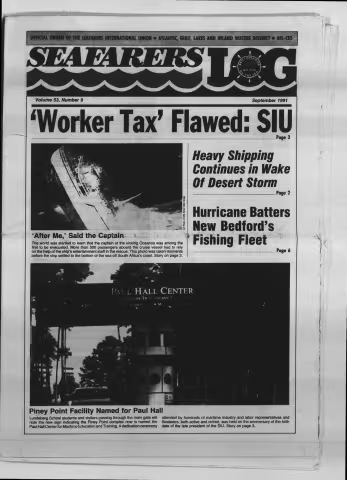
Volume 53, Number 9 September 1991
Worker Tax' Hawed: SlU
J ^
'After Me,' Said the Captain. iJX - \
"y •¥
Heavy Shipping
Continues in Wake
Of Desert Stem
- Poge 2
The world was startled to learn that the captain of the sinking Oceanos was among the
first to be evacuated. More than 500 passengers aboard the cruise vessel had to rely
on the help of the ship's entertainment staff In the rescue. This photo was taken moments
before the ship settled to the bottom of the sea off South Africa's coast. Story on page 3.
Hurricane Battere
New Bedford's
Fishing Fleet '
Page 6
Piney Point Facility Named for Paul Hall
Lundeberg School students and visitors passing through the main gate will attended by hundreds of maritime Industry and labor representatives and
note the new sign Indicating the PIney Point complex now Is named the Seafarers, both active and retired, was held on the anniversary of the birth
Paul Hall Center for Maritime Education and Training. A dedication ceremony date of the late president of the SlU. Story on page 3.
.• f •
^ ,
•J; ;e-' , • " -XXV-1
' UXL ;j
SSfvi:;!;
.'-4< -•
y>;|X^X X.,; V
•; ;'-,v v..
.,r :• a-'-
f
M'T:] • '
'•4r ••
X.-. it •/ .-•s ; .fts-
•ft
• .,5' • ,
t'ii'-
I
A
.• X
A
i
!>;7 „rf-:-;vr-,
' "'. •• -S - •-
, ,c-*: •^•'
/ • ' --^i; ', '•: / • V •• .'
j\.-
I -• S« i ..
.' -i ••, .'-• '(.'•
J-,-
'/V''.'!."' -'•
#1
j;
fe:
•, ir:.v,
7- siUAREItS LOG
President's Report
Freedom and Democracy
Last month, in a three-day period, an event of almost incalculable
significance took place in the Soviet Union—an event which could
easily define the world as we know it for the rest of our lives. Begin
ning on August 19, for the first time in more than 1000 years, the
Russian people conclusively beat back tyranny and have struck an
indelible blow in behalf of freedom and democracy.
Now we can look forward to seeing the Russian worker enjoy the
freedom that a worker in a democracy has. While this
may seem rather inconsequential to the think-tank
types and lofty bureaucrats, such rights have monu
mental consequences.
After all, communism was supposed to create so-
called worker states. But any worker could tell you
that was a bunch of bunk. In practice, the communist
party in the Soviet Union—and elsewhere in the
world—kept workers from exercising their rights to
get together and act in their own interest.
Mi h 1 Sfl hapless gang of hard-liners orchestrating the
Micnaei sacco ti^gy would have the support of workers
and the Russian people generally because of the real dissatisfaction
which exists throughout the Soviet Union with the condition of the
economy. It appears they also assumed that a show of military force
would wipe out any thoughts of mounting an opposition.
The Soviet hard-liners made the same mistake most dictators make—
they did not correctly judge the depth of a people's desire to be free, a
people's desire for self-determination. It seems the Russian people,
who for the past five years had glimpses of freedom and who practiced
limited democracy, liked what they had and wanted more.
The Russian people understood what Mikhail Gorbachev—who re
cently was moving closer to the right and attempting to put a lid on
many of the political reforms he had originally introduced—did not.
For Soviet workers, there was nothing wrong with the new political
freedoms, they just did not go far enough. No one, it seems, wants to
go back to the past; for Soviet workers, solutions are to be found in
the future.
The Russian people also understood a point often missed by this
nation's academics and government officials—that freedom and democ
racy are not abstract theories. In this case, tens of thousands of
Russian citizens look to the streets to defend their freedoms, and
thousands of workers answered the call of Boris N. Yeltsin, the demo
cratically-elected president of the Russian federated republic, for
strikes of "universal, unlimited" proportions. Hours after Yeltsin urged
this action, Soviet miners in the Kuzbass coal fields shut down 26
mines, while auto workers in Siberia, Murmansk public transport work
ers and other groups put strikes into effect.
'Freedom Comes from the Ground'
We in the American labor movement always have believed that, as
AFL-CIO President Lane Kirkland notes, "The story of freedom—and
what it takes to get it—does not take place in the ministries or counting
houses of the elite. Rather, it is the story of ordinary working people
courageously rising to their feet and demanding their fundamental
rights. Freedom and democracy do not come from the sky, but from
the ground."
There is much work to do in the Soviet Union, as well as in the
former communist states of Eastern and Central Europe. We in the
American labor movement will continue to stand with the workers of
those countries. We will continue to stand on the side of their free and
independent trade unions.
The events of last month should clear the way for Soviet workers
and their independent trade unions to fully participate in decision
making processes both at their work sites and in their government.
This ability to participate in a meaningful way will be critical in the
days ahead if the former communist states are to build economies of
substance—ones in which all people can participate, whether as wage-
earners, investors, managers or owners.
Our Own Heritage
I think it is fitting at this point to recall the communists' attempt to
gain control of the American waterfront, a fierce battle in which this
union was deeply involved. Looking back through old issues of the
LOG from the 1940s, today's Seafarer can get a sense of how intense
the fight really was.
The communists, who maintained a waterfront section, sought to
gain control of those industries which they deemed essential to winning
control of a nation, and foremost among those sectors of the economy
were communications and transportation—in particular, shipping. With
this in mind, the communists maintained an apparatus designed to take
over maritime labor. Looking over past LOGs reminds us that our
people were never duped by the communists. The Seafarers recognized
that the commies were not sincerely trying to advance the cause of
workers but were, in fact, only interested in advancing the line from
Moscow.
Desert Storm Redefiloyineiit
Keeps Ships en Gulf ftun
Bringing military materiel back
to the United States from the Per
sian Gulf should keep most of the
Ready Reserve Force (RRF) ves
sels broken out for Desert Shield
and Desert Storm active through
the end of this year, estimates the
government agency in charge of
sealift operations.
The Military Sealift Command
reports that more than 100 ships
are involved in the redeployment
effort. Of those vessels, 49 are
from the RRF, three are preposi-
tioning ships and 52 are commer
cial carriers and seven are fast
sealift ships. Of the commercial
charters, 28 are U.S-flag ships and
24 are foreign-flag.
To date, 1.3 million short tons
of dry cargo have been redeployed
in Operation Desert Sortie, the
military name for the Middle East
engagement since the war ended.
The redeployment effort is pro
ceeding carefully because much of
the equipment being loaded was
damaged by desert conditions and
war activities.
Plenty of Jobs.
For Seafarers, the ongoing Per
sian Gulf effort has meant that
shipping is very high. In addition
to manning the RRF ships on the
gulf run. Seafarers recently crewed
another reserve force vessel—the
Pioneer Commander—which was
broken out for sea trials. The Par
cific Gulf Marine-contracted ship
was supplied SIU manpower by
the union's Mobile hall.
Only one of the eight fast sealift
ships, all of which are manned by
the SIU, has been put back into
reduced operating status (ROS).
The USNS Altair is now on ROS,
but the other workhorse ships con
tinue to transport heavy equip
ment for the military.
Most of the prepositioning fleet
has returned to its assigned home
base of Diego Garcia or Guam.
Recalling the 70s Farmworkers' Beefs
Cook Ahmed Sharif (right) and SIU Patrolman Harmando "Sal" Salazar
were reunited with Cesar Chavez when the United Farm Workers president
was in Seattle to rally support for the union's current grape boycott. Sharif,
who currently sails on the Great Land, worked for the Farmworkers in the
'70s as an interpreter of Arabic during UFW organizing campaigns. Salazar,
at the direction of then SIU President Paul Hall, worked with Chavez in '73
and '74 during an intense UFW beef with Califomia growers.
Applications Now Are Being Accepted
For the 1992 Seafarers Scholarship Program.
Turn to Page 10 for Details
Volume 53, Number 9 September 1991
The Seafarers LOG (ISSN 0160-2047) is published monthly
by the Seafarers Internationa! Union; Atlantic, Gulf,
Lakes and Inland Waters District; AFL-CIO; 5201 Auth
Way; Camp Springs, Md. 20746. Telephone (301) 899-
0675. Second-class postage paid at MSC Prince Georges,
Md. 20790-9998 and at additional mailing offices.
POSTMASTER: Send address changes to the Seafarers
LOG, 5201 Auth Way, Camp Springs, Md. 20746.
Communications Department Director and Editor, Jessica
Smith-, Assistant Editor, Daniel DM«can; Associate
Editors, Jordan Biscardo, Max Hall; Associate Editor/
Production, Deborah Greene; Art, Bill Brower.
. ^
"M '"i
• / 'VI
n'-'lij
1 - -•
I'* • •",'
t-. \ •
SiFTlMBER 1991
SlU Sees Flaws in CG's 'Woricer Tax'
The SIU has charged that the
Coast Guard's formula for making
seamen pay for their documents
and licenses is based on a number
of false assumptions and that the
agency is not entitled to thes^ fees.
The Seafarers position on the
Coast Guard's plan to chaige sea
men a so-called user fee for costs
involved in the issuance of mer
chant marine documents (or z-
cards), licenses and certificates of
registry was submitted to the
agency in response to a notice on
the matter which first appeared in
the Federal Register. Currently
the Coast Guard is reviewing all
submissions, and at this point the
agency has not assigned a starting
date for the program.
In the union's strongly-worded
communication, SIU President
Michael Sacco vigorously ob
jected to the entire notion of mak
ing American seamen pay for the
right to be employed aboard U.S.-
flag ships, noting the union be
lieves it amounts to nothing short
of a "worker tax." The union's
statement recognized, however,
that the Coast Guard was simply
putting into effect a user fee plan
mandated by the Omnibus Budget
Reconciliation Ac( of 1990 enacted
last year to address the nation's
fede^ deficit.
The SIU pointed out the follow
ing flaws in the agency's plan: the
lack of recognition for services
provided by Lundeberg School
personnel to assist seamen in ob
taining their documents and licen
ses; inadequate disclosure of the
methodology used by the Coast
Piney Point Complex
Named for Paul Hall
A statue of Paul Hall now is located at the circle on the Piney Point property's
main road. Trainees line up in preparation for the ceremony marking the naming
of the complex after the late president of the SIU.
The complex embodying the
Harry Lundeberg School of Sea
manship in Piney Point, Md. has
been named the Paul Hall Center
for Maritime Training and Edu
cation as a result of action taken
by the institution's board of trust
ees.
The dedication of the Paul Hall
Center was marked with a simple
ceremony on August 20, the an
niversary date of the birth of the
late president of the Seafarers In
ternational Union.
In describing the naming of the
Piney Point center, Herbert Brand,
chairman of the Transportation
Institute and master of ceremonies
for the event, called it "more than
a dedication—it is an act of re
membrance" for the man who
headed the SIU from 1947 until
his death in 1980.
"From its very be^nning as a
training and upgrading facility,
which Paul named for his color^l
and formidable predecessor of the
Seafarers International Union, Pi
ney Point has been and is Paul
Hall," said Brand in opening the
ceremony which was attended by
representatives of the maritime
industry. Many SIU members, both
active and retired, also were on
hand for the occasion.
*With Us in Spirit'
Brand, who worked closely with
Paul Hall for more than three dec
ades, noted that "although it is
Photos from Ceremony
on Pages 14 and 15
now 11 years since Paul has passed
away, he continues to be with us
in spirit. Hardly a day goes by
that somewhere a former associ
ate, a former co-worker does not
make some reference to an expe-'
rience shared with or an experi
ence learned from Paul, from this
remarkable leader of men and
women.
"No one who worked with Paul
and who observed his inspiring
leadership qualities and his amaz
ing technical skills could ever for
get him," said Brand.
Ran Hettena, president of Mar
itime Overseas Corp., observed
Continued on pt^e 24
Guard in determining the rates it
will charge for documents and li
censes; the open-endedness of the
scheme which could allow the fees
to rise to sky-high levels.
Misconceived Premise
Additionally, the union noted
that the entire scheme did not
square with the public interest.
Sacco said in the union's com
munication, "The SIU rejects the
notion that merchant seamen are
the sole beneficiaries of the Coast
Guard's licensing and documen
tation program.
"In fact, it is the union's asser
tion that the procedure of tracking
the skills of mariners is done in
the public interest, for the good
of the citizenry as a whole. It is
not logical to assume that safe
waterways are only for the benefit
Of those who work on vessels.
"Therefore, it is in the public
interest that seamen not be sad
dled with a fee for a service de
signed to ensure the nation's
waterways remain safe, navigable
and environmentally sound."
No Cap on Fees
Of great concern to Seafarers,
noted the SIU, is the fact that
there is no sound basis for the
high cost of fees proposed by the
Coast Guard and no guarantee that
the rates would not go up and up
and up. The union's suspicions
are based on the fact that the user
fee scheme is simply a way in
which funds can be raised to offset
the budget crisis facing the U.S.
government.
"The SIU concedes the good
intentions of the Coast Guard with
respect to annual revisions of the
fee schedule. However, history
will clearly demonstrate that rev
enue-raising measures rarely, if
ever, are reduced. On the con
trary, they become fixed in our
scheme of raising funds for the
nation's treasury and generally are
increased. This happens not be
cause the fee is based on a service,
but because of the revenue needs
of the government. We submit the
Coast Guard's user fees will be
used in such a fashion," said Sacco
in the SIU's comments.
"Absent a fixed fee schedule or
a ceiling, a seaman has no guar
antee the charges for obtaining
documents will not go Up in rapid
succession and arrive at astro
nomical proportions."
Cost Methodology Murky
As presently proposed, the Coast
Guard would charge from $35 for
a document without a qualified
rating to $330 for an upper level
license. The SIU statement said,
"The Coast Guard's mechanisms
for selecting fees have not been
sufficiently exposed to allow for
thorough evaluation; the Federal
Continued on page 6
Sinking of Greek Cniise Ship
Raises Concems Over Safely
The actions of the captain and
other crewmembers aboard the
sinking Greek-flag cruise ship, the
Oceanos, have brought world at
tention to the safety conditions of
passenger vessels and the training
of shipboard personnel. The
Oceanos incident, which took place
off the southeast coast of South
Africa on August 4, currently is
being investigated by authorities
in that nation as well as by Greek
officials.
While none of the 571 people
aboard lost their lives, serious
questions have been raised as to
why the captain had himself evac
uated before more than a hundred
passengers had been rescued and
why the ship's entertainment staff
had to take charge during the
emergency operation instead of
crewmembers—many of whom
reportedly abandoned ship at the
first sign of trouble.
Witnesses, including a South
African Navy diver in charge of
the rescue maneuvers, said Cap
tain Yiannis Avranas, the 7,554-
ton cruise ship's master, actually
forced his way to the front of the
rescue line and demanded to be
taken off the ship by the first South
African Air Force rescue helicop
ter before the passengers were
saved.
'Cowardice of the First Order'
Frank O. Braynard, curator of
the American Merchant Marine
Museum at King's Point, N.Y.,
Continued on page 12
' f-'" ^
One of the 571 Oceanos passengers is helped out of the vehicle which brought
her to the safety of a hotel. Vacationers aboard the vessel expressed surprise
that crewmembers would leave the sinking vessel before passengers.
' '-n-
•fr
• ' f'."
1/'
• ' "J . i I •• ,i;
f. ''jtt: •• .
•'.M •m
•- "S • • • •
r-:;
-v •--••J A:.-- --i'.
I; -Tf.'
'i; ^
4 ti.;;
' ' •':r't:.
- 'i.-'-' "
;|V;;;;;
'.>C
•M'.
'-i ;• •'
•i- '•:
:U-
KM
k.: :'••'/
y' K!' •AKMK • \
W " - "K" -••
4';.
f JE- * )Bb—^ '7=- > J-
SEAfARERSm
Cash Aid, AliWR on Deck
When Congress Returns
A conference committee made
up of representatives from both
the House and Senate will review
a foreign aid bill containing a "buy
American/ship American" provi
sion when the Congress returns to
session this month after a summer
recess.
In addition, members of the
Senate are expected to debate a
national energy policy of which a
key component is the exploration
of oil in the Arctic National Wild
life Refuge (ANWR) in Alaska.
Ship American Section
This summer, during a debate
on the so-called cash transfer bill,
which provides that foreign aid
recipients get direct monies from
the U.S. government, the buy
American/ship American provi
sions of the legislation remained
intact. However, opponents of
the U.S.-flag maritime industry
mounted an attack on the section,
which required that a portion of
the goods purchased in the U.S.
be carried on American bottoms.
In both the House and Senate, the
attempt to scuttle U.S. shipping
was defeated.
As the cash transfer bill goes to
conference committee, SIU leg
islative representatives, as well as
the American maritime industry
in general, will be keeping a close
watch on the legislation to ensure
that the ship American provision
does not get dumped at the last
minute.
Seafarers and other elements of
the U.S.-flag shipping industry will
be active in the push to open up
ANWR for oil exploration. The
ANWR oil reserve is thought to
be one of the largest oil reservoirs
in the United States. Those mem
bers of Congress favoring the de
velopment of the ANWR oil re
serve note that only a 1.5 million
acre site is sought for the project
out of the 19 million acre national
reserve.
The transport of Alaska oil to
the lower 48 states, a Jones Act
run, has been a significant factor
in the maintenance of a U.S.-flag
tanker fleet. Development of the
ANWR oil reserves will ensure a
U.S.-flag tanker capacity in the
future.
CG Fishing Vessei Ruies
Go into Effect Sent. 15
Regulations designed to im- <
prove safety conditions in the fish
ing industry go into effect on Sep
tember 15, the U.S. Coast Guard
announced in the Federal Regis
ter.
The Coast Guard rules imple
ment the Commercial Fishing In
dustry Vessel Safety Act, which
was passed by Congress in 1988
in an attempt to reduce casualties
in one of the most risky and haz
ardous of industries.
The regulations require all com
mercial fishing vessels to obtain
and maintain a host of safety-
related items—such as fire fighting
equipment, life preservers, ring
life buoys, backfire flame arresters
for gasoline engines, visual dis
tress signals and emergency po
sition indicating radio beacons
(EPIRBS).
The Coast Guard also is man
dating that fishing vessel person
nel be trained in first aid and
emergency procedures. Addition
ally, after September 15 all ship
board injuries requiring medical
attention beyond first aid must be
reported.
Factory Ships
For larger vessels, newly-built
vessels and ones which operate in
cold water or far from shore, even
more extensive regulations apply.
These vessels must be equipped
with life rafts, immersion suits,
extensive navigational equipment,
high water alarms in unmanned
spaces along with bilge pumps for
all these areas.
Numerous design specifications
have been included such as grab
rails, escape routes and launch
hatches for lifeboats for the largest
of fishing ships, generally known
as "factory ships," or those ca
pable of processmg fish while at
sea.
The Congress is continuing to
hold hearings on safety conditions
in the fishing industry. Among the
items to be considered by both the
House and Senate is the matter of
licensing and training of fishing
vessel crewmembers.
tkmtracts Department
Deceives Inquiries
OR Sodal Security Tax
Seafarers have noted that some
companies are posting two sepa
rate entries on paycheck stubs for
the social security tax. The SIU
Contracts Department has been
asked why this is occurring.
The Contracts Department re
ports the practice is based on a
rule the Internal Revalue Service
implemented in 1991. IRS Circu
lar E from the Employer's Tax
Guide states: "Beginning in 1991,
the wage bases for the two parts
of the social security tax (social
security and medicare) are differ
ent.
"Employers can no longer
combine and report the withhold
ing as a single amount," states the
circular. It advises employers
they will be required to report the
withholding for social security
and medicare separately.
The IRS notes the base wage
for social security is $53,400 and
the base wage for medicai:e is
$125,000.
Liberty Sea Crew Refeie to Contract
When there is a beef aboard ship, refer to the contract, notes the crew of the
Uberty Sea. With a standard tanker agreement in hand, ail beefs were settled
and the payoff proceeded smoothly. At the meeting are (from left, front row)
Patrolman Steve Judd, AB Charlie Merida, Chief Cook Cathleen Martin, SA
Gerardo Lopez, (back row) Patrolman Bobby Milan, Bosun J.R. Colangelo,
Chief Steward Heien Mizeil, DEU D.R. Halstead and AB J.J. Mole Jr.
Govmamt bsues I^MHt
On SbmemU Jackson Fire
Human error and poor equip
ment design are the reasons given
by a U.S. Coast Guard report for
the enginerpom fire that killed six
mariners, including three Seafar
ers, aboard the Stonewall Jackson
on February 9.
"The proximate cause of this
casualty was human error on the
part of the licensed engineer on
watch as he did not ensure the
inboard cap of the turbine gener
ator duplex lube oil strainer was
properly secured before changing
the liibe oil flow from the outboard
strainer to the inboard strainer,"
wrote Commander David Miller,
who investigated the disaster for
the Coast Guard.
"The ergonomics (working con
ditions and design) of the duplex
lube oil strainer installation is
poor," he continued in his report
to the commandant's office. "This
caused the operating engineers to
only use the inboard strainer, ex
cept when cleaning the strainer."
Miller recommended all vessels
equipped with Delaval turbine
generators similar to the one aboard
the Jackson "evaluate the need to
make the strainer more accessible
to the operating engineer" and
"install suitable shields around the
duplex lube oil strainer to prevent
lube oil from spraying on hot pip
ing or turbine surfaces."
The report described the strain
er's location to be 54 inches from
the deck with the turning lever
another three inches higher. The
locking bar is five feet above the
deck. "An engineer must reach 18
inches horizontally over piping to
reach the turning lever and over
24 inches to change the outboard
strainer," Miller reported.
Newspaper articles following the
accident stated the Navy installs
such shields on its vessels with
Delaval turbine generators.
Although no autopsies were
conducted on the six black-gang
members. Miller theorized all of
them died of asphyxiation because
"the chance for survival . . . was
minimized due to the character
istics of the fire in that it erupted
quickly and burned violently."
While the Coast Guard com
mandant's office agreed with Mill
er's conclusions and recommen
dations on these matters, it
disagreed with his remarks that
the six might have been saved had
the engineroom been equipped with
emergency escape breathing ap
paratus (EEBA). Captain Gerald
Barton, writing for the comman
dant's office, noted the fire was
so consuming "it is unclear whether
there would have been enough
time for the four engineers in the
storeroom to don EEBAs."
Miller was unable to begin his
investigation aboard the Jackson
until mid-March when the Water
man Steamship Co. vessel was
docked in Singapore. The fire,
which claimed the lives of QMED
Edmund Clayton, QMED Prince
Wescott and Wiper Henry Hyman,
occurred while the ship was sailing
in the Indian Ocean from Singa
pore to the Suez Canal. The LASH
(lighter aboard ship) vessel was
towed first to Sri Lanka where the
bodies were removed, then to Sin
gapore.
The Coast Guard investigator
based his conclusions on inter
views with the surviving crew-
members, affidavits taken by the
ship's master and an inspection.
Special Message to Galley Gang Members
from the Seafarers LOG
Send in your holiday recipes by November 8 — to appear in a spe
cial feature in the December issue of the LOG.
Send your recipes to the LOG,
5201 Auth Way
Camp Springs, MD 20746
mmm)
SEPTiMBER 1991
AT&T's Global lAik Gets Off to Good Start
SIU members put forth extra ef
fort to make certain the Global
Link got off to a safe and produc
tive start this summer, as Seafarers
crewed the vessel during its
maiden voyage. The Global Link,
a Transoceanic Cable ship, sailed
from Singapore to Hawaii for its
inaugural run.
Bosun Herb Libby, who came
back from retirement earlier this
year to bring out the ship, com
mended the SIU members for their
efforts aboard the Global Link,
"They were very good, superior,"
said Libby, who joined the SIU in
1948 in New York, "The ship was
quite dirty when we took it over.
We didn't have too big of a crew,
but there was a lot of work to do
and the guys dug right in and did
it,"
Libby, 63, also was part of the
original crew on the cable ship
Long Lines, one of the Global
Link's sister vessels, "A maiden
voyage is a little different," he said,
"You expect different things from
a new ship, but nothing bad."
AB Robert Gettridge, who
graduated from the Lundeberg
School last year, reported smooth
sailing during the Global Link's
initial voyages, which included
stops in Panama and Baltimore,
"Everyone had a good attitude,"
said Gettridge, 22, "There were no
problems, just open sea and calm
weather,
" This job is fun, I love it, I really
can't complain,"
Chief Steward Ken Rosiek
noted several well-attended cook-
outs which took place between
Singapore and Hawaii, But there
also was "an incredible amount of
work done," said the 55-year-old
Rosiek, who joined the Marine
Cooks and Stewards in 1970, be
fore the union merged with the
AGLIWD, "Most people saw a
job that had to be done and went
right to it. People really worked
hard,"
Chief Cook Victor Harper, 33,
said he was excited to be a part of
the Link's maiden voyage, "It's
different, a challenge to bring it out
and get it up to standard," said the
galley gang member who joined
the SIU 11 years ago in Philadel
phia, Also a recertified steward.
Harper captured the voyage on vid
eotape — he brought a camera
...
along for this special trip,
"Everyone put forth a good ef
fort," Harper said, "Nobody turned
down overtime and no one com
plained, We worked hand in hand
to get the job done,"
He added," We had a great turn
out at the cookouts. We had plenty
of diet soda, chicken, ribs, steaks,
potato salad and more,"
Steward Assistant A.J. Severe,
sporting a T-shirt with "Maiden
Voyage" printed on it, noted the
camaraderie among crewmem-
bers, "This is a good group," he
said
Transoceanic Cable is a subsid
iary of AT«&T, The parent com
pany recently held a reception in
Baltimore following the Link's
maiden voyage, for union officials
and crewmembers.
Besides the Long Lines, the
Global Link's other sister ships are
the Charles Brown and the Global
Sentinel, The Global Sentinel is
preparing for her maiden voyage.
Enjoying the AT&T reception are SIU members (from left) A,J, Severe, Aaron Swan,
Kamin Ragi and Jim Musker,
Chief Steward Ken Rosiek com
mended the performance of Seafarers,
Steward department member Fer
nando Vaioe tidies up in the galley.
Bosun Herb Libby came out of retire
ment for Global Link's maiden voyage.
As the newest cable ship in the Transoceanic fleet, the Global Link's majden voyage
took her from Singapore to Honolulu, Hawaii,
Chief Steward David Merriken relaxes
at the AT&T reception in Baltimore,
OS Tony Sivola heads for the reception
to celebrate the maiden voyage.
'
"•rf; .i: "' f W
'• i' • • i ' 'I'
. ' •- . v
T- •
• .^1 ' "
-v.TV-M ...
.'•'I:''-':'-
-J; y.
•.Si.'
'i\-r
•••V .
'V' .'•S
• • ."S-
I
If;-
-,i5i,
v»i.'•'
•'4l'-•";'•• "V::'::
••ip.; ••- _.,
1r :5:
;pm
.- -,'-7-»Vi;^»^T=''""' StAfMRCRS
Hurricane Pounds New Bedford Fishing Fieet
Seafarers-contracted fishing
boats in the port of New Bedford,
Mass. were among those damaged
by the 100-mph winds of Hurri
cane Bob last month, but things
could have been much worse. In
the town known as one of the
nation's most bountiful fishing
centers, there was, miraculously,
no loss of life and no serious
injuries, reported the New Bed
ford Standard-Times.
Most of the approximately 40
fishing boats (25 percent of the
New Bedford fleet) damaged dur
ing the mid-August storm sus
tained only minor harm, although
many pleasure crafts suffered more
serious damage. Enough warning
was provided so the vast majority
of fishermen returned to port be
fore the winds struck.
"Most of the damage came from
boats banging against each other
in port" due to the winds, SIU
Port Agent Henri Francois noted.
He added none of the boats sank.
The New Bedford harbor is pro
tected by a hurricane gate which
closed before Bob hit. But despite
the relatively light damage to fish
ing boats, Francois said "all of
the repair places here are full.
Some of [the boats] will be out of
commission for at least a month."
An estimate of total fishing boat
damage was unavailable at press
time, but the SlU-crewed May
flower was considered one of the
worst hit. That boat sustained
roughly $60,000 worth of damage.
Smaller Craft Hurled
Overall, the New Bedford area
sustained millions of dollars in
damages. Hundreds of trees and
thousands of limbs were blown
onto houses and cars. Some smaller
boats were hurled onto land, and
roughly 3(X),(XX) area residents were
left without electricity.
Hurricane Bob closed several
eastern ports including New Bed
ford, Boston, Providence, R.I. and
Portland, Maine. New York, the
east coast's largest port, was un
affected by the storm which
dumped less than one inch of rain
on most areas.
Much of the damage to New Bedford fishing vessels during Hurricane Bob came
from boats smashing into each other. Such was the case with the MV Atlantis
pictured above.
Seafarers in Jersey City Parade
Members of the Pillpino-Americans for Progress Association (PAPA) marched
with the Seafarers in a Jersey City summer parade. The SiU counts in its
ranks many Filipino Americans from the Jersey City area.
The SlU-crewed Mayflower sustained the most damage of any of the vessels in
the New Bedford fleet when Hurricane Bob hit.
False Assumptions Underiie
User Fee Plan, Charges SIU
Continued from page 3
Register is devoid of any substan
tiating of costs."
With so little detail provided on
how the agency arrived at its costs,
the union asked that detailed in
formation on the matter be pro
vided to all interested parties.
Lundeberg School Services
Another reason the SIU ques
tions the costs arrived at by the
agency is that the user fee "for
mulation is so vague" and does
not take into account a situation
like that which exists at the Lun
deberg School where the institu
tion's personnel act, in effect, like
an adjunct Coast Guard office.
In the case of a seaman enrolled
at the Lundeberg School, if he or
she paid the user fee the Coast
Guard is proposing, that individual
would be charged, in part, for the
work being done by the privately-
endowed Lundeberg School.
The SIU statement pointed out
that the Lundeberg School per
forms many functions which di
minish or render unnecessary many
of the activities of the Coast Guard
in relation to the processing of
documents and licenses. "The re
sult is a cost savings for the Coast
Guard in the evaluation, exami
nation and issuance expenses in
curred when an individual applies
for a document, upgrades his rat
ing or sits for a license," said
Sacco.
"The SIU believes it is inap
propriate for the Coast Guard to
chaige for services associated with
the obtaining of documents and
licenses that are conducted by
Lundeberg School personnel."
Exemption for Reserve
The Coast Guard asked the pub
lic to comment on who should be
exempted from the fees in order
to encourage participation in a
"merchant marine reserve pro
gram."
Sacco said, "The SIU believes
it is in the public interest to main
tain a qualified pool of manpower
available to crew any surge in
U.S.-flag shipping which might take
place for reasons of either national
defense or economic security."
He pointed out that the Lundeberg
School is in a position to mobilize
seamen immediately in the event
of any national emergency.
The union noted the Lundeberg
School "can pour hundreds of
qualified mariners into an imme
diate shipping pool," train seamen
quickly in the necessary skills spe
cific to any of the equipment used
in a mobilization, operate a 24-
hour-a-day manpower center which
can call up hundreds of seafarers
instantly.
Consequently, summarized
Sacco in the statement, the "SIU
and the Lundeberg School operate
what is essentially a merchant ma
rine reserve capable of meeting
and sustaining a swift surge in
sealift" and as such, seamen com
ing out of this privately funded
facility should be exempted from
the user f^e.
Study of Costs Urged
Sacco advised the Coast Guard
of the SIU's desire to work with
the agency to study and thor
oughly examine the area in which
the Lundeberg School's involve
ment is "the very same process
for which its enrolled seamen would
be taxed."
He noted that the union believes
"the Coast Guard itself may be a
victim of the proposed inequity.
It has been charged with tlje re
sponsibility to raise money with
out an appropriate rationale.
"The SIU is proud of our or
ganization's relationship with the
Coast Guard. We believe that it is
a model of cooperation and we
deeply appreciate the contribution
the Coast Guard makes to this
working relationship. The bringing
of young people into the industry,
the upgrading of seamen to higher
ratings and licenses, the smooth
processing of their paperwork, and
the efficient testing procedures of
Seafarers is a tribute to the co
operation between the govern
ment agency and the Lundeberg
School," said Sacco in the state
ment.
. \ . .
- n-:
'v •'
' .c:S
SIU members aboard the Baldomero Lopez gather at payoff for a group photo. They
are (front row, from left): Steward Assistant Don Simmons, AB Larry Reiner,
Steward/Baker Luis Gonzalez, AB Justin Savage, AB Mark De Raima and AB _ , , , . _ _ , ^ A • x x i •
Vincent Ippolito. Back row: Steward Assistant Mary Lou Lopez, Chief Cook Elston Cook/Baker Luis E. Gonzalez serves up Steward Assistant Mary Lou Lopez gets
Tensley, SIU official Augie Tellez and QMED Mike Scardina. some dessert he has just prepared. the galley in order after lunch.
Survivors of Seven SCUD Alerts,
Lopez Crew Recalls Gulf Mission
Bosun William Johnson is a veteran of three
wars, and the longtime SIU member had this to
say about Seafarers who ere wed the 1st Lt.
Baldomero Lopez during the Persian Gulf con
flict: "I've never seen any crew that could possi
bly have conducted themselves any better. The
cooperation with the military was exceptional, and
[military personnel] were very appreciative."
Johnson, who joined the SIU in 1974 in New
York, also sailed during World War II and the
Korean War. An experienced seaman who is not
given to overstatement, he described SIU mem-
bers onboard the Lopez as top-notch. "There was
al ways me ttoa, of SCUD attacks
" the crew behaved perfectly,' Johnson recently
told a reporter from the Seafarers LOG. "There
were never any beefs. Everyone had a lot of hard
work to do, and they did it without any complain-
Chief Cook Elston Tensley prepares a snack.
ing," despite long hours and continually hot
weather.
The Baldomero Lopez, a prepositioning ship
operated by AMSEA, recently paid off in Balti
more after completing a voyage around the world.
Crewmembers agreed the most memorable parts
of the journey took place during Operation Desert
Storm— in all, the vessel endured seven separate
SCUD attacks.
"During the first attack it was kind of hard
getting organized and putting on the masks," re
called QMED Mike Scardina. "I was definitely
scared at first, during the first couple attacks.
"But then we got used to it. We knew where to
keep the [protective] suits and what to do. One
thing that was rough was sometimes you would
get the suit off and then five minutes later anoth^
alert would sound. You had to get dressed all QVer
again."
Despite dangers in the gulf, AB Larry Reiner
could not wait to sign on the Lopez. He boarded
the vessel after a trying ordeal in Tel Aviv.
'Contributing to Well-Being'
Brother Reiner went to Tel Aviv in order to
help his aunt flee from the endangered city. "Once
my mission was accomplished, I had only one
thing in mind—to get on a good old SIU ship and
be privileged to join my shipmates in contributing
to our country's well-being," Reiner noted in a
letter to the LOG.
"It never felt so good to climb a gangway,"
Reiner added. "It's wonderful to belong to a
'brotherhood' such as ours which is one in deed
as well as in name."
Crewmembers' Morale Good
The events in the Middle East were just one part
of the Baldomero Lopez's travels. At other times,
crewmembers enjoyed norpial routines and even
occasional cookouts.
"Morale was good," said Chief Cook Elston
Tensley^ a 1987 graduate oj| the Ltindeberg
School. "This is a pretty nice vessel. . . . The
cookouts were a lot fuh. The tough part was not
being able to get off the ship in Saudi Arabia."
Steward Assistant Mary Lou Lopez, a union
member since 1975, described her shipmates as
"real gentlemen. I feel lucky, and I really can't
think of anything bad. . . This job provides a
good living." ,
"Everyone I canie into contact with stood tall,
added Scardina. "Everyone did their jobs profes
sionally. I'm proud to he here, really proud to be
on this ship. We have a great sense of pride when
a job is well done."
«
QMED Mike Scardina listens In during the Bosun William Johnson desclbed SIU
shipboard meeting on the Lopez. members aboard Lopez as top-notch. Galley member HIzam Zokarl (left) makes a point to Chief Steward Bruce Barbeau.
, r -' -j"
if- . -'A'-
r f;,.,
' 'r
-•1:'^ ''k : -..k .
(' ?
• ; tmMf
H'l • I''• • '•
ife"' i f
k-- -
k :
A-;':
a
'a:-. !.
8 SEAFARERS LOG
••
' j' '•'.' •
E-i!.
i.V-
pSfi;-
•• •
• -I'-' •••. -
Charles E. Wilson's Versatile Crew
Can Handle Any Kind of Local
The Slli crew aboard the
Charles E. Wilson is never sure
what the vessel will be loading
next into its holds.
When a reporter for the Seafar
ers LOG recently visited the
Laker in Ashtabula, Ohio, the
Wilson was offloading empire
taconite iron ore pellets that
would be taken by train to mills
in Youngstown, Ohio to produce
steel. Bosun Larry Smith and
the rest of the deck crew were
cleaning the holds because the
American Steamship Company
vessel would be loading stone on
its retum journey up the Great
Lakes.
"Eveiything has to be cleaned
out," said Smith as he was man
ning a hose. "We can't allow any
of the pellets to mix with the
stones."
In fact, the Wilson crew has to
make sure a hold is completely.
empty of the variety of pellets
being carried because there are six
to eight different types of the dark
round objects, slightly smaller
than a marble.
The self-unloader, which was
built in 1973, can hold almost
30,000 tons. According to Smith,
the vessel can offload its cargo,
whether it be taconite, stone or
coal, in six hours.
Because the Wilson can be
sailing on the Lakes several days
between ports, the crewmembers
take advantage of the time at the
docks to restock the vessel and
handle chipping and painting
chores on the ship's hull.
Duriiig the sailing season, the
Wilson can be found on lakes
Michigan, Superior, Huron and
Erie. ITie ship is named after a
former president of General Mo
tors Corporation.
Built In 1973, the Charles E. Wilson can hold almost 30,000 tons. The ship, named
after a former president of General Motors, sails on the Great Lakes.
AS Watchman Ron Bochek, right, updates Bosun Larry
Smith on offloading operations aboard ship. Deckhands.Salim Yaya, left, and ADdoiian Said work manual crane.
Maintenance team member Harold
Walkley guides engineroom materials
on deck.
Patrolman Andy GouleL left, answers questions for Cpnveyorman Cliff Stockman, center, and Porter Roger Flaherty.
Maintenance team member Wayne Bucher oversees
loading of equipment aboard the Charles E. Wilson. QMED Willie Evans exits engineroom
AB Wheelsman Richard Bockert, left, and Deckhand Salim Yaya reel
in safety net before raising ladder for departure.
? I_ • I ^.^• h J
'•"'T'^'' '.
/. |p^,§:n=^
SiPTEMBiR 1991
,'. V/'"' •••'
SlU Gov't Services O/lembers Crew New MSCPAC Ship -Wit
SIU Government Services Divi
sion members crewed the Military
Sealift Command Pacific Fleet's
newest oiler for her maiden voyage
completed July 31.
The USNS John Ericsson fin
ished its inaugural run around 9:30
a.m. at the Naval Supply Center in
Oakland, Calif, after leaving
Avondale Shipyards in New Or
leans two weeks earlier.
The Ericsson's mission will be
transporting bulk petroleum prod
ucts from shore depots to Navy
combatant and support forces,
making them independent of
shore-based fuel sources. Ericsson
and ships of her class also can de
liver fleet freight, mail and person
nel.
The Ericsson is 677.5 feet long
with a beam of 97.5 feet. The ship
is powered by two fully automatic
diesel engines, twin shafts, and
32,000 shaft horsepower. The fleet
oiler can carry 180,000 barrels of
ship and aircraft fuel. It is crewed
by 96 civilian mariners and 21
Navy communications personnel.
In the deck department are Bor
suns Dennis Strain, Dennis
Sparrowe, L.S. O'Riley, Ken
neth Allen, Gary Frazier, Robert
Pierson Jr. and Gregory Green,
Carpenter Kirk Fonte, ABs Ray
Sewell, Joseph Rogers Jr., Ney
G. Veneer Jr., Mack Hudson Jr.,
Mike LaSota, Michael Roda,
Robert A. Smith, Gerald Martin,
Joseph Bates, Kevin Steward,
Joe Normand, J.V. Mazares Jr.,
Clinton Lee, Richard Thomp
son, Tinion Smith, Martha An
thony and David Dove, OSs
Patrick Snow, Glenda Wyatt and
Robert Thomas Jr.
Among the engine department
crewmembers were Chief Electri
cian Donald Doss, Refrigeration
Engineer Charlie Hurt Jr., Deck
Engineers Daniel Riveros,
Rolando Fernandez and Larry
Rasmusson, Junior Engineers
Earl Reed, John Clopein and
Charles Satchell, Pumpman Alan
Bjerkness, Electronics Techni
cian Douglas Pine, Second Elec
trician Hanson Harris Jr., Wipers
David Burkett, Joseph Fabbiano
and Alta Seaman.
The galley gang consisted of
Chief Steward Levi Jones, Yeo
men Storekeepers Walter McG-
rath, Pedro DeLeon, Larry
Mclnzie and Julia Green, Chief
Cook Abrah Senigar Jr.,
Cook/Baker Rodolfo Carimio,
Assistant Cook Danny J. Harvey,
Laundryman Bennie Wilson
Third Steward Lee Harrington,
Cook/Baker Victor De'Arion, SA
Danny Harvey, Utilitymen Pablo
Catalasan, Saturino Perez, Fer
dinand Daliet Jr., Larry Detmer,
Wilfredo Layacan, Minnie
Thomas, Broderick Gillard,
USNS Higgins Sets Gulf Record;
Logs 385 Straight Days on Run
SIU Government Services Divi
sion members who crewed the
USNS Higgins were in for the long
haul during the Persian Gulf con
flict. The Military Sealift Com
mand oiler set the record for long
est deployment among all U.S.
Navy ships participating in Op
eration Desert Shield, Desert Storm
and Desert Sortie.
The Higgins logged 385 contin
uous days away from her base at
Subic Bay, Republic of the Philip
pines since just prior to Iraq's in
vasion of Kuwait more than a year
ago. During that time the Higgins
replenished 77 different Navy ships ,
about 17 percent of the tot^ fleet.
The Higgins' busiest day was
October 14, when she replenished
11 ships of the amphibious task
force led by the USS Nausau
while delivering approximately 2.3
million gallons of fuel. On five
Other occasions, the Higgins re
plenished nine or more ships per
day.
Overall the MSC vessel con
ducted 379 replenishments at sea
and delivered more than 67 million
gallons of fuel. The Higgins, which
provided fuel and other cargo for
virtually every ship in the gulf,
also conducted 157 vertical re
plenishments for cargo, mail and
passengers.
The USNS Higgins logged 385 continuous days away from her forward-deployed
home in Subic Bay after spending the past year in the Persian Gulf, North Arabian
Sea and Indian Ocean.
The newest oiler to join the MSCPAC fleet, the USNS John Ericsson, glides easily
under the San Francisco-Oakland Bay Bridge en route to her berth in Oakland.
Leslie Baldwin and Norman
Scarhrough.
The Ericsson is under the com
mand of Capt. Gene Cox. The
ship's crew will undergo training
off Southem California this fall.
The vessel is scheduled to head for
the Westem Pacific in mid-1992.
The new ship is named after
John Ericsson (1803-1889), a
Swede who lived in London for 12
years where he invented the steam
fire engine and screw propeller.
Ericsson emigrated to the U.S. in
1839 and designed power plants
for all types of ship engines. He
later designed the iron-clad ship
USS Monitor of Civil War fame,
one of the first vessels with a rotat
ing gun turret.
Passumpslc Undergoes Deactivation
A proud 45-year Navy and MSC career—Including a key role in the Persian Gulf
conflict— comes to an end as the USNS Passumpslc is scheduled for deactivation.
Since 1973, numerous SIU
Government Services Division
members have served aboard the
USNS Passumpsic, one of the
first civilian-crewed Navy fleet
oilers.
Always popular among Seafar
ers, the Passumpsic is being deac
tivated after a distinguished career
during which she played a role in
every major national conflict the
United States has been involved in
since World War n.
A Mispillion-class oiler, the
Passumpsic was built in Permsyl-
vania and commissioned in 1946.
Then a U.S. Navy vessel, the
"Pumpin P" as she was affection-,
ately called by her crew won nine
battle stars during the Korean con
flict. During the Vietnam War, the
Passumpsic met all scheduled
commitments by unrepping 47
million gallons of fuel to 367 shipis.
In July 1973, the USS
Passumpsic was decommissioned
to become the USNS Passumpsic.
Operating out of Subic Bay in the
PWlippines, the ship's perfor
mance proved a small group of
well-trained civilian personnel
could operate a fleet auxiliary at
production levels equalling or sur
passing those of her military coun
terparts.
The Passumpsic, which eamed
a plethora of Navy commenda
tions, played a key role in the Per-
Gulf conflict. After leaving sian
that area, the ship sailed to
Bangladesh to help that nation re
cover from a cyclone which
claimed the lives of more than
100,000 people.
ITie vessel later rescued a drift
ing Burmese trading boat, then
helped evacuate Air Force depen
dents after the eruption of Mt.
Pinatubo. But the nearly 800 tons
of volcanic ash which landed on
the ship destroyed the
Passumpsic's underway replenish
ment gear, leading to the deactiva
tion.
The deactivation process is
scheduled to be completed by the
end of September, when the
Passumpsic will be tumed over to
the U.S. Maritime Administration.
• :•
' -J •
h -'V:!-
• ..I'".'-
1%
"•i.:
10 SEAFARERS LOG
. • -' S;S • :^=iS
,, -sr
, • -sS
Applications now are being ac
cepted for the 1992 Seafarers
scholarship program which will
award seven grants to three SIU
members and four dependents.
The announcement of the 1992
scholarship program was made by
the board of trustees of the Seafar
ers Welfare Plan, the sponsor of the
program, which is designed to en
courage members and their fami
lies to seek higher education
opportunities.
All Seafarers and their spouses
and children who plan to attend
college are encouraged to prepare
to apply for a scholarship. The
deadline for submission of all re
quired paperwork for the 1992
scholarship program is April 15,
1992.
Nearly 40 years ago, the Seafar
ers International Union, Atlantic,
Gulf, Lakes & Inland Waters Dis
trict became the first maritime
union in Ahierica—and one of the
first trade unions in general—to
establish a scholarship program to
help qualified members and their
dependents finance college and vo
cational education.
Since the inception of the pro
gram, an impartial committee of
professional educators from col
leges and universities has awarded
214 scholarships to Seafarers and
their spouses and dependent chil
dren.
Every year, three scholarships
are reserved for SIU members.
One is a $15,000 four-year college
scholarship. Each of the others is a
$6,000 two-year scholarship for
study at a vocational school or
community college. Four scholar
ships in the amount of $15,000
each are awarded annually to the
spouses and dependent children of
Seafarers. Applicants should indi
cate whether they are applying for
a two-year or four-year scholar
ship.
The $15,000 college scholar
ships will be paid at the rate of
$3,750 per year over a four-year
period. The $6,000 awards are paid
at the rate of $3,000 per year.
For most scholarship winners,
receiving the cash grant can greatly
ease the financial burden associ
ated with attending college. And
many former scholarship win
ners—among them doctors, law
yers, engineers, pharmacists,
librarians, teachers, computer spe
cialists and scientists—would
never have had the opportunity to
pursue their educational interests
without the SlU's help.
While the program is open to all
eligible Seafarers and their depen
dents, there is one catch: One must
apply in order to be considered for
the award.
Seafarer Requirements
Seafarers who are applying for
scholarships must:
• Be a graduate of high school or
its equivalent.
• Have credit for a total of 730
days of employment with an
employer who is obligated to
make contributions to the Sea
farers Welfare Plan on the
employer's behalf prior to the
date of application.
• Have one day of employment on
a vessel in the six-month period
immediately preceding the date
Apply Now
For 1992
e
Scholarship
Program
Start Collecting Paperwork Now
All required paperwork must be submitted by the April 15 deadline.
Interested Seafarers and dependents must consider that it will take some
time to gather all the necessary paperwork. For example:
• Transcripts and Certificates of Graduation—Schools can be very
slow in handling transcript requests. Request copies of transcripts
early.
• ACT and SAT Test Scores—Take whichever exam is required by the
college or trade school being applied to. These exams are given
approximately six times a year on specified dates.
• Obtaining GEO Scores—Check with the Department of Education in
the state where the GED exam was taken.
• Letters of Recommendation—Request letters from individuals who
have knowledge of applicant's character, personality and career goals.
of application.
Have 120 days of employment
on a vessel in the previous cal
endar year.
(Pensioners are not eligible to
receive scholarship awards.)
Dependent Requirements
Each applicant for a
dependent's scholarship must be:
Spouse—Married to an eligible
APPLICANTS MUST
HAVE SUBMISSION
IN BY APRIL 15
The scholarship program instruction booklet comes with the necessary
forms. It is available at any union hall or by filling out and mailing this
form. Send it to: Scholarship Program, Seafarers Welfare Plan, 5201
Auth Way, Camp Springs, MD 20746.
Please send me the 1992 SIU Scholarship Program booklet which \
contains eligibility information, procedures for applying and the «
application form. . J •
Name I
Book Number,
Address
City, State, Zip Code
Telephone Number _
This application is for:
(self)
(dependent)
9/91
Seafarer or SIU pensioner.
Unmarried Children—^All im-
married children of an eligible Sea
farer or pensioner (for whom the
Seafarer or pensioner has been the
sole source of support during the
calendar year immediately preced
ing the date in which a scholarship
is made) must:
• Be a graduate of high school or
its equivalent (although the ap
plication may be made during
the senior year of high school).
• Be under the age of 19.
or
• Be under the age of 25 and a
full-time student enrolled in a
program leading to a baccalau
reate or higher degree at an ac
credited institution authorized
by law to grant such degrees.
• Be the child of a seafaring par
ent who has credit for a total of
1,095 days of covered employ
ment with an employer who is
obligated to make contributions
to the Seafarers Welfare Plan on
the Seafarer's behalf prior to the
date of application.
• Be the child of a seafaring par
ent who has one day of employ
ment in the six-month period
preceding the date of applica
tion and 120 days of employ
ment in the previous calendar
year (unless eligible parent is
deceased).
It should be noted that depen
dent children recipients who marry
while receiving a scholarship shall
not lose their award by reason of
such marriage.
SAT or ACT Required
The scholarship grants primar
ily are awarded on the basis of
high school grades and the scores
of either College Entrance Exami
nation Boards (SAT) or American
College Tests (ACT).
The SAT or ACT exam must be
taken no later than February 1992
to ensure that the results reach the
Scholarship Selection Committee
in time to be evaluated.
For upcoming SAT test dates
and applications, contact the Col
lege Entrance Examination Board
at either: Box 592, Princeton, N.J.
08540 or Box 1025, Berkeley,
Calif. 94701, whichever is closest
to the applicant's mailing address.
For upcoming ACT test dates
and applications, contact: ACT
Registration Union, P.O. Box 414,
Iowa City, Iowa 52243.
Other data will be required to be
sent along with each completed ap
plication such as transcripts of
grades, certificates of graduation,
letters of recommendation and col
lege entrance examination results.
These all are spelled out in the
Scholarship Program booklet,
available in each SIU hall or by
contacting the Seafarers Welfare*
Plan at the union's headquarters.
Notification
Scholarship winners will be an
nounced in May 1992. At that time
the judges also will designate two
alternates who will be eligible for
the awards in the event that any of
the persons selected are unable to
• I " i
SEPTEMBER 799/ • J art
77
Benefits Conferences Move to New Orleans, Honolulu
Seafarers, SIU pensioners and
family members last month contin
ued learning about their medical
plans during benefits conferences
in Seattle and Baltimore. The con
ferences, which this month move
to New Orleans and Honolulu, are
designed to provide a full review ^
of benefits available through the
Seafarers various plans. The ses
sions explain how Seafarers bene
fits work and how to get everything
to which one is entitled.
The conferences began in May
and conclude in early December.
They are open to all Seafarers, SIU
pensioners and family members.
The gatherings coincide with the
union's monthly membership
meetings.
The conferences consistently
have been well-attended, and
members have voiced approval
for the program. From port to port,
members, pensioners and family
members noted the sessions are
quite informative and worthwhile.
The most recent conferences
took place in Baltimore (August 8)
and Seattle (July 26).
"I'd say it was very enlighten
ing," said retired QMED John
McLaughlin, who attended the
Baltimore session. "This really
helps us keep up with things."
AB Will Carney expressed ap
preciation for both the Baltimore
benefits conference and the
union's affiliation with preferred
provider Johns Hopkins Center for
Occupational and Environmental
Health. Representatives from
Johns Hopkins were on hand be
fore and during the benefits ses
sion, providing important medical
screenings, distributing valuable
information packets and also an
swering members' questions.
"The idea that the SIU can get
affiliated with a world-renowned
hospital like Johns Hopkins is a
major step forward for our mem
bership," Carney said. "Plus the
PPG system simplifies hospital
paperwork, which is a great idea.
"The conference itself lets peo
ple know exactly how to take ad
vantage of our benefits. It's very
infonnative, and it helps keep us up
to date on any changes."
Retired QMED Laureano
Perez al.so was enthusiastic about
the conference in Baltimore. "It's
definitely worth it to come down
and listen," said Perez.
Chief Cook Lor! Fend (right) confers with Seattle Port Agent Recertified Bosuns John Lundborg (left) and Dana Cella share
Bob Hall during the July 26 benefits conference. observations during a break in the Seattle workshop.
Five More Benefits
Talks Scheduled In 1991
Contact the union halls listed below
for exact times of each session.
New Orleans
Honolulu
Jacksonville
San Juan
Algonac
Tuesday,
September 10
Friday,
September 13
Thursday,
October 10
Thursday,
November 7
Friday,
December 6 Pensioner Pat Fox (center) and Bosun James . Chief Steward Richard Geiling (left) and Pensioner James Miller look over the
Colson (right) meet with West Coast Vice Presi- many different handouts provided at the Seattle benefits conference. Members,
dent George McCartney. pensioners and family members packed the Seattle hall July 26.
y •
?
•• t-
•. V
h
12 saanmsm
'A-Plus* Galley Gang Treats Willamette Crewmembers Right
The crew of the OMI Willam
ette is enjoying the fine food pre
pared by the "A-plus" galley gang
headed by Chief Steward Robert
Scott.
The Mobile, Ala. native re
cently sent photographs from the
tanker to the Seafarers LOG. He
praised his hard-working crew of
Chief Cook Aiidry Fleming and
GSU Welmer Jack.
"I've been very lucky to have
this A-plus team," Scott wrote. "I
must say in all the years I've been
GSU Welmer Jack restocks fruit in the
ship's galley.
Chief Cook Audry Fleming and Chief Steward Robert Scott prepare a catfish dinner.
in the steward department, these
are some of the best men in the
union.
"These guys really went out of
their way to provide extra things
like barbecues and special melius
They took the initiative to get the
job done," the steward added.
Scott, a 1989 graduate of the
recertified steward program at the
Seafarers Harry Lundeberg School
of Seamanship, is particularly
proud of his salad bars. With the
galley gang, he prepares a variety
of salads as well as hot and cold
dishes for the crewmembers. He
plans his menus so members who
might have problems with choles
terol or sodium levels will not have
to worry when they sit down to eat.
Sinking Ship's Captain Leaves Before Passengers
Continued from page 3
when asked to comment on the
captain's behavior by a Baltimore
Sun reporter, said, "There's no
excuse; it's cowardice of the first
order." Braynard, a well-known
maritime historian, added, "It's
very much an accepted tradition
that the captain is responsible for
the lives of everyone on board."
A U.S. Coast Guard spokesman
told the Seafarers LOG while there
is no law or treaty stating a captain
must go down with his ship, he is
expected to look after the safety
of his passengers and crew. The
spokesman noted cruise vessels—
through international laws and
treaties—must provide lifeboat
boat drills for their crews and
passengers, inform passengers
what to do in an emergency and
where to locate emergency gear
and post a watch bill notifying
crewmembers of their stations in
case of a problem.
Passengers were incredulous that
Avranas abandoned his ship be
fore making sure those aboard
were rescued. One survivor said,
"We were so angry with the ship's
captain we wanted to stone him."
Avranas answered his critics dur
ing an ABC-TV interview, "I don't
care what these people say about
me. I am separated from my fam
ily, who were rescued by one of
the other ships, and I have lost
my own ship. What more can they
want?"
The master tried to defend him
self when he added, "When I
order 'abandon ship,' it doesn't
matter what time I leave. Abandon
is for everybody. If some people
like to stay, they can stay."
Crewmembers Leave First
One passenger remembered
crewmembers seizing a motorized
lifeboat in the early morning hours
and leaving. Other survivors re
ported that of the first 16 people
rescued by helicopter, 11 were
ship's officers, including Captain
Avranas and the safety officer.
Approximately 160^, passengers
were gathered on the listing deck
awaiting rescue when the chop
pers arrived.
Survivors praised the work of
the ship's entertainment crew for
coordinating therescue. "We had
to take over the ship," said Terry
Lester, a comedian booked aboard
the Oceanos. "If it hadn't been
for the entertainers, a lot of people
would have drowned." Robin
Boltman, a magician, was the last
person lifted from the deck, only
90 minutes before the ship went
under.
No Alarms
Once ashore, the survivors said
no warnings or alarms were given
to alert the passengers about the
accident, which occurred in the
Indian Ocean in an area called the
Wild Coast less than 2 miles from
the South African coastal village
of Coffee Bay. The first sign of
trouble for many aboard came when
the engineroom crew ran up the
gangway in life jackets.
The cause of the accident still
is unknown. The Oceanos was
sailing from East London, South
Africa to Durban, South Africa
when it ran into gale-force winds
and rough seas. Speculation has
centered on a broken piston cre
ating a hole in the hull. The ship
issued a distress call around dusk
Subway Terror; RcAibeiy Team
Stalks A-Train, No. 1 Line
mmm
The August 6 edition of New York
Newsday captured the public's
thoughts on the Oceanos' captain's
early departure from the sinking ship.
on August 3. It sank 14 hours later.
Both Greece and South Africa
were holding inquiries into the
disaster as the Seafarers LOG went
to press.
The Oceanos was the third loss
for the Greek company that op
erated the ship. Epirotiki Lines
lost its flagship, the Pegasus, in
June when it was scuttled at a
dock in Venice following an ex
plosion and fire. The Jupiter sank
three years ^o after a collision
with an Italian freighter in the
harbor of Piraeus, Greece. Two
lives were lost in that accident.
When ashore, be sure to
attend the monthly
membership meetings.
See page 16 for meeting
dates and times.
Crewmembers fill their plates at the
Willamette salad bar.
Chief Cook Audry Fleming cooks up
some mouth-watering bart)ecue.
Bosun Clarence Pryor gets ready for
dinner aboard the tanker.
The salad bar not only tastes good, it
is decorated with a patriotic centerpiece.
ATTENTION
SEAFARERS
Any seaman bound for Diego
Garcia or heading to an MSG
ship must carry his or her
MSG physical papenivork.
isfsa^smm
SinCMBER m 13
''WiW§"
• •: •'' • » • '.',.1'f';" , •
.- v.,:'-'' •
W--' "i-V
• T''"'
'••/J.' .
Non-Stop Work Keeps MV Virginia Sands Humming
The casual observer might think
a fisherman's work ends when the
day's catch is unloaded.
But the five SIU members who
crew the Virginia Sands, from the
port of New Bedford, Mass., know
differently. Captain Carlos
Camarao, engineer Carlos Cova
and deckhands Antonio Cravo,
Luis da Silva and Antonio Mocb
put forth much of their efforts
after the boat is tied up.
These efforts help the Virginia
Sands flourish as a highly produc
tive boat in one of the United
States' most fruitful fishing fleets.
Camarao and crewmembers re
cently demonstrated some of their
post-catch chores to a reporter
from the Seafarers LOG. Nets in
variably need mending, the cork-
line requires repairs arid the engine
demands maintenance.
After returning from a voyage
which netted the Sands some
25,000 pounds of fish (including
cod, flounder, sole and other flat
fish), the crew began the process
anew, preparing the boat for its
next trip. In fact, constant mainte
nance is a key to success in this
industry, since all of the equipment
is severely strained by conditions
at sea.
The net on these "draggers," as
boats like the Virginia Sands are
aptly named, trails behind the ves
sel. The catch is hauled aboard with
help from giant winches which'
give these boats a distinctive look.
Naturally such strain leads to
torn nets and broken chain links in
the cork line after eveiy voyage.
Here again, the key word is main
tenance.
The Virginia Sands is one of the
many fishing vessels in New Bed
ford under contract with the SIU.
Engineer Carlos Cova makes some
repairs for the next voyage.
Crewmember Antonio J. Cravo re
pairs the net's work line.
Virginia Sands' deckhand Luis da
Silva makes repairs to the net, a
never-ending process.
SIU Patrolman Eugenio De Sousa
discusses union matters with Sands'
Captain Carlos Camarao. Deckhand Antonio J. Moco repairs links in the "sweep" aboard the dragger.
ITB Mobile Seafarers Work Through Ice Storm
They have long since warmed up, but members aboard the SIU-
crewed ITB Mobile got a frosty surprise last February while sailing from
St. Croix to New York. The ship sailed through an ice storm which left
the vessel thoroughly coated but undamaged.
"No one could go on deck because of the conditions," AB Jose A.
Fellciano reported. "The tug and barge were frozen with tons of ice, but
we got rid of it and started Unloading cargo."
Trie ITB Mobile then headed for Port Reading, N. J. where the remain
ing cargo was unloaded.
The accompanying photos, sent to the Seafarers LOG by Feliciano,
were taken by ABs Don Donovan, Joe Miller and Feliciano and Third
Mate Tom Burges.
Third Mate Tom Burges chips away
ice from rails.
AB Joe Miller breaks ice to untie
reducer for manifolds.
AB Jose Feliciano takes a swing on
the boom to free it of ice buildup.
AB Feliciano on second level of tug
stern during high-water storm.
Bosun Fred Jensen helps feed the
freezing lines around the winch.
"<• -x: • • «
. I > •mm-
J'
I3iy=l =
:Kv'•c:;:: v!f
, A::-; I -" _---. • I. !.V • . I »
• ,,::Ay,.:r: a.i' , A < '•A, •: ..^\V A;,
-r^A :,. •v3^-?>:A •Av>^.av^s,,A
14 SEIMfffffS LOG SfPIBNSfff 1991
' -"/.->1-1'A.. "^^'V P'h I •
• •-:•: .•r-.-'H' 15
"''v"-';.K^:- i' •.
'i\''V'7.'
f, "• . ' • • '
Herbert Brand, chairman, Ran Hettena, president, Mari-
Transportation institute. time Overseas Corp.
Robert 8. McMilien (left), president and CEO, TOTE, and Jim
Carey II, group vice president, liner services, Crowley Maritime,
Industryf Labor Attend
Dedication of Hall Center
Hundreds of representatives of the maritime industry—^from
both management and labor, as well as Seafarers—active and
retired, attended the dedication ceremony of the Paul Hall
Center for Maritime Training and Education in Piney Point,
Md. Pictured here are many of those who came to the event,
which was held on the anniversary of the birth of the late
SIUNA president. Story on page 3.
I. -i ,t . •
1
•;y
''.V v:''«;'
Howard Schulman, former gen- William F. Zenga, vice presi-
eral counsel, SlU dent, MTD.
Bonnie Jalufka, personnel Robert Wellner, president, Thomas Keenan, vice
From the left: Jim McGee, Houston port agent; Dave
Heindel, assistant vice president, SlU; and Guy Pul-
liam, operations manager, SeahawK Management.
Piney Point trainees from class numbers 478-484.
Kevin McMonagie (left), supervisor, marine per-
administrator. Ocean Car- International Marine Car- president. International Gene Rose, president. Bay H. R. Giennon Jr., presi- Ed Pulver, vice president, sonnel, Maersk Lines, and James G. Hannan,
riers. riers. Marine Carriers. Tankers. dent, Sea Mobility Inc. SIUNA. crowing manager, Sea-Lift.
•V'
Ed Mooney, retired assistant secre- Lindsey Williams, retired vice presi-
tary-treasurer, SlU. dent, SlU.
Raymond T. McKay, presi- Max Siegel Hall, representing
dent. District 2 MEBA. the Hail family. : ;
Michael Swayne,
manager, industrial
C.J. Bracco, vice president. Bay Daniel P. Kirby (left), president. Pacific Gulf Marine; Joe Perez (center), relations, Trans-
Tankers. New Orleans port agent; Capt. Pete Johnson, CEO, Pacific Gulf Marine. oceanic.
From the left: Walter E. Price, manager, marine personnel/payroll. Transoceanic Cable
Ship Co.; George McCartney, vice president west coast, SlU; Richard F. Evans,
manager, vessel operations, Puerto Rico Marine; H. "Whitey" Disley, president,
MFOW; and Gunnar Lundeberg, president, SUP.
r, •
" / J vv - iH
• id.. I
John Dwyer, retired SlU William Drew, retired Scotty Aubusson, re-
SIU member. tired SlU port agent.
Michael Sacco, president of the SlU, arid Rose Siegel Hall,
widow of Paul Hall.
Capt James Hopkins, Edmund E. Davis (left), vice president, labor Capt. Robert Johnston (left), vice president. Maritime From the left: Kendall Chen, vice president, ETC; Angus "Red" Campbell, vice president
secretary-treasurer, relations, Sea-Land, and Mike DiPrisco, Overseas, and Pat Postiglione, manager, labor relations, collective bargaining, SlU; Gordon M. Ward, chairman, licensed division. District 1—MEBA/
Masters, Mates & Pilots, director, labor relations, Crowley. Maritime Overseas. - .......
913.. '- r-;i I
A.
.'IA ,
r w'" * 1 ^
'7••• '' Margo Hall O'Kane, Paul Hall's daughter, and her husband,
Raymond. Jack Goldstein, president, OMI Corp.
Brent Stienecker (left), group vice president, contract transpbrr Capt. Joseph B. Cecire, ex- Bill Penneila, senior VP, hu-
tation services, Crowley Maritime, and Jack Caffey, vice president ecutive vice president. Sea- Joe Huber, UiW assistant vice president (left) man resources and labor
Atlantic coast, SlU. hawk Management. and Bill Dobbins, UIW vice president. relations, Crowley.
Cal James (left) and Roland Johnny Johnston, retired SlU mem-
"Snake" Williams, SlU bosuns. ber.
. > .J- J . ,
. vV'-.'s-t'1.'
.'L,: .I't '• ' '
''4't
..".•v.-'-'.".-
;•• y /'l
. .. -•• •;_,&•, A J', -•M
• ' •• . - '• i-i. ft'.'
.f p.?-'.:-
v:.i
• • -3 . . -
'"• ••'''• t K " i' '
Pt.'
\.'i w: •: , •'P>.
• • v'.k ,L •>.\ .: '• .;
:p,. t •
" , >• , ; •
• • '. 7-'
i. ' • >, . •••••• '• 'i: I..
; '"'P' '' ii ' •'
. 'y''' pPp'".*^:-- '
•'y.--..
'.:'• -..i.
BS^Waw i Him • • ~--^' '-.' "v;i.
SaFMEKS toe
iOtilober S Nonaiber
^etiags; Deep ̂ f
takes, Inlani Waters
^'•1
:;: ~I ft
Hney Point
Monday, October 7
Monday, November 4
Pfew York
Tuesday . October 8
Tuesday, November^
Philadelphia
Wednesday, Octobw
Wednesday, November^
Baltimore
Thursday, October 10
Thursday, November 7
Norfolk
Thursday, wtober 10
Thursday, November T
Jackstmvlile
ThuiRday, October 10
Thursday, November 7
Algonac
Friday, October 11
Friday, November 8
Houston
1^^ 14
Tuesday, November iTS
New Orleans
Tuesday, October 15
Tu November 12
Mobile
Wednesday, Gtetober l^^
Wednesday, November 13
San Francisco
Thursday, October 17
Thursday, November 14
Wilniington
Monday, October 21
Monday, November 18
Seattle
Friday, October 25
Friday, November 22
Sanjuan
T^ October 10 ^
FJ? 1 Thursday, November 7
St. Louis
Friday, October 18
• Friday, Noveniber 15
•MiSBlifvi-y':.HonoliUn,
Friday, October 18
'; Friday, bldvember 15
Duluth
Wednesday, October 16
Wednesday, November IT
Jersey City
W^ednesday, October 23
I Wednesday, November 20
New Bedford
Tuesday, October 22
Tuesday, November 19F
Hk3§Mh
NOTICE
The following members should
contact the port of Jacksonville
concerning checks being held in
the hall.
Benaia Berberena
William Cachola
Jose Berdiel
Tibby Clotter
Wilson Garcia
William Marino
Raul Rivera
Jose Ross
Efrain Sierra
Edwin Semprit
Personals
CHUCK CURLEY
Please get in touch with your
mother at 533 Hannibal St., Vir
ginia Beach, Va. 23452.
Dispatchers' Report for Deep Sea
JULY 16-AUGUST 15, 1991
•TOTAL REGISTERED
All Groups
Class A Class B Class C
TOTAL SHIPPED
All Groups
Class A Class B Class C
••REGISTERED ON BEACH
Trip All Groups
Reliefs Class A Class B Class C
Port DECK DEPARTMENT
i
Baltimore -
Norfolk
Mobile
New Orlra
Jacksonvilli
San Francis
I Wilmington
Seattle
Puerto Rico
Honolulu
cattle
Puerto Rico
Honolulu
2 1 2
M-m' 0
3 0 7
11 3 4
11 8 2
W" 14 ••m-: . : 4
86 14 22
3 4
35 10 2
6 0 0
6 25 24
Algonac
Totals
Port ENTRY DEPARTMENT
New York
Phlladtejiphia
Baltimore ,
Noifdlk
Mobile
New Orleans
Seattle
Puerto Rico
Honolulu
^jHpuston
St. Louis
Piney Point
Algonac
Totals
Totals AU Departments 635 627 695 471 432 486 154 944 612 748
•"Total Registered" means the number of men who actually registered for shipping at the port last month.
••"Registered on the Beach" means the total number of men registered at the port at the end of last month.
A total ot 1,543 jobs were shipped on SlU-contracted deep sea vessels. Of the 1,543 jobs shipped, 471 jobs or
about 31 percent were taken by "A" seniority members. The rest were filled by "B" and "C" seniority
people. From July 16 to August 15, a total of 154 trip relief jobs were shipped. Since the trip relief program
began on April 1, 1982, a total of 14,550 jol^ have been shipped.
• , I' -J' o?--'
3-
liii' • •
J,' '".j
® "il;
m Mi
' '^' •" ' -y-^"J' " ' ^—' •. ^^"^""" j-' i"' ^ UMI L I Uiiji . I uiLL^ L.i umii a •nutfu
as possible. On occasion, because of space iimitations, some vfiii be omitted.
Ships minute are reviemd by the union's contract d^rtment TTiose
issues requiring attention or resolution are addressed by the union
SEA-LAND FREEDOM (Sea-Uaid
Service), April 30 — Chairman William
Jones, Secret^ S. Call, Deck Delegate
P. Bean, Engine Delegate L. Papa,
Steward Delegate B. Peoples. Treasurer
reported $134 in ship's fund Engine del
egate reported disputed OT. No beefs or
disputed OT reported by deck or steward
delegates. Next port: Long Beach, Calif.
L4#fE(AMSEA), May 7 — Chairman
Kevin Merckx, Secretary Thomas
Wybo, Deck Delegate Dave Waxman,
Steward Delegate Judi Chester. Chair
man urged members to upgrade at
Lundeberg School. He said ship was not
receiving any mail or issues of Seafarers
LOG. Treasurer reported $50 in movie
fund. Steward delegate reported disputed
OT. No beefs or disputed OT reported
by deck or engine delegates.
SEA-LAND INTEGRITYiSea-Lmd
Service), May 26 — Chairman Do
mingo Leon, Secretary Pedro Laboy,
Engine Delegate Todd Smith. No beefs
or disputed OT reported. Crew thanked
steward department for good work and
noted smooth, safe trip. Crewmembers
bid fond farewell to retiring Brother Jo
seph Bidzilya, who shipped in the deck
department.
AMERICAN CORMORANT(Pacmc
Gulf Marine), June 2 — Chairman Ver
non W. Huelett, Secretary Walter S.
Harris, Engine Delegate William P.
Behan, Steward Delegate Dante Slack.
Treasurer reported $100 in ship's fund.
No beefs or disputed OT reported. Crew
received information about benefits con
ferences. Crew discussed ship's cleanli
ness and cooperation among members.
CAPE BON (lOM), June 23 — Chair
man Albert J. Sacco, Secretary
Waymond H. Watson III, Educational
Director Frank Tymczyszyn, Deck Del
egate M.M. Moore Jr., Engine Delegate
Robert Duncan, Steward Delegate J.
McCree Jr. Cape Bon was on third voy
age since coming out of dry dock. Chair
man said union should be informed
about high turnover in deck department.
Also raised issue of getting replace
ments. He noted long wait for captain to
provide list of discharged crewmembers.
Secretary noted it took war to get govem-
Indy Comes to Portland
Brian Francis Gilligan, engine
storekeeper on the Indepen
dence, poses in front of the dry-
docked ship in Portland, Ore.
ment to realize importance of merchant
marine. He and educational director
urged members to upgrade. Deck and en
gine delegates reported disputed OT. No
beefs or disputed OT reported by stew
ard delegate. Steward ordered new mat
tresses. One washer and one dryer need
repair. Crew asked for clarifications
from contracts department .on draw,
room search and restriction-to-ship pro
cedures.
CAPE CARTHAGE (AMSEA), June
30 — Chairman Abdula A. Moshin,
Secretary Roily Saguisin, Educational
Director Steven Johnson, Deck Dele
gate Richard Hllbert, Engine Delegate
David Lantz, Steward Delegate Harry
Celkos. Chairman announced approxi
mate payoff date. No beefs or disputed
OT reported. Next port: Concord, Calif.
CAPE CLEAR (OMl Corp.), June 24 —
Chairman L. Jones, Secretary N. Evans,
Educational Director B J. Bsdl, Deck
Delegate E. Schaflauser, Engine Dele
gate R.L. Rodger, Steward Delegate
J.S. Mendoza. Chairman discussed rules
and regulations with new union mem
bers. He stressed importance of SPAD.
He announced upcoming payoff. Trea
surer reported $328 in movie fund. No
beefs or disputed OT reported. Crew
thanked galley gang for wonderful food
and pleasant trip. Next port: Beaumont,
Texas.
CAPEDUCATO (lOM), June 23 —
Chairman A. Trikoclou, Secretary F.
Bishop, Educational Director Kenneth
Hart, Deck Delegate John Adams, En
gine Delegate Fred StOver, Steward Del
egate Mohammed Elalikhider.
Chairman thanked deck department for
safe trip. He discussed proper procedures
for forklift operation. Educational direc
tor urged members to upgrade at
Lundeberg School. Treasurer reported
$180 in ship's fund. No beefs or dis
puted OT reported. New dryer is needed
and on order. Repair list was posted.
Crew thanked steward department for
good work. Crew observed one minute
of silence in memory of departed broth
ers and sisters:
CAPE HENRY (IMC), June 16 —
Chairman William E. Hampson, Secre
tary R. Thomas, Educational Director
Virgil Bolton, Deck Delegate M.R. Hol-
lis. Steward Delegate Gordon Wheeler.
No beefs or disputed OT reported. Stew
ard delegate requested welfare plan look
into giving all retirees a pension increase.
GOLDEN ENDEAVOR (Americsm
Maritime Transport), June 23 — Chair
man Luke Wells, Secretary Oscar John
son, Educational Director Alton
Hickman, Deck Delegate Mark W.
Carpenter, Engine Delegate Ron
Lukacs, Steward Delegate Donald J.
Meder. Chairman announced upcoming
payoff. Educational director noted im
portance of upgrading at Lundeberg
School. No b^fs or disputed OT re
ported. Crew was asked to conserve
water. Crew thanked galley gang for
good work.
GUA YAMA (Puerto Rico Marine), June
17 — Chairman G. Richard Kidd, Sec
retary Jonny Cruz, Educational Director
G.T. Payne, Deck Delegate Joe
Korchak, Engine Delegate Ramon Col-
lazo. Steward Delegate Teddie Quamm-
ine. Chairman said everything running
smoothly. He announced upcoming pay
off. Secretary gave information about
benefits conferences. He urged members
who could not attend to get information
17
at union hall. Educational director re
minded members to wear hard hats dur
ing fire and boat drills. No beefs or
disputed OT reported. Crew reviewed
June issue of Seafarers LOG and dis
cussed how SlU members should be
proud of role in Operation Desert Storm.
Crew thanked steward department for
fine job. Next port: Elizateth, N.J.
HUMACAO (Puerto Rico Marine), June
12 — Chairman Lancelot Rodrigues,
Secretary Cassle B. Carter Jr,, Steward
Delegate M. Rubles. Chairman an
nounced payoff site. Secretary reminded
crew to separate all plastic from other
trash, as plastic caimot be thrown over
board. No beefs or disputed OT reported.
Crew reported problems with air condi
tioning and running water. Crew wants
to get combination lock put on rec room
door to keep stevedores out. Next port:
Elizabeth, N. J.
ILE DE FRANCE (Sea-Land Service),
June 2 — Chairman John Green, Secre
tary M. McDermott, Educational Direc
tor E. Bain, Deck Delegate T. Kllhrlde,
Engine £>elegate D. Demarco, Steward
Delegate R. Halrston. Chairman re
ported captain submitted all
fimd and noted company is not provid
ing movies. Deck delegate reported beef.
No beefs or disputed OT reported by en
gine or steward delegates. Crew said
menu had remained unchanged for some
time. Crew needs new TV antenna.
ITS BALTIMORE (Sheridan Transpor
tation), June 30 — Chairman J.S. Rog
ers, Secretary Robert Outlaw,
Educational Director P. Honeycutt.
Chairman armounced payoff, noted good
trip. Treasurer reported $180 in ship's
fund. No beefs or disputed OT reported.
ITB NEW YORK (Sheridan Transporta
tion), June 2 — Chairman Art Harring
ton, Secretary Dan Brown, Educational
Director Dee Walker. Chairman noted
ship received Seafarers LOG, patrolman
boarding at payoff. Secretary said crew
list is posted. Educational director ad
vised members to attend benefits confer
ences and utilize facilities at Piney Point.
Treasurer reported $27 in movie fimd.
No beefs or disputed OT reported. Crew
extended specif vote of thanks to Chief
Cook Ed Lewis for continuous excellent
woik. Crew also thanked pumpman Dee
Brown for repairing broken sinks and
thanked deck department for hard work.
All Questions Answered Aboard American Heritage
Bosun Clyde Smith (left) reviews the Patrolman's Report with Port Agent
Angel Hernandez (right) during a recent payoff aboard the American Heritage.
With them are DEL) Luis Morales and and GSTU Alonzo Belcher.
crewmembers for commendations for
valiant efforts in putting out shipboard
fire as ship departed Portsmouth, Va.
Secretary noted bosun retiring after this
voyage, crew wishes him long and
happy retirement and hopes he wins lot
tery. Educational director urged mem-
l)ers to stay in touch with union afiiairs
by reading Seafarers LOG. He said
SPAD spells jobs. Deck delegate re
ported dispute regarding time off. No
beefs or disputed OT reported by engine
or steward delegates. Ice cream freezers
were running too cold, and toaster was
on fiitz. Next port: Boston.
ILE DE FRANCE (Sea-Land Service),
June 30 — Chairman Allan A. Rogers,
Secretary M. McDermott, Educational
Director E. Bain, Deck Delegate A. Bar-
nett. Engine Delegate Dan DImarco,
Steward Delegate W. Muniz. Chairman
discussed patrolman's comments con
cerning day off on weekend in port. He
announced upcoming arrival and payoff
dates. Educational director hammer^
home importance of upgrading at
Lundeberg School and SPAD. No beefs
or disputed OT reported. Crew asked
company to make sailing board more ac
curate. Crew lounge chairs are in bad
shape, replacements are on order. Next
port: Boston.
INDIAN OCEAN (IMC), June 30 —
Chairman Thomas F. Dowdell, Secre
tary F. Winkler, Educational Director
R. McDonald, Engine Delegate Jerome
Smith, Steward Delegate G. Lackey.
Chairman announced upcoming payoff.
Educational director told members ship
is going to Piney Point, so members
should apply for any classes they wish to
attend. Treasurer reported $122 in ship's
Crew observed one minute of silence in
memory of departed brothers and sisters.
Next port: Staten Island, N.Y.
ITB PHILADELPHIA (Sheridan Trans
portation), June 6 — Chairman Vagn T.
Nielsen, Secretary W. Manuel Jr., Edu
cational Director Alvin Markowitz,
Deck Delegate Hans Gottschlich. Chair
man reported vessel going to shipyard in
August. No beefs or disputed OT re
ported. Next port: New York.
ITB PHILADELPHIA (Sheridan Trans-,
portation), June 30 — Chairman Vagn
T. Nielsen, Secretary J.F. Emidy, Edu
cational Director M. Kovach, Deck Del
egate Hans Gottschlich, Engine
Delegate Steve HofTman, Steward Dele
gate Alexander Banki HI. Chairman re
ported everything running smoothly.
Educational director encouraged upgrad
ing at Lundeberg School. No beefs or
disputed OT reported. Crew thanked
steward department for excellent meals
and fine service. Steward expressed ap
preciation for fact everyone is helping
keep ship clean and orderly. Next port:
New Yoric.
LAKE (AMSEA), June 2 — Chairman
Kevin Merckx, Secretary Thomas
Wybo, Deck Delegate D. Waxman,
Steward Delegate Judi Chester. Deck,
engine and steward delegates reported
disputed OT. Crew wants larger food
portions. Bosun thanked steward depart
ment for improved food and cleaner
house. Next port: Tacoma, Wash.
LIBERTY STAB (Liberty Maritime),
June 12—Chairman Robert Saylors,
Secretary Mari Shorek, Educational Di-
Continued on page 22
kC ' (• . '
f
•. •u- -1, • •
• -
»% i- .
rf;
i • ••
It
J.':'
m
SEAFARERS LOG
Dispatchers' Report for Great Lakes
CU-Company/Lakes L—Lakes NP—Non Priority
JULY 16-AUG. 15, 1951 »TOTAL REGISTERED TOTAL SHIPPED ••REGISTERED ON BEACH
All Groups Ail Groups All Groups
Seafmm lafmatimil
Class CL Class L Class NP
Pttrt
Class CL Class L Class NP
DECK DEPARTMENT
Class CL Class L Class NP
Port ENGINE DEPARTMENT
- .> .m - " - .
• O ' / - O . . '. U 'f
Port STEWARD DEPARTMENT
ENTRY DEPARTMENT
a A u u
Totals All Departments 0 63 6 0 10 0 0 93 17
*"TotaI Registered" means the number of men who actually registered for shipping at the port last month.
••"Registered on the Beach" means the total number of men registered at the port at the end of last month.
Dlepatchere' Report for inland Waters
JULY l^AUGUST 15, 1991
•TOTAL REGISTERED
All Groups
Class A Class B Class C
TOTAL SHIPPED
All Groups
Class A Class B Class C
••REGISTERED ON BEACH
All Groups
Class A Class B Class C
Port DECK DEPARTMENT
Norfolk
Mobile
New Orleans
0 0 0
0 0 0
14 0 0
0 0 0
2 0 2
0
A
V O
©
u
d
0 0 0 0
Oy/ 0 0 yf:
0 60 97 4
0 0 0 0
2 3 0 2
President;
V ' Michael Sacco
Secretary-Treasurer
John Fay
Executive Vice President
Joseph Sacco
Vice President Collective Bargaining
Angus "Red" Campbell
: Vice President West Coast
George McCartney
Vice President Government Services
Roy A. "Buck" Mercer
Vice Resident Atlantic Coast
Jack Caffey
Vice President Lakes and Inland Waters
Byron Kelley
Vice President Gulf Coast
Dean Corgey
'••yyfil
Seattle
Puerto Rico
Houston
^gonai
St. Louis
.»£io£il^Din£
Totals
Port
0 2 0 0
STEWARD DEPARTMENT
Norfolk'
Mobile
New Orleans
Seattle
Puerto Rico
Houston
!iAlgCHiac
St, Louis
Totals
0 0 0 0 0 0 0 0 0
0 0 0 0 0 0 0 0 0
J 0 0 0 0 0 0
0 R/ io' ya'
ssOiiiaiags
o'M
"y •. •.'/y-.v': •
0
•; 0 P' 0
16
0
A
10 2 2 1 0 1 32 16 4
Totals All Departments 45 11 8 7 0 6 216 192 39
•"Total Registered" means the number of men who actually registered for shipping at the port last month.
••"Registered on the Beach" means the total number of men registered at the port at the end of last month.
HEADQUARTERS i
5201 Auth Way
Camp Springs, MD 20746
(30I)89SM)675
ALGONAC
520 St. Clair River Dr. '
Algonac, MI 48001
(313) 794-4988
BALTIMORE
1216 E. Baltimore SL
Baltimore, MD 21202
(301)327-4900
IHJLUTH
705 Medical Arts Building
Duluth, MN 55802
(218)722-4110
HONOLULU
py606;Kalihi'Street:v;;ay
Honolulu, HI 96819 ?
008)845-5222
HOUSTON
1221 Pierce St.
Houston, TX 77002
(713) 659-5152
JACKSONVILLE
3315 Liberty St.
Jiacksonville, FL 32206
(904)353-0987
JERSEY CITY
99 Montgomery St.
Jersey City, NJ 07302
(201) 435-9424
MOBILE
1640 Dauphin Island Pkwy.
Mobile, AL 36605
y (205)478-0916
NEW BEDFORD
, 50 Union St.
New Bedford. MA 02740
(508)997-5404
,f NEW ORLEANS
fr 630 Jackson Ave.
New Orleans, LA 70130
(504)529-7546
•y- . NEW YORK •
675 Fourth Ave.
Brooklyn, NY 11232"
(718) 499-6600
NORFOLK
115 Third St.
Norfolk, VA 23510
(804) 622-1892
PHILADELPHIA
2604 S. 4 St.
Philadelphia, PA 19148
(215)336-3818
PINEY POINT
P.O. Box 75
Piney Point, MD 20674
(301)994-0010
SAN FRANCISCO
350 Fremont St.
San Francisco, CA 94105
(415) 543-5855
- • •• >-II ..5,
• 'K '•':
BIIRy-^'
-"'a'
|®yetift»ent Services Divisiohy
y , . -E . (415) 861-3400
"ySANTURGE, ,
1057 Fernandez JunCos St. t
Stop 16
Santurce, PR 00907
(809) 721-4033 "
SEATTLE
2505 First Ave;
Seattle. WA 98121
(206)4414960
y,,y:y;yyST.^LOUIsia-,,y
4581 Gravois Ave. '
St. Louis, MO 63116
(314) 752-6500
WILMINGTON
510 N. Broad Ave.
Wilmington, CA 90744
(213) 549-4000 . -•
isSl
...r-,;' ./ay
a-
• ••
%m':
:)•••• i"
-- .
rr. •• -"r.- '
\ I:: F
B'K
jsfif-'
4 f 5».* -
iii(ii^i:irj.?ti
•'f. ' '•• T
' ; .IrA' '•
SCFmBERm
The Seafarers Pension Plan an
nounces the retirenient of 23
members this month. Sixteen of
those signing off sailed in the deep
sea division, while seven sailed in
the inland division.
Deck department member Joseph
Touart has been a member longer
than any of the others who are retir
ing. Brother Touart joined the Sea
farers in 1943. At 76, he also is the
oldest of the new pensioneris.
Brief biographical sketches of
Touart and the other new pensioners
follow:
DEEP SEA
SOFRONIOL.
AMPER, 66,
joined the Seafar
ers in 1969 in the
port of San Fran
cisco. A native of
the Philippine Is
lands, he sailed in
the steward department and in 1985
upgraded at the Lundeberg School.
Brother Amper served in the Navy
from 1946 to 1951. He has retired to
California.
LUIS BONAFONT, 50, joined the
SIU in 1963 in the port of New
York. Bom in Puerto Rico, he
shipped in the deck department and
in 1987 upgraded at the Lundeberg
School. Brother Bonafont resides in
Yabucoa, Puerto Rico.
CHARLES A. BORTZ, 66, joined
the union in 1952 in the port of Balti
more. The Allentown, Pa. native
sailed in the deck department.
Brother Bortz also served in the
Army from 1943 to 1945. He lives
in Hellertown, Pa.
JACKSON
FONG, 66,
joined the Seafar
ers in 1953 in the
port of his native
New York.
Brother Pong
sailed as a mem
ber of the galley gang. He still calls
New York home.
CLAUDE H.
GILLIAM, 65,
joined the SIU in
1951 in the port
of Baltimore.
Bom in Tennes
see, he shipped in
the steward de
partment. Brother Gilliam served in
the Army from 1944 until 1947. He
has retired to Waveland, Miss.
JOSEPH L.
GRAY, 65,
joined the SIU in
1968 in the port
of New York. A
native of Philadel
phia, he sailed in
the galley gang
and upgraded often at the Lundeberg
School. Brother Gray served in the
Navy from 1943 to 1945. He resides
in East Elmhurst, N. Y.
To Our New Pensioners
... Thanks for a Job Well Done
Each month in the Seafarers LOG, the names of SIU members who recently
have become pensioners appear with a bri^biographical sketch. These men
and women have served the maritime industry well, and the SIU and all their
union brothers and sisters wish them happiness and health in the days ahead.
EDDIE L.
JACKSON, 57,
joined the union
in 1965 in his
hometown of Mo
bile, Ala. He
shipped in the
steward depart
ment. Brother Jackson served in the
Army from 1951 to 1955. He lives
in Houston.
FRANKIE
KITTCHNER,
65, joined the
SIU in 1952 in
the port of New
York, Bom in
New Orleans, he
sailed in the deck
department. Brother Kittchner
served in the Navy from 1944 until
1946. He resides in CarroUton, Ga.
PORFIRIO
MALDONADO,
63, joined the
Seafarers in 1953
in the port of
New Orleans. A
native of Texas,
he shipped in the
engine department. Brother
Maldonado served in the Army from
1950 to 1952. He has retired to Gal
veston, Texas.
NICK PAL-
OUMBIS, 65,
joined the union
in 1968 in the
port of New
York. He sailed
in the black-gang
and upgraded fre
quently at the Lundeberg School.
Brother Paloumbis lives in his native
Greece.
NORMAN PIVA, 63, joined the
SIU in 1982 in the port of New
York. He was bom in Massachusetts
and sailed in the deck department.
Brother Piva resides in Alstead, N.H.
NELSON
ROJAS,55,
joined the Seafar
ers in 1955 in the
port of New Or
leans. Bom in
Chile, he shipped
in the galley
gang. He has retired to Metarie, La.
JAMES A.
SLAY, 63, joined
the union in 1955
in the port of
Houston. A na
tive of Mobile,
Ala., he sailed in
the engine depart
ment and upgraded frequently at the
Lundeberg School. Brother Slay still
calls Mobile home.
PETER A. THOMPSON, 65,
joined the SIU in 1961 in the port of
his native New York. He shipped in
the deck department. Brother
Thompson served in the Navy from
1943 to 1946. He has retired to New
York City.
JOSEPH TOUART, 76, joined the
Seafarers in 1943 in the port of New
Orleans. Bom in Louisiana, he
sailed in the deck department.
Brother Touart resides in San Fran-
served in the Army from 1943 until
1956. He resides in Norfolk.
WILLIAM S. GRAY, 56, joined
the union in 1968 in the port of De
troit. The Michigan native shipped
in the deck department. Boatman
Gray has retired to Frankfort, Mich.
ETRIDHENN-
ING, 62, joined
the Seafarers in
1972 in the port
of Port Arthur,
Texas. Bom in
the West Indies,
he shipped as a
CISCO.
ELBERT WIL
SON, 65, joined
the union in 1947
in the port of Mo
bile, Ala. The Al
abama native
shipped in the
steward depart
ment and deck department. Brother
Wilson also served in the Navy from
1943 until 1945. He lives in Mos
cow, Texas.
tankerman. Boatman Henning
served in the Army for 20 years
(1951-71). He lives in Grovetown,
Ga.
LINDSEY W.
WEST, 62,
joined the union
in 1969 in the
port of Norfolk,
Va. A native of
North Carolina,
he sailed in the
deck department. Boatman West
served in the Navy from 1948 to
1951. He has retired to Chesapeake,
Va.
INLAND
ALFRED DOHERTY, 62, joined
the union in 1961 in the port of
Houston. A native of Texas, he
sailed in the deck department and in
1973 upgraded at the Lundeberg
School. Boatman Doherty served in
the Army from 1955 to 1956. He has
retired to Tarpon, Fla.
MORRIS FOR
REST, 67, joined
the Seafarers in
1966 in the port
of Norfolk, Va.
He was bom in
Mathews, Va.
and sailed in the
deck department. Boatman Forrest
FREDV.
THOMAS JR.,
64, joined the
union in 1960 in
the port of Hous
ton. He sailed as
a captain. Boat
man Thomas re
sides in Houston.
AARON M.
WILBURN,62,
joined the Seafar
ers in 1960 in the
port of Houston.
Bom in Missouri,
he shipped as a
captain. Boatman
Wilbum served in the Army from
1946 until 1949. He resides in Cleve
land, Texas.
The Billy Smith Family
The family of Pensioner Billy Smith was incorrectly identified in the August
issue of the Seafarers LOG, page 15. Attending the benefits conference at
the Philadelphia hall were Smith (standing, center), his step-son, Marino
Vivas, and his daughter-in-law, Jo Smith. Jo is the wife of Billy Smith's son,
John, who sails as a QMED«on an LNG vessel. John and Jo Smith's twin
sons, Joseph and Alan, also are pictured.
•M;
v!.;
•\t.. •
'S
I ^ -i*- '
... I . I'-''4 J, '''!
• ' • I "J;
•':f-J r
fi-'i-
i:'
• '.-t
't -r-it • :k:y-
ut
IF::: I
''i \
Slv;": .• ^
•rk/h'i.
!:K-J
vl:'.,,-'.'-'
• •' v.;
5£(l»l/7fi?5 LOG
Question: Why did you become
a Seafarer?
(Asked of SIU members at the
union hall in Baltimore.)
Calvin Stevens,
Able Bodied Sea
man — I started
back in '65.1
used to work for
the state of
Maiyland ferries
for five years,
but a bridge
went in and put me out Of work.
It was tough on the shore. I al
ready had my seaman's papers,
and someone said to me, "Why
don't you get your butt up to the
union hall?" I got a job with a
ship going to Yugoslavia, and I
haven't gotten out of the
union since.
Ray Lavoine,
Retired Bosun
— I got my
first seaman's
papers in 1937.
I made one trip
with NMU,^
then decided to
go into the
Navy. I did two hitches there,
then came out and stayed ashore
for two years. Finally I dug my
old papers out, went to the union
hall and that was it. I sailed for
27 years with SIU (until 1978).
Dennis Uschic,
Third Cook —
For the money.
Plus I always
liked the water,
and wanted to
go different
places.
Hector
Duarte, Re
tired QMED —
I came to this
country in
1946 and
learned of a
company that
needed mer
chant seamen. I came to the
union hall in Baltimore, then
went to the Coast Guard to get
my papers. I started sailing on the
old, old boats.
Ray Wezik,
Able Bodied Sea
man —Money
and travel. I
joined in 1984.1
had just gotten
married, and we
needed money
to build a house.
Ellze Kitchen,
Retired Chief
Cook — When
I got in (1948),
things were
kind of tough.
I talked with
a few friends,
and they said.
"Why not go to sea?" It's a
pretty good life. It has its ups
and downs, like anything
else.
Willie Albert,
Retired Chief
Cook —1 just
wanted adven
ture. I joined in
1946 and re
tired in '85.1
just wanted to
get away, I
guess. I was working steel and
didn't like that.
HoseN.Mc
Bride, Retired
Chief Steward—
I was working
for Bethlehem
Steel, and they
owned 14 ships.
The money was
in shipping, so I
started that in 1945.
Chris Maye,
Able Bodied
Seaman — I
was in the Navy
and I met a mer
chant marine in
Korea. He had
long hair and a
beard, and said
he made good money. He had a
lot more freedom. In '87 I got out
of the Navy, went to the Coast
Guard and got my Z-card. My
first job was out of Jacksonville.
Bruce Peters,
Ordinary Sea
man — I just •
got back into it.
It was a neigh
borhood thing
in northeast
Baltimore back
in the '70s. I
went to Piney Point... When I
came back (from sea) I was lay
ing brick, but business is no good
and there's no union. I figured I
would renew.
Vince Cala, Or
dinary Seaman
— My older
brother sailed
with the union
for 12 years,
that's the rea
son I went in. I
joined in 1978,
when I was 17. The money was
good, and I first sailed widi
Crowley. It was good relief from
reality! I got out for a while, but
business got bad ashore.
Peter J.
Mistretta, Re
tired Able Bod
ied Seaman —-1
got out of the
service in 1945,
and there was
no work. In '46
I went with the
SIU, and I didn't retire until
1986.1 liked it. I liked the travel.
Twenty-Five Years of Dedicated Service Acknowiedged
Adolf ("Ski") Strawinski (center) is presented with a plaque from Sea-Land
Service, acknowledging his 25 years of dedicated service on the Sea-Land
Service shoregang, Elizabeth, N.J. Joining the celebration are (from left) John
Natoli, bosun; Tom Soresi, chief bosun; Ed Martin, port steward; Ed Doruth,
bosun; Strawinski; Donald Pressly, AB /carpenter; Mike Manekas, assistant
bosun, Capt. Dick Posthummus, port captain and John Parr, vessel manager.
Seafarer's Son Gets Eariy Union Education
QMED Demyron Walker brings his son, Vincent, to the Mobile, Ala. hall to get
the youngster acquainted with the union. Vincent and his twin sister, Vivian,
were born November 10. Their mother, Tanya, also sails with the SIU in the
steward department.
Letters to the Editor
Riding the Mule Ships
I have written to you in the past
and y ou printed an article about my
Russian Golden Jubilee Medal and
about my push for veterans status
in the late '80s. We succeeded fi
nally!
I am now writing my memoirs
about my sea-going days from
1942-1966.1 sailed everything ex
cept a ship carrying mules. Many
Liberty ships and perhaps other
types of ships carried mules to Po
land, Italy, France, etc. I have met
seamen who were aboard such
ships.
I would like to hear from sea
men who sailed aboard "mule
ships." I am especially interested in
the loading ports, the dates of voy
ages, destinations, number of
mules carried, number of mule
deaths during the voyages, types of
food fed to the mules, as well as
any other pertinent information.
Otis L. Bouchie Jr.
Oneonta, Ala.
Editor's note: Anyone wishing
to help Brother Bouchie may write
him at 5ISA Shade Crest St.,
Oneonta, Ala. 35121.
Credit Given Where Due
First, I want to give credit and a
vote of thanks to the officials of the
SIU for their leadership and vision
in predicting the future of things to
come.
The first was the closing of the
USPH Service Hospitals. The
union stepped in and picked up the
slack—a very costly venture...
The second was to Waterman
Steamship Corp. for not signing a
contract with Lykes Bros. It most
likely would have been the end of
an era for seamen's unions ...
[Regarding veterans benefits],
we WWII seamen were happy and
thought we would reap some of the
benefits of being honorably dis
charged, but as it tumed out so far,
we are too old. We'll get $150 to
help with the funeral and a flag—
nothing else. I hope that the union
tries to lean on the government to
let some of that "kinder" and "gen
tler" rub off on the old-time sea
men ... who stepped forward in all
of our crises ...
Keep up the good work.
Elorls B. Tart
Mobile, Ala.
'I
; VL "V>.-
SCPTEMBIR 1991 2!
Classes are available at the Seafarers Harry Lundeberg School of
Seamanship to upgrade your classification. Per the shipping rules, a
QMED can be registered only In his current classification for one
calendar year, then must apply for and pass courses designated by
the Lundeberg School to reach the next classification until the member
becomes a QMED 1. The school ha^ divided the courses into required
and elective. An upgrader must take one required and one elective
each year to move up one classification.
REQUIRED
SPECIALTY COURSES SPECIALTY COURSES
Automation—
Classroom and piadica!
training in operation and
control of twfler equip
ment and components in
steam and water cycles.
Diesel Engine
Technology-
instruction for diesel en
gine tiieoty, construction
and repair.
Marine Electrical Maintenance—
in the theory of
idty, drcuits, motors and controllers.
Marine Electronics
Technician-
Principles of analog and
dighai electronics with
emphasis on shipboard
circuitry.
Hydraulics-
Classroom and practical
training In fluids, actua
tors, control devices,
pumps, reservoirs and
symbols.
Pumproom Operations and Mainte
nance—Training m cargo properties and
emergency procedures, tanker development and
ioonstruction and valve and pump operatton.
Variable Speed DC
Drives—
Electroniccontrolofdrect
current drive systems
found in cranes, mooring
winches, deck machinery.
Welding- '
Classroom and on-the-
job training In eledric arc
welding, brazing, welding
and cutting.
Refrigerated Con
tainers Advanced
Training In all phases of
refrigerated container op
erations and mainte
nance.
Refrigeration Systems Maintenance
and Operations—Classroom and shop
training In the theory of mechanical refrigeration,
major systems components, troubleshooting and
maintenance.
Electro-
Hydraulics—
Principles of electricai
control of hydraulic sys
tems (winches, cranes,
steering, ramps).
Payoff Aboard the Robert E. Lee
The crewmembers above posed for their picture during a recent payoff in
New Orleans aboard the Robert E. Lee. They are (from left) AB Dorningo
Contreras, Bosun Bill Penny, Patrolman Bobby Milan, AB Carlos Rodriguez
and AB George Osorio
Brother Butts, 63, Is Buried at Sea
Pensioner Herman Burnell
Butts, an active SIU member for
more than 40 years, succumbed to
cancer June 22. He was 63 years
old.
Brother Butts was a recertified
bosun and also worked as an SIU
patrolman. He retired in October
1988.
"He was a good bosun, a good
sailor who was very supportive of
the union," said SIU Executive
Vice President Joseph Sacco, who
worked with Brother Butts in the
port of Mobile, Ala. and at the Sea
farers Harry Lundeberg School of
Seamanship.
Brother Butts was bom in Mis
sissippi and joined the Seafarers in
1944 in the port of Baltimore. He
first sailed on the Govemor John
Lind.
During his SIU career. Brother
Butts served on the five-man com
mittee which designed the recerti
fied bosun curriculum. Eventually
he graduated from that program.
He also helped with the constmc-
tion of the Lundeberg School.
Brother Butts spent his last five
years as an active Seafarer sailing
aboard the USNS Bellatrix. During
the Persian Gulf conflict, he came
out of retirement and shipped on
the OMI Wabash for two-and-a-
half months.
A veteran of the Navy (1943-
44), Brother Butts wished to be
buried at sea. His wish was hon
ored June 30 in the Gulf of Mexico,
during a moming ceremony on-
boiard the OMI Charger.
A memorial wreath is tossed from the
stern of the OMI Charger during the
burial service for Brother Butts.
OMI Charger Captain Arthur J.
Weis reported the burial service
took place while the vessel was en
route from Tampa to Texas City,
Texas. Bosun Alvie Rushing was
assisted in the final disposition of
Brother Butts' ashes by ABs Reg
inald Watklns and Lawrence
Zepeda.
Although the weather that
morning had been cloudy and
rainy, the sun shined brightly as the
anchor wreath went over the stem
and slowly disappe^ed over the
horizon, Weis noted.
Brother Butts is survived by his
wife, Nina; sons Herman B. Butts
Jr. and Steven Ray Butts; daugh
ters Rhonda Fay Davis and Lisa
Eileen Smith; and brother Bobby
Joe Butts.
SPAD
t-shirts
The SIU's ever-popular
SPAD t-shirts once again
are available to our
members on a first-come,
first-served basis.
FREE
The t-shirts feature the SIU
logo in full color on the
front and "Politics is
Porkchops" in blue on the
back. They are 100 percent
American-made.
If you have not already
taken advantage of this free Secretary-Treasurer
offer, please fill out the H\ Seafarers International Union
application below and mail 5201 Auth Way
it to: Camp Springs, MD 20746
I Please send the SPAD t-shirt to:
! NAME
9/91
ADDRESS
' CITY, STATE, ZIP.
; SOCIALSECURITY#_
: PHONE#
BOOK
RATING
I T-SHIRT SIZE (circle one) S M L XL
I
m:
1: a-
j-4
ff;
-••• It . '4i' ,T~ !;'V|.
• •U
. • v
•;&' •' ^ •!?hn.; • •
iij -::•••
il-. •
'^".V ,
'• • • •' • ",•" "'••fev,'-..
22
ips^Eligests
Continued from page 17
rector J. Hipolito, Deck Delegate Willie
Chestnut, Steward Delegate Donavon
Osborne. Chairman called attention to
separation of plastics. He noted good
voyage aiid great crew. Steward delegate
reported disputed OT. No beefs or dis
puted OT reported by deck or engine del
egates. Crew extended hearty vote of
thanks to galley gang.
NEDLLOYD HUDSON {Sea -Land Ser
vice), June 16 — Chairman Norberto
Prats, Secretary Brian Gross, Educa
tional Director Mike Scinto, Deck Dele
gate George Mazzoca, Engine Delegate
Thomas McArdie, Steward Delegate
Jose Santiago. No beefs or disputed OT
reported. Crew thanked steward depart
ment. Bosun thanked deck department
forhardwork.
CM! CHAMPION (OMI Corp.), June
30— Chairman Bernard Saberon, Sec
retary Paul Burke, Educational Director
D. Beeman, Engine Delegate Kenneth
Haliman. Secretary thanked the union's
officials and staff for doing a great job.
Educational director urged members to
upgrade at Lundeberg School. Engine
delegate reported disputed OT. No beefs
or disputed OT reported by deck or stew
ard delegates. Crew asked contracts de
partment for clarification regarding
second pumpman position. Next port;
Manila.
RFC EUGENE OBREGON (Water
man Steamship), June 23 — Chairman
Henry Bouganim, Secretary Heath
Bryan, Educational Director Robert L.
Wilson, Deck Delegate Ed Gerena, En
gine Delegate Robert Rester. Ship paid
off in Oakland, Calif, and was awaiting
word on war bonus. Secretary noted vote
of thanks to galley gang from crew, offi
cers and Navy personnel. No beefs or
disputed OT reported. Next port: Rota,
Spain.
RALEIGH BAY (Sea-Land Service),
June 16 — Chairman Carlton Hall, Sec
retary J.P. Speller, Educational Director
Doug Greiner. Chairman encouraged
members to upgrade at Lundeberg
School and make SPAD donations. No
beefs or disputed OT reported. Crew ex
tended vote of thanks to galley gang.
SEA-LAND ATLANTIC (Sea-Land Ser
vice), June 10 — Chairman J.L. Bass,
Secretary R.K. Ward, Educational Di
rector A.O. Cuevas, Deck Delegate
Francisco Rivera, Engine Delegate
Juan Rodriguez, Steward £)elegate P.R.
Mena. Chairman thanked steward depart
ment for good work. Engine delegate re
ported beef. No beefs or disputed OT
reported by deck or steward delegates.
Next port: Charleston, S.C.
Good Mates
Both Bosun Stanley Jandora
and Third Mate Laurie Frandino
sail aboard the Inger. But they
have something else in com
mon—the SlU. Sister Frandino
keeps up her SlU book although
she now sails as an officer.
SOFARBISIOG
SEA-LAND EXPEDITION (Sea-Land
Service), June 3 — Chairman Jim
Hassan, Secretary E. Vazquez, Educa
tional Director Charles Clausen. Chair
man noted crew put in OT while
restricted to vessel in San Juan port. No
beefs or disputed OT reported. Crew
thanked galley gang for job well done.
SEA-LAND INTEGRITY(Sea-Land
Service), June 23 — Chairman Do
mingo Leon Jr., Secretary Pedro
Baker, Secretary James Tucker, Deck
Delegate B J. Hutcberson, Engine Dele
gate Ambrose Gabriel Jr., Steward Del
egate Steve Venus. Deck and steward
delegates reported disputed OT. No
beefs or disputed OT reported by engine
delegate. Crew requested company in
stall garbage disposal for galley and pan
try. Next port: Jacksonville, Fla.
THOMPSON PASS (lOM) , June 16 —
Chairman Mark W. Davis, Secretary
Practice Makes Perfect
SlU crewmembers man one of the lifeboats of the 1st Lt. Jack Lummus, a
military prepositioning ship, during a routine fire and safety drill.
Laboy, Educational Director R.C.
Miller, Engine Delegate Todd Smith,
Steward Delegate M. Hammock. No
tieefs or disputed OT reported. Crew
thanked steward department and noted
smooth, safe trip. Next port: Boston.
SEA-LAND QUALITY (Sea-Land Ser
vice), June 16 — Chairman B.R. Hobbs,
Secretary Joseph Bennett, Educational
Director J. Fonville, Deck Delegate
Donald Hood, Engine Delegate James
Cumbs, Steward Delegate Bert Win-
field. Treasurer reported $120 in ship's
fund, being held by captain. Steward del
egate reported disputed OT. No beefs or
disputed OT reported by deck or engine
delegates. Crew encouraged more mem
bers to attend meetings.
SEA-LAND RELIANCE (Sea-Land
Service), June 15 — Chairman Robert
McGonagle, Secretary Warren Lom
bard, Educational Director Sam
Hardin, Deck Delegate R. Figuera,
Steward Delegate Troy Pope. Chairman
said captain ordered radio for crew
lounge, everything running smoothly.
Treasurer listed $10 in ship's fund. No
beefs or disputed OT reported. Crew ex
tended vote of thanks to steward depart
ment. Next port: Oakland, Calif.
SEA-LAND TACOMA (Sea-Land Ser
vice), June 26 —Chairman Ray
Ramirez, Secretary David Boone, Edu
cational Director Gene Speckman,
Deck Delegate Alan Lautermilch, En
gine Delegate George Ackley, Steward
Delegate Martin McHal^. E)eck and
steward delegates reported disputed OT.
No beefs or disputed OT reported by en
gine delegate. Crew thanked galley gang
for good work. Next port: Tacoma,
Wash.
SEA-LAND TRADER (Sea-Land Ser
vice), June 26 — Chairman Michael J.
Willis, Secretary L. Ware, Educational
Director F.L. Hall, Deck Delegate
Mark Lance, Engine Delegate Evans
Gatewood, Steward Delegate James
Boss. Chairman announced upcoming
payoff. Treasurer reported $50 in ship's
fund. Deck delegate reported disputed
OT. No beefs or disputed OT reported
by engine or steward delegates. Crew re
quested two new washing machines and
diyer. Crew asked contracts department
to get company to improve quality of
mattresses and quilts. Crew thanked
steward department for good meals and
menu. Next port: Oakland, Calif.
SPIRIT OF TEXAS (Seattawk Manage
ment), Jwae 2— Chairman William
G.F. Thomas, Educational Director J.
Walker, Steward Delegate Curtis Phil
lips Jr. Chairman reported on the bene
fits conferences at different halls.
Secretary noted everything going well.
Educational director urged everyone to
upgrade at Lundeberg School. No beefs
or disputed OT reported. Crew discussed
possible improvement of schedule for
shore launch in El Segundo, Calif. Next
port: Puerto Armuelles, Panama.
UL TRASEA (American Maritime ,
Transport), June 30 — Chairman Cesar
Gutierrez, Secretary Rudolph Xatruch,
Educational Director H. Bergeron, Stew
ard Delegate Joseph Brooks. Chairman
reminded crewmembers to notify master
and ask for relief at completion of their
time onboard. Treasurer reported $125 in
ship's fund. No beefs or disputed OT re
ported. All delegates reported things run
ning smoothly. Crew thanked steward
department, with special thanks to Ru
dolph Xatruch for salad bar.
USNS WILKES (Mar Ship Operators),
June 20 — Chairman John Sokolik, Sec
retary Kevin Dougherty, Educational
Director Mike Thomas, Deck Delegate
Jeff Sousa, Engine Delegate A. Rene
Aragones, Steward Delegate Abdel
Mohamed. Crew noted problems with
stores and supplies were rectified after
call to contracts department. Educational
director announced upgrading forms
available. Treasurer reported $139 in
ship's fund. No beefs or disputed OT re
ported. Crew asked for and received clar
ification from contracts department
regarding premium for weekend OT.
Crew noted slow mail service.
USNS WYMAN(MaT Ship Operators),
June 30 — Chairman Larry Winstead,
Secretary Joseph J. Gallo Jr., Educa
tional Director Cliff McCoy, Engine Del
egate Kenneth Langfield. Crew
expressed dismay regarding previous
chairman's failure to submit ship's min
utes to headquarters. Education^ direc
tor provided members with medical
forms and upgrading applications. Deck,
engine and steward delegates reported
disputed OT. Deck delegate asked con
tracts department to explain premium
OT rate. Crew asked company to either
repair or replace VCR. Crew requested
compensation for lack of water for pe
riod longer than 12 hours. Crewmembers
extended concern and best wishes to
Brother Richard Scott, who flew to Phil
ippines to attend to personal matters af
fected by volcanic eruption.
AMBASSADOR (Crov/ley Caribbean
Transport), July 18 — Chairman Dave
Newman, Secretary Gwendolyn
Shinholster, Educational Director M.K.
Overgaard, Deck Delegate A J. Fabre,
Engine Delegate John Jourdan, Stew
ard Delegate A.C. Fleming. Chairman
noted upcoming payoff. No beefs or dis
puted OT reported. Crew thanked galley
gang for good work. Next port: Port Ev
erglades, Fla.
SOSTDAf (Maritime Overseas), July 7
— Chairman S.R. Garay, Secretary L.
McElroy, Educational Director Wendell
L. Parrish Jr., Deck Delegate JeffH.
Kass, Engine Delegate Glen Hender
son, Steward Delegate Josh M. Tucker.
Crew noted problems with ice machine
and air conditioning. All delegates re
ported disputed OT. Crew noted deck de
partment catching fresh fish in Alaska,
steward department adjusting menus to
keep fresh fish served daily.
BROOKS RANGE (lOM), July 6 —
Chairman M.G. Gutierrez, Educational
Director Timothy Kroneck. Chairman
announced upcoming payoff, reminded
crew to separate plastic and styrofoam
from trash. Educational director noted
hours to be worked on tankers. No beefs
or disputed OT reported. Crew thanked
steward department for daily fresh bread.
CAPE BON (lOM), July 18 — Chair
man Albert J. Sacco, Secretary
Waymond H. Watson HI, Educational
Director Frank Tymczyszyn, Deck Del
egate M.M. Moore Jr., Engine Delegate
R.G. Duncan, Steward Delegate J. Mc-
Cree. Chairman noted new mattresses
would be delivered on arrival. He an
nounced upcoming payoff and relief
schedule. Secretary reminded members
to leave rooms clean. Educational direc
tor stressed importance of upgrading.
Deck and engine delegates reported dis
puted OT. No beefs or disputed OT re
ported by steward delegate. Crew
requested top-loading washer be ex
changed for front-loading washer. Crew
noted need for new movies and VCR
cleaner. Steward department was given
party and thanked for fine meals and
cookout. Next port: Sunny Point, N.C.
CAPE HORN (lOM), July 7 — Chair
man Paul Domes, Secretary D.L. Huff
man, Deck Delegate Stephen Joseph
Deal, Engine Delegate Robert Baptis-
ter. Deck and engine delegates reported
disputed OT. No beefs or disputed OT re
ported by steward delegate.
CAPEMENDOaNO (OMI Coip),
July 21 — Chairman Orla Ipsen, Secre
te Steven R. Hamilton Sr., Educa
tional Director J. McCranie, Deck
Delegate George W. Dean, Engine Dele
gate Jimmie Coombs, Steward Delegate
John Collins. Chairman announced up
coming payoff. Secretary reminded ev
eryone to keep doors locked while in
port, noted g(^ trip. Educational direc
tor urged members to upgrade at
Lundeberg School. Deck and engine del
egates reported beefs and disputed OT.
No beefs or disputed OT reported by
steward delegate. Crew thai^ed steward
department for fine meals. Next port:
New Orleans.
CHARLES L. BROWN (Transocemic
Cable), July 1 — Chairman Jeremiah J.
Harrington, Secretary Delvin Wilson.
Chairman announced payoff. Deck dele
gate reported disputed OT. No beefs or
disputed OT reported by engine or stew
ard delegates. Crew noted drains backing
up, discussed importance of safety. Next
port: Honolulu.
CHARLES L BROWN (Transoceanic
Cable), July 31 — Chairman Jeremiah
J. Harrin^on, Secretary Delvin Wil
son, Deck Delegate William Rackley,
Engine Delegate Wesley Wise, Steward
Delegate Brenda Kamiya. Crew was re
minded not to put shoes in washer or
dryer. Chairman thanked crew for flow
ers given after death of family member.
He apologized for clutter in laundry
while storerooms being painted. Steward
delegate reported disputed OT. No beefs
or disputed OT reported by deck or en
gine delegates.
/'i
,'P' \ •:.
mm immrn
wrv
StFTEMBCR 1991 23
Cook Clora Doom prepares delicious
meals for the Enterprise Star's crew.
Mississippi Low Water
Restricts Orgulf Tugboats
Satisfying the crew's hunger on the
Tom Talbert is Cook Marilyn Hinklin.
Deckhand Adam Shacknai catches up on his papenvork aboard the Enterprise Star.
Extremely low water on the
Mississippi River is forcing SIU-
crewed Orgulf tugboats like the
Enterprise Star and Tom Talbert
to implement voluntary load re
strictions.
"The boats cannot push loads
that are as wide, deep and long as
normal," said Tony Sacco, SIU as
sistant vice president based in St.
Louis." The really hot weather and
lack of rain in the area have slowed
traffic on the river."
Petty Officer Robin Ressler, a
U.S. Coast Guard spokesman at the
marine safety and navigation of
fice in St. Louis, noted the river "is
lower than last year and the same
as 1989" when mandatory restric
tions on river traffic last were im
plemented.
With weather forecasts predict
ing no relief in sight, barges and
tugboats are being asked to create
drafts of no more than seven feet,
rather than the standard nine feet.
"There are many places along the
river shallower than nine feet,"
Ressler reported.
The Enterprise Star and Tom
Talbert are feeling the effects of
the low water, according to Sacco.
Both tugs have cut back on the
number of barges they push along
the Mississippi.
The Enterprise Star is in its
second season with Orgulf. The
tugboat operates on both the
upper and lower portions of the
river.
The Tom Talbert is one of the
oldest members of the Orgulf fleet.
It mainly sails along the upper half
of the Mississippi.
Lead Deckhand Barry Allen Is ready Deckhand John Thomas enjoys a soda
for lunch aboard the Tom Talbert. before retuming to work on the Talbert.
Deckhand Jeremy Carle of the Enter- Lead Deckhand Tom Guidry operates
prise Star secures a line to a barge. a winch aboard the Enterprise Star.
Enterprise Star Deckhand David
Pitchford is ready for ship's departure.
Tom Talbert Deckhand Mike Brogan
carries stores into the galley.
Flattery Returns Home
The Cape Flattery was one of
the first RRF ships activated for
the Persian Gulf. Originally
ere wed in Mobile, Ala., the ves
sel is now back in its original port
of engagement.
Before heading out on her
next run, the Cape Flattery is lay
ing up for two weeks in Mobile's
Atlantic Marine shipyard for
some needed repairs. Photo
graphs of some of her crew of 23
are shown here.
Oilers Ed Rynberg (left) and Rich
ard H. Yorac aboard the Flattery.
It was another memora
ble meal prepared and
served by members of
the Cape Flattery's
steward department.
They are (from left)
Steward Assistant
Magih Zookari, Steward
Assistant Ben Stanley,
Steward/Baker Al Hol
land and Chief Cook
Mike Gramer.
Flattery crewmembers include (from left, front row) Bosun Robert Dennis, OS
Kim Anderson, OS Ron Brown, (back row) AB Walter Kaulback, AB Mike
Williams, OS Granville Reader, OS Duke Norwood and ABG Bennie Spencer.
••• ' V(. ;
• • '
•'•-I'-
r, i
i-V,
• -v
'iv • i?'.y.
. it i';. • i! •'V.'fe •. y-'U-m 'my-'-:
^ • ::U' .1^
J
^ I
9:4, 'r ; -JY • - • • ••
1:-
wa:
Ci,*-•;.
•M
%
JV
1^' .-
'Mv, , '
;.b>;-
• ;H;-
)V
:f:
•f'
i; ,.,
-1
%:X'W?itSr '•
24
•IV^''-.A"* •• • K ';• ,•:. ' , '••k, -);•• •
SEAFARERS LOG
PinejF Point Crnmlex Hmmd for Pan! Hall
Continued from page 3
that direct memories of Hall should
be "articulated in some formal
way before they pale out in sec
ond-hand retellings and then are
lost in the indistinct flickerings of
history. The reason is that he was
in fact not merely a striking per
sonality—there are striking per
sonalities in every sphere of ac
tion—but, I believe, a significant
figure in the development of
American shipping."
Hettena, who worked jointly
with Hall on many matters of in
terest to the maritime industry,
said, 'T hope that in these days,
when executive policy more or
less plainly regards an American
merchant marine as superfluous,
the bravura skill, force and broad
vision of a Paul Hall will continue
to inspire Mike Sacco and his
successors and animate the ship
ping industry as a whole in the
struggles that may lie ahead."
Helen Delich Bentley, con-
gresswoman from Maryland's sec
ond district, who was detained
from attending the meeting in per
son by congressional redistricting
meetings in the state capitol, re
minisced about Paul Hall and her
association with him.
The former head of the Federal
Maritime Commission, who had
to attend the redistricting meeting
to defend the boundaries of her
congressional seat, said in a com
munication read at the ceremony
that she regretted not being there
in person "because there is no
body to whom I would rather pay
tribute than Paul Hall, who was
both my ally and opponent on
different occasions."
She recalled "the seamen's
strike of 1963 between the SIU
and the NMU, when the negotia
tions at the Edison Hotel... were
very bitter. The next day they
were moved to the Federal Build
ing, and the streets were lined
with striking, shouting seamen.
"Joseph Curran, the president
of the NMU, arrived with a body
guard of 20 members of his union.
Ten minutes later a car pulled up
and out stepped Paul Hall, alone
and unescorted. He walked by
himself through that mob—that
was Paul Hall."
Believer in Education
Raymond McKay, president of
District 2 Marine Engineers Ben
eficial Association, who was in
volved with Paul virtually from his
infancy, called Hall "an educa
tor" who "liked to see his people
educated and he liked to see his
people in a position to move up
in the industry that he loved."
He recalled the educational pro
grams instituted by the SIU and
District 2 to enable a seaman to
advance his shipboard position.
"Paul really loved it because it
meant that his guys, when they
got through being a bosun or
pumpman, were not frozen any
more." McKay noted that the pro
gram gave seamen the ability to
go from the bottom of the haw-
sepipe to captain or the chief en
gineer's job.
In his remarks. Max Hall, Paul
Hall's son, noted how his father
"had an uncanny ability to pin
point national trends and to un
derstand how they would affect
the maritime industry. I remember
him saying that things never stay
the same, that the American-flag
merchant marine had to adapt to
new conditions or go under. He
chose to adapt."
Travelling along Maryland Route 249, Piney Point visitors wiil see a new sign.
A Friend to Seamen
Max Hall said, "Outsiders knew
my father as a dynamic speaker,
a forceful and compelling pres
ence. He was that, but much more.
Opponents knew him as a fierce
and unrelenting fighter. Officials
of the SIU knew him as a stem
but loving taskmaster. Seamen
knew him as a friend."
As his son. Max Hall saw his
father away from the limelight.
"In his private life, my father was
a quiet, unpretentious man. He
did not much care for material
possessions. But give him a bowl
of chili, a clean fo'c's'le, and stim
ulating conversation and he was
more than happy."
Max Hall also paid tribute to
his mother. Rose Siegel Hall, not
ing the support she gave her hus
band and family. "My father often
said that there would never have
been an SIU had it not been for
this woman."
Howard Schulman, former gen
eral counsel of the Seafarers, who
spent innumerable hours with Paul
Hall, said he appreciated "his for
titude, his brilliance, his refiisal to
accept no, his understanding of
issues." Hall, he said, "was as
eloquent as any man you have
ever heard and as rational as any
person."
At the core of Hall's concerns,
said Schulman, "was what he called
his seafarers family. It was the
people who went to sea, no matter
if they wCre licensed officers or
unlicensed. They were seamen to
him. And he wanted recognition
for seamen."
gan his sailing and union career
under Paul Hall, pointed out that
those in attendance included train
ees, upgraders, unions represent
ing both licensed and unlicensed
crewmembers, shipowners from
the deep sea. Great Lakes and
inland waters sectors.
Foundatibn for Future
Visionary Programs
William F. Zenga, business
manager of the International Union
of Operating Engineers Local 25,
which represents marine dredging
workers, said Paul Hall was "al
ways developing new approaches
to handling old problems. Often
times his ideas seemed like pipe
dreams when he advanced them,
but to Paul they were merely one
more step on the road to success.
"Twenty-five years ago, few
people would have thought that
the site on which we are standing
would house the best maritime
training school in the country."
In closing remarks, SIU Presi
dent Michael Sacco said, "It is a
tribute to the remarkable man we
honor today that all elements of
our industry are brought together
by his memory." Sacco, who be-
The SIU president pointed to
the future of the American mer
chant marine. "Today is an excit
ing moment, it represents the abil
ity of the industry to come together,
it represents all kinds of potential
for the maritime sector. With what
we have here today we can move
mountains, we can take up seem
ingly impossible challenges.
"It is going to be a hard fight,
but if Paul Hall serves as our
inspiration, a tougher challenge
will not deter us. It just might
require tougher work, more unu
sual and creative tactics."
Sacco ended his comments with
a special word to the seamen in
the audience. Paul Hall "loved to
talk with Seafarers. He took great
pride in every step of personal
advancement any SIU member
took. Paul wanted each and every
one of us to do our personal best
for this industry. He wanted us to
constantly refine and upgrade our
skills."
Hundreds of maritime industry representatives and Seafarers, both active and retired, attend the dedication ceremony.
Trainees form an honor guard around statue of Paul Hall during the ceremony held to mark the naming of the Piney Point complex after the late SlUNA president.
• ' • .'i
•K
|jit •
11 '.riv-;;
serrmBiR m
Lundeberg School Graduates Eight Classes
Ti^ainee Lifeboat Class 478—Graduating from trainee llfeisoat class 478
are (from left, kneeling) Shawn Hurst, Alex Feria, Jorge Chiclana, Patrick Carroll,
Aimee Barrentine, David Johnston, Joseph Koch, Richard Aversa, (second row)
Roy Grubb, Christy Lewis, Marcus Theodore, Patrick Healey, Brad Haines, James
World, (third row) Charles DiGristine, Eric Viars, Jim Sheffield, Rubin Rose, Peter
Zeschke, Stephen Papuchis and Matt Carroll.
Trainee Lifeboat Class 479—Recently graduating from trainee lifeboat
class 479 are (from left, kneeling) Timothy Null, Janet Baird, Paul Staib, Michael
Simmons, Mark Mason, David White, John Dupart, Paul Szalus, (second row) Jake
Karaczynski (instructor), Alex Feria, Raury LeFave, Eric Reyer, Timothy DuVal,
Kenneth McCann, Francisco Rodriguez, Joseph Ritter, Robert Dargan, (third row)
Mayfield Cousins, Brian Mooney, David Motto, Gene Wheelis, Raymond Leak,
(fourth row) Brian Goudy, Donald Pears and James Lawrence.
Celestial Navigation—Completing the five-week curriculum are (from left,
first row) Gary Smith, Michael Wilson, Tom Grose, (second row) Melvin Santos, Jim
Brown (instructor), Mike Lydick, S.K. Thompson and Ted Dodson. Upgrade^ Lifeboat—^Receiving their lifeboat training certificates froni the
Lun<»b< leberg School on July 16 are (from left) Jake Karaczynski (instructor), M.T. St.
George, Tim Nugent, Ekow Doffoh and John Kelly.
Fireman, Oiler, Watertender—Working their way up the engine depart
ment ratings are (from left, kneeling) Samuel Grant, Gustavo Ossario, George
Demetropoulos, Dennis Hillman, Michael MacCraken, Erik Bradshaw, James Ball,
Gregory Brandane, (second row) Rick Kamantigue, Lee Hebert, Anthony Bonin,
Luis Torres, Alice Hines, Derrick Young, James Smalls, Efrain Diaz, Michael
Hermanson, William Scott, (third row) Ronald MacNeill, Kevin Earhart, R. Arment,
Ed Krebs, G.F. Daley, Shawn Murphy, Brian Allred, Jeff Bull and J.C. Wiegman.
Upgraders Lifeboat—Certificates of training were received by the July 25
class of upgraders. They are (from left) Ronald MacNeill, Rufus Hairston, Frank
Watkins, Tye Smalls, Samuel Grant and Jim Moore (instructor).
Advanced Refrigeration Class—Receiving their certifk»tes of course
completion are (from left, kneeling) San Anthony Negron, Val Carpi, (second row)
Mike Wells, D. Rush Ingram, Walter Chancey, (third row) Eric Malzkuhn (instructor),
John Cronan, Devin Bertel, Mike Las Dulce, Phil Parent and Kelly Davis.
QMED—Upgrading members of the engine department completing the QMED
course are (from left, kneeling) Anthony Wiley, Dan Powers, Mark Dumas, Charlie
Hampton, Paul Barbadillo, Linda Halderman, (second row) Ken Mulderig, James
Banigan, Skipper Bucella, Tom Dunn, Art Wadsworth, Paul Bentson, Darrell McD
onald, Taylor Clear, (third row) Howard Bland (MFOW), Steve Willis (MSC) Robert
Gaglioti, Tom Barry, Mike Whytock, David Williams and Thom Kreutzer.
1 •!
r:..M
/ • V
; • .4
.4.
4>'; -'I'
f' • .J"-
•. •• .1
I-
i
T::
•4^ 4 4
Kr, I'
ri- f
.•.'4.-•
S;":„ '• --I
'I •
/ •••'•''-I-.
•fl i-.\ T , , , '
•i.-'v4i«'^.>*:
••<-. •:'V"."^.- '••
• .i ••:,'•
r;-r
--< I
Final
DEEP SEA
THOMAS P. ANDERSON
Thomas P. Anderson, 47,
passed away Feb. 2. He joined
the union in 1964 in his native
New York. A member of the
deck department. Brother An
derson last shipped in 1978.
LOUIS L. ARENA
Pensioner
Louis L.
Arena,
68, died
June 12
as a result
of lung
cancer.
He joined
the SIU in 1941 in his native
New Orleans. Brother Arena
completed the bosun recertifica-
tion program in 1976. He also
served in the Army from 1942
imtil 1945. He began receiving
his pension in August 1982.
THEODORE D. BLADES
Pensioner
Theodore
D.
Blades,
90,
passed
away
July 17.
Bom in
Pennsylvania, he joined the
Seafarers in 1950 in the port of
Boston. Brother Blades
shipped as a bosun. He retired
in September 1976.
WILLIAM B. BLANKINSmP
Pensioner
William
B.
Blankin-
ship, 64,
died June
24. A na
tive of
North
Carolina, he joined the union
in 1947 in the port of Balti
more. Brother Blankinship
sailed in the engine department
and also served in the Army
firom 1951 to 1953. He retired
in February 1981.
RAYMOND W. BLETHEN
Pensioner Raymond W.
Blethen, 61, passed aWay July
8. He was bom in Cormecticut
and joined the SIU in 1959 in
the port of Wilmington, Calif.
Brother Blethen shipped in the
black-gang and upgraded fre
quently at the Lundeberg
School. He began receiving his
pension in March 1987.
CALMANBOGGS
Pensioner Caiman Boggs, 80,
died July 9. The native of New
foundland joined the SIU in
1942 in the port of Mobile,
Ala. Brother Boggs shipped in
the deck department. He retired
in December 1978.
NICHOLS KOMINOS
Nichols Kominos, 56, passed
away July 8. Bom in Greece,
he joined the Seafarers in 1966
in the port of New York.
Brother Kominos was a mem
ber of the engine department.
He was an active rnember at
the time of his death.
SEMAROtSm
JAMES MICHAEL
Pensioner
James Mi
chael, 83,
died July
27. He
was bom
in Geor
gia and
joined the
union in 1950 in the port of
Wilmington, Calif. Brother Mi
chael shipped as a chief cook.
He retired in February 1973.
JAMES MORAN
Pensioner
James
Moran,
60,
passed
away
July 22.
A native
of Massa
chusetts, he joined the SIU in
1966 in the port of Boston.
Brother Moran shipped in the
deck department and in 1975
upgraded at the Lundeberg
School. He also served in the
Coast Guard from 1948 until
1952. Brother Moran began re
ceiving his pension in May
1987.
HARRY R. SINGLETON
Pensioner Harry R. Singleton,
75, died July 27. Bom in New
York, he joined the SIU as a
charter member in 1939 in the
port of Baltimore. Brother Sin
gleton sailed in the engine de
partment. He retired in October
1982.
WOODRUFF STANLEY
JR.
Pensioner Woodmff Stanley,
Jr., 69, passed away June 19.
He was bom in Texas and
joined the Marine Cooks and
Stewards in 1966 in the port of
San Francisco before the union
merged with the AGLIWD.
Brother Stanley retired in Octo
ber 1985.
KEITH J. THOMPSON
Keith J. Thompson, 35, died
July 12. The native of Louisi
ana graduated from the
Lundeberg School in 1971.
Brother Thompson shipped in
the deck department. He was
an active member at the time of
his death.
JAMES TONG
Pensioner
James
Tong,87,
passed
away
July 8.
Bom in
China, he
joined the
union in 1956 in the port of
Baltimore. Brother Tong sailed
in the galley gang. He retired
in June 1976.
INLAND
RUSSELL HASTINGS
Pensioner
Russell
Hastings,
78,
passed
away
June 29.
A native
of Mary
land, he joined the Seafarers in
1960 in the port of Philadel
phia. Boatman Hastings was a
member of the steward depart
ment, and he served in the
Army from 1945 to 1946. He
began receiving his pension in
August 1976.
STUARTSTEVENS
Pensioner Stuart Stevens, 62,
died June 16. He was bom in
Florida and joined the union in
1972 in the port of New Or
leans. Boatman Stevens sailed
as a tankerman, and he also
served in the Navy from 1947
to 1951. He retired in January
1991.
JOSEPH R.SUAREZ
Pensioner
Joseph R.
Suarez,
78,
passed
away
July 8.
Bom in
Puerto
Rico, he joined the Seafarers in
1963 in the port of Port Arthur,
Texas. Boatman Suarez
shipped in the engine depart
ment. He retired in June 1975.
JESSE WILKINSON
Pensioner
Jesse Wil
kinson,
76, died
June 13-
He was
bom in
Colorado
and
joined the union in 1964 in the
port of St. Louis. Boatman Wil
kinson sailed in the black-
gang. He began receiving his
pension in July 1981.
Know Your Rights
FINANCIAL REPORTS. The constitution of the
SIU Atlantic, Gulf, Lakes and Inland Waters District
makes specific provision for safeguarding the
membership's money and Union finances. The con
stitution requires a detailed audit by Certified Public
Accountants every year, which is to be submitted to
the membership by the Secretary-Treasurer. A yearly
finance committee of rank-and-file members, elected
by the membership, makes examination each year of
the finances of the Union and reports fully their
findings and recommendations. Members of this
committee may make dissenting reports, specific
recommendations and separate findings.
TRUST FUNDS. All tmst funds of the SIU Atlantic,
Gulf, Lakes and Inland Waters District are adminis
tered in accordance with the provisions of various
trust fund agreements. All these agreements specify
that the trustees in charge of these funds shall equally
consist of Union and management representatives
and their alternates. All expenditures and disburse
ments of trust funds are made only upon approval by
a majority of the trustees. All trust fund financial
records are available at the headquarters of the vari
ous trust funds.
SHIPPING RIGHTS. A member's shipping rights
and seniority are protected exclusively by contracts
between the Union and the employers. Members
should get to know their shipping rights. Copies of
these contracts are posted and available in all Union
halls. If members believe there have been violations
of their shipping or seniority rights as contained in
the contracts between the Union and the employers,
they should notify the Seafarers Appeals Board by
certified mail, return receipt requested. The proper
address for this is:
Angus "Red" Campbell,
Chairman
Seafarers Appeals Board
5201 Auth Way
Camp Springs, Md. 20746
Full copies of contracts as referred to are available to
members at all times, either by writing directly to the
Union or to the Seafarers Appeals Board.
CONTRACTS. Copies of all SIU contracts are
' available in all SIU halls. These contracts specify the
wages and conditions under which an SIU member
works and lives aboard a ship or boat. Members
should know their contract rights, as well as their
obligations, such as filing for overtime (OT) on the
proper sheets and in the proper manner. If, at any
time, a member believes that an SIU patrolman or
other Union official fails to protect their contractual
rights properly, they should contact the nearest SIU
port agent.
EDITORIAL POLICY—THE SEAFARERS
LOG. The Seafarers LOG traditionally has refrained
from publishing any article serving the political pur
poses of any individual in the Union, officer or
member. It also has refrained from publishing articles
deemed harmful to the Union or its collective mem
bership. This established policy has been reaffirmed
by membership action at the September 1960 meet
ings in all constitutional ports. Ilie responsibility for
Seafarers LOG policy is vested in an ̂ itorial board
which consists of the Executive Board of the Union.
The Executive Board may delegate, from among its
ranks, one individual to carry out this responsibility.
PA YMENT OF MONIES. No monies are to be paid
to anyone in any official capacity in the SlU unless
an official Union receipt is given for same. Under no
circumstances should any member pay any money
for any reason unless he is given such receipt. In the
event anyone attempts to require any such payment
be made without supplying a receipt, or if a member
is required to make a payment and is given an official
receipt, but feels that he should not have been re
quired to make such payment, this should immedi
ately be reported to Union headquarters.
CONSTITUTIONAL RIGHTS AND OBLIGA
TIONS. Copies of the SIU constitution are available
in all Union halls. All meml)ers should obtain copies
of this constitution so as to familiarize themselves
with its contents. Any time a member feels any other
member or officer is attempting to deprive him of any
constitutional right or obligation by any methods
such ^ dealing with charges, trials, etc., as well as
all other details, the member so affected should im
mediately notify headquarters.
EQUAL RIGHTS. All members are guaranteed
equal rights in employment and as members of the
SIU. These rights are clearly set forth in the SIU
constitution and in the contracts which the Union has
negotiated with the employers. Consequently, no
member may be discriminated against fjecause of
race, creed, color, sex and national or geographic
origin. If any member feels that he is denied the equal
rights to which he is entitled, he should notify Union
headquarters.
SEAFARERS POLITICAL ACTIVITY DONA
TION—SPAD. SPAD is a separate se^egated fund.
Its proceeds are used to further its objects and pur
poses including, but not limited to, furthering the
political, social and economic interests of maritime
workers, the preservation and furthering of the
American Merchant Marine with improved employ
ment opportunities for seamen and boatmen and the
advancement of trade union concepts. In connection
with such objects, SPAD supports and contributes to
political candidates for elective office. All contribu
tions are voluntary. No contribution may be solicited
or received because of force, job discrimination,
financial reprisal, or threat of such conduct, or as a
condition of membership in the Union or of employ
ment. If a contribution is made by reason of the above
improper conduct, the member should notify the
Seafarers Union or SPAD by certified mail within 30
days of the contribution for investigation and appro
priate action and refund, if involuntary. A member
should support SPAD to protect and further his eco
nomic, political and social interests, and American
trade union concepts.
If at any time a member feels that any of the above
rights have been violated, or that he has been
denied his constitutional right of access to Union
records or information, he should immediately
notify SIU President Michael Sacco at headquar
ters by certified mail, return receipt requested.
The address is 5201 Auth Way, Camp Springs,
Md. 20746.
' • ..V
/•.
mm
crPlVJlAfff • lOOl • •? jKrttmutK lyyi ::
1991-92 UPGRADING COURSE SOIEDULE
The following is the current course schedule for October 1991-March
1992 at the Seafarers ffarry Lundeberig iS^hool of Seainanshi]:) All prdgrams
are geared to improve job skills of SIU members dnd to promote the
American maritime industry.
The course schedule may change to reflect the nriembership^s and
industry's needs as well as the national emergency mobilization in the
Persian GulT
5HI^COH»90
FULL 8-week Sessions
SAeduh for 1991
October 21 Deoembear H
MeierHti^m Pngnms
Course
fi^ UpgiwIn^ Oufrm
. Check-In:''-^;-
•' . .Date •
Cbmplfetiott
Date
Able Seaman October 28
January 2^
March lt>
December b
February 28
April 24
All students must take the Oil Spill Prevention and Containment class prior /
to the Sealift Operations and Maintenance course.
LIfieboatman
'..r. ,1. '
: Radar Observer Unlimited • . • . ,
Celestial Navigation
. ' Third Mbte
"^ Limited Mates License
October 14
October 28
November li
November 25
December 9
January 6
January 28
February 3
February 17
March 2
March 16
March 30
October 14
December 2
January 27
March?
October 28
December 16
January 20
March 16
November 4
February 10
January 6
iliiu-s
*
October 25
November 8-
November 2?
Deoeinber 6
December:^
January 17
January 31
February 14
February 28
March 13
March 27
AprillO
October 25 ; i;
December l3
February 7
March 13
November 1
December 20
January 24
March 20
November 29
Marcb6
April 17
March? January 27
Upon completion, the Sedlijft Operations course must he taken.
Tankerman November 11 December 6
AprillO
.i.' ...
5g^--V. •: -.-v " . - • Oil Spill Omim
Course
Check-In
Date
Completion
.:Date • ; .
Oil Spill Preventkm & October 28 November I
Containment (1 week) March 2 March 6
Upon completion, the Sealift Operations course must be taken.
• ••
Course
Check-In
Date
Comi^teOM
Date '/-iS./.. •I. /' t
—
Bosun Recertiflcadon
Steward Recertiflcation
March 23
January 27
May 4
March 2
Stewiifd Upgrading Courses
Check-In
•..-.-Date ••
Completion
Date
Assistant Coidc, Cook and Baker^ . ;M open-ended (contact admissions
Chief Cook, Chief Steward office for starting dates)
Upon cothpierionCall stiidents mil^ d Sealift Familiarization class.
ingine Upgrading Courses
Course
Check-In
Date
Cbmpiedon
Date
QMED-Any Ratiiig
Firenmn/Watertender and Cfller
January 6 March 27
November 11 December 20
January 20 February 28
; March 16 April 24
^ Ml students must take the Oil Spill Prevention and Containment class.
FttiniMinimi Maintenance &0i^^
Marine Electrical Maintenance
Marine ElerirUnics Technician
Deep Sea/Inland Engineers
Assistant Engineer (Deep Sea & Inlaild)
January 6
October 14
January 6
March 16
January 6
October 7
October 4
March 2
January 6
February 14
December 6
February 2l
May 8
May 29
December 13
December 13
May 8
February 14 Refrigeration Maintenance 8t
..-Operatikms'.:
All students in the Engine Department will have a two-week Sealift
Familiarization class at the end of their regular course.
Adult Eduration Sdiedule
Course
Check-In
Date
Com^etion
Date
High School Equivalency (GED)
Adult Basic Education (ABE)
English as a Second Language (ESL)
October 28
October 28
October 28
December 6
December 6
December 6
UPGfODING APPUCAmH
Name.
(Last) (First) (Middle)
Date of Birth.
Mo./Day/Vear
Address-
(Street)
TelephoneL— L
(City) (State) (Zip Code) (Area Code)
Deep Sea Member • Lakes Member • Inland Waters Member • Pacific •
If the following information is not filled out completely your
application will not be processed.
Social Security #_
Seniority ^
Book #_
Department-
U.S. Citizen: • Yes • No Home Port.
Endorsement(s) or License(s) now held.—^
Are you a graduate of the SHLSS trainee program?
If yes, which program: from to
• Yes GNo
Last grade of school completed.
(dates attended)
Have you attended any SHLSS upgrading courses? • Yes • No
If yes, course(s) taken^ —
Have you taken any SHLSS Sealift Operations courses? • Yes • No
If yes, how many weeks have you completed?
Do you hold the U.S. Coast Guard Life Boatman Endorsement?
• Yes • No Firefighting: • Yes • No CPR: • Yes • No
Date available for training —
Primary language spoken
With this application COPIES of your discharges must be submitted
showing sufficient time to qualify yourself for the course(s) requested.
Yoii also must submit a COPY of each of the following: the first page of
your union book indicating your department and seniority, your clinic
card and the front and back of your Lundeberg School identification
card listing the course(s) you have taken and completed. The Admissions
Office WILL NOT schedule you until all of the above are received.
RATING DATE DATE OF
VESSEL HELD SHIPPED DISCHARGE
SIGNATURE. DATE-
I am interested in the following
course(s) checked below or
indicated here if not listed
DECK
• AB/Sealifl
• 1st Class Pilot
• Third Mate
• Radar Observer Unlimited
• Master Inspected Towing
Vessel
• Towboat Operator Inland
Q Celestial Navigation
G Simulator Course
• Marine Electrical
Maintenance
• Pumproom Maintenance &
Operation
• Refrigeration Systems
Maintenance & Operation
• Diesel Engine Technology
• Assistant Engineer/Chief
Engineer Motor Vessel
• Original 3rd Engineer Steam
or Motor
• Refrigerated Containers
Advanced Maintenance
• Electro-Hydraulic Systems
• Automation
• Hydraulics
• Marine Electronics
Technician
ALL DEPARTMENTS
• Welding
• Lifeboatman (Must be taken
with another course)
ADULT EDUCATION
DEPARTMENT
• Adult Basic Education (ABE)
• High School Equivalency
Program (GED)
n Developmental Studies (DVS)
• English as a Second
Language (ESL)
• ABE/ESL Lifeboat
Preparation
ENGINE
STEWARD
• FOWT
• QMED—Any Rating
• Variable Speed DC Drive
Systems (Marine Electronics)
• Assistant Cook Utility
n Cook and Baker
• Chief Cook
• Chief Steward
n Towboat Inland Cook
COLLEGE PROGRAM
• Associates in Arts Degree
• Certificate Programs
Traasportatloa wiB be paid ia accordaacc witb (be icbcduliag tcUer only if you present origiaal receipts and sncccsshilly
compiele tbe course. If you have any qucsthias, contact yonr p(^ agent before departing for Piney Point.
RETURN COMPLETED APPLICATION TO: Seafarers Harry Lundeberg Upgrading Cenler. P.O. Bo* 75. Piney Point. MD. lOSU
9/91
^
'ii. . • • •' ••.-. :
i -• a '
•' .'.J 1 •
•4-'' '
• • : -.!i • • •
'V
.1
...
.. '
•:•• 1-.
nl^tl-iV'X:;;
d\
' ••'flri,, -!•
i;s' ..' • V
"rV.™ • •"• -". •" • •
.rV: •• •• '•
iL. •
SEAmRERS
Volume 53, Number 9 September 1991
USNS Hess Crew Befriends Stranded
1991 Benefits Conferences
There are five benefits con
ferences remaining—sched
uled from September through
the end of the year.
See page 11 for dates of
upcoming sessions.
SIU members aboard the USNS
Hess celebrated Independence Day
with an act of generosity toward their
Soviet coimterpaits aboard the Nar-
vaskaya Zasatava, a disabled
trawler.
During a stop in Halifax, Nova
Scotia, the Seafarers learned of the
plight of the Russian seamen in the
area. The Soviet ship had been un
dergoing engine repairs for
months, and its crew had not been
paid since mid-May.
A Canadian newspaper reported
Bosun Gutierrez Reports
Smooth Sailing on Ultrasea
Bosun Cesar A. Gutierrez re
ported smooth sailing on the Ultra-
sea, which recently completed a
voyage that included stops in Alex
andria and Dumyat, Egypt.
After an 18-day trip from the
United States, SIU members on
board the Ultrasea celebrated Inde-
pendence Day in Dumyat.
Crewmembers noted the excellent
salad bar and special dishes pre
pared by Steward/Baker Rudy
Xatruch.
The Ultrasea, an American Mar
itime Transport vessel, paid off
July 25 in Norfolk, Va. SIU mem
bers who crewed the Ultrasea dur
ing this voyage are Gutierrez,
Xatruch, ABs Robert Van Brunt,
Eddie Hall, Edward Haney, Jim
Bishop, Mate Anzulovich and Ar
thur Machado, DEUs Carlos
MUla and Abraham Carhajal,
QMED H. Bergeron, Pumpman A1
Thomas, Jr., OMUs J. Rodriguez,
Gary Danos and Harold Nassans,
Steward/Baker Conrado
Martinez and Chief Cook Joseph
Brooks.
The Ultrasea was built in 1974.
The vessel carries 86,000 dead
weight tons, and usually ships grain
from the United States to various
ports around the world. Recently
the Ultrasea has been making
steady voyages to Egypt.
After an 18-day voyage, crewmembers aboard the Ultrasea are ready for some
shoretime in Dumyat, Egypt. They are (from left) DMUs Ed Haney and Robert
VanBrunt, DEU Carlos Milla, DMU Eddy Hall and Bosun Cesar Gutierrez.
In the photo aboveJhe Ultrasea's deck
gang at work in port of Damyat, Egypt.
Below: DMU Robert Van Brunt at ship's
stern. At left. Bosun Cesar Gutierrez
stands guard under Old Glory.
the Soviet situation, noting the
crewmembers were short of many
supplies and cash. The Soviets es-
Seafarers
misfdrtune of breaking down be
fore it caught anything, thereby
leaving the crew at the mercy of its,
The Rev. David Craig (center) delivered the donations frOm Bosun Earl Hanson
(left). Steward Assistant Gamel Saleh and the rest of the Hess crew.
sentially were confined to then-
ship and were unable to afford any
sort of recreation.
On July 4 Bosun Earl Henson
made his fellow SIU members
aware of this, and the Seafarers
responded by raising cash, stores
and other sundries for the Soviets.
They gave the goods to the Rev.
David Craig of the Missions to
Seamen, who delivered the dona
tions to the Soviet ship on July 5.
"It was a moving experience
and I witnessd a look of hope and
gratitude on [the Soviet] faces,
along with a tear of happiness," the
Rev. Craig reported to the bosun.
"The Russians are pleased."
The SIU's gracious gesture may
have started a lucky streak for the
Soviets. After the Russians re
ceived the Seafarers' donations,
they finally got a portion of pay
from the ship's owner.
The Soviets did not know how
much longer engine repairs would
take. An agent for the ship's owner,
based in Leningrad, told a Canadian
newspaper the fishing ship had the
owner who would decide whether
pay would be advanced.
The USNS Hess is an oceano-
graphic research ship operated for
the Navy's Sealift Command by
MarShip Operators of Rockville,
Md. SIU members onboard the
Hess during these events were:
Henson, ABs William Seihprit,
Richard Hayes, Lozzie Jones,
Theodore Doi and Richard J.
Petersen, OSs Bruce Kane,
Ahmed Mohamed and Joseph
Rubin Jr.
Also aboard were QMEDs
\ Marvin Wells, Ronald Chastang
and Robert Coppock, OMUs
John Morgan, Tommy Gihhs and
Warren Redick and GUDE Mi
chael A. Wilkerson
Chief Steward Beverly Briley,
Chief Cook Ahmed Qoraish,
Cook/Baker Michael Douglas,
ACU Samuel Garrett and SAs
Jules Carracci, Paul Lahorde,
Arthur Holley, Gamel Saleh,
Ronald Coley, Chad Griffin,
James Francis and Ada Severin
made up the galley crew.
The National Center for Missing
and Exploited Children has asked
the SIU to help locate Ashley
Taija-Ray Dixon.
The 3-year-old child was ab
ducted by her non-custodial father,
Jethro Dixon, September 29, 1989
from her home in Newark, N. J. She
has black hair, brown eyes and a
slightly "lazy" left eye. At the time
of her abduction, she was 2 ft. tall
and weighed 25 lbs.
A felony warrant for parental
kidnapping has been issued for the
25-year-old man. He is 5 ft. 6. in.,
145 lbs., with black hair and brown
eyes.
Anyone having information
should contact The National Cen
ter for Missing and Exploited Chil
dren at (800) 843-5678 or the
Missing Person's Unit of the Essex
County Sheriff's Office (N.J.) at
(201)621-4177.
i^shley Taija-Ray Dixon
....
Of: _ -i* -
1
{• »
j:
SEAEUaSBS
-• • >
%• •• • 7' •"-•• *•'. •
'•V'--. 7'> •..:"i''-\ •
•- .X"' '• j'
w'jr'-.• • • , . ..
-"V', XX " .•
r,x#-v^'-
Volume 53, Number 9 September 1991
Worker Tax' Hawed: SlU
J ^
'After Me,' Said the Captain. iJX - \
"y •¥
Heavy Shipping
Continues in Wake
Of Desert Stem
- Poge 2
The world was startled to learn that the captain of the sinking Oceanos was among the
first to be evacuated. More than 500 passengers aboard the cruise vessel had to rely
on the help of the ship's entertainment staff In the rescue. This photo was taken moments
before the ship settled to the bottom of the sea off South Africa's coast. Story on page 3.
Hurricane Battere
New Bedford's
Fishing Fleet '
Page 6
Piney Point Facility Named for Paul Hall
Lundeberg School students and visitors passing through the main gate will attended by hundreds of maritime Industry and labor representatives and
note the new sign Indicating the PIney Point complex now Is named the Seafarers, both active and retired, was held on the anniversary of the birth
Paul Hall Center for Maritime Education and Training. A dedication ceremony date of the late president of the SlU. Story on page 3.
.• f •
^ ,
•J; ;e-' , • " -XXV-1
' UXL ;j
SSfvi:;!;
.'-4< -•
y>;|X^X X.,; V
•; ;'-,v v..
.,r :• a-'-
f
M'T:] • '
'•4r ••
X.-. it •/ .-•s ; .fts-
•ft
• .,5' • ,
t'ii'-
I
A
.• X
A
i
!>;7 „rf-:-;vr-,
' "'. •• -S - •-
, ,c-*: •^•'
/ • ' --^i; ', '•: / • V •• .'
j\.-
I -• S« i ..
.' -i ••, .'-• '(.'•
J-,-
'/V''.'!."' -'•
#1
j;
fe:
•, ir:.v,
7- siUAREItS LOG
President's Report
Freedom and Democracy
Last month, in a three-day period, an event of almost incalculable
significance took place in the Soviet Union—an event which could
easily define the world as we know it for the rest of our lives. Begin
ning on August 19, for the first time in more than 1000 years, the
Russian people conclusively beat back tyranny and have struck an
indelible blow in behalf of freedom and democracy.
Now we can look forward to seeing the Russian worker enjoy the
freedom that a worker in a democracy has. While this
may seem rather inconsequential to the think-tank
types and lofty bureaucrats, such rights have monu
mental consequences.
After all, communism was supposed to create so-
called worker states. But any worker could tell you
that was a bunch of bunk. In practice, the communist
party in the Soviet Union—and elsewhere in the
world—kept workers from exercising their rights to
get together and act in their own interest.
Mi h 1 Sfl hapless gang of hard-liners orchestrating the
Micnaei sacco ti^gy would have the support of workers
and the Russian people generally because of the real dissatisfaction
which exists throughout the Soviet Union with the condition of the
economy. It appears they also assumed that a show of military force
would wipe out any thoughts of mounting an opposition.
The Soviet hard-liners made the same mistake most dictators make—
they did not correctly judge the depth of a people's desire to be free, a
people's desire for self-determination. It seems the Russian people,
who for the past five years had glimpses of freedom and who practiced
limited democracy, liked what they had and wanted more.
The Russian people understood what Mikhail Gorbachev—who re
cently was moving closer to the right and attempting to put a lid on
many of the political reforms he had originally introduced—did not.
For Soviet workers, there was nothing wrong with the new political
freedoms, they just did not go far enough. No one, it seems, wants to
go back to the past; for Soviet workers, solutions are to be found in
the future.
The Russian people also understood a point often missed by this
nation's academics and government officials—that freedom and democ
racy are not abstract theories. In this case, tens of thousands of
Russian citizens look to the streets to defend their freedoms, and
thousands of workers answered the call of Boris N. Yeltsin, the demo
cratically-elected president of the Russian federated republic, for
strikes of "universal, unlimited" proportions. Hours after Yeltsin urged
this action, Soviet miners in the Kuzbass coal fields shut down 26
mines, while auto workers in Siberia, Murmansk public transport work
ers and other groups put strikes into effect.
'Freedom Comes from the Ground'
We in the American labor movement always have believed that, as
AFL-CIO President Lane Kirkland notes, "The story of freedom—and
what it takes to get it—does not take place in the ministries or counting
houses of the elite. Rather, it is the story of ordinary working people
courageously rising to their feet and demanding their fundamental
rights. Freedom and democracy do not come from the sky, but from
the ground."
There is much work to do in the Soviet Union, as well as in the
former communist states of Eastern and Central Europe. We in the
American labor movement will continue to stand with the workers of
those countries. We will continue to stand on the side of their free and
independent trade unions.
The events of last month should clear the way for Soviet workers
and their independent trade unions to fully participate in decision
making processes both at their work sites and in their government.
This ability to participate in a meaningful way will be critical in the
days ahead if the former communist states are to build economies of
substance—ones in which all people can participate, whether as wage-
earners, investors, managers or owners.
Our Own Heritage
I think it is fitting at this point to recall the communists' attempt to
gain control of the American waterfront, a fierce battle in which this
union was deeply involved. Looking back through old issues of the
LOG from the 1940s, today's Seafarer can get a sense of how intense
the fight really was.
The communists, who maintained a waterfront section, sought to
gain control of those industries which they deemed essential to winning
control of a nation, and foremost among those sectors of the economy
were communications and transportation—in particular, shipping. With
this in mind, the communists maintained an apparatus designed to take
over maritime labor. Looking over past LOGs reminds us that our
people were never duped by the communists. The Seafarers recognized
that the commies were not sincerely trying to advance the cause of
workers but were, in fact, only interested in advancing the line from
Moscow.
Desert Storm Redefiloyineiit
Keeps Ships en Gulf ftun
Bringing military materiel back
to the United States from the Per
sian Gulf should keep most of the
Ready Reserve Force (RRF) ves
sels broken out for Desert Shield
and Desert Storm active through
the end of this year, estimates the
government agency in charge of
sealift operations.
The Military Sealift Command
reports that more than 100 ships
are involved in the redeployment
effort. Of those vessels, 49 are
from the RRF, three are preposi-
tioning ships and 52 are commer
cial carriers and seven are fast
sealift ships. Of the commercial
charters, 28 are U.S-flag ships and
24 are foreign-flag.
To date, 1.3 million short tons
of dry cargo have been redeployed
in Operation Desert Sortie, the
military name for the Middle East
engagement since the war ended.
The redeployment effort is pro
ceeding carefully because much of
the equipment being loaded was
damaged by desert conditions and
war activities.
Plenty of Jobs.
For Seafarers, the ongoing Per
sian Gulf effort has meant that
shipping is very high. In addition
to manning the RRF ships on the
gulf run. Seafarers recently crewed
another reserve force vessel—the
Pioneer Commander—which was
broken out for sea trials. The Par
cific Gulf Marine-contracted ship
was supplied SIU manpower by
the union's Mobile hall.
Only one of the eight fast sealift
ships, all of which are manned by
the SIU, has been put back into
reduced operating status (ROS).
The USNS Altair is now on ROS,
but the other workhorse ships con
tinue to transport heavy equip
ment for the military.
Most of the prepositioning fleet
has returned to its assigned home
base of Diego Garcia or Guam.
Recalling the 70s Farmworkers' Beefs
Cook Ahmed Sharif (right) and SIU Patrolman Harmando "Sal" Salazar
were reunited with Cesar Chavez when the United Farm Workers president
was in Seattle to rally support for the union's current grape boycott. Sharif,
who currently sails on the Great Land, worked for the Farmworkers in the
'70s as an interpreter of Arabic during UFW organizing campaigns. Salazar,
at the direction of then SIU President Paul Hall, worked with Chavez in '73
and '74 during an intense UFW beef with Califomia growers.
Applications Now Are Being Accepted
For the 1992 Seafarers Scholarship Program.
Turn to Page 10 for Details
Volume 53, Number 9 September 1991
The Seafarers LOG (ISSN 0160-2047) is published monthly
by the Seafarers Internationa! Union; Atlantic, Gulf,
Lakes and Inland Waters District; AFL-CIO; 5201 Auth
Way; Camp Springs, Md. 20746. Telephone (301) 899-
0675. Second-class postage paid at MSC Prince Georges,
Md. 20790-9998 and at additional mailing offices.
POSTMASTER: Send address changes to the Seafarers
LOG, 5201 Auth Way, Camp Springs, Md. 20746.
Communications Department Director and Editor, Jessica
Smith-, Assistant Editor, Daniel DM«can; Associate
Editors, Jordan Biscardo, Max Hall; Associate Editor/
Production, Deborah Greene; Art, Bill Brower.
. ^
"M '"i
• / 'VI
n'-'lij
1 - -•
I'* • •",'
t-. \ •
SiFTlMBER 1991
SlU Sees Flaws in CG's 'Woricer Tax'
The SIU has charged that the
Coast Guard's formula for making
seamen pay for their documents
and licenses is based on a number
of false assumptions and that the
agency is not entitled to thes^ fees.
The Seafarers position on the
Coast Guard's plan to chaige sea
men a so-called user fee for costs
involved in the issuance of mer
chant marine documents (or z-
cards), licenses and certificates of
registry was submitted to the
agency in response to a notice on
the matter which first appeared in
the Federal Register. Currently
the Coast Guard is reviewing all
submissions, and at this point the
agency has not assigned a starting
date for the program.
In the union's strongly-worded
communication, SIU President
Michael Sacco vigorously ob
jected to the entire notion of mak
ing American seamen pay for the
right to be employed aboard U.S.-
flag ships, noting the union be
lieves it amounts to nothing short
of a "worker tax." The union's
statement recognized, however,
that the Coast Guard was simply
putting into effect a user fee plan
mandated by the Omnibus Budget
Reconciliation Ac( of 1990 enacted
last year to address the nation's
fede^ deficit.
The SIU pointed out the follow
ing flaws in the agency's plan: the
lack of recognition for services
provided by Lundeberg School
personnel to assist seamen in ob
taining their documents and licen
ses; inadequate disclosure of the
methodology used by the Coast
Piney Point Complex
Named for Paul Hall
A statue of Paul Hall now is located at the circle on the Piney Point property's
main road. Trainees line up in preparation for the ceremony marking the naming
of the complex after the late president of the SIU.
The complex embodying the
Harry Lundeberg School of Sea
manship in Piney Point, Md. has
been named the Paul Hall Center
for Maritime Training and Edu
cation as a result of action taken
by the institution's board of trust
ees.
The dedication of the Paul Hall
Center was marked with a simple
ceremony on August 20, the an
niversary date of the birth of the
late president of the Seafarers In
ternational Union.
In describing the naming of the
Piney Point center, Herbert Brand,
chairman of the Transportation
Institute and master of ceremonies
for the event, called it "more than
a dedication—it is an act of re
membrance" for the man who
headed the SIU from 1947 until
his death in 1980.
"From its very be^nning as a
training and upgrading facility,
which Paul named for his color^l
and formidable predecessor of the
Seafarers International Union, Pi
ney Point has been and is Paul
Hall," said Brand in opening the
ceremony which was attended by
representatives of the maritime
industry. Many SIU members, both
active and retired, also were on
hand for the occasion.
*With Us in Spirit'
Brand, who worked closely with
Paul Hall for more than three dec
ades, noted that "although it is
Photos from Ceremony
on Pages 14 and 15
now 11 years since Paul has passed
away, he continues to be with us
in spirit. Hardly a day goes by
that somewhere a former associ
ate, a former co-worker does not
make some reference to an expe-'
rience shared with or an experi
ence learned from Paul, from this
remarkable leader of men and
women.
"No one who worked with Paul
and who observed his inspiring
leadership qualities and his amaz
ing technical skills could ever for
get him," said Brand.
Ran Hettena, president of Mar
itime Overseas Corp., observed
Continued on pt^e 24
Guard in determining the rates it
will charge for documents and li
censes; the open-endedness of the
scheme which could allow the fees
to rise to sky-high levels.
Misconceived Premise
Additionally, the union noted
that the entire scheme did not
square with the public interest.
Sacco said in the union's com
munication, "The SIU rejects the
notion that merchant seamen are
the sole beneficiaries of the Coast
Guard's licensing and documen
tation program.
"In fact, it is the union's asser
tion that the procedure of tracking
the skills of mariners is done in
the public interest, for the good
of the citizenry as a whole. It is
not logical to assume that safe
waterways are only for the benefit
Of those who work on vessels.
"Therefore, it is in the public
interest that seamen not be sad
dled with a fee for a service de
signed to ensure the nation's
waterways remain safe, navigable
and environmentally sound."
No Cap on Fees
Of great concern to Seafarers,
noted the SIU, is the fact that
there is no sound basis for the
high cost of fees proposed by the
Coast Guard and no guarantee that
the rates would not go up and up
and up. The union's suspicions
are based on the fact that the user
fee scheme is simply a way in
which funds can be raised to offset
the budget crisis facing the U.S.
government.
"The SIU concedes the good
intentions of the Coast Guard with
respect to annual revisions of the
fee schedule. However, history
will clearly demonstrate that rev
enue-raising measures rarely, if
ever, are reduced. On the con
trary, they become fixed in our
scheme of raising funds for the
nation's treasury and generally are
increased. This happens not be
cause the fee is based on a service,
but because of the revenue needs
of the government. We submit the
Coast Guard's user fees will be
used in such a fashion," said Sacco
in the SIU's comments.
"Absent a fixed fee schedule or
a ceiling, a seaman has no guar
antee the charges for obtaining
documents will not go Up in rapid
succession and arrive at astro
nomical proportions."
Cost Methodology Murky
As presently proposed, the Coast
Guard would charge from $35 for
a document without a qualified
rating to $330 for an upper level
license. The SIU statement said,
"The Coast Guard's mechanisms
for selecting fees have not been
sufficiently exposed to allow for
thorough evaluation; the Federal
Continued on page 6
Sinking of Greek Cniise Ship
Raises Concems Over Safely
The actions of the captain and
other crewmembers aboard the
sinking Greek-flag cruise ship, the
Oceanos, have brought world at
tention to the safety conditions of
passenger vessels and the training
of shipboard personnel. The
Oceanos incident, which took place
off the southeast coast of South
Africa on August 4, currently is
being investigated by authorities
in that nation as well as by Greek
officials.
While none of the 571 people
aboard lost their lives, serious
questions have been raised as to
why the captain had himself evac
uated before more than a hundred
passengers had been rescued and
why the ship's entertainment staff
had to take charge during the
emergency operation instead of
crewmembers—many of whom
reportedly abandoned ship at the
first sign of trouble.
Witnesses, including a South
African Navy diver in charge of
the rescue maneuvers, said Cap
tain Yiannis Avranas, the 7,554-
ton cruise ship's master, actually
forced his way to the front of the
rescue line and demanded to be
taken off the ship by the first South
African Air Force rescue helicop
ter before the passengers were
saved.
'Cowardice of the First Order'
Frank O. Braynard, curator of
the American Merchant Marine
Museum at King's Point, N.Y.,
Continued on page 12
' f-'" ^
One of the 571 Oceanos passengers is helped out of the vehicle which brought
her to the safety of a hotel. Vacationers aboard the vessel expressed surprise
that crewmembers would leave the sinking vessel before passengers.
' '-n-
•fr
• ' f'."
1/'
• ' "J . i I •• ,i;
f. ''jtt: •• .
•'.M •m
•- "S • • • •
r-:;
-v •--••J A:.-- --i'.
I; -Tf.'
'i; ^
4 ti.;;
' ' •':r't:.
- 'i.-'-' "
;|V;;;;;
'.>C
•M'.
'-i ;• •'
•i- '•:
:U-
KM
k.: :'••'/
y' K!' •AKMK • \
W " - "K" -••
4';.
f JE- * )Bb—^ '7=- > J-
SEAfARERSm
Cash Aid, AliWR on Deck
When Congress Returns
A conference committee made
up of representatives from both
the House and Senate will review
a foreign aid bill containing a "buy
American/ship American" provi
sion when the Congress returns to
session this month after a summer
recess.
In addition, members of the
Senate are expected to debate a
national energy policy of which a
key component is the exploration
of oil in the Arctic National Wild
life Refuge (ANWR) in Alaska.
Ship American Section
This summer, during a debate
on the so-called cash transfer bill,
which provides that foreign aid
recipients get direct monies from
the U.S. government, the buy
American/ship American provi
sions of the legislation remained
intact. However, opponents of
the U.S.-flag maritime industry
mounted an attack on the section,
which required that a portion of
the goods purchased in the U.S.
be carried on American bottoms.
In both the House and Senate, the
attempt to scuttle U.S. shipping
was defeated.
As the cash transfer bill goes to
conference committee, SIU leg
islative representatives, as well as
the American maritime industry
in general, will be keeping a close
watch on the legislation to ensure
that the ship American provision
does not get dumped at the last
minute.
Seafarers and other elements of
the U.S.-flag shipping industry will
be active in the push to open up
ANWR for oil exploration. The
ANWR oil reserve is thought to
be one of the largest oil reservoirs
in the United States. Those mem
bers of Congress favoring the de
velopment of the ANWR oil re
serve note that only a 1.5 million
acre site is sought for the project
out of the 19 million acre national
reserve.
The transport of Alaska oil to
the lower 48 states, a Jones Act
run, has been a significant factor
in the maintenance of a U.S.-flag
tanker fleet. Development of the
ANWR oil reserves will ensure a
U.S.-flag tanker capacity in the
future.
CG Fishing Vessei Ruies
Go into Effect Sent. 15
Regulations designed to im- <
prove safety conditions in the fish
ing industry go into effect on Sep
tember 15, the U.S. Coast Guard
announced in the Federal Regis
ter.
The Coast Guard rules imple
ment the Commercial Fishing In
dustry Vessel Safety Act, which
was passed by Congress in 1988
in an attempt to reduce casualties
in one of the most risky and haz
ardous of industries.
The regulations require all com
mercial fishing vessels to obtain
and maintain a host of safety-
related items—such as fire fighting
equipment, life preservers, ring
life buoys, backfire flame arresters
for gasoline engines, visual dis
tress signals and emergency po
sition indicating radio beacons
(EPIRBS).
The Coast Guard also is man
dating that fishing vessel person
nel be trained in first aid and
emergency procedures. Addition
ally, after September 15 all ship
board injuries requiring medical
attention beyond first aid must be
reported.
Factory Ships
For larger vessels, newly-built
vessels and ones which operate in
cold water or far from shore, even
more extensive regulations apply.
These vessels must be equipped
with life rafts, immersion suits,
extensive navigational equipment,
high water alarms in unmanned
spaces along with bilge pumps for
all these areas.
Numerous design specifications
have been included such as grab
rails, escape routes and launch
hatches for lifeboats for the largest
of fishing ships, generally known
as "factory ships," or those ca
pable of processmg fish while at
sea.
The Congress is continuing to
hold hearings on safety conditions
in the fishing industry. Among the
items to be considered by both the
House and Senate is the matter of
licensing and training of fishing
vessel crewmembers.
tkmtracts Department
Deceives Inquiries
OR Sodal Security Tax
Seafarers have noted that some
companies are posting two sepa
rate entries on paycheck stubs for
the social security tax. The SIU
Contracts Department has been
asked why this is occurring.
The Contracts Department re
ports the practice is based on a
rule the Internal Revalue Service
implemented in 1991. IRS Circu
lar E from the Employer's Tax
Guide states: "Beginning in 1991,
the wage bases for the two parts
of the social security tax (social
security and medicare) are differ
ent.
"Employers can no longer
combine and report the withhold
ing as a single amount," states the
circular. It advises employers
they will be required to report the
withholding for social security
and medicare separately.
The IRS notes the base wage
for social security is $53,400 and
the base wage for medicai:e is
$125,000.
Liberty Sea Crew Refeie to Contract
When there is a beef aboard ship, refer to the contract, notes the crew of the
Uberty Sea. With a standard tanker agreement in hand, ail beefs were settled
and the payoff proceeded smoothly. At the meeting are (from left, front row)
Patrolman Steve Judd, AB Charlie Merida, Chief Cook Cathleen Martin, SA
Gerardo Lopez, (back row) Patrolman Bobby Milan, Bosun J.R. Colangelo,
Chief Steward Heien Mizeil, DEU D.R. Halstead and AB J.J. Mole Jr.
Govmamt bsues I^MHt
On SbmemU Jackson Fire
Human error and poor equip
ment design are the reasons given
by a U.S. Coast Guard report for
the enginerpom fire that killed six
mariners, including three Seafar
ers, aboard the Stonewall Jackson
on February 9.
"The proximate cause of this
casualty was human error on the
part of the licensed engineer on
watch as he did not ensure the
inboard cap of the turbine gener
ator duplex lube oil strainer was
properly secured before changing
the liibe oil flow from the outboard
strainer to the inboard strainer,"
wrote Commander David Miller,
who investigated the disaster for
the Coast Guard.
"The ergonomics (working con
ditions and design) of the duplex
lube oil strainer installation is
poor," he continued in his report
to the commandant's office. "This
caused the operating engineers to
only use the inboard strainer, ex
cept when cleaning the strainer."
Miller recommended all vessels
equipped with Delaval turbine
generators similar to the one aboard
the Jackson "evaluate the need to
make the strainer more accessible
to the operating engineer" and
"install suitable shields around the
duplex lube oil strainer to prevent
lube oil from spraying on hot pip
ing or turbine surfaces."
The report described the strain
er's location to be 54 inches from
the deck with the turning lever
another three inches higher. The
locking bar is five feet above the
deck. "An engineer must reach 18
inches horizontally over piping to
reach the turning lever and over
24 inches to change the outboard
strainer," Miller reported.
Newspaper articles following the
accident stated the Navy installs
such shields on its vessels with
Delaval turbine generators.
Although no autopsies were
conducted on the six black-gang
members. Miller theorized all of
them died of asphyxiation because
"the chance for survival . . . was
minimized due to the character
istics of the fire in that it erupted
quickly and burned violently."
While the Coast Guard com
mandant's office agreed with Mill
er's conclusions and recommen
dations on these matters, it
disagreed with his remarks that
the six might have been saved had
the engineroom been equipped with
emergency escape breathing ap
paratus (EEBA). Captain Gerald
Barton, writing for the comman
dant's office, noted the fire was
so consuming "it is unclear whether
there would have been enough
time for the four engineers in the
storeroom to don EEBAs."
Miller was unable to begin his
investigation aboard the Jackson
until mid-March when the Water
man Steamship Co. vessel was
docked in Singapore. The fire,
which claimed the lives of QMED
Edmund Clayton, QMED Prince
Wescott and Wiper Henry Hyman,
occurred while the ship was sailing
in the Indian Ocean from Singa
pore to the Suez Canal. The LASH
(lighter aboard ship) vessel was
towed first to Sri Lanka where the
bodies were removed, then to Sin
gapore.
The Coast Guard investigator
based his conclusions on inter
views with the surviving crew-
members, affidavits taken by the
ship's master and an inspection.
Special Message to Galley Gang Members
from the Seafarers LOG
Send in your holiday recipes by November 8 — to appear in a spe
cial feature in the December issue of the LOG.
Send your recipes to the LOG,
5201 Auth Way
Camp Springs, MD 20746
mmm)
SEPTiMBER 1991
AT&T's Global lAik Gets Off to Good Start
SIU members put forth extra ef
fort to make certain the Global
Link got off to a safe and produc
tive start this summer, as Seafarers
crewed the vessel during its
maiden voyage. The Global Link,
a Transoceanic Cable ship, sailed
from Singapore to Hawaii for its
inaugural run.
Bosun Herb Libby, who came
back from retirement earlier this
year to bring out the ship, com
mended the SIU members for their
efforts aboard the Global Link,
"They were very good, superior,"
said Libby, who joined the SIU in
1948 in New York, "The ship was
quite dirty when we took it over.
We didn't have too big of a crew,
but there was a lot of work to do
and the guys dug right in and did
it,"
Libby, 63, also was part of the
original crew on the cable ship
Long Lines, one of the Global
Link's sister vessels, "A maiden
voyage is a little different," he said,
"You expect different things from
a new ship, but nothing bad."
AB Robert Gettridge, who
graduated from the Lundeberg
School last year, reported smooth
sailing during the Global Link's
initial voyages, which included
stops in Panama and Baltimore,
"Everyone had a good attitude,"
said Gettridge, 22, "There were no
problems, just open sea and calm
weather,
" This job is fun, I love it, I really
can't complain,"
Chief Steward Ken Rosiek
noted several well-attended cook-
outs which took place between
Singapore and Hawaii, But there
also was "an incredible amount of
work done," said the 55-year-old
Rosiek, who joined the Marine
Cooks and Stewards in 1970, be
fore the union merged with the
AGLIWD, "Most people saw a
job that had to be done and went
right to it. People really worked
hard,"
Chief Cook Victor Harper, 33,
said he was excited to be a part of
the Link's maiden voyage, "It's
different, a challenge to bring it out
and get it up to standard," said the
galley gang member who joined
the SIU 11 years ago in Philadel
phia, Also a recertified steward.
Harper captured the voyage on vid
eotape — he brought a camera
...
along for this special trip,
"Everyone put forth a good ef
fort," Harper said, "Nobody turned
down overtime and no one com
plained, We worked hand in hand
to get the job done,"
He added," We had a great turn
out at the cookouts. We had plenty
of diet soda, chicken, ribs, steaks,
potato salad and more,"
Steward Assistant A.J. Severe,
sporting a T-shirt with "Maiden
Voyage" printed on it, noted the
camaraderie among crewmem-
bers, "This is a good group," he
said
Transoceanic Cable is a subsid
iary of AT«&T, The parent com
pany recently held a reception in
Baltimore following the Link's
maiden voyage, for union officials
and crewmembers.
Besides the Long Lines, the
Global Link's other sister ships are
the Charles Brown and the Global
Sentinel, The Global Sentinel is
preparing for her maiden voyage.
Enjoying the AT&T reception are SIU members (from left) A,J, Severe, Aaron Swan,
Kamin Ragi and Jim Musker,
Chief Steward Ken Rosiek com
mended the performance of Seafarers,
Steward department member Fer
nando Vaioe tidies up in the galley.
Bosun Herb Libby came out of retire
ment for Global Link's maiden voyage.
As the newest cable ship in the Transoceanic fleet, the Global Link's majden voyage
took her from Singapore to Honolulu, Hawaii,
Chief Steward David Merriken relaxes
at the AT&T reception in Baltimore,
OS Tony Sivola heads for the reception
to celebrate the maiden voyage.
'
"•rf; .i: "' f W
'• i' • • i ' 'I'
. ' •- . v
T- •
• .^1 ' "
-v.TV-M ...
.'•'I:''-':'-
-J; y.
•.Si.'
'i\-r
•••V .
'V' .'•S
• • ."S-
I
If;-
-,i5i,
v»i.'•'
•'4l'-•";'•• "V::'::
••ip.; ••- _.,
1r :5:
;pm
.- -,'-7-»Vi;^»^T=''""' StAfMRCRS
Hurricane Pounds New Bedford Fishing Fieet
Seafarers-contracted fishing
boats in the port of New Bedford,
Mass. were among those damaged
by the 100-mph winds of Hurri
cane Bob last month, but things
could have been much worse. In
the town known as one of the
nation's most bountiful fishing
centers, there was, miraculously,
no loss of life and no serious
injuries, reported the New Bed
ford Standard-Times.
Most of the approximately 40
fishing boats (25 percent of the
New Bedford fleet) damaged dur
ing the mid-August storm sus
tained only minor harm, although
many pleasure crafts suffered more
serious damage. Enough warning
was provided so the vast majority
of fishermen returned to port be
fore the winds struck.
"Most of the damage came from
boats banging against each other
in port" due to the winds, SIU
Port Agent Henri Francois noted.
He added none of the boats sank.
The New Bedford harbor is pro
tected by a hurricane gate which
closed before Bob hit. But despite
the relatively light damage to fish
ing boats, Francois said "all of
the repair places here are full.
Some of [the boats] will be out of
commission for at least a month."
An estimate of total fishing boat
damage was unavailable at press
time, but the SlU-crewed May
flower was considered one of the
worst hit. That boat sustained
roughly $60,000 worth of damage.
Smaller Craft Hurled
Overall, the New Bedford area
sustained millions of dollars in
damages. Hundreds of trees and
thousands of limbs were blown
onto houses and cars. Some smaller
boats were hurled onto land, and
roughly 3(X),(XX) area residents were
left without electricity.
Hurricane Bob closed several
eastern ports including New Bed
ford, Boston, Providence, R.I. and
Portland, Maine. New York, the
east coast's largest port, was un
affected by the storm which
dumped less than one inch of rain
on most areas.
Much of the damage to New Bedford fishing vessels during Hurricane Bob came
from boats smashing into each other. Such was the case with the MV Atlantis
pictured above.
Seafarers in Jersey City Parade
Members of the Pillpino-Americans for Progress Association (PAPA) marched
with the Seafarers in a Jersey City summer parade. The SiU counts in its
ranks many Filipino Americans from the Jersey City area.
The SlU-crewed Mayflower sustained the most damage of any of the vessels in
the New Bedford fleet when Hurricane Bob hit.
False Assumptions Underiie
User Fee Plan, Charges SIU
Continued from page 3
Register is devoid of any substan
tiating of costs."
With so little detail provided on
how the agency arrived at its costs,
the union asked that detailed in
formation on the matter be pro
vided to all interested parties.
Lundeberg School Services
Another reason the SIU ques
tions the costs arrived at by the
agency is that the user fee "for
mulation is so vague" and does
not take into account a situation
like that which exists at the Lun
deberg School where the institu
tion's personnel act, in effect, like
an adjunct Coast Guard office.
In the case of a seaman enrolled
at the Lundeberg School, if he or
she paid the user fee the Coast
Guard is proposing, that individual
would be charged, in part, for the
work being done by the privately-
endowed Lundeberg School.
The SIU statement pointed out
that the Lundeberg School per
forms many functions which di
minish or render unnecessary many
of the activities of the Coast Guard
in relation to the processing of
documents and licenses. "The re
sult is a cost savings for the Coast
Guard in the evaluation, exami
nation and issuance expenses in
curred when an individual applies
for a document, upgrades his rat
ing or sits for a license," said
Sacco.
"The SIU believes it is inap
propriate for the Coast Guard to
chaige for services associated with
the obtaining of documents and
licenses that are conducted by
Lundeberg School personnel."
Exemption for Reserve
The Coast Guard asked the pub
lic to comment on who should be
exempted from the fees in order
to encourage participation in a
"merchant marine reserve pro
gram."
Sacco said, "The SIU believes
it is in the public interest to main
tain a qualified pool of manpower
available to crew any surge in
U.S.-flag shipping which might take
place for reasons of either national
defense or economic security."
He pointed out that the Lundeberg
School is in a position to mobilize
seamen immediately in the event
of any national emergency.
The union noted the Lundeberg
School "can pour hundreds of
qualified mariners into an imme
diate shipping pool," train seamen
quickly in the necessary skills spe
cific to any of the equipment used
in a mobilization, operate a 24-
hour-a-day manpower center which
can call up hundreds of seafarers
instantly.
Consequently, summarized
Sacco in the statement, the "SIU
and the Lundeberg School operate
what is essentially a merchant ma
rine reserve capable of meeting
and sustaining a swift surge in
sealift" and as such, seamen com
ing out of this privately funded
facility should be exempted from
the user f^e.
Study of Costs Urged
Sacco advised the Coast Guard
of the SIU's desire to work with
the agency to study and thor
oughly examine the area in which
the Lundeberg School's involve
ment is "the very same process
for which its enrolled seamen would
be taxed."
He noted that the union believes
"the Coast Guard itself may be a
victim of the proposed inequity.
It has been charged with tlje re
sponsibility to raise money with
out an appropriate rationale.
"The SIU is proud of our or
ganization's relationship with the
Coast Guard. We believe that it is
a model of cooperation and we
deeply appreciate the contribution
the Coast Guard makes to this
working relationship. The bringing
of young people into the industry,
the upgrading of seamen to higher
ratings and licenses, the smooth
processing of their paperwork, and
the efficient testing procedures of
Seafarers is a tribute to the co
operation between the govern
ment agency and the Lundeberg
School," said Sacco in the state
ment.
. \ . .
- n-:
'v •'
' .c:S
SIU members aboard the Baldomero Lopez gather at payoff for a group photo. They
are (front row, from left): Steward Assistant Don Simmons, AB Larry Reiner,
Steward/Baker Luis Gonzalez, AB Justin Savage, AB Mark De Raima and AB _ , , , . _ _ , ^ A • x x i •
Vincent Ippolito. Back row: Steward Assistant Mary Lou Lopez, Chief Cook Elston Cook/Baker Luis E. Gonzalez serves up Steward Assistant Mary Lou Lopez gets
Tensley, SIU official Augie Tellez and QMED Mike Scardina. some dessert he has just prepared. the galley in order after lunch.
Survivors of Seven SCUD Alerts,
Lopez Crew Recalls Gulf Mission
Bosun William Johnson is a veteran of three
wars, and the longtime SIU member had this to
say about Seafarers who ere wed the 1st Lt.
Baldomero Lopez during the Persian Gulf con
flict: "I've never seen any crew that could possi
bly have conducted themselves any better. The
cooperation with the military was exceptional, and
[military personnel] were very appreciative."
Johnson, who joined the SIU in 1974 in New
York, also sailed during World War II and the
Korean War. An experienced seaman who is not
given to overstatement, he described SIU mem-
bers onboard the Lopez as top-notch. "There was
al ways me ttoa, of SCUD attacks
" the crew behaved perfectly,' Johnson recently
told a reporter from the Seafarers LOG. "There
were never any beefs. Everyone had a lot of hard
work to do, and they did it without any complain-
Chief Cook Elston Tensley prepares a snack.
ing," despite long hours and continually hot
weather.
The Baldomero Lopez, a prepositioning ship
operated by AMSEA, recently paid off in Balti
more after completing a voyage around the world.
Crewmembers agreed the most memorable parts
of the journey took place during Operation Desert
Storm— in all, the vessel endured seven separate
SCUD attacks.
"During the first attack it was kind of hard
getting organized and putting on the masks," re
called QMED Mike Scardina. "I was definitely
scared at first, during the first couple attacks.
"But then we got used to it. We knew where to
keep the [protective] suits and what to do. One
thing that was rough was sometimes you would
get the suit off and then five minutes later anoth^
alert would sound. You had to get dressed all QVer
again."
Despite dangers in the gulf, AB Larry Reiner
could not wait to sign on the Lopez. He boarded
the vessel after a trying ordeal in Tel Aviv.
'Contributing to Well-Being'
Brother Reiner went to Tel Aviv in order to
help his aunt flee from the endangered city. "Once
my mission was accomplished, I had only one
thing in mind—to get on a good old SIU ship and
be privileged to join my shipmates in contributing
to our country's well-being," Reiner noted in a
letter to the LOG.
"It never felt so good to climb a gangway,"
Reiner added. "It's wonderful to belong to a
'brotherhood' such as ours which is one in deed
as well as in name."
Crewmembers' Morale Good
The events in the Middle East were just one part
of the Baldomero Lopez's travels. At other times,
crewmembers enjoyed norpial routines and even
occasional cookouts.
"Morale was good," said Chief Cook Elston
Tensley^ a 1987 graduate oj| the Ltindeberg
School. "This is a pretty nice vessel. . . . The
cookouts were a lot fuh. The tough part was not
being able to get off the ship in Saudi Arabia."
Steward Assistant Mary Lou Lopez, a union
member since 1975, described her shipmates as
"real gentlemen. I feel lucky, and I really can't
think of anything bad. . . This job provides a
good living." ,
"Everyone I canie into contact with stood tall,
added Scardina. "Everyone did their jobs profes
sionally. I'm proud to he here, really proud to be
on this ship. We have a great sense of pride when
a job is well done."
«
QMED Mike Scardina listens In during the Bosun William Johnson desclbed SIU
shipboard meeting on the Lopez. members aboard Lopez as top-notch. Galley member HIzam Zokarl (left) makes a point to Chief Steward Bruce Barbeau.
, r -' -j"
if- . -'A'-
r f;,.,
' 'r
-•1:'^ ''k : -..k .
(' ?
• ; tmMf
H'l • I''• • '•
ife"' i f
k-- -
k :
A-;':
a
'a:-. !.
8 SEAFARERS LOG
••
' j' '•'.' •
E-i!.
i.V-
pSfi;-
•• •
• -I'-' •••. -
Charles E. Wilson's Versatile Crew
Can Handle Any Kind of Local
The Slli crew aboard the
Charles E. Wilson is never sure
what the vessel will be loading
next into its holds.
When a reporter for the Seafar
ers LOG recently visited the
Laker in Ashtabula, Ohio, the
Wilson was offloading empire
taconite iron ore pellets that
would be taken by train to mills
in Youngstown, Ohio to produce
steel. Bosun Larry Smith and
the rest of the deck crew were
cleaning the holds because the
American Steamship Company
vessel would be loading stone on
its retum journey up the Great
Lakes.
"Eveiything has to be cleaned
out," said Smith as he was man
ning a hose. "We can't allow any
of the pellets to mix with the
stones."
In fact, the Wilson crew has to
make sure a hold is completely.
empty of the variety of pellets
being carried because there are six
to eight different types of the dark
round objects, slightly smaller
than a marble.
The self-unloader, which was
built in 1973, can hold almost
30,000 tons. According to Smith,
the vessel can offload its cargo,
whether it be taconite, stone or
coal, in six hours.
Because the Wilson can be
sailing on the Lakes several days
between ports, the crewmembers
take advantage of the time at the
docks to restock the vessel and
handle chipping and painting
chores on the ship's hull.
Duriiig the sailing season, the
Wilson can be found on lakes
Michigan, Superior, Huron and
Erie. ITie ship is named after a
former president of General Mo
tors Corporation.
Built In 1973, the Charles E. Wilson can hold almost 30,000 tons. The ship, named
after a former president of General Motors, sails on the Great Lakes.
AS Watchman Ron Bochek, right, updates Bosun Larry
Smith on offloading operations aboard ship. Deckhands.Salim Yaya, left, and ADdoiian Said work manual crane.
Maintenance team member Harold
Walkley guides engineroom materials
on deck.
Patrolman Andy GouleL left, answers questions for Cpnveyorman Cliff Stockman, center, and Porter Roger Flaherty.
Maintenance team member Wayne Bucher oversees
loading of equipment aboard the Charles E. Wilson. QMED Willie Evans exits engineroom
AB Wheelsman Richard Bockert, left, and Deckhand Salim Yaya reel
in safety net before raising ladder for departure.
? I_ • I ^.^• h J
'•"'T'^'' '.
/. |p^,§:n=^
SiPTEMBiR 1991
,'. V/'"' •••'
SlU Gov't Services O/lembers Crew New MSCPAC Ship -Wit
SIU Government Services Divi
sion members crewed the Military
Sealift Command Pacific Fleet's
newest oiler for her maiden voyage
completed July 31.
The USNS John Ericsson fin
ished its inaugural run around 9:30
a.m. at the Naval Supply Center in
Oakland, Calif, after leaving
Avondale Shipyards in New Or
leans two weeks earlier.
The Ericsson's mission will be
transporting bulk petroleum prod
ucts from shore depots to Navy
combatant and support forces,
making them independent of
shore-based fuel sources. Ericsson
and ships of her class also can de
liver fleet freight, mail and person
nel.
The Ericsson is 677.5 feet long
with a beam of 97.5 feet. The ship
is powered by two fully automatic
diesel engines, twin shafts, and
32,000 shaft horsepower. The fleet
oiler can carry 180,000 barrels of
ship and aircraft fuel. It is crewed
by 96 civilian mariners and 21
Navy communications personnel.
In the deck department are Bor
suns Dennis Strain, Dennis
Sparrowe, L.S. O'Riley, Ken
neth Allen, Gary Frazier, Robert
Pierson Jr. and Gregory Green,
Carpenter Kirk Fonte, ABs Ray
Sewell, Joseph Rogers Jr., Ney
G. Veneer Jr., Mack Hudson Jr.,
Mike LaSota, Michael Roda,
Robert A. Smith, Gerald Martin,
Joseph Bates, Kevin Steward,
Joe Normand, J.V. Mazares Jr.,
Clinton Lee, Richard Thomp
son, Tinion Smith, Martha An
thony and David Dove, OSs
Patrick Snow, Glenda Wyatt and
Robert Thomas Jr.
Among the engine department
crewmembers were Chief Electri
cian Donald Doss, Refrigeration
Engineer Charlie Hurt Jr., Deck
Engineers Daniel Riveros,
Rolando Fernandez and Larry
Rasmusson, Junior Engineers
Earl Reed, John Clopein and
Charles Satchell, Pumpman Alan
Bjerkness, Electronics Techni
cian Douglas Pine, Second Elec
trician Hanson Harris Jr., Wipers
David Burkett, Joseph Fabbiano
and Alta Seaman.
The galley gang consisted of
Chief Steward Levi Jones, Yeo
men Storekeepers Walter McG-
rath, Pedro DeLeon, Larry
Mclnzie and Julia Green, Chief
Cook Abrah Senigar Jr.,
Cook/Baker Rodolfo Carimio,
Assistant Cook Danny J. Harvey,
Laundryman Bennie Wilson
Third Steward Lee Harrington,
Cook/Baker Victor De'Arion, SA
Danny Harvey, Utilitymen Pablo
Catalasan, Saturino Perez, Fer
dinand Daliet Jr., Larry Detmer,
Wilfredo Layacan, Minnie
Thomas, Broderick Gillard,
USNS Higgins Sets Gulf Record;
Logs 385 Straight Days on Run
SIU Government Services Divi
sion members who crewed the
USNS Higgins were in for the long
haul during the Persian Gulf con
flict. The Military Sealift Com
mand oiler set the record for long
est deployment among all U.S.
Navy ships participating in Op
eration Desert Shield, Desert Storm
and Desert Sortie.
The Higgins logged 385 contin
uous days away from her base at
Subic Bay, Republic of the Philip
pines since just prior to Iraq's in
vasion of Kuwait more than a year
ago. During that time the Higgins
replenished 77 different Navy ships ,
about 17 percent of the tot^ fleet.
The Higgins' busiest day was
October 14, when she replenished
11 ships of the amphibious task
force led by the USS Nausau
while delivering approximately 2.3
million gallons of fuel. On five
Other occasions, the Higgins re
plenished nine or more ships per
day.
Overall the MSC vessel con
ducted 379 replenishments at sea
and delivered more than 67 million
gallons of fuel. The Higgins, which
provided fuel and other cargo for
virtually every ship in the gulf,
also conducted 157 vertical re
plenishments for cargo, mail and
passengers.
The USNS Higgins logged 385 continuous days away from her forward-deployed
home in Subic Bay after spending the past year in the Persian Gulf, North Arabian
Sea and Indian Ocean.
The newest oiler to join the MSCPAC fleet, the USNS John Ericsson, glides easily
under the San Francisco-Oakland Bay Bridge en route to her berth in Oakland.
Leslie Baldwin and Norman
Scarhrough.
The Ericsson is under the com
mand of Capt. Gene Cox. The
ship's crew will undergo training
off Southem California this fall.
The vessel is scheduled to head for
the Westem Pacific in mid-1992.
The new ship is named after
John Ericsson (1803-1889), a
Swede who lived in London for 12
years where he invented the steam
fire engine and screw propeller.
Ericsson emigrated to the U.S. in
1839 and designed power plants
for all types of ship engines. He
later designed the iron-clad ship
USS Monitor of Civil War fame,
one of the first vessels with a rotat
ing gun turret.
Passumpslc Undergoes Deactivation
A proud 45-year Navy and MSC career—Including a key role in the Persian Gulf
conflict— comes to an end as the USNS Passumpslc is scheduled for deactivation.
Since 1973, numerous SIU
Government Services Division
members have served aboard the
USNS Passumpsic, one of the
first civilian-crewed Navy fleet
oilers.
Always popular among Seafar
ers, the Passumpsic is being deac
tivated after a distinguished career
during which she played a role in
every major national conflict the
United States has been involved in
since World War n.
A Mispillion-class oiler, the
Passumpsic was built in Permsyl-
vania and commissioned in 1946.
Then a U.S. Navy vessel, the
"Pumpin P" as she was affection-,
ately called by her crew won nine
battle stars during the Korean con
flict. During the Vietnam War, the
Passumpsic met all scheduled
commitments by unrepping 47
million gallons of fuel to 367 shipis.
In July 1973, the USS
Passumpsic was decommissioned
to become the USNS Passumpsic.
Operating out of Subic Bay in the
PWlippines, the ship's perfor
mance proved a small group of
well-trained civilian personnel
could operate a fleet auxiliary at
production levels equalling or sur
passing those of her military coun
terparts.
The Passumpsic, which eamed
a plethora of Navy commenda
tions, played a key role in the Per-
Gulf conflict. After leaving sian
that area, the ship sailed to
Bangladesh to help that nation re
cover from a cyclone which
claimed the lives of more than
100,000 people.
ITie vessel later rescued a drift
ing Burmese trading boat, then
helped evacuate Air Force depen
dents after the eruption of Mt.
Pinatubo. But the nearly 800 tons
of volcanic ash which landed on
the ship destroyed the
Passumpsic's underway replenish
ment gear, leading to the deactiva
tion.
The deactivation process is
scheduled to be completed by the
end of September, when the
Passumpsic will be tumed over to
the U.S. Maritime Administration.
• :•
' -J •
h -'V:!-
• ..I'".'-
1%
"•i.:
10 SEAFARERS LOG
. • -' S;S • :^=iS
,, -sr
, • -sS
Applications now are being ac
cepted for the 1992 Seafarers
scholarship program which will
award seven grants to three SIU
members and four dependents.
The announcement of the 1992
scholarship program was made by
the board of trustees of the Seafar
ers Welfare Plan, the sponsor of the
program, which is designed to en
courage members and their fami
lies to seek higher education
opportunities.
All Seafarers and their spouses
and children who plan to attend
college are encouraged to prepare
to apply for a scholarship. The
deadline for submission of all re
quired paperwork for the 1992
scholarship program is April 15,
1992.
Nearly 40 years ago, the Seafar
ers International Union, Atlantic,
Gulf, Lakes & Inland Waters Dis
trict became the first maritime
union in Ahierica—and one of the
first trade unions in general—to
establish a scholarship program to
help qualified members and their
dependents finance college and vo
cational education.
Since the inception of the pro
gram, an impartial committee of
professional educators from col
leges and universities has awarded
214 scholarships to Seafarers and
their spouses and dependent chil
dren.
Every year, three scholarships
are reserved for SIU members.
One is a $15,000 four-year college
scholarship. Each of the others is a
$6,000 two-year scholarship for
study at a vocational school or
community college. Four scholar
ships in the amount of $15,000
each are awarded annually to the
spouses and dependent children of
Seafarers. Applicants should indi
cate whether they are applying for
a two-year or four-year scholar
ship.
The $15,000 college scholar
ships will be paid at the rate of
$3,750 per year over a four-year
period. The $6,000 awards are paid
at the rate of $3,000 per year.
For most scholarship winners,
receiving the cash grant can greatly
ease the financial burden associ
ated with attending college. And
many former scholarship win
ners—among them doctors, law
yers, engineers, pharmacists,
librarians, teachers, computer spe
cialists and scientists—would
never have had the opportunity to
pursue their educational interests
without the SlU's help.
While the program is open to all
eligible Seafarers and their depen
dents, there is one catch: One must
apply in order to be considered for
the award.
Seafarer Requirements
Seafarers who are applying for
scholarships must:
• Be a graduate of high school or
its equivalent.
• Have credit for a total of 730
days of employment with an
employer who is obligated to
make contributions to the Sea
farers Welfare Plan on the
employer's behalf prior to the
date of application.
• Have one day of employment on
a vessel in the six-month period
immediately preceding the date
Apply Now
For 1992
e
Scholarship
Program
Start Collecting Paperwork Now
All required paperwork must be submitted by the April 15 deadline.
Interested Seafarers and dependents must consider that it will take some
time to gather all the necessary paperwork. For example:
• Transcripts and Certificates of Graduation—Schools can be very
slow in handling transcript requests. Request copies of transcripts
early.
• ACT and SAT Test Scores—Take whichever exam is required by the
college or trade school being applied to. These exams are given
approximately six times a year on specified dates.
• Obtaining GEO Scores—Check with the Department of Education in
the state where the GED exam was taken.
• Letters of Recommendation—Request letters from individuals who
have knowledge of applicant's character, personality and career goals.
of application.
Have 120 days of employment
on a vessel in the previous cal
endar year.
(Pensioners are not eligible to
receive scholarship awards.)
Dependent Requirements
Each applicant for a
dependent's scholarship must be:
Spouse—Married to an eligible
APPLICANTS MUST
HAVE SUBMISSION
IN BY APRIL 15
The scholarship program instruction booklet comes with the necessary
forms. It is available at any union hall or by filling out and mailing this
form. Send it to: Scholarship Program, Seafarers Welfare Plan, 5201
Auth Way, Camp Springs, MD 20746.
Please send me the 1992 SIU Scholarship Program booklet which \
contains eligibility information, procedures for applying and the «
application form. . J •
Name I
Book Number,
Address
City, State, Zip Code
Telephone Number _
This application is for:
(self)
(dependent)
9/91
Seafarer or SIU pensioner.
Unmarried Children—^All im-
married children of an eligible Sea
farer or pensioner (for whom the
Seafarer or pensioner has been the
sole source of support during the
calendar year immediately preced
ing the date in which a scholarship
is made) must:
• Be a graduate of high school or
its equivalent (although the ap
plication may be made during
the senior year of high school).
• Be under the age of 19.
or
• Be under the age of 25 and a
full-time student enrolled in a
program leading to a baccalau
reate or higher degree at an ac
credited institution authorized
by law to grant such degrees.
• Be the child of a seafaring par
ent who has credit for a total of
1,095 days of covered employ
ment with an employer who is
obligated to make contributions
to the Seafarers Welfare Plan on
the Seafarer's behalf prior to the
date of application.
• Be the child of a seafaring par
ent who has one day of employ
ment in the six-month period
preceding the date of applica
tion and 120 days of employ
ment in the previous calendar
year (unless eligible parent is
deceased).
It should be noted that depen
dent children recipients who marry
while receiving a scholarship shall
not lose their award by reason of
such marriage.
SAT or ACT Required
The scholarship grants primar
ily are awarded on the basis of
high school grades and the scores
of either College Entrance Exami
nation Boards (SAT) or American
College Tests (ACT).
The SAT or ACT exam must be
taken no later than February 1992
to ensure that the results reach the
Scholarship Selection Committee
in time to be evaluated.
For upcoming SAT test dates
and applications, contact the Col
lege Entrance Examination Board
at either: Box 592, Princeton, N.J.
08540 or Box 1025, Berkeley,
Calif. 94701, whichever is closest
to the applicant's mailing address.
For upcoming ACT test dates
and applications, contact: ACT
Registration Union, P.O. Box 414,
Iowa City, Iowa 52243.
Other data will be required to be
sent along with each completed ap
plication such as transcripts of
grades, certificates of graduation,
letters of recommendation and col
lege entrance examination results.
These all are spelled out in the
Scholarship Program booklet,
available in each SIU hall or by
contacting the Seafarers Welfare*
Plan at the union's headquarters.
Notification
Scholarship winners will be an
nounced in May 1992. At that time
the judges also will designate two
alternates who will be eligible for
the awards in the event that any of
the persons selected are unable to
• I " i
SEPTEMBER 799/ • J art
77
Benefits Conferences Move to New Orleans, Honolulu
Seafarers, SIU pensioners and
family members last month contin
ued learning about their medical
plans during benefits conferences
in Seattle and Baltimore. The con
ferences, which this month move
to New Orleans and Honolulu, are
designed to provide a full review ^
of benefits available through the
Seafarers various plans. The ses
sions explain how Seafarers bene
fits work and how to get everything
to which one is entitled.
The conferences began in May
and conclude in early December.
They are open to all Seafarers, SIU
pensioners and family members.
The gatherings coincide with the
union's monthly membership
meetings.
The conferences consistently
have been well-attended, and
members have voiced approval
for the program. From port to port,
members, pensioners and family
members noted the sessions are
quite informative and worthwhile.
The most recent conferences
took place in Baltimore (August 8)
and Seattle (July 26).
"I'd say it was very enlighten
ing," said retired QMED John
McLaughlin, who attended the
Baltimore session. "This really
helps us keep up with things."
AB Will Carney expressed ap
preciation for both the Baltimore
benefits conference and the
union's affiliation with preferred
provider Johns Hopkins Center for
Occupational and Environmental
Health. Representatives from
Johns Hopkins were on hand be
fore and during the benefits ses
sion, providing important medical
screenings, distributing valuable
information packets and also an
swering members' questions.
"The idea that the SIU can get
affiliated with a world-renowned
hospital like Johns Hopkins is a
major step forward for our mem
bership," Carney said. "Plus the
PPG system simplifies hospital
paperwork, which is a great idea.
"The conference itself lets peo
ple know exactly how to take ad
vantage of our benefits. It's very
infonnative, and it helps keep us up
to date on any changes."
Retired QMED Laureano
Perez al.so was enthusiastic about
the conference in Baltimore. "It's
definitely worth it to come down
and listen," said Perez.
Chief Cook Lor! Fend (right) confers with Seattle Port Agent Recertified Bosuns John Lundborg (left) and Dana Cella share
Bob Hall during the July 26 benefits conference. observations during a break in the Seattle workshop.
Five More Benefits
Talks Scheduled In 1991
Contact the union halls listed below
for exact times of each session.
New Orleans
Honolulu
Jacksonville
San Juan
Algonac
Tuesday,
September 10
Friday,
September 13
Thursday,
October 10
Thursday,
November 7
Friday,
December 6 Pensioner Pat Fox (center) and Bosun James . Chief Steward Richard Geiling (left) and Pensioner James Miller look over the
Colson (right) meet with West Coast Vice Presi- many different handouts provided at the Seattle benefits conference. Members,
dent George McCartney. pensioners and family members packed the Seattle hall July 26.
y •
?
•• t-
•. V
h
12 saanmsm
'A-Plus* Galley Gang Treats Willamette Crewmembers Right
The crew of the OMI Willam
ette is enjoying the fine food pre
pared by the "A-plus" galley gang
headed by Chief Steward Robert
Scott.
The Mobile, Ala. native re
cently sent photographs from the
tanker to the Seafarers LOG. He
praised his hard-working crew of
Chief Cook Aiidry Fleming and
GSU Welmer Jack.
"I've been very lucky to have
this A-plus team," Scott wrote. "I
must say in all the years I've been
GSU Welmer Jack restocks fruit in the
ship's galley.
Chief Cook Audry Fleming and Chief Steward Robert Scott prepare a catfish dinner.
in the steward department, these
are some of the best men in the
union.
"These guys really went out of
their way to provide extra things
like barbecues and special melius
They took the initiative to get the
job done," the steward added.
Scott, a 1989 graduate of the
recertified steward program at the
Seafarers Harry Lundeberg School
of Seamanship, is particularly
proud of his salad bars. With the
galley gang, he prepares a variety
of salads as well as hot and cold
dishes for the crewmembers. He
plans his menus so members who
might have problems with choles
terol or sodium levels will not have
to worry when they sit down to eat.
Sinking Ship's Captain Leaves Before Passengers
Continued from page 3
when asked to comment on the
captain's behavior by a Baltimore
Sun reporter, said, "There's no
excuse; it's cowardice of the first
order." Braynard, a well-known
maritime historian, added, "It's
very much an accepted tradition
that the captain is responsible for
the lives of everyone on board."
A U.S. Coast Guard spokesman
told the Seafarers LOG while there
is no law or treaty stating a captain
must go down with his ship, he is
expected to look after the safety
of his passengers and crew. The
spokesman noted cruise vessels—
through international laws and
treaties—must provide lifeboat
boat drills for their crews and
passengers, inform passengers
what to do in an emergency and
where to locate emergency gear
and post a watch bill notifying
crewmembers of their stations in
case of a problem.
Passengers were incredulous that
Avranas abandoned his ship be
fore making sure those aboard
were rescued. One survivor said,
"We were so angry with the ship's
captain we wanted to stone him."
Avranas answered his critics dur
ing an ABC-TV interview, "I don't
care what these people say about
me. I am separated from my fam
ily, who were rescued by one of
the other ships, and I have lost
my own ship. What more can they
want?"
The master tried to defend him
self when he added, "When I
order 'abandon ship,' it doesn't
matter what time I leave. Abandon
is for everybody. If some people
like to stay, they can stay."
Crewmembers Leave First
One passenger remembered
crewmembers seizing a motorized
lifeboat in the early morning hours
and leaving. Other survivors re
ported that of the first 16 people
rescued by helicopter, 11 were
ship's officers, including Captain
Avranas and the safety officer.
Approximately 160^, passengers
were gathered on the listing deck
awaiting rescue when the chop
pers arrived.
Survivors praised the work of
the ship's entertainment crew for
coordinating therescue. "We had
to take over the ship," said Terry
Lester, a comedian booked aboard
the Oceanos. "If it hadn't been
for the entertainers, a lot of people
would have drowned." Robin
Boltman, a magician, was the last
person lifted from the deck, only
90 minutes before the ship went
under.
No Alarms
Once ashore, the survivors said
no warnings or alarms were given
to alert the passengers about the
accident, which occurred in the
Indian Ocean in an area called the
Wild Coast less than 2 miles from
the South African coastal village
of Coffee Bay. The first sign of
trouble for many aboard came when
the engineroom crew ran up the
gangway in life jackets.
The cause of the accident still
is unknown. The Oceanos was
sailing from East London, South
Africa to Durban, South Africa
when it ran into gale-force winds
and rough seas. Speculation has
centered on a broken piston cre
ating a hole in the hull. The ship
issued a distress call around dusk
Subway Terror; RcAibeiy Team
Stalks A-Train, No. 1 Line
mmm
The August 6 edition of New York
Newsday captured the public's
thoughts on the Oceanos' captain's
early departure from the sinking ship.
on August 3. It sank 14 hours later.
Both Greece and South Africa
were holding inquiries into the
disaster as the Seafarers LOG went
to press.
The Oceanos was the third loss
for the Greek company that op
erated the ship. Epirotiki Lines
lost its flagship, the Pegasus, in
June when it was scuttled at a
dock in Venice following an ex
plosion and fire. The Jupiter sank
three years ^o after a collision
with an Italian freighter in the
harbor of Piraeus, Greece. Two
lives were lost in that accident.
When ashore, be sure to
attend the monthly
membership meetings.
See page 16 for meeting
dates and times.
Crewmembers fill their plates at the
Willamette salad bar.
Chief Cook Audry Fleming cooks up
some mouth-watering bart)ecue.
Bosun Clarence Pryor gets ready for
dinner aboard the tanker.
The salad bar not only tastes good, it
is decorated with a patriotic centerpiece.
ATTENTION
SEAFARERS
Any seaman bound for Diego
Garcia or heading to an MSG
ship must carry his or her
MSG physical papenivork.
isfsa^smm
SinCMBER m 13
''WiW§"
• •: •'' • » • '.',.1'f';" , •
.- v.,:'-'' •
W--' "i-V
• T''"'
'••/J.' .
Non-Stop Work Keeps MV Virginia Sands Humming
The casual observer might think
a fisherman's work ends when the
day's catch is unloaded.
But the five SIU members who
crew the Virginia Sands, from the
port of New Bedford, Mass., know
differently. Captain Carlos
Camarao, engineer Carlos Cova
and deckhands Antonio Cravo,
Luis da Silva and Antonio Mocb
put forth much of their efforts
after the boat is tied up.
These efforts help the Virginia
Sands flourish as a highly produc
tive boat in one of the United
States' most fruitful fishing fleets.
Camarao and crewmembers re
cently demonstrated some of their
post-catch chores to a reporter
from the Seafarers LOG. Nets in
variably need mending, the cork-
line requires repairs arid the engine
demands maintenance.
After returning from a voyage
which netted the Sands some
25,000 pounds of fish (including
cod, flounder, sole and other flat
fish), the crew began the process
anew, preparing the boat for its
next trip. In fact, constant mainte
nance is a key to success in this
industry, since all of the equipment
is severely strained by conditions
at sea.
The net on these "draggers," as
boats like the Virginia Sands are
aptly named, trails behind the ves
sel. The catch is hauled aboard with
help from giant winches which'
give these boats a distinctive look.
Naturally such strain leads to
torn nets and broken chain links in
the cork line after eveiy voyage.
Here again, the key word is main
tenance.
The Virginia Sands is one of the
many fishing vessels in New Bed
ford under contract with the SIU.
Engineer Carlos Cova makes some
repairs for the next voyage.
Crewmember Antonio J. Cravo re
pairs the net's work line.
Virginia Sands' deckhand Luis da
Silva makes repairs to the net, a
never-ending process.
SIU Patrolman Eugenio De Sousa
discusses union matters with Sands'
Captain Carlos Camarao. Deckhand Antonio J. Moco repairs links in the "sweep" aboard the dragger.
ITB Mobile Seafarers Work Through Ice Storm
They have long since warmed up, but members aboard the SIU-
crewed ITB Mobile got a frosty surprise last February while sailing from
St. Croix to New York. The ship sailed through an ice storm which left
the vessel thoroughly coated but undamaged.
"No one could go on deck because of the conditions," AB Jose A.
Fellciano reported. "The tug and barge were frozen with tons of ice, but
we got rid of it and started Unloading cargo."
Trie ITB Mobile then headed for Port Reading, N. J. where the remain
ing cargo was unloaded.
The accompanying photos, sent to the Seafarers LOG by Feliciano,
were taken by ABs Don Donovan, Joe Miller and Feliciano and Third
Mate Tom Burges.
Third Mate Tom Burges chips away
ice from rails.
AB Joe Miller breaks ice to untie
reducer for manifolds.
AB Jose Feliciano takes a swing on
the boom to free it of ice buildup.
AB Feliciano on second level of tug
stern during high-water storm.
Bosun Fred Jensen helps feed the
freezing lines around the winch.
"<• -x: • • «
. I > •mm-
J'
I3iy=l =
:Kv'•c:;:: v!f
, A::-; I -" _---. • I. !.V • . I »
• ,,::Ay,.:r: a.i' , A < '•A, •: ..^\V A;,
-r^A :,. •v3^-?>:A •Av>^.av^s,,A
14 SEIMfffffS LOG SfPIBNSfff 1991
' -"/.->1-1'A.. "^^'V P'h I •
• •-:•: .•r-.-'H' 15
"''v"-';.K^:- i' •.
'i\''V'7.'
f, "• . ' • • '
Herbert Brand, chairman, Ran Hettena, president, Mari-
Transportation institute. time Overseas Corp.
Robert 8. McMilien (left), president and CEO, TOTE, and Jim
Carey II, group vice president, liner services, Crowley Maritime,
Industryf Labor Attend
Dedication of Hall Center
Hundreds of representatives of the maritime industry—^from
both management and labor, as well as Seafarers—active and
retired, attended the dedication ceremony of the Paul Hall
Center for Maritime Training and Education in Piney Point,
Md. Pictured here are many of those who came to the event,
which was held on the anniversary of the birth of the late
SIUNA president. Story on page 3.
I. -i ,t . •
1
•;y
''.V v:''«;'
Howard Schulman, former gen- William F. Zenga, vice presi-
eral counsel, SlU dent, MTD.
Bonnie Jalufka, personnel Robert Wellner, president, Thomas Keenan, vice
From the left: Jim McGee, Houston port agent; Dave
Heindel, assistant vice president, SlU; and Guy Pul-
liam, operations manager, SeahawK Management.
Piney Point trainees from class numbers 478-484.
Kevin McMonagie (left), supervisor, marine per-
administrator. Ocean Car- International Marine Car- president. International Gene Rose, president. Bay H. R. Giennon Jr., presi- Ed Pulver, vice president, sonnel, Maersk Lines, and James G. Hannan,
riers. riers. Marine Carriers. Tankers. dent, Sea Mobility Inc. SIUNA. crowing manager, Sea-Lift.
•V'
Ed Mooney, retired assistant secre- Lindsey Williams, retired vice presi-
tary-treasurer, SlU. dent, SlU.
Raymond T. McKay, presi- Max Siegel Hall, representing
dent. District 2 MEBA. the Hail family. : ;
Michael Swayne,
manager, industrial
C.J. Bracco, vice president. Bay Daniel P. Kirby (left), president. Pacific Gulf Marine; Joe Perez (center), relations, Trans-
Tankers. New Orleans port agent; Capt. Pete Johnson, CEO, Pacific Gulf Marine. oceanic.
From the left: Walter E. Price, manager, marine personnel/payroll. Transoceanic Cable
Ship Co.; George McCartney, vice president west coast, SlU; Richard F. Evans,
manager, vessel operations, Puerto Rico Marine; H. "Whitey" Disley, president,
MFOW; and Gunnar Lundeberg, president, SUP.
r, •
" / J vv - iH
• id.. I
John Dwyer, retired SlU William Drew, retired Scotty Aubusson, re-
SIU member. tired SlU port agent.
Michael Sacco, president of the SlU, arid Rose Siegel Hall,
widow of Paul Hall.
Capt James Hopkins, Edmund E. Davis (left), vice president, labor Capt. Robert Johnston (left), vice president. Maritime From the left: Kendall Chen, vice president, ETC; Angus "Red" Campbell, vice president
secretary-treasurer, relations, Sea-Land, and Mike DiPrisco, Overseas, and Pat Postiglione, manager, labor relations, collective bargaining, SlU; Gordon M. Ward, chairman, licensed division. District 1—MEBA/
Masters, Mates & Pilots, director, labor relations, Crowley. Maritime Overseas. - .......
913.. '- r-;i I
A.
.'IA ,
r w'" * 1 ^
'7••• '' Margo Hall O'Kane, Paul Hall's daughter, and her husband,
Raymond. Jack Goldstein, president, OMI Corp.
Brent Stienecker (left), group vice president, contract transpbrr Capt. Joseph B. Cecire, ex- Bill Penneila, senior VP, hu-
tation services, Crowley Maritime, and Jack Caffey, vice president ecutive vice president. Sea- Joe Huber, UiW assistant vice president (left) man resources and labor
Atlantic coast, SlU. hawk Management. and Bill Dobbins, UIW vice president. relations, Crowley.
Cal James (left) and Roland Johnny Johnston, retired SlU mem-
"Snake" Williams, SlU bosuns. ber.
. > .J- J . ,
. vV'-.'s-t'1.'
.'L,: .I't '• ' '
''4't
..".•v.-'-'.".-
;•• y /'l
. .. -•• •;_,&•, A J', -•M
• ' •• . - '• i-i. ft'.'
.f p.?-'.:-
v:.i
• • -3 . . -
'"• ••'''• t K " i' '
Pt.'
\.'i w: •: , •'P>.
• • v'.k ,L •>.\ .: '• .;
:p,. t •
" , >• , ; •
• • '. 7-'
i. ' • >, . •••••• '• 'i: I..
; '"'P' '' ii ' •'
. 'y''' pPp'".*^:-- '
•'y.--..
'.:'• -..i.
BS^Waw i Him • • ~--^' '-.' "v;i.
SaFMEKS toe
iOtilober S Nonaiber
^etiags; Deep ̂ f
takes, Inlani Waters
^'•1
:;: ~I ft
Hney Point
Monday, October 7
Monday, November 4
Pfew York
Tuesday . October 8
Tuesday, November^
Philadelphia
Wednesday, Octobw
Wednesday, November^
Baltimore
Thursday, October 10
Thursday, November 7
Norfolk
Thursday, wtober 10
Thursday, November T
Jackstmvlile
ThuiRday, October 10
Thursday, November 7
Algonac
Friday, October 11
Friday, November 8
Houston
1^^ 14
Tuesday, November iTS
New Orleans
Tuesday, October 15
Tu November 12
Mobile
Wednesday, Gtetober l^^
Wednesday, November 13
San Francisco
Thursday, October 17
Thursday, November 14
Wilniington
Monday, October 21
Monday, November 18
Seattle
Friday, October 25
Friday, November 22
Sanjuan
T^ October 10 ^
FJ? 1 Thursday, November 7
St. Louis
Friday, October 18
• Friday, Noveniber 15
•MiSBlifvi-y':.HonoliUn,
Friday, October 18
'; Friday, bldvember 15
Duluth
Wednesday, October 16
Wednesday, November IT
Jersey City
W^ednesday, October 23
I Wednesday, November 20
New Bedford
Tuesday, October 22
Tuesday, November 19F
Hk3§Mh
NOTICE
The following members should
contact the port of Jacksonville
concerning checks being held in
the hall.
Benaia Berberena
William Cachola
Jose Berdiel
Tibby Clotter
Wilson Garcia
William Marino
Raul Rivera
Jose Ross
Efrain Sierra
Edwin Semprit
Personals
CHUCK CURLEY
Please get in touch with your
mother at 533 Hannibal St., Vir
ginia Beach, Va. 23452.
Dispatchers' Report for Deep Sea
JULY 16-AUGUST 15, 1991
•TOTAL REGISTERED
All Groups
Class A Class B Class C
TOTAL SHIPPED
All Groups
Class A Class B Class C
••REGISTERED ON BEACH
Trip All Groups
Reliefs Class A Class B Class C
Port DECK DEPARTMENT
i
Baltimore -
Norfolk
Mobile
New Orlra
Jacksonvilli
San Francis
I Wilmington
Seattle
Puerto Rico
Honolulu
cattle
Puerto Rico
Honolulu
2 1 2
M-m' 0
3 0 7
11 3 4
11 8 2
W" 14 ••m-: . : 4
86 14 22
3 4
35 10 2
6 0 0
6 25 24
Algonac
Totals
Port ENTRY DEPARTMENT
New York
Phlladtejiphia
Baltimore ,
Noifdlk
Mobile
New Orleans
Seattle
Puerto Rico
Honolulu
^jHpuston
St. Louis
Piney Point
Algonac
Totals
Totals AU Departments 635 627 695 471 432 486 154 944 612 748
•"Total Registered" means the number of men who actually registered for shipping at the port last month.
••"Registered on the Beach" means the total number of men registered at the port at the end of last month.
A total ot 1,543 jobs were shipped on SlU-contracted deep sea vessels. Of the 1,543 jobs shipped, 471 jobs or
about 31 percent were taken by "A" seniority members. The rest were filled by "B" and "C" seniority
people. From July 16 to August 15, a total of 154 trip relief jobs were shipped. Since the trip relief program
began on April 1, 1982, a total of 14,550 jol^ have been shipped.
• , I' -J' o?--'
3-
liii' • •
J,' '".j
® "il;
m Mi
' '^' •" ' -y-^"J' " ' ^—' •. ^^"^""" j-' i"' ^ UMI L I Uiiji . I uiLL^ L.i umii a •nutfu
as possible. On occasion, because of space iimitations, some vfiii be omitted.
Ships minute are reviemd by the union's contract d^rtment TTiose
issues requiring attention or resolution are addressed by the union
SEA-LAND FREEDOM (Sea-Uaid
Service), April 30 — Chairman William
Jones, Secret^ S. Call, Deck Delegate
P. Bean, Engine Delegate L. Papa,
Steward Delegate B. Peoples. Treasurer
reported $134 in ship's fund Engine del
egate reported disputed OT. No beefs or
disputed OT reported by deck or steward
delegates. Next port: Long Beach, Calif.
L4#fE(AMSEA), May 7 — Chairman
Kevin Merckx, Secretary Thomas
Wybo, Deck Delegate Dave Waxman,
Steward Delegate Judi Chester. Chair
man urged members to upgrade at
Lundeberg School. He said ship was not
receiving any mail or issues of Seafarers
LOG. Treasurer reported $50 in movie
fund. Steward delegate reported disputed
OT. No beefs or disputed OT reported
by deck or engine delegates.
SEA-LAND INTEGRITYiSea-Lmd
Service), May 26 — Chairman Do
mingo Leon, Secretary Pedro Laboy,
Engine Delegate Todd Smith. No beefs
or disputed OT reported. Crew thanked
steward department for good work and
noted smooth, safe trip. Crewmembers
bid fond farewell to retiring Brother Jo
seph Bidzilya, who shipped in the deck
department.
AMERICAN CORMORANT(Pacmc
Gulf Marine), June 2 — Chairman Ver
non W. Huelett, Secretary Walter S.
Harris, Engine Delegate William P.
Behan, Steward Delegate Dante Slack.
Treasurer reported $100 in ship's fund.
No beefs or disputed OT reported. Crew
received information about benefits con
ferences. Crew discussed ship's cleanli
ness and cooperation among members.
CAPE BON (lOM), June 23 — Chair
man Albert J. Sacco, Secretary
Waymond H. Watson III, Educational
Director Frank Tymczyszyn, Deck Del
egate M.M. Moore Jr., Engine Delegate
Robert Duncan, Steward Delegate J.
McCree Jr. Cape Bon was on third voy
age since coming out of dry dock. Chair
man said union should be informed
about high turnover in deck department.
Also raised issue of getting replace
ments. He noted long wait for captain to
provide list of discharged crewmembers.
Secretary noted it took war to get govem-
Indy Comes to Portland
Brian Francis Gilligan, engine
storekeeper on the Indepen
dence, poses in front of the dry-
docked ship in Portland, Ore.
ment to realize importance of merchant
marine. He and educational director
urged members to upgrade. Deck and en
gine delegates reported disputed OT. No
beefs or disputed OT reported by stew
ard delegate. Steward ordered new mat
tresses. One washer and one dryer need
repair. Crew asked for clarifications
from contracts department .on draw,
room search and restriction-to-ship pro
cedures.
CAPE CARTHAGE (AMSEA), June
30 — Chairman Abdula A. Moshin,
Secretary Roily Saguisin, Educational
Director Steven Johnson, Deck Dele
gate Richard Hllbert, Engine Delegate
David Lantz, Steward Delegate Harry
Celkos. Chairman announced approxi
mate payoff date. No beefs or disputed
OT reported. Next port: Concord, Calif.
CAPE CLEAR (OMl Corp.), June 24 —
Chairman L. Jones, Secretary N. Evans,
Educational Director B J. Bsdl, Deck
Delegate E. Schaflauser, Engine Dele
gate R.L. Rodger, Steward Delegate
J.S. Mendoza. Chairman discussed rules
and regulations with new union mem
bers. He stressed importance of SPAD.
He announced upcoming payoff. Trea
surer reported $328 in movie fund. No
beefs or disputed OT reported. Crew
thanked galley gang for wonderful food
and pleasant trip. Next port: Beaumont,
Texas.
CAPEDUCATO (lOM), June 23 —
Chairman A. Trikoclou, Secretary F.
Bishop, Educational Director Kenneth
Hart, Deck Delegate John Adams, En
gine Delegate Fred StOver, Steward Del
egate Mohammed Elalikhider.
Chairman thanked deck department for
safe trip. He discussed proper procedures
for forklift operation. Educational direc
tor urged members to upgrade at
Lundeberg School. Treasurer reported
$180 in ship's fund. No beefs or dis
puted OT reported. New dryer is needed
and on order. Repair list was posted.
Crew thanked steward department for
good work. Crew observed one minute
of silence in memory of departed broth
ers and sisters:
CAPE HENRY (IMC), June 16 —
Chairman William E. Hampson, Secre
tary R. Thomas, Educational Director
Virgil Bolton, Deck Delegate M.R. Hol-
lis. Steward Delegate Gordon Wheeler.
No beefs or disputed OT reported. Stew
ard delegate requested welfare plan look
into giving all retirees a pension increase.
GOLDEN ENDEAVOR (Americsm
Maritime Transport), June 23 — Chair
man Luke Wells, Secretary Oscar John
son, Educational Director Alton
Hickman, Deck Delegate Mark W.
Carpenter, Engine Delegate Ron
Lukacs, Steward Delegate Donald J.
Meder. Chairman announced upcoming
payoff. Educational director noted im
portance of upgrading at Lundeberg
School. No b^fs or disputed OT re
ported. Crew was asked to conserve
water. Crew thanked galley gang for
good work.
GUA YAMA (Puerto Rico Marine), June
17 — Chairman G. Richard Kidd, Sec
retary Jonny Cruz, Educational Director
G.T. Payne, Deck Delegate Joe
Korchak, Engine Delegate Ramon Col-
lazo. Steward Delegate Teddie Quamm-
ine. Chairman said everything running
smoothly. He announced upcoming pay
off. Secretary gave information about
benefits conferences. He urged members
who could not attend to get information
17
at union hall. Educational director re
minded members to wear hard hats dur
ing fire and boat drills. No beefs or
disputed OT reported. Crew reviewed
June issue of Seafarers LOG and dis
cussed how SlU members should be
proud of role in Operation Desert Storm.
Crew thanked steward department for
fine job. Next port: Elizateth, N.J.
HUMACAO (Puerto Rico Marine), June
12 — Chairman Lancelot Rodrigues,
Secretary Cassle B. Carter Jr,, Steward
Delegate M. Rubles. Chairman an
nounced payoff site. Secretary reminded
crew to separate all plastic from other
trash, as plastic caimot be thrown over
board. No beefs or disputed OT reported.
Crew reported problems with air condi
tioning and running water. Crew wants
to get combination lock put on rec room
door to keep stevedores out. Next port:
Elizabeth, N. J.
ILE DE FRANCE (Sea-Land Service),
June 2 — Chairman John Green, Secre
tary M. McDermott, Educational Direc
tor E. Bain, Deck Delegate T. Kllhrlde,
Engine £>elegate D. Demarco, Steward
Delegate R. Halrston. Chairman re
ported captain submitted all
fimd and noted company is not provid
ing movies. Deck delegate reported beef.
No beefs or disputed OT reported by en
gine or steward delegates. Crew said
menu had remained unchanged for some
time. Crew needs new TV antenna.
ITS BALTIMORE (Sheridan Transpor
tation), June 30 — Chairman J.S. Rog
ers, Secretary Robert Outlaw,
Educational Director P. Honeycutt.
Chairman armounced payoff, noted good
trip. Treasurer reported $180 in ship's
fund. No beefs or disputed OT reported.
ITB NEW YORK (Sheridan Transporta
tion), June 2 — Chairman Art Harring
ton, Secretary Dan Brown, Educational
Director Dee Walker. Chairman noted
ship received Seafarers LOG, patrolman
boarding at payoff. Secretary said crew
list is posted. Educational director ad
vised members to attend benefits confer
ences and utilize facilities at Piney Point.
Treasurer reported $27 in movie fimd.
No beefs or disputed OT reported. Crew
extended specif vote of thanks to Chief
Cook Ed Lewis for continuous excellent
woik. Crew also thanked pumpman Dee
Brown for repairing broken sinks and
thanked deck department for hard work.
All Questions Answered Aboard American Heritage
Bosun Clyde Smith (left) reviews the Patrolman's Report with Port Agent
Angel Hernandez (right) during a recent payoff aboard the American Heritage.
With them are DEL) Luis Morales and and GSTU Alonzo Belcher.
crewmembers for commendations for
valiant efforts in putting out shipboard
fire as ship departed Portsmouth, Va.
Secretary noted bosun retiring after this
voyage, crew wishes him long and
happy retirement and hopes he wins lot
tery. Educational director urged mem-
l)ers to stay in touch with union afiiairs
by reading Seafarers LOG. He said
SPAD spells jobs. Deck delegate re
ported dispute regarding time off. No
beefs or disputed OT reported by engine
or steward delegates. Ice cream freezers
were running too cold, and toaster was
on fiitz. Next port: Boston.
ILE DE FRANCE (Sea-Land Service),
June 30 — Chairman Allan A. Rogers,
Secretary M. McDermott, Educational
Director E. Bain, Deck Delegate A. Bar-
nett. Engine Delegate Dan DImarco,
Steward Delegate W. Muniz. Chairman
discussed patrolman's comments con
cerning day off on weekend in port. He
announced upcoming arrival and payoff
dates. Educational director hammer^
home importance of upgrading at
Lundeberg School and SPAD. No beefs
or disputed OT reported. Crew asked
company to make sailing board more ac
curate. Crew lounge chairs are in bad
shape, replacements are on order. Next
port: Boston.
INDIAN OCEAN (IMC), June 30 —
Chairman Thomas F. Dowdell, Secre
tary F. Winkler, Educational Director
R. McDonald, Engine Delegate Jerome
Smith, Steward Delegate G. Lackey.
Chairman announced upcoming payoff.
Educational director told members ship
is going to Piney Point, so members
should apply for any classes they wish to
attend. Treasurer reported $122 in ship's
Crew observed one minute of silence in
memory of departed brothers and sisters.
Next port: Staten Island, N.Y.
ITB PHILADELPHIA (Sheridan Trans
portation), June 6 — Chairman Vagn T.
Nielsen, Secretary W. Manuel Jr., Edu
cational Director Alvin Markowitz,
Deck Delegate Hans Gottschlich. Chair
man reported vessel going to shipyard in
August. No beefs or disputed OT re
ported. Next port: New York.
ITB PHILADELPHIA (Sheridan Trans-,
portation), June 30 — Chairman Vagn
T. Nielsen, Secretary J.F. Emidy, Edu
cational Director M. Kovach, Deck Del
egate Hans Gottschlich, Engine
Delegate Steve HofTman, Steward Dele
gate Alexander Banki HI. Chairman re
ported everything running smoothly.
Educational director encouraged upgrad
ing at Lundeberg School. No beefs or
disputed OT reported. Crew thanked
steward department for excellent meals
and fine service. Steward expressed ap
preciation for fact everyone is helping
keep ship clean and orderly. Next port:
New Yoric.
LAKE (AMSEA), June 2 — Chairman
Kevin Merckx, Secretary Thomas
Wybo, Deck Delegate D. Waxman,
Steward Delegate Judi Chester. Deck,
engine and steward delegates reported
disputed OT. Crew wants larger food
portions. Bosun thanked steward depart
ment for improved food and cleaner
house. Next port: Tacoma, Wash.
LIBERTY STAB (Liberty Maritime),
June 12—Chairman Robert Saylors,
Secretary Mari Shorek, Educational Di-
Continued on page 22
kC ' (• . '
f
•. •u- -1, • •
• -
»% i- .
rf;
i • ••
It
J.':'
m
SEAFARERS LOG
Dispatchers' Report for Great Lakes
CU-Company/Lakes L—Lakes NP—Non Priority
JULY 16-AUG. 15, 1951 »TOTAL REGISTERED TOTAL SHIPPED ••REGISTERED ON BEACH
All Groups Ail Groups All Groups
Seafmm lafmatimil
Class CL Class L Class NP
Pttrt
Class CL Class L Class NP
DECK DEPARTMENT
Class CL Class L Class NP
Port ENGINE DEPARTMENT
- .> .m - " - .
• O ' / - O . . '. U 'f
Port STEWARD DEPARTMENT
ENTRY DEPARTMENT
a A u u
Totals All Departments 0 63 6 0 10 0 0 93 17
*"TotaI Registered" means the number of men who actually registered for shipping at the port last month.
••"Registered on the Beach" means the total number of men registered at the port at the end of last month.
Dlepatchere' Report for inland Waters
JULY l^AUGUST 15, 1991
•TOTAL REGISTERED
All Groups
Class A Class B Class C
TOTAL SHIPPED
All Groups
Class A Class B Class C
••REGISTERED ON BEACH
All Groups
Class A Class B Class C
Port DECK DEPARTMENT
Norfolk
Mobile
New Orleans
0 0 0
0 0 0
14 0 0
0 0 0
2 0 2
0
A
V O
©
u
d
0 0 0 0
Oy/ 0 0 yf:
0 60 97 4
0 0 0 0
2 3 0 2
President;
V ' Michael Sacco
Secretary-Treasurer
John Fay
Executive Vice President
Joseph Sacco
Vice President Collective Bargaining
Angus "Red" Campbell
: Vice President West Coast
George McCartney
Vice President Government Services
Roy A. "Buck" Mercer
Vice Resident Atlantic Coast
Jack Caffey
Vice President Lakes and Inland Waters
Byron Kelley
Vice President Gulf Coast
Dean Corgey
'••yyfil
Seattle
Puerto Rico
Houston
^gonai
St. Louis
.»£io£il^Din£
Totals
Port
0 2 0 0
STEWARD DEPARTMENT
Norfolk'
Mobile
New Orleans
Seattle
Puerto Rico
Houston
!iAlgCHiac
St, Louis
Totals
0 0 0 0 0 0 0 0 0
0 0 0 0 0 0 0 0 0
J 0 0 0 0 0 0
0 R/ io' ya'
ssOiiiaiags
o'M
"y •. •.'/y-.v': •
0
•; 0 P' 0
16
0
A
10 2 2 1 0 1 32 16 4
Totals All Departments 45 11 8 7 0 6 216 192 39
•"Total Registered" means the number of men who actually registered for shipping at the port last month.
••"Registered on the Beach" means the total number of men registered at the port at the end of last month.
HEADQUARTERS i
5201 Auth Way
Camp Springs, MD 20746
(30I)89SM)675
ALGONAC
520 St. Clair River Dr. '
Algonac, MI 48001
(313) 794-4988
BALTIMORE
1216 E. Baltimore SL
Baltimore, MD 21202
(301)327-4900
IHJLUTH
705 Medical Arts Building
Duluth, MN 55802
(218)722-4110
HONOLULU
py606;Kalihi'Street:v;;ay
Honolulu, HI 96819 ?
008)845-5222
HOUSTON
1221 Pierce St.
Houston, TX 77002
(713) 659-5152
JACKSONVILLE
3315 Liberty St.
Jiacksonville, FL 32206
(904)353-0987
JERSEY CITY
99 Montgomery St.
Jersey City, NJ 07302
(201) 435-9424
MOBILE
1640 Dauphin Island Pkwy.
Mobile, AL 36605
y (205)478-0916
NEW BEDFORD
, 50 Union St.
New Bedford. MA 02740
(508)997-5404
,f NEW ORLEANS
fr 630 Jackson Ave.
New Orleans, LA 70130
(504)529-7546
•y- . NEW YORK •
675 Fourth Ave.
Brooklyn, NY 11232"
(718) 499-6600
NORFOLK
115 Third St.
Norfolk, VA 23510
(804) 622-1892
PHILADELPHIA
2604 S. 4 St.
Philadelphia, PA 19148
(215)336-3818
PINEY POINT
P.O. Box 75
Piney Point, MD 20674
(301)994-0010
SAN FRANCISCO
350 Fremont St.
San Francisco, CA 94105
(415) 543-5855
- • •• >-II ..5,
• 'K '•':
BIIRy-^'
-"'a'
|®yetift»ent Services Divisiohy
y , . -E . (415) 861-3400
"ySANTURGE, ,
1057 Fernandez JunCos St. t
Stop 16
Santurce, PR 00907
(809) 721-4033 "
SEATTLE
2505 First Ave;
Seattle. WA 98121
(206)4414960
y,,y:y;yyST.^LOUIsia-,,y
4581 Gravois Ave. '
St. Louis, MO 63116
(314) 752-6500
WILMINGTON
510 N. Broad Ave.
Wilmington, CA 90744
(213) 549-4000 . -•
isSl
...r-,;' ./ay
a-
• ••
%m':
:)•••• i"
-- .
rr. •• -"r.- '
\ I:: F
B'K
jsfif-'
4 f 5».* -
iii(ii^i:irj.?ti
•'f. ' '•• T
' ; .IrA' '•
SCFmBERm
The Seafarers Pension Plan an
nounces the retirenient of 23
members this month. Sixteen of
those signing off sailed in the deep
sea division, while seven sailed in
the inland division.
Deck department member Joseph
Touart has been a member longer
than any of the others who are retir
ing. Brother Touart joined the Sea
farers in 1943. At 76, he also is the
oldest of the new pensioneris.
Brief biographical sketches of
Touart and the other new pensioners
follow:
DEEP SEA
SOFRONIOL.
AMPER, 66,
joined the Seafar
ers in 1969 in the
port of San Fran
cisco. A native of
the Philippine Is
lands, he sailed in
the steward department and in 1985
upgraded at the Lundeberg School.
Brother Amper served in the Navy
from 1946 to 1951. He has retired to
California.
LUIS BONAFONT, 50, joined the
SIU in 1963 in the port of New
York. Bom in Puerto Rico, he
shipped in the deck department and
in 1987 upgraded at the Lundeberg
School. Brother Bonafont resides in
Yabucoa, Puerto Rico.
CHARLES A. BORTZ, 66, joined
the union in 1952 in the port of Balti
more. The Allentown, Pa. native
sailed in the deck department.
Brother Bortz also served in the
Army from 1943 to 1945. He lives
in Hellertown, Pa.
JACKSON
FONG, 66,
joined the Seafar
ers in 1953 in the
port of his native
New York.
Brother Pong
sailed as a mem
ber of the galley gang. He still calls
New York home.
CLAUDE H.
GILLIAM, 65,
joined the SIU in
1951 in the port
of Baltimore.
Bom in Tennes
see, he shipped in
the steward de
partment. Brother Gilliam served in
the Army from 1944 until 1947. He
has retired to Waveland, Miss.
JOSEPH L.
GRAY, 65,
joined the SIU in
1968 in the port
of New York. A
native of Philadel
phia, he sailed in
the galley gang
and upgraded often at the Lundeberg
School. Brother Gray served in the
Navy from 1943 to 1945. He resides
in East Elmhurst, N. Y.
To Our New Pensioners
... Thanks for a Job Well Done
Each month in the Seafarers LOG, the names of SIU members who recently
have become pensioners appear with a bri^biographical sketch. These men
and women have served the maritime industry well, and the SIU and all their
union brothers and sisters wish them happiness and health in the days ahead.
EDDIE L.
JACKSON, 57,
joined the union
in 1965 in his
hometown of Mo
bile, Ala. He
shipped in the
steward depart
ment. Brother Jackson served in the
Army from 1951 to 1955. He lives
in Houston.
FRANKIE
KITTCHNER,
65, joined the
SIU in 1952 in
the port of New
York, Bom in
New Orleans, he
sailed in the deck
department. Brother Kittchner
served in the Navy from 1944 until
1946. He resides in CarroUton, Ga.
PORFIRIO
MALDONADO,
63, joined the
Seafarers in 1953
in the port of
New Orleans. A
native of Texas,
he shipped in the
engine department. Brother
Maldonado served in the Army from
1950 to 1952. He has retired to Gal
veston, Texas.
NICK PAL-
OUMBIS, 65,
joined the union
in 1968 in the
port of New
York. He sailed
in the black-gang
and upgraded fre
quently at the Lundeberg School.
Brother Paloumbis lives in his native
Greece.
NORMAN PIVA, 63, joined the
SIU in 1982 in the port of New
York. He was bom in Massachusetts
and sailed in the deck department.
Brother Piva resides in Alstead, N.H.
NELSON
ROJAS,55,
joined the Seafar
ers in 1955 in the
port of New Or
leans. Bom in
Chile, he shipped
in the galley
gang. He has retired to Metarie, La.
JAMES A.
SLAY, 63, joined
the union in 1955
in the port of
Houston. A na
tive of Mobile,
Ala., he sailed in
the engine depart
ment and upgraded frequently at the
Lundeberg School. Brother Slay still
calls Mobile home.
PETER A. THOMPSON, 65,
joined the SIU in 1961 in the port of
his native New York. He shipped in
the deck department. Brother
Thompson served in the Navy from
1943 to 1946. He has retired to New
York City.
JOSEPH TOUART, 76, joined the
Seafarers in 1943 in the port of New
Orleans. Bom in Louisiana, he
sailed in the deck department.
Brother Touart resides in San Fran-
served in the Army from 1943 until
1956. He resides in Norfolk.
WILLIAM S. GRAY, 56, joined
the union in 1968 in the port of De
troit. The Michigan native shipped
in the deck department. Boatman
Gray has retired to Frankfort, Mich.
ETRIDHENN-
ING, 62, joined
the Seafarers in
1972 in the port
of Port Arthur,
Texas. Bom in
the West Indies,
he shipped as a
CISCO.
ELBERT WIL
SON, 65, joined
the union in 1947
in the port of Mo
bile, Ala. The Al
abama native
shipped in the
steward depart
ment and deck department. Brother
Wilson also served in the Navy from
1943 until 1945. He lives in Mos
cow, Texas.
tankerman. Boatman Henning
served in the Army for 20 years
(1951-71). He lives in Grovetown,
Ga.
LINDSEY W.
WEST, 62,
joined the union
in 1969 in the
port of Norfolk,
Va. A native of
North Carolina,
he sailed in the
deck department. Boatman West
served in the Navy from 1948 to
1951. He has retired to Chesapeake,
Va.
INLAND
ALFRED DOHERTY, 62, joined
the union in 1961 in the port of
Houston. A native of Texas, he
sailed in the deck department and in
1973 upgraded at the Lundeberg
School. Boatman Doherty served in
the Army from 1955 to 1956. He has
retired to Tarpon, Fla.
MORRIS FOR
REST, 67, joined
the Seafarers in
1966 in the port
of Norfolk, Va.
He was bom in
Mathews, Va.
and sailed in the
deck department. Boatman Forrest
FREDV.
THOMAS JR.,
64, joined the
union in 1960 in
the port of Hous
ton. He sailed as
a captain. Boat
man Thomas re
sides in Houston.
AARON M.
WILBURN,62,
joined the Seafar
ers in 1960 in the
port of Houston.
Bom in Missouri,
he shipped as a
captain. Boatman
Wilbum served in the Army from
1946 until 1949. He resides in Cleve
land, Texas.
The Billy Smith Family
The family of Pensioner Billy Smith was incorrectly identified in the August
issue of the Seafarers LOG, page 15. Attending the benefits conference at
the Philadelphia hall were Smith (standing, center), his step-son, Marino
Vivas, and his daughter-in-law, Jo Smith. Jo is the wife of Billy Smith's son,
John, who sails as a QMED«on an LNG vessel. John and Jo Smith's twin
sons, Joseph and Alan, also are pictured.
•M;
v!.;
•\t.. •
'S
I ^ -i*- '
... I . I'-''4 J, '''!
• ' • I "J;
•':f-J r
fi-'i-
i:'
• '.-t
't -r-it • :k:y-
ut
IF::: I
''i \
Slv;": .• ^
•rk/h'i.
!:K-J
vl:'.,,-'.'-'
• •' v.;
5£(l»l/7fi?5 LOG
Question: Why did you become
a Seafarer?
(Asked of SIU members at the
union hall in Baltimore.)
Calvin Stevens,
Able Bodied Sea
man — I started
back in '65.1
used to work for
the state of
Maiyland ferries
for five years,
but a bridge
went in and put me out Of work.
It was tough on the shore. I al
ready had my seaman's papers,
and someone said to me, "Why
don't you get your butt up to the
union hall?" I got a job with a
ship going to Yugoslavia, and I
haven't gotten out of the
union since.
Ray Lavoine,
Retired Bosun
— I got my
first seaman's
papers in 1937.
I made one trip
with NMU,^
then decided to
go into the
Navy. I did two hitches there,
then came out and stayed ashore
for two years. Finally I dug my
old papers out, went to the union
hall and that was it. I sailed for
27 years with SIU (until 1978).
Dennis Uschic,
Third Cook —
For the money.
Plus I always
liked the water,
and wanted to
go different
places.
Hector
Duarte, Re
tired QMED —
I came to this
country in
1946 and
learned of a
company that
needed mer
chant seamen. I came to the
union hall in Baltimore, then
went to the Coast Guard to get
my papers. I started sailing on the
old, old boats.
Ray Wezik,
Able Bodied Sea
man —Money
and travel. I
joined in 1984.1
had just gotten
married, and we
needed money
to build a house.
Ellze Kitchen,
Retired Chief
Cook — When
I got in (1948),
things were
kind of tough.
I talked with
a few friends,
and they said.
"Why not go to sea?" It's a
pretty good life. It has its ups
and downs, like anything
else.
Willie Albert,
Retired Chief
Cook —1 just
wanted adven
ture. I joined in
1946 and re
tired in '85.1
just wanted to
get away, I
guess. I was working steel and
didn't like that.
HoseN.Mc
Bride, Retired
Chief Steward—
I was working
for Bethlehem
Steel, and they
owned 14 ships.
The money was
in shipping, so I
started that in 1945.
Chris Maye,
Able Bodied
Seaman — I
was in the Navy
and I met a mer
chant marine in
Korea. He had
long hair and a
beard, and said
he made good money. He had a
lot more freedom. In '87 I got out
of the Navy, went to the Coast
Guard and got my Z-card. My
first job was out of Jacksonville.
Bruce Peters,
Ordinary Sea
man — I just •
got back into it.
It was a neigh
borhood thing
in northeast
Baltimore back
in the '70s. I
went to Piney Point... When I
came back (from sea) I was lay
ing brick, but business is no good
and there's no union. I figured I
would renew.
Vince Cala, Or
dinary Seaman
— My older
brother sailed
with the union
for 12 years,
that's the rea
son I went in. I
joined in 1978,
when I was 17. The money was
good, and I first sailed widi
Crowley. It was good relief from
reality! I got out for a while, but
business got bad ashore.
Peter J.
Mistretta, Re
tired Able Bod
ied Seaman —-1
got out of the
service in 1945,
and there was
no work. In '46
I went with the
SIU, and I didn't retire until
1986.1 liked it. I liked the travel.
Twenty-Five Years of Dedicated Service Acknowiedged
Adolf ("Ski") Strawinski (center) is presented with a plaque from Sea-Land
Service, acknowledging his 25 years of dedicated service on the Sea-Land
Service shoregang, Elizabeth, N.J. Joining the celebration are (from left) John
Natoli, bosun; Tom Soresi, chief bosun; Ed Martin, port steward; Ed Doruth,
bosun; Strawinski; Donald Pressly, AB /carpenter; Mike Manekas, assistant
bosun, Capt. Dick Posthummus, port captain and John Parr, vessel manager.
Seafarer's Son Gets Eariy Union Education
QMED Demyron Walker brings his son, Vincent, to the Mobile, Ala. hall to get
the youngster acquainted with the union. Vincent and his twin sister, Vivian,
were born November 10. Their mother, Tanya, also sails with the SIU in the
steward department.
Letters to the Editor
Riding the Mule Ships
I have written to you in the past
and y ou printed an article about my
Russian Golden Jubilee Medal and
about my push for veterans status
in the late '80s. We succeeded fi
nally!
I am now writing my memoirs
about my sea-going days from
1942-1966.1 sailed everything ex
cept a ship carrying mules. Many
Liberty ships and perhaps other
types of ships carried mules to Po
land, Italy, France, etc. I have met
seamen who were aboard such
ships.
I would like to hear from sea
men who sailed aboard "mule
ships." I am especially interested in
the loading ports, the dates of voy
ages, destinations, number of
mules carried, number of mule
deaths during the voyages, types of
food fed to the mules, as well as
any other pertinent information.
Otis L. Bouchie Jr.
Oneonta, Ala.
Editor's note: Anyone wishing
to help Brother Bouchie may write
him at 5ISA Shade Crest St.,
Oneonta, Ala. 35121.
Credit Given Where Due
First, I want to give credit and a
vote of thanks to the officials of the
SIU for their leadership and vision
in predicting the future of things to
come.
The first was the closing of the
USPH Service Hospitals. The
union stepped in and picked up the
slack—a very costly venture...
The second was to Waterman
Steamship Corp. for not signing a
contract with Lykes Bros. It most
likely would have been the end of
an era for seamen's unions ...
[Regarding veterans benefits],
we WWII seamen were happy and
thought we would reap some of the
benefits of being honorably dis
charged, but as it tumed out so far,
we are too old. We'll get $150 to
help with the funeral and a flag—
nothing else. I hope that the union
tries to lean on the government to
let some of that "kinder" and "gen
tler" rub off on the old-time sea
men ... who stepped forward in all
of our crises ...
Keep up the good work.
Elorls B. Tart
Mobile, Ala.
'I
; VL "V>.-
SCPTEMBIR 1991 2!
Classes are available at the Seafarers Harry Lundeberg School of
Seamanship to upgrade your classification. Per the shipping rules, a
QMED can be registered only In his current classification for one
calendar year, then must apply for and pass courses designated by
the Lundeberg School to reach the next classification until the member
becomes a QMED 1. The school ha^ divided the courses into required
and elective. An upgrader must take one required and one elective
each year to move up one classification.
REQUIRED
SPECIALTY COURSES SPECIALTY COURSES
Automation—
Classroom and piadica!
training in operation and
control of twfler equip
ment and components in
steam and water cycles.
Diesel Engine
Technology-
instruction for diesel en
gine tiieoty, construction
and repair.
Marine Electrical Maintenance—
in the theory of
idty, drcuits, motors and controllers.
Marine Electronics
Technician-
Principles of analog and
dighai electronics with
emphasis on shipboard
circuitry.
Hydraulics-
Classroom and practical
training In fluids, actua
tors, control devices,
pumps, reservoirs and
symbols.
Pumproom Operations and Mainte
nance—Training m cargo properties and
emergency procedures, tanker development and
ioonstruction and valve and pump operatton.
Variable Speed DC
Drives—
Electroniccontrolofdrect
current drive systems
found in cranes, mooring
winches, deck machinery.
Welding- '
Classroom and on-the-
job training In eledric arc
welding, brazing, welding
and cutting.
Refrigerated Con
tainers Advanced
Training In all phases of
refrigerated container op
erations and mainte
nance.
Refrigeration Systems Maintenance
and Operations—Classroom and shop
training In the theory of mechanical refrigeration,
major systems components, troubleshooting and
maintenance.
Electro-
Hydraulics—
Principles of electricai
control of hydraulic sys
tems (winches, cranes,
steering, ramps).
Payoff Aboard the Robert E. Lee
The crewmembers above posed for their picture during a recent payoff in
New Orleans aboard the Robert E. Lee. They are (from left) AB Dorningo
Contreras, Bosun Bill Penny, Patrolman Bobby Milan, AB Carlos Rodriguez
and AB George Osorio
Brother Butts, 63, Is Buried at Sea
Pensioner Herman Burnell
Butts, an active SIU member for
more than 40 years, succumbed to
cancer June 22. He was 63 years
old.
Brother Butts was a recertified
bosun and also worked as an SIU
patrolman. He retired in October
1988.
"He was a good bosun, a good
sailor who was very supportive of
the union," said SIU Executive
Vice President Joseph Sacco, who
worked with Brother Butts in the
port of Mobile, Ala. and at the Sea
farers Harry Lundeberg School of
Seamanship.
Brother Butts was bom in Mis
sissippi and joined the Seafarers in
1944 in the port of Baltimore. He
first sailed on the Govemor John
Lind.
During his SIU career. Brother
Butts served on the five-man com
mittee which designed the recerti
fied bosun curriculum. Eventually
he graduated from that program.
He also helped with the constmc-
tion of the Lundeberg School.
Brother Butts spent his last five
years as an active Seafarer sailing
aboard the USNS Bellatrix. During
the Persian Gulf conflict, he came
out of retirement and shipped on
the OMI Wabash for two-and-a-
half months.
A veteran of the Navy (1943-
44), Brother Butts wished to be
buried at sea. His wish was hon
ored June 30 in the Gulf of Mexico,
during a moming ceremony on-
boiard the OMI Charger.
A memorial wreath is tossed from the
stern of the OMI Charger during the
burial service for Brother Butts.
OMI Charger Captain Arthur J.
Weis reported the burial service
took place while the vessel was en
route from Tampa to Texas City,
Texas. Bosun Alvie Rushing was
assisted in the final disposition of
Brother Butts' ashes by ABs Reg
inald Watklns and Lawrence
Zepeda.
Although the weather that
morning had been cloudy and
rainy, the sun shined brightly as the
anchor wreath went over the stem
and slowly disappe^ed over the
horizon, Weis noted.
Brother Butts is survived by his
wife, Nina; sons Herman B. Butts
Jr. and Steven Ray Butts; daugh
ters Rhonda Fay Davis and Lisa
Eileen Smith; and brother Bobby
Joe Butts.
SPAD
t-shirts
The SIU's ever-popular
SPAD t-shirts once again
are available to our
members on a first-come,
first-served basis.
FREE
The t-shirts feature the SIU
logo in full color on the
front and "Politics is
Porkchops" in blue on the
back. They are 100 percent
American-made.
If you have not already
taken advantage of this free Secretary-Treasurer
offer, please fill out the H\ Seafarers International Union
application below and mail 5201 Auth Way
it to: Camp Springs, MD 20746
I Please send the SPAD t-shirt to:
! NAME
9/91
ADDRESS
' CITY, STATE, ZIP.
; SOCIALSECURITY#_
: PHONE#
BOOK
RATING
I T-SHIRT SIZE (circle one) S M L XL
I
m:
1: a-
j-4
ff;
-••• It . '4i' ,T~ !;'V|.
• •U
. • v
•;&' •' ^ •!?hn.; • •
iij -::•••
il-. •
'^".V ,
'• • • •' • ",•" "'••fev,'-..
22
ips^Eligests
Continued from page 17
rector J. Hipolito, Deck Delegate Willie
Chestnut, Steward Delegate Donavon
Osborne. Chairman called attention to
separation of plastics. He noted good
voyage aiid great crew. Steward delegate
reported disputed OT. No beefs or dis
puted OT reported by deck or engine del
egates. Crew extended hearty vote of
thanks to galley gang.
NEDLLOYD HUDSON {Sea -Land Ser
vice), June 16 — Chairman Norberto
Prats, Secretary Brian Gross, Educa
tional Director Mike Scinto, Deck Dele
gate George Mazzoca, Engine Delegate
Thomas McArdie, Steward Delegate
Jose Santiago. No beefs or disputed OT
reported. Crew thanked steward depart
ment. Bosun thanked deck department
forhardwork.
CM! CHAMPION (OMI Corp.), June
30— Chairman Bernard Saberon, Sec
retary Paul Burke, Educational Director
D. Beeman, Engine Delegate Kenneth
Haliman. Secretary thanked the union's
officials and staff for doing a great job.
Educational director urged members to
upgrade at Lundeberg School. Engine
delegate reported disputed OT. No beefs
or disputed OT reported by deck or stew
ard delegates. Crew asked contracts de
partment for clarification regarding
second pumpman position. Next port;
Manila.
RFC EUGENE OBREGON (Water
man Steamship), June 23 — Chairman
Henry Bouganim, Secretary Heath
Bryan, Educational Director Robert L.
Wilson, Deck Delegate Ed Gerena, En
gine Delegate Robert Rester. Ship paid
off in Oakland, Calif, and was awaiting
word on war bonus. Secretary noted vote
of thanks to galley gang from crew, offi
cers and Navy personnel. No beefs or
disputed OT reported. Next port: Rota,
Spain.
RALEIGH BAY (Sea-Land Service),
June 16 — Chairman Carlton Hall, Sec
retary J.P. Speller, Educational Director
Doug Greiner. Chairman encouraged
members to upgrade at Lundeberg
School and make SPAD donations. No
beefs or disputed OT reported. Crew ex
tended vote of thanks to galley gang.
SEA-LAND ATLANTIC (Sea-Land Ser
vice), June 10 — Chairman J.L. Bass,
Secretary R.K. Ward, Educational Di
rector A.O. Cuevas, Deck Delegate
Francisco Rivera, Engine Delegate
Juan Rodriguez, Steward £)elegate P.R.
Mena. Chairman thanked steward depart
ment for good work. Engine delegate re
ported beef. No beefs or disputed OT
reported by deck or steward delegates.
Next port: Charleston, S.C.
Good Mates
Both Bosun Stanley Jandora
and Third Mate Laurie Frandino
sail aboard the Inger. But they
have something else in com
mon—the SlU. Sister Frandino
keeps up her SlU book although
she now sails as an officer.
SOFARBISIOG
SEA-LAND EXPEDITION (Sea-Land
Service), June 3 — Chairman Jim
Hassan, Secretary E. Vazquez, Educa
tional Director Charles Clausen. Chair
man noted crew put in OT while
restricted to vessel in San Juan port. No
beefs or disputed OT reported. Crew
thanked galley gang for job well done.
SEA-LAND INTEGRITY(Sea-Land
Service), June 23 — Chairman Do
mingo Leon Jr., Secretary Pedro
Baker, Secretary James Tucker, Deck
Delegate B J. Hutcberson, Engine Dele
gate Ambrose Gabriel Jr., Steward Del
egate Steve Venus. Deck and steward
delegates reported disputed OT. No
beefs or disputed OT reported by engine
delegate. Crew requested company in
stall garbage disposal for galley and pan
try. Next port: Jacksonville, Fla.
THOMPSON PASS (lOM) , June 16 —
Chairman Mark W. Davis, Secretary
Practice Makes Perfect
SlU crewmembers man one of the lifeboats of the 1st Lt. Jack Lummus, a
military prepositioning ship, during a routine fire and safety drill.
Laboy, Educational Director R.C.
Miller, Engine Delegate Todd Smith,
Steward Delegate M. Hammock. No
tieefs or disputed OT reported. Crew
thanked steward department and noted
smooth, safe trip. Next port: Boston.
SEA-LAND QUALITY (Sea-Land Ser
vice), June 16 — Chairman B.R. Hobbs,
Secretary Joseph Bennett, Educational
Director J. Fonville, Deck Delegate
Donald Hood, Engine Delegate James
Cumbs, Steward Delegate Bert Win-
field. Treasurer reported $120 in ship's
fund, being held by captain. Steward del
egate reported disputed OT. No beefs or
disputed OT reported by deck or engine
delegates. Crew encouraged more mem
bers to attend meetings.
SEA-LAND RELIANCE (Sea-Land
Service), June 15 — Chairman Robert
McGonagle, Secretary Warren Lom
bard, Educational Director Sam
Hardin, Deck Delegate R. Figuera,
Steward Delegate Troy Pope. Chairman
said captain ordered radio for crew
lounge, everything running smoothly.
Treasurer listed $10 in ship's fund. No
beefs or disputed OT reported. Crew ex
tended vote of thanks to steward depart
ment. Next port: Oakland, Calif.
SEA-LAND TACOMA (Sea-Land Ser
vice), June 26 —Chairman Ray
Ramirez, Secretary David Boone, Edu
cational Director Gene Speckman,
Deck Delegate Alan Lautermilch, En
gine Delegate George Ackley, Steward
Delegate Martin McHal^. E)eck and
steward delegates reported disputed OT.
No beefs or disputed OT reported by en
gine delegate. Crew thanked galley gang
for good work. Next port: Tacoma,
Wash.
SEA-LAND TRADER (Sea-Land Ser
vice), June 26 — Chairman Michael J.
Willis, Secretary L. Ware, Educational
Director F.L. Hall, Deck Delegate
Mark Lance, Engine Delegate Evans
Gatewood, Steward Delegate James
Boss. Chairman announced upcoming
payoff. Treasurer reported $50 in ship's
fund. Deck delegate reported disputed
OT. No beefs or disputed OT reported
by engine or steward delegates. Crew re
quested two new washing machines and
diyer. Crew asked contracts department
to get company to improve quality of
mattresses and quilts. Crew thanked
steward department for good meals and
menu. Next port: Oakland, Calif.
SPIRIT OF TEXAS (Seattawk Manage
ment), Jwae 2— Chairman William
G.F. Thomas, Educational Director J.
Walker, Steward Delegate Curtis Phil
lips Jr. Chairman reported on the bene
fits conferences at different halls.
Secretary noted everything going well.
Educational director urged everyone to
upgrade at Lundeberg School. No beefs
or disputed OT reported. Crew discussed
possible improvement of schedule for
shore launch in El Segundo, Calif. Next
port: Puerto Armuelles, Panama.
UL TRASEA (American Maritime ,
Transport), June 30 — Chairman Cesar
Gutierrez, Secretary Rudolph Xatruch,
Educational Director H. Bergeron, Stew
ard Delegate Joseph Brooks. Chairman
reminded crewmembers to notify master
and ask for relief at completion of their
time onboard. Treasurer reported $125 in
ship's fund. No beefs or disputed OT re
ported. All delegates reported things run
ning smoothly. Crew thanked steward
department, with special thanks to Ru
dolph Xatruch for salad bar.
USNS WILKES (Mar Ship Operators),
June 20 — Chairman John Sokolik, Sec
retary Kevin Dougherty, Educational
Director Mike Thomas, Deck Delegate
Jeff Sousa, Engine Delegate A. Rene
Aragones, Steward Delegate Abdel
Mohamed. Crew noted problems with
stores and supplies were rectified after
call to contracts department. Educational
director announced upgrading forms
available. Treasurer reported $139 in
ship's fund. No beefs or disputed OT re
ported. Crew asked for and received clar
ification from contracts department
regarding premium for weekend OT.
Crew noted slow mail service.
USNS WYMAN(MaT Ship Operators),
June 30 — Chairman Larry Winstead,
Secretary Joseph J. Gallo Jr., Educa
tional Director Cliff McCoy, Engine Del
egate Kenneth Langfield. Crew
expressed dismay regarding previous
chairman's failure to submit ship's min
utes to headquarters. Education^ direc
tor provided members with medical
forms and upgrading applications. Deck,
engine and steward delegates reported
disputed OT. Deck delegate asked con
tracts department to explain premium
OT rate. Crew asked company to either
repair or replace VCR. Crew requested
compensation for lack of water for pe
riod longer than 12 hours. Crewmembers
extended concern and best wishes to
Brother Richard Scott, who flew to Phil
ippines to attend to personal matters af
fected by volcanic eruption.
AMBASSADOR (Crov/ley Caribbean
Transport), July 18 — Chairman Dave
Newman, Secretary Gwendolyn
Shinholster, Educational Director M.K.
Overgaard, Deck Delegate A J. Fabre,
Engine Delegate John Jourdan, Stew
ard Delegate A.C. Fleming. Chairman
noted upcoming payoff. No beefs or dis
puted OT reported. Crew thanked galley
gang for good work. Next port: Port Ev
erglades, Fla.
SOSTDAf (Maritime Overseas), July 7
— Chairman S.R. Garay, Secretary L.
McElroy, Educational Director Wendell
L. Parrish Jr., Deck Delegate JeffH.
Kass, Engine Delegate Glen Hender
son, Steward Delegate Josh M. Tucker.
Crew noted problems with ice machine
and air conditioning. All delegates re
ported disputed OT. Crew noted deck de
partment catching fresh fish in Alaska,
steward department adjusting menus to
keep fresh fish served daily.
BROOKS RANGE (lOM), July 6 —
Chairman M.G. Gutierrez, Educational
Director Timothy Kroneck. Chairman
announced upcoming payoff, reminded
crew to separate plastic and styrofoam
from trash. Educational director noted
hours to be worked on tankers. No beefs
or disputed OT reported. Crew thanked
steward department for daily fresh bread.
CAPE BON (lOM), July 18 — Chair
man Albert J. Sacco, Secretary
Waymond H. Watson HI, Educational
Director Frank Tymczyszyn, Deck Del
egate M.M. Moore Jr., Engine Delegate
R.G. Duncan, Steward Delegate J. Mc-
Cree. Chairman noted new mattresses
would be delivered on arrival. He an
nounced upcoming payoff and relief
schedule. Secretary reminded members
to leave rooms clean. Educational direc
tor stressed importance of upgrading.
Deck and engine delegates reported dis
puted OT. No beefs or disputed OT re
ported by steward delegate. Crew
requested top-loading washer be ex
changed for front-loading washer. Crew
noted need for new movies and VCR
cleaner. Steward department was given
party and thanked for fine meals and
cookout. Next port: Sunny Point, N.C.
CAPE HORN (lOM), July 7 — Chair
man Paul Domes, Secretary D.L. Huff
man, Deck Delegate Stephen Joseph
Deal, Engine Delegate Robert Baptis-
ter. Deck and engine delegates reported
disputed OT. No beefs or disputed OT re
ported by steward delegate.
CAPEMENDOaNO (OMI Coip),
July 21 — Chairman Orla Ipsen, Secre
te Steven R. Hamilton Sr., Educa
tional Director J. McCranie, Deck
Delegate George W. Dean, Engine Dele
gate Jimmie Coombs, Steward Delegate
John Collins. Chairman announced up
coming payoff. Secretary reminded ev
eryone to keep doors locked while in
port, noted g(^ trip. Educational direc
tor urged members to upgrade at
Lundeberg School. Deck and engine del
egates reported beefs and disputed OT.
No beefs or disputed OT reported by
steward delegate. Crew thai^ed steward
department for fine meals. Next port:
New Orleans.
CHARLES L. BROWN (Transocemic
Cable), July 1 — Chairman Jeremiah J.
Harrington, Secretary Delvin Wilson.
Chairman announced payoff. Deck dele
gate reported disputed OT. No beefs or
disputed OT reported by engine or stew
ard delegates. Crew noted drains backing
up, discussed importance of safety. Next
port: Honolulu.
CHARLES L BROWN (Transoceanic
Cable), July 31 — Chairman Jeremiah
J. Harrin^on, Secretary Delvin Wil
son, Deck Delegate William Rackley,
Engine Delegate Wesley Wise, Steward
Delegate Brenda Kamiya. Crew was re
minded not to put shoes in washer or
dryer. Chairman thanked crew for flow
ers given after death of family member.
He apologized for clutter in laundry
while storerooms being painted. Steward
delegate reported disputed OT. No beefs
or disputed OT reported by deck or en
gine delegates.
/'i
,'P' \ •:.
mm immrn
wrv
StFTEMBCR 1991 23
Cook Clora Doom prepares delicious
meals for the Enterprise Star's crew.
Mississippi Low Water
Restricts Orgulf Tugboats
Satisfying the crew's hunger on the
Tom Talbert is Cook Marilyn Hinklin.
Deckhand Adam Shacknai catches up on his papenvork aboard the Enterprise Star.
Extremely low water on the
Mississippi River is forcing SIU-
crewed Orgulf tugboats like the
Enterprise Star and Tom Talbert
to implement voluntary load re
strictions.
"The boats cannot push loads
that are as wide, deep and long as
normal," said Tony Sacco, SIU as
sistant vice president based in St.
Louis." The really hot weather and
lack of rain in the area have slowed
traffic on the river."
Petty Officer Robin Ressler, a
U.S. Coast Guard spokesman at the
marine safety and navigation of
fice in St. Louis, noted the river "is
lower than last year and the same
as 1989" when mandatory restric
tions on river traffic last were im
plemented.
With weather forecasts predict
ing no relief in sight, barges and
tugboats are being asked to create
drafts of no more than seven feet,
rather than the standard nine feet.
"There are many places along the
river shallower than nine feet,"
Ressler reported.
The Enterprise Star and Tom
Talbert are feeling the effects of
the low water, according to Sacco.
Both tugs have cut back on the
number of barges they push along
the Mississippi.
The Enterprise Star is in its
second season with Orgulf. The
tugboat operates on both the
upper and lower portions of the
river.
The Tom Talbert is one of the
oldest members of the Orgulf fleet.
It mainly sails along the upper half
of the Mississippi.
Lead Deckhand Barry Allen Is ready Deckhand John Thomas enjoys a soda
for lunch aboard the Tom Talbert. before retuming to work on the Talbert.
Deckhand Jeremy Carle of the Enter- Lead Deckhand Tom Guidry operates
prise Star secures a line to a barge. a winch aboard the Enterprise Star.
Enterprise Star Deckhand David
Pitchford is ready for ship's departure.
Tom Talbert Deckhand Mike Brogan
carries stores into the galley.
Flattery Returns Home
The Cape Flattery was one of
the first RRF ships activated for
the Persian Gulf. Originally
ere wed in Mobile, Ala., the ves
sel is now back in its original port
of engagement.
Before heading out on her
next run, the Cape Flattery is lay
ing up for two weeks in Mobile's
Atlantic Marine shipyard for
some needed repairs. Photo
graphs of some of her crew of 23
are shown here.
Oilers Ed Rynberg (left) and Rich
ard H. Yorac aboard the Flattery.
It was another memora
ble meal prepared and
served by members of
the Cape Flattery's
steward department.
They are (from left)
Steward Assistant
Magih Zookari, Steward
Assistant Ben Stanley,
Steward/Baker Al Hol
land and Chief Cook
Mike Gramer.
Flattery crewmembers include (from left, front row) Bosun Robert Dennis, OS
Kim Anderson, OS Ron Brown, (back row) AB Walter Kaulback, AB Mike
Williams, OS Granville Reader, OS Duke Norwood and ABG Bennie Spencer.
••• ' V(. ;
• • '
•'•-I'-
r, i
i-V,
• -v
'iv • i?'.y.
. it i';. • i! •'V.'fe •. y-'U-m 'my-'-:
^ • ::U' .1^
J
^ I
9:4, 'r ; -JY • - • • ••
1:-
wa:
Ci,*-•;.
•M
%
JV
1^' .-
'Mv, , '
;.b>;-
• ;H;-
)V
:f:
•f'
i; ,.,
-1
%:X'W?itSr '•
24
•IV^''-.A"* •• • K ';• ,•:. ' , '••k, -);•• •
SEAFARERS LOG
PinejF Point Crnmlex Hmmd for Pan! Hall
Continued from page 3
that direct memories of Hall should
be "articulated in some formal
way before they pale out in sec
ond-hand retellings and then are
lost in the indistinct flickerings of
history. The reason is that he was
in fact not merely a striking per
sonality—there are striking per
sonalities in every sphere of ac
tion—but, I believe, a significant
figure in the development of
American shipping."
Hettena, who worked jointly
with Hall on many matters of in
terest to the maritime industry,
said, 'T hope that in these days,
when executive policy more or
less plainly regards an American
merchant marine as superfluous,
the bravura skill, force and broad
vision of a Paul Hall will continue
to inspire Mike Sacco and his
successors and animate the ship
ping industry as a whole in the
struggles that may lie ahead."
Helen Delich Bentley, con-
gresswoman from Maryland's sec
ond district, who was detained
from attending the meeting in per
son by congressional redistricting
meetings in the state capitol, re
minisced about Paul Hall and her
association with him.
The former head of the Federal
Maritime Commission, who had
to attend the redistricting meeting
to defend the boundaries of her
congressional seat, said in a com
munication read at the ceremony
that she regretted not being there
in person "because there is no
body to whom I would rather pay
tribute than Paul Hall, who was
both my ally and opponent on
different occasions."
She recalled "the seamen's
strike of 1963 between the SIU
and the NMU, when the negotia
tions at the Edison Hotel... were
very bitter. The next day they
were moved to the Federal Build
ing, and the streets were lined
with striking, shouting seamen.
"Joseph Curran, the president
of the NMU, arrived with a body
guard of 20 members of his union.
Ten minutes later a car pulled up
and out stepped Paul Hall, alone
and unescorted. He walked by
himself through that mob—that
was Paul Hall."
Believer in Education
Raymond McKay, president of
District 2 Marine Engineers Ben
eficial Association, who was in
volved with Paul virtually from his
infancy, called Hall "an educa
tor" who "liked to see his people
educated and he liked to see his
people in a position to move up
in the industry that he loved."
He recalled the educational pro
grams instituted by the SIU and
District 2 to enable a seaman to
advance his shipboard position.
"Paul really loved it because it
meant that his guys, when they
got through being a bosun or
pumpman, were not frozen any
more." McKay noted that the pro
gram gave seamen the ability to
go from the bottom of the haw-
sepipe to captain or the chief en
gineer's job.
In his remarks. Max Hall, Paul
Hall's son, noted how his father
"had an uncanny ability to pin
point national trends and to un
derstand how they would affect
the maritime industry. I remember
him saying that things never stay
the same, that the American-flag
merchant marine had to adapt to
new conditions or go under. He
chose to adapt."
Travelling along Maryland Route 249, Piney Point visitors wiil see a new sign.
A Friend to Seamen
Max Hall said, "Outsiders knew
my father as a dynamic speaker,
a forceful and compelling pres
ence. He was that, but much more.
Opponents knew him as a fierce
and unrelenting fighter. Officials
of the SIU knew him as a stem
but loving taskmaster. Seamen
knew him as a friend."
As his son. Max Hall saw his
father away from the limelight.
"In his private life, my father was
a quiet, unpretentious man. He
did not much care for material
possessions. But give him a bowl
of chili, a clean fo'c's'le, and stim
ulating conversation and he was
more than happy."
Max Hall also paid tribute to
his mother. Rose Siegel Hall, not
ing the support she gave her hus
band and family. "My father often
said that there would never have
been an SIU had it not been for
this woman."
Howard Schulman, former gen
eral counsel of the Seafarers, who
spent innumerable hours with Paul
Hall, said he appreciated "his for
titude, his brilliance, his refiisal to
accept no, his understanding of
issues." Hall, he said, "was as
eloquent as any man you have
ever heard and as rational as any
person."
At the core of Hall's concerns,
said Schulman, "was what he called
his seafarers family. It was the
people who went to sea, no matter
if they wCre licensed officers or
unlicensed. They were seamen to
him. And he wanted recognition
for seamen."
gan his sailing and union career
under Paul Hall, pointed out that
those in attendance included train
ees, upgraders, unions represent
ing both licensed and unlicensed
crewmembers, shipowners from
the deep sea. Great Lakes and
inland waters sectors.
Foundatibn for Future
Visionary Programs
William F. Zenga, business
manager of the International Union
of Operating Engineers Local 25,
which represents marine dredging
workers, said Paul Hall was "al
ways developing new approaches
to handling old problems. Often
times his ideas seemed like pipe
dreams when he advanced them,
but to Paul they were merely one
more step on the road to success.
"Twenty-five years ago, few
people would have thought that
the site on which we are standing
would house the best maritime
training school in the country."
In closing remarks, SIU Presi
dent Michael Sacco said, "It is a
tribute to the remarkable man we
honor today that all elements of
our industry are brought together
by his memory." Sacco, who be-
The SIU president pointed to
the future of the American mer
chant marine. "Today is an excit
ing moment, it represents the abil
ity of the industry to come together,
it represents all kinds of potential
for the maritime sector. With what
we have here today we can move
mountains, we can take up seem
ingly impossible challenges.
"It is going to be a hard fight,
but if Paul Hall serves as our
inspiration, a tougher challenge
will not deter us. It just might
require tougher work, more unu
sual and creative tactics."
Sacco ended his comments with
a special word to the seamen in
the audience. Paul Hall "loved to
talk with Seafarers. He took great
pride in every step of personal
advancement any SIU member
took. Paul wanted each and every
one of us to do our personal best
for this industry. He wanted us to
constantly refine and upgrade our
skills."
Hundreds of maritime industry representatives and Seafarers, both active and retired, attend the dedication ceremony.
Trainees form an honor guard around statue of Paul Hall during the ceremony held to mark the naming of the Piney Point complex after the late SlUNA president.
• ' • .'i
•K
|jit •
11 '.riv-;;
serrmBiR m
Lundeberg School Graduates Eight Classes
Ti^ainee Lifeboat Class 478—Graduating from trainee llfeisoat class 478
are (from left, kneeling) Shawn Hurst, Alex Feria, Jorge Chiclana, Patrick Carroll,
Aimee Barrentine, David Johnston, Joseph Koch, Richard Aversa, (second row)
Roy Grubb, Christy Lewis, Marcus Theodore, Patrick Healey, Brad Haines, James
World, (third row) Charles DiGristine, Eric Viars, Jim Sheffield, Rubin Rose, Peter
Zeschke, Stephen Papuchis and Matt Carroll.
Trainee Lifeboat Class 479—Recently graduating from trainee lifeboat
class 479 are (from left, kneeling) Timothy Null, Janet Baird, Paul Staib, Michael
Simmons, Mark Mason, David White, John Dupart, Paul Szalus, (second row) Jake
Karaczynski (instructor), Alex Feria, Raury LeFave, Eric Reyer, Timothy DuVal,
Kenneth McCann, Francisco Rodriguez, Joseph Ritter, Robert Dargan, (third row)
Mayfield Cousins, Brian Mooney, David Motto, Gene Wheelis, Raymond Leak,
(fourth row) Brian Goudy, Donald Pears and James Lawrence.
Celestial Navigation—Completing the five-week curriculum are (from left,
first row) Gary Smith, Michael Wilson, Tom Grose, (second row) Melvin Santos, Jim
Brown (instructor), Mike Lydick, S.K. Thompson and Ted Dodson. Upgrade^ Lifeboat—^Receiving their lifeboat training certificates froni the
Lun<»b< leberg School on July 16 are (from left) Jake Karaczynski (instructor), M.T. St.
George, Tim Nugent, Ekow Doffoh and John Kelly.
Fireman, Oiler, Watertender—Working their way up the engine depart
ment ratings are (from left, kneeling) Samuel Grant, Gustavo Ossario, George
Demetropoulos, Dennis Hillman, Michael MacCraken, Erik Bradshaw, James Ball,
Gregory Brandane, (second row) Rick Kamantigue, Lee Hebert, Anthony Bonin,
Luis Torres, Alice Hines, Derrick Young, James Smalls, Efrain Diaz, Michael
Hermanson, William Scott, (third row) Ronald MacNeill, Kevin Earhart, R. Arment,
Ed Krebs, G.F. Daley, Shawn Murphy, Brian Allred, Jeff Bull and J.C. Wiegman.
Upgraders Lifeboat—Certificates of training were received by the July 25
class of upgraders. They are (from left) Ronald MacNeill, Rufus Hairston, Frank
Watkins, Tye Smalls, Samuel Grant and Jim Moore (instructor).
Advanced Refrigeration Class—Receiving their certifk»tes of course
completion are (from left, kneeling) San Anthony Negron, Val Carpi, (second row)
Mike Wells, D. Rush Ingram, Walter Chancey, (third row) Eric Malzkuhn (instructor),
John Cronan, Devin Bertel, Mike Las Dulce, Phil Parent and Kelly Davis.
QMED—Upgrading members of the engine department completing the QMED
course are (from left, kneeling) Anthony Wiley, Dan Powers, Mark Dumas, Charlie
Hampton, Paul Barbadillo, Linda Halderman, (second row) Ken Mulderig, James
Banigan, Skipper Bucella, Tom Dunn, Art Wadsworth, Paul Bentson, Darrell McD
onald, Taylor Clear, (third row) Howard Bland (MFOW), Steve Willis (MSC) Robert
Gaglioti, Tom Barry, Mike Whytock, David Williams and Thom Kreutzer.
1 •!
r:..M
/ • V
; • .4
.4.
4>'; -'I'
f' • .J"-
•. •• .1
I-
i
T::
•4^ 4 4
Kr, I'
ri- f
.•.'4.-•
S;":„ '• --I
'I •
/ •••'•''-I-.
•fl i-.\ T , , , '
•i.-'v4i«'^.>*:
••<-. •:'V"."^.- '••
• .i ••:,'•
r;-r
--< I
Final
DEEP SEA
THOMAS P. ANDERSON
Thomas P. Anderson, 47,
passed away Feb. 2. He joined
the union in 1964 in his native
New York. A member of the
deck department. Brother An
derson last shipped in 1978.
LOUIS L. ARENA
Pensioner
Louis L.
Arena,
68, died
June 12
as a result
of lung
cancer.
He joined
the SIU in 1941 in his native
New Orleans. Brother Arena
completed the bosun recertifica-
tion program in 1976. He also
served in the Army from 1942
imtil 1945. He began receiving
his pension in August 1982.
THEODORE D. BLADES
Pensioner
Theodore
D.
Blades,
90,
passed
away
July 17.
Bom in
Pennsylvania, he joined the
Seafarers in 1950 in the port of
Boston. Brother Blades
shipped as a bosun. He retired
in September 1976.
WILLIAM B. BLANKINSmP
Pensioner
William
B.
Blankin-
ship, 64,
died June
24. A na
tive of
North
Carolina, he joined the union
in 1947 in the port of Balti
more. Brother Blankinship
sailed in the engine department
and also served in the Army
firom 1951 to 1953. He retired
in February 1981.
RAYMOND W. BLETHEN
Pensioner Raymond W.
Blethen, 61, passed aWay July
8. He was bom in Cormecticut
and joined the SIU in 1959 in
the port of Wilmington, Calif.
Brother Blethen shipped in the
black-gang and upgraded fre
quently at the Lundeberg
School. He began receiving his
pension in March 1987.
CALMANBOGGS
Pensioner Caiman Boggs, 80,
died July 9. The native of New
foundland joined the SIU in
1942 in the port of Mobile,
Ala. Brother Boggs shipped in
the deck department. He retired
in December 1978.
NICHOLS KOMINOS
Nichols Kominos, 56, passed
away July 8. Bom in Greece,
he joined the Seafarers in 1966
in the port of New York.
Brother Kominos was a mem
ber of the engine department.
He was an active rnember at
the time of his death.
SEMAROtSm
JAMES MICHAEL
Pensioner
James Mi
chael, 83,
died July
27. He
was bom
in Geor
gia and
joined the
union in 1950 in the port of
Wilmington, Calif. Brother Mi
chael shipped as a chief cook.
He retired in February 1973.
JAMES MORAN
Pensioner
James
Moran,
60,
passed
away
July 22.
A native
of Massa
chusetts, he joined the SIU in
1966 in the port of Boston.
Brother Moran shipped in the
deck department and in 1975
upgraded at the Lundeberg
School. He also served in the
Coast Guard from 1948 until
1952. Brother Moran began re
ceiving his pension in May
1987.
HARRY R. SINGLETON
Pensioner Harry R. Singleton,
75, died July 27. Bom in New
York, he joined the SIU as a
charter member in 1939 in the
port of Baltimore. Brother Sin
gleton sailed in the engine de
partment. He retired in October
1982.
WOODRUFF STANLEY
JR.
Pensioner Woodmff Stanley,
Jr., 69, passed away June 19.
He was bom in Texas and
joined the Marine Cooks and
Stewards in 1966 in the port of
San Francisco before the union
merged with the AGLIWD.
Brother Stanley retired in Octo
ber 1985.
KEITH J. THOMPSON
Keith J. Thompson, 35, died
July 12. The native of Louisi
ana graduated from the
Lundeberg School in 1971.
Brother Thompson shipped in
the deck department. He was
an active member at the time of
his death.
JAMES TONG
Pensioner
James
Tong,87,
passed
away
July 8.
Bom in
China, he
joined the
union in 1956 in the port of
Baltimore. Brother Tong sailed
in the galley gang. He retired
in June 1976.
INLAND
RUSSELL HASTINGS
Pensioner
Russell
Hastings,
78,
passed
away
June 29.
A native
of Mary
land, he joined the Seafarers in
1960 in the port of Philadel
phia. Boatman Hastings was a
member of the steward depart
ment, and he served in the
Army from 1945 to 1946. He
began receiving his pension in
August 1976.
STUARTSTEVENS
Pensioner Stuart Stevens, 62,
died June 16. He was bom in
Florida and joined the union in
1972 in the port of New Or
leans. Boatman Stevens sailed
as a tankerman, and he also
served in the Navy from 1947
to 1951. He retired in January
1991.
JOSEPH R.SUAREZ
Pensioner
Joseph R.
Suarez,
78,
passed
away
July 8.
Bom in
Puerto
Rico, he joined the Seafarers in
1963 in the port of Port Arthur,
Texas. Boatman Suarez
shipped in the engine depart
ment. He retired in June 1975.
JESSE WILKINSON
Pensioner
Jesse Wil
kinson,
76, died
June 13-
He was
bom in
Colorado
and
joined the union in 1964 in the
port of St. Louis. Boatman Wil
kinson sailed in the black-
gang. He began receiving his
pension in July 1981.
Know Your Rights
FINANCIAL REPORTS. The constitution of the
SIU Atlantic, Gulf, Lakes and Inland Waters District
makes specific provision for safeguarding the
membership's money and Union finances. The con
stitution requires a detailed audit by Certified Public
Accountants every year, which is to be submitted to
the membership by the Secretary-Treasurer. A yearly
finance committee of rank-and-file members, elected
by the membership, makes examination each year of
the finances of the Union and reports fully their
findings and recommendations. Members of this
committee may make dissenting reports, specific
recommendations and separate findings.
TRUST FUNDS. All tmst funds of the SIU Atlantic,
Gulf, Lakes and Inland Waters District are adminis
tered in accordance with the provisions of various
trust fund agreements. All these agreements specify
that the trustees in charge of these funds shall equally
consist of Union and management representatives
and their alternates. All expenditures and disburse
ments of trust funds are made only upon approval by
a majority of the trustees. All trust fund financial
records are available at the headquarters of the vari
ous trust funds.
SHIPPING RIGHTS. A member's shipping rights
and seniority are protected exclusively by contracts
between the Union and the employers. Members
should get to know their shipping rights. Copies of
these contracts are posted and available in all Union
halls. If members believe there have been violations
of their shipping or seniority rights as contained in
the contracts between the Union and the employers,
they should notify the Seafarers Appeals Board by
certified mail, return receipt requested. The proper
address for this is:
Angus "Red" Campbell,
Chairman
Seafarers Appeals Board
5201 Auth Way
Camp Springs, Md. 20746
Full copies of contracts as referred to are available to
members at all times, either by writing directly to the
Union or to the Seafarers Appeals Board.
CONTRACTS. Copies of all SIU contracts are
' available in all SIU halls. These contracts specify the
wages and conditions under which an SIU member
works and lives aboard a ship or boat. Members
should know their contract rights, as well as their
obligations, such as filing for overtime (OT) on the
proper sheets and in the proper manner. If, at any
time, a member believes that an SIU patrolman or
other Union official fails to protect their contractual
rights properly, they should contact the nearest SIU
port agent.
EDITORIAL POLICY—THE SEAFARERS
LOG. The Seafarers LOG traditionally has refrained
from publishing any article serving the political pur
poses of any individual in the Union, officer or
member. It also has refrained from publishing articles
deemed harmful to the Union or its collective mem
bership. This established policy has been reaffirmed
by membership action at the September 1960 meet
ings in all constitutional ports. Ilie responsibility for
Seafarers LOG policy is vested in an ̂ itorial board
which consists of the Executive Board of the Union.
The Executive Board may delegate, from among its
ranks, one individual to carry out this responsibility.
PA YMENT OF MONIES. No monies are to be paid
to anyone in any official capacity in the SlU unless
an official Union receipt is given for same. Under no
circumstances should any member pay any money
for any reason unless he is given such receipt. In the
event anyone attempts to require any such payment
be made without supplying a receipt, or if a member
is required to make a payment and is given an official
receipt, but feels that he should not have been re
quired to make such payment, this should immedi
ately be reported to Union headquarters.
CONSTITUTIONAL RIGHTS AND OBLIGA
TIONS. Copies of the SIU constitution are available
in all Union halls. All meml)ers should obtain copies
of this constitution so as to familiarize themselves
with its contents. Any time a member feels any other
member or officer is attempting to deprive him of any
constitutional right or obligation by any methods
such ^ dealing with charges, trials, etc., as well as
all other details, the member so affected should im
mediately notify headquarters.
EQUAL RIGHTS. All members are guaranteed
equal rights in employment and as members of the
SIU. These rights are clearly set forth in the SIU
constitution and in the contracts which the Union has
negotiated with the employers. Consequently, no
member may be discriminated against fjecause of
race, creed, color, sex and national or geographic
origin. If any member feels that he is denied the equal
rights to which he is entitled, he should notify Union
headquarters.
SEAFARERS POLITICAL ACTIVITY DONA
TION—SPAD. SPAD is a separate se^egated fund.
Its proceeds are used to further its objects and pur
poses including, but not limited to, furthering the
political, social and economic interests of maritime
workers, the preservation and furthering of the
American Merchant Marine with improved employ
ment opportunities for seamen and boatmen and the
advancement of trade union concepts. In connection
with such objects, SPAD supports and contributes to
political candidates for elective office. All contribu
tions are voluntary. No contribution may be solicited
or received because of force, job discrimination,
financial reprisal, or threat of such conduct, or as a
condition of membership in the Union or of employ
ment. If a contribution is made by reason of the above
improper conduct, the member should notify the
Seafarers Union or SPAD by certified mail within 30
days of the contribution for investigation and appro
priate action and refund, if involuntary. A member
should support SPAD to protect and further his eco
nomic, political and social interests, and American
trade union concepts.
If at any time a member feels that any of the above
rights have been violated, or that he has been
denied his constitutional right of access to Union
records or information, he should immediately
notify SIU President Michael Sacco at headquar
ters by certified mail, return receipt requested.
The address is 5201 Auth Way, Camp Springs,
Md. 20746.
' • ..V
/•.
mm
crPlVJlAfff • lOOl • •? jKrttmutK lyyi ::
1991-92 UPGRADING COURSE SOIEDULE
The following is the current course schedule for October 1991-March
1992 at the Seafarers ffarry Lundeberig iS^hool of Seainanshi]:) All prdgrams
are geared to improve job skills of SIU members dnd to promote the
American maritime industry.
The course schedule may change to reflect the nriembership^s and
industry's needs as well as the national emergency mobilization in the
Persian GulT
5HI^COH»90
FULL 8-week Sessions
SAeduh for 1991
October 21 Deoembear H
MeierHti^m Pngnms
Course
fi^ UpgiwIn^ Oufrm
. Check-In:''-^;-
•' . .Date •
Cbmplfetiott
Date
Able Seaman October 28
January 2^
March lt>
December b
February 28
April 24
All students must take the Oil Spill Prevention and Containment class prior /
to the Sealift Operations and Maintenance course.
LIfieboatman
'..r. ,1. '
: Radar Observer Unlimited • . • . ,
Celestial Navigation
. ' Third Mbte
"^ Limited Mates License
October 14
October 28
November li
November 25
December 9
January 6
January 28
February 3
February 17
March 2
March 16
March 30
October 14
December 2
January 27
March?
October 28
December 16
January 20
March 16
November 4
February 10
January 6
iliiu-s
*
October 25
November 8-
November 2?
Deoeinber 6
December:^
January 17
January 31
February 14
February 28
March 13
March 27
AprillO
October 25 ; i;
December l3
February 7
March 13
November 1
December 20
January 24
March 20
November 29
Marcb6
April 17
March? January 27
Upon completion, the Sedlijft Operations course must he taken.
Tankerman November 11 December 6
AprillO
.i.' ...
5g^--V. •: -.-v " . - • Oil Spill Omim
Course
Check-In
Date
Completion
.:Date • ; .
Oil Spill Preventkm & October 28 November I
Containment (1 week) March 2 March 6
Upon completion, the Sealift Operations course must be taken.
• ••
Course
Check-In
Date
Comi^teOM
Date '/-iS./.. •I. /' t
—
Bosun Recertiflcadon
Steward Recertiflcation
March 23
January 27
May 4
March 2
Stewiifd Upgrading Courses
Check-In
•..-.-Date ••
Completion
Date
Assistant Coidc, Cook and Baker^ . ;M open-ended (contact admissions
Chief Cook, Chief Steward office for starting dates)
Upon cothpierionCall stiidents mil^ d Sealift Familiarization class.
ingine Upgrading Courses
Course
Check-In
Date
Cbmpiedon
Date
QMED-Any Ratiiig
Firenmn/Watertender and Cfller
January 6 March 27
November 11 December 20
January 20 February 28
; March 16 April 24
^ Ml students must take the Oil Spill Prevention and Containment class.
FttiniMinimi Maintenance &0i^^
Marine Electrical Maintenance
Marine ElerirUnics Technician
Deep Sea/Inland Engineers
Assistant Engineer (Deep Sea & Inlaild)
January 6
October 14
January 6
March 16
January 6
October 7
October 4
March 2
January 6
February 14
December 6
February 2l
May 8
May 29
December 13
December 13
May 8
February 14 Refrigeration Maintenance 8t
..-Operatikms'.:
All students in the Engine Department will have a two-week Sealift
Familiarization class at the end of their regular course.
Adult Eduration Sdiedule
Course
Check-In
Date
Com^etion
Date
High School Equivalency (GED)
Adult Basic Education (ABE)
English as a Second Language (ESL)
October 28
October 28
October 28
December 6
December 6
December 6
UPGfODING APPUCAmH
Name.
(Last) (First) (Middle)
Date of Birth.
Mo./Day/Vear
Address-
(Street)
TelephoneL— L
(City) (State) (Zip Code) (Area Code)
Deep Sea Member • Lakes Member • Inland Waters Member • Pacific •
If the following information is not filled out completely your
application will not be processed.
Social Security #_
Seniority ^
Book #_
Department-
U.S. Citizen: • Yes • No Home Port.
Endorsement(s) or License(s) now held.—^
Are you a graduate of the SHLSS trainee program?
If yes, which program: from to
• Yes GNo
Last grade of school completed.
(dates attended)
Have you attended any SHLSS upgrading courses? • Yes • No
If yes, course(s) taken^ —
Have you taken any SHLSS Sealift Operations courses? • Yes • No
If yes, how many weeks have you completed?
Do you hold the U.S. Coast Guard Life Boatman Endorsement?
• Yes • No Firefighting: • Yes • No CPR: • Yes • No
Date available for training —
Primary language spoken
With this application COPIES of your discharges must be submitted
showing sufficient time to qualify yourself for the course(s) requested.
Yoii also must submit a COPY of each of the following: the first page of
your union book indicating your department and seniority, your clinic
card and the front and back of your Lundeberg School identification
card listing the course(s) you have taken and completed. The Admissions
Office WILL NOT schedule you until all of the above are received.
RATING DATE DATE OF
VESSEL HELD SHIPPED DISCHARGE
SIGNATURE. DATE-
I am interested in the following
course(s) checked below or
indicated here if not listed
DECK
• AB/Sealifl
• 1st Class Pilot
• Third Mate
• Radar Observer Unlimited
• Master Inspected Towing
Vessel
• Towboat Operator Inland
Q Celestial Navigation
G Simulator Course
• Marine Electrical
Maintenance
• Pumproom Maintenance &
Operation
• Refrigeration Systems
Maintenance & Operation
• Diesel Engine Technology
• Assistant Engineer/Chief
Engineer Motor Vessel
• Original 3rd Engineer Steam
or Motor
• Refrigerated Containers
Advanced Maintenance
• Electro-Hydraulic Systems
• Automation
• Hydraulics
• Marine Electronics
Technician
ALL DEPARTMENTS
• Welding
• Lifeboatman (Must be taken
with another course)
ADULT EDUCATION
DEPARTMENT
• Adult Basic Education (ABE)
• High School Equivalency
Program (GED)
n Developmental Studies (DVS)
• English as a Second
Language (ESL)
• ABE/ESL Lifeboat
Preparation
ENGINE
STEWARD
• FOWT
• QMED—Any Rating
• Variable Speed DC Drive
Systems (Marine Electronics)
• Assistant Cook Utility
n Cook and Baker
• Chief Cook
• Chief Steward
n Towboat Inland Cook
COLLEGE PROGRAM
• Associates in Arts Degree
• Certificate Programs
Traasportatloa wiB be paid ia accordaacc witb (be icbcduliag tcUer only if you present origiaal receipts and sncccsshilly
compiele tbe course. If you have any qucsthias, contact yonr p(^ agent before departing for Piney Point.
RETURN COMPLETED APPLICATION TO: Seafarers Harry Lundeberg Upgrading Cenler. P.O. Bo* 75. Piney Point. MD. lOSU
9/91
^
'ii. . • • •' ••.-. :
i -• a '
•' .'.J 1 •
•4-'' '
• • : -.!i • • •
'V
.1
...
.. '
•:•• 1-.
nl^tl-iV'X:;;
d\
' ••'flri,, -!•
i;s' ..' • V
"rV.™ • •"• -". •" • •
.rV: •• •• '•
iL. •
SEAmRERS
Volume 53, Number 9 September 1991
USNS Hess Crew Befriends Stranded
1991 Benefits Conferences
There are five benefits con
ferences remaining—sched
uled from September through
the end of the year.
See page 11 for dates of
upcoming sessions.
SIU members aboard the USNS
Hess celebrated Independence Day
with an act of generosity toward their
Soviet coimterpaits aboard the Nar-
vaskaya Zasatava, a disabled
trawler.
During a stop in Halifax, Nova
Scotia, the Seafarers learned of the
plight of the Russian seamen in the
area. The Soviet ship had been un
dergoing engine repairs for
months, and its crew had not been
paid since mid-May.
A Canadian newspaper reported
Bosun Gutierrez Reports
Smooth Sailing on Ultrasea
Bosun Cesar A. Gutierrez re
ported smooth sailing on the Ultra-
sea, which recently completed a
voyage that included stops in Alex
andria and Dumyat, Egypt.
After an 18-day trip from the
United States, SIU members on
board the Ultrasea celebrated Inde-
pendence Day in Dumyat.
Crewmembers noted the excellent
salad bar and special dishes pre
pared by Steward/Baker Rudy
Xatruch.
The Ultrasea, an American Mar
itime Transport vessel, paid off
July 25 in Norfolk, Va. SIU mem
bers who crewed the Ultrasea dur
ing this voyage are Gutierrez,
Xatruch, ABs Robert Van Brunt,
Eddie Hall, Edward Haney, Jim
Bishop, Mate Anzulovich and Ar
thur Machado, DEUs Carlos
MUla and Abraham Carhajal,
QMED H. Bergeron, Pumpman A1
Thomas, Jr., OMUs J. Rodriguez,
Gary Danos and Harold Nassans,
Steward/Baker Conrado
Martinez and Chief Cook Joseph
Brooks.
The Ultrasea was built in 1974.
The vessel carries 86,000 dead
weight tons, and usually ships grain
from the United States to various
ports around the world. Recently
the Ultrasea has been making
steady voyages to Egypt.
After an 18-day voyage, crewmembers aboard the Ultrasea are ready for some
shoretime in Dumyat, Egypt. They are (from left) DMUs Ed Haney and Robert
VanBrunt, DEU Carlos Milla, DMU Eddy Hall and Bosun Cesar Gutierrez.
In the photo aboveJhe Ultrasea's deck
gang at work in port of Damyat, Egypt.
Below: DMU Robert Van Brunt at ship's
stern. At left. Bosun Cesar Gutierrez
stands guard under Old Glory.
the Soviet situation, noting the
crewmembers were short of many
supplies and cash. The Soviets es-
Seafarers
misfdrtune of breaking down be
fore it caught anything, thereby
leaving the crew at the mercy of its,
The Rev. David Craig (center) delivered the donations frOm Bosun Earl Hanson
(left). Steward Assistant Gamel Saleh and the rest of the Hess crew.
sentially were confined to then-
ship and were unable to afford any
sort of recreation.
On July 4 Bosun Earl Henson
made his fellow SIU members
aware of this, and the Seafarers
responded by raising cash, stores
and other sundries for the Soviets.
They gave the goods to the Rev.
David Craig of the Missions to
Seamen, who delivered the dona
tions to the Soviet ship on July 5.
"It was a moving experience
and I witnessd a look of hope and
gratitude on [the Soviet] faces,
along with a tear of happiness," the
Rev. Craig reported to the bosun.
"The Russians are pleased."
The SIU's gracious gesture may
have started a lucky streak for the
Soviets. After the Russians re
ceived the Seafarers' donations,
they finally got a portion of pay
from the ship's owner.
The Soviets did not know how
much longer engine repairs would
take. An agent for the ship's owner,
based in Leningrad, told a Canadian
newspaper the fishing ship had the
owner who would decide whether
pay would be advanced.
The USNS Hess is an oceano-
graphic research ship operated for
the Navy's Sealift Command by
MarShip Operators of Rockville,
Md. SIU members onboard the
Hess during these events were:
Henson, ABs William Seihprit,
Richard Hayes, Lozzie Jones,
Theodore Doi and Richard J.
Petersen, OSs Bruce Kane,
Ahmed Mohamed and Joseph
Rubin Jr.
Also aboard were QMEDs
\ Marvin Wells, Ronald Chastang
and Robert Coppock, OMUs
John Morgan, Tommy Gihhs and
Warren Redick and GUDE Mi
chael A. Wilkerson
Chief Steward Beverly Briley,
Chief Cook Ahmed Qoraish,
Cook/Baker Michael Douglas,
ACU Samuel Garrett and SAs
Jules Carracci, Paul Lahorde,
Arthur Holley, Gamel Saleh,
Ronald Coley, Chad Griffin,
James Francis and Ada Severin
made up the galley crew.
The National Center for Missing
and Exploited Children has asked
the SIU to help locate Ashley
Taija-Ray Dixon.
The 3-year-old child was ab
ducted by her non-custodial father,
Jethro Dixon, September 29, 1989
from her home in Newark, N. J. She
has black hair, brown eyes and a
slightly "lazy" left eye. At the time
of her abduction, she was 2 ft. tall
and weighed 25 lbs.
A felony warrant for parental
kidnapping has been issued for the
25-year-old man. He is 5 ft. 6. in.,
145 lbs., with black hair and brown
eyes.
Anyone having information
should contact The National Cen
ter for Missing and Exploited Chil
dren at (800) 843-5678 or the
Missing Person's Unit of the Essex
County Sheriff's Office (N.J.) at
(201)621-4177.
i^shley Taija-Ray Dixon
....
Of: _ -i* -
1
{• »
j: