Media
Issue Date
1992-10-01
Volume
54
Issue Number
10
Plaintext
.•"i*'-—" •••V
rr'^:k^T.r •r:'r--' ".r"^
f/; •
AFL-CIO, Seafarers Endorse Clinton/Gore Ticket
f'-fiv
Page 3
I OFFICIAL ORGAN OF THE SEAFARERS INTERNATiONAL UNION • AfUNTiC GULF. UKES AND INUNP WATERS PISTRIQ • AFL-CIO
•M • • • . . •
•y
-•V 4
Foreign
Rusibuckels
3a>c/)>o
>»—HO>
o(>>o;n
M Hca
cocomt-tr"
o-H c/»
2>X»-i
HM-HO
a:m</>t-»;o
-HOO
OOOZCrt
U1'H?5 i/)
W?3H4(/»
-sjrTinmz
om>o
OHf-H
Major CulDrits
in Wori@
Ship Accidents
SlUtof^w
TWO New
Riverttoats
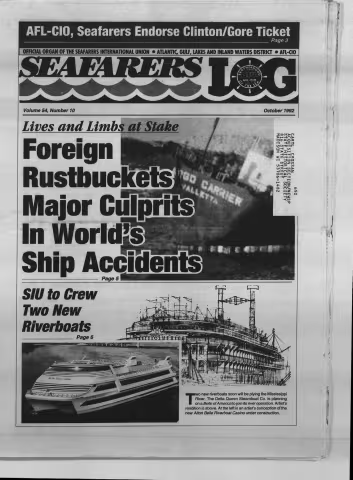
iwo new riverboats soon will be plying the Mississippi
River. The Delta Queen Steamboat Co. is planning
on a Belle of America to join its river operation. Artist's
rendition is above. At the left is an artist's conception of the
new Alton Belle Riverboat Casino under construction.
• I i
•fiC';-: 'W I
"iVM-
;• •• _
• 'l "••••, A'
A-/ - '
m
•yh
•'4* ' •
^'S
••• -'f-:
ff ;
i'Tl':
; '••;. Tr •••'>
r it;"' .^'-1
•§
": i: • . , ! •' • ••;•!• '•
if. . ... •••i .
• f X :.'!a
••M.
.'v
• l-lm:-, J
- • T.'.
XX,.&
••k
fc -
"v
k ' -y
Ify
•• >?'i
• • 1 - f-?
• .f ,
2 SEAFMaSUW OCTOBER 1992
•"
f-;
"--'liiv. •
rp- ••'-.'•P -• ^ ^
A'- ".• 'V
Michael Sacco
President's Report
Good for U.S. Economy, U.S. Workers
It was good news for the nation and good news for American workers to
hear that Uie House by a wide majority passed a measure to bring foreign-flag
cruise ships operating in U.S. coastal waters under the U.S.-flag, carrying
American passengers.
These operations, known as "cruises-to-nowhere" be
cause the ship goes in and out of the same U.S. port, are
nothing more than a loophole in the nation's coastwise
shipping laws.
TTiis loophole allows a foreign-flag, foreign-crewed
ship to offer cruises in American coastal waters, setting
sail from a U.S. city and then returning to the same U.S.
city. Although the nation's coastwise maritime laws are
supposed to reserve the domestic trades for U.S.-flag,
American-owned, American-built and American-crewed
ships, some cruise ship operators, in an effort to avoid
U.S. safety laws and U.S. taxes, are using the loophole to
operate foreign-flag vessels.
The so-called cruise-to-nowhere proponents say U.S. cabotage laws only
cover vessels sailing between U.S. ports, not ships sailing in and out of the
same U.S. port.
The message to these tax-evaders from the House of Representatives is
"Enough." If a similar bill is passed by the Senate and OKed by the ad
ministration, it could stimulate an interest in American-flag passenger ships,
particularly those of the size that go on day trips.
Combined with the law enacted earlier this year which allows gaming ac
tivities on U.S.-flag passenger ships, these two measures can bring millions of
dollars to the U.S. treasury m die form of taxes, and provide employment op
portunities for thousands of American citizens. It also will assure Americans
sailing on passenger ships that those vessels meet stringent U.S. safety and in
spection r^uirements.
American Jobs Funneled Overseas
While we are encouraged by measures such as the ones I just mentioned
which would create American jobs and bring badly needed funds to the
deficit-ridden U.S. treasury, there are other schemes out there that do the op
posite.
What is most shocking about one such scheme is that funds and
functionaries of the U.S. government actively are involved in assisting
American industries to transfer production operations overseas.
This runaway partnership now is being exposed in the media—in a seg
ment on 60 Minutes, the news television show on CBS, and on Ted Koppel's
Nightline on ABC.
In its September 28 show, 60 Minutes uncovered evidence of U.S. Agency
for International Development monies being used to assist American
businessmen to locate plants in Honduras and El Salvador. A 60 Minutes
producer, posing as an American businessman, was encouraged by several
U.S. government officials to open a factory in Honduras, despite the fact that
it would mean American workers would lose their jobs.
What is particularly outrageous is that top government officials in the
Agency for International Development—^known as AID—openly are solicit
ing American businesses to move and to take the jobs with ^em. If that were
not enough, the govermnent is offering these businesses hard cash in one
form or another to make the move.
The Loser Who's Still at It
Bob Quartel is a former member of the Federal Maritime Commission who
left the position last April to seek a U.S. Senate seat from Florida. Prior to his
resignation, the Maritime Trades Department, AFL-CIO, had called on the
president to remove Quartel from the spot as he had no concern for any of the
groups served by the FMC—U.S. shippers, U.S. shipping companies and
American consumers. Rather, he used the agency as a platform to rail against
the American maritime industry and American seamen and to promote
foreign operations.
Don C. Becker, publisher of the Journal of Commerce, the newspaper con
sidered the bible of^the maritime industry, who is known as an objective and
deliberative analyst of the shipping sector, recently expressed his
astonishment over something Bob Quartel said._
tublisher said that
that
many Amencan seamen retused to go into tne guit luperation
Shield/Desert Storm] and that only six U.S.-flag ships actually entered the
war zone." Becker said Quartel told him, "I checked the facts; you can look it
up."
Becker said, "I was so astonished by this statement," that he asked several
heads of U.S. shipping companies, who also were in attendance at the event,
to comment. All of the shipping company executives whom Becker asked
said Quartel was wronj
Admiral and head of
Shield/Desert Storm, Francis R. Donovan.
Adm. Donovan said he'd not heard of any U.S. ships or crewmen refus
ing to go into the gulf," Becker reported.
Becker said, "I must say Mr. Quartel's comments are indeed puzzling."
The fact is 80 percent of all materiel transported by sea was carried on
U.S.-flag ships. Eighty-one S.-flag ships owned by the government in its
Ready Reserve Force or chartered by Mi itaty Sealin Command participated
in the massive sealift. Becker found after doing some checking that 62 U.S.-
lag ships operated by American liner compames participated in Operation
Desert Shield/Desert Storm. He reported this in a September 30 column.
All of these ships were crewed by American seamen. Many of them sailed
in and out of the war zone. Some of them repeatedly. Hundreds of American
seamen manned these ships. Not one incident occurred in which an American
seaman refused to sail to the war zone, while the contrary is true of some
Foreign ships and foreign seamen.
But what do facts matter to the likes of Bob Quartel?
This most recent illustration of Quartel's blind hatred should eraSe any
doubts that anyone had about his sincerity. He has exposed himself as the
jhoney he has always been.
The people of Florida showed good judgment when they voted him down
as a candidate for the U.S. Senate in this month's primary. At the very least,
they have saved America a lot of grief.
he shipping company executives whom Becker asked
ang. He also talked with recently retired U.S. Navy Vice
'Military Sealift Command dunng Operation Desert
House Voles to Close
HHond SoMy iMHriuHo
The House of Repre
sentatives by a wide majority
approved a bill to require all
inland boatmen on vessels of
more than five gross tons to
obtain a Coast Guard-issued
merchant mariner document
(Z-card). The measure now
will be taken up by the
Senate.
Presently, the majority of
men and women sailing
aboard more than 3,300 tugs
and tows on the 25,777 miles
of navigable waterways are
exempt from holding Z-
cards.
During its debate on Sep
tember 9, the House voted for
an amendment to the bill,
known as the Merchant
Mariner Documentation Ex
pansion Bill (H.R. 4394), ejc-
tending the implementation
period. As passed, the Coast
Guard has two years to put the
program into place, instead of
one as originally proposed.
Speaking for H.R. 4394
during the House debate.
Representative Carroll Hub
bard (D-Ky.) said the bill is
"essential to the protection of
our marine environment and
workers on inland vessels.
Significantly, both goals are
accomplish^ at little or no
cost to the federal govern
ment."
Joining the Kentucky con
gressman in favor of the
legislation was Repre
sentative Gerry Studds (D-
Mass.), acting chairman of
the House Merchant Marine
and Fisheries Committee. He
noted that the SlU-contracted
Crowley Maritime "already
requires all hands on its in
land vessels to be docu
mented. By closing the
loophole and requiring mer
chant mariner documents on
inland vessels, we will in
crease safety and environ
mental protection at the same
time."
The SIU has been a strong
proponent of the legislation.
Executive Vice President
Joseph Sacco spoke before
the House Coast Guard and
Navigation Subcommittee in
March, informing the mem
bers about the "lack of unifor-
mity between the
requirements that must be
met by individuals employed
on various vessels." Sacco
pointed out that on Great
Lakes and deep sea vessels,
where all mariners hold docu
ments, human factors ac
count for approximately one
third of all accidents.
Meanwhile, on inland ves
sels, where all crewmembers
do not carry Z-cards, human
factors account for more than
half of the accidents. "This
loophole endangers the lives
of every boatman working on
an inland vessel," Sacco said.
The bill received bipar
tisan support when it was
marked-up by subcommittee,
then the full House Merchant
Marine and Fisheries Com
mittee, this summer before
reaching the House floor.
Lack of Funding, Time illiay Shekre
Maritime Reform Package for New
The prospect that a nation
al maritime reform policy
will be adopted is fading as
Congress nears its adjourn
ment, scheduled for the
beginning of this month.
The maritime initiative,
originally proposed to Con
gress by Transportation
Secretary Andrew Card and
introduced in legislative form
by Senator John Breaux ID-
La.) and Representative Wal
ter Jones (D-N.C.), the
respective chairmen of each
chamber's merch^t marine
committee, would help U.S.-
flag operators acquire new
vessels.
When Card unveiled the
Bush administration's plans
n June during a hearing of
he Senate Merchant Marine
Subcommittee, he called for
a contingency retainer pro
gram that would provide up
to ,74 commercial but
militarily useful U.S.-flag
vessels with government
payments ranging from $2.5
million per ship beginning
in 1994 and declining to
$1.6 million by 2000.
Securing the funds for this
program appears to be the
Secret Bailot Votii
Begins Novemtier
InSIU'i
'ng
r1
Elections
Balloting for can
didates seeking union
office takes place
from November 1
through December
30,1992.
Details of voting
procedures, a sample
ballot and the ap
plicable section of the
union's constitution
appear in a four-page
feature.
Pages 11-14
reason for the delay in taking
up the bill. As yet, the $1.1
billion in U.S. government
funding required for the con
tingency retainer program
has not been allocated.
The proposal also seeks to
allow U.S.-flag operators to
use a tax-deferral program
for the first time to purchase
ships from anywhere in the
world except for vessels built
in foreign yards that are sub
sidized by their govemments.
In an effort to secure par
tial funding for the reform
program, Breaux offered an
amendment to the Fiscal
Year '93 Defense Authoriza
tion Bill on the Senate floor.
The amendment was
withdrawn by Breaux after
strong objections were raised
by the Department of
Defense and key members of
the Armed Services Commit
tee. The Louisiana senator
vowed to continue his effort
to achieve maritime reform
through the remaining days
of the Congress.
SIU President Michael
Sacco, who along with the
heads of seven other
Volume 54. Number 10
maritime labor unions
strongly backed the maritime
policy effort, said, 'Tf we run
out of time in this Congress, we
will work to have it raised first
thing in the next session."
Sacco commended Card for
his tireless efforts to promote
the program designed to
bolster U.S.-flag shipping.
The union president also
recognized the efforts of the
industry's supporters in Con
gress and said their work was
critical in keeping maritime
reform on the front burner.
HkmtoRead
Readers will notice a
change in last month's
issue and this edition of
the Seafarers LOG. The
LOG now is being printed
in a five-column format as
opposed to the original
four-column style.
This difference ex
pands the amount of news
and information on each
page without increasing
the cost of the operation.
October 1992
• -J'A :'j-- .y
The Seafarers LOG (ISSN 0160-2047) is
published monthly by the Seafarers Interna
tional Union; Atlantic, Gulf, Lakes and In
land Waters District; AFL-CIO; 5201 Auth
Way; Camp Springs, Md. 20746.
Telephone (301) 899-0675. Second-class
postage paid at MSC Prince Georges, Md.
20790-9998 and at additional mailing of
fices. POSTMASTER: Send address chan
ges to the Seafarers LOG, 5201 Auth Way,
Camp Springs, Md. 20746.
Communications Department Director and
Editor, Jessica Smith; Assistant Editor,
Daniel Duncan; Associate Editor, Jordan
Biscardo; Associate Editor/Production,
Deborah Hirtes; Art, Bill Brower.
OCTOBER 1002
',"':'v
AFL-CIO, Seafarers Back
Clinton / Gere Ticket
The MTD has asked the Bush/Quayle '92 campaign manager to
withdraw a commercial which pictures a foreign-flag ship, as shown
above, as the president talks about America as a "superpower."
MTD Orges Recall
OtBush Campaign Ad
The Bush campaign immedi
ately should pull its advertise
ment which features a
foreign-flag ship as the president
stresses America's superpower
status, said Michael Sacco, presi
dent of the AFL-CIO Maritime
Trades Department, made up of
42 affiliated unions representing
8.5 million workers in shipping
and marine-related jobs.
Sacco, in a communication to
Fred Malek, campaign manager
of the Bush/Quayle '92 opera
tion, said he was "shocked" by the
depiction of a Taiwanese-flag
ship of Evergreen Marine Corp.
to emphasize the president's plan
to make America a "military su
perpower," an "economic super
power" and an "export
superpower," as Bush said in the
commercial.
While the Bush campaign ac
knowledged the error, claiming
its ad agency used stock film
footage without seeking details
on the ship, it has left the adver
tisement on the air.
Sacco, who also serves as
president of the SIU, said to con
tinue to run the commercial
"would simply compound the
felony and perhaps indicate that it
was not an error after all and that
the use of foreign ships and
foreign labor in your plans is cal
culated policy."
Noting the contradiction be
tween the commercial's message
^nd the maritime reform initia
tive, Sacco said, "you should
know that the administration has
been working with members of
the Senate and House and both
labor and management segments
of the U.S. shipping industty in an
effort to reverse the decline the
American merchant marine has
suffered over the past years."
He reminded the Bush cam
paign chairman of the "vital role
which U.S.-flag, U.S.-owned and
U.S.-manned shipping plays in
our national security."
Ironically, while U.S.-flag
ships transported 80 percent of all
gulf war materiel, "the
Taiwainese shipping company
shown in the commercial did not
participate at all in the multi-na
tion Persian Gulf effort," he
pointed out.
As the LOG went to press, the
Bush campaign had not pulled the
advertisement. Nor had Bush
campaign manager Malek
responded to Sacco's request.
Citing the economically dis
astrous results of the Reagan-
Bush era, as well as Arkansas
Governor Bill Clinton's sound
plan for recovery, the AFL-CIO's
General Board last month over
whelmingly voted to endorse
presidential candidate Clinton
and his running mate. Senator Al
bert Gore Jr. (D-Tenn.).
The Seafarers joined in the vir
tually unanimous vote backing
the Clinton/Gore ticket when the
vote was held at the general board
meeting, which consists of
delegates from the AFL-CIO's 88
affiliated national unions repre
senting 13,680,894 workers. The
meeting took place September 3
in Washington, D.C.
Organized labor arrived at its
view after considering the
Bush/Quayle administration's
record on the economy. The labor
federation noted that hundreds of
thousands of American jobs have
been lost, and more than 10 mil
lion people are out of work.
This failure to produce jobs—
after Bush's 1988 promise to cre
ate 30 million new jobs for
Americans—is compounded by
Bush administration trade
policies that encourage the trans
fer of manufacturing to foreign
countries.
The unions also expressed dis-
satisfaction with the Bush
administration's general anti-
worker view, citing the veto of a
bill which would have allowed a
worker to take unpaid leave when
a child is bom or when family
members need care.
Other sore spots include the
lack of a national health care
policy (the U.S. is one of two
industrialized nations in the
world which does not have na
tional health care), the cutting of
workplace safety regulations and
continued opposition to a bill that
would ban the practice of firing
workers and replacing them with
Democratic presidential nominee Bill Clinton talks with SIU Executive
Vice President Joseph Sacco.
scabs when the workers go on
strike.
, Moreover, real income in the
U.S. is at its lowest point since
1963. The average weekly
jaycheck now buys 7.2 percent
ess than it did 12 years ago, but
the pay for top executives has
tripled during that same period.
This compares to Governor
Clinton's performance in a state
which from the outset has many
disadvantages, including the fact
that it is located in the country's
poorest region. Yet Clinton,
governor for 12 of the past 14
years, developed an economic
program for Arkansas which has
allowed that state to surpass na
tional growth averages.
For example, non-farm
employment in Arkansas grew by
24 percent from 1979 to 1991,
compared with 20 percent nation
wide. Since 1988, Arkansas
boasts a non-farm job growth of
11.5 percent—compared with
just one percent nationally.
The state's overall taxing and
spending (as a percentage of per
sonal income) has changed little
since '79, while during the past
several yeiars Arkansas has en
joyed greater relative income
growth than the U.S. as a whole.
Further, despite claims to the
contrary by Bush, the relative size
of government in Arkansas has
been shrinking under Clinton,
rather than growing.
Clinton, on hand to thank or
ganized labor for its endorse
ment, reaffirmed his
"commitment to working men
and women... and to the forgot
ten middle class." He contrasted
his "high-wage, high-growth,
high-opportunity" economic
proposals with the "hard-work,
low-wage, low-growth" record of
President Bush.
Clinton, who twice has been
voted by his fellow governors as
the most effective chief executive
in the nation, has promised to sign
a bill which would ban permanent
Continued on page 20
U.S. Taxpayer Monies Pay
For Job Export Schomos
While more than 10 million Americans
are out of work, a U.S. government agency
is providing funding and assistance to
American businesses which are transfer
ring production overseas.
There has been no attempt by the Bush
administration to halt the use of funds from
the U.S. Agency for International
Development (AID) in promoting job ex
port schemes. But the matter now is before
the public as a result of television coverage
in a September 28 60Minutes segment and
in a September 30 broadcast of Nightline.
Outcry over the use of U.S. taxpayers'
dollars to assist businesses relocate off
shore has been swift.
"If this nation is to survive, it must stop
this flow of jobs from the United States to
other countries," SIU President Michael
Sacco said.
"The Agency for International
Development over the years has
demonstrated it is not working for the in
terest of the United States and its citizens.
This is the same agency which over the
years has repeatedly violated the nation's
cargo preference laws," the Seafarers
president stated. (Cargo preference laws
require that a certain percentage of govern
ment-impelled cargoes be carried on U.S.-
flag ships.)
Sacco added, "Perhaps the govemment
should re-establish AID as the Agency for
National Development."
What the investigative reports on these
news programs show is that U.S. taxpayer
monies have been funneled by AID to
foreign promotional groups which lure
American businesses to low-wage
countries in Central America and Asia.
Ads Lure Flight
Among the ways the dollars have been
used are to underwrite advertisements in
trade journals promoting the low wages
paid to workers in Central American and
the Caribbean Basin and fund the construc
tion of industrial parks where American
manufacturers can move after closing their
U.S. plants.
One of the most notorious ads was one
printed in a textile-industry magazine
praising "Quality, industriousness and
reliability is what El Salvador offers you!"
It features a woman at a showing machine
producing "apparel for U.S. markets" who
can be hired "for 57 cents an hour" in the
1990 version and "for 33 cents an hour"
one year later.
TTie ads were paid by FUSADES (the
Salvadoran Foundation for Econoniic and
Social Development), which in turn
receives funds from the AID—a total of _ _ _
Ads such as these, put out by foreign businessmen's groups financed by U.S. govemment
Continued on page 20 money, urge /Vmerican businesses to transfer production facilities overseas.
F- "1
i IfteV
r,/;.
feiS''-::-;:
I ̂
ipii;
InBB:
4 SEAFARERSLOG OCWRER1992
'J',:- \ ^ '
-•' i'.
'•'^^-::Pp''i.': , ";
-vjs; i-7
' ' '
j
• • '•'• A K
L-. • ! ' >' ••
mm-i
,f.V.,- 'V.
4 j. •
.' /T.
Seafarers Meet
AP World Wide Photo
The island of Kauai, damaged from the high winds and rain o
Hurricane Iniki, temporarily will be removed as a port of call for
SlU-crewed passenger ships, the Independence and Constitution.
Responding to separate storms
which battered Hawaii and Guam,
Seafarers sailed ships out of harm's
way and then provided supplies
and other aid for the victims.
In Hawaii, the SlU-crewed SS
Independence and SS Constitu
tion took different courses of ac
tion to avoid damage from
Hurricane Iniki, which struck
most of the islands September 12.
The Constitution sailed out of
Nawiliwili, Kauai—the island
which took the brunt of the
storm—early that morning and
travelled to a safe area, while the
Independence safely remained
docked in Kahului, Maui.
Both the Independence and the
Constitution, cruise ships operated
by American Hawaii Cruises,
sailed to Honolulu the next day and
began temporary schedules which
do not include stops at Kauai. A
company spokesperson said the
slightly altered schedules will
remain in effect until Kauai "is
ready to accept visitors."
Like the cruise ships, the two
major container carriers serving
Hawaii—SlU-contracted Sea-
Land Service and Matson
Navigation Co.—appeared un
scathed by the hurricane, the
Journal of Commerce reported.
(The unlicensed positions on Mat-
son vessels are manned by mem
bers of the SIUNA affiliated
unions—AGLIWD for the galley
crew; Sailors' Union of the Pacific,
deck gang; and Marine Firemen's
Union for the engine department
members.)
Along with military vessels,
the commercial shipping lines
transported food, drinlang water,
tents and other relief to Kauai.
Meanwhile, barges brought
telegraph poles and heavy cables
to the badly damaged island so
that communication could be re
established between Kauai and
the other islands.
Iniki rendered homeless at
least 8,000 of Kauai's 52,000
people. Many citizens remained
in homes which were badly
damaged and which had no water
or electricity.
Officials reported three deaths
U.S. Rep. Walter Jenes Dies
U.S. Representative Walter
Jones (D-N.C.), the chairman of
the House Merchant Marine and
Fisheries Committee, succumbed
to pneumonia September 15. He
was 79 years old.
Jones, who was not seeking
re-election and was set to retire
from Congress at the end of the
year, had led since 1981 the
House of Representatives com
mittee that oversees the U.S.-flag
merchant marine and fishing in
dustries, the Coast Guard,
wildlife conservation and the
ocean's continental shelf. He first
was elected to Congress in a spe
cial election in 1966.
Jones was a strong proponent
of the U.S.-flag merchant marine.
Maritime Loses a Friend
If;
f.:
"With Congressman Jones'
death, the maritime industry has
lost a good friend who certainly
was aware of the needs of the U.S.
shipping sector and its impor
tance to the country's security
and national defense," SlU Presi
dent Michael Sacco said. "He
worked constantly to upgrade the
U.S. fleet, although there have been
times when this was done under
very difficult circumstances."
Long before Iraq invaded
Kuwait in August 19W, which
initiated the transfer of American
troops and materiel to Saudi
Arabia, Jones called for a build
up of the U.S. merchant fleet.
Speakinjg at the 1984 Seafarers
bitemational Union convention,
he told the delegates, "A strong
merchant marine is at the very
and about 100 injuries lesultec
from the hurricaiie, which caus^
at least a billion dollars in
damages.
Typhoon Hammers Guam
On August 28, Typhoon Omar
and its 155-mph wind gusts ham-
mraed Guam. Fewer than 100 in
juries and only one fatuity were
reported—a Guam civilian dier
after being struck by falling debris.
But the Pacific island, home to
135,000 residents including more
than 21,000 U.S. military person
nel or dependents, sustained ap-
proximately a half-billion
dollars' worth of damage. Like
parts of Hawaii, Guam was
declared a disaster area.
Within hours after Omar
ravaged the island. Military
Sealift Command vessels arrived
to provide supplies and assis
tance. Among the ships which
took part in the initial aid opera
tions were the MV 1st Lt. Jack
Lummus and the fleet tug USNS
Navajo, both manned by
Seafarers.
The Lfimmus brought 23 large
mobile water storage tanks, four
water-making plants and 40 gen
erators to the island. The Navajo
assisted the USS White Plains in
getting free from mud, sand and
crushed coral after the Navy
supply ship went aground.
SlU members aboard the Lwm-
mus during these events included
Bosun Kelly Devine, ABs
Robert Koppel, Paul Griirin,
Paul Grady and J. Hail, Chief
Pumpman Steve Anderson,
QMEDs George Owens and
Paul Happel, Chief Steward L.
Oram, Chief Cook E. Loret,
Cook and Baker Yvonne De-
Sllva, Messmen Peggy
Langford and Rich Gray and S A
Eduardo Tomas.
SlU members aboard the
Navajo included ABs Frederick
Smailey and Bart Soils,
Steward/Baker Robert Burdine
and Cook and Baker Miguel Or-
menita.
'BrathertuHMl of ihe Sea^
Raises Funds, Supplies
Food and other supplies collected by Seafarers In the Brooklyn, N.Y.
hall are received by SlU Pensioner Pedro Mena, his grandsons Paul
and Ettiene, AB Ron Mena, Mrs. Judith Mena (Pedro's wife) and
granddaughter Jasmine^
he 1st Lt. Jack Lummus
1 ransported supplies to victims of
Guam's Typhoon Omar.
More than one month has
passed since Hurricane Andrew
rampaged through Florida and
Louisiana, but recovery is far
from complete.
Accordingly, the SlU last
month continu^ its support of
the relief effort. First, supplies
were donated by Seafarers from
the ports of Jacksonville, Fla. and
Vew York. Then, the Baltimore
'ort Council of the Maritime
Trades Department donated
$2,000 to the AFL-ClO's Hur
ricane Relief Fund.
From the Lundeberg School,
upgraders, trainees and staff
members donated a truckload of
items such as paints, hardware,
haby food and diapers. The
school also hopes to collect
$2,500 in donations for the hur
ricane victims.
Donations of useful items for
victims of Hurricane Andrew still
are being collected at all SlU
halls. The materials collected will
go first to Seafarers who need the
assistance and then to other trade
unionists in the disaster-struck
areas.
Wiper Ernesto Mardones'
home was declared unfit for
habitation after Andrew hit the
dwelling in Homestead, Fla. The
72-year-old Mardones told SlU
Port Representative Ambrose
Cucinotta, who is based in Dania,
Fla., that his home sustained
$63,000 in damage.
Home Rendered 'Unlivable'
Similarly, pensioner Pedro
Mena faces the task of repairing
his suburban Miami home. It was
rendered unlivable by the hur
ricane.
Overall, Andrew destroyed or
damaged 117,000 homes in
Florida and 14,000 in Louisiana.
A quarter of a million people
were left homeless.
The hurricane caused an es
timated $20 billion in damage in
Florida and $1.5 billion in
Louisiana. Fifty-two people died
due to the storm.
House Votes to Close Cabotage Loophole
Rep. Walter Jones
}ase of our defense and foreign
the
egis-
trade policies." Following
war, he strongly supported
lation to include money for sealifr
in Defense Department ap
propriations.
Studds Is Acting Chairman
The congressman also served
in the North Carolina General As
sembly and Senate from 1955 to
1966. He was mayor of
Farmville, N.C. from 1949 to
1953. He is survived by his wife,
Elizabeth Fischer Jones; two
children, Walter Jr. and DotDee;
and four grandchildren.
Shortly after being hospital
ized in August, Jones had asked
U.S. Representative Gerry Studds
(D-Mass.) to run the committee.
Studds is expected to be named
the committee's chairman by his
colleagues when the 102nd Con
gress convenes in January.
The House of Representatives
approved and sent to the Senate
legislation that would eliminate
foreign-flag cruises-to-nowhere
by vessels operating from U.S.
ports. Cruises-to-nowhere in
volve ships that depart American
ports—loaded with U.S. citizens
as passengers—and sail past the
territorial limits to allow gam
bling. They return later in the day
without docking at another
domestic or foreign port.
U.S. Representative Gene
Taylor (D-Miss.), who introduced
the U.S.-Flag Passenger Vessel Act
of 1992 (H.R. 5257), told his col
leagues during the floor debate on
September 22, "It is a lot more flian
just tacking an Amoican flag on
the stem of a vessel.
"It says that the ship was made
in America; it is ere wed by
Americans; it pays American cor
porate taxes; it lives by the U.S.
Coast Guard standards, which are
the highest standards for safety in
the world; and it lives by stand
ards set by our predecessors over
200years ago when they reserved
coastwide commerce for
Americans."
The bill, approved by a voice
vote, is designed to close a
loophole in the Passenger Vessel
Act of 1886, the passenger
equivalent of the 1920 Jones Act
which limits commerce between
two U.S. ports to U.S.-built and
U.S.-flagged vessels.
Over the years, administrative
decisions by the U.S. Customs
Service allowed the foreign-flag
operators to sail the cmise-to-
nowhere vessels, which usually
feature entertainment, dining and
gambling.
In speaking for the bill, U.S.
Representative Robert Davis (R-
Mich.), the ranking minority
member of the House Merchant
M^ne and Fisheries Committee,
pointed out that charter boats
which take passengers out into
the ocean on a fishing trip are
covered by the Passenger Vessel
Act. However, he stated, if a ves
sel takes passengers from an
American port out into the ocean
for a dinner cruise or a day of
entertainment, the Customs Ser
vice says the Passenger Vessel
Act does not apply to that boat.
"H.R. 5257 will ultimately re
quire that all vessels departing
U.S. ports to engage in voyages to
nowhere will have to be U.S. flag,
U.S. owned and U.S. built,"
Davis added.
U.S. Representative Gerry
Studds (D-Mass.), the acting chair
man of the House Merchant
Marine and Fisheries Committee,
told the House several of the
foreign-flag operators are making
plans to convert their ships to fly the
American flag should the bill pass.
"H.R. 5257 creates jobs for
U.S. shipyards and seagoing
workers," Studds said on the
House floor. "It also ensures that
these vessels, which transport
millions of American citizens, are
subject to full safety inspections
by the U.S. Coast Guard."
Earlier this year, the Congress
passed and President George
Bush signed into law legislation
that allows gambling on U.S.-flag
passenger vessels. President
Bush has threatened to veto the
bill to close the cruise-to-
nowhere loophole. He said he op
poses expansion of U.S. cabotage
laws to include the cruise-to-
nowhere trade.
i
•I
.f
OCTOBER 1992 SEAFARERS LOG 5
Foreign Rustbuckets Endanger Communities,Crews
There are hundreds and hundreds of ships in the
world's fleet that simply are accidents waiting to
happen. These vessels are old, veritable rustbuck
ets. These vessels are not responsible to any nation and
its regulatory regime—they operate under runaway
flags. These vessels are likely to be bulk carriers,
tankers or general cargo ships.
Many of these vessels already have wreaked havoc
on port communities around the world, polluting their
waters, ramming coastwise vessels, damaging marine
equipment. These foreign-flag rustbuckets have caused
the death of thousands of seamen.
Some nations have recognized the danger these flag-
of-convenience ships—^responsible to no government—
the Memorandum of Understanding on Port State Con
trol, based in the Netherlands, pointed out that
maritime safety regulations traditionally have been
promulgated and enforced by the nation in which a ves
sel is registered. But with the rise of foreign-flag
registers, this safety regime has broken down, stated
the secretariat.
In their inspection of ships entering European ports,
the secretariat found that 45.58 percent of the vessels—
6,554 ships—^reviewed had safety problems. These
ships registered 25,930 defects. More than 5 percent of
inspect^ vessels—525 ships—^had to be detained.
pose to the port communities where the ships load and
unload their cargo. European nations, Canada,
Australia, among others, are on the lookout for
runaway-flag ships, easily identified by their sub-stand
ard condition.
The Canadian coast guard announced earlier this
year it would begin inspecting every 40,000 to 100,000
bulkers older than 10 years entering its waters if it was
from one of the following registers: Panama, Liberia,
Bahamas, Malta, Cyprus, Iran and the Philippines.
The Canadian coast guard pegged its inspections to
ships under these flags, the first four of which are the
world's major flag-of-convenience operations, because
of the consistently poor safety record of ships in these
registers.
In one year the following number of vessels from
these runaway registers were detained due to the mag
nitude of their safety violations: Panama 64, Cyprus
57, Malta 55, Liberia 35, Bahamas 28, Honduras 16,
Antigua and Barbuda 13.
Sixty Percent Dangerous
In 1990, the Australian maritime safety authority
detained 60 percent of all foreign ships it inspected be
cause of poor safety equipment or structural defects.
Last month, the police inspecting ships at the port of
Hamburg and Hbe l^ver area of Gennany reports a shaip
rise in collisions—82 last year. TTie primary culprits, they
The Norwegian government, sturig by public outcry
'er several eroundir over several groundings of foreign-flag tankers off its
shores, has tightened its inspection regime of ships
entering its coastal waters. In particular, the Nor
wegians distrust Panamanian-flag and Maltese- flag
ships as Norwegian inspectors have found vessels in
these runaway registers to consistently have substan
dard conditions.
Half Have Defects
Further evidence of the deteriorating state of ships
and the dangers posed by foreignrflag vessels is found
in a report of a group of 15 European nations which
coordinates inspections of ships entering European
coastal waters.
In a report released this summer, the Secretariat of
said, are Panamanian-flag and Cyprus-flag ships with
poorly trained officers and faulty engines.
Accident data compiled by Lloyd's of London indi
cates flag-of-convenience vessels are twice as likely as a
vessel under a developed nation's flag to have accidents.
The danger these runaway-flag ships pose is im
mense. There are more than 5,500 runaway registry
ships plying the high seas. Close to half the world's
tanker fleet operates under flag-of-convenience
registers. More than 1,500 bulkers and 2,200 general
cargo ships are in the runaway fleet.
The bulk fleet in particular is aging. More than 34
percent of the bulk fleet is over 15 years of age. While
bulkers only make up 7 percent of Ae world's com
bined fleet, they account for 57 percent of the accidents.
The runaway register has become an income-gener
ator for financially impoverished governments. As
such, the likelihood is that they will continue to
flourish. With income as its purpose, these flag-of-con
venience registries demonstrate little concem for in
spection and safety standards or for working condi
tions for crewmembers.
Take for example the Mauritius register, which
recently has been put in place. Mauritius does not in
tend to employ any maritime inspectors. It claims
shipowners can police themselves.
As runaway registers proliferate, each one hawking
its wares to sldpowners around the world, any minimal
conditions imposed by such registers become a hand
icap in drive to attract ships.
Surveyors In Trouble
Standards have become so bad, that the major Clas
sification societies, which are in essence organizations
paid by shipowners to inspect their vessels, have said
they would tighten up their requirements.
Yet, while major classification societies talk about
tightening up their acts, a number of smaller classifica
tion societies have cropped up which offer the
shipowner less stringent inspection procedures and.
which will look the other way instead of demanding ex
pensive repairs.
The major classification societies, faced with mount
ing costs and bad publicity, report they have weeded
out the riff-raff from their rolls. This year, Lloyd's
Register says 265 ships have left its ranks, 85 of which
were asked to leave. American Bureau of Shipping
dropped 338 ships for non-compliance with class rules.
Insurance Groups Skeptical
Marine insurance underwriters, however, have be
come skeptical of certificates issued by even the most
highly reputable classification societies. Faced with
big claims on their cash i reserves, underwriters now are
now conducting dieir own ship surveys.
Despite the fact that classification societies and
marine insurance groups have taken some steps to cull
out substandard ships, there is plenty of opportunity for
such vessels to find shelter in one of the many
runaway-flag registers.
The very same ships which have failed to meet the
standards of one classification society are likely to sur
face under another name, another registry, calling on
ports throughout the world.
It is precisely these ships that will appear in tomor
row's headlines about some major shipping accident.
Crewmembers Bear Brunt
Of World's Deteriorating
Shipping Standards
Last year 1,204 seamen died
as a result of ship accidents,
most of which involved flag-of-
convenience ships.
Additionally, thousands of
seamen suffer(^ countless indig
nities—starvation, working ar-
Workers Federation (TTF) are
not unusual on foreign-flag
ships.
Oceania
rangements amounting to
indentured servitude and
nightmarish shipboard condi
tions.
Every year, the world's
seamen sailing aboard flag-of-
convenience ships pay with
their lives and with their human
dignity the price of substandard
shipping.
Seamen on foreign-flag
ships, often selected from the
world's most exploited labor
pools, easily are abused by the
runaway-flag operator. Many
seamen are not paid. Some
receive only a portion of
promised wages. Many are kept
on board for several more
months than originally planned,
In numerous instances, very lit
tle food is rationed. Often, the
seamen receive no training.
Seamen In Limbo
The Latin American crew on
board the Cyprus-registered
Oceanid, which was owned by
a Greek company, sailed from
India to the UK on a voyage in
1991. Rations for the crew
during the trip consisted of a
handful of rice and a potato
each. The only drinking water
available to the crew was an old
rusty oil drum used to catch
rainwater.
First under the Antigua and Barbuda-flag, then hastily switched to another runaway register, the Peter,
now the Swan I, Is owned by Germans who have stiffed the Filipino crewmembers of wages. This Is a
typical foreign-flag ship story.
Arus/i/and Dillni
Responsibility for these
abuses is handed off between
manning agents, charterers, ship
managers, shipowners and
runaway-registry repre
sentatives. The result is that
breign seamen are left in limbo
with no party in the shipping
lusiness responsible for their
welfare.
The following summaries of
incidents reported by insprctors
of the International Transport
Two Sri Lankan-flag ships,
the Arushi and the Dilini, in
1991 were detained by British
authorities for unseaworthiness.
The Finnish owners abandoned
the ships and crewmembers,
who were owed $140,000 in
back wages. Both ships were ar
rested and put up for auction.
The Dilini was reportedly sold
for scrap, and the crew only
received 75 percent of their
money. In fact, the Dilini
wasn't scrapped—^it was bought
by its owners, who dodged their
debts and re-registered the ship
as the Norina under the Hon-
duran flag. Most recently, the
ship has been held up by
Swedish Maritime Safety In
spectors who found that the
steering gear-bearings were
badly worn, fire-extinguishers
were broken, lifesaving equip
ment was missing and hatches,
fuel and ballast tanks all had
leaks. The ship did not have a
classification society certificate.
In the spring the ship, which
should have been scrapped, was
purchased by a Latvian com
pany.
LttsaN.
In March The Cypriot-flag
Litsa N., limped into a German
port aftei^what must have been
a perilous Atlantic crossing
from New Orleans for its crew
of 17 Russian and Polish
mariners. The Litsa N. 's hull
was defective and letting in
water. The ship's rail, the com
panion way^ and the hatch
covers were all rusted through
and could give way at any mo
ment. Both the firefighting and
lifesaving equipment on board
were inadequate. The ship's
lifeboats were corroded and one
of them had a large hole. The
fresh water supply was con
taminated with oil. The Litsa N.
also was an environmental dis-
aster,idischarging large quan
tities of oil and bilge water
mixed with oil while at sea. The
ship literally was held together
by rust. It was detained when it
arrived in Germany. However,
Cypriot-flag Litsa N. should have been scrapped. Instead It was sold
to a Latvian company.
it was released after the owners
promised major repairs.
Peter
The German-owned, 23 year
old Antigua and Barbuda-flag
Peter was manned by Filipinos
hired through a British crewing
agent. The seamen were owned
wages. The vessel owners said
the funds had to come from the
charter. Bolivar Navigation,
whose agent has no permanent
address and a mobile phone
number that changes daily.
While on the run from the
seamen's back pay claims, the
vessel owner changed the name
of the ship to the Swan I and
switched registers to that of St.
Vincent in April 1992. The
owners also attempted to stiff
the crewmembers out of their
trans^rtation back to Manilla,
promising airline tickets that
never materialized. The ITF did
secure the seamen's transporta
tion funds.
VL|- V
. r-
• " •• f ; •
£•• 'M
i '•
U •
- -/
.j
.1. ' <• .i
'-v,.- !.-*j'..,-'• •.•••'•J-"'
I
s7>^: •. ••u?i--i.'.. :•;/• ;
wm&-^
eSllsr.'-':, -,>••••:
- .i:v.
..'"•'^••Ai.'if'''' , •• -, ^--.iv,^. • •-• -Ms®
- J
SEAFJUiERSLOG oermeRim
SlU to Man IWo New Rhrerboats
Altatt Belle le Censtvct
IfBOO-Passenger Vessel
mm-'.-:::: -•r' •••^i4' '•. •'.. •
,,'4',', :•",
^f' ̂"'''''"
P^:V-^44--:',444.. ^4"V
'': 4''f''-' ':|l\ -•• • "'4,-;.-''.,' •••
i
"I, ••: '.. •
-iv' ';! s.
-y-••• ^•
• .:•• If-
Ifes'S-• 'ri ' ;
its. .'"•if-
•^- " !:t.
v'-
fTi''" • -r-• •••». • /•'.
,i,,
Elaborate PaMlewheeler
Planned by Delta Queen
a
America's newest paddlewheeler is on the drawing board at the Delta
Queen Steamboat Company.
Plans are under way for the
SlU-contracted Delta Queen
Steamboat Company to build the
biggest, most elaborate pad
dlewhfeel steamboat ever to sai
on America's rivers, the New Or
leans-based company announced
last month.
"Financing is already arranger
for the project," according to a
press statement issued by the com
pany. The projected construction
costs are between $50 and $60 mil
lion. Bids are expected to go to
shipyards in the fail.
Tentatively called the Belle of
America, the 425-foot, six-deck
vessel is expected to begin opera
tions in the summer of 1994. Like
its sister ships, the Delta Queen
and Mississippi Queen, the Belle
of America will cruise the Missis
sippi and Ohio rivers as well as
several of their tributaries.
Capable of carrying 420 over
night passengers, the Belle of
America will increase the
capacity for the company fleet by
70 percent. It will be the first new
steam-powered riverboat built in
the U.S. in almost 20 years.
Designers for the pad
dlewheeler studied historic
photographs and archival
materi^s related to other river-
boats to recreate a late 19th cen
tury look for the vessel. "We
made the decision to incorporate
what is basically 19th century
technology in the design of the
new boat because it is true to our
company's river heritage,"
Patrick Fahey, company presi
dent, said "We're the last living
link to the golden age of steam.
The o/America will be
built with a covered deck utilizing
swings and rocking chairs. How
ever, it also will feature modem
amenities—^like a swimming pool
and elevators—as are found on
ocean-going ships.
Englneroom on View
The proposed riverboat will
offer cabins that open onto
promenade decks like those on
the Delta Queen. The design of
the vessel will allow passengers
to observe the engineroom at
work, as does the Delta Queen.
One of the highlights on the
Belle will be the (^and Saloon. It
is being designed to look like a
miniature opera house that could
have been found in a small
Tosperous river town in the late
800s, the company's release
noted. The Grand Saloon will fea
ture a tall proscenium stage,
framed by a decorated archway
and flanked by private box seats.
The Delta Queen is the smaller
and older of the two boats already
in service by the company. It was
)uilt in 1926 to move people and
supplies between San Francisco
and Sacramento, Calif., carries a
crew of 80 people and was named
a National Historic Landmark in
1989. The Mississippi Queen
started sailing in 1976. It has a
crew of 165 people.
The Delta Queen Steamboat
Co. was founded in 1890. Once
}uilt and under way, the Belle of
America will be the 30th steamboat
owned or operated by die firm.
SIU crewmembers aboard the
Alton Belle Riverboat Casino sait
they could not wait to work on a
proposed new riverboat, unveilec
last month during the casino's
first-year anniversary celebra
tion.
Deckhand Lonnie Partridge
told a reporter for the Seafarers
LOG after seeing an artist's con
ception, "She's beautiful. That is
going to be nice. We can't wait
for it to get here."
Approximately 100 more
people will be employed when
the new riverboat is expected to
begin operations in May 1993.
The vessel, which will assume the
Alton Belle name when it goes
into service, will triple the size of
the original casino, which sails
from Alton, 111., near St. Louis.
The 220-foot craft is under con
struction in Jacksonville, Fla.
Futuristic Riverboat
Unlike the present vessel
which was adapted to look like an
old-fashioned riverboat, the new
Alton Belle will feature a sleek,
aerodynamic look. "I haven't
seen anything like that on the
river," noted Deckhand Jeff
Zeller. "It's going to take a lot of
people by surprise."
Besides the name and the
crew, the only other thing the two
boats will have in common is
three decks for gambling. The
new craft will be longer (by 55
feet) and slightly wider, which
will allow up to 1,400 passengers
to ride at one time, more than
triple the present boat's capacity
It also will feature sit-down bar
areas on all three decks.
The future Alton Belle wil
dock at the SlU-crewed Alton
Landing barge, which features a
restaurant, buffet and bar for
guest use before and after cruises
When the new boat arrives, the
present vessel will be taken out of
service. Company officials said it
probably would be^sold ant
moved to another location.
John T. Conners, the
partnership's chief operating of
ficer, told the press during the
anniversary celebration and un
veiling of the artist's rendition of
the new vessel, "This is a very
moving day for me. We have no
employees; we are one big fami
ly. Confidence and triist have
made this a success."
Our employees are the
strength of this operation," added
Tom Long, chief financial of
ficer. "Without them, there would
be no Alton Belle,
Long went on to say the new
riverboat is being built "to remain
competitive. We want to remain
one step ahead and succeed at it.
In its first year on the Missis
sippi River, the Alton Belle drew
more than 8(X),(XX) passengers. It
sails several times each day, taking
passengers on 90-minute cruises
north of Alton on the Mississippi
River. Revenues of $45.5 million
more than doubled the company's
original first-year estimates.
Artist's rendition of the new vessel was unveiled during the first
anniversary celebration of the Alton Belle Riverboat Casino.
Frank Paladino,
SNIHQRep,
Dies of Cancer
Frank Paladino
SIU Headquarters Repre
sentative Frank Paladino passed
away September 10 after a long
bout with cancer. He was 52.
A native of Brooklyn, N.Y.,
Paladino worked for the SIU for
more than 30 years. He worked in
the union's data center from 1961
until the mid-1970s, and the SIU
still is using many of the software
applications which he designed.
In the late 1970s, Paladino
joined the SIU executive staff and
began working out of headquarters
in Brooklyn. When the SIU moved
its headquarters to Piney Point, Md.
in 1982, he followed. Paladino
wore many administrative hats
from then until his passing. He ser
viced and negotiated contracts for
the SlU's inland division, as well as
for the SlU-affiliated United In
dustrial Workers.
He worked as a liaison be
tween headquarters and the SIU's
Lundeberg School.
'He'll Be Missed'
At a graveside service for
Brother Paladino, SIU President
Michael Sacco recalled his good
work in behalf of the uniop- "No
detail was too small for Frank."
Sacco reminisced about Brother
Paladino's good nature and
cooperative spirit. "We will miss
him," he said.
'Frank was a hard worker and
a likeable guy," added retired SIU
Vice President Contracts Angus
Red" Campbell, who worked
with Paladino for many years.
Paladino served in the Navy
fom 1958 to 1959. He was buried
at the Seafarers Haven Cemetery
in Piney Point, Md. He is survived
)y his brother, Mike, Paladino,
SIU port agent at the port of Nor-
blk, Va., and by three daughters:
Theresa, 28; Maryanne, 24; and
Renee, 21.
Long Beach COIKHM! lAe Queen Mary Stays Ihiett
Members of the Seafarers-af
filiated United Industrial
Union Representative Wadena
Arlndin (left) seeks more signa
tures while a Long Beach resident
signs a petition to keep the Queen
Ma/ydocked in Long Beach, Calif.
Workers (UIW) won a "tremen
dous victory" September 29 when
the Long Beach (Calif.) City
Council voted to keep the famed
Queen Mary docked in the
southern California city.
"This is one of the greatest vic
tories in this area in a long time,"
Steve Edney, the UIW's national
director, told the Seafarers LOG.
"Much of the city was mobilized
against the mayor, who wanted to
sell the ship to foreign interests.
The council overrode die wishes of
the mayor and voted to keep the
jobs."
More than 1,200 jobs were
pending the outcome of the vote.
"The UIW and the rest of or
ganized labor spearheaded the ef
fort to save the Queen Mary,"
Edney said. In overcoming tihe
opposition of the mayor as well ̂
that of the local newspaper, the
UIW crafted a coalition of labor,
business, tourism and civic offi
cials to urge the council to keep
the former Cunard luxury liner in
Long Beach, where it has been for
20 years.
Thousands Support Effort
The first step was a citywide
petition drive in which thousands
of residents placed their signa
tures in support of keeping the
tourist attraction known around
the world. Next, supporters at
tended city council meetings to
let their feelings be known.
The coalition kept the pressure
on by publicizing in newspaper,
radio rind television news reports
what the effects of losing the
Queen Mary would be to local
tourism. "We had one lady come
all the way from Pennsylvania
and ask the council what they
were doing in selling the ship,"
Edney recalled.
Council Votes 7-2
On the day of the vote, more
than 300 flag-waving UIW mem
bers ftom the Queen Mary packed
the meeting room. The hearing
lasted more than sue hours before
the 7-2 vote was cast to keep the
vessel.
Walt Disney p). is die diird
company to operate the Queen
Mary Hotel since it opened. The
entertainment company had
planned to build a theme park on
the land around die vessel but had
to drop the idea when the state did
not approve it. In March, Disney
announced it would not renew its
lease, which ended September 30.
"The whole staff and all of our
members got behind this effort to
save the Queen Mary and did
their parts," Edney said. "There
are countless people who helped
the committee of Bud Rymer,
Ruth Fernandez, Frank Gill,
Bob Voden, Wadena Arindin,
Irma Ramirez and Margarita Al
varez."
Famed Ship
The UIW will work with the
city council to allow card-playing
for stakes—the only legalized
gambling except for parimutuels
in California—on the Queen
Mary in order to bring more busi
ness to the complex and city.
The 1,020-foot liner sailed
from 1936 to 1967 when it was
purchased by the city. During
World War n, it served as a troop
carrier. The UIW began repre-
sei|iting workers at the 365-room
Queen Mary Hotel in 1970.
m.r
T»V M
.411
13-
P-:rPi-
',"" ''/ .-;v,.,t' ."„ '
;-'i'
.•. V|•''}'
•-:/•
OCfOBER 1992 SEAFARERS LOG 7
Tanker Seafarers Must Hold Benzene-Clearance Cards
After Nov.ly SIU Members Claiming Jobs on Tank Vessels Will Show Proof of Blood, Respiratory Tests
After November 1, Seafarers
who ship on a tanker or tank ves
sel will be required to hold docu
ments indicating they have been
cleared to work with and around
|the chemical benzene and
products containing benzene.
The new shipping rule is
designed to protect Seafarers
from the health risks posed by
exposure to benzene.
The Seafarers Appeals
Board's recently enacted ship
ping rule requires that when a
Se^arer throws in for a tanker
job, he or she must present the
dispatcher with documents in
dicating he or she has met the
Coast Guard-mandated physical
criteria to work on vessels carry
ing benzene or benzene-contain
ing products and that he or she is
in physical shape to wear protec
tive masks.
While the benzene-related
documents are not needed at the
time of registration, they are re
quired at the time of claiming a
job on a tanker. Seafarers ship
ping on containerships or dry
bulkers or certain other types of
vessels do not have to hold ben
zene-clearance documentation.
Repeated exposure to benzene
can pose health risks. But by
monitoring a Seafarer's blood
count to ensure that exposure has
not caused any health problems,
and by checking his or her
respiratory health in order to
determine if he or she can wear a
protective mask, these risks can
be minimized.
Tankers and Benzene
Benzene is found in many
petroleum-based substances—
crude oil, gasoline, jet fuel,
kerosene, petrochemicals—and
the chemical is used in the
manufacturing of many products.
Thus, tankers and tank barges
often carry benzene or substances
containing benzene.
This year, federal regulations
went into effect which require
operators of such vessels to pro
vide protective equipment to any
seamen handling benzene or ben
zene-containing materials.
A key part of this shipboard
exposure-prevention equipment
is a mask. In order to wear the
mask and use it effectively, the
wearer must be able to breathe
well. This is the reason why any
individual working around ben
zene or benzene-related products
must demonstrate respiratory
health by taking the pulmonary
test.
The federal regulations note
that minimizing contact with ben
zene is important because short-
term exposure to the chemical has
been found to cause light-headed-
ness and irritation to the eyes,
nose and respiratory tract. Long-
term exposure to benzene can
result in various blood disorders
ranging from anemia, a low red
blood cell count, to leukemia, a
fatal cancer of the blood cells.
Seafarer to take the benzene-re
lated tests at the nearest clinic.
Additionally, if a member comes
to the union hall to sign up for his
or her annual physical, the
Seafarer—if he or she intends to
ship on tankers—also should sign
Two Medical Tests
The two tests that will be given
to indicate benzene clearance are
a blood test known as a "Com
plete Blood Count" ("CBC") and
a breathing test known as a "Pul
monary Function Test" ("PPT').
After November 1, a member
can take these two tests at
Seafarers Welfare Plan clinics.
Only Seafarers who wish to claim
jobs on tankers must take these
two tests, although they are avail
able to all memterS.
When at the counter at the
union hall, a member who plans
to ship on tankers should indicate
his or her intention to do so. The
official at the counter then can
schedule appointments for the
up for the benzene-related tests.
After meeting the Coast
Guard-mandated physical re
quirements determined by taking
the two tests, the Seafarer will be
issued a yellow benzene
clearance card. His or her clinic
card will indicate the tests have
been taken, and the member also
will receive a written statement.
The special benzene clearance
card is yellow. The yellow card
will be given to the member after
he or she has demonstrated
through the results of the blood
test and breathing test that he or
she is in physical shape to work
on a vessel carrying benzene or
benzene-related products.
Also, the Seafarers clinic card
has be«n updated so that the front
of the document indicates
whether or not the member has
taken the CBC and PFT tests and
been cleared to work around ben-
DATE
, -"Tm,
zene.
The Seafarer will receive a
written statement indicating any
medical conditions he or she has
that could prevent him or her
from working around benzene or
from being able to use any kind of
protective mask, or in certain
cases, a particular kind of mask.
What the Tests Hnd
The CBC test, taken once a
year, studies the make-up of an
individual's blood. The blood test
is required because benzene can
affect and impair the work of red
blood cells, which carry oxygen;
white blood cells, which fight in
fections; and platelets, which
help the blood clot.
The benzene clearance card will be issued to members after they
have taken the blood count test (CBC) and the breathing test (PFT).
Evidence of having passed the benzene-related tests will be neces
sary when claiming a job on a tanker after November 1.
SJ01
.... ir^oiment an<
obov. «
,ri«V coverog*.
3ge, —-
o •-46Z4
No
"
t^ort Of
OATE
i.wMP' e*p/a,
*».o.
ISl ;
NEW
CUHICCABD M
The new Seafarers Clinic Card on the front indicates that a Seafarer has taken the two tests which are
needed for shipping on tankers. SIU clinics will begin issuing the new card after November 1 as members
come in for their annual physical and/or the benzene-related tests.
In the PFT test, the member
blows through a tube into a
machine that registers his or her
breathing capacity. This test, re
quired every thiw years, deter
mines the type of respirator a
member has to wear when han
dling or working ̂ ound benzene.
A Seafarer who shows little or
no restrictions in the pulmonary
test can be fitted to wear a nega
tive pressure respirator. These
generally are the carbon-filtered-
cartridge style, similar to gas
masks used in the Persian Gulf
war. The reason it is called a
negative pressure mask is that the
person wearing it does all the
work to breathe the air through
the filter.
A positive pressure respirator
supplies oxygen or fresh air to the
person from an outside source.
Examples include scuba gear and
air tanks with masks used by
firefighters. If a member displays
a breathing impairment, he or she
has to use this type of equipment
when dealing with or working
with benzene.
Special Conditions
If sufficient questions are
raised by the test results as to a
member's physical condition to
work around benzene, the clinic
will forward the information to an
independent Medical Review Of
ficer (MRO), who is an expert in
this field.
The MRO will make a final
determination if the member is
able to work around benzene or if
the member can use any of the
protective masks.
In some cases, the MRO will
direct the member on what to do
to become benzene-cleared. Such
may be the case if a member
shows a low red blood count. If
the MRO has reason to believe
the member can increase the red
blood count to acceptable levels,
the MRO may direct the member
to wait for a period and take the
blood count test again.
Often, a low red blood count,
known as anemia, can be cor
rected by taking iron pills or other
medications. Thus, the MRO
might direct a member to follow
a medical regime which would
bring up the red blood cell count
and consequently allow him or
her to pass the CBC test.
In most cases, those members
found to have blood or respiratory
diseases that prevent them from
having contact with benzene or
benzene-related products and
thus will prohibit them from ship
ping on tankers, may continue to
sail on containerships, dry
bulkers and other benzene-free
ships.
Coast Guard Requirements
The Coast Guard is charged
with investigating tankers and
tank barges to see that only ben
zene-cleared personnel are work
ing in benzene-restricted areas.
The federal agency is authorized
to issue fines if it discovers un
authorized individuals working
with or around the chemical.
The yellow benzene clearance
card issued by the clinics will
satisfy Coast Guard investigators.
Thus, Seafarers on tankers must
have this document in their pos
session when aboard such ves
sels.
The Coast Guard benzene ex
posure rules were announced in
October 1991. The regulations
were designed to protect mariners
from the immediate and long-
term health problems that can be
caused by benzene, which can be
absorbed into the human blood
stream both by breathing and skin
contact.
As part of these rules, tanker
and tank vessel operators are re
quired to carry on board these
vessels protective equipment, in
cluding breathing masks,
which—when worn—minimize
the exposure to the chemical. The
tanker and tank vessel operators
also are required to identify all
benzene areas through posted
signs.
Additionally, the Coast Guard
rules require mariners working
with and around the substance to
be tested to ensure that they can
use the protective masks and that
they are not at risk for any of the
illnesses that repeated exposure
to benzene can cause. The newly-
instituted tests conducted by the
SIU clinics and the new shipping
rule which requires that only ben
zene-cleared Seafarers work on
tankers meet the Coast Guard-
mandated regulations.
The agency also requires com
panies employing mariners who
may be exposed to the chemical
to have an exposure monitoring
system in place as of April IS of
this year. The Coast Guard set
exposure limits at one part of ben
zene per million parts of air (1
ppm) averaged over an eight-hour
period. The short-term exposure
limit, which cannot be repeated
more than four times a day, is 5
ppm averaged over a 15-minute
period. The rules also require that
a mariner must wait at least an
hour between exposure periods.
, 8 • "w f-
;i f
I
•r.
8 SEUWIBISIM vemBtiaia
Seafarers Marvel at Waterway's Beauty
Famed Delta Queen Makes First Tenn-Tom Trip
't:
:X %::^:'... , V
'X-S-'V':. • • ':
The first trip by the SIU-
crewed paddlewheel riverboat
Delta Queen from Chattanooga,
Tenn. to Mobile, Ala. via the Ten-
nessee-Tombigbee Waterway
made First Cook Sylvia Moss
think of "how the river looked
100 years ago. There were lots of
trees and animals and few
people."
The Delta Queen Steamboat
Co. provided the special 460-
mile, one-week excursion down
the waterway last month for the
Stanford University alumni as
sociation and the University of
Mississippi Center for the Study
of Southern Culture to explore a
part of the South seen by few
people. The return trip was
chartered by the Smithsonian In
stitution.
The 66-year-old steamboat
usually sails along the Mississip
pi and Ohio rivers. But this
voyage followed the Tennessee
River west to the Tennessee-
Tombigbee Waterway, then 1
south through the canal (opened
in 1985) to the Mobile River
which carried the vessel into the
southern Alabama port city with
the same name.
"It was beautiful," Cabin At
tendant Kristina Pemberton told
a reporter for the Seafarers LOG
shortly after the historic pad-
dlewheeler docked. "There were
tons of animals—deer, turkeys-
all kinds of wildlife and forests.
Darlene London, a self-
proclaimed city girl, said the
Continued on page 10
mWMi
Keeping the lobby clean is Porter Chris-
I topherLove. In four photos above, the Delta Qoeen docks in Mobile following her first voyage down the Tennessee-Tbmbigbee VVaterway.'
V/
Sous Chef Jeff Hunter (left) offers instructions to Second Porter William Dorsey delivers the Making fatit clatters for
Cook Patrick Wills on salad making. daily newspaper; / is Se<foridC<SSS/sSfo ^feonj^ver is appealing to Frrst Cook
'Xm
-H'
OCTOBER 1992 SEAFARERSLOG 9
Delawhale's Papale Rescues Injured Boater
The past two months have
been eventful for SIU members
who crew the ferry which runs
between Philadelphia and Cam
den, N.J. In September, the ferry
transported its S00,000th pas
senger since it began operating on
March 31. The 100-fpot
Delawhale also carried this year's
Miss America contestants.
A substantially less pleasant
event took place August 19 at
9:18 p.m. when a pleasure
boater—^who later was charged
with operating a 17-foot craft
while intoxicated—smashed his
boat into the brightly lit, 100-foot
double-deck ferry. A 40-year-old
woman was thrown from the
pleasure boat against the ferry
and then into the Delaware River.
Seafarer Bob Papale, the
Delawhale's captain, dove into
the water and saved Victoria Di-
Domenicis, who suffered serious
internal injuries.
DiDomenicis was admitted to
a hospital and initially was in
critical condition. At press time
she still was hospitaliz^ but her
condition had b^n upgraded to
serious.
Amazingly, none of the three
males who were in the pleasure
boat with DiDomenicis was in
jured. None of the ferry pas
sengers or crewmembers was
hurt, and—unlike the pleasure
boat—the ferry sustained no
major damage.
Boaters Ignored Warnings
"We left the Philadelphia side
at 9:15 and we saw the boat com
ing toward us," Papale told the
Seafarers LOG. 'This wasn't the
first time a pleasure boat seemed
to be playing this game of head
ing toward the ferry and then
turning.
"Anyway, they didn't respond
to several of our danger signals.
so [another crewmember] cut
the engines to neutral, then to
reverse. At the last minute, [the
boaters] made a hard right, the
boat kind of flared up on its side
and the woman got flipped into
the water. The only thing that
saved them was the boat going
up on its side."
The boat's bow hit a passenger
ramp which extends from the
ferry's bow. Deckhand Walt
Sargent immediately threw a life
ring to DiDomenicis, but she was
unable to move after grabbing the
ring. "The pleasure boaters were
[closer to the water], but they
couldn't get her," recalled the 40-
year-old Papale, who joined the
SIU this year. "I jumped in and
grabbed her, and within a couple
of minutes Ae Coast Guard was
there in a rubber boat. They
dragged us both out of the water."
The individual piloting the
boat and the boat owner, who was
aboard, were charged separately
with operating a vehicle while in
toxicated.
"Bob saved her," said Captain
Gerald McGovem, who was not
on die Delawhale when the acci
dent occurred. "From what I heard,
without a doubt, if not for him, she
would have died"
Before joining the SIU, Papale
spent 16 years working as a
delivery man. His routes and
cargo were atypical, however.
Papale delivered yachts (by sail
ing them) to buyers along the In-
tracoastal Waterway.
During one of those runs,
Papale was involved in another
rescue. A few years ago, he was
sailing through Savannah, Ga.
when he spotted a 32-foot sail
boat dead in the water.
"It was incredibly cold, about
four degrees, and this boat was
anchored in ah odd spot,"
Papale recalled. "It turns out the
Capt. Bob Papale
boat's batteries were dead, and
the guy couldn't even send a
mayday."
Pap^e and a co-woiker "pulled
up and blew our horn, but we didn't
hear any type of response." They
boarded the sailboat and found an
elderly man "sitting in a stupor at
the table. We carried him to our
boat, and he seemed okay once he
got warm. But he had been out
diere for 14 hours, and he really
thought he was going to die."
Return of Philty Ferry
Evotres Fbml K/lemeries
Les Bredell knows exactly
how his father, former SIU mem
ber and fleet master Lou Bredell,
would have felt about the resump
tion of the Philadelphia-Camden,
N.J. passenger ferry service.
Lou Bredell
"He would have felt the same
way I do: great," Les Bredell said.
"It's great to see it start up again.
I go over the bridge every day,
and every day I look down and
smile when I see the ferry."
40 Years Later
For 62-year-old Les and other
longtime residents of the
Philadelphia and Camden areas,
the resumption of ferry service
there after a 40-year stoppage has
triggered a flood of memories.
The first re^lar ferry between
those points began operating in
1688. Between 1900 and 1952,
nearly one billion passengers
used Ae setvice.
But bridge construction and
rising costs of supplies, insurance
and fuel slowly reduced the fleet
from 26 ferries to three. Finally,
in 1952, the ferry service was out
of business.
This past March, however, Les
Bredell was on hand to see the
resumption of the service. Tourist
attractions and an alternative for
commuters have helped revive
the ferry system. A new SIU-
crewed ferry named the
Delawhale is transporting
hundreds and often thousands of
passengers daily between Penn's
Landing, Philadelphia's
waterfront park, and Cooper's
Ferry in Camden.
Lou Bredell, who passed away
two years ago, enjoyed a lengthy
maritime career which began in
1916, when he was 17 years old.
Eventually he became captain of
the Philadelphia-Camden fleet.
He later joined the Seafarers In
ternational Union and worked as
a tugboat captain in New York
before retiring.
'Would Have Been Thrilled'
Bredell was one of several
captains who worked on the old
ferries, later joined the SIU and
then retired with a Seafarers pen
sion. Others included Captains
Benjamin Mezger and Melvin
Stoner, both deceased.
"Benjamin would have been
thrilled to see this start again," said
Florence Mezger, Benjamin's
widow. "Alfliough this one's just a
baby." (The Delawhale is 1(X) feet
in lengA, compared with many of
the old 370-foot boats.)
- » • SWBWW"*" r > - • , V / >
Ferry service resumed March 31, 1992—40 years to the day that it stopped. Les Bredell believes his
father would have loved to see the new ferry, the Delawhale.
Les Bredell, who worked for a
few years in the late 1940s as an
oiler and deckhand on the ferries,
is encouraged by the booming
business the Delawhale has done.
"I hope it goes over big," he said.
"The old ferries were mostly for
commuters, and those ferries car-
ried cars. Now it's mostly
tourists, so it's a different game.
"Back then the boats were
larger, so there was more respon
sibility. They each held 26
automobiles."
The new ferry is scheduled to
run every day of the year. It is
manned by a pair of rotating
four-person crews, and a third
crew is scheduled to be added in
the near future. Presently, the
ferry averages 48 trips daily.
The Millvillewas one of the last passenger ferries to operate between Philadelphia and Camden, N.J. on the Delaware River. Passenger
ferry service stopped March 31,1952. (Photo by R.Long is courtesy of the Philadelphia Maritime Museum.)
r?" <
r'-. .
• -I'l
v- • •mr- .'' -.V"'
• - .v ' '-S' •
...... - 'V • • ::
• .-J. "
. f
-;L' '''I
10 XAFARBRSLOG IMHOBBll^
: ;-;|itIf r, .:iJigif |
'? a-.5 •••1
*> ' /WV •'
'•». , •"
# J Grabbing a quick bite to eat in the crew mess is Assistant
Purser Paul Nelson.
~=2S«^^'
Crewmembers Enjoy New Scenery
First Trip for DQ on Tenn-Tom
r».»
'
Sailing on the Delta Queen allows New Orleans native
Darlene London to see the country.
Helping in the galley is Porter Ronald
Casimier.
Waiter Jeff Stanek sets tables before the
dining room opens.
Continued from page 8
voyage was like nothing she had
ever seen before. "I've always
lived in New Orleans," the cabin
attendant noted. "The trip was
beautiful."
'Tranquil" was the term used by
Suzanne Larson. A resident o
Colorado, Larson said that during
her time off as a cabin attendant,
she would "sit, look at the beauty
and be at peace."
In a twist of fate, Larson is fol
lowing in the footsteps of her
children—Rick, Scott and Deb
bie-— all of whom sail on the Mis
sissippi Queen. "My daughter
(Debbie) in the seventh grade sair
she wanted to work on a cruise ship
and she never outgrew it."
After riding the Mississippi
Queen—the Delta Queen's sister
ship—twice last year as a pas
senger, Larson decided she wanted
to work on one of the vessels this
year. "I really like it. The crew is so
nice and helpful."
While Larson is one of the new
comers aboard the national historic
landmark. Fireman Charles Cbinn
is one of its old-timers. Chinn has
sailed on the Delta Queen for 22
years.
"I started sailing many years
ago on the old Belle of Louisville,"
Chinn recalled. "I was a member of
the band playing for the passengers
every night. While sailing, I went
into the engineroom and decided
that's what I wanted to do. That
was 1957."
Lead Deckhand Gerald
Henderson, a four-and-a-half-
year veteran on the Delta Queen,
said Chinn is one of the steadying
influences on the boat. "He's been
here so long that if any of us have
a question or problem, we go and
see him," Henderson stated.
Another veteran of steamboat-
ing is Cabin Steward Mira
Gnoinska. She left her native
Poland 11 years ago at a time when
Polish workers and their union.
Solidarity, were seeking an end to
the repressive conununist regime.
She had been sailing on Scan
dinavian vessels and left her ship
when it docked in New Orleans.
"In 1981, I was stuck here,"
Gnoinska remembered. "I heard
about this job. I knew it would be
different, but I like it. I get to see
all the states from the inside and
there are so many interesting
people." She has sailed on the
Delta Queen for 10 years.
Two first-year crewmembers.
Porter Ronald Casimier and First
Cook Rich Ayotte, already are
looking forward to steamboating
again next year. "I love it,"
Casimier stated. "You see new
daces, meet new people and get
'ots of advice from the pas
sengers."
Ayotte had been working
ashore in a private restaurant in
Jiloxi, Miss. "This is different
from working on the shore," he
noted. "I've enjoyed it and hope to
)e back next year."
The Delta Queen was built in
926. Originally designed to ferry
passengers and cargo between San
francisco and Sacramento, the
vessel fell upon hard times before
eing taken over by the U.S. Navy
during World War II. In 1948, the
steamboat made her maiden
voyage as the Delta Queen be
tween Cincinnati and Cairo, 111.
Cabin Attendant Mira Gnoinska, who had sailed on
European vessels before leaving Poland, enjoys seeing
America Irom the inside."
As a cabin attendant, Kris- Placing the finishing
tina Pemberton likes the touches on a room is Cabin
chance to meet people. Attendant Sharon Creech.
Flower vases are delivered to the dining hall by Waiter
Everardo Juarez.
Polishing a ship's bell in the lobby is
Porter Andrew Stokes.
engineroom operations for 22 years.
•A'
- ^ -J-.
OCTOBER 1992
isT^->r rt. ati|w«wf>WW i>ivrrt.I '•<•'• -• gy-yg/^agi.'•il.
SEAFARERS LOG 11
Informatian for the 1992 Election of Officers
SiU: Atlantic, Gulf, Lakes & Inlanil Waters District
Secret BaHot ElecHen fer Unien Officers Begins Nev. 1
Secret ballots for the election of
officers of the Seafarers Interna
tional Union; Atlantic, Gulf, Lakes
and Inland Waters District will be
available to members from Novem
ber 1 through December 31, 1992.
Seafarers eligible to vote in this
election to determine union officers
for the 1993-1996 term are full
book members in good standing.
This eligibility criteria is .spelled
out in the union's governing docu
ment, the constitution.
The ballot will list the names of
all qualified candidates as deter
mined by the credentials commit
tee, a group made up of six
rank-and-file Seafarers who
reviewed the nominating petitions
of all SIU members seeking office
in this district-wide election. A
sample of this ballot appears on the
next page.
Twenty-seven Positions
The credentials cof'mmittee
report, which was prepared August
17 and submitted to the member
ship at the September monthly
meetings, indicated 28 candidates
had qualified to run for 27 posi
tions.
The 27 posts for which
Seafarers will cast their ballots are
president, executive vice president,
secretary-treasurer, six vice presi
dents, six assistant vice presidents,
two headquarters representatives
and 10 port agents.
Seafarer Mails Ballot
The election will be conducted
by mail ballot as provided by the
union's constitution. Secret ballots,
accompanied by envelopes marked
"Ballot" and postage paid en
velopes printed with the address of
the bank depository where the bal
lots are kept until submitted to the
tallying committee, will be avail
able to full book members in good
standing at 20 union halls around
the country . (See list of voting loca
tions on this page.)
Eligible Seafarers may pick up
their ballots and envelopes marked
"Ballot" and mailing envelopes at
these halls between 9:00 am until
12:00 noon, Monday through
Saturday, except legal holidays,
from November I to December
31.
Each member must present his
or her book to the port agent or the
agent's designated representative
when receiving the ballot, the en-
Procedure for Voting
All Seafarers eligible to vote
in the union's 1992 election of
officers and job holders for the
term 1993-1996 may vote by
secret ballot from November I
through December 31,1992.
Secret ballots, together with
self-addressed, stamped en
velopes for mailing, will be
available at union halls to all
eligible voters. Seafarers are
eligible to vote in the union's
election if they are full-book
membeJrs in good standing.
Detaifs of the election proce
dure are' spelled out in Article
XIII of the SIU constitution,
which is printed verbatim on
pages 13 and 14 of this issue of
the Seafarers LOG.
In summary, here are the pro
cedures for voting:
• Eligible Seafarers may
pick up ballots and mailing en
velopes from 9:00 am to noon,
Monday through Saturday, ex
cluding legal holidays, from
November 1 through December*
31, 1992 at designated union
halls (see notice on this page).
• When a full-book member
appears to vote, he or she should
present his or her book to the
port agent or his duly designated
representative.
• The member will be asked
to sign a roster sheet indicating
the date, the number of the bal
lot given the member and his or
her book number.
^ The member will have his
book stamped with the word
"Voted" and the date.
^ At the same time, the mem
ber will receive a ballot, together
with an envelope marked "Bal
lot" and a mailing envelope. The
mailing envelope has the address
of the depository printed on it,
making it self-addressed. It also
has the postage pre-paid.
• The top part of the ballot
above the perforated line will be
retained by the port agent or his
duly designated representative.
• In cases where a member
does not produce his or her
book, or if there is a question
about the member's good stand
ing or other eligibility matters,
the member will receive a mail
ing envelope of a different color
marked with the word "Chal
lenge." His or her book will also
be stamped "Voted Challenge"
and the date.
• After a member has
voted, he or she puts the ballot
in the mailing envelope which is
addressed to the bank
depository and stamped. The
mailing envelope should then
be put in the mail.
Notice on Unopposed Candidates
One part of the article of the
SIU constitution covering rules
for elections concerns the elec
tion of candidates who are un
opposed for the office in
question.
The section states that those
candidates who are unopposed
for any office or job shall be
considered elected to that office
or job and that the Tallying Com
mittee shall not have to cotint the
votes for any such candidate.
The entire section, contained
in Article XIII, Section 5 of the
SIU constitution reads as follows:
"A candidate unopposed for
any office or job shall be
deemed elected to such office or
job notwithstanding that his
name may appear on the ballot.
The Union Tallying Committee
shall not be required to tally
completely the results of the
voting for such unopposed can
didate but shall certify in their
report that such unopposed can
didate has been elected to such
office or job. The Election
Report Meeting shall accept the
above certification of the Union
Tallying Committee."
velope marked "Ballot" and the
mailing envelope. When the
Seafarer receives the ballot and en
velopes, his or her book will be
stamped with the word "Voted" and
the date.
If a member does not present his
or her book, or if there is a question
in regard to his or her eligibility to
vote, the Seafarer will receive a
mailing envelope of a different
color marked with the word "Chal
lenge." His or her book will be
stamped with the words "Voted
Challenge" and the date.
For members who believe they
will be at sea during this time, the
SIU constitution provides for ab
sentee voting procedures. Full book
members in good standing who
need to vote by absentee ballot
should direct a request for the ballot
to the union's secretary-treasurer at
SIU headquarters—5201 Auth
Way; Gamp Springs, Md. 20746.
Integrity Assured
Once the Seafarer has received
his or her ballot and envelopes, he
or she marks the ballot for the can
didates of his or her choice and puts
it in the envelope marked "Ballot."
This envelope is sealed by the
member and placed in the mailing
envelope and then dispatched in
the marl. These steps ensure the
integrity of the secret ballot
process.
The union's constitution, in Ar
ticle XIII, details the procedures for
voting in union elections. On pages
13-14, this section of the constitu
tion is printed in full. Also, appear-
ing on this page are brief
summaries of voting procedures
and absentee voting procedures.
All ballots will be counted by the
rank-and-file tallying committee
consisting of two members elected
from the union's constitutional ports.
These committee members will be
elected in December. They will
convene in early January 1993.
NOTICE OF 1992 ELECTION
FOR ELECTION OF 1993-1996 OFFICERS
SEAFARERS INTENATIONAL UNION OF NORTH AMERICA
Atlantic, Gulf, Lakes and Inland Waters District
Election will be conducted by secret mall ballot.
Ballots may be obtained at the following locations from 9:00 A.M. to 12 Noon, Mondays
through Saturdays, excluding holidays, during the voting period. The voting period shall
commence on November 1st, 1992 and shall continue through December 31st, 1992.
BALTIMORE
DANIA
DETROIT-ALGONAC
DULUTH
HONOLULU
HOUSTON
JACKSONVILLE
JERSEY CITY
MOBILE
NEW BEDFORD
NEW ORLEANS
NEW YORK
NORFOLK
PHILADELPHIA
PINEY POINT
PUERTO RICO
SAN FRANCISCO
SEATTLE
ST. LOUIS
WILMINGTON
VOTING LGGATIONS
1216 E. Baltimore St., Baltimore, MD 21202
2 West Dixie Highway, Dania, FL 33004
520 St. Clair River Dr., Algonac, Ml 48001
705 Medical Arts Building, Duluth, MN 55802
606 Kallhl St., Honolulu, HI 96819
1221 Pierce St., Houston, TX 77002
3315 Liberty St., Jacksonville, FL 32206
99 Montgomery St., Jersey City, NJ 07302
1640 Dauphin Island Pkwy., Mobile, AL 36605
48 Union St., New Bedford, MA 02740
630 Jackson Ave., New Orleans, LA 70130
635 Fourth Ave., Brooklyn, NY 11232
115 Third St., Norfolk, VA 23510
2604 S. 4th St., Philadelphia, PA 19148
Seafarers Hariy Lundeberg School of
Seamanship, PIney Point, MD 20674
1057 Fernandez Juncos Ave., Santurce, PR 00907
350 Fremont St., San Francisco, CA 94105
2505 First Ave., Seattle, WA 98121
4581 Gravels Ave., St. Louis, MO 63116
510 North Broad Ave., Wilmington, CA 90744
Procedure for Absentee Ballots
In the case of members eligible to vote who
believe they will be at sea during the November 1
through December 31,1992 voting period, absen
tee ballots are available.
The SIU constitution ensures that members
who are eligible to vote and who find themselves
in this situation may vote. Procedures are estab
lished in the SIU constitution to safeguard the
secret ballot election, including the absentee bal
lot process.
Here is the procedure to follow when request
ing an absentee ballot:
• Make the request in writing to the SIU
Office of the secretary-treasurer; 5201 Auth Way;
Camp Springs, MD 20746.
• Include in the request the correct address
where the absentee ballot should be mailed.
• Send the request for an absentee ballot by
registered or certified mail.
• The registered or certified mail envelope
must be postmarked no later than midnight,
November 15,1992 and must be received at 5201
Auth Way; Camp Springs, MD 20746 no later
than November 25, 1992.
The secretary-treasurer, after confirming
eligibility, will send by registered mail, return
receipt requested, to the address designated in the
request, a ballot, together with an envelope
marked "Ballot" and a mailing envelope no later
than November 30, 1992.
• Upon receiving the ballot and envelopes,
vote by marking the ballot. After voting the ba lot,
place the ballot in the envelope marked "Ballot."
Do not write on the "Ballot" envelope.
• Place the envelope marked "Ballot" in the
mailing envelope which is imprinted with the
mailing address of the bank depository where all
ballots are sent.
• Sign the mailing envelope on the first line
of the upper left-hand comer. Print name and book
number on the second line. The mailing envelope
is self-addressed and stamped.
The mailing envelope must be postmarked
no later than midnight December 31, 1992 and
received by the bank depository no later than
January 5, 1993.
•f.
.
•'t-
f
• it-'
• .
• --.A.- ' '
A. /• . OCTOBBlim
12 sEMmasiM y ^ .
lnfomia£lm tar tael a®® ®!S'w'S^« Dlrtri^
' ' ^ _ ' .. . Tanfli
Twenty-Seven Pesit
The ballots listing the can
didates for office in the 1992 SIU
elections will be available to
Seafarers for voting between
November 1 and December 31,
1992. There ate 27 positions on
the ballot.
All fiill book members in good
standing are eligible to vote in the
union's election.
Members can pick up their
ballots at any one of 20 union
balls located around the country.
(See list of these locations on
page 11.)
Members who believe they
will be at sea during November
and December can request an ab
sentee ballot, in accordance wiffi
the procedures spelled out in the
union's constitution, from the
secretary-treasurer.
Officers elected will serve in
the 1993 through 1996 term. A
rank-and-file tallying comrnit-
tee will tabulate the election
results when it meets in January
1993.
Among the positions on me
j ballot are president, executive
vice president, secretary-
treasurer, six vice presidents, six
assistant vice presiderits, two
headquarters representabves and
10 port agents.
An election notice was mailed
last month to all members at their
last known address with a list ot
voting locations as well ^ a
sample of me official ballot. This
same sample of me official ballot
appears on mis page.
Each ballot has a perforated
edge. This will be torn off by the
port agent or his representative
when me eligible Seafarer picks
up his or her ballot. If requesting
afcentee ballots, me ballot will be
mailed to the eligible member
wim me perforated edge torn off.
No. 00000
OFFICIAL BALLOT
For Election of 1993-1996 Officers
SEAFARERS INTERNATIONAL UNION OF NORTH AMERICA-
Atlantlc, Gulf, Lakes and Inland Waters District
VOTING PERIOD NOVEMBER 1st, 1992 THROUGH DECEMBER 31st, 1992
INSTRUCTIONS TO VOTERS—In order to vote for a candidate, mark a cross (X) in
voting square to the left of name. If you vote for more candidates for office than specified
herein, your vote for such office will be invalid.
MARK YOUR BALLOT WITH PEN AND INK OR INDELIBLE PENCIL.
PRESIDENT
Vote for One
, ̂ I ID Michael J. Sacco, 8-1
\
iil
'I
EXECUTIVE VICE PRESK
Vote for One
2 • Joseph M. Sacco, 8-1287
SECRETARY-TREASURER
Vote for One
3 • John Fay, F-363
VICE-PRESIDENT IN CHARGE OF
CONTRACTS AND CONTRACT
ENFORCEMENT
Vote lor One
4 • Augustin Tellez, T-764
VICE-PRESIDENT IN CHARGE OF
THE ATLANTIC COAST
Vote for One
5 • Jack Caffey, C-1010
VICE-PRESIDENT IN CHARGE OF
THE GULF COAST
1 Vote for One
I 6 • Dean E. Corgey, 0-5727
VICE-PRESIDENT IN CHARGE OF
THE WEST COAST
Vote for One
7 • George McCartney, M-948
VICE-PRESIDENT IN CHARGE OF THE
SOUTHERN REGION, GREAT LAKES AND
INLAND WATERS
Vote for One
8 • Bryon F. Kelley, K-12039
VICE-PRESIDENT IN CHARGE OF
GOVERNMENT SERVICES AND
FISHING INDUSTRIES
Vote for One
9 • Roy A. Mercer, M-25001
ASSISTANT VICE-PRESIDENT
IN CHARGE OF CONTRACTS AND
CONTRACT ENFORCEMENT
Vote for One
10 • Kermett T. Mangram, M-2394
ASSISTANTJICE-PRESIDENT IN CHARGE
O^HIHTLANTIC COAST
) for One
le, P-437
lENT IN CHARGE
TGULF COAST
HoteforOne
12 IW. Heindei, H-1443
ASSISTANT VICE-PRESIDENT IN CHAF
OF THE WEST COAST
Vote for One
13 • Don Anderson, A-5244
ASSISTANT VICE-PF
CHARGE OF THE SOUTHfiffN REGION,
GREAT LAKES AND
INLAND WATERS
Vote for One
14 • Anthony J. Sacco, S-2286
ASSISTANT VICE-PRESIDENT IN CHARGE
OF GOVERNMENT SERVICES AND
HSHING INDUSTRIES
Vote for One
15 • Robert Hall. H-5727
HEADQUARTERS REPRESENTATIVE
Vote for Two
16 • Leo Bonser, 8-1193
17 • Carl Peth, P-755
PINEY POINT PORT AGENT
Vote for One
18 O Edward "Edd" W. Morris, M-1358
NEW YORK PORT AGENT
Vote for One
19 • Robert Seizor, S-1258
PHILADELPHIA PORT AGENT
Vote for One
20 • Thomas J. Fay, F-514
BALTIMORE PORT AGENT
Vote for One
21 • Mike Paladino, P-5581
MOBILE PORT AGENT
Vote for One
22 • David M. Carter, Sr., C-12088
NEW ORLEANS PORT AGENT
Vote for One
23 • Jose (Joe) Perez, P-846
HOUSTON PORT AGENT
^ Vote for One
24 S^es P. McGee, M-5945
\N FRANCISCO PORT AGENT
Vote for One
• Nick Celona, C-1578
ST. LOUIS PORT AGENT
Vote for One
26 • Steve Ruiz, R-1116
DETROIT-ALGON#ICPOR|^^B^
Vota46r One^
27 • M. Joe^l^ler,
28 • Willisf^ G. Tjfe. T-715
election of SIU officers appears
at 85 percent of its original size.
Voting takes place between /, .
Movember rand December di. .. :
/
OCTOBER 1992 SEAFARERS LOG 13
: Atlantic, Guli^ Lak^ & inland 1/1^
SHI CoiKtHunm ̂ wHs Out Riries on Elections
The section of the Union's con
stitution which outlines voting pro
cedures in the SIU's elections,
which are held every four years,
appears here and on page 14 in its
entirety.
Article XIII
Elections for Officers, Assistant Vice-
Presidents, Headquarters
Representatives, and Port Agents
Section 1. Nominations.
Except as provided in Section 2
(b) of this Article, any full book
member may submit his name for
nomination for any office, or the
job of Assistant Vice-President,
Headquarters Representative or
Port Agent, by delivering or caus
ing to be delivered in person, to the
office of the Secretary-Treasurer at
Headquarters, or sending a letter ad
dress^ to the Ciedenti^s Commit
tee, in care of the Secretary-Treasurer
at the address of Headquarto-s. This
letter shall be dated and shall contain
the following:
(a) The name of the candidate.
(b) His home address and mail
ing address.
(c) His book number.
(d) The title of the office or
other job for which he is a can
didate, including the name of the
Port in the event the position sought
is that of Port Agent.
(e) Proof of citizenship.
(f) Proof of seatime and/or
employment as required for can
didates.
(g) In the event the member is
on a vessel, he shall notify the
Credentials Committee what vessel
he is on. This shall be done also if
he ships subsequent to forwarding
his credentials.
(h) Annexing a certificate in the
following form, signed and dated
by the proposed nominee:
"I hereby certify that I am not
now, nor, for the five (5) years last
past, have I been either a member
of the Communist Party or con
victed of, or served any part of a
prison term resulting from convic
tion of robbery, bribery, extortion,
embezzlement, grand larceny,
burjglary, arson, violation of nar
cotics laws, murder, rape, assault
with intent to kill, assault which
inflicts grievous bodily injury, or
violation of Title 11 or III of the
Landrum-Griffin Act, or con
spiracy to commit any such
crimes."
Dated
Signature of member
Book No.. —
Printed forms of the certificate
shall be made available to
nominees. Where a nominee cannot
truthfully execute such a certifi
cate, but is, in fact, legally eligible
for an office or job by reason of the
restoration of civil rights originally
revoked by such conviction or a
favorable determination by the
Board of Parole of the United States
Department of Justice, he shall, in
lieu of the foregoing certificate, fur
nish a complete signed statement of
the facts of his case together with
true copies of the documents sup
porting his statement.
Any full book member may
nominate any other full book mem
ber in which event such full book
member so nominated shall comply
with the provisions of this Article
as they are set forth herein relating
to the submission of credentials. By
reason of the above self nomination
provision the responsibility, if any,
for notifying a nominee of his
nomination to office shall be that o:
the nominator.
All documents required herein
must reach Headquarters no earlier
than July 15 and no later than
August 15 of the election year.
The Secretary-Treasurer is
charged with safekeeping of these
letters and shall turn them over to
the Credentials Committee upon
the latter's request.
Section 2. Credentials Commit
tee.
(a) A Credentials Committee
shall be elected at the regular meet
ing in August of the election year at
the Port where Headquarters is lo
cated. It shall consist of six (6) full
book members in attendance at the
meeting with two (2) members to
be elected from each of the Deck,
Engine and Steward Departments.
No officer. Assistant Vice-Presi
dent, Headquarters Representative,
or Port Agent, or candidate for of
fice of the job of Assistant Vice-
President, Headquarters
Representative, or Port Agent, shall
be eligible for election to this Com
mittee except as provided for in
Article X, Section 4. In the event
any Committee member is unable
to serve, the Committee shall
suspend until the President or Ex
ecutive Vice-President or the
Secretary-Treasurer, in that order,
calls a special meeting at the Port
where Headquarters is located in
order to elect a replacement. The
Committee's results shall be by
majority vote with any tie vote
being resolved by a majority of the
membership at a special meeting
called for that purpose at that Port.
(b) After its election, the Com
mittee shall immediately go into
session. It shall determine whether
the person has submitted his ap
plication correctly and possesses
the necessary qualifications. The
Committee shall prepare a report
listing each applicant and his book
numter under the office or job he is
seeking. Each applicant shall be
marked "qualified" or "dis
qualified" according to the findings
of the Committee. Where an ap
plicant has been marked "dis
qualified," the reason therefore
must be stated in the report. Where
a tie vote has been resolved by a
special meeting of the membership,
that fact shall also be noted with
sufficient detail. The report shall be
signed by all of the Committee
members and be completed and
submitted to the Ports in time for
the next regular meeting after their
election. At this meeting, it shall be
read and incorporated in the
minutes and then posted on the bul
letin board in each Port.
On the last day of nominations,
one member of the Committee shall
stand by in Headquarters to accept
delivery of credentials. All creden
tials must be in Headquarters by
midnight of closing day.
(c) When an applicant has been
disqualified by the Committee, he
shall be notified immediately by
telegram at the addresses listed by
lim pursuant to Section 1 of this
Article. He shall also be sent a letter
containing their reasons for such
disqualification by air mail, special
delivery, register^ or certified, to
the mailing address designated pur
suant to Section 1 (b) of this Article.
A disqualified applicant shall have
the right to take an appeal to the
membership from the decision of
the Committee. He shall forward
copies of such appeal to each Port
where the appeal shall be presented
and voted upon at a regular meeting
no later than the second meeting
after the Committee's election. It is
the responsibility of the applicant to
insure timely delivery of his appeal.
In any event, without prejudice to
his written appeal, the applicant
may appear in person before the
Committee within two days after
the day on which the telegram is
sent to correct his application or
argue for his qualification.
The Committee's report shall be
prepared early enough to allow the
applicant to appear before it within
the time set forth in this Constitution
and still reach the Ports in time for the
first regular meeting after its election.
(d) A majority vote of the mem
bership shall, in the case of such
appeals, be sufficient to overrule
any disqualification by the Creden
tials Committee in which event the
one so previously classified shall
then be deemed qualified.
(e) The Credentials Committee,
in passing upon the qualifications
of candidates, shall have the right
to conclusively presume that
anyone nominated and qualified in
previous elections for candidacy
for any office, or the job of Assis
tant Vice-President, Headquarters
Representative, or Port Agent, has
met all the requirements of Section
1 (a) of Article XII.
Section 3. Balloting Procedures.
(a) Balloting in the manner
hereafter provided shall commence
on November 1st of the election
year and shall continue through
December 31st, exclusive of Sun
days and (for each individual Port)
holidays legally recognized in the
City of which the Port affected is
located. If November 1 st or Decem
ber 31st falls on a holiday legally
recognized in a Port in the City in
which that Port is located, the bal
loting period in such Port shall
commence or terminate, as the case
may be, on the next succeeding
business day. Subject to the forego
ing, for the purpose of full book
members securing their ballots, the
Ports shall be open from 9:00 A.M.
to 12 Noon, Monday through Satur
day, excluding holidays.
Balloting shall be by mail.
The Secretary-Treasurer shall in
sure the proper and timely prepara
tion of ballots without partiality as
to candidates or Ports. The ballots
may contain general information
and instructive comments not in
consistent with the provisions of
this Constitution. All qualified can
didates shall be listed thereon al-
jhabetically within each category
with book number and job seniority
classification status.
The listing of the Ports shall first
set forth Headquarters and then
shall follow a geographical pattern
commencing with the most nor
therly Port of the Atlantic Coast,
bllowing the Atlantic Coast down
to the most southerly Port on that
coast, then westerly dong the Gulf
of Mexico and so on, until the list
of Ports is exhausted. Any Port out
side the Continental United States
shall then be added. There shall be
no write-in voting and no
provisions for the same shall appear
on the ballot. Each ballot shall be so
prepared as to have the number
thereon placed at the top thereof
and shall be so perforated as to
enable that portion containing the
said number to be easily removed
to insure secrecy of the ballot. On
this removable portion shall also be
placed a short statement indicating
the nature of the ballot and the
voting date thereof.
(c) The ballots so prepared at the
direction of the Secretary-
Treasurer shall be the only official
ballots. No others may be used.
Each ballot shall be numbered as
indicated in the preceding para
graphs and shall be numbered con-
secutively, commencing with
number 1. A sufficient amount
shall be printed and distributed to
each Port. A record of the ballots,
both by serial numbers and amount,
sent thereto, shall be maintained by
the Secretary-Treasurer who shall
also send each Port Agent a
verification list indicating the
amount and serial numbers of the
ballots sent. The Secretary-
Treasurer shall also send to each
Port Agent a sufficient amount of
blank opaque envelopes containing
the word "Ballot" on the face of the
envelope, as well as a sufficient
amount of opaque mailing en
velopes, first class postage prepaid
and printed on the face tfiereon as
the addressee shall be the name and
address of the depository for the
receipt of such ballots as designated
by the President in the manner
provided by Article X, Section 1, of
this Constitution. In the upper left-
hand comer of such mailing en
velope, there shall be printed
thereon, as a top line, provision for
the voter's signature and on another
line immediately thereunder,
provision for the pirinting of the
voter's name and book number. In
addition, the Secretary-Treasurer
shall also send a sufficient amount
of mailing envelopes identical with
the mailing envelopes mentioned
above, except that they shall be of
different color, and shall contain on
the face of such envelope, in bold
letters, the word "Challenge." The
Secretary-Treasurer shall further
furnish a sufficient amount of
Roster Sheets" which shall have
printed thereon, at the top thereof,
the year of the election, and imme
diately thereunder, five (5) vertical
columns designated date, ballot
number, signature full book
member's name, book number and
comments, and such roster sheets
shall contain horizontal lines im
mediately under the captions of
each of the above five columns. The
Secretary-Treasurer shall also send
a sufficient amount of envelopes
with the printed name and address
of the depository on the face there
of, and in the upper left-hand
comer, the name of the Port and
address, and on the face of such
eiivelope, should be printed the
words, "Roster Sheets and Ballot
Stubs." Each Port Agent shall
maintain separate records of the
)allots sent him and shall inspect
and count the ballots when received
to insure that the amount sent, as
well as the number thereon, con
form to the amount and numbers
isted by the Secretary-Treasurer as
laving been sent to that Port. The
Port Agent shall immediately ex
ecute and retum to the Secretary-
Treasurer a receipt acknowledging
the correctness, of the amount and
the numbers of the ballots sent, or
shall notify the Secreta^-Treasurer
of any discrepancy. Discrepancies
shall be corrected as soon as pos
sible prior to the voting period. In
any event, receipts shall be for
warded for all the aforementioned
election material actually received.
The .Secretary-Treasurer shall
prepare a file in which shall be kept
memoranda and correspondence
dealing with the election. This file
shall at all times be available to any
member asking for inspection of
the same at the office of the
Secretary-Treasurer and shall be
tumed over to the Union Tallying
Committee.
(d) Balloting shall be secret.
Only full book members in good
standing may vote. Each full book
member may secure his ballot at
Port offices from the Port Agent or
his duly designated representative
at such Port. Each Port Agent shall
designate an area at the Port office
over which should be posted the
legend "Voting Ballots Secured
Here." When a full book member
appears to vote, he shall present his
book to the Port Agent or his
aforementioned duly designated
representative. The Port Agent or
his duly designated representative
shall insert on the roster sheet under
the appropriate column the date, the
number of the ballot given to such
member and his full book number,
and the member shall then sign his
name on such roster sheet under the
appropriate column. Such member
shall have his book stamped with
the word "Voted" and the date, and
shall be given a ballot, and simul
taneously the perforation on the top
of the ballot shall be removed. At
the same time the member shall be
given the envelope marked "Bal
lot" together with the pre-paid
postage mailing envelope ad
dressed to the depository. The
member shall take such ballot and
envelopes and in secret thereafter,
mark his ballot, fold the same, in
sert it in the blank envelope marked
Ballot," seal the same, then insert
such "Ballot" envelope into the
mailing envelope, seal such mail
ing envelope, sign his name on the
upper left-hand comer on the first
line of such mailing envelope and
on the second line in the upper left-
hand comer print his name and
book number, after which he shall
mail or cause the same to be mailed.
In the event a full book member
appears to vote and is not in good
standing or does not have his mem
bership book with him or it appears
for other valid reasons he is not
eligible to vote, the same procedure
as provided above shall apply to
him, except that on the roster sheet
under the column "Comments,"
notation should be made that the
member voted a challenged ballot
and the reason for his challenge.
Such member's membership book
shall be stamped "voted chal
lenge," and the date, and such
member instead of the above-men
tioned mailing envelope, shall be
given the mailing envelope of a dif
ferent color marked on the face
thereof with the word "Challenge."
At the end of each day, the Port
Agent or his duly designated repre
sentative shall enclose in the en
velope addressed to the depository
and marked "Roster Sheets and
Ballot Stubs," the roster sheet or
sheets executed by the members
that day together with the num
bered perforated slips removed
from the ballots which had been
given to the members, and then
mail the same to such depository.
Continued on page 14
i " ^
• ni't
1; ••W 'KK • :•
IIP
14 SEAFARERS LOG OCnBERIBK
InformatioiiVbrtffie 1992 Election
SiU: Atlantic, Gulf, Lakes & Inland Waters District
Article Xlll Spells Out CenstUutlenal Rules en Seafarer Elections
Continued from page 13
To insure that an adequate supp
of all balloting material is main
tained in all Ports at all times, the
Port Agent or his duly designated
representative, simultaneous
with mailing of the roster sheets
and ballot stubs to the depository
the end of each day, shall also make
a copy of the roster sheet for that
day and mail the same to the
Secretary-Treasurer at Head
quarters. The Port Agent shall be
responsible for the proper
safeguarding of all election
material and shall not release any oi
it until duly called for and sha]
insure that no one tampers with the
material placed in his custody.
(e) Full book members may re
quest and vote an absentee ballot
under the following circumstances
while such member is employed on
a Union contracted vessel anc
which vessel's schedule does not
provide for it to be at a Port in which
a ballot can be secured during the
time and period provided for in
Section 3 (a) of this Article or is in
an accredited hospital any time
during the first ten (10) days of the
month of November of the Election
Year. The member shall make
request for an absentee ballot by
registered or certified mail or the
equivalent mailing device at the
location from which such request is
made, if such be the case. Such
request shall contain a designation
as to the address to which such
member wishes his absentee ballot
returned. The request shall be
postmarked no later than 12:00
P.M. on the 15th day of November
of the election year, shall be
directed to the Secretary-Treasurer
at Headquarters and must be
delivered no later than the 25th ol
such November. The Secretary-
Treasurer shall determine whether
such member is eligible to vote
such absentee ballot. The
Secretary-Treasurer, if he deter
mines that such member is so
eligible, shall by the 30th of such
November, send by registered mail,
return receipt requested, to the ad
dress so designated by such mem
ber, a* "Ballot," after removing the
perforated numbered stub, together
with the hereinbefore mentioned
"Ballot" envelope, and mailing en
velope addressed to the depository,
except that printed on the face of
such mailing envelope shall be the
words "Absentee Ballot," and ap
propriate voting instructions shdl
accompany such mailing to the
member. If the Secretary-Treasurer
determines that such member is in
eligible to receive such absentee
ballot, he shall nevertheless send
such member the aforementioned
ballot with accompanying material
except that the mailing envelope
addressed to the depository shall
have printed on the face thereof the
words "Challenged Absentee Bal
lot." The Secretary-Treasurer shall
keep records of all of the foregoing,
including the reasons for determin
ing such member's ineligibility,
which records shall be open for in
spection by foil book members and
upon the convening of the Union
Tallying Committee, presented to
them. The Secretary-Treasurer
shall send to all Ports the names and
book numbers of the members to
whom absentee ballots were sent.
(f) All ballots to be counted
must be received by the depository
no later than the January 5th imme
diately subsequent to the election
year and must be postmarked no
later than 12 midnight December
31st of the election year.
Section 4.
(a) At the close of the last day o:
the period for securing ballots, the
Port Agent in each Port, in addition
to his duties set forth above, sha
deliver of mail to Headquarters by
registered or certified mail, atten
tion Union Tallying Committee, a
unused ballots and shall specifica
ly set forth by serial number ant
amount the unused ballots so for
warded.
(b) The Union Tallying Com
mittee shall consist of 20 full boo
members. Two shall be selectet
from each of the 10 Ports of New
York, Philadelphia, Baltimore
Mobile, New Orleans, Houston
Detroit-AlgonaC, San Francisco,
St. Louis and Piney Pointi The elec
tion shall be held at the regular
meeting in December of the elec
tion year or, if the Executive Boarc
otherwise determines prior thereto,
at a special meeting held in the
aforesaid Ports, on the first business
day of the last week of said month
No officer. Assistant Vice-Presi
dent, Headquarters Representative
Port Agent, or candidate for office,
or the job of Assistant Vice-Presi
dent. Headquarters Representative,
or Port Agent shall be eligible for
election to this Committee except
as provided for in Article X, Sec
tion 4. In addition to its duties
lerein set forth, the Union Tallyin^
Committee shall be charged with
the tallying of all the ballots and the
jreparation of a closing report set
ting forth, in complete detail, the
results of the election, including a
complete accounting of all ballots
and stubs, and reconciliation of the
same with the rosters and receipts
of the Port Agents, all with detailet
reference to serial numbers anc
amounts and with each total broken
down into Port totals. The Union
Tallying Committee shall have ac
cess to all election records and files
br their inspection, examination
and verification. The report shal
clearly detail all discrepancies dis
covered and shall contain recom
mendations for the treatment of
these discrepancies. All members of
the Committee shall sign the report,
without prejudice, however, to the
right of any member thereof to sub
mit a dissenting report as to the ac
curacy of the count and the validily
of the ballots, with pertinent details.
In connection with the tally of
>allots there shall be no counting of
ballots until all mailing envelopes
containing valid ballots have first
)een opened, the ballot envelopes
remov^ intact and then all of such
rallot envelopes mixed together,
'ter which such ballot envelopes
shall be opened and counted in such
multiples as the Committee may
deem expedient and manageable.
The Committee shall resolve all is
sues on challenged ballots and then
tally those found valid utilizing the
same procedure as provided in the
preceding sentence either jointly or
separately.
(c) The members of the Union
allying Committee shall, after
their election, proceed to the Port in
which Headquarters is located, to
arrive at that Port no later than
anuary 5th of the year immediately
iter the election year. Each mem-
)er of the Committee not elected
from the Port in which Head
quarters is located shallbe reim
bursed for transportation, meals
and lodging expenses occasionec
by their traveling to and retumin
from that Port. Committee mem
hers elected from the Port in whic
Headquarters is located shall be
similarly reimbursed, except for
transportation. All members of the
Committee shall also be paid at the
prevailing standby rate of pay from
the day subsequent to their election
to the day they return, in norma
course, to the Port from which the;
were elected.
The Union Tallying Committee
shall elect a chairman from among
themselves and, subject to the ex
press terms of this Constitution
adopt its own procedures. A1
decisions of such Committee ant
the contents of their report shall be
valid if made by a majority vote,
provided there be a quorum in at
tendance, which quorum is hereby
fixed at ten. The Committee, but
not less than a quorum thereof, shal
have the sole right and duty to ob
tain all mailed ballots and the other
mailed election material from the
depository and to insure their safe
custody during the course of the
Committee's proceedings. The
proceedings of the Committee, ex
cept for their organizational meet
ing and their actual preparation o:
the closing report and dissents
therefrom, if any, shall be open to
any member provided he observes
decorum. Any candidate may act as
an observer and/or designate
another member to act as his ob
server at the counting of the ballots
In ho event shall issuance of the
above referred to closing report of
the Committee be delayed beyonc
January 31st immediately sub
sequent to the close of the election
year. In the discharge of its duties,
the Committee may call upon ant
utilize the services of clerica
employees of the Union. The Com
mittee shall be discharged upon the
completion of the issuance and dis-
)atch of its report as required in this
Article. In the event a recheck anc
recount is ordered pursuant to this
Article, the Committee shall be
reconstituted, except that if any
member thereof is not available, a
substitute therefor shall be elected
Tom the appropriate Port at a spe
cial meeting held for that purpose
as soon as possible.
(d) The report of the Committee
shall be made up in sufficient
copies to comply with the follow-
ng requirements: two copies shall
)e mailed by the Committee to each
Port Agent and the Secretary-
'reasurer no later than January 31 st
immediately subsequent to the
close of the election year. As soon
as these copies are received, each
'ort Agent shall post one copy of
the report on the bulletin board in a
conspicuous manner and notify the
Secretary-Treasurer, in writing, as
to the date of such posting. This
copy shall be kept posted until after
the Election Report Meeting which
shall be the March regular member
ship meeting immediately follow
ing the close of the election year. At
the Election Report Meeting, the
other copy of the report shall be
read verbatim.
(e) Any full book member
aiming a violation of the election
and balloting procedure or the con-
uct of the same, shall within 72
lours of the occurrence- of the
claimed violation notify the
Secretary-Treasurer at Head
quarters, in writing by certified
mail, of the same, setting forth his
name, book number and the details
so that appropriate corrective ac
tion, if warranted, may be taken.
The Secretary-Treasurer shall ex
peditiously investigate the facts
concerning the claimed violation,
take such action as may be neces
sary, if any, and make a report and
recommendation, if necessary,
copy of which shall be sent to the
member and the original shall be
filed for the Union Tallying Copi-
mittee for their appropriate action,
report and recommendation, if any.
The foregoing shall not be ap
plicable to matters involving the
Credentials Committee's action or
report, the provisions of Article
XIII, Sections 1 and 2 being the
pertinent provisions applicable to
such matters.
All protests as to any and all
aspects of the election and balloting
procedures or the conduct of the
same not passed upon by the Union
Tallying Committee in its report,
excluding therefrom matters in
volving the Credentials
Committee's action or report as
provided in the last sentence of the
immediately preceding paragraph,
but including the procedure and
report of the Union Tallying Com
mittee, shall be filed in writing by
certified mail with the Secretary-
Treasurer at Headquarters to be
received no later than the February
25th immediately subsequent to the
close of the election year. It shall be
the responsibility of the member to
insure that his written protest is
received by the Secretary-Treasurer
no later than such Febmary 25th. The
Secretary-Treasurer shall forward
copies of such written protest to all
Ports in sufficient time to be read at
the Election Report Meeting. The
written protest shall contain the full
book member's narne, book number,
and all details constituting the
protest
(f) At the Election Report Meet
ing, the report and recommendation
of the Union Tallying Committee,
including but not limited to dis
crepancies, protests passed upon by
them, as well as protests filed with
the Secretary-Treasurer as
provided for in Section (e) immedi
ately above shall be acted upon by
the meeting. A majority vote of the
membership shall decide what ac
tion, if any, in accordance with the
Constitution shall be taken thereon,
which action, however, shall not
include the ordering of a special
vote, unless reported discrepancies
or protested procedure or conduct
found to have occurred and to be
violative of the Constitution af-
ected the results of the vote for any
office or job, in which event the
special vote shall be restricted to
such office, offices and/or job or
obs, as the case may be. A majority
of the membership at the Election
Report Meetings may order a
recheck and recount when a dissent
to the closing report has been issued
)y three (3) or more members of the
Jnion Tallying Committee. Except
or the contingencies provided for
in this Section 4 (0, the closing
report shall be accepted as final.
There shall be no further protest or
appeal from the action of the
majority of the membership at the
Election Report Meetings.
(g) Any special vote ordered
pursuant to Section 4 (0 shall be
commenced within ninety (90)
ays after the first day of the month
immediately subsequent to the
Election Report Meetings menr
tioned above. The depository shall
be the same as designated for the
election from which the special
vote is ordered. And the proc^ures
shall be the same as provided for in
Section 3, except where specific
dates are provided for, the days
shall be the dates applicable which
provide for the identical time and
days originally provided for in Sec
tion 3. The Election Report Meet
ing for the aforesaid special vote
shall be that meeting immediately
subsequent to the report of the
Union Tallying Committee
separated by one calendar month.
Section 5. Elected Officers and
Jobholders.
A candidate unopposed for any
office or job shall be deemed
elected to such office or job not
withstanding that his name may ap
pear on the ballot. The Union
Tallying Committee shall not be
required to tally completely the
results of the voting for such unop
posed candidate but shall certify in
their report that such unopposed
candidate has been elected to such
office or job. The Election Report
Meeting shall accept the above cer
tification of the Union Tallying
Committee without change.
Section 6. Installation Into Office
and the Job of Assistant Vice-
President, Headquarters Repre
sentative or Port Agent
(a) The person elected shall be
that person having the largest num
ber of votes cast for the particular
office or job involved. Where more
than one person is to be elected for a
particular office or job, the proper
number of candidates receiving the
successively highest number of votes
shall be declared elected. These
determinations shall be made only
from the results deemed final and
accepted as provided in this Article.
It shall be the duty of the President to
notify each individual elected.
(b) The duly elected officers and
other job holders shall take over
their respective offices and jobs and
assume the duties thereof at mid
night of the night of the plection
Report Meeting, or the next regular
rneeting, depending upon which
meeting the results as to each of the
foregoing are deemed final and ac
cepted, as provided in this Article.
The term of their predecessors shall
continue up to, and expire at that
time, notwithstanding anything to
the contrary contained in Article XI,
Section 1. This shall not apply where
the successful candidate cannot as
sume his office because he is at sea
In such event, a majority vote of
the membership may grant addi
tional time for the assumption of
the office or job. In the event of the
failure of the newly-elected Presi
dent to assume office the provisions
of Article X, Section 12 shall apply
until the expiration of the term. All
other cases of failure to assume office
shall be dealt with as decided by a
majority vote of the membership.
Section 7.
The Secretary-Treasurer is
specifically charged with the preser
vation and retention of all election
records, including the ballots, as re
quired by law, and is directed and
authorize to issue such other and
further directives as to the election
procedures as are required by law,
which directives shall be part of the
election procedures of this Union.
OCTOBER 1992 SEAFMERSIOO 15
Active and retired Seafarers
last month participated in Labor
Day rallies at various port cities
throughout the U.S.
Joining with the AFL-CIO, the
federation of unions in the United
States, Seafarers called on the
nation's elected officials to enact
programs to turn the economy
around and create jobs for
American workers.
Trade unionists throughout the
country also rallied for an effec
tive national health care program
and a trade agreement that
promotes U.S. jobs as opposed to
trade deals which export U.S.
work overseas.
In Philadelphia, more than 100
members proved that Seafarers
can handle foul weather on land
as well as at sea. Despite oc
casional rain, the SIU not only
took part in the march and rally,
but also helped set up and coor
dinate the stage area.
On the day set aside to honor
America's workers. Seafarers
from Michigan were among a
crowd of al^ut 200,000 wldch
marched through Detroit and then
assembled to hear the remarks of
Dembcratic vice presidential can
didate A1 Gore and Democratic
Congressman Sandy Levin.
In Mobile, Ala., SIU members
gathered at the union hall and
proceeded downtown to the Civic
Center for a parade which in
cluded a half dozen floats and
several local marching bands.
Carrying SIU banners and flags,
and decked out in Seafarers T-
shirts and hats, the enthusiastic
throng completed the march
before moving the celebration to
the Mobile Fairgrounds, about 10
miles from town.
pift'
F. I,•'' J
B N. '.1. -
i
; .M:.
The rainy weather did not stop more than 100 Seafarers from taking part in Philadelphia's Labor Day march and rally. SIU members not only
marched down the streets of the city, they also assisted in setting up and coordinating the stage area.
At the fairgrounds. Seafarers _ , _ . . ,
took turns manning an SIU infor- NGW Bedford Fishing Boats Recoive Annual Blessing
mational booth.
In Houston, the SIU coor
dinated the annual Labor Day
Breakfast, sponsored by the Har
ris County AFL-CIO, the West
Gulf Ports Council and the Hous
ton-Gulf Coast Building and
Construction Trades Council.
Two Democratic congressmen-
Mike Andrews and Craig
Washington,' both of Texas—as
well as state Senator Gene Green,
Continued on page 23
Sill's Francois Named
To Regional Job Panel
Port Agent Henri Francois is
one of the newest members of the
New Bedford (Mass.) Regional
Employment Board.
Mayor Rosemary S. Tiemey
notified Francois by letter of the
one-year appointment to the
board that oversees state and
federal job training programs for
the southeastern Massachusetts
city and neighboring towns. He
joins 20 other private and public
sector representatives in trying to
secure grants that will help to im
prove economic conditions.
In accepting the appointment,
which runs until September 30,
1993, Francois noted the
economic problems in New Bed
ford. As part of the board, Fran
cois said, "Our job is to get people
working and help them get back
on their feet."
The native of Marseille,
France had sailed in the New
Bedford fishing fleet before join
ing the SIU in 1984 as a patrol
man. In 1987, he became the port
agent. Francois is active in the
Greater New Bedford and Cape
Cod Labor Council, AFLrOO and
the Downtown Business Assoda-
The New Bedford, Mass. fishing fleet—including
the SlU-crewed Luso American I, Lady of Grace
and Luso American It—participated in the Bless
ing of the Fleet celebration August 16. Several
hundred Seafarers were involved in the day-long
event. The vessels sailed past the docks where
they received their annual blessing. Crewmem-
bers invited their families and friends aboard the
decorated vessels to take part in the
ceremonies. SIU members, who sail on 100
bdats, catch groundfish like cod, haddock,
flounder and sole. Vessels can be out for days
at a time before bringing home their loads to the
nation's largest per catch fishing port.
tion.
Besides New Bedford, other
communities that fall within the
regional employment board in
clude Acushnet, Dartmouth, Fair-
haven, Freetown, Lakeville,
Marion, Mattz^isett, Rochester
and Wareham.
'M' .. ' ? '.f"
New Bedford Port Agent Henri Francois (left), who was appointed by
New Bedford's mayor to a regional job-training review board, speaks
with Steward/Baker Anthony Piazza aboard the SlU-crewed Metfor
Stephen W. Pless.
• • ..Kt' lj' 'f
MM
If. .
•I-
f,
P.'.''>^''.^ ' J ' 'v!-fvjj'? • i'i''-liTi« rirtrii-r" -ir-' I' ri ••'•"-I • ifi i«'-••« Ir'liiiin • 1" i" 'n iiii i" I •• - ' ' - '--'—-—-• • • ^ • • ' " : '• • - ' ' "_-
••;#r
mi
16 SE6FMBISL0G ocmmti9K OCTOBER 1992 4_''-• • . ';-i-"r'"' • *'t-J.V , ;X'.--••-.•:?••-.- •• • '^' '. • -•y.^.y'iy-^
i' ^'1A •••R ' •••i i
J ' f :n
t&
i„ " J'V.;AA
f
{ •••'V.-'', -''I'M
-r'A'" •' •
:•••--.• ..i.,--,v •. H".*, . -'K . , i •••:>',•• -" •
"Z.rvMj' ^ 'v'-y •'.
•i^'f
':|
•'If' • V
- <:!
Crowley Seafarers
On the Job
In San Juan
New Santurce-Based Port Agent
Photographs SlU Men at Work
I " \ f
'•*>'•'.,?--rV<, "• , ^ < • ' "'-f-<>'r--f.: - -
Among the Seafarers who are based in Puerto Rico are those men:
bers working for Crowley Maritime at its Caribbean hub in San Juan<
s, new San Juan Port
Agent JSteve Ruiz toought a
.,for the Sec^ersWG.
K:
-A
career with the union in 1971 when he gradiiated ftom the Seafarers
Harry Lundeberg School in class 79. He sailed as a QMED and
electrician and obtained his second engineer steam license before
J coming ashore to work for the union eight years ago. >
I Before reporting to Santurce, Ruiz worked in the Houston hallos
, previous assignments included Honolulu, New Orleans and Piney
Point.
?••:'• . ,' • ^ "••"•• S'S-:
"I look forward to working with the membership in and around
Santurce," Ruiz told the Seafarers LOG. * We are here to service the
membersapd their families.
' ''-H
• •• ' ' <ip .% ^
Engine Ulilily Man Rafael Canipoi; checks Ihe valves in the prinmeroorTi of the liicj BonfJCjiioii. Ctiiel Cook Isaac Rivera ladles out soup
sSsWW*. ••:• •
m t
iraBSBil
kl
l''4
m
'•.
V
«s
Sisl
•VmsiP:
rSSi
IWv
Si
Captain J.J. Ramon (lett)
mof.'ts with Chief Mate
Mictiael Lydick bodoro sailinn. mg
Cook LLIIS Bonilla stops off at Port Agont Steve FJui^ (left) and Patrolman Angel Hernandez (right)
ttio oflice to cireck in before answer f iaeslions fro,m memtrois Leoncio Cancel (in helmet) and
boniding, Miguel Vazc|uez,
- - i :.-:v ..
Holding a union meeting are (left to right) Port Agent Steve Ruiz, Captains Emerito Rivera,
Antonio Colon and Victor Rosado, AB Ivan Coraliz, Asst Port Capt. Juan Velez, AS Hector
Resto, Shoregang Foreman Angel Charriez and Patrolman Angel Hernandez.
From l^to right, Miguel Rodriguez, Francisco Figueroa, Alfonso Morales, Jose Caceres,
Rene Pedraza, Leoncio Cancel, Ivan Quiles, Felix Barroso and Luis Arias handie
maintenance for Crowley boats in Puerto Rico.
rhzWftlrSfSsSli ':y' '••'Pz ;;,>:%!>.'• ;•
•S 'S '
SBkFMERSLOG 17
'difSite
ir:kf.
r
wm
:.^ : .
Cnwiey Mariiime Celebrates
One Hundred Years of OrowUi
Crowley Maritime Corporation celebrates those taking part in 1957 when the U.S.
its 100th anniversary this year. From its start government began an operation to resupply
in 1892 when Thomas Crowley purchased a remote Alaskan installations on an annual
Whitehall rowboat and started ferrying sup- basis. By 1975, the project became a wholly
plies and mariners in San Francisco Bay, the owned Crowley service,
company has grown to be a worldwide opera- After designing and building in 1965 a
tion. new class of tugs with pilothouse control,
For Seafarers, Crowley Maritime with Crowley started three years later to transport
which the SIU has a long history of collective cargo to Prudhoe Bay, Alaska to assist in the
bargaining means red stacks, white houses constmction of the trans-Alaska pipeline,
and black hulls—whether they are on a tug- Crowley acquired Trailer Marine
boat towing a RO/RO barge from Jackson- Transport (TMT) in 1974. TMT, founded 20
ville, Fla. to San Juan, P.R. or aRO/RO vessel years earlier, was operating triple deck, 580-
offloading in a South American port. But the foot barges in the largest roll-off/roll-on
company's history reveals it began as a local (RO/RO) trade from U.S. southeastern and
operation with its sights set on growth. gulf ports to the Caribbean. By 1984,
By 1906, Crowley already had added Crowley expanded the size of its RO/RO
gasoline-powered launches to his fleet. The barges to 730 feet,
name of the company became Crowley In 1986-87, the company entered the
Launch and Tugboat Company with a motto RO/RO vessel trade. First, Crowley pur-
of "Anything, Anywhere, Anytime, On chased Coordinated Caribbean Transport
Water." The company's office—^a two-story based in Miami. Then, it inaugurated
s^cture—was a visible part of the San Fran- American Transport Lines. By 1990, the
Cisco waterfront. RO/ROs were concentrating on trade be-
As Ijie company continued to grow, tween the U.S., the Caribbean, Central
Crowley purchased in 1918 a quarter interest America and South America. During the Per-
in the Red Stack tugs of Shipowners and sian Gulf war, several of the RO/ROs were
Merchants Towboat Company in San Fran- chartered to the Military Sealift Command to
Cisco. Eventually, the company acquired transport materiel to, then from, Saudi
complete ownership. Arabia.
During the 1920s, operations expanded This year, Crowley reorganized all of its
north into Puget Sound, Wash. Coastwise oil subsidiaries into two companies: Crowley
transportation by barge was added as a ser- American Transport for liner services and
vice in 1939. Crowley Maritime Services for contract ser-
Two Crowley subsidiaries were among vices.
-rv '
. ••H-"
s.pi
J#'
•Cf- .i?"
i,;ri
ft;
[PI'
.Uk'ft/'•'
•j'k'
18 SEHfiWE^JlOfi
! ir-.l. -,. '-v.;;'..-*' ;'• </'•.!•.», '«••';-.'"'••i^ 'f.-rf' •<'•' - j^'V%r .. ^•' i -i .- v-^.' -v -'•• V','- •'': ""' •,..-•- .
OCWBER1992
^ •':
ie«"
Cadreau: AB/Wheelsman by Day,
Computer Expert by Night
_ - * • „.! •MA crkmAtllinO on 11
AB/Wheetsman Cliff Cadreau logs Into his shipboard computer.
Cliff Cadreau stays busy every waking minute
he is aboard the Indiana Harbor. An
' AB/wheelsman by day, the SIU member since 1968
* can be found working at his shipboard computer the
rest of the time, either researching information,
playing games or teaching others.
In little more than five years, Cadreau has taught
himself, his family and his shipmates how to use
computers. For the last four sailing seasons on the
Great Lakes, he has brought one of his five com
puters on board and set up shop in his quarters.
"There's not that much to it," Cadreau told a
reporter fof the Seafarers LOG. "I built my own
system and (on his computer) play the organ and
games, run spread sheets and do word processing,
research and graphics."
When he first brought his terminal and printer
aboard Ae American Steamship Company self-un-
loader, the deck department member was the object
of curiosity. Many of the crewmembers were afraid
to touch the system.
Cadreau has noted an increased acceptance of
and interest in computers. "Now when someone
asks me to do something on my computer for them,
I teach them how so they can do it themselves, he
Cadreau keeps the computer on the ship when
he signs off for vacation. He knows his shipmates
will look after the equipment.
At his home in Taylor, Mich., Cadreau par
ticipates in a 600-member computer club he started
with hackers from across the country. Known as Dr.
Delete's Computer Club, the members "share new
information and the latest technology. We also help
each other work out bugs in different systems.
Cadreau's interest in computers began when he
bought one with the intention of giving it to his
children. "They didn't get that one because I started
playing Dungeons and Dragons (a computer game)
so I had to buy another for them."
The LOOO-foot Indiana Harbor, one of the
largest ships on the Great Lakes, began sailing in
1979. The iron ore carrier generally loads in the
Twin Harbors region of Duluth, Minn./Superior,
Wis. and unloads at various ports along Lakes
Michigan, Huron and Erie.
Preparing to swing the basket over for another load are Deckhand
Dennis Fitzpatrick (left) and AB/Wheelsman Cliff Cadreau.
Heading for their next assignments on board the AB/Watchman Bill Padgett keeps an eye on the
Indiana Harbor are Deckhands Saleh Saieh (left) crew while AB/Watchman Brian Wagner operates
and Allan Johnson. the hatch cover lift.
Second Cook Ahmed Nasser Ready to head into town is QMED
makes sure the crew is well fed. Mjke LaBar.
Bosun Mark Fraley checks the hatch covers on the Indiana Harbor.
Your Family Photos Here
'PamUtf
The Seafarers LOG is interested in publishing a greater Color as well as black-and-white [diotogra]^ are acoept-
number of photos of SIU members' families at home or on able. When sending photos to the LOG, be sure to identify the
vacation. individuals from left to right. Also, indicate iftheirfioto should
Beginning with the November edition of the Seafarers be returned. Send photos and identifications to Seafarras LCXJ,
LOG, photos sent in by SIU members will be includ^. 5201 Auth Way, C^amp S{mngs, MD 20746.
V , ... .1 .•'••'-ff;
, '. . - r-
-J -
. '.1
'mm
SEAFARERS LOG
¥:
^'^'...
Cruise Meal Service Hums, Thanks to GUs, Porters
While the stewards, cooks and
chefs aboard a cruise ship like the
SS Constitution get rave reviews
from passengers, the work of
these galley gang members would
not be as successful if it were not
for the efforts of the true behind-
the-scenes personnel—the
porters and general utilities
(GUs).
From food preparation to meal
presentation, the Constitution's
jorters and GUs are the glue that
)inds the many aspects of the
cruise vessel's nearly 24-hour
culinary service.
According to Chief Steward
Patrick Olin, "These members
are the lifeblood of the galley.
Without them doing all they do,
we couldn't do the special things
for the meals that make our
A load of dishes is ready for the voyages memorable."
dishwasher, thanks to General
Of this group, porters—
dressed in their aqua uniforms—
are the crewmembers seen on
deck by passengers. They serve as
the runners between the galley
and various locations on the deck
where food is served. They also
make sure a generous supply of
eating utensils is at hand.
Below deck, the general
utilities are the assistants for the
many cooks and chefs preparing
meals. These members clean and
wash vegetables and fruits to
niake them ready for the
stewards.
They also handle the dirty
work of cleaning the galley be
tween meals. The pace is hectic as
the galley is in use almost con
tinuously due to all the meals and
snacks offered on the American
Hawaii Cruises vessel.
Utility Galley Doniciano Nonato. Porters Shirley Rlmmer and Michael Smith set up one of the many
buffets for passengers on the Constitution.
Handing out trays for a poolslde Porter Stan Castro stands by to General Utility Cook SalahAlmun-
lunch Is Porter Johanis Chrlstln. return the dirty trays to the galley, tasser peels canots for dinner.
•'-.-.J
The galley Is a family affair for cousins Porter Salah Mohammed (left)
and General Utility Galley Muzald Mohammed.
•S-:
- :W - -
I •- .
•
Pa;
i-;--''-" -i'x/ .'Y-v.
I,. a
mm
l-p-
i«ai-
f
t - • • r-
11
m "'- : V
a 4
im
I®
SBVUimKLOB
0CmBt19S2
On OS Philly, Seafarer Negron Reports Smooth Sailing
"Everything is going fine
aboard the Overseas Philadel
phia, " reported Chief Pumpman
San Anthony Negron to the
Seafarers LOG.
Negron captured in
photographs some of the action
among the SIU crewmembers
serving on the Maritime Overseas
vessel as it made the Valdez run
between the Alaskan port and
various west coast ports, like San
Francisco and Seattle, Wash.
"We have a good crew on
board, led by Bosun Raul '
Iglesias," Negron said. "And the ,
food prepared by Chief Steward .
Jonathan White and Chief Cook
Joe Brooks has been great."
The Overseas Philadelphia
carries Alaskan crude oil from the
port of Valdez to various
refineries along the west coast.
An average round trip for the near
700-foot ship takes about seven
days.
Bosun Raul Iglesias leads a work
detail to the ship's deck.
Gangway watch in Alaska means being prepared for cold weather as OS
All Mohamad (left) and Chief Pumpman San Anthony Negron discover.
Working on a boiler gauge is Chief ® ®®"
Pumpman San Anthony Negron. gineroom is DEU Mike Morgan.
Preparing the week's menu is Lunch is offered to a crewmember Steward Assistant Cecilio Suare^
Chief Steward Jonathan White, by Chief Cook Joe Brooks. handles galley clean-up chores.
U.S. Qov^ Flmls AU Job Export
Continued from page 3
$102.4 million since 1984. U.S.
assistance accounts for 94 percent
ofFUSADES' total budget.
This is just one example of a
policy called "Trade, Not Aid"
instituted early in the Reagan ad
ministration. The stated aim of
the policy was to shift U.S.
foreign aid from the government
to the private sector. A 1985 AID
policy paper said the program
would "foster the growth of
productive, self-sustaining in
come and Job producing private
enterprise in developing
countries."
Since the implementation of
"Trade, Not Aid,]' the U.S.
government has obligated more
than $1.3 billion to investment
and trade promotion projects,
many of which are designed to
close U.S. factories and bring
them to the Caribbean and
Central America to take ad
vantage of low-wage, non-union
workers.
Dollars Fund Building
After running ads like the one
noted earlier, AID then supplied
the funds needed to build plants
for U.S. manufacturers to use. In
1988 alone, $32 million were al
located to fond start-up costs for
the construction of 129 factory
buildings. An additional $5 mil
lion were diverted from U.S.
Food for Peace aid to El Salvador
to build a 72,000 square foot free
zone factory now occupied by a
U.S. manufacturer.
FUSADES is just one of II
U.S. government-funded Central
American and Csril'l'®®® invest
ment and export promotion or
ganizations with operations in the
United States. The countries
where AID has supplied funds for
their projects include—with total
taxpayer dollars given since
1983_are Honduras, $43.5 mil
lion; Jamaica, $34.9 million;
Costa Rica, $32.5 million;
Guatemala, $10 million;
Dominican Republic, $11 mil
lion; Panama, $10.9 million;
Haiti, $7.7 million; Nicaragua,
$15 million; Belize, $4.5 million;
and the Caribbean region, $17.2
million.
Thanks to these initiatives,
500,000 Americans in the textiles
and apparel industries have lost
their jobs while 200,000
electronics workers have seen
their plants flee the country. Job
losses have occurred all over the
country, but primarily in the
southeastern comer of the U.S.
Among the "all-American"
names taking advantage of these
programs are Levi Strauss, J.C.
Penney, Saks Fifth Avenue, Sears
and Wal Mart.
Blacklists Maintained
But workers in Central
America and the Caribbean are
like American workers in that
they want raises and a chance to
organize and seek better working
conditions. Most of the workers
ate female, under 18 years of ajge
and live in poverty, even with
these jobs. What happens when
they speak up? Workers are fired
and blacklisted to keep them from
being hired by other U.S.
manufacturers.
The illegal lists are maintained
with the knowledge of U.S.
authorities. Projects funded by
AID in El Salvador and Honduras
collaborate with zone administra
tions and U.S. companies to
maintain blacklists of union or
ganizers.
Congressional Action Urged
The congressional mandate to
the U.S. foreign assistance pro
gram is "to help the poor majority
of the people in developing
countries to participate in a
process of equitable growth
through productive work and to
influence decisions that shape
their lives, with the goal of in
creasing their incomes and their
access to public services which
will enable them to satisfy their
basic needs and lead lives of
decency, dignity and hope."
The national federation of
trade unions, the AFL-CIO, as
early as last year called on. Con
gress to investigate the activities
of AID. "American taxpayer's
money should not be used to ex
port U.S. jobs overseas, or for ac-
tivities which lead to the
exploitation of workers in other
nations," said Robert M. Mc-
Glotten, the director of the AFL-
CIO Department of Legislation,
in a letter to the chairmen of
House and Senate committees
overseeing foreign relations.
"The Agency for International
Development's efforts to export
U.S. jobs are unconscionable,
especially during a period of
severe recession and widespread
unemployment at home," AFL-
CIO President Lane Kirkland
said. "No longer should U.S
government programs be used to
line the pockets of wealthy
American business elites while
throwing other Americans out of
work. For American taxpayers to
finance this folly is an outrage.
Congress should put a stop to it at
once.
AFL-CIO, SHI Endorse
Clinton / Gore TIcitet
Continued from page 3
replacement of striking workers.
Clinton's plan for economic
recovery includes:
• Creating new jobs by invest
ing $20 billion in rebuilding
America's infrastructure^
• Stopping the export of U.S.
jobs by eliminating tax incentives
for shutting down U.S. plants and
moving them overseas.
• Increasing tax rates on the
wealthiest two percent of
Americans while providing tax
relief for the middle class.
• Overhauling the U.S. health
care system so costs would be
brought under control and health
care would be available to every
American.
Clinton's running mate is con
sidered one of the leading voices
in Congress on issues of concern
to worfing people.
Following his endorsement by
the federation, Clinton said,
"While the rich cashed in, the for
gotten middle class—^the people
who work hard and play by the
rules—^took it on the chin. They
worked harder for lower incomes
and paid higher taxes to a govern
ment that failed to produce what
we need: good jobs in a growing
economy, world class education,
affordable health care and safe
streets and neighborhoods. The
working poor had the door of op
portunity slammed in their face."
Clinton and Gore received
99.8 percent of the votes cast by
delegates from the AFL-CIO af
filiated unions, the federation's
trade and industrial departments
and state and local AFL-CIOs.
./uneri*«
Seafarers show their enthusiastic support for the Ciinton/Gore ticket.
. 7iit- V' 1 •
OimfBER 1992
• -^1;
.. ./.'••( •.^i^^i. ••• --SV. r i".
SEAFARERS L9G 21
Dispatchers' Report for Deep Sea
AUGUST 16 — SEPTEMBER 15,1992
•TOTAL REGISTERED
All Groups
Class A Class B Class C
TOTAL SHIPPED
All Groups
Class A Class B Class C
Trip
Relieb
••REGISTERED ON BEACH
All Groups
ClassA ClassB ClassC
Port
New York
l^ladeiphia
DECK DEPARTMENT
Norfolk
Mobile
New Orleans
^ksonville
San Francisco 25
Wilmington 16
Seattle
Puerto Rico
Honolulu
Houston
St. Louis
fimjyP^nrt
Algonac
Totals
Port
New York
niiladelphii^
Baltimore
Norfolk
Mobile
New Orleans
iiibksbiiville
San Francisco 18
Wilmington
Seattle
Puerto Rico
Honolulu
Houston
St. Louis
Pii^y Point
Algonac
Totals
Port
New York
»hia' 3 ' 1 , 2
Bkdttmoae 4
Norfolk
Mobile
New Orleans
Jacksonville
San Francisco 37
Wilmington
Seattle 17 9 3
Puerto Rico 5 0 0
Honolulu 9 19
Eknistoii '•'M 2 2
St; Louis 0 0
Piney Point 3 10 2
Algonac "•"0 0 0
Totals 149 100 47
Port
0 0 0
119 54 33
ENTRY DEPARTMENT
Seattle 8 16 11
Puerto Rico 5 4 4
Honolulu 4 46 149
|lfen§ton 2 'mm ' 3
|St. Louis 0 2 0
jPiney Point 0 29 4
Algonac 0 ' 2 1
Totals 75 270 269
Totals All
Departments 572 829 501 438 517 272 180 1,021 1,285 916
lUliU IVCglMClCU UIV w* — ^ a* w \ rt 1-
** "Registered on the Beach" means the total number of men registered at the port at the end of last month.
A total of 1,407 jobs were shipped on SlU-contracted deep sea vessels. Of the 1,407jobs shipped, 438Jobs
or about 31 percent were taken by "A" seniority members. The rest were fdled by «B" and «C" seniority
people. From August 16 to September 15,1992, a total of 180 trip relief jobs were shipped. Since the trip
relief program began on April 1,1982, a total of 17,343 jobs have been shipped.
November & December
Membership Meetings
Deep Sea, Lakes, iniand Waters
Piney Point
Monday: November 2, December 7
New York
Tuesday: November 3, December 8
Philadelphia
Wednesday: November 4, December 9
Baltimore
Thursday: November 5, December 10 ^ v 1
Norfolk
Thursday: November 5, December 10
Jacksonville
Thursday: November 5, December 10
Algonac
Friday: Novemter 6, December 11
Houston
Monday: November 9, December 14
New Orleans
Tuesday: November 10, December 15
Mobile
Thursday: November 12; Wednes^y, December 16
SanFrancisco
Thursday: November 12, December 17
Wilmington
Monday: November 16, December21
Seattle
Friday: November 20; Monday, December 28
San Juan
Thursday: November 5, December 10
St. Louis
Friday: November 13, December 18
Honolulu
Duluth
Thursday: November 12; Wednesday, December 16
Jersey Cify
Wethi^day: November 18^ December 23
NewBedfbrtl''' .•
November 17, Decemiber 22
Eaeiipaf$
^ I . 11
' I
-rM:
•mi
Personals
LOUISR.PION
Lost your address. Please write. CDN Bill Burke,
Box 424877, San Francisco, CA 94142.
EDWARD POWELL
If you were bom in December 1932, raised in Bay
Ridge, N.Y. and were a boyhood friend of Robert E.
Zelek, please contact Mrs. Jane Zelek by FAX (718)
474-6329.
PAUL LA HORDE
Please contact Roger Rahor at P.O. Box 892,
Miller Place, N.Y. 11764, or caU (516) 928-7169.
JOHN BERNARD COUGAN
Please contact John Young at 767 West 8th Ave.,
Eugene, OR 97402.
•I
Thinking Safety
I
The four Seafarers who crew G&H's Andrew K have
a top-notch safety record, often winning the
company's safety awards. From left are Richard Guer-
ra Sr., Tig Turner, Kenny Wall and Danny K. Mixon.
22 SEMFMERSLOG OCTOBER 1092
Seafarers tht&^^al
Union Directory
.../.M'r. MteiiwlSacco
President
JohnFay
Secretary-Treasurer
Joseph Saceo
Executive Vice President
Augnstin Tellez
Vice President Collective Bargaining
George McCartney
Vice I^sident West Co oast
Roy A. •'Buck" Mercer
Vice President Government Services
JackCafTey
Vice President Atlantic Coast
Byron Kelley
Vice President Lakes and Inland Waters
Dean Corgey
Vice President Gulf Coast
HEADQUARTERS
5201 Auth Way
Camp Springs, MD 20746
(301)899-0675
ALGONAC
520 St. Clair River Dr.
Algonac, MI 48001
(313) 794-4988
BALTIMORE
1216 E. Baltimore St.
Baltimore, MD 21202
(410)327-4900
DULUTH
705 Medical Arts Building
Dulufh, MN 55802
(218)722-4110
HONOLULU
606KalihiSt.
Honolulu, HI 96819
(808)845-5222
HOUSTON
1221 Pierce St.
Houston, TX 77002
(713) 659-5152
JACKSONVILLE
3315 Liberty St.
J^iksonviUe, FL 32206
(904)353-0987
JEIWIEY CITY
'
99 Montgomery St.
ersey City, NJ 07 Jersey City, NJ 073O2
(201)435-9424
MOBILE
1640 Dauphin Island Pkwy.
Mobile, AL 36605
(205)478-0916
NEW BEDFORD
48 Union St.
New Bedford, MA 02740
(508)997-5404
NEW ORLEANS
630 Jackson Ave.
New Orleans, LA 70130
(504) 529-7546
"j, '
I* '
- V
NEW YORK
675 Fourth Ave.
Brooklyn, NY 11232
(71^499-6600
NORFOLK
115 Third SL
Norfolk, VA 23510
(804)622-1892
PHILADELPHIA
Philadelphia,"PA 'l9148
(215)336-3818
PINEYPOINT
P.O. Box 75
Piney Point, MD 20674
(301)994-0010
SAN FRANCISCO
350 Fremont St.
San Francisco, CA 94105
(415)543-5855
Govenuncmt Services Division
(415) 861-3400
SANTURCE
1057 Fernandez Juhcos Ave.
Stop 161^
Santurce, PR 00907
(809)721-4033
SEATTLE
2505 First Ave.
Seattle. WA 98121
(206)441-1960
ST. LOUIS
4581 Gravois Ave.
SL Louis, MO 63116
(314)752-6500
WILMINGTON
510 N. Broad Ave.
Wilmington, CA 90744
(310)549-4000
Disilatchers' Report for Great Lakes
AUGUST 16 — SEPTEMBER 15,1992
CL—Company/Lakes L—^Lakes NP—^Non Priority
•TOTAL REGISTERED TOTAL SfflPPED ••REGISTERED ON BEACH
All Groups All Groups All Groups
aassCL ClassL OassNP ClassCL ClassL QassNP QassCL ClassL ClassNP
DECK DEPARTMENT
0 40 8
ENGINE DEPARTMENT
^ . 0 11 1 . 0^1
STEWARD DEPARTMENT
Port
Algonac
0
ENTRY DEPARTMENT
0 0 0
0 0 7
0Wo IF'^
•x ' i
Totals All Departments 0 91 22 0 57 9 0 89
* 'Total Registered" means the number of men who actually registered for shipping at the port last month.
34
' 1
Dispatchers' Report for Inland Waters
Region
Atlantic
Gulf Coast
Lakes & Inland Wa'
West Coast
Totals
Region
Atlantic Coast
Gulf Coast
AUGUST 16 — SEPTEMBER 15,1992
•TOTAL REGISTERED TOTAL SHIPPED
All Groups All Groups
Class A Class B Class C Class A Class B Oass C
DECK DEPARTMENT
••REGISTERED ON BEACH
All Groups
Class A Oass B Class C
b ' 54
13 2 2
ENGINE DEPARTMENT
Lakes & Inland Waters
West Coast-
Totals
Region
Atlantic Coast
Gulf Coast
Lakes & Inland WJ
West Coast
Totals
i:-
0
Wy.
0
8
0
0
0
0
0
STEWARD DEPARTMENT
0
1
1
Totals All Departments 51 3 15 24 2 4 172 14
* 'Total Registered" means the number of men who actually registered for shipping at the port last month.
** "Registered on the Beach" means the total number of men registered at the port at the end of last month.
40
SHNUBIi
1
ATTENTION V
QMEDS
Per the shipping rules, a QMED can
be registered only in his current clas
sification for one calendar year, then
must apply for and pass courses desig
nated by the Lundeberg School to reach
the next classification until the member
becomes a QMED 1.
The school has divided the courses
into required and elective. An upgrader
must t^e one required course and one
elective class each year to move up one
classification.
For additional information, talk with
the port agent at your nearest union hall.
"MINUTE OF SILENCE"
MAKES GREAT GIFT
MODEL-BUILDING CLASS
AT SOUTH STREET SEAPORT
Beat the winter blues—sign up for an
eight-session class in model building at
the South Street Seaport Museum.
Under the guidance of master ship
model builders Jack Putnam and Glenn
Braun, complete your own scratch-
build, static model of Pioneer, an his
toric schooner in the museum's
collection. Beginners welcome.
The course will take place on eight
consecutive Wednesday nights,
February 3 - March 24, from 6:30-8:30
p.m. The cost is $150 (this fee includes
aU materials).
To register or for more information,
call (212) 669-9416 before January 22.
Seafarer and author Larry Reiner is
providing thousands of readers a
glimpse of life aboard ships. His fast-
paced novel about a tanker crew in ad
verse situations, "Minute of Silence," is
the perfect gift to get the merchant
mariner who has everything.
Reiner's book can be purchased for
$18.95 from Integra Press, 1702 W.
Camelback Road, Suite 119, Phoenix,
AZ 85015.
Through the Christmas holiday,
when a Seafarer or pensioner orders
"Minute of Silence," the publisher will
include a free copy of an anthology that
includes two of Reiner's short stories.
The anthology usually is sold separately
from Integra Press for $3.95 postpaid.
Don'tdelay. Sendforyourcopy now.
IN SEARCH OF
FAMILY BACKGROUND
m
Eugene Assencao is trying to contact
anyone who may have shipped with or
known his father, Antonio "Tony
Raymond Assencao—in an effort to
leam more about him, and thus, about
his own background.
Persons with any information may
contact Eugene Assencao at 34
Schermerhorn St., No. 4, Brooklyn, NY
11201, or call (718) 858-4937.
SEAFARERS
ON AMSEA SHIPS SIU STEWARDS, COOKS
Any Seafarer who has sailed or is
sailing on one of the following Amsea
prepositioning ships is due an across-
the-board pay increase of 4 percent
retroactive to July 1,1992:
1st LL Baldomero Lopez
2nd Lt. John P. Bobo
1st Lt Jack Lummus
Pfc. Dewayne T. Williams
Sgt. William Button
TTie company will include
crease and all back monies
Seafarers' paychecks.
the in
due tn
Any holiday recipes you would like
to share with other Seafarers and their
families can be sent to the Seafarers
LOG. Please include with your recipe
submission a brief description of the
item being made. Also, describe your
interest in cooking and working at sea.
This material should be received by
the LOG no later than November 13,
Address your submission to Seafarers
LOG, 5201 Auth Way, Camp Springs,
MD 20746.
. -iV
OCWBER1992 SEAFAROtSLOG
The Seafarers Pension Plan
this month announces the
retirements of 20 members.
Fourteen of those signing
off sailed in the deep sea
division, while four sailed in
the inland division and two
sailed on the Great Lakes.
The shipboard departments of
the SIU are losing six Seafarers
trained in all aspects of galley
operations. Ad^tionaUy, this
month, eight deck department
members and four engine depart"
ment members are retiring. Two
members sailed in more than one
department.
Brief biographical sketches
of those four and the other new
pensioners follow.
DEEP SEA
ROBERT
ADAMS,
65, joined
the SIU in
1969 in the
port of San
Francisco. A
native of
Los Angeles, he sailed in the
steward department. Brother
Adams upgraded frequently at
the Lundeberg School. He
served in the U.S. Navy from
1944 to 1946. He has retired to
Eugene, Ore.
GEORGE
ALT-
SHAFFL,
65, joined
the union in
1955 in the
port of New
Orleans. He
was bom in Plattsmouth, Neb.
and sailed in the steward and
deck departments. Brother
Altshaffl upgraded at the Lun
deberg School in 1978. He
served in the U.S. Marine
, Corps from 1945 to 1946.
Brother Altshaffl resides in St.
I^ugustine, Fla.
EDWARD ATKINS, 65,
joined the Seafarers in 1948 in
the port of New York. Bom in
North Carolina, he sailed in the
deck department. Brother At
kins served in the U.S. Army
from 1944 until 1947. He lives
in Lakewood, Calif.
JOSEPH
BONNER,
49, joined
the SIU in
1974 in the
port of San
Francisco.
He was bom
in Ft. Worth, Texas and sailed
in the steward department.
Brother Botmer has retired to
Seattle.
IVEY COX, 63, joined the
Seafarers in 1955 in the port of
New York. The native of
Florida sailed in the deck
department. Brother Cox has
retired to Panama City, Fla.
GEORGE CRAWFORD, 67,
joined the SIU in 1945 in his
native Mobile, Ala. He sailed
in the steward department.
Brother Crawford still calls
Mobile home.
To Our New Pensioners
•. . Thanks for a Job Well Done
Each month in the Seafarers LOG, the names of SIU members who recently have become
pensioners appear with a brief biographical sketch. These men and women have served
the maritime industry well, and the SIU and all their union brothers and sisters wish them
happiness and health in the days ahead.
BENJAMIN
DIMAPA-
SOC,65,
joined the
Seafarers in
1970 in the
port of San
Francisco. A
native of the Philippine Islands,
he sailed in the deck depart
ment. Brother DiMapasoc has
retired to San Francisco.
PAULDUDNIKOV,65,
joined the union in 1979 in the
port of New York. Bom in Rus
sia, he sailed in the deck depart
ment. Brother Dudnikov
upgraded at the Lundeberg
School in 1982. He served in
the Soviet Navy from 1952
until 1957, when he defected to
the U.S. Brother DudnikOv
resides in Hollywood, Fla.
LOURICE
MARTIN.
69, joined
the Marine
Cooks and
Stewards in
the port of
Portland,
Ore. in 1959, before that union
merged with the AGLIWD. He
was bom in Louisiana and in
1980 completed the steward
recertiftcation course at the
Lundeberg School. Brother
Martin has retired to Seattle.
JUAN
MELEN-
DEZ, 65,
oined the
SIU in 1966
in the port
of New
York. A na
tive of Puerto Rico, he sailed in
the steward department.
Jrother Melendez resides in
Houston.
OLIVER
ROBERTS,
46, joined
the union in
1976 in the
port of New
York. Bom
m
^uisiana, he sailed in the
steward department. Brother
Roberts upgraded at the Lun-
c eberg School in 1987. He
served in the U.S. Army from
968 to 1970. Brother Roberts
ives in Houston.
EORGE
SILVA, 66,
oined the
SIU in 1957
in the port
of Philadel-
)hia. The na
ive of
Oakland,
Calif, sailed in the engine
department. Brother Silva
served in the U.S. Army from
1945 to 1947. He has retired to
San Leandro, Calif.
MICHAEL
TREMPER,
48, joined
the
Seafarers in
1961 in the
port of Bal
timore. A na
tive of Maryland, he sailed in
the engine department. Brother
Silva upgraded frequently at
the Lundeberg School. He
resides in Baltimore.
THEODORE WILLIAMS,
62, joined the SIU in 1966 in
the port of Houston. Bom in
Greenville, Ohio, he sailed in
the deck department. Brother
Williams upgraded at the Lun
deberg School in 1975. He
served in the U.S. Army from
1951 to 1953. Brother WilUams
lives in Columbus, Ohio.
INLAND
EARL NIXON, 62, joined the
union in 1969 in the port of
Norfolk, Va. Bom in Belhaven,
N.C., he sailed in the deck
department. Boatman Nixon
served in the U.S. Army from
1952 to 1953. He still lives in
Belhaven.
DENNIS
ABSHIRE,
64, joined
the union in
1948 in the
port of Port
Arthur,
Texas. He
was bom in Louisiana and
sailed in the engine deparment.
Boatman Abshire has retired to
Sulphur, La.
CHARLES
LOVERN,
62, joined
the union in
1971 in the
port of
Philadel
phia. A na-
until 1954. He resides in
Hendersonville, N.C;
DON MOR
GAN, 62,
joined the
union in
1957 in his
native Hous
ton. He
sailed in the
deck department. Boatman
Morgan served in the U.S.
Navy from 1949 to 1953. He
has retired to Corpus Christi,
Texas.
GREATLAKES
ROBERT
BAUGH-
MAN, 64,
joined the
Seafarers in
1953 in the
port of
Frankfort,
Mich. The Michigan native
sailed in the engine department.
Brother Baughman has retired
to Elberta, Mich.
tive of Oaklyn, N.J., he sailed
in the deck and engine depart
ments. Boatman Lovem served
in the U.S. Navy from 1942
WILLIAM
LESAGE,
64, joined
the SIU in
1963 in the
port of
Detroit. He
was bom in
Ontario, Canada and sailed in
the deck department. Brother
Lesage has retired to his native
Ontario.
SIU Joins AFL-CIO In NaUonwide Rallies
Continuedfrompage 15
were among the 500 people in atten
dance.
SIU Vice President Gulf Coast Dean Cor-
gey served as master of ceremonies. In his
opening remarks, he touched on the impor
tance of the upcoming presidential election
and the effectiveness of organized labor's
grassroots political activities.
ii',
li
1 I
.t
• •' K - ^ •, •• - ' \ J J'J i. i. ̂ ••
. , P:. i
% ' * 1
I b'
1 , i
Taking part In Mobile's J.abor Day festivities are mem-
ife
SIU Vice President Dean Corgey (left) and
Leroy Bruner of the Longshoremen's union,
greet Congressman Craig Washington at
Houston's annual Labor Day breakfast.
bers of Bosun Thomas Temple's family. They are (from
left) Benjamin, Rosalind and Anna Temple.
Holding the SIU banner In the Mobile parade
are Safety Director Ed Kelly and Bosun Cal
vin Miles. In front are brothers Antonio and
Charles Collier.
In Detroit, SIU Vice President Byron Kelley (left) was
featured on a local radio call-in show. With him are Bob
Bauer (center), the program's host, and Ray Flynn,
mayor of Boston, Mass.
x/'
Mi
24 SEAFMRBISIM oematiaaz
If -:
•" V-, ' • •'••
.Vil'
.jn»-
ii\,v
I ,i.
Know Your Rights
FINANCIAL REPORTS.
The constitution of the SIU At
lantic, Gulf, Lakes and Inland
Waters District makes specific
provision for safeguarding the
membership's money and union
Hnances. The constitution re
quires a detailed audit by certified
public accountants every year,
which is to be submitted to the
membership by the secretary-
treasurer. A yearly finance com
mittee of rank-and-file members,
g I elected by the membership, each
year examines the finances of the
union and reports fully their find-
ings and recommendations.
Members of this committee may
make dissenting reports, specific
recommendations and separate
findings.
TRUST FUNDS. All trust
funds of the SIU Atlantic, Gulf,
Lakes and Inland Waters District
are administered in accordance
with the provisions of various
trust fund agreements. All these
agreements specify that the trus
tees in charge of these funds shall
equally consist of union and
management representatives and
their alternates. All expenditures
and disbursements of trust funds
are made only upon approval by
a majority of Ae trustees. All trust
fund financial records are avail
able at the headquarters of the
various trust funds.
SHIPPING RIGHTS. A
member's shipping rights and
seniority are protected exclusive
ly by contracts between the union
and the employers. Members
should get to know their shipping
rights. Copies of these contracts
are posted and available in all
union halls. If members believe
there have been violations of their
shipping or seniority rights as
contained in the contracts be
tween the union and the
employers, they should notify the
Seafarers Appeals Board by cer
tified mail, return receipt re
quested. The proper address for
this is:
Augustin Tellez, Chairman
Seafarers App^ Board
5201 Auth Way
Camp Springs, MD 20746
Full copies of contracts as
refened to are available to mem
bers at all times, either by writing
directly to the union or to the
Seafarers Appeals Board.
CONTRACTS. Copies of all
SIU contracts are available in all
SIU halls. These contracts specify
the wages and conditions undOT
which an SIU member works and
lives aboard a ship or boat Mem
bers should know their contract
rights, as weU as their obligations,
such as filing for overtime (OT) on
the proper sheets and in the proper
manner. If, at any time, a member
believes that an SIU patrolman or
other union official to protect
their contractual rights properly, he
or she should contact the nearest
SIU port agent.
EDITORIAL POLICY —
THE SEAFARERS LOG. The
Seafarers LOG traditionally has
refrained from publishing any ar
ticle serving the political pur
poses of any individual in the
union, officer or member. It also
has refrained from publishing ar
ticles deemed harmful to the
union or its collective member
ship. Tbis established policy has
been reaffirmed by membership
action at the September 1960
meetings in all constitutional
ports. The responsibility for
Seafarers LOG policy is vested
in an editorial board which con
sists of the executive board of
the union. The executive board
may delegate, from among its
ranks, one individual to carry
out this responsibility.
PAYMENT OF MONIES.
No monies are to be paid to anyone
in any official capacity in the SIU
unless an official union receipt is
given for same. Under no cir
cumstances should any member
pay any money for any reason un
less he is given such receipt In die
event anyone attempts to require
any such payment be made wi Aout
supplying a receipt or if a member
is r^uir^ to make a payment and
is given an official receipt but feels
that he or she should not have been
required to make such payment
this should immediately be
reported to union headquarters.
CONSTITUTIONAL
RIGHTS AND OBLIGA
TIONS. Copies of the SIU con
stitution are available in all union
halls. All members should obtain
copies of diis constitution so as to
familiarize themselves with its
contents. Any time a member
feels any other member or officer
is attempting to deprive him or
her of any constitutional right or
obligation by any methods, such
as dealing with charges, trials,
etc., as well as all other details,
the member so affected should
inunediately notify headquarters.
EQUAL RIGHTS. AU mem
bers are guaranteed equal rights
in employment and as members
of the SIU. These rights are clear
ly set forth in the SIU constitution
and in the contracts which the
union has negotiated with the
employers. Consequently, no
member may be discriminated
against because of race, creed,
color, sex, national or geographic
origin. If any member feels that
he or she is denied the equal rights
to which he or she is entitled, the
member should notify union
headquarters.
SEAFARERS POLITICAL
ACTIVITY DONATION —
SPAD. SPAD is a separate
segregated fund. Its proceeds are
used to further its objects and pur
poses including, but not limited
to, furthering the political, social
and economic interests of
maritime workers, the preserva
tion and furthering of the
American merchant marine with
improved employment oppor
tunities for seamen and boatmen
and the advancement of trade
union concepts. In connection
with such objects, SPAD supports
and contributes to political can
didates for elective office. All
contributions are voluntapr. No
contribution may be solicited or
received because of force, job dis
crimination, financial reprisal, or
threat of such conduct, or as a
condition of membership in the
union or of employment. If a con
tribution is made by reason of the
above improper conduct, the
member should notify the
Seafarers International Union or
SPAD by certified mail within 30
days of the contribution for in
vestigation and appropriate ac
tion and refund, if involuntary.
A member should support
SPAD to protect and further his
or her economic, political and
social interests, and American
trade union concepts.
If at any time a member feels
that any of the above rights
have been violated, or that he or
she has been denied the con
stitutional right of access to
union records or information,
the member should immedi
ately notify SIU President
Michael Sacco at headquarters
by certified mail, return receipt
requested. The address is 5201
Auth Way, Camp Springs, MD
20746.
SIU Scholarship Applications
Will Be Accepted Until April 15
The cost of a college education con
tinues to rise each year. But for
Seafarers and their dependents, help in
attaining additional schooling is avail
able in the form of the Seafarers
Scholarship Program.
Seven scholarships will be awarded
in 1993. Three are reserved for SIU
members (one in the amount of $ 15,000
for a four-year scholarship to a college
or university and two $6,000 two-year
scholarships for study at a vocational
school or community college). The
other four scholarships will be awarded
to spouses and dependent children of
Seafarers. Each of these four is a
$15,000 stipend for study at a four-year
college or university.
nionnauon AVBiiaiiiB
Eligibility requirements fi>r Seafarers
and their spouses and unmarried depend
ents are spelled out in a booklet which
contains an application form. It is available
by filling out and letuming die coupon
below to the Seafaros Wel^ Plan.
Completing the application form, it
self, is not very difficult. What will t^e
more time, however, is gathering all the
other necessary paperwork. This in
cludes an autobiographical statement.
photograph, certified copy of birth cer
tificate, high school transcript and cer
tification of graduation or official copy
of high school equivalency scores, col
lege transcript, letters of reference and
SAT or ACT results.
April 15 Deadline
Schools can be very slow in han
dling transcript requests, so applicants
must be sure to submit their requests to
those institutions as soon as possible.
The ACT and SAT exams are given
approximately six times a year on
specified dates. The applicant should be
sure to take whichever exam is required
by the college or trade school to which
he or she is applying. (In order to en
sure that the test re^ts reach the
scholarship committee in time for its
deliberations, ACT or SAT tests must
be taken no later than February
1993.) Also, now is a g(^ time for the
applicant to start thiiddng about who
should be asked to write letters of
recommendation.
Once all the paperwork has been
completed and the application form is
filled out, the entire package should be
sent to the Seafarers Welfare Plan on or
before April 15,1993.
LOG-A-RHYTHU
The Old Ship and the Man
by Jack Sheffield
J niease send me the 1993 SIU Scholarship Program booklet which contains
I * « eligibility information, procedures for applying and the application form.
Name
Book Number.
j Address.
• City, State, Zip Code
Telephone Number.
This application is for: Self Dependent
I Mail this completed form to Scholarship Program, Seafarers Welfare Plan, i
I 5201 Auth Way, Camp Springs, MD 20746. |
L 1
Jack Sheffield sailed in the SIU from 1963 to 1968 as a member of the deck
department. The resident of Mobile, Ala., in a letter sent to the LOG with this poem, said
he enjoys keeping up with maritime news and looks back fondly to his days in the
merchant marine.
He read in the paper where an old ship went down.
Somewhere in the sea just off of Capetown.
Oh the stories she could have told.
About all the years she had sailed so bold.
She had seen bays become men while riding her decks.
And ocean after oceem she had given them her best.
She had fought great storms with waves fifty feet high.
And as each was over, she sailed on with pride.
She had sailed the whole world to far away lands.
From China to Italy and Afghanistan.
She never lost a life since they put her afloat.
And as she goes down, the crew safely watch from her lifeboats.
Everyone's safe—all safe and sound.
As the oV girl shivers and shakes and then goes on down.
No one seems to care that she's gone today.
Except maybe the insurance co. that will have to pay.
But as the old man starts to read.
He thinks back to the day he first hit the high seas.
For it was on her decks that he became a man.
While sailing away to some far away land.
And as she sailed off so sharp and true,
With her decks all sparkling and new.
They had made their first trip together—this ship and this man.
But tww she was gone—to no man's land.
There's a tear in his eye as he lays the paper aside.
Then he leans back in his rocker and closes his eyes.
Her life is over, her courses all ran.
But for him tomorrow is another day in life's shifting sands.
•/ r''
V "
OCWBBt 1992 5ElllillflSIISilM;
Digest of Ships Meetings
The Seafann LOG attempts to print as many digests of union ship-
boafd minutes as possible. On occasion, because of space
limitations, some will be omitted.
Ships minutes first are revlevifed by the union's contract depart
ment Those Issues requiring attention or resolution are addressed
by the union upon receipt of the ships minutes. The minutes am
then forwarded to the Seafarers LOG.
GLOBAL SEimNEL(TT3ns-
Oceanic Cable), April 27 — Chair
man J. Olson, Secretary K.
Rosiek, Educational Director J.
Smitko. No beefs or disputed OT
reported. Crew discussed medical
benefits. Next port: Baltimore.
MV CONSTELLATION (Maersk
Lines), May 8 — Chairman Brad
ford Shelly, Secretary B. Tyler,
Education^ Director M. Rivera,
£>eck Delegate Scott Murrain, En
gine Delegate Donald Ackerman,
Steward Delegate Florencio
Umali. Chairman reported new
contract between Maersk and MSC
covering the Constellation. Educa
tional director urged members to
upgrade at Lundeberg School.
C>eck delegate reported inadequate
lighting in lower holds. No beefs or
disputed OT reported. Next port:
Gaidand, Calif.
SEA-LAND DEFENDER (Sea-
Land Service), May 17 — Chair
man Ken McGregor, Secretary
John Alamar, Educational Direc
tor Daniel Dean. No beefs or dis
puted OT reported. Ship has been
without juice machine for two-and-
a-half trips.
MVPAUL 0l/CK(Ocean
Shipholding), June 14 — Chair
man George Khan, Secretary
Steve Parker, Educational Direc
tor Cliff Miles, Deck Delegate
Joseph Schneider, Engine
Delegate Lionel Lee, Steward
Delegate Alphonso Young. Chair
man reported ship needs new wash
ing machine. Sectary thanked all
hands for helping keep pantry
clean. Educational director stressed
importance of upgrading at Lun
deberg School. No beefs or dis
puted OT reported. Radio is
needed for messhall. Crew thanked
steward department for good job.
GREEN ISLAND (Waterman
Steamship), June 7 — Chairman
Marvin Zimhro, Secretary J.H.
Gleaton, Educational Director W.
Jones. No beefs or disputed OT
reported. Next port: Newport
News, Va.
MV CONSTELLATION (Maersk
Lines), June 17 — Chairman Brad
One More Trip
Bosun Clyde Smith com
pletes another voyage, as the
American Heritage pays off In
Mobile.
Shelly, Secretary B. Tyler, Educa
tional Director W. Payne, Deck
Delegate S. Murrain, Steward
Delegate F. Ymali. Educational
director encouraged members to
upgrade at Lundeberg School. No
beefs or disputed OT reported.
Washer and dryer still not working
properly. Crew thanked galley
gang for job well done. Crew noted
that with the loss of Subic Bay as
port of call, the friendliness and
hospitality of the Philippines'
people will be missed.
OVERSEAS JOYCE (Maritime
Overseas), June 21 — Chairman
K. Herzstein, Secretary J.
Rapoza, Deck Delegate Mark Bil-
liot, Engine Delegate Roger
Sharp, Steward Delegate E.
Leeper. Chairman announced
payoff. Educational director urged
members to upgrade at Lundeberg
School. No bwfs or disputed OT
reported. Crew reported that while
in Balboa, they spotted and picked
up seven refugees from Cuba in
homemade raft. Next port: Houston.
ULTRAMAX(Seali{t, Inc.), June
21 — Chairman Glen James,
Secretary T. Hanson, Educational
Director R. Bolin, Deck Delegate
Michael Johnson, Engine
Delegate PhiUip Patton, Steward
Delegate Fred Lindsey. Education
al director encouraged members to
upgrade at Lundeberg School.
Cieck delegate discussed details of
contract for this ship. No beefs or
disputed OT report^. Crew asked
contracts department for clarifica
tion on QMED job description and
wage. Crew thanked galley gang
for good work.
AMERICAN CONDOR
(American Transportation Inc.), July
5—Chairman M. McCardie,
Educational Director Joe Graham,
Deck Delegate Charles Quales, &i-
gine Delegate Dave White, Steward
Delegate Robert Laidler. Chairman
reported phones ate inoperative. No
brofs or disputed OT reported. Crew
tlunked steward department
GALVESTON BAY (Sea-Land
Service), July 19 — Chairman
John Bertolino, Secret^ O. Cas-
tagnino. Educational Directors.
Kues, Deck Delegate Douglas
Flynt, Engine Delegate Fred Tier-
ney. Steward Delegate Frank
Tirado. Chairman noted every
thing running smoothly. No brofs
or disputed OT reported. Crew
asked contracts department for
clarification on transportation to
vessel. Next port: Charleston, S.C.
ITB NEW YORK(Sheridan
Transportation), July 29 — Chair
man John Wolfe, Secretary F.
Cordero, Deck Delegate M.
Perry, Engine Delegate Abraham
Daif, Steward Delegate Edward
Dunn. Crew asked contracts
department to look into possibility
of increasing medical benefits.
OVERSEAS ALICE (Maritime
Overseas), July 17 — Chairman
Steve Copeland, Secreta^ G.
Griswold, Educational Director
Jack Singletary, Deck Delegate
Jay Grayson, Engine Delegate
Kenneth Biddle, Steward
Delegate Tony Tabage. New furni
ture is needed for crew lounge.
Crewmembers need new mattres
ses. Chairman announced payoff.
He noted AB John Neff has
donated a videotape rewinder and
head cleaner. Secretary thanked
crew for cleanliness. Educational
director urged members to take ad
vantage of upgrading opportunities
at Lundeberg School. Steward
delegate reported disputed OT. No
beefs or disputed OT reported by
deck or engine delegates. Chair
man thanked galley gang and
stated this is the best food he has
had during seven years on board.
Next port: Tampa, Fla.
SUGAR ISLANDER (Pacific
Gulf Marine), July 13 — Chairman
William Dean, Secretary Ceaser
Blanco, Educational Director Clif
ton Hall, Deck Delegate Henry
Selles. Chairman urged members
to upgrade at Lundeberg School.
Engine delegate reported disputed
OT. No beefs or disputed OT
reported by deck or steward
delegates. Crew asked contracts
department to seek change which
would allow deckhands to go on
day work when vessel exceeds 24
hours in port. All departments were
thanked for jobs well done. Crew
observed one minute of silence in
memory of departed brothers and
sisters.
AMERICAN CONDOR
(American Transportation Inc.),
August 28 — Chairman Michael
McCardic^ Secretary Carlos Sier
ra, Educational Director Joe
Graham, Deck Delegate Charles
Quales, Engine Delegate Dave
White, Steward Delegate Robert
Laidler. Chairman reviewed
change in contract regarding
registration procedures. Education
al director distributed upgrading in
formation. Steward delegate
reported beef. No beefs or disputed
OT reported by deck or engine
delegates. Engine delegate thanked
SA Rob Laidler and DEU Troy
Williams for jobs well done.
AMERICAN EAGLE (Pacific
Gulf Marine), August 14 — Chair
man Billy E^twood, Secretary K.
Deegan, Educational Director K.
Katsalis, l>eck Delegate H. Gib
son, Steward Delegate R. Mc-
Causland. No beefs or disputed
OT reported. Crew received fiinii-
ture. Crew reported P.X. privilege
was not extended in Bremerhaven,
Germany. Crew thanked galley
gang for outstanding work.
AMERICAN HERITAGE (Apex
Marine), August 26 — Chairman
Clyde Smith Jr., Educational
Director C. Scott, Deck Delegate
Wilfredo Cruz, Engine Delegate
A. Atiah, Steward Delegate B.
Johnson. Secretary reported ship
would take on stores in Mobile,
Ala. No beefs or disputed OT
reported. Crew gave vote of thanks
to steward department.
CHARLES L. BROWN (Trans-
Oceanic Cable), August 27 —
Chairman J. Harrington,
Secretary P. Bri^, Educational
Director W. Carrol, Engine
Delegate J. Canada, Steward
Delegate W. Smith. Problem with
air conditioning continues. Chair
man announced payoff and
cookout. No beefs or disputed OT
reported.
SGT. W.R. BUTTON (Amsca),
August 7 — Chairman S.
Berscher, Secretary K. White,
Educational Director M. Black-
bum, Deck Delegate J. Mazzafer-
ro. Engine Delegate T.
Christensen, Steward Delegate K.
Johnson. Chairman announced
payoff. Secretary thanked crew for
keeping ship cleari. Educational
director encouraged all members to
upgrade at Lundeberg School. He
said school is excellent place to
vacation. No beefs or disputed OT
reported. Crew received response
from contracts department but re
quested further clarification on pay
raise. Captain R. Home conveyed
thanks to all crewmembers for
smooth and injury-ftee military ex
ercise. "Freedom Banner 1992"
was completed August 2 off San
Diego. Crew thanked galley gang
for job well done.
CHARLESTON (Westchester
Marine), August 20 — Chairman
Anthony Malen, Secretary S. In
gram, ^ucational Director
Richard Gracey, Deck Delegate
Evan Bradley, Engine Delegate
Leroy Williams, Steward Delegate
G. Rios. Educational director
urged members to upgrade at Lun
deberg School. Steward delegate
reported disputed OT. No beefs or
disputed OT reported by deck or
engine delegates.
Bnsh, Deck Delegate S. Luna, En
gine Delegate E. Young, Steward
Delegate R. Tarantfaio. Education
al director reminded members to fol
low safe^ regulations and upgrade at
Lundeberg School. No beefe cv dis
puted OT reported. Crew was
reminded to rewind videotqres abet
viewing. Crew thanked steward
department for job well done. Next
port: Charleston, S.C.
SAMUEL L. COBB (Ocean
Shipholding), August 2 — Chair
man K. Koutouras, Secretary R.
Crawford, Educational Director
R. Kindred, Deck Delegate K.
N^DLLOYD lfl/DSCMV(Sea-Land
Service), August 2—Chairman C.
James, Secretary C Kenny, Deck
Delegate F. Rivera, Steward
Delegate Gwdon Wheder. No
beefs or disputed OT ratted.
Electrician clarified that his OT was
submitted to chief engineer, not chief
mate. Crew thanked steward depart
ment Next port Houston.
ITB BALTIMORE (Sheridan
Transportation), August 7 — Chair
man Jim Rogers, Secretary
Greetings from Portland
This photo was snapped while the Brooks Range was in the
Portland shipyard. S U crewmembers, from left, are AB Donald
Morrison, OS Yahya Ghaleb, AB Lee Selico, QMED Bob Hamil
and Wiper Nasser Muzayyad.
Amat, Steward Delegate Tom Bar
rett. No beefs or disputed OT
reported.
GALVESTON BA Y(Sea-Land
Service), August 23 Chairman
J. Bertolino, Secretary C. Scott,
Deck Delegate Charles Collins,
Engine Delegate F. Tiemey,
Steward Delegate F. Tirado. No
beefs or disputed OT reported.
Crew gave vote of thanls to
steward department.
FRANCES HAMMER (Ocean
Chemical Carriers), August 23 —
Chairman Richard Wilson,
Secretary Janet Price, Educational
Director William Dooling, Deck
Delegate K. Hare, Engine
Delegate W. Dooling, Steward
Delegate T. Gonzalez. Chairman
reported there will be no backload
and ship will proceed directly to
Mobile, Ala. Educational director en
couraged members to upgrade at
Lundeberg School. Treasurer
reported $277 in ship's fund. No
b^fs or disputed OT reported. Chair
man advised crew of shipping rules
for layoff and for reclaiming jobs
when vessel comes out of shipyard.
Andrew Hagan, Educational
Director Paid Honeycutt, Deck
Delegate Martin Rosen, Engine
Delegate M. Hadwan, Steward
Delegate John Padilla. Chairman
reported new ice machine was or
dered. Educational director en-
coiuaged members to upgrade at
Lundeberg School and donate to
SPAD. Steward delegate reported
disputed OT and asked crew to
help keep messhaU clean. No beefs
or ̂ sputed OT reported by deck or
engine delegates. Crew asked con
tracts department for clarifications
on wages and wheel watch. Crew
thank^ galley gang for excellent
chow. Next port: Baltimore.
JULIUS HAMMER (Ocean
Chemical Carriers), August 19 —
Chairman R. Dailey, Secretary F.
Costango, Educational Director R.
Kurpeski. Secretary reported ship
would pay off and take on stores in
Jacksonville on August 24, then
would sail for India two days later.
Educational director advis^ mem
bers to check Seafarers LOG for
schedule of upgrading courses. No
beefs or disputed OT reported.
Crew noted fans are ne^ed in
some rooms. They also cited need
for new sofa in crew mess. Crew
thanked galley gang for great job
on extra-long trip of 105 days.
Crew noted mail service is slow.
ITB GROTON (Sheridan
Transportation), August 1 — Chair
man Neil Matthey, Secretary M.
Deloatch, Educational Director R.
Natoli, Deck Delegate Joseph
Soresi, Engine Delegate J. Perez,
Steward Delegate Michael Ham
mock. Chairman announced
payoff. He thanked crew for
smooth voyage and noted impor
tance of SPAD. He urged members
to read the LOG. Secretary thanked
crew for keeping messhall clean.
Educational director urged mem
bers to upgrade at Lundeberg
School. No beefs or disputed OT
reported. Crew thanked steward
department for fine food. Next
port: Stapleton, N.Y.
NEDLLOYD HOLLAND (Sea-
Land Service), August 2 — Chair
man G. Lo||ez, Secretary Don
ITB NEW YORK (Sheridan
Transportation), August 16 —
Chairman John Wolfe, Secretary
R. Hicks, Educational Director
Thomas Migliara, Deck Delegate
Steve Molito, Engine Delegate A.
Daif, Steward Delegate Edward
Dunn. Chairman reminded crew
that no plastic should be tossed
overboard. He commended deck
department for good work. No
beefs or disputed OT reported.
Crew gave vote of thanks to galley
gang.
Continaed on page 26
fl"/-
v . •> • ;• !-•
J
.it. 1 i
-H
A" ^
:fc ''- v.: P
.:A ;
' ' 1 ' • \
' V'v
f •• ' / ' •
• - i. • . • % ; • • a
> • •
••••«:• 'i
r--'
I'.'- v i
'i
t •
.J..
. ' I
' - i'.'• •;
.'w.-w -3. . ; v'l:,-"
& 26 SmMERSIM OCTOBER 1992
H'K: '
V
Ships Bi^t
Continued from page 25
•. •::m
disputed OT reported. Crew re
quested fans for crew lounge and
mess.
UBERTYSP/R/r (Liberty
Maritime), August 23 — Chairman
Jerry Borucki, Secretary Steve
Venus, Engine Delegate Gary
Toomer, Steward Delegate Isaac
Gordon. Engine delegate reported
disputed OT. No beefs or disputed
OT reported by deck or steward
delegates. Chairman reminded
crew to support SPAD for job
security. He thanked crew for
smooth trip. Crew and officers
thanked steward department for ex
cellent food. Crew observed one
minute of silence in memory of
departed brothers and sisters.
OVERSEAS ALASKA
(Maritime Overseas), August 30 —
Chairman Ray Ramirez, Secretary
Florencio Nieves Jr., Educational
Director D. Hurts, Deck Delegate
W. Biankenship, Engine Delegate
James Brown, Steward Delegate
V. Cardenas. Chairman an
nounced payoff. He encouraged
members to upgrade at the Lun-
deberg School as soon as possible.
No beefs or disputed OT reported.
Crew extended vote of thai^ to
steward department
MOICI/P>llf(/(Pacific Gulf
Marine), August 23 — Chairman
D. Ticer Jr., Secretary J. Pratt,
Educational Director M. Peck.
Educational director urged mem
bers to upgrade at Lundeberg
School. No beefs or disputed OT
reported. Chairman reminded crew
to be considerate of others who are
sleeping.
i'
i
NUEVO SAN JUAN (Puerto
Rico Marine), August 11 — Chair
man W. Card, Secretary R.
Pagan, Educational Director R.
Torgersen. Chairman reported
everything running smoothly. Deck
delegate reminded deck department
to make sure all lashings and deck
gear are secured before sailing. No
beefs or disputed OT reported.
Crew discussed shipboard safety.
Crew thanked steward department,
including Chief Cook Vernon Wil
son. Crew conveyed best wishes to
third mate who is leaving vessel.
OVERSEAS VIVIAN (Maritime
Overseas), August 2 — Chairman
Jerome Williams, Engine
Delegate Mark Stewart Engine
delegate reported disputed OT. No
beefs or disputed OT reported by
deck or steward delegates. Crew re
quested new washing machine.
V I
OMI SACRAMENTO (Vulcan
Carriers), August 2 — Chairman
Ray Gorju, Secretary John Har
row, Educational Director V.
Lemon, Deck Delegate R. Wat-
kins, Steward Delegate Donna De-
Cesare. Chairman reminded
members to upgrade at Lundeberg
School. He reminded those who are
signing off to clean rooms for re
placements. Engine delegate
reported disputed OT. No beefs or
disputed OT reported by deck or
steward delegates. Crew asked con
tracts department to seek change in
QMED base pay. Crew thank^
galley gang for good food and
good service.
RALEIGH BA V(Sea-Land Ser
vice), August 2 — Chairman
Carlton Hall, Secretary A. Robin
son, Educational Director D.
Grelner, Engine Delegate D.
Henderson, Steward Delegate
Clarence Wllley. Chairman urged
members to upgrade at Lundeberg
School. Secretary encouraged mem
bers to support each other in reach
ing career goals. No beefs or
disputed OT reported. Crew
thanked galley gang for job well
done. Next port: Boston.
I SEA-LAND ACHIEVER (Sea-
; Land Service), August 9 — Chair
man Richard Marchlone,
Secretary L. WInfield, Educational
Dilator Arlen Quinn. Chairman
announced payoff. Educational
director urged members to upgrade
at Lundeberg School. Engine
delegate reported disputed OT. No
beefs or disputed OT reported by
deck or steward delegates. Crew
thanked steward department.
OMI STAR (OMI Corp.), August
3 — Chairman Robert Allen,
Secretary K. Jones, Engine
Delegate Mark Jeffers, Steward
Delegate P. Mena. Secretary urged
members to upgrade at Lundeberg
School and donate to SPAD.
Educational director noted that
films about the chemical the ship
carries are on board. No beefs or
SEA-LAND ANCHORAGE (Sea-
Land Service), August 12 — Chair
man G. Walker, Secretary L.
LIghtfoot, Educational Director J.
Krebs. Engine delegate praised
Wiper A. Almufllbl for excellent
work. No beefs or disputed OT"
reported. Next port: Tacoma, Wash.
SEA-LAND EXPLORER (Sea-
Land Service), August 23 — Chair
man James Crain, Secretary Ron
Labor Day Barbecue
Chief Steward Lonnie Gamble and Chief Cook Audrey Brown
prepare for the Labor Day cookout aboard the Sgt. Mate} Kocak.
OVERSEAS JOYCE (Maritime
Overseas), August 12 — Chairman
R. Bradford, Secretary P. Al
varez, Educational Director S. Hof-
finan. Chairman armounced
payoff. Secretary encouraged all
members to upgrade at Lundeberg
School. No beefs or disputed OT
reported. Crew thanked galley
gang. Next port: Portland, Ore.
Fluker, Deck Delegate Thomas
Conunans, Engine Delegate Ber
nardo Tapla, Steward Delegate
George Lee. Chairman reminded
members to thoroughly check theic,
medical bills for accuracy. No
beefs or disputed OT reported.
Crew observed one minute of
silence in memory of San Francis
co Patrolman Gentry Moore. Next
port: Long Beach, Calif.
SEA-LAND INNOVATOR (Sea-
Land Service), August 16 — Chair
man T. Anderson, Secretary R.
Armstrong, Educational Director
Cbarlle Howell. No beefs or dis
puted OT reported by department
delegates, but crew reported beef
about new dryer.
SEA-LAND INTEGRITY (Sea-
Land Service), August 9 — Chair
man Norberto Prats, Secretary P.
Laboy, Deck Delegate Tbomas
Cuddlby, Engine Delegate Ismael
Manley. No beefs or disputed OT
reported. Crew gave vote of thanks
to steward departrnent. Next port:
Boston.
SEA-LAND PACIFIC (Sea-Land
Service), August 9 — Chairman L.
Reck, Secretary G. Bronson,
Educational Director S. BIgelow,
Deck Delegate G. Johnson, En
gine Delegate David Bland,
Steward Delegate John Beimett.
Chairman reminded crew to vote
and donate to SPAD. Deck
delegate reported disputed OT. No
beefs or disputed OT reported by
engine or steward delegates. Crew
reported rust in water system and
no cold water for showers. Crew
gave vote of thanks to galley gang.
Next port: Tacoma, Waish.
SEA-LAND VALUE (Sea-Land
Service), August 30 — Chairman
Domingo Leon, Secretary D.A.
Brown, Educational Director Steve
Miller, Deck Delegate Abdulllab
Gun, Engine Delegate W. Mc-
Cants. Chairman announced
payoff. Secretary advised members
to read the LOG. Educational direc
tor urged members to upgrade at
Paul Hall Center for Maritime
Training and Education. He
reminded members that new wash
ing machine is not for work
clothes. No beefs or disputed OT
reported. Captain Darley conveyed
thanks to crew for keeping ship
clean. Crew thanked galley gang
for good work. Crew observed one
minute of silence in memory of
departed brothers. Next port:
Elizabeth, N.J.
SEAUFT INDIAN OCEAN
(IMC), August 3 — Chairman
Brian Sowatzka, Secretary H.
Wlnlker, Deck Delegate Mike
BouUer. Deck delegate reported
disputed OT. Deck and steward
department members need new
keys for rooms. No beefs or dis
puted OT reported by engine or
steward delegates. Next port: Piney
Point, Md.
Razo. No beefs or disputed OT
reported.
SEA-LAND NA VIGATOR (Sea-
Land Service), September 3 —
Chairman George Bradley,
THOMPSON PASS (lOM),
August 30 — Chairman M. Gutier
rez, Secretary G. Tbomas, Educa
tional Director J. Walker.
Educational director recommended
members upgrade at Lundeberg
School. No beefs or disputed OT
reported. Steward delegate thanked
CUef Cook Abdul Hasan for job
well done. TV may need repair.
USNSPERSISTENT(IJ.S.
Marine Management), August 18
— Chairman G. Scott, Secretary J.
Neal. No beefs or disputed OT
reported. Crew made inquiry about
payment of state taxes when in
foreign countries. Crew thanked
steward department for job well
done. Next port: Norfolk, Va.
ITB NEW YORKiSheridan
Transportation), September 6 —
Chairman Sonny PInkbam, Deck
Delegate Steve MoUto, Engine
Delegate Abe Half, Steward
Delegate D. Rodriguez. Chairman
thanked crew for smooth trip. No
reefs or disputed OT reported.
Crew thanked galley gang for job
well done. Crew was thanked for
keeping messhall clean.
SEA-LAND LIBERATOR (Sea-
-and Service), September 5 —
Chairman R. Awards, Secretary
R. Williams, Deck Delegate R.
' Vaguer, Engine Delegate Robert
Coppoc^ Steward Delegate L.
Talking Union
Bosun William Jefferson, left,
talks with New Orleans
Patrolman Bobby Milan while
the Overseas Harriet is in
port.
Secretary M. Saul, Educational
Director B. Weddle, Engine
Delegate A. Abmed, Steward
Delegate M. Abuan. Chairman
reported good trip and thanked en
tire crew for job well done. Educa
tional director advised members to
upgrade at Lundeberg School. No
brafs or disputed OT reported.
Crew reported new VCR needed
for lounge. Crew thanked steward
department for good food.
SEA-LAND PRODUCER (Sea-
Land Service), September 7 —
Chairman J. Edwards, Secretary
L. Honinan, Deck Delegate R.
Vlcarl, Engine Delegate J. Spran-
za. Steward Delegate M. Cabasaq.
Chairman announced payoff.
Educational director urged mem
bers to take advantage of upgrad
ing opportunities at Lundeterg
School. No beefs or disputed OT
reported. New benches have been
installed in starboard gangway area
and more are scheduled to be in
stalled in portside gangway area.
Electrician requests that all burned
out light bulbs be reported to him.
•,vv'-j-i (
. • • • ,=rc= i:irr= sen
OCTOBER 1002
—iS:
SEAFABEBSLOO 27
' ' r m.
•2 'i' " ' ^
•; '2° /•••2" /'2 •
krrtirr^
The Fred G. sits at anchor oi^lde Port Everglades, Fla. Built in 1960, the vessel was purchased by SlU-contracted Pacific Gulf Marine to provide transportation of general cargo.
PGM Acquires Ship; Will Carry Military Cargo
SlU-contracted company Bosun Mario de la Cerda I 1 V SlU-contracted company
Pacific Gulf Marine (PGM)
added the Fred G., a general cargo
vessel, to its fleet this summer.
Seafarers from the port of New
Orleans crewed the C-3 class ves
sel for its shakedown voyage,
which began in the Gulf of
Mexico and continued up the At
lantic coast to Norfolk, Va. From
there, the Fred G. set sail for Nor-
denham, Germany to pick up its
first load of cargo which will be
brought to North Carolina.
To Transfer Materiel
The company has a contract to
haul U.S. military cargo in its
newly acquired breakbulk ship.
Before Pacific Gulf Marine pur
chased the Fred G., formally the
Zoella Lykes, it had been laid up
for more than a year.
Since acquiring the ship,
which was built in 1960, PGM
had it refurbished in the Avondale
(La.) shipyard. During its 45-day
stay in drydock, the vessel's
boilers were automated.
Bosun Mario de la Cerda
noted the vessel was in "good
shape. It has good metal," he told
SIU Representative Ambrose
Cucinotta when the ship docked
outside of Port Everglades, Fla.,
"but there is plenty of chipping
and painting to be done. The en
gines seem to be working good."
The recertified bosun also
praised the galley crew headed by
Chief Steward H.G. Williams.
"The food and the job they have
been doing is excellent."
Good Job by All Hands
Todd Johnson, fleet support
manager for Paciflc Gulf Marine,
said the company was very happy
with the work done by the SIU
crew to get the 12,()00-ton Fred
G. ready so quickly.
'We are ^ly pleased with
Tbe sWn^ad bM galley gang of (left to right) GSU Willie Cooper, Chief Steward H.G. Williams and Chief Cook Walter
sion fora long time and they were La"* ® to <he crew.
able to get it sailing in great shape
quickly.
I . fmmammmammmm -m AX •amn
Electrician Robert Adams runs a cable through the overhead. Checking on the fire in the engineroom boiler are OMU Luigi Malta (left) and FWT R.L. Bamey Jr.
Deck department meritt^W (left to right) Bosun Mario de la Cerda AB Barry Hamm, AB [nsp^ng ̂ e gaug
Mike Bowers, AB David Hood and DEU Darren Walker helped ready the ship. OMU Luke Pierson.
I, AB Inspecting the gauges in the engineroom are FWT Edward Shamburger (left) and
HMI11 iifcA PiArsnn
'J
f
1 ' I |\ it;. I 'i^ _• ir.n .; ...J " .
: • •' • •• •• i
r -ft
••••?!•• i-: • . ' • vfc
f ;g
11? ' I '
i-.
'Wm
.,'V"
' ''i-'r
-.'2:
' '''' -V , '\|V ,
•_,t )
f;# • . !• ••
••-A :
• f . . a- . .• •
28 SEAFARERS LOG OCTOBER 1992
Final
T.; 'i,p' •' '
sm-w
i'-y
f'./V • . V^ :-
'
DEEP SEA
LAWRENCE ALLEN
Lawrence
Allen, 54,
passed away
recently. He
was bom in
Vicksburg,
Miss, and in
1970 joined
the SIU in the
port of San Francisco. Brother
Allen sailed in the engine depart
ment and upgraded frequently at
the Lundeberg School. He served
in the U.S. Army from 1956 to
1958.
ARVOANITLLA
Pensioner
ArvoAntilla,
66, died
August 26. A
native of
Duluth,
Minn., he
joined the
Seafarers in
1956 in the port of New Orleans.
Brother Antilla sailed in the deck
department. He served in the U.S.
Army from 1947 to 1951. Brother
Antilla retired in Januaiy 1983.
York. Brother Eriksson sailed in
the engine department. He retired
in February 1975.
JOSEPH GIBBONS
Pensioner Joseph Gibbons, 63,
died September 10. He joined the
Seafarers in his native Philadelphia
in 1952. Brother Gibbons sailed in
the steward department. He served
in the U.S. Army from 1947 to
1951. Brother Gibbons began
receiving his pension in February
1989.
WILLIAM GONZALEZ
Pensioner
:
PAULBRINSON
Pensioner
Paul Biinson,
75, passed
away Septem
ber 10. Bom
in Georgia,
he joined the
SIU as a
charter metn-
ber in 1939 in the port of Tampa,
Fla. Brother Brinson sailed in the
engine department. He began
receiving his pension in October
1982.
PETER DOLAN
Pensioner
Peter Dolan,
72, died
August 30.
He joined the
union in 1964
in his native
Baltimore.
Brother
Dolan sailed in the engine depart
ment. He upgraded at the Lun
deberg School in 1975. Brother
Dolan served in the U.S. Navy
from 1942 until 1962. He retired in
June 1985.
GRIFFITH DUFORE
Griffith Dufore, 53, passed away
August 10. He joined the SIU in
1971 in his native New Orleans.
Brother Dufore sailed in the deck
department. He served in the U.S.
Amy from 1956 to 1958.
DELAWARE ELDEMIRE
Pensioner
Delaware El-
demire, 73,
died August
10. Bom in
the British
West Indies,
he joined the
Seafarers in
1946 in the port of New York.
Brother Eldemire sailed in the deck
department. He began receiving his
pension in August 1976.
KARL ERIKSSON
Pensioner Karl &iksson, 79,
passed away September 12. He
was bom in Finland and in 1944
joined the SIU in the port of New
in the port of Houston. Brother
Heinfling sailed in the steward
department. He retired in March
1981.
YSEEHONG
Ysee Hong, 84, passed away
January 15. Bom in China, he
joined the union in 1952 in the port
of New York. Brother Hong saUed
in the steward department.
EDDIE JACKSON
Pensioner
Eddie Jack
son, 58, died
July 6. He
joined the
SIU in 1965
in his native
Mobile.
Brother Jack
son sailed in the steward depart
ment. He served in the U.S. Amy
from 1951 to 1955. Brother Jack
son began receiving his pension in
June 1991.
RICHARD MADDOX
Pensioner
Richard Mad-
dox, 67,
passed away
August 18. A
native of Fort
Meade, Fla.,
he joined the
Seafarers in
1965 in the port of Tampa, Fla.
Brother Maddox sailed in the deck
department. He retired in August
1990.
EMIL NORDSTROM
Pensioner
Emil
Nordstrom,
75, passed
away Septem
ber 11. A na
tive of
Finland, he
joined the
SIU in 1941 in the port of New
York. Brother Nordstrom sailed in
the engine department. He began
William Gon
zalez, 58,
passed away
August 16.
The native of
Puerto Rico
joined the
SIU in 1962
in the port of New Orleans. Brother
Gonzdez sailed in the steward
department. He retired in April
1985.
SEYMOUR HEINFLING
Pensioner
Seymoiu-
Heinfling, 72,
died June 25.
He was bom
in Brooklyn,
N.Y. and in
1960joined
the Seafarers
receiving his pension in November
1979.
MICHAEL MASEK
Pensioner Michael Masek, 68, died
August 31. He was bom in Perth
Amboy, N.J. and in 1945 joined
the SIU in the port of New York.
Brother Masek sailed in the deck
department. He upgraded at the
Lundeberg School in 1985. Brother
Masek served in the U.S. Navy
from 1941 to 1942. He retired in
April 1992.
ANTHONY NOTTAGE
Pensioner Anthony Nottage, 74,
died September 10. Bom in Key
West, Ha., he joined the Seafarers
in 1943 in the port of New York.
Brother Nottage sailed in the en
gine department. He retired in May
1972.
ANDRESPEREZ
Pensioner Andres Perez, 84, passed
away August 9. He was bom in
Puerto Rico and in 1943 joined the
SIU in the port of New York.
Brother Perez sailed in the deck
department. He began receiving his
pension in January 1973.
FRANK POST
Pensioner Frank Post, 82, died Sep
tember 9. A native of Ohio, he
joined the Seafarers in 1947 in the
port of New York. Brother Post
sailed in the engine department He
retired in November 1980.
HAROLD POWERS
Pensioner Harold Powers, 68,
passed away July 10. Bom in Geor
gia, he joined the SIU in 1950 in
the port of New York. Brother:
Powers sailed in the engine depart
ment. He began receiving his pen
sion in November 1989.
LUIS RODRIGUEZ
Pensioner
Luis
Rodriguez,
87, died
August 19.
The native of
Puerto Rico
joined the
Seafarers in
1945 in the port of New York.
Brother Rodriguez sailed in the
deck department. He retired in
February 1970.
DONALD ROOD
Pensioner
Donald Rood,
72, passed
away Septem
ber 8. He was
bom in
Nebraska and
in 1945
joined the
union in the port of New York.
Brother Rood completed the bosun
recertification course at the Lun
deberg School in 1976. He began
receiving his pension in April 1988.
ERICH SAAR
Pensioner Erich Saar, 74, died July
22. A native of Sweden, he joined
the SIU in 1967 in the port of New
York. Brother Saar sailed in the
deck department. He retired in Sep-
temb^l989.
JOSEPH STUNTEBECK
Pensioner Joseph Stuntebeck, 91,
passed away July 28. Bom in Bal
timore, he joined the Seafarers in
1947 in the port of New York.
Brother Stuntebeck sailed in the en
gine department. He retired in May
1969.
ROGER THRIFT
Roger Thrift,
36, died
August 24.
He was bom
in Jackson
ville, Ha. and
in 1978
graduated
from the Lun
deberg School. Brother Thrift
sailed in the deck department. He
upgraded at the Lundeberg School
in 1980.
HERMAN WERNETH
Pensioner
Herman Wer-
neth, 76, died
August 7. A
native of
Alabama, he
joined the
SIU in 1952
in the port of
Mobile, Ala. Brother Wemeth
sailed in the steward department.
He served in the U.S. Ajrmy from
1941 to 1945. Brother Wemeth
retired in October 1979.
INLAND
ROMAN JANKOWIAK
Marine Corps from 1946 to 1948.
Boatman Jankowiak began receiv
ing his pension in April 1991.
JOHNSEGELSKY
Pensioner
John
Segelsky, 86,
passed away
August 27.
He was bom
in Seattle and
in 1963
joined the
union in the port of Port Arthur,
Texas. Boatman Segelsky sailed in
the deck department. He began
receiving his pension in April 1971
JOSEPH WILLIAMS
Pensioner
Roman
Jankowiak,
63, died
August 15.
The Maryland
native joined
the union in
1957 in the
port of Baltimore. Boatman
Jankowiak sailed in the deck
department. He served in the U.S.
Pensioner
Joseph Wil
liams, 74,
died August
10. Bom in
HopeweU, Va.,
he joined the
union in 1961
in the port of
Morfolk, Va. Boatman Williams
sailed in the deck department. He
served in the U.S. Navy from 1945
to 1946. He retired in April 1980.
RAYMOND WILLIS
Pensioner
Raymond Wil
lis, 79, passed
away August
l.The native
of McComb,
Miss, joined
the union in
1956 in the
port of New Orleans. Boatman Wil
lis sailed in the deck department.
He began receiving his pension in
September 1978.
IWo Seafarer Officials Die
Gilbert Gasch
Gasch Was Rep
For MC&S Plans
Gilbert
Gasch, retired
Seafarers
Welfare Plan
representative,
passed away'
September 10
in San Fran
cisco due to a
heart attack.
The 68-
year-old
Seafarer official also served as a
plans representative for the Marine
Cooks and Stewards (MC&S) prior
to its 1978 merger with the SIU,
Atlantic, Gulf, Lakes and Inland
Waters District (AGLIWD).
Brother Gasch worked closely
with former SIU official Ed firmer in
the organizing of the MC&S. He
began sailing in 1943 and sailed to all
combat zones diuing World War n.
Throughout most of his career at
sea, Gasch sailed as chief steward
with American President Lines,
Matson Navigation and Pacific Far
East Lines.
When Gasch began working for
the MC&S in the 1960s, he eamed
a reputation for doing a thorough
. in whatever task he undertook.
SIU officials and members
remember Gasch as a sincere, dedi
cated and reliable person who al
ways had the time to answer
questions concerning the MC&S
and Pacific Maritime Association
welfare plans.
Gasch retired in 1988.
Mlchelet, Rank-and-Fller
Who Served His Union
Alphonse
"Frenchy"
Michelet, a
rank-and-file
Seafarer who
served for
many years
as a union of-
ficial in a
wide variety Alphonse Michelet
of assign-
ments, passed away June 25. He
was 81.
Brother Michelet joined the
Seafarers in 1941 in the port of New
York. He sailed in the steward and
engine departments before coming
ashore in the mid 1940s to work as
an organizer.
In 1950, he moved to New York
to help manage the union's head
quarters building in Brooklyn.
Michelet also continued working as
an organizer before being elected as
Savannah port agent in 1954.
After working in Savannah as a
port agent, he oversaw the renova
tion of the SIU hall in New Orleans.
Finally, Brother Michelet retumed
to sea during the 1960s and con
tinued sailing until he retired to
Metairie, La. in Febmary 1971.
Brother Michelet contributed
frequently to the Seafarers LOG.
He wrote poetry, short stories and
articles about his voyages.
Michelet is survived by his sister.
May Duplaisir. Funeral arrange
ments and burial took place in
Metairie.
The Cat at Sea
Adam Starchild is a freelance
writer based in Florida. Besides
this article about the shipboard
cat, Starchild has written books
on business and finance as well
as a couple of cookbooks.
The feline was, it is said,
domesticated in Egypt some
time during the third millenium
B.C. It was said to have been
recognized for its ability to
prevent graineries from becom
ing depleted by rodents. The cat
also proved to be a symbol for
lunar activities, as it has noctur
nal habits. It is the association
with the moon that has brought
the cat into the realm of seafar
ing.
It was well known to the an
cients that the moon was the con-
troller of tides. The logical
choice for a ship's talisman was
then the figure of the feline.
After some time, the practice of
keeping live cats aboard vessels
evolved. The Egyptians were not
very avid sailors, but they
developed close relations with
other peoples who were. Via the
Indian Ocean and Persian Gulf
trade routes, the domestic cat
was introduced to Asia. The
practice of keeping cats aboard
ships became widespread.
Strangely, the feline does not
care for water and dampness, yet
adapts well to ocean travel. The
reason for this is its exceptional
sense of equilibrium: felines do
not become seasick. When al
lowed to go below deck in heavy
weather, the cat makes itself at
home. The feline was kept
aboard ship as a general practice
from ancient times until the
early 20th century. The prac
ticality of this situation lay in the
feline's ability to destroy mice.
When not properly dealt with,
mice cause disease to be spread
through a ship. Ships which did
not employ a cat or cats ran the
risk of plague. In the wake of
plague, cats became a valued
commodity in Europe.
Various bits of the lore of
seamanship pertain to the cat.
Felines have the ability to
predict storms and squalls via
their ability to sense changes in
the barometric pressure. The
cat's behavior was watched very
carefully, and when it began to
seek shelter below deck, the
seamen began to watch for chan
ges in the weather.
Felines are very sensitive to
weather patterns and will be
come agitated long before a
storm manifests. Cats also are
able to sense when a ship is
about to reach land. Felines fre
quently become excited and
begin to look in the direction of
the land before there is any
visual evidence at all. Felines
were generally popular with
seamen; however, strange cats
which were not connect^ with
their ship were sometimes
thought to be disguised witches.
In Asia, and particularly in
China, there was a large market
for cats almost as soon as they
were introduced by Middle East-
ern and Indian merchant
seamen. The Chinese quickly
recognized the practical aspects
of the feline: the destruction of
rodents. Felines were first
employed in the imperial
storehouses as mouse catchers.
Later, felines were introduced
into the ordinary Chinese
society. The Chinese merchant
fleets and navy did not have cats
aboard their vessels until the
Tang Dynasty.
One of the first groups to
employ cats in Asia were Bud
dhist monks who were able to
discern the cat's capacity for
meditation and patience. Felines
were employed to guard monas
tic buildings.
Felines were introduced to
Japan by travelling Buddhist
monks about 900 A.D. From this
introduction, the cat became
very popular in Japan.
It would seem that the most
popular breed of felines used
aboard ships was the European
shorthair which was originally a
North African wildcat.
Aboard British vessels, par
ticularly the Royal Navy, Manx
cats were used. According to
several authors, the Manx
originated in Spain and landed
on the Isle of Man when a
Spanish galleon sank off the
coast in 1588. Chinese and
Japanese vessels carried Asian
shorthair cats.
After World War I, govern
ments began to restrict travel as
well as the importation of
animals. As a result of such
government action, the custom
of keeping felines aboard ships
declined drastically. At present,
only Asian vessels of small ton
nage carry felines at all. Cus
toms agents quarantine any
animals found aboard commer
cial vessels, or demand expen
sive papers be bought. As the
result of such government absur
dity, all manner of toxins are
used to keep rodents off mer
chant vessels. Most of this
poison ends up in the bilge and
is flushed into the sea.
IfyAdam Starchild
in riverine areas, reptiles. The
best felines for ocean travel are
MARINE
Motfser
The breed that adapts best to
ocean travel is the Asian short
hair. These cats are essentially
solid color Siamese. Their
ability to climb and balance is
remarkable. It is these traits
which let them adapt very well
to the pitch of the vessel at sea.
Other properties that are of value
are hunting skills and weather
sensitivity. The hunting skills
enable them to rid the vessel of
r^ents, unwanted sea birds, and
kittens raised at sea. A second
choice are felines from
Thailand, Burma, Singapore or
south India. Mariners who fre
quent northern waters tend to
prefer the European shorthair, as
it can better adjust to climatic
changes.
In order to keep felines at sea,
one must generally have a vessel
over 40 feet in length in order for
the cat to remain aboard and not
"jump ship" when in port. A lit
ter box must be placed at an ac
cessible place below deck. A bed
of some kind must be
provided—ideally, a basket with
a cushion affixed to the
bulkhead. Felines will use al
most anything upon which to
sharpen their claws.
One of the best methods of
feeding the cat while at sea is to
catch fish for it. Lines can easily
be towed, and fish caught, espe
cially in tropical waters. Other
than fishing, one can carry
smoked meat aboard for the cat.
When preparing fish for one's
cat, one should remove the
bones from the fish carcass.
Felines have problems with fish
bones, causing choking, etc.
Felines are generally very
adept at moving about on a
pitching vessel. If one leaves a
hatch open at all times, the cats
will go below deck at the first
sensation of heavy weather.
Some seamen have been known
to sew large pockets on the fi-ont
of their weather kits in order to
shelter their cats in sudden
squalls. This is a particuarly
good idea if one voyages in
tropical areas.
There are some countries
wherein the cat is not welcome,
or where bureaucratic problems
are large for a vessel with cats
aboard. All countries demand
that cats have a medical certifi
cate signed by more than one
veterinary practitioner. These
work very well, especially if one
keeps them current by having
one's cat examined at each port
often. Such certificates con
stitute the cat's "passport." At
times these papers can save the
cat from quarantine by port or
customs bureaucrats.
Ocean-raised cats adapt veiy
well to both sea and land condi
tions. They become wary and
very adept at avoiding danger.
When under way, the cats enjoy
sitting on the forecastle roof, ap
parently in order to watch the
horizon.
ITB New Yofffc Hoopsters
Win West huBes Tourney
The second annual West In
dies shootout was won this year
by members of the ITB New
York's basketball team.
The "Fab Five" beat a tough
St. Croix team, St. Johns and
Puerto Rico to capture their
second title.
Sponsored by the Pepsi Cola
Company, the shootout is an open
tournament to aU interested teams
in the West Indies. After the cham
pionship game, team members
were asked what they were going
to do next. They replied, "We're
going to Disney world!"
Above, members of the US New York's winning basketball team, with
trophies in hand, are, from left. Bosun Sonny "Larry Bird" Pinkham,
Donnie "Skywalkef Caffey, Rich "Buckwheaf AsUes and Craig "Hatchet-
man" Johnson. Missing
from the photo is Mike
"Jordan" Fogarty.
Right, explaining the
importance of a good
defensive stance is Mr.
Sweet "D" Luis
Malave, also known as
director of the
Seafarers develop
mental basketball
league. Mr. Sweet
brings years of ex
perience from the
Puerto Rican pro
league.
#nl|» ©ne jnontli Heft
Co $ut ̂ oltbap <@reettns£i
In Seafarers! H##
Here is a chance to let your family, friends and shipmates hear
from you this holiday season. In 25 words or less (and in your
neatest printing), write your message in the space provided
below. All (legible) greetings that are written in the holiday spirit
will be included in the December 1992 issue of the Seafarers
LOG—^if they are received by November 13.
All Seafarers—active and retired—as well as their family
members may take advantage of this opportunity to send their
holiday greetings.
The deadline for receipt of the holiday messages is Friday,
November 13,1992. Send them by mail to the Seafarers LOG,
5201 Auth Way, Camp Springs, MD 20746. After November
1, facsimile copies will be accepted. The fax number is (301)
899-7355. Forms may be filled out in any union hall and turned
in to the official at the counter—or may be given to the boarding
patrolman at a vessel's payoff.
PLEASE PRINT OR TYPE
To:
From:
Holiday Messa5e:.
Check the block which dcacribca your alatua vilh the 61U:
• Active <Seaferer • Famijy Member of Active fleafarcr
• Detircd fleafiircr • Fanu^ Member of Detircd6eafar»
Send your greeting to the Seafarers LOG, 5201 Auth Way, Camp
Springs, MD 20746. The greeting should be received at Ae LOG
office by Friday, November 13,1992. 10/92
f-B:
B'':' '-'y
• •:'tr .y .
.fv,;--;.-
i. ' t 1 :
• •>]ff
...
-r-:- I. i'
v-isyy-;'/
•f'f"
• i p vi
I „•
30 SEAFARERS LOG
•;. •J-..' -, ,./.
SlCSSSlS®
OCTOOER1002
^•-^"-.lii;--^ ...
i
Lundeberg School Graduating Classes
Pf M.
-'•J. ,•'''
• •w~ ii''' ^
Trainee Lifeboat Class 502—Graduating from trainee lifeboat class 502 are (from left, kneeling)
Kenneth Boone, B.J. Elder, Jeff Mott, Maurice Sanders, Sandra Deeter-McBride, Raymond Alforo, Robert
Shamburger, Ben Cusic (instructor), (standing) Joe Travers, David De Loach, Chris Miller, Daniel Wehr,
Brian Steed, Isreal Rivera, Erskin Wright, Donne Donovan, Brian Bamer, Christopher Cobb, Brandon
Shannon, James Porter, Dwight Bell, Joe Gustafson, Robert Durfor Jr. and Patrick H. Laming Jr.
Upgraders Lifeboat—Members of the August 25 graduating
class receiving their lifeboat endorsements are (from left, kneeling
Ben Cusic (instructor), Milton Greene Jr., Michele Ann Hopper,
Brantley Twiford, (second row) Louins Johnson, Pascasio "Paco'
Rivera, Leoncio Castro and Gregory Derry.
Abie Bodied Seaman—Completing the course of instruction leading to endorsement as Able
Seaman are (from left, kneeling) Jake Karaczynski (instructor), Nasir Isa, Janel Baird, Michael Mitchell,
John Desmond, Mark Holmes, Keith Williams, (second row) Robert Triano, Michael Noodt, Bill Hahn,
Michael Penkwitz, Mahmood Takir, James Lopez, David Gardner, (third row) James World, Aleksander
Turko, Todd McClane, Paul La Borde, Greg Alstrom, Ron Sagadraca and Tim Fogg.
Diesel Engine Technology—Successfully completing the
diesel engine technology class on August 25 are (from left, seated)
Shane Biechle, Rush Ingram, Dan Powers, Paul Barbadillo, (second
row) J.C. Wiegman (instructor), Marcos Hill, John Wong, Harry
Kinsman and Steven Melendez.
Upgraders Lifeboat—Receiving their lifeboat endorsement are (from left, kneeling) Larry
Johnson, Raymond Alfaro, Michael Mitchell, Mark Holmes, (second row) Jake Karaczynski (instructor),
Gary Leathers, William Dove, Wendell Price Jr., Brad Eckmeder, Arthur Johnson, El-Sayed Mohamad,
(third row) Byron Coleman, Kelly McDonald and Ronnie Lambert. This class graduated on September 4
after taking the Coast Guard lifeboat test.
Sealift - Forklif t Class—Mastering the couree of instruction
in sealift operations and maintenance are (from left, front) Al Green,
Jim Currie (instructor) Anthony J. Douglas, Fred Lau, James T.
McCarthy, (back row) Lawrence W. Neslein and Warren Barroner.
Celestial Navigation—Completing the three-week celestial navigation
Third Mate—Graduating from the third mate course on August 7 are (from left, seated) course are (from IOT, kneeling) John Bobbins, Randy Peterson, Robert Artioli,
Leon O Johnson, E.R. Thumper' Johnston, Jose A. Marrero, Mel Santos, (second row) (second row) Greg Cartwright, Joe Braun, Ray Banks, (third row)
/Voodrow Shetton, Craig Pare, Ron Raykowski (instructor) and Zane Mustion. Roberson III, Greg Webb and Jim Brown (instructor).
Homer V.
M
0CnBER1992
PK:;-,,; -, •'- ..
a?
LUKDEBERG SCHOOL
iO^-93 UFGRMm Cm/RSE SCHEDULE
The following is the current course schedule for classes beginning between
November 1992 and March 1993 at the Seafaieis Hairy Lundeberg School of
Seamanship located at die Paul Hall Center for Maritime Training and Education
m Piney Point, Md. All piogr^s are geared to improve job skills of Seafarers and
to promote the American nraritime Industry.
TTie ct^e schedule may change to reflect the needs of die inemberehip, the
mantune indusbry and—in times of conflic^--lhenatictti*s ̂ uii^.
SEAFARERS L06 31
\ " " ' • • f -v„ - ^ J.I I ... I ... J,I.
OMkanmBHgeom)^
• Gheck-Itt:.-
Bate
dcNnipl^^
Bate
Able Seaman November 9 Beeember 18
f^bniary 1 March 12^
Mtordi 29/;V: •/.-May 7 ^ ^ •
M students must take the OU SpiltPreventionand Containment class prior to the
Sealift Operations and Maintenance course.
SBcmUl^slkdiPh^^
Course
Check-In
Itete
Completion
Bate
Bosun Receitification March29 /May3,.. ^:..,,^,///:J;
Steward Recertified^ Fetenuaryl March 8
StMnmlllpi iFMmComtBs
S. ; Chec!kBk'
Bate
Cmnfrikteott
"Date
Assistent Cook and Bako* All open-ended (contact admissioiis
office far starting dates)
diM Cooky Chief Steward All open-aided (contact admissions
office for sterting dates)
fiWfodHW
Course . / /
raillnirX^^
-.Check-Bt: '
Bate
Comptetimi
Bate
•f... .v.r,-'
Ship Handling
Ibidar OHhserver Unllinited
November 2
February 15
November 16
Jannaiyll
March 1
Celestial Navigation
Third Mate (
January 18
March 15
January 4
November 13
Februaty26
Nbveml^rlW
January 15
March 5
February 12 ' ^
April 9
April 16
Ignpi,:.;
iii%s
SaMjiSpeclalfyComset
Course
Oieck-bi
Bate Bate
Oil Spill Prevenihm and
Cont^nment
LifeboatmahC
Containment < ^
February 15
March 15
February 19
March 19
'' ' ^ ^ S-?
November 9
November 23
Beeember?
January 4
February 1
March 1
March 29
Bade/Advanced Fire Fighting January 19
March 16
November 28
Beeember 4
December 18
January 15
February 12
March 12
April 9
January 29 /
^ March 26::M
QMEBr Any Rating Januaty 4 March 26
Fireman/Watertender and (Mte^ Januaiy 4 B^bruaiy 12
All studMtsdWSi tdhedfiepil Spill PreventwrieindCb class.
Fumpi^^
Marine Electrical Maintenance
ReMgeraticm Maint. & Operations
Marine^P
Mirine Electronics—Technlcan n
Basic Electronics
Hydraulics
Weldfaig
auHcs
fag • ' ;
Januaiy 4
January 18
March 29
February 1
|k»vember9
March 15
Januaiy 4
Noyember23
January 4
Februaiy 15
March 1
Febriiaiy I2>
Marchl2
/::M^Ta,v/||
March 12
December 18
April 23
januaiy 29
December18
• .. .
slJ-yjMSsi'-sjfl
' - 1
January TSi;:.
March 12
I
March 26 r j
:/£23EO^''.:V'
im'93Mimmwatnm SdmOulB
TTie following courses are available through the Seafarers Harry Lundeberig
^h^l. Please contact die admissions office for enrolln^nt information;
^Ooihhe/
Check-In
Bate
Complefloii
Bate
HigbSchoidEguiyalcncy (GE AUopch-ehded (contact
Adult Basic Education (ABE) adniissions office for stacrtfa^
En^h as a Second Language (£S1<} dates)
^ I
I
iktHe^Fpig^ 1993
FULL 8-week semions Januaiy 4 Fel^aiy 26
IH'GHADIHGJUVLHMIHHI
Name. Date of Birth
Address
am) o^nt) (Middle) Month/Day/Ye
(StreeJ)
.Telephone _L _L
(Qly) (Sine) (ZyCode) (AieaCode)
Deep Sea Member Q Lakes Member D Inland Waters Member D Pacific D
If the following information is not filled out completely, your application will not
be processed.
Social Security #.
Seniority
Book#.
. Department
U.S. Citizen: CU Yes CD No Home Port.
Endorsement(s) or License(s) now held
Are you a graduate of the SHLSS trainee program?
If yes, which program: from to.
• Ves DNO
WiththisapplicationCOPlESofyourdischargesmustbesubmittedshowingsufficient
time to qualify yourself for the course(s) requested. You also must submit a COPY of
each of the following: the first page of your union book indicating your department
and seniority, your clinic card and the fiont and back of your Lundeberg School
identification card listing the course(s) you have taken and completed. The Adnissions
Office WILL NOT schedule you until (dl of the above are received.
RATING BATE DATE OF
VESSEL HELD SHIFFED DISCHARGE
SIGNATURE. J)ATE.
I am intetested in the following
course(s) checked below or indicated
here if not listed
Last grade of school completed
Have you attended any SHLSS upgrading courses?
If yes, course(s) taken.
CD Yes CD No
Have you taken any SHLSS Sealift Operations courses? CD Yes CD No
If yes, how many weeks have you completed?.
Do you hold the U.S. Coast Guard Lifeboatman Endorsement?
CD Yes CD No Firefighting: CD Yes CD No CPR:CDYes CD No
Date available for training • ^—
Primary language spoken
DECK
• AB/Sealift
D 1st Class Pilot
D Third Mate
G Radar Observer Unlimited
• Master Inspected Towing
Vessel
G Towboat Operator Inland
G Olestial Navigation
G Simulator Couise
G Marine Electrical
Maintenance
G Pumproom Maintenance &
Operation
G Refrigeration Systems
Maintenance & Operation
G Diesel Engine Technology
G Assistant Engineer/Chief
Engineer Motor Vessel
G Original 3rd Engineer Steam
or Motor
G RefrigeratedContainers
Advanced Maintenance
G Electro-Hydraulic Systems
G Automation
G Hydraulics
G Marine Electronics
Technician f
ALL DEPARTMENTS
G Welding
G Lifeboatman (must be taken
with another couise)
G Oil Spill Prevention &
Containment
G Basic/Advanced
' Fire Fighting
STEWARD
G Assistant Cook Utility
G Cook and Baker
G ChiefCook
G Chief Steward
G Towboat Inland Cook
ADULT EDUCATION
DEPARTMENT
G Adult Basic Education (ABE)
G High School Equivalency
Program (GED)
G Developmental Shidies (DVS)
G English as a Second
Language (ESL)
G ABE/ESL Lifeboat
Preparation
B4GINE
G FOWT
G QMED—Any Rating
SyslOTS^S^eEi^frodcs) U Towboat Inland Cook Associate m AITS Liegrw
Transportation wiDbe paid In Kcordance with the scheduling letter only if you present original receipts and suctessndiy
^ If you have any questions, contact your pott agent before departing for Piney Point
PLETED APPUCATION TO; Seafaiers Hatty Lundelieig Upgrading Center, P.O. Box 75. Piney PoiiU, MD 2(
COLLEGE PR(XtRAM
G Associate in Aits Degree
piele the course. I
RETURN COMPLETED APPUCATION TO; Seafarers Hatty Lundelieig Upgrading Center, P.O. Box 75. Piney PoiiU, MD 20674.
1(V92
J.-
• IS:
• r
... V P ' ' -• ••• - : h
•• • . V'rl:-?• •
v.:
^ • • •-v.
' V;
.....
' •••••''J."
— Ul
--i- . ••
•/A).:- •,;?::
: >;.•
%llii:
rJ.^- ' • ••'
^l^,' t'V n.'
•,fl-' ./ •: 7••••
&]t;/',,f r- :*•••
I".
wJU^n"
. 'vT-y'-'' '•'
Volume 54, Number 10 October 1992
Nation Goes to Polls on Tnosday, November 3
Seafarers Who Will Be at Sea Can Vote by Absentee Ballot
The November 3 general elec
tion provides the nation's citizen
ry with an opportunity to select
sentatives thousands
county level.
mid or late October.
If a Seafarer or a
article to determine if th
remains time to register in
state where^ he or she resides.
Voting Absentee
away fiom home on November 3
can vote by absentee ballot. Each
local board of elections has a pro
cedure for absentee voting. In the
chart on this page is a quick sketch
of each state's procedures for
voting by absentee ballot. Note that
there are, in many cases, deadlines
for requesting the absentee ballot.
Additionally, in every state, the ab
sentee ballot must be received by a
certain date and time.
In general. Seafarers' applica
tions should include the follow
ing: name, home address, address
to which the ballot should be
mailed. Social Security number,
daytime phone number, reason
for request and signature. The
ballot should be notarized or wit
nessed by a third party. Local
phone numbers and addresses
may be obtained by calling the
state information number, or call
the local elections board for exact
requirements.
If at Sea
The Department of Defense
coordinates a Federal Voting As
sistance Program for members of
the armed forces and merchant
marines. Federal Write-in Absen
tee Ballots are available for the
November 3 general election.
These forms can be obtained fix)m
the voting officers at U.S. embas
sies and consulates and from the
voting officers at U.S. military
bases or posts. The forms have also
been sent to all U.S.-flag ships.
It is important to note that the
Federal Write-in Absentee Ballot
will only be recognized by a local
election official if the person cast
ing the ballot has made a request
of the state for an absentee bdlot.
Such a request can be made on
another Federal Voting Assis
tance Program form.
TTie F^eral Write-in Ballot is
only valid if submitted from out
side the United States. APO/FPO
addresses are valid.
State by State Absentee Ballot Information
*This chart lists statutory deadlines. In order to have ballot counted, one requesting an absentee ballot should allow himself or herself plenty of lead time.
Note: The information provided in tlus chart is subject to change. The final authority is always the local election offciaL
jji, .
IPi-
•a . /
miii
•IS
i
State
Voting
Informanon
Telephone Numbei
Polling
Hours
Where to Request ballot
(via phone, letter, or vIsH)
Contact:
Absentee
Ballot
Request Deadline
Absentee
Ballot
Return Deadline
Alabama
r
(205)242-7210 Varies ClrcultCouft Mall and In person: OcL. 29 Mall: Close of polls
In person: Noon, Nov. 3
Alaska (907)465-4611 7am-8pm State Division of Electlora Mall: Oct.. 30; In person: Nov. 3 Mall and In person: 8pm, Nov. 3
^ Arizona (602)542-8683 6am-7pm Local or Town Clerk Mall and In person: Oct. 29 Mail and In perron: 7pm, Nov. 3
P Arkansas (501)682-1010 7or8am-7;30pm CountyOleik Mail and In person: 5pm, Oct. 27 Mall arxl in person: 7:30pm, Nov. 3
> Callfomla (916)445-0820 7am-8pm County Clerk Mall and In person: Oct. 27 Mail and in person: 8pm, Nov. 3
Colorado (303)894-2680 7am-7pm County Clerk Mall and In person: Oct. 30 Mail and In person: 7pm, Nov. 3
Connectlciit (203)566-3106 6am-6pm Local Clerk's Office Mall and In person: Nov. 2 ktall: 8pm, Nov. 3; In person: Nov. 2
Delaware (302)739-1277 7am-8pm Cnrnty Department of Elections Mall and In person: Noon, Nov. 2 Mall and In person: Noon, Nov. 2
' D.C. (202)727-2534 7am-8pm Board of Electkms Mall: Oct. 27; In person: Nov. 2 Mail: 8pm, Nov. 3; In person: Nov. 2
. norida (904)488-7690 7am-7pm Local County or Town Clerk Mall and In person: Nov. 2 Mail and In person: 7pm, Nov. 3
1 1 Georgia (404)656-2871 7am-7pm County Board of Registrars Mall: Oct. 28; In person: Nov. 2 Mall: 7pm, Nov. 3; In person: Nov. 2
1 1 Hawaii (808)453-86^ 7am-6pm Local County or Town Clerk Mall: Oct. 27
In person: 5pm, Nov. 2
Mall and In person: 6pm, Nov. 3
KlflllO (208)334-2852 7or8am-8pm Local County or Town Clerk Mall and In person: 5pm, Nov. 2 Mall and in person: 8pm, Nov. 3
Illinois (217)782-4141 6am-7pm County Clerk or Board of Bee. Mall: Oct. 29; In person: Nov. 2 Mall: 7pm, Nov. 3; In person: Nov. 2
Indiana (317)2^-3939 6am-7pm Clerk of the Circuit Court Mall: Oct. 29
In person: Noon, Nov. 2
Mall:7pm,Nov.3
In person: Noon, Nov. 2
Iowa (515)281-5865 7am'9pm CountyCommtesioner Mall: Oct. 29
In person: Nov. 2
Mall: postmarked by Nov 2, rec'd by
Nov 9; In person: 9pm, Nov. 3
Kansas (913)296-2236 i 7am-7pm County Elections Officials Mall: Oct. 30
In person: Noon, Nov. 2
Mail: 7pm, Nov. 3
In person: Noon, Nov. 2
Kentucky (502)564-7100 6am-6pm OHintyCleik Mall: Oct 27
In perron: Nov. 2
Mall: 6pm, Nov. 3
In perron: Noon, Nov. 2
Louisiana (504)389-3940 6am-8pm Parish Reglsfrar Mall: Oct. 29
In perron: begins. Oct. 22
Mail:Nov.2
In person: Nov. 2
Maine (207)289-4189 6-10am-9pm Municipal Cterk Mall and In person: Nov. 2 Mali and In person: 8pm, Oct. 27
Maryland (301)974-3711 7am-8pm Board of Supervisors of Elei^. Mall and In person: Oct. 27 Mall and In perron: 5pm, Nov. 3
Massachusetts (617)727-2828 7am-8pm Local BectionsOffldals Mall and In person: Noon, Nov. 2 Mall, In person: 8pm, Nov. 3
Ovemeas: postmarked Nov. 3
Michigan (517)373-2540 7am-8pm Local County orTown Clerk
1
Mall: Oct. 31
In person: Noon, ftov. 2
Mail and In persro: 8pm, Nov. 3
Minnesota (612)296-2805 •7am-8pm County Auditor or City Clerk Mall and In person: 4pm, Nov. 2 Mafl: 8pm, Nov. 3; In person: Nov. 2
Mississippi (601)359-1350 7am-7pm Local County or Town Clerk Mall: Nov. 2
In person: begins Oct. 19
Mall: 5pm, Nov. 3
In person: Noon, Oct 31
Missouri (314)751-3295 6am-7pm County Clerk Mail: Oct. 25; In person:Nov. 2 Mall and In person: 8pm, Nov. 3
Montana (406)444-4732 7am-8pm CountyClerk Mall and In person: Noon, Nov. 2 Mai and In person: 8pm, Nov. 3
Nebraska (4<»)471-2554 8-8 central
7-7 mountain
Local County or Town Clerk Mall: 4pm, Oct 30
In person: 1pm, Nov. 2
Mai: postmarked Nov 2, reCd Nov. 5
In proron: Noon, Nov. 3
Nevada (702)687-3176 7ani-7pm Coun^Clerk Mall and In person: Oct. 27 MaH and In person: 7pm, Nov. 3
N. Hampshire (6M)271-3242 6-10am-7pm LocalElecflohsOfficials Mall and In person: 5pm, Nov. 2 Maiandinpersoru 5pm,Nov.2
Overseas Mali: 5pm, Nov. 3
New Jersey 7am-8pm CcwntyClerk Mall: Oct. 27
In perron: 1pm, Nov. 2
Mai and In person: 8pm, Nov. 3
New Mexico (5(») 827-3600 7am-7pm CountyClerk Mall and In perron: Oct. 30 Mai and In person: 7pm, Nov. 3
NewYork (518)474-6220 6am-9pm County Elections Offldals Mall: Oct. 27
in person: Nov. 2
Mid and in person; postmarked by or
tumedlnNov.2
N. Carolina (919)733-2186 6:30am-7:30pm County Auditor Mall: Oct. 27; In perron: Oct. 30 Mail and in person: 5pm, Nov. 2
North Dakota (701)224-2904 7am-9am-7pm-9pm County Elections Board Mall and In perron: Oct. 27 Mai and In person: 8pm, Nov. 3
Ohio (614)466-2585 6:30am-7:30pm County Board of Elections Mall: Oct. 31; In person: OcL 31 Mai and In person: 7:30, Nov. 3
Oklahoma (405)521-2391 7am-7pm County Elections Board Mall: Oct. 28
In perron: Begins Oct. 29
Mall: 7:30pm, Nov. 3 (overseas
po^marked Nov. 3); In person: Nov.3
Oregon (503)378-4144 7am-8pm County Cterk Mall: Oct. 28; In person: Nov. 3 Mai and In person: 8pm, Nov. 3
Pennsylvania (717)787-5280 7am-8pm County Bectlons Board Mall and In person: Oct. 27 Mai and In person: Spm, Oct 30
Rhode Island (401)277-2340 7am-9pm Local Elections Officials Mail and In person: Oct. 13 Mai and In person: 9pm, Nov. 3
8. Carolina (803)734-9060 7am-7pm Local County or Town Clerk Mall and In person: 5pm, Oct. 29 Mai and in person: 7pm, Nov. 3
South Dakota (605)773-3537 8-8 central: 7-7 mtn County Auditor Mall and In person: 3pm, Nov. 3 Mail and In person: Close of Pois
Tennessee (615)741-7956 varies by county County Elect. Commission Mall: Oct. 27
In perron: begins Oct 14
Mai: Close of Polls
In perron: Oct. 29
Texas (512)463-5701 7am-7pm CountyClerk Mall: Oct. 27
In perron: begins Oct. 14
Mali: 7pm, Nov. 2
In perron: Oct. 30
Utah (801)538-1040 7am-8pm CountyClerk Mail: Oct. 30 (overseas Oct. 14)
In perron: Nov. 2
Mail: postmarked Nov. 2
In perron: Spm, Nov. 3
Vermont (802)828-2464 6-10am-7pm Town Clerk Mall and In person: Noon, Nov. 2 Mai and in person: 7pm, Nov. 3
Virginia (804)786-6551 6am-7pm General Regfetrar Mall: Oct. 29; In perron: Oct. 30 Mai and in person: 7pm, Nov. 3
Washington (206)753-7121 7am-8pm County Auc^ Mall: Oct. 27
In person: Nov. 2
Mai: postmarked Nov. 3
In person: Spm, Nov. 3
West Virginia (304)345-4000 6:30am-7:30pm Clerk of the Clraiit Court Mall: Oct. 29
In person: begins Oct. 19
Mail; Oct. 30
In person: Oct. 31
fflSCOilSnl (608)268-8005 7-9am-8pm Mui^c^l Clerk Mall: Oct 30
In person: 5pm, Nov. 2
Mai and In person: Spm, ffov. 3
Wyoming (307)777-7186 7am-7pm CountyClerk Mall and In perron: Nov. 2 Mai and in person; 7pm, Nov. 3
. ' :• 57
'• ••77
T--7:
7.':;7,7. 77,,77a5--'.,
rr'^:k^T.r •r:'r--' ".r"^
f/; •
AFL-CIO, Seafarers Endorse Clinton/Gore Ticket
f'-fiv
Page 3
I OFFICIAL ORGAN OF THE SEAFARERS INTERNATiONAL UNION • AfUNTiC GULF. UKES AND INUNP WATERS PISTRIQ • AFL-CIO
•M • • • . . •
•y
-•V 4
Foreign
Rusibuckels
3a>c/)>o
>»—HO>
o(>>o;n
M Hca
cocomt-tr"
o-H c/»
2>X»-i
HM-HO
a:m</>t-»;o
-HOO
OOOZCrt
U1'H?5 i/)
W?3H4(/»
-sjrTinmz
om>o
OHf-H
Major CulDrits
in Wori@
Ship Accidents
SlUtof^w
TWO New
Riverttoats
iwo new riverboats soon will be plying the Mississippi
River. The Delta Queen Steamboat Co. is planning
on a Belle of America to join its river operation. Artist's
rendition is above. At the left is an artist's conception of the
new Alton Belle Riverboat Casino under construction.
• I i
•fiC';-: 'W I
"iVM-
;• •• _
• 'l "••••, A'
A-/ - '
m
•yh
•'4* ' •
^'S
••• -'f-:
ff ;
i'Tl':
; '••;. Tr •••'>
r it;"' .^'-1
•§
": i: • . , ! •' • ••;•!• '•
if. . ... •••i .
• f X :.'!a
••M.
.'v
• l-lm:-, J
- • T.'.
XX,.&
••k
fc -
"v
k ' -y
Ify
•• >?'i
• • 1 - f-?
• .f ,
2 SEAFMaSUW OCTOBER 1992
•"
f-;
"--'liiv. •
rp- ••'-.'•P -• ^ ^
A'- ".• 'V
Michael Sacco
President's Report
Good for U.S. Economy, U.S. Workers
It was good news for the nation and good news for American workers to
hear that Uie House by a wide majority passed a measure to bring foreign-flag
cruise ships operating in U.S. coastal waters under the U.S.-flag, carrying
American passengers.
These operations, known as "cruises-to-nowhere" be
cause the ship goes in and out of the same U.S. port, are
nothing more than a loophole in the nation's coastwise
shipping laws.
TTiis loophole allows a foreign-flag, foreign-crewed
ship to offer cruises in American coastal waters, setting
sail from a U.S. city and then returning to the same U.S.
city. Although the nation's coastwise maritime laws are
supposed to reserve the domestic trades for U.S.-flag,
American-owned, American-built and American-crewed
ships, some cruise ship operators, in an effort to avoid
U.S. safety laws and U.S. taxes, are using the loophole to
operate foreign-flag vessels.
The so-called cruise-to-nowhere proponents say U.S. cabotage laws only
cover vessels sailing between U.S. ports, not ships sailing in and out of the
same U.S. port.
The message to these tax-evaders from the House of Representatives is
"Enough." If a similar bill is passed by the Senate and OKed by the ad
ministration, it could stimulate an interest in American-flag passenger ships,
particularly those of the size that go on day trips.
Combined with the law enacted earlier this year which allows gaming ac
tivities on U.S.-flag passenger ships, these two measures can bring millions of
dollars to the U.S. treasury m die form of taxes, and provide employment op
portunities for thousands of American citizens. It also will assure Americans
sailing on passenger ships that those vessels meet stringent U.S. safety and in
spection r^uirements.
American Jobs Funneled Overseas
While we are encouraged by measures such as the ones I just mentioned
which would create American jobs and bring badly needed funds to the
deficit-ridden U.S. treasury, there are other schemes out there that do the op
posite.
What is most shocking about one such scheme is that funds and
functionaries of the U.S. government actively are involved in assisting
American industries to transfer production operations overseas.
This runaway partnership now is being exposed in the media—in a seg
ment on 60 Minutes, the news television show on CBS, and on Ted Koppel's
Nightline on ABC.
In its September 28 show, 60 Minutes uncovered evidence of U.S. Agency
for International Development monies being used to assist American
businessmen to locate plants in Honduras and El Salvador. A 60 Minutes
producer, posing as an American businessman, was encouraged by several
U.S. government officials to open a factory in Honduras, despite the fact that
it would mean American workers would lose their jobs.
What is particularly outrageous is that top government officials in the
Agency for International Development—^known as AID—openly are solicit
ing American businesses to move and to take the jobs with ^em. If that were
not enough, the govermnent is offering these businesses hard cash in one
form or another to make the move.
The Loser Who's Still at It
Bob Quartel is a former member of the Federal Maritime Commission who
left the position last April to seek a U.S. Senate seat from Florida. Prior to his
resignation, the Maritime Trades Department, AFL-CIO, had called on the
president to remove Quartel from the spot as he had no concern for any of the
groups served by the FMC—U.S. shippers, U.S. shipping companies and
American consumers. Rather, he used the agency as a platform to rail against
the American maritime industry and American seamen and to promote
foreign operations.
Don C. Becker, publisher of the Journal of Commerce, the newspaper con
sidered the bible of^the maritime industry, who is known as an objective and
deliberative analyst of the shipping sector, recently expressed his
astonishment over something Bob Quartel said._
tublisher said that
that
many Amencan seamen retused to go into tne guit luperation
Shield/Desert Storm] and that only six U.S.-flag ships actually entered the
war zone." Becker said Quartel told him, "I checked the facts; you can look it
up."
Becker said, "I was so astonished by this statement," that he asked several
heads of U.S. shipping companies, who also were in attendance at the event,
to comment. All of the shipping company executives whom Becker asked
said Quartel was wronj
Admiral and head of
Shield/Desert Storm, Francis R. Donovan.
Adm. Donovan said he'd not heard of any U.S. ships or crewmen refus
ing to go into the gulf," Becker reported.
Becker said, "I must say Mr. Quartel's comments are indeed puzzling."
The fact is 80 percent of all materiel transported by sea was carried on
U.S.-flag ships. Eighty-one S.-flag ships owned by the government in its
Ready Reserve Force or chartered by Mi itaty Sealin Command participated
in the massive sealift. Becker found after doing some checking that 62 U.S.-
lag ships operated by American liner compames participated in Operation
Desert Shield/Desert Storm. He reported this in a September 30 column.
All of these ships were crewed by American seamen. Many of them sailed
in and out of the war zone. Some of them repeatedly. Hundreds of American
seamen manned these ships. Not one incident occurred in which an American
seaman refused to sail to the war zone, while the contrary is true of some
Foreign ships and foreign seamen.
But what do facts matter to the likes of Bob Quartel?
This most recent illustration of Quartel's blind hatred should eraSe any
doubts that anyone had about his sincerity. He has exposed himself as the
jhoney he has always been.
The people of Florida showed good judgment when they voted him down
as a candidate for the U.S. Senate in this month's primary. At the very least,
they have saved America a lot of grief.
he shipping company executives whom Becker asked
ang. He also talked with recently retired U.S. Navy Vice
'Military Sealift Command dunng Operation Desert
House Voles to Close
HHond SoMy iMHriuHo
The House of Repre
sentatives by a wide majority
approved a bill to require all
inland boatmen on vessels of
more than five gross tons to
obtain a Coast Guard-issued
merchant mariner document
(Z-card). The measure now
will be taken up by the
Senate.
Presently, the majority of
men and women sailing
aboard more than 3,300 tugs
and tows on the 25,777 miles
of navigable waterways are
exempt from holding Z-
cards.
During its debate on Sep
tember 9, the House voted for
an amendment to the bill,
known as the Merchant
Mariner Documentation Ex
pansion Bill (H.R. 4394), ejc-
tending the implementation
period. As passed, the Coast
Guard has two years to put the
program into place, instead of
one as originally proposed.
Speaking for H.R. 4394
during the House debate.
Representative Carroll Hub
bard (D-Ky.) said the bill is
"essential to the protection of
our marine environment and
workers on inland vessels.
Significantly, both goals are
accomplish^ at little or no
cost to the federal govern
ment."
Joining the Kentucky con
gressman in favor of the
legislation was Repre
sentative Gerry Studds (D-
Mass.), acting chairman of
the House Merchant Marine
and Fisheries Committee. He
noted that the SlU-contracted
Crowley Maritime "already
requires all hands on its in
land vessels to be docu
mented. By closing the
loophole and requiring mer
chant mariner documents on
inland vessels, we will in
crease safety and environ
mental protection at the same
time."
The SIU has been a strong
proponent of the legislation.
Executive Vice President
Joseph Sacco spoke before
the House Coast Guard and
Navigation Subcommittee in
March, informing the mem
bers about the "lack of unifor-
mity between the
requirements that must be
met by individuals employed
on various vessels." Sacco
pointed out that on Great
Lakes and deep sea vessels,
where all mariners hold docu
ments, human factors ac
count for approximately one
third of all accidents.
Meanwhile, on inland ves
sels, where all crewmembers
do not carry Z-cards, human
factors account for more than
half of the accidents. "This
loophole endangers the lives
of every boatman working on
an inland vessel," Sacco said.
The bill received bipar
tisan support when it was
marked-up by subcommittee,
then the full House Merchant
Marine and Fisheries Com
mittee, this summer before
reaching the House floor.
Lack of Funding, Time illiay Shekre
Maritime Reform Package for New
The prospect that a nation
al maritime reform policy
will be adopted is fading as
Congress nears its adjourn
ment, scheduled for the
beginning of this month.
The maritime initiative,
originally proposed to Con
gress by Transportation
Secretary Andrew Card and
introduced in legislative form
by Senator John Breaux ID-
La.) and Representative Wal
ter Jones (D-N.C.), the
respective chairmen of each
chamber's merch^t marine
committee, would help U.S.-
flag operators acquire new
vessels.
When Card unveiled the
Bush administration's plans
n June during a hearing of
he Senate Merchant Marine
Subcommittee, he called for
a contingency retainer pro
gram that would provide up
to ,74 commercial but
militarily useful U.S.-flag
vessels with government
payments ranging from $2.5
million per ship beginning
in 1994 and declining to
$1.6 million by 2000.
Securing the funds for this
program appears to be the
Secret Bailot Votii
Begins Novemtier
InSIU'i
'ng
r1
Elections
Balloting for can
didates seeking union
office takes place
from November 1
through December
30,1992.
Details of voting
procedures, a sample
ballot and the ap
plicable section of the
union's constitution
appear in a four-page
feature.
Pages 11-14
reason for the delay in taking
up the bill. As yet, the $1.1
billion in U.S. government
funding required for the con
tingency retainer program
has not been allocated.
The proposal also seeks to
allow U.S.-flag operators to
use a tax-deferral program
for the first time to purchase
ships from anywhere in the
world except for vessels built
in foreign yards that are sub
sidized by their govemments.
In an effort to secure par
tial funding for the reform
program, Breaux offered an
amendment to the Fiscal
Year '93 Defense Authoriza
tion Bill on the Senate floor.
The amendment was
withdrawn by Breaux after
strong objections were raised
by the Department of
Defense and key members of
the Armed Services Commit
tee. The Louisiana senator
vowed to continue his effort
to achieve maritime reform
through the remaining days
of the Congress.
SIU President Michael
Sacco, who along with the
heads of seven other
Volume 54. Number 10
maritime labor unions
strongly backed the maritime
policy effort, said, 'Tf we run
out of time in this Congress, we
will work to have it raised first
thing in the next session."
Sacco commended Card for
his tireless efforts to promote
the program designed to
bolster U.S.-flag shipping.
The union president also
recognized the efforts of the
industry's supporters in Con
gress and said their work was
critical in keeping maritime
reform on the front burner.
HkmtoRead
Readers will notice a
change in last month's
issue and this edition of
the Seafarers LOG. The
LOG now is being printed
in a five-column format as
opposed to the original
four-column style.
This difference ex
pands the amount of news
and information on each
page without increasing
the cost of the operation.
October 1992
• -J'A :'j-- .y
The Seafarers LOG (ISSN 0160-2047) is
published monthly by the Seafarers Interna
tional Union; Atlantic, Gulf, Lakes and In
land Waters District; AFL-CIO; 5201 Auth
Way; Camp Springs, Md. 20746.
Telephone (301) 899-0675. Second-class
postage paid at MSC Prince Georges, Md.
20790-9998 and at additional mailing of
fices. POSTMASTER: Send address chan
ges to the Seafarers LOG, 5201 Auth Way,
Camp Springs, Md. 20746.
Communications Department Director and
Editor, Jessica Smith; Assistant Editor,
Daniel Duncan; Associate Editor, Jordan
Biscardo; Associate Editor/Production,
Deborah Hirtes; Art, Bill Brower.
OCTOBER 1002
',"':'v
AFL-CIO, Seafarers Back
Clinton / Gere Ticket
The MTD has asked the Bush/Quayle '92 campaign manager to
withdraw a commercial which pictures a foreign-flag ship, as shown
above, as the president talks about America as a "superpower."
MTD Orges Recall
OtBush Campaign Ad
The Bush campaign immedi
ately should pull its advertise
ment which features a
foreign-flag ship as the president
stresses America's superpower
status, said Michael Sacco, presi
dent of the AFL-CIO Maritime
Trades Department, made up of
42 affiliated unions representing
8.5 million workers in shipping
and marine-related jobs.
Sacco, in a communication to
Fred Malek, campaign manager
of the Bush/Quayle '92 opera
tion, said he was "shocked" by the
depiction of a Taiwanese-flag
ship of Evergreen Marine Corp.
to emphasize the president's plan
to make America a "military su
perpower," an "economic super
power" and an "export
superpower," as Bush said in the
commercial.
While the Bush campaign ac
knowledged the error, claiming
its ad agency used stock film
footage without seeking details
on the ship, it has left the adver
tisement on the air.
Sacco, who also serves as
president of the SIU, said to con
tinue to run the commercial
"would simply compound the
felony and perhaps indicate that it
was not an error after all and that
the use of foreign ships and
foreign labor in your plans is cal
culated policy."
Noting the contradiction be
tween the commercial's message
^nd the maritime reform initia
tive, Sacco said, "you should
know that the administration has
been working with members of
the Senate and House and both
labor and management segments
of the U.S. shipping industty in an
effort to reverse the decline the
American merchant marine has
suffered over the past years."
He reminded the Bush cam
paign chairman of the "vital role
which U.S.-flag, U.S.-owned and
U.S.-manned shipping plays in
our national security."
Ironically, while U.S.-flag
ships transported 80 percent of all
gulf war materiel, "the
Taiwainese shipping company
shown in the commercial did not
participate at all in the multi-na
tion Persian Gulf effort," he
pointed out.
As the LOG went to press, the
Bush campaign had not pulled the
advertisement. Nor had Bush
campaign manager Malek
responded to Sacco's request.
Citing the economically dis
astrous results of the Reagan-
Bush era, as well as Arkansas
Governor Bill Clinton's sound
plan for recovery, the AFL-CIO's
General Board last month over
whelmingly voted to endorse
presidential candidate Clinton
and his running mate. Senator Al
bert Gore Jr. (D-Tenn.).
The Seafarers joined in the vir
tually unanimous vote backing
the Clinton/Gore ticket when the
vote was held at the general board
meeting, which consists of
delegates from the AFL-CIO's 88
affiliated national unions repre
senting 13,680,894 workers. The
meeting took place September 3
in Washington, D.C.
Organized labor arrived at its
view after considering the
Bush/Quayle administration's
record on the economy. The labor
federation noted that hundreds of
thousands of American jobs have
been lost, and more than 10 mil
lion people are out of work.
This failure to produce jobs—
after Bush's 1988 promise to cre
ate 30 million new jobs for
Americans—is compounded by
Bush administration trade
policies that encourage the trans
fer of manufacturing to foreign
countries.
The unions also expressed dis-
satisfaction with the Bush
administration's general anti-
worker view, citing the veto of a
bill which would have allowed a
worker to take unpaid leave when
a child is bom or when family
members need care.
Other sore spots include the
lack of a national health care
policy (the U.S. is one of two
industrialized nations in the
world which does not have na
tional health care), the cutting of
workplace safety regulations and
continued opposition to a bill that
would ban the practice of firing
workers and replacing them with
Democratic presidential nominee Bill Clinton talks with SIU Executive
Vice President Joseph Sacco.
scabs when the workers go on
strike.
, Moreover, real income in the
U.S. is at its lowest point since
1963. The average weekly
jaycheck now buys 7.2 percent
ess than it did 12 years ago, but
the pay for top executives has
tripled during that same period.
This compares to Governor
Clinton's performance in a state
which from the outset has many
disadvantages, including the fact
that it is located in the country's
poorest region. Yet Clinton,
governor for 12 of the past 14
years, developed an economic
program for Arkansas which has
allowed that state to surpass na
tional growth averages.
For example, non-farm
employment in Arkansas grew by
24 percent from 1979 to 1991,
compared with 20 percent nation
wide. Since 1988, Arkansas
boasts a non-farm job growth of
11.5 percent—compared with
just one percent nationally.
The state's overall taxing and
spending (as a percentage of per
sonal income) has changed little
since '79, while during the past
several yeiars Arkansas has en
joyed greater relative income
growth than the U.S. as a whole.
Further, despite claims to the
contrary by Bush, the relative size
of government in Arkansas has
been shrinking under Clinton,
rather than growing.
Clinton, on hand to thank or
ganized labor for its endorse
ment, reaffirmed his
"commitment to working men
and women... and to the forgot
ten middle class." He contrasted
his "high-wage, high-growth,
high-opportunity" economic
proposals with the "hard-work,
low-wage, low-growth" record of
President Bush.
Clinton, who twice has been
voted by his fellow governors as
the most effective chief executive
in the nation, has promised to sign
a bill which would ban permanent
Continued on page 20
U.S. Taxpayer Monies Pay
For Job Export Schomos
While more than 10 million Americans
are out of work, a U.S. government agency
is providing funding and assistance to
American businesses which are transfer
ring production overseas.
There has been no attempt by the Bush
administration to halt the use of funds from
the U.S. Agency for International
Development (AID) in promoting job ex
port schemes. But the matter now is before
the public as a result of television coverage
in a September 28 60Minutes segment and
in a September 30 broadcast of Nightline.
Outcry over the use of U.S. taxpayers'
dollars to assist businesses relocate off
shore has been swift.
"If this nation is to survive, it must stop
this flow of jobs from the United States to
other countries," SIU President Michael
Sacco said.
"The Agency for International
Development over the years has
demonstrated it is not working for the in
terest of the United States and its citizens.
This is the same agency which over the
years has repeatedly violated the nation's
cargo preference laws," the Seafarers
president stated. (Cargo preference laws
require that a certain percentage of govern
ment-impelled cargoes be carried on U.S.-
flag ships.)
Sacco added, "Perhaps the govemment
should re-establish AID as the Agency for
National Development."
What the investigative reports on these
news programs show is that U.S. taxpayer
monies have been funneled by AID to
foreign promotional groups which lure
American businesses to low-wage
countries in Central America and Asia.
Ads Lure Flight
Among the ways the dollars have been
used are to underwrite advertisements in
trade journals promoting the low wages
paid to workers in Central American and
the Caribbean Basin and fund the construc
tion of industrial parks where American
manufacturers can move after closing their
U.S. plants.
One of the most notorious ads was one
printed in a textile-industry magazine
praising "Quality, industriousness and
reliability is what El Salvador offers you!"
It features a woman at a showing machine
producing "apparel for U.S. markets" who
can be hired "for 57 cents an hour" in the
1990 version and "for 33 cents an hour"
one year later.
TTie ads were paid by FUSADES (the
Salvadoran Foundation for Econoniic and
Social Development), which in turn
receives funds from the AID—a total of _ _ _
Ads such as these, put out by foreign businessmen's groups financed by U.S. govemment
Continued on page 20 money, urge /Vmerican businesses to transfer production facilities overseas.
F- "1
i IfteV
r,/;.
feiS''-::-;:
I ̂
ipii;
InBB:
4 SEAFARERSLOG OCWRER1992
'J',:- \ ^ '
-•' i'.
'•'^^-::Pp''i.': , ";
-vjs; i-7
' ' '
j
• • '•'• A K
L-. • ! ' >' ••
mm-i
,f.V.,- 'V.
4 j. •
.' /T.
Seafarers Meet
AP World Wide Photo
The island of Kauai, damaged from the high winds and rain o
Hurricane Iniki, temporarily will be removed as a port of call for
SlU-crewed passenger ships, the Independence and Constitution.
Responding to separate storms
which battered Hawaii and Guam,
Seafarers sailed ships out of harm's
way and then provided supplies
and other aid for the victims.
In Hawaii, the SlU-crewed SS
Independence and SS Constitu
tion took different courses of ac
tion to avoid damage from
Hurricane Iniki, which struck
most of the islands September 12.
The Constitution sailed out of
Nawiliwili, Kauai—the island
which took the brunt of the
storm—early that morning and
travelled to a safe area, while the
Independence safely remained
docked in Kahului, Maui.
Both the Independence and the
Constitution, cruise ships operated
by American Hawaii Cruises,
sailed to Honolulu the next day and
began temporary schedules which
do not include stops at Kauai. A
company spokesperson said the
slightly altered schedules will
remain in effect until Kauai "is
ready to accept visitors."
Like the cruise ships, the two
major container carriers serving
Hawaii—SlU-contracted Sea-
Land Service and Matson
Navigation Co.—appeared un
scathed by the hurricane, the
Journal of Commerce reported.
(The unlicensed positions on Mat-
son vessels are manned by mem
bers of the SIUNA affiliated
unions—AGLIWD for the galley
crew; Sailors' Union of the Pacific,
deck gang; and Marine Firemen's
Union for the engine department
members.)
Along with military vessels,
the commercial shipping lines
transported food, drinlang water,
tents and other relief to Kauai.
Meanwhile, barges brought
telegraph poles and heavy cables
to the badly damaged island so
that communication could be re
established between Kauai and
the other islands.
Iniki rendered homeless at
least 8,000 of Kauai's 52,000
people. Many citizens remained
in homes which were badly
damaged and which had no water
or electricity.
Officials reported three deaths
U.S. Rep. Walter Jenes Dies
U.S. Representative Walter
Jones (D-N.C.), the chairman of
the House Merchant Marine and
Fisheries Committee, succumbed
to pneumonia September 15. He
was 79 years old.
Jones, who was not seeking
re-election and was set to retire
from Congress at the end of the
year, had led since 1981 the
House of Representatives com
mittee that oversees the U.S.-flag
merchant marine and fishing in
dustries, the Coast Guard,
wildlife conservation and the
ocean's continental shelf. He first
was elected to Congress in a spe
cial election in 1966.
Jones was a strong proponent
of the U.S.-flag merchant marine.
Maritime Loses a Friend
If;
f.:
"With Congressman Jones'
death, the maritime industry has
lost a good friend who certainly
was aware of the needs of the U.S.
shipping sector and its impor
tance to the country's security
and national defense," SlU Presi
dent Michael Sacco said. "He
worked constantly to upgrade the
U.S. fleet, although there have been
times when this was done under
very difficult circumstances."
Long before Iraq invaded
Kuwait in August 19W, which
initiated the transfer of American
troops and materiel to Saudi
Arabia, Jones called for a build
up of the U.S. merchant fleet.
Speakinjg at the 1984 Seafarers
bitemational Union convention,
he told the delegates, "A strong
merchant marine is at the very
and about 100 injuries lesultec
from the hurricaiie, which caus^
at least a billion dollars in
damages.
Typhoon Hammers Guam
On August 28, Typhoon Omar
and its 155-mph wind gusts ham-
mraed Guam. Fewer than 100 in
juries and only one fatuity were
reported—a Guam civilian dier
after being struck by falling debris.
But the Pacific island, home to
135,000 residents including more
than 21,000 U.S. military person
nel or dependents, sustained ap-
proximately a half-billion
dollars' worth of damage. Like
parts of Hawaii, Guam was
declared a disaster area.
Within hours after Omar
ravaged the island. Military
Sealift Command vessels arrived
to provide supplies and assis
tance. Among the ships which
took part in the initial aid opera
tions were the MV 1st Lt. Jack
Lummus and the fleet tug USNS
Navajo, both manned by
Seafarers.
The Lfimmus brought 23 large
mobile water storage tanks, four
water-making plants and 40 gen
erators to the island. The Navajo
assisted the USS White Plains in
getting free from mud, sand and
crushed coral after the Navy
supply ship went aground.
SlU members aboard the Lwm-
mus during these events included
Bosun Kelly Devine, ABs
Robert Koppel, Paul Griirin,
Paul Grady and J. Hail, Chief
Pumpman Steve Anderson,
QMEDs George Owens and
Paul Happel, Chief Steward L.
Oram, Chief Cook E. Loret,
Cook and Baker Yvonne De-
Sllva, Messmen Peggy
Langford and Rich Gray and S A
Eduardo Tomas.
SlU members aboard the
Navajo included ABs Frederick
Smailey and Bart Soils,
Steward/Baker Robert Burdine
and Cook and Baker Miguel Or-
menita.
'BrathertuHMl of ihe Sea^
Raises Funds, Supplies
Food and other supplies collected by Seafarers In the Brooklyn, N.Y.
hall are received by SlU Pensioner Pedro Mena, his grandsons Paul
and Ettiene, AB Ron Mena, Mrs. Judith Mena (Pedro's wife) and
granddaughter Jasmine^
he 1st Lt. Jack Lummus
1 ransported supplies to victims of
Guam's Typhoon Omar.
More than one month has
passed since Hurricane Andrew
rampaged through Florida and
Louisiana, but recovery is far
from complete.
Accordingly, the SlU last
month continu^ its support of
the relief effort. First, supplies
were donated by Seafarers from
the ports of Jacksonville, Fla. and
Vew York. Then, the Baltimore
'ort Council of the Maritime
Trades Department donated
$2,000 to the AFL-ClO's Hur
ricane Relief Fund.
From the Lundeberg School,
upgraders, trainees and staff
members donated a truckload of
items such as paints, hardware,
haby food and diapers. The
school also hopes to collect
$2,500 in donations for the hur
ricane victims.
Donations of useful items for
victims of Hurricane Andrew still
are being collected at all SlU
halls. The materials collected will
go first to Seafarers who need the
assistance and then to other trade
unionists in the disaster-struck
areas.
Wiper Ernesto Mardones'
home was declared unfit for
habitation after Andrew hit the
dwelling in Homestead, Fla. The
72-year-old Mardones told SlU
Port Representative Ambrose
Cucinotta, who is based in Dania,
Fla., that his home sustained
$63,000 in damage.
Home Rendered 'Unlivable'
Similarly, pensioner Pedro
Mena faces the task of repairing
his suburban Miami home. It was
rendered unlivable by the hur
ricane.
Overall, Andrew destroyed or
damaged 117,000 homes in
Florida and 14,000 in Louisiana.
A quarter of a million people
were left homeless.
The hurricane caused an es
timated $20 billion in damage in
Florida and $1.5 billion in
Louisiana. Fifty-two people died
due to the storm.
House Votes to Close Cabotage Loophole
Rep. Walter Jones
}ase of our defense and foreign
the
egis-
trade policies." Following
war, he strongly supported
lation to include money for sealifr
in Defense Department ap
propriations.
Studds Is Acting Chairman
The congressman also served
in the North Carolina General As
sembly and Senate from 1955 to
1966. He was mayor of
Farmville, N.C. from 1949 to
1953. He is survived by his wife,
Elizabeth Fischer Jones; two
children, Walter Jr. and DotDee;
and four grandchildren.
Shortly after being hospital
ized in August, Jones had asked
U.S. Representative Gerry Studds
(D-Mass.) to run the committee.
Studds is expected to be named
the committee's chairman by his
colleagues when the 102nd Con
gress convenes in January.
The House of Representatives
approved and sent to the Senate
legislation that would eliminate
foreign-flag cruises-to-nowhere
by vessels operating from U.S.
ports. Cruises-to-nowhere in
volve ships that depart American
ports—loaded with U.S. citizens
as passengers—and sail past the
territorial limits to allow gam
bling. They return later in the day
without docking at another
domestic or foreign port.
U.S. Representative Gene
Taylor (D-Miss.), who introduced
the U.S.-Flag Passenger Vessel Act
of 1992 (H.R. 5257), told his col
leagues during the floor debate on
September 22, "It is a lot more flian
just tacking an Amoican flag on
the stem of a vessel.
"It says that the ship was made
in America; it is ere wed by
Americans; it pays American cor
porate taxes; it lives by the U.S.
Coast Guard standards, which are
the highest standards for safety in
the world; and it lives by stand
ards set by our predecessors over
200years ago when they reserved
coastwide commerce for
Americans."
The bill, approved by a voice
vote, is designed to close a
loophole in the Passenger Vessel
Act of 1886, the passenger
equivalent of the 1920 Jones Act
which limits commerce between
two U.S. ports to U.S.-built and
U.S.-flagged vessels.
Over the years, administrative
decisions by the U.S. Customs
Service allowed the foreign-flag
operators to sail the cmise-to-
nowhere vessels, which usually
feature entertainment, dining and
gambling.
In speaking for the bill, U.S.
Representative Robert Davis (R-
Mich.), the ranking minority
member of the House Merchant
M^ne and Fisheries Committee,
pointed out that charter boats
which take passengers out into
the ocean on a fishing trip are
covered by the Passenger Vessel
Act. However, he stated, if a ves
sel takes passengers from an
American port out into the ocean
for a dinner cruise or a day of
entertainment, the Customs Ser
vice says the Passenger Vessel
Act does not apply to that boat.
"H.R. 5257 will ultimately re
quire that all vessels departing
U.S. ports to engage in voyages to
nowhere will have to be U.S. flag,
U.S. owned and U.S. built,"
Davis added.
U.S. Representative Gerry
Studds (D-Mass.), the acting chair
man of the House Merchant
Marine and Fisheries Committee,
told the House several of the
foreign-flag operators are making
plans to convert their ships to fly the
American flag should the bill pass.
"H.R. 5257 creates jobs for
U.S. shipyards and seagoing
workers," Studds said on the
House floor. "It also ensures that
these vessels, which transport
millions of American citizens, are
subject to full safety inspections
by the U.S. Coast Guard."
Earlier this year, the Congress
passed and President George
Bush signed into law legislation
that allows gambling on U.S.-flag
passenger vessels. President
Bush has threatened to veto the
bill to close the cruise-to-
nowhere loophole. He said he op
poses expansion of U.S. cabotage
laws to include the cruise-to-
nowhere trade.
i
•I
.f
OCTOBER 1992 SEAFARERS LOG 5
Foreign Rustbuckets Endanger Communities,Crews
There are hundreds and hundreds of ships in the
world's fleet that simply are accidents waiting to
happen. These vessels are old, veritable rustbuck
ets. These vessels are not responsible to any nation and
its regulatory regime—they operate under runaway
flags. These vessels are likely to be bulk carriers,
tankers or general cargo ships.
Many of these vessels already have wreaked havoc
on port communities around the world, polluting their
waters, ramming coastwise vessels, damaging marine
equipment. These foreign-flag rustbuckets have caused
the death of thousands of seamen.
Some nations have recognized the danger these flag-
of-convenience ships—^responsible to no government—
the Memorandum of Understanding on Port State Con
trol, based in the Netherlands, pointed out that
maritime safety regulations traditionally have been
promulgated and enforced by the nation in which a ves
sel is registered. But with the rise of foreign-flag
registers, this safety regime has broken down, stated
the secretariat.
In their inspection of ships entering European ports,
the secretariat found that 45.58 percent of the vessels—
6,554 ships—^reviewed had safety problems. These
ships registered 25,930 defects. More than 5 percent of
inspect^ vessels—525 ships—^had to be detained.
pose to the port communities where the ships load and
unload their cargo. European nations, Canada,
Australia, among others, are on the lookout for
runaway-flag ships, easily identified by their sub-stand
ard condition.
The Canadian coast guard announced earlier this
year it would begin inspecting every 40,000 to 100,000
bulkers older than 10 years entering its waters if it was
from one of the following registers: Panama, Liberia,
Bahamas, Malta, Cyprus, Iran and the Philippines.
The Canadian coast guard pegged its inspections to
ships under these flags, the first four of which are the
world's major flag-of-convenience operations, because
of the consistently poor safety record of ships in these
registers.
In one year the following number of vessels from
these runaway registers were detained due to the mag
nitude of their safety violations: Panama 64, Cyprus
57, Malta 55, Liberia 35, Bahamas 28, Honduras 16,
Antigua and Barbuda 13.
Sixty Percent Dangerous
In 1990, the Australian maritime safety authority
detained 60 percent of all foreign ships it inspected be
cause of poor safety equipment or structural defects.
Last month, the police inspecting ships at the port of
Hamburg and Hbe l^ver area of Gennany reports a shaip
rise in collisions—82 last year. TTie primary culprits, they
The Norwegian government, sturig by public outcry
'er several eroundir over several groundings of foreign-flag tankers off its
shores, has tightened its inspection regime of ships
entering its coastal waters. In particular, the Nor
wegians distrust Panamanian-flag and Maltese- flag
ships as Norwegian inspectors have found vessels in
these runaway registers to consistently have substan
dard conditions.
Half Have Defects
Further evidence of the deteriorating state of ships
and the dangers posed by foreignrflag vessels is found
in a report of a group of 15 European nations which
coordinates inspections of ships entering European
coastal waters.
In a report released this summer, the Secretariat of
said, are Panamanian-flag and Cyprus-flag ships with
poorly trained officers and faulty engines.
Accident data compiled by Lloyd's of London indi
cates flag-of-convenience vessels are twice as likely as a
vessel under a developed nation's flag to have accidents.
The danger these runaway-flag ships pose is im
mense. There are more than 5,500 runaway registry
ships plying the high seas. Close to half the world's
tanker fleet operates under flag-of-convenience
registers. More than 1,500 bulkers and 2,200 general
cargo ships are in the runaway fleet.
The bulk fleet in particular is aging. More than 34
percent of the bulk fleet is over 15 years of age. While
bulkers only make up 7 percent of Ae world's com
bined fleet, they account for 57 percent of the accidents.
The runaway register has become an income-gener
ator for financially impoverished governments. As
such, the likelihood is that they will continue to
flourish. With income as its purpose, these flag-of-con
venience registries demonstrate little concem for in
spection and safety standards or for working condi
tions for crewmembers.
Take for example the Mauritius register, which
recently has been put in place. Mauritius does not in
tend to employ any maritime inspectors. It claims
shipowners can police themselves.
As runaway registers proliferate, each one hawking
its wares to sldpowners around the world, any minimal
conditions imposed by such registers become a hand
icap in drive to attract ships.
Surveyors In Trouble
Standards have become so bad, that the major Clas
sification societies, which are in essence organizations
paid by shipowners to inspect their vessels, have said
they would tighten up their requirements.
Yet, while major classification societies talk about
tightening up their acts, a number of smaller classifica
tion societies have cropped up which offer the
shipowner less stringent inspection procedures and.
which will look the other way instead of demanding ex
pensive repairs.
The major classification societies, faced with mount
ing costs and bad publicity, report they have weeded
out the riff-raff from their rolls. This year, Lloyd's
Register says 265 ships have left its ranks, 85 of which
were asked to leave. American Bureau of Shipping
dropped 338 ships for non-compliance with class rules.
Insurance Groups Skeptical
Marine insurance underwriters, however, have be
come skeptical of certificates issued by even the most
highly reputable classification societies. Faced with
big claims on their cash i reserves, underwriters now are
now conducting dieir own ship surveys.
Despite the fact that classification societies and
marine insurance groups have taken some steps to cull
out substandard ships, there is plenty of opportunity for
such vessels to find shelter in one of the many
runaway-flag registers.
The very same ships which have failed to meet the
standards of one classification society are likely to sur
face under another name, another registry, calling on
ports throughout the world.
It is precisely these ships that will appear in tomor
row's headlines about some major shipping accident.
Crewmembers Bear Brunt
Of World's Deteriorating
Shipping Standards
Last year 1,204 seamen died
as a result of ship accidents,
most of which involved flag-of-
convenience ships.
Additionally, thousands of
seamen suffer(^ countless indig
nities—starvation, working ar-
Workers Federation (TTF) are
not unusual on foreign-flag
ships.
Oceania
rangements amounting to
indentured servitude and
nightmarish shipboard condi
tions.
Every year, the world's
seamen sailing aboard flag-of-
convenience ships pay with
their lives and with their human
dignity the price of substandard
shipping.
Seamen on foreign-flag
ships, often selected from the
world's most exploited labor
pools, easily are abused by the
runaway-flag operator. Many
seamen are not paid. Some
receive only a portion of
promised wages. Many are kept
on board for several more
months than originally planned,
In numerous instances, very lit
tle food is rationed. Often, the
seamen receive no training.
Seamen In Limbo
The Latin American crew on
board the Cyprus-registered
Oceanid, which was owned by
a Greek company, sailed from
India to the UK on a voyage in
1991. Rations for the crew
during the trip consisted of a
handful of rice and a potato
each. The only drinking water
available to the crew was an old
rusty oil drum used to catch
rainwater.
First under the Antigua and Barbuda-flag, then hastily switched to another runaway register, the Peter,
now the Swan I, Is owned by Germans who have stiffed the Filipino crewmembers of wages. This Is a
typical foreign-flag ship story.
Arus/i/and Dillni
Responsibility for these
abuses is handed off between
manning agents, charterers, ship
managers, shipowners and
runaway-registry repre
sentatives. The result is that
breign seamen are left in limbo
with no party in the shipping
lusiness responsible for their
welfare.
The following summaries of
incidents reported by insprctors
of the International Transport
Two Sri Lankan-flag ships,
the Arushi and the Dilini, in
1991 were detained by British
authorities for unseaworthiness.
The Finnish owners abandoned
the ships and crewmembers,
who were owed $140,000 in
back wages. Both ships were ar
rested and put up for auction.
The Dilini was reportedly sold
for scrap, and the crew only
received 75 percent of their
money. In fact, the Dilini
wasn't scrapped—^it was bought
by its owners, who dodged their
debts and re-registered the ship
as the Norina under the Hon-
duran flag. Most recently, the
ship has been held up by
Swedish Maritime Safety In
spectors who found that the
steering gear-bearings were
badly worn, fire-extinguishers
were broken, lifesaving equip
ment was missing and hatches,
fuel and ballast tanks all had
leaks. The ship did not have a
classification society certificate.
In the spring the ship, which
should have been scrapped, was
purchased by a Latvian com
pany.
LttsaN.
In March The Cypriot-flag
Litsa N., limped into a German
port aftei^what must have been
a perilous Atlantic crossing
from New Orleans for its crew
of 17 Russian and Polish
mariners. The Litsa N. 's hull
was defective and letting in
water. The ship's rail, the com
panion way^ and the hatch
covers were all rusted through
and could give way at any mo
ment. Both the firefighting and
lifesaving equipment on board
were inadequate. The ship's
lifeboats were corroded and one
of them had a large hole. The
fresh water supply was con
taminated with oil. The Litsa N.
also was an environmental dis-
aster,idischarging large quan
tities of oil and bilge water
mixed with oil while at sea. The
ship literally was held together
by rust. It was detained when it
arrived in Germany. However,
Cypriot-flag Litsa N. should have been scrapped. Instead It was sold
to a Latvian company.
it was released after the owners
promised major repairs.
Peter
The German-owned, 23 year
old Antigua and Barbuda-flag
Peter was manned by Filipinos
hired through a British crewing
agent. The seamen were owned
wages. The vessel owners said
the funds had to come from the
charter. Bolivar Navigation,
whose agent has no permanent
address and a mobile phone
number that changes daily.
While on the run from the
seamen's back pay claims, the
vessel owner changed the name
of the ship to the Swan I and
switched registers to that of St.
Vincent in April 1992. The
owners also attempted to stiff
the crewmembers out of their
trans^rtation back to Manilla,
promising airline tickets that
never materialized. The ITF did
secure the seamen's transporta
tion funds.
VL|- V
. r-
• " •• f ; •
£•• 'M
i '•
U •
- -/
.j
.1. ' <• .i
'-v,.- !.-*j'..,-'• •.•••'•J-"'
I
s7>^: •. ••u?i--i.'.. :•;/• ;
wm&-^
eSllsr.'-':, -,>••••:
- .i:v.
..'"•'^••Ai.'if'''' , •• -, ^--.iv,^. • •-• -Ms®
- J
SEAFJUiERSLOG oermeRim
SlU to Man IWo New Rhrerboats
Altatt Belle le Censtvct
IfBOO-Passenger Vessel
mm-'.-:::: -•r' •••^i4' '•. •'.. •
,,'4',', :•",
^f' ̂"'''''"
P^:V-^44--:',444.. ^4"V
'': 4''f''-' ':|l\ -•• • "'4,-;.-''.,' •••
i
"I, ••: '.. •
-iv' ';! s.
-y-••• ^•
• .:•• If-
Ifes'S-• 'ri ' ;
its. .'"•if-
•^- " !:t.
v'-
fTi''" • -r-• •••». • /•'.
,i,,
Elaborate PaMlewheeler
Planned by Delta Queen
a
America's newest paddlewheeler is on the drawing board at the Delta
Queen Steamboat Company.
Plans are under way for the
SlU-contracted Delta Queen
Steamboat Company to build the
biggest, most elaborate pad
dlewhfeel steamboat ever to sai
on America's rivers, the New Or
leans-based company announced
last month.
"Financing is already arranger
for the project," according to a
press statement issued by the com
pany. The projected construction
costs are between $50 and $60 mil
lion. Bids are expected to go to
shipyards in the fail.
Tentatively called the Belle of
America, the 425-foot, six-deck
vessel is expected to begin opera
tions in the summer of 1994. Like
its sister ships, the Delta Queen
and Mississippi Queen, the Belle
of America will cruise the Missis
sippi and Ohio rivers as well as
several of their tributaries.
Capable of carrying 420 over
night passengers, the Belle of
America will increase the
capacity for the company fleet by
70 percent. It will be the first new
steam-powered riverboat built in
the U.S. in almost 20 years.
Designers for the pad
dlewheeler studied historic
photographs and archival
materi^s related to other river-
boats to recreate a late 19th cen
tury look for the vessel. "We
made the decision to incorporate
what is basically 19th century
technology in the design of the
new boat because it is true to our
company's river heritage,"
Patrick Fahey, company presi
dent, said "We're the last living
link to the golden age of steam.
The o/America will be
built with a covered deck utilizing
swings and rocking chairs. How
ever, it also will feature modem
amenities—^like a swimming pool
and elevators—as are found on
ocean-going ships.
Englneroom on View
The proposed riverboat will
offer cabins that open onto
promenade decks like those on
the Delta Queen. The design of
the vessel will allow passengers
to observe the engineroom at
work, as does the Delta Queen.
One of the highlights on the
Belle will be the (^and Saloon. It
is being designed to look like a
miniature opera house that could
have been found in a small
Tosperous river town in the late
800s, the company's release
noted. The Grand Saloon will fea
ture a tall proscenium stage,
framed by a decorated archway
and flanked by private box seats.
The Delta Queen is the smaller
and older of the two boats already
in service by the company. It was
)uilt in 1926 to move people and
supplies between San Francisco
and Sacramento, Calif., carries a
crew of 80 people and was named
a National Historic Landmark in
1989. The Mississippi Queen
started sailing in 1976. It has a
crew of 165 people.
The Delta Queen Steamboat
Co. was founded in 1890. Once
}uilt and under way, the Belle of
America will be the 30th steamboat
owned or operated by die firm.
SIU crewmembers aboard the
Alton Belle Riverboat Casino sait
they could not wait to work on a
proposed new riverboat, unveilec
last month during the casino's
first-year anniversary celebra
tion.
Deckhand Lonnie Partridge
told a reporter for the Seafarers
LOG after seeing an artist's con
ception, "She's beautiful. That is
going to be nice. We can't wait
for it to get here."
Approximately 100 more
people will be employed when
the new riverboat is expected to
begin operations in May 1993.
The vessel, which will assume the
Alton Belle name when it goes
into service, will triple the size of
the original casino, which sails
from Alton, 111., near St. Louis.
The 220-foot craft is under con
struction in Jacksonville, Fla.
Futuristic Riverboat
Unlike the present vessel
which was adapted to look like an
old-fashioned riverboat, the new
Alton Belle will feature a sleek,
aerodynamic look. "I haven't
seen anything like that on the
river," noted Deckhand Jeff
Zeller. "It's going to take a lot of
people by surprise."
Besides the name and the
crew, the only other thing the two
boats will have in common is
three decks for gambling. The
new craft will be longer (by 55
feet) and slightly wider, which
will allow up to 1,400 passengers
to ride at one time, more than
triple the present boat's capacity
It also will feature sit-down bar
areas on all three decks.
The future Alton Belle wil
dock at the SlU-crewed Alton
Landing barge, which features a
restaurant, buffet and bar for
guest use before and after cruises
When the new boat arrives, the
present vessel will be taken out of
service. Company officials said it
probably would be^sold ant
moved to another location.
John T. Conners, the
partnership's chief operating of
ficer, told the press during the
anniversary celebration and un
veiling of the artist's rendition of
the new vessel, "This is a very
moving day for me. We have no
employees; we are one big fami
ly. Confidence and triist have
made this a success."
Our employees are the
strength of this operation," added
Tom Long, chief financial of
ficer. "Without them, there would
be no Alton Belle,
Long went on to say the new
riverboat is being built "to remain
competitive. We want to remain
one step ahead and succeed at it.
In its first year on the Missis
sippi River, the Alton Belle drew
more than 8(X),(XX) passengers. It
sails several times each day, taking
passengers on 90-minute cruises
north of Alton on the Mississippi
River. Revenues of $45.5 million
more than doubled the company's
original first-year estimates.
Artist's rendition of the new vessel was unveiled during the first
anniversary celebration of the Alton Belle Riverboat Casino.
Frank Paladino,
SNIHQRep,
Dies of Cancer
Frank Paladino
SIU Headquarters Repre
sentative Frank Paladino passed
away September 10 after a long
bout with cancer. He was 52.
A native of Brooklyn, N.Y.,
Paladino worked for the SIU for
more than 30 years. He worked in
the union's data center from 1961
until the mid-1970s, and the SIU
still is using many of the software
applications which he designed.
In the late 1970s, Paladino
joined the SIU executive staff and
began working out of headquarters
in Brooklyn. When the SIU moved
its headquarters to Piney Point, Md.
in 1982, he followed. Paladino
wore many administrative hats
from then until his passing. He ser
viced and negotiated contracts for
the SlU's inland division, as well as
for the SlU-affiliated United In
dustrial Workers.
He worked as a liaison be
tween headquarters and the SIU's
Lundeberg School.
'He'll Be Missed'
At a graveside service for
Brother Paladino, SIU President
Michael Sacco recalled his good
work in behalf of the uniop- "No
detail was too small for Frank."
Sacco reminisced about Brother
Paladino's good nature and
cooperative spirit. "We will miss
him," he said.
'Frank was a hard worker and
a likeable guy," added retired SIU
Vice President Contracts Angus
Red" Campbell, who worked
with Paladino for many years.
Paladino served in the Navy
fom 1958 to 1959. He was buried
at the Seafarers Haven Cemetery
in Piney Point, Md. He is survived
)y his brother, Mike, Paladino,
SIU port agent at the port of Nor-
blk, Va., and by three daughters:
Theresa, 28; Maryanne, 24; and
Renee, 21.
Long Beach COIKHM! lAe Queen Mary Stays Ihiett
Members of the Seafarers-af
filiated United Industrial
Union Representative Wadena
Arlndin (left) seeks more signa
tures while a Long Beach resident
signs a petition to keep the Queen
Ma/ydocked in Long Beach, Calif.
Workers (UIW) won a "tremen
dous victory" September 29 when
the Long Beach (Calif.) City
Council voted to keep the famed
Queen Mary docked in the
southern California city.
"This is one of the greatest vic
tories in this area in a long time,"
Steve Edney, the UIW's national
director, told the Seafarers LOG.
"Much of the city was mobilized
against the mayor, who wanted to
sell the ship to foreign interests.
The council overrode die wishes of
the mayor and voted to keep the
jobs."
More than 1,200 jobs were
pending the outcome of the vote.
"The UIW and the rest of or
ganized labor spearheaded the ef
fort to save the Queen Mary,"
Edney said. In overcoming tihe
opposition of the mayor as well ̂
that of the local newspaper, the
UIW crafted a coalition of labor,
business, tourism and civic offi
cials to urge the council to keep
the former Cunard luxury liner in
Long Beach, where it has been for
20 years.
Thousands Support Effort
The first step was a citywide
petition drive in which thousands
of residents placed their signa
tures in support of keeping the
tourist attraction known around
the world. Next, supporters at
tended city council meetings to
let their feelings be known.
The coalition kept the pressure
on by publicizing in newspaper,
radio rind television news reports
what the effects of losing the
Queen Mary would be to local
tourism. "We had one lady come
all the way from Pennsylvania
and ask the council what they
were doing in selling the ship,"
Edney recalled.
Council Votes 7-2
On the day of the vote, more
than 300 flag-waving UIW mem
bers ftom the Queen Mary packed
the meeting room. The hearing
lasted more than sue hours before
the 7-2 vote was cast to keep the
vessel.
Walt Disney p). is die diird
company to operate the Queen
Mary Hotel since it opened. The
entertainment company had
planned to build a theme park on
the land around die vessel but had
to drop the idea when the state did
not approve it. In March, Disney
announced it would not renew its
lease, which ended September 30.
"The whole staff and all of our
members got behind this effort to
save the Queen Mary and did
their parts," Edney said. "There
are countless people who helped
the committee of Bud Rymer,
Ruth Fernandez, Frank Gill,
Bob Voden, Wadena Arindin,
Irma Ramirez and Margarita Al
varez."
Famed Ship
The UIW will work with the
city council to allow card-playing
for stakes—the only legalized
gambling except for parimutuels
in California—on the Queen
Mary in order to bring more busi
ness to the complex and city.
The 1,020-foot liner sailed
from 1936 to 1967 when it was
purchased by the city. During
World War n, it served as a troop
carrier. The UIW began repre-
sei|iting workers at the 365-room
Queen Mary Hotel in 1970.
m.r
T»V M
.411
13-
P-:rPi-
',"" ''/ .-;v,.,t' ."„ '
;-'i'
.•. V|•''}'
•-:/•
OCfOBER 1992 SEAFARERS LOG 7
Tanker Seafarers Must Hold Benzene-Clearance Cards
After Nov.ly SIU Members Claiming Jobs on Tank Vessels Will Show Proof of Blood, Respiratory Tests
After November 1, Seafarers
who ship on a tanker or tank ves
sel will be required to hold docu
ments indicating they have been
cleared to work with and around
|the chemical benzene and
products containing benzene.
The new shipping rule is
designed to protect Seafarers
from the health risks posed by
exposure to benzene.
The Seafarers Appeals
Board's recently enacted ship
ping rule requires that when a
Se^arer throws in for a tanker
job, he or she must present the
dispatcher with documents in
dicating he or she has met the
Coast Guard-mandated physical
criteria to work on vessels carry
ing benzene or benzene-contain
ing products and that he or she is
in physical shape to wear protec
tive masks.
While the benzene-related
documents are not needed at the
time of registration, they are re
quired at the time of claiming a
job on a tanker. Seafarers ship
ping on containerships or dry
bulkers or certain other types of
vessels do not have to hold ben
zene-clearance documentation.
Repeated exposure to benzene
can pose health risks. But by
monitoring a Seafarer's blood
count to ensure that exposure has
not caused any health problems,
and by checking his or her
respiratory health in order to
determine if he or she can wear a
protective mask, these risks can
be minimized.
Tankers and Benzene
Benzene is found in many
petroleum-based substances—
crude oil, gasoline, jet fuel,
kerosene, petrochemicals—and
the chemical is used in the
manufacturing of many products.
Thus, tankers and tank barges
often carry benzene or substances
containing benzene.
This year, federal regulations
went into effect which require
operators of such vessels to pro
vide protective equipment to any
seamen handling benzene or ben
zene-containing materials.
A key part of this shipboard
exposure-prevention equipment
is a mask. In order to wear the
mask and use it effectively, the
wearer must be able to breathe
well. This is the reason why any
individual working around ben
zene or benzene-related products
must demonstrate respiratory
health by taking the pulmonary
test.
The federal regulations note
that minimizing contact with ben
zene is important because short-
term exposure to the chemical has
been found to cause light-headed-
ness and irritation to the eyes,
nose and respiratory tract. Long-
term exposure to benzene can
result in various blood disorders
ranging from anemia, a low red
blood cell count, to leukemia, a
fatal cancer of the blood cells.
Seafarer to take the benzene-re
lated tests at the nearest clinic.
Additionally, if a member comes
to the union hall to sign up for his
or her annual physical, the
Seafarer—if he or she intends to
ship on tankers—also should sign
Two Medical Tests
The two tests that will be given
to indicate benzene clearance are
a blood test known as a "Com
plete Blood Count" ("CBC") and
a breathing test known as a "Pul
monary Function Test" ("PPT').
After November 1, a member
can take these two tests at
Seafarers Welfare Plan clinics.
Only Seafarers who wish to claim
jobs on tankers must take these
two tests, although they are avail
able to all memterS.
When at the counter at the
union hall, a member who plans
to ship on tankers should indicate
his or her intention to do so. The
official at the counter then can
schedule appointments for the
up for the benzene-related tests.
After meeting the Coast
Guard-mandated physical re
quirements determined by taking
the two tests, the Seafarer will be
issued a yellow benzene
clearance card. His or her clinic
card will indicate the tests have
been taken, and the member also
will receive a written statement.
The special benzene clearance
card is yellow. The yellow card
will be given to the member after
he or she has demonstrated
through the results of the blood
test and breathing test that he or
she is in physical shape to work
on a vessel carrying benzene or
benzene-related products.
Also, the Seafarers clinic card
has be«n updated so that the front
of the document indicates
whether or not the member has
taken the CBC and PFT tests and
been cleared to work around ben-
DATE
, -"Tm,
zene.
The Seafarer will receive a
written statement indicating any
medical conditions he or she has
that could prevent him or her
from working around benzene or
from being able to use any kind of
protective mask, or in certain
cases, a particular kind of mask.
What the Tests Hnd
The CBC test, taken once a
year, studies the make-up of an
individual's blood. The blood test
is required because benzene can
affect and impair the work of red
blood cells, which carry oxygen;
white blood cells, which fight in
fections; and platelets, which
help the blood clot.
The benzene clearance card will be issued to members after they
have taken the blood count test (CBC) and the breathing test (PFT).
Evidence of having passed the benzene-related tests will be neces
sary when claiming a job on a tanker after November 1.
SJ01
.... ir^oiment an<
obov. «
,ri«V coverog*.
3ge, —-
o •-46Z4
No
"
t^ort Of
OATE
i.wMP' e*p/a,
*».o.
ISl ;
NEW
CUHICCABD M
The new Seafarers Clinic Card on the front indicates that a Seafarer has taken the two tests which are
needed for shipping on tankers. SIU clinics will begin issuing the new card after November 1 as members
come in for their annual physical and/or the benzene-related tests.
In the PFT test, the member
blows through a tube into a
machine that registers his or her
breathing capacity. This test, re
quired every thiw years, deter
mines the type of respirator a
member has to wear when han
dling or working ̂ ound benzene.
A Seafarer who shows little or
no restrictions in the pulmonary
test can be fitted to wear a nega
tive pressure respirator. These
generally are the carbon-filtered-
cartridge style, similar to gas
masks used in the Persian Gulf
war. The reason it is called a
negative pressure mask is that the
person wearing it does all the
work to breathe the air through
the filter.
A positive pressure respirator
supplies oxygen or fresh air to the
person from an outside source.
Examples include scuba gear and
air tanks with masks used by
firefighters. If a member displays
a breathing impairment, he or she
has to use this type of equipment
when dealing with or working
with benzene.
Special Conditions
If sufficient questions are
raised by the test results as to a
member's physical condition to
work around benzene, the clinic
will forward the information to an
independent Medical Review Of
ficer (MRO), who is an expert in
this field.
The MRO will make a final
determination if the member is
able to work around benzene or if
the member can use any of the
protective masks.
In some cases, the MRO will
direct the member on what to do
to become benzene-cleared. Such
may be the case if a member
shows a low red blood count. If
the MRO has reason to believe
the member can increase the red
blood count to acceptable levels,
the MRO may direct the member
to wait for a period and take the
blood count test again.
Often, a low red blood count,
known as anemia, can be cor
rected by taking iron pills or other
medications. Thus, the MRO
might direct a member to follow
a medical regime which would
bring up the red blood cell count
and consequently allow him or
her to pass the CBC test.
In most cases, those members
found to have blood or respiratory
diseases that prevent them from
having contact with benzene or
benzene-related products and
thus will prohibit them from ship
ping on tankers, may continue to
sail on containerships, dry
bulkers and other benzene-free
ships.
Coast Guard Requirements
The Coast Guard is charged
with investigating tankers and
tank barges to see that only ben
zene-cleared personnel are work
ing in benzene-restricted areas.
The federal agency is authorized
to issue fines if it discovers un
authorized individuals working
with or around the chemical.
The yellow benzene clearance
card issued by the clinics will
satisfy Coast Guard investigators.
Thus, Seafarers on tankers must
have this document in their pos
session when aboard such ves
sels.
The Coast Guard benzene ex
posure rules were announced in
October 1991. The regulations
were designed to protect mariners
from the immediate and long-
term health problems that can be
caused by benzene, which can be
absorbed into the human blood
stream both by breathing and skin
contact.
As part of these rules, tanker
and tank vessel operators are re
quired to carry on board these
vessels protective equipment, in
cluding breathing masks,
which—when worn—minimize
the exposure to the chemical. The
tanker and tank vessel operators
also are required to identify all
benzene areas through posted
signs.
Additionally, the Coast Guard
rules require mariners working
with and around the substance to
be tested to ensure that they can
use the protective masks and that
they are not at risk for any of the
illnesses that repeated exposure
to benzene can cause. The newly-
instituted tests conducted by the
SIU clinics and the new shipping
rule which requires that only ben
zene-cleared Seafarers work on
tankers meet the Coast Guard-
mandated regulations.
The agency also requires com
panies employing mariners who
may be exposed to the chemical
to have an exposure monitoring
system in place as of April IS of
this year. The Coast Guard set
exposure limits at one part of ben
zene per million parts of air (1
ppm) averaged over an eight-hour
period. The short-term exposure
limit, which cannot be repeated
more than four times a day, is 5
ppm averaged over a 15-minute
period. The rules also require that
a mariner must wait at least an
hour between exposure periods.
, 8 • "w f-
;i f
I
•r.
8 SEUWIBISIM vemBtiaia
Seafarers Marvel at Waterway's Beauty
Famed Delta Queen Makes First Tenn-Tom Trip
't:
:X %::^:'... , V
'X-S-'V':. • • ':
The first trip by the SIU-
crewed paddlewheel riverboat
Delta Queen from Chattanooga,
Tenn. to Mobile, Ala. via the Ten-
nessee-Tombigbee Waterway
made First Cook Sylvia Moss
think of "how the river looked
100 years ago. There were lots of
trees and animals and few
people."
The Delta Queen Steamboat
Co. provided the special 460-
mile, one-week excursion down
the waterway last month for the
Stanford University alumni as
sociation and the University of
Mississippi Center for the Study
of Southern Culture to explore a
part of the South seen by few
people. The return trip was
chartered by the Smithsonian In
stitution.
The 66-year-old steamboat
usually sails along the Mississip
pi and Ohio rivers. But this
voyage followed the Tennessee
River west to the Tennessee-
Tombigbee Waterway, then 1
south through the canal (opened
in 1985) to the Mobile River
which carried the vessel into the
southern Alabama port city with
the same name.
"It was beautiful," Cabin At
tendant Kristina Pemberton told
a reporter for the Seafarers LOG
shortly after the historic pad-
dlewheeler docked. "There were
tons of animals—deer, turkeys-
all kinds of wildlife and forests.
Darlene London, a self-
proclaimed city girl, said the
Continued on page 10
mWMi
Keeping the lobby clean is Porter Chris-
I topherLove. In four photos above, the Delta Qoeen docks in Mobile following her first voyage down the Tennessee-Tbmbigbee VVaterway.'
V/
Sous Chef Jeff Hunter (left) offers instructions to Second Porter William Dorsey delivers the Making fatit clatters for
Cook Patrick Wills on salad making. daily newspaper; / is Se<foridC<SSS/sSfo ^feonj^ver is appealing to Frrst Cook
'Xm
-H'
OCTOBER 1992 SEAFARERSLOG 9
Delawhale's Papale Rescues Injured Boater
The past two months have
been eventful for SIU members
who crew the ferry which runs
between Philadelphia and Cam
den, N.J. In September, the ferry
transported its S00,000th pas
senger since it began operating on
March 31. The 100-fpot
Delawhale also carried this year's
Miss America contestants.
A substantially less pleasant
event took place August 19 at
9:18 p.m. when a pleasure
boater—^who later was charged
with operating a 17-foot craft
while intoxicated—smashed his
boat into the brightly lit, 100-foot
double-deck ferry. A 40-year-old
woman was thrown from the
pleasure boat against the ferry
and then into the Delaware River.
Seafarer Bob Papale, the
Delawhale's captain, dove into
the water and saved Victoria Di-
Domenicis, who suffered serious
internal injuries.
DiDomenicis was admitted to
a hospital and initially was in
critical condition. At press time
she still was hospitaliz^ but her
condition had b^n upgraded to
serious.
Amazingly, none of the three
males who were in the pleasure
boat with DiDomenicis was in
jured. None of the ferry pas
sengers or crewmembers was
hurt, and—unlike the pleasure
boat—the ferry sustained no
major damage.
Boaters Ignored Warnings
"We left the Philadelphia side
at 9:15 and we saw the boat com
ing toward us," Papale told the
Seafarers LOG. 'This wasn't the
first time a pleasure boat seemed
to be playing this game of head
ing toward the ferry and then
turning.
"Anyway, they didn't respond
to several of our danger signals.
so [another crewmember] cut
the engines to neutral, then to
reverse. At the last minute, [the
boaters] made a hard right, the
boat kind of flared up on its side
and the woman got flipped into
the water. The only thing that
saved them was the boat going
up on its side."
The boat's bow hit a passenger
ramp which extends from the
ferry's bow. Deckhand Walt
Sargent immediately threw a life
ring to DiDomenicis, but she was
unable to move after grabbing the
ring. "The pleasure boaters were
[closer to the water], but they
couldn't get her," recalled the 40-
year-old Papale, who joined the
SIU this year. "I jumped in and
grabbed her, and within a couple
of minutes Ae Coast Guard was
there in a rubber boat. They
dragged us both out of the water."
The individual piloting the
boat and the boat owner, who was
aboard, were charged separately
with operating a vehicle while in
toxicated.
"Bob saved her," said Captain
Gerald McGovem, who was not
on die Delawhale when the acci
dent occurred. "From what I heard,
without a doubt, if not for him, she
would have died"
Before joining the SIU, Papale
spent 16 years working as a
delivery man. His routes and
cargo were atypical, however.
Papale delivered yachts (by sail
ing them) to buyers along the In-
tracoastal Waterway.
During one of those runs,
Papale was involved in another
rescue. A few years ago, he was
sailing through Savannah, Ga.
when he spotted a 32-foot sail
boat dead in the water.
"It was incredibly cold, about
four degrees, and this boat was
anchored in ah odd spot,"
Papale recalled. "It turns out the
Capt. Bob Papale
boat's batteries were dead, and
the guy couldn't even send a
mayday."
Pap^e and a co-woiker "pulled
up and blew our horn, but we didn't
hear any type of response." They
boarded the sailboat and found an
elderly man "sitting in a stupor at
the table. We carried him to our
boat, and he seemed okay once he
got warm. But he had been out
diere for 14 hours, and he really
thought he was going to die."
Return of Philty Ferry
Evotres Fbml K/lemeries
Les Bredell knows exactly
how his father, former SIU mem
ber and fleet master Lou Bredell,
would have felt about the resump
tion of the Philadelphia-Camden,
N.J. passenger ferry service.
Lou Bredell
"He would have felt the same
way I do: great," Les Bredell said.
"It's great to see it start up again.
I go over the bridge every day,
and every day I look down and
smile when I see the ferry."
40 Years Later
For 62-year-old Les and other
longtime residents of the
Philadelphia and Camden areas,
the resumption of ferry service
there after a 40-year stoppage has
triggered a flood of memories.
The first re^lar ferry between
those points began operating in
1688. Between 1900 and 1952,
nearly one billion passengers
used Ae setvice.
But bridge construction and
rising costs of supplies, insurance
and fuel slowly reduced the fleet
from 26 ferries to three. Finally,
in 1952, the ferry service was out
of business.
This past March, however, Les
Bredell was on hand to see the
resumption of the service. Tourist
attractions and an alternative for
commuters have helped revive
the ferry system. A new SIU-
crewed ferry named the
Delawhale is transporting
hundreds and often thousands of
passengers daily between Penn's
Landing, Philadelphia's
waterfront park, and Cooper's
Ferry in Camden.
Lou Bredell, who passed away
two years ago, enjoyed a lengthy
maritime career which began in
1916, when he was 17 years old.
Eventually he became captain of
the Philadelphia-Camden fleet.
He later joined the Seafarers In
ternational Union and worked as
a tugboat captain in New York
before retiring.
'Would Have Been Thrilled'
Bredell was one of several
captains who worked on the old
ferries, later joined the SIU and
then retired with a Seafarers pen
sion. Others included Captains
Benjamin Mezger and Melvin
Stoner, both deceased.
"Benjamin would have been
thrilled to see this start again," said
Florence Mezger, Benjamin's
widow. "Alfliough this one's just a
baby." (The Delawhale is 1(X) feet
in lengA, compared with many of
the old 370-foot boats.)
- » • SWBWW"*" r > - • , V / >
Ferry service resumed March 31, 1992—40 years to the day that it stopped. Les Bredell believes his
father would have loved to see the new ferry, the Delawhale.
Les Bredell, who worked for a
few years in the late 1940s as an
oiler and deckhand on the ferries,
is encouraged by the booming
business the Delawhale has done.
"I hope it goes over big," he said.
"The old ferries were mostly for
commuters, and those ferries car-
ried cars. Now it's mostly
tourists, so it's a different game.
"Back then the boats were
larger, so there was more respon
sibility. They each held 26
automobiles."
The new ferry is scheduled to
run every day of the year. It is
manned by a pair of rotating
four-person crews, and a third
crew is scheduled to be added in
the near future. Presently, the
ferry averages 48 trips daily.
The Millvillewas one of the last passenger ferries to operate between Philadelphia and Camden, N.J. on the Delaware River. Passenger
ferry service stopped March 31,1952. (Photo by R.Long is courtesy of the Philadelphia Maritime Museum.)
r?" <
r'-. .
• -I'l
v- • •mr- .'' -.V"'
• - .v ' '-S' •
...... - 'V • • ::
• .-J. "
. f
-;L' '''I
10 XAFARBRSLOG IMHOBBll^
: ;-;|itIf r, .:iJigif |
'? a-.5 •••1
*> ' /WV •'
'•». , •"
# J Grabbing a quick bite to eat in the crew mess is Assistant
Purser Paul Nelson.
~=2S«^^'
Crewmembers Enjoy New Scenery
First Trip for DQ on Tenn-Tom
r».»
'
Sailing on the Delta Queen allows New Orleans native
Darlene London to see the country.
Helping in the galley is Porter Ronald
Casimier.
Waiter Jeff Stanek sets tables before the
dining room opens.
Continued from page 8
voyage was like nothing she had
ever seen before. "I've always
lived in New Orleans," the cabin
attendant noted. "The trip was
beautiful."
'Tranquil" was the term used by
Suzanne Larson. A resident o
Colorado, Larson said that during
her time off as a cabin attendant,
she would "sit, look at the beauty
and be at peace."
In a twist of fate, Larson is fol
lowing in the footsteps of her
children—Rick, Scott and Deb
bie-— all of whom sail on the Mis
sissippi Queen. "My daughter
(Debbie) in the seventh grade sair
she wanted to work on a cruise ship
and she never outgrew it."
After riding the Mississippi
Queen—the Delta Queen's sister
ship—twice last year as a pas
senger, Larson decided she wanted
to work on one of the vessels this
year. "I really like it. The crew is so
nice and helpful."
While Larson is one of the new
comers aboard the national historic
landmark. Fireman Charles Cbinn
is one of its old-timers. Chinn has
sailed on the Delta Queen for 22
years.
"I started sailing many years
ago on the old Belle of Louisville,"
Chinn recalled. "I was a member of
the band playing for the passengers
every night. While sailing, I went
into the engineroom and decided
that's what I wanted to do. That
was 1957."
Lead Deckhand Gerald
Henderson, a four-and-a-half-
year veteran on the Delta Queen,
said Chinn is one of the steadying
influences on the boat. "He's been
here so long that if any of us have
a question or problem, we go and
see him," Henderson stated.
Another veteran of steamboat-
ing is Cabin Steward Mira
Gnoinska. She left her native
Poland 11 years ago at a time when
Polish workers and their union.
Solidarity, were seeking an end to
the repressive conununist regime.
She had been sailing on Scan
dinavian vessels and left her ship
when it docked in New Orleans.
"In 1981, I was stuck here,"
Gnoinska remembered. "I heard
about this job. I knew it would be
different, but I like it. I get to see
all the states from the inside and
there are so many interesting
people." She has sailed on the
Delta Queen for 10 years.
Two first-year crewmembers.
Porter Ronald Casimier and First
Cook Rich Ayotte, already are
looking forward to steamboating
again next year. "I love it,"
Casimier stated. "You see new
daces, meet new people and get
'ots of advice from the pas
sengers."
Ayotte had been working
ashore in a private restaurant in
Jiloxi, Miss. "This is different
from working on the shore," he
noted. "I've enjoyed it and hope to
)e back next year."
The Delta Queen was built in
926. Originally designed to ferry
passengers and cargo between San
francisco and Sacramento, the
vessel fell upon hard times before
eing taken over by the U.S. Navy
during World War II. In 1948, the
steamboat made her maiden
voyage as the Delta Queen be
tween Cincinnati and Cairo, 111.
Cabin Attendant Mira Gnoinska, who had sailed on
European vessels before leaving Poland, enjoys seeing
America Irom the inside."
As a cabin attendant, Kris- Placing the finishing
tina Pemberton likes the touches on a room is Cabin
chance to meet people. Attendant Sharon Creech.
Flower vases are delivered to the dining hall by Waiter
Everardo Juarez.
Polishing a ship's bell in the lobby is
Porter Andrew Stokes.
engineroom operations for 22 years.
•A'
- ^ -J-.
OCTOBER 1992
isT^->r rt. ati|w«wf>WW i>ivrrt.I '•<•'• -• gy-yg/^agi.'•il.
SEAFARERS LOG 11
Informatian for the 1992 Election of Officers
SiU: Atlantic, Gulf, Lakes & Inlanil Waters District
Secret BaHot ElecHen fer Unien Officers Begins Nev. 1
Secret ballots for the election of
officers of the Seafarers Interna
tional Union; Atlantic, Gulf, Lakes
and Inland Waters District will be
available to members from Novem
ber 1 through December 31, 1992.
Seafarers eligible to vote in this
election to determine union officers
for the 1993-1996 term are full
book members in good standing.
This eligibility criteria is .spelled
out in the union's governing docu
ment, the constitution.
The ballot will list the names of
all qualified candidates as deter
mined by the credentials commit
tee, a group made up of six
rank-and-file Seafarers who
reviewed the nominating petitions
of all SIU members seeking office
in this district-wide election. A
sample of this ballot appears on the
next page.
Twenty-seven Positions
The credentials cof'mmittee
report, which was prepared August
17 and submitted to the member
ship at the September monthly
meetings, indicated 28 candidates
had qualified to run for 27 posi
tions.
The 27 posts for which
Seafarers will cast their ballots are
president, executive vice president,
secretary-treasurer, six vice presi
dents, six assistant vice presidents,
two headquarters representatives
and 10 port agents.
Seafarer Mails Ballot
The election will be conducted
by mail ballot as provided by the
union's constitution. Secret ballots,
accompanied by envelopes marked
"Ballot" and postage paid en
velopes printed with the address of
the bank depository where the bal
lots are kept until submitted to the
tallying committee, will be avail
able to full book members in good
standing at 20 union halls around
the country . (See list of voting loca
tions on this page.)
Eligible Seafarers may pick up
their ballots and envelopes marked
"Ballot" and mailing envelopes at
these halls between 9:00 am until
12:00 noon, Monday through
Saturday, except legal holidays,
from November I to December
31.
Each member must present his
or her book to the port agent or the
agent's designated representative
when receiving the ballot, the en-
Procedure for Voting
All Seafarers eligible to vote
in the union's 1992 election of
officers and job holders for the
term 1993-1996 may vote by
secret ballot from November I
through December 31,1992.
Secret ballots, together with
self-addressed, stamped en
velopes for mailing, will be
available at union halls to all
eligible voters. Seafarers are
eligible to vote in the union's
election if they are full-book
membeJrs in good standing.
Detaifs of the election proce
dure are' spelled out in Article
XIII of the SIU constitution,
which is printed verbatim on
pages 13 and 14 of this issue of
the Seafarers LOG.
In summary, here are the pro
cedures for voting:
• Eligible Seafarers may
pick up ballots and mailing en
velopes from 9:00 am to noon,
Monday through Saturday, ex
cluding legal holidays, from
November 1 through December*
31, 1992 at designated union
halls (see notice on this page).
• When a full-book member
appears to vote, he or she should
present his or her book to the
port agent or his duly designated
representative.
• The member will be asked
to sign a roster sheet indicating
the date, the number of the bal
lot given the member and his or
her book number.
^ The member will have his
book stamped with the word
"Voted" and the date.
^ At the same time, the mem
ber will receive a ballot, together
with an envelope marked "Bal
lot" and a mailing envelope. The
mailing envelope has the address
of the depository printed on it,
making it self-addressed. It also
has the postage pre-paid.
• The top part of the ballot
above the perforated line will be
retained by the port agent or his
duly designated representative.
• In cases where a member
does not produce his or her
book, or if there is a question
about the member's good stand
ing or other eligibility matters,
the member will receive a mail
ing envelope of a different color
marked with the word "Chal
lenge." His or her book will also
be stamped "Voted Challenge"
and the date.
• After a member has
voted, he or she puts the ballot
in the mailing envelope which is
addressed to the bank
depository and stamped. The
mailing envelope should then
be put in the mail.
Notice on Unopposed Candidates
One part of the article of the
SIU constitution covering rules
for elections concerns the elec
tion of candidates who are un
opposed for the office in
question.
The section states that those
candidates who are unopposed
for any office or job shall be
considered elected to that office
or job and that the Tallying Com
mittee shall not have to cotint the
votes for any such candidate.
The entire section, contained
in Article XIII, Section 5 of the
SIU constitution reads as follows:
"A candidate unopposed for
any office or job shall be
deemed elected to such office or
job notwithstanding that his
name may appear on the ballot.
The Union Tallying Committee
shall not be required to tally
completely the results of the
voting for such unopposed can
didate but shall certify in their
report that such unopposed can
didate has been elected to such
office or job. The Election
Report Meeting shall accept the
above certification of the Union
Tallying Committee."
velope marked "Ballot" and the
mailing envelope. When the
Seafarer receives the ballot and en
velopes, his or her book will be
stamped with the word "Voted" and
the date.
If a member does not present his
or her book, or if there is a question
in regard to his or her eligibility to
vote, the Seafarer will receive a
mailing envelope of a different
color marked with the word "Chal
lenge." His or her book will be
stamped with the words "Voted
Challenge" and the date.
For members who believe they
will be at sea during this time, the
SIU constitution provides for ab
sentee voting procedures. Full book
members in good standing who
need to vote by absentee ballot
should direct a request for the ballot
to the union's secretary-treasurer at
SIU headquarters—5201 Auth
Way; Gamp Springs, Md. 20746.
Integrity Assured
Once the Seafarer has received
his or her ballot and envelopes, he
or she marks the ballot for the can
didates of his or her choice and puts
it in the envelope marked "Ballot."
This envelope is sealed by the
member and placed in the mailing
envelope and then dispatched in
the marl. These steps ensure the
integrity of the secret ballot
process.
The union's constitution, in Ar
ticle XIII, details the procedures for
voting in union elections. On pages
13-14, this section of the constitu
tion is printed in full. Also, appear-
ing on this page are brief
summaries of voting procedures
and absentee voting procedures.
All ballots will be counted by the
rank-and-file tallying committee
consisting of two members elected
from the union's constitutional ports.
These committee members will be
elected in December. They will
convene in early January 1993.
NOTICE OF 1992 ELECTION
FOR ELECTION OF 1993-1996 OFFICERS
SEAFARERS INTENATIONAL UNION OF NORTH AMERICA
Atlantic, Gulf, Lakes and Inland Waters District
Election will be conducted by secret mall ballot.
Ballots may be obtained at the following locations from 9:00 A.M. to 12 Noon, Mondays
through Saturdays, excluding holidays, during the voting period. The voting period shall
commence on November 1st, 1992 and shall continue through December 31st, 1992.
BALTIMORE
DANIA
DETROIT-ALGONAC
DULUTH
HONOLULU
HOUSTON
JACKSONVILLE
JERSEY CITY
MOBILE
NEW BEDFORD
NEW ORLEANS
NEW YORK
NORFOLK
PHILADELPHIA
PINEY POINT
PUERTO RICO
SAN FRANCISCO
SEATTLE
ST. LOUIS
WILMINGTON
VOTING LGGATIONS
1216 E. Baltimore St., Baltimore, MD 21202
2 West Dixie Highway, Dania, FL 33004
520 St. Clair River Dr., Algonac, Ml 48001
705 Medical Arts Building, Duluth, MN 55802
606 Kallhl St., Honolulu, HI 96819
1221 Pierce St., Houston, TX 77002
3315 Liberty St., Jacksonville, FL 32206
99 Montgomery St., Jersey City, NJ 07302
1640 Dauphin Island Pkwy., Mobile, AL 36605
48 Union St., New Bedford, MA 02740
630 Jackson Ave., New Orleans, LA 70130
635 Fourth Ave., Brooklyn, NY 11232
115 Third St., Norfolk, VA 23510
2604 S. 4th St., Philadelphia, PA 19148
Seafarers Hariy Lundeberg School of
Seamanship, PIney Point, MD 20674
1057 Fernandez Juncos Ave., Santurce, PR 00907
350 Fremont St., San Francisco, CA 94105
2505 First Ave., Seattle, WA 98121
4581 Gravels Ave., St. Louis, MO 63116
510 North Broad Ave., Wilmington, CA 90744
Procedure for Absentee Ballots
In the case of members eligible to vote who
believe they will be at sea during the November 1
through December 31,1992 voting period, absen
tee ballots are available.
The SIU constitution ensures that members
who are eligible to vote and who find themselves
in this situation may vote. Procedures are estab
lished in the SIU constitution to safeguard the
secret ballot election, including the absentee bal
lot process.
Here is the procedure to follow when request
ing an absentee ballot:
• Make the request in writing to the SIU
Office of the secretary-treasurer; 5201 Auth Way;
Camp Springs, MD 20746.
• Include in the request the correct address
where the absentee ballot should be mailed.
• Send the request for an absentee ballot by
registered or certified mail.
• The registered or certified mail envelope
must be postmarked no later than midnight,
November 15,1992 and must be received at 5201
Auth Way; Camp Springs, MD 20746 no later
than November 25, 1992.
The secretary-treasurer, after confirming
eligibility, will send by registered mail, return
receipt requested, to the address designated in the
request, a ballot, together with an envelope
marked "Ballot" and a mailing envelope no later
than November 30, 1992.
• Upon receiving the ballot and envelopes,
vote by marking the ballot. After voting the ba lot,
place the ballot in the envelope marked "Ballot."
Do not write on the "Ballot" envelope.
• Place the envelope marked "Ballot" in the
mailing envelope which is imprinted with the
mailing address of the bank depository where all
ballots are sent.
• Sign the mailing envelope on the first line
of the upper left-hand comer. Print name and book
number on the second line. The mailing envelope
is self-addressed and stamped.
The mailing envelope must be postmarked
no later than midnight December 31, 1992 and
received by the bank depository no later than
January 5, 1993.
•f.
.
•'t-
f
• it-'
• .
• --.A.- ' '
A. /• . OCTOBBlim
12 sEMmasiM y ^ .
lnfomia£lm tar tael a®® ®!S'w'S^« Dlrtri^
' ' ^ _ ' .. . Tanfli
Twenty-Seven Pesit
The ballots listing the can
didates for office in the 1992 SIU
elections will be available to
Seafarers for voting between
November 1 and December 31,
1992. There ate 27 positions on
the ballot.
All fiill book members in good
standing are eligible to vote in the
union's election.
Members can pick up their
ballots at any one of 20 union
balls located around the country.
(See list of these locations on
page 11.)
Members who believe they
will be at sea during November
and December can request an ab
sentee ballot, in accordance wiffi
the procedures spelled out in the
union's constitution, from the
secretary-treasurer.
Officers elected will serve in
the 1993 through 1996 term. A
rank-and-file tallying comrnit-
tee will tabulate the election
results when it meets in January
1993.
Among the positions on me
j ballot are president, executive
vice president, secretary-
treasurer, six vice presidents, six
assistant vice presiderits, two
headquarters representabves and
10 port agents.
An election notice was mailed
last month to all members at their
last known address with a list ot
voting locations as well ^ a
sample of me official ballot. This
same sample of me official ballot
appears on mis page.
Each ballot has a perforated
edge. This will be torn off by the
port agent or his representative
when me eligible Seafarer picks
up his or her ballot. If requesting
afcentee ballots, me ballot will be
mailed to the eligible member
wim me perforated edge torn off.
No. 00000
OFFICIAL BALLOT
For Election of 1993-1996 Officers
SEAFARERS INTERNATIONAL UNION OF NORTH AMERICA-
Atlantlc, Gulf, Lakes and Inland Waters District
VOTING PERIOD NOVEMBER 1st, 1992 THROUGH DECEMBER 31st, 1992
INSTRUCTIONS TO VOTERS—In order to vote for a candidate, mark a cross (X) in
voting square to the left of name. If you vote for more candidates for office than specified
herein, your vote for such office will be invalid.
MARK YOUR BALLOT WITH PEN AND INK OR INDELIBLE PENCIL.
PRESIDENT
Vote for One
, ̂ I ID Michael J. Sacco, 8-1
\
iil
'I
EXECUTIVE VICE PRESK
Vote for One
2 • Joseph M. Sacco, 8-1287
SECRETARY-TREASURER
Vote for One
3 • John Fay, F-363
VICE-PRESIDENT IN CHARGE OF
CONTRACTS AND CONTRACT
ENFORCEMENT
Vote lor One
4 • Augustin Tellez, T-764
VICE-PRESIDENT IN CHARGE OF
THE ATLANTIC COAST
Vote for One
5 • Jack Caffey, C-1010
VICE-PRESIDENT IN CHARGE OF
THE GULF COAST
1 Vote for One
I 6 • Dean E. Corgey, 0-5727
VICE-PRESIDENT IN CHARGE OF
THE WEST COAST
Vote for One
7 • George McCartney, M-948
VICE-PRESIDENT IN CHARGE OF THE
SOUTHERN REGION, GREAT LAKES AND
INLAND WATERS
Vote for One
8 • Bryon F. Kelley, K-12039
VICE-PRESIDENT IN CHARGE OF
GOVERNMENT SERVICES AND
FISHING INDUSTRIES
Vote for One
9 • Roy A. Mercer, M-25001
ASSISTANT VICE-PRESIDENT
IN CHARGE OF CONTRACTS AND
CONTRACT ENFORCEMENT
Vote for One
10 • Kermett T. Mangram, M-2394
ASSISTANTJICE-PRESIDENT IN CHARGE
O^HIHTLANTIC COAST
) for One
le, P-437
lENT IN CHARGE
TGULF COAST
HoteforOne
12 IW. Heindei, H-1443
ASSISTANT VICE-PRESIDENT IN CHAF
OF THE WEST COAST
Vote for One
13 • Don Anderson, A-5244
ASSISTANT VICE-PF
CHARGE OF THE SOUTHfiffN REGION,
GREAT LAKES AND
INLAND WATERS
Vote for One
14 • Anthony J. Sacco, S-2286
ASSISTANT VICE-PRESIDENT IN CHARGE
OF GOVERNMENT SERVICES AND
HSHING INDUSTRIES
Vote for One
15 • Robert Hall. H-5727
HEADQUARTERS REPRESENTATIVE
Vote for Two
16 • Leo Bonser, 8-1193
17 • Carl Peth, P-755
PINEY POINT PORT AGENT
Vote for One
18 O Edward "Edd" W. Morris, M-1358
NEW YORK PORT AGENT
Vote for One
19 • Robert Seizor, S-1258
PHILADELPHIA PORT AGENT
Vote for One
20 • Thomas J. Fay, F-514
BALTIMORE PORT AGENT
Vote for One
21 • Mike Paladino, P-5581
MOBILE PORT AGENT
Vote for One
22 • David M. Carter, Sr., C-12088
NEW ORLEANS PORT AGENT
Vote for One
23 • Jose (Joe) Perez, P-846
HOUSTON PORT AGENT
^ Vote for One
24 S^es P. McGee, M-5945
\N FRANCISCO PORT AGENT
Vote for One
• Nick Celona, C-1578
ST. LOUIS PORT AGENT
Vote for One
26 • Steve Ruiz, R-1116
DETROIT-ALGON#ICPOR|^^B^
Vota46r One^
27 • M. Joe^l^ler,
28 • Willisf^ G. Tjfe. T-715
election of SIU officers appears
at 85 percent of its original size.
Voting takes place between /, .
Movember rand December di. .. :
/
OCTOBER 1992 SEAFARERS LOG 13
: Atlantic, Guli^ Lak^ & inland 1/1^
SHI CoiKtHunm ̂ wHs Out Riries on Elections
The section of the Union's con
stitution which outlines voting pro
cedures in the SIU's elections,
which are held every four years,
appears here and on page 14 in its
entirety.
Article XIII
Elections for Officers, Assistant Vice-
Presidents, Headquarters
Representatives, and Port Agents
Section 1. Nominations.
Except as provided in Section 2
(b) of this Article, any full book
member may submit his name for
nomination for any office, or the
job of Assistant Vice-President,
Headquarters Representative or
Port Agent, by delivering or caus
ing to be delivered in person, to the
office of the Secretary-Treasurer at
Headquarters, or sending a letter ad
dress^ to the Ciedenti^s Commit
tee, in care of the Secretary-Treasurer
at the address of Headquarto-s. This
letter shall be dated and shall contain
the following:
(a) The name of the candidate.
(b) His home address and mail
ing address.
(c) His book number.
(d) The title of the office or
other job for which he is a can
didate, including the name of the
Port in the event the position sought
is that of Port Agent.
(e) Proof of citizenship.
(f) Proof of seatime and/or
employment as required for can
didates.
(g) In the event the member is
on a vessel, he shall notify the
Credentials Committee what vessel
he is on. This shall be done also if
he ships subsequent to forwarding
his credentials.
(h) Annexing a certificate in the
following form, signed and dated
by the proposed nominee:
"I hereby certify that I am not
now, nor, for the five (5) years last
past, have I been either a member
of the Communist Party or con
victed of, or served any part of a
prison term resulting from convic
tion of robbery, bribery, extortion,
embezzlement, grand larceny,
burjglary, arson, violation of nar
cotics laws, murder, rape, assault
with intent to kill, assault which
inflicts grievous bodily injury, or
violation of Title 11 or III of the
Landrum-Griffin Act, or con
spiracy to commit any such
crimes."
Dated
Signature of member
Book No.. —
Printed forms of the certificate
shall be made available to
nominees. Where a nominee cannot
truthfully execute such a certifi
cate, but is, in fact, legally eligible
for an office or job by reason of the
restoration of civil rights originally
revoked by such conviction or a
favorable determination by the
Board of Parole of the United States
Department of Justice, he shall, in
lieu of the foregoing certificate, fur
nish a complete signed statement of
the facts of his case together with
true copies of the documents sup
porting his statement.
Any full book member may
nominate any other full book mem
ber in which event such full book
member so nominated shall comply
with the provisions of this Article
as they are set forth herein relating
to the submission of credentials. By
reason of the above self nomination
provision the responsibility, if any,
for notifying a nominee of his
nomination to office shall be that o:
the nominator.
All documents required herein
must reach Headquarters no earlier
than July 15 and no later than
August 15 of the election year.
The Secretary-Treasurer is
charged with safekeeping of these
letters and shall turn them over to
the Credentials Committee upon
the latter's request.
Section 2. Credentials Commit
tee.
(a) A Credentials Committee
shall be elected at the regular meet
ing in August of the election year at
the Port where Headquarters is lo
cated. It shall consist of six (6) full
book members in attendance at the
meeting with two (2) members to
be elected from each of the Deck,
Engine and Steward Departments.
No officer. Assistant Vice-Presi
dent, Headquarters Representative,
or Port Agent, or candidate for of
fice of the job of Assistant Vice-
President, Headquarters
Representative, or Port Agent, shall
be eligible for election to this Com
mittee except as provided for in
Article X, Section 4. In the event
any Committee member is unable
to serve, the Committee shall
suspend until the President or Ex
ecutive Vice-President or the
Secretary-Treasurer, in that order,
calls a special meeting at the Port
where Headquarters is located in
order to elect a replacement. The
Committee's results shall be by
majority vote with any tie vote
being resolved by a majority of the
membership at a special meeting
called for that purpose at that Port.
(b) After its election, the Com
mittee shall immediately go into
session. It shall determine whether
the person has submitted his ap
plication correctly and possesses
the necessary qualifications. The
Committee shall prepare a report
listing each applicant and his book
numter under the office or job he is
seeking. Each applicant shall be
marked "qualified" or "dis
qualified" according to the findings
of the Committee. Where an ap
plicant has been marked "dis
qualified," the reason therefore
must be stated in the report. Where
a tie vote has been resolved by a
special meeting of the membership,
that fact shall also be noted with
sufficient detail. The report shall be
signed by all of the Committee
members and be completed and
submitted to the Ports in time for
the next regular meeting after their
election. At this meeting, it shall be
read and incorporated in the
minutes and then posted on the bul
letin board in each Port.
On the last day of nominations,
one member of the Committee shall
stand by in Headquarters to accept
delivery of credentials. All creden
tials must be in Headquarters by
midnight of closing day.
(c) When an applicant has been
disqualified by the Committee, he
shall be notified immediately by
telegram at the addresses listed by
lim pursuant to Section 1 of this
Article. He shall also be sent a letter
containing their reasons for such
disqualification by air mail, special
delivery, register^ or certified, to
the mailing address designated pur
suant to Section 1 (b) of this Article.
A disqualified applicant shall have
the right to take an appeal to the
membership from the decision of
the Committee. He shall forward
copies of such appeal to each Port
where the appeal shall be presented
and voted upon at a regular meeting
no later than the second meeting
after the Committee's election. It is
the responsibility of the applicant to
insure timely delivery of his appeal.
In any event, without prejudice to
his written appeal, the applicant
may appear in person before the
Committee within two days after
the day on which the telegram is
sent to correct his application or
argue for his qualification.
The Committee's report shall be
prepared early enough to allow the
applicant to appear before it within
the time set forth in this Constitution
and still reach the Ports in time for the
first regular meeting after its election.
(d) A majority vote of the mem
bership shall, in the case of such
appeals, be sufficient to overrule
any disqualification by the Creden
tials Committee in which event the
one so previously classified shall
then be deemed qualified.
(e) The Credentials Committee,
in passing upon the qualifications
of candidates, shall have the right
to conclusively presume that
anyone nominated and qualified in
previous elections for candidacy
for any office, or the job of Assis
tant Vice-President, Headquarters
Representative, or Port Agent, has
met all the requirements of Section
1 (a) of Article XII.
Section 3. Balloting Procedures.
(a) Balloting in the manner
hereafter provided shall commence
on November 1st of the election
year and shall continue through
December 31st, exclusive of Sun
days and (for each individual Port)
holidays legally recognized in the
City of which the Port affected is
located. If November 1 st or Decem
ber 31st falls on a holiday legally
recognized in a Port in the City in
which that Port is located, the bal
loting period in such Port shall
commence or terminate, as the case
may be, on the next succeeding
business day. Subject to the forego
ing, for the purpose of full book
members securing their ballots, the
Ports shall be open from 9:00 A.M.
to 12 Noon, Monday through Satur
day, excluding holidays.
Balloting shall be by mail.
The Secretary-Treasurer shall in
sure the proper and timely prepara
tion of ballots without partiality as
to candidates or Ports. The ballots
may contain general information
and instructive comments not in
consistent with the provisions of
this Constitution. All qualified can
didates shall be listed thereon al-
jhabetically within each category
with book number and job seniority
classification status.
The listing of the Ports shall first
set forth Headquarters and then
shall follow a geographical pattern
commencing with the most nor
therly Port of the Atlantic Coast,
bllowing the Atlantic Coast down
to the most southerly Port on that
coast, then westerly dong the Gulf
of Mexico and so on, until the list
of Ports is exhausted. Any Port out
side the Continental United States
shall then be added. There shall be
no write-in voting and no
provisions for the same shall appear
on the ballot. Each ballot shall be so
prepared as to have the number
thereon placed at the top thereof
and shall be so perforated as to
enable that portion containing the
said number to be easily removed
to insure secrecy of the ballot. On
this removable portion shall also be
placed a short statement indicating
the nature of the ballot and the
voting date thereof.
(c) The ballots so prepared at the
direction of the Secretary-
Treasurer shall be the only official
ballots. No others may be used.
Each ballot shall be numbered as
indicated in the preceding para
graphs and shall be numbered con-
secutively, commencing with
number 1. A sufficient amount
shall be printed and distributed to
each Port. A record of the ballots,
both by serial numbers and amount,
sent thereto, shall be maintained by
the Secretary-Treasurer who shall
also send each Port Agent a
verification list indicating the
amount and serial numbers of the
ballots sent. The Secretary-
Treasurer shall also send to each
Port Agent a sufficient amount of
blank opaque envelopes containing
the word "Ballot" on the face of the
envelope, as well as a sufficient
amount of opaque mailing en
velopes, first class postage prepaid
and printed on the face tfiereon as
the addressee shall be the name and
address of the depository for the
receipt of such ballots as designated
by the President in the manner
provided by Article X, Section 1, of
this Constitution. In the upper left-
hand comer of such mailing en
velope, there shall be printed
thereon, as a top line, provision for
the voter's signature and on another
line immediately thereunder,
provision for the pirinting of the
voter's name and book number. In
addition, the Secretary-Treasurer
shall also send a sufficient amount
of mailing envelopes identical with
the mailing envelopes mentioned
above, except that they shall be of
different color, and shall contain on
the face of such envelope, in bold
letters, the word "Challenge." The
Secretary-Treasurer shall further
furnish a sufficient amount of
Roster Sheets" which shall have
printed thereon, at the top thereof,
the year of the election, and imme
diately thereunder, five (5) vertical
columns designated date, ballot
number, signature full book
member's name, book number and
comments, and such roster sheets
shall contain horizontal lines im
mediately under the captions of
each of the above five columns. The
Secretary-Treasurer shall also send
a sufficient amount of envelopes
with the printed name and address
of the depository on the face there
of, and in the upper left-hand
comer, the name of the Port and
address, and on the face of such
eiivelope, should be printed the
words, "Roster Sheets and Ballot
Stubs." Each Port Agent shall
maintain separate records of the
)allots sent him and shall inspect
and count the ballots when received
to insure that the amount sent, as
well as the number thereon, con
form to the amount and numbers
isted by the Secretary-Treasurer as
laving been sent to that Port. The
Port Agent shall immediately ex
ecute and retum to the Secretary-
Treasurer a receipt acknowledging
the correctness, of the amount and
the numbers of the ballots sent, or
shall notify the Secreta^-Treasurer
of any discrepancy. Discrepancies
shall be corrected as soon as pos
sible prior to the voting period. In
any event, receipts shall be for
warded for all the aforementioned
election material actually received.
The .Secretary-Treasurer shall
prepare a file in which shall be kept
memoranda and correspondence
dealing with the election. This file
shall at all times be available to any
member asking for inspection of
the same at the office of the
Secretary-Treasurer and shall be
tumed over to the Union Tallying
Committee.
(d) Balloting shall be secret.
Only full book members in good
standing may vote. Each full book
member may secure his ballot at
Port offices from the Port Agent or
his duly designated representative
at such Port. Each Port Agent shall
designate an area at the Port office
over which should be posted the
legend "Voting Ballots Secured
Here." When a full book member
appears to vote, he shall present his
book to the Port Agent or his
aforementioned duly designated
representative. The Port Agent or
his duly designated representative
shall insert on the roster sheet under
the appropriate column the date, the
number of the ballot given to such
member and his full book number,
and the member shall then sign his
name on such roster sheet under the
appropriate column. Such member
shall have his book stamped with
the word "Voted" and the date, and
shall be given a ballot, and simul
taneously the perforation on the top
of the ballot shall be removed. At
the same time the member shall be
given the envelope marked "Bal
lot" together with the pre-paid
postage mailing envelope ad
dressed to the depository. The
member shall take such ballot and
envelopes and in secret thereafter,
mark his ballot, fold the same, in
sert it in the blank envelope marked
Ballot," seal the same, then insert
such "Ballot" envelope into the
mailing envelope, seal such mail
ing envelope, sign his name on the
upper left-hand comer on the first
line of such mailing envelope and
on the second line in the upper left-
hand comer print his name and
book number, after which he shall
mail or cause the same to be mailed.
In the event a full book member
appears to vote and is not in good
standing or does not have his mem
bership book with him or it appears
for other valid reasons he is not
eligible to vote, the same procedure
as provided above shall apply to
him, except that on the roster sheet
under the column "Comments,"
notation should be made that the
member voted a challenged ballot
and the reason for his challenge.
Such member's membership book
shall be stamped "voted chal
lenge," and the date, and such
member instead of the above-men
tioned mailing envelope, shall be
given the mailing envelope of a dif
ferent color marked on the face
thereof with the word "Challenge."
At the end of each day, the Port
Agent or his duly designated repre
sentative shall enclose in the en
velope addressed to the depository
and marked "Roster Sheets and
Ballot Stubs," the roster sheet or
sheets executed by the members
that day together with the num
bered perforated slips removed
from the ballots which had been
given to the members, and then
mail the same to such depository.
Continued on page 14
i " ^
• ni't
1; ••W 'KK • :•
IIP
14 SEAFARERS LOG OCnBERIBK
InformatioiiVbrtffie 1992 Election
SiU: Atlantic, Gulf, Lakes & Inland Waters District
Article Xlll Spells Out CenstUutlenal Rules en Seafarer Elections
Continued from page 13
To insure that an adequate supp
of all balloting material is main
tained in all Ports at all times, the
Port Agent or his duly designated
representative, simultaneous
with mailing of the roster sheets
and ballot stubs to the depository
the end of each day, shall also make
a copy of the roster sheet for that
day and mail the same to the
Secretary-Treasurer at Head
quarters. The Port Agent shall be
responsible for the proper
safeguarding of all election
material and shall not release any oi
it until duly called for and sha]
insure that no one tampers with the
material placed in his custody.
(e) Full book members may re
quest and vote an absentee ballot
under the following circumstances
while such member is employed on
a Union contracted vessel anc
which vessel's schedule does not
provide for it to be at a Port in which
a ballot can be secured during the
time and period provided for in
Section 3 (a) of this Article or is in
an accredited hospital any time
during the first ten (10) days of the
month of November of the Election
Year. The member shall make
request for an absentee ballot by
registered or certified mail or the
equivalent mailing device at the
location from which such request is
made, if such be the case. Such
request shall contain a designation
as to the address to which such
member wishes his absentee ballot
returned. The request shall be
postmarked no later than 12:00
P.M. on the 15th day of November
of the election year, shall be
directed to the Secretary-Treasurer
at Headquarters and must be
delivered no later than the 25th ol
such November. The Secretary-
Treasurer shall determine whether
such member is eligible to vote
such absentee ballot. The
Secretary-Treasurer, if he deter
mines that such member is so
eligible, shall by the 30th of such
November, send by registered mail,
return receipt requested, to the ad
dress so designated by such mem
ber, a* "Ballot," after removing the
perforated numbered stub, together
with the hereinbefore mentioned
"Ballot" envelope, and mailing en
velope addressed to the depository,
except that printed on the face of
such mailing envelope shall be the
words "Absentee Ballot," and ap
propriate voting instructions shdl
accompany such mailing to the
member. If the Secretary-Treasurer
determines that such member is in
eligible to receive such absentee
ballot, he shall nevertheless send
such member the aforementioned
ballot with accompanying material
except that the mailing envelope
addressed to the depository shall
have printed on the face thereof the
words "Challenged Absentee Bal
lot." The Secretary-Treasurer shall
keep records of all of the foregoing,
including the reasons for determin
ing such member's ineligibility,
which records shall be open for in
spection by foil book members and
upon the convening of the Union
Tallying Committee, presented to
them. The Secretary-Treasurer
shall send to all Ports the names and
book numbers of the members to
whom absentee ballots were sent.
(f) All ballots to be counted
must be received by the depository
no later than the January 5th imme
diately subsequent to the election
year and must be postmarked no
later than 12 midnight December
31st of the election year.
Section 4.
(a) At the close of the last day o:
the period for securing ballots, the
Port Agent in each Port, in addition
to his duties set forth above, sha
deliver of mail to Headquarters by
registered or certified mail, atten
tion Union Tallying Committee, a
unused ballots and shall specifica
ly set forth by serial number ant
amount the unused ballots so for
warded.
(b) The Union Tallying Com
mittee shall consist of 20 full boo
members. Two shall be selectet
from each of the 10 Ports of New
York, Philadelphia, Baltimore
Mobile, New Orleans, Houston
Detroit-AlgonaC, San Francisco,
St. Louis and Piney Pointi The elec
tion shall be held at the regular
meeting in December of the elec
tion year or, if the Executive Boarc
otherwise determines prior thereto,
at a special meeting held in the
aforesaid Ports, on the first business
day of the last week of said month
No officer. Assistant Vice-Presi
dent, Headquarters Representative
Port Agent, or candidate for office,
or the job of Assistant Vice-Presi
dent. Headquarters Representative,
or Port Agent shall be eligible for
election to this Committee except
as provided for in Article X, Sec
tion 4. In addition to its duties
lerein set forth, the Union Tallyin^
Committee shall be charged with
the tallying of all the ballots and the
jreparation of a closing report set
ting forth, in complete detail, the
results of the election, including a
complete accounting of all ballots
and stubs, and reconciliation of the
same with the rosters and receipts
of the Port Agents, all with detailet
reference to serial numbers anc
amounts and with each total broken
down into Port totals. The Union
Tallying Committee shall have ac
cess to all election records and files
br their inspection, examination
and verification. The report shal
clearly detail all discrepancies dis
covered and shall contain recom
mendations for the treatment of
these discrepancies. All members of
the Committee shall sign the report,
without prejudice, however, to the
right of any member thereof to sub
mit a dissenting report as to the ac
curacy of the count and the validily
of the ballots, with pertinent details.
In connection with the tally of
>allots there shall be no counting of
ballots until all mailing envelopes
containing valid ballots have first
)een opened, the ballot envelopes
remov^ intact and then all of such
rallot envelopes mixed together,
'ter which such ballot envelopes
shall be opened and counted in such
multiples as the Committee may
deem expedient and manageable.
The Committee shall resolve all is
sues on challenged ballots and then
tally those found valid utilizing the
same procedure as provided in the
preceding sentence either jointly or
separately.
(c) The members of the Union
allying Committee shall, after
their election, proceed to the Port in
which Headquarters is located, to
arrive at that Port no later than
anuary 5th of the year immediately
iter the election year. Each mem-
)er of the Committee not elected
from the Port in which Head
quarters is located shallbe reim
bursed for transportation, meals
and lodging expenses occasionec
by their traveling to and retumin
from that Port. Committee mem
hers elected from the Port in whic
Headquarters is located shall be
similarly reimbursed, except for
transportation. All members of the
Committee shall also be paid at the
prevailing standby rate of pay from
the day subsequent to their election
to the day they return, in norma
course, to the Port from which the;
were elected.
The Union Tallying Committee
shall elect a chairman from among
themselves and, subject to the ex
press terms of this Constitution
adopt its own procedures. A1
decisions of such Committee ant
the contents of their report shall be
valid if made by a majority vote,
provided there be a quorum in at
tendance, which quorum is hereby
fixed at ten. The Committee, but
not less than a quorum thereof, shal
have the sole right and duty to ob
tain all mailed ballots and the other
mailed election material from the
depository and to insure their safe
custody during the course of the
Committee's proceedings. The
proceedings of the Committee, ex
cept for their organizational meet
ing and their actual preparation o:
the closing report and dissents
therefrom, if any, shall be open to
any member provided he observes
decorum. Any candidate may act as
an observer and/or designate
another member to act as his ob
server at the counting of the ballots
In ho event shall issuance of the
above referred to closing report of
the Committee be delayed beyonc
January 31st immediately sub
sequent to the close of the election
year. In the discharge of its duties,
the Committee may call upon ant
utilize the services of clerica
employees of the Union. The Com
mittee shall be discharged upon the
completion of the issuance and dis-
)atch of its report as required in this
Article. In the event a recheck anc
recount is ordered pursuant to this
Article, the Committee shall be
reconstituted, except that if any
member thereof is not available, a
substitute therefor shall be elected
Tom the appropriate Port at a spe
cial meeting held for that purpose
as soon as possible.
(d) The report of the Committee
shall be made up in sufficient
copies to comply with the follow-
ng requirements: two copies shall
)e mailed by the Committee to each
Port Agent and the Secretary-
'reasurer no later than January 31 st
immediately subsequent to the
close of the election year. As soon
as these copies are received, each
'ort Agent shall post one copy of
the report on the bulletin board in a
conspicuous manner and notify the
Secretary-Treasurer, in writing, as
to the date of such posting. This
copy shall be kept posted until after
the Election Report Meeting which
shall be the March regular member
ship meeting immediately follow
ing the close of the election year. At
the Election Report Meeting, the
other copy of the report shall be
read verbatim.
(e) Any full book member
aiming a violation of the election
and balloting procedure or the con-
uct of the same, shall within 72
lours of the occurrence- of the
claimed violation notify the
Secretary-Treasurer at Head
quarters, in writing by certified
mail, of the same, setting forth his
name, book number and the details
so that appropriate corrective ac
tion, if warranted, may be taken.
The Secretary-Treasurer shall ex
peditiously investigate the facts
concerning the claimed violation,
take such action as may be neces
sary, if any, and make a report and
recommendation, if necessary,
copy of which shall be sent to the
member and the original shall be
filed for the Union Tallying Copi-
mittee for their appropriate action,
report and recommendation, if any.
The foregoing shall not be ap
plicable to matters involving the
Credentials Committee's action or
report, the provisions of Article
XIII, Sections 1 and 2 being the
pertinent provisions applicable to
such matters.
All protests as to any and all
aspects of the election and balloting
procedures or the conduct of the
same not passed upon by the Union
Tallying Committee in its report,
excluding therefrom matters in
volving the Credentials
Committee's action or report as
provided in the last sentence of the
immediately preceding paragraph,
but including the procedure and
report of the Union Tallying Com
mittee, shall be filed in writing by
certified mail with the Secretary-
Treasurer at Headquarters to be
received no later than the February
25th immediately subsequent to the
close of the election year. It shall be
the responsibility of the member to
insure that his written protest is
received by the Secretary-Treasurer
no later than such Febmary 25th. The
Secretary-Treasurer shall forward
copies of such written protest to all
Ports in sufficient time to be read at
the Election Report Meeting. The
written protest shall contain the full
book member's narne, book number,
and all details constituting the
protest
(f) At the Election Report Meet
ing, the report and recommendation
of the Union Tallying Committee,
including but not limited to dis
crepancies, protests passed upon by
them, as well as protests filed with
the Secretary-Treasurer as
provided for in Section (e) immedi
ately above shall be acted upon by
the meeting. A majority vote of the
membership shall decide what ac
tion, if any, in accordance with the
Constitution shall be taken thereon,
which action, however, shall not
include the ordering of a special
vote, unless reported discrepancies
or protested procedure or conduct
found to have occurred and to be
violative of the Constitution af-
ected the results of the vote for any
office or job, in which event the
special vote shall be restricted to
such office, offices and/or job or
obs, as the case may be. A majority
of the membership at the Election
Report Meetings may order a
recheck and recount when a dissent
to the closing report has been issued
)y three (3) or more members of the
Jnion Tallying Committee. Except
or the contingencies provided for
in this Section 4 (0, the closing
report shall be accepted as final.
There shall be no further protest or
appeal from the action of the
majority of the membership at the
Election Report Meetings.
(g) Any special vote ordered
pursuant to Section 4 (0 shall be
commenced within ninety (90)
ays after the first day of the month
immediately subsequent to the
Election Report Meetings menr
tioned above. The depository shall
be the same as designated for the
election from which the special
vote is ordered. And the proc^ures
shall be the same as provided for in
Section 3, except where specific
dates are provided for, the days
shall be the dates applicable which
provide for the identical time and
days originally provided for in Sec
tion 3. The Election Report Meet
ing for the aforesaid special vote
shall be that meeting immediately
subsequent to the report of the
Union Tallying Committee
separated by one calendar month.
Section 5. Elected Officers and
Jobholders.
A candidate unopposed for any
office or job shall be deemed
elected to such office or job not
withstanding that his name may ap
pear on the ballot. The Union
Tallying Committee shall not be
required to tally completely the
results of the voting for such unop
posed candidate but shall certify in
their report that such unopposed
candidate has been elected to such
office or job. The Election Report
Meeting shall accept the above cer
tification of the Union Tallying
Committee without change.
Section 6. Installation Into Office
and the Job of Assistant Vice-
President, Headquarters Repre
sentative or Port Agent
(a) The person elected shall be
that person having the largest num
ber of votes cast for the particular
office or job involved. Where more
than one person is to be elected for a
particular office or job, the proper
number of candidates receiving the
successively highest number of votes
shall be declared elected. These
determinations shall be made only
from the results deemed final and
accepted as provided in this Article.
It shall be the duty of the President to
notify each individual elected.
(b) The duly elected officers and
other job holders shall take over
their respective offices and jobs and
assume the duties thereof at mid
night of the night of the plection
Report Meeting, or the next regular
rneeting, depending upon which
meeting the results as to each of the
foregoing are deemed final and ac
cepted, as provided in this Article.
The term of their predecessors shall
continue up to, and expire at that
time, notwithstanding anything to
the contrary contained in Article XI,
Section 1. This shall not apply where
the successful candidate cannot as
sume his office because he is at sea
In such event, a majority vote of
the membership may grant addi
tional time for the assumption of
the office or job. In the event of the
failure of the newly-elected Presi
dent to assume office the provisions
of Article X, Section 12 shall apply
until the expiration of the term. All
other cases of failure to assume office
shall be dealt with as decided by a
majority vote of the membership.
Section 7.
The Secretary-Treasurer is
specifically charged with the preser
vation and retention of all election
records, including the ballots, as re
quired by law, and is directed and
authorize to issue such other and
further directives as to the election
procedures as are required by law,
which directives shall be part of the
election procedures of this Union.
OCTOBER 1992 SEAFMERSIOO 15
Active and retired Seafarers
last month participated in Labor
Day rallies at various port cities
throughout the U.S.
Joining with the AFL-CIO, the
federation of unions in the United
States, Seafarers called on the
nation's elected officials to enact
programs to turn the economy
around and create jobs for
American workers.
Trade unionists throughout the
country also rallied for an effec
tive national health care program
and a trade agreement that
promotes U.S. jobs as opposed to
trade deals which export U.S.
work overseas.
In Philadelphia, more than 100
members proved that Seafarers
can handle foul weather on land
as well as at sea. Despite oc
casional rain, the SIU not only
took part in the march and rally,
but also helped set up and coor
dinate the stage area.
On the day set aside to honor
America's workers. Seafarers
from Michigan were among a
crowd of al^ut 200,000 wldch
marched through Detroit and then
assembled to hear the remarks of
Dembcratic vice presidential can
didate A1 Gore and Democratic
Congressman Sandy Levin.
In Mobile, Ala., SIU members
gathered at the union hall and
proceeded downtown to the Civic
Center for a parade which in
cluded a half dozen floats and
several local marching bands.
Carrying SIU banners and flags,
and decked out in Seafarers T-
shirts and hats, the enthusiastic
throng completed the march
before moving the celebration to
the Mobile Fairgrounds, about 10
miles from town.
pift'
F. I,•'' J
B N. '.1. -
i
; .M:.
The rainy weather did not stop more than 100 Seafarers from taking part in Philadelphia's Labor Day march and rally. SIU members not only
marched down the streets of the city, they also assisted in setting up and coordinating the stage area.
At the fairgrounds. Seafarers _ , _ . . ,
took turns manning an SIU infor- NGW Bedford Fishing Boats Recoive Annual Blessing
mational booth.
In Houston, the SIU coor
dinated the annual Labor Day
Breakfast, sponsored by the Har
ris County AFL-CIO, the West
Gulf Ports Council and the Hous
ton-Gulf Coast Building and
Construction Trades Council.
Two Democratic congressmen-
Mike Andrews and Craig
Washington,' both of Texas—as
well as state Senator Gene Green,
Continued on page 23
Sill's Francois Named
To Regional Job Panel
Port Agent Henri Francois is
one of the newest members of the
New Bedford (Mass.) Regional
Employment Board.
Mayor Rosemary S. Tiemey
notified Francois by letter of the
one-year appointment to the
board that oversees state and
federal job training programs for
the southeastern Massachusetts
city and neighboring towns. He
joins 20 other private and public
sector representatives in trying to
secure grants that will help to im
prove economic conditions.
In accepting the appointment,
which runs until September 30,
1993, Francois noted the
economic problems in New Bed
ford. As part of the board, Fran
cois said, "Our job is to get people
working and help them get back
on their feet."
The native of Marseille,
France had sailed in the New
Bedford fishing fleet before join
ing the SIU in 1984 as a patrol
man. In 1987, he became the port
agent. Francois is active in the
Greater New Bedford and Cape
Cod Labor Council, AFLrOO and
the Downtown Business Assoda-
The New Bedford, Mass. fishing fleet—including
the SlU-crewed Luso American I, Lady of Grace
and Luso American It—participated in the Bless
ing of the Fleet celebration August 16. Several
hundred Seafarers were involved in the day-long
event. The vessels sailed past the docks where
they received their annual blessing. Crewmem-
bers invited their families and friends aboard the
decorated vessels to take part in the
ceremonies. SIU members, who sail on 100
bdats, catch groundfish like cod, haddock,
flounder and sole. Vessels can be out for days
at a time before bringing home their loads to the
nation's largest per catch fishing port.
tion.
Besides New Bedford, other
communities that fall within the
regional employment board in
clude Acushnet, Dartmouth, Fair-
haven, Freetown, Lakeville,
Marion, Mattz^isett, Rochester
and Wareham.
'M' .. ' ? '.f"
New Bedford Port Agent Henri Francois (left), who was appointed by
New Bedford's mayor to a regional job-training review board, speaks
with Steward/Baker Anthony Piazza aboard the SlU-crewed Metfor
Stephen W. Pless.
• • ..Kt' lj' 'f
MM
If. .
•I-
f,
P.'.''>^''.^ ' J ' 'v!-fvjj'? • i'i''-liTi« rirtrii-r" -ir-' I' ri ••'•"-I • ifi i«'-••« Ir'liiiin • 1" i" 'n iiii i" I •• - ' ' - '--'—-—-• • • ^ • • ' " : '• • - ' ' "_-
••;#r
mi
16 SE6FMBISL0G ocmmti9K OCTOBER 1992 4_''-• • . ';-i-"r'"' • *'t-J.V , ;X'.--••-.•:?••-.- •• • '^' '. • -•y.^.y'iy-^
i' ^'1A •••R ' •••i i
J ' f :n
t&
i„ " J'V.;AA
f
{ •••'V.-'', -''I'M
-r'A'" •' •
:•••--.• ..i.,--,v •. H".*, . -'K . , i •••:>',•• -" •
"Z.rvMj' ^ 'v'-y •'.
•i^'f
':|
•'If' • V
- <:!
Crowley Seafarers
On the Job
In San Juan
New Santurce-Based Port Agent
Photographs SlU Men at Work
I " \ f
'•*>'•'.,?--rV<, "• , ^ < • ' "'-f-<>'r--f.: - -
Among the Seafarers who are based in Puerto Rico are those men:
bers working for Crowley Maritime at its Caribbean hub in San Juan<
s, new San Juan Port
Agent JSteve Ruiz toought a
.,for the Sec^ersWG.
K:
-A
career with the union in 1971 when he gradiiated ftom the Seafarers
Harry Lundeberg School in class 79. He sailed as a QMED and
electrician and obtained his second engineer steam license before
J coming ashore to work for the union eight years ago. >
I Before reporting to Santurce, Ruiz worked in the Houston hallos
, previous assignments included Honolulu, New Orleans and Piney
Point.
?••:'• . ,' • ^ "••"•• S'S-:
"I look forward to working with the membership in and around
Santurce," Ruiz told the Seafarers LOG. * We are here to service the
membersapd their families.
' ''-H
• •• ' ' <ip .% ^
Engine Ulilily Man Rafael Canipoi; checks Ihe valves in the prinmeroorTi of the liicj BonfJCjiioii. Ctiiel Cook Isaac Rivera ladles out soup
sSsWW*. ••:• •
m t
iraBSBil
kl
l''4
m
'•.
V
«s
Sisl
•VmsiP:
rSSi
IWv
Si
Captain J.J. Ramon (lett)
mof.'ts with Chief Mate
Mictiael Lydick bodoro sailinn. mg
Cook LLIIS Bonilla stops off at Port Agont Steve FJui^ (left) and Patrolman Angel Hernandez (right)
ttio oflice to cireck in before answer f iaeslions fro,m memtrois Leoncio Cancel (in helmet) and
boniding, Miguel Vazc|uez,
- - i :.-:v ..
Holding a union meeting are (left to right) Port Agent Steve Ruiz, Captains Emerito Rivera,
Antonio Colon and Victor Rosado, AB Ivan Coraliz, Asst Port Capt. Juan Velez, AS Hector
Resto, Shoregang Foreman Angel Charriez and Patrolman Angel Hernandez.
From l^to right, Miguel Rodriguez, Francisco Figueroa, Alfonso Morales, Jose Caceres,
Rene Pedraza, Leoncio Cancel, Ivan Quiles, Felix Barroso and Luis Arias handie
maintenance for Crowley boats in Puerto Rico.
rhzWftlrSfSsSli ':y' '••'Pz ;;,>:%!>.'• ;•
•S 'S '
SBkFMERSLOG 17
'difSite
ir:kf.
r
wm
:.^ : .
Cnwiey Mariiime Celebrates
One Hundred Years of OrowUi
Crowley Maritime Corporation celebrates those taking part in 1957 when the U.S.
its 100th anniversary this year. From its start government began an operation to resupply
in 1892 when Thomas Crowley purchased a remote Alaskan installations on an annual
Whitehall rowboat and started ferrying sup- basis. By 1975, the project became a wholly
plies and mariners in San Francisco Bay, the owned Crowley service,
company has grown to be a worldwide opera- After designing and building in 1965 a
tion. new class of tugs with pilothouse control,
For Seafarers, Crowley Maritime with Crowley started three years later to transport
which the SIU has a long history of collective cargo to Prudhoe Bay, Alaska to assist in the
bargaining means red stacks, white houses constmction of the trans-Alaska pipeline,
and black hulls—whether they are on a tug- Crowley acquired Trailer Marine
boat towing a RO/RO barge from Jackson- Transport (TMT) in 1974. TMT, founded 20
ville, Fla. to San Juan, P.R. or aRO/RO vessel years earlier, was operating triple deck, 580-
offloading in a South American port. But the foot barges in the largest roll-off/roll-on
company's history reveals it began as a local (RO/RO) trade from U.S. southeastern and
operation with its sights set on growth. gulf ports to the Caribbean. By 1984,
By 1906, Crowley already had added Crowley expanded the size of its RO/RO
gasoline-powered launches to his fleet. The barges to 730 feet,
name of the company became Crowley In 1986-87, the company entered the
Launch and Tugboat Company with a motto RO/RO vessel trade. First, Crowley pur-
of "Anything, Anywhere, Anytime, On chased Coordinated Caribbean Transport
Water." The company's office—^a two-story based in Miami. Then, it inaugurated
s^cture—was a visible part of the San Fran- American Transport Lines. By 1990, the
Cisco waterfront. RO/ROs were concentrating on trade be-
As Ijie company continued to grow, tween the U.S., the Caribbean, Central
Crowley purchased in 1918 a quarter interest America and South America. During the Per-
in the Red Stack tugs of Shipowners and sian Gulf war, several of the RO/ROs were
Merchants Towboat Company in San Fran- chartered to the Military Sealift Command to
Cisco. Eventually, the company acquired transport materiel to, then from, Saudi
complete ownership. Arabia.
During the 1920s, operations expanded This year, Crowley reorganized all of its
north into Puget Sound, Wash. Coastwise oil subsidiaries into two companies: Crowley
transportation by barge was added as a ser- American Transport for liner services and
vice in 1939. Crowley Maritime Services for contract ser-
Two Crowley subsidiaries were among vices.
-rv '
. ••H-"
s.pi
J#'
•Cf- .i?"
i,;ri
ft;
[PI'
.Uk'ft/'•'
•j'k'
18 SEHfiWE^JlOfi
! ir-.l. -,. '-v.;;'..-*' ;'• </'•.!•.», '«••';-.'"'••i^ 'f.-rf' •<'•' - j^'V%r .. ^•' i -i .- v-^.' -v -'•• V','- •'': ""' •,..-•- .
OCWBER1992
^ •':
ie«"
Cadreau: AB/Wheelsman by Day,
Computer Expert by Night
_ - * • „.! •MA crkmAtllinO on 11
AB/Wheetsman Cliff Cadreau logs Into his shipboard computer.
Cliff Cadreau stays busy every waking minute
he is aboard the Indiana Harbor. An
' AB/wheelsman by day, the SIU member since 1968
* can be found working at his shipboard computer the
rest of the time, either researching information,
playing games or teaching others.
In little more than five years, Cadreau has taught
himself, his family and his shipmates how to use
computers. For the last four sailing seasons on the
Great Lakes, he has brought one of his five com
puters on board and set up shop in his quarters.
"There's not that much to it," Cadreau told a
reporter fof the Seafarers LOG. "I built my own
system and (on his computer) play the organ and
games, run spread sheets and do word processing,
research and graphics."
When he first brought his terminal and printer
aboard Ae American Steamship Company self-un-
loader, the deck department member was the object
of curiosity. Many of the crewmembers were afraid
to touch the system.
Cadreau has noted an increased acceptance of
and interest in computers. "Now when someone
asks me to do something on my computer for them,
I teach them how so they can do it themselves, he
Cadreau keeps the computer on the ship when
he signs off for vacation. He knows his shipmates
will look after the equipment.
At his home in Taylor, Mich., Cadreau par
ticipates in a 600-member computer club he started
with hackers from across the country. Known as Dr.
Delete's Computer Club, the members "share new
information and the latest technology. We also help
each other work out bugs in different systems.
Cadreau's interest in computers began when he
bought one with the intention of giving it to his
children. "They didn't get that one because I started
playing Dungeons and Dragons (a computer game)
so I had to buy another for them."
The LOOO-foot Indiana Harbor, one of the
largest ships on the Great Lakes, began sailing in
1979. The iron ore carrier generally loads in the
Twin Harbors region of Duluth, Minn./Superior,
Wis. and unloads at various ports along Lakes
Michigan, Huron and Erie.
Preparing to swing the basket over for another load are Deckhand
Dennis Fitzpatrick (left) and AB/Wheelsman Cliff Cadreau.
Heading for their next assignments on board the AB/Watchman Bill Padgett keeps an eye on the
Indiana Harbor are Deckhands Saleh Saieh (left) crew while AB/Watchman Brian Wagner operates
and Allan Johnson. the hatch cover lift.
Second Cook Ahmed Nasser Ready to head into town is QMED
makes sure the crew is well fed. Mjke LaBar.
Bosun Mark Fraley checks the hatch covers on the Indiana Harbor.
Your Family Photos Here
'PamUtf
The Seafarers LOG is interested in publishing a greater Color as well as black-and-white [diotogra]^ are acoept-
number of photos of SIU members' families at home or on able. When sending photos to the LOG, be sure to identify the
vacation. individuals from left to right. Also, indicate iftheirfioto should
Beginning with the November edition of the Seafarers be returned. Send photos and identifications to Seafarras LCXJ,
LOG, photos sent in by SIU members will be includ^. 5201 Auth Way, C^amp S{mngs, MD 20746.
V , ... .1 .•'••'-ff;
, '. . - r-
-J -
. '.1
'mm
SEAFARERS LOG
¥:
^'^'...
Cruise Meal Service Hums, Thanks to GUs, Porters
While the stewards, cooks and
chefs aboard a cruise ship like the
SS Constitution get rave reviews
from passengers, the work of
these galley gang members would
not be as successful if it were not
for the efforts of the true behind-
the-scenes personnel—the
porters and general utilities
(GUs).
From food preparation to meal
presentation, the Constitution's
jorters and GUs are the glue that
)inds the many aspects of the
cruise vessel's nearly 24-hour
culinary service.
According to Chief Steward
Patrick Olin, "These members
are the lifeblood of the galley.
Without them doing all they do,
we couldn't do the special things
for the meals that make our
A load of dishes is ready for the voyages memorable."
dishwasher, thanks to General
Of this group, porters—
dressed in their aqua uniforms—
are the crewmembers seen on
deck by passengers. They serve as
the runners between the galley
and various locations on the deck
where food is served. They also
make sure a generous supply of
eating utensils is at hand.
Below deck, the general
utilities are the assistants for the
many cooks and chefs preparing
meals. These members clean and
wash vegetables and fruits to
niake them ready for the
stewards.
They also handle the dirty
work of cleaning the galley be
tween meals. The pace is hectic as
the galley is in use almost con
tinuously due to all the meals and
snacks offered on the American
Hawaii Cruises vessel.
Utility Galley Doniciano Nonato. Porters Shirley Rlmmer and Michael Smith set up one of the many
buffets for passengers on the Constitution.
Handing out trays for a poolslde Porter Stan Castro stands by to General Utility Cook SalahAlmun-
lunch Is Porter Johanis Chrlstln. return the dirty trays to the galley, tasser peels canots for dinner.
•'-.-.J
The galley Is a family affair for cousins Porter Salah Mohammed (left)
and General Utility Galley Muzald Mohammed.
•S-:
- :W - -
I •- .
•
Pa;
i-;--''-" -i'x/ .'Y-v.
I,. a
mm
l-p-
i«ai-
f
t - • • r-
11
m "'- : V
a 4
im
I®
SBVUimKLOB
0CmBt19S2
On OS Philly, Seafarer Negron Reports Smooth Sailing
"Everything is going fine
aboard the Overseas Philadel
phia, " reported Chief Pumpman
San Anthony Negron to the
Seafarers LOG.
Negron captured in
photographs some of the action
among the SIU crewmembers
serving on the Maritime Overseas
vessel as it made the Valdez run
between the Alaskan port and
various west coast ports, like San
Francisco and Seattle, Wash.
"We have a good crew on
board, led by Bosun Raul '
Iglesias," Negron said. "And the ,
food prepared by Chief Steward .
Jonathan White and Chief Cook
Joe Brooks has been great."
The Overseas Philadelphia
carries Alaskan crude oil from the
port of Valdez to various
refineries along the west coast.
An average round trip for the near
700-foot ship takes about seven
days.
Bosun Raul Iglesias leads a work
detail to the ship's deck.
Gangway watch in Alaska means being prepared for cold weather as OS
All Mohamad (left) and Chief Pumpman San Anthony Negron discover.
Working on a boiler gauge is Chief ® ®®"
Pumpman San Anthony Negron. gineroom is DEU Mike Morgan.
Preparing the week's menu is Lunch is offered to a crewmember Steward Assistant Cecilio Suare^
Chief Steward Jonathan White, by Chief Cook Joe Brooks. handles galley clean-up chores.
U.S. Qov^ Flmls AU Job Export
Continued from page 3
$102.4 million since 1984. U.S.
assistance accounts for 94 percent
ofFUSADES' total budget.
This is just one example of a
policy called "Trade, Not Aid"
instituted early in the Reagan ad
ministration. The stated aim of
the policy was to shift U.S.
foreign aid from the government
to the private sector. A 1985 AID
policy paper said the program
would "foster the growth of
productive, self-sustaining in
come and Job producing private
enterprise in developing
countries."
Since the implementation of
"Trade, Not Aid,]' the U.S.
government has obligated more
than $1.3 billion to investment
and trade promotion projects,
many of which are designed to
close U.S. factories and bring
them to the Caribbean and
Central America to take ad
vantage of low-wage, non-union
workers.
Dollars Fund Building
After running ads like the one
noted earlier, AID then supplied
the funds needed to build plants
for U.S. manufacturers to use. In
1988 alone, $32 million were al
located to fond start-up costs for
the construction of 129 factory
buildings. An additional $5 mil
lion were diverted from U.S.
Food for Peace aid to El Salvador
to build a 72,000 square foot free
zone factory now occupied by a
U.S. manufacturer.
FUSADES is just one of II
U.S. government-funded Central
American and Csril'l'®®® invest
ment and export promotion or
ganizations with operations in the
United States. The countries
where AID has supplied funds for
their projects include—with total
taxpayer dollars given since
1983_are Honduras, $43.5 mil
lion; Jamaica, $34.9 million;
Costa Rica, $32.5 million;
Guatemala, $10 million;
Dominican Republic, $11 mil
lion; Panama, $10.9 million;
Haiti, $7.7 million; Nicaragua,
$15 million; Belize, $4.5 million;
and the Caribbean region, $17.2
million.
Thanks to these initiatives,
500,000 Americans in the textiles
and apparel industries have lost
their jobs while 200,000
electronics workers have seen
their plants flee the country. Job
losses have occurred all over the
country, but primarily in the
southeastern comer of the U.S.
Among the "all-American"
names taking advantage of these
programs are Levi Strauss, J.C.
Penney, Saks Fifth Avenue, Sears
and Wal Mart.
Blacklists Maintained
But workers in Central
America and the Caribbean are
like American workers in that
they want raises and a chance to
organize and seek better working
conditions. Most of the workers
ate female, under 18 years of ajge
and live in poverty, even with
these jobs. What happens when
they speak up? Workers are fired
and blacklisted to keep them from
being hired by other U.S.
manufacturers.
The illegal lists are maintained
with the knowledge of U.S.
authorities. Projects funded by
AID in El Salvador and Honduras
collaborate with zone administra
tions and U.S. companies to
maintain blacklists of union or
ganizers.
Congressional Action Urged
The congressional mandate to
the U.S. foreign assistance pro
gram is "to help the poor majority
of the people in developing
countries to participate in a
process of equitable growth
through productive work and to
influence decisions that shape
their lives, with the goal of in
creasing their incomes and their
access to public services which
will enable them to satisfy their
basic needs and lead lives of
decency, dignity and hope."
The national federation of
trade unions, the AFL-CIO, as
early as last year called on. Con
gress to investigate the activities
of AID. "American taxpayer's
money should not be used to ex
port U.S. jobs overseas, or for ac-
tivities which lead to the
exploitation of workers in other
nations," said Robert M. Mc-
Glotten, the director of the AFL-
CIO Department of Legislation,
in a letter to the chairmen of
House and Senate committees
overseeing foreign relations.
"The Agency for International
Development's efforts to export
U.S. jobs are unconscionable,
especially during a period of
severe recession and widespread
unemployment at home," AFL-
CIO President Lane Kirkland
said. "No longer should U.S
government programs be used to
line the pockets of wealthy
American business elites while
throwing other Americans out of
work. For American taxpayers to
finance this folly is an outrage.
Congress should put a stop to it at
once.
AFL-CIO, SHI Endorse
Clinton / Gore TIcitet
Continued from page 3
replacement of striking workers.
Clinton's plan for economic
recovery includes:
• Creating new jobs by invest
ing $20 billion in rebuilding
America's infrastructure^
• Stopping the export of U.S.
jobs by eliminating tax incentives
for shutting down U.S. plants and
moving them overseas.
• Increasing tax rates on the
wealthiest two percent of
Americans while providing tax
relief for the middle class.
• Overhauling the U.S. health
care system so costs would be
brought under control and health
care would be available to every
American.
Clinton's running mate is con
sidered one of the leading voices
in Congress on issues of concern
to worfing people.
Following his endorsement by
the federation, Clinton said,
"While the rich cashed in, the for
gotten middle class—^the people
who work hard and play by the
rules—^took it on the chin. They
worked harder for lower incomes
and paid higher taxes to a govern
ment that failed to produce what
we need: good jobs in a growing
economy, world class education,
affordable health care and safe
streets and neighborhoods. The
working poor had the door of op
portunity slammed in their face."
Clinton and Gore received
99.8 percent of the votes cast by
delegates from the AFL-CIO af
filiated unions, the federation's
trade and industrial departments
and state and local AFL-CIOs.
./uneri*«
Seafarers show their enthusiastic support for the Ciinton/Gore ticket.
. 7iit- V' 1 •
OimfBER 1992
• -^1;
.. ./.'••( •.^i^^i. ••• --SV. r i".
SEAFARERS L9G 21
Dispatchers' Report for Deep Sea
AUGUST 16 — SEPTEMBER 15,1992
•TOTAL REGISTERED
All Groups
Class A Class B Class C
TOTAL SHIPPED
All Groups
Class A Class B Class C
Trip
Relieb
••REGISTERED ON BEACH
All Groups
ClassA ClassB ClassC
Port
New York
l^ladeiphia
DECK DEPARTMENT
Norfolk
Mobile
New Orleans
^ksonville
San Francisco 25
Wilmington 16
Seattle
Puerto Rico
Honolulu
Houston
St. Louis
fimjyP^nrt
Algonac
Totals
Port
New York
niiladelphii^
Baltimore
Norfolk
Mobile
New Orleans
iiibksbiiville
San Francisco 18
Wilmington
Seattle
Puerto Rico
Honolulu
Houston
St. Louis
Pii^y Point
Algonac
Totals
Port
New York
»hia' 3 ' 1 , 2
Bkdttmoae 4
Norfolk
Mobile
New Orleans
Jacksonville
San Francisco 37
Wilmington
Seattle 17 9 3
Puerto Rico 5 0 0
Honolulu 9 19
Eknistoii '•'M 2 2
St; Louis 0 0
Piney Point 3 10 2
Algonac "•"0 0 0
Totals 149 100 47
Port
0 0 0
119 54 33
ENTRY DEPARTMENT
Seattle 8 16 11
Puerto Rico 5 4 4
Honolulu 4 46 149
|lfen§ton 2 'mm ' 3
|St. Louis 0 2 0
jPiney Point 0 29 4
Algonac 0 ' 2 1
Totals 75 270 269
Totals All
Departments 572 829 501 438 517 272 180 1,021 1,285 916
lUliU IVCglMClCU UIV w* — ^ a* w \ rt 1-
** "Registered on the Beach" means the total number of men registered at the port at the end of last month.
A total of 1,407 jobs were shipped on SlU-contracted deep sea vessels. Of the 1,407jobs shipped, 438Jobs
or about 31 percent were taken by "A" seniority members. The rest were fdled by «B" and «C" seniority
people. From August 16 to September 15,1992, a total of 180 trip relief jobs were shipped. Since the trip
relief program began on April 1,1982, a total of 17,343 jobs have been shipped.
November & December
Membership Meetings
Deep Sea, Lakes, iniand Waters
Piney Point
Monday: November 2, December 7
New York
Tuesday: November 3, December 8
Philadelphia
Wednesday: November 4, December 9
Baltimore
Thursday: November 5, December 10 ^ v 1
Norfolk
Thursday: November 5, December 10
Jacksonville
Thursday: November 5, December 10
Algonac
Friday: Novemter 6, December 11
Houston
Monday: November 9, December 14
New Orleans
Tuesday: November 10, December 15
Mobile
Thursday: November 12; Wednes^y, December 16
SanFrancisco
Thursday: November 12, December 17
Wilmington
Monday: November 16, December21
Seattle
Friday: November 20; Monday, December 28
San Juan
Thursday: November 5, December 10
St. Louis
Friday: November 13, December 18
Honolulu
Duluth
Thursday: November 12; Wednesday, December 16
Jersey Cify
Wethi^day: November 18^ December 23
NewBedfbrtl''' .•
November 17, Decemiber 22
Eaeiipaf$
^ I . 11
' I
-rM:
•mi
Personals
LOUISR.PION
Lost your address. Please write. CDN Bill Burke,
Box 424877, San Francisco, CA 94142.
EDWARD POWELL
If you were bom in December 1932, raised in Bay
Ridge, N.Y. and were a boyhood friend of Robert E.
Zelek, please contact Mrs. Jane Zelek by FAX (718)
474-6329.
PAUL LA HORDE
Please contact Roger Rahor at P.O. Box 892,
Miller Place, N.Y. 11764, or caU (516) 928-7169.
JOHN BERNARD COUGAN
Please contact John Young at 767 West 8th Ave.,
Eugene, OR 97402.
•I
Thinking Safety
I
The four Seafarers who crew G&H's Andrew K have
a top-notch safety record, often winning the
company's safety awards. From left are Richard Guer-
ra Sr., Tig Turner, Kenny Wall and Danny K. Mixon.
22 SEMFMERSLOG OCTOBER 1092
Seafarers tht&^^al
Union Directory
.../.M'r. MteiiwlSacco
President
JohnFay
Secretary-Treasurer
Joseph Saceo
Executive Vice President
Augnstin Tellez
Vice President Collective Bargaining
George McCartney
Vice I^sident West Co oast
Roy A. •'Buck" Mercer
Vice President Government Services
JackCafTey
Vice President Atlantic Coast
Byron Kelley
Vice President Lakes and Inland Waters
Dean Corgey
Vice President Gulf Coast
HEADQUARTERS
5201 Auth Way
Camp Springs, MD 20746
(301)899-0675
ALGONAC
520 St. Clair River Dr.
Algonac, MI 48001
(313) 794-4988
BALTIMORE
1216 E. Baltimore St.
Baltimore, MD 21202
(410)327-4900
DULUTH
705 Medical Arts Building
Dulufh, MN 55802
(218)722-4110
HONOLULU
606KalihiSt.
Honolulu, HI 96819
(808)845-5222
HOUSTON
1221 Pierce St.
Houston, TX 77002
(713) 659-5152
JACKSONVILLE
3315 Liberty St.
J^iksonviUe, FL 32206
(904)353-0987
JEIWIEY CITY
'
99 Montgomery St.
ersey City, NJ 07 Jersey City, NJ 073O2
(201)435-9424
MOBILE
1640 Dauphin Island Pkwy.
Mobile, AL 36605
(205)478-0916
NEW BEDFORD
48 Union St.
New Bedford, MA 02740
(508)997-5404
NEW ORLEANS
630 Jackson Ave.
New Orleans, LA 70130
(504) 529-7546
"j, '
I* '
- V
NEW YORK
675 Fourth Ave.
Brooklyn, NY 11232
(71^499-6600
NORFOLK
115 Third SL
Norfolk, VA 23510
(804)622-1892
PHILADELPHIA
Philadelphia,"PA 'l9148
(215)336-3818
PINEYPOINT
P.O. Box 75
Piney Point, MD 20674
(301)994-0010
SAN FRANCISCO
350 Fremont St.
San Francisco, CA 94105
(415)543-5855
Govenuncmt Services Division
(415) 861-3400
SANTURCE
1057 Fernandez Juhcos Ave.
Stop 161^
Santurce, PR 00907
(809)721-4033
SEATTLE
2505 First Ave.
Seattle. WA 98121
(206)441-1960
ST. LOUIS
4581 Gravois Ave.
SL Louis, MO 63116
(314)752-6500
WILMINGTON
510 N. Broad Ave.
Wilmington, CA 90744
(310)549-4000
Disilatchers' Report for Great Lakes
AUGUST 16 — SEPTEMBER 15,1992
CL—Company/Lakes L—^Lakes NP—^Non Priority
•TOTAL REGISTERED TOTAL SfflPPED ••REGISTERED ON BEACH
All Groups All Groups All Groups
aassCL ClassL OassNP ClassCL ClassL QassNP QassCL ClassL ClassNP
DECK DEPARTMENT
0 40 8
ENGINE DEPARTMENT
^ . 0 11 1 . 0^1
STEWARD DEPARTMENT
Port
Algonac
0
ENTRY DEPARTMENT
0 0 0
0 0 7
0Wo IF'^
•x ' i
Totals All Departments 0 91 22 0 57 9 0 89
* 'Total Registered" means the number of men who actually registered for shipping at the port last month.
34
' 1
Dispatchers' Report for Inland Waters
Region
Atlantic
Gulf Coast
Lakes & Inland Wa'
West Coast
Totals
Region
Atlantic Coast
Gulf Coast
AUGUST 16 — SEPTEMBER 15,1992
•TOTAL REGISTERED TOTAL SHIPPED
All Groups All Groups
Class A Class B Class C Class A Class B Oass C
DECK DEPARTMENT
••REGISTERED ON BEACH
All Groups
Class A Oass B Class C
b ' 54
13 2 2
ENGINE DEPARTMENT
Lakes & Inland Waters
West Coast-
Totals
Region
Atlantic Coast
Gulf Coast
Lakes & Inland WJ
West Coast
Totals
i:-
0
Wy.
0
8
0
0
0
0
0
STEWARD DEPARTMENT
0
1
1
Totals All Departments 51 3 15 24 2 4 172 14
* 'Total Registered" means the number of men who actually registered for shipping at the port last month.
** "Registered on the Beach" means the total number of men registered at the port at the end of last month.
40
SHNUBIi
1
ATTENTION V
QMEDS
Per the shipping rules, a QMED can
be registered only in his current clas
sification for one calendar year, then
must apply for and pass courses desig
nated by the Lundeberg School to reach
the next classification until the member
becomes a QMED 1.
The school has divided the courses
into required and elective. An upgrader
must t^e one required course and one
elective class each year to move up one
classification.
For additional information, talk with
the port agent at your nearest union hall.
"MINUTE OF SILENCE"
MAKES GREAT GIFT
MODEL-BUILDING CLASS
AT SOUTH STREET SEAPORT
Beat the winter blues—sign up for an
eight-session class in model building at
the South Street Seaport Museum.
Under the guidance of master ship
model builders Jack Putnam and Glenn
Braun, complete your own scratch-
build, static model of Pioneer, an his
toric schooner in the museum's
collection. Beginners welcome.
The course will take place on eight
consecutive Wednesday nights,
February 3 - March 24, from 6:30-8:30
p.m. The cost is $150 (this fee includes
aU materials).
To register or for more information,
call (212) 669-9416 before January 22.
Seafarer and author Larry Reiner is
providing thousands of readers a
glimpse of life aboard ships. His fast-
paced novel about a tanker crew in ad
verse situations, "Minute of Silence," is
the perfect gift to get the merchant
mariner who has everything.
Reiner's book can be purchased for
$18.95 from Integra Press, 1702 W.
Camelback Road, Suite 119, Phoenix,
AZ 85015.
Through the Christmas holiday,
when a Seafarer or pensioner orders
"Minute of Silence," the publisher will
include a free copy of an anthology that
includes two of Reiner's short stories.
The anthology usually is sold separately
from Integra Press for $3.95 postpaid.
Don'tdelay. Sendforyourcopy now.
IN SEARCH OF
FAMILY BACKGROUND
m
Eugene Assencao is trying to contact
anyone who may have shipped with or
known his father, Antonio "Tony
Raymond Assencao—in an effort to
leam more about him, and thus, about
his own background.
Persons with any information may
contact Eugene Assencao at 34
Schermerhorn St., No. 4, Brooklyn, NY
11201, or call (718) 858-4937.
SEAFARERS
ON AMSEA SHIPS SIU STEWARDS, COOKS
Any Seafarer who has sailed or is
sailing on one of the following Amsea
prepositioning ships is due an across-
the-board pay increase of 4 percent
retroactive to July 1,1992:
1st LL Baldomero Lopez
2nd Lt. John P. Bobo
1st Lt Jack Lummus
Pfc. Dewayne T. Williams
Sgt. William Button
TTie company will include
crease and all back monies
Seafarers' paychecks.
the in
due tn
Any holiday recipes you would like
to share with other Seafarers and their
families can be sent to the Seafarers
LOG. Please include with your recipe
submission a brief description of the
item being made. Also, describe your
interest in cooking and working at sea.
This material should be received by
the LOG no later than November 13,
Address your submission to Seafarers
LOG, 5201 Auth Way, Camp Springs,
MD 20746.
. -iV
OCWBER1992 SEAFAROtSLOG
The Seafarers Pension Plan
this month announces the
retirements of 20 members.
Fourteen of those signing
off sailed in the deep sea
division, while four sailed in
the inland division and two
sailed on the Great Lakes.
The shipboard departments of
the SIU are losing six Seafarers
trained in all aspects of galley
operations. Ad^tionaUy, this
month, eight deck department
members and four engine depart"
ment members are retiring. Two
members sailed in more than one
department.
Brief biographical sketches
of those four and the other new
pensioners follow.
DEEP SEA
ROBERT
ADAMS,
65, joined
the SIU in
1969 in the
port of San
Francisco. A
native of
Los Angeles, he sailed in the
steward department. Brother
Adams upgraded frequently at
the Lundeberg School. He
served in the U.S. Navy from
1944 to 1946. He has retired to
Eugene, Ore.
GEORGE
ALT-
SHAFFL,
65, joined
the union in
1955 in the
port of New
Orleans. He
was bom in Plattsmouth, Neb.
and sailed in the steward and
deck departments. Brother
Altshaffl upgraded at the Lun
deberg School in 1978. He
served in the U.S. Marine
, Corps from 1945 to 1946.
Brother Altshaffl resides in St.
I^ugustine, Fla.
EDWARD ATKINS, 65,
joined the Seafarers in 1948 in
the port of New York. Bom in
North Carolina, he sailed in the
deck department. Brother At
kins served in the U.S. Army
from 1944 until 1947. He lives
in Lakewood, Calif.
JOSEPH
BONNER,
49, joined
the SIU in
1974 in the
port of San
Francisco.
He was bom
in Ft. Worth, Texas and sailed
in the steward department.
Brother Botmer has retired to
Seattle.
IVEY COX, 63, joined the
Seafarers in 1955 in the port of
New York. The native of
Florida sailed in the deck
department. Brother Cox has
retired to Panama City, Fla.
GEORGE CRAWFORD, 67,
joined the SIU in 1945 in his
native Mobile, Ala. He sailed
in the steward department.
Brother Crawford still calls
Mobile home.
To Our New Pensioners
•. . Thanks for a Job Well Done
Each month in the Seafarers LOG, the names of SIU members who recently have become
pensioners appear with a brief biographical sketch. These men and women have served
the maritime industry well, and the SIU and all their union brothers and sisters wish them
happiness and health in the days ahead.
BENJAMIN
DIMAPA-
SOC,65,
joined the
Seafarers in
1970 in the
port of San
Francisco. A
native of the Philippine Islands,
he sailed in the deck depart
ment. Brother DiMapasoc has
retired to San Francisco.
PAULDUDNIKOV,65,
joined the union in 1979 in the
port of New York. Bom in Rus
sia, he sailed in the deck depart
ment. Brother Dudnikov
upgraded at the Lundeberg
School in 1982. He served in
the Soviet Navy from 1952
until 1957, when he defected to
the U.S. Brother DudnikOv
resides in Hollywood, Fla.
LOURICE
MARTIN.
69, joined
the Marine
Cooks and
Stewards in
the port of
Portland,
Ore. in 1959, before that union
merged with the AGLIWD. He
was bom in Louisiana and in
1980 completed the steward
recertiftcation course at the
Lundeberg School. Brother
Martin has retired to Seattle.
JUAN
MELEN-
DEZ, 65,
oined the
SIU in 1966
in the port
of New
York. A na
tive of Puerto Rico, he sailed in
the steward department.
Jrother Melendez resides in
Houston.
OLIVER
ROBERTS,
46, joined
the union in
1976 in the
port of New
York. Bom
m
^uisiana, he sailed in the
steward department. Brother
Roberts upgraded at the Lun-
c eberg School in 1987. He
served in the U.S. Army from
968 to 1970. Brother Roberts
ives in Houston.
EORGE
SILVA, 66,
oined the
SIU in 1957
in the port
of Philadel-
)hia. The na
ive of
Oakland,
Calif, sailed in the engine
department. Brother Silva
served in the U.S. Army from
1945 to 1947. He has retired to
San Leandro, Calif.
MICHAEL
TREMPER,
48, joined
the
Seafarers in
1961 in the
port of Bal
timore. A na
tive of Maryland, he sailed in
the engine department. Brother
Silva upgraded frequently at
the Lundeberg School. He
resides in Baltimore.
THEODORE WILLIAMS,
62, joined the SIU in 1966 in
the port of Houston. Bom in
Greenville, Ohio, he sailed in
the deck department. Brother
Williams upgraded at the Lun
deberg School in 1975. He
served in the U.S. Army from
1951 to 1953. Brother WilUams
lives in Columbus, Ohio.
INLAND
EARL NIXON, 62, joined the
union in 1969 in the port of
Norfolk, Va. Bom in Belhaven,
N.C., he sailed in the deck
department. Boatman Nixon
served in the U.S. Army from
1952 to 1953. He still lives in
Belhaven.
DENNIS
ABSHIRE,
64, joined
the union in
1948 in the
port of Port
Arthur,
Texas. He
was bom in Louisiana and
sailed in the engine deparment.
Boatman Abshire has retired to
Sulphur, La.
CHARLES
LOVERN,
62, joined
the union in
1971 in the
port of
Philadel
phia. A na-
until 1954. He resides in
Hendersonville, N.C;
DON MOR
GAN, 62,
joined the
union in
1957 in his
native Hous
ton. He
sailed in the
deck department. Boatman
Morgan served in the U.S.
Navy from 1949 to 1953. He
has retired to Corpus Christi,
Texas.
GREATLAKES
ROBERT
BAUGH-
MAN, 64,
joined the
Seafarers in
1953 in the
port of
Frankfort,
Mich. The Michigan native
sailed in the engine department.
Brother Baughman has retired
to Elberta, Mich.
tive of Oaklyn, N.J., he sailed
in the deck and engine depart
ments. Boatman Lovem served
in the U.S. Navy from 1942
WILLIAM
LESAGE,
64, joined
the SIU in
1963 in the
port of
Detroit. He
was bom in
Ontario, Canada and sailed in
the deck department. Brother
Lesage has retired to his native
Ontario.
SIU Joins AFL-CIO In NaUonwide Rallies
Continuedfrompage 15
were among the 500 people in atten
dance.
SIU Vice President Gulf Coast Dean Cor-
gey served as master of ceremonies. In his
opening remarks, he touched on the impor
tance of the upcoming presidential election
and the effectiveness of organized labor's
grassroots political activities.
ii',
li
1 I
.t
• •' K - ^ •, •• - ' \ J J'J i. i. ̂ ••
. , P:. i
% ' * 1
I b'
1 , i
Taking part In Mobile's J.abor Day festivities are mem-
ife
SIU Vice President Dean Corgey (left) and
Leroy Bruner of the Longshoremen's union,
greet Congressman Craig Washington at
Houston's annual Labor Day breakfast.
bers of Bosun Thomas Temple's family. They are (from
left) Benjamin, Rosalind and Anna Temple.
Holding the SIU banner In the Mobile parade
are Safety Director Ed Kelly and Bosun Cal
vin Miles. In front are brothers Antonio and
Charles Collier.
In Detroit, SIU Vice President Byron Kelley (left) was
featured on a local radio call-in show. With him are Bob
Bauer (center), the program's host, and Ray Flynn,
mayor of Boston, Mass.
x/'
Mi
24 SEAFMRBISIM oematiaaz
If -:
•" V-, ' • •'••
.Vil'
.jn»-
ii\,v
I ,i.
Know Your Rights
FINANCIAL REPORTS.
The constitution of the SIU At
lantic, Gulf, Lakes and Inland
Waters District makes specific
provision for safeguarding the
membership's money and union
Hnances. The constitution re
quires a detailed audit by certified
public accountants every year,
which is to be submitted to the
membership by the secretary-
treasurer. A yearly finance com
mittee of rank-and-file members,
g I elected by the membership, each
year examines the finances of the
union and reports fully their find-
ings and recommendations.
Members of this committee may
make dissenting reports, specific
recommendations and separate
findings.
TRUST FUNDS. All trust
funds of the SIU Atlantic, Gulf,
Lakes and Inland Waters District
are administered in accordance
with the provisions of various
trust fund agreements. All these
agreements specify that the trus
tees in charge of these funds shall
equally consist of union and
management representatives and
their alternates. All expenditures
and disbursements of trust funds
are made only upon approval by
a majority of Ae trustees. All trust
fund financial records are avail
able at the headquarters of the
various trust funds.
SHIPPING RIGHTS. A
member's shipping rights and
seniority are protected exclusive
ly by contracts between the union
and the employers. Members
should get to know their shipping
rights. Copies of these contracts
are posted and available in all
union halls. If members believe
there have been violations of their
shipping or seniority rights as
contained in the contracts be
tween the union and the
employers, they should notify the
Seafarers Appeals Board by cer
tified mail, return receipt re
quested. The proper address for
this is:
Augustin Tellez, Chairman
Seafarers App^ Board
5201 Auth Way
Camp Springs, MD 20746
Full copies of contracts as
refened to are available to mem
bers at all times, either by writing
directly to the union or to the
Seafarers Appeals Board.
CONTRACTS. Copies of all
SIU contracts are available in all
SIU halls. These contracts specify
the wages and conditions undOT
which an SIU member works and
lives aboard a ship or boat Mem
bers should know their contract
rights, as weU as their obligations,
such as filing for overtime (OT) on
the proper sheets and in the proper
manner. If, at any time, a member
believes that an SIU patrolman or
other union official to protect
their contractual rights properly, he
or she should contact the nearest
SIU port agent.
EDITORIAL POLICY —
THE SEAFARERS LOG. The
Seafarers LOG traditionally has
refrained from publishing any ar
ticle serving the political pur
poses of any individual in the
union, officer or member. It also
has refrained from publishing ar
ticles deemed harmful to the
union or its collective member
ship. Tbis established policy has
been reaffirmed by membership
action at the September 1960
meetings in all constitutional
ports. The responsibility for
Seafarers LOG policy is vested
in an editorial board which con
sists of the executive board of
the union. The executive board
may delegate, from among its
ranks, one individual to carry
out this responsibility.
PAYMENT OF MONIES.
No monies are to be paid to anyone
in any official capacity in the SIU
unless an official union receipt is
given for same. Under no cir
cumstances should any member
pay any money for any reason un
less he is given such receipt In die
event anyone attempts to require
any such payment be made wi Aout
supplying a receipt or if a member
is r^uir^ to make a payment and
is given an official receipt but feels
that he or she should not have been
required to make such payment
this should immediately be
reported to union headquarters.
CONSTITUTIONAL
RIGHTS AND OBLIGA
TIONS. Copies of the SIU con
stitution are available in all union
halls. All members should obtain
copies of diis constitution so as to
familiarize themselves with its
contents. Any time a member
feels any other member or officer
is attempting to deprive him or
her of any constitutional right or
obligation by any methods, such
as dealing with charges, trials,
etc., as well as all other details,
the member so affected should
inunediately notify headquarters.
EQUAL RIGHTS. AU mem
bers are guaranteed equal rights
in employment and as members
of the SIU. These rights are clear
ly set forth in the SIU constitution
and in the contracts which the
union has negotiated with the
employers. Consequently, no
member may be discriminated
against because of race, creed,
color, sex, national or geographic
origin. If any member feels that
he or she is denied the equal rights
to which he or she is entitled, the
member should notify union
headquarters.
SEAFARERS POLITICAL
ACTIVITY DONATION —
SPAD. SPAD is a separate
segregated fund. Its proceeds are
used to further its objects and pur
poses including, but not limited
to, furthering the political, social
and economic interests of
maritime workers, the preserva
tion and furthering of the
American merchant marine with
improved employment oppor
tunities for seamen and boatmen
and the advancement of trade
union concepts. In connection
with such objects, SPAD supports
and contributes to political can
didates for elective office. All
contributions are voluntapr. No
contribution may be solicited or
received because of force, job dis
crimination, financial reprisal, or
threat of such conduct, or as a
condition of membership in the
union or of employment. If a con
tribution is made by reason of the
above improper conduct, the
member should notify the
Seafarers International Union or
SPAD by certified mail within 30
days of the contribution for in
vestigation and appropriate ac
tion and refund, if involuntary.
A member should support
SPAD to protect and further his
or her economic, political and
social interests, and American
trade union concepts.
If at any time a member feels
that any of the above rights
have been violated, or that he or
she has been denied the con
stitutional right of access to
union records or information,
the member should immedi
ately notify SIU President
Michael Sacco at headquarters
by certified mail, return receipt
requested. The address is 5201
Auth Way, Camp Springs, MD
20746.
SIU Scholarship Applications
Will Be Accepted Until April 15
The cost of a college education con
tinues to rise each year. But for
Seafarers and their dependents, help in
attaining additional schooling is avail
able in the form of the Seafarers
Scholarship Program.
Seven scholarships will be awarded
in 1993. Three are reserved for SIU
members (one in the amount of $ 15,000
for a four-year scholarship to a college
or university and two $6,000 two-year
scholarships for study at a vocational
school or community college). The
other four scholarships will be awarded
to spouses and dependent children of
Seafarers. Each of these four is a
$15,000 stipend for study at a four-year
college or university.
nionnauon AVBiiaiiiB
Eligibility requirements fi>r Seafarers
and their spouses and unmarried depend
ents are spelled out in a booklet which
contains an application form. It is available
by filling out and letuming die coupon
below to the Seafaros Wel^ Plan.
Completing the application form, it
self, is not very difficult. What will t^e
more time, however, is gathering all the
other necessary paperwork. This in
cludes an autobiographical statement.
photograph, certified copy of birth cer
tificate, high school transcript and cer
tification of graduation or official copy
of high school equivalency scores, col
lege transcript, letters of reference and
SAT or ACT results.
April 15 Deadline
Schools can be very slow in han
dling transcript requests, so applicants
must be sure to submit their requests to
those institutions as soon as possible.
The ACT and SAT exams are given
approximately six times a year on
specified dates. The applicant should be
sure to take whichever exam is required
by the college or trade school to which
he or she is applying. (In order to en
sure that the test re^ts reach the
scholarship committee in time for its
deliberations, ACT or SAT tests must
be taken no later than February
1993.) Also, now is a g(^ time for the
applicant to start thiiddng about who
should be asked to write letters of
recommendation.
Once all the paperwork has been
completed and the application form is
filled out, the entire package should be
sent to the Seafarers Welfare Plan on or
before April 15,1993.
LOG-A-RHYTHU
The Old Ship and the Man
by Jack Sheffield
J niease send me the 1993 SIU Scholarship Program booklet which contains
I * « eligibility information, procedures for applying and the application form.
Name
Book Number.
j Address.
• City, State, Zip Code
Telephone Number.
This application is for: Self Dependent
I Mail this completed form to Scholarship Program, Seafarers Welfare Plan, i
I 5201 Auth Way, Camp Springs, MD 20746. |
L 1
Jack Sheffield sailed in the SIU from 1963 to 1968 as a member of the deck
department. The resident of Mobile, Ala., in a letter sent to the LOG with this poem, said
he enjoys keeping up with maritime news and looks back fondly to his days in the
merchant marine.
He read in the paper where an old ship went down.
Somewhere in the sea just off of Capetown.
Oh the stories she could have told.
About all the years she had sailed so bold.
She had seen bays become men while riding her decks.
And ocean after oceem she had given them her best.
She had fought great storms with waves fifty feet high.
And as each was over, she sailed on with pride.
She had sailed the whole world to far away lands.
From China to Italy and Afghanistan.
She never lost a life since they put her afloat.
And as she goes down, the crew safely watch from her lifeboats.
Everyone's safe—all safe and sound.
As the oV girl shivers and shakes and then goes on down.
No one seems to care that she's gone today.
Except maybe the insurance co. that will have to pay.
But as the old man starts to read.
He thinks back to the day he first hit the high seas.
For it was on her decks that he became a man.
While sailing away to some far away land.
And as she sailed off so sharp and true,
With her decks all sparkling and new.
They had made their first trip together—this ship and this man.
But tww she was gone—to no man's land.
There's a tear in his eye as he lays the paper aside.
Then he leans back in his rocker and closes his eyes.
Her life is over, her courses all ran.
But for him tomorrow is another day in life's shifting sands.
•/ r''
V "
OCWBBt 1992 5ElllillflSIISilM;
Digest of Ships Meetings
The Seafann LOG attempts to print as many digests of union ship-
boafd minutes as possible. On occasion, because of space
limitations, some will be omitted.
Ships minutes first are revlevifed by the union's contract depart
ment Those Issues requiring attention or resolution are addressed
by the union upon receipt of the ships minutes. The minutes am
then forwarded to the Seafarers LOG.
GLOBAL SEimNEL(TT3ns-
Oceanic Cable), April 27 — Chair
man J. Olson, Secretary K.
Rosiek, Educational Director J.
Smitko. No beefs or disputed OT
reported. Crew discussed medical
benefits. Next port: Baltimore.
MV CONSTELLATION (Maersk
Lines), May 8 — Chairman Brad
ford Shelly, Secretary B. Tyler,
Education^ Director M. Rivera,
£>eck Delegate Scott Murrain, En
gine Delegate Donald Ackerman,
Steward Delegate Florencio
Umali. Chairman reported new
contract between Maersk and MSC
covering the Constellation. Educa
tional director urged members to
upgrade at Lundeberg School.
C>eck delegate reported inadequate
lighting in lower holds. No beefs or
disputed OT reported. Next port:
Gaidand, Calif.
SEA-LAND DEFENDER (Sea-
Land Service), May 17 — Chair
man Ken McGregor, Secretary
John Alamar, Educational Direc
tor Daniel Dean. No beefs or dis
puted OT reported. Ship has been
without juice machine for two-and-
a-half trips.
MVPAUL 0l/CK(Ocean
Shipholding), June 14 — Chair
man George Khan, Secretary
Steve Parker, Educational Direc
tor Cliff Miles, Deck Delegate
Joseph Schneider, Engine
Delegate Lionel Lee, Steward
Delegate Alphonso Young. Chair
man reported ship needs new wash
ing machine. Sectary thanked all
hands for helping keep pantry
clean. Educational director stressed
importance of upgrading at Lun
deberg School. No beefs or dis
puted OT reported. Radio is
needed for messhall. Crew thanked
steward department for good job.
GREEN ISLAND (Waterman
Steamship), June 7 — Chairman
Marvin Zimhro, Secretary J.H.
Gleaton, Educational Director W.
Jones. No beefs or disputed OT
reported. Next port: Newport
News, Va.
MV CONSTELLATION (Maersk
Lines), June 17 — Chairman Brad
One More Trip
Bosun Clyde Smith com
pletes another voyage, as the
American Heritage pays off In
Mobile.
Shelly, Secretary B. Tyler, Educa
tional Director W. Payne, Deck
Delegate S. Murrain, Steward
Delegate F. Ymali. Educational
director encouraged members to
upgrade at Lundeberg School. No
beefs or disputed OT reported.
Washer and dryer still not working
properly. Crew thanked galley
gang for job well done. Crew noted
that with the loss of Subic Bay as
port of call, the friendliness and
hospitality of the Philippines'
people will be missed.
OVERSEAS JOYCE (Maritime
Overseas), June 21 — Chairman
K. Herzstein, Secretary J.
Rapoza, Deck Delegate Mark Bil-
liot, Engine Delegate Roger
Sharp, Steward Delegate E.
Leeper. Chairman announced
payoff. Educational director urged
members to upgrade at Lundeberg
School. No bwfs or disputed OT
reported. Crew reported that while
in Balboa, they spotted and picked
up seven refugees from Cuba in
homemade raft. Next port: Houston.
ULTRAMAX(Seali{t, Inc.), June
21 — Chairman Glen James,
Secretary T. Hanson, Educational
Director R. Bolin, Deck Delegate
Michael Johnson, Engine
Delegate PhiUip Patton, Steward
Delegate Fred Lindsey. Education
al director encouraged members to
upgrade at Lundeberg School.
Cieck delegate discussed details of
contract for this ship. No beefs or
disputed OT report^. Crew asked
contracts department for clarifica
tion on QMED job description and
wage. Crew thanked galley gang
for good work.
AMERICAN CONDOR
(American Transportation Inc.), July
5—Chairman M. McCardie,
Educational Director Joe Graham,
Deck Delegate Charles Quales, &i-
gine Delegate Dave White, Steward
Delegate Robert Laidler. Chairman
reported phones ate inoperative. No
brofs or disputed OT reported. Crew
tlunked steward department
GALVESTON BAY (Sea-Land
Service), July 19 — Chairman
John Bertolino, Secret^ O. Cas-
tagnino. Educational Directors.
Kues, Deck Delegate Douglas
Flynt, Engine Delegate Fred Tier-
ney. Steward Delegate Frank
Tirado. Chairman noted every
thing running smoothly. No brofs
or disputed OT reported. Crew
asked contracts department for
clarification on transportation to
vessel. Next port: Charleston, S.C.
ITB NEW YORK(Sheridan
Transportation), July 29 — Chair
man John Wolfe, Secretary F.
Cordero, Deck Delegate M.
Perry, Engine Delegate Abraham
Daif, Steward Delegate Edward
Dunn. Crew asked contracts
department to look into possibility
of increasing medical benefits.
OVERSEAS ALICE (Maritime
Overseas), July 17 — Chairman
Steve Copeland, Secreta^ G.
Griswold, Educational Director
Jack Singletary, Deck Delegate
Jay Grayson, Engine Delegate
Kenneth Biddle, Steward
Delegate Tony Tabage. New furni
ture is needed for crew lounge.
Crewmembers need new mattres
ses. Chairman announced payoff.
He noted AB John Neff has
donated a videotape rewinder and
head cleaner. Secretary thanked
crew for cleanliness. Educational
director urged members to take ad
vantage of upgrading opportunities
at Lundeberg School. Steward
delegate reported disputed OT. No
beefs or disputed OT reported by
deck or engine delegates. Chair
man thanked galley gang and
stated this is the best food he has
had during seven years on board.
Next port: Tampa, Fla.
SUGAR ISLANDER (Pacific
Gulf Marine), July 13 — Chairman
William Dean, Secretary Ceaser
Blanco, Educational Director Clif
ton Hall, Deck Delegate Henry
Selles. Chairman urged members
to upgrade at Lundeberg School.
Engine delegate reported disputed
OT. No beefs or disputed OT
reported by deck or steward
delegates. Crew asked contracts
department to seek change which
would allow deckhands to go on
day work when vessel exceeds 24
hours in port. All departments were
thanked for jobs well done. Crew
observed one minute of silence in
memory of departed brothers and
sisters.
AMERICAN CONDOR
(American Transportation Inc.),
August 28 — Chairman Michael
McCardic^ Secretary Carlos Sier
ra, Educational Director Joe
Graham, Deck Delegate Charles
Quales, Engine Delegate Dave
White, Steward Delegate Robert
Laidler. Chairman reviewed
change in contract regarding
registration procedures. Education
al director distributed upgrading in
formation. Steward delegate
reported beef. No beefs or disputed
OT reported by deck or engine
delegates. Engine delegate thanked
SA Rob Laidler and DEU Troy
Williams for jobs well done.
AMERICAN EAGLE (Pacific
Gulf Marine), August 14 — Chair
man Billy E^twood, Secretary K.
Deegan, Educational Director K.
Katsalis, l>eck Delegate H. Gib
son, Steward Delegate R. Mc-
Causland. No beefs or disputed
OT reported. Crew received fiinii-
ture. Crew reported P.X. privilege
was not extended in Bremerhaven,
Germany. Crew thanked galley
gang for outstanding work.
AMERICAN HERITAGE (Apex
Marine), August 26 — Chairman
Clyde Smith Jr., Educational
Director C. Scott, Deck Delegate
Wilfredo Cruz, Engine Delegate
A. Atiah, Steward Delegate B.
Johnson. Secretary reported ship
would take on stores in Mobile,
Ala. No beefs or disputed OT
reported. Crew gave vote of thanks
to steward department.
CHARLES L. BROWN (Trans-
Oceanic Cable), August 27 —
Chairman J. Harrington,
Secretary P. Bri^, Educational
Director W. Carrol, Engine
Delegate J. Canada, Steward
Delegate W. Smith. Problem with
air conditioning continues. Chair
man announced payoff and
cookout. No beefs or disputed OT
reported.
SGT. W.R. BUTTON (Amsca),
August 7 — Chairman S.
Berscher, Secretary K. White,
Educational Director M. Black-
bum, Deck Delegate J. Mazzafer-
ro. Engine Delegate T.
Christensen, Steward Delegate K.
Johnson. Chairman announced
payoff. Secretary thanked crew for
keeping ship cleari. Educational
director encouraged all members to
upgrade at Lundeberg School. He
said school is excellent place to
vacation. No beefs or disputed OT
reported. Crew received response
from contracts department but re
quested further clarification on pay
raise. Captain R. Home conveyed
thanks to all crewmembers for
smooth and injury-ftee military ex
ercise. "Freedom Banner 1992"
was completed August 2 off San
Diego. Crew thanked galley gang
for job well done.
CHARLESTON (Westchester
Marine), August 20 — Chairman
Anthony Malen, Secretary S. In
gram, ^ucational Director
Richard Gracey, Deck Delegate
Evan Bradley, Engine Delegate
Leroy Williams, Steward Delegate
G. Rios. Educational director
urged members to upgrade at Lun
deberg School. Steward delegate
reported disputed OT. No beefs or
disputed OT reported by deck or
engine delegates.
Bnsh, Deck Delegate S. Luna, En
gine Delegate E. Young, Steward
Delegate R. Tarantfaio. Education
al director reminded members to fol
low safe^ regulations and upgrade at
Lundeberg School. No beefe cv dis
puted OT reported. Crew was
reminded to rewind videotqres abet
viewing. Crew thanked steward
department for job well done. Next
port: Charleston, S.C.
SAMUEL L. COBB (Ocean
Shipholding), August 2 — Chair
man K. Koutouras, Secretary R.
Crawford, Educational Director
R. Kindred, Deck Delegate K.
N^DLLOYD lfl/DSCMV(Sea-Land
Service), August 2—Chairman C.
James, Secretary C Kenny, Deck
Delegate F. Rivera, Steward
Delegate Gwdon Wheder. No
beefs or disputed OT ratted.
Electrician clarified that his OT was
submitted to chief engineer, not chief
mate. Crew thanked steward depart
ment Next port Houston.
ITB BALTIMORE (Sheridan
Transportation), August 7 — Chair
man Jim Rogers, Secretary
Greetings from Portland
This photo was snapped while the Brooks Range was in the
Portland shipyard. S U crewmembers, from left, are AB Donald
Morrison, OS Yahya Ghaleb, AB Lee Selico, QMED Bob Hamil
and Wiper Nasser Muzayyad.
Amat, Steward Delegate Tom Bar
rett. No beefs or disputed OT
reported.
GALVESTON BA Y(Sea-Land
Service), August 23 Chairman
J. Bertolino, Secretary C. Scott,
Deck Delegate Charles Collins,
Engine Delegate F. Tiemey,
Steward Delegate F. Tirado. No
beefs or disputed OT reported.
Crew gave vote of thanls to
steward department.
FRANCES HAMMER (Ocean
Chemical Carriers), August 23 —
Chairman Richard Wilson,
Secretary Janet Price, Educational
Director William Dooling, Deck
Delegate K. Hare, Engine
Delegate W. Dooling, Steward
Delegate T. Gonzalez. Chairman
reported there will be no backload
and ship will proceed directly to
Mobile, Ala. Educational director en
couraged members to upgrade at
Lundeberg School. Treasurer
reported $277 in ship's fund. No
b^fs or disputed OT reported. Chair
man advised crew of shipping rules
for layoff and for reclaiming jobs
when vessel comes out of shipyard.
Andrew Hagan, Educational
Director Paid Honeycutt, Deck
Delegate Martin Rosen, Engine
Delegate M. Hadwan, Steward
Delegate John Padilla. Chairman
reported new ice machine was or
dered. Educational director en-
coiuaged members to upgrade at
Lundeberg School and donate to
SPAD. Steward delegate reported
disputed OT and asked crew to
help keep messhaU clean. No beefs
or ̂ sputed OT reported by deck or
engine delegates. Crew asked con
tracts department for clarifications
on wages and wheel watch. Crew
thank^ galley gang for excellent
chow. Next port: Baltimore.
JULIUS HAMMER (Ocean
Chemical Carriers), August 19 —
Chairman R. Dailey, Secretary F.
Costango, Educational Director R.
Kurpeski. Secretary reported ship
would pay off and take on stores in
Jacksonville on August 24, then
would sail for India two days later.
Educational director advis^ mem
bers to check Seafarers LOG for
schedule of upgrading courses. No
beefs or disputed OT reported.
Crew noted fans are ne^ed in
some rooms. They also cited need
for new sofa in crew mess. Crew
thanked galley gang for great job
on extra-long trip of 105 days.
Crew noted mail service is slow.
ITB GROTON (Sheridan
Transportation), August 1 — Chair
man Neil Matthey, Secretary M.
Deloatch, Educational Director R.
Natoli, Deck Delegate Joseph
Soresi, Engine Delegate J. Perez,
Steward Delegate Michael Ham
mock. Chairman announced
payoff. He thanked crew for
smooth voyage and noted impor
tance of SPAD. He urged members
to read the LOG. Secretary thanked
crew for keeping messhall clean.
Educational director urged mem
bers to upgrade at Lundeberg
School. No beefs or disputed OT
reported. Crew thanked steward
department for fine food. Next
port: Stapleton, N.Y.
NEDLLOYD HOLLAND (Sea-
Land Service), August 2 — Chair
man G. Lo||ez, Secretary Don
ITB NEW YORK (Sheridan
Transportation), August 16 —
Chairman John Wolfe, Secretary
R. Hicks, Educational Director
Thomas Migliara, Deck Delegate
Steve Molito, Engine Delegate A.
Daif, Steward Delegate Edward
Dunn. Chairman reminded crew
that no plastic should be tossed
overboard. He commended deck
department for good work. No
beefs or disputed OT reported.
Crew gave vote of thanks to galley
gang.
Continaed on page 26
fl"/-
v . •> • ;• !-•
J
.it. 1 i
-H
A" ^
:fc ''- v.: P
.:A ;
' ' 1 ' • \
' V'v
f •• ' / ' •
• - i. • . • % ; • • a
> • •
••••«:• 'i
r--'
I'.'- v i
'i
t •
.J..
. ' I
' - i'.'• •;
.'w.-w -3. . ; v'l:,-"
& 26 SmMERSIM OCTOBER 1992
H'K: '
V
Ships Bi^t
Continued from page 25
•. •::m
disputed OT reported. Crew re
quested fans for crew lounge and
mess.
UBERTYSP/R/r (Liberty
Maritime), August 23 — Chairman
Jerry Borucki, Secretary Steve
Venus, Engine Delegate Gary
Toomer, Steward Delegate Isaac
Gordon. Engine delegate reported
disputed OT. No beefs or disputed
OT reported by deck or steward
delegates. Chairman reminded
crew to support SPAD for job
security. He thanked crew for
smooth trip. Crew and officers
thanked steward department for ex
cellent food. Crew observed one
minute of silence in memory of
departed brothers and sisters.
OVERSEAS ALASKA
(Maritime Overseas), August 30 —
Chairman Ray Ramirez, Secretary
Florencio Nieves Jr., Educational
Director D. Hurts, Deck Delegate
W. Biankenship, Engine Delegate
James Brown, Steward Delegate
V. Cardenas. Chairman an
nounced payoff. He encouraged
members to upgrade at the Lun-
deberg School as soon as possible.
No beefs or disputed OT reported.
Crew extended vote of thai^ to
steward department
MOICI/P>llf(/(Pacific Gulf
Marine), August 23 — Chairman
D. Ticer Jr., Secretary J. Pratt,
Educational Director M. Peck.
Educational director urged mem
bers to upgrade at Lundeberg
School. No beefs or disputed OT
reported. Chairman reminded crew
to be considerate of others who are
sleeping.
i'
i
NUEVO SAN JUAN (Puerto
Rico Marine), August 11 — Chair
man W. Card, Secretary R.
Pagan, Educational Director R.
Torgersen. Chairman reported
everything running smoothly. Deck
delegate reminded deck department
to make sure all lashings and deck
gear are secured before sailing. No
beefs or disputed OT reported.
Crew discussed shipboard safety.
Crew thanked steward department,
including Chief Cook Vernon Wil
son. Crew conveyed best wishes to
third mate who is leaving vessel.
OVERSEAS VIVIAN (Maritime
Overseas), August 2 — Chairman
Jerome Williams, Engine
Delegate Mark Stewart Engine
delegate reported disputed OT. No
beefs or disputed OT reported by
deck or steward delegates. Crew re
quested new washing machine.
V I
OMI SACRAMENTO (Vulcan
Carriers), August 2 — Chairman
Ray Gorju, Secretary John Har
row, Educational Director V.
Lemon, Deck Delegate R. Wat-
kins, Steward Delegate Donna De-
Cesare. Chairman reminded
members to upgrade at Lundeberg
School. He reminded those who are
signing off to clean rooms for re
placements. Engine delegate
reported disputed OT. No beefs or
disputed OT reported by deck or
steward delegates. Crew asked con
tracts department to seek change in
QMED base pay. Crew thank^
galley gang for good food and
good service.
RALEIGH BA V(Sea-Land Ser
vice), August 2 — Chairman
Carlton Hall, Secretary A. Robin
son, Educational Director D.
Grelner, Engine Delegate D.
Henderson, Steward Delegate
Clarence Wllley. Chairman urged
members to upgrade at Lundeberg
School. Secretary encouraged mem
bers to support each other in reach
ing career goals. No beefs or
disputed OT reported. Crew
thanked galley gang for job well
done. Next port: Boston.
I SEA-LAND ACHIEVER (Sea-
; Land Service), August 9 — Chair
man Richard Marchlone,
Secretary L. WInfield, Educational
Dilator Arlen Quinn. Chairman
announced payoff. Educational
director urged members to upgrade
at Lundeberg School. Engine
delegate reported disputed OT. No
beefs or disputed OT reported by
deck or steward delegates. Crew
thanked steward department.
OMI STAR (OMI Corp.), August
3 — Chairman Robert Allen,
Secretary K. Jones, Engine
Delegate Mark Jeffers, Steward
Delegate P. Mena. Secretary urged
members to upgrade at Lundeberg
School and donate to SPAD.
Educational director noted that
films about the chemical the ship
carries are on board. No beefs or
SEA-LAND ANCHORAGE (Sea-
Land Service), August 12 — Chair
man G. Walker, Secretary L.
LIghtfoot, Educational Director J.
Krebs. Engine delegate praised
Wiper A. Almufllbl for excellent
work. No beefs or disputed OT"
reported. Next port: Tacoma, Wash.
SEA-LAND EXPLORER (Sea-
Land Service), August 23 — Chair
man James Crain, Secretary Ron
Labor Day Barbecue
Chief Steward Lonnie Gamble and Chief Cook Audrey Brown
prepare for the Labor Day cookout aboard the Sgt. Mate} Kocak.
OVERSEAS JOYCE (Maritime
Overseas), August 12 — Chairman
R. Bradford, Secretary P. Al
varez, Educational Director S. Hof-
finan. Chairman armounced
payoff. Secretary encouraged all
members to upgrade at Lundeberg
School. No beefs or disputed OT
reported. Crew thanked galley
gang. Next port: Portland, Ore.
Fluker, Deck Delegate Thomas
Conunans, Engine Delegate Ber
nardo Tapla, Steward Delegate
George Lee. Chairman reminded
members to thoroughly check theic,
medical bills for accuracy. No
beefs or disputed OT reported.
Crew observed one minute of
silence in memory of San Francis
co Patrolman Gentry Moore. Next
port: Long Beach, Calif.
SEA-LAND INNOVATOR (Sea-
Land Service), August 16 — Chair
man T. Anderson, Secretary R.
Armstrong, Educational Director
Cbarlle Howell. No beefs or dis
puted OT reported by department
delegates, but crew reported beef
about new dryer.
SEA-LAND INTEGRITY (Sea-
Land Service), August 9 — Chair
man Norberto Prats, Secretary P.
Laboy, Deck Delegate Tbomas
Cuddlby, Engine Delegate Ismael
Manley. No beefs or disputed OT
reported. Crew gave vote of thanks
to steward departrnent. Next port:
Boston.
SEA-LAND PACIFIC (Sea-Land
Service), August 9 — Chairman L.
Reck, Secretary G. Bronson,
Educational Director S. BIgelow,
Deck Delegate G. Johnson, En
gine Delegate David Bland,
Steward Delegate John Beimett.
Chairman reminded crew to vote
and donate to SPAD. Deck
delegate reported disputed OT. No
beefs or disputed OT reported by
engine or steward delegates. Crew
reported rust in water system and
no cold water for showers. Crew
gave vote of thanks to galley gang.
Next port: Tacoma, Waish.
SEA-LAND VALUE (Sea-Land
Service), August 30 — Chairman
Domingo Leon, Secretary D.A.
Brown, Educational Director Steve
Miller, Deck Delegate Abdulllab
Gun, Engine Delegate W. Mc-
Cants. Chairman announced
payoff. Secretary advised members
to read the LOG. Educational direc
tor urged members to upgrade at
Paul Hall Center for Maritime
Training and Education. He
reminded members that new wash
ing machine is not for work
clothes. No beefs or disputed OT
reported. Captain Darley conveyed
thanks to crew for keeping ship
clean. Crew thanked galley gang
for good work. Crew observed one
minute of silence in memory of
departed brothers. Next port:
Elizabeth, N.J.
SEAUFT INDIAN OCEAN
(IMC), August 3 — Chairman
Brian Sowatzka, Secretary H.
Wlnlker, Deck Delegate Mike
BouUer. Deck delegate reported
disputed OT. Deck and steward
department members need new
keys for rooms. No beefs or dis
puted OT reported by engine or
steward delegates. Next port: Piney
Point, Md.
Razo. No beefs or disputed OT
reported.
SEA-LAND NA VIGATOR (Sea-
Land Service), September 3 —
Chairman George Bradley,
THOMPSON PASS (lOM),
August 30 — Chairman M. Gutier
rez, Secretary G. Tbomas, Educa
tional Director J. Walker.
Educational director recommended
members upgrade at Lundeberg
School. No beefs or disputed OT
reported. Steward delegate thanked
CUef Cook Abdul Hasan for job
well done. TV may need repair.
USNSPERSISTENT(IJ.S.
Marine Management), August 18
— Chairman G. Scott, Secretary J.
Neal. No beefs or disputed OT
reported. Crew made inquiry about
payment of state taxes when in
foreign countries. Crew thanked
steward department for job well
done. Next port: Norfolk, Va.
ITB NEW YORKiSheridan
Transportation), September 6 —
Chairman Sonny PInkbam, Deck
Delegate Steve MoUto, Engine
Delegate Abe Half, Steward
Delegate D. Rodriguez. Chairman
thanked crew for smooth trip. No
reefs or disputed OT reported.
Crew thanked galley gang for job
well done. Crew was thanked for
keeping messhall clean.
SEA-LAND LIBERATOR (Sea-
-and Service), September 5 —
Chairman R. Awards, Secretary
R. Williams, Deck Delegate R.
' Vaguer, Engine Delegate Robert
Coppoc^ Steward Delegate L.
Talking Union
Bosun William Jefferson, left,
talks with New Orleans
Patrolman Bobby Milan while
the Overseas Harriet is in
port.
Secretary M. Saul, Educational
Director B. Weddle, Engine
Delegate A. Abmed, Steward
Delegate M. Abuan. Chairman
reported good trip and thanked en
tire crew for job well done. Educa
tional director advised members to
upgrade at Lundeberg School. No
brafs or disputed OT reported.
Crew reported new VCR needed
for lounge. Crew thanked steward
department for good food.
SEA-LAND PRODUCER (Sea-
Land Service), September 7 —
Chairman J. Edwards, Secretary
L. Honinan, Deck Delegate R.
Vlcarl, Engine Delegate J. Spran-
za. Steward Delegate M. Cabasaq.
Chairman announced payoff.
Educational director urged mem
bers to take advantage of upgrad
ing opportunities at Lundeterg
School. No beefs or disputed OT
reported. New benches have been
installed in starboard gangway area
and more are scheduled to be in
stalled in portside gangway area.
Electrician requests that all burned
out light bulbs be reported to him.
•,vv'-j-i (
. • • • ,=rc= i:irr= sen
OCTOBER 1002
—iS:
SEAFABEBSLOO 27
' ' r m.
•2 'i' " ' ^
•; '2° /•••2" /'2 •
krrtirr^
The Fred G. sits at anchor oi^lde Port Everglades, Fla. Built in 1960, the vessel was purchased by SlU-contracted Pacific Gulf Marine to provide transportation of general cargo.
PGM Acquires Ship; Will Carry Military Cargo
SlU-contracted company Bosun Mario de la Cerda I 1 V SlU-contracted company
Pacific Gulf Marine (PGM)
added the Fred G., a general cargo
vessel, to its fleet this summer.
Seafarers from the port of New
Orleans crewed the C-3 class ves
sel for its shakedown voyage,
which began in the Gulf of
Mexico and continued up the At
lantic coast to Norfolk, Va. From
there, the Fred G. set sail for Nor-
denham, Germany to pick up its
first load of cargo which will be
brought to North Carolina.
To Transfer Materiel
The company has a contract to
haul U.S. military cargo in its
newly acquired breakbulk ship.
Before Pacific Gulf Marine pur
chased the Fred G., formally the
Zoella Lykes, it had been laid up
for more than a year.
Since acquiring the ship,
which was built in 1960, PGM
had it refurbished in the Avondale
(La.) shipyard. During its 45-day
stay in drydock, the vessel's
boilers were automated.
Bosun Mario de la Cerda
noted the vessel was in "good
shape. It has good metal," he told
SIU Representative Ambrose
Cucinotta when the ship docked
outside of Port Everglades, Fla.,
"but there is plenty of chipping
and painting to be done. The en
gines seem to be working good."
The recertified bosun also
praised the galley crew headed by
Chief Steward H.G. Williams.
"The food and the job they have
been doing is excellent."
Good Job by All Hands
Todd Johnson, fleet support
manager for Paciflc Gulf Marine,
said the company was very happy
with the work done by the SIU
crew to get the 12,()00-ton Fred
G. ready so quickly.
'We are ^ly pleased with
Tbe sWn^ad bM galley gang of (left to right) GSU Willie Cooper, Chief Steward H.G. Williams and Chief Cook Walter
sion fora long time and they were La"* ® to <he crew.
able to get it sailing in great shape
quickly.
I . fmmammmammmm -m AX •amn
Electrician Robert Adams runs a cable through the overhead. Checking on the fire in the engineroom boiler are OMU Luigi Malta (left) and FWT R.L. Bamey Jr.
Deck department meritt^W (left to right) Bosun Mario de la Cerda AB Barry Hamm, AB [nsp^ng ̂ e gaug
Mike Bowers, AB David Hood and DEU Darren Walker helped ready the ship. OMU Luke Pierson.
I, AB Inspecting the gauges in the engineroom are FWT Edward Shamburger (left) and
HMI11 iifcA PiArsnn
'J
f
1 ' I |\ it;. I 'i^ _• ir.n .; ...J " .
: • •' • •• •• i
r -ft
••••?!•• i-: • . ' • vfc
f ;g
11? ' I '
i-.
'Wm
.,'V"
' ''i-'r
-.'2:
' '''' -V , '\|V ,
•_,t )
f;# • . !• ••
••-A :
• f . . a- . .• •
28 SEAFARERS LOG OCTOBER 1992
Final
T.; 'i,p' •' '
sm-w
i'-y
f'./V • . V^ :-
'
DEEP SEA
LAWRENCE ALLEN
Lawrence
Allen, 54,
passed away
recently. He
was bom in
Vicksburg,
Miss, and in
1970 joined
the SIU in the
port of San Francisco. Brother
Allen sailed in the engine depart
ment and upgraded frequently at
the Lundeberg School. He served
in the U.S. Army from 1956 to
1958.
ARVOANITLLA
Pensioner
ArvoAntilla,
66, died
August 26. A
native of
Duluth,
Minn., he
joined the
Seafarers in
1956 in the port of New Orleans.
Brother Antilla sailed in the deck
department. He served in the U.S.
Army from 1947 to 1951. Brother
Antilla retired in Januaiy 1983.
York. Brother Eriksson sailed in
the engine department. He retired
in February 1975.
JOSEPH GIBBONS
Pensioner Joseph Gibbons, 63,
died September 10. He joined the
Seafarers in his native Philadelphia
in 1952. Brother Gibbons sailed in
the steward department. He served
in the U.S. Army from 1947 to
1951. Brother Gibbons began
receiving his pension in February
1989.
WILLIAM GONZALEZ
Pensioner
:
PAULBRINSON
Pensioner
Paul Biinson,
75, passed
away Septem
ber 10. Bom
in Georgia,
he joined the
SIU as a
charter metn-
ber in 1939 in the port of Tampa,
Fla. Brother Brinson sailed in the
engine department. He began
receiving his pension in October
1982.
PETER DOLAN
Pensioner
Peter Dolan,
72, died
August 30.
He joined the
union in 1964
in his native
Baltimore.
Brother
Dolan sailed in the engine depart
ment. He upgraded at the Lun
deberg School in 1975. Brother
Dolan served in the U.S. Navy
from 1942 until 1962. He retired in
June 1985.
GRIFFITH DUFORE
Griffith Dufore, 53, passed away
August 10. He joined the SIU in
1971 in his native New Orleans.
Brother Dufore sailed in the deck
department. He served in the U.S.
Amy from 1956 to 1958.
DELAWARE ELDEMIRE
Pensioner
Delaware El-
demire, 73,
died August
10. Bom in
the British
West Indies,
he joined the
Seafarers in
1946 in the port of New York.
Brother Eldemire sailed in the deck
department. He began receiving his
pension in August 1976.
KARL ERIKSSON
Pensioner Karl &iksson, 79,
passed away September 12. He
was bom in Finland and in 1944
joined the SIU in the port of New
in the port of Houston. Brother
Heinfling sailed in the steward
department. He retired in March
1981.
YSEEHONG
Ysee Hong, 84, passed away
January 15. Bom in China, he
joined the union in 1952 in the port
of New York. Brother Hong saUed
in the steward department.
EDDIE JACKSON
Pensioner
Eddie Jack
son, 58, died
July 6. He
joined the
SIU in 1965
in his native
Mobile.
Brother Jack
son sailed in the steward depart
ment. He served in the U.S. Amy
from 1951 to 1955. Brother Jack
son began receiving his pension in
June 1991.
RICHARD MADDOX
Pensioner
Richard Mad-
dox, 67,
passed away
August 18. A
native of Fort
Meade, Fla.,
he joined the
Seafarers in
1965 in the port of Tampa, Fla.
Brother Maddox sailed in the deck
department. He retired in August
1990.
EMIL NORDSTROM
Pensioner
Emil
Nordstrom,
75, passed
away Septem
ber 11. A na
tive of
Finland, he
joined the
SIU in 1941 in the port of New
York. Brother Nordstrom sailed in
the engine department. He began
William Gon
zalez, 58,
passed away
August 16.
The native of
Puerto Rico
joined the
SIU in 1962
in the port of New Orleans. Brother
Gonzdez sailed in the steward
department. He retired in April
1985.
SEYMOUR HEINFLING
Pensioner
Seymoiu-
Heinfling, 72,
died June 25.
He was bom
in Brooklyn,
N.Y. and in
1960joined
the Seafarers
receiving his pension in November
1979.
MICHAEL MASEK
Pensioner Michael Masek, 68, died
August 31. He was bom in Perth
Amboy, N.J. and in 1945 joined
the SIU in the port of New York.
Brother Masek sailed in the deck
department. He upgraded at the
Lundeberg School in 1985. Brother
Masek served in the U.S. Navy
from 1941 to 1942. He retired in
April 1992.
ANTHONY NOTTAGE
Pensioner Anthony Nottage, 74,
died September 10. Bom in Key
West, Ha., he joined the Seafarers
in 1943 in the port of New York.
Brother Nottage sailed in the en
gine department. He retired in May
1972.
ANDRESPEREZ
Pensioner Andres Perez, 84, passed
away August 9. He was bom in
Puerto Rico and in 1943 joined the
SIU in the port of New York.
Brother Perez sailed in the deck
department. He began receiving his
pension in January 1973.
FRANK POST
Pensioner Frank Post, 82, died Sep
tember 9. A native of Ohio, he
joined the Seafarers in 1947 in the
port of New York. Brother Post
sailed in the engine department He
retired in November 1980.
HAROLD POWERS
Pensioner Harold Powers, 68,
passed away July 10. Bom in Geor
gia, he joined the SIU in 1950 in
the port of New York. Brother:
Powers sailed in the engine depart
ment. He began receiving his pen
sion in November 1989.
LUIS RODRIGUEZ
Pensioner
Luis
Rodriguez,
87, died
August 19.
The native of
Puerto Rico
joined the
Seafarers in
1945 in the port of New York.
Brother Rodriguez sailed in the
deck department. He retired in
February 1970.
DONALD ROOD
Pensioner
Donald Rood,
72, passed
away Septem
ber 8. He was
bom in
Nebraska and
in 1945
joined the
union in the port of New York.
Brother Rood completed the bosun
recertification course at the Lun
deberg School in 1976. He began
receiving his pension in April 1988.
ERICH SAAR
Pensioner Erich Saar, 74, died July
22. A native of Sweden, he joined
the SIU in 1967 in the port of New
York. Brother Saar sailed in the
deck department. He retired in Sep-
temb^l989.
JOSEPH STUNTEBECK
Pensioner Joseph Stuntebeck, 91,
passed away July 28. Bom in Bal
timore, he joined the Seafarers in
1947 in the port of New York.
Brother Stuntebeck sailed in the en
gine department. He retired in May
1969.
ROGER THRIFT
Roger Thrift,
36, died
August 24.
He was bom
in Jackson
ville, Ha. and
in 1978
graduated
from the Lun
deberg School. Brother Thrift
sailed in the deck department. He
upgraded at the Lundeberg School
in 1980.
HERMAN WERNETH
Pensioner
Herman Wer-
neth, 76, died
August 7. A
native of
Alabama, he
joined the
SIU in 1952
in the port of
Mobile, Ala. Brother Wemeth
sailed in the steward department.
He served in the U.S. Ajrmy from
1941 to 1945. Brother Wemeth
retired in October 1979.
INLAND
ROMAN JANKOWIAK
Marine Corps from 1946 to 1948.
Boatman Jankowiak began receiv
ing his pension in April 1991.
JOHNSEGELSKY
Pensioner
John
Segelsky, 86,
passed away
August 27.
He was bom
in Seattle and
in 1963
joined the
union in the port of Port Arthur,
Texas. Boatman Segelsky sailed in
the deck department. He began
receiving his pension in April 1971
JOSEPH WILLIAMS
Pensioner
Roman
Jankowiak,
63, died
August 15.
The Maryland
native joined
the union in
1957 in the
port of Baltimore. Boatman
Jankowiak sailed in the deck
department. He served in the U.S.
Pensioner
Joseph Wil
liams, 74,
died August
10. Bom in
HopeweU, Va.,
he joined the
union in 1961
in the port of
Morfolk, Va. Boatman Williams
sailed in the deck department. He
served in the U.S. Navy from 1945
to 1946. He retired in April 1980.
RAYMOND WILLIS
Pensioner
Raymond Wil
lis, 79, passed
away August
l.The native
of McComb,
Miss, joined
the union in
1956 in the
port of New Orleans. Boatman Wil
lis sailed in the deck department.
He began receiving his pension in
September 1978.
IWo Seafarer Officials Die
Gilbert Gasch
Gasch Was Rep
For MC&S Plans
Gilbert
Gasch, retired
Seafarers
Welfare Plan
representative,
passed away'
September 10
in San Fran
cisco due to a
heart attack.
The 68-
year-old
Seafarer official also served as a
plans representative for the Marine
Cooks and Stewards (MC&S) prior
to its 1978 merger with the SIU,
Atlantic, Gulf, Lakes and Inland
Waters District (AGLIWD).
Brother Gasch worked closely
with former SIU official Ed firmer in
the organizing of the MC&S. He
began sailing in 1943 and sailed to all
combat zones diuing World War n.
Throughout most of his career at
sea, Gasch sailed as chief steward
with American President Lines,
Matson Navigation and Pacific Far
East Lines.
When Gasch began working for
the MC&S in the 1960s, he eamed
a reputation for doing a thorough
. in whatever task he undertook.
SIU officials and members
remember Gasch as a sincere, dedi
cated and reliable person who al
ways had the time to answer
questions concerning the MC&S
and Pacific Maritime Association
welfare plans.
Gasch retired in 1988.
Mlchelet, Rank-and-Fller
Who Served His Union
Alphonse
"Frenchy"
Michelet, a
rank-and-file
Seafarer who
served for
many years
as a union of-
ficial in a
wide variety Alphonse Michelet
of assign-
ments, passed away June 25. He
was 81.
Brother Michelet joined the
Seafarers in 1941 in the port of New
York. He sailed in the steward and
engine departments before coming
ashore in the mid 1940s to work as
an organizer.
In 1950, he moved to New York
to help manage the union's head
quarters building in Brooklyn.
Michelet also continued working as
an organizer before being elected as
Savannah port agent in 1954.
After working in Savannah as a
port agent, he oversaw the renova
tion of the SIU hall in New Orleans.
Finally, Brother Michelet retumed
to sea during the 1960s and con
tinued sailing until he retired to
Metairie, La. in Febmary 1971.
Brother Michelet contributed
frequently to the Seafarers LOG.
He wrote poetry, short stories and
articles about his voyages.
Michelet is survived by his sister.
May Duplaisir. Funeral arrange
ments and burial took place in
Metairie.
The Cat at Sea
Adam Starchild is a freelance
writer based in Florida. Besides
this article about the shipboard
cat, Starchild has written books
on business and finance as well
as a couple of cookbooks.
The feline was, it is said,
domesticated in Egypt some
time during the third millenium
B.C. It was said to have been
recognized for its ability to
prevent graineries from becom
ing depleted by rodents. The cat
also proved to be a symbol for
lunar activities, as it has noctur
nal habits. It is the association
with the moon that has brought
the cat into the realm of seafar
ing.
It was well known to the an
cients that the moon was the con-
troller of tides. The logical
choice for a ship's talisman was
then the figure of the feline.
After some time, the practice of
keeping live cats aboard vessels
evolved. The Egyptians were not
very avid sailors, but they
developed close relations with
other peoples who were. Via the
Indian Ocean and Persian Gulf
trade routes, the domestic cat
was introduced to Asia. The
practice of keeping cats aboard
ships became widespread.
Strangely, the feline does not
care for water and dampness, yet
adapts well to ocean travel. The
reason for this is its exceptional
sense of equilibrium: felines do
not become seasick. When al
lowed to go below deck in heavy
weather, the cat makes itself at
home. The feline was kept
aboard ship as a general practice
from ancient times until the
early 20th century. The prac
ticality of this situation lay in the
feline's ability to destroy mice.
When not properly dealt with,
mice cause disease to be spread
through a ship. Ships which did
not employ a cat or cats ran the
risk of plague. In the wake of
plague, cats became a valued
commodity in Europe.
Various bits of the lore of
seamanship pertain to the cat.
Felines have the ability to
predict storms and squalls via
their ability to sense changes in
the barometric pressure. The
cat's behavior was watched very
carefully, and when it began to
seek shelter below deck, the
seamen began to watch for chan
ges in the weather.
Felines are very sensitive to
weather patterns and will be
come agitated long before a
storm manifests. Cats also are
able to sense when a ship is
about to reach land. Felines fre
quently become excited and
begin to look in the direction of
the land before there is any
visual evidence at all. Felines
were generally popular with
seamen; however, strange cats
which were not connect^ with
their ship were sometimes
thought to be disguised witches.
In Asia, and particularly in
China, there was a large market
for cats almost as soon as they
were introduced by Middle East-
ern and Indian merchant
seamen. The Chinese quickly
recognized the practical aspects
of the feline: the destruction of
rodents. Felines were first
employed in the imperial
storehouses as mouse catchers.
Later, felines were introduced
into the ordinary Chinese
society. The Chinese merchant
fleets and navy did not have cats
aboard their vessels until the
Tang Dynasty.
One of the first groups to
employ cats in Asia were Bud
dhist monks who were able to
discern the cat's capacity for
meditation and patience. Felines
were employed to guard monas
tic buildings.
Felines were introduced to
Japan by travelling Buddhist
monks about 900 A.D. From this
introduction, the cat became
very popular in Japan.
It would seem that the most
popular breed of felines used
aboard ships was the European
shorthair which was originally a
North African wildcat.
Aboard British vessels, par
ticularly the Royal Navy, Manx
cats were used. According to
several authors, the Manx
originated in Spain and landed
on the Isle of Man when a
Spanish galleon sank off the
coast in 1588. Chinese and
Japanese vessels carried Asian
shorthair cats.
After World War I, govern
ments began to restrict travel as
well as the importation of
animals. As a result of such
government action, the custom
of keeping felines aboard ships
declined drastically. At present,
only Asian vessels of small ton
nage carry felines at all. Cus
toms agents quarantine any
animals found aboard commer
cial vessels, or demand expen
sive papers be bought. As the
result of such government absur
dity, all manner of toxins are
used to keep rodents off mer
chant vessels. Most of this
poison ends up in the bilge and
is flushed into the sea.
IfyAdam Starchild
in riverine areas, reptiles. The
best felines for ocean travel are
MARINE
Motfser
The breed that adapts best to
ocean travel is the Asian short
hair. These cats are essentially
solid color Siamese. Their
ability to climb and balance is
remarkable. It is these traits
which let them adapt very well
to the pitch of the vessel at sea.
Other properties that are of value
are hunting skills and weather
sensitivity. The hunting skills
enable them to rid the vessel of
r^ents, unwanted sea birds, and
kittens raised at sea. A second
choice are felines from
Thailand, Burma, Singapore or
south India. Mariners who fre
quent northern waters tend to
prefer the European shorthair, as
it can better adjust to climatic
changes.
In order to keep felines at sea,
one must generally have a vessel
over 40 feet in length in order for
the cat to remain aboard and not
"jump ship" when in port. A lit
ter box must be placed at an ac
cessible place below deck. A bed
of some kind must be
provided—ideally, a basket with
a cushion affixed to the
bulkhead. Felines will use al
most anything upon which to
sharpen their claws.
One of the best methods of
feeding the cat while at sea is to
catch fish for it. Lines can easily
be towed, and fish caught, espe
cially in tropical waters. Other
than fishing, one can carry
smoked meat aboard for the cat.
When preparing fish for one's
cat, one should remove the
bones from the fish carcass.
Felines have problems with fish
bones, causing choking, etc.
Felines are generally very
adept at moving about on a
pitching vessel. If one leaves a
hatch open at all times, the cats
will go below deck at the first
sensation of heavy weather.
Some seamen have been known
to sew large pockets on the fi-ont
of their weather kits in order to
shelter their cats in sudden
squalls. This is a particuarly
good idea if one voyages in
tropical areas.
There are some countries
wherein the cat is not welcome,
or where bureaucratic problems
are large for a vessel with cats
aboard. All countries demand
that cats have a medical certifi
cate signed by more than one
veterinary practitioner. These
work very well, especially if one
keeps them current by having
one's cat examined at each port
often. Such certificates con
stitute the cat's "passport." At
times these papers can save the
cat from quarantine by port or
customs bureaucrats.
Ocean-raised cats adapt veiy
well to both sea and land condi
tions. They become wary and
very adept at avoiding danger.
When under way, the cats enjoy
sitting on the forecastle roof, ap
parently in order to watch the
horizon.
ITB New Yofffc Hoopsters
Win West huBes Tourney
The second annual West In
dies shootout was won this year
by members of the ITB New
York's basketball team.
The "Fab Five" beat a tough
St. Croix team, St. Johns and
Puerto Rico to capture their
second title.
Sponsored by the Pepsi Cola
Company, the shootout is an open
tournament to aU interested teams
in the West Indies. After the cham
pionship game, team members
were asked what they were going
to do next. They replied, "We're
going to Disney world!"
Above, members of the US New York's winning basketball team, with
trophies in hand, are, from left. Bosun Sonny "Larry Bird" Pinkham,
Donnie "Skywalkef Caffey, Rich "Buckwheaf AsUes and Craig "Hatchet-
man" Johnson. Missing
from the photo is Mike
"Jordan" Fogarty.
Right, explaining the
importance of a good
defensive stance is Mr.
Sweet "D" Luis
Malave, also known as
director of the
Seafarers develop
mental basketball
league. Mr. Sweet
brings years of ex
perience from the
Puerto Rican pro
league.
#nl|» ©ne jnontli Heft
Co $ut ̂ oltbap <@reettns£i
In Seafarers! H##
Here is a chance to let your family, friends and shipmates hear
from you this holiday season. In 25 words or less (and in your
neatest printing), write your message in the space provided
below. All (legible) greetings that are written in the holiday spirit
will be included in the December 1992 issue of the Seafarers
LOG—^if they are received by November 13.
All Seafarers—active and retired—as well as their family
members may take advantage of this opportunity to send their
holiday greetings.
The deadline for receipt of the holiday messages is Friday,
November 13,1992. Send them by mail to the Seafarers LOG,
5201 Auth Way, Camp Springs, MD 20746. After November
1, facsimile copies will be accepted. The fax number is (301)
899-7355. Forms may be filled out in any union hall and turned
in to the official at the counter—or may be given to the boarding
patrolman at a vessel's payoff.
PLEASE PRINT OR TYPE
To:
From:
Holiday Messa5e:.
Check the block which dcacribca your alatua vilh the 61U:
• Active <Seaferer • Famijy Member of Active fleafarcr
• Detircd fleafiircr • Fanu^ Member of Detircd6eafar»
Send your greeting to the Seafarers LOG, 5201 Auth Way, Camp
Springs, MD 20746. The greeting should be received at Ae LOG
office by Friday, November 13,1992. 10/92
f-B:
B'':' '-'y
• •:'tr .y .
.fv,;--;.-
i. ' t 1 :
• •>]ff
...
-r-:- I. i'
v-isyy-;'/
•f'f"
• i p vi
I „•
30 SEAFARERS LOG
•;. •J-..' -, ,./.
SlCSSSlS®
OCTOOER1002
^•-^"-.lii;--^ ...
i
Lundeberg School Graduating Classes
Pf M.
-'•J. ,•'''
• •w~ ii''' ^
Trainee Lifeboat Class 502—Graduating from trainee lifeboat class 502 are (from left, kneeling)
Kenneth Boone, B.J. Elder, Jeff Mott, Maurice Sanders, Sandra Deeter-McBride, Raymond Alforo, Robert
Shamburger, Ben Cusic (instructor), (standing) Joe Travers, David De Loach, Chris Miller, Daniel Wehr,
Brian Steed, Isreal Rivera, Erskin Wright, Donne Donovan, Brian Bamer, Christopher Cobb, Brandon
Shannon, James Porter, Dwight Bell, Joe Gustafson, Robert Durfor Jr. and Patrick H. Laming Jr.
Upgraders Lifeboat—Members of the August 25 graduating
class receiving their lifeboat endorsements are (from left, kneeling
Ben Cusic (instructor), Milton Greene Jr., Michele Ann Hopper,
Brantley Twiford, (second row) Louins Johnson, Pascasio "Paco'
Rivera, Leoncio Castro and Gregory Derry.
Abie Bodied Seaman—Completing the course of instruction leading to endorsement as Able
Seaman are (from left, kneeling) Jake Karaczynski (instructor), Nasir Isa, Janel Baird, Michael Mitchell,
John Desmond, Mark Holmes, Keith Williams, (second row) Robert Triano, Michael Noodt, Bill Hahn,
Michael Penkwitz, Mahmood Takir, James Lopez, David Gardner, (third row) James World, Aleksander
Turko, Todd McClane, Paul La Borde, Greg Alstrom, Ron Sagadraca and Tim Fogg.
Diesel Engine Technology—Successfully completing the
diesel engine technology class on August 25 are (from left, seated)
Shane Biechle, Rush Ingram, Dan Powers, Paul Barbadillo, (second
row) J.C. Wiegman (instructor), Marcos Hill, John Wong, Harry
Kinsman and Steven Melendez.
Upgraders Lifeboat—Receiving their lifeboat endorsement are (from left, kneeling) Larry
Johnson, Raymond Alfaro, Michael Mitchell, Mark Holmes, (second row) Jake Karaczynski (instructor),
Gary Leathers, William Dove, Wendell Price Jr., Brad Eckmeder, Arthur Johnson, El-Sayed Mohamad,
(third row) Byron Coleman, Kelly McDonald and Ronnie Lambert. This class graduated on September 4
after taking the Coast Guard lifeboat test.
Sealift - Forklif t Class—Mastering the couree of instruction
in sealift operations and maintenance are (from left, front) Al Green,
Jim Currie (instructor) Anthony J. Douglas, Fred Lau, James T.
McCarthy, (back row) Lawrence W. Neslein and Warren Barroner.
Celestial Navigation—Completing the three-week celestial navigation
Third Mate—Graduating from the third mate course on August 7 are (from left, seated) course are (from IOT, kneeling) John Bobbins, Randy Peterson, Robert Artioli,
Leon O Johnson, E.R. Thumper' Johnston, Jose A. Marrero, Mel Santos, (second row) (second row) Greg Cartwright, Joe Braun, Ray Banks, (third row)
/Voodrow Shetton, Craig Pare, Ron Raykowski (instructor) and Zane Mustion. Roberson III, Greg Webb and Jim Brown (instructor).
Homer V.
M
0CnBER1992
PK:;-,,; -, •'- ..
a?
LUKDEBERG SCHOOL
iO^-93 UFGRMm Cm/RSE SCHEDULE
The following is the current course schedule for classes beginning between
November 1992 and March 1993 at the Seafaieis Hairy Lundeberg School of
Seamanship located at die Paul Hall Center for Maritime Training and Education
m Piney Point, Md. All piogr^s are geared to improve job skills of Seafarers and
to promote the American nraritime Industry.
TTie ct^e schedule may change to reflect the needs of die inemberehip, the
mantune indusbry and—in times of conflic^--lhenatictti*s ̂ uii^.
SEAFARERS L06 31
\ " " ' • • f -v„ - ^ J.I I ... I ... J,I.
OMkanmBHgeom)^
• Gheck-Itt:.-
Bate
dcNnipl^^
Bate
Able Seaman November 9 Beeember 18
f^bniary 1 March 12^
Mtordi 29/;V: •/.-May 7 ^ ^ •
M students must take the OU SpiltPreventionand Containment class prior to the
Sealift Operations and Maintenance course.
SBcmUl^slkdiPh^^
Course
Check-In
Itete
Completion
Bate
Bosun Receitification March29 /May3,.. ^:..,,^,///:J;
Steward Recertified^ Fetenuaryl March 8
StMnmlllpi iFMmComtBs
S. ; Chec!kBk'
Bate
Cmnfrikteott
"Date
Assistent Cook and Bako* All open-ended (contact admissioiis
office far starting dates)
diM Cooky Chief Steward All open-aided (contact admissions
office for sterting dates)
fiWfodHW
Course . / /
raillnirX^^
-.Check-Bt: '
Bate
Comptetimi
Bate
•f... .v.r,-'
Ship Handling
Ibidar OHhserver Unllinited
November 2
February 15
November 16
Jannaiyll
March 1
Celestial Navigation
Third Mate (
January 18
March 15
January 4
November 13
Februaty26
Nbveml^rlW
January 15
March 5
February 12 ' ^
April 9
April 16
Ignpi,:.;
iii%s
SaMjiSpeclalfyComset
Course
Oieck-bi
Bate Bate
Oil Spill Prevenihm and
Cont^nment
LifeboatmahC
Containment < ^
February 15
March 15
February 19
March 19
'' ' ^ ^ S-?
November 9
November 23
Beeember?
January 4
February 1
March 1
March 29
Bade/Advanced Fire Fighting January 19
March 16
November 28
Beeember 4
December 18
January 15
February 12
March 12
April 9
January 29 /
^ March 26::M
QMEBr Any Rating Januaty 4 March 26
Fireman/Watertender and (Mte^ Januaiy 4 B^bruaiy 12
All studMtsdWSi tdhedfiepil Spill PreventwrieindCb class.
Fumpi^^
Marine Electrical Maintenance
ReMgeraticm Maint. & Operations
Marine^P
Mirine Electronics—Technlcan n
Basic Electronics
Hydraulics
Weldfaig
auHcs
fag • ' ;
Januaiy 4
January 18
March 29
February 1
|k»vember9
March 15
Januaiy 4
Noyember23
January 4
Februaiy 15
March 1
Febriiaiy I2>
Marchl2
/::M^Ta,v/||
March 12
December 18
April 23
januaiy 29
December18
• .. .
slJ-yjMSsi'-sjfl
' - 1
January TSi;:.
March 12
I
March 26 r j
:/£23EO^''.:V'
im'93Mimmwatnm SdmOulB
TTie following courses are available through the Seafarers Harry Lundeberig
^h^l. Please contact die admissions office for enrolln^nt information;
^Ooihhe/
Check-In
Bate
Complefloii
Bate
HigbSchoidEguiyalcncy (GE AUopch-ehded (contact
Adult Basic Education (ABE) adniissions office for stacrtfa^
En^h as a Second Language (£S1<} dates)
^ I
I
iktHe^Fpig^ 1993
FULL 8-week semions Januaiy 4 Fel^aiy 26
IH'GHADIHGJUVLHMIHHI
Name. Date of Birth
Address
am) o^nt) (Middle) Month/Day/Ye
(StreeJ)
.Telephone _L _L
(Qly) (Sine) (ZyCode) (AieaCode)
Deep Sea Member Q Lakes Member D Inland Waters Member D Pacific D
If the following information is not filled out completely, your application will not
be processed.
Social Security #.
Seniority
Book#.
. Department
U.S. Citizen: CU Yes CD No Home Port.
Endorsement(s) or License(s) now held
Are you a graduate of the SHLSS trainee program?
If yes, which program: from to.
• Ves DNO
WiththisapplicationCOPlESofyourdischargesmustbesubmittedshowingsufficient
time to qualify yourself for the course(s) requested. You also must submit a COPY of
each of the following: the first page of your union book indicating your department
and seniority, your clinic card and the fiont and back of your Lundeberg School
identification card listing the course(s) you have taken and completed. The Adnissions
Office WILL NOT schedule you until (dl of the above are received.
RATING BATE DATE OF
VESSEL HELD SHIFFED DISCHARGE
SIGNATURE. J)ATE.
I am intetested in the following
course(s) checked below or indicated
here if not listed
Last grade of school completed
Have you attended any SHLSS upgrading courses?
If yes, course(s) taken.
CD Yes CD No
Have you taken any SHLSS Sealift Operations courses? CD Yes CD No
If yes, how many weeks have you completed?.
Do you hold the U.S. Coast Guard Lifeboatman Endorsement?
CD Yes CD No Firefighting: CD Yes CD No CPR:CDYes CD No
Date available for training • ^—
Primary language spoken
DECK
• AB/Sealift
D 1st Class Pilot
D Third Mate
G Radar Observer Unlimited
• Master Inspected Towing
Vessel
G Towboat Operator Inland
G Olestial Navigation
G Simulator Couise
G Marine Electrical
Maintenance
G Pumproom Maintenance &
Operation
G Refrigeration Systems
Maintenance & Operation
G Diesel Engine Technology
G Assistant Engineer/Chief
Engineer Motor Vessel
G Original 3rd Engineer Steam
or Motor
G RefrigeratedContainers
Advanced Maintenance
G Electro-Hydraulic Systems
G Automation
G Hydraulics
G Marine Electronics
Technician f
ALL DEPARTMENTS
G Welding
G Lifeboatman (must be taken
with another couise)
G Oil Spill Prevention &
Containment
G Basic/Advanced
' Fire Fighting
STEWARD
G Assistant Cook Utility
G Cook and Baker
G ChiefCook
G Chief Steward
G Towboat Inland Cook
ADULT EDUCATION
DEPARTMENT
G Adult Basic Education (ABE)
G High School Equivalency
Program (GED)
G Developmental Shidies (DVS)
G English as a Second
Language (ESL)
G ABE/ESL Lifeboat
Preparation
B4GINE
G FOWT
G QMED—Any Rating
SyslOTS^S^eEi^frodcs) U Towboat Inland Cook Associate m AITS Liegrw
Transportation wiDbe paid In Kcordance with the scheduling letter only if you present original receipts and suctessndiy
^ If you have any questions, contact your pott agent before departing for Piney Point
PLETED APPUCATION TO; Seafaiers Hatty Lundelieig Upgrading Center, P.O. Box 75. Piney PoiiU, MD 2(
COLLEGE PR(XtRAM
G Associate in Aits Degree
piele the course. I
RETURN COMPLETED APPUCATION TO; Seafarers Hatty Lundelieig Upgrading Center, P.O. Box 75. Piney PoiiU, MD 20674.
1(V92
J.-
• IS:
• r
... V P ' ' -• ••• - : h
•• • . V'rl:-?• •
v.:
^ • • •-v.
' V;
.....
' •••••''J."
— Ul
--i- . ••
•/A).:- •,;?::
: >;.•
%llii:
rJ.^- ' • ••'
^l^,' t'V n.'
•,fl-' ./ •: 7••••
&]t;/',,f r- :*•••
I".
wJU^n"
. 'vT-y'-'' '•'
Volume 54, Number 10 October 1992
Nation Goes to Polls on Tnosday, November 3
Seafarers Who Will Be at Sea Can Vote by Absentee Ballot
The November 3 general elec
tion provides the nation's citizen
ry with an opportunity to select
sentatives thousands
county level.
mid or late October.
If a Seafarer or a
article to determine if th
remains time to register in
state where^ he or she resides.
Voting Absentee
away fiom home on November 3
can vote by absentee ballot. Each
local board of elections has a pro
cedure for absentee voting. In the
chart on this page is a quick sketch
of each state's procedures for
voting by absentee ballot. Note that
there are, in many cases, deadlines
for requesting the absentee ballot.
Additionally, in every state, the ab
sentee ballot must be received by a
certain date and time.
In general. Seafarers' applica
tions should include the follow
ing: name, home address, address
to which the ballot should be
mailed. Social Security number,
daytime phone number, reason
for request and signature. The
ballot should be notarized or wit
nessed by a third party. Local
phone numbers and addresses
may be obtained by calling the
state information number, or call
the local elections board for exact
requirements.
If at Sea
The Department of Defense
coordinates a Federal Voting As
sistance Program for members of
the armed forces and merchant
marines. Federal Write-in Absen
tee Ballots are available for the
November 3 general election.
These forms can be obtained fix)m
the voting officers at U.S. embas
sies and consulates and from the
voting officers at U.S. military
bases or posts. The forms have also
been sent to all U.S.-flag ships.
It is important to note that the
Federal Write-in Absentee Ballot
will only be recognized by a local
election official if the person cast
ing the ballot has made a request
of the state for an absentee bdlot.
Such a request can be made on
another Federal Voting Assis
tance Program form.
TTie F^eral Write-in Ballot is
only valid if submitted from out
side the United States. APO/FPO
addresses are valid.
State by State Absentee Ballot Information
*This chart lists statutory deadlines. In order to have ballot counted, one requesting an absentee ballot should allow himself or herself plenty of lead time.
Note: The information provided in tlus chart is subject to change. The final authority is always the local election offciaL
jji, .
IPi-
•a . /
miii
•IS
i
State
Voting
Informanon
Telephone Numbei
Polling
Hours
Where to Request ballot
(via phone, letter, or vIsH)
Contact:
Absentee
Ballot
Request Deadline
Absentee
Ballot
Return Deadline
Alabama
r
(205)242-7210 Varies ClrcultCouft Mall and In person: OcL. 29 Mall: Close of polls
In person: Noon, Nov. 3
Alaska (907)465-4611 7am-8pm State Division of Electlora Mall: Oct.. 30; In person: Nov. 3 Mall and In person: 8pm, Nov. 3
^ Arizona (602)542-8683 6am-7pm Local or Town Clerk Mall and In person: Oct. 29 Mail and In perron: 7pm, Nov. 3
P Arkansas (501)682-1010 7or8am-7;30pm CountyOleik Mail and In person: 5pm, Oct. 27 Mall arxl in person: 7:30pm, Nov. 3
> Callfomla (916)445-0820 7am-8pm County Clerk Mall and In person: Oct. 27 Mail and in person: 8pm, Nov. 3
Colorado (303)894-2680 7am-7pm County Clerk Mall and In person: Oct. 30 Mail and In person: 7pm, Nov. 3
Connectlciit (203)566-3106 6am-6pm Local Clerk's Office Mall and In person: Nov. 2 ktall: 8pm, Nov. 3; In person: Nov. 2
Delaware (302)739-1277 7am-8pm Cnrnty Department of Elections Mall and In person: Noon, Nov. 2 Mall and In person: Noon, Nov. 2
' D.C. (202)727-2534 7am-8pm Board of Electkms Mall: Oct. 27; In person: Nov. 2 Mail: 8pm, Nov. 3; In person: Nov. 2
. norida (904)488-7690 7am-7pm Local County or Town Clerk Mall and In person: Nov. 2 Mail and In person: 7pm, Nov. 3
1 1 Georgia (404)656-2871 7am-7pm County Board of Registrars Mall: Oct. 28; In person: Nov. 2 Mall: 7pm, Nov. 3; In person: Nov. 2
1 1 Hawaii (808)453-86^ 7am-6pm Local County or Town Clerk Mall: Oct. 27
In person: 5pm, Nov. 2
Mall and In person: 6pm, Nov. 3
KlflllO (208)334-2852 7or8am-8pm Local County or Town Clerk Mall and In person: 5pm, Nov. 2 Mall and in person: 8pm, Nov. 3
Illinois (217)782-4141 6am-7pm County Clerk or Board of Bee. Mall: Oct. 29; In person: Nov. 2 Mall: 7pm, Nov. 3; In person: Nov. 2
Indiana (317)2^-3939 6am-7pm Clerk of the Circuit Court Mall: Oct. 29
In person: Noon, Nov. 2
Mall:7pm,Nov.3
In person: Noon, Nov. 2
Iowa (515)281-5865 7am'9pm CountyCommtesioner Mall: Oct. 29
In person: Nov. 2
Mall: postmarked by Nov 2, rec'd by
Nov 9; In person: 9pm, Nov. 3
Kansas (913)296-2236 i 7am-7pm County Elections Officials Mall: Oct. 30
In person: Noon, Nov. 2
Mail: 7pm, Nov. 3
In person: Noon, Nov. 2
Kentucky (502)564-7100 6am-6pm OHintyCleik Mall: Oct 27
In perron: Nov. 2
Mall: 6pm, Nov. 3
In perron: Noon, Nov. 2
Louisiana (504)389-3940 6am-8pm Parish Reglsfrar Mall: Oct. 29
In perron: begins. Oct. 22
Mail:Nov.2
In person: Nov. 2
Maine (207)289-4189 6-10am-9pm Municipal Cterk Mall and In person: Nov. 2 Mali and In person: 8pm, Oct. 27
Maryland (301)974-3711 7am-8pm Board of Supervisors of Elei^. Mall and In person: Oct. 27 Mall and In perron: 5pm, Nov. 3
Massachusetts (617)727-2828 7am-8pm Local BectionsOffldals Mall and In person: Noon, Nov. 2 Mall, In person: 8pm, Nov. 3
Ovemeas: postmarked Nov. 3
Michigan (517)373-2540 7am-8pm Local County orTown Clerk
1
Mall: Oct. 31
In person: Noon, ftov. 2
Mail and In persro: 8pm, Nov. 3
Minnesota (612)296-2805 •7am-8pm County Auditor or City Clerk Mall and In person: 4pm, Nov. 2 Mafl: 8pm, Nov. 3; In person: Nov. 2
Mississippi (601)359-1350 7am-7pm Local County or Town Clerk Mall: Nov. 2
In person: begins Oct. 19
Mall: 5pm, Nov. 3
In person: Noon, Oct 31
Missouri (314)751-3295 6am-7pm County Clerk Mail: Oct. 25; In person:Nov. 2 Mall and In person: 8pm, Nov. 3
Montana (406)444-4732 7am-8pm CountyClerk Mall and In person: Noon, Nov. 2 Mai and In person: 8pm, Nov. 3
Nebraska (4<»)471-2554 8-8 central
7-7 mountain
Local County or Town Clerk Mall: 4pm, Oct 30
In person: 1pm, Nov. 2
Mai: postmarked Nov 2, reCd Nov. 5
In proron: Noon, Nov. 3
Nevada (702)687-3176 7ani-7pm Coun^Clerk Mall and In person: Oct. 27 MaH and In person: 7pm, Nov. 3
N. Hampshire (6M)271-3242 6-10am-7pm LocalElecflohsOfficials Mall and In person: 5pm, Nov. 2 Maiandinpersoru 5pm,Nov.2
Overseas Mali: 5pm, Nov. 3
New Jersey 7am-8pm CcwntyClerk Mall: Oct. 27
In perron: 1pm, Nov. 2
Mai and In person: 8pm, Nov. 3
New Mexico (5(») 827-3600 7am-7pm CountyClerk Mall and In perron: Oct. 30 Mai and In person: 7pm, Nov. 3
NewYork (518)474-6220 6am-9pm County Elections Offldals Mall: Oct. 27
in person: Nov. 2
Mid and in person; postmarked by or
tumedlnNov.2
N. Carolina (919)733-2186 6:30am-7:30pm County Auditor Mall: Oct. 27; In perron: Oct. 30 Mail and in person: 5pm, Nov. 2
North Dakota (701)224-2904 7am-9am-7pm-9pm County Elections Board Mall and In perron: Oct. 27 Mai and In person: 8pm, Nov. 3
Ohio (614)466-2585 6:30am-7:30pm County Board of Elections Mall: Oct. 31; In person: OcL 31 Mai and In person: 7:30, Nov. 3
Oklahoma (405)521-2391 7am-7pm County Elections Board Mall: Oct. 28
In perron: Begins Oct. 29
Mall: 7:30pm, Nov. 3 (overseas
po^marked Nov. 3); In person: Nov.3
Oregon (503)378-4144 7am-8pm County Cterk Mall: Oct. 28; In person: Nov. 3 Mai and In person: 8pm, Nov. 3
Pennsylvania (717)787-5280 7am-8pm County Bectlons Board Mall and In person: Oct. 27 Mai and In person: Spm, Oct 30
Rhode Island (401)277-2340 7am-9pm Local Elections Officials Mail and In person: Oct. 13 Mai and In person: 9pm, Nov. 3
8. Carolina (803)734-9060 7am-7pm Local County or Town Clerk Mall and In person: 5pm, Oct. 29 Mai and in person: 7pm, Nov. 3
South Dakota (605)773-3537 8-8 central: 7-7 mtn County Auditor Mall and In person: 3pm, Nov. 3 Mail and In person: Close of Pois
Tennessee (615)741-7956 varies by county County Elect. Commission Mall: Oct. 27
In perron: begins Oct 14
Mai: Close of Polls
In perron: Oct. 29
Texas (512)463-5701 7am-7pm CountyClerk Mall: Oct. 27
In perron: begins Oct. 14
Mali: 7pm, Nov. 2
In perron: Oct. 30
Utah (801)538-1040 7am-8pm CountyClerk Mail: Oct. 30 (overseas Oct. 14)
In perron: Nov. 2
Mail: postmarked Nov. 2
In perron: Spm, Nov. 3
Vermont (802)828-2464 6-10am-7pm Town Clerk Mall and In person: Noon, Nov. 2 Mai and in person: 7pm, Nov. 3
Virginia (804)786-6551 6am-7pm General Regfetrar Mall: Oct. 29; In perron: Oct. 30 Mai and in person: 7pm, Nov. 3
Washington (206)753-7121 7am-8pm County Auc^ Mall: Oct. 27
In person: Nov. 2
Mai: postmarked Nov. 3
In person: Spm, Nov. 3
West Virginia (304)345-4000 6:30am-7:30pm Clerk of the Clraiit Court Mall: Oct. 29
In person: begins Oct. 19
Mail; Oct. 30
In person: Oct. 31
fflSCOilSnl (608)268-8005 7-9am-8pm Mui^c^l Clerk Mall: Oct 30
In person: 5pm, Nov. 2
Mai and In person: Spm, ffov. 3
Wyoming (307)777-7186 7am-7pm CountyClerk Mall and In perron: Nov. 2 Mai and in person; 7pm, Nov. 3
. ' :• 57
'• ••77
T--7:
7.':;7,7. 77,,77a5--'.,