Media
Issue Date
1992-03-01
Volume
54
Issue Number
3
Plaintext
fT-ss li'i.-rrr
-..? • ••. •• •' •
..... .
.-.jv .y^'ai .^','t? -a -,ij-&-;.:.-?^. •' 'V
SEAEUSEMtS
Volume 54, Number 3 March 1992
Pages
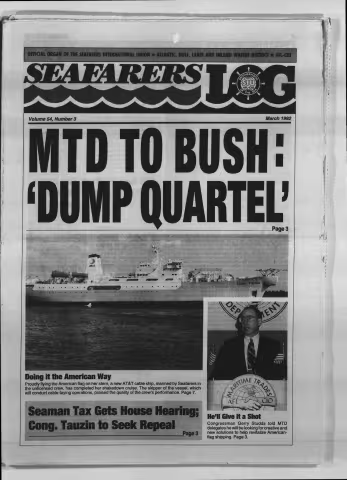
Cong. Tauzin to Seek Ropeal
Page 3
He'll Give it a Shot
Congressman Gerry Studds told MTD
delegates he will be looking for creative and
new solutions to help revitalize American-
flag shipping. Page 3.
:... •, .',. ,'c
'' /'4
;•••<%
-• ---'m
i'-im-
'- f
i:3fc
..|S?
: i 'A:
I
.{; 4.: •v;:?S:4-:?,:..i:
'•^'N 't-.r^U -'-J'
vS"':- i./-
i •.. •
•l-v«: I • ••• •• •;>V-^--
ivui- ?a
V •• .
li ; -• ;• s>'- "••
i'-I
..:i:
• l ••^.
j^-';
ti.-.,'•.
ii.. e' "• .:,. ; '•• •• ^^:,
-v-'-.
it.?;'. - :••;••,-•/
1-
,. 1
:'f
'1
' '<'-'• ••A'' '
President's Report
Editor's Note: The following column contains the text of comments by
SlV President Michael Sacco on economic growth. Sacco's remarks
were delivered to the executive board of the AFL-CIO
Maritime Trades Department meeting in Florida last
month during a discussion on the state of the nation's
economy.
Michael Sacco
If you will allow me, this is a point at which I would
like to add some comments. As bad as things are in this
countty, with all of our mounting problems, the
American labor movement can t^e pride in the fact
that it has been trying to tell the people of this nation
that they should wake up.
It is the labor movement which, more than any other grouping, has
been ringing the alarm about runaway health costs and the need for a na
tional program of protection for all citizens.
It is the American labor movement which has been waming of the dis
aster that will come from a trade agreement that will open Mexico as an
official runaway shop for profiteers.
It is the American labor movement which kept hammering at the in
adequacy of unemployment insurance as the recession deepened. On and
on it goes, in regard to every major social issue, the labor movement
alone is alert to the problems that confront the mass of Americans.
Unfortunately, our warnings are not always properly recognized.
In fact, Americans—and polls have demonstrated this—hold unions
partially responsible for the nation's economic plight. The rabble-
rousers, the union haters and union busters, the low-wage payers and
chiselers, aided and abetted by a national administration that thinks this
country should be run for the benefit of a few, have been deluding too
many people that this country is better off when unions are weakened.
And while I share the anger of most Americans at the Japanese
criticisms of American workers, as "lazy," "stupid" and "uncompeti
tive," I'm glad in a way that it happened. In the words of the old after
shave lotion commercial: "We needed that."
That Japanese misjudgment is serving to wake up the American
people who, for some unknown reason, thought of themselves as
separate from the working class. But they are taking the Japanese
criticism personally and are examining the realities: For too long, the
American worker has been taking the rap for our country's decline. For
the past 10-12 years, unions, in an effort to halt the sliding economy,
kept wages down, improved productivity and otherwise cooperated with
management arid government to fight the stumbling economy.
After all that effort, things kept getting worse, until even the President
had to acknowledge the problem. And now the nation is beginning to un
derstand that unions are not the problem they were made out to be.
Much of the deep hole that we all find ourselves in was dug by inept,
greedy management and lax and permissive government. Their
stewardship of the people's welfare over the last dozen or so years can
fittingly be described as the "creaming of America."
While workers were accepting wage cuts and give-backs, manage
ment was rewarding itself with enormous salary and perk increases that
kept going up as sales and business declined and layoffs mounted. Al
most without exception, top management of thousands of major corpora
tions have been bilking their stockholders and companies as they and
their appointed rubber-stamping directors skimmed millions and billions
of dollars in profits through so-called stock option scams.
Talk about violations of democracy and the rights of shareholders!
You'd think that by now the victimized shareholders would be picketing
the Securities and Exchange Commission demanding an end to this legal
ized pocket-picking. But nobody beefs — except for the labor movement.
All of this is finely getting the public's attention. It is beginning to
understand the real causes behind this nation's dilemma.
Just consider what the deregulated banking and investment businesses
have cost this nation enormously as the country's workers pick up the tab
for the wild period of leveraged buyouts, unsecured mortgage loans and
in many cases—outright thievery by giant business. The latest calcula
tions now are that the cost of this disgraceful episode alone to Ameri
cans will be 450 billion dollars. It's still counting.
All the while the national administration encouraged this kind of
"competitiveness," if you'll pardon the expression. There has been case
after case of federal administration insiders being involved in these
scams, paving the way for set-ups, evading the law, cooking the books,
and squeezing out millions for themselves that are now to be paid for by
us, our children and grandchildren.
Despite all of this, we still hear the tired, worn-out cries from those
who sat on their hands when all of this was happening that "unions are
the cause of all our problems." I am sure you've seen it in your own
areas. We have one such example in our own shipping industry—another
one of Bush's sony political appointments, a member of the Federal
Maritime Commission named Rob Quartel. FMC is a regulatory agency
which has the job of ensuring non-discriminatoiy rates and practices in
ocean shipping.
From what we observe, Quartel spends a substantial portion of his
time flying around the coun^ at taxpayer expense, blasting maritime
unions and calling on American shipping companies to pull down the
stars and stripes from their ships and replace them with foreign flags and ^
foreign labor.
SEAFAHHtSUOG
In the couple of years since Bush found a spot for him on the public
payrolls, we have never heard this cross-countiy gadfly offer one con
structive suggestion as to how America could strengthen its shipping in
dustry. When he leaves the commission, he'll no doubt return to his
former business as a "private consultant" to "international firms" which
find his anti-U.S. shipping activities right up their alley and a service to
be rewarded. He will go right back through the revolving door along
with the thousands of others who make some government connections
and then turn right around and go to work for groups that are opposed to
the interests of the American people.
As President Bush pokes around for answers to the mess he's laid on
this country, maybe he could begin by getting rid of some of the political
hacks he has stacked his administration with and replace them with some
creative thinkers who believe America should begin working for the
good of all the American people. He could begin with the likes of Rob
Quartel.
Labor unions have always had their avowed enemies—and we probab
ly always will. Mostly, they are people who believe in cheap labor and
who would deny working people life's basic necessities and the better
things of life.
It is pretty obvious there is no shortage of challenges for the
democratic trade union movement. More so now than ever.
It is up to us to pull together harder than ever, to make the labor move
ment the forceful factor in American life for which there is no substitute
in the interests of working people.
SlU Insists Work Tax issue
Rates Court's Attention
The Seafarers International
Union has insisted that court action
is needed at once to settle the mat
ter of the work tax the Coast Guard
is seeking to impose on American
seamen and boatmen.
The SIU's demand was filed in
federal court in response to a Coast
Guard legal move to side step the
issue by asking the court dismiss
the case. Attorneys for the Coast
Guard are claiming that the plain
tiffs, that is, the SIU and the five
individual merchant seamen and
boatmen who filed the lawsuit,
face "no injury-in-fact" from the
proposed regulations.
The union, through its lawsuit,
is attempting to block the so-called
user fees the Coast Guard plans to
collect for procedures associating
with issuing marine licenses and
documents. The SIU's lawsuit,
filed in U.S. District Court for the
District of Columbia in December,
charges the fees are in reality a tax
on seamen for the privilege of
working and, as such, are uncon
stitutional. Further, the SIU suit
claims the manner in which the
Coast Guard deduced the fees was
based on faulty data and gross in
accuracies.
It was in early February that the
Coast Guard, through its govern
ment attorneys, filed a motion to
dismiss the SIU's lawsuit against
the work tax, which, as described
Volume 54. Number 3
by the Coast Guard in its rulemak
ing last year, will be in the area of
$135 for an AB or QMED en
dorsed document and $330 for an
upper level license.
The Coast Guard court papers
said the SIU's suit was "not ripe
for review" and that there has been
"no direct or indirect impact"
since, among other reasons, "no
fees have been imposed on any of
the individual plaintiffs or any of
the members of the union."
The SIU's attorneys challenged
the Coast Guard's assertions in
their court papers filed in late
February responding to the
agency's move for dismissal.
"Merchant seamen will have little
choice but to pay the fees if they
cannot obtain judicial review of
the Coast Guard's decision before
the fees are implemented. They
cannot ply their trade without
licenses and documents," the SIU
brief argues.
Additionally, the SIU court
paper states that seamen and boat
men "can ill afford these so-called
fees, and should not be required to
pay them unless and until this court
finds that the Coast Guard is acting
within its constitutional and
statutory authority."
The Coast Guard's plan for user
fees came about as a result of a
budget agreement made by the ad
ministration and Congress.
March 1992
The Seafarers LOG (ISSN 0160-2047) is published monthly
by the Seafarers International Union; Atlantic, Gulf, Lakes and
Inland Waters District; AFL-CIO; 5201 Auth Way; Camp
Springs, Md. 20746. Telephone (301) 899-0675. Second-class
postage paid at MSC Prince Georges, Md. 20790-9998 and at
additional mailing offices. POSTMASTER: Send address
changes to the Seafarers LOG, 5201 Auth Way, Camp Springs,
Md. 20746.
Communications Department Director and Editor, Jessica
Smith; Assistant Editor, Daniel Duncan; Associate Editors,
Jordan Biscardo, Max Hall; Associate Editor/Production,
Deborah Greene; Art, Bill Brower.
IKV"!
K
•:•: ' • • •r'.-i'-.-.'ji':*,,
':V Hi ...,., .M
"•1 : i*--.<-A?.ti'* J' ••
< -C'/ '
-.uL--'-5;; .s ,77"'
/'.r"
•::• -fvi -•.,-.
MTD Urges Firing of FMC Offlciai
The Maritime Trades Department, consisting of 42 na
tional and international unions representing 8.5 million
American workers, called on President Bush to remove Rob
Quartel from his job as one
of the five members of the
Federal Maritime Commis
sion (FMC).
The action was taken at the
February MTD executive board
meeting during a discussion on the
state of the nation's economy.
Quartel, while serving as FMC
Commissioner, has contended that
the United States does not need a
privately-owned fleet operating
under the American flag.
In the two-day MTD meeting,
which took place in Bal Harbour,
Florida just prior to the AFL-CIO's
executive board session, board
members representing the
department's affiliated unions,
heard a call for "fresh" ideas to
make American shipping competi
tive from Congressman Gerry
Studds. The Massachusetts repre
sentative is expected to become
head of the House Merchant
Marine and Fisheries Committee
next year.
Two high-ranking members of
the House of Representatives
Democratic leadership. Con
gressmen Steny H. Hoyer (D-Md.)
and David E. Bonior (D-Mich.),
called on trade unionists
throughout the United States to
reject the economic policies of the
Bush administration by voting the
president out of office in
November's general election.
AFL-CIO Secretary Treasurer
Thomas R. Donahue advised the
MTD board of the labor
movement's efforts to ensure that
the administration does not give
away the store in upcoming trade
negotiations at the world level and
in talks with Mexico. Board mem
bers whose unions represent in
dustrial, transportation and
construction workers reported on
how the administration's lack of
support for American industry had
resulted in thousands of lost jobs
and hundreds of company
bankruptcies.
Working People Blamed
During the discussion of the
economy, MTD President Michael
Sacco, whose remarks prompted
the executive board to call for
President Bush to dismiss Quartel,
noted that for too long, American
working men and women had been
"taking the rap for the country's
decline."
Sacco said that contrary to a
public perception that labor unions
have borne a disproportionate
responsibility for the state of the
economy, "for the past 10 to 12
years, unions, in an effort to halt
the sliding economy, kept wages
down, improved productivity and
otherwise cooperated with
management and government to
fight die stumbling economy."
Sacco, who is the president of
the Seafarers Intemationd Union,
observed that the American public
is beginning to recognize that
"unions are not the problem they
Continued on page 9
Shidils Calls for Tresh' Ideas
To Revitalize U.S. Shipping
Congressman Gerry Studds an
nounced to the executive board of
the Mmitime Trades Dep^ment
he is ready to look for new ideas
and fresh approaches to get
American seamen back to work
and the American maritime in
dustry rebuilt when he takes over
the helm of the House Merchant
Marine and Fisheries Committee
next year.
Studds, a 20-year member of the
House of Representatives as well
as the committee, is expected to
become its next chairman when
Walter Jones (D-N.C.) retires at
the end of this session of Congress.
He addressed the gathering, which
represents more than eight million
trade unionists, at its winter execu
tive board meeting last month in
Bal Harbour, Fla.
Studds, who was making his
first public remarks about the com
mittee chairmanship, said, "I don't
have the answers, but they don't lie
in the failed ideas of the past."
The Massachusetts Democrat
compared the nation's maritime in
dustry with U.S. automakers to
make the point that govemment
must pay attention to key
American industries. "Some in
dustries are so important to our
economy and to national security
that we will intervene at the highest
level of govemment to see that
they survive.
"Well, I say ships are important,
too. And so are the people who
build them and so are the people
who repair them and so are the
people who crew them. We have to
renew our commitment."
Cong. Gerry Studds
Studds said the maritime in
dustry must be a part of the national
debate on American competitive
ness. "We obviously have to raise
the fundamental question: Do we
want, do we need a competitive
Unit^ States merchant marine? If
the answer is no, then we ought to
Continued on page 25
MTD executive board members dIscuSsed the current economic situation, upcom
ing trade negotiations and the impact of those agreements on American jobs, among
other issues, at a two-day meeting last month.
SIU Attacks •Unfair' Tax,
House Panel Pledges Repeal
Three members of a House sub
committee threw their support be
hind an effort to repeal a work tax
imposed on seamen and boatmen.
The pledge to work for a repeal of
the so-c^ed user fee on marine
licenses and documents came from
Congressmen W.J. "Billy" Tauzin,
(D-La.), Herbert H. Batemart (R-
Va.) and Gene Taylor (D-Miss.)
last month after hearing the tes
timony of the SIU and other wit
nesses representing marine labor.
SIU Vice President Joseph
Sacco, appearing before the Sub
committee on Coast Guard and
Navigation, which called the hear-
ing, labeled the tax "dis
criminatory" and "unfair" and
called on Congress to work for its
immediate repeal. Sacco noted that
American seamen and boatmen
were "shocked their govemment
expects them to pay not only in
come taxes, but now, on top of that,
a work tax."
After listening to the presenta
tions of Sacco and three other
panelists representing merchant
seamen, Tauzin, who chairs the
subcommittee announced that
"Mr. Bateman and I have done
some consulting and I think we
need to move to repeal."
Sacco noted that hundreds of
seamen and boatmen—^both union
and non-union—had contacted the
SIU to find out what they could do
to repeal the tax. He presented the
subcommittee with petitions col
lected by SIU member Anthony
Primeaux that contained the signa
tures of 438 boatmen working for
28 companies operating marine
equipment in the Gulf of Mexico,
llie SIU official also introduced
want to thank
the SIU for initiating
the lawsuit.
—Cong. Billy Tauzin
to the subcommittee the 44
Seafarers in the audience. 'These
young men and women who earn
their living by going to sea are
deeply concemed about the work
tax. They are all currently enrolled
in our Lundeberg School of
Seamanship where, after complet
ing their course work, they will
take Coast Guard tests to advance
to higher ratings." Cong. Tauzin
interrupted the hearings from the
normal course of business to
recognize the Seafarers and wel
come them to the panel's session.
SIU Executive VP Joseph Sacco
presented Congress with petitions ur
ging repeal of the tax.
SIU Moves in Court
Sacco reported that the SIU was
doing all it could to block the tax.
Continued on page 9
Asking mariners to pay a work tax is
unfair, said Cong. Billy Tauzin. chair
man of the House panel.
, I'
"-s • . :-m': •
•J •
• I <
ii r
' ''' "I
;j 'A..
'•7.,
"f# mm
V •• .r- •
W$ik
4)f..l;
' :'V'- ••.-i^'
.-'•••V.'.'T-; •' '•• '.V
{MIT[.
ti..' •••.•?' i
R:I:K
I: >
, E; •
iiS-^
--1! iVv;- • £
Sg®
7" ]' •' •'••!'
!, •
iV'
'•i' •,
I-.:'
•|! .'
y;-
I
4:
;i-
4
•' i' ' ••-/•
MS-a-SSa&ya
sfiiniffflisaN;
Pentagon Study Calls for More Sealift Capacity
Based on protecting America's
interest in a "turbulent" future, the
Department of Defense has ad
vised Congress that the military's
transport needs require "pre-
positioning, sealift and airlift as^
sets linked to a transportation sys
tem in the United States "
According to a Pentagon report
which was released last month, the
U.S. needs more military cargo
vessels as well as improved rail
and port facilities in order to avoid
the "considerable risk" of
shortages that occurred early in the
Persian Gulf war.
The Mobility Requirements
Study, of which an executive sum
mary was made available to the
public last month, calls for acquisi
tion over a nine-year period of 20
large roll on/roll off ships and the
chartering of two container ships for
prepositioning around the globe.
The report recommends assign
ing to the Army nine preposition
ing vessels and notes they would
transport combat and combat sup
port equipment. The Army is also
to have 11 roll on/roll off vessels
for the rapid deployment of its
heavy divisions.
The eight fast sealift ships,
which are crewed by Seafarers and
which were used extensively in the
Persian Gulf conflict, combined
with the roll on/roll off ships re
quested for the Army, should pro
vide the nation with the ability to
deploy rapidly from the continen
tal U.S. in times of a regional crisis,
said the study.
The plan also calls for expan
sion of the 96-vessel RRF to 142
ships by 1999 and an increase in
the fleet's readiness. Expansion
and modernization of the RRF
would occur through acquisition of
used ships or through build-and-
charter arrangements or national
defense features in new commer
cial ships. At least 104 of the
ships would have to be dry cargo
vessels.
Completion of this study set the
stage for President Bush's budget
proposal for an additional $1.2 bil
lion to invest in sealift vessels.
"In the future, the United States
must be able to deploy its combat
power more quicldy and with a
Andrew Card Succeeds Skinner
As Transportation Secretary
Andrew H. Card Jr.
Andrew H. Card Jr., who last
year backed the buy American-
ship American provision in the
foreign aid debate while serving as
a White House official, is the new
secretary of transportation. He also
attended the U.S. Merchant Marine
Academy at King's Point for a
year. The maritime industry is thus
hopeful that the new DOT
secretary will put a top priority on
revitalizing the American-flag
fleet.
The Senate on Februaty 21 con
firmed Card, 44, the White House
deputy chief of staff who was
chosen by President Bush to suc
ceed Samuel K. Skinner. Skinner
resigned in December to become
Bush's chief of staff.
Last year. Card supported the
buy American-ship American
provision of the cash aid bill,
reports the Journal of Commerce
(Feb. 24, 1992). In so doing he
bucked Ae White House, which
opposed the cash transfer
provision and threatened a veto
before the House unexpectedly
defeated the bill due to another
provision in it.
Card pledged to start spending
quickly the money from a six-year
transportation bill passed last fall.
That intention helped him breeze
through a confirmation hearing
before the Senate on February 7.
He endured one inauspicious
moment during the hearing, how
ever. Card told senators that he had
a "latent'- interest in maritime af
fairs. Senator John Breaux (D-La.)
responded, "What we really need
is a secretary with a blatant inter
est, because of all the programs in
your department, this is the only
one that is in major trouble."
Also during that hearing. Card
said, "1 support the Jones Act and
its implementation. 1 note that the
president does as well." Regarding
cargo preference, he stated, "1 do
support the cargo preference
provisions that Congress has im
posed, and 1 will work diligently to
see that the interests of Congress
are respected throughout govern
ment."
Asked for his thoughts about
foreign-built ships flying the U.S.
flag. Card said, "My instincts
would say that 1 would prefer to
have them built in the United States
and flagged in the United States
and run by operations that are part
of the United States. But 1 really
would like to have an opportunity
to further study that."
Card has been deputy White
House chief of staff since President
Bush took office in 1989. He is a
former Massachusetts state legis
lator and managed Bush's 1988
New Hampshire primary cam
paign. During the Reagan ad
ministration, he was Reagan's
liaison to governors, mayors, state
legislatures and other state and
local politicians.
more robust level of support," the
study said.
Congress is reviewing the clas
sified version of the report. Also, it
is expected that the Department of
Defense will ask Congress to ap
prove legislation enabling the es
tablishment of a "Sealift Fund" in
the fiscal year 1992 defense bill.
The fund not only would receive
the $1.2 billion expected to be re
quested in the '93 budget, but also
may have transferred the pre
viously appropriated $1,875 bil
lion from FY '92. This fund would
provide the resources to construct,
convert and purchase ships for the
DOD's sealift plan.
0L5. S/i/p Gambling BBI
Awaits ffifslr SImatmv
A technical adjustment caused
what is expected to be a minor
delay in President Bush's signing
of a bill that allows gambling on
U.S.-flag passenger ships.
The words "Soviet Union,"
which appeared in the original
Cruise Ship Competitiveness Act,
were changed to reflect the rejec
tion of communism in the new
Commonwealth of Independent
States. The alteration meant the bill
had to go through the House and
Senate a second time; both
branches quickly passed the legis
lation late last month.
Barring an unforeseen veto, the
bill (H.R. 3866) could become law
some time this month.
The SlU and others in the U.S.-
flag shipping industry strongly
support this gambling legislation
because, if enacted, the measure
could provide sufficient incentive
for investment in American-flag
passenger ships. This would lead to
thousands of new American jobs.
Presently, two outdated federal
laws prohibit U.S.-flag cruise ves
sels from offering gambling.
Foreign-flag ships are not subject
to the same restrictions, though
most sail from U.S. ports.
Although more than 85 percent
of all cruise passengers worldwide
are Americans, only two of the
more than 120 deep-draft cruise
ships in the world fly die U.S. flag—
the SlU-crewed Independence and
Constitution.
New Matson Vessel Christened
Matson Navigation's newest ship, the R. J. Reiffer, will commence sen/ice in August.
The MV R.J. Pfeiffer, the only
large commercial ship under con
struction in the United States, was
christened February 15 at a
shipyard in San Diego.
The new 714-foot containership
is owned by Matson Navigation
Company and is named for the
company's chief executive officer
and chairman of the board.
Delivery of the ship is scheduled
for June, with service commencing
in August.
President Bush sent a con
gratulatory letter which was read at
the ceremony, conducted at the
National Steel and Shipbuilding
Company (NASSCO) shipyard.
The letter read in part: "As part of
our total domestic fleet, R.J. Pfeif
fer symbolizes the continued im
portance of our entire shipbuilding
and repair industry —• an industry
that boasts a long and impressive
record of production.
"The U.S. Jones Act Fleet, con
structed under the Merchant
Marine Act of 1920, has played
and will continue to play an impor
tant role in maintaining a viable
U.S. Merchant Marine and U.S.
shipbuilding and repair base.... 1
am pleased to reaffirm my support
for a strong domestic maritime in
dustry."
Many speakers at the christen
ing addressed the state of U.S.
shipbuilding. Congresswoman
Helen Delich Bentley (R-Md.), a
longtime supporter of the
American merchant marine, gave
the keynote speech.
Other speakers included Cap
tain Warren Leback, maritime ad-
ministrator, and NASSCO
President Richard H. Vortmann.
The vessel's projected crew
complement is 21. Accomrnoda-
tions also are available for a riding
crew, and there is an owner's
cabin.
The contract cost for the Pfeiffer
is $129 million and does not in
clude government subsidies.
• '"'/v.
-.-.i'rr'-'
msm
•m--
' r '
1- " ' V
• V _•" t
Tellex Apiwtnied VP; Mangranig Hall Named J^sL VPs
Augustin Tellez
The executive board of the
Seafarers International Union, At
lantic, Gulf, Lakes and Inland
Waters District named Augustin
"Augie" Tellez as the vice presi
dent of collective bargaining effec
tive inunediately.
The move created an opening
for assistant vice president for col
lective bargaining. The board ap
pointed Kermett Mangram to
replace Tellez at that post.
The board also announced
Robert "Bob" Hall as the assistant
vice president for government SCT-
vices, replacing George Ripoll who
retired at the end of I>%ember.
Under Article X, Sections l(j)
and 13 of the AGLIWD constitu
tion, the president has the power to
fill openings created by retire
ments between elections with the
support of the executive board.
Tellez, 37, takes over as the
head of the union's contracts
department from Angus "Red" ,
Campbell who retired December '
31,1991.
Lundeberg Graduate
A native of Ponce, P.R., Tellez
graduated in class 189 from the
Seafarers Harry Lundeberg School
of Seamanship in 1975. He began
his deep sea deck department
career on the T.T. Brooklyn.
Tellez came ashore in 1978 to
work in the port of New York, first
as an entry-rating instructor, then
as a patrolman. He was appointed
port agent for New York in 1980.
In 1987, Tellez began working
at the union's headquarters in
Camp Springs, Md. as an assistant
to the SlU president. He was
elected a vice president of
Seafarers Intemational Union of
North America at the 1987 conven
tion.
In his roll as the assistant vice
president for collective bargaining,
Tellez has been an active member
of the union's negotiating team for
the last two standard agreements.
He also serves as a vice president
for both the Maryland and New
Jersey AFL-CIO labor councils.
Tellez is a second generation
Seafarer. His father, the late
Augustin Tellez, sailed as a bosun
as did his brothers, William and
David, who died last year. His
brother-in-law is Chief Cook Ben
Santos.
Mangram, a native of Jackson
ville, Fla., graduated with a
bachelor's degree in business ad
ministration from Florida A&M
University before heading to the
Lundeberg School. He graduated
from class 259 in 1978 then sailed
aboard the Sea-Land Seattle as a
steward assistant.
The 37-year-old started work
ing for the SlU in 1980 as a union
education instructor at the Lun
deberg School. He was appointed
apatrolman for New York in 1981,
a position he held until being
named port agent there in 1987 to
replace Tellez.
Mangram is involved with the
Hudson County (N.J.) Central
Labor Council and serv^ in 1988
as a vice president of the Hudson
County A. Philip Randolph In
stitute.
Bom in New York City, Hall
began sailing as a deckhand on tug
boats along the Mississippi River.
He also worked on the Great
Lakes and aboard coastwise tug
boats before being named a
patrolman for the port of St.
Louis in 1980.
Hall worked in ports along the
Mississippi and Gulf of Mexico
handling inland beefs and disputes.
He was appointed patrolman in the
port of Jacksonville in 1985.
Kermett Mangram
Robert "Bob" Hall
Hall, 39, was named port agent
of Seattle in 1988. Since then, he
was appointed by Govemor Booth
Gardner as the maritime labor rep
resentative to the nine-person
Washington State Labor Council.
He also is a delegate to the
Washington State AFL-CIO.
Admiral Jackson Tug Crew Saves 3 Men Trapped by Fire
Though the rescue occurred
nearly two years ago, SlU tugboat
Captain William Tucker readily
recalls the smokey inferno he and
his crew on the Admiral Jackson
overcame to save the lives of three
trapped men. Deckhands Fred
Cooper and Jimbo Lee were "up
top, squirting water and fighting
the smoke." Tucker and Engineer
Johnny JefTcoat did their parts to
"get the boat close," and the
Seafarers saved three men stuck on
drydock.
The blaze started when two 150-
gallon diesel tanks on board a grain
barge exploded while undergoing
repairs at Bender Shipbuilding and
Repair Co. in Mobile, Ala. in June
1990. Responding to the emergen
cy were five fire units, a hazardous
materials unit, a special foam unit
and privately owned tugboats in
cluding the Admiral Jackson. At
the time, a Coast Guard spokesman
said, "1 would have hated to have
seen what would have happened if
those boats hadn't been there."
For their courageous efforts.
Tucker, Lee, Cooper and Jeffcoat,
along with officials of Crescent
Towing Co., which owns the boat,
recently received the Coast Guard
Public Service Award. Brother
Cooper, who passed away this
year, was honored posthu
mously.
Rear Admiral James L. Loy,
commanding officer. Eighth Coast
Guard District, New Orleans,
presented the award during
ceremonies conducted by the Port
of Mobile chapter of the Propeller
Club. Tucker and Port Agent Dave
Carter accepted the award on be
half of the Seafarers.
Captain William Tucker (second from right) and Mobile Port Agent Dave Carter
(right) accept the public sen/ice award on behalf of the honored Seafarers. Also
present were Richard Murray, CEO of Crescent Towing (left) and Rear Admiral Loy.
"It's great that the Coast Guard
is showing their appreciation,"
said Tucker, a 25-year SlU mem
ber who attended the ceremony.
During the award presentation.
Loy noted that if the fire "had not
been dealt with very, very quickly,
it had the potential of spreading to
fiiel tanks, the ships next door and
across the river. Clearly there
could have been a loss of life, and
there could have been extensive
damage to property. That was
eliminated by the good Samaritan
kind of approach to things that is
veiy typic^ of mariners."
Tucker, 51, recently told a
reporter for the Seafarers LOG,
"The people who should get the
most praise are my two
wheelsmen—they were up top,
fighting the smoke. ... It lasted a
good hour or hour-and-a-half."
Captain Tucker said he and his
men didn't have time to be
frightened. 'There's no use getting
scared. You just do what you have
to do, and maybe you can get
scared later. But 1 fought one like
that years ago, out in Houston on a
tanker."
The award noted that the crew is
being honored for their "decisive
and selfless endeavors in providing
firefighting assistance "
InlamlDiMon Seafarers Praised for 'Flawless' Work
SlU members received praise
for their skillful execution in
towing an LNG ship from one Vir
ginia port to another.
Inland division members from
the ports of Norfolk, Va. and Bal
timore crewed the four boats which
successfully moved the LNG
Gamma from Newport News, Va.
to Norfolk. Seventeen Seafarers
were involved in the operation
which took place December 17 in
crowded waters.
George Flanagan, general
manager of McAllister Towing of
Virginia, Inc., which owns the four
boats us^, conunended SlU mem
bers in a letter. "The successful
completion of this tow through a
congested harbor could not have
occurred without your combined
expertise and cooperation, as well
as that of your crews," Ranagan
wrote to the tugboat captains. He
also noted the Seafarers' "dedi
cated support throughout the
years."
Similarly, the president of
Gamma's parent company ex
pressed his appreciation in a letter
to McAllister. "The operation went
flawlessly," wrote Thomas
Alexander, president of
Alexander, Starr & Kersey, Inc.
The following SlU members
took part in the move: from the
Nancy McAllister, Captain
George Thompson, Mate Robert
Brush, Deckhand Gary White
and Engineer Glna Redditt; from
the Isabel A. McAllister, Captain
Richard McMuiien, Mate
Richard Kirby, Deckhand David
Ritch and Engineer George W.
Thompson; from the Brent Mc
Allister, Captain Charlie Ruperti,
Mate Robert Walker, Deckhand
Martin Meravy and Engineer
George Noble; and from the Mark
McAllister, Captain Gerry
CifarelU, Mate B. Foltz, Deck
hand L. Watts, Chief Engineer R.
Rhodes and Assistant Engineer M.
Wallace.
'"i ^ J.'-
>/. •#> -
... ^ ., •' -hfr'-'M •
14 • '
• f-'-:
•v ..i
<i • " *
-
•V T ̂
' ' ' • '.M ••'
-¥---v
SEOPMBtSLOG
MTD Exec, Board Stresses Trade UusiBeneBt Nation
"Any trade agreement must
keep the interests of the working
people in the United States as its
top priority."
With those words, John J. Barry,
president of the International
Brotherhood of Electrical
Workers, captured the concern of
the American labor movement in a
speech to the Maritime Trades
Department executive board meet
ing last month.
Barry and others—including
United Auto Workers President
Owen Bieber; Thomas R.
Donahue, the AFL-CIO secretary-
treasurer; Jack Otero, vice presi
dent of the Transportation •
Communications Union and a
member of the AFL-CIO execu
tive council; Robert McGlotten,
AFL-CIO political affairs director;
and Julius Isaacson, president of
the Allied Novelty and Production
Workers of America—enumer
ated the dangers posed by the
administration's international
trade negotiations and agreements,
particularly the North American
Free Trade Agreement (NAFTA),
which started as a deal with
Mexico and now also includes
Canada.
The speakers urged all trade
unionists to join in the effort to
save American jobs, in part by pur
chasing U.S.-made goods.
"We are not opposed to interna
tional trade," said Barry. "But we
are opposed to the stance taken by
the^Bush Administration during
the negotiating of international
trade agreements. Particularly in
the case of the NAFTA, we believe
the direction such trade talks have
been taking is not in the best inter
ests of U.S. workers."
Bany noted how the existing
maquiladora program—which al
lows U.S. businesses to set up
operation in Mexico and send
products to the U.S. without the
customary tariffs—attracts U.S.
companies because of duty-free
benefits, cheap labor, lack of en
forced safety and environmental
laws and lack of political and labor
rights.
Bieber pointed out the Bush Ad
ministration has—until this elec
tion year—turned a deaf ear
toward that industry's trade dif-
UAW President Owen Bieber notes
the Bush administration has paid little
attention to automotive trade problems.
Bob McGlotten, AFL-CIO political af
fairs director, calls for mobilization of
every trade unionist in the country.
ficulties. 'The single biggest prob
lem facing the U.S. domestic auto
industry is trade and, more specifi
cally, trade with Japan," Bieber
said. 'The U.S. automotive trade
deficit with Japan accounts for a
jarger share of the overall U.S.
trade' deficit than any other
bilateral, product-specific
category of trade.
"Up until very recently, it's a
colossal understatement to say that
the Bush Administration has paid
veiy little attention to our problems
in the automotive trade."
Bieber then shattered a few
myths about the quality and con
struction of U.S. cars. He gave
detailed examples of how money
spent on American products goes
back into the U.S. economy.
"Every time an imported car is pur
chased here in the U.S., it costs an
average of almost $3,400 in lost
feder^, corporate and individual
income tax revenues, state in
dividual tax revenues, local
property taxes and Social Security
contributions," he said, using an
IBEW President John Barry stresses
the dangers of the North American
Free Trade Agreement.
Jack Otero, VP of the Transportation •
Communications Union, says jobs loss
"is a problem for all of us."
example which also applies to
other American-made goods.
"UAW-made cars and trucks have
features you can't get on imports
—schools, roads, bridges, police
and fire protection ... as well as
jobs that create more jobs and
generate even more tax revenues."
"My union has already felt the
sting of high unemployment as a
result of the maquiladoras in
Mexico," Otero said. "Since 1984,
we have lost 25,000 jobs to
Mexicans.... But it affects all of
us, it is a severe threat for all of us,
and I think that sometimes we are
too passive. We say, 'Well, it
doesn't impact me. That's a prob
lem for the auto workers, that's a
problem for the steel workers.' It is
a problem for all of us."
Donahue pointed out that no
such thing exists as so-called free
trade in other nations. He said
many nations block exports from
the U.S. by invoking laws that
prevent their balance of payments
with the U.S. from being tipped in
favor of American products enter-
Extra-Early Fiimit Begins for Lakes Seamen
Because of unseasonably warm
weather, some Seafarers began
crewing vessels and sailing on the
Great Lakes in late February al
though fitout for most members is
scheduled to begin in mid-March.
Great Lakes members should be
aware that fitout may take as long
as a month, according to Algonac
Patrolman Andy Goulet. "Fitout
dates are very tentative at this
time," Goulet told the Seafarers
LOG. "Companies have given us
fitout dates through April, but
exact dates have been changing on
almost a daily basis."
The Paul Townsend, an Inland
Lakes Management cement car
rier, left its winter home of Mil
waukee in the last week of
February for two runs to refill
Michigan cement silos. The
Townsend soon will be joined on
the Lakes by other cement boats,
typically the first vessels out after
winter.
Because of mild weather condi
tions in the area since November,
none of the five lakes completely
froze over. Ice floes in harbors and
rivers are the only natural impedi
ment to getting the ships out
sooner. (The St. Clair River, which
connects Lake Huron with Lake
Erie, was jammed for almost three
weeks beginning in mid-February
near Algonac, Mich.)
One reason for the varied dates
to report to ships is the effects of
the economic recession along the
Great Lakes. Most ports reported a
downturn in the amount of cargo
handled in 1991 as compared to
1990 figures. Total tonnage carried
by U.S.-flag carriers in the region
fell by slightly more than seven
percent to 104 million tons, ac
cording to year-end figures com
piled by Lakes Carriers
Association.
Almost half of all the cargo car
ried aboard U.S.-flag vessels was
iron ore at 49.2 million. Limestone
and gypsum were next at 22.2 mil
lion, followed by coal and coke at
18.6 million.
Of all the U.S. harbors reporting
their figures to the association, the
"Twin Ports" region of Duluth,
Minn./Superior, Wis. handled the
most cargo at 39.2 million tons.
Julius Isaacson, president of the Al
lied, Novelty and Production Workers,
says U.S. jobs must not be undermined.
AFL-CIO Secretary-Treasurer Tom
Donahue emphasizes possibility of na
tions locking out U.S. goods.
ing their country. For example, if
the U.S. had this kind of law with
Japan, we would have halted bil
lions of dollars worth of Japanese
jroducts entering the U.S. market
>ecause the current balance of pay
ments with Japan is so skewed in
favor of Japan.
"Any nation which now
declares to you, 'We have a
balance of trade problems,' can
now lock out our goods," Donahue
noted. "And they will continue to
have that ability. That is not fair."
McGlotten emphasized the
solution lies in effective political
action. He said, "The time has
come for us to understand that un-
less we mobilize every trade
unionist across this country, then
we are doomed to failure in terms
of trying to execute legislative in
itiatives.
"We must redouble our efforts
and say to whomever is in the
White House, to whomever is in
the Congress that they have a
responsibility to workers across
this country. We're the ones who
built this country. We're the ones
who keep it afloat. We're the ones
who fight for this country—not the
guys on Wall Street."
Isaacson added, "We support
increased world trade and want to
help other nations increase their
rate of economic development and
their standard of living. But we do
not believe these gains should
come by undermining the jobs, in
come security and standard of
living of large segments of the U.S.
population."
The MTD executive board
adopted resolutions calling for a
vyorkers-rights clause in all trade
pacts to which the U.S. is a sig
natory party. "The administration
is urged to require compliance by
our trading partners with the mini
mum labor and safety standards
required by U.S. law," stated a
resolution passed by the board.
'JL
•• ^ .;•••.; i":-.S-
Huutaiis^ ''•JfS/.<"\\:f- .
. •; 'V"'
:"^§,i-:
V- "•
' 41^'
,'.' -^v-v' ft.
A T&T Breaks Out the C/S fil0i»l Sentinel
The Global Sentinel, AT&T's
newest cable ship, is undergoing its
shakedown operation off Ae coast
of Hawaii after completing its in
augural run last month. The
American-flag cable ship has
received its first prew comple
ment—American seafarers from
around the country in the rated
positions and galley and officers
from District 2 Marine Engineers
Beneficial Association.
The seamanship skills of the
American crew did not pass un
noticed. Even before leaving the
shipyards, SIU crewmembers who
boarded the cable ship in Sin
gapore in January "impressed"
U.S. Coast Guard inspectors as
signed to witness the first lifeboat
drills for the ship.
The 479-foot cable ship arrived
in Honolulu on February 4 after
departing from the shipyard in Sin
gapore in Januaiy for its inaugural
voyage. The Global Sentinel joins
the Charles L. Brown, Long Lines
and Global Link as SlU-contracted
vessels sailing for Transoceanic
Cable Ship Co., an AT&T sub
sidiary.
Chief Steward Ken Rosiek,
who was aboard the Global Link
last year when it came out of the
yards, echoed the words of Captain
D. B. Neal when he said, "We have
a great crew on board:"
Speaking to a reporter from the
Seafarers LOG, Neal could not
stop praising the SIU members
who brought out the Global Sen
tinel: "I want you to know, I am
impressed with this crew. It is one
of the best that I have observed on
a first-time fire and boat drill."
Continued on page 8 Global Sentinel just joined the AT&T U.S.-flag cable ship fleet.
Bosun/Mate Tim Mc- Working one of the two During a short break,
Cormack lists the day's as- cranes on the Global Sen- Shawn Young relaxes in the
signments. tinel is ABLindyBeth Wilkin, crew mess.
OS Enio Aulelava posi- AB Sherman Hudson OS Erik Spearman in-
tions a line in a cable makes sure the line Is spects a line as it is un-
hold. leaving its reel evenly. reeled.
The cable ship utilizes the new encapsulated lifeboats.
Laying a ship's line in a cable hold are (left to right) OS Kamin Raji, OS Henry
Wright Jr. and AB Sam Tumala.
Si-'-#
.. • i-
f
»• .•
• • ''M 'ri
.t-
j:-' ' : L
.,•'1 -vm
I
t':-:
1't
t.-..
8 SEAFARERS LOG
• -n V' •'
v-i: ' i"
•^Ct..L:: ;•
' .' ^k'h'
Luedtke Dredge SlU Men Hone Diesel Engine Skills
Fourteen Seafarers are return
ing to their Great Lakes tugboats
and dredges with up-to-date engine
troubleshooting information after
completing a one-week course at
the Seafarers Harry Lundeberg
School of Seamanship.
The group, all of whom work for
Luedtke Engineering of Frankfort,
Mich., received special training
from school instructor Bill Foley
on the use of the GM Detroit diesel
engine, which is used on Luedtke
vessels.
During the classroom session,
the members reviewed start-up and
running checks and discussed fuel,
cooling, air, lubrication and
electric starting systems. In the shop,
the group worked on fuel injector
A Luedtke dredge sails toward Lake Erie to begin another workday.
AT&T Cable Ship Skipper
Cites Crew's 'Expertise'
Continued from page 7
Neal videotaped the crew's
response in manning, launching,
navigating and reattaching the
ship's new-styled encapsulated
lifeboats during the Coast Guard
drills in Singapore harbor. "[The
crew's] expertise even impressed
the Coast Guard," Neal recalled.
Neal's video showed that crew-
members handled the drills almost
flawlessly. For many, it was their
first experience with a covered
lifeboat, required on all U S.-flag
vessels built after 1990.
Like its sister ship, the Global
Link, the Global Sentinel is
equipped with the most advanced
technology in its field. The vessel
has a full-load draft of 26 feet and
can cruise at speeds of up to 15
knots. It can maintain a speed of 6
to 8 knots while laying fiber-optic
cable and a speed of 4 knots when
towing a sea plow and laying cable.
To help the ship keep its position
while working on cables, the Global
Sentinel has a bow thruster.
The Global Sentinel will be
docked in Hawaii while it com
pletes its shakedown operations.
Transoceanic plans to put the ves
sel into operation in April in the
Pacific.
The four Transoceanic/AT&T
ships compete with foreign com
panies which operate foreign-flag
vessels to build, lay and maintain
undersea fiber-optic cables.
Chief Cook Elston Tensley offers
sandwich to hungry crewmember.
SA Francisco Roy welcomes a crewmember
to the galley.
Posing in the officers' mess are SA Ismali Monassar, SA Joyce O'Donnell, Chief
Steward Ken Rosiek and SA Ricardo Sebastian.
removal, testing and reinstallation,
exhaust valve clearance setting and
filter replacement.
Karl Luedtke, company presi
dent. Joined the students for a day-
and-a-half at the school.
Luedtke Engineering dredges
are found during the sailing season
all around the Great Lakes install
ing marine breakwaters, pilings
and underwater pipelines as well as
dredging harbors.
Great Lakes members (left to right) Joseph Kane, Kevin Hollenbeck, Tom Forgrave
and Ken Chaser work with Instructor Bill Foley (second from right).
Among those receiving hands-on troubleshooting experience are (left to right) Paul
Taylor, Don Holdsworth, Ken Garrett, Raridy Rice and Shannon Jensen.
, i ;; :
Karl Luedtke (left), president of Luedtke Engineering, visits the classroom where
Great Lakes members are participating in a special diesel engine operation course
at the Lundeberg School.
Great Lakes members from Luedtke Engineering who attended the special diesel
engine course include (left to right, front row) Tom Forgrave, Shannon Jensen, Ken
Garrett, Paul Taylor, Ken Chaser, (center row) Instructor Bill Foley, Randy Rice,
Kevin Hollenbeck, Joseph Kane, Jim Rider, Dale Leonard Jr., Don Holdsworth,
(back row) Jim Gible, John Biondo and T.C. Zatkovic.
- If;
jwri'A -- , *
MARCH 1992
Continued from page 3
were made out to be" and that there
is a growing realization that "much
of the deep hole that we find our
selves in was dug by inept, greedy
management and lax permissive
government. Their stewardship of
the people's welfare over the last
dozen or so years can fittingly be
described as the 'creaming of
America.'"
He charged that the deregulated
banking and investment busi
nesses "have cost this nation enor
mously as the country's workers
pick up the tab for the wild period
of leveraged buyouts, unsecured
mortgage loans and in many
cases—outright thievery by giant
business."
White House Responsible
The MTD official held the
White House responsible, saying,
"There has been case after case of
federal administration insiders
being involved in these scams,
paving the way for set-ups, evad
ing the law, cooking the books, and
squeezing out millions for them
selves that are now to be paid for
by us, our children and
grandchildren."
Despite these circumstances,
there are still some "tired, worn-
out cries from those who sat on
their hands when all of this was
happening that 'unions are the
cause of all our problems.'"
"We have one such example in
our shipping industry—another
one of Bush's sorry political ap
pointments, a member of the
Federal Maritime Commission
named Rob Quartel."
'Cross-Country Gadfly'
He accused Quartel, whose job
is to ensure non-discriminatory
rates and practices in ocean ship
ping, of spending "a substantial
portion of his time flying around
the country at taxpayer expense,
blasting maritime unions and call
ing on American shipping com
panies to pull down the stars and
stripes from their ships and replace
them with foreign flags and foreign
labor.'
Sacco said, "we have never
heard this cross-country gadfly
offer one constructive suggestion
as to how America could
strengthen its shipping industry."
Sacco said that "as President
Bush pokes around for answers to
the mess he's laid on this country,
maybe he could begin by getting
rid of some of the political hacks
he has stacked his administration
with and replace them with some
creative thinkers who believe
America should begin working for
the good of all the American
people. He could begin with the
likes of Rob Quartel."
Jack Otero, vice president of the
Transportation • Communications
Union and an MTD board member,
following Sacco's comments, sub
mitted a motion calling on Presi
dent Bush to remove Rob Quartel
from the Federal Maritime Com
mission which was then adopted
unanimously.
Otero said that Quartel, who
was being paid by the public
treasury to regulate shipping, had
overstepped his bounds.
Quartel is a "loose cannon
whose sights are aimed at the Jones
Act, operating subsidies and all the
other laws and programs that
would help American ships sur
vive against unfair competition
from foreign operators with loose
safety, manning and wage stand
ards," Otero said.
Additionally, said the TCU offi
cial, Quartel has worked to scuttle
the very maritime programs the ad
ministration is on record as sup
porting, such as the Jones Act and
cargo preference. Otero ended his
remarks by calling on President
Bush to put in place a team of
appointees that will support
American industries.
Views Expessed by Quartel on U.S. Shipping
• Before the Florida Customs &
Brokers in Qriando on January 1992 in
response to a joint initiative by Sea-
Land/American President Lines to
bolster U.S. shipping:
"My own personal response is—
Why wait until 19951 Do it now! Start
flagging out as soon as possible!"
"... you may no doubt be able to tell
that I view the Jones Act—this most
over-rated, over-expensive, ineffec
tive, anti-competitive, anti-consumer,
}rotectionist, archaic of all maritime
egislation—as long overdue for
elimination."
• Before the International Trade
Club of Southem California in Long
Beach in November 1991:
• Before the Florida Customs
Brokers & Forwarders in January
1991:
"i am said to support the repeal of
the Shipping Act of 1984, cargo
preference laws, the Jones Act, the
Merchant Marine Acts of 1920 and
1936, and large parts of the Shipping
Act of 1916, and, in fact, I do."
• Before the Bulk Expo '91 con
ference In Houston, Texas in October
1991:
The union leadership fears mixed
crewing because it may mean a
decline in union dues and retirement
contributions and officer compensa
tion. The congressmen fear the decline
of their special interest constituency
and PAC contributions... And MarAd
bureaucrats fear the loss of the
programs on which their power—in
deed their very existence—depends."
SlU Calls on Congress to Repeal Seaman Tax
Continued from page 3
including filing a lawsuit in federal
district court.
The SIU official said the
union's court action seeks to
prevent the implementation of the
Coast Guard's proposed user fee
for marine licenses and documents
on the basis that the scheme vio
lates the U.S. Constitution and was
not determined in a manner that
complies with federal guidelines.
Cong. Tauzin, who chairs the
subcommittee, commended the
SIU for its legal action and thanked
the union for initiating the lawsuit.
"I think we must challenge [the
user fee on mariners] and the court
is a good place to do that," he said.
A Move to Repeal
Noting that the domestic marine
transport sector competes directly
with the airlines, railroads and
trucking, Sacco said the fee on
mariners "represents an unfair
cost" to the maritime sector.
The SIU official pointed to the
fact that operators of trains, other
rail employees, airplane pilots and
other airline workers paid no com
parable fees to the ones the Coast
Guard is seeking to impose on
seamen and boatmen. Trucking,
unlike rail, air and marine
transport, is largely regulated by
state government, said the SIU
statement. Thus, truckers are likely
to pay around $50 for a four-to-five
year license. The SIU statement
noted this amount is "a far cry from
the $ 135 to $330 license, document
and endorsement fees the U.S.
Coast Guard has asked merchant
seamen and boatmen to pay every
five years."
Cong. Taylor thanked the SIU
for bringing this fact to the atten
tion of the subcommittee. "It is
grossly unfair to expect more of
you than of the airline pilots, the
truck drivers ... all the others in
the railroads," he said.
Cong. Bateman called the tes
timony of the marine labor panel
"compelling" and he said he hoped
the tax "is something we can lift."
He labeled it "a burden on the
American merchant marine and its
mariners." Bateman also told
Sacco he hoped the SIU's lawsuit
would succeed. Additionally,
Bateman said, "This is a tax that
ought to be repealed. It is grossly
unfair and ill-conceived." •
In the Public Interest
The house panel chairnian asked Seafarers attending the hearing to stand to be
recognized. In front are SIU members Matthew Frentie and Raymond Marquis.
All the marine union spokesmen
before the panel pointed out that
mariners are licensed and docu
mented by the government in order
to ensure the public's safety and
the viability of the nation's
navigable waterways.
International Organization of
Masters, Mates & Pilots President
Timothy A. Brown said the work
tax was not a user fee. True user
fees, he said, are levied when the
benefit can be identified as serving
a specific "portion of the public
which chooses to avail itself of the
offered services."
Mark Zalenski, director of
public affairs for District 1 PCD
MEBA, in behalf of his president,
Gordon Ward, told the committee
the tax is "doubly regressive."
Zalenski pointed out that for en
gineers, the licensing process is on
a two-track path. "An individual
could face eight separate license
examinations in the first five years
of his career" at a cost of $330 for
each test, Zalenski noted.
v-k ^ V •
\ . 2-.v« ^ 'i?
MTD Executive Board Urges Ouster of FMC's Quartel
The men and women who earn their living at sea and on boats oppose the work tax,
was the message brought to Congress by a panel of union officials. From left: Mark
Zalenski, who spoke in behalf of MEBA licensed officers; Joseph Sacco, executive
vice president, SIU; Timothy A. Brown, president, MM&P; and J.P. Walters, who
said he was representing the DeFries organization.
1-
> •'
• • "f
VKV"
r'vf-:
fS:-®:
' . i 1-• • ' f '.".^.-fv-''-''
••|. V:. ^.:. "-S'''
10 SEAFARERS LOG
Set Fair Tuna Tariff Now, SlU Tells Trade Pane/
The American tuna industry is on its last legs
and only the immediate institution of a fair tariff
fate can save what is left, Seafarers International
Union of North America (SIU) officials told a
federal agency last month.
Representatives of SlU-affiliated fisherman
and cannery worker unions, canning companies
and American tuna vessel owners told the Inter
national Trade Commission (ITC) that the U.S.
tuna industry has been battered by a series of
government initiatives. The so-called 1990 dol
phin safe law and changes in the application of
the exclusive economic zone regulations to fish
ing are some recent laws that have made it dif
ficult for tuna industry companies to survive.
To a one, the various representatives of the
U.S. tuna industry told the ITC panel conducting
a hearing in San Pedro, Calif.- ̂ at a fair duty on
imported tuna would save what is left of the
industry and encourage growth in both the can
ning and fishing sectors.
"All the U.S. tuna indust^ has ever asked for
is a level playing field," said Steve Edney, na
tional director of the SIU's United Industrial
Workers (UIW), in an opening statement
presented to the ITC's five commissioners, who
chose to hold the hearing in southern California,
the heart of what was once a thriving center for
American tuna canneries and fishing fleets. The
SIU's UIW represents more than 600 workers of
the only tuna-canning factory located in the con
tinental United States.
Theresa Hoinsky, president of the
Fishermen's Union of America (FUA), an SIU
affiliate whose members work as conunercial
fishermen aboard U.S.-flag tunaboats, told the
rrc that the Dolphin Protection Consumer In
formation Act of 1990, as well as the lack of a
fisheries agreement with Mexico, had drastically
changed the nature of tuna fishing, making a fair
tariff all the more necessary.
Tariff 35 or 6 Percent
The United States has a two-tier tariff on
imported canned tuna—oil-packed tuna entering
the country is subject to a 35 percent tariff while
water-packed tuna is assessed a tariff between
In its testimony to a federal agency concemed with trade matters, the SIU endors^ a fair tariff on both water-packed
and oil-packed tuna entering the United States. Appearing liefore the International Trade Cornfnission are Terry
Hoinsky, president of the Rshermen's Union of America (in photo right) and Steve Edney, national director of the United
Industrial Workers (in photo left). Both the FUA and UIW are SIU affiliates.
Edney pointed out that the SIU, in its com
ments to the ITC in 1990, had supplied evidence
to the commission that the Thai and Indonesian
governments exempted their tuna industries
from paying the national minimum wage—
thereby allowing for wages in the tuna-canning
industry of 19 to 50 cents an hour.
The American industry also claims that
Thailand and Indonesia, the two nations provid
ing the bulk of imported tuna in the U.S. market,
extend their tuna canners certain tax schemes,
investment incentives, which combined with
freedom from U.S.-style environmental laws
and safety and health regulations, effectively
allow these nations to export canned tuna at
below-world-market costs.
six to 12 percent. Given the American
consumers' preference for water-packed tuna,
this discrepancy in tariff levels has allowed the
U.S. market to be inundated with canned tuna
from Indonesia, Thailand and other nations in
the Far East.
The U.S. tuna industry has been seeking tuna
tariff parity between the water-packed and oil-
packed imported canned tuna. While the
American industry has recommended bringing
the water-packed tuna tariff up to the 35 percent
level placed on oil-packed, it has suggested as an
alternative establishing the tariff at the same rate
imposed in Europe. The European Commission
has set a flat tariff of 24 percent on imported
tuna. The EC's tariff applies equally to oil-pack
ed and water-packed canned tuna.
Imports Are Subsidized
Edney charged in his statement to the ITC,
which is continuing an investigation begun in 1990
on the state of the American tuna industry, that
foreign tuna is being dumped on U.S. markets. He
noted that the nations in the Far East, in effect,
subsidize their exports to the United States.
SlU-affiliated tuna fisfiermen work aboard purse seiners fiome-based in southem California, such as the MV
Margaret F pictured above. The vessels get their name from their purse-like nets.
Tuna canning is a very labor intensive industry, particularly in the cleaning part of the operation. UIW members at
Pan Pacific, the only tuna cannery located in the continental U.S., clean and inspect tuna.
While imported tuna is on the rise, the number
of people who make a living from the industry
in the United States has drastically decreased.
American canneries have gone out of business—
in 1979 there were 14 such operations employing
some 15,0(K) workers in the United States, all in
Terminal Island, Calif. Today there is one—Pan
Pacific Fisheries, where the UIW represents the
company's employees. •
Two decades ago, hundreds of U.S.-flag tuna
boats sailed from the ports of San Pedro and San
Diego; today there are only two dozen or so
vessels left. Many businesses dependent on the
tuna industry have closed—small vessel repair
yards have gone out of business; restaurants and
stores near the canneries have shut their doors
permanently.
Effects of Dolphin Safe Laws
The dolphin safe law and other government
measures have halted fishing in the tuna-rich
Eastern Tropical Pacific. Tuna in these currents
generally swim with dolphins. Consequently,
American tunaboat operators either have sold off
their vessels to foreign buyers or transferred
fishing operations to the Western Tropical
Pacific, several thousand miles from U.S.
shores.
Hoinsky told the FTC that the operation of
vessels in the far western Pacific has meant that
the United States' economy has "essentially
lost" all the revenue generated by the fishing
vessels. Those tunaboats "employ very few
American nationals. They spend their millions
of dollars for fuel, on repairs, on food, and so
forth, and this all goes to foreign countries. And
actually even their catches are benefitting the
foreign canneries," said Hoinsky.
Hoinsky said that for the few American
fishermen employed aboard the tunaboats sail
ing in the Western Pacific, the quality of life has
substantially deteriorated. "These men are away
fi-om home for much longer periods. They do not
Continued on page 16
.--.TA" '•••
-. •'
it V -
': ; 'A
Bosun Miller, Brother Exemplify Benefits of Fitness
Bosun Jamie Miller has a mes
sage for all Seafarers. When it
comes to getting in shape, adhering
to a nutritious diet and losing
weight, "anybody can do it. It
makes you feel a lot better."
Miller joined the SIU 12 years
ago. On his first ship, the Sea-Land
Panama, he reached his goal of
losing 40 pounds in just two
months. Nowadays, he still views
shipping out as a chance to not only
earn income but also concentrate
on physical fitness.
"Vou see the galleys leaning
toward healthier menus, with lots
of salads and things like that," said
Miller, 34, who earlier this year
completed the bosun recertifica-
tion course at the Lundeberg
School. "And there's no reason
you can't work out when you're on
a ship, regardless of whether or not
the ship has exercise equipment."
Miller is 6 feet and 250 solid
pounds. He has the physique of a
football player or powerlifter and a
friendly, outgoing demeanor.
Overcoming Obstacles
The bosun also is modest, and
he readily admits his brother.
Dean, is the fitness expert in the
family and the inspiration for his
own workout program.
Dean Miller is a full-time per
sonal trainer based in Richmond,
Va, where he and Jamie share a
house. He has run the gamut of
athletics and fitness (or lack there
of), and at age 40 his chiseled
physique is visible proof of the
fruits of positive thin^ng.
In high school. Dean's most ar
duous activity was swinging a golf
club. "I was lazy," he says.
But he later took up k^ate "just
on a whim," and that propelled him
on an intriguing path. Among other
things, he became: a black-belt; a
bodyguard for Muhammad Ali; a
national kick-boxing champion;
winner of a Richmond area
"Toughman" competition despite
a crushed nose; and an associate of
pro athletes like boxer James
"Bonecrusher" Smith. He also
flourished as a boxing and arm
wrestling promoter throughout the
U.S. and as a fitness consultant in
Beverly Hills, Calif.
In 1977 he opened a gym in
Richmond, but it proved "ahead of
its time in that area."
't 1.
With willpower, a goal and hard work,
Dean turned himself from this...
Dean gives Jamie the thumbs up" sign for a good workout. Twenty to 30 minutes
a day is the absolute minimum for a productive fitness program, according to Dean.
Ten years later, after working in
and out of the fitness business.
Dean discovered a problem which
hit him like a series of Ali com
binations. He was stricken with
severe asthma, resulting in more
than 40 emergency room visits in
the ensuing three years.
Despite seeing specialist after
specialist and trying a plethora of
asthma medication. Dean didn't
improve. He couldn't exercise, and
the lack of activity plus the medica
tion led him to gain 60 unwanted
pounds.
But on New Year's Eve 1990,
while confined to a hospital bed.
Dean "had a vision. I was sick and
tired of making excuses. I was fat
and out of shape, and it was time to
practice what I had preached. I had
been to the bottom."
Within a year, he lost the 60
pounds. It wasn't easy, but he ex
ercised without asthmatic incident,
simply by refusing to succumb.
Dean Miller hasn't been bothered
by asthma since.
Currently, he has a weekly
television show in Richmond
about fitness. He is ready to market
an exercise videotape and weight-
loss video, and has published a
cookbook which bears his
registered trademark, "Fat-
busters." Like his endless supply
of one-liners, his fitness-related
... into this chiseled form. "Anyone can
do it," says his seatering brother, Jamie.
projects seem infinite.
Seafarers: No Excuses!
Jamie and Dean offer a number
of things for SIU members to con
sider, but the common
denominator is: You have control
of your fitness and your future. Fit
ness isn't easily attained, but it is
readily possible.
Here are some basic guidelines,
reminders and principles sug
gested by Jamie and Dean:
• Don't look at exercise as
work. It is a means to an important
goal.
• If you associate with people
who eat right and exercise regular
ly, you will, too.
• You don't have to dread
being rickety and having serious
health problems (such as heart dis
ease) in your old age. Those types
of things come about because of
improper body maintenance.
• Your body is just like a ship
or a car. If a ship's engines aren't
maintained, what happens? If a car
gets only low-quality fuel, what
happens?
• Eat healthy as a crew. Have
fitness goals. Better health means
increased productivity.
• Have willpower and HAVE
A GOAL. Obstacles are what you
see when you take your eyes off
your goal.
• The three keys to a success
ful fitness program are: frequency,
duration and intensity.
' • Some psychologists say,
"Accept how you are." But being
overweight affects more than your
looks.
• The absolute minimum for a
productive fitness program is 20 to
30 minutes per day, three days per
week.
• Don't starve yourself in an
attempt to lose weight. Rather, eat
wisely and you will teach your
body to bum fat more efficiently.
• Think positive. If you can
only do 10 situps, that's still 100
percent better than doing five. This
doesn't mean be complacent, but
don't get down on yourself, either.
• You don't have to be a health
nut to be physically fit. As a
general mle, eat and drink healthy
90 percent of the time, splurge 10
percent of the time.
• Smokers, be honest with
yourselves. Think about what
makes your machine run better. If
you want to stop, take control and
stop.
"There is no such thing as a
good excuse," Dean says. "Make
fitness fun. There is always some-
Jamie Miller's Suggestions
For Fitness Program at Sea
Here is an outline for a ship
board fitness starter program as
suggested by Dean and Jamie
Miller. Keep in mind you should
consult a physician before em
barking on any fitness program.
• First, take into considera
tion your current level of fitness.
That level will dictate what you
are able to do.
Along those lines, do not "ego
exercise" — do not attempt more
than you are able. Keep repeti
tions, weight and duration of ex
ercise at manageable levels.
• Begin your workout with
five to seven minutes of cardiovas
cular warm up, such as jumping
rope, briskly walking or jogging.
• After the warmup, find
your training heart rate. First,
subtract your age from 220 (we'll
use a 30-year-old Seafarer for this
example, so he starts at 190).
Then count your beats per minute
(or per 10 seconds and multiply
by six). Finally, figure out what
percoit of 190 is the beats-per-
minute number. The perc^tage
should be a minimum of 60peicent
to a maximum of 85 percent.
• Take several minutes for
slow, methodical muscle stretch
ing. For example, from a standing
position, keep your legs straight
and try to put your hands flat on
the floor. It doesn't matter how
far down you can go; just keep
your legs straight and hold the
position for about 30 seconds.
• If there is no equipment on
board, do exercises such as
pushups, situps, pull-ups, free
squats and calf raises. Do four
sets of each exercise, with as
many repetitions as possible on
each set. Rest one minute be
tween sets and between stations.
Concentrate on these muscle
groups: back, chest, shoulders,
neck, biceps triceps, forearms,
thigh muscles and calves.
Bosun Jamie Miller recom
mends improvising on ships
which do not have exercise
equipment. For example, curls
can be done using containers such
as paint buckets or by wrapping a
towel behind your back (resulting
in an isometric pull). Unlimited
free squats may be done when
standing at the wheel at sea.
J^ai
f:
f
• -i- S'/(A z#®
„ -V;-'
. ' i-.'f
• A-<
IWWCCTTTT*
If: • :;| mw:
t ̂ -ym-
./vvx;; "y: •-•
li"!- :
p'^SfeS-
fejifSfSP^
-"'y'f
.,5j... -.-vi-U-: ^-fi'ls-
i:,
|tf5 •'
1;
.f
12 SEAFARBtSLOG
I*' ' • •.
p^y:py
• ^J^:•'.
'•>•"-:-y; >
Steelworkers Will 'Last One Day Longer than Ravenswood'
The Steelworkers Union is in
the midst of a pitched battle to save
the jobs of its members who have
been locked out at the Ravenswood
Aluminum Company in West Vir
ginia, reported George Becker, a
vice president of the union.
George Becker tells MTD of three-
prong attack against Ravenswood.
In the fight against
Ravenswood, the United Steel
workers of America (USWA) has
discovered it is up against one of
the world's richest men who also
happens to be a fugitive from the
U.S. justice department, Becker
told the MTD executive board
meeting in Florida last month.
After hearing Becker's report,
MTD President Michael Sacco
pledged the full support of the
department in the USWA's cam
paign to get its members back to
work at Ravenswood.
Becker outlined to the board the
three-prong approach the union is
taking:
"We've got to get the company
back to the bargaining table," Be
cker said. 'There are three dif
ferent ways we can do this. One is
to attack the ownership. Another is
through political means. And the
third is to take it directly to the
consumers."
Becker announced the USWA
had commitments from Miller,
Budweiser and Stroh breweries to
no longer use Ravenswood
Aluminum in any of their products.
Becker noted the USWA has
been careful not to hurt other trade
unionists in their efforts to get at
Ravenswood. "One last line on the
consumer bid is the AFL-CIO is
working really hard with us. We
are going over all the end-users and
we're going over the unions in
volved with the end-users so that we
are not at odds with ourselves, so that
we're all pulling together on this."
The Steelworkers have been
working hard on Capitol Hill, Be
cker stated. "Politically we've
been able to get the West Virginia
political delegation active. There
are congressional hearings being
held on what has happened to
Ravenswood."
Concerning the company itself,
the USWA has discovered the
former Kaiser Aluminum plant
was purchased by U.S. tax fugitive
Marc Rich in 1989. "He's the
second largest commodity dealer
in the world," Becker announced.
"He's the largest oil dealer in the
world. He deals in metals. He deals
USMS Audacious fhmstemd
For OpmUon to Private Co.
The USNS Audacious is the
18th and final oceanographic sur
vey vessel to be taken over for
operation by U.S. Marine Manage
ment, Inc. from the Military Sealift
Command, reports the vessel's
master, Kent D. Howell, in a recent
communication to the Seafarers
LOG.
Captain Howell also provided
the LOG with the photos appearing
on this page of Seafarers SUchard
Weyandt and Brad Eckmeder,
who sail as bosun and chief
steward respectively.
The mission of the vessels has
remained the same: exploring the
ocean for U.S. Navy research. Be
sides its regular maritime crew,
each ship can carry up to seven
research technicians.
The vessels are state of the art
with private rooms for each crew-
member and an exercise room. The
complete fleet of monohulled T-
AGOS vessels were built between
1982 and 1989. Nine sail in the
Atlantic Ocean; the others serve in
the Pacific theatre.
After the USNS Stalwart was
completed in 1989, the Navy
switched to a twin-hull design.
Showing off his prize catch after an
aftemoon off to fish is Chief Steward
Brad Eckmeder.
Bosun Richard Weyandt handles rescue boat during a safety drill conducted by the
Audacious crew. USNS Audacious is in the background.
in grains. You name it, he touches
it.
"But we also found out very
quickly that he is a fugitive from
justice in the United States. He was
involved in what was determned
to be the largest tax scam in the
United States" and left the country
in 1983, Becker added.
Becker told the MTD that the
Steelworkers "haven't won yet,
but we pledge to last one day
longer than RavenswOod."
The Ravenswood plant opened
for business in the late 1950s as a
part of Kaiser Aluminum. It had a
history of a good working reiation-
ship with the USWA local and the
community. Kaiser sold all of its
plants in 1988 in a leveraged
buyout. A year later, the new
owners, attempting to rid themsel
ves of debt, sold the West Virginia
plant to a group headed by Rich.
The new ownership made no at
tempt to negotiate a contract with
Local 5668. It advertised for and
hired replacement workers (scabs)
before locking the doors on the
union workers Halloween night
1990.
Since then, the local has main
tained a picket line at the plant, and
the USWA has won every legal
case and appeal to return its mem
bers to the plant.
Congressmen Urge Ueters:
Give Bush the Pink Slip
Congressman Steny H. Hoyer
(D-Md.), speaking at the Maritime
Trades Department executive
board meeting last month, said
Americans must "send a message"
on election day this November.
"I hope that on November 3 we
send a pink slip to this administra
tion that has stood by for eight
months now and said, 'Things will
get rosy tomorrow,"' said Hoyer,
chairman of the House Democratic
caucus and a member of the ap^
propriations coimnittee.
Hoyer, who serves as the House
Democratic Caucus chairman, and
Rep. David E. Bonior (D-Mich.)
each detailed the American
economic downfall which began in
the Reagan administration. They
called for sweeping changes rather
than the "gimmicks" President
Bush outlined in his state of the
union address.
Bonior and Hoyer pointed out
numerous flaws and omissions in
the president's plan as outlined in
his state of the union speech.
"There was nothing for jobs, noth
ing for health care, nothing for tax
cuts for working people, nodiing
for trade," said Bonior, who holds
the third-highest Democratic posi
tion in the House as whip. "What
we needed was something more
than tinkering around the
economy. What we needed in that
speech was a serious look at where
we want to be in 10 years."
Referring to 12 years of Reagan,
Bush and Quayle, Bonior said,
"They blocked our bill to get rid of
policies that saw U.S.-flag fleets
shrink almost 50 percent, private
shipyards shrink from 110 to 60, and
40,000 production jobs disappear."
Congressman Steny H. Hoyer (D-Md.)
urges voters to 'send message.'
striker replacement loopholes.
They've tried to strip workers of
pension benefits. When it came to
[maritime] industry, they have
tried to cut the industry with
Rep. Bonior notes flaws in Bush's state
of the union address.
The Michigan congressman
added that the recession is far
worse than many people believe.
"We are in the 18th month of a
deep, long and protracted reces
sion. The officii number is 7.1
percent of people out of work. That
is baloney," he said.
"That is propaganda. Ten per
cent of the American people either
are out of work, aren't looking for
work anymore or are under
employed, (a total of) 15 million
people in this country. And those
15 million sit at home in
households that incorporate an ad
ditional 25 million. So you have 40
million people feeling the impact
of this unemployment. And the
problem isn't just pink slips. Work
ing families have been squeezed
fiom almost every angle."
Hoyer explained, "The deficit
comes from the fact we've added
$1.3 trillion of deficit spending by
a tax cut program we adopted in
1981. Who are we borrowing that
money for? The richest one percent
of America. . . . America in 1980
was the largest creditor nation in
the world, with $180 billion owed
to us by the rest of the world. By
1990 we had a $1 trillion tum-
around—we owe $786.4 billion to
the rest of the world.
"Send a message not on paper ,
but on a ballot on November 3,"
he reiterated. "The message we
need to send is not FSX overseas,
but technology and training and
education and health care and
competitiveness right here in
America."
.'.."'t.,; y
•> jyi'y
' '.'f' ••''
r?«:-in»"
t ''1' • -
'K^. ;, •
macH 1992
¥
\:,V' • 'i-i! V. -. . ,;, .T' ••
'•&'- •-
v:?pv
-J.KVT;'
»%'•?
^:,v>
jii)
i; !^-:! ->.
if."
mf •- -
GroVt Services Members
Bid a Fond Farewell
To Decommissioned Oiler
r<S /:ym
Bosun/Mate Art Fennell has served
alsoard the Ponchatoula three times.
AB/Maintenance Jerry Joseph Kroutchic
packs wire on the ship's deck.
Government Services Division
members of the SIU are in the final
stages of gutting the USNS
Ponchatoula before it is decommis
sioned later this month.
The 36-year-old oiler has been
docked at the Oakland Navy Base
since January when her final crew
signed on to salvage equipment that
can be used on other Military
Sealift Command Pacific Fleet
(MSCPAC) vessels.
"It's a shame," Bosun/Mate Art
Fennell told a reporter for the
Seafarers LOG. Fennell is serving
his third and final tour aboard the
MSCPAC oiler. "This is a good
ship. I wish they had taken o^ers
out of service instead of her."
His views were echoed by
another SIU member. Deck En
gineer/Machinist Gerald C. Ben
nett. "A lot of us hate to see the old
girl go out," Bennett said during a
farewell ceremony aboard the ship
February 12. 'There are a lot of
good memories on here that are
about to fade away." Bennett was
part of the original 1980 civilian
crew that boarded the Ponchatoula
when the Navy turned it over to
MSCPAC.
Government Services members
are expected to complete their work
by the end of this month and to be
off the vessel by the end of April.
Since Kaiser-class oilers started
coming out of shipyards in the late
1980s, older Neosho-class vessels,
like the Ponchatoula, have been
phased out of service. Only the
USNS Kawishiwi, also manned by
SIU Government Services Division
members, remains active.
Captain R.W. Addicott, com
mander of MSCPAC, stated he had
mixed emotions about the
Ponchatoula's departure. "Ships
like Ponchatoula have done a great
job for us and we'll remember the
service she provided to the fleet,"
he said at the farewell ceremony.
"We must now look to the future
and make room for the new fleet
oilers that are coming on line and
operating well. The crew that made
Ponchatoula the special ship that
she was are now doing the same for
the oilers that replaced this class of
hull."
SIU Representative Raleigh Minix (left) explains a claims form to AB/Maintenance
Binjce Regan (center) and galley gang member Carlos Tamayo.
ijiisr' •
. V*. a-
•ii.
' 't'--
'•m:
, v/ss
M ;:v
;;5-. if •'«!'
v.:
•i
v"^ 'I ; I
cfrald^C^Ben'Sltt^^a'GwemS One of the members aboard the oiler in her ABMatchman Joseph Jordan greets a
^errlfor&sforThf™ final days is Pumpman Donald Levi. v.s.tor to the Ponchatoula.
I'. •' •• vi;,v.
—• V
.t;
4
l^l^K ' •• W
••' '''cf^'^^-ih
•;•' • ':•; •I'C-^a'.ll'''----^•^/^-'
"'••''nr
i "',--.'." J.. - ^ •" ••',' •.
' • •• -"'w--
• -... p'iv^; •-»•'> "Ci,'J
, - -^'V-i-'
^•."; '•• •:;;W^''-''-fi!v''V-- • .i^.< 'C.- '-i:' -3^^^
T. .' ftij:. ,/ :'-A';Vi
: vv'\p^'
T; I"'--'
«S6®i»aiivSS
T!' '/ ' * I '
'€1 • ••
'._.?".-l.--v^JA.'_.- ..v,_
" ••" •i{-i '-\'.-^'A--\
LJIPJIL
AAA:AI^MA.A • A A':': A
. •• .-"r: ••^•' •• V-
.-. . / "••i!- .•'"- r,'.-; •.^'• •_v- -
•f.Vv • -
- ' 'ytr ". , "•., •"'i'"'" "..
UAJ'-" %" fr-'
' f^"
.._-;yH!!
,//. I, ^ ,' • •-v ••;.
SBVARBIStOG MARCH 1992
i_i f- '
.LXi-asX i„,_J!s' "
xV;^^''^V";4X'''' •"
, • •'-•lAi-ii"'"" • if,'.!
CACCTVIS MORE THAN A
wMl CI 1 word aboard the two
SlU-contracted cruise ships that sail
around the Hawaiian Islands. It is a way
of life.
While passengers are lounging in the
sun on the deck, visiting ports of call or
sleeping in their cabins, crewmembers of
the SS Independence and Constitution,
operated by American Hawaii Cruise
Lines, are in constant motion making sure
the vessels run smoothly.
i
•; .VV."!'
-rr:,, s-,!,
y |.yfi • A&Ar'
1 ,;•- • \'v..- . "I' . "
•'WF
A A'
•|M?
• #s;
A, \iC'4'../'-.4.
•-A, :'-'• 'y''
U
A0:AA' :
I;'
&.rs-^vtas5it?„.p'P
v. • •
I. <• •I -.J: -• :•- •••• > • ••
p- ,
V-- A
III:::.:
RRSTAID&CPR
Seafarers working aboard the cruise
ships receive the latest in first aid and
safety training from Lundeberg School
instructors who hold special classes
aboard the vessels.
Because an accident can happen any
time while at sea, members review basic
first aid and safety procedures as set by the
American Red Cross. They also are
trained in cardiopulmonaiy resuscitation
(CPR). All this is done to make sure pas
sengers and fellow crewmembers are sta
bilized until shipboard or shore-based
medical help can arrive.
WEEKLY UFEROAT DRILLS
Lifeboat drills are held on the first
full day of the ships' seven-day
voyages.
Everyone aboard the vessels is re
quired to don life vests and report to the
lifeboat berth listed in either the
passengers' cabins or crew's station
bills. Once on deck, crewmembers use
a checklist to verify attendance, then
explain the drill to the passengers.
While the passengers may view the
drill as part of the cruise entertainment,
crewmembers realize how serious the
weekly function is.
Deck and engine departments are
joined in these drills by all members of
the steward and hotel department. It is
not unusual for passengers to see the
person who served them drinks the
night before in the lounge releasing a
block on a lifeboat.
"The Coast Guard requires us to see
if the blocks and falls release at the
same time, if it is in sync," Inde
pendence Bosun Mike Rivera pointed
out. "Every six weeks .(the Coast
Guard) holds a drill for ^1 lifeboats.
Every three months, they have quality
inspections."
While at sea, deck department mem
bers constantly check the lifeboats
making sure they are ready for duty
should they be needed.
A
Crewmembers receive an explanation on
fire fighting equipment from Bosun Mike
Rivera.
AS Branko Misura checks attendance
during an Independence lifeboat drill.
WEEKLY RRE DRILLS
Crewmembers on both U.S.-flag
cruise ships receive constant fire fight
ing and rescue training. Every Sunday
morning, crewmembers go toough a
mock fire and missing man drill.
Bosun Rivera explained to a reporter
for the Seafarers LOG the reason sUch
practices are held. "You can never do
this enough. There are so many com
partments and areas where a fire could
start or a member could be trapped. We
want all of the crew to be prepared and
familiar with the ship, to know where
the (fire fighting and safety) equipment
is kept and to be ready if we have to
fight a fire."
Although the U.S. Coast Guard does
not mandate weekly fire drills on board
the vessels, the Independence and Con
stitution go through them to stay alert
and prepared, added Constitution
Bosun Louie Zizzo.
Bosun Mike Rivera (center) receives es
cape instructions for fiis Independence fire
crew from SlU hawsepiper Junior Engineer
Darrell "Papi" Bass in the engine room.
While AB/Maintenance Howard Albersbn
(left) holds the brake, AB/Maintenance
Wayne Langston cranks a lifeboat into
place.
MAINTEIIANCE OF SAFEIY GEAR
Whether it is putting down new anti
skid strips on outdoor ladders, or ensur
ing that all fire fighting equipment is
properly stored. Seafarers aboard the
Constitution and Independence are
continually mindful that a safe and
sound operation is dependent on a well-
maintained ship.
Seafarers in every department
aboard the two cruise ships are trained
to operate lifeboat, fire fighting and
communications equipment that might
be necessary to use in an emergency. It
is not unusual to find the deck lounge
stewardess who served passengers a
shack the day before up on the deck the
next morning assisting in the deploy
ment of a lifeboat.
Greasing a lifeboat tumbuckle is Inde
pendence AB Ann-Ann Cabasag.
OS/Firewatch Mike Monahan inspects a
passenger section on the Independence.
1 "^S*" p. - '
mA
A- •
- I*;®
ASSISnNG PASSENGERS
During every one-week trip the In
dependence and Constitution make
around the Hawaiian Islands, the first
day aboard for all passengers is dedi
cated to instruction on safety proce
dures. Crewmembers work with the
passengers to ensure each and every
cruise ship guest is completely familiar
with his or her muster station.
Seafarers working aboard the two
U.S.-flag ships pointed out to a LOG
reporter that die safety drills are a good
foundation for a passenger's good
vacation. "When a guest feels
knowledgeable about what to do in
case there is some kind of emergency
and when he has confidence in the
crew, then he can relax and really enjoy
his time at sea," noted one Seafarers
aboard the Constitution.
In addition to working with the
cruise ships' guests during the regular
ly-scheduled safety drills, crewmem
bers assist passengers as they embark
and as they leave, help others who may
not have fully developed their sea-legs,
and answer ̂ "what if" questions.
ABs Steve Marwin (left) and Nelson Poe
assist a passenger walk across a floating
barge to reboard the Constitution.
NIGHRY FIRE WATCH
Another assignment for deck
department members of the American
Hawaii Cruises vessels is the nightly
firewatch between 2200 and 0600
hours.
"This is probably the most important
job on the ship," said OS/Firewatch
'Bobby Freer of the Independence,
pissing one stop could justify dis
missal and could lead to a disaster."
On both vessels, four crewmembers
walked the whole ship on specified
routes every hour during the eight-hour
shift looking and smelling for hot spots.
Each person carries what looks like a
large compass that records on paper the
time each security point was checked
on each round.
Travelers watching the procedure
for the first time wonder what a crew-
member is doing shoving a key dan
gling from the bulkhead into a round
plastic box so late at night in the pas
senger section. They appear relieved
when the crewmember explains his job
and what it means to the passengers.
Even crewmembers look forward to
the clanking sound of the fire watch in
their living section. "My room has a
key just outside the door," Cabin
Steward Patti Ballance explained. "I
don't fall asleep until I hear the first
watch come by."
The Constitution clocks in Honolulu, Hawaii between voyages. The Independence lies at anchor off of Kona, Hawaii. The Constitution's lifeboats are fully
prepared in the event they are needed.
Checking in on the Constitution's
Promenade Deck is OS/Firewatch Ken
Chinn.
Seafarers receive extensive train
ing in the procedures necessary to
deploy and operate lifeboats. Many
SIU members go through this kind
of training while attending courses
at the union's Lundeberg School of
Seamanship in Piney Point, Md.
Others working on the cruise ships
go through the two-week lifeboat
procedures training course while
they are aboard one of the two U.S.-
flag passenger ships sailing around
the Hawaiian Islands.
The Lundeberg School peri
odically dispatches lifeboat course in
structors to Hawaii to conduct the
training on board the two cruise ships.
Recently, Instructor Jim Moore con
vened the lifeboat course aboard the
Independence and following that,
aboard the Constitution.
The training is invaluable say
Seafarers. "Once we finished, I felt
a lot more confident," says steward
department member Danelle Har
vey. "I know that if something hap
pens, I'll be able to help the
passengers and myself."
During Moore's three-month
stint in Hawaii, 92 Seafarers work
ing aboard the two cruise ships com
pleted the two-week lifeboat course.
Moore conducted classes while in
five different Hawaiian cities that
are ports of call on the cruise ships'
itineraries. Moore, recalling his
schedule which included traveling to
four islands every seven days, said
he held classes in the morning, after
noon and evening. Seafarers took
part in lifeboat and davit drills, raft
drills, signal training, written exams
and miscellaneous safety training.
Frank Bakun, who sails in the
engine department, said he did not
mind spending 20 hours per week
taking the course, which he did
above his regular working duties. "I
found it enjoyable ... we worked
from 8 a.m. until noon, then from 1
p.m. until 5 p.m. I had lifeboat train
ing. I enjoyed being in the sun, learn
ing, but if you don't work hard at it,
you won't do well.
The Coast Guard cooperated
fully with the program, reports
Moore. Once the Seafarers aboard
the vessels completed the two-week
course conducted by Moore, Coast
Guard representatives put the stu
dents through the final written exam
and deployment exercise.
The training included morning, afternoon and evening classes so that as many SIU
members as possible could participate.
Among the Independence crewmem
bers who completed the course were
(kneeling, from left) Pam White, Danelle
Harvey, Pam Uyeunten, (back row)
Sanjay Gupta, Jose Pedroza, Chuck
Bollinger and Gerry Laporte. Instructor
Moore is at far right.
Seafarers take a breather after finishing
upgrading course. Kneeling (from left)
are Roman Zarkiewiez, Eddie Thomas,
John Flannagan and Amador Molina.
Back row: Mike Thomas, Bob Stonier,
Glenn Galpin, Dale Sierra and Instructor
Jim Moore.
' ^ V' v.
• A,.-'
AfA
Jy' '
A • Ai
• ..V• •
WMA "Wyssi.
yv A*
' . •
i
• 'i'-i
11.
•;:fi
• ••
':yy:Ayy': iyy•-; /A'
;'v"^-^: f,;--
SBlWWfl^A®®,
....
n •'•:.'••
16 American-T^
now W ": , • panPacificcansformoW^^^
Amelo?^^^ •" T^tdaPanPaW^^
Continued from page 10 . „
see their families in some eases for s.
months."
.,". V'''.
V 5€ifv
"leWAhastnopose^i^^^^
will uMp allowing domestic
^hin-safe 5y
commissioners in respOT ^ agreement that
the l vigorous multi-nation
would include M tuna vessels would
inspectionprogramsotha^aU^^^^^
be placed under a rg concerning
mandated by U-S. «' stock when only
S.tS.iKn--»K;s>£S
» n..«« nn f .oinS
't#SP ning plant. ^ another good reason to Q^^he Hd of each can of tuna.
-rSC^-fcW 3»..-».««'Sf.S«~.
AiiJ's Fishermen s urn
Put Duty on Loins
^^cKXiaob
So6d tight Tuna
Light Tuna
;,; y •• • "•-
s®??'
liiW
«-r41S
I-»• ". -i
V ;L?.*;:c-.- :i ,-. ^V:v=--3!av;>' •
I
Since the advent of do'P]Ji"S'^^5ie slu-wmhaoted
Sy^;;eoalS,SS;e.rS«shmuch.a.ther.romhome
in the Western Pacific.
/
••f ̂ ;
E-Viive v:- ;
owned mna Pf»™S®s^^^™^e°UW°Sfi^
loins to thP"»"S^im^'Sdioins be subject to
the same tariff as imp
Edney pointed out ^^hichisa very
sivepartofthec^nm^r__. cleaning
labor intense® die United States with
nery in the Far East. ^ findings to
HorWays^^T"^
Budget Committee m Jul^
iunaserial numpersuut,
r
; vsiSiytCvv};;,. -i\r
-V- -:-:•%
, ^
itd home suci^vise
As the ^'"^\?^yerseas Washington con-
Seafarers me fifth-grade class from
tinne their rap^rt ^^^^" them last fall.
Pennsylvania wte ^ ^ ̂e cor-
removal.
.ynnsylvaniawluen^^oF
Bosun •l»'"'®Jl^hich brought together
respondence P^f^ojents from
his crew and , . Conception School
Pennsylvania's hnroa j^jtic sailors here
Is proving from the ta^,
in Alaska read the nou^j families at home,
and think ^'?°"'iS^totheSeafarersV3G.'^s
^CTSuScreetesaboostm morale
each holiday. ^vrVianeed photos,
Ctewmembers h^^ ^Ignafswiththe
videotapes, hohdaygiw^ Pittsburgh.
KmtraSJlnrems such as maps and
teacherwhopursue aware of an m-
navs her students have ^ay have
more inquisitive, Mr ;„fvi„ae a list of
general correspon^c
more inquisitive, Mr - ^ a list of
5u All Buhid, St^td ,^®^'SI^SS)ereaS
made class tromltwin. Pa. grace ^ _
"sfSSI"^«" » ? SK."S4Sr^"«
iS LOG^a^d'tS®
appearing in articles ^^%tandard-Ob-
town's newsw^s^the
r«rr^Gvrb.essyou,Th^
5th grade."
_ j -'. S^
mz
•>N|;K47->• •'" ^ •;vJ,;f?f®:S,;,i;:Vf:je^
MARCH 1^
April i Hay
Membership Meef/n^s
Deep Sea, Lakes,
Inland Waters
Piney Point
Monday, April 6
Monday, May 4
New York
Tuesday, April 7
Tuesday, May 5
Philadelphia
Wednesday, April 8
Wednesday, May 6
Baltimore
Thursday, April 9
Thursday, May 7
Norfolk
Thursday, April 9
Thursday, May 7
Jacksonville
Thursday, April 9
Thursday, May 7
Algonac
Friday, April 10
Friday, May 8
Houston
Monday, April 13
Monday, May 11
New Orleans
Tuesday, April 14
Tuesday, May 12
Mobile
Wednesday, April 15
Wednesday, May 13
San Francisco
Thursday, April 16
Thursday, May 14
Wilmington
Monday, April 20
Monday, May 18
Seattle
Friday, April 24
Friday, May 22
San Juan
f Thursday, April 9
Thursday, May 7
St Louis
Friday, April 17
Friday, May 15
Honolulu
Friday, April 17
Friday, May 15
Duluth
Wednesday, April 15
Wednesday, May 13
Jersey City
Wednesday, April 22
Wednesday, May 20
New Bedford
Tuesday, April 21
Tuesday, May 19
Each ports meeting starts at 10:30 a jn.
Notice
FORMER MEMBERS
OF THE NAVAL FLEET
AUXILIARY FORCE
The Public Affairs Office of the
Militaiy Sealift Command is getting
ready to celebrate the 20th anniver
sary of the Naval Fleet Auxiliary
Force (NFAF). They would like to
locate as many living former NFAF
sailors as possible. Any assistance or
information would he welcome. Call
Sylvia Rosas at (202) 433-0331.
Dispatchers' Report for Deep Sea
JAPWARY16 — FEBRUARY 15,1992
Port
New York
Philadelphia
Baltimore
Norfolk
Mobile
New Orleans
Jacksonville
San Francisco
Wilmington
Seattle
Puerto Rico
Honolulu
Houston 5
SL Louis
Piney Point
Algonac
Totals
Port
New York
Philadelphia
Baltimore i
Norfolk
Mobile
New Orleans
Jacksonville
San Francisco
Wilmington
Seattle
Puerto Rico
Honolulu
Houston
St. Louis
Piney Point
Algonac
Totals
Port
NewYorif^^l
Philadelphia ^
Baltimore
Norfolk
Mobile
New Orleans
Jacksonville
San Francisco
Wilmington
Seattle
Puerto Rico
Honolulu
Houston
St. Louis
Piney Point J
Algonac
Totals
Port
New York
Philadelphia
Baltimore
Norfolk
Mobile
New Orleans
Jacksonville
San Francisco
Wilmington
Seattle
Puerto Rico
Honolulu
Houston
St. Louis
Piney Point
Algonac
Totals
JAiNUAKY 10 — PKHKUARY 15, 1992 j
*TOTAL^GISTEREb TOTAL SHIPPED ••REGISTERED ON BEACH
^ Groups All Groups Trip AH Grouos
Class A Class B Class C Class A Class B Class C Reliefs Class A Class B OassC
DECK DEPARTMENT
17 18 25 16 13 13 59 21 23
V ^ 1 U
191 140 80 74
ENGINE DEPARTMENT
13 8 5 7
0 4 1 0
• 5 1 , ,„.,^.i
u 1 0 0
102 78 50 39
STE^RD DEPARTMENT
n ? n ^ iO 1 0 0
r-.. « < .U^.• « ;
: .L.- ynm^. y 3
0 1 2
405 231 240
35 9 17
4 3
9 1
10 8 8
18 15 6
30 13 16
20 V'^ll'vO 13
ga5-..^: 20 20
13 19
23 3 10
9 2 1
4 15 10
15 13
I 5
*2
0 1 0
U 1 u
60 25 93
ENTRY DEPARTMENT
9 8
6 3
10 6
10 ^
10 9
7 1
7 3
3 0
49 157
18 4
1 0
45 3
1 0
0
204 225
58
2 5 r
5 4
21 26
34 25
48 49
• i
58 78
16 27 ;l
18 21
16 10
49 184
39
4 1
48 . . 5 :!
5 0
454 614
Totals All Department 591 743 649 468 482 380 206 1,055 977 1,077
* 'Total Registered" means the number of men who actually registered for shipping at the port last month.
** "Registered on the Beach" means the total number of men registered at the port at the end of last month.
A total of 1,536jobs were shipped on SlU-contracted deep sea vessels. Of the 1,536jobs shipped, 468jobs or about
30 percent were taken by seniority members. The rest were filled by **B'' and C seniority people. From
January 16,1992 to February 15,1992, a total of206 trip relief jobs were shipped. Since the trip relief program
began on April 1,1982, a tot^ of 15,807jobs have been shipped.
- Mffm-
V'V-Sv-.
U
• ' •: '
' '''IB-
O
18 XAFARERSLOG
Dispatchers' Report for Great Lakes
JANUARY 16 - FEBRUARY 15,1992
CL-Compiny/LakM L^ba NP-Non Priority
*TOTAL REGISTERED TOTAL SHIPPED ••REGISTERED ON BEACH
All Groups All Groups All Groups
QassCL Class L QassNP OassCL Class L Class NP Class CL Class L Class NP
Port \ DECKI^PARTMENT
ENGINE DEPARTMENT
ST^ARD DEPARTMENT
Port ENTRY DEPARTMENT
Totals All Departments 0 43 10 0 G O 0 89 18
• 'Total Registered" means the number of men who actually registered for shipping at the port last month.
** "Registered on the Beach" means the total number of men registered at the port at the end of last month.
Dispatchers' Report for Inland Waters
JANUARY 16 — FEBRUARY 15,1992
•TOTAL REGISTERED TOTAL SHIPPED ••REGISTERED ON BEACH
All Groups All Groups All Groups
OassA Class B Class C Class A Class B Class C Class A Class B Class C
Region ^ DECK DEPARTMENT
Gulf Coast
Lakes & Inland Wai
West Coast
Totals
Region
^antic^oast
Gulf Coast
Lakes & Inland. Waters
West Coast
Totals
Region
Gulf Coast
|La^;;&'
West Coast
Totals
ENGDffi DEPARTMENT
ij, ' 0
0 0 1 0 0 0 0 0 2
J. 0 J 0 " 0
0 '' 0 0 0 0 o'" 0 "•
12 0 .• 1 • • 2 0 0 49 4 2
STEWARD DEPARTMENT
0
4
0
6
0
2
0
3
0
0
0
0
1
25
0
3
0
1
Totals All Departments 42 2 18 10 5 5 168 10
* 'Total Registered" means the number of men who actually registered for shipping at the port last month.
•* "Registered on the Beach" means the total number of men registered at the port at the end of last month.
25
Personals
BOBBY GENE McMICHAEL
Please send your mailing ad
dress to your sister June. Important
news she needs to send you! Write
to June Renfrow, 139 Meadow-
park Drive, Hattiesburg, MS
39401; or call (601) 582-0675.
JAMES KUGEL
You are invited to attend your
St. Alphonsus (Chicago, 111.) 50th
elementary school class reunion
on May 17,1992. Please write Joe
Ferstl, 9109 Belleforte, Morton
Grove, 111. 60053; or call (708)
965-3987.
A Clean Sweep for SlU Steward Department Members
At the Annual Christmas Cook/Bake-Off held In Diego Garcia, the SI U brothers
made a clean sweep. All ships in the lagoon and shoreside facilities were
invited to compete in this event, sponsored by the Military Sealift Unit and the
Diego Garcia USS Club. Winners in the entrde division were (first place)
William Bunch, chief cook aboard the Cpl. Louis Hauge Jr.; (second place)
Bryan Blackwell, ACU aboard the James Anderson Jr., and (third place) David
Cunningham, chief steward on the Lawrence H. Gianella. In the dessert and
pastry division, the winners were (first place) Bernie Tyler, steward/baker on
the James Anderson Jr.; (second place) George Kolouris, cook/baker aboard
the Cpl. Louis Hauge Jr., and (third place) William Bunch (who came in first
in the entrde division). Pictured above are (from left) Bunch, Tyler, Kolouris,
Cunningham and Blackwell.
Seafarers International Union
Directory
Michael Sacco
* President
John Fay
Secretary-Treasurer
Joseph Sacco
Executive Vice President
Augustin Tellez
Vice President Collective Bargaining
George McCartney
Vice President West Coast
Roy A. "Buck" Mercer
Vice President Government Services
Jack CafTey
Vice President Atlantic Coast
Byron Kelley
Vice President Lakes and Inland Waters
Dean Corgey
Vice President Gulf Coast
HEADQUARTERS
5201 Auth Way
Camp Springs, MD 20746
(301) 899-0675
ALGONAC
520 St. Clair River Dr.
Algonac, Ml 48001
(313)794-4988
BALTIMORE
1216 E. Baltimore St.
Baltimore, MD 21202
(410) 327-4900
DULUTH
705 Medical Arts Building
Duluth, MN 55802
(218)722-4110
HONOLULU
606KalihiSt.
Honolulu, HI 96819
(808)845-5222
HOUSTON
1221 Pierce St.
Houston, TX 77002
(713)659-5152
JACKSONVILLE
3315 Liberty St.
Jacksonville, FL 32206
(904) 353-0987
JERSEY CITY
99 Montgomery St.
Jersey City, NJ 07302
(201)435-9424
MOBILE
1640 Dauphin Island Pkwy.
Mobile, AL 36605
(205)478-0916
NEWBEDFORD
50 Union St.
New Bedford, MA 02740
(508)997-5404
NEW ORLEANS
630 Jackson Ave.
New Orleans, LA 70130
(504) 529-7546
NEW YORK
675 Fourth Ave.
Brooklyn, NY 11232
(718)499-6600
NORFOLK
115 Third St.
Norfolk, VA 23510
(804)622-1892
FHILADELPHIA
2604 S. 4 St.
Philadelphia, PA 19148
(215)336-3818
PINEY POINT
P.O. Box 75
Piney Point, MD 20674
(301)994-0010
SAN FRANCISCO
350 Fremont St.
San Francisco, CA 94105
(415) 543-5855
Government Services Division
(415)861-3400
SANTURCE
1057 Fernandez Juncos St.
Stop 16
Santurce, PR 00907
(809)721-4033
SEATTLE
2505 First Ave.
SeatUe,WA 98121
(206)441-1960
ST. LOUIS
4581 Gravois Ave.
SL Louis, MO 63116
(314)752-6500
WILMINGTON
510 N. Broad Ave.
Wilmington, CA 90744
(310) 549-4000
Mfa
. • '% :
•. ':t 5- -;i
• • W?-. • :t •J.tof'i.
The Seafarers Pension Plan an
nounces the retirement of 19
members this month. Twelve of
those signing off sailed in the deep
sea division, while three sailed in the
inland division. Three sailed in the
Great Lakes division, and one sailed
in the Atlantic Fishermen's division.
Engine department member
George McDanlel, 81, is the oldest
of the new pensioners. Brother Mc-
Daniel joined the union more than
25 years ago.
Brief biographical sketches of
McDaniel and the other new pen
sioners follow.
DEEP SEA
JOHN
CHEELY, 65,
joined the
Seafarers in 1947
in his native New
York. He sailed
as a QMED.
Brother Cheely
has retired to San Francisco.
WELLIAM
FEH., 66, joined
the SIU in 1949
in the port of
New York. He
upgraded fre
quently at the
Lundeberg
School and in 1975 completed the
bosun recertification program.
Brother Fell lives in Las Vegas, Nev.
ISAIAH GRAY,
65, joined the
union in 1971 in
the port of Hous
ton. Bom in
Louisiana, he
sailed in the
steward depart
ment. Brother Gray lives in Houston.
JAMES
GRINNELL,56,
joined the SIU in
1962 in the port
of New York. A
native of Vir
ginia, he sailed in
the deck depart
ment. Brother Grinnell has retired to
Mathews, Va.
MILTON
HAVENS, 65,
joined the
Seafarers in 1951
in his native
Mobile, Ala. He
sailed in the en
gine department.
Brother Havens lives in Houston.
ALCADIO
HERNANDEZ,
66, joined the
union in 1961 in
the port of Hous
ton. Bora in Ok
lahoma, he sailed
in the deck
department.
Brother Hernandez has retired to
Houston.
GRANT MARZETT, 62, joined
the union in 1948 in the port of
Mobile, Ala. An Alabama native, he
completed the steward recertifica
tion course at the Lundeberg School
To Our New Pensioners
... Thanks for a Job Weil Done
Each month in the Seafarers LOG, the names of SIU members who recently
have become pensioners appear with a brief biographical sketch. These
Seafarers have served the maritime industry well, and the SIU and all their union
brothers and sisters wish diem happiness and good health in the days ahead.
in 1984. Brotiier Marzett calls
Prichard, Ala. home.
RUEL
LAWRENCE,
67, joined the
SIU in 1962 in
the port of New
Orleans. The na
tive of Mobile,
Ala. completed
the bosun recertiEcation course at
the Lundeberg School in 1979.
Brother Lawrence served in the
Navy from 1942 until 1961. He
resides in Chickasaw, Ala.
TOM
MARSHALL,
68, joined the
Seafarers in 1955
in the port of San
Francisco. He
was bora in Elm
Grove, La. and
sailed in the steward department.
Brother Marshall Upgraded at the
Lundeberg School in 1982. He has
retired to Shreveport, La.
STANLEY
PALFREY, 67,
joined the SIU in
1958 in the port
of Houston. Bora
in Louisiana, he
sailed in the en
gine department.
Brother Palfrey has retired to New
Orleans.
BOB SCARBOROUGH, 71,
joined the Seafarers in 1966 in the
port of Houston. A native of
Cameron, Texas, he completed the
steward recertification course at the
Lundeberg School in 1980. Brother
Scarborough served in the Coast
Guard from 1942 to 1945. He lives
in Garden Grove, Calif.
PETE VASQUEZ, 65, joined the
union in 1961 in his native Houston.
He sailed in the engine department
and in 1973 upgraded at the Lun
deberg School. Brother Vasquez
served in the Navy from 1944 until
1946. He still calls Houston home.
INLAND
GEORGE
BALLEW, 62,
joined the union
in 1959 in the
port of Norfolk,
Va. The Virginia
native sailed in
the deck depart
ment. Boatman Ballew has retired to
Hampton, Va.
HENRY
BIGHAM, 65,
joined the union
in 1957 in the
port of Philadel
phia. Bora in
North Carolina,
he most recently
sailed as a captain. Boatman Bigham
served in the Army from 1953 to
1955. He resides in Monroe, N.C.
GEORGE
McDANIEL, 81,
joined the
Seafarers in 1964
in the port of St.
Louis. A native
of Sunnyside,
Pa., he sailed in
the engine department. Boatman Mc
Daniel lives in Hamersville, Ohio.
GREAT LAKES
JOHN
ANTICH,63,
joined the SIU in
1963 in his native
Chicago. He
sailed as a deck
hand for Great
Lakes Towing for
more than 30 years. Brother Antich
served in the Army from 1951 to
1952, including a tour of duty in
Korea, where he worked as a demoli
tion operations sergeant. Brother An
tich has retired to Niles, 111.
SHELDON
GILBERT, 65,
joined the union
in 1954 in the
port of Elberta,
Mich. The
Michigan native
sailed in the deck
department. Brother Gilbert served
in the Army from 1946 to 1947. He
has retired to Lorain, Ohio.
JEROME ZAWADSKI, 62, joined
the SIU in 1959 in the port of
Windsor, Canada. He was bora in
Plymouth, Pa. and sailed in the deck
department. Brother Zawadski
served in the Army from 1951 to
1953. He lives in Exeter, Pa.
ATLANTIC FISHERMEN
SALVATORE LOVASCO, 65,
joined the union in 1980 in the port
of Boston. The Massachusetts native
sailed in the deck department.
Brother Lovasco resides in
Gloucester, Mass.
^ L.M
Don't forget - April 15 Is the last day to submit
your application for the 1992 Seafarers scholar
ship program. All required paperwork must be
received by that date.
For further Information, see an SIU official at
any union hall - or contact the Scholarship Pro
gram, Seafarers Welfare Plan, 5201 Auth Way,
Camp Springs, MD 20746.
Time Is running out to be considered for this
year's scholarship. Don't let that happen to you!
April 15,1992 is the deadline for
scholarship applications.
fy ^
B9WBB •HI
20
" -i '•' '.
y ' '
• :.}• •: .'.. ..' /
ift'
i 'A
i' -r/'- v-X;''
f
T.
. ,
SEAFARERS LOG
Steel Ships and Iron Men: Part II BY SINCLAIR OUBRE
Father Sinclair
Oubre is Port
Chaplain in Beau
mont, Texas and
an SIU member.
He sails during his
time off. During his
lasi trip—as an
Sinclair Oubre
ordinary seaman
aboard the Cape
Chalmers—he u j ^ • i-r .L ^
jotted down his thoughts regarding the
voyage and the profession of seafar- " " *""
doing something that I now forget, but
when supper came we went into the
galley. By this time the two ABs from
Piney Point had arrived and with them
a 19-year-old ordinary from Texas.
They were all green, but the ordinary
the most. He seemed to incarnate the
anxiety of all the deck members. We
each had our own fears and self doubts,
but he showed them most. Not that he
knew less than most of us. Rather, he
whistle was when there was an emer
gency. Third, no running. There was
nothing so important that one had to
run. There were padeyes and heel
blocks all over the deck and it would
not be very difficult for one who is
I said to myself, "All you have to
have is faith that God will take care of
you, and He will keep you from getting
seasick. Just have faith." With these
words prayed, I continued to get more
queasy and sick to my stomach. I held
running to injure himself and others by my cookies and did my work all day.
miming.
These three little mles set the work
tone for the rest of the time we were
together. There was a peacefiilness on
the deck and safety was stressed over
ing.
Father Oubre's first contribution to
the Seafarers LOG appeared in the
May 1991 issue in the form of a diary.
Whatfollows are excerpts from a jour
nal Brother Oubre kept during his days
aboard the Cape Chalmers, an RRF
ship operated by OMl.
The Bosun
My vacation [from the church]
allows a man to hide how traly scared speed or production. I do not mean to
and incomplete he may feel and be. give the impression that we did not
The rest of us had all come to some produce or diat the bosun sometimes
proficiency in this endeavor. did not push us to get moving a bit.
At supper, Joel got his stuff and sat Rather, doing the Job carefiiUy and the Cape Chalmers] I felt the gentle
offto one end ofthe galley. The bosun well was more important than doing rolling while I was still in my bunk and
but felt less than chipper. At the end of
the day we returned to Cameron. By
that time I had learned an important
lesson; God works through
dramamine. If there is some type of
medication which cures the symptoms,
then stop bothering God with my
tough-guy image.
The next day [November 9 aboard
started on October28,1991.1 spent the from Piney Point,
day getting things in order and in the -
afternoon headed to Houston to go to
the union hall. I noticed that there was
a whole recrewing taking place on this
vessel called the Cape Chalmers. They
were looking for one bosun, four ABs,
two ordinary seamen and a steward
assistant. My heart leapt when I saw
those two ordinary jobs. When the next
call came, one of them was mine.
The surprise was that after riding to
Houston to catch a ship, I had to turn
around and go back home to get on it.
The ship was docked at the Houston
Ship.Repair in Orange, Texas. That is
less than 30 minutes from my apart
ment.
I lugged my bag full of too many
possessions up the gangway. After
reaching the top, I entered the house
and asked the first person I saw where
the captain was. I figured iff could find
him I would discover where I was sup
posed to be and then get there.
I knocked on the door, and I heard
the call to enter. As I stood in the
captain's office, he asked me what I
needed. I told him that I was his ordi-
napr seaman. He seemed thoroughly
unimpressed and asked me, "So?" This
was a little disconcerting, but I did not
want to get this relationship off on a
bad start, so I continued. "I am your
got his dinner and sauntered right
across from the young man. "Well,
what is going to happen here?" I
thought. Mr. E.K. Bryan leans over his
dinner and asks him who he was and
where did he come from. Joel
responded by saying that he was one of
the ordinaries and that he had just come
the job with speed. When E.K. thought
that we were not going fast enough, he
would call out for the offending party
reached over the roll bar into my shav-V b( ing bag and got my handy bonine
tablets. Chewable, orange flavored, I
This is a dangerous type of state
ment to make. First, it is the truth.
Second, it reveals your whole maritime
career in two little words. What Piney
Point translates out to in layman's jar
gon is, "This is my first ship. I have
never sailed before. I know only what
they taught me and I may have forgot
ten most of that. I may get seasick, but
I don't know until it happens, and
please don't let anyone else know my
secret."
or E.K. at that point leans back for
all to hear and says, "You must be
pretty damn smart. First, you have just
come out of Piney Point and second,
you're a member of the SIU. You're
going to do real good, hear." Then he
launched into a long discourse on how
he, too, is only an ordinary and that it
is the messmen and the ordinary
seamen who are the most important
members of the crew.
The effect of all this was to allow
Joel to relax. I could see the
psychological exhalation go out of
Joel. He had been accepted by the most
important member of the deck depart
ment. He was all right to the person
who was going to be his boss and men
tor for the next few weeks. As Joel
relaxed, the rest of us did also. We
knew that if we were who we were and
The Cape Chalmers ties up at the Jacksonville shipyard.
to "stop romancing it." This turn of the
phrase first appeared when my 8-12 and I am transformed into a hurricane
counterpart was struggling to remove killer. I may be part of the wimp patrol,
a cotter pin that was locking the nut of but I am proud of it. I don't like the
a shackle in place. After struggling experience of puking my pasta on my
with it for over five minutes, things had fellow crewmates, and I am sure that
not progressed much. He was trying to they feel much the same way. So if I
both straighten the pin and preserve it am a sea wimp, I wear the tide proudly.
only have to take one every 24 hours
id I
ordinary se^an. I have^just gotten not trying to put on airs of fabricated
,T .J T J knowledge and false confidence that
we could all be accepted by the bosun.
The next morning, E.K. brought us
all together and we began to untangle
the booms and guys. When the ship
here from Houston, and I wanted to
check in and find out where you want
me to stow my gear." This seemed to
relax him. I had not come to tell him
that I was quitting, or that the ship was
for the next time the shackle would be
used. Pulling, turning, straightening,
hammering and then starting all over,
he was unable to get it going.
Over everyone's suggestions rang
the words, "Stop romancing it and just
cut the SOB off." What a profoundly
simple lesson. Don't waste a great ded
of energy and time and thereby money
in an effort to preserve something that
At least I am out of the closet. None of
this denial of what God made me. A
sea wimp I am, and a sea wimp I will
always be.
Now a word for all those macho
guys who like to tell their favorite sea
tales abbut how the ship was in 180
degree rolls, how everyone was up
chucking everything they had ever
eaten in their lives, praying that God
is of little value, which can be replaced would kill them quickly and end the
sinking. Instead, he said that there was was in the shipyard, new wire rope was
very little going on and that the steward
was not around at that moment. I could
stay on the ship or I could spend
easily and could possibly be of no use
once it is removed anyway.
A bosun can make or break the
another night ashore. I explained that
it was neitiier here nor there for me. I
lived in Port Arthur and could stay one
more night in my apartment It was con
cluded that I should stay home and come
back to the ship in the late morning or in
the early afternoon. I did just that
When I got back the next morning,
I checked back with the captalin. He
had the third mate take me to what
would be my room and told me to get
some lunch. I asked him what I should
do after lunch and he said to get with
the bosun and he would assign me
some task. "But what does he look
like?" I asked. The third said he had
gray hair and a mustache.
After I finished eating, in walks this
man with silver hair and a mustache. I
asked with feigned confidence if he
installed on the booms. The shipyard uu^uii c<tii uic«^ uic
men had done an adequate job but Uiey pPey«ions of a vessel, ̂ d OI E K. did
failed miseiably in pW the booms ^
back in their carriages.
With each one the routine was the
same. We would gather on deck- The
bosun would go to the control box and
begin to analyze the mess. He would
look to us who were watching him and
he would begin to point to different
ones of us and send us in different
directions. After a few moments, slack
from this boom would begin to be
taken up. We would hook or unhook
the necessary blocks or shackles and
then do whatever was necessary.
In the midst of all this, one of the
members of our crew hollered out his
companion's name to get his attention.
Suddenly the bosun stopped, looked
around and then called us together. At
this moment the bosun gave us "E.K.
Bryan's Three Rules of Seam^ship.'
slow torture. The sea machos just
laugh at the pitifulness of the sea
wimps that surround them. The sea
machos eat. They eat as a sign of their
power over the wimps and nature it-
green guys, and with wisdom, patience self. They eat eggs and bacon, borscht
and expenence,
seafarers.
trained them to be
Wimps On Board
November 8, 1991—As we were
coming into Jacksonville, a cold front
was moving in. The seas that day had
kicked up to six feet. This made the
empty ship ride a little rough. It also
forced the wimps in the crew to pull out
their ear patches and take their bonine.
OK, it's confession time. I'm a sea
wimp.
Back in 1978,1 was working for a
workboat company out of Cameron,
La. on their workboats. I had
dramamine to take but I thought I could
and boudain, and liver and onions. This
is done not because of hunger or any
craving for these delicacies, but to
watch those around them tum green
and push their stomachs into their
throats.
Really though, who is the mutant in
this picture? Is it the wimp who cannot
stand rough seas? Or is it the macho
who laughs as he bounces from
bulkhead to bulwark? God made men
and women to walk on land, terra
firma. When we begin to bounce
around too much, we are also given this
gift of dizziness so that we can stop
bouncing around before we hurt our
selves. So when we go out to sea and
get sick, we are only following our
do without it. It was during my faith God-given tendencies. Those who
was the bosun. He responded that his First, no yelling. Second, no whistling, healing days. We went out one mom- doii't get sick really have to question
name was Bryan—E.K. Bryan—and The first two mles go together because ing, and once we clewed the jetties, th^ the^ relatirmship to the Creator,
that he was the bosun. Well, this guy they both affect the general working tumed the helm oyer to me. To all of you sea wimps who read
• - • conditions. E.K. pointed out to us that Th® ?oas weren t too bad, but they were this, realize that you are the ones whom
the only time he wanted us to yell or making me feel a little nauseated.
seemed interesting already.
We messed around after lunch God has created correctly.
Vi'X .. •• ..'• .-"-•
'.. vjX • "•'•'
' "* c' • •••''" "'•''ft ' '
r ^ •
MARCH 1992
The Seatarers LOG attempts to print as many digests of union shipboard minutes
as possible. On occasion, because of space limitations, some win be omitted.
Ships minutes first are reviewed by the union's amhact deparhnent Those
Issues requiring attention or resolution are addressed by the union
upon receipt of the sh/ps minutes. The minutes are then forwanied
to the Seafarers LOG.
SEA-LAND INNOVATOR (Sea-Land
Service), September 21 — Chairman
Claude J. Dockrey, Secretary Jose
Bayani, Educational Director Rickey
Cavender, Deck Delegate J.R. Picciolo,
Engine Delegate Prentiss Smith,
Steward Delegate George Bronson.
Chairman reported everything running
smoothly. He announced payoff due on
arrival in Long Beach, Calif. He thanked
steward department for goodies being
served. Secretary thank^ deck and en
gine departments for keeping ship clean.
Educational director urg^ memters to
upgrade at Lundeberg School. No beefs
or disputed OT reported.
ITB JACKSONVILLE (Sheridan
Transportation), November 10 — Chair
man G. Diefenback, Secretary Edward
M. Collins, Educational Director S. Per-
dikis. Steward Delegate Calvin Sewell.
Chairman requested union official for ar
rival in New York. He reported disputed
OT in deck department. He thanked
crew for good job keeping ship clean.
Engine delegate reported disputed OT.
No beefs or disputed OT reported by
steward delegate. Wiper asked contracts
department for clarification on weekend
work. Crew asked contracts department
for clarification on company's medical
requirements. Crew thanked steward
department for job well done.
OVERSEAS BOSTON (Maritime
Overseas), November 30 — Chairman
Carrol Heick, Secretary Barbara
Steveniwn, Engine Delegate C. Her-
rington, Steward Delegate Wilton
Domingue. No beefs or disputed OT
reported. Crew discussed possibility of
purchasing videotape rewinder. Crew
noted rooms are too cold. Chairman ex
plained proper laundry procedures.
/?OVEB(Vulcan Carriers), November
11 — Chairman D. EUette, Secretary E.
Harris, Educational Director J. Rott,
Deck Delegate A. Saeli, Steward
Delegate E. Hensley. Chairman in
structed members to register at union
hall upon arrival in U.S. He noted job
will be on the board when ship crews up.
He reminded crew to not let vendors in
house. Educational director urged mem
bers to take advantage of opportunity to
upgrade at Lundeberg School. No brofs
or disputed OT reported. Crew discussed
possible changes in contract. Crew noted
Coast Guard random drug testing in ef-
Feeding the Crew
Chief Cook Charies N. Ratcllff com
pletes a meal for hs shipmates
at)oard the Sea-Land Crusader.
feet. Crew noted importance of writing
to congressmen and voicing displeasure
with proposed user fees. Next port: Sin
gapore.
AMERICAN COHAfOHA/Vr (Pacific
Gulf Marine), December 22 — Chair
man C. Davis, Secretary D. Goggins,
Educational Director J. Quinonez, Deck
Delegate B. Williams, Engine Delegate
L. Parker, Steward Delegate D. Slack.
Educational director stressed importance
of upgrading at Lundeberg School. No
beefs or disputed OT reported. Crew ex
tended vote of thanks to galley gang for
good food and to GSU E. Aperto for
keeping house extra clean.
CAPE CATOCHE(AMSEA), Decem
ber 23 — Chairman L. Baker, Secretary
K. White, Educational Director G. Cur-
zen. Deck Delegate D. Steinberg, En
gine Delegate S. Hoskin, Steward
Delegate K. Jobnson. Educational direc
tor encouraged one and all to upgrade
skills at Lundeberg School. Treasurer
reported $100 in ship's fund. No beefs or
disputed OT reported. Next port: Con
cord, Calif.
CAPE HORN (lOM), December 22 —
Chairman J. Sosa, Secretary David E.
Banks, Educational Director Gerasimos
Ballas, Engine Delegate S. Nolan.
Educational director urged members to
upgrade at Lundeberg School. Deck
delegate reported disputed OT. No beefs
or disputed OT reported by engine or
steward delegates. Next port: Chariestoh,
S.C.
CHARLESTON (Westchester Marine),
December IS — Chairman Paul Dor-
nes, Secretary R. Bright, Educational
Director R. Gracey. Chairman an
nounced payoff due in Charleston, S.C.
No beefs or disputed OT reported. Crew
gave vote of thanks to steward depart
ment. Crew asked contracts department
for clarification on payoff procedure.
CHARLESTONCWestchester Marine),
December 29 — Chairman Paul Dor-
nes. Secretary R. Bright, Educational
Director R. Gracey. No beefs or dis
puted OT reported. Crew thanked galley
gang for good work.
GALVESTON BAY (Sea-Land Ser
vice), December 29 — Chairman David
Manson, Secretary D. Brown, Educa
tional Director M. Scinto, Engine
Delegate Rashid Ali, Steward Delegate
John Padilla. Chairman noted captain is
pleased with work accomplished by
crew. Educational director urged mem
bers to upgrade at Paul Hall Center for
Maritime Training. No beefs or disputed
OT reported. Chairman reminded crew
about random drug testing. Crew re
quested microwave for lounge. Crew
thanked steward department and four-to-
eight watch. Crew wished everyone a
happy new year. Crew observed one
minute of silence in memory of departed
brothers. Next port: Boston.
GROTON (Sheridan Transportation),
December 27 — Chairman Neil Mat-
Ihey, Secretary M. DeLoateh, Educa
tion^ Director R. McKinzie, Deck
Delegate Phil Poole, Engine Delegate
Abraham Diaf, Steward Delegate
Ahdul Aziz. Chairman aiuiounced
payoff scheduled for Stapleton, N.Y. He
suggested members donate to SPAD. No
beefs or disputed OT reported. Crew
gave steward department vote of thanks
for good food.
SAM HOUSTON (Watermsm Steam
ship), December 29 — Chairman Jim
Haiaam, Secretary C. Rooks. No beefs
AH-::
21
or disputed OT reported. Crew discussed
importance of donating to SPAD. Crew
discussed need for new movies on board.
Next port: Newport News, Va.
NEDLLOYD HI/DSOA/(Sea-Land Ser
vice), December 7 — Chairman J. Ber-
tolino, Secretary A. HoUand,
Educational Director C. Tsipliareles, En
gine Delegate T. McArdle. No beefs or
disputed OT reported. Crew would like
refrigerators in all rooms.
ITB MOBILE (Sheridan Transporta
tion), December 29 — Chairman Fred
Jensen, Secretary Pedro Sellan, Educa
tional Director J. Pazos, Deck Delegate
S.E. Drafts, Engine Delegate P. Daven
port, Steward Delegate Oliver Keen.
Secretary noted pleasant trip with great
Crew thanked SIU President Michael
Sacco and other officials for their efforts
to thwart proposed user fees.
OMI COLUMBIA (OMI Corp.), Decem
ber 26— Chairman Robert Edwards,
Secretary C.R. Moss, Deck Delegate
Michael Levan. Chairman reported
payoff set for San Francisco. He
reminded members to upgrade at Lun
deberg School. No beefs or disputed OT
reported. Crew thanked galley gang for
Thanksgiving and Christmas diimers.
Crew noted repair list posted.
OMI HUDSON (OMI Corp.), December
22 —• Chairman C. Miles, Secretary C.
Scott, Educational Director K. Miles,
Deck Delegate Tan Joon, Engine
Delegate Felix Durand, Steward
Keeping the Leader Ship-Shape
AB David Hestand (left) and AB John O'Ferrell are getting ready to remove the
valve cover on board the OMI Leader.
crew. He urged members to upgrade at
Lundeberg School. No beefs or disputed
OT reported. Crew extended vote of
thanks to galley gang for job well done.
MAYAGUEZ (Puerto RicoJVIarineX
December 9 — Chairman Al Canlder,
Secretary Joel Lechel, Educational
Director R. Smith, Steward Delegate
Angel O'Neill. Crew requested safety
meetings be conducted once per month,
noted the meetings have not been con
ducted regularly. Chairman discussed
retirement benefits and mentioned $500 .
bonus for retirees. He thanked union for
watching out for members. Secretary
reported 14 movies and a VCR were pur
chased by crew. Educational director
reported ship's committee requests more
information about which ratings are sub
ject to random drug testing exemptions.
Deck delegate reported beefs. No beefs
or disputed OT reported by engine or
steward delegates. Crew discussed dis
pleasure with longshoremen being al
lowed to assemble in lounge. Crew gave
vote of thanks to steward department, in
cluding Steward P. Batayias and Chief
Cook Ruperto Rivera. Crew thanked
staff of Seafarers LOG for job well done.
Next port: New York.
Delegate Ernest Polk. No beefs or dis
puted OT reported. Crew asked contracts
department to seek increase in crew sizes
and improved dental benefits.
OMI SACRAMENTO (OMI Corp.),
December 8 — Chairman Charles'
Parks, Secretary John Darrow, Deck
Delegate Kenneth Park, Engine
Delegate James B. Long, Steward
Delegate A. Fachini. No beefs or dis
puted OT reported. Crew noted rec room
needs new couch and chairs. Next port:
Houston.
NUEVO SAN JUAN (Puerto Rico
Marine), December 22 — Chairman
Manuel Silva, Secretary Jospeh F.
Miller, Educational Director James
Roberts, Deck Delegate Angel
Camacho, Engine Delegate Robert Lee
Grace HI. No beefs or disputed OT
reported. Crew thanked galley gang for
fine food and holiday meals. Next port:
San Juan.
OMI STAR (OMI Corp.), December 8
— Chairman Robert E. Allen, Secretary
E. Bagger, Deck Delegate Vernon W.
Huelett, Engine Delegate Ben Adams.
Chairman noted good crew and smooth
trip. He relayed praise from captain.
Educational director voiced encourage
ment for members to upgrade at Lun
deberg School. No beefs or disputed OT
reported. Crew thanked galley gang!
OVERSEAS MARILYN (Maritime
Overseas), December 22 — Chairman
J.L. Bass, Secretary K. Segree, Deck
Deiegate Craig Pare, Engine Delegate
R. Holmes, Steward Delegate Charles
LaScola. Chairman urged members to
upgrade at Lundeberg School. No beefs
or disputed OT reported. Crew noted
delays in delivery of vacation checks.
BUYER (OMI Coip.), December 29 —
Chairman James Blanchard, Secretary
T. Dansley Jr., Educational Director B.
Wayne Carver. Secretary thanked crew
for its excellent performance and
reminded everyone to upgrade at Lun
deberg School. Deck delegate reported
disputed OT, which later was resolved at
payoff. No b^fs or disputed OT
reported by engine or steward rtelegates.
PONCE (Puerto Rico Marine), Decem
ber 29 — Chairman J.D. Foster,
Secretary R. Evans, Educational Direc
tor K. Katsalis, Engine Delegate Dennis
Davidson. Deck delegate reported dis
puted OT. No beefs or disputed OT
reported by engine or steward delegates.
Crew asked contracts department to seek
increase in dental, optic^ and dependent
benefits. Crew thanked steward depart
ment for job well done.
RALEIGH fi4 Y(Sea-Land Service),
December 8 — Chairman D.W. Plum-
mer. Secretary J. Cruz, Educational
Continued on page 22
. -u -•fi.A--'..'-••'.^>•'.•.<3'
; if:vw"-
• IS
ZmSy-:,;,
* ./I
r • '
• '-.V • :
22 SBVAKBIStjOe
:jk: • • •
N.\: • ••• •'. -
t
!•. -(•';.
C'V^' '
W:'-
m
+ :•. '-A
!,f
•:S''
•:/
J-.. , ' ,, •••:'•
H
l^psDigest
Contimtedfirom page 21
a,*-. •' -V • ! o... •. = -- ^
%i.'' 'v ••"•••A-: .
Director D. Greiner, Deck Delegate
C.D. Brown, Engine Delegate Joseph
Negron, Steward Delegate Dwayne
Carter. Chairman thanked crew for
smooth trip. He reminded everyone to
upgrade at Lundeberg School. Education
al director advised members to stay in
formed by reading LOG. Deck delegate
reported ^sputed OT. No beefs or dis
puted OT reported by engine or steward
delegates. Crew thanked galley gang for
job well done. Next port: Elizabeth, N.J.
SEA-LAND ACHIEVER (Sea-hand Ser
vice), December 17 — Chairman Kadir
Amat, Seaetary L. Winfidd, Educational
Director A. Quinn, Engine Delegate
Leroy WflUams. Educational director
urged members to upgrade at Lunddrerg
School as soon as possible. No beefs or dis
puted OT reported. Crew thanked steward
departmoit for job well done.
SEA-LAND CHALLENGER (Sea-
Land Service), December 15 — Chair
man Roy Williams, Secretary H.
Scypes, Educational Director J. Wil
liam, Deck Delegate James Walker, En
gine Delegate S. Padilla. Chairman
reported everything running smoothly.
He noted crew received new washing
machine, and asked everyone to use old
machine for work clothes. No beefs or
disputed OT reported. Crew extended
vote of thanks to galley gang. Next port:
Elizabeth, N. J.
SEA-LAND ENTERPRISE (Sea-Land
Service), December 27 — Chairman
William Mullins, Secretary E.M.
Douroudous, Educational Director J.
Ortiz. Chairman announced upcoming
drug test. He recommended members
upgrade at Lundeberg School. No beefs
or disputed OT reported. Guide for 1992
upgrading courses has been posted.
Crew thanked steward department for
special dinners on holidays.
SEA-LAND £XPED/r/OA/(Sea-Land
Service), December 22 — Chairman
Carlos DeGracia, Secretary E. Vaz
quez, Deck Delegate Eric Perez, Engine
Delegate Jose Ortiz, Steward Delegate
R. Cosme. Chairman reported every
thing running smoothly. No beefs or dis
puted OT reported. Crew gave vote of
thanks to steward department.
SEA-LAND EXPLORER (Sea-Land
Service), December 15 — Chairman C.
LoPiccido, Secretary R. Fiuker, Educa
tional Director Daniel Famenia, Deck
Delegate Larry Thompson, Engine
Delegate All Mohamed, Steward
Delegate Inocenco Fontelera. Chairman
reported crew enthusiastically supports
its union in opposing the proposed
worker tax. He emphasized each
member's responsibility to take part in
opposing worker tax. Eteck delegate
thanked steward department for outstand
ing Thanksgiving dinner in Japan.
Steward delegate thanked crew for keep
ing rec room and messhall clean at all
times. No beefs or disputed OT reported.
Crew discussed having delegates check
Keeping Warm
Ekow Doffoh, chief steward aboard
the Sea-Land Crusader, serves his
meals straight from the oven.
union books against shipping cards of
new crewmembers signing on. Next
port: Long Beach, Calif.
SEA-LAND INDEPENDENCE (Sea-
Land Service), December 24 — Chair
man Francis Adams, Secretary Nancy
Heyden, Educational Director Irwin
Rousseau, Steward Delegate Samuel
Concepcioa Chairman noted impor
tance of SPAD. Educational director
urged meml)ers to read LOG and
upgrade at Lundeberg School. Deck
delegate reported disputed OT. No beefs
or disputed OT reported by engine or
steward delegates. Crew thanked Samuel
Concepcion for great job, wished him
good luck with baby. Crew discussed ap
propriate conduct for meal hours.
SEA-LAND INTEGRITY(Sea-Land
Service), December 15 — Chairman
Carlton Hall, Secretary P. Laboy,
Educational Director M. Rivera, Deck
Delegate A. Ware, Steward Delegate B.
Santos. No beefs or disputed OT
reported. Next port: Boston.
SEALIFT ANTARCTIC (International
Marine Carriers), December 1 — Chair
man Evan Bradley, Secretaiy John
Holtschhlag. Educational director
reported life rings need to be replaced.
Treasurer reported $320 in ship's fund.
No beefs or disputed OT reported. Crew
reported ship had only hot water for an
entire week.
SEALIFT ANTARCTIC (International
Marine Carriers), December 29 — Chair
man George Schuj, Secretaiy John
Holtschhlag, Steward Delegate M.
Cousins. Chairman stressed importance
of upgrading at Lundeberg School. No
beefs or disputed OT reported. New
toaster needed for messhall.
SILAS BENT(Mar Ship Operators),
December 15 — Chairman R. Vazquez,
Deck Delegate R. Holt, Engine Delegate
C. Coots, Steward Delegate Richard
Hokanson. Treasurer reported $150 in
ship's fund. No beefs or disputed OT
reported. Christmas gift exchanges with
$20 limit will go on as planned. Next
port: Oakland, Calif.
i/SAfS I7E6I/LI/S (Mar Ship
Operators), December 30 — Chairman
M. Roper, Secretary L. Gaines,
Steward Delegate Arnold Jadtson. No
beefs or disputed OT reported.
DSNS WILKES (Mar Ship Operators),
December 12 — Chairman Robert Rus
sell, Secretary Ben Henderson, Educa
tional Director Charles Whitfield. No
beefs or disputed OT reported. SIU offi
cial Russ Levin answered various ques
tions, including some regarding union
representation while ship is in foreign
ports. He reminded crew of imporiance
of upgrading at Lundeberg School. Next
port: Oakland, Calif.
CAPE FAREWELL antemational
Marine Carriers), January 26 — Chair
man J. Deano, Secretary Mohamed Ab-
delfattah. Chairman noted exceptionally
good trip and excellent steward depart
ment. No beefs or disputed OT reported.
CO£//7/E/? (Vulcan Carriers), January 5-
Chairman S. Yaras, Secretary Richard
Brumage, Deck Delegate Jim Flood.
Chairman urged members to upgrade at
Lundeberg School. He thanked galley
gang for fine salad bar and homemade
desserts and cookies. No beefs or dis
puted OT reported.
GULF TRADER (All Marine Services),
January 1 — Chairman Steve Casde,
Secretary Steve Parker, Educational
Director George Wallls, Steward
Delegate Russel Bartnett. Chairman
reported ship still awaiting clearance
from customs while at anchorage off
Sunny Point, N.C. Educational director
stressed need to upgrade at Lundeberg
School. Steward delegate reported beef.
No beefs or disputed OT reported by
deck or engine delegates. Crew thanked
steward department for improved menus,
meals and service. Galley gang thanked
all hands for cooperation, esp«;ially con
sidering lack of stores. Ship is carrying
full load of high-yield explosives.
ITB JACKSONVILLE (Sheridan
Transportation), January 12 — Chair
man J. Caruso. No beefs or disputed OT
reported. Crew thanked steward depart
ment for goodfood. Next port: Staten Is
land, N.Y.
ITB NEW YOI7IC(Sheridan Transporta
tion), January 2 — Chairman Sonny Pit
kin, Secretary Ed Dunn, Educational
Director A. Macardo. Chairman an
nounced payoff. He advised members to
apply for scholarships available through
SIU. No beefs or disputed OT reported.
Crew thanked galley gang for excellent
job and good holiday meals.
LIBERTY SEA (Liberty Maritime),
January 5 — Chairman Peter Victor,
Secretary Ralph Edmonds, Deck
Delegate Scott James. Educational direc
tor advised members to upgrade at Lun-
No beefs or disputed OT reported. Crew
asked contracts department to revise SlU-
ETC agreement so that ship's committee
consists of chairman, recording secretary
and educational director, with those
members elected by majority vote after
60 percent crew turnover or when two
full members call for an election.
LNG TAURUS (ETC), January 11 —
Chairman Carlos Pineda, Secretary
Doyle E. Cornelius, Educational Direc
tor Tracy C. Shaddox, Deck Delegate
Paul Jagger, Engine Eielegate David
Veldkamp, Steward Delegate Frank
Martin. Chairman discussed importance
of SPAD and upgrading at Lundeberg
School. Secret^ thanked everyone for
cooperation in helping keep lounge clean
and noise level down. Treasurer reported
$530 in ship's fund. No beefs or dis
puted OT reported. Updated Lundeberg
SIU Ships Together In Port Everglades
Two SIU ships, the OMI Leader and the Falcon Duchess, are side by side in Port
Everglades, Fla., unloading petroleum products.
deberg School. Deck delegate reported
disputed OT. No beefs or disputed OT
reported by engine or steward delegates.
Crew thanked port of New Orleans for
resolving disputes during December 18
payoff. Crew also gave vote of thanks to
crewmembers for show of solidarity
during beef over contract violations.
LNG AQUARIUS (ETC), January 12 —
Chairman J. Japper, Secretary W.
Justl. Educational director urged mem
bers to take advantage of upgrading op
portunities at Lundeberg School. No
beefs or disputed OT reported. Crew
thanked galley gang for job well done.
Crew discussed OT cuts, asked contracts
department if officer pay has been cut
L/VG JIH/ES (ETC), January 20—
Chairman R. Suy, Secret^ Dana
Paradise, Educational Director Riley
Donahue, Deck Delegate Salim
Ibrahim, Engine Delegate Kevin W.
Conklln, Steward Delegate Albert A.
Fretta. Chairman noted ship running
smoothly. He advised all eligible mem
bers to upgrade at Lundeberg School.
Secretary reminded crew to put plastics
in separate containers. No bwfs or dis
puted OT reported. Steward department
received thanks for fine holiday meals
and pool parties. Deck gang was thanked
for cleanup efforts. Special thanks went
to Steward D. Paradise and Chief Cook
A. Fretta for good menus and excellent
meals.
LNG GEMINI (ETC), January 6 —
Chairman B.B. Darley, Secretary Kris
A. Hopkins, Educational Director Mar
cos Hill, Deck Delegate R. Perelra, En
gine Delegate R. Rosario, Steward
Delegate Alonzo Belcher. Educational
director urged all new members to
upgrade at Limdeberg School as soon as
possible. No beefs or disputed OT
reported. Steward delegate mentioned ex
cellent SA Malcolm Poe will be missed.
Crew gave vote of thanks to steward
department for job well done.
LNG LEO (ETC), January 17 — Chair
man J. Gamer, Secretary L. Achmad.
School schedule was posted. Crew gave
vote of thanks to galley gang for job well
done.
OMI COLUMBIA (OMI Corp.),
January 26 — Chairman Robert Ed
ward, Secretary C.R. Moss, Educational
Director A.D. Bomblta, Deck Delegate
S. Kllllam, Engine Delegate Michael
LeVan, Steward Delegate Nasar Al-
faglh. Chairman noted financial rewards
gained from upgrading at Lundeberg
School. No beefs or disputed OT
reported. Repair list is posted. Crew
thanked steward department. All mem
bers were thanked for keeping rec room
and pantry clean.
OMI SACRAMENTO (Vulcan Car
riers), January 26 — Chairman Ray
Gorju, Secretary J. Darrow, Education
al Director V. LImoh, Deck Delegate
Charies Foley, Engine Delegate E.M.
Welsh, Steward Delegate Doima De-
Cesare. Chairman reported QMED
upgrading poster has been posted. No
b^fs or disputed OT reported. Crew
reported sofa and lounge chairs still
n^ed for recreation room, have been re
quested during every mating in past
eight months but no response from com
pany. Next port: Mobile, Ala.
OVERSEAS NEW ORLEANS
(Maritime Overseas), January 23 •—
Chairman M. Zepeda, Secretary A.
Todd, Educational Director C. Castro.
Chairman atmounced payoff. He
reported minor OT dispute had been set
tle with captain. No beefs or disputed
OT reported. Crew congratulated galley
gang for preparing great meals and keep
ing areas clean.
PRIDE OF TEXAS (Seahawk Manage
ment), January 18 — Chairman Henry
Jones, Secret^ F. Robertson, Educa
tional Director P. Hoover, Deck
Delegate Spencer Lyle, Engine
Delegate Craig Croft, Steward Delegate
Frandesca Rose. Secretary noted im
portance of upgrading at Lundeberg
Continued on page 24
mm
MARCH 1992 23
Final D^aitureS » 'v *'•' ,
DEEP SEA
KNOWLTON ALLEN
Pensioner
Knowlton
Allen, 67,
passed
away
January
8. He was
bom in
Georgia
and joined the SlU in 1957 in
the port of San Francisco.
Brother Allen sailed in the en
gine department. He served in
the Navy from 1942 to 1946.
Brother Allen began receiving
his pension in January 1990.
WILLIAM ASHMAN
William
Ashman,
39, died
Decem
ber 31. A
native of
Philadel
phia, he
graduated
from the Lundeberg School in
1969. Brother Ashman shipped
in the deck and engine depart
ment. He upgraded at the Lun
deberg School in 1984. Brother
Ashman was an active member
at the time of his death.
JESSE BARTON
Pensioner
Jesse Bar
ton, 87,
died
Decem
ber 29.
He was
bom in
Jefferson
City, Mo. and joined the
Se^arers in 1946 in the port of
Galveston, Texas. Brother Bar
ton sailed as a bosun. He
retired in March 1970.
LEiSLIE BECKER
Leslie Be
cker, 37,
passed
away
Novem
ber 16.
The
North
Platte,
Neb. native joined the SIU in
1982 in the port of Honolulu.
Brother Becker sailed in the
steward department.
VINCENT COSCARELLI
Pensioner Vincent Coscarelli,
71, died January 20. The Bos
ton native joined the Seafarers
in 1963 in the port of New
York. Brother Coscarelli sailed
in the deck department. He
began receiving his pension in
January 1986.
BERNARD GABOR
Pensioner Bemard Gabor, 65,
passed away January 26. He
was bom in Philadelphia and
joined the union in 1945 in the
port of New York. Brother
Gabor sailed in the engine
department. He retired in
Febraary 1982.
JOHNCOYLE
Pensioner
John
Cbyle,
87,
passed
away
Novem
ber 23
due to
heart failure. Bom in Ireland,
he joined the SIU in 1955 in
the port of New York. Brother
Coyle sailed in the steward
department. He retired in
January 1970.
RICHARD FUNK
Pensioner
Richard
Funk, 65,
died
Decem
ber 27 as
a result of
heart dis
ease. He
joined the Seafarers in 1951 in
his native Philadelphia.
Brother Funk sailed in the
steward department. He served
in the Army fi^om 1944 to
1945. Brother Funk began
receiving his pension in July
1980.
ROBERT GRAF
Pensioner Robert Graf, 71,
died December 27. The native
of Gloucester, N J. joined the
SIU in 1945 in the port of Bal
timore. Brother Gr^ sailed in
the engine department. He
retired in January 1987. i, .
WILLIAM HURD
Pensioner William Hurd, 66,
died October 24. He was bom
in Texas and joined the Marine
Cooks and Stewards in 1968 in
the port of San Francisco,
before that union merged with
the AGLIWD. Brother Hurd
began receiving his pension in
July 1986.
WILLIAM JUNE
Pensioner William June, 81,
passed away December 12 due
to a heart attack. Bom in Mas
sachusetts, he joined the
Marine Cooks and Stewards in
the port of San Francisco in
1958, before that union merged
with the AGLIWD. Brother
June retired in April 1975.
ROBADOJUNIEL
Pensioner Robado Juniel, 72,
died October 26. He was bom
in Arkansas and in 1946 joined
the Marine Cooks and
Stewards in the port of San
Francisco, before that union
merged with the AGLIWD.
Brother Juniel began receiving
his pension in Febmary 1984.
BERNARD OVERSTREET
Pensioner
Bemard
Over-
street, 75,
passed
away
Decem
ber 9. A
native of
Whatley, Ala., he joined the
SIU in 1954 in the port of
Mobile, Ala. Brother Over-
street sailed in the engine and
deck departments. He retired in
May 1979.
JAMES R. PARKER
James R.
Parker,
62, died
January
12. Bom
in Birmin
gham,
Ala., he
joined the
Marine Cooks and Stewards in
1977 in Louisiana, the same
year that union merged with
the AGLIWD. Brother Parker
served in the Army from 1947
to 1948.
NICHOLAS PIZZUTO
Pensioner
Nicholas
Pizzuto,
60, died
January
13 as a
result of
liver
failure.
He was bom in New Orleans
and joined the Seafarers in
1961 in the port of Mobile,
Ala. Brother Pizzuto sailed in
the deck department. He served
in the Navy from 1948 until
1952. Brother Pizzuto retired
in March 1987.
HECTOR RODRIGUEZ
Hector
Rodriguez,
37,
passed
away
January
18. He
joined the
SIU in
1971 in his native New York.
Brother Rodriguez sailed in the
steward department. He
upgraded frequently at the Lun
deberg School.
WACLAW ROZALSKI
Pensioner
Waclaw
Rozalski,
73, died
Decem
ber 31.
He was
bom in
Bayonne,
N.J. and in 1944joined the
Seafarers in the port of New
York. Brother Rozalski sailed
as a bosun. He began receiving
his pension in December 1967.
TRIFINORUIZ
Trifmo Ruiz, 32, passed away
January 10. A native of Hon
duras, he joined the union in
1991 in the port of Wil
mington, C^f. Brother Ruiz
sailed in the steward depart
ment.
REUBEN SIGWART
Pensioner
Reuben
Sigwart,
73, died
Decem
ber 24
due to
bone mar
row
failure. The native of Colorado
joined the SIU in 1946 in the
port of New York. Brother Sig
wart sailed as a bosun. He
retired in July 1983.
JAMES SLAYTON
Pensioner James Slayton, 66,
passed away December 28. He
was bom in Georgia and in
1948 joined the SIU in the port
of Mobile, Ala. Brother
Slayton sailed as a bosun. He
served in the Navy from 1941
to 1947. Brother Slayton
retired in August 1981.
MICHAEL STEFANICK
Pensioner
Michael
Stefanick,
74, died
January 11,
10 years
to the day
after he
retired.
Bom in Windber, Pa., he
joined the SIU in 1967 in the
port of New York. Brother
Stefanick sailed in the steward
department. He served in the
Arniy from 1937 to 1945.
PETER UCCI
Pensioner
Peter
Ucci, 81,
died
Decem
ber 30
due to
lung can
cer. The
Buffalo native joined the SIU
in 1946 in the port of New
York. Brother Ucci completed
the bosun recertiflcation course
at the Lundeberg School in
1975. He began receiving his
pension in August 1976.
WARD WALLACE
Pensioner Ward Wallace, 70,
passed away December 22.
Bom in Virginia, he joined the
Seafarers in 1947 in the port of
New York. Brother Wallace
completed the bosun recer
tiflcation program at the Lun
deberg School in 1974. He
served in the Army from 1939
to 1945. Brother Wallace
retired in March 1986.
JAMES W. WASHINGTON
Pensioner James Washington,
74, died January 6. He joined
the Marine Cooks and
Stewards in 1978 in his native
New Orleans, after that union
merged with the AGLIWD. He
served in the Army from 1942
until 1945. Brother
Washington began receiving
his pension in June 1983.
WHEELER WILLIAMS
Pensioner
Wheeler
Williams,
63,
passed
away Sep
tember
25. Bom
in Bal
timore, he joined the Marine
Cooks and Stewards in 1979 in
the port of San Francisco, after
that union merged with the
AGLIWD. Brother Williams
retired in November 1979.
^ f
INLAND
JOHNBULASKI
Pensioner John Bulaski, 77,
died December 27. He joined
the union in 1961 in his native
Norfolk, Va. Boatman Bulaski
sailed in the engine depart
ment. He served in the Army
from 1944 to 1946. Boatman
Bulaski retired in November
1973.
ROSCOE CAREY
Pensioner
Roscoe
Carey,
69,
passed
away
January 5
due to
Parkin
sons disease. The native of
New York joined the Seafarers
in 1967 in the port of Norfolk,
Va. Boatman Carey sailed as a
niate and tankerman. He served
in the Army ftx>m 1942 to
1945. Boatman Carey began
receiving his pension in April
1985.
RUSSELL HENDRIXSON
Pensioner Russell Hendrixson,
74, died December 22. Bom in
Jamestown, Kan., he joined the
union in 1959 in the port of
Houston. Boatman Hendrix
son sailed in the engine
department. He retired in July
1985.
„ 4M:' W'pi-
• i,'
i • ••• • J'-
••".-.••-•I. •
' '
CHARLES MOORE
Pensioner
Charles
Moore,
73,
passed
away
Decem
ber 15.
He was
Kjm in Florida and in 1974
joined the union in the port of
Mobile, Ala. Boatman Moore
sailed in the engine depart
ment. He served in the Army
from 1936 to 1937. Boatman
Moore retired in November
1982.
CHESTER VOVAK
Pensioner Chester Vovak, 72,
passed away January 11. A na
tive of Pennsylvania, he joined
the Seafarers in 1956 in the
port of Baltimore. Boatman
Vovak sailed in the deck
department. He served in the
Amy from 1941 to 1945. Boat
man Vovak began receiving
his pension in March 1982.
STEPHEN WEST
Pensioner Stephen West, 65,
died December 6. He joined
the union in 1971 in his native
Philadelphia. Boatman West
sailed in the engine depart
ment. He served in the Amy
from 1943 to 1946. Boatman
West retired in Febmary
1988.
Continued on page 25
S »''/ •" *-•
r
i r •-
m
"vAv. • '
i" 4f -...i,^ ylW0ff'X''
;:; •^•.(^p5"ir ; ;(«>•?,,
•?.'V " •'•4 •
4^44^44,;,::'4: '' ..
kiv3 r: "4- •' •, • '
• v>
4^:4-^4")
i'Vyte;;}
Ships Digest
ConiUmedJrom page 22
School. No beefs or disputed OT
reported. Entire crew got sick from dirty
water while sailing overseas. Crew said
fountains need filters and fresh water
tanks must be cheeked. Next port: New
Orleans.
Payoff Can't Wait
Attending the payoff meeting
straight from his work on board the
OMI Wabash is Bosun J. Moore.
RALEIGH BA Y (Sea-Land Service),
January 11 — Chairman D. Plummer,
Secretary J. Speller, Educational Direc
tor D. Grelner, Deck Delegate J.C.
Biavat, Engine Delegate J. Negron,
Steward Delegate C.L. Willey. Chair
man urged all members to make volun
tary SPAD donation. Educational
director urged members to upgrade at
Lundeberg School. No beefs or disputed
•OT reported. Crew gave vote of thanks
to steward department for job well done.
SEA-LAND ACHIEVER(Sea-Land
Service), January 19 — Chairman K.
Amat, Secretary L. Winfield. Chairman
announced payoff. Educational director
urged members to upgrade at Lundeberg
School. No beefs or disputed OT
reported. Crew gave vote of thanks to
galley gang. Crew was reminded to keep
lounge clean.
SEA-LAND ATLANTIC (Sea-Land
Service), January 12 — Chairman E.K.
Bryan, Secretary Roily Saguinsin,
Educational Director E.E. Smith, Deck
Delegate J. Jones, Engine Delegate W.
McCants, Steward Delegate R.
Kotecki. No beefs or disputed OT
reported. Next port: Port Everglades, Fla.
SEA-LAND CHALLENGER (Sea-
Land Service), January 12 — Chairman
S. Rallo, Secretary K. Jones, Engine
Delegate J. Guaris, Steward Delegate
William Campbell. Chairman reported
smooth sailing, encouraged SPAD dona
tions. Educational director stressed im
portance of upgrading at Lundeberg
School. No b^fs or disputed OT
reported.
SEA-LAND CRUSADER (Sea-Land
Service), January 7 — Chairman Osario
Joseph, Secretary Ekow Doffoh, Educa
tional Director Oswald Bermeo, Deck
Delegate B. Babarina, Engine Delegate
Ramon CoUazo, Steward Delegate
Charles RatclifT. Educational director
reported new TV and VCR needed for
crew lounge. No beefs or disputed OT
reported. Letter from SIU headquarters
was read. Crew discussed importance of
SPAD and how it helps provide job
security. Crew gave unanimous vote of
SEAFARERS IM
thanks to galley gang for job well done,
particularly during holidays. Next port:
San Juan.
SEA-LAND ENDURANCE (Sea-Land
Service), January 4 — Chairman Lance
Zollner, Secretary J. Samuels, Educa
tional Director G. Evosevich. No beefs
or disputed OT reported. Next port: Los
Angeles.
SEA-LAND ENTERPRISE (Sea-Land
Service), January 30 — Chairman Wil
liam Mullins, Secretary E.M.
Douroudous, Educational Director
Joseph Ortiz. Chairman thanked crew
for separating plastics. No beefs or dis
puted OT reported.
SEA-LAND EXPEDITION (Sea-Land
Service), January 22 — Chairman Paul
Flores. No beefs or disputed OT
reported.
SEA-LAND MARINER (Sea-Land Ser
vice), January 1 — Chairman R.
Ramirez, Secretary S. Call, Deck
Delegate Richard Bynum, Engine
Delegate Gene Speckman, Steward
Delegate Rob Costello. No beefs or dis
puted OT reported. Crew commended
steward department. Next port: Tacoma,
Wash.
SEA-LAND PATRIOT(Sea-Land Ser
vice), January 9 — Chairman S. Evans,
Secretary L. Martin, Educational Direc
tor A. McQuade, Deck Delegate Rus
sell Haynes, Engine Delegate Hubbert
Lee. Chairman reminded crew to
separate cans and bottles from other
trash. He thanked crew for keeping ship
clean. Educational director reminded
members to watch shipboard videotapes
about emergencies and to upgrade at
Lundeberg School. No beefs or disputed
OT reported. Crew thanked steward
department for job well done.
SEA-LAND PERFORMANCE (Sea-
Land Service), January 5~Chairman R.
Newly, Secretary L. Ewing, Educational
Director D. Johnsmi. Engine delegate
reported beef. No beefs or disputed OT
reported by deck or steward delegates.
Crew asked contracts department for
clarificatioii on who pays for transporta
tion for temporary reliefs. Crew gave
vote of thanks to steward department.
SEA-LAND RELIANCE (Sea-Land
Service), January 5 — Chairman R. Mc-
Gonagle, Secretary W.G. Lombard,
Educational Director G. Fredrickson.
Chairman announced payoff. No beefs
or disputed OT reported. Crew thanked
galley gang for good job. Next port:
Tacoma, Wash.
SEA-LAND SPIRIT (Sea-Land Ser
vice), January 5 — Chairman John
Schoenstein, Secretary S. Apodaca,
Educational Director Charles Henley.
Treasurer reported $372 in ship's fund.
No beefs or disputed OT reported. Next
port: Honolulu.
SEA-LAND TRADER (Sea-Land Ser
vice), January 22 — Chairman Mike
Willis, Secretary Lois Ware, Education
al Director R.E. Clock. Educational
director urged members to upgrade at
Lundeberg School. No beefs or disputed
OT reported, although penalty time for
Guam may be disputed by all three
departments. Next port: Tacoma, Wash.
SEA-LAND VOYAGER (Sea-Land
Service), January 19 — Chairman P.M.
Glennon, Secretary J. Weed, Education
al Director W. Hatehel, Steward
Delegate G. Loffin. No beefs or dis
puted OT reported. Next port: Tacoma,
Wash.
SEALIFT ARABIAN SEA (Internation
al Marine Carriers), January 3 — Chair
man T. Koebel, Deck Delegate P.
Madden, Engine Delegate D. Smith,
Steward Delegate Claxton Davis. Chair
man read letter from contracts depart
ment. He urged members to contribute to
SPAD at vacation time. He said SIU
legislative team in Washington, D.C. far
SEAW TO/? (Crowley Caribbean
Transport), January 27 — Chairman
Patrick Ray, Secretary Richard K.
Ward, Educational Director Jeff Mc-
Cranie, Deck Delegate Daniel Gaylor,
Engine Delegate Roy Jackson, Steward
Delegate Fidel Thomes. Rec room
needs new chairs and VCR. Steward
delegate reported beef. No beefs or dis
puted OT reported. Crew thanked
steward department for good service, ex
cellent chow and job well done.
USNSCHAUVENET (Mar Ship
Operators), January 3 — Chairman Jeff
Paul Focardi, Educational Director Al
Mates, Deck Delegate James Keevan,
Engine Delegate Dan Taggart, Steward
Delegate Matt Schilling. Chairman wel
comed new crewmembers aboard, ex
plained various rules and nuances.
Educational director reminded crew to
wear hard hats and steel-toed shoes
around cargo and boat operations.
Steward delegate reported beef. No beefs
or disputed OT reported by deck or en
gine delegates. Crew wishes rest of SIU
good luck and happy new year.
Three Men and an Eagle #4'
Joining three SIU men in posing for a photograph is an American bald eagle
perched appropriately below the American flag. Aboard the USNS Wilkes while
docked in Adak, Alaska are (from left) Bosun Tom Jensen, Cook/Baker Donald
Thomas and Chief Steward Ben Henderson.
and away carries largest load of
maritime unions' interests. Educational
director urged members to upgrade at
Lundeberg School. No beefs or disputed
OT reported. Chairman addressed crew
regarding ship's OT policy. Next port:
Jacksonville, Fla.
SEALIFT CARIBBEAN (International
Marine Carriers), January 27 — Chair
man W. Steele, Secretary Benny Wil
liams. Educational director
recommended upgrading at Lundeberg
School. Deck and steward delegates
reported disputed OT. No beefs or dis
puted OT reported by engine delegate.
SEALIFT INDIAN OCEAN (Interna
tional Marine Carriers), January 13 —
Chairman R. Dennis, Secretary J. Ludy,
Educational Director E. Hanvey. No
beefs or disputed OT reported.
SEA-LAND EXPLORER (Sea-Land
Service), February 2 — Chairman Cris
Loplccolo, Secretary R. Fluker. Deck
delegate reported disputed OT. No beefs
or disputed OT reported by engine or
stewani delegates.
SEA-LAND EXPRESS (Sea-Land Ser
vice), February 1 — Chairman C. Daw
son, Secretary M.K. Mueller,
Educational Director M.W. Phillips,
Deck Delegate J. Kelley, Engine
Delegate A. Hussain, Steward Delegate
C. Atkins. Educational director pointed
out letter received from headquarters
clarifying QMED upgrading require
ments. Engine delegate reported beef.
No beefs or disputed OT reported by
deck or steward delegates. Deck and
steward departments received votes of
thanks for jobs well done.
Bringing in the New Year Aboard the Cape Farewell
Captain David T. Downs, his family and crewmembers on the Cape Farewell help celebrate the new year with a shipboard
cookout. This photo was sent to the LOG by Mohamed Abdelfattah, steward/baker, on board that vessel.
'i' '
MMCH1992
Final Departures
Continued from page 23
GREAT LAKES
ROYBOUDREAL
Pensioner
Roy
Boudreal,
66.
passed
away
Decem
ber 29.
He joined
the Seafarers in 1946 in his na
tive Detroit. Brother Boudreal
sailed in the deck department.
He retired in July 1977.
GEORGE FITZGERALD
Pensioner
George
Fitzgerald,
.85.
passed
away
January
19 due to
a heart at
tack. He joined the Seafarers in
1961 in his native Ohio.
Brother Fitzgerald sailed as a
linesman. He retired in Septem
ber 1972.
LEEGARNETT
Pensioner
LeeGar-
nett.83.
died
Januarys
due to
heart dis
ease.
Bom in
Crystal. Maine, he joined the
union as a charter member in
1938 in Cleveland. Brother
Gamett sailed in the engine
department. He retired in
February 1975.
FELIX KNETCHEL
Pensioner
FeUx
Knetchel.
88.
passed
away
Decem
ber 21
due to a
heart attack. He was bom in Al-
pena. Mich, and in 1961 joined
the Seafarers in the port of
Toledo. Ohio. Brother
Knetchel sailed in the deck and
engine departments. He retired
in June 1968.
NORMAN MORRISON
Pensioner
Norman
Morrison.
89. died
January
16. A na
tive of
Scotland,
he joined
the SIU as a charter member in
1939 in the port of Detroit.
Brother Morrison sailed in the
deck department. He began
receiving his pension in
January 1969.
RALPH SWIERCZYNSKI
Pensioner
Ralph
Swierc-
zynski,
66.
passed
away
Decem
ber 10. A
native of Milwaukee, he joined
the Seafarers in 1954 in the
port of Chicago. Brother
Swierczynski sailed in the en
gine department. He served in
the Marine Corps from 1943 to
1945. Brother Swierczynski
retired in June 1983.
CORRECTION
JACOB ROMAN
In the
Janu- '
ary
issue
of the
Sea
farers
If i an in
correct photo was publish
ed with the obituary of pen
sioner Jacob Roman. The
proper photo appears here.
Boatman Roman passed
away last November. An
active Seafarer for 26
years, he sailed in the en
gine department. He retired
in 1976.
SbMse^brVompOilive'US.nea
fishermen live and work.
President
Continued from page 3
stop kidding oiirselves. But
if die answer is yes, we're
going to do some things
very, very differently.
"We had better step
back from the way we have
been doing business in the
past around here. . . . It's
not going to do us any
good to fight the old
fights."
Upon becoming chair
man, Studds said he would
meet with maritime labor
and business repre
sentatives together to "put
aside all the ways we've
argued in the past... and
let's think fresh. American
labor is eveiy bit as good as
foreign labor and skilled."
The congressman,
whose district includes the
area of New Bedford
where hundreds of SIU
recalled
Reagan's promise to build
up America's armed for
ces. However, the Persian
Gulf war demonstrated
sealift was not included in
those effforts, he said.
"One of the areas we
didn't spend enough on is
the one we ended up need
ing the most for the kind of
enterprise that we're most
likely going to be called
upon to do again. We are
going to be pulling back
troops from foreign bases
all over the world which
makes the sealift capacity
even more important."
To a standng ovation
from the representativesof
the MTD's 42 affiliated
unions, Studds promised
the demise of the U.S .-flag
merchant fleet "won'thap-
pen on my watph.
Know Your Rights
FINANCIAL REPORTS. The constitution of
the SIU Atlantic. Gulf. Lakes and Inland Waters
District makes specific provision for safeguarding
the membership's money and Union finances. The
constitution requires a detailed audit by Certified
Public Accountants every year, which is to be sub
mitted to the membership by the Secretary-
Treasurer. A yearly finance committee of
rank-and-file members, elected by the membership,
each year examines the finances of the Union and
reports fully their findings and recommendations.
Members of this committee may make dissenting
reports, specific recommendations and separate
findings.
TRUST FUNDS. All trust funds of the SIU
Atlantic, Gulf. Lakes and Inland Waters District are
administered in accordance with the provisions of
various trust fund agreements. All these agreements
specify that the trustees in charge of these funds shall
equally consist of Union and management repre
sentatives and their alternates. All expenditures and
disbursements of trust funds are made only upon
approval by a majority of the trustees. All trust fund
financial records are available at the headquarters of
the various trust funds.
SHIPPING RIGHTS. A member's shipping
rights and seniority are protected exclusively by
contracts between the Union and the employers.
Members should get to know their shipping rights.
Copies of these contracts are posted and available in
all Union halls. If members believe there have been
violations of their shipping or seniority rights as
contained in the contracts between the Union and the
employers, they should notify the Seafarers Appeals
Board by certified mail, return receipt request^. The
proper address for this is:
Augustin Tellez,
Chairman
Seafarers Appeals Board
5201 Auth Way
Camp Springs, MD. 20746
Full copies of contracts as refened to are available
to members at all times, either by writing directly to the
Uruon or to die Seafarers Appeals Board.
CONTRACTS. Copies of all SIU contracts are
available in all SIU halls. These contracts specify the
wages and conditions under which an SIU member
works and lives aboard a ship or boat Members should
know their contract rights, as well as their obligations,
such as filing for overtime (Of) on the proper sheets
and in the proper manner. If. at any time, a member
believes that an SIU patrolman or other Union official
fails to protect their contractual rights properly, they
diould tontact the nearest SIU port agent
EDITORIAL POLICY—THE SEAFARERS
LOG. The Seafarers LOG traditionally has refrained
from publishing any article serving the political pur
poses of any individual in the Union, officer or
rnember. It dso has refrained from publishing ar
ticles deemed harmful to the Union or its collective
membership. This established policy has been reaf
firmed by membership action at the September 1960
meetings in all constitutional ports. The respon
sibility for Seafarers LOG policy is vested in an
editorial board which consists of the Executive
Board of the Union. The Executive Board may
delegate, from among its ranks, one individual to
carry out this responsibility.
PAYMENT OF MONIES. No monies are to be
paid to anyone in any official capacity in the SIU
unless an official Union receipt is given for same.
Under no circumstances should any member pay any
money for any reason unless he is given such receipt.
In the event anyone attempts to require any such
payment be made without supplying a receipt, or if
a member is required to make a payment and is given
an official receipt, but feels that he should not have
been required to make such payment, this should
immediately be reported to Union headquarters.
CONSTITUTIONAL RIGHTS AND
OBLIGATIONS. Copies of the SIU constitution
are available in all Union halls. All members should
obtain copies of this constitution so as to familiarize
themselves with its contents. Any time a member
feels any other member or officer is attempting to
deprive him of any constitutional right or obligation
by any methods, such as dealing with charges, trials,
etc.. as well as all other details, the member so
affected should immediately notify headquarters.
EQUAL RIGHTS. All members are guaranteed
equal rights in employment and as members of the
SIU. These rights are clearly set forth in the SIU
constitution and in the contracts which the Union has
negotiated with the employers. Consequently, no
member may be discriminated against because of
race, creed, color, sex. national or geographic origin.
If any member feels that he is denied the equal rights
to which he is entitled, he should notify Union
headquarters.
SEAFARERS POLITICAL ACTIVITY
DONATION-7-SPAD. SPAD is a separate
segregated fund. Its proceeds are used to further its;
objects and purposes including, but not limited to..
furthering the political, social and economic interests
of maritime workers, the preservation and furthering
of the American Merchant Marine with improved
employment opportunities for seamen and boatmen
and the advancement of trade union concepts. In
coiinection with such objects. SPAD supports and
contributes to political candidates for elective office.
All contributions are voluntary. No contribution may
be solicited or received because of force, job dis
crimination, financial reprisal, or threat of such con
duct. or as a condition of membership in the Union
or of employment. If a contribution is made by
reason of the above improper conduct, the member
should notify the Seafarers International Union or
SPAD by certified mail within 30 days of the con
tribution for investigation and appropriate action
and refund, if involuntary. A member should sup
port SPAD to protect and further his economic,
political and social interests, and American trade
union concepts.
If at any time a member feels that any of the
above rights have been violated, or that he has
been denied his constitutional right of access to
Union records or information, he should immedi
ately notify SIU President Michael Sacco at head
quarters by certified mail, return receipt
requested. The address is 5201 Auth Way, Camp
Springs, MD 20746.
Safe Work Habits a Must
Brent Sullivan (left) and James Strickland are in the ninth week of training at the Lundeberg School
where they are preparing for entry level shipl}oard positions in the engine department. The union's
training center places a heavy emphasis on safety practices and procedures in the use of hand
and power tools.
• .Cl" •
. •' •
'f'M
r "•
• • V
I'/.-:. ' • ' -
- •
A' ..
•'hr-'
: -v
r' f:-.
• r. ;•:$
••to
•VA
T'I'
•«i •::-:^•^v:•• !r% •
I'r;' ri,
•t!.'- •
: • •-
,. - -o
-#S:
28 SEAFARBtSLOe
Luttdebeiy Si^ool Graduates Eight Classes
Trainee Lifeboat Class 490—Graduating from trainee lifeboat class 490 are
(from left, kneeling) Instructor Ben Cusic, Jon LInvllle, James Strickland, Angela
Robertson, Steven Teel, Brent Sullivan, NIcfiolas Jayo, (second row) Ed Jeffery,
Lawrence Powell, Larry Anderson, Tim Kacer, Dustin Dickens, Denlel Butler, Gregory
Howard, (third row) David FInley, Charles Brockhaus, Alexia Gonzalez, Damon
Presnell, Steven Dollhlte, Andre Graham, (back row) Paul Russell and Greg Smith.
Trainee Lifeboat Class 491—Recently graduating from trainee lifeboat
class 491 are (from left, kneeling) Doug Smith, Paul DIFrenna, Larry Lappin, Sean
Fournler, Jeffrey Hockfeld, Robert Fredrlckson, Brandon Taylor, Chris Maher, William
DIze, Steve Voss Jr., Steven Lunsford, James Pace II, Domlngue Bush, Steven
Dickey, (second row) Instructor Jim Moore, Chad Johnston, Andrew Green Jr., Paul
Bleckman, William Holllngsworth, Andrew Kruse, Bryan Husman, Brian Sailer, Darrin
Pettaway, Christopher Periine and Daniel Orzechowskl.
Upgraders Lifeboat—Completing the upgraders lifeboat dass on December
16 are (from left, kneeling) Instructor Ben CusIc, Colleen White, Julio Morales, Robert
Allen, (second row) Robert Jackson, Doug Metiill, Mark O'Neal and Eric Cole.
Upgraders Lifeboat—Certificates of training were received by the January
13 class of upgraders. They are (from left, kneeling) Jesus Torres, Aamir NagI, Gamal
Ahmed, Ken Strong, George Campbell, Vincent D'Amella, Juan Campbell, (second
row) James Woods, Paul Beshers, Chris Altleri, Reginald Muldrow, Donnle McKlnley,
Don Smith, Tomothy Jones, Instructor Ben CusIc, (third row), Charlie Bearman,
Robert Du Fossat, Robert Haggerty, Jonathan Davis, Ron Marchand and Matt Flentle.
Fireman, Oiler, Watertender—^Working their way up the engine depart
ment ratings are (from left, kneeling) David Klnard, Andre Morrisette, Richard Riley,
Brandon Greaux, Robert Feltus, Nell Carter, (second row) Amett Ware, Al Farrington,
John Fleming, JImmIe Robles, Brian Bates, John Kasbarian, Steve Perham, Ernesto
Shanklln, (third row) James Furby, Ben Never, Robert Hermanson, Tim Perkins, Scott
Sevret, John Morrison, Arsenio Cortez, Jason Trickett, Scott Roberts, Daniel Wise,
Andrew Derry, Jesse Canales Jr., All SIdek, Peter Murtagh, Instructor J.D. WIegman,
(fourth row) James Tolan, HalvorSllcott, Willie Slan, Steve Hoffman, Daniel Blackwell,
Paul Hayes, Robert Muscato, (fifth row) Chris Hem'ng, Stan Gamett, Charles Allred,
Charles Thompson, Jason Frazee, Jon Benson, Michael RIbeIro, Bernard Pogue,
Shiphandling Simulator—^Successfully completing this Coast Guard ap
proved course are (from left, seated) Ray Lewis, Raymond Zacke, (second row)
Jessie Holmes (simulator computer operator). Instructor Jim Brown, Milton Caballero,
Ross Dodson, J.W. Clement, Martin TIghe, Sam. Lesky, Julio Perez, Raymond Austin
and Charles Booher.
Wayne Driggers, sixth row) Dion Papas, Phil Golgano, Shane Cassldy, Grant
Schuman, William Rodegeb and Juipen Gottschllch.
Radar Observer—Completing the course of Instruction leading to a radar
observer endorsement are (from left, front row) David Queepo, Don Peterson, Manuel
Conchinka, (second row) Carl Letlzia, Charles Booher, Bob Bochester, Clarence
Tyler, Martin TIghe, (third row) Instructor Jim Brown, Joe Fortune, Ed Smith, Raymond
Zacke, Earl Hanson and Julio Perez.
QMED—Upgrading members of the engine department completing the QMED
course are (from left, kneeling) William Irvine, Harold H. Gage, Dave Plumb, Victor
Mull, Gary Dahl, Joseph Laguana, (second row) Cory CIdade, Ben Jagliano, Green
Hosklns, Theron Skewls, Sidney Stratos, Ron Sharp, Thomas Martinez, Shane
Moore, (third row) David St. Onge, John Flood, Joseph Jay Arnold, Matthew MIslan,
Michael Waz, Patrick Coriess, Frank KalanI, Gregory L. Johnson, Larry S. Edgell,
(fourth row) Lee Sherwood, Ralph KurpeskI, Arthur Holmes, William Harris, Edmond
Hawkins, Robert Warren and Bob Rudd.
w
r
HumHim
LUHimeite SCHOOL
l.
A" ,;
Sg;iy:/
W 7*® « the cui^nt course schedule for April-August 1992 at the
Lundeberg^School of Seamanship located at the Paul Hall Center
for MantiincTiaming and Education in Piney Point, Md. All programs are geared
to improve job stalls of SIU members and to promote the American maritime
industry.
Tlie course schedule may change to reflect the needs of the membership, the
manttme mdustry and—m times of conflict—the nation's security.
^lins6
MecerUlktaUonPngnuns
Chcek-ln
Date
Completion
Date
Btewai^i^^ Juml July 6
; VA%:;SrA,&
Course
Check-In
Date
Comptetlon
Date
<•?
Cdurse ChectaDi
Dtote
C^mpletfo^
Date
May 25
July 20
Julys
Aa^t28
All st^ents must take the 0il Spill Prevention and Containment class prior to the
Sealift Operations and Maintenance course.
Assistant Cook, Cook and Baker, All open-ended (contact adndssions
Chief Cook, Chief Steward oflSce for starting ̂ tcs)
Uppn con^letion, all spidents will take a Sealift Pdmiliarization class.
•Cbiiii^-;
Check-In
Date
Ship Handling
Radar Observer Unlimited
Celestial Navigation
Third Mate ®
i -
^ ' 'j
s "
May 4
June 29
August 31
May 18
July 13
April 6
Aiqgtad3
May 4
May 15
July 10
September 11
May 22
July 17
Mayl
August 28
August 14 ,
Upon completion, the Sealift Operations course must be taken.
Tankerman Julyl6 July31
Completion
'Date"'
jilrenmnAVaitertender and Oiler
May 11 July 31
May 11 June 19
JtiiyO Augustl4
AugustJl October^
All students must take the Oil Spill Prevention and Containment class.
^ PumprcMMn Maintyk Operations
Maivie Electiica^ Maihtanance
Course
Sai0SiHMHattyCmines
Check-In
Date
Completipn
Date
Oil Spill Prevention &
Containment
April 13
AprU27
June 22
July 6
August 17
August 31
-''.I.;
Upon completion, the Sealift Operations course must be taken.
April 17
Mayl
June 20
July 10
August 21
September4
Lifebioaiinan
1-, .
' ,»
April 13
April 27
May 11
May 25
June 8
June 22
July 6
July20
August 3
August 17
JunelO Basic/Advanced Fire Fighting
mtRADIHBJUmCAJWH
' Date of Birth _
April 24
May8
May 22
June 12
June 19
July 2
July 17
July 31
August 14
August 28
June20
May 11
August31
April 27
August 17
Refrigeration Maint & Operations May 11
Refrig. Containers-^Advanced Maint. June 22
Marine Electronics—Technician! May 11
Marine Electironics—Tech^ June 22
Basic Electronics
June 19
October 9
June 19
October 9
Hydraulics
Diesel Engine Technology
April 13
August 31
June 22
August 17
July 6
June 19
July 31
June 19
July 31
May 8
September25
July 17
September 11
July 31
. I t-M • 'u.''f-®.
A// students in the Engine Department will have a two-week Sealift Familiarization
class at the end of^ their regular course.
1992Mutt BduMtion Schedule
The following courses are available through the Seafarers Harry Lundeberg
School. Please contact the admissions office for enrollment information.
aCourse
Chedt-In
Itate
Completion
Date
High School Equivalenrty (GED) All opon-euded (contact
Adult Basic Education (ABE) admissions Office for starting
Engl&h as a Second Language (ESU) dates)
FULL 8-week scions Mayli
July 6
August 31
July 3
August 28
October 23
Name
Address.
(Uit) (Fint) (Middle) Montli/Day/Year
(Slieet)
.Telephone _L
(aty) (SUIB) (ZipCode) ' (AreaCode)
Deep Sea Member D Lakes Member D Inland Waters Member D Pacific D
If the following information is not filled out completely, your application will
not be processed.
Social Security #.
Seniority •
Book#.
. Department
With this application COPIES of your discharges must be submitted showing
sufficient time to qualify yourself for the course(s) requested. You also must submit
a COPY of each of the following: the first page of your union book indicating your
department and seniority, your clinic card and the front and back of your Lundeberg
School identification card listing the course(s) you have taken and completed. The
Admissions Office WILL NOT schedule you until all of the above are received.
VESSEL
RATING
HELD
DATE
SHIPPED
DATE OF
DISCHARGE
SIGNATURE .DATE
U.S. Citizen: • Yes • No Home Port.
Endorsement(s) or License(s) now held '
Are you a graduate of the SHLSS trainee program?
If yes, which program: from to.
• Y es • NO
I am interested in the following
course(s) checked below orin£-
cated here if not listed
Last grade of school completed
Have you attended any SHLSS upgrading courses?
If yes, course(s) taken
• Yes GNO
Have you taken any SHLSS Sealift Operations courses?
If yes, how many weeks have you completed?
• Yes GNO
Do you hold the U.S. Coast Guard Life Boatman Endorsement?
• Yes • No Firefighting: • Yes • No CPR: • Yes • No
Date available for training — — .
Primary language spoken ^
DECK
• AB/Senlift
• 1st Class Pilot
• Third Mate
O Radar Observer Unlimited
• Master Inspected Towing
Vessel
D Towboat Operator Inland
D Celestial Navigation
• Simulator Course
• Marine Electrical
Maintenance
O Puihproom Maintenance &
Operation
• Refrigeration Systems
Maintenance & Operation
• Diesel Engine Technology
Q Assistant Engineer/Chief
Engineer Motor Vessel
Q Original 3rd Engineer Steam
or Motor
CH Refrigerated Containers
Advanced Maintenance
D Electro-Hydraulic Systems
• Automation
• Hydraulics
D Marine Electronics
Technician
ALL DEPARTMENTS
• Welding
Q Lifeboatman (must be taken
with another course)
• Oil Spill Prevention &
Containment
ENGINE
• FOWT
D QMED—^Any Rating
• Variable Speed DC Drive
Systems (Marine Electronics)
STEWARD
• Assistant Cook Utility
• Cook and Baker
• CaiiefCook
G Chief Steward
G Towboat Inland Cook
ADULT EDUCATION
DEPARTMENT
G Adult Basic Education (ABE)
G High School Equivalency
Program (GED)
G Developmental Studies (DVS)
G English as a Second
Language (ESL)
G ABEmSL Lifeboat
Preparation
COLLEGE PROGRAM
G Associates in Arts Degree
Transportation wlil be paid in accordance with die scbeduling letter only if you present origkial receipts and snccessAiIly com-
plete the coarse. If you hare any questions, contact your port agent before deparUng for Piney Point
RETURN COMPLETED APPLICATION TO; Seafarers Hany Luidebeig Upgrading Cenler, P.O. Bo* 75, Piney Point, MD 20674.
3/92
f--.' yj".
yJi--
iyr y.
• -yl- •
SV,.
•••I';
• - .%'
'•''f'i.y
: -x;
• -•"4 » '-M 'I
Jk". —5 f'
^'RS"
IfA'i! - • •
l>5':.5-,'-' •
I'Si'"
\i • '
."a • •
:?;C l';' : -
^v'Hv ••
'• . r'l' •'•
• -:•'(•
.• • . >i .
-^r
Vojume^l^Ni^^ March 1992
Scholarship Program
The SlU scholarship pro
gram application deadline
Is fast approaching.
Applications are due
April 15,1992.
ILA President Emeritus Teddy Gleason (left) and
President Jotm Bowers
MTD Vice President William Zenga TCU President Robert Scardelletti (left) and Vice President Jack Otero
Canadian Marine Officers President Albert Robillard SEIU Secretary-Treasurer
(left) and lAM Vice President Justin Ostro RIcfiard Cordtz
SlU of Canada President Glass, Molders Presi- Carpenters President
Roman Gralewicz dent James E. Hatfield Sigurd Lacassen
Help Find Seafarer's Daughter
Seafarer Tom Campbell has
aisked his fellow members to help
locate his daughter, Elizabeth
Ann Campbell. A $5,000 reward
is offered for information leading
to her location.
Ms. Campbell was last seen at
the 7-11 convenience store on
Highway 190 in Copperas Cove,
Texas, at 11:10 p.m. on Monday,
April 25,1988. She was wearing
new bluejeans, white tennis
shoes, a white T-shirt, a faded
yellow jacket and carried a
maroon purse. Now 24, she has a
one-inch scar on top of her head.
Ms. Campbell is 5 ft. 2 in. and
weighed 97 pounds when last
seen. She has brown eyes and
long brown hair and wears glas
ses. She was a student at Central
Texas College. She speaks
English, some Spanish and a few
Korean words. She may smoke
Virginia Slims or Marlboro Ultra
Lights. Her complexion is
medium to fair.
Her case has been featured on
the television programs Un
solved Mysteries (November 22,
1989) and America's Most
Wanted (September 25,1988).
Anyone who has information
should contact Sgt. Rene Martin
of the Copperas Cove Police
Department at (817) 547-4273,
or Tom Campbell at (512) 556-
5350, or the local police.
Ellzabetli Ann Campbell
I''
' '''V
•' """V"
-..? • ••. •• •' •
..... .
.-.jv .y^'ai .^','t? -a -,ij-&-;.:.-?^. •' 'V
SEAEUSEMtS
Volume 54, Number 3 March 1992
Pages
Cong. Tauzin to Seek Ropeal
Page 3
He'll Give it a Shot
Congressman Gerry Studds told MTD
delegates he will be looking for creative and
new solutions to help revitalize American-
flag shipping. Page 3.
:... •, .',. ,'c
'' /'4
;•••<%
-• ---'m
i'-im-
'- f
i:3fc
..|S?
: i 'A:
I
.{; 4.: •v;:?S:4-:?,:..i:
'•^'N 't-.r^U -'-J'
vS"':- i./-
i •.. •
•l-v«: I • ••• •• •;>V-^--
ivui- ?a
V •• .
li ; -• ;• s>'- "••
i'-I
..:i:
• l ••^.
j^-';
ti.-.,'•.
ii.. e' "• .:,. ; '•• •• ^^:,
-v-'-.
it.?;'. - :••;••,-•/
1-
,. 1
:'f
'1
' '<'-'• ••A'' '
President's Report
Editor's Note: The following column contains the text of comments by
SlV President Michael Sacco on economic growth. Sacco's remarks
were delivered to the executive board of the AFL-CIO
Maritime Trades Department meeting in Florida last
month during a discussion on the state of the nation's
economy.
Michael Sacco
If you will allow me, this is a point at which I would
like to add some comments. As bad as things are in this
countty, with all of our mounting problems, the
American labor movement can t^e pride in the fact
that it has been trying to tell the people of this nation
that they should wake up.
It is the labor movement which, more than any other grouping, has
been ringing the alarm about runaway health costs and the need for a na
tional program of protection for all citizens.
It is the American labor movement which has been waming of the dis
aster that will come from a trade agreement that will open Mexico as an
official runaway shop for profiteers.
It is the American labor movement which kept hammering at the in
adequacy of unemployment insurance as the recession deepened. On and
on it goes, in regard to every major social issue, the labor movement
alone is alert to the problems that confront the mass of Americans.
Unfortunately, our warnings are not always properly recognized.
In fact, Americans—and polls have demonstrated this—hold unions
partially responsible for the nation's economic plight. The rabble-
rousers, the union haters and union busters, the low-wage payers and
chiselers, aided and abetted by a national administration that thinks this
country should be run for the benefit of a few, have been deluding too
many people that this country is better off when unions are weakened.
And while I share the anger of most Americans at the Japanese
criticisms of American workers, as "lazy," "stupid" and "uncompeti
tive," I'm glad in a way that it happened. In the words of the old after
shave lotion commercial: "We needed that."
That Japanese misjudgment is serving to wake up the American
people who, for some unknown reason, thought of themselves as
separate from the working class. But they are taking the Japanese
criticism personally and are examining the realities: For too long, the
American worker has been taking the rap for our country's decline. For
the past 10-12 years, unions, in an effort to halt the sliding economy,
kept wages down, improved productivity and otherwise cooperated with
management arid government to fight the stumbling economy.
After all that effort, things kept getting worse, until even the President
had to acknowledge the problem. And now the nation is beginning to un
derstand that unions are not the problem they were made out to be.
Much of the deep hole that we all find ourselves in was dug by inept,
greedy management and lax and permissive government. Their
stewardship of the people's welfare over the last dozen or so years can
fittingly be described as the "creaming of America."
While workers were accepting wage cuts and give-backs, manage
ment was rewarding itself with enormous salary and perk increases that
kept going up as sales and business declined and layoffs mounted. Al
most without exception, top management of thousands of major corpora
tions have been bilking their stockholders and companies as they and
their appointed rubber-stamping directors skimmed millions and billions
of dollars in profits through so-called stock option scams.
Talk about violations of democracy and the rights of shareholders!
You'd think that by now the victimized shareholders would be picketing
the Securities and Exchange Commission demanding an end to this legal
ized pocket-picking. But nobody beefs — except for the labor movement.
All of this is finely getting the public's attention. It is beginning to
understand the real causes behind this nation's dilemma.
Just consider what the deregulated banking and investment businesses
have cost this nation enormously as the country's workers pick up the tab
for the wild period of leveraged buyouts, unsecured mortgage loans and
in many cases—outright thievery by giant business. The latest calcula
tions now are that the cost of this disgraceful episode alone to Ameri
cans will be 450 billion dollars. It's still counting.
All the while the national administration encouraged this kind of
"competitiveness," if you'll pardon the expression. There has been case
after case of federal administration insiders being involved in these
scams, paving the way for set-ups, evading the law, cooking the books,
and squeezing out millions for themselves that are now to be paid for by
us, our children and grandchildren.
Despite all of this, we still hear the tired, worn-out cries from those
who sat on their hands when all of this was happening that "unions are
the cause of all our problems." I am sure you've seen it in your own
areas. We have one such example in our own shipping industry—another
one of Bush's sony political appointments, a member of the Federal
Maritime Commission named Rob Quartel. FMC is a regulatory agency
which has the job of ensuring non-discriminatoiy rates and practices in
ocean shipping.
From what we observe, Quartel spends a substantial portion of his
time flying around the coun^ at taxpayer expense, blasting maritime
unions and calling on American shipping companies to pull down the
stars and stripes from their ships and replace them with foreign flags and ^
foreign labor.
SEAFAHHtSUOG
In the couple of years since Bush found a spot for him on the public
payrolls, we have never heard this cross-countiy gadfly offer one con
structive suggestion as to how America could strengthen its shipping in
dustry. When he leaves the commission, he'll no doubt return to his
former business as a "private consultant" to "international firms" which
find his anti-U.S. shipping activities right up their alley and a service to
be rewarded. He will go right back through the revolving door along
with the thousands of others who make some government connections
and then turn right around and go to work for groups that are opposed to
the interests of the American people.
As President Bush pokes around for answers to the mess he's laid on
this country, maybe he could begin by getting rid of some of the political
hacks he has stacked his administration with and replace them with some
creative thinkers who believe America should begin working for the
good of all the American people. He could begin with the likes of Rob
Quartel.
Labor unions have always had their avowed enemies—and we probab
ly always will. Mostly, they are people who believe in cheap labor and
who would deny working people life's basic necessities and the better
things of life.
It is pretty obvious there is no shortage of challenges for the
democratic trade union movement. More so now than ever.
It is up to us to pull together harder than ever, to make the labor move
ment the forceful factor in American life for which there is no substitute
in the interests of working people.
SlU Insists Work Tax issue
Rates Court's Attention
The Seafarers International
Union has insisted that court action
is needed at once to settle the mat
ter of the work tax the Coast Guard
is seeking to impose on American
seamen and boatmen.
The SIU's demand was filed in
federal court in response to a Coast
Guard legal move to side step the
issue by asking the court dismiss
the case. Attorneys for the Coast
Guard are claiming that the plain
tiffs, that is, the SIU and the five
individual merchant seamen and
boatmen who filed the lawsuit,
face "no injury-in-fact" from the
proposed regulations.
The union, through its lawsuit,
is attempting to block the so-called
user fees the Coast Guard plans to
collect for procedures associating
with issuing marine licenses and
documents. The SIU's lawsuit,
filed in U.S. District Court for the
District of Columbia in December,
charges the fees are in reality a tax
on seamen for the privilege of
working and, as such, are uncon
stitutional. Further, the SIU suit
claims the manner in which the
Coast Guard deduced the fees was
based on faulty data and gross in
accuracies.
It was in early February that the
Coast Guard, through its govern
ment attorneys, filed a motion to
dismiss the SIU's lawsuit against
the work tax, which, as described
Volume 54. Number 3
by the Coast Guard in its rulemak
ing last year, will be in the area of
$135 for an AB or QMED en
dorsed document and $330 for an
upper level license.
The Coast Guard court papers
said the SIU's suit was "not ripe
for review" and that there has been
"no direct or indirect impact"
since, among other reasons, "no
fees have been imposed on any of
the individual plaintiffs or any of
the members of the union."
The SIU's attorneys challenged
the Coast Guard's assertions in
their court papers filed in late
February responding to the
agency's move for dismissal.
"Merchant seamen will have little
choice but to pay the fees if they
cannot obtain judicial review of
the Coast Guard's decision before
the fees are implemented. They
cannot ply their trade without
licenses and documents," the SIU
brief argues.
Additionally, the SIU court
paper states that seamen and boat
men "can ill afford these so-called
fees, and should not be required to
pay them unless and until this court
finds that the Coast Guard is acting
within its constitutional and
statutory authority."
The Coast Guard's plan for user
fees came about as a result of a
budget agreement made by the ad
ministration and Congress.
March 1992
The Seafarers LOG (ISSN 0160-2047) is published monthly
by the Seafarers International Union; Atlantic, Gulf, Lakes and
Inland Waters District; AFL-CIO; 5201 Auth Way; Camp
Springs, Md. 20746. Telephone (301) 899-0675. Second-class
postage paid at MSC Prince Georges, Md. 20790-9998 and at
additional mailing offices. POSTMASTER: Send address
changes to the Seafarers LOG, 5201 Auth Way, Camp Springs,
Md. 20746.
Communications Department Director and Editor, Jessica
Smith; Assistant Editor, Daniel Duncan; Associate Editors,
Jordan Biscardo, Max Hall; Associate Editor/Production,
Deborah Greene; Art, Bill Brower.
IKV"!
K
•:•: ' • • •r'.-i'-.-.'ji':*,,
':V Hi ...,., .M
"•1 : i*--.<-A?.ti'* J' ••
< -C'/ '
-.uL--'-5;; .s ,77"'
/'.r"
•::• -fvi -•.,-.
MTD Urges Firing of FMC Offlciai
The Maritime Trades Department, consisting of 42 na
tional and international unions representing 8.5 million
American workers, called on President Bush to remove Rob
Quartel from his job as one
of the five members of the
Federal Maritime Commis
sion (FMC).
The action was taken at the
February MTD executive board
meeting during a discussion on the
state of the nation's economy.
Quartel, while serving as FMC
Commissioner, has contended that
the United States does not need a
privately-owned fleet operating
under the American flag.
In the two-day MTD meeting,
which took place in Bal Harbour,
Florida just prior to the AFL-CIO's
executive board session, board
members representing the
department's affiliated unions,
heard a call for "fresh" ideas to
make American shipping competi
tive from Congressman Gerry
Studds. The Massachusetts repre
sentative is expected to become
head of the House Merchant
Marine and Fisheries Committee
next year.
Two high-ranking members of
the House of Representatives
Democratic leadership. Con
gressmen Steny H. Hoyer (D-Md.)
and David E. Bonior (D-Mich.),
called on trade unionists
throughout the United States to
reject the economic policies of the
Bush administration by voting the
president out of office in
November's general election.
AFL-CIO Secretary Treasurer
Thomas R. Donahue advised the
MTD board of the labor
movement's efforts to ensure that
the administration does not give
away the store in upcoming trade
negotiations at the world level and
in talks with Mexico. Board mem
bers whose unions represent in
dustrial, transportation and
construction workers reported on
how the administration's lack of
support for American industry had
resulted in thousands of lost jobs
and hundreds of company
bankruptcies.
Working People Blamed
During the discussion of the
economy, MTD President Michael
Sacco, whose remarks prompted
the executive board to call for
President Bush to dismiss Quartel,
noted that for too long, American
working men and women had been
"taking the rap for the country's
decline."
Sacco said that contrary to a
public perception that labor unions
have borne a disproportionate
responsibility for the state of the
economy, "for the past 10 to 12
years, unions, in an effort to halt
the sliding economy, kept wages
down, improved productivity and
otherwise cooperated with
management and government to
fight die stumbling economy."
Sacco, who is the president of
the Seafarers Intemationd Union,
observed that the American public
is beginning to recognize that
"unions are not the problem they
Continued on page 9
Shidils Calls for Tresh' Ideas
To Revitalize U.S. Shipping
Congressman Gerry Studds an
nounced to the executive board of
the Mmitime Trades Dep^ment
he is ready to look for new ideas
and fresh approaches to get
American seamen back to work
and the American maritime in
dustry rebuilt when he takes over
the helm of the House Merchant
Marine and Fisheries Committee
next year.
Studds, a 20-year member of the
House of Representatives as well
as the committee, is expected to
become its next chairman when
Walter Jones (D-N.C.) retires at
the end of this session of Congress.
He addressed the gathering, which
represents more than eight million
trade unionists, at its winter execu
tive board meeting last month in
Bal Harbour, Fla.
Studds, who was making his
first public remarks about the com
mittee chairmanship, said, "I don't
have the answers, but they don't lie
in the failed ideas of the past."
The Massachusetts Democrat
compared the nation's maritime in
dustry with U.S. automakers to
make the point that govemment
must pay attention to key
American industries. "Some in
dustries are so important to our
economy and to national security
that we will intervene at the highest
level of govemment to see that
they survive.
"Well, I say ships are important,
too. And so are the people who
build them and so are the people
who repair them and so are the
people who crew them. We have to
renew our commitment."
Cong. Gerry Studds
Studds said the maritime in
dustry must be a part of the national
debate on American competitive
ness. "We obviously have to raise
the fundamental question: Do we
want, do we need a competitive
Unit^ States merchant marine? If
the answer is no, then we ought to
Continued on page 25
MTD executive board members dIscuSsed the current economic situation, upcom
ing trade negotiations and the impact of those agreements on American jobs, among
other issues, at a two-day meeting last month.
SIU Attacks •Unfair' Tax,
House Panel Pledges Repeal
Three members of a House sub
committee threw their support be
hind an effort to repeal a work tax
imposed on seamen and boatmen.
The pledge to work for a repeal of
the so-c^ed user fee on marine
licenses and documents came from
Congressmen W.J. "Billy" Tauzin,
(D-La.), Herbert H. Batemart (R-
Va.) and Gene Taylor (D-Miss.)
last month after hearing the tes
timony of the SIU and other wit
nesses representing marine labor.
SIU Vice President Joseph
Sacco, appearing before the Sub
committee on Coast Guard and
Navigation, which called the hear-
ing, labeled the tax "dis
criminatory" and "unfair" and
called on Congress to work for its
immediate repeal. Sacco noted that
American seamen and boatmen
were "shocked their govemment
expects them to pay not only in
come taxes, but now, on top of that,
a work tax."
After listening to the presenta
tions of Sacco and three other
panelists representing merchant
seamen, Tauzin, who chairs the
subcommittee announced that
"Mr. Bateman and I have done
some consulting and I think we
need to move to repeal."
Sacco noted that hundreds of
seamen and boatmen—^both union
and non-union—had contacted the
SIU to find out what they could do
to repeal the tax. He presented the
subcommittee with petitions col
lected by SIU member Anthony
Primeaux that contained the signa
tures of 438 boatmen working for
28 companies operating marine
equipment in the Gulf of Mexico,
llie SIU official also introduced
want to thank
the SIU for initiating
the lawsuit.
—Cong. Billy Tauzin
to the subcommittee the 44
Seafarers in the audience. 'These
young men and women who earn
their living by going to sea are
deeply concemed about the work
tax. They are all currently enrolled
in our Lundeberg School of
Seamanship where, after complet
ing their course work, they will
take Coast Guard tests to advance
to higher ratings." Cong. Tauzin
interrupted the hearings from the
normal course of business to
recognize the Seafarers and wel
come them to the panel's session.
SIU Executive VP Joseph Sacco
presented Congress with petitions ur
ging repeal of the tax.
SIU Moves in Court
Sacco reported that the SIU was
doing all it could to block the tax.
Continued on page 9
Asking mariners to pay a work tax is
unfair, said Cong. Billy Tauzin. chair
man of the House panel.
, I'
"-s • . :-m': •
•J •
• I <
ii r
' ''' "I
;j 'A..
'•7.,
"f# mm
V •• .r- •
W$ik
4)f..l;
' :'V'- ••.-i^'
.-'•••V.'.'T-; •' '•• '.V
{MIT[.
ti..' •••.•?' i
R:I:K
I: >
, E; •
iiS-^
--1! iVv;- • £
Sg®
7" ]' •' •'••!'
!, •
iV'
'•i' •,
I-.:'
•|! .'
y;-
I
4:
;i-
4
•' i' ' ••-/•
MS-a-SSa&ya
sfiiniffflisaN;
Pentagon Study Calls for More Sealift Capacity
Based on protecting America's
interest in a "turbulent" future, the
Department of Defense has ad
vised Congress that the military's
transport needs require "pre-
positioning, sealift and airlift as^
sets linked to a transportation sys
tem in the United States "
According to a Pentagon report
which was released last month, the
U.S. needs more military cargo
vessels as well as improved rail
and port facilities in order to avoid
the "considerable risk" of
shortages that occurred early in the
Persian Gulf war.
The Mobility Requirements
Study, of which an executive sum
mary was made available to the
public last month, calls for acquisi
tion over a nine-year period of 20
large roll on/roll off ships and the
chartering of two container ships for
prepositioning around the globe.
The report recommends assign
ing to the Army nine preposition
ing vessels and notes they would
transport combat and combat sup
port equipment. The Army is also
to have 11 roll on/roll off vessels
for the rapid deployment of its
heavy divisions.
The eight fast sealift ships,
which are crewed by Seafarers and
which were used extensively in the
Persian Gulf conflict, combined
with the roll on/roll off ships re
quested for the Army, should pro
vide the nation with the ability to
deploy rapidly from the continen
tal U.S. in times of a regional crisis,
said the study.
The plan also calls for expan
sion of the 96-vessel RRF to 142
ships by 1999 and an increase in
the fleet's readiness. Expansion
and modernization of the RRF
would occur through acquisition of
used ships or through build-and-
charter arrangements or national
defense features in new commer
cial ships. At least 104 of the
ships would have to be dry cargo
vessels.
Completion of this study set the
stage for President Bush's budget
proposal for an additional $1.2 bil
lion to invest in sealift vessels.
"In the future, the United States
must be able to deploy its combat
power more quicldy and with a
Andrew Card Succeeds Skinner
As Transportation Secretary
Andrew H. Card Jr.
Andrew H. Card Jr., who last
year backed the buy American-
ship American provision in the
foreign aid debate while serving as
a White House official, is the new
secretary of transportation. He also
attended the U.S. Merchant Marine
Academy at King's Point for a
year. The maritime industry is thus
hopeful that the new DOT
secretary will put a top priority on
revitalizing the American-flag
fleet.
The Senate on Februaty 21 con
firmed Card, 44, the White House
deputy chief of staff who was
chosen by President Bush to suc
ceed Samuel K. Skinner. Skinner
resigned in December to become
Bush's chief of staff.
Last year. Card supported the
buy American-ship American
provision of the cash aid bill,
reports the Journal of Commerce
(Feb. 24, 1992). In so doing he
bucked Ae White House, which
opposed the cash transfer
provision and threatened a veto
before the House unexpectedly
defeated the bill due to another
provision in it.
Card pledged to start spending
quickly the money from a six-year
transportation bill passed last fall.
That intention helped him breeze
through a confirmation hearing
before the Senate on February 7.
He endured one inauspicious
moment during the hearing, how
ever. Card told senators that he had
a "latent'- interest in maritime af
fairs. Senator John Breaux (D-La.)
responded, "What we really need
is a secretary with a blatant inter
est, because of all the programs in
your department, this is the only
one that is in major trouble."
Also during that hearing. Card
said, "1 support the Jones Act and
its implementation. 1 note that the
president does as well." Regarding
cargo preference, he stated, "1 do
support the cargo preference
provisions that Congress has im
posed, and 1 will work diligently to
see that the interests of Congress
are respected throughout govern
ment."
Asked for his thoughts about
foreign-built ships flying the U.S.
flag. Card said, "My instincts
would say that 1 would prefer to
have them built in the United States
and flagged in the United States
and run by operations that are part
of the United States. But 1 really
would like to have an opportunity
to further study that."
Card has been deputy White
House chief of staff since President
Bush took office in 1989. He is a
former Massachusetts state legis
lator and managed Bush's 1988
New Hampshire primary cam
paign. During the Reagan ad
ministration, he was Reagan's
liaison to governors, mayors, state
legislatures and other state and
local politicians.
more robust level of support," the
study said.
Congress is reviewing the clas
sified version of the report. Also, it
is expected that the Department of
Defense will ask Congress to ap
prove legislation enabling the es
tablishment of a "Sealift Fund" in
the fiscal year 1992 defense bill.
The fund not only would receive
the $1.2 billion expected to be re
quested in the '93 budget, but also
may have transferred the pre
viously appropriated $1,875 bil
lion from FY '92. This fund would
provide the resources to construct,
convert and purchase ships for the
DOD's sealift plan.
0L5. S/i/p Gambling BBI
Awaits ffifslr SImatmv
A technical adjustment caused
what is expected to be a minor
delay in President Bush's signing
of a bill that allows gambling on
U.S.-flag passenger ships.
The words "Soviet Union,"
which appeared in the original
Cruise Ship Competitiveness Act,
were changed to reflect the rejec
tion of communism in the new
Commonwealth of Independent
States. The alteration meant the bill
had to go through the House and
Senate a second time; both
branches quickly passed the legis
lation late last month.
Barring an unforeseen veto, the
bill (H.R. 3866) could become law
some time this month.
The SlU and others in the U.S.-
flag shipping industry strongly
support this gambling legislation
because, if enacted, the measure
could provide sufficient incentive
for investment in American-flag
passenger ships. This would lead to
thousands of new American jobs.
Presently, two outdated federal
laws prohibit U.S.-flag cruise ves
sels from offering gambling.
Foreign-flag ships are not subject
to the same restrictions, though
most sail from U.S. ports.
Although more than 85 percent
of all cruise passengers worldwide
are Americans, only two of the
more than 120 deep-draft cruise
ships in the world fly die U.S. flag—
the SlU-crewed Independence and
Constitution.
New Matson Vessel Christened
Matson Navigation's newest ship, the R. J. Reiffer, will commence sen/ice in August.
The MV R.J. Pfeiffer, the only
large commercial ship under con
struction in the United States, was
christened February 15 at a
shipyard in San Diego.
The new 714-foot containership
is owned by Matson Navigation
Company and is named for the
company's chief executive officer
and chairman of the board.
Delivery of the ship is scheduled
for June, with service commencing
in August.
President Bush sent a con
gratulatory letter which was read at
the ceremony, conducted at the
National Steel and Shipbuilding
Company (NASSCO) shipyard.
The letter read in part: "As part of
our total domestic fleet, R.J. Pfeif
fer symbolizes the continued im
portance of our entire shipbuilding
and repair industry —• an industry
that boasts a long and impressive
record of production.
"The U.S. Jones Act Fleet, con
structed under the Merchant
Marine Act of 1920, has played
and will continue to play an impor
tant role in maintaining a viable
U.S. Merchant Marine and U.S.
shipbuilding and repair base.... 1
am pleased to reaffirm my support
for a strong domestic maritime in
dustry."
Many speakers at the christen
ing addressed the state of U.S.
shipbuilding. Congresswoman
Helen Delich Bentley (R-Md.), a
longtime supporter of the
American merchant marine, gave
the keynote speech.
Other speakers included Cap
tain Warren Leback, maritime ad-
ministrator, and NASSCO
President Richard H. Vortmann.
The vessel's projected crew
complement is 21. Accomrnoda-
tions also are available for a riding
crew, and there is an owner's
cabin.
The contract cost for the Pfeiffer
is $129 million and does not in
clude government subsidies.
• '"'/v.
-.-.i'rr'-'
msm
•m--
' r '
1- " ' V
• V _•" t
Tellex Apiwtnied VP; Mangranig Hall Named J^sL VPs
Augustin Tellez
The executive board of the
Seafarers International Union, At
lantic, Gulf, Lakes and Inland
Waters District named Augustin
"Augie" Tellez as the vice presi
dent of collective bargaining effec
tive inunediately.
The move created an opening
for assistant vice president for col
lective bargaining. The board ap
pointed Kermett Mangram to
replace Tellez at that post.
The board also announced
Robert "Bob" Hall as the assistant
vice president for government SCT-
vices, replacing George Ripoll who
retired at the end of I>%ember.
Under Article X, Sections l(j)
and 13 of the AGLIWD constitu
tion, the president has the power to
fill openings created by retire
ments between elections with the
support of the executive board.
Tellez, 37, takes over as the
head of the union's contracts
department from Angus "Red" ,
Campbell who retired December '
31,1991.
Lundeberg Graduate
A native of Ponce, P.R., Tellez
graduated in class 189 from the
Seafarers Harry Lundeberg School
of Seamanship in 1975. He began
his deep sea deck department
career on the T.T. Brooklyn.
Tellez came ashore in 1978 to
work in the port of New York, first
as an entry-rating instructor, then
as a patrolman. He was appointed
port agent for New York in 1980.
In 1987, Tellez began working
at the union's headquarters in
Camp Springs, Md. as an assistant
to the SlU president. He was
elected a vice president of
Seafarers Intemational Union of
North America at the 1987 conven
tion.
In his roll as the assistant vice
president for collective bargaining,
Tellez has been an active member
of the union's negotiating team for
the last two standard agreements.
He also serves as a vice president
for both the Maryland and New
Jersey AFL-CIO labor councils.
Tellez is a second generation
Seafarer. His father, the late
Augustin Tellez, sailed as a bosun
as did his brothers, William and
David, who died last year. His
brother-in-law is Chief Cook Ben
Santos.
Mangram, a native of Jackson
ville, Fla., graduated with a
bachelor's degree in business ad
ministration from Florida A&M
University before heading to the
Lundeberg School. He graduated
from class 259 in 1978 then sailed
aboard the Sea-Land Seattle as a
steward assistant.
The 37-year-old started work
ing for the SlU in 1980 as a union
education instructor at the Lun
deberg School. He was appointed
apatrolman for New York in 1981,
a position he held until being
named port agent there in 1987 to
replace Tellez.
Mangram is involved with the
Hudson County (N.J.) Central
Labor Council and serv^ in 1988
as a vice president of the Hudson
County A. Philip Randolph In
stitute.
Bom in New York City, Hall
began sailing as a deckhand on tug
boats along the Mississippi River.
He also worked on the Great
Lakes and aboard coastwise tug
boats before being named a
patrolman for the port of St.
Louis in 1980.
Hall worked in ports along the
Mississippi and Gulf of Mexico
handling inland beefs and disputes.
He was appointed patrolman in the
port of Jacksonville in 1985.
Kermett Mangram
Robert "Bob" Hall
Hall, 39, was named port agent
of Seattle in 1988. Since then, he
was appointed by Govemor Booth
Gardner as the maritime labor rep
resentative to the nine-person
Washington State Labor Council.
He also is a delegate to the
Washington State AFL-CIO.
Admiral Jackson Tug Crew Saves 3 Men Trapped by Fire
Though the rescue occurred
nearly two years ago, SlU tugboat
Captain William Tucker readily
recalls the smokey inferno he and
his crew on the Admiral Jackson
overcame to save the lives of three
trapped men. Deckhands Fred
Cooper and Jimbo Lee were "up
top, squirting water and fighting
the smoke." Tucker and Engineer
Johnny JefTcoat did their parts to
"get the boat close," and the
Seafarers saved three men stuck on
drydock.
The blaze started when two 150-
gallon diesel tanks on board a grain
barge exploded while undergoing
repairs at Bender Shipbuilding and
Repair Co. in Mobile, Ala. in June
1990. Responding to the emergen
cy were five fire units, a hazardous
materials unit, a special foam unit
and privately owned tugboats in
cluding the Admiral Jackson. At
the time, a Coast Guard spokesman
said, "1 would have hated to have
seen what would have happened if
those boats hadn't been there."
For their courageous efforts.
Tucker, Lee, Cooper and Jeffcoat,
along with officials of Crescent
Towing Co., which owns the boat,
recently received the Coast Guard
Public Service Award. Brother
Cooper, who passed away this
year, was honored posthu
mously.
Rear Admiral James L. Loy,
commanding officer. Eighth Coast
Guard District, New Orleans,
presented the award during
ceremonies conducted by the Port
of Mobile chapter of the Propeller
Club. Tucker and Port Agent Dave
Carter accepted the award on be
half of the Seafarers.
Captain William Tucker (second from right) and Mobile Port Agent Dave Carter
(right) accept the public sen/ice award on behalf of the honored Seafarers. Also
present were Richard Murray, CEO of Crescent Towing (left) and Rear Admiral Loy.
"It's great that the Coast Guard
is showing their appreciation,"
said Tucker, a 25-year SlU mem
ber who attended the ceremony.
During the award presentation.
Loy noted that if the fire "had not
been dealt with very, very quickly,
it had the potential of spreading to
fiiel tanks, the ships next door and
across the river. Clearly there
could have been a loss of life, and
there could have been extensive
damage to property. That was
eliminated by the good Samaritan
kind of approach to things that is
veiy typic^ of mariners."
Tucker, 51, recently told a
reporter for the Seafarers LOG,
"The people who should get the
most praise are my two
wheelsmen—they were up top,
fighting the smoke. ... It lasted a
good hour or hour-and-a-half."
Captain Tucker said he and his
men didn't have time to be
frightened. 'There's no use getting
scared. You just do what you have
to do, and maybe you can get
scared later. But 1 fought one like
that years ago, out in Houston on a
tanker."
The award noted that the crew is
being honored for their "decisive
and selfless endeavors in providing
firefighting assistance "
InlamlDiMon Seafarers Praised for 'Flawless' Work
SlU members received praise
for their skillful execution in
towing an LNG ship from one Vir
ginia port to another.
Inland division members from
the ports of Norfolk, Va. and Bal
timore crewed the four boats which
successfully moved the LNG
Gamma from Newport News, Va.
to Norfolk. Seventeen Seafarers
were involved in the operation
which took place December 17 in
crowded waters.
George Flanagan, general
manager of McAllister Towing of
Virginia, Inc., which owns the four
boats us^, conunended SlU mem
bers in a letter. "The successful
completion of this tow through a
congested harbor could not have
occurred without your combined
expertise and cooperation, as well
as that of your crews," Ranagan
wrote to the tugboat captains. He
also noted the Seafarers' "dedi
cated support throughout the
years."
Similarly, the president of
Gamma's parent company ex
pressed his appreciation in a letter
to McAllister. "The operation went
flawlessly," wrote Thomas
Alexander, president of
Alexander, Starr & Kersey, Inc.
The following SlU members
took part in the move: from the
Nancy McAllister, Captain
George Thompson, Mate Robert
Brush, Deckhand Gary White
and Engineer Glna Redditt; from
the Isabel A. McAllister, Captain
Richard McMuiien, Mate
Richard Kirby, Deckhand David
Ritch and Engineer George W.
Thompson; from the Brent Mc
Allister, Captain Charlie Ruperti,
Mate Robert Walker, Deckhand
Martin Meravy and Engineer
George Noble; and from the Mark
McAllister, Captain Gerry
CifarelU, Mate B. Foltz, Deck
hand L. Watts, Chief Engineer R.
Rhodes and Assistant Engineer M.
Wallace.
'"i ^ J.'-
>/. •#> -
... ^ ., •' -hfr'-'M •
14 • '
• f-'-:
•v ..i
<i • " *
-
•V T ̂
' ' ' • '.M ••'
-¥---v
SEOPMBtSLOG
MTD Exec, Board Stresses Trade UusiBeneBt Nation
"Any trade agreement must
keep the interests of the working
people in the United States as its
top priority."
With those words, John J. Barry,
president of the International
Brotherhood of Electrical
Workers, captured the concern of
the American labor movement in a
speech to the Maritime Trades
Department executive board meet
ing last month.
Barry and others—including
United Auto Workers President
Owen Bieber; Thomas R.
Donahue, the AFL-CIO secretary-
treasurer; Jack Otero, vice presi
dent of the Transportation •
Communications Union and a
member of the AFL-CIO execu
tive council; Robert McGlotten,
AFL-CIO political affairs director;
and Julius Isaacson, president of
the Allied Novelty and Production
Workers of America—enumer
ated the dangers posed by the
administration's international
trade negotiations and agreements,
particularly the North American
Free Trade Agreement (NAFTA),
which started as a deal with
Mexico and now also includes
Canada.
The speakers urged all trade
unionists to join in the effort to
save American jobs, in part by pur
chasing U.S.-made goods.
"We are not opposed to interna
tional trade," said Barry. "But we
are opposed to the stance taken by
the^Bush Administration during
the negotiating of international
trade agreements. Particularly in
the case of the NAFTA, we believe
the direction such trade talks have
been taking is not in the best inter
ests of U.S. workers."
Bany noted how the existing
maquiladora program—which al
lows U.S. businesses to set up
operation in Mexico and send
products to the U.S. without the
customary tariffs—attracts U.S.
companies because of duty-free
benefits, cheap labor, lack of en
forced safety and environmental
laws and lack of political and labor
rights.
Bieber pointed out the Bush Ad
ministration has—until this elec
tion year—turned a deaf ear
toward that industry's trade dif-
UAW President Owen Bieber notes
the Bush administration has paid little
attention to automotive trade problems.
Bob McGlotten, AFL-CIO political af
fairs director, calls for mobilization of
every trade unionist in the country.
ficulties. 'The single biggest prob
lem facing the U.S. domestic auto
industry is trade and, more specifi
cally, trade with Japan," Bieber
said. 'The U.S. automotive trade
deficit with Japan accounts for a
jarger share of the overall U.S.
trade' deficit than any other
bilateral, product-specific
category of trade.
"Up until very recently, it's a
colossal understatement to say that
the Bush Administration has paid
veiy little attention to our problems
in the automotive trade."
Bieber then shattered a few
myths about the quality and con
struction of U.S. cars. He gave
detailed examples of how money
spent on American products goes
back into the U.S. economy.
"Every time an imported car is pur
chased here in the U.S., it costs an
average of almost $3,400 in lost
feder^, corporate and individual
income tax revenues, state in
dividual tax revenues, local
property taxes and Social Security
contributions," he said, using an
IBEW President John Barry stresses
the dangers of the North American
Free Trade Agreement.
Jack Otero, VP of the Transportation •
Communications Union, says jobs loss
"is a problem for all of us."
example which also applies to
other American-made goods.
"UAW-made cars and trucks have
features you can't get on imports
—schools, roads, bridges, police
and fire protection ... as well as
jobs that create more jobs and
generate even more tax revenues."
"My union has already felt the
sting of high unemployment as a
result of the maquiladoras in
Mexico," Otero said. "Since 1984,
we have lost 25,000 jobs to
Mexicans.... But it affects all of
us, it is a severe threat for all of us,
and I think that sometimes we are
too passive. We say, 'Well, it
doesn't impact me. That's a prob
lem for the auto workers, that's a
problem for the steel workers.' It is
a problem for all of us."
Donahue pointed out that no
such thing exists as so-called free
trade in other nations. He said
many nations block exports from
the U.S. by invoking laws that
prevent their balance of payments
with the U.S. from being tipped in
favor of American products enter-
Extra-Early Fiimit Begins for Lakes Seamen
Because of unseasonably warm
weather, some Seafarers began
crewing vessels and sailing on the
Great Lakes in late February al
though fitout for most members is
scheduled to begin in mid-March.
Great Lakes members should be
aware that fitout may take as long
as a month, according to Algonac
Patrolman Andy Goulet. "Fitout
dates are very tentative at this
time," Goulet told the Seafarers
LOG. "Companies have given us
fitout dates through April, but
exact dates have been changing on
almost a daily basis."
The Paul Townsend, an Inland
Lakes Management cement car
rier, left its winter home of Mil
waukee in the last week of
February for two runs to refill
Michigan cement silos. The
Townsend soon will be joined on
the Lakes by other cement boats,
typically the first vessels out after
winter.
Because of mild weather condi
tions in the area since November,
none of the five lakes completely
froze over. Ice floes in harbors and
rivers are the only natural impedi
ment to getting the ships out
sooner. (The St. Clair River, which
connects Lake Huron with Lake
Erie, was jammed for almost three
weeks beginning in mid-February
near Algonac, Mich.)
One reason for the varied dates
to report to ships is the effects of
the economic recession along the
Great Lakes. Most ports reported a
downturn in the amount of cargo
handled in 1991 as compared to
1990 figures. Total tonnage carried
by U.S.-flag carriers in the region
fell by slightly more than seven
percent to 104 million tons, ac
cording to year-end figures com
piled by Lakes Carriers
Association.
Almost half of all the cargo car
ried aboard U.S.-flag vessels was
iron ore at 49.2 million. Limestone
and gypsum were next at 22.2 mil
lion, followed by coal and coke at
18.6 million.
Of all the U.S. harbors reporting
their figures to the association, the
"Twin Ports" region of Duluth,
Minn./Superior, Wis. handled the
most cargo at 39.2 million tons.
Julius Isaacson, president of the Al
lied, Novelty and Production Workers,
says U.S. jobs must not be undermined.
AFL-CIO Secretary-Treasurer Tom
Donahue emphasizes possibility of na
tions locking out U.S. goods.
ing their country. For example, if
the U.S. had this kind of law with
Japan, we would have halted bil
lions of dollars worth of Japanese
jroducts entering the U.S. market
>ecause the current balance of pay
ments with Japan is so skewed in
favor of Japan.
"Any nation which now
declares to you, 'We have a
balance of trade problems,' can
now lock out our goods," Donahue
noted. "And they will continue to
have that ability. That is not fair."
McGlotten emphasized the
solution lies in effective political
action. He said, "The time has
come for us to understand that un-
less we mobilize every trade
unionist across this country, then
we are doomed to failure in terms
of trying to execute legislative in
itiatives.
"We must redouble our efforts
and say to whomever is in the
White House, to whomever is in
the Congress that they have a
responsibility to workers across
this country. We're the ones who
built this country. We're the ones
who keep it afloat. We're the ones
who fight for this country—not the
guys on Wall Street."
Isaacson added, "We support
increased world trade and want to
help other nations increase their
rate of economic development and
their standard of living. But we do
not believe these gains should
come by undermining the jobs, in
come security and standard of
living of large segments of the U.S.
population."
The MTD executive board
adopted resolutions calling for a
vyorkers-rights clause in all trade
pacts to which the U.S. is a sig
natory party. "The administration
is urged to require compliance by
our trading partners with the mini
mum labor and safety standards
required by U.S. law," stated a
resolution passed by the board.
'JL
•• ^ .;•••.; i":-.S-
Huutaiis^ ''•JfS/.<"\\:f- .
. •; 'V"'
:"^§,i-:
V- "•
' 41^'
,'.' -^v-v' ft.
A T&T Breaks Out the C/S fil0i»l Sentinel
The Global Sentinel, AT&T's
newest cable ship, is undergoing its
shakedown operation off Ae coast
of Hawaii after completing its in
augural run last month. The
American-flag cable ship has
received its first prew comple
ment—American seafarers from
around the country in the rated
positions and galley and officers
from District 2 Marine Engineers
Beneficial Association.
The seamanship skills of the
American crew did not pass un
noticed. Even before leaving the
shipyards, SIU crewmembers who
boarded the cable ship in Sin
gapore in January "impressed"
U.S. Coast Guard inspectors as
signed to witness the first lifeboat
drills for the ship.
The 479-foot cable ship arrived
in Honolulu on February 4 after
departing from the shipyard in Sin
gapore in Januaiy for its inaugural
voyage. The Global Sentinel joins
the Charles L. Brown, Long Lines
and Global Link as SlU-contracted
vessels sailing for Transoceanic
Cable Ship Co., an AT&T sub
sidiary.
Chief Steward Ken Rosiek,
who was aboard the Global Link
last year when it came out of the
yards, echoed the words of Captain
D. B. Neal when he said, "We have
a great crew on board:"
Speaking to a reporter from the
Seafarers LOG, Neal could not
stop praising the SIU members
who brought out the Global Sen
tinel: "I want you to know, I am
impressed with this crew. It is one
of the best that I have observed on
a first-time fire and boat drill."
Continued on page 8 Global Sentinel just joined the AT&T U.S.-flag cable ship fleet.
Bosun/Mate Tim Mc- Working one of the two During a short break,
Cormack lists the day's as- cranes on the Global Sen- Shawn Young relaxes in the
signments. tinel is ABLindyBeth Wilkin, crew mess.
OS Enio Aulelava posi- AB Sherman Hudson OS Erik Spearman in-
tions a line in a cable makes sure the line Is spects a line as it is un-
hold. leaving its reel evenly. reeled.
The cable ship utilizes the new encapsulated lifeboats.
Laying a ship's line in a cable hold are (left to right) OS Kamin Raji, OS Henry
Wright Jr. and AB Sam Tumala.
Si-'-#
.. • i-
f
»• .•
• • ''M 'ri
.t-
j:-' ' : L
.,•'1 -vm
I
t':-:
1't
t.-..
8 SEAFARERS LOG
• -n V' •'
v-i: ' i"
•^Ct..L:: ;•
' .' ^k'h'
Luedtke Dredge SlU Men Hone Diesel Engine Skills
Fourteen Seafarers are return
ing to their Great Lakes tugboats
and dredges with up-to-date engine
troubleshooting information after
completing a one-week course at
the Seafarers Harry Lundeberg
School of Seamanship.
The group, all of whom work for
Luedtke Engineering of Frankfort,
Mich., received special training
from school instructor Bill Foley
on the use of the GM Detroit diesel
engine, which is used on Luedtke
vessels.
During the classroom session,
the members reviewed start-up and
running checks and discussed fuel,
cooling, air, lubrication and
electric starting systems. In the shop,
the group worked on fuel injector
A Luedtke dredge sails toward Lake Erie to begin another workday.
AT&T Cable Ship Skipper
Cites Crew's 'Expertise'
Continued from page 7
Neal videotaped the crew's
response in manning, launching,
navigating and reattaching the
ship's new-styled encapsulated
lifeboats during the Coast Guard
drills in Singapore harbor. "[The
crew's] expertise even impressed
the Coast Guard," Neal recalled.
Neal's video showed that crew-
members handled the drills almost
flawlessly. For many, it was their
first experience with a covered
lifeboat, required on all U S.-flag
vessels built after 1990.
Like its sister ship, the Global
Link, the Global Sentinel is
equipped with the most advanced
technology in its field. The vessel
has a full-load draft of 26 feet and
can cruise at speeds of up to 15
knots. It can maintain a speed of 6
to 8 knots while laying fiber-optic
cable and a speed of 4 knots when
towing a sea plow and laying cable.
To help the ship keep its position
while working on cables, the Global
Sentinel has a bow thruster.
The Global Sentinel will be
docked in Hawaii while it com
pletes its shakedown operations.
Transoceanic plans to put the ves
sel into operation in April in the
Pacific.
The four Transoceanic/AT&T
ships compete with foreign com
panies which operate foreign-flag
vessels to build, lay and maintain
undersea fiber-optic cables.
Chief Cook Elston Tensley offers
sandwich to hungry crewmember.
SA Francisco Roy welcomes a crewmember
to the galley.
Posing in the officers' mess are SA Ismali Monassar, SA Joyce O'Donnell, Chief
Steward Ken Rosiek and SA Ricardo Sebastian.
removal, testing and reinstallation,
exhaust valve clearance setting and
filter replacement.
Karl Luedtke, company presi
dent. Joined the students for a day-
and-a-half at the school.
Luedtke Engineering dredges
are found during the sailing season
all around the Great Lakes install
ing marine breakwaters, pilings
and underwater pipelines as well as
dredging harbors.
Great Lakes members (left to right) Joseph Kane, Kevin Hollenbeck, Tom Forgrave
and Ken Chaser work with Instructor Bill Foley (second from right).
Among those receiving hands-on troubleshooting experience are (left to right) Paul
Taylor, Don Holdsworth, Ken Garrett, Raridy Rice and Shannon Jensen.
, i ;; :
Karl Luedtke (left), president of Luedtke Engineering, visits the classroom where
Great Lakes members are participating in a special diesel engine operation course
at the Lundeberg School.
Great Lakes members from Luedtke Engineering who attended the special diesel
engine course include (left to right, front row) Tom Forgrave, Shannon Jensen, Ken
Garrett, Paul Taylor, Ken Chaser, (center row) Instructor Bill Foley, Randy Rice,
Kevin Hollenbeck, Joseph Kane, Jim Rider, Dale Leonard Jr., Don Holdsworth,
(back row) Jim Gible, John Biondo and T.C. Zatkovic.
- If;
jwri'A -- , *
MARCH 1992
Continued from page 3
were made out to be" and that there
is a growing realization that "much
of the deep hole that we find our
selves in was dug by inept, greedy
management and lax permissive
government. Their stewardship of
the people's welfare over the last
dozen or so years can fittingly be
described as the 'creaming of
America.'"
He charged that the deregulated
banking and investment busi
nesses "have cost this nation enor
mously as the country's workers
pick up the tab for the wild period
of leveraged buyouts, unsecured
mortgage loans and in many
cases—outright thievery by giant
business."
White House Responsible
The MTD official held the
White House responsible, saying,
"There has been case after case of
federal administration insiders
being involved in these scams,
paving the way for set-ups, evad
ing the law, cooking the books, and
squeezing out millions for them
selves that are now to be paid for
by us, our children and
grandchildren."
Despite these circumstances,
there are still some "tired, worn-
out cries from those who sat on
their hands when all of this was
happening that 'unions are the
cause of all our problems.'"
"We have one such example in
our shipping industry—another
one of Bush's sorry political ap
pointments, a member of the
Federal Maritime Commission
named Rob Quartel."
'Cross-Country Gadfly'
He accused Quartel, whose job
is to ensure non-discriminatory
rates and practices in ocean ship
ping, of spending "a substantial
portion of his time flying around
the country at taxpayer expense,
blasting maritime unions and call
ing on American shipping com
panies to pull down the stars and
stripes from their ships and replace
them with foreign flags and foreign
labor.'
Sacco said, "we have never
heard this cross-country gadfly
offer one constructive suggestion
as to how America could
strengthen its shipping industry."
Sacco said that "as President
Bush pokes around for answers to
the mess he's laid on this country,
maybe he could begin by getting
rid of some of the political hacks
he has stacked his administration
with and replace them with some
creative thinkers who believe
America should begin working for
the good of all the American
people. He could begin with the
likes of Rob Quartel."
Jack Otero, vice president of the
Transportation • Communications
Union and an MTD board member,
following Sacco's comments, sub
mitted a motion calling on Presi
dent Bush to remove Rob Quartel
from the Federal Maritime Com
mission which was then adopted
unanimously.
Otero said that Quartel, who
was being paid by the public
treasury to regulate shipping, had
overstepped his bounds.
Quartel is a "loose cannon
whose sights are aimed at the Jones
Act, operating subsidies and all the
other laws and programs that
would help American ships sur
vive against unfair competition
from foreign operators with loose
safety, manning and wage stand
ards," Otero said.
Additionally, said the TCU offi
cial, Quartel has worked to scuttle
the very maritime programs the ad
ministration is on record as sup
porting, such as the Jones Act and
cargo preference. Otero ended his
remarks by calling on President
Bush to put in place a team of
appointees that will support
American industries.
Views Expessed by Quartel on U.S. Shipping
• Before the Florida Customs &
Brokers in Qriando on January 1992 in
response to a joint initiative by Sea-
Land/American President Lines to
bolster U.S. shipping:
"My own personal response is—
Why wait until 19951 Do it now! Start
flagging out as soon as possible!"
"... you may no doubt be able to tell
that I view the Jones Act—this most
over-rated, over-expensive, ineffec
tive, anti-competitive, anti-consumer,
}rotectionist, archaic of all maritime
egislation—as long overdue for
elimination."
• Before the International Trade
Club of Southem California in Long
Beach in November 1991:
• Before the Florida Customs
Brokers & Forwarders in January
1991:
"i am said to support the repeal of
the Shipping Act of 1984, cargo
preference laws, the Jones Act, the
Merchant Marine Acts of 1920 and
1936, and large parts of the Shipping
Act of 1916, and, in fact, I do."
• Before the Bulk Expo '91 con
ference In Houston, Texas in October
1991:
The union leadership fears mixed
crewing because it may mean a
decline in union dues and retirement
contributions and officer compensa
tion. The congressmen fear the decline
of their special interest constituency
and PAC contributions... And MarAd
bureaucrats fear the loss of the
programs on which their power—in
deed their very existence—depends."
SlU Calls on Congress to Repeal Seaman Tax
Continued from page 3
including filing a lawsuit in federal
district court.
The SIU official said the
union's court action seeks to
prevent the implementation of the
Coast Guard's proposed user fee
for marine licenses and documents
on the basis that the scheme vio
lates the U.S. Constitution and was
not determined in a manner that
complies with federal guidelines.
Cong. Tauzin, who chairs the
subcommittee, commended the
SIU for its legal action and thanked
the union for initiating the lawsuit.
"I think we must challenge [the
user fee on mariners] and the court
is a good place to do that," he said.
A Move to Repeal
Noting that the domestic marine
transport sector competes directly
with the airlines, railroads and
trucking, Sacco said the fee on
mariners "represents an unfair
cost" to the maritime sector.
The SIU official pointed to the
fact that operators of trains, other
rail employees, airplane pilots and
other airline workers paid no com
parable fees to the ones the Coast
Guard is seeking to impose on
seamen and boatmen. Trucking,
unlike rail, air and marine
transport, is largely regulated by
state government, said the SIU
statement. Thus, truckers are likely
to pay around $50 for a four-to-five
year license. The SIU statement
noted this amount is "a far cry from
the $ 135 to $330 license, document
and endorsement fees the U.S.
Coast Guard has asked merchant
seamen and boatmen to pay every
five years."
Cong. Taylor thanked the SIU
for bringing this fact to the atten
tion of the subcommittee. "It is
grossly unfair to expect more of
you than of the airline pilots, the
truck drivers ... all the others in
the railroads," he said.
Cong. Bateman called the tes
timony of the marine labor panel
"compelling" and he said he hoped
the tax "is something we can lift."
He labeled it "a burden on the
American merchant marine and its
mariners." Bateman also told
Sacco he hoped the SIU's lawsuit
would succeed. Additionally,
Bateman said, "This is a tax that
ought to be repealed. It is grossly
unfair and ill-conceived." •
In the Public Interest
The house panel chairnian asked Seafarers attending the hearing to stand to be
recognized. In front are SIU members Matthew Frentie and Raymond Marquis.
All the marine union spokesmen
before the panel pointed out that
mariners are licensed and docu
mented by the government in order
to ensure the public's safety and
the viability of the nation's
navigable waterways.
International Organization of
Masters, Mates & Pilots President
Timothy A. Brown said the work
tax was not a user fee. True user
fees, he said, are levied when the
benefit can be identified as serving
a specific "portion of the public
which chooses to avail itself of the
offered services."
Mark Zalenski, director of
public affairs for District 1 PCD
MEBA, in behalf of his president,
Gordon Ward, told the committee
the tax is "doubly regressive."
Zalenski pointed out that for en
gineers, the licensing process is on
a two-track path. "An individual
could face eight separate license
examinations in the first five years
of his career" at a cost of $330 for
each test, Zalenski noted.
v-k ^ V •
\ . 2-.v« ^ 'i?
MTD Executive Board Urges Ouster of FMC's Quartel
The men and women who earn their living at sea and on boats oppose the work tax,
was the message brought to Congress by a panel of union officials. From left: Mark
Zalenski, who spoke in behalf of MEBA licensed officers; Joseph Sacco, executive
vice president, SIU; Timothy A. Brown, president, MM&P; and J.P. Walters, who
said he was representing the DeFries organization.
1-
> •'
• • "f
VKV"
r'vf-:
fS:-®:
' . i 1-• • ' f '.".^.-fv-''-''
••|. V:. ^.:. "-S'''
10 SEAFARERS LOG
Set Fair Tuna Tariff Now, SlU Tells Trade Pane/
The American tuna industry is on its last legs
and only the immediate institution of a fair tariff
fate can save what is left, Seafarers International
Union of North America (SIU) officials told a
federal agency last month.
Representatives of SlU-affiliated fisherman
and cannery worker unions, canning companies
and American tuna vessel owners told the Inter
national Trade Commission (ITC) that the U.S.
tuna industry has been battered by a series of
government initiatives. The so-called 1990 dol
phin safe law and changes in the application of
the exclusive economic zone regulations to fish
ing are some recent laws that have made it dif
ficult for tuna industry companies to survive.
To a one, the various representatives of the
U.S. tuna industry told the ITC panel conducting
a hearing in San Pedro, Calif.- ̂ at a fair duty on
imported tuna would save what is left of the
industry and encourage growth in both the can
ning and fishing sectors.
"All the U.S. tuna indust^ has ever asked for
is a level playing field," said Steve Edney, na
tional director of the SIU's United Industrial
Workers (UIW), in an opening statement
presented to the ITC's five commissioners, who
chose to hold the hearing in southern California,
the heart of what was once a thriving center for
American tuna canneries and fishing fleets. The
SIU's UIW represents more than 600 workers of
the only tuna-canning factory located in the con
tinental United States.
Theresa Hoinsky, president of the
Fishermen's Union of America (FUA), an SIU
affiliate whose members work as conunercial
fishermen aboard U.S.-flag tunaboats, told the
rrc that the Dolphin Protection Consumer In
formation Act of 1990, as well as the lack of a
fisheries agreement with Mexico, had drastically
changed the nature of tuna fishing, making a fair
tariff all the more necessary.
Tariff 35 or 6 Percent
The United States has a two-tier tariff on
imported canned tuna—oil-packed tuna entering
the country is subject to a 35 percent tariff while
water-packed tuna is assessed a tariff between
In its testimony to a federal agency concemed with trade matters, the SIU endors^ a fair tariff on both water-packed
and oil-packed tuna entering the United States. Appearing liefore the International Trade Cornfnission are Terry
Hoinsky, president of the Rshermen's Union of America (in photo right) and Steve Edney, national director of the United
Industrial Workers (in photo left). Both the FUA and UIW are SIU affiliates.
Edney pointed out that the SIU, in its com
ments to the ITC in 1990, had supplied evidence
to the commission that the Thai and Indonesian
governments exempted their tuna industries
from paying the national minimum wage—
thereby allowing for wages in the tuna-canning
industry of 19 to 50 cents an hour.
The American industry also claims that
Thailand and Indonesia, the two nations provid
ing the bulk of imported tuna in the U.S. market,
extend their tuna canners certain tax schemes,
investment incentives, which combined with
freedom from U.S.-style environmental laws
and safety and health regulations, effectively
allow these nations to export canned tuna at
below-world-market costs.
six to 12 percent. Given the American
consumers' preference for water-packed tuna,
this discrepancy in tariff levels has allowed the
U.S. market to be inundated with canned tuna
from Indonesia, Thailand and other nations in
the Far East.
The U.S. tuna industry has been seeking tuna
tariff parity between the water-packed and oil-
packed imported canned tuna. While the
American industry has recommended bringing
the water-packed tuna tariff up to the 35 percent
level placed on oil-packed, it has suggested as an
alternative establishing the tariff at the same rate
imposed in Europe. The European Commission
has set a flat tariff of 24 percent on imported
tuna. The EC's tariff applies equally to oil-pack
ed and water-packed canned tuna.
Imports Are Subsidized
Edney charged in his statement to the ITC,
which is continuing an investigation begun in 1990
on the state of the American tuna industry, that
foreign tuna is being dumped on U.S. markets. He
noted that the nations in the Far East, in effect,
subsidize their exports to the United States.
SlU-affiliated tuna fisfiermen work aboard purse seiners fiome-based in southem California, such as the MV
Margaret F pictured above. The vessels get their name from their purse-like nets.
Tuna canning is a very labor intensive industry, particularly in the cleaning part of the operation. UIW members at
Pan Pacific, the only tuna cannery located in the continental U.S., clean and inspect tuna.
While imported tuna is on the rise, the number
of people who make a living from the industry
in the United States has drastically decreased.
American canneries have gone out of business—
in 1979 there were 14 such operations employing
some 15,0(K) workers in the United States, all in
Terminal Island, Calif. Today there is one—Pan
Pacific Fisheries, where the UIW represents the
company's employees. •
Two decades ago, hundreds of U.S.-flag tuna
boats sailed from the ports of San Pedro and San
Diego; today there are only two dozen or so
vessels left. Many businesses dependent on the
tuna industry have closed—small vessel repair
yards have gone out of business; restaurants and
stores near the canneries have shut their doors
permanently.
Effects of Dolphin Safe Laws
The dolphin safe law and other government
measures have halted fishing in the tuna-rich
Eastern Tropical Pacific. Tuna in these currents
generally swim with dolphins. Consequently,
American tunaboat operators either have sold off
their vessels to foreign buyers or transferred
fishing operations to the Western Tropical
Pacific, several thousand miles from U.S.
shores.
Hoinsky told the FTC that the operation of
vessels in the far western Pacific has meant that
the United States' economy has "essentially
lost" all the revenue generated by the fishing
vessels. Those tunaboats "employ very few
American nationals. They spend their millions
of dollars for fuel, on repairs, on food, and so
forth, and this all goes to foreign countries. And
actually even their catches are benefitting the
foreign canneries," said Hoinsky.
Hoinsky said that for the few American
fishermen employed aboard the tunaboats sail
ing in the Western Pacific, the quality of life has
substantially deteriorated. "These men are away
fi-om home for much longer periods. They do not
Continued on page 16
.--.TA" '•••
-. •'
it V -
': ; 'A
Bosun Miller, Brother Exemplify Benefits of Fitness
Bosun Jamie Miller has a mes
sage for all Seafarers. When it
comes to getting in shape, adhering
to a nutritious diet and losing
weight, "anybody can do it. It
makes you feel a lot better."
Miller joined the SIU 12 years
ago. On his first ship, the Sea-Land
Panama, he reached his goal of
losing 40 pounds in just two
months. Nowadays, he still views
shipping out as a chance to not only
earn income but also concentrate
on physical fitness.
"Vou see the galleys leaning
toward healthier menus, with lots
of salads and things like that," said
Miller, 34, who earlier this year
completed the bosun recertifica-
tion course at the Lundeberg
School. "And there's no reason
you can't work out when you're on
a ship, regardless of whether or not
the ship has exercise equipment."
Miller is 6 feet and 250 solid
pounds. He has the physique of a
football player or powerlifter and a
friendly, outgoing demeanor.
Overcoming Obstacles
The bosun also is modest, and
he readily admits his brother.
Dean, is the fitness expert in the
family and the inspiration for his
own workout program.
Dean Miller is a full-time per
sonal trainer based in Richmond,
Va, where he and Jamie share a
house. He has run the gamut of
athletics and fitness (or lack there
of), and at age 40 his chiseled
physique is visible proof of the
fruits of positive thin^ng.
In high school. Dean's most ar
duous activity was swinging a golf
club. "I was lazy," he says.
But he later took up k^ate "just
on a whim," and that propelled him
on an intriguing path. Among other
things, he became: a black-belt; a
bodyguard for Muhammad Ali; a
national kick-boxing champion;
winner of a Richmond area
"Toughman" competition despite
a crushed nose; and an associate of
pro athletes like boxer James
"Bonecrusher" Smith. He also
flourished as a boxing and arm
wrestling promoter throughout the
U.S. and as a fitness consultant in
Beverly Hills, Calif.
In 1977 he opened a gym in
Richmond, but it proved "ahead of
its time in that area."
't 1.
With willpower, a goal and hard work,
Dean turned himself from this...
Dean gives Jamie the thumbs up" sign for a good workout. Twenty to 30 minutes
a day is the absolute minimum for a productive fitness program, according to Dean.
Ten years later, after working in
and out of the fitness business.
Dean discovered a problem which
hit him like a series of Ali com
binations. He was stricken with
severe asthma, resulting in more
than 40 emergency room visits in
the ensuing three years.
Despite seeing specialist after
specialist and trying a plethora of
asthma medication. Dean didn't
improve. He couldn't exercise, and
the lack of activity plus the medica
tion led him to gain 60 unwanted
pounds.
But on New Year's Eve 1990,
while confined to a hospital bed.
Dean "had a vision. I was sick and
tired of making excuses. I was fat
and out of shape, and it was time to
practice what I had preached. I had
been to the bottom."
Within a year, he lost the 60
pounds. It wasn't easy, but he ex
ercised without asthmatic incident,
simply by refusing to succumb.
Dean Miller hasn't been bothered
by asthma since.
Currently, he has a weekly
television show in Richmond
about fitness. He is ready to market
an exercise videotape and weight-
loss video, and has published a
cookbook which bears his
registered trademark, "Fat-
busters." Like his endless supply
of one-liners, his fitness-related
... into this chiseled form. "Anyone can
do it," says his seatering brother, Jamie.
projects seem infinite.
Seafarers: No Excuses!
Jamie and Dean offer a number
of things for SIU members to con
sider, but the common
denominator is: You have control
of your fitness and your future. Fit
ness isn't easily attained, but it is
readily possible.
Here are some basic guidelines,
reminders and principles sug
gested by Jamie and Dean:
• Don't look at exercise as
work. It is a means to an important
goal.
• If you associate with people
who eat right and exercise regular
ly, you will, too.
• You don't have to dread
being rickety and having serious
health problems (such as heart dis
ease) in your old age. Those types
of things come about because of
improper body maintenance.
• Your body is just like a ship
or a car. If a ship's engines aren't
maintained, what happens? If a car
gets only low-quality fuel, what
happens?
• Eat healthy as a crew. Have
fitness goals. Better health means
increased productivity.
• Have willpower and HAVE
A GOAL. Obstacles are what you
see when you take your eyes off
your goal.
• The three keys to a success
ful fitness program are: frequency,
duration and intensity.
' • Some psychologists say,
"Accept how you are." But being
overweight affects more than your
looks.
• The absolute minimum for a
productive fitness program is 20 to
30 minutes per day, three days per
week.
• Don't starve yourself in an
attempt to lose weight. Rather, eat
wisely and you will teach your
body to bum fat more efficiently.
• Think positive. If you can
only do 10 situps, that's still 100
percent better than doing five. This
doesn't mean be complacent, but
don't get down on yourself, either.
• You don't have to be a health
nut to be physically fit. As a
general mle, eat and drink healthy
90 percent of the time, splurge 10
percent of the time.
• Smokers, be honest with
yourselves. Think about what
makes your machine run better. If
you want to stop, take control and
stop.
"There is no such thing as a
good excuse," Dean says. "Make
fitness fun. There is always some-
Jamie Miller's Suggestions
For Fitness Program at Sea
Here is an outline for a ship
board fitness starter program as
suggested by Dean and Jamie
Miller. Keep in mind you should
consult a physician before em
barking on any fitness program.
• First, take into considera
tion your current level of fitness.
That level will dictate what you
are able to do.
Along those lines, do not "ego
exercise" — do not attempt more
than you are able. Keep repeti
tions, weight and duration of ex
ercise at manageable levels.
• Begin your workout with
five to seven minutes of cardiovas
cular warm up, such as jumping
rope, briskly walking or jogging.
• After the warmup, find
your training heart rate. First,
subtract your age from 220 (we'll
use a 30-year-old Seafarer for this
example, so he starts at 190).
Then count your beats per minute
(or per 10 seconds and multiply
by six). Finally, figure out what
percoit of 190 is the beats-per-
minute number. The perc^tage
should be a minimum of 60peicent
to a maximum of 85 percent.
• Take several minutes for
slow, methodical muscle stretch
ing. For example, from a standing
position, keep your legs straight
and try to put your hands flat on
the floor. It doesn't matter how
far down you can go; just keep
your legs straight and hold the
position for about 30 seconds.
• If there is no equipment on
board, do exercises such as
pushups, situps, pull-ups, free
squats and calf raises. Do four
sets of each exercise, with as
many repetitions as possible on
each set. Rest one minute be
tween sets and between stations.
Concentrate on these muscle
groups: back, chest, shoulders,
neck, biceps triceps, forearms,
thigh muscles and calves.
Bosun Jamie Miller recom
mends improvising on ships
which do not have exercise
equipment. For example, curls
can be done using containers such
as paint buckets or by wrapping a
towel behind your back (resulting
in an isometric pull). Unlimited
free squats may be done when
standing at the wheel at sea.
J^ai
f:
f
• -i- S'/(A z#®
„ -V;-'
. ' i-.'f
• A-<
IWWCCTTTT*
If: • :;| mw:
t ̂ -ym-
./vvx;; "y: •-•
li"!- :
p'^SfeS-
fejifSfSP^
-"'y'f
.,5j... -.-vi-U-: ^-fi'ls-
i:,
|tf5 •'
1;
.f
12 SEAFARBtSLOG
I*' ' • •.
p^y:py
• ^J^:•'.
'•>•"-:-y; >
Steelworkers Will 'Last One Day Longer than Ravenswood'
The Steelworkers Union is in
the midst of a pitched battle to save
the jobs of its members who have
been locked out at the Ravenswood
Aluminum Company in West Vir
ginia, reported George Becker, a
vice president of the union.
George Becker tells MTD of three-
prong attack against Ravenswood.
In the fight against
Ravenswood, the United Steel
workers of America (USWA) has
discovered it is up against one of
the world's richest men who also
happens to be a fugitive from the
U.S. justice department, Becker
told the MTD executive board
meeting in Florida last month.
After hearing Becker's report,
MTD President Michael Sacco
pledged the full support of the
department in the USWA's cam
paign to get its members back to
work at Ravenswood.
Becker outlined to the board the
three-prong approach the union is
taking:
"We've got to get the company
back to the bargaining table," Be
cker said. 'There are three dif
ferent ways we can do this. One is
to attack the ownership. Another is
through political means. And the
third is to take it directly to the
consumers."
Becker announced the USWA
had commitments from Miller,
Budweiser and Stroh breweries to
no longer use Ravenswood
Aluminum in any of their products.
Becker noted the USWA has
been careful not to hurt other trade
unionists in their efforts to get at
Ravenswood. "One last line on the
consumer bid is the AFL-CIO is
working really hard with us. We
are going over all the end-users and
we're going over the unions in
volved with the end-users so that we
are not at odds with ourselves, so that
we're all pulling together on this."
The Steelworkers have been
working hard on Capitol Hill, Be
cker stated. "Politically we've
been able to get the West Virginia
political delegation active. There
are congressional hearings being
held on what has happened to
Ravenswood."
Concerning the company itself,
the USWA has discovered the
former Kaiser Aluminum plant
was purchased by U.S. tax fugitive
Marc Rich in 1989. "He's the
second largest commodity dealer
in the world," Becker announced.
"He's the largest oil dealer in the
world. He deals in metals. He deals
USMS Audacious fhmstemd
For OpmUon to Private Co.
The USNS Audacious is the
18th and final oceanographic sur
vey vessel to be taken over for
operation by U.S. Marine Manage
ment, Inc. from the Military Sealift
Command, reports the vessel's
master, Kent D. Howell, in a recent
communication to the Seafarers
LOG.
Captain Howell also provided
the LOG with the photos appearing
on this page of Seafarers SUchard
Weyandt and Brad Eckmeder,
who sail as bosun and chief
steward respectively.
The mission of the vessels has
remained the same: exploring the
ocean for U.S. Navy research. Be
sides its regular maritime crew,
each ship can carry up to seven
research technicians.
The vessels are state of the art
with private rooms for each crew-
member and an exercise room. The
complete fleet of monohulled T-
AGOS vessels were built between
1982 and 1989. Nine sail in the
Atlantic Ocean; the others serve in
the Pacific theatre.
After the USNS Stalwart was
completed in 1989, the Navy
switched to a twin-hull design.
Showing off his prize catch after an
aftemoon off to fish is Chief Steward
Brad Eckmeder.
Bosun Richard Weyandt handles rescue boat during a safety drill conducted by the
Audacious crew. USNS Audacious is in the background.
in grains. You name it, he touches
it.
"But we also found out very
quickly that he is a fugitive from
justice in the United States. He was
involved in what was determned
to be the largest tax scam in the
United States" and left the country
in 1983, Becker added.
Becker told the MTD that the
Steelworkers "haven't won yet,
but we pledge to last one day
longer than RavenswOod."
The Ravenswood plant opened
for business in the late 1950s as a
part of Kaiser Aluminum. It had a
history of a good working reiation-
ship with the USWA local and the
community. Kaiser sold all of its
plants in 1988 in a leveraged
buyout. A year later, the new
owners, attempting to rid themsel
ves of debt, sold the West Virginia
plant to a group headed by Rich.
The new ownership made no at
tempt to negotiate a contract with
Local 5668. It advertised for and
hired replacement workers (scabs)
before locking the doors on the
union workers Halloween night
1990.
Since then, the local has main
tained a picket line at the plant, and
the USWA has won every legal
case and appeal to return its mem
bers to the plant.
Congressmen Urge Ueters:
Give Bush the Pink Slip
Congressman Steny H. Hoyer
(D-Md.), speaking at the Maritime
Trades Department executive
board meeting last month, said
Americans must "send a message"
on election day this November.
"I hope that on November 3 we
send a pink slip to this administra
tion that has stood by for eight
months now and said, 'Things will
get rosy tomorrow,"' said Hoyer,
chairman of the House Democratic
caucus and a member of the ap^
propriations coimnittee.
Hoyer, who serves as the House
Democratic Caucus chairman, and
Rep. David E. Bonior (D-Mich.)
each detailed the American
economic downfall which began in
the Reagan administration. They
called for sweeping changes rather
than the "gimmicks" President
Bush outlined in his state of the
union address.
Bonior and Hoyer pointed out
numerous flaws and omissions in
the president's plan as outlined in
his state of the union speech.
"There was nothing for jobs, noth
ing for health care, nothing for tax
cuts for working people, nodiing
for trade," said Bonior, who holds
the third-highest Democratic posi
tion in the House as whip. "What
we needed was something more
than tinkering around the
economy. What we needed in that
speech was a serious look at where
we want to be in 10 years."
Referring to 12 years of Reagan,
Bush and Quayle, Bonior said,
"They blocked our bill to get rid of
policies that saw U.S.-flag fleets
shrink almost 50 percent, private
shipyards shrink from 110 to 60, and
40,000 production jobs disappear."
Congressman Steny H. Hoyer (D-Md.)
urges voters to 'send message.'
striker replacement loopholes.
They've tried to strip workers of
pension benefits. When it came to
[maritime] industry, they have
tried to cut the industry with
Rep. Bonior notes flaws in Bush's state
of the union address.
The Michigan congressman
added that the recession is far
worse than many people believe.
"We are in the 18th month of a
deep, long and protracted reces
sion. The officii number is 7.1
percent of people out of work. That
is baloney," he said.
"That is propaganda. Ten per
cent of the American people either
are out of work, aren't looking for
work anymore or are under
employed, (a total of) 15 million
people in this country. And those
15 million sit at home in
households that incorporate an ad
ditional 25 million. So you have 40
million people feeling the impact
of this unemployment. And the
problem isn't just pink slips. Work
ing families have been squeezed
fiom almost every angle."
Hoyer explained, "The deficit
comes from the fact we've added
$1.3 trillion of deficit spending by
a tax cut program we adopted in
1981. Who are we borrowing that
money for? The richest one percent
of America. . . . America in 1980
was the largest creditor nation in
the world, with $180 billion owed
to us by the rest of the world. By
1990 we had a $1 trillion tum-
around—we owe $786.4 billion to
the rest of the world.
"Send a message not on paper ,
but on a ballot on November 3,"
he reiterated. "The message we
need to send is not FSX overseas,
but technology and training and
education and health care and
competitiveness right here in
America."
.'.."'t.,; y
•> jyi'y
' '.'f' ••''
r?«:-in»"
t ''1' • -
'K^. ;, •
macH 1992
¥
\:,V' • 'i-i! V. -. . ,;, .T' ••
'•&'- •-
v:?pv
-J.KVT;'
»%'•?
^:,v>
jii)
i; !^-:! ->.
if."
mf •- -
GroVt Services Members
Bid a Fond Farewell
To Decommissioned Oiler
r<S /:ym
Bosun/Mate Art Fennell has served
alsoard the Ponchatoula three times.
AB/Maintenance Jerry Joseph Kroutchic
packs wire on the ship's deck.
Government Services Division
members of the SIU are in the final
stages of gutting the USNS
Ponchatoula before it is decommis
sioned later this month.
The 36-year-old oiler has been
docked at the Oakland Navy Base
since January when her final crew
signed on to salvage equipment that
can be used on other Military
Sealift Command Pacific Fleet
(MSCPAC) vessels.
"It's a shame," Bosun/Mate Art
Fennell told a reporter for the
Seafarers LOG. Fennell is serving
his third and final tour aboard the
MSCPAC oiler. "This is a good
ship. I wish they had taken o^ers
out of service instead of her."
His views were echoed by
another SIU member. Deck En
gineer/Machinist Gerald C. Ben
nett. "A lot of us hate to see the old
girl go out," Bennett said during a
farewell ceremony aboard the ship
February 12. 'There are a lot of
good memories on here that are
about to fade away." Bennett was
part of the original 1980 civilian
crew that boarded the Ponchatoula
when the Navy turned it over to
MSCPAC.
Government Services members
are expected to complete their work
by the end of this month and to be
off the vessel by the end of April.
Since Kaiser-class oilers started
coming out of shipyards in the late
1980s, older Neosho-class vessels,
like the Ponchatoula, have been
phased out of service. Only the
USNS Kawishiwi, also manned by
SIU Government Services Division
members, remains active.
Captain R.W. Addicott, com
mander of MSCPAC, stated he had
mixed emotions about the
Ponchatoula's departure. "Ships
like Ponchatoula have done a great
job for us and we'll remember the
service she provided to the fleet,"
he said at the farewell ceremony.
"We must now look to the future
and make room for the new fleet
oilers that are coming on line and
operating well. The crew that made
Ponchatoula the special ship that
she was are now doing the same for
the oilers that replaced this class of
hull."
SIU Representative Raleigh Minix (left) explains a claims form to AB/Maintenance
Binjce Regan (center) and galley gang member Carlos Tamayo.
ijiisr' •
. V*. a-
•ii.
' 't'--
'•m:
, v/ss
M ;:v
;;5-. if •'«!'
v.:
•i
v"^ 'I ; I
cfrald^C^Ben'Sltt^^a'GwemS One of the members aboard the oiler in her ABMatchman Joseph Jordan greets a
^errlfor&sforThf™ final days is Pumpman Donald Levi. v.s.tor to the Ponchatoula.
I'. •' •• vi;,v.
—• V
.t;
4
l^l^K ' •• W
••' '''cf^'^^-ih
•;•' • ':•; •I'C-^a'.ll'''----^•^/^-'
"'••''nr
i "',--.'." J.. - ^ •" ••',' •.
' • •• -"'w--
• -... p'iv^; •-»•'> "Ci,'J
, - -^'V-i-'
^•."; '•• •:;;W^''-''-fi!v''V-- • .i^.< 'C.- '-i:' -3^^^
T. .' ftij:. ,/ :'-A';Vi
: vv'\p^'
T; I"'--'
«S6®i»aiivSS
T!' '/ ' * I '
'€1 • ••
'._.?".-l.--v^JA.'_.- ..v,_
" ••" •i{-i '-\'.-^'A--\
LJIPJIL
AAA:AI^MA.A • A A':': A
. •• .-"r: ••^•' •• V-
.-. . / "••i!- .•'"- r,'.-; •.^'• •_v- -
•f.Vv • -
- ' 'ytr ". , "•., •"'i'"'" "..
UAJ'-" %" fr-'
' f^"
.._-;yH!!
,//. I, ^ ,' • •-v ••;.
SBVARBIStOG MARCH 1992
i_i f- '
.LXi-asX i„,_J!s' "
xV;^^''^V";4X'''' •"
, • •'-•lAi-ii"'"" • if,'.!
CACCTVIS MORE THAN A
wMl CI 1 word aboard the two
SlU-contracted cruise ships that sail
around the Hawaiian Islands. It is a way
of life.
While passengers are lounging in the
sun on the deck, visiting ports of call or
sleeping in their cabins, crewmembers of
the SS Independence and Constitution,
operated by American Hawaii Cruise
Lines, are in constant motion making sure
the vessels run smoothly.
i
•; .VV."!'
-rr:,, s-,!,
y |.yfi • A&Ar'
1 ,;•- • \'v..- . "I' . "
•'WF
A A'
•|M?
• #s;
A, \iC'4'../'-.4.
•-A, :'-'• 'y''
U
A0:AA' :
I;'
&.rs-^vtas5it?„.p'P
v. • •
I. <• •I -.J: -• :•- •••• > • ••
p- ,
V-- A
III:::.:
RRSTAID&CPR
Seafarers working aboard the cruise
ships receive the latest in first aid and
safety training from Lundeberg School
instructors who hold special classes
aboard the vessels.
Because an accident can happen any
time while at sea, members review basic
first aid and safety procedures as set by the
American Red Cross. They also are
trained in cardiopulmonaiy resuscitation
(CPR). All this is done to make sure pas
sengers and fellow crewmembers are sta
bilized until shipboard or shore-based
medical help can arrive.
WEEKLY UFEROAT DRILLS
Lifeboat drills are held on the first
full day of the ships' seven-day
voyages.
Everyone aboard the vessels is re
quired to don life vests and report to the
lifeboat berth listed in either the
passengers' cabins or crew's station
bills. Once on deck, crewmembers use
a checklist to verify attendance, then
explain the drill to the passengers.
While the passengers may view the
drill as part of the cruise entertainment,
crewmembers realize how serious the
weekly function is.
Deck and engine departments are
joined in these drills by all members of
the steward and hotel department. It is
not unusual for passengers to see the
person who served them drinks the
night before in the lounge releasing a
block on a lifeboat.
"The Coast Guard requires us to see
if the blocks and falls release at the
same time, if it is in sync," Inde
pendence Bosun Mike Rivera pointed
out. "Every six weeks .(the Coast
Guard) holds a drill for ^1 lifeboats.
Every three months, they have quality
inspections."
While at sea, deck department mem
bers constantly check the lifeboats
making sure they are ready for duty
should they be needed.
A
Crewmembers receive an explanation on
fire fighting equipment from Bosun Mike
Rivera.
AS Branko Misura checks attendance
during an Independence lifeboat drill.
WEEKLY RRE DRILLS
Crewmembers on both U.S.-flag
cruise ships receive constant fire fight
ing and rescue training. Every Sunday
morning, crewmembers go toough a
mock fire and missing man drill.
Bosun Rivera explained to a reporter
for the Seafarers LOG the reason sUch
practices are held. "You can never do
this enough. There are so many com
partments and areas where a fire could
start or a member could be trapped. We
want all of the crew to be prepared and
familiar with the ship, to know where
the (fire fighting and safety) equipment
is kept and to be ready if we have to
fight a fire."
Although the U.S. Coast Guard does
not mandate weekly fire drills on board
the vessels, the Independence and Con
stitution go through them to stay alert
and prepared, added Constitution
Bosun Louie Zizzo.
Bosun Mike Rivera (center) receives es
cape instructions for fiis Independence fire
crew from SlU hawsepiper Junior Engineer
Darrell "Papi" Bass in the engine room.
While AB/Maintenance Howard Albersbn
(left) holds the brake, AB/Maintenance
Wayne Langston cranks a lifeboat into
place.
MAINTEIIANCE OF SAFEIY GEAR
Whether it is putting down new anti
skid strips on outdoor ladders, or ensur
ing that all fire fighting equipment is
properly stored. Seafarers aboard the
Constitution and Independence are
continually mindful that a safe and
sound operation is dependent on a well-
maintained ship.
Seafarers in every department
aboard the two cruise ships are trained
to operate lifeboat, fire fighting and
communications equipment that might
be necessary to use in an emergency. It
is not unusual to find the deck lounge
stewardess who served passengers a
shack the day before up on the deck the
next morning assisting in the deploy
ment of a lifeboat.
Greasing a lifeboat tumbuckle is Inde
pendence AB Ann-Ann Cabasag.
OS/Firewatch Mike Monahan inspects a
passenger section on the Independence.
1 "^S*" p. - '
mA
A- •
- I*;®
ASSISnNG PASSENGERS
During every one-week trip the In
dependence and Constitution make
around the Hawaiian Islands, the first
day aboard for all passengers is dedi
cated to instruction on safety proce
dures. Crewmembers work with the
passengers to ensure each and every
cruise ship guest is completely familiar
with his or her muster station.
Seafarers working aboard the two
U.S.-flag ships pointed out to a LOG
reporter that die safety drills are a good
foundation for a passenger's good
vacation. "When a guest feels
knowledgeable about what to do in
case there is some kind of emergency
and when he has confidence in the
crew, then he can relax and really enjoy
his time at sea," noted one Seafarers
aboard the Constitution.
In addition to working with the
cruise ships' guests during the regular
ly-scheduled safety drills, crewmem
bers assist passengers as they embark
and as they leave, help others who may
not have fully developed their sea-legs,
and answer ̂ "what if" questions.
ABs Steve Marwin (left) and Nelson Poe
assist a passenger walk across a floating
barge to reboard the Constitution.
NIGHRY FIRE WATCH
Another assignment for deck
department members of the American
Hawaii Cruises vessels is the nightly
firewatch between 2200 and 0600
hours.
"This is probably the most important
job on the ship," said OS/Firewatch
'Bobby Freer of the Independence,
pissing one stop could justify dis
missal and could lead to a disaster."
On both vessels, four crewmembers
walked the whole ship on specified
routes every hour during the eight-hour
shift looking and smelling for hot spots.
Each person carries what looks like a
large compass that records on paper the
time each security point was checked
on each round.
Travelers watching the procedure
for the first time wonder what a crew-
member is doing shoving a key dan
gling from the bulkhead into a round
plastic box so late at night in the pas
senger section. They appear relieved
when the crewmember explains his job
and what it means to the passengers.
Even crewmembers look forward to
the clanking sound of the fire watch in
their living section. "My room has a
key just outside the door," Cabin
Steward Patti Ballance explained. "I
don't fall asleep until I hear the first
watch come by."
The Constitution clocks in Honolulu, Hawaii between voyages. The Independence lies at anchor off of Kona, Hawaii. The Constitution's lifeboats are fully
prepared in the event they are needed.
Checking in on the Constitution's
Promenade Deck is OS/Firewatch Ken
Chinn.
Seafarers receive extensive train
ing in the procedures necessary to
deploy and operate lifeboats. Many
SIU members go through this kind
of training while attending courses
at the union's Lundeberg School of
Seamanship in Piney Point, Md.
Others working on the cruise ships
go through the two-week lifeboat
procedures training course while
they are aboard one of the two U.S.-
flag passenger ships sailing around
the Hawaiian Islands.
The Lundeberg School peri
odically dispatches lifeboat course in
structors to Hawaii to conduct the
training on board the two cruise ships.
Recently, Instructor Jim Moore con
vened the lifeboat course aboard the
Independence and following that,
aboard the Constitution.
The training is invaluable say
Seafarers. "Once we finished, I felt
a lot more confident," says steward
department member Danelle Har
vey. "I know that if something hap
pens, I'll be able to help the
passengers and myself."
During Moore's three-month
stint in Hawaii, 92 Seafarers work
ing aboard the two cruise ships com
pleted the two-week lifeboat course.
Moore conducted classes while in
five different Hawaiian cities that
are ports of call on the cruise ships'
itineraries. Moore, recalling his
schedule which included traveling to
four islands every seven days, said
he held classes in the morning, after
noon and evening. Seafarers took
part in lifeboat and davit drills, raft
drills, signal training, written exams
and miscellaneous safety training.
Frank Bakun, who sails in the
engine department, said he did not
mind spending 20 hours per week
taking the course, which he did
above his regular working duties. "I
found it enjoyable ... we worked
from 8 a.m. until noon, then from 1
p.m. until 5 p.m. I had lifeboat train
ing. I enjoyed being in the sun, learn
ing, but if you don't work hard at it,
you won't do well.
The Coast Guard cooperated
fully with the program, reports
Moore. Once the Seafarers aboard
the vessels completed the two-week
course conducted by Moore, Coast
Guard representatives put the stu
dents through the final written exam
and deployment exercise.
The training included morning, afternoon and evening classes so that as many SIU
members as possible could participate.
Among the Independence crewmem
bers who completed the course were
(kneeling, from left) Pam White, Danelle
Harvey, Pam Uyeunten, (back row)
Sanjay Gupta, Jose Pedroza, Chuck
Bollinger and Gerry Laporte. Instructor
Moore is at far right.
Seafarers take a breather after finishing
upgrading course. Kneeling (from left)
are Roman Zarkiewiez, Eddie Thomas,
John Flannagan and Amador Molina.
Back row: Mike Thomas, Bob Stonier,
Glenn Galpin, Dale Sierra and Instructor
Jim Moore.
' ^ V' v.
• A,.-'
AfA
Jy' '
A • Ai
• ..V• •
WMA "Wyssi.
yv A*
' . •
i
• 'i'-i
11.
•;:fi
• ••
':yy:Ayy': iyy•-; /A'
;'v"^-^: f,;--
SBlWWfl^A®®,
....
n •'•:.'••
16 American-T^
now W ": , • panPacificcansformoW^^^
Amelo?^^^ •" T^tdaPanPaW^^
Continued from page 10 . „
see their families in some eases for s.
months."
.,". V'''.
V 5€ifv
"leWAhastnopose^i^^^^
will uMp allowing domestic
^hin-safe 5y
commissioners in respOT ^ agreement that
the l vigorous multi-nation
would include M tuna vessels would
inspectionprogramsotha^aU^^^^^
be placed under a rg concerning
mandated by U-S. «' stock when only
S.tS.iKn--»K;s>£S
» n..«« nn f .oinS
't#SP ning plant. ^ another good reason to Q^^he Hd of each can of tuna.
-rSC^-fcW 3»..-».««'Sf.S«~.
AiiJ's Fishermen s urn
Put Duty on Loins
^^cKXiaob
So6d tight Tuna
Light Tuna
;,; y •• • "•-
s®??'
liiW
«-r41S
I-»• ". -i
V ;L?.*;:c-.- :i ,-. ^V:v=--3!av;>' •
I
Since the advent of do'P]Ji"S'^^5ie slu-wmhaoted
Sy^;;eoalS,SS;e.rS«shmuch.a.ther.romhome
in the Western Pacific.
/
••f ̂ ;
E-Viive v:- ;
owned mna Pf»™S®s^^^™^e°UW°Sfi^
loins to thP"»"S^im^'Sdioins be subject to
the same tariff as imp
Edney pointed out ^^hichisa very
sivepartofthec^nm^r__. cleaning
labor intense® die United States with
nery in the Far East. ^ findings to
HorWays^^T"^
Budget Committee m Jul^
iunaserial numpersuut,
r
; vsiSiytCvv};;,. -i\r
-V- -:-:•%
, ^
itd home suci^vise
As the ^'"^\?^yerseas Washington con-
Seafarers me fifth-grade class from
tinne their rap^rt ^^^^" them last fall.
Pennsylvania wte ^ ^ ̂e cor-
removal.
.ynnsylvaniawluen^^oF
Bosun •l»'"'®Jl^hich brought together
respondence P^f^ojents from
his crew and , . Conception School
Pennsylvania's hnroa j^jtic sailors here
Is proving from the ta^,
in Alaska read the nou^j families at home,
and think ^'?°"'iS^totheSeafarersV3G.'^s
^CTSuScreetesaboostm morale
each holiday. ^vrVianeed photos,
Ctewmembers h^^ ^Ignafswiththe
videotapes, hohdaygiw^ Pittsburgh.
KmtraSJlnrems such as maps and
teacherwhopursue aware of an m-
navs her students have ^ay have
more inquisitive, Mr ;„fvi„ae a list of
general correspon^c
more inquisitive, Mr - ^ a list of
5u All Buhid, St^td ,^®^'SI^SS)ereaS
made class tromltwin. Pa. grace ^ _
"sfSSI"^«" » ? SK."S4Sr^"«
iS LOG^a^d'tS®
appearing in articles ^^%tandard-Ob-
town's newsw^s^the
r«rr^Gvrb.essyou,Th^
5th grade."
_ j -'. S^
mz
•>N|;K47->• •'" ^ •;vJ,;f?f®:S,;,i;:Vf:je^
MARCH 1^
April i Hay
Membership Meef/n^s
Deep Sea, Lakes,
Inland Waters
Piney Point
Monday, April 6
Monday, May 4
New York
Tuesday, April 7
Tuesday, May 5
Philadelphia
Wednesday, April 8
Wednesday, May 6
Baltimore
Thursday, April 9
Thursday, May 7
Norfolk
Thursday, April 9
Thursday, May 7
Jacksonville
Thursday, April 9
Thursday, May 7
Algonac
Friday, April 10
Friday, May 8
Houston
Monday, April 13
Monday, May 11
New Orleans
Tuesday, April 14
Tuesday, May 12
Mobile
Wednesday, April 15
Wednesday, May 13
San Francisco
Thursday, April 16
Thursday, May 14
Wilmington
Monday, April 20
Monday, May 18
Seattle
Friday, April 24
Friday, May 22
San Juan
f Thursday, April 9
Thursday, May 7
St Louis
Friday, April 17
Friday, May 15
Honolulu
Friday, April 17
Friday, May 15
Duluth
Wednesday, April 15
Wednesday, May 13
Jersey City
Wednesday, April 22
Wednesday, May 20
New Bedford
Tuesday, April 21
Tuesday, May 19
Each ports meeting starts at 10:30 a jn.
Notice
FORMER MEMBERS
OF THE NAVAL FLEET
AUXILIARY FORCE
The Public Affairs Office of the
Militaiy Sealift Command is getting
ready to celebrate the 20th anniver
sary of the Naval Fleet Auxiliary
Force (NFAF). They would like to
locate as many living former NFAF
sailors as possible. Any assistance or
information would he welcome. Call
Sylvia Rosas at (202) 433-0331.
Dispatchers' Report for Deep Sea
JAPWARY16 — FEBRUARY 15,1992
Port
New York
Philadelphia
Baltimore
Norfolk
Mobile
New Orleans
Jacksonville
San Francisco
Wilmington
Seattle
Puerto Rico
Honolulu
Houston 5
SL Louis
Piney Point
Algonac
Totals
Port
New York
Philadelphia
Baltimore i
Norfolk
Mobile
New Orleans
Jacksonville
San Francisco
Wilmington
Seattle
Puerto Rico
Honolulu
Houston
St. Louis
Piney Point
Algonac
Totals
Port
NewYorif^^l
Philadelphia ^
Baltimore
Norfolk
Mobile
New Orleans
Jacksonville
San Francisco
Wilmington
Seattle
Puerto Rico
Honolulu
Houston
St. Louis
Piney Point J
Algonac
Totals
Port
New York
Philadelphia
Baltimore
Norfolk
Mobile
New Orleans
Jacksonville
San Francisco
Wilmington
Seattle
Puerto Rico
Honolulu
Houston
St. Louis
Piney Point
Algonac
Totals
JAiNUAKY 10 — PKHKUARY 15, 1992 j
*TOTAL^GISTEREb TOTAL SHIPPED ••REGISTERED ON BEACH
^ Groups All Groups Trip AH Grouos
Class A Class B Class C Class A Class B Class C Reliefs Class A Class B OassC
DECK DEPARTMENT
17 18 25 16 13 13 59 21 23
V ^ 1 U
191 140 80 74
ENGINE DEPARTMENT
13 8 5 7
0 4 1 0
• 5 1 , ,„.,^.i
u 1 0 0
102 78 50 39
STE^RD DEPARTMENT
n ? n ^ iO 1 0 0
r-.. « < .U^.• « ;
: .L.- ynm^. y 3
0 1 2
405 231 240
35 9 17
4 3
9 1
10 8 8
18 15 6
30 13 16
20 V'^ll'vO 13
ga5-..^: 20 20
13 19
23 3 10
9 2 1
4 15 10
15 13
I 5
*2
0 1 0
U 1 u
60 25 93
ENTRY DEPARTMENT
9 8
6 3
10 6
10 ^
10 9
7 1
7 3
3 0
49 157
18 4
1 0
45 3
1 0
0
204 225
58
2 5 r
5 4
21 26
34 25
48 49
• i
58 78
16 27 ;l
18 21
16 10
49 184
39
4 1
48 . . 5 :!
5 0
454 614
Totals All Department 591 743 649 468 482 380 206 1,055 977 1,077
* 'Total Registered" means the number of men who actually registered for shipping at the port last month.
** "Registered on the Beach" means the total number of men registered at the port at the end of last month.
A total of 1,536jobs were shipped on SlU-contracted deep sea vessels. Of the 1,536jobs shipped, 468jobs or about
30 percent were taken by seniority members. The rest were filled by **B'' and C seniority people. From
January 16,1992 to February 15,1992, a total of206 trip relief jobs were shipped. Since the trip relief program
began on April 1,1982, a tot^ of 15,807jobs have been shipped.
- Mffm-
V'V-Sv-.
U
• ' •: '
' '''IB-
O
18 XAFARERSLOG
Dispatchers' Report for Great Lakes
JANUARY 16 - FEBRUARY 15,1992
CL-Compiny/LakM L^ba NP-Non Priority
*TOTAL REGISTERED TOTAL SHIPPED ••REGISTERED ON BEACH
All Groups All Groups All Groups
QassCL Class L QassNP OassCL Class L Class NP Class CL Class L Class NP
Port \ DECKI^PARTMENT
ENGINE DEPARTMENT
ST^ARD DEPARTMENT
Port ENTRY DEPARTMENT
Totals All Departments 0 43 10 0 G O 0 89 18
• 'Total Registered" means the number of men who actually registered for shipping at the port last month.
** "Registered on the Beach" means the total number of men registered at the port at the end of last month.
Dispatchers' Report for Inland Waters
JANUARY 16 — FEBRUARY 15,1992
•TOTAL REGISTERED TOTAL SHIPPED ••REGISTERED ON BEACH
All Groups All Groups All Groups
OassA Class B Class C Class A Class B Class C Class A Class B Class C
Region ^ DECK DEPARTMENT
Gulf Coast
Lakes & Inland Wai
West Coast
Totals
Region
^antic^oast
Gulf Coast
Lakes & Inland. Waters
West Coast
Totals
Region
Gulf Coast
|La^;;&'
West Coast
Totals
ENGDffi DEPARTMENT
ij, ' 0
0 0 1 0 0 0 0 0 2
J. 0 J 0 " 0
0 '' 0 0 0 0 o'" 0 "•
12 0 .• 1 • • 2 0 0 49 4 2
STEWARD DEPARTMENT
0
4
0
6
0
2
0
3
0
0
0
0
1
25
0
3
0
1
Totals All Departments 42 2 18 10 5 5 168 10
* 'Total Registered" means the number of men who actually registered for shipping at the port last month.
•* "Registered on the Beach" means the total number of men registered at the port at the end of last month.
25
Personals
BOBBY GENE McMICHAEL
Please send your mailing ad
dress to your sister June. Important
news she needs to send you! Write
to June Renfrow, 139 Meadow-
park Drive, Hattiesburg, MS
39401; or call (601) 582-0675.
JAMES KUGEL
You are invited to attend your
St. Alphonsus (Chicago, 111.) 50th
elementary school class reunion
on May 17,1992. Please write Joe
Ferstl, 9109 Belleforte, Morton
Grove, 111. 60053; or call (708)
965-3987.
A Clean Sweep for SlU Steward Department Members
At the Annual Christmas Cook/Bake-Off held In Diego Garcia, the SI U brothers
made a clean sweep. All ships in the lagoon and shoreside facilities were
invited to compete in this event, sponsored by the Military Sealift Unit and the
Diego Garcia USS Club. Winners in the entrde division were (first place)
William Bunch, chief cook aboard the Cpl. Louis Hauge Jr.; (second place)
Bryan Blackwell, ACU aboard the James Anderson Jr., and (third place) David
Cunningham, chief steward on the Lawrence H. Gianella. In the dessert and
pastry division, the winners were (first place) Bernie Tyler, steward/baker on
the James Anderson Jr.; (second place) George Kolouris, cook/baker aboard
the Cpl. Louis Hauge Jr., and (third place) William Bunch (who came in first
in the entrde division). Pictured above are (from left) Bunch, Tyler, Kolouris,
Cunningham and Blackwell.
Seafarers International Union
Directory
Michael Sacco
* President
John Fay
Secretary-Treasurer
Joseph Sacco
Executive Vice President
Augustin Tellez
Vice President Collective Bargaining
George McCartney
Vice President West Coast
Roy A. "Buck" Mercer
Vice President Government Services
Jack CafTey
Vice President Atlantic Coast
Byron Kelley
Vice President Lakes and Inland Waters
Dean Corgey
Vice President Gulf Coast
HEADQUARTERS
5201 Auth Way
Camp Springs, MD 20746
(301) 899-0675
ALGONAC
520 St. Clair River Dr.
Algonac, Ml 48001
(313)794-4988
BALTIMORE
1216 E. Baltimore St.
Baltimore, MD 21202
(410) 327-4900
DULUTH
705 Medical Arts Building
Duluth, MN 55802
(218)722-4110
HONOLULU
606KalihiSt.
Honolulu, HI 96819
(808)845-5222
HOUSTON
1221 Pierce St.
Houston, TX 77002
(713)659-5152
JACKSONVILLE
3315 Liberty St.
Jacksonville, FL 32206
(904) 353-0987
JERSEY CITY
99 Montgomery St.
Jersey City, NJ 07302
(201)435-9424
MOBILE
1640 Dauphin Island Pkwy.
Mobile, AL 36605
(205)478-0916
NEWBEDFORD
50 Union St.
New Bedford, MA 02740
(508)997-5404
NEW ORLEANS
630 Jackson Ave.
New Orleans, LA 70130
(504) 529-7546
NEW YORK
675 Fourth Ave.
Brooklyn, NY 11232
(718)499-6600
NORFOLK
115 Third St.
Norfolk, VA 23510
(804)622-1892
FHILADELPHIA
2604 S. 4 St.
Philadelphia, PA 19148
(215)336-3818
PINEY POINT
P.O. Box 75
Piney Point, MD 20674
(301)994-0010
SAN FRANCISCO
350 Fremont St.
San Francisco, CA 94105
(415) 543-5855
Government Services Division
(415)861-3400
SANTURCE
1057 Fernandez Juncos St.
Stop 16
Santurce, PR 00907
(809)721-4033
SEATTLE
2505 First Ave.
SeatUe,WA 98121
(206)441-1960
ST. LOUIS
4581 Gravois Ave.
SL Louis, MO 63116
(314)752-6500
WILMINGTON
510 N. Broad Ave.
Wilmington, CA 90744
(310) 549-4000
Mfa
. • '% :
•. ':t 5- -;i
• • W?-. • :t •J.tof'i.
The Seafarers Pension Plan an
nounces the retirement of 19
members this month. Twelve of
those signing off sailed in the deep
sea division, while three sailed in the
inland division. Three sailed in the
Great Lakes division, and one sailed
in the Atlantic Fishermen's division.
Engine department member
George McDanlel, 81, is the oldest
of the new pensioners. Brother Mc-
Daniel joined the union more than
25 years ago.
Brief biographical sketches of
McDaniel and the other new pen
sioners follow.
DEEP SEA
JOHN
CHEELY, 65,
joined the
Seafarers in 1947
in his native New
York. He sailed
as a QMED.
Brother Cheely
has retired to San Francisco.
WELLIAM
FEH., 66, joined
the SIU in 1949
in the port of
New York. He
upgraded fre
quently at the
Lundeberg
School and in 1975 completed the
bosun recertification program.
Brother Fell lives in Las Vegas, Nev.
ISAIAH GRAY,
65, joined the
union in 1971 in
the port of Hous
ton. Bom in
Louisiana, he
sailed in the
steward depart
ment. Brother Gray lives in Houston.
JAMES
GRINNELL,56,
joined the SIU in
1962 in the port
of New York. A
native of Vir
ginia, he sailed in
the deck depart
ment. Brother Grinnell has retired to
Mathews, Va.
MILTON
HAVENS, 65,
joined the
Seafarers in 1951
in his native
Mobile, Ala. He
sailed in the en
gine department.
Brother Havens lives in Houston.
ALCADIO
HERNANDEZ,
66, joined the
union in 1961 in
the port of Hous
ton. Bora in Ok
lahoma, he sailed
in the deck
department.
Brother Hernandez has retired to
Houston.
GRANT MARZETT, 62, joined
the union in 1948 in the port of
Mobile, Ala. An Alabama native, he
completed the steward recertifica
tion course at the Lundeberg School
To Our New Pensioners
... Thanks for a Job Weil Done
Each month in the Seafarers LOG, the names of SIU members who recently
have become pensioners appear with a brief biographical sketch. These
Seafarers have served the maritime industry well, and the SIU and all their union
brothers and sisters wish diem happiness and good health in the days ahead.
in 1984. Brotiier Marzett calls
Prichard, Ala. home.
RUEL
LAWRENCE,
67, joined the
SIU in 1962 in
the port of New
Orleans. The na
tive of Mobile,
Ala. completed
the bosun recertiEcation course at
the Lundeberg School in 1979.
Brother Lawrence served in the
Navy from 1942 until 1961. He
resides in Chickasaw, Ala.
TOM
MARSHALL,
68, joined the
Seafarers in 1955
in the port of San
Francisco. He
was bora in Elm
Grove, La. and
sailed in the steward department.
Brother Marshall Upgraded at the
Lundeberg School in 1982. He has
retired to Shreveport, La.
STANLEY
PALFREY, 67,
joined the SIU in
1958 in the port
of Houston. Bora
in Louisiana, he
sailed in the en
gine department.
Brother Palfrey has retired to New
Orleans.
BOB SCARBOROUGH, 71,
joined the Seafarers in 1966 in the
port of Houston. A native of
Cameron, Texas, he completed the
steward recertification course at the
Lundeberg School in 1980. Brother
Scarborough served in the Coast
Guard from 1942 to 1945. He lives
in Garden Grove, Calif.
PETE VASQUEZ, 65, joined the
union in 1961 in his native Houston.
He sailed in the engine department
and in 1973 upgraded at the Lun
deberg School. Brother Vasquez
served in the Navy from 1944 until
1946. He still calls Houston home.
INLAND
GEORGE
BALLEW, 62,
joined the union
in 1959 in the
port of Norfolk,
Va. The Virginia
native sailed in
the deck depart
ment. Boatman Ballew has retired to
Hampton, Va.
HENRY
BIGHAM, 65,
joined the union
in 1957 in the
port of Philadel
phia. Bora in
North Carolina,
he most recently
sailed as a captain. Boatman Bigham
served in the Army from 1953 to
1955. He resides in Monroe, N.C.
GEORGE
McDANIEL, 81,
joined the
Seafarers in 1964
in the port of St.
Louis. A native
of Sunnyside,
Pa., he sailed in
the engine department. Boatman Mc
Daniel lives in Hamersville, Ohio.
GREAT LAKES
JOHN
ANTICH,63,
joined the SIU in
1963 in his native
Chicago. He
sailed as a deck
hand for Great
Lakes Towing for
more than 30 years. Brother Antich
served in the Army from 1951 to
1952, including a tour of duty in
Korea, where he worked as a demoli
tion operations sergeant. Brother An
tich has retired to Niles, 111.
SHELDON
GILBERT, 65,
joined the union
in 1954 in the
port of Elberta,
Mich. The
Michigan native
sailed in the deck
department. Brother Gilbert served
in the Army from 1946 to 1947. He
has retired to Lorain, Ohio.
JEROME ZAWADSKI, 62, joined
the SIU in 1959 in the port of
Windsor, Canada. He was bora in
Plymouth, Pa. and sailed in the deck
department. Brother Zawadski
served in the Army from 1951 to
1953. He lives in Exeter, Pa.
ATLANTIC FISHERMEN
SALVATORE LOVASCO, 65,
joined the union in 1980 in the port
of Boston. The Massachusetts native
sailed in the deck department.
Brother Lovasco resides in
Gloucester, Mass.
^ L.M
Don't forget - April 15 Is the last day to submit
your application for the 1992 Seafarers scholar
ship program. All required paperwork must be
received by that date.
For further Information, see an SIU official at
any union hall - or contact the Scholarship Pro
gram, Seafarers Welfare Plan, 5201 Auth Way,
Camp Springs, MD 20746.
Time Is running out to be considered for this
year's scholarship. Don't let that happen to you!
April 15,1992 is the deadline for
scholarship applications.
fy ^
B9WBB •HI
20
" -i '•' '.
y ' '
• :.}• •: .'.. ..' /
ift'
i 'A
i' -r/'- v-X;''
f
T.
. ,
SEAFARERS LOG
Steel Ships and Iron Men: Part II BY SINCLAIR OUBRE
Father Sinclair
Oubre is Port
Chaplain in Beau
mont, Texas and
an SIU member.
He sails during his
time off. During his
lasi trip—as an
Sinclair Oubre
ordinary seaman
aboard the Cape
Chalmers—he u j ^ • i-r .L ^
jotted down his thoughts regarding the
voyage and the profession of seafar- " " *""
doing something that I now forget, but
when supper came we went into the
galley. By this time the two ABs from
Piney Point had arrived and with them
a 19-year-old ordinary from Texas.
They were all green, but the ordinary
the most. He seemed to incarnate the
anxiety of all the deck members. We
each had our own fears and self doubts,
but he showed them most. Not that he
knew less than most of us. Rather, he
whistle was when there was an emer
gency. Third, no running. There was
nothing so important that one had to
run. There were padeyes and heel
blocks all over the deck and it would
not be very difficult for one who is
I said to myself, "All you have to
have is faith that God will take care of
you, and He will keep you from getting
seasick. Just have faith." With these
words prayed, I continued to get more
queasy and sick to my stomach. I held
running to injure himself and others by my cookies and did my work all day.
miming.
These three little mles set the work
tone for the rest of the time we were
together. There was a peacefiilness on
the deck and safety was stressed over
ing.
Father Oubre's first contribution to
the Seafarers LOG appeared in the
May 1991 issue in the form of a diary.
Whatfollows are excerpts from a jour
nal Brother Oubre kept during his days
aboard the Cape Chalmers, an RRF
ship operated by OMl.
The Bosun
My vacation [from the church]
allows a man to hide how traly scared speed or production. I do not mean to
and incomplete he may feel and be. give the impression that we did not
The rest of us had all come to some produce or diat the bosun sometimes
proficiency in this endeavor. did not push us to get moving a bit.
At supper, Joel got his stuff and sat Rather, doing the Job carefiiUy and the Cape Chalmers] I felt the gentle
offto one end ofthe galley. The bosun well was more important than doing rolling while I was still in my bunk and
but felt less than chipper. At the end of
the day we returned to Cameron. By
that time I had learned an important
lesson; God works through
dramamine. If there is some type of
medication which cures the symptoms,
then stop bothering God with my
tough-guy image.
The next day [November 9 aboard
started on October28,1991.1 spent the from Piney Point,
day getting things in order and in the -
afternoon headed to Houston to go to
the union hall. I noticed that there was
a whole recrewing taking place on this
vessel called the Cape Chalmers. They
were looking for one bosun, four ABs,
two ordinary seamen and a steward
assistant. My heart leapt when I saw
those two ordinary jobs. When the next
call came, one of them was mine.
The surprise was that after riding to
Houston to catch a ship, I had to turn
around and go back home to get on it.
The ship was docked at the Houston
Ship.Repair in Orange, Texas. That is
less than 30 minutes from my apart
ment.
I lugged my bag full of too many
possessions up the gangway. After
reaching the top, I entered the house
and asked the first person I saw where
the captain was. I figured iff could find
him I would discover where I was sup
posed to be and then get there.
I knocked on the door, and I heard
the call to enter. As I stood in the
captain's office, he asked me what I
needed. I told him that I was his ordi-
napr seaman. He seemed thoroughly
unimpressed and asked me, "So?" This
was a little disconcerting, but I did not
want to get this relationship off on a
bad start, so I continued. "I am your
got his dinner and sauntered right
across from the young man. "Well,
what is going to happen here?" I
thought. Mr. E.K. Bryan leans over his
dinner and asks him who he was and
where did he come from. Joel
responded by saying that he was one of
the ordinaries and that he had just come
the job with speed. When E.K. thought
that we were not going fast enough, he
would call out for the offending party
reached over the roll bar into my shav-V b( ing bag and got my handy bonine
tablets. Chewable, orange flavored, I
This is a dangerous type of state
ment to make. First, it is the truth.
Second, it reveals your whole maritime
career in two little words. What Piney
Point translates out to in layman's jar
gon is, "This is my first ship. I have
never sailed before. I know only what
they taught me and I may have forgot
ten most of that. I may get seasick, but
I don't know until it happens, and
please don't let anyone else know my
secret."
or E.K. at that point leans back for
all to hear and says, "You must be
pretty damn smart. First, you have just
come out of Piney Point and second,
you're a member of the SIU. You're
going to do real good, hear." Then he
launched into a long discourse on how
he, too, is only an ordinary and that it
is the messmen and the ordinary
seamen who are the most important
members of the crew.
The effect of all this was to allow
Joel to relax. I could see the
psychological exhalation go out of
Joel. He had been accepted by the most
important member of the deck depart
ment. He was all right to the person
who was going to be his boss and men
tor for the next few weeks. As Joel
relaxed, the rest of us did also. We
knew that if we were who we were and
The Cape Chalmers ties up at the Jacksonville shipyard.
to "stop romancing it." This turn of the
phrase first appeared when my 8-12 and I am transformed into a hurricane
counterpart was struggling to remove killer. I may be part of the wimp patrol,
a cotter pin that was locking the nut of but I am proud of it. I don't like the
a shackle in place. After struggling experience of puking my pasta on my
with it for over five minutes, things had fellow crewmates, and I am sure that
not progressed much. He was trying to they feel much the same way. So if I
both straighten the pin and preserve it am a sea wimp, I wear the tide proudly.
only have to take one every 24 hours
id I
ordinary se^an. I have^just gotten not trying to put on airs of fabricated
,T .J T J knowledge and false confidence that
we could all be accepted by the bosun.
The next morning, E.K. brought us
all together and we began to untangle
the booms and guys. When the ship
here from Houston, and I wanted to
check in and find out where you want
me to stow my gear." This seemed to
relax him. I had not come to tell him
that I was quitting, or that the ship was
for the next time the shackle would be
used. Pulling, turning, straightening,
hammering and then starting all over,
he was unable to get it going.
Over everyone's suggestions rang
the words, "Stop romancing it and just
cut the SOB off." What a profoundly
simple lesson. Don't waste a great ded
of energy and time and thereby money
in an effort to preserve something that
At least I am out of the closet. None of
this denial of what God made me. A
sea wimp I am, and a sea wimp I will
always be.
Now a word for all those macho
guys who like to tell their favorite sea
tales abbut how the ship was in 180
degree rolls, how everyone was up
chucking everything they had ever
eaten in their lives, praying that God
is of little value, which can be replaced would kill them quickly and end the
sinking. Instead, he said that there was was in the shipyard, new wire rope was
very little going on and that the steward
was not around at that moment. I could
stay on the ship or I could spend
easily and could possibly be of no use
once it is removed anyway.
A bosun can make or break the
another night ashore. I explained that
it was neitiier here nor there for me. I
lived in Port Arthur and could stay one
more night in my apartment It was con
cluded that I should stay home and come
back to the ship in the late morning or in
the early afternoon. I did just that
When I got back the next morning,
I checked back with the captalin. He
had the third mate take me to what
would be my room and told me to get
some lunch. I asked him what I should
do after lunch and he said to get with
the bosun and he would assign me
some task. "But what does he look
like?" I asked. The third said he had
gray hair and a mustache.
After I finished eating, in walks this
man with silver hair and a mustache. I
asked with feigned confidence if he
installed on the booms. The shipyard uu^uii c<tii uic«^ uic
men had done an adequate job but Uiey pPey«ions of a vessel, ̂ d OI E K. did
failed miseiably in pW the booms ^
back in their carriages.
With each one the routine was the
same. We would gather on deck- The
bosun would go to the control box and
begin to analyze the mess. He would
look to us who were watching him and
he would begin to point to different
ones of us and send us in different
directions. After a few moments, slack
from this boom would begin to be
taken up. We would hook or unhook
the necessary blocks or shackles and
then do whatever was necessary.
In the midst of all this, one of the
members of our crew hollered out his
companion's name to get his attention.
Suddenly the bosun stopped, looked
around and then called us together. At
this moment the bosun gave us "E.K.
Bryan's Three Rules of Seam^ship.'
slow torture. The sea machos just
laugh at the pitifulness of the sea
wimps that surround them. The sea
machos eat. They eat as a sign of their
power over the wimps and nature it-
green guys, and with wisdom, patience self. They eat eggs and bacon, borscht
and expenence,
seafarers.
trained them to be
Wimps On Board
November 8, 1991—As we were
coming into Jacksonville, a cold front
was moving in. The seas that day had
kicked up to six feet. This made the
empty ship ride a little rough. It also
forced the wimps in the crew to pull out
their ear patches and take their bonine.
OK, it's confession time. I'm a sea
wimp.
Back in 1978,1 was working for a
workboat company out of Cameron,
La. on their workboats. I had
dramamine to take but I thought I could
and boudain, and liver and onions. This
is done not because of hunger or any
craving for these delicacies, but to
watch those around them tum green
and push their stomachs into their
throats.
Really though, who is the mutant in
this picture? Is it the wimp who cannot
stand rough seas? Or is it the macho
who laughs as he bounces from
bulkhead to bulwark? God made men
and women to walk on land, terra
firma. When we begin to bounce
around too much, we are also given this
gift of dizziness so that we can stop
bouncing around before we hurt our
selves. So when we go out to sea and
get sick, we are only following our
do without it. It was during my faith God-given tendencies. Those who
was the bosun. He responded that his First, no yelling. Second, no whistling, healing days. We went out one mom- doii't get sick really have to question
name was Bryan—E.K. Bryan—and The first two mles go together because ing, and once we clewed the jetties, th^ the^ relatirmship to the Creator,
that he was the bosun. Well, this guy they both affect the general working tumed the helm oyer to me. To all of you sea wimps who read
• - • conditions. E.K. pointed out to us that Th® ?oas weren t too bad, but they were this, realize that you are the ones whom
the only time he wanted us to yell or making me feel a little nauseated.
seemed interesting already.
We messed around after lunch God has created correctly.
Vi'X .. •• ..'• .-"-•
'.. vjX • "•'•'
' "* c' • •••''" "'•''ft ' '
r ^ •
MARCH 1992
The Seatarers LOG attempts to print as many digests of union shipboard minutes
as possible. On occasion, because of space limitations, some win be omitted.
Ships minutes first are reviewed by the union's amhact deparhnent Those
Issues requiring attention or resolution are addressed by the union
upon receipt of the sh/ps minutes. The minutes are then forwanied
to the Seafarers LOG.
SEA-LAND INNOVATOR (Sea-Land
Service), September 21 — Chairman
Claude J. Dockrey, Secretary Jose
Bayani, Educational Director Rickey
Cavender, Deck Delegate J.R. Picciolo,
Engine Delegate Prentiss Smith,
Steward Delegate George Bronson.
Chairman reported everything running
smoothly. He announced payoff due on
arrival in Long Beach, Calif. He thanked
steward department for goodies being
served. Secretary thank^ deck and en
gine departments for keeping ship clean.
Educational director urg^ memters to
upgrade at Lundeberg School. No beefs
or disputed OT reported.
ITB JACKSONVILLE (Sheridan
Transportation), November 10 — Chair
man G. Diefenback, Secretary Edward
M. Collins, Educational Director S. Per-
dikis. Steward Delegate Calvin Sewell.
Chairman requested union official for ar
rival in New York. He reported disputed
OT in deck department. He thanked
crew for good job keeping ship clean.
Engine delegate reported disputed OT.
No beefs or disputed OT reported by
steward delegate. Wiper asked contracts
department for clarification on weekend
work. Crew asked contracts department
for clarification on company's medical
requirements. Crew thanked steward
department for job well done.
OVERSEAS BOSTON (Maritime
Overseas), November 30 — Chairman
Carrol Heick, Secretary Barbara
Steveniwn, Engine Delegate C. Her-
rington, Steward Delegate Wilton
Domingue. No beefs or disputed OT
reported. Crew discussed possibility of
purchasing videotape rewinder. Crew
noted rooms are too cold. Chairman ex
plained proper laundry procedures.
/?OVEB(Vulcan Carriers), November
11 — Chairman D. EUette, Secretary E.
Harris, Educational Director J. Rott,
Deck Delegate A. Saeli, Steward
Delegate E. Hensley. Chairman in
structed members to register at union
hall upon arrival in U.S. He noted job
will be on the board when ship crews up.
He reminded crew to not let vendors in
house. Educational director urged mem
bers to take advantage of opportunity to
upgrade at Lundeberg School. No brofs
or disputed OT reported. Crew discussed
possible changes in contract. Crew noted
Coast Guard random drug testing in ef-
Feeding the Crew
Chief Cook Charies N. Ratcllff com
pletes a meal for hs shipmates
at)oard the Sea-Land Crusader.
feet. Crew noted importance of writing
to congressmen and voicing displeasure
with proposed user fees. Next port: Sin
gapore.
AMERICAN COHAfOHA/Vr (Pacific
Gulf Marine), December 22 — Chair
man C. Davis, Secretary D. Goggins,
Educational Director J. Quinonez, Deck
Delegate B. Williams, Engine Delegate
L. Parker, Steward Delegate D. Slack.
Educational director stressed importance
of upgrading at Lundeberg School. No
beefs or disputed OT reported. Crew ex
tended vote of thanks to galley gang for
good food and to GSU E. Aperto for
keeping house extra clean.
CAPE CATOCHE(AMSEA), Decem
ber 23 — Chairman L. Baker, Secretary
K. White, Educational Director G. Cur-
zen. Deck Delegate D. Steinberg, En
gine Delegate S. Hoskin, Steward
Delegate K. Jobnson. Educational direc
tor encouraged one and all to upgrade
skills at Lundeberg School. Treasurer
reported $100 in ship's fund. No beefs or
disputed OT reported. Next port: Con
cord, Calif.
CAPE HORN (lOM), December 22 —
Chairman J. Sosa, Secretary David E.
Banks, Educational Director Gerasimos
Ballas, Engine Delegate S. Nolan.
Educational director urged members to
upgrade at Lundeberg School. Deck
delegate reported disputed OT. No beefs
or disputed OT reported by engine or
steward delegates. Next port: Chariestoh,
S.C.
CHARLESTON (Westchester Marine),
December IS — Chairman Paul Dor-
nes, Secretary R. Bright, Educational
Director R. Gracey. Chairman an
nounced payoff due in Charleston, S.C.
No beefs or disputed OT reported. Crew
gave vote of thanks to steward depart
ment. Crew asked contracts department
for clarification on payoff procedure.
CHARLESTONCWestchester Marine),
December 29 — Chairman Paul Dor-
nes. Secretary R. Bright, Educational
Director R. Gracey. No beefs or dis
puted OT reported. Crew thanked galley
gang for good work.
GALVESTON BAY (Sea-Land Ser
vice), December 29 — Chairman David
Manson, Secretary D. Brown, Educa
tional Director M. Scinto, Engine
Delegate Rashid Ali, Steward Delegate
John Padilla. Chairman noted captain is
pleased with work accomplished by
crew. Educational director urged mem
bers to upgrade at Paul Hall Center for
Maritime Training. No beefs or disputed
OT reported. Chairman reminded crew
about random drug testing. Crew re
quested microwave for lounge. Crew
thanked steward department and four-to-
eight watch. Crew wished everyone a
happy new year. Crew observed one
minute of silence in memory of departed
brothers. Next port: Boston.
GROTON (Sheridan Transportation),
December 27 — Chairman Neil Mat-
Ihey, Secretary M. DeLoateh, Educa
tion^ Director R. McKinzie, Deck
Delegate Phil Poole, Engine Delegate
Abraham Diaf, Steward Delegate
Ahdul Aziz. Chairman aiuiounced
payoff scheduled for Stapleton, N.Y. He
suggested members donate to SPAD. No
beefs or disputed OT reported. Crew
gave steward department vote of thanks
for good food.
SAM HOUSTON (Watermsm Steam
ship), December 29 — Chairman Jim
Haiaam, Secretary C. Rooks. No beefs
AH-::
21
or disputed OT reported. Crew discussed
importance of donating to SPAD. Crew
discussed need for new movies on board.
Next port: Newport News, Va.
NEDLLOYD HI/DSOA/(Sea-Land Ser
vice), December 7 — Chairman J. Ber-
tolino, Secretary A. HoUand,
Educational Director C. Tsipliareles, En
gine Delegate T. McArdle. No beefs or
disputed OT reported. Crew would like
refrigerators in all rooms.
ITB MOBILE (Sheridan Transporta
tion), December 29 — Chairman Fred
Jensen, Secretary Pedro Sellan, Educa
tional Director J. Pazos, Deck Delegate
S.E. Drafts, Engine Delegate P. Daven
port, Steward Delegate Oliver Keen.
Secretary noted pleasant trip with great
Crew thanked SIU President Michael
Sacco and other officials for their efforts
to thwart proposed user fees.
OMI COLUMBIA (OMI Corp.), Decem
ber 26— Chairman Robert Edwards,
Secretary C.R. Moss, Deck Delegate
Michael Levan. Chairman reported
payoff set for San Francisco. He
reminded members to upgrade at Lun
deberg School. No beefs or disputed OT
reported. Crew thanked galley gang for
Thanksgiving and Christmas diimers.
Crew noted repair list posted.
OMI HUDSON (OMI Corp.), December
22 —• Chairman C. Miles, Secretary C.
Scott, Educational Director K. Miles,
Deck Delegate Tan Joon, Engine
Delegate Felix Durand, Steward
Keeping the Leader Ship-Shape
AB David Hestand (left) and AB John O'Ferrell are getting ready to remove the
valve cover on board the OMI Leader.
crew. He urged members to upgrade at
Lundeberg School. No beefs or disputed
OT reported. Crew extended vote of
thanks to galley gang for job well done.
MAYAGUEZ (Puerto RicoJVIarineX
December 9 — Chairman Al Canlder,
Secretary Joel Lechel, Educational
Director R. Smith, Steward Delegate
Angel O'Neill. Crew requested safety
meetings be conducted once per month,
noted the meetings have not been con
ducted regularly. Chairman discussed
retirement benefits and mentioned $500 .
bonus for retirees. He thanked union for
watching out for members. Secretary
reported 14 movies and a VCR were pur
chased by crew. Educational director
reported ship's committee requests more
information about which ratings are sub
ject to random drug testing exemptions.
Deck delegate reported beefs. No beefs
or disputed OT reported by engine or
steward delegates. Crew discussed dis
pleasure with longshoremen being al
lowed to assemble in lounge. Crew gave
vote of thanks to steward department, in
cluding Steward P. Batayias and Chief
Cook Ruperto Rivera. Crew thanked
staff of Seafarers LOG for job well done.
Next port: New York.
Delegate Ernest Polk. No beefs or dis
puted OT reported. Crew asked contracts
department to seek increase in crew sizes
and improved dental benefits.
OMI SACRAMENTO (OMI Corp.),
December 8 — Chairman Charles'
Parks, Secretary John Darrow, Deck
Delegate Kenneth Park, Engine
Delegate James B. Long, Steward
Delegate A. Fachini. No beefs or dis
puted OT reported. Crew noted rec room
needs new couch and chairs. Next port:
Houston.
NUEVO SAN JUAN (Puerto Rico
Marine), December 22 — Chairman
Manuel Silva, Secretary Jospeh F.
Miller, Educational Director James
Roberts, Deck Delegate Angel
Camacho, Engine Delegate Robert Lee
Grace HI. No beefs or disputed OT
reported. Crew thanked galley gang for
fine food and holiday meals. Next port:
San Juan.
OMI STAR (OMI Corp.), December 8
— Chairman Robert E. Allen, Secretary
E. Bagger, Deck Delegate Vernon W.
Huelett, Engine Delegate Ben Adams.
Chairman noted good crew and smooth
trip. He relayed praise from captain.
Educational director voiced encourage
ment for members to upgrade at Lun
deberg School. No beefs or disputed OT
reported. Crew thanked galley gang!
OVERSEAS MARILYN (Maritime
Overseas), December 22 — Chairman
J.L. Bass, Secretary K. Segree, Deck
Deiegate Craig Pare, Engine Delegate
R. Holmes, Steward Delegate Charles
LaScola. Chairman urged members to
upgrade at Lundeberg School. No beefs
or disputed OT reported. Crew noted
delays in delivery of vacation checks.
BUYER (OMI Coip.), December 29 —
Chairman James Blanchard, Secretary
T. Dansley Jr., Educational Director B.
Wayne Carver. Secretary thanked crew
for its excellent performance and
reminded everyone to upgrade at Lun
deberg School. Deck delegate reported
disputed OT, which later was resolved at
payoff. No b^fs or disputed OT
reported by engine or steward rtelegates.
PONCE (Puerto Rico Marine), Decem
ber 29 — Chairman J.D. Foster,
Secretary R. Evans, Educational Direc
tor K. Katsalis, Engine Delegate Dennis
Davidson. Deck delegate reported dis
puted OT. No beefs or disputed OT
reported by engine or steward delegates.
Crew asked contracts department to seek
increase in dental, optic^ and dependent
benefits. Crew thanked steward depart
ment for job well done.
RALEIGH fi4 Y(Sea-Land Service),
December 8 — Chairman D.W. Plum-
mer. Secretary J. Cruz, Educational
Continued on page 22
. -u -•fi.A--'..'-••'.^>•'.•.<3'
; if:vw"-
• IS
ZmSy-:,;,
* ./I
r • '
• '-.V • :
22 SBVAKBIStjOe
:jk: • • •
N.\: • ••• •'. -
t
!•. -(•';.
C'V^' '
W:'-
m
+ :•. '-A
!,f
•:S''
•:/
J-.. , ' ,, •••:'•
H
l^psDigest
Contimtedfirom page 21
a,*-. •' -V • ! o... •. = -- ^
%i.'' 'v ••"•••A-: .
Director D. Greiner, Deck Delegate
C.D. Brown, Engine Delegate Joseph
Negron, Steward Delegate Dwayne
Carter. Chairman thanked crew for
smooth trip. He reminded everyone to
upgrade at Lundeberg School. Education
al director advised members to stay in
formed by reading LOG. Deck delegate
reported ^sputed OT. No beefs or dis
puted OT reported by engine or steward
delegates. Crew thanked galley gang for
job well done. Next port: Elizabeth, N.J.
SEA-LAND ACHIEVER (Sea-hand Ser
vice), December 17 — Chairman Kadir
Amat, Seaetary L. Winfidd, Educational
Director A. Quinn, Engine Delegate
Leroy WflUams. Educational director
urged members to upgrade at Lunddrerg
School as soon as possible. No beefs or dis
puted OT reported. Crew thanked steward
departmoit for job well done.
SEA-LAND CHALLENGER (Sea-
Land Service), December 15 — Chair
man Roy Williams, Secretary H.
Scypes, Educational Director J. Wil
liam, Deck Delegate James Walker, En
gine Delegate S. Padilla. Chairman
reported everything running smoothly.
He noted crew received new washing
machine, and asked everyone to use old
machine for work clothes. No beefs or
disputed OT reported. Crew extended
vote of thanks to galley gang. Next port:
Elizabeth, N. J.
SEA-LAND ENTERPRISE (Sea-Land
Service), December 27 — Chairman
William Mullins, Secretary E.M.
Douroudous, Educational Director J.
Ortiz. Chairman announced upcoming
drug test. He recommended members
upgrade at Lundeberg School. No beefs
or disputed OT reported. Guide for 1992
upgrading courses has been posted.
Crew thanked steward department for
special dinners on holidays.
SEA-LAND £XPED/r/OA/(Sea-Land
Service), December 22 — Chairman
Carlos DeGracia, Secretary E. Vaz
quez, Deck Delegate Eric Perez, Engine
Delegate Jose Ortiz, Steward Delegate
R. Cosme. Chairman reported every
thing running smoothly. No beefs or dis
puted OT reported. Crew gave vote of
thanks to steward department.
SEA-LAND EXPLORER (Sea-Land
Service), December 15 — Chairman C.
LoPiccido, Secretary R. Fiuker, Educa
tional Director Daniel Famenia, Deck
Delegate Larry Thompson, Engine
Delegate All Mohamed, Steward
Delegate Inocenco Fontelera. Chairman
reported crew enthusiastically supports
its union in opposing the proposed
worker tax. He emphasized each
member's responsibility to take part in
opposing worker tax. Eteck delegate
thanked steward department for outstand
ing Thanksgiving dinner in Japan.
Steward delegate thanked crew for keep
ing rec room and messhall clean at all
times. No beefs or disputed OT reported.
Crew discussed having delegates check
Keeping Warm
Ekow Doffoh, chief steward aboard
the Sea-Land Crusader, serves his
meals straight from the oven.
union books against shipping cards of
new crewmembers signing on. Next
port: Long Beach, Calif.
SEA-LAND INDEPENDENCE (Sea-
Land Service), December 24 — Chair
man Francis Adams, Secretary Nancy
Heyden, Educational Director Irwin
Rousseau, Steward Delegate Samuel
Concepcioa Chairman noted impor
tance of SPAD. Educational director
urged meml)ers to read LOG and
upgrade at Lundeberg School. Deck
delegate reported disputed OT. No beefs
or disputed OT reported by engine or
steward delegates. Crew thanked Samuel
Concepcion for great job, wished him
good luck with baby. Crew discussed ap
propriate conduct for meal hours.
SEA-LAND INTEGRITY(Sea-Land
Service), December 15 — Chairman
Carlton Hall, Secretary P. Laboy,
Educational Director M. Rivera, Deck
Delegate A. Ware, Steward Delegate B.
Santos. No beefs or disputed OT
reported. Next port: Boston.
SEALIFT ANTARCTIC (International
Marine Carriers), December 1 — Chair
man Evan Bradley, Secretaiy John
Holtschhlag. Educational director
reported life rings need to be replaced.
Treasurer reported $320 in ship's fund.
No beefs or disputed OT reported. Crew
reported ship had only hot water for an
entire week.
SEALIFT ANTARCTIC (International
Marine Carriers), December 29 — Chair
man George Schuj, Secretaiy John
Holtschhlag, Steward Delegate M.
Cousins. Chairman stressed importance
of upgrading at Lundeberg School. No
beefs or disputed OT reported. New
toaster needed for messhall.
SILAS BENT(Mar Ship Operators),
December 15 — Chairman R. Vazquez,
Deck Delegate R. Holt, Engine Delegate
C. Coots, Steward Delegate Richard
Hokanson. Treasurer reported $150 in
ship's fund. No beefs or disputed OT
reported. Christmas gift exchanges with
$20 limit will go on as planned. Next
port: Oakland, Calif.
i/SAfS I7E6I/LI/S (Mar Ship
Operators), December 30 — Chairman
M. Roper, Secretary L. Gaines,
Steward Delegate Arnold Jadtson. No
beefs or disputed OT reported.
DSNS WILKES (Mar Ship Operators),
December 12 — Chairman Robert Rus
sell, Secretary Ben Henderson, Educa
tional Director Charles Whitfield. No
beefs or disputed OT reported. SIU offi
cial Russ Levin answered various ques
tions, including some regarding union
representation while ship is in foreign
ports. He reminded crew of imporiance
of upgrading at Lundeberg School. Next
port: Oakland, Calif.
CAPE FAREWELL antemational
Marine Carriers), January 26 — Chair
man J. Deano, Secretary Mohamed Ab-
delfattah. Chairman noted exceptionally
good trip and excellent steward depart
ment. No beefs or disputed OT reported.
CO£//7/E/? (Vulcan Carriers), January 5-
Chairman S. Yaras, Secretary Richard
Brumage, Deck Delegate Jim Flood.
Chairman urged members to upgrade at
Lundeberg School. He thanked galley
gang for fine salad bar and homemade
desserts and cookies. No beefs or dis
puted OT reported.
GULF TRADER (All Marine Services),
January 1 — Chairman Steve Casde,
Secretary Steve Parker, Educational
Director George Wallls, Steward
Delegate Russel Bartnett. Chairman
reported ship still awaiting clearance
from customs while at anchorage off
Sunny Point, N.C. Educational director
stressed need to upgrade at Lundeberg
School. Steward delegate reported beef.
No beefs or disputed OT reported by
deck or engine delegates. Crew thanked
steward department for improved menus,
meals and service. Galley gang thanked
all hands for cooperation, esp«;ially con
sidering lack of stores. Ship is carrying
full load of high-yield explosives.
ITB JACKSONVILLE (Sheridan
Transportation), January 12 — Chair
man J. Caruso. No beefs or disputed OT
reported. Crew thanked steward depart
ment for goodfood. Next port: Staten Is
land, N.Y.
ITB NEW YOI7IC(Sheridan Transporta
tion), January 2 — Chairman Sonny Pit
kin, Secretary Ed Dunn, Educational
Director A. Macardo. Chairman an
nounced payoff. He advised members to
apply for scholarships available through
SIU. No beefs or disputed OT reported.
Crew thanked galley gang for excellent
job and good holiday meals.
LIBERTY SEA (Liberty Maritime),
January 5 — Chairman Peter Victor,
Secretary Ralph Edmonds, Deck
Delegate Scott James. Educational direc
tor advised members to upgrade at Lun-
No beefs or disputed OT reported. Crew
asked contracts department to revise SlU-
ETC agreement so that ship's committee
consists of chairman, recording secretary
and educational director, with those
members elected by majority vote after
60 percent crew turnover or when two
full members call for an election.
LNG TAURUS (ETC), January 11 —
Chairman Carlos Pineda, Secretary
Doyle E. Cornelius, Educational Direc
tor Tracy C. Shaddox, Deck Delegate
Paul Jagger, Engine Eielegate David
Veldkamp, Steward Delegate Frank
Martin. Chairman discussed importance
of SPAD and upgrading at Lundeberg
School. Secret^ thanked everyone for
cooperation in helping keep lounge clean
and noise level down. Treasurer reported
$530 in ship's fund. No beefs or dis
puted OT reported. Updated Lundeberg
SIU Ships Together In Port Everglades
Two SIU ships, the OMI Leader and the Falcon Duchess, are side by side in Port
Everglades, Fla., unloading petroleum products.
deberg School. Deck delegate reported
disputed OT. No beefs or disputed OT
reported by engine or steward delegates.
Crew thanked port of New Orleans for
resolving disputes during December 18
payoff. Crew also gave vote of thanks to
crewmembers for show of solidarity
during beef over contract violations.
LNG AQUARIUS (ETC), January 12 —
Chairman J. Japper, Secretary W.
Justl. Educational director urged mem
bers to take advantage of upgrading op
portunities at Lundeberg School. No
beefs or disputed OT reported. Crew
thanked galley gang for job well done.
Crew discussed OT cuts, asked contracts
department if officer pay has been cut
L/VG JIH/ES (ETC), January 20—
Chairman R. Suy, Secret^ Dana
Paradise, Educational Director Riley
Donahue, Deck Delegate Salim
Ibrahim, Engine Delegate Kevin W.
Conklln, Steward Delegate Albert A.
Fretta. Chairman noted ship running
smoothly. He advised all eligible mem
bers to upgrade at Lundeberg School.
Secretary reminded crew to put plastics
in separate containers. No bwfs or dis
puted OT reported. Steward department
received thanks for fine holiday meals
and pool parties. Deck gang was thanked
for cleanup efforts. Special thanks went
to Steward D. Paradise and Chief Cook
A. Fretta for good menus and excellent
meals.
LNG GEMINI (ETC), January 6 —
Chairman B.B. Darley, Secretary Kris
A. Hopkins, Educational Director Mar
cos Hill, Deck Delegate R. Perelra, En
gine Delegate R. Rosario, Steward
Delegate Alonzo Belcher. Educational
director urged all new members to
upgrade at Limdeberg School as soon as
possible. No beefs or disputed OT
reported. Steward delegate mentioned ex
cellent SA Malcolm Poe will be missed.
Crew gave vote of thanks to steward
department for job well done.
LNG LEO (ETC), January 17 — Chair
man J. Gamer, Secretary L. Achmad.
School schedule was posted. Crew gave
vote of thanks to galley gang for job well
done.
OMI COLUMBIA (OMI Corp.),
January 26 — Chairman Robert Ed
ward, Secretary C.R. Moss, Educational
Director A.D. Bomblta, Deck Delegate
S. Kllllam, Engine Delegate Michael
LeVan, Steward Delegate Nasar Al-
faglh. Chairman noted financial rewards
gained from upgrading at Lundeberg
School. No beefs or disputed OT
reported. Repair list is posted. Crew
thanked steward department. All mem
bers were thanked for keeping rec room
and pantry clean.
OMI SACRAMENTO (Vulcan Car
riers), January 26 — Chairman Ray
Gorju, Secretary J. Darrow, Education
al Director V. LImoh, Deck Delegate
Charies Foley, Engine Delegate E.M.
Welsh, Steward Delegate Doima De-
Cesare. Chairman reported QMED
upgrading poster has been posted. No
b^fs or disputed OT reported. Crew
reported sofa and lounge chairs still
n^ed for recreation room, have been re
quested during every mating in past
eight months but no response from com
pany. Next port: Mobile, Ala.
OVERSEAS NEW ORLEANS
(Maritime Overseas), January 23 •—
Chairman M. Zepeda, Secretary A.
Todd, Educational Director C. Castro.
Chairman atmounced payoff. He
reported minor OT dispute had been set
tle with captain. No beefs or disputed
OT reported. Crew congratulated galley
gang for preparing great meals and keep
ing areas clean.
PRIDE OF TEXAS (Seahawk Manage
ment), January 18 — Chairman Henry
Jones, Secret^ F. Robertson, Educa
tional Director P. Hoover, Deck
Delegate Spencer Lyle, Engine
Delegate Craig Croft, Steward Delegate
Frandesca Rose. Secretary noted im
portance of upgrading at Lundeberg
Continued on page 24
mm
MARCH 1992 23
Final D^aitureS » 'v *'•' ,
DEEP SEA
KNOWLTON ALLEN
Pensioner
Knowlton
Allen, 67,
passed
away
January
8. He was
bom in
Georgia
and joined the SlU in 1957 in
the port of San Francisco.
Brother Allen sailed in the en
gine department. He served in
the Navy from 1942 to 1946.
Brother Allen began receiving
his pension in January 1990.
WILLIAM ASHMAN
William
Ashman,
39, died
Decem
ber 31. A
native of
Philadel
phia, he
graduated
from the Lundeberg School in
1969. Brother Ashman shipped
in the deck and engine depart
ment. He upgraded at the Lun
deberg School in 1984. Brother
Ashman was an active member
at the time of his death.
JESSE BARTON
Pensioner
Jesse Bar
ton, 87,
died
Decem
ber 29.
He was
bom in
Jefferson
City, Mo. and joined the
Se^arers in 1946 in the port of
Galveston, Texas. Brother Bar
ton sailed as a bosun. He
retired in March 1970.
LEiSLIE BECKER
Leslie Be
cker, 37,
passed
away
Novem
ber 16.
The
North
Platte,
Neb. native joined the SIU in
1982 in the port of Honolulu.
Brother Becker sailed in the
steward department.
VINCENT COSCARELLI
Pensioner Vincent Coscarelli,
71, died January 20. The Bos
ton native joined the Seafarers
in 1963 in the port of New
York. Brother Coscarelli sailed
in the deck department. He
began receiving his pension in
January 1986.
BERNARD GABOR
Pensioner Bemard Gabor, 65,
passed away January 26. He
was bom in Philadelphia and
joined the union in 1945 in the
port of New York. Brother
Gabor sailed in the engine
department. He retired in
Febraary 1982.
JOHNCOYLE
Pensioner
John
Cbyle,
87,
passed
away
Novem
ber 23
due to
heart failure. Bom in Ireland,
he joined the SIU in 1955 in
the port of New York. Brother
Coyle sailed in the steward
department. He retired in
January 1970.
RICHARD FUNK
Pensioner
Richard
Funk, 65,
died
Decem
ber 27 as
a result of
heart dis
ease. He
joined the Seafarers in 1951 in
his native Philadelphia.
Brother Funk sailed in the
steward department. He served
in the Army fi^om 1944 to
1945. Brother Funk began
receiving his pension in July
1980.
ROBERT GRAF
Pensioner Robert Graf, 71,
died December 27. The native
of Gloucester, N J. joined the
SIU in 1945 in the port of Bal
timore. Brother Gr^ sailed in
the engine department. He
retired in January 1987. i, .
WILLIAM HURD
Pensioner William Hurd, 66,
died October 24. He was bom
in Texas and joined the Marine
Cooks and Stewards in 1968 in
the port of San Francisco,
before that union merged with
the AGLIWD. Brother Hurd
began receiving his pension in
July 1986.
WILLIAM JUNE
Pensioner William June, 81,
passed away December 12 due
to a heart attack. Bom in Mas
sachusetts, he joined the
Marine Cooks and Stewards in
the port of San Francisco in
1958, before that union merged
with the AGLIWD. Brother
June retired in April 1975.
ROBADOJUNIEL
Pensioner Robado Juniel, 72,
died October 26. He was bom
in Arkansas and in 1946 joined
the Marine Cooks and
Stewards in the port of San
Francisco, before that union
merged with the AGLIWD.
Brother Juniel began receiving
his pension in Febmary 1984.
BERNARD OVERSTREET
Pensioner
Bemard
Over-
street, 75,
passed
away
Decem
ber 9. A
native of
Whatley, Ala., he joined the
SIU in 1954 in the port of
Mobile, Ala. Brother Over-
street sailed in the engine and
deck departments. He retired in
May 1979.
JAMES R. PARKER
James R.
Parker,
62, died
January
12. Bom
in Birmin
gham,
Ala., he
joined the
Marine Cooks and Stewards in
1977 in Louisiana, the same
year that union merged with
the AGLIWD. Brother Parker
served in the Army from 1947
to 1948.
NICHOLAS PIZZUTO
Pensioner
Nicholas
Pizzuto,
60, died
January
13 as a
result of
liver
failure.
He was bom in New Orleans
and joined the Seafarers in
1961 in the port of Mobile,
Ala. Brother Pizzuto sailed in
the deck department. He served
in the Navy from 1948 until
1952. Brother Pizzuto retired
in March 1987.
HECTOR RODRIGUEZ
Hector
Rodriguez,
37,
passed
away
January
18. He
joined the
SIU in
1971 in his native New York.
Brother Rodriguez sailed in the
steward department. He
upgraded frequently at the Lun
deberg School.
WACLAW ROZALSKI
Pensioner
Waclaw
Rozalski,
73, died
Decem
ber 31.
He was
bom in
Bayonne,
N.J. and in 1944joined the
Seafarers in the port of New
York. Brother Rozalski sailed
as a bosun. He began receiving
his pension in December 1967.
TRIFINORUIZ
Trifmo Ruiz, 32, passed away
January 10. A native of Hon
duras, he joined the union in
1991 in the port of Wil
mington, C^f. Brother Ruiz
sailed in the steward depart
ment.
REUBEN SIGWART
Pensioner
Reuben
Sigwart,
73, died
Decem
ber 24
due to
bone mar
row
failure. The native of Colorado
joined the SIU in 1946 in the
port of New York. Brother Sig
wart sailed as a bosun. He
retired in July 1983.
JAMES SLAYTON
Pensioner James Slayton, 66,
passed away December 28. He
was bom in Georgia and in
1948 joined the SIU in the port
of Mobile, Ala. Brother
Slayton sailed as a bosun. He
served in the Navy from 1941
to 1947. Brother Slayton
retired in August 1981.
MICHAEL STEFANICK
Pensioner
Michael
Stefanick,
74, died
January 11,
10 years
to the day
after he
retired.
Bom in Windber, Pa., he
joined the SIU in 1967 in the
port of New York. Brother
Stefanick sailed in the steward
department. He served in the
Arniy from 1937 to 1945.
PETER UCCI
Pensioner
Peter
Ucci, 81,
died
Decem
ber 30
due to
lung can
cer. The
Buffalo native joined the SIU
in 1946 in the port of New
York. Brother Ucci completed
the bosun recertiflcation course
at the Lundeberg School in
1975. He began receiving his
pension in August 1976.
WARD WALLACE
Pensioner Ward Wallace, 70,
passed away December 22.
Bom in Virginia, he joined the
Seafarers in 1947 in the port of
New York. Brother Wallace
completed the bosun recer
tiflcation program at the Lun
deberg School in 1974. He
served in the Army from 1939
to 1945. Brother Wallace
retired in March 1986.
JAMES W. WASHINGTON
Pensioner James Washington,
74, died January 6. He joined
the Marine Cooks and
Stewards in 1978 in his native
New Orleans, after that union
merged with the AGLIWD. He
served in the Army from 1942
until 1945. Brother
Washington began receiving
his pension in June 1983.
WHEELER WILLIAMS
Pensioner
Wheeler
Williams,
63,
passed
away Sep
tember
25. Bom
in Bal
timore, he joined the Marine
Cooks and Stewards in 1979 in
the port of San Francisco, after
that union merged with the
AGLIWD. Brother Williams
retired in November 1979.
^ f
INLAND
JOHNBULASKI
Pensioner John Bulaski, 77,
died December 27. He joined
the union in 1961 in his native
Norfolk, Va. Boatman Bulaski
sailed in the engine depart
ment. He served in the Army
from 1944 to 1946. Boatman
Bulaski retired in November
1973.
ROSCOE CAREY
Pensioner
Roscoe
Carey,
69,
passed
away
January 5
due to
Parkin
sons disease. The native of
New York joined the Seafarers
in 1967 in the port of Norfolk,
Va. Boatman Carey sailed as a
niate and tankerman. He served
in the Army ftx>m 1942 to
1945. Boatman Carey began
receiving his pension in April
1985.
RUSSELL HENDRIXSON
Pensioner Russell Hendrixson,
74, died December 22. Bom in
Jamestown, Kan., he joined the
union in 1959 in the port of
Houston. Boatman Hendrix
son sailed in the engine
department. He retired in July
1985.
„ 4M:' W'pi-
• i,'
i • ••• • J'-
••".-.••-•I. •
' '
CHARLES MOORE
Pensioner
Charles
Moore,
73,
passed
away
Decem
ber 15.
He was
Kjm in Florida and in 1974
joined the union in the port of
Mobile, Ala. Boatman Moore
sailed in the engine depart
ment. He served in the Army
from 1936 to 1937. Boatman
Moore retired in November
1982.
CHESTER VOVAK
Pensioner Chester Vovak, 72,
passed away January 11. A na
tive of Pennsylvania, he joined
the Seafarers in 1956 in the
port of Baltimore. Boatman
Vovak sailed in the deck
department. He served in the
Amy from 1941 to 1945. Boat
man Vovak began receiving
his pension in March 1982.
STEPHEN WEST
Pensioner Stephen West, 65,
died December 6. He joined
the union in 1971 in his native
Philadelphia. Boatman West
sailed in the engine depart
ment. He served in the Amy
from 1943 to 1946. Boatman
West retired in Febmary
1988.
Continued on page 25
S »''/ •" *-•
r
i r •-
m
"vAv. • '
i" 4f -...i,^ ylW0ff'X''
;:; •^•.(^p5"ir ; ;(«>•?,,
•?.'V " •'•4 •
4^44^44,;,::'4: '' ..
kiv3 r: "4- •' •, • '
• v>
4^:4-^4")
i'Vyte;;}
Ships Digest
ConiUmedJrom page 22
School. No beefs or disputed OT
reported. Entire crew got sick from dirty
water while sailing overseas. Crew said
fountains need filters and fresh water
tanks must be cheeked. Next port: New
Orleans.
Payoff Can't Wait
Attending the payoff meeting
straight from his work on board the
OMI Wabash is Bosun J. Moore.
RALEIGH BA Y (Sea-Land Service),
January 11 — Chairman D. Plummer,
Secretary J. Speller, Educational Direc
tor D. Grelner, Deck Delegate J.C.
Biavat, Engine Delegate J. Negron,
Steward Delegate C.L. Willey. Chair
man urged all members to make volun
tary SPAD donation. Educational
director urged members to upgrade at
Lundeberg School. No beefs or disputed
•OT reported. Crew gave vote of thanks
to steward department for job well done.
SEA-LAND ACHIEVER(Sea-Land
Service), January 19 — Chairman K.
Amat, Secretary L. Winfield. Chairman
announced payoff. Educational director
urged members to upgrade at Lundeberg
School. No beefs or disputed OT
reported. Crew gave vote of thanks to
galley gang. Crew was reminded to keep
lounge clean.
SEA-LAND ATLANTIC (Sea-Land
Service), January 12 — Chairman E.K.
Bryan, Secretary Roily Saguinsin,
Educational Director E.E. Smith, Deck
Delegate J. Jones, Engine Delegate W.
McCants, Steward Delegate R.
Kotecki. No beefs or disputed OT
reported. Next port: Port Everglades, Fla.
SEA-LAND CHALLENGER (Sea-
Land Service), January 12 — Chairman
S. Rallo, Secretary K. Jones, Engine
Delegate J. Guaris, Steward Delegate
William Campbell. Chairman reported
smooth sailing, encouraged SPAD dona
tions. Educational director stressed im
portance of upgrading at Lundeberg
School. No b^fs or disputed OT
reported.
SEA-LAND CRUSADER (Sea-Land
Service), January 7 — Chairman Osario
Joseph, Secretary Ekow Doffoh, Educa
tional Director Oswald Bermeo, Deck
Delegate B. Babarina, Engine Delegate
Ramon CoUazo, Steward Delegate
Charles RatclifT. Educational director
reported new TV and VCR needed for
crew lounge. No beefs or disputed OT
reported. Letter from SIU headquarters
was read. Crew discussed importance of
SPAD and how it helps provide job
security. Crew gave unanimous vote of
SEAFARERS IM
thanks to galley gang for job well done,
particularly during holidays. Next port:
San Juan.
SEA-LAND ENDURANCE (Sea-Land
Service), January 4 — Chairman Lance
Zollner, Secretary J. Samuels, Educa
tional Director G. Evosevich. No beefs
or disputed OT reported. Next port: Los
Angeles.
SEA-LAND ENTERPRISE (Sea-Land
Service), January 30 — Chairman Wil
liam Mullins, Secretary E.M.
Douroudous, Educational Director
Joseph Ortiz. Chairman thanked crew
for separating plastics. No beefs or dis
puted OT reported.
SEA-LAND EXPEDITION (Sea-Land
Service), January 22 — Chairman Paul
Flores. No beefs or disputed OT
reported.
SEA-LAND MARINER (Sea-Land Ser
vice), January 1 — Chairman R.
Ramirez, Secretary S. Call, Deck
Delegate Richard Bynum, Engine
Delegate Gene Speckman, Steward
Delegate Rob Costello. No beefs or dis
puted OT reported. Crew commended
steward department. Next port: Tacoma,
Wash.
SEA-LAND PATRIOT(Sea-Land Ser
vice), January 9 — Chairman S. Evans,
Secretary L. Martin, Educational Direc
tor A. McQuade, Deck Delegate Rus
sell Haynes, Engine Delegate Hubbert
Lee. Chairman reminded crew to
separate cans and bottles from other
trash. He thanked crew for keeping ship
clean. Educational director reminded
members to watch shipboard videotapes
about emergencies and to upgrade at
Lundeberg School. No beefs or disputed
OT reported. Crew thanked steward
department for job well done.
SEA-LAND PERFORMANCE (Sea-
Land Service), January 5~Chairman R.
Newly, Secretary L. Ewing, Educational
Director D. Johnsmi. Engine delegate
reported beef. No beefs or disputed OT
reported by deck or steward delegates.
Crew asked contracts department for
clarificatioii on who pays for transporta
tion for temporary reliefs. Crew gave
vote of thanks to steward department.
SEA-LAND RELIANCE (Sea-Land
Service), January 5 — Chairman R. Mc-
Gonagle, Secretary W.G. Lombard,
Educational Director G. Fredrickson.
Chairman announced payoff. No beefs
or disputed OT reported. Crew thanked
galley gang for good job. Next port:
Tacoma, Wash.
SEA-LAND SPIRIT (Sea-Land Ser
vice), January 5 — Chairman John
Schoenstein, Secretary S. Apodaca,
Educational Director Charles Henley.
Treasurer reported $372 in ship's fund.
No beefs or disputed OT reported. Next
port: Honolulu.
SEA-LAND TRADER (Sea-Land Ser
vice), January 22 — Chairman Mike
Willis, Secretary Lois Ware, Education
al Director R.E. Clock. Educational
director urged members to upgrade at
Lundeberg School. No beefs or disputed
OT reported, although penalty time for
Guam may be disputed by all three
departments. Next port: Tacoma, Wash.
SEA-LAND VOYAGER (Sea-Land
Service), January 19 — Chairman P.M.
Glennon, Secretary J. Weed, Education
al Director W. Hatehel, Steward
Delegate G. Loffin. No beefs or dis
puted OT reported. Next port: Tacoma,
Wash.
SEALIFT ARABIAN SEA (Internation
al Marine Carriers), January 3 — Chair
man T. Koebel, Deck Delegate P.
Madden, Engine Delegate D. Smith,
Steward Delegate Claxton Davis. Chair
man read letter from contracts depart
ment. He urged members to contribute to
SPAD at vacation time. He said SIU
legislative team in Washington, D.C. far
SEAW TO/? (Crowley Caribbean
Transport), January 27 — Chairman
Patrick Ray, Secretary Richard K.
Ward, Educational Director Jeff Mc-
Cranie, Deck Delegate Daniel Gaylor,
Engine Delegate Roy Jackson, Steward
Delegate Fidel Thomes. Rec room
needs new chairs and VCR. Steward
delegate reported beef. No beefs or dis
puted OT reported. Crew thanked
steward department for good service, ex
cellent chow and job well done.
USNSCHAUVENET (Mar Ship
Operators), January 3 — Chairman Jeff
Paul Focardi, Educational Director Al
Mates, Deck Delegate James Keevan,
Engine Delegate Dan Taggart, Steward
Delegate Matt Schilling. Chairman wel
comed new crewmembers aboard, ex
plained various rules and nuances.
Educational director reminded crew to
wear hard hats and steel-toed shoes
around cargo and boat operations.
Steward delegate reported beef. No beefs
or disputed OT reported by deck or en
gine delegates. Crew wishes rest of SIU
good luck and happy new year.
Three Men and an Eagle #4'
Joining three SIU men in posing for a photograph is an American bald eagle
perched appropriately below the American flag. Aboard the USNS Wilkes while
docked in Adak, Alaska are (from left) Bosun Tom Jensen, Cook/Baker Donald
Thomas and Chief Steward Ben Henderson.
and away carries largest load of
maritime unions' interests. Educational
director urged members to upgrade at
Lundeberg School. No beefs or disputed
OT reported. Chairman addressed crew
regarding ship's OT policy. Next port:
Jacksonville, Fla.
SEALIFT CARIBBEAN (International
Marine Carriers), January 27 — Chair
man W. Steele, Secretary Benny Wil
liams. Educational director
recommended upgrading at Lundeberg
School. Deck and steward delegates
reported disputed OT. No beefs or dis
puted OT reported by engine delegate.
SEALIFT INDIAN OCEAN (Interna
tional Marine Carriers), January 13 —
Chairman R. Dennis, Secretary J. Ludy,
Educational Director E. Hanvey. No
beefs or disputed OT reported.
SEA-LAND EXPLORER (Sea-Land
Service), February 2 — Chairman Cris
Loplccolo, Secretary R. Fluker. Deck
delegate reported disputed OT. No beefs
or disputed OT reported by engine or
stewani delegates.
SEA-LAND EXPRESS (Sea-Land Ser
vice), February 1 — Chairman C. Daw
son, Secretary M.K. Mueller,
Educational Director M.W. Phillips,
Deck Delegate J. Kelley, Engine
Delegate A. Hussain, Steward Delegate
C. Atkins. Educational director pointed
out letter received from headquarters
clarifying QMED upgrading require
ments. Engine delegate reported beef.
No beefs or disputed OT reported by
deck or steward delegates. Deck and
steward departments received votes of
thanks for jobs well done.
Bringing in the New Year Aboard the Cape Farewell
Captain David T. Downs, his family and crewmembers on the Cape Farewell help celebrate the new year with a shipboard
cookout. This photo was sent to the LOG by Mohamed Abdelfattah, steward/baker, on board that vessel.
'i' '
MMCH1992
Final Departures
Continued from page 23
GREAT LAKES
ROYBOUDREAL
Pensioner
Roy
Boudreal,
66.
passed
away
Decem
ber 29.
He joined
the Seafarers in 1946 in his na
tive Detroit. Brother Boudreal
sailed in the deck department.
He retired in July 1977.
GEORGE FITZGERALD
Pensioner
George
Fitzgerald,
.85.
passed
away
January
19 due to
a heart at
tack. He joined the Seafarers in
1961 in his native Ohio.
Brother Fitzgerald sailed as a
linesman. He retired in Septem
ber 1972.
LEEGARNETT
Pensioner
LeeGar-
nett.83.
died
Januarys
due to
heart dis
ease.
Bom in
Crystal. Maine, he joined the
union as a charter member in
1938 in Cleveland. Brother
Gamett sailed in the engine
department. He retired in
February 1975.
FELIX KNETCHEL
Pensioner
FeUx
Knetchel.
88.
passed
away
Decem
ber 21
due to a
heart attack. He was bom in Al-
pena. Mich, and in 1961 joined
the Seafarers in the port of
Toledo. Ohio. Brother
Knetchel sailed in the deck and
engine departments. He retired
in June 1968.
NORMAN MORRISON
Pensioner
Norman
Morrison.
89. died
January
16. A na
tive of
Scotland,
he joined
the SIU as a charter member in
1939 in the port of Detroit.
Brother Morrison sailed in the
deck department. He began
receiving his pension in
January 1969.
RALPH SWIERCZYNSKI
Pensioner
Ralph
Swierc-
zynski,
66.
passed
away
Decem
ber 10. A
native of Milwaukee, he joined
the Seafarers in 1954 in the
port of Chicago. Brother
Swierczynski sailed in the en
gine department. He served in
the Marine Corps from 1943 to
1945. Brother Swierczynski
retired in June 1983.
CORRECTION
JACOB ROMAN
In the
Janu- '
ary
issue
of the
Sea
farers
If i an in
correct photo was publish
ed with the obituary of pen
sioner Jacob Roman. The
proper photo appears here.
Boatman Roman passed
away last November. An
active Seafarer for 26
years, he sailed in the en
gine department. He retired
in 1976.
SbMse^brVompOilive'US.nea
fishermen live and work.
President
Continued from page 3
stop kidding oiirselves. But
if die answer is yes, we're
going to do some things
very, very differently.
"We had better step
back from the way we have
been doing business in the
past around here. . . . It's
not going to do us any
good to fight the old
fights."
Upon becoming chair
man, Studds said he would
meet with maritime labor
and business repre
sentatives together to "put
aside all the ways we've
argued in the past... and
let's think fresh. American
labor is eveiy bit as good as
foreign labor and skilled."
The congressman,
whose district includes the
area of New Bedford
where hundreds of SIU
recalled
Reagan's promise to build
up America's armed for
ces. However, the Persian
Gulf war demonstrated
sealift was not included in
those effforts, he said.
"One of the areas we
didn't spend enough on is
the one we ended up need
ing the most for the kind of
enterprise that we're most
likely going to be called
upon to do again. We are
going to be pulling back
troops from foreign bases
all over the world which
makes the sealift capacity
even more important."
To a standng ovation
from the representativesof
the MTD's 42 affiliated
unions, Studds promised
the demise of the U.S .-flag
merchant fleet "won'thap-
pen on my watph.
Know Your Rights
FINANCIAL REPORTS. The constitution of
the SIU Atlantic. Gulf. Lakes and Inland Waters
District makes specific provision for safeguarding
the membership's money and Union finances. The
constitution requires a detailed audit by Certified
Public Accountants every year, which is to be sub
mitted to the membership by the Secretary-
Treasurer. A yearly finance committee of
rank-and-file members, elected by the membership,
each year examines the finances of the Union and
reports fully their findings and recommendations.
Members of this committee may make dissenting
reports, specific recommendations and separate
findings.
TRUST FUNDS. All trust funds of the SIU
Atlantic, Gulf. Lakes and Inland Waters District are
administered in accordance with the provisions of
various trust fund agreements. All these agreements
specify that the trustees in charge of these funds shall
equally consist of Union and management repre
sentatives and their alternates. All expenditures and
disbursements of trust funds are made only upon
approval by a majority of the trustees. All trust fund
financial records are available at the headquarters of
the various trust funds.
SHIPPING RIGHTS. A member's shipping
rights and seniority are protected exclusively by
contracts between the Union and the employers.
Members should get to know their shipping rights.
Copies of these contracts are posted and available in
all Union halls. If members believe there have been
violations of their shipping or seniority rights as
contained in the contracts between the Union and the
employers, they should notify the Seafarers Appeals
Board by certified mail, return receipt request^. The
proper address for this is:
Augustin Tellez,
Chairman
Seafarers Appeals Board
5201 Auth Way
Camp Springs, MD. 20746
Full copies of contracts as refened to are available
to members at all times, either by writing directly to the
Uruon or to die Seafarers Appeals Board.
CONTRACTS. Copies of all SIU contracts are
available in all SIU halls. These contracts specify the
wages and conditions under which an SIU member
works and lives aboard a ship or boat Members should
know their contract rights, as well as their obligations,
such as filing for overtime (Of) on the proper sheets
and in the proper manner. If. at any time, a member
believes that an SIU patrolman or other Union official
fails to protect their contractual rights properly, they
diould tontact the nearest SIU port agent
EDITORIAL POLICY—THE SEAFARERS
LOG. The Seafarers LOG traditionally has refrained
from publishing any article serving the political pur
poses of any individual in the Union, officer or
rnember. It dso has refrained from publishing ar
ticles deemed harmful to the Union or its collective
membership. This established policy has been reaf
firmed by membership action at the September 1960
meetings in all constitutional ports. The respon
sibility for Seafarers LOG policy is vested in an
editorial board which consists of the Executive
Board of the Union. The Executive Board may
delegate, from among its ranks, one individual to
carry out this responsibility.
PAYMENT OF MONIES. No monies are to be
paid to anyone in any official capacity in the SIU
unless an official Union receipt is given for same.
Under no circumstances should any member pay any
money for any reason unless he is given such receipt.
In the event anyone attempts to require any such
payment be made without supplying a receipt, or if
a member is required to make a payment and is given
an official receipt, but feels that he should not have
been required to make such payment, this should
immediately be reported to Union headquarters.
CONSTITUTIONAL RIGHTS AND
OBLIGATIONS. Copies of the SIU constitution
are available in all Union halls. All members should
obtain copies of this constitution so as to familiarize
themselves with its contents. Any time a member
feels any other member or officer is attempting to
deprive him of any constitutional right or obligation
by any methods, such as dealing with charges, trials,
etc.. as well as all other details, the member so
affected should immediately notify headquarters.
EQUAL RIGHTS. All members are guaranteed
equal rights in employment and as members of the
SIU. These rights are clearly set forth in the SIU
constitution and in the contracts which the Union has
negotiated with the employers. Consequently, no
member may be discriminated against because of
race, creed, color, sex. national or geographic origin.
If any member feels that he is denied the equal rights
to which he is entitled, he should notify Union
headquarters.
SEAFARERS POLITICAL ACTIVITY
DONATION-7-SPAD. SPAD is a separate
segregated fund. Its proceeds are used to further its;
objects and purposes including, but not limited to..
furthering the political, social and economic interests
of maritime workers, the preservation and furthering
of the American Merchant Marine with improved
employment opportunities for seamen and boatmen
and the advancement of trade union concepts. In
coiinection with such objects. SPAD supports and
contributes to political candidates for elective office.
All contributions are voluntary. No contribution may
be solicited or received because of force, job dis
crimination, financial reprisal, or threat of such con
duct. or as a condition of membership in the Union
or of employment. If a contribution is made by
reason of the above improper conduct, the member
should notify the Seafarers International Union or
SPAD by certified mail within 30 days of the con
tribution for investigation and appropriate action
and refund, if involuntary. A member should sup
port SPAD to protect and further his economic,
political and social interests, and American trade
union concepts.
If at any time a member feels that any of the
above rights have been violated, or that he has
been denied his constitutional right of access to
Union records or information, he should immedi
ately notify SIU President Michael Sacco at head
quarters by certified mail, return receipt
requested. The address is 5201 Auth Way, Camp
Springs, MD 20746.
Safe Work Habits a Must
Brent Sullivan (left) and James Strickland are in the ninth week of training at the Lundeberg School
where they are preparing for entry level shipl}oard positions in the engine department. The union's
training center places a heavy emphasis on safety practices and procedures in the use of hand
and power tools.
• .Cl" •
. •' •
'f'M
r "•
• • V
I'/.-:. ' • ' -
- •
A' ..
•'hr-'
: -v
r' f:-.
• r. ;•:$
••to
•VA
T'I'
•«i •::-:^•^v:•• !r% •
I'r;' ri,
•t!.'- •
: • •-
,. - -o
-#S:
28 SEAFARBtSLOe
Luttdebeiy Si^ool Graduates Eight Classes
Trainee Lifeboat Class 490—Graduating from trainee lifeboat class 490 are
(from left, kneeling) Instructor Ben Cusic, Jon LInvllle, James Strickland, Angela
Robertson, Steven Teel, Brent Sullivan, NIcfiolas Jayo, (second row) Ed Jeffery,
Lawrence Powell, Larry Anderson, Tim Kacer, Dustin Dickens, Denlel Butler, Gregory
Howard, (third row) David FInley, Charles Brockhaus, Alexia Gonzalez, Damon
Presnell, Steven Dollhlte, Andre Graham, (back row) Paul Russell and Greg Smith.
Trainee Lifeboat Class 491—Recently graduating from trainee lifeboat
class 491 are (from left, kneeling) Doug Smith, Paul DIFrenna, Larry Lappin, Sean
Fournler, Jeffrey Hockfeld, Robert Fredrlckson, Brandon Taylor, Chris Maher, William
DIze, Steve Voss Jr., Steven Lunsford, James Pace II, Domlngue Bush, Steven
Dickey, (second row) Instructor Jim Moore, Chad Johnston, Andrew Green Jr., Paul
Bleckman, William Holllngsworth, Andrew Kruse, Bryan Husman, Brian Sailer, Darrin
Pettaway, Christopher Periine and Daniel Orzechowskl.
Upgraders Lifeboat—Completing the upgraders lifeboat dass on December
16 are (from left, kneeling) Instructor Ben CusIc, Colleen White, Julio Morales, Robert
Allen, (second row) Robert Jackson, Doug Metiill, Mark O'Neal and Eric Cole.
Upgraders Lifeboat—Certificates of training were received by the January
13 class of upgraders. They are (from left, kneeling) Jesus Torres, Aamir NagI, Gamal
Ahmed, Ken Strong, George Campbell, Vincent D'Amella, Juan Campbell, (second
row) James Woods, Paul Beshers, Chris Altleri, Reginald Muldrow, Donnle McKlnley,
Don Smith, Tomothy Jones, Instructor Ben CusIc, (third row), Charlie Bearman,
Robert Du Fossat, Robert Haggerty, Jonathan Davis, Ron Marchand and Matt Flentle.
Fireman, Oiler, Watertender—^Working their way up the engine depart
ment ratings are (from left, kneeling) David Klnard, Andre Morrisette, Richard Riley,
Brandon Greaux, Robert Feltus, Nell Carter, (second row) Amett Ware, Al Farrington,
John Fleming, JImmIe Robles, Brian Bates, John Kasbarian, Steve Perham, Ernesto
Shanklln, (third row) James Furby, Ben Never, Robert Hermanson, Tim Perkins, Scott
Sevret, John Morrison, Arsenio Cortez, Jason Trickett, Scott Roberts, Daniel Wise,
Andrew Derry, Jesse Canales Jr., All SIdek, Peter Murtagh, Instructor J.D. WIegman,
(fourth row) James Tolan, HalvorSllcott, Willie Slan, Steve Hoffman, Daniel Blackwell,
Paul Hayes, Robert Muscato, (fifth row) Chris Hem'ng, Stan Gamett, Charles Allred,
Charles Thompson, Jason Frazee, Jon Benson, Michael RIbeIro, Bernard Pogue,
Shiphandling Simulator—^Successfully completing this Coast Guard ap
proved course are (from left, seated) Ray Lewis, Raymond Zacke, (second row)
Jessie Holmes (simulator computer operator). Instructor Jim Brown, Milton Caballero,
Ross Dodson, J.W. Clement, Martin TIghe, Sam. Lesky, Julio Perez, Raymond Austin
and Charles Booher.
Wayne Driggers, sixth row) Dion Papas, Phil Golgano, Shane Cassldy, Grant
Schuman, William Rodegeb and Juipen Gottschllch.
Radar Observer—Completing the course of Instruction leading to a radar
observer endorsement are (from left, front row) David Queepo, Don Peterson, Manuel
Conchinka, (second row) Carl Letlzia, Charles Booher, Bob Bochester, Clarence
Tyler, Martin TIghe, (third row) Instructor Jim Brown, Joe Fortune, Ed Smith, Raymond
Zacke, Earl Hanson and Julio Perez.
QMED—Upgrading members of the engine department completing the QMED
course are (from left, kneeling) William Irvine, Harold H. Gage, Dave Plumb, Victor
Mull, Gary Dahl, Joseph Laguana, (second row) Cory CIdade, Ben Jagliano, Green
Hosklns, Theron Skewls, Sidney Stratos, Ron Sharp, Thomas Martinez, Shane
Moore, (third row) David St. Onge, John Flood, Joseph Jay Arnold, Matthew MIslan,
Michael Waz, Patrick Coriess, Frank KalanI, Gregory L. Johnson, Larry S. Edgell,
(fourth row) Lee Sherwood, Ralph KurpeskI, Arthur Holmes, William Harris, Edmond
Hawkins, Robert Warren and Bob Rudd.
w
r
HumHim
LUHimeite SCHOOL
l.
A" ,;
Sg;iy:/
W 7*® « the cui^nt course schedule for April-August 1992 at the
Lundeberg^School of Seamanship located at the Paul Hall Center
for MantiincTiaming and Education in Piney Point, Md. All programs are geared
to improve job stalls of SIU members and to promote the American maritime
industry.
Tlie course schedule may change to reflect the needs of the membership, the
manttme mdustry and—m times of conflict—the nation's security.
^lins6
MecerUlktaUonPngnuns
Chcek-ln
Date
Completion
Date
Btewai^i^^ Juml July 6
; VA%:;SrA,&
Course
Check-In
Date
Comptetlon
Date
<•?
Cdurse ChectaDi
Dtote
C^mpletfo^
Date
May 25
July 20
Julys
Aa^t28
All st^ents must take the 0il Spill Prevention and Containment class prior to the
Sealift Operations and Maintenance course.
Assistant Cook, Cook and Baker, All open-ended (contact adndssions
Chief Cook, Chief Steward oflSce for starting ̂ tcs)
Uppn con^letion, all spidents will take a Sealift Pdmiliarization class.
•Cbiiii^-;
Check-In
Date
Ship Handling
Radar Observer Unlimited
Celestial Navigation
Third Mate ®
i -
^ ' 'j
s "
May 4
June 29
August 31
May 18
July 13
April 6
Aiqgtad3
May 4
May 15
July 10
September 11
May 22
July 17
Mayl
August 28
August 14 ,
Upon completion, the Sealift Operations course must be taken.
Tankerman Julyl6 July31
Completion
'Date"'
jilrenmnAVaitertender and Oiler
May 11 July 31
May 11 June 19
JtiiyO Augustl4
AugustJl October^
All students must take the Oil Spill Prevention and Containment class.
^ PumprcMMn Maintyk Operations
Maivie Electiica^ Maihtanance
Course
Sai0SiHMHattyCmines
Check-In
Date
Completipn
Date
Oil Spill Prevention &
Containment
April 13
AprU27
June 22
July 6
August 17
August 31
-''.I.;
Upon completion, the Sealift Operations course must be taken.
April 17
Mayl
June 20
July 10
August 21
September4
Lifebioaiinan
1-, .
' ,»
April 13
April 27
May 11
May 25
June 8
June 22
July 6
July20
August 3
August 17
JunelO Basic/Advanced Fire Fighting
mtRADIHBJUmCAJWH
' Date of Birth _
April 24
May8
May 22
June 12
June 19
July 2
July 17
July 31
August 14
August 28
June20
May 11
August31
April 27
August 17
Refrigeration Maint & Operations May 11
Refrig. Containers-^Advanced Maint. June 22
Marine Electronics—Technician! May 11
Marine Electironics—Tech^ June 22
Basic Electronics
June 19
October 9
June 19
October 9
Hydraulics
Diesel Engine Technology
April 13
August 31
June 22
August 17
July 6
June 19
July 31
June 19
July 31
May 8
September25
July 17
September 11
July 31
. I t-M • 'u.''f-®.
A// students in the Engine Department will have a two-week Sealift Familiarization
class at the end of^ their regular course.
1992Mutt BduMtion Schedule
The following courses are available through the Seafarers Harry Lundeberg
School. Please contact the admissions office for enrollment information.
aCourse
Chedt-In
Itate
Completion
Date
High School Equivalenrty (GED) All opon-euded (contact
Adult Basic Education (ABE) admissions Office for starting
Engl&h as a Second Language (ESU) dates)
FULL 8-week scions Mayli
July 6
August 31
July 3
August 28
October 23
Name
Address.
(Uit) (Fint) (Middle) Montli/Day/Year
(Slieet)
.Telephone _L
(aty) (SUIB) (ZipCode) ' (AreaCode)
Deep Sea Member D Lakes Member D Inland Waters Member D Pacific D
If the following information is not filled out completely, your application will
not be processed.
Social Security #.
Seniority •
Book#.
. Department
With this application COPIES of your discharges must be submitted showing
sufficient time to qualify yourself for the course(s) requested. You also must submit
a COPY of each of the following: the first page of your union book indicating your
department and seniority, your clinic card and the front and back of your Lundeberg
School identification card listing the course(s) you have taken and completed. The
Admissions Office WILL NOT schedule you until all of the above are received.
VESSEL
RATING
HELD
DATE
SHIPPED
DATE OF
DISCHARGE
SIGNATURE .DATE
U.S. Citizen: • Yes • No Home Port.
Endorsement(s) or License(s) now held '
Are you a graduate of the SHLSS trainee program?
If yes, which program: from to.
• Y es • NO
I am interested in the following
course(s) checked below orin£-
cated here if not listed
Last grade of school completed
Have you attended any SHLSS upgrading courses?
If yes, course(s) taken
• Yes GNO
Have you taken any SHLSS Sealift Operations courses?
If yes, how many weeks have you completed?
• Yes GNO
Do you hold the U.S. Coast Guard Life Boatman Endorsement?
• Yes • No Firefighting: • Yes • No CPR: • Yes • No
Date available for training — — .
Primary language spoken ^
DECK
• AB/Senlift
• 1st Class Pilot
• Third Mate
O Radar Observer Unlimited
• Master Inspected Towing
Vessel
D Towboat Operator Inland
D Celestial Navigation
• Simulator Course
• Marine Electrical
Maintenance
O Puihproom Maintenance &
Operation
• Refrigeration Systems
Maintenance & Operation
• Diesel Engine Technology
Q Assistant Engineer/Chief
Engineer Motor Vessel
Q Original 3rd Engineer Steam
or Motor
CH Refrigerated Containers
Advanced Maintenance
D Electro-Hydraulic Systems
• Automation
• Hydraulics
D Marine Electronics
Technician
ALL DEPARTMENTS
• Welding
Q Lifeboatman (must be taken
with another course)
• Oil Spill Prevention &
Containment
ENGINE
• FOWT
D QMED—^Any Rating
• Variable Speed DC Drive
Systems (Marine Electronics)
STEWARD
• Assistant Cook Utility
• Cook and Baker
• CaiiefCook
G Chief Steward
G Towboat Inland Cook
ADULT EDUCATION
DEPARTMENT
G Adult Basic Education (ABE)
G High School Equivalency
Program (GED)
G Developmental Studies (DVS)
G English as a Second
Language (ESL)
G ABEmSL Lifeboat
Preparation
COLLEGE PROGRAM
G Associates in Arts Degree
Transportation wlil be paid in accordance with die scbeduling letter only if you present origkial receipts and snccessAiIly com-
plete the coarse. If you hare any questions, contact your port agent before deparUng for Piney Point
RETURN COMPLETED APPLICATION TO; Seafarers Hany Luidebeig Upgrading Cenler, P.O. Bo* 75, Piney Point, MD 20674.
3/92
f--.' yj".
yJi--
iyr y.
• -yl- •
SV,.
•••I';
• - .%'
'•''f'i.y
: -x;
• -•"4 » '-M 'I
Jk". —5 f'
^'RS"
IfA'i! - • •
l>5':.5-,'-' •
I'Si'"
\i • '
."a • •
:?;C l';' : -
^v'Hv ••
'• . r'l' •'•
• -:•'(•
.• • . >i .
-^r
Vojume^l^Ni^^ March 1992
Scholarship Program
The SlU scholarship pro
gram application deadline
Is fast approaching.
Applications are due
April 15,1992.
ILA President Emeritus Teddy Gleason (left) and
President Jotm Bowers
MTD Vice President William Zenga TCU President Robert Scardelletti (left) and Vice President Jack Otero
Canadian Marine Officers President Albert Robillard SEIU Secretary-Treasurer
(left) and lAM Vice President Justin Ostro RIcfiard Cordtz
SlU of Canada President Glass, Molders Presi- Carpenters President
Roman Gralewicz dent James E. Hatfield Sigurd Lacassen
Help Find Seafarer's Daughter
Seafarer Tom Campbell has
aisked his fellow members to help
locate his daughter, Elizabeth
Ann Campbell. A $5,000 reward
is offered for information leading
to her location.
Ms. Campbell was last seen at
the 7-11 convenience store on
Highway 190 in Copperas Cove,
Texas, at 11:10 p.m. on Monday,
April 25,1988. She was wearing
new bluejeans, white tennis
shoes, a white T-shirt, a faded
yellow jacket and carried a
maroon purse. Now 24, she has a
one-inch scar on top of her head.
Ms. Campbell is 5 ft. 2 in. and
weighed 97 pounds when last
seen. She has brown eyes and
long brown hair and wears glas
ses. She was a student at Central
Texas College. She speaks
English, some Spanish and a few
Korean words. She may smoke
Virginia Slims or Marlboro Ultra
Lights. Her complexion is
medium to fair.
Her case has been featured on
the television programs Un
solved Mysteries (November 22,
1989) and America's Most
Wanted (September 25,1988).
Anyone who has information
should contact Sgt. Rene Martin
of the Copperas Cove Police
Department at (817) 547-4273,
or Tom Campbell at (512) 556-
5350, or the local police.
Ellzabetli Ann Campbell
I''
' '''V
•' """V"