Media
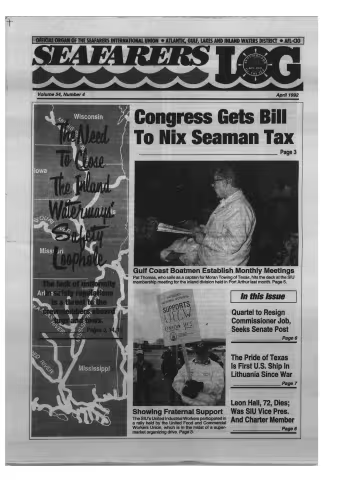
Issue Date
1992-04-01
Volume
54
Issue Number
4
Plaintext
Volume 54, Number 4 April 1992
••' -
•iJt
•..?i •
iM:
•vfv'V-.
1^-:
Congress Gels Bill
To Nix Seaman Tax
Pages
. ,. .. W, ..
r'mm-'
'I
Gulf Coast Boatmen Establish Monthly Meetings
Pat Thomas, who sails as a captain for Moran Towing of Texas, hits the deck at the SlU
membership meeting for the inland division held in Port Arthur last month. Page 5.
r-n-:- :' V
,
-5. • • ;
•P.
In this Issue
. \ .-t
Quartel to Resign
Commissioner Job,
Seeks Senate Post
Page 6
The Pride of Texas
Is First U.S. Ship In
Lithuania Since War
Page 7
Showing Fraternal Support
Leon Hall, 72, Dies;
Was SlU Vice Pres.
The SlU's United Industrial Workers participated in Anrl ChflirtDr Momhor
a rally held by the United Food and Commercial Unancr IViemDer
Workers Union, which is in the midst of a super
market organizing drive. Page 3.
•xm
;vly-^''-- ••• ' '; ••••
'Wmi
• u'-'-h" •• '/'
i' •-'• v-7-
'••••^v 'WK
. •• .. «,' -.-: .i."r.';
, V - ', .
V' , f j.'-:' '~:r''
': y:
'.'•i •"
"*:• ••
•S'
wy "'.y
y''',-
SEAFARBtSLOG
President's Report
Making Labor Relations Fair
In the next few months, the halls qf Congress will be filled with the
hired guns of thn wealthiest Americans and their corporations doing then-
best to kill a piece of legislation that would help work
ing men and women put back the word "fair" in the con
text of collective bargaining.
Due for consideration by the Senate this spring is a
bill that would prohibit a company from hiring a scab to
permanently replace a worker who has been out on
strike. The legislation, which passed the House last
year by a 247 to 182 margin, is called the Workplace
Fairness Bill.
Michael Sacco Coiporate America is exhibiting characteristic
hysteria about this proposed legislation, acting as if the
bill takes away all the privileges that are management's "divine right."
But in reality, the legislation, if enacted, would do two things. First, it
would restore practices in labor-management relations that were in effect
until the Reagan administration took office in the early 1980s — and one
can hardly say those practices were excessively damaging to business.
In fact, the later laws of this country have always been far more favorable
to companies opposed to unions and unionism dian are similar laws in other
industrialized countries. Second, it would strike a blow to the patt^ of cor
porate irresponsibility that has been a hallmark of the 1980s.
Phenomenon of the '80s
Prior to the 1980s, in a strike situation, a company would try to hire
people to temporarily take the jobs of its striking workers. The strikers
could put up picket lines and urge those temporarily hired individuals not
to cross the line. The key word here is "temporary."
The Reagan administration, however, decided to turn the nation's
labor law up on its head. In 1981, during his first year in office, the
president took it upon himself to re-interpret labor-management relations
and the collective bargaining process. Reagan fired the nation's striking
air traffic controllers. He said they were to be permanently replaced.
Taking their cue from the president, hundreds of companies saw their
chance to replace union employees with workers who would be practical
ly enslaved by the employer. The companies and their lawyers began to
cite an obscure 1938 court case called the NLRB vs. Mackay Co. This,
in effect, was a judicially created loophole in the law that allows for strik
ing workers to be permanently replaced. The Mackay decision is a
loophole because it is contradictory to the nation's labor laws and
negates their intent. Both the National Labor Relations Act and the Rail
way Later Act state that workers have the right to strike without being
subjected to employer retaliation, discipline or discharge.
Workers Lose, Lawyers Make Millions
Utilizing the loophole which was effectively sanctioned by Reagan
during the air traffic controllers' strike, high-priced lawyers and so-
called consultants began to peddle union-busting schemes to companies.
Their pitch was something like this: Provoke a strike, hire permanent re
placements, get rid of all the union employees, then hold a vote and get
rid of the union completely, keep wages down and stop worrying about
working conditions. These modem-day union busters are partly respon
sible for the biggest transfer of wealth this country has witnessed in a
long time — they helped companies reduce the wages and benefits of
their workers and then helped themselves to huge fees, billing employers
for millions of dollars.
This is the same kind of logic that for the past decade has allowed
companies to engage in irresponsible leveraged buyouts, massive ac
cumulation of o^er businesses and quick-fix bankiuptcy schemes.
Whether it was busting unions or swallowing up companies and taking
on debt of immense proportions, it has all b^n done with am eye to hugei .
short term profits and get-rich-quick packages for the top corporate dogs
and their lawyers.
A Fight to the Death
The ability of employers to permanently hire replacements of striking
workers has made later relations more unstable and more bitter. Strikes
are no longer a mechanism for arriving at an agreement. They have be
come fights to the death. The replacement worker management strategy
of the ' 80s has provoked all-out wars in which neither side could claim
victory — Eastern Air Lines, Greyhound, the New York Daily News, In
ternational Paper, Ravenswood Aluminum Company are but a few of the
casualties.
No worker looks for a strike. It is now, and always has been, a tactic
of last resort. Workers understand that wWle a strike puts economic pres
sure on a company, it also means the individuals involved will bear
economic losses and hardships. Certainly, workers recognize diat at the
very minimum, in a strike situation, there will be no paychecks. But the
ultimate goal of a strike is to resolve a dispute, to assist later and
management to reach an agreement.
The Seafarers will be working with all of organized labor to ensure
that die bill banning the loophole that allows the permanent replacement
of strikers passes die Senate. Enactment of the measure will restore the
strike to its original purpose as a key component in the balance of power
in employee-employer relations and eliminate its use as a scheme to en
rich a few individuds at the top of the ladder while imposing substan
dard wages and substandard conditions on hundreds of people whose
interest is making a decent living for themselves and their families.
Keep Wire Rope ProAtcts
In World Steel Deal, SaysSIU
The Seafarers International
Union has called on the Bush ad
ministration to ensure that wire
rope products are part of any world
trade deal covering the steel in
dustry.
In a communication from SIU
President Michael Sacco to U.S.
Trade Representative Carla Hills,
the union urged the American
negotiating team to include steel
wire rope on the agenda of the Mul
tilateral Steel Agreement (MSA)
talks currently taking place in
Geneva between the world's 29
largest steel-producing nations.
The Seafarers interest in the
matter stems from the fact that it
represents hundreds of men and
women employed by Paulsen Wire
Rope Corporation, one of a hand
ful of remaining steel rope
manufacturers in the United States.
Additionally, Seafarers working
aboard deep sea ships. Great Lakes
vessels and tug and towboats use
wire rope in many of their daily
operations.
At press time, officials from the
steel-producing nations were near-
ing the final stages of negotiations
wttich aim to create a level playing
field for all steel manufacturers,
regardless of nationality. Reports
indicate that the United States is
supporting inclusion of the wire
rope industry in the pact, but op
position has been raised by Japan
and South Korea.
The MSA, in seeking creation of
fair rules to govern the $ 110 billion
a year of world trade in steel and
steel products, has addressed such
issues as government subsidies to
steel companies (a practice of
many foreign nations) and tariffs
on imported steel.
Key Ingredient for Defense
Sacco cited the need to promote
a domestic wire rope manufactur
ing capability because the product
"is a key ingredient in defense-
oriented equipment" and because
"the industry provides hundreds of
American citizens withdecent jobs
that pay wages that can sustain
families and communities."
The SIU official also noted that
American wire rope producers still
are "reeling from loopholes in the
1984 Voluntary Restraint Arran
gements (VRA), which preceded
today's MSA talks and allowed
smaller producers like Taiwan,
China, Argentina, Mexico, India
and Thailand to dump their
products in our markets." For the
past decade, the U.S. wire rope in
dustry, along with the American
steel industry, has sought to
eliminate unfair competition from
foreign companies subsidized by
their governments.
If a new Multilateral Steel
Agreement is reached, it will
replace the VRA, which expired
March 31.
.....
One of the few remaining successful and efficient of America's industrial resources
is Paulsen Wire Rope Corporation, whose workers are members of the SIU.
Operations are marked by careful inspection of the product, as demonstrated by a
union quality control worker in photo above.
Volume 54. Number 4 April 1992
The Seafarers LOG (ISSN 0160-2047) is published monthly
by the Seafarers Intemational Union; Atlantic, Gulf, Lakes and
Inland Waters District; AFL-CIO; 5201 Auth Way; Camp
Springs, Md. 20746. Telephone (301) 899-0675. Second-class
postage paid at MSG Prince Georges, Md. 20790-9998 and at
additional mailing offices. POSTMASTER: Send address
changes to the Seafarers LOG, 5201 Auth Way, Camp Springs,
Md. 20746.
Communications Department Director and Editor, Jessica
Smith; Assistant Editor, Daniel Duncan; Associate Editors,
Jordan Biscardo, Max Hall; Associate Editor/Production,
Deborah Greene; Alt, Bill Brower.
"•i "
mt
•• • ''J'•
MPmumzm
'i :.. • •
.'•^ - <•' - ". . '•
Congress Gels Bill to Ropoal Work Tax
After the hearing In which the SlU presented its case against the marine license and
document fee, Congressman Billy Tauzin (D-La.) shakes hands with FOWT Timothy
Perkins while Cook/Baker Donna Takahashi (center) and Chief Steward Gina
Lightfoot observe. Rep. Tauzin introduced the bill to repeal the work tax.
Seatarers UiW Unit Backs
CteKks'OrgsuOs^ Ortve
In a demonstration of union
solidarity, the Seafarers' in
dustrial workers union, the UIW,
urged the employees of Ohio-
based Big Bear grocery stores to
select representation by the
United Food and Commercial
Workers Union (UFCW) instead
of staying non-union.
UIW Assistant Vice President
Joseph Huber reports that Big Bear
woiters who currently are repre
sented by unions—^including the
warehouse workers in the UIW, the
truckers who are in the Teamsters
and the bakers in the Bak^ &
Confectionery Workers Union—
have been assisting the UFCW get
its riKssage to the company's non
union store employees.
UIW Vice President William
Dobbins, who also serves as
president of the Franklin County
(Ohio) AFL-CIO Central Labor
Council, said Big Bear should
remain neutral so employees
would be able to choose whether
or not they want representation in
an atmosphere free of misleading
anti-union propaganda.
Dobbins, who addressed a
UNION
PAYCHECKS
BUY GROCERIES
AT BIG BEAR
Seafarers official William Dobbins
urges the company to remember the
value of a union paycheck as its own
store employees begin a drive for
union representation.
rally of Columbus, Ohio area
unionists and Big Bear
employees, said many of the
grocery stores' patrons are union
workers. UFCW Local 1059
President Becky Broyrer, whose
union is spearheading the drive,
said that Big Bear should not wel
come union members as shoppers
while at the same time discourag
ing store employees from joining
a union.
Columbus, Ohio-based Seafarafs are helping the UFCW organize Big Bear
grocery stores. Pictured at a support rally are UiW member Homer Cordle (left)
and UIW Assistant Vice President Joseph Huber (second from left).
The fight to repeal a work tax on seamen and boatmen
moved to Congress this month as two bills were introduced
in the House of Representatives to repeal the proposed fees
for Coast Guard-issued
marine licenses and docu
ments. Congressmen W.J. "Billy"
Tauzin (D-La.) and Herbert
Bateman (R-Va.), both of whom
heard the testimony of the SIU and
other maritime unions last month
outlining the unfairness of the
measure, each introduced legisla
tion designed to repeal the scheme
which amounts to a work tax on
seamen and boatmen.
In the meantime, the federal
judge hearing the SIU's legal case
against the seaman tax determined
that the union's lawsuit only could
come before the court once the im
plementation of the scheme was
imminent. No ruling was made by
the court on the substance of the
SIU's position that a fee to be paid
by seamen and boatmen for then-
Coast Guard licenses and docu
ments is in essence an employment
tax, and thus unconstitutional.
SIU Fights on Every Front
The scheme to charge a so-
called user fee for the issuance of
marine licenses, documents and
certificates of registry came as a
result of a budget bill passed by
Congress and signed into law by
the president in 1990. The Coast
Guard was mandated by the 1990
Budget Act to collect fees for the
various marine licenses and docu
ments it issued to mariners. As
presented in the Federal Register:,
the Coast Guard intends to charge
in the area of $135 for an AB or
QMED endorsed document and
$330 for an upper level license.
The SIU has vigorously op
posed the work tax plan. Last year,
after the scheme was made public
by the Coast Guard in the Federal
Register, the union lodged a strong
protest with the agency, noting the
plan was flawed. The SIU argued
that user fees only can be charged
to direct beneficiaries of a service.
The regulation and supervision of
mariner's skills and proficiency is
done in the public interest, the SIU
said in a communication filed with
the Coast Guard during a period of
public comment
In February, the union
presented its opposition to the
work fee to the House Subcommit^
Continued on page 10
SIU Urges House to Close
SaMy Loophole on Rivers
A loophole in maritime safety
standards of the nation's rivers and
lakes endangers the lives and
working conditions of crewmem-
bers aboard tugs and towboats, and
Congress should enact legislation
to rectify the situation, the SIU told
a congressional panel last month.
"There is lack of uniformity be
tween the requirements that must be
met by individuals employed on
various vessels," said SIU Vice
President Joseph Sacco in testimony
before the House Subcommittee on
Coast Guard and Navigation.
Sacco noted that on the one
hand, individuals working aboard
deep sea ships and Great Lakes
vessels must carry a Coast Guard
document and, in some cases, a
license. On the other hand, Sacco
said, crewmembers on tugs and
towboats plying die 25,777 miles
that make up the nation's inland
waterways and on boats under 100
gross tons in coastal waters are not
required to hold Coast Guard docu
ments. On Uiese vessels, if they are
more than 26 feet in lengA, the Coast
Guard only requires the operator of
the vessel to hold a license. All other
workers on these vessels are not
obligated to hold a Coast Guard
document or license.
From the SIU's standpoint,
Sacco said, every individual work
ing aboard any vessel must have
confidence in his fellow crew-
members and their ability to handle
the Vessel in any situation, includ
ing emergencies that may arise.
The men and women who work on
the 3,300 tugs that ply the nation's
river systems do' not have easy
jobs, pointed out Sacco. Navigat
ing on rivers and in coastal areas
can be tricky—it takes skill and the
efforts of all hands. He noted that
currents, traffic, submerged ob
jects, as well as weather condi
tions, all have an impact on the safe
navigation of a tug or towboat.
The SIU official urged Con
gress to enact the Merchant
Mariner Document Expansion Bill
(H.R. 4394) which would extend
the Coast Guard documentation
process to all individuals
employed on towing vessels of
more than five gross tons. The bill
was introduced by Merchant
Marine and Fisheries Committee
Chairman Walter B. Jones (D-
N.C.) and is co-sponsored by 31
House members.
the fdrClosini
TheRivi»v
14-10
Also testifying in favor of H.R.
4394 were representatives of the
International Organization of
Masters, Mates & Pilots (MM&P)
and Crowley Maritime.
Opposition to the measure was
expressed by a representative of
the American Waterways
Operators (AWO), a group repre
senting companies and their inter
ests. TTie AWO's position is that
documenting all individuals work
ing on vessels in the rivers and
lakes is unnecessary because the
companies are careful in who
they hire. The Coast Guard tes-
tifled, but did not take a position
on the bill, urging that the matter
be studied.
P,
'.m I- • •
w
'••ll
i'•
V-M-
m: . I•
, J-.-.- -7 y, . iS '
333#.;::--^.:
'3 3v'" f ;K!;:3 >•; 3;:3l"'3=®'''^:-3>3333 •-. •'
-3'—r--. •
'3 -v'x-'-^
•hS-
-,l.
33..-y33'3'-3i: -
'•; "!
im-
/ f ' • •'" '' -'
••:; •n.:^
:,:3J:;,3;.;.33
3'-'i.'':-''''3;3«i:.;.?
:M\r •''^•«^:;v,:.--.... ':
' -^' 'i •••'i-3 r :
-J ^
-^''i'r:.r'••":'••>
. •• f.':- ',
•••£-•- "3 -
vr-'s'^
I tv3''
fi •' '•' ,
If; 3
^ • 3 '33^'S3^';;
fh.-:\:
ii-m
p.
•-W '
'yi. ••*-•
SEAFARBISLOe
Di PCD Ittikipendence and HaUonal MEBACoavenUott Signal
The End of Shonslde Worker Dominance of Seagoing Uembers
The Hght to eliminate outside
domination of seamen by
shoreside worker units is well on
its way to being won as a result of
recent actions taken by the mem
bership and elected officials of
deals while turning control of a
seaman's union over to shoreside
workers—mostly cafeteria
employees at military bases.
District No. 1 - PCD, MEBA
has been operating effectively
Addressing the 102nd convention of National MEBA, SlU President Michael Sacco
said American seamen, through training and education, are the best mariners in the
world.
District No. 1, Pacific Coast Dis
trict, Marine Engineers Beneficial
Association (MEBA) and by Na
tional MEBA, the federated struc
ture comprised of three
autonomous MEBA districts.
The first step to keeping MEBA
a union of working professional
seafaring people able to direct and
influence their own affairs took
place when the marine officers
voted on January 15 in a special
membership meeting to dissolve
the 1988 merger between their
union and the National Maritime
Union, representing unlicensed
seamen and shoreside workers and
revert back to their pre-merger
status as District No. 1-PCD,
MEBA.
The resolution calling for the
dissolution noted that the merger
had created, under the guise of a
combined union called District No.
1—MEBA/NMU, a structure in
which officials defeated in elec
tions could maintain control and
take millions of dollars from the
union treasury in "severance pay"
since its independence vote —
maintaining shipping and servic
ing from its halls, representing its
membership in the halls of Con
gress.
In March, the National Marine
Engineers Beneficial Association
was scheduled to hold a conven
tion. The three presidents of the
MEBA districts—Gordon M.
Ward of District No. 1-PCD,
MEBA, Raymond T. McKay, of
District 2 MEB A-AMO and Lewis
Smith of District 3 - Radio Officers
Union—determined that the of
ficers of the defunct District No.
1-MEBA/NMU had no claim to
National MEBA as they had been
repudiated by their membership
and their organization dissolved
after the membership determined
the fraudulent nature of the
merger. The three presidents, in a
joint resolution, dedicated them
selves to restoring National MEBA
to its status as "the nation's
foremost association of maritime
officers."
During the National MEBA
convention, held March 16 -17 in
Fort Lauderdale, Ha., the marine
officers recognized the inde
pendence of the NMU, noting in a
resolution that it was, since its
founding, a strong and militant
voice for unlicens^ seamen and
that the NMU mariner deserves
democratic trade unionism. Addi
tionally, the National MEBA
delegates adopted resolutions call
ing for the strengthening and
defense of the Jones Act, advanc
ing oil exploration and develop
ment in the Arctic National
Wildlife Refuge, opposing second
registry schemes, supporting a na
tional health care program and a
bill to prohibit the hiring of so-
called permanent replacement
workers in jobs of strikers.
SlU President. Michael Sacco
was invited to address the conven
tion. Commending the delegates
for their courage to restore MEBA
to a union of marine officers, Sacco
said it was time to move forward to
build a strong U.S.-flag fleet and
vital, vibrant maritime unions. He
noted that there would be hurdles
and said, "You have to be united.
You have to work together , . .
Don't let anyone see a crack in that
fist."
He said American marine
unions must "put out the best en
gineers, the best mates and the best
unlicensed seamen in the world.
That's how we're going to com
pete."
"We will survive, and the way
we will survive is through training
and education and safety. That's
the thing that is going to make us
the number one unions and the
number one labor movement in the
world. Better than anyone else can
produce. The United States of
America seamen will be the best,"
he said.
Sacco also noted that much had
been made by opponents of Dis
trict No. 1-PCD, MEBA of a
$500,000 loan made by the SIU to
that union. The SIU president
noted that the loan agreement had
been approved by the membership
of boA organizations. "I did not
lend this man this money to take his
union over or to tell this man what
to do with his union/' Ss^o said.
"I lent him this money because it
was the right thing to do."
The SIU official closed by
pledging the support of the
Seafarers and its members to the
marine officers. He reported that
the SIU membership had over
whelmingly approved the loan.
"That goes to show you Uie attitude
of this membership toward this
new organization. They believe in
you. T^ey want to work with you
and they want to help you. And
they will be there; money, marbles
and chalk..."
The forces District No. 1-PCD,
MEBA has been battling claimed
to hold a National MEBA conven
tion. However, this meeting was
dominated by representatives of
shoreside workers from cafeterias
and aiiports. Also in attendance
were representatives of unlicensed
seamen in the NMU. The few
marine officers in attendance were
individuals who had lost their
elected posts when the members
voted them out of office.
This group, now headed by A.C.
Cullison, a man defeated in the
1990 MEBA licensed officer elec
tions for the post of MEBA Hous
ton branch agent, has been
attempting, through its lawyers
and public relations consultants, to
find ways to take back control of
the marine officers dues and stat
ure. This group was headed by
Gene DeFries, who recently
resigned suddenly from all of his
positions with the union. How
ever, the DeFries/Cullison moves
have been unsuccessful and Dis
trict No. 1-PCD, MEBA and Na
tional MEBA continue to operate
effectively in behalf of the marine
officers they represent.
DOT Official Aniioinoes Policy 'In the Wcilcs' to Save U.S.-Flag Fleet
A Bush administration official
announced last month the White
House plans to formulate a policy
to save the U.S.-flag merchant
marine.
James B. Busey, deputy
secretary of transportation, told the
Connecticut Maritime Association
that the "administration intends to
put forward sound policy
proposals to rejuvenate the U.S.
maritime industry."
Busey noted since Andrew Card
took over as U.S. Secretary of
Transportation, "we have had in
the last month more meetings—
policj' meetings and informational
briefings—on maritime policy at
the top level of the Department of
Transportation than they probably
had conducted in the last sever^
years."
The formal Navy admiral who
spent the previous three years with
the Fede^ Aviation Administra
tion repeated the administration's
support for the Jones Act, a 1920
law which liih®commeflle
travelling within the United States
to be carried only on U.S.-flag bot
toms.
He warned those in the audience
that unless something is done soon,
"There will be no U.S. fleet in the
21st Century. If this hap^ns, the
national security implications will
be unacceptable."
In presenting alternatives to
save the U.S. flag on the high seas,
Busey rejected the premise that
American carriers cannot survive
unless they are protected from in
ternational competition. "The U.S.
maritime indusby can compete in
world markets if we develop policies
that permit that to happen."
He proposed, "Any program
must meet the national security
need in the most cost-effective
manner. This is the philosophy
upon which we will build a new
maritime program."
Among programs Busey cited
for change are &e need that vessels
to can^ cargo preference materials
must be built in American
shipyards, the federal laws and
regulations subsidized carriers
must follow to operate and the
numerous restrictions on business
in foreign ports for U.S.-flag ships.
The former admiral pointed to
the subsidies receivedby foreign-
flat fleets. "At the same time we
press to free our industry from the
shackles that have bound it to
government for all these years, we
are painfully aware that the real
world—the world in which our
carriers must compete—^is by no
means itself free of Weign govern
ment restrictions. We all know that
foreign carriers enjoy full, unfet
tered freedom to oeprate in our in
ternational commercial trades. But
U.S.-flag carriers in the liner trades
continue to face foreign restric
tions on their access to cargo and
their ability to do business in
foreign markets."
The Department of Transporta-
-V »
Admiral James B. Busey
tidn official said, "It is obvious that
the federal government cannot
wait for a consensus to form before
taking further action. This ad
ministration intends to rise above
the fray and put forward sound
policy proposals to rejuvenate the
UiS. maritime industry."
' '3, • 3 v:3-:3,
,3=
' f." '3 *1 ,•
.-it..'-.'
um.1992 s
'• I';! lat'lAi*;,;;^;'-
I'j
7,
SW^atmen fix)m thi^ towi
companies tetunied to their vessels
aloiig the Texas coast of the Gulf
Of Mexico with a renewed faith to
wOfk together following a special^
union meeting in Port Arthur;
Texas last month.
"We need to have a positive at
titude," Moran Captain Pat
Thomas told the March 4 gather
ing of more than 50 members from
Louisiana and Texas. "We can do
it if we do it with them (pointing to
representatives of the union who
were present).
"Our image among ourselves
went down over the years,"
Thomas added. "NOw is the time to
bring it up. We've got the best."
\^ile Thomas, who joined the
SIU in 1965, noted he ^ong with
several others in the room were
nearing the ends of their careers, "I
see a whole lot of people with a
long way to go. This is the future
right here. Now is the time to draw
1 together."
As the tugboat captain finished,
he drew a long round of cheers
from the others.
SIU Executive Vice President
Joseph Sacco followed by inform
ing the members, "You guys are
professionals, but you' re not being
accorded that by the companies,
You are the best trained boatmen
out there."
Sacco then spoke about the
problems associate with non-union
companies on the watCTways. "AU
of you are tested for drugs," he
pointed out. "All of you are test^ for
alcohol. But they don't check to see
if persons are qualified to operate
(their vessels.)'
The ex^utive vice president^
updated members on the figfilf
against Coast Guard-imposed user
fees.
Moran AB Gary Denton asked
Sacco, "Why do we keep paying,
over and over and over for what
we've already got? What are we
using?"
Sacco told the group he testified
on behalf of the union at a congres-
sion^ hearing in February called to
look into the matter. At the end of
the hearing, U.S. Representatives
Billy Tauzin (D-La.) and Herb
Bateman (R-Va.), the subconunit-
tee chairman and a ranking
minority member, respectively, in
formed Sacco the fees, also known
as a worker tax, should be
repealed.
"The user fee was the initial spaik
to what we're doing," Sacco told the
boatmen. 'We are reaching out to
you with the information that we
have. We are not going to sit still.
"I know what we can do if we
all stick together. I know what we
can do—like what (Higman Cap
tain) Tony Primeaux did. We've
got to do more of this. That's how
you're heard."
(Primeaux organized a petition
drive among union and non-union
boatmen to repeal the work tax. A
total of438 people signed the peti
tion which Sacco hand delivered to
the congressmen during the hear
ing.)
Sacco and Gulf Coast Vice
President Dean Corgey also spoke
to the members about inland news
from other parts of the country,
local political information and
contract updates. Members asked
Moran Captain Pat Thomas urges the
rnemterehip to stand together to keep Hitting the deck with his union book in
hand is AB Ed Quinn who sails for Moran
Towing.
the union strong.
that meetings be held monthly in
Port Arthur so those sailing would
be able to get union information
firsthand. The tentative date for fu
ture meetings in Port Arthur is the
first Wednesday of each month.
Six-year Sabine AB James Mc
Neil said the meeting "answered
all my questions." He stated he
would return to his tugboat to pass
the word to others.
Moran AB Ed Quinn hit the
floor holding his union book for all
to see. "I've been a union man all
my life," he told the others. "The
best thing that has happened to me
was to get the letter (about the
meeting). It reminded me of what
the union is for."
'It is important for all of us to
get together, know each other and Asking a question during the meeting is AB
hear each other's problems," said Denton from lulocan Towing.
Kenneth Moore, AB delegate for
Reviewing materials relating to the Preparing to enter the Port Arthur meeting are Captain Richard Montalvo (left) and Engineer John J. Biegalski waits his tum
inland industry is Deckhand Greg Captain Frank Jewell (left) and AB Kenneth Assistant Engineer Andrew Chisholm while AB Kerry Caillouet signs the meeting
~ ~ from Sabine take part in the meeting, register. Both sail for Sabine. Rideaux who sails fbr Sabine. Moore, both of whom work for Sabine.
SIU Executive Vice President Joseph Sacco updated the boatmen on the status of the
proposed work tax on seamen. Gulf Coast Vice President Dean Corgey (center) and Moran Cook Pat Caldwell addresses his brother Seafarers attending the first of what
Houston Port Agent Jim McGee also gave reports on inland activities to the members, will be regular monthly meetings for the SlU's inland division.
V' ' v '
'W
- -1
FF .-.-•:F;F:''v
f
F-,-.:5'or--:'" , -::. ;.' ;• •' , ': • ^•••• : .
-.a,
•' V 'r.-PT- ..,'.."
i.
'f ^ '
•• • • S' >
';;';sX;.
V •T» •
-V •• V
'V":' •
i ;•,;
, -•Lf- .-'A-.-
•ifr. •,. ^
SEAFMBISmS
l£on HaUf Retired VP and Pepular Unlen Brotherf Dies at 72
Leon Hall, retired vice president
of the Seafarers International
Union and a charter member of the
union, died of natural causes on
March 26. He was 72.
k
Leon Hall, in photo above from the
early '80s, gives his vice president's
report to a meeting of the SlU execu
tive board.
Always an extremely popular
union brother. Hall had consider
able experience as a seaman and
union representative through his
long career.
Appropriately, Brother Hall
was laid to rest at the Seafarers
burial grounds in Valley Lee, Md.,
which is located on the St.
George's Creek across from the
Paul Hall Center for Maritime
Training and Education in Piney
Point, Md.
In his remarks to the member
ship on Hall's death, SIU President
Michael Sacco said, "We all loved
Leon Hall. He had an even disposi
tion and was always good humored
in his dealings with his union
brothers.
"Whatever Leon's job was, he
did it with all his heart and he did
it well. He will be missed," Sacco
said.
Hall, who was a devout believer
in seamen's unionism, joined the
union in 1939 in the port of Mobile,
Ala. He worked in every shipboard
job in the galley, becoming a chief
steward.
In the early 1960s, he came
ashore to work with the union's
Maritime Advancement Program,
the SIU's early upgrading and
refresher training operation. Many
Sequa Sells Sabine Tewing
Te Heuston's KIrby Cerp.
Kirby Corporation, owner of
several tugboat companies includ
ing SlU-contracted Dixie Carriers,
has purchased Sabine Towing and
Transportation Company from
Sequa Corporation, its parent com
pany.
The $36.9 million sale affects
approximately 150 SIU members
who work for Sabine on coastal
and inland tugs and barges.
While the SIU continues to rep
resent the workers on the tugs and
barges, Kirby has claimed the
union contract with Sequa-owned
Sabine does not follow the sale.
The SIU contends that it does and
is taking Sabine Towing and
Transportation Company to ar
bitration for not making the pur
chaser assume the labor contract as
a condition of the sale.
During this period of time, the
union urges all Sabine Seafarers to
contact £e union should any ques
tion arise. The union is staying in
close touch with all Sabine mem
bers and is holding regular meet
ings in the Port Arthur, Texas, area
where the Sabine fleet is bas^.
Through the purchase of
Sabine, Kirby added 33 owned
and five leased inland tank bar
ges, 11 owned and four leased
towboats, three bowboats and
eight owned tugboats to its inland
operation.
Kirby is a multi-faceted cor
poration based in Houston with in
terests in marine transportation,
diesel repair and property and
casualty insurance. Its primary
business is marine transportation
through Dixie Carriers which
operates tugs and barges in the
Mississippi River system, along
the Gulf of Mexico, in the Carib
bean Basin and on the Atlantic and
Pacitic coasts.
According to Kirby's 1990 an
nual report, Dixie Carriers
produced a pretax earning of $ 12.3
million for that year and $6.4 mil
lion in 1989.
Overall Kirby revenues were
listed as $175.8 million for 1990
and $141.3 million in 1989. The
corporation employs approximate
ly 950 people.
SIU officials discuss the takeover of Sabine Towing by Kirby aboard the tugboat
Marathon. From the left are SIU Executive Vice President Joseph Sacco, Pilot
Nelson Plaisance, Tankerman William T. Winstead, Houston Port Agent Jim
McGee, Pilot Jimmy Marks, Gulf Coast Vice President Dean Corgey and Patrolman
Bobby Milan.
Shown in one of his familiar activities—dealing with the membership—Brother Hall,
who was a headquarters representative at the time this photo was taken, writes a
dues receipt for a Seafarer aboard an SlU-contracted vessel.
active and retired members honed
their culinary skills under Brother
Hall's food plan program.
From there, Leon Hall went on
to serve the membership in a
variety of union posts—^including
Philadelphia patrolman, San Fran
cisco port agent in 1964, New York
port agent in 1965 and head
quarters representative. In 1979 he
became Atlantic Coast vice presi
dent, a position to which he was
re-elect^ in every union election,
until his retirement in 1985.
Affectionately nicknamed
"Radio" by his union brothers be
cause he was never short of con
versation, Hall is survived by his
wife Charlotte Hall.
He served in the Army from
1942 to 1946.
Funeral services were held on
April 2 at St. George's Episcopal
Church in Valley Lee, followed by
the interment During the services.
Hall's neice, Dorothy Ealey, sang
the spiritual "His Eye Is on the
Sparrow."
PMC's Quartet Resigns;
MTD SougM His Removai
Robert Quartel, the FMC com
missioner who the AFL-CIO
Maritime Trades Department
(MTD) sought to have removed
from his government post, has an
nounced that he will leave his job
with the federal agency this month.
From his position as a shipping
industry regulator, Quartel has
Qontended the United States does
riot need a privately-owned com
mercial fleet. Quartel intends to
seek the Republican Party's
nomination to run against U.S.
Senator Bob Graham (D-Fla.) in
this year's election.
Before Quartel made his an
nouncement, acting on the MTD's
resolution which calls for removal
of Rob Quartel from his job as one
of five members of the Federal
Maritime Commission, MTD
President Michael Sacco last
month sent to President Bush a for
mal request for such action.
Sacco, who also is president of
the SIU, wrote on behalf of the
MTD, which consists of 42 unions
representing 8.5 million American
workers.The MTD disputes
Quarters contention that the
United States does not need a
privately-owned fleet operating
under the American flag.
The letter to Bush dated March
5 reads in part: "Since his appoint
ment as a Coimnissioner, whose
job it is to enforce non-dis
criminatory rates and practices in
ocean shipping, Mr. Quartel has
been using the position as a plat
form to continually denounce
American maritime workers, and
to urge American companies to
haul down the Stars and Stripes
from their ships and r^lace them
with foreign flags and foreign lahor.
"We firmly believe that
Quarters use of taxpayer funds to
crisscross the nation urging dis
solution of American-flag ship
ping is an unethical, unjustifred
abuse of the process that should be
discontinued at once...."
The MTD, in its resolution
passed at the February executive
board meeting calling for Quartel's
ouster, pointed out that the govern
ment appointee opposed the vety
policies of the government in
regard to U.S.-flag shipping-
such as the Jones Act and cargo
preference.
Quartel, who joined the FMC in
1990, previously failed in an at
tempt to gain a House seat in 1984.
Upon learning of Quartel's plans to
run for the Senate, Sacco said that
if the reports are true, "then
inaritime's gain is Florida's loss.
"The position of U.S. senator
requires maturity, a dedication to
.^erican interests and the com
mitment to the preservation of vital
American institutions," Sacco
said. "As a member of the FMC,
Quartel has failed to meet these
requiiements."
;7
V'-'-
• "i,
•/ '-' L." '-r-V,':".
Jiumi992
Pride of Texas: 1st US. Sidp to Mer Lithuania Since 1939
WELCOME TO KLAff^QA 1
t X I
A huge banner in English greets the crew of the Pride of Texas upon arrival in port
The SlU-crewed Pride of Texas
became a part of Lithuanian his
tory on February 18 when the
Seahawk Management vessel
delivered the first shipload of
American grain sent by the U.S.
government to the newly inde
pendent country.
"The people were so grateful,"
Recertified Steward Ernie Hoitt
told the Seafarers LOG. "All of us
were really proud to be a part of
history."
With the delivery to die port city
of Klaipeda on the Baltic Sea, the
Pride of Texas became the first
U.S.-flag ship to enter a Lithuanian
port since Nazi Germany occupied
the land in 1939 at the start of
World Warn.
docked. Hie club provided perfor
mances by folk singers and dancers
in national ceremonial costumes,
an opera singer and plenty of
food.
Among the surprises prepared
for the crew was a welcoming
reception when the ship docked.
"Captain Wayne Stolz had to go to
the dock and make a speech which
was carried on international
television," recalled Hoitt, who
sailed as the chief steward.
The seamen's club in the town
of200,000hosted the crew three of
the six nights that the ship was
The ship, led by the galley gang
of Hoitt, Chief Cook Billy
MItcheU and Steward Assistant
Clarence Evans, returned the
favor February 20. Among the
items prepared were macaroni
salad, potato salad, fresh fruit com
pote and finger sandwiches. The
U.S. ambassador to Lithuania
joined in the celebration.
Hoitt, an SlUmonb^ since 1965,
joined sev^ oth^ crewmembos in
a visit to the town. "They all said
thank you for bringing the grain," he
recalled. "Most eveiybody spoke
English. I believe they w^ tau^ it
in school. Eveiybody who went
ashore oijoyed it
"The engine cadet went to one
of the schools where he was treated
like a movie star. Kids there kept
asking for his autograph."
The steward, who provided the
LOG with photographs, saw
firsthand that stories about people
having little or nothing to eat were
trae. "What you see on the news is
no lie. The shops still are bare."
For Hoitt, the voyage marked
the second time he sailed on the
Pride of Texas when it became the
first U.S.-flag vessel to deliver
American goods to a formerly
communist country. A year ago, he
was on board when the ship docked
in Bulgaria. The only difference he
saw was Bulgarians had more
items stocked on their shelves.
Since 1945 until last year when
it declared its independence,
Lithuania had been associated with
the Soviet Union. Hoitt recalled
sailing into the old USSR at the
port of Odessa many years ago.
"Even under communist rule, I
had no trouble ashore at all. I took
some country music tapes and my _
tape recorder with me. No one
would^,«thmethen:fhey were uSiSrind
afraid. But they were all listemng." stamps in his passport.
Taking part in a union meeting aboard the Pride of Texas are (left to right) AB James Adaire,
Chief Cook BiHy Mitchell, DEU J. Butler and Bosun Eugene Grantfiam.
ABs James Colwell (left) and Arthur Machado await nolificalion of payoff n Noifok
Ready to hit the tieach are (seated) AB Arthur Macharto, (standing, left to right) Chief Cook Billy Mitchell ladles out a bowl Steward Assistant Clarence Evans helps
QMED Nelson Lazo, QMED Frank Bemer and AB Anilial Plata. of soupforacrewmember. serve during the reception.
"V
• .*»;•. f'. ' -'
•silver
;t--'ntk:'a»^<K;«f:« yi"! <M_i<lipnii^iii| '.in' '7^ilf;i^'TffP''fl'
8 SEAFABBtSWe
;:vS
.•'••• •.. :'A'
•V."i;.; •
y., •'•¥
'• ~-p\-
- .„'...'y^»;t'•
UM-•' • • • •>: :V
I-
""" •••
•• J-J. -
0-' •> V
'V. '. -''r
1^#
.. ;
;• 'k-
11 steward Bem^
Eleven SIU members recently
completed the steward recertifica-
tion course at the Seafarers Ha^
Lundeberg School of Seamanship,
thereby finishing the highest cur
riculum available to Seafarers sail
ing in the steward department.
Recognized during the March
membership meeting at Piney
Point, Md., the recertified stewards
completed the five-week course
during which they received ad
vance training in menu planning,
computer operation, and leader
ship and communications skills.
They also took refresher courses in
food preparation as well as
firefignting, CPR and First Aid.
Additionally, the group at
tended classes reviewing the
union's medical and pension
programs. Members learned about
the SIU political and legislative
operations and met with SIU offi
cials. (This part of the curriculum
is designed to help the steward in
his or her job as ship's secretary.)
Several of the recertified
stewards said a highlight of their
schedule took place when they saw
• their union's political and legisla
tive action program at work. On
February 25, the day they visited
SIU headquarters, the stewards
travelled to Washington, D.C. and
witnessed SIU Executive Vice
President Joseph Sacco testifying
before a House subcommittee in
regard to the work tax the Coast
Guard is seeking to impose on
American seamen and boatmen.
After listening Sacco's presenta
tion, three congressmen at the
hearing voiced support for repeal
ing the tax.
"When one of the congressmen
told Joe Sacco that the SIU probab
ly can get more done with our law
suit (against the Coast Guard) than
the subcommittee could get done
... well, I was impressed," said
Rick Sanderson, 35.
"I'm thankful for the oppor
tunity we had to get politically in
volved," added Dana Cunning
ham, who was in the audience
when the subconunittee chairman
asked all merchant mariners
present to stand and be recognized.
Cohesive Group
In their graduation speeches and
in interviews with the Seafarers
LOG, the recertified stewards
reflected on their most recent ex-
The 11 SIU members completing the recertified steward program are (front row, left
to right) Jill Prescott, Kenneth Jones (second row) Curtis Phillips, Ruben Dollar,
Richard Sanderson, Dana Cunningham, Hans Schmuck, Sivasa Laupati (back row)
Cheryl Burgess (computer operations instructor), Mose Peacock Jr., George Quinn
and Francis Ostendarp.
perience at the Lundeberg School.
The cohesiveness among the gal
ley gang members was evident,
and several noted that it helped the
group in its schooling.
"This was a good group," said
Jill Prescott, who joined the union
nine years ago in San Francisco. "I
thought the schedule flowed
smoothly and at a good pace.
Everyone made us feel very wel
come."
Kenneth Jones described the
training as "excellent. You never
stop learning. ... If you want to
achieve, the opportunities are
here." Jones, 35, signed on five
years ago in the port of New York.
He added that the Lundeberg
School instructors do an outstand
ing job, and that the ex^rience in
Congress has inspired him to vote.
George Quinn said he especial
ly enjoyed die computer training,
which covers word processing,
windows and spreadsheet and disk
operations systems. "I always
thought I was a pretty good
steward, but there's no doubt this
course will make me better on the
ships," said the 50-year-old Quinn,
who joined the Se^arers 32 years
ago in New Orleans. "I enjoy^ the
whole thing, and I found the pro
gram well-rounded."
Ruben Dollar, at 54 the oldest
of the new recertined stewards,
said he was impressed by the
facilities. He added that the Lun
deberg School's picturesque, rural
location is a boon to successful
studying. "I also thought the
firefighting course was great," said
Dollar, who began sailing with the
Marine Cooks and Stewards in
1962 (15 years before its merger
with the AGLIWD).
Another former MCS member,
Curtis Phillips, brought his wife
and child to the Lundeberg School.
"I recommend bringing your fami
ly," said Phillips, 36, who was
upgrading for the fifth time. "It's
great for morale, and there's a lot
for them to do."
He also said the course was
"very beneficial. I particularly
liked (galley instructor) Ed
White's classes. . . . This school
represents an excellent oppor
tunity to enhance your career and
your education."
Cunningham, 29, echoed those
sentiments. "I've been treated
more than fairly and received a
good education in the eight years I
have been coming here. You need
to come back here if you want a
future as a Seafarer."
Francis Ostendarp, 32, who
graduated from the Lundeberg
School as a trainee in 1983,
thanked the group member? for
their cooperation, "That's a big
part of it. Everyone got along
well."
Thirty-one-year-old Hans
Schmuck, an 11-year Seafarer,
summarized his time at the school
as "a great learning experience."
Sivasa Laupati appeared al
most overwhelmed. "You can't
find another place like this," said
Laupati, 46. "I have learned so
many things .... Our union offi
cials are doing a great job."
Mose Peacock, Jr., temi^red
his enthusiasm with an advisory
note for future students in the
recertified stewards program.
"Make sure you're ready to work,
because each class gets tougher,"
said Peacock, also a former MCS
member. "This is a competitive in
dustry, and nothing is going to get
any easier."
Several of the stewards com
mended the food handling and gal
ley sanitation classes presented by
SIU member Jim Mann, Sea-
Land Service's fleet commissary
manager and a Lundeberg School
graduate. Several others noted how
much they gained from instructor
Kate Richardson's communica
tions and computer classes.
CPR and first aid are part of the course
requirements for completion of the
recertified steward program. Getting
ready to give CPR to the classroom
dummy are George Quinn (left) and
Mose Peacock Jr.
Recertified Steward Jill Prescott en
hances the appeal of a cake with
flowers made of icing.
Computer operations is another skill leamed by Ruben Dollar at the Lundeberg
School during the five-week recertified steward course.
The famiiy of Curtis Phillips, pictured with SiU President Michael Sacco, joined the
chief steward during his five-week course at the Lundeberg School.
- T--: r- .-M.-.-
unatiwz '.•«a
Andrew K Crew Saves TWo
Four Seafarers who crew the
tugboat Andrew K reacted quickly
and efficiently and saved the lives
of two men stranded in a flat-bot
tomed skiff in the Houston Ship
Channel late last year. The SIU
members—Captain Kenny Wall,
Chief Engineer Tig Turner, AB
Danny Mixon and Engine
Utilityman Richard Guerra-
time the Seafarers sighted danger
until they executed the rescue. By
then, the tanker was within one-
eighth of a mile. JThe wind was
blowing hard, buFwe were pretty
confident," Turner said. "We had
enough rope, and Kenny's a good
boat handler, so there was no prob
lem there."
il'i- •
pulled the helpless men from the
path of a large, fiilly loaded tanker
whose crew apparently did not see
the small boat.
"The guys in the johnboat didn't
have any oars, lines or life jackets,"
Wall, 44, recently told the
Seafarers LOG. "All they had was
a small motor which had failed.
The tanker had a full head of steam,
and there's no way [the men in the
disabled fishing boat] would have
survived if they had been hit."
"We had just been dispatched to
a job when we saw those guys in
the middle of the channel," Turner
said. "We tried to make radio con
tact with the tanker, but for some
reason they didn't respond.
"The guys in the johnboat
seemed pretty worried. They basi
cally were in a mess."
Turner, 30, estimated no more
than five minutes elapsed from the
"It was close, but we saved
them," said the 30-year-old Guer-
ra. "We were right there next to
them. They were a little on the
drunk side, but they knew what was Seafarers credited with saving the lives of two stranded boatmen are (from
happening." left) Richard Guerra, Tig Turner, Kenny Wall and Danny Mixon.
Wall and his crew of veteran
Seafarers, all of whom ship out of
the port of Houston, did not stick
around to chat with the relieved
fishermen. "We didn't want to be
late for our job," said Wall, who
joined the union 20 years ago.
The president of G&H Towing
Co., which owns the Andrew K,
commended Wall, Turner, Mixon
and Guerra in a letter. He noted the
crew's "exemplary performance in
expeditiously coming to the aid of
the disabled craft and towing it out
of danger."
Wall and his crew also helped
the Andrew K earn G&H Towing's
1990-91 first place award as die
fleet's "safest tug." The Andrew K eamed G&H Towing's 1990-91 first place award as the fleefs "safest tug."
Ttalning School's Course
Rw 10 Menu Boatnmi
EngHiaslios SahBly Skills
Ten inland Seafarers from Moran Towing of Texas
participated in a special week-long training program
at the Harry Lundeberg School of Seamanship in Piney
Point, Md. in February.
One of the classes taken by the barge captains and
licensed officers was OSHA hazardous waste opera
tions and emergency response training. The boatmen
thoroughly reviewed procedures to detect a hazardous
spill in its early stages and the steps that can be taken
to isolate the area.
Emphasis was placed on practices that prevent
spills. Other training for the group included CPR tech
niques, first aid and safety, communications and stress
management, shiphandling simulator practice in paral-
Moran Towing membets who attended the week-long training session included (left to right, front row) Rusty id indexing and rules of the road and company semi-
Ma* Burger, Ron Lambert, on policies and procedures.
Moran officials joined the 10 for several of the
classes at the school.
MilesHeathappliesasplinttoRandyCooper'sannduringfiistaidclass. Instructor K.C. Taylor explains oil spill procedures. RandyOooper handles the wheel in practice.
-Til " •
( ••••
; rM
• fH •••
•i||m
'.M
''i-'
. I.
'•y-
• • - H
.11
•• • i • ,"•> • '
10
; .jx\
SEAFARERS LOG
y _ - i. . r^,' • .
; .n" •' •• • " ' . •
X'f ; -V „ ,'* -f '.')" • •'.
Seaman Tax Repeal Bill
intreduced in Cengress
While Rep. Gene Taylor (D-Miss.) reviews testimony, Rep. Herbert Bateman
(R-Va.) asks a panelist about the worker tax during the House Coast Guard
Subcommittee hearing on the issue in February.
Continued from page 3
tee on Coast Guard and Naviga
tion, characterizing it as "dis
criminatory." At that hearing,
Representatives Tauzin, Bateman
and Gene Taylor (D-Miss.)
pledged to seek a repeal of the user
fee for marine licenses and docu
ments.
Last month, Tauzin authored
House Resolution 4693 which, if
enacted, will repeal the Coast
Guard-imposed fees on marine
licenses and documents. "HR 4693
prevents the federal government
from singling out merchant
mariners to pay what is clearly an
employment act," Tauzin stated
upon filing the bill on March 26.
"Other occupations in transpor
tation industries don't have to pay
a federal fee in order to be lawfully
employed. Why merchant
mariners? The idea of the federal
government taxing an individual
for the opportunity to work is in
herently wrong," the Louisiana
congressman told his colleagues.
Tauzin reminded Congress of
the role of the Lf.S.-flag merchant
marine during the recent Persian
Gulf conflict. "Our national
security depends on a strong mer
chant marine. If anyone doubts this
fact, I would only remind them, of
our merchant mariners' heroic
contributions to the largest sealift
in maritime history. Desert Storm
was successful because we had a
base of qualified, licensed mer
chant mariners who were ready to
respond toi the call of duty."
Bateman, who filed his bill
prohibiting the federal government
from collecting fees for the licens
ing and documentation of seamen
and boatmen on March 20, said in
remarks addressed to his fellow
House members, "No other sector
of the transportation industry is re
quired to pay a fee in order to work,
and it is not fair that mariners
should be singled out."
Since both the Tauzin and
Bateman bills are similar, the two
will be consolidated. Tauzin's
seaman tax repeal bill will absorb
Bateman's legislation and the Vir
ginia congressman will be listed as
a co-sponsor. As the LOG was
going to press, the bill had the sup
port of Walter B. Jones (D-N.C.),
who serves as chairman of the
House Merchant Marine and
Fisheries Committee, Robert
Davis (R-Mich.) and Jack Fields
(R-Texas).
The SIU is urging all other
members of Congress to co-spon
sor the Tauzin bill. A Seafarer
should contact his or her member
of Congress to urge the elected of
ficial to sign on to the seaman tax
repeal bill introduced by Tauzin.
Roy Boudreau Dies at 66
Former SIU official Roy
Boudreau, a key figure in the
union's successful organizing of
American Steamship Company,
passed away recently due to a heart
condition. He was 66.
Boudreau joined the Seafarers
in 1943 in his native Detroit. He
sailed in the deck department for
15 years before coming ashore to
work as an organizer. He repre
sented the SIU in various
capacities until forced to retire in
1977 because of heart problems.
Brother Boudreau's positions in
the SIU included patrolman in
Detroit, Buffalo port agent and as
sistant secretary-treasurer for the
Great Lakes District.
Jack Bluitt, former SIU head
quarters representative for the
Great Lakes district before retiring
in 1985, worked closely with
Boudreau for about eight years.
Bluitt, also a former New York
patrolman and Detroit port agent,
described Boudreau as "very reli-
•s.-
i.
•K-I
Roy Boudreau
able. He was a real gentleman, very
conscientious. When it came to the
Seafarers, he was a dedicated
union man."
Brother Boudreau retired to Sun
City West, Ariz. He was buried in
Resthaven Park Cemetery in Glen-
dale, Ariz. He is survived by his
wife, Joan.
Olh» Transport ̂ iRrioyees
Are Hot SRitieet to a Wwk Tax
The domestic watert)ome transportation industry must compete with the
railroads, air lines and trucking firms. The Seafarers LOG takes a look at what
kind of fees the individuals who work in these transportation sectors must pay for
their federally-required licenses and certificates.
The conclusion; No one pays like a seaman or boatman will have to pay if the
CoEist Guard user fees go into full force and effect.
Some brief examples: The Coast Guard wants to charge $35 for a duplicate
seaman's license or document. The FAA currently charges $2 for the same
service to airmen. The Coast Guard proposes to charge anywhere from $45 to
$70 for evaluating all of the papenvork in processing a license or a document with
a rating. The FAA does not charge a penny for evaluating an airman's papenwork.
The Coast Guard recommends a $35 fee for issuing the license or document, the
FAA issues certificates to all licensed and certificated air transport workers free
of charge. The Coast Guard wants to charge a $17 fee for an FBI check and it
has not yet advised the public what it plans to charge for the OPA 90-mandated
check of seamen's records contained in the National Driver Register. Railroad
employees pay between $3 and $14 for a National Driver Register check.
A seaman, under the Coast Guard's plan, can pay as much as $135 for each
endorsement to his license or document. A truck driver generally pays around $5
for an endorsement certifying he is qualified to operate special equipment or
transport special cargoes.
Airline Workers
All personnel working aboard or with an aircraft are certified by the Federal
Aviation Administration (FAA), with the exception of flight attendants. In addition
to pilots, the following airline-related job classifications are among those that
require FAA certification: control tower operators, aircraft mechanics, repair
station mechanics, flight engineers, dispatchers, parachute riggers, navigators.
The FAA Airman Registry, based in Oklahoma City, is the central office of the
agency that keeps track of the 3.7 million individuals certified by the agency. Once
an airman has tested and compiled all the necessary paperwork, it is sent to the
Airman Registry. That office issues the qualifying individual his certificate (i.e.,
license). There is no charge for processing or issuing the certificate. The agency
only charges a fee if it issues a duplicate copy in the event a certificate is lost or
mutilated. The fee: $2. '
FAA inspectors conduct ride checks (akin to practical experience tests) and
written examinations. The agency does not charge for giving these tests. The FAA
also licenses individuals to conduct testing—both written exams and ride
checks—in behalf of the agency. These "designated examiners," more often than
not private entrepreneurs, are allowed by the agency to set fees fortheir services.
A pilot therefore can choose to pay a designated examiner or test with an FAA
examiner and not pay a dime.
Commercial airline companies (including air cargo companies) have desig
nated examiners among their personnel, consequently individuals employed by
the major carriers do not pay any fees at all to the FAA for testing and ride checks.
The FAA also does not charge an individual for becoming an FAA designated
examiner. Nor does the FAA charge for certificating an airline and allowing it to
conduct training and testing.
Commercial pilot certificates are usually good for one, two or three years
depending on the class of airplane the individual flies.
Railroad Workers
As of January 1,1992 all operators of trains, known as "locomotive engineers,"
must be certified, indicating they have met Federal Railroad Administration (FRA)
standards. Under the FRA regulations, the railroad companies are responsible
for training, testing and issuing licenses. There is no cost to the individual
engineers, nor is the FRA Involved in issuing any kind of card or license. The
agency approves a company's training and licensing plan. The FRA does not
charge the company to review its plan or to indicate it meets the agency's
guidelines.
The only charge the locomotive engineer faces is the cost of a check of his
record with the National Driver Register, the national database compiled from
state motor vehicle department records. The cost, depending on the state from
which the individual hails, ranges from $3 to $14.
Train operators must go through recurrent training sessions that are conducted
by their employers. The individual pays no fee for this training.
Other ra Iroad employees—signalmen, switchmen, flagmen, firemen, conduc
tors, dispatchers, car inspectors, brakemen, dispatchers, among others, have no
government fees involved in obtaining these positions.
Truck Drivers
While the airlines, the maritime sector and the railroads have for the most part
been regulated by the federal government, trucking primarily has been supervised
by state government. It is only in 1986 that a comprehensive federal law was
enacted that established certain uniform criteria that must be met before a
commercial driver's license can be issued. The federal law, however, did not take
away the administration of licensing and testing programs from state government.
A comrnercial truck driver obtains a driver's license through his state and local
motor vehicle administration. The cost for the basic commercial driver's license
ranges from $5 to $75. Some states include the cost of testing in this fee, others
establish a separate fee for taking a test. Truck drivers also pay for endorsements
to their licenses. Endorsements certify a driver as capable of driving a vehicle
outfitted with special equipment or for operating a rig that carries a certain type of
cargo. Typical endorsements to a license might be: hazardous materials, air
brakes, passengers, combination.
The licenses are usually good for four to five years. Renewal fees are minimal.
Most states do not require re-testing once the original license is issued, so the
only fee a truck driver most likely will pay, as long as he or she stays in the industry,
IS a small renewal charge.
_ Here are some examples of what a commorcial driver's license could cost: In
Colorado $15 for the license, $40 for the test. In Florida—$50 for the license,
$5 per endorsement. Louisiana—$15 for the application for a license, $40 for the
written exam, $30 for the road test and $5 per endorsement. Michigan—$20 basic
fee, $5 per endorsement and $60 for a road test, Virginia—$35 basic license, $5
per endorsement.
As of April 1 of this year all truck drivers will be required to hold a commercial
driyers license issi^ by their local motor vehicle department that complies with
federal guidelines. The Department of Transportation's National Highway Traffic
Safety Administration now receives the records of all commercial truck drivers
and maintains this data in a central data base.
Sources^ F^ral Aviatiw Administration - Airman Registry and Dulles Right Standards District Office.
Assentation of Right Attendants, Brotherhood of Locomotive Engineers.
APRIL 1992 ' y \7.'Cs^ '' ?
11
Green, Healey, Helton Awarded MSCPAC's Top Tribute
Three SIU Government Ser
vices Division members have been
honored for their outstanding work
during 1991 by the Military Sealift
Command Pacific Fleet
(MSCPAC).
Brothers Edward C. Green II,
James J. Healey Jr. and Harold
W. Holton received the 1991
Mariner Award of Excellence,
MSCPAC's highest tribute. The
trio, nominated by fellow
MSCPAC mariners and officers,
were selected for their "profes
sional, knowledgeable, respon
sible, intelligent, hard-working
and honest" abilities, according to
MSCPAC.
Green, 45, serves as chief cook
aboard the USNS Diehl. The ship's
master. Captain Bill Baldwin,
noted in his nomination, "Mr.
Green is the soul of congeniality,
cheerfulness and friendliness. Al
most without fail, he has a cheerful
word or greeting for everyone he
meets."
The galley gang member began
his seafaring career in 1972 as a
member of the Marine Cooks and
Stewards. He transferred to the
Government Services Division in
1982.
Green was praised for his work
in feeding 125 guests as well as the
ship's crew during Thanksgiving
and Christmas, keeping the vessel
in top-notch shape during layup
and serving as the vessel's equal
employment opportunity repre
sentative.
Healey, 56, was featured for his
abilities over and above his posi
tion as an AB/maintenance on the
USNS Kawishiwi. "Mr. Healey is a
responsible, knowledgeable and
highly professional individual who
continually produces high quality
results, regardless of the task at
hand," wrote Captain Bruce Butter-
field, former master of the fleet oiler.
The 11-year veteran of the
division was lauded for making
sure safety signs were in place and
creating signs when none were
available. He also taught new
crewmembers safety procedures
on underway replenishnient.
Healey is known aboard ship as a
skilled carpenter and someone
who can splice any type of line or
wire.
Holton, 65, sails as a rig bosun-
mate aboard the USNS Pecos. "It
has become a natural reaction for
the deckhands to defer to Mr. Hol
ton when an impasse is reached on
any given subject," wrote Pecos
Master Michael Murphy. "The
regard in which the crew holds him
and the stability which he lends to
a deck gang are great assets for any
ship fortunate enough to have his
services.
Among the items for which Hol
ton was singled out were being a
selfless worker and keeping his rig
maintained to the highest state of
rdadiness.
Holton signed on with the union
in 1976. Murphy proclaimed the
bosunmate "an elder statesman in
the Western Pacific."
All three members received a
plaque, framed certificate and cash
reward.
Pesky Zebm Mussels ̂ lead Beyond Lakes
Zebra mussels will continue
spreading beyond the Great Lakes,
and the costly damage caused by
the prolific organisms will get sub
stantially worse before the tiny
striped mollusks can be slowed,
according to a government re
searcher.
Believed to have arrived in the
Great Lakes in 1986 in the ballast
water of a European tanker, zebra
mussels have wreaked havoc in
that region. The non-edible crea
tures have disrupted navigation by
causing marker buoys to sink;
ruined fishing nets and grounds;
altered a delicate aquatic ecosys
tem; fouled beaches with sharp
shells; and blocked raw water intake
systems of many municipalities,
utilities and factories. Additional
ly, the mollusk has impeded ships
by clogging engine cooling water
lines, causing increased drag and
lowering fuel efficiency.
The spread is "extraordinarily
rapid" said Bob Peoples of the U.S.
Fish and Wildlife Service. Peoples
has conducted finely detailed
studies of zebra mussels during the
past three years. "Various fish feed
on [zebra mussels], but the den
sities are so enormous, biological
controls haven't kicked in. It's a
classic case of invasion ecology,
and it's going to get worse before
it gets better."
Zebra mussels use their sticky,
elastic-like secretions to attach
themselves in layers to almost any
surface, and they do not easily let
go. Each zebra mussel grows to a
maximum length of slightly less
than twoinches. But the minuscule
mussel is causing serious financial
loss; over the next 10 years the
infestation will cost users of the
Bush Signs Ship Gamhiing Biii
The United States-flag pas
senger ship industry is expected to
grow due to passage of an SIU-
supported hi 1 which President
Bush last month signed into law.
The new law allovys U.S.-flag
cruise ships to offer regulated gam
bling on the high seas. (Foreign-
flag vessels have been offering
gambling for years.) Previously,
two outdated laws which dis
criminated against American pas
senger ships prevented U.S.-flag
vessels from offering gaming.
Foreign-flag ships sailing from
U.S. ports were not subject to the
same regulations.
The SIU supported the new law
because it could lead to both the
investment of dollars in U.S.-flag
passenger ship operations and the
creation of thousands of jobs for
American seafarers.
The bill includes provisions
legalizing the use of gambling
devices aboard U.S.-flag vessels
on the high seas during intrastate
and cruise-to-powhere voyages in
states not prohibiting such ac
tivity, as well as on interstate and
foreign voyages.
The provisions are similar to
H.R. 3282, the U.S.-Flag Cruise
Ship Competitiveness Act, which
passed the House late last year and
was added by the Senate to the
marine sanctuary bill.
More than 85 percent of all
cruise passengers worldwide are
Americans. But only two of the
more than 120 deep-draft cruise
ships in the world fly the U.S. flag
(the SlU-crewed Independence
and Constitution).
Great Lakes more than $5 billion,
estimates one government agen
cy.
The National Fisheries Re
search Center (located in
Michigan), in cooperation with
other federal, state and private
agencies, has developed a research
program covering all aspects of the
zebra mussel invasion. Eventually,
the research will be used to predict
the mussels' spread across the U.S.
and to estimate damages.
Further, millions of dollars are
being spent annually by industries
and municipalities bordering the
Great Lakes in the U.S. and
Canada in attempts to control the
dangerous, clam-like critters. The
primary control method now in use
is treatment with chlorine, a costly
procedure that may adversely af
fect the environment. Other
methods are under investigation.
The Bush administration
recently sought to cut $1.1 million
in research funds in NCAA's
proposed 1992 budget. But Mer
chant Marine Committee member
Dennis Hertel (D-Mich.) amended
the $658.5 million budget request
to include the funds for zebra mus
sel research.
Since being found in Lake St.
Clair in the mid 1980s, the mol
lusks have spread throughout the
Great Lakes and surrounding areas
including the St. Lawrence, Hud
son, Susquehanna, Illinois, Ohio
and Mississippi Rivers.
Rapid Spread
The Organisms, which live up to
five years, congregate in clusters
as great as 800,000 per square
meter. They are most dense in
depths of water to 45 feet but may
be found as deep as 300 feet.
For Seafarers, the problem
means extra work and extra expen
ditures. Boats must be carefully
cleaned when leaving a con
taminated area in preparation for
going to uncontaminated waters.
To prevent blockage in the boat's
water intake system, outboard
motors must be thoroughly
flushed.
Meanwhile, the epidemic con
tinues. When will spread of zebra
mussels finally be halted? As zebra
mussel expert Bob Peoples put it,
"Nobody loio ws."
This photo illustrates the stages in growth of the zebra mussel. A ruler (in millimeters)
is shown for scale.
The tiny zebra mussels use their sticky secretions to attach themselves in layers to
almost any surface, in this case, a larger shell.
• ^ '"'VL
«^«»«««K,<» SRISPS
-«T
^^r'^-5:^---'V., 12 SEAPUtHtSlM
:...Vi-•
'bM.';''"'"
.4:'-:44::te ,;C-
1(-
bbbl'W -, ' ^•'
• ,4;.
/ jb ^ - >•
'by-mbl f't".-,•?- .'/'V--••••..• •• ' v;.v' ,•• Perhaps the most visible crew-
members aboard the SS Inde
pendence outside of those who
deal with passengers directly are
the men and women of the deck
AB/Watch Doug ULonde changes the
anti-skid strips on an outdoor ladder. These SIU members can be seen
throughout the cruise ship any time
of the day or night performing their
various duties.
"Don't let anybody tell you our
people don't work hard," Bosun
Mike Rivera told a reporter for the
Seafarers LOG. "Just look around
and you find us there."
Most tourists are aware of the
deck members only when the ves
sel enters or leaves a port. The
tourists gather wherever they can
to witness, photograph or film the
operations, seeing it as part of the
ship's entertainment.
"Our guys have a job to do,"
o wu r- / • .-.X .. Rivera stat^. "Once we start, we OS Bobby Freer (right) shares some - , /l-
photos he received at mail call with OS J j Y,®" ^^are we re being
Ivan Ingram. watched.
During daylight hours, deck
gang members may be painting
bulkheads in passenger areas,
cleaning the swimming pools,
working on lifeboats or assisting
passengers on the gangway of the
American Hawaii Cruises ship.
"People will just stop and watch
while I'm working," noted
ABAVatch Doug LaLonde who
was changing skid strips on an out
door ladder. "I've gotten used to
it." Deck members have to get the job done
After dark, the deck gang stays whether the ship is in port or at sea.
busy as well. Besides the usual
bridge assignments of lookout and
navigation, the department's mem
bers also handle the fire watch.
"Our goal is to identify fire or
possible hot spots before they
start," said OS Bobby Freer, one
of four people who traverse the
whole ship between 10 p.m. and 6
a.m. every day on the patrol. "The
safety of the passengers is our
prime concem."
fc:
. I •• • " • •• . % •:
. '5 : •
•fe
JM mmmmmm Keeping the passenger compartments
AB Luisito F. Balatbat keeps a straight course under the watchful eye of Second J.® Night fire watch, done by OS Bobtiy Freer,
Mate Ed White, an SIU hawsepiper. AB/Hotel Painter Rolando Co. is an important shipboard safely precaution!
Mb ;-v •
Bosun Mike Rivera (badt to camera), along with Junior
Teamwork is In^^ in dodjg and undocking^^ Ready to take part in the weekly lifeboat drill are (from left)
all hands are called to the d^. ABpreg Potter, OS Mike Ethridge and OS Mike Thomas.
" '-b-- 'r-M •• "•w-.. •
•Vi;i
'j
bij-
• , ;• ,' • •• •s,.-. -. .,•.
r%-'. ^
• ' P* .-f-• ••:sSsA«s.
'•itA
• -1. J-
•J
''•QMK
1992
House Panel Blasts Proposed Budget for Mar Ad as 'Meager
Members of the House Mer
chant Marine Subcommittee
strongly questioned and, at times,
criticized the 1993 fiscal year
budget proposed by the Maritime
Administration during a hearing
last month.
Before the hearing began. Sub
committee Chairman Walter Jones
(D-N.C.) introduced a substitute
funding bill that would authorize
an additional $189.4 million to the
Bush administration's request of
$537.4million. Jones stated the ad-
- ditional dollars would better main
tain the Ready Reserve Force.
Three Democratic and two
Republican members of the sub
committee immediately signed on
as co-sponsors.
Captain Warren Leback, head
of the Maritime Administration,
presented MarAd's request to the
subcommittee. He was joined by
General Hansford T. Johnson,
commander-in-chief of the U.S.
Transportation Command, and
Vice Admiral Francis T. Donovan,
commander of the Military Sealift
Command.
In his opening remarks, Jones
listed his reasons why the
administration's budget was not
adequate.
"Once again, the administration
does not include any request for
operating-differential subsidy
(ODS) reform. Once again, the ad
ministration provides hardly any
funds for research and develop
ment, in contrast to certain of our
foreign competitors who provide
large sums of R&D monies to their
shipping industries. Once again,
the administration recommends
only a dormant Title XI loan
guarantee [construction differen
tial] program, even though we
could use this program to build
new double-hulled tankers in
American shipyards."
Jones then said, "Our govern
ment has failed to place enough
value on the need for a viable
m^time industry. I had hoped that
the lessons of the Persian Gulf war
would have changed that neglect
ful attitude; but, once again, there
is no indication of such a change in
this year's budget request."
When the questioning of wit
nesses began, Jones quoted
Leback's testimony during the FY
'92 hearings that an ODS reform
package would be ready for this
hearing and asked where it was.
Leback said work on the reforms
was delayed because of the recent
change in the position of secretary
of transportation.
Jones then wanted to know if
that meant it would take the Bush
administration another four years
to propose ODS reform. Leback
responded Secretary Andrew Card
may announce a maritime program
Ws BlU Lawrence Dies at 44
Bill Lawrence, who ran the
West Coast office of the Transpor
tation Institute from his native
home of Seattle, Wash., died sud
denly on March 14 at the age of 44.
During his tenure with the In
stitute, which represents 140 U.S.-
flag vessel operators engaged in
ocean-going, domestic and Great
Lakes waterbome transportation
trades and which is dedicated to
promoting the American shipping
industry, Lawrence tirelessly
worked in behalf of the U.S. mer
chant marine.
James Heniy, president of the
Transportation Institute, paid
tribute to his effectiveness as an
advocate of U.S. shipping. Henry
said Lawrence worked diligently
for the preservation and enforce
ment of laws to maintain the U.S.
domestic merchant fleet.
Also, Heniy noted that "Bill was
a friend of the maritime industry
and a great personal fnend to many
of us who had the honor of working
with him."
Lawrence, a son of a shipyard
worker, was well-liked and well-
connected throughout the
maritime community, and he
counted a great number of
Seafarers among his friends.
A University of Washington
graduate, Lawrence had a great
deal of experience with the politi
cal process, having worked as a
lobbyist representing maritime in
terests with the state legislatures of
Alaska and Washington. He was
active in political campaigns, in
cluding the 1974 re-election effort
of Senator Warren Magnuson.
Lawrence first joined the staff
of the Transportation Institute in
1975.
Bill Lawrence is survived by his
wife, Ruth; three-year-old son,
Evan; mother, Helga; and sister,
Maijean Plouffi
Bill Lawrence (center), who passed away last month, Is pictured at the dedication
of the Paul Hall Center for Maritime Training and Education last August with his
go^ friends and associates former SlU official Ed Mooney (left) and Robert B.
McMillen. president and CEO of TOTE.
this summer.
In response to a question from
Rep. Norman Lent (R-N.Y.), both
Johnson and Donovan said the
Defense Department is proceeding
with sealift vessel design
proposals; a decision is expected in
May. Johnson noted the depart
ment still intends to rely on the
private sector as part of the sealift
strategy. He also offered the vessel
design program as an example of
governmental support that will
benefit shipyards, operators and
maritime unions.
Rejps. Gene Taylor (D-Miss.)
and Helen Delich Bentley (R-Md.)
wanted to know from Leback why
the administration has done little to
nothing to help the U.S.-flag mer
chant marine.
Taylor specifically asked what
the administration had done in the
last two years to help the fleet.
Bentley questioned the
government's resolve to enforce
cargo preference laws.
Within their prepared tes
timony, both Johnson and
Donovan urged Congress to ap
propriate funding for 20 roll-
on/roll-off vessels to be in the fleet
by the end of the decade for use as
prepositioning and fast sealift ves
sels. They also requested an addi
tional 19 RO/ROs for the RRF.
The subcommittee is expected
to mark-up, the process of preparing
legislation for the full committee and
Congress, die appropriations bill this
spring.
Culinary Pioneer Beyes Bles
Felipe "Phil" Reyes, one of the
original planners for the SIU's
steward department upgrading
program, passed away November
10 due to natural causes. He was
85.
Brother Reyes, whom friends
described as a tireless, productive
and humane leader, joined the SIU
in 1943 in the port of Mobile, Ala.
Two years later, the ambitious
Seafarer sailed as a chief steward.
Reyes came ashore in 1971 to
work in Oakland, Calif, as a port
steward for Sea-Land. He later
served in a similar capacity for
various other companies.
A native of the Philippines,
Reyes in 1967 purchased 12 burial
plots in League City, Texas, for
SIU members who did not qualify
for burial benefits. "I wanted to
make sure that SIU members knew
they would be taken care of when
they died," Reyes told the
Seafarers LOG in a 1990 inter
view. "That's what 'Brotherhood
of the Sea' is all about."
Also nicknamed "Pop," Reyes
retired to the Mobile area and in
1985 established the Association
of Retired Merchant Seamen
(ARMS), an organization for
former Seafarers and other ex-
mariners. That group, which has
hundreds of members, keeps
abreast of union and maritime ^-
fairs and has been active in
Veterans Day celebrations in the
Alabama port city. The group
traditionally lays a floating wreadi
in honor of fallen brothers and
sisters during the annual National
Maritime Day observance in
Mobile harbor.
Four years ago, Reyes' efforts
led to construction of a monument
in Mobile which honors merchant
mariners who perished during
World War n. It was that type of
civic-minded activity which once
helped Reyes win Mobile's Man of
the Year Award.
Lee de Parlier, retired SIU
member and current president of
ARMS, called Reyes "a great fel
low and an asset to the Seafarers. I
first met Phil in Houston in 1964,
when he was with the Maritime
Advancement Program.
"That program was a forerunner
to Piney Point, so in a sense he was
a founder (of the Lundeberg
School)."
De Parlier said Reyes, a former
Felipe "Phil" Reyes
food plan adviser for the SIU, was
"well respected locally" and
belonged to "every organization
you can think of."
Retired SIU official Pete
Drewes recalled Reyes was well-
organized and enthusiastic. He
said of an ARMS cookout two
years ago, "Phil organized the
whole thing and 200 people turned
out for it at Red Smith's farm. Phil
always did a heck of a job, no mat
ter what the job was."
Retired galley gang member
Harry Houston sailed with Reyes
and described him as "very sharp
when it came to mechanical
knowledge of the steward depart
ment. He set up a feeding program
when we organized the SS Atlantic
in Mobile.... He was also active
in Alabama politics."
Ed Kelley, SIU representative at
the port of Mobile, said Reyes'
political activities were reflected in
the turnout at the funeral. "There
were more than a few public offi
cials there," Kelley said. "Phil was
quite a guy."
Another retiree who sailed with
Reyes, George O'Berry, said
Brother Reyes "should be com
mended for the time and effort he
spent working for the union, train
ing and upgrading our food system
and worlang for the betterment of
the people he served. Many people
owe a lot to this man."
Reyes was buried in Wolf Ridge
Cemetery in Mobile. He is sur
vived by his wife, Shirley, whom
he married in 1934. One of Brother
Reyes' children, son Phil Jr., cur
rently sails with District 2/MEB A.
•?r'
:::
M
•: .-•'i "• •
. -'k
'M
' >. 1
••• r
" i •
i.
"VA-ii
^ a
- s •
'•'M ••
:si;w¥w-rc?ise».<»w*«fpw^
•:ait^v<'^>''»T>.iiii.»iii .111'n >i.iw.iii»»;Mijwii^^
« -s': '-y'rn^:'. •
[i(S-V-.-';- I-''.' V''*T'feM,^JvS//r^'viV'-'f;/^ • •
r ' k
•••• -xs'-'sS-Al'-vifhr^^ ''''i :^'''^:iy '• ^'t''i. -:- '"
iSSIEf
•;'. • .:i!.X''.,••••„:''.' ••
7-;C;,; .>^i'7.:f''.,'v4r ./
• -i;.-:'.^.-'. -.iJ :•-^ ' ' L ' *•.
-.. ii-;. --..T. •i''--fl-\ -" •••'•|S •. . •••'> *»•• '•• -- ••:•••-- •.'
' ' ' ''' '' ' ' " ' ' ' • '" ' " ^ ' ' .': "
./: r* •.• ! T,
jk":
a. ,
seAORBtstm
. ^7•: - :.•• \: ..•;: :-s. f - ^ •' •• - .• .«:-
-. ::L .y;, _jy
• - ;o7'
7.
A Way to Reduce the Safety Threat to Tug andTow Crewmen
A disparity that exists in the nation's maritime safety
standards is endangering the safety of the men and women
who sail on the nation's rivers and lakes, the Seafarers
International Union has found. The loophole in safeguards
stems from a section of the nation's laws that exempts the
vast majority of individuals working on inland waters' ves
sels—no matter the tonnage of the boat—from holding Coast
Guard issued documents. Also among those seamen who do
not have to cany documents are most individuals on vessels
of under 100 gross tons. The law requires, however, that all
seamen employed on Great Lakes vessels and ocean-going
ships over 100 gross tons carry Coast Guard issued docu
ments, which also are known as z-cards.
Legislation has been introduced in the United States Con
gress to close this loophole. The bill, known as H.R. 4394,
was introduced in early March by House Merchant Marine
and Fisheries Committee Chairman Walter B. Jones (D-
N.C.). The legislation has the strong backing of the SIU, other
marine labor unions and several maritime companies. In the
few weeks since the bill's introduction, 31 congressmen have
signed on as cosponsors.
In an address to his fellow congressmen upon introducing
the bill, Jones said, "It may be hard to beiieve, but there are
vessels operating in waters of the United States with crew-
members who are not required to demonstrate their fltness
for duty."
Potential for Injury
"Allowing undocumented seamen to work on these ves
sels unnecessarily increases the potential for injury or death
of other Waterway users. In addition, since many of these
vessels transport oil or hazardous substances, any accident
puts this nation at risk for serious environmental damage to
our shores and natural resources," said the North Carolina
congressman.
Jones pointed out there are important safeguards con
tained in the process of issuing merchant mariner documents.
The Coast Guard, the federal agency responsible for policing
the nation's navigable waterways and enforcing laws and
regulations concerning the safety of all who use the marine
transportation system, issues merchant mariner documents to
individuals working aboard all deep sea and Great Lakes
vessels.
Applicants must submit to drug testing, undergo a Federal
Bureau of Investigation (FBI) criminal investigation check
and allow the agency to review driving records in the Nation
al Driver Register, among other procedures. Under the Oil
Pollution Act of 1990, the Coast Guard was mandated to
renew merchant rtiariner documents every five years.
(Before this law, an individual was issued a document once
and this served him or her throughout his sailing career.) The
agency is currently in the process of developing a procedure
for the re-issuance of documents.
Safety of Crew at Stake
In its testimony of March 17 to the Subcommittee on Coast
Guard and Navigation hearing on the legislation, the SIU
emphasized that the safety of crewmembers on thousands of
tugs and towboats is at stake. The loophole in maritime safety
standards of the nation's rivers and lakes endangers the lives
and working conditions of crewmembers aboard tugs and
towboats, SIU Vice President Joseph Sacco told the congres
sional panel.
There are more than 5,000 tugs and towboats in the
U.S.-flag fleet and close to 3,300 of those operate on the
nation's rivers and lakes, which make up 25,777 miles of
navigable waterways. Sacco noted that the crewmembers of
those vessels Work under difficult Conditions. On the inland
waters, tugs and towboats push or pull more than 23,000 dry
cargo barges and 3,200 tank barges. "It takes skill, it takes
training, it takes alertness and it takes teamwork to navigate
Who Must Have
A Merchant Mariner Document
Seamen aboard U.S. merchant vessels of at least 100 gross
tons are required under federal law (46 U.S. Code, Section
6701) to hold a merchant marine document except on vessels
operating only on the navigable rivers and lakes of the
United States other than the Great Lakes.
Who Is Not Required to Hold
A Merchant Mariner Document
Currently, individuals serving on inland towing vessels and
harbor towing vessels and ocean and harbor tugs of less than
100 gross tons are not required to hold merchant mariner
documents. Oh navigable rivers and lakes, except the Great
Lakes, no matter the tonnage of the vessel, the majority of
individuals working aboard the tug ortowboat are not required
to hold merchant mariner documents. The Coast Guard, how
ever, does require that on all river and lakes, towing vessels of
26 feet in length (regardless of tonnage), the operator of the
boat must hold a license issued by the agency. The Coast Guard
also requires that tankermen hold a document with the appropriate
endorsements. Al other hands aboard vessels on the nation's
navigable rivers and lakes, except the Great Lakes, carry no
merchant mariner docurherrt, other endorsements or licenses.
Tens of thousands of mariners working aboard mora than 3,300 tugs and tows plying the nation's 25,777mile8 ofnavigable
waterways are endangered by a loophole in maritime safety standards for rivers.
on the these waters," Sacco said.
The SIU official pointed out that currents and weather
conditions can make navigation extremely tricky. He said
tugs and tows and their barges must be maneuvered in
congested waterways. Additionally, the vessels sail on rivers
and harbors bordering very populated areas, as well as water
ways adjacent to environmentally sensitive marshes, islands,
shores, banks and coastlines. Sacco said every crewmember
plays an important role in navigating a tug or tow and its
barge units on the waterways.
Sacco noted that crewmembers on tugs and barges are
responsible for a multitude of cargoes, each requiring unique
attention from the crew. Among the material transported on
the nation's rivers and lakes are petroleum products, forest
and farm products, coal, metallic ores, radiation materials,
chemicals—including benzene, ammonia, sulfuric acid, fer
tilizer. In many cases the cargo is hazardous or combustible
or both, Sacco said.
Sacco said the volume of cargo transported on the inland
waterways was staggering. "In 1989, the Army Corp of
Engineers estimated that 1,507.5 million tons of freight were
carried on selected inland waterways."
Confidence of Fellow Crew
From the SIU's standpoint, Sacco said, "Every hand on a
vessel, whether it is operating on a river or in the ocean, must
have confidence in his fellow crewmembers and their ability
to handle the vessel in any situation, including emergencies
that may arise."
The enactment of legislation extending the Coast Guard
documentation procedure to all crewmembers aboard tugs
and tows would assure the men and women who earn their
livelihoods in this industry that safeguards have been met.
While a group known as the American Waterways
Operators (AWO), which represents many tug and towboat
companies, is opposed to the legislation, a number of
maritime companies have thrown their strong support behind
the legislation.
Crowley's Pacific Operations Vice President Gary Faber
said in testimony before the Subcommittee on Coast Guard
and Navigation that the inland waterways need a "system
whereby you can document, monitor and evaluate the per
sonnel that are on the tugs and barges." He noted that all
hands working on Crowley's vessels are documented. Faber
said documentation of all inland maritime workers was in the
"best interest in regard to safety."
In written comments submitted to the committee,
Maritrans GP Inc. Executive Vice President James H. San-
bom said, "The message delivered long and consistently by
both houses of Congress to those of us who use our nation's
waterways to move goods and material has been clear:
operate safely; protect our environment."
Pollution-Free Standards
Sanbom continued, "Marine accidents can be caused by a
single person failing to conform to proper procedures. The
result may be damage only to his vessel; or it may involve
damage to a land-based facility. The accident may involve
two or more vessels; one or all of which may be carrying a
potential pollutant. ITie accident may result in pollution from
a vessel struck and breached by a relatively small towboat
and barge unit carrying a cargo as innocuous as gravel for
constraction. The prevention of marine pollution then is not
Requirements That Must Be Met
For a Merchant Mariner Document
• Evldenceof drug-free urinalysis test.
• Oath to adhere to all applicable federaliaws.
• Check of National Driver Register for relevant infor
mation (alcohol use).
• Criminal record check with the FBI.
• Verification of U.S. citizenship or evidence from INS
of lawful entry and permanent residence in country.
• Proof of employment in the industry or evidence of
military service.
• Renewal every five years.
• Completion of 60-90 days of seatime.
• To obtain an advanced rating, a Coast Guard ex
amination indicating proficiency and knowledge.
confined to those who carry the cargoes with a potential for
pollution, but by all who share the navigable waters."
The role the Coast Guard plays in reducing accidents
through, among other things, its merchant mariner document
system is essential, said Sanbom. "The requirements are
simple, straight forward and provide a means to assure that
those entering the ranks of partners on our vessels have been
screened by &e nation's maritime regulatory watchdog, the
USCG."
Crescent Towing & Salvage Co., Inc. of New Orleans, La.
also submitted comments on the matter to the subcommittee.
Crescent's Assistant Vice President Arthur T. Kulp pointed
out that the company would benefit from a set of standards
that would be applied uniformly to all employees of all
tugboat companies. He said an individual subjected to all the
safeguards required by the Coast Guard, "would make the
process of determining the qualifications of a potential job
applicant easier to assess for the company."
Furthermore, Kulp said, "If all crewmembers had docu
ments, employers would be assured that the person employed
had met basic Coast Guard requirements... Since a merchant
marine document can be revoked, an individual who has
demonstrated gross incompetence or misconduct or
negligence would be taken out of the industry."
H.R. 4394 Closes Loophole
The majority of crewmembers on inland vessels do not
cany a Coast Guard document. The exception is a tankerman.
Individuals employed as tankermen must hold a merchant
mariner document with the appropriate Coast Guard endor
sements. Also, operators of inland vessels more than 26 feet
in length must hold a Coast Guard license. However, en
gineers, deckhands, mates, cooks, among others, are not
required to hold any kind of Coast Guard documentation.
On ocean-going vessels of imder 100 gross tons, most
hands are not required to hold documents. Many of these
vessels operate in the nation's coastal waterways and har
bors.
The vessels exempted from the Coast Guard merchant
mariner document requirement include marine equipment of
substantial proportions. Many of the boats in question are
driven by engines with horsepower in the tens of thousands.
There are some towboats that push more than 50 barges at a
time, maldng the overall tonnage of the combined marine
equipment unit close to that of an ocean-going vessel.
Facts Show Documented Seamen
Have A Better Safety Record
Than Those Who Don't
he striking difference in the total num- Each category of vessel—whether in-
ber of accidents due to human error land, deep sea or Great Lakes equipment—
between U.S.-flag deep sea ships or was equally hit by weather and
Great Lakes vessels or tugs and towt}oats
provides evidence of the need to have all
crewmembers meet basic requirements of
the United States Coast Guard, the govern
ment agency responsible for marine safety.
The safety of fellow crewmembers is at
stake, as well as the safety of others work
ing aboard vessels operating in the nation's
waterways and hart)ons.
The SIU was led to examine the data
contained in the Coast Guard's database
environmental conditions. The percentage
of accidents caused by forces of nature was
similar among all three classifications of
vessels. "Environmental Factors" are con
sidered by the Coast Guard to be adverse
weather conditions, adverse current or sea
conditions, debris, suction bank, ice, sub
merged objects, unmaintained channels,
among others.
Systemic Deficiencies" cited by the
MAIN) in an effort to ascertain the safety inadequate owner/operator safety
record of the inland maritime industry. The
union found that within the inland field,
human error is more likely to account for an
accident than in either the Great Lakes or
deep sea areas.
The primary difference between the in
dividuals employed aboard tugs and tow-
boats in the inland sector and those working
aboard vessels on the Great Lakes and
oceans, is the great majority of crewmem
bers on marine equipment in the rivers and
lakes are not documented by the United
States Coast Guard.
The Coast Guard's data indicates that
plan, faulty designs, improper main
tenance. In August of 1981, the Coast
Guard added inadequate manning and in-
ad^uate equipment to this category.
more detailed examination of the
Coast Guard's data, indicates that 32
ktug/tow accidents within the CAS-
MAIN database listed intoxication by either
alcohol or drugs as a contributory factor to
the accident. A search of the accidents
involving Great Lakes and deep sea ships
revealed that intoxication has never been
one of the reasons the Coast Guard found
for an accident involving those vessels. It
human factors are the primary cause of should be noted that the CASMAIN
accidents involving tugs and tows. Conver- database only includes accidents where
sely, on deep sea ships and Great Lakes frie Coast Guard has completed its inves-
vessels, the human factor only accounted ligation. Any open cases would not show
for roughly one third of all accidents. "P |![| database.
The Coast Guard defines "human fac- _ Crewrnembers aboard deep sea and
tors" as some of the following categories: ®"'P® ®''® rigorous
bypass of available safety devices, inatten- ^"^9 testing procedures. All
tion to duty, intoxication—alcohol/drugs, individuals on these vessels are docu-
calculated risk, carelessness, error in
judgement, lack of knowledge, lack of train
ing, lack of experience, operator error,
fatigue, stress, physical impairment,
psychological impairment, failure to comply
With rules or regulations, inadequate super
vision, failure to follow rules of the road.
According to Coast Guard data, the
most likely reason for an accident
involving a deep sea ship or Great
Lakes vessel is a problem with the vessel
itself. The Coast Guard defines "vessel
problems" as those factors related to the
material or equipment of the ship or boat
that cause trouble, but which are not related
to improper maintenance. Examples of this
category are inadequate equipment; inade
quate stability; inadequate horsepower;
failed materials, such as electrical,'
mechanical and structural items.
mented and thus will have been subjected
to a record check of the National Driver
Register. The majority.^ crewmembers on
tugs and towboats opiating on the rivers
are not subject to the National Driver
Register check.
The union is continuing to study the infor
mation contained in the C^st Guard's exten
sive CASMAIN database. In the meantime,
the Seafarers LOG would welcome the com
ments of all seamen and boatmen on their
experiences of crew safety.
In the union's preliminary analysis, the
evidence is clear that seamen with mer
chant mariner documents have a better
safety record and are less susceptible to
injury and death than men and women
working aboard tugs and tows who do not
meet the standards the Coast Guard re
quires of all mariners.
Primary Cause of Accidents
U.S.-Flag Inland Tugsn^ows, Ocean-Going, and Great Lakes Vessels
(Percentage by Cause)
Late 1970s - Mid 1991
CAUSE
ACCIDENTS
CAUSE TUGSi TOWS LAKE SHIPS OCEAN SHIPS CAUSE
# % # % # %
Human Factors 5,051 58% 43 36% 698 31%
Vessel Problems 1,720 20% 53 45% 1,038 46%
Environmental Factors 1,306 15% 14 12% 343 15%
Systemic Deficiency 43 0% 2 2% 20 1%
OtherAJnknown 585 7% 7 6% 158 7%
Total Accidents 8,705 100% 119 101%* 2,257 100%
Human Factor, Any Cause 5,367 62% 46 39% 795 35%
Total sums to more ttian 100 due to rounding.
Tugs/Tows includes all such vessels less than 300 gross tons. Lakes ships are those vessels
over 10,000 gross tons, self-propelled, which have been involved in an accident on one of the
five Great Lakes. Finally, ocean-going vessels are all self-propelled vessels over 14,999 gross
tons and which are one of the following type of vessels: Container, RO-RO, LASH, Ore-Bulk-Oil,
liquid or dry buikers, or oil, gas or chemical tankers.
Source: Coast Guard's CASMAIN Database. CASMAIN includes only closed cases; any
accident still under investigation is not included.
•
"'-Sj'Sa'5' .
J.
•• •7'' k'Xk'iy;' v.kd
k.:-
"t^ai
'I-
L'
"asi/-:;.
-. •• • : - - .^77^
V'fa 7'i'^
ti:
t-r .
||;::fc|i||
't;-m • "•
/
• • .- • ' '' •••A.
'• "-V,
I'--:::
n
IS SEAFARERStOS
Steward Utz's Activities Make for a Full ̂ Plate^
Crewmembers aboard the Great
Land look forward to Thursdays
when Chief Steward Jack Utz is
aboard. That is the day when Utz
distributes his newsletter, the
Ariang exPress, around the roll-
on/roll-off vessel.
"It's been great for morale," Utz
told a reporter for the Seafarers
LOG when the TOTE vessel
recently docked in Fife, Wash., be
tween Seattle and Tacoma.
Utz began producing the
newsletter—full of poetry, quotes,
off-beat stories and quizzes—
about three years ago so he could
share his views with his fellow
shipmates.
.Writing is the 62-year-old
steward's primary form of com
munications. He has been bothered,
but not hampered, by a stutter in his
speech since childhood. The speech
impediment caused him to leave
school early.
"I dropped out in sixth grade,
but my hobby was reading," Utz,
who has a bachelor's degree in
English, recalled. He read books
by Pearl Buck, William Erskine
and others from the Great Depres
sion era that formulated his politi
cal conscience to help others.
"About 10 or 11,1 began picking
books that were written by people
who were socially aware.
'The average person ̂ — after the
age of 30 — begins thinking of his
own security and less of other
people's (security). Whereas 1
didn't change."
Utz weaves his beliefs
throughout his newsletters. In his
own words, the respohses and
debates have been "great. In argu
ments, 1 have been called every-
Utz's shipmate, Wiper AN Hussein,
works on board as the vessel unloads.
Robert Haley, who sails as an AB, says
he would follow Utz to sea anytime.
thing from a fascist to a communist
and everything in between."
In fact, Utz recalled one crew-
member challenging his views
with "1 don't believe this but you
sure can write."
The native of Baltimore began
his sailing career in 1948 as a wiper
on the Steel King. He found the job
"too greasy." On his next vessel, he
discovered being an ordinary
seainan was "too cold." The only
shipboard department left for Utz
was the galley, where he has sailed
ever since. He has upgraded four
times at the Seafarers Harry Lun-
deberg School of Seamanship to
become a recertified steward.
While sailing and upgrading, he
began to study for the GED to gain
his high school equivalency
diploma. After that, he acquired an
associate's degree from a
Washington junior college. Then,
pushed by now-retired SlU official
Ed Mooney, Utz applied for a
Seafarers scholarship in 1978.
"1 was so afraid, but 1 got the
scholarship: It took me about six
years to get my degree from the
University of Washington because
1 continued sailing."
Although he has been the per
manent steward on the Great Land
since 1982, Utz states that he is a
better writer than cook. But don't
SlU Assistant VP Bob Hall (left) talks with AB Robert Wassink aboard the Great l.and.
Chief Steward Jack Utz works on the
next edition of his newsletter.
let crewmembers hear that. "I'd go
to sea with Jack anytime," AB
Robert Haley quipped after hear
ing Utz's statement about cooking.
Utz's fo'c'sle is like a smdl
pressroom. Besides his personal
gear, he stores his background
material for the newsletters as well
as his computer there. "1 have plen
ty of information on weather, jobs
and politics that 1 have been saving
for years."
For QMED DeSue, Political Action Is a *Must'
For Kevin DeSue, politics is not
so much who you know and what
have they done for you lately. It is
more a matter of self-esteem for
your conununity, your friends and
yourself.
"It's easy to get involved," the
23-year-old QMED says to fellow
Seafarers. "Just take more time and
get involved in your community.
They'll be glad to have you."
DeSue, who recently upgraded
at the Lundeberg Schoo, urges
union members to know their U.S.
senators and representatives be
cause they directly affect our jobs
on U.S.-flag ships." He has lobbied
on Capitol Hill several times on
maritime matters.
The graduate of Lundeberg
School trainee class 444 also
reminds members to not ignore
local politicians. "Write your
councilmen, mayor and school
board. Ask them for their opinions
on issues affecting the community.
Develop a relationship with them.
As soon as you begin to understand
their jobs, diey will begin to under
stand yours."
The Jacksonville, Fla. native in
cludes members waiting for a job in
a union hall in this philosophy. 'We
have the means and time to get more
involved. We can't just go to the hall
to look for a job. We should go as a
group to meet people in the com
munity and voice our opinions."
In his own community of
Springfield (in the northern part of
Jacksonville), the engine depart
ment member discovered only 27
percent of those registered
bothered to vote in the 1991
municipal election. To urge more
of his neighbors to get involved,
DeSue has been meeting with them
and preaching his "self-esteem"
philosophy.
"When you hear 'ghetto, ghetto.
ghetto,' you begin to believe your
area is nothing—that you live in a
slum. SpringEeld is one of the
oldest and most historic areas of
Jacksonville. We have to get
motivated about our area so others'
will take us seriously."
To that end, he has spent his
time off the ship mowing lawns,
repairing plumbing and doing
other odd jobs for neighbors un
able to handle those chores.
Despite his age, DeSue is not a
newcomer to the political process.
One of his earliest memories is of
his grandfather, a former minister,
running for mayor of nearby St.
Augustine, Fla. in 1976. He
remembers a group of people
asked his grandfather, who was
serving on Ae city council, to seek
the post because he would not be
"a meek minister who would stay
in his place." His grandfather did
not win, but it taught DeSue the
valuable lesson to stand up and
fight for what you believe.
DeSue still has his first letter
from U.S. Representative Charles
Bennett (D-Fla.). Bennett has been
a frequent guest of DeSue's
grandfather at various political and
church-related functions. When
DeSue was lobbying congressmen
on Capitol Hill two years ago to
vote in favor of cargo preference
legislation, Bennett warmly wel
comed DeSue to his office.
DeSue plans to continue
upgrading and obtain his engineer
ing license. However, he does have
plans to run for political office
someday. "1 want to establish my
maritime career first, then we'll
see what happens."
Kevin DeSue's meeting with U.S. Rep.
Charles Bennett (D-Fia.) was featured
on the front page of the July 1990
Seafarers LOG.
QMED DeSue, flanked by Recertified Stewards Hans Schmuck (left) and Richard
Sanderson, listens to testimony against imposing a user fee on merchant mariners.
s?.::
K : ;•
•K v'\
iii
APRIL 1992 V .--..a'j ^ 17
Membaship Meeting
DwpSea,Lak^
InUhdWatm
•«r"
•-•x.
Nfonday, May 4
Monday, June 8
New York
Tuesday
TuesdayvJuneS
Philad^hia
Wednesday, May 6
Wednesday, June 10
Thui^y, June 11
I ' Norfolk
f. Hiursday, May 7
Thui^y, Junell
laeksonviUe
^ursday, Ju^ ll
• fe®fc
•V . ^ '
f;;- •
W-'-.
IMd^BifayS
l^id%^ JUiie12
Houston
M6nday,ft4ay 11
Monday, June 15
® NewOrieans
Tuesday, May 12
Tuesday, June 16
r MobUe
Wednesday, May 13
Wednesday, June 17
SanFrancis(»
Thursday, May 14
Uiursday, June 18
Wilmington
Monday, May 18
Monday, June 22
SeatUe
Friday, May 22
1 Friday, June 26
San Juan
Thursday, May 7
Thursday, Juijie 11
StLoiiiS
Frid^, May 15
Friday, June 19
J^olulu
FridhyiMay 15
Friday, June 19
Dulutli
Wednesday, MayU3
Wednesday, June 17
Jersey City
Wednesday, May 20
Wednesday, June 24
New Bedford
Tuesday, May 19
Tuesday, June 23
rf i'-a .<
I ; 1'
" .
s'..: ^' :
-••j:
; ' '* ?*•;' J.' :
Each port's meetfpff starts alt 10:30 ajn.
Personals
ALFREDO GONZALES
Anyone knowing the whereabouts
of Alfredo Gonzales, please contact
his son, Albert Allie, at 1711 Gates
Ave., Ridgewood, N. Y. 11385.
FREDKISE
As you requested, reissuance of
lost check is complete. Contact
Stephanie Wendell, Transoceanic
Cable Ship Co. at (201) 326-2314.
FRffiNDSOF
JOHN J. WHITE
I am John J. White's son and I am
looking for any individual who knew
my father. He sailed as a chief en
gineer on the John Harvey, a Liberty
Ship which went down in Italy on
December 2,1943.1 would like John
J. White's grandchildren to know
more about him. Contact Jack White,
2705 Pine Creek Place, Forestville,
Md. 20747, of caU (301) 735-4974. ...'C
Dispatchers' Report for Deep Sea
FEBRUARY 16 — MARCH 15,1992
Port
NisWYork
l%iladelphia
Norfolk
Mobile
New Orleans
Jacl^nviiy
*TOTAL REGISTERED
AllGroaiM
C3assA ClaasB ClassC OaaA
TOTAL SHIPPED
All Groups Trip
Class B Class C ReHeb
DECK DEPARTMENT
11
•.Si;:::: -
**REGISTERED ON BEACH
AU Groups
dassA Class B< ClassC
SanFtiuiciscp
Seattle
Puerto Rico
Honolulu
Algonac
Totals
Port
New York
Philadeli^iia
ENGINE DEPARTMENT
•f
Norfolk
Mobile
New Orleans
Jacksonville
San Francisc^
Wihniriglbrt:
Seattle
Puerto Rico
Honolulu
mM
St. Loui^fl
PiiieyPc^
Algonac
Totiils
Port
14
NewYbite
Philaddphia
BattyHife
Norfolk
Mobile
New Orlemis
J^ksonville
San Ffancisccf
Wilmington
Seattle
Puerto Rico
Honolulu
Houston
St Louis
Piney Point
Algonac
Totals
Port
New YOTK^
Philadelphia
Baltimore
Norfolk
Mobile
4 1
STEWARD DEPARTMENT
10 2 < .0 19
" 0 -.:/: i: • •
..JiSSS 6" ' : ! fesssa
svsia
11 3
16 10
16 7
88 26
• 25 13
4 1
12 26
14 10
0 0
5 17
0 1
277 155
ENTRY DEPARTMENT
NewOrieans 10
|San Ffancisc^
Seattle
Puerto Rico
Honolulu
Houstoir
St. Louis
Algonac
Totals
53
0
0
11 16
7 10 6
4 47 213
8 40 -WW
0 2 f;--
0 46 •• ••'6i'.-
0
123 464 609
1,140 Totals AU Department 523 675 604 394 409 300 263 1,022 1,068
* 'Total Registered" means the number of men who actually registered for shipping at the port last month.
** "Registered on the Beach" means the total number of men registered at the port at the end of last month,
A total of 1,366 jobs were shipped on SlU-contracted deep sea vessels. Of the 1,366jobs shipped, 394 jobs or about
29 percent were taken by "A** seniority members. The rest were flUed by '*B** and C* seniority people. From
February 16 to March 15,1992, a total of 263 trip reUef johs were shipped. Since the trip reUef pfpgram hegpn on
April 1,1982, a total of 16,070jobs have been shipped.
•m
' ;./• •; •J',
I', -.r.r-i i
. . ••• V •( . .e-• i"--"
•;: 4.
'f}''m%'
fl-H-
I :«:v
I • IS i'«•;•.•
i::
lifii"'"'-'
Irnmi
&#• ;« ... V! :\x;c:
18
•••• 'fp' PP--
SEAFMRBISim
Pt Loma Steward EftecUeely Uses Lay-wp Time
y:.-.' . •> • r- .i; ••• •
ifeKi
Chief Steward Claudia Allen finds
lay-up time in San Diego a great op
portunity to make plans for upcoming
meals at^ard the USNS Point Lbma, a
492-foot Military Sealift Conunand—
Pacific Fleet vessel.
"I can make plans for up to a month
and know what to order," the govern
ment services division member of the
SIU recently told a reporter for the
Seafarers LOG.
Roy "Buck" Mercer (extreme left), vice president of the govemment services division,
addresses (left to right) Yeoman/Storekeeper James Page, OS Jeff Crummette, AS
Mas Sawamoto and Bosun Stephen Bingham.
is-
riis
• - s;:
v''-
;r*>
CL~Company/Lakes Lr—Lakes NP—Non Priority
•TOTAL REGISTERED
All Groups
Class CL Class L Class NP
Port
TOTAL SHIPPED
All Groups
ClassCL ClassL ClassNP
DECK DEPARTMENT
ENGINE DEPARTMENT
••REGISTERED ON BEACH
All Groups
Class CL Class L Class NP
• ' -••'•i'rrv;V;.,
Totals All Departments 0 36 12 0 15 3 0 108 22
* 'Total Registered" means the number of men who actually registered for shipping at the port last month.
Dispatchefs' Report for Inland Waters
Region
FEBRUARY 16 — MARCH 15,1992
•TOTAL REGISTERED TOTAL SHIPPED
All Groups All Groups
ClassA ClassB ClassC ClassA ClassB CbasC
DECK DEPARTMENT
••REGISTERED ON BEACH
All Groups
ClassA ClassB ClassC
West Coast
Totals
Region
0 0 0
2 0 0
STEWARD DEPARTMENT
T
West Coast
Totals
Totals AU Departments 43 6 23 10 0 4 165 10 33
* 'Total Registered" means the number of men who actu^y registered for shipping at the port last month.
** "Registered on the Beach" means the total number of men registered at the port at the end of last monOi.
Seafyrersinteimttohal Union
Pirectoi^^^ ^
v;-' ^
Aflchael Sacco ,
president ,
; : John Fay . •
Secretary-Treasurer '
Joseph Sacccr
Executive Vice president
Augustin Xellez
Vice IteMdent Wt»t
Roy A, •®uclp^ Mercer
.Jacfc'GaQiey • . '
Vice PTrndimt Atlantic Coast j 4
Byron Kelley
Chief Steward Claudia Allen plans future Making his way to the shipboard union Engine Utility Craig Dirks reviews classes
meals for the Point Loma crew. meeting is OS Jeff Crummette. available at the Lundeberg ScfKX)!.
Dispatchers' Report for Great Lakes
FEBRUARY 16 — MARCH 15,1992
DeanCone;ey
yice President Gulf Coast
HEADQUARTERS i
5201 Autb Way
j Camp Springs, MD 20746
(301)899-0675
, , ALGONAC
520 St. Clair River Dr.
-N .-1 ^
Algonac, MI 48001
013)794-4988
BALTIMORE
1216 E. Baltimore St.
Baltimoie, MD 21202
(410)327-4900
DULUTH
705 Medical Arts Building
Duluth,MN 55802
•''B#
(218)722-4110 * ^
HONOLULU
606KaUhiSt.
Honolulu, HI 96819
(808)845-5222
•HOUSTON -
1221 Fiercest. . ^
H0ti^,TX 77002 .
(713)659-5152 ' '
JACKSONVILLE
3315 Liberty St
Jacksonville, FL 32206
(904)353-0987
• JlERSEY cnr ••
99 Montgonwry St
: Jersey City, NJ 07302 ,
. . ,.(201)435-9424
MOBILE
1640 Dat^ihin Island Pkwy.
Mow e.AL 36605
; , (205)478-0916 .
, -t- NEW BEDFORD
50 Union St
New Bedford, MA 02740
(508)997-5404
NEW ORLEANS
630 Jackson Ave, ^ Ui
New Orleans, LA 70130
(504)529-7546
NEW YORK
675 Fourth Ave.
•PPWi
. ^ Brooklyn, NY 11232 '
c -c, (718)499-6600 ^ .
'' •
r 1-
toifPJ':
NORFOLK
llSThiidSt
i*; Norfolk, VA 23510
(804)622-1892
PHILADELPHIA
2604 S. 4 St
Rliladelphia, PA 19148
015)336-3818
PINEYPOINT
P.O. Box 75
Point MD 20674
(301)994-0010 ^
SAN FRANCISCO
350fiemontSt
San Francisco, CA 94105 '
(415)543-5855
Govemment Services Division
(415)861-3400
SANTURCE
1057 Fernandez Juncos St
Stop 16
Santurce,PR 00907
(809)721-4033
SEATTLE
2505 Rrst Ave.
Seattle, WA 98121
(206)441-1960
ST. LOUIS
4581 Gravois Ave.
St Louis, MO 63116
(314)752-6500
WILMINGTON
N. Broad Ave.
i Wilmington,CA 90744 j t
^ (310)549-4000
ipcyy, •
SH'
V. APmL1992 19
The Seafarers Pension Plan an-
noun(res the retirement of 17
members this month. Thirteen of '
those retiring sailed in the deep sea
division, while two woiiced aboard
tugboats in the inland division. Two
sailed in the Great Lakes division.
Deck department member Roald
Bliksvaer, a native of Norway,
began his seafaring career on
foreign-flag ships before immigrat
ing to America in 1955. Years ago,
after upgrading at the Lundeberg
School, he told the Seafarers LOG
that U.S.-flag shipping offers sub
stantially fairer wages and workers'
rights to merchant mariners.
Recertified Steward Robert For-
shee sailed in the deep sea division,
but he also served as an active
recruiter for the training program of
the SIU's affiliate, the Inland
Boatmen's Union (before its merger
into the Atlantic and Gulf districts).
Brother Forshee lives in Granite
City, 111., which is just across the
Mississippi River from the SIU's St.
Louis hall.
To Our New Pensioners
... Thanks for a Job Well Done
Each month in the Seafarers LOG, the names of SIU members who recently
have become pensioners appear with a brief biographical sketch. These men
and women have served the maritime industry well, and the SIU and all their
union brothers and sisters wish them happiness and health in the days ahead.
BENJAMIN DAHLAN, 66, joined
the SIU in 1967 in the port of New
York. He was bom in Singapore and
sailed in the deck department.
Broker Dahlan upgraded frequently
at the Lundeberg School. He lives in
New York.
Brief biographical sketches of
Bliksvaer, Forshee and the other
new pensioners follow. .
DEEP SEA
ROALD
BLIKSVAER,
62, joined the
SIU in 1956 in
the port of Bal
timore. Bom in
Norway, he
sailed in the deck
department. Brother Bliksvaer has
retired to Baltimorej
FRANK COR-
VEN, 65, joined
the Seafarers in
1962 in the port
of New York. A
native of France,
he sailed in the
deck department.
Brother Corven served in the Navy
from 1944 to 1946. He resides in
Prescott Valley, Ariz.
ROBERT FORSHEE, 67, joined
the Seafarers in 1969 in the port of
Houston. Bom in Granite City, 111.,
he completed the steward recertifica-
tion course at the Lundeberg School
in 1981. Brother Forshee served in
the Army from 1943 to 1946 and
from 1948 to 1952. He stiU caUs
Granite City home.
served in the Navy from 1943 to
1958. He lives in Houston.
JUAN
LAGUANA, 62,
joined the SlU in
1969 in the port
of San Francisco.
He was bom in
Guam and sailed
most of his career
as a chief cook. Brother Laguaha
served in the Navy from 1948 to
1958. He has reti^ to San Jose,
Calif.
ARTHUR LON-
GUET,64,
joined the
Seafarers in 1945.
in his native New
York. He sailed
in the deck
department.
Brother Longuet resides in Spring
Creek, Nev.
n JOHN R.
McINTYRE,64,
joined the SIU in
1955 in the port
of Houston. A na
tive of Alabama,
he sailed in the
deck department.
Brother Mclntyre served in the
Army from 1945 to 1947. He has
retired to La Porte, Texas.
VLADKO
ROLL, 65,
joined the SIU in
1945 in the port
of Mobile, Ala.
The native of Mt.
Union, Pa. sailed
in the deck
department. Brother Roll served in
the Army from 1951 to 1953. He
continues to reside in Mt Union.
GEORGE SLACK, 66, joined the
SIU in 1965 in the ̂ rt of San Fran
cisco. Bom in Mississippi, he sailed
in the engine department. Brother
Slack upgraded at the Lundeberg
School in 1975. He served in the
Navy from 1943 to 1950. Brother
Slack has retired to Jackson, Teim.
HARRY MEREDITH JR., 66,
joined the Seafarers in 1962 in die
port of New York. Bom in Waynes-
burg, Pa., he sailed in the engine
department. Brother Meredith
VINCENT VAN-
ZENELLA, 69,
joined the
Seafarers in 1960
in the port of
Jacksonville, Fla.
A New York na
tive, he graduated
from the bosun recertiflcation course
at the Lundeberg School in 1981.
Brother Vanzenella served in the
Pan PacUic Copyri^ris Kew 'Dolphin Sale' Label
Pan Pacific Fisheries—^the only tuna canning
factory in the continental United States—has
patented a colorful blue "dolphin safe" design on
the top of the can which will assist the American
consumer in supporting American tuna fisher
men and caimers.
The 600 employees of Pan Pacific Fisheries
are represented by the SIU's United Industrial
Workers. Additionally, Pan Pacific buys much
of its fish from fishermen represented by the
SIU's Fishermen's Union of America.
Pan Pacific cans for thousands of private
labels, generic or "store-brands" and institution
al segments of the American market In addition
to the newly designed can, a Pan Pacific can of
tuna may be identified by a serial number
stamped on the can that begins with the letter
"M." By law, every cannery must imprint a
unique serial number on the lid of each can of
tuna.
The U.S. tuna industry is currently working to
eliminate an unfair tariff that allows foreign
countries to dump caimed tuna on the American
market. Seafarers can do their p^ to support
American tuna fishermen and the domestic tuna
canning plant by buying Pan Pacific tuna.
Look for Pan Pacific's colorful blue "dolphin safe" label which will be
imprinted on the top of every one of its cans of tuna, regardless of the
store label.
Navy firom 1942 to 1945. He lives in
Pinole, CaUf.
GENARO RUIZ, 65, joined the
Seafarers in 1948 in the port of Bal
timore. He was bom in l^erto Rico
and sailed in the deck department
Brother Ruiz served in the Army
from 1952 to 1954. He resides in
Bayaihon, P.R.
PERLEY WIL
LIS, 63, joined
the SIU in 1951
in the port of Nor
folk, Va. He was
bom in North
Carolina and
sailed as a chief
cook. Brother Willis served in the
Army from 1946 to 1948. He has
retir^ to Houston.
INLAND
LOWELL
BROXSON,58,
joined the union
in 1963 in the port
of Port Arthur,
Texas. A native
of Florida, he
sailed in the deck
and engine departments. Boatman
Bioxson served in the Navy fitom 1951
to 1954. He resides in Vidor, Texas.
ROBERT REM-
MEL, 63, joined
the union in 1967
in the port of Nor
folk, Va. Bom in
Conneaut, Ohio,
he held a tanker-
man endorse
ment. Boatman Remmel served in
the Marine Coips from 1948 until
1952. He lives in Hollywood, Md.
GREATLAKES
DONALD O.
NELSON, 66,
joined the union
in 1958 in the
port of Detroit. A
native of Min
nesota, he sailed
in the deck
department. Brother Nelson served
in the Navy from 1942 to 1946. He
resides in Conneaut, Ohio.
ARCHIE BELL, 62, joined the
Seafarers in 1962 in his native
Toledo, Ohio. Brother Bell sailed in
the deck department. He still calls
Toledo home.
Personal
CHARLES B. HIGGINS
Please contact your brother,
Kevin Higgins, at 207 Moore
St., Tilton, m. 61833.
Correction
On page 5 of the March 1992
issue of the Seafarers LOG, As
sistant Vice President Bob
Hall's birthplace was listed in
correctly. He was bom on Long
Island, N.Y.
Also, Hall was appointed by
the state's governor to the
Washington State Maritime
Council, not the Labor Council,
as printed.
• -
:tS.
mm
' /' :
:s&r
• ; 4 " •
•
V Mi §81
7?. -V
W
* 'vfSf
\
'^lili
i' • 'H--. . .-I. •':' . - ,
• •
tv
m .<•" .,•• -
fe-^
ifSSS
..>v.:''..,
ivs
J • ' -. • •
n
20 5£aMRlEll5I0e
Steel Ships and Iron Men: Part III BY SINCLAIROUBRE
Sinclair Oubre
Father Sinclair
Oubre is Port
Chaplain in Beau
mont, Texas and
an SIU member.
He sails during his
time off. During his
last trip—as an
ordinary seaman
aboard the Cape
Chalmers—he
jotted down his thoughts regarding the
voyage and the profession of seafar
ing.
Last month's Seafarers LOG con
tained several excerpts from a journal
Brother Oubre kept during his days
aboard the Cape Chalmers, an RRF
ship operated by OMI. What follows is
an additional item from that journal—
taking his turn at the helm.
At The Helm
After six days in port, expectations
began to grow that we were going to be
going to sea soon. The shipyard
workers began to pick up their many
hoses and welding lines. The trash and
debris began to clear from the decks,
and the stores and supplies began to
arrive and be stored in place. The sail
ing board was set out and we looked to
a Tuesday sailing at noon.
At 10:00 in the morning, I noticed
that the shipyard gangway had been
removed. The remaining workers were
being lifted on and off the ship by a
basket. The pilot came on board. Then
the bosun took the deck crew aside and
assigned us to the port or bow stations.
I was assigned to bow watch. This
was a wonderful experience for me. I
have sailed the intercoastal canal in my
small motor boat for over 15 years. I
have been from the Sabine Pass Jetties
to Orange and all water in between. To
go through the same water on the bow
of the Chalmers, 50 feet above the
water, was a new experience and view
of the world.
There were the men in the little
boats chasing the reds and flounder
that were migrating as the water
cooled. There was the Cow Bayou cut
that went up to Bridge City. In the
distance I could see the two bridges
spanning the Neches River, and then
Sabine Towing.
What a surprise for me. There at the
dock was the Guadeloupe. She had
been the first ship that I had sailed on.
They were doing a lot of deck work on
her, but she seemed to be bidding me
welcome and good-bye on my new
voyage.
On down we sailed. There was my
apartment and St. Mary's Catholic
Church. I waved but I don't think the
staff was watching me go by. Then
Texaco Island came up. I could see that
my cousin had two ships at the dock at
Gulf Copper. We turned to port and
were out of the Intercoastal Canal and
now in the Sabine Ship Channel. I was
now relieved and got out of the cold for
supper. I hurried from the meal to
watch Dick Dowling Park and the oil
rigs slide by. The jetties came up, and
we were out at sea.
BANG, BANG, BANG! Time to
get up. Argh! It's 2330 and the ordi
nary for the 8-12 watch has just
pounded on our door. Friday night, last
evening on the ship. It's time to hit the
bow and do bow watch as we pilot into
Norfolk. I am getting set for the cold.
First the longjohns, both the top and
bottom. Then work pants and shirt.
Over all this are my faithful Sears over
alls. With p-coat in hand, I prepare to
exit the room when there is another
knock heard at the door. It's the third
mate. He turns to me and says,
"Sinclair, you're on the wheel." I
respond tiying to contain my surprise
and panic, that I was an ordinary seaman
and there must be a mistake. He says that
he has talked it over with the c^tain and
eveiything is OK.
After a brief repast in the lounge, I
headed to the bridge. There was the
bosun at the helm. "Who sent you?" he
asked. When I told him that the third
had sent me, he seemed to be satisfied,
but continued to steer for a few mo
ments. I thank God that he did. It was
probably the fastest helmsman course
ever offered, but it demonstrated how
the vessel was handling at half speed,
how much to let her swing before com
ing midship and how much was neces
sary to correct any overage. Listening
to a few commands and how the bosun
responded to the pilot gave me my
foundation for the night. (I later found
out that the bosun had stayed around to
watch and see that ever>thing was all
right. In the morning he said that he was
pleased, knew that I was able to do it,
and went on his way.)
I did not notice much. I was a com-
jjlete he^ of flesh focused on the city
lights of Norfolk, my mast and its
Question: If you had the oppor
tunity, what would you tell a
presidential candidate about
the U.S.-flag merchant marine?
(Asked of SIU members in the
union hall in Houston.)
Gordon
Wheeler,
Cook —
There is a
whole lot I'd
like to tell
them. There
are so many
things they
need to do.
First, user fees—-I don't like that
we have to pay to get seamen's
papers.
Lawrence
Zepeda,
Recertified
Bosun —
More jobs.
We're losing
a lot of jobs.
I'd like to see
legislation to
subsidize the
fitting of double bottoms on
tankers.
Bob
Caldwell,
Chief
Electrician
— I could
tell them so
much. They
need to
recognize
that they
need us as a strong force all the
time, not just when they need us.
I sailed in Vietnam. As soon as
that war was over, they dumped
us for 20 years. In Desert Storm,
we carried everything over,
brought it back and now they're
dumping us again.
relationship to the lights and every
command that came from the pilot
I began to relax when I noticed that
the approach to Norfolk has both an
inbound arid an outbound lane. That
was reassuring. The more space be
tween me and any other large moving
or stationary object was fine.
One of the great philosophical
mysteries that has been revealed to me
on this trip is not to think too much. Not
that the work encourages a lack of in
dividual creativity, but rather that one
can think too much and then make a
mistake. For example, while I was at
the wheel, the pilot gave me the order:
"Come 188." I responded, "188, sir." I
then proceeded to come left to 180. Not
a good move with a small tug coming
up the port side. I had heard what the
pilot said. I repeated it back to him. I
thought, and then I went the wrong
way. It is real important to put oneself
in a nonthinking, robotic mode. That
way one can respond immediately to
the pilot's command, not be seduced
by the demon of trying to figure out the
next move and finally to react to just
the command that is given.
I figured that as we got closer to
dock, they would all agree that the
Seafarer
Frank Lyle,
Bosun —
We need to
get moving.
We found
out we
weren't
ready with
the ships we
had in RRF.
We need to beef up the RRF and
merchant fleets. We're giving it
all away it seems like.
Mauro De
La Cerda,
Recertified
Bosun —
We need
jobs. We
were the
backbone of
the Persian
Gulf war.
Don't forget us. If we can help
them, why can't they help us?
We put money into the economy.
What good are medals if they
don't give us jobs?
Domingo
Mireles,
OMU—l
need a job. I
don't want
these jobs
going over
seas. I want
to work here
in the States,
no matter where.
Olifidio
Esquivel
Jr., QMED
"•—We need
more ships,
more jobs
and more
money.
There just
are not
enough jobs right now.
priest had had his fiin and it was time
to get someone who knew something
about the wheel. One hour passed.
0130 came. No one came up the pas
sageway.
The channel was getting narrow.
The captain came to the bridge, then
the docking pilot, and then Jack from
MarAd came up. It was looking like a
party, but no one seemed to notice that
their lives and licenses were in the
hands of a total rookie. Tugs tie up and
with them I no longer have to keep a
course, just turn the mdder according
to commands. Left 10, right 20, hard
left, hard right, steady up. What do you
mean by steady up? Pilot, aren't you
through with me yet? I mumble
"steady up" and try to get the stem to
stop swinging. With the slow speed,
she is very slow to react. I think he gave
me that last order for jollies, just to see
if I was paying attention, because just
as I was beginning to slow the sweep,
he started giving me new mdder in-
stmctions. "Are we through yet?" I
mumble to myself. For in fact we are.
Except for a few hard lefts and rights,
we are in the noses of the tugs and they
are slowly and gently nudging us to our
berth. Who needs a relief? I could do
it, it was a snap.
WiUiam
Dickey,
Bosun —
Save it!
That's good
enough and
says it all.
Osvaldo
Castagnino,
Steward/Baker
— We need
more ships.
The Sea
farers
showed very
clearly that
the govem-
ment could count on us. We did
the job. The companies should
change their minds and build
with American flags. We are
responsible people.
Beau
James,
Retired
Steward-
They have
to learn that
any time
they have a
conflict, they
cannot de
pend on foreign shipping. With
out a strong merchant marine,
any future fighting we'd have to
do would be on our shores.
Red King,
Recertified
Bosun —
We need
more sup
port because
I think we
were sold
out. The
merchant
marine needs to be strong like
when I first went to sea in 1955.
-i:-fvv;
vLi."'
•.••HAy-
i' ' .-
M:': . .
APRIL1992
aspoulble. On oc&»k>n, immm of limHatiOM, somo will be omitted.
upon receipt of the ships minutee. The minutes ere then forwarded
totheSee^rml^for pubtbsaBon. " ̂ '
SEALIFT 4f7C77C (International
Marine Carriers), November 20 — Chair
man Victor Mikkelsen, Educational
Director Hal Puckett, Deck Delegate
Jerry Woods. Chairman reported crew
wrote letter to captain about TV and
VCR for crew lounge, as ship has had
neither for one month. He reported dif
ficulties in getting reliefs. He thanked
crew for outstanding job on tank clean
ing and other duties. Secretary reported
steward department running short of
stores due to company not supplying
enough for foreign runs and due to
providing extra meals to shoreside
workers.^Educational director urged
members to upgrade at Lundeberg
School. No b^fs or disputed OT
reported by department delegates. Crew
observed one minute of silence in
memory of departed brothers and sisters.
LIBERTY S(/Af (Liberty Maritime),
December 29 — Chairman P. Green
wood, Secretary Dana Cunningham,
Educational Director J. Smart, Engine
Delegate Jerome Butler. Educational
director noted importance of reading
Seafarers LOG and upgrading at Lun
deberg School. No bwfs or disputed OT
report^. Chairman asked all crewmem-
bers signing off to clean rooms and turn
in keys. He noted all OT due shall be
paid at payoff. Crew noted certain of
ficers are cleaning own rooms and per
forming sanitary. Crew extended vote of
thanks to steward department.
NEDLLOYD HOLLAND (Sca-Lsmd
Service), December 8 — Chairman Fred
Goethe, Secretary A. Robinson, Educa
tional Director Don Bush. Chairman
noted implementation of random drug
testing. He extended vote of thanks from
crew to steward department for excellent
holiday meal. He urged members to
upgrade at Lundeberg School and give
to SPAD for job security. Secretary
urged members to upgrade at Lundeberg
School. He asked port steward to circu
late memo about food planning aboard
these ships. Education^ director urged
members to upgrade at Lundeberg
School. Steward delegate reported beef.
No beefs or disputed OT report^ by
deck or engine delegates.
SEA-LAND QUALITY (Sea-hand Ser
vice), December 15 — Chairman
Michael Marquette, Secretary R.G.
Connolly, Educational Director Ken
neth Linah, Deck Delegate Charles
Collins. Educational director urged mem
bers to upgrade at Lundeberg School.
Time to Eat
Chief Steward G. Shwarz and Chief
Cook R. Cosme are ready to serve
another meal aboard the Sea-Land
Expedition.
Deck delegate reported beefs. No beefs
or disputed OT reported by engine or
steward delegates. Chairman discussed
dangers of alcohol use and drug use. He
reminded crew to put plastic in ap
propriately labeled containers on third
level. Crew thanked galley gang for
good work.
SEALIFT 4HCr/C (International
Marine Carriers), December 12 — Chair
man Victor Mikkelsen, Secretary An
tonio Haii, Educational Director Hal
Puckett, Engine Delegate B. Maxwell.
Chairman reported launch service not
provided. He thanked crew for outstand
ing job on tank cleaning. Educational
director urged members to upgrade at
Lundeberg School. No beefs or disputed
OT reported. Crew appreciates brother
hood shown on board vessel.
USTS PACIFIC aOM), December 29
— Secretary P. Cnun, i^ucational
Director T. Flynn, Engine Delegate J.R.
Paminiamo. Secretary and educational
director stressed importance of upgrad
ing at Lundeberg School. No beefs or
disputed OT reported. Crew noted Chief
Cook John Collins passed away
Christmas day aboani vessel and will be
missed.
OALVESTONBAY(Sea-Land Ser
vice), January 26 — Chairman David
Manson, Secretary R. Hicks, Education
al Director Peter Kanavos. Qiairman
announced impending Coast Guard in
spection. He reported payoff scheduled
for after fire and boat drill. No beefs or
disputed OT reported. Steward depart
ment thanked deck department for keep
ing mess hall and crew lounge clean.
Crew extended vote of thanks to galley
gang.
GOLDEN MONARCH (Apex Marine),
January 26 — Chairman D. Martz,
Secret^ Juan Gonzalez, Educational
Director M. Ruhl. Chairman reported
beef. Educational director urged mem
bers to upgrade at Lundeberg School. No
beefs or disputed OT reported by depart
ment delegates. Crew thanked stewa^
department for job well done.
ITB MOBILE (Sheridan Transporta
tion), January 26 — Chairman Fred Jen
sen, Secretary Pedro Sellan,
Educational Director M. Roherson,
Deck Delegate S. Drafts, Engine
Delegate Paul Davenport, Steward
Delegate Oliver Keen. No beefs or dis
puted OT reported. Crew thanked galley
gang for job well done.
1STLT. JACKLUMMUS(AMSEA),
January 26 — Chairman S. Solomon,
Secretary L. Oram, Educational Direc
tor R. Tannis, Deck Delegate Mark
Treesh, Steward Delegate Richard
Holt Educational director urged mem
bers to upgrade at Lundeberg School.
Treasurer reported $592 in ship's fund.
No beefs or disputed OT reported. Crew
asked contracts department for clarifica
tion on procedures of random drug test
ing program.
OMI CHAMPION (OMI Corp.),
January 23 — Chairman George Brad
ley, Secretary Alphonso Davis, Deck
Delegate Reuben Fife. Chairman an
nounced payoff. Educational director
urged members to upgrade at Piney
Point. Engine delegate reported disputed
OT. No beefs or disputed OT reported
by deck or steward delegates. Crew
noted vessel needs to be sprayed for
roaches.
OVERSEAS NEW YORK (Maritime
Overseas), January 19 — Chairman
Marvin Zimhro, Secretary Darrei
Touchstone, Educational Director Ed
ward Self. Chairman reported beef.
Educational director urged members to
upgrade at Lundeberg School. Engine
delegate reported beefs. No beefs or dis
puted OT reported by steward delegate.
Crew asked contracts department for
clarification on DEU doing sanitary for
deck department. Crew thanked galley
gang for excellent job. Next port: Hous
ton.
OVERSEAS KALD£?(Maritime Over
seas), January 20 — Chairman J.E.
Rountree, Secretary A. Hassan, Educa
tional Director M. Mickens. Educational
director noted changes in Lundeberg
School schedule and advised members to
Deck Delegate Juan Ayala, Engine
Delegate M. Hall, Steward Delegate E.
Sempritt No beefs or disputed OT
reported. Crew extended vote of thanks
to steward department.
CAPE COD (OMI Corp.), February 2
— Chairman Ervin Bronstein,
Secretary Stephen Bates, Educational
Director Paul Gilhe^ Deck Delegate
Roland Nohle, Engine Delegate John
Cassidy, Steward Delegate Gerald
Hyman. Chairman ask^ crew to have
rooms ready for layup. He stressed im
portance of donating to SPAD and
MDL. He encouraged members to
upgrade at Lundet»rg School. No beefs
or disputed OT reported. Crew voiced
support and thanks to Red Campbell,
Ahh... Go Fly a Kite
"No problem" says Steward/Baker Scott Upsahl on the deck of the President
Madison. This photo was taken while the ship was at anchor off Taiwan.
check Seafarers LOG for details. Deck
delegate reported beef. No beefs ̂ r dis
puted OT reported by engine or steward
delegates. TV anterma needs repair.
Chairman asked crew separate plastics.
OVERSEAS VALDEZ(Maritime Over
seas), January 28 — Chairman J.E.
Rountree, EducationalDirector M.
Mickens. Chairman discussed SlU sup
port of MEBA's desire to dissolve
merger with NMU. Deck delegate
reported disputed OT. No beefs or dis
puted OT reported by engine or steward
delegates. Crew dissatisfied with
steward/baker's work.
SEA-LAND PACIFIC (Sea-Land Ser
vice), January 12 — Chairman O.
Wiley, Secretary D. Spangler, Deck
Delegate M. Revak. Chairman urged
members to register and vote in national
and local elections. He noted importance
of upgrading at Lundeberg School. No
beefs or disputed OT reported. Crew
noted ongoing problem with transporta
tion between ship and front gate. Crew
reported unsatisfactory treatment of
OMU by captain, after OMU was in
jured. Next port: Tacoma, Wash.
SEA-LAND QUALITY (Sea-Land Ser
vice), January 19 — Chairman Michael
Marquette, Secretary R.G. Coimoiiy,
Educational Director Kenneth Linah.
Educational director urged members to
take advantage of upgrading oppor
tunities at Lundeberg School. Deck
delegate reported beef. No beefs or dis
puted OT reported by engine or steward
delegates. Next port: Charleston, S.C.
USNS WYMANCMar Ship Operators),
January 23 — Chairman Steve Herring,
Secret^ Michael Pooler, Educational
Director Ed Evans, Steward Delegate
Joseph Gallo, Jr. Chairman com
mended deck department for good job
keeping ship clean. Educational director
urged members to upgrade at Lundeberg
School. Steward delegate reported beefs.
No beefs or disputed OT reported by
deck or engine delegates. Crew reported
insufficient quantity of stores.
AMERICAN HERITAGE (Apex
Marine), February 8 — Chairman Oyde
Smith, Jr., Secretary Jose Chacon,
former SlU vice president-contracts, for
terrific job. Crew thanked Michael and
Joseph Sacco for excellent leadership of
union. Crew thanked galley gang for
great food and excellent work. Chairman
thanked entire crew and noted this is one
of best ships he has sailed on. Next port:
Surmy Point, N.C.
CAPE EDMONTQOM), February 19
— Chairman Mark Holman, Secretary
Henry Manning, Educational Director
Paul Hariey, Deck Delegate Scott
Kreger, Engine Delegate Jamie Her
nandez, Steward Delegate Ralph Fann.
Educational director lu-ged members to
upgrade at Piney Point. He noted impor
tance of donating to MDL. Deck
delegate reported beefs. No beefs or dis
puted OT reported by engine or steward
delegates. Crew ask^ contracts depart
ment to seek increase in dental and opti
cal benefits. Crew extended vote of
thanks to steward department.
CAPE FAREWELL (International
Marine Carriers), February 9 — Chair
man James Deano, Secretary Mohamed
Abdelfattah, Steward Delegate Ruti de-
Mont. Educational director urged mem
bers to upgrade at Lundeberg School. No
beefs or disputed OT reported.
COVE LIBERTY (Cove Shipping),
February 17 — Chairman W.E. Reeves,
Secretary F. Mitchell, Deck Delegate H.
Butts, Engine Delegate Bobbie Clark,
Steward Delegate George Vorise. No
beefs or disputed OT reported. Crew-
member asked that doors be returned on
deck and engine showers and bathroom,
due to presence of female crewmember.
Crew discussed sanitation of rec rooms,
asked memb^ to cooperate in keeping
ship clean. Crew thanked galley gang.
Crew observed one minute of silence in
memory of departed brothers.
GOLDEN MONARCH (Apex Marine),
February 19 — Chairman David Martz,
Secreta^ J. Gonzalez, Educational
Director J. Trent, Steward Delegate
Pedro Perez. Chairman advised crew to
approach him with any problems they
may have. Education^ director en-
Condnued on page 22
• • 7'.
y*. .3.
• ;
- * • '''.i
J ' I'' ^
m
W i- •>
Ml
:: B;
Mm
fv •• '
••..!i^--r • /;, ;;:-
^ '?.•. • •.
va-
-^.
•«7'
n
22
Sl^psDigtsst'
Continuedfiom pt^e 21
couraged members to upgrade at Lun-
deberg School. No beefs or disputed OT
reported. Crew thanked steward depart
ment for job well done.
GREAT LAND (TOTE), February 4 —
Chairman V. Dowd, Secretary Jack Utz,
Educational Director S. Senteney. No
beefs or disputed OT reported.
GROTON (Sheridan Transportation),
February 2 — Chairman Jessie Thomas,
Secretary M. Deloatch, Educational
Director J. Cameil. Chairman an
nounced payoff scheduled for Stapleton,
N.Y. No beefs or disputed OT reported.
FRANCES HAMMER (Ocean
Shipholding), February 3 — Chairman
R. Wilson, Secretary Hazel Johnson,
Educational Director James Rohhins,
Deck Delegate William Galloway, En
gine Delegate M. Gaher, Steward
Delegate Toyo Gonzales. Educational
director advised members to upgrade at
Lundeberg School as soori as possible.
No beefs or disputed OT reported. Chair
man read clarification regarding day
workers' penalty time. Crewmembers ex
pressed concern about company not
paying travel time, which in some cases
has been three days. Crew voted to sign
petition against possible worker tax on
merchant mariners.
JULIUS HAMMER (Ocean Shiphold
ing), February 11 — Chairman B. Gor
don, SecretaiY Frank Costango.
Chairman thanked crew for cooperation
in sorting trash and keeping fantail in
order while anchored off Gibraltor. No
beefs or disputed OT reported. Crew ex
tended vote of thanks to steward depart
ment. Crew observed one minute of
silence in memory of departed brothers.
GPL. LOUIS J. HAUGE, JR. (Maersk
Lines), February 7'—Chairman James
Duer, Secretary R. Mensching, Educa
tional Director David Powers, Deck
Delegate David Knuth, Steward
Delegate John Hnyett. Educational
director reminded members of upgrading
opportunities available at Lundeberg
School. No beefs or disputed OT
reported.
NEDLLOYD HUDSON (Sea-Lsmd Ser
vice), February 2 — Chairman C.
James, Secretary R.G. Griswald, Educa
tional Director C. Tsipliareles, Deck
Delegate P. Orischak, Engine Delegate
T. McArdle, Steward Delegate T. Mc
Neills. Chairman noted all running
smoothly and thanked crew for coopera
tion. He thanked galley gang. Education
al director urged members to upgrade at
Lundeberg School. No beefs or disputed
OT reported. Steward department
thank^ deck gang for keeping 03 deck
spotless. Next port: Charleston, S.C.
Practicing a Maritime Art
Bosun Cesar A. Gutierrez practices
the fine art of wire rope splicing
aboard the Ultrasea.
SEVARBIS Ue
HUMACAO (Puerto Rico Marine),
February 11 — Chairman L. Rodrigaes,
Secreta^ Cassle B. Carter Jr., Educa
tional Director W. Tamer, Deck
Delegate B. Fountain, Engine Delegate
J. Parrish, Steward Delegate M.
Rubles. No beefs or disputed OT
reported. Tile in various rooms needs
repair. Next port: Elizabeth, NJ.
LNG GEM/itf/(ETC), February 9 —
Chairman B. Schwarz, Secretary K.
Hopkins, Educational Director Curtis
Jackson, Deck Delegate George F. Hol
land, Engine Delegate Thomas E. Har
ris, Steward Delegate Ronald E.
Aubuchon- Educational director urged
members to take advantage of courses of
fered at Lundeberg School. No beefs or
disputed OT reported. Crew observed
one minute of silence in memory of '
departed brothers. Next port: Amn, In
donesia.
RICHARD G. MATTHIESEN(Ocean
Shipholding), February 18 — Chairman
James Martin, Secretary James Swart,
Deck Delegate Dana Naze, Engine
Delegate Robert Gaglieti, Steward
Delegate Plurinsus Ordansa. Education
al director noted QMED upgrading
poster had been posted. He reminded all
hands that they must be registered at hall
before requesting upgrade. No beefs or
disputed OT report^. Steward to order
waste baskets for plastic only. Exercise
equipment for rec room will be priced
and voted on. New typewriter needed,
will be purchased at next port Chairman
remind^ everyone to be more con
siderate of day sleepers. Crew extended
hearty thanks to galley gang for great
food. Crew observed one minute of
silence in memory of departed brothers.
NUEVO SAN (Puerto Rico
Marine), February 24 — Chairman D.
Murray, Secretary R. Fagm, Education
al Director J. Rolwrts. Chairman noted
ship received message regarding SIU's
loan to MEBA. Educational director
pointed out information posted about
QMED'prograin. No ti^fs or disputed
OT reported. Crew asked contracts
department to do away with permanent
jobs and return to rotary shipping/six
months on. Crew thanked stewa^ depart
ment.
OMI STAR (OMI Corp.), February 23
— Chairman Robert E. Allen, Secretary
Ezekiel M. Hagger. Chairman an
nounced payoff scheduled for Houston.
Educational director noted educational
film available. No beefs or disputed OT
reported. Crew thanked galley gang for
best food. Next port: Lake Charles, La.
OVERSEAS ALICE (Maritime Over
seas), February 13 — Chairman Steve
Copeland, Secretary J.F. Miller, Educa
tional Director L. Phillips, Deck
Delegate Ricky Wiemer, Engine
Delegate J. Martinez, Steward Delegate
G. Shinholster. Chairman atmounced
payoff. No beefs or disputed OT
reported. Crew gave vote of thanks to
steward department
OVERSEAS Ofl/O (Maritime Over
seas), February 8 — Chairman Michael
San Angelo, Secretary Earl Gray,
Educational Director Byron ElBot, En
gine Delegate Eric Hyson, Steward
Delegate A. Langlois. Chairman
reminded members to work safely.
Educational director urged members to
upgrade at Lundeberg School. Steward
delegate reported disputed OT. No beefs
or disputed OT reported by deck or en
gine delegates. Crew thanked steward
department for excellent job. Next port:
Houston.
RALEIGH BAY(Sea-Land Service).
February 16 — Chairman Howard
Knox, Secretary J. Speller, Educational
Director D. Greiner, Deck Delegate
J.C. Blavat, Engine Delegate Joseph
Sadler, Steward Delegate Clarence Wfl-
iey. Chairman urged members to donate
to SPAD. No beefs or disputed OT
reported. Crew thanked galley gang for
job well done.
SEA-LAND ACH/EVEff (Sea-Land
Service), February 16 — Chairman
James E. Davis, Secretary Lawrence
WInfield No beefs or disputed OT
reported. Grew discussed random drug
testing program. Crew gave vote of
thanks to steward department for clean
conditions and good meals.
SEA-LAND CONSUMER (Sea-Land
Service), February 9 — Chairman Wil
liam Mortier, Secretary M. Kohs. Chair
man displayed benefits forms.
Educationd director distributed upgrad
ing forms. No beefs or disputed OT
Educational Director E. FredericksKm,
Deck Delegate Clyde Luse, Engine
Delegate Juan Garda, Steward
Delegate Dennis Skretta. Chairman
noted microwave oven needs repair or re
placement He announced payoff and
sanitary inspection. Secret^ noted
upgrading and benefits forms available.
Educational director asked all shipmates
to report any electrical problems Aey
notice. No beefs or cUsputed OT
reported. Chairman thanked all hands for
smooth trip. Crew thanked steward
department for fine meals. Next port
Tacoma, Wash.
SEA-LAND SPIRIT (Sea-Land Ser
vice), February 2 — Chairman J.
Schoenstein, Secretary S. Apo^ca,
Educational Director Charles Henley,
En Route to Gdansk
Deck gang members aboard the Ultrasea pose with Old Glory while en route to
Gdansk, Poland. They are (from left, kneeling) AS Jack Shouest, DEU Abraham
Carbajal, (from left, standing) Bosun Cesar Gutienoz, Deck Maintenance Terry
Hilton, Deck Maintenance James Brinks, Deck Maintenance Robert VanBrunt
and AB Screano Hilton.
reported. Crew noted company does ncit
provide bus service. Crew thanked gal
ley gang. Next port Oakland, Calif>
SEA-LAND ENDURANCE(Sea-Land
Service), February 9 — Chairman Lance
ZoUner, Secretary John Samuels. No
beefs or disputed OT reported. Rep^
being made on grate catwalk and lad
ders. Next port Long Beach, Calif.
SEA-LAND EXPEDITION (Sea-Land
Service), February 9 — Chairman Raul
Flores, Deck Delegate E. Perez, Engine
Delegate Jose Ortiz, Steward Delegate
R. Cosme. No beefs or disputed OT
reported.
SEA-LAND MARINER (Sea-Land Ser
vice), February 15 — Chairman Ray
Ramirez, Secretary S. Call, Deck
Delegate Richard Bynum, Engine
Delegate Gene Speckman. No beefs or
disputed OT reported. Next port:
Tacoma, Wash.
SEA-LAND NAVIGATOR(Sest-Land
Service), February 2 — Chairman
Lothar G. Reck, Secretary R. Peralta,
Educational Director D. Baker, Deck
Delegate Richard Smith, Engine
Delegate John E. Coleman, Steward
Delegate V. HolEhnan. Chairman urged
members to upgrade at Lundeberg
School, donate to SPAD, read Se^arers
LOG. No beefs or disputed OT reported.
Crew thanked steward dq>artment for ex
cellent food.
SEA-LAND PERFORMANCE (Sea-
Land Service), February 9 — Chahman
R.R. Newly, Secretary L. Ewing, Educa
tional Director D. Johnson. Educational
director urged members to upgrade at
Lundeberg School. No beefs or disputed
OT report^. Crew thanked galley gang
for good job.
SEA-LAND RELIANCE (Sea-Land
Service), February 9 — Chairman R.
McGomigle, Secretary L. Ug^tfoot,
Steward Delegate Jaqier Jackson.
Chairman thanked galley gang. No beefs
or disputed OT reported. Thermostat con
trol system needs repair. Next port* Long
Beach, Calif.
SEA-LAND TACOMA (Sea-Land Ser
vice), February 15 — Chairman T. Mur
phy, Secretary D. Boone, Educational
Director George Ackley, Deck Delegate
D. McFarland, Engine Delegate D.
Rhodes, Steward Delegate J. Anderson.
Chairman announced payoff. Education
al director urged members to upgrade at
Lundeberg School. No beefs or disputed
OT report. Crew discussed importance
of separating plastics from other trash.
SEAUFT INDIAN OCEAN(Jntema-
tional Marine Carriers), February 6 —
Chairman John L. Sullivan. Ship still
has ventilation problems. No beefs or dis
puted OT reported.
THOMPSON PASS aOM), February
16 — Chairman J.L. Carter, Secretary
G JF. Hiomas, Educational Director J J".
Walker. Engine delegate reported dis
puted OT. No beefs or disputed OT
reported by deck or steward delegates.
Crew thanked steward dep^^ent for
healthy meals.
STAR OF TEXAS (Seahawk )
rnent), February 22 — Chairmati^O^
liam Baker, Secretary James M
Educational Director W. Jones, L _
Delegate Roy Windham, Steward
Delegate H. Batiz. Chairman atmounced
payoff. He urged membos to upgrade at
Lundebog School. Educational director
stressed s^ety. Deck and engine
delegates reported disputed OT. No
beefs or disputed OT reported by
steward delegate. Crew noted problems
with mail service. Ship needs addiHnnal
washing machine. Crew asked contracts
department for clarification on transpor
tation for replacements. Crew thanked
galley gang. Next port Port Arthur, •
Texas.
. -- . •' V- *••••
mm
•r -^:
' •
• . . " • •-'.
•IBKUl
in iiiiMU'lilHi i^MlH
f". >
.''-'-i,
••^.^•rt^.'3Vi'icui.>,:^.j-,v., -.-.-
vZ'Ss^P$pWm»
DEEP SEA
EDGAR ANDERSON
Pensioner
Edgar
Ander-
son, 64,
passed
away
February
9. Bom
in East
Providence, R.I., he joined the
SIU in 1954 in the port of New
York. Brotiber Andmon com
pleted the bosun leceitification
course at the Lundeberg
School in 1974. He retired in
July 1989.
BENJAMIN BARRETT
Pensioner Benjamin Barrett,
66, died December 14 due to
heart failure. A native of
Texas, he joined the Marine
Cooks and Stewards in 1943,
before that union merged with
the AGLIWD. Brother Barrett
began receiving his pension in
September 1973.
J.C. BLEDSOE
Pensioner J.C. Bledsoe, 70,
passed away December 19 due
to pneumonia. He was bom in
Oldahoma and in 1952joined
the Marine Cooks and
Stewards, before that union
merged with the AGLIWD.
Brother Bledsoe retired in Sep
tember 1970.
BAILEY BROWN
Pensioner Bailey Brown, 63,
died Febmary 16. The native
of Ryan, Okla., joined the
Marine Cooks and Stewards in
the port of San Francisco in
1963, before that union merged
with the AGLIWD. Brother
Brown began collecting his
pension in August 1990.
LEE COLLIE
Pensioner
LeeCol-
Ue,66,
passed
away
Febmary
23. Bom
in
Rosedale,
La., he joined the Marine ,
Cooks and Stewards in the port
of San Francisco in 1967,
before that union merged with
the AGLIWD. Brother Collie
retired in May 1990.
JOHN COLLINS
John Col-
w
i f lins,44.
i i died
B «4 Decem• * ber 25.
f t He joined
it
the SIU
in 1971
in his na-
tive Mobile, Ala. Brother Col
lins sailed in the engine and
steward departments. In 1986
he upgraded at the Lundeberg
School. Brother Collins was an
active member at the time of
his death.
CASIMIRODAWAL
Pensioner Casimiro Dawal, 75,
died January 4 due to a heart at
tack. He was bom in the Philip
pine Islands and in 1954join^
the Marine Cooks and Stewards,
before that union merged with
the AGLIWD. Brother Dawal
began receiving his pension in
March 1975.
DAVID COPP
David
Copp, 34,
pass^
away
Febmary
13. A na
tive of
Buffalo,
N.Y,he
graduated fiom the Lundeberg
School in 1978. Brother Copp
sailed in the deck department.
PASTOR DELGADO
Pensioner
Pastor
Delgado,
83,
away
January
18. Bom
in Puerto
Rico, he joined the SIU in
1945 in the port of New York.
Brotho- Delgado sailed in the
engine department. He retired
in December 1973.
HUGOFUENTES
Pensioner Hugo Fuentes, 81,
died December 1. He was bom
in the Philippine Islands and in
1958 joined the SIU in the port
of New York. Brother Fuentes
sailed in the galley gang. He
began receiving his pension in
November 1982.
ALEXANDER GEGA
Pensioner
Alexaiider
Gega, 69,
passed
away
February
6. A na
tive of
Honolulu,
he joined the Seafarers in 1971
in the port of Wilmington,
Calif. Brother Gega sailed in
the engine department. He
served in the Army from 1942
until 1946. Brother Gega
retired in February 1986.
GONZALO GOMEZ
Pensioner Gonzalo Gomez, 59,
died January 10. Bom in Puer
to Rico, he joined the Marine
Cooks and Stewards in the port
of San Francisco in 1968,
before that union merged with
the AGLIWD. Brother Gomez
upgraded at the Lundeberg
School in 1983. He served in
the Army fixim 1948 to 1953.
Brother Gomez began receiv
ing his pension in March 1985.
DELFIN GUEVARA
Pensioner Delfin Guevara, 71,
passed away January 11 due to
a heart attack. He was bom in
the Philippine Islands and in
1966 joined the Marine Cooks
and Stewards, before that
union merged with the
AGLIWD. Brother Guevara
retired in September 1982.
STEPHEN HALULA
Pensioner Stephen Halula, 88,
passed away January 18. Bom
in Kansas, he joined the
Marine Cooks and Stewards in
1944, before that union merged
with the AGLIWD. Brother
Halula retired in June 1967.
VAINO HAKKARAINEN
Pensioner
Vaino
Hak-
karainen,
73, died
January
16. A na
tive of
Finland,
he joined the SIU in 1968 in
the port of San Francisco.
Brother Hakkarainen sailed in
the deck department. He began
receiving his pension in
November 1983.
ROGER HARKLEROAD
Roger
Harkle-
road, 58,
died
February
21. He
was bom
in Detroit
and in
1966 joined the SIU in the port
of San Francisco. Brother
Harkleroad sailed in the engine
department. He served in the
Air Force from 1952 to 1956.
OLIVER HESS
Pensioner
Oliver
Hess, 69,
passed
away
Febmary
8. The
Texas na
tive
joined the SIU in 1947 in the
port of New York. Brother
Hess sailed in the engine
department. He served in the
Army from 1940 to 1945.
Brother Hess retired in January
1985.
KERSTIN JOHNSON
Pensioner Kerstin Johnson, 78,
died December 5 as a result of
lung cancer. Bom in Sweden,
she joined the Marine Cooks
and Stewards in 1956, before
that union merged with the
AGLIWD. Sister Johnson
usually sailed with Matson
Navigation. She retited in July
1977.
BOB LEE
Pensioner Bob Lee, 67, passed
away November 23. He was
bom in China and in 1959
joined the Marine Cooks and
Stewards in the port of San
Francisco, before that union
merged with the AGLIWD.
Brother Lee began receiving
his pension in June 1989.
HAROLD LOLL
Pensioner
Harold
Loll, 63,
died
January
8. A na
tive of
Permsyl-
vania,he
joined the SIU in 1945 in the
port of New Yoiic. Brother Loll
sailed in the deck department
In 1960 he received a safety
award for his part in keeping
the SS Maiden Creek accident
free. Brother Loll retired in
February 1990.
DAVID MANSON
David
Manson,
53,
passed
away
Febmary
8. He was
bom in
Maine
and in 1971 joined the
Seafarers in the port of New
York. Brother Manson com
pleted the bosun recertiflcation
course at the Lundeberg
School in 1983. He served in
the Army from 1963 to 1965.
Brodier Manson was an active
memb» at the time of his death.
EDDYMARKLE
Pensioner Eddy Markle, 73,
died December 30 due to a
heart attack. The native of
Hawaii joined the Marine
Cooks and Stewards in 1945,
before that union merged with
the AGLIWD. Brother Markle
retired in January 1974.
BOBBY MOORE
Bobby
Moore,
62, died
April 17,
1991. He
was bom
in Can
ton,
Texas
and in 1981 joined the
Seafarers in the port of San
Francisco. Brother Moore
sailed in the deck department.
He rerved in the Army fioim
1946 to 1972.
HENRY J. PETERSON
Pensioner Heruy J. Peterson,
56, passed away January 21.
He joined the SIU in 1960 in
his native New York. Brother
Peterson sailed in the deck
department He upgraded at the
Limdeberg School in 1984. He
served in the Army from 1957
to 1959. Brother Peterson
retired in January 1991.
RUDELRAMAGE
Pensioner
Rudel
Ramage,
72, died
Febmary
27. The
Detroit
native
joined the
SIU in 1967 in the port of Wil
mington, Calif. Brother
Ramage sailed in the deck
department He upgraded at the
Limdeberg School in 1975. He
served in the Navy from 1937
until 1967. Brother Ramage
retired in December 1984.
BOB SCARBOROUGH
Pensioner
Bob Scar
borough,
71.
passed
away
Decem
ber 4. A
native of
Cametun, Texas, he joined the
SIU in 1966 in the port of
Houston. Brother Scarborough
graduated from the steward
receitification course at the
Lundeberg School in 1980. He
served in the Coast Guard from
1942 to 1945. Brother Scar
borough retired shortly before
his death.
RALPH RUFF
Pensioner Ralph Ruflf, 76,
passed away Febmary 3. He
was bom in Ohio and in 1938
joined die SIU as a charter
member in the port of Bal
timore. Brother Ruff sailed as a
bosun. He began receiving his
pension in July 1973.
JOSEPH C. SMITH
Pensioner Joseph C. Smith, 72,
died Febmary 19. Bom in
Philadelphia, he joined the
Seafarers in 1949 in the port of
New York. Brother Smith
sailed in the steward depart
ment. He served in the Army
fium 1941 to 1947. Brodier
Smith began receiving his pen
sion in July 1985.
ALBERT SPANRAFT
Pensioner
Albert
Spanraft,
64,
passed
away
January
22. The
Chicago
native joined the SIU in 1955
in the port of Philadelphia.
Brother Spanraft sail^ in the
engine depkrtment. He
upgraded at the Lundeberg
School in 1975. He served in
the Marine Corps from 1943 to
1946. Brother Spanraft retired
in July 1991.
GEORGE STROPICH
Pensioner George Stropich, 63,
died Febmary 17. He was bom
in Michigan and in 1947joined
the Seafarers in the port of Bos
ton. Brother Stropich sailed in
the engine department. He
upgraded at the Lundeberg
School in 1975. He served in
the Army from 1946 to 1947.
Brother Stropich began receiv
ing his pension in Febmary
1991.
PAIGE TOOMEY
Pensioner Paige Toomey, 86,
passed away Febmary 4. A na
tive of Massachusetts, he
joined the SIU in 1944 in the
port of Baltimore. Brother
Toomey sailed in the deck
department. He retired in
August 1980.
EARL C. TYLER
Pensioner
EarlC.
Tyler, 66,
died
January
30. The
native of
Alabama
joined the
Seafarers in 1969 in the port of
Jacksonville, Fla. Brother
Tyler sailed in the engine
department. He upgraded at the
Lundeberg School in 1974. He
served in the Navy from 1943
to 1946. Brother Tyler began
receiving his pension in
January 1990.
Continued on page 24
p.* -,
»• -ffl
-,rrr~r-
•vf
r^ -m-'
r:i-
mmim
^C" '
/F'-:
: ffe'V'1"'^;v.-
Bi.^
;<V
kv -;. _ T;
Fii^ Bepar^e
A..; • , -.-»
Continuedfirom page 23
WALLACE WRIGHT
Wallace
Wright,
53. •
atyay
Janaaty
29. Bom
in Marks,
Miss., he
joined the SIU in 1962 in the
port of New Orleans. Brother
Wright sailed in ti^e deck dqiart-
ment. He served in the Air
Force fnim 1957 utitil 1961.
Brother Wright was an active
member at the time of his
death.
Manitbwac, Wis., and in 1961
joined the Seafarers in the port
of NewJ^leans; Brother
Zubatsky sailed in the stewed
department. He began receiv
ing his pension in January '
1977.
INLAND
EDWARD ZUBATSKY
Pensioner
Edward
Zubatsky,
80, died
January
22. He
was bom
MACK HOPKINS, JR.
Mack Hopkins, Jr., 47, died
January 18. Bom in Mas
sachusetts, he joined the union
in 1972 in the port of Norfolk,
Va. Boatman Hopkins most
recently sailed as a captain.
ALMY O'NEAL
Pensioner Almy O'Neal, 69,
passed away January 15. A na
tive of NorA Carolina, he
joined the union in 1960 in the
port of Norfolk, Va. Boatman
O'Neal sailed in the deck
department. He served in the
Coast Guard from 1941 to
1945. Boatman O'Neal retired
in Febmaty 1983.
BroUwr Henderson Succumbs to Cancer
Ardiur
Hoidonsm,
a Ipading
proponent
of the 1977
merger.be-
tween the
SIU and
the Marine
Cooks and Stewards, passed
away January 7 after a long bout
with cancer. He was 61.
Brother Hendeison was an
Army veteran and served in the
Korean conflict. After his dis
charge from the service in the
1960s, he enrolled in the Marine
Cooks and Stewards training
school in Santa Rosa, Calif.
Upon graduation, he sailed with
American President Lines as a
pantryman aboard the passenger
ship President Roosevelt. He
also sailed on the Monterey and
Mariposa as cook and baker.
Brother Henderson came
ashore in 1975 to work as a
building maintenance man at the
Marine Cooks and Stewards head
quarters building in San Francis
co. He was building manager
what he died.
He was extremely active in
union matters, including the
aforementioned merger.
Brother Henderson's ashes
were scattered at sea from the
S.S. Lurline en route to
Honolulu.
"I knew him since he joined
the union," said San Francisco
port employee Kwong ('Tom-
Tom") Hom. "He was a good
union democrat. He knew that
was his livelihood. He always
said that without a union, we
wouldn't be here. ... He was
always helpful, always went out
of his way to help others."
Final Farewell Bid to Brother Robinson
Seafarers aboard the Missis
sippi Queen recently bid a poig
nant farewell to fellow SIU
member William Robinson, who
passed away February 21.
Brother Robinson, 55, was a
watchman for nine years aboard
the SlU-contracted steamship. A
native of St. Louis, Robinson
shipped out of the port of New
Orleans. New Orleans port
employee Steve Judd, who Imew
Robinson well, described him as
"well-liked and re- spected by
everyone."
Brother Robinson formerly
worked 14 years as a police officer
in Ken
tucky. He
also was a
volunteer
fireman
for four
years.
Brother
Robinson,
who died two weeks before his
birthday, is survived by his wife,
Gwendolyn.
As a final tribute to his co
worker and friend, Mississippi
Queen bandleader Brian O'Neill
penned the foUowing poem:
Sky Watch
Upon the steamer Mississippi Queen
Once walked a man who watched, and saw, and knew
Of things both fair andfoul among the crew.
All hours of the night, he could be seen
Making his rounds as watchman, and as Lord.
He marked his every circuit on the clock
While watching o 'er the boat, and us, his flock.
We all slept sound when Wiliam was aboard.
The biggest boys held this small man in awe.
Sleep now, William, take your rest.
You've earned your place on high with all the best.
We 'II miss your soft voice laying down the law.
On Earth has rung your last departure beU
And now you're on the sky watch. All is well
Brother Anderson Laid to Rest
". <>>
•• Bst
V IS.-1
Edgar C.R. Anderson Jr., known as 'Tiney,' was laid to rest at Seafarer's Haven In Valley Lee,
Md. on February 13, just short of his 65th birthday. Uney" was an SIU member for 45 years. He
first sailed as a deckhand out of Tampa, Fla. and in 1954 sailed out of New York as a recertified
bosun. Members of his family came down from New England for the burial.
Know Your Rights
FINANCIAL REPORTS. The constitution of
the SIU Atlantic, Gulf, Lakes and Inland Waters
District makes specific provision for safeguarding
the membership's money and Union finances. The
constitution requires a ^tailed audit by Certified
Public Accountants every year, which is to be sub
mitted to the membership by the Secretary-
Treasurer. A yearly finance committee of
rank-and-file members, elected by the membership,
each year examines the finances of the Union and
reports fully their findings and recommendations.
Members of this cormnittee may make dissenting
reports, specific recommendations and separate fitid-
ings.
TRUST FUNDS. All trust funds of the SIU
Atlantic, Gulf, Lakes and Inland Waters District are
administered in accordance with the provisions of
various trust fund agreements. All these agreements
specify that the trustees in charge of these fiinds shall
equ^ly consist of Union and managernent repre
sentatives and their alternates. All expenditures and
disbursements^f trust funds.are m^ only upon
approval by a^majority of the trustees. All trust fiind
financial records are available at the headquarters of
the various trust funds.
SHIPPING RIGHTS. A member's shipping
rights and seniority are protected exclusively by
contracts between the Union and the employers.
Members should get to know their shipping rights.
Copies of these contracts are posted and available in
all Union halls. If members believe there have been
violations of their shipping or seniority rights as
contained in the contracts between the Union and the
employers, they should notify the Seafarers Appeals
Board by certified mail, return receipt requested. The
proper address for this is;
Angustin Tdlez
Chairman
Sealhrers Appeals Board
5201 AnthWay
Camp Springs, MD 20746
Fiill copies of contracts as referred to are available
to members at all times, either by writing directly to the
Union OT to the Seafarers .^qieals Board.
CONTRACTS. Copies of all SIU contracts are
available in all SIU halls. Hiese contracts specify the
wages and conditions under which an SIU member
works and lives aboard a ship or boat Mendrets should
know their contract rights, as weU as thdr obligations,
such as filing for overtime (OT) on the proper sheets
and in the iHrq)er maimo-. If, at any time, a member
believes that an SIU patrolman or otho- Unkm official
fails to protect their contractual rights properiy, thty
should contact die neatest SIU pmt agoit
EDITORIAL POLICY—THE SEAFARERS
LOG. The Seafarers LOG traditionally has refiained
from publishing any article serving the political pur
poses of any individual in the Union, officer or
member. It dso has refiained from publishing ar
ticles deemed harmful to the Union or its collective
membership. This established policy has been reaf
firmed by membership action at the Sqrtember 1960
meetings in all constitutional ports. The respon
sibility for Seafarers LOG ^licy is vested in an
editorial board which consists of the Executive
Board of the Union. The Executive Board may
delegate, from among its ranks, one individual to
carry out this responsibility.
PAYMENT OF MONIES. No monies are to be
paid to anyone in any official capacity in the SIU
unless an official Union receipt is given for same.
Under no circumstances should any member pay any
money for any reason unless he is given such receipt
In the event anyone attempts to. require any such
payment be made without supplying a receipt or if
a member is required to make a payment and is given
an official receipt but feels that he should not have
been required to make such payment, this should
inunediately be reported to Union headquarters.
CONSTITUTIONAL RIGHTS AND
OBLIGATIONS. Copies of the SIU constitution
are available in all Union halls. All members should
obtain copies of this constitution so as to familiarize
themselves with its contents. Any time a member
feels any other member or officer is attempting to
deprive him of any constitutional right or obligation
by any methods, such as dealing with charges, trials,
etc., as well as all other details, the member so
affected should inunediately notify headquarters.
EQUAL RIGHTS. All members are guaranteed
equal rights in employment and as members of the
SIU. These rights are clearly set forth in the SIU
constitution and in the contracts which the Union has
negotiated with jthe employers. Consequently, no
member may be discriminated against because of
race, creed, ct^r, sex, national or geographic origin.
If any member f(rels that he is denied the equal rights
to wMch he is entitled, he should notify Union head
quarters.
SEAFARERS POLITICAL ACTIVITY
DONATION—SPAD. SPAD is a separate
segregated fund. Its proceeds are used to further its
objects and purposes including, but not limited to,
furthering the political, social and economic interests
of maritime workers, the preservation and furthering
of the American merchant marine with improved
employment opportunities for seamen and boatmen
and the advancement of trade union concepts. In
connection with such objects, SPAD supports and
contributes to political candidates for elective office.
All contributions are voluntary. No contribution may
be solicited or received because of force, job dis
crimination, financial reprisal, or threat of such con-
(luct, or as a condition of membership in the Union
or of employment. If a contribution is made by
reason of the above improper conduct, the member
should notify the Seafarers International Union or
SPAD by certified mail within 30 days of the con
tribution for investigation and appropriate action
and refund, if involuntary. A member should sup
port SPAD to protect and further his economic,
political and social interests, and American trade
union concepts.
If at any time a member feels that any of the
above rights have been virdated, or that he has
been denied his constitntionai right of access to
Union records orinformation, he should inunedi
ately notity SIU President bfiduel Sacco at head
quarters by certified mail, return receipt
requested. The address is 5201 Anth Way, Camp
Springs, MD 20746.
1, • -'A '
»S-J! ^
•mmWy
•.;4
• ,., - ;- "t- •;. -.
APmLisaz - . •• '< •;• •
Piney Point Is a Seafarer Family Vcu:ation Site
Sru members usually associate
Piney Point with upgrading—an
important benefit to help Seafarers
increase their job skills. But
another benefit to Seafarers and
their families is the use of Piney
Point over the summer months as a
vacation spot.
Ideally situated on the banks of
the St. George's Creek, all the in
gredients for a fiin-filled vacation
are found at the Paul Hall Center
for Maritime Training and Educa
tion, the complex embodying the
Harry Lundeberg School of
Seamanship in Piney Point, Md.
The facility has a large swim
ming pool, tennis courts and health
spa for those who want to stay in
shape. A stroll along the waterfront
brings the Piney Point visitor to the
refurbished sailboat Manitou,
which was used by John F. Ken
nedy while he was president. A
guest may also take out a smaller
boat and cast a line from the side
for a lazy day of fishing.
Kids will especially enjoy using
their hands to create a masterpiece
in the arts and crafts center or look
ing at the model ships displayed in
the maritime museum.
All meals are included in the
vacation package.
Sight-Seeing
Piney Point is located in St.
Mary's County—not far from all
the sights of Washington, D.C.,
Arlington, Va. and Baltimore and
Aimapolis, Md. And just outside
the school are plenty of other sites
to keep an entire family enter
tained—seafood festivals, art ex-
rigged ship that brought the first
settlers from England to the
Maryland shores. Now berthed in
St Mary's City, some 15 minutes
away by car from Piney Point it is
open for touring.
A vacation stay at the Lun
deberg School is limited to two
wedcs pCT family. The cost for each
member is $40.40 per day. An addi
tional $9.45 per day is charged for
each spouse and child. (CMdren
under the age of 12 can stay for free.)
These prices include all meals.
To sign up for a week or two of
vacation time at the Piney Point
facility, complete the application
form and mail it to the Seafarers
Training & Recreation Center,
Post Office Box 75, Piney Point,
Md. 20674; orcaU (301) 994-0010
and make reservations now. A wonderful oollection of model ships in the museum is a treat for children and adults alike.
hibitions, antique and craft shows. Seafarer Bob Sullivan and his femily enjoyed their visit to Piney Point last year,
concerts and theater productions—
The gym equipment, which in this photo is
being used by trainees, is avaiiable to
vacationing families.
as well as 400 miles of shoreline,
acres of unspoiled parkland and
many historic landmarks. One
such property is the Maryland
Dove, a replica of the square-
The pool at Piney Point can be used by serious lap swimmers or by those interested in a more relaxed approach.
SEAFARERS TRAINING & RECREATION CENTER
Reservation Information
I Name:
, Social security number:
I Address:
Book number:
Telephone number:.
j Number In party / ages of children. If applicable: ____
! Date of arival: 1st choice: ^ 2nd choice: 3rd choice:
Stay Is limited to two weeks.
Date of departure:.
Prosideht Kennedy's refurtjlsf^ yach^ j"
the Mantew, returns to the manna aflera completed application to the Seafarers Training & Recreation Center, P.O. Box 75, Piney Point, Md 20674.
day of sailing. 4/92
- ,• 11,'--'"' " . -J
M
1
SBWARBtSLOa
tt"
O
fv'; :fc, A.;
i n!' , ,s-
^V::Wh¥M:
^SEAFARERS
HARRY LUNOEBERG SCHOOL
LIFEBOAT CLASS
^SEAFARERS
~ 492 •-.SI
HARRY LUNDEBERG SCHOOL
LIFEBOAT CLASS
493 —""•
Trainee Lifeboat Class 492—Graduating from trainee iifetwat class492 are
(from left, kneeling) Tfiomas Johnson, Brien Harris, Bryant Cromwell, Chad
Rodriguez, Scott Costello, Howard Bryant III, (second row) Douglas Salsman, Kevin
Young, Shannon Teem, Steven Cookson, Steve Falkenstein, Rotiert Phelps, Warren
Sewell, Pat Scott, Joshua Gustafson, Theodore Hagan, Lavon Jones, James Naus-
baum and Jim Moore (instructor).
via II
Trainee Lifeboat Oass 493—Recently graduating from trainee lifeboat
class 493 are (from left, kneeling) David Homisak, Derrick Herbert, Gary Heller, Jack
Franko, William SzkJo Jr., Anthony Milam, (second row) Steve Westfall, Chris Starr,
John Thompson, Terry Smith, Walter Mixon II, Rick Barron, Serina Aguilar, Timothy
Jackson, Stephen Barry (instoictor), (third row) Anthony Lieto, Dominic Jacobelli,
Yohan Callen, Dean Evans, Steven Kafka, David Lewis and Michael Hall.
lii-'
.}
'J
Refrigeration Systems Maintenance & Operations—Upgrading
T ^ 1 « .. . . menibers of the engine department completing the refrigeration systems course are
UpMaaersLlteboat—Completing the upgraders lifeboat class on January 27 (from left, front row) John Carr (instructor), John H. Smith, George Barrett. Bobby
are (from left) Carlos Murray, David Memfield and Warren Smith. With them is their Steams, (second row) Theodore Hawkins, Dave Plumb. Tom Barry and Robert
insmjctofy Stophon Bairy. Scrivens.
So®
-
M:
'J Able Bodied Seaman—Graduating with their able bodied seaman's endorsement are (from left.
O-'Ov '"•'I
kneelirig) Jason McGrew, Antonio Centeno, Gamal Ahmed, Barry Hamm, Gary Toomer, Ken Strong,
Jesus Torres, Paul Bashers, Nick Moceri, Donald Willis, (second row) David Collins, Lambert Soniat
Dufossat, Matthew Rentie, Ronald Webb, Glenn Thompson, Vincent D'Amelia, Donnie Collins, Tobias
Rose, Jeffrey Sousa, Joe Soresi, Jake Karaczynski (instructor), Reginald Muldrow, (third row) Rob PlanL
Sam Hagar, Jim Lombard, Don Smith, Jonathan Davis, Roy Blankenship, Richard Henderson, Joseph UperadefS Lifeboat—Instructor Jim Moore Heftt conaratii-
Dean,DarTenColli^,MattRoberson,JamesReed,RonMarchand.Jame8Woods,Albert-Burch-Austln latf^^m^Son^^
and Juan Campbell. incent Scott upon completion of the upgraders iifeboat class
on February 11.
?.•"
V*; mis:
Marine Electiical Maintenance—Completing the course of instriK^'on .
leading to complete the marine electrical maintenance program are (from left, kneeF Marine Electfomcs TecnnKian—^Successfully completing the marine
ing) William Brodhaim Jr., Paul Burchhard, Dave Bargo, (second row) Tony MueF electronics technician course are (from left, seated) Walter D. Rityalsky, Chris Doyle,
leisman.C^uTTiineBartiati, Eric Malzkuhn (instructor), Mike Clayshaw, Herman Best, Shahnda Caviness, (second row, standing) Mark Rainess (instructbi), Michael
Phillip A. McKenzie and Taylor Clear. Gregory, John Glynn and Jeff Sieloff. .
•'••I' I..
V.
APmiBK
.3^,
SW',
UnmBERG SCHOOL
tooz^&uumm eimtSE SCHBHHJE
_ foHowing is die current course schedule for May-September 1992 at the
Seaf^re Hany Lundeberg School of Seamanship located at the Paul Hall Center
for Mantime Training and Education in Piney Point, Md. AH programs are geared
to improve job skills of SIU members and to promote the American maritime
mdustiy.
•^e coui^ schedule may change to reflkt the heeds Of the membership, the
mantime industry and—in times of conflict—the nation's security.
Course
DeOLUpgnuHng Cmln&s
Check-lji
Date
Coarse
Check-lh
Dale
Completioii
Date
Steward Recertificatioii
Boi^ Recertiflcation
Junel
September 28 November 2
Comnsi:'
Check-In
Date
Completion ."
Date
Completion
Date
Able Seaman May 25
July 20
September 14
AugU8t28
October^
Sealift Operations and Maintenance course.
Ship Handiing
classpriortd the
iK > • •,
T-? •*
Radar Observer Unlimited
May 4
June 29
August 31
May 18
July 13
May 15
July 10
September 11
May 22
July 17
Assistant Cook, Cook and Baker, Aii open-ended (cmitact admissions
Chief Cook, chief Steward office for starting dbtes)
Upon completion, all students will take a Sealift Familiarization class.
September 14 September 18
AugllstJ Augast28
May 4 August 14
August31 De^mberli
Upon completion, the Sealift Operations course must be taken.
Celesfial Navigatkni
HiirdMate
Tankerman July 10 July 31
Course
Safy^Sp0ela^ Courses
-^eck-Iii,, :
-Date
Completion
Date
OU Spill Prevention add
Containment
June 22
July 6
August 17
Aii^t31
June20
July 10
August 21
Septeinber4
coune must be tedxn.
T.ifrfMUitwmn
r ^ ^ .
ftv
May 11
May 25
June 8
June 22
July 0
July 20
Au^t3
August 17
August31
September 14
June 10
May 22
June 12
June 19
July 2
July 17
July 31
August 14
August28
September 4
September 18
June20^^ ni:
:
Course
mdlngComses
Check-In
Date
, , I'j \
Completion
Date
QMED-AnyRatiii|i May 11 July 31
September 14 December 4 , -
Fironan/Watertender and Oiler May 11 June 19 i '
July 6 August 14
Aagust31 'October9
All students must take the Oil Spill Prevention and Containment class. \
Pumproom Maint. & Operations Mayll June 19
AugustJl October 9 /
IMarine^E^ August 17 October 9 M
Rd^erati^ & Operations May 11 June 19 , '
Rafirig. Containers—Advanced Maint June 22 July 31
Marine Electroniis—Technician I Mayll June 19
Marine Electronics—Teclinlcan H ;;'^me22" :;^July;3l , .
Basic Electronics ;:A':;Aiigust31;:/v:v;v September 25
Hydrauiics '^:;June:22; July 17
August 17 September 11
Diesel Engine Technology July 6 "July31
All students in the Engine Department will have a two-week Sealift Familiarization
class at the end of their regular course.
imMuttOtaeatkmSenedule
The following courses are available throng the Seafm%rs Harry Lundeberg
School. admissions office fear enrollment information. ..
Check-In Completion ; ' 1
Course Itete DWte ^' ' • "" •
High School J^iiivalency (GED) All open-ended (contact
Adult Basic Education (ABE) admissions office for starting
English as a Second Language (ESL) dates)
SHlSSCoUegePngrsm Schedule for 1992
FULL 8-week sessions May 11 July 3
JulyO August28
August31 October23
orajMPiiviLiiyiuKAnpiv
Name .Date of Birth
Address
(Last) (Rnt) (Middle) Montb/Day/Year
(Street)
.Telephone _L
(City) (Stale) (Zip Code) (Area Code)
Deep Sea Member D Lakes Membo-D Inland Waters Member O PaciticG
If the following information is not filled out completely, your application will
not be process^.
Social Security #.
Seniority ;
Book#.
. Department
U.S. Citizen: DVes D No Home Port.
Endorsement(s) or License(s) now held
With this application COPIES of your discharges must be submitted showing
sufficient time to qualify yourself for the course(s) requested. You also must submit
a COPY of each of the following: the first page of your union book indicating your
depaitrnent and seniority, your clinic card and the front and back of your Lundeberg
School identification card listing the course(s) you have taken and completed. The
Admissions Office WILL NOT schedule you until all of the above are received.
RATING DATE DATE OF
VESSEL HELD SHIPPED DISCHARGE
SIGNATURE J>ATE.
I am interested in the following
courseCs) checked below or indi
cated here if not listed
Are you a graduate of the SHLSS trainee program?
If yes, which program: from to.
• Yes DNC
Last grade of school completed
Have you attended any SHLSS upgrading courses?
If yes, course(s) taken ^
• Yes •NO
Have you taken any SHLSS Sealift Operations courses?
If yes, how many weeks have you completed?.
• Yes •NO
Do you hold the U.S. Coast Guard Life Boatman Endorsement?
• YCS •NO Firefighting: • Yes •NO CFR^Yes •NO
Date available for training
Primary language spoken ,
DECK
• AB/Sealift
• IstClass Pilot
D Third Mate
• Radar Observer Unlimited
Q Master Inspected Towing
Vessel
Q Towboat Operator Inland
D Olestial Navigation
D Simulator Course
O Marine Electrical
Maintenance
G Pumproom Maintenance &
Opei^on
G Refrigeration Systems
Maintenance & Operation
G Diesel Engine Technology
G Assistant Engmeer/Chief
Engineer Motor Vessel
G Original 3rd ̂ gineer Steam
or Motor
G RefiigeratedCknitainers
Advanced Maintenance
G Electro-Hydraulic Systems
G Automation
G Hydraulics
G Marine Electronics
Technician
ALL DEPARTMENTS.
G Welding
G Lifeboatman (must be taken
with another course)
G Oil Spill Prevention &
Cknitaiimient
ENGINE
G POWT
G QMED—Any Rating
G Variable Speed DC Drive
St/ttt#>mQ
STEWARD
G Assistant Cook Utility
G Cbok and Baker
G ChiefCook
G Chief Steward
G Towboat Inland Cook
ADULT EDUCATION
DEPARTMENT
G Adult Basic Education (AB^
G High School Equivalency
Program (GED)
G Developmental Smdies(DVS)
G English as a Second
Language (ESL)
G ABE/ESL Lifeboat
Ptepantian
COLLEGE PROGRAM
G Associates in Arts Degree
vanaoie apeea trnve
Systems (Marine Electronics)
TraMporlatiiM win be |«U In aaatdaiKc wttk (he sdMAdli«ietl(r soly tfyou prooit origtaal recc^ aiM SDcccMlUIr
pkte the eoune. IT yon have any qneilisne, cetfM^ yew poH agnt befbre dqiartiag br Pfawy Paial.
RBniRNOAlFLEIED APPLICATION TO: SeafuenHinyLoiiddietiUpfradiiii Center, P.O. Box 75, Piney Pbiiit,MD 20674.
4(92
-i:#
: 1
iM-:
tT--
••• a
•liS:
' ''v'^ '
SEtgaRraeyg^yt
fj/^: •• ••'.••';•••
I^r--
•I
oifr: .•••••;•• •-
A
ISSl V .}
Volume 54, Number 4
The SIU Is a Family Affair for the Darleys
One might say the Darley fami
ly of Morganville, N. J. has found a
home with the SIU. When class
494 graduated last month from the
Lundeberg School, it marked the
continuation of a longstanding
relationship between the Darleys
and the Se^arers.
In fact, the Darleys are so en
thusiastic about maritime careers
with the union, they have led
numerous friends into the SIU fold.
Third-generation Seafarer
George Darley, 23, graduated in
class 494 along with his friends
Dan Del Buono and Tim Vota.
Like other friends of the Darleys,
Del Buono and Vota were unoffi
cially recruited into the union by
George's mother. Dot.
The Darleys' SIU connection
begp in 1938, when Robert Dar
ley joined as a charter member. He
had been sailing since 1918, the
year he was honorably discharged
from the milita^. Robert spent
most of his maritime career as a
bosun.
Robert's son Bob, 56, who now
sails as master aboard the Sea-
Land Value, signed on with the
Seafarers in 1952 in the port of
Galveston, Texas. And all tfiree of
Bob's and Dot's sons—OS
George, 21-year old AB Charlies
and 24-year-old OS Robert A.
Darley —^are active members.
The link does not stop there.
Bob's brother Mike is an SIU
retiree, and his nephew Miak
sailed with the Seafarers before be
coming an officer on the SS Con
stitution. Miak now works as a
chief mate.
Nine other people, all friends of
the family, are meipbers or trainees
who became interested in the union
because of the Darleys. "And we
have a couple more recruits on the
way!" exclaimed Dot, who resides
with Bob, Robert A. and George in
Morganville.
Active Recruiter
Dot Darley, 55, has never
worked as a Seafarer. But she
knows plenty about the union and
what it offers. Having been mar
ried to Bob for 27 years, she under
stands the challenges and rewards
such work presents for seamen and
their families.
When her sons and many of the
sons' friends in the New Jersey
area became interested in the SIU,
she unhesitatingly praised the
union. "I encouraged them, told
interesting. I figured I'd give it a
try." While in the trainee program,
he said he already knew he made
the right choice. 'It's going great
here. I've learned a lot."
S
•
Bi MM:':./
The Darleys are a seafaring family. From left to right are Rob, Bob, Charlie, George
and Dot.
them it's a good union and a good
field," Dot recently told the
Seafarers LOG. "There's always a
job out there if you want it.
"But I also warned them about
how women have to deal with the
men going away to work for long
periods. You have to be very stable
and you have to hang in diere."
With Bob often at sea. Dot be
came a counselor and sounding
board for her sons and their as
sociates. When people expressed
. interest in the SIU, she listened,
gave advice, helped obtain ap
plications and double-checked to
make sure various forms were
completed correctly.
"Dot's a great lady," said
Howard Hendra, a 1991 Lun
deberg School graduate. "When I
went [to the school] , none of her
kids were home, so she was my
main source of information. She'
went over everything with me."
Hendra, 24, sails in the engine
department and is ready to
upgrade.
Del Buono, 23, said he "lived
two minutes from the Darleys, so I
had been thinking about joining for
a couple of years. It sounded pretty
OS Vota, 18, credited Dot with
helping him act on his decision to
join the SIU. He said his exposure
to the seafaring Darleys opened his
eyes to a worthwhile career. "It
sounded very good, especially for
someone just getting out of high
school," Vota noted. "There's no
work back home I talked with
Charlie, and this seemed like a
good trade. I'm just looking for
ward to getting out on a ship."
Bob and Dot added that they
never pushed anyone (including
their sons) toward the SIU. Rather,
they reacted to people's interest in
the union.
SIU a Family Tradition
Bob, whose father passed away
in 1955, is proud that his sons
chose the SIU. "I feel good about
it," he said. "The sea has been very
good to me. It's just like anything
else in life—if you make an effort
and put a lot into it, you'll do well.
Anybody can go as far as diey
want.
"I have no qualms about my
boys picking this career path.
We've lived pretty good over the
years."
Robert A. Darley, who turns 25
in May, graduated from the Lun
deberg School in October 1991 . He
sailed on the Cape Edmont
throughout the Persian Gulf crisis
and recently said his career choice
and initial voyages have given him
a tremendous sense of accomplish
ment. He also described Dot as "a
mother not only to us, but also to
our friends."
George felt the recession's sting
before enrolling at the Lundeberg
School. He had been woiking as a
computer repaimian but got laid off.
"My brother Chuck had already
gotten into the Seafarers, and I saw
he was making good money,"
recalled George. "He always came
back with interesting stories. . . .
Nowadays, without college, it's
hard to find another occupation
that provides a good living."
Others whom the Darleys
helped get started with the SIU in
clude Russell Desaro, Timottiy
Gray, Thomas Taber, Michael
Taber and Billy Birmingham.
According to Bob, the Darleys
traced their involvement in
maritime to well before Bob's
father began sailing. "This is just
something I read, but apparently
our ancestors were ship builders in
England" centuries ago, he said.
"There's a book about Darley an
cestors, and they claim we built the
Mayflower. But again that's just
something I read."
Help Locate This Missing ChiU
"y George Darley (left), Dan Del Buono (center) and Tim Vota are ready to ship out
after the ceremony marking their graduation from trainee class 494.
The National Center for Miss
ing and Exploited Children has
asked the membership of the SIU
to help locate Aaron James Gar
rison.
Missing from Grants Pass,
Ore. since Febru^ 15,1991, the
now 15-year-old is considered an
endangered child.
Aaron Garrison has green eyes
and dark brown hair. At the time
of his disappearance, he was 5 ft.
9 in. and weighed 150 lbs. He has
a brown patch between his neck
and left shoulder and was last
seen wearing a gray striped shirt,
blue jacket, gray slacte, white
socks and pink tennis shoes.
The youth is slightly retarded,
and is considered at risk as lost,
injured or otherwise missing.
Anyone having information
should contact The National
Center for Missing and Exploited
Children at (800) 843-5678 or the
Grants Pass (Ore.) Public Safety
Department's Missing Persons
Unit at (503) 474-6370.
Aaron James Garrison
• ^ •
••' -
•iJt
•..?i •
iM:
•vfv'V-.
1^-:
Congress Gels Bill
To Nix Seaman Tax
Pages
. ,. .. W, ..
r'mm-'
'I
Gulf Coast Boatmen Establish Monthly Meetings
Pat Thomas, who sails as a captain for Moran Towing of Texas, hits the deck at the SlU
membership meeting for the inland division held in Port Arthur last month. Page 5.
r-n-:- :' V
,
-5. • • ;
•P.
In this Issue
. \ .-t
Quartel to Resign
Commissioner Job,
Seeks Senate Post
Page 6
The Pride of Texas
Is First U.S. Ship In
Lithuania Since War
Page 7
Showing Fraternal Support
Leon Hall, 72, Dies;
Was SlU Vice Pres.
The SlU's United Industrial Workers participated in Anrl ChflirtDr Momhor
a rally held by the United Food and Commercial Unancr IViemDer
Workers Union, which is in the midst of a super
market organizing drive. Page 3.
•xm
;vly-^''-- ••• ' '; ••••
'Wmi
• u'-'-h" •• '/'
i' •-'• v-7-
'••••^v 'WK
. •• .. «,' -.-: .i."r.';
, V - ', .
V' , f j.'-:' '~:r''
': y:
'.'•i •"
"*:• ••
•S'
wy "'.y
y''',-
SEAFARBtSLOG
President's Report
Making Labor Relations Fair
In the next few months, the halls qf Congress will be filled with the
hired guns of thn wealthiest Americans and their corporations doing then-
best to kill a piece of legislation that would help work
ing men and women put back the word "fair" in the con
text of collective bargaining.
Due for consideration by the Senate this spring is a
bill that would prohibit a company from hiring a scab to
permanently replace a worker who has been out on
strike. The legislation, which passed the House last
year by a 247 to 182 margin, is called the Workplace
Fairness Bill.
Michael Sacco Coiporate America is exhibiting characteristic
hysteria about this proposed legislation, acting as if the
bill takes away all the privileges that are management's "divine right."
But in reality, the legislation, if enacted, would do two things. First, it
would restore practices in labor-management relations that were in effect
until the Reagan administration took office in the early 1980s — and one
can hardly say those practices were excessively damaging to business.
In fact, the later laws of this country have always been far more favorable
to companies opposed to unions and unionism dian are similar laws in other
industrialized countries. Second, it would strike a blow to the patt^ of cor
porate irresponsibility that has been a hallmark of the 1980s.
Phenomenon of the '80s
Prior to the 1980s, in a strike situation, a company would try to hire
people to temporarily take the jobs of its striking workers. The strikers
could put up picket lines and urge those temporarily hired individuals not
to cross the line. The key word here is "temporary."
The Reagan administration, however, decided to turn the nation's
labor law up on its head. In 1981, during his first year in office, the
president took it upon himself to re-interpret labor-management relations
and the collective bargaining process. Reagan fired the nation's striking
air traffic controllers. He said they were to be permanently replaced.
Taking their cue from the president, hundreds of companies saw their
chance to replace union employees with workers who would be practical
ly enslaved by the employer. The companies and their lawyers began to
cite an obscure 1938 court case called the NLRB vs. Mackay Co. This,
in effect, was a judicially created loophole in the law that allows for strik
ing workers to be permanently replaced. The Mackay decision is a
loophole because it is contradictory to the nation's labor laws and
negates their intent. Both the National Labor Relations Act and the Rail
way Later Act state that workers have the right to strike without being
subjected to employer retaliation, discipline or discharge.
Workers Lose, Lawyers Make Millions
Utilizing the loophole which was effectively sanctioned by Reagan
during the air traffic controllers' strike, high-priced lawyers and so-
called consultants began to peddle union-busting schemes to companies.
Their pitch was something like this: Provoke a strike, hire permanent re
placements, get rid of all the union employees, then hold a vote and get
rid of the union completely, keep wages down and stop worrying about
working conditions. These modem-day union busters are partly respon
sible for the biggest transfer of wealth this country has witnessed in a
long time — they helped companies reduce the wages and benefits of
their workers and then helped themselves to huge fees, billing employers
for millions of dollars.
This is the same kind of logic that for the past decade has allowed
companies to engage in irresponsible leveraged buyouts, massive ac
cumulation of o^er businesses and quick-fix bankiuptcy schemes.
Whether it was busting unions or swallowing up companies and taking
on debt of immense proportions, it has all b^n done with am eye to hugei .
short term profits and get-rich-quick packages for the top corporate dogs
and their lawyers.
A Fight to the Death
The ability of employers to permanently hire replacements of striking
workers has made later relations more unstable and more bitter. Strikes
are no longer a mechanism for arriving at an agreement. They have be
come fights to the death. The replacement worker management strategy
of the ' 80s has provoked all-out wars in which neither side could claim
victory — Eastern Air Lines, Greyhound, the New York Daily News, In
ternational Paper, Ravenswood Aluminum Company are but a few of the
casualties.
No worker looks for a strike. It is now, and always has been, a tactic
of last resort. Workers understand that wWle a strike puts economic pres
sure on a company, it also means the individuals involved will bear
economic losses and hardships. Certainly, workers recognize diat at the
very minimum, in a strike situation, there will be no paychecks. But the
ultimate goal of a strike is to resolve a dispute, to assist later and
management to reach an agreement.
The Seafarers will be working with all of organized labor to ensure
that die bill banning the loophole that allows the permanent replacement
of strikers passes die Senate. Enactment of the measure will restore the
strike to its original purpose as a key component in the balance of power
in employee-employer relations and eliminate its use as a scheme to en
rich a few individuds at the top of the ladder while imposing substan
dard wages and substandard conditions on hundreds of people whose
interest is making a decent living for themselves and their families.
Keep Wire Rope ProAtcts
In World Steel Deal, SaysSIU
The Seafarers International
Union has called on the Bush ad
ministration to ensure that wire
rope products are part of any world
trade deal covering the steel in
dustry.
In a communication from SIU
President Michael Sacco to U.S.
Trade Representative Carla Hills,
the union urged the American
negotiating team to include steel
wire rope on the agenda of the Mul
tilateral Steel Agreement (MSA)
talks currently taking place in
Geneva between the world's 29
largest steel-producing nations.
The Seafarers interest in the
matter stems from the fact that it
represents hundreds of men and
women employed by Paulsen Wire
Rope Corporation, one of a hand
ful of remaining steel rope
manufacturers in the United States.
Additionally, Seafarers working
aboard deep sea ships. Great Lakes
vessels and tug and towboats use
wire rope in many of their daily
operations.
At press time, officials from the
steel-producing nations were near-
ing the final stages of negotiations
wttich aim to create a level playing
field for all steel manufacturers,
regardless of nationality. Reports
indicate that the United States is
supporting inclusion of the wire
rope industry in the pact, but op
position has been raised by Japan
and South Korea.
The MSA, in seeking creation of
fair rules to govern the $ 110 billion
a year of world trade in steel and
steel products, has addressed such
issues as government subsidies to
steel companies (a practice of
many foreign nations) and tariffs
on imported steel.
Key Ingredient for Defense
Sacco cited the need to promote
a domestic wire rope manufactur
ing capability because the product
"is a key ingredient in defense-
oriented equipment" and because
"the industry provides hundreds of
American citizens withdecent jobs
that pay wages that can sustain
families and communities."
The SIU official also noted that
American wire rope producers still
are "reeling from loopholes in the
1984 Voluntary Restraint Arran
gements (VRA), which preceded
today's MSA talks and allowed
smaller producers like Taiwan,
China, Argentina, Mexico, India
and Thailand to dump their
products in our markets." For the
past decade, the U.S. wire rope in
dustry, along with the American
steel industry, has sought to
eliminate unfair competition from
foreign companies subsidized by
their governments.
If a new Multilateral Steel
Agreement is reached, it will
replace the VRA, which expired
March 31.
.....
One of the few remaining successful and efficient of America's industrial resources
is Paulsen Wire Rope Corporation, whose workers are members of the SIU.
Operations are marked by careful inspection of the product, as demonstrated by a
union quality control worker in photo above.
Volume 54. Number 4 April 1992
The Seafarers LOG (ISSN 0160-2047) is published monthly
by the Seafarers Intemational Union; Atlantic, Gulf, Lakes and
Inland Waters District; AFL-CIO; 5201 Auth Way; Camp
Springs, Md. 20746. Telephone (301) 899-0675. Second-class
postage paid at MSG Prince Georges, Md. 20790-9998 and at
additional mailing offices. POSTMASTER: Send address
changes to the Seafarers LOG, 5201 Auth Way, Camp Springs,
Md. 20746.
Communications Department Director and Editor, Jessica
Smith; Assistant Editor, Daniel Duncan; Associate Editors,
Jordan Biscardo, Max Hall; Associate Editor/Production,
Deborah Greene; Alt, Bill Brower.
"•i "
mt
•• • ''J'•
MPmumzm
'i :.. • •
.'•^ - <•' - ". . '•
Congress Gels Bill to Ropoal Work Tax
After the hearing In which the SlU presented its case against the marine license and
document fee, Congressman Billy Tauzin (D-La.) shakes hands with FOWT Timothy
Perkins while Cook/Baker Donna Takahashi (center) and Chief Steward Gina
Lightfoot observe. Rep. Tauzin introduced the bill to repeal the work tax.
Seatarers UiW Unit Backs
CteKks'OrgsuOs^ Ortve
In a demonstration of union
solidarity, the Seafarers' in
dustrial workers union, the UIW,
urged the employees of Ohio-
based Big Bear grocery stores to
select representation by the
United Food and Commercial
Workers Union (UFCW) instead
of staying non-union.
UIW Assistant Vice President
Joseph Huber reports that Big Bear
woiters who currently are repre
sented by unions—^including the
warehouse workers in the UIW, the
truckers who are in the Teamsters
and the bakers in the Bak^ &
Confectionery Workers Union—
have been assisting the UFCW get
its riKssage to the company's non
union store employees.
UIW Vice President William
Dobbins, who also serves as
president of the Franklin County
(Ohio) AFL-CIO Central Labor
Council, said Big Bear should
remain neutral so employees
would be able to choose whether
or not they want representation in
an atmosphere free of misleading
anti-union propaganda.
Dobbins, who addressed a
UNION
PAYCHECKS
BUY GROCERIES
AT BIG BEAR
Seafarers official William Dobbins
urges the company to remember the
value of a union paycheck as its own
store employees begin a drive for
union representation.
rally of Columbus, Ohio area
unionists and Big Bear
employees, said many of the
grocery stores' patrons are union
workers. UFCW Local 1059
President Becky Broyrer, whose
union is spearheading the drive,
said that Big Bear should not wel
come union members as shoppers
while at the same time discourag
ing store employees from joining
a union.
Columbus, Ohio-based Seafarafs are helping the UFCW organize Big Bear
grocery stores. Pictured at a support rally are UiW member Homer Cordle (left)
and UIW Assistant Vice President Joseph Huber (second from left).
The fight to repeal a work tax on seamen and boatmen
moved to Congress this month as two bills were introduced
in the House of Representatives to repeal the proposed fees
for Coast Guard-issued
marine licenses and docu
ments. Congressmen W.J. "Billy"
Tauzin (D-La.) and Herbert
Bateman (R-Va.), both of whom
heard the testimony of the SIU and
other maritime unions last month
outlining the unfairness of the
measure, each introduced legisla
tion designed to repeal the scheme
which amounts to a work tax on
seamen and boatmen.
In the meantime, the federal
judge hearing the SIU's legal case
against the seaman tax determined
that the union's lawsuit only could
come before the court once the im
plementation of the scheme was
imminent. No ruling was made by
the court on the substance of the
SIU's position that a fee to be paid
by seamen and boatmen for then-
Coast Guard licenses and docu
ments is in essence an employment
tax, and thus unconstitutional.
SIU Fights on Every Front
The scheme to charge a so-
called user fee for the issuance of
marine licenses, documents and
certificates of registry came as a
result of a budget bill passed by
Congress and signed into law by
the president in 1990. The Coast
Guard was mandated by the 1990
Budget Act to collect fees for the
various marine licenses and docu
ments it issued to mariners. As
presented in the Federal Register:,
the Coast Guard intends to charge
in the area of $135 for an AB or
QMED endorsed document and
$330 for an upper level license.
The SIU has vigorously op
posed the work tax plan. Last year,
after the scheme was made public
by the Coast Guard in the Federal
Register, the union lodged a strong
protest with the agency, noting the
plan was flawed. The SIU argued
that user fees only can be charged
to direct beneficiaries of a service.
The regulation and supervision of
mariner's skills and proficiency is
done in the public interest, the SIU
said in a communication filed with
the Coast Guard during a period of
public comment
In February, the union
presented its opposition to the
work fee to the House Subcommit^
Continued on page 10
SIU Urges House to Close
SaMy Loophole on Rivers
A loophole in maritime safety
standards of the nation's rivers and
lakes endangers the lives and
working conditions of crewmem-
bers aboard tugs and towboats, and
Congress should enact legislation
to rectify the situation, the SIU told
a congressional panel last month.
"There is lack of uniformity be
tween the requirements that must be
met by individuals employed on
various vessels," said SIU Vice
President Joseph Sacco in testimony
before the House Subcommittee on
Coast Guard and Navigation.
Sacco noted that on the one
hand, individuals working aboard
deep sea ships and Great Lakes
vessels must carry a Coast Guard
document and, in some cases, a
license. On the other hand, Sacco
said, crewmembers on tugs and
towboats plying die 25,777 miles
that make up the nation's inland
waterways and on boats under 100
gross tons in coastal waters are not
required to hold Coast Guard docu
ments. On Uiese vessels, if they are
more than 26 feet in lengA, the Coast
Guard only requires the operator of
the vessel to hold a license. All other
workers on these vessels are not
obligated to hold a Coast Guard
document or license.
From the SIU's standpoint,
Sacco said, every individual work
ing aboard any vessel must have
confidence in his fellow crew-
members and their ability to handle
the Vessel in any situation, includ
ing emergencies that may arise.
The men and women who work on
the 3,300 tugs that ply the nation's
river systems do' not have easy
jobs, pointed out Sacco. Navigat
ing on rivers and in coastal areas
can be tricky—it takes skill and the
efforts of all hands. He noted that
currents, traffic, submerged ob
jects, as well as weather condi
tions, all have an impact on the safe
navigation of a tug or towboat.
The SIU official urged Con
gress to enact the Merchant
Mariner Document Expansion Bill
(H.R. 4394) which would extend
the Coast Guard documentation
process to all individuals
employed on towing vessels of
more than five gross tons. The bill
was introduced by Merchant
Marine and Fisheries Committee
Chairman Walter B. Jones (D-
N.C.) and is co-sponsored by 31
House members.
the fdrClosini
TheRivi»v
14-10
Also testifying in favor of H.R.
4394 were representatives of the
International Organization of
Masters, Mates & Pilots (MM&P)
and Crowley Maritime.
Opposition to the measure was
expressed by a representative of
the American Waterways
Operators (AWO), a group repre
senting companies and their inter
ests. TTie AWO's position is that
documenting all individuals work
ing on vessels in the rivers and
lakes is unnecessary because the
companies are careful in who
they hire. The Coast Guard tes-
tifled, but did not take a position
on the bill, urging that the matter
be studied.
P,
'.m I- • •
w
'••ll
i'•
V-M-
m: . I•
, J-.-.- -7 y, . iS '
333#.;::--^.:
'3 3v'" f ;K!;:3 >•; 3;:3l"'3=®'''^:-3>3333 •-. •'
-3'—r--. •
'3 -v'x-'-^
•hS-
-,l.
33..-y33'3'-3i: -
'•; "!
im-
/ f ' • •'" '' -'
••:; •n.:^
:,:3J:;,3;.;.33
3'-'i.'':-''''3;3«i:.;.?
:M\r •''^•«^:;v,:.--.... ':
' -^' 'i •••'i-3 r :
-J ^
-^''i'r:.r'••":'••>
. •• f.':- ',
•••£-•- "3 -
vr-'s'^
I tv3''
fi •' '•' ,
If; 3
^ • 3 '33^'S3^';;
fh.-:\:
ii-m
p.
•-W '
'yi. ••*-•
SEAFARBISLOe
Di PCD Ittikipendence and HaUonal MEBACoavenUott Signal
The End of Shonslde Worker Dominance of Seagoing Uembers
The Hght to eliminate outside
domination of seamen by
shoreside worker units is well on
its way to being won as a result of
recent actions taken by the mem
bership and elected officials of
deals while turning control of a
seaman's union over to shoreside
workers—mostly cafeteria
employees at military bases.
District No. 1 - PCD, MEBA
has been operating effectively
Addressing the 102nd convention of National MEBA, SlU President Michael Sacco
said American seamen, through training and education, are the best mariners in the
world.
District No. 1, Pacific Coast Dis
trict, Marine Engineers Beneficial
Association (MEBA) and by Na
tional MEBA, the federated struc
ture comprised of three
autonomous MEBA districts.
The first step to keeping MEBA
a union of working professional
seafaring people able to direct and
influence their own affairs took
place when the marine officers
voted on January 15 in a special
membership meeting to dissolve
the 1988 merger between their
union and the National Maritime
Union, representing unlicensed
seamen and shoreside workers and
revert back to their pre-merger
status as District No. 1-PCD,
MEBA.
The resolution calling for the
dissolution noted that the merger
had created, under the guise of a
combined union called District No.
1—MEBA/NMU, a structure in
which officials defeated in elec
tions could maintain control and
take millions of dollars from the
union treasury in "severance pay"
since its independence vote —
maintaining shipping and servic
ing from its halls, representing its
membership in the halls of Con
gress.
In March, the National Marine
Engineers Beneficial Association
was scheduled to hold a conven
tion. The three presidents of the
MEBA districts—Gordon M.
Ward of District No. 1-PCD,
MEBA, Raymond T. McKay, of
District 2 MEB A-AMO and Lewis
Smith of District 3 - Radio Officers
Union—determined that the of
ficers of the defunct District No.
1-MEBA/NMU had no claim to
National MEBA as they had been
repudiated by their membership
and their organization dissolved
after the membership determined
the fraudulent nature of the
merger. The three presidents, in a
joint resolution, dedicated them
selves to restoring National MEBA
to its status as "the nation's
foremost association of maritime
officers."
During the National MEBA
convention, held March 16 -17 in
Fort Lauderdale, Ha., the marine
officers recognized the inde
pendence of the NMU, noting in a
resolution that it was, since its
founding, a strong and militant
voice for unlicens^ seamen and
that the NMU mariner deserves
democratic trade unionism. Addi
tionally, the National MEBA
delegates adopted resolutions call
ing for the strengthening and
defense of the Jones Act, advanc
ing oil exploration and develop
ment in the Arctic National
Wildlife Refuge, opposing second
registry schemes, supporting a na
tional health care program and a
bill to prohibit the hiring of so-
called permanent replacement
workers in jobs of strikers.
SlU President. Michael Sacco
was invited to address the conven
tion. Commending the delegates
for their courage to restore MEBA
to a union of marine officers, Sacco
said it was time to move forward to
build a strong U.S.-flag fleet and
vital, vibrant maritime unions. He
noted that there would be hurdles
and said, "You have to be united.
You have to work together , . .
Don't let anyone see a crack in that
fist."
He said American marine
unions must "put out the best en
gineers, the best mates and the best
unlicensed seamen in the world.
That's how we're going to com
pete."
"We will survive, and the way
we will survive is through training
and education and safety. That's
the thing that is going to make us
the number one unions and the
number one labor movement in the
world. Better than anyone else can
produce. The United States of
America seamen will be the best,"
he said.
Sacco also noted that much had
been made by opponents of Dis
trict No. 1-PCD, MEBA of a
$500,000 loan made by the SIU to
that union. The SIU president
noted that the loan agreement had
been approved by the membership
of boA organizations. "I did not
lend this man this money to take his
union over or to tell this man what
to do with his union/' Ss^o said.
"I lent him this money because it
was the right thing to do."
The SIU official closed by
pledging the support of the
Seafarers and its members to the
marine officers. He reported that
the SIU membership had over
whelmingly approved the loan.
"That goes to show you Uie attitude
of this membership toward this
new organization. They believe in
you. T^ey want to work with you
and they want to help you. And
they will be there; money, marbles
and chalk..."
The forces District No. 1-PCD,
MEBA has been battling claimed
to hold a National MEBA conven
tion. However, this meeting was
dominated by representatives of
shoreside workers from cafeterias
and aiiports. Also in attendance
were representatives of unlicensed
seamen in the NMU. The few
marine officers in attendance were
individuals who had lost their
elected posts when the members
voted them out of office.
This group, now headed by A.C.
Cullison, a man defeated in the
1990 MEBA licensed officer elec
tions for the post of MEBA Hous
ton branch agent, has been
attempting, through its lawyers
and public relations consultants, to
find ways to take back control of
the marine officers dues and stat
ure. This group was headed by
Gene DeFries, who recently
resigned suddenly from all of his
positions with the union. How
ever, the DeFries/Cullison moves
have been unsuccessful and Dis
trict No. 1-PCD, MEBA and Na
tional MEBA continue to operate
effectively in behalf of the marine
officers they represent.
DOT Official Aniioinoes Policy 'In the Wcilcs' to Save U.S.-Flag Fleet
A Bush administration official
announced last month the White
House plans to formulate a policy
to save the U.S.-flag merchant
marine.
James B. Busey, deputy
secretary of transportation, told the
Connecticut Maritime Association
that the "administration intends to
put forward sound policy
proposals to rejuvenate the U.S.
maritime industry."
Busey noted since Andrew Card
took over as U.S. Secretary of
Transportation, "we have had in
the last month more meetings—
policj' meetings and informational
briefings—on maritime policy at
the top level of the Department of
Transportation than they probably
had conducted in the last sever^
years."
The formal Navy admiral who
spent the previous three years with
the Fede^ Aviation Administra
tion repeated the administration's
support for the Jones Act, a 1920
law which liih®commeflle
travelling within the United States
to be carried only on U.S.-flag bot
toms.
He warned those in the audience
that unless something is done soon,
"There will be no U.S. fleet in the
21st Century. If this hap^ns, the
national security implications will
be unacceptable."
In presenting alternatives to
save the U.S. flag on the high seas,
Busey rejected the premise that
American carriers cannot survive
unless they are protected from in
ternational competition. "The U.S.
maritime indusby can compete in
world markets if we develop policies
that permit that to happen."
He proposed, "Any program
must meet the national security
need in the most cost-effective
manner. This is the philosophy
upon which we will build a new
maritime program."
Among programs Busey cited
for change are &e need that vessels
to can^ cargo preference materials
must be built in American
shipyards, the federal laws and
regulations subsidized carriers
must follow to operate and the
numerous restrictions on business
in foreign ports for U.S.-flag ships.
The former admiral pointed to
the subsidies receivedby foreign-
flat fleets. "At the same time we
press to free our industry from the
shackles that have bound it to
government for all these years, we
are painfully aware that the real
world—the world in which our
carriers must compete—^is by no
means itself free of Weign govern
ment restrictions. We all know that
foreign carriers enjoy full, unfet
tered freedom to oeprate in our in
ternational commercial trades. But
U.S.-flag carriers in the liner trades
continue to face foreign restric
tions on their access to cargo and
their ability to do business in
foreign markets."
The Department of Transporta-
-V »
Admiral James B. Busey
tidn official said, "It is obvious that
the federal government cannot
wait for a consensus to form before
taking further action. This ad
ministration intends to rise above
the fray and put forward sound
policy proposals to rejuvenate the
UiS. maritime industry."
' '3, • 3 v:3-:3,
,3=
' f." '3 *1 ,•
.-it..'-.'
um.1992 s
'• I';! lat'lAi*;,;;^;'-
I'j
7,
SW^atmen fix)m thi^ towi
companies tetunied to their vessels
aloiig the Texas coast of the Gulf
Of Mexico with a renewed faith to
wOfk together following a special^
union meeting in Port Arthur;
Texas last month.
"We need to have a positive at
titude," Moran Captain Pat
Thomas told the March 4 gather
ing of more than 50 members from
Louisiana and Texas. "We can do
it if we do it with them (pointing to
representatives of the union who
were present).
"Our image among ourselves
went down over the years,"
Thomas added. "NOw is the time to
bring it up. We've got the best."
\^ile Thomas, who joined the
SIU in 1965, noted he ^ong with
several others in the room were
nearing the ends of their careers, "I
see a whole lot of people with a
long way to go. This is the future
right here. Now is the time to draw
1 together."
As the tugboat captain finished,
he drew a long round of cheers
from the others.
SIU Executive Vice President
Joseph Sacco followed by inform
ing the members, "You guys are
professionals, but you' re not being
accorded that by the companies,
You are the best trained boatmen
out there."
Sacco then spoke about the
problems associate with non-union
companies on the watCTways. "AU
of you are tested for drugs," he
pointed out. "All of you are test^ for
alcohol. But they don't check to see
if persons are qualified to operate
(their vessels.)'
The ex^utive vice president^
updated members on the figfilf
against Coast Guard-imposed user
fees.
Moran AB Gary Denton asked
Sacco, "Why do we keep paying,
over and over and over for what
we've already got? What are we
using?"
Sacco told the group he testified
on behalf of the union at a congres-
sion^ hearing in February called to
look into the matter. At the end of
the hearing, U.S. Representatives
Billy Tauzin (D-La.) and Herb
Bateman (R-Va.), the subconunit-
tee chairman and a ranking
minority member, respectively, in
formed Sacco the fees, also known
as a worker tax, should be
repealed.
"The user fee was the initial spaik
to what we're doing," Sacco told the
boatmen. 'We are reaching out to
you with the information that we
have. We are not going to sit still.
"I know what we can do if we
all stick together. I know what we
can do—like what (Higman Cap
tain) Tony Primeaux did. We've
got to do more of this. That's how
you're heard."
(Primeaux organized a petition
drive among union and non-union
boatmen to repeal the work tax. A
total of438 people signed the peti
tion which Sacco hand delivered to
the congressmen during the hear
ing.)
Sacco and Gulf Coast Vice
President Dean Corgey also spoke
to the members about inland news
from other parts of the country,
local political information and
contract updates. Members asked
Moran Captain Pat Thomas urges the
rnemterehip to stand together to keep Hitting the deck with his union book in
hand is AB Ed Quinn who sails for Moran
Towing.
the union strong.
that meetings be held monthly in
Port Arthur so those sailing would
be able to get union information
firsthand. The tentative date for fu
ture meetings in Port Arthur is the
first Wednesday of each month.
Six-year Sabine AB James Mc
Neil said the meeting "answered
all my questions." He stated he
would return to his tugboat to pass
the word to others.
Moran AB Ed Quinn hit the
floor holding his union book for all
to see. "I've been a union man all
my life," he told the others. "The
best thing that has happened to me
was to get the letter (about the
meeting). It reminded me of what
the union is for."
'It is important for all of us to
get together, know each other and Asking a question during the meeting is AB
hear each other's problems," said Denton from lulocan Towing.
Kenneth Moore, AB delegate for
Reviewing materials relating to the Preparing to enter the Port Arthur meeting are Captain Richard Montalvo (left) and Engineer John J. Biegalski waits his tum
inland industry is Deckhand Greg Captain Frank Jewell (left) and AB Kenneth Assistant Engineer Andrew Chisholm while AB Kerry Caillouet signs the meeting
~ ~ from Sabine take part in the meeting, register. Both sail for Sabine. Rideaux who sails fbr Sabine. Moore, both of whom work for Sabine.
SIU Executive Vice President Joseph Sacco updated the boatmen on the status of the
proposed work tax on seamen. Gulf Coast Vice President Dean Corgey (center) and Moran Cook Pat Caldwell addresses his brother Seafarers attending the first of what
Houston Port Agent Jim McGee also gave reports on inland activities to the members, will be regular monthly meetings for the SlU's inland division.
V' ' v '
'W
- -1
FF .-.-•:F;F:''v
f
F-,-.:5'or--:'" , -::. ;.' ;• •' , ': • ^•••• : .
-.a,
•' V 'r.-PT- ..,'.."
i.
'f ^ '
•• • • S' >
';;';sX;.
V •T» •
-V •• V
'V":' •
i ;•,;
, -•Lf- .-'A-.-
•ifr. •,. ^
SEAFMBISmS
l£on HaUf Retired VP and Pepular Unlen Brotherf Dies at 72
Leon Hall, retired vice president
of the Seafarers International
Union and a charter member of the
union, died of natural causes on
March 26. He was 72.
k
Leon Hall, in photo above from the
early '80s, gives his vice president's
report to a meeting of the SlU execu
tive board.
Always an extremely popular
union brother. Hall had consider
able experience as a seaman and
union representative through his
long career.
Appropriately, Brother Hall
was laid to rest at the Seafarers
burial grounds in Valley Lee, Md.,
which is located on the St.
George's Creek across from the
Paul Hall Center for Maritime
Training and Education in Piney
Point, Md.
In his remarks to the member
ship on Hall's death, SIU President
Michael Sacco said, "We all loved
Leon Hall. He had an even disposi
tion and was always good humored
in his dealings with his union
brothers.
"Whatever Leon's job was, he
did it with all his heart and he did
it well. He will be missed," Sacco
said.
Hall, who was a devout believer
in seamen's unionism, joined the
union in 1939 in the port of Mobile,
Ala. He worked in every shipboard
job in the galley, becoming a chief
steward.
In the early 1960s, he came
ashore to work with the union's
Maritime Advancement Program,
the SIU's early upgrading and
refresher training operation. Many
Sequa Sells Sabine Tewing
Te Heuston's KIrby Cerp.
Kirby Corporation, owner of
several tugboat companies includ
ing SlU-contracted Dixie Carriers,
has purchased Sabine Towing and
Transportation Company from
Sequa Corporation, its parent com
pany.
The $36.9 million sale affects
approximately 150 SIU members
who work for Sabine on coastal
and inland tugs and barges.
While the SIU continues to rep
resent the workers on the tugs and
barges, Kirby has claimed the
union contract with Sequa-owned
Sabine does not follow the sale.
The SIU contends that it does and
is taking Sabine Towing and
Transportation Company to ar
bitration for not making the pur
chaser assume the labor contract as
a condition of the sale.
During this period of time, the
union urges all Sabine Seafarers to
contact £e union should any ques
tion arise. The union is staying in
close touch with all Sabine mem
bers and is holding regular meet
ings in the Port Arthur, Texas, area
where the Sabine fleet is bas^.
Through the purchase of
Sabine, Kirby added 33 owned
and five leased inland tank bar
ges, 11 owned and four leased
towboats, three bowboats and
eight owned tugboats to its inland
operation.
Kirby is a multi-faceted cor
poration based in Houston with in
terests in marine transportation,
diesel repair and property and
casualty insurance. Its primary
business is marine transportation
through Dixie Carriers which
operates tugs and barges in the
Mississippi River system, along
the Gulf of Mexico, in the Carib
bean Basin and on the Atlantic and
Pacitic coasts.
According to Kirby's 1990 an
nual report, Dixie Carriers
produced a pretax earning of $ 12.3
million for that year and $6.4 mil
lion in 1989.
Overall Kirby revenues were
listed as $175.8 million for 1990
and $141.3 million in 1989. The
corporation employs approximate
ly 950 people.
SIU officials discuss the takeover of Sabine Towing by Kirby aboard the tugboat
Marathon. From the left are SIU Executive Vice President Joseph Sacco, Pilot
Nelson Plaisance, Tankerman William T. Winstead, Houston Port Agent Jim
McGee, Pilot Jimmy Marks, Gulf Coast Vice President Dean Corgey and Patrolman
Bobby Milan.
Shown in one of his familiar activities—dealing with the membership—Brother Hall,
who was a headquarters representative at the time this photo was taken, writes a
dues receipt for a Seafarer aboard an SlU-contracted vessel.
active and retired members honed
their culinary skills under Brother
Hall's food plan program.
From there, Leon Hall went on
to serve the membership in a
variety of union posts—^including
Philadelphia patrolman, San Fran
cisco port agent in 1964, New York
port agent in 1965 and head
quarters representative. In 1979 he
became Atlantic Coast vice presi
dent, a position to which he was
re-elect^ in every union election,
until his retirement in 1985.
Affectionately nicknamed
"Radio" by his union brothers be
cause he was never short of con
versation, Hall is survived by his
wife Charlotte Hall.
He served in the Army from
1942 to 1946.
Funeral services were held on
April 2 at St. George's Episcopal
Church in Valley Lee, followed by
the interment During the services.
Hall's neice, Dorothy Ealey, sang
the spiritual "His Eye Is on the
Sparrow."
PMC's Quartet Resigns;
MTD SougM His Removai
Robert Quartel, the FMC com
missioner who the AFL-CIO
Maritime Trades Department
(MTD) sought to have removed
from his government post, has an
nounced that he will leave his job
with the federal agency this month.
From his position as a shipping
industry regulator, Quartel has
Qontended the United States does
riot need a privately-owned com
mercial fleet. Quartel intends to
seek the Republican Party's
nomination to run against U.S.
Senator Bob Graham (D-Fla.) in
this year's election.
Before Quartel made his an
nouncement, acting on the MTD's
resolution which calls for removal
of Rob Quartel from his job as one
of five members of the Federal
Maritime Commission, MTD
President Michael Sacco last
month sent to President Bush a for
mal request for such action.
Sacco, who also is president of
the SIU, wrote on behalf of the
MTD, which consists of 42 unions
representing 8.5 million American
workers.The MTD disputes
Quarters contention that the
United States does not need a
privately-owned fleet operating
under the American flag.
The letter to Bush dated March
5 reads in part: "Since his appoint
ment as a Coimnissioner, whose
job it is to enforce non-dis
criminatory rates and practices in
ocean shipping, Mr. Quartel has
been using the position as a plat
form to continually denounce
American maritime workers, and
to urge American companies to
haul down the Stars and Stripes
from their ships and r^lace them
with foreign flags and foreign lahor.
"We firmly believe that
Quarters use of taxpayer funds to
crisscross the nation urging dis
solution of American-flag ship
ping is an unethical, unjustifred
abuse of the process that should be
discontinued at once...."
The MTD, in its resolution
passed at the February executive
board meeting calling for Quartel's
ouster, pointed out that the govern
ment appointee opposed the vety
policies of the government in
regard to U.S.-flag shipping-
such as the Jones Act and cargo
preference.
Quartel, who joined the FMC in
1990, previously failed in an at
tempt to gain a House seat in 1984.
Upon learning of Quartel's plans to
run for the Senate, Sacco said that
if the reports are true, "then
inaritime's gain is Florida's loss.
"The position of U.S. senator
requires maturity, a dedication to
.^erican interests and the com
mitment to the preservation of vital
American institutions," Sacco
said. "As a member of the FMC,
Quartel has failed to meet these
requiiements."
;7
V'-'-
• "i,
•/ '-' L." '-r-V,':".
Jiumi992
Pride of Texas: 1st US. Sidp to Mer Lithuania Since 1939
WELCOME TO KLAff^QA 1
t X I
A huge banner in English greets the crew of the Pride of Texas upon arrival in port
The SlU-crewed Pride of Texas
became a part of Lithuanian his
tory on February 18 when the
Seahawk Management vessel
delivered the first shipload of
American grain sent by the U.S.
government to the newly inde
pendent country.
"The people were so grateful,"
Recertified Steward Ernie Hoitt
told the Seafarers LOG. "All of us
were really proud to be a part of
history."
With the delivery to die port city
of Klaipeda on the Baltic Sea, the
Pride of Texas became the first
U.S.-flag ship to enter a Lithuanian
port since Nazi Germany occupied
the land in 1939 at the start of
World Warn.
docked. Hie club provided perfor
mances by folk singers and dancers
in national ceremonial costumes,
an opera singer and plenty of
food.
Among the surprises prepared
for the crew was a welcoming
reception when the ship docked.
"Captain Wayne Stolz had to go to
the dock and make a speech which
was carried on international
television," recalled Hoitt, who
sailed as the chief steward.
The seamen's club in the town
of200,000hosted the crew three of
the six nights that the ship was
The ship, led by the galley gang
of Hoitt, Chief Cook Billy
MItcheU and Steward Assistant
Clarence Evans, returned the
favor February 20. Among the
items prepared were macaroni
salad, potato salad, fresh fruit com
pote and finger sandwiches. The
U.S. ambassador to Lithuania
joined in the celebration.
Hoitt, an SlUmonb^ since 1965,
joined sev^ oth^ crewmembos in
a visit to the town. "They all said
thank you for bringing the grain," he
recalled. "Most eveiybody spoke
English. I believe they w^ tau^ it
in school. Eveiybody who went
ashore oijoyed it
"The engine cadet went to one
of the schools where he was treated
like a movie star. Kids there kept
asking for his autograph."
The steward, who provided the
LOG with photographs, saw
firsthand that stories about people
having little or nothing to eat were
trae. "What you see on the news is
no lie. The shops still are bare."
For Hoitt, the voyage marked
the second time he sailed on the
Pride of Texas when it became the
first U.S.-flag vessel to deliver
American goods to a formerly
communist country. A year ago, he
was on board when the ship docked
in Bulgaria. The only difference he
saw was Bulgarians had more
items stocked on their shelves.
Since 1945 until last year when
it declared its independence,
Lithuania had been associated with
the Soviet Union. Hoitt recalled
sailing into the old USSR at the
port of Odessa many years ago.
"Even under communist rule, I
had no trouble ashore at all. I took
some country music tapes and my _
tape recorder with me. No one
would^,«thmethen:fhey were uSiSrind
afraid. But they were all listemng." stamps in his passport.
Taking part in a union meeting aboard the Pride of Texas are (left to right) AB James Adaire,
Chief Cook BiHy Mitchell, DEU J. Butler and Bosun Eugene Grantfiam.
ABs James Colwell (left) and Arthur Machado await nolificalion of payoff n Noifok
Ready to hit the tieach are (seated) AB Arthur Macharto, (standing, left to right) Chief Cook Billy Mitchell ladles out a bowl Steward Assistant Clarence Evans helps
QMED Nelson Lazo, QMED Frank Bemer and AB Anilial Plata. of soupforacrewmember. serve during the reception.
"V
• .*»;•. f'. ' -'
•silver
;t--'ntk:'a»^<K;«f:« yi"! <M_i<lipnii^iii| '.in' '7^ilf;i^'TffP''fl'
8 SEAFABBtSWe
;:vS
.•'••• •.. :'A'
•V."i;.; •
y., •'•¥
'• ~-p\-
- .„'...'y^»;t'•
UM-•' • • • •>: :V
I-
""" •••
•• J-J. -
0-' •> V
'V. '. -''r
1^#
.. ;
;• 'k-
11 steward Bem^
Eleven SIU members recently
completed the steward recertifica-
tion course at the Seafarers Ha^
Lundeberg School of Seamanship,
thereby finishing the highest cur
riculum available to Seafarers sail
ing in the steward department.
Recognized during the March
membership meeting at Piney
Point, Md., the recertified stewards
completed the five-week course
during which they received ad
vance training in menu planning,
computer operation, and leader
ship and communications skills.
They also took refresher courses in
food preparation as well as
firefignting, CPR and First Aid.
Additionally, the group at
tended classes reviewing the
union's medical and pension
programs. Members learned about
the SIU political and legislative
operations and met with SIU offi
cials. (This part of the curriculum
is designed to help the steward in
his or her job as ship's secretary.)
Several of the recertified
stewards said a highlight of their
schedule took place when they saw
• their union's political and legisla
tive action program at work. On
February 25, the day they visited
SIU headquarters, the stewards
travelled to Washington, D.C. and
witnessed SIU Executive Vice
President Joseph Sacco testifying
before a House subcommittee in
regard to the work tax the Coast
Guard is seeking to impose on
American seamen and boatmen.
After listening Sacco's presenta
tion, three congressmen at the
hearing voiced support for repeal
ing the tax.
"When one of the congressmen
told Joe Sacco that the SIU probab
ly can get more done with our law
suit (against the Coast Guard) than
the subcommittee could get done
... well, I was impressed," said
Rick Sanderson, 35.
"I'm thankful for the oppor
tunity we had to get politically in
volved," added Dana Cunning
ham, who was in the audience
when the subconunittee chairman
asked all merchant mariners
present to stand and be recognized.
Cohesive Group
In their graduation speeches and
in interviews with the Seafarers
LOG, the recertified stewards
reflected on their most recent ex-
The 11 SIU members completing the recertified steward program are (front row, left
to right) Jill Prescott, Kenneth Jones (second row) Curtis Phillips, Ruben Dollar,
Richard Sanderson, Dana Cunningham, Hans Schmuck, Sivasa Laupati (back row)
Cheryl Burgess (computer operations instructor), Mose Peacock Jr., George Quinn
and Francis Ostendarp.
perience at the Lundeberg School.
The cohesiveness among the gal
ley gang members was evident,
and several noted that it helped the
group in its schooling.
"This was a good group," said
Jill Prescott, who joined the union
nine years ago in San Francisco. "I
thought the schedule flowed
smoothly and at a good pace.
Everyone made us feel very wel
come."
Kenneth Jones described the
training as "excellent. You never
stop learning. ... If you want to
achieve, the opportunities are
here." Jones, 35, signed on five
years ago in the port of New York.
He added that the Lundeberg
School instructors do an outstand
ing job, and that the ex^rience in
Congress has inspired him to vote.
George Quinn said he especial
ly enjoyed die computer training,
which covers word processing,
windows and spreadsheet and disk
operations systems. "I always
thought I was a pretty good
steward, but there's no doubt this
course will make me better on the
ships," said the 50-year-old Quinn,
who joined the Se^arers 32 years
ago in New Orleans. "I enjoy^ the
whole thing, and I found the pro
gram well-rounded."
Ruben Dollar, at 54 the oldest
of the new recertined stewards,
said he was impressed by the
facilities. He added that the Lun
deberg School's picturesque, rural
location is a boon to successful
studying. "I also thought the
firefighting course was great," said
Dollar, who began sailing with the
Marine Cooks and Stewards in
1962 (15 years before its merger
with the AGLIWD).
Another former MCS member,
Curtis Phillips, brought his wife
and child to the Lundeberg School.
"I recommend bringing your fami
ly," said Phillips, 36, who was
upgrading for the fifth time. "It's
great for morale, and there's a lot
for them to do."
He also said the course was
"very beneficial. I particularly
liked (galley instructor) Ed
White's classes. . . . This school
represents an excellent oppor
tunity to enhance your career and
your education."
Cunningham, 29, echoed those
sentiments. "I've been treated
more than fairly and received a
good education in the eight years I
have been coming here. You need
to come back here if you want a
future as a Seafarer."
Francis Ostendarp, 32, who
graduated from the Lundeberg
School as a trainee in 1983,
thanked the group member? for
their cooperation, "That's a big
part of it. Everyone got along
well."
Thirty-one-year-old Hans
Schmuck, an 11-year Seafarer,
summarized his time at the school
as "a great learning experience."
Sivasa Laupati appeared al
most overwhelmed. "You can't
find another place like this," said
Laupati, 46. "I have learned so
many things .... Our union offi
cials are doing a great job."
Mose Peacock, Jr., temi^red
his enthusiasm with an advisory
note for future students in the
recertified stewards program.
"Make sure you're ready to work,
because each class gets tougher,"
said Peacock, also a former MCS
member. "This is a competitive in
dustry, and nothing is going to get
any easier."
Several of the stewards com
mended the food handling and gal
ley sanitation classes presented by
SIU member Jim Mann, Sea-
Land Service's fleet commissary
manager and a Lundeberg School
graduate. Several others noted how
much they gained from instructor
Kate Richardson's communica
tions and computer classes.
CPR and first aid are part of the course
requirements for completion of the
recertified steward program. Getting
ready to give CPR to the classroom
dummy are George Quinn (left) and
Mose Peacock Jr.
Recertified Steward Jill Prescott en
hances the appeal of a cake with
flowers made of icing.
Computer operations is another skill leamed by Ruben Dollar at the Lundeberg
School during the five-week recertified steward course.
The famiiy of Curtis Phillips, pictured with SiU President Michael Sacco, joined the
chief steward during his five-week course at the Lundeberg School.
- T--: r- .-M.-.-
unatiwz '.•«a
Andrew K Crew Saves TWo
Four Seafarers who crew the
tugboat Andrew K reacted quickly
and efficiently and saved the lives
of two men stranded in a flat-bot
tomed skiff in the Houston Ship
Channel late last year. The SIU
members—Captain Kenny Wall,
Chief Engineer Tig Turner, AB
Danny Mixon and Engine
Utilityman Richard Guerra-
time the Seafarers sighted danger
until they executed the rescue. By
then, the tanker was within one-
eighth of a mile. JThe wind was
blowing hard, buFwe were pretty
confident," Turner said. "We had
enough rope, and Kenny's a good
boat handler, so there was no prob
lem there."
il'i- •
pulled the helpless men from the
path of a large, fiilly loaded tanker
whose crew apparently did not see
the small boat.
"The guys in the johnboat didn't
have any oars, lines or life jackets,"
Wall, 44, recently told the
Seafarers LOG. "All they had was
a small motor which had failed.
The tanker had a full head of steam,
and there's no way [the men in the
disabled fishing boat] would have
survived if they had been hit."
"We had just been dispatched to
a job when we saw those guys in
the middle of the channel," Turner
said. "We tried to make radio con
tact with the tanker, but for some
reason they didn't respond.
"The guys in the johnboat
seemed pretty worried. They basi
cally were in a mess."
Turner, 30, estimated no more
than five minutes elapsed from the
"It was close, but we saved
them," said the 30-year-old Guer-
ra. "We were right there next to
them. They were a little on the
drunk side, but they knew what was Seafarers credited with saving the lives of two stranded boatmen are (from
happening." left) Richard Guerra, Tig Turner, Kenny Wall and Danny Mixon.
Wall and his crew of veteran
Seafarers, all of whom ship out of
the port of Houston, did not stick
around to chat with the relieved
fishermen. "We didn't want to be
late for our job," said Wall, who
joined the union 20 years ago.
The president of G&H Towing
Co., which owns the Andrew K,
commended Wall, Turner, Mixon
and Guerra in a letter. He noted the
crew's "exemplary performance in
expeditiously coming to the aid of
the disabled craft and towing it out
of danger."
Wall and his crew also helped
the Andrew K earn G&H Towing's
1990-91 first place award as die
fleet's "safest tug." The Andrew K eamed G&H Towing's 1990-91 first place award as the fleefs "safest tug."
Ttalning School's Course
Rw 10 Menu Boatnmi
EngHiaslios SahBly Skills
Ten inland Seafarers from Moran Towing of Texas
participated in a special week-long training program
at the Harry Lundeberg School of Seamanship in Piney
Point, Md. in February.
One of the classes taken by the barge captains and
licensed officers was OSHA hazardous waste opera
tions and emergency response training. The boatmen
thoroughly reviewed procedures to detect a hazardous
spill in its early stages and the steps that can be taken
to isolate the area.
Emphasis was placed on practices that prevent
spills. Other training for the group included CPR tech
niques, first aid and safety, communications and stress
management, shiphandling simulator practice in paral-
Moran Towing membets who attended the week-long training session included (left to right, front row) Rusty id indexing and rules of the road and company semi-
Ma* Burger, Ron Lambert, on policies and procedures.
Moran officials joined the 10 for several of the
classes at the school.
MilesHeathappliesasplinttoRandyCooper'sannduringfiistaidclass. Instructor K.C. Taylor explains oil spill procedures. RandyOooper handles the wheel in practice.
-Til " •
( ••••
; rM
• fH •••
•i||m
'.M
''i-'
. I.
'•y-
• • - H
.11
•• • i • ,"•> • '
10
; .jx\
SEAFARERS LOG
y _ - i. . r^,' • .
; .n" •' •• • " ' . •
X'f ; -V „ ,'* -f '.')" • •'.
Seaman Tax Repeal Bill
intreduced in Cengress
While Rep. Gene Taylor (D-Miss.) reviews testimony, Rep. Herbert Bateman
(R-Va.) asks a panelist about the worker tax during the House Coast Guard
Subcommittee hearing on the issue in February.
Continued from page 3
tee on Coast Guard and Naviga
tion, characterizing it as "dis
criminatory." At that hearing,
Representatives Tauzin, Bateman
and Gene Taylor (D-Miss.)
pledged to seek a repeal of the user
fee for marine licenses and docu
ments.
Last month, Tauzin authored
House Resolution 4693 which, if
enacted, will repeal the Coast
Guard-imposed fees on marine
licenses and documents. "HR 4693
prevents the federal government
from singling out merchant
mariners to pay what is clearly an
employment act," Tauzin stated
upon filing the bill on March 26.
"Other occupations in transpor
tation industries don't have to pay
a federal fee in order to be lawfully
employed. Why merchant
mariners? The idea of the federal
government taxing an individual
for the opportunity to work is in
herently wrong," the Louisiana
congressman told his colleagues.
Tauzin reminded Congress of
the role of the Lf.S.-flag merchant
marine during the recent Persian
Gulf conflict. "Our national
security depends on a strong mer
chant marine. If anyone doubts this
fact, I would only remind them, of
our merchant mariners' heroic
contributions to the largest sealift
in maritime history. Desert Storm
was successful because we had a
base of qualified, licensed mer
chant mariners who were ready to
respond toi the call of duty."
Bateman, who filed his bill
prohibiting the federal government
from collecting fees for the licens
ing and documentation of seamen
and boatmen on March 20, said in
remarks addressed to his fellow
House members, "No other sector
of the transportation industry is re
quired to pay a fee in order to work,
and it is not fair that mariners
should be singled out."
Since both the Tauzin and
Bateman bills are similar, the two
will be consolidated. Tauzin's
seaman tax repeal bill will absorb
Bateman's legislation and the Vir
ginia congressman will be listed as
a co-sponsor. As the LOG was
going to press, the bill had the sup
port of Walter B. Jones (D-N.C.),
who serves as chairman of the
House Merchant Marine and
Fisheries Committee, Robert
Davis (R-Mich.) and Jack Fields
(R-Texas).
The SIU is urging all other
members of Congress to co-spon
sor the Tauzin bill. A Seafarer
should contact his or her member
of Congress to urge the elected of
ficial to sign on to the seaman tax
repeal bill introduced by Tauzin.
Roy Boudreau Dies at 66
Former SIU official Roy
Boudreau, a key figure in the
union's successful organizing of
American Steamship Company,
passed away recently due to a heart
condition. He was 66.
Boudreau joined the Seafarers
in 1943 in his native Detroit. He
sailed in the deck department for
15 years before coming ashore to
work as an organizer. He repre
sented the SIU in various
capacities until forced to retire in
1977 because of heart problems.
Brother Boudreau's positions in
the SIU included patrolman in
Detroit, Buffalo port agent and as
sistant secretary-treasurer for the
Great Lakes District.
Jack Bluitt, former SIU head
quarters representative for the
Great Lakes district before retiring
in 1985, worked closely with
Boudreau for about eight years.
Bluitt, also a former New York
patrolman and Detroit port agent,
described Boudreau as "very reli-
•s.-
i.
•K-I
Roy Boudreau
able. He was a real gentleman, very
conscientious. When it came to the
Seafarers, he was a dedicated
union man."
Brother Boudreau retired to Sun
City West, Ariz. He was buried in
Resthaven Park Cemetery in Glen-
dale, Ariz. He is survived by his
wife, Joan.
Olh» Transport ̂ iRrioyees
Are Hot SRitieet to a Wwk Tax
The domestic watert)ome transportation industry must compete with the
railroads, air lines and trucking firms. The Seafarers LOG takes a look at what
kind of fees the individuals who work in these transportation sectors must pay for
their federally-required licenses and certificates.
The conclusion; No one pays like a seaman or boatman will have to pay if the
CoEist Guard user fees go into full force and effect.
Some brief examples: The Coast Guard wants to charge $35 for a duplicate
seaman's license or document. The FAA currently charges $2 for the same
service to airmen. The Coast Guard proposes to charge anywhere from $45 to
$70 for evaluating all of the papenvork in processing a license or a document with
a rating. The FAA does not charge a penny for evaluating an airman's papenwork.
The Coast Guard recommends a $35 fee for issuing the license or document, the
FAA issues certificates to all licensed and certificated air transport workers free
of charge. The Coast Guard wants to charge a $17 fee for an FBI check and it
has not yet advised the public what it plans to charge for the OPA 90-mandated
check of seamen's records contained in the National Driver Register. Railroad
employees pay between $3 and $14 for a National Driver Register check.
A seaman, under the Coast Guard's plan, can pay as much as $135 for each
endorsement to his license or document. A truck driver generally pays around $5
for an endorsement certifying he is qualified to operate special equipment or
transport special cargoes.
Airline Workers
All personnel working aboard or with an aircraft are certified by the Federal
Aviation Administration (FAA), with the exception of flight attendants. In addition
to pilots, the following airline-related job classifications are among those that
require FAA certification: control tower operators, aircraft mechanics, repair
station mechanics, flight engineers, dispatchers, parachute riggers, navigators.
The FAA Airman Registry, based in Oklahoma City, is the central office of the
agency that keeps track of the 3.7 million individuals certified by the agency. Once
an airman has tested and compiled all the necessary paperwork, it is sent to the
Airman Registry. That office issues the qualifying individual his certificate (i.e.,
license). There is no charge for processing or issuing the certificate. The agency
only charges a fee if it issues a duplicate copy in the event a certificate is lost or
mutilated. The fee: $2. '
FAA inspectors conduct ride checks (akin to practical experience tests) and
written examinations. The agency does not charge for giving these tests. The FAA
also licenses individuals to conduct testing—both written exams and ride
checks—in behalf of the agency. These "designated examiners," more often than
not private entrepreneurs, are allowed by the agency to set fees fortheir services.
A pilot therefore can choose to pay a designated examiner or test with an FAA
examiner and not pay a dime.
Commercial airline companies (including air cargo companies) have desig
nated examiners among their personnel, consequently individuals employed by
the major carriers do not pay any fees at all to the FAA for testing and ride checks.
The FAA also does not charge an individual for becoming an FAA designated
examiner. Nor does the FAA charge for certificating an airline and allowing it to
conduct training and testing.
Commercial pilot certificates are usually good for one, two or three years
depending on the class of airplane the individual flies.
Railroad Workers
As of January 1,1992 all operators of trains, known as "locomotive engineers,"
must be certified, indicating they have met Federal Railroad Administration (FRA)
standards. Under the FRA regulations, the railroad companies are responsible
for training, testing and issuing licenses. There is no cost to the individual
engineers, nor is the FRA Involved in issuing any kind of card or license. The
agency approves a company's training and licensing plan. The FRA does not
charge the company to review its plan or to indicate it meets the agency's
guidelines.
The only charge the locomotive engineer faces is the cost of a check of his
record with the National Driver Register, the national database compiled from
state motor vehicle department records. The cost, depending on the state from
which the individual hails, ranges from $3 to $14.
Train operators must go through recurrent training sessions that are conducted
by their employers. The individual pays no fee for this training.
Other ra Iroad employees—signalmen, switchmen, flagmen, firemen, conduc
tors, dispatchers, car inspectors, brakemen, dispatchers, among others, have no
government fees involved in obtaining these positions.
Truck Drivers
While the airlines, the maritime sector and the railroads have for the most part
been regulated by the federal government, trucking primarily has been supervised
by state government. It is only in 1986 that a comprehensive federal law was
enacted that established certain uniform criteria that must be met before a
commercial driver's license can be issued. The federal law, however, did not take
away the administration of licensing and testing programs from state government.
A comrnercial truck driver obtains a driver's license through his state and local
motor vehicle administration. The cost for the basic commercial driver's license
ranges from $5 to $75. Some states include the cost of testing in this fee, others
establish a separate fee for taking a test. Truck drivers also pay for endorsements
to their licenses. Endorsements certify a driver as capable of driving a vehicle
outfitted with special equipment or for operating a rig that carries a certain type of
cargo. Typical endorsements to a license might be: hazardous materials, air
brakes, passengers, combination.
The licenses are usually good for four to five years. Renewal fees are minimal.
Most states do not require re-testing once the original license is issued, so the
only fee a truck driver most likely will pay, as long as he or she stays in the industry,
IS a small renewal charge.
_ Here are some examples of what a commorcial driver's license could cost: In
Colorado $15 for the license, $40 for the test. In Florida—$50 for the license,
$5 per endorsement. Louisiana—$15 for the application for a license, $40 for the
written exam, $30 for the road test and $5 per endorsement. Michigan—$20 basic
fee, $5 per endorsement and $60 for a road test, Virginia—$35 basic license, $5
per endorsement.
As of April 1 of this year all truck drivers will be required to hold a commercial
driyers license issi^ by their local motor vehicle department that complies with
federal guidelines. The Department of Transportation's National Highway Traffic
Safety Administration now receives the records of all commercial truck drivers
and maintains this data in a central data base.
Sources^ F^ral Aviatiw Administration - Airman Registry and Dulles Right Standards District Office.
Assentation of Right Attendants, Brotherhood of Locomotive Engineers.
APRIL 1992 ' y \7.'Cs^ '' ?
11
Green, Healey, Helton Awarded MSCPAC's Top Tribute
Three SIU Government Ser
vices Division members have been
honored for their outstanding work
during 1991 by the Military Sealift
Command Pacific Fleet
(MSCPAC).
Brothers Edward C. Green II,
James J. Healey Jr. and Harold
W. Holton received the 1991
Mariner Award of Excellence,
MSCPAC's highest tribute. The
trio, nominated by fellow
MSCPAC mariners and officers,
were selected for their "profes
sional, knowledgeable, respon
sible, intelligent, hard-working
and honest" abilities, according to
MSCPAC.
Green, 45, serves as chief cook
aboard the USNS Diehl. The ship's
master. Captain Bill Baldwin,
noted in his nomination, "Mr.
Green is the soul of congeniality,
cheerfulness and friendliness. Al
most without fail, he has a cheerful
word or greeting for everyone he
meets."
The galley gang member began
his seafaring career in 1972 as a
member of the Marine Cooks and
Stewards. He transferred to the
Government Services Division in
1982.
Green was praised for his work
in feeding 125 guests as well as the
ship's crew during Thanksgiving
and Christmas, keeping the vessel
in top-notch shape during layup
and serving as the vessel's equal
employment opportunity repre
sentative.
Healey, 56, was featured for his
abilities over and above his posi
tion as an AB/maintenance on the
USNS Kawishiwi. "Mr. Healey is a
responsible, knowledgeable and
highly professional individual who
continually produces high quality
results, regardless of the task at
hand," wrote Captain Bruce Butter-
field, former master of the fleet oiler.
The 11-year veteran of the
division was lauded for making
sure safety signs were in place and
creating signs when none were
available. He also taught new
crewmembers safety procedures
on underway replenishnient.
Healey is known aboard ship as a
skilled carpenter and someone
who can splice any type of line or
wire.
Holton, 65, sails as a rig bosun-
mate aboard the USNS Pecos. "It
has become a natural reaction for
the deckhands to defer to Mr. Hol
ton when an impasse is reached on
any given subject," wrote Pecos
Master Michael Murphy. "The
regard in which the crew holds him
and the stability which he lends to
a deck gang are great assets for any
ship fortunate enough to have his
services.
Among the items for which Hol
ton was singled out were being a
selfless worker and keeping his rig
maintained to the highest state of
rdadiness.
Holton signed on with the union
in 1976. Murphy proclaimed the
bosunmate "an elder statesman in
the Western Pacific."
All three members received a
plaque, framed certificate and cash
reward.
Pesky Zebm Mussels ̂ lead Beyond Lakes
Zebra mussels will continue
spreading beyond the Great Lakes,
and the costly damage caused by
the prolific organisms will get sub
stantially worse before the tiny
striped mollusks can be slowed,
according to a government re
searcher.
Believed to have arrived in the
Great Lakes in 1986 in the ballast
water of a European tanker, zebra
mussels have wreaked havoc in
that region. The non-edible crea
tures have disrupted navigation by
causing marker buoys to sink;
ruined fishing nets and grounds;
altered a delicate aquatic ecosys
tem; fouled beaches with sharp
shells; and blocked raw water intake
systems of many municipalities,
utilities and factories. Additional
ly, the mollusk has impeded ships
by clogging engine cooling water
lines, causing increased drag and
lowering fuel efficiency.
The spread is "extraordinarily
rapid" said Bob Peoples of the U.S.
Fish and Wildlife Service. Peoples
has conducted finely detailed
studies of zebra mussels during the
past three years. "Various fish feed
on [zebra mussels], but the den
sities are so enormous, biological
controls haven't kicked in. It's a
classic case of invasion ecology,
and it's going to get worse before
it gets better."
Zebra mussels use their sticky,
elastic-like secretions to attach
themselves in layers to almost any
surface, and they do not easily let
go. Each zebra mussel grows to a
maximum length of slightly less
than twoinches. But the minuscule
mussel is causing serious financial
loss; over the next 10 years the
infestation will cost users of the
Bush Signs Ship Gamhiing Biii
The United States-flag pas
senger ship industry is expected to
grow due to passage of an SIU-
supported hi 1 which President
Bush last month signed into law.
The new law allovys U.S.-flag
cruise ships to offer regulated gam
bling on the high seas. (Foreign-
flag vessels have been offering
gambling for years.) Previously,
two outdated laws which dis
criminated against American pas
senger ships prevented U.S.-flag
vessels from offering gaming.
Foreign-flag ships sailing from
U.S. ports were not subject to the
same regulations.
The SIU supported the new law
because it could lead to both the
investment of dollars in U.S.-flag
passenger ship operations and the
creation of thousands of jobs for
American seafarers.
The bill includes provisions
legalizing the use of gambling
devices aboard U.S.-flag vessels
on the high seas during intrastate
and cruise-to-powhere voyages in
states not prohibiting such ac
tivity, as well as on interstate and
foreign voyages.
The provisions are similar to
H.R. 3282, the U.S.-Flag Cruise
Ship Competitiveness Act, which
passed the House late last year and
was added by the Senate to the
marine sanctuary bill.
More than 85 percent of all
cruise passengers worldwide are
Americans. But only two of the
more than 120 deep-draft cruise
ships in the world fly the U.S. flag
(the SlU-crewed Independence
and Constitution).
Great Lakes more than $5 billion,
estimates one government agen
cy.
The National Fisheries Re
search Center (located in
Michigan), in cooperation with
other federal, state and private
agencies, has developed a research
program covering all aspects of the
zebra mussel invasion. Eventually,
the research will be used to predict
the mussels' spread across the U.S.
and to estimate damages.
Further, millions of dollars are
being spent annually by industries
and municipalities bordering the
Great Lakes in the U.S. and
Canada in attempts to control the
dangerous, clam-like critters. The
primary control method now in use
is treatment with chlorine, a costly
procedure that may adversely af
fect the environment. Other
methods are under investigation.
The Bush administration
recently sought to cut $1.1 million
in research funds in NCAA's
proposed 1992 budget. But Mer
chant Marine Committee member
Dennis Hertel (D-Mich.) amended
the $658.5 million budget request
to include the funds for zebra mus
sel research.
Since being found in Lake St.
Clair in the mid 1980s, the mol
lusks have spread throughout the
Great Lakes and surrounding areas
including the St. Lawrence, Hud
son, Susquehanna, Illinois, Ohio
and Mississippi Rivers.
Rapid Spread
The Organisms, which live up to
five years, congregate in clusters
as great as 800,000 per square
meter. They are most dense in
depths of water to 45 feet but may
be found as deep as 300 feet.
For Seafarers, the problem
means extra work and extra expen
ditures. Boats must be carefully
cleaned when leaving a con
taminated area in preparation for
going to uncontaminated waters.
To prevent blockage in the boat's
water intake system, outboard
motors must be thoroughly
flushed.
Meanwhile, the epidemic con
tinues. When will spread of zebra
mussels finally be halted? As zebra
mussel expert Bob Peoples put it,
"Nobody loio ws."
This photo illustrates the stages in growth of the zebra mussel. A ruler (in millimeters)
is shown for scale.
The tiny zebra mussels use their sticky secretions to attach themselves in layers to
almost any surface, in this case, a larger shell.
• ^ '"'VL
«^«»«««K,<» SRISPS
-«T
^^r'^-5:^---'V., 12 SEAPUtHtSlM
:...Vi-•
'bM.';''"'"
.4:'-:44::te ,;C-
1(-
bbbl'W -, ' ^•'
• ,4;.
/ jb ^ - >•
'by-mbl f't".-,•?- .'/'V--••••..• •• ' v;.v' ,•• Perhaps the most visible crew-
members aboard the SS Inde
pendence outside of those who
deal with passengers directly are
the men and women of the deck
AB/Watch Doug ULonde changes the
anti-skid strips on an outdoor ladder. These SIU members can be seen
throughout the cruise ship any time
of the day or night performing their
various duties.
"Don't let anybody tell you our
people don't work hard," Bosun
Mike Rivera told a reporter for the
Seafarers LOG. "Just look around
and you find us there."
Most tourists are aware of the
deck members only when the ves
sel enters or leaves a port. The
tourists gather wherever they can
to witness, photograph or film the
operations, seeing it as part of the
ship's entertainment.
"Our guys have a job to do,"
o wu r- / • .-.X .. Rivera stat^. "Once we start, we OS Bobby Freer (right) shares some - , /l-
photos he received at mail call with OS J j Y,®" ^^are we re being
Ivan Ingram. watched.
During daylight hours, deck
gang members may be painting
bulkheads in passenger areas,
cleaning the swimming pools,
working on lifeboats or assisting
passengers on the gangway of the
American Hawaii Cruises ship.
"People will just stop and watch
while I'm working," noted
ABAVatch Doug LaLonde who
was changing skid strips on an out
door ladder. "I've gotten used to
it." Deck members have to get the job done
After dark, the deck gang stays whether the ship is in port or at sea.
busy as well. Besides the usual
bridge assignments of lookout and
navigation, the department's mem
bers also handle the fire watch.
"Our goal is to identify fire or
possible hot spots before they
start," said OS Bobby Freer, one
of four people who traverse the
whole ship between 10 p.m. and 6
a.m. every day on the patrol. "The
safety of the passengers is our
prime concem."
fc:
. I •• • " • •• . % •:
. '5 : •
•fe
JM mmmmmm Keeping the passenger compartments
AB Luisito F. Balatbat keeps a straight course under the watchful eye of Second J.® Night fire watch, done by OS Bobtiy Freer,
Mate Ed White, an SIU hawsepiper. AB/Hotel Painter Rolando Co. is an important shipboard safely precaution!
Mb ;-v •
Bosun Mike Rivera (badt to camera), along with Junior
Teamwork is In^^ in dodjg and undocking^^ Ready to take part in the weekly lifeboat drill are (from left)
all hands are called to the d^. ABpreg Potter, OS Mike Ethridge and OS Mike Thomas.
" '-b-- 'r-M •• "•w-.. •
•Vi;i
'j
bij-
• , ;• ,' • •• •s,.-. -. .,•.
r%-'. ^
• ' P* .-f-• ••:sSsA«s.
'•itA
• -1. J-
•J
''•QMK
1992
House Panel Blasts Proposed Budget for Mar Ad as 'Meager
Members of the House Mer
chant Marine Subcommittee
strongly questioned and, at times,
criticized the 1993 fiscal year
budget proposed by the Maritime
Administration during a hearing
last month.
Before the hearing began. Sub
committee Chairman Walter Jones
(D-N.C.) introduced a substitute
funding bill that would authorize
an additional $189.4 million to the
Bush administration's request of
$537.4million. Jones stated the ad-
- ditional dollars would better main
tain the Ready Reserve Force.
Three Democratic and two
Republican members of the sub
committee immediately signed on
as co-sponsors.
Captain Warren Leback, head
of the Maritime Administration,
presented MarAd's request to the
subcommittee. He was joined by
General Hansford T. Johnson,
commander-in-chief of the U.S.
Transportation Command, and
Vice Admiral Francis T. Donovan,
commander of the Military Sealift
Command.
In his opening remarks, Jones
listed his reasons why the
administration's budget was not
adequate.
"Once again, the administration
does not include any request for
operating-differential subsidy
(ODS) reform. Once again, the ad
ministration provides hardly any
funds for research and develop
ment, in contrast to certain of our
foreign competitors who provide
large sums of R&D monies to their
shipping industries. Once again,
the administration recommends
only a dormant Title XI loan
guarantee [construction differen
tial] program, even though we
could use this program to build
new double-hulled tankers in
American shipyards."
Jones then said, "Our govern
ment has failed to place enough
value on the need for a viable
m^time industry. I had hoped that
the lessons of the Persian Gulf war
would have changed that neglect
ful attitude; but, once again, there
is no indication of such a change in
this year's budget request."
When the questioning of wit
nesses began, Jones quoted
Leback's testimony during the FY
'92 hearings that an ODS reform
package would be ready for this
hearing and asked where it was.
Leback said work on the reforms
was delayed because of the recent
change in the position of secretary
of transportation.
Jones then wanted to know if
that meant it would take the Bush
administration another four years
to propose ODS reform. Leback
responded Secretary Andrew Card
may announce a maritime program
Ws BlU Lawrence Dies at 44
Bill Lawrence, who ran the
West Coast office of the Transpor
tation Institute from his native
home of Seattle, Wash., died sud
denly on March 14 at the age of 44.
During his tenure with the In
stitute, which represents 140 U.S.-
flag vessel operators engaged in
ocean-going, domestic and Great
Lakes waterbome transportation
trades and which is dedicated to
promoting the American shipping
industry, Lawrence tirelessly
worked in behalf of the U.S. mer
chant marine.
James Heniy, president of the
Transportation Institute, paid
tribute to his effectiveness as an
advocate of U.S. shipping. Henry
said Lawrence worked diligently
for the preservation and enforce
ment of laws to maintain the U.S.
domestic merchant fleet.
Also, Heniy noted that "Bill was
a friend of the maritime industry
and a great personal fnend to many
of us who had the honor of working
with him."
Lawrence, a son of a shipyard
worker, was well-liked and well-
connected throughout the
maritime community, and he
counted a great number of
Seafarers among his friends.
A University of Washington
graduate, Lawrence had a great
deal of experience with the politi
cal process, having worked as a
lobbyist representing maritime in
terests with the state legislatures of
Alaska and Washington. He was
active in political campaigns, in
cluding the 1974 re-election effort
of Senator Warren Magnuson.
Lawrence first joined the staff
of the Transportation Institute in
1975.
Bill Lawrence is survived by his
wife, Ruth; three-year-old son,
Evan; mother, Helga; and sister,
Maijean Plouffi
Bill Lawrence (center), who passed away last month, Is pictured at the dedication
of the Paul Hall Center for Maritime Training and Education last August with his
go^ friends and associates former SlU official Ed Mooney (left) and Robert B.
McMillen. president and CEO of TOTE.
this summer.
In response to a question from
Rep. Norman Lent (R-N.Y.), both
Johnson and Donovan said the
Defense Department is proceeding
with sealift vessel design
proposals; a decision is expected in
May. Johnson noted the depart
ment still intends to rely on the
private sector as part of the sealift
strategy. He also offered the vessel
design program as an example of
governmental support that will
benefit shipyards, operators and
maritime unions.
Rejps. Gene Taylor (D-Miss.)
and Helen Delich Bentley (R-Md.)
wanted to know from Leback why
the administration has done little to
nothing to help the U.S.-flag mer
chant marine.
Taylor specifically asked what
the administration had done in the
last two years to help the fleet.
Bentley questioned the
government's resolve to enforce
cargo preference laws.
Within their prepared tes
timony, both Johnson and
Donovan urged Congress to ap
propriate funding for 20 roll-
on/roll-off vessels to be in the fleet
by the end of the decade for use as
prepositioning and fast sealift ves
sels. They also requested an addi
tional 19 RO/ROs for the RRF.
The subcommittee is expected
to mark-up, the process of preparing
legislation for the full committee and
Congress, die appropriations bill this
spring.
Culinary Pioneer Beyes Bles
Felipe "Phil" Reyes, one of the
original planners for the SIU's
steward department upgrading
program, passed away November
10 due to natural causes. He was
85.
Brother Reyes, whom friends
described as a tireless, productive
and humane leader, joined the SIU
in 1943 in the port of Mobile, Ala.
Two years later, the ambitious
Seafarer sailed as a chief steward.
Reyes came ashore in 1971 to
work in Oakland, Calif, as a port
steward for Sea-Land. He later
served in a similar capacity for
various other companies.
A native of the Philippines,
Reyes in 1967 purchased 12 burial
plots in League City, Texas, for
SIU members who did not qualify
for burial benefits. "I wanted to
make sure that SIU members knew
they would be taken care of when
they died," Reyes told the
Seafarers LOG in a 1990 inter
view. "That's what 'Brotherhood
of the Sea' is all about."
Also nicknamed "Pop," Reyes
retired to the Mobile area and in
1985 established the Association
of Retired Merchant Seamen
(ARMS), an organization for
former Seafarers and other ex-
mariners. That group, which has
hundreds of members, keeps
abreast of union and maritime ^-
fairs and has been active in
Veterans Day celebrations in the
Alabama port city. The group
traditionally lays a floating wreadi
in honor of fallen brothers and
sisters during the annual National
Maritime Day observance in
Mobile harbor.
Four years ago, Reyes' efforts
led to construction of a monument
in Mobile which honors merchant
mariners who perished during
World War n. It was that type of
civic-minded activity which once
helped Reyes win Mobile's Man of
the Year Award.
Lee de Parlier, retired SIU
member and current president of
ARMS, called Reyes "a great fel
low and an asset to the Seafarers. I
first met Phil in Houston in 1964,
when he was with the Maritime
Advancement Program.
"That program was a forerunner
to Piney Point, so in a sense he was
a founder (of the Lundeberg
School)."
De Parlier said Reyes, a former
Felipe "Phil" Reyes
food plan adviser for the SIU, was
"well respected locally" and
belonged to "every organization
you can think of."
Retired SIU official Pete
Drewes recalled Reyes was well-
organized and enthusiastic. He
said of an ARMS cookout two
years ago, "Phil organized the
whole thing and 200 people turned
out for it at Red Smith's farm. Phil
always did a heck of a job, no mat
ter what the job was."
Retired galley gang member
Harry Houston sailed with Reyes
and described him as "very sharp
when it came to mechanical
knowledge of the steward depart
ment. He set up a feeding program
when we organized the SS Atlantic
in Mobile.... He was also active
in Alabama politics."
Ed Kelley, SIU representative at
the port of Mobile, said Reyes'
political activities were reflected in
the turnout at the funeral. "There
were more than a few public offi
cials there," Kelley said. "Phil was
quite a guy."
Another retiree who sailed with
Reyes, George O'Berry, said
Brother Reyes "should be com
mended for the time and effort he
spent working for the union, train
ing and upgrading our food system
and worlang for the betterment of
the people he served. Many people
owe a lot to this man."
Reyes was buried in Wolf Ridge
Cemetery in Mobile. He is sur
vived by his wife, Shirley, whom
he married in 1934. One of Brother
Reyes' children, son Phil Jr., cur
rently sails with District 2/MEB A.
•?r'
:::
M
•: .-•'i "• •
. -'k
'M
' >. 1
••• r
" i •
i.
"VA-ii
^ a
- s •
'•'M ••
:si;w¥w-rc?ise».<»w*«fpw^
•:ait^v<'^>''»T>.iiii.»iii .111'n >i.iw.iii»»;Mijwii^^
« -s': '-y'rn^:'. •
[i(S-V-.-';- I-''.' V''*T'feM,^JvS//r^'viV'-'f;/^ • •
r ' k
•••• -xs'-'sS-Al'-vifhr^^ ''''i :^'''^:iy '• ^'t''i. -:- '"
iSSIEf
•;'. • .:i!.X''.,••••„:''.' ••
7-;C;,; .>^i'7.:f''.,'v4r ./
• -i;.-:'.^.-'. -.iJ :•-^ ' ' L ' *•.
-.. ii-;. --..T. •i''--fl-\ -" •••'•|S •. . •••'> *»•• '•• -- ••:•••-- •.'
' ' ' ''' '' ' ' " ' ' ' • '" ' " ^ ' ' .': "
./: r* •.• ! T,
jk":
a. ,
seAORBtstm
. ^7•: - :.•• \: ..•;: :-s. f - ^ •' •• - .• .«:-
-. ::L .y;, _jy
• - ;o7'
7.
A Way to Reduce the Safety Threat to Tug andTow Crewmen
A disparity that exists in the nation's maritime safety
standards is endangering the safety of the men and women
who sail on the nation's rivers and lakes, the Seafarers
International Union has found. The loophole in safeguards
stems from a section of the nation's laws that exempts the
vast majority of individuals working on inland waters' ves
sels—no matter the tonnage of the boat—from holding Coast
Guard issued documents. Also among those seamen who do
not have to cany documents are most individuals on vessels
of under 100 gross tons. The law requires, however, that all
seamen employed on Great Lakes vessels and ocean-going
ships over 100 gross tons carry Coast Guard issued docu
ments, which also are known as z-cards.
Legislation has been introduced in the United States Con
gress to close this loophole. The bill, known as H.R. 4394,
was introduced in early March by House Merchant Marine
and Fisheries Committee Chairman Walter B. Jones (D-
N.C.). The legislation has the strong backing of the SIU, other
marine labor unions and several maritime companies. In the
few weeks since the bill's introduction, 31 congressmen have
signed on as cosponsors.
In an address to his fellow congressmen upon introducing
the bill, Jones said, "It may be hard to beiieve, but there are
vessels operating in waters of the United States with crew-
members who are not required to demonstrate their fltness
for duty."
Potential for Injury
"Allowing undocumented seamen to work on these ves
sels unnecessarily increases the potential for injury or death
of other Waterway users. In addition, since many of these
vessels transport oil or hazardous substances, any accident
puts this nation at risk for serious environmental damage to
our shores and natural resources," said the North Carolina
congressman.
Jones pointed out there are important safeguards con
tained in the process of issuing merchant mariner documents.
The Coast Guard, the federal agency responsible for policing
the nation's navigable waterways and enforcing laws and
regulations concerning the safety of all who use the marine
transportation system, issues merchant mariner documents to
individuals working aboard all deep sea and Great Lakes
vessels.
Applicants must submit to drug testing, undergo a Federal
Bureau of Investigation (FBI) criminal investigation check
and allow the agency to review driving records in the Nation
al Driver Register, among other procedures. Under the Oil
Pollution Act of 1990, the Coast Guard was mandated to
renew merchant rtiariner documents every five years.
(Before this law, an individual was issued a document once
and this served him or her throughout his sailing career.) The
agency is currently in the process of developing a procedure
for the re-issuance of documents.
Safety of Crew at Stake
In its testimony of March 17 to the Subcommittee on Coast
Guard and Navigation hearing on the legislation, the SIU
emphasized that the safety of crewmembers on thousands of
tugs and towboats is at stake. The loophole in maritime safety
standards of the nation's rivers and lakes endangers the lives
and working conditions of crewmembers aboard tugs and
towboats, SIU Vice President Joseph Sacco told the congres
sional panel.
There are more than 5,000 tugs and towboats in the
U.S.-flag fleet and close to 3,300 of those operate on the
nation's rivers and lakes, which make up 25,777 miles of
navigable waterways. Sacco noted that the crewmembers of
those vessels Work under difficult Conditions. On the inland
waters, tugs and towboats push or pull more than 23,000 dry
cargo barges and 3,200 tank barges. "It takes skill, it takes
training, it takes alertness and it takes teamwork to navigate
Who Must Have
A Merchant Mariner Document
Seamen aboard U.S. merchant vessels of at least 100 gross
tons are required under federal law (46 U.S. Code, Section
6701) to hold a merchant marine document except on vessels
operating only on the navigable rivers and lakes of the
United States other than the Great Lakes.
Who Is Not Required to Hold
A Merchant Mariner Document
Currently, individuals serving on inland towing vessels and
harbor towing vessels and ocean and harbor tugs of less than
100 gross tons are not required to hold merchant mariner
documents. Oh navigable rivers and lakes, except the Great
Lakes, no matter the tonnage of the vessel, the majority of
individuals working aboard the tug ortowboat are not required
to hold merchant mariner documents. The Coast Guard, how
ever, does require that on all river and lakes, towing vessels of
26 feet in length (regardless of tonnage), the operator of the
boat must hold a license issued by the agency. The Coast Guard
also requires that tankermen hold a document with the appropriate
endorsements. Al other hands aboard vessels on the nation's
navigable rivers and lakes, except the Great Lakes, carry no
merchant mariner docurherrt, other endorsements or licenses.
Tens of thousands of mariners working aboard mora than 3,300 tugs and tows plying the nation's 25,777mile8 ofnavigable
waterways are endangered by a loophole in maritime safety standards for rivers.
on the these waters," Sacco said.
The SIU official pointed out that currents and weather
conditions can make navigation extremely tricky. He said
tugs and tows and their barges must be maneuvered in
congested waterways. Additionally, the vessels sail on rivers
and harbors bordering very populated areas, as well as water
ways adjacent to environmentally sensitive marshes, islands,
shores, banks and coastlines. Sacco said every crewmember
plays an important role in navigating a tug or tow and its
barge units on the waterways.
Sacco noted that crewmembers on tugs and barges are
responsible for a multitude of cargoes, each requiring unique
attention from the crew. Among the material transported on
the nation's rivers and lakes are petroleum products, forest
and farm products, coal, metallic ores, radiation materials,
chemicals—including benzene, ammonia, sulfuric acid, fer
tilizer. In many cases the cargo is hazardous or combustible
or both, Sacco said.
Sacco said the volume of cargo transported on the inland
waterways was staggering. "In 1989, the Army Corp of
Engineers estimated that 1,507.5 million tons of freight were
carried on selected inland waterways."
Confidence of Fellow Crew
From the SIU's standpoint, Sacco said, "Every hand on a
vessel, whether it is operating on a river or in the ocean, must
have confidence in his fellow crewmembers and their ability
to handle the vessel in any situation, including emergencies
that may arise."
The enactment of legislation extending the Coast Guard
documentation procedure to all crewmembers aboard tugs
and tows would assure the men and women who earn their
livelihoods in this industry that safeguards have been met.
While a group known as the American Waterways
Operators (AWO), which represents many tug and towboat
companies, is opposed to the legislation, a number of
maritime companies have thrown their strong support behind
the legislation.
Crowley's Pacific Operations Vice President Gary Faber
said in testimony before the Subcommittee on Coast Guard
and Navigation that the inland waterways need a "system
whereby you can document, monitor and evaluate the per
sonnel that are on the tugs and barges." He noted that all
hands working on Crowley's vessels are documented. Faber
said documentation of all inland maritime workers was in the
"best interest in regard to safety."
In written comments submitted to the committee,
Maritrans GP Inc. Executive Vice President James H. San-
bom said, "The message delivered long and consistently by
both houses of Congress to those of us who use our nation's
waterways to move goods and material has been clear:
operate safely; protect our environment."
Pollution-Free Standards
Sanbom continued, "Marine accidents can be caused by a
single person failing to conform to proper procedures. The
result may be damage only to his vessel; or it may involve
damage to a land-based facility. The accident may involve
two or more vessels; one or all of which may be carrying a
potential pollutant. ITie accident may result in pollution from
a vessel struck and breached by a relatively small towboat
and barge unit carrying a cargo as innocuous as gravel for
constraction. The prevention of marine pollution then is not
Requirements That Must Be Met
For a Merchant Mariner Document
• Evldenceof drug-free urinalysis test.
• Oath to adhere to all applicable federaliaws.
• Check of National Driver Register for relevant infor
mation (alcohol use).
• Criminal record check with the FBI.
• Verification of U.S. citizenship or evidence from INS
of lawful entry and permanent residence in country.
• Proof of employment in the industry or evidence of
military service.
• Renewal every five years.
• Completion of 60-90 days of seatime.
• To obtain an advanced rating, a Coast Guard ex
amination indicating proficiency and knowledge.
confined to those who carry the cargoes with a potential for
pollution, but by all who share the navigable waters."
The role the Coast Guard plays in reducing accidents
through, among other things, its merchant mariner document
system is essential, said Sanbom. "The requirements are
simple, straight forward and provide a means to assure that
those entering the ranks of partners on our vessels have been
screened by &e nation's maritime regulatory watchdog, the
USCG."
Crescent Towing & Salvage Co., Inc. of New Orleans, La.
also submitted comments on the matter to the subcommittee.
Crescent's Assistant Vice President Arthur T. Kulp pointed
out that the company would benefit from a set of standards
that would be applied uniformly to all employees of all
tugboat companies. He said an individual subjected to all the
safeguards required by the Coast Guard, "would make the
process of determining the qualifications of a potential job
applicant easier to assess for the company."
Furthermore, Kulp said, "If all crewmembers had docu
ments, employers would be assured that the person employed
had met basic Coast Guard requirements... Since a merchant
marine document can be revoked, an individual who has
demonstrated gross incompetence or misconduct or
negligence would be taken out of the industry."
H.R. 4394 Closes Loophole
The majority of crewmembers on inland vessels do not
cany a Coast Guard document. The exception is a tankerman.
Individuals employed as tankermen must hold a merchant
mariner document with the appropriate Coast Guard endor
sements. Also, operators of inland vessels more than 26 feet
in length must hold a Coast Guard license. However, en
gineers, deckhands, mates, cooks, among others, are not
required to hold any kind of Coast Guard documentation.
On ocean-going vessels of imder 100 gross tons, most
hands are not required to hold documents. Many of these
vessels operate in the nation's coastal waterways and har
bors.
The vessels exempted from the Coast Guard merchant
mariner document requirement include marine equipment of
substantial proportions. Many of the boats in question are
driven by engines with horsepower in the tens of thousands.
There are some towboats that push more than 50 barges at a
time, maldng the overall tonnage of the combined marine
equipment unit close to that of an ocean-going vessel.
Facts Show Documented Seamen
Have A Better Safety Record
Than Those Who Don't
he striking difference in the total num- Each category of vessel—whether in-
ber of accidents due to human error land, deep sea or Great Lakes equipment—
between U.S.-flag deep sea ships or was equally hit by weather and
Great Lakes vessels or tugs and towt}oats
provides evidence of the need to have all
crewmembers meet basic requirements of
the United States Coast Guard, the govern
ment agency responsible for marine safety.
The safety of fellow crewmembers is at
stake, as well as the safety of others work
ing aboard vessels operating in the nation's
waterways and hart)ons.
The SIU was led to examine the data
contained in the Coast Guard's database
environmental conditions. The percentage
of accidents caused by forces of nature was
similar among all three classifications of
vessels. "Environmental Factors" are con
sidered by the Coast Guard to be adverse
weather conditions, adverse current or sea
conditions, debris, suction bank, ice, sub
merged objects, unmaintained channels,
among others.
Systemic Deficiencies" cited by the
MAIN) in an effort to ascertain the safety inadequate owner/operator safety
record of the inland maritime industry. The
union found that within the inland field,
human error is more likely to account for an
accident than in either the Great Lakes or
deep sea areas.
The primary difference between the in
dividuals employed aboard tugs and tow-
boats in the inland sector and those working
aboard vessels on the Great Lakes and
oceans, is the great majority of crewmem
bers on marine equipment in the rivers and
lakes are not documented by the United
States Coast Guard.
The Coast Guard's data indicates that
plan, faulty designs, improper main
tenance. In August of 1981, the Coast
Guard added inadequate manning and in-
ad^uate equipment to this category.
more detailed examination of the
Coast Guard's data, indicates that 32
ktug/tow accidents within the CAS-
MAIN database listed intoxication by either
alcohol or drugs as a contributory factor to
the accident. A search of the accidents
involving Great Lakes and deep sea ships
revealed that intoxication has never been
one of the reasons the Coast Guard found
for an accident involving those vessels. It
human factors are the primary cause of should be noted that the CASMAIN
accidents involving tugs and tows. Conver- database only includes accidents where
sely, on deep sea ships and Great Lakes frie Coast Guard has completed its inves-
vessels, the human factor only accounted ligation. Any open cases would not show
for roughly one third of all accidents. "P |![| database.
The Coast Guard defines "human fac- _ Crewrnembers aboard deep sea and
tors" as some of the following categories: ®"'P® ®''® rigorous
bypass of available safety devices, inatten- ^"^9 testing procedures. All
tion to duty, intoxication—alcohol/drugs, individuals on these vessels are docu-
calculated risk, carelessness, error in
judgement, lack of knowledge, lack of train
ing, lack of experience, operator error,
fatigue, stress, physical impairment,
psychological impairment, failure to comply
With rules or regulations, inadequate super
vision, failure to follow rules of the road.
According to Coast Guard data, the
most likely reason for an accident
involving a deep sea ship or Great
Lakes vessel is a problem with the vessel
itself. The Coast Guard defines "vessel
problems" as those factors related to the
material or equipment of the ship or boat
that cause trouble, but which are not related
to improper maintenance. Examples of this
category are inadequate equipment; inade
quate stability; inadequate horsepower;
failed materials, such as electrical,'
mechanical and structural items.
mented and thus will have been subjected
to a record check of the National Driver
Register. The majority.^ crewmembers on
tugs and towboats opiating on the rivers
are not subject to the National Driver
Register check.
The union is continuing to study the infor
mation contained in the C^st Guard's exten
sive CASMAIN database. In the meantime,
the Seafarers LOG would welcome the com
ments of all seamen and boatmen on their
experiences of crew safety.
In the union's preliminary analysis, the
evidence is clear that seamen with mer
chant mariner documents have a better
safety record and are less susceptible to
injury and death than men and women
working aboard tugs and tows who do not
meet the standards the Coast Guard re
quires of all mariners.
Primary Cause of Accidents
U.S.-Flag Inland Tugsn^ows, Ocean-Going, and Great Lakes Vessels
(Percentage by Cause)
Late 1970s - Mid 1991
CAUSE
ACCIDENTS
CAUSE TUGSi TOWS LAKE SHIPS OCEAN SHIPS CAUSE
# % # % # %
Human Factors 5,051 58% 43 36% 698 31%
Vessel Problems 1,720 20% 53 45% 1,038 46%
Environmental Factors 1,306 15% 14 12% 343 15%
Systemic Deficiency 43 0% 2 2% 20 1%
OtherAJnknown 585 7% 7 6% 158 7%
Total Accidents 8,705 100% 119 101%* 2,257 100%
Human Factor, Any Cause 5,367 62% 46 39% 795 35%
Total sums to more ttian 100 due to rounding.
Tugs/Tows includes all such vessels less than 300 gross tons. Lakes ships are those vessels
over 10,000 gross tons, self-propelled, which have been involved in an accident on one of the
five Great Lakes. Finally, ocean-going vessels are all self-propelled vessels over 14,999 gross
tons and which are one of the following type of vessels: Container, RO-RO, LASH, Ore-Bulk-Oil,
liquid or dry buikers, or oil, gas or chemical tankers.
Source: Coast Guard's CASMAIN Database. CASMAIN includes only closed cases; any
accident still under investigation is not included.
•
"'-Sj'Sa'5' .
J.
•• •7'' k'Xk'iy;' v.kd
k.:-
"t^ai
'I-
L'
"asi/-:;.
-. •• • : - - .^77^
V'fa 7'i'^
ti:
t-r .
||;::fc|i||
't;-m • "•
/
• • .- • ' '' •••A.
'• "-V,
I'--:::
n
IS SEAFARERStOS
Steward Utz's Activities Make for a Full ̂ Plate^
Crewmembers aboard the Great
Land look forward to Thursdays
when Chief Steward Jack Utz is
aboard. That is the day when Utz
distributes his newsletter, the
Ariang exPress, around the roll-
on/roll-off vessel.
"It's been great for morale," Utz
told a reporter for the Seafarers
LOG when the TOTE vessel
recently docked in Fife, Wash., be
tween Seattle and Tacoma.
Utz began producing the
newsletter—full of poetry, quotes,
off-beat stories and quizzes—
about three years ago so he could
share his views with his fellow
shipmates.
.Writing is the 62-year-old
steward's primary form of com
munications. He has been bothered,
but not hampered, by a stutter in his
speech since childhood. The speech
impediment caused him to leave
school early.
"I dropped out in sixth grade,
but my hobby was reading," Utz,
who has a bachelor's degree in
English, recalled. He read books
by Pearl Buck, William Erskine
and others from the Great Depres
sion era that formulated his politi
cal conscience to help others.
"About 10 or 11,1 began picking
books that were written by people
who were socially aware.
'The average person ̂ — after the
age of 30 — begins thinking of his
own security and less of other
people's (security). Whereas 1
didn't change."
Utz weaves his beliefs
throughout his newsletters. In his
own words, the respohses and
debates have been "great. In argu
ments, 1 have been called every-
Utz's shipmate, Wiper AN Hussein,
works on board as the vessel unloads.
Robert Haley, who sails as an AB, says
he would follow Utz to sea anytime.
thing from a fascist to a communist
and everything in between."
In fact, Utz recalled one crew-
member challenging his views
with "1 don't believe this but you
sure can write."
The native of Baltimore began
his sailing career in 1948 as a wiper
on the Steel King. He found the job
"too greasy." On his next vessel, he
discovered being an ordinary
seainan was "too cold." The only
shipboard department left for Utz
was the galley, where he has sailed
ever since. He has upgraded four
times at the Seafarers Harry Lun-
deberg School of Seamanship to
become a recertified steward.
While sailing and upgrading, he
began to study for the GED to gain
his high school equivalency
diploma. After that, he acquired an
associate's degree from a
Washington junior college. Then,
pushed by now-retired SlU official
Ed Mooney, Utz applied for a
Seafarers scholarship in 1978.
"1 was so afraid, but 1 got the
scholarship: It took me about six
years to get my degree from the
University of Washington because
1 continued sailing."
Although he has been the per
manent steward on the Great Land
since 1982, Utz states that he is a
better writer than cook. But don't
SlU Assistant VP Bob Hall (left) talks with AB Robert Wassink aboard the Great l.and.
Chief Steward Jack Utz works on the
next edition of his newsletter.
let crewmembers hear that. "I'd go
to sea with Jack anytime," AB
Robert Haley quipped after hear
ing Utz's statement about cooking.
Utz's fo'c'sle is like a smdl
pressroom. Besides his personal
gear, he stores his background
material for the newsletters as well
as his computer there. "1 have plen
ty of information on weather, jobs
and politics that 1 have been saving
for years."
For QMED DeSue, Political Action Is a *Must'
For Kevin DeSue, politics is not
so much who you know and what
have they done for you lately. It is
more a matter of self-esteem for
your conununity, your friends and
yourself.
"It's easy to get involved," the
23-year-old QMED says to fellow
Seafarers. "Just take more time and
get involved in your community.
They'll be glad to have you."
DeSue, who recently upgraded
at the Lundeberg Schoo, urges
union members to know their U.S.
senators and representatives be
cause they directly affect our jobs
on U.S.-flag ships." He has lobbied
on Capitol Hill several times on
maritime matters.
The graduate of Lundeberg
School trainee class 444 also
reminds members to not ignore
local politicians. "Write your
councilmen, mayor and school
board. Ask them for their opinions
on issues affecting the community.
Develop a relationship with them.
As soon as you begin to understand
their jobs, diey will begin to under
stand yours."
The Jacksonville, Fla. native in
cludes members waiting for a job in
a union hall in this philosophy. 'We
have the means and time to get more
involved. We can't just go to the hall
to look for a job. We should go as a
group to meet people in the com
munity and voice our opinions."
In his own community of
Springfield (in the northern part of
Jacksonville), the engine depart
ment member discovered only 27
percent of those registered
bothered to vote in the 1991
municipal election. To urge more
of his neighbors to get involved,
DeSue has been meeting with them
and preaching his "self-esteem"
philosophy.
"When you hear 'ghetto, ghetto.
ghetto,' you begin to believe your
area is nothing—that you live in a
slum. SpringEeld is one of the
oldest and most historic areas of
Jacksonville. We have to get
motivated about our area so others'
will take us seriously."
To that end, he has spent his
time off the ship mowing lawns,
repairing plumbing and doing
other odd jobs for neighbors un
able to handle those chores.
Despite his age, DeSue is not a
newcomer to the political process.
One of his earliest memories is of
his grandfather, a former minister,
running for mayor of nearby St.
Augustine, Fla. in 1976. He
remembers a group of people
asked his grandfather, who was
serving on Ae city council, to seek
the post because he would not be
"a meek minister who would stay
in his place." His grandfather did
not win, but it taught DeSue the
valuable lesson to stand up and
fight for what you believe.
DeSue still has his first letter
from U.S. Representative Charles
Bennett (D-Fla.). Bennett has been
a frequent guest of DeSue's
grandfather at various political and
church-related functions. When
DeSue was lobbying congressmen
on Capitol Hill two years ago to
vote in favor of cargo preference
legislation, Bennett warmly wel
comed DeSue to his office.
DeSue plans to continue
upgrading and obtain his engineer
ing license. However, he does have
plans to run for political office
someday. "1 want to establish my
maritime career first, then we'll
see what happens."
Kevin DeSue's meeting with U.S. Rep.
Charles Bennett (D-Fia.) was featured
on the front page of the July 1990
Seafarers LOG.
QMED DeSue, flanked by Recertified Stewards Hans Schmuck (left) and Richard
Sanderson, listens to testimony against imposing a user fee on merchant mariners.
s?.::
K : ;•
•K v'\
iii
APRIL 1992 V .--..a'j ^ 17
Membaship Meeting
DwpSea,Lak^
InUhdWatm
•«r"
•-•x.
Nfonday, May 4
Monday, June 8
New York
Tuesday
TuesdayvJuneS
Philad^hia
Wednesday, May 6
Wednesday, June 10
Thui^y, June 11
I ' Norfolk
f. Hiursday, May 7
Thui^y, Junell
laeksonviUe
^ursday, Ju^ ll
• fe®fc
•V . ^ '
f;;- •
W-'-.
IMd^BifayS
l^id%^ JUiie12
Houston
M6nday,ft4ay 11
Monday, June 15
® NewOrieans
Tuesday, May 12
Tuesday, June 16
r MobUe
Wednesday, May 13
Wednesday, June 17
SanFrancis(»
Thursday, May 14
Uiursday, June 18
Wilmington
Monday, May 18
Monday, June 22
SeatUe
Friday, May 22
1 Friday, June 26
San Juan
Thursday, May 7
Thursday, Juijie 11
StLoiiiS
Frid^, May 15
Friday, June 19
J^olulu
FridhyiMay 15
Friday, June 19
Dulutli
Wednesday, MayU3
Wednesday, June 17
Jersey City
Wednesday, May 20
Wednesday, June 24
New Bedford
Tuesday, May 19
Tuesday, June 23
rf i'-a .<
I ; 1'
" .
s'..: ^' :
-••j:
; ' '* ?*•;' J.' :
Each port's meetfpff starts alt 10:30 ajn.
Personals
ALFREDO GONZALES
Anyone knowing the whereabouts
of Alfredo Gonzales, please contact
his son, Albert Allie, at 1711 Gates
Ave., Ridgewood, N. Y. 11385.
FREDKISE
As you requested, reissuance of
lost check is complete. Contact
Stephanie Wendell, Transoceanic
Cable Ship Co. at (201) 326-2314.
FRffiNDSOF
JOHN J. WHITE
I am John J. White's son and I am
looking for any individual who knew
my father. He sailed as a chief en
gineer on the John Harvey, a Liberty
Ship which went down in Italy on
December 2,1943.1 would like John
J. White's grandchildren to know
more about him. Contact Jack White,
2705 Pine Creek Place, Forestville,
Md. 20747, of caU (301) 735-4974. ...'C
Dispatchers' Report for Deep Sea
FEBRUARY 16 — MARCH 15,1992
Port
NisWYork
l%iladelphia
Norfolk
Mobile
New Orleans
Jacl^nviiy
*TOTAL REGISTERED
AllGroaiM
C3assA ClaasB ClassC OaaA
TOTAL SHIPPED
All Groups Trip
Class B Class C ReHeb
DECK DEPARTMENT
11
•.Si;:::: -
**REGISTERED ON BEACH
AU Groups
dassA Class B< ClassC
SanFtiuiciscp
Seattle
Puerto Rico
Honolulu
Algonac
Totals
Port
New York
Philadeli^iia
ENGINE DEPARTMENT
•f
Norfolk
Mobile
New Orleans
Jacksonville
San Francisc^
Wihniriglbrt:
Seattle
Puerto Rico
Honolulu
mM
St. Loui^fl
PiiieyPc^
Algonac
Totiils
Port
14
NewYbite
Philaddphia
BattyHife
Norfolk
Mobile
New Orlemis
J^ksonville
San Ffancisccf
Wilmington
Seattle
Puerto Rico
Honolulu
Houston
St Louis
Piney Point
Algonac
Totals
Port
New YOTK^
Philadelphia
Baltimore
Norfolk
Mobile
4 1
STEWARD DEPARTMENT
10 2 < .0 19
" 0 -.:/: i: • •
..JiSSS 6" ' : ! fesssa
svsia
11 3
16 10
16 7
88 26
• 25 13
4 1
12 26
14 10
0 0
5 17
0 1
277 155
ENTRY DEPARTMENT
NewOrieans 10
|San Ffancisc^
Seattle
Puerto Rico
Honolulu
Houstoir
St. Louis
Algonac
Totals
53
0
0
11 16
7 10 6
4 47 213
8 40 -WW
0 2 f;--
0 46 •• ••'6i'.-
0
123 464 609
1,140 Totals AU Department 523 675 604 394 409 300 263 1,022 1,068
* 'Total Registered" means the number of men who actually registered for shipping at the port last month.
** "Registered on the Beach" means the total number of men registered at the port at the end of last month,
A total of 1,366 jobs were shipped on SlU-contracted deep sea vessels. Of the 1,366jobs shipped, 394 jobs or about
29 percent were taken by "A** seniority members. The rest were flUed by '*B** and C* seniority people. From
February 16 to March 15,1992, a total of 263 trip reUef johs were shipped. Since the trip reUef pfpgram hegpn on
April 1,1982, a total of 16,070jobs have been shipped.
•m
' ;./• •; •J',
I', -.r.r-i i
. . ••• V •( . .e-• i"--"
•;: 4.
'f}''m%'
fl-H-
I :«:v
I • IS i'«•;•.•
i::
lifii"'"'-'
Irnmi
&#• ;« ... V! :\x;c:
18
•••• 'fp' PP--
SEAFMRBISim
Pt Loma Steward EftecUeely Uses Lay-wp Time
y:.-.' . •> • r- .i; ••• •
ifeKi
Chief Steward Claudia Allen finds
lay-up time in San Diego a great op
portunity to make plans for upcoming
meals at^ard the USNS Point Lbma, a
492-foot Military Sealift Conunand—
Pacific Fleet vessel.
"I can make plans for up to a month
and know what to order," the govern
ment services division member of the
SIU recently told a reporter for the
Seafarers LOG.
Roy "Buck" Mercer (extreme left), vice president of the govemment services division,
addresses (left to right) Yeoman/Storekeeper James Page, OS Jeff Crummette, AS
Mas Sawamoto and Bosun Stephen Bingham.
is-
riis
• - s;:
v''-
;r*>
CL~Company/Lakes Lr—Lakes NP—Non Priority
•TOTAL REGISTERED
All Groups
Class CL Class L Class NP
Port
TOTAL SHIPPED
All Groups
ClassCL ClassL ClassNP
DECK DEPARTMENT
ENGINE DEPARTMENT
••REGISTERED ON BEACH
All Groups
Class CL Class L Class NP
• ' -••'•i'rrv;V;.,
Totals All Departments 0 36 12 0 15 3 0 108 22
* 'Total Registered" means the number of men who actually registered for shipping at the port last month.
Dispatchefs' Report for Inland Waters
Region
FEBRUARY 16 — MARCH 15,1992
•TOTAL REGISTERED TOTAL SHIPPED
All Groups All Groups
ClassA ClassB ClassC ClassA ClassB CbasC
DECK DEPARTMENT
••REGISTERED ON BEACH
All Groups
ClassA ClassB ClassC
West Coast
Totals
Region
0 0 0
2 0 0
STEWARD DEPARTMENT
T
West Coast
Totals
Totals AU Departments 43 6 23 10 0 4 165 10 33
* 'Total Registered" means the number of men who actu^y registered for shipping at the port last month.
** "Registered on the Beach" means the total number of men registered at the port at the end of last monOi.
Seafyrersinteimttohal Union
Pirectoi^^^ ^
v;-' ^
Aflchael Sacco ,
president ,
; : John Fay . •
Secretary-Treasurer '
Joseph Sacccr
Executive Vice president
Augustin Xellez
Vice IteMdent Wt»t
Roy A, •®uclp^ Mercer
.Jacfc'GaQiey • . '
Vice PTrndimt Atlantic Coast j 4
Byron Kelley
Chief Steward Claudia Allen plans future Making his way to the shipboard union Engine Utility Craig Dirks reviews classes
meals for the Point Loma crew. meeting is OS Jeff Crummette. available at the Lundeberg ScfKX)!.
Dispatchers' Report for Great Lakes
FEBRUARY 16 — MARCH 15,1992
DeanCone;ey
yice President Gulf Coast
HEADQUARTERS i
5201 Autb Way
j Camp Springs, MD 20746
(301)899-0675
, , ALGONAC
520 St. Clair River Dr.
-N .-1 ^
Algonac, MI 48001
013)794-4988
BALTIMORE
1216 E. Baltimore St.
Baltimoie, MD 21202
(410)327-4900
DULUTH
705 Medical Arts Building
Duluth,MN 55802
•''B#
(218)722-4110 * ^
HONOLULU
606KaUhiSt.
Honolulu, HI 96819
(808)845-5222
•HOUSTON -
1221 Fiercest. . ^
H0ti^,TX 77002 .
(713)659-5152 ' '
JACKSONVILLE
3315 Liberty St
Jacksonville, FL 32206
(904)353-0987
• JlERSEY cnr ••
99 Montgonwry St
: Jersey City, NJ 07302 ,
. . ,.(201)435-9424
MOBILE
1640 Dat^ihin Island Pkwy.
Mow e.AL 36605
; , (205)478-0916 .
, -t- NEW BEDFORD
50 Union St
New Bedford, MA 02740
(508)997-5404
NEW ORLEANS
630 Jackson Ave, ^ Ui
New Orleans, LA 70130
(504)529-7546
NEW YORK
675 Fourth Ave.
•PPWi
. ^ Brooklyn, NY 11232 '
c -c, (718)499-6600 ^ .
'' •
r 1-
toifPJ':
NORFOLK
llSThiidSt
i*; Norfolk, VA 23510
(804)622-1892
PHILADELPHIA
2604 S. 4 St
Rliladelphia, PA 19148
015)336-3818
PINEYPOINT
P.O. Box 75
Point MD 20674
(301)994-0010 ^
SAN FRANCISCO
350fiemontSt
San Francisco, CA 94105 '
(415)543-5855
Govemment Services Division
(415)861-3400
SANTURCE
1057 Fernandez Juncos St
Stop 16
Santurce,PR 00907
(809)721-4033
SEATTLE
2505 Rrst Ave.
Seattle, WA 98121
(206)441-1960
ST. LOUIS
4581 Gravois Ave.
St Louis, MO 63116
(314)752-6500
WILMINGTON
N. Broad Ave.
i Wilmington,CA 90744 j t
^ (310)549-4000
ipcyy, •
SH'
V. APmL1992 19
The Seafarers Pension Plan an-
noun(res the retirement of 17
members this month. Thirteen of '
those retiring sailed in the deep sea
division, while two woiiced aboard
tugboats in the inland division. Two
sailed in the Great Lakes division.
Deck department member Roald
Bliksvaer, a native of Norway,
began his seafaring career on
foreign-flag ships before immigrat
ing to America in 1955. Years ago,
after upgrading at the Lundeberg
School, he told the Seafarers LOG
that U.S.-flag shipping offers sub
stantially fairer wages and workers'
rights to merchant mariners.
Recertified Steward Robert For-
shee sailed in the deep sea division,
but he also served as an active
recruiter for the training program of
the SIU's affiliate, the Inland
Boatmen's Union (before its merger
into the Atlantic and Gulf districts).
Brother Forshee lives in Granite
City, 111., which is just across the
Mississippi River from the SIU's St.
Louis hall.
To Our New Pensioners
... Thanks for a Job Well Done
Each month in the Seafarers LOG, the names of SIU members who recently
have become pensioners appear with a brief biographical sketch. These men
and women have served the maritime industry well, and the SIU and all their
union brothers and sisters wish them happiness and health in the days ahead.
BENJAMIN DAHLAN, 66, joined
the SIU in 1967 in the port of New
York. He was bom in Singapore and
sailed in the deck department.
Broker Dahlan upgraded frequently
at the Lundeberg School. He lives in
New York.
Brief biographical sketches of
Bliksvaer, Forshee and the other
new pensioners follow. .
DEEP SEA
ROALD
BLIKSVAER,
62, joined the
SIU in 1956 in
the port of Bal
timore. Bom in
Norway, he
sailed in the deck
department. Brother Bliksvaer has
retired to Baltimorej
FRANK COR-
VEN, 65, joined
the Seafarers in
1962 in the port
of New York. A
native of France,
he sailed in the
deck department.
Brother Corven served in the Navy
from 1944 to 1946. He resides in
Prescott Valley, Ariz.
ROBERT FORSHEE, 67, joined
the Seafarers in 1969 in the port of
Houston. Bom in Granite City, 111.,
he completed the steward recertifica-
tion course at the Lundeberg School
in 1981. Brother Forshee served in
the Army from 1943 to 1946 and
from 1948 to 1952. He stiU caUs
Granite City home.
served in the Navy from 1943 to
1958. He lives in Houston.
JUAN
LAGUANA, 62,
joined the SlU in
1969 in the port
of San Francisco.
He was bom in
Guam and sailed
most of his career
as a chief cook. Brother Laguaha
served in the Navy from 1948 to
1958. He has reti^ to San Jose,
Calif.
ARTHUR LON-
GUET,64,
joined the
Seafarers in 1945.
in his native New
York. He sailed
in the deck
department.
Brother Longuet resides in Spring
Creek, Nev.
n JOHN R.
McINTYRE,64,
joined the SIU in
1955 in the port
of Houston. A na
tive of Alabama,
he sailed in the
deck department.
Brother Mclntyre served in the
Army from 1945 to 1947. He has
retired to La Porte, Texas.
VLADKO
ROLL, 65,
joined the SIU in
1945 in the port
of Mobile, Ala.
The native of Mt.
Union, Pa. sailed
in the deck
department. Brother Roll served in
the Army from 1951 to 1953. He
continues to reside in Mt Union.
GEORGE SLACK, 66, joined the
SIU in 1965 in the ̂ rt of San Fran
cisco. Bom in Mississippi, he sailed
in the engine department. Brother
Slack upgraded at the Lundeberg
School in 1975. He served in the
Navy from 1943 to 1950. Brother
Slack has retired to Jackson, Teim.
HARRY MEREDITH JR., 66,
joined the Seafarers in 1962 in die
port of New York. Bom in Waynes-
burg, Pa., he sailed in the engine
department. Brother Meredith
VINCENT VAN-
ZENELLA, 69,
joined the
Seafarers in 1960
in the port of
Jacksonville, Fla.
A New York na
tive, he graduated
from the bosun recertiflcation course
at the Lundeberg School in 1981.
Brother Vanzenella served in the
Pan PacUic Copyri^ris Kew 'Dolphin Sale' Label
Pan Pacific Fisheries—^the only tuna canning
factory in the continental United States—has
patented a colorful blue "dolphin safe" design on
the top of the can which will assist the American
consumer in supporting American tuna fisher
men and caimers.
The 600 employees of Pan Pacific Fisheries
are represented by the SIU's United Industrial
Workers. Additionally, Pan Pacific buys much
of its fish from fishermen represented by the
SIU's Fishermen's Union of America.
Pan Pacific cans for thousands of private
labels, generic or "store-brands" and institution
al segments of the American market In addition
to the newly designed can, a Pan Pacific can of
tuna may be identified by a serial number
stamped on the can that begins with the letter
"M." By law, every cannery must imprint a
unique serial number on the lid of each can of
tuna.
The U.S. tuna industry is currently working to
eliminate an unfair tariff that allows foreign
countries to dump caimed tuna on the American
market. Seafarers can do their p^ to support
American tuna fishermen and the domestic tuna
canning plant by buying Pan Pacific tuna.
Look for Pan Pacific's colorful blue "dolphin safe" label which will be
imprinted on the top of every one of its cans of tuna, regardless of the
store label.
Navy firom 1942 to 1945. He lives in
Pinole, CaUf.
GENARO RUIZ, 65, joined the
Seafarers in 1948 in the port of Bal
timore. He was bom in l^erto Rico
and sailed in the deck department
Brother Ruiz served in the Army
from 1952 to 1954. He resides in
Bayaihon, P.R.
PERLEY WIL
LIS, 63, joined
the SIU in 1951
in the port of Nor
folk, Va. He was
bom in North
Carolina and
sailed as a chief
cook. Brother Willis served in the
Army from 1946 to 1948. He has
retir^ to Houston.
INLAND
LOWELL
BROXSON,58,
joined the union
in 1963 in the port
of Port Arthur,
Texas. A native
of Florida, he
sailed in the deck
and engine departments. Boatman
Bioxson served in the Navy fitom 1951
to 1954. He resides in Vidor, Texas.
ROBERT REM-
MEL, 63, joined
the union in 1967
in the port of Nor
folk, Va. Bom in
Conneaut, Ohio,
he held a tanker-
man endorse
ment. Boatman Remmel served in
the Marine Coips from 1948 until
1952. He lives in Hollywood, Md.
GREATLAKES
DONALD O.
NELSON, 66,
joined the union
in 1958 in the
port of Detroit. A
native of Min
nesota, he sailed
in the deck
department. Brother Nelson served
in the Navy from 1942 to 1946. He
resides in Conneaut, Ohio.
ARCHIE BELL, 62, joined the
Seafarers in 1962 in his native
Toledo, Ohio. Brother Bell sailed in
the deck department. He still calls
Toledo home.
Personal
CHARLES B. HIGGINS
Please contact your brother,
Kevin Higgins, at 207 Moore
St., Tilton, m. 61833.
Correction
On page 5 of the March 1992
issue of the Seafarers LOG, As
sistant Vice President Bob
Hall's birthplace was listed in
correctly. He was bom on Long
Island, N.Y.
Also, Hall was appointed by
the state's governor to the
Washington State Maritime
Council, not the Labor Council,
as printed.
• -
:tS.
mm
' /' :
:s&r
• ; 4 " •
•
V Mi §81
7?. -V
W
* 'vfSf
\
'^lili
i' • 'H--. . .-I. •':' . - ,
• •
tv
m .<•" .,•• -
fe-^
ifSSS
..>v.:''..,
ivs
J • ' -. • •
n
20 5£aMRlEll5I0e
Steel Ships and Iron Men: Part III BY SINCLAIROUBRE
Sinclair Oubre
Father Sinclair
Oubre is Port
Chaplain in Beau
mont, Texas and
an SIU member.
He sails during his
time off. During his
last trip—as an
ordinary seaman
aboard the Cape
Chalmers—he
jotted down his thoughts regarding the
voyage and the profession of seafar
ing.
Last month's Seafarers LOG con
tained several excerpts from a journal
Brother Oubre kept during his days
aboard the Cape Chalmers, an RRF
ship operated by OMI. What follows is
an additional item from that journal—
taking his turn at the helm.
At The Helm
After six days in port, expectations
began to grow that we were going to be
going to sea soon. The shipyard
workers began to pick up their many
hoses and welding lines. The trash and
debris began to clear from the decks,
and the stores and supplies began to
arrive and be stored in place. The sail
ing board was set out and we looked to
a Tuesday sailing at noon.
At 10:00 in the morning, I noticed
that the shipyard gangway had been
removed. The remaining workers were
being lifted on and off the ship by a
basket. The pilot came on board. Then
the bosun took the deck crew aside and
assigned us to the port or bow stations.
I was assigned to bow watch. This
was a wonderful experience for me. I
have sailed the intercoastal canal in my
small motor boat for over 15 years. I
have been from the Sabine Pass Jetties
to Orange and all water in between. To
go through the same water on the bow
of the Chalmers, 50 feet above the
water, was a new experience and view
of the world.
There were the men in the little
boats chasing the reds and flounder
that were migrating as the water
cooled. There was the Cow Bayou cut
that went up to Bridge City. In the
distance I could see the two bridges
spanning the Neches River, and then
Sabine Towing.
What a surprise for me. There at the
dock was the Guadeloupe. She had
been the first ship that I had sailed on.
They were doing a lot of deck work on
her, but she seemed to be bidding me
welcome and good-bye on my new
voyage.
On down we sailed. There was my
apartment and St. Mary's Catholic
Church. I waved but I don't think the
staff was watching me go by. Then
Texaco Island came up. I could see that
my cousin had two ships at the dock at
Gulf Copper. We turned to port and
were out of the Intercoastal Canal and
now in the Sabine Ship Channel. I was
now relieved and got out of the cold for
supper. I hurried from the meal to
watch Dick Dowling Park and the oil
rigs slide by. The jetties came up, and
we were out at sea.
BANG, BANG, BANG! Time to
get up. Argh! It's 2330 and the ordi
nary for the 8-12 watch has just
pounded on our door. Friday night, last
evening on the ship. It's time to hit the
bow and do bow watch as we pilot into
Norfolk. I am getting set for the cold.
First the longjohns, both the top and
bottom. Then work pants and shirt.
Over all this are my faithful Sears over
alls. With p-coat in hand, I prepare to
exit the room when there is another
knock heard at the door. It's the third
mate. He turns to me and says,
"Sinclair, you're on the wheel." I
respond tiying to contain my surprise
and panic, that I was an ordinary seaman
and there must be a mistake. He says that
he has talked it over with the c^tain and
eveiything is OK.
After a brief repast in the lounge, I
headed to the bridge. There was the
bosun at the helm. "Who sent you?" he
asked. When I told him that the third
had sent me, he seemed to be satisfied,
but continued to steer for a few mo
ments. I thank God that he did. It was
probably the fastest helmsman course
ever offered, but it demonstrated how
the vessel was handling at half speed,
how much to let her swing before com
ing midship and how much was neces
sary to correct any overage. Listening
to a few commands and how the bosun
responded to the pilot gave me my
foundation for the night. (I later found
out that the bosun had stayed around to
watch and see that ever>thing was all
right. In the morning he said that he was
pleased, knew that I was able to do it,
and went on his way.)
I did not notice much. I was a com-
jjlete he^ of flesh focused on the city
lights of Norfolk, my mast and its
Question: If you had the oppor
tunity, what would you tell a
presidential candidate about
the U.S.-flag merchant marine?
(Asked of SIU members in the
union hall in Houston.)
Gordon
Wheeler,
Cook —
There is a
whole lot I'd
like to tell
them. There
are so many
things they
need to do.
First, user fees—-I don't like that
we have to pay to get seamen's
papers.
Lawrence
Zepeda,
Recertified
Bosun —
More jobs.
We're losing
a lot of jobs.
I'd like to see
legislation to
subsidize the
fitting of double bottoms on
tankers.
Bob
Caldwell,
Chief
Electrician
— I could
tell them so
much. They
need to
recognize
that they
need us as a strong force all the
time, not just when they need us.
I sailed in Vietnam. As soon as
that war was over, they dumped
us for 20 years. In Desert Storm,
we carried everything over,
brought it back and now they're
dumping us again.
relationship to the lights and every
command that came from the pilot
I began to relax when I noticed that
the approach to Norfolk has both an
inbound arid an outbound lane. That
was reassuring. The more space be
tween me and any other large moving
or stationary object was fine.
One of the great philosophical
mysteries that has been revealed to me
on this trip is not to think too much. Not
that the work encourages a lack of in
dividual creativity, but rather that one
can think too much and then make a
mistake. For example, while I was at
the wheel, the pilot gave me the order:
"Come 188." I responded, "188, sir." I
then proceeded to come left to 180. Not
a good move with a small tug coming
up the port side. I had heard what the
pilot said. I repeated it back to him. I
thought, and then I went the wrong
way. It is real important to put oneself
in a nonthinking, robotic mode. That
way one can respond immediately to
the pilot's command, not be seduced
by the demon of trying to figure out the
next move and finally to react to just
the command that is given.
I figured that as we got closer to
dock, they would all agree that the
Seafarer
Frank Lyle,
Bosun —
We need to
get moving.
We found
out we
weren't
ready with
the ships we
had in RRF.
We need to beef up the RRF and
merchant fleets. We're giving it
all away it seems like.
Mauro De
La Cerda,
Recertified
Bosun —
We need
jobs. We
were the
backbone of
the Persian
Gulf war.
Don't forget us. If we can help
them, why can't they help us?
We put money into the economy.
What good are medals if they
don't give us jobs?
Domingo
Mireles,
OMU—l
need a job. I
don't want
these jobs
going over
seas. I want
to work here
in the States,
no matter where.
Olifidio
Esquivel
Jr., QMED
"•—We need
more ships,
more jobs
and more
money.
There just
are not
enough jobs right now.
priest had had his fiin and it was time
to get someone who knew something
about the wheel. One hour passed.
0130 came. No one came up the pas
sageway.
The channel was getting narrow.
The captain came to the bridge, then
the docking pilot, and then Jack from
MarAd came up. It was looking like a
party, but no one seemed to notice that
their lives and licenses were in the
hands of a total rookie. Tugs tie up and
with them I no longer have to keep a
course, just turn the mdder according
to commands. Left 10, right 20, hard
left, hard right, steady up. What do you
mean by steady up? Pilot, aren't you
through with me yet? I mumble
"steady up" and try to get the stem to
stop swinging. With the slow speed,
she is very slow to react. I think he gave
me that last order for jollies, just to see
if I was paying attention, because just
as I was beginning to slow the sweep,
he started giving me new mdder in-
stmctions. "Are we through yet?" I
mumble to myself. For in fact we are.
Except for a few hard lefts and rights,
we are in the noses of the tugs and they
are slowly and gently nudging us to our
berth. Who needs a relief? I could do
it, it was a snap.
WiUiam
Dickey,
Bosun —
Save it!
That's good
enough and
says it all.
Osvaldo
Castagnino,
Steward/Baker
— We need
more ships.
The Sea
farers
showed very
clearly that
the govem-
ment could count on us. We did
the job. The companies should
change their minds and build
with American flags. We are
responsible people.
Beau
James,
Retired
Steward-
They have
to learn that
any time
they have a
conflict, they
cannot de
pend on foreign shipping. With
out a strong merchant marine,
any future fighting we'd have to
do would be on our shores.
Red King,
Recertified
Bosun —
We need
more sup
port because
I think we
were sold
out. The
merchant
marine needs to be strong like
when I first went to sea in 1955.
-i:-fvv;
vLi."'
•.••HAy-
i' ' .-
M:': . .
APRIL1992
aspoulble. On oc&»k>n, immm of limHatiOM, somo will be omitted.
upon receipt of the ships minutee. The minutes ere then forwarded
totheSee^rml^for pubtbsaBon. " ̂ '
SEALIFT 4f7C77C (International
Marine Carriers), November 20 — Chair
man Victor Mikkelsen, Educational
Director Hal Puckett, Deck Delegate
Jerry Woods. Chairman reported crew
wrote letter to captain about TV and
VCR for crew lounge, as ship has had
neither for one month. He reported dif
ficulties in getting reliefs. He thanked
crew for outstanding job on tank clean
ing and other duties. Secretary reported
steward department running short of
stores due to company not supplying
enough for foreign runs and due to
providing extra meals to shoreside
workers.^Educational director urged
members to upgrade at Lundeberg
School. No b^fs or disputed OT
reported by department delegates. Crew
observed one minute of silence in
memory of departed brothers and sisters.
LIBERTY S(/Af (Liberty Maritime),
December 29 — Chairman P. Green
wood, Secretary Dana Cunningham,
Educational Director J. Smart, Engine
Delegate Jerome Butler. Educational
director noted importance of reading
Seafarers LOG and upgrading at Lun
deberg School. No bwfs or disputed OT
report^. Chairman asked all crewmem-
bers signing off to clean rooms and turn
in keys. He noted all OT due shall be
paid at payoff. Crew noted certain of
ficers are cleaning own rooms and per
forming sanitary. Crew extended vote of
thanks to steward department.
NEDLLOYD HOLLAND (Sca-Lsmd
Service), December 8 — Chairman Fred
Goethe, Secretary A. Robinson, Educa
tional Director Don Bush. Chairman
noted implementation of random drug
testing. He extended vote of thanks from
crew to steward department for excellent
holiday meal. He urged members to
upgrade at Lundeberg School and give
to SPAD for job security. Secretary
urged members to upgrade at Lundeberg
School. He asked port steward to circu
late memo about food planning aboard
these ships. Education^ director urged
members to upgrade at Lundeberg
School. Steward delegate reported beef.
No beefs or disputed OT report^ by
deck or engine delegates.
SEA-LAND QUALITY (Sea-hand Ser
vice), December 15 — Chairman
Michael Marquette, Secretary R.G.
Connolly, Educational Director Ken
neth Linah, Deck Delegate Charles
Collins. Educational director urged mem
bers to upgrade at Lundeberg School.
Time to Eat
Chief Steward G. Shwarz and Chief
Cook R. Cosme are ready to serve
another meal aboard the Sea-Land
Expedition.
Deck delegate reported beefs. No beefs
or disputed OT reported by engine or
steward delegates. Chairman discussed
dangers of alcohol use and drug use. He
reminded crew to put plastic in ap
propriately labeled containers on third
level. Crew thanked galley gang for
good work.
SEALIFT 4HCr/C (International
Marine Carriers), December 12 — Chair
man Victor Mikkelsen, Secretary An
tonio Haii, Educational Director Hal
Puckett, Engine Delegate B. Maxwell.
Chairman reported launch service not
provided. He thanked crew for outstand
ing job on tank cleaning. Educational
director urged members to upgrade at
Lundeberg School. No beefs or disputed
OT reported. Crew appreciates brother
hood shown on board vessel.
USTS PACIFIC aOM), December 29
— Secretary P. Cnun, i^ucational
Director T. Flynn, Engine Delegate J.R.
Paminiamo. Secretary and educational
director stressed importance of upgrad
ing at Lundeberg School. No beefs or
disputed OT reported. Crew noted Chief
Cook John Collins passed away
Christmas day aboani vessel and will be
missed.
OALVESTONBAY(Sea-Land Ser
vice), January 26 — Chairman David
Manson, Secretary R. Hicks, Education
al Director Peter Kanavos. Qiairman
announced impending Coast Guard in
spection. He reported payoff scheduled
for after fire and boat drill. No beefs or
disputed OT reported. Steward depart
ment thanked deck department for keep
ing mess hall and crew lounge clean.
Crew extended vote of thanks to galley
gang.
GOLDEN MONARCH (Apex Marine),
January 26 — Chairman D. Martz,
Secret^ Juan Gonzalez, Educational
Director M. Ruhl. Chairman reported
beef. Educational director urged mem
bers to upgrade at Lundeberg School. No
beefs or disputed OT reported by depart
ment delegates. Crew thanked stewa^
department for job well done.
ITB MOBILE (Sheridan Transporta
tion), January 26 — Chairman Fred Jen
sen, Secretary Pedro Sellan,
Educational Director M. Roherson,
Deck Delegate S. Drafts, Engine
Delegate Paul Davenport, Steward
Delegate Oliver Keen. No beefs or dis
puted OT reported. Crew thanked galley
gang for job well done.
1STLT. JACKLUMMUS(AMSEA),
January 26 — Chairman S. Solomon,
Secretary L. Oram, Educational Direc
tor R. Tannis, Deck Delegate Mark
Treesh, Steward Delegate Richard
Holt Educational director urged mem
bers to upgrade at Lundeberg School.
Treasurer reported $592 in ship's fund.
No beefs or disputed OT reported. Crew
asked contracts department for clarifica
tion on procedures of random drug test
ing program.
OMI CHAMPION (OMI Corp.),
January 23 — Chairman George Brad
ley, Secretary Alphonso Davis, Deck
Delegate Reuben Fife. Chairman an
nounced payoff. Educational director
urged members to upgrade at Piney
Point. Engine delegate reported disputed
OT. No beefs or disputed OT reported
by deck or steward delegates. Crew
noted vessel needs to be sprayed for
roaches.
OVERSEAS NEW YORK (Maritime
Overseas), January 19 — Chairman
Marvin Zimhro, Secretary Darrei
Touchstone, Educational Director Ed
ward Self. Chairman reported beef.
Educational director urged members to
upgrade at Lundeberg School. Engine
delegate reported beefs. No beefs or dis
puted OT reported by steward delegate.
Crew asked contracts department for
clarification on DEU doing sanitary for
deck department. Crew thanked galley
gang for excellent job. Next port: Hous
ton.
OVERSEAS KALD£?(Maritime Over
seas), January 20 — Chairman J.E.
Rountree, Secretary A. Hassan, Educa
tional Director M. Mickens. Educational
director noted changes in Lundeberg
School schedule and advised members to
Deck Delegate Juan Ayala, Engine
Delegate M. Hall, Steward Delegate E.
Sempritt No beefs or disputed OT
reported. Crew extended vote of thanks
to steward department.
CAPE COD (OMI Corp.), February 2
— Chairman Ervin Bronstein,
Secretary Stephen Bates, Educational
Director Paul Gilhe^ Deck Delegate
Roland Nohle, Engine Delegate John
Cassidy, Steward Delegate Gerald
Hyman. Chairman ask^ crew to have
rooms ready for layup. He stressed im
portance of donating to SPAD and
MDL. He encouraged members to
upgrade at Lundet»rg School. No beefs
or disputed OT reported. Crew voiced
support and thanks to Red Campbell,
Ahh... Go Fly a Kite
"No problem" says Steward/Baker Scott Upsahl on the deck of the President
Madison. This photo was taken while the ship was at anchor off Taiwan.
check Seafarers LOG for details. Deck
delegate reported beef. No beefs ̂ r dis
puted OT reported by engine or steward
delegates. TV anterma needs repair.
Chairman asked crew separate plastics.
OVERSEAS VALDEZ(Maritime Over
seas), January 28 — Chairman J.E.
Rountree, EducationalDirector M.
Mickens. Chairman discussed SlU sup
port of MEBA's desire to dissolve
merger with NMU. Deck delegate
reported disputed OT. No beefs or dis
puted OT reported by engine or steward
delegates. Crew dissatisfied with
steward/baker's work.
SEA-LAND PACIFIC (Sea-Land Ser
vice), January 12 — Chairman O.
Wiley, Secretary D. Spangler, Deck
Delegate M. Revak. Chairman urged
members to register and vote in national
and local elections. He noted importance
of upgrading at Lundeberg School. No
beefs or disputed OT reported. Crew
noted ongoing problem with transporta
tion between ship and front gate. Crew
reported unsatisfactory treatment of
OMU by captain, after OMU was in
jured. Next port: Tacoma, Wash.
SEA-LAND QUALITY (Sea-Land Ser
vice), January 19 — Chairman Michael
Marquette, Secretary R.G. Coimoiiy,
Educational Director Kenneth Linah.
Educational director urged members to
take advantage of upgrading oppor
tunities at Lundeberg School. Deck
delegate reported beef. No beefs or dis
puted OT reported by engine or steward
delegates. Next port: Charleston, S.C.
USNS WYMANCMar Ship Operators),
January 23 — Chairman Steve Herring,
Secret^ Michael Pooler, Educational
Director Ed Evans, Steward Delegate
Joseph Gallo, Jr. Chairman com
mended deck department for good job
keeping ship clean. Educational director
urged members to upgrade at Lundeberg
School. Steward delegate reported beefs.
No beefs or disputed OT reported by
deck or engine delegates. Crew reported
insufficient quantity of stores.
AMERICAN HERITAGE (Apex
Marine), February 8 — Chairman Oyde
Smith, Jr., Secretary Jose Chacon,
former SlU vice president-contracts, for
terrific job. Crew thanked Michael and
Joseph Sacco for excellent leadership of
union. Crew thanked galley gang for
great food and excellent work. Chairman
thanked entire crew and noted this is one
of best ships he has sailed on. Next port:
Surmy Point, N.C.
CAPE EDMONTQOM), February 19
— Chairman Mark Holman, Secretary
Henry Manning, Educational Director
Paul Hariey, Deck Delegate Scott
Kreger, Engine Delegate Jamie Her
nandez, Steward Delegate Ralph Fann.
Educational director lu-ged members to
upgrade at Piney Point. He noted impor
tance of donating to MDL. Deck
delegate reported beefs. No beefs or dis
puted OT reported by engine or steward
delegates. Crew ask^ contracts depart
ment to seek increase in dental and opti
cal benefits. Crew extended vote of
thanks to steward department.
CAPE FAREWELL (International
Marine Carriers), February 9 — Chair
man James Deano, Secretary Mohamed
Abdelfattah, Steward Delegate Ruti de-
Mont. Educational director urged mem
bers to upgrade at Lundeberg School. No
beefs or disputed OT reported.
COVE LIBERTY (Cove Shipping),
February 17 — Chairman W.E. Reeves,
Secretary F. Mitchell, Deck Delegate H.
Butts, Engine Delegate Bobbie Clark,
Steward Delegate George Vorise. No
beefs or disputed OT reported. Crew-
member asked that doors be returned on
deck and engine showers and bathroom,
due to presence of female crewmember.
Crew discussed sanitation of rec rooms,
asked memb^ to cooperate in keeping
ship clean. Crew thanked galley gang.
Crew observed one minute of silence in
memory of departed brothers.
GOLDEN MONARCH (Apex Marine),
February 19 — Chairman David Martz,
Secreta^ J. Gonzalez, Educational
Director J. Trent, Steward Delegate
Pedro Perez. Chairman advised crew to
approach him with any problems they
may have. Education^ director en-
Condnued on page 22
• • 7'.
y*. .3.
• ;
- * • '''.i
J ' I'' ^
m
W i- •>
Ml
:: B;
Mm
fv •• '
••..!i^--r • /;, ;;:-
^ '?.•. • •.
va-
-^.
•«7'
n
22
Sl^psDigtsst'
Continuedfiom pt^e 21
couraged members to upgrade at Lun-
deberg School. No beefs or disputed OT
reported. Crew thanked steward depart
ment for job well done.
GREAT LAND (TOTE), February 4 —
Chairman V. Dowd, Secretary Jack Utz,
Educational Director S. Senteney. No
beefs or disputed OT reported.
GROTON (Sheridan Transportation),
February 2 — Chairman Jessie Thomas,
Secretary M. Deloatch, Educational
Director J. Cameil. Chairman an
nounced payoff scheduled for Stapleton,
N.Y. No beefs or disputed OT reported.
FRANCES HAMMER (Ocean
Shipholding), February 3 — Chairman
R. Wilson, Secretary Hazel Johnson,
Educational Director James Rohhins,
Deck Delegate William Galloway, En
gine Delegate M. Gaher, Steward
Delegate Toyo Gonzales. Educational
director advised members to upgrade at
Lundeberg School as soori as possible.
No beefs or disputed OT reported. Chair
man read clarification regarding day
workers' penalty time. Crewmembers ex
pressed concern about company not
paying travel time, which in some cases
has been three days. Crew voted to sign
petition against possible worker tax on
merchant mariners.
JULIUS HAMMER (Ocean Shiphold
ing), February 11 — Chairman B. Gor
don, SecretaiY Frank Costango.
Chairman thanked crew for cooperation
in sorting trash and keeping fantail in
order while anchored off Gibraltor. No
beefs or disputed OT reported. Crew ex
tended vote of thanks to steward depart
ment. Crew observed one minute of
silence in memory of departed brothers.
GPL. LOUIS J. HAUGE, JR. (Maersk
Lines), February 7'—Chairman James
Duer, Secretary R. Mensching, Educa
tional Director David Powers, Deck
Delegate David Knuth, Steward
Delegate John Hnyett. Educational
director reminded members of upgrading
opportunities available at Lundeberg
School. No beefs or disputed OT
reported.
NEDLLOYD HUDSON (Sea-Lsmd Ser
vice), February 2 — Chairman C.
James, Secretary R.G. Griswald, Educa
tional Director C. Tsipliareles, Deck
Delegate P. Orischak, Engine Delegate
T. McArdle, Steward Delegate T. Mc
Neills. Chairman noted all running
smoothly and thanked crew for coopera
tion. He thanked galley gang. Education
al director urged members to upgrade at
Lundeberg School. No beefs or disputed
OT reported. Steward department
thank^ deck gang for keeping 03 deck
spotless. Next port: Charleston, S.C.
Practicing a Maritime Art
Bosun Cesar A. Gutierrez practices
the fine art of wire rope splicing
aboard the Ultrasea.
SEVARBIS Ue
HUMACAO (Puerto Rico Marine),
February 11 — Chairman L. Rodrigaes,
Secreta^ Cassle B. Carter Jr., Educa
tional Director W. Tamer, Deck
Delegate B. Fountain, Engine Delegate
J. Parrish, Steward Delegate M.
Rubles. No beefs or disputed OT
reported. Tile in various rooms needs
repair. Next port: Elizabeth, NJ.
LNG GEM/itf/(ETC), February 9 —
Chairman B. Schwarz, Secretary K.
Hopkins, Educational Director Curtis
Jackson, Deck Delegate George F. Hol
land, Engine Delegate Thomas E. Har
ris, Steward Delegate Ronald E.
Aubuchon- Educational director urged
members to take advantage of courses of
fered at Lundeberg School. No beefs or
disputed OT reported. Crew observed
one minute of silence in memory of '
departed brothers. Next port: Amn, In
donesia.
RICHARD G. MATTHIESEN(Ocean
Shipholding), February 18 — Chairman
James Martin, Secretary James Swart,
Deck Delegate Dana Naze, Engine
Delegate Robert Gaglieti, Steward
Delegate Plurinsus Ordansa. Education
al director noted QMED upgrading
poster had been posted. He reminded all
hands that they must be registered at hall
before requesting upgrade. No beefs or
disputed OT report^. Steward to order
waste baskets for plastic only. Exercise
equipment for rec room will be priced
and voted on. New typewriter needed,
will be purchased at next port Chairman
remind^ everyone to be more con
siderate of day sleepers. Crew extended
hearty thanks to galley gang for great
food. Crew observed one minute of
silence in memory of departed brothers.
NUEVO SAN (Puerto Rico
Marine), February 24 — Chairman D.
Murray, Secretary R. Fagm, Education
al Director J. Rolwrts. Chairman noted
ship received message regarding SIU's
loan to MEBA. Educational director
pointed out information posted about
QMED'prograin. No ti^fs or disputed
OT reported. Crew asked contracts
department to do away with permanent
jobs and return to rotary shipping/six
months on. Crew thanked stewa^ depart
ment.
OMI STAR (OMI Corp.), February 23
— Chairman Robert E. Allen, Secretary
Ezekiel M. Hagger. Chairman an
nounced payoff scheduled for Houston.
Educational director noted educational
film available. No beefs or disputed OT
reported. Crew thanked galley gang for
best food. Next port: Lake Charles, La.
OVERSEAS ALICE (Maritime Over
seas), February 13 — Chairman Steve
Copeland, Secretary J.F. Miller, Educa
tional Director L. Phillips, Deck
Delegate Ricky Wiemer, Engine
Delegate J. Martinez, Steward Delegate
G. Shinholster. Chairman atmounced
payoff. No beefs or disputed OT
reported. Crew gave vote of thanks to
steward department
OVERSEAS Ofl/O (Maritime Over
seas), February 8 — Chairman Michael
San Angelo, Secretary Earl Gray,
Educational Director Byron ElBot, En
gine Delegate Eric Hyson, Steward
Delegate A. Langlois. Chairman
reminded members to work safely.
Educational director urged members to
upgrade at Lundeberg School. Steward
delegate reported disputed OT. No beefs
or disputed OT reported by deck or en
gine delegates. Crew thanked steward
department for excellent job. Next port:
Houston.
RALEIGH BAY(Sea-Land Service).
February 16 — Chairman Howard
Knox, Secretary J. Speller, Educational
Director D. Greiner, Deck Delegate
J.C. Blavat, Engine Delegate Joseph
Sadler, Steward Delegate Clarence Wfl-
iey. Chairman urged members to donate
to SPAD. No beefs or disputed OT
reported. Crew thanked galley gang for
job well done.
SEA-LAND ACH/EVEff (Sea-Land
Service), February 16 — Chairman
James E. Davis, Secretary Lawrence
WInfield No beefs or disputed OT
reported. Grew discussed random drug
testing program. Crew gave vote of
thanks to steward department for clean
conditions and good meals.
SEA-LAND CONSUMER (Sea-Land
Service), February 9 — Chairman Wil
liam Mortier, Secretary M. Kohs. Chair
man displayed benefits forms.
Educationd director distributed upgrad
ing forms. No beefs or disputed OT
Educational Director E. FredericksKm,
Deck Delegate Clyde Luse, Engine
Delegate Juan Garda, Steward
Delegate Dennis Skretta. Chairman
noted microwave oven needs repair or re
placement He announced payoff and
sanitary inspection. Secret^ noted
upgrading and benefits forms available.
Educational director asked all shipmates
to report any electrical problems Aey
notice. No beefs or cUsputed OT
reported. Chairman thanked all hands for
smooth trip. Crew thanked steward
department for fine meals. Next port
Tacoma, Wash.
SEA-LAND SPIRIT (Sea-Land Ser
vice), February 2 — Chairman J.
Schoenstein, Secretary S. Apo^ca,
Educational Director Charles Henley,
En Route to Gdansk
Deck gang members aboard the Ultrasea pose with Old Glory while en route to
Gdansk, Poland. They are (from left, kneeling) AS Jack Shouest, DEU Abraham
Carbajal, (from left, standing) Bosun Cesar Gutienoz, Deck Maintenance Terry
Hilton, Deck Maintenance James Brinks, Deck Maintenance Robert VanBrunt
and AB Screano Hilton.
reported. Crew noted company does ncit
provide bus service. Crew thanked gal
ley gang. Next port Oakland, Calif>
SEA-LAND ENDURANCE(Sea-Land
Service), February 9 — Chairman Lance
ZoUner, Secretary John Samuels. No
beefs or disputed OT reported. Rep^
being made on grate catwalk and lad
ders. Next port Long Beach, Calif.
SEA-LAND EXPEDITION (Sea-Land
Service), February 9 — Chairman Raul
Flores, Deck Delegate E. Perez, Engine
Delegate Jose Ortiz, Steward Delegate
R. Cosme. No beefs or disputed OT
reported.
SEA-LAND MARINER (Sea-Land Ser
vice), February 15 — Chairman Ray
Ramirez, Secretary S. Call, Deck
Delegate Richard Bynum, Engine
Delegate Gene Speckman. No beefs or
disputed OT reported. Next port:
Tacoma, Wash.
SEA-LAND NAVIGATOR(Sest-Land
Service), February 2 — Chairman
Lothar G. Reck, Secretary R. Peralta,
Educational Director D. Baker, Deck
Delegate Richard Smith, Engine
Delegate John E. Coleman, Steward
Delegate V. HolEhnan. Chairman urged
members to upgrade at Lundeberg
School, donate to SPAD, read Se^arers
LOG. No beefs or disputed OT reported.
Crew thanked steward dq>artment for ex
cellent food.
SEA-LAND PERFORMANCE (Sea-
Land Service), February 9 — Chahman
R.R. Newly, Secretary L. Ewing, Educa
tional Director D. Johnson. Educational
director urged members to upgrade at
Lundeberg School. No beefs or disputed
OT report^. Crew thanked galley gang
for good job.
SEA-LAND RELIANCE (Sea-Land
Service), February 9 — Chairman R.
McGomigle, Secretary L. Ug^tfoot,
Steward Delegate Jaqier Jackson.
Chairman thanked galley gang. No beefs
or disputed OT reported. Thermostat con
trol system needs repair. Next port* Long
Beach, Calif.
SEA-LAND TACOMA (Sea-Land Ser
vice), February 15 — Chairman T. Mur
phy, Secretary D. Boone, Educational
Director George Ackley, Deck Delegate
D. McFarland, Engine Delegate D.
Rhodes, Steward Delegate J. Anderson.
Chairman announced payoff. Education
al director urged members to upgrade at
Lundeberg School. No beefs or disputed
OT report. Crew discussed importance
of separating plastics from other trash.
SEAUFT INDIAN OCEAN(Jntema-
tional Marine Carriers), February 6 —
Chairman John L. Sullivan. Ship still
has ventilation problems. No beefs or dis
puted OT reported.
THOMPSON PASS aOM), February
16 — Chairman J.L. Carter, Secretary
G JF. Hiomas, Educational Director J J".
Walker. Engine delegate reported dis
puted OT. No beefs or disputed OT
reported by deck or steward delegates.
Crew thanked steward dep^^ent for
healthy meals.
STAR OF TEXAS (Seahawk )
rnent), February 22 — Chairmati^O^
liam Baker, Secretary James M
Educational Director W. Jones, L _
Delegate Roy Windham, Steward
Delegate H. Batiz. Chairman atmounced
payoff. He urged membos to upgrade at
Lundebog School. Educational director
stressed s^ety. Deck and engine
delegates reported disputed OT. No
beefs or disputed OT reported by
steward delegate. Crew noted problems
with mail service. Ship needs addiHnnal
washing machine. Crew asked contracts
department for clarification on transpor
tation for replacements. Crew thanked
galley gang. Next port Port Arthur, •
Texas.
. -- . •' V- *••••
mm
•r -^:
' •
• . . " • •-'.
•IBKUl
in iiiiMU'lilHi i^MlH
f". >
.''-'-i,
••^.^•rt^.'3Vi'icui.>,:^.j-,v., -.-.-
vZ'Ss^P$pWm»
DEEP SEA
EDGAR ANDERSON
Pensioner
Edgar
Ander-
son, 64,
passed
away
February
9. Bom
in East
Providence, R.I., he joined the
SIU in 1954 in the port of New
York. Brotiber Andmon com
pleted the bosun leceitification
course at the Lundeberg
School in 1974. He retired in
July 1989.
BENJAMIN BARRETT
Pensioner Benjamin Barrett,
66, died December 14 due to
heart failure. A native of
Texas, he joined the Marine
Cooks and Stewards in 1943,
before that union merged with
the AGLIWD. Brother Barrett
began receiving his pension in
September 1973.
J.C. BLEDSOE
Pensioner J.C. Bledsoe, 70,
passed away December 19 due
to pneumonia. He was bom in
Oldahoma and in 1952joined
the Marine Cooks and
Stewards, before that union
merged with the AGLIWD.
Brother Bledsoe retired in Sep
tember 1970.
BAILEY BROWN
Pensioner Bailey Brown, 63,
died Febmary 16. The native
of Ryan, Okla., joined the
Marine Cooks and Stewards in
the port of San Francisco in
1963, before that union merged
with the AGLIWD. Brother
Brown began collecting his
pension in August 1990.
LEE COLLIE
Pensioner
LeeCol-
Ue,66,
passed
away
Febmary
23. Bom
in
Rosedale,
La., he joined the Marine ,
Cooks and Stewards in the port
of San Francisco in 1967,
before that union merged with
the AGLIWD. Brother Collie
retired in May 1990.
JOHN COLLINS
John Col-
w
i f lins,44.
i i died
B «4 Decem• * ber 25.
f t He joined
it
the SIU
in 1971
in his na-
tive Mobile, Ala. Brother Col
lins sailed in the engine and
steward departments. In 1986
he upgraded at the Lundeberg
School. Brother Collins was an
active member at the time of
his death.
CASIMIRODAWAL
Pensioner Casimiro Dawal, 75,
died January 4 due to a heart at
tack. He was bom in the Philip
pine Islands and in 1954join^
the Marine Cooks and Stewards,
before that union merged with
the AGLIWD. Brother Dawal
began receiving his pension in
March 1975.
DAVID COPP
David
Copp, 34,
pass^
away
Febmary
13. A na
tive of
Buffalo,
N.Y,he
graduated fiom the Lundeberg
School in 1978. Brother Copp
sailed in the deck department.
PASTOR DELGADO
Pensioner
Pastor
Delgado,
83,
away
January
18. Bom
in Puerto
Rico, he joined the SIU in
1945 in the port of New York.
Brotho- Delgado sailed in the
engine department. He retired
in December 1973.
HUGOFUENTES
Pensioner Hugo Fuentes, 81,
died December 1. He was bom
in the Philippine Islands and in
1958 joined the SIU in the port
of New York. Brother Fuentes
sailed in the galley gang. He
began receiving his pension in
November 1982.
ALEXANDER GEGA
Pensioner
Alexaiider
Gega, 69,
passed
away
February
6. A na
tive of
Honolulu,
he joined the Seafarers in 1971
in the port of Wilmington,
Calif. Brother Gega sailed in
the engine department. He
served in the Army from 1942
until 1946. Brother Gega
retired in February 1986.
GONZALO GOMEZ
Pensioner Gonzalo Gomez, 59,
died January 10. Bom in Puer
to Rico, he joined the Marine
Cooks and Stewards in the port
of San Francisco in 1968,
before that union merged with
the AGLIWD. Brother Gomez
upgraded at the Lundeberg
School in 1983. He served in
the Army fixim 1948 to 1953.
Brother Gomez began receiv
ing his pension in March 1985.
DELFIN GUEVARA
Pensioner Delfin Guevara, 71,
passed away January 11 due to
a heart attack. He was bom in
the Philippine Islands and in
1966 joined the Marine Cooks
and Stewards, before that
union merged with the
AGLIWD. Brother Guevara
retired in September 1982.
STEPHEN HALULA
Pensioner Stephen Halula, 88,
passed away January 18. Bom
in Kansas, he joined the
Marine Cooks and Stewards in
1944, before that union merged
with the AGLIWD. Brother
Halula retired in June 1967.
VAINO HAKKARAINEN
Pensioner
Vaino
Hak-
karainen,
73, died
January
16. A na
tive of
Finland,
he joined the SIU in 1968 in
the port of San Francisco.
Brother Hakkarainen sailed in
the deck department. He began
receiving his pension in
November 1983.
ROGER HARKLEROAD
Roger
Harkle-
road, 58,
died
February
21. He
was bom
in Detroit
and in
1966 joined the SIU in the port
of San Francisco. Brother
Harkleroad sailed in the engine
department. He served in the
Air Force from 1952 to 1956.
OLIVER HESS
Pensioner
Oliver
Hess, 69,
passed
away
Febmary
8. The
Texas na
tive
joined the SIU in 1947 in the
port of New York. Brother
Hess sailed in the engine
department. He served in the
Army from 1940 to 1945.
Brother Hess retired in January
1985.
KERSTIN JOHNSON
Pensioner Kerstin Johnson, 78,
died December 5 as a result of
lung cancer. Bom in Sweden,
she joined the Marine Cooks
and Stewards in 1956, before
that union merged with the
AGLIWD. Sister Johnson
usually sailed with Matson
Navigation. She retited in July
1977.
BOB LEE
Pensioner Bob Lee, 67, passed
away November 23. He was
bom in China and in 1959
joined the Marine Cooks and
Stewards in the port of San
Francisco, before that union
merged with the AGLIWD.
Brother Lee began receiving
his pension in June 1989.
HAROLD LOLL
Pensioner
Harold
Loll, 63,
died
January
8. A na
tive of
Permsyl-
vania,he
joined the SIU in 1945 in the
port of New Yoiic. Brother Loll
sailed in the deck department
In 1960 he received a safety
award for his part in keeping
the SS Maiden Creek accident
free. Brother Loll retired in
February 1990.
DAVID MANSON
David
Manson,
53,
passed
away
Febmary
8. He was
bom in
Maine
and in 1971 joined the
Seafarers in the port of New
York. Brother Manson com
pleted the bosun recertiflcation
course at the Lundeberg
School in 1983. He served in
the Army from 1963 to 1965.
Brodier Manson was an active
memb» at the time of his death.
EDDYMARKLE
Pensioner Eddy Markle, 73,
died December 30 due to a
heart attack. The native of
Hawaii joined the Marine
Cooks and Stewards in 1945,
before that union merged with
the AGLIWD. Brother Markle
retired in January 1974.
BOBBY MOORE
Bobby
Moore,
62, died
April 17,
1991. He
was bom
in Can
ton,
Texas
and in 1981 joined the
Seafarers in the port of San
Francisco. Brother Moore
sailed in the deck department.
He rerved in the Army fioim
1946 to 1972.
HENRY J. PETERSON
Pensioner Heruy J. Peterson,
56, passed away January 21.
He joined the SIU in 1960 in
his native New York. Brother
Peterson sailed in the deck
department He upgraded at the
Limdeberg School in 1984. He
served in the Army from 1957
to 1959. Brother Peterson
retired in January 1991.
RUDELRAMAGE
Pensioner
Rudel
Ramage,
72, died
Febmary
27. The
Detroit
native
joined the
SIU in 1967 in the port of Wil
mington, Calif. Brother
Ramage sailed in the deck
department He upgraded at the
Limdeberg School in 1975. He
served in the Navy from 1937
until 1967. Brother Ramage
retired in December 1984.
BOB SCARBOROUGH
Pensioner
Bob Scar
borough,
71.
passed
away
Decem
ber 4. A
native of
Cametun, Texas, he joined the
SIU in 1966 in the port of
Houston. Brother Scarborough
graduated from the steward
receitification course at the
Lundeberg School in 1980. He
served in the Coast Guard from
1942 to 1945. Brother Scar
borough retired shortly before
his death.
RALPH RUFF
Pensioner Ralph Ruflf, 76,
passed away Febmary 3. He
was bom in Ohio and in 1938
joined die SIU as a charter
member in the port of Bal
timore. Brother Ruff sailed as a
bosun. He began receiving his
pension in July 1973.
JOSEPH C. SMITH
Pensioner Joseph C. Smith, 72,
died Febmary 19. Bom in
Philadelphia, he joined the
Seafarers in 1949 in the port of
New York. Brother Smith
sailed in the steward depart
ment. He served in the Army
fium 1941 to 1947. Brodier
Smith began receiving his pen
sion in July 1985.
ALBERT SPANRAFT
Pensioner
Albert
Spanraft,
64,
passed
away
January
22. The
Chicago
native joined the SIU in 1955
in the port of Philadelphia.
Brother Spanraft sail^ in the
engine depkrtment. He
upgraded at the Lundeberg
School in 1975. He served in
the Marine Corps from 1943 to
1946. Brother Spanraft retired
in July 1991.
GEORGE STROPICH
Pensioner George Stropich, 63,
died Febmary 17. He was bom
in Michigan and in 1947joined
the Seafarers in the port of Bos
ton. Brother Stropich sailed in
the engine department. He
upgraded at the Lundeberg
School in 1975. He served in
the Army from 1946 to 1947.
Brother Stropich began receiv
ing his pension in Febmary
1991.
PAIGE TOOMEY
Pensioner Paige Toomey, 86,
passed away Febmary 4. A na
tive of Massachusetts, he
joined the SIU in 1944 in the
port of Baltimore. Brother
Toomey sailed in the deck
department. He retired in
August 1980.
EARL C. TYLER
Pensioner
EarlC.
Tyler, 66,
died
January
30. The
native of
Alabama
joined the
Seafarers in 1969 in the port of
Jacksonville, Fla. Brother
Tyler sailed in the engine
department. He upgraded at the
Lundeberg School in 1974. He
served in the Navy from 1943
to 1946. Brother Tyler began
receiving his pension in
January 1990.
Continued on page 24
p.* -,
»• -ffl
-,rrr~r-
•vf
r^ -m-'
r:i-
mmim
^C" '
/F'-:
: ffe'V'1"'^;v.-
Bi.^
;<V
kv -;. _ T;
Fii^ Bepar^e
A..; • , -.-»
Continuedfirom page 23
WALLACE WRIGHT
Wallace
Wright,
53. •
atyay
Janaaty
29. Bom
in Marks,
Miss., he
joined the SIU in 1962 in the
port of New Orleans. Brother
Wright sailed in ti^e deck dqiart-
ment. He served in the Air
Force fnim 1957 utitil 1961.
Brother Wright was an active
member at the time of his
death.
Manitbwac, Wis., and in 1961
joined the Seafarers in the port
of NewJ^leans; Brother
Zubatsky sailed in the stewed
department. He began receiv
ing his pension in January '
1977.
INLAND
EDWARD ZUBATSKY
Pensioner
Edward
Zubatsky,
80, died
January
22. He
was bom
MACK HOPKINS, JR.
Mack Hopkins, Jr., 47, died
January 18. Bom in Mas
sachusetts, he joined the union
in 1972 in the port of Norfolk,
Va. Boatman Hopkins most
recently sailed as a captain.
ALMY O'NEAL
Pensioner Almy O'Neal, 69,
passed away January 15. A na
tive of NorA Carolina, he
joined the union in 1960 in the
port of Norfolk, Va. Boatman
O'Neal sailed in the deck
department. He served in the
Coast Guard from 1941 to
1945. Boatman O'Neal retired
in Febmaty 1983.
BroUwr Henderson Succumbs to Cancer
Ardiur
Hoidonsm,
a Ipading
proponent
of the 1977
merger.be-
tween the
SIU and
the Marine
Cooks and Stewards, passed
away January 7 after a long bout
with cancer. He was 61.
Brother Hendeison was an
Army veteran and served in the
Korean conflict. After his dis
charge from the service in the
1960s, he enrolled in the Marine
Cooks and Stewards training
school in Santa Rosa, Calif.
Upon graduation, he sailed with
American President Lines as a
pantryman aboard the passenger
ship President Roosevelt. He
also sailed on the Monterey and
Mariposa as cook and baker.
Brother Henderson came
ashore in 1975 to work as a
building maintenance man at the
Marine Cooks and Stewards head
quarters building in San Francis
co. He was building manager
what he died.
He was extremely active in
union matters, including the
aforementioned merger.
Brother Henderson's ashes
were scattered at sea from the
S.S. Lurline en route to
Honolulu.
"I knew him since he joined
the union," said San Francisco
port employee Kwong ('Tom-
Tom") Hom. "He was a good
union democrat. He knew that
was his livelihood. He always
said that without a union, we
wouldn't be here. ... He was
always helpful, always went out
of his way to help others."
Final Farewell Bid to Brother Robinson
Seafarers aboard the Missis
sippi Queen recently bid a poig
nant farewell to fellow SIU
member William Robinson, who
passed away February 21.
Brother Robinson, 55, was a
watchman for nine years aboard
the SlU-contracted steamship. A
native of St. Louis, Robinson
shipped out of the port of New
Orleans. New Orleans port
employee Steve Judd, who Imew
Robinson well, described him as
"well-liked and re- spected by
everyone."
Brother Robinson formerly
worked 14 years as a police officer
in Ken
tucky. He
also was a
volunteer
fireman
for four
years.
Brother
Robinson,
who died two weeks before his
birthday, is survived by his wife,
Gwendolyn.
As a final tribute to his co
worker and friend, Mississippi
Queen bandleader Brian O'Neill
penned the foUowing poem:
Sky Watch
Upon the steamer Mississippi Queen
Once walked a man who watched, and saw, and knew
Of things both fair andfoul among the crew.
All hours of the night, he could be seen
Making his rounds as watchman, and as Lord.
He marked his every circuit on the clock
While watching o 'er the boat, and us, his flock.
We all slept sound when Wiliam was aboard.
The biggest boys held this small man in awe.
Sleep now, William, take your rest.
You've earned your place on high with all the best.
We 'II miss your soft voice laying down the law.
On Earth has rung your last departure beU
And now you're on the sky watch. All is well
Brother Anderson Laid to Rest
". <>>
•• Bst
V IS.-1
Edgar C.R. Anderson Jr., known as 'Tiney,' was laid to rest at Seafarer's Haven In Valley Lee,
Md. on February 13, just short of his 65th birthday. Uney" was an SIU member for 45 years. He
first sailed as a deckhand out of Tampa, Fla. and in 1954 sailed out of New York as a recertified
bosun. Members of his family came down from New England for the burial.
Know Your Rights
FINANCIAL REPORTS. The constitution of
the SIU Atlantic, Gulf, Lakes and Inland Waters
District makes specific provision for safeguarding
the membership's money and Union finances. The
constitution requires a ^tailed audit by Certified
Public Accountants every year, which is to be sub
mitted to the membership by the Secretary-
Treasurer. A yearly finance committee of
rank-and-file members, elected by the membership,
each year examines the finances of the Union and
reports fully their findings and recommendations.
Members of this cormnittee may make dissenting
reports, specific recommendations and separate fitid-
ings.
TRUST FUNDS. All trust funds of the SIU
Atlantic, Gulf, Lakes and Inland Waters District are
administered in accordance with the provisions of
various trust fund agreements. All these agreements
specify that the trustees in charge of these fiinds shall
equ^ly consist of Union and managernent repre
sentatives and their alternates. All expenditures and
disbursements^f trust funds.are m^ only upon
approval by a^majority of the trustees. All trust fiind
financial records are available at the headquarters of
the various trust funds.
SHIPPING RIGHTS. A member's shipping
rights and seniority are protected exclusively by
contracts between the Union and the employers.
Members should get to know their shipping rights.
Copies of these contracts are posted and available in
all Union halls. If members believe there have been
violations of their shipping or seniority rights as
contained in the contracts between the Union and the
employers, they should notify the Seafarers Appeals
Board by certified mail, return receipt requested. The
proper address for this is;
Angustin Tdlez
Chairman
Sealhrers Appeals Board
5201 AnthWay
Camp Springs, MD 20746
Fiill copies of contracts as referred to are available
to members at all times, either by writing directly to the
Union OT to the Seafarers .^qieals Board.
CONTRACTS. Copies of all SIU contracts are
available in all SIU halls. Hiese contracts specify the
wages and conditions under which an SIU member
works and lives aboard a ship or boat Mendrets should
know their contract rights, as weU as thdr obligations,
such as filing for overtime (OT) on the proper sheets
and in the iHrq)er maimo-. If, at any time, a member
believes that an SIU patrolman or otho- Unkm official
fails to protect their contractual rights properiy, thty
should contact die neatest SIU pmt agoit
EDITORIAL POLICY—THE SEAFARERS
LOG. The Seafarers LOG traditionally has refiained
from publishing any article serving the political pur
poses of any individual in the Union, officer or
member. It dso has refiained from publishing ar
ticles deemed harmful to the Union or its collective
membership. This established policy has been reaf
firmed by membership action at the Sqrtember 1960
meetings in all constitutional ports. The respon
sibility for Seafarers LOG ^licy is vested in an
editorial board which consists of the Executive
Board of the Union. The Executive Board may
delegate, from among its ranks, one individual to
carry out this responsibility.
PAYMENT OF MONIES. No monies are to be
paid to anyone in any official capacity in the SIU
unless an official Union receipt is given for same.
Under no circumstances should any member pay any
money for any reason unless he is given such receipt
In the event anyone attempts to. require any such
payment be made without supplying a receipt or if
a member is required to make a payment and is given
an official receipt but feels that he should not have
been required to make such payment, this should
inunediately be reported to Union headquarters.
CONSTITUTIONAL RIGHTS AND
OBLIGATIONS. Copies of the SIU constitution
are available in all Union halls. All members should
obtain copies of this constitution so as to familiarize
themselves with its contents. Any time a member
feels any other member or officer is attempting to
deprive him of any constitutional right or obligation
by any methods, such as dealing with charges, trials,
etc., as well as all other details, the member so
affected should inunediately notify headquarters.
EQUAL RIGHTS. All members are guaranteed
equal rights in employment and as members of the
SIU. These rights are clearly set forth in the SIU
constitution and in the contracts which the Union has
negotiated with jthe employers. Consequently, no
member may be discriminated against because of
race, creed, ct^r, sex, national or geographic origin.
If any member f(rels that he is denied the equal rights
to wMch he is entitled, he should notify Union head
quarters.
SEAFARERS POLITICAL ACTIVITY
DONATION—SPAD. SPAD is a separate
segregated fund. Its proceeds are used to further its
objects and purposes including, but not limited to,
furthering the political, social and economic interests
of maritime workers, the preservation and furthering
of the American merchant marine with improved
employment opportunities for seamen and boatmen
and the advancement of trade union concepts. In
connection with such objects, SPAD supports and
contributes to political candidates for elective office.
All contributions are voluntary. No contribution may
be solicited or received because of force, job dis
crimination, financial reprisal, or threat of such con-
(luct, or as a condition of membership in the Union
or of employment. If a contribution is made by
reason of the above improper conduct, the member
should notify the Seafarers International Union or
SPAD by certified mail within 30 days of the con
tribution for investigation and appropriate action
and refund, if involuntary. A member should sup
port SPAD to protect and further his economic,
political and social interests, and American trade
union concepts.
If at any time a member feels that any of the
above rights have been virdated, or that he has
been denied his constitntionai right of access to
Union records orinformation, he should inunedi
ately notity SIU President bfiduel Sacco at head
quarters by certified mail, return receipt
requested. The address is 5201 Anth Way, Camp
Springs, MD 20746.
1, • -'A '
»S-J! ^
•mmWy
•.;4
• ,., - ;- "t- •;. -.
APmLisaz - . •• '< •;• •
Piney Point Is a Seafarer Family Vcu:ation Site
Sru members usually associate
Piney Point with upgrading—an
important benefit to help Seafarers
increase their job skills. But
another benefit to Seafarers and
their families is the use of Piney
Point over the summer months as a
vacation spot.
Ideally situated on the banks of
the St. George's Creek, all the in
gredients for a fiin-filled vacation
are found at the Paul Hall Center
for Maritime Training and Educa
tion, the complex embodying the
Harry Lundeberg School of
Seamanship in Piney Point, Md.
The facility has a large swim
ming pool, tennis courts and health
spa for those who want to stay in
shape. A stroll along the waterfront
brings the Piney Point visitor to the
refurbished sailboat Manitou,
which was used by John F. Ken
nedy while he was president. A
guest may also take out a smaller
boat and cast a line from the side
for a lazy day of fishing.
Kids will especially enjoy using
their hands to create a masterpiece
in the arts and crafts center or look
ing at the model ships displayed in
the maritime museum.
All meals are included in the
vacation package.
Sight-Seeing
Piney Point is located in St.
Mary's County—not far from all
the sights of Washington, D.C.,
Arlington, Va. and Baltimore and
Aimapolis, Md. And just outside
the school are plenty of other sites
to keep an entire family enter
tained—seafood festivals, art ex-
rigged ship that brought the first
settlers from England to the
Maryland shores. Now berthed in
St Mary's City, some 15 minutes
away by car from Piney Point it is
open for touring.
A vacation stay at the Lun
deberg School is limited to two
wedcs pCT family. The cost for each
member is $40.40 per day. An addi
tional $9.45 per day is charged for
each spouse and child. (CMdren
under the age of 12 can stay for free.)
These prices include all meals.
To sign up for a week or two of
vacation time at the Piney Point
facility, complete the application
form and mail it to the Seafarers
Training & Recreation Center,
Post Office Box 75, Piney Point,
Md. 20674; orcaU (301) 994-0010
and make reservations now. A wonderful oollection of model ships in the museum is a treat for children and adults alike.
hibitions, antique and craft shows. Seafarer Bob Sullivan and his femily enjoyed their visit to Piney Point last year,
concerts and theater productions—
The gym equipment, which in this photo is
being used by trainees, is avaiiable to
vacationing families.
as well as 400 miles of shoreline,
acres of unspoiled parkland and
many historic landmarks. One
such property is the Maryland
Dove, a replica of the square-
The pool at Piney Point can be used by serious lap swimmers or by those interested in a more relaxed approach.
SEAFARERS TRAINING & RECREATION CENTER
Reservation Information
I Name:
, Social security number:
I Address:
Book number:
Telephone number:.
j Number In party / ages of children. If applicable: ____
! Date of arival: 1st choice: ^ 2nd choice: 3rd choice:
Stay Is limited to two weeks.
Date of departure:.
Prosideht Kennedy's refurtjlsf^ yach^ j"
the Mantew, returns to the manna aflera completed application to the Seafarers Training & Recreation Center, P.O. Box 75, Piney Point, Md 20674.
day of sailing. 4/92
- ,• 11,'--'"' " . -J
M
1
SBWARBtSLOa
tt"
O
fv'; :fc, A.;
i n!' , ,s-
^V::Wh¥M:
^SEAFARERS
HARRY LUNOEBERG SCHOOL
LIFEBOAT CLASS
^SEAFARERS
~ 492 •-.SI
HARRY LUNDEBERG SCHOOL
LIFEBOAT CLASS
493 —""•
Trainee Lifeboat Class 492—Graduating from trainee iifetwat class492 are
(from left, kneeling) Tfiomas Johnson, Brien Harris, Bryant Cromwell, Chad
Rodriguez, Scott Costello, Howard Bryant III, (second row) Douglas Salsman, Kevin
Young, Shannon Teem, Steven Cookson, Steve Falkenstein, Rotiert Phelps, Warren
Sewell, Pat Scott, Joshua Gustafson, Theodore Hagan, Lavon Jones, James Naus-
baum and Jim Moore (instructor).
via II
Trainee Lifeboat Oass 493—Recently graduating from trainee lifeboat
class 493 are (from left, kneeling) David Homisak, Derrick Herbert, Gary Heller, Jack
Franko, William SzkJo Jr., Anthony Milam, (second row) Steve Westfall, Chris Starr,
John Thompson, Terry Smith, Walter Mixon II, Rick Barron, Serina Aguilar, Timothy
Jackson, Stephen Barry (instoictor), (third row) Anthony Lieto, Dominic Jacobelli,
Yohan Callen, Dean Evans, Steven Kafka, David Lewis and Michael Hall.
lii-'
.}
'J
Refrigeration Systems Maintenance & Operations—Upgrading
T ^ 1 « .. . . menibers of the engine department completing the refrigeration systems course are
UpMaaersLlteboat—Completing the upgraders lifeboat class on January 27 (from left, front row) John Carr (instructor), John H. Smith, George Barrett. Bobby
are (from left) Carlos Murray, David Memfield and Warren Smith. With them is their Steams, (second row) Theodore Hawkins, Dave Plumb. Tom Barry and Robert
insmjctofy Stophon Bairy. Scrivens.
So®
-
M:
'J Able Bodied Seaman—Graduating with their able bodied seaman's endorsement are (from left.
O-'Ov '"•'I
kneelirig) Jason McGrew, Antonio Centeno, Gamal Ahmed, Barry Hamm, Gary Toomer, Ken Strong,
Jesus Torres, Paul Bashers, Nick Moceri, Donald Willis, (second row) David Collins, Lambert Soniat
Dufossat, Matthew Rentie, Ronald Webb, Glenn Thompson, Vincent D'Amelia, Donnie Collins, Tobias
Rose, Jeffrey Sousa, Joe Soresi, Jake Karaczynski (instructor), Reginald Muldrow, (third row) Rob PlanL
Sam Hagar, Jim Lombard, Don Smith, Jonathan Davis, Roy Blankenship, Richard Henderson, Joseph UperadefS Lifeboat—Instructor Jim Moore Heftt conaratii-
Dean,DarTenColli^,MattRoberson,JamesReed,RonMarchand.Jame8Woods,Albert-Burch-Austln latf^^m^Son^^
and Juan Campbell. incent Scott upon completion of the upgraders iifeboat class
on February 11.
?.•"
V*; mis:
Marine Electiical Maintenance—Completing the course of instriK^'on .
leading to complete the marine electrical maintenance program are (from left, kneeF Marine Electfomcs TecnnKian—^Successfully completing the marine
ing) William Brodhaim Jr., Paul Burchhard, Dave Bargo, (second row) Tony MueF electronics technician course are (from left, seated) Walter D. Rityalsky, Chris Doyle,
leisman.C^uTTiineBartiati, Eric Malzkuhn (instructor), Mike Clayshaw, Herman Best, Shahnda Caviness, (second row, standing) Mark Rainess (instructbi), Michael
Phillip A. McKenzie and Taylor Clear. Gregory, John Glynn and Jeff Sieloff. .
•'••I' I..
V.
APmiBK
.3^,
SW',
UnmBERG SCHOOL
tooz^&uumm eimtSE SCHBHHJE
_ foHowing is die current course schedule for May-September 1992 at the
Seaf^re Hany Lundeberg School of Seamanship located at the Paul Hall Center
for Mantime Training and Education in Piney Point, Md. AH programs are geared
to improve job skills of SIU members and to promote the American maritime
mdustiy.
•^e coui^ schedule may change to reflkt the heeds Of the membership, the
mantime industry and—in times of conflict—the nation's security.
Course
DeOLUpgnuHng Cmln&s
Check-lji
Date
Coarse
Check-lh
Dale
Completioii
Date
Steward Recertificatioii
Boi^ Recertiflcation
Junel
September 28 November 2
Comnsi:'
Check-In
Date
Completion ."
Date
Completion
Date
Able Seaman May 25
July 20
September 14
AugU8t28
October^
Sealift Operations and Maintenance course.
Ship Handiing
classpriortd the
iK > • •,
T-? •*
Radar Observer Unlimited
May 4
June 29
August 31
May 18
July 13
May 15
July 10
September 11
May 22
July 17
Assistant Cook, Cook and Baker, Aii open-ended (cmitact admissions
Chief Cook, chief Steward office for starting dbtes)
Upon completion, all students will take a Sealift Familiarization class.
September 14 September 18
AugllstJ Augast28
May 4 August 14
August31 De^mberli
Upon completion, the Sealift Operations course must be taken.
Celesfial Navigatkni
HiirdMate
Tankerman July 10 July 31
Course
Safy^Sp0ela^ Courses
-^eck-Iii,, :
-Date
Completion
Date
OU Spill Prevention add
Containment
June 22
July 6
August 17
Aii^t31
June20
July 10
August 21
Septeinber4
coune must be tedxn.
T.ifrfMUitwmn
r ^ ^ .
ftv
May 11
May 25
June 8
June 22
July 0
July 20
Au^t3
August 17
August31
September 14
June 10
May 22
June 12
June 19
July 2
July 17
July 31
August 14
August28
September 4
September 18
June20^^ ni:
:
Course
mdlngComses
Check-In
Date
, , I'j \
Completion
Date
QMED-AnyRatiii|i May 11 July 31
September 14 December 4 , -
Fironan/Watertender and Oiler May 11 June 19 i '
July 6 August 14
Aagust31 'October9
All students must take the Oil Spill Prevention and Containment class. \
Pumproom Maint. & Operations Mayll June 19
AugustJl October 9 /
IMarine^E^ August 17 October 9 M
Rd^erati^ & Operations May 11 June 19 , '
Rafirig. Containers—Advanced Maint June 22 July 31
Marine Electroniis—Technician I Mayll June 19
Marine Electronics—Teclinlcan H ;;'^me22" :;^July;3l , .
Basic Electronics ;:A':;Aiigust31;:/v:v;v September 25
Hydrauiics '^:;June:22; July 17
August 17 September 11
Diesel Engine Technology July 6 "July31
All students in the Engine Department will have a two-week Sealift Familiarization
class at the end of their regular course.
imMuttOtaeatkmSenedule
The following courses are available throng the Seafm%rs Harry Lundeberg
School. admissions office fear enrollment information. ..
Check-In Completion ; ' 1
Course Itete DWte ^' ' • "" •
High School J^iiivalency (GED) All open-ended (contact
Adult Basic Education (ABE) admissions office for starting
English as a Second Language (ESL) dates)
SHlSSCoUegePngrsm Schedule for 1992
FULL 8-week sessions May 11 July 3
JulyO August28
August31 October23
orajMPiiviLiiyiuKAnpiv
Name .Date of Birth
Address
(Last) (Rnt) (Middle) Montb/Day/Year
(Street)
.Telephone _L
(City) (Stale) (Zip Code) (Area Code)
Deep Sea Member D Lakes Membo-D Inland Waters Member O PaciticG
If the following information is not filled out completely, your application will
not be process^.
Social Security #.
Seniority ;
Book#.
. Department
U.S. Citizen: DVes D No Home Port.
Endorsement(s) or License(s) now held
With this application COPIES of your discharges must be submitted showing
sufficient time to qualify yourself for the course(s) requested. You also must submit
a COPY of each of the following: the first page of your union book indicating your
depaitrnent and seniority, your clinic card and the front and back of your Lundeberg
School identification card listing the course(s) you have taken and completed. The
Admissions Office WILL NOT schedule you until all of the above are received.
RATING DATE DATE OF
VESSEL HELD SHIPPED DISCHARGE
SIGNATURE J>ATE.
I am interested in the following
courseCs) checked below or indi
cated here if not listed
Are you a graduate of the SHLSS trainee program?
If yes, which program: from to.
• Yes DNC
Last grade of school completed
Have you attended any SHLSS upgrading courses?
If yes, course(s) taken ^
• Yes •NO
Have you taken any SHLSS Sealift Operations courses?
If yes, how many weeks have you completed?.
• Yes •NO
Do you hold the U.S. Coast Guard Life Boatman Endorsement?
• YCS •NO Firefighting: • Yes •NO CFR^Yes •NO
Date available for training
Primary language spoken ,
DECK
• AB/Sealift
• IstClass Pilot
D Third Mate
• Radar Observer Unlimited
Q Master Inspected Towing
Vessel
Q Towboat Operator Inland
D Olestial Navigation
D Simulator Course
O Marine Electrical
Maintenance
G Pumproom Maintenance &
Opei^on
G Refrigeration Systems
Maintenance & Operation
G Diesel Engine Technology
G Assistant Engmeer/Chief
Engineer Motor Vessel
G Original 3rd ̂ gineer Steam
or Motor
G RefiigeratedCknitainers
Advanced Maintenance
G Electro-Hydraulic Systems
G Automation
G Hydraulics
G Marine Electronics
Technician
ALL DEPARTMENTS.
G Welding
G Lifeboatman (must be taken
with another course)
G Oil Spill Prevention &
Cknitaiimient
ENGINE
G POWT
G QMED—Any Rating
G Variable Speed DC Drive
St/ttt#>mQ
STEWARD
G Assistant Cook Utility
G Cbok and Baker
G ChiefCook
G Chief Steward
G Towboat Inland Cook
ADULT EDUCATION
DEPARTMENT
G Adult Basic Education (AB^
G High School Equivalency
Program (GED)
G Developmental Smdies(DVS)
G English as a Second
Language (ESL)
G ABE/ESL Lifeboat
Ptepantian
COLLEGE PROGRAM
G Associates in Arts Degree
vanaoie apeea trnve
Systems (Marine Electronics)
TraMporlatiiM win be |«U In aaatdaiKc wttk (he sdMAdli«ietl(r soly tfyou prooit origtaal recc^ aiM SDcccMlUIr
pkte the eoune. IT yon have any qneilisne, cetfM^ yew poH agnt befbre dqiartiag br Pfawy Paial.
RBniRNOAlFLEIED APPLICATION TO: SeafuenHinyLoiiddietiUpfradiiii Center, P.O. Box 75, Piney Pbiiit,MD 20674.
4(92
-i:#
: 1
iM-:
tT--
••• a
•liS:
' ''v'^ '
SEtgaRraeyg^yt
fj/^: •• ••'.••';•••
I^r--
•I
oifr: .•••••;•• •-
A
ISSl V .}
Volume 54, Number 4
The SIU Is a Family Affair for the Darleys
One might say the Darley fami
ly of Morganville, N. J. has found a
home with the SIU. When class
494 graduated last month from the
Lundeberg School, it marked the
continuation of a longstanding
relationship between the Darleys
and the Se^arers.
In fact, the Darleys are so en
thusiastic about maritime careers
with the union, they have led
numerous friends into the SIU fold.
Third-generation Seafarer
George Darley, 23, graduated in
class 494 along with his friends
Dan Del Buono and Tim Vota.
Like other friends of the Darleys,
Del Buono and Vota were unoffi
cially recruited into the union by
George's mother. Dot.
The Darleys' SIU connection
begp in 1938, when Robert Dar
ley joined as a charter member. He
had been sailing since 1918, the
year he was honorably discharged
from the milita^. Robert spent
most of his maritime career as a
bosun.
Robert's son Bob, 56, who now
sails as master aboard the Sea-
Land Value, signed on with the
Seafarers in 1952 in the port of
Galveston, Texas. And all tfiree of
Bob's and Dot's sons—OS
George, 21-year old AB Charlies
and 24-year-old OS Robert A.
Darley —^are active members.
The link does not stop there.
Bob's brother Mike is an SIU
retiree, and his nephew Miak
sailed with the Seafarers before be
coming an officer on the SS Con
stitution. Miak now works as a
chief mate.
Nine other people, all friends of
the family, are meipbers or trainees
who became interested in the union
because of the Darleys. "And we
have a couple more recruits on the
way!" exclaimed Dot, who resides
with Bob, Robert A. and George in
Morganville.
Active Recruiter
Dot Darley, 55, has never
worked as a Seafarer. But she
knows plenty about the union and
what it offers. Having been mar
ried to Bob for 27 years, she under
stands the challenges and rewards
such work presents for seamen and
their families.
When her sons and many of the
sons' friends in the New Jersey
area became interested in the SIU,
she unhesitatingly praised the
union. "I encouraged them, told
interesting. I figured I'd give it a
try." While in the trainee program,
he said he already knew he made
the right choice. 'It's going great
here. I've learned a lot."
S
•
Bi MM:':./
The Darleys are a seafaring family. From left to right are Rob, Bob, Charlie, George
and Dot.
them it's a good union and a good
field," Dot recently told the
Seafarers LOG. "There's always a
job out there if you want it.
"But I also warned them about
how women have to deal with the
men going away to work for long
periods. You have to be very stable
and you have to hang in diere."
With Bob often at sea. Dot be
came a counselor and sounding
board for her sons and their as
sociates. When people expressed
. interest in the SIU, she listened,
gave advice, helped obtain ap
plications and double-checked to
make sure various forms were
completed correctly.
"Dot's a great lady," said
Howard Hendra, a 1991 Lun
deberg School graduate. "When I
went [to the school] , none of her
kids were home, so she was my
main source of information. She'
went over everything with me."
Hendra, 24, sails in the engine
department and is ready to
upgrade.
Del Buono, 23, said he "lived
two minutes from the Darleys, so I
had been thinking about joining for
a couple of years. It sounded pretty
OS Vota, 18, credited Dot with
helping him act on his decision to
join the SIU. He said his exposure
to the seafaring Darleys opened his
eyes to a worthwhile career. "It
sounded very good, especially for
someone just getting out of high
school," Vota noted. "There's no
work back home I talked with
Charlie, and this seemed like a
good trade. I'm just looking for
ward to getting out on a ship."
Bob and Dot added that they
never pushed anyone (including
their sons) toward the SIU. Rather,
they reacted to people's interest in
the union.
SIU a Family Tradition
Bob, whose father passed away
in 1955, is proud that his sons
chose the SIU. "I feel good about
it," he said. "The sea has been very
good to me. It's just like anything
else in life—if you make an effort
and put a lot into it, you'll do well.
Anybody can go as far as diey
want.
"I have no qualms about my
boys picking this career path.
We've lived pretty good over the
years."
Robert A. Darley, who turns 25
in May, graduated from the Lun
deberg School in October 1991 . He
sailed on the Cape Edmont
throughout the Persian Gulf crisis
and recently said his career choice
and initial voyages have given him
a tremendous sense of accomplish
ment. He also described Dot as "a
mother not only to us, but also to
our friends."
George felt the recession's sting
before enrolling at the Lundeberg
School. He had been woiking as a
computer repaimian but got laid off.
"My brother Chuck had already
gotten into the Seafarers, and I saw
he was making good money,"
recalled George. "He always came
back with interesting stories. . . .
Nowadays, without college, it's
hard to find another occupation
that provides a good living."
Others whom the Darleys
helped get started with the SIU in
clude Russell Desaro, Timottiy
Gray, Thomas Taber, Michael
Taber and Billy Birmingham.
According to Bob, the Darleys
traced their involvement in
maritime to well before Bob's
father began sailing. "This is just
something I read, but apparently
our ancestors were ship builders in
England" centuries ago, he said.
"There's a book about Darley an
cestors, and they claim we built the
Mayflower. But again that's just
something I read."
Help Locate This Missing ChiU
"y George Darley (left), Dan Del Buono (center) and Tim Vota are ready to ship out
after the ceremony marking their graduation from trainee class 494.
The National Center for Miss
ing and Exploited Children has
asked the membership of the SIU
to help locate Aaron James Gar
rison.
Missing from Grants Pass,
Ore. since Febru^ 15,1991, the
now 15-year-old is considered an
endangered child.
Aaron Garrison has green eyes
and dark brown hair. At the time
of his disappearance, he was 5 ft.
9 in. and weighed 150 lbs. He has
a brown patch between his neck
and left shoulder and was last
seen wearing a gray striped shirt,
blue jacket, gray slacte, white
socks and pink tennis shoes.
The youth is slightly retarded,
and is considered at risk as lost,
injured or otherwise missing.
Anyone having information
should contact The National
Center for Missing and Exploited
Children at (800) 843-5678 or the
Grants Pass (Ore.) Public Safety
Department's Missing Persons
Unit at (503) 474-6370.
Aaron James Garrison
• ^ •