Media
Issue Date
1992-05-01
Volume
54
Issue Number
5
Plaintext
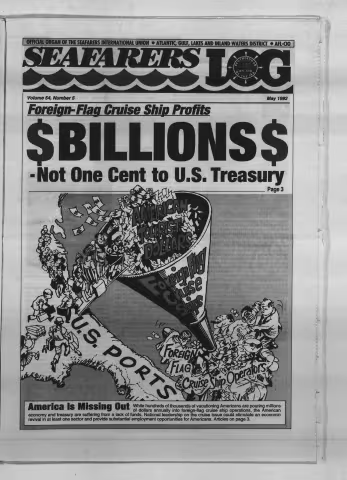
A|||0|*||23 |C MiSSinil Out While hundreds of thousands of vacationing Americans are pouring millions
of dollars annually into foreign-flag cruise ship operations, the American
economy and treasury are suffering from a lack of funds. National leadership on the cruise issue could stimulate an economic
revival in at least one sector and provide substantial employment opportunities for Americans. Articles on page 3. "• • '
y. •••
^av;y,
CT^aii^ppfE'pg;
y y;%v, -.'
•';, -if'S '• • •• ••
y'. =•: 1
i '••• •
t W'
;• J
•I • #
•••ysK : ../;
yy'ssy'V.y"' ••'••..•
••• I'ri "*',
'-' y\
-..-••I'--
•i-
L ' '••'••.' " ' •'
I -
M -
r::;\
•iv:: •
•fv '•'' ••'•.'•
'i "'P''\ 'S .'•••', >•.
I'-- "'
=5
."' .- , '.'i '. ' V - ' '
SEAnRERSLOm ROriRRE
President's Report
Maritime on White House Agenda
The Bush administration has formed a policy group to take up the issue
of what can be done to make U.S. shipping competitive with its foreign
counterparts. This is good news.
To have a national policy that ensures that the United
States has a commercial fleet operating under the Stars
and Stripes requires the attention of the White House.
Meaningful reforms that have bolstered the American
merchant marine have only come about in U.S. history
when there has been a commitment on the part of the
nation's highest office to such a program.
For the past two decades. Congress has done its part to
support a U.S.-flag fleet. But bold and sweeping initia
tives only can come about with the active participation of
the president. Because the maritime industry has never been made up of
one dominant company or a single union or been the concern of oiily one
sector of the government, leadership on a presidential level working in tan
dem with Congress has been the key element in bringing together the
various forces in the U.S. merchant marine.
And presidential leadership in this area is only fitting because the fact is
that American shipping touches concerns of many segments of govem-
Michael Sacco
ment—^for example: the militaiy's ability to transport mat^el, the niovement
of aid cargoes, bilateral relations with odier nation states, energy policy, tfie
ability of U.S. manufacturers to export, among many others. Shipping dso
spans many aspects of the nation's interests—^national defense, economic
security and—^less tangible but perhaps as important—our position as a world
power. In the history of the modem world, every dominant power has had a
naval and commercial fleet of substance. At the heart of being a world power
has been dominance of comm^cial navigation.
The structure of the working group makes us somewhat cautious. The
group contains representatives of many of the government agencies that have
traditionally been cool toward U.S.-flag shipping—such as the State Depart
ment and the Agriculture Department However, this is where strong presiden
tial leadership can overcome differences in setting policy.
The SIU, for its part, will keep an open mind. The situation is urgent
and we welcome any movement that will result in a program that keeps the
U.S.-flag on the high seas and in ports around the world.
In the final analysis, we must give our all to every chance to save U.S.
shipping. It is a matter of the welfare of our country. It is a matter of job
security and job opportunities for our people. This is a fight worth fighting
because American ships are good for America.
Hall Lecturer Reviews Plight of American Merchant Marine
1970 Act Architect Says New Ships Key to U.S. FieePs Future
To have a viable U.S. merchant marine in the
future, American shipowners must be allowed to
replace aging tonnage with new equipment, said
Andrew E. Gibson, a primary architect of the
Merchant Marine Act of 1970, who delivered his
The fuil texl of Gibson's 1992 Paul Hall
Memorial Lecture appears oh pages 16'17.
analysis of the plight of American shipping in the
1992 Paul Hall Memorial Lecture to an audience
of 140 representatives from govenunent, the in
dustry and legal fields last month in Washington,
D.C.
In opening the session. Captain Donald L.
Keech, executive director of the University of
Southern California's Hancock Institute for
Marine Studies, said the lecture series is named for
' the late president of the Seafarers Intemationd
Union and is supported through an endowment at
the University of Southern California established
after Paul Hall's death in 1980. The endowment is
supported through contributions from the late SIU
president's friends and associates who believed
this program would be a fitting way to memorial
ize Paul Hall's unifying influence in the maritime
industry.
Gibson, who serves as the Emory S. Land Chair
of Maritime Affairs at the U.S. Naval War College,
also called on the military to clearly define its need
for new vessels based on a realistic and credible
war scenario of the future so that the debate on the
need for a U.S.-flag commercial fleet can move
forward without getting bogged down in specula
tion on Navy building needs.
Volume 54. Number 5 May 1992
rigy
The Seafarers LOG (ISSN 0160-
2047) is published monthly by the
Seafarers International Union; At
lantic, Gulf, Lakes and Inland Waters
District; AFL-CIO; 5201 Auth Way;
Camp Springs, Md. 20746.
Telephone (301) 899-0675. Second-
class postage paid at MSG Prince
Georges, Md. 20790-9998 and at ad-
ditional mailing offices.
POSTMASTER: Send address chan
ges to the Seafarers LOG, 5201 Auth
Way, Camp Springs, Md. 20746.
Communications Department Direc
tor and Editor, Jessica Smith; Assis-
tant Editor, Daniel Duncan;
Associate Editors, Jordan Biscardo,
Max Hall; Associate Editor/Produc
tion, Deborah Greene; Art, Bill
Brower.
Gibson, who served as assistant secretary of
commerce for maritime affairs during the Nixon
administration, said that among the factors coir^
tiibuting to the demise of the American merchant
marine is government inaction and the industry's
failure to shed public perception that U.S. shipping
is a group of subsidy recipients.
It was during the late '60s and early '70s that
Gibson worked with Paul Hall to achieve the Mer
chant Marine Act of 1970, Herbert Brand recalled.
Brand serves as chairman of the Paul Hall
Memorial Committee and was an activist during
the fight for the 1970 act
Gibson and Hall Shared a Goal
Diuing his remarks introducing the 1992 Paul
Hall lecturer. Brand said it was particularly ap
propriate that Andrew Gibson be selected as this
year's lecturer. "Andy Gibson and Paul Hall had a
close relationship and a shared goal—to reverse
the decline of the U.S.-flag merchant fleet and to
bring about a public policy that acknowledged the
essentiality of a strong shipping capability as a
national security must," said Brand.
Gibson, who was president of Delta Steamship
Lines and a senior executive of Grace Lines,
pointed out that to be successful American
shipowners must concentrate on providing "excel
lent service at competitive rates." To do that, "the
owner must have the best equipment and that
means that aging ships must be continually
replaced by better ones. And they must be
replaced at prices comparable to the best that the
competition can obtain," he said.
That need raises some questions, Gibson said.
"Will the shipbuilders and their congressional al
lies allow changes to existing law, permitting com
panies to acquire foreign built ships and still retain
access to non-defense government cargoes?"
The 1992 Paul Hall Memorial lecturer, Andrew E. Gib
son, presented his views on America's maritime dilem
ma to an audience of more than 140 representatives of
government and the shipping industry.
Attrition Warfare Is Not Probable
Gibson also noted that there "is a growing
realization among many of those who attempt to
frame future defense strategies, that the United
States has entered a phase where attrition warfare
is neither probable nor of major concern." Because
it is believed that "no credible war scenario en
visions a prolonged non-nuclear war that involves
major ship losses," Gibson said, "procurement
>olicies that continually support defense industries
)ased on the claim that this type of surge capacity
is essential in a future glob^ conflict" are being
questioned.
"Until the Department of Defense is willing to
define clearly the amount of shipbuilding capacity
required to construct future U.S. naval vessels, the
proponents of a shipbuilding mobilization base
sufficient to sustain the merchant fleet in a sea war
of attrition, may well prevail," Gibson said. "The
result will be, not any new ships, but the throttling
of any serious consideration of removing legisla
tion that is a major cause of denying American
shipowners the ability to compete."
Gibson cited the importance of a presidential
commitment to U.S. shipping, noting it was a key
ingredient in achieving national policies dedicated
to sustaining an American merchant marine. He
noted that the 1970 Merchant Marine Act, which
brought about the largest peace time shipbuilding
program in U.S. history, was a "direct result" of
President Richard Nixon's commitment to a
strong U.S.-flag shipping capability.
President Ronald Reagan on the other hand may
have "doomed our international fleet to eventu^
extinction" by eliminating all subsidies for com
mercial shipbuilding while leaving in place the
requirement for domestic building in order for the
shipowner to qualify for government pro^ams.
Gibson pointed out that the adnodnistration used
as its excuse for failing to address the problem the
lack of a clear consensus within the industry for
any type of maritime program. "One has to wonder
how many government programs developed in the
past 200 years, that directly affected a diverse
interest group, ever had a similar requirement,"
Gibson said. "For an industry in which both
management and labor not only fight among them
selves, but with each other, such a requirement
makes fulfillment impossible and die imposed
condition an absolute mockery."
Gibson also argued that shipping companies
have hurt themselves by allowing—since the 1936
Merchant Marine Act—the label of recipients of
>3: Continued on page 15
. •v.
vH": -•
r y' ••
m
MAri992 soFJumim ' - "• r,-r'W
Philly
•• .'->• •• > ; • •
Employees of a new ferry which
runs between Philadelphia to Cam
den, New Jersey across the Delaware
River, have designated the Seafarers
as their bargaining representative. In
turn, the company—Riverbus,
Inc.—^has recognized the SIU as the
union representing its ferry
employees.
The ferry began operating March
31—exactly 40 years after daily pas
senger ferry service had been halted
between Penn's Landing,
For additional photos of
creWi see back pago.
Philadelphia's waterfront park and
Cooper's Ferry in Camden. Through
its first three weeks, the ferry
transported more than 40,000 , pas
sengers.
A pair of rotating four-person crews
mans the ferry boat, named the
Delawhale, with a third crew
scheduled to be added in the near fu
ture. A night maintenance person also
works aboard the400-passenger ferry.
The crewmembers working aboard the 100-foot Delawhale just signed on with the Seafarers. The ferry, which began operation
March 31, reinstitutes a senrice that had stopped 40 years ago.
Deckhand Robert Habina said he
wanted to sign up with the Seafarers.
"I joined for the benefits, the
camaraderie and the job security," he
told a LOG reporter. "I also knew the
SIU is a large union and I appreciate
its political stance.'
The ferry service is scheduled to mn
every day of the year. Crewmembers
work a two-days-on, two-days off
schedule. The ferry runs from 7 a.m
to 6:45 p.m weekdays, 9 a.m. to 8:45
p.m. Saturdays and 9 a.m. to 5:45
p.m. Sundays. This month the ferry
will begin expanded summer hours.
Foreign Cruise Ships in U.S. Markeis: Biiiions in Profits, Zero in Taxes
While they exploit American pastures in the
form of American passengers and American ports,
foreign flag ship operators are racking up billions
of dollars in profits without forking over a cent to
the U.S. treasury for taxes.
America's coffer is being robbed directly of
corporate income taxes while also losing the per
sonal income taxes of thousands of American
workers who are shut out of shipboard employ
ment opportunities on these foreign flag ships.
What makes this particularly painful to the
American j^ople is that this comes at a time when
the U.S. is experiencing severe economic
hardship.
Dominated by seven companies, each with a
host of subsidiary groups, cruise enterprises have
made billions off the American market over the
past decade, a period in which this sector of the
maritime industry has grown by leaps and bounds.,
Eighty five percent of all cruise ship passengers
are American and 80 percent of the itineraries
involve American ports—primarily those in
southern Florida, and these figures have remained
constant as more and more people look to cruises
for their vacation plans.
The biggest beneficiary of this tax evasion
scheme is Carnival Cruise Lines, the largest of the
world's passenger ship operations. Carnival aims
its marketing initiatives at the American public.
The result is that of the 3,640,000 Americans who
took a cruise vacation in 1990, one out of four did
so on a Carnival ship. The other Americans sailed
on ships of six major cruise companies and vessels
of scores of smaller cruise operations.
to U.S. vacationers who generate cruise revenues
of $1.2 to $1.3 billion per year for the company.
But because Carnival is technically a stupping
company that is a controlled foreign corporation,
it is exempt from paying U.S. federal income tax.
With an incorporation in Panama, and with ships
registered in Panama, Liberia, Bahamas, British
Virgin Islands and the Netherlands Antilles, Car
nival escapes U.S. tax laws.
Camivd's competitors also rake in billions in
profits made from operating out of U.S. ports and
carrying American passengers. And, like Car
nival, diese companies escape taxes to the U.S.
government on profits attributable to American
sources.
$502.5 Million Prorits, No U.S. Taxes
Controlling some 26 percent of the North
American market, Camivial collected $502.5 mil
lion in profits from 1985 to 1988 and paid zero in
U.S. taxes.
(Recently, Carnival has coughed over a few
bucks to Uncle Sam because it acquired a,sub
sidiary with a land-based tour and hotel business-
which does not enjoy the tax evasion scheme that
foreign-owned shipping does. The company , |iow-
ever, continues to not pay a dime on profits jfrom
its shipping operation.) ,
For all practical purposes. Carnival ^ an
American company. The American-owned cor
poration is headquartered in Miami and operates
ships sailing from southern Florida ports catering
Most Cruise Passengers Are Americans
The fact that the nation's tax laws allow Car
nival and other cruise companies with si^ificant
U.S. operations to evade their responsibilities to
the American treasury has come to the attention of
millions of Americans through an investigative
report on the U.S. economy written by Philadel
phia journalists Donald L. Barlett and
James B. Steele. Their nine-part series entitled
America: What Went Wrong? also has been pub
lished as a book and is the basis for two episodes
of Listening to America by Bill Moyers shown on
public television.
Under the nation's tax rules, if Carnival was
considered an American company, it would have
paid some $200 million in taxes on that half a
billion dollars in profits it made from '85 to '88.
With the American economy in the shape it is
in, it will be up to the government to find ways in
which revenue can be brought into the treasury and
Americans can be put to work. The cruise ship
industry is certainly an area that the government
can look to as a source of potential revenue.
Whoever the American people select this
November to lead the nation will need to address
this inequity. It is a factor in the nation's federal
budget deficit and national debt.
TTie cruise ship industry has been thriving year
after year for the past decade or so. Newly con
structed vessels have been added each year; in
1992 there will be 14 new cruise ships add^ to the
world fleet. The ships being built are getting larger
and larger. Cruise companies believe the ̂ mand
for their services is strong enough that 2,000 plus
passenger ships can be built and operated 52 weeks
of the year. Stockbrokers and investment analysts
and industry boosters talk of growth rates of 10
percent a year. The industry's association notes
that the cruise ship market is hardly saturated-
only four percent of America's potential cus
tomers have taken a cruise.
Billions of dollars have been made and billions
more will be made from cruise ships sailing from
U.S. ports carrying American passengers. There is
certainly room in this scenario of huge corporate
profits for America to get its fair share of tax
revenue from those who make their bucks off of
U.S. resources.
Cruise indusiry Opportudties
ChaHenge U.S. Govemmeiil
The proliferation of foreign flag cruise ships
making American cities their home ports and
drawing billions of dollars out of our economy
should certainly be a challenge to the leadership
of this nation seeking ways out of the troubles
that riddle the U.S. economy.
Right now, foreign-flag ship operators have
this lucrative market to themselves despite the
fact that 85 percent of people who take cruises
are American citizens.
More often than not, these foreign com
panies are tdking advantage of the American
cruise market with support from foreign
governments. For example, in a report to inves
tors, one European-owned cruise company
makes no bones about the "grants" and "sub
sidies" it is receiving from a government to
build four hew ships, some of which will end
up operating out of U.S. ports carrying
American passengers.
With appropriate U.S. government direction
and initiative there ought to be ways and means
for American shipping and American workers
to become part of this field. The U.S. govern
ment must find ways to stimulate new cruise
enterprises.
For its part, the Seafarers International
Union has made it known that the union is
seeking to encourage investors in this area,
recognizing that U.S. capital and labor can
produce a product that can effectively serve
cruise passengers.
Conhnued on page 15
r?
J:"')-''.' r
-'
• \\- ••
> >•;
' ..-r yt-,
* -M&i,
mrim
'^^• •: "
V'rJ >
ffii./,. •;
•;A^> " ,.- •,
mMlle House Pme! to Review U.S.-Flag Shipping
-S'sj.
The administration has formed a
high level working group to develop
recommendations for government
policies directed at the privately-
owned U.S.-flag shipping sector.
A White House memorandum is
sued last month spelled out the mis
sion of the newly formed working
group on commercial maritime
policy, which is comprised of White
House officials, cabinet members
and chaired by the Secretary of
Transportation, Andrew H. Card.
SIU President Michael Saccp,
upon learning of the initiative said,
"We welcome any movement toward
the creation of a maritime program
that is essential to this nation's inter
est in carrying out its role as the major
world power. If the Bush
administration's move materializes,
it could have beneficial effects on the
economy, on the employment pic
ture, as well as on the national
security."
The working group is to report its
findings and recommendations by
May 22 to the president's Policy
Coordinating Group, a structure es
tablished in February by the
president's chief of staff, Samuel K.
Skinner, to formulate the
administration's domestic program.
The policy coordinating group is
head^ by Clayton Yeutter, former
secretary of agriculture and currently
counselor to the president for domes
tic policy.
Moving on a Fast Track
The administration will announce
its policy recommendations directed
at bolstering the U.S. fleet at a hear
ing of the Senate Commerce Com
mittee, which overseas merchant
marine issues, in early June.
Among the assignments of the
working group is to identify and
evaluate government policies that
will allow the commercial U.S.-flag
fleet engaged in foreign trades to
compete.
The working group also is charged
with the task of defining the distinct
roles of a commercial shipping sector
and a sealift fleet which is strictly
oriented to meeting the nation's
defense requirements. It is to assess
the impact on the competitive posi
tion of the U.S. fleet of the myriad
government regulatory regimes that
cover ocean shipping.
The group will put forward its ob
servations on what the government is
best suited to manage—^be it a sealift
force with a national defense pur
pose, promotional programs for a
U.S.-flag fleet or economic regula
tions.
Maritime industry analysts
believe the APIVSea-Land jointly is
sued call for a govemment policy
designed to retain a fleet under the
American flag is the spark that ig
nited White House action.
The two major liner companies,
which operate 23 and 41 U.S.-flag
containerships respectively, in
January issued a pronouncement that
if something is not done, and done
immediately, to save the American
merchant marine, what is left of the
U.S. liner fleet will have to be trans
ferred to foreign registry.
APL/Sea-Land Proposals
APL and Sea-Land have raised
several areas in which the U.S.
govemment can take steps to ensure
a viable American-flag fleet in the
future. Among the suggestions raised
by the two companies are: reviewing
the maze of federal regulations with
an eye towards eliminating those that
put an unfair burden on the
shipowner, creating a favorable in
vestment climate, bringing Coast
Guard shipbuilding regulations in
line with world standards, making
government procurement policies
more effective, and increasing crew
productivity.
Assigned by the White House to
the working group on conunercial
maritime policy in addition to
Secretary Card and Chief of Staff
Skinner are Secretaiy of State James
A. Baker HI, Secretaiy of Treasuiy
Nicholas F. Brady, Secretary of
Defense Richard Cheney, Attomey
General William P. Barr, Secretaiy
of Agriculture Edward R. Madigan,
Secretary of Commerce Barbara H.
Franklin and Secretary of Labor
Lynn Martin.
Also on the working group are
U.S. Trade Representative Carla A.
Hills, OfBce of Management and
Budget Director Richard G. Darman,
Agency for Intemational Develop
ment Administrator Ronald W. Ros-
kens. National Security Advisor
Gen. Brent Scowcroft, Assistant to
the President for Economic and
Domestic Policy Roger B. Porter,
Chairman of the Council of
Economic Advisers Michael J. Bos-
kin, Chairman of the Joint Chiefs of
Staff Gen. Colin L. Powell, Federal
Maritime Commission Chairman
Christopher L. Koch.
Sacco also noted the importance
of White House involvement in the
process to come up with solutions to
reverse the decline of the U.S. ship-
ring fleet. "We're running close to
laving America eliminated as a
maritime presence in the world.
The Bush administration involve
ment in the process to provide for a
viable U.S.-flag fleet is the major
element in the equation. Without
administration leadership, no effort
can succeed."
The SIU official said the union "will
cooperate in every possible way to
make certain the Bush administration
effort becomes a reality."
House Reviewing Biii te Ciese
iniand Tewing Safety Leepheie
A congressional subcommittee
will meet this month to take the next
legislative step to enacting a bill that
would close a safety loophole by
making all individuals employed on
towing vessels of more than five
gross tons hold Coast Guard docu
ments. Currently, the majority of
crewmembers working aboard in
land waters' vessels are exempted
from holding Coast Guard docu
ments.
The holders of merchant mariner
documents must submit to drug test
ing, undergo an FBI criminal inves
tigation and allow for a check of the
National Driver Register for
evidence of alcohol abuse.
Additionally, the holders of docu
ments, also known as seamen's
papers or z-cards, must take an oath
to adhere to all applicable federal
laws. Under soon-to-be-issued rules,
the documents will have to be
renewed every five years.
BiilMoving Quickly
The House Coast Guard and
Navigation Subcommittee is ex
pected to complete work on the Mer
chant Mariner Document Expansion
Bill (H.R. 4394) by the end of May
to prepare the legislation for the full
Merchant Marine and Fisheries
Committee.
Hie bill, introduced by Walter B.
Jones (D-N.C.) who serves as the
committee's chairman, could be ready
for debate in the Senate before Sep
tember, according to the committee's
staff director, Ed Welch. "We are
hopeful to get this through the House
by the early summer," Welch told the
Seafarers LOG.
The SIU strongly supports H.R.
4394, which is designed to close a
loophole in maritime safety stand
ards on the nation's rivers and lakes
that endangers the lives and working
conditions of crewmembers aboard
tugs and towboats as well as the
people who live and work around
these waterways. The union urges
members to seek the support of their
legislators on Capitol Hill.
In March, the SIU testified before
the Coast Guard subcommittee in
favor of the legislation. Executive
Vice President Joseph Sacco pointed
out to the subcommittee a "lack of
uniformity between the requirements
that must be met by individuals
employed on various vessels."
Crewmembers' Safety at Stake
Presently, crewmembers aboard
tugs and towboats on the inland
waterways and on boats of less than
100 gross tons that ply the coastal
waters are not requir^ to hold Coast
Guard documents. Of these vessels,
if they are more than 26 feet in length,
the Coast Guard requires only the
vessel operator to have a license.
More than 3,300 tugs sail on the U.S.
inland rivers and l^es.
Joining the SIU in favor of H.R.
4394 at the hearing were repre
sentatives fijom the Intemational Or
ganization of Masters, Mates &
Pilots and Crowley Maritime. The
bill has picked up the bipartisan sup
port of 31 cosponsors.
SIU Presses for Repeal of Work Tax en Seamen
An effort to overturn a proposed
work tax on seamen and boatmen is
gaining steam in the House of Repre
sentatives.
Last month, a bill (H.R. 4693) to
repeal a proposed charge for mer
chant mariner documents and licen
ses was introduced by
Representative W.J. "Billy" Tauzin
following testimony in Febmary by
the SIU and other maritime unions
against user fees on Coast Guard-is
sued marine licenses and documents.
Seafarers are urged to contact their
members of Congress to support and
cosponsor the legislation. So far,
Walter Jones (D-N.C.), Herbert
Bateman (R-Va.), Robert Davis (R-
Mich.) and Jack Fields (R-Texas)
have signed on to the bill to repeal the
user fees, dubbed a "work tax" by the
SIU and individual seamen and boat
men around the country.
"We are going to make a fight to
get this passed this year," Jim
Adams, a staff member of the House
Coast Guard and Navigation Sub
committee, told the Seafarers LOG.
One of the roadblocks affecting
the bill's passage is the 1990 Budget
Act that demands any revenues cut
from the federal budget must be offset
by an increase elsewhere. "We are
working with OMB (Office of
Management and Budget) and the
House Ways and Means Committee
to take care of this," Adams noted.
"Everyone has been cooperative."
The work tax came into being be
cause of the same budget bill. Con
gress mandated the Coast Guard to
collect fees for marine licenses and
documents issued to merchant
mariners. The proposed charges start
at $35 for a document, go to $135 for
an AB or QMED endorsement and
peak at $330 for an upper level
license.
The SIU has fought against the
work tax since the scheme was an
nounced in the Federal Register. The
union argued regulation and super
vision of mariner's skills is done in
the public interest and does not con
stitute a user fee as there is no direct
user or beneficiary of the service.
At the end of the February hearing
held by the Coast Guard subcommit
tee, Tauzin, who serves as its chair
man, and Bateman publicly pledged
to repeal the tax.
Meanwhile, the SIU's lawsuit to
declare the tax unconstitutional
remains on hold following a decision
by a federal judge that such a case
could not be heard until the im
plementation of the work tax is im
minent.
The Coast Guard now is in the
process of formulating a final rule on
the user fees. When this is issued, it
will contain a starting date for the
plan. In the meantime, the Seafarers
and individual seamen and boatmen
are pressing Congess to repeal the
proposal.
Where Is U,S, Maritime Going?
Today, a debate is raging over the future of American-flag shipping.
For an insight into the policies and practices that have led to the current
plight of the U.S. merchant marine, read the remarks of Andrew E.
Gibson, former assistant secretary of commerce for maritime affairs
from 1969-1972 during the Nixon administration. See page-s 16-17.
tssy-A..
«»!•
'IP "
;5S?s4: Jis.w..r-v :
'•;; "^;ji -i'. •'.<!' •./' '
S*5@
SEAFARERS L0G2
FMC's Koch: Innovative' U.S.-Flag Fleet
Is Vital to Nation's Economic Security
What makes the U.S. liner fleei
worth saving is that it is the kind o:
American industry you can point to
and say, "It is the best in the world,
said Christopher L. Koch, chairman
of the Federal Maritime Commission
(PMC).
As the administration begins to
formulate policy recommendations
designed to revitalize U.S. shipping,
Koch noted that "what is at issue here
is not trying to save an industry thai
has become wrapped up in a cocoon.
It is not an industry that has failed to
look into what is necessary to com
pete." Koch discussed some of the
wide-ranging issues facing the in
dustry in an interview with the
Seafarers LOG.
The head of the PMC-—which is
charged with regulating international
shipping on behalf of American con
sumers, shippers and ship
operators—said the U.S. liner fleet
has been innovative, it has invested
in its operation, it has "done all the
things we wanted industry to do to be
competitive in a global market.
"lire problem is the government
policy. U.S. government policies and
the fact that they have made the in
dustry less competitive than it could
be and should be," said Koch, who
first began tackling maritime issues
in 1977 when he joined the staff of
Senator Warren Magnuson (D-
Wash.) after graduating from the
University of Washington's law
school. Koch held the post of chief
legislative assistant for Magnuson
and also served as counsel to the
Senate Commerce Committee.
In 1981 Koch joined the staff of
Senator Slade Gorton (R-Wash.) and
began working on the Shipping Act,
which was to become law in 1984.
After, ̂ spending a year-and-a-half
stint practicing maritime and cor
porate law with the Seattle-based law
rfirm of Bogle & Gates, Koch
returned to public service in 1983 as
jSenator Gorton's chief of staff. He
served in the same capacity for
Senator John McCain (R-Ariz.) from
1987 until 1990.
The PMC official,, who became
chairman of the agency in late 1990,
cited the many achievements of the
American liner industry: the inven
tion of containerization, the im
plementation of double stack trains,
door-to-door service, a host of
sophisticated logistics.
Proof of America's success can be
seen in the manner in which foreign
liner companies put into place tech
nologies developed by the U.S.-flag
fleet, Koch noted. On a tour of a
Japanese carrier's new terminal,
Koch said his hosts would "indicate
they had done things a certain way
because APL (American President
Lines) had done it this way or Sea-
Land does it this way."
He observed that electronic data
and tracking of cargo through door-
to-door logistics programs are on
every shipping company's agenda.
"At the forefront of that again have
been American carriers. They are not
the only ones doing it. Some of the
others are imitating it very well and
doing a very good job of it. But where
are the innovations coming from? It
has been U.S. companies," the PMC
chairman said.
This fact makes working for a
policy effort to revitalize the
Amencan merchant marine an excit
ing fTospect. "It is not like you have
a dying, crumbling industry whose
future is certain to be bleak. You have
an industry that is innovative, crea
tive and you know that if they can be
)ut in a competitive posture, they
rave the ability to succeed," Koch
said.
Washington Is Serious this Time
While the revitalization of the
Airierican merchant marine has been
die subject of numerous studies and
task forces over the past two decades,
a very different approach currently is
taking place in Washington, D.C.,
Koch said.
The administration recently has
formed a policy working group on
the U.S. merchant marine, to which
the White House assigned the heads
of many departments and agencies.
The working group is charged with
the task of developing specific
recommendations on what the
government can do in this area.
"This is not a study. I think this is an
exercise to make decisions," Koch
stated.
"Washington, for the first time in
quences of no action are going to be
those consequences being Ae end
of an industry," he said. "And I think
it is also clear that those consequen
ces are unacceptable to the majority
of the American public."
Seating All Parties at the Table
When asked about the involve
ment in the policy working group of
several government departments that
had not traditionally proved to be
steadfast allies of U.S. shipping,
Koch said, "They have a perspective.
They have a viewpoint. Their view
point is not going to go away by
ignoring it and I think it entirely ap
propriate to make sure they are at the
table so that they understand the
stakes and the consequences."
Koch pointed out that "if this ex
ercise was easy or unanimity were
possible, the problem would have
been solved a long time ago. The
advantage of having everybody at the
table is diat everybody is part of the
final decision."
Initiative of APL and Sea-Land
The movement within the govern
ment to develop a program to
rehabilitate the industry has been in
fluenced by the joint call of the two
giants of the U.S.-flag liner fleet for
Taking a firsthand look at a U.S. shipping operation, FMC Chairman Christopher L.
Koch sailed aboard APL's President Jackson last fall. He is pictured aboard the vessel
with Captain Gary Schmidt.
a very long time—probably since
1970-—is seriously looking at what
steps need to be taken by the govern
ment in order for us to continue to
lave a U.S. merchant marine," said
Koch, who is one of the members of
the working group.
"The exercise is serious. It is
under way," Koch said, "It is
moving on a fairly fast time track."
This effort, Koch noted, is en-
lanced by the fact that "the operators
stopped die infighting that they have
)een engaged in for a number of
years, the unions are being suppor-
ive and realize that in fact we have
o pull together to come up with some
answers or the whole industry is
going to go."
Add to this equation the fact that
government agencies have become
aware that the nation can no longer
avoid making decisions and "it is
very possible that something will
emerge over the next month to two
months," said Koch.
Inaction would be unacceptable,
t has become "clear what the conse-
a revamping of federal policy that
impacts on the American merchant
iharine. "It would be easy to under
estimate the impact of APL and Sea-
Land getting together," Koch said.
He noted the initiative of the two
liner companies "removed one of the
great obstacles—one of the great ex
cuses—^for not doing anything in
government which was 'the industry
itself could not agree.'
"When you get the two largest
companies together and you have the
prospect or the belief that they and
organized labor are working
together—not only with a common
purpose but are very close on what a
common solution can be—then you
are starting to put together a political
coalition that can have some effec
tiveness."
The Working Group's Agenda
It is likely that the admin
istration's working group will be
looking at all sectors of the U.S. mer
chant marine, not just containerships.
"Everything is technically on the
FMC Chairman Christopher L. Koch
table," Koch said. He offered one
caveat: "Except the Jones Act is not
on the table. TTiat is not negotiable."
"While the APL/Sea-Land effort
has tended to focus the attention on
the liner fleet, I think there is also
going to be an effort to see that there
is something that can also be done for
the bulker fleet;" Koch said.
The issues raised by the two liner
companies very likely will be among
the items discussed by the working
group, including CCP restrictions, a
review of the tax laws generally.
Koch said emphatically that the
government's effort is not to "sub
sidize the U.S. industry. The objec
tive is to put the U.S. industry on a
comparable playing field" with its
foreign competitors.
He noted that international avia
tion is regulated through bilateral
agreements. "The trade is divided
up." For example, flights between
Japan and the United States are ap
portioned to U.S. and Japanese car
riers through government
agreements. Entering the business is
restricted by these bilateral pacts.
On the other hand, shipping is
open. "Anybody with a string of ves-
;sels that wants to begin liner service
can enter U.S. ports and call on U.S.
customers and there are no govern
ment restrictions to entering die busi
ness," Koch observed. "This makes
lit fundamentally different" from the
airline sector, he said.
Discriminatory Practices
The PMC chairman listed how
other nations bolster their shipping
operations—through tax treatment.
generous depreciation schedules, tax
incentives. "You see everything from
cargo reservation schemes to restric
tions on U.S. operators' ability to
open branch offices in foreign
countries."
Hong Kong lets all income to
shipowners be tax free. Norway has
extensive tax incentive programs,
Koch noted. He cited the People's
Republic of China (PRC) as an ex
ample of a nation where U.S. carriers
had been prevented from offering
full intermodel service.
The PMC has been involved in
trade cases against a host of countries
that have discriminated against U.S.-
flag operators. Koch named the PRC,
Korea, Taiwan and Japan as nations
that had unfair procedures and prac
tices directed at competitors of their
shipping fleets. In the case of each of
these nations' unfair practices, the
PMC has successfully broken down
those barriers, Koch said.
Continued on page 15
" ft'
-.a®
,• 'I
" ' ' i'j
. . , • • y.l''
' ' -V
-I
, .' f.
-1;
mi
i -m
•iA
'-.'Si
••'i-
»•
mm «RL
SI
'"•f •. .
I ' ••
•It :?":•• •^•/
:',-i :'i-':
•:i
-i; -V
,i
,•
SeWARERSUm' mmiRRR
Seafarers to Train in Refrigerant Rmmvery Systems
Provisions in the Clean Air Act
will require everyone involved in the
repair and servicing of refrigeration
equipment to be certified in the use
of recovery systems. This affects
Seafarers who sail in the engine
department.
A recovery system removes
refrigerant from a refrigeration sys
tem and then stores it in an outside
container. This prevents refrigerant,
which contains ozone-depleting
compounds, from escaping into the
air.
The Environmental Protection
Agency (EPA), the government
department promulgating rules and
procedures mandated by the Clean Air
Act, is expected to issue guidelines
some time this spring on what an in
dividual must know to be certified in
the use of recovery systems. After the
initial suggested guidelines, interested
parties will have time to respond and
help modify the program before a final
rule is issued.
Rather than waiting for the final
rule, the Lundeberg School within
the next month or two will prepare
Seafarers to meet what generally is
believed to be the requirements EPA
will mandate. Indications are that in
dividuals will be required to have
taken this training by July 1993.
Thus, the Lundeberg School, by in
corporating the anticipated require
ments in its curriculum now gives
Seafarers a head start and ensures
that SlU-contracted companies will
have crewmembers aboard their
ships who are certified in the use of
refrigerant recovery systems.
It is expected the EPA will
recognize the training in recovery
systems that is given at the Lun
deberg School, including the cour
ses given before the agency's final
rule is issued.
The following individuals will be
required to go through the recovery
system certification process:
• Students enrolled in the Lun
deberg School's Refrigeration
Operation and Maintenance course.
• Students enrolled in the
Refrigerated Container course.
• New QMEDs.
• QMEDs returning to the Lun
deberg School for other specialty
courses or other training who pre-
X ••
u
V'
5
. 5
All students in the schoors refrigeration course will receive recovery systems training.
viously have not been certified.
• All persons holding the
refrigeration engineer endorsement.
The SIU already has submitted a
program to the EPA for approval and
is awaiting a response.
HazMat Pratectioii Procedures Added to SIU School Course
Learning the proper fit for a respirator from Instructor Jim Shaffer (right) are Glenn
Thompson, Tobias Rose and Jason McGrew.
The Seafarers Harry Lundeberg
School of Seamanship has instituted
curriculum to prepare students for
use of important protective equip
ment when working with or around
hazardous material (HazMat).
Coast Guard rules on benzene ex
posure which went into effect
January 15 are designed to protect
mariners from the potentially fatal
carcinogen. The regulations require
employers to be responsible for en-
Lambert Soniat Dufossat dresses for
Level B protection from hazardous
materials.
suring appropriate monitoring of ex
posed workers and determining over
all compliance. Monitoring allows
determination of exposure levels for
different jobs during routine opera
tions.
In certain situations, the new rules
require mariners to protect themsel
ves by using special suits and breath
ing gear. Seafarers now may learn
more about the protective equipment
by taking the Lundeberg School's
Oil Spill Emergency Containment
and Clean-Up course. The one-week
course, open to all rated members of
the SIU in good standing, includes
plenty of hands-on experience with
protective equipment such as rubber
body suits, gloves and boots. Stu
dents also learn how to choose the
most efficient air respirators and how
to check for proper fit. Companies
are required to provide such equip
ment for all mariners who work in
designated hazardous zones.
Lundeberg School instructors
stress that Seafarers must be able to
protect themselves in order to suc
cessfully protect the environment. A
health hazard evaluation report on
the Exxon Valdez oil spill of March
'89 showed many workers returned
from beach work sites each day with
their skin contaminated with
weathered crude oil. The reason: Many
workers either did not wear their
protective equipment properly (for ex
ample, did not tape the glov^sleeve
joint) or else wore the equipment inter
mittently or not at all.
In addition to hands-on training.
Seafarers in the oil spill en|ergency
course participate in lectures about
such topics as inhalation hazards. For
example, there is concem that crude
oil, even in a weathered state, might
pose a health risk from skin exposure.
SIU members leam thaL even though
in most cases the more volatile com
pounds will have evaporated during
the first 24 to 48 hours after a spill,
danger still may exist
Here again, during the Exxon Val
dez cleanup more than 250 workers
reported respiratory system illness.
They were exposed to benzene and
other compounds after the initial two
days following the spill.
Many mariners handle products
which contain benzene—products
including crude oil, gasoline and
other kinds of petroleum products.
The new regulations should afford
Ronnie Marchand and Jeffrey Sousa
leam to tape boots for protection from oil.
seamen the same level of protection
and exposure limits that the Occupa
tional Safety and Health Administra
tion (OSHA) gives to land-based
workers who may be exposed to the
highly toxic chemical.
Learning to Clean Up Spills
completing the oil spill containment course are (from left, front row)
Phillip McKenzle, Glenn Thomp^n, Jeffrey Sousa, L.ambert Soniat Dufossat,
Ronnie Marchand, Jim Shaffer (Instructor), (second row) Ronald Webb, Jason
McGrew, Tobias Rose and Joe Culllson.
.1
1
I'.f
• i".' r
r-.v-
mri992 SEAFJUIBtS LOG -t « «• r >R, ^ 1- t '
One of the sure signs that spring's
arrival is near for people living along
the Great Lakes are the puffs of
smoke emerging from the stacks of
vessels tied up in safe harbors from
Duluth, Minn, on Lake Superior to
Buffalo, N.Y. on Lake Erie.
Fitout, the process of returning the
bulkers, ore carriers and other vessels
to the Lakes, began in earnest last
month. While some SlU-contracted
vessels started plying the lower
Lakes as early as February, most
ships did not leave port until late
March and early April.
For SIU members, fitout is a
natural sign of the season despite
snow falling and ice remaining on the
upper Lakes. Members check with
the union halls in Algonac, Mich, and
Duluth to find out when they are ex
pected to remm to the vessels.
First comes the after-end. The gal
ley'gang reports before anyone else
to make sure the ovens, refrigerator,
freezer and other appliances have not
been harmed by winter's cold.
Within a day the engine department
reports. They make sure die ice that
has formed in the engine room and
conveyor area is removed and the
mighty diesels that power the ships
operate smoothly.
In less than a week, the forward-
end (deck department) signs on.
These members check out the safety
equipment (lifeboats, flares, life
jackets, etc.) to make sure they are in
working order. TTiey test the windlass,
hatches and boonL They clean up the
deck after winter has had its un-
obstmcted way for sevo-al months.
After passing the annual Coast
Guard inspections, the vessels are
ready for up to 10 months of sailing,
depending on the weather next
winter. The ships load with raw Deckhand Dennis Fitzpatrick hustles a ladder across the deck of the Indiana Harbor,
materials to replenish those used by
factories and businesses along the
lower Lakes during the winter. They
leave their winter homes empty but
remm with iron ore for steel, coal for
power plants, concrete for cement
plants and wheat for grain elevators
to renew the process of life on the
Lakes.
2nd Cook Richard Ballant on the William Wiper John Norick is performing one of the necessary jobs on board the Presque Second Cook David Grann prepares din-
R. Roesch prepares a meal during fitout. Isle—inspecting the diesel engines. nerforthecrewof the St. Clair.
; --J,-,,...
I "I
• ii
' ! If
• :<4i
f t.: , \ .
. ; - m
} V;'
•
^"i t'niiiiiiM
'^L i .
''.'i'-:...\'-'r< \x' •>^"''
f
SBIFUtH^liOe mxi992
'-:>"~i.^i'y-iir •'"'' - ' n. '' '
-tA-- .v'-'i-S;.:''!' .•.,
i t'-k
•p.-
XH»"-t.'.'X::A\
Mmm.
f|. :!'t-:
?| 1 • ..: %• . ,. . -•'•••;•/.-
[f ^
WWh
0 •
... J'H • • ,
•s i-v,.; ... J './i "
.'4'.. .-••-•
UAW Returns to Work at Caterpillar, Talks Continue
UAW members have returned to
work at Caterpillar Inc., but the union
stressed it has not accepted what the
company termed its "final" contract
offer.
The UAW's five-month strike
was recessed last month after Cater
pillar, the world's largest manufac
turer of tractors and other
earth-moving equipment, guaranteed
it would not hire permanent scabs
a practice which continues hamper
ing labor-management settlements.
Mediators formulated the truce and
are expected soon to bring both par
ties together for resumption of con
tract talks.
In a letter to the 12,600 returning
Cat workers—whom Seafarers ac
tively supported on picket lines arid
in rallies—UAW Secretary-
Treasurer Bill Casstevens noted that
the union's "struggle with Caterpillar
is not over; it has entered a new
phase."
Indeed^ Cat balked at recommen
dations made by Bernard DeLury,
director of the Federal Mediation and
Conciliation Service (FMCS), which
the UAW accepted. Before the
strike's suspension, DeLury advised
both the UAW and Cat management
to follow these procedures:
• Both parties would withdraw
their respective proposals.
• All strikers would return to work
as soon as possible.
• The company would end efforts
to hire replacements.
Seafarers from tfie Great Lakes and inland rivers rallied witti more than 20,000 trade unionists in Peoria, III. in support of striking
United Auto Workers against Caterpillar. Great Lakes members attending the rally include Algonac Patrolmen Andy Goulet and
Tim Kelley as well as Deckhands Don Thornton and Cliff Stockman.
• A cooling off period would
begin.
• Negotiations would resume
under the auspices of the FMCS.
But Cat insisted returning strikers
work under the "^al offer" it made
on April 6.
While the company would not
withdraw its final offer, the union
accepted the mediator's proposal,
recessed the strike and directed the
strikers to return to work without
Traveling from the St. Louis hall to show their solidarity with striking UAW members
are, from left, Casey McCarthy, Mary Rawlins, Field Representative Steve Jackson,
Courtney McCarthy and retired AB Charles Johnson.
Seafarers March with UFCW
SIU members from Algonac, Mich, hit the bricks to show their support for striking
Kroger employees in New Baltimore, Mich. The United Food and Commercial
Workers called a strike In southeastem Michigan on April 13 when the grocery
store chain walked out of negotiations for a new contract.
conditions. The union did not accept
the company's proposal and intends
to continue negotiations.
The strike began November 3,
aftermondis of stagnant negotiations.
When the UAW c^ed for a selective
strike at two plants in central niinois,
the company responded by locking out
union workers at other plants. The
strike then expanded to include the
12,600 workers at Caterpillar plants in
four states.
Trade unions throughout the
United States, as well as unions rep
resenting Caterpillar workers in
South Africa, England, Belgium and
France, respond^ with an outpour
ing of support which UAW President
Owen Bieber described as "over
whelming."
Business Week estimated that
Cat's strike losses are near $100
million and could take years to
recoup.
AnS'Scab BbiAwaHs
Seafarers who have not Contacted
their senators calling for support of
S.55 (the anti-scab bill) are urged to
do so as soon as possible.
The legislation, passed last sum
mer by the House, would make it
illegal for employers to fire striking
workers and then permanently
replace them with scabs.
Battle for Enactment
The battle to enact S.55, also
known as the Workplace Fairness
Bill, has beeri difficult. Opponents of
the legislation are threatening to use
filibusters (debate without a time
limit). Stopping the filibusters re
quires a 60-vote majority, while 67
votes are needed to override an ex
pected veto by President Bush.
The bill would close a loophole
which allows employers to hire per
manent replacements (scabs) who
cross picket lines during lawful
strikes. Hiring scabs has become
cormnonplace during the Reagan and
Bush administrations and has under
mined the integrity of collective bar
gaining. This practice also is favored
by union busters who actually may
force strikes so they can hire per
manent replacements.
Workplace Fairness legislation
would prevent situations such as
those at Eastern Air Lines,
Greyhound and the New York Daily
News. Eastern locked out its
employees and hired scabs before
folding; Greyhound replaced 9,000
union bus drivers with 6,0(X) scabs;
and the Chicago Tribune Company,
former owner of the Daily News,
spent $24 million to force a strike and
then hired scabs before selling the
paper to a pro-union owner.
The U.S. is virtually alone among
world powers when it comes to the
issue of hiring permanent replace
ments, Canada, Japan, France and
German among others categorically
prohibit the dismissal of striking
workers.
The following is a list of Senate
co-sponsors of S.55: Adams (D-
Wash.), Akaka (D-Hawaii), Baucus
(D-Mont.)j Biden (D-Del.), Bradley
(D-N.J.), Burdick <D-N.D.), Byrd
(D-W.Va.), Cranston (D-Calif.),
Daschle (D-S.D.), Dixon (D-Ill.),
Dodd (D-Conn.), Fowler (D-Ga.),
Glenn (D-Ohio), Gore (D-Tenn.),
Harkin (D-Iowa), Hatfield (R-Ore.),
Inouye (D-Hawaii), Kennedy (D-
Mass.), Kerrey (D-Neb.), Kerry (D-
Mass.), Lautenberg (D-N.J.), Levin
(D-Mich.), Lieberman (D-Conn.),
Mikulski (D-Md.), Mitchell (D-
Maine), Moynihan (D-N.Y.), Pack-
wood (R-Ore.), Pell (D-R.I.), Riegle
(D-Mich.), Rockefeller (D-W.Va.),
Saibanes (D-Md.), Sasser (D-Tenn.),
Simon (D-Ill.), Wellstone ^-Minn.),
Wirth (D-Colo.), Wofford (D-Pa).
'?r 1' ;
-i., •
•
^ tf
• r^J't-
' '", '
••• •-^'P5.:;v-
" .-S':;.•/••
. --v."'-' ..'
-;V •
v'^ /f," ; ••;•"
• •'•- c ''A
eSB
;.:•>, .I,*:'
nmriass XAFUIBSUie
President's Pre^f^UoUng deport Subndtted to Mombership
In accordance with the terms of
the Seafarers International Union
constitution, SIU President Michael
Sacco has submitted a pre-balloting
report to the membership.
The report sets forth certain terms
and conditions of the balloting for the
union's general election of officers
for the 1993-1996 term. The ballot
ing will take place from November 2
until December 31,1992.
Sacco pointed out in his report that
the submission to the membership
took into cosideration the changes
that have taken place in the industry
over the last few years. The pre-bal
loting report lists Sacco's recom
mendations for offices to be placed
on the ballot in the 1992 general elec
tion of SIU officers.
The fiill text of the 1992 pre-bal
loting report follows:
May 4,1992
Pursuant to Article X, Section 1 (e) of
ourConstitution, I am submitting at tills
regular May memberstilp meeting of tfils
election year, my Pre-Balloting Report.
The balloting for our General Election
of Officers for the term 1993-1996 will
commence on Monday, November 2 and
continue through December 31, 1992.
The election will be conducted under the
provisions of our Constitution, as
amended and effective July 13. 1989,
and such other voting procedures as bur
Secretary-Treasurer may direct.
I have. In consultation with our Execu
tive Board and Port Representatives,
made a careful appraisal of the needs of
this union. Its membership and Its cur
rently existing constitutional ports. We
have carefully considered the changes
that have taken place In the maritime
Industry over the last few years, with a
view toward meeting the ever changing
demands.
It Is my recommendation. In accord
ance with our Constitution, that the fol
lowing offices be placed on the ballot In
the 1992 General Election of Officers for
the term 1993 through 1996.
Headquarters
1 President
1 Executive Vice President
1 Secretary-Treasurer
1 Vice-President In Charge of Con
tracts and Contract Enforcement
1 Vice-President In Charge of the At
lantic Coast
1 Vice-President In Charge of the Gulf
Coast
1 Vice-President In Charge of the
West Coast
1 Vice-President In Charge of the
Southem Region. Great Lakes and In
land Waters
SIU Joins AFL-CiO Protest Rally
For Stronger Worker Saf^ Laws
Seafarers from across the country
joined fellow trade unionists to call
for stronger worker safety laws
during a Capitol Hill rally to remem
ber those who died as a result of
job-related injuries.
"It's a shame we have to do this to
remind Congress that workplaces are
getting less and less safe," said
Bosun Roberto Zepada, who sails
from the port of Houston.
QMED Thomas Harris of Jack
sonville, Fla added, *1 hope [the legis
lators] are listening because there are
enou^ of us here to be heard."
Approximately 500 union mem
bers gathered on the east steps of the
Capitol on April 28 (Workers
Memorial Day) to draw attention to
bills in the House of Representatives
and Senate seeking to reform Oc
cupational Safety and Health Ad
ministration (OSHA) laws.
The Washington rally took place
in conjunction with memorials
presented in other parts of the
country. The AFL-CIO, the national
federation of trade unions, noted
more than 10,000 workers are killed
on the job every year.
Decked out In wfilte caps and jackets. Seafarers join othertrade unionists on the steps
of the U.S. Capitol during Workers Memorial Day.
Seafarers march across the lawn of the Capltolito participate In the rally calling for
stronger worker safely laws.
1 Vice-President In Charge of Govern
ment Services and Fishing Industries
2 Headquarters Representatives
10 Port Agents
There shall be one port agent In each
of the 10 Constitutional ports; namely:
PIney Point. New York, Philadelphia.
Baltimore. Mobile. New Orleans. Hous
ton. San Francisco. Detrolt-Algonac
and St. Louis.
In accordance with the above-men
tioned Article X. Section 1 (e) of our Con
stitution. I am required to recommend a
bank, a bonded warehouse, regular of
fice thereof, or any similar depository, to
which the ballots are to be mailed, no
later than the firet regular meeting In Oc
tober of this year. I will make such recom
mendation to the membership before
such deadline.
As provided for In Article XIII. Section
1. nominations open on July 15, 1992
and close on August 15.1992.
The foregoing constitutes your
President's Pre-Balloting Report and
subject to my further recommendation as
to the depository to be made hereafter. I
recommend Its adoption.
Fratemally submitted,
Michael Sacco
Inqliiiiiig
Question: What's the worst
weather you ever encountered on
the Great Lakes?
(Asked of SIU members on ships In
Toledo. Lorain and Cleveland/Ohio,)
Daniel Ban-
cook, Deck
hand — I was
on a Steinbren-
ner boat, the In
dependent, in
1989. It was
my first trip.
We were on Lake Superior and
tried to outrun a storm to Buffalo.
But we spent 30 hours zig-zagging
in and out of it.
Rudy Tah-
tinen,AB
Trying to out
run a storm on
Lake Huron in
1988. We were
in the middle of
Huron and the
water line passed half way up. The
turnaround alone lasted an hour. I
thought that was going to be "the
biggie." It's the first time I sat with
my survival suit on.
Marvin
Schmitz, Con
vey orman —
Brett
Fischhach,
Bosun — I'd
say April 1980,
between Mar
quette and the
Soo Locks. I
was on the Paul
Thayer. It was a bad storm, proba
bly 25-foot seas.
Don
Binkowski,
QMED — ThQ
night the
Fitzgerald
sank, Novem
ber 10,1975.1
was on the Wil-
I couldn't even
I've sailed for
over 30 years,
so I've seen
some pretty
good storms
out there. I
remember getting off early in the
morning when the Edmund
Fitzgerald sank November is
usually the worst month.
John Sellers,
Bosun — Lake
Superior, com
ing out of Mar
quette on the
Adam E. (Cor
nelius). We
damn near
tipped her over when the load
shifted. That was in the 1970s.
Cornelius
Gleason,AB —
To tell you the
truth, there's
been so many I
can't pick one
out.
liam Roesch and!
find the deck.
Mike LaBar,
QMED —
We've run into
a few bad
winds and
maybe 15- to
20-foot seas
out on Lake Su
perior. You can get 70 mph wind
gusts out there.
David Gapske,
Deckhand—
Probably 1990,
coming up this
river (the
Cuyahoga) in
December. We
were on the
Roesch and we had to sit for 24
hours waiting for the water to go
down. It was rainy, ice was melting
and the current was bad.
Ron Vander-
cook,
AB/Watchman
— Nothing
really big,
maybe 50- to
60-mph winds.
I haven't been
in anything really bad yet.
YehiaKaid,
Porter — Four
or five years
ago, on Lake
Superior. It was
Christmas Eve
and we almost
sank. But I've
been on the
Great Lakes the past 26 years, and
that's the only rough time.
1 • I. ;;
;j;',
••A.; -
•f-
•-"V". %
. ' V
if. y •
/f-
.'fs, •
^1.
-1)' -1)'
• 'IW • 'IW
•A •" W '••Sr-
•1. •
l}'-
:v- • 11,
A.
• I- ••
•'f
,1
1
• - -
„r..
10 SeAFARE^Ute
'•0*#;.|r. -r,^.
'•^>r MAY 1902
•-•tt' ;-\
„• •
J'V-V'-K:,2.'.-:' • •
'''"'55f'Vv
"' • .<V:1,^ ;••!•'• '/V
•'• '• ^'•., -
. '''ii..- -,.
S-i!
M-
4V •.
'•"'••V; •!-:•: •Vc-;"'.. •"" •'-'
' , ..W .•';, V- . '
m •• •• -
^^•.•^.'.. ... ,•
fl'" '
&Y .^;r.r
K'/- .•'
/V ••- ;•'••
'fkl
'•0-
!i V *
•I;''
•te
•!ii\
V-:
'i"-' . . •
k' k:./"' '-:"-k
i '• ' '
I.,
,'• --.v •v'V',' ;'•' '•
• ••;v^-vY'' ',
Wiper Robert Hall uses a tap in the Inde- Waiting the signal to start the Constitution's engines are Fireman Peter Alcantra (left) Oiler Marty MarTOllus receives orders
pendence machine shop. and Oiler Steve Romlne. aboard the Constitution.
Cruise Line Engine Gangs Keep Ships Moving
Talk with any member from the
engine departments of the SS Con
stitution and SS Independence and
they will tell you they are the most
important group on the liners.
Of course, the engine department
is in charge of the diesels that power
the liners. "They can't go anywhere
without us," stated Independence
Fireman Sky Williams. "We're the
ones who make it happen," chimed
in Oiler Frankie Valle.
But there is so much more that
falls into the realm of the engine
room. Taking care of all the
mechanical items aboard the ves
sels is just one example.
"We know when we get a call for
die passenger compartments, it's an
emergency apd we need to
fespbrid," Chief EleciHciaii
ward Mancke told a reporter for
the Seafarers LOG aboard the Inde
pendence. Mancke was busy chang
ing a heating unit for a galley
dishwasher between meals.
Passengers aboard American
Hawaii Cruise vessels may believe
members of the steward department
;ially wh are indispensable, especially when
the tourists are seeking food, drink
or room service.
Passengers might go so far as to
cast a few votes for die deck crew
because they handle docking opera
tions as well as safety drills.
Yet if you ask any tourist about
the engine department, expect to
receive blank stares. They may
think of people covered in grease
and oil worlang in the steamy un
derbelly of the ships. That is only
part of their duties.
"Just let a thermostat go out,
they'll think of us right away," noted
Second Refrigerator Engineer
Biyan Chan from the Constitution.
"If we're doing our job right, pas-
twn ^ Independence engine room are Chief Electrician Edward Mancke, 2nd Electrician
chores performed by the engine
department. Dinner preparations
for 800 could hinge not on the
chefs baked Alaska coming out
perfectly but on an engineer's
replacing a thermostat unit in an
oven. Besides handling mechanical
repairs, engine department mem
bers operate full machine shops.
Fireman George Tidwell awaits his next A Ihermostat is repaired by 2nd Reefer Bn- Engine Maintenance Manny Flanta
assignment on the independence. gneer Bryan Chan on board Constitution. operates a grinder aboard independence.
Oiler Andrea Simmons works in the inde- Watching the control board on the Inde- Sometimes the job requires workirig in cramped spaces as Chief Electrician Edward
pendence's machine shop. pendence is Fireman Sky Williams. Mancke discovers while fixing the Independence's dishwasher.
•e
V.
• i i',.)'" Y»'-V'"' , ''i- i - ' 'pm-
mm
itiiiiiaaiMlia SSSS:.' '-
mr 1992 sauyuteRsioG 1?-
'.•J-. V'v'^
',/•; y^i^r •"' ...'^', 'i'!'.'
*
f'i'
Seaiarers Gei Pivmpt Sennce at New Hm^tan CHnSc
Seafarers in the Houston area ex
pressed satisfaction with the prompt,
efficient service they received at &e
new Wills Diagnostic Clinic, located
three blocks from the Houston SIU
hall. Roughly 100 SIU members (in
cluding family members) were
treated diere during the facility's first
month of operation.
The Seafarers Welfare Plan has
contracted with the clinic, which spe
cializes in (but is not limited to) oc
cupational health and internal
medicine. The clinic opened March 30
and has serviced about four Seafarers
per day, a spokesperson said.
Engine department member Mel-
vin Ahi said he likes the clinic's con
venient location; 2000 Crawford
Street, inside the St. Joseph's Profes
sional Building. Additionally, the
clinic is within a block of St. Joseph's
Hospital, the SIU medical plan's
newest preferred provider organiza
tion. *
William Hill, an engine depart
ment member who sails with G&H
Towing, said he received a "very
thorough" annual physical at the
facility. "I liked the surroundings,
and the staff was friendly and profes
sional,''he added.
Steward department member
Linda Dean, wife of Seafarer Nile
Dean, said, "This is a step up for the
union. It's a smooth process.
SIU members who wish to
schedule an appointment at Wills
Diagnostic Clinic should follow the
usual procedure: Report to the union
hall and get an appointment slip, then
proceed to the clinic.
Deck department member Frank
Barfield described the clinic as "a
great operation with a very nice,
jprofessional staff."
Fellow deck department member
Raul Guerra agreed, calling the
SIU's affiliation with WHls Diagnos
tic Clinic "one of the be^ moves our
union has ever made."
"I'm very pleased with the move,"
noted Captain Bert Thompson, an
SIU member for 17 years.
Thompson, who works for Crowley
Towing and Transportation, said he
is; "happy to see comprehensive
Continued on page 14
Melvin Ahi (left), who sails in the engine department, says he appreciates the efficient
service provided by clinic staffers such as Dr. Susan Vogel.
QMED Nile Dean (left) is examined by Joe Stephens, medical technician.
Medical tech. Joe Stephens (left) jots down a few notes with Seafarer Frank Barfield.
After receiving his physical, engine departmentmernlMr VVilliam Hill (left) confers with
Dr. Patrick Wills, founder of the Wills Diagnostic Clinic. Houston Patrolman Steve Ruiz (right) talks with Dr. Susan Vogel.
1
. . I .4i- •
} f. -v-
t' • '•
•V"' '•
•I. /
I - •
xwn
. .1..,
• '• ' ' X
i.'-
y.
a-®
'r • '-Sk
•iv^4?''L - . •• .' -• "- •• '
;v.-
•.>v..'., . •,.>•>••••
.It:.!'?:?"
,;^::;';v^:
''•;,-'V-'.r.-...' •
§lM
P-y:
f • -. ••'- iVy • '
' ^ ' 'r/ '
. .-i:^
-. •:. ••• •
#2 SEOFMBISLOe Mari992
Relief Captains Calvin Hatfield (left) and Tom Nolan (center) sfiare a sea story with
Utility Tankerman Tommy Biyaht before the Higman meeting.
SlU Executive Vice President Joseph Sacco (left) updates Captain W.R. Golden (right)
on the fight against USCG user fees as Gulf Coast Vice President Dean Corgey listens.
In meetings along the Gulf of
Mexico in Texas last month, Hig
man Towing and G&H Towing
Seafarers discussed with SlU Ex
ecutive Vice President Joseph Sacco
the ongoing efforts of the union to
defeat a proposed fee for mmne
licenses and documents.
"I couldn't believe it when (the
user fees) came out," Captain
Thomas Keill told Sacco aboard the
Higman tugboat Mark Flynn. "It
would be the same thing as putting a
tax on can workers. Just tiy Aat.
You'd have a war started right
away."
Sacco congratulated the boatmen
aboard the Flynn and others attend
ing a shoreside meeting in Orange,
Texas for their role in acquiring 438
signatures on a petition against im-
posing the fees on merchant
mariners. Higman Captain Anthony
Primeanx initiated the petition that
was signed by both union and non
union boatmen from 28 companies
in the Texas and Louisiana water
ways.
"You see what one person can
do," Sacco told the Higman mem
bers. 'Tony came up with this idea
and worked with my office on it. I
took the petition on your behalf to
Congress and presented it at a spe
cial hearing.
"When it was over, the chairman
(Representative Billy Tauzin,
Democrat from Louisiana) said
we'll have to stop the fee. That's
what you have done and can do
when we work together."
Many members, including Keill,
stated they were glad Primeaux took
the initiative. "I wouldn't have
known how to do it," Keill noted.
Others, like Higman Relief Cap
tain Larry Weaver, asked what else
can be done. "Call or write your
congressman," Sacco advised the
group. "Register to vote and get
others to vote. Let your fellow boat
men know the issue is not dead. We
have to keep fighting it."
Besides testifying in Congress
against the tax, the SIU also filed a
lawsuit in federal court challenging
the user fee. The SIU court papers
assert the imposition of the user fees
on marine licenses amounts to a
work tax, and as such is a violation
of the U.S. Constitution.
Sacco was accompanied in the
meetings by Gulf Coast Vice Presi
dent Dean Corgey and Houston Port
Agent Jim McGee who handled in
dividual questions regarding wel
fare and contract matters.
Higman Towing, based in
Orange, Texas, operates tugboats
and barges along the Gulf Intracoas-
tal Waterway and its tributaries from
Texas to Alabama.
Higman boatmen (left to right) Ronnie Williams, James Mitchell, Oneal Peters,
Thomas Adams, Larry Weaver, Curt Deshotels and Calvin Hatfield take part In the
shoreside meeting held recently to discuss the Coast Guard-Imposed work tax.
Troy Brickey checks flow of petroleum to Making a point against the license fees Is
dock facilities from aboard the Mark Flynn. Thomas Keill, captain of the Mark Flynn.,
Maritrans Moves Petroleum Pnulucls Altmg Gulf, AttanSc Coasts
Seafarers aboard SlU-contracted
Maritrans vessels assist in the
delivery of more than 250 million
barrels of oil to markets in the
Southeast and Northeast United
States each year.
Maritrans, which operates a fleet
of tugboats and ocean-going tank
barges, is the largest independent
U.S.-flag marine transporter of
petroleum products in the domestic
coastal trade.
The Maritrans fleet is diverse in
size and capability. Vessels operat
ing in its Southern fleet transport
petroleum products from refining
centers in Texas, Louisiana and Mis
sissippi primarily to distribution
centers in Florida, Georgia and the
Carolinas. The fleet also is engaged
in ship bunkering (refueling) and
genersd towing.
The accompanying photos show
«-» -TT— of the men who work these tugs
£^uSnnOS EvatSirio Anaya also sen-es as line dunng offloading of oil. ^ort tivergiades, Fla.
Checking the level of petroleum is
A^ankerman Marshall J. Ancar.
Ir-i'ii -'v .• •?
"v •' -'-if' '/ -•
^IV
IKV"'
"Ti-i '.'
Hj"' ;••;;, • :•'-••'•
'vsit•
f. I;I; ..'t - •
SK
&?a.5=l'ii#B S!(>SFr ,-i ;
m'4X: bv€t'Um
MAri992 SEmuiEnsLoe
G&H, Higman Seafarers Pledge to Suppert Union FigM
The woric tax issue is a hot one for
all Seafarers, but the guys on Gulf tugs
are really hopping mad. G&H and
Higi^ Towing crews told SIU Ex
ecutive Vice President Joseph Sacco
during his recent meetings aboard the
Gulf tugs that they would do their part
to fight the proposed user fee.
The documents and licenses,
which seamen and boatmen are re
quired to hold in order to work
aboard U.S.-flag vessels, would cost
between $35 and $330 under a
proposed Coast Guard rule.
The G&H and Higman boatmen
told the SIU executive vice president
the user fee is the talk of the water
way. "We want to know what is hap
pening in Washington about the user
fees," Mike "Cowboy" HaiUbur-
ton, master of G&H Towing's
Denia, told Sacco. "That has been the
talk of the harbor for months."
G&H Captain Eddie Bartbolmey
reiterated Halliburton's view by
saying discussion about the work tax
"is on the radio every day."
"It's not fair," added Captain
L.W. **Soiiny" Gibbs, who works
aboard G&H's tug Jupiter. '*We
shouldn't have to pay to go to work."
"You are the reason Congress has
taken notice and decided to repeal the
legislation,"
Sacco informed members aboard
the tugs Juno, Jupiter and Denia. He
reminded the crews that the battle
only has begun and they should stay
in touch with their representatives in
Washington to urge them to pass a
bill to repeal the tax.
Deckhand James Ites secures a line
aboard the Juno.
:v
Guiding the Denia into port is Master
Mike "Cowboy" Halliburton.
'I'i J . {
SIU boatmen gather to welcome Executive Vice President Joseph Sacco aboard the
Jupiter. From the left are Sacco, Chief Engineer Adam Simon, Captain L.W. "Sonny"
Gibbs and OS Bobby Pytka.
Denia Oiler William Hill Jr. (left) asks a
jel Marti question as Deckhand Miguel Martinez
listens.
Jl'NO
Juno Captain Eddie Bartholmey receives Juno Chief Engineer Robert C. Young Jr.
an answer to his question. takes notes at meeting. is Chief Engineer Robert Croft.
Patrolman Bobby Milan (left) meets with
DEU Whitney Hargrave.
DEU Charles Hardt keeps an eye on the
Jupiter's engine room operations.
SIU ConUnues Negotiations wNh Sabine Owners
The SIU continues to fight on two
fronts to make sure the approximate
ly 150 members who work for Sabine
Towing and Transportation are rep
resented by a union contract follow
ing the sale of the firm.
The union has started the arbitration
process against Sequa Corporation for
not including the labor contract as a
condition of the $36.9 million sale of
the tugboat and barge company.
Meanwhile, the Seafarers are in
negotiations with the purchaser,
Kirby Corporation, to resolve the dif
ferences created by the sale through
good-faith bargaining.
Dean Corgey, SIU vice president
for the gulf coast, stated the union
hopes to have the situation resolved
soon. "We are meeting with Kirby
and trying to get everything worked
out," he told the Seafarers LOG.
Sabine's SIU members are meet
ing on a regular basis with union
officials in the Port Arthur, Texas
area, where the fleet is based.
Seafarers with any questions are
urged to contact the union.
Kirby acquired 33 owned and five
leased tank barges, 11 owned and
four leased tugboats, three bowboats
and eight owned towboats from its
purchase of Sabine.
The company, based in Houston,
also counts as a subsidiary SlU-con-
tracted Dixie Carriers which operates
tugs and barges along the Mississippi
River system, the Gulf of Mexico, the
Caribb^ Basin and the Atlantic and
Pacific coasts.
• ft
- • i
Left to right, Sabine Captain Richard Nelson, Chief Engineer Lew Lahaye and Mate
Dallas Higgins wait for a union meeting to begin on a Port Arthur harbor tug.
^ -ft* ft
• V ••• ••aw" ft?i;
'0 ' ' •
raift/ftft-Aft/aaav
'• V'':'
- ^ ft- m: !!-•
' ^ ft
'I
:rli ... Vft® 'ft ft"
:ft!|
A;";
V..'"''-'a" •'
. ̂.ft <.,ft
i A-' :i'-^1.
" M':' r'
'rtS'Wxi
ft-sftftyp.. ft",,t'Kft
'-iK •-
••w •
U ' ^
SfilF4ffEIISI0C imirr»a2
•;\7 -i -i,,;., ':;.-'-i.j^^,'.;
l:'-:.P>'t:.:"P:r^-
11 I.
ffpilS
I ,.v^^^;:;|7^.:^S7;J,;; ^;
S/ ^V", . :'• •• •
;J_ '•/ • . . _ ,
^ .•/' • ... V ;-, *V. . ,-. '.. '..i
i
17
iiSiP
*;V.-.T-/^ ^r:;;-:.;''r'-H-..
/. • :777'~ •;• Y-''' Y'"
•• -'r^', '•' '•
Seafefws tUm MfsiA Rating to Hew Houston Cllnto
Con^nuedfrom page 11
physical examinations being handled
with personal dignity."
The! clinic offers various health
care services, including emergency
treatment. Seafarers and their de
pendents who are covered by the
union's medical plan are encouraged
to use the clinic for emergency care
when possible.
The clinic's founder, Dr. Patrick
Wills, serves as chairman of the
Department of Medicine at St.
Joseph's Hospital. He, two other
doctors and a technical staff have
been treating SIU members and their
families at the new facility.
Two more physicians are , niii iiiMiLiiiiiiiiii^^^M
^heduled to join the staff this sum g^j fnemberg^from left) Felipe Torres, Ron Tarantino and Omaha Redda relax in clinic waiting room.
Jeanne McNair, SWP clinic administrator, chats with nurse Betty Butler. Longtime Seafarer Raul Guerra commends the SIU for joining Wills.
Deck department members Ken Gilliam (left) and Mike Tannehill stopped by the clinic.
SrU membeie Nile and Linda Dean agree the Wills Diagnostic Clinic represents "a
step up" for the Seafarers. ; } . ,
Health Unit in Houston
Destgnated as New PPO
The Seafarers Welfare Plan has
designated another noted medical
facility as a preferred provider or
ganization (PPO). A PPO is a
clinic or hospital which agrees to
provide services to a group, in this
case Seafarers and their families,
for a negotiated reimbursement
rate.
As of May 1, the SIU con
tracted with St. Joseph Hospital in
Houston, three blocks from the
Houston union hall.
St. Joseph Hospital is an 841-
bed complex which was founded
in 1887. It is noted for its excellent
cardiovascular, oncology and
plastic surgery services and its
outpatient programs. More than
200,000 babies have been
delivered there.
Additionally, St. Joseph has
full-service mental health
facilities and also participates in
medical education through an af
filiation with the University of
Texas Medical School at Houston.
The hospital has more than
2,200 employees and 600 medical
staff members.
AB Mike Tannehill had emer
gency surgery at the hospital. "It's
the best hospital in Houston," he
said. "My whole family has used
St. Joseph's. The doctors and tiur-
ses are qualified, professional and
jrovide great service."
To date, the SIU has designated
nine PPOs. The union's PPO pro
gram is designed to assure that
Seafarers and their families
receive quality health care, and to
help the plan combat peipetually
rising health care costs.
St. Joseph Hospital offers a complete
range of treatments.
X
• J?..
V,,, / -S _ „ ^ . _,s Pv0
H
la
Ip;
^-r^ilp
:
'lis:/
/I ;-
-••MM
'msh::
,;• • "u
^-vWTi
Siy.-k.
•m
2:'2"
mm
:S J5 £<
mri9K
• • ''• j:,-' •:4''4 "'
SEOFARBISiMS 15
Gibson Says New Ships Are Key te U.S.-Fiag FieePs Future
Continued from page 3
subsidies to characterize the in
dustry. Shipping companies "col
lected the subsidies for the
shipbuilders, thus relieving them of
that stigma and at the same time they
became the government's agent to
provide a supplemental payment to
American seamen in order that they
have a living wage."
"None of this money remained
with the shipping companies. Yet in
the minds of the public and many in
government, the shipowners are
recipients of great largesse," noted
Gibson.
Gibson told the group of industry
and government officials attending
the 1992 Paul Hall Memorial Lecture
that "the imminent demise of the
American merchant marine is too im
portant to be allowed to go unnoticed.
It is an issue worthy of national
debate," he said. Gibson recalled that
President Nixon had "constantly
referred to the goal of America being
number one and this included its mer
chant marine... If we once began to
settle for being second best, then in
evitably we would lose much of what
has made this country great."
Following his address, Gibson
was presented with an etching in
glass of a likeness of Paul Hall by
University of Southern California's
Dean of Natural Sciences and Math,
Dr. Robert Douglas, who was ac
companied by the Hancock
Institute's director, Neal Sullivan.
Senate Rebuffs Amendment
To Scuttle Caryo Preference
The U.S. Senate strongly recon
firmed its support of the U.S.-flag
merchant marine by defeating an
amendment which tried to sink cargo
preference laws.
By a vote of 69 to 21 on April 10,
the Senate rejected Senator Charles
Grassley's (R-Iowa) attempt to tack
an anti-cargo preference amendment
to the Fiscal Year 1993 budget
resolution. Both Democrats and
Republicans teamed up against
Grassley to stop his proposal.
cargo preference program," Breaux
continued. "In 1989, we could have
saved about $7 billion to $8 billion if
we did away with all the farm
programs. Is anybody suggesting
that? I doubt it."
"Mr. President, here we go again,"
said John Breaux (D-La.), chairman
of the Senate Merchant Marine Sub
committee, referring to the Iowa
senator's numerous attempts to scut
tle U.S. shipping. "This is probably
the 12th time this body has con
sidered this approach to do away with
something that the majority of the
Senate and the majority of the House
and the administration solidly sup
port, and they do that because it is a
good provision to try to help promote
an American industry that is in
desperate need of assistance.
"I am always enthralled by the fact
that the senator from Iowa points out
we could save a couple hundred mil
lion dollars if we did away with the
Siding with Breaux and the U.S.-
flag fleet in the floor debate was Thad
Cochran (R-Miss.). "I frankly have a
strong view that our merchant marine
is one of our most valuable national
assets," he told his colleagues.
Paul Sarbanes (D-Md.) stated the
question before the Senate as
"whether the United States is going
to continue to be in any respect—^it
certainly has considerably
diminished—a seafaring nation. I
think we should be."
This was the first major attempt in
either chamber of Congress during
the 1992 session to do away with
cargo preference laws.
A requirement that 75 percent of
government-generated food aid car
goes be carried on U.S. bottoms,
which was part of the 1990 farm bill,
passed that year despite repeated at
tempts by Grassley and major agri
business interests to defeat that
portion of the legislation.
ilTSB Cites industry, Crew Lapses
in Fatai Tanker Expiosion
Lack of specific guidelines and
inefficient actions by two senior of
ficers during inspection of a ballast
tank caused a fatal explosion on the
tanker Surf City, according to a Na
tional Transportation Safety Board
(NTSB) report.
The ballast tank on the 761-foot
Kuwaiti vessel—^then flying the U.S.
flag—contained naphtha fumes. The
blast and resulting fire, which blazed
for two weeks, killed the master and
chief mate, injured eight and caused
$32 million in damage. The accident
occurred off the coast of the United
Arab Emirates in 1990.
The report indicates naphtha had
leaked from a cargo tank into the
starboard ballast tank, where Ae
chief mate was inspecting an in
operative gauge that measures the
ship's draft. He had ordered two bal
last tanks ventilated so he could enter
them, and the additional air com
bined with naphtha probably made
one tank's atmosphere explosive, ac
cording to a board investigator.
"ITie NTSB determines that the
probable cause . . . was the lack of
adequate industry standards regard
ing ventilation and entry procedures
into ballast tanks," the report said.
"Also causal to the accident was the
failure of the master and chief mate
to secure the forced ventilation and
close the tank after becoming aware
of the naphtha in the ballast tank."
In light of the incident, the board
called on the Coast Guard and other
international regulators to develop
clear and specific procedures for
entering and ventilating ballast tanks,
to improve tanker fire-control sys
tems, and to prohibit routing of bal
last piping through cargo tanks and
cargo piping through ballast tanks.
Herbert Brand, chairman of the Paul Hall
Memorial Committee, recalled the close
working relationship and common goal of
Gibson and the late SlU president.
Captain Donald L. Keech (USN ret.), ex
ecutive director of (JSC's Hancock In
stitute for Marine Studies, described the
history of the lecture series.
Nation's Economic Security
Tied to U.S. Shipping: Koch
Continued from page 5
Ironically, while the U.S. govern
ment has been battling to bre^ down
unfair trade practices against
American shipping, domestic regula
tions and laws have been making the
U.S. fleet less competitive. "In the
United States, the tax structure is not
only not designed to be favorable to
shipping but there are many things
that we have imposed unilaterally on
our own industty to make them less
competitive," said Koch.
He also pointed to the U.S. law
that forces American shipowners
who repair their vessels in foreign
yards to pay a 50 percent duty on the
entire value of the repair work when
the ship comes back to a U.S. port.
Economic Security at Stake
The nation needs a merchant
marine not only for national defense
purposes but also for economic
security, points out Koch. "If this
country becomes ICQ percent de
pendent on foreign shipping lines, we
risk becoming economically vul
nerable and that is a position we
should not be in."
Koch cited what the FMC has
been able to do to break down trade
barriers and to liberalize trade in
order to ensure fair rates for the
marine transport of goods—an ap-
after the unfair practices other na
tions impose that discriminate
against U.S. operators, he cautioned,
"& there was no U.S. fleet engaged in
these activities, the U.S. government is
not going to go after foreign countries
imposing restrictions on German or
Danish or Japanese carriers."
The U.S. government aggressive
ly has pursued unfair trade practices
in shipping because "there are U.S.
carriers in the trade who have an in
terest in providing top quality com
petitive service," he said. Thus, "the
U.S government has a real stake in
being involved."
Looking to the Future
When asked if there is a message
he would like to convey to the young
men and women entering the
American merchant marine through
the union's Lundeberg School train
ing program, the Federlal Maritime
Commission chairman said every
seaman should be aware of the ef
forts taking place within the govern
ment to save U.S. shipping.
proach that has been beneficial to the
American public as well as American
shippers and shipping companies.
While the FMC's mission is to go
"There are a lot of folks in D.C.
who are trying to make sure the
young women and men entering the
industry have a secure future. . . It
would be a mistake to think it is going
to be easy. It is never easy. But we
may be facing the last wake up call
here and I think there is a very
genuine attempt to try to come up
with a policy to make sure those folks
have a future to look forward to,"
Koch said.
Cniise InduslryProviiies Challenge to Govemment
Continued from page 3
The Congress took the first step
towards providing American in
dustry with an ability to enter the
cruise sector when earlier this year it
enacted legislation to allow gaming
activities on U.S.-flag passenger
ships.
The measure, which was signed
into law by the president, means that
U.S.-flag passenger ships sailing on
the high seas will be able to offer the
same kind of gaming activities that
the foreign-flag cruise ships have had
for years.
The support for a U.S.-flag cruise
ship industry spans labor, the busi
ness sector and Congress. Now, with
proper govemment initiative and
direction, an American cmise in
dustry can be pushed off that will
spawn American companies with
U.S. workers.
With leadership and involvement
from the U.S. govemment, the bil
lions of dollars put into the cmise
industry from American passengers
on vacation itineraries utilizing
American ports can bring millions of
dollars in corporate taxes and income
taxes of workers to the U.S. treasury.
: --£<,-'.*"11 i-i
••• )•
1' 7'
4
I -If:
•' -an "
•I.-"'',
-J,
r',: i*.,,'.
•3^:'W'^'^.V-'' y .••• •*^_'J'';^08fflBBHBB^f.-''1 •'•
•• !- '"-^ -v " «,» "
•;l-y;.' '; r4Sf"
i||;|»||||f|t/
.^ . , . i>.. .»v---^^-">* =-«"•• ' -'•• • ^ .• -r.l .^"^. TM"
-r *•
^ "^vV3
V'. •-,;'•• J: • ^ •••';. r,^; ••^%;';,7i?.A'- •••'•??-
"•v-v?''•'. 7- •"•' ••!.
:-:'yeyy.':k
•• I.: '•
7>'
r •;
•Cv.'w;'S:-'
r.y; f..
-~JI.--
'-if irii? •
I'i ife -
16 SEAFARBISiOe mriaaz '•''• .;'. ,'..i;:.i^ • .-';iV-'ijfrts;^?^£rt2E«ESi. • • • ' • ' "
''/ .y y'' •'••:: ,7/
In 1992 Paul Hall Memorial Lecture, Andrew Gibson Points to Maritime Dilemma Facing Nation
Andrew E. Gibson, the Emory S. Land Chair of
Maritime Affairs at the U.S. Naval War College,
delivered the 1992 Paul Hall Memorial Lecture last
month in Washington, D.C. The text of Professor
Gibson's lecture, entitled "Where There Is No
Vision," appears on these two pages.
The lecture is one in a series begun in 1987by the
Paul Hall Memorial Endowment at the University of
Southern California. The endowment was established
shortly after SIU President Paul Hall died in 1980by
friends and associates in organized labor and the
maritime industry.
Professor Gibson was formerly president of Delta
Steamship Lines, and for many years was a senior
executive of the Grace Lines. He was Assistant
Secretary of Commerce for Maritime Affairs from
1969-1972 and in that capacity developed the
administration's maritime program as well as the
enabling legislation that became the Merchant
Marine Act of1970.
The Paul Hall Memorial Endowment promotes
marine transportation educational programs. The
Endowment's lecture series was developed in 1987.
It honors distinguished contributors to marine
transportation, bringing to the public their thoughts
in the form of an annual lecture series.
It is a distinct pleasure for me to be here today for
the purpose of honoring the memory of Paul Hall. In
fact, since today's brief lecture will be devoted to
discussing the future of the American merchant
marine, for many of us recalling our association with
Paul may well be the most pleasurable thing about it.
The Mghest accolade that Paul Hall could bestow
on anyone was that he was a "professional." Paul had
been a profession^ boxer in his younger days. He
well knew it is not the amateurs who win fights and
go on to become champions. It is those who know
Aeir goals. His ability to build and lead his union, the
SIU, as well as to promote programs to enhance the
welfare of the maritinie industry, made Wm truly
outstanding.
In my four years in government, as well as the
years following (until his untimely death), 1 spent
considerable time with his company and never ceased
to be impressed. 1 have been with him in the company
of our ambassador in Geneva, several Cabinet of
ficers, as weU as with the president of the United
States, and in every case he deported himself not only
with great self assurance but with real style. He was
indeed a true "professional."
A year ago, there was an outpouring of patriotic
fervor exceeding anything seen in this country since
the end of the Second World War. For the first time
in almost 50 years the merchant mariners who had
manned much of the vital sealift in Desert Shield
marched grandly down Pennsylvania Avenue
alongside the combat veterans. It was a proud mo
ment, hut fleeting. As Charlie Hiltzheimer remarked
at last year's AOTOS award dinner, "The war did
create heightened awareness [of the merchant
marine] wWch unfortunately may he forgotten very
quickly." How right he was!
In the aftermath of Desert Storm, there is a
pronounced tendency to focus on the good things that
happened and minimize or even ignore those things
that worked only partially or not at all. Desert Shield
confirmed what every study of a regional conflict in
Southwest Asia had concluded, and that was that the
United States had insufficient sealift to deliver the
required weapons and supporting equipment on time.
The Marines' Maritime Prepositioned Ships
(MPS), the merchant ships stationed in Diego Garcia
loaded with Army and Air Force equipment and
ammunition, the Fast Sealift Ships (FSS) and 43 of
the ships in the Ready Reserve Force manned by
merchant seamen generally performed their assigned
tasks well. As Vice Admiral Donovan, Commander,
Military Sealift Command (MSC) remarked,"... it
had gone well—^far better than expected." In addition,
during this first phase, 73 ships were chartered-
more than half of them flying forei^ flags.
During the first month of the war, instead of having
a heavy ^vision and a significant part of its support
ing equipment in place as the plan called for, there
was only the Seventh Marine Brigade and the 82nd
Airborne Division standing between a large, heavily
armed Iraqi force and the Saudi Arabian oil ftelds.
Much more emphasis might have been placed on the
possible fate of these troops if the Iraqi Army had
continued their southward invasion.
'The imminent demise of the American
merchant marine is too important to be
allowed to go unnoticed,'
The rapidly declining American Merchant Marine
was a major factor in &e problem. While the Navy
had spent well over seven billion dollars to increase
sealift capacity during the 1980s, little or no support
was provided to sustain a viable U.S. merchant fleet.
The scarcity of trained seamen, as the result of this
decline, contributed to the problem of activating laid-
up ships. Sam Skinner, then Secretaiy of Transporta
tion, noted during the activation period, "putting less
than half of the emergency fleet in service has nearly
exhausted the nation's supply of merchant mariners."
Too often Desert Storm is being described as the
"100-hour war." It was a seven-month war requiring
all of that time to position the forces and their equip-
More than 140 representatives of govemment, the shipping industry, the legal and press fields attended the 1992 Paul Hall
Memorial lecture given by former Assistant Secretary of Commerce for Maritime Affairs Andrew E. Gibson.
ment to secure ultimate victory. It took every bit of
the time available to achieve the final result, and there
is no doubt that the sealift drove the timetable. Before
the grand offensive started in February, the United
States used virtually every available vessel in the
world capable of moving heavy equipinent, including
more than 100 foreign charters.
In testimony before the Senate Armed Services
Conunittee, last year General Colin Powell said in
response to a quiestion concerning Operation Desert
Shield. "If there is one thing I would like to have had
more of last summer and early fall, it would have been
large capacity, roll-on/roU-off kind of ships." He
went on to say that we should continue to seek oppor
tunities for pre-positioning ammunition and equip
ment in distant parts of the world, and although he
didn't say so, much of this would inevitably be ̂ oat.
Nowhere can there be found in his remarks or in DOD
planning documents any support for a revitalized
merchant marine.
The imminent deijnise of the American merchant
marine is too important to be allowed to go unnoticed.
It is an issue worthy of national debate. The whole
question of the need or even the desirability of main
taining a national-flag commercial fleet should be
honesdy and realistic^y addressed. When the ques
tion is raised in generd terms it is almost always
answered in the affirmative. Laudatory Maritime Day
speeches from prominent members of the administra
tion and the Congress are a dime a dozen. It is only
when the necessary legislative changes are proposed
and meaningful programs are put forward that effec
tive support is found wanting.
In the fall there will be a presidential election, and
it should be a time when the candidates for that office
begin to state their positions on a variety of national
issues. In the past, the future of the American Mer
chant Marine was included. President Nixon laid out
a detailed plan to revive U.S. maritime industries in
a speech given in Seattle in the fall of 1968. The 1970
Merchant Marine Act was a direct result of that
commitment which in turn resulted in the largest
peacetime shipbuilding program in U.S. history.
President Reagan made a similar, although not so
detailed, conunitment in 1980. His maritime program
embrac^ not only the merchant marine but included
a major expansion of the Navy. The $100 billion
naval shipbuilding program that followed amply ful
filled that part of lus pl^ge. However, support for the
merchant marine was virtually non-existent. Presi
dent Reagan not only eliminated all subsidies for
commercial shipbuilding, but by leaving in place the
requirement for domestic building in order for the
shipowner to qualify for government programs, he
may have doomed the U.S. international fleet to
eventual extinction.
The excuse offered for the failure to address the
problem was, that lacking a clear consensus in the
industry for the type of program to be developed, the
administration could not or would not do anything.
One has to wonder how many govemment programs
developed in the past 200 years, that dftectly affected
a diverse interest group, ever had a similar require
ment. For an industry in which both management and
labor not only fight among themselves, but wiA each
other, such a requirement makes fulfillment impos
sible and the imposed condition an absolute mockery.
to provide excellent service, the
owner must have the best equipment
and thai means that aging ships must
be continuaUy replaced by better ones,'
President Bush came into office wiA no com
parable commitment. He had stated his intention to
establish "an executive branch maritime hmson
other than the Secretary of Transportation. He in
tended the holder of that position to coordinate^
advise him on commercial maritime issues, im
position has never been filled. That niay be the res
of his considering, on reflection, that it was prooa y
more trouble than it was worth. .
Recently, two of the premier U.S.
companies, American Resident Lines (ArL.j
Sea-Land, served notice on the govemment that they
could no longer pay the price of flying our country's
flag unless changes were made in our regulatory
system and applicable tax laws.
These companies and some others have been
trying in vain to have the future viability of the
American merchant marine raised as a national issue.
^.. American shipping companies
unwisely allowed themselves to become
characterized as the recipients of
subsidies,*
As John Lillie, the chairman of APL said, "What
we're trying to do is start a debate and get a decision."
He added, "If we get to 1995 without these decisions,
then time itself is going to make the decision."
The date is cmcial for APL, for in 1997 their
subsidy contract expires. The administration has
made it quite pliain that they do not intend to renew
any Operational Differential Subsidy agreement, and
obviously APL will not wait until Ae last minute to-
begin the necessary changes. Sea-Land does not
receive CDS and won't wait that long. Lykes has
already begun to charger foreign-flag sWps to service
their t^e routes as their over-age ships can no longer
qualify for subsidy.
When the 1936 merchant marine legislation was
enacted, the American shipping companies unwisely
allowed themselves to become characterized as the
recipients of subsidies. They collected the subsidies
for the shipbuilders, thus relieving the builders of that
stigma, and at the same time they became the
government's agent to provide a supplemental pay
ment to American seamen in order that they have a
living wage. None of this money remained with the
shipping companies. Yet in the minds of the public
and many in government, the shipowners are
recipients of great largesse. Recently, a senior
military officer wanted to know why die shipping
companies attempted to make a profit on their car
riage of military cargoes during Desert Shield since
they got so much money from the government al
ready! Unfortunately, this is an opinion shared by
many in the Department of Defense and in the Con
gress.
APL and Sea-Land have presented much of their
appeal for support to DOD, pointing to what they
consider the essential contribution made by the
American merchant marine to national defense. They
can be proud of the role that their companies played
in Desert Storm, and most in the militaiy estab
lishment appear to recognize their contribution. But,
apart from providing a polite audience and maybe a
little sympathy, 1 can find no evidence that DOD
considers it to be their responsibility to come to the
aid of the industry.
There is an iron law of international trade, and that
is to be successful you have to be very good or very
cheap. Since American shipowners do no have-the
latter option, the American shipowner has to con
centrate on providing excellent service at competitive
rates. In the liner trades it is remarkable, given the
obstacles that exist, that some American owners have
done as well as they have. But to provide excellent
service, the owner must have the best equipment and
that means that aging ships must be continually
replaced by better ones. And th^ must be repla^
at prices comparable to the best that the competition
can obtain. Ibis leads to some important questions
and these are the ones for which APL and Sea-Land
are specifically trying to obtain answers.
Will the shipbuildi^ and their con^ssional allies
allow changes to existing law to permit companies to
acquire foreign-built ships and still retain access to
non-defense government cargoes? Will they allow
these companies to continue to receive Gyrating
Differentijd Subsidy for pa;pient to their American
crews? Will the same coedition ^ow the removal of
the 50 percent ad valorem tax on foreign repairs in
order for U.S. companies to be placed on a par with
their foreign competitors?
The wage differential for seamen sailing with the
subsidized shipping companies, if compared to com
petent Korean, Taiwanese and Filipino crews, is at
least $1.5 million per ship year.
So now the question is: Is there any way that
companies like APL, Sea-Land and Lykes can absorb
such a differential and remain in business? A related
question is, if the U.S. government doesn't think it is
important to have a supply of continually trained
American seamen available for emergencies (such as
the recent war in the Gulf), why should the
shipowner, even if he could afford to do so?
Let us consider an owner who wants to fly the U.S.
flag on his ships and employ Americans to run them.
Certainly some of the maritime unions in recent years
have encouraged the non-subsidized operators to do
just that, making significant wage concessions.
A major impediment to such an owner doing this
is that under current U.S. law he is forced to employ
far larger crews on his ships than do his competitors.
In spite of attempts to obscure the question of crew
size by raising safety issues, a recent study by the
National Research Council finds no such linkage.
Another question then might be: How soon can U.S.
laws related to crewing 1^ amended so as to bring
them into conformity with international standards?
This is an effort that could be initiated immediately
by the U.S. Coast Guard. And if the administration is
r^y concerned about the cost of subsidies, this is a
good place to start
The administration has formed a working policy
group to address these issues. The interesting thing
will be if they meet their June timefiame. The group
is to report their findings around June 14intestimony
to Congress. It also be interesting, to find out
whether the group will succeed in keeping their
recommendations focused on the merchant marine
problem. Or will the shipbuilders manage to insert
themselves and cloud the issue?
President Bush reminded us in his Aspen speech
given in August 1990, that in the future we will
probably face diffoent challenges than those for
which we had been preparing.The president said:
"... in many of the conflicts we could face, we may
not have the luxury of matching manpower with
prepositioning material. We'll have to have air and
sealift capacities to get our forces where they are
needed, when they are needed."
In the new world order, if these issues are not faced
and solutions found to the present problems, it is
almost certain that there will not be an American
merchant marine available to meet those future emer
gencies that the president foresaw.
There undoubtedly wiU be a greatly enlarged
Ready Reserve Force and possibly a program can be
developed to provide reserve manpower to activate
the more modem, diesel powered portion of that fleet.
However, there is little question that this will be more
expensive than removing the myriad restrictions that
unnecessarily add to today's costs as well as provid
ing some form of wage differential for American
crews. Unfortunately, the more expensive option
seems to be the one Aat DOD finds most attractive.
One final observation should be made. There is a
growing realization among many of those who at
tempt to frame future defense strategies, that the
United States has entered a phase where attrition
warfare is neither probable nor of major concem. It
is believed no credible war scenario envisions a
irolonged non-nuclear war that involves major ship
osses. As a result, some ^ople are beginning to
question procuremrat policies that-continually sup
port defense industries based on the claim that this
type of surge capacity is essential in a future global
conflict.
It may be too much to hope that the debate on an
issue involving millions of dollars and thousands of
jobs can be carried out in a way that keeps the national
interest uppermost. Politicians inevitably have been
successful in side-stepping this kind of decision. This
doesn't indicate a lack of integrity or even political
courage on their part. It is more the result of die
intense pulling and tugging of opposing political
forces to which they are continually subjected. Often
it arises from real differences in how best to resolve
this problem. The result has been described as "politi
cal gridlock."
Dr. Robert Douglas, dean of natural sciences and math,
University of Southern Callfomla, presents Andrew E. Gib
son, the 1992 Paul Hall Memorial Lecturer, with an etching
in glass of the late SIU president. The lecture series Is a
jsrogram of the Paul Hall Memorial Endowment which
promotes the study of marine transportation programs In
side and outside USC.
Until the Department of Defense is willing to
define clearly the amount of shipbuilding capacity
required to construct future U.S. naval vessels, the
proponents of a shipbuilding mobilization base suffi
cient to sustain the merchant fleet in a sea war of
attrition may well prevail. The result will be not any
new ships, but the dnottling of any serious considera
tion of removing legislation that is a major cause of
denying American shipowners the ability to compete.
Earlier, 1 indicated that President Nixon was the
last president to present and carry out a meaningful
maritime program. 1 recall Paul Hall telling him that
he hadn't voted for him in the first election because
'Nowhere can there be found in,,,
DOD planning documents any support
for a revitalized merchant marine, *
he didn't belie ve that he would fulfill the commitment
made during the election campaign. But, since he had,
he could be assured of his fiill support in the future.
As the Nixon administration went down, Paul con
tinued his support to the last.
1 believe Resident Nixon, despite the self-inflicted
tragedy that befell him, may have demonstrated what
has since been called "the vision-thing" to a greater
extent than any who have followed. He constantly
referred to the goal of America being Number One,
and this included its merchant marine. He said he
knew we couldn't be Number One in everything, but
had to try. If we once began to settle for being second
best, then inevitably we would lose much of what has
made this country great.
For more thm 200 years, the American merchant
marine has played an important role in sustaining and
supporting this country's greatness. While this role is
changing, it certainly has not ceased. APL and Sea-
Land have challenged the administration to
demonstrate the political will to bring about the
necessary changes to allow them to continue to fly
the American flag and remain competitive. This may
be the last opportunity, for as the chairman of APL
has said, a lack of decisive action is in itself a clear
decision no matter how unwelcome.
For those who may be unfamiliar with the title of
this address, let me complete the quotation for you. It
is from the book of Proverbs and it is: "Where there
is no vision, the people perish."
Thank you.
- '1
•- '1',
r,-..j<*'-'«i'nte-.z-^tj>i'ii^ca'itr';!SSSiSSlSrS^^ ^L. -
Ksm
^-v- 18 • '•••:- SEAFMERSLOa MAY 19^
'h'
I
, t>.
t. r •
.
.,;• ^ ty's'" • i
Uamgansett's GSD Memb&s Are Ready lor Anything
SIU Government Services
Division members have to be ready
for anything aboard the USNS Nar-
ragansett. But the latest mission is
one all will remember.
The Military Sealift Command-
Pacific Fleet (MSG?AC) tugboat
towed the USS Missouri to its final
port of Bremerton, Wash, after the
battleship, which served in three
wars and served as host for the
Japanese surrender at the end of
World War U, was decommissioned.
MSCPAC officials praised the work
by the tug's crewmembers for the
way they handled the 10-day tow
from Long Beach, Calif.
"Both ships are old pros at this
type of job," said Captain R.W. Ad-
dicott, MSCPAC commander, of the
tow handled by the Narragansett and
assisted by the USNS Navajo,
another Government Services
Division-crewed tug. "They have
skilled crews with lots of experience
that make a difficult job look easy.
We have lots of praise for their hard
work and dedication."
The Narragansett operates up and
down the west coast of the United
States on a variety of missions.
"We tow targets and disabled ves
sels," AB Jerry DaufTenbach told a
reporter for the Seafarers LOG
recently. "We go out on salvage
operations. We go wherever we are
needed."
"This vessel is a real workhorse,"
added ABAVatchman Thomas "TJ**
Williams Jr., a 15-year member of
the Government Services Division.
"We get asked to do a lot of things up
and down the west coast."
.1
The USNS Narragansett tows the USS Missouri to its layup port of Bremerton, Wash, following the battleship's decommission
ceremony.
Other operations for the Nar
ragansett include search and rescue
missions, aid in oil-spill clean-ups,
firefighting support and service as a
platform for diving operations. The
tug also was involved in towing the
aircraft carrier USS Midway from
San Diego to Bremerton and the bat
tleship USS New Jersey from Long
Beach to the Washington port.
The Narragansett is one of seven
tugs operated by MSCPAC named
after Native American tribes. The
226-foot vessel takes the name of the
tribe who founded the state of Rhode
Island.
Engine Utility Endorsement Needed
Under New MSCPAC RaUng Schedule
The SIU's Government Services
Division is seeking an extension for
the deadline fireman/watertenders
and oilers are facing to upgrade to
engine utility on Military Sealift
Command-Pacific Fleet (MSCPAC)
steamships.
Roy "Buck" Mercer, SIU vice
president for government services,
will meet with U.S. Navy Vice Ad
miral Francis R. Donovan, head of
the Military Sealift Command, early
this month to discuss MSCPAC man
ning situation, including the rating
change.
200 Members Affected
The announcement issued by
Donovan in March stated that the
positions of fireman/watertender and
oiler would be replaced by the newly
; created engine utility (watch) rating.
Approximately 200 members are
affected by the decision. The
Government Services Division rep
resents unlicensed mariners for
MSCPAC vessels.
According to Mercer, MSCPAC
has not offered any type of upgrading
to prepare the fireman/watertenders
and oilers to qualify for the engine
utility endorsement.
Complete Tours of Duty
"The oilers will have to get their
fireman/watertender endorsement to
qualify for engine utility, while the
firem^watertenders will have to ac
quire their oiler endorsement," he
said.
Despite the announcement. Mer
cer has been told by MSCPAC that
fireman/watertenders and oilers who
do not qualify for the engine utility
rating but are sailing when October
arrives would be able to complete
their tour of duty.
However, the members would
have to get the engine utility endor
sement before they could sign on to
another vessel.
Government Services Division
members who have any questions
concerning the announced position
changes should contact SIU Vice
President Mercer at 350 Fremont
Street, San Francisco, Calif. 94105,
or a member may call (415)861-
3400.
Taking a call on the Nairagansett's deck is
AB/Watchman Thomas TJ" Williams Jr.
AB Jerry Oauffenbach adjusts a valve
aboard the MSCPAC tugboat.
MSCPAC Expects le Leave
Subic Bay by Summer's End
The Military Sealift Command-
Pacific Fleet (MSCPAC) expects its
withdrawal operations from the U.S.
Navy base at Subic Bay in the Philip
pines to be completed by the end of
summer.
Vessels that were homebased at
the facility are receiving orders for
new locations in the Pacific, includ
ing Guam and Singapore, according
to MSCPAC.
The SIU's Government Services
Notice
To Government Service Seafarers:
Wage Charts Are on the Way
Updated wage, overtime and
penalty rate ch^itsifo^ SIU Govern
ment Services Division members
are arriving aboard Military Sealift
Command-Pacific Fleet
(MSCPAC) vessels.
The charts, effective October 1,
1991, reflect a 4.1 percent increase
in wages which was announced in
February. Government Services
Division members already should
be receiving the increases retroac
tive from September 29.
Members with any questions or
problems should contact Roy
"Buck" Mercer, SIU vice presidciit
for government services, at
(415)861-3400.
Division provides unlicensed crew-
members for MSCPAC ships.
Already the last battle group,
headed by the USS Independence,
has departed the longtime Navy base.
The Adept, the smallest of the three
drydocks used in the shipyards, has
been towed to Smgapore. The others
are expected to be moved later this
year.
The United States started
withdrawing from Subic Bay, its last
military outpost in the Philippines,
shortly after that nation's senate
refused last September to extend the
lease on the base.
Earlier in 1991, the U.S. decided
not to rebuild Clark Air Base after it
was heavily damaged by the volcanic
eruption of Mt. Pinatubo.
The naval b^e, 50 miles west of
Manila, had generated $203 million
in yearly lease payments and ap
proximately $344 million in annual
payroll for 37,0(X) Filipino workers.
Subic Bay must be vacated by
December 31.
v "t-
.rAMfA--'--
.•V .' .
I .•
MAY 1892 SEOFARBISWe
i-iM in.i...^..iiyiiu
. -iiisgJiflS •
Congress Readies Measure
To Assist New Bedferd Fieet
Efiorts are being sought in the
U.S. Senate to clarify tax language
that would simplify the tax withhold
ing policy for fishermen in New Bed
ford, Mass.
The measure, already passed by
both the Senate and House of Repre
sentatives, would clarify a provision
in the Intemal Revenue Code of 1986
to calculate crew size on a fishing
vessel on an annual, not quarterly,
basis. Because of a ruling by the In
ternal Revenue Service (IRS) in
1988, the owner of every fishing boat
in the nation's largest per catch fish
ing port has been hit with back taxes
and fines.
"These back taxes could destroy
our whole fishing industry," Port
Agent Henri Francois told a reporter
for the Seafarers LOG. "They have
made us a test case. Everybody has
been affected."
ITie present legislation, sponsored
by Senator Edward M. Kennedy (D-
Mass.), would not reduce the amount
of taxes to be paid by the fishermen,
but would clarify how and when such
taxes would be collected. Members
are urged to contact their repre
sentatives in Congress to support the
proposal.
The 1986 code declared that
fishermen on vessels with a crew of
less than 10 people are self-
employed and would have to file
their own state and federal withhold
ing taxes. This included all SlU-con-
tracted Bshing vessels in the New
Bedford fleet, according to Francois.
In 1988, the IRS decided crew size
should be counted quarterly rather
than take the annual average. The
agency then made its ruling retroac
tive to 1985. Because of the change,
the IRS claimed boat owners owe
more than $11 million in back taxes,
penalties and interest.
Because of the ruling, Kennedy, in
a letter to IRS Commissioner Shirley
Peterson, wrote, "In New Bedford,
virtually the entire fishing fleet,
which constitutes the primary in
dustry in southeastern Mas
sachusetts, is in jeopardy of being
seized as a result of IRS action."
Representative Gerry Studds (D-
Mass.), whose district includes New
Bedford, passed a bill in the last ses
sion of Congress to correct the IRS
decision.
Kennedy worked with the staff of
the Senate Finance Committee to in
clude the clarification in the 1992 tax
code legislation. Despite calls for no
individual member or district items,
Kennedy secured the measure in the
bill.
With help from Studds, Senator
John Kerry (D-Mass.) and Repre
sentative Brian Donnelly (D-Mass.),
the clarification was approved by
both branches of the Congress.
However, President Bush vetoed
the package for reasons other than the
New Bedford provision. Because of
the earlier support in both the House
and Senate, it is expected the clarifica
tion will pass once again when itmakes
its way through Congress.
Senator Edward M. Kennedy (D-Mass.>, speaking at last month's Workers Memorial
Day, continues to push for clarification of the New Bedford fishing fieet tax laws.
Polish Mayor Studies U.S. Shipping
St. Louis Field Representative Steve Jackson (right) discusses U.S.-fiag
maritime policies with Wladyslaw Tomasz LIsewski (left), mayor of Szczecin,
Poland, during a seminar arranged by the Public Policy Research Center of the
University of Missouri at St. Louis. Mark Karpinski (renter) served as interpreter
at the event sponsored by the World Affairs Council of St. Louis.
LOG-A-RHYTHM
Rollin' With the Swells
by Bill Daniels
Bill Daniels, who sails out of the port of New Orleans, wrote this poem (it
was actually intended to be the lyric sheet to a song) while sailing at^ard the
USNS Sealift China late last year. An SIU member since 1990, the steward
department member also sail^ aboard the USNS Bellatrix during Operation
Desert Sortie in the Persian Gulf.
When the wind is wailing 'and the ship is heading' south.
And the waves leap up like the hounds of Hell,
all foamin' at the mouth,
like a penny that's been tossed
into a wishing well . ^
when the sea gets rough I'll ' i . i
be hanging tough and , ' "
rollin'with the swells. ' ^ '
Sometimes the sea is calm and clear,
just like a brand new bride,
but wine can turn to vinegar with
theturnin'ofthetide.
When the Sirens start their singing
to the tune of wedding bells
tied to the mast, my ears stuffed with wax
I'll be rollin' with the swells.
Now the rain beats on the deck
I hear the high wind moan.
And our ship is tossed and rockin' and
so far away from home.
But when we make it back again
we 'II have a tale to tell
•
about sailin' on these stormy seas and
rollin'with the swells. •
Now you can sell your soul for money
or sell it for a fix.
Or you can turn your life around
Or you can turn a trick
And there's always some fool's paradise ,
a half a step from Hell. ^ ^
When the sea gets rough ^ I
I'll keep hanging tough C ;
and rollin' with the swells.
In Memory of Boatman John Wodka
' • •' '<• •- .i-
A wreath-laying ceremony was held in the port of Baltimore to honor the memory
of Seafarer John Wodka, 41, who died March 7. Wodka had been a member of
the SIU since 1970. The above photo was taken on the stem of the McAllister tug
America. Pictured from left to right are Ed Johansen, president McAllister of
Baltimore; Jake Bryant port engineer; Bill Bryant comany engineer; J. Payne, tug
engineer; Tom Lemaiie, deckhand; Norm Gifford and Captain Jeff Parkin.
-"' •• ' i • ; vO. ;
«*-
Ail')®.
•'Ji -J
•' :K,- ••
•' A••
. - "-v -..
>,,a-:^ •• •, . •• ; .; . -^>'-
• >' A ' .
vr:V::
^•t:a..SS
v-:^;
f ' ' • •':-, ,.• • •':
K -! --K. ; - t • ••
:v^-:
•;; I?'"'", "ft
•,"• '.•i''s • ,'.: .'
'i
;;|:;:;S!|t2
> i : , '^•
,r'., •^. 'v ;•. /
•;vi' ••." '•.;.:' V ••';•.>•'::-v'-ft;.'•
5fillvlUffiRS£IN;
June & July
' •' V v' "•'
*
fitfi®:;:
' t •
rv N
•
DeepSeaiUrifea^
Inland Waters
Piney Point
Monday, June 8
;;fy ,; Monday^ July 6 .''
. • New York
Tuesday, June 9
Tuesday, July 7
Philadelphia
Wednesday, June 10
Wednesday, July B
Baltimore
Thursday, June 11
Thursday, July 9
••Noifhlk"^-::':,-4
Thursday, June 11
Tinirsday, July 9
JadcsonvUle
Thursday, June 11 / ??
Thursday, July 9
Algonac
y Fiiday, June 12
Friday, July 10
Houston
Monday, June 15
Monday, July 13
| v Ne
f Tuesdayv June 16 y
Tuesday, July 14
., Mobile,,,.Jy.i
Wednesday, June 17
Wednesday, July 15
San Francisco
Hiursday, June 18
Thursday, July 16
V^mington
Monday, June 22
Monday, July 20
Seattle
Friday, June 26
Friday, July 24
San Joan
Thursday, Jiiiie 11
Thursday, July 9 ,
Stl^uis
Friday, June 19
Friday, July 17
Honolulu
Friday, June 19
Friday, July 17
Duluth
lYednesday, June 17
Wednesday, July 15
Jersey City
Wednesday, June 24
Wednesday, July 22
New Bedford
Tuesday, June 23
Tuesday, July 21
Each (Mft's nrnhag starts at 10:30 aM
pispatchers' Report for Deep Sea
MARCH Id —APRH. 15,1992
*TOTAL REGISTERED
All Groups
ClassA ClassB ClassC
Port
TOTAL SHIPPED
All Groups
ClainA QassB ClassC
DECK DEPARTMENT
Trip
RelieEs
**REGISTERED ON BEACH |
All Groups
ClassA ClassC
Seattle
Puerto Rico
Honolulu
; Houston
St. Louis
iKney Point;
Algonac
Totals
:„.Port;
New York
|]%iladelphia
Baltimore
Norfolk
Mobile
New Orleans
ijacfeonville-:
34 17
13 8
8 4
OA zz
2
if*
2
3 .12
4
249 235
1
• V-'S.'v-t-iS'k
385 299
jsaiii
iiii
•«ll
San Francisco
Wilminj
Seattle
Puerto Rico
Honolulu
ENGINE DEPARTMENT
3 2 ' 5
6 8 5
ete"-. '9 h f/, '1' =^'4 - 3.
7 ' 7 8 ' 3
I
(sSlSliiilif:
N-
St. Louis
Piney P
Algonac
Totals
Port
New York
i^ladelphia
Norfolk
Mobile
New Orleans
Jackscmville ^
' San Francisco
: Wilmington
Seattle
Puerto Rico
Honolulu
jNoui
.i St. Louis
'V
0
1
0
47 2
STEWARD DEPARTMENT
13 2
m
A
,
2 ' ''6
0 0
:':5 20
0 0
290 154
Personals
JOHN RAYMOND
NATHAN SR.
Anyone knowing the whereabouts
of John Raymond Nathan Sr., please
contact John Raymond Nathan Jr. at
500 East Olive Street, Staunton, 111.
62088, or call (618) 635-8557. He
sailed with the union out of New Or
leans throughout the '60s and '70s.
Notices
Red River Carriers
Effective August 26,1991,a4per-
cent increase was due in the Red River
Carriers contract.
Any seaman who sailed aboard the
MV Advantage should send copies of
his discharges to the Contracts
Department at headquarters. Note
also that the 4 percent increase will be
reflected in the vacation plans.
68"
ENTRY DEPARTMENT
7 14
; 0 0
0 5 .2
Algonac
Totals
Port
--i'-vy-s-.w^iisKi
|New YoA,
IPhUadelphia:
iBlitimpre
Norfolk
Mobile
New Orleans
Jacksonville "
San Francisco
Wilmington
Seattle
Puerto Rico
Honolulu
Hriustri
St. Louis
Piney Point
Algonac
Totals
Totals All Department 636 763 ^ 448 444 307 228 1,045 1,150
* 'Total Registered" means the number of men who actually registered for shipping at the port last month.
*• "Registered on the Beach" means the total number of men registered at the port at the end of last month.
A total of 1,427jobs were shipped on SlU-contracted deep sea vessels. Of the 1,427jobs shipped, 448johs or ahout
31 percent were taken by "A" seniority members. The rest were filled by "B" and C" seniority people. From March
16 to April 15,1992, a total of228 trip relief jobs were shipped. Since the trip relief program began on April 1,1982,
a total of 16,298jobs have been shipped.
1,181
W 4 -
. • H' I
'.-fci J
rnSSSmSSSmSmSSStSmS '
';'' --y • *'
MAY 1992 SEAFARERS LOG r.^i^ • 21
The Seafarers Pension Plan an
nounces the retirement of 59 mem
bers this month. Forty-three of those
signing off sailed in the deep sea
division, while 11 sailed in the in
land division. Five sailed in the
Great Lakes division.
I
Deck department member Elvis
Warren and engine department
member Jack Fanner, both 73, are
the oldest of the new pensioners. But
a few others are not far behind: en
gine department members Thomas
Stubbs, 72; Winon Walker, 71; and
Joe LaiCorte, 71.
Brief biographical sketches of
these men and the other new pen
sioners follow.
DEEP SEA
CHARLES
BURNS, 65,
joined the SIU in
1962 in the port
of New Orleans.
Bom in Sarasota,
Fla., he sailed in
the engine depart
ment. Brother Bums upgraded at the
Lundeberg School in 1981. He has
retired to Franklinton, La.
LEON BUT
LER, 65, joined
the Seafarers in
1970 in his native
Jacksonville, Fla.
Brother Butler
sailed as a chief
cook. He still
calls Jacksonville home.
CHARLES
CALLAHAN,
64, joined the
SIU in 1957 in
the port of Bal
timore. He was
bominOg-
densburg, N.Y.
and sailed in the deck department.
Brother Callahan served in the Navy
from 1945 to 1948. He resides in
Castro Valley, Calif.
ROBERT CARRIGAN, 65, joined
the union in 1951 in the port of Bal
timore. A native of Pennsylvania, he
sailed in the engine department.
Brother Carrigan served in the Army
from 1945 to 1947. He lives in the
Philadelphia area.
BENJAMIN
COOLEY,61,
joined the SIU in
1957 in the port
of Mobile, Ala.
The Alabama na
tive sailed in the
engine depart
ment Brother Cooley has retired to
Wilmer, Ala.
JEWELL
HEARING, 63,
joined the SIU in
1960 in the port
of Houston. He
was bom in Vir
ginia and sailed
in the deck
department. Brother Hearing served
in the Army from 1943 to 1946. He
has retired to League City, Texas.
RICHARD DARVILLE, 65,
joined the Seafarers in 1947 in the
To Our New Pensioners
... Thanks for a Job Well Done
Each month in the Seafarers LOG, the names of SIU members who recently
have become pensioners appear with a brief biographical sketch. These men
cm4 women have served the maritime industry well, and the SIU and all their
union brothers and sisters wish them happiness and health in the days ahead.
port of New Orleans. Bom in
Florida, he completed the bosun
recertification program at the Lun
deberg School in 1974. Brother Dar-
ville resides in New Caney, Texas.
JOHN DECULTY, 65, joined the
Seafarers in 1952 in his native New
York. He sailed in the deck depart
ment. Brother DeCulty served in the
Coast Guard from 1943 to 1946. He
lives in Miami.
JIMMY
DUFORE, 55,
joined the union
in 1964 in his na
tive New Or
leans. He sailed
in the deck
department.
Brother Dufore has retired to
Metairie, La.
LOUIS ESCAR-
RA,66,
graduated from
the Andrew
Fumseth Train
ing School in
New York in
1957. A native of
Florida,, he sailed in the deck depart-
ment.*^iBrother Escarra upgraded in
1959. He served in the Navy from
1943 to 1946. Brother Escarra lives
in Miami.
AR^NDO
FRISSORA, 64,
joined the SIU in
1945 in his native
New York.
Known by his
shipmates as
"Frisco," he
sailed in the steward department.
Brother Frissora has retired to
Hialeah, Fla.
HENRY
GALICKL 63,
joined the
Seafarers in 1955
in the port of Bal
timore. He was
bom in Bayonne,
N.J. and in 1982
completed the steward recertifica
tion course at the Lundeberg School.
Brother Galicki resides in Charles
ton Heights, S.C.
THOMAS
GLENN, 65,
joined the union
in 1947 in the
port of Norfolk,
Va. The native of
Spencer, N.C.
sailed in the deck
department. Brother Glenn received
from the Seafarers' Safety Program
an award for helping keep the SS
Emelia accident-free during the first
half of 1960. He served in the Army
from 1950 to 1952. Brother Glenn
lives in Crescent, Ga.
DANIEL
GOMEZ, JR.,
69, joined the
SIU in 1961 in
the port of Hous
ton. Bom in
Texas, he sailed
in the engine
department. Brother Gomez has
retired to Houston.
JAMES HARD
EN, 65, joined
the Seafarers in
1975 in the port
of New York. He
was bom in
Florida and sailed
in the steward
department.
Brother Harden upgraded at the Lun
deberg School in 1982. He served in
the Navy from 1945 to 1946.
Brother Harden lives in New York.
n
RICHARD E.
HUNT, 64,
joined the union
in 1946 in the
port of New
York. A native of
Pittsfield, Mass.,
he sailed as a
bosun. Brother
Hunt has retired to Bennington, Vt, ̂
JACK
JOHNSON, 53,
joined the SIU in
1960 in his native
Portland, Ore. He
sailed in the en
gine department
and also worked
in the Sea-Land shoregang. Brother
Johnson served in the Army from
1957 to 1960. He resides in Trout
Creek, Mich.
WILLIAM JOHNSON, 65, joined
the Seafarers in 1951 in tfie port of
New York. The Alabama native
sailed in the deck and engine depart
ments. Brother Johnson upgrad^
frequently at the Lundeberg School.
He served in the Navy from 1943 to
1946. Brother Johnson lives in
Mobile, Ala.
JOHNKEL-
SOE, 60, joined
the SIU in 1951
in the port of
Mobile, Ala. He
was bom in
Greenville, Ala.
aiid in 1984 com
pleted the bosun recertification pro
gram at the Lundeberg School.
Brother Kelsoe served in the Army
from 1953 to 1955. He has retired to
Georgiana, Ala.
JOSEPH
LACORTE, 71,
joined the
Seafarers in 1953
in the port of
New York. Bom
in Oakland,
Calif., he sailed
in the engine department. Brother
LaCorte resides in Seattle.
HERBERT
LEAKE, 60,
graduated from
the Andrew
Fumseth Train
ing School in
New York in
1961. He was
bom in Gaylord, Va. and in 1975
completed the bosun recertification
course at the Lundeberg School.
Brother Leake served in the Army
from 1949 to 1952. He has retired to
Winchester, Va.
EUGENE
LINCH,67,
joined the SIU in .
1943 in the port
of New Orleans.
Bom in Mobile,
Ala., he sailed in
the steward and
engine departments. Brother Linch
resides in Tallassee, Ala.
•
GILBERT
MURRAY, 62,
joined the
Seafarers in 1968
in the port of San
Francisco. A na
tive of Yale,
Mich., he com
pleted the steward recertification
course at the Lundeberg School in
1981. Brother Murray has retired to
Jacksonville, Fla.
JOHN MUR
RAY, 70, joined
the SIU in 1965
in the port of San
Francisco. Bom
in New York, he
sailed in the en
gine department.
Brother Murray upgraded at the Lun
deberg School in 1987. He served in
the Marine Corps from 1942 to
1946. He resides in Seattle.
LUTHER
MYREX, 66,
joined the SIU in
1945 in the port
of San Francisco.
The native of Bir
mingham, Ala.
completed the
steward recertification program at
the Lundeberg School in 1975.
Brother Myrex served in the Army
from 1951 to 1954. He has retired to
Mount Olive, Ala.
BARD NOLAN,
65, joined the
Seafarers in 1968
in the port of San
Francisco. He
was bom in
Chicago and
sailed in the deck
department. Brother Nolan served in
the Navy from 1945 to 1949. He
served in the Marine Corps from
1950 to 1953. Brother Nolan lives in
Portland, Ore.
•
MIKKO NUOTIO, 66, joined the
SIU in 1968 in the port of San Fran-
cisco.'Bom in Finland, he sailed in
the deck department. Brother Nuotio
upgraded frequently at the Lun-
Continued On page 25
•I.-' *.'
•j-' •
, W'• •
•1-,
\V''v
" - f •'
vii..
* V . •; .
'. V;;.
: . "i- •"
22
V fr : •••trnJl^.' •
SEWAmiSUIG m2f992
:m-'
i::i'
••MM'B;.
• -.^i:
' • 'K.:
Dispatchers' Report for Great Lakes ^
MARCH 16 — APRIL 15,1992
CL—Company/Lakes L—Lakes NP—Non Priority
*TOTAL REGISTERED TOTAL SHIPPED **REGISTERED ON BEACH
All Groups All Groups All Groups
ClassCL ClassL Class NP ClassCL QassL ClassNP Class CL QassL Class NP K
Port
• Al^[rtiacSj
Port
Algonac
DECK DEPARTMENT
0 18 0
ENGINE DEPARTMENT
STEWARD DEPARTMENT
0 6 0 ̂
ENTRY DEPARTMENT
0 0 0
West Coast
Totals
Region
lAtlantic
Gulf Coast
T.akes&Tl^^
West Coast
Totals
Region
Gulf Coast
AM
West Coast
Totals
All Groups
OassA ClassB ClassC
10 Q
5 5 13
12 0 0
••REGISTERED ON BEACH
All Groups
ClassA ClassB ClaasC
MARCH 16 — APRIL 15,1992
*TOTALREGlffrERED TOTAL SHIPPED
All Groups
OassA ClassB Class C
DECK DEPARTMENT
i"' 0 ' 0 \ ̂ ' 35 ' P ^ ' jPl ||i
0 0 61 . p
0 0 0 1 1
3 2 4 105 7
ENGINE DEPARTMENT
; 0
0
0
o'~"
0 0 0
STEWARD DEPARTMENT
2 ' 6'
38 , .0
Totals All Departments 50 5 16 5 2 4 190 15
* 'Total Registered" means the number of men who actually registered for shipping at the port last month.
** "Registered on the Beach" means the total number of men registered at the port at the end of last month.
31
MamUne Not Hit
By Reg Moratorium
Seafarers will not feel the effect of a
moratorium on new federal regulations
despite an announcement last month by
President George Bush that it be ex
tended an additional 120 days.
The proposed implementation of
user fees for Coast Guard-issued mer
chant marine documents and licenses
as well as changes created by the Oil
Pollution Act of 1990 (CPA '90) are
mandated by Congress. The presiden
tial moratorium, which originally was
announced during his State of the
Union address in January, only deals
with voluntary regulations.
The user fee regs are driven by
budget considerations and thus are not
subject to the moratorium, and the CPA
'90 rules are exempt because of a con-
gressionally set deadline, according to
a Coast Guard spokesman.
OPA '90 was enacted in 1989. It
demands that all tankers greater than
5,000 gross tons have double hulls by
the year 2015 and all companies that
ship petroleum acquire certificates of
financial responsibility to cover the
cost of cleaning up an accident. The
proposed user fee on marine docu
ments and licenses came about as a
result of the 1990 budget act.
Crossing the Delaware
SIU member Bill Mulholland, a drill mechanic, n'des with his family across the,
Delaware River on an SlU-crewed ferry. From left are Dehise, Ryan. Brittany.^
Bill and Billy.
Totals All Departments 0 69 17 0 46 1 0 102 27
* 'Total Registered" means the number of men who actually registered for shipping at the port last month. '
Dispatchers' Report for Inland Waters
Bi
M MldiadSa^
•President.-. •.
JolinFay
.Secietary-Trcasurer •••-:.
JcbephSacco
Executiw Yice President
Augnstf n Telfez
Vice President Gollecdve Bargaining
George McCartney
Roy A, "Burdr" Mercer r B
Vice President Governinent Scrvii^ i
Jack CafTey
Vice President Atlantic Coast
Byron Kelley
Vice President Lakes and Inland Waters
DeanCorgey
Vice President Gulf Coast
-"^HEADQUARTERS- .
5201AuthWay
Camp Springs, MD 20746 , ^ ^
(301)899-0675
ALGONAC ;
520 St. Clair River Dr.
Algonac, MI 48001
(313)794-4988
BALTIMORE
- 1216 E. Baltimore St.
Bal^ 21202
(410)327-4900
DULUTH
705 Medical Arts Building
Duluth, MN 55802
(218)722-4110
HONOLULU
606 Kalihi St.
Honolulu, HI %819v
(808)845-5222
HOUSTON
1221 Pierce St.
Houston, TX 77002
(713)659-5152
JACKSONVILLE
3315 Uberty St.
Jacksonville, FL 32206
^) 353^87
I-JEKSEY CITY-\^^
99 Montgomery St
Jersey City, NJ 07302
(201)435-9424
MOBIIS
11^ Dauphin Island l%wy.
Mobile, AL 36605
(205)478-0916
NEW BEDFORD
SO Union St . - 7 >
New Bedford, MA 02740
(508)997-5404 ,
NEW ORLEANS
. " „ 630 Jackson Ave. , ' ,
New Orleans, LA 70130
(504) 529-7546 , ^
:::N^YORK
.675Faarth Ave. .
Brooklyn, NY 11232 C
(718)499-6600 -
Nmnrm ir - '
••
v.!##
t -- . 1
, •
' -
1
NORFOLK
llSThirdSt
Norfolk, VA 23510
(804)622-1892
PHILADELPHIA
OfUH 'Z A irif
Philadelphia, PA 19148
0I5)336^38m
PINEY POINT
P.O. Box 75
SPin^ Point, MD 20674
(301)994-0010 '
SAN FRANCISCO
350 Fremont St.
San Francisco, CA 94105
- (415)543-5855
Government Services Division
(415) 861-3400
SANTURCE
1057 Fernandez Jimcos St
Stop 16
Santurce, PR 00907
(809)721-4033 B ^
SEATTLE
2505 First Ave.
Seattle, WA 98121
(206)441-1960
ST. LOUIS
4581 Gravois Ave.
St Louis, MO 63116
,(314)752-6500
WILMINGTON
510 N. Broad Ave. B
Wilmington, CA 90744
(310)549-4000
ABBB
:B:iii
> i..
•• —.-i.
MAY 1992 SEAFARERS IMS 23
as poss/We. On occasion, because of space llmHabons, some arill be omitted.
&ilps minute ttrst are reviewed by ttie union's contract ctopartment Threta
Issues rediilring attention or resolution are addressed by the union
upon receipt of the ships minutes. 11m mMutes me ttm hewsF^
• to the Seafarers LOG. • -
STONEWALL JACKSON(V/ateman
Steamship), E)ecember 22 — Chairman
Carl Lineber^, Secretary Melvin Hite,
Educational Director Frank Quebe-
deaux, £>eck Delegate Alfred Severe,
Engine Delegate Q. Francis. Chairman
announced payoff. No beefs or disputed
OT reported. Crew was reminded to
make sure doors are locked in port Crew
appreciates new washer and iron.
EQUALITY STATE (lOM), January 26
— Chairman D. Oements, Secretary G.
Brdyles, Educational Director Willi^
Hanls. Educational director noted GED.
information available upon request. He
urged members to upgrade at Lundeberg
School. No beefs or disputed OT
reported. Washers need repair. Chairman
suggested crew designate one washer for
soiled clothes.
GUAYAMA (Puerto Rico Marine),
January 26 — Chairman G.R. Kidd,
Secretmy William Williams, Education
al Director M. Serlis, Engine Delegate
Ronald Williams, Steward Delegate O.
Rios. Chairman thanked crew for fine
work. Educational director reminded
members to upgrade at Lundeberg
School. No b^fs or disputed OT
reported. Crew asked contracts depart
ment to seek reduction of time between
payoffs. Crew thanked steward depart
ment for great job preparing food and
also keeping decks in excellent condi
tion. Next port: San Juan.
OVERSEAS OH/O (Maritime Over
seas), January 29 (^ainnan M. St.
Angelo, Secretary Earl Gray, Engine
Delegate Eric Hyson, Steward Delegate
A. Ganglois HI. Chairman spoke about
importance of upgrading at Lundeberg
School. He ask^ inemters to be aware
of potentially unsafe conditions aboard
ship. He stressed need for members to
read Seafarers LOG, and in particular the
Presideiit's Report. He encouraged mem
bers to support SPAD. Educational direc
tor asked members to stand by their
union and read their union book at least
twice per year. Treasurer reported 42
new movies aboard. No beefs or dis
puted OT reported. Chairman distributed
updated schedule of courses available at
Lundeberg School. Crew extended vote
of thanks to galley gang. Next port:
Texas City, Texas.
USNS PREVAIL (USMMI), January 6
— Chairman Carl Kriensky, Secretary
Ann Davidson, Educational Director
Bruce Korte, Deck Delegate Joe Mur-
Getting the Kinks Out
Frankle Valle, oiler aboard the Inde
pendence, untangles a line.
pby. Steward Delegate Carleton War
ren. Secretary reported purchases of new
dart board, exercise equipment and video
tapes. Educational director distributed
Lundeberg School schedules and en
couraged members to upgrade. No beefs
or disputed OT reported. Crew discussed
correspondence received from contracts
department. Chairman noted need to
separate trash. Crew thanked steward
department for job well done.
USTS PACIFIC (lOMX January 19 —
Chairman A. Barrows, Secretary P.
Cruni, Educational Director Tom Flynn,
Engine Delegate J. Daminiamo,
Steward Delegate B. Smith. Secretary
and treasurer urged members to upgr^e
at Lundeberg School. Treasurer reported
$200 in ship's fund. Deck delegate
reported disputed OT. No beefs or dis
puted OT reported by engine or steward
delegates. Crew ask^ contracts depart
ment for clarification on carpentry. Crew
received inadequate information at job
call due to breakdown in communication
between company and dispatcher. Next
port: France.
DIAMOND STATEaOM), February 2
— Chairman G. Corelli, Secretary Vin
cent Sanchez, Jr., Secretary Samuei
Haynes. Chairman relayed thanks from
captain for job well done and coopera
tion. Captain ordered new TV and VCR
for unlicensed crew. Chairman an
nounced payoff and subsequent trip to
New Orleans. He thanked crew for
smooth trip. Educational director noted
Lundeberg School information posted.
All three department delegates reported
disputed OT. Crew discussed ne^ for
courtesy.
NEDLLOYD HOLLAND (Sea-Land
Service), February 9 — Chairman Pete
Loik, Secretary R. Poovey, Steward
Delegate Coy Hendricks. No beefs or
disputed OT reported.,
ITB GROTON (Sheridan Transporta
tion), February 26—Chairman N. Mat-
they. Secretary Michael Hammock,
Educational Director J. Carneli, Deck
Delegate M. Carpenter, Engine
Delegate A. Salim, Steward Delegate
W. Campbell. Chairman armounced
payoff. He suggested crew start movie
fund. Secretary noted importance of sup
porting SPAD. Educational director
urged members to upgrade at Lundeberg
School. No beefs or disputed OT
reported. Crew thanked galley gang for
enjoyable Texas-style barbecue.
ITB NEW YORK (Sheridan Transporta
tion), February 1 — Chairman B. Car-
rano. Secretary J. Iverson, Educational
Director Charies Lore, Deck Delegate
E. Lnzier, Engine Delegate Luis Pagan,
Steward Delegate Dimas Rodriguez.
Secretary reported beef. Educational
director not^ importance of donating to
SPAD. A1 department delegates
reported disputed OT. Crew asked con
tracts department for clarification on
penalty rate. AB Sean Ryan recently
completed dive certification at reefs
off St. Croix. He finished testing after
about two months of voyages. Crew
observed one minute of silence in
memory of departed brothers. Next
port: New York.
ITB NEW YORK (Sheridan Transporta
tion), February 24 — Chairman B. Car-
rano. Secretary J. Iverson, Educational
Director Charles Lore, Deck Delegate
Ed Lnzier, Engine Delegate Lois
Pagan, Steward Delegate Dimas
Rodriguez. Educational director urged
members to upgrade at Lundeberg
School and discussed lifeboat drills. No
beefs or disputed OT reported. Steward
informed crew about new feeding arran
gements. Next port: New York.
SGT. MATEJ KOCAK(Waterman
Steamship), February 22 — Chairman
A. Urti, Secretary Lonnie Gamble,
Educational Director D. Peterson, Deck
Delegate George Dean, Sr., Engine
Delegate Robert Hines, Steward
Delegate Stanley Washington. Deck
delegate reported beef. No beefs or dis
puted OT reported by engine or steward
delegates. Crew gave vote of thanks to
steward department—Steward/Baker
Lonnie Gamble, Chief Cook Audrey
Brown, Assistant Cook Thaddeus Jal-
via. Steward Assistant Herbert
Washington and Steward Assistant Stan
ley Was^gton—for fine presentation of
meals, pleasant attitude and spotless gal
ley and pantry. Next port: Scotland.
LNG TAURUS (ETC), February 16 —
Chairman C. Pineda, Secretary D. Pap-
pas, Educational Director G. Lindsay,
SEA-LAND DEFENDER (Sea-Land
Service), February 29 — Chairman Joe
Alleluia, Secretary Jrrim J. Alamar,
Educational Director Joe Barry. Chair
man noted good trip and good food.
Steward delegate reported disputed OT.
No beefs or disputed OT reported by
deck or engine delegates. Crew ask^
contracts department to seek increase in
optical and dental benefits. Next port:
Oakland, Calif.
SEA-LAND INDEPENDENCE (Sea-
Land Service), February 1 —Chairman
Francis Adams, Secretary Nancy
Heyden, Educational Director Irwin
Rousseau, Deck Delegate Mike War
ren, Steward Delegate Ernest Dumont.
Chairman remind^ members that 1992
is an election year. He urged all mem
bers to vote and also to contact their con
gressmen and senators to affirm need for
strong U.S. merchant fleet. Educational
director discussed importance of in
dividual money management. He urged
Active Seafarer Takes Plunge
Sean Ryan, AB aboard the ITB New York, recently completed dive certifiration
at reefs off St. Croix. At last summer's Solidarity Day rally in Washington, D.C.,
Ryan was chosen to lead the 325,000 marchers down Constitution Avenue as a
representative of America's merchant mariners who served in the Persian Gulf.
Deck Delegate Paul Jagger, Steward
Delegate Henry Daniels. Chairman
reported smooth trip and good person
nel. Educational director encouraged
members to upgrade at Lundeberg
School. Treasurer reported $980 in
ship's fund. No beefs or disputed OT
reported. Crew voted for no smoking in
messhall during me^ hours.
STONEWALL JACKSON (Waterman
Steamship), February 23 — Chairman ;
Carl Lineberry, Secretary Melvin Hite,
Educational Director Frank
Quehedeaux, Deck Delegate Gene
Kaiser, Engine Delegate Charles Ken
nedy, Steward Delegate Alfred Severe.
Chairman reported end-of-year
paychecks will be sent to whomever
crewmember designated. He announced
payoff and advised members to upgrade
at Lundeberg School. No beefs or dis
puted OT reported. Two washing
machines are on order. VCR also on
order. Next port: Norfolk, Va.
niembers to upgrade at Lundeberg School
and donate to SPAD. No beefs or disputed
OT reported. Crew noted need for new
VCR. Crew asked contracts dqrartntent for
clarification on guidelines for quarter
master. Crew was reminded to keep
doors closed due to rats on board. Crew
extended vote of thanks to galley gang.
Next port: Hong Kong.
USNS PREVAIL (U.S. Marine Manage
ment), February 21 — Chairman Carl
Kriensky, Secretary A. Davidson,
Educational Director Bruce Korte,
Deck Delegate Joe Murphy, Steward
Delegate Carleton Warren. Secretary
reminded members to pick up forms for
vacation pay and benefits. No beefs or
disputed OT reported. Crew thanked
steward department for excellent job.
LIBERTY SUN (Liberty Maritime),
February 15 — Chairman Ralph
Moore, Secretary F.L. Washington,
Sr., Educational Director Eddie M^or,
Deck Delegate Joseph Carrillo, Engine
Delegate John Whitley. Chairman an
nounced payoff scheduled for Houston.
No beefs or disputed OT reported.
OVERSEAS ARCTIC (Maritime Over
seas), February 23 — Chairman John
Little, Jr., Secretary T. Kreis, Education
al Director E. Figueroa, Deck Delegate
R. Zepeda, Engine E>elegate Andrew
Lopez, Steward Delegate John Mc-
Larke. Chairman announced payofi. No
beefs or disputed OT reported. Next
port: Freeport, Texas.
OVERSEAS NEW ORLEANS
(Maritime Overseas), February 24 —
Chairman A. Zepeda, Secretary A.
Todd, Educational Director C. Castro,
Deck Delegate All Shaibi. Secretary
reminded members to keep messhall
clean. No beefs or disputed OT reported.
Next port: Lake Charles, La.
USNS WORTHY(U.S. Marine
Management), February 27 — Chairman
R.M. Slacks. Chairman advised crew-
members about vacation pay and
benefits. No beefs or disputed OT
reported.
USTS PACIFIC (lOM), February 9 —
Chairman Mark Trepp, Secretary R.
Worobey, Educational Director M.
Vacca, Deck Delegate John Batoihsi,
Engine Delegate J. Paminiamo,
Steward Delegate Bryan Smith. Educa
tional director urged members to take ad
vantage of opportunities at Paul Haul
Center for Maritime Training. He
reminded members that this is an elec
tion year, and encouraged support of
SPAD. No beefs or disputed OT
reported. Crew thanked galley gang for
job well done.
AMERICAN CONDOR (Crowley
Caribbean Transport), March 13 —
Chairman Bill Dowzcky, Secretary Car
los Sierra, Deck Delegate Robert
Miller, Engine Delegate G. Piatt. Educa
tional director urged members to
upgrade at Lundeberg School. No beefs
or disputed OT reported. Crew asked
contracts department for clarifications on
sustenance pay and QMED duties.
Continued on page 24
rrn
' -'ixt ^ I
•y'-r-
..Y' -
S.' I
•L . . .. ••yyAy ' •
. ' •.
•rei««a«cttsa>2W2
W-
C--
"iiy
;-3HT' -
4?
•f'-.
'ri'
•-.ry:
'M-
-
Iff: m
'i'llv. p"
'm--
iJf-'
:;»!?V
:'f''
:.-V '
i!
:rf -
'fi'ir
::rv
i'
f:
":k •
ur
A
t.
A
'A:
rl;
Z4
ShipsDigest
Contmuedfivmpage23
EQUALITY STATE(lOM), March 31
— Chairman D. Clements, Secretary S.
Wilhite, Educational Director B. Harris,
Steward Elelegate Marda Mossbarger.
Chairman explained shipping rules for C-
cards. Educational director advised mem
bers to upgrade at Lundeberg School. No
beefs or disputed OT reported. Captain
and chief mate relayed thanks to deck
department and crew for work done in
Damman. Crew received certificates for
quick and efficient work. Chairman
thanked steward department for job well
done.
GALVESTON BAY (Sea-Land Ser
vice), March 9 — Chairman G. Wilson,
Secretary R. Hicks, Educational Direc
tor Peter Kanavos. Chairman an
nounced payoff scheduled for Houston.
No beefs or disputed OT reported.
NEDLLOYD HUDSON (Sea-Land Ser
vice), March 15 — Chairman C. James,
Secretary Roger Griswold, Educational
Director Christos Tsipllareles. Chair
man asked members to treat each other
with courtesy and consideration.
Secretary reminded crew that cafeteria
style dining means everyone should
return items to where they belong.
Steward delegate reported beef. No beefs
or disputed OT reported by deck or en
gine delegates. Crew thanked deck
department for keeping 03 deck clean.
Next port: Jacksonville, Fla.
ITS BALTIMORE (Sheridan Transpor
tation), March 6 — Chairman Tom
Bluitt, Secretary Andrew Hagan, Educa
tional Director I^ul Honeycutt. Chairman
amiounced ship will be in Brooklyn, N.Y.
shipyard for at least four months. No beefs
or disputed OT reported. Crew extended
vote of thanks to galley gang. Next port:
Jacksonville, Fla
ITB JACKSONVILLE (Sheridan
Transportation), March 29 — Chairman
Luke Wells, Engine Delegate Brent Sul
livan, Steward Delegate Norman Erick-
son. No beefs or disputed OT reported.
Crew asked contracts department for
clarification on company lunch policy.
Next port: New York.
ITB MOBILE (Sheridan Transporta
tion), March 1 — Chairman Sonny
Pinkham, Secretary P. Sellan, Educa
tional Director J. Pazos, Deck Delegate
R. Paradise, Engine Delegate Floyd
Talley, Steward Delegate Theodore
Quammie Chairman thanked everyone
on deck for cooperation and making
things go smoothly. Secretary thanked
members for keeping ship clean. Educa
tional director stressed importance of
upgrading at Lundeberg School.
Treasurer reported $49 in ship's fund.
No beefs or disputed OT reported. Crew
thanked steward department for job well
done.
L/B£/?7TSP/fl/r (Liberty Maritime),
March 8 — Chairman Larry Manry,
Secretary Steve Voius, Engine Delegate
Perry Boyd, Jr., Steward Delegate Isaac
Enjoying Maine Lobster
Shipmates Suzanne von Schoor
and Cherryl Neff enjoy lime ouf
from the CS Long Lines during a
recent stopover in Maine.
SEMRUIBtS UMf MAY 1992
Gordon. Chairman reported disturbance
and subsequent corrective action. Educa
tional director urged members to
upgrade at Lundeberg School. Treasurer
reported $42 in ship's fund. No beefs or
disputed OT reported. Crew thanked gal
ley gang for fine chow. Next port: New
Orleans.
LIBERTY Srflfl (Liberty Maritime),
March 22 — Chairman Hugo Derm^y,
Secretary Ray Brown, Educational
Director L. Cope, Deck Delegate
Richard Juan. Steward delegate
reported disputed OT. No beefs or dis
puted OT reported by deck or engine
delegates. Crew advised fellow SIU
members to upgrade at Lundeberg
School. Crew says hats off to steward
department for job well done. Next port:
New Orleans.
LNG AQUARIUS (ETC), March 15 —
Chairman Sam T. Brooks, Secretary
Michael Ruggiero, Educational Director
John Wong, Deck Delegate John O'-
ConneU, Engine Delegate David Terry
Jr. Educational director urged members
to upgrade at Lundeberg School. No
beefs or disputed OT reported. Crew ex
tends salutations to former SIU Vice
President-Contracts Angus "Red"
Campbell for job well done. Chairman
encouraged everyone to dress properly
for meal times. Crew thanked galley
gang for job well done. Crew extends
greetings to LOG editor ̂ d says thanks
for job well done.
RICHARD G.MATTHIESEN (Ocean
Shipholding), March 24 — Chairman
James Martin, Secretary James Swart,
. Educational Director Don Leight, Deck
Delegate Marc Taylor, Engine Delegate
Robert Gaglioti, Steward Delegate
Plurinsus Ordansa. Educational direc
tor noted tax tips from LOG are posted.
No beefs or disputed OT reported. Crew
thanked galley gang for excellent food
and clearness of dining areas. Crew
noted good teamwork and high morale
leading to extra-efficient operations.
NEWARK BA y (Sea-Land Service),
March 1 — Chairman J.W. Donaldson,
Secretary J. Fletcher, Educational Direc
tor H. Schluter, Deck Delegate Danny
Davis, Engine Delegate Alex Resendez.
No beefs or disputed OT reported. Crew
extended vote of thanks to steward
department Next port: Boston.
OMI MISSOURI (om Corp.), March
15 — Chairman Marvin Zimbro,
Secretary Clyde Kreiss, Deck Delegate
Jeff Saxon, Engine Delegate W.H. Day,
Steward Delegate Jorge Bemardez.
Chairman announced ship headed for
Mobile for layup. No beefs or disputed
OT reported. Refrigerator in crew mess
leaks and needs repair. Crew thanked
steward department for job well done.
OMI WILLAMETTE (OMI Corp.),
March 17 — Secretary Robert L. &ott.
Sr. No beefs or disputed OT reported.
OVERSEAS VIVIAN Maritime Over
seas), March 22 — Chairman Jerome
Williams, Secretary Douglas
Hundshamer, Educational Director Jim
FonviUe, Deck Delegate Tyrone Bur-
rell. Engine Delegate Ronald Gianini,
Steward Delegate Alex Jaradie. Chair
man announc^ payoff scheduled for
port of New York. No beefs or disputed
OT reported. Crew thanked steward
department. Crew thanked deck depart
ment for ship's cleanliness. Crew would
like to send its condolences to friends
and family of dearly departed Brother
William Ashman, who last sailed on the
Overseas Vivian. Next port: New York.
OVERSEAS VALD£Z(Maritime Over
seas), March 4 — Chairman Erol Pak,
Secretary T. Laffitte, Educational Direc
tor M. McKeny. Chairman noted great
trip and thanked crew for eveiy thing.
Educational director stressed importance
of upgrading at Lundeberg School. No
beefs or disputed OT reported. Chairman
reminded all crewmembers to clean
rooms for new members. Crew gave
vote of thanks to steward department.
PRIDE OF TEXAS (Seahawk Manage
ment), March 1 —Chairman Eugene
Grantham, Secretary Ernie HoltL Deck
Delegate Arthur Machado, Engine -
Delegate Jerome Butler, Steward
Delegate BHly Mitchell. Secretary asked
everyone to register to vote, since this is
an election year and votes make a dif
ference in our jobs. He urged members
to upgrade at Lundeberg School and
donate to SPAD. Treasurer reported
$470 in ship's fund. Deck delegate
thanked all departments for cooperating
in rough weather. No beefs or disputed
OT reported. Crew thanked galley gang
for job well done. Next port: Norfolk,
Va.
RALEIGH BA Y (Sea-Land Service),
March 15 — Chairman Howard Knox,
Secretary J. Speller, Deck Delegate J.C.
Blavat Chairman urged members to
upgrade at Lundeberg School and donate
Working In a Polish Snow
Secretary reported he would see patrol
man about company keeping cadets
aboard at all times. He wants to know if
steward department gets paid for serving
them. No beefs or disputed OT reported.
Crew thanked steward department for
good food and good job. Next port:
Elizabeth, N.J.
SEA'LAND ENTERPRISE (Sea-Land
Service), March 1 — Chairman Elex
Cury, Secretary E.M. Douroudous,
Educational Director L.E. Bryant. En
gine delegate reported disput^ OT. No
beefs or disputed OT reported by deck or
steward delegates. Crew requests new
VCR and new television. Also requests
copy of safety meetings. Next port: Oak
land, Calif.
Deck gang members from the Ultrasea are at work In the Gdansk, Poland
shipyard during a snowstorm. They are (from left) AB Screano Hilton, Deck
Maintenance James Brinks and Bosun Cesar A. Gutierrez.
to SPAD. No beefs or disputed OT
reported. Crew extended vote of thanks
to steward department for job well done.
SEA-LAND ATLANTIC (Sea-Land
Service), March 22 — Chairman Wil-
loughhy Byrd, Secretary Gerald
Sinkes, Educational Director Edward
Smith. No beefs or disputed OT
reported. Crew rec room has no radio.
Next port: Charleston, S.C.
SEA-LAND CHALLENGER (Sea-
Land Service), March 8 — Chairman
Roy Williams, Secretary H. Scypes, En
gine Delegate Juan Guaris, Steward
Delegate Jose Ortiz. Chairman reported
everything running smoothly. He an
nounced payofif scheduled for Elizabeth,
N.J. Secrettny conveyed thanks fiom
steward depmlmmt for good eight-month
stay aboard. No beefs or disput^ OT
reported. Crew thanked steward dqi^-
ment Crew observed one minute of
silence in memory of departed brothas.-
SEA-LAND CONSUMER (Sea-Land
Service), March 7 — Chairman B. Mor-
tier. Secretary M. Kohs. Educational
director encouraged members to upgrade
at Lundeberg School. Treasurer reported
$100 in ship's fund. No beefs or dis
puted OT reported. Crew would like bus
service in Honolulu from dock to gate.
SEA-LAND CRUSADER (Sea-Land
Service), March 31 — Chairman Osario
A. Joseph, Secretary Nick Andrews,
Education^ Director Oswald Bermeo,
Deck Delegate Doug Hodges, Engine
Delegate l^mon Collazo, Steward
Delegate Charles RatclifF. Deck
delegate reported disputed OT. No beefs
or disputed OT reported by engine or
steward delegates. Crew gave vote of
thanks to galley gang for job well done.
Next port: San Juan, P.R.
SEA-LAND DISCOVERY(Sea-Land
Service), March 23 — Chairman N.
Sala, Secretary J. Colls, Deck Delegable
P. Lopez, Engine Delegate H. Men- • ^
doza. Steward Delegate G. Salazar. ; i:;;:
Chaiman aimounced payoff and ' (;<
reported things ruruiing smoothly.
SEA-LAND EXPEDmON(Sea-Land
Service), March 15 — Chairman
Paulino Flores, Secretary E. Vazquez,
Educational Director A.G. Lane, Engine
Delegate J. Ortiz, Steward Delegate R.
Cosme. Chairman reported everything
ruiming smoothly. Secretary thanked
crew for keeping messhall and rec room
clean. No b^fs or disputed OT reported.
SEA-LAND EXPLORER (Sea-Land
Service), March 8 — Chairman Jack
Kingsley, Secretary S. Ghani, Deck
Delegate Jabez E. Pegg, Engine
Delegate Patrick Lynch, Steward
Delegate Inicenco Fontelera. Chairman
aimounced upcoming Coast Guard in
spection. Education^ director urged
members to upgrade at Lundeberg
School. No bwfs or disputed OT
reported. Next port: Long Beach, Calif.
SEA-LAND EXPRESS (Sea-Land Ser
vice), March 14 — Chairman Charles
T. Dawson, Secretary George H.
Bryant, Jr., Educational Director M.W.
Phillips, Deck Delegate Russ
Caruthers, Engine Delegate A. Hus-
sain. Steward Delegate Carles Atkins.
Chairman noted everything ranning
smoothly. Deck and steward delegates
reported beefs. No beefs or disputed OT
reported by engine delegate. Crew thanked
gallQ' gang for job well done and good
food. Next port Tacoma, Wash.
SEA-LAND INDEPENDENCE (Sea-
Land Service), March 17 — Chairman
Pat Gallagher, Secretary J. Weed,
Educational Director Irwin Rousseau,
Engine Delegate Santiago Cadis,
Steward Delegate Em^t Dumont.
Chairman reported captain pleased with
Coast Guard inspection. Chairman urged
everyone to read memo from Sea-Land
regarding fate of U.S.-flag carriers.
Educational director stressed importance
of upgrading at Lundeberg School. No
beefs or disputed OT reported. List will
be posted for anyone who wants to
donate to movie fund. Crew thanked gal
ley gang.
Continttedonpage26
''rl, '-'i' -i
, ^'7 I?
- .
MAY 1982 SEAFJU^IJOG 25
Pensioners
Continued from page 21
deberg School. He served in the Fin
nish army from 1943 to 1945.
Brother Nuotio resides in New York.
MALI?
OSMAN,65,
joined the
Seafarers in 1970
in the port of
New York. He
was bom in
British Malaya
and sailed in the deck department.
Brother Osman has retired to Trujil-
lo Alto, P.R.
RODOLFO
RAMIREZ, 65,
joined the SIU in
1968 in the port
of Houston. The
native of Texas
sailed in the
steward depart
ment. Brother Ramirez upgraded at
the Lundeberg School in 1977. He
lives in Houston.
WILLIAM E.
REID, 64, joined
the Seafarers in
1947 in his native
New York. He
completed the
steward recer-
tification course
at the Lundeberg School in 1981.
Brother Reid in 1979 received a let
ter of commendation from El Paso
Marine for his work aboard the E.P.
Arzew. He still c^ls New Yoik^' •
home.
F.MARVIN
ROSE JR., 65,
joined the SIU in
1^62 in the port
of New York. A
native of Oak
Park, m, he
sailed in the deck
department. Brother Rose served in
the Army from 1946 to 1947 and
from 1950 to 1951. He resides in
Oakland Park, Fla.
JACK ROSEN-
BURG, 66,
joined die
Seafarers in 1962
in his native
Philadelphia. He
sailed in the deck
department.
Brother Rosenburg served in the
Navy from 1943 to 1944. He has
retired to San Francisco.
RALPH
SOUTH, 66,
joined the SIU in
1968 in the port
of New York.
The Tennessee
native sailed in
the deck and en
gine departments. He upgraded fre-
quendy at the Lundeberg School.
Brother South served in the Navy
from 1941 to 1945. He lives in
Federal Way, Wash.
THOMAS STINNETTE, 62,
joined the Seafarers in 1948 in the
port of New York. He was born in
Virginia and sailed in the engine
department. Brother Stinnette has
retired to Belair, Md.
LESTER STONEBREAKER, 65,
joined the SIU in 1970 in the port of
Baltimore. A native of Tyrone, Pa.,
he sailed in the deck department.
Brother Stonebreaker served in the
Navy from 1944 to 1946. He served
in the Army from 1948 to 1950.
Brother Stonebreaker resides in Bal
timore.
THOMAS STUBBS JR., 72, joined
the union in 1955 in the port of Nor
folk, Va. He was bora in Plymouth,
N.C. and sailed in the engine depart
ment. Brother Stubbs served in Ae
Navy from 1942 to 1948. He still
calls Plymouth home.
RALPH TROT-
MAM, 69, joined
the Seafarers in
1969 in the port
ofNew York. A
native of Bar
bados, he sailed
in the steward
department. Brother Trotman
upgraded at the Lundeberg School in
1979. He has retired to Brooklyn,
N.Y.
CHARLES
TRUENSKL 63,
joined the SIU in
1957 in the port
of Savannah, Ga.
Bora in New Jer
sey, he sailed in
the deck depart
ment. Brother Truenski upgraded at
the Lundeberg School in 1976. He
served iiri the Navy froni'^1946 to
1948 and from 1951 to 1954.
Brother Truenski lives in Seattle.
PAUL
TURNER, 65,
joined the
Seafarers in 1947
in the port of
Mobile, Ala. He
was bora in Ten
nessee and in
1974 completed the bosun recer-
tification program at the Lundeberg
School. Brother Turner served in the
Navy from 1944 to 1946. He has
retir^ to New Orleans.
WINON
WALKER, 71,
joined the union
in 1953 in the port
of Lake Charles,
La. Bom in Mis
sissippi, he sailed
in the engine
department. Brother Walker served
in the Navy from 1945 to 1948. He
has retired to McHeniy, Miss.
EMORY WAL
LACE, 59,
joined the SIU in
1968 in the port
of Jacksonville,
Fla. The Georgia
native sailed in
the engine depart
ment. Brother Wallace has retired to
Jacksonville.
JOHN WALLACE, 65, joined the
Seafarers in 1951 in the port of Bos
ton. He was bora in Lawrence,
Mass. and sailed in the engine
department. Brother Wallack
upgraded frequently at the Lun
deberg School. He served in the
Marine Corps from 1944 to 1946.
Brother Wallack has retired to
Salem, N.H.
ELVIS WAR
REN, 73, joined
the SIU in 1952
in the port of
New York. Bora
in Texas, he
sailed in the deck
department.
Brother Warren served in the Army
from 1941 to 1945. He resides in
Jacksonville, Texas.
INLAND
DOROTHY CRIPPS, 66, joined
the union in 1977 in the port of New
Orleans. A native of St. Louis, she
sailed in the steward department.
She has retired to Granite City, 111.
RICHARD H.
DIX, 62, joined
the union in 1962
in the port of Nor
folk, Va. He
sailed as a barge
captain and
worked in the
Philadelphia area for lOT for 29
years. Boatman Dix served in the
Army from 1951 to 1958. He resides
in Gibbstown, N.J. with his wife,
Kitty.
JACK
FARMER, 73,
joined the
Seafarers in 1980
intheportof Wil
mington, Calif. A
San Francisco na
tive, he sailed in
the engine department. Boatman
Farmer served in the Navy from
1935 to 1945. He has retired to Las
Vegas.
SELBY GASKINS SR., 62, joined
the union in 1975 in the port of Nor
folk, Va. A native of Hatteras, N.C.,
he sailed in the engine department.
Boatman Gaskins served in the
Coast Guard from 1946 to 1966. He
lives in Podanthe, N.C.
AARON
HEBERT,63,
joined the
Seafarers in 1972
in the port of
New Orleans.
The native of
Louisiana most
recently sailed as a captain. Boat
man Hebert resides in Chauvin, La.
LOUIS LOUPE
SR., 62, joined
the Seafarers in
1960 in the port
of Houston. A na
tive of Louisiana,
he sailed in the
deck department.
Boatman Loupe upgraded at the Lun
deberg School in 1976. He served in
the Army from 1947 to 1948. Boat
man Loupe lives in Raceland, La.
GILBERT JENKINS, 62, joined
the union in 1956 in the port of New
Orleans. He was bora in Neeses,
S.C. and sailed in the deck depart
ment Boatman Jenkins served in the
Army from 1951 to 1954. He has
retir^ to Gretna, La.
LEO QUERY
JR., 64, joined
th^qion in 1966
in the port of Nor
folk, Va. He was
bora in
Portsmouth, Va.
and sailed in the
deck department. Boatman Query
served in the Navy from 1945 to 1946.
He resides in Virginia Beach, Va.
EDWARD STRINGFELLOW, 62,
joined the Seafarers in 1974 in the
port of St. Louis. Bora in Alabama,
he sailed as a tankerman. Boatman
Stringfellow served in the Navy
from 1948 to 1967, He has retired to
Escatawpa, Miss.
STEPHEN TAYLOR, 65, joined
the Seafarers in 1958 in the port of
Los Angeles. A native of Lawrence,
Kan., he sailed in the steward depart
ment. Boatman Taylor resides in
Compton, Calif.
DEWTTT WILSON JR., 62, joined
the union in 1977 in the port of Nor
folk, Va. The Ohio native sailed in the
engine department. Boatman Wilson
has retired to Chesapeake, Va
GREATLAKES
ARCHIE BELL, 62, joined the SIU
in 1962 in the port of Toledo, Ohio.
He was bora in Ohio and sailed in
the deck department. Brother Bell
resides in Toledo.
JOSEPH
DEVOGEL, 62,
jdmedthe '
Seafarers in 1958
in the port of
Duluth, Minn. A
native of Wiscon
sin, he sailed in
the deck department. Brother De-
Vogel has retired to Superior, Wis.
STANISLAUS
FOLTA,65,
joined the union
in 1956 in the
port of Detroit.
Bora in Utica,
N.Y., he sailed in
the engine depart
ment. Brother Folta upgraded at the
Lundeberg School in 1982. He
served in tiie Navy from 1945 to
1946. Brother Folta lives in
Frankfort, N.Y.
ARLO KLEIN,
58, joined the
SIU in 1960 in
the port of
Detroit. He was
bom in Warwick,
N.D. and sailed
in the deck
department. Brother Klein served in
the Army from 1953 to 1955. He
resides in Seattle.
ORENRUSS,
65, joined the
union in 1960 in
the port of
Detroit. Bora in
Clarks, La., he
sailed in the deck
department.
Brother Russ served in the Army
from 1945 to 1946. He has retired to
Bastrop, La.
Wu.- ---'..--v
'•'"-V" 't-
; J
!V-:1
J'-:
• •••
1%,. V--^i..AV..
H' -L
ill*: •: - ' • •;; ''7 'i
{4h.'".'. '^'-::'y
I
,f?"
IK 7:
% '
w,: '/v
IK ^•
fe.' '•/ '/."V:
Pfv ^. "••^.••• A , .S.--,'>''v''<r'-.-
^ y ?; ^ •*- '
Ivv'/V '•
SEVJOBIStOG
. y
;. ;'t -
mYi9K • iJ v.''»»*-^» ..-"• I
• • ;.4 T
• -••'•-Ai":
Continue from page 24
SEA-LAND INNOVAfOR(Sea-haad
Service), March 7 — Chairman Claude
Dockrey, Secretary Jose Bayani, Educa
tional Director W. Drummont, Deck
Delegate David WiUlams, Engine
Delegate Carlito Episioco, Steward
Delegate Caesar L^o. Crew received
letter of thanks from Captain H. Stover.
Secretary thanked crew for help in keep
ing vessel clean. Deck delegate report^
disputed OT. No beefs or disputed OT
reported by engine or steward delegates.
Crew gave vote of thanks to steward
department Crew noted death of Chief
Engineer Pete Cox, who passed away
February 19 aboard the vessel. Next
port: Long Beach, Calif.
SEA-LAND INTE6RnY(Sea-Lsmd
Service), March 22 — Chairman N.
Prats, Secretary R. Hess, Educational
Director M. Rivera. Chairman discussed
upgrading opportunities at Lundeberg
School. Secretary reminded crew to vote
in upcoming elections. Educational direc
tor discussed shipboard safety. No beefs
or disputed OT reported. Crew thanked
Steward department for job well done.
Crew wished former SIU Asst. VP
George Ripoll good luck in retirement.
Steward thanked crew for keeping
lounge and messhalls clean. Next port:
Charleston, S.C.
SEA-LAND MARINER iSea-Land Ser
vice), March 29— Chairman Ray
Ramirez, Secretary P. Lopez, Educa
tional Director R. Dehlrom, Deck
Delegate Richard S. Bynum, Engine
Delegate G.R. Speckman, Steward
Delegate S.V. Call. No beefs or disputed
OT reported. Crew voted to speak with
patrolman about need for chair for
wheelsman, due to extended watch
hours. Next port: Tacoma, Wash.
SEA-LAND NAVIGATOR iSea-Laad
Service), March 8 — Chairman L. Reck,
Secreta^ Ruperto Peralta, Educational
Director Waiter Stevens, Deck £>elegate
Richard T. Smith, Engine Delegate
John Coleman, Steward IDelegate Vir-
giiio Hoffmann. Chairman urged mem
bers to read LOG and support Maritime
Defense League. Educational director
urged members to upgrade at Lundeberg
School. No beefs or disputed OT
reported, although deck and engine
delegates need clarification on port time
from Guam. Crew thanked steward
department for good food. Crew noted
ne^ for public phone in Tacoma, Wash.
Maersk pier and in Honolulu. Crew
noted mail service in Guam was poor.
Next port: Tacoma.
SEA-LAND PACIFIC (Sea-Land Ser
vice), March 24 —• Chairman H. Gif-
ford. Secretary D. Spangler. Crew
noted ongoing problem with lack of
van service in Tacoma, Wash, and in
Honolulu. Chairman urged members to
write their congressmen in support of
U.S. merchant fleet. Treasurer reported
$165 in ship's fund. Engine delegate
reported disputed OT. No beefs or dis
puted OT reported by deck or steward
delegates. Next port: Tacoma, Wash.
SEA-LAND PERFORMANCE (Sea-
Land Service), March 8 — Chairman R.
Moss, Secretary William Robles, Educa
tional Director D.L. Johnson, Deck
Delegate Carl Schmidt, Engine
Delegate Randy Snay, Steward
Delegate Gilberto Tcdentino. Chairman
announced payoff. No beefs or disputed
OT reported. Crew extended vote of
thanks to Steward department.
SEA-LAND REUANCE (Sea-Land
Service), March 15 — Chairman R.E.
McGon^e, Secretary L. Lightfoot,
Educational Director E. Frederickson,
Deck Delegate Clyde Luse, Engine
Delegate Lorie Christmas, Steward
Delegate D. Skretta. Chairman an
nounced payoff and thanked crew for
smooth trip. He reminded everyone to
separate all plastics by using i^ptacles
piDvided. Secretary reminded members
that upgrading forms are available. No
beefs or disputed OT reported. New
microwave for crew messhall was
received. Crew thanked galley gang
for job well done. Next port: Tacoma,
Wash.
SEA-LAND TACOMA (Sea-Land Ser
vice), March 31 — Chairman Tim
Koel^, Secretary George L. Ackley,
Deck Delegate Lee teg, Engine
Efelegate Daniel Rhodes, Steward
Delegate Saleh Nasser. Chairman urged
members to list any problems on ship's
repair list. He report^ captain found
rooms generally in good shape. Educa
tional director urged members to take ad
vantage of free educational opportunities
afforded by Lundeberg School upgrad
ing programs. Deck delegate reported
disputed OT. No beefs or disputed OT
reported by engine or steward delegates.
Crew welcom^ Bob Hall, Augie Tellez
and Kermett Mangram to their new posts
in the union. Crew gave vote of thanks
to steward department for superb
cuisine. Next port: Tacoma, Wash.
SPIRIT OF TEXAS (Seahawk Manage
ment), March 10 — Chairman Walter
Petty, Secretary James Tucker, Deck
Delegate Tom Gruber, Engine Delegate
Andre Smidi, Steward Delegate German
Solar. No beefs or disputed OT reported.
Crew gave vote of thanks to mission of
seamen in Kenya for their hospitality
(cookout and providing videotape of
Super Bowl). Crew thanked steward
department. Next port: Norfolk, Va.
THOMPSON PASS HOM), March 22
^— Chairman M. Gutierrez, Secretary
G.F. Thomas, Educational Director J.
Walker. Educational director mged
members to upgrade at Lundeberg
School as soon as possible. Stew^
delegate reported disputed OT. No beefs
or disputed OT reported by deck or en
gine delegates.
ULTRAMAR (American Maritime
Transport), March 1 — Chairman Glenn
James, Secretary Ralph Thomas,
Educational Director Reid Kelly.
Secretary requested company supply
microwave oven. Engine delegate
reported disputed OT. No beefs or dis
puted OT reported by deck or steward
delegates. Next port: New Orleans.
DSNS CHAUVENET (Mar Ship
Operators), March 1 —Chairman Jeff
Focardi, Secretary C. Nelson, Educa- ,
tional Director Jon Williams, Deck
Delegate Jim Keevan, Engine Delegate
Dan Taggart, Stewar|d Delegate Matt
Schilling. Chairman reported ship needs
new crew lists. He congratulated deck
department for outstan^ng job.
Secretary reported dry stores have been
coming aboard ship spoiled. He noted
ship received letter concerning OT.
Treasurer reported $386 in ship's fund.
Deck delegate reported beefs. No beefs or
disputed OT reported by engine or steward
delegate. Crew rqxrrted ship has no cups
or coffee filters. Crew noted ship recently
had large visitor: Near southern Oman, a
humpback whale came to scratch himself
on ship's port quarter.
WESTWARD VENTURE aOM),
March 5 — Chairman Michael Kadder-
ly. Secretary Ralph Alexander, Educa
tional Director Christopher
Cunningham. No beefs or disputed OT
reported. Next port: Tacoma, Wash.
WESTWARD VENTURE (lOM),
April 2 — Chairman Michael Kadder-
ly. Secretary Richard Sanderson,
Educational Director Rajrmond Clock,
Deck Delegate T. AbduUa, Engine
Delegate Ahmed Hussain, Steward
Delegate Said Abdullah. Chairman ad
vised crewmembers to see him for voter
registration and absentee ballot fmms and
information. He said all SIU reps on
Capitol Hill are doing good job. Secretary
reported he attended Congressional sub
committee hearing on user fees and heard
SIU Executive Vice President Joscfdi
Sacco testify. He noted chairman of sub
committee said proposed user tax should
be repealed. Educational director urged
members to upgrade at Lundeberg School
and donate to SPAD. No beefs or dis
puted OT reported. Next port: Tacoma,
Wash.
Know Your Rights
FINANCIAL REPORTS. The
constitution of the SIU Atlantic, Gulf,
Lakes and Inland Waters District
makes specific provision for
safeguarding the membership's
money and Union finances. The con
stitution requires a detailed audit by
Certified Public Accountants every
year, which is to be submitted to the
membership by the Secretary-
Treasurer. A yearly finance commit
tee of rank-and-file members, elected
by the membership, each year ex
amines the finances of the Union and
reports fiilly their findings and recom
mendations. Members of this commit
tee may make dissenting reports,
specific recommendations and
separate findings.
TRUST FUNDS. All trust funds of
the SIU Atlantic, Gulf, Lakes and In
land Waters District are administered
in accordance with the provisions of
various trust fund agreements. All
these agreements specify that the trus
tees in charge of these funds shall
equally consist of Union and manage
ment representatives and their alter
nates. All expenditures and
disbursements of trust funds are made
only upon approval by a majority of
the trustees. All trust fund financial
records are available at the head
quarters of the various trust funds.
SHIPPING RIGHTS. A
member's shipping rights and
seniority are protected exclusively by
contracts between the Union and the
employers. Members should get to
know Aeir shipping rights. Copies of
these contracts are posted and avail
able in all Union halls. If members
believe there have been violations of
their shipping or seniority rights as
contained in Ae contracts between the
Union and the employers, they should
notify the Seafarers Appeals Board by
certified mail, return receipt re
quested. The proper address for this is:
Augustin Tellez
Chairman
Seafarers Appeals Board
5201 Auth Way
Camp Springs, MD 20746
Full copies of contracts as referred to
are available to members at all times,
either by writing directly to the Union or
to the Seafarers Appeals Board.
CONTRACTS. Copies of all SIU
contracts are available in all SIU haUs.
These contracts specify the wages and
conditions under which an SIU member
works and lives aboard a ship or boat
Members should know their contract
rights, as well as their obligations, such
as filing for overtime (OT) on the proper
sheets and in the proper manner. If, at
any time, a member believes that an SIU
patrolman or other Union official fails
to protect their contractual rights
properly, they should contact the nearest
SIU port agent
EDITORIAL POLICY—THE
SEAFARERS LOG. The Seafarers
LOG traditionally has refrained from
publishing any article serving the
political purposes of any individual in
the Union, officer or member. It also
has refrained from publishing articles
deemed harmful to the Union or its
collective membership. This estab
lished policy has been reaffirmed by
membership action at the September
1960 meetings in all constitutional
ports. The responsibility for Seafarers
LOG policy is vested in an editorial
board which consists of the Executive
Board of the Union. The Executive
Board may delegate, from among ite
ranks, one individual to carry out this
responsibility.
PAYMENT OF MONIES. No
monies are to be paid to anyone in any
official capacity in the SIU unless an
official Union receipt is given for
same. Under no circumstances should
any member pay any money for any
reason unless he is given such receipt
In the event anyone attempts to r^uire
any such payment be made without
supplying a receipt or if a member is
requii^ to make a payment and is
given an official receipt, but feels that
he should not have been required to
make such payment this should im
mediately be reported to Union head
quarters.
CONSTITUTIONAL RIGHTS
AND OBLIGATIONS. Copies of the
SIU constitution are available in all
Union halls. All members should ob
tain copies of this constitution so as to
familiarize themselves with its con
tents. Any time a member feels any
other member or officer is attempting
to deprive him of any constitution^
right or obligation by any methods,
such as dealing with charges, trials,
etc., as well as all other details, the
member so affected should inunedi-
ately notify headquarters.
EQUAL RIGHTS. All members
are guaranteed equal rights in employ
ment and as members of the SIU.
These rights are clearly set forth in the
SIU constitution and in the contracts
which the Union has negotiated with
the employers. Consequently, no
member may be discriminated against
because of race, creed, color, sex, na
tional or geographic origin. If any
member feels that he is denied the
equal rights to which he is entitled, he
should notify Union headquarters.
SEAFARERS POLITICAL AC
TIVITY DONATION^SPAD.
SPAD is a separate segregated fund.
Its proceeds are used to filler its ob
jects and purposes including, but not
limited to, furthering the political, so
cial and economic interests of
maritime workers, the preservation
and furthering of the American mer
chant marine with improved employ
ment opportunities for seamen and
boatmen and the advancement of trade
union concepts. In connection with
such objects, SPAD supports and con
tributes to political candidates for
elective office. All contributions are
voluntary. No contribution may be
solicited or received because of force,
job discrimination, financial reprisal,
or threat of such conduct, or as a con
dition of membership in the Union or
of employment. If a contribution is
made by reason of the above improper
conduct, the member should notify the
Seafarers International Union or
SPAD by certified mail within 30 days
of the contribution for investigation
and appropriate action and refund, if
involuntary. A member should sup
port SPAD to protect and further his
economic, political and social inter
ests, and American trade union con
cepts.
If at any time a member feels that
any of the above rigbts have been
violated, or that be ̂ been denied
his constitutional right of access to
Union records or information, he
should immediately notify SIU
President Michael Sacco at head
quarters by certified mail, return
receipt requested. The address is
5201 Auth Way, Camp Sprii^, MD
20746.
KSS
JWir.fS92 SEAFAKRStSB^^
To Central Am0ican Run
After Serving in War Effort
The Senator has returned to its re^lar Central American run after returning
from service in the Middle East and Europe.
By being one of the few roll-on/roll-off vessels within the U.S.-flag mer
chant fleet, the Crowley Caribbean Transport vessel provided valuable assis
tance to the Military Sealift Command (MSC). Its sister ship, the Ambassador,
also assisted the MSC in transporting materiel to fight Iraq during Operations
Desert Shield and Desert Storm.
Crewmembers praised the ship's galley gang under the direction of
Steward/Baker Richard K. Ward in ship's minutes of January 27 received by
the Seafarers LOG. "The crew thanks steward department for good service,
excellent chow and a job well done," read the report signed by Bosun Patrick
Ray.
Ray also noted the fine work being done by the deck and engine department
members aboard the vessel.
Besides making its regular pre-war stops in Panama and Costa Rica, the
Senator has added Jamaica as a port-of-call before it returns to its home port
of Port Everglades, Fla.
AB Ralph Taylor maintains Bosun Patrick Ray operates a forklift on
a ramp within the roll-on/roll-off vessel.
AR nanisi Gavlor transfers lashing Recharging the batteries on board the Chief Cook Michael Harris prepares one Making sure the dishes are spotless is
chair^ atwaS the ro/ro Senator is a task for QMED Jeff McCranie. of his chicken specialties. one of many jobs for GSTU Fidel Thomas
:)/ ;;5 -i.-j
V,
" -liH
1 , -1
;' "A
.-•1~ .^_v fc-i
i .
1
28 SEAFARE8SL0G MAY 1992
Final Departures
DEEP SEA
FRED C. COOPER
Pensioner
Fred
Cooper, •
62,
passed
away
February
11. He
was bom
in Covington County, Ala. and
in 1956 joined the SIU in the
port of Mobile, Ala. Brother
Cooper completed the bosun
recertification course at the
Lundeberg School in 1973. He
served in the Air Force from
1947 to 1950. Brother Cooper
retired in August 1991.
GEORGE DOMINGO
Pensioner George Domingo,
83, died February 29. A native
of the Philippine Islands, he
joined the Seafarers in 1961 in
the port of Seattle. Brother
Domingo sailed in the steward
department. He began receiving
his pension in October 1976.
MILTON HAVENS
Pensioner
Milton
Havens,
65,
passed
away
March 3.
He joined
the SIU
in 1951 in his native Mobile,
Ala. Brother Havens sailed in
the engine department. He
retired in December 1991.
HERBERT JOHNSON
Herbert Johnson, 64, died Feb
ruary 28. The Louisiana native
joined the union in 1962 in the
port of New Orleans. Brother
Johnson sailed in the galley gang.
HENRY LAIRED
Pensioner
Henry
Laired,
75,
passed
away
March
11. He
joined the
Seafarers in 1951 in his native
Mobile, Ala. Brother Laired
sailed in the steward depart
ment. He began receiving his
pension in October 1981.
LOUIS T. MARSHALL
Pensioner
Louis
Marshall,
83, died
March 2
due to
heart
failure.
Bom in
Gretna, La., he joined the SIU
in 1951 in the port of New Or
leans. Brother Marshall sailed
in the deck department. He
retired in July 1973.
RAMON MURILLO
Pensioner
Ramon
Murillo;
88,
passed
away
March 8.
The Hon
duras na
tive joined the Seafarers in
1951 in the port of Baltimore.
Brother Murillo sailed in the
engine department. He began
receiving hiSjpension in Sep
tember 1972.
SVEN REGNER
Pensioner Sven Regner, 87,
died March 8. He was bom in
Sweden and in 1944 joined the
SIU in the port of New York.
Brother Regner sailed in the
steward department. He retired
in November 1969.
CHARLES SLANINA
Pensioner
Charles
Slanina,
94,
passed
away
March 6
due to
lung can
cer. A native of Austria, he
joined the Seafarers in 1946 in
the port of Philadelphia.
Brother Slanina sailed in the
engine department. He began
receiving his pension in April
1970.
DOUGLAS THOMAS
Douglas Thomas, 49, died
March 21. The native of New
Jersey joined the SIU in 1966
in the port of Seattle. Brother
Thomas sailed in the steward
department. He upgraded fre
quently at the Lundeberg
School. He served in the Navy
from 1960 until 1964.
SIXTO TIHADA
Pensioner Sixto Tihada, 84,
passed away November 1.
Bom in the Philippines, he
joined the Seafarers in 1962 in
the port of Seattle. Brother
Tihada sailed in the galley
gang. He retired in November
1979.
JOSEPH TRAUTH
Joseph
Trauth,
45, died
March
14. A na
tive of
Louis
ville, Ky.,
he
graduated from the Lundeberg
School in 1979. Brother Trauth
sailed in the engine depart
ment. He upgraded frequently
at the Lundeberg School. He
served in the Navy from 1963
to 1967 and from 1971 to 1973.
JOSE VEGA
Pensioner Jose Vega, 81,
passed away Febmary 28. He
was bom in Puerto Rico and in
1944 joined the union in the
port of New York. Brother
Vega sailed in the steward
department. He retired in
December 1972.
FRANCIS J. WHITE
Pensioner
Francis
White,
68, died
Febmary
5. He
joined the
SlUin
1955 in
his native New York. Brother
White completed the bosun
recertification course at the
Lundeberg School in 1981. He
began receiving his pension in
December 1986.
INLAND
WILLIAM HORNER SR.
Pensioner
William
Homer,
Sr., 72,
died
Febmary
3. The na
tive of
Maryland
joined the union in 1960 in the
port of Philadelphia. Boatman
Homer sailed in the deck
department. He retired in
November 1981.
JOSEPH HUDGINS
Pensioner
Joseph
Hudgins,
91,
passed
away
Febmary
15. He
was bom
in Susan, Va. and in 1942
joined the Seafarers in the port
of Norfolk, Va. Boatman
Hudgins sailed as a captain
before retiring. He stopped
working in February 1966.
He was buried in Friendship
Cemetery in Susan.
JOHN BLANK HI
Pensioner John Blank, 81,
passed away March 7. Bom in
Winchester, Mass., he joined
the union in 1971 in the port of
Philadelphia. Boatman Blank
retired as a captain. He served
in the Navy from 1941 to
1955. He began receiving his
pension in January 1981.
JOHN S. WODKA
John
Wodka,
41, died
March 7
due to
heart dis
ease. He
joined the
union in
1970 in his native Baltimore.
Boatman Wodka sailed in the
deck department. He served in
the Marine Corps from 1968 to
1969.
GREAT LAKES
RAYMOND CHRISTINA
Pensioner Raymond Christina,
71, passed away March 1. He
was bom in Michigan and in
1956 joined the SIU in the port
of Buffalo, N.Y. Brother Chris
tina sailed in the engine depart
ment He served in the Navy from
1942 to 1947. Brother Chris
tina retired in November 1986.
GILBERT BETTS
Pensioner
Gilbert
Betts, 75,
passed
away
Januaiy
17. He
joined the
Seafarers
in 1961 in his native Mil
waukee. Brother Betts sailed in
the deck department. He served
in the Army from 1941 to
1945. Brother Betts retired in
Febmary 1981.
MICHAEL NIKSICH
Pensioner Michael Niksich, 72,
passed away March 14. He
joined the union in 1961 in his
native Chicago. Brother Nik
sich sailed in the deck depart
ment. He servetl in the Marine
Corps from 1943 to 1946.
Brother Niksich retired in
January 1985.
Plan a Piney Point Vacation Now
Schools soon will be out for the kids—
and that means only one thing: a summer
vacation is around the comer.
SIU members and their families who
want to have a memorable vacation
without blowing the family budget might
want to consider vacationing at the Paul
Hall Center for Maritime Training and
Education, the complex embodying the
Harry Lundeberg School of Seam^ship
in Piney Point, Md.
Everything one could ask for in a sum
mer vacation can be found at Piney Point.
Besides comfortable accommodations
for the whole family, there are plenty of
opportunities to fish and go boating, to
play tennis and swim. Also available for
use are a sauna and exercise facilities.
The school is ideally situated to allow
for day trips throughout the historic
southern Maryland and Washington,
D.C. metropolitan area. The location
provides a great chance to tour such im
portant landmarks as the home of George
Washington, Arlington Cemetery, the
U.S. Capitol; to see where tJ.S. money is
made at the Bureau of Printing and
Engraving; and to visit the new aquarium
in Baltimore or stroll along the quaint
streets of Annapolis.
Piney Point is located in St. Mary's
County, and throughout the summer
months, there is always something going
on that will interest each member of the
family—seafood festivals, art exhibi
tions, antique and craft shows, concerts
and theater productions.
A vacation stay at the Lundeberg
School is limited to two weeks per fami
ly. The cost per member is $40.40 per
day. An additional fee of $9.45 per day is
charged for the Seafarer's spouse and for
each child (there is no charge for children
under the age of 12). This price includes
all meals.
Send the completed application form
to Seafarers Training Center, P.O. Box
75, Piney Point, Md. 20674-0075 or call
(301)994-0010.
Give yourself and your family an un
forgettable vacation at Piney Point.
r -a
SEAFARERS TRAINING CENTER
Vacation Reservation Information
Name:
SS#: Book #:
Address:
Telephone #: •
Number In party / ages of children, if applicable:
Date of arrival: 1st choice 2nd choice 3rd choice
Stay is limited to two weeks. Date of Departure: 5/92
MAY 1992
'•"i ,
SEAFARERS LOG 29
Lundeberg School Trains
Cruise Ship Seafarers
Completing the extensive training in lifeboat procedures and operations aboard the
Independence are (front row, from left) Julie Marie Konas, Nancy Jane Stark, Debra
White, Leslie Carter, (back row) Donald Dwyer, D. El Hamid, Charles J. Williams, Ivan
Ingram and Instructor Stephen Barry.
Receiving their lifeboat endorsements aboard the Independence are (front row, from
left) C.T. Apparo, Mike Alatan, Maria Davis, Dan Shelter, (back row) Brunno Borris,
John QuionneSi Mosasemiato Satele, Gary Sims, Ahmed H. Madry and Instructor
Stephen Barry.
. .. N * • r '
Among the Independence crewmembers who completed the course were (kneeling,
from left) Pam White, Danielle Harvey, Ram Uyeunten, (back row) Sanjay Gupta, Jose
Pedroza, Chuck Bollinger and Gerry Laporte. Instructor Jim Moore is at far right.
\T STATION
Seafarers take a breather after finishing upgrading course. They are (kneeling, frorn
left) Roman Zarkiewicz, Eddie Thomas, John Flannagan, Amador Molina, (back row)
Mike Thomas, Bob Stonier, Glenn Galpin, Dale Sierra and Instructor Jim Moore.
SUMMARY ANNUAL REPORT FOR THE
SlU PACIFIC DISTRICT PENSION PLAN
This is a summary of the Annual Report for the SIU Pacific District Pension
Plan (Employer Identification No. 94-6061923, Plan No. GDI) for the year ended
July 31, 1991. The Annual Report has been filed with the Internal Revenue
Service, as required under the Employee Retirement Income Security Act of 1974
(ERISA).
Basic Financial Statement
Benefits under the plan are provided by a trust arrangement. Plan expenses
were $14,669,789. These expenses included $1,019,255 in administrative expen
ses and $13,650,534 in benefits paid to participants and beneficiaries. A total of
6,312 persons were participants in or beneficiaries of the plan at the end of the
plan year, although not all of these persons had yet earned the right to receive
benefits.
The value of plan assets, after subtracting liabilities of the plan, was
$ 146,139,338 as of July 31,1991, compared to $ 139,915,212 as of July 31,1990.
During the plan year, the plan experienced an increase in its net assets of
$6,224,126. This increase included unrealized appreciation or depreciation in the
value of plan assets; that is, the difference between the value of the plan's assets
at the end of the year and the value of the assets at the beginning of the year or
the cost of assets acquired during the year.
The plan had total income of $20,893,915 including employer contributions
of $2,270,111, earnings from investments of $6,928,643, stock dividends of
$954,107, net realized gain on. sale or exchange of assets of $5,590,274, unreal
ized depreciation of assets of $5,003,985 and other income of $146,795.
Employees do not contribute to this plan.
Minimum Funding Standards
Our actuary's statement shows that enough money was contributed to the plan
to keep it funded in accordance with the minimum funding standards of ERISA.
Your Rights to Additonal Information
You have the right to receive a copy of the full Annual Report, or any part
thereof, on request. The items listed below are included in that report:
1. An accountant's report;
2. Assets held for investments;
3. Actuarial information regarding the funding of the plan.
To obtain a copy of the full Annual Report, or any part thereof, write or call
the office of the Plan Administrator, SIU Pacific District Pension Plan, 522
Harrison Street, San Francisco, Calif. 94105. Telephone Number: (415) 495-
6882.
You also have the legally protected right to examine the Annual Report at the
main office of the plan, 522 Harrison Street, San Francisco, Calif. 94105, and at
the U.S. Department of Labor in Washington, D.C. or to obtain a copy from the
U.S. Department of Labor upon payment of copying costs. Requests to the
Department of Labor should be addressed to: Public Disclosure Room, N5507,
Pension and Welfare Benefit Administration, U.S. Department of Labor, 200
Constitution Avenue, N.W., Washington, D.C. 20210.
SUMMARY ANNUAL REPORT FOR THE
SIU PD-PMA SUPPLEMENTAL BENEFITS FUND, INC.
This is a summary of the Annual Report for the SIU PD-PMA Supplemental
Benefits Fund, Inc. [Employer Identification No. 94-1431246, Plan No. 501] for
the year ended July 31,1991. The Annual Report has been filed with the Internal
Revenue Service, as required under the Employee Retirement Income Security
Act of 1974 (ERISA).
Basic Financial Statement
Benefits under the plan are provided by a trust arrangement. Plan expenses
were $10,199,768. These expenses included $254,865 in administrative expenses
and $9,944,903 in benefits paid to participants and beneficiaries. A total of 1,452
persons were participants in or beneficiaries of the plan at the end of the plan year,
although not all of these persons had yet earned the right to receive benefits.
The value of plan assets, after subtracting liabilities of the plan, was $3,934,296
as of July 31, 1991, compared to $3,016,834 as of the beginning of the plan year.
During the plan year, the plan experienced an increase in its net assets of
$917,462. The plan had total income of $11,117,230 including employer con
tributions of $10,832,526, earnings from investments of $263,099, and other
income of $21,605. Employees do not contribute to this plan.
Your Rights to Additional information
You have the right to receive a copy of the full Annual Report, or any pail
thereof, on request. The items listed below are included in that report:
1. An accountant's report;
2. Assets held for investments;
3. Transactions in excess of five (5) percent of the fund assets.
To obtain a copy of the full Annual Repbrt, or any part thereof, write or call
the office of the Plan Administrator, SIU PD-PMA Supplemental Benefits Fund,
Inc., 522 Harrison Street, San Francisco, Calif. 94105. Telephone Number: (415)
495-6882.
You also have the legally protected right to examine the Annual Report at the
main office of the Plan, 522 Harrison Street, San Francisco, Calif. 94105, and at
the U.S. Department of Labor in Washington, D.C. or to obtain a copy from the
U.S. Department of Labor upon payment of copying costs. Requests to the
Department of Labor should be addre.ssed to: Public Disclosure Room, N55()7,
Pension and Welfare Benefit Administration, U.S. Department of Labor, 200
Constitution Avenue, N.W., Washington, D.C. 20210.
I?-- .
V: :
'0: •'••':•
• >'. ':• [
iv ..
i^•^
I-
Vl- •
•••::' V '..
SBVARERSLOG mri992
Trainee Lifeboat Class 494—-Graduating from trainee lifeboat class494 are
(from left, kneeling) Antonio Gutierrez, Thomas Sneed, Daniel Del Buono, Tray
Cosby, George Darley, Osvaldo Ramos, (second row) Jim Moore (instructor). Rice
Pham, Keith Ligon, Jeremy Palmateer, Pete Lucchesi, Steven Elkins, Eric Mathieu,
Mike Chait}en, Derk Fenimore, Elieser Montalvo, (third row) Mike Struve, Brett
Newsome, Jacob Mayo, Benjamin Johnson, Mike Kieliszewski, Clyde Wynne and
Dale Kirsch Jr.
Trainee Lifeboat Class 495—Recently graduating from trainee lifeboat
class 495 are (from left, kneeling) Chris Hudson, Mario Franks, Shawna Joyce, Luis
Ruben Cuevas, Michael McGlone, (second row) Stephen Oliver, Daniel Donnelly,
Gary Winter, Calvin Matthew, Steve Keville, Curtis Johnson, Todd Gibbons, Edwin
Bonefont, Gary Smith, Jeff Sanchez, Steven Lombardi and Ben Cusic (instructor)
Upgraders Lifeboat—Complet
ing tne upgraders lifeboat class on
February 27 is Tom Betz (left) with in
structor Ben Cusic.
Shiphandling Simulatoiv-Finishing
Coa» Guard approved course are (from left) I
_ this two-week
approved course are (from left) Raymond Mar
quis, Edward E. French, Michael Kiyabu, Jim Brown (instruc
tor), Stuart Hamill, Al Tinker, Doug Carson, Wayne Joumigan
and Bernard De Repentigny.
Radar Observer—instructor Jim Brown (right) congratu
lates graduates of the March 20 Radar Observer course. They
are (from left) Bob Kiefer, Doug Carson and Harry Scholar. Not
shown is Raymond Marquis.
QMED Graduating from the March 20 QMED course are Freddy Dougherty
(sitting in front), (from left, first row) Don Davis, William Burns, Don Childs (MSC),
Jeffrey Hailstone, Roy Speer, Henry Hall, Charles Poole (MSC), Robert McDonald,
Rick Leonard (MSC), (second row) Denny Bums, Frank Bakun, John Parkhurst, Leo
Whittingham, Mark Glinka, Greg Eastwopd, James Clifton, Floyd Taylor (MSC), Kevin
De Sue, Earl Ebbert, Sergio Pasilong, (third row) Darren Henderson, Gary Marshall
(MSC), Paul Rickner (MSC), Steve Hawkins, John Ungley, Eric Morrison, Mickey
Grimes, Roy Kriletich (MSC) and Robert Wolfe.
Fireman, Oiler, Watertender—^Working their way up the engine depart
ment ratings are (from left, kneeling) Ron Saraguesa, Jamie Overby, Ruffy Diaz, Peter
Onssard, (second row) Sean Nolan, Fred Gibson, Roman Zarkiewicz, Nathaniel
Gaten, Rashawn Richardson, Roger Sharp, Lance Gallant, (third row) Bobby Rice,
Robert Brown, Tom Tucker, Gordon Adams III, Michael Williams, William Kemnitzer,
Calvin Lawson, (fourth row) Willars Fontenot, Mike Cullum, Joseph DeCicco, George
Mulvenna, (fifth row) Marcus Terry, Fred Stover, Sean Spence,Tom Betz, Carl Ernst,
Robert Whitaker, Chris Davis and J.C. Wiegman (instructor).
Sealift Operations and Maintenance—
Receiving their sealift endorsements are (from left, kneel
ing) Arsenio Cortez, Jimmy Robles, Ali Sidek, Robert
Hermanson. William Rodegeb, William Steele, James Fur-
ley, Tom Gilliand (instructor), (second row) John Reming,
Andrew Derry, Al Farrington, Paul Hayes, Neil Carter, Phil
Golgano, Chuck Thompson, (third row) Steve Perham, Bill
Osbom, Pete Murtagh, Joh Benson, Scott Costello, Robert
Muscato and Halvor Silcott.
Welding—March 10 was graduation day for the
welding ciass. They are (from left, kneeling) Steve
Rollins, Bruce Zenon, Hal Puckett, (second row) Bill
Sullivan, Arthur Wadsworth, John Cronan, Thomas
Flynn, Riley Donahue, Richard Sanford and Bill Foley
(instructor)
Upgraders Lifeboat—-Completing the
upgraders lifet)oat class on March 9 are (from left,
kneeling) Ben Cusic (instructor), Steven Meyer,
Michael Beach, Shawn Williams, Catharine Camey,
Chewier Trundy, Mark Blom, Dennis Schadler,
(second row) Butch Austin, Bernard Pogue, Zinnon-
non Jackson, Michael Silva-Sampaio, Clifford
Shuman, Daniel Jones, Jim Saunders, John Stam-
bach, Vic Hammer and Michael Dempster.
: yaj,-
K V.
1.?-
A.if:.:':;.
- :.-t
SEAFARBISIM 31
• '••'*• V'-f i'
following IS the current course schc5<|iile for June-October 1992 at the
UiiidebergStaiool of Se^
EducatioB in Ptn^ 1^% Ma^ M pipgr^
TO sliaUs of SIU members and to promote tire itoerican maritiine
•..industry.; -
The a^e schedide may change to reflect the ne^ of dte memb^^
mantime industry and—in times of conflict—the nation' s security.
'i I . 'i-r
''Ocminie'^^
AbleSeanmn
Completion
Date
h '/ -
III •'• ',-''X. v"
- . - J*Uy20 V , ;; August 28 ;
September 14 October 23
All students mmt take the Oil Spill Prevention and Containment class prior to the
Sealift Operations and Maintenance course.
Ship Handling
Radar Observer Unlimited
July 10
Septemherll
Celestial Navigation
HiirdMate
June 29
August 31
Jiiiyl3 July 17
September 14 September 18
August 3 August 28
Octobers October 30
August 31 December 11
Upon completion, the Sealift Operations course must be taken,
Tankerman
Wy
July 16
October 26
July 31
November 20
Course
Sal^S^teckil^Ciitmses
Check-In
• : Date
Ckimpletion
Date
Oil Spill Prevention and
Contidnment
ind June22
t July 6
August 17
AugustJl
Ocb^
June 26
July 10
August21
Septemberd
O^ber 16
Upon compUitdn, the Sealift Operations and Maintenance course must be ldJl0t,
Lifeboatman
W
„ ..
•£>y^
June 8
June22
July 6
July 20
August 3
August 17
August 31
June 19
July 2
July 17
July 31
August 14
August 28
September 11
September 14 September 25
September 28 October 9
October 12 October 23
June 16
October 20
June 26
October 30
upanumiGAPPLKAimN
Name Date of Birth
Address.
(U*) (Fust) (Middle) Montii/Day/Year
(Street)
.Telephone _L
(G^) (Stale) (Zip Code) (Area Code)
Deep Sea Member D Lakes Member D Inland Waters Member D Pacific •
If the following information is not filled out completely, your application will
not be process^.
Social Security #.
Seniority
Book#.
. Department
U.S. Citizen: DVes • No Home Port.
Endorsement(s) or License(s) now held
Are you a graduate of the SHLSS trainee program?
If yes, which program: from to.
• Yes GNO
Last grade of school completed
Have you attended any SHLSS upgrading courses?
If yes, course(s) taken.
• Yes GNO
Have you taken any SHLSS Sealift Operations courses? • Yes • No
If yes, how many weeks have yoii completed?.
Do you hold the U.S. Coast Guard Life Boatman Endorsement?
• Yes GNO Firefighting: G Yes QNO CPR:GYes GNO
Date available for training • ' -
Primary language spdken • • • •_ • - '• - -'-i'-,-- ^. . .—
CWMMU.
Check-iti Completiott
Steward Recertffictttkm
Bomin RecertiRcatlott
Junel
l§l#tembci'28
July 6
.. Check-lii;:' / ,• • Compll^'
• Date Date
Assistant Cook, Cook and Baker, All dpen-ended (contact adudssions
Chief Cook, Chief Stewai^ ' office for stalling dates)
Upon completion, all students will take a Sealift Familiarization class.
Cwirse
Check-In
Date
Compietion
Date
QlViRD-Any Rating
flieman/Watertender and Oiler
December 4 September 14
July 6
Augus(31
All students must take the Oil Spill Prevention and Containment class.
August 14
October 9
Pumproom Maint & Operations Augusit 31
Mmrme Electrical MatotenaUiA August 17
R<^iHgeratifm & Opepi^ns October 26
Refrig. Contoiu^ June 22
l^rlne Electoonlcs—^Tectiniclanl September 28
Marine Electronics—^Technlcan H
Basic Electronics
Hydraulics
' • • *;• . -'
Diesel Engine Technology
Weldiiig
June 22
August 31
June 22
August 17
July 6
Augto417
October 19
October 9
October 9
December4
July 31
November 6
July 31
September 25
July 17
Septemherll
July 31
Septemherll
November 13
All students in the Engine Department will have a two-week Sealift FamUiarimiidn
class at the end of their regular course.
1992MmBlueathm Schedule
The following courses are available tiirough the Seafarers Harry Lundeberg
School. Please contact the admissions office for enrollment information.
Course
Check-In
Date
Completion
Date
High SchcHiI Equivalency (GED)
Adult Basic Education (ABE)
English as a Second Language (ESL)
All open-ended (contact
admissions ofiElce for starting
dates)
SHLSSColiegePiiognuttSehediae for 1992
FULL 8-week sessions July 6 August 28
August 31 October 23
October 26 December 18
With this application COPIES of your discharges must be submitted showing
sufficient time to qualify yourself for the course(s) requested. You also must submit
a COPY of each of the following: the first page of your union book indicating your
department Md seniority, your clinic card and the front and back of your Lundeberg
School identification card listing the course(s) you have taken and completed. The
Admissions Office WILL NOT schedule you until all of the above are received.
RATING DATE DATE OF
VESSEL HELD SHIPPED DISCHARGE
SIGNATURE J>ATE.
I am interested in the following
course(s) checked below or indi
cated here if not listed
DECK
• AB/Sealiii
• Istaass Pilot
• Third Mate
D Radar Observer Unlimited
• Mastn Inspected Towing
' Vessel
D Towboat Operator Inland
• Celestial Navigation
• SimnlatorCoiine
• Marine Electrical
Maintenance
G Pumproom Maintenance ft
Opo^on
G Refiigeration Systems
Maintenance & Operation
G Diesel Engine Technology
G Assistant Engineei/Chief
Engineer Motor Vessel
G Original 3rd Engineer Steam
or Motor
G ReirigeratedOnitamas
Advanced Maintenance
G Electro-Hydraulic Systems
G Automation
G Hydraulics
G Marine Electronics
Technician
ALL DEPARTMENTS
G Welding
G Lifeboatman (must be taken
with another course)
G Oil Spill Prevention &
(Containment
ENGINE
G FOWT
G QMED—Any Rating
G Variable Speed DC Drive
Systems (Marine Electronics)
l^aiMpMtation «a be paid In aaofdancc irilh the
IfMiiiMlinna •• • «••••<!men •••«••*
STEWARD
G Assistant Cook Utility
G CookandBaker
G CTiiefCook
G ChiefSteward
G Towboat Inland Cook
ADULT EDUCATION
DEPARTMENT
G Adult Basic Education (ABE)
G High School Equivalency
Program (GED)
G Developmental Studies (DVS)
G English as a Second
Language (ESL)
G ABE/ESL Lifeboat
Ptqiaration
(•"- •
CXHXEGEPROCHIAM
G Associates in Arts D^ree
; kdar M|y IT JTM pracm Michal Redpti a
•Mt tiw Haey PMaL
mnon mn M pMd IB acmniaiKC Witt the
piete the eoane. Vyon have aay qocdiaie, caatact ynw port agcal bcliMC dcpartliV Ikr I
RETURN CX>MiT.ETEDAFFUCATK>N TO: SedaenliaiyLimdebeigUiigiadiiigCeaier, P.O. Box 73. Piii9FkiiiS,MD 20674.
sm
-••"•'•XI
M 'Mr
'-U ."'t HI-I"'
^ v.-
'•Ir
• (•'
• -yX'
J'.,
: • ;# i -f" •
• iv:~iVv-'••-i-rr.t-
WM
Wrj,
v-:i;;-}|?|v--.::.- '.'V ,
('
4*,-
•'.. :-;•' :• 3. -'
••'- v,.;. •,Y^v- -.',•
' :i. .. -a-•.
••v'-'hi'i.;
II :"'
R'-EJ;',!' v-ir-" S-'i': '
•' i""'- "•
5 ' - -/• r '
K'
{•
I V A'
il^fv • ••• a •
i-'- . (Cx:'';: '".
I- : .:
h'-i
i-- . • • • •
?>.•
ia
•< • • • •;. -mf '-
.'0^
The SlU-crewed ferry boat that
began sailing between Philadelphia
and Camden, New Jersey at the end
of March marks the resumption of a
service that had stopped 40 years
ago.
In 1952, the Haddonfleld, which
was also manned by Seafarers, made
its final voyage across the Delaware
River. At that time, the ferry closed
because of new bridge construction
and the rising cost of supplies, in-
sur^ce and f\iel.
Given the number of passengers
who are utilizing the reborn ferry ser
vice, it appears conditions are once
again right for waterbome transpor
tation, "nirough its first three weeks,
the ferry, owned by Riverbus, Inc.,
transported 40,000 passengers and
Seafarers are averaging 48 daily trips
(one every 15 minutes).
"The day goes by fast because
you're so busy," said ferry Port Cap
tain John Bethel. "The passengelrs
are very friendly. Most are families
who are out to have a good time.
Sometimes they come up and thank
you."
Besides piloting the ferry boat,
named the Delawhale, Bethel is
"showing the ropes" to the new SIU
members who crew the ferry. There
are four deckhands and thr^ other
captains. Bethel told a LOG reporter
that the ferry operation r^uires strict
concentration, execution and ef
ficiency. "We have a lot of pas
sengers. We want our crew to be able
to iespond to any type of emergen
cy."
Deckhand Lee Toczylowski, 25,
s^ great potential in die fe^ ser
vice. There are tourist attractions on
either end of the ferry and the service
is providing an alternative form of
transportation to commuters.
Having witnessed the public's en
thusiastic response to the ferry, Toc
zylowski said, "This is a great
opportuni^. It's also a secure job,
and at the rate we're going now, we'll
have at least another boat within two
years. HopefiiUy I'll be the captain!"
The Delawhale is a 600 horse
power twin engine boat that crosses
the Delaware river at up to 10 knots.
The 100-foot long vessel is com
pletely equipped with life safety
equipment and features outdoor and
Deckhand Robert Habina
says he enjoys "being part
climate-controlled indoor seating.
Captain Ddm Rizzo told a
Seafarers LOG reporter that he loved
his new job. "The best part is the kids,
seeing their faces light up." Rizzo, a
professional boatman, said "This is a of history" as ferry service
great job. It's close to home, I'm msumes after a 40-year ab-
home every night and we carry more
interesting cargo than what I used to
carry on tugboats.
"Everyone is enthused about
being on the boat."
sence.
Deckhand Lee Toc
zylowski raises gangway.
Captain Dom Rizzo says
the best part about manning
the ferry is "seeing the kids'
faces Ijght up."
•• r" Captain Dom Rizzo pilots boat across
Delaware River.
Captains Carl Latizia (left) and John
Bethel check rkJe on "Deldwhate." .
Captain John Bethel sets radar on new
Philadelphia-Camden ferry.
Captain Mickey McGovem likes the "uni
que handling characteristics" of the new
boat.
Deckhand Ride Sharp secures line at
Camden pier.
Help Locate this Missing Chiiii
The National Center for Miss
ing and Exploited Children has
asked the membership of the SIU
to help locate Bobby Lee Grimes.
The4 ft. 11 in. boy weighed 85
pounds at the time of his disap
pearance last year from Kiowa,
Colorado. He was 11 years old
with blond hair and blue eyes.
Bobby has a crooked front tooth,
a scar on his forehead, and the
fingers on his right hand are dis
figured.
The child was abducted by his
non-custodial father, Jesse Raye
Grimes, 38. He is 5 ft. 9 in. tall,
weighs 154 pounds and has
brown hair and blue eyes. A war
rant has been issued in his name
by the FBI for unlawful flight to
avoid prosecution.
Anyone having information
should contact The National Cen
ter for Missing and Exploited
Children at (8(X)) 843-5678 or the
Elbert County (Colorado)
Sheriffs Office, Missing Persons
Unit at (303) 621-2027, or your
local FBI office.
Bobby Lse Grimes
' V'l' y '*• '• '• ••
v:- -y
' V'"' •: ,
' '=• •y:i' . .f 4
... M
. :
> • •' I' I
-.V
of dollars annually into foreign-flag cruise ship operations, the American
economy and treasury are suffering from a lack of funds. National leadership on the cruise issue could stimulate an economic
revival in at least one sector and provide substantial employment opportunities for Americans. Articles on page 3. "• • '
y. •••
^av;y,
CT^aii^ppfE'pg;
y y;%v, -.'
•';, -if'S '• • •• ••
y'. =•: 1
i '••• •
t W'
;• J
•I • #
•••ysK : ../;
yy'ssy'V.y"' ••'••..•
••• I'ri "*',
'-' y\
-..-••I'--
•i-
L ' '••'••.' " ' •'
I -
M -
r::;\
•iv:: •
•fv '•'' ••'•.'•
'i "'P''\ 'S .'•••', >•.
I'-- "'
=5
."' .- , '.'i '. ' V - ' '
SEAnRERSLOm ROriRRE
President's Report
Maritime on White House Agenda
The Bush administration has formed a policy group to take up the issue
of what can be done to make U.S. shipping competitive with its foreign
counterparts. This is good news.
To have a national policy that ensures that the United
States has a commercial fleet operating under the Stars
and Stripes requires the attention of the White House.
Meaningful reforms that have bolstered the American
merchant marine have only come about in U.S. history
when there has been a commitment on the part of the
nation's highest office to such a program.
For the past two decades. Congress has done its part to
support a U.S.-flag fleet. But bold and sweeping initia
tives only can come about with the active participation of
the president. Because the maritime industry has never been made up of
one dominant company or a single union or been the concern of oiily one
sector of the government, leadership on a presidential level working in tan
dem with Congress has been the key element in bringing together the
various forces in the U.S. merchant marine.
And presidential leadership in this area is only fitting because the fact is
that American shipping touches concerns of many segments of govem-
Michael Sacco
ment—^for example: the militaiy's ability to transport mat^el, the niovement
of aid cargoes, bilateral relations with odier nation states, energy policy, tfie
ability of U.S. manufacturers to export, among many others. Shipping dso
spans many aspects of the nation's interests—^national defense, economic
security and—^less tangible but perhaps as important—our position as a world
power. In the history of the modem world, every dominant power has had a
naval and commercial fleet of substance. At the heart of being a world power
has been dominance of comm^cial navigation.
The structure of the working group makes us somewhat cautious. The
group contains representatives of many of the government agencies that have
traditionally been cool toward U.S.-flag shipping—such as the State Depart
ment and the Agriculture Department However, this is where strong presiden
tial leadership can overcome differences in setting policy.
The SIU, for its part, will keep an open mind. The situation is urgent
and we welcome any movement that will result in a program that keeps the
U.S.-flag on the high seas and in ports around the world.
In the final analysis, we must give our all to every chance to save U.S.
shipping. It is a matter of the welfare of our country. It is a matter of job
security and job opportunities for our people. This is a fight worth fighting
because American ships are good for America.
Hall Lecturer Reviews Plight of American Merchant Marine
1970 Act Architect Says New Ships Key to U.S. FieePs Future
To have a viable U.S. merchant marine in the
future, American shipowners must be allowed to
replace aging tonnage with new equipment, said
Andrew E. Gibson, a primary architect of the
Merchant Marine Act of 1970, who delivered his
The fuil texl of Gibson's 1992 Paul Hall
Memorial Lecture appears oh pages 16'17.
analysis of the plight of American shipping in the
1992 Paul Hall Memorial Lecture to an audience
of 140 representatives from govenunent, the in
dustry and legal fields last month in Washington,
D.C.
In opening the session. Captain Donald L.
Keech, executive director of the University of
Southern California's Hancock Institute for
Marine Studies, said the lecture series is named for
' the late president of the Seafarers Intemationd
Union and is supported through an endowment at
the University of Southern California established
after Paul Hall's death in 1980. The endowment is
supported through contributions from the late SIU
president's friends and associates who believed
this program would be a fitting way to memorial
ize Paul Hall's unifying influence in the maritime
industry.
Gibson, who serves as the Emory S. Land Chair
of Maritime Affairs at the U.S. Naval War College,
also called on the military to clearly define its need
for new vessels based on a realistic and credible
war scenario of the future so that the debate on the
need for a U.S.-flag commercial fleet can move
forward without getting bogged down in specula
tion on Navy building needs.
Volume 54. Number 5 May 1992
rigy
The Seafarers LOG (ISSN 0160-
2047) is published monthly by the
Seafarers International Union; At
lantic, Gulf, Lakes and Inland Waters
District; AFL-CIO; 5201 Auth Way;
Camp Springs, Md. 20746.
Telephone (301) 899-0675. Second-
class postage paid at MSG Prince
Georges, Md. 20790-9998 and at ad-
ditional mailing offices.
POSTMASTER: Send address chan
ges to the Seafarers LOG, 5201 Auth
Way, Camp Springs, Md. 20746.
Communications Department Direc
tor and Editor, Jessica Smith; Assis-
tant Editor, Daniel Duncan;
Associate Editors, Jordan Biscardo,
Max Hall; Associate Editor/Produc
tion, Deborah Greene; Art, Bill
Brower.
Gibson, who served as assistant secretary of
commerce for maritime affairs during the Nixon
administration, said that among the factors coir^
tiibuting to the demise of the American merchant
marine is government inaction and the industry's
failure to shed public perception that U.S. shipping
is a group of subsidy recipients.
It was during the late '60s and early '70s that
Gibson worked with Paul Hall to achieve the Mer
chant Marine Act of 1970, Herbert Brand recalled.
Brand serves as chairman of the Paul Hall
Memorial Committee and was an activist during
the fight for the 1970 act
Gibson and Hall Shared a Goal
Diuing his remarks introducing the 1992 Paul
Hall lecturer. Brand said it was particularly ap
propriate that Andrew Gibson be selected as this
year's lecturer. "Andy Gibson and Paul Hall had a
close relationship and a shared goal—to reverse
the decline of the U.S.-flag merchant fleet and to
bring about a public policy that acknowledged the
essentiality of a strong shipping capability as a
national security must," said Brand.
Gibson, who was president of Delta Steamship
Lines and a senior executive of Grace Lines,
pointed out that to be successful American
shipowners must concentrate on providing "excel
lent service at competitive rates." To do that, "the
owner must have the best equipment and that
means that aging ships must be continually
replaced by better ones. And they must be
replaced at prices comparable to the best that the
competition can obtain," he said.
That need raises some questions, Gibson said.
"Will the shipbuilders and their congressional al
lies allow changes to existing law, permitting com
panies to acquire foreign built ships and still retain
access to non-defense government cargoes?"
The 1992 Paul Hall Memorial lecturer, Andrew E. Gib
son, presented his views on America's maritime dilem
ma to an audience of more than 140 representatives of
government and the shipping industry.
Attrition Warfare Is Not Probable
Gibson also noted that there "is a growing
realization among many of those who attempt to
frame future defense strategies, that the United
States has entered a phase where attrition warfare
is neither probable nor of major concern." Because
it is believed that "no credible war scenario en
visions a prolonged non-nuclear war that involves
major ship losses," Gibson said, "procurement
>olicies that continually support defense industries
)ased on the claim that this type of surge capacity
is essential in a future glob^ conflict" are being
questioned.
"Until the Department of Defense is willing to
define clearly the amount of shipbuilding capacity
required to construct future U.S. naval vessels, the
proponents of a shipbuilding mobilization base
sufficient to sustain the merchant fleet in a sea war
of attrition, may well prevail," Gibson said. "The
result will be, not any new ships, but the throttling
of any serious consideration of removing legisla
tion that is a major cause of denying American
shipowners the ability to compete."
Gibson cited the importance of a presidential
commitment to U.S. shipping, noting it was a key
ingredient in achieving national policies dedicated
to sustaining an American merchant marine. He
noted that the 1970 Merchant Marine Act, which
brought about the largest peace time shipbuilding
program in U.S. history, was a "direct result" of
President Richard Nixon's commitment to a
strong U.S.-flag shipping capability.
President Ronald Reagan on the other hand may
have "doomed our international fleet to eventu^
extinction" by eliminating all subsidies for com
mercial shipbuilding while leaving in place the
requirement for domestic building in order for the
shipowner to qualify for government pro^ams.
Gibson pointed out that the adnodnistration used
as its excuse for failing to address the problem the
lack of a clear consensus within the industry for
any type of maritime program. "One has to wonder
how many government programs developed in the
past 200 years, that directly affected a diverse
interest group, ever had a similar requirement,"
Gibson said. "For an industry in which both
management and labor not only fight among them
selves, but with each other, such a requirement
makes fulfillment impossible and die imposed
condition an absolute mockery."
Gibson also argued that shipping companies
have hurt themselves by allowing—since the 1936
Merchant Marine Act—the label of recipients of
>3: Continued on page 15
. •v.
vH": -•
r y' ••
m
MAri992 soFJumim ' - "• r,-r'W
Philly
•• .'->• •• > ; • •
Employees of a new ferry which
runs between Philadelphia to Cam
den, New Jersey across the Delaware
River, have designated the Seafarers
as their bargaining representative. In
turn, the company—Riverbus,
Inc.—^has recognized the SIU as the
union representing its ferry
employees.
The ferry began operating March
31—exactly 40 years after daily pas
senger ferry service had been halted
between Penn's Landing,
For additional photos of
creWi see back pago.
Philadelphia's waterfront park and
Cooper's Ferry in Camden. Through
its first three weeks, the ferry
transported more than 40,000 , pas
sengers.
A pair of rotating four-person crews
mans the ferry boat, named the
Delawhale, with a third crew
scheduled to be added in the near fu
ture. A night maintenance person also
works aboard the400-passenger ferry.
The crewmembers working aboard the 100-foot Delawhale just signed on with the Seafarers. The ferry, which began operation
March 31, reinstitutes a senrice that had stopped 40 years ago.
Deckhand Robert Habina said he
wanted to sign up with the Seafarers.
"I joined for the benefits, the
camaraderie and the job security," he
told a LOG reporter. "I also knew the
SIU is a large union and I appreciate
its political stance.'
The ferry service is scheduled to mn
every day of the year. Crewmembers
work a two-days-on, two-days off
schedule. The ferry runs from 7 a.m
to 6:45 p.m weekdays, 9 a.m. to 8:45
p.m. Saturdays and 9 a.m. to 5:45
p.m. Sundays. This month the ferry
will begin expanded summer hours.
Foreign Cruise Ships in U.S. Markeis: Biiiions in Profits, Zero in Taxes
While they exploit American pastures in the
form of American passengers and American ports,
foreign flag ship operators are racking up billions
of dollars in profits without forking over a cent to
the U.S. treasury for taxes.
America's coffer is being robbed directly of
corporate income taxes while also losing the per
sonal income taxes of thousands of American
workers who are shut out of shipboard employ
ment opportunities on these foreign flag ships.
What makes this particularly painful to the
American j^ople is that this comes at a time when
the U.S. is experiencing severe economic
hardship.
Dominated by seven companies, each with a
host of subsidiary groups, cruise enterprises have
made billions off the American market over the
past decade, a period in which this sector of the
maritime industry has grown by leaps and bounds.,
Eighty five percent of all cruise ship passengers
are American and 80 percent of the itineraries
involve American ports—primarily those in
southern Florida, and these figures have remained
constant as more and more people look to cruises
for their vacation plans.
The biggest beneficiary of this tax evasion
scheme is Carnival Cruise Lines, the largest of the
world's passenger ship operations. Carnival aims
its marketing initiatives at the American public.
The result is that of the 3,640,000 Americans who
took a cruise vacation in 1990, one out of four did
so on a Carnival ship. The other Americans sailed
on ships of six major cruise companies and vessels
of scores of smaller cruise operations.
to U.S. vacationers who generate cruise revenues
of $1.2 to $1.3 billion per year for the company.
But because Carnival is technically a stupping
company that is a controlled foreign corporation,
it is exempt from paying U.S. federal income tax.
With an incorporation in Panama, and with ships
registered in Panama, Liberia, Bahamas, British
Virgin Islands and the Netherlands Antilles, Car
nival escapes U.S. tax laws.
Camivd's competitors also rake in billions in
profits made from operating out of U.S. ports and
carrying American passengers. And, like Car
nival, diese companies escape taxes to the U.S.
government on profits attributable to American
sources.
$502.5 Million Prorits, No U.S. Taxes
Controlling some 26 percent of the North
American market, Camivial collected $502.5 mil
lion in profits from 1985 to 1988 and paid zero in
U.S. taxes.
(Recently, Carnival has coughed over a few
bucks to Uncle Sam because it acquired a,sub
sidiary with a land-based tour and hotel business-
which does not enjoy the tax evasion scheme that
foreign-owned shipping does. The company , |iow-
ever, continues to not pay a dime on profits jfrom
its shipping operation.) ,
For all practical purposes. Carnival ^ an
American company. The American-owned cor
poration is headquartered in Miami and operates
ships sailing from southern Florida ports catering
Most Cruise Passengers Are Americans
The fact that the nation's tax laws allow Car
nival and other cruise companies with si^ificant
U.S. operations to evade their responsibilities to
the American treasury has come to the attention of
millions of Americans through an investigative
report on the U.S. economy written by Philadel
phia journalists Donald L. Barlett and
James B. Steele. Their nine-part series entitled
America: What Went Wrong? also has been pub
lished as a book and is the basis for two episodes
of Listening to America by Bill Moyers shown on
public television.
Under the nation's tax rules, if Carnival was
considered an American company, it would have
paid some $200 million in taxes on that half a
billion dollars in profits it made from '85 to '88.
With the American economy in the shape it is
in, it will be up to the government to find ways in
which revenue can be brought into the treasury and
Americans can be put to work. The cruise ship
industry is certainly an area that the government
can look to as a source of potential revenue.
Whoever the American people select this
November to lead the nation will need to address
this inequity. It is a factor in the nation's federal
budget deficit and national debt.
TTie cruise ship industry has been thriving year
after year for the past decade or so. Newly con
structed vessels have been added each year; in
1992 there will be 14 new cruise ships add^ to the
world fleet. The ships being built are getting larger
and larger. Cruise companies believe the ̂ mand
for their services is strong enough that 2,000 plus
passenger ships can be built and operated 52 weeks
of the year. Stockbrokers and investment analysts
and industry boosters talk of growth rates of 10
percent a year. The industry's association notes
that the cruise ship market is hardly saturated-
only four percent of America's potential cus
tomers have taken a cruise.
Billions of dollars have been made and billions
more will be made from cruise ships sailing from
U.S. ports carrying American passengers. There is
certainly room in this scenario of huge corporate
profits for America to get its fair share of tax
revenue from those who make their bucks off of
U.S. resources.
Cruise indusiry Opportudties
ChaHenge U.S. Govemmeiil
The proliferation of foreign flag cruise ships
making American cities their home ports and
drawing billions of dollars out of our economy
should certainly be a challenge to the leadership
of this nation seeking ways out of the troubles
that riddle the U.S. economy.
Right now, foreign-flag ship operators have
this lucrative market to themselves despite the
fact that 85 percent of people who take cruises
are American citizens.
More often than not, these foreign com
panies are tdking advantage of the American
cruise market with support from foreign
governments. For example, in a report to inves
tors, one European-owned cruise company
makes no bones about the "grants" and "sub
sidies" it is receiving from a government to
build four hew ships, some of which will end
up operating out of U.S. ports carrying
American passengers.
With appropriate U.S. government direction
and initiative there ought to be ways and means
for American shipping and American workers
to become part of this field. The U.S. govern
ment must find ways to stimulate new cruise
enterprises.
For its part, the Seafarers International
Union has made it known that the union is
seeking to encourage investors in this area,
recognizing that U.S. capital and labor can
produce a product that can effectively serve
cruise passengers.
Conhnued on page 15
r?
J:"')-''.' r
-'
• \\- ••
> >•;
' ..-r yt-,
* -M&i,
mrim
'^^• •: "
V'rJ >
ffii./,. •;
•;A^> " ,.- •,
mMlle House Pme! to Review U.S.-Flag Shipping
-S'sj.
The administration has formed a
high level working group to develop
recommendations for government
policies directed at the privately-
owned U.S.-flag shipping sector.
A White House memorandum is
sued last month spelled out the mis
sion of the newly formed working
group on commercial maritime
policy, which is comprised of White
House officials, cabinet members
and chaired by the Secretary of
Transportation, Andrew H. Card.
SIU President Michael Saccp,
upon learning of the initiative said,
"We welcome any movement toward
the creation of a maritime program
that is essential to this nation's inter
est in carrying out its role as the major
world power. If the Bush
administration's move materializes,
it could have beneficial effects on the
economy, on the employment pic
ture, as well as on the national
security."
The working group is to report its
findings and recommendations by
May 22 to the president's Policy
Coordinating Group, a structure es
tablished in February by the
president's chief of staff, Samuel K.
Skinner, to formulate the
administration's domestic program.
The policy coordinating group is
head^ by Clayton Yeutter, former
secretary of agriculture and currently
counselor to the president for domes
tic policy.
Moving on a Fast Track
The administration will announce
its policy recommendations directed
at bolstering the U.S. fleet at a hear
ing of the Senate Commerce Com
mittee, which overseas merchant
marine issues, in early June.
Among the assignments of the
working group is to identify and
evaluate government policies that
will allow the commercial U.S.-flag
fleet engaged in foreign trades to
compete.
The working group also is charged
with the task of defining the distinct
roles of a commercial shipping sector
and a sealift fleet which is strictly
oriented to meeting the nation's
defense requirements. It is to assess
the impact on the competitive posi
tion of the U.S. fleet of the myriad
government regulatory regimes that
cover ocean shipping.
The group will put forward its ob
servations on what the government is
best suited to manage—^be it a sealift
force with a national defense pur
pose, promotional programs for a
U.S.-flag fleet or economic regula
tions.
Maritime industry analysts
believe the APIVSea-Land jointly is
sued call for a govemment policy
designed to retain a fleet under the
American flag is the spark that ig
nited White House action.
The two major liner companies,
which operate 23 and 41 U.S.-flag
containerships respectively, in
January issued a pronouncement that
if something is not done, and done
immediately, to save the American
merchant marine, what is left of the
U.S. liner fleet will have to be trans
ferred to foreign registry.
APL/Sea-Land Proposals
APL and Sea-Land have raised
several areas in which the U.S.
govemment can take steps to ensure
a viable American-flag fleet in the
future. Among the suggestions raised
by the two companies are: reviewing
the maze of federal regulations with
an eye towards eliminating those that
put an unfair burden on the
shipowner, creating a favorable in
vestment climate, bringing Coast
Guard shipbuilding regulations in
line with world standards, making
government procurement policies
more effective, and increasing crew
productivity.
Assigned by the White House to
the working group on conunercial
maritime policy in addition to
Secretary Card and Chief of Staff
Skinner are Secretaiy of State James
A. Baker HI, Secretaiy of Treasuiy
Nicholas F. Brady, Secretary of
Defense Richard Cheney, Attomey
General William P. Barr, Secretaiy
of Agriculture Edward R. Madigan,
Secretary of Commerce Barbara H.
Franklin and Secretary of Labor
Lynn Martin.
Also on the working group are
U.S. Trade Representative Carla A.
Hills, OfBce of Management and
Budget Director Richard G. Darman,
Agency for Intemational Develop
ment Administrator Ronald W. Ros-
kens. National Security Advisor
Gen. Brent Scowcroft, Assistant to
the President for Economic and
Domestic Policy Roger B. Porter,
Chairman of the Council of
Economic Advisers Michael J. Bos-
kin, Chairman of the Joint Chiefs of
Staff Gen. Colin L. Powell, Federal
Maritime Commission Chairman
Christopher L. Koch.
Sacco also noted the importance
of White House involvement in the
process to come up with solutions to
reverse the decline of the U.S. ship-
ring fleet. "We're running close to
laving America eliminated as a
maritime presence in the world.
The Bush administration involve
ment in the process to provide for a
viable U.S.-flag fleet is the major
element in the equation. Without
administration leadership, no effort
can succeed."
The SIU official said the union "will
cooperate in every possible way to
make certain the Bush administration
effort becomes a reality."
House Reviewing Biii te Ciese
iniand Tewing Safety Leepheie
A congressional subcommittee
will meet this month to take the next
legislative step to enacting a bill that
would close a safety loophole by
making all individuals employed on
towing vessels of more than five
gross tons hold Coast Guard docu
ments. Currently, the majority of
crewmembers working aboard in
land waters' vessels are exempted
from holding Coast Guard docu
ments.
The holders of merchant mariner
documents must submit to drug test
ing, undergo an FBI criminal inves
tigation and allow for a check of the
National Driver Register for
evidence of alcohol abuse.
Additionally, the holders of docu
ments, also known as seamen's
papers or z-cards, must take an oath
to adhere to all applicable federal
laws. Under soon-to-be-issued rules,
the documents will have to be
renewed every five years.
BiilMoving Quickly
The House Coast Guard and
Navigation Subcommittee is ex
pected to complete work on the Mer
chant Mariner Document Expansion
Bill (H.R. 4394) by the end of May
to prepare the legislation for the full
Merchant Marine and Fisheries
Committee.
Hie bill, introduced by Walter B.
Jones (D-N.C.) who serves as the
committee's chairman, could be ready
for debate in the Senate before Sep
tember, according to the committee's
staff director, Ed Welch. "We are
hopeful to get this through the House
by the early summer," Welch told the
Seafarers LOG.
The SIU strongly supports H.R.
4394, which is designed to close a
loophole in maritime safety stand
ards on the nation's rivers and lakes
that endangers the lives and working
conditions of crewmembers aboard
tugs and towboats as well as the
people who live and work around
these waterways. The union urges
members to seek the support of their
legislators on Capitol Hill.
In March, the SIU testified before
the Coast Guard subcommittee in
favor of the legislation. Executive
Vice President Joseph Sacco pointed
out to the subcommittee a "lack of
uniformity between the requirements
that must be met by individuals
employed on various vessels."
Crewmembers' Safety at Stake
Presently, crewmembers aboard
tugs and towboats on the inland
waterways and on boats of less than
100 gross tons that ply the coastal
waters are not requir^ to hold Coast
Guard documents. Of these vessels,
if they are more than 26 feet in length,
the Coast Guard requires only the
vessel operator to have a license.
More than 3,300 tugs sail on the U.S.
inland rivers and l^es.
Joining the SIU in favor of H.R.
4394 at the hearing were repre
sentatives fijom the Intemational Or
ganization of Masters, Mates &
Pilots and Crowley Maritime. The
bill has picked up the bipartisan sup
port of 31 cosponsors.
SIU Presses for Repeal of Work Tax en Seamen
An effort to overturn a proposed
work tax on seamen and boatmen is
gaining steam in the House of Repre
sentatives.
Last month, a bill (H.R. 4693) to
repeal a proposed charge for mer
chant mariner documents and licen
ses was introduced by
Representative W.J. "Billy" Tauzin
following testimony in Febmary by
the SIU and other maritime unions
against user fees on Coast Guard-is
sued marine licenses and documents.
Seafarers are urged to contact their
members of Congress to support and
cosponsor the legislation. So far,
Walter Jones (D-N.C.), Herbert
Bateman (R-Va.), Robert Davis (R-
Mich.) and Jack Fields (R-Texas)
have signed on to the bill to repeal the
user fees, dubbed a "work tax" by the
SIU and individual seamen and boat
men around the country.
"We are going to make a fight to
get this passed this year," Jim
Adams, a staff member of the House
Coast Guard and Navigation Sub
committee, told the Seafarers LOG.
One of the roadblocks affecting
the bill's passage is the 1990 Budget
Act that demands any revenues cut
from the federal budget must be offset
by an increase elsewhere. "We are
working with OMB (Office of
Management and Budget) and the
House Ways and Means Committee
to take care of this," Adams noted.
"Everyone has been cooperative."
The work tax came into being be
cause of the same budget bill. Con
gress mandated the Coast Guard to
collect fees for marine licenses and
documents issued to merchant
mariners. The proposed charges start
at $35 for a document, go to $135 for
an AB or QMED endorsement and
peak at $330 for an upper level
license.
The SIU has fought against the
work tax since the scheme was an
nounced in the Federal Register. The
union argued regulation and super
vision of mariner's skills is done in
the public interest and does not con
stitute a user fee as there is no direct
user or beneficiary of the service.
At the end of the February hearing
held by the Coast Guard subcommit
tee, Tauzin, who serves as its chair
man, and Bateman publicly pledged
to repeal the tax.
Meanwhile, the SIU's lawsuit to
declare the tax unconstitutional
remains on hold following a decision
by a federal judge that such a case
could not be heard until the im
plementation of the work tax is im
minent.
The Coast Guard now is in the
process of formulating a final rule on
the user fees. When this is issued, it
will contain a starting date for the
plan. In the meantime, the Seafarers
and individual seamen and boatmen
are pressing Congess to repeal the
proposal.
Where Is U,S, Maritime Going?
Today, a debate is raging over the future of American-flag shipping.
For an insight into the policies and practices that have led to the current
plight of the U.S. merchant marine, read the remarks of Andrew E.
Gibson, former assistant secretary of commerce for maritime affairs
from 1969-1972 during the Nixon administration. See page-s 16-17.
tssy-A..
«»!•
'IP "
;5S?s4: Jis.w..r-v :
'•;; "^;ji -i'. •'.<!' •./' '
S*5@
SEAFARERS L0G2
FMC's Koch: Innovative' U.S.-Flag Fleet
Is Vital to Nation's Economic Security
What makes the U.S. liner fleei
worth saving is that it is the kind o:
American industry you can point to
and say, "It is the best in the world,
said Christopher L. Koch, chairman
of the Federal Maritime Commission
(PMC).
As the administration begins to
formulate policy recommendations
designed to revitalize U.S. shipping,
Koch noted that "what is at issue here
is not trying to save an industry thai
has become wrapped up in a cocoon.
It is not an industry that has failed to
look into what is necessary to com
pete." Koch discussed some of the
wide-ranging issues facing the in
dustry in an interview with the
Seafarers LOG.
The head of the PMC-—which is
charged with regulating international
shipping on behalf of American con
sumers, shippers and ship
operators—said the U.S. liner fleet
has been innovative, it has invested
in its operation, it has "done all the
things we wanted industry to do to be
competitive in a global market.
"lire problem is the government
policy. U.S. government policies and
the fact that they have made the in
dustry less competitive than it could
be and should be," said Koch, who
first began tackling maritime issues
in 1977 when he joined the staff of
Senator Warren Magnuson (D-
Wash.) after graduating from the
University of Washington's law
school. Koch held the post of chief
legislative assistant for Magnuson
and also served as counsel to the
Senate Commerce Committee.
In 1981 Koch joined the staff of
Senator Slade Gorton (R-Wash.) and
began working on the Shipping Act,
which was to become law in 1984.
After, ̂ spending a year-and-a-half
stint practicing maritime and cor
porate law with the Seattle-based law
rfirm of Bogle & Gates, Koch
returned to public service in 1983 as
jSenator Gorton's chief of staff. He
served in the same capacity for
Senator John McCain (R-Ariz.) from
1987 until 1990.
The PMC official,, who became
chairman of the agency in late 1990,
cited the many achievements of the
American liner industry: the inven
tion of containerization, the im
plementation of double stack trains,
door-to-door service, a host of
sophisticated logistics.
Proof of America's success can be
seen in the manner in which foreign
liner companies put into place tech
nologies developed by the U.S.-flag
fleet, Koch noted. On a tour of a
Japanese carrier's new terminal,
Koch said his hosts would "indicate
they had done things a certain way
because APL (American President
Lines) had done it this way or Sea-
Land does it this way."
He observed that electronic data
and tracking of cargo through door-
to-door logistics programs are on
every shipping company's agenda.
"At the forefront of that again have
been American carriers. They are not
the only ones doing it. Some of the
others are imitating it very well and
doing a very good job of it. But where
are the innovations coming from? It
has been U.S. companies," the PMC
chairman said.
This fact makes working for a
policy effort to revitalize the
Amencan merchant marine an excit
ing fTospect. "It is not like you have
a dying, crumbling industry whose
future is certain to be bleak. You have
an industry that is innovative, crea
tive and you know that if they can be
)ut in a competitive posture, they
rave the ability to succeed," Koch
said.
Washington Is Serious this Time
While the revitalization of the
Airierican merchant marine has been
die subject of numerous studies and
task forces over the past two decades,
a very different approach currently is
taking place in Washington, D.C.,
Koch said.
The administration recently has
formed a policy working group on
the U.S. merchant marine, to which
the White House assigned the heads
of many departments and agencies.
The working group is charged with
the task of developing specific
recommendations on what the
government can do in this area.
"This is not a study. I think this is an
exercise to make decisions," Koch
stated.
"Washington, for the first time in
quences of no action are going to be
those consequences being Ae end
of an industry," he said. "And I think
it is also clear that those consequen
ces are unacceptable to the majority
of the American public."
Seating All Parties at the Table
When asked about the involve
ment in the policy working group of
several government departments that
had not traditionally proved to be
steadfast allies of U.S. shipping,
Koch said, "They have a perspective.
They have a viewpoint. Their view
point is not going to go away by
ignoring it and I think it entirely ap
propriate to make sure they are at the
table so that they understand the
stakes and the consequences."
Koch pointed out that "if this ex
ercise was easy or unanimity were
possible, the problem would have
been solved a long time ago. The
advantage of having everybody at the
table is diat everybody is part of the
final decision."
Initiative of APL and Sea-Land
The movement within the govern
ment to develop a program to
rehabilitate the industry has been in
fluenced by the joint call of the two
giants of the U.S.-flag liner fleet for
Taking a firsthand look at a U.S. shipping operation, FMC Chairman Christopher L.
Koch sailed aboard APL's President Jackson last fall. He is pictured aboard the vessel
with Captain Gary Schmidt.
a very long time—probably since
1970-—is seriously looking at what
steps need to be taken by the govern
ment in order for us to continue to
lave a U.S. merchant marine," said
Koch, who is one of the members of
the working group.
"The exercise is serious. It is
under way," Koch said, "It is
moving on a fairly fast time track."
This effort, Koch noted, is en-
lanced by the fact that "the operators
stopped die infighting that they have
)een engaged in for a number of
years, the unions are being suppor-
ive and realize that in fact we have
o pull together to come up with some
answers or the whole industry is
going to go."
Add to this equation the fact that
government agencies have become
aware that the nation can no longer
avoid making decisions and "it is
very possible that something will
emerge over the next month to two
months," said Koch.
Inaction would be unacceptable,
t has become "clear what the conse-
a revamping of federal policy that
impacts on the American merchant
iharine. "It would be easy to under
estimate the impact of APL and Sea-
Land getting together," Koch said.
He noted the initiative of the two
liner companies "removed one of the
great obstacles—one of the great ex
cuses—^for not doing anything in
government which was 'the industry
itself could not agree.'
"When you get the two largest
companies together and you have the
prospect or the belief that they and
organized labor are working
together—not only with a common
purpose but are very close on what a
common solution can be—then you
are starting to put together a political
coalition that can have some effec
tiveness."
The Working Group's Agenda
It is likely that the admin
istration's working group will be
looking at all sectors of the U.S. mer
chant marine, not just containerships.
"Everything is technically on the
FMC Chairman Christopher L. Koch
table," Koch said. He offered one
caveat: "Except the Jones Act is not
on the table. TTiat is not negotiable."
"While the APL/Sea-Land effort
has tended to focus the attention on
the liner fleet, I think there is also
going to be an effort to see that there
is something that can also be done for
the bulker fleet;" Koch said.
The issues raised by the two liner
companies very likely will be among
the items discussed by the working
group, including CCP restrictions, a
review of the tax laws generally.
Koch said emphatically that the
government's effort is not to "sub
sidize the U.S. industry. The objec
tive is to put the U.S. industry on a
comparable playing field" with its
foreign competitors.
He noted that international avia
tion is regulated through bilateral
agreements. "The trade is divided
up." For example, flights between
Japan and the United States are ap
portioned to U.S. and Japanese car
riers through government
agreements. Entering the business is
restricted by these bilateral pacts.
On the other hand, shipping is
open. "Anybody with a string of ves-
;sels that wants to begin liner service
can enter U.S. ports and call on U.S.
customers and there are no govern
ment restrictions to entering die busi
ness," Koch observed. "This makes
lit fundamentally different" from the
airline sector, he said.
Discriminatory Practices
The PMC chairman listed how
other nations bolster their shipping
operations—through tax treatment.
generous depreciation schedules, tax
incentives. "You see everything from
cargo reservation schemes to restric
tions on U.S. operators' ability to
open branch offices in foreign
countries."
Hong Kong lets all income to
shipowners be tax free. Norway has
extensive tax incentive programs,
Koch noted. He cited the People's
Republic of China (PRC) as an ex
ample of a nation where U.S. carriers
had been prevented from offering
full intermodel service.
The PMC has been involved in
trade cases against a host of countries
that have discriminated against U.S.-
flag operators. Koch named the PRC,
Korea, Taiwan and Japan as nations
that had unfair procedures and prac
tices directed at competitors of their
shipping fleets. In the case of each of
these nations' unfair practices, the
PMC has successfully broken down
those barriers, Koch said.
Continued on page 15
" ft'
-.a®
,• 'I
" ' ' i'j
. . , • • y.l''
' ' -V
-I
, .' f.
-1;
mi
i -m
•iA
'-.'Si
••'i-
»•
mm «RL
SI
'"•f •. .
I ' ••
•It :?":•• •^•/
:',-i :'i-':
•:i
-i; -V
,i
,•
SeWARERSUm' mmiRRR
Seafarers to Train in Refrigerant Rmmvery Systems
Provisions in the Clean Air Act
will require everyone involved in the
repair and servicing of refrigeration
equipment to be certified in the use
of recovery systems. This affects
Seafarers who sail in the engine
department.
A recovery system removes
refrigerant from a refrigeration sys
tem and then stores it in an outside
container. This prevents refrigerant,
which contains ozone-depleting
compounds, from escaping into the
air.
The Environmental Protection
Agency (EPA), the government
department promulgating rules and
procedures mandated by the Clean Air
Act, is expected to issue guidelines
some time this spring on what an in
dividual must know to be certified in
the use of recovery systems. After the
initial suggested guidelines, interested
parties will have time to respond and
help modify the program before a final
rule is issued.
Rather than waiting for the final
rule, the Lundeberg School within
the next month or two will prepare
Seafarers to meet what generally is
believed to be the requirements EPA
will mandate. Indications are that in
dividuals will be required to have
taken this training by July 1993.
Thus, the Lundeberg School, by in
corporating the anticipated require
ments in its curriculum now gives
Seafarers a head start and ensures
that SlU-contracted companies will
have crewmembers aboard their
ships who are certified in the use of
refrigerant recovery systems.
It is expected the EPA will
recognize the training in recovery
systems that is given at the Lun
deberg School, including the cour
ses given before the agency's final
rule is issued.
The following individuals will be
required to go through the recovery
system certification process:
• Students enrolled in the Lun
deberg School's Refrigeration
Operation and Maintenance course.
• Students enrolled in the
Refrigerated Container course.
• New QMEDs.
• QMEDs returning to the Lun
deberg School for other specialty
courses or other training who pre-
X ••
u
V'
5
. 5
All students in the schoors refrigeration course will receive recovery systems training.
viously have not been certified.
• All persons holding the
refrigeration engineer endorsement.
The SIU already has submitted a
program to the EPA for approval and
is awaiting a response.
HazMat Pratectioii Procedures Added to SIU School Course
Learning the proper fit for a respirator from Instructor Jim Shaffer (right) are Glenn
Thompson, Tobias Rose and Jason McGrew.
The Seafarers Harry Lundeberg
School of Seamanship has instituted
curriculum to prepare students for
use of important protective equip
ment when working with or around
hazardous material (HazMat).
Coast Guard rules on benzene ex
posure which went into effect
January 15 are designed to protect
mariners from the potentially fatal
carcinogen. The regulations require
employers to be responsible for en-
Lambert Soniat Dufossat dresses for
Level B protection from hazardous
materials.
suring appropriate monitoring of ex
posed workers and determining over
all compliance. Monitoring allows
determination of exposure levels for
different jobs during routine opera
tions.
In certain situations, the new rules
require mariners to protect themsel
ves by using special suits and breath
ing gear. Seafarers now may learn
more about the protective equipment
by taking the Lundeberg School's
Oil Spill Emergency Containment
and Clean-Up course. The one-week
course, open to all rated members of
the SIU in good standing, includes
plenty of hands-on experience with
protective equipment such as rubber
body suits, gloves and boots. Stu
dents also learn how to choose the
most efficient air respirators and how
to check for proper fit. Companies
are required to provide such equip
ment for all mariners who work in
designated hazardous zones.
Lundeberg School instructors
stress that Seafarers must be able to
protect themselves in order to suc
cessfully protect the environment. A
health hazard evaluation report on
the Exxon Valdez oil spill of March
'89 showed many workers returned
from beach work sites each day with
their skin contaminated with
weathered crude oil. The reason: Many
workers either did not wear their
protective equipment properly (for ex
ample, did not tape the glov^sleeve
joint) or else wore the equipment inter
mittently or not at all.
In addition to hands-on training.
Seafarers in the oil spill en|ergency
course participate in lectures about
such topics as inhalation hazards. For
example, there is concem that crude
oil, even in a weathered state, might
pose a health risk from skin exposure.
SIU members leam thaL even though
in most cases the more volatile com
pounds will have evaporated during
the first 24 to 48 hours after a spill,
danger still may exist
Here again, during the Exxon Val
dez cleanup more than 250 workers
reported respiratory system illness.
They were exposed to benzene and
other compounds after the initial two
days following the spill.
Many mariners handle products
which contain benzene—products
including crude oil, gasoline and
other kinds of petroleum products.
The new regulations should afford
Ronnie Marchand and Jeffrey Sousa
leam to tape boots for protection from oil.
seamen the same level of protection
and exposure limits that the Occupa
tional Safety and Health Administra
tion (OSHA) gives to land-based
workers who may be exposed to the
highly toxic chemical.
Learning to Clean Up Spills
completing the oil spill containment course are (from left, front row)
Phillip McKenzle, Glenn Thomp^n, Jeffrey Sousa, L.ambert Soniat Dufossat,
Ronnie Marchand, Jim Shaffer (Instructor), (second row) Ronald Webb, Jason
McGrew, Tobias Rose and Joe Culllson.
.1
1
I'.f
• i".' r
r-.v-
mri992 SEAFJUIBtS LOG -t « «• r >R, ^ 1- t '
One of the sure signs that spring's
arrival is near for people living along
the Great Lakes are the puffs of
smoke emerging from the stacks of
vessels tied up in safe harbors from
Duluth, Minn, on Lake Superior to
Buffalo, N.Y. on Lake Erie.
Fitout, the process of returning the
bulkers, ore carriers and other vessels
to the Lakes, began in earnest last
month. While some SlU-contracted
vessels started plying the lower
Lakes as early as February, most
ships did not leave port until late
March and early April.
For SIU members, fitout is a
natural sign of the season despite
snow falling and ice remaining on the
upper Lakes. Members check with
the union halls in Algonac, Mich, and
Duluth to find out when they are ex
pected to remm to the vessels.
First comes the after-end. The gal
ley'gang reports before anyone else
to make sure the ovens, refrigerator,
freezer and other appliances have not
been harmed by winter's cold.
Within a day the engine department
reports. They make sure die ice that
has formed in the engine room and
conveyor area is removed and the
mighty diesels that power the ships
operate smoothly.
In less than a week, the forward-
end (deck department) signs on.
These members check out the safety
equipment (lifeboats, flares, life
jackets, etc.) to make sure they are in
working order. TTiey test the windlass,
hatches and boonL They clean up the
deck after winter has had its un-
obstmcted way for sevo-al months.
After passing the annual Coast
Guard inspections, the vessels are
ready for up to 10 months of sailing,
depending on the weather next
winter. The ships load with raw Deckhand Dennis Fitzpatrick hustles a ladder across the deck of the Indiana Harbor,
materials to replenish those used by
factories and businesses along the
lower Lakes during the winter. They
leave their winter homes empty but
remm with iron ore for steel, coal for
power plants, concrete for cement
plants and wheat for grain elevators
to renew the process of life on the
Lakes.
2nd Cook Richard Ballant on the William Wiper John Norick is performing one of the necessary jobs on board the Presque Second Cook David Grann prepares din-
R. Roesch prepares a meal during fitout. Isle—inspecting the diesel engines. nerforthecrewof the St. Clair.
; --J,-,,...
I "I
• ii
' ! If
• :<4i
f t.: , \ .
. ; - m
} V;'
•
^"i t'niiiiiiM
'^L i .
''.'i'-:...\'-'r< \x' •>^"''
f
SBIFUtH^liOe mxi992
'-:>"~i.^i'y-iir •'"'' - ' n. '' '
-tA-- .v'-'i-S;.:''!' .•.,
i t'-k
•p.-
XH»"-t.'.'X::A\
Mmm.
f|. :!'t-:
?| 1 • ..: %• . ,. . -•'•••;•/.-
[f ^
WWh
0 •
... J'H • • ,
•s i-v,.; ... J './i "
.'4'.. .-••-•
UAW Returns to Work at Caterpillar, Talks Continue
UAW members have returned to
work at Caterpillar Inc., but the union
stressed it has not accepted what the
company termed its "final" contract
offer.
The UAW's five-month strike
was recessed last month after Cater
pillar, the world's largest manufac
turer of tractors and other
earth-moving equipment, guaranteed
it would not hire permanent scabs
a practice which continues hamper
ing labor-management settlements.
Mediators formulated the truce and
are expected soon to bring both par
ties together for resumption of con
tract talks.
In a letter to the 12,600 returning
Cat workers—whom Seafarers ac
tively supported on picket lines arid
in rallies—UAW Secretary-
Treasurer Bill Casstevens noted that
the union's "struggle with Caterpillar
is not over; it has entered a new
phase."
Indeed^ Cat balked at recommen
dations made by Bernard DeLury,
director of the Federal Mediation and
Conciliation Service (FMCS), which
the UAW accepted. Before the
strike's suspension, DeLury advised
both the UAW and Cat management
to follow these procedures:
• Both parties would withdraw
their respective proposals.
• All strikers would return to work
as soon as possible.
• The company would end efforts
to hire replacements.
Seafarers from tfie Great Lakes and inland rivers rallied witti more than 20,000 trade unionists in Peoria, III. in support of striking
United Auto Workers against Caterpillar. Great Lakes members attending the rally include Algonac Patrolmen Andy Goulet and
Tim Kelley as well as Deckhands Don Thornton and Cliff Stockman.
• A cooling off period would
begin.
• Negotiations would resume
under the auspices of the FMCS.
But Cat insisted returning strikers
work under the "^al offer" it made
on April 6.
While the company would not
withdraw its final offer, the union
accepted the mediator's proposal,
recessed the strike and directed the
strikers to return to work without
Traveling from the St. Louis hall to show their solidarity with striking UAW members
are, from left, Casey McCarthy, Mary Rawlins, Field Representative Steve Jackson,
Courtney McCarthy and retired AB Charles Johnson.
Seafarers March with UFCW
SIU members from Algonac, Mich, hit the bricks to show their support for striking
Kroger employees in New Baltimore, Mich. The United Food and Commercial
Workers called a strike In southeastem Michigan on April 13 when the grocery
store chain walked out of negotiations for a new contract.
conditions. The union did not accept
the company's proposal and intends
to continue negotiations.
The strike began November 3,
aftermondis of stagnant negotiations.
When the UAW c^ed for a selective
strike at two plants in central niinois,
the company responded by locking out
union workers at other plants. The
strike then expanded to include the
12,600 workers at Caterpillar plants in
four states.
Trade unions throughout the
United States, as well as unions rep
resenting Caterpillar workers in
South Africa, England, Belgium and
France, respond^ with an outpour
ing of support which UAW President
Owen Bieber described as "over
whelming."
Business Week estimated that
Cat's strike losses are near $100
million and could take years to
recoup.
AnS'Scab BbiAwaHs
Seafarers who have not Contacted
their senators calling for support of
S.55 (the anti-scab bill) are urged to
do so as soon as possible.
The legislation, passed last sum
mer by the House, would make it
illegal for employers to fire striking
workers and then permanently
replace them with scabs.
Battle for Enactment
The battle to enact S.55, also
known as the Workplace Fairness
Bill, has beeri difficult. Opponents of
the legislation are threatening to use
filibusters (debate without a time
limit). Stopping the filibusters re
quires a 60-vote majority, while 67
votes are needed to override an ex
pected veto by President Bush.
The bill would close a loophole
which allows employers to hire per
manent replacements (scabs) who
cross picket lines during lawful
strikes. Hiring scabs has become
cormnonplace during the Reagan and
Bush administrations and has under
mined the integrity of collective bar
gaining. This practice also is favored
by union busters who actually may
force strikes so they can hire per
manent replacements.
Workplace Fairness legislation
would prevent situations such as
those at Eastern Air Lines,
Greyhound and the New York Daily
News. Eastern locked out its
employees and hired scabs before
folding; Greyhound replaced 9,000
union bus drivers with 6,0(X) scabs;
and the Chicago Tribune Company,
former owner of the Daily News,
spent $24 million to force a strike and
then hired scabs before selling the
paper to a pro-union owner.
The U.S. is virtually alone among
world powers when it comes to the
issue of hiring permanent replace
ments, Canada, Japan, France and
German among others categorically
prohibit the dismissal of striking
workers.
The following is a list of Senate
co-sponsors of S.55: Adams (D-
Wash.), Akaka (D-Hawaii), Baucus
(D-Mont.)j Biden (D-Del.), Bradley
(D-N.J.), Burdick <D-N.D.), Byrd
(D-W.Va.), Cranston (D-Calif.),
Daschle (D-S.D.), Dixon (D-Ill.),
Dodd (D-Conn.), Fowler (D-Ga.),
Glenn (D-Ohio), Gore (D-Tenn.),
Harkin (D-Iowa), Hatfield (R-Ore.),
Inouye (D-Hawaii), Kennedy (D-
Mass.), Kerrey (D-Neb.), Kerry (D-
Mass.), Lautenberg (D-N.J.), Levin
(D-Mich.), Lieberman (D-Conn.),
Mikulski (D-Md.), Mitchell (D-
Maine), Moynihan (D-N.Y.), Pack-
wood (R-Ore.), Pell (D-R.I.), Riegle
(D-Mich.), Rockefeller (D-W.Va.),
Saibanes (D-Md.), Sasser (D-Tenn.),
Simon (D-Ill.), Wellstone ^-Minn.),
Wirth (D-Colo.), Wofford (D-Pa).
'?r 1' ;
-i., •
•
^ tf
• r^J't-
' '", '
••• •-^'P5.:;v-
" .-S':;.•/••
. --v."'-' ..'
-;V •
v'^ /f," ; ••;•"
• •'•- c ''A
eSB
;.:•>, .I,*:'
nmriass XAFUIBSUie
President's Pre^f^UoUng deport Subndtted to Mombership
In accordance with the terms of
the Seafarers International Union
constitution, SIU President Michael
Sacco has submitted a pre-balloting
report to the membership.
The report sets forth certain terms
and conditions of the balloting for the
union's general election of officers
for the 1993-1996 term. The ballot
ing will take place from November 2
until December 31,1992.
Sacco pointed out in his report that
the submission to the membership
took into cosideration the changes
that have taken place in the industry
over the last few years. The pre-bal
loting report lists Sacco's recom
mendations for offices to be placed
on the ballot in the 1992 general elec
tion of SIU officers.
The fiill text of the 1992 pre-bal
loting report follows:
May 4,1992
Pursuant to Article X, Section 1 (e) of
ourConstitution, I am submitting at tills
regular May memberstilp meeting of tfils
election year, my Pre-Balloting Report.
The balloting for our General Election
of Officers for the term 1993-1996 will
commence on Monday, November 2 and
continue through December 31, 1992.
The election will be conducted under the
provisions of our Constitution, as
amended and effective July 13. 1989,
and such other voting procedures as bur
Secretary-Treasurer may direct.
I have. In consultation with our Execu
tive Board and Port Representatives,
made a careful appraisal of the needs of
this union. Its membership and Its cur
rently existing constitutional ports. We
have carefully considered the changes
that have taken place In the maritime
Industry over the last few years, with a
view toward meeting the ever changing
demands.
It Is my recommendation. In accord
ance with our Constitution, that the fol
lowing offices be placed on the ballot In
the 1992 General Election of Officers for
the term 1993 through 1996.
Headquarters
1 President
1 Executive Vice President
1 Secretary-Treasurer
1 Vice-President In Charge of Con
tracts and Contract Enforcement
1 Vice-President In Charge of the At
lantic Coast
1 Vice-President In Charge of the Gulf
Coast
1 Vice-President In Charge of the
West Coast
1 Vice-President In Charge of the
Southem Region. Great Lakes and In
land Waters
SIU Joins AFL-CiO Protest Rally
For Stronger Worker Saf^ Laws
Seafarers from across the country
joined fellow trade unionists to call
for stronger worker safety laws
during a Capitol Hill rally to remem
ber those who died as a result of
job-related injuries.
"It's a shame we have to do this to
remind Congress that workplaces are
getting less and less safe," said
Bosun Roberto Zepada, who sails
from the port of Houston.
QMED Thomas Harris of Jack
sonville, Fla added, *1 hope [the legis
lators] are listening because there are
enou^ of us here to be heard."
Approximately 500 union mem
bers gathered on the east steps of the
Capitol on April 28 (Workers
Memorial Day) to draw attention to
bills in the House of Representatives
and Senate seeking to reform Oc
cupational Safety and Health Ad
ministration (OSHA) laws.
The Washington rally took place
in conjunction with memorials
presented in other parts of the
country. The AFL-CIO, the national
federation of trade unions, noted
more than 10,000 workers are killed
on the job every year.
Decked out In wfilte caps and jackets. Seafarers join othertrade unionists on the steps
of the U.S. Capitol during Workers Memorial Day.
Seafarers march across the lawn of the Capltolito participate In the rally calling for
stronger worker safely laws.
1 Vice-President In Charge of Govern
ment Services and Fishing Industries
2 Headquarters Representatives
10 Port Agents
There shall be one port agent In each
of the 10 Constitutional ports; namely:
PIney Point. New York, Philadelphia.
Baltimore. Mobile. New Orleans. Hous
ton. San Francisco. Detrolt-Algonac
and St. Louis.
In accordance with the above-men
tioned Article X. Section 1 (e) of our Con
stitution. I am required to recommend a
bank, a bonded warehouse, regular of
fice thereof, or any similar depository, to
which the ballots are to be mailed, no
later than the firet regular meeting In Oc
tober of this year. I will make such recom
mendation to the membership before
such deadline.
As provided for In Article XIII. Section
1. nominations open on July 15, 1992
and close on August 15.1992.
The foregoing constitutes your
President's Pre-Balloting Report and
subject to my further recommendation as
to the depository to be made hereafter. I
recommend Its adoption.
Fratemally submitted,
Michael Sacco
Inqliiiiiig
Question: What's the worst
weather you ever encountered on
the Great Lakes?
(Asked of SIU members on ships In
Toledo. Lorain and Cleveland/Ohio,)
Daniel Ban-
cook, Deck
hand — I was
on a Steinbren-
ner boat, the In
dependent, in
1989. It was
my first trip.
We were on Lake Superior and
tried to outrun a storm to Buffalo.
But we spent 30 hours zig-zagging
in and out of it.
Rudy Tah-
tinen,AB
Trying to out
run a storm on
Lake Huron in
1988. We were
in the middle of
Huron and the
water line passed half way up. The
turnaround alone lasted an hour. I
thought that was going to be "the
biggie." It's the first time I sat with
my survival suit on.
Marvin
Schmitz, Con
vey orman —
Brett
Fischhach,
Bosun — I'd
say April 1980,
between Mar
quette and the
Soo Locks. I
was on the Paul
Thayer. It was a bad storm, proba
bly 25-foot seas.
Don
Binkowski,
QMED — ThQ
night the
Fitzgerald
sank, Novem
ber 10,1975.1
was on the Wil-
I couldn't even
I've sailed for
over 30 years,
so I've seen
some pretty
good storms
out there. I
remember getting off early in the
morning when the Edmund
Fitzgerald sank November is
usually the worst month.
John Sellers,
Bosun — Lake
Superior, com
ing out of Mar
quette on the
Adam E. (Cor
nelius). We
damn near
tipped her over when the load
shifted. That was in the 1970s.
Cornelius
Gleason,AB —
To tell you the
truth, there's
been so many I
can't pick one
out.
liam Roesch and!
find the deck.
Mike LaBar,
QMED —
We've run into
a few bad
winds and
maybe 15- to
20-foot seas
out on Lake Su
perior. You can get 70 mph wind
gusts out there.
David Gapske,
Deckhand—
Probably 1990,
coming up this
river (the
Cuyahoga) in
December. We
were on the
Roesch and we had to sit for 24
hours waiting for the water to go
down. It was rainy, ice was melting
and the current was bad.
Ron Vander-
cook,
AB/Watchman
— Nothing
really big,
maybe 50- to
60-mph winds.
I haven't been
in anything really bad yet.
YehiaKaid,
Porter — Four
or five years
ago, on Lake
Superior. It was
Christmas Eve
and we almost
sank. But I've
been on the
Great Lakes the past 26 years, and
that's the only rough time.
1 • I. ;;
;j;',
••A.; -
•f-
•-"V". %
. ' V
if. y •
/f-
.'fs, •
^1.
-1)' -1)'
• 'IW • 'IW
•A •" W '••Sr-
•1. •
l}'-
:v- • 11,
A.
• I- ••
•'f
,1
1
• - -
„r..
10 SeAFARE^Ute
'•0*#;.|r. -r,^.
'•^>r MAY 1902
•-•tt' ;-\
„• •
J'V-V'-K:,2.'.-:' • •
'''"'55f'Vv
"' • .<V:1,^ ;••!•'• '/V
•'• '• ^'•., -
. '''ii..- -,.
S-i!
M-
4V •.
'•"'••V; •!-:•: •Vc-;"'.. •"" •'-'
' , ..W .•';, V- . '
m •• •• -
^^•.•^.'.. ... ,•
fl'" '
&Y .^;r.r
K'/- .•'
/V ••- ;•'••
'fkl
'•0-
!i V *
•I;''
•te
•!ii\
V-:
'i"-' . . •
k' k:./"' '-:"-k
i '• ' '
I.,
,'• --.v •v'V',' ;'•' '•
• ••;v^-vY'' ',
Wiper Robert Hall uses a tap in the Inde- Waiting the signal to start the Constitution's engines are Fireman Peter Alcantra (left) Oiler Marty MarTOllus receives orders
pendence machine shop. and Oiler Steve Romlne. aboard the Constitution.
Cruise Line Engine Gangs Keep Ships Moving
Talk with any member from the
engine departments of the SS Con
stitution and SS Independence and
they will tell you they are the most
important group on the liners.
Of course, the engine department
is in charge of the diesels that power
the liners. "They can't go anywhere
without us," stated Independence
Fireman Sky Williams. "We're the
ones who make it happen," chimed
in Oiler Frankie Valle.
But there is so much more that
falls into the realm of the engine
room. Taking care of all the
mechanical items aboard the ves
sels is just one example.
"We know when we get a call for
die passenger compartments, it's an
emergency apd we need to
fespbrid," Chief EleciHciaii
ward Mancke told a reporter for
the Seafarers LOG aboard the Inde
pendence. Mancke was busy chang
ing a heating unit for a galley
dishwasher between meals.
Passengers aboard American
Hawaii Cruise vessels may believe
members of the steward department
;ially wh are indispensable, especially when
the tourists are seeking food, drink
or room service.
Passengers might go so far as to
cast a few votes for die deck crew
because they handle docking opera
tions as well as safety drills.
Yet if you ask any tourist about
the engine department, expect to
receive blank stares. They may
think of people covered in grease
and oil worlang in the steamy un
derbelly of the ships. That is only
part of their duties.
"Just let a thermostat go out,
they'll think of us right away," noted
Second Refrigerator Engineer
Biyan Chan from the Constitution.
"If we're doing our job right, pas-
twn ^ Independence engine room are Chief Electrician Edward Mancke, 2nd Electrician
chores performed by the engine
department. Dinner preparations
for 800 could hinge not on the
chefs baked Alaska coming out
perfectly but on an engineer's
replacing a thermostat unit in an
oven. Besides handling mechanical
repairs, engine department mem
bers operate full machine shops.
Fireman George Tidwell awaits his next A Ihermostat is repaired by 2nd Reefer Bn- Engine Maintenance Manny Flanta
assignment on the independence. gneer Bryan Chan on board Constitution. operates a grinder aboard independence.
Oiler Andrea Simmons works in the inde- Watching the control board on the Inde- Sometimes the job requires workirig in cramped spaces as Chief Electrician Edward
pendence's machine shop. pendence is Fireman Sky Williams. Mancke discovers while fixing the Independence's dishwasher.
•e
V.
• i i',.)'" Y»'-V'"' , ''i- i - ' 'pm-
mm
itiiiiiaaiMlia SSSS:.' '-
mr 1992 sauyuteRsioG 1?-
'.•J-. V'v'^
',/•; y^i^r •"' ...'^', 'i'!'.'
*
f'i'
Seaiarers Gei Pivmpt Sennce at New Hm^tan CHnSc
Seafarers in the Houston area ex
pressed satisfaction with the prompt,
efficient service they received at &e
new Wills Diagnostic Clinic, located
three blocks from the Houston SIU
hall. Roughly 100 SIU members (in
cluding family members) were
treated diere during the facility's first
month of operation.
The Seafarers Welfare Plan has
contracted with the clinic, which spe
cializes in (but is not limited to) oc
cupational health and internal
medicine. The clinic opened March 30
and has serviced about four Seafarers
per day, a spokesperson said.
Engine department member Mel-
vin Ahi said he likes the clinic's con
venient location; 2000 Crawford
Street, inside the St. Joseph's Profes
sional Building. Additionally, the
clinic is within a block of St. Joseph's
Hospital, the SIU medical plan's
newest preferred provider organiza
tion. *
William Hill, an engine depart
ment member who sails with G&H
Towing, said he received a "very
thorough" annual physical at the
facility. "I liked the surroundings,
and the staff was friendly and profes
sional,''he added.
Steward department member
Linda Dean, wife of Seafarer Nile
Dean, said, "This is a step up for the
union. It's a smooth process.
SIU members who wish to
schedule an appointment at Wills
Diagnostic Clinic should follow the
usual procedure: Report to the union
hall and get an appointment slip, then
proceed to the clinic.
Deck department member Frank
Barfield described the clinic as "a
great operation with a very nice,
jprofessional staff."
Fellow deck department member
Raul Guerra agreed, calling the
SIU's affiliation with WHls Diagnos
tic Clinic "one of the be^ moves our
union has ever made."
"I'm very pleased with the move,"
noted Captain Bert Thompson, an
SIU member for 17 years.
Thompson, who works for Crowley
Towing and Transportation, said he
is; "happy to see comprehensive
Continued on page 14
Melvin Ahi (left), who sails in the engine department, says he appreciates the efficient
service provided by clinic staffers such as Dr. Susan Vogel.
QMED Nile Dean (left) is examined by Joe Stephens, medical technician.
Medical tech. Joe Stephens (left) jots down a few notes with Seafarer Frank Barfield.
After receiving his physical, engine departmentmernlMr VVilliam Hill (left) confers with
Dr. Patrick Wills, founder of the Wills Diagnostic Clinic. Houston Patrolman Steve Ruiz (right) talks with Dr. Susan Vogel.
1
. . I .4i- •
} f. -v-
t' • '•
•V"' '•
•I. /
I - •
xwn
. .1..,
• '• ' ' X
i.'-
y.
a-®
'r • '-Sk
•iv^4?''L - . •• .' -• "- •• '
;v.-
•.>v..'., . •,.>•>••••
.It:.!'?:?"
,;^::;';v^:
''•;,-'V-'.r.-...' •
§lM
P-y:
f • -. ••'- iVy • '
' ^ ' 'r/ '
. .-i:^
-. •:. ••• •
#2 SEOFMBISLOe Mari992
Relief Captains Calvin Hatfield (left) and Tom Nolan (center) sfiare a sea story with
Utility Tankerman Tommy Biyaht before the Higman meeting.
SlU Executive Vice President Joseph Sacco (left) updates Captain W.R. Golden (right)
on the fight against USCG user fees as Gulf Coast Vice President Dean Corgey listens.
In meetings along the Gulf of
Mexico in Texas last month, Hig
man Towing and G&H Towing
Seafarers discussed with SlU Ex
ecutive Vice President Joseph Sacco
the ongoing efforts of the union to
defeat a proposed fee for mmne
licenses and documents.
"I couldn't believe it when (the
user fees) came out," Captain
Thomas Keill told Sacco aboard the
Higman tugboat Mark Flynn. "It
would be the same thing as putting a
tax on can workers. Just tiy Aat.
You'd have a war started right
away."
Sacco congratulated the boatmen
aboard the Flynn and others attend
ing a shoreside meeting in Orange,
Texas for their role in acquiring 438
signatures on a petition against im-
posing the fees on merchant
mariners. Higman Captain Anthony
Primeanx initiated the petition that
was signed by both union and non
union boatmen from 28 companies
in the Texas and Louisiana water
ways.
"You see what one person can
do," Sacco told the Higman mem
bers. 'Tony came up with this idea
and worked with my office on it. I
took the petition on your behalf to
Congress and presented it at a spe
cial hearing.
"When it was over, the chairman
(Representative Billy Tauzin,
Democrat from Louisiana) said
we'll have to stop the fee. That's
what you have done and can do
when we work together."
Many members, including Keill,
stated they were glad Primeaux took
the initiative. "I wouldn't have
known how to do it," Keill noted.
Others, like Higman Relief Cap
tain Larry Weaver, asked what else
can be done. "Call or write your
congressman," Sacco advised the
group. "Register to vote and get
others to vote. Let your fellow boat
men know the issue is not dead. We
have to keep fighting it."
Besides testifying in Congress
against the tax, the SIU also filed a
lawsuit in federal court challenging
the user fee. The SIU court papers
assert the imposition of the user fees
on marine licenses amounts to a
work tax, and as such is a violation
of the U.S. Constitution.
Sacco was accompanied in the
meetings by Gulf Coast Vice Presi
dent Dean Corgey and Houston Port
Agent Jim McGee who handled in
dividual questions regarding wel
fare and contract matters.
Higman Towing, based in
Orange, Texas, operates tugboats
and barges along the Gulf Intracoas-
tal Waterway and its tributaries from
Texas to Alabama.
Higman boatmen (left to right) Ronnie Williams, James Mitchell, Oneal Peters,
Thomas Adams, Larry Weaver, Curt Deshotels and Calvin Hatfield take part In the
shoreside meeting held recently to discuss the Coast Guard-Imposed work tax.
Troy Brickey checks flow of petroleum to Making a point against the license fees Is
dock facilities from aboard the Mark Flynn. Thomas Keill, captain of the Mark Flynn.,
Maritrans Moves Petroleum Pnulucls Altmg Gulf, AttanSc Coasts
Seafarers aboard SlU-contracted
Maritrans vessels assist in the
delivery of more than 250 million
barrels of oil to markets in the
Southeast and Northeast United
States each year.
Maritrans, which operates a fleet
of tugboats and ocean-going tank
barges, is the largest independent
U.S.-flag marine transporter of
petroleum products in the domestic
coastal trade.
The Maritrans fleet is diverse in
size and capability. Vessels operat
ing in its Southern fleet transport
petroleum products from refining
centers in Texas, Louisiana and Mis
sissippi primarily to distribution
centers in Florida, Georgia and the
Carolinas. The fleet also is engaged
in ship bunkering (refueling) and
genersd towing.
The accompanying photos show
«-» -TT— of the men who work these tugs
£^uSnnOS EvatSirio Anaya also sen-es as line dunng offloading of oil. ^ort tivergiades, Fla.
Checking the level of petroleum is
A^ankerman Marshall J. Ancar.
Ir-i'ii -'v .• •?
"v •' -'-if' '/ -•
^IV
IKV"'
"Ti-i '.'
Hj"' ;••;;, • :•'-••'•
'vsit•
f. I;I; ..'t - •
SK
&?a.5=l'ii#B S!(>SFr ,-i ;
m'4X: bv€t'Um
MAri992 SEmuiEnsLoe
G&H, Higman Seafarers Pledge to Suppert Union FigM
The woric tax issue is a hot one for
all Seafarers, but the guys on Gulf tugs
are really hopping mad. G&H and
Higi^ Towing crews told SIU Ex
ecutive Vice President Joseph Sacco
during his recent meetings aboard the
Gulf tugs that they would do their part
to fight the proposed user fee.
The documents and licenses,
which seamen and boatmen are re
quired to hold in order to work
aboard U.S.-flag vessels, would cost
between $35 and $330 under a
proposed Coast Guard rule.
The G&H and Higman boatmen
told the SIU executive vice president
the user fee is the talk of the water
way. "We want to know what is hap
pening in Washington about the user
fees," Mike "Cowboy" HaiUbur-
ton, master of G&H Towing's
Denia, told Sacco. "That has been the
talk of the harbor for months."
G&H Captain Eddie Bartbolmey
reiterated Halliburton's view by
saying discussion about the work tax
"is on the radio every day."
"It's not fair," added Captain
L.W. **Soiiny" Gibbs, who works
aboard G&H's tug Jupiter. '*We
shouldn't have to pay to go to work."
"You are the reason Congress has
taken notice and decided to repeal the
legislation,"
Sacco informed members aboard
the tugs Juno, Jupiter and Denia. He
reminded the crews that the battle
only has begun and they should stay
in touch with their representatives in
Washington to urge them to pass a
bill to repeal the tax.
Deckhand James Ites secures a line
aboard the Juno.
:v
Guiding the Denia into port is Master
Mike "Cowboy" Halliburton.
'I'i J . {
SIU boatmen gather to welcome Executive Vice President Joseph Sacco aboard the
Jupiter. From the left are Sacco, Chief Engineer Adam Simon, Captain L.W. "Sonny"
Gibbs and OS Bobby Pytka.
Denia Oiler William Hill Jr. (left) asks a
jel Marti question as Deckhand Miguel Martinez
listens.
Jl'NO
Juno Captain Eddie Bartholmey receives Juno Chief Engineer Robert C. Young Jr.
an answer to his question. takes notes at meeting. is Chief Engineer Robert Croft.
Patrolman Bobby Milan (left) meets with
DEU Whitney Hargrave.
DEU Charles Hardt keeps an eye on the
Jupiter's engine room operations.
SIU ConUnues Negotiations wNh Sabine Owners
The SIU continues to fight on two
fronts to make sure the approximate
ly 150 members who work for Sabine
Towing and Transportation are rep
resented by a union contract follow
ing the sale of the firm.
The union has started the arbitration
process against Sequa Corporation for
not including the labor contract as a
condition of the $36.9 million sale of
the tugboat and barge company.
Meanwhile, the Seafarers are in
negotiations with the purchaser,
Kirby Corporation, to resolve the dif
ferences created by the sale through
good-faith bargaining.
Dean Corgey, SIU vice president
for the gulf coast, stated the union
hopes to have the situation resolved
soon. "We are meeting with Kirby
and trying to get everything worked
out," he told the Seafarers LOG.
Sabine's SIU members are meet
ing on a regular basis with union
officials in the Port Arthur, Texas
area, where the fleet is based.
Seafarers with any questions are
urged to contact the union.
Kirby acquired 33 owned and five
leased tank barges, 11 owned and
four leased tugboats, three bowboats
and eight owned towboats from its
purchase of Sabine.
The company, based in Houston,
also counts as a subsidiary SlU-con-
tracted Dixie Carriers which operates
tugs and barges along the Mississippi
River system, the Gulf of Mexico, the
Caribb^ Basin and the Atlantic and
Pacific coasts.
• ft
- • i
Left to right, Sabine Captain Richard Nelson, Chief Engineer Lew Lahaye and Mate
Dallas Higgins wait for a union meeting to begin on a Port Arthur harbor tug.
^ -ft* ft
• V ••• ••aw" ft?i;
'0 ' ' •
raift/ftft-Aft/aaav
'• V'':'
- ^ ft- m: !!-•
' ^ ft
'I
:rli ... Vft® 'ft ft"
:ft!|
A;";
V..'"''-'a" •'
. ̂.ft <.,ft
i A-' :i'-^1.
" M':' r'
'rtS'Wxi
ft-sftftyp.. ft",,t'Kft
'-iK •-
••w •
U ' ^
SfilF4ffEIISI0C imirr»a2
•;\7 -i -i,,;., ':;.-'-i.j^^,'.;
l:'-:.P>'t:.:"P:r^-
11 I.
ffpilS
I ,.v^^^;:;|7^.:^S7;J,;; ^;
S/ ^V", . :'• •• •
;J_ '•/ • . . _ ,
^ .•/' • ... V ;-, *V. . ,-. '.. '..i
i
17
iiSiP
*;V.-.T-/^ ^r:;;-:.;''r'-H-..
/. • :777'~ •;• Y-''' Y'"
•• -'r^', '•' '•
Seafefws tUm MfsiA Rating to Hew Houston Cllnto
Con^nuedfrom page 11
physical examinations being handled
with personal dignity."
The! clinic offers various health
care services, including emergency
treatment. Seafarers and their de
pendents who are covered by the
union's medical plan are encouraged
to use the clinic for emergency care
when possible.
The clinic's founder, Dr. Patrick
Wills, serves as chairman of the
Department of Medicine at St.
Joseph's Hospital. He, two other
doctors and a technical staff have
been treating SIU members and their
families at the new facility.
Two more physicians are , niii iiiMiLiiiiiiiiii^^^M
^heduled to join the staff this sum g^j fnemberg^from left) Felipe Torres, Ron Tarantino and Omaha Redda relax in clinic waiting room.
Jeanne McNair, SWP clinic administrator, chats with nurse Betty Butler. Longtime Seafarer Raul Guerra commends the SIU for joining Wills.
Deck department members Ken Gilliam (left) and Mike Tannehill stopped by the clinic.
SrU membeie Nile and Linda Dean agree the Wills Diagnostic Clinic represents "a
step up" for the Seafarers. ; } . ,
Health Unit in Houston
Destgnated as New PPO
The Seafarers Welfare Plan has
designated another noted medical
facility as a preferred provider or
ganization (PPO). A PPO is a
clinic or hospital which agrees to
provide services to a group, in this
case Seafarers and their families,
for a negotiated reimbursement
rate.
As of May 1, the SIU con
tracted with St. Joseph Hospital in
Houston, three blocks from the
Houston union hall.
St. Joseph Hospital is an 841-
bed complex which was founded
in 1887. It is noted for its excellent
cardiovascular, oncology and
plastic surgery services and its
outpatient programs. More than
200,000 babies have been
delivered there.
Additionally, St. Joseph has
full-service mental health
facilities and also participates in
medical education through an af
filiation with the University of
Texas Medical School at Houston.
The hospital has more than
2,200 employees and 600 medical
staff members.
AB Mike Tannehill had emer
gency surgery at the hospital. "It's
the best hospital in Houston," he
said. "My whole family has used
St. Joseph's. The doctors and tiur-
ses are qualified, professional and
jrovide great service."
To date, the SIU has designated
nine PPOs. The union's PPO pro
gram is designed to assure that
Seafarers and their families
receive quality health care, and to
help the plan combat peipetually
rising health care costs.
St. Joseph Hospital offers a complete
range of treatments.
X
• J?..
V,,, / -S _ „ ^ . _,s Pv0
H
la
Ip;
^-r^ilp
:
'lis:/
/I ;-
-••MM
'msh::
,;• • "u
^-vWTi
Siy.-k.
•m
2:'2"
mm
:S J5 £<
mri9K
• • ''• j:,-' •:4''4 "'
SEOFARBISiMS 15
Gibson Says New Ships Are Key te U.S.-Fiag FieePs Future
Continued from page 3
subsidies to characterize the in
dustry. Shipping companies "col
lected the subsidies for the
shipbuilders, thus relieving them of
that stigma and at the same time they
became the government's agent to
provide a supplemental payment to
American seamen in order that they
have a living wage."
"None of this money remained
with the shipping companies. Yet in
the minds of the public and many in
government, the shipowners are
recipients of great largesse," noted
Gibson.
Gibson told the group of industry
and government officials attending
the 1992 Paul Hall Memorial Lecture
that "the imminent demise of the
American merchant marine is too im
portant to be allowed to go unnoticed.
It is an issue worthy of national
debate," he said. Gibson recalled that
President Nixon had "constantly
referred to the goal of America being
number one and this included its mer
chant marine... If we once began to
settle for being second best, then in
evitably we would lose much of what
has made this country great."
Following his address, Gibson
was presented with an etching in
glass of a likeness of Paul Hall by
University of Southern California's
Dean of Natural Sciences and Math,
Dr. Robert Douglas, who was ac
companied by the Hancock
Institute's director, Neal Sullivan.
Senate Rebuffs Amendment
To Scuttle Caryo Preference
The U.S. Senate strongly recon
firmed its support of the U.S.-flag
merchant marine by defeating an
amendment which tried to sink cargo
preference laws.
By a vote of 69 to 21 on April 10,
the Senate rejected Senator Charles
Grassley's (R-Iowa) attempt to tack
an anti-cargo preference amendment
to the Fiscal Year 1993 budget
resolution. Both Democrats and
Republicans teamed up against
Grassley to stop his proposal.
cargo preference program," Breaux
continued. "In 1989, we could have
saved about $7 billion to $8 billion if
we did away with all the farm
programs. Is anybody suggesting
that? I doubt it."
"Mr. President, here we go again,"
said John Breaux (D-La.), chairman
of the Senate Merchant Marine Sub
committee, referring to the Iowa
senator's numerous attempts to scut
tle U.S. shipping. "This is probably
the 12th time this body has con
sidered this approach to do away with
something that the majority of the
Senate and the majority of the House
and the administration solidly sup
port, and they do that because it is a
good provision to try to help promote
an American industry that is in
desperate need of assistance.
"I am always enthralled by the fact
that the senator from Iowa points out
we could save a couple hundred mil
lion dollars if we did away with the
Siding with Breaux and the U.S.-
flag fleet in the floor debate was Thad
Cochran (R-Miss.). "I frankly have a
strong view that our merchant marine
is one of our most valuable national
assets," he told his colleagues.
Paul Sarbanes (D-Md.) stated the
question before the Senate as
"whether the United States is going
to continue to be in any respect—^it
certainly has considerably
diminished—a seafaring nation. I
think we should be."
This was the first major attempt in
either chamber of Congress during
the 1992 session to do away with
cargo preference laws.
A requirement that 75 percent of
government-generated food aid car
goes be carried on U.S. bottoms,
which was part of the 1990 farm bill,
passed that year despite repeated at
tempts by Grassley and major agri
business interests to defeat that
portion of the legislation.
ilTSB Cites industry, Crew Lapses
in Fatai Tanker Expiosion
Lack of specific guidelines and
inefficient actions by two senior of
ficers during inspection of a ballast
tank caused a fatal explosion on the
tanker Surf City, according to a Na
tional Transportation Safety Board
(NTSB) report.
The ballast tank on the 761-foot
Kuwaiti vessel—^then flying the U.S.
flag—contained naphtha fumes. The
blast and resulting fire, which blazed
for two weeks, killed the master and
chief mate, injured eight and caused
$32 million in damage. The accident
occurred off the coast of the United
Arab Emirates in 1990.
The report indicates naphtha had
leaked from a cargo tank into the
starboard ballast tank, where Ae
chief mate was inspecting an in
operative gauge that measures the
ship's draft. He had ordered two bal
last tanks ventilated so he could enter
them, and the additional air com
bined with naphtha probably made
one tank's atmosphere explosive, ac
cording to a board investigator.
"ITie NTSB determines that the
probable cause . . . was the lack of
adequate industry standards regard
ing ventilation and entry procedures
into ballast tanks," the report said.
"Also causal to the accident was the
failure of the master and chief mate
to secure the forced ventilation and
close the tank after becoming aware
of the naphtha in the ballast tank."
In light of the incident, the board
called on the Coast Guard and other
international regulators to develop
clear and specific procedures for
entering and ventilating ballast tanks,
to improve tanker fire-control sys
tems, and to prohibit routing of bal
last piping through cargo tanks and
cargo piping through ballast tanks.
Herbert Brand, chairman of the Paul Hall
Memorial Committee, recalled the close
working relationship and common goal of
Gibson and the late SlU president.
Captain Donald L. Keech (USN ret.), ex
ecutive director of (JSC's Hancock In
stitute for Marine Studies, described the
history of the lecture series.
Nation's Economic Security
Tied to U.S. Shipping: Koch
Continued from page 5
Ironically, while the U.S. govern
ment has been battling to bre^ down
unfair trade practices against
American shipping, domestic regula
tions and laws have been making the
U.S. fleet less competitive. "In the
United States, the tax structure is not
only not designed to be favorable to
shipping but there are many things
that we have imposed unilaterally on
our own industty to make them less
competitive," said Koch.
He also pointed to the U.S. law
that forces American shipowners
who repair their vessels in foreign
yards to pay a 50 percent duty on the
entire value of the repair work when
the ship comes back to a U.S. port.
Economic Security at Stake
The nation needs a merchant
marine not only for national defense
purposes but also for economic
security, points out Koch. "If this
country becomes ICQ percent de
pendent on foreign shipping lines, we
risk becoming economically vul
nerable and that is a position we
should not be in."
Koch cited what the FMC has
been able to do to break down trade
barriers and to liberalize trade in
order to ensure fair rates for the
marine transport of goods—an ap-
after the unfair practices other na
tions impose that discriminate
against U.S. operators, he cautioned,
"& there was no U.S. fleet engaged in
these activities, the U.S. government is
not going to go after foreign countries
imposing restrictions on German or
Danish or Japanese carriers."
The U.S. government aggressive
ly has pursued unfair trade practices
in shipping because "there are U.S.
carriers in the trade who have an in
terest in providing top quality com
petitive service," he said. Thus, "the
U.S government has a real stake in
being involved."
Looking to the Future
When asked if there is a message
he would like to convey to the young
men and women entering the
American merchant marine through
the union's Lundeberg School train
ing program, the Federlal Maritime
Commission chairman said every
seaman should be aware of the ef
forts taking place within the govern
ment to save U.S. shipping.
proach that has been beneficial to the
American public as well as American
shippers and shipping companies.
While the FMC's mission is to go
"There are a lot of folks in D.C.
who are trying to make sure the
young women and men entering the
industry have a secure future. . . It
would be a mistake to think it is going
to be easy. It is never easy. But we
may be facing the last wake up call
here and I think there is a very
genuine attempt to try to come up
with a policy to make sure those folks
have a future to look forward to,"
Koch said.
Cniise InduslryProviiies Challenge to Govemment
Continued from page 3
The Congress took the first step
towards providing American in
dustry with an ability to enter the
cruise sector when earlier this year it
enacted legislation to allow gaming
activities on U.S.-flag passenger
ships.
The measure, which was signed
into law by the president, means that
U.S.-flag passenger ships sailing on
the high seas will be able to offer the
same kind of gaming activities that
the foreign-flag cruise ships have had
for years.
The support for a U.S.-flag cruise
ship industry spans labor, the busi
ness sector and Congress. Now, with
proper govemment initiative and
direction, an American cmise in
dustry can be pushed off that will
spawn American companies with
U.S. workers.
With leadership and involvement
from the U.S. govemment, the bil
lions of dollars put into the cmise
industry from American passengers
on vacation itineraries utilizing
American ports can bring millions of
dollars in corporate taxes and income
taxes of workers to the U.S. treasury.
: --£<,-'.*"11 i-i
••• )•
1' 7'
4
I -If:
•' -an "
•I.-"'',
-J,
r',: i*.,,'.
•3^:'W'^'^.V-'' y .••• •*^_'J'';^08fflBBHBB^f.-''1 •'•
•• !- '"-^ -v " «,» "
•;l-y;.' '; r4Sf"
i||;|»||||f|t/
.^ . , . i>.. .»v---^^-">* =-«"•• ' -'•• • ^ .• -r.l .^"^. TM"
-r *•
^ "^vV3
V'. •-,;'•• J: • ^ •••';. r,^; ••^%;';,7i?.A'- •••'•??-
"•v-v?''•'. 7- •"•' ••!.
:-:'yeyy.':k
•• I.: '•
7>'
r •;
•Cv.'w;'S:-'
r.y; f..
-~JI.--
'-if irii? •
I'i ife -
16 SEAFARBISiOe mriaaz '•''• .;'. ,'..i;:.i^ • .-';iV-'ijfrts;^?^£rt2E«ESi. • • • ' • ' "
''/ .y y'' •'••:: ,7/
In 1992 Paul Hall Memorial Lecture, Andrew Gibson Points to Maritime Dilemma Facing Nation
Andrew E. Gibson, the Emory S. Land Chair of
Maritime Affairs at the U.S. Naval War College,
delivered the 1992 Paul Hall Memorial Lecture last
month in Washington, D.C. The text of Professor
Gibson's lecture, entitled "Where There Is No
Vision," appears on these two pages.
The lecture is one in a series begun in 1987by the
Paul Hall Memorial Endowment at the University of
Southern California. The endowment was established
shortly after SIU President Paul Hall died in 1980by
friends and associates in organized labor and the
maritime industry.
Professor Gibson was formerly president of Delta
Steamship Lines, and for many years was a senior
executive of the Grace Lines. He was Assistant
Secretary of Commerce for Maritime Affairs from
1969-1972 and in that capacity developed the
administration's maritime program as well as the
enabling legislation that became the Merchant
Marine Act of1970.
The Paul Hall Memorial Endowment promotes
marine transportation educational programs. The
Endowment's lecture series was developed in 1987.
It honors distinguished contributors to marine
transportation, bringing to the public their thoughts
in the form of an annual lecture series.
It is a distinct pleasure for me to be here today for
the purpose of honoring the memory of Paul Hall. In
fact, since today's brief lecture will be devoted to
discussing the future of the American merchant
marine, for many of us recalling our association with
Paul may well be the most pleasurable thing about it.
The Mghest accolade that Paul Hall could bestow
on anyone was that he was a "professional." Paul had
been a profession^ boxer in his younger days. He
well knew it is not the amateurs who win fights and
go on to become champions. It is those who know
Aeir goals. His ability to build and lead his union, the
SIU, as well as to promote programs to enhance the
welfare of the maritinie industry, made Wm truly
outstanding.
In my four years in government, as well as the
years following (until his untimely death), 1 spent
considerable time with his company and never ceased
to be impressed. 1 have been with him in the company
of our ambassador in Geneva, several Cabinet of
ficers, as weU as with the president of the United
States, and in every case he deported himself not only
with great self assurance but with real style. He was
indeed a true "professional."
A year ago, there was an outpouring of patriotic
fervor exceeding anything seen in this country since
the end of the Second World War. For the first time
in almost 50 years the merchant mariners who had
manned much of the vital sealift in Desert Shield
marched grandly down Pennsylvania Avenue
alongside the combat veterans. It was a proud mo
ment, hut fleeting. As Charlie Hiltzheimer remarked
at last year's AOTOS award dinner, "The war did
create heightened awareness [of the merchant
marine] wWch unfortunately may he forgotten very
quickly." How right he was!
In the aftermath of Desert Storm, there is a
pronounced tendency to focus on the good things that
happened and minimize or even ignore those things
that worked only partially or not at all. Desert Shield
confirmed what every study of a regional conflict in
Southwest Asia had concluded, and that was that the
United States had insufficient sealift to deliver the
required weapons and supporting equipment on time.
The Marines' Maritime Prepositioned Ships
(MPS), the merchant ships stationed in Diego Garcia
loaded with Army and Air Force equipment and
ammunition, the Fast Sealift Ships (FSS) and 43 of
the ships in the Ready Reserve Force manned by
merchant seamen generally performed their assigned
tasks well. As Vice Admiral Donovan, Commander,
Military Sealift Command (MSC) remarked,"... it
had gone well—^far better than expected." In addition,
during this first phase, 73 ships were chartered-
more than half of them flying forei^ flags.
During the first month of the war, instead of having
a heavy ^vision and a significant part of its support
ing equipment in place as the plan called for, there
was only the Seventh Marine Brigade and the 82nd
Airborne Division standing between a large, heavily
armed Iraqi force and the Saudi Arabian oil ftelds.
Much more emphasis might have been placed on the
possible fate of these troops if the Iraqi Army had
continued their southward invasion.
'The imminent demise of the American
merchant marine is too important to be
allowed to go unnoticed,'
The rapidly declining American Merchant Marine
was a major factor in &e problem. While the Navy
had spent well over seven billion dollars to increase
sealift capacity during the 1980s, little or no support
was provided to sustain a viable U.S. merchant fleet.
The scarcity of trained seamen, as the result of this
decline, contributed to the problem of activating laid-
up ships. Sam Skinner, then Secretaiy of Transporta
tion, noted during the activation period, "putting less
than half of the emergency fleet in service has nearly
exhausted the nation's supply of merchant mariners."
Too often Desert Storm is being described as the
"100-hour war." It was a seven-month war requiring
all of that time to position the forces and their equip-
More than 140 representatives of govemment, the shipping industry, the legal and press fields attended the 1992 Paul Hall
Memorial lecture given by former Assistant Secretary of Commerce for Maritime Affairs Andrew E. Gibson.
ment to secure ultimate victory. It took every bit of
the time available to achieve the final result, and there
is no doubt that the sealift drove the timetable. Before
the grand offensive started in February, the United
States used virtually every available vessel in the
world capable of moving heavy equipinent, including
more than 100 foreign charters.
In testimony before the Senate Armed Services
Conunittee, last year General Colin Powell said in
response to a quiestion concerning Operation Desert
Shield. "If there is one thing I would like to have had
more of last summer and early fall, it would have been
large capacity, roll-on/roU-off kind of ships." He
went on to say that we should continue to seek oppor
tunities for pre-positioning ammunition and equip
ment in distant parts of the world, and although he
didn't say so, much of this would inevitably be ̂ oat.
Nowhere can there be found in his remarks or in DOD
planning documents any support for a revitalized
merchant marine.
The imminent deijnise of the American merchant
marine is too important to be allowed to go unnoticed.
It is an issue worthy of national debate. The whole
question of the need or even the desirability of main
taining a national-flag commercial fleet should be
honesdy and realistic^y addressed. When the ques
tion is raised in generd terms it is almost always
answered in the affirmative. Laudatory Maritime Day
speeches from prominent members of the administra
tion and the Congress are a dime a dozen. It is only
when the necessary legislative changes are proposed
and meaningful programs are put forward that effec
tive support is found wanting.
In the fall there will be a presidential election, and
it should be a time when the candidates for that office
begin to state their positions on a variety of national
issues. In the past, the future of the American Mer
chant Marine was included. President Nixon laid out
a detailed plan to revive U.S. maritime industries in
a speech given in Seattle in the fall of 1968. The 1970
Merchant Marine Act was a direct result of that
commitment which in turn resulted in the largest
peacetime shipbuilding program in U.S. history.
President Reagan made a similar, although not so
detailed, conunitment in 1980. His maritime program
embrac^ not only the merchant marine but included
a major expansion of the Navy. The $100 billion
naval shipbuilding program that followed amply ful
filled that part of lus pl^ge. However, support for the
merchant marine was virtually non-existent. Presi
dent Reagan not only eliminated all subsidies for
commercial shipbuilding, but by leaving in place the
requirement for domestic building in order for the
shipowner to qualify for government programs, he
may have doomed the U.S. international fleet to
eventual extinction.
The excuse offered for the failure to address the
problem was, that lacking a clear consensus in the
industry for the type of program to be developed, the
administration could not or would not do anything.
One has to wonder how many govemment programs
developed in the past 200 years, that dftectly affected
a diverse interest group, ever had a similar require
ment. For an industry in which both management and
labor not only fight among themselves, but wiA each
other, such a requirement makes fulfillment impos
sible and the imposed condition an absolute mockery.
to provide excellent service, the
owner must have the best equipment
and thai means that aging ships must
be continuaUy replaced by better ones,'
President Bush came into office wiA no com
parable commitment. He had stated his intention to
establish "an executive branch maritime hmson
other than the Secretary of Transportation. He in
tended the holder of that position to coordinate^
advise him on commercial maritime issues, im
position has never been filled. That niay be the res
of his considering, on reflection, that it was prooa y
more trouble than it was worth. .
Recently, two of the premier U.S.
companies, American Resident Lines (ArL.j
Sea-Land, served notice on the govemment that they
could no longer pay the price of flying our country's
flag unless changes were made in our regulatory
system and applicable tax laws.
These companies and some others have been
trying in vain to have the future viability of the
American merchant marine raised as a national issue.
^.. American shipping companies
unwisely allowed themselves to become
characterized as the recipients of
subsidies,*
As John Lillie, the chairman of APL said, "What
we're trying to do is start a debate and get a decision."
He added, "If we get to 1995 without these decisions,
then time itself is going to make the decision."
The date is cmcial for APL, for in 1997 their
subsidy contract expires. The administration has
made it quite pliain that they do not intend to renew
any Operational Differential Subsidy agreement, and
obviously APL will not wait until Ae last minute to-
begin the necessary changes. Sea-Land does not
receive CDS and won't wait that long. Lykes has
already begun to charger foreign-flag sWps to service
their t^e routes as their over-age ships can no longer
qualify for subsidy.
When the 1936 merchant marine legislation was
enacted, the American shipping companies unwisely
allowed themselves to become characterized as the
recipients of subsidies. They collected the subsidies
for the shipbuilders, thus relieving the builders of that
stigma, and at the same time they became the
government's agent to provide a supplemental pay
ment to American seamen in order that they have a
living wage. None of this money remained with the
shipping companies. Yet in the minds of the public
and many in government, the shipowners are
recipients of great largesse. Recently, a senior
military officer wanted to know why die shipping
companies attempted to make a profit on their car
riage of military cargoes during Desert Shield since
they got so much money from the government al
ready! Unfortunately, this is an opinion shared by
many in the Department of Defense and in the Con
gress.
APL and Sea-Land have presented much of their
appeal for support to DOD, pointing to what they
consider the essential contribution made by the
American merchant marine to national defense. They
can be proud of the role that their companies played
in Desert Storm, and most in the militaiy estab
lishment appear to recognize their contribution. But,
apart from providing a polite audience and maybe a
little sympathy, 1 can find no evidence that DOD
considers it to be their responsibility to come to the
aid of the industry.
There is an iron law of international trade, and that
is to be successful you have to be very good or very
cheap. Since American shipowners do no have-the
latter option, the American shipowner has to con
centrate on providing excellent service at competitive
rates. In the liner trades it is remarkable, given the
obstacles that exist, that some American owners have
done as well as they have. But to provide excellent
service, the owner must have the best equipment and
that means that aging ships must be continually
replaced by better ones. And th^ must be repla^
at prices comparable to the best that the competition
can obtain. Ibis leads to some important questions
and these are the ones for which APL and Sea-Land
are specifically trying to obtain answers.
Will the shipbuildi^ and their con^ssional allies
allow changes to existing law to permit companies to
acquire foreign-built ships and still retain access to
non-defense government cargoes? Will they allow
these companies to continue to receive Gyrating
Differentijd Subsidy for pa;pient to their American
crews? Will the same coedition ^ow the removal of
the 50 percent ad valorem tax on foreign repairs in
order for U.S. companies to be placed on a par with
their foreign competitors?
The wage differential for seamen sailing with the
subsidized shipping companies, if compared to com
petent Korean, Taiwanese and Filipino crews, is at
least $1.5 million per ship year.
So now the question is: Is there any way that
companies like APL, Sea-Land and Lykes can absorb
such a differential and remain in business? A related
question is, if the U.S. government doesn't think it is
important to have a supply of continually trained
American seamen available for emergencies (such as
the recent war in the Gulf), why should the
shipowner, even if he could afford to do so?
Let us consider an owner who wants to fly the U.S.
flag on his ships and employ Americans to run them.
Certainly some of the maritime unions in recent years
have encouraged the non-subsidized operators to do
just that, making significant wage concessions.
A major impediment to such an owner doing this
is that under current U.S. law he is forced to employ
far larger crews on his ships than do his competitors.
In spite of attempts to obscure the question of crew
size by raising safety issues, a recent study by the
National Research Council finds no such linkage.
Another question then might be: How soon can U.S.
laws related to crewing 1^ amended so as to bring
them into conformity with international standards?
This is an effort that could be initiated immediately
by the U.S. Coast Guard. And if the administration is
r^y concerned about the cost of subsidies, this is a
good place to start
The administration has formed a working policy
group to address these issues. The interesting thing
will be if they meet their June timefiame. The group
is to report their findings around June 14intestimony
to Congress. It also be interesting, to find out
whether the group will succeed in keeping their
recommendations focused on the merchant marine
problem. Or will the shipbuilders manage to insert
themselves and cloud the issue?
President Bush reminded us in his Aspen speech
given in August 1990, that in the future we will
probably face diffoent challenges than those for
which we had been preparing.The president said:
"... in many of the conflicts we could face, we may
not have the luxury of matching manpower with
prepositioning material. We'll have to have air and
sealift capacities to get our forces where they are
needed, when they are needed."
In the new world order, if these issues are not faced
and solutions found to the present problems, it is
almost certain that there will not be an American
merchant marine available to meet those future emer
gencies that the president foresaw.
There undoubtedly wiU be a greatly enlarged
Ready Reserve Force and possibly a program can be
developed to provide reserve manpower to activate
the more modem, diesel powered portion of that fleet.
However, there is little question that this will be more
expensive than removing the myriad restrictions that
unnecessarily add to today's costs as well as provid
ing some form of wage differential for American
crews. Unfortunately, the more expensive option
seems to be the one Aat DOD finds most attractive.
One final observation should be made. There is a
growing realization among many of those who at
tempt to frame future defense strategies, that the
United States has entered a phase where attrition
warfare is neither probable nor of major concem. It
is believed no credible war scenario envisions a
irolonged non-nuclear war that involves major ship
osses. As a result, some ^ople are beginning to
question procuremrat policies that-continually sup
port defense industries based on the claim that this
type of surge capacity is essential in a future global
conflict.
It may be too much to hope that the debate on an
issue involving millions of dollars and thousands of
jobs can be carried out in a way that keeps the national
interest uppermost. Politicians inevitably have been
successful in side-stepping this kind of decision. This
doesn't indicate a lack of integrity or even political
courage on their part. It is more the result of die
intense pulling and tugging of opposing political
forces to which they are continually subjected. Often
it arises from real differences in how best to resolve
this problem. The result has been described as "politi
cal gridlock."
Dr. Robert Douglas, dean of natural sciences and math,
University of Southern Callfomla, presents Andrew E. Gib
son, the 1992 Paul Hall Memorial Lecturer, with an etching
in glass of the late SIU president. The lecture series Is a
jsrogram of the Paul Hall Memorial Endowment which
promotes the study of marine transportation programs In
side and outside USC.
Until the Department of Defense is willing to
define clearly the amount of shipbuilding capacity
required to construct future U.S. naval vessels, the
proponents of a shipbuilding mobilization base suffi
cient to sustain the merchant fleet in a sea war of
attrition may well prevail. The result will be not any
new ships, but the dnottling of any serious considera
tion of removing legislation that is a major cause of
denying American shipowners the ability to compete.
Earlier, 1 indicated that President Nixon was the
last president to present and carry out a meaningful
maritime program. 1 recall Paul Hall telling him that
he hadn't voted for him in the first election because
'Nowhere can there be found in,,,
DOD planning documents any support
for a revitalized merchant marine, *
he didn't belie ve that he would fulfill the commitment
made during the election campaign. But, since he had,
he could be assured of his fiill support in the future.
As the Nixon administration went down, Paul con
tinued his support to the last.
1 believe Resident Nixon, despite the self-inflicted
tragedy that befell him, may have demonstrated what
has since been called "the vision-thing" to a greater
extent than any who have followed. He constantly
referred to the goal of America being Number One,
and this included its merchant marine. He said he
knew we couldn't be Number One in everything, but
had to try. If we once began to settle for being second
best, then inevitably we would lose much of what has
made this country great.
For more thm 200 years, the American merchant
marine has played an important role in sustaining and
supporting this country's greatness. While this role is
changing, it certainly has not ceased. APL and Sea-
Land have challenged the administration to
demonstrate the political will to bring about the
necessary changes to allow them to continue to fly
the American flag and remain competitive. This may
be the last opportunity, for as the chairman of APL
has said, a lack of decisive action is in itself a clear
decision no matter how unwelcome.
For those who may be unfamiliar with the title of
this address, let me complete the quotation for you. It
is from the book of Proverbs and it is: "Where there
is no vision, the people perish."
Thank you.
- '1
•- '1',
r,-..j<*'-'«i'nte-.z-^tj>i'ii^ca'itr';!SSSiSSlSrS^^ ^L. -
Ksm
^-v- 18 • '•••:- SEAFMERSLOa MAY 19^
'h'
I
, t>.
t. r •
.
.,;• ^ ty's'" • i
Uamgansett's GSD Memb&s Are Ready lor Anything
SIU Government Services
Division members have to be ready
for anything aboard the USNS Nar-
ragansett. But the latest mission is
one all will remember.
The Military Sealift Command-
Pacific Fleet (MSG?AC) tugboat
towed the USS Missouri to its final
port of Bremerton, Wash, after the
battleship, which served in three
wars and served as host for the
Japanese surrender at the end of
World War U, was decommissioned.
MSCPAC officials praised the work
by the tug's crewmembers for the
way they handled the 10-day tow
from Long Beach, Calif.
"Both ships are old pros at this
type of job," said Captain R.W. Ad-
dicott, MSCPAC commander, of the
tow handled by the Narragansett and
assisted by the USNS Navajo,
another Government Services
Division-crewed tug. "They have
skilled crews with lots of experience
that make a difficult job look easy.
We have lots of praise for their hard
work and dedication."
The Narragansett operates up and
down the west coast of the United
States on a variety of missions.
"We tow targets and disabled ves
sels," AB Jerry DaufTenbach told a
reporter for the Seafarers LOG
recently. "We go out on salvage
operations. We go wherever we are
needed."
"This vessel is a real workhorse,"
added ABAVatchman Thomas "TJ**
Williams Jr., a 15-year member of
the Government Services Division.
"We get asked to do a lot of things up
and down the west coast."
.1
The USNS Narragansett tows the USS Missouri to its layup port of Bremerton, Wash, following the battleship's decommission
ceremony.
Other operations for the Nar
ragansett include search and rescue
missions, aid in oil-spill clean-ups,
firefighting support and service as a
platform for diving operations. The
tug also was involved in towing the
aircraft carrier USS Midway from
San Diego to Bremerton and the bat
tleship USS New Jersey from Long
Beach to the Washington port.
The Narragansett is one of seven
tugs operated by MSCPAC named
after Native American tribes. The
226-foot vessel takes the name of the
tribe who founded the state of Rhode
Island.
Engine Utility Endorsement Needed
Under New MSCPAC RaUng Schedule
The SIU's Government Services
Division is seeking an extension for
the deadline fireman/watertenders
and oilers are facing to upgrade to
engine utility on Military Sealift
Command-Pacific Fleet (MSCPAC)
steamships.
Roy "Buck" Mercer, SIU vice
president for government services,
will meet with U.S. Navy Vice Ad
miral Francis R. Donovan, head of
the Military Sealift Command, early
this month to discuss MSCPAC man
ning situation, including the rating
change.
200 Members Affected
The announcement issued by
Donovan in March stated that the
positions of fireman/watertender and
oiler would be replaced by the newly
; created engine utility (watch) rating.
Approximately 200 members are
affected by the decision. The
Government Services Division rep
resents unlicensed mariners for
MSCPAC vessels.
According to Mercer, MSCPAC
has not offered any type of upgrading
to prepare the fireman/watertenders
and oilers to qualify for the engine
utility endorsement.
Complete Tours of Duty
"The oilers will have to get their
fireman/watertender endorsement to
qualify for engine utility, while the
firem^watertenders will have to ac
quire their oiler endorsement," he
said.
Despite the announcement. Mer
cer has been told by MSCPAC that
fireman/watertenders and oilers who
do not qualify for the engine utility
rating but are sailing when October
arrives would be able to complete
their tour of duty.
However, the members would
have to get the engine utility endor
sement before they could sign on to
another vessel.
Government Services Division
members who have any questions
concerning the announced position
changes should contact SIU Vice
President Mercer at 350 Fremont
Street, San Francisco, Calif. 94105,
or a member may call (415)861-
3400.
Taking a call on the Nairagansett's deck is
AB/Watchman Thomas TJ" Williams Jr.
AB Jerry Oauffenbach adjusts a valve
aboard the MSCPAC tugboat.
MSCPAC Expects le Leave
Subic Bay by Summer's End
The Military Sealift Command-
Pacific Fleet (MSCPAC) expects its
withdrawal operations from the U.S.
Navy base at Subic Bay in the Philip
pines to be completed by the end of
summer.
Vessels that were homebased at
the facility are receiving orders for
new locations in the Pacific, includ
ing Guam and Singapore, according
to MSCPAC.
The SIU's Government Services
Notice
To Government Service Seafarers:
Wage Charts Are on the Way
Updated wage, overtime and
penalty rate ch^itsifo^ SIU Govern
ment Services Division members
are arriving aboard Military Sealift
Command-Pacific Fleet
(MSCPAC) vessels.
The charts, effective October 1,
1991, reflect a 4.1 percent increase
in wages which was announced in
February. Government Services
Division members already should
be receiving the increases retroac
tive from September 29.
Members with any questions or
problems should contact Roy
"Buck" Mercer, SIU vice presidciit
for government services, at
(415)861-3400.
Division provides unlicensed crew-
members for MSCPAC ships.
Already the last battle group,
headed by the USS Independence,
has departed the longtime Navy base.
The Adept, the smallest of the three
drydocks used in the shipyards, has
been towed to Smgapore. The others
are expected to be moved later this
year.
The United States started
withdrawing from Subic Bay, its last
military outpost in the Philippines,
shortly after that nation's senate
refused last September to extend the
lease on the base.
Earlier in 1991, the U.S. decided
not to rebuild Clark Air Base after it
was heavily damaged by the volcanic
eruption of Mt. Pinatubo.
The naval b^e, 50 miles west of
Manila, had generated $203 million
in yearly lease payments and ap
proximately $344 million in annual
payroll for 37,0(X) Filipino workers.
Subic Bay must be vacated by
December 31.
v "t-
.rAMfA--'--
.•V .' .
I .•
MAY 1892 SEOFARBISWe
i-iM in.i...^..iiyiiu
. -iiisgJiflS •
Congress Readies Measure
To Assist New Bedferd Fieet
Efiorts are being sought in the
U.S. Senate to clarify tax language
that would simplify the tax withhold
ing policy for fishermen in New Bed
ford, Mass.
The measure, already passed by
both the Senate and House of Repre
sentatives, would clarify a provision
in the Intemal Revenue Code of 1986
to calculate crew size on a fishing
vessel on an annual, not quarterly,
basis. Because of a ruling by the In
ternal Revenue Service (IRS) in
1988, the owner of every fishing boat
in the nation's largest per catch fish
ing port has been hit with back taxes
and fines.
"These back taxes could destroy
our whole fishing industry," Port
Agent Henri Francois told a reporter
for the Seafarers LOG. "They have
made us a test case. Everybody has
been affected."
ITie present legislation, sponsored
by Senator Edward M. Kennedy (D-
Mass.), would not reduce the amount
of taxes to be paid by the fishermen,
but would clarify how and when such
taxes would be collected. Members
are urged to contact their repre
sentatives in Congress to support the
proposal.
The 1986 code declared that
fishermen on vessels with a crew of
less than 10 people are self-
employed and would have to file
their own state and federal withhold
ing taxes. This included all SlU-con-
tracted Bshing vessels in the New
Bedford fleet, according to Francois.
In 1988, the IRS decided crew size
should be counted quarterly rather
than take the annual average. The
agency then made its ruling retroac
tive to 1985. Because of the change,
the IRS claimed boat owners owe
more than $11 million in back taxes,
penalties and interest.
Because of the ruling, Kennedy, in
a letter to IRS Commissioner Shirley
Peterson, wrote, "In New Bedford,
virtually the entire fishing fleet,
which constitutes the primary in
dustry in southeastern Mas
sachusetts, is in jeopardy of being
seized as a result of IRS action."
Representative Gerry Studds (D-
Mass.), whose district includes New
Bedford, passed a bill in the last ses
sion of Congress to correct the IRS
decision.
Kennedy worked with the staff of
the Senate Finance Committee to in
clude the clarification in the 1992 tax
code legislation. Despite calls for no
individual member or district items,
Kennedy secured the measure in the
bill.
With help from Studds, Senator
John Kerry (D-Mass.) and Repre
sentative Brian Donnelly (D-Mass.),
the clarification was approved by
both branches of the Congress.
However, President Bush vetoed
the package for reasons other than the
New Bedford provision. Because of
the earlier support in both the House
and Senate, it is expected the clarifica
tion will pass once again when itmakes
its way through Congress.
Senator Edward M. Kennedy (D-Mass.>, speaking at last month's Workers Memorial
Day, continues to push for clarification of the New Bedford fishing fieet tax laws.
Polish Mayor Studies U.S. Shipping
St. Louis Field Representative Steve Jackson (right) discusses U.S.-fiag
maritime policies with Wladyslaw Tomasz LIsewski (left), mayor of Szczecin,
Poland, during a seminar arranged by the Public Policy Research Center of the
University of Missouri at St. Louis. Mark Karpinski (renter) served as interpreter
at the event sponsored by the World Affairs Council of St. Louis.
LOG-A-RHYTHM
Rollin' With the Swells
by Bill Daniels
Bill Daniels, who sails out of the port of New Orleans, wrote this poem (it
was actually intended to be the lyric sheet to a song) while sailing at^ard the
USNS Sealift China late last year. An SIU member since 1990, the steward
department member also sail^ aboard the USNS Bellatrix during Operation
Desert Sortie in the Persian Gulf.
When the wind is wailing 'and the ship is heading' south.
And the waves leap up like the hounds of Hell,
all foamin' at the mouth,
like a penny that's been tossed
into a wishing well . ^
when the sea gets rough I'll ' i . i
be hanging tough and , ' "
rollin'with the swells. ' ^ '
Sometimes the sea is calm and clear,
just like a brand new bride,
but wine can turn to vinegar with
theturnin'ofthetide.
When the Sirens start their singing
to the tune of wedding bells
tied to the mast, my ears stuffed with wax
I'll be rollin' with the swells.
Now the rain beats on the deck
I hear the high wind moan.
And our ship is tossed and rockin' and
so far away from home.
But when we make it back again
we 'II have a tale to tell
•
about sailin' on these stormy seas and
rollin'with the swells. •
Now you can sell your soul for money
or sell it for a fix.
Or you can turn your life around
Or you can turn a trick
And there's always some fool's paradise ,
a half a step from Hell. ^ ^
When the sea gets rough ^ I
I'll keep hanging tough C ;
and rollin' with the swells.
In Memory of Boatman John Wodka
' • •' '<• •- .i-
A wreath-laying ceremony was held in the port of Baltimore to honor the memory
of Seafarer John Wodka, 41, who died March 7. Wodka had been a member of
the SIU since 1970. The above photo was taken on the stem of the McAllister tug
America. Pictured from left to right are Ed Johansen, president McAllister of
Baltimore; Jake Bryant port engineer; Bill Bryant comany engineer; J. Payne, tug
engineer; Tom Lemaiie, deckhand; Norm Gifford and Captain Jeff Parkin.
-"' •• ' i • ; vO. ;
«*-
Ail')®.
•'Ji -J
•' :K,- ••
•' A••
. - "-v -..
>,,a-:^ •• •, . •• ; .; . -^>'-
• >' A ' .
vr:V::
^•t:a..SS
v-:^;
f ' ' • •':-, ,.• • •':
K -! --K. ; - t • ••
:v^-:
•;; I?'"'", "ft
•,"• '.•i''s • ,'.: .'
'i
;;|:;:;S!|t2
> i : , '^•
,r'., •^. 'v ;•. /
•;vi' ••." '•.;.:' V ••';•.>•'::-v'-ft;.'•
5fillvlUffiRS£IN;
June & July
' •' V v' "•'
*
fitfi®:;:
' t •
rv N
•
DeepSeaiUrifea^
Inland Waters
Piney Point
Monday, June 8
;;fy ,; Monday^ July 6 .''
. • New York
Tuesday, June 9
Tuesday, July 7
Philadelphia
Wednesday, June 10
Wednesday, July B
Baltimore
Thursday, June 11
Thursday, July 9
••Noifhlk"^-::':,-4
Thursday, June 11
Tinirsday, July 9
JadcsonvUle
Thursday, June 11 / ??
Thursday, July 9
Algonac
y Fiiday, June 12
Friday, July 10
Houston
Monday, June 15
Monday, July 13
| v Ne
f Tuesdayv June 16 y
Tuesday, July 14
., Mobile,,,.Jy.i
Wednesday, June 17
Wednesday, July 15
San Francisco
Hiursday, June 18
Thursday, July 16
V^mington
Monday, June 22
Monday, July 20
Seattle
Friday, June 26
Friday, July 24
San Joan
Thursday, Jiiiie 11
Thursday, July 9 ,
Stl^uis
Friday, June 19
Friday, July 17
Honolulu
Friday, June 19
Friday, July 17
Duluth
lYednesday, June 17
Wednesday, July 15
Jersey City
Wednesday, June 24
Wednesday, July 22
New Bedford
Tuesday, June 23
Tuesday, July 21
Each (Mft's nrnhag starts at 10:30 aM
pispatchers' Report for Deep Sea
MARCH Id —APRH. 15,1992
*TOTAL REGISTERED
All Groups
ClassA ClassB ClassC
Port
TOTAL SHIPPED
All Groups
ClainA QassB ClassC
DECK DEPARTMENT
Trip
RelieEs
**REGISTERED ON BEACH |
All Groups
ClassA ClassC
Seattle
Puerto Rico
Honolulu
; Houston
St. Louis
iKney Point;
Algonac
Totals
:„.Port;
New York
|]%iladelphia
Baltimore
Norfolk
Mobile
New Orleans
ijacfeonville-:
34 17
13 8
8 4
OA zz
2
if*
2
3 .12
4
249 235
1
• V-'S.'v-t-iS'k
385 299
jsaiii
iiii
•«ll
San Francisco
Wilminj
Seattle
Puerto Rico
Honolulu
ENGINE DEPARTMENT
3 2 ' 5
6 8 5
ete"-. '9 h f/, '1' =^'4 - 3.
7 ' 7 8 ' 3
I
(sSlSliiilif:
N-
St. Louis
Piney P
Algonac
Totals
Port
New York
i^ladelphia
Norfolk
Mobile
New Orleans
Jackscmville ^
' San Francisco
: Wilmington
Seattle
Puerto Rico
Honolulu
jNoui
.i St. Louis
'V
0
1
0
47 2
STEWARD DEPARTMENT
13 2
m
A
,
2 ' ''6
0 0
:':5 20
0 0
290 154
Personals
JOHN RAYMOND
NATHAN SR.
Anyone knowing the whereabouts
of John Raymond Nathan Sr., please
contact John Raymond Nathan Jr. at
500 East Olive Street, Staunton, 111.
62088, or call (618) 635-8557. He
sailed with the union out of New Or
leans throughout the '60s and '70s.
Notices
Red River Carriers
Effective August 26,1991,a4per-
cent increase was due in the Red River
Carriers contract.
Any seaman who sailed aboard the
MV Advantage should send copies of
his discharges to the Contracts
Department at headquarters. Note
also that the 4 percent increase will be
reflected in the vacation plans.
68"
ENTRY DEPARTMENT
7 14
; 0 0
0 5 .2
Algonac
Totals
Port
--i'-vy-s-.w^iisKi
|New YoA,
IPhUadelphia:
iBlitimpre
Norfolk
Mobile
New Orleans
Jacksonville "
San Francisco
Wilmington
Seattle
Puerto Rico
Honolulu
Hriustri
St. Louis
Piney Point
Algonac
Totals
Totals All Department 636 763 ^ 448 444 307 228 1,045 1,150
* 'Total Registered" means the number of men who actually registered for shipping at the port last month.
*• "Registered on the Beach" means the total number of men registered at the port at the end of last month.
A total of 1,427jobs were shipped on SlU-contracted deep sea vessels. Of the 1,427jobs shipped, 448johs or ahout
31 percent were taken by "A" seniority members. The rest were filled by "B" and C" seniority people. From March
16 to April 15,1992, a total of228 trip relief jobs were shipped. Since the trip relief program began on April 1,1982,
a total of 16,298jobs have been shipped.
1,181
W 4 -
. • H' I
'.-fci J
rnSSSmSSSmSmSSStSmS '
';'' --y • *'
MAY 1992 SEAFARERS LOG r.^i^ • 21
The Seafarers Pension Plan an
nounces the retirement of 59 mem
bers this month. Forty-three of those
signing off sailed in the deep sea
division, while 11 sailed in the in
land division. Five sailed in the
Great Lakes division.
I
Deck department member Elvis
Warren and engine department
member Jack Fanner, both 73, are
the oldest of the new pensioners. But
a few others are not far behind: en
gine department members Thomas
Stubbs, 72; Winon Walker, 71; and
Joe LaiCorte, 71.
Brief biographical sketches of
these men and the other new pen
sioners follow.
DEEP SEA
CHARLES
BURNS, 65,
joined the SIU in
1962 in the port
of New Orleans.
Bom in Sarasota,
Fla., he sailed in
the engine depart
ment. Brother Bums upgraded at the
Lundeberg School in 1981. He has
retired to Franklinton, La.
LEON BUT
LER, 65, joined
the Seafarers in
1970 in his native
Jacksonville, Fla.
Brother Butler
sailed as a chief
cook. He still
calls Jacksonville home.
CHARLES
CALLAHAN,
64, joined the
SIU in 1957 in
the port of Bal
timore. He was
bominOg-
densburg, N.Y.
and sailed in the deck department.
Brother Callahan served in the Navy
from 1945 to 1948. He resides in
Castro Valley, Calif.
ROBERT CARRIGAN, 65, joined
the union in 1951 in the port of Bal
timore. A native of Pennsylvania, he
sailed in the engine department.
Brother Carrigan served in the Army
from 1945 to 1947. He lives in the
Philadelphia area.
BENJAMIN
COOLEY,61,
joined the SIU in
1957 in the port
of Mobile, Ala.
The Alabama na
tive sailed in the
engine depart
ment Brother Cooley has retired to
Wilmer, Ala.
JEWELL
HEARING, 63,
joined the SIU in
1960 in the port
of Houston. He
was bom in Vir
ginia and sailed
in the deck
department. Brother Hearing served
in the Army from 1943 to 1946. He
has retired to League City, Texas.
RICHARD DARVILLE, 65,
joined the Seafarers in 1947 in the
To Our New Pensioners
... Thanks for a Job Well Done
Each month in the Seafarers LOG, the names of SIU members who recently
have become pensioners appear with a brief biographical sketch. These men
cm4 women have served the maritime industry well, and the SIU and all their
union brothers and sisters wish them happiness and health in the days ahead.
port of New Orleans. Bom in
Florida, he completed the bosun
recertification program at the Lun
deberg School in 1974. Brother Dar-
ville resides in New Caney, Texas.
JOHN DECULTY, 65, joined the
Seafarers in 1952 in his native New
York. He sailed in the deck depart
ment. Brother DeCulty served in the
Coast Guard from 1943 to 1946. He
lives in Miami.
JIMMY
DUFORE, 55,
joined the union
in 1964 in his na
tive New Or
leans. He sailed
in the deck
department.
Brother Dufore has retired to
Metairie, La.
LOUIS ESCAR-
RA,66,
graduated from
the Andrew
Fumseth Train
ing School in
New York in
1957. A native of
Florida,, he sailed in the deck depart-
ment.*^iBrother Escarra upgraded in
1959. He served in the Navy from
1943 to 1946. Brother Escarra lives
in Miami.
AR^NDO
FRISSORA, 64,
joined the SIU in
1945 in his native
New York.
Known by his
shipmates as
"Frisco," he
sailed in the steward department.
Brother Frissora has retired to
Hialeah, Fla.
HENRY
GALICKL 63,
joined the
Seafarers in 1955
in the port of Bal
timore. He was
bom in Bayonne,
N.J. and in 1982
completed the steward recertifica
tion course at the Lundeberg School.
Brother Galicki resides in Charles
ton Heights, S.C.
THOMAS
GLENN, 65,
joined the union
in 1947 in the
port of Norfolk,
Va. The native of
Spencer, N.C.
sailed in the deck
department. Brother Glenn received
from the Seafarers' Safety Program
an award for helping keep the SS
Emelia accident-free during the first
half of 1960. He served in the Army
from 1950 to 1952. Brother Glenn
lives in Crescent, Ga.
DANIEL
GOMEZ, JR.,
69, joined the
SIU in 1961 in
the port of Hous
ton. Bom in
Texas, he sailed
in the engine
department. Brother Gomez has
retired to Houston.
JAMES HARD
EN, 65, joined
the Seafarers in
1975 in the port
of New York. He
was bom in
Florida and sailed
in the steward
department.
Brother Harden upgraded at the Lun
deberg School in 1982. He served in
the Navy from 1945 to 1946.
Brother Harden lives in New York.
n
RICHARD E.
HUNT, 64,
joined the union
in 1946 in the
port of New
York. A native of
Pittsfield, Mass.,
he sailed as a
bosun. Brother
Hunt has retired to Bennington, Vt, ̂
JACK
JOHNSON, 53,
joined the SIU in
1960 in his native
Portland, Ore. He
sailed in the en
gine department
and also worked
in the Sea-Land shoregang. Brother
Johnson served in the Army from
1957 to 1960. He resides in Trout
Creek, Mich.
WILLIAM JOHNSON, 65, joined
the Seafarers in 1951 in tfie port of
New York. The Alabama native
sailed in the deck and engine depart
ments. Brother Johnson upgrad^
frequently at the Lundeberg School.
He served in the Navy from 1943 to
1946. Brother Johnson lives in
Mobile, Ala.
JOHNKEL-
SOE, 60, joined
the SIU in 1951
in the port of
Mobile, Ala. He
was bom in
Greenville, Ala.
aiid in 1984 com
pleted the bosun recertification pro
gram at the Lundeberg School.
Brother Kelsoe served in the Army
from 1953 to 1955. He has retired to
Georgiana, Ala.
JOSEPH
LACORTE, 71,
joined the
Seafarers in 1953
in the port of
New York. Bom
in Oakland,
Calif., he sailed
in the engine department. Brother
LaCorte resides in Seattle.
HERBERT
LEAKE, 60,
graduated from
the Andrew
Fumseth Train
ing School in
New York in
1961. He was
bom in Gaylord, Va. and in 1975
completed the bosun recertification
course at the Lundeberg School.
Brother Leake served in the Army
from 1949 to 1952. He has retired to
Winchester, Va.
EUGENE
LINCH,67,
joined the SIU in .
1943 in the port
of New Orleans.
Bom in Mobile,
Ala., he sailed in
the steward and
engine departments. Brother Linch
resides in Tallassee, Ala.
•
GILBERT
MURRAY, 62,
joined the
Seafarers in 1968
in the port of San
Francisco. A na
tive of Yale,
Mich., he com
pleted the steward recertification
course at the Lundeberg School in
1981. Brother Murray has retired to
Jacksonville, Fla.
JOHN MUR
RAY, 70, joined
the SIU in 1965
in the port of San
Francisco. Bom
in New York, he
sailed in the en
gine department.
Brother Murray upgraded at the Lun
deberg School in 1987. He served in
the Marine Corps from 1942 to
1946. He resides in Seattle.
LUTHER
MYREX, 66,
joined the SIU in
1945 in the port
of San Francisco.
The native of Bir
mingham, Ala.
completed the
steward recertification program at
the Lundeberg School in 1975.
Brother Myrex served in the Army
from 1951 to 1954. He has retired to
Mount Olive, Ala.
BARD NOLAN,
65, joined the
Seafarers in 1968
in the port of San
Francisco. He
was bom in
Chicago and
sailed in the deck
department. Brother Nolan served in
the Navy from 1945 to 1949. He
served in the Marine Corps from
1950 to 1953. Brother Nolan lives in
Portland, Ore.
•
MIKKO NUOTIO, 66, joined the
SIU in 1968 in the port of San Fran-
cisco.'Bom in Finland, he sailed in
the deck department. Brother Nuotio
upgraded frequently at the Lun-
Continued On page 25
•I.-' *.'
•j-' •
, W'• •
•1-,
\V''v
" - f •'
vii..
* V . •; .
'. V;;.
: . "i- •"
22
V fr : •••trnJl^.' •
SEWAmiSUIG m2f992
:m-'
i::i'
••MM'B;.
• -.^i:
' • 'K.:
Dispatchers' Report for Great Lakes ^
MARCH 16 — APRIL 15,1992
CL—Company/Lakes L—Lakes NP—Non Priority
*TOTAL REGISTERED TOTAL SHIPPED **REGISTERED ON BEACH
All Groups All Groups All Groups
ClassCL ClassL Class NP ClassCL QassL ClassNP Class CL QassL Class NP K
Port
• Al^[rtiacSj
Port
Algonac
DECK DEPARTMENT
0 18 0
ENGINE DEPARTMENT
STEWARD DEPARTMENT
0 6 0 ̂
ENTRY DEPARTMENT
0 0 0
West Coast
Totals
Region
lAtlantic
Gulf Coast
T.akes&Tl^^
West Coast
Totals
Region
Gulf Coast
AM
West Coast
Totals
All Groups
OassA ClassB ClassC
10 Q
5 5 13
12 0 0
••REGISTERED ON BEACH
All Groups
ClassA ClassB ClaasC
MARCH 16 — APRIL 15,1992
*TOTALREGlffrERED TOTAL SHIPPED
All Groups
OassA ClassB Class C
DECK DEPARTMENT
i"' 0 ' 0 \ ̂ ' 35 ' P ^ ' jPl ||i
0 0 61 . p
0 0 0 1 1
3 2 4 105 7
ENGINE DEPARTMENT
; 0
0
0
o'~"
0 0 0
STEWARD DEPARTMENT
2 ' 6'
38 , .0
Totals All Departments 50 5 16 5 2 4 190 15
* 'Total Registered" means the number of men who actually registered for shipping at the port last month.
** "Registered on the Beach" means the total number of men registered at the port at the end of last month.
31
MamUne Not Hit
By Reg Moratorium
Seafarers will not feel the effect of a
moratorium on new federal regulations
despite an announcement last month by
President George Bush that it be ex
tended an additional 120 days.
The proposed implementation of
user fees for Coast Guard-issued mer
chant marine documents and licenses
as well as changes created by the Oil
Pollution Act of 1990 (CPA '90) are
mandated by Congress. The presiden
tial moratorium, which originally was
announced during his State of the
Union address in January, only deals
with voluntary regulations.
The user fee regs are driven by
budget considerations and thus are not
subject to the moratorium, and the CPA
'90 rules are exempt because of a con-
gressionally set deadline, according to
a Coast Guard spokesman.
OPA '90 was enacted in 1989. It
demands that all tankers greater than
5,000 gross tons have double hulls by
the year 2015 and all companies that
ship petroleum acquire certificates of
financial responsibility to cover the
cost of cleaning up an accident. The
proposed user fee on marine docu
ments and licenses came about as a
result of the 1990 budget act.
Crossing the Delaware
SIU member Bill Mulholland, a drill mechanic, n'des with his family across the,
Delaware River on an SlU-crewed ferry. From left are Dehise, Ryan. Brittany.^
Bill and Billy.
Totals All Departments 0 69 17 0 46 1 0 102 27
* 'Total Registered" means the number of men who actually registered for shipping at the port last month. '
Dispatchers' Report for Inland Waters
Bi
M MldiadSa^
•President.-. •.
JolinFay
.Secietary-Trcasurer •••-:.
JcbephSacco
Executiw Yice President
Augnstf n Telfez
Vice President Gollecdve Bargaining
George McCartney
Roy A, "Burdr" Mercer r B
Vice President Governinent Scrvii^ i
Jack CafTey
Vice President Atlantic Coast
Byron Kelley
Vice President Lakes and Inland Waters
DeanCorgey
Vice President Gulf Coast
-"^HEADQUARTERS- .
5201AuthWay
Camp Springs, MD 20746 , ^ ^
(301)899-0675
ALGONAC ;
520 St. Clair River Dr.
Algonac, MI 48001
(313)794-4988
BALTIMORE
- 1216 E. Baltimore St.
Bal^ 21202
(410)327-4900
DULUTH
705 Medical Arts Building
Duluth, MN 55802
(218)722-4110
HONOLULU
606 Kalihi St.
Honolulu, HI %819v
(808)845-5222
HOUSTON
1221 Pierce St.
Houston, TX 77002
(713)659-5152
JACKSONVILLE
3315 Uberty St.
Jacksonville, FL 32206
^) 353^87
I-JEKSEY CITY-\^^
99 Montgomery St
Jersey City, NJ 07302
(201)435-9424
MOBIIS
11^ Dauphin Island l%wy.
Mobile, AL 36605
(205)478-0916
NEW BEDFORD
SO Union St . - 7 >
New Bedford, MA 02740
(508)997-5404 ,
NEW ORLEANS
. " „ 630 Jackson Ave. , ' ,
New Orleans, LA 70130
(504) 529-7546 , ^
:::N^YORK
.675Faarth Ave. .
Brooklyn, NY 11232 C
(718)499-6600 -
Nmnrm ir - '
••
v.!##
t -- . 1
, •
' -
1
NORFOLK
llSThirdSt
Norfolk, VA 23510
(804)622-1892
PHILADELPHIA
OfUH 'Z A irif
Philadelphia, PA 19148
0I5)336^38m
PINEY POINT
P.O. Box 75
SPin^ Point, MD 20674
(301)994-0010 '
SAN FRANCISCO
350 Fremont St.
San Francisco, CA 94105
- (415)543-5855
Government Services Division
(415) 861-3400
SANTURCE
1057 Fernandez Jimcos St
Stop 16
Santurce, PR 00907
(809)721-4033 B ^
SEATTLE
2505 First Ave.
Seattle, WA 98121
(206)441-1960
ST. LOUIS
4581 Gravois Ave.
St Louis, MO 63116
,(314)752-6500
WILMINGTON
510 N. Broad Ave. B
Wilmington, CA 90744
(310)549-4000
ABBB
:B:iii
> i..
•• —.-i.
MAY 1992 SEAFARERS IMS 23
as poss/We. On occasion, because of space llmHabons, some arill be omitted.
&ilps minute ttrst are reviewed by ttie union's contract ctopartment Threta
Issues rediilring attention or resolution are addressed by the union
upon receipt of the ships minutes. 11m mMutes me ttm hewsF^
• to the Seafarers LOG. • -
STONEWALL JACKSON(V/ateman
Steamship), E)ecember 22 — Chairman
Carl Lineber^, Secretary Melvin Hite,
Educational Director Frank Quebe-
deaux, £>eck Delegate Alfred Severe,
Engine Delegate Q. Francis. Chairman
announced payoff. No beefs or disputed
OT reported. Crew was reminded to
make sure doors are locked in port Crew
appreciates new washer and iron.
EQUALITY STATE (lOM), January 26
— Chairman D. Oements, Secretary G.
Brdyles, Educational Director Willi^
Hanls. Educational director noted GED.
information available upon request. He
urged members to upgrade at Lundeberg
School. No beefs or disputed OT
reported. Washers need repair. Chairman
suggested crew designate one washer for
soiled clothes.
GUAYAMA (Puerto Rico Marine),
January 26 — Chairman G.R. Kidd,
Secretmy William Williams, Education
al Director M. Serlis, Engine Delegate
Ronald Williams, Steward Delegate O.
Rios. Chairman thanked crew for fine
work. Educational director reminded
members to upgrade at Lundeberg
School. No b^fs or disputed OT
reported. Crew asked contracts depart
ment to seek reduction of time between
payoffs. Crew thanked steward depart
ment for great job preparing food and
also keeping decks in excellent condi
tion. Next port: San Juan.
OVERSEAS OH/O (Maritime Over
seas), January 29 (^ainnan M. St.
Angelo, Secretary Earl Gray, Engine
Delegate Eric Hyson, Steward Delegate
A. Ganglois HI. Chairman spoke about
importance of upgrading at Lundeberg
School. He ask^ inemters to be aware
of potentially unsafe conditions aboard
ship. He stressed need for members to
read Seafarers LOG, and in particular the
Presideiit's Report. He encouraged mem
bers to support SPAD. Educational direc
tor asked members to stand by their
union and read their union book at least
twice per year. Treasurer reported 42
new movies aboard. No beefs or dis
puted OT reported. Chairman distributed
updated schedule of courses available at
Lundeberg School. Crew extended vote
of thanks to galley gang. Next port:
Texas City, Texas.
USNS PREVAIL (USMMI), January 6
— Chairman Carl Kriensky, Secretary
Ann Davidson, Educational Director
Bruce Korte, Deck Delegate Joe Mur-
Getting the Kinks Out
Frankle Valle, oiler aboard the Inde
pendence, untangles a line.
pby. Steward Delegate Carleton War
ren. Secretary reported purchases of new
dart board, exercise equipment and video
tapes. Educational director distributed
Lundeberg School schedules and en
couraged members to upgrade. No beefs
or disputed OT reported. Crew discussed
correspondence received from contracts
department. Chairman noted need to
separate trash. Crew thanked steward
department for job well done.
USTS PACIFIC (lOMX January 19 —
Chairman A. Barrows, Secretary P.
Cruni, Educational Director Tom Flynn,
Engine Delegate J. Daminiamo,
Steward Delegate B. Smith. Secretary
and treasurer urged members to upgr^e
at Lundeberg School. Treasurer reported
$200 in ship's fund. Deck delegate
reported disputed OT. No beefs or dis
puted OT reported by engine or steward
delegates. Crew ask^ contracts depart
ment for clarification on carpentry. Crew
received inadequate information at job
call due to breakdown in communication
between company and dispatcher. Next
port: France.
DIAMOND STATEaOM), February 2
— Chairman G. Corelli, Secretary Vin
cent Sanchez, Jr., Secretary Samuei
Haynes. Chairman relayed thanks from
captain for job well done and coopera
tion. Captain ordered new TV and VCR
for unlicensed crew. Chairman an
nounced payoff and subsequent trip to
New Orleans. He thanked crew for
smooth trip. Educational director noted
Lundeberg School information posted.
All three department delegates reported
disputed OT. Crew discussed ne^ for
courtesy.
NEDLLOYD HOLLAND (Sea-Land
Service), February 9 — Chairman Pete
Loik, Secretary R. Poovey, Steward
Delegate Coy Hendricks. No beefs or
disputed OT reported.,
ITB GROTON (Sheridan Transporta
tion), February 26—Chairman N. Mat-
they. Secretary Michael Hammock,
Educational Director J. Carneli, Deck
Delegate M. Carpenter, Engine
Delegate A. Salim, Steward Delegate
W. Campbell. Chairman armounced
payoff. He suggested crew start movie
fund. Secretary noted importance of sup
porting SPAD. Educational director
urged members to upgrade at Lundeberg
School. No beefs or disputed OT
reported. Crew thanked galley gang for
enjoyable Texas-style barbecue.
ITB NEW YORK (Sheridan Transporta
tion), February 1 — Chairman B. Car-
rano. Secretary J. Iverson, Educational
Director Charies Lore, Deck Delegate
E. Lnzier, Engine Delegate Luis Pagan,
Steward Delegate Dimas Rodriguez.
Secretary reported beef. Educational
director not^ importance of donating to
SPAD. A1 department delegates
reported disputed OT. Crew asked con
tracts department for clarification on
penalty rate. AB Sean Ryan recently
completed dive certification at reefs
off St. Croix. He finished testing after
about two months of voyages. Crew
observed one minute of silence in
memory of departed brothers. Next
port: New York.
ITB NEW YORK (Sheridan Transporta
tion), February 24 — Chairman B. Car-
rano. Secretary J. Iverson, Educational
Director Charles Lore, Deck Delegate
Ed Lnzier, Engine Delegate Lois
Pagan, Steward Delegate Dimas
Rodriguez. Educational director urged
members to upgrade at Lundeberg
School and discussed lifeboat drills. No
beefs or disputed OT reported. Steward
informed crew about new feeding arran
gements. Next port: New York.
SGT. MATEJ KOCAK(Waterman
Steamship), February 22 — Chairman
A. Urti, Secretary Lonnie Gamble,
Educational Director D. Peterson, Deck
Delegate George Dean, Sr., Engine
Delegate Robert Hines, Steward
Delegate Stanley Washington. Deck
delegate reported beef. No beefs or dis
puted OT reported by engine or steward
delegates. Crew gave vote of thanks to
steward department—Steward/Baker
Lonnie Gamble, Chief Cook Audrey
Brown, Assistant Cook Thaddeus Jal-
via. Steward Assistant Herbert
Washington and Steward Assistant Stan
ley Was^gton—for fine presentation of
meals, pleasant attitude and spotless gal
ley and pantry. Next port: Scotland.
LNG TAURUS (ETC), February 16 —
Chairman C. Pineda, Secretary D. Pap-
pas, Educational Director G. Lindsay,
SEA-LAND DEFENDER (Sea-Land
Service), February 29 — Chairman Joe
Alleluia, Secretary Jrrim J. Alamar,
Educational Director Joe Barry. Chair
man noted good trip and good food.
Steward delegate reported disputed OT.
No beefs or disputed OT reported by
deck or engine delegates. Crew ask^
contracts department to seek increase in
optical and dental benefits. Next port:
Oakland, Calif.
SEA-LAND INDEPENDENCE (Sea-
Land Service), February 1 —Chairman
Francis Adams, Secretary Nancy
Heyden, Educational Director Irwin
Rousseau, Deck Delegate Mike War
ren, Steward Delegate Ernest Dumont.
Chairman remind^ members that 1992
is an election year. He urged all mem
bers to vote and also to contact their con
gressmen and senators to affirm need for
strong U.S. merchant fleet. Educational
director discussed importance of in
dividual money management. He urged
Active Seafarer Takes Plunge
Sean Ryan, AB aboard the ITB New York, recently completed dive certifiration
at reefs off St. Croix. At last summer's Solidarity Day rally in Washington, D.C.,
Ryan was chosen to lead the 325,000 marchers down Constitution Avenue as a
representative of America's merchant mariners who served in the Persian Gulf.
Deck Delegate Paul Jagger, Steward
Delegate Henry Daniels. Chairman
reported smooth trip and good person
nel. Educational director encouraged
members to upgrade at Lundeberg
School. Treasurer reported $980 in
ship's fund. No beefs or disputed OT
reported. Crew voted for no smoking in
messhall during me^ hours.
STONEWALL JACKSON (Waterman
Steamship), February 23 — Chairman ;
Carl Lineberry, Secretary Melvin Hite,
Educational Director Frank
Quehedeaux, Deck Delegate Gene
Kaiser, Engine Delegate Charles Ken
nedy, Steward Delegate Alfred Severe.
Chairman reported end-of-year
paychecks will be sent to whomever
crewmember designated. He announced
payoff and advised members to upgrade
at Lundeberg School. No beefs or dis
puted OT reported. Two washing
machines are on order. VCR also on
order. Next port: Norfolk, Va.
niembers to upgrade at Lundeberg School
and donate to SPAD. No beefs or disputed
OT reported. Crew noted need for new
VCR. Crew asked contracts dqrartntent for
clarification on guidelines for quarter
master. Crew was reminded to keep
doors closed due to rats on board. Crew
extended vote of thanks to galley gang.
Next port: Hong Kong.
USNS PREVAIL (U.S. Marine Manage
ment), February 21 — Chairman Carl
Kriensky, Secretary A. Davidson,
Educational Director Bruce Korte,
Deck Delegate Joe Murphy, Steward
Delegate Carleton Warren. Secretary
reminded members to pick up forms for
vacation pay and benefits. No beefs or
disputed OT reported. Crew thanked
steward department for excellent job.
LIBERTY SUN (Liberty Maritime),
February 15 — Chairman Ralph
Moore, Secretary F.L. Washington,
Sr., Educational Director Eddie M^or,
Deck Delegate Joseph Carrillo, Engine
Delegate John Whitley. Chairman an
nounced payoff scheduled for Houston.
No beefs or disputed OT reported.
OVERSEAS ARCTIC (Maritime Over
seas), February 23 — Chairman John
Little, Jr., Secretary T. Kreis, Education
al Director E. Figueroa, Deck Delegate
R. Zepeda, Engine E>elegate Andrew
Lopez, Steward Delegate John Mc-
Larke. Chairman announced payofi. No
beefs or disputed OT reported. Next
port: Freeport, Texas.
OVERSEAS NEW ORLEANS
(Maritime Overseas), February 24 —
Chairman A. Zepeda, Secretary A.
Todd, Educational Director C. Castro,
Deck Delegate All Shaibi. Secretary
reminded members to keep messhall
clean. No beefs or disputed OT reported.
Next port: Lake Charles, La.
USNS WORTHY(U.S. Marine
Management), February 27 — Chairman
R.M. Slacks. Chairman advised crew-
members about vacation pay and
benefits. No beefs or disputed OT
reported.
USTS PACIFIC (lOM), February 9 —
Chairman Mark Trepp, Secretary R.
Worobey, Educational Director M.
Vacca, Deck Delegate John Batoihsi,
Engine Delegate J. Paminiamo,
Steward Delegate Bryan Smith. Educa
tional director urged members to take ad
vantage of opportunities at Paul Haul
Center for Maritime Training. He
reminded members that this is an elec
tion year, and encouraged support of
SPAD. No beefs or disputed OT
reported. Crew thanked galley gang for
job well done.
AMERICAN CONDOR (Crowley
Caribbean Transport), March 13 —
Chairman Bill Dowzcky, Secretary Car
los Sierra, Deck Delegate Robert
Miller, Engine Delegate G. Piatt. Educa
tional director urged members to
upgrade at Lundeberg School. No beefs
or disputed OT reported. Crew asked
contracts department for clarifications on
sustenance pay and QMED duties.
Continued on page 24
rrn
' -'ixt ^ I
•y'-r-
..Y' -
S.' I
•L . . .. ••yyAy ' •
. ' •.
•rei««a«cttsa>2W2
W-
C--
"iiy
;-3HT' -
4?
•f'-.
'ri'
•-.ry:
'M-
-
Iff: m
'i'llv. p"
'm--
iJf-'
:;»!?V
:'f''
:.-V '
i!
:rf -
'fi'ir
::rv
i'
f:
":k •
ur
A
t.
A
'A:
rl;
Z4
ShipsDigest
Contmuedfivmpage23
EQUALITY STATE(lOM), March 31
— Chairman D. Clements, Secretary S.
Wilhite, Educational Director B. Harris,
Steward Elelegate Marda Mossbarger.
Chairman explained shipping rules for C-
cards. Educational director advised mem
bers to upgrade at Lundeberg School. No
beefs or disputed OT reported. Captain
and chief mate relayed thanks to deck
department and crew for work done in
Damman. Crew received certificates for
quick and efficient work. Chairman
thanked steward department for job well
done.
GALVESTON BAY (Sea-Land Ser
vice), March 9 — Chairman G. Wilson,
Secretary R. Hicks, Educational Direc
tor Peter Kanavos. Chairman an
nounced payoff scheduled for Houston.
No beefs or disputed OT reported.
NEDLLOYD HUDSON (Sea-Land Ser
vice), March 15 — Chairman C. James,
Secretary Roger Griswold, Educational
Director Christos Tsipllareles. Chair
man asked members to treat each other
with courtesy and consideration.
Secretary reminded crew that cafeteria
style dining means everyone should
return items to where they belong.
Steward delegate reported beef. No beefs
or disputed OT reported by deck or en
gine delegates. Crew thanked deck
department for keeping 03 deck clean.
Next port: Jacksonville, Fla.
ITS BALTIMORE (Sheridan Transpor
tation), March 6 — Chairman Tom
Bluitt, Secretary Andrew Hagan, Educa
tional Director I^ul Honeycutt. Chairman
amiounced ship will be in Brooklyn, N.Y.
shipyard for at least four months. No beefs
or disputed OT reported. Crew extended
vote of thanks to galley gang. Next port:
Jacksonville, Fla
ITB JACKSONVILLE (Sheridan
Transportation), March 29 — Chairman
Luke Wells, Engine Delegate Brent Sul
livan, Steward Delegate Norman Erick-
son. No beefs or disputed OT reported.
Crew asked contracts department for
clarification on company lunch policy.
Next port: New York.
ITB MOBILE (Sheridan Transporta
tion), March 1 — Chairman Sonny
Pinkham, Secretary P. Sellan, Educa
tional Director J. Pazos, Deck Delegate
R. Paradise, Engine Delegate Floyd
Talley, Steward Delegate Theodore
Quammie Chairman thanked everyone
on deck for cooperation and making
things go smoothly. Secretary thanked
members for keeping ship clean. Educa
tional director stressed importance of
upgrading at Lundeberg School.
Treasurer reported $49 in ship's fund.
No beefs or disputed OT reported. Crew
thanked steward department for job well
done.
L/B£/?7TSP/fl/r (Liberty Maritime),
March 8 — Chairman Larry Manry,
Secretary Steve Voius, Engine Delegate
Perry Boyd, Jr., Steward Delegate Isaac
Enjoying Maine Lobster
Shipmates Suzanne von Schoor
and Cherryl Neff enjoy lime ouf
from the CS Long Lines during a
recent stopover in Maine.
SEMRUIBtS UMf MAY 1992
Gordon. Chairman reported disturbance
and subsequent corrective action. Educa
tional director urged members to
upgrade at Lundeberg School. Treasurer
reported $42 in ship's fund. No beefs or
disputed OT reported. Crew thanked gal
ley gang for fine chow. Next port: New
Orleans.
LIBERTY Srflfl (Liberty Maritime),
March 22 — Chairman Hugo Derm^y,
Secretary Ray Brown, Educational
Director L. Cope, Deck Delegate
Richard Juan. Steward delegate
reported disputed OT. No beefs or dis
puted OT reported by deck or engine
delegates. Crew advised fellow SIU
members to upgrade at Lundeberg
School. Crew says hats off to steward
department for job well done. Next port:
New Orleans.
LNG AQUARIUS (ETC), March 15 —
Chairman Sam T. Brooks, Secretary
Michael Ruggiero, Educational Director
John Wong, Deck Delegate John O'-
ConneU, Engine Delegate David Terry
Jr. Educational director urged members
to upgrade at Lundeberg School. No
beefs or disputed OT reported. Crew ex
tends salutations to former SIU Vice
President-Contracts Angus "Red"
Campbell for job well done. Chairman
encouraged everyone to dress properly
for meal times. Crew thanked galley
gang for job well done. Crew extends
greetings to LOG editor ̂ d says thanks
for job well done.
RICHARD G.MATTHIESEN (Ocean
Shipholding), March 24 — Chairman
James Martin, Secretary James Swart,
. Educational Director Don Leight, Deck
Delegate Marc Taylor, Engine Delegate
Robert Gaglioti, Steward Delegate
Plurinsus Ordansa. Educational direc
tor noted tax tips from LOG are posted.
No beefs or disputed OT reported. Crew
thanked galley gang for excellent food
and clearness of dining areas. Crew
noted good teamwork and high morale
leading to extra-efficient operations.
NEWARK BA y (Sea-Land Service),
March 1 — Chairman J.W. Donaldson,
Secretary J. Fletcher, Educational Direc
tor H. Schluter, Deck Delegate Danny
Davis, Engine Delegate Alex Resendez.
No beefs or disputed OT reported. Crew
extended vote of thanks to steward
department Next port: Boston.
OMI MISSOURI (om Corp.), March
15 — Chairman Marvin Zimbro,
Secretary Clyde Kreiss, Deck Delegate
Jeff Saxon, Engine Delegate W.H. Day,
Steward Delegate Jorge Bemardez.
Chairman announced ship headed for
Mobile for layup. No beefs or disputed
OT reported. Refrigerator in crew mess
leaks and needs repair. Crew thanked
steward department for job well done.
OMI WILLAMETTE (OMI Corp.),
March 17 — Secretary Robert L. &ott.
Sr. No beefs or disputed OT reported.
OVERSEAS VIVIAN Maritime Over
seas), March 22 — Chairman Jerome
Williams, Secretary Douglas
Hundshamer, Educational Director Jim
FonviUe, Deck Delegate Tyrone Bur-
rell. Engine Delegate Ronald Gianini,
Steward Delegate Alex Jaradie. Chair
man announc^ payoff scheduled for
port of New York. No beefs or disputed
OT reported. Crew thanked steward
department. Crew thanked deck depart
ment for ship's cleanliness. Crew would
like to send its condolences to friends
and family of dearly departed Brother
William Ashman, who last sailed on the
Overseas Vivian. Next port: New York.
OVERSEAS VALD£Z(Maritime Over
seas), March 4 — Chairman Erol Pak,
Secretary T. Laffitte, Educational Direc
tor M. McKeny. Chairman noted great
trip and thanked crew for eveiy thing.
Educational director stressed importance
of upgrading at Lundeberg School. No
beefs or disputed OT reported. Chairman
reminded all crewmembers to clean
rooms for new members. Crew gave
vote of thanks to steward department.
PRIDE OF TEXAS (Seahawk Manage
ment), March 1 —Chairman Eugene
Grantham, Secretary Ernie HoltL Deck
Delegate Arthur Machado, Engine -
Delegate Jerome Butler, Steward
Delegate BHly Mitchell. Secretary asked
everyone to register to vote, since this is
an election year and votes make a dif
ference in our jobs. He urged members
to upgrade at Lundeberg School and
donate to SPAD. Treasurer reported
$470 in ship's fund. Deck delegate
thanked all departments for cooperating
in rough weather. No beefs or disputed
OT reported. Crew thanked galley gang
for job well done. Next port: Norfolk,
Va.
RALEIGH BA Y (Sea-Land Service),
March 15 — Chairman Howard Knox,
Secretary J. Speller, Deck Delegate J.C.
Blavat Chairman urged members to
upgrade at Lundeberg School and donate
Working In a Polish Snow
Secretary reported he would see patrol
man about company keeping cadets
aboard at all times. He wants to know if
steward department gets paid for serving
them. No beefs or disputed OT reported.
Crew thanked steward department for
good food and good job. Next port:
Elizabeth, N.J.
SEA'LAND ENTERPRISE (Sea-Land
Service), March 1 — Chairman Elex
Cury, Secretary E.M. Douroudous,
Educational Director L.E. Bryant. En
gine delegate reported disput^ OT. No
beefs or disputed OT reported by deck or
steward delegates. Crew requests new
VCR and new television. Also requests
copy of safety meetings. Next port: Oak
land, Calif.
Deck gang members from the Ultrasea are at work In the Gdansk, Poland
shipyard during a snowstorm. They are (from left) AB Screano Hilton, Deck
Maintenance James Brinks and Bosun Cesar A. Gutierrez.
to SPAD. No beefs or disputed OT
reported. Crew extended vote of thanks
to steward department for job well done.
SEA-LAND ATLANTIC (Sea-Land
Service), March 22 — Chairman Wil-
loughhy Byrd, Secretary Gerald
Sinkes, Educational Director Edward
Smith. No beefs or disputed OT
reported. Crew rec room has no radio.
Next port: Charleston, S.C.
SEA-LAND CHALLENGER (Sea-
Land Service), March 8 — Chairman
Roy Williams, Secretary H. Scypes, En
gine Delegate Juan Guaris, Steward
Delegate Jose Ortiz. Chairman reported
everything running smoothly. He an
nounced payofif scheduled for Elizabeth,
N.J. Secrettny conveyed thanks fiom
steward depmlmmt for good eight-month
stay aboard. No beefs or disput^ OT
reported. Crew thanked steward dqi^-
ment Crew observed one minute of
silence in memory of departed brothas.-
SEA-LAND CONSUMER (Sea-Land
Service), March 7 — Chairman B. Mor-
tier. Secretary M. Kohs. Educational
director encouraged members to upgrade
at Lundeberg School. Treasurer reported
$100 in ship's fund. No beefs or dis
puted OT reported. Crew would like bus
service in Honolulu from dock to gate.
SEA-LAND CRUSADER (Sea-Land
Service), March 31 — Chairman Osario
A. Joseph, Secretary Nick Andrews,
Education^ Director Oswald Bermeo,
Deck Delegate Doug Hodges, Engine
Delegate l^mon Collazo, Steward
Delegate Charles RatclifF. Deck
delegate reported disputed OT. No beefs
or disputed OT reported by engine or
steward delegates. Crew gave vote of
thanks to galley gang for job well done.
Next port: San Juan, P.R.
SEA-LAND DISCOVERY(Sea-Land
Service), March 23 — Chairman N.
Sala, Secretary J. Colls, Deck Delegable
P. Lopez, Engine Delegate H. Men- • ^
doza. Steward Delegate G. Salazar. ; i:;;:
Chaiman aimounced payoff and ' (;<
reported things ruruiing smoothly.
SEA-LAND EXPEDmON(Sea-Land
Service), March 15 — Chairman
Paulino Flores, Secretary E. Vazquez,
Educational Director A.G. Lane, Engine
Delegate J. Ortiz, Steward Delegate R.
Cosme. Chairman reported everything
ruiming smoothly. Secretary thanked
crew for keeping messhall and rec room
clean. No b^fs or disputed OT reported.
SEA-LAND EXPLORER (Sea-Land
Service), March 8 — Chairman Jack
Kingsley, Secretary S. Ghani, Deck
Delegate Jabez E. Pegg, Engine
Delegate Patrick Lynch, Steward
Delegate Inicenco Fontelera. Chairman
aimounced upcoming Coast Guard in
spection. Education^ director urged
members to upgrade at Lundeberg
School. No bwfs or disputed OT
reported. Next port: Long Beach, Calif.
SEA-LAND EXPRESS (Sea-Land Ser
vice), March 14 — Chairman Charles
T. Dawson, Secretary George H.
Bryant, Jr., Educational Director M.W.
Phillips, Deck Delegate Russ
Caruthers, Engine Delegate A. Hus-
sain. Steward Delegate Carles Atkins.
Chairman noted everything ranning
smoothly. Deck and steward delegates
reported beefs. No beefs or disputed OT
reported by engine delegate. Crew thanked
gallQ' gang for job well done and good
food. Next port Tacoma, Wash.
SEA-LAND INDEPENDENCE (Sea-
Land Service), March 17 — Chairman
Pat Gallagher, Secretary J. Weed,
Educational Director Irwin Rousseau,
Engine Delegate Santiago Cadis,
Steward Delegate Em^t Dumont.
Chairman reported captain pleased with
Coast Guard inspection. Chairman urged
everyone to read memo from Sea-Land
regarding fate of U.S.-flag carriers.
Educational director stressed importance
of upgrading at Lundeberg School. No
beefs or disputed OT reported. List will
be posted for anyone who wants to
donate to movie fund. Crew thanked gal
ley gang.
Continttedonpage26
''rl, '-'i' -i
, ^'7 I?
- .
MAY 1982 SEAFJU^IJOG 25
Pensioners
Continued from page 21
deberg School. He served in the Fin
nish army from 1943 to 1945.
Brother Nuotio resides in New York.
MALI?
OSMAN,65,
joined the
Seafarers in 1970
in the port of
New York. He
was bom in
British Malaya
and sailed in the deck department.
Brother Osman has retired to Trujil-
lo Alto, P.R.
RODOLFO
RAMIREZ, 65,
joined the SIU in
1968 in the port
of Houston. The
native of Texas
sailed in the
steward depart
ment. Brother Ramirez upgraded at
the Lundeberg School in 1977. He
lives in Houston.
WILLIAM E.
REID, 64, joined
the Seafarers in
1947 in his native
New York. He
completed the
steward recer-
tification course
at the Lundeberg School in 1981.
Brother Reid in 1979 received a let
ter of commendation from El Paso
Marine for his work aboard the E.P.
Arzew. He still c^ls New Yoik^' •
home.
F.MARVIN
ROSE JR., 65,
joined the SIU in
1^62 in the port
of New York. A
native of Oak
Park, m, he
sailed in the deck
department. Brother Rose served in
the Army from 1946 to 1947 and
from 1950 to 1951. He resides in
Oakland Park, Fla.
JACK ROSEN-
BURG, 66,
joined die
Seafarers in 1962
in his native
Philadelphia. He
sailed in the deck
department.
Brother Rosenburg served in the
Navy from 1943 to 1944. He has
retired to San Francisco.
RALPH
SOUTH, 66,
joined the SIU in
1968 in the port
of New York.
The Tennessee
native sailed in
the deck and en
gine departments. He upgraded fre-
quendy at the Lundeberg School.
Brother South served in the Navy
from 1941 to 1945. He lives in
Federal Way, Wash.
THOMAS STINNETTE, 62,
joined the Seafarers in 1948 in the
port of New York. He was born in
Virginia and sailed in the engine
department. Brother Stinnette has
retired to Belair, Md.
LESTER STONEBREAKER, 65,
joined the SIU in 1970 in the port of
Baltimore. A native of Tyrone, Pa.,
he sailed in the deck department.
Brother Stonebreaker served in the
Navy from 1944 to 1946. He served
in the Army from 1948 to 1950.
Brother Stonebreaker resides in Bal
timore.
THOMAS STUBBS JR., 72, joined
the union in 1955 in the port of Nor
folk, Va. He was bora in Plymouth,
N.C. and sailed in the engine depart
ment. Brother Stubbs served in Ae
Navy from 1942 to 1948. He still
calls Plymouth home.
RALPH TROT-
MAM, 69, joined
the Seafarers in
1969 in the port
ofNew York. A
native of Bar
bados, he sailed
in the steward
department. Brother Trotman
upgraded at the Lundeberg School in
1979. He has retired to Brooklyn,
N.Y.
CHARLES
TRUENSKL 63,
joined the SIU in
1957 in the port
of Savannah, Ga.
Bora in New Jer
sey, he sailed in
the deck depart
ment. Brother Truenski upgraded at
the Lundeberg School in 1976. He
served iiri the Navy froni'^1946 to
1948 and from 1951 to 1954.
Brother Truenski lives in Seattle.
PAUL
TURNER, 65,
joined the
Seafarers in 1947
in the port of
Mobile, Ala. He
was bora in Ten
nessee and in
1974 completed the bosun recer-
tification program at the Lundeberg
School. Brother Turner served in the
Navy from 1944 to 1946. He has
retir^ to New Orleans.
WINON
WALKER, 71,
joined the union
in 1953 in the port
of Lake Charles,
La. Bom in Mis
sissippi, he sailed
in the engine
department. Brother Walker served
in the Navy from 1945 to 1948. He
has retired to McHeniy, Miss.
EMORY WAL
LACE, 59,
joined the SIU in
1968 in the port
of Jacksonville,
Fla. The Georgia
native sailed in
the engine depart
ment. Brother Wallace has retired to
Jacksonville.
JOHN WALLACE, 65, joined the
Seafarers in 1951 in the port of Bos
ton. He was bora in Lawrence,
Mass. and sailed in the engine
department. Brother Wallack
upgraded frequently at the Lun
deberg School. He served in the
Marine Corps from 1944 to 1946.
Brother Wallack has retired to
Salem, N.H.
ELVIS WAR
REN, 73, joined
the SIU in 1952
in the port of
New York. Bora
in Texas, he
sailed in the deck
department.
Brother Warren served in the Army
from 1941 to 1945. He resides in
Jacksonville, Texas.
INLAND
DOROTHY CRIPPS, 66, joined
the union in 1977 in the port of New
Orleans. A native of St. Louis, she
sailed in the steward department.
She has retired to Granite City, 111.
RICHARD H.
DIX, 62, joined
the union in 1962
in the port of Nor
folk, Va. He
sailed as a barge
captain and
worked in the
Philadelphia area for lOT for 29
years. Boatman Dix served in the
Army from 1951 to 1958. He resides
in Gibbstown, N.J. with his wife,
Kitty.
JACK
FARMER, 73,
joined the
Seafarers in 1980
intheportof Wil
mington, Calif. A
San Francisco na
tive, he sailed in
the engine department. Boatman
Farmer served in the Navy from
1935 to 1945. He has retired to Las
Vegas.
SELBY GASKINS SR., 62, joined
the union in 1975 in the port of Nor
folk, Va. A native of Hatteras, N.C.,
he sailed in the engine department.
Boatman Gaskins served in the
Coast Guard from 1946 to 1966. He
lives in Podanthe, N.C.
AARON
HEBERT,63,
joined the
Seafarers in 1972
in the port of
New Orleans.
The native of
Louisiana most
recently sailed as a captain. Boat
man Hebert resides in Chauvin, La.
LOUIS LOUPE
SR., 62, joined
the Seafarers in
1960 in the port
of Houston. A na
tive of Louisiana,
he sailed in the
deck department.
Boatman Loupe upgraded at the Lun
deberg School in 1976. He served in
the Army from 1947 to 1948. Boat
man Loupe lives in Raceland, La.
GILBERT JENKINS, 62, joined
the union in 1956 in the port of New
Orleans. He was bora in Neeses,
S.C. and sailed in the deck depart
ment Boatman Jenkins served in the
Army from 1951 to 1954. He has
retir^ to Gretna, La.
LEO QUERY
JR., 64, joined
th^qion in 1966
in the port of Nor
folk, Va. He was
bora in
Portsmouth, Va.
and sailed in the
deck department. Boatman Query
served in the Navy from 1945 to 1946.
He resides in Virginia Beach, Va.
EDWARD STRINGFELLOW, 62,
joined the Seafarers in 1974 in the
port of St. Louis. Bora in Alabama,
he sailed as a tankerman. Boatman
Stringfellow served in the Navy
from 1948 to 1967, He has retired to
Escatawpa, Miss.
STEPHEN TAYLOR, 65, joined
the Seafarers in 1958 in the port of
Los Angeles. A native of Lawrence,
Kan., he sailed in the steward depart
ment. Boatman Taylor resides in
Compton, Calif.
DEWTTT WILSON JR., 62, joined
the union in 1977 in the port of Nor
folk, Va. The Ohio native sailed in the
engine department. Boatman Wilson
has retired to Chesapeake, Va
GREATLAKES
ARCHIE BELL, 62, joined the SIU
in 1962 in the port of Toledo, Ohio.
He was bora in Ohio and sailed in
the deck department. Brother Bell
resides in Toledo.
JOSEPH
DEVOGEL, 62,
jdmedthe '
Seafarers in 1958
in the port of
Duluth, Minn. A
native of Wiscon
sin, he sailed in
the deck department. Brother De-
Vogel has retired to Superior, Wis.
STANISLAUS
FOLTA,65,
joined the union
in 1956 in the
port of Detroit.
Bora in Utica,
N.Y., he sailed in
the engine depart
ment. Brother Folta upgraded at the
Lundeberg School in 1982. He
served in tiie Navy from 1945 to
1946. Brother Folta lives in
Frankfort, N.Y.
ARLO KLEIN,
58, joined the
SIU in 1960 in
the port of
Detroit. He was
bom in Warwick,
N.D. and sailed
in the deck
department. Brother Klein served in
the Army from 1953 to 1955. He
resides in Seattle.
ORENRUSS,
65, joined the
union in 1960 in
the port of
Detroit. Bora in
Clarks, La., he
sailed in the deck
department.
Brother Russ served in the Army
from 1945 to 1946. He has retired to
Bastrop, La.
Wu.- ---'..--v
'•'"-V" 't-
; J
!V-:1
J'-:
• •••
1%,. V--^i..AV..
H' -L
ill*: •: - ' • •;; ''7 'i
{4h.'".'. '^'-::'y
I
,f?"
IK 7:
% '
w,: '/v
IK ^•
fe.' '•/ '/."V:
Pfv ^. "••^.••• A , .S.--,'>''v''<r'-.-
^ y ?; ^ •*- '
Ivv'/V '•
SEVJOBIStOG
. y
;. ;'t -
mYi9K • iJ v.''»»*-^» ..-"• I
• • ;.4 T
• -••'•-Ai":
Continue from page 24
SEA-LAND INNOVAfOR(Sea-haad
Service), March 7 — Chairman Claude
Dockrey, Secretary Jose Bayani, Educa
tional Director W. Drummont, Deck
Delegate David WiUlams, Engine
Delegate Carlito Episioco, Steward
Delegate Caesar L^o. Crew received
letter of thanks from Captain H. Stover.
Secretary thanked crew for help in keep
ing vessel clean. Deck delegate report^
disputed OT. No beefs or disputed OT
reported by engine or steward delegates.
Crew gave vote of thanks to steward
department Crew noted death of Chief
Engineer Pete Cox, who passed away
February 19 aboard the vessel. Next
port: Long Beach, Calif.
SEA-LAND INTE6RnY(Sea-Lsmd
Service), March 22 — Chairman N.
Prats, Secretary R. Hess, Educational
Director M. Rivera. Chairman discussed
upgrading opportunities at Lundeberg
School. Secretary reminded crew to vote
in upcoming elections. Educational direc
tor discussed shipboard safety. No beefs
or disputed OT reported. Crew thanked
Steward department for job well done.
Crew wished former SIU Asst. VP
George Ripoll good luck in retirement.
Steward thanked crew for keeping
lounge and messhalls clean. Next port:
Charleston, S.C.
SEA-LAND MARINER iSea-Land Ser
vice), March 29— Chairman Ray
Ramirez, Secretary P. Lopez, Educa
tional Director R. Dehlrom, Deck
Delegate Richard S. Bynum, Engine
Delegate G.R. Speckman, Steward
Delegate S.V. Call. No beefs or disputed
OT reported. Crew voted to speak with
patrolman about need for chair for
wheelsman, due to extended watch
hours. Next port: Tacoma, Wash.
SEA-LAND NAVIGATOR iSea-Laad
Service), March 8 — Chairman L. Reck,
Secreta^ Ruperto Peralta, Educational
Director Waiter Stevens, Deck £>elegate
Richard T. Smith, Engine Delegate
John Coleman, Steward IDelegate Vir-
giiio Hoffmann. Chairman urged mem
bers to read LOG and support Maritime
Defense League. Educational director
urged members to upgrade at Lundeberg
School. No beefs or disputed OT
reported, although deck and engine
delegates need clarification on port time
from Guam. Crew thanked steward
department for good food. Crew noted
ne^ for public phone in Tacoma, Wash.
Maersk pier and in Honolulu. Crew
noted mail service in Guam was poor.
Next port: Tacoma.
SEA-LAND PACIFIC (Sea-Land Ser
vice), March 24 —• Chairman H. Gif-
ford. Secretary D. Spangler. Crew
noted ongoing problem with lack of
van service in Tacoma, Wash, and in
Honolulu. Chairman urged members to
write their congressmen in support of
U.S. merchant fleet. Treasurer reported
$165 in ship's fund. Engine delegate
reported disputed OT. No beefs or dis
puted OT reported by deck or steward
delegates. Next port: Tacoma, Wash.
SEA-LAND PERFORMANCE (Sea-
Land Service), March 8 — Chairman R.
Moss, Secretary William Robles, Educa
tional Director D.L. Johnson, Deck
Delegate Carl Schmidt, Engine
Delegate Randy Snay, Steward
Delegate Gilberto Tcdentino. Chairman
announced payoff. No beefs or disputed
OT reported. Crew extended vote of
thanks to Steward department.
SEA-LAND REUANCE (Sea-Land
Service), March 15 — Chairman R.E.
McGon^e, Secretary L. Lightfoot,
Educational Director E. Frederickson,
Deck Delegate Clyde Luse, Engine
Delegate Lorie Christmas, Steward
Delegate D. Skretta. Chairman an
nounced payoff and thanked crew for
smooth trip. He reminded everyone to
separate all plastics by using i^ptacles
piDvided. Secretary reminded members
that upgrading forms are available. No
beefs or disputed OT reported. New
microwave for crew messhall was
received. Crew thanked galley gang
for job well done. Next port: Tacoma,
Wash.
SEA-LAND TACOMA (Sea-Land Ser
vice), March 31 — Chairman Tim
Koel^, Secretary George L. Ackley,
Deck Delegate Lee teg, Engine
Efelegate Daniel Rhodes, Steward
Delegate Saleh Nasser. Chairman urged
members to list any problems on ship's
repair list. He report^ captain found
rooms generally in good shape. Educa
tional director urged members to take ad
vantage of free educational opportunities
afforded by Lundeberg School upgrad
ing programs. Deck delegate reported
disputed OT. No beefs or disputed OT
reported by engine or steward delegates.
Crew welcom^ Bob Hall, Augie Tellez
and Kermett Mangram to their new posts
in the union. Crew gave vote of thanks
to steward department for superb
cuisine. Next port: Tacoma, Wash.
SPIRIT OF TEXAS (Seahawk Manage
ment), March 10 — Chairman Walter
Petty, Secretary James Tucker, Deck
Delegate Tom Gruber, Engine Delegate
Andre Smidi, Steward Delegate German
Solar. No beefs or disputed OT reported.
Crew gave vote of thanks to mission of
seamen in Kenya for their hospitality
(cookout and providing videotape of
Super Bowl). Crew thanked steward
department. Next port: Norfolk, Va.
THOMPSON PASS HOM), March 22
^— Chairman M. Gutierrez, Secretary
G.F. Thomas, Educational Director J.
Walker. Educational director mged
members to upgrade at Lundeberg
School as soon as possible. Stew^
delegate reported disputed OT. No beefs
or disputed OT reported by deck or en
gine delegates.
ULTRAMAR (American Maritime
Transport), March 1 — Chairman Glenn
James, Secretary Ralph Thomas,
Educational Director Reid Kelly.
Secretary requested company supply
microwave oven. Engine delegate
reported disputed OT. No beefs or dis
puted OT reported by deck or steward
delegates. Next port: New Orleans.
DSNS CHAUVENET (Mar Ship
Operators), March 1 —Chairman Jeff
Focardi, Secretary C. Nelson, Educa- ,
tional Director Jon Williams, Deck
Delegate Jim Keevan, Engine Delegate
Dan Taggart, Stewar|d Delegate Matt
Schilling. Chairman reported ship needs
new crew lists. He congratulated deck
department for outstan^ng job.
Secretary reported dry stores have been
coming aboard ship spoiled. He noted
ship received letter concerning OT.
Treasurer reported $386 in ship's fund.
Deck delegate reported beefs. No beefs or
disputed OT reported by engine or steward
delegate. Crew rqxrrted ship has no cups
or coffee filters. Crew noted ship recently
had large visitor: Near southern Oman, a
humpback whale came to scratch himself
on ship's port quarter.
WESTWARD VENTURE aOM),
March 5 — Chairman Michael Kadder-
ly. Secretary Ralph Alexander, Educa
tional Director Christopher
Cunningham. No beefs or disputed OT
reported. Next port: Tacoma, Wash.
WESTWARD VENTURE (lOM),
April 2 — Chairman Michael Kadder-
ly. Secretary Richard Sanderson,
Educational Director Rajrmond Clock,
Deck Delegate T. AbduUa, Engine
Delegate Ahmed Hussain, Steward
Delegate Said Abdullah. Chairman ad
vised crewmembers to see him for voter
registration and absentee ballot fmms and
information. He said all SIU reps on
Capitol Hill are doing good job. Secretary
reported he attended Congressional sub
committee hearing on user fees and heard
SIU Executive Vice President Joscfdi
Sacco testify. He noted chairman of sub
committee said proposed user tax should
be repealed. Educational director urged
members to upgrade at Lundeberg School
and donate to SPAD. No beefs or dis
puted OT reported. Next port: Tacoma,
Wash.
Know Your Rights
FINANCIAL REPORTS. The
constitution of the SIU Atlantic, Gulf,
Lakes and Inland Waters District
makes specific provision for
safeguarding the membership's
money and Union finances. The con
stitution requires a detailed audit by
Certified Public Accountants every
year, which is to be submitted to the
membership by the Secretary-
Treasurer. A yearly finance commit
tee of rank-and-file members, elected
by the membership, each year ex
amines the finances of the Union and
reports fiilly their findings and recom
mendations. Members of this commit
tee may make dissenting reports,
specific recommendations and
separate findings.
TRUST FUNDS. All trust funds of
the SIU Atlantic, Gulf, Lakes and In
land Waters District are administered
in accordance with the provisions of
various trust fund agreements. All
these agreements specify that the trus
tees in charge of these funds shall
equally consist of Union and manage
ment representatives and their alter
nates. All expenditures and
disbursements of trust funds are made
only upon approval by a majority of
the trustees. All trust fund financial
records are available at the head
quarters of the various trust funds.
SHIPPING RIGHTS. A
member's shipping rights and
seniority are protected exclusively by
contracts between the Union and the
employers. Members should get to
know Aeir shipping rights. Copies of
these contracts are posted and avail
able in all Union halls. If members
believe there have been violations of
their shipping or seniority rights as
contained in Ae contracts between the
Union and the employers, they should
notify the Seafarers Appeals Board by
certified mail, return receipt re
quested. The proper address for this is:
Augustin Tellez
Chairman
Seafarers Appeals Board
5201 Auth Way
Camp Springs, MD 20746
Full copies of contracts as referred to
are available to members at all times,
either by writing directly to the Union or
to the Seafarers Appeals Board.
CONTRACTS. Copies of all SIU
contracts are available in all SIU haUs.
These contracts specify the wages and
conditions under which an SIU member
works and lives aboard a ship or boat
Members should know their contract
rights, as well as their obligations, such
as filing for overtime (OT) on the proper
sheets and in the proper manner. If, at
any time, a member believes that an SIU
patrolman or other Union official fails
to protect their contractual rights
properly, they should contact the nearest
SIU port agent
EDITORIAL POLICY—THE
SEAFARERS LOG. The Seafarers
LOG traditionally has refrained from
publishing any article serving the
political purposes of any individual in
the Union, officer or member. It also
has refrained from publishing articles
deemed harmful to the Union or its
collective membership. This estab
lished policy has been reaffirmed by
membership action at the September
1960 meetings in all constitutional
ports. The responsibility for Seafarers
LOG policy is vested in an editorial
board which consists of the Executive
Board of the Union. The Executive
Board may delegate, from among ite
ranks, one individual to carry out this
responsibility.
PAYMENT OF MONIES. No
monies are to be paid to anyone in any
official capacity in the SIU unless an
official Union receipt is given for
same. Under no circumstances should
any member pay any money for any
reason unless he is given such receipt
In the event anyone attempts to r^uire
any such payment be made without
supplying a receipt or if a member is
requii^ to make a payment and is
given an official receipt, but feels that
he should not have been required to
make such payment this should im
mediately be reported to Union head
quarters.
CONSTITUTIONAL RIGHTS
AND OBLIGATIONS. Copies of the
SIU constitution are available in all
Union halls. All members should ob
tain copies of this constitution so as to
familiarize themselves with its con
tents. Any time a member feels any
other member or officer is attempting
to deprive him of any constitution^
right or obligation by any methods,
such as dealing with charges, trials,
etc., as well as all other details, the
member so affected should inunedi-
ately notify headquarters.
EQUAL RIGHTS. All members
are guaranteed equal rights in employ
ment and as members of the SIU.
These rights are clearly set forth in the
SIU constitution and in the contracts
which the Union has negotiated with
the employers. Consequently, no
member may be discriminated against
because of race, creed, color, sex, na
tional or geographic origin. If any
member feels that he is denied the
equal rights to which he is entitled, he
should notify Union headquarters.
SEAFARERS POLITICAL AC
TIVITY DONATION^SPAD.
SPAD is a separate segregated fund.
Its proceeds are used to filler its ob
jects and purposes including, but not
limited to, furthering the political, so
cial and economic interests of
maritime workers, the preservation
and furthering of the American mer
chant marine with improved employ
ment opportunities for seamen and
boatmen and the advancement of trade
union concepts. In connection with
such objects, SPAD supports and con
tributes to political candidates for
elective office. All contributions are
voluntary. No contribution may be
solicited or received because of force,
job discrimination, financial reprisal,
or threat of such conduct, or as a con
dition of membership in the Union or
of employment. If a contribution is
made by reason of the above improper
conduct, the member should notify the
Seafarers International Union or
SPAD by certified mail within 30 days
of the contribution for investigation
and appropriate action and refund, if
involuntary. A member should sup
port SPAD to protect and further his
economic, political and social inter
ests, and American trade union con
cepts.
If at any time a member feels that
any of the above rigbts have been
violated, or that be ̂ been denied
his constitutional right of access to
Union records or information, he
should immediately notify SIU
President Michael Sacco at head
quarters by certified mail, return
receipt requested. The address is
5201 Auth Way, Camp Sprii^, MD
20746.
KSS
JWir.fS92 SEAFAKRStSB^^
To Central Am0ican Run
After Serving in War Effort
The Senator has returned to its re^lar Central American run after returning
from service in the Middle East and Europe.
By being one of the few roll-on/roll-off vessels within the U.S.-flag mer
chant fleet, the Crowley Caribbean Transport vessel provided valuable assis
tance to the Military Sealift Command (MSC). Its sister ship, the Ambassador,
also assisted the MSC in transporting materiel to fight Iraq during Operations
Desert Shield and Desert Storm.
Crewmembers praised the ship's galley gang under the direction of
Steward/Baker Richard K. Ward in ship's minutes of January 27 received by
the Seafarers LOG. "The crew thanks steward department for good service,
excellent chow and a job well done," read the report signed by Bosun Patrick
Ray.
Ray also noted the fine work being done by the deck and engine department
members aboard the vessel.
Besides making its regular pre-war stops in Panama and Costa Rica, the
Senator has added Jamaica as a port-of-call before it returns to its home port
of Port Everglades, Fla.
AB Ralph Taylor maintains Bosun Patrick Ray operates a forklift on
a ramp within the roll-on/roll-off vessel.
AR nanisi Gavlor transfers lashing Recharging the batteries on board the Chief Cook Michael Harris prepares one Making sure the dishes are spotless is
chair^ atwaS the ro/ro Senator is a task for QMED Jeff McCranie. of his chicken specialties. one of many jobs for GSTU Fidel Thomas
:)/ ;;5 -i.-j
V,
" -liH
1 , -1
;' "A
.-•1~ .^_v fc-i
i .
1
28 SEAFARE8SL0G MAY 1992
Final Departures
DEEP SEA
FRED C. COOPER
Pensioner
Fred
Cooper, •
62,
passed
away
February
11. He
was bom
in Covington County, Ala. and
in 1956 joined the SIU in the
port of Mobile, Ala. Brother
Cooper completed the bosun
recertification course at the
Lundeberg School in 1973. He
served in the Air Force from
1947 to 1950. Brother Cooper
retired in August 1991.
GEORGE DOMINGO
Pensioner George Domingo,
83, died February 29. A native
of the Philippine Islands, he
joined the Seafarers in 1961 in
the port of Seattle. Brother
Domingo sailed in the steward
department. He began receiving
his pension in October 1976.
MILTON HAVENS
Pensioner
Milton
Havens,
65,
passed
away
March 3.
He joined
the SIU
in 1951 in his native Mobile,
Ala. Brother Havens sailed in
the engine department. He
retired in December 1991.
HERBERT JOHNSON
Herbert Johnson, 64, died Feb
ruary 28. The Louisiana native
joined the union in 1962 in the
port of New Orleans. Brother
Johnson sailed in the galley gang.
HENRY LAIRED
Pensioner
Henry
Laired,
75,
passed
away
March
11. He
joined the
Seafarers in 1951 in his native
Mobile, Ala. Brother Laired
sailed in the steward depart
ment. He began receiving his
pension in October 1981.
LOUIS T. MARSHALL
Pensioner
Louis
Marshall,
83, died
March 2
due to
heart
failure.
Bom in
Gretna, La., he joined the SIU
in 1951 in the port of New Or
leans. Brother Marshall sailed
in the deck department. He
retired in July 1973.
RAMON MURILLO
Pensioner
Ramon
Murillo;
88,
passed
away
March 8.
The Hon
duras na
tive joined the Seafarers in
1951 in the port of Baltimore.
Brother Murillo sailed in the
engine department. He began
receiving hiSjpension in Sep
tember 1972.
SVEN REGNER
Pensioner Sven Regner, 87,
died March 8. He was bom in
Sweden and in 1944 joined the
SIU in the port of New York.
Brother Regner sailed in the
steward department. He retired
in November 1969.
CHARLES SLANINA
Pensioner
Charles
Slanina,
94,
passed
away
March 6
due to
lung can
cer. A native of Austria, he
joined the Seafarers in 1946 in
the port of Philadelphia.
Brother Slanina sailed in the
engine department. He began
receiving his pension in April
1970.
DOUGLAS THOMAS
Douglas Thomas, 49, died
March 21. The native of New
Jersey joined the SIU in 1966
in the port of Seattle. Brother
Thomas sailed in the steward
department. He upgraded fre
quently at the Lundeberg
School. He served in the Navy
from 1960 until 1964.
SIXTO TIHADA
Pensioner Sixto Tihada, 84,
passed away November 1.
Bom in the Philippines, he
joined the Seafarers in 1962 in
the port of Seattle. Brother
Tihada sailed in the galley
gang. He retired in November
1979.
JOSEPH TRAUTH
Joseph
Trauth,
45, died
March
14. A na
tive of
Louis
ville, Ky.,
he
graduated from the Lundeberg
School in 1979. Brother Trauth
sailed in the engine depart
ment. He upgraded frequently
at the Lundeberg School. He
served in the Navy from 1963
to 1967 and from 1971 to 1973.
JOSE VEGA
Pensioner Jose Vega, 81,
passed away Febmary 28. He
was bom in Puerto Rico and in
1944 joined the union in the
port of New York. Brother
Vega sailed in the steward
department. He retired in
December 1972.
FRANCIS J. WHITE
Pensioner
Francis
White,
68, died
Febmary
5. He
joined the
SlUin
1955 in
his native New York. Brother
White completed the bosun
recertification course at the
Lundeberg School in 1981. He
began receiving his pension in
December 1986.
INLAND
WILLIAM HORNER SR.
Pensioner
William
Homer,
Sr., 72,
died
Febmary
3. The na
tive of
Maryland
joined the union in 1960 in the
port of Philadelphia. Boatman
Homer sailed in the deck
department. He retired in
November 1981.
JOSEPH HUDGINS
Pensioner
Joseph
Hudgins,
91,
passed
away
Febmary
15. He
was bom
in Susan, Va. and in 1942
joined the Seafarers in the port
of Norfolk, Va. Boatman
Hudgins sailed as a captain
before retiring. He stopped
working in February 1966.
He was buried in Friendship
Cemetery in Susan.
JOHN BLANK HI
Pensioner John Blank, 81,
passed away March 7. Bom in
Winchester, Mass., he joined
the union in 1971 in the port of
Philadelphia. Boatman Blank
retired as a captain. He served
in the Navy from 1941 to
1955. He began receiving his
pension in January 1981.
JOHN S. WODKA
John
Wodka,
41, died
March 7
due to
heart dis
ease. He
joined the
union in
1970 in his native Baltimore.
Boatman Wodka sailed in the
deck department. He served in
the Marine Corps from 1968 to
1969.
GREAT LAKES
RAYMOND CHRISTINA
Pensioner Raymond Christina,
71, passed away March 1. He
was bom in Michigan and in
1956 joined the SIU in the port
of Buffalo, N.Y. Brother Chris
tina sailed in the engine depart
ment He served in the Navy from
1942 to 1947. Brother Chris
tina retired in November 1986.
GILBERT BETTS
Pensioner
Gilbert
Betts, 75,
passed
away
Januaiy
17. He
joined the
Seafarers
in 1961 in his native Mil
waukee. Brother Betts sailed in
the deck department. He served
in the Army from 1941 to
1945. Brother Betts retired in
Febmary 1981.
MICHAEL NIKSICH
Pensioner Michael Niksich, 72,
passed away March 14. He
joined the union in 1961 in his
native Chicago. Brother Nik
sich sailed in the deck depart
ment. He servetl in the Marine
Corps from 1943 to 1946.
Brother Niksich retired in
January 1985.
Plan a Piney Point Vacation Now
Schools soon will be out for the kids—
and that means only one thing: a summer
vacation is around the comer.
SIU members and their families who
want to have a memorable vacation
without blowing the family budget might
want to consider vacationing at the Paul
Hall Center for Maritime Training and
Education, the complex embodying the
Harry Lundeberg School of Seam^ship
in Piney Point, Md.
Everything one could ask for in a sum
mer vacation can be found at Piney Point.
Besides comfortable accommodations
for the whole family, there are plenty of
opportunities to fish and go boating, to
play tennis and swim. Also available for
use are a sauna and exercise facilities.
The school is ideally situated to allow
for day trips throughout the historic
southern Maryland and Washington,
D.C. metropolitan area. The location
provides a great chance to tour such im
portant landmarks as the home of George
Washington, Arlington Cemetery, the
U.S. Capitol; to see where tJ.S. money is
made at the Bureau of Printing and
Engraving; and to visit the new aquarium
in Baltimore or stroll along the quaint
streets of Annapolis.
Piney Point is located in St. Mary's
County, and throughout the summer
months, there is always something going
on that will interest each member of the
family—seafood festivals, art exhibi
tions, antique and craft shows, concerts
and theater productions.
A vacation stay at the Lundeberg
School is limited to two weeks per fami
ly. The cost per member is $40.40 per
day. An additional fee of $9.45 per day is
charged for the Seafarer's spouse and for
each child (there is no charge for children
under the age of 12). This price includes
all meals.
Send the completed application form
to Seafarers Training Center, P.O. Box
75, Piney Point, Md. 20674-0075 or call
(301)994-0010.
Give yourself and your family an un
forgettable vacation at Piney Point.
r -a
SEAFARERS TRAINING CENTER
Vacation Reservation Information
Name:
SS#: Book #:
Address:
Telephone #: •
Number In party / ages of children, if applicable:
Date of arrival: 1st choice 2nd choice 3rd choice
Stay is limited to two weeks. Date of Departure: 5/92
MAY 1992
'•"i ,
SEAFARERS LOG 29
Lundeberg School Trains
Cruise Ship Seafarers
Completing the extensive training in lifeboat procedures and operations aboard the
Independence are (front row, from left) Julie Marie Konas, Nancy Jane Stark, Debra
White, Leslie Carter, (back row) Donald Dwyer, D. El Hamid, Charles J. Williams, Ivan
Ingram and Instructor Stephen Barry.
Receiving their lifeboat endorsements aboard the Independence are (front row, from
left) C.T. Apparo, Mike Alatan, Maria Davis, Dan Shelter, (back row) Brunno Borris,
John QuionneSi Mosasemiato Satele, Gary Sims, Ahmed H. Madry and Instructor
Stephen Barry.
. .. N * • r '
Among the Independence crewmembers who completed the course were (kneeling,
from left) Pam White, Danielle Harvey, Ram Uyeunten, (back row) Sanjay Gupta, Jose
Pedroza, Chuck Bollinger and Gerry Laporte. Instructor Jim Moore is at far right.
\T STATION
Seafarers take a breather after finishing upgrading course. They are (kneeling, frorn
left) Roman Zarkiewicz, Eddie Thomas, John Flannagan, Amador Molina, (back row)
Mike Thomas, Bob Stonier, Glenn Galpin, Dale Sierra and Instructor Jim Moore.
SUMMARY ANNUAL REPORT FOR THE
SlU PACIFIC DISTRICT PENSION PLAN
This is a summary of the Annual Report for the SIU Pacific District Pension
Plan (Employer Identification No. 94-6061923, Plan No. GDI) for the year ended
July 31, 1991. The Annual Report has been filed with the Internal Revenue
Service, as required under the Employee Retirement Income Security Act of 1974
(ERISA).
Basic Financial Statement
Benefits under the plan are provided by a trust arrangement. Plan expenses
were $14,669,789. These expenses included $1,019,255 in administrative expen
ses and $13,650,534 in benefits paid to participants and beneficiaries. A total of
6,312 persons were participants in or beneficiaries of the plan at the end of the
plan year, although not all of these persons had yet earned the right to receive
benefits.
The value of plan assets, after subtracting liabilities of the plan, was
$ 146,139,338 as of July 31,1991, compared to $ 139,915,212 as of July 31,1990.
During the plan year, the plan experienced an increase in its net assets of
$6,224,126. This increase included unrealized appreciation or depreciation in the
value of plan assets; that is, the difference between the value of the plan's assets
at the end of the year and the value of the assets at the beginning of the year or
the cost of assets acquired during the year.
The plan had total income of $20,893,915 including employer contributions
of $2,270,111, earnings from investments of $6,928,643, stock dividends of
$954,107, net realized gain on. sale or exchange of assets of $5,590,274, unreal
ized depreciation of assets of $5,003,985 and other income of $146,795.
Employees do not contribute to this plan.
Minimum Funding Standards
Our actuary's statement shows that enough money was contributed to the plan
to keep it funded in accordance with the minimum funding standards of ERISA.
Your Rights to Additonal Information
You have the right to receive a copy of the full Annual Report, or any part
thereof, on request. The items listed below are included in that report:
1. An accountant's report;
2. Assets held for investments;
3. Actuarial information regarding the funding of the plan.
To obtain a copy of the full Annual Report, or any part thereof, write or call
the office of the Plan Administrator, SIU Pacific District Pension Plan, 522
Harrison Street, San Francisco, Calif. 94105. Telephone Number: (415) 495-
6882.
You also have the legally protected right to examine the Annual Report at the
main office of the plan, 522 Harrison Street, San Francisco, Calif. 94105, and at
the U.S. Department of Labor in Washington, D.C. or to obtain a copy from the
U.S. Department of Labor upon payment of copying costs. Requests to the
Department of Labor should be addressed to: Public Disclosure Room, N5507,
Pension and Welfare Benefit Administration, U.S. Department of Labor, 200
Constitution Avenue, N.W., Washington, D.C. 20210.
SUMMARY ANNUAL REPORT FOR THE
SIU PD-PMA SUPPLEMENTAL BENEFITS FUND, INC.
This is a summary of the Annual Report for the SIU PD-PMA Supplemental
Benefits Fund, Inc. [Employer Identification No. 94-1431246, Plan No. 501] for
the year ended July 31,1991. The Annual Report has been filed with the Internal
Revenue Service, as required under the Employee Retirement Income Security
Act of 1974 (ERISA).
Basic Financial Statement
Benefits under the plan are provided by a trust arrangement. Plan expenses
were $10,199,768. These expenses included $254,865 in administrative expenses
and $9,944,903 in benefits paid to participants and beneficiaries. A total of 1,452
persons were participants in or beneficiaries of the plan at the end of the plan year,
although not all of these persons had yet earned the right to receive benefits.
The value of plan assets, after subtracting liabilities of the plan, was $3,934,296
as of July 31, 1991, compared to $3,016,834 as of the beginning of the plan year.
During the plan year, the plan experienced an increase in its net assets of
$917,462. The plan had total income of $11,117,230 including employer con
tributions of $10,832,526, earnings from investments of $263,099, and other
income of $21,605. Employees do not contribute to this plan.
Your Rights to Additional information
You have the right to receive a copy of the full Annual Report, or any pail
thereof, on request. The items listed below are included in that report:
1. An accountant's report;
2. Assets held for investments;
3. Transactions in excess of five (5) percent of the fund assets.
To obtain a copy of the full Annual Repbrt, or any part thereof, write or call
the office of the Plan Administrator, SIU PD-PMA Supplemental Benefits Fund,
Inc., 522 Harrison Street, San Francisco, Calif. 94105. Telephone Number: (415)
495-6882.
You also have the legally protected right to examine the Annual Report at the
main office of the Plan, 522 Harrison Street, San Francisco, Calif. 94105, and at
the U.S. Department of Labor in Washington, D.C. or to obtain a copy from the
U.S. Department of Labor upon payment of copying costs. Requests to the
Department of Labor should be addre.ssed to: Public Disclosure Room, N55()7,
Pension and Welfare Benefit Administration, U.S. Department of Labor, 200
Constitution Avenue, N.W., Washington, D.C. 20210.
I?-- .
V: :
'0: •'••':•
• >'. ':• [
iv ..
i^•^
I-
Vl- •
•••::' V '..
SBVARERSLOG mri992
Trainee Lifeboat Class 494—-Graduating from trainee lifeboat class494 are
(from left, kneeling) Antonio Gutierrez, Thomas Sneed, Daniel Del Buono, Tray
Cosby, George Darley, Osvaldo Ramos, (second row) Jim Moore (instructor). Rice
Pham, Keith Ligon, Jeremy Palmateer, Pete Lucchesi, Steven Elkins, Eric Mathieu,
Mike Chait}en, Derk Fenimore, Elieser Montalvo, (third row) Mike Struve, Brett
Newsome, Jacob Mayo, Benjamin Johnson, Mike Kieliszewski, Clyde Wynne and
Dale Kirsch Jr.
Trainee Lifeboat Class 495—Recently graduating from trainee lifeboat
class 495 are (from left, kneeling) Chris Hudson, Mario Franks, Shawna Joyce, Luis
Ruben Cuevas, Michael McGlone, (second row) Stephen Oliver, Daniel Donnelly,
Gary Winter, Calvin Matthew, Steve Keville, Curtis Johnson, Todd Gibbons, Edwin
Bonefont, Gary Smith, Jeff Sanchez, Steven Lombardi and Ben Cusic (instructor)
Upgraders Lifeboat—Complet
ing tne upgraders lifeboat class on
February 27 is Tom Betz (left) with in
structor Ben Cusic.
Shiphandling Simulatoiv-Finishing
Coa» Guard approved course are (from left) I
_ this two-week
approved course are (from left) Raymond Mar
quis, Edward E. French, Michael Kiyabu, Jim Brown (instruc
tor), Stuart Hamill, Al Tinker, Doug Carson, Wayne Joumigan
and Bernard De Repentigny.
Radar Observer—instructor Jim Brown (right) congratu
lates graduates of the March 20 Radar Observer course. They
are (from left) Bob Kiefer, Doug Carson and Harry Scholar. Not
shown is Raymond Marquis.
QMED Graduating from the March 20 QMED course are Freddy Dougherty
(sitting in front), (from left, first row) Don Davis, William Burns, Don Childs (MSC),
Jeffrey Hailstone, Roy Speer, Henry Hall, Charles Poole (MSC), Robert McDonald,
Rick Leonard (MSC), (second row) Denny Bums, Frank Bakun, John Parkhurst, Leo
Whittingham, Mark Glinka, Greg Eastwopd, James Clifton, Floyd Taylor (MSC), Kevin
De Sue, Earl Ebbert, Sergio Pasilong, (third row) Darren Henderson, Gary Marshall
(MSC), Paul Rickner (MSC), Steve Hawkins, John Ungley, Eric Morrison, Mickey
Grimes, Roy Kriletich (MSC) and Robert Wolfe.
Fireman, Oiler, Watertender—^Working their way up the engine depart
ment ratings are (from left, kneeling) Ron Saraguesa, Jamie Overby, Ruffy Diaz, Peter
Onssard, (second row) Sean Nolan, Fred Gibson, Roman Zarkiewicz, Nathaniel
Gaten, Rashawn Richardson, Roger Sharp, Lance Gallant, (third row) Bobby Rice,
Robert Brown, Tom Tucker, Gordon Adams III, Michael Williams, William Kemnitzer,
Calvin Lawson, (fourth row) Willars Fontenot, Mike Cullum, Joseph DeCicco, George
Mulvenna, (fifth row) Marcus Terry, Fred Stover, Sean Spence,Tom Betz, Carl Ernst,
Robert Whitaker, Chris Davis and J.C. Wiegman (instructor).
Sealift Operations and Maintenance—
Receiving their sealift endorsements are (from left, kneel
ing) Arsenio Cortez, Jimmy Robles, Ali Sidek, Robert
Hermanson. William Rodegeb, William Steele, James Fur-
ley, Tom Gilliand (instructor), (second row) John Reming,
Andrew Derry, Al Farrington, Paul Hayes, Neil Carter, Phil
Golgano, Chuck Thompson, (third row) Steve Perham, Bill
Osbom, Pete Murtagh, Joh Benson, Scott Costello, Robert
Muscato and Halvor Silcott.
Welding—March 10 was graduation day for the
welding ciass. They are (from left, kneeling) Steve
Rollins, Bruce Zenon, Hal Puckett, (second row) Bill
Sullivan, Arthur Wadsworth, John Cronan, Thomas
Flynn, Riley Donahue, Richard Sanford and Bill Foley
(instructor)
Upgraders Lifeboat—-Completing the
upgraders lifet)oat class on March 9 are (from left,
kneeling) Ben Cusic (instructor), Steven Meyer,
Michael Beach, Shawn Williams, Catharine Camey,
Chewier Trundy, Mark Blom, Dennis Schadler,
(second row) Butch Austin, Bernard Pogue, Zinnon-
non Jackson, Michael Silva-Sampaio, Clifford
Shuman, Daniel Jones, Jim Saunders, John Stam-
bach, Vic Hammer and Michael Dempster.
: yaj,-
K V.
1.?-
A.if:.:':;.
- :.-t
SEAFARBISIM 31
• '••'*• V'-f i'
following IS the current course schc5<|iile for June-October 1992 at the
UiiidebergStaiool of Se^
EducatioB in Ptn^ 1^% Ma^ M pipgr^
TO sliaUs of SIU members and to promote tire itoerican maritiine
•..industry.; -
The a^e schedide may change to reflect the ne^ of dte memb^^
mantime industry and—in times of conflict—the nation' s security.
'i I . 'i-r
''Ocminie'^^
AbleSeanmn
Completion
Date
h '/ -
III •'• ',-''X. v"
- . - J*Uy20 V , ;; August 28 ;
September 14 October 23
All students mmt take the Oil Spill Prevention and Containment class prior to the
Sealift Operations and Maintenance course.
Ship Handling
Radar Observer Unlimited
July 10
Septemherll
Celestial Navigation
HiirdMate
June 29
August 31
Jiiiyl3 July 17
September 14 September 18
August 3 August 28
Octobers October 30
August 31 December 11
Upon completion, the Sealift Operations course must be taken,
Tankerman
Wy
July 16
October 26
July 31
November 20
Course
Sal^S^teckil^Ciitmses
Check-In
• : Date
Ckimpletion
Date
Oil Spill Prevention and
Contidnment
ind June22
t July 6
August 17
AugustJl
Ocb^
June 26
July 10
August21
Septemberd
O^ber 16
Upon compUitdn, the Sealift Operations and Maintenance course must be ldJl0t,
Lifeboatman
W
„ ..
•£>y^
June 8
June22
July 6
July 20
August 3
August 17
August 31
June 19
July 2
July 17
July 31
August 14
August 28
September 11
September 14 September 25
September 28 October 9
October 12 October 23
June 16
October 20
June 26
October 30
upanumiGAPPLKAimN
Name Date of Birth
Address.
(U*) (Fust) (Middle) Montii/Day/Year
(Street)
.Telephone _L
(G^) (Stale) (Zip Code) (Area Code)
Deep Sea Member D Lakes Member D Inland Waters Member D Pacific •
If the following information is not filled out completely, your application will
not be process^.
Social Security #.
Seniority
Book#.
. Department
U.S. Citizen: DVes • No Home Port.
Endorsement(s) or License(s) now held
Are you a graduate of the SHLSS trainee program?
If yes, which program: from to.
• Yes GNO
Last grade of school completed
Have you attended any SHLSS upgrading courses?
If yes, course(s) taken.
• Yes GNO
Have you taken any SHLSS Sealift Operations courses? • Yes • No
If yes, how many weeks have yoii completed?.
Do you hold the U.S. Coast Guard Life Boatman Endorsement?
• Yes GNO Firefighting: G Yes QNO CPR:GYes GNO
Date available for training • ' -
Primary language spdken • • • •_ • - '• - -'-i'-,-- ^. . .—
CWMMU.
Check-iti Completiott
Steward Recertffictttkm
Bomin RecertiRcatlott
Junel
l§l#tembci'28
July 6
.. Check-lii;:' / ,• • Compll^'
• Date Date
Assistant Cook, Cook and Baker, All dpen-ended (contact adudssions
Chief Cook, Chief Stewai^ ' office for stalling dates)
Upon completion, all students will take a Sealift Familiarization class.
Cwirse
Check-In
Date
Compietion
Date
QlViRD-Any Rating
flieman/Watertender and Oiler
December 4 September 14
July 6
Augus(31
All students must take the Oil Spill Prevention and Containment class.
August 14
October 9
Pumproom Maint & Operations Augusit 31
Mmrme Electrical MatotenaUiA August 17
R<^iHgeratifm & Opepi^ns October 26
Refrig. Contoiu^ June 22
l^rlne Electoonlcs—^Tectiniclanl September 28
Marine Electronics—^Technlcan H
Basic Electronics
Hydraulics
' • • *;• . -'
Diesel Engine Technology
Weldiiig
June 22
August 31
June 22
August 17
July 6
Augto417
October 19
October 9
October 9
December4
July 31
November 6
July 31
September 25
July 17
Septemherll
July 31
Septemherll
November 13
All students in the Engine Department will have a two-week Sealift FamUiarimiidn
class at the end of their regular course.
1992MmBlueathm Schedule
The following courses are available tiirough the Seafarers Harry Lundeberg
School. Please contact the admissions office for enrollment information.
Course
Check-In
Date
Completion
Date
High SchcHiI Equivalency (GED)
Adult Basic Education (ABE)
English as a Second Language (ESL)
All open-ended (contact
admissions ofiElce for starting
dates)
SHLSSColiegePiiognuttSehediae for 1992
FULL 8-week sessions July 6 August 28
August 31 October 23
October 26 December 18
With this application COPIES of your discharges must be submitted showing
sufficient time to qualify yourself for the course(s) requested. You also must submit
a COPY of each of the following: the first page of your union book indicating your
department Md seniority, your clinic card and the front and back of your Lundeberg
School identification card listing the course(s) you have taken and completed. The
Admissions Office WILL NOT schedule you until all of the above are received.
RATING DATE DATE OF
VESSEL HELD SHIPPED DISCHARGE
SIGNATURE J>ATE.
I am interested in the following
course(s) checked below or indi
cated here if not listed
DECK
• AB/Sealiii
• Istaass Pilot
• Third Mate
D Radar Observer Unlimited
• Mastn Inspected Towing
' Vessel
D Towboat Operator Inland
• Celestial Navigation
• SimnlatorCoiine
• Marine Electrical
Maintenance
G Pumproom Maintenance ft
Opo^on
G Refiigeration Systems
Maintenance & Operation
G Diesel Engine Technology
G Assistant Engineei/Chief
Engineer Motor Vessel
G Original 3rd Engineer Steam
or Motor
G ReirigeratedOnitamas
Advanced Maintenance
G Electro-Hydraulic Systems
G Automation
G Hydraulics
G Marine Electronics
Technician
ALL DEPARTMENTS
G Welding
G Lifeboatman (must be taken
with another course)
G Oil Spill Prevention &
(Containment
ENGINE
G FOWT
G QMED—Any Rating
G Variable Speed DC Drive
Systems (Marine Electronics)
l^aiMpMtation «a be paid In aaofdancc irilh the
IfMiiiMlinna •• • «••••<!men •••«••*
STEWARD
G Assistant Cook Utility
G CookandBaker
G CTiiefCook
G ChiefSteward
G Towboat Inland Cook
ADULT EDUCATION
DEPARTMENT
G Adult Basic Education (ABE)
G High School Equivalency
Program (GED)
G Developmental Studies (DVS)
G English as a Second
Language (ESL)
G ABE/ESL Lifeboat
Ptqiaration
(•"- •
CXHXEGEPROCHIAM
G Associates in Arts D^ree
; kdar M|y IT JTM pracm Michal Redpti a
•Mt tiw Haey PMaL
mnon mn M pMd IB acmniaiKC Witt the
piete the eoane. Vyon have aay qocdiaie, caatact ynw port agcal bcliMC dcpartliV Ikr I
RETURN CX>MiT.ETEDAFFUCATK>N TO: SedaenliaiyLimdebeigUiigiadiiigCeaier, P.O. Box 73. Piii9FkiiiS,MD 20674.
sm
-••"•'•XI
M 'Mr
'-U ."'t HI-I"'
^ v.-
'•Ir
• (•'
• -yX'
J'.,
: • ;# i -f" •
• iv:~iVv-'••-i-rr.t-
WM
Wrj,
v-:i;;-}|?|v--.::.- '.'V ,
('
4*,-
•'.. :-;•' :• 3. -'
••'- v,.;. •,Y^v- -.',•
' :i. .. -a-•.
••v'-'hi'i.;
II :"'
R'-EJ;',!' v-ir-" S-'i': '
•' i""'- "•
5 ' - -/• r '
K'
{•
I V A'
il^fv • ••• a •
i-'- . (Cx:'';: '".
I- : .:
h'-i
i-- . • • • •
?>.•
ia
•< • • • •;. -mf '-
.'0^
The SlU-crewed ferry boat that
began sailing between Philadelphia
and Camden, New Jersey at the end
of March marks the resumption of a
service that had stopped 40 years
ago.
In 1952, the Haddonfleld, which
was also manned by Seafarers, made
its final voyage across the Delaware
River. At that time, the ferry closed
because of new bridge construction
and the rising cost of supplies, in-
sur^ce and f\iel.
Given the number of passengers
who are utilizing the reborn ferry ser
vice, it appears conditions are once
again right for waterbome transpor
tation, "nirough its first three weeks,
the ferry, owned by Riverbus, Inc.,
transported 40,000 passengers and
Seafarers are averaging 48 daily trips
(one every 15 minutes).
"The day goes by fast because
you're so busy," said ferry Port Cap
tain John Bethel. "The passengelrs
are very friendly. Most are families
who are out to have a good time.
Sometimes they come up and thank
you."
Besides piloting the ferry boat,
named the Delawhale, Bethel is
"showing the ropes" to the new SIU
members who crew the ferry. There
are four deckhands and thr^ other
captains. Bethel told a LOG reporter
that the ferry operation r^uires strict
concentration, execution and ef
ficiency. "We have a lot of pas
sengers. We want our crew to be able
to iespond to any type of emergen
cy."
Deckhand Lee Toczylowski, 25,
s^ great potential in die fe^ ser
vice. There are tourist attractions on
either end of the ferry and the service
is providing an alternative form of
transportation to commuters.
Having witnessed the public's en
thusiastic response to the ferry, Toc
zylowski said, "This is a great
opportuni^. It's also a secure job,
and at the rate we're going now, we'll
have at least another boat within two
years. HopefiiUy I'll be the captain!"
The Delawhale is a 600 horse
power twin engine boat that crosses
the Delaware river at up to 10 knots.
The 100-foot long vessel is com
pletely equipped with life safety
equipment and features outdoor and
Deckhand Robert Habina
says he enjoys "being part
climate-controlled indoor seating.
Captain Ddm Rizzo told a
Seafarers LOG reporter that he loved
his new job. "The best part is the kids,
seeing their faces light up." Rizzo, a
professional boatman, said "This is a of history" as ferry service
great job. It's close to home, I'm msumes after a 40-year ab-
home every night and we carry more
interesting cargo than what I used to
carry on tugboats.
"Everyone is enthused about
being on the boat."
sence.
Deckhand Lee Toc
zylowski raises gangway.
Captain Dom Rizzo says
the best part about manning
the ferry is "seeing the kids'
faces Ijght up."
•• r" Captain Dom Rizzo pilots boat across
Delaware River.
Captains Carl Latizia (left) and John
Bethel check rkJe on "Deldwhate." .
Captain John Bethel sets radar on new
Philadelphia-Camden ferry.
Captain Mickey McGovem likes the "uni
que handling characteristics" of the new
boat.
Deckhand Ride Sharp secures line at
Camden pier.
Help Locate this Missing Chiiii
The National Center for Miss
ing and Exploited Children has
asked the membership of the SIU
to help locate Bobby Lee Grimes.
The4 ft. 11 in. boy weighed 85
pounds at the time of his disap
pearance last year from Kiowa,
Colorado. He was 11 years old
with blond hair and blue eyes.
Bobby has a crooked front tooth,
a scar on his forehead, and the
fingers on his right hand are dis
figured.
The child was abducted by his
non-custodial father, Jesse Raye
Grimes, 38. He is 5 ft. 9 in. tall,
weighs 154 pounds and has
brown hair and blue eyes. A war
rant has been issued in his name
by the FBI for unlawful flight to
avoid prosecution.
Anyone having information
should contact The National Cen
ter for Missing and Exploited
Children at (8(X)) 843-5678 or the
Elbert County (Colorado)
Sheriffs Office, Missing Persons
Unit at (303) 621-2027, or your
local FBI office.
Bobby Lse Grimes
' V'l' y '*• '• '• ••
v:- -y
' V'"' •: ,
' '=• •y:i' . .f 4
... M
. :
> • •' I' I
-.V