Media
Issue Date
1993-07-01
Volume
55
Issue Number
7
Plaintext
-V.-/ •
OFFICIAL ORGAN OF THE SEAFARERS INTERNATIONAL UNION • ATLANHC GULF, LAKES AND INLAND WATERS DISTRIQ • AFL-CIO
Volume 55, Number 7
Runaway Sli ^ .•sVisf:, ..^^
Nt
A %
.-V- . ' 71^,
tf
jgggc
r
IK ' •
sir /. -
i-Z
r.
jf* X
V Condu^ ' y "'W V''
\i
>1*
kJv
• UJ3:
• .CL
CU-
C CLO
C OO {VJ
vO 3*0 00
UJD -J-
2:</) r-1
V. I
H-_Jl-vO
»_:.CUJO
zu-ouur^
•ctooH-ta^ro
cO-ir.
</:2Ct/^>
CCl- HH
o:t-^<rj\±i'3i-
L-il—»—tl—
/Kja
V J," / .-. ^
' vV '••» /••
Vv&f
ov KC
lH-<U.:cot/^
C.Il^l- HH
QiO<t>CCj
O<LC0CX,S.
V
L' ^
fx
f ")
M
- ^ %r;r.
Runav
of the
legal a
tio n is
caughi
coast
humar
' f- " /
If /
• 5
§i . t P • n
Q-<
Drugs for Jobs: Another NAFTA Threat by Gus Tyler
Pages
:.• •cr^'a ~.. :w-irta»
l •*•-.
N
g
•A'-;-::
•'i '.>•'
^ 4
.1 • -iv
..'^V
.- -t-
'"k-'J.':
2 SEAFARERS LOG JULY 1993
Michael Sacco
President's Report
A Dirty Business
In the mounting number of news stories coming across the wire
of the efforts of hundreds of illegal aliens seeking entry into the
United States it is becoming clear that runaway
ships are playing a big part in this unlawful
traffic. The most recent of these incidents in
volved the Hot^duran-flag MV Golden Venture,
which ran aground outside of New York City
last month. Registered under a runaway flag,
the Golden Venture incident points to the fact
that flag-of-convenience ship registries are
being utilized by those individuals who seek to
evade legal authorities.
Runaway ship registries have long offered
shipowners of the world havens from the
safety standards, tax laws and rigorous inspection requirements of
nations with a maritime history and infrastructure. Another bonus
for the shipowner offered by a runaway registry is the ability to
hire crewmembers from anywhere in the world, from the most ex
ploitable labor pools, from nations that do nothing to protect the
working conditions of their citizens. Flag-of-convenience
registries also allow shipowners to dodge the legal regimes and
responsibilities of their own nations.
But the runaway registries are more than just a flag-dodging
ploy. They allow those with an interest in escaping legal authority
a way of doing so, By registering with bargain basement registries,
the owner or the operator of a vessel is ensured a registry which
has neither the means nor the inclination to pursue him for bending
any standards or breaking any laws. That's because the runaway ship
registry generally is nothing more than a mailbox-and-fax-machine
operation set up by a couple of guys with fast bucks who run the flag-
of-convenience registry as a business, splitting the profits between
themselves and the nation renting out its flag. ;
The runaway registries are basically for-profit corporations.
Runaway registries offer no real control. They offer no real govern
ment agency dedicated to marine safety. They offer no real interest
in the welfare of crewmembers. They offer no effective means of
enforcement of the so-called standards they may put up as window
dressing on their registries.
Tools for Lawbreakers
These unregulated ship registries, established and maintained to
cater to shipowners' greed, are now—as can be seen in the press
where pictures show hundreds of people being smuggled into the
United States on unseaworthy rustbuckets flying runaway flags-
the tools of the trade for international lawbreakers and profiteers.
Learning of the criminal syndicates who traffick in illegal human
cargo, extorting huge sums of money from their victims who hope
to make it to the United States, using runaway-flag ships to do
their dirty work, only confirms our feelings that there is something
very unwholesome about this whole proposition of flag-of-con
venience registries.
While we know the world is not all wholesome and pure, the
question remains: why should the United States be a party to this
Idnd of dirty monkey business?
The United States government and the governments of every
maritime nation, including Japan and those in Europe, should be
deeply ashamed of their easy acceptance, and in some cases, their
embracing, of runaway registries.
The SIU intends to dig deeper into the charade of runaway
flags and to continue to publicize to the Congress, the administra
tion and to the public whatever we find.
Negotiations Under Way
1990-1993 Standanl Pact
Extended fer 82 Days
The SIU and its contracted
operators that are signators to the
standard freightship and tanker
agreements have arranged for a
62-day extension of those pacts
which were due to expire last
month.
The extension continues the
contract, which was ratified in
June 1990, until midnight August
16. The extension went into effect
at midnight June 15.
SIU Vice President Contracts
Augie Tellez stated "the exten
sion was agreed to by both sides
rather than rush to do things at the
nth hour."
Meetings between the union
and the American Maritime As
sociation, a group of shipowners
who contract with the SIU to pro
vide unlicensed mariners for Aeir
vessels, have been under way for
several months. Tellez noted the
companies during this same
period are negotiating other con
tracts with some of the officers'
unions and the Longshoremen.
Members Kept Advised
"Our objective is to complete
negotiations for the standard
agreements on or before the ex
tension deadline," Tellez said.
"As always, we will keep the
members informed."
Meanwhile, negotiations on
the West Coast between the SIU's
Pacific Division and American
President Lines were still under
way as the midnight June 30
deadline approached. (The SIU
Pacific Division is composed of
the Sailors' Union of the Pacific
which represents the deck depart
ment, the Marine Firemen's
Union which represents the en
gine department and the SIU At
lantic, Gulf, Lakes and Inland
Waters District which represents
the steward department.)
SIU Vice President West Coast
George McCartney said he ex
pected negotiations to go down to
the wire but was not sure if a 30-day
extension would be necessary.
When the contract was last
negotiated three years ago, talks
were completed on the last day of
a 30-day extension.
Trainees Rescue Stranded Swimmers
Two Lundeberg Schoo
trainees rescued two teenagers at
tempting to swim against a strong
current in St. George's Creek near
the Paul Hall Center for Maritime
Training and Education in Piney
Point, Md. on June 19.
Wes Reiss and Francis Pap-
las, members of class 512, were
n a sailboat on St. George's
Creek when a speedboat with five
teenagers slowed down, then
stopped, near them in the channel
jy the St. George's Island bridge.
Two of the teenagers jumped into
the creek and attempted tQ swim
to an island 70 yards away as the
speedboat departed.
"They began swimming back
wards," Reiss recalled. "The cur
rent (going toward the Potomac
liver) was swift and they began
elling for help immediately."
Both Reiss and Pappas
watched as the speedboat
returned but did not pick up the
)air. The teens tried swimming
again but it did no good.
"They began bobbing in the
water," Pappas added. "We didn't
enow if they were joking but we
didn't want to take a chance. It
was instinctive. We took off to
lelp them immediately."
Both trainees said they were
the only boaters in the area to
respond to the cries for help.
'There were other boats around,
)ut no one bothered to help,"
Reiss said. "It boggled my mind."
House Backs Scab-Ban Bill; Senate Next
The U.S. House of Repre
sentatives on June 15 passed a bill
that would prevent employers
from permanently hiring the
people (scabs) who cross picket
lines to replace striking workers
during lawful strikes. The legisla
tion passed by a vote of 239-190.
The bill now moves to the
Senate, where a difficult and
close battle is expected.
The House last year passed
similar legislation on two oc
casions, but the Senate each time
failed by less than a handful of
votes to pass it. Supporters of the
Workplace Fairness Act, includ
ing the AFL-CIO and every U.S.
union and scores of community
and civic organizations, are
working on a massive grassroots
lobbying drive to convince
senators that fair and balanced
labor relations are provided for in
this measure and are in the
nation's interest. These groups
are working to gamer enough
Senate votes to prevent a
threatened filibuster and to pass
the bill. Unlike former President
Bush, who vowed to veto the
Workplace Fairness Act if it
reached his desk. President Clin
ton has promised to sign it if given
the chance.
If the bill becomes law, it
would halt the trend started
during the Reagan administration
of firing workers who engage in
strikes. For example, from 1985
to 1989, businesses hired so-called
permanent replacement scabs in
roughly one of every five strikes
report^ to the federal government.
In the recent debate on the
House floor. Rep. Pat Williams
(D-Mont.) asked, "What good is
the right to strike if when you do.
the boss fires you? Those mem
bers who oppose this bill are for
bosses firing workers for strik
ing."
As passed by the House, the
bill, also known as H.R. 5, does
two things:
• Prohibits employers from
hiring "jpermanent replacements"
for workers who go on strike over
economic issues, like wages or
benefits. Current law prohibits
permanent replacements only in
strikes over unfair labor practices
on the part of employers.
• Prohibits employers from
giving any employment ad
vantage to a striking worker who
crosses a picket line to return to
work before the end of a strike;
H.R. 5 only applies to union
work sites, including those in
volved in an organizing cam
paign.
As Reiss navigated the sail
boat closer, the Seafarers could
see the teens had stopped swim
ming and were holding on to each
other while yelling. Reiss tossed
a line to the pair. One of the boys
grabbed it as the other retained his
hold on him. Pappas reached
over and pulled both teens into the
Sailboat.
Exhausted But Thankful
"They were exhausted," Reiss
stated. "They plopped on the deck
and started thanlang us profuse
ly."
"The boys told us if somebody
hadn't come soon, they were
going to give up," Pappas noted.
They were completely ex
hausted and had only been in the
water about five minutes."
Reiss and Pappas explained
that the current was so strong that
even experienced swimmers
would have had problems staying
in place, let alone trying to swim
forward.
The trainees brought the
swimmers to the center where it
was discovered they were from
the Piney Point, Md. community.
No medical treatment was re
quired as neither boy was injured.
Arrangements were made to
return 5iem to their homes.
First Rescue
The rescue was a first for both
Reiss and Pappas, who are due to
graduate at the end of this month.
Unlike Pappas, Reiss has pre
vious sailing experience having
worked on yachts in his home of
Pompano Beach, Fla. He came to
the Lundeberg School "because I
had heard about it and I wanted to
get the best training I could." The
23-year-old plans to sail in the
deck department.
Pappas is studying to be an
engine department member. The
19-year-old hails from Philadel
phia. He came to the Lundeberg
School after he heard about the
merchant marine from a Philadel
phia SIU member, QMED Billy
Sullivan.
Trainees Francis Pappas (left) and Wes Reiss pose on the Lundeberg
School dock where they brought two exhausted swimmers to safety
after rescuing them from St. George's Creek.
Volume 55. Number 7 July 1993
The Seafarers LOG (ISSN 0160-2047) is published
monthly by the Seafarers International Union; Atlantic,
Gulf, Lakes and Inland Waters District; AFL-CIO; 5201
Auth Way; Camp Springs, Md. 20746. Telephone (301)
899-0675. Second-class postage paid at MSC Prince
Georges, Md- 20790-9998 and at additional mailing
offices. POSTMASTER: Send address changes to the
Seafarers LOG, 5201 Auth Way, Camp Springs, Md.
20746.
Communications Department Director and Editor, Jes
sica Smith; Managing Editor, Daniel Duncan; Associate
Editors, Jordan Biscardo and Corrina Christenseh; As
sociate EditociPlDduction, Deborah A Hirtes; Art, BUI
Brower.
r:
t'" A' '
I:-
• a-^:' "
;/ ' '
'^7'rr^"
JULY 1993 SEAFARERS LOG 3
10 SIU Co.'sWin Bids
To Run 68 RRF Ships
Ten companies that have col- During Operation Desert determined by the Navy.
QMED Claudio Mazzaia (left) and Bob Milan, aboard a flatboat on the
Mississippi River, talk union over a battery-operated public address
system to Avondale shipyard workers on their lunch break.
Avondale Goes Union
in 1,804 to 1,263 Vote
Keeping in mind the issues of
pay, health insurance and work
site safety, the workers at the New
Orleans-based shipyard of Avon-
dale Industries voted "yes" for
union representation by a margin
of 1,804 to 1,263.
In balloting conducted by the
National Labor Relations Board
(NLRB), an impartial agency of
Ae U.S. government, on June 25,
shipyard workers voted to go
union after a four month organiz
ing effort in which Avondale's
management attempted to scare
or pressure the employees out of
their support for the union.
Not counted in the three-to-
two pro-union vote are 847 chal
lenged ballots. The majority of
Continued on page 16
Ten companies that have col
lective bargaining agreements
with the SIU were awarded con
tracts from the Maritime Ad
ministration (MarAd) to manage
68 Ready Reserve Force (RRF)
vessels located across the
country. As a result, the un
licensed crewing needs of these
vessels will be met by Seafarers.
A total of 14 companies were
awarded contracts for the 92 ships
in the federal agency's RRF fleet
which is kept in an advanced state
of readiness to meet surge sealift
needs when requested by the
military. The contracts range
from two-and-a-half to a full five
years.
SlU-contracted companies
whose bids were accepted, along
with the number of ships they will
manage, include; All Marine Ser
vices (3), American. Overseas
Marine (10), American President
Lines (11), Apex Marine (5), Bay
Ship Management (8), Interna
tional Marine Carriers (8), Inter-
ocean Management (7), OMl
Corp. (10), Stapp Towing Com
pany (2) and U.S. Marine
Management (4).
Sea-Land, APL Seek OK
To ReHag 20 U.S. SAIjps
Citing the lack of a new U.S.
maritime program, Sea-Land
Service Inc. and American
President Lines (APL) an
nounced on June 28 that the
companies are each filing ap
plications for approval from the
U.S. government to transfer 20
vessels to foreign registry.
Sea-Land, a subsidiary of
CSX Corporation, is seeking ap
proval for the transfer of 13
ships; APL said it will file to
reflag seven of its 15 U.S.-flag
containerships.
Under the Shipping Act of
1916, the U.S. government must
approve transfers of American-
flag ships to foreign registries.
Applications for such transfers
are submitted to the Maritime
Administration, which makes an
evaluation based on the nation's
security needs and other factors.
The two liner companies
have been threatening such a
move for over a year, stating that
unless a government program
was put in place which ad
dress^ the inability of U.S.-flag
ships to compete in the world
transportation market, the car
riers would transfer tonnage to
foreign flags.
Competitive Factors
In its announcement, Sea-
Land President John P. Clancey
said the company "can no longer
afford to continue operating
these vessels under the U.S. flag,
competing against lower-cost,
foreign-flag operators or sub
sidized U.S.-flag operators."
The Sea-Land official also
said that should a new U.S.
maritime program be put into
place, Sea-Land would consider
returning its vessels to
American registry.
John Lilly, the chairman of
American President Companies,
Ltd., APL's parent company,
claimed the ship transfer an
nouncement was provoked by
"the message from the ad
ministration that there will not
be funding for a comprehensive
maritime reform program."
SIU to Do All Possible
Upon receipt of Sea-Land's
June 28 notice to the union of its
intent to seek reflagging
authority, SIU President
Michael Saccd immediately ad
vised the Seafarers' member
ship of the action. In a
communication to all ports, he
said the union will be meeting
with representatives of Sea-
Land to discuss any and all
moves by the company which
impact on the employment op
portunities of the membership.
"The membership, of course,
is assured that the union will be
doing everything possible to
secure the maximum protection of
the member's interests," Sacco
said
Sea-Land will apply to
MarAd to reflag six ships in the
trans-Atlantic service; four in
the trans-Pacific trades; two in
the Asia-Europe Express ser
vice; and one in feeder service in
Asia. Of these vessels six are
Atlantic Class, six are D9J's and
one is a D6 ship.
Sea-Land's announcement
said it seeks to put these vessels
under the ship registry of the
Republic of the Marshall Is
lands, an independent nation
with a population of 41,000
tpade up of a series of 32 atolls
in the West Pacific Ocean.
12 Others Considered
Sea-Land's remaining 12
U.S.-flag ships in the interna
tional trades carry U.S. militaiy
cargo under contract to the U.S.
government. Sea-Land's state
ment said it "may file for ap
proval of foreign registry for
some of those vessels."
Sixteen of the company's
containerships are engaged in
the domestic trades in service to
Alaska, Hawaii and Puerto Rico
and, by law, muSt be operated
under the U.S. flag.
News reports of the liner
companies' reflagging request
said that of APL's seven ships
up for foreign registry, five were
built in 1988 and two in 1980.
In addition, APL said it will
apply to operate under foreign
registry the six vessels the com
pany is currently having built in
German and South Korean
shipyards.
Continue the Fight
SIU President Sacco, in a
public statement on the reflag
ging moves, said that "any time
diere is a danger of a loss of
American-flag ships and a con
sequent loss of American jobs it
is cause for deep concern not
only to seamen but also to the
nation as a whole."
He added, "The answer to the
maritime industry's problems is
still a comprehensive approach
that will result in programs that
will provide the United States a
viable, balanced U.S.-flag fleet
which serves the national inter
est.
"The SIU is committed to
continuing to work in that direc
tion. We diink there is the wis
dom and the motivation in this
country to attain a comprehen
sive U.S.-flag fleet. In short, we
cannot envision an America
without a visible presence on
the high seas," Sacco said.
During Operation Desert
Storm/Desert Shield in 1990-91,
MarAd called to active duty a
total of 79 RRF vessels to cany
materiel to U.S. forces overseas.
The ships were crewed by U.S.
citizens.
The companies whose bids
were accepted are responsible for
maintaining, activating and
operating the vessels. The ships
must be capable of activation
within five, 10 or 20 days, as
determined by the Navy.
The RRF fleet primarily con
sists of roll-on/roll-off vessels,
container ships, bulkers, tankers,
freighters and military support
ships. They are tied up in various
ports around the country on the
Atlantic, Pacific and Gulf coasts.
Other companies that received
bids were Farrell Lines, Marine
Carriers (USA), Marine
Transport Lines and Mormac
Marine Transport.
IMC's Cape Flattery is one of eight RRF ships the company will
manage and operate under a contract with the Maritime Administration.
List of Vessels To Be Managed
By SIU Companies
In the awarding of MarAd contracts to manage and operate Ready
Reserve Force Vessels to U.S. shipping companies, the agency
selected 10 enterprises which have collective bargaining agree
ments with the SIU. That means, should the need ari^e ~ either
from reserve operating status (ROS) or an activation of any kind --
Seafarers would crew the following ships:
\AII Marine Services
Pioneer Crusader
Pioneer Contractor
Pioneer Commander
Chesapeake
Shoshone
IIMC
American Overseas Marine
Cape Juby
Cape Johnson
Cape Nome
Southern Cross
Santa Ana
California
Cape Lambert
Cape Lobos
Wnght
Cuiliss
Cape Florida
Cape Flattery
Cape Farewell
Grand Canyon State
Gem State
Keystone State
Austral Lightning
Green Mountain State
lOM
Gopher State
American President Lines
Jupiter
Cape Isabel
Cape Inscription
Comet
Meteor
Cape Breton
Cape Blanco
Cape Bover
Cape Borda
Cape Gibson-
Cape Girardeau
Flickertail State
Comhusker State
Diamond State
Equality State
Cape Bon
Northern Light
OMl Corp.
Apex Marirte
Gulf Shipper
Gulf Trader
Gulf Merchant
Gulf Banker
Gulf Farmer
Cape Catoche
Cape Carthage
Cape Clear
Cape Cod
Cape Canaveral
Cape Canso
Cape Chalmers
Cape Mohican
Cape Mendocino
Cape May
il^ppTqwing
iBay Ship Management
Mount Washington
Mount Vemon
Petersburg
American Explorer
American O^r^
Potomac
Mission Buenaventura
Mission Capistrano
\USSMl
Lake
Scan
Pride
Cape Catawba
1 I' '
The Cape Cod is one of 10 RRF vessels operated by OMl Corp.
: A---:,w
• ' -/ - -v .
•" -"1? - • ••': , •• '
T-sr
4 SEAFARERS LOG JULY 1993
t-. -yy.
Giant Grain inlaresis
Step Up Attacks
On Cargo Preference
Legislators from agricultural
commodity producing states and
the giant multinational grain in
terests are continuing their at
tacks on cargo preference, the law
of the land which allocates a cer
tain percentage of government-
impelled cargo to U.S.-flag
vessels.
The broadsides on U.S.-flag
shipping began shortly after
President, Clinton announced at
an April summit with Russian
President Boris Yeltsin a $ 1.6 bil
lion aid package to assist the
people of Russia. Of that amount,
$700 million was set aside in
grain and food credits through the
U.S. government's Food for
Progress program. The president
announced cargo preference laws
would apply to the Russian aid
package.
In the face of the vehement
attack, valiant efforts are being
made by a number of repre
sentatives and senators to shed
light on the self-serving nature of
the commodity giants' opposition
to cargo preference. At a House
Merchant Marine Subcommittee
hearing on cargo preference, the
president of the North American
Export Grain Association
(NAEGA), which represents 40
*One can only wonder
what multinational
agribusinesses should
be called for stuffing
their pockets with bil
lions upon billions of
U.S. tajqtayers'dollars.*
— Rep. Helen Bentley, referrin
to agricultural subsidies receivei
by giants grain companies
multinational agribusinesses, was
called to task for his comments
critical of the law and the U.S.-
flag merchant fleet. (See accom
panying story below.)
The House subcommittee
hearing came a day after the
Senate past a non-binding resolu
tion urging the cost to carry cargo
preference aid be no more than
double the competitive world
market rates. (U.S.-flag vessels
are forced to pay the cost of
delays in Russian ports caused by
a lack of cargo storage locations.
no available docking areas, and
Other related problems. All other
foreign vessels have contracts
where the Russian government
pays for the delays.)
The chairman of the Senate
Merchant Marine Subcommittee,
John Breaux (D-La.), attempted
to quickly rally support against
the late-night ammendment,
numbered 497, which was of-
ferred by Senators Hank Brown
(R-Colo.) and Charles Grassley
(R-lowa) during the debate on the
Clinton budget package for Fiscal
Year 1994.
Buy Lowest-Priced Grain
"If the argument is we shoulc
ship at the lowest possible price at
all times, should we not buy the
grain at the cheapest price, no
matter, where it comes from?
asked Breaux. "Should we not
buy wheat in China and use
taxpayers' dollars to do that and
then give it to the new Russian
republics? 1 suggest most people
would not think that is a good
idea."
Added Senator Paul Sarbanes
Continued on page 16
Vice Commander Wallace Sansone (right), of the Military Sealift
Command, tells a House subcommittee that cargo preference laws
helped make sure the U.S. had adequate sealift to fight the Persian
Gulf war. Listening is Acting Maritime Administrator Joan Yim.
Home Panel Expams IHeal
OthPI Commodity "tiadors
The June 23 hearing on cargo
preference legislation by the
House Merchant Marine Sub
committee turned into a session
where representatives of both
political parties exposed the mul
tinational agribusinesses and
their Washington mouthpiece,
the North American Export Grain
Association (NAEGA), of want
ing more government largess at
the expense of the U.S.-flag mer
chant fleet.
"If the name of the game in all
of our humanitarian aid programs
and such activities is to maximize
how much food gets delivered to
country A, B or C, we wouldn't
necessarily be buying only
American grain to supply the
needs of country A, B or C," Rep
resentative Herb Bateman (R-
Va.) told Steve McCoy,
VAEGA's president.
"We would buy it on the inter
national marketplace where it
was available cheaper," con
tinued Bateman, who serves as
the ranking minority member of
the subcommittee. "But 1 suspect
the American farm community
and the grain dealers would very
strongly resist our buying
Australian wheat or Brazilian
soybeans or the rest.
"1 resent very much hearing
representations of the American
merchant marine community as
being 'Welfare Queens of the
Sea' coming from people whose
livelihood is more deeply, af
fected by the things the United
States government does for them
and on their account than any
thing the United States govern
ment does or has been doing in a
long, long time for this merchant
marine," concluded the„ con
gressman who represents the
Norfolk, Va. area.
Representative Helen Delich
Bentley (R-Md.) questioned a
statement made by McCoy during
a House agriculture hearing on
cargo preference a week earlier
when he said NAEGA is "a
simple little trade association."
"It is my understanding that
NAEGA has about 40 members
including all of the biggest multi
national grain houses and some of
the biggest companies in the
world," Bentley told him. "The
largest grain houses are owned by
some of the richest companies in
the world."
Farm Subsidy Recipients
After McCoy told the con-
gresswoman that none of the
foreign interests involved with
NAEGA benefitted from "foreign
aid paid for by the American tax
payers," Bentley stated, "Mr.
McCoy, think of what you're
saying!"
Later, she noted that of the
$3.7 billion paid by the Export
Enhancement Program between
1985 and 1991, $688 million
went to NAEGA member Cargill
and $503 million to French-
owned and NAEGA member
Louis Dreyfus Corp. (The Export
Enhancement Program was
created in the 1985 farm bill to
make American agricultural
commodities competitive with
subsidized food products grown
and produced in the European
Community and other nations.)
Bentley then asked McCoy if
any of the NAEGA members
owned foreign-flag vessels. After
he said he did not know, Bentley
waved from the dais an eight-
page list of vessels she said were
Rep. Helen Bentley (R-Md.) offers
the House Merchant Marine Sub
committee an eight-page list of
foreign-flag vessels owned by
members of NAEGA.
owned by companies affiliated
with NAEGA. She asked McCoy
to supply a list to see if the num
ber of ships he would record
matched hers.
Taylor Notes Difference
After listening to McCoy's
testimony that Congress ought to
change cargo preference laws.
Representative Gene Taylor (D-
Miss.) said he did agree with the
NAEGA president on that one
point. Then, the congressman
stated where they differed, "I
think Congress ought to change
the law and require 100 percent of
our products be shipped on
American-flag carriers."
Representative Alcee Hast
ings (D-Fla.) urged Congress to
"give everybody a level playing
field and let American-flag ves
sels carry this grain," while Rep
resentative Bart Stupak (D-Mich.)
added that the govemment "owes it
to the merchant marine industry
and also the U.S. taxpayers to make
sure (cargo preference) laws are
fully executed."
Fill Advanced by Panel
PmhiUts Foreign Ships
in 1-Day Cruise Market
Legislation to ban foreign-flag
vessels that sail in and out of the
same U.S. port offering one-day
gaming cruises is before the full
House of Representatives follow
ing action by the House Merchant
Marine and Fisheries Committee
on June 30.
The United States-Flag Pas
senger Vessel Act of 1993 (H.R.
1250) was marked up without
amendments and sent to the full
House. (Mark up means the legis
lators prepare the bill for action
by the next highest chamber, in
this case the full House of Repre
sentatives.) The SIU, joined by
the American Maritime Officers
(formerly District 2-MEBA) and
the International Association of
Masters, Mates and Pilots, tes
tified in favor of the bill during a
hearing in March.
In presenting the bill to the full
panel. Committee Chairman
Gerry Studds (D-Mass.) noted,
H.R. 1250 creates jobs for U.S.
shipyards and jobs for American
seagoing workers. It also makes
sure that foreign-flag vessels
which transport millions of U.S.
citizens every year are subject to
full safety inspections by the
Coast Guard."
Phase-Out Provisions
H.R. 1250 would phase out all
existing foreign-flag passenger
vessels engaged in "cruises-to-
nowhere." It calls for the ships in
the trade to be U.S.-flagged, U.S.-
built and U.S.-owned.
On a daily basis, more than a
dozen ships leave ports—^piimarily
in Florida and California—on one-
day voyages iqto international
waters where gambling is legal.
then return that evening without
stopping at another port.
Ibe Wll would close loopholes
in the Passenger Vessel Act of
1886 and the Jones Act of 1920
that have allowed the U.S. Cus
toms Service to declare such
voyages as legal. (Yet, the same
federal agency has ruled that
charter fishing boats sailing into
international waters, but return
ing to the same port without stop
ping, must be U.S.-built,
U.S.-owned and U.S.-flagged.)
If enacted, H.R. 1250 would
phase out all foreign-flag ships in
the market as of March 9,1993 by
the latter of January 1,2000 or 15
years after the date the ship was
built or underwent a major con
version. They will be able to stay
in operation past January 1, 2000
only if American citizens are
employed on board, a U.S.-flag
vessel with at least 75 percent of
the passenger capacity does not
enter the same m^ket or the ves
sel is not sold.
Americans Should Benefit
When he offered the bill to the
Congress, Representative Gene
Taylor (D-Miss.) called the
cruise-to-nowhere industry "a
sham." During the mark-up ses
sion, he added American citizens
are the market. We ought to get
the benefits."
Adding his support to the
legislation was Representative
Jack Fields (R-Texas), who
pointed out, "These voyages
being conducted exclusively by
foreign-owned, foreign-flagged
and foreign-manned cruise ships
represent a significant economic
growth potential."
Seafarers March with UFCW Strikers
Seafarers from the port of New York march In the UFCW Local
1262 picket lines during the union's recent strike against area
grocery store chains. Pictured above (left to right) are Seafarers
Jack Caffey Jr. and Robert Gorbea with UFCW members Carole
Graves and Mike Natoli. The strike was settled June 17.
i.|
H-.
^ :1
JULY 1993 SEAFARERS LOG 5
Uunaway RegisMes Serve as Conduits for Alien Smuggiing
More and more, the nation is
learning of the key role of
runaway-flag ships in aiding
criminal syndicates to pull off
smuggling operations moving
thousands of people seeking a life
in the U.S. The recent surge of
attempts to smuggle Chinese na
tionals into the United States has
spotlighted the issue of runaway-
flag shipping and pointed out how
these unregulated, lax ship
registries serve as useful tools to
international outlaws and
criminals.
Since 1991, 24 vessels—the
majority of which are from
runaway registries—carrying
thousands of would-be illegal im
migrants have been intercepted
on U.S. shores. This year alone,
the U.S. Coast Guard has stopped
nearly 2,000 immigrants from the
Far East. Many others successful
ly make it into the U.S. without
being caught.
The most recent case to hit
U.S. newspaper headlines is the
MV Golden Venture. Other
notable, recent incidents involved
the East Wood and the Manyoshi
Maru (see additional stories, this
page).
In these smuggling operations
which have been caught by U.S.
law enforcement officials, inves
tigations have been hampered by
Flag^of-convenience
registries were dubbed runaway
registries by American maritime
unions in the 1940s because of
their use as a device for
shipowners to pay a nominal fee
to an agency designated by a non-
maritime natibn seeking to raise
revenue and thereby escape frorh
a maritime nation's safety regula
tions, procedures arid inspections,
tax laws and higher wages paid to
crewrriembers.
Part of that escape is ac
complished through the ease of
involving several nations in the
operation of one vessel, thereby
creating red tape and enforcement
difficulties for authorities.
AP by Michael Albans
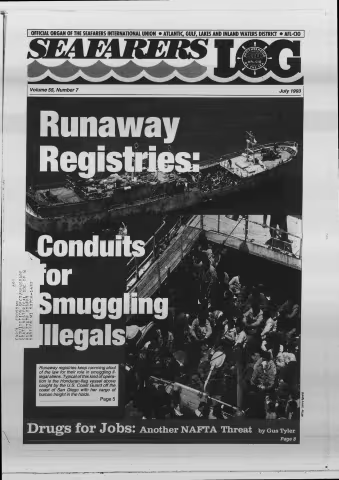
Illegal Immigrants huddle in blankets in the morning chill on a New York beach after reaching shore from
the freighter Golden Venture, which ran aground in the pre-dawn hours of June 6,1993. A human wave
of illegal Chinese boat people is finding its way to U.S. shores, where the immigrants apply for asylum.
the loose and unregulated style of
runaway registries. In the case of
the Golden Venture, the U.S. Coast
Guard had to follow a trail which
involved a flag switch and vessel
name change in the middle of atrip.
Recent Cases of Runaway
Ships Used in Human
Smuggiing Operations
While the saga of the Honduran-flag Golden Venture last
month made national headlines, it hardly is the only recent
incident involving the attempted smuggling on flag-of-con-
venience registered vessels, of Chinese illegal immigrants
into the United States.
Here are a few other noteworthy examples:
• In December, the freighter ManyoshiMaru-^apanese-
owned but registered under the flag of Honduras—was
seized in the San Francisco Bay as it prepared to unload its
human cargo. The Immigration and Naturalization Service
discovered that 180 undocumented Chinese had been kept
below decks during a 42-day voyage from China.
Partially because the Chinese's living conditions were so
bad—the cargo holds where they dwelled were liberally
strewn with vomit and human waste—the case drew the
attention of several federal agencies. The shjp's Indonesian
captain last month was sentenced to two years in federal
prison for conspiring to smuggle illegal aliens into the U.S.
The eight other crewmembers received lesser sentences,
and none of the Chinese has been returned home.
• Last month, a pair of fishing vessels—including the
China-owned, Honduran-registered Chin Lung Hsiang—al
legedly attempted to bring 300 aliens to the San Diego area.
A grand jury has indicted five men on charges to smuggle,
transport and conceal undocumented Chinese.
• Also last month, indictments were handed down in the
case of the vessel Pai Sheng, which allegedly dropped off
nearly 200 Chinese near the Golden Gate Bridge. The ships
have been seized, and most of the undocumented Chinese
have been taken into custody.
The Pai Sheng flies the Taiwanese flag, yet the vessel
holds Honduran documents and is managed via a company
in Hong Kong.
• In January, a Panamanian-flagged vessel owned by a
company in Hong Kong failed in its attempt to smuggle 500
Chinese nationals into Hawaii. The Coast Guard, aided by
the SlU-crewed Patriot, discovered the runaway flag East
Wood dead in the water 1,500 miles southwest of Hawaii.
The Pafr/of—first on the scene—performed a search-and-
rescue; a Coast Guard vessel later escorted the East Wood
to a U.S. Army base on Kwajalein Atoll in the Marshall
Islands.
A federal grand jury in Honolulu has issued an indictment
against a person believed to be in charge of the smuggling
operation, and a trial is scheduled to begin this morith.
Among the issues to be resolved are whether a hijacking
took place (as alleged by East Wood crewmembers); if two
missing crewmembers were thrown overboard by the al
leged hijackers; and if the captain or crew were involved in
the botched smuggling operation.
While the U.S. court system is
attempting to prosecute the per
petrator of these illegal traffickers
of human lives, often those ul
timately responsible are too hard
to find, hidden behind layers of
agencies and front companies, all
located in different countries.
Often, the easiest target for law
enforcement officials are the
crewmembers of these vessels,
who themselves come from dif
ferent countries than those of the
ship registry or the ship's owners.
For the smugglers, the traf
ficking of illegal aliens is big
business. In most cases, the
people being transported pay
thousands of dollars to Asian or
Mexican smuggling syndicates.
Smugglers often charge as much
as $20,000 to $50,000 per person
for a one-way trip, forged
passport and strategic advice on
what to do if caught.
The travel accommodations
hardly are commensurate with
those "fees." Often, the i
migrants live in slave-like condi-
tions while aboard the
runaway-flag ships, suffering
from malnutrition, dehydration
and severely unsanitary sur
roundings.
Even if the immigrants arrive
in America and find work, they
might spend years trying to pay
off their debts to the smugglers.
Many illegal immigrants sell their
personal belongings in order to
post small deposits for the voyage
to America; once in the U.S., they
become virtual indentured ser
vants, living in slums while the
vast majority of their earnings
goes to the smugglers.
Anyone who falls behind on
the payments faces grave conse
quences. As reported last month
in the New York Times, the smug
glers employ enforcers who beat
laggards. Sometimes, the enfor
cers take another route: abducting
the aliens and holding them until
relatives from overseas pay ran
soms. Often, the debtors are tor
tured until payment arrives.
For example, in late May
authorities discovered more than
50 illegal Chinese immigrants
huddled together in a New Jersey
warehouse. The Chinese were
being held there until relatives
produced $25,000 to $30,000, the
Times reported.
Runaways:
A Big Part of the Problem
Long known as a vehicle to
escape taxes, safety laws and
other protective regulations, flag-
of-convenience registries are part
of the root of the recent spate of
immigrant smuggling. As
demonstrated in several recent in
cidents on both U.S. coasts and in
Havvaii, runaway-flag ships are
the most popular means of
transportation to America for the
aliens—whose "travel agents" in
the syndicates are criminals.
If the immigrants knew how
unsafe many runaway ships are,
they might never come aboard.
Indeed, a marine insurers group in
London reports that of its most
recent 133 inspections of
runaway ships, only 21 vessels
passed the first time around. That
means an 84 percent failure rate,
or five out of every six.
Smugglers Try Mexico
The problem is not limited to
U.S. coasts. Reacting tathe Coast
Guard's steppedjip efforts to
catch smugglers in U.S. ter
ritories, the syndicates have tried
to exploit Mexico by unloading
the illegal immigrants there, then
providing ground transportation
to America. The Journal of Com
merce recently reported that offi
cials from the State Department,
Coast Guard and Immigration
and Naturalization Service all
have confirmed that Asian crime
syndicates are using Mexico (and
possibly Central America) in this
manner.
The paper quoted a U.S. bor
der patrol spokesman as saying
that from October 1992 to late last
month, there have been 400
detentions of undocumented
Chinese citizens at the San Diego
frontier, compared with only 34
during the first 10 months of last
year.
Mexico has tried to battle this
problem, but is handicapped by
lengthy coastlines and limited
resources. As a result. President
Clinton recently announced plans
to work more closely with offi
cials in China and Taiwan to com
bat the situation.
Golden Venture's Grounding
SpoHlghis Runaways' Role
If nothing else, the grounding
of the MV Golden Venture last
month at a New York City beach
helped point out to millions of
Americans that their country is
being besieged by smuggling at
tempts launched from runaway-
flag ships.
When the foreign-owned,
runaway-flag freighter inadver
tently stopped in the nation's un
official media capital, plenty of
reporters and cameramen arrived
to capture the harrowing scene. It
consisted of almost 300 undocu
mented Chinese immigrants-
some wearing business suits.
some wearing only underwear—
huddled on the shore, soon to be
picked up by federal authorities.
Eight other would-be immigrants
had died trying to swim to shore;
the whereabouts of five others
were (and remain) unknowri.
The Golden Venture, a rusting,
150-foot freighter with a Bur
mese and Indonesian crew, began
its voyage from Thailand in
February bearing Panamanian
registry and the name Tong Sem.
Ninety Chinese emigrants were
aboard at that time.
One month later, the In
donesian-owned ship changed
names and had its registry trans
ferred to Honduras. The vessel
then stopped in Kenya to pick up
200 more Chinese nationds.
According to published
reports, the ship was supposed to
rendezvous with an unidentified
vessel somewhere in the Atlantic,
whereupon the immigrants would'
switch ships. When no other ship
arrived, a crewmember who
turned out to be the agent of a
Chinese crime boss tied up the
captain, took command and or
dered the Golden Venture to New
York. .
Soon after the grounding,
Americans through news reports
got a taste of the liyes of illegal
immigrants travelling aboard
runaway-flag ships. The Chinese
told authorities they had paid syn
dicates thousands of dollars
apiece so they could experience
the American dream. Photos
showed the incredibly cramped,
foul quarters where the Chinese
had lived throughout the four-
month voyage—during which
time they subsisted on one meal a
day and little water in grossly un
sanitary conditions.
The captain and 10 of the other
12 crewmembers have been
charged in this incident, which
still is under investigation.
J "•
f •
• -• -'i.'..
. '.t
S
•••V,-: •,? , , '••V
6 SEAFARERS LOG JULY 1993
Crew Proud ot^eek Hew220-Foot AHoa II
Seafarers have nothing but
praise for the new Alton Belle
Riverboat Casino and the Alton
Ending. The new boat, known as
ihc Alton Belle II, began sailing in
early June after the barge which
houses the Alton Landing was
moved into position.
The addition of the riverboat
and barge provided many new
Deckhand John Hargis sweeps
water off the deck after an after
noon thunderstorm.
jobs aboard the casino which is
docked in the Illinois town lo
cated approximately 20 miles
north of St. Louis.
The SIU will continue to rep
resent crewmembers aboard the
new riverboat and barge as it has
since 1991, shortly after the
casino operation began. The new
crewmembers will join other STL
members working as officers anc
deckhands, food and beverage
service employees, galley
workers, ticket sales-people
reservationists, housekeepers
cashiers and maintenance
workers.
Crewmembers Are Excited
New SIU member, Deckhanc
Vincent Gibbs, told a reporter
from the Seafarers LOG, "I love
the ntw Alton Belle and the union.
I've never met such nice people
in both the employees and- the
visitors. Everyone works so good
together. We're like a big family.
There is always praise for doing a
good job and that really makes
you feel good."
Constructed in Jacksonville,
Fla., the sophisticated new river
boat features a sleek,
aerodynamic look and is 55 feet
longer and slightly wider than the
original riverboat casino. The
new design allows up to 1,400
passengers to ride at one time,
which triples the old riverboat's
capacity. The 220-foot craft fea
tures three decks for gambling.
ConstnicBon Commences
On New Paddlewheeler
The Alton Belle H is 220 feet long and features three decks for gambling, sit-down bar areas and a deli.
The design of the riverboat allows up to 1,400 passengers to ride at one time.
sit-down bar areas on all three
decks and a deli.
"I love the Alton Belle II. I
have a lot of seatime already and I
am working toward getting
licensed. I really enjoy my job
here," saidDeckhand Jeff Newton,
a new crewmember having just
served sbc^ years in the U.S. Navy.
Landing Is Enlarged
The Alton Belle //docks at the
SlU-crewed Alton Landing
t)arge, which is a two-deck barge
featuring the Piasa House res
taurant, buffet and bar for pas
sengers to use before and after
cruises. It also includes a snack
bar, cocktail lounge, gift shops
and guest services.
Piasa House steward depart
ment worker Pamela Fry
described herself and SIU mem
ber Sbeila Pennell as the "jacks
of all trades" in the galley. Fry
and Pennell do everything from
making snacks to preparing gour
met meals for the passengers of
the Alton Belle II. Pennell has
been a union member since the
employees voted in 1991 to be,
represented by the SIU for pur
poses of collective bargaining.
She is in the process of applying
for upgrading courses at the Lun-
deberg School.
"I'm really excited about
upgrading. I've heard a lot of
good things about the school" she
noted.
Continued on page 23
After a Year-Long Fight to Save Ship
Queen Mary Reopens with Fanfare
SEAPORT
The American Queen is scheduled to begin service by April 1995.
The SlU-contracted Delta
Queen Steamboat Company
plans to have its newest and most
elaborate paddlewheel steam
boat—the American Queen—in
operation by April 1995.
Last month, at a steel-cutting
ceremony in New Orleans, the
company celebrated the start of
construction of the 420-foot, six-
deck vessel which is being built at
the McDermott, Inc. shipyard in
Amelia, La. at an estimated cost
of $60 million. Like its sister
ships, the Delta Queen and the
Mississippi Queen, the American
Queen will cruise the Mississippi
and Ohio rivers as well as several
of their tributaries.
The American Queen is the
first steam-powered riverboat
built in the U.S. in almost 20
years. Able to accommodate 420
overnight passengers, it is the
largest overnight passenger ves
sel built in the United States since
the SS United States in 1953.
The new boat's plans call for
plenty of modem amenities, in
cluding a swimming pool and
elevators. But the designers' goal
"is to create a boat that relies more
on charm than on glitz," the steam
boat company said in a statement.
Designers wUl create a late I9th-
centuiy look for the paddlewheeler,
which will be built with a covered
deck utilizing swings and rocking
chairs.
An antique steam engine that
originally drove a dredge called
the Kennedy will propel the
American Queen, 's 60-ton paddle
wheel.
Other features of the new boat
include:
• A showroom and lecture hall
designed to look like a miniature
opera house,
• A design which will allow
passengers to observe the en-
gineroom at work,
• 206 suites and staterooms,
• An all-steel welded hull and
superstructure.
The project will employ more
than 5(X) shipyard workers and
subcontractors for nearly two
years.
Several hundred people turned
out to celebrate the reopening of
the Queen Maiy Seaport on June
23 in Long Beach, Calif. While
everyone there: seemed enthusias-
ic about the ceremony, members
of the United Industrial Workers
UIW) who were in attendance
rightfully cheered a little louder
and took more satisfaction in the
event than did most others.
The UIW, which is the SIU's
industrial division and which rep
resents the workers aboard the
Queen Mary, waged a year-long
grassroots campaign to prevent
what once seemed an inevitable
overseas relocation of the historic
liner-tumed-hotel.
The union's efforts—such as
packing city council meetings,
demonstrating, collecting signa
tures for petitions and other ac
tivities—^were rewarded late last
year when the City of Long Beach
bought the vessel and subsequently
approved a five-year lease;
Joseph Prevratil, president of the
foundation which operates the
Queen Mary, credited the SIU and
UIW for helping save the ship.
authorizing the not-for-profit
RMS Foundation, Inc. to operate
the luxury liner. Locally
renowned businessman Joseph
Prevratil—who formerly
operated the Queen Mary during
its most profitable days—is presi
dent of RMS Foundation.
"A year ago, things looked
bleak for the Queen Mary," Prev
ratil said at the ceremony. In
recounting the successful battle to
save the ship, he added, "I'd like
to acknowledge the Seafarers
Union and the UIW, who were
tireless [and were] atevei^ harbor
commission meeting and eveiy
]UNE 23,1993
SIU Secretary-Treasurer John Fay addresses crowd of well-wishers
at bow of Queen Mary.
city council meeting."
More than 400 UIW members
are employed at the Queen Mary
Seaport, which covers 55 acres
and includes the hotel, numerous
restaurants and shops both aboard
the Queen Mary and at the adjacent
Queen's Marketplace village, a
new ride and game area for
children, and other features. The
number of employees is expected
to increase steadily now that the
complex—Long Beach's major
tourist attracdon^as reopened.
SIU Secretary-Treasurer John
Fay, one of the speakers at the
ceremony, noted the "textbook
cooperation between labor and
management" which helped save
the vessel.
Dozens of other dignitaries
also attended the ceremony, in
cluding British Consul General
Merrick S. Baker-Bates, RMS
Foundation Chairman of the
Board Dr. Robert Gumbiner and
other city and state officials.
Business had been brisk since
the Queen Mary partially
reopened in February and jumped
dramatically the weekend follow
ing the ^nd reopening. More
than 12,(XX) people showed up at
the Queen Mary on Saturday, June
4, and more than 13,500 others
were there on the following Sun
day. Both days' numbers surpassed
a decade-old record of ap
proximately 11,000 visitors.
In mid-April, the Queen Mary
was placed on the National Register
of ffistoric Places. The ship ^ed
from 1936 to 1967. It also served as
a troop carrier during World War 11.
Frorn left, UIW Representative Irma Lerma and UIW members Irma
Ramirez, Margaret Alvarez and Linda Jefferson enjoy the Queen
Mary's grand opening.
fyi
' ,W'
;1'-•^'^V4'' ;M<-U;'^
t
JULY 199? SEAFARERS LOG 7
Tax Delmteil la tim Senate
As Congress
The Senate failed to adopt the
Clinton administration's
proposal for a tax based on the
energy content of fuel, known as
British thermal units (Btu), fol
lowing an intense lobbying effort
by the Seafarers, maritime inter
ests and other energy users.
The Btu tax was included in
the administration budget pack
age as a means of reducing the
deficit. The House of Repre
sentatives approved the tax when
it passed the proposed Fiscal Year
1994 budget. However, the
Senate rejected the idea.
'Destroys Tanker Fleet'
In a joint communication to
members of Congress, SIU Presi
dent Michael Sacco—along with
John Stocker, president of the
Shipbuilders Council of America,
and Jack Goldstein, president of
OMI Corp.—pointed out the Btu
tax would hurt all of the U.S.-flag
maritime industry. Concerning
the U.S.-flag tanker fleet, they
wrote, "The Btu tax would
destroy the domestic tanker fleet
by dramatically increasing its fuel
costs while exempting the fuel of
international vessels with which
it directly competes."
They demonstrated how two
identical tankers—one plying the
on Budget
domestic trade from a Gulf
refinery, the other sailing from a
Caribbean port and both heading
to the same northeastern U.S.
port—would travel basically the
same mileage. Yet, with a Btu tax
in place, the fuel costs for the
domestic vessel would be
$26,000 more than the one sailing
from the international port for the
voyage.
In addressing the interests of
the Ashing industry, Sacco wrote
in a letter to the members of the
Senate Finance Committee that
U.S. fishing boats would bear an
unfair burden under the proposed
tax. "Since foreign fishermen
would not be subject to the same
tax, it will create a noncompeti
tive market resulting in increased
imported seafood products," he
noted. "Additionally, it creates an
unequal trading climate as many
foreign governments subsidize
the fuel of their private, commer
cial fishing fleets."
In passing their own version of
a deficit-reduction plan, the
Senate instead created an addi
tional 4.3-cent-a-gallon tax on all
fuels with no mode of transporta
tion being exempted.
Other Taxes Considered
Both the House and Senate
plans also deal with increases in
income taxes for individuals
making more than $115,000 a
year and couples earning more
than $ 140,000 annually, a jump in
the top corporate tax rates, taxes
on social security benefits anc
much more.
Because of these differences
as well as others in the two bills,
the House and Senate will form a
conference committee to create
an overall deficit-reduction plan.
Under the rules of the Congress,
the conference committee mem
bers can adopt all of whht the
House approved (including a 50-
cent-a-gallon inland waterways
fuel taxX all of the Senate's pack
age, parts of both or nothing from
either and create their own fund
ing formula.
The union will stay vigilant for
any proposals coming from the
committee that will affect the
membership and the maritime
community. The committee is ex
pected to complete its work by
late July or early August.
lUOE President Henley Declares
Proposed Bill Caters to Greed
While stating the North
American Free Trade Agreement
(NAFTA) would be bad for the
American economy and work
force if it were enacted, Frank
Hanley, president of the Interna
tional Union of Operating En
gineers (lUOE), proposed
scrapping the treaty for one be
tween the U.S., Canada and the
European Community.
Hanley made his proposal
during an address at the annual
union-management conference at
the University of Notre Dame on
June 11. The conference brings
together representatives from
both the trade labor movement
and business to discuss and
debate issues affecting the U.S.
economy.
"Profits are a corporation's
primary goal," Hanley said. "And
that is.all well and good, provided
the goaf is attained through fair,
equitable and humane means.
NAFTA does not meet those
criteria."
companies to take advantage of
cheap Mexican labor, Hanley
asked, "Has anybody seen a dif
ference in the showroom price of
that GM car produced in Mexico
and the one produced in Detroit?
Or the Zenith TV set made in
Matamoras (Mexico) or the one
from Springfield (Mo.)?"
Low Level Wages
Hanley, who also serves as a
vice president of the AFL-CIO
(the national federation of
American unions), said U.S. fac
tory workers averaged $16.17 an
hour in 1992 according to govern
ment statistics, while Mexican
workers made around $2.35 an
hour. Yet, Mexican workers
working in American-owned
plants located just south of the
U.S.-Mexican border (known as
maquiladoras) earned even less
$1.64 an hour.
Thousands Lose Jobs
Hanley referred to studies that
NAFTA would cost 500,000
Americans their jobs, while creat
ing, at best, 200,000 new jobs in
the U.S. "You still end up losing
300,(X)0 American jobs, and that
is unacceptable under any cir
cumstances," he told the con
ferees.
He pointed out a Wall Street
Journal poll.of U.S. companies
that noted 24 percent of those
polled would use the threat of job
loss created by NAFTA to hold
down U.S. wages. "The list could
go oh and on of well-known U.S.
companies that have fled to
Mexico, leaving their American
workers high and dry—all in the
name of increasing profit mar
gins, all seemingly oblivious to
the social and economic turmoil
they left in their wake."
Calling the move to Mexico a
"greed motive" used by U.S.
We're talking a lowest level
where wages are about one-tenth
of ours, where the minimum wage
is about 68 cents an hour, where
labor leaders are thrown in jail for
insisting on contracts that dis
please employers, where the rich
and powerful routinely ignore the
laws of the land," Hanley said of
Mexico.
Free T rade Alternatives
Presently, the Clinton ad
ministration is t^ing to amend
NAFTA with side agreements
that would include health and
safety standards, wage protec
tions and environmental
guidelines not included when the
Bush administration completed
its work on the package. Mem
bers of Congress, who can only
ratify or defeat NAFTA as
presented to the body without
being able to amend it, have said
they would not approve the trade
agreement as it is written.
As an alternative, Hanley of
fered a North Atlantic free trade
agreement, which was presented
by AFL-CIO President Lane
Frank Hanley
Kirkland earlier in the year.
A free trade agreement be
tween the U.S., Canada and the
European Community "would
expand America's trade and busi
ness opportunities without drag
ging down the wages and
working conditions of U.S. and
Canadian workers," Hanley told
the conference.
Rather than harm U.S. and
Canadian workers, as the agree
ment with Mexico would, a North
Atlantic free trade agreement
would benefit these workers. It
would create a link with countries
that enjoy high wages, strong
consumer purchasing power and
high standards of living."
Hanley pointed out a North
Atlantic free trade agreement
should incorporate the social
charter used in the formation of
the European community. That so
cial charter set standards for equal
work, vocational training, freedom
of association and the right to col
lective bargaining which improved
wages and working conditions for
workers in Spain and Portugal to
levels found in other European
nations.
Just for the Halibut
Bosun Clifford Perreira caught this halibut while the Overseas
Juneau was anchored in Prince William Sound waiting to berth in
Valdez, Alaska. The fish was 65 inches long and weighed 140
pounds. The crew has enjoyed numerous meals of fresh fish
cooked by Steward Ray Garcia and Chief Cook Andy Campollo.
Jobs for Drugs — Another
Major Flaw in NAFTA
The following article by Gus
Tyler is reprinted from The For
ward, a weekly news publication.
Mr. Tyler is a veteran trade
unionist and a writer specializing
in economics as it effects
America's working class. He ser
ves now, and has for many years,
as assistant to the president for
the International Ladies' Gar
ment Workers Union.
Keeping Latin American
cocaine out of the United States
has been difficult. If the North
American Free Trade Agreement
is ratified, control of the drug
flow will be impossible.
That is the conclusion of
senior U.S. officials who oversee
drug enforcement. In a report
released to the National Security
Archives, a private group that
uses the Freedom of Information
Act to make public what would
otherwise be secret, an official
source warns that drug traffickers
'intend to maximize their
egitimate business enterprises
within the U.S.-Mexico free trade
agreement."
Here's how it works: Colom
bian drug lords buy ma
quiladoras, factories that
assemble component parts of
iroducts that originate in the
Jnited States. The usual rules of
international trade do not apply to
maquiladoras: No tariff is paid on
the component parts entering
VIexico; virtually no tariff is paid
on the finished product entering
the U.S. By law, the finished
iroduct may not be sold in
VIexico. The finished products
are carted to the American border
and then transferred to trucks that
distribute them in the U.S. If the
^orth- American Free Trade
Agreement goes through, these
iroducts will be transported into
he U.S. in Mexican trucks with
VIexican drivers.
The Colombian drug cartels
see a rare opportunity to move
their wares into the U.S. via
VIexico. By ownership of the fac
tories and the trucks, they can
conceal their filthy poisons in
)oth the finished products and the
vehicles that carry them freely
across the border.
The report unearthed by the
investigators notes that smug-
Gus Tyler
glers are buying up factories as
"fronts for drug trafficking."
Trucks will have to pass border
inspection, of course. But, realis
tically, any attempt to do a
thorough examination of trucks
and the cargo they carry would be
impossible. Right now, border
guards cannot give more than five
minutes to checking on a truck's
cargo. Under NAFTA, with
trucks free to cross national lines,
the traffic would be far too heavy
for any agency to check the unim
peded flow of cocaine into the
U.S.
Until recently, the main argu
ment against NAFTA has been
that it would lead to the export of
jobs from here to Mexico. In the
light of the recently revealed
report, however, there is an equal
danger: the import of narcotics, in
massive quantities, from Mexico
to the U.S.
Ironically, neither the export
of jobs nor the import of narcotics
shows up in official statistics. The
contracting of assembly jobs out
to Mexico and the moving of
machinery and equipment from
the U.S. to Mexico are counted as
"exports," not of jobs but of
American-made products. And
the imports of narcotics go un
reported because they do not pass
through official trade channels.
Meanwhile, these invisible
processes are wrecking our
economy and ruining our physi
cal health, and are certain to do so
even more virulently under
NAFTA.
. . • .J .'
'tell
" ' ''mi'iS
O ••
-IS'
...
-rr? if,* '
I ;i! (
8 SEAFARERS LOG
•' -• s. •
JULY 1993
Flooding Hampers Navigation on Mississippi Rivor
Operations along the Missis
sippi River are coming to a halt as
flooding on the upper portion of
the river has reached record
levels.
The high waters have forced
several SlU-contracted com
panies to alter plans until the river
and its tributaries return to their
banks.
As of July 1, rain was continu
ing to fall in the region with more
storms predicted through July 4.
Locks and dams along the river
began closing in late June until all
were shut down in the 5(X)-mile
stretch between St. Louis and St.
Paul, Minn.
The Army Corps of Engineers,
which operates the series of locks,
and the Coast Guard closed the
river to pleasure boaters as well
because of the dangerous currents
and debris floating in the river.
"We have stopp^ all activity on
the river," noted Coast Guard Petty
Officer Keith Richter, who is based
in St. Louis. "We do expect the
Missouri and Illinois rivers to rise
but not to dangeous.levels. Both of
those rivers and the Ohio still are
open for navigation.
He added the Mississippi was
expected to crest in St. Louis at 39
feet on July 7, provided no more
rain fell in the region. The mar
is only four feet under the recorc
of 43 feet which occurred in 1973
Orgulf Boats Tied Up
A total of six Orgulf boats
were tied up in the upper Missis
sippi. Four of them—the Dave
Carlton, Peter Franchi, Bob Lab
don and Ed Renshaw—are a
various points on the river wait
ing for locks to re-open. The 7a/-
bott was docked at Lansing
Minn, while the Enterprise
waited in St. Paul.
Five more Orgulf tugs tied up
in Paducah, Ky. because of the
flooding. These vessels included
the Twin Cities, Geary, Irene
Chotin, Justin Rogers and John
Kcager. Meanwhile, the lower
river tug McDermott docked in
Reserve, La. until upper river
traffic and commerce resumed.
St. Louis Port Agent Joe Sigler
said Orgulf operations may no
get back to normal before mid-
July.
Along the lower portion of the
river, the SlU-contracted Delta
Crowley Tug Samson
Plies Delaware River
SIU member Andrew Smith
reports "no problems at all"
aboard the Crowley Towing and
Transportation tugboat Samson.
Smith, who sails as a mate
aboard the 115-foot tug,
describes the work aboard the
Samson as "smooth. We have a
good crew; everyone pitches in to
get the job done," says the 15-
year member of the Seafarers.
The Samson, built in 1966, es
corts barges along the Delaware
River in Philadelphia and in near
by areas. The boat has a weight of
190 gross tons.
The Samson's five crewmem-
bers were among the Crowley
employees who recently voted on
a new three-year contract that in
creases wages and benefits. The
members overwhelmingly ap
proved the contract, which took
effect July 1 of this year and runs
until June 30,1996.
Crowley tugs and barges
operate coastwise, deep sea and
harbor duty in the Atlantic and
Pacific oceans and in the Gulf of
Mexico from terminals in
Philadelphia, Lake Charles, La.,
Wilmington, Calif., Jacksonville,
Fla. and Puerto Rico.
Crowley Towing and
Transportation is based in Jack
sonville. The company is a sub
sidiary of Crowley Maritime,
based in Oakland, Calif.
Andrew Smith, mate, reports to
Mike Stephens, chief engineer,
makes adjustment beiow deck as Samson s next assignment,
tug readies to escort a barge.
View from the Samson's bow
shows a Crowley barge it and
anothe tug assisted into port.
Richard Jervas, cook/deckhand,
has been an SIU memberfor eight
years.
AP by Jim Mono
Barges stand idle in the flooding Mississippi River in St. Paul, Minn., putting a halt to shipping on the river.
Queen Steamboat Company was
in tiie middle of its annual race from
New Orleans to SL Louis between
the Delta Queen and Mississippi
Queen. The schedule called for the
riverboats to arrive in the Missouri
city on July 4.
Finish Line Moved
However, the high waters and
strong currents caused the pair to
finish the contest in Ste.
Genevieve, Mo., approximately
50 miles south of St. Louis.
Operations aboard the SlU-
crewed Alton Belle Riverboat
Casino had not been hampered by
the high waters and rain, accord
ing to Port Representative Patti
Rogers. Despite being located 20
miles upstream froni St. Louis,
the casino boat was able to main
tain its sailing schedule. No
flooding had been reported in
Alton, 111. as of press time.
Commercial traffic had
returned to normal following the
spring rains and thaw shortly
before the latest flooding began.
GuK and Aflantic Harbor Boatmen Ratify
New Contracts with Crescent, illicAiiister
SIU boatman sailing aboard
larbor tugs in ports along the At-
antic and Gulf coasts are sailing
under new three-year contracts.
The pacts with both Crescent
Towing and McAllister Towin-
gincluded wage and benefits in
creases.
After the union negotiating
committees ironed out the details
of each accord, the contracts were
submitted to the SIU members as
sociated with each company for
review and ratification. In both
cases. Seafarers voted in the new
three-year pacts.
The Crescent contract covers
ship docking tugs in New Orleans
where the company is based),
Vlobile, Ala. and Savannah, Ga.
According to New Orleans Port
Agent Joe Perez, negotiations
were conducted over a two-week
period.
Delegates to the talks included
'aptain Joe Carlson, Engineer
'aul Von Bodungen and Deck-
lands Junior Hebert, Tommy
White and William S. Judd Jr.
From New Orleans. Representing
the membership in Savannah was
Jeckhand David Watford.
Taking part in the negotiations
fom Mobile were Captain Peter
Burns, Engineer James Johnson
and Deckhand Jimmy Lee.
While one contract covers all
three ports for Crescent, separate
)acts between the SIU and Mc
Allister were negotiated for the
5orts of Philadelphia, Baltimore
and Norfolk, Va.
Dave Heindel, SIU assistant
vice president for the Gulf Coast,
reported the negotiations for all
three ports took one month to
complete.
Etelegates elected to participate
in the Philadelphia negotiations
were Captains l^chard Role and
Gary Koshland. Involv^ in the
altimore talks were Captain
Gregory Lukowski, Engineer
oseph 2k)rbach and Deckhand
Meeting after completion of negotiations for the new Crescent contract
are (standing, left to right) Captain Joe Carson, Consultant Jim Martin,
SIU Port Agent Joe Perez, SIU Vice President Gulf Coast Dean
Corgey, Engineer Paul Von Bodugen, SIU Patrolman Steve Judd,
Deckhand Junior Hebert, Deckhand William Judd Jr., Crescent Su
pervisor Eddie Pinner and (seated) Crescent Vice Presidents Arthur
Kulp and Charles Andrew.
Robert Macbinsld. Representing
the boatmen from Norfolk were
Captain Emmett DeRosba, Mate
Robert Walker, Engineer
Johnnie Trotman and Deckhand
Marvin White.
Seafynrs mio An Abo Kshennett
ShouU Cmitact SIU HeaiUiuarters
Seafarers who earn addition
al income by commercial fish
ing during periods ashore may
find this extra source of revenue
endangered by government
plans which will limit access to
some of the nation's fisheries.
The SIU is working with
Seafarers in this position who
have contacted headquarters to
try and protect their right to fish
commercially.
It would be helpful to the SIU,
in making its case to the govern
ment agencies which manage
fisheries and determine fishing
rights, if it had more detailed in
formation on how many Seafarers
are engaged in fishing activity as
a seasonaloccupation.
The SIU has long been work
ing to ensure that the commercial
fishermen it represents have their
interests protected in the
government's fisheries manage
ment process, which often rides
roughshod over the needs and
concerns of the men and women
who earn their livelihoods har
vesting seafood.
Seamen who also work as
fishermen are urged to contact the
union's commercial fishing
division so that the SIU can be
brought fully up-to-date on the
impact of fisheries management
decisions on their activities and to
provide any assistance possible in
these matters. Those seamen who
also work as commercial fisher
men should contact Shaun Gehan
at the SlU's headquarters, 5201
Auth Way, Camp Springs, MD
20746; (301) 899-0675.
Spokesmen for the Corps of En
gineers said they expect the Mis
sissippi to crest all along the
upper river at the highest readings
ever recorded, including more
than 22 feet in Davenport, Iowa.
Secretary of Agriculture Mike
Espy was inspecting the area the
week of June 28 to determine if
the river and farmlands should be
declared a disaster area, Be
sides the Mississippi, flooding
was reported along the Mis
souri River.
A-
.'isii:.,I;-, V.
«»aae^
If" ••
1 ••....•I-
• • • "r'T'?'-' ' :''.-"i .'-A'-
JULY 1993 SEAFARERS LOG 9
TRANSCOM's Chief IttspeiRs
Uttiott's Paul Hall Center
The head of the U.S. Transpor
tation Command conducted an in
spection of the Paul Hall Center
for Maritime Training and Educa
tion on May 24.
Air Force General Ronald
Fogelman toured the facility as
well as talked with Seafarers
upgrading in various courses at
the Harry Lundeberg School of
Seamanship.
Fogelman took the reigns of the
Transportation Command, also
known as TRANSCOM, in August
1992. In that position, he oversees
the military organization that
controls the movement of U.S.
troops and their equipment and
supplies, which includes U.S.-
flag merchant vessels chartered to
carry such materiel.
Upgraders at the Lundeberg
School performed special
demonstrations of their skills on the
Hagglund crane and in the com
puterized shiphandling simulator.
The gener^ also sat in on a hazard
ous materials safety class where
students leam how to prevent and
deal with oil spills while at sea.
As he toured the union's man
power facility located at the cen
ter, Fogelman received an
explanation of how it worked
around the clock during Opera
tions Desert Storm/Desert Shield
to make sure SIU crews were
available to man military
chartered commercial vessels as
well as Ready Reserve Force, fast
sealift and other ships used during
the Persian Gulf conflict.
General Ronald Fogelman, head of the U.S. Transportation Com
mand, observes a hazardous materials safety course taught to
Seafarers at the union's training facility, the Lundeberg School.
G&H Boatmen Aim for Operators' Licenses
Once upgrading Is completed, G&H boatmen will perform their newly
acquired skills on tugs like the Juno.
Eight Seafarers who are
employed by G&H Towing, as
well as three SIU members
employed by other companies,
are studying for their uninspected
towing vessel licenses at the Paul
Hall Center for Maritime Train
ing and Education in Piney Point,
Md. Final testing is scheduled to
take place during the week begin
ning July 11.
. Instructors at the Paul Hall
Center designed the course to best
meet the needs of all members.
The five-week curriculum was
preceded by a week of training
and testing in firefighting, first
aidandCPR.
In the towboat operator
course, the members—who cur
rently sail as ABs^—receive ex
tensive, hands-on training as well
as written materials covering
navigation and piloting, emer
gency procedures, federal regula
tions including oil-pollution
regulations, watch-standing re
quirements, weather, chart work
and more.
year-old Terry Walker, who lives
in Houston. "It can get a little hectic
at times, because there's a lot to
cover. But with a little extra study
ing, it all comes together."
Walker, who had not been to the
Paul Hall Center previously, also
commended the location and
facilities of the Lundeberg School.
Bill Hadley, 26, described the
towboat operator course as "very
in-depth. I'm sure this will leave
us well prepared for the future,
including any future upgrading
we do."
Another member of the class,
Jacques Mouttet, said he ap
preciates the way the instructors
have designed the course so the
boatmen are able to maximize
their time at the school. "That
whole idea is excellent," said
Mouttet, 35, who was bom in the
West Indies and now resides in
Corpus Christi.
1 The other members who are
taking the course are; Paul
Carlton, John Maxey III, Jerry
McPeak, Lawrence Roth and
Thomas Tinsley. The course is
'It's a good course," said 23-1 being taught by Jim Brown.
Members of the towboat operator course are (from left, first row) John Maxey
Mouttet, (second row) Herman Rohrman. Jim Brown (instructor), Uwrence Roth, Bill Hadley, Thomas
Tinsley and John N. Welrauch.
UIW Asst. VP Huber
Succumbs to Cancer
Joseph Huber, an official with
the SlU-affiliated United In
dustrial Workers (UIW) for more
than 20 years, passed away June
29 as a result of cancer. He was
52.
Brother Huber became a UIW
representative in 1970. For the
past 12 years, he served as assis
tant vice president of the UIW's
Great Lakes Region—a position
to which he most recently was
re-elected at the union's conven
tion in April. He worked in the
Columbus, Ohio area throughout
his career with the UIW.
"Organized labor has lost a
hard-working, honest man," said
SIU President Michael Sacco,
who also is president of the UIW.
"Joe Huber was a friend to work
ing people."
Bill Dobbins, vice president of
the UIW's Great Lakes Region
and a longtime friend and col
league of Huber's, described him
as "dedicated to helping not only
our membership, but also others
Joseph Huber served as assistant
vice president of the UIW's Great
Lakes Region.
in our community. Joe was ex
tremely active as a volunteer in
community services. He was one-
in-a-million, and we're going to
miss him."
A funeral mass for Brother
Huber took place in Columbus on
July 3. His family requests that in
lieu of flowers, donations be
made in Joseph Huber's name to
Charity Newsies, 716 South High
Street, Columbus, Ohio 43206.
Tug Oglethorpe's Fast Action
Saves All Hands and Wings
Joe the Rooster knew some
thing was fouled up when the
pushboat Emily Bourg, on which
he is the mascot, scraped an ob
ject while the tug was entering the
Kenner Bend, La. fupl dock and
came to a stop.
Seeing water coming on
board, Joe was afraid of becom
ing chicken soup. When he heard
the tug's captain call for help, he
was glad to see the SlU-crewed
General Oglethorpe, and not Col.
Sanders, come to the rescue.
The Bourg was sailing into the
fuel dock near New Orleans,
when it ran across the barge. The
Bourg was unable to move and
was taking on water when it is
sued an emergency call.
The General Oglethorpe was
in the vicinity. Captain Joe Car
son brought the Crescent tug
close enough.for Deckhand Bret
Mattel to throw a line to the
Bourg. With Engineer Sal
Mac^uso watching over the
diesel, the Oglethorpe then
pushed the Bourg to the shore.
Deckhand Chiles Messmer,
who provided the Seafarers LOG
with the photos below, reported
everyone—^including the Bourg's
mascot—^reached land safely.
Above, Deckhand Bret Mattel secures a line from the Oglethorpe to
the Bourg. Below, safely aboard the Crescent tug, Bourg mascot Joe
the Rooster watches the action.
•V
] :
t'V
• v.'sV.,
10 SEAFARERS LOG JULY 1993
•/}'•-. ' "•,.';
IMC Tanker Provides Wiper Vogt
With Chance to See the World
Giving the thumbs-up after dock
ing in Anacortes, Wash, are OS
Jake Jacobson (left) and Bosun
Anthony Zizzo.
Wiper David V<^ discovered
the Sealift China Sea was a
wonderful learning opportunity,
both about sailing and sightseeing.
"We traveled to Korea,
Okinawa, Guam, Hawaii,
California and Washington," the
22-year-old SIU member told a
reporter for the Seafarers LOG.
"It was wonderful. I saw a lot and
learned a lot from a great, ex
perienced crew."
Vogt, who graduated as a
trainee from the Seafarers Harry
Lundeberg School of Seamanship
in 1989, had high praise for
Recertified Bosun Anthony
Zizzo. "He really was in charge
and looked after everyone. He
made sure all of us knew what we
were doing and there were no
problems."
Besides handling his job in the
engineroom, Vogt was asked by
two crewmembers to provide an
additional duty. AB Errol Pak
and Chief Steward Louise Mar
tin Pak signed on in Hawaii when
the vessel was returning to the
U.S. from the Far East. The
Seafarers were married a month
earlier and failed to bring a
camera on board.
"They were lucky enough to
land a job on the same vessel at
the same time," Vogt recalled.
So they asked if 1 would take
some pictures of them on the ship
and when we were able to go
ashore. The crew congratulated
them when all of us found out
they had just been married."
In Vogt's four years with the
union, the Seattle native has
sailed in all three departments. He
plans to upgrade to jfireman, oiler,
watertender this fall at the Lun
deberg School.
The Sealift China Sea has no
regular run under its military AB Errol Pak and Chief Steward
charter with IMC. It primarily Louise Martin Pak were married a
carries jet fuel and other month before signing on the
petroleum products along the Sealift China Sea.
West Coast. It also makes an oc
casional voyage to Hawaii and
Asia.
Prepanng baking sheets in the gal
ley is Chief Cook Willie Gomez. The IMC-operated tanker Sealift China Sea lies at anchor outside Anacortes, Wash.
Catching a view of the Golden
Gate Bridge is Wiper David Vogt,
who provided the Seafarers LOG
with these photographs.
Osaka—A Rest Stop for Aries Crew
For SIU crewmembers prepar
ing to join the LNG Aries, the
Hotel Royal in Osaka, Japan was
a welcome sight after the better
part of a day flying from the
United States.
The hotel serves as a staging
area for Seafarers signing on the
LNG vessels that dock in the
nearby port of Sanbuka. The SIU
members were from various ports
in the U.S. Those getting ready to
board the LNG Aries gathered
there recently to spend the night
before a company agent took
them the next day to meet the
ETC vessel.
"After that long flight, it's
good to be able to relax, get ad
justed to the new time zone and
get a good night's sleep before
heading for the ship," Bosun Ulus
S. Veach noted. "Also we're able
to catch up on the activities of Bosun Ulus S. Veach uses the Catching up on activities from
fellow members who are return- time in Osaka to adjust to the home are AB Lou Sorito (left) and
ing to an LNG ship after some Japanese time zone. QMED Charles Pomraining.
time at home.''
Once the crew leaves the hotel,
the agent picks them up in a van
and escorts them to the dock area.
Although the port is approximate
ly 30 miles away, an individual
cab ride would cost more than
$ 1 GO because of the tolls and high
cost of gas on the island nation.
At the port, the Seafarers still
have several hours of work ahead
before climbing the gangway. All
members must clear customs and
immigration in Japan. Then, they
are allowed to go to the ship and
relieve those members signing
off.
LNG vessels like the Aries
carry liquified natural gas to
Japan from refineries in In- Waiting in the hotel lobby for the agent to pick them up are Chief Cook
donesia. Udjang Nurdjaja (left) and Wiper Victor Serrano.
A Mast with a View
This photo was taken aboard the cable ship Charles L. Brown in
Honolulu, Hawaii. Getting a bird's-eye view from the top are AB
Victor Mariano, AB Joel Saul, AB R.J. Sagadraca, AB Jay Speer,
AB Sam Tumala, Bosun C. Wemer and AB Luis Balatbat.
V
JULY 1993 SEAFAREKSLOG 11
': iV-v j."'-
•• "t- "c-lV '"V-." •'
NE Port Calls Are Time to Talk Union
When an SlU-crewed tanker
or containership docks in the
vicinity of the hiring hall in New
York, crewmembers can be cer
tain of one thing: a union port
representative will be waiting to
meet the vessel.
It does not matter if the ship is
docking at an oil terminal near
Boston-—like the Overseas
Vivian recently did during a
coastwise run^or at the con
tainer facility in Port Elizabeth,
N.J.—as the Sea-Land OOCL In
spiration did at the end of May
an SIU official will be there to
Chiof Stswnrd Ekoh Doffoh assistthgcrew,
reviews the patrolman's report for Shipboard union meetings are
the Inspiration. p,g|jj answer any questions SIU
members may have concerning
the contract, medical claims or
vacation plan. Crewmembers are
updated on what is happening
within the union and the maritime
industry. Finally, the repre
sentative will leave application
forms for upgrading, the welfare
plan and the vacation'plan as well
as the latest issue of the Seafarers
LOG.
Because port time is brief, the
union representatives try to help
Seafarers maximize their time
ashore. From handling a beef
during a payoff to having the right
form to file for a new union book,
the port representatives try to as
sist in whatever way they can.
ABs Ron Paradise (left) and Mark Konokowski work on the bow of the
ITB New Vork after it docked at Port Reading, N.J.
Chief Cook Greg Johnson of the
ITB New York takes part in the ^ ,
shipboard meeting. QMED Pumpman Andres Alerakei.
Ready to begin a union meeting dh board the ITB Groton are (left to Listening to the dtecussion during KoSw?k1
right) AB Ahmed Ahmed, Bosun Neil Matthey, AB Carlos Cortes and (left to right) QMED Pumpman Angel Mercado, AB Mark Konokowski
^ -t-- • • . • and Bosun Sidney Wallace.
Children Befriend Chief Cook Dyer
As MV Patriot Unloads in Odessa
Catching up on the latest news in the Seafarers LOG are (left to right)
DENU Sayed Amasha, Steward Gregory Melvin and OMU D. Campos
aboard the Overseas Wv/an.
Being updated on recent union news are (left to "ght) Bosun ̂
Trepp, AB Oscar Lopez, AB James l^rter and DENU Nathaniel
"Bobo" Lamb aboard the Sea-Land OOCL Inspiration.
1/
QMED Pumpman Andres Alerakei (le«) reviews a weKare plan
?l!cation with Steward/Baker Gerhard Schwarz aboard the ITB
Groton. .
Chief Cook Mark Anthony
Dyer returned to the United
States talking about the new
friends he met during a recent
voyage aboard the MV Patriot.
"I was able to spend time with
some children in Odessa," Dyer
reported to the Seafarers LOG.
"We may not have a common
language, but smiles and kind
ness break through any bar
rier," he said after playing with
them for hours.
The Patriot took on grain in
Albany, N.Y. and Baltimore
before setting off for the Black Sea
port in April. The Vulcan Carriers
vessel reached Odessa after 16
days of sailing. The ship was in
port several days, which allowed
1 Dyer'Stherxrcwm^^ Chief Cook Mark Anthony Dyer poses with sorne Of the children he
opportunity to see the Ukrainian met when the Pafr/of docked in Odessa in April,
town. "We had a wonderful time ~
seeing the town and meeting the
people," the steward department
member added.
On the ship's return voyage to
Houston, the galley gang put On
a Memorial Day barbecue for the
crew. According to Bosun James
Blanchard, the fellowship was
great and the food was even better.
Dwr'chiefStSrfwllter^Ha^^^^ has to be done wherever the Dyer, Chief _
ready to begin serving the Memorial Day barbecue
AB Dan Carman knows work
has to be done
Pafnof may sail.
- • . ,i r. 'r? V
12 SEAFAREBSLOG JULY 1993
Seafarers Pull Together
For a New Sailing Season
Seafarers need only a few
minutes to pull the Paul Thayer
from its safe harbor in Toledo,
Ohio into the Toledo River where
the vessel will begin another
season of carrying iron ore pel
lets, coal and stone to various
ports around the Great Lakes.
The SlU-crewed Louisiana, a
Great Lakes Towing tug, waits
outside the anchorage for the sig
nal from the Pringle Transit ves
sel to begin towing operations.
Meanwhile, deck department
members, led by Bosun Brett
Fischbach, have been in constant
motion making sure safety gear is
in place, the landing ladder is
secure and. all obstructions
created by three harsh winter
months of inactivity have been
removed.
Below, engine department
Seafarers already have the diesels
turning. Two weeks of prepara
tions have paid off as the ship is
ready to sail. The cargo holds and
conveyor room are clean and
prepared for the year's first load.
Finally, steward department
members catch a glimpse of the
outdoor action while they prepare
the crew's first meal of the year
on the Lakes.
The horn sounds and the
Louisiana springs into action.
The tug maneuvers through the
inlet so Deckhands Don Carl and
Richard Gimpel can handle the
lines being tossed from the
Deckhands on the tug Louisiana await a line being thrown by crewmembers from aboard the Thayer.
Thayer. Once secured, the tug
signals back to the 630-foot self-
unloader that the tow is ready to
begin.
The Louisiana takes the
Thayer from its shallow inlet into
the shipping channel of the
deckhands release the lines and
•/...
Deck department members wait for the signal, then begin reloading hose onto a reel on the Thayer's ah
deck. Clockwise from the bottom are AB/Wheeisman Walter. Szelag, AB/Wheelsman John Kemohan, Discussing a union matter with Aigonac Patrolman Ken Homer (right)
ABA/Vatchman Bob Evahold, AB/Watchman Leonard Scott and Deckhand Tom Hocking. is Conveyorman William Truax.
O A; / ' .yV •
... . ,••• " M?:.: ..•'
JULY1993 SEAFMERSLOG 13
Port Agent Steve Ruiz (right) wraps up a meeting with Crowley
Seafarers (left to right) Mechanics Alejandro Vazquez, Felix Pas-
sapera and Leoncio Cancel; Carpenter Pedro Figuaroa and Captain
Roberto Candelareo.
Non-Stop
Action
Keeps
Crowley
Members
Busy in
San Juan Tankermen William Viust (center) and Melvin Cardoza
(right) receive instructions from Supervisor Lino Colon.
Checking the diesel on the tug Sentry is Chief Engineer Rick Cris-
tofano.
Reviewing the day's assignments are (left to right) Port Captain Jose
Crespo, Supervisor Angel Carrera and Chief Mate Noel Lopez.
On the tugs and barges or around
the docks. Seafarers who work
for Crowley in Puerto Rico remain
busy.
'Work continues to be non-stop,"
San Juan Port Agent Steve Ruiz
reported. "There is always some
thing going on here."
Tugs, their barges and ships from
the mainland serve as a lifeline to the
Caribbean island.
SlU-crewed vessels sailing from
Philadelphia, Jacksonville, Fla. and
Lake Charles, La. ti;^nsport con
tainers loaded with commercial
goods needed by the people on the
island.
Crowley boats based in the San
Juan-Santurce area assist in docking
operations and other port functions
as needed.
Also, other tugs are used to
transport fuel barges along the coast
of Puerto Rico as well as to the U.S.
Virgin Islands and Central America.
SIU members at Crowley recent
ly approved a new three-year pact
that took effect July 1. The new con
tract increased wages and benefits
for the members.
Positioning a dockside crane is Mechanic Felix Pas-
sapera.
From left to right, Mechanics Alejandro Vazquez, Ivan
Calderon, Miquel Vasquez and Leoncio Cancel report
for duty.
T^TToTwithrtacrs seen at Crowley in Puerto Rico. From left to right are OS Jose Cooks Rafael Jovet (left) and Wooten Jackson prepare lunch
ATT Aalon and AB Robert, Robles. on U,gboa«.
' . ... .... >
.'M --- :
•V-v;. •••
•V-
-
UK
'•K::i9:^---r;::u:^: -y
'•ii&:^yyyy -:
': •.v,„.:c. .-'
1.,^^ J '.nv
-.1 ?=:•:•' V
14 SEAFARERS LOG
#n-''»„-'; JULY 1993
.'•v"'.;
-'ifr'"" .'>1. •' i:i - .^•' •
fV\', .. •- •, . '
,.'f. '
•X'ixr/k'i
. • t'.,• ,V%v-••/•-•••'-•••'•
MH.ri993 XAFMORSLOG 15
*HE SIU-CREWED Sugar Islander delivered a big
I dose of friendship and comradery to children in two
orphanages when the Pacific Gulf Marine (PGM) vessel
docked in Klaipeda, Lithuania on June 14.
Besides the 25,000 metric tons of U.S.-govemment
aid com originally contracted to be sent to the port, the
crew offloaded toys, clothing and medical supplies
voluntarily donated and collected by PGM employees
and New Orleans-area merchants.
Todd Johnson, fleet support manager for PGM, was
in Klaipeda to oversee the port operations for the ship's
first visit ever to the newly independent nation. He
traveled with the crewmembers when they delivered the
packages. ...
"This has to be the most touching thing we ve ever
been associated with," Johnson told the Seafarers LOG
upon his return from the former Soviet-occupied nation.
"It was tmly a humbling experience."
Among the items delivered for the children by the
Sugar Islander were badly needed cough syrups,
vitamins, bandages, diarrhea medications and many
more medical items that are very difficult for the or
phanages to obtain.
"We at PGM were chatting among ourselves that it
would be nice on the Sugar Islander's first trip to show
friendship from the American people to the Lithuanian
people, so we decided to adopt two orphanages,"
Johnson recalled. "It was supposed to be an internal
thing. But in eight days, the word spread around New
Orleans and all kinds of people wanted to help. We took
over more than $10,000 worth of toys, clothes and sup
plies."
The deck crew led by Bosun Bill Dean watched over
the items on the 19-day voyage to Lithuania. In their
spare time aboard ship. Seafarers assembled the toys-
'A
Ckxjkwise from upper left: Chief
Steward Mike Thomton shows a
child how to play with his new
toy. • A child discovers a drive-
through ice cream stand. •
Children wait to receive their
gifts. • Toys, clothes and
medicines are ready for distribu
tion. • Presenting aphoto of the
riaht'
Offloading the 25,000 tons
of corn took only five days
once the operation began.
Old Glory flies in the port of Klaipeda, Lithuania as (left to right) Bosun Bill Dean,
PGfy/l Fleet Support Manager Todd Johnson and the local agent prepare to go
into town.
ajl^CUW LtlllV J
including bicycles and tricycles—so they would be ready
for the children upon arrival.
The crewmembers spent several hours at each or
phanage playing with the children, ranging in age from
a month to 9 years old. The galley gang, headed by Chief
Steward Michael Thornton, provided ice cream and
candy for the visits. Johnson said the success of the trips
was noted by Captain James Nolen who said, "It looked
like an M&M and ice cream bomb went off in the
orphanages!"
The Sugar Islander is scheduled to return to New
Orleans early this month to reload com for another trip
to Lithuania. Johnson said PGM already has collected a
container full of items donated for the children in
Klaipeda and expects more to arrive before the vessel
sets sail.
ship are (left to right) Capt.
James Nolan, GLIDE Kevin
Moon and AB Charles Mc-
Pherson. • Two boys enjoy their
gifts. • GUDE Kevin Moon un
packs a tricycle at an or
phanage. • Ice cream and candy
prove to be a winning combina
tion.
WmSi
..cr iislWiliS
" " »''' r
-V-.
1 •
Sugar Islander Crew
Delivers Supplies and
M
i:
•Vik--
Friendship
to Lithuanian Children
Meeting before the donated items are loaded onto the
bulker are (left to right) PGM Fleet Support Manager Todd
Johnson, SlU Vice President Gulf Coast Dean Corgey,
PGM Chairman Capt. Peter Johnson and SlU New Orleans
Port Agent Joe Perez.
ouo J945 m.
•3MH-
'apkridi 'o 7d.
1993 m. birfelle
naclo. kak^Va U x ^^^^8 ̂ wj.,, !l ' ^ „ ksiog su akciiu 10
s5?ivr.—.... jTeriDinuog
indeBai ...
[Afetaiesi
® 'isa tft J '•oztj i t.® "*»ij
' 1 ^ IDMIU
1 '(Btau
>7*.
mtbi
'B ''.ill!,
A .
K::: /,"3 IS; ««.„
Oo* per. / ̂ 'Ikinu 1 " ^'iku *"«<>.
''lietttvog
'*27t.
s
•lot
jAVdoi:? %
^"vo & «r 'ik
^farers ChaTieTf^Pher^fSinnTKeUMBe^d help load clothing onto the The town square in Klaipeda lies empty three years after residents tore down
Sugar Islander. the statue of Lenin that once occupied it.
Operating the winch to offload the donated goods is AB Gerard "Jake
Halligan. Watching the deck department member, who will be retiring
upon his return to New Orleans, is Bosun Bill Dean.
Do, ' iosj \orn
'«HtanB< lenjaf
,'y'ojus »v '"P'o-
'®P'1| PavidJf tile L!f ° »kaj.
neoi,
®fce/biu,„ '
•mi,•'"ocijciio. "anok-
••'.'A;'
• - 'ijii-
•y'r.
: V ^
I-' '-".-.K.:
••v ..
I.--
S'l' yy / "i ^
"I'/f;- 'r.v; • .V.'-f/! 4 I .yf', •.• 1 J
•:W'
' i 1-
"' •ft. •
H-. v<;v5-; -- _
• i) • •. . - • '•
16 SEAFARERS LOG JULY 1993
•-sn.r-.:,
• 'l-
-.•? •
Avondale Yard Workers Vote
For Reprosentation by Unions
Continued from page 3
these votes were challenged by
the NLRB because the voters did
not appear on the voting
eligibility list, according to Phil
Miller of the New Orleans Metal
Trades Council, the federation of
unions which spearheaded the or
ganizing effort.
What One Person Can Do
Since March, workers at
Avondale, which ig the largest
private employer in New Orleans
and one of the leading shipyards
of the U.S., began organizing for
union representation in earnest.
The interest in the yard was
sparked by the two-year cam
paign of Dick Creed, an Avon-
dale worker who, along with his
wife, handed out more than
35,000 leaflets urging his fellow
employees to take action to seek
better and fairer working condi
tions.
The Avondale employees' ef
forts to unionize were assisted by
the eleven unions of the New Or
leans Metal Trades Council of the
AFL-CIO and the Seafarers Inter
national Union. Several rank-
and-file union members
volunteered their time to the or
ganizing drive, among them
scores of Seafarers.
Among those who assisted in
the drive was Bob Milan, an SIU
patrolman based in New Orleans.
He said Seafarers helped hand out
union leaflets at the shipyard gate
every Tuesday and Thursday in
the early morning and in the ̂ ter-
noon when employees were
entering and leaving work.
Seafarers Active
Additionally, SIU members
posted signs, met with Avondale
workers when they were away
from the shipyard, and, in the
final two weeks leading up to the
vote, manned a union information
boat. The 14-foot aluminum flat-
boat, owned and donated to the
campaign by Seafarer Claudio
Mazzaia, provided a way to
reach employees working near
the Mississippi riverfront during
lunchtime.
"The company tried to make
us go away. Some Avondale su
pervisors tried to sink our boat by
throwing hunks of metal at us,
Milan recalled. "But we just kept
talking through our
microphone—talking about what
a union means to a worker."
Seafarers worked particularly
closely with the Avondale
employees known as ships'
operators, according to Bob
Milan. These employees, many of
whom hold Coast Guard docu
ments for shipboard positions and
sail on Avondale-built ships in
sea trials, demonstrated a great
deal of guts, he said.
While Avondale management
Among the Seafarers who volunteered their time to assist Avondale employees obtain union repre
sentation are (left to right, front row) OMU Luigi Maita, SIU Rep Bob Milan, DEU Armando Medina, QMED
James Stewart, AS Jeff Ball, AB Benny Guillot, (back row) DEU Lou Lawrence, DEU Darrell Callais, AB
Joe Purcell, Pumpman James Lancaster, OS Joe Ordoyne and DEU Rogelois Castellanos.
tried a lot of tricks to scare the
employees out of voting for a
union, the operators, along with
hundreds of others in the
shipyard, "hung in there," Milan
said. "They didn't lose sight o
what the real issues were — job
security, fair wages, a good medi
cal plan and a safe working
place."
Employee Ownership?
Among the Avondale
workers' concerns were the use o
the pension fund by management
for a so-called employee stock
ownership plan which had in
reality little employee participa
tion, the see-sawing wage scale,
nepotism and favoritism shown
by managers in hiring and promo
tion practices, the company medi
cal plan which was based on a
very high contribution from the
worker and a very small one
from the company and unsafe
working conditions throughout
the yard.
Since the election, Avondale
has vowed to fight the vote. How
ever, lawyers for the unions in
volved said they believe that
when the challenged ballots are
settled the employees' vote will
remain strongly in favor of union
representation.
Once the issue of the chal
lenged ballots is resolved, the
NLRB can certify that the
employees selected union repre
sentation. Then, representatives
of management and the unions
involved can begin the process of
negotiating collective bargaining
agreements for the Avondale
workers.
Under the auspices of the New
Orleans Metal Trades Department,
the following um'ons participated in
the drive: the Boilermakers, Car-
)enters. Electricians (IBEW), In
sulators, Iron Workers, Laborers,
Vlachinists, Operating Engineers,
'ainters. Plumbers and Pipefitters
and Sheetmetal Workers.
Admmistraiion Repeats Cargo Preference Pledge
Continued from page 4
(D-Md.), "We did not provide the
money to the Russians just to give
them the money and say go buy
the wheat on the world market.
They could get more wheat on the
world market for that money. We
said you have to buy American
wheat, and we also said you have
to ship in American-flag ships."
On June 17, the House Sub
committee on Foreign Agricul
ture and Hunger conducted a
hearing on cargo preference.
Representative Helen Delich
Bentley (R-Md.) was the only
member of Congress out of a wit-
ness panel of three repre
sentatives and Sen. Grassley to
testify in favor of the legislation.
Counters Senator's Charge
She countered Grassley's
charge in which he called the
U.S.-flag merchant industry
"welfare queens of the high seas"
by stating, "One can only wonder
what multinational agribusi
nesses—like Cargill, ADM,
Dreyfus, Feruzzi, Toepfer, Rich-
co, Mitsui, Mitsubishi and many
others—should be called for
stuffing their pockets with bil
lions upon billions of U.S.
taxpayers' dollars.
"This year alone, more than
$17 billion will be paid out in
agricultural subsidies," the
Maryland congresswoman
added.
"The bottom line is greed, five
letters G-R-E-E-D, pure and
simple! Seventeen billion dollars
is not enough for these sacred
cows who feed at the public
trough."
Bentley,continued, "I want to
set the record straight. I am not
talking about the mom and pop
farmer—the family farmers—of
this country. I am talking about
the companies I just mentioned
—Feruzzi, Louis Dreyfus and
numerous others—which, like
those I named, are foreign-owned
and foreign-based."
Repeats Clinton's Pledge
Acting Maritime Ad
ministrator Joan Yim reiterated
the Clinton administration's
pledge to enforce cargo
preference laws regarding aid to
Russia.
In answer to Subcommittee
Chairman Timothy Penny's CD-
Minn.) call for the hearing, she
told the House panel that the
Department of Agriculture and
American farmers dp receive
benefits from cargo preference
legislation.
"In paying for both agricul
tural foreign aid and the costs re
lated to shipping it to the recipient
nation, the American taxpayer
supports the export of agricultural
commodities, the readiness of our
U.S.-flag merchant fleet for na
tional emergencies and our
nation's role in today's global
economy. These are very impor
tant benefits accruing to the tax-
)ayer which mutually benefit
>oth U.S. agricultural and
maritime interests," Yim stated.
Vice Commander Wallace
Sansone of the Military Sealift
Command told the subconunittee
that cargo preference helps the U.S.
maintain an active private mer
chant fleeL and much of the sealift
available during the Persian Gulf
war would not have been available
without the program.
Both Thomas Mills, who tes
tified on behalf of Liberty
Maritime, and Jonathan Blank,
speaking on behalf of OMI Corp.,
defended the higher shipping
rates charged by American-flag
carriers to deliver grain to Russia
as being out of the control of the
shipping companies. Both
pointed out that problems and
delays in offloading at those ports
force the U.S.-flag companies to
include the cost of the delays.
They said the contract signed be
tween the U.S. and Russia calls
for the U.S. to cover the costs in
delayed offloading whereas Rus
sia picks up the cost of delays for
all other flags.
Responding to a question from
Representative Robert Smith (R-
Ore.) about the cost. Mills said,
"When foreign port agents see a
U.S.-flag vessel coming, they lick
their chops?"'
After NAEGA's McCoy
finished his testimony before the
subcommittee. Representative
Charles Rose (D-N.C.) noted the
association had members with "a
stake in foreign-flag vessels." He
pointed out close to half of
NAEGA's membership is foreign
owned. Rose then asked if cargo
preference was eliminated, would
NAEGA's members cut their
prices, but McCoy avoided the
question.
Former Union Rep
Frank Boyne Dies
Dominic "Frankie" Boyne
Former SIU official Dominic
"Frankie" Boyne died May 10 at
the Olympic Alzheimer's
Residence in Gig Harbor, Wash.
Brother Boyne was 76.
Bom in Liverpool, England,
he served in the Army Transport
Service during World War 11.
Brother Boyne joined the
Seafarers in 1953 in the port of
New York. He sailed in the deck
department on vessels such as the
New Jersey, New York, Chick
asaw, Madaket and Suzanne.
When Boyne was not sailing,
he toured the world as a wrestler.
He competed in matches in
Australia, New Zealand, England
as well as in the United States.
Retired SIU official Ed Mooney
sailed with Boyne on the Cavalier
out of New York. "He had his black
belt in karate and kept very physi
cally fit," Mooney recalled.
Boyne came ashore in 1956
and began working his way up
through the union. He serv^ as
an organizer in the port of Bal
timore and then became a patrol
man in ports all around the
country and world including Bos
ton, Houston, San Francisco,
Philadelphia and Puerto Rico.
In 1966, Boyne was trans
ferred to Yokohama, Japan to,
serve as assistant to the Far East
representative, Pete Drews.
"He was a very colorful man
who was popular with the mem
bership. TTiey simply adored him,
and I believe that was the mysti
que of his personality," said
Mooney
In 1967, Drews left Japan and
Boyne took over the position of
Far East representative, covering
areas such as Japan, Hong Kong,
the Philippines, Singapore and
Taipei.
'When Boyne walked down
the dock, he had the crew in his
right hand. He was always avail
able night and day for members,
and they knew it," Drews
recalled.
Brother Boyne married Keiko
^akategawa in Tokyo, Japan on
June 3, 1976. She served as his
secretary at the SIU hall until it
closed in the early 1980s.
'Frank loved the union and his
ob. He was very proud to be a
union officer. He went through a
ot with the SIU in the early days
of the union," Mrs. Boyne told a
reporter from the Seafarers
OG.
Brother Boyne remained in
Yokohama for 16 years, until the
closing of the hall when he and his
wife retired and moved back to
the States. They lived in
Grayland, Wash.
Brother Boyne was cremated
and his remains were buried at
Seafarers Haven in Valley Lee,
Md.
r-
•••••;• v-'^
JULY 1993 SEAFARERS LOG 17
Dispatchers' Report for Deep Sea
MA Y 16 — JUNE 15,1993
*TOTAL REGISTERED
All Groups
Class A Class B Class C
TOTAL SHIPPED
All Groups
Class A Class B Class C
Trip
Reliefs
••REGISTERED ON BEACH
All Groups
OassA Class B Class C
Port DECK DEPARTMENT
New York 26 28 9 17 18 2 16 62 42 18
Philadelphia 2 8 1 0 9 0 1 4 10 7
Baltimore 4 13 1 4 14 0 0 8 17 2
Norfolk 14 17 6 17 17 7 6 23 16 9
Mobile 12 12 3 8 16 2 1 16 16 7
New Orleans 25 37 8 29 24 6 6 32 38 9
Jacksonville 31 20 4 19 20 4 10 48 45 9
San Francisco 22 25 9 16 23 8 53 48 14
Wilmington 18 18 3 16 12 1 8 31 30 10
Seattle 23 24 4 20 20 1 4 39 55 11
Puerto Rico 12 2 5 7 0 0 1 18 7 8
Honolulu 4 16 10 6 15 8 2 6 22 11
Houston 25 18 11 22 28 2 6 36 37 17
St. Louis 0 3 0 3 2 0 0 .• 1 3 1
Piney Point •• l:v 9 2 1 9 1 1 3 12 1
Algonac 0 2 0 0 1 0 1 0 1 0
Totals 219 252 76 185 228 35 71 380 399 134
Port ENGINE DEPARTMENT
New York 25 20 4 12 12 1 ' 8 44 35 5
Philadelphia 3 4 0 2 3 0 . . 0 W' 5 7 0
Baltimore 4 11 0 5 1 0 1 . 4 13 1
Norfolk 3 5 9 10 14 •^- 5 : ' 4 2 8 7
Mobile 10 8 0 3 12 0 0 21 15 1
New Orleans 18 19 8 13 1,2 4 3 28 24 9
Jacksonville 11 16 6 10 7 2 4 23 37 19
San Francisco 20 22 1 7 19 0 6 32 32 7
Wilmington 8 14 3 2 11 1 1 19 20 10
Seattle 13 15 1 9 15 0 4 27 23 7
Puerto Rico 3 3 1 7 3 0 1 11 2 1
Honolulu 4 12 4 2 10 6 6 5 14 3
Houston 15 18 1 8 13 1 5 26 30 6
St. Louis 1 1 0 0 3 0 1 1 1 0
Piney Point 2 12 0 0 4 0 0 5 27 . 0
Algonac 0 1 0 0 0 0 0 0 1 0
Totals 140 181 38 90 139 20 44 253 289 76
Port STEWARD DEPARTMENT
New York 19 8 1 14 . 8 0 7 30 19 5
Philadelphia 0 1 3 0 1 1 0 1 4 4
Baltimore 4 1 0 3 5 0 2 4 1 0
Norfolk 9 10 2 9 8 0 2 7 6 3
Mobile 3 5 0 8 3 0 0 8 11 1 ^
New" Orleans 8 12 0 10 10 1 4 12 10 0
Jacksonville 16 7 1 9 2 0 4- 21 12 4-
San Francisco 39 16 i 19 4 0 6 85 32 6
Wilmington 7 4 0 12 1 0 2 18 7 1
Seattle 20 3 1 16 2 •0- 6 31 12 2
Puerto Rico 3 0 0 4 2 0 1 5 0 ,2
Honolulu 9 17 16 12 16 17 42 13 19 20
Houston 6 5 2 5 4 0 . 4 18 10 2
St. Louis 0 0 0 0 0 0 0 0 0 0
Piney Point 3 19 1 2 9 0 1 5 22 2
Algonac 0 0 0 0 0 0 0 0 0 0
Totals 146 108 28 123 75 19 81 258 165 52
Port ENTRY DEPARTMENT
New York 13 40 T8 5 23 3 0 22 71 42
Philadelphia 0 1 5 1 1 2 0 1 3 6
Baltimore 2 10 3 0 8 2 0 4 7 3
Norfolk 7 20 4 4 22 6 0 6 28 11 r
Mobile 2 13 1 :",2 12 0 0 1 23 4
New Orleans 8 24 8 9 • 22 4 0 9 37 19
Jacksonville 3 17 5 3 8 2 0 5 40 12 '
San Francisco 20 23 7 14 5 1 0 41 58 31
Wilmington 3 8 7 1 6 0 0 12 19 18
Seattle 5 17 7 6 14 4 0 12 24 16
Puerto Rico 7 6 5 3 5 0 0 10 12 10
Honolulu 4 52 111 7 60 130 0 9 69 134
Houston 3 12 5 5 . 11 2 0 6 22 9
St. Louis 0 2 0 0 0 0 0 0 4 0
Piney Point 1 24 1 0 32 1 0 1 19 3
Algonac 0 0 0 0 1 0 0 0 1 0
Totals 78 269 187 60 230 157 0 139 437 318
Totals All
Departments 583 810 329 458 672 231 196 1,030 1,290 580
* 'Total Registered" means the number of men who actually registered for shipping at the port last month.
** "Registered on the Beach' ' means the total number of men registered at the port at the end of last month.
A lOiai Of 1^9/ JODS were SllipiJeu «11 uc^p ato T«a*,«a. vr* jwa
or about 29 percent were taken by "A" seniority members. The rest were filled by "B" and seniority
people. From May 16 to June 15,1993, a total of 196 trip relief jobs were shipped. Since the trip relief pro
gram began on April 1,1982, a total of 18,926 Jobs have heen shipped.
WIS'
August & September 1993
Membership Meetings
Deep Sea, Lakes, iniand Waters
Finey Point
Monday: August 2, Tuesday: September 7*
*changed by Labor Day holiday
New York
Tuesday: August 3, September 7
Philadelphia
Wednesday: August 4, September 8
Baltimore
Thursday: August 5, September 9
Norfolk
: ; ; Thursday: August 5^ September 9
Jacksonville
Thursday: August 5, September 9
Algonac
Friday: August 6, September 10
Houston
Monday: August 9, September 13
New Orleans
Tuesday: August 10, September 14
Mobile
Wednesday, August 11, September 15
San Francisco
Thursday: August 12, September 16
Wilmington
Monday: August 16, September 20
Seattle
Monday: August 23*, Friday, September 24
*changed by Paul Hall holiday
San Juan
Thursday: August 5, September 9
St Louis
Friday: August 13, September 17
Honolulu
Friday: August 13, September 17
Duluth
Wednesday, August 11, September 15
Jersey City
Wednesday: August 18, September 22
New Bedford
Tuesday: August 17, September 21
Each port's meeOngstarte at 10:30 a.m.
Personals
THOMAS FRANCIS A. MURPHY
Please contact your daughter, Frances Murphy
Tew, at 3621 BeBee Point Drive, Theodore, AL
36582.
BROOKLYN NAVY YARD
WORKERS
Karen Adelson of the Public Broadcasting Sys
tem would like to interview anyone who worked at
the Brooklyn Navy Yard between the years 1941 and
1945 for an upcoming documentary. Please contact
her directly at (212) 663-5008. . ••• •. •
18 SEAFJUIBIS LOe JULY 1993
if
Seafarers International
Union Directory
•T y
-s
Michael Sacco
President
John Fay
Secretary-Treasurer
Joseph Sacco
Executive Vice President
Augustin Tellez
Vice President Collective Bargaining
George McCartnCT
Vice President West Coast
Roy A. "Buck" Mercer
Vice President Government Services
JackCaffey
Vice President Atlantic Coast
Vice President
Byron Kelley
nt Lakes and I) nland Waters
Dean Coi
Vice President
•rgey
Gulf Coast
HEADQUARTERS
5201 Auth Way
Camp Springs, MD 20746
(301) 899-0675
ALGONAC
520 St. Clair River Dr.
Algonac, MI 48001
(313)794-4988
BALTIMORE
1216 E. Baltimore St.
Baltimore, MD 21202
(410)327-4900
DULUTH
705 Medical Arts Building
Duluth,MN 55802
(218)722-4110
HONOLULU
606KalihiSt.
Honolulu, HI 96819
(808) 845-5222
HOUSTON
1221 Pierce St.
Houston, TX 77002
(713) 659-5152
JACKSONVILLE
3315 Liberty St.
Jacksonville, FL 32206
(904) 353-0987
JERSEY CITY
99 Montgomery St.
Jersey City, NJ 07302
(201) 435-9424
MOBILE
1640 Dauphin Island Pkwy.
Mobile, AL 36605
(205) 478-0916
NEW BEDFORD
48 Union St.
NeAV Bedford, MA 02740
(508) 997-5404
NEW ORLEANS
630 Jackson Ave.
New Orleans, LA 70130
(504) 529-7546
NEW YORK
675 Fourth Ave.
Brooklyn, NY 11232
(718)499-6600
NORFOLK
115 Third St.
Norfolk, VA 23510
(804) 622-1892
PHILADELPHIA
2604 S. 4 St.
Philadelphia, PA 19148
(215)336-3818
PINEY POINT
P.O. Box 75
Piney Point, MD 20674
(301) 994-0010
PORT EVERGLADES
2 West Dixie Highway
Dania, FL 33004
(305) 921-5661
SAN FRANCISCO
350 Fremont St.
San Francisco, CA 94105
(415) 543-5855
Government Services Division
(415) 861-3400
SANTURCE
1057 Fernandez Juncos Ave.
Stop 161^
Santurce, PR 00907
(809) 721-4033
SEATTLE
2505 First Ave.
SeatUe, WA 98121
(206)441-1960
ST. LOUIS
4581 Gravois Ave.
St Louis, MO 63116
(314) 752-6500
WILMINGTON
510 N. Broad Ave.
Wilmington, CA 90744
(310)549-4000
Dispatchers' Report for Great Lakes
MAY 16 —JUNE 15,1993
CL—Company/Lakes
•TOTAL REGISTERED
All Groups
Class CL Class L Class NP
L—Lakes
TOTAL SHIPPED
All Groups
Class CL Class L Class NP
NP—Non Priority
••REGISTERED ON BEACH
All Groups
Class CL Class L Class NP
Port DECK DEPARTMENT
Algonac .
Port
0 2 0 22 3
ENGINE DEPARTMENT
0 35 9
Algonac
Port
13 4 0 30 3
STEWARD DEPARTMENT
0 15 6
Algonac
Port
•• 0 8 3
ENTRY DEPARTMENT
0 6 1
Algonac 0 10 4 0 0 0 0 24 17
•
"; • H.!:' .
K'l;
Totals All Departments 0 34 11 0 60 9 0 80
* "Total Registered" means the number of men who actually registered for shipping at the port last month.
33
Dispatchers' Report for Inland Waters
MAY 16
•TOTAL REGISTERED
JUNE 15,1993
TOTAL SHIPPED
All Groups
••REGISTERED ON BEACH
All Groups
Class A Class B Class C Class A Class B Class C Class A Class B Class C
Region DECK DEPARTMENT
Atlantic Coast 3 0 0 3 0 0 40 2 0
Gulf Coast .2 4 21 1 4 6 6 3 24
Lakes & Inland Waters 22 0 0 7 0 0 41 0 0
West Coast 1 0 16 48 0 30 5 1 24
Totals 28 4 37 59 4 36 92 6 48
Region ENGINE DEPARTMENT
Atlantic Coast 1 0 0 2 0 0 5 1 0 •
Gulf Coast 0 0 4 0 0 1 0 0 6
Lakes & Inland Waters 19 0 0 4 0 0 27 0 0 • '
West Coast 0 0 0 0 0 0 0 0 •.O-*
Totals 20 0 4 6 0 1 32 1 , ^ • •-r:•••''•
Region STEWARD DEPARTMENT
Atlantic Coast 0 0 1 0 0 ' • • 5 ^ 0 '0 #1^'.
Gulf Coast 0 2 6 0 1 2 0 1
Lakes & Inland Waters : - v.- 4 0 0 ' -3, •. 0 0 9 0 • 0, •
West Coast 0 1 . •• 1 ^ 3 0 0 0 2 3
Totals 6 3 7 7 1 2 14 3 14
Totals All Departments 54 7 48 72 5 39 138 10 68
* "Total Registered" means the number of men who actually registered for shipping at the port last month.
** "Registered on the Beach" means the total number of men registered at the port at the end of last month.
niBM
MID
R LUNDEBERG SCHOOL S
^ ANNOUNCES
COLLEGE COURSES
The next session of day and evening
college courses at the Lundeberg School
will run from July 19 to September 10.
To register, fill out the application
form in this issue of the Seafarers LOG
(page 27), or call the Admissions
Department at (301) 994-0010, ext. 214.
This session will, offer courses in
English, mathematics, physical science,
physics and social science.
These courses will help. students
complete one of the two associate
degrees offered at the school—Nautical
Science Technology for deck depart
ment students and Marine Engineering
Technology for engine department stu
dents.
^ PORT ARTHUR, TEXAS
MEMBERSHIP MEETING
ON JULY 15
A general informational Seafarers
membership meeting will be held on
Thursday, July 15, 1993 at 2:00 p.m. It
will take place at the Ramada Inn on
Highway 87 in Port Arthur.
Contact the Houston SlU hall for fur
ther information.
SOUTH STREET SEAPORT
MUSEUM HOSTS BOAT
MODEL FESTIVAL
The South Street Seaport Museum
and Marketplace will host the third an
nual New York Ship and Boat Model
Festival on August 7 and 8 from 1:00 to
5:00 p.m. on Pier 16 of the South Street
Seaport Museum.
More than ICX) model boat builders
will be on hand to introduce visitors to
the diverse range of model building
traditions.
Also on view at the museum will be
"Twelve Ties to Tradition: Model
Making in New York City" displaying
an additional 75 ship models, plus
photographs, videos, tools and memen
tos.
For more information, phone (212)
669-9483.
ALTON BELLE
CREV^MEMBERS
TO MEET JULY 14
Union meetings are scheduled for
1:30 p.m. and 5:30 p.m. on Wednesday,
July 14, at the Stratford Hotel in Alton,
111. Two meetings are being held so all
union members working the different
shifts can attend.
For more information, call the Alton
union hall at (618) 462-3456.
ATTENTION:
STUDENTS ATTENDING
GED CLASSES AT
LUNDEBERG SCHOOL
Any Seafarer planning to attend the
GED course at the Lundeberg School
should be advised that they n^ to es-
tablish residency in the state of
Maryland for at least 12 weeks.
For more information, contact the
Admissions Office at (301) 994-0010,
ext. 214.
• I
JULY 1993
Four members who gradu
ated from the union's top
training programs in the steward
and deck departments at the
Seafarers Harry Lundeberg
School of Seamanship are among
the 28 mariners who are retiring
as announced by the Seafarers
Welfare Plan.
Brothers Oral Ipsen and
Richard Wardlaw graduated
from the bosun recertification
course in 1974 while Brother
Peter Loik completed the course
in 1975. Brother James Jones
successfully completed die
steward recertification program
in 1987.
A total of 14 members sign
ing off from their seagoing
careers sailed in the deep sea
division while 11 members sailed
aboard inland vessels, two were
from the Great Lakes and one
member came from the Atlantic
Fishermen division. Out of the
11 members who sailed in the in
land division, six sailed as tug
boat captains.
Eleven Seafarers who are
beginning their retirements
served in the U.S. armed forces:
five in the Army, three in the
Navy, two in the Marine Corps
and one in the Air Force.
Brief biographical sketches of
Brothers Ipsen, Wardlaw, Loik
and Jones, as well as the others,
follow.
DEEP SEA
JACK
ALVES, 62,
joined the
Seafarers in
1961 in the
port of Seat
tle. Bom in
Hartford,
Conn., he
sailed in the deck department.
Brother Alves served in the
U.S. Navy from 1951 to 1955.
He resides in Pine Grove, Calif.
LUIS CARRANZA, 71,
joined the SlU in 1961 in the
port of New Orleans. A native
of Honduras, Central America,
he sailed as a fireman, oiler,
watertender. Brother Carranza
resides in Metairie, La.
REGALADO
FIGUERA,
68, joined
the union in
1970 in the
port of Wil
mington,
Calif. Bora
in Hawaii,
he sailed in the deck depart
ment. Brother Figuera calls San
Francisco home.
ORAL
IPSEN, 65,
joined the
Seafarers in
1964 in the
port of New
York. Bora
in Denmark,
he com
pleted the bosun recertification
program at the Lundeberg
School in August 1974. Brother
Ipsen lives in Brooklyn, N.Y.
JAMES JONES, 71, joined
the SlU in 1967 in the port of
San Francisco. A Texas native,
he completed the steward recer
tification program in 1987.
Brother Jones served in the
U.S. Army Air Force from
1942 to 1943. He retired to
Navato, Calif.
•. •• i
• • -I
• /"
SEAFARERS LOG 19
To Our New Pensioners
... Thanks for a Job Well Done
Each month in the Seafarers LOG, the names of SIU members who recently have become
pensioners appear with a brief biographical sketch. These men and women have served
the maritime industry well, and the SIU and all their union brothers and sisters wish them
happiness and health in the days ahead.
PETER
LOIK, 66,
joined the
union in
1955 in the
port of Bal
timore. Bora
in Canada,
he com
pleted the bosun recertification
program at the Lundeberg
School in December 1975.
Before retiring, he served as a
member of the Union Tallying
Committe for the 1992 SIU
elections. Brother Loik resides
in Seminole, Fla.
ROBERT
MEREDITH,
69, joined
the
Seafarers in
1969 in the
port of New
York. A na
tive of Los
Angeles, he sailed in the deck
department. Brother Meredith
retired to San Francisco.
FREDDYS
NUNEZ,
44, joined
the SIU in
1968 in the
port of New
York. Bora
in Puerto
Rico, he
sailed in the deck department.
Brother Nunez upgraded at
Piney Point frequently. He
retired to Hollywood, Fla.
HENRY
NUTTING,
69, joined
the union in
1965 in the
port of Hous
ton. Bora in
Hassell, Bel
gium, he
sailed in the deck department.
Brother Nutting resides in St.
Augustine, Fla.
SAMUEL
PAPPAS,
65, joined
the
Seafarers in
1947 in the
port of
Mobile, Ala.
A native of
Streator, 111., he sailed as a
bosun. Brother Pappas Served
in the U.S. Army from 1954 to
1956. He calls New Orleans
home.
TONY
RABAGO,
59, joined
the SIU in
1966 in the
port of New
York. Bora
in Texas, he
sailed in the
steward department. Brother
labago resides in Sante Fe,
Texas.
KENNETH
STERNER,
65, joined
the union in
1945 in the
port of Nor
folk, Va. A
Baltimore
native, he
sailed as a bosun. In 1955 he
was called to duty in the U.S.
Army. Brother Sterner lives in
Deeifield Beach, Ra.
RICHARD
WARDLAW,
62, joined
the
Seafarers in
1957 in the
port of Hous
ton. A na
tive of
Waco, Texas, he completed the
bosun recertification course at
the Lundeberg School in 1974.
Brother Wardlaw served in the
U.S. Army from 1952 to 1953.
He calls Romayor, Texas home.
DONALD
WHITE,
65, joined
the SIU in
1947 in the
port of New
York. A
New York
native, he
sailed in the deck department.
Brother White lives in Anacor-
tes. Wash.
INLAND
GENARO
DeCOLA,
69, joined
the union in
1972 in his
native Bos
ton. He
sailed as a
engineer/
cook. Boatman DeCola served
in the U.S. Army from 1943 to
1945. He calls Philadelphia
home.
LOUIS
FLADE, 64,
joined the
SIU in 1961
in his native
Philadel
phia. He
sailed as a
captain.
Boatman Hade upgraded at
Piney Point frequently. He
served in the U.S. Navy from
1946 to 1948. He retired to St.
Marys, W. Va.
KENNETH
HUDGINS,
66, joined
the union in
1973 in the
port of Nor
folk, Va. A
Virginia na
tive, he
sailed as a captain. Boatman
Hudgins served in the U.S.
Navy from 1944 to 1945. He
resides in Mathews, Va.
ROBERT DUNN, 65, joined
the Seafarers in 1971 in his na
tive Norfolk, Va. He sailed as a
chief engineer. Boatman Dunn
served in the U.S. Navy from
1948 to 1969. He retired to Vir
ginia Beach, Va.
CALVIN
LAS-
SITER,64,
joined the
Seafarers in
1957 in the
port of Hous
ton. Bora in
Grass Field,
Ark., he sailed in the deck
department. Boatman Lassiter
calls Doucette, Texas home.
TOMMY PETTY, 63, joined
the SIU in 1969 in the port of
Norfolk, Va. Bora in Hickory,
N.C., he sailed as an engineer
on Allied Towing vessels. Boat
man Petty retired to Virginia
Beach, Va.
MARION
RALEY,
59, joined
the union in
1956 in his
native
Mobile, Ala.
He sailed as
a captain.
Boatman Raley served in the
U.S. Marine Corps in 1953. He
lives in Theodore, Ala.
ELLIS
SPIVEY,
65, joined
the
Seafarers in
1971 in the
port of Port
Arthur,
Texas. A
Horida native, he sailed as a
captain. Boatman Spivey calls
Lumberton, Texas home.
GEORGE
THEMIS,
66, joined
the SIU in
1977 in the
port of Hous
ton. Bora in
Alabama, he
sailed as
captain. Boatman Themis
resides in Brazoria, Texas.
JACK
THOMAS
SR., 65,
joined the
union in
1960 in the
port of Nor
folk, Va. A
native of .
Savannah, Ga., he sailed as a
captain. Boatman Thomas
served in the U.S. Army from
1948 to 1952. He retired to
Aurora, N.C.
ROY WILLIAMS, 62, joined
the Seafarers in 1971 in the
port of Philadelphia. Bora in
Chincoteague, Va., he sailed as
a steward/baker/cook. Boatman
Williams lives in Bloxom, Va.
GREAT LAKES
ALIYEHIA,
65, joined
the SIU in
1969 in the
port of Detroit
A native of
Arabia, he
sailed as a
porter.
Brother Yehia resides in Detroit.
CLIFFORD
TALLEY,
65,joined
the union in
1973 in the
port of
Duluth,
Minn. Bora
in Juliette,
Ga., he sailed in the deck
department. Brother Talley
served in the U.S. Marine
Corps from 1944 to 1945. He
retired to Lakeland, Ha.
ATLANTIC FISHERMEN
FRANK TRINGALE, 65,
joined the union in 1961 in
Gloucester, Mass. A native of
Boston, he sailed as a en
gineer/captain. Brother Trin-
gale resides in Everett, Mass.
Fairness on Agenda for WWII Mariners
A grassroots drive to secure veteran status for those WWII
merchant mariners who sailed between August 15, 1945 and
December 16,1946 was announced by the American Merchant
Marine Veterans at the group's annual convention in Portland,
Ore. last month. SIU Vice President George McCartney pledged
the support of the SIU in^he effort to have Congress recognize
those seamen not included in the 1988 government recogniton
of merchant rhariners who sailed from December 7, 1941 to
August 15,1945.
&..
• "
• ••'v.V ' '"V'
20 SBAFAR£RSLOG
The Valentine of Lorelei
by Christopher R. Chuhh
Away She swims
toward springs of starlit beauty
the Muse of Heartfelt Magic
seldom stored within Her tail
Astride the moonlight dimmed
Like Esther Williams treading through the silver
screen
She's paddling fins with floating hair of satin
green
while reg ranting wavefull kisses without fail
She dived from Her tall rock
into Succession Spring in trade for a heart of gold
to turn Her spring into warmth from cold
with new intent (rfending a reign ofdemisefull hail
She swims softly now in Missouri springs
an immigrant mermaid
with empathy for veteran fought rights
and for prioritied times
of golden moonlight
The Mergoddesses
hyChrlstopher R. Chuhh
There are courses ofunplotted seaways
where swim many maidens from key to crate red key
Such a freedom compared to Humans
They are limited to unshared crowded stockades
There is One human
who has need of a mere dinghy
to ride him through torment of typhoons
They should end with him into the seascapes
of waterful keys
He longs for that leap into such seascapes
He is crowded
and dreams of Ea or Cannes
and on restless starfUled nights, the muse
of the Lorelei rock
There surely is a sea nymph of ocean studies
beside the benefit of love for the crowded human
He eyes seaward
in hopes of a hint of even an elfin mermaid
with desire to leave all that is land to love
ballets of Pearl
Swim dear Goddesses with love. The crowded human
is loved by you. Love him
Press him into your bosums
and teach him all that needs to be done
(Christopher R. Chubb has contributed many poems to the
Seafarers LOG over the years. He presently resides in St.
Louis.)
Ancient Wakes
hy Everett W. Snow
Into the Mediterranean we slowly sailed
where heroes travelled in the long ago past
as our wake, behind us, whitely trailed.
Ships had been lost and strong walls scaled
by men who had lived before the mast
on this historic sea upon which we sailed
knowing those ancient sailors hadn't failed
to live within the lot they'd been cast.
Behind them their wakes had also trailed
leading back to women who'd loudly wailed
for men, of whom, they'd likely seen the last
as ships, to war and death, they had sailed.
Our seamanship and easy life sadly paled
in comparison to ancient sailors long past
upon whose vanished wakes we trailed
while in thought, their bravery, we hailed.
The end of our voyage was approaching fast
and I'm proud to say that I have sailed
over the seas where ancient wakes trailed.
(An SIU member since November 1991, Everett W. Snow
has had a love affair with the ocean all his life. Formerly
with the U.S. Coast Guard, Snow sails as a
QMED/electrician.)
LOG-A-RHYTHMS
The lure of the sea has
been written about for
ages. Today's
Seafarers are no ex
ception. The poems on
this page reflect the
various ways in which
the sea affects
Seafarers and their
families.
Goodbye My Friend
hy Albert W. Austin Jr.
Here I am
I'm off again.
Sailing somewhere
I've never been.
Off and away
to another port.
My time ashore
it was too short.
Sailing away
to faraway shores.
Making love
to all the girls.
The sailor's life
is the life for me.
Sailing the ocean
and on the sea.
Sailing the world
and all the shores.
'Til the day
I'm home once more
But 'til then
I must go.
'Til I return:
Goodbye my friendi
(Albert Austin Jr. sails as an AB. This
poem was written while aboard the
USNS Sealift Arabian Sea.)
The Lonely Sailor's
Wife
hyLisaCator
Oh, the lonely life
of the sailor's wife,
her love is as endless
as the sea itself.
The days turn into weeks,
the weeks turn into months.
She keeps the fire burning
with the passion in her soul.
She praises the sea
that will bring her true love back.
Back into the life
of the lonely sailor's wife.
(Lisa Cator is the wife of John Cator
III, an SIU member since 1982, who
sails as an assistant cook from the port
of Baltimore.)
JULY 1993
Something I Want to Say
by MichaelJ. Cushman
I woke up today
to see a photo
of your face
that's so far away.
I long to be with you
night and day
but this ship keeps
sailing me away.
/ love you like I love the sea.
You mean everything to me.
I miss you.
It breaks my heart to go away,,
but I have to work to make my \vay,
and it's on the sea that I love to work and play.
When I come home
we'll have our day
to love, leam, laugh and play
with each other together again
my love, my friend.
(Michael J. Cushman has been sailing since 1980, current
ly aboard the Medusa Challenger. He wrote this poem for
his son, Alexander Kane Cushman.)
Once Again
by J.S. Mangold
I wish she were here,
we always seem to be apart.
The one I hold ever so dear,
deep in the core of my tortured heart.
% •' -'f.'
She be this sailor's dream,
while she waits for me ashore.
She's my sweetly singing siren,
one that could hold me, I'll sail no more.
To be basked in her love,
to be petted and touched all day.
Like a queen's favorite dove.
My needs cared for in every way.
But, like Ulysses of old,
I must stay on the sea.
Many ventures still untold
to be lived through by me.
I must steel myself through,
keep my throbbing heart at bay.
For my time will come soon,
to hold her tight one fine day.
I'll look into her eyes,
(their color changes with her mood)
I will tell her no lies,
to be apart is no good.
But the bills must be met,
our debts must be paid.
So our minds must be set
on my going to sea soon one day.
We shall abide in our love,
enjoy each other's good graces.
We 'II thank the good lord above
for the slow, easy paces.
Then she 'II see me off,
by the gangway she's crying.
My shipmates don't scoff,
for a sailor's life is so trying.
We'll wish they were here.
We always seem to be apart.
The ones we hold ever so dear,
deep in the cores of our tortured hearts.
(This poem was written by SIU member J. A. Mangold for
his wife, Mary.)
• ' • ' •T:.i:\- ••" ' . • ' ••
•t.
JULY 1993 SEAFARERS LOG 21
Digest of Ships Meetings
The Sea/Sarers LOG attempts to print as many digests of union ship
board minutes as possibie. On occasion, b^use of space
limitations, some wiii be omitted.
Ships minutes first are reviewed by the union's contmct department.
Those issues requiring attention or resolution are addressed by the
union upon receipt of the ships minutes. The minutes are then for
warded to the Seafarers LOG.
LNG AQUARIUS (ETC), January
17—Chairman Jimmie Garner,
Secretary F. Robertson, Educational
Director E. Abidin, Deck Delegate J.
Jagger, Engine Delegate W. Fey.
Treasurer reported $150 in ship's
fund. No beefs or disputed OT
reported. Crew asked contracts
department to look into company
paying member's way home in event
of death in family. Crew also re
quested additional cold weather gear.
WESTWARD VENTURE (lOM),
January 31—Chairman Timotby
Koebel, Secretary R. Alexander.
Chairman announced payoff and
reminded crewmembers to wait for
patrolman upon arrival in Tacoma,
Wash. Educational director en
couraged members to keep up with
unipn activities by reading
LOG. No beefs or disput^ OT
reported. Crewmembers asked con
tracts department to look into emer
gency crew relief in event of personal
crisis. Crewmembers thanked Robert
McGee of Tote Company for provid
ing special dinner. Crew also gave
vote of thanks to steward department
for excellent work. Crew reported
recreation room antenna not working.
Chairman reminded crew to use ash
trays for cigarette butts and ashes.
Steward department reminded crew
to keep coffee station on bridge sup
plied and clean.
LNG ARIES (ETC), February 14-
Chairman Ulus Veacb, Secretary
Doyle Cornelius, Educational Direc
tor Riley Donahue, Deck Delegate
Raphael Vargas, Engine Delegate
Kevin Conklin, Steward Delegate
Udjang Nurdjaja. Chairman wel
comed new crewmembers and
reminded all to upgrade skills at
Piney Point. Educational director
read and posted letter about SIU
scholarship program. No beefs or dis
puted OT reported. Crewmembers
reported Seafarers LOGs received
and distributed.
CONSTELLATION (Maexsk Lines),
March 28—Chairman Bradford
Shelly, Secretary Donald Williams,
Deck Delegate Scott Murrain. Chair
man reported new tape rewinder
needed. Educational director
reminded crew to make sure to have
required amount of ship time before
upgrading at Lundeberg School.
Treasurer reported $699.73 in ship's
fund. No beefs or disputed OT
reported. Crew thanked chief cook
for job well done. Next port:
Hueneme, Calif.
LIBERTY SEA (Liberty Maritime),
March 21—Chairman T,A. Burrell,
Secretary Willie Manuel. Chairman
announced next payoff and recom
mended crewmembers donate to
SPAD and upgrade skills at Lun
deberg School. No beefs or disputed
OT reported. Galley gang reported
salad bar needs repair.
LNG TAURUS (ETC), March 21—
Chairman Robhyson Suy, Secretary
Francis Ostendarp, Educational
Director Raymond Culpepper, Deck
Delegate John Wells, Engine
Delegate Joseph Arnold, Steward
Delegate J. Lyson. Chairman praised
good crew and reported everyone, in
cluding captain, complimented mem
bers. He noted most of crew will be
returning when ship completes layup
and wished all a good vacation.
Secretary said it was pleasurable sail
ing with great crew. Educational
director reminded members to
upgrade skills as soon as possible in
order to compete in ever-changing
shipping industry. He reminded crew
members to apply for scholarships
and Lundeberg School classes. No
beefs or disputed OT reported. Crew
asked contracts department to keep
them posted on contract negotiations.
Next port: Indonesia.
LNG VIRGO (ETC), March 28—
Chairman Monte Pereira, Secretary
Lein Achmad, Educational Director
Randy McKenzie, Deck Delegate
John Thompson, Engine Delegate
C. Dahchaus, Steward Delegate
Glenn Williams. Chairman an
nounced scheduled safety meeting
and encouraged all to attend. He
reported George Reilly from ETC
visiting ship in Tobata, Japan in
April. Treasurer reported $1,375 in
ship's fund. No beefs or disputed OT
reported. Chairman posted letter from
SIU headquarters. Crew thanked Vice
President Contracts Augie Tellez for
response to questions regarding smok
ing policy and sanitation of bridge.
Crew asked contracts department to
look into union discounts on airline
tickets. Crew thanked steward depart
ment for good meab.
OVERSEAS V7FMA/(Maritime
Overseas), March 31—Chairman
Robert Zepeda, Secretary E. Haher,
Educational Director James Fon-
ville. Deck Delegate James Wil
liams, Engine Delegate Manuel
Holguin, Steward Delegate Lee Har-
mason. Chairman announced payoff.
Educational director announced
scholarship deadline is April 15. No
beefs or disputed OT reported. Crew
asked contracts department to con
sider restrictions when members use
benzene products. Crew gave vote of
thanks to galley gang for job well
done. Next port: New York.
RANGER (Vulcan Carriers), March
21—Chairman Michael Moore,
Educational Director Roger Plum-
mer. Deck Delegate Jonathan
Weaver, Engine Delegate Gerald
Daley. Chairman reported new ice
machine. Seafarers LOGs and pack
age from SIU headquarters received.
No beefs or disputed OT reported.
Crew thanked "number one" steward
department and discussed advantages
of upgrading facilities at Piney Point.
Crew thanked Patrolman Bobby
Milan for his work in port of New Or
leans. Next port: Russia.
AMERICAN EAGLE (Pacific Gulf
Marine), April 25—Chairman Carl
Barrett, Secretary Kevin Deegan,
Educational Director James Rogers.
Chairman announced preparation of
ship to shipyard. No beefs or disputed
OT reported.
CAPE HENRY(lOM), April 23—
Chairman Thomas Votsis, Secretary
Al Holland, Educational Director
Irwin Rousseau, Deck Delegate
Troy Cooley, Engine Delegate Troy
Flemming, Steward Delegate James
Alston. Chairman requested updated
news be sent to ship from head
quarters and union representative
meet ship whenever possible. No
beefs or disputed OT reported. Chair
man announced ship continuing ser
vice instead of layup. He reported
ship loading in Beaumont and Char
leston, N.C. before continuing to
Somalia. Crew encouraged contracts
department to keep up good work.
Crew thanked steward department for
job well done. Crew discussed impor
tance of keeping dues updated, donat
ing to SPAD and MDL and
upgrading at Lundeberg School.
Chairman reminded crewmembers to
support union and keep it strong.
Next port: Beaumont.
ITS GROTON (Sheridan Transporta
tion), April 28—Chairman N. Mat-
they Secretary G. Schwarz,
Educational Director A, Alexakis,
Deck Delegate A. Ahmad, Engine
Delegate Peter Murtaagh, Steward
Delegate Michael Hammack. Chair
man announced crewmembers need
to clean vessel before it enters
shipyard. He reported tugboat going
into dry dock between June 15 and
30. He advised crewmembers^ ex-,
pect to be in yard 30 to 45 d»s. He
(reported vessel will lay up in Mobile,
Ala., Tampa, Fla., Norfolk, Va., or
Brooklyn, N.Y. Educational director
urged members to write Congress
about Coast Guard's implementing
user fees on z-cards and licenses. No
beefs or disputed OT reported.
Steward delegate reported everything
running smoothly and thanked deck
department for helping galley gang
with cookouts. Crew thanked steward
department for great cookouts. Chair
man reminded crew to keep laundry
and mess room clean and reported new
couch ordered but not yet received.
Crew reported good trip. Next port-
New York.
ITS JACKSONVILLE (Sheridan
Transportation), April 2—Chairman
Luke Wells, Secretary B. Outlaw,
Educational Director Carlos
Rodriguez, Deck Delegate Stephen
Yursha, Steward Delegate B. San
tos. Chairman reminded crewmem
bers not to smoke during meal hours.
He announced payoff April 3 in
Stapleton, N.Y. He reported good
crew working well together with very
comfortable ship. He gave vote of
thanks on behalf of crew to steward
department for keeping vessel ship
shape and crew well fed. Galley gang
thanked crew for keeping galley and
mess room area clean. Educational
director reported union literature al
ways available and encouraged crew
members to read. He urged members
to use educational and recreational
facilities at Piney Point. Treasurer
reported purchase of three bicycles
for crew. Deck delegate reported very
good and sound department. Engine
delegate reported disputed OT. No
beefs or disputed OT reported by
deck and steward delegates. Steward
delegate thanked crew for coopera
tion. Crew requested lighter overalls
for warm weather. Next port: New
York.
ITS JACKSONVILLE (Sheridan
Transportation), April 25—Chairman
Jessie Thomas, Secretary R. Hair-
ton, Educational Director Carlos
Rodriguez, Deck Delegate Stephen
Yursha, Steward Delegate B. San
tos. Chairman urged members to
upgrade skills at Paul Hall Center. No
beefs or disputed OT reported. Crew
gave vote of thanks to steward depart
ment for job well done.
LIBERTY STAR (Liberty
Maritime), April 4—Chairman Ray
Todd, Secret^ H.G, Williams,
Educational Director James
Thihodeau, Deck Delegate Thomas
Bryant, Engine Delegate Isaac
Rowel Jr., Steward Delegate Gerar-
do Lopez. Chairman announced
payoff. Secretary reported ship com
pleted trip to Poland with com and
grain. No beefs or disputed OT
reported. Crew reported union mail
and Seafarers LOGs received. Crew
requested new washer and dryer and
reported VCR needs repairs and
cleaning. Crew reported excellent job
by steward department. Next port:
New Orleans.
LIBERTY SUN (Liberty Maritime),
April 11—Chairman H. Berggren,
Secretary C. Hazzard, Educational
Director Darren Walker, Steward
Delegate Gary Truvia. Chairman an
nounced payoff upon arrival in New
Orleans. No beefs or disputed OT
reported.
LNG ARIES (ETC), April 18-
Chairman Ulus Veach, Secretary
Doyle Cornelius, Educational Direc
tor Riley Donahue, Deck Delegate
Louis Sorito Jr., Engine Delegate
Kevin Conklin, Steward Delegate
Udjang Nurdjaja. Chairman
reminded crew to rewind and return
videotapes to video library. Treasurer
reported $489 in ship's fund. No
b^fs or disputed OT reported. Crew
gave special thanks to SAs Arlene
Ringer and Jose Guzman for fine
job keeping mess rooms clean and
neat. Crew reported everyone en
joyed pool party.
NUEVO SAN JUAN (Puerto Rico
l^arine), April 14—Chairman WJ.
Card, Secretary R. Fagan, Educa
tional Director R. Tannis. Chairman
reported smooth sailing with ship just
out of shipyard. Educational director
reported everything mnning great. No
beefs or (disputed OT reported. Crew
requested new TV and discussed
transportation problems at docks.
Crew thanked galley gang for great
lood.
I---,..
'l •]
OMI MISSOURI (Vulcan Cairiers),
April 25—Chairman Cesar Gutier
rez, Secretary Clyde Kreiss, Deck
Delegate C. Parman, Engine
Delegate B. Magliano, Steward
Delegate A. Aziz. Chairman reported
everything running smoothly with no
beefs. Educational director urged
members to upgrade at Lundeberg
School. Treasurer reported $50 in
ship's fund. Crew reported Seafarers
LOGs received. Crew discussed dif
ference between Vulcan and standard
union contract. Chairman reported sofa
and chairs to be reupholster^ in Egypt
and asked crew to please help keep
them in good shape. Crew gave vote of
thanks to steward department for job
well done. Next port Alexandria,
Egypt
SAMUEL L. COBB (Ocean Ships,
Inc.), April 18—Chairman H.G.
vin James, Secretary E. Porter,
Educational Director Gerald Payne,
Deck Delegate G. Hernandez. No
beefs or disputed OT reported. Next
port: Boston.
SEA-LAND DISCOVERY (Sea-
Land Service), April 18—Chairman
Nelson Sala^ Secretary J. Gonzalez,
Educational Director J. Shuler.
Chairman announced payoff in port
of Elizabeth, N.J. Secretary urged
members to take advantage of oppor
tunity and upgrade at Lundeberg
School. No beefs or disputed OT
reported. Crew thanked steward
department for job well done. Next
port: San Juan, P.R.
SEA-LAND EXPEDITION (Sea-
Land Service), April 2—Chairman
Paulino Floras, Secretary Felipe Or-
landa. Crew gave special vote of
thanks to steward department mem-
A Camel's-Eye View of the City of Hope
.vwt • ti ^ j
L/f)erfK Sea crewmembers Recertified Bosun Tyrone Burrell and
AB Donald McGraw take the most reliable form of transportation
to get a panoramic view of Jerusalem (including the Dome of the
Rock in the background).
Bentz, Secretary Anthony Rivera,
Educational Director Rusty
Kindred, Deck Delegate Paul
Marra, Engine Delegate Rodney
Pontiflet, Steward Delegate F.
Rosch. Chairman discussed impor
tance of weekly meetings to keep
members strong and active in all
union activities. He added members
should be very grateful for SIU. He
stressed importance of reading Presi
dent Sacco's report in Seafarers
LOG. He urged members to upgrade
skills at Piney Point and take ad
vantage of excellent programs and
facilities offered by the union. Chair
man and crew deeply thanked
steward department for excellent job
on food and cleanliness of galley and
mess hall. They gave extra thanks to
Chief Steward Rivera and Chief
Cook Rosch. Secretary stressed im
portance of SPAD donations and
reminded members to be faithful and
strong to SIU. No beefs or disputed
OT reported. Chairman discussed im
portance of members getting in
volved in political process involving
SIU and American maritime future.
Crew announced its appreciation for
Bosun Bentz and job he does.
MV SENATOR (Crowley American
Transport), April 25—Chairman D.
Wagner, Secretary R.Seim, Educa
tional Director W. C. Cameron.
Chairman waiting for correspondence
from contracts department regarding
deck department beef and disputed
OT. Educational director urged mem
bers to upgrade at Paul Hall Center,
donate to SPAD and support MDL
contributions. Deck delegate reported
disputed OT and beef. No beefs or
disputed OT reported by engine or
steward delegates. Chairman en
couraged input from members during
contract negotiations that would
benefit department, members and
SIU. Chairman commended all SIU
members for attendance and participa
tion in weekly union meetings. Chair
man and entire crew gave
outstanding" vote of appreciation to
members of steward department for
varied menus and high quality stores.
Secretary and galley gang thanked
crewmembers for team spirit in keep
ing entire ship clean. Next port: Port
Everglades, Ida.
SEA-LAND ATLANTIC (Spa \.and i
Service), April 11—Chairman Cal-
bers Chief Steward Orlanda, Chief
Cook Alonzo Belcher, SA Luis
Revera for job well done. No beefs
or disputed OT reported.
SEA-LAND HAWAII (Sea Land
Service), April 25—Chairman W.
Weaver, Secretary G.S. Lynch,
Educational Director D. Gordlus,
Deck Delegate L, Selico, Engine
Delegate R. Williapts, Steward
Delegate J. Laureta. No beefs or dis
puted OT reported. Next port: Oak
land, Calif.
SEA-LAND INNOVATOR (Sea-
Land Service), April 4—Chairman
W. Acievedo, Deck Delegate Ran
dall Hanke, Engine Delegate Faisal
Alshaif, Steward Delegate Randy
Witowich. Deck delegate reported
disputed OT. No beefs or disputed
OT reported by engine or steward
delegate. Crew reported Seafarers
LOGs received. Crewmembers ad
vised of Long Beach (Calif.) Grand
Prix and reminded transportation to
port could be hindered.
SEA-LAND LIBERA TOR (Sea-
Land Service), April 25—Chairman
Joel Miller, Secretary G. Thomas,
Educational Director Daniel Dean.
Chairman reported good trip without
disputes. Secretary reported good
voyage with good crew and chief
cook. He added GSU James Hines
did a "bang-up" job and entire crew
sorry to see him sign off. Educational
director reminded crew to upgrade at
Paul Hall Center as soon as possible.
No beefs or disputed OT reported.
Crew requested rubber pads on chairs
because sharp edges ruining tile.
Crew gave vote of thanks to galley
gang for job well done. Next port:
Long Beach, Calif.
SEA-LAND PACIFIC (Sea Land
Service), April 18—Chairman
Lothar Reck, Secretary G. Bronson,
Educational Director Steve Bigelow,
Deck Delegate Mel Talalotu, Engine
Delegate Prentis Smith, Steward
Delegate Don Spangler. Chairman
gave vote of thanks to steward depart
ment for job well done and en
couraged SPAD donations. He urged
members to upgrade at Piney Point
and reminded crew to keep mess hall
in order. He reported news of new
contract not yet received. Educational
direptor reminded members Pjney
Continued on page 22
•••
-1
;
..%y*^:.j.::':;5;:'
• .• v'
' r •.'t.
22 SEAFARERSLOG JULY 1993
Ships Digest
Continued from page 21
Point is the place to upgrade. He sug
gested any member widi questions
about new contract should write them
down and send to headquarters. Deck
delegate reported beefs and disputed
OT. No beefs or disputed OT
reported by engine or steward
delegates. Crew reported Seafarers
LOGs received. Crew reported new
washing machine and dryer in crew
laundry and new microwave oven in
lounge. Chairman reminded crew to
keep laundry, rooms and loiinge
clean. Next port: Tacoma, Wash.
SEA-LAND QUAtny (Sea-Land
Service), April 18—Chairman Carr
mine Bova, Secretary Terry Smith,
Educational Director Kenneth
Linah. Chairman announced payoff
in Elizabeth, N.J. Educational direc
tor urged members to upgrade skills
at Paul Hall Center. No beefs or dis
puted OT reported. Chairman
reminded crewmembers to rewind
movies before returning to shelf.
Next port: Boston.
SEA-LAND SHINING STAR (Sea-
Land Service), April 11—Chairman
A.A. Mohsin, Secretary Curtis Phil
lips, Educational Director J. Haiim.
Chairman announced payoff upon ar
rival in port and discussed impor
tance of upgrading skills at Piney
Point and SPAD donations. No beefs
or disputed OT reported. Chairman
reminded members to drop dirty
linen in linen locker, not laundry
room, and not to use so much soap
when washing. He reminded crew-
members to clean up after themsel
ves. Next port: Elizabeth, N.J.
SEA-LAND VALUE (Sea-Land Ser-
vice), April 25—Chairman D. Leon,
Secretary A. Hassan, Deck Delegate
T. Kilbride. Crew gave vote of
thanks to galley gang for job well
done. Next port: Elizabeth, N.J.
SEAUFT ANTARCTIC (IMC),
April 24—Chairman Steve
Hansford, Secretary James Swartk,
Educational Director James Fox,
Deck Delegate Brian Johnston, En
gine Delegate Martin Reedy,
Steward Delegate Mohsin Abdulla.
AO James Fox elected new education
al director. No beefs or disputed OT
reported. Chairman thanked steward
department for great food and
reported it was a real morale booster
aboard ship. Next port: Manchester,
Wash.
SGT. MATEJ KOCAK(Waterman
Steamship Co.), April 18—Chairman
Anjelo Urit, Secretary L. Gamble,
Educational Director D. Peteson,
Deck Delegate Don Filoni, Engine
Delegate Robert Hines, Steward
Delegate Antonio Prezmik. Chair
man announced payoff at next port
and reported everything running
smoothly. Educational director
stressed importance of upgrading at
Piney Point. No beefs or disputed OT
reported. Crew reported Seafarers
LOGs received and thanked LOG
staff for enjoyable reading. Chairman
reminded members to clean room for
replacements and announced new
crewmembers will sign on ship in
Norfolk, Va. Steward delegate
reminded everyone to use scoop in
ice machine when getting ice. DEU
gave special thanks to deck depart
ment for keeping rooms clean, and
crew thanked galley gang for good
food.
DSNS BARTLETT(Bay Ship
Management), April 19-^hairman
Thomas Gagnon, Secretary C.
Fincher, Educational Director Eric
Sutton, Engine Delegate David
Seabrook, Steward Delegate James
Jordan. Chairman announced new
contract with Bay Ship and thanked
all crewmembers. Educational direc
tor wged members to upgrade skills at
Lundeberg School. Steward delegate
reported b^f. No beefs or disput^ OT
reported by deck or engine delegates.
Chairman reported VCR to be
replaced and barbecue pit for cookouts
will be built in Gulfpoit, Miss.
CHARLESTON (Apex Marine),
May 16—Chairman Anthony
Maben, Secretary R. Poovey, Educa
tional Director Richard Gracey,
Deck Delegate Thomas Cuddihy,
Engine Delegate Robert Scott,
Steward Delegate J. Collins. Crew
gave vote of thanks to galley gang for
job well done. Crew requested new
washing machine and dryer. Next
port: Baton Rouge, La.
ITB PHILADELPHIA (Sheridan
Transportation), May 18—Chairman
V,T. Nielsen, Secretary M. Andino,
Educational Director Brian Sen-
gelamb. Deck Delegate Joseph
Turocy, Engine Delegate Carlos
Bonefont, Steward Delegate Jack
Hart. Educational director reminded
crew about importance of SPAD and
upgrading to acquire technical skills
necessary on modem vessels. No '
beefs or disputed OT reported.
NG AQUARIUS (ETC), May lb-
Chairman Thomas Brooks,
Secretary JeflT Yarmola, Educational
Director J. Orr, Deck Delegate
Woodrow Shelton, Engine Delegate
Bruce Zenon, Steward Delegate B.
Cardenas. Chairman reported crew
looking forward to vacation.
Secretary reported smooth trip.
Educational director encouraged
members not to delay upgrading op
portunities available at Paul Hall Cen
ter. He reminded crewmembers to fill
out Piney Point application soon.
Treasurer reported $125 in ship's
fund. Np beefs or disputed OT
reported. Chairman reported on
recent discussion with Vice President
Contracts Augie Telez by phone.
Chairman reminded crewmembers to
read Seafarers LOG and keep in-
1 brmed on current events.
LNG ARIES (ETC), May 10—
Chairman Ulus Veach, Secretary
Doyle Cornelius, Educational Direc
tor Riley Donahue, Deck Delegate
Louis Sorito Jr., Engine Delegate
Cevin Conklin, Steward Delegate
Udjang Nurdjaja. Chairman an
nounced ETC/Dodwell will repatriate
as many as possible on arrival day
and reminded all crewmembers to ad-
iiere to company policy while ashore.
He thanked galley gang for coopera
tion in sorting wet and dry garbage
Galley Gang Keeps Up Shipboard Morale
Crewmembers aboard the Charleston are in the capable hands of
the ship's steward department. They are (from the left) Chief
Steward Revels Poovey, GSU Johnis Christian, Third Cook
Roderick Coleman, BR Jason Collins and Chief Cook Lawrence
Winfield.
while anchored. Chairman reminded
crew signing off to leave clean linen
sets for replacements and leave dirty
linen outside room. He thanked chief
cook and three SAs for jobs well
done. Educational director reminded
all disembarking crew to check
upgrading schedule and attend Lun- -
deberg School. No beefs or disputed
OT reported. Crew reported
Seafarers LOGs received and dis
tributed. Crew thanked all depart
ments for enjoyable pool parties.
LNG LIBRA (ETC), May 23-
Chairman Tom Hawkins, Secretary
Kris Hopkins, Education^ Director
George Lindsay, Deck Delegate
John Gibbons, Engine Delegate
John Hoskins, Steward Delegate Jill
Prescott Chairman thanked all crew
members for making this a good tour.
He reported it was the best gang he
sailed with in a long time. Secretary
thanked crew for helping keep mess
hall and pantry area clean. He
reported those signing off will be
missed. Secretary also reminded crew
of Coast Guard inspection and week-
long visit aboard vessel. He asked
departing crew to please clean rooms
and turn in keys and linens. Educa
tional director stressed importance of
getting maritime bill pass^ before
it's too late. He urged members to
pay attention during monthly union
meetings and become involved in
union politics because membership
livelihood could depend on it. He
urged members to upgrade at Paul
Hall Center. Treasurer reported $145
in ship's fund. No beefs or disputed
OT reported. Crew reported
Seafarers LOGs received and dis
tributed. Crew thanked galley gang
for job well done. Next port: Bon-
tang, Indonesia.
OVERSEAS JOYCE (Maritime
Overseas), May 2—Chairman R.
Bradford, Secretary P. Alvarez.
Chairman announced payoff upon ar
rival in port. Secretary encouraged
crewmembers to upgrade skills at
Paul Hall Center, ̂ ucational direc
tor reminded members to donate to
SPAD. Crew reported Seafarers
LOGs received while in Japan. Crew
thanked galley gang for very tidy
ship.
OVERSEAS NEW YORK
(Maritime Overseas), May 19—
Chairman T. Alanano, Secretary G.
White, Educational Director Ed
ward Self, Steward Delegate Dennis
Skretta. Chairman announced payoff
in Long Beach, Calif. The captain
asked crewmembers to keep showers
and laundry room clean. Educational
director urged members to upgrade
skills at Piney Point. No beefs or dis
puted OT reported. Crew thanked gal
ley gang for job well done.
iOVERSEAS OHIO (Maritime Over
seas), May 11—Chairman George
Schnj, Secretary Earl Gray, Educa- ,
tional Director D. Bantista, Deck
Delegate Thomas Howell, Engine
Delegate R.J. Butch, Steward
Delegate Shari Smithson. Chairman
reported ship running smoothly and
announced arrival in Long Beach,
Calif, on May 16. Secretary advised
crew of policy conceming plastic
waste disposal. Educational director
reminded crewmembers to consider
upgrading facilities at Lundeberg
School to raise pay and quality for
ships. Treasurer reported movies pur
chased with ship's fund. No beefs or
disputed OT reported. Crew reported
new washing machine installed and
thanked galley gang for job well
done.
PAUL BUCK(Ocean Shipholding),
May 9—Chairman J. Cochran,
Secretary D. Wuerth, Educational
Director Karl Friebel, Deck
Delegate Robert Schindler, Engine
Delegate Albert Hadley. Chairman
reported washer and dryer need
repairs or replacement. Secretary
reported elections for educational
director and chairman need to take
place due to those officers temporari
ly signing off to take care of family
emergencies. Treasurer reported
$325 in ship's fund to be kept by cap
tain during shipyard period. No beefs
or disputed OT reported. Crew re
quest^ patrolman at ship payoff in
shipyard. Next port: Norfolk, Va.
RICHARD G. MATTHIESEN
(Ocean Shipholding), May 5—Chair
man J.T. Martin, Secretary CJ.Mos-
ley. Educational Director W.Parrish,
Deck Delegate Wayne Casey, En
gine Delegate D, Dobbins, Steward
Delegate F. Aral. Treasurer reported
$254.44 in ship's fund and $87 in
crew's fund, out of which' came $20
for new VCR remote. No beefs or dis
puted OT reported. Chairman
reported new couch for crew lounge
received and reminded crewmembers
to keep crew lounge and laundry doors
closed. Crew requested vegetable oil
be used in deep fryer, instead of shor
tening or lard, for health reasons. Next
port Long Beach, Calif.
SEA-LAND CONSUMER(Sea-
Land Service), May 2—Chairman
William Mortier, Educational Direc
tor Olie Webber, Deck Delegate Rus
sell Haynes. Chairman discussed
union solidarity with crewmembers.
Treasurer reported $125 in ship's
fund. No beefs or disputed OT
reported. Crew requested water-tight
door for engineroom.
SEA-LAND DISCOVERY (Sea
Land Service), May 16—Chairman
Nelson Sala, Secretary J. Gonzalez,
Educational Director J. Shuler.
Chairman announced layup of ship at
end of May. No beefs or disputed OT
reported. Crew thanked galley gang
for job well done.
SEA-LAND ENTERPRISE (Sea-
Land Service), May 2—Chairman
Elex Cary, Secretmy F.M.
Douroudous, Educational Director
Ray Chapman, Engine Delegate
W^ter Price, Engine Delegate
Charles Kichak. No beefs or dis
puted OT reported. Crew asked con
tracts department to clarify steward
department responsibilities.
SEA-LAND MARINER (Sea-Land
Service), May 16—Chairman Perry
Greenwood, Secretary Mark Scar-
dino. Deck Delegate Arnold Lopez,
Engine Delegate Jose Ortiz, Steward
Delegate R. DewitL Educational
director reminded members to
upgrade skills at Paul Hall Center
and donate to SPAD. No beefs or dis
puted OT reported. Crew discussed
transportation problems while vessel
docked in Europe. Crew asked con
tracts department to send copies of
new contracts to steward along with
crew lists and SIU ship minutes
forms.' Next port: Rotterdam, Nether
lands.
SEA-LAND PA TRiOT(Sea-Land
Service), May 2—Chairman Shawn
Evans, Vocational Director R.
Hamil. Chairman reminded crew to
separate trash and thanked all mem
bers for good trip and keeping ship
clean. Educational director urged
members to use upgrading facilities
at Piney Point for own benefit. He en
couraged crewmembers to watch
safety films and report problems to
proper department head. No beefs or
disputed OT reported. Crew reported
Seafarers LOGs received. Crew
thanked chief cook for job very well
done and thanked GSU for keeping
things clean and well stocked. Next
port: Oakland, Calif.
SEA-LAND PRODUCER (Sea-
Land Service), May 16—Chairman
Carrol Heick, Secretary Jennifer
Jim, Educational Director James
Smitko. Chairman announced ship's
arrival in Oakland, Calif, on Tuesday
May 18 at 0800. He informed crew
company will no longer provide van
to pick up crewmembers for shuttle
service to ship from all ports. Chair
man reminded crew to rewind and
return movies to movie room.
Treasurer reported $577 ship's movie
fund and reminded crew to put re
quests on crew wish list for next trip.
No beefs or disputed OT reported.
SEA-LAND RELIANCE (Sea-Land
Service), May 14—Chairman R. Mc-
Gongle, Secretary G. Sivley, Educa
tional Director A. Jaramillo,
Steward Delegate Leon Fountain.
Chairman asked crew to please use
tunnel in port and reminded crew to
keep plastics separated from other
garbage. He thanked crew for smooth
trip. Vucational director encouraged
all members to upgrade at Lunde^rg
School. No beefs or disputed OT
reported. Crew reported Seafarers
LOGs received. Crew gave vote of
thanks to galley gang. Next port:
Tacoma, Wash.
SEA-LAND SHINING STAR (Sea-
Land Service), May 11—Chairman
Al Austin, Secretary PhiUlps Curtis,
Educational Director J. Halim, Deck
Delegate Hernando Bansuelo, En
gine Delegate Gary Mitchell,
Steward Delegate Allan Sim. Chair
man announced payoff upon arrival.
No beefs or disputV OT reported.
Crew thanked steward department for
Feeding the Crew
Chief Cook Jack Hart (left) and
Steward Joe Emidy prepare a
tasty meal before the ITB
Philadelphia's union meeting.
ULTRASEA (Sealift), May 9—
Chairman M. Noble, Secretary Wil
liam Williams, Deck Delegate
Michael Jackson, Engine Delegate
E. Scott, Steward Delegate Joseph "
Patrick. Chairman announced pos
sible docking in Louisiana for one-to-
two-week layup. He reported TV
antenna needs additional repairs.
Treasurer reported $56 in ship's
fund. Deck delegate reported dis
puted OT. No beefs or disputed OT
by engine or steward delegates. Crew
reported reading Seafarers LOG.
Chairman reminded crewmembers
everyone sleeps at different hours of
day, so please keep noise to mini
mum and don't slam doors. He
reminded all crewmembers to work
together to keep lounge clean. Next
port: New Orleans.
£/SA/5 C4P>1SL£(USMM1), May
2—Chairman C. Kriensky, Secretary
M. Hopper, Educational Director D.
Harrison, Deck Delegate Paul
Pitcher, Engine Delegate Don Har
rison, Steward Delegate Jesse HarL
Chairman discussed ship policy in
cluding noise, attire, conduct and lan
guage . Crew thanked steward
department for job well done.
USNS WILKES (Bay Ship Manage
ment), May 10—Chairman
Raymond Yager, Secretary Ben
Henderson, Vocational Director
Clarence Brown, Deck Delegate
John Robins, Engine Delegate
Michael Rueter, Steward Delegate
Donald Mann. Chairman reported
smooth sailing and stated he was
especially pleased with deck gang.
Secretary reported crew voted to
reimburse Radio Officer John Giles
for videotapes. Educational director
reminded crew to upgrade at Lun
deberg School. No beefs or disputed
OT reported. Purser ClifTord
Stephens informed crewmembers of
upcoming events and answered crew
questions regarding foreign articles
and crew pay. Chairman reminded
crew that everyone is to do part in
keeping crew mess and lounge clean.
Next port: Honolulu.
fine food and job well done. Crew
also reported great crew on vessel
makes job more fun while on board.
Chairman reminded crewmembers to
pay dues and stay in good standing
with union. He encouraged SPAD
donations for good and welf^ of SIU
and members. He reminded crewmem
bers Piney Point is for members, so
use it Crew asked contracts depart
ment to send change-of-address cards.
Next port Elizabeth, N J.
SEALIFT ANTARCTIC (IMC),
May 16—Chairman Steve Hansford,
Secretary James Swart, Educational
Director James Fox, Deck Delegate
Brian Johnston, Engine Delegate
Martin Reedy, Steward Delegate
Mohsin Abdulla. Educational direc
tor encouraged members to upgrade
at Paul Hall Center. No beefs or dis
puted OT reported. Crew gave
round of applause for fine meals
prepared by galley gang. Next port:
Taiwan.
i 7
• .cAVilifrnirii
SEAFARERS LOG 23
•;• ... •• r-- ;,-*rV'.,
• H
Busy making reservations for the
mid-afternoon riverboat cruise is
Kristen Guiotta.
Smiling, Kini Johnson takes care of
group sales and reservations.
The new shop steward of housekeep
ing, Chris Corethers (right), and Deck
hand Rich Schaus become fast friends
aboard the Alton Belle II.
New Boat Sails from AHon Landing
A new member of the
housekeeping department,
Isaac Williams, cleans the glass
doors of the Landing before the
evening cruise begins.
Continued from page 6
Harold Stanton takes out
the trash after the evening
cruise down the
Mississippi. He has
worked in housekeeping
since the original Alton
Belle began operations in
1991. Day shop steward for the
wait staff is Lataua
Applegate.
knowing I have a union here for
me," Valladares noted, who has
been a member of the SIU for nine
SIU members praised the level months. "Without the SIU, I
of cohesiveness and solidarity probably wouldn't have a job. They
among workers that they say make have helped me out a lot," said
each day at theA/ronfie//e//enjoy- cocktail waitress Anne Oglesby,
able. Kara Twichell, guest ser- who has been with the company
vices representative, proclaimed, and the union for two years.
"Ijust love it. I used to work in the The riverboat cruise takes 90
company office and I like it so minutes as the vessel sails six miles
much better here. I love the hours up the Mississippi River along the
and the great people that I work Illinois shoreline and then returns
with." to Alton. Patrons are permitted
Sandy Leuty, also with guest aboard 30 minutes before sailing
services, has been >vith the Alton and may stay aboard an additional
Belle and the SlU since the begin- 30 minutes after docking,
ning. She added, "I like the union The Alton Belle II is fitted with
and the great representation that we 650 slot machines, including video
get. The union makes a difference." poker and video keno, 29 blackjack
"Everything is better working tables, four craps tables, two
for the union," said Michele Kas- roulette wheels and one Big Six
ten, a evening shift cocktail wheel.
waitress who used to work on the The original Alton Belle, which
Riverwalk in St. Louis. was designed to look like an old-
Cashier Elmer Valladares fashioned Mississippi paddlewheel
stated he enjoys interacting with riverboat, was taken out of service
customers while working as a when the Alton //arrived in
cashier in the upstairs buffet of the town. Company officials said they
landing. "I like my job. It's good are attempting to sell it.
Carey Lindsay sells Belle
memorabilia in the gift shop
located in the Landing.
I' y (>•
Bartender Mary Bayhylle works the
day shift in the Sports Lounge located
in the Landing.
Housekeeping members (left to right) Patrick
Taylor, Robin Allen and Tim Gore work together
to keep the Alton Belle Hand Land/ny clean.
Captain John Mosele and Relief Captain Jerry
Wendle (far right) navigate the riverboat down th
Mississippi.
le
/A-
Alton Landing galley member Sheila Pennell
prepares chicken stir-fry for the
upstairs buffet.
Piasa House workers prepare for a busy day at the
Alton Landing. They are (left to right) Evey Smith,
Mike Foster and Anna Crimmins.
Serving drinks in the afternoon aboard the
Landing is cocktail waitress Vicki Kirkpatrick.
-r -f-
ws 24 SBAFARERSLOG JULY 1993
^ j' T" •
.-•s'
.'• ^'• • ••
Inquiring Seafarer
Question: What was your first ship,
and what do you remember about it?
(Asked of SIU members on ships in
Cleveland, Ohio and Erie, Pa.)
David Hubbard,
Gateman—My
first ship was in
1969, the Hen-
nipen and it sailed
from Stoneport,
Mich, to Alpena,
Mich, and into
Detroit. This was
my first job and I
wore dress pants and a white shirt,
which turned out to be all wrong! Some
of the old-timers will still remember
this. I had no idea what a gateman was.
I thought it was someone who stood on
deck and opened gates for people com
ing aboard. I found out in a big hurry
though! I love the SIU and my only
regret is not beginning earlier.
Joe Scbmanski,
Deckhand—My
first ship was the
Columbia from
Detroit and then I
sailed as a deck
hand on the Boblo
Island boats. I
like sailing.
Douglas P. Rum-
ball, Oiler—My
first job was as a
OS on the Boblo
Island boats, then
I went on to be a
wiper on the
Richard Reiss. I
joined the SIU be
cause I was
around Seafarers all of my life. My
father and grandfather owned a tug com
pany out of Erie, Pa. and they would
travel the lake areas. My grandfather
sailed on the Mary Chapman Scott and
my father sailed with Great Lakes Tug.
James Corbran,
Watchman—My
first ship was the
E.P. Smith '
operated by
American Steam
ship out of Buf
falo, N.Y. I voted
the SIU in on the
Lakes in 1960.
We voted 22 ships into the SIU and that
is how I got into the SIU. I've been sail
ing for 33 years and with this company
22 years. I've upgraded at Piney Point
and I recommend other guys go and
upgrade. I had a good time down in
Piney Point, Md.
Kevin Bleau,
Deckhand—My
first ship was the
H. Lee White dsrA
we sailed from
Marquette, Mich,
to Ashtabula,
Ohio. I remember
it was so cold but
it was a great idea
to join the Seafarers. My first trip we
got stuck under the Mackinaw Bridge
for two days in heavy ice. It was pretty
weird, but I loved it. My brother is a
Seafarer too and is upgrading to AB at
Piney Point.
Dave Cameron,
QMED—My first
ship was the Har
ris N. Snyder in
1968. It was a
coal burner and
carried about a
third of the cargo
we now carry.
We sailed from
Toledo, Ohio to Marquette, Mich, to
Chicago and everywhere. It was my
first experience on the Great Lakes and
I liked the people. Everyone was a big
happy family.
David Gapske,
Deck Utility—My
first ship was the
William Roesch. I
remember think
ing there were too
many clamps,
twice as many as
American Steam
ship. The crews
are great and I was ready to stay on the
Lakes.
Eugene Repko,
Deckhand—My
first ship was the
George F. Rand
on October 20,
1959 out of
Toledo, Ohio. It
is scrap now. The
ships are more
modem now but
I've been in 33 years and have no hurts.
Rick Springs,
Conveyorman-
My first ship was
the C.L Austin
from Duluth,
Minn, to Buffalo,
N.Y. On my first
trip we went into
Superior, Mich,
sightseeing.
There was always soihething fiin, but it
was hard work.
The Best Part of Summer
Is Yet to Come—at Piney Point
One of the benefits of membership in
the SIU is being able to take advantage
of the facilities at the Paul Hall Center
for Maritime Training and Education,
the complex embodying the Harry Lun-
deberg School of Seamanship in Piney
Point, Md.
We are not just speaking here about
the educational opportunities available
at the school; rather, the relying sidejof
life-staking a much deserved vacation.
Seafarers and their families may stay
at the Lundeberg School for up to two
weeks this summer, enjoying the
school's comfortable acommodations,
use of recreational activities (fishing,
boating, tennis, swimming, exercise
room) and three meals a day. And the
school's ideal location means an easy
drive to many areas of historical impor
tance in the metropolitan Washington,
D.C. area.
The daily cost per member is $40.40.
For a spouse or a child, the cost is $9.45
per d^y.
Space is still available, so call now to
make reservations. The number is (301)
994-0010.
Know Your Rights
FINANCIAL REPORTS. The con
stitution of the SIU Atlantic, Gulf, Lakes
and Inland Waters District makes specific
provision for safeguarding the
membership's money and union finances
The constitution requires a detailed audit
by certified public accountants every
year, which is to be submitted to the mem
bership by the secretary-treasurer. A yearly
finance committee of r^-and-file mem
bers, elected by the membership, each year
examines the finances of the union anc
reports fully their findings and recommen
dations. Members of this committee may
make dissenting reports, sp^ific recom
mendations and separate findings.
TRUST FUNDS. All trust funds of the
SIU Atlantic, Gulf, Lakes and Inlanc
Waters District are administered in ac
cordance with the provisions of various
trust fund agreements. All these agree
ments specify that the trustees in charge
of these funds shall equally consist of
union and management representatives
and their alternates. All expenditures and
disbursements of trust funds are made
only upon approval by a majority of the
trustees. All trust fund financial records
are available at the headquarters of the
various trust funds.
SHIPPING RIGHTS. A member's
shipping rights and seniority are protected
exclusively by contracts between the
union and the employers. Members
should get to know their shipping rights.
Copies of these contracts are posted and
available in all union halls. If members
believe there have been violations of their
shipping or seniority rights as contained
in the contracts between the union and the
employers, they should notify the
Seafarers Appeals Board by certified
mail, return receipt requested. The proper
address for this is:
Augustin Tellez, Chairman
Seafarers Appeals Board
5201 Auth Way
Camp Springs, MD 20746
Full copies of contracts as referred to are
available to members at all times, either by
writing directly to the union or to the
Seafarers Appeds Board.
CONTRACTS. Copies of all SIU
contracts are available in all SIU halls.
These contracts specify the wages and con
ditions under which an SIU member works
and lives aboard a ship or boat. Members
should know their contract rights, as well as
their obligations, such as filing for overtime
(OT) on the proper sheets and in the proper
manner. If, at any time, a member believes
that an SIU patrolman or other union official
fails to protect their contractual rights
properly, he or she should contact the
nearest SIU port agenL
EDITORIAL POLICY — THE
SEAFARERS LOG. The Seafarers LOG
traditionally has refrained from publish
ing any article serving the political pur
poses of any individual in the union,
officer or member. It also has refrained
from publishing articles deemed harmful
to the union or its collective membership.
This established policy has been reaf
firmed by membership action at the Sep
tember 1960 meetings in all
constitutional ports. The responsibility
for Seafarers LOG policy is vested in an
editorial board which consists of the
executive board of the union. The ex
ecutive board may delegate, from
among its ranks, one individual to carry
out this responsibility.
PAYMENT OF MONIES. No
monies are to be paid to anyone in any
official capacity in ̂ e SIU unless an officii
union receipt is given for same. Under no
circumstances should any member pay any
money for any reason unless he is given
such receipt. In the event anyone attempts
to require any such payment be made
without supplying a receipt, or if a member
is required to make a payment and is given
an official receipt, but feels that he or she
should not have been required to make such
payment, this should immediately be
reported to union headquarters.
CONSTITUTIONAL RIGHTS
AND OBLIGATIONS. Copies of the
SIU constitution are available in all union
halls. All members should obtain copies of
this constitution so as to familiarize them
selves with its contents. Any time a member
feels any other member or officer is at
tempting to deprive him or her of any con
stitutional right or obligation by any
methods, such as dealing with charges, tri
als, etc., as well as all other details, the
member so affected should immediately
notify headquarters.
EQUAL RIGHTS. All members are
guaranteed equal rights in employment
and as members of the SIU. These rights
are clearly set forth in the SIU constitution
and in the contracts which the union has
negotiated with the employers. Conse
quently, no member may be discriminated
against because of race, creed, color, sex,
national or geographic origin. If any
member feels that he or she is denied the
equal rights to which he or she is entitled,
the member should notify union head
quarters.
SEAFARERS POLITICAL AC
TIVITY DONATION — SPAD. SPAD
is a separate segregated fund. Its proceeds
are used to further its objects and purposes
including, but not limited to, furthering
the political, social and economic inter
ests of maritime workers, the preservation
and furthering of the American merchant
marine with improved employment op
portunities for seamen and boatmen and
the advancement of trade union concepts.
In connection with such objects, SPAD
supports and contributes to political can
didates for elective office. All contribu
tions are voluntary. No contribution may
be solicited or received because of force,
job discrimination, financial reprisal, or
threat of such conduct, or as a condition
of membership in the union or of employ
ment. If a contribution is made by reason
of the above improper conduct, the mem
ber should notify the Seafarers Interna
tional Union or SPAD by certified mail
within 30 days of the contribution for
investigation and appropriate action and
refund, if involuntary. A member
should support SPAD to protect and fur
ther his or her economic, political and
social interests, and American trade
union concepts.
If at any time a member feels that any
of the above rights have been violated, or
that he or she has been denied the con
stitutional right of access to union records
or information, the member should imme
diately notify SIU President Michael
Sacco at headquarters by certified mail,
return receipt requested. The address is:
Michael Sacco, President
Seafarers International Union
5201 Auth Way
Camp Springs, MD 20746.
'..yv
J y / /•
j^-i^'iwiii»-:4^ ...
JULY 1993 SEAFARERS LOG 25
Filial Departures
DEEP SEA
FELIPE BUMANGLAG
Pensioner Felipe Bumanglag, 82,
passed away April 25. Bom in
the Philippines, he joined the
Marine Cooks and Stewards in
1945 in the port of San Francis
co, before that union merged
with the SIU's Atlantic, Gulf,
Lakes and Inland Waters
Division (AGLIWD). Brother
Bumanglag retired in August
1973.
GIN LUN CHAN
Pensioner
Gin Lun
Chan, 67,
died May 13.
A native of
China, he
joined the
Marine
Cooks and
Stewards in 1957 in the port of
San Francisco, before that union
merged with the AGLIWD.
Brother Chan began receiving his
pension in September 1990.
ALBERT COLES
Pensioner
Albert
Coles, 70,
passed away
May 10.
Bom in
Remo, Va.,
he joined the
SlUin 1943
in the port of New York. Brother
Coles sailed as a bosun. He
retired in November 1983.
MICHAEL COLUCCI
Pensioner Michael Colucci, 66,
died May 5. A native of Brook
lyn, N.Y., he joined the Seafarers
in 1944 in the port of New York.
Brother Colucci sailed in the
deck department. He also served
as a patrolman in New York. He
began receiving his pension in
November 1975.
JOSEPH CZERWINSKI
Pensioner Joseph Czerwinski,
77, passed away April 15. Bom
in Tomn, Poland, he joined the
SlU in 1951 in the port of New
York. He sailed as a fireman,
oiler, watertender. Brother Czer
winski retired in January 1982.
RAMON ENCARNACION
Pensioner Ramon Encamacion, 81,
died May 11. Bom in Puerto Rico,
he was a charter member of the
union, joining in 1938 in the port
of New York. Brother Encamacion
sailed in the engine department,
where he taught members how to
oil Liberty sWps. He began receiv
ing his pension in March 1971.
TOMMY GONZALES
Pensioner
Tommy Gon
zales, 87,
passed away
May 2. A na
tive of Mag-
singa Llocos
Sur, in the
Philippines,
he joined the Seafarers in 1961 in
the port of Seattle. Brother Gon
zales sailed as a chief cook. He
retired in May 1992.
CHILTON HALL
Pensioner
Chilton Hall,
69, died May
4. Bom in
Alabama, he
joined the
SlU in 1967
in the port of
New York.
Brother Hall sailed in the engine
department. He served in the
U.S. Navy,from 1941 to 1945
and from 1950 to 1954. He
retired in August 1991.
PEDROJIMENEZ
Pensioner
Pedro
Jimenez, 91,
passed away
April 11. A
Puerto Rico
native, he
joined the
union in 1949
in the port of New York. Brother
Jimenez sailed in the engine
department. He began receiving
his pension in October 1968.
ANDERSON JOHNES
Anderson
Johnes, 81,
died May 5.
Bom in Mis
souri, he
joined the
SlU in 1940
in the port of
Tampa, Ra.
Brother Joh
nes sailed as a bosun. He served
in the U.S. Army from 1943 to
1945.
WILLIAM
JONES
Pensioner
William
Jones, 89,
passed away
April 5. A
North
Carolina na-
Vlarine Cooks tive, he joined the
and Stewards in 1923 in the port
of Sari FranciscOj before that
union merged with the
AGLIWD. He retired in April
1966.
JAN
RACHEL
Pensioner Jan
Rachel, 69,
died May 7.
Bom in
Poland, he
joined the -
union in
1969 in the port of San Francis
co. Brother Rachel last sailed as
a QMED aboard the Sea-Land
Patriot. He began receiving his
pension in April 1989.
ALEXANDEI
LAZORISAK
Pensioner
Alexander
Lazorisak,
77, passed
away April
28. A Penn
sylvania na
tive, he joined the Seafarers in
1960 in the port of New York.
Brother Lazorisak upgraded at
the Lundeberg School frequently,
le served in the U.S. Army from
1941 to 1945. He retired in 1982.
ELDRIDGE
MONETTE
Pensioner
Eldridge
Monette, 77,
died May 25.
He joined the
Marine
Cooks and
Stewards in 1955 in his native
Louisiana, before that union
merged with the AGLIWD.
Jrother Monette began receiving
lis pepsion in Febmary 1979.
MIKKONUOTIO
Pensioner Mikko Nuotio, 67,
passed away April 24. Bom in
Finland, he joined the SlU in
1968 in the port of San Francis
co. Brother Nuotio sailed in the
deck department. He upgraded
frequently at Piney Point.
Brother Nuotio served in the Fin
nish Army from 1943 to 1945.
He retired in January 1992.
CHARLES O'DONNELL
Pensioner
Charles O'-
Donnell, 76,
died May 10.
A native of
Ireland, he
joined the
union in
1961 in the
port of Seattle. Brother O'-
Donnell sailed in the engine
department. He began receiving
his pension in October 1977.
JOSEPH PASINOSKY
Pensioner
Joseph
Pasinosky,
77, passed
away May
14. Bom in
Pennsyl
vania, he
joined the
Seafarers in 1941 in the port of
New York. Brother Pasinosky
sailed as a bosun. He retired in
December 1965.
SOLON PATERAS
Pensioner
Solon
Pateras, 88,
died May 1.
A native of
Cypras, he
joined the
SlU in 1943
in the port of
Baltimore. Brother Pateras sailed
in the deck department. He began
receiving his pension in 1970.
MARKPITTMAN
Pensioner
Mark Rtt-
man, 83,
passed away
April 8. Bom
in Atlanta, he
originally
was a mem
ber of the
Marine Cooks and Stewards,
before that union merged with
the AGLIWD. He sailed as a
cook/baker. Brother Pittman
retired in October 1979.
PHILIP SALOWSKY
Pensioner
Philip
Salowsky,
75, died ,
March 27. A
Masssachu-
setts native,
he joined the
union in
969 in the port of Boston.
Brother Salowsky sailed as a
chief cook. He served in the U.S.
Army from 1939 to 1948. He
)egan receiving his pension in
Vlarch 1983.
JUANSANCHEZ
Pensioner
Juan
Sanchez, 77,
passed away
April 4. Bom
in Puerto
Rico, he
joined the
Seafarers in 1944 in the port of
New York. He sailed as a chief
cook. Brother Sanchez received a
union personal safety citation in
1960 for sailing aboard an acci
dent-free ship, the SS Frances.
He retired in September 1979.
MIKOLOJ STRA WINSKI
Pensioner
Mikoloj
Strawinski,
72, died May
17. A native
of Russia, he
joined the
SlU in 1951
in the port of
New York. Brother Strawinski
sailed in the engine department.
He served in the Polish merchant
marine from 1939 to 1945. He
began receiving his pension in
March 1986.
WILLIAM TERRELL
Pensioner
William Ter-
reU,69,
passed away
May 2. Bom
in West Vir
ginia, he
joined the
Marine
Cooks and Stewards in 1962 in
the port of San Francisco, before
that union merged with the
AGLIWD. He sailed as a chief
cook. Brother Terrell retired in
March 1989.
JESSE THRASHER
Pensioner
Jesse
Thrasher, 68,
died May 8.
Bom in
Springfield,
Ohio, he
joined the
Seafarers in
1971 in the port of San Francis
co. Brother Thrasher completed
the steward recertification course
at the Lundeberg School in 1981.
He served in the U.S. Navy from
1942 to 1962. Brother Thrasher
began receiving his pension in
September 1989.
FERNANDO VARGAS
Pensioner F^ando Vargas, 87,
passed away April 23. A Puerto
Rico native, he joined the union as
a charter member in 1939 in the
port of New York. Brother Vargas
sailed in the engine department
He retired in January 1967.
STEVE VENUS
Steve Venus, 43, died April 16.
Bom in New York, he graduated
from the Lundeberg School in
1969. Brother Venus upgraded
frequently at the Lundeberg
School. He sailed in the deck
department.
STEPHEN WHITE
Stephen
White, 45,
died January
13. Bom in
Tacoma,
Wash., he
joined the
union in
1989 in the
)ort of San Francisco. Brother
Vhite sailed in the steward
department.
EMMORY WALLACE
immory Wallace, 60, passed
away May 12. A native of Geor
gia, he joined the Seafarers in
968 in the pdrt of Jacksonville,
Ra. He sailed as a fireman, oiler,
watertender. Brother Wallace
upgraded at the Lundeberg School
in 1981. He served in the U.S. Air
Force fitrm 1951 to 1953.
BRUNO WOTURSKI
Pensioner
Bmno
Woturski,
80, passed
away May 3.
A native of -
Delaware, he
joined the
SlU in 1946
in the port of Philadelphia.
Brother Woturski sailed in the
deck department. He retired in
August 1977.
ORIGE WRIGHT
Pensioner
Orige Wright,
69, died Sep
tember 11,
1992.: Bom
in Houston,
he joined the
Marine
Cooks and
Stewards in 1942 in the port of
San Francisco, before that union
merged with the AGLIWD.
Brother Wright retired in 1974.
LARRY YOUNG
Pensioner Larry Young, 74, passed
away May 12. A China native, he
joined the Seafarers in 1951 in the
port of New York. He sailed in the
steward department Brother
Young began receiving his pen
sion in July 1986.
INLAND
JOHN CUFF
Pensioner John Cuff, 71, died
May 9. He joined the union in
1961 in his native Philadelphia.
Boatman Cuff sailed as a captain.
He served in the U.S. Navy from
1943 to 1945. Boatman Cuff
retired in July 1978.
SIEGFRIED GIBBS
Pensioner
Siegfried
Gibbs, 59,
passed away
May 20.
Bom in
North
Carolina, he
joined the
union in 1961 in the port of
Philadelphia. Boatman Gibbs
sailed in the engine department.
He began receiving his pension
in November 1988.
DEMETRIOS GRIVAS
Pensioner
Demetrios
Grivas, 86,
died May 17.
A native of
Greece, he
joined the
union in
1956 in the
x)rt of New York. Boatman
jrivas sailed in the engine de-
jartment. He retired in May 1970.
DENNIS HOOPER
'ensioner Dennis Hooper, 72,
passed away May 26. Bom in
Centucky, he joined the union in
972 in the port of Norfolk, Va.
Joatman Hooper .sailed as a
chief engineer on Allied Towing
vessels. He was a veteran of the
1 J.S. Navy, having served during
iVorld War 11, the Rorean Con
flict and the Vietnam War. Boat
man Hooper began receiving his
pension in May 1986.
• -f ,v.
•• •
•^7
-.•'I:
"T
• '-i -
i •
•• •
f
• •>...
f •
•J r- ^
^••,;i^;Slu-;C::-j£5i-;^^^
.' - ; lV.>Vw
2ff SBAFAmRSLOe JULYim
^•*»v
•is ^
i ^
Trainee Lifeboat Class 511—Graduating from trainee lifeboat class 511 are (from left, kneeling)
Robert Bush, Kenneth Stathos, Brian Surhigh, Terry Vicknair, Brian Rotchford, Dupress George, Daren
Nash, (second row) Ray Gayton, Bradley Williams, Edgar Valley, Alfredo Arana Jr., Jason Connors,
Jeremie Riehm, Martin Krins III, John Parker, Rodney Aucoin Jr. and Casey Taylor (instructor).
sSSSSSSSS^SiSl^
Albert Graul, Kevin Hill, Richard Feague, Foster Watts, Hugh Wheatley, (fourth row) Jeffrey Swain,
Richard Robinson and Edward Flynn.
Louie Payne, John H. Reber III, Dexter Moore, Mike Croxton, (second
row) Bubba Jarvis, Robert L. O'Neal, Thomas Horton, Berry Meekins,
(third row) James Busby, Thomas R. Douglas Jr., Thomas B. Claussen,
(fourth row) Richard B. Naigle and Richard Morris.
Oil Spill Containment—Graduating from the oil spill containment course on May 27 are (from
left, kneeling) Richard Butrim Sr., Gregory Carroll, Alton Hickman, Daniel Hoskins, Brandon Shannon,
Joseph Perry, (second row) George Keblis, John Kissanis, Denial Butler, Kroeger lobst, Allan Rogers,
Charles Donley, Gerard LaPorte, (third row) John Thompson, Gary Koshland, Keith Reiners, Brian
Gelaude, Daniel Johnston, John Miller, (fourth row) Tom Zemianck, Jim Jones, Alfred Herrmann and
Jeffrey Stuart.
Refrigeration Systems—Upgrading members of the engine
department completing the refrigeration systems course are (from left,
front row) Brantley Twiford, Steven Hoskins, Eric Morrison, Michael Hall,
Mark Dumas, (second row) James Scanlon, Laurence Croes, Patrick
Keenan, Paul Burkhard, Daniel Taggart Mark Glinka and Eric Malzkuhn
(instructor).
Radar—Renewing their radar endorsements on May Upgraders Lifeboat—Upgrading graduates of the
21 are (from left, kneeling) Caiiton Richardson, Mike May 4 lifeboat class are (from left, kneeing) Atxlul Hasan,
Laham, Dennis Goodwin, (second row) Jim Brown (in- Casey Taylor (instructor), Richard Hollis, (second row)
structor). Warren Blankenship, Don Filoni, Walter Taul- KhamisMageed,Comell Charleston, KathyShaner, Ronald
man and Aldo Bijazic.' Drew and Donald Dilley.
Upgraders Lifeboat—Certificates of training were
received by the May 13 class of upgraders. They are (from
left, first row) Pamala Hagler, Maria Vera, Atxlo Ashaiiki,
Aguilo Llorente, (second row) Jake Karaczynski (instructor),
Glenn Baker Jr., William Powell and Daniel Tag^it
r. r >
\ AM
- -
f;s''J--vj;.--
wn/-
,r-;
mri993 SEAFMBISLOG 27
LUNDEBERG SCHOOL
1993 UPGMOIHG COURSE SCHEOULE
The following is the current course schedule for classes beginning between
August and December 1993 at the Seafarers Harry Lundeberg School of Seaman
ship located at the Paul Hall Center for Maritime Training and Education in Piney
Point, Md. All programs are geared to improve job skills of Seafarers and to
promote the American maritime industry.
The course schedule may change to reflect the needs of the membership, the
m^time industry and—in times of conflict—the nation's security.
Ciwurse
Deck Upgrading Courses
Check'In
Date
Completion
Date
Able Seaman September 13
November 8
October 22
December 17
All students must take the Oil Spill Prevention and Containment class.
Shiphandiiing August 23
September 27
November 8
September 3
October 8
November 19
Radar Observer - Unlindted August 16
September 20
November 1
August20
September 24
November 5
Celestial Navigation , i. <
Third Mate ,
November 22
August 30
December 17
December10
Safety Spedaltg Course
Course
Check-In
Date
Completion
Date
Oil Spill Prevention and
Containment I
Lifeboatman
August 2
November 8
August 6
November 12
Basic/Advanced Fire Fighting
August 16
September 13
October 11
November 8
December 6
August 27
September 24
October 22
November 19
December 17
September 7
November 2
September 17
November 12
Sealift Operadons & IVfointenanee August 30
October 25
September 24
November 19
Name.
UPGRAOHIGAPPLKAmM
' Date of Birth _
Address.
(Last) (Finrt) (Middle) Month/Day/Year
(Street)
.Telephone _L )
(Area Code) (Qty) (Stale) (Zip Code)
Deep Sea Member CH Lakes Member Q Inland Waters Member O Pacific D
If the following information is not filled out completely, your application will not
be processed.
Social Security # Book #
Seniority Department •
U S. Citizen: DVes • No Home Port.
Endorsement(s) or License(s) now held
Are you a graduate of the SHLSS trainee program?
If yes, which program: from : to.
• Yes GNO
Last grade of school completed
Have you attended any SHLSS upgrading courses?
If yes, course(s) taken.
• Yes GNO
Have you taken any SHLSS Sealift Operations courses? • Yes • No
If yes, how many weeks have you completed?___
Do you hold the U.S. Coast Guard Lifeboatman Endorsement?
• Yes GNO Firefighting: G Yes GNO CPR:GYes GNO
Date available for training ; • —^—— ^
Primary language spoken —— ^—_
Course
RecertUlcaUon Programs
Check-In
Date
Completion
Date
Bosun Recertification October 4 Novembers
Sleward Upgrading Courses
Course
Check-In
Date
Completion
Date
Assistant Cook, Cook and Baker All open-ended (contact admissions
office for starting dates)
Chief Cook, Chief Steward AU open-ended (contact admissions
office for starting dates)
EnghteUpgr
Course
ading Courses
Check-In
Date
Completion
Date
FiremanAVatertender and Oiler September 27 November 5
All students must take the Oil Spill Prevention and Containment class.
Pumproom Maint & Operations August 16
November 8
September 24
December 17
Basic Electronics August 30 September 24
hiarine ElectricalMalnt^nance^n September 13 October 22
Refirig;eration Maiht & Opera^ns September 13 October 22
Marine Electronics Technician I September 27 November 5
Marine Electronics Technician H November 8 December 17 ^
Hydraulics August 2
September 13
August 27
Octobers
Diesel Engine Technology August 9
November 22
September 3
December 17 i,
Welding October 25 November 19
Crane Maintenance Novembers December 17
1992Education Schedule
The following courses are available through the Seafarers Harry Lundeberg
School. Please contact the admissions office for enrollment information.
Course
Check-In
Date
Completion
Date
High School Equivalency (GED) All open-ended
Adult Basic Education (ABE) (contact admissions office for starting
English as a Second Language (ESL) dates)
College Program Schedule fdr 1993
FULL 8-week sessions July 19 September 10
With this application COPIES of your discharges must be submitted showing sufficient
time to qualify yourself for the cours(e(s) requested. You also must submit a COPY of
each of the following: the first page of your union book indicating your department
and seniority, your clinic card and the front and back of your Lundeberg School
identification card listing the course(s)you have taken and completed The Admissions
Office WILL NOT schedule you until all of the above are received
RATING DATE DATE OF
VESSEL HELD SHIPPED DISCHARGE
SIGNATURE. DATE
I am interested in the following
course(s) checked below or indicated
here if not listed
DECK
• AB/SealiA
• 1st Class Pilot
• Third Mate
• Radar Observer Unlimited
• Master Inspected Towing
Vessel
• Towboat Operator Inland
D CU^lestial Navigation
D Simulator Course
G Marine Electrical
Maintenance
G Pumproom Maintenance &
Operation
G Refrigeration Systems
Maintenance & Operation
G Diesel Engine Technology
G Assistant Enginecr/CTiief
Engineer Motor Vessel
G Original 3rd Engineer Steam
or Motor
G Refrigerated Containers
Advanced Maintenance
G Electro-Hydraulic Systents
G Automation
G Hydraulics
G Marine Electronics
Technician
ALL DEPARTMENTS
G Welding
G Lifeboatman (must be taken
with another course)
G Oil Spill Prevention &
Containment
G Basic/Advanced
' Fire Fighting
ENGINE
G FOWT
G QMED—Any Rating
G Variable Speed DC Drive
Systems (Marine Electronics)
ADULT EDUCATION
DEPARTMENT
G Adult Basic Education (ABE)
G High School Equivalency
Program (GED)
G Developmental Studies (DVS)
G English as a Second
Language (ESL)
G ABE/ESL Lifeboat
Preparation STEWARD
G Assistant C^ook Utility
G Cook and Baker
G ChiefCook
G (Tiief Steward
Systems (Marine biectronics) G Towboat Inland Cook
Transportation will be paid In accordance with the scfaeduilns letter only If yon present original receipts and sncccssftdly
plete the conrse. If yon have any questions, contact your port agent before departing for Ptaiey PolnL
RETURN COMPLETED APPUCATTON TO: lamdeberg Upending Center, P.O. Box 75, Plney Point, MD 2IM74. ^
COLLEGE PROGRAM
G Associate in Arts Degree
7/93
•;y'
-S'
•|
" vV^.
• ;i '
.- >•
• r -a-' . •
T llif
"i^r--.
SEAEUCEItS
Volume 55, Number 7 July 1993
SEAFARERS: Have you upgraded
your skills this year? Page 27 car
ries a list of courses offered by the
Lundeberg School through
December. Before the year has
come and gone, why not upgrade
your skills and enjoy the benefits of
higher pay next year when you sail
in a higher rating?
TOTE'S Northern Lights Begins New Life as a Centaineiship
The SlU-crewed Northern
Lights hcgwi its new life June 3
following a ribbon-cutting
ceremony in Tacoma, Wash.
Seafarers shipping on the
retrofitted vessel, as it made its
trek from an Alabama shipyard to
Washington state where TOTE is
headquartered, expressed their
satisfaction with the ship and
their fellow crewmembers.
The Totem Ocean Trailer Ex
press (TOTE) vessel will sail on a
regular container run between the
northwest Washington port and
Anchorage, Alaska. The roll-
on/roll-off ship had been part of the
Ready Reserve Force before TOTE
had the vessel refurbished and ex
panded in a Mobile, Ala. shipyard.
While in the shipyard, the
Northern Lights underwent a
complete overhaul. Originally
built in 1974, the vessel was cut
apart and a section was added to
lengthen the ship to 744 feet long
and 92 feet wide. The gross
tonage was increased from
14,770 to 17,527.
Seafarers told Mobile Port
Agent Dave Carter they were
looking forward to sailing the
Northern Lights from the yard to
its new home on the West Coast.
Bosun Ray Waiters backed
up those words when he told
Carter, 'It's great to be aboard this
ship and take her to Washington for
her first voyage to Alaska. It
should be cooler than the heat
and humidity here in Mobile."
Captain Michael J. Kucharski
told Carter when he was servicing
the vessel, "SIU crews are the
best I've ever worked with and I
am excited about this new crew."
Steward/Baker Kenneth
Whitfield also had praise for his
galley gang before the ship set
sail from Mobile on May 15.
During the dedication
ceremonies in Tacoma, SIU
President Michael Sacco told the
local dignitaries, company repre
sentatives and union ofEcials in
attendance the Seafarers were
proud to work with TOTE to get
the vessel back into service.
"We in the SIU know TOTE as
the kind of company where the
union and management can work
together to get the job done,"
Sacco noted. "From die point of
view of the big picture. Totem
Ocean Trailer Express is doing
exactly what must be done to
build the American merchant
marine, and that is to acquire new
tonnage—more ships—and to
Formerly a Ready Reserve Force vessel, the Northem Lights was purchased by TOTE, refurbished and expanded and now will sail on a
regular container run between Tacoma, Wash, and Anchorage, Alaska. It Is operated by SlU-contracted InterOcean Management.
Crewmembers gather In the galley between shifts. Pictured (left to
right) are QMED Demyron Walker, Chief Engineer Keith Jordan, DEU
Galley gang members take a break after preparing lunch to pose for ^
a photo. They are (front row) Steward/Baker Kenneth Whitfield, SA
Pat Carter, (standing) SA Chris Green and Chief Cook Gnoc Allen.
operate these vessels under the
good old Stars and Stripes."
Heading out on deck to begin the
next shift Is Bosun Ray Waiters.
Enjoying fresh baked apple pie Is
SA Jerry Watklns.
DEUs Gabriel Williams (left) and
Cedl Edwards attend union meeting.
ABs Jeff Saxon (left) and
Englehart wait for lunch.
Jeff
Help Locate This Missing Child
April Joy Briney
The National Center for
Missing and Exploited Children
has asked the Seafarers Interna
tional Union to assist them in
locating April Joy Briney.
Missing since August 26,
1992, when she was 16 years
old, April Joy Briney left Mon-
ticello. Ark. with an adult male
and is considered an en
dangered runaway.
At the time of her disap-
pearance the blonde-haired,
blue-eyed girl was 5 feet 10 in
ches tall and weighed 160
pounds. (She may since have
dyed her hair black.)
Anyone having information
on the disappearance of April Joy
Briney should contact the Na
tional Center for Missing and Ex-
ploited Children at (800)
843-5678 or the Missing Persons
Unit of the Drew County (Ark.)
Sheriff's Office at (501) 367-
6211.
SIU President Michael Sacco (left) joins other union, company and city
officials at the Northem Ugfitd dedication ceremony In Tacoma, Wash, on
June 3. AMD Vice President Robert McKay Is third from left, while TOTE
CEO Robert McMillan holds tfie ribbon on tfie rigfrt.
'A , , •
OFFICIAL ORGAN OF THE SEAFARERS INTERNATIONAL UNION • ATLANHC GULF, LAKES AND INLAND WATERS DISTRIQ • AFL-CIO
Volume 55, Number 7
Runaway Sli ^ .•sVisf:, ..^^
Nt
A %
.-V- . ' 71^,
tf
jgggc
r
IK ' •
sir /. -
i-Z
r.
jf* X
V Condu^ ' y "'W V''
\i
>1*
kJv
• UJ3:
• .CL
CU-
C CLO
C OO {VJ
vO 3*0 00
UJD -J-
2:</) r-1
V. I
H-_Jl-vO
»_:.CUJO
zu-ouur^
•ctooH-ta^ro
cO-ir.
</:2Ct/^>
CCl- HH
o:t-^<rj\±i'3i-
L-il—»—tl—
/Kja
V J," / .-. ^
' vV '••» /••
Vv&f
ov KC
lH-<U.:cot/^
C.Il^l- HH
QiO<t>CCj
O<LC0CX,S.
V
L' ^
fx
f ")
M
- ^ %r;r.
Runav
of the
legal a
tio n is
caughi
coast
humar
' f- " /
If /
• 5
§i . t P • n
Q-<
Drugs for Jobs: Another NAFTA Threat by Gus Tyler
Pages
:.• •cr^'a ~.. :w-irta»
l •*•-.
N
g
•A'-;-::
•'i '.>•'
^ 4
.1 • -iv
..'^V
.- -t-
'"k-'J.':
2 SEAFARERS LOG JULY 1993
Michael Sacco
President's Report
A Dirty Business
In the mounting number of news stories coming across the wire
of the efforts of hundreds of illegal aliens seeking entry into the
United States it is becoming clear that runaway
ships are playing a big part in this unlawful
traffic. The most recent of these incidents in
volved the Hot^duran-flag MV Golden Venture,
which ran aground outside of New York City
last month. Registered under a runaway flag,
the Golden Venture incident points to the fact
that flag-of-convenience ship registries are
being utilized by those individuals who seek to
evade legal authorities.
Runaway ship registries have long offered
shipowners of the world havens from the
safety standards, tax laws and rigorous inspection requirements of
nations with a maritime history and infrastructure. Another bonus
for the shipowner offered by a runaway registry is the ability to
hire crewmembers from anywhere in the world, from the most ex
ploitable labor pools, from nations that do nothing to protect the
working conditions of their citizens. Flag-of-convenience
registries also allow shipowners to dodge the legal regimes and
responsibilities of their own nations.
But the runaway registries are more than just a flag-dodging
ploy. They allow those with an interest in escaping legal authority
a way of doing so, By registering with bargain basement registries,
the owner or the operator of a vessel is ensured a registry which
has neither the means nor the inclination to pursue him for bending
any standards or breaking any laws. That's because the runaway ship
registry generally is nothing more than a mailbox-and-fax-machine
operation set up by a couple of guys with fast bucks who run the flag-
of-convenience registry as a business, splitting the profits between
themselves and the nation renting out its flag. ;
The runaway registries are basically for-profit corporations.
Runaway registries offer no real control. They offer no real govern
ment agency dedicated to marine safety. They offer no real interest
in the welfare of crewmembers. They offer no effective means of
enforcement of the so-called standards they may put up as window
dressing on their registries.
Tools for Lawbreakers
These unregulated ship registries, established and maintained to
cater to shipowners' greed, are now—as can be seen in the press
where pictures show hundreds of people being smuggled into the
United States on unseaworthy rustbuckets flying runaway flags-
the tools of the trade for international lawbreakers and profiteers.
Learning of the criminal syndicates who traffick in illegal human
cargo, extorting huge sums of money from their victims who hope
to make it to the United States, using runaway-flag ships to do
their dirty work, only confirms our feelings that there is something
very unwholesome about this whole proposition of flag-of-con
venience registries.
While we know the world is not all wholesome and pure, the
question remains: why should the United States be a party to this
Idnd of dirty monkey business?
The United States government and the governments of every
maritime nation, including Japan and those in Europe, should be
deeply ashamed of their easy acceptance, and in some cases, their
embracing, of runaway registries.
The SIU intends to dig deeper into the charade of runaway
flags and to continue to publicize to the Congress, the administra
tion and to the public whatever we find.
Negotiations Under Way
1990-1993 Standanl Pact
Extended fer 82 Days
The SIU and its contracted
operators that are signators to the
standard freightship and tanker
agreements have arranged for a
62-day extension of those pacts
which were due to expire last
month.
The extension continues the
contract, which was ratified in
June 1990, until midnight August
16. The extension went into effect
at midnight June 15.
SIU Vice President Contracts
Augie Tellez stated "the exten
sion was agreed to by both sides
rather than rush to do things at the
nth hour."
Meetings between the union
and the American Maritime As
sociation, a group of shipowners
who contract with the SIU to pro
vide unlicensed mariners for Aeir
vessels, have been under way for
several months. Tellez noted the
companies during this same
period are negotiating other con
tracts with some of the officers'
unions and the Longshoremen.
Members Kept Advised
"Our objective is to complete
negotiations for the standard
agreements on or before the ex
tension deadline," Tellez said.
"As always, we will keep the
members informed."
Meanwhile, negotiations on
the West Coast between the SIU's
Pacific Division and American
President Lines were still under
way as the midnight June 30
deadline approached. (The SIU
Pacific Division is composed of
the Sailors' Union of the Pacific
which represents the deck depart
ment, the Marine Firemen's
Union which represents the en
gine department and the SIU At
lantic, Gulf, Lakes and Inland
Waters District which represents
the steward department.)
SIU Vice President West Coast
George McCartney said he ex
pected negotiations to go down to
the wire but was not sure if a 30-day
extension would be necessary.
When the contract was last
negotiated three years ago, talks
were completed on the last day of
a 30-day extension.
Trainees Rescue Stranded Swimmers
Two Lundeberg Schoo
trainees rescued two teenagers at
tempting to swim against a strong
current in St. George's Creek near
the Paul Hall Center for Maritime
Training and Education in Piney
Point, Md. on June 19.
Wes Reiss and Francis Pap-
las, members of class 512, were
n a sailboat on St. George's
Creek when a speedboat with five
teenagers slowed down, then
stopped, near them in the channel
jy the St. George's Island bridge.
Two of the teenagers jumped into
the creek and attempted tQ swim
to an island 70 yards away as the
speedboat departed.
"They began swimming back
wards," Reiss recalled. "The cur
rent (going toward the Potomac
liver) was swift and they began
elling for help immediately."
Both Reiss and Pappas
watched as the speedboat
returned but did not pick up the
)air. The teens tried swimming
again but it did no good.
"They began bobbing in the
water," Pappas added. "We didn't
enow if they were joking but we
didn't want to take a chance. It
was instinctive. We took off to
lelp them immediately."
Both trainees said they were
the only boaters in the area to
respond to the cries for help.
'There were other boats around,
)ut no one bothered to help,"
Reiss said. "It boggled my mind."
House Backs Scab-Ban Bill; Senate Next
The U.S. House of Repre
sentatives on June 15 passed a bill
that would prevent employers
from permanently hiring the
people (scabs) who cross picket
lines to replace striking workers
during lawful strikes. The legisla
tion passed by a vote of 239-190.
The bill now moves to the
Senate, where a difficult and
close battle is expected.
The House last year passed
similar legislation on two oc
casions, but the Senate each time
failed by less than a handful of
votes to pass it. Supporters of the
Workplace Fairness Act, includ
ing the AFL-CIO and every U.S.
union and scores of community
and civic organizations, are
working on a massive grassroots
lobbying drive to convince
senators that fair and balanced
labor relations are provided for in
this measure and are in the
nation's interest. These groups
are working to gamer enough
Senate votes to prevent a
threatened filibuster and to pass
the bill. Unlike former President
Bush, who vowed to veto the
Workplace Fairness Act if it
reached his desk. President Clin
ton has promised to sign it if given
the chance.
If the bill becomes law, it
would halt the trend started
during the Reagan administration
of firing workers who engage in
strikes. For example, from 1985
to 1989, businesses hired so-called
permanent replacement scabs in
roughly one of every five strikes
report^ to the federal government.
In the recent debate on the
House floor. Rep. Pat Williams
(D-Mont.) asked, "What good is
the right to strike if when you do.
the boss fires you? Those mem
bers who oppose this bill are for
bosses firing workers for strik
ing."
As passed by the House, the
bill, also known as H.R. 5, does
two things:
• Prohibits employers from
hiring "jpermanent replacements"
for workers who go on strike over
economic issues, like wages or
benefits. Current law prohibits
permanent replacements only in
strikes over unfair labor practices
on the part of employers.
• Prohibits employers from
giving any employment ad
vantage to a striking worker who
crosses a picket line to return to
work before the end of a strike;
H.R. 5 only applies to union
work sites, including those in
volved in an organizing cam
paign.
As Reiss navigated the sail
boat closer, the Seafarers could
see the teens had stopped swim
ming and were holding on to each
other while yelling. Reiss tossed
a line to the pair. One of the boys
grabbed it as the other retained his
hold on him. Pappas reached
over and pulled both teens into the
Sailboat.
Exhausted But Thankful
"They were exhausted," Reiss
stated. "They plopped on the deck
and started thanlang us profuse
ly."
"The boys told us if somebody
hadn't come soon, they were
going to give up," Pappas noted.
They were completely ex
hausted and had only been in the
water about five minutes."
Reiss and Pappas explained
that the current was so strong that
even experienced swimmers
would have had problems staying
in place, let alone trying to swim
forward.
The trainees brought the
swimmers to the center where it
was discovered they were from
the Piney Point, Md. community.
No medical treatment was re
quired as neither boy was injured.
Arrangements were made to
return 5iem to their homes.
First Rescue
The rescue was a first for both
Reiss and Pappas, who are due to
graduate at the end of this month.
Unlike Pappas, Reiss has pre
vious sailing experience having
worked on yachts in his home of
Pompano Beach, Fla. He came to
the Lundeberg School "because I
had heard about it and I wanted to
get the best training I could." The
23-year-old plans to sail in the
deck department.
Pappas is studying to be an
engine department member. The
19-year-old hails from Philadel
phia. He came to the Lundeberg
School after he heard about the
merchant marine from a Philadel
phia SIU member, QMED Billy
Sullivan.
Trainees Francis Pappas (left) and Wes Reiss pose on the Lundeberg
School dock where they brought two exhausted swimmers to safety
after rescuing them from St. George's Creek.
Volume 55. Number 7 July 1993
The Seafarers LOG (ISSN 0160-2047) is published
monthly by the Seafarers International Union; Atlantic,
Gulf, Lakes and Inland Waters District; AFL-CIO; 5201
Auth Way; Camp Springs, Md. 20746. Telephone (301)
899-0675. Second-class postage paid at MSC Prince
Georges, Md- 20790-9998 and at additional mailing
offices. POSTMASTER: Send address changes to the
Seafarers LOG, 5201 Auth Way, Camp Springs, Md.
20746.
Communications Department Director and Editor, Jes
sica Smith; Managing Editor, Daniel Duncan; Associate
Editors, Jordan Biscardo and Corrina Christenseh; As
sociate EditociPlDduction, Deborah A Hirtes; Art, BUI
Brower.
r:
t'" A' '
I:-
• a-^:' "
;/ ' '
'^7'rr^"
JULY 1993 SEAFARERS LOG 3
10 SIU Co.'sWin Bids
To Run 68 RRF Ships
Ten companies that have col- During Operation Desert determined by the Navy.
QMED Claudio Mazzaia (left) and Bob Milan, aboard a flatboat on the
Mississippi River, talk union over a battery-operated public address
system to Avondale shipyard workers on their lunch break.
Avondale Goes Union
in 1,804 to 1,263 Vote
Keeping in mind the issues of
pay, health insurance and work
site safety, the workers at the New
Orleans-based shipyard of Avon-
dale Industries voted "yes" for
union representation by a margin
of 1,804 to 1,263.
In balloting conducted by the
National Labor Relations Board
(NLRB), an impartial agency of
Ae U.S. government, on June 25,
shipyard workers voted to go
union after a four month organiz
ing effort in which Avondale's
management attempted to scare
or pressure the employees out of
their support for the union.
Not counted in the three-to-
two pro-union vote are 847 chal
lenged ballots. The majority of
Continued on page 16
Ten companies that have col
lective bargaining agreements
with the SIU were awarded con
tracts from the Maritime Ad
ministration (MarAd) to manage
68 Ready Reserve Force (RRF)
vessels located across the
country. As a result, the un
licensed crewing needs of these
vessels will be met by Seafarers.
A total of 14 companies were
awarded contracts for the 92 ships
in the federal agency's RRF fleet
which is kept in an advanced state
of readiness to meet surge sealift
needs when requested by the
military. The contracts range
from two-and-a-half to a full five
years.
SlU-contracted companies
whose bids were accepted, along
with the number of ships they will
manage, include; All Marine Ser
vices (3), American. Overseas
Marine (10), American President
Lines (11), Apex Marine (5), Bay
Ship Management (8), Interna
tional Marine Carriers (8), Inter-
ocean Management (7), OMl
Corp. (10), Stapp Towing Com
pany (2) and U.S. Marine
Management (4).
Sea-Land, APL Seek OK
To ReHag 20 U.S. SAIjps
Citing the lack of a new U.S.
maritime program, Sea-Land
Service Inc. and American
President Lines (APL) an
nounced on June 28 that the
companies are each filing ap
plications for approval from the
U.S. government to transfer 20
vessels to foreign registry.
Sea-Land, a subsidiary of
CSX Corporation, is seeking ap
proval for the transfer of 13
ships; APL said it will file to
reflag seven of its 15 U.S.-flag
containerships.
Under the Shipping Act of
1916, the U.S. government must
approve transfers of American-
flag ships to foreign registries.
Applications for such transfers
are submitted to the Maritime
Administration, which makes an
evaluation based on the nation's
security needs and other factors.
The two liner companies
have been threatening such a
move for over a year, stating that
unless a government program
was put in place which ad
dress^ the inability of U.S.-flag
ships to compete in the world
transportation market, the car
riers would transfer tonnage to
foreign flags.
Competitive Factors
In its announcement, Sea-
Land President John P. Clancey
said the company "can no longer
afford to continue operating
these vessels under the U.S. flag,
competing against lower-cost,
foreign-flag operators or sub
sidized U.S.-flag operators."
The Sea-Land official also
said that should a new U.S.
maritime program be put into
place, Sea-Land would consider
returning its vessels to
American registry.
John Lilly, the chairman of
American President Companies,
Ltd., APL's parent company,
claimed the ship transfer an
nouncement was provoked by
"the message from the ad
ministration that there will not
be funding for a comprehensive
maritime reform program."
SIU to Do All Possible
Upon receipt of Sea-Land's
June 28 notice to the union of its
intent to seek reflagging
authority, SIU President
Michael Saccd immediately ad
vised the Seafarers' member
ship of the action. In a
communication to all ports, he
said the union will be meeting
with representatives of Sea-
Land to discuss any and all
moves by the company which
impact on the employment op
portunities of the membership.
"The membership, of course,
is assured that the union will be
doing everything possible to
secure the maximum protection of
the member's interests," Sacco
said
Sea-Land will apply to
MarAd to reflag six ships in the
trans-Atlantic service; four in
the trans-Pacific trades; two in
the Asia-Europe Express ser
vice; and one in feeder service in
Asia. Of these vessels six are
Atlantic Class, six are D9J's and
one is a D6 ship.
Sea-Land's announcement
said it seeks to put these vessels
under the ship registry of the
Republic of the Marshall Is
lands, an independent nation
with a population of 41,000
tpade up of a series of 32 atolls
in the West Pacific Ocean.
12 Others Considered
Sea-Land's remaining 12
U.S.-flag ships in the interna
tional trades carry U.S. militaiy
cargo under contract to the U.S.
government. Sea-Land's state
ment said it "may file for ap
proval of foreign registry for
some of those vessels."
Sixteen of the company's
containerships are engaged in
the domestic trades in service to
Alaska, Hawaii and Puerto Rico
and, by law, muSt be operated
under the U.S. flag.
News reports of the liner
companies' reflagging request
said that of APL's seven ships
up for foreign registry, five were
built in 1988 and two in 1980.
In addition, APL said it will
apply to operate under foreign
registry the six vessels the com
pany is currently having built in
German and South Korean
shipyards.
Continue the Fight
SIU President Sacco, in a
public statement on the reflag
ging moves, said that "any time
diere is a danger of a loss of
American-flag ships and a con
sequent loss of American jobs it
is cause for deep concern not
only to seamen but also to the
nation as a whole."
He added, "The answer to the
maritime industry's problems is
still a comprehensive approach
that will result in programs that
will provide the United States a
viable, balanced U.S.-flag fleet
which serves the national inter
est.
"The SIU is committed to
continuing to work in that direc
tion. We diink there is the wis
dom and the motivation in this
country to attain a comprehen
sive U.S.-flag fleet. In short, we
cannot envision an America
without a visible presence on
the high seas," Sacco said.
During Operation Desert
Storm/Desert Shield in 1990-91,
MarAd called to active duty a
total of 79 RRF vessels to cany
materiel to U.S. forces overseas.
The ships were crewed by U.S.
citizens.
The companies whose bids
were accepted are responsible for
maintaining, activating and
operating the vessels. The ships
must be capable of activation
within five, 10 or 20 days, as
determined by the Navy.
The RRF fleet primarily con
sists of roll-on/roll-off vessels,
container ships, bulkers, tankers,
freighters and military support
ships. They are tied up in various
ports around the country on the
Atlantic, Pacific and Gulf coasts.
Other companies that received
bids were Farrell Lines, Marine
Carriers (USA), Marine
Transport Lines and Mormac
Marine Transport.
IMC's Cape Flattery is one of eight RRF ships the company will
manage and operate under a contract with the Maritime Administration.
List of Vessels To Be Managed
By SIU Companies
In the awarding of MarAd contracts to manage and operate Ready
Reserve Force Vessels to U.S. shipping companies, the agency
selected 10 enterprises which have collective bargaining agree
ments with the SIU. That means, should the need ari^e ~ either
from reserve operating status (ROS) or an activation of any kind --
Seafarers would crew the following ships:
\AII Marine Services
Pioneer Crusader
Pioneer Contractor
Pioneer Commander
Chesapeake
Shoshone
IIMC
American Overseas Marine
Cape Juby
Cape Johnson
Cape Nome
Southern Cross
Santa Ana
California
Cape Lambert
Cape Lobos
Wnght
Cuiliss
Cape Florida
Cape Flattery
Cape Farewell
Grand Canyon State
Gem State
Keystone State
Austral Lightning
Green Mountain State
lOM
Gopher State
American President Lines
Jupiter
Cape Isabel
Cape Inscription
Comet
Meteor
Cape Breton
Cape Blanco
Cape Bover
Cape Borda
Cape Gibson-
Cape Girardeau
Flickertail State
Comhusker State
Diamond State
Equality State
Cape Bon
Northern Light
OMl Corp.
Apex Marirte
Gulf Shipper
Gulf Trader
Gulf Merchant
Gulf Banker
Gulf Farmer
Cape Catoche
Cape Carthage
Cape Clear
Cape Cod
Cape Canaveral
Cape Canso
Cape Chalmers
Cape Mohican
Cape Mendocino
Cape May
il^ppTqwing
iBay Ship Management
Mount Washington
Mount Vemon
Petersburg
American Explorer
American O^r^
Potomac
Mission Buenaventura
Mission Capistrano
\USSMl
Lake
Scan
Pride
Cape Catawba
1 I' '
The Cape Cod is one of 10 RRF vessels operated by OMl Corp.
: A---:,w
• ' -/ - -v .
•" -"1? - • ••': , •• '
T-sr
4 SEAFARERS LOG JULY 1993
t-. -yy.
Giant Grain inlaresis
Step Up Attacks
On Cargo Preference
Legislators from agricultural
commodity producing states and
the giant multinational grain in
terests are continuing their at
tacks on cargo preference, the law
of the land which allocates a cer
tain percentage of government-
impelled cargo to U.S.-flag
vessels.
The broadsides on U.S.-flag
shipping began shortly after
President, Clinton announced at
an April summit with Russian
President Boris Yeltsin a $ 1.6 bil
lion aid package to assist the
people of Russia. Of that amount,
$700 million was set aside in
grain and food credits through the
U.S. government's Food for
Progress program. The president
announced cargo preference laws
would apply to the Russian aid
package.
In the face of the vehement
attack, valiant efforts are being
made by a number of repre
sentatives and senators to shed
light on the self-serving nature of
the commodity giants' opposition
to cargo preference. At a House
Merchant Marine Subcommittee
hearing on cargo preference, the
president of the North American
Export Grain Association
(NAEGA), which represents 40
*One can only wonder
what multinational
agribusinesses should
be called for stuffing
their pockets with bil
lions upon billions of
U.S. tajqtayers'dollars.*
— Rep. Helen Bentley, referrin
to agricultural subsidies receivei
by giants grain companies
multinational agribusinesses, was
called to task for his comments
critical of the law and the U.S.-
flag merchant fleet. (See accom
panying story below.)
The House subcommittee
hearing came a day after the
Senate past a non-binding resolu
tion urging the cost to carry cargo
preference aid be no more than
double the competitive world
market rates. (U.S.-flag vessels
are forced to pay the cost of
delays in Russian ports caused by
a lack of cargo storage locations.
no available docking areas, and
Other related problems. All other
foreign vessels have contracts
where the Russian government
pays for the delays.)
The chairman of the Senate
Merchant Marine Subcommittee,
John Breaux (D-La.), attempted
to quickly rally support against
the late-night ammendment,
numbered 497, which was of-
ferred by Senators Hank Brown
(R-Colo.) and Charles Grassley
(R-lowa) during the debate on the
Clinton budget package for Fiscal
Year 1994.
Buy Lowest-Priced Grain
"If the argument is we shoulc
ship at the lowest possible price at
all times, should we not buy the
grain at the cheapest price, no
matter, where it comes from?
asked Breaux. "Should we not
buy wheat in China and use
taxpayers' dollars to do that and
then give it to the new Russian
republics? 1 suggest most people
would not think that is a good
idea."
Added Senator Paul Sarbanes
Continued on page 16
Vice Commander Wallace Sansone (right), of the Military Sealift
Command, tells a House subcommittee that cargo preference laws
helped make sure the U.S. had adequate sealift to fight the Persian
Gulf war. Listening is Acting Maritime Administrator Joan Yim.
Home Panel Expams IHeal
OthPI Commodity "tiadors
The June 23 hearing on cargo
preference legislation by the
House Merchant Marine Sub
committee turned into a session
where representatives of both
political parties exposed the mul
tinational agribusinesses and
their Washington mouthpiece,
the North American Export Grain
Association (NAEGA), of want
ing more government largess at
the expense of the U.S.-flag mer
chant fleet.
"If the name of the game in all
of our humanitarian aid programs
and such activities is to maximize
how much food gets delivered to
country A, B or C, we wouldn't
necessarily be buying only
American grain to supply the
needs of country A, B or C," Rep
resentative Herb Bateman (R-
Va.) told Steve McCoy,
VAEGA's president.
"We would buy it on the inter
national marketplace where it
was available cheaper," con
tinued Bateman, who serves as
the ranking minority member of
the subcommittee. "But 1 suspect
the American farm community
and the grain dealers would very
strongly resist our buying
Australian wheat or Brazilian
soybeans or the rest.
"1 resent very much hearing
representations of the American
merchant marine community as
being 'Welfare Queens of the
Sea' coming from people whose
livelihood is more deeply, af
fected by the things the United
States government does for them
and on their account than any
thing the United States govern
ment does or has been doing in a
long, long time for this merchant
marine," concluded the„ con
gressman who represents the
Norfolk, Va. area.
Representative Helen Delich
Bentley (R-Md.) questioned a
statement made by McCoy during
a House agriculture hearing on
cargo preference a week earlier
when he said NAEGA is "a
simple little trade association."
"It is my understanding that
NAEGA has about 40 members
including all of the biggest multi
national grain houses and some of
the biggest companies in the
world," Bentley told him. "The
largest grain houses are owned by
some of the richest companies in
the world."
Farm Subsidy Recipients
After McCoy told the con-
gresswoman that none of the
foreign interests involved with
NAEGA benefitted from "foreign
aid paid for by the American tax
payers," Bentley stated, "Mr.
McCoy, think of what you're
saying!"
Later, she noted that of the
$3.7 billion paid by the Export
Enhancement Program between
1985 and 1991, $688 million
went to NAEGA member Cargill
and $503 million to French-
owned and NAEGA member
Louis Dreyfus Corp. (The Export
Enhancement Program was
created in the 1985 farm bill to
make American agricultural
commodities competitive with
subsidized food products grown
and produced in the European
Community and other nations.)
Bentley then asked McCoy if
any of the NAEGA members
owned foreign-flag vessels. After
he said he did not know, Bentley
waved from the dais an eight-
page list of vessels she said were
Rep. Helen Bentley (R-Md.) offers
the House Merchant Marine Sub
committee an eight-page list of
foreign-flag vessels owned by
members of NAEGA.
owned by companies affiliated
with NAEGA. She asked McCoy
to supply a list to see if the num
ber of ships he would record
matched hers.
Taylor Notes Difference
After listening to McCoy's
testimony that Congress ought to
change cargo preference laws.
Representative Gene Taylor (D-
Miss.) said he did agree with the
NAEGA president on that one
point. Then, the congressman
stated where they differed, "I
think Congress ought to change
the law and require 100 percent of
our products be shipped on
American-flag carriers."
Representative Alcee Hast
ings (D-Fla.) urged Congress to
"give everybody a level playing
field and let American-flag ves
sels carry this grain," while Rep
resentative Bart Stupak (D-Mich.)
added that the govemment "owes it
to the merchant marine industry
and also the U.S. taxpayers to make
sure (cargo preference) laws are
fully executed."
Fill Advanced by Panel
PmhiUts Foreign Ships
in 1-Day Cruise Market
Legislation to ban foreign-flag
vessels that sail in and out of the
same U.S. port offering one-day
gaming cruises is before the full
House of Representatives follow
ing action by the House Merchant
Marine and Fisheries Committee
on June 30.
The United States-Flag Pas
senger Vessel Act of 1993 (H.R.
1250) was marked up without
amendments and sent to the full
House. (Mark up means the legis
lators prepare the bill for action
by the next highest chamber, in
this case the full House of Repre
sentatives.) The SIU, joined by
the American Maritime Officers
(formerly District 2-MEBA) and
the International Association of
Masters, Mates and Pilots, tes
tified in favor of the bill during a
hearing in March.
In presenting the bill to the full
panel. Committee Chairman
Gerry Studds (D-Mass.) noted,
H.R. 1250 creates jobs for U.S.
shipyards and jobs for American
seagoing workers. It also makes
sure that foreign-flag vessels
which transport millions of U.S.
citizens every year are subject to
full safety inspections by the
Coast Guard."
Phase-Out Provisions
H.R. 1250 would phase out all
existing foreign-flag passenger
vessels engaged in "cruises-to-
nowhere." It calls for the ships in
the trade to be U.S.-flagged, U.S.-
built and U.S.-owned.
On a daily basis, more than a
dozen ships leave ports—^piimarily
in Florida and California—on one-
day voyages iqto international
waters where gambling is legal.
then return that evening without
stopping at another port.
Ibe Wll would close loopholes
in the Passenger Vessel Act of
1886 and the Jones Act of 1920
that have allowed the U.S. Cus
toms Service to declare such
voyages as legal. (Yet, the same
federal agency has ruled that
charter fishing boats sailing into
international waters, but return
ing to the same port without stop
ping, must be U.S.-built,
U.S.-owned and U.S.-flagged.)
If enacted, H.R. 1250 would
phase out all foreign-flag ships in
the market as of March 9,1993 by
the latter of January 1,2000 or 15
years after the date the ship was
built or underwent a major con
version. They will be able to stay
in operation past January 1, 2000
only if American citizens are
employed on board, a U.S.-flag
vessel with at least 75 percent of
the passenger capacity does not
enter the same m^ket or the ves
sel is not sold.
Americans Should Benefit
When he offered the bill to the
Congress, Representative Gene
Taylor (D-Miss.) called the
cruise-to-nowhere industry "a
sham." During the mark-up ses
sion, he added American citizens
are the market. We ought to get
the benefits."
Adding his support to the
legislation was Representative
Jack Fields (R-Texas), who
pointed out, "These voyages
being conducted exclusively by
foreign-owned, foreign-flagged
and foreign-manned cruise ships
represent a significant economic
growth potential."
Seafarers March with UFCW Strikers
Seafarers from the port of New York march In the UFCW Local
1262 picket lines during the union's recent strike against area
grocery store chains. Pictured above (left to right) are Seafarers
Jack Caffey Jr. and Robert Gorbea with UFCW members Carole
Graves and Mike Natoli. The strike was settled June 17.
i.|
H-.
^ :1
JULY 1993 SEAFARERS LOG 5
Uunaway RegisMes Serve as Conduits for Alien Smuggiing
More and more, the nation is
learning of the key role of
runaway-flag ships in aiding
criminal syndicates to pull off
smuggling operations moving
thousands of people seeking a life
in the U.S. The recent surge of
attempts to smuggle Chinese na
tionals into the United States has
spotlighted the issue of runaway-
flag shipping and pointed out how
these unregulated, lax ship
registries serve as useful tools to
international outlaws and
criminals.
Since 1991, 24 vessels—the
majority of which are from
runaway registries—carrying
thousands of would-be illegal im
migrants have been intercepted
on U.S. shores. This year alone,
the U.S. Coast Guard has stopped
nearly 2,000 immigrants from the
Far East. Many others successful
ly make it into the U.S. without
being caught.
The most recent case to hit
U.S. newspaper headlines is the
MV Golden Venture. Other
notable, recent incidents involved
the East Wood and the Manyoshi
Maru (see additional stories, this
page).
In these smuggling operations
which have been caught by U.S.
law enforcement officials, inves
tigations have been hampered by
Flag^of-convenience
registries were dubbed runaway
registries by American maritime
unions in the 1940s because of
their use as a device for
shipowners to pay a nominal fee
to an agency designated by a non-
maritime natibn seeking to raise
revenue and thereby escape frorh
a maritime nation's safety regula
tions, procedures arid inspections,
tax laws and higher wages paid to
crewrriembers.
Part of that escape is ac
complished through the ease of
involving several nations in the
operation of one vessel, thereby
creating red tape and enforcement
difficulties for authorities.
AP by Michael Albans
Illegal Immigrants huddle in blankets in the morning chill on a New York beach after reaching shore from
the freighter Golden Venture, which ran aground in the pre-dawn hours of June 6,1993. A human wave
of illegal Chinese boat people is finding its way to U.S. shores, where the immigrants apply for asylum.
the loose and unregulated style of
runaway registries. In the case of
the Golden Venture, the U.S. Coast
Guard had to follow a trail which
involved a flag switch and vessel
name change in the middle of atrip.
Recent Cases of Runaway
Ships Used in Human
Smuggiing Operations
While the saga of the Honduran-flag Golden Venture last
month made national headlines, it hardly is the only recent
incident involving the attempted smuggling on flag-of-con-
venience registered vessels, of Chinese illegal immigrants
into the United States.
Here are a few other noteworthy examples:
• In December, the freighter ManyoshiMaru-^apanese-
owned but registered under the flag of Honduras—was
seized in the San Francisco Bay as it prepared to unload its
human cargo. The Immigration and Naturalization Service
discovered that 180 undocumented Chinese had been kept
below decks during a 42-day voyage from China.
Partially because the Chinese's living conditions were so
bad—the cargo holds where they dwelled were liberally
strewn with vomit and human waste—the case drew the
attention of several federal agencies. The shjp's Indonesian
captain last month was sentenced to two years in federal
prison for conspiring to smuggle illegal aliens into the U.S.
The eight other crewmembers received lesser sentences,
and none of the Chinese has been returned home.
• Last month, a pair of fishing vessels—including the
China-owned, Honduran-registered Chin Lung Hsiang—al
legedly attempted to bring 300 aliens to the San Diego area.
A grand jury has indicted five men on charges to smuggle,
transport and conceal undocumented Chinese.
• Also last month, indictments were handed down in the
case of the vessel Pai Sheng, which allegedly dropped off
nearly 200 Chinese near the Golden Gate Bridge. The ships
have been seized, and most of the undocumented Chinese
have been taken into custody.
The Pai Sheng flies the Taiwanese flag, yet the vessel
holds Honduran documents and is managed via a company
in Hong Kong.
• In January, a Panamanian-flagged vessel owned by a
company in Hong Kong failed in its attempt to smuggle 500
Chinese nationals into Hawaii. The Coast Guard, aided by
the SlU-crewed Patriot, discovered the runaway flag East
Wood dead in the water 1,500 miles southwest of Hawaii.
The Pafr/of—first on the scene—performed a search-and-
rescue; a Coast Guard vessel later escorted the East Wood
to a U.S. Army base on Kwajalein Atoll in the Marshall
Islands.
A federal grand jury in Honolulu has issued an indictment
against a person believed to be in charge of the smuggling
operation, and a trial is scheduled to begin this morith.
Among the issues to be resolved are whether a hijacking
took place (as alleged by East Wood crewmembers); if two
missing crewmembers were thrown overboard by the al
leged hijackers; and if the captain or crew were involved in
the botched smuggling operation.
While the U.S. court system is
attempting to prosecute the per
petrator of these illegal traffickers
of human lives, often those ul
timately responsible are too hard
to find, hidden behind layers of
agencies and front companies, all
located in different countries.
Often, the easiest target for law
enforcement officials are the
crewmembers of these vessels,
who themselves come from dif
ferent countries than those of the
ship registry or the ship's owners.
For the smugglers, the traf
ficking of illegal aliens is big
business. In most cases, the
people being transported pay
thousands of dollars to Asian or
Mexican smuggling syndicates.
Smugglers often charge as much
as $20,000 to $50,000 per person
for a one-way trip, forged
passport and strategic advice on
what to do if caught.
The travel accommodations
hardly are commensurate with
those "fees." Often, the i
migrants live in slave-like condi-
tions while aboard the
runaway-flag ships, suffering
from malnutrition, dehydration
and severely unsanitary sur
roundings.
Even if the immigrants arrive
in America and find work, they
might spend years trying to pay
off their debts to the smugglers.
Many illegal immigrants sell their
personal belongings in order to
post small deposits for the voyage
to America; once in the U.S., they
become virtual indentured ser
vants, living in slums while the
vast majority of their earnings
goes to the smugglers.
Anyone who falls behind on
the payments faces grave conse
quences. As reported last month
in the New York Times, the smug
glers employ enforcers who beat
laggards. Sometimes, the enfor
cers take another route: abducting
the aliens and holding them until
relatives from overseas pay ran
soms. Often, the debtors are tor
tured until payment arrives.
For example, in late May
authorities discovered more than
50 illegal Chinese immigrants
huddled together in a New Jersey
warehouse. The Chinese were
being held there until relatives
produced $25,000 to $30,000, the
Times reported.
Runaways:
A Big Part of the Problem
Long known as a vehicle to
escape taxes, safety laws and
other protective regulations, flag-
of-convenience registries are part
of the root of the recent spate of
immigrant smuggling. As
demonstrated in several recent in
cidents on both U.S. coasts and in
Havvaii, runaway-flag ships are
the most popular means of
transportation to America for the
aliens—whose "travel agents" in
the syndicates are criminals.
If the immigrants knew how
unsafe many runaway ships are,
they might never come aboard.
Indeed, a marine insurers group in
London reports that of its most
recent 133 inspections of
runaway ships, only 21 vessels
passed the first time around. That
means an 84 percent failure rate,
or five out of every six.
Smugglers Try Mexico
The problem is not limited to
U.S. coasts. Reacting tathe Coast
Guard's steppedjip efforts to
catch smugglers in U.S. ter
ritories, the syndicates have tried
to exploit Mexico by unloading
the illegal immigrants there, then
providing ground transportation
to America. The Journal of Com
merce recently reported that offi
cials from the State Department,
Coast Guard and Immigration
and Naturalization Service all
have confirmed that Asian crime
syndicates are using Mexico (and
possibly Central America) in this
manner.
The paper quoted a U.S. bor
der patrol spokesman as saying
that from October 1992 to late last
month, there have been 400
detentions of undocumented
Chinese citizens at the San Diego
frontier, compared with only 34
during the first 10 months of last
year.
Mexico has tried to battle this
problem, but is handicapped by
lengthy coastlines and limited
resources. As a result. President
Clinton recently announced plans
to work more closely with offi
cials in China and Taiwan to com
bat the situation.
Golden Venture's Grounding
SpoHlghis Runaways' Role
If nothing else, the grounding
of the MV Golden Venture last
month at a New York City beach
helped point out to millions of
Americans that their country is
being besieged by smuggling at
tempts launched from runaway-
flag ships.
When the foreign-owned,
runaway-flag freighter inadver
tently stopped in the nation's un
official media capital, plenty of
reporters and cameramen arrived
to capture the harrowing scene. It
consisted of almost 300 undocu
mented Chinese immigrants-
some wearing business suits.
some wearing only underwear—
huddled on the shore, soon to be
picked up by federal authorities.
Eight other would-be immigrants
had died trying to swim to shore;
the whereabouts of five others
were (and remain) unknowri.
The Golden Venture, a rusting,
150-foot freighter with a Bur
mese and Indonesian crew, began
its voyage from Thailand in
February bearing Panamanian
registry and the name Tong Sem.
Ninety Chinese emigrants were
aboard at that time.
One month later, the In
donesian-owned ship changed
names and had its registry trans
ferred to Honduras. The vessel
then stopped in Kenya to pick up
200 more Chinese nationds.
According to published
reports, the ship was supposed to
rendezvous with an unidentified
vessel somewhere in the Atlantic,
whereupon the immigrants would'
switch ships. When no other ship
arrived, a crewmember who
turned out to be the agent of a
Chinese crime boss tied up the
captain, took command and or
dered the Golden Venture to New
York. .
Soon after the grounding,
Americans through news reports
got a taste of the liyes of illegal
immigrants travelling aboard
runaway-flag ships. The Chinese
told authorities they had paid syn
dicates thousands of dollars
apiece so they could experience
the American dream. Photos
showed the incredibly cramped,
foul quarters where the Chinese
had lived throughout the four-
month voyage—during which
time they subsisted on one meal a
day and little water in grossly un
sanitary conditions.
The captain and 10 of the other
12 crewmembers have been
charged in this incident, which
still is under investigation.
J "•
f •
• -• -'i.'..
. '.t
S
•••V,-: •,? , , '••V
6 SEAFARERS LOG JULY 1993
Crew Proud ot^eek Hew220-Foot AHoa II
Seafarers have nothing but
praise for the new Alton Belle
Riverboat Casino and the Alton
Ending. The new boat, known as
ihc Alton Belle II, began sailing in
early June after the barge which
houses the Alton Landing was
moved into position.
The addition of the riverboat
and barge provided many new
Deckhand John Hargis sweeps
water off the deck after an after
noon thunderstorm.
jobs aboard the casino which is
docked in the Illinois town lo
cated approximately 20 miles
north of St. Louis.
The SIU will continue to rep
resent crewmembers aboard the
new riverboat and barge as it has
since 1991, shortly after the
casino operation began. The new
crewmembers will join other STL
members working as officers anc
deckhands, food and beverage
service employees, galley
workers, ticket sales-people
reservationists, housekeepers
cashiers and maintenance
workers.
Crewmembers Are Excited
New SIU member, Deckhanc
Vincent Gibbs, told a reporter
from the Seafarers LOG, "I love
the ntw Alton Belle and the union.
I've never met such nice people
in both the employees and- the
visitors. Everyone works so good
together. We're like a big family.
There is always praise for doing a
good job and that really makes
you feel good."
Constructed in Jacksonville,
Fla., the sophisticated new river
boat features a sleek,
aerodynamic look and is 55 feet
longer and slightly wider than the
original riverboat casino. The
new design allows up to 1,400
passengers to ride at one time,
which triples the old riverboat's
capacity. The 220-foot craft fea
tures three decks for gambling.
ConstnicBon Commences
On New Paddlewheeler
The Alton Belle H is 220 feet long and features three decks for gambling, sit-down bar areas and a deli.
The design of the riverboat allows up to 1,400 passengers to ride at one time.
sit-down bar areas on all three
decks and a deli.
"I love the Alton Belle II. I
have a lot of seatime already and I
am working toward getting
licensed. I really enjoy my job
here," saidDeckhand Jeff Newton,
a new crewmember having just
served sbc^ years in the U.S. Navy.
Landing Is Enlarged
The Alton Belle //docks at the
SlU-crewed Alton Landing
t)arge, which is a two-deck barge
featuring the Piasa House res
taurant, buffet and bar for pas
sengers to use before and after
cruises. It also includes a snack
bar, cocktail lounge, gift shops
and guest services.
Piasa House steward depart
ment worker Pamela Fry
described herself and SIU mem
ber Sbeila Pennell as the "jacks
of all trades" in the galley. Fry
and Pennell do everything from
making snacks to preparing gour
met meals for the passengers of
the Alton Belle II. Pennell has
been a union member since the
employees voted in 1991 to be,
represented by the SIU for pur
poses of collective bargaining.
She is in the process of applying
for upgrading courses at the Lun-
deberg School.
"I'm really excited about
upgrading. I've heard a lot of
good things about the school" she
noted.
Continued on page 23
After a Year-Long Fight to Save Ship
Queen Mary Reopens with Fanfare
SEAPORT
The American Queen is scheduled to begin service by April 1995.
The SlU-contracted Delta
Queen Steamboat Company
plans to have its newest and most
elaborate paddlewheel steam
boat—the American Queen—in
operation by April 1995.
Last month, at a steel-cutting
ceremony in New Orleans, the
company celebrated the start of
construction of the 420-foot, six-
deck vessel which is being built at
the McDermott, Inc. shipyard in
Amelia, La. at an estimated cost
of $60 million. Like its sister
ships, the Delta Queen and the
Mississippi Queen, the American
Queen will cruise the Mississippi
and Ohio rivers as well as several
of their tributaries.
The American Queen is the
first steam-powered riverboat
built in the U.S. in almost 20
years. Able to accommodate 420
overnight passengers, it is the
largest overnight passenger ves
sel built in the United States since
the SS United States in 1953.
The new boat's plans call for
plenty of modem amenities, in
cluding a swimming pool and
elevators. But the designers' goal
"is to create a boat that relies more
on charm than on glitz," the steam
boat company said in a statement.
Designers wUl create a late I9th-
centuiy look for the paddlewheeler,
which will be built with a covered
deck utilizing swings and rocking
chairs.
An antique steam engine that
originally drove a dredge called
the Kennedy will propel the
American Queen, 's 60-ton paddle
wheel.
Other features of the new boat
include:
• A showroom and lecture hall
designed to look like a miniature
opera house,
• A design which will allow
passengers to observe the en-
gineroom at work,
• 206 suites and staterooms,
• An all-steel welded hull and
superstructure.
The project will employ more
than 5(X) shipyard workers and
subcontractors for nearly two
years.
Several hundred people turned
out to celebrate the reopening of
the Queen Maiy Seaport on June
23 in Long Beach, Calif. While
everyone there: seemed enthusias-
ic about the ceremony, members
of the United Industrial Workers
UIW) who were in attendance
rightfully cheered a little louder
and took more satisfaction in the
event than did most others.
The UIW, which is the SIU's
industrial division and which rep
resents the workers aboard the
Queen Mary, waged a year-long
grassroots campaign to prevent
what once seemed an inevitable
overseas relocation of the historic
liner-tumed-hotel.
The union's efforts—such as
packing city council meetings,
demonstrating, collecting signa
tures for petitions and other ac
tivities—^were rewarded late last
year when the City of Long Beach
bought the vessel and subsequently
approved a five-year lease;
Joseph Prevratil, president of the
foundation which operates the
Queen Mary, credited the SIU and
UIW for helping save the ship.
authorizing the not-for-profit
RMS Foundation, Inc. to operate
the luxury liner. Locally
renowned businessman Joseph
Prevratil—who formerly
operated the Queen Mary during
its most profitable days—is presi
dent of RMS Foundation.
"A year ago, things looked
bleak for the Queen Mary," Prev
ratil said at the ceremony. In
recounting the successful battle to
save the ship, he added, "I'd like
to acknowledge the Seafarers
Union and the UIW, who were
tireless [and were] atevei^ harbor
commission meeting and eveiy
]UNE 23,1993
SIU Secretary-Treasurer John Fay addresses crowd of well-wishers
at bow of Queen Mary.
city council meeting."
More than 400 UIW members
are employed at the Queen Mary
Seaport, which covers 55 acres
and includes the hotel, numerous
restaurants and shops both aboard
the Queen Mary and at the adjacent
Queen's Marketplace village, a
new ride and game area for
children, and other features. The
number of employees is expected
to increase steadily now that the
complex—Long Beach's major
tourist attracdon^as reopened.
SIU Secretary-Treasurer John
Fay, one of the speakers at the
ceremony, noted the "textbook
cooperation between labor and
management" which helped save
the vessel.
Dozens of other dignitaries
also attended the ceremony, in
cluding British Consul General
Merrick S. Baker-Bates, RMS
Foundation Chairman of the
Board Dr. Robert Gumbiner and
other city and state officials.
Business had been brisk since
the Queen Mary partially
reopened in February and jumped
dramatically the weekend follow
ing the ^nd reopening. More
than 12,(XX) people showed up at
the Queen Mary on Saturday, June
4, and more than 13,500 others
were there on the following Sun
day. Both days' numbers surpassed
a decade-old record of ap
proximately 11,000 visitors.
In mid-April, the Queen Mary
was placed on the National Register
of ffistoric Places. The ship ^ed
from 1936 to 1967. It also served as
a troop carrier during World War 11.
Frorn left, UIW Representative Irma Lerma and UIW members Irma
Ramirez, Margaret Alvarez and Linda Jefferson enjoy the Queen
Mary's grand opening.
fyi
' ,W'
;1'-•^'^V4'' ;M<-U;'^
t
JULY 199? SEAFARERS LOG 7
Tax Delmteil la tim Senate
As Congress
The Senate failed to adopt the
Clinton administration's
proposal for a tax based on the
energy content of fuel, known as
British thermal units (Btu), fol
lowing an intense lobbying effort
by the Seafarers, maritime inter
ests and other energy users.
The Btu tax was included in
the administration budget pack
age as a means of reducing the
deficit. The House of Repre
sentatives approved the tax when
it passed the proposed Fiscal Year
1994 budget. However, the
Senate rejected the idea.
'Destroys Tanker Fleet'
In a joint communication to
members of Congress, SIU Presi
dent Michael Sacco—along with
John Stocker, president of the
Shipbuilders Council of America,
and Jack Goldstein, president of
OMI Corp.—pointed out the Btu
tax would hurt all of the U.S.-flag
maritime industry. Concerning
the U.S.-flag tanker fleet, they
wrote, "The Btu tax would
destroy the domestic tanker fleet
by dramatically increasing its fuel
costs while exempting the fuel of
international vessels with which
it directly competes."
They demonstrated how two
identical tankers—one plying the
on Budget
domestic trade from a Gulf
refinery, the other sailing from a
Caribbean port and both heading
to the same northeastern U.S.
port—would travel basically the
same mileage. Yet, with a Btu tax
in place, the fuel costs for the
domestic vessel would be
$26,000 more than the one sailing
from the international port for the
voyage.
In addressing the interests of
the Ashing industry, Sacco wrote
in a letter to the members of the
Senate Finance Committee that
U.S. fishing boats would bear an
unfair burden under the proposed
tax. "Since foreign fishermen
would not be subject to the same
tax, it will create a noncompeti
tive market resulting in increased
imported seafood products," he
noted. "Additionally, it creates an
unequal trading climate as many
foreign governments subsidize
the fuel of their private, commer
cial fishing fleets."
In passing their own version of
a deficit-reduction plan, the
Senate instead created an addi
tional 4.3-cent-a-gallon tax on all
fuels with no mode of transporta
tion being exempted.
Other Taxes Considered
Both the House and Senate
plans also deal with increases in
income taxes for individuals
making more than $115,000 a
year and couples earning more
than $ 140,000 annually, a jump in
the top corporate tax rates, taxes
on social security benefits anc
much more.
Because of these differences
as well as others in the two bills,
the House and Senate will form a
conference committee to create
an overall deficit-reduction plan.
Under the rules of the Congress,
the conference committee mem
bers can adopt all of whht the
House approved (including a 50-
cent-a-gallon inland waterways
fuel taxX all of the Senate's pack
age, parts of both or nothing from
either and create their own fund
ing formula.
The union will stay vigilant for
any proposals coming from the
committee that will affect the
membership and the maritime
community. The committee is ex
pected to complete its work by
late July or early August.
lUOE President Henley Declares
Proposed Bill Caters to Greed
While stating the North
American Free Trade Agreement
(NAFTA) would be bad for the
American economy and work
force if it were enacted, Frank
Hanley, president of the Interna
tional Union of Operating En
gineers (lUOE), proposed
scrapping the treaty for one be
tween the U.S., Canada and the
European Community.
Hanley made his proposal
during an address at the annual
union-management conference at
the University of Notre Dame on
June 11. The conference brings
together representatives from
both the trade labor movement
and business to discuss and
debate issues affecting the U.S.
economy.
"Profits are a corporation's
primary goal," Hanley said. "And
that is.all well and good, provided
the goaf is attained through fair,
equitable and humane means.
NAFTA does not meet those
criteria."
companies to take advantage of
cheap Mexican labor, Hanley
asked, "Has anybody seen a dif
ference in the showroom price of
that GM car produced in Mexico
and the one produced in Detroit?
Or the Zenith TV set made in
Matamoras (Mexico) or the one
from Springfield (Mo.)?"
Low Level Wages
Hanley, who also serves as a
vice president of the AFL-CIO
(the national federation of
American unions), said U.S. fac
tory workers averaged $16.17 an
hour in 1992 according to govern
ment statistics, while Mexican
workers made around $2.35 an
hour. Yet, Mexican workers
working in American-owned
plants located just south of the
U.S.-Mexican border (known as
maquiladoras) earned even less
$1.64 an hour.
Thousands Lose Jobs
Hanley referred to studies that
NAFTA would cost 500,000
Americans their jobs, while creat
ing, at best, 200,000 new jobs in
the U.S. "You still end up losing
300,(X)0 American jobs, and that
is unacceptable under any cir
cumstances," he told the con
ferees.
He pointed out a Wall Street
Journal poll.of U.S. companies
that noted 24 percent of those
polled would use the threat of job
loss created by NAFTA to hold
down U.S. wages. "The list could
go oh and on of well-known U.S.
companies that have fled to
Mexico, leaving their American
workers high and dry—all in the
name of increasing profit mar
gins, all seemingly oblivious to
the social and economic turmoil
they left in their wake."
Calling the move to Mexico a
"greed motive" used by U.S.
We're talking a lowest level
where wages are about one-tenth
of ours, where the minimum wage
is about 68 cents an hour, where
labor leaders are thrown in jail for
insisting on contracts that dis
please employers, where the rich
and powerful routinely ignore the
laws of the land," Hanley said of
Mexico.
Free T rade Alternatives
Presently, the Clinton ad
ministration is t^ing to amend
NAFTA with side agreements
that would include health and
safety standards, wage protec
tions and environmental
guidelines not included when the
Bush administration completed
its work on the package. Mem
bers of Congress, who can only
ratify or defeat NAFTA as
presented to the body without
being able to amend it, have said
they would not approve the trade
agreement as it is written.
As an alternative, Hanley of
fered a North Atlantic free trade
agreement, which was presented
by AFL-CIO President Lane
Frank Hanley
Kirkland earlier in the year.
A free trade agreement be
tween the U.S., Canada and the
European Community "would
expand America's trade and busi
ness opportunities without drag
ging down the wages and
working conditions of U.S. and
Canadian workers," Hanley told
the conference.
Rather than harm U.S. and
Canadian workers, as the agree
ment with Mexico would, a North
Atlantic free trade agreement
would benefit these workers. It
would create a link with countries
that enjoy high wages, strong
consumer purchasing power and
high standards of living."
Hanley pointed out a North
Atlantic free trade agreement
should incorporate the social
charter used in the formation of
the European community. That so
cial charter set standards for equal
work, vocational training, freedom
of association and the right to col
lective bargaining which improved
wages and working conditions for
workers in Spain and Portugal to
levels found in other European
nations.
Just for the Halibut
Bosun Clifford Perreira caught this halibut while the Overseas
Juneau was anchored in Prince William Sound waiting to berth in
Valdez, Alaska. The fish was 65 inches long and weighed 140
pounds. The crew has enjoyed numerous meals of fresh fish
cooked by Steward Ray Garcia and Chief Cook Andy Campollo.
Jobs for Drugs — Another
Major Flaw in NAFTA
The following article by Gus
Tyler is reprinted from The For
ward, a weekly news publication.
Mr. Tyler is a veteran trade
unionist and a writer specializing
in economics as it effects
America's working class. He ser
ves now, and has for many years,
as assistant to the president for
the International Ladies' Gar
ment Workers Union.
Keeping Latin American
cocaine out of the United States
has been difficult. If the North
American Free Trade Agreement
is ratified, control of the drug
flow will be impossible.
That is the conclusion of
senior U.S. officials who oversee
drug enforcement. In a report
released to the National Security
Archives, a private group that
uses the Freedom of Information
Act to make public what would
otherwise be secret, an official
source warns that drug traffickers
'intend to maximize their
egitimate business enterprises
within the U.S.-Mexico free trade
agreement."
Here's how it works: Colom
bian drug lords buy ma
quiladoras, factories that
assemble component parts of
iroducts that originate in the
Jnited States. The usual rules of
international trade do not apply to
maquiladoras: No tariff is paid on
the component parts entering
VIexico; virtually no tariff is paid
on the finished product entering
the U.S. By law, the finished
iroduct may not be sold in
VIexico. The finished products
are carted to the American border
and then transferred to trucks that
distribute them in the U.S. If the
^orth- American Free Trade
Agreement goes through, these
iroducts will be transported into
he U.S. in Mexican trucks with
VIexican drivers.
The Colombian drug cartels
see a rare opportunity to move
their wares into the U.S. via
VIexico. By ownership of the fac
tories and the trucks, they can
conceal their filthy poisons in
)oth the finished products and the
vehicles that carry them freely
across the border.
The report unearthed by the
investigators notes that smug-
Gus Tyler
glers are buying up factories as
"fronts for drug trafficking."
Trucks will have to pass border
inspection, of course. But, realis
tically, any attempt to do a
thorough examination of trucks
and the cargo they carry would be
impossible. Right now, border
guards cannot give more than five
minutes to checking on a truck's
cargo. Under NAFTA, with
trucks free to cross national lines,
the traffic would be far too heavy
for any agency to check the unim
peded flow of cocaine into the
U.S.
Until recently, the main argu
ment against NAFTA has been
that it would lead to the export of
jobs from here to Mexico. In the
light of the recently revealed
report, however, there is an equal
danger: the import of narcotics, in
massive quantities, from Mexico
to the U.S.
Ironically, neither the export
of jobs nor the import of narcotics
shows up in official statistics. The
contracting of assembly jobs out
to Mexico and the moving of
machinery and equipment from
the U.S. to Mexico are counted as
"exports," not of jobs but of
American-made products. And
the imports of narcotics go un
reported because they do not pass
through official trade channels.
Meanwhile, these invisible
processes are wrecking our
economy and ruining our physi
cal health, and are certain to do so
even more virulently under
NAFTA.
. . • .J .'
'tell
" ' ''mi'iS
O ••
-IS'
...
-rr? if,* '
I ;i! (
8 SEAFARERS LOG
•' -• s. •
JULY 1993
Flooding Hampers Navigation on Mississippi Rivor
Operations along the Missis
sippi River are coming to a halt as
flooding on the upper portion of
the river has reached record
levels.
The high waters have forced
several SlU-contracted com
panies to alter plans until the river
and its tributaries return to their
banks.
As of July 1, rain was continu
ing to fall in the region with more
storms predicted through July 4.
Locks and dams along the river
began closing in late June until all
were shut down in the 5(X)-mile
stretch between St. Louis and St.
Paul, Minn.
The Army Corps of Engineers,
which operates the series of locks,
and the Coast Guard closed the
river to pleasure boaters as well
because of the dangerous currents
and debris floating in the river.
"We have stopp^ all activity on
the river," noted Coast Guard Petty
Officer Keith Richter, who is based
in St. Louis. "We do expect the
Missouri and Illinois rivers to rise
but not to dangeous.levels. Both of
those rivers and the Ohio still are
open for navigation.
He added the Mississippi was
expected to crest in St. Louis at 39
feet on July 7, provided no more
rain fell in the region. The mar
is only four feet under the recorc
of 43 feet which occurred in 1973
Orgulf Boats Tied Up
A total of six Orgulf boats
were tied up in the upper Missis
sippi. Four of them—the Dave
Carlton, Peter Franchi, Bob Lab
don and Ed Renshaw—are a
various points on the river wait
ing for locks to re-open. The 7a/-
bott was docked at Lansing
Minn, while the Enterprise
waited in St. Paul.
Five more Orgulf tugs tied up
in Paducah, Ky. because of the
flooding. These vessels included
the Twin Cities, Geary, Irene
Chotin, Justin Rogers and John
Kcager. Meanwhile, the lower
river tug McDermott docked in
Reserve, La. until upper river
traffic and commerce resumed.
St. Louis Port Agent Joe Sigler
said Orgulf operations may no
get back to normal before mid-
July.
Along the lower portion of the
river, the SlU-contracted Delta
Crowley Tug Samson
Plies Delaware River
SIU member Andrew Smith
reports "no problems at all"
aboard the Crowley Towing and
Transportation tugboat Samson.
Smith, who sails as a mate
aboard the 115-foot tug,
describes the work aboard the
Samson as "smooth. We have a
good crew; everyone pitches in to
get the job done," says the 15-
year member of the Seafarers.
The Samson, built in 1966, es
corts barges along the Delaware
River in Philadelphia and in near
by areas. The boat has a weight of
190 gross tons.
The Samson's five crewmem-
bers were among the Crowley
employees who recently voted on
a new three-year contract that in
creases wages and benefits. The
members overwhelmingly ap
proved the contract, which took
effect July 1 of this year and runs
until June 30,1996.
Crowley tugs and barges
operate coastwise, deep sea and
harbor duty in the Atlantic and
Pacific oceans and in the Gulf of
Mexico from terminals in
Philadelphia, Lake Charles, La.,
Wilmington, Calif., Jacksonville,
Fla. and Puerto Rico.
Crowley Towing and
Transportation is based in Jack
sonville. The company is a sub
sidiary of Crowley Maritime,
based in Oakland, Calif.
Andrew Smith, mate, reports to
Mike Stephens, chief engineer,
makes adjustment beiow deck as Samson s next assignment,
tug readies to escort a barge.
View from the Samson's bow
shows a Crowley barge it and
anothe tug assisted into port.
Richard Jervas, cook/deckhand,
has been an SIU memberfor eight
years.
AP by Jim Mono
Barges stand idle in the flooding Mississippi River in St. Paul, Minn., putting a halt to shipping on the river.
Queen Steamboat Company was
in tiie middle of its annual race from
New Orleans to SL Louis between
the Delta Queen and Mississippi
Queen. The schedule called for the
riverboats to arrive in the Missouri
city on July 4.
Finish Line Moved
However, the high waters and
strong currents caused the pair to
finish the contest in Ste.
Genevieve, Mo., approximately
50 miles south of St. Louis.
Operations aboard the SlU-
crewed Alton Belle Riverboat
Casino had not been hampered by
the high waters and rain, accord
ing to Port Representative Patti
Rogers. Despite being located 20
miles upstream froni St. Louis,
the casino boat was able to main
tain its sailing schedule. No
flooding had been reported in
Alton, 111. as of press time.
Commercial traffic had
returned to normal following the
spring rains and thaw shortly
before the latest flooding began.
GuK and Aflantic Harbor Boatmen Ratify
New Contracts with Crescent, illicAiiister
SIU boatman sailing aboard
larbor tugs in ports along the At-
antic and Gulf coasts are sailing
under new three-year contracts.
The pacts with both Crescent
Towing and McAllister Towin-
gincluded wage and benefits in
creases.
After the union negotiating
committees ironed out the details
of each accord, the contracts were
submitted to the SIU members as
sociated with each company for
review and ratification. In both
cases. Seafarers voted in the new
three-year pacts.
The Crescent contract covers
ship docking tugs in New Orleans
where the company is based),
Vlobile, Ala. and Savannah, Ga.
According to New Orleans Port
Agent Joe Perez, negotiations
were conducted over a two-week
period.
Delegates to the talks included
'aptain Joe Carlson, Engineer
'aul Von Bodungen and Deck-
lands Junior Hebert, Tommy
White and William S. Judd Jr.
From New Orleans. Representing
the membership in Savannah was
Jeckhand David Watford.
Taking part in the negotiations
fom Mobile were Captain Peter
Burns, Engineer James Johnson
and Deckhand Jimmy Lee.
While one contract covers all
three ports for Crescent, separate
)acts between the SIU and Mc
Allister were negotiated for the
5orts of Philadelphia, Baltimore
and Norfolk, Va.
Dave Heindel, SIU assistant
vice president for the Gulf Coast,
reported the negotiations for all
three ports took one month to
complete.
Etelegates elected to participate
in the Philadelphia negotiations
were Captains l^chard Role and
Gary Koshland. Involv^ in the
altimore talks were Captain
Gregory Lukowski, Engineer
oseph 2k)rbach and Deckhand
Meeting after completion of negotiations for the new Crescent contract
are (standing, left to right) Captain Joe Carson, Consultant Jim Martin,
SIU Port Agent Joe Perez, SIU Vice President Gulf Coast Dean
Corgey, Engineer Paul Von Bodugen, SIU Patrolman Steve Judd,
Deckhand Junior Hebert, Deckhand William Judd Jr., Crescent Su
pervisor Eddie Pinner and (seated) Crescent Vice Presidents Arthur
Kulp and Charles Andrew.
Robert Macbinsld. Representing
the boatmen from Norfolk were
Captain Emmett DeRosba, Mate
Robert Walker, Engineer
Johnnie Trotman and Deckhand
Marvin White.
Seafynrs mio An Abo Kshennett
ShouU Cmitact SIU HeaiUiuarters
Seafarers who earn addition
al income by commercial fish
ing during periods ashore may
find this extra source of revenue
endangered by government
plans which will limit access to
some of the nation's fisheries.
The SIU is working with
Seafarers in this position who
have contacted headquarters to
try and protect their right to fish
commercially.
It would be helpful to the SIU,
in making its case to the govern
ment agencies which manage
fisheries and determine fishing
rights, if it had more detailed in
formation on how many Seafarers
are engaged in fishing activity as
a seasonaloccupation.
The SIU has long been work
ing to ensure that the commercial
fishermen it represents have their
interests protected in the
government's fisheries manage
ment process, which often rides
roughshod over the needs and
concerns of the men and women
who earn their livelihoods har
vesting seafood.
Seamen who also work as
fishermen are urged to contact the
union's commercial fishing
division so that the SIU can be
brought fully up-to-date on the
impact of fisheries management
decisions on their activities and to
provide any assistance possible in
these matters. Those seamen who
also work as commercial fisher
men should contact Shaun Gehan
at the SlU's headquarters, 5201
Auth Way, Camp Springs, MD
20746; (301) 899-0675.
Spokesmen for the Corps of En
gineers said they expect the Mis
sissippi to crest all along the
upper river at the highest readings
ever recorded, including more
than 22 feet in Davenport, Iowa.
Secretary of Agriculture Mike
Espy was inspecting the area the
week of June 28 to determine if
the river and farmlands should be
declared a disaster area, Be
sides the Mississippi, flooding
was reported along the Mis
souri River.
A-
.'isii:.,I;-, V.
«»aae^
If" ••
1 ••....•I-
• • • "r'T'?'-' ' :''.-"i .'-A'-
JULY 1993 SEAFARERS LOG 9
TRANSCOM's Chief IttspeiRs
Uttiott's Paul Hall Center
The head of the U.S. Transpor
tation Command conducted an in
spection of the Paul Hall Center
for Maritime Training and Educa
tion on May 24.
Air Force General Ronald
Fogelman toured the facility as
well as talked with Seafarers
upgrading in various courses at
the Harry Lundeberg School of
Seamanship.
Fogelman took the reigns of the
Transportation Command, also
known as TRANSCOM, in August
1992. In that position, he oversees
the military organization that
controls the movement of U.S.
troops and their equipment and
supplies, which includes U.S.-
flag merchant vessels chartered to
carry such materiel.
Upgraders at the Lundeberg
School performed special
demonstrations of their skills on the
Hagglund crane and in the com
puterized shiphandling simulator.
The gener^ also sat in on a hazard
ous materials safety class where
students leam how to prevent and
deal with oil spills while at sea.
As he toured the union's man
power facility located at the cen
ter, Fogelman received an
explanation of how it worked
around the clock during Opera
tions Desert Storm/Desert Shield
to make sure SIU crews were
available to man military
chartered commercial vessels as
well as Ready Reserve Force, fast
sealift and other ships used during
the Persian Gulf conflict.
General Ronald Fogelman, head of the U.S. Transportation Com
mand, observes a hazardous materials safety course taught to
Seafarers at the union's training facility, the Lundeberg School.
G&H Boatmen Aim for Operators' Licenses
Once upgrading Is completed, G&H boatmen will perform their newly
acquired skills on tugs like the Juno.
Eight Seafarers who are
employed by G&H Towing, as
well as three SIU members
employed by other companies,
are studying for their uninspected
towing vessel licenses at the Paul
Hall Center for Maritime Train
ing and Education in Piney Point,
Md. Final testing is scheduled to
take place during the week begin
ning July 11.
. Instructors at the Paul Hall
Center designed the course to best
meet the needs of all members.
The five-week curriculum was
preceded by a week of training
and testing in firefighting, first
aidandCPR.
In the towboat operator
course, the members—who cur
rently sail as ABs^—receive ex
tensive, hands-on training as well
as written materials covering
navigation and piloting, emer
gency procedures, federal regula
tions including oil-pollution
regulations, watch-standing re
quirements, weather, chart work
and more.
year-old Terry Walker, who lives
in Houston. "It can get a little hectic
at times, because there's a lot to
cover. But with a little extra study
ing, it all comes together."
Walker, who had not been to the
Paul Hall Center previously, also
commended the location and
facilities of the Lundeberg School.
Bill Hadley, 26, described the
towboat operator course as "very
in-depth. I'm sure this will leave
us well prepared for the future,
including any future upgrading
we do."
Another member of the class,
Jacques Mouttet, said he ap
preciates the way the instructors
have designed the course so the
boatmen are able to maximize
their time at the school. "That
whole idea is excellent," said
Mouttet, 35, who was bom in the
West Indies and now resides in
Corpus Christi.
1 The other members who are
taking the course are; Paul
Carlton, John Maxey III, Jerry
McPeak, Lawrence Roth and
Thomas Tinsley. The course is
'It's a good course," said 23-1 being taught by Jim Brown.
Members of the towboat operator course are (from left, first row) John Maxey
Mouttet, (second row) Herman Rohrman. Jim Brown (instructor), Uwrence Roth, Bill Hadley, Thomas
Tinsley and John N. Welrauch.
UIW Asst. VP Huber
Succumbs to Cancer
Joseph Huber, an official with
the SlU-affiliated United In
dustrial Workers (UIW) for more
than 20 years, passed away June
29 as a result of cancer. He was
52.
Brother Huber became a UIW
representative in 1970. For the
past 12 years, he served as assis
tant vice president of the UIW's
Great Lakes Region—a position
to which he most recently was
re-elected at the union's conven
tion in April. He worked in the
Columbus, Ohio area throughout
his career with the UIW.
"Organized labor has lost a
hard-working, honest man," said
SIU President Michael Sacco,
who also is president of the UIW.
"Joe Huber was a friend to work
ing people."
Bill Dobbins, vice president of
the UIW's Great Lakes Region
and a longtime friend and col
league of Huber's, described him
as "dedicated to helping not only
our membership, but also others
Joseph Huber served as assistant
vice president of the UIW's Great
Lakes Region.
in our community. Joe was ex
tremely active as a volunteer in
community services. He was one-
in-a-million, and we're going to
miss him."
A funeral mass for Brother
Huber took place in Columbus on
July 3. His family requests that in
lieu of flowers, donations be
made in Joseph Huber's name to
Charity Newsies, 716 South High
Street, Columbus, Ohio 43206.
Tug Oglethorpe's Fast Action
Saves All Hands and Wings
Joe the Rooster knew some
thing was fouled up when the
pushboat Emily Bourg, on which
he is the mascot, scraped an ob
ject while the tug was entering the
Kenner Bend, La. fupl dock and
came to a stop.
Seeing water coming on
board, Joe was afraid of becom
ing chicken soup. When he heard
the tug's captain call for help, he
was glad to see the SlU-crewed
General Oglethorpe, and not Col.
Sanders, come to the rescue.
The Bourg was sailing into the
fuel dock near New Orleans,
when it ran across the barge. The
Bourg was unable to move and
was taking on water when it is
sued an emergency call.
The General Oglethorpe was
in the vicinity. Captain Joe Car
son brought the Crescent tug
close enough.for Deckhand Bret
Mattel to throw a line to the
Bourg. With Engineer Sal
Mac^uso watching over the
diesel, the Oglethorpe then
pushed the Bourg to the shore.
Deckhand Chiles Messmer,
who provided the Seafarers LOG
with the photos below, reported
everyone—^including the Bourg's
mascot—^reached land safely.
Above, Deckhand Bret Mattel secures a line from the Oglethorpe to
the Bourg. Below, safely aboard the Crescent tug, Bourg mascot Joe
the Rooster watches the action.
•V
] :
t'V
• v.'sV.,
10 SEAFARERS LOG JULY 1993
•/}'•-. ' "•,.';
IMC Tanker Provides Wiper Vogt
With Chance to See the World
Giving the thumbs-up after dock
ing in Anacortes, Wash, are OS
Jake Jacobson (left) and Bosun
Anthony Zizzo.
Wiper David V<^ discovered
the Sealift China Sea was a
wonderful learning opportunity,
both about sailing and sightseeing.
"We traveled to Korea,
Okinawa, Guam, Hawaii,
California and Washington," the
22-year-old SIU member told a
reporter for the Seafarers LOG.
"It was wonderful. I saw a lot and
learned a lot from a great, ex
perienced crew."
Vogt, who graduated as a
trainee from the Seafarers Harry
Lundeberg School of Seamanship
in 1989, had high praise for
Recertified Bosun Anthony
Zizzo. "He really was in charge
and looked after everyone. He
made sure all of us knew what we
were doing and there were no
problems."
Besides handling his job in the
engineroom, Vogt was asked by
two crewmembers to provide an
additional duty. AB Errol Pak
and Chief Steward Louise Mar
tin Pak signed on in Hawaii when
the vessel was returning to the
U.S. from the Far East. The
Seafarers were married a month
earlier and failed to bring a
camera on board.
"They were lucky enough to
land a job on the same vessel at
the same time," Vogt recalled.
So they asked if 1 would take
some pictures of them on the ship
and when we were able to go
ashore. The crew congratulated
them when all of us found out
they had just been married."
In Vogt's four years with the
union, the Seattle native has
sailed in all three departments. He
plans to upgrade to jfireman, oiler,
watertender this fall at the Lun
deberg School.
The Sealift China Sea has no
regular run under its military AB Errol Pak and Chief Steward
charter with IMC. It primarily Louise Martin Pak were married a
carries jet fuel and other month before signing on the
petroleum products along the Sealift China Sea.
West Coast. It also makes an oc
casional voyage to Hawaii and
Asia.
Prepanng baking sheets in the gal
ley is Chief Cook Willie Gomez. The IMC-operated tanker Sealift China Sea lies at anchor outside Anacortes, Wash.
Catching a view of the Golden
Gate Bridge is Wiper David Vogt,
who provided the Seafarers LOG
with these photographs.
Osaka—A Rest Stop for Aries Crew
For SIU crewmembers prepar
ing to join the LNG Aries, the
Hotel Royal in Osaka, Japan was
a welcome sight after the better
part of a day flying from the
United States.
The hotel serves as a staging
area for Seafarers signing on the
LNG vessels that dock in the
nearby port of Sanbuka. The SIU
members were from various ports
in the U.S. Those getting ready to
board the LNG Aries gathered
there recently to spend the night
before a company agent took
them the next day to meet the
ETC vessel.
"After that long flight, it's
good to be able to relax, get ad
justed to the new time zone and
get a good night's sleep before
heading for the ship," Bosun Ulus
S. Veach noted. "Also we're able
to catch up on the activities of Bosun Ulus S. Veach uses the Catching up on activities from
fellow members who are return- time in Osaka to adjust to the home are AB Lou Sorito (left) and
ing to an LNG ship after some Japanese time zone. QMED Charles Pomraining.
time at home.''
Once the crew leaves the hotel,
the agent picks them up in a van
and escorts them to the dock area.
Although the port is approximate
ly 30 miles away, an individual
cab ride would cost more than
$ 1 GO because of the tolls and high
cost of gas on the island nation.
At the port, the Seafarers still
have several hours of work ahead
before climbing the gangway. All
members must clear customs and
immigration in Japan. Then, they
are allowed to go to the ship and
relieve those members signing
off.
LNG vessels like the Aries
carry liquified natural gas to
Japan from refineries in In- Waiting in the hotel lobby for the agent to pick them up are Chief Cook
donesia. Udjang Nurdjaja (left) and Wiper Victor Serrano.
A Mast with a View
This photo was taken aboard the cable ship Charles L. Brown in
Honolulu, Hawaii. Getting a bird's-eye view from the top are AB
Victor Mariano, AB Joel Saul, AB R.J. Sagadraca, AB Jay Speer,
AB Sam Tumala, Bosun C. Wemer and AB Luis Balatbat.
V
JULY 1993 SEAFAREKSLOG 11
': iV-v j."'-
•• "t- "c-lV '"V-." •'
NE Port Calls Are Time to Talk Union
When an SlU-crewed tanker
or containership docks in the
vicinity of the hiring hall in New
York, crewmembers can be cer
tain of one thing: a union port
representative will be waiting to
meet the vessel.
It does not matter if the ship is
docking at an oil terminal near
Boston-—like the Overseas
Vivian recently did during a
coastwise run^or at the con
tainer facility in Port Elizabeth,
N.J.—as the Sea-Land OOCL In
spiration did at the end of May
an SIU official will be there to
Chiof Stswnrd Ekoh Doffoh assistthgcrew,
reviews the patrolman's report for Shipboard union meetings are
the Inspiration. p,g|jj answer any questions SIU
members may have concerning
the contract, medical claims or
vacation plan. Crewmembers are
updated on what is happening
within the union and the maritime
industry. Finally, the repre
sentative will leave application
forms for upgrading, the welfare
plan and the vacation'plan as well
as the latest issue of the Seafarers
LOG.
Because port time is brief, the
union representatives try to help
Seafarers maximize their time
ashore. From handling a beef
during a payoff to having the right
form to file for a new union book,
the port representatives try to as
sist in whatever way they can.
ABs Ron Paradise (left) and Mark Konokowski work on the bow of the
ITB New Vork after it docked at Port Reading, N.J.
Chief Cook Greg Johnson of the
ITB New York takes part in the ^ ,
shipboard meeting. QMED Pumpman Andres Alerakei.
Ready to begin a union meeting dh board the ITB Groton are (left to Listening to the dtecussion during KoSw?k1
right) AB Ahmed Ahmed, Bosun Neil Matthey, AB Carlos Cortes and (left to right) QMED Pumpman Angel Mercado, AB Mark Konokowski
^ -t-- • • . • and Bosun Sidney Wallace.
Children Befriend Chief Cook Dyer
As MV Patriot Unloads in Odessa
Catching up on the latest news in the Seafarers LOG are (left to right)
DENU Sayed Amasha, Steward Gregory Melvin and OMU D. Campos
aboard the Overseas Wv/an.
Being updated on recent union news are (left to "ght) Bosun ̂
Trepp, AB Oscar Lopez, AB James l^rter and DENU Nathaniel
"Bobo" Lamb aboard the Sea-Land OOCL Inspiration.
1/
QMED Pumpman Andres Alerakei (le«) reviews a weKare plan
?l!cation with Steward/Baker Gerhard Schwarz aboard the ITB
Groton. .
Chief Cook Mark Anthony
Dyer returned to the United
States talking about the new
friends he met during a recent
voyage aboard the MV Patriot.
"I was able to spend time with
some children in Odessa," Dyer
reported to the Seafarers LOG.
"We may not have a common
language, but smiles and kind
ness break through any bar
rier," he said after playing with
them for hours.
The Patriot took on grain in
Albany, N.Y. and Baltimore
before setting off for the Black Sea
port in April. The Vulcan Carriers
vessel reached Odessa after 16
days of sailing. The ship was in
port several days, which allowed
1 Dyer'Stherxrcwm^^ Chief Cook Mark Anthony Dyer poses with sorne Of the children he
opportunity to see the Ukrainian met when the Pafr/of docked in Odessa in April,
town. "We had a wonderful time ~
seeing the town and meeting the
people," the steward department
member added.
On the ship's return voyage to
Houston, the galley gang put On
a Memorial Day barbecue for the
crew. According to Bosun James
Blanchard, the fellowship was
great and the food was even better.
Dwr'chiefStSrfwllter^Ha^^^^ has to be done wherever the Dyer, Chief _
ready to begin serving the Memorial Day barbecue
AB Dan Carman knows work
has to be done
Pafnof may sail.
- • . ,i r. 'r? V
12 SEAFAREBSLOG JULY 1993
Seafarers Pull Together
For a New Sailing Season
Seafarers need only a few
minutes to pull the Paul Thayer
from its safe harbor in Toledo,
Ohio into the Toledo River where
the vessel will begin another
season of carrying iron ore pel
lets, coal and stone to various
ports around the Great Lakes.
The SlU-crewed Louisiana, a
Great Lakes Towing tug, waits
outside the anchorage for the sig
nal from the Pringle Transit ves
sel to begin towing operations.
Meanwhile, deck department
members, led by Bosun Brett
Fischbach, have been in constant
motion making sure safety gear is
in place, the landing ladder is
secure and. all obstructions
created by three harsh winter
months of inactivity have been
removed.
Below, engine department
Seafarers already have the diesels
turning. Two weeks of prepara
tions have paid off as the ship is
ready to sail. The cargo holds and
conveyor room are clean and
prepared for the year's first load.
Finally, steward department
members catch a glimpse of the
outdoor action while they prepare
the crew's first meal of the year
on the Lakes.
The horn sounds and the
Louisiana springs into action.
The tug maneuvers through the
inlet so Deckhands Don Carl and
Richard Gimpel can handle the
lines being tossed from the
Deckhands on the tug Louisiana await a line being thrown by crewmembers from aboard the Thayer.
Thayer. Once secured, the tug
signals back to the 630-foot self-
unloader that the tow is ready to
begin.
The Louisiana takes the
Thayer from its shallow inlet into
the shipping channel of the
deckhands release the lines and
•/...
Deck department members wait for the signal, then begin reloading hose onto a reel on the Thayer's ah
deck. Clockwise from the bottom are AB/Wheeisman Walter. Szelag, AB/Wheelsman John Kemohan, Discussing a union matter with Aigonac Patrolman Ken Homer (right)
ABA/Vatchman Bob Evahold, AB/Watchman Leonard Scott and Deckhand Tom Hocking. is Conveyorman William Truax.
O A; / ' .yV •
... . ,••• " M?:.: ..•'
JULY1993 SEAFMERSLOG 13
Port Agent Steve Ruiz (right) wraps up a meeting with Crowley
Seafarers (left to right) Mechanics Alejandro Vazquez, Felix Pas-
sapera and Leoncio Cancel; Carpenter Pedro Figuaroa and Captain
Roberto Candelareo.
Non-Stop
Action
Keeps
Crowley
Members
Busy in
San Juan Tankermen William Viust (center) and Melvin Cardoza
(right) receive instructions from Supervisor Lino Colon.
Checking the diesel on the tug Sentry is Chief Engineer Rick Cris-
tofano.
Reviewing the day's assignments are (left to right) Port Captain Jose
Crespo, Supervisor Angel Carrera and Chief Mate Noel Lopez.
On the tugs and barges or around
the docks. Seafarers who work
for Crowley in Puerto Rico remain
busy.
'Work continues to be non-stop,"
San Juan Port Agent Steve Ruiz
reported. "There is always some
thing going on here."
Tugs, their barges and ships from
the mainland serve as a lifeline to the
Caribbean island.
SlU-crewed vessels sailing from
Philadelphia, Jacksonville, Fla. and
Lake Charles, La. ti;^nsport con
tainers loaded with commercial
goods needed by the people on the
island.
Crowley boats based in the San
Juan-Santurce area assist in docking
operations and other port functions
as needed.
Also, other tugs are used to
transport fuel barges along the coast
of Puerto Rico as well as to the U.S.
Virgin Islands and Central America.
SIU members at Crowley recent
ly approved a new three-year pact
that took effect July 1. The new con
tract increased wages and benefits
for the members.
Positioning a dockside crane is Mechanic Felix Pas-
sapera.
From left to right, Mechanics Alejandro Vazquez, Ivan
Calderon, Miquel Vasquez and Leoncio Cancel report
for duty.
T^TToTwithrtacrs seen at Crowley in Puerto Rico. From left to right are OS Jose Cooks Rafael Jovet (left) and Wooten Jackson prepare lunch
ATT Aalon and AB Robert, Robles. on U,gboa«.
' . ... .... >
.'M --- :
•V-v;. •••
•V-
-
UK
'•K::i9:^---r;::u:^: -y
'•ii&:^yyyy -:
': •.v,„.:c. .-'
1.,^^ J '.nv
-.1 ?=:•:•' V
14 SEAFARERS LOG
#n-''»„-'; JULY 1993
.'•v"'.;
-'ifr'"" .'>1. •' i:i - .^•' •
fV\', .. •- •, . '
,.'f. '
•X'ixr/k'i
. • t'.,• ,V%v-••/•-•••'-•••'•
MH.ri993 XAFMORSLOG 15
*HE SIU-CREWED Sugar Islander delivered a big
I dose of friendship and comradery to children in two
orphanages when the Pacific Gulf Marine (PGM) vessel
docked in Klaipeda, Lithuania on June 14.
Besides the 25,000 metric tons of U.S.-govemment
aid com originally contracted to be sent to the port, the
crew offloaded toys, clothing and medical supplies
voluntarily donated and collected by PGM employees
and New Orleans-area merchants.
Todd Johnson, fleet support manager for PGM, was
in Klaipeda to oversee the port operations for the ship's
first visit ever to the newly independent nation. He
traveled with the crewmembers when they delivered the
packages. ...
"This has to be the most touching thing we ve ever
been associated with," Johnson told the Seafarers LOG
upon his return from the former Soviet-occupied nation.
"It was tmly a humbling experience."
Among the items delivered for the children by the
Sugar Islander were badly needed cough syrups,
vitamins, bandages, diarrhea medications and many
more medical items that are very difficult for the or
phanages to obtain.
"We at PGM were chatting among ourselves that it
would be nice on the Sugar Islander's first trip to show
friendship from the American people to the Lithuanian
people, so we decided to adopt two orphanages,"
Johnson recalled. "It was supposed to be an internal
thing. But in eight days, the word spread around New
Orleans and all kinds of people wanted to help. We took
over more than $10,000 worth of toys, clothes and sup
plies."
The deck crew led by Bosun Bill Dean watched over
the items on the 19-day voyage to Lithuania. In their
spare time aboard ship. Seafarers assembled the toys-
'A
Ckxjkwise from upper left: Chief
Steward Mike Thomton shows a
child how to play with his new
toy. • A child discovers a drive-
through ice cream stand. •
Children wait to receive their
gifts. • Toys, clothes and
medicines are ready for distribu
tion. • Presenting aphoto of the
riaht'
Offloading the 25,000 tons
of corn took only five days
once the operation began.
Old Glory flies in the port of Klaipeda, Lithuania as (left to right) Bosun Bill Dean,
PGfy/l Fleet Support Manager Todd Johnson and the local agent prepare to go
into town.
ajl^CUW LtlllV J
including bicycles and tricycles—so they would be ready
for the children upon arrival.
The crewmembers spent several hours at each or
phanage playing with the children, ranging in age from
a month to 9 years old. The galley gang, headed by Chief
Steward Michael Thornton, provided ice cream and
candy for the visits. Johnson said the success of the trips
was noted by Captain James Nolen who said, "It looked
like an M&M and ice cream bomb went off in the
orphanages!"
The Sugar Islander is scheduled to return to New
Orleans early this month to reload com for another trip
to Lithuania. Johnson said PGM already has collected a
container full of items donated for the children in
Klaipeda and expects more to arrive before the vessel
sets sail.
ship are (left to right) Capt.
James Nolan, GLIDE Kevin
Moon and AB Charles Mc-
Pherson. • Two boys enjoy their
gifts. • GUDE Kevin Moon un
packs a tricycle at an or
phanage. • Ice cream and candy
prove to be a winning combina
tion.
WmSi
..cr iislWiliS
" " »''' r
-V-.
1 •
Sugar Islander Crew
Delivers Supplies and
M
i:
•Vik--
Friendship
to Lithuanian Children
Meeting before the donated items are loaded onto the
bulker are (left to right) PGM Fleet Support Manager Todd
Johnson, SlU Vice President Gulf Coast Dean Corgey,
PGM Chairman Capt. Peter Johnson and SlU New Orleans
Port Agent Joe Perez.
ouo J945 m.
•3MH-
'apkridi 'o 7d.
1993 m. birfelle
naclo. kak^Va U x ^^^^8 ̂ wj.,, !l ' ^ „ ksiog su akciiu 10
s5?ivr.—.... jTeriDinuog
indeBai ...
[Afetaiesi
® 'isa tft J '•oztj i t.® "*»ij
' 1 ^ IDMIU
1 '(Btau
>7*.
mtbi
'B ''.ill!,
A .
K::: /,"3 IS; ««.„
Oo* per. / ̂ 'Ikinu 1 " ^'iku *"«<>.
''lietttvog
'*27t.
s
•lot
jAVdoi:? %
^"vo & «r 'ik
^farers ChaTieTf^Pher^fSinnTKeUMBe^d help load clothing onto the The town square in Klaipeda lies empty three years after residents tore down
Sugar Islander. the statue of Lenin that once occupied it.
Operating the winch to offload the donated goods is AB Gerard "Jake
Halligan. Watching the deck department member, who will be retiring
upon his return to New Orleans, is Bosun Bill Dean.
Do, ' iosj \orn
'«HtanB< lenjaf
,'y'ojus »v '"P'o-
'®P'1| PavidJf tile L!f ° »kaj.
neoi,
®fce/biu,„ '
•mi,•'"ocijciio. "anok-
••'.'A;'
• - 'ijii-
•y'r.
: V ^
I-' '-".-.K.:
••v ..
I.--
S'l' yy / "i ^
"I'/f;- 'r.v; • .V.'-f/! 4 I .yf', •.• 1 J
•:W'
' i 1-
"' •ft. •
H-. v<;v5-; -- _
• i) • •. . - • '•
16 SEAFARERS LOG JULY 1993
•-sn.r-.:,
• 'l-
-.•? •
Avondale Yard Workers Vote
For Reprosentation by Unions
Continued from page 3
these votes were challenged by
the NLRB because the voters did
not appear on the voting
eligibility list, according to Phil
Miller of the New Orleans Metal
Trades Council, the federation of
unions which spearheaded the or
ganizing effort.
What One Person Can Do
Since March, workers at
Avondale, which ig the largest
private employer in New Orleans
and one of the leading shipyards
of the U.S., began organizing for
union representation in earnest.
The interest in the yard was
sparked by the two-year cam
paign of Dick Creed, an Avon-
dale worker who, along with his
wife, handed out more than
35,000 leaflets urging his fellow
employees to take action to seek
better and fairer working condi
tions.
The Avondale employees' ef
forts to unionize were assisted by
the eleven unions of the New Or
leans Metal Trades Council of the
AFL-CIO and the Seafarers Inter
national Union. Several rank-
and-file union members
volunteered their time to the or
ganizing drive, among them
scores of Seafarers.
Among those who assisted in
the drive was Bob Milan, an SIU
patrolman based in New Orleans.
He said Seafarers helped hand out
union leaflets at the shipyard gate
every Tuesday and Thursday in
the early morning and in the ̂ ter-
noon when employees were
entering and leaving work.
Seafarers Active
Additionally, SIU members
posted signs, met with Avondale
workers when they were away
from the shipyard, and, in the
final two weeks leading up to the
vote, manned a union information
boat. The 14-foot aluminum flat-
boat, owned and donated to the
campaign by Seafarer Claudio
Mazzaia, provided a way to
reach employees working near
the Mississippi riverfront during
lunchtime.
"The company tried to make
us go away. Some Avondale su
pervisors tried to sink our boat by
throwing hunks of metal at us,
Milan recalled. "But we just kept
talking through our
microphone—talking about what
a union means to a worker."
Seafarers worked particularly
closely with the Avondale
employees known as ships'
operators, according to Bob
Milan. These employees, many of
whom hold Coast Guard docu
ments for shipboard positions and
sail on Avondale-built ships in
sea trials, demonstrated a great
deal of guts, he said.
While Avondale management
Among the Seafarers who volunteered their time to assist Avondale employees obtain union repre
sentation are (left to right, front row) OMU Luigi Maita, SIU Rep Bob Milan, DEU Armando Medina, QMED
James Stewart, AS Jeff Ball, AB Benny Guillot, (back row) DEU Lou Lawrence, DEU Darrell Callais, AB
Joe Purcell, Pumpman James Lancaster, OS Joe Ordoyne and DEU Rogelois Castellanos.
tried a lot of tricks to scare the
employees out of voting for a
union, the operators, along with
hundreds of others in the
shipyard, "hung in there," Milan
said. "They didn't lose sight o
what the real issues were — job
security, fair wages, a good medi
cal plan and a safe working
place."
Employee Ownership?
Among the Avondale
workers' concerns were the use o
the pension fund by management
for a so-called employee stock
ownership plan which had in
reality little employee participa
tion, the see-sawing wage scale,
nepotism and favoritism shown
by managers in hiring and promo
tion practices, the company medi
cal plan which was based on a
very high contribution from the
worker and a very small one
from the company and unsafe
working conditions throughout
the yard.
Since the election, Avondale
has vowed to fight the vote. How
ever, lawyers for the unions in
volved said they believe that
when the challenged ballots are
settled the employees' vote will
remain strongly in favor of union
representation.
Once the issue of the chal
lenged ballots is resolved, the
NLRB can certify that the
employees selected union repre
sentation. Then, representatives
of management and the unions
involved can begin the process of
negotiating collective bargaining
agreements for the Avondale
workers.
Under the auspices of the New
Orleans Metal Trades Department,
the following um'ons participated in
the drive: the Boilermakers, Car-
)enters. Electricians (IBEW), In
sulators, Iron Workers, Laborers,
Vlachinists, Operating Engineers,
'ainters. Plumbers and Pipefitters
and Sheetmetal Workers.
Admmistraiion Repeats Cargo Preference Pledge
Continued from page 4
(D-Md.), "We did not provide the
money to the Russians just to give
them the money and say go buy
the wheat on the world market.
They could get more wheat on the
world market for that money. We
said you have to buy American
wheat, and we also said you have
to ship in American-flag ships."
On June 17, the House Sub
committee on Foreign Agricul
ture and Hunger conducted a
hearing on cargo preference.
Representative Helen Delich
Bentley (R-Md.) was the only
member of Congress out of a wit-
ness panel of three repre
sentatives and Sen. Grassley to
testify in favor of the legislation.
Counters Senator's Charge
She countered Grassley's
charge in which he called the
U.S.-flag merchant industry
"welfare queens of the high seas"
by stating, "One can only wonder
what multinational agribusi
nesses—like Cargill, ADM,
Dreyfus, Feruzzi, Toepfer, Rich-
co, Mitsui, Mitsubishi and many
others—should be called for
stuffing their pockets with bil
lions upon billions of U.S.
taxpayers' dollars.
"This year alone, more than
$17 billion will be paid out in
agricultural subsidies," the
Maryland congresswoman
added.
"The bottom line is greed, five
letters G-R-E-E-D, pure and
simple! Seventeen billion dollars
is not enough for these sacred
cows who feed at the public
trough."
Bentley,continued, "I want to
set the record straight. I am not
talking about the mom and pop
farmer—the family farmers—of
this country. I am talking about
the companies I just mentioned
—Feruzzi, Louis Dreyfus and
numerous others—which, like
those I named, are foreign-owned
and foreign-based."
Repeats Clinton's Pledge
Acting Maritime Ad
ministrator Joan Yim reiterated
the Clinton administration's
pledge to enforce cargo
preference laws regarding aid to
Russia.
In answer to Subcommittee
Chairman Timothy Penny's CD-
Minn.) call for the hearing, she
told the House panel that the
Department of Agriculture and
American farmers dp receive
benefits from cargo preference
legislation.
"In paying for both agricul
tural foreign aid and the costs re
lated to shipping it to the recipient
nation, the American taxpayer
supports the export of agricultural
commodities, the readiness of our
U.S.-flag merchant fleet for na
tional emergencies and our
nation's role in today's global
economy. These are very impor
tant benefits accruing to the tax-
)ayer which mutually benefit
>oth U.S. agricultural and
maritime interests," Yim stated.
Vice Commander Wallace
Sansone of the Military Sealift
Command told the subconunittee
that cargo preference helps the U.S.
maintain an active private mer
chant fleeL and much of the sealift
available during the Persian Gulf
war would not have been available
without the program.
Both Thomas Mills, who tes
tified on behalf of Liberty
Maritime, and Jonathan Blank,
speaking on behalf of OMI Corp.,
defended the higher shipping
rates charged by American-flag
carriers to deliver grain to Russia
as being out of the control of the
shipping companies. Both
pointed out that problems and
delays in offloading at those ports
force the U.S.-flag companies to
include the cost of the delays.
They said the contract signed be
tween the U.S. and Russia calls
for the U.S. to cover the costs in
delayed offloading whereas Rus
sia picks up the cost of delays for
all other flags.
Responding to a question from
Representative Robert Smith (R-
Ore.) about the cost. Mills said,
"When foreign port agents see a
U.S.-flag vessel coming, they lick
their chops?"'
After NAEGA's McCoy
finished his testimony before the
subcommittee. Representative
Charles Rose (D-N.C.) noted the
association had members with "a
stake in foreign-flag vessels." He
pointed out close to half of
NAEGA's membership is foreign
owned. Rose then asked if cargo
preference was eliminated, would
NAEGA's members cut their
prices, but McCoy avoided the
question.
Former Union Rep
Frank Boyne Dies
Dominic "Frankie" Boyne
Former SIU official Dominic
"Frankie" Boyne died May 10 at
the Olympic Alzheimer's
Residence in Gig Harbor, Wash.
Brother Boyne was 76.
Bom in Liverpool, England,
he served in the Army Transport
Service during World War 11.
Brother Boyne joined the
Seafarers in 1953 in the port of
New York. He sailed in the deck
department on vessels such as the
New Jersey, New York, Chick
asaw, Madaket and Suzanne.
When Boyne was not sailing,
he toured the world as a wrestler.
He competed in matches in
Australia, New Zealand, England
as well as in the United States.
Retired SIU official Ed Mooney
sailed with Boyne on the Cavalier
out of New York. "He had his black
belt in karate and kept very physi
cally fit," Mooney recalled.
Boyne came ashore in 1956
and began working his way up
through the union. He serv^ as
an organizer in the port of Bal
timore and then became a patrol
man in ports all around the
country and world including Bos
ton, Houston, San Francisco,
Philadelphia and Puerto Rico.
In 1966, Boyne was trans
ferred to Yokohama, Japan to,
serve as assistant to the Far East
representative, Pete Drews.
"He was a very colorful man
who was popular with the mem
bership. TTiey simply adored him,
and I believe that was the mysti
que of his personality," said
Mooney
In 1967, Drews left Japan and
Boyne took over the position of
Far East representative, covering
areas such as Japan, Hong Kong,
the Philippines, Singapore and
Taipei.
'When Boyne walked down
the dock, he had the crew in his
right hand. He was always avail
able night and day for members,
and they knew it," Drews
recalled.
Brother Boyne married Keiko
^akategawa in Tokyo, Japan on
June 3, 1976. She served as his
secretary at the SIU hall until it
closed in the early 1980s.
'Frank loved the union and his
ob. He was very proud to be a
union officer. He went through a
ot with the SIU in the early days
of the union," Mrs. Boyne told a
reporter from the Seafarers
OG.
Brother Boyne remained in
Yokohama for 16 years, until the
closing of the hall when he and his
wife retired and moved back to
the States. They lived in
Grayland, Wash.
Brother Boyne was cremated
and his remains were buried at
Seafarers Haven in Valley Lee,
Md.
r-
•••••;• v-'^
JULY 1993 SEAFARERS LOG 17
Dispatchers' Report for Deep Sea
MA Y 16 — JUNE 15,1993
*TOTAL REGISTERED
All Groups
Class A Class B Class C
TOTAL SHIPPED
All Groups
Class A Class B Class C
Trip
Reliefs
••REGISTERED ON BEACH
All Groups
OassA Class B Class C
Port DECK DEPARTMENT
New York 26 28 9 17 18 2 16 62 42 18
Philadelphia 2 8 1 0 9 0 1 4 10 7
Baltimore 4 13 1 4 14 0 0 8 17 2
Norfolk 14 17 6 17 17 7 6 23 16 9
Mobile 12 12 3 8 16 2 1 16 16 7
New Orleans 25 37 8 29 24 6 6 32 38 9
Jacksonville 31 20 4 19 20 4 10 48 45 9
San Francisco 22 25 9 16 23 8 53 48 14
Wilmington 18 18 3 16 12 1 8 31 30 10
Seattle 23 24 4 20 20 1 4 39 55 11
Puerto Rico 12 2 5 7 0 0 1 18 7 8
Honolulu 4 16 10 6 15 8 2 6 22 11
Houston 25 18 11 22 28 2 6 36 37 17
St. Louis 0 3 0 3 2 0 0 .• 1 3 1
Piney Point •• l:v 9 2 1 9 1 1 3 12 1
Algonac 0 2 0 0 1 0 1 0 1 0
Totals 219 252 76 185 228 35 71 380 399 134
Port ENGINE DEPARTMENT
New York 25 20 4 12 12 1 ' 8 44 35 5
Philadelphia 3 4 0 2 3 0 . . 0 W' 5 7 0
Baltimore 4 11 0 5 1 0 1 . 4 13 1
Norfolk 3 5 9 10 14 •^- 5 : ' 4 2 8 7
Mobile 10 8 0 3 12 0 0 21 15 1
New Orleans 18 19 8 13 1,2 4 3 28 24 9
Jacksonville 11 16 6 10 7 2 4 23 37 19
San Francisco 20 22 1 7 19 0 6 32 32 7
Wilmington 8 14 3 2 11 1 1 19 20 10
Seattle 13 15 1 9 15 0 4 27 23 7
Puerto Rico 3 3 1 7 3 0 1 11 2 1
Honolulu 4 12 4 2 10 6 6 5 14 3
Houston 15 18 1 8 13 1 5 26 30 6
St. Louis 1 1 0 0 3 0 1 1 1 0
Piney Point 2 12 0 0 4 0 0 5 27 . 0
Algonac 0 1 0 0 0 0 0 0 1 0
Totals 140 181 38 90 139 20 44 253 289 76
Port STEWARD DEPARTMENT
New York 19 8 1 14 . 8 0 7 30 19 5
Philadelphia 0 1 3 0 1 1 0 1 4 4
Baltimore 4 1 0 3 5 0 2 4 1 0
Norfolk 9 10 2 9 8 0 2 7 6 3
Mobile 3 5 0 8 3 0 0 8 11 1 ^
New" Orleans 8 12 0 10 10 1 4 12 10 0
Jacksonville 16 7 1 9 2 0 4- 21 12 4-
San Francisco 39 16 i 19 4 0 6 85 32 6
Wilmington 7 4 0 12 1 0 2 18 7 1
Seattle 20 3 1 16 2 •0- 6 31 12 2
Puerto Rico 3 0 0 4 2 0 1 5 0 ,2
Honolulu 9 17 16 12 16 17 42 13 19 20
Houston 6 5 2 5 4 0 . 4 18 10 2
St. Louis 0 0 0 0 0 0 0 0 0 0
Piney Point 3 19 1 2 9 0 1 5 22 2
Algonac 0 0 0 0 0 0 0 0 0 0
Totals 146 108 28 123 75 19 81 258 165 52
Port ENTRY DEPARTMENT
New York 13 40 T8 5 23 3 0 22 71 42
Philadelphia 0 1 5 1 1 2 0 1 3 6
Baltimore 2 10 3 0 8 2 0 4 7 3
Norfolk 7 20 4 4 22 6 0 6 28 11 r
Mobile 2 13 1 :",2 12 0 0 1 23 4
New Orleans 8 24 8 9 • 22 4 0 9 37 19
Jacksonville 3 17 5 3 8 2 0 5 40 12 '
San Francisco 20 23 7 14 5 1 0 41 58 31
Wilmington 3 8 7 1 6 0 0 12 19 18
Seattle 5 17 7 6 14 4 0 12 24 16
Puerto Rico 7 6 5 3 5 0 0 10 12 10
Honolulu 4 52 111 7 60 130 0 9 69 134
Houston 3 12 5 5 . 11 2 0 6 22 9
St. Louis 0 2 0 0 0 0 0 0 4 0
Piney Point 1 24 1 0 32 1 0 1 19 3
Algonac 0 0 0 0 1 0 0 0 1 0
Totals 78 269 187 60 230 157 0 139 437 318
Totals All
Departments 583 810 329 458 672 231 196 1,030 1,290 580
* 'Total Registered" means the number of men who actually registered for shipping at the port last month.
** "Registered on the Beach' ' means the total number of men registered at the port at the end of last month.
A lOiai Of 1^9/ JODS were SllipiJeu «11 uc^p ato T«a*,«a. vr* jwa
or about 29 percent were taken by "A" seniority members. The rest were filled by "B" and seniority
people. From May 16 to June 15,1993, a total of 196 trip relief jobs were shipped. Since the trip relief pro
gram began on April 1,1982, a total of 18,926 Jobs have heen shipped.
WIS'
August & September 1993
Membership Meetings
Deep Sea, Lakes, iniand Waters
Finey Point
Monday: August 2, Tuesday: September 7*
*changed by Labor Day holiday
New York
Tuesday: August 3, September 7
Philadelphia
Wednesday: August 4, September 8
Baltimore
Thursday: August 5, September 9
Norfolk
: ; ; Thursday: August 5^ September 9
Jacksonville
Thursday: August 5, September 9
Algonac
Friday: August 6, September 10
Houston
Monday: August 9, September 13
New Orleans
Tuesday: August 10, September 14
Mobile
Wednesday, August 11, September 15
San Francisco
Thursday: August 12, September 16
Wilmington
Monday: August 16, September 20
Seattle
Monday: August 23*, Friday, September 24
*changed by Paul Hall holiday
San Juan
Thursday: August 5, September 9
St Louis
Friday: August 13, September 17
Honolulu
Friday: August 13, September 17
Duluth
Wednesday, August 11, September 15
Jersey City
Wednesday: August 18, September 22
New Bedford
Tuesday: August 17, September 21
Each port's meeOngstarte at 10:30 a.m.
Personals
THOMAS FRANCIS A. MURPHY
Please contact your daughter, Frances Murphy
Tew, at 3621 BeBee Point Drive, Theodore, AL
36582.
BROOKLYN NAVY YARD
WORKERS
Karen Adelson of the Public Broadcasting Sys
tem would like to interview anyone who worked at
the Brooklyn Navy Yard between the years 1941 and
1945 for an upcoming documentary. Please contact
her directly at (212) 663-5008. . ••• •. •
18 SEAFJUIBIS LOe JULY 1993
if
Seafarers International
Union Directory
•T y
-s
Michael Sacco
President
John Fay
Secretary-Treasurer
Joseph Sacco
Executive Vice President
Augustin Tellez
Vice President Collective Bargaining
George McCartnCT
Vice President West Coast
Roy A. "Buck" Mercer
Vice President Government Services
JackCaffey
Vice President Atlantic Coast
Vice President
Byron Kelley
nt Lakes and I) nland Waters
Dean Coi
Vice President
•rgey
Gulf Coast
HEADQUARTERS
5201 Auth Way
Camp Springs, MD 20746
(301) 899-0675
ALGONAC
520 St. Clair River Dr.
Algonac, MI 48001
(313)794-4988
BALTIMORE
1216 E. Baltimore St.
Baltimore, MD 21202
(410)327-4900
DULUTH
705 Medical Arts Building
Duluth,MN 55802
(218)722-4110
HONOLULU
606KalihiSt.
Honolulu, HI 96819
(808) 845-5222
HOUSTON
1221 Pierce St.
Houston, TX 77002
(713) 659-5152
JACKSONVILLE
3315 Liberty St.
Jacksonville, FL 32206
(904) 353-0987
JERSEY CITY
99 Montgomery St.
Jersey City, NJ 07302
(201) 435-9424
MOBILE
1640 Dauphin Island Pkwy.
Mobile, AL 36605
(205) 478-0916
NEW BEDFORD
48 Union St.
NeAV Bedford, MA 02740
(508) 997-5404
NEW ORLEANS
630 Jackson Ave.
New Orleans, LA 70130
(504) 529-7546
NEW YORK
675 Fourth Ave.
Brooklyn, NY 11232
(718)499-6600
NORFOLK
115 Third St.
Norfolk, VA 23510
(804) 622-1892
PHILADELPHIA
2604 S. 4 St.
Philadelphia, PA 19148
(215)336-3818
PINEY POINT
P.O. Box 75
Piney Point, MD 20674
(301) 994-0010
PORT EVERGLADES
2 West Dixie Highway
Dania, FL 33004
(305) 921-5661
SAN FRANCISCO
350 Fremont St.
San Francisco, CA 94105
(415) 543-5855
Government Services Division
(415) 861-3400
SANTURCE
1057 Fernandez Juncos Ave.
Stop 161^
Santurce, PR 00907
(809) 721-4033
SEATTLE
2505 First Ave.
SeatUe, WA 98121
(206)441-1960
ST. LOUIS
4581 Gravois Ave.
St Louis, MO 63116
(314) 752-6500
WILMINGTON
510 N. Broad Ave.
Wilmington, CA 90744
(310)549-4000
Dispatchers' Report for Great Lakes
MAY 16 —JUNE 15,1993
CL—Company/Lakes
•TOTAL REGISTERED
All Groups
Class CL Class L Class NP
L—Lakes
TOTAL SHIPPED
All Groups
Class CL Class L Class NP
NP—Non Priority
••REGISTERED ON BEACH
All Groups
Class CL Class L Class NP
Port DECK DEPARTMENT
Algonac .
Port
0 2 0 22 3
ENGINE DEPARTMENT
0 35 9
Algonac
Port
13 4 0 30 3
STEWARD DEPARTMENT
0 15 6
Algonac
Port
•• 0 8 3
ENTRY DEPARTMENT
0 6 1
Algonac 0 10 4 0 0 0 0 24 17
•
"; • H.!:' .
K'l;
Totals All Departments 0 34 11 0 60 9 0 80
* "Total Registered" means the number of men who actually registered for shipping at the port last month.
33
Dispatchers' Report for Inland Waters
MAY 16
•TOTAL REGISTERED
JUNE 15,1993
TOTAL SHIPPED
All Groups
••REGISTERED ON BEACH
All Groups
Class A Class B Class C Class A Class B Class C Class A Class B Class C
Region DECK DEPARTMENT
Atlantic Coast 3 0 0 3 0 0 40 2 0
Gulf Coast .2 4 21 1 4 6 6 3 24
Lakes & Inland Waters 22 0 0 7 0 0 41 0 0
West Coast 1 0 16 48 0 30 5 1 24
Totals 28 4 37 59 4 36 92 6 48
Region ENGINE DEPARTMENT
Atlantic Coast 1 0 0 2 0 0 5 1 0 •
Gulf Coast 0 0 4 0 0 1 0 0 6
Lakes & Inland Waters 19 0 0 4 0 0 27 0 0 • '
West Coast 0 0 0 0 0 0 0 0 •.O-*
Totals 20 0 4 6 0 1 32 1 , ^ • •-r:•••''•
Region STEWARD DEPARTMENT
Atlantic Coast 0 0 1 0 0 ' • • 5 ^ 0 '0 #1^'.
Gulf Coast 0 2 6 0 1 2 0 1
Lakes & Inland Waters : - v.- 4 0 0 ' -3, •. 0 0 9 0 • 0, •
West Coast 0 1 . •• 1 ^ 3 0 0 0 2 3
Totals 6 3 7 7 1 2 14 3 14
Totals All Departments 54 7 48 72 5 39 138 10 68
* "Total Registered" means the number of men who actually registered for shipping at the port last month.
** "Registered on the Beach" means the total number of men registered at the port at the end of last month.
niBM
MID
R LUNDEBERG SCHOOL S
^ ANNOUNCES
COLLEGE COURSES
The next session of day and evening
college courses at the Lundeberg School
will run from July 19 to September 10.
To register, fill out the application
form in this issue of the Seafarers LOG
(page 27), or call the Admissions
Department at (301) 994-0010, ext. 214.
This session will, offer courses in
English, mathematics, physical science,
physics and social science.
These courses will help. students
complete one of the two associate
degrees offered at the school—Nautical
Science Technology for deck depart
ment students and Marine Engineering
Technology for engine department stu
dents.
^ PORT ARTHUR, TEXAS
MEMBERSHIP MEETING
ON JULY 15
A general informational Seafarers
membership meeting will be held on
Thursday, July 15, 1993 at 2:00 p.m. It
will take place at the Ramada Inn on
Highway 87 in Port Arthur.
Contact the Houston SlU hall for fur
ther information.
SOUTH STREET SEAPORT
MUSEUM HOSTS BOAT
MODEL FESTIVAL
The South Street Seaport Museum
and Marketplace will host the third an
nual New York Ship and Boat Model
Festival on August 7 and 8 from 1:00 to
5:00 p.m. on Pier 16 of the South Street
Seaport Museum.
More than ICX) model boat builders
will be on hand to introduce visitors to
the diverse range of model building
traditions.
Also on view at the museum will be
"Twelve Ties to Tradition: Model
Making in New York City" displaying
an additional 75 ship models, plus
photographs, videos, tools and memen
tos.
For more information, phone (212)
669-9483.
ALTON BELLE
CREV^MEMBERS
TO MEET JULY 14
Union meetings are scheduled for
1:30 p.m. and 5:30 p.m. on Wednesday,
July 14, at the Stratford Hotel in Alton,
111. Two meetings are being held so all
union members working the different
shifts can attend.
For more information, call the Alton
union hall at (618) 462-3456.
ATTENTION:
STUDENTS ATTENDING
GED CLASSES AT
LUNDEBERG SCHOOL
Any Seafarer planning to attend the
GED course at the Lundeberg School
should be advised that they n^ to es-
tablish residency in the state of
Maryland for at least 12 weeks.
For more information, contact the
Admissions Office at (301) 994-0010,
ext. 214.
• I
JULY 1993
Four members who gradu
ated from the union's top
training programs in the steward
and deck departments at the
Seafarers Harry Lundeberg
School of Seamanship are among
the 28 mariners who are retiring
as announced by the Seafarers
Welfare Plan.
Brothers Oral Ipsen and
Richard Wardlaw graduated
from the bosun recertification
course in 1974 while Brother
Peter Loik completed the course
in 1975. Brother James Jones
successfully completed die
steward recertification program
in 1987.
A total of 14 members sign
ing off from their seagoing
careers sailed in the deep sea
division while 11 members sailed
aboard inland vessels, two were
from the Great Lakes and one
member came from the Atlantic
Fishermen division. Out of the
11 members who sailed in the in
land division, six sailed as tug
boat captains.
Eleven Seafarers who are
beginning their retirements
served in the U.S. armed forces:
five in the Army, three in the
Navy, two in the Marine Corps
and one in the Air Force.
Brief biographical sketches of
Brothers Ipsen, Wardlaw, Loik
and Jones, as well as the others,
follow.
DEEP SEA
JACK
ALVES, 62,
joined the
Seafarers in
1961 in the
port of Seat
tle. Bom in
Hartford,
Conn., he
sailed in the deck department.
Brother Alves served in the
U.S. Navy from 1951 to 1955.
He resides in Pine Grove, Calif.
LUIS CARRANZA, 71,
joined the SlU in 1961 in the
port of New Orleans. A native
of Honduras, Central America,
he sailed as a fireman, oiler,
watertender. Brother Carranza
resides in Metairie, La.
REGALADO
FIGUERA,
68, joined
the union in
1970 in the
port of Wil
mington,
Calif. Bora
in Hawaii,
he sailed in the deck depart
ment. Brother Figuera calls San
Francisco home.
ORAL
IPSEN, 65,
joined the
Seafarers in
1964 in the
port of New
York. Bora
in Denmark,
he com
pleted the bosun recertification
program at the Lundeberg
School in August 1974. Brother
Ipsen lives in Brooklyn, N.Y.
JAMES JONES, 71, joined
the SlU in 1967 in the port of
San Francisco. A Texas native,
he completed the steward recer
tification program in 1987.
Brother Jones served in the
U.S. Army Air Force from
1942 to 1943. He retired to
Navato, Calif.
•. •• i
• • -I
• /"
SEAFARERS LOG 19
To Our New Pensioners
... Thanks for a Job Well Done
Each month in the Seafarers LOG, the names of SIU members who recently have become
pensioners appear with a brief biographical sketch. These men and women have served
the maritime industry well, and the SIU and all their union brothers and sisters wish them
happiness and health in the days ahead.
PETER
LOIK, 66,
joined the
union in
1955 in the
port of Bal
timore. Bora
in Canada,
he com
pleted the bosun recertification
program at the Lundeberg
School in December 1975.
Before retiring, he served as a
member of the Union Tallying
Committe for the 1992 SIU
elections. Brother Loik resides
in Seminole, Fla.
ROBERT
MEREDITH,
69, joined
the
Seafarers in
1969 in the
port of New
York. A na
tive of Los
Angeles, he sailed in the deck
department. Brother Meredith
retired to San Francisco.
FREDDYS
NUNEZ,
44, joined
the SIU in
1968 in the
port of New
York. Bora
in Puerto
Rico, he
sailed in the deck department.
Brother Nunez upgraded at
Piney Point frequently. He
retired to Hollywood, Fla.
HENRY
NUTTING,
69, joined
the union in
1965 in the
port of Hous
ton. Bora in
Hassell, Bel
gium, he
sailed in the deck department.
Brother Nutting resides in St.
Augustine, Fla.
SAMUEL
PAPPAS,
65, joined
the
Seafarers in
1947 in the
port of
Mobile, Ala.
A native of
Streator, 111., he sailed as a
bosun. Brother Pappas Served
in the U.S. Army from 1954 to
1956. He calls New Orleans
home.
TONY
RABAGO,
59, joined
the SIU in
1966 in the
port of New
York. Bora
in Texas, he
sailed in the
steward department. Brother
labago resides in Sante Fe,
Texas.
KENNETH
STERNER,
65, joined
the union in
1945 in the
port of Nor
folk, Va. A
Baltimore
native, he
sailed as a bosun. In 1955 he
was called to duty in the U.S.
Army. Brother Sterner lives in
Deeifield Beach, Ra.
RICHARD
WARDLAW,
62, joined
the
Seafarers in
1957 in the
port of Hous
ton. A na
tive of
Waco, Texas, he completed the
bosun recertification course at
the Lundeberg School in 1974.
Brother Wardlaw served in the
U.S. Army from 1952 to 1953.
He calls Romayor, Texas home.
DONALD
WHITE,
65, joined
the SIU in
1947 in the
port of New
York. A
New York
native, he
sailed in the deck department.
Brother White lives in Anacor-
tes. Wash.
INLAND
GENARO
DeCOLA,
69, joined
the union in
1972 in his
native Bos
ton. He
sailed as a
engineer/
cook. Boatman DeCola served
in the U.S. Army from 1943 to
1945. He calls Philadelphia
home.
LOUIS
FLADE, 64,
joined the
SIU in 1961
in his native
Philadel
phia. He
sailed as a
captain.
Boatman Hade upgraded at
Piney Point frequently. He
served in the U.S. Navy from
1946 to 1948. He retired to St.
Marys, W. Va.
KENNETH
HUDGINS,
66, joined
the union in
1973 in the
port of Nor
folk, Va. A
Virginia na
tive, he
sailed as a captain. Boatman
Hudgins served in the U.S.
Navy from 1944 to 1945. He
resides in Mathews, Va.
ROBERT DUNN, 65, joined
the Seafarers in 1971 in his na
tive Norfolk, Va. He sailed as a
chief engineer. Boatman Dunn
served in the U.S. Navy from
1948 to 1969. He retired to Vir
ginia Beach, Va.
CALVIN
LAS-
SITER,64,
joined the
Seafarers in
1957 in the
port of Hous
ton. Bora in
Grass Field,
Ark., he sailed in the deck
department. Boatman Lassiter
calls Doucette, Texas home.
TOMMY PETTY, 63, joined
the SIU in 1969 in the port of
Norfolk, Va. Bora in Hickory,
N.C., he sailed as an engineer
on Allied Towing vessels. Boat
man Petty retired to Virginia
Beach, Va.
MARION
RALEY,
59, joined
the union in
1956 in his
native
Mobile, Ala.
He sailed as
a captain.
Boatman Raley served in the
U.S. Marine Corps in 1953. He
lives in Theodore, Ala.
ELLIS
SPIVEY,
65, joined
the
Seafarers in
1971 in the
port of Port
Arthur,
Texas. A
Horida native, he sailed as a
captain. Boatman Spivey calls
Lumberton, Texas home.
GEORGE
THEMIS,
66, joined
the SIU in
1977 in the
port of Hous
ton. Bora in
Alabama, he
sailed as
captain. Boatman Themis
resides in Brazoria, Texas.
JACK
THOMAS
SR., 65,
joined the
union in
1960 in the
port of Nor
folk, Va. A
native of .
Savannah, Ga., he sailed as a
captain. Boatman Thomas
served in the U.S. Army from
1948 to 1952. He retired to
Aurora, N.C.
ROY WILLIAMS, 62, joined
the Seafarers in 1971 in the
port of Philadelphia. Bora in
Chincoteague, Va., he sailed as
a steward/baker/cook. Boatman
Williams lives in Bloxom, Va.
GREAT LAKES
ALIYEHIA,
65, joined
the SIU in
1969 in the
port of Detroit
A native of
Arabia, he
sailed as a
porter.
Brother Yehia resides in Detroit.
CLIFFORD
TALLEY,
65,joined
the union in
1973 in the
port of
Duluth,
Minn. Bora
in Juliette,
Ga., he sailed in the deck
department. Brother Talley
served in the U.S. Marine
Corps from 1944 to 1945. He
retired to Lakeland, Ha.
ATLANTIC FISHERMEN
FRANK TRINGALE, 65,
joined the union in 1961 in
Gloucester, Mass. A native of
Boston, he sailed as a en
gineer/captain. Brother Trin-
gale resides in Everett, Mass.
Fairness on Agenda for WWII Mariners
A grassroots drive to secure veteran status for those WWII
merchant mariners who sailed between August 15, 1945 and
December 16,1946 was announced by the American Merchant
Marine Veterans at the group's annual convention in Portland,
Ore. last month. SIU Vice President George McCartney pledged
the support of the SIU in^he effort to have Congress recognize
those seamen not included in the 1988 government recogniton
of merchant rhariners who sailed from December 7, 1941 to
August 15,1945.
&..
• "
• ••'v.V ' '"V'
20 SBAFAR£RSLOG
The Valentine of Lorelei
by Christopher R. Chuhh
Away She swims
toward springs of starlit beauty
the Muse of Heartfelt Magic
seldom stored within Her tail
Astride the moonlight dimmed
Like Esther Williams treading through the silver
screen
She's paddling fins with floating hair of satin
green
while reg ranting wavefull kisses without fail
She dived from Her tall rock
into Succession Spring in trade for a heart of gold
to turn Her spring into warmth from cold
with new intent (rfending a reign ofdemisefull hail
She swims softly now in Missouri springs
an immigrant mermaid
with empathy for veteran fought rights
and for prioritied times
of golden moonlight
The Mergoddesses
hyChrlstopher R. Chuhh
There are courses ofunplotted seaways
where swim many maidens from key to crate red key
Such a freedom compared to Humans
They are limited to unshared crowded stockades
There is One human
who has need of a mere dinghy
to ride him through torment of typhoons
They should end with him into the seascapes
of waterful keys
He longs for that leap into such seascapes
He is crowded
and dreams of Ea or Cannes
and on restless starfUled nights, the muse
of the Lorelei rock
There surely is a sea nymph of ocean studies
beside the benefit of love for the crowded human
He eyes seaward
in hopes of a hint of even an elfin mermaid
with desire to leave all that is land to love
ballets of Pearl
Swim dear Goddesses with love. The crowded human
is loved by you. Love him
Press him into your bosums
and teach him all that needs to be done
(Christopher R. Chubb has contributed many poems to the
Seafarers LOG over the years. He presently resides in St.
Louis.)
Ancient Wakes
hy Everett W. Snow
Into the Mediterranean we slowly sailed
where heroes travelled in the long ago past
as our wake, behind us, whitely trailed.
Ships had been lost and strong walls scaled
by men who had lived before the mast
on this historic sea upon which we sailed
knowing those ancient sailors hadn't failed
to live within the lot they'd been cast.
Behind them their wakes had also trailed
leading back to women who'd loudly wailed
for men, of whom, they'd likely seen the last
as ships, to war and death, they had sailed.
Our seamanship and easy life sadly paled
in comparison to ancient sailors long past
upon whose vanished wakes we trailed
while in thought, their bravery, we hailed.
The end of our voyage was approaching fast
and I'm proud to say that I have sailed
over the seas where ancient wakes trailed.
(An SIU member since November 1991, Everett W. Snow
has had a love affair with the ocean all his life. Formerly
with the U.S. Coast Guard, Snow sails as a
QMED/electrician.)
LOG-A-RHYTHMS
The lure of the sea has
been written about for
ages. Today's
Seafarers are no ex
ception. The poems on
this page reflect the
various ways in which
the sea affects
Seafarers and their
families.
Goodbye My Friend
hy Albert W. Austin Jr.
Here I am
I'm off again.
Sailing somewhere
I've never been.
Off and away
to another port.
My time ashore
it was too short.
Sailing away
to faraway shores.
Making love
to all the girls.
The sailor's life
is the life for me.
Sailing the ocean
and on the sea.
Sailing the world
and all the shores.
'Til the day
I'm home once more
But 'til then
I must go.
'Til I return:
Goodbye my friendi
(Albert Austin Jr. sails as an AB. This
poem was written while aboard the
USNS Sealift Arabian Sea.)
The Lonely Sailor's
Wife
hyLisaCator
Oh, the lonely life
of the sailor's wife,
her love is as endless
as the sea itself.
The days turn into weeks,
the weeks turn into months.
She keeps the fire burning
with the passion in her soul.
She praises the sea
that will bring her true love back.
Back into the life
of the lonely sailor's wife.
(Lisa Cator is the wife of John Cator
III, an SIU member since 1982, who
sails as an assistant cook from the port
of Baltimore.)
JULY 1993
Something I Want to Say
by MichaelJ. Cushman
I woke up today
to see a photo
of your face
that's so far away.
I long to be with you
night and day
but this ship keeps
sailing me away.
/ love you like I love the sea.
You mean everything to me.
I miss you.
It breaks my heart to go away,,
but I have to work to make my \vay,
and it's on the sea that I love to work and play.
When I come home
we'll have our day
to love, leam, laugh and play
with each other together again
my love, my friend.
(Michael J. Cushman has been sailing since 1980, current
ly aboard the Medusa Challenger. He wrote this poem for
his son, Alexander Kane Cushman.)
Once Again
by J.S. Mangold
I wish she were here,
we always seem to be apart.
The one I hold ever so dear,
deep in the core of my tortured heart.
% •' -'f.'
She be this sailor's dream,
while she waits for me ashore.
She's my sweetly singing siren,
one that could hold me, I'll sail no more.
To be basked in her love,
to be petted and touched all day.
Like a queen's favorite dove.
My needs cared for in every way.
But, like Ulysses of old,
I must stay on the sea.
Many ventures still untold
to be lived through by me.
I must steel myself through,
keep my throbbing heart at bay.
For my time will come soon,
to hold her tight one fine day.
I'll look into her eyes,
(their color changes with her mood)
I will tell her no lies,
to be apart is no good.
But the bills must be met,
our debts must be paid.
So our minds must be set
on my going to sea soon one day.
We shall abide in our love,
enjoy each other's good graces.
We 'II thank the good lord above
for the slow, easy paces.
Then she 'II see me off,
by the gangway she's crying.
My shipmates don't scoff,
for a sailor's life is so trying.
We'll wish they were here.
We always seem to be apart.
The ones we hold ever so dear,
deep in the cores of our tortured hearts.
(This poem was written by SIU member J. A. Mangold for
his wife, Mary.)
• ' • ' •T:.i:\- ••" ' . • ' ••
•t.
JULY 1993 SEAFARERS LOG 21
Digest of Ships Meetings
The Sea/Sarers LOG attempts to print as many digests of union ship
board minutes as possibie. On occasion, b^use of space
limitations, some wiii be omitted.
Ships minutes first are reviewed by the union's contmct department.
Those issues requiring attention or resolution are addressed by the
union upon receipt of the ships minutes. The minutes are then for
warded to the Seafarers LOG.
LNG AQUARIUS (ETC), January
17—Chairman Jimmie Garner,
Secretary F. Robertson, Educational
Director E. Abidin, Deck Delegate J.
Jagger, Engine Delegate W. Fey.
Treasurer reported $150 in ship's
fund. No beefs or disputed OT
reported. Crew asked contracts
department to look into company
paying member's way home in event
of death in family. Crew also re
quested additional cold weather gear.
WESTWARD VENTURE (lOM),
January 31—Chairman Timotby
Koebel, Secretary R. Alexander.
Chairman announced payoff and
reminded crewmembers to wait for
patrolman upon arrival in Tacoma,
Wash. Educational director en
couraged members to keep up with
unipn activities by reading
LOG. No beefs or disput^ OT
reported. Crewmembers asked con
tracts department to look into emer
gency crew relief in event of personal
crisis. Crewmembers thanked Robert
McGee of Tote Company for provid
ing special dinner. Crew also gave
vote of thanks to steward department
for excellent work. Crew reported
recreation room antenna not working.
Chairman reminded crew to use ash
trays for cigarette butts and ashes.
Steward department reminded crew
to keep coffee station on bridge sup
plied and clean.
LNG ARIES (ETC), February 14-
Chairman Ulus Veacb, Secretary
Doyle Cornelius, Educational Direc
tor Riley Donahue, Deck Delegate
Raphael Vargas, Engine Delegate
Kevin Conklin, Steward Delegate
Udjang Nurdjaja. Chairman wel
comed new crewmembers and
reminded all to upgrade skills at
Piney Point. Educational director
read and posted letter about SIU
scholarship program. No beefs or dis
puted OT reported. Crewmembers
reported Seafarers LOGs received
and distributed.
CONSTELLATION (Maexsk Lines),
March 28—Chairman Bradford
Shelly, Secretary Donald Williams,
Deck Delegate Scott Murrain. Chair
man reported new tape rewinder
needed. Educational director
reminded crew to make sure to have
required amount of ship time before
upgrading at Lundeberg School.
Treasurer reported $699.73 in ship's
fund. No beefs or disputed OT
reported. Crew thanked chief cook
for job well done. Next port:
Hueneme, Calif.
LIBERTY SEA (Liberty Maritime),
March 21—Chairman T,A. Burrell,
Secretary Willie Manuel. Chairman
announced next payoff and recom
mended crewmembers donate to
SPAD and upgrade skills at Lun
deberg School. No beefs or disputed
OT reported. Galley gang reported
salad bar needs repair.
LNG TAURUS (ETC), March 21—
Chairman Robhyson Suy, Secretary
Francis Ostendarp, Educational
Director Raymond Culpepper, Deck
Delegate John Wells, Engine
Delegate Joseph Arnold, Steward
Delegate J. Lyson. Chairman praised
good crew and reported everyone, in
cluding captain, complimented mem
bers. He noted most of crew will be
returning when ship completes layup
and wished all a good vacation.
Secretary said it was pleasurable sail
ing with great crew. Educational
director reminded members to
upgrade skills as soon as possible in
order to compete in ever-changing
shipping industry. He reminded crew
members to apply for scholarships
and Lundeberg School classes. No
beefs or disputed OT reported. Crew
asked contracts department to keep
them posted on contract negotiations.
Next port: Indonesia.
LNG VIRGO (ETC), March 28—
Chairman Monte Pereira, Secretary
Lein Achmad, Educational Director
Randy McKenzie, Deck Delegate
John Thompson, Engine Delegate
C. Dahchaus, Steward Delegate
Glenn Williams. Chairman an
nounced scheduled safety meeting
and encouraged all to attend. He
reported George Reilly from ETC
visiting ship in Tobata, Japan in
April. Treasurer reported $1,375 in
ship's fund. No beefs or disputed OT
reported. Chairman posted letter from
SIU headquarters. Crew thanked Vice
President Contracts Augie Tellez for
response to questions regarding smok
ing policy and sanitation of bridge.
Crew asked contracts department to
look into union discounts on airline
tickets. Crew thanked steward depart
ment for good meab.
OVERSEAS V7FMA/(Maritime
Overseas), March 31—Chairman
Robert Zepeda, Secretary E. Haher,
Educational Director James Fon-
ville. Deck Delegate James Wil
liams, Engine Delegate Manuel
Holguin, Steward Delegate Lee Har-
mason. Chairman announced payoff.
Educational director announced
scholarship deadline is April 15. No
beefs or disputed OT reported. Crew
asked contracts department to con
sider restrictions when members use
benzene products. Crew gave vote of
thanks to galley gang for job well
done. Next port: New York.
RANGER (Vulcan Carriers), March
21—Chairman Michael Moore,
Educational Director Roger Plum-
mer. Deck Delegate Jonathan
Weaver, Engine Delegate Gerald
Daley. Chairman reported new ice
machine. Seafarers LOGs and pack
age from SIU headquarters received.
No beefs or disputed OT reported.
Crew thanked "number one" steward
department and discussed advantages
of upgrading facilities at Piney Point.
Crew thanked Patrolman Bobby
Milan for his work in port of New Or
leans. Next port: Russia.
AMERICAN EAGLE (Pacific Gulf
Marine), April 25—Chairman Carl
Barrett, Secretary Kevin Deegan,
Educational Director James Rogers.
Chairman announced preparation of
ship to shipyard. No beefs or disputed
OT reported.
CAPE HENRY(lOM), April 23—
Chairman Thomas Votsis, Secretary
Al Holland, Educational Director
Irwin Rousseau, Deck Delegate
Troy Cooley, Engine Delegate Troy
Flemming, Steward Delegate James
Alston. Chairman requested updated
news be sent to ship from head
quarters and union representative
meet ship whenever possible. No
beefs or disputed OT reported. Chair
man announced ship continuing ser
vice instead of layup. He reported
ship loading in Beaumont and Char
leston, N.C. before continuing to
Somalia. Crew encouraged contracts
department to keep up good work.
Crew thanked steward department for
job well done. Crew discussed impor
tance of keeping dues updated, donat
ing to SPAD and MDL and
upgrading at Lundeberg School.
Chairman reminded crewmembers to
support union and keep it strong.
Next port: Beaumont.
ITS GROTON (Sheridan Transporta
tion), April 28—Chairman N. Mat-
they Secretary G. Schwarz,
Educational Director A, Alexakis,
Deck Delegate A. Ahmad, Engine
Delegate Peter Murtaagh, Steward
Delegate Michael Hammack. Chair
man announced crewmembers need
to clean vessel before it enters
shipyard. He reported tugboat going
into dry dock between June 15 and
30. He advised crewmembers^ ex-,
pect to be in yard 30 to 45 d»s. He
(reported vessel will lay up in Mobile,
Ala., Tampa, Fla., Norfolk, Va., or
Brooklyn, N.Y. Educational director
urged members to write Congress
about Coast Guard's implementing
user fees on z-cards and licenses. No
beefs or disputed OT reported.
Steward delegate reported everything
running smoothly and thanked deck
department for helping galley gang
with cookouts. Crew thanked steward
department for great cookouts. Chair
man reminded crew to keep laundry
and mess room clean and reported new
couch ordered but not yet received.
Crew reported good trip. Next port-
New York.
ITS JACKSONVILLE (Sheridan
Transportation), April 2—Chairman
Luke Wells, Secretary B. Outlaw,
Educational Director Carlos
Rodriguez, Deck Delegate Stephen
Yursha, Steward Delegate B. San
tos. Chairman reminded crewmem
bers not to smoke during meal hours.
He announced payoff April 3 in
Stapleton, N.Y. He reported good
crew working well together with very
comfortable ship. He gave vote of
thanks on behalf of crew to steward
department for keeping vessel ship
shape and crew well fed. Galley gang
thanked crew for keeping galley and
mess room area clean. Educational
director reported union literature al
ways available and encouraged crew
members to read. He urged members
to use educational and recreational
facilities at Piney Point. Treasurer
reported purchase of three bicycles
for crew. Deck delegate reported very
good and sound department. Engine
delegate reported disputed OT. No
beefs or disputed OT reported by
deck and steward delegates. Steward
delegate thanked crew for coopera
tion. Crew requested lighter overalls
for warm weather. Next port: New
York.
ITS JACKSONVILLE (Sheridan
Transportation), April 25—Chairman
Jessie Thomas, Secretary R. Hair-
ton, Educational Director Carlos
Rodriguez, Deck Delegate Stephen
Yursha, Steward Delegate B. San
tos. Chairman urged members to
upgrade skills at Paul Hall Center. No
beefs or disputed OT reported. Crew
gave vote of thanks to steward depart
ment for job well done.
LIBERTY STAR (Liberty
Maritime), April 4—Chairman Ray
Todd, Secret^ H.G, Williams,
Educational Director James
Thihodeau, Deck Delegate Thomas
Bryant, Engine Delegate Isaac
Rowel Jr., Steward Delegate Gerar-
do Lopez. Chairman announced
payoff. Secretary reported ship com
pleted trip to Poland with com and
grain. No beefs or disputed OT
reported. Crew reported union mail
and Seafarers LOGs received. Crew
requested new washer and dryer and
reported VCR needs repairs and
cleaning. Crew reported excellent job
by steward department. Next port:
New Orleans.
LIBERTY SUN (Liberty Maritime),
April 11—Chairman H. Berggren,
Secretary C. Hazzard, Educational
Director Darren Walker, Steward
Delegate Gary Truvia. Chairman an
nounced payoff upon arrival in New
Orleans. No beefs or disputed OT
reported.
LNG ARIES (ETC), April 18-
Chairman Ulus Veach, Secretary
Doyle Cornelius, Educational Direc
tor Riley Donahue, Deck Delegate
Louis Sorito Jr., Engine Delegate
Kevin Conklin, Steward Delegate
Udjang Nurdjaja. Chairman
reminded crew to rewind and return
videotapes to video library. Treasurer
reported $489 in ship's fund. No
b^fs or disputed OT reported. Crew
gave special thanks to SAs Arlene
Ringer and Jose Guzman for fine
job keeping mess rooms clean and
neat. Crew reported everyone en
joyed pool party.
NUEVO SAN JUAN (Puerto Rico
l^arine), April 14—Chairman WJ.
Card, Secretary R. Fagan, Educa
tional Director R. Tannis. Chairman
reported smooth sailing with ship just
out of shipyard. Educational director
reported everything mnning great. No
beefs or (disputed OT reported. Crew
requested new TV and discussed
transportation problems at docks.
Crew thanked galley gang for great
lood.
I---,..
'l •]
OMI MISSOURI (Vulcan Cairiers),
April 25—Chairman Cesar Gutier
rez, Secretary Clyde Kreiss, Deck
Delegate C. Parman, Engine
Delegate B. Magliano, Steward
Delegate A. Aziz. Chairman reported
everything running smoothly with no
beefs. Educational director urged
members to upgrade at Lundeberg
School. Treasurer reported $50 in
ship's fund. Crew reported Seafarers
LOGs received. Crew discussed dif
ference between Vulcan and standard
union contract. Chairman reported sofa
and chairs to be reupholster^ in Egypt
and asked crew to please help keep
them in good shape. Crew gave vote of
thanks to steward department for job
well done. Next port Alexandria,
Egypt
SAMUEL L. COBB (Ocean Ships,
Inc.), April 18—Chairman H.G.
vin James, Secretary E. Porter,
Educational Director Gerald Payne,
Deck Delegate G. Hernandez. No
beefs or disputed OT reported. Next
port: Boston.
SEA-LAND DISCOVERY (Sea-
Land Service), April 18—Chairman
Nelson Sala^ Secretary J. Gonzalez,
Educational Director J. Shuler.
Chairman announced payoff in port
of Elizabeth, N.J. Secretary urged
members to take advantage of oppor
tunity and upgrade at Lundeberg
School. No beefs or disputed OT
reported. Crew thanked steward
department for job well done. Next
port: San Juan, P.R.
SEA-LAND EXPEDITION (Sea-
Land Service), April 2—Chairman
Paulino Floras, Secretary Felipe Or-
landa. Crew gave special vote of
thanks to steward department mem-
A Camel's-Eye View of the City of Hope
.vwt • ti ^ j
L/f)erfK Sea crewmembers Recertified Bosun Tyrone Burrell and
AB Donald McGraw take the most reliable form of transportation
to get a panoramic view of Jerusalem (including the Dome of the
Rock in the background).
Bentz, Secretary Anthony Rivera,
Educational Director Rusty
Kindred, Deck Delegate Paul
Marra, Engine Delegate Rodney
Pontiflet, Steward Delegate F.
Rosch. Chairman discussed impor
tance of weekly meetings to keep
members strong and active in all
union activities. He added members
should be very grateful for SIU. He
stressed importance of reading Presi
dent Sacco's report in Seafarers
LOG. He urged members to upgrade
skills at Piney Point and take ad
vantage of excellent programs and
facilities offered by the union. Chair
man and crew deeply thanked
steward department for excellent job
on food and cleanliness of galley and
mess hall. They gave extra thanks to
Chief Steward Rivera and Chief
Cook Rosch. Secretary stressed im
portance of SPAD donations and
reminded members to be faithful and
strong to SIU. No beefs or disputed
OT reported. Chairman discussed im
portance of members getting in
volved in political process involving
SIU and American maritime future.
Crew announced its appreciation for
Bosun Bentz and job he does.
MV SENATOR (Crowley American
Transport), April 25—Chairman D.
Wagner, Secretary R.Seim, Educa
tional Director W. C. Cameron.
Chairman waiting for correspondence
from contracts department regarding
deck department beef and disputed
OT. Educational director urged mem
bers to upgrade at Paul Hall Center,
donate to SPAD and support MDL
contributions. Deck delegate reported
disputed OT and beef. No beefs or
disputed OT reported by engine or
steward delegates. Chairman en
couraged input from members during
contract negotiations that would
benefit department, members and
SIU. Chairman commended all SIU
members for attendance and participa
tion in weekly union meetings. Chair
man and entire crew gave
outstanding" vote of appreciation to
members of steward department for
varied menus and high quality stores.
Secretary and galley gang thanked
crewmembers for team spirit in keep
ing entire ship clean. Next port: Port
Everglades, Ida.
SEA-LAND ATLANTIC (Spa \.and i
Service), April 11—Chairman Cal-
bers Chief Steward Orlanda, Chief
Cook Alonzo Belcher, SA Luis
Revera for job well done. No beefs
or disputed OT reported.
SEA-LAND HAWAII (Sea Land
Service), April 25—Chairman W.
Weaver, Secretary G.S. Lynch,
Educational Director D. Gordlus,
Deck Delegate L, Selico, Engine
Delegate R. Williapts, Steward
Delegate J. Laureta. No beefs or dis
puted OT reported. Next port: Oak
land, Calif.
SEA-LAND INNOVATOR (Sea-
Land Service), April 4—Chairman
W. Acievedo, Deck Delegate Ran
dall Hanke, Engine Delegate Faisal
Alshaif, Steward Delegate Randy
Witowich. Deck delegate reported
disputed OT. No beefs or disputed
OT reported by engine or steward
delegate. Crew reported Seafarers
LOGs received. Crewmembers ad
vised of Long Beach (Calif.) Grand
Prix and reminded transportation to
port could be hindered.
SEA-LAND LIBERA TOR (Sea-
Land Service), April 25—Chairman
Joel Miller, Secretary G. Thomas,
Educational Director Daniel Dean.
Chairman reported good trip without
disputes. Secretary reported good
voyage with good crew and chief
cook. He added GSU James Hines
did a "bang-up" job and entire crew
sorry to see him sign off. Educational
director reminded crew to upgrade at
Paul Hall Center as soon as possible.
No beefs or disputed OT reported.
Crew requested rubber pads on chairs
because sharp edges ruining tile.
Crew gave vote of thanks to galley
gang for job well done. Next port:
Long Beach, Calif.
SEA-LAND PACIFIC (Sea Land
Service), April 18—Chairman
Lothar Reck, Secretary G. Bronson,
Educational Director Steve Bigelow,
Deck Delegate Mel Talalotu, Engine
Delegate Prentis Smith, Steward
Delegate Don Spangler. Chairman
gave vote of thanks to steward depart
ment for job well done and en
couraged SPAD donations. He urged
members to upgrade at Piney Point
and reminded crew to keep mess hall
in order. He reported news of new
contract not yet received. Educational
direptor reminded members Pjney
Continued on page 22
•••
-1
;
..%y*^:.j.::':;5;:'
• .• v'
' r •.'t.
22 SEAFARERSLOG JULY 1993
Ships Digest
Continued from page 21
Point is the place to upgrade. He sug
gested any member widi questions
about new contract should write them
down and send to headquarters. Deck
delegate reported beefs and disputed
OT. No beefs or disputed OT
reported by engine or steward
delegates. Crew reported Seafarers
LOGs received. Crew reported new
washing machine and dryer in crew
laundry and new microwave oven in
lounge. Chairman reminded crew to
keep laundry, rooms and loiinge
clean. Next port: Tacoma, Wash.
SEA-LAND QUAtny (Sea-Land
Service), April 18—Chairman Carr
mine Bova, Secretary Terry Smith,
Educational Director Kenneth
Linah. Chairman announced payoff
in Elizabeth, N.J. Educational direc
tor urged members to upgrade skills
at Paul Hall Center. No beefs or dis
puted OT reported. Chairman
reminded crewmembers to rewind
movies before returning to shelf.
Next port: Boston.
SEA-LAND SHINING STAR (Sea-
Land Service), April 11—Chairman
A.A. Mohsin, Secretary Curtis Phil
lips, Educational Director J. Haiim.
Chairman announced payoff upon ar
rival in port and discussed impor
tance of upgrading skills at Piney
Point and SPAD donations. No beefs
or disputed OT reported. Chairman
reminded members to drop dirty
linen in linen locker, not laundry
room, and not to use so much soap
when washing. He reminded crew-
members to clean up after themsel
ves. Next port: Elizabeth, N.J.
SEA-LAND VALUE (Sea-Land Ser-
vice), April 25—Chairman D. Leon,
Secretary A. Hassan, Deck Delegate
T. Kilbride. Crew gave vote of
thanks to galley gang for job well
done. Next port: Elizabeth, N.J.
SEAUFT ANTARCTIC (IMC),
April 24—Chairman Steve
Hansford, Secretary James Swartk,
Educational Director James Fox,
Deck Delegate Brian Johnston, En
gine Delegate Martin Reedy,
Steward Delegate Mohsin Abdulla.
AO James Fox elected new education
al director. No beefs or disputed OT
reported. Chairman thanked steward
department for great food and
reported it was a real morale booster
aboard ship. Next port: Manchester,
Wash.
SGT. MATEJ KOCAK(Waterman
Steamship Co.), April 18—Chairman
Anjelo Urit, Secretary L. Gamble,
Educational Director D. Peteson,
Deck Delegate Don Filoni, Engine
Delegate Robert Hines, Steward
Delegate Antonio Prezmik. Chair
man announced payoff at next port
and reported everything running
smoothly. Educational director
stressed importance of upgrading at
Piney Point. No beefs or disputed OT
reported. Crew reported Seafarers
LOGs received and thanked LOG
staff for enjoyable reading. Chairman
reminded members to clean room for
replacements and announced new
crewmembers will sign on ship in
Norfolk, Va. Steward delegate
reminded everyone to use scoop in
ice machine when getting ice. DEU
gave special thanks to deck depart
ment for keeping rooms clean, and
crew thanked galley gang for good
food.
DSNS BARTLETT(Bay Ship
Management), April 19-^hairman
Thomas Gagnon, Secretary C.
Fincher, Educational Director Eric
Sutton, Engine Delegate David
Seabrook, Steward Delegate James
Jordan. Chairman announced new
contract with Bay Ship and thanked
all crewmembers. Educational direc
tor wged members to upgrade skills at
Lundeberg School. Steward delegate
reported b^f. No beefs or disput^ OT
reported by deck or engine delegates.
Chairman reported VCR to be
replaced and barbecue pit for cookouts
will be built in Gulfpoit, Miss.
CHARLESTON (Apex Marine),
May 16—Chairman Anthony
Maben, Secretary R. Poovey, Educa
tional Director Richard Gracey,
Deck Delegate Thomas Cuddihy,
Engine Delegate Robert Scott,
Steward Delegate J. Collins. Crew
gave vote of thanks to galley gang for
job well done. Crew requested new
washing machine and dryer. Next
port: Baton Rouge, La.
ITB PHILADELPHIA (Sheridan
Transportation), May 18—Chairman
V,T. Nielsen, Secretary M. Andino,
Educational Director Brian Sen-
gelamb. Deck Delegate Joseph
Turocy, Engine Delegate Carlos
Bonefont, Steward Delegate Jack
Hart. Educational director reminded
crew about importance of SPAD and
upgrading to acquire technical skills
necessary on modem vessels. No '
beefs or disputed OT reported.
NG AQUARIUS (ETC), May lb-
Chairman Thomas Brooks,
Secretary JeflT Yarmola, Educational
Director J. Orr, Deck Delegate
Woodrow Shelton, Engine Delegate
Bruce Zenon, Steward Delegate B.
Cardenas. Chairman reported crew
looking forward to vacation.
Secretary reported smooth trip.
Educational director encouraged
members not to delay upgrading op
portunities available at Paul Hall Cen
ter. He reminded crewmembers to fill
out Piney Point application soon.
Treasurer reported $125 in ship's
fund. Np beefs or disputed OT
reported. Chairman reported on
recent discussion with Vice President
Contracts Augie Telez by phone.
Chairman reminded crewmembers to
read Seafarers LOG and keep in-
1 brmed on current events.
LNG ARIES (ETC), May 10—
Chairman Ulus Veach, Secretary
Doyle Cornelius, Educational Direc
tor Riley Donahue, Deck Delegate
Louis Sorito Jr., Engine Delegate
Cevin Conklin, Steward Delegate
Udjang Nurdjaja. Chairman an
nounced ETC/Dodwell will repatriate
as many as possible on arrival day
and reminded all crewmembers to ad-
iiere to company policy while ashore.
He thanked galley gang for coopera
tion in sorting wet and dry garbage
Galley Gang Keeps Up Shipboard Morale
Crewmembers aboard the Charleston are in the capable hands of
the ship's steward department. They are (from the left) Chief
Steward Revels Poovey, GSU Johnis Christian, Third Cook
Roderick Coleman, BR Jason Collins and Chief Cook Lawrence
Winfield.
while anchored. Chairman reminded
crew signing off to leave clean linen
sets for replacements and leave dirty
linen outside room. He thanked chief
cook and three SAs for jobs well
done. Educational director reminded
all disembarking crew to check
upgrading schedule and attend Lun- -
deberg School. No beefs or disputed
OT reported. Crew reported
Seafarers LOGs received and dis
tributed. Crew thanked all depart
ments for enjoyable pool parties.
LNG LIBRA (ETC), May 23-
Chairman Tom Hawkins, Secretary
Kris Hopkins, Education^ Director
George Lindsay, Deck Delegate
John Gibbons, Engine Delegate
John Hoskins, Steward Delegate Jill
Prescott Chairman thanked all crew
members for making this a good tour.
He reported it was the best gang he
sailed with in a long time. Secretary
thanked crew for helping keep mess
hall and pantry area clean. He
reported those signing off will be
missed. Secretary also reminded crew
of Coast Guard inspection and week-
long visit aboard vessel. He asked
departing crew to please clean rooms
and turn in keys and linens. Educa
tional director stressed importance of
getting maritime bill pass^ before
it's too late. He urged members to
pay attention during monthly union
meetings and become involved in
union politics because membership
livelihood could depend on it. He
urged members to upgrade at Paul
Hall Center. Treasurer reported $145
in ship's fund. No beefs or disputed
OT reported. Crew reported
Seafarers LOGs received and dis
tributed. Crew thanked galley gang
for job well done. Next port: Bon-
tang, Indonesia.
OVERSEAS JOYCE (Maritime
Overseas), May 2—Chairman R.
Bradford, Secretary P. Alvarez.
Chairman announced payoff upon ar
rival in port. Secretary encouraged
crewmembers to upgrade skills at
Paul Hall Center, ̂ ucational direc
tor reminded members to donate to
SPAD. Crew reported Seafarers
LOGs received while in Japan. Crew
thanked galley gang for very tidy
ship.
OVERSEAS NEW YORK
(Maritime Overseas), May 19—
Chairman T. Alanano, Secretary G.
White, Educational Director Ed
ward Self, Steward Delegate Dennis
Skretta. Chairman announced payoff
in Long Beach, Calif. The captain
asked crewmembers to keep showers
and laundry room clean. Educational
director urged members to upgrade
skills at Piney Point. No beefs or dis
puted OT reported. Crew thanked gal
ley gang for job well done.
iOVERSEAS OHIO (Maritime Over
seas), May 11—Chairman George
Schnj, Secretary Earl Gray, Educa- ,
tional Director D. Bantista, Deck
Delegate Thomas Howell, Engine
Delegate R.J. Butch, Steward
Delegate Shari Smithson. Chairman
reported ship running smoothly and
announced arrival in Long Beach,
Calif, on May 16. Secretary advised
crew of policy conceming plastic
waste disposal. Educational director
reminded crewmembers to consider
upgrading facilities at Lundeberg
School to raise pay and quality for
ships. Treasurer reported movies pur
chased with ship's fund. No beefs or
disputed OT reported. Crew reported
new washing machine installed and
thanked galley gang for job well
done.
PAUL BUCK(Ocean Shipholding),
May 9—Chairman J. Cochran,
Secretary D. Wuerth, Educational
Director Karl Friebel, Deck
Delegate Robert Schindler, Engine
Delegate Albert Hadley. Chairman
reported washer and dryer need
repairs or replacement. Secretary
reported elections for educational
director and chairman need to take
place due to those officers temporari
ly signing off to take care of family
emergencies. Treasurer reported
$325 in ship's fund to be kept by cap
tain during shipyard period. No beefs
or disputed OT reported. Crew re
quest^ patrolman at ship payoff in
shipyard. Next port: Norfolk, Va.
RICHARD G. MATTHIESEN
(Ocean Shipholding), May 5—Chair
man J.T. Martin, Secretary CJ.Mos-
ley. Educational Director W.Parrish,
Deck Delegate Wayne Casey, En
gine Delegate D, Dobbins, Steward
Delegate F. Aral. Treasurer reported
$254.44 in ship's fund and $87 in
crew's fund, out of which' came $20
for new VCR remote. No beefs or dis
puted OT reported. Chairman
reported new couch for crew lounge
received and reminded crewmembers
to keep crew lounge and laundry doors
closed. Crew requested vegetable oil
be used in deep fryer, instead of shor
tening or lard, for health reasons. Next
port Long Beach, Calif.
SEA-LAND CONSUMER(Sea-
Land Service), May 2—Chairman
William Mortier, Educational Direc
tor Olie Webber, Deck Delegate Rus
sell Haynes. Chairman discussed
union solidarity with crewmembers.
Treasurer reported $125 in ship's
fund. No beefs or disputed OT
reported. Crew requested water-tight
door for engineroom.
SEA-LAND DISCOVERY (Sea
Land Service), May 16—Chairman
Nelson Sala, Secretary J. Gonzalez,
Educational Director J. Shuler.
Chairman announced layup of ship at
end of May. No beefs or disputed OT
reported. Crew thanked galley gang
for job well done.
SEA-LAND ENTERPRISE (Sea-
Land Service), May 2—Chairman
Elex Cary, Secretmy F.M.
Douroudous, Educational Director
Ray Chapman, Engine Delegate
W^ter Price, Engine Delegate
Charles Kichak. No beefs or dis
puted OT reported. Crew asked con
tracts department to clarify steward
department responsibilities.
SEA-LAND MARINER (Sea-Land
Service), May 16—Chairman Perry
Greenwood, Secretary Mark Scar-
dino. Deck Delegate Arnold Lopez,
Engine Delegate Jose Ortiz, Steward
Delegate R. DewitL Educational
director reminded members to
upgrade skills at Paul Hall Center
and donate to SPAD. No beefs or dis
puted OT reported. Crew discussed
transportation problems while vessel
docked in Europe. Crew asked con
tracts department to send copies of
new contracts to steward along with
crew lists and SIU ship minutes
forms.' Next port: Rotterdam, Nether
lands.
SEA-LAND PA TRiOT(Sea-Land
Service), May 2—Chairman Shawn
Evans, Vocational Director R.
Hamil. Chairman reminded crew to
separate trash and thanked all mem
bers for good trip and keeping ship
clean. Educational director urged
members to use upgrading facilities
at Piney Point for own benefit. He en
couraged crewmembers to watch
safety films and report problems to
proper department head. No beefs or
disputed OT reported. Crew reported
Seafarers LOGs received. Crew
thanked chief cook for job very well
done and thanked GSU for keeping
things clean and well stocked. Next
port: Oakland, Calif.
SEA-LAND PRODUCER (Sea-
Land Service), May 16—Chairman
Carrol Heick, Secretary Jennifer
Jim, Educational Director James
Smitko. Chairman announced ship's
arrival in Oakland, Calif, on Tuesday
May 18 at 0800. He informed crew
company will no longer provide van
to pick up crewmembers for shuttle
service to ship from all ports. Chair
man reminded crew to rewind and
return movies to movie room.
Treasurer reported $577 ship's movie
fund and reminded crew to put re
quests on crew wish list for next trip.
No beefs or disputed OT reported.
SEA-LAND RELIANCE (Sea-Land
Service), May 14—Chairman R. Mc-
Gongle, Secretary G. Sivley, Educa
tional Director A. Jaramillo,
Steward Delegate Leon Fountain.
Chairman asked crew to please use
tunnel in port and reminded crew to
keep plastics separated from other
garbage. He thanked crew for smooth
trip. Vucational director encouraged
all members to upgrade at Lunde^rg
School. No beefs or disputed OT
reported. Crew reported Seafarers
LOGs received. Crew gave vote of
thanks to galley gang. Next port:
Tacoma, Wash.
SEA-LAND SHINING STAR (Sea-
Land Service), May 11—Chairman
Al Austin, Secretary PhiUlps Curtis,
Educational Director J. Halim, Deck
Delegate Hernando Bansuelo, En
gine Delegate Gary Mitchell,
Steward Delegate Allan Sim. Chair
man announced payoff upon arrival.
No beefs or disputV OT reported.
Crew thanked steward department for
Feeding the Crew
Chief Cook Jack Hart (left) and
Steward Joe Emidy prepare a
tasty meal before the ITB
Philadelphia's union meeting.
ULTRASEA (Sealift), May 9—
Chairman M. Noble, Secretary Wil
liam Williams, Deck Delegate
Michael Jackson, Engine Delegate
E. Scott, Steward Delegate Joseph "
Patrick. Chairman announced pos
sible docking in Louisiana for one-to-
two-week layup. He reported TV
antenna needs additional repairs.
Treasurer reported $56 in ship's
fund. Deck delegate reported dis
puted OT. No beefs or disputed OT
by engine or steward delegates. Crew
reported reading Seafarers LOG.
Chairman reminded crewmembers
everyone sleeps at different hours of
day, so please keep noise to mini
mum and don't slam doors. He
reminded all crewmembers to work
together to keep lounge clean. Next
port: New Orleans.
£/SA/5 C4P>1SL£(USMM1), May
2—Chairman C. Kriensky, Secretary
M. Hopper, Educational Director D.
Harrison, Deck Delegate Paul
Pitcher, Engine Delegate Don Har
rison, Steward Delegate Jesse HarL
Chairman discussed ship policy in
cluding noise, attire, conduct and lan
guage . Crew thanked steward
department for job well done.
USNS WILKES (Bay Ship Manage
ment), May 10—Chairman
Raymond Yager, Secretary Ben
Henderson, Vocational Director
Clarence Brown, Deck Delegate
John Robins, Engine Delegate
Michael Rueter, Steward Delegate
Donald Mann. Chairman reported
smooth sailing and stated he was
especially pleased with deck gang.
Secretary reported crew voted to
reimburse Radio Officer John Giles
for videotapes. Educational director
reminded crew to upgrade at Lun
deberg School. No beefs or disputed
OT reported. Purser ClifTord
Stephens informed crewmembers of
upcoming events and answered crew
questions regarding foreign articles
and crew pay. Chairman reminded
crew that everyone is to do part in
keeping crew mess and lounge clean.
Next port: Honolulu.
fine food and job well done. Crew
also reported great crew on vessel
makes job more fun while on board.
Chairman reminded crewmembers to
pay dues and stay in good standing
with union. He encouraged SPAD
donations for good and welf^ of SIU
and members. He reminded crewmem
bers Piney Point is for members, so
use it Crew asked contracts depart
ment to send change-of-address cards.
Next port Elizabeth, N J.
SEALIFT ANTARCTIC (IMC),
May 16—Chairman Steve Hansford,
Secretary James Swart, Educational
Director James Fox, Deck Delegate
Brian Johnston, Engine Delegate
Martin Reedy, Steward Delegate
Mohsin Abdulla. Educational direc
tor encouraged members to upgrade
at Paul Hall Center. No beefs or dis
puted OT reported. Crew gave
round of applause for fine meals
prepared by galley gang. Next port:
Taiwan.
i 7
• .cAVilifrnirii
SEAFARERS LOG 23
•;• ... •• r-- ;,-*rV'.,
• H
Busy making reservations for the
mid-afternoon riverboat cruise is
Kristen Guiotta.
Smiling, Kini Johnson takes care of
group sales and reservations.
The new shop steward of housekeep
ing, Chris Corethers (right), and Deck
hand Rich Schaus become fast friends
aboard the Alton Belle II.
New Boat Sails from AHon Landing
A new member of the
housekeeping department,
Isaac Williams, cleans the glass
doors of the Landing before the
evening cruise begins.
Continued from page 6
Harold Stanton takes out
the trash after the evening
cruise down the
Mississippi. He has
worked in housekeeping
since the original Alton
Belle began operations in
1991. Day shop steward for the
wait staff is Lataua
Applegate.
knowing I have a union here for
me," Valladares noted, who has
been a member of the SIU for nine
SIU members praised the level months. "Without the SIU, I
of cohesiveness and solidarity probably wouldn't have a job. They
among workers that they say make have helped me out a lot," said
each day at theA/ronfie//e//enjoy- cocktail waitress Anne Oglesby,
able. Kara Twichell, guest ser- who has been with the company
vices representative, proclaimed, and the union for two years.
"Ijust love it. I used to work in the The riverboat cruise takes 90
company office and I like it so minutes as the vessel sails six miles
much better here. I love the hours up the Mississippi River along the
and the great people that I work Illinois shoreline and then returns
with." to Alton. Patrons are permitted
Sandy Leuty, also with guest aboard 30 minutes before sailing
services, has been >vith the Alton and may stay aboard an additional
Belle and the SlU since the begin- 30 minutes after docking,
ning. She added, "I like the union The Alton Belle II is fitted with
and the great representation that we 650 slot machines, including video
get. The union makes a difference." poker and video keno, 29 blackjack
"Everything is better working tables, four craps tables, two
for the union," said Michele Kas- roulette wheels and one Big Six
ten, a evening shift cocktail wheel.
waitress who used to work on the The original Alton Belle, which
Riverwalk in St. Louis. was designed to look like an old-
Cashier Elmer Valladares fashioned Mississippi paddlewheel
stated he enjoys interacting with riverboat, was taken out of service
customers while working as a when the Alton //arrived in
cashier in the upstairs buffet of the town. Company officials said they
landing. "I like my job. It's good are attempting to sell it.
Carey Lindsay sells Belle
memorabilia in the gift shop
located in the Landing.
I' y (>•
Bartender Mary Bayhylle works the
day shift in the Sports Lounge located
in the Landing.
Housekeeping members (left to right) Patrick
Taylor, Robin Allen and Tim Gore work together
to keep the Alton Belle Hand Land/ny clean.
Captain John Mosele and Relief Captain Jerry
Wendle (far right) navigate the riverboat down th
Mississippi.
le
/A-
Alton Landing galley member Sheila Pennell
prepares chicken stir-fry for the
upstairs buffet.
Piasa House workers prepare for a busy day at the
Alton Landing. They are (left to right) Evey Smith,
Mike Foster and Anna Crimmins.
Serving drinks in the afternoon aboard the
Landing is cocktail waitress Vicki Kirkpatrick.
-r -f-
ws 24 SBAFARERSLOG JULY 1993
^ j' T" •
.-•s'
.'• ^'• • ••
Inquiring Seafarer
Question: What was your first ship,
and what do you remember about it?
(Asked of SIU members on ships in
Cleveland, Ohio and Erie, Pa.)
David Hubbard,
Gateman—My
first ship was in
1969, the Hen-
nipen and it sailed
from Stoneport,
Mich, to Alpena,
Mich, and into
Detroit. This was
my first job and I
wore dress pants and a white shirt,
which turned out to be all wrong! Some
of the old-timers will still remember
this. I had no idea what a gateman was.
I thought it was someone who stood on
deck and opened gates for people com
ing aboard. I found out in a big hurry
though! I love the SIU and my only
regret is not beginning earlier.
Joe Scbmanski,
Deckhand—My
first ship was the
Columbia from
Detroit and then I
sailed as a deck
hand on the Boblo
Island boats. I
like sailing.
Douglas P. Rum-
ball, Oiler—My
first job was as a
OS on the Boblo
Island boats, then
I went on to be a
wiper on the
Richard Reiss. I
joined the SIU be
cause I was
around Seafarers all of my life. My
father and grandfather owned a tug com
pany out of Erie, Pa. and they would
travel the lake areas. My grandfather
sailed on the Mary Chapman Scott and
my father sailed with Great Lakes Tug.
James Corbran,
Watchman—My
first ship was the
E.P. Smith '
operated by
American Steam
ship out of Buf
falo, N.Y. I voted
the SIU in on the
Lakes in 1960.
We voted 22 ships into the SIU and that
is how I got into the SIU. I've been sail
ing for 33 years and with this company
22 years. I've upgraded at Piney Point
and I recommend other guys go and
upgrade. I had a good time down in
Piney Point, Md.
Kevin Bleau,
Deckhand—My
first ship was the
H. Lee White dsrA
we sailed from
Marquette, Mich,
to Ashtabula,
Ohio. I remember
it was so cold but
it was a great idea
to join the Seafarers. My first trip we
got stuck under the Mackinaw Bridge
for two days in heavy ice. It was pretty
weird, but I loved it. My brother is a
Seafarer too and is upgrading to AB at
Piney Point.
Dave Cameron,
QMED—My first
ship was the Har
ris N. Snyder in
1968. It was a
coal burner and
carried about a
third of the cargo
we now carry.
We sailed from
Toledo, Ohio to Marquette, Mich, to
Chicago and everywhere. It was my
first experience on the Great Lakes and
I liked the people. Everyone was a big
happy family.
David Gapske,
Deck Utility—My
first ship was the
William Roesch. I
remember think
ing there were too
many clamps,
twice as many as
American Steam
ship. The crews
are great and I was ready to stay on the
Lakes.
Eugene Repko,
Deckhand—My
first ship was the
George F. Rand
on October 20,
1959 out of
Toledo, Ohio. It
is scrap now. The
ships are more
modem now but
I've been in 33 years and have no hurts.
Rick Springs,
Conveyorman-
My first ship was
the C.L Austin
from Duluth,
Minn, to Buffalo,
N.Y. On my first
trip we went into
Superior, Mich,
sightseeing.
There was always soihething fiin, but it
was hard work.
The Best Part of Summer
Is Yet to Come—at Piney Point
One of the benefits of membership in
the SIU is being able to take advantage
of the facilities at the Paul Hall Center
for Maritime Training and Education,
the complex embodying the Harry Lun-
deberg School of Seamanship in Piney
Point, Md.
We are not just speaking here about
the educational opportunities available
at the school; rather, the relying sidejof
life-staking a much deserved vacation.
Seafarers and their families may stay
at the Lundeberg School for up to two
weeks this summer, enjoying the
school's comfortable acommodations,
use of recreational activities (fishing,
boating, tennis, swimming, exercise
room) and three meals a day. And the
school's ideal location means an easy
drive to many areas of historical impor
tance in the metropolitan Washington,
D.C. area.
The daily cost per member is $40.40.
For a spouse or a child, the cost is $9.45
per d^y.
Space is still available, so call now to
make reservations. The number is (301)
994-0010.
Know Your Rights
FINANCIAL REPORTS. The con
stitution of the SIU Atlantic, Gulf, Lakes
and Inland Waters District makes specific
provision for safeguarding the
membership's money and union finances
The constitution requires a detailed audit
by certified public accountants every
year, which is to be submitted to the mem
bership by the secretary-treasurer. A yearly
finance committee of r^-and-file mem
bers, elected by the membership, each year
examines the finances of the union anc
reports fully their findings and recommen
dations. Members of this committee may
make dissenting reports, sp^ific recom
mendations and separate findings.
TRUST FUNDS. All trust funds of the
SIU Atlantic, Gulf, Lakes and Inlanc
Waters District are administered in ac
cordance with the provisions of various
trust fund agreements. All these agree
ments specify that the trustees in charge
of these funds shall equally consist of
union and management representatives
and their alternates. All expenditures and
disbursements of trust funds are made
only upon approval by a majority of the
trustees. All trust fund financial records
are available at the headquarters of the
various trust funds.
SHIPPING RIGHTS. A member's
shipping rights and seniority are protected
exclusively by contracts between the
union and the employers. Members
should get to know their shipping rights.
Copies of these contracts are posted and
available in all union halls. If members
believe there have been violations of their
shipping or seniority rights as contained
in the contracts between the union and the
employers, they should notify the
Seafarers Appeals Board by certified
mail, return receipt requested. The proper
address for this is:
Augustin Tellez, Chairman
Seafarers Appeals Board
5201 Auth Way
Camp Springs, MD 20746
Full copies of contracts as referred to are
available to members at all times, either by
writing directly to the union or to the
Seafarers Appeds Board.
CONTRACTS. Copies of all SIU
contracts are available in all SIU halls.
These contracts specify the wages and con
ditions under which an SIU member works
and lives aboard a ship or boat. Members
should know their contract rights, as well as
their obligations, such as filing for overtime
(OT) on the proper sheets and in the proper
manner. If, at any time, a member believes
that an SIU patrolman or other union official
fails to protect their contractual rights
properly, he or she should contact the
nearest SIU port agenL
EDITORIAL POLICY — THE
SEAFARERS LOG. The Seafarers LOG
traditionally has refrained from publish
ing any article serving the political pur
poses of any individual in the union,
officer or member. It also has refrained
from publishing articles deemed harmful
to the union or its collective membership.
This established policy has been reaf
firmed by membership action at the Sep
tember 1960 meetings in all
constitutional ports. The responsibility
for Seafarers LOG policy is vested in an
editorial board which consists of the
executive board of the union. The ex
ecutive board may delegate, from
among its ranks, one individual to carry
out this responsibility.
PAYMENT OF MONIES. No
monies are to be paid to anyone in any
official capacity in ̂ e SIU unless an officii
union receipt is given for same. Under no
circumstances should any member pay any
money for any reason unless he is given
such receipt. In the event anyone attempts
to require any such payment be made
without supplying a receipt, or if a member
is required to make a payment and is given
an official receipt, but feels that he or she
should not have been required to make such
payment, this should immediately be
reported to union headquarters.
CONSTITUTIONAL RIGHTS
AND OBLIGATIONS. Copies of the
SIU constitution are available in all union
halls. All members should obtain copies of
this constitution so as to familiarize them
selves with its contents. Any time a member
feels any other member or officer is at
tempting to deprive him or her of any con
stitutional right or obligation by any
methods, such as dealing with charges, tri
als, etc., as well as all other details, the
member so affected should immediately
notify headquarters.
EQUAL RIGHTS. All members are
guaranteed equal rights in employment
and as members of the SIU. These rights
are clearly set forth in the SIU constitution
and in the contracts which the union has
negotiated with the employers. Conse
quently, no member may be discriminated
against because of race, creed, color, sex,
national or geographic origin. If any
member feels that he or she is denied the
equal rights to which he or she is entitled,
the member should notify union head
quarters.
SEAFARERS POLITICAL AC
TIVITY DONATION — SPAD. SPAD
is a separate segregated fund. Its proceeds
are used to further its objects and purposes
including, but not limited to, furthering
the political, social and economic inter
ests of maritime workers, the preservation
and furthering of the American merchant
marine with improved employment op
portunities for seamen and boatmen and
the advancement of trade union concepts.
In connection with such objects, SPAD
supports and contributes to political can
didates for elective office. All contribu
tions are voluntary. No contribution may
be solicited or received because of force,
job discrimination, financial reprisal, or
threat of such conduct, or as a condition
of membership in the union or of employ
ment. If a contribution is made by reason
of the above improper conduct, the mem
ber should notify the Seafarers Interna
tional Union or SPAD by certified mail
within 30 days of the contribution for
investigation and appropriate action and
refund, if involuntary. A member
should support SPAD to protect and fur
ther his or her economic, political and
social interests, and American trade
union concepts.
If at any time a member feels that any
of the above rights have been violated, or
that he or she has been denied the con
stitutional right of access to union records
or information, the member should imme
diately notify SIU President Michael
Sacco at headquarters by certified mail,
return receipt requested. The address is:
Michael Sacco, President
Seafarers International Union
5201 Auth Way
Camp Springs, MD 20746.
'..yv
J y / /•
j^-i^'iwiii»-:4^ ...
JULY 1993 SEAFARERS LOG 25
Filial Departures
DEEP SEA
FELIPE BUMANGLAG
Pensioner Felipe Bumanglag, 82,
passed away April 25. Bom in
the Philippines, he joined the
Marine Cooks and Stewards in
1945 in the port of San Francis
co, before that union merged
with the SIU's Atlantic, Gulf,
Lakes and Inland Waters
Division (AGLIWD). Brother
Bumanglag retired in August
1973.
GIN LUN CHAN
Pensioner
Gin Lun
Chan, 67,
died May 13.
A native of
China, he
joined the
Marine
Cooks and
Stewards in 1957 in the port of
San Francisco, before that union
merged with the AGLIWD.
Brother Chan began receiving his
pension in September 1990.
ALBERT COLES
Pensioner
Albert
Coles, 70,
passed away
May 10.
Bom in
Remo, Va.,
he joined the
SlUin 1943
in the port of New York. Brother
Coles sailed as a bosun. He
retired in November 1983.
MICHAEL COLUCCI
Pensioner Michael Colucci, 66,
died May 5. A native of Brook
lyn, N.Y., he joined the Seafarers
in 1944 in the port of New York.
Brother Colucci sailed in the
deck department. He also served
as a patrolman in New York. He
began receiving his pension in
November 1975.
JOSEPH CZERWINSKI
Pensioner Joseph Czerwinski,
77, passed away April 15. Bom
in Tomn, Poland, he joined the
SlU in 1951 in the port of New
York. He sailed as a fireman,
oiler, watertender. Brother Czer
winski retired in January 1982.
RAMON ENCARNACION
Pensioner Ramon Encamacion, 81,
died May 11. Bom in Puerto Rico,
he was a charter member of the
union, joining in 1938 in the port
of New York. Brother Encamacion
sailed in the engine department,
where he taught members how to
oil Liberty sWps. He began receiv
ing his pension in March 1971.
TOMMY GONZALES
Pensioner
Tommy Gon
zales, 87,
passed away
May 2. A na
tive of Mag-
singa Llocos
Sur, in the
Philippines,
he joined the Seafarers in 1961 in
the port of Seattle. Brother Gon
zales sailed as a chief cook. He
retired in May 1992.
CHILTON HALL
Pensioner
Chilton Hall,
69, died May
4. Bom in
Alabama, he
joined the
SlU in 1967
in the port of
New York.
Brother Hall sailed in the engine
department. He served in the
U.S. Navy,from 1941 to 1945
and from 1950 to 1954. He
retired in August 1991.
PEDROJIMENEZ
Pensioner
Pedro
Jimenez, 91,
passed away
April 11. A
Puerto Rico
native, he
joined the
union in 1949
in the port of New York. Brother
Jimenez sailed in the engine
department. He began receiving
his pension in October 1968.
ANDERSON JOHNES
Anderson
Johnes, 81,
died May 5.
Bom in Mis
souri, he
joined the
SlU in 1940
in the port of
Tampa, Ra.
Brother Joh
nes sailed as a bosun. He served
in the U.S. Army from 1943 to
1945.
WILLIAM
JONES
Pensioner
William
Jones, 89,
passed away
April 5. A
North
Carolina na-
Vlarine Cooks tive, he joined the
and Stewards in 1923 in the port
of Sari FranciscOj before that
union merged with the
AGLIWD. He retired in April
1966.
JAN
RACHEL
Pensioner Jan
Rachel, 69,
died May 7.
Bom in
Poland, he
joined the -
union in
1969 in the port of San Francis
co. Brother Rachel last sailed as
a QMED aboard the Sea-Land
Patriot. He began receiving his
pension in April 1989.
ALEXANDEI
LAZORISAK
Pensioner
Alexander
Lazorisak,
77, passed
away April
28. A Penn
sylvania na
tive, he joined the Seafarers in
1960 in the port of New York.
Brother Lazorisak upgraded at
the Lundeberg School frequently,
le served in the U.S. Army from
1941 to 1945. He retired in 1982.
ELDRIDGE
MONETTE
Pensioner
Eldridge
Monette, 77,
died May 25.
He joined the
Marine
Cooks and
Stewards in 1955 in his native
Louisiana, before that union
merged with the AGLIWD.
Jrother Monette began receiving
lis pepsion in Febmary 1979.
MIKKONUOTIO
Pensioner Mikko Nuotio, 67,
passed away April 24. Bom in
Finland, he joined the SlU in
1968 in the port of San Francis
co. Brother Nuotio sailed in the
deck department. He upgraded
frequently at Piney Point.
Brother Nuotio served in the Fin
nish Army from 1943 to 1945.
He retired in January 1992.
CHARLES O'DONNELL
Pensioner
Charles O'-
Donnell, 76,
died May 10.
A native of
Ireland, he
joined the
union in
1961 in the
port of Seattle. Brother O'-
Donnell sailed in the engine
department. He began receiving
his pension in October 1977.
JOSEPH PASINOSKY
Pensioner
Joseph
Pasinosky,
77, passed
away May
14. Bom in
Pennsyl
vania, he
joined the
Seafarers in 1941 in the port of
New York. Brother Pasinosky
sailed as a bosun. He retired in
December 1965.
SOLON PATERAS
Pensioner
Solon
Pateras, 88,
died May 1.
A native of
Cypras, he
joined the
SlU in 1943
in the port of
Baltimore. Brother Pateras sailed
in the deck department. He began
receiving his pension in 1970.
MARKPITTMAN
Pensioner
Mark Rtt-
man, 83,
passed away
April 8. Bom
in Atlanta, he
originally
was a mem
ber of the
Marine Cooks and Stewards,
before that union merged with
the AGLIWD. He sailed as a
cook/baker. Brother Pittman
retired in October 1979.
PHILIP SALOWSKY
Pensioner
Philip
Salowsky,
75, died ,
March 27. A
Masssachu-
setts native,
he joined the
union in
969 in the port of Boston.
Brother Salowsky sailed as a
chief cook. He served in the U.S.
Army from 1939 to 1948. He
)egan receiving his pension in
Vlarch 1983.
JUANSANCHEZ
Pensioner
Juan
Sanchez, 77,
passed away
April 4. Bom
in Puerto
Rico, he
joined the
Seafarers in 1944 in the port of
New York. He sailed as a chief
cook. Brother Sanchez received a
union personal safety citation in
1960 for sailing aboard an acci
dent-free ship, the SS Frances.
He retired in September 1979.
MIKOLOJ STRA WINSKI
Pensioner
Mikoloj
Strawinski,
72, died May
17. A native
of Russia, he
joined the
SlU in 1951
in the port of
New York. Brother Strawinski
sailed in the engine department.
He served in the Polish merchant
marine from 1939 to 1945. He
began receiving his pension in
March 1986.
WILLIAM TERRELL
Pensioner
William Ter-
reU,69,
passed away
May 2. Bom
in West Vir
ginia, he
joined the
Marine
Cooks and Stewards in 1962 in
the port of San Francisco, before
that union merged with the
AGLIWD. He sailed as a chief
cook. Brother Terrell retired in
March 1989.
JESSE THRASHER
Pensioner
Jesse
Thrasher, 68,
died May 8.
Bom in
Springfield,
Ohio, he
joined the
Seafarers in
1971 in the port of San Francis
co. Brother Thrasher completed
the steward recertification course
at the Lundeberg School in 1981.
He served in the U.S. Navy from
1942 to 1962. Brother Thrasher
began receiving his pension in
September 1989.
FERNANDO VARGAS
Pensioner F^ando Vargas, 87,
passed away April 23. A Puerto
Rico native, he joined the union as
a charter member in 1939 in the
port of New York. Brother Vargas
sailed in the engine department
He retired in January 1967.
STEVE VENUS
Steve Venus, 43, died April 16.
Bom in New York, he graduated
from the Lundeberg School in
1969. Brother Venus upgraded
frequently at the Lundeberg
School. He sailed in the deck
department.
STEPHEN WHITE
Stephen
White, 45,
died January
13. Bom in
Tacoma,
Wash., he
joined the
union in
1989 in the
)ort of San Francisco. Brother
Vhite sailed in the steward
department.
EMMORY WALLACE
immory Wallace, 60, passed
away May 12. A native of Geor
gia, he joined the Seafarers in
968 in the pdrt of Jacksonville,
Ra. He sailed as a fireman, oiler,
watertender. Brother Wallace
upgraded at the Lundeberg School
in 1981. He served in the U.S. Air
Force fitrm 1951 to 1953.
BRUNO WOTURSKI
Pensioner
Bmno
Woturski,
80, passed
away May 3.
A native of -
Delaware, he
joined the
SlU in 1946
in the port of Philadelphia.
Brother Woturski sailed in the
deck department. He retired in
August 1977.
ORIGE WRIGHT
Pensioner
Orige Wright,
69, died Sep
tember 11,
1992.: Bom
in Houston,
he joined the
Marine
Cooks and
Stewards in 1942 in the port of
San Francisco, before that union
merged with the AGLIWD.
Brother Wright retired in 1974.
LARRY YOUNG
Pensioner Larry Young, 74, passed
away May 12. A China native, he
joined the Seafarers in 1951 in the
port of New York. He sailed in the
steward department Brother
Young began receiving his pen
sion in July 1986.
INLAND
JOHN CUFF
Pensioner John Cuff, 71, died
May 9. He joined the union in
1961 in his native Philadelphia.
Boatman Cuff sailed as a captain.
He served in the U.S. Navy from
1943 to 1945. Boatman Cuff
retired in July 1978.
SIEGFRIED GIBBS
Pensioner
Siegfried
Gibbs, 59,
passed away
May 20.
Bom in
North
Carolina, he
joined the
union in 1961 in the port of
Philadelphia. Boatman Gibbs
sailed in the engine department.
He began receiving his pension
in November 1988.
DEMETRIOS GRIVAS
Pensioner
Demetrios
Grivas, 86,
died May 17.
A native of
Greece, he
joined the
union in
1956 in the
x)rt of New York. Boatman
jrivas sailed in the engine de-
jartment. He retired in May 1970.
DENNIS HOOPER
'ensioner Dennis Hooper, 72,
passed away May 26. Bom in
Centucky, he joined the union in
972 in the port of Norfolk, Va.
Joatman Hooper .sailed as a
chief engineer on Allied Towing
vessels. He was a veteran of the
1 J.S. Navy, having served during
iVorld War 11, the Rorean Con
flict and the Vietnam War. Boat
man Hooper began receiving his
pension in May 1986.
• -f ,v.
•• •
•^7
-.•'I:
"T
• '-i -
i •
•• •
f
• •>...
f •
•J r- ^
^••,;i^;Slu-;C::-j£5i-;^^^
.' - ; lV.>Vw
2ff SBAFAmRSLOe JULYim
^•*»v
•is ^
i ^
Trainee Lifeboat Class 511—Graduating from trainee lifeboat class 511 are (from left, kneeling)
Robert Bush, Kenneth Stathos, Brian Surhigh, Terry Vicknair, Brian Rotchford, Dupress George, Daren
Nash, (second row) Ray Gayton, Bradley Williams, Edgar Valley, Alfredo Arana Jr., Jason Connors,
Jeremie Riehm, Martin Krins III, John Parker, Rodney Aucoin Jr. and Casey Taylor (instructor).
sSSSSSSSS^SiSl^
Albert Graul, Kevin Hill, Richard Feague, Foster Watts, Hugh Wheatley, (fourth row) Jeffrey Swain,
Richard Robinson and Edward Flynn.
Louie Payne, John H. Reber III, Dexter Moore, Mike Croxton, (second
row) Bubba Jarvis, Robert L. O'Neal, Thomas Horton, Berry Meekins,
(third row) James Busby, Thomas R. Douglas Jr., Thomas B. Claussen,
(fourth row) Richard B. Naigle and Richard Morris.
Oil Spill Containment—Graduating from the oil spill containment course on May 27 are (from
left, kneeling) Richard Butrim Sr., Gregory Carroll, Alton Hickman, Daniel Hoskins, Brandon Shannon,
Joseph Perry, (second row) George Keblis, John Kissanis, Denial Butler, Kroeger lobst, Allan Rogers,
Charles Donley, Gerard LaPorte, (third row) John Thompson, Gary Koshland, Keith Reiners, Brian
Gelaude, Daniel Johnston, John Miller, (fourth row) Tom Zemianck, Jim Jones, Alfred Herrmann and
Jeffrey Stuart.
Refrigeration Systems—Upgrading members of the engine
department completing the refrigeration systems course are (from left,
front row) Brantley Twiford, Steven Hoskins, Eric Morrison, Michael Hall,
Mark Dumas, (second row) James Scanlon, Laurence Croes, Patrick
Keenan, Paul Burkhard, Daniel Taggart Mark Glinka and Eric Malzkuhn
(instructor).
Radar—Renewing their radar endorsements on May Upgraders Lifeboat—Upgrading graduates of the
21 are (from left, kneeling) Caiiton Richardson, Mike May 4 lifeboat class are (from left, kneeing) Atxlul Hasan,
Laham, Dennis Goodwin, (second row) Jim Brown (in- Casey Taylor (instructor), Richard Hollis, (second row)
structor). Warren Blankenship, Don Filoni, Walter Taul- KhamisMageed,Comell Charleston, KathyShaner, Ronald
man and Aldo Bijazic.' Drew and Donald Dilley.
Upgraders Lifeboat—Certificates of training were
received by the May 13 class of upgraders. They are (from
left, first row) Pamala Hagler, Maria Vera, Atxlo Ashaiiki,
Aguilo Llorente, (second row) Jake Karaczynski (instructor),
Glenn Baker Jr., William Powell and Daniel Tag^it
r. r >
\ AM
- -
f;s''J--vj;.--
wn/-
,r-;
mri993 SEAFMBISLOG 27
LUNDEBERG SCHOOL
1993 UPGMOIHG COURSE SCHEOULE
The following is the current course schedule for classes beginning between
August and December 1993 at the Seafarers Harry Lundeberg School of Seaman
ship located at the Paul Hall Center for Maritime Training and Education in Piney
Point, Md. All programs are geared to improve job skills of Seafarers and to
promote the American maritime industry.
The course schedule may change to reflect the needs of the membership, the
m^time industry and—in times of conflict—the nation's security.
Ciwurse
Deck Upgrading Courses
Check'In
Date
Completion
Date
Able Seaman September 13
November 8
October 22
December 17
All students must take the Oil Spill Prevention and Containment class.
Shiphandiiing August 23
September 27
November 8
September 3
October 8
November 19
Radar Observer - Unlindted August 16
September 20
November 1
August20
September 24
November 5
Celestial Navigation , i. <
Third Mate ,
November 22
August 30
December 17
December10
Safety Spedaltg Course
Course
Check-In
Date
Completion
Date
Oil Spill Prevention and
Containment I
Lifeboatman
August 2
November 8
August 6
November 12
Basic/Advanced Fire Fighting
August 16
September 13
October 11
November 8
December 6
August 27
September 24
October 22
November 19
December 17
September 7
November 2
September 17
November 12
Sealift Operadons & IVfointenanee August 30
October 25
September 24
November 19
Name.
UPGRAOHIGAPPLKAmM
' Date of Birth _
Address.
(Last) (Finrt) (Middle) Month/Day/Year
(Street)
.Telephone _L )
(Area Code) (Qty) (Stale) (Zip Code)
Deep Sea Member CH Lakes Member Q Inland Waters Member O Pacific D
If the following information is not filled out completely, your application will not
be processed.
Social Security # Book #
Seniority Department •
U S. Citizen: DVes • No Home Port.
Endorsement(s) or License(s) now held
Are you a graduate of the SHLSS trainee program?
If yes, which program: from : to.
• Yes GNO
Last grade of school completed
Have you attended any SHLSS upgrading courses?
If yes, course(s) taken.
• Yes GNO
Have you taken any SHLSS Sealift Operations courses? • Yes • No
If yes, how many weeks have you completed?___
Do you hold the U.S. Coast Guard Lifeboatman Endorsement?
• Yes GNO Firefighting: G Yes GNO CPR:GYes GNO
Date available for training ; • —^—— ^
Primary language spoken —— ^—_
Course
RecertUlcaUon Programs
Check-In
Date
Completion
Date
Bosun Recertification October 4 Novembers
Sleward Upgrading Courses
Course
Check-In
Date
Completion
Date
Assistant Cook, Cook and Baker All open-ended (contact admissions
office for starting dates)
Chief Cook, Chief Steward AU open-ended (contact admissions
office for starting dates)
EnghteUpgr
Course
ading Courses
Check-In
Date
Completion
Date
FiremanAVatertender and Oiler September 27 November 5
All students must take the Oil Spill Prevention and Containment class.
Pumproom Maint & Operations August 16
November 8
September 24
December 17
Basic Electronics August 30 September 24
hiarine ElectricalMalnt^nance^n September 13 October 22
Refirig;eration Maiht & Opera^ns September 13 October 22
Marine Electronics Technician I September 27 November 5
Marine Electronics Technician H November 8 December 17 ^
Hydraulics August 2
September 13
August 27
Octobers
Diesel Engine Technology August 9
November 22
September 3
December 17 i,
Welding October 25 November 19
Crane Maintenance Novembers December 17
1992Education Schedule
The following courses are available through the Seafarers Harry Lundeberg
School. Please contact the admissions office for enrollment information.
Course
Check-In
Date
Completion
Date
High School Equivalency (GED) All open-ended
Adult Basic Education (ABE) (contact admissions office for starting
English as a Second Language (ESL) dates)
College Program Schedule fdr 1993
FULL 8-week sessions July 19 September 10
With this application COPIES of your discharges must be submitted showing sufficient
time to qualify yourself for the cours(e(s) requested. You also must submit a COPY of
each of the following: the first page of your union book indicating your department
and seniority, your clinic card and the front and back of your Lundeberg School
identification card listing the course(s)you have taken and completed The Admissions
Office WILL NOT schedule you until all of the above are received
RATING DATE DATE OF
VESSEL HELD SHIPPED DISCHARGE
SIGNATURE. DATE
I am interested in the following
course(s) checked below or indicated
here if not listed
DECK
• AB/SealiA
• 1st Class Pilot
• Third Mate
• Radar Observer Unlimited
• Master Inspected Towing
Vessel
• Towboat Operator Inland
D CU^lestial Navigation
D Simulator Course
G Marine Electrical
Maintenance
G Pumproom Maintenance &
Operation
G Refrigeration Systems
Maintenance & Operation
G Diesel Engine Technology
G Assistant Enginecr/CTiief
Engineer Motor Vessel
G Original 3rd Engineer Steam
or Motor
G Refrigerated Containers
Advanced Maintenance
G Electro-Hydraulic Systents
G Automation
G Hydraulics
G Marine Electronics
Technician
ALL DEPARTMENTS
G Welding
G Lifeboatman (must be taken
with another course)
G Oil Spill Prevention &
Containment
G Basic/Advanced
' Fire Fighting
ENGINE
G FOWT
G QMED—Any Rating
G Variable Speed DC Drive
Systems (Marine Electronics)
ADULT EDUCATION
DEPARTMENT
G Adult Basic Education (ABE)
G High School Equivalency
Program (GED)
G Developmental Studies (DVS)
G English as a Second
Language (ESL)
G ABE/ESL Lifeboat
Preparation STEWARD
G Assistant C^ook Utility
G Cook and Baker
G ChiefCook
G (Tiief Steward
Systems (Marine biectronics) G Towboat Inland Cook
Transportation will be paid In accordance with the scfaeduilns letter only If yon present original receipts and sncccssftdly
plete the conrse. If yon have any questions, contact your port agent before departing for Ptaiey PolnL
RETURN COMPLETED APPUCATTON TO: lamdeberg Upending Center, P.O. Box 75, Plney Point, MD 2IM74. ^
COLLEGE PROGRAM
G Associate in Arts Degree
7/93
•;y'
-S'
•|
" vV^.
• ;i '
.- >•
• r -a-' . •
T llif
"i^r--.
SEAEUCEItS
Volume 55, Number 7 July 1993
SEAFARERS: Have you upgraded
your skills this year? Page 27 car
ries a list of courses offered by the
Lundeberg School through
December. Before the year has
come and gone, why not upgrade
your skills and enjoy the benefits of
higher pay next year when you sail
in a higher rating?
TOTE'S Northern Lights Begins New Life as a Centaineiship
The SlU-crewed Northern
Lights hcgwi its new life June 3
following a ribbon-cutting
ceremony in Tacoma, Wash.
Seafarers shipping on the
retrofitted vessel, as it made its
trek from an Alabama shipyard to
Washington state where TOTE is
headquartered, expressed their
satisfaction with the ship and
their fellow crewmembers.
The Totem Ocean Trailer Ex
press (TOTE) vessel will sail on a
regular container run between the
northwest Washington port and
Anchorage, Alaska. The roll-
on/roll-off ship had been part of the
Ready Reserve Force before TOTE
had the vessel refurbished and ex
panded in a Mobile, Ala. shipyard.
While in the shipyard, the
Northern Lights underwent a
complete overhaul. Originally
built in 1974, the vessel was cut
apart and a section was added to
lengthen the ship to 744 feet long
and 92 feet wide. The gross
tonage was increased from
14,770 to 17,527.
Seafarers told Mobile Port
Agent Dave Carter they were
looking forward to sailing the
Northern Lights from the yard to
its new home on the West Coast.
Bosun Ray Waiters backed
up those words when he told
Carter, 'It's great to be aboard this
ship and take her to Washington for
her first voyage to Alaska. It
should be cooler than the heat
and humidity here in Mobile."
Captain Michael J. Kucharski
told Carter when he was servicing
the vessel, "SIU crews are the
best I've ever worked with and I
am excited about this new crew."
Steward/Baker Kenneth
Whitfield also had praise for his
galley gang before the ship set
sail from Mobile on May 15.
During the dedication
ceremonies in Tacoma, SIU
President Michael Sacco told the
local dignitaries, company repre
sentatives and union ofEcials in
attendance the Seafarers were
proud to work with TOTE to get
the vessel back into service.
"We in the SIU know TOTE as
the kind of company where the
union and management can work
together to get the job done,"
Sacco noted. "From die point of
view of the big picture. Totem
Ocean Trailer Express is doing
exactly what must be done to
build the American merchant
marine, and that is to acquire new
tonnage—more ships—and to
Formerly a Ready Reserve Force vessel, the Northem Lights was purchased by TOTE, refurbished and expanded and now will sail on a
regular container run between Tacoma, Wash, and Anchorage, Alaska. It Is operated by SlU-contracted InterOcean Management.
Crewmembers gather In the galley between shifts. Pictured (left to
right) are QMED Demyron Walker, Chief Engineer Keith Jordan, DEU
Galley gang members take a break after preparing lunch to pose for ^
a photo. They are (front row) Steward/Baker Kenneth Whitfield, SA
Pat Carter, (standing) SA Chris Green and Chief Cook Gnoc Allen.
operate these vessels under the
good old Stars and Stripes."
Heading out on deck to begin the
next shift Is Bosun Ray Waiters.
Enjoying fresh baked apple pie Is
SA Jerry Watklns.
DEUs Gabriel Williams (left) and
Cedl Edwards attend union meeting.
ABs Jeff Saxon (left) and
Englehart wait for lunch.
Jeff
Help Locate This Missing Child
April Joy Briney
The National Center for
Missing and Exploited Children
has asked the Seafarers Interna
tional Union to assist them in
locating April Joy Briney.
Missing since August 26,
1992, when she was 16 years
old, April Joy Briney left Mon-
ticello. Ark. with an adult male
and is considered an en
dangered runaway.
At the time of her disap-
pearance the blonde-haired,
blue-eyed girl was 5 feet 10 in
ches tall and weighed 160
pounds. (She may since have
dyed her hair black.)
Anyone having information
on the disappearance of April Joy
Briney should contact the Na
tional Center for Missing and Ex-
ploited Children at (800)
843-5678 or the Missing Persons
Unit of the Drew County (Ark.)
Sheriff's Office at (501) 367-
6211.
SIU President Michael Sacco (left) joins other union, company and city
officials at the Northem Ugfitd dedication ceremony In Tacoma, Wash, on
June 3. AMD Vice President Robert McKay Is third from left, while TOTE
CEO Robert McMillan holds tfie ribbon on tfie rigfrt.
'A , , •