Media
Issue Date
1999-03-01
Volume
61
Issue Number
3
Plaintext
National Security
Demands Strong .s DEPART~·
U.S.-Flag Fleet!
Military, Elected Officials & Administration
Outline Maritime Goals for Next Century
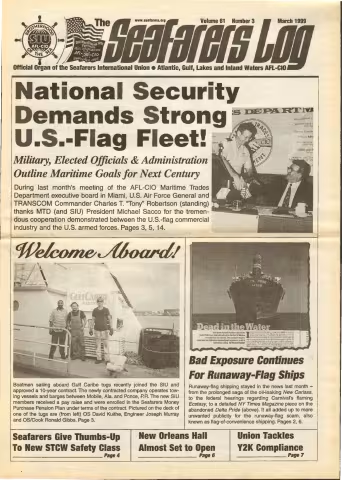
During last month's meeting of the AFL-CIO Maritime Trades
Department executive board in Miami, U.S. Air Force General and
TRANSCOM Commander Charles T. "Tony" Robertson (standing) .,
thanks MTD (and SIU) President Michael Sacco for the tremen
dous cooperation demonstrated between the U.S.-flag commercial
industry and the U.S. armed forces. Pages 3, 5, 14.
Bad Exposure Continues
For Runaway-Flag Ships
Boatmen sailing aboard Gulf Caribe tugs recently joined the SIU and
approved a 10-year contract. The newly contracted company operates tow
ing vessels and barges between Mobile, Ala. and Ponce, P.R. The new SIU
members received a pay raise and were enrolled in the Seafarers Money
Purchase Pension Plan under terms of the contract. Pictured on the deck of
one of the tugs are (from left) OS David Kuithe, Engineer Joseph Murray
and OS/Cook Ronald Gibbs. Page 3.
Runaway-flag shipping stayed in the news last month -
from the prolonged saga of the oil-leaking New Carissa,
to the federal hearings regarding Carnival's flaming
Ecstasy, to a detailed NY Times Magazine piece on the
abandoned Delta Pride (above). It all added up to more
unwanted publicity for the runaway-flag scam, also
known as flag-of-convenience sh~pping. Pages 2, 6.
Seafarers Give Thumbs-Up
To New STCW Safety Class
New Orleans Hall
Almost Set to Open
Union Tackles
Y2K Compliance
~~~~~~~~~~~-Page4 --~~~~~~-Page& ______ Page7
President's Report
Why We Get Involved
Last month, the AFL-CIO Maritime Trades Department executive board
held its winter meeting and proved once again how a group that represents
so many different workers in such a wide variety of
industries can actually have so much in common.
The MTD is composed of 32 different unions
. (including the SIU) and 23 port councils located around
the United States and Canada. Nearly 8 million workers
are represented by the unions belonging to the MID.
On top of my duties with the SIU, I also serve as presi
dent of this AFL-CIO constitutional department.
Although the name may read Maritime Trades, the
Michael Sacco issues taken up by the department are wide-ranging.
That is why the MTD could boast such an outstand
ing array of speakers last month to update the board on such issues as
national security, Social Security, Avondale Shipyard, dumped steel
imports and runaway-flag shipping.
Those of us in the SIU know the vital role we play in the nation's
security. We crew the ships that supply our troops when they are called to
action overseas. But when the head of the military's logistical command,
Gen. Tony Robertson, provides the briefing, then the whole board knows
how the military appreciates the crucial role played by American workers
in our national security. The general said America's mariners, longshore
men and shipbuilders are critical because the U.S. Transportation
Command "absolutely, positively cannot get the job done without the
support of America's commercial maritime industry."
To support Robertson's remarks, Maritime Administrator Clyde Hart
reemphasized the administration's strong support for the U.S.-flag fleet,
from the Jones Act to the need to keep building vessels in U.S. shipyards.
Also, four members of the House Armed Services Committee - Reps.
Ike Skelton (the ranking Democrat), Neil Abercrombie, Lane Evans and
Patrick Kennedy - spoke on the importance of the U.S-flag fleet to the
nation's defense for the next century.
The issue of preserving Social Security is a hot topic. AFL-CIO
President John Sweeney and his executive assistant, Gerry Shea, outlined
the labor federation's campaign to keep this federal program strong for
all Americans. From Capitol Hill, Rep. Peter Deutsch talked about Social
Security's importance to older Americans, such as the ones he represents
in South Florida.
A major labor struggle is taking place at Avondale Shipyard. That is
why the MID invited the president of the AFL-CIO Metal Trades
Department, John Meese, and his coordinator for the campaign, Bill
Reagan, for an update on the unity of the workers in the Louisiana facili
ty. The owners of Avondale for more than five years have been ignoring
the will of their workers to be represented by a union contract.
Despite constant court rulings against them, the owners of Avondale
continue operating as if the laws of the nation do not apply to them. If they
are allowed to get away with this, it could harm all working people - orga
nized or not. The MID and all of labor supports the Avondale workers.
George Becker, the president of the Steelworkers (also an MID-affili
ated union) noted that since low-cost foreign steel started being dumped
on America's shores last year, 10,000 American steelworkers have lost
their jobs and three domestic producers have declared bankruptcy. That
obviously is not good for American workers.
Additionally, Seafarers on the Great Lakes saw their season come to an
end earlier than expected because the steel mills they provide with iron
ore had to scale back production. The ripple effect from this has hurt rail
workers, miners and others nationally. This isn't just a steelworkers prob
lem. It affects all of us and the MID supports legislation to end this crisis.
Finally, the threat of runaway-flag shipping needs no explanation to
Seafarers. We have been battling this plague for more than 50 years
through the worldwide campaign being waged by the International
Transport Workers' Federation.
ITF Assistant General Secretary Mark Dickinson came from London
to discuss this issue. It involves some shipowners who for decades have
gone overseas to exploit workers in nations which pay low wages and
provide minimal, if any, labor and safety standards. Today, this practice is
being copied in the textile, manufacturing and electronics trades. There
has been a steady decline in the number of good-paying jobs in these
industries as companies look to abandon the American workers who
made their businesses so successful in their search to lower their produc
tion costs. Needless to say, this affects all of us.
These are just some of the issues that are confronting American work
ers today. Naturally, our primary focus is to make sure Seafarers maintain
the jobs they already have while providing new and better ones to take us
into the next century.
But we also must stay alert to the concerns of other working men and
women because the efforts designed to hurt them could also be used to
come after us. Likewise, the strategies they implement for success can be
repeated to our advantage.
Volume 61, Number 3 March 1999
~76
The SIU on line: www.seafarers.org
The Seafarers WG (ISSN 1086-4636) is published month
ly by the Seafarers International Union; Atlantic, Gulf,
Lakes and Inland Waters District; AFL-CIO; 5201 Auth
Way; Camp Springs, MD 20746. Telephone (301) 899-
0675. Periodicals postage paid at Southern Maryland
20790-9998 and at additional offices. POSTMASTER:
Send address changes to the Seafarers WG, 5201 Au th Way
Camp Springs, MD 20746.
Communications Director, Daniel Duncan; Managing
Editor, Jordan Biscardo; Associate Editor/Production,
Deborah A. Hirtes; Art, Bill Brower; Administrative
Support, Jeanne Textor.
Copyright © 1999 Seafarers International Union, AGLIWD
All Rights Reserved.
2 Seafarers LOG
AP/Wide World Photos
Cleanup crews rake oily sand from the grounded cargo ship New Carissa last month on the beach near the
entrance to Coos Bay, Ore. The runaway-flag vessel spilled at least 70,000 gallons of heavy bunker oil.
More Unwanted Publicity
For Runaway-Flag Ships
Oil-Leaking Freighter Gets Nationwide Attention;
NY Times Magazine Story Further Exposes FOCs
When the runaway-flag
freighter New Carissa went
aground at Coos Bay, Ore. on
February 4, it touched off more
than two weeks of nationwide
media coverage.
The television, newspaper and
radio reports focused on efforts to
clean up the 70,000 gallons of
heavy bunker fuel that spilled
from the Panamanian-flag,
Japanese-owned ship, as well as
risky and rare attempts to ignite
the remaining oil (and thereby
prevent it from spilling).
Those stories also further pub
licized the pitfalls of runaway
flag shipping [also known as flag
of-convenience (FOC) shipping].
While not all of the New Carissa
coverage included mentions of
runaway flags, the FOC scam did
receive periodic reference in news
wire stories available throughout
the U.S. and on the internet.
One story by the Associated
Press said that U.S. Rep. Peter
Defazio (D-Ore.) "plans to file a
bill to prevent companies from
shipping goods under 'flags of
convenience,' or countries with
histories of not following interna
tional law for training and equip
ment. Panama, where the New
Carissa is registered, is on the
Coast Guard's watch list of such
countries, [DeFazio] said."
Similarly, U.S. Rep. Neil
Abercrombie (D-Hawaii) last
month stated that if the New
Carissa were an American-flag
ship with an American crew, the
accident "wouldn't have hap
pened in the first place."
Meanwhile, the recent surge of
runaway-flag coverage also con
tinued last month with a detailed
New York Times Magazine piece
on the Delta Pride. Part of the
newspaper's Sunday edition, the
February 7 issue of the magazine
devoted four full pages to the tale
of the Pakistani-flag vessel, aban
doned six months ago in the Gulf
of Mexico by its bankrupt Greek
owner.
These stories followed numer
ous others that in recent months
have spotlighted the often danger
ous and inhumane conditions
found aboard some runaway-flag
vessels. As reported in the
February issue of the Seafarers
LOG, newspapers including the
New York Times, Baltimore Sun,
Miami Herald, Houston Chronicle
and New Orleans Times-Picayune
as well as other media outlets have
contributed to an escalation in
exposing the typical conditions
associated with runaway flags.
Last month's Times piece
offered particularly poignant
insight. "All too often, the mer
chant marine has become a kind
of sweatshop on the high seas,
with workers laboring in perilous
conditions for little, or even no,
pay," wrote Thomas Hackett.
"The world's cargo ships sail
mostly under dubious registries,
flying so-called flags of conve
nience from countries with low
safety and health standards and
little muscle to guarantee the wel
fare of their workers."
Hackett also reported that "in
addition to the Delta Pride's crew,
there are currently 200 men on 10
ships around the world that have
been stranded in foreign ports by
their employers. Ship owners have
been known to unload their cargoes
and then deprive a crew of food and
water until, hopeless, the men give
up the vessel as well as any claims
to back wages. Most of the sailors
on the Delta Pride, for instance,
haven't been paid since they signed
on - for some of the men, more
than two years - or been in contact
with their families since they
unloaded their cargo last May."
While the New Carissa was a
news story in its own right, the
other coverage at least partially
may be attributable to stepped-up
efforts to generate publicity by the
International Transport Workers'
Federation (ITF).
Comprising more than 500
transport-related unions world
wide, including the SIU, the I1F
is in its 50th year of battling
against runaway-flag shipping.
Among other efforts, that cam
paign includes bringing FOC
ships under I1F contract; aiding
distressed mariners aboard run
away-flag ships and other foreign
flag vessels that are not runaways;
and holding shipowners account
able for their crew members.
The campaign also currently
features the worldwide tour of the
ITF's exhibition vessel, Global
Mariner. Publicizing the plague of
runaway-flag shipping is one of the
main goals of the tour, which this
month resumes its North American
itinerary on the West Coast.
Runaway-flag ships are carri
ers operating under the flag of
one nation, yet owned by a citizen
or citizens of another country.
Financially strapped nations sell
the use of their flag to shipown
ers, who register tonnage in those
countries in order to meet less
stringent labor, safety, regulatory
and tax standards than if that ves
sel were registered in the owner's
resident nation.
f See related story, page 6
Discuss West Coast Maritime
Recently, SIU officials from San Francisco got together with
California's newly elected governor to bring him up to date on the
latest maritime issues affecting Seafarers in the Golden State. From
the left are SIU Assistant Vice President Nick Celona, Governor
Gray Davis and SIU Vice President West Coast Nick Marrone.
March 1999
Maritime Stays Vital to National Security
Military, Gov't Officials Pledge Support to Jones Act, Maritime Security Program at MTD Winter Meeting
Representatives from the mili
tary and the government pledged
to continue their support for a
strong U.S.-flag merchant fleet
when they addressed the AFL
CIO Maritime Trades Department
(MTD) winter executive board
meeting last month.
The theme for the annual two
day gathering in Miami was "U.S.
Maritime Industry: Ready and
Able, Whenever, Wherever, for
the Nation's Security."
The MTD executive board is
composed of officials from its 32-
member unions (including the
SIU) and 23 regional port coun
cils, representing 8 million work
ers. The department, one of eight
for trade and industries recog
nized in the AFL-CIO constitu
tion, deals specifically with issues
affecting U.S.-flag shipping from
vessel construction to crewing to
allied trades as well as the other
concerns that affect the nation's
working people.
"Operation Desert Fox was
just the latest example of how our
nation's military knows it can
count on U.S. mariners," MTD
President Michael Sacco told the
board. "No questions were asked,
no hesitation shown in respond
ing. These seafarers had a job to
do and they did it to the best of
their abilities.
"That is why the people who
are charged with planning the
needs of the armed forces count
on a strong U.S.-flag merchant
fleet to be ready and available.
American seafarers have never let
our troops down and have no
intention of ever doing so."
;"cuCISI Assoc.
ri<ers of Ar
•
Making his point that defense
spending should include the
building of United States mer
chant vessels in American yards
is Rep. Neil Abercrombie.
U.S. MARITIME INDUSTRY
READY&ABLE
WHENEVER, WHEREVER
FOR THE NATION'S SECURITY
AJIERIOA'S SIJJPJJUJJ IJERS rl
• • dilRJNERS AND LONGSHOREMEN
TRANSCOM Commander Gen. Tony Robertson tells the MTD execu
tive board of his unwavering support for the jobs being performed by the
U.S.-flag merchant fleet. He gave the remarks last month in Miami.
Military Appreciation
Backing up Sacco's remarks
was the commander-in-chief of
the U.S. Transportation Command
(TRANSCOM), which oversees
the logistical movement of
American troops and their sup
plies worldwide.
Saying there is no substitute for
U.S. mariners supplying U.S.
troops is Rep. Ike Skelton, the
ranking Democrat on the House
Armed Services Committee.
possible without the unprecedent
ed partnership we enjoy with the
U.S. maritime labor community,"
noted U.S. Air Force General
Charles T. ''Tony" Robertson Jr.
"Let there be no mistake:
Sealift is absolutely critical to this
country's national security, and
you can quote me on that!"
Robertson thanked Sacco for
all the cooperation over the years
between military and the U.S.
U.S. Maritime Administrator Clyde
Hart definitively reaffirms the
Clinton administration's solid
endorsement of the Jones Act
during the MTD meetings.
IMO Sets Tougher on Forged Documents
The International Maritime Organization (IMO)
recently vowed to crack down on what it described as
"a proliferation of fraudulent STCW certificates of
competency, [and] authentic certificates reportedly
issued on the basis of forged foreign certificates,
which had been found during port state control inspec
tions and applications for recognition of certificates."
During a December meeting in London of the
IMO's subcommittee on standards of training and
watchkeeping - in which the SIU participated - the
panel cited numerous cases of forged or otherwise
improperly issued documents. This included a 20-
year-old mariner who had been issued a master's
certificate for ocean-going ships.
The subcommittee pointed to "a growing concern
that some countries may be issuing certificates on
the basis of certificates issued by another country
without verifying the authenticity of the original
document or the right of the individual to hold the
document."
March 1999
In response, the IMO called upon nations signa
tory to the STCW convention to "take all measures
necessary" to ensure proper issuance of documenta
tion to qualified mariners. This includes strict
enforcement of the treaty and intensifying other
efforts to eliminate improper issuance of documents.
An editorial concerning this matter in the London
newspaper Lloyd's List pointed out, "It would help if
those who issue certificates on the basis of another
party's documents actually follow the prescribed
procedures, which are designed to provide a reason
ably effective barrier against the palpably bogus."
That same editorial stated, "The pity is that there
are still owners who look for cheaper solutions to
their crewing requirements and scour the world for
those willing to sail on their ships for the lowest
wages. Desperate people, and the 20-year-old with a
master's license probably falls into that category,
exploit the system just as his owners were undoubt
edly exploiting him."
maritime community. He told the
audience about annual ship man
ning exercises, known as "Turbo
Activation," in which labor unions,
ship managers and others have
answered the call of the military to
crew and make seaworthy vessels
in the Ready Reserve Force fleet
with no advance notice.
"It is a superb test of readiness,
crew and labor union response,
and ship manager capability. And
every sector maxed the course."
Robertson reaffirmed the mili
tary 's support for· both the Jones
Act (the nation's freight cabotage
law) and the Maritime Security
Program (MSP).
"The Jones Act is a proven per
former that supports both our
nation's military security and its
economic soundness .... I also
firmly believe that the MSP fleet
provides the best method to ensure
the availability of U.S. merchant
mariners to crew our organic surge
fleet of reserve ships."
MarAd Backing
Support for both of these mar
itime initiatives also came from the
Clinton administration representa
tive to the meeting, U.S. Maritime
Administrator Clyde Hart.
"I can't say it enough. You
have to be supportive of the
Maritime Security Program," stat
ed the head of the Maritime
Administration.
"We have to own a merchant
fleet. It has to be U.S.-flagged.
We cannot depend on other coun
tries. What you don't own, you
can't control."
Hart explained the MSP was
passed by Congress and signed
into law in 1996 following a five
year campaign. He noted it was
not too early to begin thinking
about what' will replace the pro
gram, designed to provide funds
for 47 militarily useful U.S.-flag
vessels over a period of 10 years.
(Companies included in the MSP
agree to provide these vessels as
well as their infrastructure in
times of national emergencies.)
He included in his maritime
forecast continued backing of the
Title XI loan guarantee program
to build vessels of all types in
American yards.
"I am convinced we can revi
talize shipbuilding in the United
States."
Concerning the nation's freight
cabotage law, Hart told the board,
"There is no support by the
[Clinton] administration for any
legislation that harms the Jones
Act!"
Words from Congress
Joining with Robertson and
Hart on the continued need for a
strong U.S.-flag fleet were sever
al members of Congress.
Rep. Ike Skelton (D-Mo.), the
ranking minority member of the
House Armed Services Committee,
stated, "American commercial
crews and U.S.-flag ships are nec
essary for the national security of
our country. They provide the man
power and equipment necessary to
transport vital supplies and person
nel around the globe in times of
national emergency."
The Missouri legislator added
security also is provided through
the Jones Act because its fleet
"helps to provide a basic man
power pool of U.S. mariners that
can be utilized in times of nation
al emergencies, and there is no
substitute for that!"
Responding to recent calls for
a new missile defense system,
Rep. Neil Abercrombie (D
Hawaii) asked, "If we're ready to
put billions of dollars into a
defense that doesn't even exist
yet, how come we can't put one
dollar forward to build the ships
in American shipyards with
American workers sailed by
American seafarers that puts us
number one in the merchant
marine trade around the world?!"
Abercrombie, a longtime sup
porter of U.S.-flag fleet, serves as
the ranking minority member on
the House Armed Services
Military Personnel Subcommittee.
He also is a member of the House
Merchant Marine Panel.
Continued on page 5
Gulf Caribe Crews
Join Ranks of SIU
The Seafarers' banner now is flying from a fleet of towing ves
sels based in Mobile, Ala. as the crew members who work for Gulf
Caribe Maritime ratified a 10-year contract.
The unanimous vote of the crew took place February 10 in the
Gulf Coast port city.
According to SIU New Orleans Port Agent Steve Judd, the new
SIU members received a pay raise, were enrolled in the Seafarers
Money Purchase Pension Plan and became eligible to upgrade at
the Paul Hall Center's Harry Lundeberg School of Seamanship
under the contract.
'They were very excited to come aboard and we look forward
to having them with us," Judd noted.
Gulf Caribe operates two towing vessels between Mobile and
Ponce, P.R. One runs grain from Alabama to the Caribbean island,
while the other tows a barge loaded with railroad chemical tank
cars. The towboats are the Caribe , Pioneer and the Caribe
Challenger.
Included with the bargaining unit are licensed engineers, unli
censed engineers, able bodied seamen and ordinary seamen.
SIU officials involved in organizing Gulf Caribe included Judd,
Gulf Coast Vice President Dean Corgey, Mobile Port Agent Dave
Carter and New Orleans Patrolman Chris Westbrook.
Seafarers LOG 3
Fire Fighting and Safety School
Scheduled for May 18 Opening
Ceremony Will Unveil Paul Hall Center's Newest Addition
The ceremonial opening of the
Joseph Sacco Fire Fighting and
Safety School is slated for May
18 in Piney Point, Md.
"Construction of the various
components of the school is pro
gressing quite well," noted Jimmy
Hanson, director of health and
safety at the Paul Hall Center for
Maritime Training and Education.
''Thus far, everything has gone
according to plan, with no major
stumbling blocks."
The fire fighting and safety
facility, located on school proper
ty near the Paul Hall Center's
main campus, is a multi-building
complex where Seafarers will take
basic and advanced fire fighting,
water survival, first aid and CPR,
Name the Training 'Vessel'
At the Fire Fighting School
Here is your chance to attain fame and fortune!
Well, maybe not. But this is still a pretty cool opportunity.
A contest is being conducted to name the "vessel" at the new Joseph
Sacco Fire Fighting School. The "vessel" actually is one of the buildings
under construction at the facility. It is known as the burn building, where
Seafarers will take basic and advanced fire fighting to learn firsthand
how to battle blazes. Training aboard the "vessel" can be set up for a pas
senger ship, a ship's galley, an engine room, a tugboat, etc.
The "vessel" will need a name when the school opens. The contest is
limited to active and retired Seafarers, who may submit up to three
names. The names must be received no later than April 10, 1999 for
consideration. Examples of possible names are the SS Never Sail or the
MV Inferno. (No obscene or foul sounding submissions will be accept
ed.) The judges' decision will be final. In case the same name is submit
ted and selected for the ''vessel," the entry with the earliest postmark will
be declared the winner.
One grand prize and five runner-up awards will be offered. The grand
prize winner will receive a ship's wheel and be invited to christen the
"vessel" at the opening of the Joseph Sacco Fire Fighting School.
Accommodations and travel expenses will be included. The five runners
up will receive SIU jackets. Winners will be announced in the May issue
of the Seafarers LOG.
damage control and confined
space safety training. Featuring
the most modern, environmentally
and hygienically safe equipment,
it will be utilized beginning short
ly after the ceremony.
As reported in previous issues
of the Seafarers LOG, the safety
school - named in memory of the
late SIU Executive Vice President
Joseph Sacco - will replicate con
ditions found aboard all types of
vessels, from deep sea ships to
inland tugs and barges. It will
include two classrooms, but most
of the facility is designed for
hands-on training.
For example, the buildings will
house replicas of an engine room,
galley, lounge and fo'c's'le. Also
included will be a two-story maze
with moveable partitions, outdoor
training pads, a compressor room
and other features.
In planning the buildings,
equipment and layout, representa
tives of the SIU and the Paul Hall
Center's Harry Lundeberg School
of Seamanship worked closely
with the U.S. Coast Guard,
Maritime Administration and
Military Sealift Command to help
ensure that the courses taught
there will meet various federal
guidelines necessary for class cer-
Water survival training is one of the hands-on components in the Paul Hall Center's STCW Basic Safety class.
New STCW Basic Safety Class
Is Well-Received by Seafarers
The Paul Hall Center's new U.S. Coast Guard
approved STCW Basic Safety class for experienced
Seafarers contains very useful information and
moves at an appropriate pace, said SIU members
who completed the course last month.
Seafarers also reported that the course effectively
mixes hands-on training with classroom instruction,
and is bolstered by a well-written guide produced by
instructors at the center's Harry Lundeberg School
of Seamanship.
"It exceeded my expectations," stated Bosun
Mike Presser, an 18-year member of the union and
a frequent upgrader at the school in Piney Point, Md.
''The class moves along swiftly, it's straight to the
point and it gives us what we need. It's a good
course all the way around."
QMED Keith Samburger, who joined the SIU
in 1986, said the hands-on training "makes things hit
home a lot better. For instance, I learned a lot in the
4 Seafarers LOG
water survival training, which was successful and
fun.
"Overall, the class covers a lot of issues that are
importanC'
The four-day, 28-hour curriculum was crafted to
enable Seafarers to comply with the Chapter VI -
Basic Safety requirements of the STCW convention.
It is for SIU members who have sailed prior to
August 1, 1998. Mariners in this category have until
February l, 2002 to comply with Chapter VI.
Similarly, the school created (and the Coast
Guard approved) a five-day, 40-hour basic safety
course for those with no sea time prior to August l,
1998. Those mariners may not sail unless they meet
the Chapter VI requirements.
In accordance with Coast Guard guidelines, each
class is limited to no more than 25 students apiece.
Continued on page 9
Although many areas of the country have been blitzed by severe weath
er this winter, Maryland has enjoyed a relatively mild season, which has
aided construction of the Paul Hall Center's new fire fighting school. The
top photo shows the burn building, which is seeking a name. (See side
bar to the left.) The other photo shows classroom sites and more.
tification. This will benefit
Seafarers who are required to take
Coast Guard-approved safety
courses in order to sail.
The union and school also
extensively consulted with local
fire and rescue professionals to
assure maximum efficiency in
design, plus compliance with dif
ferent specifications governing
the construction and operation of
such a facility.
Seafarers May Utilize
Lundeberg Courses
For ~ollege Credits
ACE Assessment Boosts Paul Hall Center
The Paul Hall Center for Maritime Training and Education,
located in Piney Point, Md., has joined a select number of organi
zations which have added value to their courses through college
credit recommendations as a result of a review conducted last fall
by the American Council on Education's (ACE) College Credit
Recommendation Service.
A team of course-content specialists, selected from college fac
ulty, reported that the curriculums at the center's Harry Lundeberg
School of Seamanship are comparable to college-level courses and
may be used as transfer credit at ma~y colleges and universities.
''This evaluation underscores the ·high quality of your organiza
tion's education and training," wrote ACE Communications
Director Stephen Sattler in a letter to the school confirming the su9-
cessful evaluation.
For Seafarers, the ACE assessment means that an SIU member
who successfully completes one or more of the vocational or acad
emic courses available at Piney Point may receive college credit for
it. The final decision rests with the college or university, although
the ACE recommendation typically is a strong and positive influ
ence on that determination.
Other organizations which have utilized the ACE College Credit
Recommendation Service include the AT&T School of Business;
Dale Carnegie & Associates, Inc.; Union Pacific Railroad; and the
United Auto Workers and General Motors Corp.
Jo Ann Robinson, director of the recommendation service,
pointed out that the program "has helped thousands of employees
earn a college education. Colleges and universities also have been
well served by ACE, because qualified adults from the work force
are continuing or completing their college education in record
numbers."
In fact, according to a recent study by the U.S. Department of
Education, more than 40 percent of American adults take part in
some type of formal educational activity each year - the vast
majority because they want to earn an academic credential.
Additionally, late last year the school announced an agreement
between the Paul Hall Center and ACE designed to help Seafarers
meet STCW requirements.
The expanded alliance stems from a 1995 STCW amendment
Continued on page 9
March 1999
Labor Continues Grassroots Effort to Bolster Social Security
Members of the AFL-CIO
Maritime Trades Department
(MTD) executive board were
urged to take the momentum
gained last year in the nationwide
battle to repel "paycheck decep
tion" legislation and keep it going
to strengthen Social Security.
MTD President Michael Sacco
reminded the board of the victo
ries gained in more than 30 states
last year when legislation and bal
lot initiatives aimed at limiting
how working people could partic
ipate in the political process were
turned back.
"This could have been the
political death knell for American
workers," Sacco, who also heads
the SIU, told the board, which
was gathered for its annual meet
ing on February 15 and 16 in
Miami. The MTD is made up of
32 unions and 23 port councils
representing approximately 8 mil
lion workers.
"It was a fight we simply could
not afford to lose, and we didn't!"
Sacco recalled how the labor
movement launched a nationwide
grassroots campaign to educate
union members and their families
so they could tell others what was
wrong with the measures. He
noted this same effort must take
place to preserve Social Security
AFL-CIO Asst. to Pres. Gerald
Shea outlines the federation's cam
paign to fight for Social Security.
because so many millions of
Americans depend on the federal
retirement, disability and sur
vivors' program.
Sacco then introduced Gerald
Shea, assistant to AFL-CIO
President John Sweeney, to out
line labor federation's strategy to
strengthen the federal system.
Calling this campaign one of
the "biggest battles" labor has
tackled in years, Shea pointed out
one victory already has taken
place in the effort. He noted last
year many in the press were ask
ing in their stories what kind of a
Reminding MTD board members
how labor sets standards used by
all workers is Rep. Peter Deutsch.
privatized system would replace
Social Security. Now, articles
reflect how President Clinton
plans to use the budget surplus to
aid the system with little to no
mention of privatization.
"People lack good information
about the real value of Social
Security," Shea told the board. "A
lot of people simply don't under
stand what is going on with Social
Security."
He noted the program provides
the majority of retirement income
for most retirees and that percent
age has been growing in recent
Rep. Patrick Kennedy calls on
labor to continue its successful
education effort from last year.
years because fewer people have
private pensions that can help
when they stop working.
Despite accounts that Social
Security is going bankrupt, Shea
stated the system under its present
funding formula could continue
making its scheduled payments
until the year 2032 when it would
be forced to reduce benefits by
some 25 percent.
"Many people do not realize
Social Security has paid out
more than $5 billion since its
inception without missing a pay
day," Shea said.
He added that when people
understand the privatized approach
shifts the risks to the individual
and will cost the government more
to administer, "they really start to
think very differently about it.
"Our campaign is designed to
give people the information and
show them the value of the system."
It is a grassroots effort aimed at
union members and their families,
encouraging them to talk with their
friends and neighbors, he stated.
Noting how this method
worked last year to turn back anti
worker legislation, U.S. Rep.
Peter Deutsch (D-Fla.) called on
labor to continue the fight for
Social Security.
"Would there be Social
Security without labor? I doubt it
- impossible!" said the congress
man whose district in South
Florida includes many retirement
communities. "Labor sets the
base line for all of America."
U.S. Rep. Patrick Kennedy (D
R.I.) added that the anti-worker
efforts displayed in Congress dur
ing the last four years and reject
ed by working men and women
across the country have made "me
understand why I am a labor
Democrat." He spurred the board
to continue the grassroots effort
st~ed last year.
USWA's Becker: Steel Dumping Crisis Hurls All Workers
The president of the United
Steelworkers of America told the
AFL-CIO Maritime Trades
Department (MTD) executive
board at its winter meeting last
month that the dumping of for
eign steel into the United States is
an issue that affects all trade
unionists.
''This is a labor issue," George
Becker informed the audience.
"We don't have enough steel
workers jobs, brothers and sisters,
that we can give away to keep the
economies of Russia and South
Korea and Japan and Brazil and
India - to keep them going. And,
I submit, you don't either!
"We have to be able to take
care of our own and we haven't
been doing this."
Becker told the board that
10,000 jobs in the steel industry
have been lost, while three major
domestic steel producers have
gone bankrupt, in the last year
since the Asian economic crisis
began.
"Our jobs are at risk. They
can't make it with the steel that is
being dumped into the United
States today."
Affirming Becker's concern
was U.S. Rep. Lane Evans (D
Ill.). He told the executive board
"hundreds of workers have lost
Continued on page 14
As MTD Pres. Michael Sacco listens, Steelworkers Pres. George
Becker explains how the steel dumping crisis affects all trade unionists.
Rep. Lane Evans expresses his
concern over job cuts in the steel
industry in his Illinois district.
Avondale Workers Fighting for Recognition Latest in Runaway-Flag Fight
The AFL-CIO Maritime
Trades Department (MTD) execu
tive board called on its 32 affiliat
ed unions and 23 port councils to
continue their support of the
workers at Avondale Shipyard
who have been fighting for a
union contract for more than five
years.
The board, holding its annual
winter meeting in Miami last
month, noted that the workers
continue to show solidarity
despite never-ending roadblocks
stacked against them by the man
agement of the Louisiana facility.
Reminding the board members
what the workers have struggled
against since voting for union rep
resentation in 1993, AFL-CIO
Metal Trades Department
President John Meese said these
men and women have won time
after time before the National
Labor Relations Board and in the
federal court system, yet
Avondale refuses to recognize
their decision.
He noted each attempt to
thwart the will of the workers has
only made them more deter
mined.
"Our committee [of Avondale
workers] assures us if we had to
go back to an election tomorrow,
we'd win again," Meese noted.
Bill Reagan, the Metal Trades'
coordinator for the Avondale
campaign, added signs of the sol
idarity include lunchtime demon-
Continued on page 14
Maritime Needed for U.S. National Security
Continued from page 3
During the meeting, MTD
executive board members
approved statements calling on
Congress and the administration
to continue their support of the
Maritime Security Program and
the Jones Act. Board members
also urged Congress to continue
efforts to use American yards for
shipbuilding, to preserve the
March 1999
Passenger Vessel Services Act
(the nation's passenger cabotage
Jaw), and to work with the indus
try to find a way to fund domestic
harbor maintenance dredging.
The board expressed its appre
ciation for retired MTD Vice
President Willie Zenga, who has
spent the last several years work
ing with federal, state and local
officials to find a way to safely
dredge the port of New York and
New Jersey so it can handle mod
ern commercial vessels.
Additional board action was
taken on the need to protect work
ers, home owners and small busi
ness people when utility deregula
tion laws are implemented; the
fight for just trade laws that respect
the concerns of working people
both in the U.S. and the imple
menting countries; and the passage
of the water resources bill.
United Food and Comme~a\
Workers lnternat10nal Umon .
ders1 Pottery, Pla.stic.r
or1<ers /nternat1on8'
Union
ITF General Asst. Sec'y Mark Dickinson updates the MTD execu
tive board on the global campaign to rid the high seas of runaway
flag shipping. He thanked the unions involved in the ITF exhibition
ship Global Mariner's visit to the United States last fall, while
reminding them of the ship's return to country along the Pacific
coast this month.
Seafarers LOG 5 ·
Imminent Opening Is Anticipated
For New Orleans' New Hiring Hall
Facility Expected to be Ready No Later than April 2
The SIU's New Orleans-area
hiring hall is scheduled to relo
cate no later than April 2 and pos
sibly sooner.
Seafarers who utilize the
existing hall on Jackson Ave. are
asked to stay in touch with offi
cials there for the latest news
concerning the move.
The SIU last year purchased
the newer facility, located at 3911
LaPalco Blvd. in the New
Orleans suburb of Harvey, some
nine miles from the current hall.
Since then, the building has
undergone renovations and
expansion to meet the union's
operational requirements.
When the new hall opens, the
clinic in that area also will
change.
Coinciding with the opening
on LaPalco Blvd., the new clinic
for Seafarers will be Westbank
Surgical Clinic on the Westbank
Expressway in Marrero, La. (see
New SIU Hall
In New Orleans Area
(schedule to open by early April)
3911 LaPalco Blvd.
Harvey, LA 70058
Phone: (504) 328-7545
Fax: (504) 328-7549
New SIU Clinic
(effective upon opening of hall)
Westbank Surgical Clinic
Doctors Building
4475 Westbank Expressway
Marrero, LA 70072
Phone: (504) 347-8471
Fax: (504) 340-2885
box). Services will remain avail
able at the Tulane Center for
Occupational Health until the
changeover happens.
Renovations to the new SIU hall in the New Orleans area include con
structing a wall for the shipping board and many other improvements.
NY Times Chars Foreign-Flag Cruises Operating
In U.S. As NTSB Investigates Fire an Ecstasy
tammg life jackets when none
were inside.)
In response to being asked if he
considered returning to the dock
to allow shore-based crews to
fight the fire, Sartori said he had
"adequate manpower to extin
guish the fire at sea." He added the
crew acted "without hesitation."
At the same time the National
Transportation Safety Board
(NTSB) was conducting a public
hearing on a July 1998 fire that
erupted aboard the Carnival
cruise ship Ecstasy, the New York
Times published a front-page arti
cle on how that company and oth
ers in the business flout the
nation's labor and tax laws.
Under the headline "Cruise
Lines Reap Profit from Favors in
Law" in its February 19 edition,
the Times article stated, "Doing
business under a decades-old
loophole in the federal tax code,
and protected by an increasingly
powerful lobbying force, the 17
major cruise lines pay practically
no income tax even though they
are based in this country and 90
percent of the passengers are
Americans.
"The cruise lines, all of them
registered in foreign countries, do
not observe the nation's labor
laws, minimum wage law and
many environmental and safety
regulations," added the story writ
ten by Douglas Frantz.
The article pointed out how the
world's largest cruise firm, the
Carnival Corporation based in
Miami, has garnered $2 billion in
profits during the last three years,
while paying less than one percent
in income taxes on this amount.
The next largest company - Royal
Caribbean, also from Miami -
does not even have a line on its
financial statements for income
tax payments, the Tzmes reported.
Yet, an investigation by the
paper showed these foreign-flag
cruise companies operating out of
American ports had political
action funds and lobbyists work
ing on Capitol Hill to influence
Lakes Season Begins
Low water levels and continued concern regarding the dump
ing of foreign steel have cast some uncertainty over fitout dates for
the 1999 Great Lakes sailing season, even as a few vessels began
sailing late last month. These included the SIU-crewed Medusa
Conquest, Mary E. Hannah and Daryl C. Hannah.
Seafarers are asked to keep in touch with the SIU haJls in
Algonac, Mich. or Duluth Minn. as more fitout information
becomes available.
The 1998 season officially ended on January 30, 1999, when
the SIU-crewed Paul H. Townsend reached its winter layup berth
in Milwaukee.
Meanwhile, the Lake Carriers' Association reported that U.S.
flag carriage "increased slightly on the Great Lakes during the
1998 season," according to their estimates. However, the group
also reported that "dumped steel significantly impacted the Lakes
Jones Act fleet. The initial tally for iron ore (moved last year)
shows a decrease of 580,000 tons, yet at one point in the season,
U.S.-flag ore cargoes were 2.3 million tons ahead of 1997's record
pace."
Altogether, the association estimates that U.S.-flag ships on the
Lakes moved 125,314,425 tons of cargo during the 1998 season
an increase of about 82,000 tons compared to the previous season.
6 Seafarers LOS
legislation that would benefit
them. The paper said the cruise
industries' association, known as
the International Council of
Cruise Lines, had made political
donations during the 1997-98
cycle amounting to $166, 146.
Additionally, the council spent
$557 ,023 for lobbying in 1997.
Ecstasy Aftermath
Meanwhile, the NTSB hearing
disclosed the origin of the blaze
aboard the Ecstasy to have been
lint, ignited by a welder's spark,
catching fire in the laundry room.
Witnesses at the two-day fact
finding hearing, held February 17
and 18 in Miami, included the
ship's captain who answered
questions from investigators on
the decision-making process of
battling the blaze.
Shortly after the Ecstasy set
sail from the port of Miami on the
afternoon of July 20, the cruise
ship loaded with 2,565 passengers
and 916 crew members had black
smoke and flames pouring from
its aft mooring deck. The fire was
brought under control by ship
board firefighting crews (includ
ing shoreside firefighters heli
coptered to the vessel), a U.S.
Coast Guard firefighting vessel
and commercial tugboats
equipped with monitors.
During the questioning of
Ecstasy Captain Vittorio Sartori,
the master stated he "wanted to
avoid panic" throughout the
course of the fighting the fire.
Based on his initial reports from
crew members checking the
blaze, he did not think it was as
serious as it became. That is why
he refused the Coast Guard's first
offer of help, which came 18 min
utes after the initial fire alarm
sounded at 5: 10 p.m.
Sartori noted a lot of alarms
were going off at the time but
thought it was "nothing impor
tant" because he had experienced
previous incidents during his sail
ing career when warnings would
sound due to someone smoking in
a cabin. '
The captain said he ordered the
cruise director to bring the pas
sengers to an open area on the
deck. Again, he stated he wanted
"to make sure the passengers not
react with panic." Once the pas
sengers were gathered, he gave
the alarm to notify the crew of the
situation. He avoided a question
from one NTSB member on
whether Carnival was advising
from shore what to do.
When asked why some people
had life jackets and others did not
while they were gathering in the
open area, Sartori responded
some passengers could not return
to their cabins because of the fire
to retrieve their jackets. He added
"there were sufficient jackets on
deck."
(Shortly after the fire, the NBC
News show "Dateline" ran a clip
from its archives aboard the same
vessel a few years earlier showing
boxes on the deck marked as con-
(As noted in the September
1998 issue of the Seafarers LOG,
several passengers - including a
fire chief from Texas vacationing
aboard the vessel - questioned in
their local newspapers the proce
dures used and the lack of mfor
mation from the crew.)
He told the investigators he
maintained a minimum speed out
of Miami in case he had to steer
the vessel to keep the smoke from
blowing across the ship.
The NTSB plans to take the
information received during the
hearing and make recommenda
tions to improve passenger safety.
The federal agency was able to
conduct this hearing because the
Liberian-flag cruise ship was
within U.S. territorial waters
when the fire was spotted and
fought. Had the Ecstasy sailed a
few miles further east into inter
national waters, the NTSB would
not have had such jurisdiction
despite the overwhelming num
ber of American passengers on
board.
During last month's NTSB hearing, Capt. Vittorio Sartori points to a dis
play as he explains the events surrounding last July's fire on the
Liberian-flag cruise ship Ecstasy near Miami.
March 1999
Tackling the Y2K 'Bug'
CG Inf or mat ion Specialist Examines 2000's Potential Impact
If the thought of computer
reliant ships smashing into ports,
or highly automated airplanes spi
raling out of the sky aren't
enough to convey the potential
dangers of the now-infamous
Y2K situation, then consider this
real-life experience of U.S. Coast
Guard Rear Admiral George
Naccara, who heads the agency's
broad effort to combat the millen
nium bug.
Naccara recently was over
charged by about $5,000 on his
monthly credit card bill, because
of a computer error related to
renewing an insurance policy
beyond the year 2000.
Internet Site
Offers Y2K
Starting Point
Y2K's worldwide scope
predictably has led to numer
ous resources addressing the
problem's many aspects.
For mariners interested in
this issue, a suggested starting
point is the U.S. Coast Guard's
internet site devoted to Y2K. It
is located on the World Wide
Web at www.uscg.mil/hq.g
m/y2k.htm.(The dash between
the letters "g" and "m" is part
of the site address.)
The site's introduction pro
claims that it "does not provide
the solution, but it will provide
the means for people and
industry to express concerns
and discuss possible answers
to Y2K, a problem that we all
face."
The rear admiral's encounter
obviously pales in comparison to
the seriousness of those hypothet
ical disasters, but it is yet another
example of the myriad difficulties
presented by Y2K (the abbrevia
tion for year 2000).
"Y2K has helped make the
entire country realize our tremen
dous dependence on information
technology," Naccara said last
month at a meeting of the
Washington, D.C. chapter of the
Propeller Club. "That includes
many of the critical systems on
ships. And the United States econ
omy is extraordinarily dependent
upon maritime shipping."
It defines the problem as
"arising from the widespread
use of a two-digit field, not
four, to represent the year in
computer databases, software
applications and hardware
chips (for example 06/18/85).
Difficulty will arise in the year
2000 when the year is "00"
and computer based systems
will be unable to differentiate
it from 1900 - the assumption
of a single century.
"Programs and computer
based equipment may fail or
produce flawed data as they
attempt to perform calculations
and sorting routines. If corrupt
ed data goes unrecognized, the
problem can be passed through
interfaces to other automated
information systems ....
"Many of today's computer
hardware, heavy equipment
and machinery may have
embedded computer chips with
this Y2K problem."
He mentioned navigation and
engine control systems, cargo
gauging equipment, vessel traffic
management tools, communica
tions devices and "in essence, any
system that supports shipping or
cargo handling operations" as
susceptible to the Y2K bug.
In fact, N accara, the Coast
Guard's chief information officer,
pointed out that as many as 10
other "critical dates" i:nay cause
similar problems. For instance, he
cited September 9, 1999 (919199)
- which, in some computer lan
guages, is a command meaning
"cease operations."
"The Coast Guard experienced
a Y2K disruption in early 1997,"
he recalled. "We had a failure in a
software program at the Coast
Guard Institute in Oklahoma City.
The program triggers mailing to
all correspondence course
enrollees of an end-of-course test
with a three-year completion win
dow. In January 1997, the three
year window suddenly fell
beyond the start of the new mil
lennium, and the program, unable
to correctly interpret the '00' end
date of the year 2000 malfunc
tioned, and in so doing deleted
hundreds of student records. The
staff at the institute required two
weeks to correct the problem. It
was a sobering wake-up call."
Since then, the agency has
assigned a large staff to address
the Y2K issue and made it a top
priority, Naccara noted. He
explained that the Coast Guard
has made substantial headway on
this matter by following a five
step approach that includes
increasing awareness, assessing
information and control systems,
repairing or terminating those sys-
Cape Fear Towing Adds New Tractor Tug in Wilmington, N. C.
March 1999
SIU boatmen at Cape Fear
Towing in Wilmington, N.C,
including (above left, from left)
Engineers David Register and
Donald Todd, recently wel
comed the addition of a new
tractor tug, the Fort Bragg (also
pictured below left). The new
boat was built in Maine, and it
joins Cape Fear's fleet of dock
ing tugs, such as, pictured
directly above, the Fort Caswell.
From the left are Captian Doug
McDonald, Engineer Lewis
Farrow and Deckhand/Relief
Captain Roy Honeycutt.
terns, validating the repaired sys
tems and returning them to use.
"We expect our boats, ships
and planes will be ready and
operating on January 1, 2000 and
thereafter, with minimal disrup
tion," he said.
Nevertheless, both last month
and in earlier testimony before the
U.S. House Committee on
Technology and Infrastructure,
Naccara acknowledged that even
the most diligent preparations
won't completely eliminate this
global problem.
"Two things are certain. One is
that not all government, business
or industry systems will be
repaired in time," he said. "The
second certainty is that errors will
surface in repaired systems, both
during testing and then during
actual operations. Independent
testing contractors have found
error rates from 2 to 10 percent in
systems that have been repaired
and tested by their owners."
He then discussed various con
tingency plans, and also noted
that the Coast Guard "plans no
additional regulatory actions
related to Y2K." Naccara said that
strong cooperation within the
maritime industry, coupled with
the fact that "we already have the
regulatory authority we need to
ensure safety in our ports and on
board vessels," preclude the need
for further rules.
Naccara also pointed to this
month's Y2K summit in London
as vital to enhancing "contin
gency and outreach plans" for
ships and ports. More than a
dozen major maritime trade orga
nizations are expected to attend.
Union Takes Big Strides
Toward Y2K Compliance
Management information systems personnel at SIU
headquarters, located in Camp Springs, Md., have made
substantial progress in ensuring that the union's communi
cations and record-keeping mechanisms are Y2K compli- .
ant.
The medical claims system became compliant late last
year, as did the phone systems at headquarters, at all SIU
halls and at the Paul Hall Center for Maritime Training
and Education, located in Piney Point, Md.
The clinic system (used to track physical examinations
and drug-test data for the membership) was Y2K compli
ant when it was completed in 1992.
Additionally, the Seafarers Welfare Plan, Seafarers
Pension Plan and union plans and accounting departments
are using Y2K compliant software.
Louisiana Merchant Marine
Bonus Deadline Approaches
July 1 Is Cutoff for Newly Eligible Mariners
The State of Louisiana is pay
ing a $250 bonus to merchant
mariners from that state who
sailed during the latter stages of
World War II.
The bonus had been limited to
those who served during the peri
od between December 7, 1941
and August 15, 1945. However,
enactment last year of the
Veterans' Benefits Enhancement
Act (supported by the SIU)
extended some veterans' benefits
to mariners who sailed between
August 16, 1945 and December
31, 1946.
As a result, Louisiana has
expanded the bonus to include
those residents that served during
the latter period. An unremarried
surviving spouse of a merchant
mariner whose death was related
to that service also may be eligi
ble for the bonus.
''Anyone who served in the mer
chant marine between December 7,
1941 and December 31, 1946 and
was a resident of Louisiana at the
time of entry into service, who have
not already done so, are encouraged
to apply for the bonus. All applica
tions must be received by the
Louisiana Department of Veterans
Affairs on or before July 1, 1999,"
stated the department in a recent
press release.
For more information and an
application, contact the State of
Louisiana-, Department of Veterans
Affairs, Post Office Box 94095,
Capitol Station, Baton Rouge, LA
70804-9095, or telephone (225)
922-0500.
President Clinton signed the
Veterans' Benefits Enhancement
Act on November 11 (Veterans'
Day). This followed unanimous
passage of the legislation in the
House and Senate.
In January 1988, the secretary
of the Air Force, the branch of the
services that oversees veterans'
matters, awarded the status to
some World War II mariners fol
lowing an eight-year court battle.
However, the announcement stat
ed World War II veterans' status
for merchant mariners would end
nearly a year-and-a-half before
the other branches of the service.
. Merchant marine veterans'
groups joined with maritime
unions, including· the SIU, to
lobby Congress for the extension.
Bills were submitted in each
Congress following the announce
ment, but they never got past the
committee stage until last year.
Seafarers LOG 7
Electrician Howard Hedra is
ready to help in loading the con
tainers aboard the vessel.
Learning the operations of the dif
ferent departments aboard the
Sea-Land Consumer is unli
censed apprentice Matt Nguyen.
Bosun Frank Adams does his part
to keep the ship in top condition.
B Seafarers LOG
The Sea-Land Consumer loads
cargo in Elizabeth, N.J. (left)
bound for victims of Hurricane
Georges in Puerto Rico and the
Dominican Republic. At right, the
vessel unloads the containers in
San Juan, watched over by the
ship's mascot {above).
S-L Consumer Carries Cargo
On Crescent Run
The Seafarers aboard the Sea-Land Consumer
have a lot to be happy about-a good crew, a clean
ship, delicious food (especially at Thanksgiving)
and important cargo.
According to DEU John Cooper (who sent the
Seafarers LOG the photos on this page), the vessel
crewed in Norfolk, Va. in October of last year, fol
lowing 35 days in the shipyard, and has been on
the Crescent Run since then. This route takes them
from New York to Jacksonville, Fla.; San Juan,
P.R.; Rio Haina in the Dominican Republic; and
Houston.
On a recent voyage, the vessel carried contain
ers loaded with building supplies and other equip
ment for the residents of Puerto Rico and the
Dominican Republic, whose islands were devastat
ed by Hurricane Georges (which struck the
Caribbean beginning September 21 before pro
ceeding to the U.S.).
Getting the ship ready for arrival
in port are DEU John Cooper
(left) and AB Bennie Spencer.
Cooper reports that delicious Thanksgiving Day
and Christmas dinners were served aboard ship,
complete with all the usual holiday trimmings.
Another notable meal took place November 19
en route to San Juan in celebration of the container
ship's 25th year of service with Sea-Land Service,
Inc. Roast prime rib of beef au jus, eggplant
parmigiana and broiled filet of sole were among
the offerings at the anniversary festivities.
One particular sight the crew members enjoyed
took place while on a run from Jacksonville to
Puerto Rico. Sea Star Line's El Yunque was head
ing into port for her first load of cargo. (See fea
ture on page 14 of the February LOG.) Seafarers
aboard the Sea-Land Consumer expressed their
sincere thanks to SIU President Michael Sacco and
the contracts department for getting these new jobs
and helping keep the union strong.
The port door of the Sea-Land
Consumer gets a new coat of
paint from AB Juan Ayala.
Keeping the rooms in order is BR
Americo Garayua.
The entire crew
appreciates the great
meals prepared by
Chief Cook William
"Bill" Pitt (above).
Rachel Cutler-Washington, who
sails as assistant cook and mess
man aboard the container ship,
refills the juice containers.
AB Phil Harmon is completely
full after a delicious meal and
looks forward to the union
meeting that evening, as is
noted on the board.
LEFT: The task of
splicing some wires
before the vessel
docks in San Juan is
completed by AB D.
McGath.
Crew members agree that the food aboard the Sea-Land Consumer is great. From
the left are AB Larry Bradley, AB Steve Ledermann and OMU M. Yafai.
March 1999
Admiral Holder Succeeds Admiral Perkins as MSC Head
U.S. Navy Rear Admiral
Gordon S. Holder became the
22nd commander of the Navy's
Military Sealift Command (MSC)
during a February 12 change of
command ceremony at the
Washington (D.C.) Navy Yard.
Holder succeeds Vice Admiral
James B. Perkins III, a vocal
backer of the U.S. merchant
marine who served a 24-month
tour at MSC.
Navy Admiral Jay L. Johnson,
Chief of Naval Operations, and Air
Force General Charles T. "Tony"
Robertson, head of the U.S.
Transportation Command, were the
keynote speakers at the ceremony,
which was attended by more than
600 people from MSC and other
segments of the maritime industry.
Holder, a New Jersey native
and 1968 Florida State University
graduate, joins MSC after serving
as commander of Amphibious
Group Two, a position he has held
since 1997. His at-sea assign
ments include serving as the com
manding officer on the amphibi
ous warfare ship USS Widbey
Island during her maiden voyage
in 1987 which included a period
of presidential support during the
1987 economic summit in Venice,
Italy. He also commanded the
amphibious assault ship USS
Austin in 1992.
During Desert Shield and
Desert Storm, Holder served on
the staff of the 7th Fleet comman
der as fleet exercises and amphibi
ous warfare officer. Fo1lowing
The class helps Seafarers meet the Chapter VI requirements of STCW.
Safety Course Is A Success
Continued from page 4
"The course I took covered a
lot of key subjects," added
Presser, who graduated from the
Lundeberg School in 1981. "It
helps that the training books are
concise and easy to understand."
As reported in the January
issue of the Seafarers LOG, these
classes do not replace the Paul
Hall Center's basic fire fighting or
water survival courses as required
by 46 CFR for Coast Guard
endorsement as a lifeboatman.
The new classes essentially
cover the same subjects, but in
varying degrees. Each is divided
into four sections or modules that
correspond with the Chapter VI
requirements.
Among the topics addressed in
module No. 1 are personal
responsibility, communication,
emergency procedures, personal
safety, safety equipment, and ·
environmental protection proce
dures.
Module No. 2 includes curricu
lum on inflatable life rafts, sur
vival at sea and signaling. The 28-
hour class also covers station bills,
lifeboats, rescue procedures and
personal lifesaving equipment.
The third module covers first
aid and CPR, including responder
awareness and breathing aware
ness.
Fire fighting and fire preven
tion constitute the fourth module.
Subjects in this segment include
chemistry of fire, heat transfer,
fire detection systems, fire extin
guishing systems, agents and
methods, fire fighting equipment,
self-contained breathing appara
tus, personal protective clothing
and more.
School Gets Positive Review
Continued from page 4
requiring an external auditing
process known as a quality stan
dard system, or QSS. ACE last
year received U.S. Coast Guard
authorization as a QSS.
This means that ACE will be
able to approve Paul Hall Center
courses as fulfilling STCW require
ments, much the same way as the
March 1999
Coast Guard's National Maritime
Center (NMC) has okayed applica
ble classes in the past.
ACE is one of three entities
approved by the Coast Guard to
serve as a QSS for facilities pro
viding training and education to
meet STCW requirements. The
other two are the American
Bureau of Shipping and Det
Norske Veritas.
Desert Storm, he served as the
assistant chief of staff for opera
tions and plans at Amphibious
Group Two until 1992.
His shore duty assignments
included working as aide to the
commandant 6th Fleet Naval
District/Commander Naval Base
Charleston, S.C.; company officer
and special assistant to the com
mandant, U.S. Naval Academy;
and as assistant surface comman
der assignment officer, Naval
Military Personnel Command.
MSC provides worldwide
ocean transportation for the
Department of Defense. As the
commander, Holder is responsi
ble for more than 100 ships
(including SIU-crewed vessels)
which provide a variety of sealift
services such as underway replen
ishment to Navy combatant ves
sels, specialized oceanographic
and undersea surveillance, afloat
prepositioning of U.S. military
equipment, and transportation of
Department of Defense fuel, mili
tary gear, building materials and
other supplies.
Admiral James Perkins (right) salutes his successor as the head of
Military Sealift Command, Admiral Gordon Holder, during last month's
change of command ceremony in Washington.
Cleveland Crew 'Proud and Pleased'
Ta Take Part in Humanitarian Effort
Clothing Donations in Liberia Aid Needy Citizens
Editor's note: Bosun David J.
Garoutte submitted the following
article.
The most recent voyage of the
SIU-crewed Cleveland (a Sealift
Inc. C-5 breakbulk freighter)
recently called on various West
African ports. The schedule put
her in Monrovia, Liberia between
Christmas and New Year's Day.
Before departing from the
United States, the ship received
about 50 large bags of clothing
from the Lake Charles (La.)
Seamen's Center, to be distributed
to needy people in a port of our
choice. We originally chose
Freetown in Sierra Leone; but,
due to fighting in that country, we
were diverted to Liberia.
There, we designated one half
of the clothing for distribution to
citizens in Zwedru, which is
located in eastern Liberia. This
part of the country sustained mas
sive damage from 1990-96, a
period known as the Liberian
Civil Crisis.
Today, it is an area to which
refugees are returning from
neighboring Ivory Coast. These
refugees returned with few pos
sessions and to homes that have
been partly or completely
destroyed. The average monthly
personal income there is about
$10 (U.S.). So, needless to say,
clothing is much needed and
appreciated.
Clothes were given to Shannon
Ward of the United Nations World
Food Programme (WFP) to be
distributed through their office in
Grand Gedeh. She kindly offered
the background information for
this article.
We gave the other half of the
clothing to Mr. Yusufu Kaba of the
Liberian Islamic Union for
Reconstruction and Development, a
Bosun David Garoutte and fellow
crew members aboard the
Cleveland eagerly participated in
delivering clothing to needy citi
zens of war-ravaged Liberia.
national organization that works in
many areas throughout Liberia. This
clothing will be distributed in the
Massatin Leper Colony in north
west Liberia's Cape Mount County.
In that colony, population 360,
lepers live with their families.
Due to the conditions associated
with leprosy, those who have the
disease typically are unable to
work, placing additional responsi
bilities on family members. WFP
provides food to the colony and
income is earned through petty
trading. We were advised that the
people at Massatin greatly will
benefit from the donations.
Crew members aboard the
Cleveland, from the captain on
down, were very proud and
pleased to participate in this
humanitarian and goodwill ges
ture. When you see firsthand the
true need of these people, there is
nothing like the feeling that you
get from knowing you are helping
to make a difference, if only a
small one.
The SIU can be pleased and
proud as well to see that we are
carrying on the traditions of the
Brotherhood of the Sea, and
expanding on it, too.
Chief Steward Miguel Vinca (left) and Chief Mate Mike Leidelmeijer .(second from right) join Liberian repre
sentatives Abraham Sanor, Victor Massaqui and Yusufu Kaba in helping coordinate the donation.
Seafarers LOG 9
......................................... _. ... _. __ ...., ____ ._.. _____________________ ~~~~~~~~~ -~-~- -
Rough Weather, Good Spirits Abound
Throughout USNS Effective Voyage
A recent voyage aboard the T
AGOS vessel USNS Effective
demonstrated that a first-rate
steward department and ship
board camaraderie can overshad
ow difficult sailing conditions.
AB Chris Edyvean reports that
during the USNS Ejfective's jour
ney in the North Pacific, beginning
in September and ending in
December, "the weather was the
worst that most of the crew had
ever encountered, including some
very rough seas. But the crew
morale was still high, thanks to
Chief Steward Greg Noble, who
went beyond his duties to ensure
good meals were put out; and
Chief Mate Mike Coulbourne,
who planned several activities dur
ing the voyage, including a
Halloween costume party that
probably was the highlight of the
trip for most of us."
Assisting Noble in the steward
department were Chief Cook
;;i
Credited by shipmates for helping keep morale high during a recent
voyage aboard the USNS Effective are (from left) SA Musa Ahmed,
Chief Steward Greg Noble and Chief Cook Jose Sepulveda.
Operated by Maersk Line Limited, the USNS Effective gathers various
oceanographic information for use by the United States Navy.
'Busch' League Move
Budweiser Proposes Using
Mexican Bottles for U.S. Beer
Citing the need to preserve American jobs "and the future of the
U.S. glass industry,'' the Glass, Molders, Pottery, Plastics & Allied
Workers Union (GMP) last month asked the U.S. Department of Labor
to freeze Anheuser-Busch's import of Mexican bottles.
The union said Anheuser-Busch purchases 5 percent of its annual
glass bottle supply from a Mexican company. It also called the brew
er's plan to buy $200 million in foreign bottles "a potential disaster for
the American glass industry."
Meanwhile, the AFL-CIO Union Label & Service Trades
Department is urging "all who agree that American-made beer should
be distributed in American-made bottles - not in imported bottles" to
call a toll-free number.
The department asks consumers to call Anheuser-Busch at 1-800-
342-5283 to support the campaign. Callers need say no more than
''American beer in American bottles," according to the GMP.
Anheuser-Busch, which makes Budweiser and other beers, has
agreed to buy $200 million worth of bottles from a nonunion Mexican
glass maker for delivery early this year. The GMP says this action may
result in thousands of lost American jobs, both in the glass industry and
in industries that supply the bottle makers.
10 Seafarers LOG
Jose Sepulveda and SA Musa
Ahmed.
Edyvean, a 1992 graduate of
the Paul Hall Center who provid
ed the photos accompanying this
story, says that notwithstanding
the weather, the USNS Effective
conducted routine surveillance
operations for the U.S. Navy dur
ing its voyage. Operated by
Maersk Line Limited for the U.S.
Military Sealift Command, the
USNS Effective spent the vast
I
majority of that time at sea, dock
ing briefly in Yokohama, Japan.
According to a copy of the
ship's minutes, upgrading at the
Paul Hall Center was a popular
topic during shipboard union
meetings. Crew members noted
the school recently installed
state-of-the-art radar simulators,
and they also discussed the
impending opening of the Joseph
Sacco Fire Fighting and Safety
School.
Forming part of the USNS Effective's crew are (top photo, from left) med
ical department representative John Thomas and Bosun· George Keblis,
plus (bottom photo) AB Jerry Galletta and 2nd Mate John Stephens.
Payoff on the Sea-Land Atlantic
AB Chris Edyvean, a frequent
upgrader at the Paul Hall Center's
L!Jndeberg School of Seamanship,
says the USNS Effective endured
remarkably foul weather.
OSs Carolyn Foster (top photo)
and Walter Lichota (below) help
ensure smooth operations aboard
the surveillance vessel.
During a recent payoff aboard the Sea-Land Atlantic in Elizabeth, N.J., Seafarers discussed the lat
est union news and upgrading opportunities at the Paul Hall Center's Lundeberg School of
Seamanship. Pictured from left to right, clockwise beginning with photo at upper left, are Chief
Steward Edward Porter, Electrician Ralph Garner and Chief Cook William Muniz; Bosun John
Bertolino; SA Hamed Ali and GUDE Fadel Ghaleb; and AB Larry Combs.
March 1999
GUDE Yahya Ghalab is all smiles as he
climbs the gangway while the ship is
docked in Wilmington, Calif. in January.
Pictured from left to right on the Sea-Land
Patriot's deck are ABs Mark Stevens and
Gerry Gianan.
CHOW TIME: Enjoying a well-earned meal
break in the galley are Seafarers (top)
Toney Smith and (below) Roger Cash.
LEFT TO RIGHT: AB E.F. O'Brien, Bosun
Skip Yager and Chief Steward William
Burdette pose for a photo.
SEA-LAND
EXPLORER
Bosun Shawn Evans (left) and AB Richard
Volkart form part of the Sea-Land Patriot crew.
LEFT TO RIGHT: AB Jack Martin, Bosun Shawn Evans, SIU Wilmington, Calif.
Port Agent John Cox and QMED Horst Baetjer take a break.
EA-LAND PATRIO
AB Joe Smoler carries stores.
SEA-LAND
DISCOVERY
March 1999
Chief Steward Donald Spangler (right)
and Chief Cook Joseph Wouthuyzen
GSU Greg Rice
Helping make the SIU-crewed Sea-Land con
tainership a good feeder are (1-r) Chief Cook
Ernest Polk and Chief Steward Ruben Casin.
Pausing in the galley are Chief Cook
Joseph Wouthuyzen (left)
and Port Agent John Cox.
Seafarers LOG 11
Longtime Seafarer AB
Burlin Pinion (right)
finishes his watch as
AB Will Martin (above)
relieves him at the shack.
f 2 Seafarers LOG
Sode1manSe
Entering its second full year of service to the
U.S. Military Sealift Command (MSC), the SIU
crewed USNS Soderman has a tough act to follow,
based on its performance in 1998.
The vessel last year received numerous acco
lades from the armed forces for support missions in
Bosnia and Kuwait as well as other duties.
"These guys were fantastic," said Captain
Michael Burke while the enormous ship recently
was tied up in Norfolk, Va. "We got a lot of recog
nition and the whole crew deserved it. They did a
great job."
The Soderman crew members began the new
year honing their familiarization with the
International Safety Management (ISM) Code, as
the vessel prepared for a mandatory audit as part of
ISM's implementation. Shipboard safety classes
constituted a major part of that preparation.
"The main thing, whether you're reading about
ISM or working in your department, is to have a
good attitude, and for the most part that has been
the case on this ship," noted Recertified Bosun
Klaus "Whitey" Tankersley, a 32-year member of
the SIU.
The Soderman was delivered to MSC in
November 1997, following a lengthy conversion
that left it with 300,000 square feet of cargo
stowage area. The roll-on/roll-off (RO/RO) vessel
features seven decks, is almost 907 feet long and
consistently sails at 24 knots, Burke stated.
Formerly a commercial containership, the
Soderman (converted at National Steel and
Shipbuilding Co. in San Diego) can carry an entire
U.S. Army task force, including more than 1,000
tanks, trucks and other military vehicles.
The Soderman 's finest moment to date may ·
have occurred last August. As part of the NATO
peacekeeping mission known as Operation Joint
Forge. the vessel delivered U.S. Army combat sup
port equipment and supplies bound for Bosnia to a
port in Croatia.
It was the largest ship ever to call on that region
(part of the former Yugoslavia), and the delivery
saved valuable time and money for the Army,
according to MSC.
Like the four other converted RO/ROs that are
part of a 19-ship program to bolster U.S. sealift
capability (as called for by a Pentagon study fol
lowing the Persian Gulf War), the Soderman is
named for a Medal of Honor recipient.
March 1999
FuB Speed Ahead in 1999
ENOUGH FOR YA? While the
an was in the Persian Gulf, Bosun
.y" Tankersley confirms that the
· mately 120-degree heat indeed is
to fry an egg on deck.
Afan:h 1999 Seafarers LOG 13
-
With Seafarers Aboard the Overseas Philadelphia
Seafarers aboard the Overseas Philadelphia recently welcomed SIU President Michael
Sacco (top photo, right) as well as other SIU officials and representatives of the Paul
Hall Center's Lundeberg School when the vessel docked in Piney Point, Md. With no
gangway available, Sacco and the other visitors climbed the ship's Jacob's ladder and
met with the crew to discuss the recent NMU affiliation with the SIUNA, plus other
news. They also praised the crew for maintaining an exceptionally clean vessel.
Struggle Continues at Avondale
Continued from page 5
strations at worksites.
He pointed out that a workers' safety
committee in the shipyard provided the
Occupational Safety and Health
Administration with enough information
that the federal agency had to conduct its
own investigation.
"They jumped in with both feet, eight
investigators for two weeks at the end of
last year," Reagan recalled. "We can make
a difference."
The inspectors spotted numerous viola
tions at the shipyard, which has a death rate
three times higher than any other such
facility in the United States, he added.
Reagan pointed out community support
continues to grow with politicians and reli
gious groups, thanks to recent news stories
like those generated when the International
Transport Workers' Federation exhibition
vessel Global Mariner docked in New
Orleans last November.
The courage of the Avondale workers in
this multi-year struggle also attracted the
attention of AFL-CIO President John
Sweeney in his remarks to the MTD exec
utive board.
"Here are 5,000 workers who overcame
employer intimidation and harassment and
voted for union representation over five
years ago - five years ago and they still
don't have a contract, and this is an
employer that depends on taxpayer dollars
for 90 percent of its business," Sweeney
stated, referring to the fact that most of
Avondale's work is procured from Navy
contracts.
"We're fighting back in New Orleans
and across the country by organizing entire
communities to support the rights of work
ers to join unions and we're demanding
elected officials join us - not just in their
official capacities and not just in making
our governments model employers, but
also in their roles as moral leaders of our
communities."
In a statement approved .by the MTD
executive board, the department, its unions
and port councils "stand united in con
demning the company's unlawful anti
worker policies and call upon the federal
government to take immediate steps to rec
tify this unfortunate situation."
f 4 Seafarers LOG
Metal Trades Dept. Pres. John Meese
(above) and Avondale coordinator Bill
Reagan (below) update the MTD board on
organizing activities at the La. shipyard.
'Wonderful' Thanksgiving Meal
Appreciated Aboard Pres. Adams
Fellow Crew Members Commend Galley Gang
Crew members aboard the President
Adams expressed their appreciation for the
fine Thanksgiving feast put out by the
Seafarers who comprise the vessel's stew
ard department.
In separate notes, deck department
members (represented by the SIUNA-affil
iated Sailors' Union of the Pacific) and
officers commended the galley gang of
Chief Steward Lito Acosta, Chief Cook
Charlie Mroczko and Assistant
Cook/Utility Mike Briscoe.
"The extra time and effort to lay out the
sumptuous buffet table is truly appreciat
ed. The deck department would like to
extend our sincere appreciation," wrote
Rich Cahill, I. Thorbjornsen, Rolando
Gerbacio, Marty Joseph, Donald Persian
and Bert Genita.
The officers agreed. "They put together
a wonderful Thanksgiving meal, and we
would like to extend our sincere thanks.
They went above and beyond their duties
to make an exquisite meal that set a com
fortable holiday atmosphere at sea for
Thanksgiving. This Thanksgiving meal
was 'the best ever: We couldn't have
asked for a better holiday meal at sea,"
wrote Master G. Hasselbach and the other
officers.
,ir,:'
CLOCKWISE, FROM TOP LEFT: Chief Steward Lito Acosta and Captain G. Hasselbach
meet in the ship's exercise room; Acosta displays part of the holiday feast; Chief Cook Charlie
Mroczko and Assistant Cook/Utility Mike Briscoe also share in the credit for the meal.
Steel Dumping Crisis Impacts All Workers
Continued from page 5
their jobs in my district because of steel
dumping."
The congressman pledged to find a
way to help the industry and its workers.
Becker cited U.S. trade policies as the
reason steel and other domestic indus
tries, like rubber and textiles, are suffer
ing. He said U.S. government officials
are more interested in exporting technol
ogy and capital to create manufacturing
jobs overseas so we can import these
goods at "rock bottom prices."
"Look at trade overall," the
Steelworkers president asked the board.
"We lost 272,000 industrial jobs in the
United States last year! You can't ~up
port Social Security, Medicare and
Medicaid on minimum wage jobs!"
MTD (and SIU) President Michael
Sacco followed up Becker's remarks by
noting how the U.S.-flag Great Lakes
fleet had to tie up early for winter
because steel mills were cutting back.
This action affected not just mariners,
but also miners, railroad workers, chan
dlers and many others.
"Everyone in this room is affected in
some way," Sacco noted.
The board supported a statement call
ing on the Congress to enact legislation
to restrict the unfair levels of steel being
imported into the United States. It also
seeks agencies within the federal gov
ernment to take swift action to restore
the U.S. steel market to the conditions
before the dumping of steel began.
The Steelworkers and the SIU are two
of the 32 affiliated unions, representing
nearly 8 million workers, within the
MTD.
March 1999
Dispatchers' Report for Deep Sea
JANUARY 16 - FEBRUARY 15, 1999
+TOTAL REGISTERED
AU Groups
Class A Class B Class C
Port
New.York
Philadelphia
Baltimore
Norfolk
Mobile
New Orleans
:: <Jacksonville
:~ s·~ Francisco
W'tlmington
Tacoma
Puerto Rico
Honolulu
· Houston
· St. Louis
. Piney Point
Algonac
Totals
Port
· New York
Philadelphia
Baltimore
Norfolk
Mobile
23
6
8
14
8
15
31
21
33
21
7
4
35
2
0
0
228
13
5
5
7
9
New Orleans 8
Jacksonville 19
San Francisco 9
Wilmington 7
Tacoma 15
Puerto Rico 7
Honolulu 7
Houston 18
St. Louis 3
Piney Point 2
Algonac 0
Totals 134
Port
New York 8
. Philadelphia 2
Baltimo~ . '·"" . "' 4
Norfolk 3
Mobile 4
New Orleans 4
Jacksonville 15 ·
San Francisco 12
Wilmington 18
Tacoma 19
Puerto Rico 0
Honolulu 12
Houston 20
St. Louis 0
Piney Point 5
Algonac 0
Totals 126
Port
New York
Philadelphia
Baltimore
Norfolk
Mobile
5
0
0
1
0
New Orleans 5
Jacksonville 5
San Francisco 8
Wilmington 8
Tacoma 8
Puerto Rico
Honolulu 2
Houston 3
St. Louis 0
Piney Point 0
Algonac 0
Totals 46
Totals All
Departments 534
10
4
5
9
5
10
16
14
9
10
4
12
11
2
2
2
125
10
2
6
5
4
7
4
10
2
9
8
2
10
2
7
10
I
6
1
2
82
2
0
0
3
0
9 6
10 2
12 1
11 4
10 2
1 3
6 4
5 3
1 1
I 0
0 0
93 31
6'' 0
t 0
l 0
5 0
2
4 2
3 6
5 0
4 3
0 0
3 0
6 9
2 1
0 0
5 0
0 0
46 23
19
1
11
4
19
4
3
11
0
8 7
IO 10
13 2
IO 4
11 4
3 8
32 52
6 6
0
13 15
1
144 146
408 282
TIDAL SIUPPED
All Groups
Class A Class B Class C
17
2
4
12
11
10
21
7
21
21
7
6
24
0
165
DECK DEPARTMENT
8 8
3 3
4 l
9 8
2 3
12 4
11 8
3 1
9 3
5 2
5 5
8 5
13 2
0 4
1 3
3
94 63
Trip
Reliefs
s
4
1
3
3
5
10
6
9
10
2
1
11
1
0
0
71
ENGINE DEPARTMENT
8
9
4
6
8
10
16
12
7
10
3
5
14
2
1
0
115
8
2
5
4
7
8
8
6
8
7
2
2
3
1
0
0
71
3
0
0
2
0
4
2
1
g
5
.. 3
1
0
27
3
3
2
3
3
5
7
3
5
5
2
0
'7
0
1
so
STEWARD DEPARTMENT
'·''16 3 0 ,,4
2
2
5
6
6
16
14
10
13
0
7
8
1
0
0
106
0
0
3
3
2
5
4
2
1
0
2
2
0
4
0
31
1
0
1
0
0
1
0
0
0
10
0
0
0
0
14
0
0
3
2
1
7
6
4
6
0
3
7
0
0
0
43
ENTRY DEPARTMENT
4
0
0
0
2
8 10
1 2
1 0
3 3
3 0
3 5
5 13
7 5
2 13
4 14
2
3 31
0 0
0 2
0 8
0 1
31 110
417 306
4
6
1
5
2
4
41
2
0
10
0
90
194
0
0
0
0
0
0
0
0
0
0
0
0
0
0
0
0
0
164
++REGISTERED ON BEACH
All Groups
Class A Class B Class C
8
12
19
13
34
65
47
51
54
20
11
49
2
1
431
26
2
7
8
19
14
24
12
15
26
8
10
22
2
0
0
195
17
3
6
14
7
10
25
43
28
36
2
20
22
0
6
0
239
12
0
0
4
0
24
6
9
12
7
I~
23
18
16
14
2
14
18
3
I
1
180
15
2
6
7
3
10
19
12
12
10
6
9
6
1
0
0
118
9
3
3
10
4
15
6
4
7
1
3
8
5
0
5
1
84
46
3
3
21
14
10
2
2
11
I
9
9
3
15
2
6
6
4
2
0
0
82
1
2
3
I
0
4
9
0
3
2
6
6
2
0
0
40
1
0
0
2
2
4
8
0
3
0
0
8
1
0
0
0
29
31
4
4
14
3
6 15 9
6 27 27
9 29 6
15 13 7
13 20 3
5 2 6
7 44 86
4 14 13
0 1 0
0 7 23
0 0 I
81 259 237
946 641 388
*"Total Registered" means the number of Seafarers who actually registered for shipping at the port.
**"Registered on Beach" means the total number of Seafarers registered at the port.
March 1999
April & May 1999
Memllersllip Meetings
· Deep Sea, Lakes, Inland Waters
Piney Point ............. Monday: April 5, May 3
Algonac .................. Friday: April 9, May 7
Baltimore ................ Thursday: April 8, May 6
Duluth ..................... Wednesday: April 14, May 12
Honolulu ................. Friday: April 16, May 14
Houston .................. Monday; April 12, May 10
Jacksonville ............ Thursday: April 8, May 6
Jersey City .............. Wednesday~ April 21, May 19
Mobile .................... Wednesday; April 14, May 12
New Bedford .......... Tuesday: April 20, May 18
New Orleans ........... Tuesday: April 13, May 11
New York ................ Tuesday: April 6, May 4
Norfolk ................... Thursday: April 8, May 6
Philadelphia ............ Wednesday: April 7, May 5
San Francisco ......... Thursday: April 15, May 13
San Juan .................. Thursday; April 8, May 6
St. Louis ................. Friday: April 16, May 14
Tacoma _ .................. Friday: April 23, May 21
Wilmington ............. Monday: April 19, May 17
Each port's meeting starts at 10:30 a.m.
Personals
MEMBERS OF LIFEBOAT CLASS #199
Kirk Piper from Lifeboat Class #199 has photos
of some of his classmates and would like to hear
from them. He may be reached at (330) 836-2487, or
write him at 970 N. Portage Path, Akron, OH 44313 .
WADSWORTH JARRELL
Please contact Gomer Davis at 425 W. Dakota
Ave., Hayden Lake, ID 83835; or telephone (208)
773-3034.
JANE ELAINE PRICE
Please contact Maggie Kemp at (904) 353-1698
as soon as possible regarding your mother.
FRANCIS OSTENDARP
Please contact Tom Beauchesne at (302) 323-1790.
EDWIN MARVIN ARNOLD
or anyone with information on him, please call
Carmelleta at (323) 256-1111.
Seafarers Take Part in Inauguration
The state house in Annapolis, Md. was the setting for
Maryland Governor Paris Glendenning's inauguration in
January. Seafarers were well represented as honor
guards at the swearing-in ceremony for the governor.
Seafarers LOG 15
-
-
•· Aiigus~ T~llU. urt·•·••!i··x<············"·•·•·········· Vice President Contracts
Jack Caffey
Vice 'Pi:esident Atlantic Coast
DeanCorgey
Vice President Gulf Coast
Nicholas J. Marrone
Vice President West Co$t
Kennett Mangram
Vice President Government Services . ...
HEADQUARTERS
SWlAuthWay
Camp Springs. MD 2-0746
(301) 899-0675
ALGONAC
520 St. Clair River Dr.
Algonac, Ml 48001
(8 J 0) 794-4988
ANCHORAGE
721 Sesame St., #IC
Anchorage, AK 99503
(907) 561-4988
BALTIMORE
1216 E. Baltimore St
Baltimore, MD 21202
(410) 327-4900
DULUTH
705 Medical Arts Building
Duluth, MN 55802
(218) 722-4110
HONOLULU
606 Kalihi St
Honolulu, HJ 96819
{808) 845-5222
HOUSTON
1221 Pierce St.
Houston, TX n002
(713) 659-5152
JACKSONVILLE
3315 Liberty St
Jacksonville, FL 32206
(904) 353.-0987
JERSEY CITY
99 Montgomery St.
Jeffley City, NJ i>7302
(201) 435-9424
MOBU..E
1640 Dauphin lsland Pkwy.
Mobile, AL 36605
(334) 478-0916
NEW BEDFORD
48UnionSl
New Bedford. MA 02740
(508) 997-5404
NEW ORLEANS
630 Jackson Ave.
New Orleans, LA 76130
(504)529-7546
NEW YORK
635 Fourth Ave.
Brooklyn, NY 11232
(718) 499-6600
NORFOLK
115 Third St
Norfolk. VA 23510
(757) 622-1892
PHILADELPHIA
2604 s. 4 St.
Philadelphia. PA 19148
(215) 336-3818
PINEY POINT
P.O. Box 75
Piney Pointr MD 20674
(301) 994-0010
PORT EVERGLADES
1221 S. Andrews Ave.
Fl Lauderdale, FL 33316
(954) 522-7984
SAN FRANCISCO
350 Fremont St.
San Francisco, CA 94105
(415) 543-5855
Government Services Division
(415) 861-3400
SANTURCE
1057 Fernandez Juncos Ave., Stop 16lh
Santurce, PR 00907
(787) 721-4033
ST.LOUIS
4581 Gravois Ave.
St. Louis, MO 63116
(314) 752-6500
TACOMA
3411 South Union Ave.
Tacoma, WA 98409
(253) 272-7774
WILMINGTON
510 N. Broad Ave.
Wilmington, CA 90744
(310} 549-4000
16 Seafarers LOG
Dispatchers' Report for Great Lak.eS
JANUARY 16 - FEBRUARY IS, 1999
CL - Company/Lakes
•TOTAL REGISTERED
L-Lakes NP - Non Priority
TOTAL SHIPPED ••REGISTERED ON BEACH
All Groups All Groups All Groups
Class CL Class L Class NP Class CL Class L Class NP Class CL Class L Class NP
Port DECK DEPARTMENT
Algonac 0 31 4 0 0 l 0 31 3
Port ENGINE DEPARTMENT
Algonac 0 19 2 0 7 1 0 12 1
Port STEWARD DEPARTMENT
Algonac 0 3 4 0 2 0 0 1 4
Port ENTRY DEPARTMENT
Algonac 0 16 13 ·· O . 2 3 10
Totals All Depts 0 69 23 0 11 5 0 58 18
*"Total Registered" means the number of Seafarers who actually registered for shipping at the port.
**"Registered on Beach" means the total number of Seafarers registered at the port.
Dispatchers' Report for Inland Waters
JANUARY 16 - FEBRUARY 15, 1999
*TOTAL REGISTERED
All Groups
Class A Class B Class C
Region
Atlantic Coast 0
Gulf Coast 2
~es, !nlaqd Water,s ~~
West Coast 5
Totals 46 11
Region
Atlantic Coast 0 0 0
Gulf Coast 0 1 0
,~, 1nJan.d Waters .,14 ,,o 0
West Coast 0 0 0
Totals 14 1 0
Region
Atlantic Coast 0 0 0
Gulf Coast 0 0 0
Lakes, Inland Waters 13 0 0
West Coast 0 0 1
Totals 13 0 1
TOTAL SHIPPED
All Groups
Class A Class B Class C
DECK DEPARTMENT
0 0 0
0 1 2
'4
, ='* Q 0
5 0 1
9 1 3
ENGINE DEPARTMENT
0 0 0
0 0 0
l 0 ltr
0 0 0
1 0 0
**REGISTERED ON BEACH
All Groups
Class A Class B Class C
0
5
32
8
45
0
0
J~
0
13
0 0
5 10
0 0
0 16
5 26
0
0
0
.:'.K·. :;,.k ~:::;.:
0
0
~·-.. f:ful:;...:*
0
0
0
0
0
STEWARD DEPARTMENT
'p 0
,o 0
1 o-
1 0
2 0
0
0
0
1
1
0
1
15
0
16
0
0
o:
0
0 6
Totals All Depts 73 4 12 12 1 4 74 5 32
*"Total Registered" means the number of Seafarers who actually registered for shipping at the port.
**"Registered on Beach" means the total number of Seafarers registered at the port.
PIG-FROM-THE-PAST
This photo, sent to
theSeafarers LOG by
Pensioner Thurston
Lewis of Arkadelphia,
Ark., is of the deck crew
members at a seaman
ship class aboard the SS
Del Norte in 1950. The
ship was on the New
Orleans to Buenos Aires,
Argentina run.
In a note to the
Seafarers LOG accompa
nying the photo, Brother
Lewis mentions that he
later saw the ship's hull
being cut up for scrap in
Kaosiung, Taiwan.
Now 81, Brother Lewis
is second from left in the
photograph (with the
arrow pointing to his
head). He joined the SIU
in 1944 in the port of New
Orleans, starting in the
deck department and
later changing to the
engine department. He
retired August 1, 1974.
If anyone has a vintage union-related photograph he or she would like to share with the LOG readership, it should be sent to
the Seafarers LOG, 5201 Auth Way, Camp Springs, MD 20746. Photographs will be returned, if so requested.
March 1999
I nland Captain Charles V.
Tucker is among the 11
Seafarers who are announcing
their retirements this month.
Representing 4 7 years of
active union membership,
Brother Tucker graduated from
the towboat operators upgrading
program offered at the
Lundeberg School in Piney
Point, Md. This program was
designed to prepare qualified
mariners for licenses under U.S.
Coast Guard regulations requir
ing such documentation for all
operators of uninspected tow
boats and tugboats.
Including Brother Tucker, four
of the retirees signing off navi
gated the inland waterways; six
shipped in the deep sea division;
and one sailed aboard Great
Lakes vessels.
Six of the retiring pensioners
sailed in the deck department;
three worked in the steward
department; and two were mem
bers of the engine department.
On this page, the Seafarers
LOG presents brief biographical
accounts of the retiring Seafarers.
DEEP SEA
GEORGEE.
FRIES, 54,
graduated
from the
Lunde berg
School's entry
level training
program in
1965 and
joined the Seafarers in the port of
Wilmington, Calif. Brother Fries
worked in the deck department,
last sailing aboard the Sea-Land
Innovator. The New York native
served in the U.S. Navy from
1962 to 1966. He makes his home
in Paramount, Calif.
NAJI
HASSAN, 70,
started his
career with the '
SIU in 1963 in
the port of San
Francisco.
1
Born in
Yemen, he
sailed as a member of the engine
department. Brother Hassan last
sailed in 1993 aboard the
Guayama, operated by NPR, Inc.
He has retired to Yuma, Arizona.
JACKIER.
MCDANIEL,
58, graduated
from the
Andrew
Furuseth
Training
School in
1961 and
joined the Seafarers in the port of
New York. A native of New
Mexico, he sailed in the deck
departmentandwasactivein
union organizing drives. Prior to
his retirement, he signed off the
Newark Bay, a Sea-Land Service
vessel. Brother McDaniel calls
Houston home.
FREDERICK --·-------
E. OTTO, 62,
began sailing
with the SIU
in 1952 from
the port of
Galveston,
Texas. His
first ship was
the Liberty Flag. The Texas
native worked in the steward
department, last sailing aboard
AMMV Honored by MTD
The executive board of the
AFL-CIO Maritime Trades
Department (MTD) congratulated
the American Merchant Marine
Veterans (AMMV) last month for
successful conclusion of the ardu
ous fight to extend veterans' ben
efits to all World War II mariners.
During the board's meeting in
Miami, MTD President Michael
Sacco and retired U.S. Maritime
Administrator Al Herberger pre
sented a ship's wheel to AMMV
President George Searle, commem
orating enactment of the Veterans'
Benefits Enhancement Act.
The MTD actively supported
passage of the legislation, which
the House and Senate unanimous
ly approved last fall and which
President Clinton signed on
Veterans' Day. Sintilarly, Admiral
Herberger firmly baeked the bill,
which extends benefits to mariners
who sailed between August 16,
1945 and December 31, 1946.
"I can personally attest that no
one worked harder or longer than
Attention Seafarers:
George Searle in this effort," stat
ed Herberger. "He was tireless, he
was on the side of the right, and
it's a privilege for me to help pre
sent this wheel."
Sacco, who also is president of
the SIU, noted that the MTD
"proudly supported this bill from
the beginning. We supported it
because it so obviously was the
right thing to do. Plain and sim
ple, without the commitment and
bravery of all of our merchant
mariners, the Allies would not
have won the war."
Searle recalled that when the
AMMV (which includes many
retired SIU members and some
active ones) formed the Merchant
Mariners Fairness Committee a
decade ago, the group was tasked
with working to extend the cutoff
-date. He said they immediately
and consistently received strong
support from numerous unions
throughout the AFL-CIO. "It has
been a hard job, and I thank every
one of you!"
Welcome Ashore
Each month, the Seafare rs LOG pays tribute to the SIU members who have devoted their
working lives to sailing aboard U.S. -flag vessels on the deep seas, inland waterways or Great
Lakes. Listed below are brief biographical sketches of those members who recently retired
from the union. The brothers and sisters of the SIU thank those members for a job well done
and wish them happiness and good health in the days ahead.
the HM/ Astrachem, operated by
IUM Corp. Brother Otto makes
his home in Santa Fe, Texas.
GEORGE
SILALAID,
68, joined the
Seafarers in
1966 in the
port of New
York. Born in
Indonesia, he
sailed in the
deck department and frequently
upgraded at the Lundeberg
School in Piney Point, Md.
Brother Silalahi last sailed aboard
the LNG Libra, operated by
Energy Transportation Corp. He
has retired to Brooklyn, N.Y.
JOSEPHF.
''BUTCH''
ZHEMECK,
70, first sailed
with the SIU
in 1947 in the
port of
Philadelphia,
aboard the
Glacier Park, operated by Pacific
Tankers. During his career, he
sailed in the steward and engine
departments. Brother Zhemeck
came ashore in 1966 and worked
in the maintenance department at
the Brooklyn, N.Y. hall. The
Pennsylvania native served in the
U.S. Anny from 1948 to 1952. He
makes his home in Philadelphia.
INLAND
PIDLIP E. AYERS, JR., 62, first
sailed with the Seafarers in 1960.
A native of North Carolina, he
sailed in the deck department and
upgraded to 1st class pilot at the
Lundeberg School. Boatman
Ayers last sailed aboard the tug
~ommercial
mnal Union
;tery, Plastics
International
:>taurant Em
I Union
Carly, operat
ed by
Turecamo
Maritime.
From 1955 to
1959,he
served in the
U.S. Air
Force. He has
retired to Mullica Hill, N.J.
CHARLESF.
MCDANIEL,
65, joined the
SIU in 1966 in
the port of St.
Louis. The
Pennsylvania
native worked
as a chief
engineer. He served in the U.S.
Navy from 1952 to 1956.
Boatman McDaniel makes his
home in Georgetown, Ohio.
CHARLESV.
TUCKER, 65,
started his
career with the
Seafarers in
1951 in the
port of
Mobile, Ala.
~==-~~=i Boatman
Tucker sailed in the deck depart
ment and graduated from the tow
boat operators program at the
Lundeberg School in 1980. The
Alabama native worked as a cap
tain, last sailing aboard a
Crescent Towing Co. vessel. He
calls Chickasaw, Ala. home.
WENCESLAO VAZQUEZ, 57,
joined the SIU in 1976 in Puerto
Rico. A native of Puerto Rico, he
sailed in the deck department and
upgraded his skills at the
Lundeberg School in Piney Point.
Prior to his retirement, Boatman
Vazquez last
sailed aboard a
Crowley
Towing &
Transportation
Co. vessel. He
has retired to
Las Piedras,
P.R.
EAT LAKES
ALIM.
AHMED,49,
began his
career with the
Seafarers in
1967 from the
port of Detroit.
Born in
Arabia, he
worked in the steward depart
ment. His final vessel before
retirement was the Richard J.
Reiss, operated by Erie Sand
Steamship Co. Brother Ahmed
makes his home in Dearborn,
Mich.
Message from the
Lane Victory
The S.S. Lane Victory ship
memorial invites all active
and retired seafarers to visit
the ship and share experi
ences with the working
crew.
The "Lane" is still a working
ship, but crew members
always have a special wel
come for fellow mariners.
It is tied up at Berth 94, San
Pedro, Calif., and the ves
sel is open from 0900 to
1630 daily.
\ntemat.\onat Long
\nternationci Asl,
ardAero
Marine &Vneet
Ulited Mine
lntemational
and P..,
George Searle (standing, center}, president of the American Merchant Marine Veterans, accepts a com
memorative ship's wheel from MTD President Michael Sacco (left} and retired U.S. Maritime Administrator Al
Herberger last month in Miami. The presentation recognized AMMV's efforts to extend the cutoff date for vet
erans' benefits for World War II mariners. Pictured in the foreground is MTD Vice President Jack Stewart.
Make Maritime' Voice Heard! Co tribute to SPAD!
March 1999 Seafarers LOG 17
-
-
-
-
DEEP SEA
FLOYD G. ALLEN
Pensioner Floyd G. Allen, 76, passed
away January 4. Born in New York
he began sailing with the Seafarers
in 1964. He sailed in the engine
department and upgraded his skills at
the Lundeberg School in Piney
Point, Md. During World War II, he
served in the U.S. Army from 1943
to 1948. Brother Allen last sailed
aboard the Delta Venezuela, operated
by Delta Steamship Lines. He was a
resident of Shickshinny, Pa. and
began receiving his pension in
August 1988.
CARL E. BEARD
Carl E. Beard, 65, died August 27,
1998. Brother Beard started his
career with the SIU in 1959. The
Pennsylvania native sailed in the
deck department and upgraded his
skills at the Lundeberg School. He
made his home in Baltimore.
CHARLES E. BELL
.-----=====-----. Pensioner
Charles E. Bell,
73, passed away
January 13. He
joined the
Seafarers in
1966 in the port
of San
Francisco. A
i...:....::,__;;~==;;.o;..___, native of
Georgia, he sailed in the galley gang
and upgraded at the Lundeberg
School, where he graduated from the
steward recertification program in
1980. A veteran of World War II, he
served in the U.S. Navy from 1943
to 1946. A resident of Oakland,
Calif., Brother Bell started receiving
his pension in October 1988.
CLIFFORD A. BELLAMY
r---===~-, Pensioner
Clifford A.
Bellamy, 77,
,.. died December
22, 1998. A
native of North
Carolina, he
started his
career with the
SIU in 1953 in
the port of New York. Brother
Bellamy worked in the deck depart
ment, last sailing aboard the
Overseas Alaska. He was a veteran
of World War II, having served in the
U.S. Navy from 1943 to 1946. He
was a resident of Gooding, Idaho
and retired in November 1986.
DANIEL A. BRASS
Pensioner
Daniel A. Brass,
69, passed away
January 12.
Born in
Maryland, he
began sailing
with the
Seafarers in
1947 from the
port of Norfolk, Va. Brother Brass
sailed in the engine department and
upgraded his skills at the Lundeberg
School. A resident of Augusta,
W.Va., he began receiving his pen
sion in July 1994.
ALFONSO CAMPANELLA
Alfonso Campanella, 59, died
November 21, 1998. A native of
Italy, he joined the Marine Cooks &
Stewards (MC&S), before that union
merged with the SIU's Atlantic,
Gulf, Lakes and Inland Waters
District (AGLIWD). Brother
Campanella sailed in the steward
department and upgraded his skills at
the Lundeberg School. He was a res
ident of Santa Rosa, Calif. ·
FRANK CORVEN
Pensioner Frank Carven, 72, passed
away December 17, 1998. He gradu-
f 8 Seafarers LOG
ated from the
Andrew
Furuseth
Training School
in 1962 and
joined the
Seafarers in the
I port of New
II York. Brother
~ Carven worked
in the deck department, last sailing
aboard the Hawaii, operated by Sea
Land Service. From 1944 to 1946,
he served in the U.S. Navy. A resi
dent of Sun City, Ariz., he began receiv
ing his pension in December 1991.
WILLIE D. CRAWFORD
=---=----, Pensioner Willie
D. Crawford,
70, died January
10. Born in
Florida, he
joined the SIU
in 1947 in the
port of New
York. He sailed
...._ ______ in the deck
department and upgraded at the
Lundeberg School, where he graduat
ed from the bosun recertification pro
gram in 1975. Brother Crawford
retired in November 1985. He was a
resident of Jacksonville, Fla.
PEDRO N. DELVALLE
~--,;;;;;;::;;;;;;;;=,.-- Pensioner Pedro
N. DelValle, 82,
passed away
November 13,
1998. A native
of Puerto Rico,
he started his
career with the
Seafarers in
===---""'---"'== 1941 in the port
of New York. During his career, he
sailed in the deck department and
was active in union organizing dri
ves. Brother DelValle made his home
in Humacao, P.R. and began receiv
ing his pension in June 1981.
ALBERT G. ESPENEDA
Pensioner Albert G. Espeneda, 95,
died January 8. Brother Espeneda
joined the SIU in 1941 in the port of
New York. A native of the
Philippines, he sailed in the steward
department. From 1918 to 1932, he
served in the U.S. Navy. A resident
of New Orleans, he retired in
October 1968.
LAZARO Z. FABRO
Pensioner Lazaro Z. Fabro, 86,
passed away November 21, 1998.
Born in the Philippines, he started
his career with the MC&S in 1942,
before that union merged with the
SIU's AGLIWD. Brother Fabro
began receiving his pension in
February 1974. He was a resident of
San Francisco.
EDWARD F. LEASGANG
Pensioner
Edward F.
Leas gang, 87,
died September
23, 1998. He
joined the
Seafarers in
1943 in the port
, of New York.
'---"------"'---- During his
career, he sailed in the deck depart
ment and was active in union orga
nizing drives. A resident of Seattle,
Brother Leasgang retired in
December 1975. A veteran of World
War II, the Pennsylvania native
served in the U.S. Army from 1940
to 1943.
JENE LEGG
Pensioner Jene Legg, 73, passed
away December 22, 1998. Born in
Kansas, he began sailing with the
SIU in 1944 from the port of
Norfolk, Va. Brother Legg sailed in
the deck department and upgraded
his skills at the
Seafarers Harry
Lundeberg
School of sea
manship. A res
ident of Yuma,
Ariz., he began
receiving his
pension in
~~====~-=~ February 1988.
WILLIAM LOVETT
Pensioner William Lovett, 75, died
January 11. Brother Lovett started
his career with the Seafarers in 1941
in the port of Mobile, Ala. The
Alabama native sailed in the steward
department and upgraded at the
Lundeberg School, where he gradu
ated from the steward recertification
program in 1982. Prior to his retire
ment in December 1988, he signed
off the American Heritage. He was a
resident of New York City.
JOHN C. MADSEN
John C.
Madsen, 70,
passed away
December 23,
1998. Born in
Connecticut, he
began sailing
with the SIU
from the port of
San Francisco
in 1992. Brother Madsen worked in
the deck department. His most recent
voyage was aboard the Maersk
Constellation. He was a resident of
Honolulu.
RAYMOND J. MCPHILLIPS
Pensioner
Raymond J.
McPhillips, 72,
died December
4, 1998.
J Brother
McPhillips first
sailed with the
Seafarers in the
L...:;..=-=---='---=_. 1940's. Born in
Rhode Island, he sailed in the engine
department and upgraded his skills at
the Lundeberg School. During World
War II, he served in the U.S. Navy
from 1943 to 1946. A resident of
Porter, Texas, he began receiving his
pension in August 1986.
CHARLES D. MERRILL
1---:::;;iii"i~ft-I Pensioner
Charles D.
Merrill, 77,
passed away
November 5,
1998. A native
of Alabama, he
joined the SIU
in 1942 in the
.___ _______ ~ port of
Philadelphia. He sailed in the deck
department and upgraded at the
Lundeberg School, where he gradu
ated from the bosun recertification
program in 1974. Brother Merrill
retired in June 1976. He was a resi
dent of Mobile, Ala.
JOHNMITTE
Pensioner John Mitte, 81, died
October 25, 1998. After 20 years in
the U.S. Marine Corps, he started his
career with the MC&S in 1963 in the
port of San Francisco, before that
union merged with the SIU's AGLI
WD. A native of California, he made
his home in Kelseyville. Brother
Mitte started receiving his pension in
March 1983.
RAYMOND J. MOORE
r~iiiiiii:--1 Pensioner
Raymond J.
Moore, 65,
passed away
November 28,
1998. Brother
Moore joined
the Seafarers in
1953 in the port
=:---=::........::=== of New York.
The Pennsylvania native worked in
the deck department, last sailing
aboard the Potomac, a Connecticut
Transportation Co. vessel. During his
career, he was active in union orga
nizing drives. A resident of Mantua,
N.J., he retired in March 1998.
DALTON H. MORGAN
Pensioner
Dalton H.
Morgan, 83,
died January 9.
Born in
Louisiana, he
began sailing
with the SIU in
1944 from the
------- port of New
Orleans. He sailed in the engine
department and upgraded his skills at
the Lundeberg School. Brother
Morgan was active in union organiz
ing drives and started receiving his
pension in January 1981. He lived in
Kerrville, Texas. A veteran of World
War II, he served in the U.S. Army
from 1942 to 1946.
JOHN B. NOBLE
---===---, Pensioner John
B. Noble, 66,
passed away
December 16,
1998. He joined
the SIU in 1967
in the port of
New York. The
Empire State
native sailed in
the deck department and upgraded at
the Lundeberg School, where he grad
uated from the bosun recertification
class in 1989. From 1952 to 1956, he
served in the U.S. Coast Guard. A res
ident of Anchorage, Alaska, Brother
Noble retired in October 1995.
PIERRE A. NORMAND
,....,.....,====-:=-=i Pensioner Pierre
A. Normand, 84
died November
30, 1998.
Brother
Normand began
sailing with the
MC&S in 1957
from the port of
\,...;.;;.;.=-----~ San Francisco,
before that union merged with the
SIU's AGLIWD. Born in France, he
became a U.S. citizen and made his
home in Las Vegas. Brother
Normand started receiving his pen
sion in December 1977.
DAVID K. NUNN
Pensioner
David K. Nunn,
80, passed away
December 29,
1998. A native
of Texas, he
joined the
Seafarers in
1943 in the port
'-------~ ofNewYork.
He sailed in the galley gang and
upgraded at the Lundeberg School,
where he graduated from the steward
recertification program in 1977.
Brother Nunn came ashore as an SIU
representative and worked in the San
Francisco hall. During his career, he
was active in union organizing dri
ves. A resident of San Mateo, Calif.,
he retired in June 1981.
ELZIE C. O'NEIL
...,...---------, Pensioner Elzie
C. O'Neil, 73,
died October
19, 1998. Born
in North
Carolina, he
began sailing
with the SIU
from the port of
'-------~ Norfolk, Va.
Brother O'Neil sailed as a member
of the deck department and started
receiving his pension in December
1977. He was a resident of Norfolk.
Pensioner John
S. Orfanides,
86, passed away
October 27,
1998. Brother
Orfanides
joined the
MC&S in 1953
in the port of
Wilmington,
Calif., before that union merged with
the SIU's AGLIWD. Born in Turkey,
and a resident of Hawthorne, Calif.,
he retired in February 1972.
RALPH A. OVERAND
Pensioner Ralph
A. Overand, 72,
died November
1, 1998. He
began sailing
with the MC&S
in 1957 aboard
the Matsonia
and graduated
==-=---"=='"'"' from the MC&S
training school in Santa Rosa, Calif .
Prior to his retirement in March 1979,
Brother Overand signed off the
Mariposa. Born in Colorado, he made
his home in Chula Vista, Calif.
AUGUSTO L. PACHEO
Pensioner
Augusto L.
Pacheo, 78,
passed away
November 12,
1998. A native of
the Philippines,
he started his
career with the
====--== Seafarers in 1951
in the port of New York. During his
career, he was active in union organiz
ing drives. Brother Pacheo worked in
the steward department, last sailing
aboard the Rover, operated by Ocean.
Carriers, Inc. A resident of the
Philippines, he began receiving his
pension in December 1981.
FRANCIS PHILLIPS
Francis Phillips,
66, died
October 30,
1998. Born in
South Carolina,
he graduated
from the MC&S
training school
in 1960 and
,__ ______ joined the
MC&S in the port of San Francisco,
before that union merged with the
SIU's AGLIWD. Brother Phillips
sailed. in the steward department and
upgr.aded to chief cook at the
Lundeberg School. He was a resident
of Long Beach, Calif.
LADISLAO SEMANA
Pensioner
Ladislao
Semana, 86,
passed away
November4,
1998. Born in
the Philippines,
he started his
career with the
====-=--...;;:;===- MC&S, before
that union merged with the SIU's
AGLIWD. A resident of Waipahu,
Hawaii, he began receiving his pen
sion in July 1974.
CHARLES E. SHARP
l'-:iiii"\iiiiiiiia:----1 Pensioner
Charles E.
Sharp, 76, died
December 31,
1998. He joined
the Seafarers in
194 7 in the port
of Baltimore.
The Maryland
..,. native sailed as
a member of the engine department
and retired in July 1978. He served
in the U.S . Navy from 1944 to 1946.
Brother Sharp lived in Baltimore.
March 1999
-,;::r---~------------------------------- - -- - - - --
OVERSEAS OHIO (OSG Ship
Management), October 29-
Chairman Timothy D. Koebel,
Secretary Jeff Smith, Educational
Director Byron Elliott. Chairman
reported on policy of having stew
ard or bosun sign form attesting to
cleanliness of quarters and giving
it to captain prior to payoff. He
also led discussion about section in
tanker agreement dealing with
reporting on time when all hands
are called. No beefs or disputed
OT announced. Letter from Vice
President Contracts Augie Tellez
regarding checking of rooms prior
to departure read and discussed.
Crew informed of proposed affilia
tion with NMU. Vote of thanks
given to steward department for
job well done. Next ports: Rich
mond, Calif. and Valdez, Alaska.
1st LT. JACK LUMMUS
(American Overseas Marine
Corp.), November 15-Chairman
Paul Griffin, Secretary Lauren
Oram, Educational Director M.
Reuter, Deck Delegate Rich
Hilbert, Engine Delegate Robert
Elliot, Steward Delegate David
Gibson. Chairman read letter from
c ntracts department. Educational
director urged everyone to upgrade
skills at Lundeberg School and
obtain training record book (fRB)
and TCW endo ement. Trea urer
stated $150 in ship's fund. No
beefs or disputed OT reported.
Clarification requested on when
s will be needed and who
should sign them. Crew asked to
not lock scuttles, and when alanns
go off in holds, someone should be
sure to respond. Job well done to
steward department for great food.
Next ports: Saipan and Guam.
LIBERTY SEA (Liberty Mari
time), November 29-Chairman
Harold Sebring, Secretary
Charles Scott, Educational
Director Nathaniel Gaten, Deck
Delegate Everette W. Sanders,
Engine Delegate Simeon G.
Valencia, Steward Delegate
Obencio Espinoza. Chairman
reported payoff December 3 in
Houston. Educational director
encouraged Seafarers to upgrade
skills for better wages and job
security. He also reminded crew
about importance of donating to
SPAD. No beefs reported. Some
disputed ar brought up in steward
department. New chairs requested
for crew mess. Vote of thanks
given to steward department and to
ship's unlicensed apprentices,
Levy Calzado and Noel Corrales.
Titus Enters 1999
Khaled Shamman (left) and
Saleh Mohamed, both GSUs,
help ring in the new year
aboard the LTC Calvin P. Titus.
March 1999
LIBERTY WAVE (Liberty
Maritime), November 29-
Chairman Roger J. Reinke,
Secretary Tookie Davalie, Deck
Delegate Leonard Zimmerman,
Engine Delegate Nathan Rippey,
Steward Delegate Steve Bowmer.
Chairman stated payoff to take
place in New Orleans December 9.
Union official needs to be present.
Educational director reminded
crew members of need to apply for
TRB in order to register. He also
encouraged everyone to attend
upgrading courses at Piney Point.
Some disputed OT reported in
deck and steward departments.
Crew requested tape rewinder,
VCR, galley toaster, new crew
mattresses and washing machine
for crew laundry. Couches in crew
lounge also need recovering. Next
ports: New Orleans and Houston.
LTC CALVIN P. TITUS (Maersk
Line), November 8-Chairman
Scott Heginbotham, Secretary
Grant H. Armstead, Educational
Director James Atwell, Engine
Delegate Ali Abdulgani, Steward
Delegate Wadsworth Jarell.
Chairman talked about possible
SIU-NMU affiliation. He also
noted captain's refusal to purchase
ironing board and irons for laundry
rooms. Ship scheduled to sail for
Japan with no docking invo
Vessel to return to Saipan
November 16. Stores will be
received in Saipan. Educational
director urged members to upgrade
skills at Paul Hall Center and
obtain TRBs before registering to
ship. Treasurer stated $50 in ship's
fund. No beefs or disputed OT
reported. Request made for better
dental benefits for those working
under standard contract and better
distribution of new movies aboard
ship.
OVERSEAS HARRIETTE (OSG
Ship Management), November
29-Chairman Billy Hill,
Secretary M. Flores. Chairman
reported good voyage from U.S. to
West Africa and thanked deck
department for hard work. Ship to
pay off on arrival in New Orleans.
Educational director encouraged
crew members without TRBs to
apply immediately or they will not
be able to register to sail aboard
SIU-contracted vessels. No beefs
or disputed ar reported.
Communications read regarding
change in direct maQagement of
operating company. Everyone
reminded to take malaria tablets
each Friday. Suggestion made for
those who take relief jobs for 60
days or less to get transportation
back to original port.
OVERSEAS NEW ORLEANS
(OSG Ship Management),
November 30-Chairman Daniel
Laitinen Jr., Secretary Jonathan
White, Educational Director John
Trent, Deck Delegate Raul
Guerra Jr., Engine Delegate
Rudolph Lopez, Steward Delegate
Alberto Falcon. Chairman led dis
cussion on TRBs and of need to
get book signed by captain. He
also talked about being respectful
of fellow crew members by keep
ing noise down. No beefs or dis-
puted OT reported. President's
Report in Seafarers LOG read
regarding Ready Reserve ships.
Bosun said it makes him proud to
be an SIU seaman. New dryer
received for crew laundry room.
Steward department given vote of
thanks for wonderful meals, espe
cially Thanksgiving. Next port:
Corpus Christi, Texas.
OVERSEAS NEW YORK (OSG
Ship Management), November
24-Chairman J. Carlos
Loureiro, Secretary Danny
Brown, Educational Director
Edward Self, Deck Delegate
Timothy Smith, Engine Delegate
Samuel Maddo, Steward Delegate
Alphonse Dixon. Chairman noted
broken ice machine now repaired.
He announced payoff November
27 in Wilmington, Calif. At last
payoff, SIU rep advised crew that
captain should sign TRBs, howev
er, captain informed chairman he
would not. Secretary asked crew
members to fill out crew list.
Educational director urged every
one to take advantage of opportu
nities for upgrading at Paul Hall
Maritime Center. No beefs or dis
puted OT reported in engine and
steward departments. Deck dele
gate reported some disputed OT.
Discussion held pertaining to
STCW requirements. Crew mem
bers asked to return movies to
proper storage area when through
with them. Bosun thanked deck
gang for great job and extended
vote of thanks to steward depart
ment. One minute silence observed
for departed brothers and sisters.
OVERSEAS OHIO (OSG Ship
Management), November 22-
Chainnan Timothy D. Koebel.
Chainnan informed crew of new
fonn to be filled out regarding
reliefs, attesting to familiarity with
duties and ship's equipment. Those
· re ieved al o o sign
form verifying quarters are cleaned
before being paid off. Bosun led
discussion on new vacation "bonus
days" policy and will have it clari
fied by patrolman. He also report
ed that two-man watches as out
lined in letter from VP Contracts
Augie Tellez not being adhered to,
resulting in disputed deck depart
ment OT. Educational director
urged all crew members to show
professionalism in carrying out
duties of their ratings.
Communications from headquar
ters read and posted pertaining to
reliefs and use of ship's elevator at
night. Thanks given to steward
department for fine cuisine, and
Chief Steward Jeff Smith wished
happy vacation. Next ports:
Ferndale and Anacortes, Wash.
SEA-LAND INTEGRITY (Sea
Land Service), November 21-
Chairman Leon T. Jekot,
Secretary Alexander Banky III,
Educational Director Dennis R.
Baker, Steward Delegate Luis A.
Lopez. Chairman announced pay
off in Port Elizabeth, N.J. Novem
ber 26. No time off in port since
everyone expected to attend Coast
Guard drill at that time. Educa
tional director reminded crew
members to obtain TRB and have
it signed before end of year.
Treasurer announced $13 in movie
fund and said all contributions are
appreciated. Some disputed OT
reported in deck department. None
reported by engine or steward
department delegates. Suggestion
made to have contracts department
look into increasing pension.
Steward department given vote of
thanks for excellent meals.
SEA-LAND NAVIGATOR (Sea
Land Service), November 22-
Chairman Robert S. Wilson,
Secretary Lynn N. McCluskey,
Deck Delegate Gregory Cudal,
Engine Delegate James B.
Spranza. Secretary noted that with
deteriorating weather, crew mem
bers should secure items in
messhalls and other areas or notify
steward to do so. Educational
director stressed importance of
upgrading opportunities at
Lundeberg School, adding that
more skills means more money
and more choices. No beefs or dis
puted OT reported. Thanks given
to steward department for great
job. Next ports: Oakland, Calif.
and Tacoma, Wash.
SEA-LAND PRODUCER (Sea
Land Service), November 22-
Chairman Joel Lechel, Secretary
David Cunningham, Educational
headquarters read and discussed,
including President's Report from
Seafarers LOG on importance of
crewing vessels in Ready Reserve
fleet. Captain to pass along any
information regarding new MSC
contract. Bosun made new cabinet
for videos. Everyone asked to help
keep ship clean, especially with
riding gang coming aboard this
trip. Vessel expected to go to ship
yard to be fitted for prepositioning
status. Next port: New York.
OVERSEAS JOYCE (OSG Ship
Management), December 3-
Chairman Richard Bradford,
Secretary Paula Kaleikini,
Educational Director Jerry
Patton, Steward Delegate Roger
Mosley. Chairman announced next
New Year's Greetings from the Titus
Crew members aboard the LTC Calvin P. Titus wish everyone
good tidings throughout the new year. From the left, standing,
are Bosun Scott Heginbotham, AB Bruce Bussert and AB John
Jacob. Seated are ABs Armon DeBlois, Bob Fincher and
Metwally Taha.
Director C. M. Devonish, Deck
Delegate Daniel Miller, Engine
Delegate Gerado Moreno,
Steward Delegate Leo Castro.
Chairman announced payoff on
arrival in Elizabeth, N.J. November
25. He informed crew of upcoming
45-day shipyard period and
thanked everyone with shifting
ship many times during 6-day stay
in San Juan, P.R. Educational
director reminded crew members
to obtain TRBs as soon as possible
and also get STCW endorsement
to comply with new safety regula
tions. Treasurer stated $1,498.4 7 in
ship's fund. No beefs or disputed
OT reported. Bosun read letter
from VP Contracts Augie Tellez
regarding new ship's meeting
form. He also read several articles
from Seafarers LOG about crewing
new Mar Ad ships and building
new passenger vessels for
Hawaiian trade. Suggestion made
to change vacation policy.
Discussion held on installation of
present TV antenna and possibility
of purchasing satellite TV. Second
ice machine needed, especially in
hot climates. Vote of thanks given
to steward department for great
meals, homemade baked goods
and for keeping messhalls and
pantry in tip-top condition. Next
ports: San Juan, P.R.; Rio Haina,
Dominican Republic; and
Elizabeth, N .J.
LYKES ADVENTURER
(Crowley American Transport),
December 17-Chairman Thomas
E. Minton, Educational Director
James B. Porter, Deck Delegate
Richard L. Thomas, Steward
Delegate David A. Brown III.
Chairman noted fax sent to head
quarters to find out about prepo
training needed for crew.
Suggestion made for everyone to
upgrade skills at Piney Point and
to obtain prepo status. Treasurer
announced $50 for new TV anten
na. No beefs or disputed OT
reported. Communications from
trip will be to East Coast. All crew
advised to remain aboard until
relieved. No beefs or disputed OT
reported. Crew asked to consult
Seafarers LOG for headquarters
communications since vessel not
usually in port long enough to get
to hall. Movies furnished by com
pany. Anyone wanting specific
movies should submit request to
captain before arrival in Long
Beach, Calif. VCR head cleaner
tape should be purchased at same
time.
SEA-LAND HAWAII (Sea-Land
Service), December 8-Chairman
Hugo Dermody, Secretary
Edward C. Winne, Educational
Director Steve Kues, Deck
Delegate Clemente Rocha,
Engine Delegate Roy S. Frett,
Stewarc.t Delegate Jorge R.
Salazar. Discussion held on letter
sent to union pension plan con
cerning credit for seatime.
Educational director urged every
one to attend upgrading facilities
at Piney Point. Crew members
reviewed letter from headquarters
pertaining to reliefs and time
allowed to get back to home port
to take new job.
SEA-LAND TACOMA (Sea-Land
Service), December 11-Chairman
Joseph Artis, Educational Director
Kevin Bertel, Engine Delegate
Earl Olson, Steward Delegate
Amanda F. Suncin. Chainnan
announced payoff on arrival in
Tacoma, Wash. December 11.
Educational director reminded
crew members to obtain signoff on
TRBs before end of year. No beefs
or disputed OT reported.
Communications from headquar
ters received concerning payoffs at
sea or in port without presence of
SIU patrolman. Everyone asked to
help keep ship in good shape by
cleaning up after themselves in
crew lounge and returning dirty
dishes to galley. VCR tape
rewinder requested.
Seafarers LOG 19
--
-
Atlantic City Will Host
Union Industries Show
Free AFL-CIO Event Scheduled for May 14-17
The 1999 AFL-CIO Union
Industries Show - the largest
Made in the USA exhibition of
union workers' skills and services,
featuring millions of dol1ars worth
of union-made, American-made
products - is scheduled for the
New Atlantic City Convention
Center, May 14-17.
The SIU and its affiliate union,
the United Industrial Workers,
once again will participate in the
show, which annually draws hun
dreds of thousands of visitors.
Various UIW-made products as
well as passenger-boat trips
aboard vessels crewed by
Seafarers will be among the
goods and services on display.
A showcase of the quality and
variety of union-made, American
made goods and services, this
year's exhibition will cover floor
space the equivalent of five foot
ball fields. Admission is free.
The show is considered by
many as the largest job fair in the
country. for young people, in par
ticular, the show is regarded as a
prime place to get a firsthand look
at the wide range of good jobs
available for those who prepare
for them.
The show will feature more
than 300 trade unions as well as
companies with union-represent
ed employees.
Additionally, scores of guests
will talce home tens of thousands
of dollars worth of union-made
goods that are on display - big
ticket items, small-ticket items,
and those in between, from cereal
products and ice cream to house
hold appliances and motor vehi
c1es, and much more.
For additional information,
contact the AFL-CIO Union
Label & Service Trades
Department at (202) 628-2131.
Conducted in a different city
each year, this will be the second
time in the show's 61-year history
that it has been staged in Atlantic
City. The first time was in 1987.
In addition to SIU-contracted
Delta Queen Steamboat Co.,
UIW-contracted companies par
ticipating in last year's show
included A&E Products (which
manufactures clothing hangers),
Church and Dwight (Brillo pads,
dryer cycle products and non
scratch scouring pads), Cott
Beverage (soft drinks), Franklin
International (wood glue), Heinz
Pet Products (animal food), La
Victoria (Mexican food prod
ucts), the Hotel Queen Mary
(tourist attraction and historic
former liner in Long Beach,
'Calif.), Tri-Union International
(canned tuna and salmon prod
ucts, including the Chicken of the
Sea label) and Worthington
Foods (canned and frozen foods
that are cholesterol-free and low
fat or fat-free).
April is: Scholarship Deadline Nears
April is just around the cor
ner-next month, to be exact
-and that means now is the
time to mail your scholarship
application in order for it to be
received by the April 1 5 dead
line.
If you plan to attend college
next year and would like to try
for one of seven monetary
awards being given by the
Seafarers Welfare Plan to help
qualified Seafarers, their spous
the form. They include:
ti' autobiographical statement,
t/ photograph,
ti' certified copy of birth cer
tificate,
ti' high school transcript and
certification of graduation or
official copy of high school
equivalency scores,
t/ college transcript,
ti' letters of reference, and
ti' SAT or ACT results.
es and dependent children from any SIU hall or by filling
finance a college-level educa- out the coupon below and With the cost of a college
tlon-it is not too late to apply. returning It to the scholarship education rising each year, the
Even though there is only program of the Seafarers annual scholarship is one SIU
one month to fill out the fonn, Welfare Plan. Eligibility require- benefit that can help members
collect all the necessary paper- ments are spelled out in the and their families realize their
work and mail it in, the process booklet. educational goals.
can be completed with a little The application form, itself, No one can be awarded a
organization. is easy enough to fill out, but scholarship without filling out
First, an application form is the entire application package an application and mailing it to
required. The booklet contain- contains a number of additional the SIU Scholarship Program by
ing this form may be obtained items which must accompany April 15. Do it now!!
r-------------------------------------,
Please send me the 1999 SIU Scholarship Program booklet which contains eligibility infor-
mation, procedures for applying and a copy of the application form.
Name of Applicant--------------------------
Social Security Number------------------------
City, State, Zip Code _______________________ _
Telephone Number _________________________ _
This application is for: D Self D Dependent
Mail this completed form to Scholarship Program, Seafarers Welfare Plan,
5201 Auth Way, Camp Springs, MD 20746.
3/99
L----~--------------------------------~
Attention: Tankermen
..IV"<>~Is The Tim.e To "'U"pgra.de ..A...-t
The ~a."01 ~an. Ce:n..--te:r! See ~age 23 •
20 Seafarers LOG
SUlflfABY AllRllAL llEl'OBT
FPR .SEAFARERS lfACAr,ON FIJND
This is. a srimmar)" of the annual report of the Seafarers Vacation Fund. EIN
13~5602047, Plan No. 503~ ··rodhe peiiodJanu~:l, 1997 through Decemlrer 31. ·
1997. The annual report has been filed· with the Internal Revenue Service, as
required under the Employee Retirement Income Security Act of 1974 (BRISA).
Basic Rnanclal statement
The value of plan assets, after subtracting liabilities of the plan, was
$26,146,074 as of December 31. 1997. compared to $24,282,651 as of January
l, 1997. During the plan year. the plan experienced an increase in its net assets
of $1,863.423. This increase includes unrealized appreciation and depreciati<>n
in the value of plan assets; that is, the difference between the value of the plan's
assets al the end of the year and the value of the assets at the beginning of the
year or the cost of assets acquired during the year. During the plan year, the plan
had a total income of $38,554,TIS. including employer contributions of
$37, 142,825, realiied losses of $2,927 from the sale of assets, and earnings from
investments of $1,414,877.
Plan expenses were $36,691,352. These expenses included $3.842A28 in
administrative expenses and $32,848,924 in benefits paid to participants and
beneficiaries.
Your Rights To Additional Information
You have the right to receive a copy of the full annual report, or any part
thereof, on request. The items listed below are included in that report;
I. an accountant's report;
2. assets held for investment;
3. transactions in excess of 5 percent of plan assets; and
4. service proyider and trustee information.
To obtain a copy of the full annual report.. or any part thereof. write or call
the Board of Trustees Seafarers Vacation Fund, 5201 Auth Way, Camp Springs,
MD 20746-421 l; telephone (301) 899-0675. The charge to cover copying costs
will be $1.70 for the full annual report, or lO cents per page for any part there
of.
You also have the right to receive from the plan administrator, on request and
at no charge. a statement of the assets and liabilities of the plan and accompa~
nying notes, or a statement of income and expenses of the plan and accompany
ing notes, or both. If you request a copy of the full annual report from the plan
administrator, these two statements and accompanying notes will be included as
part of that report. The charge to cover copying costs given above does not
include a charge for the copying of these portions of the report because these
portions are furnished without charge.
You also have the legally protected right to examine the annual report at the
main office of the Plan (Board of Trustees Seafarers Vacation Fund, 5201 Auth
Way. Camp Springs, MD 20746-4211) and ~t the U.S. Department of Labor
(DOL) in Washington, D.C .• or to obtain a copy from the U.S. Department of
Labor upon payment of copying costs. Requests to the DOL should be addressed
to: Public Disclosure Room, N-5638, Pension and Welfare Benefits
Administration, U.S. Department of Labor, 200 Constitution Avenue, N.W ..
Washington, DC 20210.
SUMMARY ANNUAL REPORT FOR
SEAFARE E f IDIARY
This is a summary of the annual report of the Seafarers Welfare Fund and
Subsidiary. BIN 13-5557534, Plan No. 501, for the period January I, 1997,
through December 31, 1997. The annual report has been filed with the Internal
Revenue Service, as required under the Employee Retirement Income Security
Act of 1974 (BRISA).
Basic Financial Statement
The value of plan assets, after subtracting liabilities of the plan, was
$23,785,749 as of December 31, 1997, compared to $19,744t955 as of January
I, 1997. During the plan year, the plan experienced an increase in its net assets
of $4,040,794. This increase includes unrealized appreciation and depreciation
in the value of plan assets; that is, the difference between the value of the plan's
assets at the end of the year and the value of the assets at the beginning of the
year or the cost of assets acquired during the year. During the plan year, the plan
had a total income of $44, 187,839, including employer contributions of
$41,944,913, realized gains of $72,212 fr<;>m the sale of assets, earnings from
investments of $1,561, 102, and other income of $609,612.
Plan expenses were $40,147,045. These expenses included $4,766,443 in
administrative expenses and $35,380,602 in benefits paid to participants and
beneficiaries.
Your Rlgllls To lddltlonal Information
You have the right to receive a copy of the full annual report, or any part
thereof, on request. The items listed below are included in that report:
1. an accountant's report;
2. service provider and trustee infonnation;
3. assets held for investment; and
4. transactions in excess of 5 percent of plan assets.
To obtain a copy of the full annual report, or any part thereof, write or call the
Board of Trustees Seafarers Welfare Fun~, 5201 Auth Way, Camp Springs, MD
20746-4211; telephone (301) 899-0675. The charge to cover copying costs will
be $1.20 for the full annual report, or 10 cents per page for any part thereof.
You also have the right to receive from the plan administrator, on request and
at no charge, a statement of the assets and liabilities of the plan and accompa
nying notes, or a statement of income and expenses of the plan and accompany
ing notes, or both. If you request a copy of the full annual report from the plan
administrator, these two statements and accompanying notes will be included as
part of that report. The charge to cover copying costs given above does not
include a charge for the copying of these portions of the report because these
portions are furnished without charge.
You also have the legally protected right to examine the annual report at the
main office of the Plan (Board of Trustees Seafarers Welfare Fund, 5201 Auth
Way, Camp Springs, MD 20746-4211) and at the U.S. Department of Labor
(DOL) in Washington, D.C., or to obtain a copy from the U.S. Department of
Labor upon payment of copying costs. Requests to the DOL should be addressed
to: Public Disclosure Room, N-5638, Pension and Welfare Benefits
Administration, U.S, Department of Labor, 200 Constitution Avenue, N.W .•
Washington, DC 20210.
March 1999
(Editor's note: the Seafarers
LOG reserves the right to edit let
ters for grammar as well as space
provisions without changing the
writer's intent. The LOG wel
comes letters from members, pen
sioners, their families and ship
mates and will publish them on a
timely basis.)
Seafarer Remembers
Eventful Career
sunk. Arrival was rung in San
Francisco at 12:01 VJ Day night.
I was aboard the C-5 Marine
Flasher (Matson Lines) in 1945
for her shakedown cruise. This
ship later became famous for car
rying Jewish refugees from
Europe to New York. Finally, I am
one of the few left who sailed on
a World War I Hog Islander, in
this case, the Alcoa Voyager, in
1946.
Last summer for the first time
in many years, I visited an SIU
hall (in this case, Algonac, Mich.)
and picked up a copy of the
Seafarers LOG. After reading the
issue, I thought possibly some of
you would like to reminisce about
"old times" with me.
I began my seagoing career by
shipping out through the Sailors'
Union of the Pacific (SUP) hall in
San Francisco in the summer of
1944. I am not going to recount
my entire seagoing life, but a few
highlights will suffice to show the
adventures and experiences I had.
In 1947, I transferred my
membership from the SUP to the
SIU Great Lakes division and was
issued my full book. I served on a
number of lake boats as well as
ocean-going ships on the East and
Gulf coasts, but I remember most
my three seasons as wheelsman
on the Greater Detroit. Finally, in
the fall of 1949, I retired my book
after a short but eventful six-year
career.
J. W. Bill Snaden, at left in striped shirt, was part of the Lundeberg stet
son-wearing SUP deck crew on the Liberty Ship F. Southall Farrar
(Union Sulphur) in 1946. The vessel was delivering a load of coal bound
for for St. Nazaire. In photo at right, Wheelsman Snaden rules the
bridge on the Greater Detroit during the summer of 1949.
My first ship was the Henry H.
John W. Bill Snaden
Florence, S.C.
... ...
inspections on U.S. ships when
they are in an operational mode.
All hands participate.
If a ship does not pass inspec
tion, the American operator takes
a big hit. And you can't pick an
inspection date or the port in
which it is done--below freezing
in Boston, Mass. or Portland,
Me., 100 degrees in New Orleans
or Mobile, Ala.
however, have no such restric
tions. They are like a neighbor's
dog: if they don't hold it on a tight
leash, it will do its dirty work on
someone else's property.
found to have a history of
mechanical problems. They know
the problems and make a choice.
And those choices often turn to
disaster. Not to worry. They will
show you a piece of paper that
gives them permission to contin
ue their reckless behavior. Blood, a Liberty ship, on· which I
was an OS for eight months in the
South Pacific. The single most
significant event was carrying the
1st Philippine Division to the
invasion of Luzon at Lingayen
Gulf.
Retiree Responds to
Previous Letter to Ed.
(Editor's note: The following
letter is a reply to Harry T.
Scholer's letter in the January
1999 LOG, written in response to
a letter by Donald J. Boudreaux,
which appeared in The Wall Street
Journal.)
The ship that you read about or
see on a once-pristine beach or
trying to navigate Canal Street in
New Orleans has generally been
Anthony Notturno
Villas, N .J.
I next served as quartermaster
on the Young America, a C2
trooper, which carried six LCMs
cradling six LCVPs. The ship had
a crew made up of merchant sea
me , fued guards, Coast Guard,
arines and assorted Navy per
sonnel. Most important was car
rying the 63rd Seabees home
from Manila. Our convoy of three
troop ships and a destroyer left
Palau for K wajalein, and we
turned out to be the closest ship to
t Indianapolis when she was
Capt. Scholer's letter written
to the editor of the Seafarers LOG
detailing his response to Mr.
Donald J. Boudreaux's letter in
The Wall Street Journal has a
paragraph about safety and
responsible o erations on
American-flag ships as compared
to runaway-flag ships.
Besides shipyard inspections,
there are semi-annual and annual
I often think of these things in
my retirement, and not fondly!
Pressure testing fire hoses, renew
ing provisions and safety equip
ment in a lifeboat full of snow,
hauling 100-pound sandbags to
weight-test life boats when water
is not permissible. And when the
test is over, rowing against a 10-
knot current in the Mississippi
River.
These are only some of the
conditions U.S. ships must meet
in order to receive a certificate of
approval. Foreign-flag ships,
Know Your Rights . · , ·
FINANCIAL REPORTS. The constitution of the SIU
Atlantic, Gulf, Lakes and Inland Waters District makes spe
cific provision for safeguarding the membership's money and
union finances. The constitution requires a detailed audit by
certified public accountants every year, which is to be sub
mitted to the membership by the secretary-treasurer. A yearly
finance committee of rank-and-file members, elected by the
membership, each year examines the finances of the union
and reports fully their findings and recommendations.
Members of this committee may make dissenting reports,
specific recommendations and separate findings.
TRUST FUNDS. All trust funds of the SIU Atlantic, Gulf,
Lakes and Inland Waters District are administered in accor
dance with the provisions of various trust fund agreements.
All these agreements specify that the trustees in charge of
these funds shall equally consist of union and management
representatives and their alternates. All expenditures and dis
bursements of trust funds are made only upon approval by a
majority of the trustees. All trust fund financial records are
available at the headquarters of the various trust funds.
SHIPPING RIGHTS. A member's shipping rights and
seniority are protected exclusively by contracts between the
union and the employers. Members should get to know their
shipping rights. Copies of these contracts are posted and
available in all union halls. If members believe there have
been violations of their shipping or seniority rights as con
tained in the contracts between the union and the employers,
they should notify the Seafarers Appeals Board by certified
mail, return receipt requested. The proper address for this is:
Augustin Tellez, Chairman
Seafarers Appeals Board
5201 Auth Way
Camp Springs, MD 20746
Full copies of contracts as referred to are available to mem
bers at all times, either by writing directly to the union or to
the Seafarers Appeals Board.
CONTRACTS. Copies of all SIU contracts are available in
all SIU halls. These contracts specify the wages and condi-
March 1999
tions under which an SIU member works and lives aboard a
ship or boat. Members should know their contract rights, as
well as their obligations, such as filing for overtime (OT) on
the proper sheets and in the proper manner. If, at any time, a
member believes that an SIU patrolman or other union official
fails to protect their contractual rights properly, he or she
should contact the nearest SIU port agent.
EDITORIAL POLICY - THE SEAFARERS LOG. The
Seafarers LOG traditionally has refrained from publishing
any article serving the political purposes of any individual in
the union, officer or member. It also has refrained from pub
lishing articles deemed harmful to the union or its collective
membership. This established policy has been reaffirmed by
membership action at the September 1960 meetings in all
constitutional ports. The responsibility for Seafarers LOG
policy is vested in an editorial board which consists of the
executive board of the union. The executive board may dele
gate, from among its ranks, one individual to carry out this
responsibility.
PAYMENT OF MONIES. No monies are to be paid to
anyone in any official capacity in the SIU unless an official
union receipt is given for same. Under no circumstances
should any member pay any money for any reason unless he
is given such receipt. In the event anyone attempts to require
any such payment be made without supplying a receipt, or if
a member is required to make a payment and is given an offi
cial receipt, but feels that he or she should not have been
required to make such payment, this should immediately be
reported to union headquarters.
CONSTITUTIONAL RIGHTS AND OBLIGATIONS.
Copies of the SIU constitution are available in all union halls.
All members should obtain copies of this constitution so as to
familiarize themselves with its contents. Any time a member
feels any other member or officer is attempting to deprive him
or her of any constitutional right or obligation by any methods,
such as dealing with charges, trials, etc., as well as all other
details, the member so affected should immediately notify
headquarters.
EQUAL RIGHTS. All members are guaranteed equal
rights in employment and as members of the SIU. These rights
are clearly set forth in the SIU constitution and in the contracts
which the union has negotiated with the employers. Conse
quently, no member may be discriminated against because of
race, creed, color, sex, national or geographic origin.
If any member feels that he or she is denied the equal rights
to which he or she is entitled, the member should notify union
headquarters.
SEAFARERS POLITICAL ACTIVITY DONATION -
SPAD. SPAD is a separate segregated fund. Its proceeds are
used to further its objects and purposes including, but not lim
ited to, furthering the political, social and economic interests
of maritime workers, the preservation and furthering of the
American merchant marine with improved employment
opportunities for seamen and boatmen and the advancement of
trade union concepts. In connection with such objects, SPAD
supports and contributes to political candidates for elective
office. All contributions are voluntary. No contribution may be
solicited or received because of force, job discrimination,
financial reprisal, or threat of such conduct, or as a condition
of membership in the union or of employment. If a contribu
tion is made by reason of the above improper conduct, the
member should notify the Seafarers International Union or
SPAD by certified mail within 30 days of the contribution for
investigation and appropriate action and refund, if involun
tary. A member should support SPAD to protect and further
his or her economic, political and social interests, and
American trade union concepts.
NOTIFYING THE UNION-If at any time a member
feels that any of the above rights have been violated, or that
he or she has been denied. the constitutional right of access to
union records or information, the member should immediate
ly notify SIU President Michael Sacco at headquarters by cer
tified mail, return receipt requested. The address is:
Michael Sacco, President
Seafarers International Union
5201 Auth Way
Camp Springs, MD 20746.
Seafarers LOG 21
-
Lund1b1r9 School Graduating Classes
Shipboard Sanitation-Unlicensed
apprentices from class 586 complete one of
the requirements in their training. They are
(from left, first row) Chad warren, Erik Fowler,
Paul Flores, Alvin Clark, Shannon waldrum
Twigg (instructor), (second row) Kenneth
Jones, Manuel Oliveras and Jeffrey Smith.
Basic Fire Fighting, CPR, First Aid-Members of class 585
graduate from one aspect of their training. They are (from left, kneel
ing) Johanna Saul, Hamil Gregorio, Heather Frizelle, (second row)
Stormie Combs (instructor), Ronald Gloston, Adel Alameri, (third row)
Chad Schultz, Joshua Pierson, Jevon Vontoure, Michael Bragdon,
Justin Germain, Jason Foster, Daniel Bratta and Terrell McMillian.
Tanker Assistant DL-Receiving their graduation cer
tificates for completing the tanker assistant DL course on
January 29 are (from left, kneeling) James Moore, Roman
Kasparyan, Robert Mullen, Thor Waagsbo, Giuseppe
Ciciulla, Douglas Edwards, (second row) James Shaffer
(instructor), Ryan Palmer, Kevin McArdell, Charles Jensen,
Zachary Henning, Shaun Bonefont, Joey Jordan, Michael
Blue Jr., Jean Horne, Keithen Pugh, Yazid Muhammad, (third
row) Nathaniel Salter, Richard Pepper, Mary Bado, Kimberly
Mendonca, Randy Diaz, Levy Calzado, Antoine Robinson,
(fourth row) Kanin Bennett, Peggy VVilson, Noel Corrales,
Jack Drossos and Christopher Burich.
Power Plant Maintenance-SIU members completing the power plant mainte
nance course February 19 are (from left, front row) Alphonse Thomas, Robert Laidler,
Paul Pagano, Robert Richer, Louis Santiago, Ron Oyer (instructor), (second row) Jose
Vazquez, Nathan Hollander, Sheldon Greenberg, Torry Kidd and Charles Skeen.
Fireman/Watertender & Oiler-Marking their graduation from the FOWT class
on February 19 are (from left, first row) Philip Curtis, Kathie Newkirk, Regina Terry,
Leocadio Colon, Ortega Celina, Guadalupe Campbell, Antonio Perez, Mark Jones
ins ruct r, (second row Brandon Scott, Benjamin Vernon, Keith Mcintosh, (third row)
Flavio Suazo, Christian Andrews, Wilfredo Custodio, Jerome Slade, Ibarra Ma a,
Kenneth Garner, Manuel Little, Hiawatha Williams, (fourth row) Keith Riddick, Dwayne
Perrin, Donald Burlin
game, Mike Haller, (fifth
row) Daniel Gish, Adam
Hansen, Dan Pappas
and James Orlanda.
Basic Fire Fighting (above )-Earning their
basic fire fighting endorsements on January 22 are
(from left, front row) Ronald VVilson, Stanley
Howard, Darren Parker, Cynthia Schlegel, Richard
Gathers, Abedon Lujan, John Smith (instructor),
(second row) Patrick Cleveland, Eugene Lynch,
Randy Powell, Myles Janecka, Bryce Cutler,
Michael Seyler, Larry Stanback, (third row) Jeffrey
Ferris, Leray Leasure, Frank Read, Rommel Artis,
Peter Seifert, Sinclair Oubre and Eden Latta. Galley Operations-Under the expertise of instructor Ed
White (left) and assistant instructor Maria Aulisio (right),
. , upgraders complete the Chief Cook-VVith expert instruction from John Heymanski
(right), the newly graduated chief cooks are (from left) Joseph
Birke, Othello Dansley, James 0. Kidd Jr. and Roslyn Brooks.
Water Survival - Trainees from class 585 and upgrading Seafarers graduate from
the water survival class on January 9. They are (from left, front row) Heather Frizzelle, Adel
Alameri, Jevon Vontoure, Johanna Saul, Stanley Howard, Eugene Lynch, Ed Boyer (instruc
tor), (second row) Ronald Gloston, Chad Schultz, Daniel Bratta, Jason Foster, Jeffrey Ferris,
Richard Gathers, Ronald VVilson, Randy Pyle, (third row) Joshua Pierson, Jeff Hardwick,
James Walmsley, Rommel Artis, Peter Seifert, John Gales, Douglas Edwards, (on davits)
Justin Germain, Terrell McMillan, (in lifeboat) Michael Bragdon and Rachel Sanner.
22 Seafarers LOG
galley operations course.
They are (from left) Allan
Gorman, Sara Barahona
and Grant Armstead. r I
Advanced Fire Fighting-Upgrading graduates of the advanced fire fighting class
ending January 22 are (from left, kneeling) Patrick Meagher, George Buisson, Alvin
Thompson Jr., Thomas Higgins, Terry Cowans Sr., Phillip Lau, Jafar Jafar, (second row)
Anthony Hammett (instructor), James Furby, Bernabe Pelingon, Mario Baja, Shawn
Williams, David Ford, Rafael Comesana, Mike Abdullah, John Kamara, (third row) Jack
Lytjen, Carlton Griffin, Anthony Lieto, Jeffrey Stuart, Randy McKinzie and Zdravko
Kerestes.
March 1999
LUNDEBERG SCHOOL
1999· UP:GRAOINGLCOURSE·SCHEDULE.
~·- ., "··-· ,., ..••.• · .• •••.• ' ••• -. _., • ' ··~. •I. • '
The foJlow.jJ)g;;f$)thit'§afi~;iiI¢:<fci:f:;gl~$.s~ . ~gi,11rl,ing in March and running through
June 1999 at theSeafaforsHarry Lundeberg.Scf:i@l)?f Seamanship, located at the Paul
Hall Center for Maritime Training and Education in Piney Point, Md. All programs are
geared to improve the job skills of Seafarers and. to promote the American maritime
industry. ·i .
Pleas~; t.lQ~~ .~h~t t.~is schedule may change to reflect the needs of the membership, the
maritinie'fodusti)f arid-in times of conflict-the nation's security.
Students attending any of these classes should check in the Saturday be/ ore their
course's ~~~ date. The courses listed here will begin promptly on the morning of the
start dates: ~: '" .
Seafarers who have any questions regarding the upgrading courses offered at the
Lundeberg School may call the admissions office at (301) 994-0010.
Deck Upgrading Courses
Course
Able Seaman
Radar Observer/Unlimited
Radar Recertification (one day)
Automatic Radar Plotting Aids
(ARPA)
Bridge Management
Start Date
April 5
March 1
April 26
June 7
March 12
May7
June 18
March 15
May 10
March 22
Engine Upgrading Courses
QMED
lectrical Maintenance I
Start Date
May3
May3
MarchS
April 5
May3
Date of Completion
May 14
March 12
May7
June 18
March 19
May14
April 2
Date of Completion
June 11
July 23
April 16
April 30
June 11
Steward Upgrading Courses
·• Course .
Gallef'Ope~tions/ · ·
Advanced Galley Operaticms ·
(Every week, starting Jan. 11)
Certified Chief Cook/
Chief Steward
(Every other week, starting Jan. 11)
:. Start :Oate
March 1, 8, 15, 22, 29
April 5, 12, 19, 26
May 3, 10, 17, 24, 31
June 7, 14, 21, 28
March 8, 22
April 5, 19
May 3, 17,31
June 14, 28
Safety Specialty Courses
Course
Tanker Familiarization/
Assistant Cargo (DL)
Basic Firefighting
Advanced Firefighting
Government Vessels
Lifeboatman/Water Survival
STCW Basic Safety (refresher)
Start Date
March 15
April 12
May 10
June 7
MarchS
April 12
May3
May 10
May31
April 19
May IO
March 1
March 22
May17
May24
March 22
April 19
May 18
June 14
March 29
May24
June 21
Date of Departure
April 3
Mayl
May29
June26
March 13
April 17
May7
Mayl5
Jones
Mayl
May29
March 19
April 9
June4
June 11
April 3
Mayl
May29
June 25
April 2
May28
June 25
Power Plant Maintenance June 28
April 19
June 14
August6
May 14
July9
Tankerman (PIC) Barge
-,~ 1 ··~·-~;~
March 15
ay
March 20
ay
Course
Bosun ecertification
LNG Recertification
Recertification Programs
Start Date
March 22
May 10
Date of Completion
May3
May27
Academic Department Courses
Course Start Date Date of Completion
General Education Courses May3 June 10
In addition, basic vocational support program courses are offered throughout the
year, one week prior to the AB, QMED, FOWT, Third Mate, Tanker Assistant and
Water Survival courses. An introduction to computers course will be self-study.
__ Jr:_ _____________________________________ _
UPGRADING APPLICATION
Telephone __________ _ Date of Birth ________ _
Deep Sea Member D Lakes Member D Inland Waters Member D
If the following information is not filled out completely, your application will not be
processed.
Book#-----------Social Security # ---------
Seniority------------- Department
U.S. Citizen: Yes D No D Home Port
Endorsement(s) or License(s) now held ----------------
Are you a graduate of the Sfll..SS trainee program? DYes DNo
If yes, class#------------------------
Have you attended any SHLSS upgrading courses? DYes DNo
If yes, course(s) taken ---------------------
Do you hold the U.S. Coast Guard Lifeboatman Endorsement?
D Yes D No Firefighting: D Yes D No CPR: 0 Yes ONo
Primary language spoken
March 1999
With this application, COPIES of the following must be sent: One hundred and twenty
( 120) days seatime for the previous year, one day in the last six months prior to the date
your class starts, USM MD (z-card) front and back, front page of your union book indi
cating your department and seniority, and qualifying seatime for the course if it is
Coast Guard tested. AU FOWT. AB and QMED applicants must submit a U.S. Coast Guard
fee of $135 with their application. The payment should be made wilh a money order only.
payable to LMSS.
COURSE
BEGIN
DATE
END
DATE
LAST VESSEL: ______________ Rating: ___ _
Date On:------------ Date Off:
SIGNATURE ____________ DATE
NOTE: Transportation will be paid in accordance with the scheduling letter only if you
present original receipts and successfu.lly complete the course. If you have any questions,
contact your port agent before departing for Piney P&int.
RETURN COMPLEI'ED APPLICATION TO: Lundeberg School of Seamanship, Admissions
Office, P.O. Box 75, Piney Point, MD 20674-0075; or fax to (301) 994-2189. 3199
The Seafarers Harry Lundeberg School of Seamanship at the Paul Hall Center for Maritime Training and
Education is a private, non-profit, equal opportunity institution and admits students, who are otherwise quali
fied, of any race, nationality or sex. The school complies with applicable laws with regard to admission, access
or treatment of students in its programs or activities.
Seafarers LOG 23
-
Summary Annual Reports
for Seafarers Vacation Plan
and
Seafarers Welfare Fund
may be found on page 20.
Quartet Recognized at Membership Meeting
For Gaining GED While Learning New Trade
Four unlicensed appren
tices discovered their training
at the Paul Hall Center's
Lundeberg School of
Seamanship meant more than
learning a profession.
It allowed them to earn a
high school equivalency
diploma, known as a GED.
The quartet - Christopher
Burich, Noel Corrales, Jean
Charles Horne and Joey
"Joe" Jordan - received a
standing ovation from their
fellow Seafarers when they
picked up their diplomas from
President Michael Sacco at
the February membership
meeting in Piney Point, Md.
All four, who are in the
third phase of their training,
smiled from ear to ear when
they appeared on stage and
acknowledged the cheers from
the audience, especially from
the members of the unlicensed
apprentice classes, who knew
what they had been through.
"At first, this took a lot of
time," stated Corrales, a mem
ber of class 577. "It was get
ting in the way of going to
classes."
But Corrales already had
set a goal of becoming a mer
chant mariner. He is the third
generation in his family to sail
and he wants to climb the
engine room ladder to become
an engineer like his father,
Mark Corrales. (His grandfa
ther, AB Blair Corrales, sails
with the NMU.)
"I had to see what was
more important. If I can't get
this [the GED], then how can
I get a license?!
"It was an internal goal I
set and I met it."
Corrales spent his phase II
apprenticeship aboard the
Acknowledging the cheers from
his fellow union members at the
meeting is Noel Corrales.
Posing with SIU President Michael Sacco (center) after the February membership meeting in Piney Point, Md. are unlicensed apprentices and
high school equivalency diploma graduates (from left) Christopher Burich, Joey Jordan, Jean Charles Horne and Noel Corrales.
Liberty Sea.
"I loved it and can't wait to
get back to sea," added the
Houston resident.
Fellow 577 classmate
Home already was working
for his GED when he was
accepted into the unlicensed
apprentice program.
"I needed to learn a trade
and I heard about this through
friends," the Jacksonville, Fla.
resident told a reporter for the
Seafarers LOG.
"I didn't know about the
Jean Charles Horne tells the
audience how much it means to
him to have the GED.
GED here and I already had
been through a lot (working
toward a GED) at a junior col
lege back home. I was happy
to find it here and took my last
classes to complete it."
Horne served on the Faust
during his phase II training.
Like Horne, Burich also
was looking for a profession
with a future.
The San Jose, Calif. native
was working as a fisherman in
Alaska when he found out
about the unlicensed apprentice
Christopher Burich thanks the
Lundeberg School staff for help
ing him obtain the GED.
program from Anchorage SIU
Representative Harold Holten.
"When I came here, I heard
about the GED and knew I
needed it," said the member
of class 576. "I feel a lot bet
ter having it."
The Sea-Land Trader
served as the site of Burich's
phase II education.
Jordan is a second genera
tion Seafarer. He became
interested in pursuing a career
at sea after listening to stories
from his stepfather, Bosun
George Perry.
"I decided I wanted the
GED and took the writing test
and passed," Jordan recalled.
The Wallace, N.C. resident
sailed aboard the Great Land
during his phase II learning
petiod.
Since the GED program
was inaugurated at the
Lundeberg School in 1970,
more than 1,000 members
have acquired their high school
equivalency diplomas through
the facility in Piney Point.
Joey Jordan (right) receives congratulations from SIU Secretary
Treasurer David Heindel last month as SIU President Michael Sacco
prepares to deliver another diploma.
MDS02218
MDS02219
MDS02220
MDS02221
MDS02222
MDS02223
MDS02224
MDS02225
MDS02226
MDS02227
MDS02228
MDS02229
MDS02230
MDS02231
MDS02232
MDS02233
MDS02234
MDS02235
MDS02236
MDS02237
MDS02238
MDS02239
MDS02241
MDS02242
Demands Strong .s DEPART~·
U.S.-Flag Fleet!
Military, Elected Officials & Administration
Outline Maritime Goals for Next Century
During last month's meeting of the AFL-CIO Maritime Trades
Department executive board in Miami, U.S. Air Force General and
TRANSCOM Commander Charles T. "Tony" Robertson (standing) .,
thanks MTD (and SIU) President Michael Sacco for the tremen
dous cooperation demonstrated between the U.S.-flag commercial
industry and the U.S. armed forces. Pages 3, 5, 14.
Bad Exposure Continues
For Runaway-Flag Ships
Boatmen sailing aboard Gulf Caribe tugs recently joined the SIU and
approved a 10-year contract. The newly contracted company operates tow
ing vessels and barges between Mobile, Ala. and Ponce, P.R. The new SIU
members received a pay raise and were enrolled in the Seafarers Money
Purchase Pension Plan under terms of the contract. Pictured on the deck of
one of the tugs are (from left) OS David Kuithe, Engineer Joseph Murray
and OS/Cook Ronald Gibbs. Page 3.
Runaway-flag shipping stayed in the news last month -
from the prolonged saga of the oil-leaking New Carissa,
to the federal hearings regarding Carnival's flaming
Ecstasy, to a detailed NY Times Magazine piece on the
abandoned Delta Pride (above). It all added up to more
unwanted publicity for the runaway-flag scam, also
known as flag-of-convenience sh~pping. Pages 2, 6.
Seafarers Give Thumbs-Up
To New STCW Safety Class
New Orleans Hall
Almost Set to Open
Union Tackles
Y2K Compliance
~~~~~~~~~~~-Page4 --~~~~~~-Page& ______ Page7
President's Report
Why We Get Involved
Last month, the AFL-CIO Maritime Trades Department executive board
held its winter meeting and proved once again how a group that represents
so many different workers in such a wide variety of
industries can actually have so much in common.
The MTD is composed of 32 different unions
. (including the SIU) and 23 port councils located around
the United States and Canada. Nearly 8 million workers
are represented by the unions belonging to the MID.
On top of my duties with the SIU, I also serve as presi
dent of this AFL-CIO constitutional department.
Although the name may read Maritime Trades, the
Michael Sacco issues taken up by the department are wide-ranging.
That is why the MTD could boast such an outstand
ing array of speakers last month to update the board on such issues as
national security, Social Security, Avondale Shipyard, dumped steel
imports and runaway-flag shipping.
Those of us in the SIU know the vital role we play in the nation's
security. We crew the ships that supply our troops when they are called to
action overseas. But when the head of the military's logistical command,
Gen. Tony Robertson, provides the briefing, then the whole board knows
how the military appreciates the crucial role played by American workers
in our national security. The general said America's mariners, longshore
men and shipbuilders are critical because the U.S. Transportation
Command "absolutely, positively cannot get the job done without the
support of America's commercial maritime industry."
To support Robertson's remarks, Maritime Administrator Clyde Hart
reemphasized the administration's strong support for the U.S.-flag fleet,
from the Jones Act to the need to keep building vessels in U.S. shipyards.
Also, four members of the House Armed Services Committee - Reps.
Ike Skelton (the ranking Democrat), Neil Abercrombie, Lane Evans and
Patrick Kennedy - spoke on the importance of the U.S-flag fleet to the
nation's defense for the next century.
The issue of preserving Social Security is a hot topic. AFL-CIO
President John Sweeney and his executive assistant, Gerry Shea, outlined
the labor federation's campaign to keep this federal program strong for
all Americans. From Capitol Hill, Rep. Peter Deutsch talked about Social
Security's importance to older Americans, such as the ones he represents
in South Florida.
A major labor struggle is taking place at Avondale Shipyard. That is
why the MID invited the president of the AFL-CIO Metal Trades
Department, John Meese, and his coordinator for the campaign, Bill
Reagan, for an update on the unity of the workers in the Louisiana facili
ty. The owners of Avondale for more than five years have been ignoring
the will of their workers to be represented by a union contract.
Despite constant court rulings against them, the owners of Avondale
continue operating as if the laws of the nation do not apply to them. If they
are allowed to get away with this, it could harm all working people - orga
nized or not. The MID and all of labor supports the Avondale workers.
George Becker, the president of the Steelworkers (also an MID-affili
ated union) noted that since low-cost foreign steel started being dumped
on America's shores last year, 10,000 American steelworkers have lost
their jobs and three domestic producers have declared bankruptcy. That
obviously is not good for American workers.
Additionally, Seafarers on the Great Lakes saw their season come to an
end earlier than expected because the steel mills they provide with iron
ore had to scale back production. The ripple effect from this has hurt rail
workers, miners and others nationally. This isn't just a steelworkers prob
lem. It affects all of us and the MID supports legislation to end this crisis.
Finally, the threat of runaway-flag shipping needs no explanation to
Seafarers. We have been battling this plague for more than 50 years
through the worldwide campaign being waged by the International
Transport Workers' Federation.
ITF Assistant General Secretary Mark Dickinson came from London
to discuss this issue. It involves some shipowners who for decades have
gone overseas to exploit workers in nations which pay low wages and
provide minimal, if any, labor and safety standards. Today, this practice is
being copied in the textile, manufacturing and electronics trades. There
has been a steady decline in the number of good-paying jobs in these
industries as companies look to abandon the American workers who
made their businesses so successful in their search to lower their produc
tion costs. Needless to say, this affects all of us.
These are just some of the issues that are confronting American work
ers today. Naturally, our primary focus is to make sure Seafarers maintain
the jobs they already have while providing new and better ones to take us
into the next century.
But we also must stay alert to the concerns of other working men and
women because the efforts designed to hurt them could also be used to
come after us. Likewise, the strategies they implement for success can be
repeated to our advantage.
Volume 61, Number 3 March 1999
~76
The SIU on line: www.seafarers.org
The Seafarers WG (ISSN 1086-4636) is published month
ly by the Seafarers International Union; Atlantic, Gulf,
Lakes and Inland Waters District; AFL-CIO; 5201 Auth
Way; Camp Springs, MD 20746. Telephone (301) 899-
0675. Periodicals postage paid at Southern Maryland
20790-9998 and at additional offices. POSTMASTER:
Send address changes to the Seafarers WG, 5201 Au th Way
Camp Springs, MD 20746.
Communications Director, Daniel Duncan; Managing
Editor, Jordan Biscardo; Associate Editor/Production,
Deborah A. Hirtes; Art, Bill Brower; Administrative
Support, Jeanne Textor.
Copyright © 1999 Seafarers International Union, AGLIWD
All Rights Reserved.
2 Seafarers LOG
AP/Wide World Photos
Cleanup crews rake oily sand from the grounded cargo ship New Carissa last month on the beach near the
entrance to Coos Bay, Ore. The runaway-flag vessel spilled at least 70,000 gallons of heavy bunker oil.
More Unwanted Publicity
For Runaway-Flag Ships
Oil-Leaking Freighter Gets Nationwide Attention;
NY Times Magazine Story Further Exposes FOCs
When the runaway-flag
freighter New Carissa went
aground at Coos Bay, Ore. on
February 4, it touched off more
than two weeks of nationwide
media coverage.
The television, newspaper and
radio reports focused on efforts to
clean up the 70,000 gallons of
heavy bunker fuel that spilled
from the Panamanian-flag,
Japanese-owned ship, as well as
risky and rare attempts to ignite
the remaining oil (and thereby
prevent it from spilling).
Those stories also further pub
licized the pitfalls of runaway
flag shipping [also known as flag
of-convenience (FOC) shipping].
While not all of the New Carissa
coverage included mentions of
runaway flags, the FOC scam did
receive periodic reference in news
wire stories available throughout
the U.S. and on the internet.
One story by the Associated
Press said that U.S. Rep. Peter
Defazio (D-Ore.) "plans to file a
bill to prevent companies from
shipping goods under 'flags of
convenience,' or countries with
histories of not following interna
tional law for training and equip
ment. Panama, where the New
Carissa is registered, is on the
Coast Guard's watch list of such
countries, [DeFazio] said."
Similarly, U.S. Rep. Neil
Abercrombie (D-Hawaii) last
month stated that if the New
Carissa were an American-flag
ship with an American crew, the
accident "wouldn't have hap
pened in the first place."
Meanwhile, the recent surge of
runaway-flag coverage also con
tinued last month with a detailed
New York Times Magazine piece
on the Delta Pride. Part of the
newspaper's Sunday edition, the
February 7 issue of the magazine
devoted four full pages to the tale
of the Pakistani-flag vessel, aban
doned six months ago in the Gulf
of Mexico by its bankrupt Greek
owner.
These stories followed numer
ous others that in recent months
have spotlighted the often danger
ous and inhumane conditions
found aboard some runaway-flag
vessels. As reported in the
February issue of the Seafarers
LOG, newspapers including the
New York Times, Baltimore Sun,
Miami Herald, Houston Chronicle
and New Orleans Times-Picayune
as well as other media outlets have
contributed to an escalation in
exposing the typical conditions
associated with runaway flags.
Last month's Times piece
offered particularly poignant
insight. "All too often, the mer
chant marine has become a kind
of sweatshop on the high seas,
with workers laboring in perilous
conditions for little, or even no,
pay," wrote Thomas Hackett.
"The world's cargo ships sail
mostly under dubious registries,
flying so-called flags of conve
nience from countries with low
safety and health standards and
little muscle to guarantee the wel
fare of their workers."
Hackett also reported that "in
addition to the Delta Pride's crew,
there are currently 200 men on 10
ships around the world that have
been stranded in foreign ports by
their employers. Ship owners have
been known to unload their cargoes
and then deprive a crew of food and
water until, hopeless, the men give
up the vessel as well as any claims
to back wages. Most of the sailors
on the Delta Pride, for instance,
haven't been paid since they signed
on - for some of the men, more
than two years - or been in contact
with their families since they
unloaded their cargo last May."
While the New Carissa was a
news story in its own right, the
other coverage at least partially
may be attributable to stepped-up
efforts to generate publicity by the
International Transport Workers'
Federation (ITF).
Comprising more than 500
transport-related unions world
wide, including the SIU, the I1F
is in its 50th year of battling
against runaway-flag shipping.
Among other efforts, that cam
paign includes bringing FOC
ships under I1F contract; aiding
distressed mariners aboard run
away-flag ships and other foreign
flag vessels that are not runaways;
and holding shipowners account
able for their crew members.
The campaign also currently
features the worldwide tour of the
ITF's exhibition vessel, Global
Mariner. Publicizing the plague of
runaway-flag shipping is one of the
main goals of the tour, which this
month resumes its North American
itinerary on the West Coast.
Runaway-flag ships are carri
ers operating under the flag of
one nation, yet owned by a citizen
or citizens of another country.
Financially strapped nations sell
the use of their flag to shipown
ers, who register tonnage in those
countries in order to meet less
stringent labor, safety, regulatory
and tax standards than if that ves
sel were registered in the owner's
resident nation.
f See related story, page 6
Discuss West Coast Maritime
Recently, SIU officials from San Francisco got together with
California's newly elected governor to bring him up to date on the
latest maritime issues affecting Seafarers in the Golden State. From
the left are SIU Assistant Vice President Nick Celona, Governor
Gray Davis and SIU Vice President West Coast Nick Marrone.
March 1999
Maritime Stays Vital to National Security
Military, Gov't Officials Pledge Support to Jones Act, Maritime Security Program at MTD Winter Meeting
Representatives from the mili
tary and the government pledged
to continue their support for a
strong U.S.-flag merchant fleet
when they addressed the AFL
CIO Maritime Trades Department
(MTD) winter executive board
meeting last month.
The theme for the annual two
day gathering in Miami was "U.S.
Maritime Industry: Ready and
Able, Whenever, Wherever, for
the Nation's Security."
The MTD executive board is
composed of officials from its 32-
member unions (including the
SIU) and 23 regional port coun
cils, representing 8 million work
ers. The department, one of eight
for trade and industries recog
nized in the AFL-CIO constitu
tion, deals specifically with issues
affecting U.S.-flag shipping from
vessel construction to crewing to
allied trades as well as the other
concerns that affect the nation's
working people.
"Operation Desert Fox was
just the latest example of how our
nation's military knows it can
count on U.S. mariners," MTD
President Michael Sacco told the
board. "No questions were asked,
no hesitation shown in respond
ing. These seafarers had a job to
do and they did it to the best of
their abilities.
"That is why the people who
are charged with planning the
needs of the armed forces count
on a strong U.S.-flag merchant
fleet to be ready and available.
American seafarers have never let
our troops down and have no
intention of ever doing so."
;"cuCISI Assoc.
ri<ers of Ar
•
Making his point that defense
spending should include the
building of United States mer
chant vessels in American yards
is Rep. Neil Abercrombie.
U.S. MARITIME INDUSTRY
READY&ABLE
WHENEVER, WHEREVER
FOR THE NATION'S SECURITY
AJIERIOA'S SIJJPJJUJJ IJERS rl
• • dilRJNERS AND LONGSHOREMEN
TRANSCOM Commander Gen. Tony Robertson tells the MTD execu
tive board of his unwavering support for the jobs being performed by the
U.S.-flag merchant fleet. He gave the remarks last month in Miami.
Military Appreciation
Backing up Sacco's remarks
was the commander-in-chief of
the U.S. Transportation Command
(TRANSCOM), which oversees
the logistical movement of
American troops and their sup
plies worldwide.
Saying there is no substitute for
U.S. mariners supplying U.S.
troops is Rep. Ike Skelton, the
ranking Democrat on the House
Armed Services Committee.
possible without the unprecedent
ed partnership we enjoy with the
U.S. maritime labor community,"
noted U.S. Air Force General
Charles T. ''Tony" Robertson Jr.
"Let there be no mistake:
Sealift is absolutely critical to this
country's national security, and
you can quote me on that!"
Robertson thanked Sacco for
all the cooperation over the years
between military and the U.S.
U.S. Maritime Administrator Clyde
Hart definitively reaffirms the
Clinton administration's solid
endorsement of the Jones Act
during the MTD meetings.
IMO Sets Tougher on Forged Documents
The International Maritime Organization (IMO)
recently vowed to crack down on what it described as
"a proliferation of fraudulent STCW certificates of
competency, [and] authentic certificates reportedly
issued on the basis of forged foreign certificates,
which had been found during port state control inspec
tions and applications for recognition of certificates."
During a December meeting in London of the
IMO's subcommittee on standards of training and
watchkeeping - in which the SIU participated - the
panel cited numerous cases of forged or otherwise
improperly issued documents. This included a 20-
year-old mariner who had been issued a master's
certificate for ocean-going ships.
The subcommittee pointed to "a growing concern
that some countries may be issuing certificates on
the basis of certificates issued by another country
without verifying the authenticity of the original
document or the right of the individual to hold the
document."
March 1999
In response, the IMO called upon nations signa
tory to the STCW convention to "take all measures
necessary" to ensure proper issuance of documenta
tion to qualified mariners. This includes strict
enforcement of the treaty and intensifying other
efforts to eliminate improper issuance of documents.
An editorial concerning this matter in the London
newspaper Lloyd's List pointed out, "It would help if
those who issue certificates on the basis of another
party's documents actually follow the prescribed
procedures, which are designed to provide a reason
ably effective barrier against the palpably bogus."
That same editorial stated, "The pity is that there
are still owners who look for cheaper solutions to
their crewing requirements and scour the world for
those willing to sail on their ships for the lowest
wages. Desperate people, and the 20-year-old with a
master's license probably falls into that category,
exploit the system just as his owners were undoubt
edly exploiting him."
maritime community. He told the
audience about annual ship man
ning exercises, known as "Turbo
Activation," in which labor unions,
ship managers and others have
answered the call of the military to
crew and make seaworthy vessels
in the Ready Reserve Force fleet
with no advance notice.
"It is a superb test of readiness,
crew and labor union response,
and ship manager capability. And
every sector maxed the course."
Robertson reaffirmed the mili
tary 's support for· both the Jones
Act (the nation's freight cabotage
law) and the Maritime Security
Program (MSP).
"The Jones Act is a proven per
former that supports both our
nation's military security and its
economic soundness .... I also
firmly believe that the MSP fleet
provides the best method to ensure
the availability of U.S. merchant
mariners to crew our organic surge
fleet of reserve ships."
MarAd Backing
Support for both of these mar
itime initiatives also came from the
Clinton administration representa
tive to the meeting, U.S. Maritime
Administrator Clyde Hart.
"I can't say it enough. You
have to be supportive of the
Maritime Security Program," stat
ed the head of the Maritime
Administration.
"We have to own a merchant
fleet. It has to be U.S.-flagged.
We cannot depend on other coun
tries. What you don't own, you
can't control."
Hart explained the MSP was
passed by Congress and signed
into law in 1996 following a five
year campaign. He noted it was
not too early to begin thinking
about what' will replace the pro
gram, designed to provide funds
for 47 militarily useful U.S.-flag
vessels over a period of 10 years.
(Companies included in the MSP
agree to provide these vessels as
well as their infrastructure in
times of national emergencies.)
He included in his maritime
forecast continued backing of the
Title XI loan guarantee program
to build vessels of all types in
American yards.
"I am convinced we can revi
talize shipbuilding in the United
States."
Concerning the nation's freight
cabotage law, Hart told the board,
"There is no support by the
[Clinton] administration for any
legislation that harms the Jones
Act!"
Words from Congress
Joining with Robertson and
Hart on the continued need for a
strong U.S.-flag fleet were sever
al members of Congress.
Rep. Ike Skelton (D-Mo.), the
ranking minority member of the
House Armed Services Committee,
stated, "American commercial
crews and U.S.-flag ships are nec
essary for the national security of
our country. They provide the man
power and equipment necessary to
transport vital supplies and person
nel around the globe in times of
national emergency."
The Missouri legislator added
security also is provided through
the Jones Act because its fleet
"helps to provide a basic man
power pool of U.S. mariners that
can be utilized in times of nation
al emergencies, and there is no
substitute for that!"
Responding to recent calls for
a new missile defense system,
Rep. Neil Abercrombie (D
Hawaii) asked, "If we're ready to
put billions of dollars into a
defense that doesn't even exist
yet, how come we can't put one
dollar forward to build the ships
in American shipyards with
American workers sailed by
American seafarers that puts us
number one in the merchant
marine trade around the world?!"
Abercrombie, a longtime sup
porter of U.S.-flag fleet, serves as
the ranking minority member on
the House Armed Services
Military Personnel Subcommittee.
He also is a member of the House
Merchant Marine Panel.
Continued on page 5
Gulf Caribe Crews
Join Ranks of SIU
The Seafarers' banner now is flying from a fleet of towing ves
sels based in Mobile, Ala. as the crew members who work for Gulf
Caribe Maritime ratified a 10-year contract.
The unanimous vote of the crew took place February 10 in the
Gulf Coast port city.
According to SIU New Orleans Port Agent Steve Judd, the new
SIU members received a pay raise, were enrolled in the Seafarers
Money Purchase Pension Plan and became eligible to upgrade at
the Paul Hall Center's Harry Lundeberg School of Seamanship
under the contract.
'They were very excited to come aboard and we look forward
to having them with us," Judd noted.
Gulf Caribe operates two towing vessels between Mobile and
Ponce, P.R. One runs grain from Alabama to the Caribbean island,
while the other tows a barge loaded with railroad chemical tank
cars. The towboats are the Caribe , Pioneer and the Caribe
Challenger.
Included with the bargaining unit are licensed engineers, unli
censed engineers, able bodied seamen and ordinary seamen.
SIU officials involved in organizing Gulf Caribe included Judd,
Gulf Coast Vice President Dean Corgey, Mobile Port Agent Dave
Carter and New Orleans Patrolman Chris Westbrook.
Seafarers LOG 3
Fire Fighting and Safety School
Scheduled for May 18 Opening
Ceremony Will Unveil Paul Hall Center's Newest Addition
The ceremonial opening of the
Joseph Sacco Fire Fighting and
Safety School is slated for May
18 in Piney Point, Md.
"Construction of the various
components of the school is pro
gressing quite well," noted Jimmy
Hanson, director of health and
safety at the Paul Hall Center for
Maritime Training and Education.
''Thus far, everything has gone
according to plan, with no major
stumbling blocks."
The fire fighting and safety
facility, located on school proper
ty near the Paul Hall Center's
main campus, is a multi-building
complex where Seafarers will take
basic and advanced fire fighting,
water survival, first aid and CPR,
Name the Training 'Vessel'
At the Fire Fighting School
Here is your chance to attain fame and fortune!
Well, maybe not. But this is still a pretty cool opportunity.
A contest is being conducted to name the "vessel" at the new Joseph
Sacco Fire Fighting School. The "vessel" actually is one of the buildings
under construction at the facility. It is known as the burn building, where
Seafarers will take basic and advanced fire fighting to learn firsthand
how to battle blazes. Training aboard the "vessel" can be set up for a pas
senger ship, a ship's galley, an engine room, a tugboat, etc.
The "vessel" will need a name when the school opens. The contest is
limited to active and retired Seafarers, who may submit up to three
names. The names must be received no later than April 10, 1999 for
consideration. Examples of possible names are the SS Never Sail or the
MV Inferno. (No obscene or foul sounding submissions will be accept
ed.) The judges' decision will be final. In case the same name is submit
ted and selected for the ''vessel," the entry with the earliest postmark will
be declared the winner.
One grand prize and five runner-up awards will be offered. The grand
prize winner will receive a ship's wheel and be invited to christen the
"vessel" at the opening of the Joseph Sacco Fire Fighting School.
Accommodations and travel expenses will be included. The five runners
up will receive SIU jackets. Winners will be announced in the May issue
of the Seafarers LOG.
damage control and confined
space safety training. Featuring
the most modern, environmentally
and hygienically safe equipment,
it will be utilized beginning short
ly after the ceremony.
As reported in previous issues
of the Seafarers LOG, the safety
school - named in memory of the
late SIU Executive Vice President
Joseph Sacco - will replicate con
ditions found aboard all types of
vessels, from deep sea ships to
inland tugs and barges. It will
include two classrooms, but most
of the facility is designed for
hands-on training.
For example, the buildings will
house replicas of an engine room,
galley, lounge and fo'c's'le. Also
included will be a two-story maze
with moveable partitions, outdoor
training pads, a compressor room
and other features.
In planning the buildings,
equipment and layout, representa
tives of the SIU and the Paul Hall
Center's Harry Lundeberg School
of Seamanship worked closely
with the U.S. Coast Guard,
Maritime Administration and
Military Sealift Command to help
ensure that the courses taught
there will meet various federal
guidelines necessary for class cer-
Water survival training is one of the hands-on components in the Paul Hall Center's STCW Basic Safety class.
New STCW Basic Safety Class
Is Well-Received by Seafarers
The Paul Hall Center's new U.S. Coast Guard
approved STCW Basic Safety class for experienced
Seafarers contains very useful information and
moves at an appropriate pace, said SIU members
who completed the course last month.
Seafarers also reported that the course effectively
mixes hands-on training with classroom instruction,
and is bolstered by a well-written guide produced by
instructors at the center's Harry Lundeberg School
of Seamanship.
"It exceeded my expectations," stated Bosun
Mike Presser, an 18-year member of the union and
a frequent upgrader at the school in Piney Point, Md.
''The class moves along swiftly, it's straight to the
point and it gives us what we need. It's a good
course all the way around."
QMED Keith Samburger, who joined the SIU
in 1986, said the hands-on training "makes things hit
home a lot better. For instance, I learned a lot in the
4 Seafarers LOG
water survival training, which was successful and
fun.
"Overall, the class covers a lot of issues that are
importanC'
The four-day, 28-hour curriculum was crafted to
enable Seafarers to comply with the Chapter VI -
Basic Safety requirements of the STCW convention.
It is for SIU members who have sailed prior to
August 1, 1998. Mariners in this category have until
February l, 2002 to comply with Chapter VI.
Similarly, the school created (and the Coast
Guard approved) a five-day, 40-hour basic safety
course for those with no sea time prior to August l,
1998. Those mariners may not sail unless they meet
the Chapter VI requirements.
In accordance with Coast Guard guidelines, each
class is limited to no more than 25 students apiece.
Continued on page 9
Although many areas of the country have been blitzed by severe weath
er this winter, Maryland has enjoyed a relatively mild season, which has
aided construction of the Paul Hall Center's new fire fighting school. The
top photo shows the burn building, which is seeking a name. (See side
bar to the left.) The other photo shows classroom sites and more.
tification. This will benefit
Seafarers who are required to take
Coast Guard-approved safety
courses in order to sail.
The union and school also
extensively consulted with local
fire and rescue professionals to
assure maximum efficiency in
design, plus compliance with dif
ferent specifications governing
the construction and operation of
such a facility.
Seafarers May Utilize
Lundeberg Courses
For ~ollege Credits
ACE Assessment Boosts Paul Hall Center
The Paul Hall Center for Maritime Training and Education,
located in Piney Point, Md., has joined a select number of organi
zations which have added value to their courses through college
credit recommendations as a result of a review conducted last fall
by the American Council on Education's (ACE) College Credit
Recommendation Service.
A team of course-content specialists, selected from college fac
ulty, reported that the curriculums at the center's Harry Lundeberg
School of Seamanship are comparable to college-level courses and
may be used as transfer credit at ma~y colleges and universities.
''This evaluation underscores the ·high quality of your organiza
tion's education and training," wrote ACE Communications
Director Stephen Sattler in a letter to the school confirming the su9-
cessful evaluation.
For Seafarers, the ACE assessment means that an SIU member
who successfully completes one or more of the vocational or acad
emic courses available at Piney Point may receive college credit for
it. The final decision rests with the college or university, although
the ACE recommendation typically is a strong and positive influ
ence on that determination.
Other organizations which have utilized the ACE College Credit
Recommendation Service include the AT&T School of Business;
Dale Carnegie & Associates, Inc.; Union Pacific Railroad; and the
United Auto Workers and General Motors Corp.
Jo Ann Robinson, director of the recommendation service,
pointed out that the program "has helped thousands of employees
earn a college education. Colleges and universities also have been
well served by ACE, because qualified adults from the work force
are continuing or completing their college education in record
numbers."
In fact, according to a recent study by the U.S. Department of
Education, more than 40 percent of American adults take part in
some type of formal educational activity each year - the vast
majority because they want to earn an academic credential.
Additionally, late last year the school announced an agreement
between the Paul Hall Center and ACE designed to help Seafarers
meet STCW requirements.
The expanded alliance stems from a 1995 STCW amendment
Continued on page 9
March 1999
Labor Continues Grassroots Effort to Bolster Social Security
Members of the AFL-CIO
Maritime Trades Department
(MTD) executive board were
urged to take the momentum
gained last year in the nationwide
battle to repel "paycheck decep
tion" legislation and keep it going
to strengthen Social Security.
MTD President Michael Sacco
reminded the board of the victo
ries gained in more than 30 states
last year when legislation and bal
lot initiatives aimed at limiting
how working people could partic
ipate in the political process were
turned back.
"This could have been the
political death knell for American
workers," Sacco, who also heads
the SIU, told the board, which
was gathered for its annual meet
ing on February 15 and 16 in
Miami. The MTD is made up of
32 unions and 23 port councils
representing approximately 8 mil
lion workers.
"It was a fight we simply could
not afford to lose, and we didn't!"
Sacco recalled how the labor
movement launched a nationwide
grassroots campaign to educate
union members and their families
so they could tell others what was
wrong with the measures. He
noted this same effort must take
place to preserve Social Security
AFL-CIO Asst. to Pres. Gerald
Shea outlines the federation's cam
paign to fight for Social Security.
because so many millions of
Americans depend on the federal
retirement, disability and sur
vivors' program.
Sacco then introduced Gerald
Shea, assistant to AFL-CIO
President John Sweeney, to out
line labor federation's strategy to
strengthen the federal system.
Calling this campaign one of
the "biggest battles" labor has
tackled in years, Shea pointed out
one victory already has taken
place in the effort. He noted last
year many in the press were ask
ing in their stories what kind of a
Reminding MTD board members
how labor sets standards used by
all workers is Rep. Peter Deutsch.
privatized system would replace
Social Security. Now, articles
reflect how President Clinton
plans to use the budget surplus to
aid the system with little to no
mention of privatization.
"People lack good information
about the real value of Social
Security," Shea told the board. "A
lot of people simply don't under
stand what is going on with Social
Security."
He noted the program provides
the majority of retirement income
for most retirees and that percent
age has been growing in recent
Rep. Patrick Kennedy calls on
labor to continue its successful
education effort from last year.
years because fewer people have
private pensions that can help
when they stop working.
Despite accounts that Social
Security is going bankrupt, Shea
stated the system under its present
funding formula could continue
making its scheduled payments
until the year 2032 when it would
be forced to reduce benefits by
some 25 percent.
"Many people do not realize
Social Security has paid out
more than $5 billion since its
inception without missing a pay
day," Shea said.
He added that when people
understand the privatized approach
shifts the risks to the individual
and will cost the government more
to administer, "they really start to
think very differently about it.
"Our campaign is designed to
give people the information and
show them the value of the system."
It is a grassroots effort aimed at
union members and their families,
encouraging them to talk with their
friends and neighbors, he stated.
Noting how this method
worked last year to turn back anti
worker legislation, U.S. Rep.
Peter Deutsch (D-Fla.) called on
labor to continue the fight for
Social Security.
"Would there be Social
Security without labor? I doubt it
- impossible!" said the congress
man whose district in South
Florida includes many retirement
communities. "Labor sets the
base line for all of America."
U.S. Rep. Patrick Kennedy (D
R.I.) added that the anti-worker
efforts displayed in Congress dur
ing the last four years and reject
ed by working men and women
across the country have made "me
understand why I am a labor
Democrat." He spurred the board
to continue the grassroots effort
st~ed last year.
USWA's Becker: Steel Dumping Crisis Hurls All Workers
The president of the United
Steelworkers of America told the
AFL-CIO Maritime Trades
Department (MTD) executive
board at its winter meeting last
month that the dumping of for
eign steel into the United States is
an issue that affects all trade
unionists.
''This is a labor issue," George
Becker informed the audience.
"We don't have enough steel
workers jobs, brothers and sisters,
that we can give away to keep the
economies of Russia and South
Korea and Japan and Brazil and
India - to keep them going. And,
I submit, you don't either!
"We have to be able to take
care of our own and we haven't
been doing this."
Becker told the board that
10,000 jobs in the steel industry
have been lost, while three major
domestic steel producers have
gone bankrupt, in the last year
since the Asian economic crisis
began.
"Our jobs are at risk. They
can't make it with the steel that is
being dumped into the United
States today."
Affirming Becker's concern
was U.S. Rep. Lane Evans (D
Ill.). He told the executive board
"hundreds of workers have lost
Continued on page 14
As MTD Pres. Michael Sacco listens, Steelworkers Pres. George
Becker explains how the steel dumping crisis affects all trade unionists.
Rep. Lane Evans expresses his
concern over job cuts in the steel
industry in his Illinois district.
Avondale Workers Fighting for Recognition Latest in Runaway-Flag Fight
The AFL-CIO Maritime
Trades Department (MTD) execu
tive board called on its 32 affiliat
ed unions and 23 port councils to
continue their support of the
workers at Avondale Shipyard
who have been fighting for a
union contract for more than five
years.
The board, holding its annual
winter meeting in Miami last
month, noted that the workers
continue to show solidarity
despite never-ending roadblocks
stacked against them by the man
agement of the Louisiana facility.
Reminding the board members
what the workers have struggled
against since voting for union rep
resentation in 1993, AFL-CIO
Metal Trades Department
President John Meese said these
men and women have won time
after time before the National
Labor Relations Board and in the
federal court system, yet
Avondale refuses to recognize
their decision.
He noted each attempt to
thwart the will of the workers has
only made them more deter
mined.
"Our committee [of Avondale
workers] assures us if we had to
go back to an election tomorrow,
we'd win again," Meese noted.
Bill Reagan, the Metal Trades'
coordinator for the Avondale
campaign, added signs of the sol
idarity include lunchtime demon-
Continued on page 14
Maritime Needed for U.S. National Security
Continued from page 3
During the meeting, MTD
executive board members
approved statements calling on
Congress and the administration
to continue their support of the
Maritime Security Program and
the Jones Act. Board members
also urged Congress to continue
efforts to use American yards for
shipbuilding, to preserve the
March 1999
Passenger Vessel Services Act
(the nation's passenger cabotage
Jaw), and to work with the indus
try to find a way to fund domestic
harbor maintenance dredging.
The board expressed its appre
ciation for retired MTD Vice
President Willie Zenga, who has
spent the last several years work
ing with federal, state and local
officials to find a way to safely
dredge the port of New York and
New Jersey so it can handle mod
ern commercial vessels.
Additional board action was
taken on the need to protect work
ers, home owners and small busi
ness people when utility deregula
tion laws are implemented; the
fight for just trade laws that respect
the concerns of working people
both in the U.S. and the imple
menting countries; and the passage
of the water resources bill.
United Food and Comme~a\
Workers lnternat10nal Umon .
ders1 Pottery, Pla.stic.r
or1<ers /nternat1on8'
Union
ITF General Asst. Sec'y Mark Dickinson updates the MTD execu
tive board on the global campaign to rid the high seas of runaway
flag shipping. He thanked the unions involved in the ITF exhibition
ship Global Mariner's visit to the United States last fall, while
reminding them of the ship's return to country along the Pacific
coast this month.
Seafarers LOG 5 ·
Imminent Opening Is Anticipated
For New Orleans' New Hiring Hall
Facility Expected to be Ready No Later than April 2
The SIU's New Orleans-area
hiring hall is scheduled to relo
cate no later than April 2 and pos
sibly sooner.
Seafarers who utilize the
existing hall on Jackson Ave. are
asked to stay in touch with offi
cials there for the latest news
concerning the move.
The SIU last year purchased
the newer facility, located at 3911
LaPalco Blvd. in the New
Orleans suburb of Harvey, some
nine miles from the current hall.
Since then, the building has
undergone renovations and
expansion to meet the union's
operational requirements.
When the new hall opens, the
clinic in that area also will
change.
Coinciding with the opening
on LaPalco Blvd., the new clinic
for Seafarers will be Westbank
Surgical Clinic on the Westbank
Expressway in Marrero, La. (see
New SIU Hall
In New Orleans Area
(schedule to open by early April)
3911 LaPalco Blvd.
Harvey, LA 70058
Phone: (504) 328-7545
Fax: (504) 328-7549
New SIU Clinic
(effective upon opening of hall)
Westbank Surgical Clinic
Doctors Building
4475 Westbank Expressway
Marrero, LA 70072
Phone: (504) 347-8471
Fax: (504) 340-2885
box). Services will remain avail
able at the Tulane Center for
Occupational Health until the
changeover happens.
Renovations to the new SIU hall in the New Orleans area include con
structing a wall for the shipping board and many other improvements.
NY Times Chars Foreign-Flag Cruises Operating
In U.S. As NTSB Investigates Fire an Ecstasy
tammg life jackets when none
were inside.)
In response to being asked if he
considered returning to the dock
to allow shore-based crews to
fight the fire, Sartori said he had
"adequate manpower to extin
guish the fire at sea." He added the
crew acted "without hesitation."
At the same time the National
Transportation Safety Board
(NTSB) was conducting a public
hearing on a July 1998 fire that
erupted aboard the Carnival
cruise ship Ecstasy, the New York
Times published a front-page arti
cle on how that company and oth
ers in the business flout the
nation's labor and tax laws.
Under the headline "Cruise
Lines Reap Profit from Favors in
Law" in its February 19 edition,
the Times article stated, "Doing
business under a decades-old
loophole in the federal tax code,
and protected by an increasingly
powerful lobbying force, the 17
major cruise lines pay practically
no income tax even though they
are based in this country and 90
percent of the passengers are
Americans.
"The cruise lines, all of them
registered in foreign countries, do
not observe the nation's labor
laws, minimum wage law and
many environmental and safety
regulations," added the story writ
ten by Douglas Frantz.
The article pointed out how the
world's largest cruise firm, the
Carnival Corporation based in
Miami, has garnered $2 billion in
profits during the last three years,
while paying less than one percent
in income taxes on this amount.
The next largest company - Royal
Caribbean, also from Miami -
does not even have a line on its
financial statements for income
tax payments, the Tzmes reported.
Yet, an investigation by the
paper showed these foreign-flag
cruise companies operating out of
American ports had political
action funds and lobbyists work
ing on Capitol Hill to influence
Lakes Season Begins
Low water levels and continued concern regarding the dump
ing of foreign steel have cast some uncertainty over fitout dates for
the 1999 Great Lakes sailing season, even as a few vessels began
sailing late last month. These included the SIU-crewed Medusa
Conquest, Mary E. Hannah and Daryl C. Hannah.
Seafarers are asked to keep in touch with the SIU haJls in
Algonac, Mich. or Duluth Minn. as more fitout information
becomes available.
The 1998 season officially ended on January 30, 1999, when
the SIU-crewed Paul H. Townsend reached its winter layup berth
in Milwaukee.
Meanwhile, the Lake Carriers' Association reported that U.S.
flag carriage "increased slightly on the Great Lakes during the
1998 season," according to their estimates. However, the group
also reported that "dumped steel significantly impacted the Lakes
Jones Act fleet. The initial tally for iron ore (moved last year)
shows a decrease of 580,000 tons, yet at one point in the season,
U.S.-flag ore cargoes were 2.3 million tons ahead of 1997's record
pace."
Altogether, the association estimates that U.S.-flag ships on the
Lakes moved 125,314,425 tons of cargo during the 1998 season
an increase of about 82,000 tons compared to the previous season.
6 Seafarers LOS
legislation that would benefit
them. The paper said the cruise
industries' association, known as
the International Council of
Cruise Lines, had made political
donations during the 1997-98
cycle amounting to $166, 146.
Additionally, the council spent
$557 ,023 for lobbying in 1997.
Ecstasy Aftermath
Meanwhile, the NTSB hearing
disclosed the origin of the blaze
aboard the Ecstasy to have been
lint, ignited by a welder's spark,
catching fire in the laundry room.
Witnesses at the two-day fact
finding hearing, held February 17
and 18 in Miami, included the
ship's captain who answered
questions from investigators on
the decision-making process of
battling the blaze.
Shortly after the Ecstasy set
sail from the port of Miami on the
afternoon of July 20, the cruise
ship loaded with 2,565 passengers
and 916 crew members had black
smoke and flames pouring from
its aft mooring deck. The fire was
brought under control by ship
board firefighting crews (includ
ing shoreside firefighters heli
coptered to the vessel), a U.S.
Coast Guard firefighting vessel
and commercial tugboats
equipped with monitors.
During the questioning of
Ecstasy Captain Vittorio Sartori,
the master stated he "wanted to
avoid panic" throughout the
course of the fighting the fire.
Based on his initial reports from
crew members checking the
blaze, he did not think it was as
serious as it became. That is why
he refused the Coast Guard's first
offer of help, which came 18 min
utes after the initial fire alarm
sounded at 5: 10 p.m.
Sartori noted a lot of alarms
were going off at the time but
thought it was "nothing impor
tant" because he had experienced
previous incidents during his sail
ing career when warnings would
sound due to someone smoking in
a cabin. '
The captain said he ordered the
cruise director to bring the pas
sengers to an open area on the
deck. Again, he stated he wanted
"to make sure the passengers not
react with panic." Once the pas
sengers were gathered, he gave
the alarm to notify the crew of the
situation. He avoided a question
from one NTSB member on
whether Carnival was advising
from shore what to do.
When asked why some people
had life jackets and others did not
while they were gathering in the
open area, Sartori responded
some passengers could not return
to their cabins because of the fire
to retrieve their jackets. He added
"there were sufficient jackets on
deck."
(Shortly after the fire, the NBC
News show "Dateline" ran a clip
from its archives aboard the same
vessel a few years earlier showing
boxes on the deck marked as con-
(As noted in the September
1998 issue of the Seafarers LOG,
several passengers - including a
fire chief from Texas vacationing
aboard the vessel - questioned in
their local newspapers the proce
dures used and the lack of mfor
mation from the crew.)
He told the investigators he
maintained a minimum speed out
of Miami in case he had to steer
the vessel to keep the smoke from
blowing across the ship.
The NTSB plans to take the
information received during the
hearing and make recommenda
tions to improve passenger safety.
The federal agency was able to
conduct this hearing because the
Liberian-flag cruise ship was
within U.S. territorial waters
when the fire was spotted and
fought. Had the Ecstasy sailed a
few miles further east into inter
national waters, the NTSB would
not have had such jurisdiction
despite the overwhelming num
ber of American passengers on
board.
During last month's NTSB hearing, Capt. Vittorio Sartori points to a dis
play as he explains the events surrounding last July's fire on the
Liberian-flag cruise ship Ecstasy near Miami.
March 1999
Tackling the Y2K 'Bug'
CG Inf or mat ion Specialist Examines 2000's Potential Impact
If the thought of computer
reliant ships smashing into ports,
or highly automated airplanes spi
raling out of the sky aren't
enough to convey the potential
dangers of the now-infamous
Y2K situation, then consider this
real-life experience of U.S. Coast
Guard Rear Admiral George
Naccara, who heads the agency's
broad effort to combat the millen
nium bug.
Naccara recently was over
charged by about $5,000 on his
monthly credit card bill, because
of a computer error related to
renewing an insurance policy
beyond the year 2000.
Internet Site
Offers Y2K
Starting Point
Y2K's worldwide scope
predictably has led to numer
ous resources addressing the
problem's many aspects.
For mariners interested in
this issue, a suggested starting
point is the U.S. Coast Guard's
internet site devoted to Y2K. It
is located on the World Wide
Web at www.uscg.mil/hq.g
m/y2k.htm.(The dash between
the letters "g" and "m" is part
of the site address.)
The site's introduction pro
claims that it "does not provide
the solution, but it will provide
the means for people and
industry to express concerns
and discuss possible answers
to Y2K, a problem that we all
face."
The rear admiral's encounter
obviously pales in comparison to
the seriousness of those hypothet
ical disasters, but it is yet another
example of the myriad difficulties
presented by Y2K (the abbrevia
tion for year 2000).
"Y2K has helped make the
entire country realize our tremen
dous dependence on information
technology," Naccara said last
month at a meeting of the
Washington, D.C. chapter of the
Propeller Club. "That includes
many of the critical systems on
ships. And the United States econ
omy is extraordinarily dependent
upon maritime shipping."
It defines the problem as
"arising from the widespread
use of a two-digit field, not
four, to represent the year in
computer databases, software
applications and hardware
chips (for example 06/18/85).
Difficulty will arise in the year
2000 when the year is "00"
and computer based systems
will be unable to differentiate
it from 1900 - the assumption
of a single century.
"Programs and computer
based equipment may fail or
produce flawed data as they
attempt to perform calculations
and sorting routines. If corrupt
ed data goes unrecognized, the
problem can be passed through
interfaces to other automated
information systems ....
"Many of today's computer
hardware, heavy equipment
and machinery may have
embedded computer chips with
this Y2K problem."
He mentioned navigation and
engine control systems, cargo
gauging equipment, vessel traffic
management tools, communica
tions devices and "in essence, any
system that supports shipping or
cargo handling operations" as
susceptible to the Y2K bug.
In fact, N accara, the Coast
Guard's chief information officer,
pointed out that as many as 10
other "critical dates" i:nay cause
similar problems. For instance, he
cited September 9, 1999 (919199)
- which, in some computer lan
guages, is a command meaning
"cease operations."
"The Coast Guard experienced
a Y2K disruption in early 1997,"
he recalled. "We had a failure in a
software program at the Coast
Guard Institute in Oklahoma City.
The program triggers mailing to
all correspondence course
enrollees of an end-of-course test
with a three-year completion win
dow. In January 1997, the three
year window suddenly fell
beyond the start of the new mil
lennium, and the program, unable
to correctly interpret the '00' end
date of the year 2000 malfunc
tioned, and in so doing deleted
hundreds of student records. The
staff at the institute required two
weeks to correct the problem. It
was a sobering wake-up call."
Since then, the agency has
assigned a large staff to address
the Y2K issue and made it a top
priority, Naccara noted. He
explained that the Coast Guard
has made substantial headway on
this matter by following a five
step approach that includes
increasing awareness, assessing
information and control systems,
repairing or terminating those sys-
Cape Fear Towing Adds New Tractor Tug in Wilmington, N. C.
March 1999
SIU boatmen at Cape Fear
Towing in Wilmington, N.C,
including (above left, from left)
Engineers David Register and
Donald Todd, recently wel
comed the addition of a new
tractor tug, the Fort Bragg (also
pictured below left). The new
boat was built in Maine, and it
joins Cape Fear's fleet of dock
ing tugs, such as, pictured
directly above, the Fort Caswell.
From the left are Captian Doug
McDonald, Engineer Lewis
Farrow and Deckhand/Relief
Captain Roy Honeycutt.
terns, validating the repaired sys
tems and returning them to use.
"We expect our boats, ships
and planes will be ready and
operating on January 1, 2000 and
thereafter, with minimal disrup
tion," he said.
Nevertheless, both last month
and in earlier testimony before the
U.S. House Committee on
Technology and Infrastructure,
Naccara acknowledged that even
the most diligent preparations
won't completely eliminate this
global problem.
"Two things are certain. One is
that not all government, business
or industry systems will be
repaired in time," he said. "The
second certainty is that errors will
surface in repaired systems, both
during testing and then during
actual operations. Independent
testing contractors have found
error rates from 2 to 10 percent in
systems that have been repaired
and tested by their owners."
He then discussed various con
tingency plans, and also noted
that the Coast Guard "plans no
additional regulatory actions
related to Y2K." Naccara said that
strong cooperation within the
maritime industry, coupled with
the fact that "we already have the
regulatory authority we need to
ensure safety in our ports and on
board vessels," preclude the need
for further rules.
Naccara also pointed to this
month's Y2K summit in London
as vital to enhancing "contin
gency and outreach plans" for
ships and ports. More than a
dozen major maritime trade orga
nizations are expected to attend.
Union Takes Big Strides
Toward Y2K Compliance
Management information systems personnel at SIU
headquarters, located in Camp Springs, Md., have made
substantial progress in ensuring that the union's communi
cations and record-keeping mechanisms are Y2K compli- .
ant.
The medical claims system became compliant late last
year, as did the phone systems at headquarters, at all SIU
halls and at the Paul Hall Center for Maritime Training
and Education, located in Piney Point, Md.
The clinic system (used to track physical examinations
and drug-test data for the membership) was Y2K compli
ant when it was completed in 1992.
Additionally, the Seafarers Welfare Plan, Seafarers
Pension Plan and union plans and accounting departments
are using Y2K compliant software.
Louisiana Merchant Marine
Bonus Deadline Approaches
July 1 Is Cutoff for Newly Eligible Mariners
The State of Louisiana is pay
ing a $250 bonus to merchant
mariners from that state who
sailed during the latter stages of
World War II.
The bonus had been limited to
those who served during the peri
od between December 7, 1941
and August 15, 1945. However,
enactment last year of the
Veterans' Benefits Enhancement
Act (supported by the SIU)
extended some veterans' benefits
to mariners who sailed between
August 16, 1945 and December
31, 1946.
As a result, Louisiana has
expanded the bonus to include
those residents that served during
the latter period. An unremarried
surviving spouse of a merchant
mariner whose death was related
to that service also may be eligi
ble for the bonus.
''Anyone who served in the mer
chant marine between December 7,
1941 and December 31, 1946 and
was a resident of Louisiana at the
time of entry into service, who have
not already done so, are encouraged
to apply for the bonus. All applica
tions must be received by the
Louisiana Department of Veterans
Affairs on or before July 1, 1999,"
stated the department in a recent
press release.
For more information and an
application, contact the State of
Louisiana-, Department of Veterans
Affairs, Post Office Box 94095,
Capitol Station, Baton Rouge, LA
70804-9095, or telephone (225)
922-0500.
President Clinton signed the
Veterans' Benefits Enhancement
Act on November 11 (Veterans'
Day). This followed unanimous
passage of the legislation in the
House and Senate.
In January 1988, the secretary
of the Air Force, the branch of the
services that oversees veterans'
matters, awarded the status to
some World War II mariners fol
lowing an eight-year court battle.
However, the announcement stat
ed World War II veterans' status
for merchant mariners would end
nearly a year-and-a-half before
the other branches of the service.
. Merchant marine veterans'
groups joined with maritime
unions, including· the SIU, to
lobby Congress for the extension.
Bills were submitted in each
Congress following the announce
ment, but they never got past the
committee stage until last year.
Seafarers LOG 7
Electrician Howard Hedra is
ready to help in loading the con
tainers aboard the vessel.
Learning the operations of the dif
ferent departments aboard the
Sea-Land Consumer is unli
censed apprentice Matt Nguyen.
Bosun Frank Adams does his part
to keep the ship in top condition.
B Seafarers LOG
The Sea-Land Consumer loads
cargo in Elizabeth, N.J. (left)
bound for victims of Hurricane
Georges in Puerto Rico and the
Dominican Republic. At right, the
vessel unloads the containers in
San Juan, watched over by the
ship's mascot {above).
S-L Consumer Carries Cargo
On Crescent Run
The Seafarers aboard the Sea-Land Consumer
have a lot to be happy about-a good crew, a clean
ship, delicious food (especially at Thanksgiving)
and important cargo.
According to DEU John Cooper (who sent the
Seafarers LOG the photos on this page), the vessel
crewed in Norfolk, Va. in October of last year, fol
lowing 35 days in the shipyard, and has been on
the Crescent Run since then. This route takes them
from New York to Jacksonville, Fla.; San Juan,
P.R.; Rio Haina in the Dominican Republic; and
Houston.
On a recent voyage, the vessel carried contain
ers loaded with building supplies and other equip
ment for the residents of Puerto Rico and the
Dominican Republic, whose islands were devastat
ed by Hurricane Georges (which struck the
Caribbean beginning September 21 before pro
ceeding to the U.S.).
Getting the ship ready for arrival
in port are DEU John Cooper
(left) and AB Bennie Spencer.
Cooper reports that delicious Thanksgiving Day
and Christmas dinners were served aboard ship,
complete with all the usual holiday trimmings.
Another notable meal took place November 19
en route to San Juan in celebration of the container
ship's 25th year of service with Sea-Land Service,
Inc. Roast prime rib of beef au jus, eggplant
parmigiana and broiled filet of sole were among
the offerings at the anniversary festivities.
One particular sight the crew members enjoyed
took place while on a run from Jacksonville to
Puerto Rico. Sea Star Line's El Yunque was head
ing into port for her first load of cargo. (See fea
ture on page 14 of the February LOG.) Seafarers
aboard the Sea-Land Consumer expressed their
sincere thanks to SIU President Michael Sacco and
the contracts department for getting these new jobs
and helping keep the union strong.
The port door of the Sea-Land
Consumer gets a new coat of
paint from AB Juan Ayala.
Keeping the rooms in order is BR
Americo Garayua.
The entire crew
appreciates the great
meals prepared by
Chief Cook William
"Bill" Pitt (above).
Rachel Cutler-Washington, who
sails as assistant cook and mess
man aboard the container ship,
refills the juice containers.
AB Phil Harmon is completely
full after a delicious meal and
looks forward to the union
meeting that evening, as is
noted on the board.
LEFT: The task of
splicing some wires
before the vessel
docks in San Juan is
completed by AB D.
McGath.
Crew members agree that the food aboard the Sea-Land Consumer is great. From
the left are AB Larry Bradley, AB Steve Ledermann and OMU M. Yafai.
March 1999
Admiral Holder Succeeds Admiral Perkins as MSC Head
U.S. Navy Rear Admiral
Gordon S. Holder became the
22nd commander of the Navy's
Military Sealift Command (MSC)
during a February 12 change of
command ceremony at the
Washington (D.C.) Navy Yard.
Holder succeeds Vice Admiral
James B. Perkins III, a vocal
backer of the U.S. merchant
marine who served a 24-month
tour at MSC.
Navy Admiral Jay L. Johnson,
Chief of Naval Operations, and Air
Force General Charles T. "Tony"
Robertson, head of the U.S.
Transportation Command, were the
keynote speakers at the ceremony,
which was attended by more than
600 people from MSC and other
segments of the maritime industry.
Holder, a New Jersey native
and 1968 Florida State University
graduate, joins MSC after serving
as commander of Amphibious
Group Two, a position he has held
since 1997. His at-sea assign
ments include serving as the com
manding officer on the amphibi
ous warfare ship USS Widbey
Island during her maiden voyage
in 1987 which included a period
of presidential support during the
1987 economic summit in Venice,
Italy. He also commanded the
amphibious assault ship USS
Austin in 1992.
During Desert Shield and
Desert Storm, Holder served on
the staff of the 7th Fleet comman
der as fleet exercises and amphibi
ous warfare officer. Fo1lowing
The class helps Seafarers meet the Chapter VI requirements of STCW.
Safety Course Is A Success
Continued from page 4
"The course I took covered a
lot of key subjects," added
Presser, who graduated from the
Lundeberg School in 1981. "It
helps that the training books are
concise and easy to understand."
As reported in the January
issue of the Seafarers LOG, these
classes do not replace the Paul
Hall Center's basic fire fighting or
water survival courses as required
by 46 CFR for Coast Guard
endorsement as a lifeboatman.
The new classes essentially
cover the same subjects, but in
varying degrees. Each is divided
into four sections or modules that
correspond with the Chapter VI
requirements.
Among the topics addressed in
module No. 1 are personal
responsibility, communication,
emergency procedures, personal
safety, safety equipment, and ·
environmental protection proce
dures.
Module No. 2 includes curricu
lum on inflatable life rafts, sur
vival at sea and signaling. The 28-
hour class also covers station bills,
lifeboats, rescue procedures and
personal lifesaving equipment.
The third module covers first
aid and CPR, including responder
awareness and breathing aware
ness.
Fire fighting and fire preven
tion constitute the fourth module.
Subjects in this segment include
chemistry of fire, heat transfer,
fire detection systems, fire extin
guishing systems, agents and
methods, fire fighting equipment,
self-contained breathing appara
tus, personal protective clothing
and more.
School Gets Positive Review
Continued from page 4
requiring an external auditing
process known as a quality stan
dard system, or QSS. ACE last
year received U.S. Coast Guard
authorization as a QSS.
This means that ACE will be
able to approve Paul Hall Center
courses as fulfilling STCW require
ments, much the same way as the
March 1999
Coast Guard's National Maritime
Center (NMC) has okayed applica
ble classes in the past.
ACE is one of three entities
approved by the Coast Guard to
serve as a QSS for facilities pro
viding training and education to
meet STCW requirements. The
other two are the American
Bureau of Shipping and Det
Norske Veritas.
Desert Storm, he served as the
assistant chief of staff for opera
tions and plans at Amphibious
Group Two until 1992.
His shore duty assignments
included working as aide to the
commandant 6th Fleet Naval
District/Commander Naval Base
Charleston, S.C.; company officer
and special assistant to the com
mandant, U.S. Naval Academy;
and as assistant surface comman
der assignment officer, Naval
Military Personnel Command.
MSC provides worldwide
ocean transportation for the
Department of Defense. As the
commander, Holder is responsi
ble for more than 100 ships
(including SIU-crewed vessels)
which provide a variety of sealift
services such as underway replen
ishment to Navy combatant ves
sels, specialized oceanographic
and undersea surveillance, afloat
prepositioning of U.S. military
equipment, and transportation of
Department of Defense fuel, mili
tary gear, building materials and
other supplies.
Admiral James Perkins (right) salutes his successor as the head of
Military Sealift Command, Admiral Gordon Holder, during last month's
change of command ceremony in Washington.
Cleveland Crew 'Proud and Pleased'
Ta Take Part in Humanitarian Effort
Clothing Donations in Liberia Aid Needy Citizens
Editor's note: Bosun David J.
Garoutte submitted the following
article.
The most recent voyage of the
SIU-crewed Cleveland (a Sealift
Inc. C-5 breakbulk freighter)
recently called on various West
African ports. The schedule put
her in Monrovia, Liberia between
Christmas and New Year's Day.
Before departing from the
United States, the ship received
about 50 large bags of clothing
from the Lake Charles (La.)
Seamen's Center, to be distributed
to needy people in a port of our
choice. We originally chose
Freetown in Sierra Leone; but,
due to fighting in that country, we
were diverted to Liberia.
There, we designated one half
of the clothing for distribution to
citizens in Zwedru, which is
located in eastern Liberia. This
part of the country sustained mas
sive damage from 1990-96, a
period known as the Liberian
Civil Crisis.
Today, it is an area to which
refugees are returning from
neighboring Ivory Coast. These
refugees returned with few pos
sessions and to homes that have
been partly or completely
destroyed. The average monthly
personal income there is about
$10 (U.S.). So, needless to say,
clothing is much needed and
appreciated.
Clothes were given to Shannon
Ward of the United Nations World
Food Programme (WFP) to be
distributed through their office in
Grand Gedeh. She kindly offered
the background information for
this article.
We gave the other half of the
clothing to Mr. Yusufu Kaba of the
Liberian Islamic Union for
Reconstruction and Development, a
Bosun David Garoutte and fellow
crew members aboard the
Cleveland eagerly participated in
delivering clothing to needy citi
zens of war-ravaged Liberia.
national organization that works in
many areas throughout Liberia. This
clothing will be distributed in the
Massatin Leper Colony in north
west Liberia's Cape Mount County.
In that colony, population 360,
lepers live with their families.
Due to the conditions associated
with leprosy, those who have the
disease typically are unable to
work, placing additional responsi
bilities on family members. WFP
provides food to the colony and
income is earned through petty
trading. We were advised that the
people at Massatin greatly will
benefit from the donations.
Crew members aboard the
Cleveland, from the captain on
down, were very proud and
pleased to participate in this
humanitarian and goodwill ges
ture. When you see firsthand the
true need of these people, there is
nothing like the feeling that you
get from knowing you are helping
to make a difference, if only a
small one.
The SIU can be pleased and
proud as well to see that we are
carrying on the traditions of the
Brotherhood of the Sea, and
expanding on it, too.
Chief Steward Miguel Vinca (left) and Chief Mate Mike Leidelmeijer .(second from right) join Liberian repre
sentatives Abraham Sanor, Victor Massaqui and Yusufu Kaba in helping coordinate the donation.
Seafarers LOG 9
......................................... _. ... _. __ ...., ____ ._.. _____________________ ~~~~~~~~~ -~-~- -
Rough Weather, Good Spirits Abound
Throughout USNS Effective Voyage
A recent voyage aboard the T
AGOS vessel USNS Effective
demonstrated that a first-rate
steward department and ship
board camaraderie can overshad
ow difficult sailing conditions.
AB Chris Edyvean reports that
during the USNS Ejfective's jour
ney in the North Pacific, beginning
in September and ending in
December, "the weather was the
worst that most of the crew had
ever encountered, including some
very rough seas. But the crew
morale was still high, thanks to
Chief Steward Greg Noble, who
went beyond his duties to ensure
good meals were put out; and
Chief Mate Mike Coulbourne,
who planned several activities dur
ing the voyage, including a
Halloween costume party that
probably was the highlight of the
trip for most of us."
Assisting Noble in the steward
department were Chief Cook
;;i
Credited by shipmates for helping keep morale high during a recent
voyage aboard the USNS Effective are (from left) SA Musa Ahmed,
Chief Steward Greg Noble and Chief Cook Jose Sepulveda.
Operated by Maersk Line Limited, the USNS Effective gathers various
oceanographic information for use by the United States Navy.
'Busch' League Move
Budweiser Proposes Using
Mexican Bottles for U.S. Beer
Citing the need to preserve American jobs "and the future of the
U.S. glass industry,'' the Glass, Molders, Pottery, Plastics & Allied
Workers Union (GMP) last month asked the U.S. Department of Labor
to freeze Anheuser-Busch's import of Mexican bottles.
The union said Anheuser-Busch purchases 5 percent of its annual
glass bottle supply from a Mexican company. It also called the brew
er's plan to buy $200 million in foreign bottles "a potential disaster for
the American glass industry."
Meanwhile, the AFL-CIO Union Label & Service Trades
Department is urging "all who agree that American-made beer should
be distributed in American-made bottles - not in imported bottles" to
call a toll-free number.
The department asks consumers to call Anheuser-Busch at 1-800-
342-5283 to support the campaign. Callers need say no more than
''American beer in American bottles," according to the GMP.
Anheuser-Busch, which makes Budweiser and other beers, has
agreed to buy $200 million worth of bottles from a nonunion Mexican
glass maker for delivery early this year. The GMP says this action may
result in thousands of lost American jobs, both in the glass industry and
in industries that supply the bottle makers.
10 Seafarers LOG
Jose Sepulveda and SA Musa
Ahmed.
Edyvean, a 1992 graduate of
the Paul Hall Center who provid
ed the photos accompanying this
story, says that notwithstanding
the weather, the USNS Effective
conducted routine surveillance
operations for the U.S. Navy dur
ing its voyage. Operated by
Maersk Line Limited for the U.S.
Military Sealift Command, the
USNS Effective spent the vast
I
majority of that time at sea, dock
ing briefly in Yokohama, Japan.
According to a copy of the
ship's minutes, upgrading at the
Paul Hall Center was a popular
topic during shipboard union
meetings. Crew members noted
the school recently installed
state-of-the-art radar simulators,
and they also discussed the
impending opening of the Joseph
Sacco Fire Fighting and Safety
School.
Forming part of the USNS Effective's crew are (top photo, from left) med
ical department representative John Thomas and Bosun· George Keblis,
plus (bottom photo) AB Jerry Galletta and 2nd Mate John Stephens.
Payoff on the Sea-Land Atlantic
AB Chris Edyvean, a frequent
upgrader at the Paul Hall Center's
L!Jndeberg School of Seamanship,
says the USNS Effective endured
remarkably foul weather.
OSs Carolyn Foster (top photo)
and Walter Lichota (below) help
ensure smooth operations aboard
the surveillance vessel.
During a recent payoff aboard the Sea-Land Atlantic in Elizabeth, N.J., Seafarers discussed the lat
est union news and upgrading opportunities at the Paul Hall Center's Lundeberg School of
Seamanship. Pictured from left to right, clockwise beginning with photo at upper left, are Chief
Steward Edward Porter, Electrician Ralph Garner and Chief Cook William Muniz; Bosun John
Bertolino; SA Hamed Ali and GUDE Fadel Ghaleb; and AB Larry Combs.
March 1999
GUDE Yahya Ghalab is all smiles as he
climbs the gangway while the ship is
docked in Wilmington, Calif. in January.
Pictured from left to right on the Sea-Land
Patriot's deck are ABs Mark Stevens and
Gerry Gianan.
CHOW TIME: Enjoying a well-earned meal
break in the galley are Seafarers (top)
Toney Smith and (below) Roger Cash.
LEFT TO RIGHT: AB E.F. O'Brien, Bosun
Skip Yager and Chief Steward William
Burdette pose for a photo.
SEA-LAND
EXPLORER
Bosun Shawn Evans (left) and AB Richard
Volkart form part of the Sea-Land Patriot crew.
LEFT TO RIGHT: AB Jack Martin, Bosun Shawn Evans, SIU Wilmington, Calif.
Port Agent John Cox and QMED Horst Baetjer take a break.
EA-LAND PATRIO
AB Joe Smoler carries stores.
SEA-LAND
DISCOVERY
March 1999
Chief Steward Donald Spangler (right)
and Chief Cook Joseph Wouthuyzen
GSU Greg Rice
Helping make the SIU-crewed Sea-Land con
tainership a good feeder are (1-r) Chief Cook
Ernest Polk and Chief Steward Ruben Casin.
Pausing in the galley are Chief Cook
Joseph Wouthuyzen (left)
and Port Agent John Cox.
Seafarers LOG 11
Longtime Seafarer AB
Burlin Pinion (right)
finishes his watch as
AB Will Martin (above)
relieves him at the shack.
f 2 Seafarers LOG
Sode1manSe
Entering its second full year of service to the
U.S. Military Sealift Command (MSC), the SIU
crewed USNS Soderman has a tough act to follow,
based on its performance in 1998.
The vessel last year received numerous acco
lades from the armed forces for support missions in
Bosnia and Kuwait as well as other duties.
"These guys were fantastic," said Captain
Michael Burke while the enormous ship recently
was tied up in Norfolk, Va. "We got a lot of recog
nition and the whole crew deserved it. They did a
great job."
The Soderman crew members began the new
year honing their familiarization with the
International Safety Management (ISM) Code, as
the vessel prepared for a mandatory audit as part of
ISM's implementation. Shipboard safety classes
constituted a major part of that preparation.
"The main thing, whether you're reading about
ISM or working in your department, is to have a
good attitude, and for the most part that has been
the case on this ship," noted Recertified Bosun
Klaus "Whitey" Tankersley, a 32-year member of
the SIU.
The Soderman was delivered to MSC in
November 1997, following a lengthy conversion
that left it with 300,000 square feet of cargo
stowage area. The roll-on/roll-off (RO/RO) vessel
features seven decks, is almost 907 feet long and
consistently sails at 24 knots, Burke stated.
Formerly a commercial containership, the
Soderman (converted at National Steel and
Shipbuilding Co. in San Diego) can carry an entire
U.S. Army task force, including more than 1,000
tanks, trucks and other military vehicles.
The Soderman 's finest moment to date may ·
have occurred last August. As part of the NATO
peacekeeping mission known as Operation Joint
Forge. the vessel delivered U.S. Army combat sup
port equipment and supplies bound for Bosnia to a
port in Croatia.
It was the largest ship ever to call on that region
(part of the former Yugoslavia), and the delivery
saved valuable time and money for the Army,
according to MSC.
Like the four other converted RO/ROs that are
part of a 19-ship program to bolster U.S. sealift
capability (as called for by a Pentagon study fol
lowing the Persian Gulf War), the Soderman is
named for a Medal of Honor recipient.
March 1999
FuB Speed Ahead in 1999
ENOUGH FOR YA? While the
an was in the Persian Gulf, Bosun
.y" Tankersley confirms that the
· mately 120-degree heat indeed is
to fry an egg on deck.
Afan:h 1999 Seafarers LOG 13
-
With Seafarers Aboard the Overseas Philadelphia
Seafarers aboard the Overseas Philadelphia recently welcomed SIU President Michael
Sacco (top photo, right) as well as other SIU officials and representatives of the Paul
Hall Center's Lundeberg School when the vessel docked in Piney Point, Md. With no
gangway available, Sacco and the other visitors climbed the ship's Jacob's ladder and
met with the crew to discuss the recent NMU affiliation with the SIUNA, plus other
news. They also praised the crew for maintaining an exceptionally clean vessel.
Struggle Continues at Avondale
Continued from page 5
strations at worksites.
He pointed out that a workers' safety
committee in the shipyard provided the
Occupational Safety and Health
Administration with enough information
that the federal agency had to conduct its
own investigation.
"They jumped in with both feet, eight
investigators for two weeks at the end of
last year," Reagan recalled. "We can make
a difference."
The inspectors spotted numerous viola
tions at the shipyard, which has a death rate
three times higher than any other such
facility in the United States, he added.
Reagan pointed out community support
continues to grow with politicians and reli
gious groups, thanks to recent news stories
like those generated when the International
Transport Workers' Federation exhibition
vessel Global Mariner docked in New
Orleans last November.
The courage of the Avondale workers in
this multi-year struggle also attracted the
attention of AFL-CIO President John
Sweeney in his remarks to the MTD exec
utive board.
"Here are 5,000 workers who overcame
employer intimidation and harassment and
voted for union representation over five
years ago - five years ago and they still
don't have a contract, and this is an
employer that depends on taxpayer dollars
for 90 percent of its business," Sweeney
stated, referring to the fact that most of
Avondale's work is procured from Navy
contracts.
"We're fighting back in New Orleans
and across the country by organizing entire
communities to support the rights of work
ers to join unions and we're demanding
elected officials join us - not just in their
official capacities and not just in making
our governments model employers, but
also in their roles as moral leaders of our
communities."
In a statement approved .by the MTD
executive board, the department, its unions
and port councils "stand united in con
demning the company's unlawful anti
worker policies and call upon the federal
government to take immediate steps to rec
tify this unfortunate situation."
f 4 Seafarers LOG
Metal Trades Dept. Pres. John Meese
(above) and Avondale coordinator Bill
Reagan (below) update the MTD board on
organizing activities at the La. shipyard.
'Wonderful' Thanksgiving Meal
Appreciated Aboard Pres. Adams
Fellow Crew Members Commend Galley Gang
Crew members aboard the President
Adams expressed their appreciation for the
fine Thanksgiving feast put out by the
Seafarers who comprise the vessel's stew
ard department.
In separate notes, deck department
members (represented by the SIUNA-affil
iated Sailors' Union of the Pacific) and
officers commended the galley gang of
Chief Steward Lito Acosta, Chief Cook
Charlie Mroczko and Assistant
Cook/Utility Mike Briscoe.
"The extra time and effort to lay out the
sumptuous buffet table is truly appreciat
ed. The deck department would like to
extend our sincere appreciation," wrote
Rich Cahill, I. Thorbjornsen, Rolando
Gerbacio, Marty Joseph, Donald Persian
and Bert Genita.
The officers agreed. "They put together
a wonderful Thanksgiving meal, and we
would like to extend our sincere thanks.
They went above and beyond their duties
to make an exquisite meal that set a com
fortable holiday atmosphere at sea for
Thanksgiving. This Thanksgiving meal
was 'the best ever: We couldn't have
asked for a better holiday meal at sea,"
wrote Master G. Hasselbach and the other
officers.
,ir,:'
CLOCKWISE, FROM TOP LEFT: Chief Steward Lito Acosta and Captain G. Hasselbach
meet in the ship's exercise room; Acosta displays part of the holiday feast; Chief Cook Charlie
Mroczko and Assistant Cook/Utility Mike Briscoe also share in the credit for the meal.
Steel Dumping Crisis Impacts All Workers
Continued from page 5
their jobs in my district because of steel
dumping."
The congressman pledged to find a
way to help the industry and its workers.
Becker cited U.S. trade policies as the
reason steel and other domestic indus
tries, like rubber and textiles, are suffer
ing. He said U.S. government officials
are more interested in exporting technol
ogy and capital to create manufacturing
jobs overseas so we can import these
goods at "rock bottom prices."
"Look at trade overall," the
Steelworkers president asked the board.
"We lost 272,000 industrial jobs in the
United States last year! You can't ~up
port Social Security, Medicare and
Medicaid on minimum wage jobs!"
MTD (and SIU) President Michael
Sacco followed up Becker's remarks by
noting how the U.S.-flag Great Lakes
fleet had to tie up early for winter
because steel mills were cutting back.
This action affected not just mariners,
but also miners, railroad workers, chan
dlers and many others.
"Everyone in this room is affected in
some way," Sacco noted.
The board supported a statement call
ing on the Congress to enact legislation
to restrict the unfair levels of steel being
imported into the United States. It also
seeks agencies within the federal gov
ernment to take swift action to restore
the U.S. steel market to the conditions
before the dumping of steel began.
The Steelworkers and the SIU are two
of the 32 affiliated unions, representing
nearly 8 million workers, within the
MTD.
March 1999
Dispatchers' Report for Deep Sea
JANUARY 16 - FEBRUARY 15, 1999
+TOTAL REGISTERED
AU Groups
Class A Class B Class C
Port
New.York
Philadelphia
Baltimore
Norfolk
Mobile
New Orleans
:: <Jacksonville
:~ s·~ Francisco
W'tlmington
Tacoma
Puerto Rico
Honolulu
· Houston
· St. Louis
. Piney Point
Algonac
Totals
Port
· New York
Philadelphia
Baltimore
Norfolk
Mobile
23
6
8
14
8
15
31
21
33
21
7
4
35
2
0
0
228
13
5
5
7
9
New Orleans 8
Jacksonville 19
San Francisco 9
Wilmington 7
Tacoma 15
Puerto Rico 7
Honolulu 7
Houston 18
St. Louis 3
Piney Point 2
Algonac 0
Totals 134
Port
New York 8
. Philadelphia 2
Baltimo~ . '·"" . "' 4
Norfolk 3
Mobile 4
New Orleans 4
Jacksonville 15 ·
San Francisco 12
Wilmington 18
Tacoma 19
Puerto Rico 0
Honolulu 12
Houston 20
St. Louis 0
Piney Point 5
Algonac 0
Totals 126
Port
New York
Philadelphia
Baltimore
Norfolk
Mobile
5
0
0
1
0
New Orleans 5
Jacksonville 5
San Francisco 8
Wilmington 8
Tacoma 8
Puerto Rico
Honolulu 2
Houston 3
St. Louis 0
Piney Point 0
Algonac 0
Totals 46
Totals All
Departments 534
10
4
5
9
5
10
16
14
9
10
4
12
11
2
2
2
125
10
2
6
5
4
7
4
10
2
9
8
2
10
2
7
10
I
6
1
2
82
2
0
0
3
0
9 6
10 2
12 1
11 4
10 2
1 3
6 4
5 3
1 1
I 0
0 0
93 31
6'' 0
t 0
l 0
5 0
2
4 2
3 6
5 0
4 3
0 0
3 0
6 9
2 1
0 0
5 0
0 0
46 23
19
1
11
4
19
4
3
11
0
8 7
IO 10
13 2
IO 4
11 4
3 8
32 52
6 6
0
13 15
1
144 146
408 282
TIDAL SIUPPED
All Groups
Class A Class B Class C
17
2
4
12
11
10
21
7
21
21
7
6
24
0
165
DECK DEPARTMENT
8 8
3 3
4 l
9 8
2 3
12 4
11 8
3 1
9 3
5 2
5 5
8 5
13 2
0 4
1 3
3
94 63
Trip
Reliefs
s
4
1
3
3
5
10
6
9
10
2
1
11
1
0
0
71
ENGINE DEPARTMENT
8
9
4
6
8
10
16
12
7
10
3
5
14
2
1
0
115
8
2
5
4
7
8
8
6
8
7
2
2
3
1
0
0
71
3
0
0
2
0
4
2
1
g
5
.. 3
1
0
27
3
3
2
3
3
5
7
3
5
5
2
0
'7
0
1
so
STEWARD DEPARTMENT
'·''16 3 0 ,,4
2
2
5
6
6
16
14
10
13
0
7
8
1
0
0
106
0
0
3
3
2
5
4
2
1
0
2
2
0
4
0
31
1
0
1
0
0
1
0
0
0
10
0
0
0
0
14
0
0
3
2
1
7
6
4
6
0
3
7
0
0
0
43
ENTRY DEPARTMENT
4
0
0
0
2
8 10
1 2
1 0
3 3
3 0
3 5
5 13
7 5
2 13
4 14
2
3 31
0 0
0 2
0 8
0 1
31 110
417 306
4
6
1
5
2
4
41
2
0
10
0
90
194
0
0
0
0
0
0
0
0
0
0
0
0
0
0
0
0
0
164
++REGISTERED ON BEACH
All Groups
Class A Class B Class C
8
12
19
13
34
65
47
51
54
20
11
49
2
1
431
26
2
7
8
19
14
24
12
15
26
8
10
22
2
0
0
195
17
3
6
14
7
10
25
43
28
36
2
20
22
0
6
0
239
12
0
0
4
0
24
6
9
12
7
I~
23
18
16
14
2
14
18
3
I
1
180
15
2
6
7
3
10
19
12
12
10
6
9
6
1
0
0
118
9
3
3
10
4
15
6
4
7
1
3
8
5
0
5
1
84
46
3
3
21
14
10
2
2
11
I
9
9
3
15
2
6
6
4
2
0
0
82
1
2
3
I
0
4
9
0
3
2
6
6
2
0
0
40
1
0
0
2
2
4
8
0
3
0
0
8
1
0
0
0
29
31
4
4
14
3
6 15 9
6 27 27
9 29 6
15 13 7
13 20 3
5 2 6
7 44 86
4 14 13
0 1 0
0 7 23
0 0 I
81 259 237
946 641 388
*"Total Registered" means the number of Seafarers who actually registered for shipping at the port.
**"Registered on Beach" means the total number of Seafarers registered at the port.
March 1999
April & May 1999
Memllersllip Meetings
· Deep Sea, Lakes, Inland Waters
Piney Point ............. Monday: April 5, May 3
Algonac .................. Friday: April 9, May 7
Baltimore ................ Thursday: April 8, May 6
Duluth ..................... Wednesday: April 14, May 12
Honolulu ................. Friday: April 16, May 14
Houston .................. Monday; April 12, May 10
Jacksonville ............ Thursday: April 8, May 6
Jersey City .............. Wednesday~ April 21, May 19
Mobile .................... Wednesday; April 14, May 12
New Bedford .......... Tuesday: April 20, May 18
New Orleans ........... Tuesday: April 13, May 11
New York ................ Tuesday: April 6, May 4
Norfolk ................... Thursday: April 8, May 6
Philadelphia ............ Wednesday: April 7, May 5
San Francisco ......... Thursday: April 15, May 13
San Juan .................. Thursday; April 8, May 6
St. Louis ................. Friday: April 16, May 14
Tacoma _ .................. Friday: April 23, May 21
Wilmington ............. Monday: April 19, May 17
Each port's meeting starts at 10:30 a.m.
Personals
MEMBERS OF LIFEBOAT CLASS #199
Kirk Piper from Lifeboat Class #199 has photos
of some of his classmates and would like to hear
from them. He may be reached at (330) 836-2487, or
write him at 970 N. Portage Path, Akron, OH 44313 .
WADSWORTH JARRELL
Please contact Gomer Davis at 425 W. Dakota
Ave., Hayden Lake, ID 83835; or telephone (208)
773-3034.
JANE ELAINE PRICE
Please contact Maggie Kemp at (904) 353-1698
as soon as possible regarding your mother.
FRANCIS OSTENDARP
Please contact Tom Beauchesne at (302) 323-1790.
EDWIN MARVIN ARNOLD
or anyone with information on him, please call
Carmelleta at (323) 256-1111.
Seafarers Take Part in Inauguration
The state house in Annapolis, Md. was the setting for
Maryland Governor Paris Glendenning's inauguration in
January. Seafarers were well represented as honor
guards at the swearing-in ceremony for the governor.
Seafarers LOG 15
-
-
•· Aiigus~ T~llU. urt·•·••!i··x<············"·•·•·········· Vice President Contracts
Jack Caffey
Vice 'Pi:esident Atlantic Coast
DeanCorgey
Vice President Gulf Coast
Nicholas J. Marrone
Vice President West Co$t
Kennett Mangram
Vice President Government Services . ...
HEADQUARTERS
SWlAuthWay
Camp Springs. MD 2-0746
(301) 899-0675
ALGONAC
520 St. Clair River Dr.
Algonac, Ml 48001
(8 J 0) 794-4988
ANCHORAGE
721 Sesame St., #IC
Anchorage, AK 99503
(907) 561-4988
BALTIMORE
1216 E. Baltimore St
Baltimore, MD 21202
(410) 327-4900
DULUTH
705 Medical Arts Building
Duluth, MN 55802
(218) 722-4110
HONOLULU
606 Kalihi St
Honolulu, HJ 96819
{808) 845-5222
HOUSTON
1221 Pierce St.
Houston, TX n002
(713) 659-5152
JACKSONVILLE
3315 Liberty St
Jacksonville, FL 32206
(904) 353.-0987
JERSEY CITY
99 Montgomery St.
Jeffley City, NJ i>7302
(201) 435-9424
MOBU..E
1640 Dauphin lsland Pkwy.
Mobile, AL 36605
(334) 478-0916
NEW BEDFORD
48UnionSl
New Bedford. MA 02740
(508) 997-5404
NEW ORLEANS
630 Jackson Ave.
New Orleans, LA 76130
(504)529-7546
NEW YORK
635 Fourth Ave.
Brooklyn, NY 11232
(718) 499-6600
NORFOLK
115 Third St
Norfolk. VA 23510
(757) 622-1892
PHILADELPHIA
2604 s. 4 St.
Philadelphia. PA 19148
(215) 336-3818
PINEY POINT
P.O. Box 75
Piney Pointr MD 20674
(301) 994-0010
PORT EVERGLADES
1221 S. Andrews Ave.
Fl Lauderdale, FL 33316
(954) 522-7984
SAN FRANCISCO
350 Fremont St.
San Francisco, CA 94105
(415) 543-5855
Government Services Division
(415) 861-3400
SANTURCE
1057 Fernandez Juncos Ave., Stop 16lh
Santurce, PR 00907
(787) 721-4033
ST.LOUIS
4581 Gravois Ave.
St. Louis, MO 63116
(314) 752-6500
TACOMA
3411 South Union Ave.
Tacoma, WA 98409
(253) 272-7774
WILMINGTON
510 N. Broad Ave.
Wilmington, CA 90744
(310} 549-4000
16 Seafarers LOG
Dispatchers' Report for Great Lak.eS
JANUARY 16 - FEBRUARY IS, 1999
CL - Company/Lakes
•TOTAL REGISTERED
L-Lakes NP - Non Priority
TOTAL SHIPPED ••REGISTERED ON BEACH
All Groups All Groups All Groups
Class CL Class L Class NP Class CL Class L Class NP Class CL Class L Class NP
Port DECK DEPARTMENT
Algonac 0 31 4 0 0 l 0 31 3
Port ENGINE DEPARTMENT
Algonac 0 19 2 0 7 1 0 12 1
Port STEWARD DEPARTMENT
Algonac 0 3 4 0 2 0 0 1 4
Port ENTRY DEPARTMENT
Algonac 0 16 13 ·· O . 2 3 10
Totals All Depts 0 69 23 0 11 5 0 58 18
*"Total Registered" means the number of Seafarers who actually registered for shipping at the port.
**"Registered on Beach" means the total number of Seafarers registered at the port.
Dispatchers' Report for Inland Waters
JANUARY 16 - FEBRUARY 15, 1999
*TOTAL REGISTERED
All Groups
Class A Class B Class C
Region
Atlantic Coast 0
Gulf Coast 2
~es, !nlaqd Water,s ~~
West Coast 5
Totals 46 11
Region
Atlantic Coast 0 0 0
Gulf Coast 0 1 0
,~, 1nJan.d Waters .,14 ,,o 0
West Coast 0 0 0
Totals 14 1 0
Region
Atlantic Coast 0 0 0
Gulf Coast 0 0 0
Lakes, Inland Waters 13 0 0
West Coast 0 0 1
Totals 13 0 1
TOTAL SHIPPED
All Groups
Class A Class B Class C
DECK DEPARTMENT
0 0 0
0 1 2
'4
, ='* Q 0
5 0 1
9 1 3
ENGINE DEPARTMENT
0 0 0
0 0 0
l 0 ltr
0 0 0
1 0 0
**REGISTERED ON BEACH
All Groups
Class A Class B Class C
0
5
32
8
45
0
0
J~
0
13
0 0
5 10
0 0
0 16
5 26
0
0
0
.:'.K·. :;,.k ~:::;.:
0
0
~·-.. f:ful:;...:*
0
0
0
0
0
STEWARD DEPARTMENT
'p 0
,o 0
1 o-
1 0
2 0
0
0
0
1
1
0
1
15
0
16
0
0
o:
0
0 6
Totals All Depts 73 4 12 12 1 4 74 5 32
*"Total Registered" means the number of Seafarers who actually registered for shipping at the port.
**"Registered on Beach" means the total number of Seafarers registered at the port.
PIG-FROM-THE-PAST
This photo, sent to
theSeafarers LOG by
Pensioner Thurston
Lewis of Arkadelphia,
Ark., is of the deck crew
members at a seaman
ship class aboard the SS
Del Norte in 1950. The
ship was on the New
Orleans to Buenos Aires,
Argentina run.
In a note to the
Seafarers LOG accompa
nying the photo, Brother
Lewis mentions that he
later saw the ship's hull
being cut up for scrap in
Kaosiung, Taiwan.
Now 81, Brother Lewis
is second from left in the
photograph (with the
arrow pointing to his
head). He joined the SIU
in 1944 in the port of New
Orleans, starting in the
deck department and
later changing to the
engine department. He
retired August 1, 1974.
If anyone has a vintage union-related photograph he or she would like to share with the LOG readership, it should be sent to
the Seafarers LOG, 5201 Auth Way, Camp Springs, MD 20746. Photographs will be returned, if so requested.
March 1999
I nland Captain Charles V.
Tucker is among the 11
Seafarers who are announcing
their retirements this month.
Representing 4 7 years of
active union membership,
Brother Tucker graduated from
the towboat operators upgrading
program offered at the
Lundeberg School in Piney
Point, Md. This program was
designed to prepare qualified
mariners for licenses under U.S.
Coast Guard regulations requir
ing such documentation for all
operators of uninspected tow
boats and tugboats.
Including Brother Tucker, four
of the retirees signing off navi
gated the inland waterways; six
shipped in the deep sea division;
and one sailed aboard Great
Lakes vessels.
Six of the retiring pensioners
sailed in the deck department;
three worked in the steward
department; and two were mem
bers of the engine department.
On this page, the Seafarers
LOG presents brief biographical
accounts of the retiring Seafarers.
DEEP SEA
GEORGEE.
FRIES, 54,
graduated
from the
Lunde berg
School's entry
level training
program in
1965 and
joined the Seafarers in the port of
Wilmington, Calif. Brother Fries
worked in the deck department,
last sailing aboard the Sea-Land
Innovator. The New York native
served in the U.S. Navy from
1962 to 1966. He makes his home
in Paramount, Calif.
NAJI
HASSAN, 70,
started his
career with the '
SIU in 1963 in
the port of San
Francisco.
1
Born in
Yemen, he
sailed as a member of the engine
department. Brother Hassan last
sailed in 1993 aboard the
Guayama, operated by NPR, Inc.
He has retired to Yuma, Arizona.
JACKIER.
MCDANIEL,
58, graduated
from the
Andrew
Furuseth
Training
School in
1961 and
joined the Seafarers in the port of
New York. A native of New
Mexico, he sailed in the deck
departmentandwasactivein
union organizing drives. Prior to
his retirement, he signed off the
Newark Bay, a Sea-Land Service
vessel. Brother McDaniel calls
Houston home.
FREDERICK --·-------
E. OTTO, 62,
began sailing
with the SIU
in 1952 from
the port of
Galveston,
Texas. His
first ship was
the Liberty Flag. The Texas
native worked in the steward
department, last sailing aboard
AMMV Honored by MTD
The executive board of the
AFL-CIO Maritime Trades
Department (MTD) congratulated
the American Merchant Marine
Veterans (AMMV) last month for
successful conclusion of the ardu
ous fight to extend veterans' ben
efits to all World War II mariners.
During the board's meeting in
Miami, MTD President Michael
Sacco and retired U.S. Maritime
Administrator Al Herberger pre
sented a ship's wheel to AMMV
President George Searle, commem
orating enactment of the Veterans'
Benefits Enhancement Act.
The MTD actively supported
passage of the legislation, which
the House and Senate unanimous
ly approved last fall and which
President Clinton signed on
Veterans' Day. Sintilarly, Admiral
Herberger firmly baeked the bill,
which extends benefits to mariners
who sailed between August 16,
1945 and December 31, 1946.
"I can personally attest that no
one worked harder or longer than
Attention Seafarers:
George Searle in this effort," stat
ed Herberger. "He was tireless, he
was on the side of the right, and
it's a privilege for me to help pre
sent this wheel."
Sacco, who also is president of
the SIU, noted that the MTD
"proudly supported this bill from
the beginning. We supported it
because it so obviously was the
right thing to do. Plain and sim
ple, without the commitment and
bravery of all of our merchant
mariners, the Allies would not
have won the war."
Searle recalled that when the
AMMV (which includes many
retired SIU members and some
active ones) formed the Merchant
Mariners Fairness Committee a
decade ago, the group was tasked
with working to extend the cutoff
-date. He said they immediately
and consistently received strong
support from numerous unions
throughout the AFL-CIO. "It has
been a hard job, and I thank every
one of you!"
Welcome Ashore
Each month, the Seafare rs LOG pays tribute to the SIU members who have devoted their
working lives to sailing aboard U.S. -flag vessels on the deep seas, inland waterways or Great
Lakes. Listed below are brief biographical sketches of those members who recently retired
from the union. The brothers and sisters of the SIU thank those members for a job well done
and wish them happiness and good health in the days ahead.
the HM/ Astrachem, operated by
IUM Corp. Brother Otto makes
his home in Santa Fe, Texas.
GEORGE
SILALAID,
68, joined the
Seafarers in
1966 in the
port of New
York. Born in
Indonesia, he
sailed in the
deck department and frequently
upgraded at the Lundeberg
School in Piney Point, Md.
Brother Silalahi last sailed aboard
the LNG Libra, operated by
Energy Transportation Corp. He
has retired to Brooklyn, N.Y.
JOSEPHF.
''BUTCH''
ZHEMECK,
70, first sailed
with the SIU
in 1947 in the
port of
Philadelphia,
aboard the
Glacier Park, operated by Pacific
Tankers. During his career, he
sailed in the steward and engine
departments. Brother Zhemeck
came ashore in 1966 and worked
in the maintenance department at
the Brooklyn, N.Y. hall. The
Pennsylvania native served in the
U.S. Anny from 1948 to 1952. He
makes his home in Philadelphia.
INLAND
PIDLIP E. AYERS, JR., 62, first
sailed with the Seafarers in 1960.
A native of North Carolina, he
sailed in the deck department and
upgraded to 1st class pilot at the
Lundeberg School. Boatman
Ayers last sailed aboard the tug
~ommercial
mnal Union
;tery, Plastics
International
:>taurant Em
I Union
Carly, operat
ed by
Turecamo
Maritime.
From 1955 to
1959,he
served in the
U.S. Air
Force. He has
retired to Mullica Hill, N.J.
CHARLESF.
MCDANIEL,
65, joined the
SIU in 1966 in
the port of St.
Louis. The
Pennsylvania
native worked
as a chief
engineer. He served in the U.S.
Navy from 1952 to 1956.
Boatman McDaniel makes his
home in Georgetown, Ohio.
CHARLESV.
TUCKER, 65,
started his
career with the
Seafarers in
1951 in the
port of
Mobile, Ala.
~==-~~=i Boatman
Tucker sailed in the deck depart
ment and graduated from the tow
boat operators program at the
Lundeberg School in 1980. The
Alabama native worked as a cap
tain, last sailing aboard a
Crescent Towing Co. vessel. He
calls Chickasaw, Ala. home.
WENCESLAO VAZQUEZ, 57,
joined the SIU in 1976 in Puerto
Rico. A native of Puerto Rico, he
sailed in the deck department and
upgraded his skills at the
Lundeberg School in Piney Point.
Prior to his retirement, Boatman
Vazquez last
sailed aboard a
Crowley
Towing &
Transportation
Co. vessel. He
has retired to
Las Piedras,
P.R.
EAT LAKES
ALIM.
AHMED,49,
began his
career with the
Seafarers in
1967 from the
port of Detroit.
Born in
Arabia, he
worked in the steward depart
ment. His final vessel before
retirement was the Richard J.
Reiss, operated by Erie Sand
Steamship Co. Brother Ahmed
makes his home in Dearborn,
Mich.
Message from the
Lane Victory
The S.S. Lane Victory ship
memorial invites all active
and retired seafarers to visit
the ship and share experi
ences with the working
crew.
The "Lane" is still a working
ship, but crew members
always have a special wel
come for fellow mariners.
It is tied up at Berth 94, San
Pedro, Calif., and the ves
sel is open from 0900 to
1630 daily.
\ntemat.\onat Long
\nternationci Asl,
ardAero
Marine &Vneet
Ulited Mine
lntemational
and P..,
George Searle (standing, center}, president of the American Merchant Marine Veterans, accepts a com
memorative ship's wheel from MTD President Michael Sacco (left} and retired U.S. Maritime Administrator Al
Herberger last month in Miami. The presentation recognized AMMV's efforts to extend the cutoff date for vet
erans' benefits for World War II mariners. Pictured in the foreground is MTD Vice President Jack Stewart.
Make Maritime' Voice Heard! Co tribute to SPAD!
March 1999 Seafarers LOG 17
-
-
-
-
DEEP SEA
FLOYD G. ALLEN
Pensioner Floyd G. Allen, 76, passed
away January 4. Born in New York
he began sailing with the Seafarers
in 1964. He sailed in the engine
department and upgraded his skills at
the Lundeberg School in Piney
Point, Md. During World War II, he
served in the U.S. Army from 1943
to 1948. Brother Allen last sailed
aboard the Delta Venezuela, operated
by Delta Steamship Lines. He was a
resident of Shickshinny, Pa. and
began receiving his pension in
August 1988.
CARL E. BEARD
Carl E. Beard, 65, died August 27,
1998. Brother Beard started his
career with the SIU in 1959. The
Pennsylvania native sailed in the
deck department and upgraded his
skills at the Lundeberg School. He
made his home in Baltimore.
CHARLES E. BELL
.-----=====-----. Pensioner
Charles E. Bell,
73, passed away
January 13. He
joined the
Seafarers in
1966 in the port
of San
Francisco. A
i...:....::,__;;~==;;.o;..___, native of
Georgia, he sailed in the galley gang
and upgraded at the Lundeberg
School, where he graduated from the
steward recertification program in
1980. A veteran of World War II, he
served in the U.S. Navy from 1943
to 1946. A resident of Oakland,
Calif., Brother Bell started receiving
his pension in October 1988.
CLIFFORD A. BELLAMY
r---===~-, Pensioner
Clifford A.
Bellamy, 77,
,.. died December
22, 1998. A
native of North
Carolina, he
started his
career with the
SIU in 1953 in
the port of New York. Brother
Bellamy worked in the deck depart
ment, last sailing aboard the
Overseas Alaska. He was a veteran
of World War II, having served in the
U.S. Navy from 1943 to 1946. He
was a resident of Gooding, Idaho
and retired in November 1986.
DANIEL A. BRASS
Pensioner
Daniel A. Brass,
69, passed away
January 12.
Born in
Maryland, he
began sailing
with the
Seafarers in
1947 from the
port of Norfolk, Va. Brother Brass
sailed in the engine department and
upgraded his skills at the Lundeberg
School. A resident of Augusta,
W.Va., he began receiving his pen
sion in July 1994.
ALFONSO CAMPANELLA
Alfonso Campanella, 59, died
November 21, 1998. A native of
Italy, he joined the Marine Cooks &
Stewards (MC&S), before that union
merged with the SIU's Atlantic,
Gulf, Lakes and Inland Waters
District (AGLIWD). Brother
Campanella sailed in the steward
department and upgraded his skills at
the Lundeberg School. He was a res
ident of Santa Rosa, Calif. ·
FRANK CORVEN
Pensioner Frank Carven, 72, passed
away December 17, 1998. He gradu-
f 8 Seafarers LOG
ated from the
Andrew
Furuseth
Training School
in 1962 and
joined the
Seafarers in the
I port of New
II York. Brother
~ Carven worked
in the deck department, last sailing
aboard the Hawaii, operated by Sea
Land Service. From 1944 to 1946,
he served in the U.S. Navy. A resi
dent of Sun City, Ariz., he began receiv
ing his pension in December 1991.
WILLIE D. CRAWFORD
=---=----, Pensioner Willie
D. Crawford,
70, died January
10. Born in
Florida, he
joined the SIU
in 1947 in the
port of New
York. He sailed
...._ ______ in the deck
department and upgraded at the
Lundeberg School, where he graduat
ed from the bosun recertification pro
gram in 1975. Brother Crawford
retired in November 1985. He was a
resident of Jacksonville, Fla.
PEDRO N. DELVALLE
~--,;;;;;;::;;;;;;;;=,.-- Pensioner Pedro
N. DelValle, 82,
passed away
November 13,
1998. A native
of Puerto Rico,
he started his
career with the
Seafarers in
===---""'---"'== 1941 in the port
of New York. During his career, he
sailed in the deck department and
was active in union organizing dri
ves. Brother DelValle made his home
in Humacao, P.R. and began receiv
ing his pension in June 1981.
ALBERT G. ESPENEDA
Pensioner Albert G. Espeneda, 95,
died January 8. Brother Espeneda
joined the SIU in 1941 in the port of
New York. A native of the
Philippines, he sailed in the steward
department. From 1918 to 1932, he
served in the U.S. Navy. A resident
of New Orleans, he retired in
October 1968.
LAZARO Z. FABRO
Pensioner Lazaro Z. Fabro, 86,
passed away November 21, 1998.
Born in the Philippines, he started
his career with the MC&S in 1942,
before that union merged with the
SIU's AGLIWD. Brother Fabro
began receiving his pension in
February 1974. He was a resident of
San Francisco.
EDWARD F. LEASGANG
Pensioner
Edward F.
Leas gang, 87,
died September
23, 1998. He
joined the
Seafarers in
1943 in the port
, of New York.
'---"------"'---- During his
career, he sailed in the deck depart
ment and was active in union orga
nizing drives. A resident of Seattle,
Brother Leasgang retired in
December 1975. A veteran of World
War II, the Pennsylvania native
served in the U.S. Army from 1940
to 1943.
JENE LEGG
Pensioner Jene Legg, 73, passed
away December 22, 1998. Born in
Kansas, he began sailing with the
SIU in 1944 from the port of
Norfolk, Va. Brother Legg sailed in
the deck department and upgraded
his skills at the
Seafarers Harry
Lundeberg
School of sea
manship. A res
ident of Yuma,
Ariz., he began
receiving his
pension in
~~====~-=~ February 1988.
WILLIAM LOVETT
Pensioner William Lovett, 75, died
January 11. Brother Lovett started
his career with the Seafarers in 1941
in the port of Mobile, Ala. The
Alabama native sailed in the steward
department and upgraded at the
Lundeberg School, where he gradu
ated from the steward recertification
program in 1982. Prior to his retire
ment in December 1988, he signed
off the American Heritage. He was a
resident of New York City.
JOHN C. MADSEN
John C.
Madsen, 70,
passed away
December 23,
1998. Born in
Connecticut, he
began sailing
with the SIU
from the port of
San Francisco
in 1992. Brother Madsen worked in
the deck department. His most recent
voyage was aboard the Maersk
Constellation. He was a resident of
Honolulu.
RAYMOND J. MCPHILLIPS
Pensioner
Raymond J.
McPhillips, 72,
died December
4, 1998.
J Brother
McPhillips first
sailed with the
Seafarers in the
L...:;..=-=---='---=_. 1940's. Born in
Rhode Island, he sailed in the engine
department and upgraded his skills at
the Lundeberg School. During World
War II, he served in the U.S. Navy
from 1943 to 1946. A resident of
Porter, Texas, he began receiving his
pension in August 1986.
CHARLES D. MERRILL
1---:::;;iii"i~ft-I Pensioner
Charles D.
Merrill, 77,
passed away
November 5,
1998. A native
of Alabama, he
joined the SIU
in 1942 in the
.___ _______ ~ port of
Philadelphia. He sailed in the deck
department and upgraded at the
Lundeberg School, where he gradu
ated from the bosun recertification
program in 1974. Brother Merrill
retired in June 1976. He was a resi
dent of Mobile, Ala.
JOHNMITTE
Pensioner John Mitte, 81, died
October 25, 1998. After 20 years in
the U.S. Marine Corps, he started his
career with the MC&S in 1963 in the
port of San Francisco, before that
union merged with the SIU's AGLI
WD. A native of California, he made
his home in Kelseyville. Brother
Mitte started receiving his pension in
March 1983.
RAYMOND J. MOORE
r~iiiiiii:--1 Pensioner
Raymond J.
Moore, 65,
passed away
November 28,
1998. Brother
Moore joined
the Seafarers in
1953 in the port
=:---=::........::=== of New York.
The Pennsylvania native worked in
the deck department, last sailing
aboard the Potomac, a Connecticut
Transportation Co. vessel. During his
career, he was active in union orga
nizing drives. A resident of Mantua,
N.J., he retired in March 1998.
DALTON H. MORGAN
Pensioner
Dalton H.
Morgan, 83,
died January 9.
Born in
Louisiana, he
began sailing
with the SIU in
1944 from the
------- port of New
Orleans. He sailed in the engine
department and upgraded his skills at
the Lundeberg School. Brother
Morgan was active in union organiz
ing drives and started receiving his
pension in January 1981. He lived in
Kerrville, Texas. A veteran of World
War II, he served in the U.S. Army
from 1942 to 1946.
JOHN B. NOBLE
---===---, Pensioner John
B. Noble, 66,
passed away
December 16,
1998. He joined
the SIU in 1967
in the port of
New York. The
Empire State
native sailed in
the deck department and upgraded at
the Lundeberg School, where he grad
uated from the bosun recertification
class in 1989. From 1952 to 1956, he
served in the U.S. Coast Guard. A res
ident of Anchorage, Alaska, Brother
Noble retired in October 1995.
PIERRE A. NORMAND
,....,.....,====-:=-=i Pensioner Pierre
A. Normand, 84
died November
30, 1998.
Brother
Normand began
sailing with the
MC&S in 1957
from the port of
\,...;.;;.;.=-----~ San Francisco,
before that union merged with the
SIU's AGLIWD. Born in France, he
became a U.S. citizen and made his
home in Las Vegas. Brother
Normand started receiving his pen
sion in December 1977.
DAVID K. NUNN
Pensioner
David K. Nunn,
80, passed away
December 29,
1998. A native
of Texas, he
joined the
Seafarers in
1943 in the port
'-------~ ofNewYork.
He sailed in the galley gang and
upgraded at the Lundeberg School,
where he graduated from the steward
recertification program in 1977.
Brother Nunn came ashore as an SIU
representative and worked in the San
Francisco hall. During his career, he
was active in union organizing dri
ves. A resident of San Mateo, Calif.,
he retired in June 1981.
ELZIE C. O'NEIL
...,...---------, Pensioner Elzie
C. O'Neil, 73,
died October
19, 1998. Born
in North
Carolina, he
began sailing
with the SIU
from the port of
'-------~ Norfolk, Va.
Brother O'Neil sailed as a member
of the deck department and started
receiving his pension in December
1977. He was a resident of Norfolk.
Pensioner John
S. Orfanides,
86, passed away
October 27,
1998. Brother
Orfanides
joined the
MC&S in 1953
in the port of
Wilmington,
Calif., before that union merged with
the SIU's AGLIWD. Born in Turkey,
and a resident of Hawthorne, Calif.,
he retired in February 1972.
RALPH A. OVERAND
Pensioner Ralph
A. Overand, 72,
died November
1, 1998. He
began sailing
with the MC&S
in 1957 aboard
the Matsonia
and graduated
==-=---"=='"'"' from the MC&S
training school in Santa Rosa, Calif .
Prior to his retirement in March 1979,
Brother Overand signed off the
Mariposa. Born in Colorado, he made
his home in Chula Vista, Calif.
AUGUSTO L. PACHEO
Pensioner
Augusto L.
Pacheo, 78,
passed away
November 12,
1998. A native of
the Philippines,
he started his
career with the
====--== Seafarers in 1951
in the port of New York. During his
career, he was active in union organiz
ing drives. Brother Pacheo worked in
the steward department, last sailing
aboard the Rover, operated by Ocean.
Carriers, Inc. A resident of the
Philippines, he began receiving his
pension in December 1981.
FRANCIS PHILLIPS
Francis Phillips,
66, died
October 30,
1998. Born in
South Carolina,
he graduated
from the MC&S
training school
in 1960 and
,__ ______ joined the
MC&S in the port of San Francisco,
before that union merged with the
SIU's AGLIWD. Brother Phillips
sailed. in the steward department and
upgr.aded to chief cook at the
Lundeberg School. He was a resident
of Long Beach, Calif.
LADISLAO SEMANA
Pensioner
Ladislao
Semana, 86,
passed away
November4,
1998. Born in
the Philippines,
he started his
career with the
====-=--...;;:;===- MC&S, before
that union merged with the SIU's
AGLIWD. A resident of Waipahu,
Hawaii, he began receiving his pen
sion in July 1974.
CHARLES E. SHARP
l'-:iiii"\iiiiiiiia:----1 Pensioner
Charles E.
Sharp, 76, died
December 31,
1998. He joined
the Seafarers in
194 7 in the port
of Baltimore.
The Maryland
..,. native sailed as
a member of the engine department
and retired in July 1978. He served
in the U.S . Navy from 1944 to 1946.
Brother Sharp lived in Baltimore.
March 1999
-,;::r---~------------------------------- - -- - - - --
OVERSEAS OHIO (OSG Ship
Management), October 29-
Chairman Timothy D. Koebel,
Secretary Jeff Smith, Educational
Director Byron Elliott. Chairman
reported on policy of having stew
ard or bosun sign form attesting to
cleanliness of quarters and giving
it to captain prior to payoff. He
also led discussion about section in
tanker agreement dealing with
reporting on time when all hands
are called. No beefs or disputed
OT announced. Letter from Vice
President Contracts Augie Tellez
regarding checking of rooms prior
to departure read and discussed.
Crew informed of proposed affilia
tion with NMU. Vote of thanks
given to steward department for
job well done. Next ports: Rich
mond, Calif. and Valdez, Alaska.
1st LT. JACK LUMMUS
(American Overseas Marine
Corp.), November 15-Chairman
Paul Griffin, Secretary Lauren
Oram, Educational Director M.
Reuter, Deck Delegate Rich
Hilbert, Engine Delegate Robert
Elliot, Steward Delegate David
Gibson. Chairman read letter from
c ntracts department. Educational
director urged everyone to upgrade
skills at Lundeberg School and
obtain training record book (fRB)
and TCW endo ement. Trea urer
stated $150 in ship's fund. No
beefs or disputed OT reported.
Clarification requested on when
s will be needed and who
should sign them. Crew asked to
not lock scuttles, and when alanns
go off in holds, someone should be
sure to respond. Job well done to
steward department for great food.
Next ports: Saipan and Guam.
LIBERTY SEA (Liberty Mari
time), November 29-Chairman
Harold Sebring, Secretary
Charles Scott, Educational
Director Nathaniel Gaten, Deck
Delegate Everette W. Sanders,
Engine Delegate Simeon G.
Valencia, Steward Delegate
Obencio Espinoza. Chairman
reported payoff December 3 in
Houston. Educational director
encouraged Seafarers to upgrade
skills for better wages and job
security. He also reminded crew
about importance of donating to
SPAD. No beefs reported. Some
disputed ar brought up in steward
department. New chairs requested
for crew mess. Vote of thanks
given to steward department and to
ship's unlicensed apprentices,
Levy Calzado and Noel Corrales.
Titus Enters 1999
Khaled Shamman (left) and
Saleh Mohamed, both GSUs,
help ring in the new year
aboard the LTC Calvin P. Titus.
March 1999
LIBERTY WAVE (Liberty
Maritime), November 29-
Chairman Roger J. Reinke,
Secretary Tookie Davalie, Deck
Delegate Leonard Zimmerman,
Engine Delegate Nathan Rippey,
Steward Delegate Steve Bowmer.
Chairman stated payoff to take
place in New Orleans December 9.
Union official needs to be present.
Educational director reminded
crew members of need to apply for
TRB in order to register. He also
encouraged everyone to attend
upgrading courses at Piney Point.
Some disputed OT reported in
deck and steward departments.
Crew requested tape rewinder,
VCR, galley toaster, new crew
mattresses and washing machine
for crew laundry. Couches in crew
lounge also need recovering. Next
ports: New Orleans and Houston.
LTC CALVIN P. TITUS (Maersk
Line), November 8-Chairman
Scott Heginbotham, Secretary
Grant H. Armstead, Educational
Director James Atwell, Engine
Delegate Ali Abdulgani, Steward
Delegate Wadsworth Jarell.
Chairman talked about possible
SIU-NMU affiliation. He also
noted captain's refusal to purchase
ironing board and irons for laundry
rooms. Ship scheduled to sail for
Japan with no docking invo
Vessel to return to Saipan
November 16. Stores will be
received in Saipan. Educational
director urged members to upgrade
skills at Paul Hall Center and
obtain TRBs before registering to
ship. Treasurer stated $50 in ship's
fund. No beefs or disputed OT
reported. Request made for better
dental benefits for those working
under standard contract and better
distribution of new movies aboard
ship.
OVERSEAS HARRIETTE (OSG
Ship Management), November
29-Chairman Billy Hill,
Secretary M. Flores. Chairman
reported good voyage from U.S. to
West Africa and thanked deck
department for hard work. Ship to
pay off on arrival in New Orleans.
Educational director encouraged
crew members without TRBs to
apply immediately or they will not
be able to register to sail aboard
SIU-contracted vessels. No beefs
or disputed ar reported.
Communications read regarding
change in direct maQagement of
operating company. Everyone
reminded to take malaria tablets
each Friday. Suggestion made for
those who take relief jobs for 60
days or less to get transportation
back to original port.
OVERSEAS NEW ORLEANS
(OSG Ship Management),
November 30-Chairman Daniel
Laitinen Jr., Secretary Jonathan
White, Educational Director John
Trent, Deck Delegate Raul
Guerra Jr., Engine Delegate
Rudolph Lopez, Steward Delegate
Alberto Falcon. Chairman led dis
cussion on TRBs and of need to
get book signed by captain. He
also talked about being respectful
of fellow crew members by keep
ing noise down. No beefs or dis-
puted OT reported. President's
Report in Seafarers LOG read
regarding Ready Reserve ships.
Bosun said it makes him proud to
be an SIU seaman. New dryer
received for crew laundry room.
Steward department given vote of
thanks for wonderful meals, espe
cially Thanksgiving. Next port:
Corpus Christi, Texas.
OVERSEAS NEW YORK (OSG
Ship Management), November
24-Chairman J. Carlos
Loureiro, Secretary Danny
Brown, Educational Director
Edward Self, Deck Delegate
Timothy Smith, Engine Delegate
Samuel Maddo, Steward Delegate
Alphonse Dixon. Chairman noted
broken ice machine now repaired.
He announced payoff November
27 in Wilmington, Calif. At last
payoff, SIU rep advised crew that
captain should sign TRBs, howev
er, captain informed chairman he
would not. Secretary asked crew
members to fill out crew list.
Educational director urged every
one to take advantage of opportu
nities for upgrading at Paul Hall
Maritime Center. No beefs or dis
puted OT reported in engine and
steward departments. Deck dele
gate reported some disputed OT.
Discussion held pertaining to
STCW requirements. Crew mem
bers asked to return movies to
proper storage area when through
with them. Bosun thanked deck
gang for great job and extended
vote of thanks to steward depart
ment. One minute silence observed
for departed brothers and sisters.
OVERSEAS OHIO (OSG Ship
Management), November 22-
Chainnan Timothy D. Koebel.
Chainnan informed crew of new
fonn to be filled out regarding
reliefs, attesting to familiarity with
duties and ship's equipment. Those
· re ieved al o o sign
form verifying quarters are cleaned
before being paid off. Bosun led
discussion on new vacation "bonus
days" policy and will have it clari
fied by patrolman. He also report
ed that two-man watches as out
lined in letter from VP Contracts
Augie Tellez not being adhered to,
resulting in disputed deck depart
ment OT. Educational director
urged all crew members to show
professionalism in carrying out
duties of their ratings.
Communications from headquar
ters read and posted pertaining to
reliefs and use of ship's elevator at
night. Thanks given to steward
department for fine cuisine, and
Chief Steward Jeff Smith wished
happy vacation. Next ports:
Ferndale and Anacortes, Wash.
SEA-LAND INTEGRITY (Sea
Land Service), November 21-
Chairman Leon T. Jekot,
Secretary Alexander Banky III,
Educational Director Dennis R.
Baker, Steward Delegate Luis A.
Lopez. Chairman announced pay
off in Port Elizabeth, N.J. Novem
ber 26. No time off in port since
everyone expected to attend Coast
Guard drill at that time. Educa
tional director reminded crew
members to obtain TRB and have
it signed before end of year.
Treasurer announced $13 in movie
fund and said all contributions are
appreciated. Some disputed OT
reported in deck department. None
reported by engine or steward
department delegates. Suggestion
made to have contracts department
look into increasing pension.
Steward department given vote of
thanks for excellent meals.
SEA-LAND NAVIGATOR (Sea
Land Service), November 22-
Chairman Robert S. Wilson,
Secretary Lynn N. McCluskey,
Deck Delegate Gregory Cudal,
Engine Delegate James B.
Spranza. Secretary noted that with
deteriorating weather, crew mem
bers should secure items in
messhalls and other areas or notify
steward to do so. Educational
director stressed importance of
upgrading opportunities at
Lundeberg School, adding that
more skills means more money
and more choices. No beefs or dis
puted OT reported. Thanks given
to steward department for great
job. Next ports: Oakland, Calif.
and Tacoma, Wash.
SEA-LAND PRODUCER (Sea
Land Service), November 22-
Chairman Joel Lechel, Secretary
David Cunningham, Educational
headquarters read and discussed,
including President's Report from
Seafarers LOG on importance of
crewing vessels in Ready Reserve
fleet. Captain to pass along any
information regarding new MSC
contract. Bosun made new cabinet
for videos. Everyone asked to help
keep ship clean, especially with
riding gang coming aboard this
trip. Vessel expected to go to ship
yard to be fitted for prepositioning
status. Next port: New York.
OVERSEAS JOYCE (OSG Ship
Management), December 3-
Chairman Richard Bradford,
Secretary Paula Kaleikini,
Educational Director Jerry
Patton, Steward Delegate Roger
Mosley. Chairman announced next
New Year's Greetings from the Titus
Crew members aboard the LTC Calvin P. Titus wish everyone
good tidings throughout the new year. From the left, standing,
are Bosun Scott Heginbotham, AB Bruce Bussert and AB John
Jacob. Seated are ABs Armon DeBlois, Bob Fincher and
Metwally Taha.
Director C. M. Devonish, Deck
Delegate Daniel Miller, Engine
Delegate Gerado Moreno,
Steward Delegate Leo Castro.
Chairman announced payoff on
arrival in Elizabeth, N.J. November
25. He informed crew of upcoming
45-day shipyard period and
thanked everyone with shifting
ship many times during 6-day stay
in San Juan, P.R. Educational
director reminded crew members
to obtain TRBs as soon as possible
and also get STCW endorsement
to comply with new safety regula
tions. Treasurer stated $1,498.4 7 in
ship's fund. No beefs or disputed
OT reported. Bosun read letter
from VP Contracts Augie Tellez
regarding new ship's meeting
form. He also read several articles
from Seafarers LOG about crewing
new Mar Ad ships and building
new passenger vessels for
Hawaiian trade. Suggestion made
to change vacation policy.
Discussion held on installation of
present TV antenna and possibility
of purchasing satellite TV. Second
ice machine needed, especially in
hot climates. Vote of thanks given
to steward department for great
meals, homemade baked goods
and for keeping messhalls and
pantry in tip-top condition. Next
ports: San Juan, P.R.; Rio Haina,
Dominican Republic; and
Elizabeth, N .J.
LYKES ADVENTURER
(Crowley American Transport),
December 17-Chairman Thomas
E. Minton, Educational Director
James B. Porter, Deck Delegate
Richard L. Thomas, Steward
Delegate David A. Brown III.
Chairman noted fax sent to head
quarters to find out about prepo
training needed for crew.
Suggestion made for everyone to
upgrade skills at Piney Point and
to obtain prepo status. Treasurer
announced $50 for new TV anten
na. No beefs or disputed OT
reported. Communications from
trip will be to East Coast. All crew
advised to remain aboard until
relieved. No beefs or disputed OT
reported. Crew asked to consult
Seafarers LOG for headquarters
communications since vessel not
usually in port long enough to get
to hall. Movies furnished by com
pany. Anyone wanting specific
movies should submit request to
captain before arrival in Long
Beach, Calif. VCR head cleaner
tape should be purchased at same
time.
SEA-LAND HAWAII (Sea-Land
Service), December 8-Chairman
Hugo Dermody, Secretary
Edward C. Winne, Educational
Director Steve Kues, Deck
Delegate Clemente Rocha,
Engine Delegate Roy S. Frett,
Stewarc.t Delegate Jorge R.
Salazar. Discussion held on letter
sent to union pension plan con
cerning credit for seatime.
Educational director urged every
one to attend upgrading facilities
at Piney Point. Crew members
reviewed letter from headquarters
pertaining to reliefs and time
allowed to get back to home port
to take new job.
SEA-LAND TACOMA (Sea-Land
Service), December 11-Chairman
Joseph Artis, Educational Director
Kevin Bertel, Engine Delegate
Earl Olson, Steward Delegate
Amanda F. Suncin. Chainnan
announced payoff on arrival in
Tacoma, Wash. December 11.
Educational director reminded
crew members to obtain signoff on
TRBs before end of year. No beefs
or disputed OT reported.
Communications from headquar
ters received concerning payoffs at
sea or in port without presence of
SIU patrolman. Everyone asked to
help keep ship in good shape by
cleaning up after themselves in
crew lounge and returning dirty
dishes to galley. VCR tape
rewinder requested.
Seafarers LOG 19
--
-
Atlantic City Will Host
Union Industries Show
Free AFL-CIO Event Scheduled for May 14-17
The 1999 AFL-CIO Union
Industries Show - the largest
Made in the USA exhibition of
union workers' skills and services,
featuring millions of dol1ars worth
of union-made, American-made
products - is scheduled for the
New Atlantic City Convention
Center, May 14-17.
The SIU and its affiliate union,
the United Industrial Workers,
once again will participate in the
show, which annually draws hun
dreds of thousands of visitors.
Various UIW-made products as
well as passenger-boat trips
aboard vessels crewed by
Seafarers will be among the
goods and services on display.
A showcase of the quality and
variety of union-made, American
made goods and services, this
year's exhibition will cover floor
space the equivalent of five foot
ball fields. Admission is free.
The show is considered by
many as the largest job fair in the
country. for young people, in par
ticular, the show is regarded as a
prime place to get a firsthand look
at the wide range of good jobs
available for those who prepare
for them.
The show will feature more
than 300 trade unions as well as
companies with union-represent
ed employees.
Additionally, scores of guests
will talce home tens of thousands
of dollars worth of union-made
goods that are on display - big
ticket items, small-ticket items,
and those in between, from cereal
products and ice cream to house
hold appliances and motor vehi
c1es, and much more.
For additional information,
contact the AFL-CIO Union
Label & Service Trades
Department at (202) 628-2131.
Conducted in a different city
each year, this will be the second
time in the show's 61-year history
that it has been staged in Atlantic
City. The first time was in 1987.
In addition to SIU-contracted
Delta Queen Steamboat Co.,
UIW-contracted companies par
ticipating in last year's show
included A&E Products (which
manufactures clothing hangers),
Church and Dwight (Brillo pads,
dryer cycle products and non
scratch scouring pads), Cott
Beverage (soft drinks), Franklin
International (wood glue), Heinz
Pet Products (animal food), La
Victoria (Mexican food prod
ucts), the Hotel Queen Mary
(tourist attraction and historic
former liner in Long Beach,
'Calif.), Tri-Union International
(canned tuna and salmon prod
ucts, including the Chicken of the
Sea label) and Worthington
Foods (canned and frozen foods
that are cholesterol-free and low
fat or fat-free).
April is: Scholarship Deadline Nears
April is just around the cor
ner-next month, to be exact
-and that means now is the
time to mail your scholarship
application in order for it to be
received by the April 1 5 dead
line.
If you plan to attend college
next year and would like to try
for one of seven monetary
awards being given by the
Seafarers Welfare Plan to help
qualified Seafarers, their spous
the form. They include:
ti' autobiographical statement,
t/ photograph,
ti' certified copy of birth cer
tificate,
ti' high school transcript and
certification of graduation or
official copy of high school
equivalency scores,
t/ college transcript,
ti' letters of reference, and
ti' SAT or ACT results.
es and dependent children from any SIU hall or by filling
finance a college-level educa- out the coupon below and With the cost of a college
tlon-it is not too late to apply. returning It to the scholarship education rising each year, the
Even though there is only program of the Seafarers annual scholarship is one SIU
one month to fill out the fonn, Welfare Plan. Eligibility require- benefit that can help members
collect all the necessary paper- ments are spelled out in the and their families realize their
work and mail it in, the process booklet. educational goals.
can be completed with a little The application form, itself, No one can be awarded a
organization. is easy enough to fill out, but scholarship without filling out
First, an application form is the entire application package an application and mailing it to
required. The booklet contain- contains a number of additional the SIU Scholarship Program by
ing this form may be obtained items which must accompany April 15. Do it now!!
r-------------------------------------,
Please send me the 1999 SIU Scholarship Program booklet which contains eligibility infor-
mation, procedures for applying and a copy of the application form.
Name of Applicant--------------------------
Social Security Number------------------------
City, State, Zip Code _______________________ _
Telephone Number _________________________ _
This application is for: D Self D Dependent
Mail this completed form to Scholarship Program, Seafarers Welfare Plan,
5201 Auth Way, Camp Springs, MD 20746.
3/99
L----~--------------------------------~
Attention: Tankermen
..IV"<>~Is The Tim.e To "'U"pgra.de ..A...-t
The ~a."01 ~an. Ce:n..--te:r! See ~age 23 •
20 Seafarers LOG
SUlflfABY AllRllAL llEl'OBT
FPR .SEAFARERS lfACAr,ON FIJND
This is. a srimmar)" of the annual report of the Seafarers Vacation Fund. EIN
13~5602047, Plan No. 503~ ··rodhe peiiodJanu~:l, 1997 through Decemlrer 31. ·
1997. The annual report has been filed· with the Internal Revenue Service, as
required under the Employee Retirement Income Security Act of 1974 (BRISA).
Basic Rnanclal statement
The value of plan assets, after subtracting liabilities of the plan, was
$26,146,074 as of December 31. 1997. compared to $24,282,651 as of January
l, 1997. During the plan year. the plan experienced an increase in its net assets
of $1,863.423. This increase includes unrealized appreciation and depreciati<>n
in the value of plan assets; that is, the difference between the value of the plan's
assets al the end of the year and the value of the assets at the beginning of the
year or the cost of assets acquired during the year. During the plan year, the plan
had a total income of $38,554,TIS. including employer contributions of
$37, 142,825, realiied losses of $2,927 from the sale of assets, and earnings from
investments of $1,414,877.
Plan expenses were $36,691,352. These expenses included $3.842A28 in
administrative expenses and $32,848,924 in benefits paid to participants and
beneficiaries.
Your Rights To Additional Information
You have the right to receive a copy of the full annual report, or any part
thereof, on request. The items listed below are included in that report;
I. an accountant's report;
2. assets held for investment;
3. transactions in excess of 5 percent of plan assets; and
4. service proyider and trustee information.
To obtain a copy of the full annual report.. or any part thereof. write or call
the Board of Trustees Seafarers Vacation Fund, 5201 Auth Way, Camp Springs,
MD 20746-421 l; telephone (301) 899-0675. The charge to cover copying costs
will be $1.70 for the full annual report, or lO cents per page for any part there
of.
You also have the right to receive from the plan administrator, on request and
at no charge. a statement of the assets and liabilities of the plan and accompa~
nying notes, or a statement of income and expenses of the plan and accompany
ing notes, or both. If you request a copy of the full annual report from the plan
administrator, these two statements and accompanying notes will be included as
part of that report. The charge to cover copying costs given above does not
include a charge for the copying of these portions of the report because these
portions are furnished without charge.
You also have the legally protected right to examine the annual report at the
main office of the Plan (Board of Trustees Seafarers Vacation Fund, 5201 Auth
Way. Camp Springs, MD 20746-4211) and ~t the U.S. Department of Labor
(DOL) in Washington, D.C .• or to obtain a copy from the U.S. Department of
Labor upon payment of copying costs. Requests to the DOL should be addressed
to: Public Disclosure Room, N-5638, Pension and Welfare Benefits
Administration, U.S. Department of Labor, 200 Constitution Avenue, N.W ..
Washington, DC 20210.
SUMMARY ANNUAL REPORT FOR
SEAFARE E f IDIARY
This is a summary of the annual report of the Seafarers Welfare Fund and
Subsidiary. BIN 13-5557534, Plan No. 501, for the period January I, 1997,
through December 31, 1997. The annual report has been filed with the Internal
Revenue Service, as required under the Employee Retirement Income Security
Act of 1974 (BRISA).
Basic Financial Statement
The value of plan assets, after subtracting liabilities of the plan, was
$23,785,749 as of December 31, 1997, compared to $19,744t955 as of January
I, 1997. During the plan year, the plan experienced an increase in its net assets
of $4,040,794. This increase includes unrealized appreciation and depreciation
in the value of plan assets; that is, the difference between the value of the plan's
assets at the end of the year and the value of the assets at the beginning of the
year or the cost of assets acquired during the year. During the plan year, the plan
had a total income of $44, 187,839, including employer contributions of
$41,944,913, realized gains of $72,212 fr<;>m the sale of assets, earnings from
investments of $1,561, 102, and other income of $609,612.
Plan expenses were $40,147,045. These expenses included $4,766,443 in
administrative expenses and $35,380,602 in benefits paid to participants and
beneficiaries.
Your Rlgllls To lddltlonal Information
You have the right to receive a copy of the full annual report, or any part
thereof, on request. The items listed below are included in that report:
1. an accountant's report;
2. service provider and trustee infonnation;
3. assets held for investment; and
4. transactions in excess of 5 percent of plan assets.
To obtain a copy of the full annual report, or any part thereof, write or call the
Board of Trustees Seafarers Welfare Fun~, 5201 Auth Way, Camp Springs, MD
20746-4211; telephone (301) 899-0675. The charge to cover copying costs will
be $1.20 for the full annual report, or 10 cents per page for any part thereof.
You also have the right to receive from the plan administrator, on request and
at no charge, a statement of the assets and liabilities of the plan and accompa
nying notes, or a statement of income and expenses of the plan and accompany
ing notes, or both. If you request a copy of the full annual report from the plan
administrator, these two statements and accompanying notes will be included as
part of that report. The charge to cover copying costs given above does not
include a charge for the copying of these portions of the report because these
portions are furnished without charge.
You also have the legally protected right to examine the annual report at the
main office of the Plan (Board of Trustees Seafarers Welfare Fund, 5201 Auth
Way, Camp Springs, MD 20746-4211) and at the U.S. Department of Labor
(DOL) in Washington, D.C., or to obtain a copy from the U.S. Department of
Labor upon payment of copying costs. Requests to the DOL should be addressed
to: Public Disclosure Room, N-5638, Pension and Welfare Benefits
Administration, U.S, Department of Labor, 200 Constitution Avenue, N.W .•
Washington, DC 20210.
March 1999
(Editor's note: the Seafarers
LOG reserves the right to edit let
ters for grammar as well as space
provisions without changing the
writer's intent. The LOG wel
comes letters from members, pen
sioners, their families and ship
mates and will publish them on a
timely basis.)
Seafarer Remembers
Eventful Career
sunk. Arrival was rung in San
Francisco at 12:01 VJ Day night.
I was aboard the C-5 Marine
Flasher (Matson Lines) in 1945
for her shakedown cruise. This
ship later became famous for car
rying Jewish refugees from
Europe to New York. Finally, I am
one of the few left who sailed on
a World War I Hog Islander, in
this case, the Alcoa Voyager, in
1946.
Last summer for the first time
in many years, I visited an SIU
hall (in this case, Algonac, Mich.)
and picked up a copy of the
Seafarers LOG. After reading the
issue, I thought possibly some of
you would like to reminisce about
"old times" with me.
I began my seagoing career by
shipping out through the Sailors'
Union of the Pacific (SUP) hall in
San Francisco in the summer of
1944. I am not going to recount
my entire seagoing life, but a few
highlights will suffice to show the
adventures and experiences I had.
In 1947, I transferred my
membership from the SUP to the
SIU Great Lakes division and was
issued my full book. I served on a
number of lake boats as well as
ocean-going ships on the East and
Gulf coasts, but I remember most
my three seasons as wheelsman
on the Greater Detroit. Finally, in
the fall of 1949, I retired my book
after a short but eventful six-year
career.
J. W. Bill Snaden, at left in striped shirt, was part of the Lundeberg stet
son-wearing SUP deck crew on the Liberty Ship F. Southall Farrar
(Union Sulphur) in 1946. The vessel was delivering a load of coal bound
for for St. Nazaire. In photo at right, Wheelsman Snaden rules the
bridge on the Greater Detroit during the summer of 1949.
My first ship was the Henry H.
John W. Bill Snaden
Florence, S.C.
... ...
inspections on U.S. ships when
they are in an operational mode.
All hands participate.
If a ship does not pass inspec
tion, the American operator takes
a big hit. And you can't pick an
inspection date or the port in
which it is done--below freezing
in Boston, Mass. or Portland,
Me., 100 degrees in New Orleans
or Mobile, Ala.
however, have no such restric
tions. They are like a neighbor's
dog: if they don't hold it on a tight
leash, it will do its dirty work on
someone else's property.
found to have a history of
mechanical problems. They know
the problems and make a choice.
And those choices often turn to
disaster. Not to worry. They will
show you a piece of paper that
gives them permission to contin
ue their reckless behavior. Blood, a Liberty ship, on· which I
was an OS for eight months in the
South Pacific. The single most
significant event was carrying the
1st Philippine Division to the
invasion of Luzon at Lingayen
Gulf.
Retiree Responds to
Previous Letter to Ed.
(Editor's note: The following
letter is a reply to Harry T.
Scholer's letter in the January
1999 LOG, written in response to
a letter by Donald J. Boudreaux,
which appeared in The Wall Street
Journal.)
The ship that you read about or
see on a once-pristine beach or
trying to navigate Canal Street in
New Orleans has generally been
Anthony Notturno
Villas, N .J.
I next served as quartermaster
on the Young America, a C2
trooper, which carried six LCMs
cradling six LCVPs. The ship had
a crew made up of merchant sea
me , fued guards, Coast Guard,
arines and assorted Navy per
sonnel. Most important was car
rying the 63rd Seabees home
from Manila. Our convoy of three
troop ships and a destroyer left
Palau for K wajalein, and we
turned out to be the closest ship to
t Indianapolis when she was
Capt. Scholer's letter written
to the editor of the Seafarers LOG
detailing his response to Mr.
Donald J. Boudreaux's letter in
The Wall Street Journal has a
paragraph about safety and
responsible o erations on
American-flag ships as compared
to runaway-flag ships.
Besides shipyard inspections,
there are semi-annual and annual
I often think of these things in
my retirement, and not fondly!
Pressure testing fire hoses, renew
ing provisions and safety equip
ment in a lifeboat full of snow,
hauling 100-pound sandbags to
weight-test life boats when water
is not permissible. And when the
test is over, rowing against a 10-
knot current in the Mississippi
River.
These are only some of the
conditions U.S. ships must meet
in order to receive a certificate of
approval. Foreign-flag ships,
Know Your Rights . · , ·
FINANCIAL REPORTS. The constitution of the SIU
Atlantic, Gulf, Lakes and Inland Waters District makes spe
cific provision for safeguarding the membership's money and
union finances. The constitution requires a detailed audit by
certified public accountants every year, which is to be sub
mitted to the membership by the secretary-treasurer. A yearly
finance committee of rank-and-file members, elected by the
membership, each year examines the finances of the union
and reports fully their findings and recommendations.
Members of this committee may make dissenting reports,
specific recommendations and separate findings.
TRUST FUNDS. All trust funds of the SIU Atlantic, Gulf,
Lakes and Inland Waters District are administered in accor
dance with the provisions of various trust fund agreements.
All these agreements specify that the trustees in charge of
these funds shall equally consist of union and management
representatives and their alternates. All expenditures and dis
bursements of trust funds are made only upon approval by a
majority of the trustees. All trust fund financial records are
available at the headquarters of the various trust funds.
SHIPPING RIGHTS. A member's shipping rights and
seniority are protected exclusively by contracts between the
union and the employers. Members should get to know their
shipping rights. Copies of these contracts are posted and
available in all union halls. If members believe there have
been violations of their shipping or seniority rights as con
tained in the contracts between the union and the employers,
they should notify the Seafarers Appeals Board by certified
mail, return receipt requested. The proper address for this is:
Augustin Tellez, Chairman
Seafarers Appeals Board
5201 Auth Way
Camp Springs, MD 20746
Full copies of contracts as referred to are available to mem
bers at all times, either by writing directly to the union or to
the Seafarers Appeals Board.
CONTRACTS. Copies of all SIU contracts are available in
all SIU halls. These contracts specify the wages and condi-
March 1999
tions under which an SIU member works and lives aboard a
ship or boat. Members should know their contract rights, as
well as their obligations, such as filing for overtime (OT) on
the proper sheets and in the proper manner. If, at any time, a
member believes that an SIU patrolman or other union official
fails to protect their contractual rights properly, he or she
should contact the nearest SIU port agent.
EDITORIAL POLICY - THE SEAFARERS LOG. The
Seafarers LOG traditionally has refrained from publishing
any article serving the political purposes of any individual in
the union, officer or member. It also has refrained from pub
lishing articles deemed harmful to the union or its collective
membership. This established policy has been reaffirmed by
membership action at the September 1960 meetings in all
constitutional ports. The responsibility for Seafarers LOG
policy is vested in an editorial board which consists of the
executive board of the union. The executive board may dele
gate, from among its ranks, one individual to carry out this
responsibility.
PAYMENT OF MONIES. No monies are to be paid to
anyone in any official capacity in the SIU unless an official
union receipt is given for same. Under no circumstances
should any member pay any money for any reason unless he
is given such receipt. In the event anyone attempts to require
any such payment be made without supplying a receipt, or if
a member is required to make a payment and is given an offi
cial receipt, but feels that he or she should not have been
required to make such payment, this should immediately be
reported to union headquarters.
CONSTITUTIONAL RIGHTS AND OBLIGATIONS.
Copies of the SIU constitution are available in all union halls.
All members should obtain copies of this constitution so as to
familiarize themselves with its contents. Any time a member
feels any other member or officer is attempting to deprive him
or her of any constitutional right or obligation by any methods,
such as dealing with charges, trials, etc., as well as all other
details, the member so affected should immediately notify
headquarters.
EQUAL RIGHTS. All members are guaranteed equal
rights in employment and as members of the SIU. These rights
are clearly set forth in the SIU constitution and in the contracts
which the union has negotiated with the employers. Conse
quently, no member may be discriminated against because of
race, creed, color, sex, national or geographic origin.
If any member feels that he or she is denied the equal rights
to which he or she is entitled, the member should notify union
headquarters.
SEAFARERS POLITICAL ACTIVITY DONATION -
SPAD. SPAD is a separate segregated fund. Its proceeds are
used to further its objects and purposes including, but not lim
ited to, furthering the political, social and economic interests
of maritime workers, the preservation and furthering of the
American merchant marine with improved employment
opportunities for seamen and boatmen and the advancement of
trade union concepts. In connection with such objects, SPAD
supports and contributes to political candidates for elective
office. All contributions are voluntary. No contribution may be
solicited or received because of force, job discrimination,
financial reprisal, or threat of such conduct, or as a condition
of membership in the union or of employment. If a contribu
tion is made by reason of the above improper conduct, the
member should notify the Seafarers International Union or
SPAD by certified mail within 30 days of the contribution for
investigation and appropriate action and refund, if involun
tary. A member should support SPAD to protect and further
his or her economic, political and social interests, and
American trade union concepts.
NOTIFYING THE UNION-If at any time a member
feels that any of the above rights have been violated, or that
he or she has been denied. the constitutional right of access to
union records or information, the member should immediate
ly notify SIU President Michael Sacco at headquarters by cer
tified mail, return receipt requested. The address is:
Michael Sacco, President
Seafarers International Union
5201 Auth Way
Camp Springs, MD 20746.
Seafarers LOG 21
-
Lund1b1r9 School Graduating Classes
Shipboard Sanitation-Unlicensed
apprentices from class 586 complete one of
the requirements in their training. They are
(from left, first row) Chad warren, Erik Fowler,
Paul Flores, Alvin Clark, Shannon waldrum
Twigg (instructor), (second row) Kenneth
Jones, Manuel Oliveras and Jeffrey Smith.
Basic Fire Fighting, CPR, First Aid-Members of class 585
graduate from one aspect of their training. They are (from left, kneel
ing) Johanna Saul, Hamil Gregorio, Heather Frizelle, (second row)
Stormie Combs (instructor), Ronald Gloston, Adel Alameri, (third row)
Chad Schultz, Joshua Pierson, Jevon Vontoure, Michael Bragdon,
Justin Germain, Jason Foster, Daniel Bratta and Terrell McMillian.
Tanker Assistant DL-Receiving their graduation cer
tificates for completing the tanker assistant DL course on
January 29 are (from left, kneeling) James Moore, Roman
Kasparyan, Robert Mullen, Thor Waagsbo, Giuseppe
Ciciulla, Douglas Edwards, (second row) James Shaffer
(instructor), Ryan Palmer, Kevin McArdell, Charles Jensen,
Zachary Henning, Shaun Bonefont, Joey Jordan, Michael
Blue Jr., Jean Horne, Keithen Pugh, Yazid Muhammad, (third
row) Nathaniel Salter, Richard Pepper, Mary Bado, Kimberly
Mendonca, Randy Diaz, Levy Calzado, Antoine Robinson,
(fourth row) Kanin Bennett, Peggy VVilson, Noel Corrales,
Jack Drossos and Christopher Burich.
Power Plant Maintenance-SIU members completing the power plant mainte
nance course February 19 are (from left, front row) Alphonse Thomas, Robert Laidler,
Paul Pagano, Robert Richer, Louis Santiago, Ron Oyer (instructor), (second row) Jose
Vazquez, Nathan Hollander, Sheldon Greenberg, Torry Kidd and Charles Skeen.
Fireman/Watertender & Oiler-Marking their graduation from the FOWT class
on February 19 are (from left, first row) Philip Curtis, Kathie Newkirk, Regina Terry,
Leocadio Colon, Ortega Celina, Guadalupe Campbell, Antonio Perez, Mark Jones
ins ruct r, (second row Brandon Scott, Benjamin Vernon, Keith Mcintosh, (third row)
Flavio Suazo, Christian Andrews, Wilfredo Custodio, Jerome Slade, Ibarra Ma a,
Kenneth Garner, Manuel Little, Hiawatha Williams, (fourth row) Keith Riddick, Dwayne
Perrin, Donald Burlin
game, Mike Haller, (fifth
row) Daniel Gish, Adam
Hansen, Dan Pappas
and James Orlanda.
Basic Fire Fighting (above )-Earning their
basic fire fighting endorsements on January 22 are
(from left, front row) Ronald VVilson, Stanley
Howard, Darren Parker, Cynthia Schlegel, Richard
Gathers, Abedon Lujan, John Smith (instructor),
(second row) Patrick Cleveland, Eugene Lynch,
Randy Powell, Myles Janecka, Bryce Cutler,
Michael Seyler, Larry Stanback, (third row) Jeffrey
Ferris, Leray Leasure, Frank Read, Rommel Artis,
Peter Seifert, Sinclair Oubre and Eden Latta. Galley Operations-Under the expertise of instructor Ed
White (left) and assistant instructor Maria Aulisio (right),
. , upgraders complete the Chief Cook-VVith expert instruction from John Heymanski
(right), the newly graduated chief cooks are (from left) Joseph
Birke, Othello Dansley, James 0. Kidd Jr. and Roslyn Brooks.
Water Survival - Trainees from class 585 and upgrading Seafarers graduate from
the water survival class on January 9. They are (from left, front row) Heather Frizzelle, Adel
Alameri, Jevon Vontoure, Johanna Saul, Stanley Howard, Eugene Lynch, Ed Boyer (instruc
tor), (second row) Ronald Gloston, Chad Schultz, Daniel Bratta, Jason Foster, Jeffrey Ferris,
Richard Gathers, Ronald VVilson, Randy Pyle, (third row) Joshua Pierson, Jeff Hardwick,
James Walmsley, Rommel Artis, Peter Seifert, John Gales, Douglas Edwards, (on davits)
Justin Germain, Terrell McMillan, (in lifeboat) Michael Bragdon and Rachel Sanner.
22 Seafarers LOG
galley operations course.
They are (from left) Allan
Gorman, Sara Barahona
and Grant Armstead. r I
Advanced Fire Fighting-Upgrading graduates of the advanced fire fighting class
ending January 22 are (from left, kneeling) Patrick Meagher, George Buisson, Alvin
Thompson Jr., Thomas Higgins, Terry Cowans Sr., Phillip Lau, Jafar Jafar, (second row)
Anthony Hammett (instructor), James Furby, Bernabe Pelingon, Mario Baja, Shawn
Williams, David Ford, Rafael Comesana, Mike Abdullah, John Kamara, (third row) Jack
Lytjen, Carlton Griffin, Anthony Lieto, Jeffrey Stuart, Randy McKinzie and Zdravko
Kerestes.
March 1999
LUNDEBERG SCHOOL
1999· UP:GRAOINGLCOURSE·SCHEDULE.
~·- ., "··-· ,., ..••.• · .• •••.• ' ••• -. _., • ' ··~. •I. • '
The foJlow.jJ)g;;f$)thit'§afi~;iiI¢:<fci:f:;gl~$.s~ . ~gi,11rl,ing in March and running through
June 1999 at theSeafaforsHarry Lundeberg.Scf:i@l)?f Seamanship, located at the Paul
Hall Center for Maritime Training and Education in Piney Point, Md. All programs are
geared to improve the job skills of Seafarers and. to promote the American maritime
industry. ·i .
Pleas~; t.lQ~~ .~h~t t.~is schedule may change to reflect the needs of the membership, the
maritinie'fodusti)f arid-in times of conflict-the nation's security.
Students attending any of these classes should check in the Saturday be/ ore their
course's ~~~ date. The courses listed here will begin promptly on the morning of the
start dates: ~: '" .
Seafarers who have any questions regarding the upgrading courses offered at the
Lundeberg School may call the admissions office at (301) 994-0010.
Deck Upgrading Courses
Course
Able Seaman
Radar Observer/Unlimited
Radar Recertification (one day)
Automatic Radar Plotting Aids
(ARPA)
Bridge Management
Start Date
April 5
March 1
April 26
June 7
March 12
May7
June 18
March 15
May 10
March 22
Engine Upgrading Courses
QMED
lectrical Maintenance I
Start Date
May3
May3
MarchS
April 5
May3
Date of Completion
May 14
March 12
May7
June 18
March 19
May14
April 2
Date of Completion
June 11
July 23
April 16
April 30
June 11
Steward Upgrading Courses
·• Course .
Gallef'Ope~tions/ · ·
Advanced Galley Operaticms ·
(Every week, starting Jan. 11)
Certified Chief Cook/
Chief Steward
(Every other week, starting Jan. 11)
:. Start :Oate
March 1, 8, 15, 22, 29
April 5, 12, 19, 26
May 3, 10, 17, 24, 31
June 7, 14, 21, 28
March 8, 22
April 5, 19
May 3, 17,31
June 14, 28
Safety Specialty Courses
Course
Tanker Familiarization/
Assistant Cargo (DL)
Basic Firefighting
Advanced Firefighting
Government Vessels
Lifeboatman/Water Survival
STCW Basic Safety (refresher)
Start Date
March 15
April 12
May 10
June 7
MarchS
April 12
May3
May 10
May31
April 19
May IO
March 1
March 22
May17
May24
March 22
April 19
May 18
June 14
March 29
May24
June 21
Date of Departure
April 3
Mayl
May29
June26
March 13
April 17
May7
Mayl5
Jones
Mayl
May29
March 19
April 9
June4
June 11
April 3
Mayl
May29
June 25
April 2
May28
June 25
Power Plant Maintenance June 28
April 19
June 14
August6
May 14
July9
Tankerman (PIC) Barge
-,~ 1 ··~·-~;~
March 15
ay
March 20
ay
Course
Bosun ecertification
LNG Recertification
Recertification Programs
Start Date
March 22
May 10
Date of Completion
May3
May27
Academic Department Courses
Course Start Date Date of Completion
General Education Courses May3 June 10
In addition, basic vocational support program courses are offered throughout the
year, one week prior to the AB, QMED, FOWT, Third Mate, Tanker Assistant and
Water Survival courses. An introduction to computers course will be self-study.
__ Jr:_ _____________________________________ _
UPGRADING APPLICATION
Telephone __________ _ Date of Birth ________ _
Deep Sea Member D Lakes Member D Inland Waters Member D
If the following information is not filled out completely, your application will not be
processed.
Book#-----------Social Security # ---------
Seniority------------- Department
U.S. Citizen: Yes D No D Home Port
Endorsement(s) or License(s) now held ----------------
Are you a graduate of the Sfll..SS trainee program? DYes DNo
If yes, class#------------------------
Have you attended any SHLSS upgrading courses? DYes DNo
If yes, course(s) taken ---------------------
Do you hold the U.S. Coast Guard Lifeboatman Endorsement?
D Yes D No Firefighting: D Yes D No CPR: 0 Yes ONo
Primary language spoken
March 1999
With this application, COPIES of the following must be sent: One hundred and twenty
( 120) days seatime for the previous year, one day in the last six months prior to the date
your class starts, USM MD (z-card) front and back, front page of your union book indi
cating your department and seniority, and qualifying seatime for the course if it is
Coast Guard tested. AU FOWT. AB and QMED applicants must submit a U.S. Coast Guard
fee of $135 with their application. The payment should be made wilh a money order only.
payable to LMSS.
COURSE
BEGIN
DATE
END
DATE
LAST VESSEL: ______________ Rating: ___ _
Date On:------------ Date Off:
SIGNATURE ____________ DATE
NOTE: Transportation will be paid in accordance with the scheduling letter only if you
present original receipts and successfu.lly complete the course. If you have any questions,
contact your port agent before departing for Piney P&int.
RETURN COMPLEI'ED APPLICATION TO: Lundeberg School of Seamanship, Admissions
Office, P.O. Box 75, Piney Point, MD 20674-0075; or fax to (301) 994-2189. 3199
The Seafarers Harry Lundeberg School of Seamanship at the Paul Hall Center for Maritime Training and
Education is a private, non-profit, equal opportunity institution and admits students, who are otherwise quali
fied, of any race, nationality or sex. The school complies with applicable laws with regard to admission, access
or treatment of students in its programs or activities.
Seafarers LOG 23
-
Summary Annual Reports
for Seafarers Vacation Plan
and
Seafarers Welfare Fund
may be found on page 20.
Quartet Recognized at Membership Meeting
For Gaining GED While Learning New Trade
Four unlicensed appren
tices discovered their training
at the Paul Hall Center's
Lundeberg School of
Seamanship meant more than
learning a profession.
It allowed them to earn a
high school equivalency
diploma, known as a GED.
The quartet - Christopher
Burich, Noel Corrales, Jean
Charles Horne and Joey
"Joe" Jordan - received a
standing ovation from their
fellow Seafarers when they
picked up their diplomas from
President Michael Sacco at
the February membership
meeting in Piney Point, Md.
All four, who are in the
third phase of their training,
smiled from ear to ear when
they appeared on stage and
acknowledged the cheers from
the audience, especially from
the members of the unlicensed
apprentice classes, who knew
what they had been through.
"At first, this took a lot of
time," stated Corrales, a mem
ber of class 577. "It was get
ting in the way of going to
classes."
But Corrales already had
set a goal of becoming a mer
chant mariner. He is the third
generation in his family to sail
and he wants to climb the
engine room ladder to become
an engineer like his father,
Mark Corrales. (His grandfa
ther, AB Blair Corrales, sails
with the NMU.)
"I had to see what was
more important. If I can't get
this [the GED], then how can
I get a license?!
"It was an internal goal I
set and I met it."
Corrales spent his phase II
apprenticeship aboard the
Acknowledging the cheers from
his fellow union members at the
meeting is Noel Corrales.
Posing with SIU President Michael Sacco (center) after the February membership meeting in Piney Point, Md. are unlicensed apprentices and
high school equivalency diploma graduates (from left) Christopher Burich, Joey Jordan, Jean Charles Horne and Noel Corrales.
Liberty Sea.
"I loved it and can't wait to
get back to sea," added the
Houston resident.
Fellow 577 classmate
Home already was working
for his GED when he was
accepted into the unlicensed
apprentice program.
"I needed to learn a trade
and I heard about this through
friends," the Jacksonville, Fla.
resident told a reporter for the
Seafarers LOG.
"I didn't know about the
Jean Charles Horne tells the
audience how much it means to
him to have the GED.
GED here and I already had
been through a lot (working
toward a GED) at a junior col
lege back home. I was happy
to find it here and took my last
classes to complete it."
Horne served on the Faust
during his phase II training.
Like Horne, Burich also
was looking for a profession
with a future.
The San Jose, Calif. native
was working as a fisherman in
Alaska when he found out
about the unlicensed apprentice
Christopher Burich thanks the
Lundeberg School staff for help
ing him obtain the GED.
program from Anchorage SIU
Representative Harold Holten.
"When I came here, I heard
about the GED and knew I
needed it," said the member
of class 576. "I feel a lot bet
ter having it."
The Sea-Land Trader
served as the site of Burich's
phase II education.
Jordan is a second genera
tion Seafarer. He became
interested in pursuing a career
at sea after listening to stories
from his stepfather, Bosun
George Perry.
"I decided I wanted the
GED and took the writing test
and passed," Jordan recalled.
The Wallace, N.C. resident
sailed aboard the Great Land
during his phase II learning
petiod.
Since the GED program
was inaugurated at the
Lundeberg School in 1970,
more than 1,000 members
have acquired their high school
equivalency diplomas through
the facility in Piney Point.
Joey Jordan (right) receives congratulations from SIU Secretary
Treasurer David Heindel last month as SIU President Michael Sacco
prepares to deliver another diploma.
MDS02218
MDS02219
MDS02220
MDS02221
MDS02222
MDS02223
MDS02224
MDS02225
MDS02226
MDS02227
MDS02228
MDS02229
MDS02230
MDS02231
MDS02232
MDS02233
MDS02234
MDS02235
MDS02236
MDS02237
MDS02238
MDS02239
MDS02241
MDS02242