Media
Issue Date
1999-04-01
Volume
61
Issue Number
4
Plaintext
vv
Sea
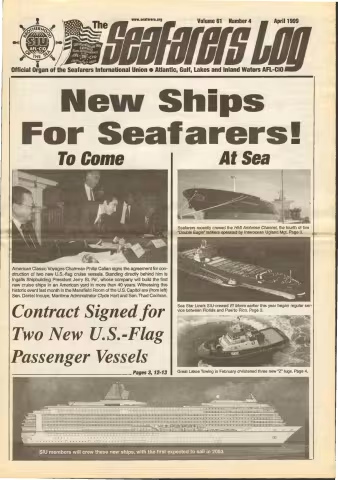
To Come
American Classic Voyages Chairman Philip Calian signs the agreement for con
struction of two new U.S. -flag cruise vessels. Standing directly behind him is
Ingalls Shipbuilding President Jerry St. Pe', whose company will build the first
new cruise ships in an American yard in more than 40 years. Witnessing this
historic event last month in the Mansfield Room of the U.S. Capitol are (from left)
Sen. Daniel Inouye, Maritime Administrator Clyde Hart and Sen. Thad Cochran.
Contract Signed for
Two New U.S.-Flag
Passenger Vessels
Volume 61 Number 4
..
a
s
s
At Sea
•
Great Lakes Towing in February christened three new "Z' tugs. Page 4.
I
President's Report
Excitement Builds
Twenty years ago, excitement rippled through the SIU as we geared
up for a task the union had never faced: the crewing of a U.S.-flag pas
senger ship.
'The Oceanic Independence was returning to the U.S. flag and the
company doing it signed with the SIU to provide the
manpower that ship needed.
Every one of us involved in the project felt great
anticipation and enthusiasm.
For the Lundeberg School, this opportunity meant
developing new classes and training methods to thor
oughly prepare Seafarers for the many jobs they
would tackle when they climbed her gangway.
Needless to say, the SIU met the challenge and, in
Michael Sacco June 1980, the Independence became the first passen
ger ship to sail under Old Glory in 10 years. Within
two years, SIU members were crewing her sister ship,
the Constitution, when it returned to service as a U.S.-flag vessel.
Today, that excitement is building again. In this issue of the Seafarers
LOG, we are getting our first glimpses of the next generation of U.S.-tlag
passenger ships.
Although there will be many differences between these new ships
compared to the Independence and Constitution, one thing that remains
the same is Seafarers will crew the vessels.
They will be state-of-the-art cruise ships, incorporating the latest tech
nology and advances. The drawings on display during last month's
Capitol Hill signing ceremony showed how magnificent these ships will
be. While media attention has focused on the passengers' appointments,
the crew facilities have not been ignored. They, also, are being fitted to
meet the needs of the next century.
Like it did two decades ago, the staff at the Lundeberg School is
preparing the facility to train Seafarers to crew this next generation of
passenger vessels. Even the new Joseph Sacco Fire Fighting and Safety
School was designed with these ships in mind. This is a tremendous
opportunity and the SIU will be ready.
While all of us in the union look forward to these new ships, others
also are proud of this latest confirmation that the U.S.-flag commercial
fleet is, indeed, being revitalized.
As I mentioned earlier, the signing ceremony between American
Classic Voyages, which will operate the vessels, and Ingalls Shipbuilding,
which will construct the bottoms, took place in the U.S. Capitol. Three
senators, two representatives, the maritime administrator and the secre
tary of the Navy actively participated in the event.
Brothers and sisters, we are not the only ones excited about the
growth of the U.S. fleet.
These new passenger ships are a continuation of the fight we have
been waging throughout the 1990s to prepare the merchant fleet for the
next century.
Success happens to those who are determined, dedicated and driven.
Many of you worked hard talking with and writing to your elected offi
cials during the five-year battle to pass the Maritime Security Act, which
was signed into law in 1996. This measure made sure the U.S.-flag con
tainership fleet remained viable and strong into the first part of the next
century.
We have seen the construction and launching of a new fleet of U.S.
built, double-hulled tankers. Seafarers now are working aboard the first
four, with the fifth expected to come out later this year.
Meanwhile, the military's review of the Persian Gulf War revealed the
need for a larger fleet of military prepositioning vessels. Today, SIU
members around the world crew the newly built Bob Hope and Watson
class of ships as well as others that have been converted to sail at a
moment's notice to supply American forces when they are called to duty.
Several SIU-contracted companies have added to their fleets the new
tractor tugboats as they see what will be required in the way of harbor
work in the years to come.
There also have been other developments in the U.S.-flag passenger
trade this decade. In 1995, the Delta Queen Steamboat Co. added to its
inland fleet the American Queen, which at that time was the largest
overnight passenger vessel built in the United States in almost 40 years.
Last year, American Classic announced plans for five coastal cruise
ships, designed to look like those that sailed along the coastlines at the
tum of the 20th century. The first of these new vessels is expected to be
sailing sometime in 2001.
Yes, there is a lot to be excited about.
But we cannot rest on our laurels. There still is more work to be done
for all of our members - no matter if they sail deep sea, inland or Great
Lakes; no matter if they are aboard containerships, tankers, bulkers,
dredges, cruise vessels or tugboats.
The 21st century is rapidly approaching. We will continue to work to
improve and modernize the U.S.-flag fleet. We will continue to provide
new jobs for Seafarers.
We do this because we plan to be part of this exciting new chapter in
America's history for a long, long time.
Volume 61, Number 4 April 1999
The SIU on line: www.seafarers.org
The Seafarers WG (ISSN 1086-4636) is published month
ly by the Seafarers International Union; Atlantic, Gulf,
Lakes and Inland Waters District; AFl.rCIO; 5201 Auth
Way; Camp Springs, MD 20746. Telephone (301) 899-
0675. Periodicals postage paid at Southern Maryland
20790-9998 and at additional offices. POS1MASTER:
Send address changes to the Seafarers WG, 5201 Auth Way
Camp Springs, MD 20746.
Communications Director, Daniel Duncan; Managing
Editor, Jordan Biscardo; Associate Editor/Production,
Deborah A. Hirtes; Art, Bill Brower, Administrative
Support, Jeanne Textor.
Copyright © 1999 Seafarers International Union, AGLIWD
All Rights Reserved.
2 Seafarers LOG
Maritime Administrator Hart
Visits SIU Hall in Honolulu
U.S. Maritime Administrator
Clyde Hart recently got a first
hand look at how a union h~!l
operates, as he stopped by the
SIU hall in Honolulu.
In town to speak to the Hawaii
chapter of the Maritime Cabotage
Task Force, Hart toured the SIU
hall on February 5. He met sever
al SIU members and congratulat
ed GU Tessema Tefera, who that
week had received his U.S. citi
zenship and his union member
ship book.
Hart also examined the rotary
shipping board and discussed the
various documents and training
now required for mariners.
Additionally, he discussed with
Seafarers and with SIU Port Agent
Neil Dietz the expanding job
opportunities with American
Hawaii Cruises; the SIU's numer
ous training initiatives including the
Paul Hall Center's unlicensed
apprentice program; the Chapter VI
(basic safety) requirements of the
amended STCW convention; and
the importance of the Jones Act
(America's freight cabotage law).
The maritime administrator is
an outspoken supporter of the
Jones Act, a law which provides
jobs for U.S. citizens, boosts the
country's economy and aids
national security.
In town for a speaking engagement, U.S. Maritime Administrator Clyde
Hart (center) recently toured the SIU hall in Honolulu. There, he met a
number of Seafarers, including GU Tessema Tefera (right).
Explaining the rotary shipping system to U.S. Maritime Administrator
Clyde Hart (right) is Neil Dietz, port agent at the SIU hall in Honolulu.
Rank-and-File Financial Committee
Approves 1998 Union Records
Group Issues
Annual Report
To Members
A committee of veteran rank
and-file members, elected by their
fellow Seafarers during last
month's union meeting in Piney
Point, Md., have reviewed the
SIU's financial records for 1998
and found them to be in good
order.
Each department was repre
sented on the committee. Elected
from the deck department were
Recertified Bosun Terry Cowans
Sr., a 25-year member from
Mobile, Ala., and AB Tom
Moore, from Baltimore and with
the SIU 10 years. The lone engine
department member was QMED
Joe Pomraning, who sails from
Baltimore. Pomraning, a member
for 18 years, also served as the
committee chairman.
Representing the galley gang
were Recertified Stewards Lovell
McElroy Sr. (a 24-year member
from Mobile), Gerald Hyman
( 18 years, from Norfolk, Va.) and
Gina Lightfoot (16 years, from
Jacksonville, Fla.). The final
member of the committee was
Chief Cook Donald Mann, who
has been with the union 18 years.
He sails from Baltimore.
''This committee worked very
hard and we found everything to
be in order," Pomraning stated.
Reviewing the union's 1998 financial records are (from left, going
counter-clockwise around table) Gerald Hyman, Terry Cowans Sr.,
Lovell McElroy Sr., Donald Mann, Tom Moore, Gina Lightfoot and Joe
Pomraning, who served as chairman.
"Our brothers and sisters have
entrusted us to do this very impor
tant job and we are performed our
duties to the best of our abilities."
The use of an annual financial
review committee is required by
Article X, Section 15 of the SIU
Constitution. It reads: "The
Annual Financial Committee
shall make an examination for
each annual period of the finances
of the Union and shall report fully
on their findings and recommen
dations."
QMED Joe Pomraning, an 18-
year member of the SIU, signs off
on the committee's report.
Please be advised that SIU headquarters and all SIU hiring
halls will be closed on Monday, May 31, 1999 (unless an
emergency arises) tor the observance of Memorial Day.
Normal business hours will resume the following workday.
April 1999
Contract Signed for Cruise Ships
Work Starts Next Year on First U.S.-Flag, U.S.-Built Deep Sea Passenger Vessels Since 1958
Construction on the first large
cruise ships to be built in an
American yard in more than 40
years will begin shortly, following
last month's Capitol Hill contract
signing ceremony between SIU
contracted American Classic
Voyages and unionized Ingalls
Shipyard.
Ingalls is expected to start
work on the first of two 840-foot,
1,900-passenger vessels early
next year. That vessel, which will
hold a crew of 650 mariners, is
scheduled to begin service for
American Hawaii Cruises around
Hawaii by 2003.
"This announcement repre
sents a continued resurgence of
the U.S.-flag merchant marine
and is a major boost for the U.S.
flag cruise industry," SIU
President Michael Sacco stated.
'The SIU has had a long part
nership with American Classic
and we are pleased that the com
pany has undertaken this initiative
to expand its operations."
American Classic's subsidiary
American Hawaii Cruises oper
ates the SS Independence, which
has been crewed by Seafarers
since it returned to the American
flag and began sailing around the
Hawaiian Islands in 1980. SIU
members also crewed its sister
vessel, the SS Constitution,
between 1982 and 1995 when it
went out of service.
Many Witnesses
The historic signing, which
took place March 9 in the U.S.
Capitol, was witnessed by elected
officials, Clinton administration
members and the media.
Senate Majority Leader Trent
Lott (R-Miss.) called the agree
ment between American Classic
Senate Majority Leader Trent Lott
calls the agreement to build the
ships "a marriage made in heaven."
and Ingalls "a marriage made in
heaven."
Lott, whose home is
Pascagoula where Ingalls is locat
ed, added, "I think we have some
thing that is going to be very
important, very vital for shipbuild
ing as a whole and certainly for the
cruise industry and for America. I
can't wait to see these ships sail
and provide cruise opportunities
on American-built ships."
The Mississippi senator praised
his colleague Daniel Inouye (D
Hawaii) for garnering the support
to pass the 1997 U.S.-Flag Cruise
Ship Pilot Project, which paved the
way for the signing.
Sen. Inouye acknowledged
Lott's remarks by saying, "A lot
of things can happen if we do it in
a bipartisan fashion."
P nta n Su port
Besides Inouye, Sen. Ted
Stevens (R-Alaska) and Reps. Bob
Livingston (R-La.) and Neil
Abercrombie (D-Hawaii) spon
sored the 1997 bill in Congress. The
measure is part of a larger project to
convert American shipyards from
Navy Sec'y Richard Danzig states
the construction of the cruise ves
sels offers many lessons.
More coverage appears ···
on pages 12-13
military to commercial construc
tions. Designs used in the cruise
ships are expecte.d to be incorporat
ed in future Navy vessels.
"This program has much to be
proud of," Inouye stated. "The
Department of Defense supports
this because we will revitalize the
shipbuilding industry, which is
very important, and thereby keep
down the cost of shipbuilding by,
I might say, hundreds of millions
of dollars."
His remarks were echoed by
Navy Secretary Richard Danzig,
who added, "We are delighted
from a national defense stand
point with this arrangement.
"It is good for ship workers. It
is good for shipyards. But, above
all in my view, it is good for
national defense."
Danzig noted the lessons
learned from building the cruise
ships would provide the Navy
with tremendous money savings.
National defense was not the
4th Double Eagle Tanker Begins Service
Seafarers are working aboard
the fourth Double Eagle tanker
operated by Interocean Ugland
Management.
The HM/ Ambrose Channel set
sail earlier this year, joining the
HM/ Diamond Shoals, HM/ Cape
Lookout Shoals and HM/
Nantucket Shoals as the newest
U.S.-built tankers. One more dou
ble-hulled vessel - the HMJ
Breton Reef - is expected to come
out of Newport News (Va.)
Shipbuilding later this year. It also
will be crewed by SIU members.
According to SIU Norfolk
(Va.) Safety Director Pat
Vandergrift, who met with the
crew as the ship was preparing to
sail in February, everyone was
looking forward to working on the
new vessel.
"Everything was in great shape
- all shiny and new. Bosun Robert
Pagan told me all the crew mem
bers could not wait to get the ship
to sea," Vandergrift said.
All five tankers are owned by
Hvide Marine, Inc. They were
built with double hulls to comply
with the Oil Pollution Act of
1990. Each is named after an old
U.S. Coast Guard light ship.
Each tanker is approximately
600 feet long with a beam of
about 106 feet.
April 1999
• ,
-ABOVE: With Old Glory waving
behind them, ABs Bartow
Bridges (left) and Mark Kerr
(right) met with SIU Rep.
Amancio Crespo when the newly
built vessel docked recently in
Puerto Rico.
RIGHT: Chief Cook Kristin
Krause prepares to return to the
SIU-crewed HM/ Ambrose
Channel in Ponce, P.R.
Saluting all who made the contract
for the vessels possible is Rep.
Neil Abercrombie.
only maritime issue discussed at
the announcem.ent ceremony.
Several speakers said the new
construction shows the value of
the nation's cabotage laws.
Backing for Cabotag
Rep. Gene Taylor (D-Miss.),
whose district includes the Ingalls
Shipyard, stated the teamwork
shown among the legislators,
maritime industry, military and
labor should be used to fight for
the freight and passenger laws.
"I hope we will continue to
work together on the preservation
of the Passenger Vessel Act and the
Jones Act, that reserves coastwise
commerce for American-made,
American-owned, American
crewed vessels that live by our
rules," Taylor told the audience.
Maritime Administrator Clyde
Hart also renewed the administra
tion's support for the two laws,
then added he was "looking for
ward to the first two cruise ships
and many others to come."
He saluted the labor officials
representing sailing and ship
building members and the mar-
itime industry for working togeth
er to make the vessels a reality.
Rep. Abercrombie arrived
immediately after an overnight
flight from sunny Hawaii to
snowy Washington, D.C. to wit
ness the signing.
"This is the start of a new
revival of the cruise industry in
the United States of America with
American shipbuilders, American
workers and American sailors.
This industry will take off in the
21st century," added the Hawaiian
legislator.
In his comments, Sen. Thad
Cochran (R-Miss.) looked at the
snow accumulating outside but
said "the sun is shining brightly in
the U.S. Capitol."
He likewise praised all
involved in making the cruise
ships possible.
Create New Jobs
After saluting everyone
involved, Philip Calian, American
Classic Voyages chairman, noted
the entire effort will create 5,000
jobs ashore and at sea. "This will
maintain a large base of seafarers
for times of national emergency,"
he added. "We are proud to be
doing our part to expand the U.S.
flag cruise industry."
The president of Ingalls
Shipbuilding, Jerry St. Pe',
declared the agreement "puts the
last piece of the puzzle together to
make this happen. It is somewhat a
return to the future. We built the
last cruise ships [the SS Brasil and
SS Argentina] built in this country."
St. Pe' pointed out he was a
young reporter covering the
launching of those two vessels in
1958, while Sen. Lott was a mem
ber of the high school band per
forming at the event.
Seal arers Sailing El Morro
In Puerto Rico Trade
The SIU-crewed El Morro is providing regular service between
Florida and Puerto Rico, the second vessel in the Sea Star Line
fleet to do so.
SIU Port Agent Tony McQuay met with crew members during
a payoff last month in Jacksonville, Fla. He reported everything
was going smoothly on the vessel, which began operations earlier
this year.
"Bosun Steve Copeland and Steward Kris Hopkins told me
this is a good-working crew," McQuay told the Seafarers LOG.
"All the members are getting acquainted with the ship and find it
in good shape."
The El Morro 's sister ship, the El Yunque, began sailing late
last year. The ships offer roll-on/roll-qff as well as lift-on/lift-off
service on a weekly basis. They can handle containers and trailers
from 20 feet to 53 feet as well as flat beds, heavy machinery,
refrigerated cargo and vehicle transport.
The vessels are operated by Interocean Ugland Management for
Sea Star Line, which is a joint venture of Totem Resources Corp.,
Matson and Sea-Barge Line Inc.
Seafarers LOG 3
Seafarers Crew New 'Z' Tugs
Boats Provide Harbor Towing Service in Pearl Harbor
Seafarers are sailing aboard
the three new "Z-class" tractor
tugs christened earlier this year by
Admiral Towing and Barge
Company.
The tugs - named Z-Three, Z
Four and Z-Five - are operating
under a U.S. Navy contract to
provide harbor towing services at
the Naval base in Pearl Harbor,
Hawaii. Operations commenced
early last month.
SIU members and officials
attended the christening cere
monies in mid-February at
Seattle's MARCO Shipyard,
where the boats were construct-
ed. Each of the tugs is 95 feet
long, 32 feet wide and has 4,000
horsepower with a bollard pull
exceeding 110,000 lbs. Each
operates at a top speed of 14
knots.
"The Z-class design was
developed to accommodate an
entire range of towing services,
including shiphandling duties,
salvage, firefighting, oil recovery,
tanker escort, and ocean and
coastal towing of vessels and
barges," noted Admiral Towing in
announcing the christenings.
''The new tugs have been modi
fied to meet the special needs of
the Navy and include special
above- and below-water fender
systems to accommodate assis
tance to submarines."
The Z-drive is an integrated
unit that replaces conventional
propellers and rudders. It per
forms propulsion as well as steer
ing, thereby enabling the tug to
push or pull in any direction. The
design greatly improves maneu
verability.
SIU members also crew ves
sels operated by Admiral
Towing's affiliate company, Great
Lakes Towing, which currently is
in its lOOth year.
Both inside and out, the new tugboats feature the most modern design and equipment.
TOP: The Z-Three is christened in Seattle. DIRECTLY ABOVE (from
left): Among those attending the ceremony were Richard Berkowitz of
the Transportation Institute, SIU Vice President West Coast Nick
Marrone and SIU Recertified Bosun Dana Cella.
Don Nolan Name P
For Lundeberg School
USNS Antares Sails to Balkans
To Assist NATO Peacekeepers
The trustees for the Seafarers
Harry Lundeberg School of
Seamanship have named Don
Nolan as the facility's new vice
president.
Nolan, 53, has been on the
staff of the school since 1968
when he was hired as a chief
cook shortly after the Piney
Point, Md. facility opened. Since
then, he has served in a variety of
roles including steward depart
ment instructor and culinary
director.
During his tenure at the school,
the Pennsylvania native also has
been involved in numerous pro
jects including recruitment and
management.
Nolan comes from a union
background. His father was a
member of the United Mine
Workers. Other members of his
family are Steelworkers.
Don Nolan
Prior to corning to the
Lundeberg School, he served in
the U.S. Navy. He holds a voca
tional teacher's certificate from
the University of Maryland.
SIU members aboard the fast
sealift ship USNS Antares
recently helped in the NATO
peacekeeping mission in the
Balkans known as Operation
Joint Guard. The February
assignment marked the second
time in the past seven months
that the U.S. Navy's Military
Sealift Command (MSC),
which operates the Antares, has
been called to transport
American military equipment
and supplies to the volatile
region - an area that includes
Bosnia, Croatia and Slovenia.
The 946-foot cargo ship
docked in Rijeka, Croatia along
the Adriatic Sea in late
February. Earlier, approximate
ly 92,000 square feet of combat
USNS liordon Rescues Fishermen in liulf
The SIU-crewed USNS
Gordon last month rescued two
people in the Persian Gulf from a
sinking fishing boat.
The prepositioning vessel was
at anchor around 6 a.m. when
crew members spotted two citi
zens of the United Arab Emirates
in distress. The fishermen were
waving and clinging to their
mostly submerged 12-foot boat.
Reacting quickly, the Gordon
launched its 16-foot rigid-hull
inflatable boat to rescue the
stranded pair.
''With high winds and choppy
4 Seafarers LOG
seas jostling their orange rescue
craf4 and English of little use,
Gordon's rescue party relied
largely on encouraging smiles
and gestures, coaching the terri
fied survivors to release their grip
on what was left of their rapidly
sinking boat," noted the U.S.
Military Sealift Command in an
account of the rescue.
The ordeal lasted only 28
minutes. It ended with the fisher
men climbing aboard the 956-
foot military support ship, where
crew members gave them dry
clothes, breakfast and a movie to
watch while waiting for the local
coast guard to transport them
ashore.
Rear Admiral Gordon S.
Holder, commander of MSC,
described the rescue as "a perfect
example of seamanship in the
finest tradition."
SIU members crew the
Gordon as well as other preposi
tioning ships operated by MSC.
Those vessels strategically place
U.S. military equipment around
the globe, where it remains readi
ly available if needed by U.S.
forces.
equipment from the U.S.
Army's 1st Cavalry Division
from Fort Hood, Texas, had
been loaded aboard the roll
on/roll-off (RO/RO) vessel in
Beaumont, Texas, and
Wilmington, N.C.
That military equipment
came from six different U.S.
military installations including
Fort Hood and Fort Sam
Houston, Texas; Fort Carson,
Colorado and Fort Riley,
Kansas.
According to MSC, more
than 200 shipping containers
and 25 Army helicopters were
lifted aboard the Antares in
Beaumont while 54 pieces of
"rolling stock" were driven up
the ship's side ramp to stowage
positions inside the vessel.
Following the Beaumont
load-out, the Antares sailed to
Wilmington where 15 more
helicopters, 25 shipping con
tainers, nine wheeled vehicles
and other general cargo items
were loaded. The ship then
departed Wilmington February 9
for the 18-day transatlantic voy
age.
The Antares, capable of trav
eling at up to 30 knots, is
believed to be only the second
U.S. Navy ship to dock at the
Balkan port. The SIU-crewed
USNS Soderman, one of MSC's
large, medium-speed RO/ROs.
transported 1st Cavalry
Division cargo to the region in
August 1998.
Seafarers aboard the USNS Gordon helped rescue two fishermen.
April 1999
Legislators Ask IRS to Estimate Taxes
Lost to Foreign-Flag Cruise Vessels
Two lawmakers have asked the
Internal Revenue Service to pro
vide estimates of how much truces
U.S.-based, but foreign-registered
cruise companies would pay if
they were not exempt from
income tax and other liabilities.
The representatives, Peter
DeFazio (D-Ore.) and Gene
Taylor (D-Miss.), said in a letter
to IRS Commissioner Charles
Rossotti that this information is
needed in case Congress takes up
legislation that would cripple the
Passenger Vessel Services Act by
allowing foreign-flag cruise ships
to carry passengers between dif
ferent U.S. ports.
(The Passenger Vessel
Services Act is the cabotage law
that states passengers moved
between two domestic ports must
be carried aboard U.S.-flag, U.S.
crewed and U.S.-built vessels.)
Several bills to modify the act
were offered in the last session of
Congress but got no further than a
committee hearing. The SIU
opposed each of the measures
offered.
In an interview with the New
York Times, Defazio said the
Clinton administration has esti
mated the cruise ship industry is
avoiding billions of dollars in
truces annually. The article, pub
lished March 12, noted the 17
U.S.-based cruise companies had
annual revenues of $10 billion,
but are registered in countries that
do not have income truces.
While U.S. elected officials are
looking into the true laws govern
ing the foreign-flag cruise indus
try, another article published
March 29 by Fortune showed
these same cruise lines are not
providing much economic support
to the Caribbean islands they visit.
Allen Chastanet, the former
Royal Caribbean Pleads
Guilty to Dumping
SIU VP Contracts Augie Tellez (right) talks maritime with Rep. Gene
Taylor (left), one of two legislators asking the IRS for an estimate on
how much money in tax revenues foreign-flag cruise companies based
in the U.S. would pay if they were not tax exempt.
director of the St. Lucia tourism
board, told the magazine, "Sixty
five percent of the cruise industry's
profits come from the Caribbean.
But only 7 percent of their employ
ees come from the Caribbean and
only 1 percent of the taxes they pay
go to the region."
The article noted local govern-
ments are forced to deal with the
garbage and heavy traffic created
by the cruise ships and their pas
sengers. An example of such dis
crepancies was the $14 million
being spent by St. Lucia for a
cruise terminal expansion and
additional $14 million being
spent to push tourism, yet the
$6.50 per passenger tax levied on
each vessel only brings $1.9 mil
lion to the economy. When 13
islands tried in 1 993 to increase
the per-head tax on the cruise
ships, the companies countered
by saying they would sail else
where. The effort fell apart within
weeks.
A St. Lucia survey conducted
in the early 1990s found visitors
who stayed overnight or longer on
the island spent 30 times as much
as those who disembarked from a
cruise ship docking there. One
hotel manager complained to the
magazine that he has "to pay hotel
occupancy true, income tax, social
security - all those taxes," while
the cruise ships do not.
Even the U.S. Virgin Islands
are feeling the pinch in terms of
revenue. Their average number of
overnight tourists has fallen 26
percent to 440,000 since 1988
while those who visit for part of. a
day aboard cruise ships has risen
by half to 1.6 million.
As noted in an Associated
Press story of February 21, cruise
ship passengers make up 80 per
cent of the tourists in the Virgin
Islands, but provide a mere 25 per
cent of the total tourism revenue.
To the Virgin Island economy,
this represents an annual income of
$600 million from visitors, down
33 percent in the last five years.
In a surprise move, Royal
Caribbean Cruises pleaded guilty
in a Los Angeles federal court to
three charges of dumping oily
bilge water earlier this decade.
company and U.S. government
reached a plea bargain for that
fine following separate indict
ments in Miami and San Juan
regarding similar cover-up inci
dents aboard five vessels, includ
ing the Nordic Prince. The New
York Times ran a front-page story
in January describing how Royal
Caribbean repeatedly had com
mitted environmental crimes.
Following the Los Angeles indict
ments, Royal Caribbean said it
has admitted to the problem and
taken measures to correct it.
USCG: Grain Company Violates Jones Act
Agency Determines Tug Firms Are Under Japanese Control
The U.S. Coast Guard has sus
pended the operation of two tug
boat companies sailing on the
Mississippi River and its tribu
taries because the federal agency
found the firms "did not meet the
qualifications to engage in coast
wise trade."
The March 22 admission by
the world's second largest cruise
line followed a three-count indict
ment handed down by a federal
grand jury in Los Angeles in late
February. The charges concerned
covering up oily waste discharges
with false records that were pre
sented to the U.S. Coast Guard by
the Nordic Prince crew during
three separate ship inspections in
Los Angeles between January and
October 1994. The maximum fine
for each count is $500,000.
Additional charges are expect
ed to be placed against the com
pany later this year in New York
and Alaska.
The Seafarers LOG reported in
February that Royal Caribbean
already had paid a $9 million fine
for dumping that occurred
between 1990 and 1994. The
Meanwhile, a Miami television
station reported one of Royal
Caribbean's ships, the Enchantment
of the Seas, suffered an engine
room explosion and fire March 11,
three hours after sailing from St.
Thomas. No one was injured in the
incident. However, passengers leav
ing the ship in Miami told the tele
vision station they were scared and
did not believe they were receiving
all the information necessary dur
ing the incident.
Following a two-year investi
gation, the Coast Guard stated
MV One, LLC of Covington, La.
and Paragon Marine Services,
Inc. of St. Louis operated under
the control of Consolidated Grain
and Barge Co. (CGB ), which is a
Louisiana-based subsidiary of a
Japanese federation of agriculture
cooperatives known as Zen-Noh
and a Japanese commodities trad
ing company called Itochu Corp.
(In the May 1993 Seafarers
LOG, Zen-Noh was listed as one
House Passes Coast Guard Budget
Bill Includes Tighter Runaway-Flag Controls,
Plus Permanent Ban On New User Fees
With broad bipartisan support, the U.S. Coast
Guard authorization for fiscal years 2000 and 2001
passed the U.S. House of Representatives by a mar
gin of 424-7. Passage is expected shortly in the
Senate.
The bill calls for $3.8 billion in spending for FY
2000, increasing to $4 billion in 2001 (excluding
pension payments).
Last year, an SIU-supported measure calling for a
three-year moratorium on new user fees levied
against mariners or the marine industry passed with
overwhelming support. Under the Coast Guard
authorization bill, this moratorium on new fees
would be made permanent.
Sentiment in Congress for this measure grew
when legislators felt attempts were being made to
skirt the ban and implement new fees which might
disadvantage American maritime companies.
Also included in the bill is a measure originally
April 1999
introduced in the Senate by Sen. Ron Wyden (D
Ore.) in response to the New Carissa disaster. This
provision requires all vessels, foreign and domestic,
to notify the Coast Guard at least 24 hours before
entering U.S. territorial waters. The purpose is to
give the Coast Guard sufficient time to check ves
sels' histories in order to bar substandard ships
before they enter American waters.
Among the items that would have to be reported
are the port of destination, time of entry into the terri
torial waters, and whether a vessel is carrying danger
ous cargo or if any hazardous conditions exist aboard
the ship. It also gives the Coast Guard the authority to
direct the movements of a vessel in U.S. waters.
The provision, introduced in the House by Rep.
Peter Defazio (D-Ore.), responded to the concerns
that the New Carissa sailed too close to shore during
a gale, "a practice local pilots shun," noted Sen.
Wyden.
of several international agribusi
nesses working within the North
American Export Grain
Association to scuttle U.S. cargo
preference laws.)
1lmpennlsslble' Control
The agency found in a letter
dated February 2 to th~ head of
Paragon that "Consolidated has
an impermissible controlling
interest in Paragon," which owns
one tugboat outright and operates
14 other vessels for MV One.
The investigation, requested
by the family-owned Mt. Vernon
Barge and Fleeting Service of
Indiana, was conducted jointly by
the Coast Guard and U.S.
Maritime Administration.
It noted Consolidated at times
had paid invoices from Mt.
Vernon for services rendered to
Paragon.
It revealed 25 percent of the
Paragon's stock is owned by
Consolidated.
The letter further stated,
"Under a fleet operating agree
ment, Paragon is required to 'act
at all times in the best interest of
[Consolidated].' The fleeting
agreement requires Paragon to
help maintain good customer rela
tions between Consolidated and
its customers. It further requires
Paragon to consult with
Consolidated concerning the num
ber, identity and qualifications of
persons Paragon plans to assign to
certain positions; and requires
Paragon to seek Consolidated
approval before making any addi
tion or improvement to
Consolidated-owned equipment
costing $5,000 or more."
'Pervasive Presence'
The Coast Guard concluded
that "the pervasive presence of
CGB, Consolidated and Zen-Noh
Grain Corp. officers in the organi
zational structure of Paragon cou
pled with the strictures of the
Consolidated/Paragon fleet oper
ating agreement, including
Consolidated's extraordinary con
trol of hiring, spending and man
agement decisions clearly demon
strate that Consolidated has an
impermissible controlling interest
in Paragon. That impermissible
controlling interest requires a
finding that Paragon does not
meet the controlling interest crite
ria set forth in Section 2 for eligi
bility to operate vessels in the
coastwise trade."
The "Section 2" referred to in
the letter signed by Thomas L.
Willis, director of the Coast
Guard's National Vessel
Documentation Center, concerns
the standards required in the
Jones Act to be declared an
American company.
That provision finds "corpora
tions wishing to document vessels
in the coastwise trade must have
75 percent of its stock owned by
U.S. citizens. Further, the presi
dent or CEO or its chairman of
the board of directors must be
U.S. citizens. However, even if
these criteria are met, the corpora
tion can still be found ineligible to
document vessels if a controlling
interest in the corporation is held
by non-citizens. A non-citizen
controlling interest determination
can be made if it is found that cit
izens owning stock have a trust or
fiduciary obligation in non-citi
zens, or if non-citizens, by any
means, exercise control over the
corporation."
(The Jones Act is the nation's
freight cabotage law. Part of the
Merchant Marine Act of 1920, it
states cargo moved between two
Continued on page 9
Seafarers LOG 5
SIU's Alaskan Recruitment
Program Wins National Award
A unique joint initiative
between the Seafarers International
Union and Alaskan-area private
industry councils won national
recognition last month for its suc
cess in providing jobs for young
people from the nation's northern
most state.
The National Association of
Private Industry Councils
(NAPIC) honored the SIU and the
Anchorage/Matanuska-Susitna
Private Industry Council for their
work in training, then employing,
Alaskans aboard U.S.-flag com
mercial vessels. The presentation
took place March 1 in
Washington, D.C. at NAPIC's
annual forum.
Initiated in 1997 as a way to
lower unemployment rates in
Alaska, the program has attracted
recruits from all over the state. It
is strongly backed by Alaska's
congressional delegation - Sens.
Ted Stevens (R) and Frank
Murkowski (R) and Rep. Don
Young (R) - and its governor,
Tony Knowles (D).
The union and council were
declared one of two distinguished
honorees by the association. Only
an Oregon-based training and
employment venture ranked high
er among the approximately 600
entries and took the top prize.
'This means a lot to all of us
involved in the program," SIU
Anchorage Representative Harold
Holten said after receiving the
Theodore E. Small Workforce
Partnership Designated Honoree
Award on behalf of the union.
"Everyone involved has
worked hard to promote this in
Alaska and make it work. We
could not have done it without the
backing of the SIU, the shipping
companies who sail into Alaska,
the fine people at the private
industry council and, of course,
Senators Stevens and Murkowski,
Congressman Young and
Governor Knowles as well as
their staff's."
"It is hard to believe how far
we have come in less than two
years," noted Lynn Taylor, job
partnership training program
director for the city of Anchorage.
"When Harold and (SIU Assistant
Vice President) Bob Hall first pre
sented this to us, we couldn't
believe what was available. We
had never heard of these opportu
nities in the merchant marine."
Under the program, young
men and women who meet the
requirements to enter training at
the Paul Hall Center's Lundeberg
School of Seamanship are recruit
ed by local government and job
training officials. Holten works
with these groups to screen the
recruits and ensure they meet the
qualifications required by the
U.S. Coast Guard to hold a mer
chant mariner's document.
Once approved, they begin
learning the skills needed to sail
aboard U.S.-flag commercial ves
sels through the Paul Hall
Center's three-phase unlicensed
apprentice program.
The first phase takes place at
the center, located in Piney Point,
Md., where the students receive
hands-on and classroom training
to learn basic seamanship skills.
This part takes 12-weeks.
Under Phase II, the Alaskan
recruits work aboard a U.S.-flag
vessel whose itinerary includes
Displaying the awards presented to the SIU and the Anchorage Private
Industry Council for their work in recruiting young Alaskans to the U.S.
merchant marine are SIU Representative Harold Holten (left) and Lynn
Taylor from the city of Anchorage.
ports in their home state. They
sail for 90 days to learn about life
at sea by working in all three unli
censed departments.
Phase ill training returns to the
Paul Hall Center where the stu
dents receive department-specific
training. Upon graduation, they
are shipped out to their first job
aboard a U.S.-flag commercial
vessel.
The success of the Alaskan
effort has spawned a similar pro
ject in Hawaii. Lundeberg School
Vice President Don Nolan stated
the facility is willing to work with
other councils and groups around
the country interested in finding
good, dependable employment
for their young people.
However, the Alaskan recruit-
ment initiative was not the only
project noticed by NAPIC in its
award. It commended the riding
gang program for Alaskan resi
dents implemented by the SIU
and local Alaskan governments
last year. Like the unlicensed
apprentice recruitment effort, this
also is an ongoing project that is
training Last Frontier state resi
dents to work aboard SIU-con
tracted vessels that dock in
Alaska.
This program has caught the
attention of Rep. Young who
addressed the first class of riding
gang recruits on their graduation
day last summer in Anchorage,
where their training took place
(see the July 1998 Seafarers
LOG).
Unlicensed apprentice Mary Bado meets with SIU President Michael
Sacco following the February membership meeting in Piney Point, Md. 32-Hour Radar/ARPA Course Approved
Sea-I.and Capt. Praises
Apprentice for Work
A graduate of unlicensed apprentice class 576 continues to draw
praise for her work aboard the Sea-Land Innovator during her second
phase of training in the program.
In a letter sent to the Paul Hall Center's Lundeberg School, Master
Brian S. McNamara saluted Mary Bado for her hard work and dedi
cation to learning during her 90-day stint aboard the containership.
In his letter, McNamara said he recommended "Bado very highly
to you in her desire to complete her studies at Piney Point and in get
ting her documents as an AB.
"Mary has sailed with me aboard the Innovator as an apprentice.
While she has grown in stature, knowledge and experience in each
department she has worked, she has excelled in the deck department.
I have found her sober, industrious, competent and dependable in the
performance of all duties assigned her. She is pleasant to everyone
and is a very good shipmate.
''Mary is liked and respected by officers and crew alike for her
sense of humor, high degree of integrity and demonstrated sense of
loyalty to her shipmates. I am convinced Mary would make a
superlative AB, and I would very much want to see her return to the
Innovator. Her enthusiasm and energy are her strong points with
which she can and will go far."
The Seafarers LOG published in its February 1999 issue a report
from the Innovator's bosun, John E. Stout, on the progress Bado
was making during her phase II training.
(The unlicensed apprentice program is divided into three parts.
Phase I, taken at the Paul Hall Center, provides the basic introduction
into seafaring, including safety, water survival and first aid training.
Phase II allows the student to experience life in all three departments
aboard an SIU-contracted deep sea vessel. The final phase returns the
apprentice to the center for specialized training in the department that
he or she plans to enter.)
Bado graduated from the unlicensed apprentice program earlier
this year. She now sails as a GUDE aboard the Pvt. Franklin J.
Phillips, operated by Maersk.
6 Seafarers LOii
Upgraders are taking advan
tage of the Paul Hall Center's
newly approved 32-hour auto
matic radar plotting aids
(ARPA) class.
The United States Coast
Guard on March 1 certified that
the course meets the applicable
requisites of the U.S. Code of
Federal Regulations (CFR), as
well as the International
Maritime Organization (IMO)
and the International Convention
on Standards of Training,
Certification and Watchkeeping
for mariners (STCW).
In making that assessment,
the agency evaluated both the
course content and the school
facilities.
Deep sea masters and mates
as well as limited license holders
doing coastwise work will be
required to successfully com
plete a 32-hour ARPA course. In
addition to inland masters and
mates, the school anticipates that
bosuns and license candidates
will be the main enrollees in its
newly approved course.
'The approval is super news
for the school and the member-
Several upgrading courses
have been added to the
Paul Hall Centers sched
ule. See page 23.
ship," said J.C. Wiegman, assis
tant director of vocational edu
cation at the Paul Hall Center's
Lundeberg School of
Seamanship, located in Piney
Point, Md. He added that the
school is utilizing the most mod
ern radar simulators.
The 32-hour class specifically
satisfies the following require
ments: 46 CFR 10.301-304, IMO
resolution A.482 (XII) and
STCW Code Sections A-1112, B-
1112, A-11/1, and A-11/2.
Last year, the school com
pleted a major upgrade of its
radar equipment for use in simu
lator training. Five new state-of
the-art Furuno ARPA radars
were installed in September. The
modernization also utilizes the
five Raytheon radars already
housed at the facility.
The Furunos are outfitted
with automatic radar plotting
aids and electronic chart display
(ECDS). The ECDS allow the
center's Lundeberg School of
Seamanship to acquire and dis
play images and conditions of
any and all ports worldwide.
Additionally, among other
improvements, the new system
adds real navigation aids includ
ing GPS and Loran-C along with
features like precipitation clutter,
search-and-rescue transponders
(SARTS) and Racons.
The center's Raytheon radars
are integrated with the newer
items as well as with new soft
ware. Seafarers upgrading at the
school (in applicable courses)
will have the chance to utilize a
training vessel equipped with the
newer radar, which has the same
capabilities as those used in sim
ulaJion.
Students at the Paul Hall Center
utilize the school's modern radar
equipment (also shown in top
photo) as part of the recently
approved 32-hour ARPA course.
April 1999
Memories, Hope and Pride Beam from
Newest Class of Recertified Stewards
It was a time for families, a
time for legacies, a time to
remember the past and a time to
look toward the future.
It was March 8 - union meet
ing day in .Piney Point, Md. and
graduation day for the latest class
of recertified stewards.
Fourteen galley gang mem
bers successfully completed the
recertification course, the highest
level of training offered by the
Paul Hall Center's Lundeberg
School of Seamanship for stew
ard department members. During
their five weeks of learning, the
upgraders received hands-on
training at the school's culinary
lab, picked up the latest in sanita
tion methods, participated in
computer training, and took
refresher lessons in firefighting,
safety and first aid. They also
met with SIU President Michael
Sacco and representatives from
the union's contracts, welfare,
government affairs, training,
communications and vacation
SIU Vice President Contracts Augie Tellez congratulates Tom Barrett
upon graduating from the recertified steward program last month.
and pension funds departments.
Graduation day was the cul
mination of all that and more as
each of the stewards described to
their fellow Seafarers what it
meant to them.
Pride Obvious
The pride felt by George
Vorise was evident to all. He
wore a tuxedo to the ceremony.
The Jacksonville, Fla. member
then told those attending how
proud he was to be a Seafarer
and what it meant in terms of
security, both financial and pro
fessional.
Sharing in the celebration of
graduation day were the families
of two members - Joseph
Laureta and Dien Short.
The Laureta family sat in the
front row of the auditorium after
flying to Maryland from Hawaii.
The 16-year union member
informed everyone he was
delighted to have his wife Tenie,
son Troy and daughter Cheesa
with him for this special day.
"These are the people I do it
for," Laureta stated. "Our fami
lies are why we work hard and
keep pushing so we can give
them the best life possible."
Short, who sails from the port
of Tacoma, noted his wife Maria
was with him for the event. He
acknowledged how important
upgrading has been in providing
a better lifestyle for himself and
his soon to be growing family.
Rich Heritage
Gina Lightfoot was intro
duced to the audience as "a lega
cy" by SIU Vice President
Contracts Augie Tellez. Her
father, Roan Lightfoot, served as
an SIU official, including port
agent in Paducah, Ky.
Lightfoot reflected on what
the union has meant to her
throughout her life. She told the
unlicensed apprentices attending
the meeting that she got her start
at the Lundeberg School, with
this graduation "being the culmi
nation of 16 years of hard work."
She offered herself as proof that
"you can accomplish great things
with the SIU."
Also recalling his beginning
as a trainee in the Lundeberg
School's old entry level program
was James Harris. He addressed
his remarks to the unlicensed
apprentices urging them to work
hard to learn a career.
To show how far they could
go if they put their minds to it,
Harris acknowledged a fellow
Lundeberg School trainee who
was in the class just before his
and last month sat at the dais as a
union vice president: Kermett
Mangram.
Harris pointed out he had
Families play an important role in the lives of Seafarers. Being recog
nized during the recertified steward graduation ceremony are (from the
left) Cheesa, Troy and Tenie Laureta who came from Hawaii to be with
Joseph and (on the right) Maria Short who traveled from Washington
state with her husband Dien.
April 1999
returned to the school four times
for upgrading since 1978. "I
always look forward to returning
to Piney Point to upgrade my
skills and see all the familiar
faces."
Another member who got his
start from a union training school
was Lovell McElroy Sr.
Through teamwork, all things are possible as Miguel Pabon (left) and
Dana Zuls show off a fried rice dish they created during training.
Unlike Lightfoot and Harris,
his first lessons came from the
old Marine Cooks and Stewards
facility in Santa Rosa, Calif.
shortly before that union merged
with the SIU Atlantic, Gulf,
Lakes and Inland Waters District.
He told his fellow Seafarers
about jobs that used to abound
on passenger ships which provid
ed young people with an entry
point into the profession. He said
he was happy to hear work was
under way to build new U.S.-flag
passenger ships that will offer
many new jobs to SIU members.
"I've learned that the SIU and
its officers still continue as their
primary focus to make sure
Seafarers maintain the jobs they
already have while providing
new and better ones to take us
into the next century,'' said the
24-year member who sails from
Mobile.
Looking Ahead
With an eye to the past, other
graduates spoke about the future.
Colleen Mast talked about
her start aboard the American
Hawaii Cruise ships and how she
wanted to move up the ladder.
Like McElroy, she was excited to
hear about the new ships and
new jobs soon to be available to
Seafarers.
Mast called on the unlicensed
apprentices to follow her lead to
upgrade as often as possible to
ensure these jobs are filled by the
best trained mariners. "I recom
mend upgrading and getting
endorsements every chance you
get because it definitely improves
your chances of shipping out,"
noted the Wilmington, Calif.
based member.
Her comments were echoed
by another steward from the
Southern California port, Tom
Barrett.
A graduate of Lundeberg
School Class 307, Barrett added,
"It is good to move up in your
field, and you can always learn
more."
Daniel Maxie looked directly
at the unlicensed apprentices and
reminded them they are the
future of the SIU. He urged them
to learn all they could, work with
their shipmates when at sea and
upgrade as often as possible.
Another member from
Wilmington centered his remarks
on the future of the union and his
fellow Seafarers.
Teamwork is what this lesson in the culinary lab is all about as Lovell
McElroy (left) and Gina Lightfoot (right) work with Chef Allan Sherwin.
Dana Zuls, who began sailing
23 years ago in St. Louis, called
on those at the meeting to contin
ue upgrading. Zuls noted he has
sailed inland and Great Lakes .as
well as deep sea and found his
five trips to the Lundeberg
School helped him in his career.
"Upgrading will make you better
informed and make being a crew
member easier."
Zuls found the sanitation and
computer skills courses to be
beneficial and he particularly
praised Chef Romeo Lupinacci
for his "guidance, friendship and
delicious soups which he made
and shared his recipes with me."
Thanks to School
Others in the group also spoke
highly of their time at the school.
Frank Martin, who sails
from Jacksonville, stated his
appreciation for the refresher
classes in baking skills taught by
Chef Allan Sherwin, director of
culinary education. He said he
saw many changes in the school
since he first upgraded in 1987.
"I feel the changes in the
steward department program
have improved a great deal in
recent years in comparison with
my first upgrading experience.
As with any education process,
an individual will gain from that
course by only whatever amount
of effort he is willing to put
forth," Martin said.
Attending the school for the
first time was Philip Paquette
from the port of Norfolk, Va.
He pointed out the firefighting
course and its instructors as high
lights of his training.
In particular, he singled out
Anthony Hammett, who teaches
the firefighting course. "The SIU
should be proud to have such a
Continued on page 8
Seafarers LOG 7
Another 'Millennium Bug' In 30 Years?
No matter how it is
approached, the Y2K issue is
costly. For example, the U.S. fed
eral government is spending bil
lions of dollars on the Y2K issue,
with some agencies embracing
the windowing technique while
others eschew it.
Common Fix for Y2K Glitch May Not Last
than the permanent repair, known
as expansion.
Industry representatives from
business and government who are
quoted in the AP article scoffed at
windowing, likening it to a Band
Aid, compromise or side-stepping
of the problem. Some accused
programmers and supervisors of
settling for the relatively quick fix
because, one way or another, they
probably won't be around in their
current jobs to face the eventual
consequences.
It's called the millennium bug,
but the dreaded Y2K computer
glitch may resurface a lot sooner
than 1.000 years from now.
A recent article by the
Associated Press cites numerous
computer experts who assert that
the method most widely used to
combat Year 2000 failure only
will work for about 30 years at
most.
''The temporary fix, using a
San Francisco's 'Tom Tom'
Succumbs to Heart Attack
Retired San Francisco
Patrolman Kwong Jin Hom,
known to almost all as "Tom
Tom," suffered a fatal heart attack
January 23. He was 75.
After the native of China
served in the U.S. Navy from
1943 to 1946, he joined the
Marine Cooks and Stewards. He
worked primarily as a waiter and
head waiter aboard American
President Lines and Matson ves
sels before coming ashore in 1966
as a dispatcher in the San
Francisco hall.
Hom continued working
behind the counter when the
MC&S merged with the SIU
Atlantic, Gulf, Lakes and Inland
Waters District in 1978. His
familiar face greeted members
and their families until he retired
in 1994.
"Tom Tom was liked by every
one;' noted retired SIU Vice
Kwong Jin Hom
President West Coast George
McCartney. "He was an institu
tion in the San Francisco hall and
will be missed by all."
Hom's remains were cremated
and scattered at sea.
Film Maker Kubrick Dies
Produced SIU Documentary in 1953
Film maker Stanley Kubrick passed away March 7. Although
famous to many for his works "2001: A Space Odyssey," "Dr.
Strangelove," and "A Clockwork Orange," one of Kubrick's first
films was made for the SIU.
Titled ''The Seafarers," the 1953 production was put together at
the request of Paul Hall, who at that time was the head of the SIU.
The union used the black-and-white documentary to show
mariners who worked aboard non-union vessels what life in the
SIU was like. The union was involved in many organizing drives
in the early '50s. Some seamen had their lives threatened if they
were seen entering a union hall or associating with someone rep
resenting organized labor.
Hall thought a film could be run in meeting rooms and other
places to show the value of belonging to the SIU. He hired
Kubrick, who was just beginning his film career after being a pho
tographer for Look magazine. The movie proved to be a highly
successful organizing tool.
''The Seafarers" uses many of the film techniques and images
associated with Kubrick in his feature movies. Copies of the ''The
Seafarers" are available for viewing at the Paul Hall Library and
Maritime Museum at the Harry Lundeberg School of Seamanship
in Piney Point, Md.
Stewards
Graduate
Continued from page 7
quality instructor and person on
its staff."
Gerald Hyman, who has
upgraded nine different times in
his 18-year career, summed it up
for all when he said, "Study hard
and keep on trying."
The other member of the
graduating class, Miguel Pabon,
had to ship out prior to being
recognized at the meeting.
B Seafarers LOii
New Recertified Steward George
Vorise shows what graduation
meant to him by wearing his tuxe
do to the ceremony.
sophisticated twist of logic to fool
computers, is highly controversial
because it's intended to work for
only a few decades," reported AP
writer Ted Bridis in mid-March.
"One expert describes computers
already fixed with the technique
as 'little ticking time bombs wait
ing to go off."'
The technique is known as
windowing, and it reportedly is
being used in more than three
fourths of "repaired" computers
worldwide. It is a cheaper and
faster - albeit less stable - fix
One private consultant told
Bridis, ''We'll replace this in 20
years, but isn't that exactly the same
thing we said back in the 1960s?"
Meanwhile, a newly issued
U.S. Senate report on Y2K warns
of potential trade disruptions at
the end of the year and tags the
maritime industry as lagging in
preparedness. Released last
month, the 160-page report also
notes the potential difficulties that
loom when companies or govern
ments try to share information
after December 31, pointing out
that non-compliant systems may
corrupt compliant ones.
Soderman Crew Passes with Flying Colors
The SIU-crewed USNS Soderman recently passed a mandatory audit that is part of the International
Safety Management Code (ISM). Pictured above, commemorating the favorable review aboard the con
verted roll-on/roll-off vessel in Norfolk, Va. are (from left) AB Kevin Newsome, AB Freddie Viniegra,
Captain Mike Burke, Chief Engineer Peter Sederquist, SA Lolita Bon, Chief Cook Tim Taylor, QMED
Alan Nelson, AB Brock Booker, Bosun Klaus "Whitey" Tankersley, AB Martin Josephson, Wiper Al
Greene and Wiper Oomiciano Nonato.
Servicing a rigid inflatable boat are (left to right)
Bosun Whitey Tankersley, QMEO Alan Nelson
and Third Assistant Engineer Brendan Doherty.
SA Elida Miguel and Chief Cook Tim Taylor help
ready lunch on the 907-foot ship.
Working on deck during a brisk afternoon while
the vessel is docked in Norfolk, Va. are ABs Kevin
Newsome (left) and William Martin.
AB Freddie Viniegra helps keep the vessel, part of
MSC's prepositioning fleet, looking good.
April 1999
Sea-Land Crusader Earns Annual Safety Award
Displaying the trophy earned by the Sea-Land Crusader crew for its
outstanding safety record in 1998 are (from left) DEU Luis Perez, AB
Angel Passapera, Bosun Roberto Diaz, Chief Steward Joe Emidy, Chief
Cook Josue Iglesia and AB Roy Payne.
ABs Angel Passapera (left) and Roy Payne share in the excitement as
the vessel win's Sea-Land's annual safety award.
Crewing Cape Ships In Carolina
SIU members sailing aboard
the Sea-Land Crusader in 1998
did their part to help the vessel
earn the company's prestigious
"Best in Fleet Safety Award."
The ship was notified of the
award in February.
Criteria for judging the winner
included zero lost-time injuries;
clear demonstration of what Sea
Land describes as "a proactive
and aggressive" safety program;
full compliance with company
policies, including participation
in an International Safety
Management Code (ISM) audit;
an improved safety record from
the previous year; and more.
After finding out the Crusader
had won, Captain Dan Murphy
commended the entire crew for its
efforts. "Although safety training
has always been a priority on this
vessel, increased time and effort
was spent reinforcing safe work
practices,'' he noted. "All hands
pulled together to watch out for
each other."
Murphy also credited "strong
shoreide support" from Sea-Land
as a big factor in the vessel's
excellent safety record.
Pictured abord the Sea-Land ship during a voyage late last year are SA
George Koulouris (left) and DEU Francisco Torres.
Ruling Says Company Violated Jones Act
Continued from page 5
domestic ports must be carried
aboard U.S.-owned, U.S.-built
and U.S.-crewed vessels.)
Foreign Control Evidence
Regarding the vessels owned
by MV One and operated by
Paragon, the Coast Guard (in a
January 13 report and released
publicly as part of a related court
case) stated "evidence shows that
foreign-owned companies exert
control over the members of MY
One."
The basis for this statement
came from a review of documents
that two of the individuals who
organized MV One had approved
who could be owners of the com
pany. Along with one other per
son, these two individuals are the
managers of MY One. The
records further revealed the two
received no money from MV One
but were paid by CGB Enterprises
and Zen-Noh Grain. Additionally,
22 percent of MY One stock is
owned by Paragon.
The Coast Guard noted each
manager is a U.S. citizen, as
required by the Jones Act. Yet, it
added that under the laws of
Louisiana a company set up like
MV One is "not to be treated like
a corporation."
The federal agency concluded
"enough evidence has been
obtained to show that it appears
more likely than not that Paragon
Marine Services is indirectly con
trolled by CGB Enterprises, Inc. -
a corporation that does not meet
citizenship requirements for the
purposes of obtaining coastwise
endorsements.
"Therefore, under 46 CPR
67 .31, Paragon fails to meet stock
interest requirements because
non-citizens, namely CGB
Enterprises, Inc. and its parents,
Z.en-Noh and Itochu Corp., exer
cise control over Paragon Marine
Services, Inc. As a result, all
members of MV One LLC are not
citizens of the U.S. for the pur
pose of obtaining coastwise
endorsements on the certificates
of documentation of its vessels.
"Therefore, vessels owned by
MV One are ineligible for docu
mentation with endorsements for
the coastwise trade. Likewise, the
vessel owned by Paragon is ineli
gible for documentation with a
coastwise endorsement."
MV One appealed the deci
sion, but it was turned down by a
panel of judges from the U.S.
Fifth Circuit Court of Appeals on
March 5. The company's vessels
then were tied up.
This is not the first time
Consolidated has come up against
the Jones Act. Following pur
chase of the company by the
Japanese concerns in the late
1980s, Consolidated sold its
barge fleet in April 1990 after a
litigation frpm a competitor who
argued the company was violating
the freight cabotage law.
Wilmington, N.C. is the home port for two SIU-crewed Ready Reserve Force vessels, the Robert Maiello and GUDE Tracy Maiello on the Cape Lobos, (middle photo) Bosun John
Cape Lambert and Cape Lobos. Among the Seafarers forming part of the reduced operating Konetes, GUDE Ed English and QMED Christopher Benzenberg on the Cape Lambert, and
status crews on the U.S. military support ships are (left photo, from left) Chief Steward (right) Bosun Thomas Grosskurth and QEE Thomas Stead aboard the Cape Lobos.
Aprll 1999 SeafarelS LOB 9
The SIU-crewed USNS Bob Hope is a
two-year-old roll-on/roll-off ship built for
U.S. military support missions. It was
delivered to the U.S. Military Sealift
Command last November, following sea
trials. During a recent stop in Norfolk,
Va., Seafarers welcomed aboard a pho
tographer from the Seafarers LOG.
With Seafarers Aboard
the USNS Bob Hope
Chief Steward Javier "Deli" Delosreyes SA Kevin Lynn
OMU John Flavin
DEU Louis Champa
L-:.
U.U'
' l
From left: SA Jarvis Bell, OS Louis Green AB Stephen Martin From left: AB Anthony Pacely, OS Louis Green, OS Denetrica Brooks
10 Seafarers LOG April 1999
Red Circle Crews
Approve Contract
Seafarers who sail aboard offshore vessels operated by Red Circle
recently approved, by unanimous vote, a new three-year contract.
The agreement calls for wage increases, with corresponding increas
es in overtime and penalty rates. The pact also stipulates an increase in
company contributions for medical benefits.
Red Circle operates three offshore boats with numerous large barges
that are covered by the contract. The tugs are the Gail B., Theresa F.
and Allison C. The Gail B. primarily transports grain from Florida to
Puerto Rico, while the other two usually carry phosphorous (used in
fertilizer) from New Orleans to Tampa, Fla.
Helping shift the barge Martha B. to a tank full of grain is AB David House in Catano, P.R.
AB Roy Rhodes receives timely
instructions via radio for shifting a
Red Circle barge.
Among those who will benefit
from the new contract is AB/Cook
Leon Lemoine.
Chief Cook Walter Wise intently prepares a delicious A 15-year member of the SIU, AB John Gaylor stands
lunch aboard the Red Circle tugboat Gail B. by to operate the winch.
Great Holiday Meals on Y ano
Seafarers aboard the USNS Yano spent the holi
days supporting U.S. troops engaged in Operation
Desert Fox - the bombing and missile raids against
Iraq.
The way Recertified Steward Gualberto
Mirador saw it, such a vital mission need not pre
vent Yano's military and civilian crew members
from enjoying generous holiday menus on
Thanksgiving, Christmas and New Year's Day.
"I believe the meals help boost morale and help
the overall atmosphere aboard the ship," said the
longtime SIU member in a recent letter to the
Seafarers LOG.
Mirador and his fellow steward department
members - including Chief Cook Mark Dyer and
SAs Ernest Brinkley, Rodolfo Moreira and Amin
Zain - put out delicious assortments on the holi
days, though not at the expense of good nutrition.
As pointed out by Mirador, who graduated from the
Paul Hall Center's steward recertification program
last August, healthful menus at sea nowadays are
emphasized like never before, thanks to increased
dietary education.
Along those lines, the Yano's holiday meals
included plenty of delightfully arranged fruits and
vegetables, including celery sticks, carrots, radish
es, beets, green beans, broccoli, corn on the cob,
pineapples, pears and more. Also featured on the
menus were shrimp cocktail, steamed rice, crab
pasta salad, candied sweet potato, dinner rolls,
roasted turkey, baked glazed ham, prime rib and
other selections. For dessert, crew members chose
among assorted cakes, pies and cookies.
Mirador, who has sailed aboard numerous SIU
crewed military support vessels, reported that the
Yano crew members "were very appreciative of the
food. They're a great crew, and I must say this is
the nicest ship I've ever been on."
The Yano is a roll-on/roll-off ship nearly 900
feet long.
From left, SA Ernest Brinkley, Recertified Steward Gualberto Mirador and Chief Cook Mark Dyer help keep
the USNS Yano~ galley smoothly operating during Operation Desert Fox. Chief Cook Mark Dyer serves dessert to ABs D. Roach and M. Ramos.
April 1999 Seafarers LOG 11
THEATER
12 Seafarers LOG April 1999
Ready for the Next Generation
While Seafarers continue to perform their jobs e~~~=~:!===:::::====l
aboard the SS Independence, construction soon 1-----------'-t•~i~
will start on the next generation of U.S.-flag
cruise ships. 1---------..,,..--
Artists' conceptions of what the new vessels
will look like appear on these pages.
American Classic Voyages, the parent compa
ny for SIU-contracted American Hawaii Cruises,
plans to have the first ship in service in the
Hawaiian Islands trade by the year 2003 .
. The vessels will be 840 feet long with a 105-
foot beam. The draft will be just over 26 feet. The
gross tonnage is expected to be 72,000. The top
speed for the ships will be 22 knots.
The estimated crew size for these bottoms is
650 people apiece.
As designed, each vessel will have 950 cabins
to accommodate approximately 1,900 passen
gers. Each will feature an 840-seat theater, a 590-
seat cabaret, a 1,060-seat dining room, a four
deck atrium and 85,850 square feet of open deck
space.
Seafarers, like those pictured here aboard the
Independence, continue to express how much
they look forward to these ships joining the U.S.
"""""'·'.,....-'UI flag fleet. The Seafarers LOG will provide con
struction updates as the work progresses.
April 1999
DECK PLAN
Seafarers LOG 13 -
14 Seafarers LOG
•
There are a number of milestones
in every calendar year. We already have cele
brated the beginning of 1999, watched as the two best
football teams squared off in the Super Bowl, shown affection to our
loved ones on Valentines Day and paid our taxes by the 15th of this month. The
next step is thinking about where to spend our summer vacation.
There are so many possibilities. Do I want to relax, go fishing, start an exercise
program? Do I want to do something educational, sightsee, spend quality time with
the kids or grandchildren?
For many people, the decision on where to spend a few days or weeks of vaca
tion can be problematic. But Seafarers are lucky. They have the Paul Hall Center for
Maritime Training and Education in Piney Point, Md., which each summer, is made
available for vacationing SIU members and their families.
Just a short drive from Washington, D.C. and all that our nation's capital has to
offer, the center is the perfect location from which to base a summer vacation.
Everything a family with diverse interests could ask for is close by.
Without even leaving the gates of the campus-located on 65 acres in Southern
Maryland at the confluence of the Potomac River and St. George's Creek-there is so
much to take advantage of at Piney Point. The facility provides a health spa, tennis
courts, olympic-size swimming pool, sailboats and miles of beautiful landscape for
peaceful walks or picnics. Comfortable accommodations and three meals a day are
extra bonuses.
Nearby, in historic southern Maryland, are many famous landmarks and other
attractions where one may be entertained by seafood festivals, arts and crafts
UNION MEMBER VACATION
RATES
exhibits, antique shows, country auctions and acres of
unspoiled parkland.
A vacation stay at the Lundeberg
School is limited to two weeks per
family.
Member
Spouse
Child
And for those who wish to venture even further,
Washington, D.C., Baltimore and Alexandria, Va. are short dis
tances away, offering many historic and educational sights
that every member of the family can enjoy.
A vacation stay at the Lundeberg School is limited to two
$40.00/day
10.00/day
10.00/day
weeks per family. So think about it now, talk it over with
Note: There is no charge for children your family and secure your reservation by clipping the
11 years of age or younger. The coupon below and mailing it to the Seafarers Training and
prices listed above include all meals.
Recreation Center at Piney Point. ---------------------r--------------------------------------------------------------------------------,
SEAFARERS TRAINING & RECREATION CENTER
Vacation Reservation Information
Name: -----------------------------
Social Security number: ________ _ Book number: ________ _
Address: ___________________________ _
Telephone number: -------------------------
Number in party I ages of children, if applicable: _______________ _
Date of arrival: 1st choice: __ _ 2nd choice: ___ _ 3rd choice: ___ _
(Stay is limit(!d to a maximum of two weeks)
Date of departure: ________ _
Send this completed application to the Seafarers Training & Recreation Center,
P.O. Box 75, Piney Point, MD 20674. 4199
--------------------------------------------------------------------------------~
April 1999
Dispatchers' Report for Deep Sea
FEBRUARY 16 - MARCH 15, 1999
*TOTAL REGISTERED
All Groups
Class A Class B Class C
Port
New York
Philadelphia
Baltimore
Norfolk
Mobile
New Orleans
Jacksonville
San Francisco
Wilmington
Tacoma
Puerto Rico
Honolulu
Houston
St. Louis
Piney Point
Algonac
Totals
Port
·· 40
3
I
16
14
18
29
30
29
32
10
5
15
3
3
0
248
NewYork 11
Philadelphia 1
Baltimore 1
Norfolk 5
Mobile 10
New Orleans 3
Jacksonville 17
San Francisco 12
Wilmington 14
Tacoma 15
Puerto Rico 2
Honolulu 5
Houston 14
St. Louis 0
Piney Point l
Algonac 0
Totals 111
Port
New York 13
Philadelphia 3
Baltimore 0
Norfolk 10
Mobile 8
New Orleans 6
Jacksonville 18
San Francisco 26
Wilmington 18
Tacoma 21
Puerto Rico 2
Honolulu 10
Houston 8
St. Louis 1
Piney Point 2
Algonac 0
Totals 146
Port
New York
Philadelphia
Baltimore
Norfolk
Mobile
New Orleans
Jacksonville
San Francisco
Wilmington
Tacoma
Puerto Rico
Honolulu
Houston
St Louis
Piney Point
Algonac
Totals
3
0
2
4
5
3
4
8
3
7
2
0
0
1
44
Totals All
Departments 549
18
2
2
16
5
10
10
10
14
10
6
6
11
0
10
0
130
10
6
4
11
4
9
17
4
8
2
2
4
9
1
5
1
97
IO
2
8
2
6
4
5
5
2
4
0
0
5
0
55
44
2
2
16
8
8
14
13
13
10
l
21
13
1
21
0
187
469
9
2
12
5
3
8
2
9
2
5
1
8
2
l
0
70
5
1
2
4
3
4
4
2
3
0
3
4
1
5
0
42
0
0
4
1
0
2
0
3
0
0
7
l
0
0
0
19
16
2
0
8
2
7
10
9
2
3
65
9
1
JO
0
145
276
TOTAL smPPED
All Groups
Class A Class B Class C
DECK DEPARTMENT
25 6 2
3
8
12
8
11
22
29
22
22
6
7
11
2
2
191
2
4
8
2
10
15
5
4
4
2
6
6
I
4
0
2
IO
2
3
7
1
5
2
2
3
4
3
0
0 0
79 46
Trip
Reliefs
14
I
4
2
1
17
7
8
5
3
2
3
1
0
70
ENGINE DEPARTMENT
11 8 2 4
0 I 0 0
3 2 2 3
3
4
5
15
7
6
13
4
3
7
I
1
0
83
6
0
8
12
4
5
3
1
5
4
0
3
63
2
0
0
3
1
0
0
2
1
2
0
17
0
1
3
6
5
5
3
I
1
3
1
0
1
37
STEWARD DEPARTMENT
13 6 0 9
7
2
7
6
22
8
13
0
5
8
0
1
0
109
2
0
1
4
2
4
3
0
4
1
0
0
1
25
408
0 0
2 0
6
1
6
5
2
3
0
2
2
1
0
4
1
42
0
2
0
2
0
0
0
0
4
1
0
0
0
9
5
0
3
9
6
3
6
2
6
4
0
2
0
56
ENTRY DEPARTMENT
11 8
0 0
2
6 3
1 0
8 6
11 9
IO 0
2
4 2
2 1
17 39
5 0
0 1
15 17
0 0
94 88
278 160
0
0
0
0
0
0
0
0
0
0
0
0
0
0
0
0
0
163
**REGISTERED ON BEACH
All Groups
Oass A Class B Class C
52
5
5
23
17
37
62
43
48
56
19
9
43
2
3
0
424
26
2
3
10
19
11
26
17
17
23
5
11
26
1
0
198
14
3
3
11
10
9
35
37
31
36
3
21
23
I
6
0
243
8
0
0
4
0
8
7
9
12
15
5
8
5
0
0
0
81
946
31
3
7
19
9
12
15
22
23
18
4
16
20
l
9
1
210
14
7
6
IO
7
6
23
11
17
6
6
8
12
2
3
0
138
11
1
2
12
3
14
5
8
7
2
3
9
3
0
5
0
85
58
4
3
25
15
12
24
25
20
22
1
39
19
2
13
0
282
715
16
3
3
13
3
8
9
3
17
2
5
3
7
1
2
0
95
4
1
3
3
1
6
4
3
3
3
1
5
6
0
5
0
48
1
0
0
6
1
2
8
0
5
0
0
11
1
0
0
0
35
34
5
17
3
8
19
3
14
4
8
95
15
0
14
1
241
419
*"Total Registered" means the number of Seafarers who actually registered for shipping at the port.
**"Registered on Beach" means the total number of Seafarers registered at the port.
April 1999
Nlay & June 1999
Membership Meetings
Deep Sea, Lakes, Inland Waters
Piney Point ............. Monday: May 3, June 7
Algonac .................. Friday: May 7, June 11
Baltimore ................ Thursday: May 6, June 10
Duluth ..................... Wednesday: May 12, June 16
Honolulu ................. Friday: May 14, June 18
Houston .................. Monday: May 10, June 14
Jacksonville ............ Thursday: May 6, June 10
Jersey City .............. Wednesday: May 19, June 23
Mobile .................... Wednesday: May 12, June 16
New Bedford .......... Tuesday: May 18, June 22
New Orleans ........... Tuesday: May 11, June 15
NewYork ................ Tuesday: May 4, June 8
Norfolk ................... Thursday: May 6, June 10
Philadelphia ............ Wednesday: May 5, June 9
San Francisco ......... Thursday: May 13, June 17
San Juan .................. Thursday: May 6, June 10
St. Louis ................. Friday: May 14. June 18
Tacoma ................... Friday: May 21, June 25
Wilmington ............. Monday: May 17, June 21
Each port's meeting starts at 10:30 a.m.
Personals
ALLAN GREENWOOD
Please contact Edith Greenwood at (941) 433-
3069 or via email at meeshasma@webtv.net.
WILLIAM JAWORSKI
Anyone with information concerning the where
abouts of William Jaworski, please contact his
cousin Michele Le Van at (302) 836-3239.
LOOKING FOR LIBERTY LIFEBOAT
Retired SIU member George R. Canaday, cur
rently the director of the U.S. Merchant Marine
Museum in Anderson, Indiana is seeking a World
War II Liberty ship steel hull lifeboat, manufactured
by Globe American Corp. of Kokomo, Indiana.
Anyone with useful information in this endeavor
may reach Brother Canaday at 1230 Jackson St.,
Anderson, IN 46016, telephone (765) 643-6305,fax
(765) 643-2301.
JACK UTZ
Jack Utz would like to hear from retired SIU
members via email. He can be reached at
Ariang@theramp.net.
BBQ Helps Crew Celebrate Holiday
The Maj. Stephen W. Pless was in Malaga, Spain dur
ing a recent holiday. To celebrate, the captain and crew
aboard the Waterman Steamship Line vessel held a
cookout aboard ship and invited some of the local citi
zens. "A good time was had by all."
Seafarers LOG 15
. Seafamrs International Union
I . . . . . : . Dil'iclot,
·· ·· ·· .. ·· ·· ·· ::::::::::.· Michael Sacco
········ President
John Fay
Executive Vtee President
David Heindel
Secretary-Treasurer
Augustin Tellez
Vtce President Contracts
Jack Caffey
Vice President Atlantic Coast
Byron Kelley
Vice President Lakes and Inland Waters
DeanCorgey
Vice President Gulf Coast
Nicholas J. Marrone
Vice President West Coast
Kennett Mangram
Vice President Government Services
... .
HEADQUARTERS
5201 Autb Way
Camp Springs, MD 20746
(301) 899-0675
ALGONAC
52-0 SL Clair River Dr.
Algonac, MI 48001
{810) 794-4988
ANCHORAGE
721 Sesame St., #lC
Anchorage, AK 99503
(907) 561-4988
BALTIMORE
1216 E. Baltimore St.
Baltimore, MD 21202
(410)327-4900
DULUTH
705 Medical Arts Building
Duluth, MN 55802
(218) 722-4110
HONOLULU
606 Kalihi St.
Honolulu, HI 96819
(808) 845-5222
HOUSTON
1221 Pierce St.
Houstont TX 77002
(713) 659-5152
JACKSONVILLE
3315 Liberty St.
Jacksonville, FL 32206
(904) 353-0987
JERSEY CITY
99 Montgomery St.
Jersey City, NJ 07302
(201) 435-9424
MOBILE
l 640 Dauphin Island Pkwy.
Mobile, AL 36605
(334) 478·Wl6
NEW BEDFORD
48 Union St.
New Bedford, MA 02740
(508) 997-5404
NEW ORLEANS
630 Jackson Ave.
New Orleans, LA 70130
(504) 529· 1546
NEW YORK
635 Fourth Ave.
Brooklyn, NY 11232
(7 l8) 499-6600
NORFOLK
115 Third St.
Norfolk, VA 23510
(757) 622-1892
PHILADELPHIA
2604 S. 4St.
Philadelphia. PA 19148
(215) 336-3818
PINEY POINT
P.O. Box 75
Piney Point, MD 20674
(301) 994-0010
PORT EVERGLADES
1221 S. Andrews Ave.
Ft Lauderdale, FL 33316
(954) 522-7984
SAN FRANCISCO
350 Fremont St
San Francisco, CA 94105
(415) 543-5855
Government Services Division
(415) 861-3400
SANTURCE
1057 Fernandez Juncos Ave., Stop 16Y2
Santurce, PR 00907
(787) 721-4033
ST. LOUIS
4581 Gravois Ave.
St. Louis, MO 63116
(314) 752-6500
TACOMA
34t1 South Union Ave.
Tacoma, WA 98409
(253) 272-7774
WILMINGTON
.510 N. Broad Ave.
Wilmington, CA 90744
(310) .549-4000
16 Seafarers LOG
Dispatchers' Report for Great Lakes
FEBRUARY 13 - MARCH 12, 1999
CL - Company/Lakes
*TOTAL REGISTERED
L-Lakes NP- Non Priority
All Groups
Class CL Class L Class NP
Port
Algonac 0 30 4
Port
Algonac 0 15 2
Port
Algonac 0 7 3
Port
Algonac 0 18 19
Totals All Depts 0 70 28
TOTAL SHIPPED
All Groups
Class CL Cl~ L Class NP
DECK DEPARTMENT
0 l 1
ENGINE DEPARTMENT
0 5 1
STEWARD DEPARTMENT
0 1 0
ENTRY DEPARTMENT
0 0 2
0 7 4
**REGISTERED ON BEACH
All Groups
Class CL Class L Class NP
0 29 3
0 10 1
0 6 3
0 18 17
0 63 24
*"Total Registered" means the number of Seafarers who actually registered for shipping at the port.
**"Registered on Beach" means the total number of Seafarers registered at the port.
Dispatchers' Report for Inland Waters
FEBRUARY 16 - MARCH 15, 1999
*TOTAL REGISTERED TOTAL SHIPPED **REGISTERED ON BEACH
All Groups All Groups All Groups
Class A Cl~B Class C Class A Class B Class C Class A Class B Class C
Region DECK DEPARTMENT
Atlantic Coast 0 0 0 0 0 0 0 0 0
Gulf Coast 1 2 4 0 1 4 2 3 17
Lakes, Inland Waters 43 0 0 2 0 0 41 0 0
West Coast 1 0 1 9 0 1 9 0 17
Totals 45 2 5 11 1 5 52 3 34
Region ENGINE DEPARTMENT
Atlantic Coast 0 0 0 0 0 0 0 0 0
Gulf Coast I 0 I 0 1 0 0 4
14es, Inland W!te~ ~,6 0 ,o, ,0 0 16 0 0
West Coast 0 0 0 0 0 0 0 0
Totals 17 0 1 1 0 1 16 0 4
Region STEWARD DEPARTMENT
Atlantic Coast 0 0 0 0 0 0 0 0 0
Gulf Coast 0 0 0 0 0 0 0 0 0
Lakes, Inland Waters 19 0 0 1 0 0 18 0 0
West Coast 0 0 1 0 0 0 0 0 4
Totals 19 0 1 1 0 0 18 0 4
Totals All Depts 81 2 7 13 1 6 86 3 42
*"Total Registered" means the number of Seafarers who actually registered for shipping at the port.
**"Registered on Beach" means the total number of Seafarers registered at the port.
PIG-FROM-THE-PAST
This photo, sent to the Seafarers LOG by Pensioner George A. Burke of Brooklyn, N. Y. was taken in early 1952 aboard the
Bull Lines steamship Kathryn. The vessel had just made a special stop in Norfolk, Va. to pick up the governor of Puerto Rico, Don
Luis Munoz Marin, (standing directly behind life ring on right) and his family after meeting with President Harry Truman and the
U.S. Congress. Brother Burke is pictured in a white cap, standing behind the governor. Now 71, he joined the SIU in 1946 in the
port of New York and graduated from the bosun recertification program in 197 4. He retired January 1 , 1993 .
If anyone has a vintage union-related photograph he or she would like to share with the LOG readership, it should be sent to
the Seafarers LOG, 5201 Auth Way, Camp Springs, MD 20746. Photographs will be returned, if so requested.
April 1999
Among the 20 Seafarers
joining the ranks of pen
sioners this month are
three recertified bosuns and one
recertified steward. Representing
more than 125 years of active
union membership, Recertified
Bosuns Christos D. Florous,
Stanley J. Jandora and Howard
C. Knox and Recertified Steward
Yen M. Huey graduated from the
highest level of training in the
deck and steward departments,
respectively, at the Lundeberg
School in Piney Point, Md.
Including the three recertified
graduates, 11 of those signing off
shipped in the deep sea division,
six sailed the inland waterways,
one plied the Great Lakes and
two sailed in the Atlantic
Fishermen's division.
Eleven of the retirees sailed in
the deck department, while five
worked in the engine department
and four were members of the
steward department.
On this page, the Seafarers
LOG presents brief biographical
accounts of this month's pen
sioners.
DEEP SEA
NA SAR
ALFAQIH,
65, began sail
ing with the
Seafarers in
1967 from the
port of San
Francisco.
'--------'=~-_, Born in
Arabia, he sailed in the steward
department and upgraded his
skills at the Lundeberg School in
Piney Point, Md. Prior to his
retirement, he signed off the Sea
Land Innovator. Brother Alfaqih
makes his home in Wilmington,
Calif.
THOMAS E.
CORRELL,
63, started his
career with the
SIU in 1953 in
the port of
New York,
sailing aboard
the Antinous,
operated by Waterman Steamship
Corp. Brother Correll sailed as
deck/engine/utility and signed off
the Sea-Land Crusader. A native
of New York, he calls Brooklyn
home.
CHRISTOS
D. FLOROUS,
65, joined the
Seafarers in
1968, sailing
aboard the
Transwestern,
===.:..... operated by
Hudson Waterways. Born in
Greece, he sailed in the deck
department and upgraded fre
quently at the Lundeberg School,
where he graduated from the
bosun recertification program in
1981 . Prior to his retirement,
Brother Florous signed off the
Falcon Leader, operated by
Seahawk Management. He has
retired to Astoria, N. Y.
April 1999
YENM.
HUEY, 63,
graduated
from the
Marine Cooks
& Stewards
(MC&S) train
ing school in
Santa Rosa
Calif. in 1969 and joined the
MC&S in the port of San
Francisco, before that union
merged with the SIU's Atlantic,
Gulf, Lakes and Inland Waters
District (AGLIWD). The steward
department member upgraded his
skills at the Lundeberg School
and graduated from the steward
recertification program in 1990.
Brother Huey last sailed aboard
the President Truman, operated
by American Ship Management.
Born in China, he calls San
Francisco home.
STANLEY J.
JANDORA,
81, first sailed
with the SIU
in 1 944 in the
port of New
York. His first
ship was the
Arthur L.
Perry, operated by Calmar
Steamship Corp. A native of New
Jersey, he sailed in the deck
department and upgraded his
skills at the Lundeberg School,
where he graduated from the
bosun recertification program in
1973. Brother Jandora last sailed
aboard the Wilson, operated by
Wilson Shipping. During his
career he was active in union
organizing drives. From 1932 to
1936, he served in the U.S.
Marine Corp. Brother Jandora
makes his home in Colts Neck,
NJ.
HOWARDC.
KNOX, 64,
started his
career with the
Seafarers in
1964 in the
port of New
York, aboard
the Northwestern Victory. Born in
Jamaica, he sailed in the deck
department and upgraded his
skills at the Lundeberg School,
where he graduated from the
bosun recertification program in
1981. Brother Knox last sailed
aboard the Sea-Land Consumer.
He has retired to Mt. Vernon,
N.Y.
JOSEPH J.
MOLL JR.,
60, graduated
from the
Andrew
Furuseth
Training
School in
===.::::=.:.:.:~===-i 1964and
joined the SIU in the port of New
Orleans. Brother Moll worked in
the deck department, last sailing
aboard the Robert E. Lee, operat
ed by Waterman Steamship Corp.
A native of Florida, he makes his
home in Destin.
ARMANDO MONCADA 65,
began sailing with the Seafarers
in 1969 from the port of New
Orleans. During his career, he
sailed in all three departments:
deck, engine and steward and
Welcome Ashore
Each month, the Seafarers LOG pays tribute to the SIU members who have devoted their
working lives to sailing aboard U.S.-flag vessels on the deep seas, inland waterways or Great
Lakes. Listed below are brief biographical sketches of those members who recently retired
from the union. The brothers and sisters of the SIU thank those members for a job well done
and wish them happiness and good health in the days ahead.
upgraded his
skills at the
Lunde berg
School. Born
in Honduras,
Brother
Moncada
makes his
home in New
Orleans.
. THOMASJ.
'MURPHY,
: 65, first sailed
: with the SIU
: in 1980 in the
port of
Honolulu. A
native of
Illinois, he
sailed in the steward department
and upgraded his skills at the
Lundeberg School. Brother
Murphy last sailed in 1995,
aboard the Long Lines operated
by Transoceanic Cable Ship Co.
From 1955 to 1958, he served in
the U.S. Marine Corps. He makes
his home in Pearl City, Hawaii.
HOOKERG.
PRICE, 65,
joined the
Seafarers in
1961 in the
port of
Norfolk, Va.
Born in
North
Carolina, he worked in the
deck department, last sailing
aboard the Sam Houston, oper
ated by Waterman Steamship
Corp. Brother Price has retired
to Chesapeake, Va.
CLEMENTE
ROCHA JR.,
62, graduated
from the
Andrew
Furuseth
Training
School in
"---'-===='----' 1963 and
joined the SIU in the port of
Houston. The Texas native sailed
in the deck department and
upgraded his skills at the
Lundeberg School. Prior to his
retirement, he signed off the Sea
Land Hawaii. From 1955 to 1957,
he served in the U.S. Navy.
Brother Rocha makes his home in
San Antonio, Texas.
INLAND
GERARDH.
FREBURG
ER, 61, start
ed his career
with the
Seafarers in
1963 in the
port of
Baltimore. A
native of Maryland, he worked in
the engine department, last sailing
as a chief engineer. During his
career, he was active in union
organizing drives. From 1958 to
1962, he served in the U.S. Navy.
Boatman Freburger last sailed
aboard a McAllister Towing Co.
vessel. He makes his home in
Street, Md.
JOHN W. GREENWAY, JR.,
65, joined the SIU in 1976 in the
port of Norfolk, Va. Born in
North Carolina, he started out in
the steward department and later
transferred to
the deck
department.
Boatman
Greenway
upgraded his
skills at the
Lundeberg
School and
graduated from the towboat oper-
ator program in 1979. From 1953
to 1955, he served in the U.S .
Army. He last sailed in 1995
aboard the Sea Robin, operated
by Crowley Towing and
Transportation. He has retired to
Oriental, N.C.
DONALD J.
GREGORY,
63, began sail
ing with the
Seafarers in
1975 after a
20-year career
with the U.S.
Coast Guard.
Born in Massachusetts, he worked
in the engine department, last
sailing in 1989 aboard a Moran
Towing Co. vessel. Boatman
Gregory makes his home in
Forest Hill, Md.
JULIANP.
McALPIN,
62, started
with the
Seafarers in
1970. During
his career, he
worked in the
~----~ deck depart
ment, last sailing as a captain.
The Tennessee native last sailed
in 1993 aboard the Apollo, oper
ated by Sabine Transportation Co.
Boatman McAlpin calls Cortland,
Miss. home.
KIRBY K.
NELSON
JR., 61, began
sailing with
the SIU in
1980 after a
20-year career
with the U.S.
Army. The
Georgia native started out in the
steward department and later
transferred to the deck depart
ment. During his career, he
upgraded his skills at the
Lundeberg School. Prior to his
retirement, he signed off a
Crowley Towing and
Transportation vessel. Boatman
Nelson makes his home in
Savannah, Ga.
JOSE A.
NUNEZ,65,
joined the
Seafarers in
1986 in the
port of San
Francisco,
sailing aboard
the USNS
Hess, operated by LSC Marine,
Inc. Starting out in the deep sea
division, he later transferred to
inland vessels. Born in Uruguay,
he worked in the steward depart
ment, last sailing aboard a
Crowley Towing &
Transportation vessel. Boatman
Nunez has retired to Luquillo,
P.R.
GREAT LAKES
PERRY E.
WILLIS, 65,
joined the
Seafarers in
1973 in the
port of Detroit.
Born in West
Virginia, he
worked as a
wheelsman, last sailing in 1989
aboard the Paul Thayer, operated
by Pringle Transit Co. From 1951
to 1955, he served in the U.S.
Army. Brother Willis makes his
home in Rainelle, W.Va.
ARANTIC FISHERMEN
.--:====----· MICHAEL
SPINOLA,
57, joined the
Atlantic
Fishermen's
Union in 1967
in the port of
Boston, before
it merged with
the AGLIWD in 1981. A native of
Massachusetts, he worked as an
engineer, last sailing aboard the
St. Mary. From 1961to1964, he
served in the U.S. Army. Brother
Spinola calls Gloucester, Mass.
home.
THOMAS J. SPINOLA, 61,
started his career with the
Atlantic Fishermen's Union in
1967 in the port of Boston,
before it merged with the AGLI
WD in 1981. During his career,
he sailed in all three departments.
Prior to his retirement, Brother
Spinola last sailed aboard the St.
Mary as a member of the engine
department. A native of
Massachusetts, he makes his
home in Gloucester.
Seafarers LOG 17
-
DEEP SEA
ALFRED J. AUSTIN
Alfred J.
Austin, 57,
passed away
January 21.
Brother Austin
started his SIU
career in 1972
in the port of
Detroit, sailing
======= aboard the car
ferry Vi.king, operated by Ann Arbor
Railroad Company. The New York
native later transferred to deep sea
vessels. He sailed in the deck depart
ment and upgraded his skills at the
Lundeberg School in Piney Point,
Md. Brother Austin was a resident of
Brooklyn, N.Y.
ROSCOE BATTLE
Pensioner Roscoe Battle, 73, died
December 18, 1998. A native of New
York, he graduated from the Marine
Cooks and Stewards (MC&S) train
ing school in 1963, before that union
merged with the SIU's Atlantic,
Gulf, Lakes and Inland Waters
District (AGLIWD). Brother Battle,
a resident of Hayward, Calif., began
receiving his pension in April 1984.
He served in the U.S. Marine Corps
during World War II and again dur
ing the Korean Conflict, from 1942
to 1946 and from 1952 to 1953,
respectively.
EDMUND C. BURKE
Pensioner Edmund C. Burke, 85
passed away January 29. He started
his career with the MC&S in 1957 in
the port of Seattle, before that union
merged with the SIU's AGLIWD.
Brother Burke retired in January 1976.
ANDRES C. CASTELO
Pensioner Andres C. Castelo, 80,
passed away January 23. Born in the
Philippines, he began sailing with the
Seafarers in 1948 from the port of
New York. During his career, he sailed
as a member of the engine department
and was active in union organizing
drives. A resident of Brooklyn, N.Y.,
Brother Castelo began receiving his
pension in May 1980.
FELIX COSME
Pensioner Felix Cosme, 83, died
January 16. Brother Cosme joined
the MC&S in 1952 in the port of San
Francisco, before that union merged
with the SIU's AGLIWD. A native of
Puerto Rico and a resident of
Oakland, Calif., he retired in
February 1966.
SAM GREGUREV
Pensioner Sam Gregurev, 87, passed
away December 15, 1998. He started
his career with the MC&S in 1946 in
the port of San Francisco, before that
union merged with the SIU's AGLI
WD. Born in Yugoslavia, he began
receiving his pension in August
1970. Brother Gregurev was a resi
dent of San Francisco.
EVALDKAMM
r----------, Pensioner Evald
Kamm, 87, died
January 29.
Born in Estonia,
he joined the
Seafarers in
1950 in the port
of New York.
Brother Kamm
sailed in the
deck department and upgraded his
skills at the Lundeberg School.
During his career, he was active in
union organizing drives. A resident
of Astoria, N. Y., he retired in
December 1976.
FRANK KEPROSKY
Pensioner Frank Keprosky, 83,
passed away January 19. A native of
18 Seafarers LOG
Pennsylvania, he joined the MC&S
in 1957, before that union merged
with the SIU's AGLIWD. Brother
Keprosky resided in Anaheim, Calif.
and retired in October 1974.
GERALD R. KIDD
Pensioner
Gerald R. Kidd,
60, died
February 7. Born
in Virginia, he
graduated from
the Andrew
Furuseth
Training School
in 1961 and
joined the Seafarers in the port of
Baltimore. He sailed in the deck
department and upgraded at the
Lundeberg School, where he gradu
ated from the bosun recertification
program in 1976. Prior to his retire
ment in January 1999, he signed off
the Guayama, operated by NPR, Inc.
Brother Kidd was a resident of
Baltimore.
TOMMY T. KUTEI
TommyT.
Kutei, 60,
passed away
February 12.
Brother Kutei
began his SIU
career in 1983
from the port of
Honolulu, sail
L---"----'-"'-'---'-~ ing aboard the
SS Independence, operated by
American Hawaii Cruises. Born in
Palau in the Pacific Islands, he sailed
in the steward department and
upgraded his skills at the Lundeberg
School. He was a resident of
Honolulu.
HENRY LYNCH
Pensioner Henry Lynch, 81, died
December 11, 1998. He joined the
MC&S in 1956 in the port of Seattle,
before that union merged with the
SIU's AGLIWD. A native of
Louisiana, Brother Lynch began
receiving his pension in November
1973.
CHARLES E. MICHAELS
,...,,..,..--====--::-::-,.,,-, Charles E.
Michaels, 81,
passed away
November 11,
1998. Brother
Michaels
started his sail
ing career with
the Seafarers
====:=...J in 1960 in the
port of Jacksonville, Fla. The Florida
native sailed in the engine depart
ment and upgraded at the Lundeberg
School. A veteran of World War II,
he served in the U.S. Navy from
1938 to 1945.
CLIFFORD L. NICKERSON
Pensioner
Clifford L.
Nickerson, 95,
died January
28. Born in
Louisiana, he
began his SIU
career in 1947
from the port of
.__ _____ _..New Orleans.
Brother Nickerson sailed in the stew
ard department and began receiving
his pension in February 1970. He
was a resident of McComb, Miss.
EDSEL W. SHOLAR
Pensioner Edsel
W. Sholar, 68,
passed away
December 16,
1998. A native
of North
Carolina, he
began sailing
with the SIU in
==---=-----' 1969 from the
port of New York. Brother Sholar
sailed in the engine department and
upgraded his skills at the Lundeberg
School. From 1954 to 1956, he
served in the U.S. Air Force. A resi
dent of Asheboro, N.C., he started
receiving his pension in March 1997.
HENRY A. SIMMONS
..---___,..,==== Pensioner
Henry A.
Simmons, 71,
died January 1.
Brother
Simmons joined
the Seafarers in
1951 in the port
of New York. A
native of South
Carolina, he sailed in the steward
department as a chief cook and
retired in August 1989. He was a res
ident of Pineville, S.C.
CYRIL A. SPENCE
Cyril A.
Spence, 61,
passed away
July 13, 1998.
He started his
career with the
SIU in 1977 in
the port of New
York. The New
.__ _____ __.York native
sailed in the steward department and
upgraded at the Lundeberg School,
where he graduated from the steward
recertification program in 1989.
Brother Spence was a resident of
Bronx, N.Y.
GABRIEL THOMPSON
Pensioner
Gabriel
Thompson, 78,
passed away
January 22.
Born in
Massachusetts,
he joined the
MC&S in 1963
in the port of
Seattle, before that union merged
with the SIU's AGLIWD. The galley
gang member upgraded his skills at
the Lundeberg School and retired in
February 1991. Brother Thompson
was a resident of Seattle.
DARRELL TOUCHSTONE
Pensioner
Darrell
Touchstone, 40,
died December
30, 1998. A
native of
Florida, he
graduated from
the Lundeberg
.__~;:,.;,.:.;.:."-'---~.;.____. School's entry
level training program in 1977 and
joined the Seafarers in the port of
Piney Point, Md. He sailed in the
steward department and upgraded at
the Lundeberg School, where he
graduated from the steward recertifi
cation program in 1991. A resident
of Pensacola, Fla., he began receiv
ing his pension in September 1997.
PEDRO A. VIRUET
Pensioner
Pedro A.
Viruet, 83,
passed away
November 6,
1998. He start
ed his career
with the SIU in
1943 in the port
==----~ of New York. A
native of Puerto Rico, he sailed in
the steward department. During his
career, he was active in union orga
nizing drives. Brother Viruet retired
in June 1970. He was a resident of
Arecibo, P.R.
ROBERT W. WALKER
Robert W. Walker, 57, died on
February 1. Brother Walker joined
INLAND
. the Seafarers in
1973 in the port
of Norfolk, Va.
Born in Virginia
and a resident
of Norfolk, he
sailed as a
member of the
steward depart
ment.
LEWIS J. ALBERTSON
Pensioner Lewis
J. Albertson, 77,
passed away
December 7,
1998. A native
of North
Carolina, he
joined the
Seafarers in
1968 in the port
of Norfolk, Va. Boatman Albertson
started out in the deck department
and later transferred to the engine
department. During World War II, he
served in the U.S. Marine Corps from
1942 to 1945. A resident of Roanoke
Rapids, N.C., he began receiving his
pension in February 1988.
GERALD W. ANSELL
Pensioner
Gerald W.
Ansell, 67, died
January IO. He
began his career
with the SIU in
1969 in the port
of Norfolk, Va.
Born in North
======= Carolina, he
sailed in the deck department and
upgraded at the Lundeberg School,
where he graduated from the towboat
operator program in 1973. Boatman
Ansell started receiving his pension
in April 1994. From 1949 to 1954,
he served in the U.S. Coast Guard.
WILBUR N. AUSTIN
Pensioner
WilburN.
Austin, 68,
passed away
January 21.
Boatman Austin
joined the
Seafarers in
1970 in the port
""'-'-------' of Norfolk, Va.,
after a 20-year career in the U.S.
Coast Guard. The Virginia native
sailed in the deck department and
attended two educational confer
ences at the Lundeberg School. A
resident of Wanchese, N.C., he
retired in April 1995.
THOMAS M. BRESLIN
Pensioner
Thomas M.
Breslin, 86,
died December
11, 1998. Born
in Ireland, he
started his
career with the
SIU in 1963 in
===== the port of
Philadelphia. Boatman Breslin sailed
in the steward department and retired
in March 1982. He was a resident of
Douglassville, Pa.
DOROTHY M. CRIPPS
iiiiiiililiiii Pensioner
Dorothy M.
Cripps, 73,
passed away
February 11.
Sister Cripps
joined the
Seafarers in
1976 in the port
==--.;.__;;.;;=-----•of St. Louis. A
native of Missouri, she sailed in the
steward department and began
receiving her pension in November
1991. She made her home in
Staunton, Ill.
ULZA J. DUPREE
Pensioner Ulza J. Dupree, 94, passed
away December 27, 1998. He began
his career with the Seafarers in Port
Arthur, Texas. The Louisiana native
sailed in the steward department, pri
marily aboard vessels operated by
Sabine Towing & Transportation. A
resident of Port Arthur, Boatman
Dupree started receiving his pension
in July 1969.
DWAYNE EMBREY
Dwayne Embrey, 61, died January 7.
Boatman Embrey joined the SIU in
1974. During his career, he sailed in
the deck and steward departments. In
1977, he attended an educational
conference at the Lundeberg School.
The Mississippi native served in the
U.S. Marine Corps from 1954 to
1962. He was a resident of
Belleville, Ill.
BILLY B. HOLCOMBE
Billy B.
Holcombe, 60,
passed away
December 2,
1998. He began
sailing with the
Seafarers in
1955 from the
port of Norfolk,
Va. Boatman
Holcombe worked in the engine
department, sailing primarily aboard
vessels operated by Penn Maritime,
Inc. A native of Alabama, he was a
resident of Stockton.
EDWARD W. HULTZ
Pensioner
Edward W.
Hultz, 65, died
December 25,
1998. A native
of New Jersey,
he started his
career with the
SIU in 1955 in
L.;;.;;.:.:==-"------' the port of
Philadelphia. The deck department
member upgraded to first class pilot
at the Lundeberg School and attend
ed an educational conference there in
1978. Prior to his retirement in April
1995, Boatman Hultz signed off the
Cape May, operated by Coleman's
Launch Service. From 1953 to 1955,
he served in the U.S. Army. He was
a resident of Mickleton, NJ.
BERNARD J. "BRUNO"
IWANOWSKI
Pensioner
Bernard J.
"Bruno"
Iwanowski, 81,
passed away
January 26.
Boatman
Iwanowski
began his SIU
=====---_.. career in 1961
in the port of Philadelphia. The
Pennsylvania native sailed as a mem
ber of the steward department and
started receiving his pension in
November 1979. During World War
II, he served in the U.S. Army from
1941 to 1945. He was a resident of
Stevens Point, Wisc.
CALVIN C. LASSITER
Pensioner
Calvin C.
Lassister, 70,
passed away
January 9. Born
in Arkansas, he
joined the
Seafarers in
1957 in the port
L...------~ of Houston.
Boatman Lassister worked in the
deck department, last sailing aboard
a G&H Towing Co. vessel. A resi
dent of Doucette, Texas, he began
receiving his pension in April 1993.
Continued on page 20
April 1999
The SeBfarers LOG allempl8 to print 8$ many digests of union shlpboant
minutes as possible. On occasion, because:ol1paceN
,- Jlmilations, some will be omitted.
Ships minutes first are reviewed by the union's contract department.
Those issues requiring attention or resolution are addressed by the union
upon receipt of the ships' minutes. The minutes are then forwarded
ta the Seafarers LOG for publication.
HM/ DYNACHEM (IUM),
November 27 - Chairman Paul
Lucky, Secretary Ronald
Tarantino, Engine Delegate
Victor Quioto, Steward Delegate
James Harris. Crew stated it has
not received reply from union con
cerning vacation pay withholding
tax. Chairman reported that new
SIU-contracted vessels are being
crewed. Secretary reviewed a tax
guide received from IRS. He told
members about SIU crewing RRF
vessels for government exercise
that went well. Crew discussed
importance of upgrading at Paul
Hall Center's Lundeberg School.
No beefs or disputed OT reported.
Crew asked contracts department
to look into reducing seatime to
qualify for vacation and pension.
Crew stated SIU medical cards
should list benefits covered, there
by facilitating the processing of
paperwork by health-care
providers. New exercise equipment
has been purchased. Crew dis
cussed shipboard training segment
for unlicensed apprentices from
Lundeberg School.
GALVESTON BAY (Sea-Land
Service), November 1 - Chairman
James E. Davis, Secretary
Andrew Hagan, Educational
Director Miguel Rivera , Deck
Delegate Howard Blanks, Engine
Delegate Jamal Jabila, Steward
Delegate Kenneth Bethea.
Educational director encouraged
crew to "better your skills and pay
by upgrading in Piney Point." He
urged members to donate to SPAD.
No beefs or disputed OT reported.
Crew read letter from SIU VP
Contracts Augie Tellez, who was
responding to earlier inquiry. Crew
asked contracts department to con
sider reduction in required rotary
seatime as well as time required to
attain 'B' book. Crew discussed
with patrolman an incident pertain
ing to removal of VCR from
lounge. Crew gave vote of thanks
to steward department and to DEU
A. Bruno for "excellent job" on
sanitary duties. Crew donated $350
to Red Cross for disaster relief for
Honduran and Nicaraguan victims
of Hurricane Mitch. Next port:
Boston.
Together Again
They had sailed together
before and were happy to find
themselves reunited aboard
the Diamond Shoals. From
the left are Second Mate
Joseph Angelillo, Chief Mate
Kimberly Borges and OMU
Angel Figueroa.
April 1999
GALVESTON BAY (Sea-Land
Service), November 29 -
Chairman James E. Davis,
Secretary Andrew Hagan,
Educational Director Miguel
Rivera, Deck Delegate Al
Balactico. Crew discussed "Know
Your Rights" section published in
each issue of Seafarers LOG. Crew
discussed department jurisdiction.
Crew thanked steward department
for "wonderful" Thanksgiving
meal.
GREAT LAND (TOTE),
November 2 - Chairman Jack
Edwards, Secretary Muhamad
Sani, Educational Director
Michael Phillips, Steward
Delegate Jioia DeLeon. Crew dis
cussed TRBs and which sections
require sign-off. No beefs or dis
puted OT reported. Crew submit
ting request to contracts depart
ment regarding vacation checks.
Crew discussed information
received from U.S. Coast Guard
concerning paperwork required for
mariners' documents.
SEA-LAND LIBERATOR (Sea
Land Service), November 10-
Chairman Joel Miller, Secretary G.
Thomas, Educational Director E.
Ford. Crew asked contracts depart
ment for clarification regarding
stand-by. Educational directoF
reminded crew to renew docu
ments on time and pay quarterly
dues on time. Steward delegate
discussed recent oil-spill contain
ment drill. Crew thanked steward
department for job well done.
SULPHUR ENTERPRISE
(Sulphur Carriers), November 29 -
Chairman Marvin Zimbro,
Secretary Nee Tran, Deck
Delegate Efstratios Zoubantis,
Engine Delegate Roman Hill,
Steward Delegate J. Thacker.
Chairman reminded crew to keep
deck and gangway clean. He
encouraged crew to read presi
dent's report in Seafarers LOG.
Secretary reminded crew to clean
rooms and leave clean linen for
next crew. No beefs or disputed
OT reported. Crew suggested that
required time for vacation check
be halved. Crew thanked steward
department for Thanksgiving feast
and overall job well done.
ITS BALTIMORE (Sheridan
Transportation), December 6 -
Chairman Patrick Ray, Secretary
Richard Worobey. Crew asked
contracts department for clarifica
tion on article in December LOG
regarding dues vs. agency fees. No
beefs or disputed OT reported.
Crew expressed desire for greater
flexibility in on-and-off schedules.
Crew stated thicker coveralls are
needed when working in colder
climates. Crew identified need for
improved communication between
the union and company.
OVERSEAS VIVIAN (OSG Ship
Management), December 21-
Chairman Roberto Zepeda,
Secretary F. T. Di Carlo Jr.,
Educational Director Milton L.
Israel, Deck Delegate Timothy J.
Jackson, Engine Delegate Charles
S. Demourelle, Steward Delegate
Cesar A. Avila. Department dele
gates reported no beefs or disputed
OT this trip. Suggestion made to
contracts department to improve
medical coverage for spouses and
dependents of Seafarers and to
supply medical coverage identifi
cation cards. Steward department
given vote of thanks for job well
done. Next port: Texas City, Texas.
MAJ. STEPHEN W. PLESS
(Waterman Steamship), December
6-Chairman Robert E. Hagood,
Secretary Douglas A.
Hundshamer, Educational
Director Adolfo E. Schultze, Deck
Delegate William Kratsas, Engine
Delegate R. Woods, Steward
Delegate Nick Andrews.
Chairman expressed need for all
crew members to file for training
record books (TRBs) and informed
them of need for TRB to register
to ship out. Vessel due to arrive in
Palma de Mallorca, Spain on
December 7. Payoff to take place
two days later. Relief crew will be
on 10:00 launch. Those persons
being relieved will debark on
12:00 launch with bus waiting to
take them to hotel. Educational
director reminded everyone of var
ious courses available at
Lundeberg School in Piney Point
and stated all should take advan
tage of them. No beefs or disputed
OT reported. President's Report in
Seafarers LOG read and discussed
and crew gave vote of thanks to
SIU President Mike Sacco for fine
job he is doing. Question raised as
to why crew does not get ammo
bonus and officers do. Chairman
explained memorandum of under
standing voids it from standard
contract. Memorial Day
barbecue/cookout held in Malaga,
Spain. Local residents invited
aboard to help celebrate. Thanks
given to steward department for
good meals, cleanliness and sanita
tion, especially Chief Cook Nick
Andrews, ACU Faith Downs,
SNPantry Raford Nixon and
SA/BR Tom Misko.
PETERSBURG (Bay Ship
Management), December 6 -
Chainnan Eddie Hall, Deck
Delegate Daniel Ticer Jr., Engine
Delegate Reginald Hunter. Vessel
completed training exercise with
U.S. Navy in South Korea and
returned to Guam. Chairman
reminded crew to have officers
sign TRBs where appropriate. No
beefs or disputed OT reported.
Crew asked contracts department
for clarification about midnight
curfew instituted by chief mate.
SEA FOX (Crowley), December 6
- Chairman Robert Richer,
Secretary Norman Cox,
Educational Director Philip Brew.
No beefs or disputed OT reported.
Crew requested copy of benefits
available under SIU medical plan.
SEA-LAND ATLANTIC (Sea
Land Service), December 6 -
Chairman John Bertolino,
Secretary Edward Porter,
Educational Director Ralph
Garner. Crew received chairs for
mess hall and crew lounge.
Chairman thanked crew for pleas
ant voyage and announced payoff.
No beefs or disputed OT reported.
Crew thanked steward department
for job well done and commended
them for Thanksgiving dinner.
Next port: Boston.
SEA-LAND ENTERPRISE (Sea
Land Service), December 1-
Chairman Hayden W. Gifford,
Deck Delegate Paul J. Limback,
Engine Delegate Steve K. DuPre.
Chairman discussed need for crew
members to have TRBs signed
before end of year. Most already
have had books signed by chief
mate. He noted crew very active in
drills and safety meetings.
Secretary stressed importance of
upgrading skills at Paul Hall
Center. Education director stated
lots of ships crewing up, so every
one should be sure to have all doc
uments up-to-date. No beefs or
disputed OT reported. Clarification
requested on wiper standing by for
bunkers and cleaning of fuel
Cirafisi, Deck Delegate Douglas
A. Hodges, Engine Delegate Jorge
R. Bonelli. Chairman announced
receipt of letters from union offi
cials regarding vessel's organiza
tional status. Educational director
noted STCW course held aboard
ship, supervised by Chief Engineer
Richard Ouelette for benefit of
crew and officers. He also remind
ed everyone that upgrading at
Last Shot of the Year on the Diamond Shoals
Following an end-of-the-year payoff in Houston, crew members
aboard the Diamond Shoals gather for a group photo taken by
OMU Angel Figueroa. They are (from left, front row) GVA Cecil
Edwards, AB Cleveland West, OMU David Dehart, OMU William
Young, (second row) CPU Alvin Burroughs, Recertified Steward
Jose A. Rivera, Recertified Bosun Doyle Ellette, (third row) AB
Tom Arriola, AB Matt Holley, Chief Cook Stephen Avallone, AB
Ronald Davis and AB M.L. Jackson.
strainers. Stewards given thanks
for maintaining spotless mess and
decks and for making ship "a feed
er." Next port: Tacoma, Wash.
SEA-LAND PRODUCER (Sea
Land Service), December 13 -
Chairman Joel Lechel, Secretary
David Cunningham, Educational
Director C.M. Devonish. Ship
headed to New Orleans then
Mobile, Ala. for 35-day layup.
Educational director reminded
crew to acquire and utilize TRBs.
No beefs or disputed OT reported.
Crew asked contracts department
to negotiate increased vacation
time. Ship still needs another ice
machine. Crew thanked steward
department for great food and
homemade baked goods. Bosun
thanked entire crew for maintain
ing clean ship. Next port: New
Orleans.
BLUE RIDGE (Crowley), January
2 - Chairman A. Alwaseem, Engine
Delegate David Davis Jr., Steward
Delegate Demont Edwards.
Chairman announced upcoming
payoff in Houston. No beefs or dis
puted Of reported. Crew asked con
tracts department for clarification on
rest period. Crew thanked steward
department for holiday efforts and
thanked church for Christmas pre
sents for ship.
CLEVELAND (Sealift, Inc.),
January 17 - Chairman David
Garoutte, Secretary Miguel
Vinca, Deck Delegate Abubakar
Idris, Engine Delegate William
Blankenship, Steward Delegate
Romalies Jones. Chairman
announced that upcoming voyage
will include three ports in West
Africa. He commended crew for
good job cleaning cargo hold.
Engine delegate reported disputed
OT. No beefs or disputed OT
reported by deck or steward dele
gates. Crew gave vote of thanks to
steward department for good meals
and also praised GSU Luis
Rochez for keeping mess hall
clean. Crew sent photos and article
to Seafarers LOG. Next port: Lake
Charles, La.
EL YUNQUE (Sea Star), January
8-Chairman Charles 0.
Herrera, Secretary Manny Basas,
Educational Director Joseph R.
Lundeberg School is one way of
securing jobs for future. Secretary
asked crew members to return
movies after watching or within 24
hours. He thanked all hands for
helping keep recreation room and
messhall clean. No beefs or disput
ed OT reported. Crew waiting for
microwave oven. Suggestion made
to look into pension being
increased to keep up with cost of
living. Vote of thanks given to
Chief Steward Basas and the stew
ard department for the great meals,
especially those to celebrate
Christmas and New Year's.
ROBERT E. LEE (Waterman),
January 3 - Chairman Ronald
Charles, Secretary Miguel Pabon,
Educational Director F.
Quebedeaux, Deck Delegate
Donald Hood, Engine Delegate
Lawrence Craig, Steward
Delegate Marco Guevara.
Chairman reminded crew to have
officers sign TRBs where appropri
ate. Deck delegate reported disput
ed OT. No beefs or disputed OT
reported by engine or steward del
egates. New dryer needed for crew
laundry room. Next port:
Morehead City, N.C.
NEDLLOYD HOLLAND (Sea
Land Service), January 28 -
Chairman Paul Domes, Secretary
Pablo Alvarez, Educational
Director Craig Niedzielski.
Chairman announced payoff
scheduled for Jacksonville, Fla.
Educational director reminded
crew that he is available to discuss
nutrition information. Engine dele
gate reported disputed OT. No
beefs or disputed OT reported by
deck or steward delegates. Crew
thanked steward department for job
well done.
OVERSEAS JOYCE (OSG Ship
Management ), January 3-
Chairman Richard Bradford,
Secretary Paula Kaleikini,
Educational Director Ernest Cox,
Deck Delegate Joseph Allum,
Steward Delegate Carmello De La
Cruz. Chairman noted those crew
members not being relieved in
Portland will remain on articles
and not be paid off until it is their
time to be relieved, or captain is
Continued on page 20
Seafarers LOG 19
-
~ Ships' Digests
Continued from page 19
relieved, whichever occurs first.
Educational director stressed the
importance of upgrading skills at
Paul Hall Center. No beefs or dis-
puted OT reported. Bosun stated
good job done by unlicensed
apprentice this voyage. Oiler Cox
complimented steward department
on great food and service. Next
port: Portland, Ore.
PETERSBURG (Bay Ship
Management), January 17 -
Chairman Eddie Hall, Secretary
Oscar Angeles, Educational
Director John D' Alessandro, Deck
Delegate Daniel Ticer, Steward
Delegate Wendy Fearing.
Educational director encouraged
crew to stay current in all require-
ments and training. No beefs or dis-
puted OT reported. Crew discussed
importance of keeping all shipboard
areas in sanitary condition.
/TB PHILADELPHIA (Sheridan
Transportation), January 17 -
Chairman Edwin Rivera,
Secretary Robert Wilcox,
Educational Director Rashawn
Richardson, Engine Delegate Teki
Williams, Steward Delegate
Cs CALE DAR
...Q
0
~
i . i B ~1'-! ... )' ~
April
4 Martin Luther King, Jr. was
assassinated in 1968 while help-
ing striking sanitation workers in
Memphis, Tenn.
12 Florence Reece, active in
Harlan County, Ky. coal
strikes and authol" of the famous
labor song "Which Side Are You
On," was born in 1900.
Mohamed Hussien. Chairman
reported smooth sailing with good
crew and productive working rela-
tionship with officers. He noted
captain has helped keep TRB sys-
tern in order. Secretary echoed
thanks regarding captain's willing-
ness to work closely with SIU
members in regard to TRBs.
Secretary thanked crew for keeping
common areas clean. No beefs or
disputed OT reported. Next port:
Elizabeth, N .J.
SEA-LAND EXPEDITION (Sea-
Land Service), January 24 -
Chairman Norberto Prats,
Secretary Edgar Vazquez,
Educational Director Frank
Berner. Chairman announced
upcoming payoff in Elizabeth, N.J.
and reported smooth sailing.
Educational director advised crew
members to upgrade at Piney Point.
No beefs or disputed OT reported.
Crew noted letter from SIU
President Michael Sacco and VP
Augie Tellez was posted concern-
ing affiliation of SIUNA and NMU.
Crew said they are happy the ship
has resumed its regular schedule.
Next port: Elizabeth, N.J.
SEA-LAND HAWAII (Sea-Land
Service), January 18 - Chairman
Billy Hill, Secretary Ed Winne,
Educational Director Rex Bolin.
14 In 1939, John Steinbeck's The
Grapes of Wrath was pub-
lished. The novel of social protest
dramatized the story of "Okies"-
workers who migrated from Okla-
homa's dust bowl to the groves of
California-and experienced tre-
mendous hardships and exploita-
tion along the way.
1 S A. Philip Randolph, an Afri-
can-American and one of the
most influential trade unionists in
the U.S. labor movement, was born
in 1889. The organizer and presi-
dent of the Brotherhood of Sleeping
Car Porters, an all-black union,
Randolph said: "The essence of
trade unionism is uplift. The labor
movement traditionally has been
the haven for the dispossessed, the
Chairman said he feels privileged
to work and sail with this crew. He
reminded crew to assist unlicensed
apprentices when they come
aboard. He discussed affiliation of
SIUNA and NMU. Educational
director urged crew to take advan-
tage of upgrading opportunities at
Piney Point. No beefs or disputed
OT reported. Crew asked contracts
department to explore possibility
of adjusting pension. Crew thanked
steward department for cookout.
SEA-LAND INTEGRITY (Sea-
Land Service), January 17 -
Chairman Calvain James,
Secretary Stephanie Sizemore,
Educational Director Chris
Tsipliarels, Steward Delegate
Thomas Milovich. Chairman said
crew should be present at sanitary
cabin inspections or search.
Secretary thanked deck and engine
departments for helping maintain
ship's house in good order.
Educational director encouraged
members to upgrade at Piney
Point. No beefs or disputed OT
reported. Bosun reminded crew
that donations to seamen's mission
in Boston are being accepted. He
thanked them for Christmas gifts.
Next port: Boston.
SEA-LAND RELIANCE (Sea-
Land Service), January 17 -
despised, the neglected, the
downtrodden, and the poor."
20 In 1914, company gunmen
attacked a tent colony of strik-
ing miners and theirfamilies in Colo-
rado, setting it ablaze and killing 19
men, women and children in what is
remembered as the Ludlow Massacre.
27 James Oppenheim's poem,
"Bread and Roses," was pub-
lished in Industrial Solidarity in
1946. "Our lives shall not be
sweated/from birth until life closes/
hearts starve as well as bodies; give/
us bread, but give us roses," the
poem reads. It was penned after
Oppenheim saw a sign held by
young mill girls picketing in the
1912 strike against woolen compa-
nies in Lawrence, Mass.
Are You Receiving All Your Important Mail?
In order to ensure that each active SIU member
and pensioner receives a copy of the Seafarers LOG
every month-as well as other important mail such
as W-2 forms, pension and health insurance checks
and bulletins or notices-a correct home address
must be on file with the union.
If you have moved recently or feel that you are
not getting your union mail, please use the form on
this page to update your home address.
Your home address is your permanent address,
and this is where all official union documents will
be mailed (unless otherwise specified).
If you are getting more than one copy of the LOG
delivered to you, if you have changed your address,
or if your name or address is misprinted or incom
plete, please fill out the form and send it to:
Seafarers International Union
Address Correction Department
5201 Auth Way
Camp Springs, MD 20746
r-------------------------------------------------,
HOME ADDRESS FORM 4;99
(Please Print)
Name:
Social Security No.: ___ I ___ I __ _ Book No.:
D Active SIU D Pensioner
D Other
This will be my permanent address for all official union mailings.
This address should remain in the union.file unless otherwise changed by me personally.
L-------------------------------------------------~
20 Seafarers LOG
Chairman Dennis Brown,
Secretary G. Sivley, Educational
Director Steve Bigelow, Steward
Delegate Reynaldo Telmo.
Chairman announced payoff in
Tacoma, Wash. and thanked crew
for smooth voyage. Educational
director asked all crew members to
upgrade at Paul Hall Center. No
beefs or disputed OT reported.
Crew received response letter from
SIU Contracts VP Augie Tellez.
Crew thanked steward department
for job well done. Crew thanked B.
Padaoan for going ashore in
Kaohsiung to buy movies. Next
port: Tacoma, Wash.
LNG TAURUS (Pronav Ship
Management), January 24 -
Chairman Daniel Marcus,
final Departures
Continued from page 18
JOHN W. MARSHALL
=======i Pensioner John
W. Marshall,
94, died
October 18,
1998. He began
sailing with the
SIU in 1957
from the port of
Baltimore.
Boatman
Marshall sailed as a captain and
retired in March 1969. He was a res
ident of Cambridge, Md.
JOSEPH J. ''PETE" PIETRAS
==------.Pensioner
Joseph J. "Pete"
Pietras, 75,
passed away
January 14.
Boatman Pietras
joined the
Seafarers in
1969 in the port
'-""--"'------..... of Baltimore. A
native of Pennsylvania, he sailed in
the steward department and began
receiving his pension in November
1985. A veteran of World War Il, the
Korean Conflict and Vietnam, he
served in the U.S. Coast Guard from
1941 to 1966. Boatman Pietras was a
resident ofWanchese, N.C.
CLARK PETIT
Clark Petit, 36,
passed away
October 17,
1998. A native
of Minnesota,
he began sailing
with the
Seafarers in
1996 from the
'--------~ port of Algonac,
Mich. He sailed in the deck depart
ment and upgraded his skills at the
Lundeberg School. Boatman Petit
was a resident of Rockford, Ill.
CLARENCE A.ROBISON
Pensioner Clarence A. Robison, 70,
died January 17. A native of
Mississippi, he joined the SIU in
1973 in the port of Mobile, Ala.
Boatman Robison sailed as a chief
engineer and began receiving his
pension in July 1993. From 1952 to
1957, he served in the U.S. Army.
He was a resident of Argyle, Fla.
JAMES E. STEWART
Pensioner
James E.
Stewart, 68,
died January
14. Boatman
Stewart started
his career with ..
the SIU in 1979
in the port of
=~..;.._---~ Jacksonville,
Fla. Born in Maryland, he worked in
the steward department, sailing pri
marily for NATCO. His first and last
vessel, coincidentally, was the Sugar
Secretary Glenn Williams,
Educational Director Curtis
Jackson, Deck Delegate John
Ray, Engine Delegate Mark
Freeman, Steward Delegate Brian
McEleney. Chairman thanked
crew for pleasant tour. He dis
cussed latest developments in
Pronav's reflagging efforts. He
reminded everyone to continue
working safely. Secretary thanked
crew for keeping lounge clean.
Educational director encouraged
members to upgrade at Paul Hall
Center. Treasurer thanked AB
Harry Massa for donation to
ship's fund. No beefs or disputed
ar reported. Crew read fax sent
from union headquarters. Crew
thanked steward department for job
well done.
Island. A resident of Yulee, Fla., he
began receiving his pension in
November 1997.
GREAT LAKES
LEO R. DZIESINSKI
Pensioner Leo
R. Dziesinski,
88, died
January 28. He
started his
career with the
SIU in 1964 in
the port of
==.;.;.;...;.;..;;;;._==~;;;...t Cleveland. A
native of Michigan, he sailed in the
deck department and retired in
January 1978. Brother Dziesinski
was a resident of Alpena, Mich.
ALI B. FITAHEY
Pensioner Ali
B. Fitahey, 72,
passed away
October 16,
1998. Br her
Fitahey joine
the Seafarers in
1965 in the port
~:=.....;.;;;......;.;.;.;,_;.:.;__;:=~ of Detroit. Born
in Arabia, he became a U.S. citizen
and sailed as a member of the deck
department. He began receiving his
pension in November 1995.
HUNTER F. GRIMES
Pensioner
Hunter F.
Grimes, 92, died
December?,
1998. Born in
Virginia, he
started his career
with the SIU in
1961 in the port
=====---' of Buffalo, N.Y.
Brother Grimes sailed in the deck
department and started receiving his
pension in July 1976. He made his
ho~.e in Alexandria, N.Y.
STEPHEN J. HERMAN
Pensioner
Stephen J.
Herman, 79,
passed away
December4,
1998. A native
Pennsylvanian,
he began sailing
with the
'---'=====c..""""' Seafarers in
1959. Brother Herman sailed in the
deck department and retired in
November 1984. During World War
II, he served in the U.S. Army from
1942 to 1946. He was a resident of
Miami Lakes, Fla.
ATLANT1C FISHERMEN
ENRICO V. STRESCINO
Pensioner Enrico V. Strescino, 81,
died February 5. A native of
Massachusetts, he began his career
with the Atlantic Fishermen's Union
in 1940 in the port of Boston, before
it merged with the AGLIWD.
Brother Strescino sailed in the deck
department and retired in December
1980. A veteran of World War II, he
served in the U.S. Navy from 1942
to 1945. He made his home in
Gloucester, Mass.
April 1999
Letters:to"the Editor •.... I
(Editor's note: the Seafarers
LOG reserves the right to edit let
ters for grammar as well as space
provisions without changing the
writer's intent. The LOG wel
comes letters from members, pen
sioners, their families and ship
mates and will publish them on a
timely basis.)
Recollections from a
Retired Captain
In the August 1998 edition of
the LOG, I read about the passing
of Adrian J. Janacek. I had the
pleasure of having this fine sailor
onboard the SIS Summit when we
started the Aleutian Island Service
for Sea-Land Service in 1972.
He was a man you could
always count on, and he had a lot
of great stories, too! One that
stands out in my mind is when
Sea-Land asked us to go into
Balboa Bay, look around and take
a few pictures, if possible, to
determine if they would meet a
fish processor there. I asked if
anyone had a suitable camera.
Adrian Janacek said that he did
and would bring it to the bridge. I
thought that he would have more
than a baby Brownie, but was not
ready for what he showed up with.
Adrian came to the bridge with a
large aluminum suitcase full of
expensive, state-of-the-art ca ra
equipment. H some great
pho s, sent them on to marine
operations, and they eventually
did use Balboa Bay for a meeting
place with the processors.
At this point, I would like to
say that we had a very good crew
on that vessel. Seems that the
unusual nature of the service
attracted very good people ....
In closing, I will share a little
information about myself. Prior to
obtaining my license in 1957, I
sailed in the fo'c'sle as a permit
man in the SUP. Also put in some
time on a tuna clipper, the reason
for joining the SIU Cannery
Workers and Fishermen's Union of
the Pacific. During this time, I
sailed on several SIU ships, among
them the Raphael Semmes, Ponce
de Leon, and others that I can no
longer recall the names of. It was
during my time on SIU ships that I
acquired a taste for grits, rebel pot
roast and Waterman strawberries
(stewed prunes).
I do appreciate receiving the
Seafarers LOG.
Raymond P. Karlsvik
Raymond, Wash. . ...
Report on Oil Transport
Developments
Although I am no longer
actively sailing, I still maintain an
interest in the industry. Presently
my occupation is as a contracted
operator in Brazil.
It has recently been reported
that in a shipment of crude oil by
tanker, there is a slight reduction
Attention Seafarers:
in hydrogen sulfide content. One
case study showed a depreciation
to 85 percent of its initial starting
concentration. Although corro
sion does account for some con
sumption of the sulfide content, it
is shown that the natural partition
ing in the vessel and ventilation of
the inert gas (IG anti-ignition
blanket) acted as a means for the
release of the hydrogen sulfide.
These releases of the IG system
have always been known to
depreciate the volatile organic
carbons, but until recently, it has
not been researched as a carrier
for other absorption gases.
A United Kingdom company
and a Brazilian oil firm are devel
oping an on-board processing
plant to develop this discovery of
hydrogen sulfide content depreci
ation. Without major modification
to existing crude carriers, they
predict that the on-board process
can serve to reduce the hydrogen
sulfide during sea transport. The
removal of hydrogen sulfide
("sweetening the crude") from the
cargo can add a value of anywhere
from $.50 to $2.00 per barrel.
As seamen, we are interested
in this development: it concerns
the future and future development
of seaborne transportation for
petroleum products. Following is
a review of how it will work.
By forcing circulation of the
inert gas that is over the crude and
circulating same to a regenerator,
the scavenged hydrogen sulfide
can be oxidized to sulfur. Since
sulfur concentration is fractional
in crude oi concentrati a ha
no significant effect on product
price, the sulfur can be returned to
the cargo, thus eliminating any
by-product or waste. Ensuring a
closed system also will serve to
control the volatile hydrocarbon
loss that is inherent in the
seaborne transport of petroleum
products.
Those brothers and sisters of
the SIU who are familiar with
tankers will attest that since the
initiation of Inert Gas and Vapor
Recovery Systems, our contracted
ships are already equipped with
closed systems. The addition of a
regenerator for hydrogen sulfide
removal would be only a slight
modification and, according to
estimates, a three-week shuttle
journey could generate a savings
of $412,000 at current oil prices.
This research is for existing
tankage and for surface ventila
tion. If such a process were to be
initiated from beneath the cargo,
in essence "sparging" the product,
it would be even more effective.
This process can offer advantages
over traditional methods and
pipeline transmission. We may see
this and other developments as
time progresses for there is a
future in maritime commerce, per
haps more than we can imagine.
Kudos to the SIU for encour
aging their members to continue
their education. To be prepared
for the challenge that lies ahead,
upgrading at Piney Point is sound
advice.
Albert T. Wheeler
Morgan City, La.
LOG Keeps Retiree
Up to Date
I would like to thank you very
much for my continuing subscrip
tion to your monthly Seafarers
LOG.
I read your paper cover to
cover, as I am still interested in all
news that has to do with the
Seafarers.
I especially appreciate the
news that you place in your paper
regarding the merchant marine in
World War II, since I sailed mer
chant ships starting in May 1941
on the Great Lakes. I began sail
ing in the deep sea division in
1942 until June 1946.
Tony Dattalo
Jensen Beach, Fla.
... ...
Union Offers
Opportunity
I joined the SIU in 1966 and
retired in 1993.
To this day, I'm thankful for
the opportunities I found through
the union. I served the SIU well,
and the SIU served me well.
Some people will complain no
matter what. But in all my years
with the SIU, I had a chance to
earn a good living. That's not
something to be taken for granted.
I just want to give credit where
it's due.
Johnny Reb
Greenville, South Carolina
(Editor's note: Brother Reb,
a.k.a. Revels Poovey, would like to
hear from Seafarers with whom
he sailed. He can be contacted at
100 East Pelham Rd., Greenville,
SC 29615.
... ...
Good Help Found
In San Francisco
I would like to bring to your
attention two gentlemen union
brothers from the port of San
Francisco. Vincent Coss and
Romeo Lumanlan are two of the
nicest people I've known. Both of
these union men have been
encouraging, polite, helpful and
professional.
Further, they always take time
to help or assist a member in
need. They are an asset to the
members and the union, and I'm
grateful for the encouragement
and help they've given me.
I'm proud to be an A-book sea
man in the SIU, and to work with
men like these. With more than 30
years of shipping, from ordinary
to bosun, I feel I'm a good judge
of character. These union men are
two of the best.
John Sokolik
Reno, Nevada
Our flag at sea is good
for America ... and
important to you.
Contribute
toSPAD
April 1999
Know Your Rights
FINANCIAL REPORTS. The
constitution of the SIU Atlantic,
Gulf, Lakes and Inland Waters
District makes specific provision
for safeguarding the membership's
money and union finances. The
constitution requires a detailed
audit by certified public accoun
tants every year, which is to be sub
mitted to the membership by the
secretary-treasurer. A yearly
finance committee of rank-and-file
members, elected by the member
ship, each year examines the
finances of the union and reports
fully their findings and recommen
dations. Members of this commit
tee may make dissenting reports,
specific recommendations and sep
arate findings.
TRUST FUNDS. All trust funds
of the SIU Atlantic, Gulf, Lakes
and Inland Waters District are
administered in accordance with
the provisions of various trust fund
agreements. All these agreements
specify that the trustees in charge
of these funds shall equally consist
of union and management repre
sentatives and their alternates. All
expenditures and disbursements of
trust funds are made only upon
approval by a majority of the
trustees. All trust fund financial
records are available at the head
quarters of the various trust funds.
SIDPPING RIGHTS. A mem
ber's shipping rights and seniority
are protected exclusively by con
tracts between the union and the
employers. Members should get to
know their shipping rights. Copies
of these contracts are posted and
available in all union halls. If mem
bers believe there have been viola
tions of their shipping or seniority
rights as contained in the contracts
between the union and the employ
ers, they should notify the
Seafarers Appeals Board by certi
fied mail, return receipt requested.
The proper address for this is:
Augustin Tellez, Chairman
Seafarers Appeals Board
5201 Auth Way
Camp Springs, MD 20746
Full copies of contracts as
referred to are available to mem
bers at all times, either by writing
directly to the union or to the
Seafarers Appeals Board.
CONTRACTS. Copies of all
SIU contracts are available in all
SIU halls. These contracts specify
the wages and conditions under
which an SIU member works and
lives aboard a ship or boat.
Members should know their con
tract rights, as well as their obliga
tions, such as filing for overtime
(OT) on the proper sheets and in the
proper manner. If, at any time, a
member believes that an SIU
patrolman or other union official
fails to protect their contractual
rights properly, he or she should
contact the nearest SIU port agent.
EDITORIAL POLICY - THE
SEAFARERS LOG. The Seafarers
LOG traditiona1ly has refrained
from publishing any article serving
the political purposes of any indi
vidual in the union, officer or mem
ber. It also has refrained from pub
lishing articles deemed harmful to
the union or its collective member
ship. This established policy has
been reaffirmed by membership
action at the September 1960 meet
ings in all constitutional ports. The
responsibility for Seafarers LOG
policy is vested in an editorial
board which consists of the execu
tive board of the union. The execu
tive board may delegate, from
among its ranks, one individual to
carry out this responsibility.
PAYMENT OF MONIES. No
monies are to be paid to anyone in
any official capacity in the SIU
unless an official union receipt is
given for same. Under no circum
stances should any member pay
any money for any reason unless he
is given such receipt. In the event
anyone attempts to require any
such payment be made without
supplying a receipt, or if a member
is required to make a payment and
is given an official receipt, but feels
that he or she should not have been
required to make such payment,
this should immediately be report
ed to union headquarters.
CONSTITUTIONAL RIGHTS
AND OBLIGATIONS. Copies of
the SIU constitution are available
in all union halls. All members
should obtain copies of this consti
tution so as to familiarize them
selves with its contents. Any time a
member feels any other member or
officer is attempting to deprive him
or her of any constitutional right or
obligation by any methods, such as
dealing with charges, trials, etc., as
well as all other details, the member
so affected should immediately
notify headquarters.
EQUAL RIGHTS. All members
are guaranteed equal rights in
employment and as members of the
SIU. These rights are clearly set
forth in the SIU constitution and in
the contracts which the union has
negotiated with the employers.
Consequently, no member may be
discriminated against because of
race, creed, color, sex, national or
geographic origin.
If any member feels that he or she
is denied the equal rights to which
he or she is entitled, the member
should notify union headquarters.
SEAFARERS POLITICAL
ACTIVITY DONATION
SPAD. SPAD is a separate segre
gated fund. Its proceeds are used to
further its objects and purposes
including, but not limited to, fur
thering the political, social and eco
nomic interests of maritime work
ers, the preservation and furthering
of the American merchant marine
with improved employment oppor
tunities for seamen and boatmen
and the advancement of trade union
concepts. In connection with such
objects, SPAD supports and con
tributes to political candidates for
elective office. All contributions are
voluntary. No contribution may be
solicited or received because of
force, job .. discrimination, financial
reprisal, or threat of such conduct,
or as a condition of membership in
the union or of employment. If a
contribution is made by reason of
the above improper conduct, the
member should notify the Seafarers
International Union or SPAD by
certified mail within 30 days of the
contribution for investigation and
appropriate action and refund, if
involuntary. A member should sup
port SPAD to protect and further
his or her economic, political and
social interests, and American trade
union concepts.
NOTIFYING THE UNION-If
at any time a member feels that any
of the above rights have been vio
lated, or that he or she has been
denied the constitutional right of
access to union records or informa
tion, the member should immedi
ately notify SIU President Michael
Sacco at headquarters by certified
mail, return receipt requested. The
address is:
Michael Sacco, President
Seafarers International Union
5201 Auth Way
Camp Springs, MD 20746.
Seafarers LOG 21
Lundeberg School Graduating Classes
SEAFARERS
HARRY LUNDEB ERG SC HOOL
.t
LIFEBOAT CLAS 7~~M<..,
58 6 .. ~~J.11 l ...
~ ~~:_ ~}"~~~ Unlimited Radar Observer - Upgraders successfully finishing the unlimited
radar observer class on March 12 are (front row, from left) James McAtee, Chris Schleis,
Robert Wobil, Daniel Crawford, Victor Frazier, Bernabe Pelington, (second row) Mike
Mayo, Roman Kasparyan, Albert Austin Jr., Richard Dewitte, Stephen Swinton, Charley
Darley, (third row) Mike Davis, Al Schmitt, Carlton Dorrance, Bill Bruce and Rhett Davis.
Welding-Marking their graduation from the welding
course on March 19 are (left to right) Pati .Taototo, Allen
Newgen, Nathan Hollander, Charley Sheen, Gonzie
Knott, James Forby and Buzzy Andrews (instructor).
Chief Cook-Recently completing the chief cook
course are (from left) Kirk Bean, Doug _ Flynn, Helen
Mitchell, John Hetmanski (instructor), Jose Constantino
and Richard Jones.
Great Lakes Conveyorman-SIU members com
pleting the Great Lakes conveyorman class on March 19
included Andrew Nowak, George "Robert" Keeley,
McNally, Jay Linx, Stever Habermehl, Michael Hayes, Guy
Hemenger, Joel Markle and Norman Guild (instructor).
Advanced Firefighting-Seafarers graduating March 5 from the advanced fire
fighting course are (from left, front row) Paul Heilnessey, James Moore, Jeff Petherbridge,
Celina Ortega, (second row) Shelia Lewis, Lonnie Jones, Angel Perez, James Prado,
John Smith (instructor), (third row) John Barnard, Alvin Smith, (fourth row) Earl Castan,
Jason Monroe, Ernie Gay, Chuck Carson, (fifth row) Reginald Hunter, Reuben Fife and
Rafael Franco.
Inland AB-Graduating from the inland AB course on March 12 are (front row, left to
right) Brian Murray, Alan Johnson, William Durham, Michael Bashore, Ray Blahnik, Tim
Thompson, Tom Gilliland (instructor), (second row) Earl Douthtie, Mike Cushman, Dennis
Fitzpatrick, David Ali, Bob Timmons, Salem Omar and Salin Yahya.
22 Seafarers LOG
Tankerman Assistant-Upgrading graduates of the March 5 tankerman assistant
class are (from left, front row) Jim Shaffer (instructor), Michael Phillips, Martin Ramos,
Mario Baja, Idris Abubakar, Terry Cowans Sr., Tom Higgins, Brian Shelburne, Chris Hays
Jr., (back row) Moe Jeff, Collins Agyemang, Scott Lucerne, Zdravko Kerestes, Damon
Parker, Bobby Brown, Joseph Merriweather, Chris Johnson and Jeromy Vaughan.
T \ r
STCW Basic Safety-Receiving their certificates for completing the new STCW
basic safety course on February 12 are (front row, from left) Rick Redmond (instructor) ,
Thomas Higgins, Bud Marshall, Julita Crodua, Paul Hennessey, Rudolph Christian, Russ
Levin (instructor), (second row) James Furby, Larry Stanback, Alvin Smith, Jeremie Riehm,
Roland Peters, (third row) Pati Taotodo, Keith Shamberger, Ambu Man (CPR dummy),
Michael Presser, Bob Bell, Patrick Meagher, Douglas Edwards and Zdravko Kerestes.
April 1999
··· LUNDEBERGSCHOOL·
1999 ·UPBRADINB:COURSE SCHEDULE
The following<is·die ·schedule for clas~es p(}ginni~g ·jn April an.d running ·
through July 199? . a~_, the Seafarers Harry Luil,(Jeb~rg School of Seamanship.
located at the l'a.-yl :l'.I.ml Center for Maritifl.!~::.lf~~ll~ng and Education in Piney
Point, Md. All programs are geared to improve the job skills of Seafarers and to
promote the American maritime industry.
Please note that this schedule may change to reflect the needs of the mem
bership~ the marl.time industry and-in times of conflict-the nation~ s security.
Students attending any of these classes should check in the Saturday before
their course 1s start date. The courses listed here will begin promptly on the morn
ing of the start dates.
Seafarers who have any questions regarding the upgrading courses offered at the
Lundeberg School may call the admissions office at (301) 994-0010.
Beck Upgrading Courses
Course
Able Seaman
Radar Observer/Unlimited
Radar Recertification (one da,y)
Automatic Radar Plotting Aids
(ARPA)
Start Date
April 5
April 26
June7
May7
June 18
MaylO
Engine Upgrading Courses
Course
Fireman/Watertender & Oiler
QMED
Power Plant Maintenance
Welding
Start Date
May~.
May3
May3
June 28
April 19
June 14
Steward Upgrading Courses
Course
Galley Operations/
Advanced Galley Operations
(Every week, starling Jan. 11)
Start Date
April 5, 12, 19, 26
May 3, 10, 17, 24, 31
June 7, 14, 21, 28
July 5, 12, 19, 26
Date of Completion
May 14
May7
June 18
May15
Date_ of Compl~tion
June 11
July 23
June 11
August6
May14
July9
(;;"ertified Chief Cook/
Chief Steward
. (Every other week, starting Jan. II)
April 5, 19
May 3, 17,31
June 14, 28
July 12, 26
. ~«.cet;tltlcatlon Programs
Course Start Date
LNG Recertification MaylO
Safety Specialty Courses
Course
Tanker Familiarization/
Assistant Cargo (DL)
Basic Firefighting
Advanced Firefighting
Government Vessels
Lifeboatman/Water Survival
STCW Basic Safety (refresher)
Tankennan (PIC) Barge
Start Date
April 12
MaytO
June7
April 12
May3
MaylO
May31
April 19
May 10
May17
May24
April 19
May18
June 14
May24
June 21
MaylO
Course
Academic Department Courses
Start Date
General Education Courses May3
Date of Completion
May27
Date of Departure
Mayl
May29
June 26
April 17
May7
MaylS
Junes
Mayl
May29
June4
Jone 11
Mayl
May29
June 25
May28
June2S
May14
Date of Completion
June 10
In addition, basic vocational support program courses are offered
throughout the year, one week prior to the AB, QMED, FOWT, Third
Mate, Tanker Assistant and Water Survival courses. An introduction to
computers course will be self-study.
--~--------------------------------------
UPGRADING APPLICATION
Name __________________________ ~
Address __________________________ _
Telephone---------- Date of Birth ________ _
Deep Sea Member D Lakes Member D Inland Waters Member D
If the following information is not filled out completely, your application will not be
processed.
Social Security# _________ _ Book#-----------
Seniority------------- Department ________ _
U.S. Citizen: Yes D No D Home Port
Endorsement(s) or License(s) now held ----------------
Are you a graduate of the SHLSS trainee program? DYes 0No
If yes, class#------------------------
Have you attended any SHLSS upgrading courses? DYes DNo
If yes, course(s) taken ---------------------
Do you hold the U.S. Coast Guard Lifeboatman Endorsement?
D Yes D No Firefighting: D Yes D No CPR: D Yes 0No
Primarylanguagespoken ---------------------
April 1999
With this application, COPIES of the following must be sent: One hundred and twenty
(I 20) days seatime for the previous year, one day in the last six months prior to the date
your class starts, USM MD (z-card) front and back, front page of your union book indi
cating your department and seniority, and qualifying seatime for the course if it is
Coast Guard tested. All FOWT, AB and QMED applicants must submit a U.S. Coast Guard
fee of $135 with their apolication. The pavment should be made with a monev order only,
payable to LMSS.
COURSE
BEGIN
DATE
END
DATE
LAST VESSEL:-------------- Rating: ___ _
Date On:------------ Date Off:
SIGNATURE _____________ DATE
NOTE: Transportation will be paid in accordance with the scheduling letter only if you
present original receipts and successfully complete the caurse. If you have any questions,
contact your port agent before departing for Piney Point.
RETURN COMPLETED APPLICATION TO: Lundeberg School of Seamanship, Admissions
Office, P.O. Box 75, Piney Point, MD 20674-0075; or fax to (301) 994-2189. 4199
The Seafarers Harry Lundeberg School of Seamanship at the Paul Hall Center for Maritime Training and
E.ducation is a private, non-profit, equal opportunity institution and admits students, who are otherwise quali
fied , of any race, nationality or sex. The school complies with applicable laws with regard to admission, access
or treatment of students in its programs or activities.
Seafarers LOG 23
Attention Seafarers:
Looking for a fun, relaxing
and affordable summer
vacation spot? See page 14.
'Brotherhood of the Sea' Helps Stranded Foreign Mariners
Gulf Seafarers Aid Delta Pride's Weary Crew
Logistical challenges didn't
stop Seafarers in Texas from help
ing with the collection and deliv
ery of stores to the ill-fated Delta
Pride.
AB Sinclair Oubre, who
heads the Apostleship of the Sea
Diocese of Beaumont, Texas, and
SIU Boatmen David Dorrell,
Willy Mack Istre, Billy Bowers
and Jim Prater all had a hand in
providing relief to the famished
crew of the abandoned Pakistani
flag cargo ship.
"It's amazing how much a few
people, using the means that are
at hand, can do to help brothers of
the sea in their time of need," stat
ed Oubre, who also credited local
pilots, marine companies and
community members involved in
the effort, including SIU-con
tracted Higman Towing.
By now, thanks to nationwide
media coverage, the harrowing
plight of the Delta Pride is well
known to many. The ship's crew
of 23 went unpaid for two years
and was abandoned in Tampico,
Mexico in May 1998 after its
owner went bankrupt. (The owner
alternately has been identified in
various press accounts as either
Star Shipping Lines of Greece or
Tristar Shipping Lines in Karachi,
Pakistan.)
From then until last
November, the mariners suffered
a torturous fate. Their stores ran
out, so they drank rainwater and
ate fish that they caught using
makeshift lines. Power supplies
were all but exhausted, leaving
the 740-foot ship dark and with
out heat or air conditioning.
Health problems predictably
followed, and by November the
mariners were threatening to
commit mass suicide.
"The people were dying ~n
front of me," the vessel's captain
told the Associated Press.
Using torches to heat heavy
fuels for the engines, plus other
ingenuity, the crew somehow
prodded the Delta Pride to limp
the 300 miles to Brownsville,
Texas. A voyage that normally
would have taken no more than 24
hours instead lasted almost three
full days; but, the vessel indeed
made it to U.S. waters on
November 24.
Captain Eddie Max Stovall of
the Brazos-Santiago Pilots
Association may have been the first
person in that area to discover the
depth of the Delta Pride's condi
tion. He took the initial call from
the Delta Pride after it had dropped
anchor approximately three miles
from the Brownsville harbor.
"They kept insisting that they
needed launch service, for which
they didn't have clearance,"
Stovall told a reporter for the
Seafarers LOG. "But their
requests were very unorthodox
At first, the malnourished Delta Pride crew only could accept very light
loads, using a heaving line. As the months passed, the crew grew
stronger and shipboard power partially was restored, enabling easier
movement of donated stores such as those pictured here.
~
·; -.e., .... .,.· .:.
~ lM~
After subsisting on rainwater and whatever fish they caught, the Delta Pride crew members gratefully accept
ed food and beverages donated by Texas residents (and transported part of the way by SIU members). Here,
local pilot Eddie Max Stovall (wearing baseball cap) poses with the Pakistanis after a delivery.
and vague. Finally, the captain
broke down and said, 'My crew,
they're dying. We have no food."'
The pilot notified the U.S. Coast
Guard and also contacted the local
international seamen's center. That
led to press coverage, which Oubre
spotted while at the Beaumont dio
cese, some 350 miles north along
the Texas Gulf Coast.
Due to failed safety and
mechanical inspections of the
Delta Pride, the Coast Guard
denied port entry. However,
Stovall coordinated initial aid for
the mariners. He and fellow pilots
Jim Franceshi, who sailed with
the SIU for about 10 years, and
Robert Tullis delivered food and
fresh water to the men.
"They were so weak, they
could only take three gallons of
water at a time on a heaving line,''
Stovall recalled.
Meanwhile, representatives
from the Apostleship of the Sea
helped build upon those earliest
relief efforts. A group of citizens
from the Port Arthur area who are
involved with the diocese contact-
illE FREE WlCE-STAA. FREO£RltKSSUllG, 'Ill.
ed local parishes and publicized
the case. Area residents donated
substantial amounts of canned
goods and other relief items.
"Then a new problem
emerged," Oubre noted. "How
would we get all the food collected
to Brownsville? 1bis had begun as
a small collection, but became
enough to fill three pickup trucks."
Enter Higman Towing, whose
tugs and barges sail the length of
the Intracoastal Waterway. Oubre
worked with representatives from
Higman, the U.S. Propeller Club
of the Sabine, and R&R Marine
Services of Port Arthur (a ship
repair yard) to coordinate trans
portation of the food with mini
mal disruption to the parties'
respective work schedules.
As a result, the SIU-crewed
Jesse Gunstream docked at R&R
Marine Services on February 15.
"R&R had placed shrink-wrap on
the pallets of food to protect them
from weather," Oubre observed.
"As soon as the Jesse Gunstream
arrived, the shore gang immedi
ately lifted the pallets onto the
Stranded seamen
finally come ashore
Bureaucratic ordeal lasted 10 months
llfMAOfU Eiu.RO
Asscallled P<HS W-
SQtJTH PADRE ISLAND, Texas
-The last 12 crew members
stranded aboard a rusting cargo
ship came ashore yesterday, end·
lng a IO.month ordeal durlng
which they staved oft' scurvy and
suicidal thoughts and caugl1t rain
water and fish to survive.
"I'm very thank!Ul to God,"
Capt Maqsood Ahmed said. "We
were prisoners at sea without
commlttln1 a crime."
These.uoenweretbelastofa23-
man crew &om Karachi, Pak·
tslan, to leave the Delta Pride, a
broken.down Crelahter that has
been anchored about four miles
off the aouth Texas coast since
J11$l before Thanksgiving.
Yesterday, the lmmigntjon and
Naturalliatlon Service said the
crev.'lllen could remain in the
• 11 up t 30 days while
ns
with Mexican officials followed,
leadinitO the seizure or the ship's
documents and the crew's pass·
J>OrU.
SOS calls were liJ10red as llie
al>Oard the shlJ> became more
desperate by the da." With fuel
ione, there was no 'l.11Y to run the
air conditioner or lights, and the
SO-year-old ship became dark and
hoL The seamen eventually lived
off whatever rain water and fish
they could catch.
With no clean waterforbathlng
and washing clothes, rashes and
early signs of scurvy were setting
In.
"The people were dying in front
of me,» said Ahmed, who was on
his first voyage as captain.
By November, the men were
threatening to commit mass Sul·
clde. That's when Ahmed found a
JlO bW in bis dresser drawer and
was Inspired by the "In
deck of one of the barges, and m a
few minutes, the crew me
continued on to Rio Hondo (near
Brownsville)."
A week later, the stores arrived
on board the elta Pride via a
pilot boat.
"The crew members
whelmingly expressed
appreciation," explained Stovall,
who added that Brownsville-area
residents made several other
donations. "They were in a bad
situation through no fault of their
own, but they remained extremely
courteous and dignified."
Although the story probably
cannot be labeled as having a
happy ending, there were some
positive developments last month.
Eleven of the 23 crew members
were repatriated, and the other 12
found hospitality at a Catholic
run refugee center while making
travel arrangements. Also, the
Delta Pride reportedly was auc
tioned for scrap for $300,000,
with some of that money account
ing for back pay, travel and other
expenses.
The horrific story drew lots of media coverage in the United States, including this piece.
MDS02243
MDS02244
MDS02245
MDS02246
MDS02247
MDS02248
MDS02249
MDS02250
MDS02251
MDS02252
MDS02253
MDS02254
MDS02255
MDS02256
MDS02257
MDS02258
MDS02259
MDS02260
MDS02261
MDS02262
MDS02263
MDS02264
MDS02265
MDS02266
Sea
To Come
American Classic Voyages Chairman Philip Calian signs the agreement for con
struction of two new U.S. -flag cruise vessels. Standing directly behind him is
Ingalls Shipbuilding President Jerry St. Pe', whose company will build the first
new cruise ships in an American yard in more than 40 years. Witnessing this
historic event last month in the Mansfield Room of the U.S. Capitol are (from left)
Sen. Daniel Inouye, Maritime Administrator Clyde Hart and Sen. Thad Cochran.
Contract Signed for
Two New U.S.-Flag
Passenger Vessels
Volume 61 Number 4
..
a
s
s
At Sea
•
Great Lakes Towing in February christened three new "Z' tugs. Page 4.
I
President's Report
Excitement Builds
Twenty years ago, excitement rippled through the SIU as we geared
up for a task the union had never faced: the crewing of a U.S.-flag pas
senger ship.
'The Oceanic Independence was returning to the U.S. flag and the
company doing it signed with the SIU to provide the
manpower that ship needed.
Every one of us involved in the project felt great
anticipation and enthusiasm.
For the Lundeberg School, this opportunity meant
developing new classes and training methods to thor
oughly prepare Seafarers for the many jobs they
would tackle when they climbed her gangway.
Needless to say, the SIU met the challenge and, in
Michael Sacco June 1980, the Independence became the first passen
ger ship to sail under Old Glory in 10 years. Within
two years, SIU members were crewing her sister ship,
the Constitution, when it returned to service as a U.S.-flag vessel.
Today, that excitement is building again. In this issue of the Seafarers
LOG, we are getting our first glimpses of the next generation of U.S.-tlag
passenger ships.
Although there will be many differences between these new ships
compared to the Independence and Constitution, one thing that remains
the same is Seafarers will crew the vessels.
They will be state-of-the-art cruise ships, incorporating the latest tech
nology and advances. The drawings on display during last month's
Capitol Hill signing ceremony showed how magnificent these ships will
be. While media attention has focused on the passengers' appointments,
the crew facilities have not been ignored. They, also, are being fitted to
meet the needs of the next century.
Like it did two decades ago, the staff at the Lundeberg School is
preparing the facility to train Seafarers to crew this next generation of
passenger vessels. Even the new Joseph Sacco Fire Fighting and Safety
School was designed with these ships in mind. This is a tremendous
opportunity and the SIU will be ready.
While all of us in the union look forward to these new ships, others
also are proud of this latest confirmation that the U.S.-flag commercial
fleet is, indeed, being revitalized.
As I mentioned earlier, the signing ceremony between American
Classic Voyages, which will operate the vessels, and Ingalls Shipbuilding,
which will construct the bottoms, took place in the U.S. Capitol. Three
senators, two representatives, the maritime administrator and the secre
tary of the Navy actively participated in the event.
Brothers and sisters, we are not the only ones excited about the
growth of the U.S. fleet.
These new passenger ships are a continuation of the fight we have
been waging throughout the 1990s to prepare the merchant fleet for the
next century.
Success happens to those who are determined, dedicated and driven.
Many of you worked hard talking with and writing to your elected offi
cials during the five-year battle to pass the Maritime Security Act, which
was signed into law in 1996. This measure made sure the U.S.-flag con
tainership fleet remained viable and strong into the first part of the next
century.
We have seen the construction and launching of a new fleet of U.S.
built, double-hulled tankers. Seafarers now are working aboard the first
four, with the fifth expected to come out later this year.
Meanwhile, the military's review of the Persian Gulf War revealed the
need for a larger fleet of military prepositioning vessels. Today, SIU
members around the world crew the newly built Bob Hope and Watson
class of ships as well as others that have been converted to sail at a
moment's notice to supply American forces when they are called to duty.
Several SIU-contracted companies have added to their fleets the new
tractor tugboats as they see what will be required in the way of harbor
work in the years to come.
There also have been other developments in the U.S.-flag passenger
trade this decade. In 1995, the Delta Queen Steamboat Co. added to its
inland fleet the American Queen, which at that time was the largest
overnight passenger vessel built in the United States in almost 40 years.
Last year, American Classic announced plans for five coastal cruise
ships, designed to look like those that sailed along the coastlines at the
tum of the 20th century. The first of these new vessels is expected to be
sailing sometime in 2001.
Yes, there is a lot to be excited about.
But we cannot rest on our laurels. There still is more work to be done
for all of our members - no matter if they sail deep sea, inland or Great
Lakes; no matter if they are aboard containerships, tankers, bulkers,
dredges, cruise vessels or tugboats.
The 21st century is rapidly approaching. We will continue to work to
improve and modernize the U.S.-flag fleet. We will continue to provide
new jobs for Seafarers.
We do this because we plan to be part of this exciting new chapter in
America's history for a long, long time.
Volume 61, Number 4 April 1999
The SIU on line: www.seafarers.org
The Seafarers WG (ISSN 1086-4636) is published month
ly by the Seafarers International Union; Atlantic, Gulf,
Lakes and Inland Waters District; AFl.rCIO; 5201 Auth
Way; Camp Springs, MD 20746. Telephone (301) 899-
0675. Periodicals postage paid at Southern Maryland
20790-9998 and at additional offices. POS1MASTER:
Send address changes to the Seafarers WG, 5201 Auth Way
Camp Springs, MD 20746.
Communications Director, Daniel Duncan; Managing
Editor, Jordan Biscardo; Associate Editor/Production,
Deborah A. Hirtes; Art, Bill Brower, Administrative
Support, Jeanne Textor.
Copyright © 1999 Seafarers International Union, AGLIWD
All Rights Reserved.
2 Seafarers LOG
Maritime Administrator Hart
Visits SIU Hall in Honolulu
U.S. Maritime Administrator
Clyde Hart recently got a first
hand look at how a union h~!l
operates, as he stopped by the
SIU hall in Honolulu.
In town to speak to the Hawaii
chapter of the Maritime Cabotage
Task Force, Hart toured the SIU
hall on February 5. He met sever
al SIU members and congratulat
ed GU Tessema Tefera, who that
week had received his U.S. citi
zenship and his union member
ship book.
Hart also examined the rotary
shipping board and discussed the
various documents and training
now required for mariners.
Additionally, he discussed with
Seafarers and with SIU Port Agent
Neil Dietz the expanding job
opportunities with American
Hawaii Cruises; the SIU's numer
ous training initiatives including the
Paul Hall Center's unlicensed
apprentice program; the Chapter VI
(basic safety) requirements of the
amended STCW convention; and
the importance of the Jones Act
(America's freight cabotage law).
The maritime administrator is
an outspoken supporter of the
Jones Act, a law which provides
jobs for U.S. citizens, boosts the
country's economy and aids
national security.
In town for a speaking engagement, U.S. Maritime Administrator Clyde
Hart (center) recently toured the SIU hall in Honolulu. There, he met a
number of Seafarers, including GU Tessema Tefera (right).
Explaining the rotary shipping system to U.S. Maritime Administrator
Clyde Hart (right) is Neil Dietz, port agent at the SIU hall in Honolulu.
Rank-and-File Financial Committee
Approves 1998 Union Records
Group Issues
Annual Report
To Members
A committee of veteran rank
and-file members, elected by their
fellow Seafarers during last
month's union meeting in Piney
Point, Md., have reviewed the
SIU's financial records for 1998
and found them to be in good
order.
Each department was repre
sented on the committee. Elected
from the deck department were
Recertified Bosun Terry Cowans
Sr., a 25-year member from
Mobile, Ala., and AB Tom
Moore, from Baltimore and with
the SIU 10 years. The lone engine
department member was QMED
Joe Pomraning, who sails from
Baltimore. Pomraning, a member
for 18 years, also served as the
committee chairman.
Representing the galley gang
were Recertified Stewards Lovell
McElroy Sr. (a 24-year member
from Mobile), Gerald Hyman
( 18 years, from Norfolk, Va.) and
Gina Lightfoot (16 years, from
Jacksonville, Fla.). The final
member of the committee was
Chief Cook Donald Mann, who
has been with the union 18 years.
He sails from Baltimore.
''This committee worked very
hard and we found everything to
be in order," Pomraning stated.
Reviewing the union's 1998 financial records are (from left, going
counter-clockwise around table) Gerald Hyman, Terry Cowans Sr.,
Lovell McElroy Sr., Donald Mann, Tom Moore, Gina Lightfoot and Joe
Pomraning, who served as chairman.
"Our brothers and sisters have
entrusted us to do this very impor
tant job and we are performed our
duties to the best of our abilities."
The use of an annual financial
review committee is required by
Article X, Section 15 of the SIU
Constitution. It reads: "The
Annual Financial Committee
shall make an examination for
each annual period of the finances
of the Union and shall report fully
on their findings and recommen
dations."
QMED Joe Pomraning, an 18-
year member of the SIU, signs off
on the committee's report.
Please be advised that SIU headquarters and all SIU hiring
halls will be closed on Monday, May 31, 1999 (unless an
emergency arises) tor the observance of Memorial Day.
Normal business hours will resume the following workday.
April 1999
Contract Signed for Cruise Ships
Work Starts Next Year on First U.S.-Flag, U.S.-Built Deep Sea Passenger Vessels Since 1958
Construction on the first large
cruise ships to be built in an
American yard in more than 40
years will begin shortly, following
last month's Capitol Hill contract
signing ceremony between SIU
contracted American Classic
Voyages and unionized Ingalls
Shipyard.
Ingalls is expected to start
work on the first of two 840-foot,
1,900-passenger vessels early
next year. That vessel, which will
hold a crew of 650 mariners, is
scheduled to begin service for
American Hawaii Cruises around
Hawaii by 2003.
"This announcement repre
sents a continued resurgence of
the U.S.-flag merchant marine
and is a major boost for the U.S.
flag cruise industry," SIU
President Michael Sacco stated.
'The SIU has had a long part
nership with American Classic
and we are pleased that the com
pany has undertaken this initiative
to expand its operations."
American Classic's subsidiary
American Hawaii Cruises oper
ates the SS Independence, which
has been crewed by Seafarers
since it returned to the American
flag and began sailing around the
Hawaiian Islands in 1980. SIU
members also crewed its sister
vessel, the SS Constitution,
between 1982 and 1995 when it
went out of service.
Many Witnesses
The historic signing, which
took place March 9 in the U.S.
Capitol, was witnessed by elected
officials, Clinton administration
members and the media.
Senate Majority Leader Trent
Lott (R-Miss.) called the agree
ment between American Classic
Senate Majority Leader Trent Lott
calls the agreement to build the
ships "a marriage made in heaven."
and Ingalls "a marriage made in
heaven."
Lott, whose home is
Pascagoula where Ingalls is locat
ed, added, "I think we have some
thing that is going to be very
important, very vital for shipbuild
ing as a whole and certainly for the
cruise industry and for America. I
can't wait to see these ships sail
and provide cruise opportunities
on American-built ships."
The Mississippi senator praised
his colleague Daniel Inouye (D
Hawaii) for garnering the support
to pass the 1997 U.S.-Flag Cruise
Ship Pilot Project, which paved the
way for the signing.
Sen. Inouye acknowledged
Lott's remarks by saying, "A lot
of things can happen if we do it in
a bipartisan fashion."
P nta n Su port
Besides Inouye, Sen. Ted
Stevens (R-Alaska) and Reps. Bob
Livingston (R-La.) and Neil
Abercrombie (D-Hawaii) spon
sored the 1997 bill in Congress. The
measure is part of a larger project to
convert American shipyards from
Navy Sec'y Richard Danzig states
the construction of the cruise ves
sels offers many lessons.
More coverage appears ···
on pages 12-13
military to commercial construc
tions. Designs used in the cruise
ships are expecte.d to be incorporat
ed in future Navy vessels.
"This program has much to be
proud of," Inouye stated. "The
Department of Defense supports
this because we will revitalize the
shipbuilding industry, which is
very important, and thereby keep
down the cost of shipbuilding by,
I might say, hundreds of millions
of dollars."
His remarks were echoed by
Navy Secretary Richard Danzig,
who added, "We are delighted
from a national defense stand
point with this arrangement.
"It is good for ship workers. It
is good for shipyards. But, above
all in my view, it is good for
national defense."
Danzig noted the lessons
learned from building the cruise
ships would provide the Navy
with tremendous money savings.
National defense was not the
4th Double Eagle Tanker Begins Service
Seafarers are working aboard
the fourth Double Eagle tanker
operated by Interocean Ugland
Management.
The HM/ Ambrose Channel set
sail earlier this year, joining the
HM/ Diamond Shoals, HM/ Cape
Lookout Shoals and HM/
Nantucket Shoals as the newest
U.S.-built tankers. One more dou
ble-hulled vessel - the HMJ
Breton Reef - is expected to come
out of Newport News (Va.)
Shipbuilding later this year. It also
will be crewed by SIU members.
According to SIU Norfolk
(Va.) Safety Director Pat
Vandergrift, who met with the
crew as the ship was preparing to
sail in February, everyone was
looking forward to working on the
new vessel.
"Everything was in great shape
- all shiny and new. Bosun Robert
Pagan told me all the crew mem
bers could not wait to get the ship
to sea," Vandergrift said.
All five tankers are owned by
Hvide Marine, Inc. They were
built with double hulls to comply
with the Oil Pollution Act of
1990. Each is named after an old
U.S. Coast Guard light ship.
Each tanker is approximately
600 feet long with a beam of
about 106 feet.
April 1999
• ,
-ABOVE: With Old Glory waving
behind them, ABs Bartow
Bridges (left) and Mark Kerr
(right) met with SIU Rep.
Amancio Crespo when the newly
built vessel docked recently in
Puerto Rico.
RIGHT: Chief Cook Kristin
Krause prepares to return to the
SIU-crewed HM/ Ambrose
Channel in Ponce, P.R.
Saluting all who made the contract
for the vessels possible is Rep.
Neil Abercrombie.
only maritime issue discussed at
the announcem.ent ceremony.
Several speakers said the new
construction shows the value of
the nation's cabotage laws.
Backing for Cabotag
Rep. Gene Taylor (D-Miss.),
whose district includes the Ingalls
Shipyard, stated the teamwork
shown among the legislators,
maritime industry, military and
labor should be used to fight for
the freight and passenger laws.
"I hope we will continue to
work together on the preservation
of the Passenger Vessel Act and the
Jones Act, that reserves coastwise
commerce for American-made,
American-owned, American
crewed vessels that live by our
rules," Taylor told the audience.
Maritime Administrator Clyde
Hart also renewed the administra
tion's support for the two laws,
then added he was "looking for
ward to the first two cruise ships
and many others to come."
He saluted the labor officials
representing sailing and ship
building members and the mar-
itime industry for working togeth
er to make the vessels a reality.
Rep. Abercrombie arrived
immediately after an overnight
flight from sunny Hawaii to
snowy Washington, D.C. to wit
ness the signing.
"This is the start of a new
revival of the cruise industry in
the United States of America with
American shipbuilders, American
workers and American sailors.
This industry will take off in the
21st century," added the Hawaiian
legislator.
In his comments, Sen. Thad
Cochran (R-Miss.) looked at the
snow accumulating outside but
said "the sun is shining brightly in
the U.S. Capitol."
He likewise praised all
involved in making the cruise
ships possible.
Create New Jobs
After saluting everyone
involved, Philip Calian, American
Classic Voyages chairman, noted
the entire effort will create 5,000
jobs ashore and at sea. "This will
maintain a large base of seafarers
for times of national emergency,"
he added. "We are proud to be
doing our part to expand the U.S.
flag cruise industry."
The president of Ingalls
Shipbuilding, Jerry St. Pe',
declared the agreement "puts the
last piece of the puzzle together to
make this happen. It is somewhat a
return to the future. We built the
last cruise ships [the SS Brasil and
SS Argentina] built in this country."
St. Pe' pointed out he was a
young reporter covering the
launching of those two vessels in
1958, while Sen. Lott was a mem
ber of the high school band per
forming at the event.
Seal arers Sailing El Morro
In Puerto Rico Trade
The SIU-crewed El Morro is providing regular service between
Florida and Puerto Rico, the second vessel in the Sea Star Line
fleet to do so.
SIU Port Agent Tony McQuay met with crew members during
a payoff last month in Jacksonville, Fla. He reported everything
was going smoothly on the vessel, which began operations earlier
this year.
"Bosun Steve Copeland and Steward Kris Hopkins told me
this is a good-working crew," McQuay told the Seafarers LOG.
"All the members are getting acquainted with the ship and find it
in good shape."
The El Morro 's sister ship, the El Yunque, began sailing late
last year. The ships offer roll-on/roll-qff as well as lift-on/lift-off
service on a weekly basis. They can handle containers and trailers
from 20 feet to 53 feet as well as flat beds, heavy machinery,
refrigerated cargo and vehicle transport.
The vessels are operated by Interocean Ugland Management for
Sea Star Line, which is a joint venture of Totem Resources Corp.,
Matson and Sea-Barge Line Inc.
Seafarers LOG 3
Seafarers Crew New 'Z' Tugs
Boats Provide Harbor Towing Service in Pearl Harbor
Seafarers are sailing aboard
the three new "Z-class" tractor
tugs christened earlier this year by
Admiral Towing and Barge
Company.
The tugs - named Z-Three, Z
Four and Z-Five - are operating
under a U.S. Navy contract to
provide harbor towing services at
the Naval base in Pearl Harbor,
Hawaii. Operations commenced
early last month.
SIU members and officials
attended the christening cere
monies in mid-February at
Seattle's MARCO Shipyard,
where the boats were construct-
ed. Each of the tugs is 95 feet
long, 32 feet wide and has 4,000
horsepower with a bollard pull
exceeding 110,000 lbs. Each
operates at a top speed of 14
knots.
"The Z-class design was
developed to accommodate an
entire range of towing services,
including shiphandling duties,
salvage, firefighting, oil recovery,
tanker escort, and ocean and
coastal towing of vessels and
barges," noted Admiral Towing in
announcing the christenings.
''The new tugs have been modi
fied to meet the special needs of
the Navy and include special
above- and below-water fender
systems to accommodate assis
tance to submarines."
The Z-drive is an integrated
unit that replaces conventional
propellers and rudders. It per
forms propulsion as well as steer
ing, thereby enabling the tug to
push or pull in any direction. The
design greatly improves maneu
verability.
SIU members also crew ves
sels operated by Admiral
Towing's affiliate company, Great
Lakes Towing, which currently is
in its lOOth year.
Both inside and out, the new tugboats feature the most modern design and equipment.
TOP: The Z-Three is christened in Seattle. DIRECTLY ABOVE (from
left): Among those attending the ceremony were Richard Berkowitz of
the Transportation Institute, SIU Vice President West Coast Nick
Marrone and SIU Recertified Bosun Dana Cella.
Don Nolan Name P
For Lundeberg School
USNS Antares Sails to Balkans
To Assist NATO Peacekeepers
The trustees for the Seafarers
Harry Lundeberg School of
Seamanship have named Don
Nolan as the facility's new vice
president.
Nolan, 53, has been on the
staff of the school since 1968
when he was hired as a chief
cook shortly after the Piney
Point, Md. facility opened. Since
then, he has served in a variety of
roles including steward depart
ment instructor and culinary
director.
During his tenure at the school,
the Pennsylvania native also has
been involved in numerous pro
jects including recruitment and
management.
Nolan comes from a union
background. His father was a
member of the United Mine
Workers. Other members of his
family are Steelworkers.
Don Nolan
Prior to corning to the
Lundeberg School, he served in
the U.S. Navy. He holds a voca
tional teacher's certificate from
the University of Maryland.
SIU members aboard the fast
sealift ship USNS Antares
recently helped in the NATO
peacekeeping mission in the
Balkans known as Operation
Joint Guard. The February
assignment marked the second
time in the past seven months
that the U.S. Navy's Military
Sealift Command (MSC),
which operates the Antares, has
been called to transport
American military equipment
and supplies to the volatile
region - an area that includes
Bosnia, Croatia and Slovenia.
The 946-foot cargo ship
docked in Rijeka, Croatia along
the Adriatic Sea in late
February. Earlier, approximate
ly 92,000 square feet of combat
USNS liordon Rescues Fishermen in liulf
The SIU-crewed USNS
Gordon last month rescued two
people in the Persian Gulf from a
sinking fishing boat.
The prepositioning vessel was
at anchor around 6 a.m. when
crew members spotted two citi
zens of the United Arab Emirates
in distress. The fishermen were
waving and clinging to their
mostly submerged 12-foot boat.
Reacting quickly, the Gordon
launched its 16-foot rigid-hull
inflatable boat to rescue the
stranded pair.
''With high winds and choppy
4 Seafarers LOG
seas jostling their orange rescue
craf4 and English of little use,
Gordon's rescue party relied
largely on encouraging smiles
and gestures, coaching the terri
fied survivors to release their grip
on what was left of their rapidly
sinking boat," noted the U.S.
Military Sealift Command in an
account of the rescue.
The ordeal lasted only 28
minutes. It ended with the fisher
men climbing aboard the 956-
foot military support ship, where
crew members gave them dry
clothes, breakfast and a movie to
watch while waiting for the local
coast guard to transport them
ashore.
Rear Admiral Gordon S.
Holder, commander of MSC,
described the rescue as "a perfect
example of seamanship in the
finest tradition."
SIU members crew the
Gordon as well as other preposi
tioning ships operated by MSC.
Those vessels strategically place
U.S. military equipment around
the globe, where it remains readi
ly available if needed by U.S.
forces.
equipment from the U.S.
Army's 1st Cavalry Division
from Fort Hood, Texas, had
been loaded aboard the roll
on/roll-off (RO/RO) vessel in
Beaumont, Texas, and
Wilmington, N.C.
That military equipment
came from six different U.S.
military installations including
Fort Hood and Fort Sam
Houston, Texas; Fort Carson,
Colorado and Fort Riley,
Kansas.
According to MSC, more
than 200 shipping containers
and 25 Army helicopters were
lifted aboard the Antares in
Beaumont while 54 pieces of
"rolling stock" were driven up
the ship's side ramp to stowage
positions inside the vessel.
Following the Beaumont
load-out, the Antares sailed to
Wilmington where 15 more
helicopters, 25 shipping con
tainers, nine wheeled vehicles
and other general cargo items
were loaded. The ship then
departed Wilmington February 9
for the 18-day transatlantic voy
age.
The Antares, capable of trav
eling at up to 30 knots, is
believed to be only the second
U.S. Navy ship to dock at the
Balkan port. The SIU-crewed
USNS Soderman, one of MSC's
large, medium-speed RO/ROs.
transported 1st Cavalry
Division cargo to the region in
August 1998.
Seafarers aboard the USNS Gordon helped rescue two fishermen.
April 1999
Legislators Ask IRS to Estimate Taxes
Lost to Foreign-Flag Cruise Vessels
Two lawmakers have asked the
Internal Revenue Service to pro
vide estimates of how much truces
U.S.-based, but foreign-registered
cruise companies would pay if
they were not exempt from
income tax and other liabilities.
The representatives, Peter
DeFazio (D-Ore.) and Gene
Taylor (D-Miss.), said in a letter
to IRS Commissioner Charles
Rossotti that this information is
needed in case Congress takes up
legislation that would cripple the
Passenger Vessel Services Act by
allowing foreign-flag cruise ships
to carry passengers between dif
ferent U.S. ports.
(The Passenger Vessel
Services Act is the cabotage law
that states passengers moved
between two domestic ports must
be carried aboard U.S.-flag, U.S.
crewed and U.S.-built vessels.)
Several bills to modify the act
were offered in the last session of
Congress but got no further than a
committee hearing. The SIU
opposed each of the measures
offered.
In an interview with the New
York Times, Defazio said the
Clinton administration has esti
mated the cruise ship industry is
avoiding billions of dollars in
truces annually. The article, pub
lished March 12, noted the 17
U.S.-based cruise companies had
annual revenues of $10 billion,
but are registered in countries that
do not have income truces.
While U.S. elected officials are
looking into the true laws govern
ing the foreign-flag cruise indus
try, another article published
March 29 by Fortune showed
these same cruise lines are not
providing much economic support
to the Caribbean islands they visit.
Allen Chastanet, the former
Royal Caribbean Pleads
Guilty to Dumping
SIU VP Contracts Augie Tellez (right) talks maritime with Rep. Gene
Taylor (left), one of two legislators asking the IRS for an estimate on
how much money in tax revenues foreign-flag cruise companies based
in the U.S. would pay if they were not tax exempt.
director of the St. Lucia tourism
board, told the magazine, "Sixty
five percent of the cruise industry's
profits come from the Caribbean.
But only 7 percent of their employ
ees come from the Caribbean and
only 1 percent of the taxes they pay
go to the region."
The article noted local govern-
ments are forced to deal with the
garbage and heavy traffic created
by the cruise ships and their pas
sengers. An example of such dis
crepancies was the $14 million
being spent by St. Lucia for a
cruise terminal expansion and
additional $14 million being
spent to push tourism, yet the
$6.50 per passenger tax levied on
each vessel only brings $1.9 mil
lion to the economy. When 13
islands tried in 1 993 to increase
the per-head tax on the cruise
ships, the companies countered
by saying they would sail else
where. The effort fell apart within
weeks.
A St. Lucia survey conducted
in the early 1990s found visitors
who stayed overnight or longer on
the island spent 30 times as much
as those who disembarked from a
cruise ship docking there. One
hotel manager complained to the
magazine that he has "to pay hotel
occupancy true, income tax, social
security - all those taxes," while
the cruise ships do not.
Even the U.S. Virgin Islands
are feeling the pinch in terms of
revenue. Their average number of
overnight tourists has fallen 26
percent to 440,000 since 1988
while those who visit for part of. a
day aboard cruise ships has risen
by half to 1.6 million.
As noted in an Associated
Press story of February 21, cruise
ship passengers make up 80 per
cent of the tourists in the Virgin
Islands, but provide a mere 25 per
cent of the total tourism revenue.
To the Virgin Island economy,
this represents an annual income of
$600 million from visitors, down
33 percent in the last five years.
In a surprise move, Royal
Caribbean Cruises pleaded guilty
in a Los Angeles federal court to
three charges of dumping oily
bilge water earlier this decade.
company and U.S. government
reached a plea bargain for that
fine following separate indict
ments in Miami and San Juan
regarding similar cover-up inci
dents aboard five vessels, includ
ing the Nordic Prince. The New
York Times ran a front-page story
in January describing how Royal
Caribbean repeatedly had com
mitted environmental crimes.
Following the Los Angeles indict
ments, Royal Caribbean said it
has admitted to the problem and
taken measures to correct it.
USCG: Grain Company Violates Jones Act
Agency Determines Tug Firms Are Under Japanese Control
The U.S. Coast Guard has sus
pended the operation of two tug
boat companies sailing on the
Mississippi River and its tribu
taries because the federal agency
found the firms "did not meet the
qualifications to engage in coast
wise trade."
The March 22 admission by
the world's second largest cruise
line followed a three-count indict
ment handed down by a federal
grand jury in Los Angeles in late
February. The charges concerned
covering up oily waste discharges
with false records that were pre
sented to the U.S. Coast Guard by
the Nordic Prince crew during
three separate ship inspections in
Los Angeles between January and
October 1994. The maximum fine
for each count is $500,000.
Additional charges are expect
ed to be placed against the com
pany later this year in New York
and Alaska.
The Seafarers LOG reported in
February that Royal Caribbean
already had paid a $9 million fine
for dumping that occurred
between 1990 and 1994. The
Meanwhile, a Miami television
station reported one of Royal
Caribbean's ships, the Enchantment
of the Seas, suffered an engine
room explosion and fire March 11,
three hours after sailing from St.
Thomas. No one was injured in the
incident. However, passengers leav
ing the ship in Miami told the tele
vision station they were scared and
did not believe they were receiving
all the information necessary dur
ing the incident.
Following a two-year investi
gation, the Coast Guard stated
MV One, LLC of Covington, La.
and Paragon Marine Services,
Inc. of St. Louis operated under
the control of Consolidated Grain
and Barge Co. (CGB ), which is a
Louisiana-based subsidiary of a
Japanese federation of agriculture
cooperatives known as Zen-Noh
and a Japanese commodities trad
ing company called Itochu Corp.
(In the May 1993 Seafarers
LOG, Zen-Noh was listed as one
House Passes Coast Guard Budget
Bill Includes Tighter Runaway-Flag Controls,
Plus Permanent Ban On New User Fees
With broad bipartisan support, the U.S. Coast
Guard authorization for fiscal years 2000 and 2001
passed the U.S. House of Representatives by a mar
gin of 424-7. Passage is expected shortly in the
Senate.
The bill calls for $3.8 billion in spending for FY
2000, increasing to $4 billion in 2001 (excluding
pension payments).
Last year, an SIU-supported measure calling for a
three-year moratorium on new user fees levied
against mariners or the marine industry passed with
overwhelming support. Under the Coast Guard
authorization bill, this moratorium on new fees
would be made permanent.
Sentiment in Congress for this measure grew
when legislators felt attempts were being made to
skirt the ban and implement new fees which might
disadvantage American maritime companies.
Also included in the bill is a measure originally
April 1999
introduced in the Senate by Sen. Ron Wyden (D
Ore.) in response to the New Carissa disaster. This
provision requires all vessels, foreign and domestic,
to notify the Coast Guard at least 24 hours before
entering U.S. territorial waters. The purpose is to
give the Coast Guard sufficient time to check ves
sels' histories in order to bar substandard ships
before they enter American waters.
Among the items that would have to be reported
are the port of destination, time of entry into the terri
torial waters, and whether a vessel is carrying danger
ous cargo or if any hazardous conditions exist aboard
the ship. It also gives the Coast Guard the authority to
direct the movements of a vessel in U.S. waters.
The provision, introduced in the House by Rep.
Peter Defazio (D-Ore.), responded to the concerns
that the New Carissa sailed too close to shore during
a gale, "a practice local pilots shun," noted Sen.
Wyden.
of several international agribusi
nesses working within the North
American Export Grain
Association to scuttle U.S. cargo
preference laws.)
1lmpennlsslble' Control
The agency found in a letter
dated February 2 to th~ head of
Paragon that "Consolidated has
an impermissible controlling
interest in Paragon," which owns
one tugboat outright and operates
14 other vessels for MV One.
The investigation, requested
by the family-owned Mt. Vernon
Barge and Fleeting Service of
Indiana, was conducted jointly by
the Coast Guard and U.S.
Maritime Administration.
It noted Consolidated at times
had paid invoices from Mt.
Vernon for services rendered to
Paragon.
It revealed 25 percent of the
Paragon's stock is owned by
Consolidated.
The letter further stated,
"Under a fleet operating agree
ment, Paragon is required to 'act
at all times in the best interest of
[Consolidated].' The fleeting
agreement requires Paragon to
help maintain good customer rela
tions between Consolidated and
its customers. It further requires
Paragon to consult with
Consolidated concerning the num
ber, identity and qualifications of
persons Paragon plans to assign to
certain positions; and requires
Paragon to seek Consolidated
approval before making any addi
tion or improvement to
Consolidated-owned equipment
costing $5,000 or more."
'Pervasive Presence'
The Coast Guard concluded
that "the pervasive presence of
CGB, Consolidated and Zen-Noh
Grain Corp. officers in the organi
zational structure of Paragon cou
pled with the strictures of the
Consolidated/Paragon fleet oper
ating agreement, including
Consolidated's extraordinary con
trol of hiring, spending and man
agement decisions clearly demon
strate that Consolidated has an
impermissible controlling interest
in Paragon. That impermissible
controlling interest requires a
finding that Paragon does not
meet the controlling interest crite
ria set forth in Section 2 for eligi
bility to operate vessels in the
coastwise trade."
The "Section 2" referred to in
the letter signed by Thomas L.
Willis, director of the Coast
Guard's National Vessel
Documentation Center, concerns
the standards required in the
Jones Act to be declared an
American company.
That provision finds "corpora
tions wishing to document vessels
in the coastwise trade must have
75 percent of its stock owned by
U.S. citizens. Further, the presi
dent or CEO or its chairman of
the board of directors must be
U.S. citizens. However, even if
these criteria are met, the corpora
tion can still be found ineligible to
document vessels if a controlling
interest in the corporation is held
by non-citizens. A non-citizen
controlling interest determination
can be made if it is found that cit
izens owning stock have a trust or
fiduciary obligation in non-citi
zens, or if non-citizens, by any
means, exercise control over the
corporation."
(The Jones Act is the nation's
freight cabotage law. Part of the
Merchant Marine Act of 1920, it
states cargo moved between two
Continued on page 9
Seafarers LOG 5
SIU's Alaskan Recruitment
Program Wins National Award
A unique joint initiative
between the Seafarers International
Union and Alaskan-area private
industry councils won national
recognition last month for its suc
cess in providing jobs for young
people from the nation's northern
most state.
The National Association of
Private Industry Councils
(NAPIC) honored the SIU and the
Anchorage/Matanuska-Susitna
Private Industry Council for their
work in training, then employing,
Alaskans aboard U.S.-flag com
mercial vessels. The presentation
took place March 1 in
Washington, D.C. at NAPIC's
annual forum.
Initiated in 1997 as a way to
lower unemployment rates in
Alaska, the program has attracted
recruits from all over the state. It
is strongly backed by Alaska's
congressional delegation - Sens.
Ted Stevens (R) and Frank
Murkowski (R) and Rep. Don
Young (R) - and its governor,
Tony Knowles (D).
The union and council were
declared one of two distinguished
honorees by the association. Only
an Oregon-based training and
employment venture ranked high
er among the approximately 600
entries and took the top prize.
'This means a lot to all of us
involved in the program," SIU
Anchorage Representative Harold
Holten said after receiving the
Theodore E. Small Workforce
Partnership Designated Honoree
Award on behalf of the union.
"Everyone involved has
worked hard to promote this in
Alaska and make it work. We
could not have done it without the
backing of the SIU, the shipping
companies who sail into Alaska,
the fine people at the private
industry council and, of course,
Senators Stevens and Murkowski,
Congressman Young and
Governor Knowles as well as
their staff's."
"It is hard to believe how far
we have come in less than two
years," noted Lynn Taylor, job
partnership training program
director for the city of Anchorage.
"When Harold and (SIU Assistant
Vice President) Bob Hall first pre
sented this to us, we couldn't
believe what was available. We
had never heard of these opportu
nities in the merchant marine."
Under the program, young
men and women who meet the
requirements to enter training at
the Paul Hall Center's Lundeberg
School of Seamanship are recruit
ed by local government and job
training officials. Holten works
with these groups to screen the
recruits and ensure they meet the
qualifications required by the
U.S. Coast Guard to hold a mer
chant mariner's document.
Once approved, they begin
learning the skills needed to sail
aboard U.S.-flag commercial ves
sels through the Paul Hall
Center's three-phase unlicensed
apprentice program.
The first phase takes place at
the center, located in Piney Point,
Md., where the students receive
hands-on and classroom training
to learn basic seamanship skills.
This part takes 12-weeks.
Under Phase II, the Alaskan
recruits work aboard a U.S.-flag
vessel whose itinerary includes
Displaying the awards presented to the SIU and the Anchorage Private
Industry Council for their work in recruiting young Alaskans to the U.S.
merchant marine are SIU Representative Harold Holten (left) and Lynn
Taylor from the city of Anchorage.
ports in their home state. They
sail for 90 days to learn about life
at sea by working in all three unli
censed departments.
Phase ill training returns to the
Paul Hall Center where the stu
dents receive department-specific
training. Upon graduation, they
are shipped out to their first job
aboard a U.S.-flag commercial
vessel.
The success of the Alaskan
effort has spawned a similar pro
ject in Hawaii. Lundeberg School
Vice President Don Nolan stated
the facility is willing to work with
other councils and groups around
the country interested in finding
good, dependable employment
for their young people.
However, the Alaskan recruit-
ment initiative was not the only
project noticed by NAPIC in its
award. It commended the riding
gang program for Alaskan resi
dents implemented by the SIU
and local Alaskan governments
last year. Like the unlicensed
apprentice recruitment effort, this
also is an ongoing project that is
training Last Frontier state resi
dents to work aboard SIU-con
tracted vessels that dock in
Alaska.
This program has caught the
attention of Rep. Young who
addressed the first class of riding
gang recruits on their graduation
day last summer in Anchorage,
where their training took place
(see the July 1998 Seafarers
LOG).
Unlicensed apprentice Mary Bado meets with SIU President Michael
Sacco following the February membership meeting in Piney Point, Md. 32-Hour Radar/ARPA Course Approved
Sea-I.and Capt. Praises
Apprentice for Work
A graduate of unlicensed apprentice class 576 continues to draw
praise for her work aboard the Sea-Land Innovator during her second
phase of training in the program.
In a letter sent to the Paul Hall Center's Lundeberg School, Master
Brian S. McNamara saluted Mary Bado for her hard work and dedi
cation to learning during her 90-day stint aboard the containership.
In his letter, McNamara said he recommended "Bado very highly
to you in her desire to complete her studies at Piney Point and in get
ting her documents as an AB.
"Mary has sailed with me aboard the Innovator as an apprentice.
While she has grown in stature, knowledge and experience in each
department she has worked, she has excelled in the deck department.
I have found her sober, industrious, competent and dependable in the
performance of all duties assigned her. She is pleasant to everyone
and is a very good shipmate.
''Mary is liked and respected by officers and crew alike for her
sense of humor, high degree of integrity and demonstrated sense of
loyalty to her shipmates. I am convinced Mary would make a
superlative AB, and I would very much want to see her return to the
Innovator. Her enthusiasm and energy are her strong points with
which she can and will go far."
The Seafarers LOG published in its February 1999 issue a report
from the Innovator's bosun, John E. Stout, on the progress Bado
was making during her phase II training.
(The unlicensed apprentice program is divided into three parts.
Phase I, taken at the Paul Hall Center, provides the basic introduction
into seafaring, including safety, water survival and first aid training.
Phase II allows the student to experience life in all three departments
aboard an SIU-contracted deep sea vessel. The final phase returns the
apprentice to the center for specialized training in the department that
he or she plans to enter.)
Bado graduated from the unlicensed apprentice program earlier
this year. She now sails as a GUDE aboard the Pvt. Franklin J.
Phillips, operated by Maersk.
6 Seafarers LOii
Upgraders are taking advan
tage of the Paul Hall Center's
newly approved 32-hour auto
matic radar plotting aids
(ARPA) class.
The United States Coast
Guard on March 1 certified that
the course meets the applicable
requisites of the U.S. Code of
Federal Regulations (CFR), as
well as the International
Maritime Organization (IMO)
and the International Convention
on Standards of Training,
Certification and Watchkeeping
for mariners (STCW).
In making that assessment,
the agency evaluated both the
course content and the school
facilities.
Deep sea masters and mates
as well as limited license holders
doing coastwise work will be
required to successfully com
plete a 32-hour ARPA course. In
addition to inland masters and
mates, the school anticipates that
bosuns and license candidates
will be the main enrollees in its
newly approved course.
'The approval is super news
for the school and the member-
Several upgrading courses
have been added to the
Paul Hall Centers sched
ule. See page 23.
ship," said J.C. Wiegman, assis
tant director of vocational edu
cation at the Paul Hall Center's
Lundeberg School of
Seamanship, located in Piney
Point, Md. He added that the
school is utilizing the most mod
ern radar simulators.
The 32-hour class specifically
satisfies the following require
ments: 46 CFR 10.301-304, IMO
resolution A.482 (XII) and
STCW Code Sections A-1112, B-
1112, A-11/1, and A-11/2.
Last year, the school com
pleted a major upgrade of its
radar equipment for use in simu
lator training. Five new state-of
the-art Furuno ARPA radars
were installed in September. The
modernization also utilizes the
five Raytheon radars already
housed at the facility.
The Furunos are outfitted
with automatic radar plotting
aids and electronic chart display
(ECDS). The ECDS allow the
center's Lundeberg School of
Seamanship to acquire and dis
play images and conditions of
any and all ports worldwide.
Additionally, among other
improvements, the new system
adds real navigation aids includ
ing GPS and Loran-C along with
features like precipitation clutter,
search-and-rescue transponders
(SARTS) and Racons.
The center's Raytheon radars
are integrated with the newer
items as well as with new soft
ware. Seafarers upgrading at the
school (in applicable courses)
will have the chance to utilize a
training vessel equipped with the
newer radar, which has the same
capabilities as those used in sim
ulaJion.
Students at the Paul Hall Center
utilize the school's modern radar
equipment (also shown in top
photo) as part of the recently
approved 32-hour ARPA course.
April 1999
Memories, Hope and Pride Beam from
Newest Class of Recertified Stewards
It was a time for families, a
time for legacies, a time to
remember the past and a time to
look toward the future.
It was March 8 - union meet
ing day in .Piney Point, Md. and
graduation day for the latest class
of recertified stewards.
Fourteen galley gang mem
bers successfully completed the
recertification course, the highest
level of training offered by the
Paul Hall Center's Lundeberg
School of Seamanship for stew
ard department members. During
their five weeks of learning, the
upgraders received hands-on
training at the school's culinary
lab, picked up the latest in sanita
tion methods, participated in
computer training, and took
refresher lessons in firefighting,
safety and first aid. They also
met with SIU President Michael
Sacco and representatives from
the union's contracts, welfare,
government affairs, training,
communications and vacation
SIU Vice President Contracts Augie Tellez congratulates Tom Barrett
upon graduating from the recertified steward program last month.
and pension funds departments.
Graduation day was the cul
mination of all that and more as
each of the stewards described to
their fellow Seafarers what it
meant to them.
Pride Obvious
The pride felt by George
Vorise was evident to all. He
wore a tuxedo to the ceremony.
The Jacksonville, Fla. member
then told those attending how
proud he was to be a Seafarer
and what it meant in terms of
security, both financial and pro
fessional.
Sharing in the celebration of
graduation day were the families
of two members - Joseph
Laureta and Dien Short.
The Laureta family sat in the
front row of the auditorium after
flying to Maryland from Hawaii.
The 16-year union member
informed everyone he was
delighted to have his wife Tenie,
son Troy and daughter Cheesa
with him for this special day.
"These are the people I do it
for," Laureta stated. "Our fami
lies are why we work hard and
keep pushing so we can give
them the best life possible."
Short, who sails from the port
of Tacoma, noted his wife Maria
was with him for the event. He
acknowledged how important
upgrading has been in providing
a better lifestyle for himself and
his soon to be growing family.
Rich Heritage
Gina Lightfoot was intro
duced to the audience as "a lega
cy" by SIU Vice President
Contracts Augie Tellez. Her
father, Roan Lightfoot, served as
an SIU official, including port
agent in Paducah, Ky.
Lightfoot reflected on what
the union has meant to her
throughout her life. She told the
unlicensed apprentices attending
the meeting that she got her start
at the Lundeberg School, with
this graduation "being the culmi
nation of 16 years of hard work."
She offered herself as proof that
"you can accomplish great things
with the SIU."
Also recalling his beginning
as a trainee in the Lundeberg
School's old entry level program
was James Harris. He addressed
his remarks to the unlicensed
apprentices urging them to work
hard to learn a career.
To show how far they could
go if they put their minds to it,
Harris acknowledged a fellow
Lundeberg School trainee who
was in the class just before his
and last month sat at the dais as a
union vice president: Kermett
Mangram.
Harris pointed out he had
Families play an important role in the lives of Seafarers. Being recog
nized during the recertified steward graduation ceremony are (from the
left) Cheesa, Troy and Tenie Laureta who came from Hawaii to be with
Joseph and (on the right) Maria Short who traveled from Washington
state with her husband Dien.
April 1999
returned to the school four times
for upgrading since 1978. "I
always look forward to returning
to Piney Point to upgrade my
skills and see all the familiar
faces."
Another member who got his
start from a union training school
was Lovell McElroy Sr.
Through teamwork, all things are possible as Miguel Pabon (left) and
Dana Zuls show off a fried rice dish they created during training.
Unlike Lightfoot and Harris,
his first lessons came from the
old Marine Cooks and Stewards
facility in Santa Rosa, Calif.
shortly before that union merged
with the SIU Atlantic, Gulf,
Lakes and Inland Waters District.
He told his fellow Seafarers
about jobs that used to abound
on passenger ships which provid
ed young people with an entry
point into the profession. He said
he was happy to hear work was
under way to build new U.S.-flag
passenger ships that will offer
many new jobs to SIU members.
"I've learned that the SIU and
its officers still continue as their
primary focus to make sure
Seafarers maintain the jobs they
already have while providing
new and better ones to take us
into the next century,'' said the
24-year member who sails from
Mobile.
Looking Ahead
With an eye to the past, other
graduates spoke about the future.
Colleen Mast talked about
her start aboard the American
Hawaii Cruise ships and how she
wanted to move up the ladder.
Like McElroy, she was excited to
hear about the new ships and
new jobs soon to be available to
Seafarers.
Mast called on the unlicensed
apprentices to follow her lead to
upgrade as often as possible to
ensure these jobs are filled by the
best trained mariners. "I recom
mend upgrading and getting
endorsements every chance you
get because it definitely improves
your chances of shipping out,"
noted the Wilmington, Calif.
based member.
Her comments were echoed
by another steward from the
Southern California port, Tom
Barrett.
A graduate of Lundeberg
School Class 307, Barrett added,
"It is good to move up in your
field, and you can always learn
more."
Daniel Maxie looked directly
at the unlicensed apprentices and
reminded them they are the
future of the SIU. He urged them
to learn all they could, work with
their shipmates when at sea and
upgrade as often as possible.
Another member from
Wilmington centered his remarks
on the future of the union and his
fellow Seafarers.
Teamwork is what this lesson in the culinary lab is all about as Lovell
McElroy (left) and Gina Lightfoot (right) work with Chef Allan Sherwin.
Dana Zuls, who began sailing
23 years ago in St. Louis, called
on those at the meeting to contin
ue upgrading. Zuls noted he has
sailed inland and Great Lakes .as
well as deep sea and found his
five trips to the Lundeberg
School helped him in his career.
"Upgrading will make you better
informed and make being a crew
member easier."
Zuls found the sanitation and
computer skills courses to be
beneficial and he particularly
praised Chef Romeo Lupinacci
for his "guidance, friendship and
delicious soups which he made
and shared his recipes with me."
Thanks to School
Others in the group also spoke
highly of their time at the school.
Frank Martin, who sails
from Jacksonville, stated his
appreciation for the refresher
classes in baking skills taught by
Chef Allan Sherwin, director of
culinary education. He said he
saw many changes in the school
since he first upgraded in 1987.
"I feel the changes in the
steward department program
have improved a great deal in
recent years in comparison with
my first upgrading experience.
As with any education process,
an individual will gain from that
course by only whatever amount
of effort he is willing to put
forth," Martin said.
Attending the school for the
first time was Philip Paquette
from the port of Norfolk, Va.
He pointed out the firefighting
course and its instructors as high
lights of his training.
In particular, he singled out
Anthony Hammett, who teaches
the firefighting course. "The SIU
should be proud to have such a
Continued on page 8
Seafarers LOG 7
Another 'Millennium Bug' In 30 Years?
No matter how it is
approached, the Y2K issue is
costly. For example, the U.S. fed
eral government is spending bil
lions of dollars on the Y2K issue,
with some agencies embracing
the windowing technique while
others eschew it.
Common Fix for Y2K Glitch May Not Last
than the permanent repair, known
as expansion.
Industry representatives from
business and government who are
quoted in the AP article scoffed at
windowing, likening it to a Band
Aid, compromise or side-stepping
of the problem. Some accused
programmers and supervisors of
settling for the relatively quick fix
because, one way or another, they
probably won't be around in their
current jobs to face the eventual
consequences.
It's called the millennium bug,
but the dreaded Y2K computer
glitch may resurface a lot sooner
than 1.000 years from now.
A recent article by the
Associated Press cites numerous
computer experts who assert that
the method most widely used to
combat Year 2000 failure only
will work for about 30 years at
most.
''The temporary fix, using a
San Francisco's 'Tom Tom'
Succumbs to Heart Attack
Retired San Francisco
Patrolman Kwong Jin Hom,
known to almost all as "Tom
Tom," suffered a fatal heart attack
January 23. He was 75.
After the native of China
served in the U.S. Navy from
1943 to 1946, he joined the
Marine Cooks and Stewards. He
worked primarily as a waiter and
head waiter aboard American
President Lines and Matson ves
sels before coming ashore in 1966
as a dispatcher in the San
Francisco hall.
Hom continued working
behind the counter when the
MC&S merged with the SIU
Atlantic, Gulf, Lakes and Inland
Waters District in 1978. His
familiar face greeted members
and their families until he retired
in 1994.
"Tom Tom was liked by every
one;' noted retired SIU Vice
Kwong Jin Hom
President West Coast George
McCartney. "He was an institu
tion in the San Francisco hall and
will be missed by all."
Hom's remains were cremated
and scattered at sea.
Film Maker Kubrick Dies
Produced SIU Documentary in 1953
Film maker Stanley Kubrick passed away March 7. Although
famous to many for his works "2001: A Space Odyssey," "Dr.
Strangelove," and "A Clockwork Orange," one of Kubrick's first
films was made for the SIU.
Titled ''The Seafarers," the 1953 production was put together at
the request of Paul Hall, who at that time was the head of the SIU.
The union used the black-and-white documentary to show
mariners who worked aboard non-union vessels what life in the
SIU was like. The union was involved in many organizing drives
in the early '50s. Some seamen had their lives threatened if they
were seen entering a union hall or associating with someone rep
resenting organized labor.
Hall thought a film could be run in meeting rooms and other
places to show the value of belonging to the SIU. He hired
Kubrick, who was just beginning his film career after being a pho
tographer for Look magazine. The movie proved to be a highly
successful organizing tool.
''The Seafarers" uses many of the film techniques and images
associated with Kubrick in his feature movies. Copies of the ''The
Seafarers" are available for viewing at the Paul Hall Library and
Maritime Museum at the Harry Lundeberg School of Seamanship
in Piney Point, Md.
Stewards
Graduate
Continued from page 7
quality instructor and person on
its staff."
Gerald Hyman, who has
upgraded nine different times in
his 18-year career, summed it up
for all when he said, "Study hard
and keep on trying."
The other member of the
graduating class, Miguel Pabon,
had to ship out prior to being
recognized at the meeting.
B Seafarers LOii
New Recertified Steward George
Vorise shows what graduation
meant to him by wearing his tuxe
do to the ceremony.
sophisticated twist of logic to fool
computers, is highly controversial
because it's intended to work for
only a few decades," reported AP
writer Ted Bridis in mid-March.
"One expert describes computers
already fixed with the technique
as 'little ticking time bombs wait
ing to go off."'
The technique is known as
windowing, and it reportedly is
being used in more than three
fourths of "repaired" computers
worldwide. It is a cheaper and
faster - albeit less stable - fix
One private consultant told
Bridis, ''We'll replace this in 20
years, but isn't that exactly the same
thing we said back in the 1960s?"
Meanwhile, a newly issued
U.S. Senate report on Y2K warns
of potential trade disruptions at
the end of the year and tags the
maritime industry as lagging in
preparedness. Released last
month, the 160-page report also
notes the potential difficulties that
loom when companies or govern
ments try to share information
after December 31, pointing out
that non-compliant systems may
corrupt compliant ones.
Soderman Crew Passes with Flying Colors
The SIU-crewed USNS Soderman recently passed a mandatory audit that is part of the International
Safety Management Code (ISM). Pictured above, commemorating the favorable review aboard the con
verted roll-on/roll-off vessel in Norfolk, Va. are (from left) AB Kevin Newsome, AB Freddie Viniegra,
Captain Mike Burke, Chief Engineer Peter Sederquist, SA Lolita Bon, Chief Cook Tim Taylor, QMED
Alan Nelson, AB Brock Booker, Bosun Klaus "Whitey" Tankersley, AB Martin Josephson, Wiper Al
Greene and Wiper Oomiciano Nonato.
Servicing a rigid inflatable boat are (left to right)
Bosun Whitey Tankersley, QMEO Alan Nelson
and Third Assistant Engineer Brendan Doherty.
SA Elida Miguel and Chief Cook Tim Taylor help
ready lunch on the 907-foot ship.
Working on deck during a brisk afternoon while
the vessel is docked in Norfolk, Va. are ABs Kevin
Newsome (left) and William Martin.
AB Freddie Viniegra helps keep the vessel, part of
MSC's prepositioning fleet, looking good.
April 1999
Sea-Land Crusader Earns Annual Safety Award
Displaying the trophy earned by the Sea-Land Crusader crew for its
outstanding safety record in 1998 are (from left) DEU Luis Perez, AB
Angel Passapera, Bosun Roberto Diaz, Chief Steward Joe Emidy, Chief
Cook Josue Iglesia and AB Roy Payne.
ABs Angel Passapera (left) and Roy Payne share in the excitement as
the vessel win's Sea-Land's annual safety award.
Crewing Cape Ships In Carolina
SIU members sailing aboard
the Sea-Land Crusader in 1998
did their part to help the vessel
earn the company's prestigious
"Best in Fleet Safety Award."
The ship was notified of the
award in February.
Criteria for judging the winner
included zero lost-time injuries;
clear demonstration of what Sea
Land describes as "a proactive
and aggressive" safety program;
full compliance with company
policies, including participation
in an International Safety
Management Code (ISM) audit;
an improved safety record from
the previous year; and more.
After finding out the Crusader
had won, Captain Dan Murphy
commended the entire crew for its
efforts. "Although safety training
has always been a priority on this
vessel, increased time and effort
was spent reinforcing safe work
practices,'' he noted. "All hands
pulled together to watch out for
each other."
Murphy also credited "strong
shoreide support" from Sea-Land
as a big factor in the vessel's
excellent safety record.
Pictured abord the Sea-Land ship during a voyage late last year are SA
George Koulouris (left) and DEU Francisco Torres.
Ruling Says Company Violated Jones Act
Continued from page 5
domestic ports must be carried
aboard U.S.-owned, U.S.-built
and U.S.-crewed vessels.)
Foreign Control Evidence
Regarding the vessels owned
by MV One and operated by
Paragon, the Coast Guard (in a
January 13 report and released
publicly as part of a related court
case) stated "evidence shows that
foreign-owned companies exert
control over the members of MY
One."
The basis for this statement
came from a review of documents
that two of the individuals who
organized MV One had approved
who could be owners of the com
pany. Along with one other per
son, these two individuals are the
managers of MY One. The
records further revealed the two
received no money from MV One
but were paid by CGB Enterprises
and Zen-Noh Grain. Additionally,
22 percent of MY One stock is
owned by Paragon.
The Coast Guard noted each
manager is a U.S. citizen, as
required by the Jones Act. Yet, it
added that under the laws of
Louisiana a company set up like
MV One is "not to be treated like
a corporation."
The federal agency concluded
"enough evidence has been
obtained to show that it appears
more likely than not that Paragon
Marine Services is indirectly con
trolled by CGB Enterprises, Inc. -
a corporation that does not meet
citizenship requirements for the
purposes of obtaining coastwise
endorsements.
"Therefore, under 46 CPR
67 .31, Paragon fails to meet stock
interest requirements because
non-citizens, namely CGB
Enterprises, Inc. and its parents,
Z.en-Noh and Itochu Corp., exer
cise control over Paragon Marine
Services, Inc. As a result, all
members of MV One LLC are not
citizens of the U.S. for the pur
pose of obtaining coastwise
endorsements on the certificates
of documentation of its vessels.
"Therefore, vessels owned by
MV One are ineligible for docu
mentation with endorsements for
the coastwise trade. Likewise, the
vessel owned by Paragon is ineli
gible for documentation with a
coastwise endorsement."
MV One appealed the deci
sion, but it was turned down by a
panel of judges from the U.S.
Fifth Circuit Court of Appeals on
March 5. The company's vessels
then were tied up.
This is not the first time
Consolidated has come up against
the Jones Act. Following pur
chase of the company by the
Japanese concerns in the late
1980s, Consolidated sold its
barge fleet in April 1990 after a
litigation frpm a competitor who
argued the company was violating
the freight cabotage law.
Wilmington, N.C. is the home port for two SIU-crewed Ready Reserve Force vessels, the Robert Maiello and GUDE Tracy Maiello on the Cape Lobos, (middle photo) Bosun John
Cape Lambert and Cape Lobos. Among the Seafarers forming part of the reduced operating Konetes, GUDE Ed English and QMED Christopher Benzenberg on the Cape Lambert, and
status crews on the U.S. military support ships are (left photo, from left) Chief Steward (right) Bosun Thomas Grosskurth and QEE Thomas Stead aboard the Cape Lobos.
Aprll 1999 SeafarelS LOB 9
The SIU-crewed USNS Bob Hope is a
two-year-old roll-on/roll-off ship built for
U.S. military support missions. It was
delivered to the U.S. Military Sealift
Command last November, following sea
trials. During a recent stop in Norfolk,
Va., Seafarers welcomed aboard a pho
tographer from the Seafarers LOG.
With Seafarers Aboard
the USNS Bob Hope
Chief Steward Javier "Deli" Delosreyes SA Kevin Lynn
OMU John Flavin
DEU Louis Champa
L-:.
U.U'
' l
From left: SA Jarvis Bell, OS Louis Green AB Stephen Martin From left: AB Anthony Pacely, OS Louis Green, OS Denetrica Brooks
10 Seafarers LOG April 1999
Red Circle Crews
Approve Contract
Seafarers who sail aboard offshore vessels operated by Red Circle
recently approved, by unanimous vote, a new three-year contract.
The agreement calls for wage increases, with corresponding increas
es in overtime and penalty rates. The pact also stipulates an increase in
company contributions for medical benefits.
Red Circle operates three offshore boats with numerous large barges
that are covered by the contract. The tugs are the Gail B., Theresa F.
and Allison C. The Gail B. primarily transports grain from Florida to
Puerto Rico, while the other two usually carry phosphorous (used in
fertilizer) from New Orleans to Tampa, Fla.
Helping shift the barge Martha B. to a tank full of grain is AB David House in Catano, P.R.
AB Roy Rhodes receives timely
instructions via radio for shifting a
Red Circle barge.
Among those who will benefit
from the new contract is AB/Cook
Leon Lemoine.
Chief Cook Walter Wise intently prepares a delicious A 15-year member of the SIU, AB John Gaylor stands
lunch aboard the Red Circle tugboat Gail B. by to operate the winch.
Great Holiday Meals on Y ano
Seafarers aboard the USNS Yano spent the holi
days supporting U.S. troops engaged in Operation
Desert Fox - the bombing and missile raids against
Iraq.
The way Recertified Steward Gualberto
Mirador saw it, such a vital mission need not pre
vent Yano's military and civilian crew members
from enjoying generous holiday menus on
Thanksgiving, Christmas and New Year's Day.
"I believe the meals help boost morale and help
the overall atmosphere aboard the ship," said the
longtime SIU member in a recent letter to the
Seafarers LOG.
Mirador and his fellow steward department
members - including Chief Cook Mark Dyer and
SAs Ernest Brinkley, Rodolfo Moreira and Amin
Zain - put out delicious assortments on the holi
days, though not at the expense of good nutrition.
As pointed out by Mirador, who graduated from the
Paul Hall Center's steward recertification program
last August, healthful menus at sea nowadays are
emphasized like never before, thanks to increased
dietary education.
Along those lines, the Yano's holiday meals
included plenty of delightfully arranged fruits and
vegetables, including celery sticks, carrots, radish
es, beets, green beans, broccoli, corn on the cob,
pineapples, pears and more. Also featured on the
menus were shrimp cocktail, steamed rice, crab
pasta salad, candied sweet potato, dinner rolls,
roasted turkey, baked glazed ham, prime rib and
other selections. For dessert, crew members chose
among assorted cakes, pies and cookies.
Mirador, who has sailed aboard numerous SIU
crewed military support vessels, reported that the
Yano crew members "were very appreciative of the
food. They're a great crew, and I must say this is
the nicest ship I've ever been on."
The Yano is a roll-on/roll-off ship nearly 900
feet long.
From left, SA Ernest Brinkley, Recertified Steward Gualberto Mirador and Chief Cook Mark Dyer help keep
the USNS Yano~ galley smoothly operating during Operation Desert Fox. Chief Cook Mark Dyer serves dessert to ABs D. Roach and M. Ramos.
April 1999 Seafarers LOG 11
THEATER
12 Seafarers LOG April 1999
Ready for the Next Generation
While Seafarers continue to perform their jobs e~~~=~:!===:::::====l
aboard the SS Independence, construction soon 1-----------'-t•~i~
will start on the next generation of U.S.-flag
cruise ships. 1---------..,,..--
Artists' conceptions of what the new vessels
will look like appear on these pages.
American Classic Voyages, the parent compa
ny for SIU-contracted American Hawaii Cruises,
plans to have the first ship in service in the
Hawaiian Islands trade by the year 2003 .
. The vessels will be 840 feet long with a 105-
foot beam. The draft will be just over 26 feet. The
gross tonnage is expected to be 72,000. The top
speed for the ships will be 22 knots.
The estimated crew size for these bottoms is
650 people apiece.
As designed, each vessel will have 950 cabins
to accommodate approximately 1,900 passen
gers. Each will feature an 840-seat theater, a 590-
seat cabaret, a 1,060-seat dining room, a four
deck atrium and 85,850 square feet of open deck
space.
Seafarers, like those pictured here aboard the
Independence, continue to express how much
they look forward to these ships joining the U.S.
"""""'·'.,....-'UI flag fleet. The Seafarers LOG will provide con
struction updates as the work progresses.
April 1999
DECK PLAN
Seafarers LOG 13 -
14 Seafarers LOG
•
There are a number of milestones
in every calendar year. We already have cele
brated the beginning of 1999, watched as the two best
football teams squared off in the Super Bowl, shown affection to our
loved ones on Valentines Day and paid our taxes by the 15th of this month. The
next step is thinking about where to spend our summer vacation.
There are so many possibilities. Do I want to relax, go fishing, start an exercise
program? Do I want to do something educational, sightsee, spend quality time with
the kids or grandchildren?
For many people, the decision on where to spend a few days or weeks of vaca
tion can be problematic. But Seafarers are lucky. They have the Paul Hall Center for
Maritime Training and Education in Piney Point, Md., which each summer, is made
available for vacationing SIU members and their families.
Just a short drive from Washington, D.C. and all that our nation's capital has to
offer, the center is the perfect location from which to base a summer vacation.
Everything a family with diverse interests could ask for is close by.
Without even leaving the gates of the campus-located on 65 acres in Southern
Maryland at the confluence of the Potomac River and St. George's Creek-there is so
much to take advantage of at Piney Point. The facility provides a health spa, tennis
courts, olympic-size swimming pool, sailboats and miles of beautiful landscape for
peaceful walks or picnics. Comfortable accommodations and three meals a day are
extra bonuses.
Nearby, in historic southern Maryland, are many famous landmarks and other
attractions where one may be entertained by seafood festivals, arts and crafts
UNION MEMBER VACATION
RATES
exhibits, antique shows, country auctions and acres of
unspoiled parkland.
A vacation stay at the Lundeberg
School is limited to two weeks per
family.
Member
Spouse
Child
And for those who wish to venture even further,
Washington, D.C., Baltimore and Alexandria, Va. are short dis
tances away, offering many historic and educational sights
that every member of the family can enjoy.
A vacation stay at the Lundeberg School is limited to two
$40.00/day
10.00/day
10.00/day
weeks per family. So think about it now, talk it over with
Note: There is no charge for children your family and secure your reservation by clipping the
11 years of age or younger. The coupon below and mailing it to the Seafarers Training and
prices listed above include all meals.
Recreation Center at Piney Point. ---------------------r--------------------------------------------------------------------------------,
SEAFARERS TRAINING & RECREATION CENTER
Vacation Reservation Information
Name: -----------------------------
Social Security number: ________ _ Book number: ________ _
Address: ___________________________ _
Telephone number: -------------------------
Number in party I ages of children, if applicable: _______________ _
Date of arrival: 1st choice: __ _ 2nd choice: ___ _ 3rd choice: ___ _
(Stay is limit(!d to a maximum of two weeks)
Date of departure: ________ _
Send this completed application to the Seafarers Training & Recreation Center,
P.O. Box 75, Piney Point, MD 20674. 4199
--------------------------------------------------------------------------------~
April 1999
Dispatchers' Report for Deep Sea
FEBRUARY 16 - MARCH 15, 1999
*TOTAL REGISTERED
All Groups
Class A Class B Class C
Port
New York
Philadelphia
Baltimore
Norfolk
Mobile
New Orleans
Jacksonville
San Francisco
Wilmington
Tacoma
Puerto Rico
Honolulu
Houston
St. Louis
Piney Point
Algonac
Totals
Port
·· 40
3
I
16
14
18
29
30
29
32
10
5
15
3
3
0
248
NewYork 11
Philadelphia 1
Baltimore 1
Norfolk 5
Mobile 10
New Orleans 3
Jacksonville 17
San Francisco 12
Wilmington 14
Tacoma 15
Puerto Rico 2
Honolulu 5
Houston 14
St. Louis 0
Piney Point l
Algonac 0
Totals 111
Port
New York 13
Philadelphia 3
Baltimore 0
Norfolk 10
Mobile 8
New Orleans 6
Jacksonville 18
San Francisco 26
Wilmington 18
Tacoma 21
Puerto Rico 2
Honolulu 10
Houston 8
St. Louis 1
Piney Point 2
Algonac 0
Totals 146
Port
New York
Philadelphia
Baltimore
Norfolk
Mobile
New Orleans
Jacksonville
San Francisco
Wilmington
Tacoma
Puerto Rico
Honolulu
Houston
St Louis
Piney Point
Algonac
Totals
3
0
2
4
5
3
4
8
3
7
2
0
0
1
44
Totals All
Departments 549
18
2
2
16
5
10
10
10
14
10
6
6
11
0
10
0
130
10
6
4
11
4
9
17
4
8
2
2
4
9
1
5
1
97
IO
2
8
2
6
4
5
5
2
4
0
0
5
0
55
44
2
2
16
8
8
14
13
13
10
l
21
13
1
21
0
187
469
9
2
12
5
3
8
2
9
2
5
1
8
2
l
0
70
5
1
2
4
3
4
4
2
3
0
3
4
1
5
0
42
0
0
4
1
0
2
0
3
0
0
7
l
0
0
0
19
16
2
0
8
2
7
10
9
2
3
65
9
1
JO
0
145
276
TOTAL smPPED
All Groups
Class A Class B Class C
DECK DEPARTMENT
25 6 2
3
8
12
8
11
22
29
22
22
6
7
11
2
2
191
2
4
8
2
10
15
5
4
4
2
6
6
I
4
0
2
IO
2
3
7
1
5
2
2
3
4
3
0
0 0
79 46
Trip
Reliefs
14
I
4
2
1
17
7
8
5
3
2
3
1
0
70
ENGINE DEPARTMENT
11 8 2 4
0 I 0 0
3 2 2 3
3
4
5
15
7
6
13
4
3
7
I
1
0
83
6
0
8
12
4
5
3
1
5
4
0
3
63
2
0
0
3
1
0
0
2
1
2
0
17
0
1
3
6
5
5
3
I
1
3
1
0
1
37
STEWARD DEPARTMENT
13 6 0 9
7
2
7
6
22
8
13
0
5
8
0
1
0
109
2
0
1
4
2
4
3
0
4
1
0
0
1
25
408
0 0
2 0
6
1
6
5
2
3
0
2
2
1
0
4
1
42
0
2
0
2
0
0
0
0
4
1
0
0
0
9
5
0
3
9
6
3
6
2
6
4
0
2
0
56
ENTRY DEPARTMENT
11 8
0 0
2
6 3
1 0
8 6
11 9
IO 0
2
4 2
2 1
17 39
5 0
0 1
15 17
0 0
94 88
278 160
0
0
0
0
0
0
0
0
0
0
0
0
0
0
0
0
0
163
**REGISTERED ON BEACH
All Groups
Oass A Class B Class C
52
5
5
23
17
37
62
43
48
56
19
9
43
2
3
0
424
26
2
3
10
19
11
26
17
17
23
5
11
26
1
0
198
14
3
3
11
10
9
35
37
31
36
3
21
23
I
6
0
243
8
0
0
4
0
8
7
9
12
15
5
8
5
0
0
0
81
946
31
3
7
19
9
12
15
22
23
18
4
16
20
l
9
1
210
14
7
6
IO
7
6
23
11
17
6
6
8
12
2
3
0
138
11
1
2
12
3
14
5
8
7
2
3
9
3
0
5
0
85
58
4
3
25
15
12
24
25
20
22
1
39
19
2
13
0
282
715
16
3
3
13
3
8
9
3
17
2
5
3
7
1
2
0
95
4
1
3
3
1
6
4
3
3
3
1
5
6
0
5
0
48
1
0
0
6
1
2
8
0
5
0
0
11
1
0
0
0
35
34
5
17
3
8
19
3
14
4
8
95
15
0
14
1
241
419
*"Total Registered" means the number of Seafarers who actually registered for shipping at the port.
**"Registered on Beach" means the total number of Seafarers registered at the port.
April 1999
Nlay & June 1999
Membership Meetings
Deep Sea, Lakes, Inland Waters
Piney Point ............. Monday: May 3, June 7
Algonac .................. Friday: May 7, June 11
Baltimore ................ Thursday: May 6, June 10
Duluth ..................... Wednesday: May 12, June 16
Honolulu ................. Friday: May 14, June 18
Houston .................. Monday: May 10, June 14
Jacksonville ............ Thursday: May 6, June 10
Jersey City .............. Wednesday: May 19, June 23
Mobile .................... Wednesday: May 12, June 16
New Bedford .......... Tuesday: May 18, June 22
New Orleans ........... Tuesday: May 11, June 15
NewYork ................ Tuesday: May 4, June 8
Norfolk ................... Thursday: May 6, June 10
Philadelphia ............ Wednesday: May 5, June 9
San Francisco ......... Thursday: May 13, June 17
San Juan .................. Thursday: May 6, June 10
St. Louis ................. Friday: May 14. June 18
Tacoma ................... Friday: May 21, June 25
Wilmington ............. Monday: May 17, June 21
Each port's meeting starts at 10:30 a.m.
Personals
ALLAN GREENWOOD
Please contact Edith Greenwood at (941) 433-
3069 or via email at meeshasma@webtv.net.
WILLIAM JAWORSKI
Anyone with information concerning the where
abouts of William Jaworski, please contact his
cousin Michele Le Van at (302) 836-3239.
LOOKING FOR LIBERTY LIFEBOAT
Retired SIU member George R. Canaday, cur
rently the director of the U.S. Merchant Marine
Museum in Anderson, Indiana is seeking a World
War II Liberty ship steel hull lifeboat, manufactured
by Globe American Corp. of Kokomo, Indiana.
Anyone with useful information in this endeavor
may reach Brother Canaday at 1230 Jackson St.,
Anderson, IN 46016, telephone (765) 643-6305,fax
(765) 643-2301.
JACK UTZ
Jack Utz would like to hear from retired SIU
members via email. He can be reached at
Ariang@theramp.net.
BBQ Helps Crew Celebrate Holiday
The Maj. Stephen W. Pless was in Malaga, Spain dur
ing a recent holiday. To celebrate, the captain and crew
aboard the Waterman Steamship Line vessel held a
cookout aboard ship and invited some of the local citi
zens. "A good time was had by all."
Seafarers LOG 15
. Seafamrs International Union
I . . . . . : . Dil'iclot,
·· ·· ·· .. ·· ·· ·· ::::::::::.· Michael Sacco
········ President
John Fay
Executive Vtee President
David Heindel
Secretary-Treasurer
Augustin Tellez
Vtce President Contracts
Jack Caffey
Vice President Atlantic Coast
Byron Kelley
Vice President Lakes and Inland Waters
DeanCorgey
Vice President Gulf Coast
Nicholas J. Marrone
Vice President West Coast
Kennett Mangram
Vice President Government Services
... .
HEADQUARTERS
5201 Autb Way
Camp Springs, MD 20746
(301) 899-0675
ALGONAC
52-0 SL Clair River Dr.
Algonac, MI 48001
{810) 794-4988
ANCHORAGE
721 Sesame St., #lC
Anchorage, AK 99503
(907) 561-4988
BALTIMORE
1216 E. Baltimore St.
Baltimore, MD 21202
(410)327-4900
DULUTH
705 Medical Arts Building
Duluth, MN 55802
(218) 722-4110
HONOLULU
606 Kalihi St.
Honolulu, HI 96819
(808) 845-5222
HOUSTON
1221 Pierce St.
Houstont TX 77002
(713) 659-5152
JACKSONVILLE
3315 Liberty St.
Jacksonville, FL 32206
(904) 353-0987
JERSEY CITY
99 Montgomery St.
Jersey City, NJ 07302
(201) 435-9424
MOBILE
l 640 Dauphin Island Pkwy.
Mobile, AL 36605
(334) 478·Wl6
NEW BEDFORD
48 Union St.
New Bedford, MA 02740
(508) 997-5404
NEW ORLEANS
630 Jackson Ave.
New Orleans, LA 70130
(504) 529· 1546
NEW YORK
635 Fourth Ave.
Brooklyn, NY 11232
(7 l8) 499-6600
NORFOLK
115 Third St.
Norfolk, VA 23510
(757) 622-1892
PHILADELPHIA
2604 S. 4St.
Philadelphia. PA 19148
(215) 336-3818
PINEY POINT
P.O. Box 75
Piney Point, MD 20674
(301) 994-0010
PORT EVERGLADES
1221 S. Andrews Ave.
Ft Lauderdale, FL 33316
(954) 522-7984
SAN FRANCISCO
350 Fremont St
San Francisco, CA 94105
(415) 543-5855
Government Services Division
(415) 861-3400
SANTURCE
1057 Fernandez Juncos Ave., Stop 16Y2
Santurce, PR 00907
(787) 721-4033
ST. LOUIS
4581 Gravois Ave.
St. Louis, MO 63116
(314) 752-6500
TACOMA
34t1 South Union Ave.
Tacoma, WA 98409
(253) 272-7774
WILMINGTON
.510 N. Broad Ave.
Wilmington, CA 90744
(310) .549-4000
16 Seafarers LOG
Dispatchers' Report for Great Lakes
FEBRUARY 13 - MARCH 12, 1999
CL - Company/Lakes
*TOTAL REGISTERED
L-Lakes NP- Non Priority
All Groups
Class CL Class L Class NP
Port
Algonac 0 30 4
Port
Algonac 0 15 2
Port
Algonac 0 7 3
Port
Algonac 0 18 19
Totals All Depts 0 70 28
TOTAL SHIPPED
All Groups
Class CL Cl~ L Class NP
DECK DEPARTMENT
0 l 1
ENGINE DEPARTMENT
0 5 1
STEWARD DEPARTMENT
0 1 0
ENTRY DEPARTMENT
0 0 2
0 7 4
**REGISTERED ON BEACH
All Groups
Class CL Class L Class NP
0 29 3
0 10 1
0 6 3
0 18 17
0 63 24
*"Total Registered" means the number of Seafarers who actually registered for shipping at the port.
**"Registered on Beach" means the total number of Seafarers registered at the port.
Dispatchers' Report for Inland Waters
FEBRUARY 16 - MARCH 15, 1999
*TOTAL REGISTERED TOTAL SHIPPED **REGISTERED ON BEACH
All Groups All Groups All Groups
Class A Cl~B Class C Class A Class B Class C Class A Class B Class C
Region DECK DEPARTMENT
Atlantic Coast 0 0 0 0 0 0 0 0 0
Gulf Coast 1 2 4 0 1 4 2 3 17
Lakes, Inland Waters 43 0 0 2 0 0 41 0 0
West Coast 1 0 1 9 0 1 9 0 17
Totals 45 2 5 11 1 5 52 3 34
Region ENGINE DEPARTMENT
Atlantic Coast 0 0 0 0 0 0 0 0 0
Gulf Coast I 0 I 0 1 0 0 4
14es, Inland W!te~ ~,6 0 ,o, ,0 0 16 0 0
West Coast 0 0 0 0 0 0 0 0
Totals 17 0 1 1 0 1 16 0 4
Region STEWARD DEPARTMENT
Atlantic Coast 0 0 0 0 0 0 0 0 0
Gulf Coast 0 0 0 0 0 0 0 0 0
Lakes, Inland Waters 19 0 0 1 0 0 18 0 0
West Coast 0 0 1 0 0 0 0 0 4
Totals 19 0 1 1 0 0 18 0 4
Totals All Depts 81 2 7 13 1 6 86 3 42
*"Total Registered" means the number of Seafarers who actually registered for shipping at the port.
**"Registered on Beach" means the total number of Seafarers registered at the port.
PIG-FROM-THE-PAST
This photo, sent to the Seafarers LOG by Pensioner George A. Burke of Brooklyn, N. Y. was taken in early 1952 aboard the
Bull Lines steamship Kathryn. The vessel had just made a special stop in Norfolk, Va. to pick up the governor of Puerto Rico, Don
Luis Munoz Marin, (standing directly behind life ring on right) and his family after meeting with President Harry Truman and the
U.S. Congress. Brother Burke is pictured in a white cap, standing behind the governor. Now 71, he joined the SIU in 1946 in the
port of New York and graduated from the bosun recertification program in 197 4. He retired January 1 , 1993 .
If anyone has a vintage union-related photograph he or she would like to share with the LOG readership, it should be sent to
the Seafarers LOG, 5201 Auth Way, Camp Springs, MD 20746. Photographs will be returned, if so requested.
April 1999
Among the 20 Seafarers
joining the ranks of pen
sioners this month are
three recertified bosuns and one
recertified steward. Representing
more than 125 years of active
union membership, Recertified
Bosuns Christos D. Florous,
Stanley J. Jandora and Howard
C. Knox and Recertified Steward
Yen M. Huey graduated from the
highest level of training in the
deck and steward departments,
respectively, at the Lundeberg
School in Piney Point, Md.
Including the three recertified
graduates, 11 of those signing off
shipped in the deep sea division,
six sailed the inland waterways,
one plied the Great Lakes and
two sailed in the Atlantic
Fishermen's division.
Eleven of the retirees sailed in
the deck department, while five
worked in the engine department
and four were members of the
steward department.
On this page, the Seafarers
LOG presents brief biographical
accounts of this month's pen
sioners.
DEEP SEA
NA SAR
ALFAQIH,
65, began sail
ing with the
Seafarers in
1967 from the
port of San
Francisco.
'--------'=~-_, Born in
Arabia, he sailed in the steward
department and upgraded his
skills at the Lundeberg School in
Piney Point, Md. Prior to his
retirement, he signed off the Sea
Land Innovator. Brother Alfaqih
makes his home in Wilmington,
Calif.
THOMAS E.
CORRELL,
63, started his
career with the
SIU in 1953 in
the port of
New York,
sailing aboard
the Antinous,
operated by Waterman Steamship
Corp. Brother Correll sailed as
deck/engine/utility and signed off
the Sea-Land Crusader. A native
of New York, he calls Brooklyn
home.
CHRISTOS
D. FLOROUS,
65, joined the
Seafarers in
1968, sailing
aboard the
Transwestern,
===.:..... operated by
Hudson Waterways. Born in
Greece, he sailed in the deck
department and upgraded fre
quently at the Lundeberg School,
where he graduated from the
bosun recertification program in
1981 . Prior to his retirement,
Brother Florous signed off the
Falcon Leader, operated by
Seahawk Management. He has
retired to Astoria, N. Y.
April 1999
YENM.
HUEY, 63,
graduated
from the
Marine Cooks
& Stewards
(MC&S) train
ing school in
Santa Rosa
Calif. in 1969 and joined the
MC&S in the port of San
Francisco, before that union
merged with the SIU's Atlantic,
Gulf, Lakes and Inland Waters
District (AGLIWD). The steward
department member upgraded his
skills at the Lundeberg School
and graduated from the steward
recertification program in 1990.
Brother Huey last sailed aboard
the President Truman, operated
by American Ship Management.
Born in China, he calls San
Francisco home.
STANLEY J.
JANDORA,
81, first sailed
with the SIU
in 1 944 in the
port of New
York. His first
ship was the
Arthur L.
Perry, operated by Calmar
Steamship Corp. A native of New
Jersey, he sailed in the deck
department and upgraded his
skills at the Lundeberg School,
where he graduated from the
bosun recertification program in
1973. Brother Jandora last sailed
aboard the Wilson, operated by
Wilson Shipping. During his
career he was active in union
organizing drives. From 1932 to
1936, he served in the U.S.
Marine Corp. Brother Jandora
makes his home in Colts Neck,
NJ.
HOWARDC.
KNOX, 64,
started his
career with the
Seafarers in
1964 in the
port of New
York, aboard
the Northwestern Victory. Born in
Jamaica, he sailed in the deck
department and upgraded his
skills at the Lundeberg School,
where he graduated from the
bosun recertification program in
1981. Brother Knox last sailed
aboard the Sea-Land Consumer.
He has retired to Mt. Vernon,
N.Y.
JOSEPH J.
MOLL JR.,
60, graduated
from the
Andrew
Furuseth
Training
School in
===.::::=.:.:.:~===-i 1964and
joined the SIU in the port of New
Orleans. Brother Moll worked in
the deck department, last sailing
aboard the Robert E. Lee, operat
ed by Waterman Steamship Corp.
A native of Florida, he makes his
home in Destin.
ARMANDO MONCADA 65,
began sailing with the Seafarers
in 1969 from the port of New
Orleans. During his career, he
sailed in all three departments:
deck, engine and steward and
Welcome Ashore
Each month, the Seafarers LOG pays tribute to the SIU members who have devoted their
working lives to sailing aboard U.S.-flag vessels on the deep seas, inland waterways or Great
Lakes. Listed below are brief biographical sketches of those members who recently retired
from the union. The brothers and sisters of the SIU thank those members for a job well done
and wish them happiness and good health in the days ahead.
upgraded his
skills at the
Lunde berg
School. Born
in Honduras,
Brother
Moncada
makes his
home in New
Orleans.
. THOMASJ.
'MURPHY,
: 65, first sailed
: with the SIU
: in 1980 in the
port of
Honolulu. A
native of
Illinois, he
sailed in the steward department
and upgraded his skills at the
Lundeberg School. Brother
Murphy last sailed in 1995,
aboard the Long Lines operated
by Transoceanic Cable Ship Co.
From 1955 to 1958, he served in
the U.S. Marine Corps. He makes
his home in Pearl City, Hawaii.
HOOKERG.
PRICE, 65,
joined the
Seafarers in
1961 in the
port of
Norfolk, Va.
Born in
North
Carolina, he worked in the
deck department, last sailing
aboard the Sam Houston, oper
ated by Waterman Steamship
Corp. Brother Price has retired
to Chesapeake, Va.
CLEMENTE
ROCHA JR.,
62, graduated
from the
Andrew
Furuseth
Training
School in
"---'-===='----' 1963 and
joined the SIU in the port of
Houston. The Texas native sailed
in the deck department and
upgraded his skills at the
Lundeberg School. Prior to his
retirement, he signed off the Sea
Land Hawaii. From 1955 to 1957,
he served in the U.S. Navy.
Brother Rocha makes his home in
San Antonio, Texas.
INLAND
GERARDH.
FREBURG
ER, 61, start
ed his career
with the
Seafarers in
1963 in the
port of
Baltimore. A
native of Maryland, he worked in
the engine department, last sailing
as a chief engineer. During his
career, he was active in union
organizing drives. From 1958 to
1962, he served in the U.S. Navy.
Boatman Freburger last sailed
aboard a McAllister Towing Co.
vessel. He makes his home in
Street, Md.
JOHN W. GREENWAY, JR.,
65, joined the SIU in 1976 in the
port of Norfolk, Va. Born in
North Carolina, he started out in
the steward department and later
transferred to
the deck
department.
Boatman
Greenway
upgraded his
skills at the
Lundeberg
School and
graduated from the towboat oper-
ator program in 1979. From 1953
to 1955, he served in the U.S .
Army. He last sailed in 1995
aboard the Sea Robin, operated
by Crowley Towing and
Transportation. He has retired to
Oriental, N.C.
DONALD J.
GREGORY,
63, began sail
ing with the
Seafarers in
1975 after a
20-year career
with the U.S.
Coast Guard.
Born in Massachusetts, he worked
in the engine department, last
sailing in 1989 aboard a Moran
Towing Co. vessel. Boatman
Gregory makes his home in
Forest Hill, Md.
JULIANP.
McALPIN,
62, started
with the
Seafarers in
1970. During
his career, he
worked in the
~----~ deck depart
ment, last sailing as a captain.
The Tennessee native last sailed
in 1993 aboard the Apollo, oper
ated by Sabine Transportation Co.
Boatman McAlpin calls Cortland,
Miss. home.
KIRBY K.
NELSON
JR., 61, began
sailing with
the SIU in
1980 after a
20-year career
with the U.S.
Army. The
Georgia native started out in the
steward department and later
transferred to the deck depart
ment. During his career, he
upgraded his skills at the
Lundeberg School. Prior to his
retirement, he signed off a
Crowley Towing and
Transportation vessel. Boatman
Nelson makes his home in
Savannah, Ga.
JOSE A.
NUNEZ,65,
joined the
Seafarers in
1986 in the
port of San
Francisco,
sailing aboard
the USNS
Hess, operated by LSC Marine,
Inc. Starting out in the deep sea
division, he later transferred to
inland vessels. Born in Uruguay,
he worked in the steward depart
ment, last sailing aboard a
Crowley Towing &
Transportation vessel. Boatman
Nunez has retired to Luquillo,
P.R.
GREAT LAKES
PERRY E.
WILLIS, 65,
joined the
Seafarers in
1973 in the
port of Detroit.
Born in West
Virginia, he
worked as a
wheelsman, last sailing in 1989
aboard the Paul Thayer, operated
by Pringle Transit Co. From 1951
to 1955, he served in the U.S.
Army. Brother Willis makes his
home in Rainelle, W.Va.
ARANTIC FISHERMEN
.--:====----· MICHAEL
SPINOLA,
57, joined the
Atlantic
Fishermen's
Union in 1967
in the port of
Boston, before
it merged with
the AGLIWD in 1981. A native of
Massachusetts, he worked as an
engineer, last sailing aboard the
St. Mary. From 1961to1964, he
served in the U.S. Army. Brother
Spinola calls Gloucester, Mass.
home.
THOMAS J. SPINOLA, 61,
started his career with the
Atlantic Fishermen's Union in
1967 in the port of Boston,
before it merged with the AGLI
WD in 1981. During his career,
he sailed in all three departments.
Prior to his retirement, Brother
Spinola last sailed aboard the St.
Mary as a member of the engine
department. A native of
Massachusetts, he makes his
home in Gloucester.
Seafarers LOG 17
-
DEEP SEA
ALFRED J. AUSTIN
Alfred J.
Austin, 57,
passed away
January 21.
Brother Austin
started his SIU
career in 1972
in the port of
Detroit, sailing
======= aboard the car
ferry Vi.king, operated by Ann Arbor
Railroad Company. The New York
native later transferred to deep sea
vessels. He sailed in the deck depart
ment and upgraded his skills at the
Lundeberg School in Piney Point,
Md. Brother Austin was a resident of
Brooklyn, N.Y.
ROSCOE BATTLE
Pensioner Roscoe Battle, 73, died
December 18, 1998. A native of New
York, he graduated from the Marine
Cooks and Stewards (MC&S) train
ing school in 1963, before that union
merged with the SIU's Atlantic,
Gulf, Lakes and Inland Waters
District (AGLIWD). Brother Battle,
a resident of Hayward, Calif., began
receiving his pension in April 1984.
He served in the U.S. Marine Corps
during World War II and again dur
ing the Korean Conflict, from 1942
to 1946 and from 1952 to 1953,
respectively.
EDMUND C. BURKE
Pensioner Edmund C. Burke, 85
passed away January 29. He started
his career with the MC&S in 1957 in
the port of Seattle, before that union
merged with the SIU's AGLIWD.
Brother Burke retired in January 1976.
ANDRES C. CASTELO
Pensioner Andres C. Castelo, 80,
passed away January 23. Born in the
Philippines, he began sailing with the
Seafarers in 1948 from the port of
New York. During his career, he sailed
as a member of the engine department
and was active in union organizing
drives. A resident of Brooklyn, N.Y.,
Brother Castelo began receiving his
pension in May 1980.
FELIX COSME
Pensioner Felix Cosme, 83, died
January 16. Brother Cosme joined
the MC&S in 1952 in the port of San
Francisco, before that union merged
with the SIU's AGLIWD. A native of
Puerto Rico and a resident of
Oakland, Calif., he retired in
February 1966.
SAM GREGUREV
Pensioner Sam Gregurev, 87, passed
away December 15, 1998. He started
his career with the MC&S in 1946 in
the port of San Francisco, before that
union merged with the SIU's AGLI
WD. Born in Yugoslavia, he began
receiving his pension in August
1970. Brother Gregurev was a resi
dent of San Francisco.
EVALDKAMM
r----------, Pensioner Evald
Kamm, 87, died
January 29.
Born in Estonia,
he joined the
Seafarers in
1950 in the port
of New York.
Brother Kamm
sailed in the
deck department and upgraded his
skills at the Lundeberg School.
During his career, he was active in
union organizing drives. A resident
of Astoria, N. Y., he retired in
December 1976.
FRANK KEPROSKY
Pensioner Frank Keprosky, 83,
passed away January 19. A native of
18 Seafarers LOG
Pennsylvania, he joined the MC&S
in 1957, before that union merged
with the SIU's AGLIWD. Brother
Keprosky resided in Anaheim, Calif.
and retired in October 1974.
GERALD R. KIDD
Pensioner
Gerald R. Kidd,
60, died
February 7. Born
in Virginia, he
graduated from
the Andrew
Furuseth
Training School
in 1961 and
joined the Seafarers in the port of
Baltimore. He sailed in the deck
department and upgraded at the
Lundeberg School, where he gradu
ated from the bosun recertification
program in 1976. Prior to his retire
ment in January 1999, he signed off
the Guayama, operated by NPR, Inc.
Brother Kidd was a resident of
Baltimore.
TOMMY T. KUTEI
TommyT.
Kutei, 60,
passed away
February 12.
Brother Kutei
began his SIU
career in 1983
from the port of
Honolulu, sail
L---"----'-"'-'---'-~ ing aboard the
SS Independence, operated by
American Hawaii Cruises. Born in
Palau in the Pacific Islands, he sailed
in the steward department and
upgraded his skills at the Lundeberg
School. He was a resident of
Honolulu.
HENRY LYNCH
Pensioner Henry Lynch, 81, died
December 11, 1998. He joined the
MC&S in 1956 in the port of Seattle,
before that union merged with the
SIU's AGLIWD. A native of
Louisiana, Brother Lynch began
receiving his pension in November
1973.
CHARLES E. MICHAELS
,...,,..,..--====--::-::-,.,,-, Charles E.
Michaels, 81,
passed away
November 11,
1998. Brother
Michaels
started his sail
ing career with
the Seafarers
====:=...J in 1960 in the
port of Jacksonville, Fla. The Florida
native sailed in the engine depart
ment and upgraded at the Lundeberg
School. A veteran of World War II,
he served in the U.S. Navy from
1938 to 1945.
CLIFFORD L. NICKERSON
Pensioner
Clifford L.
Nickerson, 95,
died January
28. Born in
Louisiana, he
began his SIU
career in 1947
from the port of
.__ _____ _..New Orleans.
Brother Nickerson sailed in the stew
ard department and began receiving
his pension in February 1970. He
was a resident of McComb, Miss.
EDSEL W. SHOLAR
Pensioner Edsel
W. Sholar, 68,
passed away
December 16,
1998. A native
of North
Carolina, he
began sailing
with the SIU in
==---=-----' 1969 from the
port of New York. Brother Sholar
sailed in the engine department and
upgraded his skills at the Lundeberg
School. From 1954 to 1956, he
served in the U.S. Air Force. A resi
dent of Asheboro, N.C., he started
receiving his pension in March 1997.
HENRY A. SIMMONS
..---___,..,==== Pensioner
Henry A.
Simmons, 71,
died January 1.
Brother
Simmons joined
the Seafarers in
1951 in the port
of New York. A
native of South
Carolina, he sailed in the steward
department as a chief cook and
retired in August 1989. He was a res
ident of Pineville, S.C.
CYRIL A. SPENCE
Cyril A.
Spence, 61,
passed away
July 13, 1998.
He started his
career with the
SIU in 1977 in
the port of New
York. The New
.__ _____ __.York native
sailed in the steward department and
upgraded at the Lundeberg School,
where he graduated from the steward
recertification program in 1989.
Brother Spence was a resident of
Bronx, N.Y.
GABRIEL THOMPSON
Pensioner
Gabriel
Thompson, 78,
passed away
January 22.
Born in
Massachusetts,
he joined the
MC&S in 1963
in the port of
Seattle, before that union merged
with the SIU's AGLIWD. The galley
gang member upgraded his skills at
the Lundeberg School and retired in
February 1991. Brother Thompson
was a resident of Seattle.
DARRELL TOUCHSTONE
Pensioner
Darrell
Touchstone, 40,
died December
30, 1998. A
native of
Florida, he
graduated from
the Lundeberg
.__~;:,.;,.:.;.:."-'---~.;.____. School's entry
level training program in 1977 and
joined the Seafarers in the port of
Piney Point, Md. He sailed in the
steward department and upgraded at
the Lundeberg School, where he
graduated from the steward recertifi
cation program in 1991. A resident
of Pensacola, Fla., he began receiv
ing his pension in September 1997.
PEDRO A. VIRUET
Pensioner
Pedro A.
Viruet, 83,
passed away
November 6,
1998. He start
ed his career
with the SIU in
1943 in the port
==----~ of New York. A
native of Puerto Rico, he sailed in
the steward department. During his
career, he was active in union orga
nizing drives. Brother Viruet retired
in June 1970. He was a resident of
Arecibo, P.R.
ROBERT W. WALKER
Robert W. Walker, 57, died on
February 1. Brother Walker joined
INLAND
. the Seafarers in
1973 in the port
of Norfolk, Va.
Born in Virginia
and a resident
of Norfolk, he
sailed as a
member of the
steward depart
ment.
LEWIS J. ALBERTSON
Pensioner Lewis
J. Albertson, 77,
passed away
December 7,
1998. A native
of North
Carolina, he
joined the
Seafarers in
1968 in the port
of Norfolk, Va. Boatman Albertson
started out in the deck department
and later transferred to the engine
department. During World War II, he
served in the U.S. Marine Corps from
1942 to 1945. A resident of Roanoke
Rapids, N.C., he began receiving his
pension in February 1988.
GERALD W. ANSELL
Pensioner
Gerald W.
Ansell, 67, died
January IO. He
began his career
with the SIU in
1969 in the port
of Norfolk, Va.
Born in North
======= Carolina, he
sailed in the deck department and
upgraded at the Lundeberg School,
where he graduated from the towboat
operator program in 1973. Boatman
Ansell started receiving his pension
in April 1994. From 1949 to 1954,
he served in the U.S. Coast Guard.
WILBUR N. AUSTIN
Pensioner
WilburN.
Austin, 68,
passed away
January 21.
Boatman Austin
joined the
Seafarers in
1970 in the port
""'-'-------' of Norfolk, Va.,
after a 20-year career in the U.S.
Coast Guard. The Virginia native
sailed in the deck department and
attended two educational confer
ences at the Lundeberg School. A
resident of Wanchese, N.C., he
retired in April 1995.
THOMAS M. BRESLIN
Pensioner
Thomas M.
Breslin, 86,
died December
11, 1998. Born
in Ireland, he
started his
career with the
SIU in 1963 in
===== the port of
Philadelphia. Boatman Breslin sailed
in the steward department and retired
in March 1982. He was a resident of
Douglassville, Pa.
DOROTHY M. CRIPPS
iiiiiiililiiii Pensioner
Dorothy M.
Cripps, 73,
passed away
February 11.
Sister Cripps
joined the
Seafarers in
1976 in the port
==--.;.__;;.;;=-----•of St. Louis. A
native of Missouri, she sailed in the
steward department and began
receiving her pension in November
1991. She made her home in
Staunton, Ill.
ULZA J. DUPREE
Pensioner Ulza J. Dupree, 94, passed
away December 27, 1998. He began
his career with the Seafarers in Port
Arthur, Texas. The Louisiana native
sailed in the steward department, pri
marily aboard vessels operated by
Sabine Towing & Transportation. A
resident of Port Arthur, Boatman
Dupree started receiving his pension
in July 1969.
DWAYNE EMBREY
Dwayne Embrey, 61, died January 7.
Boatman Embrey joined the SIU in
1974. During his career, he sailed in
the deck and steward departments. In
1977, he attended an educational
conference at the Lundeberg School.
The Mississippi native served in the
U.S. Marine Corps from 1954 to
1962. He was a resident of
Belleville, Ill.
BILLY B. HOLCOMBE
Billy B.
Holcombe, 60,
passed away
December 2,
1998. He began
sailing with the
Seafarers in
1955 from the
port of Norfolk,
Va. Boatman
Holcombe worked in the engine
department, sailing primarily aboard
vessels operated by Penn Maritime,
Inc. A native of Alabama, he was a
resident of Stockton.
EDWARD W. HULTZ
Pensioner
Edward W.
Hultz, 65, died
December 25,
1998. A native
of New Jersey,
he started his
career with the
SIU in 1955 in
L.;;.;;.:.:==-"------' the port of
Philadelphia. The deck department
member upgraded to first class pilot
at the Lundeberg School and attend
ed an educational conference there in
1978. Prior to his retirement in April
1995, Boatman Hultz signed off the
Cape May, operated by Coleman's
Launch Service. From 1953 to 1955,
he served in the U.S. Army. He was
a resident of Mickleton, NJ.
BERNARD J. "BRUNO"
IWANOWSKI
Pensioner
Bernard J.
"Bruno"
Iwanowski, 81,
passed away
January 26.
Boatman
Iwanowski
began his SIU
=====---_.. career in 1961
in the port of Philadelphia. The
Pennsylvania native sailed as a mem
ber of the steward department and
started receiving his pension in
November 1979. During World War
II, he served in the U.S. Army from
1941 to 1945. He was a resident of
Stevens Point, Wisc.
CALVIN C. LASSITER
Pensioner
Calvin C.
Lassister, 70,
passed away
January 9. Born
in Arkansas, he
joined the
Seafarers in
1957 in the port
L...------~ of Houston.
Boatman Lassister worked in the
deck department, last sailing aboard
a G&H Towing Co. vessel. A resi
dent of Doucette, Texas, he began
receiving his pension in April 1993.
Continued on page 20
April 1999
The SeBfarers LOG allempl8 to print 8$ many digests of union shlpboant
minutes as possible. On occasion, because:ol1paceN
,- Jlmilations, some will be omitted.
Ships minutes first are reviewed by the union's contract department.
Those issues requiring attention or resolution are addressed by the union
upon receipt of the ships' minutes. The minutes are then forwarded
ta the Seafarers LOG for publication.
HM/ DYNACHEM (IUM),
November 27 - Chairman Paul
Lucky, Secretary Ronald
Tarantino, Engine Delegate
Victor Quioto, Steward Delegate
James Harris. Crew stated it has
not received reply from union con
cerning vacation pay withholding
tax. Chairman reported that new
SIU-contracted vessels are being
crewed. Secretary reviewed a tax
guide received from IRS. He told
members about SIU crewing RRF
vessels for government exercise
that went well. Crew discussed
importance of upgrading at Paul
Hall Center's Lundeberg School.
No beefs or disputed OT reported.
Crew asked contracts department
to look into reducing seatime to
qualify for vacation and pension.
Crew stated SIU medical cards
should list benefits covered, there
by facilitating the processing of
paperwork by health-care
providers. New exercise equipment
has been purchased. Crew dis
cussed shipboard training segment
for unlicensed apprentices from
Lundeberg School.
GALVESTON BAY (Sea-Land
Service), November 1 - Chairman
James E. Davis, Secretary
Andrew Hagan, Educational
Director Miguel Rivera , Deck
Delegate Howard Blanks, Engine
Delegate Jamal Jabila, Steward
Delegate Kenneth Bethea.
Educational director encouraged
crew to "better your skills and pay
by upgrading in Piney Point." He
urged members to donate to SPAD.
No beefs or disputed OT reported.
Crew read letter from SIU VP
Contracts Augie Tellez, who was
responding to earlier inquiry. Crew
asked contracts department to con
sider reduction in required rotary
seatime as well as time required to
attain 'B' book. Crew discussed
with patrolman an incident pertain
ing to removal of VCR from
lounge. Crew gave vote of thanks
to steward department and to DEU
A. Bruno for "excellent job" on
sanitary duties. Crew donated $350
to Red Cross for disaster relief for
Honduran and Nicaraguan victims
of Hurricane Mitch. Next port:
Boston.
Together Again
They had sailed together
before and were happy to find
themselves reunited aboard
the Diamond Shoals. From
the left are Second Mate
Joseph Angelillo, Chief Mate
Kimberly Borges and OMU
Angel Figueroa.
April 1999
GALVESTON BAY (Sea-Land
Service), November 29 -
Chairman James E. Davis,
Secretary Andrew Hagan,
Educational Director Miguel
Rivera, Deck Delegate Al
Balactico. Crew discussed "Know
Your Rights" section published in
each issue of Seafarers LOG. Crew
discussed department jurisdiction.
Crew thanked steward department
for "wonderful" Thanksgiving
meal.
GREAT LAND (TOTE),
November 2 - Chairman Jack
Edwards, Secretary Muhamad
Sani, Educational Director
Michael Phillips, Steward
Delegate Jioia DeLeon. Crew dis
cussed TRBs and which sections
require sign-off. No beefs or dis
puted OT reported. Crew submit
ting request to contracts depart
ment regarding vacation checks.
Crew discussed information
received from U.S. Coast Guard
concerning paperwork required for
mariners' documents.
SEA-LAND LIBERATOR (Sea
Land Service), November 10-
Chairman Joel Miller, Secretary G.
Thomas, Educational Director E.
Ford. Crew asked contracts depart
ment for clarification regarding
stand-by. Educational directoF
reminded crew to renew docu
ments on time and pay quarterly
dues on time. Steward delegate
discussed recent oil-spill contain
ment drill. Crew thanked steward
department for job well done.
SULPHUR ENTERPRISE
(Sulphur Carriers), November 29 -
Chairman Marvin Zimbro,
Secretary Nee Tran, Deck
Delegate Efstratios Zoubantis,
Engine Delegate Roman Hill,
Steward Delegate J. Thacker.
Chairman reminded crew to keep
deck and gangway clean. He
encouraged crew to read presi
dent's report in Seafarers LOG.
Secretary reminded crew to clean
rooms and leave clean linen for
next crew. No beefs or disputed
OT reported. Crew suggested that
required time for vacation check
be halved. Crew thanked steward
department for Thanksgiving feast
and overall job well done.
ITS BALTIMORE (Sheridan
Transportation), December 6 -
Chairman Patrick Ray, Secretary
Richard Worobey. Crew asked
contracts department for clarifica
tion on article in December LOG
regarding dues vs. agency fees. No
beefs or disputed OT reported.
Crew expressed desire for greater
flexibility in on-and-off schedules.
Crew stated thicker coveralls are
needed when working in colder
climates. Crew identified need for
improved communication between
the union and company.
OVERSEAS VIVIAN (OSG Ship
Management), December 21-
Chairman Roberto Zepeda,
Secretary F. T. Di Carlo Jr.,
Educational Director Milton L.
Israel, Deck Delegate Timothy J.
Jackson, Engine Delegate Charles
S. Demourelle, Steward Delegate
Cesar A. Avila. Department dele
gates reported no beefs or disputed
OT this trip. Suggestion made to
contracts department to improve
medical coverage for spouses and
dependents of Seafarers and to
supply medical coverage identifi
cation cards. Steward department
given vote of thanks for job well
done. Next port: Texas City, Texas.
MAJ. STEPHEN W. PLESS
(Waterman Steamship), December
6-Chairman Robert E. Hagood,
Secretary Douglas A.
Hundshamer, Educational
Director Adolfo E. Schultze, Deck
Delegate William Kratsas, Engine
Delegate R. Woods, Steward
Delegate Nick Andrews.
Chairman expressed need for all
crew members to file for training
record books (TRBs) and informed
them of need for TRB to register
to ship out. Vessel due to arrive in
Palma de Mallorca, Spain on
December 7. Payoff to take place
two days later. Relief crew will be
on 10:00 launch. Those persons
being relieved will debark on
12:00 launch with bus waiting to
take them to hotel. Educational
director reminded everyone of var
ious courses available at
Lundeberg School in Piney Point
and stated all should take advan
tage of them. No beefs or disputed
OT reported. President's Report in
Seafarers LOG read and discussed
and crew gave vote of thanks to
SIU President Mike Sacco for fine
job he is doing. Question raised as
to why crew does not get ammo
bonus and officers do. Chairman
explained memorandum of under
standing voids it from standard
contract. Memorial Day
barbecue/cookout held in Malaga,
Spain. Local residents invited
aboard to help celebrate. Thanks
given to steward department for
good meals, cleanliness and sanita
tion, especially Chief Cook Nick
Andrews, ACU Faith Downs,
SNPantry Raford Nixon and
SA/BR Tom Misko.
PETERSBURG (Bay Ship
Management), December 6 -
Chainnan Eddie Hall, Deck
Delegate Daniel Ticer Jr., Engine
Delegate Reginald Hunter. Vessel
completed training exercise with
U.S. Navy in South Korea and
returned to Guam. Chairman
reminded crew to have officers
sign TRBs where appropriate. No
beefs or disputed OT reported.
Crew asked contracts department
for clarification about midnight
curfew instituted by chief mate.
SEA FOX (Crowley), December 6
- Chairman Robert Richer,
Secretary Norman Cox,
Educational Director Philip Brew.
No beefs or disputed OT reported.
Crew requested copy of benefits
available under SIU medical plan.
SEA-LAND ATLANTIC (Sea
Land Service), December 6 -
Chairman John Bertolino,
Secretary Edward Porter,
Educational Director Ralph
Garner. Crew received chairs for
mess hall and crew lounge.
Chairman thanked crew for pleas
ant voyage and announced payoff.
No beefs or disputed OT reported.
Crew thanked steward department
for job well done and commended
them for Thanksgiving dinner.
Next port: Boston.
SEA-LAND ENTERPRISE (Sea
Land Service), December 1-
Chairman Hayden W. Gifford,
Deck Delegate Paul J. Limback,
Engine Delegate Steve K. DuPre.
Chairman discussed need for crew
members to have TRBs signed
before end of year. Most already
have had books signed by chief
mate. He noted crew very active in
drills and safety meetings.
Secretary stressed importance of
upgrading skills at Paul Hall
Center. Education director stated
lots of ships crewing up, so every
one should be sure to have all doc
uments up-to-date. No beefs or
disputed OT reported. Clarification
requested on wiper standing by for
bunkers and cleaning of fuel
Cirafisi, Deck Delegate Douglas
A. Hodges, Engine Delegate Jorge
R. Bonelli. Chairman announced
receipt of letters from union offi
cials regarding vessel's organiza
tional status. Educational director
noted STCW course held aboard
ship, supervised by Chief Engineer
Richard Ouelette for benefit of
crew and officers. He also remind
ed everyone that upgrading at
Last Shot of the Year on the Diamond Shoals
Following an end-of-the-year payoff in Houston, crew members
aboard the Diamond Shoals gather for a group photo taken by
OMU Angel Figueroa. They are (from left, front row) GVA Cecil
Edwards, AB Cleveland West, OMU David Dehart, OMU William
Young, (second row) CPU Alvin Burroughs, Recertified Steward
Jose A. Rivera, Recertified Bosun Doyle Ellette, (third row) AB
Tom Arriola, AB Matt Holley, Chief Cook Stephen Avallone, AB
Ronald Davis and AB M.L. Jackson.
strainers. Stewards given thanks
for maintaining spotless mess and
decks and for making ship "a feed
er." Next port: Tacoma, Wash.
SEA-LAND PRODUCER (Sea
Land Service), December 13 -
Chairman Joel Lechel, Secretary
David Cunningham, Educational
Director C.M. Devonish. Ship
headed to New Orleans then
Mobile, Ala. for 35-day layup.
Educational director reminded
crew to acquire and utilize TRBs.
No beefs or disputed OT reported.
Crew asked contracts department
to negotiate increased vacation
time. Ship still needs another ice
machine. Crew thanked steward
department for great food and
homemade baked goods. Bosun
thanked entire crew for maintain
ing clean ship. Next port: New
Orleans.
BLUE RIDGE (Crowley), January
2 - Chairman A. Alwaseem, Engine
Delegate David Davis Jr., Steward
Delegate Demont Edwards.
Chairman announced upcoming
payoff in Houston. No beefs or dis
puted Of reported. Crew asked con
tracts department for clarification on
rest period. Crew thanked steward
department for holiday efforts and
thanked church for Christmas pre
sents for ship.
CLEVELAND (Sealift, Inc.),
January 17 - Chairman David
Garoutte, Secretary Miguel
Vinca, Deck Delegate Abubakar
Idris, Engine Delegate William
Blankenship, Steward Delegate
Romalies Jones. Chairman
announced that upcoming voyage
will include three ports in West
Africa. He commended crew for
good job cleaning cargo hold.
Engine delegate reported disputed
OT. No beefs or disputed OT
reported by deck or steward dele
gates. Crew gave vote of thanks to
steward department for good meals
and also praised GSU Luis
Rochez for keeping mess hall
clean. Crew sent photos and article
to Seafarers LOG. Next port: Lake
Charles, La.
EL YUNQUE (Sea Star), January
8-Chairman Charles 0.
Herrera, Secretary Manny Basas,
Educational Director Joseph R.
Lundeberg School is one way of
securing jobs for future. Secretary
asked crew members to return
movies after watching or within 24
hours. He thanked all hands for
helping keep recreation room and
messhall clean. No beefs or disput
ed OT reported. Crew waiting for
microwave oven. Suggestion made
to look into pension being
increased to keep up with cost of
living. Vote of thanks given to
Chief Steward Basas and the stew
ard department for the great meals,
especially those to celebrate
Christmas and New Year's.
ROBERT E. LEE (Waterman),
January 3 - Chairman Ronald
Charles, Secretary Miguel Pabon,
Educational Director F.
Quebedeaux, Deck Delegate
Donald Hood, Engine Delegate
Lawrence Craig, Steward
Delegate Marco Guevara.
Chairman reminded crew to have
officers sign TRBs where appropri
ate. Deck delegate reported disput
ed OT. No beefs or disputed OT
reported by engine or steward del
egates. New dryer needed for crew
laundry room. Next port:
Morehead City, N.C.
NEDLLOYD HOLLAND (Sea
Land Service), January 28 -
Chairman Paul Domes, Secretary
Pablo Alvarez, Educational
Director Craig Niedzielski.
Chairman announced payoff
scheduled for Jacksonville, Fla.
Educational director reminded
crew that he is available to discuss
nutrition information. Engine dele
gate reported disputed OT. No
beefs or disputed OT reported by
deck or steward delegates. Crew
thanked steward department for job
well done.
OVERSEAS JOYCE (OSG Ship
Management ), January 3-
Chairman Richard Bradford,
Secretary Paula Kaleikini,
Educational Director Ernest Cox,
Deck Delegate Joseph Allum,
Steward Delegate Carmello De La
Cruz. Chairman noted those crew
members not being relieved in
Portland will remain on articles
and not be paid off until it is their
time to be relieved, or captain is
Continued on page 20
Seafarers LOG 19
-
~ Ships' Digests
Continued from page 19
relieved, whichever occurs first.
Educational director stressed the
importance of upgrading skills at
Paul Hall Center. No beefs or dis-
puted OT reported. Bosun stated
good job done by unlicensed
apprentice this voyage. Oiler Cox
complimented steward department
on great food and service. Next
port: Portland, Ore.
PETERSBURG (Bay Ship
Management), January 17 -
Chairman Eddie Hall, Secretary
Oscar Angeles, Educational
Director John D' Alessandro, Deck
Delegate Daniel Ticer, Steward
Delegate Wendy Fearing.
Educational director encouraged
crew to stay current in all require-
ments and training. No beefs or dis-
puted OT reported. Crew discussed
importance of keeping all shipboard
areas in sanitary condition.
/TB PHILADELPHIA (Sheridan
Transportation), January 17 -
Chairman Edwin Rivera,
Secretary Robert Wilcox,
Educational Director Rashawn
Richardson, Engine Delegate Teki
Williams, Steward Delegate
Cs CALE DAR
...Q
0
~
i . i B ~1'-! ... )' ~
April
4 Martin Luther King, Jr. was
assassinated in 1968 while help-
ing striking sanitation workers in
Memphis, Tenn.
12 Florence Reece, active in
Harlan County, Ky. coal
strikes and authol" of the famous
labor song "Which Side Are You
On," was born in 1900.
Mohamed Hussien. Chairman
reported smooth sailing with good
crew and productive working rela-
tionship with officers. He noted
captain has helped keep TRB sys-
tern in order. Secretary echoed
thanks regarding captain's willing-
ness to work closely with SIU
members in regard to TRBs.
Secretary thanked crew for keeping
common areas clean. No beefs or
disputed OT reported. Next port:
Elizabeth, N .J.
SEA-LAND EXPEDITION (Sea-
Land Service), January 24 -
Chairman Norberto Prats,
Secretary Edgar Vazquez,
Educational Director Frank
Berner. Chairman announced
upcoming payoff in Elizabeth, N.J.
and reported smooth sailing.
Educational director advised crew
members to upgrade at Piney Point.
No beefs or disputed OT reported.
Crew noted letter from SIU
President Michael Sacco and VP
Augie Tellez was posted concern-
ing affiliation of SIUNA and NMU.
Crew said they are happy the ship
has resumed its regular schedule.
Next port: Elizabeth, N.J.
SEA-LAND HAWAII (Sea-Land
Service), January 18 - Chairman
Billy Hill, Secretary Ed Winne,
Educational Director Rex Bolin.
14 In 1939, John Steinbeck's The
Grapes of Wrath was pub-
lished. The novel of social protest
dramatized the story of "Okies"-
workers who migrated from Okla-
homa's dust bowl to the groves of
California-and experienced tre-
mendous hardships and exploita-
tion along the way.
1 S A. Philip Randolph, an Afri-
can-American and one of the
most influential trade unionists in
the U.S. labor movement, was born
in 1889. The organizer and presi-
dent of the Brotherhood of Sleeping
Car Porters, an all-black union,
Randolph said: "The essence of
trade unionism is uplift. The labor
movement traditionally has been
the haven for the dispossessed, the
Chairman said he feels privileged
to work and sail with this crew. He
reminded crew to assist unlicensed
apprentices when they come
aboard. He discussed affiliation of
SIUNA and NMU. Educational
director urged crew to take advan-
tage of upgrading opportunities at
Piney Point. No beefs or disputed
OT reported. Crew asked contracts
department to explore possibility
of adjusting pension. Crew thanked
steward department for cookout.
SEA-LAND INTEGRITY (Sea-
Land Service), January 17 -
Chairman Calvain James,
Secretary Stephanie Sizemore,
Educational Director Chris
Tsipliarels, Steward Delegate
Thomas Milovich. Chairman said
crew should be present at sanitary
cabin inspections or search.
Secretary thanked deck and engine
departments for helping maintain
ship's house in good order.
Educational director encouraged
members to upgrade at Piney
Point. No beefs or disputed OT
reported. Bosun reminded crew
that donations to seamen's mission
in Boston are being accepted. He
thanked them for Christmas gifts.
Next port: Boston.
SEA-LAND RELIANCE (Sea-
Land Service), January 17 -
despised, the neglected, the
downtrodden, and the poor."
20 In 1914, company gunmen
attacked a tent colony of strik-
ing miners and theirfamilies in Colo-
rado, setting it ablaze and killing 19
men, women and children in what is
remembered as the Ludlow Massacre.
27 James Oppenheim's poem,
"Bread and Roses," was pub-
lished in Industrial Solidarity in
1946. "Our lives shall not be
sweated/from birth until life closes/
hearts starve as well as bodies; give/
us bread, but give us roses," the
poem reads. It was penned after
Oppenheim saw a sign held by
young mill girls picketing in the
1912 strike against woolen compa-
nies in Lawrence, Mass.
Are You Receiving All Your Important Mail?
In order to ensure that each active SIU member
and pensioner receives a copy of the Seafarers LOG
every month-as well as other important mail such
as W-2 forms, pension and health insurance checks
and bulletins or notices-a correct home address
must be on file with the union.
If you have moved recently or feel that you are
not getting your union mail, please use the form on
this page to update your home address.
Your home address is your permanent address,
and this is where all official union documents will
be mailed (unless otherwise specified).
If you are getting more than one copy of the LOG
delivered to you, if you have changed your address,
or if your name or address is misprinted or incom
plete, please fill out the form and send it to:
Seafarers International Union
Address Correction Department
5201 Auth Way
Camp Springs, MD 20746
r-------------------------------------------------,
HOME ADDRESS FORM 4;99
(Please Print)
Name:
Social Security No.: ___ I ___ I __ _ Book No.:
D Active SIU D Pensioner
D Other
This will be my permanent address for all official union mailings.
This address should remain in the union.file unless otherwise changed by me personally.
L-------------------------------------------------~
20 Seafarers LOG
Chairman Dennis Brown,
Secretary G. Sivley, Educational
Director Steve Bigelow, Steward
Delegate Reynaldo Telmo.
Chairman announced payoff in
Tacoma, Wash. and thanked crew
for smooth voyage. Educational
director asked all crew members to
upgrade at Paul Hall Center. No
beefs or disputed OT reported.
Crew received response letter from
SIU Contracts VP Augie Tellez.
Crew thanked steward department
for job well done. Crew thanked B.
Padaoan for going ashore in
Kaohsiung to buy movies. Next
port: Tacoma, Wash.
LNG TAURUS (Pronav Ship
Management), January 24 -
Chairman Daniel Marcus,
final Departures
Continued from page 18
JOHN W. MARSHALL
=======i Pensioner John
W. Marshall,
94, died
October 18,
1998. He began
sailing with the
SIU in 1957
from the port of
Baltimore.
Boatman
Marshall sailed as a captain and
retired in March 1969. He was a res
ident of Cambridge, Md.
JOSEPH J. ''PETE" PIETRAS
==------.Pensioner
Joseph J. "Pete"
Pietras, 75,
passed away
January 14.
Boatman Pietras
joined the
Seafarers in
1969 in the port
'-""--"'------..... of Baltimore. A
native of Pennsylvania, he sailed in
the steward department and began
receiving his pension in November
1985. A veteran of World War Il, the
Korean Conflict and Vietnam, he
served in the U.S. Coast Guard from
1941 to 1966. Boatman Pietras was a
resident ofWanchese, N.C.
CLARK PETIT
Clark Petit, 36,
passed away
October 17,
1998. A native
of Minnesota,
he began sailing
with the
Seafarers in
1996 from the
'--------~ port of Algonac,
Mich. He sailed in the deck depart
ment and upgraded his skills at the
Lundeberg School. Boatman Petit
was a resident of Rockford, Ill.
CLARENCE A.ROBISON
Pensioner Clarence A. Robison, 70,
died January 17. A native of
Mississippi, he joined the SIU in
1973 in the port of Mobile, Ala.
Boatman Robison sailed as a chief
engineer and began receiving his
pension in July 1993. From 1952 to
1957, he served in the U.S. Army.
He was a resident of Argyle, Fla.
JAMES E. STEWART
Pensioner
James E.
Stewart, 68,
died January
14. Boatman
Stewart started
his career with ..
the SIU in 1979
in the port of
=~..;.._---~ Jacksonville,
Fla. Born in Maryland, he worked in
the steward department, sailing pri
marily for NATCO. His first and last
vessel, coincidentally, was the Sugar
Secretary Glenn Williams,
Educational Director Curtis
Jackson, Deck Delegate John
Ray, Engine Delegate Mark
Freeman, Steward Delegate Brian
McEleney. Chairman thanked
crew for pleasant tour. He dis
cussed latest developments in
Pronav's reflagging efforts. He
reminded everyone to continue
working safely. Secretary thanked
crew for keeping lounge clean.
Educational director encouraged
members to upgrade at Paul Hall
Center. Treasurer thanked AB
Harry Massa for donation to
ship's fund. No beefs or disputed
ar reported. Crew read fax sent
from union headquarters. Crew
thanked steward department for job
well done.
Island. A resident of Yulee, Fla., he
began receiving his pension in
November 1997.
GREAT LAKES
LEO R. DZIESINSKI
Pensioner Leo
R. Dziesinski,
88, died
January 28. He
started his
career with the
SIU in 1964 in
the port of
==.;.;.;...;.;..;;;;._==~;;;...t Cleveland. A
native of Michigan, he sailed in the
deck department and retired in
January 1978. Brother Dziesinski
was a resident of Alpena, Mich.
ALI B. FITAHEY
Pensioner Ali
B. Fitahey, 72,
passed away
October 16,
1998. Br her
Fitahey joine
the Seafarers in
1965 in the port
~:=.....;.;;;......;.;.;.;,_;.:.;__;:=~ of Detroit. Born
in Arabia, he became a U.S. citizen
and sailed as a member of the deck
department. He began receiving his
pension in November 1995.
HUNTER F. GRIMES
Pensioner
Hunter F.
Grimes, 92, died
December?,
1998. Born in
Virginia, he
started his career
with the SIU in
1961 in the port
=====---' of Buffalo, N.Y.
Brother Grimes sailed in the deck
department and started receiving his
pension in July 1976. He made his
ho~.e in Alexandria, N.Y.
STEPHEN J. HERMAN
Pensioner
Stephen J.
Herman, 79,
passed away
December4,
1998. A native
Pennsylvanian,
he began sailing
with the
'---'=====c..""""' Seafarers in
1959. Brother Herman sailed in the
deck department and retired in
November 1984. During World War
II, he served in the U.S. Army from
1942 to 1946. He was a resident of
Miami Lakes, Fla.
ATLANT1C FISHERMEN
ENRICO V. STRESCINO
Pensioner Enrico V. Strescino, 81,
died February 5. A native of
Massachusetts, he began his career
with the Atlantic Fishermen's Union
in 1940 in the port of Boston, before
it merged with the AGLIWD.
Brother Strescino sailed in the deck
department and retired in December
1980. A veteran of World War II, he
served in the U.S. Navy from 1942
to 1945. He made his home in
Gloucester, Mass.
April 1999
Letters:to"the Editor •.... I
(Editor's note: the Seafarers
LOG reserves the right to edit let
ters for grammar as well as space
provisions without changing the
writer's intent. The LOG wel
comes letters from members, pen
sioners, their families and ship
mates and will publish them on a
timely basis.)
Recollections from a
Retired Captain
In the August 1998 edition of
the LOG, I read about the passing
of Adrian J. Janacek. I had the
pleasure of having this fine sailor
onboard the SIS Summit when we
started the Aleutian Island Service
for Sea-Land Service in 1972.
He was a man you could
always count on, and he had a lot
of great stories, too! One that
stands out in my mind is when
Sea-Land asked us to go into
Balboa Bay, look around and take
a few pictures, if possible, to
determine if they would meet a
fish processor there. I asked if
anyone had a suitable camera.
Adrian Janacek said that he did
and would bring it to the bridge. I
thought that he would have more
than a baby Brownie, but was not
ready for what he showed up with.
Adrian came to the bridge with a
large aluminum suitcase full of
expensive, state-of-the-art ca ra
equipment. H some great
pho s, sent them on to marine
operations, and they eventually
did use Balboa Bay for a meeting
place with the processors.
At this point, I would like to
say that we had a very good crew
on that vessel. Seems that the
unusual nature of the service
attracted very good people ....
In closing, I will share a little
information about myself. Prior to
obtaining my license in 1957, I
sailed in the fo'c'sle as a permit
man in the SUP. Also put in some
time on a tuna clipper, the reason
for joining the SIU Cannery
Workers and Fishermen's Union of
the Pacific. During this time, I
sailed on several SIU ships, among
them the Raphael Semmes, Ponce
de Leon, and others that I can no
longer recall the names of. It was
during my time on SIU ships that I
acquired a taste for grits, rebel pot
roast and Waterman strawberries
(stewed prunes).
I do appreciate receiving the
Seafarers LOG.
Raymond P. Karlsvik
Raymond, Wash. . ...
Report on Oil Transport
Developments
Although I am no longer
actively sailing, I still maintain an
interest in the industry. Presently
my occupation is as a contracted
operator in Brazil.
It has recently been reported
that in a shipment of crude oil by
tanker, there is a slight reduction
Attention Seafarers:
in hydrogen sulfide content. One
case study showed a depreciation
to 85 percent of its initial starting
concentration. Although corro
sion does account for some con
sumption of the sulfide content, it
is shown that the natural partition
ing in the vessel and ventilation of
the inert gas (IG anti-ignition
blanket) acted as a means for the
release of the hydrogen sulfide.
These releases of the IG system
have always been known to
depreciate the volatile organic
carbons, but until recently, it has
not been researched as a carrier
for other absorption gases.
A United Kingdom company
and a Brazilian oil firm are devel
oping an on-board processing
plant to develop this discovery of
hydrogen sulfide content depreci
ation. Without major modification
to existing crude carriers, they
predict that the on-board process
can serve to reduce the hydrogen
sulfide during sea transport. The
removal of hydrogen sulfide
("sweetening the crude") from the
cargo can add a value of anywhere
from $.50 to $2.00 per barrel.
As seamen, we are interested
in this development: it concerns
the future and future development
of seaborne transportation for
petroleum products. Following is
a review of how it will work.
By forcing circulation of the
inert gas that is over the crude and
circulating same to a regenerator,
the scavenged hydrogen sulfide
can be oxidized to sulfur. Since
sulfur concentration is fractional
in crude oi concentrati a ha
no significant effect on product
price, the sulfur can be returned to
the cargo, thus eliminating any
by-product or waste. Ensuring a
closed system also will serve to
control the volatile hydrocarbon
loss that is inherent in the
seaborne transport of petroleum
products.
Those brothers and sisters of
the SIU who are familiar with
tankers will attest that since the
initiation of Inert Gas and Vapor
Recovery Systems, our contracted
ships are already equipped with
closed systems. The addition of a
regenerator for hydrogen sulfide
removal would be only a slight
modification and, according to
estimates, a three-week shuttle
journey could generate a savings
of $412,000 at current oil prices.
This research is for existing
tankage and for surface ventila
tion. If such a process were to be
initiated from beneath the cargo,
in essence "sparging" the product,
it would be even more effective.
This process can offer advantages
over traditional methods and
pipeline transmission. We may see
this and other developments as
time progresses for there is a
future in maritime commerce, per
haps more than we can imagine.
Kudos to the SIU for encour
aging their members to continue
their education. To be prepared
for the challenge that lies ahead,
upgrading at Piney Point is sound
advice.
Albert T. Wheeler
Morgan City, La.
LOG Keeps Retiree
Up to Date
I would like to thank you very
much for my continuing subscrip
tion to your monthly Seafarers
LOG.
I read your paper cover to
cover, as I am still interested in all
news that has to do with the
Seafarers.
I especially appreciate the
news that you place in your paper
regarding the merchant marine in
World War II, since I sailed mer
chant ships starting in May 1941
on the Great Lakes. I began sail
ing in the deep sea division in
1942 until June 1946.
Tony Dattalo
Jensen Beach, Fla.
... ...
Union Offers
Opportunity
I joined the SIU in 1966 and
retired in 1993.
To this day, I'm thankful for
the opportunities I found through
the union. I served the SIU well,
and the SIU served me well.
Some people will complain no
matter what. But in all my years
with the SIU, I had a chance to
earn a good living. That's not
something to be taken for granted.
I just want to give credit where
it's due.
Johnny Reb
Greenville, South Carolina
(Editor's note: Brother Reb,
a.k.a. Revels Poovey, would like to
hear from Seafarers with whom
he sailed. He can be contacted at
100 East Pelham Rd., Greenville,
SC 29615.
... ...
Good Help Found
In San Francisco
I would like to bring to your
attention two gentlemen union
brothers from the port of San
Francisco. Vincent Coss and
Romeo Lumanlan are two of the
nicest people I've known. Both of
these union men have been
encouraging, polite, helpful and
professional.
Further, they always take time
to help or assist a member in
need. They are an asset to the
members and the union, and I'm
grateful for the encouragement
and help they've given me.
I'm proud to be an A-book sea
man in the SIU, and to work with
men like these. With more than 30
years of shipping, from ordinary
to bosun, I feel I'm a good judge
of character. These union men are
two of the best.
John Sokolik
Reno, Nevada
Our flag at sea is good
for America ... and
important to you.
Contribute
toSPAD
April 1999
Know Your Rights
FINANCIAL REPORTS. The
constitution of the SIU Atlantic,
Gulf, Lakes and Inland Waters
District makes specific provision
for safeguarding the membership's
money and union finances. The
constitution requires a detailed
audit by certified public accoun
tants every year, which is to be sub
mitted to the membership by the
secretary-treasurer. A yearly
finance committee of rank-and-file
members, elected by the member
ship, each year examines the
finances of the union and reports
fully their findings and recommen
dations. Members of this commit
tee may make dissenting reports,
specific recommendations and sep
arate findings.
TRUST FUNDS. All trust funds
of the SIU Atlantic, Gulf, Lakes
and Inland Waters District are
administered in accordance with
the provisions of various trust fund
agreements. All these agreements
specify that the trustees in charge
of these funds shall equally consist
of union and management repre
sentatives and their alternates. All
expenditures and disbursements of
trust funds are made only upon
approval by a majority of the
trustees. All trust fund financial
records are available at the head
quarters of the various trust funds.
SIDPPING RIGHTS. A mem
ber's shipping rights and seniority
are protected exclusively by con
tracts between the union and the
employers. Members should get to
know their shipping rights. Copies
of these contracts are posted and
available in all union halls. If mem
bers believe there have been viola
tions of their shipping or seniority
rights as contained in the contracts
between the union and the employ
ers, they should notify the
Seafarers Appeals Board by certi
fied mail, return receipt requested.
The proper address for this is:
Augustin Tellez, Chairman
Seafarers Appeals Board
5201 Auth Way
Camp Springs, MD 20746
Full copies of contracts as
referred to are available to mem
bers at all times, either by writing
directly to the union or to the
Seafarers Appeals Board.
CONTRACTS. Copies of all
SIU contracts are available in all
SIU halls. These contracts specify
the wages and conditions under
which an SIU member works and
lives aboard a ship or boat.
Members should know their con
tract rights, as well as their obliga
tions, such as filing for overtime
(OT) on the proper sheets and in the
proper manner. If, at any time, a
member believes that an SIU
patrolman or other union official
fails to protect their contractual
rights properly, he or she should
contact the nearest SIU port agent.
EDITORIAL POLICY - THE
SEAFARERS LOG. The Seafarers
LOG traditiona1ly has refrained
from publishing any article serving
the political purposes of any indi
vidual in the union, officer or mem
ber. It also has refrained from pub
lishing articles deemed harmful to
the union or its collective member
ship. This established policy has
been reaffirmed by membership
action at the September 1960 meet
ings in all constitutional ports. The
responsibility for Seafarers LOG
policy is vested in an editorial
board which consists of the execu
tive board of the union. The execu
tive board may delegate, from
among its ranks, one individual to
carry out this responsibility.
PAYMENT OF MONIES. No
monies are to be paid to anyone in
any official capacity in the SIU
unless an official union receipt is
given for same. Under no circum
stances should any member pay
any money for any reason unless he
is given such receipt. In the event
anyone attempts to require any
such payment be made without
supplying a receipt, or if a member
is required to make a payment and
is given an official receipt, but feels
that he or she should not have been
required to make such payment,
this should immediately be report
ed to union headquarters.
CONSTITUTIONAL RIGHTS
AND OBLIGATIONS. Copies of
the SIU constitution are available
in all union halls. All members
should obtain copies of this consti
tution so as to familiarize them
selves with its contents. Any time a
member feels any other member or
officer is attempting to deprive him
or her of any constitutional right or
obligation by any methods, such as
dealing with charges, trials, etc., as
well as all other details, the member
so affected should immediately
notify headquarters.
EQUAL RIGHTS. All members
are guaranteed equal rights in
employment and as members of the
SIU. These rights are clearly set
forth in the SIU constitution and in
the contracts which the union has
negotiated with the employers.
Consequently, no member may be
discriminated against because of
race, creed, color, sex, national or
geographic origin.
If any member feels that he or she
is denied the equal rights to which
he or she is entitled, the member
should notify union headquarters.
SEAFARERS POLITICAL
ACTIVITY DONATION
SPAD. SPAD is a separate segre
gated fund. Its proceeds are used to
further its objects and purposes
including, but not limited to, fur
thering the political, social and eco
nomic interests of maritime work
ers, the preservation and furthering
of the American merchant marine
with improved employment oppor
tunities for seamen and boatmen
and the advancement of trade union
concepts. In connection with such
objects, SPAD supports and con
tributes to political candidates for
elective office. All contributions are
voluntary. No contribution may be
solicited or received because of
force, job .. discrimination, financial
reprisal, or threat of such conduct,
or as a condition of membership in
the union or of employment. If a
contribution is made by reason of
the above improper conduct, the
member should notify the Seafarers
International Union or SPAD by
certified mail within 30 days of the
contribution for investigation and
appropriate action and refund, if
involuntary. A member should sup
port SPAD to protect and further
his or her economic, political and
social interests, and American trade
union concepts.
NOTIFYING THE UNION-If
at any time a member feels that any
of the above rights have been vio
lated, or that he or she has been
denied the constitutional right of
access to union records or informa
tion, the member should immedi
ately notify SIU President Michael
Sacco at headquarters by certified
mail, return receipt requested. The
address is:
Michael Sacco, President
Seafarers International Union
5201 Auth Way
Camp Springs, MD 20746.
Seafarers LOG 21
Lundeberg School Graduating Classes
SEAFARERS
HARRY LUNDEB ERG SC HOOL
.t
LIFEBOAT CLAS 7~~M<..,
58 6 .. ~~J.11 l ...
~ ~~:_ ~}"~~~ Unlimited Radar Observer - Upgraders successfully finishing the unlimited
radar observer class on March 12 are (front row, from left) James McAtee, Chris Schleis,
Robert Wobil, Daniel Crawford, Victor Frazier, Bernabe Pelington, (second row) Mike
Mayo, Roman Kasparyan, Albert Austin Jr., Richard Dewitte, Stephen Swinton, Charley
Darley, (third row) Mike Davis, Al Schmitt, Carlton Dorrance, Bill Bruce and Rhett Davis.
Welding-Marking their graduation from the welding
course on March 19 are (left to right) Pati .Taototo, Allen
Newgen, Nathan Hollander, Charley Sheen, Gonzie
Knott, James Forby and Buzzy Andrews (instructor).
Chief Cook-Recently completing the chief cook
course are (from left) Kirk Bean, Doug _ Flynn, Helen
Mitchell, John Hetmanski (instructor), Jose Constantino
and Richard Jones.
Great Lakes Conveyorman-SIU members com
pleting the Great Lakes conveyorman class on March 19
included Andrew Nowak, George "Robert" Keeley,
McNally, Jay Linx, Stever Habermehl, Michael Hayes, Guy
Hemenger, Joel Markle and Norman Guild (instructor).
Advanced Firefighting-Seafarers graduating March 5 from the advanced fire
fighting course are (from left, front row) Paul Heilnessey, James Moore, Jeff Petherbridge,
Celina Ortega, (second row) Shelia Lewis, Lonnie Jones, Angel Perez, James Prado,
John Smith (instructor), (third row) John Barnard, Alvin Smith, (fourth row) Earl Castan,
Jason Monroe, Ernie Gay, Chuck Carson, (fifth row) Reginald Hunter, Reuben Fife and
Rafael Franco.
Inland AB-Graduating from the inland AB course on March 12 are (front row, left to
right) Brian Murray, Alan Johnson, William Durham, Michael Bashore, Ray Blahnik, Tim
Thompson, Tom Gilliland (instructor), (second row) Earl Douthtie, Mike Cushman, Dennis
Fitzpatrick, David Ali, Bob Timmons, Salem Omar and Salin Yahya.
22 Seafarers LOG
Tankerman Assistant-Upgrading graduates of the March 5 tankerman assistant
class are (from left, front row) Jim Shaffer (instructor), Michael Phillips, Martin Ramos,
Mario Baja, Idris Abubakar, Terry Cowans Sr., Tom Higgins, Brian Shelburne, Chris Hays
Jr., (back row) Moe Jeff, Collins Agyemang, Scott Lucerne, Zdravko Kerestes, Damon
Parker, Bobby Brown, Joseph Merriweather, Chris Johnson and Jeromy Vaughan.
T \ r
STCW Basic Safety-Receiving their certificates for completing the new STCW
basic safety course on February 12 are (front row, from left) Rick Redmond (instructor) ,
Thomas Higgins, Bud Marshall, Julita Crodua, Paul Hennessey, Rudolph Christian, Russ
Levin (instructor), (second row) James Furby, Larry Stanback, Alvin Smith, Jeremie Riehm,
Roland Peters, (third row) Pati Taotodo, Keith Shamberger, Ambu Man (CPR dummy),
Michael Presser, Bob Bell, Patrick Meagher, Douglas Edwards and Zdravko Kerestes.
April 1999
··· LUNDEBERGSCHOOL·
1999 ·UPBRADINB:COURSE SCHEDULE
The following<is·die ·schedule for clas~es p(}ginni~g ·jn April an.d running ·
through July 199? . a~_, the Seafarers Harry Luil,(Jeb~rg School of Seamanship.
located at the l'a.-yl :l'.I.ml Center for Maritifl.!~::.lf~~ll~ng and Education in Piney
Point, Md. All programs are geared to improve the job skills of Seafarers and to
promote the American maritime industry.
Please note that this schedule may change to reflect the needs of the mem
bership~ the marl.time industry and-in times of conflict-the nation~ s security.
Students attending any of these classes should check in the Saturday before
their course 1s start date. The courses listed here will begin promptly on the morn
ing of the start dates.
Seafarers who have any questions regarding the upgrading courses offered at the
Lundeberg School may call the admissions office at (301) 994-0010.
Beck Upgrading Courses
Course
Able Seaman
Radar Observer/Unlimited
Radar Recertification (one da,y)
Automatic Radar Plotting Aids
(ARPA)
Start Date
April 5
April 26
June7
May7
June 18
MaylO
Engine Upgrading Courses
Course
Fireman/Watertender & Oiler
QMED
Power Plant Maintenance
Welding
Start Date
May~.
May3
May3
June 28
April 19
June 14
Steward Upgrading Courses
Course
Galley Operations/
Advanced Galley Operations
(Every week, starling Jan. 11)
Start Date
April 5, 12, 19, 26
May 3, 10, 17, 24, 31
June 7, 14, 21, 28
July 5, 12, 19, 26
Date of Completion
May 14
May7
June 18
May15
Date_ of Compl~tion
June 11
July 23
June 11
August6
May14
July9
(;;"ertified Chief Cook/
Chief Steward
. (Every other week, starting Jan. II)
April 5, 19
May 3, 17,31
June 14, 28
July 12, 26
. ~«.cet;tltlcatlon Programs
Course Start Date
LNG Recertification MaylO
Safety Specialty Courses
Course
Tanker Familiarization/
Assistant Cargo (DL)
Basic Firefighting
Advanced Firefighting
Government Vessels
Lifeboatman/Water Survival
STCW Basic Safety (refresher)
Tankennan (PIC) Barge
Start Date
April 12
MaytO
June7
April 12
May3
MaylO
May31
April 19
May 10
May17
May24
April 19
May18
June 14
May24
June 21
MaylO
Course
Academic Department Courses
Start Date
General Education Courses May3
Date of Completion
May27
Date of Departure
Mayl
May29
June 26
April 17
May7
MaylS
Junes
Mayl
May29
June4
Jone 11
Mayl
May29
June 25
May28
June2S
May14
Date of Completion
June 10
In addition, basic vocational support program courses are offered
throughout the year, one week prior to the AB, QMED, FOWT, Third
Mate, Tanker Assistant and Water Survival courses. An introduction to
computers course will be self-study.
--~--------------------------------------
UPGRADING APPLICATION
Name __________________________ ~
Address __________________________ _
Telephone---------- Date of Birth ________ _
Deep Sea Member D Lakes Member D Inland Waters Member D
If the following information is not filled out completely, your application will not be
processed.
Social Security# _________ _ Book#-----------
Seniority------------- Department ________ _
U.S. Citizen: Yes D No D Home Port
Endorsement(s) or License(s) now held ----------------
Are you a graduate of the SHLSS trainee program? DYes 0No
If yes, class#------------------------
Have you attended any SHLSS upgrading courses? DYes DNo
If yes, course(s) taken ---------------------
Do you hold the U.S. Coast Guard Lifeboatman Endorsement?
D Yes D No Firefighting: D Yes D No CPR: D Yes 0No
Primarylanguagespoken ---------------------
April 1999
With this application, COPIES of the following must be sent: One hundred and twenty
(I 20) days seatime for the previous year, one day in the last six months prior to the date
your class starts, USM MD (z-card) front and back, front page of your union book indi
cating your department and seniority, and qualifying seatime for the course if it is
Coast Guard tested. All FOWT, AB and QMED applicants must submit a U.S. Coast Guard
fee of $135 with their apolication. The pavment should be made with a monev order only,
payable to LMSS.
COURSE
BEGIN
DATE
END
DATE
LAST VESSEL:-------------- Rating: ___ _
Date On:------------ Date Off:
SIGNATURE _____________ DATE
NOTE: Transportation will be paid in accordance with the scheduling letter only if you
present original receipts and successfully complete the caurse. If you have any questions,
contact your port agent before departing for Piney Point.
RETURN COMPLETED APPLICATION TO: Lundeberg School of Seamanship, Admissions
Office, P.O. Box 75, Piney Point, MD 20674-0075; or fax to (301) 994-2189. 4199
The Seafarers Harry Lundeberg School of Seamanship at the Paul Hall Center for Maritime Training and
E.ducation is a private, non-profit, equal opportunity institution and admits students, who are otherwise quali
fied , of any race, nationality or sex. The school complies with applicable laws with regard to admission, access
or treatment of students in its programs or activities.
Seafarers LOG 23
Attention Seafarers:
Looking for a fun, relaxing
and affordable summer
vacation spot? See page 14.
'Brotherhood of the Sea' Helps Stranded Foreign Mariners
Gulf Seafarers Aid Delta Pride's Weary Crew
Logistical challenges didn't
stop Seafarers in Texas from help
ing with the collection and deliv
ery of stores to the ill-fated Delta
Pride.
AB Sinclair Oubre, who
heads the Apostleship of the Sea
Diocese of Beaumont, Texas, and
SIU Boatmen David Dorrell,
Willy Mack Istre, Billy Bowers
and Jim Prater all had a hand in
providing relief to the famished
crew of the abandoned Pakistani
flag cargo ship.
"It's amazing how much a few
people, using the means that are
at hand, can do to help brothers of
the sea in their time of need," stat
ed Oubre, who also credited local
pilots, marine companies and
community members involved in
the effort, including SIU-con
tracted Higman Towing.
By now, thanks to nationwide
media coverage, the harrowing
plight of the Delta Pride is well
known to many. The ship's crew
of 23 went unpaid for two years
and was abandoned in Tampico,
Mexico in May 1998 after its
owner went bankrupt. (The owner
alternately has been identified in
various press accounts as either
Star Shipping Lines of Greece or
Tristar Shipping Lines in Karachi,
Pakistan.)
From then until last
November, the mariners suffered
a torturous fate. Their stores ran
out, so they drank rainwater and
ate fish that they caught using
makeshift lines. Power supplies
were all but exhausted, leaving
the 740-foot ship dark and with
out heat or air conditioning.
Health problems predictably
followed, and by November the
mariners were threatening to
commit mass suicide.
"The people were dying ~n
front of me," the vessel's captain
told the Associated Press.
Using torches to heat heavy
fuels for the engines, plus other
ingenuity, the crew somehow
prodded the Delta Pride to limp
the 300 miles to Brownsville,
Texas. A voyage that normally
would have taken no more than 24
hours instead lasted almost three
full days; but, the vessel indeed
made it to U.S. waters on
November 24.
Captain Eddie Max Stovall of
the Brazos-Santiago Pilots
Association may have been the first
person in that area to discover the
depth of the Delta Pride's condi
tion. He took the initial call from
the Delta Pride after it had dropped
anchor approximately three miles
from the Brownsville harbor.
"They kept insisting that they
needed launch service, for which
they didn't have clearance,"
Stovall told a reporter for the
Seafarers LOG. "But their
requests were very unorthodox
At first, the malnourished Delta Pride crew only could accept very light
loads, using a heaving line. As the months passed, the crew grew
stronger and shipboard power partially was restored, enabling easier
movement of donated stores such as those pictured here.
~
·; -.e., .... .,.· .:.
~ lM~
After subsisting on rainwater and whatever fish they caught, the Delta Pride crew members gratefully accept
ed food and beverages donated by Texas residents (and transported part of the way by SIU members). Here,
local pilot Eddie Max Stovall (wearing baseball cap) poses with the Pakistanis after a delivery.
and vague. Finally, the captain
broke down and said, 'My crew,
they're dying. We have no food."'
The pilot notified the U.S. Coast
Guard and also contacted the local
international seamen's center. That
led to press coverage, which Oubre
spotted while at the Beaumont dio
cese, some 350 miles north along
the Texas Gulf Coast.
Due to failed safety and
mechanical inspections of the
Delta Pride, the Coast Guard
denied port entry. However,
Stovall coordinated initial aid for
the mariners. He and fellow pilots
Jim Franceshi, who sailed with
the SIU for about 10 years, and
Robert Tullis delivered food and
fresh water to the men.
"They were so weak, they
could only take three gallons of
water at a time on a heaving line,''
Stovall recalled.
Meanwhile, representatives
from the Apostleship of the Sea
helped build upon those earliest
relief efforts. A group of citizens
from the Port Arthur area who are
involved with the diocese contact-
illE FREE WlCE-STAA. FREO£RltKSSUllG, 'Ill.
ed local parishes and publicized
the case. Area residents donated
substantial amounts of canned
goods and other relief items.
"Then a new problem
emerged," Oubre noted. "How
would we get all the food collected
to Brownsville? 1bis had begun as
a small collection, but became
enough to fill three pickup trucks."
Enter Higman Towing, whose
tugs and barges sail the length of
the Intracoastal Waterway. Oubre
worked with representatives from
Higman, the U.S. Propeller Club
of the Sabine, and R&R Marine
Services of Port Arthur (a ship
repair yard) to coordinate trans
portation of the food with mini
mal disruption to the parties'
respective work schedules.
As a result, the SIU-crewed
Jesse Gunstream docked at R&R
Marine Services on February 15.
"R&R had placed shrink-wrap on
the pallets of food to protect them
from weather," Oubre observed.
"As soon as the Jesse Gunstream
arrived, the shore gang immedi
ately lifted the pallets onto the
Stranded seamen
finally come ashore
Bureaucratic ordeal lasted 10 months
llfMAOfU Eiu.RO
Asscallled P<HS W-
SQtJTH PADRE ISLAND, Texas
-The last 12 crew members
stranded aboard a rusting cargo
ship came ashore yesterday, end·
lng a IO.month ordeal durlng
which they staved oft' scurvy and
suicidal thoughts and caugl1t rain
water and fish to survive.
"I'm very thank!Ul to God,"
Capt Maqsood Ahmed said. "We
were prisoners at sea without
commlttln1 a crime."
These.uoenweretbelastofa23-
man crew &om Karachi, Pak·
tslan, to leave the Delta Pride, a
broken.down Crelahter that has
been anchored about four miles
off the aouth Texas coast since
J11$l before Thanksgiving.
Yesterday, the lmmigntjon and
Naturalliatlon Service said the
crev.'lllen could remain in the
• 11 up t 30 days while
ns
with Mexican officials followed,
leadinitO the seizure or the ship's
documents and the crew's pass·
J>OrU.
SOS calls were liJ10red as llie
al>Oard the shlJ> became more
desperate by the da." With fuel
ione, there was no 'l.11Y to run the
air conditioner or lights, and the
SO-year-old ship became dark and
hoL The seamen eventually lived
off whatever rain water and fish
they could catch.
With no clean waterforbathlng
and washing clothes, rashes and
early signs of scurvy were setting
In.
"The people were dying in front
of me,» said Ahmed, who was on
his first voyage as captain.
By November, the men were
threatening to commit mass Sul·
clde. That's when Ahmed found a
JlO bW in bis dresser drawer and
was Inspired by the "In
deck of one of the barges, and m a
few minutes, the crew me
continued on to Rio Hondo (near
Brownsville)."
A week later, the stores arrived
on board the elta Pride via a
pilot boat.
"The crew members
whelmingly expressed
appreciation," explained Stovall,
who added that Brownsville-area
residents made several other
donations. "They were in a bad
situation through no fault of their
own, but they remained extremely
courteous and dignified."
Although the story probably
cannot be labeled as having a
happy ending, there were some
positive developments last month.
Eleven of the 23 crew members
were repatriated, and the other 12
found hospitality at a Catholic
run refugee center while making
travel arrangements. Also, the
Delta Pride reportedly was auc
tioned for scrap for $300,000,
with some of that money account
ing for back pay, travel and other
expenses.
The horrific story drew lots of media coverage in the United States, including this piece.
MDS02243
MDS02244
MDS02245
MDS02246
MDS02247
MDS02248
MDS02249
MDS02250
MDS02251
MDS02252
MDS02253
MDS02254
MDS02255
MDS02256
MDS02257
MDS02258
MDS02259
MDS02260
MDS02261
MDS02262
MDS02263
MDS02264
MDS02265
MDS02266