Media
Issue Date
2000-01-01
Volume
62
Issue Number
1
Plaintext
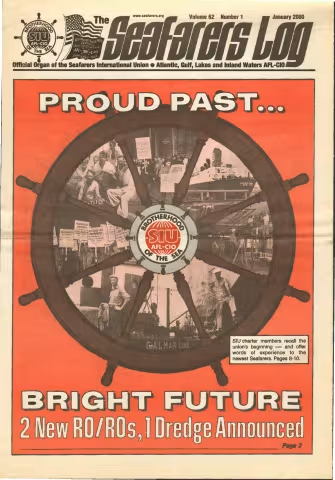
SIU charter members recall the
union's beginning - and offer
words of experience to the
newest Seafarers. Pages 8-1 O.
l'age3
~
President's Report
Working for a Stronger Fleet
Look at the headline on the next page. What a way to start the
new year, the new century and the new millennium!
All the work of the last I 0 years is paying off.
Two new roll-on/roll-off ships that will be built in
an American shipyard! A new hopper dredge also
to be built in an American shipyard!
What great presents for Seafarers and the U.S.
flag commercial fleet to receive during the holi
day season. Justly deserved presents, I might add.
These new builds-as well as the new two
Michael Sacco passenger ships, the Double Eagle tankers, the z-
class tugs, the coastal cruise vessels, the harbor
class tugs, the MSC RO/ROs, the car carriers and others announced
during the last 12 months-show the U.S.-fleet remains a strategic,
economic and national defense need for this country.
The revitalization, for which we have fought so long, is well
under way.
While it is great to reflect on the industry's success, let us not
forget this job is nowhere close to being finished!
All segments of the U.S. maritime industry still require attention.
The deep sea fleet has drawn the primary concentration with the
Maritime Security Program and its new vessels, but more needs to
be done.
The two new Jones Act RO/ROs announced by TOTE is a
tremendous first step. These ships will be the first built in a U.S.
yard for the commercial fleet in nearly a decade. The TOTE vessels
are just the beginning for both the Jones Act fleet and domestic
shipyards.
The construction of the Double Eagle tankers show that
American workers can compete with international yards to build
state-of-the-art ships for the 21st century. We must push to bring the
revitalization process to the rest of the tanker fleet.
The new hopper dredge displays a determination to upgrade
America's ports as they prepare for the coming century. Following
years of struggle and red tape that kept some harbors from having
even mere maintenance work done, an agreement was brokered by
representatives from the White House, state and local governments,
the unions and the industry earlier this year to allow dredging in the
port of New York/New Jersey. Work in other facilities-like
Oakland, Calif.-also is in progress.
Another sign that the ports are looking ahead is the number of
new tugs either on the drawing boards or already sailing. While
these vessels will assist in docking ships, work still has to be done
to upgrade the land-based transportation systems within the port
facilities.
The Persian Gulf War vividly demonstrated the need for civilian
crewed prepositioning vessels. New builds and reflagged vessels
continue to join the U.S.-flag fleet to make sure the requirements of
America's armed forces are met if and when they are called to
action.
With the new passenger ships being built for United States Lines,
America shows it can compete with the runaway-flag cruise indus
try-which finally is coming under the media's glare for its disre
gard for this nation's tax, wage and worker safety laws.
Yes, we are seeing change, growth and progress within our
industry. It has not occurred overnight. But it is happening.
Our industry is not being ignored, much as it was 10 years ago.
So, while we have this attention, we must continue to address the
many other needs-including those for inland and Great Lakes
members.
That is why is it so vital as we enter this first presidential and
congressional campaign year of the 21st century that we register to
vote. And we must continue to educate those who want to serve us
about what is important and dear-a strong and vibrant U.S.-flag
merchant fleet.
Throughout our industry, we're seeing proof that hard work does
pay off. Let's keep that spirit going as we enter the new century.
Volume 62, Number 1 January 2000
The SIU on line: www.seafarers.org
The Seafarers LOG (ISSN I 086-4636) is published month
ly by the Seafarers International Union; Atlantic, Gulf,
Lakes and Inland Waters District; AFL-CIO; 5201 Auth
Way; Camp Springs, MD 20746. Telephone (301) 899-
0675. Periodicals postage paid at Southern Maryland
20790-9998 and at additional offices. POSTMASTER:
Send address changes to the Seafarers LOG, 5201 Auth Way
Camp Springs, MD 207 46.
Communications Director, Daniel Duncan; Managing
Editor, Jordan Biscardo; Associate Editor/Production,
Deborah A. Hirtes; Art, Bill Brower; Administrative
Support, Jeanne Textor.
Copyright© 2000 Seafarers International Union, AGLIWD
All Rights Reserved.
2 Seafarers LOG
Seafarers Cast Ballots
On Proposed •erger
Voting Ends Jan. 31 on SIU-NMU Unification
Voting will continue until the
end of this month on whether the
SIU will proceed with full merger
talks with the National Maritime
Union.
Balloting began December 1,
1999 and is scheduled to last
through January 31, 2000. Voting
is taking place in all SIU halls
between 9 a.m. and noon local
time, Monday through Saturday,
excluding holidays. Seafarers
also may request an absentee bal
lot by following the instructions
printed in the October issue of the
LOG. Additionally, those instruc
tions are available via the union's
web site (www.seafarers.org, in
the LOG section, October issue).
Port officials said the turnout
was strong during the first month
of voting.
The current vote will deter
mine whether the SIU member
ship wants this merger and, if
approved, gives the union's exec
utive board permission to contin
ue with the merger talks. A simi
lar election is taking place at the
same time in the NMU.
Chief Cook Jose Guzman (right) secures his ballot at the SIU hall in
Norfolk, Va. from SIU VP Government Services Kermett Mangram.
Overall, the proposed merger
involves a three-step voting
process. That procedure is
explained in detail in a recent let
ter mailed from the SIU executive
board to each member. Copies of
the letter also have been distrib
uted aboard ships by patrolmen
and are available in union halls.
Left: Recertified
Bosun Greg
Hamilton reviews
the official ballot
before casting his
vote at the
Wilmington hall.
Ready to vote is OS Mark
Edmonds at the Norfolk hall.
In three photos above, AB Frank Cammuso, Chief Cook Karen Fensel and AB Gary Tauro, are among the
first to vote at the SIU hall in Wilmington, Calif.
Retirees Say Thanks
For Year-End Bonus
Dozens of SIU pensioners wrote thank-you notes
to the union's executive board following last
month's announcement that eligible retirees are
receiving a year-end bonus check of $500.
"It couldn't come at a better time," wrote Lorne
Eagle.
"What a nice surprise," said Antoinette Thayer.
"Thank you, from the bottom of my heart."
Plurinsus Ordansa said he welcomed the bonus
because it would help him purchase Christmas gifts
for his grandchildren. "I have a dozen, you know, so
that $500 bonus is a great help. May God bless you
all, especially our union, our brothers and sisters at
sea, and our honorable President Mike Sacco."
Leonard Paul wrote that he appreciates the SIU
"remembering their pensioners. We are so grateful,
and that's putting it mildly."
The checks were mailed in early December to all
SIU pensioners who currently receive monthly ben
efit checks for normal, early normal or disability
pensions from the Seafarers Pension Plan.
Please be advised that SIU headquarters
and all SIU hiring halls will be closed on
Monday, February 21, 2000 for the obser
vance of Presidents' Day (unless an
emergency arises). Normal business
hours will resume the following workday.
January 2000
Building for the New Century
TOTE Announces
Two New Vessels
SIU-contracted Totem Ocean Trailer
Express (TOTE) began the new year by
ordering two new roll-on/roll-off (RO/RO)
vessels to be built in an American yard for
the Alaskan Jones Act trade.
The new ships, called the "Orea" class,
are expected to be sailing by late 2002.
They will be the first non-military contain
erships or RO/ROs built in a domestic yard
since the R.J. Pfeiffer came out in 1992.
"This announcement shows TOTE 's
continued confidence in and commitment
to the Jones Act and the U.S. merchant
marine," SIU President Michael Sacco
stated.
"TOTE has been a major player in the
Alaskan maritime industry since the com
pany was founded 25 years ago. The com
pany understands the needs of the Alaskan
citizens and their businesses. TOTE is
establishing itself as the pacesetter for the
next century by building these ships that
will feature the very latest technology
designed to protect the environment."
Sacco added that these two ships, as
well as the other recently announced new
builds, show "the U.S.-flag merchant fleet
continues to be revitalized. Since the pas
sage of the Maritime Security Program in
1996-along with the ongoing support for
the nation's cabotage laws in Congress, the
U.S.-flag merchant fleet remains a vital
part of America's economic and national
defense transportation system."
The 825-foot vessels will be construct
ed at National Steel and Shipbuilding
Corporation in San Diego. The two ships
will have a capacity equal to the three
ROIR.Os already in service for TOTE.
Among the features to be incorporated
into the new design are the cleanest burn
ing marine power plants available in
today's market, fuel that will be stored in
double-hulled fashion not adjacent to the
skin, and a state-of-the-art sewage treat
ment plant.
"These ships, which can carry 50 per
cent more cargo than our present ships, are
designed specifically to endure the harsh
conditions of the Alaska trade," noted
TOTE President and CEO Robert P.
Magee.
The Orea-class vessels should carry 600
highway trailers as well as 200 automo
biles. They are being configured to easily
handle 48- and 53-foot trailers. More than
75 percent of the freight on board will be
enclosed below deck.
Great Lakes Unveils
New Hopper Dredge
Seafarers will have a new vessel to crew
late next year following the announcement
by Great Lakes Dredge & Dock to con
struct a 315-foot hopper dredge.
Tellez, SIU vice president for contracts.
Artist , conception shows
what the ~new Orea-class
TOTE -vessels 'will look
like when they b~gi_n sai~
ing in 2002 .. , · ·
Also, the hulls will be ice-belted to pro
vide additional protection in Cook Inlet
during the winter months.
"This $300 million private investment
will further our commitment to Alaskans
·well into the next century by enhancing
Alaskan job opportunities on our vessels
and shoreside, improving the resource
development infrastructure and better
serving Alaskan consumers with faster and
more economical service," stated Magee.
Besides the new vessels, Magee said the
company is planning improvements to its
pier and terminal facilities in Anchorage.
Reflecting on how the Seattle-based
company plans for the future, Magee
pointed out, "TOTE owes its success to our
loyal customers and to the hard work of
both our direct employees and members of
organized labor such as our longshoremen,
teamsters, mechanics, seafarers and mer
chant officers who provide our efficient
service."
Seafarers already crew the three vessels
operating in TOTE's fleet-the Great Land,
the Northern Lights and the Westward
Venture. TOTE is part of a larger company
known as Saltchuk Resources. Inc.
Work is expected to begin by March for
the Liberty Island. The large self-propelled
dredge will be built by union workers at
Manitowoc Company in Sturgeon Bay, Wis.
"This new dredge will help ensure
America's harbors and ports will meet
future demands. And this vessel will pro
vide more jobs for SIU members in this
vitally needed segment of the industry,"
Tellez added.
Work will begin on the hopper dredge Liberty Island by March so it will be ready
for its Seafarers' crew late next year.
"This is yet another positive sign that
companies like Great Lakes Dredge &
Dock are committed to a strong, vibrant
U.S.-flag merchant fleet," noted Augie
The Liberty Island will have a 5,000-
cubic-meter capacity. It will be 59 feet
wide and have a top speed of 14 knots.
with bottom-dump doors to provide for
rapid unloading.
five dredges which are crewed by SIU
members. They are the Padre Island, the
Dodge Island, the Sugar Island, the
Northerly Island and the Manhattan
Island.
The vessel will be capable of working
as deep as 90 feet. It will be constructed
Seafarers are aboard the Great Lakes
Dredge & Dock dredge Long Island. The
company's NATCO subsidiary operates
Unions to WTO: Global Economy Must Work for Working Families
Dozens of Seafarers were
among the estimated 40,000
peaceful protesters .at the recent
World Trade Organization
(WTO) meeting in Seattle.
Shouting "No to the WTO,"
working families from more than
50 unions, 25 states and 144
countries marched through
Seattle's streets on November 30
to demand that international trade
rules be reformed to respect
workers' rights and protect the
environment. The protests contin-
Tens of thousands of protesters at the WTO summit in Seattle demand
ed that international trade agreements include enforceable provisions
protecting workers. Marching in a demonstration on November 30 were
SIU members (closest to camera, from left) Steward/Baker Mike
Gramer, Chief Cook Veronika Cardenas and GSU Joel Crow.
January 2000
ued through December 3, the
final day of the WTO talks.
Speaking at the rally on
November 30, AFL-CIO
President John Sweeney said,
"Here in the United States, we
will continue to organize in the
Congress and elsewhere against
any trade accords that do not
include workers' rights and
human rights and environmental
and public health protections.
And we will stop them."
AFL-CIO Executive Vice
President Linda Chavez
Thompson, dozens of officials
from international unions, as well
as religious, human rights, envi
ronmental and international offi
cials told the crowd that free trade
is not "free" if its costs are child
labor and forced labor, poverty
wages, hazardous workplaces and
environmental degradation, and
that free trade must be substituted
with fair trade.
After the WTO talks ended,
Sweeney added, "This week's
heightened scrutiny of negotia
tions at the World Trade
Seafarers are among the unionists at the November 30 rally.
Organization meeting punctured
the veil of secrecy and insensitiv
ity in which the WTO has shroud
ed itself and made it impossible
for trade negotiators to paper over
differences or to pass off a bad
deal as acceptable. In the end,
there was no consensus on issues
of crucial importance to average
citizens, not just in the U.S. but
around the world, and there was
no deal. ...
"Despite the lack of break
throughs in policy, this week pro
duced a stunning breakthrough in
the public debate over globaliza
tion. Americans crossed a thresh
old to begin a truly national con
versation about rules and stan
dards and values in the global
economy, and they were joined
by citizens across the globe."
Seafarers LOG 3
Shipboard Meetings Cross the Country
SIU New York Port Rep. Jack
Caffey Jr. (left) talks with Bosun
Mike Manekas on the deck of the
Sea-Land Defender.
Union officials from across the country continue to meet with
Seafarers when their vessels dock.
The officials, including President Michael Sacco and Secretary
Treasurer David Heindel, update members on the latest news within
the union and answer questions on a broad range of topics from the
ongoing SIU-NMU merger vote to issues dealing with benefits and
contracts.
Included on this page are photographs from Port Elizabeth, N.J.;
Norfolk, Va.; and Long Beach, Calif.
Getting ready to take part in a meeting aboard the Cape Ray are (from
left) SIU VP Govt. Services Kermett Mangram, AB Lonale Andrews,
AB Joe Murphy and Bosun Billy Farris.
SIU Sec'y-Treas. David Heindel
answers a question for the
Cape Race crew. Listening are
QMED James Atwell and
Bosun Walter Ritvalsky.
Awaiting his turn to hit the deck is SIU Sec'y
Treas. David Heindel (right). With him on the
Cape Ray are Bosun Billy Farris (left) and QMED
J. Sterner Clothier.
Chief Stewards Anthony Houston
(left) and Ed Banks (center) greet
SIU Sec'y-Treas. David Heindel.
Crowley harbor members meet SIU President Michael Sacco at the dock in Wilmington,
Calif. From the left are AB Dragi K. Odak, Mate Mike Stevens, Sacco, AB Herman
Moningka and Capt. Scott Linsley.
Posing for a photo in the Norfolk, Va. hall are
(from left) Chief Steward Bud Marchman, SIU
Sec'y-Treas. David Heindel, SIU VP Govt.
Services Kermett Mangram and AB Jared
Blavat.
SIU VP Atlantic Coast Jack Caffey conducts a meeting
aboard the Sea-Land Consumer when it docked
recently at Port Elizabeth, N.J.
Sea-Land Chief Tours Paul Hall Center
Charles Raymond (far right), president and CEO of Sea-Land
Service, recently visited the Paul Hall Center for Maritime Training
and Education in Piney Point, Md. With him for this photograph
(from left) are Bill Eglinton, the center's director of vocational edu
cation; John Mason, head of American Services Technology, the
center's contracted operator; Kim Raymond; and Don Nolan, the
center's vice president. In related news, Sea-Land Service changed
its name to CSX Lines, LLC.
4 Seafarers LOG
Right: Answering ques
tions for crew members
aboard the Sea-Land
Integrity about the SIU
NMU merger vote is SIU
VP Atlantic Coast Jack
Caffey. Listening (from
left) are Wiper A. Daif,
New York Port Rep. Jack
Caffey Jr., Electrician D.
Baker and Steward S.
Sizemore.
Crewmembers from the Flickertail State and Comhusker State held a joint
union meeting with SIU VP Govt. Services Kermett Mangram (center).
Right: Listening during the
meeting on the Sea-Land
Expedition are (from left)
Electrician 0. Bermeo,
Steward P. Laboy, AB P.
Torres and OMU P. Albino.
Left: Taking part in the joint ves
sel meeting in Norfolk are
Bosuns Scott Palew (left) of the
Comhusker State and Billy
Edwards of the Flickertail State.
January 2000
Avondale Goes Union
Arbitrator AffirJTis Metal Trades' Majority
New Orleans arbitrator Bernard Marcus has
certified that the Metal Trades Department of the
AFL-CIO and the Metal Trades Council of New
Orleans represent a majority of the employees at
Avondale's main shipyard facility in New
Orleans as well as at the Gulfport, Miss. facility.
Although that process allowed the unions one
year to secure the required signatures, the unions
gathered substantially more than the required
number of signatures in fewer than 10 days from
the date of the neutrality pact.
Pursuant to the agreement between the unions
and Avondale, the company will recognize the
unions as the representative for these 4,100
employees.
The recognition applies to three Avondale
locations: four facilities in New Orleans (the
Main Yard, Harvey, Waggaman and Algiers),
Tallulah, and Gulfport, Miss.
Litton took over the yards on August 2 last
year in a $529 million buyout. Announced in a recent letter to representatives
of the council and to Avondale's management, the
decision clears the final hurdle for the union to
begin negotiations for the workers' first contract.
Avondale had already recognized the union as
the representative of its Tallulah, La. facility,
which consists of about 100 employees.
For more than 50 years, Avondale had been the
only major non-union yard building U.S. Navy
and commercial ships in the nation. The most
recent organizing campaign was launched in the
spring of 1993.
The certification comes five weeks after the
unions and Avondale approved a neutrality agree
ment which, among other things, set out the pro
cedure for gaining union representation based on
a majority of the workers signing petitions
reflecting that they desire to be represented by the
unions.
"We will be asking Litton to plan for full-scale
negotiations as early as possible in the new year,"
said John Meese, president of the national Metal
Trades Department in Washington. "This is defi
nitely the dawn of a new day for the workers at
Avondale, but we still have some heavy lifting to
do to conclude a fair contract which we have
been fighting for all these years."
ITF Secures Greatly Needed Aid
For Crew on Runaway-Flag Ship
As the nation celebrated
Thanksgiving, crew members
aboard the runaway-flag Hea
sailed into Cleveland with wan
ing hopes and no cause for fes
tivity.
The Filipino mariners were
malnourished and badly in need
of medical attention. Their living
conditions were, perhaps, best
illustrated by their use of river
water for bathing and brushing
teeth.
The German company Zirkel,
in charge of the Hea, also owed
back wages to the entire crew.
Facing those bleak circum
stances, an officer aboard the
Antigua-flagged vessel contact
ed the International Transport
Workers' Federation (ITF), an
organization of transport-related
unions to which the SIU is affili
ated. (Aiding mariners such as
those on the Hea is a major part
of the ITF's operations.)
Don Thornton, one of the
SIU's ITF inspectors, quickly
gained support from Cleveland
dock workers who threatened to
stop unloading the Hea 's cargo
of steel wire until the crew's
demands were satisfied. He also
coordinated efforts with ITF
officials and dock workers in
London and Bremen, Germany
(the Hea 's next scheduled stops
outside the United States).
As a result, some of the back
wages were paid in Cleveland,
with a promise by the company
to pay the balance in
England-in front of an ITF
inspector.
The ship also took on full
stores, and arrangements were
made for medical attention for
those who needed it. Addi
tionally, at least one officer (who
had been on the ship for 10
months and was owed $5,000)
received full back pay and per
mission to sign off the vessel.
Based in London, the ITF
AMO Celebrates 50th Anniversary
comprises more than 500 unions
from approximately 125 coun
tries.
The ITF has fought against
runaway-flag shipping for 51
years, and the SIU has aided that
campaign virtually since its start.
In the runaway-flag scenario,
a shipowner--<>ften from a tradi
tional maritime nation-regis
ters his vessel in a non-tradition
al country such as Liberia,
Panama, Belize, Vanuatu and
others. This is done to avoid his
home nation's laws regarding
safety, wages, taxes and more.
Crews for these runaway-flag
ships typically come from still
other nations (like Indonesia, the
Philippines and Sri Lanka)
where they receive a minimum
of training, if any at all. As in the
H ea 's case, these crews often are
refused wages for months at a
time and receive substandard
food allotments, among other
difficulties.
SIU President Michael Sacco (second from left) and SIU VP Contracts Augie Tellez (left) joined in the
American Maritime Officers' recent celebration of that union's soth anniversary. The ceremony took
place November 15 at AMO headquarters in Dania Beach, Fla. AMO National President Michael McKay
(second from right) and AMO National Secretary-Treasurer Robert McKay (far right) presented the SIU
with a plaque honoring the Seafarers' role in establishing AMO in 1949. AMO was chartered by the
Seafarers International Union of North America as the Brotherhood of Marine Engineers.
January 2000
Retired SIU VP
Bob Matthews
Passes Away
Robert A. Matthews, retired
SIU vice president and a charter
member of the union, died
November 29 at his home in
Mobile, Ala. He was 85.
Brother Matthews, SIU book
number M-1, joined the union
in December 193 8 in Mobile.
The native of Fairhope, Ala.
sailed in the engine department
until the early 1950s, then came
ashore.
Brother Matthews was the
SIU port agent in Baltimore
from 1953 to 1956, then held
that same job in Houston from
1957 to 1961. During the next
11 years, he worked as the
union's vice president of con
tracts and contract enforce
ment. He was the first chairman
of the Maritime Defense
League (formed in 1967), and
also briefly served as vice pres
ident of the Seafarers Harry
Lunde berg School of
Seamanship in Piney Point,
Md.
Brother Matthews cited
health concerns when he retired
in October 1972 at age 58.
"With Bob's passing, the
SIU loses part of its history,"
said SIU President Michael
Sacco. "Bob was there from the
beginning."
"Bob was a good negotiator
and he had a good rapport with
the membership," stated Red
Campbell, retired SIU vice
president contracts. "He was
Charter member Bob Matthews,
book number M-1 , served as the
union's vice president of collec
tive bargaining.
instrumental in bringing many
of the inland companies under
contract."
George McCartney, retired
SIU vice president West Coast,
described Matthews as "very
thorough and very accurate as
the vice president in charge of
contracts, at a time when ship
ping was tough. He did a good
job."
Brother Matthews retired to
Mobile and often visited the
SIU hall there.
"He enjoyed coming to the
hall and sitting down with the
bound versions of the Seafarers
LOG from the 1940s and 1950s,
and just reminiscing with other
people at the hall," observed Ed
Kelly, SIU port agent in
Mobile.
Funeral services took place
at St. Paul's Episcopal Chapel
in Mobile.
Survivors include Brother
Matthews' daughter, Daria
McDonald.
Deckhand Elhadji Ndiaye
Honored for 1998 Rescue
SIU Deckhand Elhadji Ndiaye (center) receives a rescue award
November 5 in New York from retired U.S. Rep. Helen Bentley on behalf
of the United Seamen's Service. Looking on is SIU VP Atlantic Coast
Jack Caffey.
Seafarer Elhadji Ndiaye recently received an award for his role
in a December 1998 rescue involving a distraught man in New
York's frigid Hudson River.
Ndiaye, a deckhand who sails aboard passenger ferries operated
by NY Waterway, received a plaque from the United Seamen's
Service on November 5 in New York. The award is described as an
Admiral of the Ocean Seas (AOTOS) mariner's rosette.
The rescue had an odd twist. The man saved by Ndiaye and his
fellow crew members aboard the Henry Hudson violently resisted
their help.
Described as the "suicide swimmer" by the New York Post, Cheng
Guo Seng jumped into the river from an elevated embankment in an
attempt to drown himself. Someone witnessed the jump and alerted
the nearby Henry Hudson via radio; the SIU-crewed ferry then quick
ly moved near Seng.
After struggling for several minutes, Ndiaye and the others final
ly pulled the delirious Seng into a rowboat that had arrived to help in
the rescue.
Seafarers LOS 5
.. ; ......... g Thanksgiving With Seafaren
... Aboard t.b.e Blue Ridge
There's nothing like a good meal to ease
the feelings of being away from home for
the holidays.
So, Recertified Steward Ron Malozi,
Chief Cook Henry Richardson and SA
Stephen Johnson went all-out in preparing
Thanksgiving dinner aboard the tanker
Blue Ridge.
"We have a good crew on here, and
everybody had a great time on
Thanksgiving," noted Malozi.
The menu featured traditional
Thanksgiving fare along with many other
dishes. Highlights included sliced Nova
salmon, Danish herring with wine sauce,
hot crab hors d 'oeuvres, roasted turkey,
roasted smoked ham, broiled rock lobster
tail, crown roast of veal, boiled Alaskan
crab legs, assorted pies and candies, and
much more.
ANY ROOM LEFT? Assorted pies highlight the dessert menu.
The Blue Ridge sails from Texas City,
Texas to Ft. Lauderdale, Fla., delivering
gasoline additives.
Recertified Steward Ron Malozi
presents a full and scrumptious
Thanksgiving menu for fellow crew
members aboard the Blue Ridge.
Below: SA Stephen Johnson
(left) and Chief Cook Henry
Richardson cheerfully do
their parts to ensure a tasty
array of food.
Among the beneficiaries of the Thanksgiving
Pumpmen Larry Phillips (left) and
Bill Hudson partake in the meal.
feast are deck gang members (from left) Chief Cook Henry Richardson does
Bosun Frank Lyle, AB V. Cruz and AB the honors and carves the turkey.
Richard Wittwer.
Filling their plates are SIU mem
bers (top photo) Bosun Klaus
"Whitey" Tankersley, AB Wallace
William, QMED Kurt Benjamin and
QMED Abraham Smith, along with
(below) QMED Olie Webber,
Engine Cadet Victor Flynn, GUDE
Rocky Olds and OS Terry Malone.
6 Seafarers LD6
USNS Dahl crew members enjoy the meal together.
Chief Steward Javier Delosreyes (left) presents a
cake for the crew. Who else but the captain, former
SIU member Kurt Kleinschmidt, would make the first
cut?
. .. Aboard USNS Dabl
Editors note: Former
Seafarer Mike Finnigan, now
sailing as chief mate aboard the
USNS Dahl, sent the following
article and accompanying photos
to the Sea/ arers LOG.
The SIU crew on board the
USNS Dahl put on a great
Thanksgiving Day meal for the
entire ship's crew. Under the
direction of Chief Steward
Javier Delosreyes and Chief
Cook Gregory McHugh, the
crew mess hall was transformed
and set up for a family-style
meal. Bosun Whitey Tankersley
and the deck department were a
great help in setting up the crew
mess hall.
Farmer SIU members Captain
Kurt Kleinschmidt and Chief
Mate Mike Finnigan said it was
great sitting down with the crew.
The USNS Dahl is now
docked in Norfolk, Va. after
completing the Bright Star exer
cise for the U.S. Army.
MAKING IT ALL POSSIBLE: Members of the steward department on
the USNS Dahl are Chief Steward Javier Delosreyes, SA Sean Bracy,
Chief Cook Greg McHugh and SA Roy Warren.
Left: Bosun Whitey Tankersley welcomes a
young guest to the Thanksgiving dinner.
January 2000
KEY INGREDIENTS:
Volunteering to help prepare and
serve the food were Seafarers (top photo, from
left) Chief Steward Burt Richardson, Chief
Steward Jon Blasquez, Chief Cook Eddie Gomez
and Chief Cook John Stein, and (bottom, from
left) Wiper Adam Wheeler, Chief Steward Louella
Sproul and AB Jason Schoenstein.
Ready for seconds are (from left) Denise Celona, Dr. Stephen
Brattesani, Rachell Boschetti, retired Marine Cooks & Stewards official
Roger Boschetti, Flavia Marrone, Jimmy Giblin, and Christine Marrone.
Among the SIU-contracted companies taking part in (and donating to) the
dinner were Matson representatives (from left) Ron Lempriere, Rick
Meleski, Jack Sullivan, Jim Mann, Lynn Korwatch and Tammy Findlay.
January 2000
San Francisco Feast
Draws Record Crowd
More than 400 Seafarers, retirees, friends
and guests - including Rep. Nancy Pelosi
(D-Calif.) and Mayor Willie Brown - turned
out November 23 for the annual
Thanksgiving dinner at the SIU hall in San
Francisco.
"This was the biggest and best one yet,"
said SIU Assistant Vice President Nick
Celona, who helped coordinate the yearly
feast.
Approximately three-fourths of the atten
dees were SIU members, pensioners and
their families. The rest included California
Labor Federation Executive Secretary
Treasurer Art Pulaski and President Tom
Rankin, officials from dozens of unions,
local politicians and judges, shipping compa
ny representatives and others.
Chief Steward Burt Richardson volun
teered along with fellow Seafarers in over
seeing much of the meal preparation and
presentation.
Celona recalled the first dinner he helped
coordinate. "It really started as a small event,
with just a few guests, and each year, it grew
and grew.
"One thing hasn't changed: It's still a
time for giving thanks for what we have in
the SIU and the American merchant marine."
For the 1999 celebration, Alioto's
Restaurant on Fisherman's Wharf cooked 19
turkeys, while desserts were donated by
Mimi's Bakery. SIU-contracted Crowley,
Matson, and Sea-Land Service donated a
large portion of the food.
As usual, the menu was packed with tra
ditional Thanksgiving chow, including all the
trimmings.
Jack Henning, retired executive secretary
treasurer of the California Labor Federation,
received a cake for his 84th birthday.
· Rep. Nancy Pelosi greets the crowd at the SIU hall. Welcoming her are
SIU VP West Coast Nick Marrone (left) and SIU Asst. VP Nick Celona
(right).
Right:
Seafarers
welcome
San
Francisco
Mayor Willie
Brown to the
SIU hall.
In the two
photos above
and in the
one at left,
Seafarers,
retirees,
friends and
guests enjoy
the festivities
at the San
Francisco
hall.
Seafarers LOG 7
..................................... --..... ._----,.._~~.....-:-r~__.....--~~~-- ---- --
SIU Charter Members
Recall Union's Launch
From Humble Beginnings, SIU Grows and Gains
Editors note: During the past few months, newspapers and magazines
from coast to coast have offered assorted retrospectives as the 20th century
nears its conclusion.
In that spirit, the Seafarers LOG on these three pages presents reflections
on the unions roots by eight charter members. Though each individual did so
in a unique way, the eight Seafarers echoed a common theme. They said that
the union's early days, predictably, were a strnggle. But through hard work,
keen foresight, teamwork and sacrifice, the SIU steadily improved. The SIU's
heroic peiformance in World War II also proved vital in the union's advance
ment, as reflected in some of the aforementioned members' chronicles.
The charter members have something else in common: More than six
decades later, they all still stay updated on the latest SIU news. And they
believe that the union today is on the right course for continued success in the
new millennium.
Finally, they offer words of experience to those just starting their careers
with the SIU
Here are their stories.
William Emerson
Age: 83
Joined: Baltimore, 193 8
Sailed as: AB
Retired: 197 6
The SIU-crewed Robin Moor was
the first U.S. ship torpedoed during
World War II. Some of the survivors
are pictured here.
agent in Baltimore then. When I joined the union, I saw
the biggest difference. It was a great thing. I worked a
lot of picket lines in New York, Baltimore and other
places. I really enjoyed it.
World War II - It was rough. I sailed on a Waterman
ship for nine months, shuttling from Scotland to the
Mediterranean. Ships sank all around us.
We would anchor and wait for a convoy. We'd shoot
Advice to new members: Be thankful you 're in a
union. Stay clear of the drugs, and work for the
union because the union works for your agreements.
Joining the SIU is the best thing I've ever done.
My uncle was a Baltimore policeman. He knew
someone who had a shipping hall. They took in four
that day in 1938 and put us on the old Steel Ore,
which at that time was non-union. I basically was
just looking for work
The Flomar, shown here in
these depth bombs off all night to keep the Germans 1940, was part of the Calmar
from setting bombs on our propeller. Then we'd meet Line, one of the first SIU-con-
On the non
union ships, there
' were nine head in a
fo'c'sle. The food was
terrible, there was no
overtime, and some
times you had to work
on your own time. It
was just like you were
a slave, really.
I had heard a lot
about the SIU. A fel
Brother Emerson splices low named Bill
rope on the Portmar.
Rooseven Robbins
Age: 81
Joined: New Orleans,
1939
Sailed as: Recertified
Steward
Retired: 1982
Advice to new members:
Try to learn as much as
you can and try to go to
Piney Point for upgrad
ing. I enjoyed that, being
certified as a steward.
Some of the best times of
my life were at the school.
The sea always fasci
nated me. I tried to join
McKay was the port
the Navy before World War II, but I was too young. I used to
hang around the docks. I started shipping on non-union
banana boats, then began hanging around the union hall.
They shipped me on the Del Rio.
The early days were probably 85 percent different than
when I retired. Way back then, there was discrimination
against blacks. You could only sail when they had a full
black steward department. But that changed.
Plus, most of the big ships were NMU at that time. It was
rough. We didn't have passenger ships, other than during the
war ....
I mostly shipped out of New York and New Orleans until
I moved to Philadelphia in 1945. Then I shipped from Philly
and New York.
B Seafarers LOG
the convoy coming out of the Mediterranean. It was terri- tracted fleets.
ble.
Other than the war, I really liked the water and was
never scared, even though we ran into a few hurricanes.
It never bothered me, although I got washed down the
deck a couple of times.
I hated to quit when I did, but an auto accident almost
killed me.
'Always Have a Job' - I think the SIU is in great shape.
You can see that if you're with the union, you know you
always have a job if you want to work. A lot of these
non-union companies, they don't care about you. But the
union will back you and help you.
The opportunity is there. I have two sons who went
with the SIU right out of high school (Edward H. and
William J. Emerson). They both started from the bottom
and went on to get their engineer's license.
Being around the old-timers in New York, I gained a lot
of experience. After I had a chance to work with them, I just
fell in love with it. The officials always looked out for me -
(Atlantic Coast Vice President) Leon Hall and others took
me under their wing.
I learned a lot and made a very good living.
World War II - I was on the North Atlantic route during the
war and was fortunate to get through it. I lost a lot of friends
who were on those ships that were torpedoed on the
Murmansk Run.
Once, I was on a coal ship that caught fire right off the
Virginia coast. We abandoned ship.
There were a lot of other close calls. In a rough storm,
one of my ships practically broke in half. The deck depart
ment worked night and day, held it together. We limped into
Belfast and stayed there 20-some days. The shipyard work
ers told us we'd never make it back to New York, but we did
make it.
I was lucky all the way through the war.
'See the Progress' - I think the SIU is wonderful. I get the
LOG every month, and what the union has done, all the
ships and jobs, it's way more plentiful than when I got start
ed and even when I retired. When you got off, you had to
wait a long time between jobs. Now, guys have it made.
They have a chance to upgrade and earn a good living.
You can see the progress the union has made. And we're
going to accomplish a lot more. I'd advise any young guy to
join, because it's the opportunity of his life.
January 2000
Eddie Bowers
Age:84
Joined: Mobile, Ala., 1938
Sailed as: Chief Steward
Retired: 1979
Advice to new members: Stick
with it,, upgrade yourself and
make a better union. Thats one
reason the SIU is in good shape
today - we stuck with the union.
Sometimes we sacrificed, went
years without a raise, but it was worth it. Thats what
built the union.
I joined because I thought it would be nice to see
some of the world, and was able to do that. Travel
appealed to me very much. I enjoyed it.
When I first started to sea, I only got $30 a month.
After 1944 or 1945, we started getting raises and it made
things much better. We had some very good people as
union officials. In talking with the old-timers around
Mobile, it gave me a good idea what I wanted to do -
people like Orlin Banks, Scotty Ross.
We did go through some hard times. The shipboard
conditions were pretty rough, and we weren't making any
money in the beginning. We sailed on boats that almost
looked like they were ready to be scrapped. Old rust pots.
Sometimes we were scared, but we made it. We sailed all
over the world. Those are some trips I'll never forget.
I remember walking picket lines, too. The Isthmian
strike and just about every other picket we had since
then. I enjoyed working with the union. I just love
Seafarers. I don't think that anyone who went to sea
could love it any more than I did.
Promising Future - The SIU turned the comer because
we had such dedicated people in the union. It was reas
suring to know we had people who were so dedicated.
From what I see today, things are looking good for the
SIU. One thing I thought would never happen is the
merger with the NMU. We bad many fights aboard the
ships. They would come on board to fight. But now,
whatever's best for our union.
I started at an early age and worked a long time. It
was worth it.
Seafarers pack a meeting at union headquarters on Beaver
Street in New York (top) and demonstrate in Manhattan dur
ing a beef (below).
January 2000
Nathan Rudnick
Age:79
Joined: Miami, 193 8
Sailed as: AB (later attained license)
Retired; 1982
Advice to new members: You 're fortunate to be starting
a great living, with top wages, health benefits, vacation
pay - every kind of benefit. Your living conditions
aboard ship are as good if not better than some peo
ples homes, with all kinds of facilities and no better
food at any restaurant in the whole world. If you pay
attention, theres no end to your going up the ladder
and being captain of your own ship.
I got my papers in Boston, then went to Florida and
hung around the union hall. I first sailed with Bull
Line, as a wiper. Bull Shepard (later an SIU official
and a founder of the Paul Hall Center) was an AB on
another ship I was on in 1938, the Estrada Palma. In
1939 and 1940 I sailed as an AB on a Delta Line ship,
the Del Rio ....
I was involved in one of the first strikes the SIU
pulled, in 1938. The company was P&O (Peninsula
and Occidental) Steamship. They had five ships in Port
Everglades, three railroad car ferries and two passenger
ships. I walked the picket line for a month, maybe two.
I remember picking up nickel milk bottles on Miami
Beach taking them for change.
At that time, Port Everglades had absolutely noth
ing. There was one dock, one company office building
that was really a shack, and two "B" joints. Otherwise,
all the land was barren.
On one of their ships, the Estrada Palma, all the
crew's quarters were on deck and we made two weekly
trips between Port Everglades and Havana, Cuba. We
had two sets of railroad tracks and we took on board
28 freight cars - 14 on each track. The ship was put
astern to the dock and fastened ashore with a huge
hasp, so the shore tracks would meet with the ship
tracks.
(Editors note: the P&O strike lasted 14 months,
with the SIU finally winning in the summer of 1939.
Ninety percent of the 300 crew members in the fleet
certified the SIU as their sole bargaining agent.)
Wortd ar II-After two years I got a third mate's
ticket. During the war, I was sailing on the Liberty ship
Salvatore Frank Jr.
Age:78
Joined: Providence, Rhode
Island, 1938
led as: Bosun
Retired: 1985
Advice to new members: Do
your work. Do what you 're told
to do, and don't slack off Keep
your mouth shut and your ears
and eyes open, and you'll get
along fine. And don't go in with
the attitude that you already
know everything. We all have to
learn.
Rudnick (right) and two shipmates from the engine
room of the Estrada Palma visit the Newport News, Va.
maritime museum while the ship undergoes repairs.
William S. King when we were torpedoed on the way
home. We spent three-and-a-half days in the lifeboat,
then ended up in South Africa. The submarine came up
and took the captain POW.
I left the industry after the war, then in 1975 I
joined the SIU again. I sailed as an AB.
Education Is Key - One of the most important things
the SIU has done, as I look at it, is the schools they've
run to train seamen. In the old days, you learned from
the older seamen aboard the ship - fire fighting,
lifeboats and so on.
Today, when a kid comes aboard the ship, I imagine
he probably knows more than the average AB knew 40
years ago. He knows about life-saving equipment, gas
techniques for going into the hold of a tanker, for
example. In the old days, you didn't know those things
until you sailed for at least a few years.
The SIU-crewed Estrada Palma sailed between Port
Everglades, Fla. and Havana, Cuba.
--~~i;i to move to one side of the hall
because the roof leaked. But I
liked it down there. I was the
only Yankee at the hall at that
time. The guys bought me a
rebel hat from the Civil War
era.
I wasn't fussy, so long as I
worked. Anything to make a
dollar. I didn't stay on the beach
too long ....
When we went on strike, I
went out. I was ashore for the
Isthmian and Bull Line beefs
(1945-47, and 1957-58, respec
I quit school in junior high
and went into a civilian camp so
I could make money. It was a
'-----------------____J tively). The only thing I didn't
This photo is believed to be one of the earliest in like was when we [supported a]
SIU history, taken in fall 1938 in Providence, R.I. strike on Beaver Street (in New
camp to get us kids off the street, but I didn't stay there
long because I had the SIU.
I'd heard about the union through a relative who
worked as a longshoreman. Another relative wanted to
get me into the NMU, but I chose the SIU. The NMU
was nothing but communists in those days, and I didn't
want to belong to no communist organization.
Frank Berry was the agent when I joined at the hall
on South Main Street. I used to clean up after hours. I
started as an OS and an organizer - and I got kicked off
the ship the same day, as soon as I mentioned the union!
Then I got a job on the Herman F Whitten, an SUP
ship.
Different Era - I liked it in those days, liked the guys.
Today, you have to lock your lockers. In those days, you
got paid, you could leave your money on your bunk, go
take a shower and come back and the money would still
be there. The deck department all slept together in one
room, except for the bosun, who had his own room.
I shipped from Mobile. Every time it rained, we had
York), helping the telephone operators. I got clubbed in
the head. I still got a lump here.
But I got to see the world, and the pay was good.
There's something about the ocean that attracted me.
World War II - I sailed on the Atlantic side in 1942. We
went to the invasion of North Africa, went along the
dock. The deck department did all the discharging - the
whole ship. We finished the job in seven days.
I also made a trip to England on an old Hog Island
ship. It was very slow, and we saw some other ships get
knocked off along the way.
On D-Day, I went to Normandy on a small tanker.
Our job was to fuel the hospital ship and the LCis (land
ing craft). During a storm, our anchors broke loose and
we ended up on the beach, right where they were hold
ing German prisoners. We weren't supposed to go
ashore, but we went anyway.
As soon as I got back to the States, I got on a Robin
Continued on page 10
Seafarers LOG 9
SIU Charter Member Frank Recalls Union's Launch · r""""~-~~~"ll Tom Fields When I first started, I was getting $1 a day
as a messman. There was no overtime or any
thing like that. They were very difficult times
in the beginning, but it was still exciting.
Going to sea meant you saw different things
and different parts of the world.
Continued from page 9
Line ship ....
One time, my ship mistakenly ended up in the middle of a British war ship
convoy at night. We almost fired on them, not knowing who they were.
Another time, in 1943, we ended up in a typhoon, while we were carrying
airplanes on deck ....
I also sailed during Korea and Vietnam, and that was totally different com
pared to World War II. Some of the foreign ships refused to carry our cargo. But
as you see in the LOG now, the armed forces have more respect for us -
American ships and American crews. During the war, some of them had no use
for us. They called us draft dodgers. I was no draft dodger. We took the oath,
same as they did when they joined the service. A lot of people don't know that,
even G.I. 's from World War II. We had old guys who went to sea when they did
n't have to. Others couldn't get in the service, so they went to sea. And many
lost their lives.
Age:87
Joined: Savannah, Ga.,
1938
WA"il~:ID ll Sailed as: Chief Cook
Retired: 1982
Advice to new mem
bers: Be thankful for
what you've got. Be
good to yourself and
everybody else. It took
a long time to get what
we have today.
I was a longshore
man, but I got tired of
that. When I had the
chance to go to sea, I
took it.
World War II - In June 1942, I was on the pas
senger ship City of Birmingham when we were
torpedoed, sailing out of Norfolk, Va. We were
carrying bilge workers to Bermuda, and a
destroyer escort picked us up.
During the war, I sailed in the Pacific a lot.
It was a tough time out there. I also sailed the
North Atlantic. The German wolf packs were
knocking so many ships off, but we made it.
Of course, once we got to Russia, we couldn't
go anywhere. We didn't make a lot of money. About $50 or $60 a month as on OS. And
when we got off a ship, we had to take care of ourselves. There was no paid
leave.
Bright Future- Why has the SIU remained strong? First, you've got to give
credit to Paul Hall. He was in there, fighting. Him and (Paul Hall Center Vice
President and SIU Representative) Frank Mongelli.
I first sailed on a
Savannah Line passen
ger ship. We took the ship up to New York to
dry dock.
The war helped change a lot of our ship
board conditions, helped improve them. Then
the war ended and things improved some
more, especially in the 1950s and 1960s.
If Paul could only be alive today and see how well the union's doing. But
he's happy in heaven. Mike Sacco is doing a hell of a good job. He's getting the
unions together, and this makes us more powerful. When we go out for some
thing, we can get it together.
It was rough in those days, nothing like it is
today - in every respect. The food wasn't as
good, for sure. Plus, the companies didn't
want the union. Every chance they got, they
tried to break it up.
What Ues Ahead - I think the SIU is getting
better all the time, and the officials are doing a
good job. We're improving all the time, which
you can see with all the (newly contracted)
ships. I can't see anything but getting better. The absence of strikes is another positive. That's the best way to do it - talk
things over. It's working.
Warren Brown
Age:79
Joined: New York, 1938
5ailed as: FOWT (later attained license)
Retired: 1950
most - and I'm not saying this because it's popular - was Paul Hall's attitude. He truly
wanted the seaman to have a better life. He had a hard time convincing people that sea
men needed to be educated, but he did it.
Advice to new members: Listen to everybody on that ship. Ask
questions if you don~ understand. Some people may laugh at
questions, but don't pay them any mind.
At that time, there was an adversarial attitude by the companies and by us. Paul
taught us that we had to stop, if we were going to get anywhere. Paul said, 'We're going
to have to prove to the shipowner that we're responsible people. That's the only way
we'll succeed.' He made a tremendous impression on a lot of people, and I'm one of
them.
I started sailing because times were tough. I was just a kid,
16 years old, and at least by going to sea I got my room and
board, plus my pay. I couldn't get in the armed services
because of my eyesight.
We once sailed together on the Schoharie, South Atlantic Steamship Co., out of
Savannah. The voyage was Baltimore to Egypt to Arabia and India, then back to
Baltimore. Paul was the watertender.
He went and told [someone similar to a port captain] that we needed electric fans on
the ship. The guy refused. Paul said, 'I'll give you my personal word that those fans
will be as good when we come back as when we left.' He even offered to pay for them.
The guy said okay, and put the fans on the ship.
The NMU in those days had the most jobs and the best
runs. We had constant trouble with them. There were some ports we wouldn't go ashore
in, and others where, if you went ashore, you went in a group. We did lots of organiz
ing. Then the war came along, and we got so many new people, it was tough to stay on
course.
I enjoyed seeing different places, meeting different kinds of people. Some ships were
better than others. We had a saying: "The last ship was the best one, the ship you 're on
is the worst, and the next one will be better than anything." But it never worked out that
way!
Every week, Paul told everyone what he had done, reminded the guys to keep them
clean. He said if we can't take care of things, then we won't get them in the first place.
The first thing when we got back, that guy went up the gangway and looked at the fans.
And you know what kind of shape they were in.
World War II - One thing I learned before the United States got into the war, from talk
ing with foreign seamen in various overseas ports - the slow ships were going to be
trouble. The worst thing that happened, I was standing the 4 to 8 watch on a run to
England, and we got hit with a dead torpedo.
On the Right Track- It was very tough to give up shipping, because I had started when
I was young. That was all I knew. People ashore didn't think the same way we did. But
I'd started a family, and my wife said I had a choice, if you know what I mean.
Today, I'm happy to see the SIU is getting some new ships. The union seems to be
well-organized, and it's great that members are upgrading themselves, studying and tak
ing advantage of the school. Not many unions have a school like that.
Before the war, there wasn't much of a change in crews. But most everybody was what
I'd call a bona-fide seaman. They had basic knowledge of all shipboard jobs. This is what
killed a lot of people during World War II; they were trained, but they weren't seamen.
It's hard to believe that a country with this much coastline doesn't think more of
merchant shipping. I hope our merchant marine expands.
Remembering Paul Hall - When it came to the union, the thing that impressed me the
The toughest job the union had was to teach the members that if you took, you had
to give. You had to be reasonable. And it's working. Everybody's on the right track.
James L. Tucker
Age: 87
Joined: Jacksonville, Fla., 1938
Sailed as: Bosun. Also worked
as a port official in New
Orleans, Baltimore, Mobile,
Ala. and Charleston, S.C.
Retired: 1971
Advice to new members: If
you 're interested, its a good
life. But you have to want to
improve yourself at all times.
I was raised in a home where
everybody was union, so when I
started going to sea, I joined. I
actually started with the International Seamen's Union
(ISU), a forerunner of the SIU, in 1933.
My first SIU trip was in 1938 on the Marjorie, a Bull
Line ship. It was what I could find in those days. I stuck
with it, I enjoyed it and I eventually made a good living.
In those days, the early days, you couldn't raise a fam
ily (as a merchant mariner). Most of the improvements
came after World War II. People like (Secretary
Treasurer, then SIU President) Paul Hall, (Secretary
Treasurer) Whitey Hawk and (Atlantic District Chairman)
Duke Duchesne started the ball rolling.
10 Seafarers LOG
Early Memories - It was a struggle. Little by little, we
kept improving things.
Then we started the school (in 1952 in New York), and
that gave the boys some experience. It was sort of hard to
teach them on the ship. Although, several of the ships I
was on, especially Delta Line, we had classes for wire
splicing and other things, and that's how a Jot of people
learned. But it was hard to take the time to teach. ·
Shipboard conditions also were improving during this
time.
World War II - I was bosun on the Liberty ship Roger B.
Taney, a Waterman ship. It was February 7, 1943. We
were empty when we were torpedoed about 500 miles
into the South Atlantic.
The survivors spent 42 days in two lifeboats - 22 peo
ple in one boat, 26 in the other. All but three of the crew
made it.
We set up regular watches, just like on a ship,
although we were elbow to elbow. We still had (fresh)
water that came with the lifeboat, plus we caught water
on a canvas top to the boat. That's what actually saved
us, I believe. There were stores for 31 people for 30 days,
but we had double stocked.
We had prayer every day. Eventually we were picked
up a mile from the beach in Brazil. We could see the light
ashore for two days before we got picked up.
I sailed again after this incident, to Russia and the
Pacific. That was my livelihood.
Seeing the World - What I enjoyed most about the SIU
was the travel, seeing all these different countries. In
those days, there were no fast turnarounds like today. You
could lay two, three, four weeks in a place.
I mostly went to South America, on the Delta Line ships.
I spent more than 20 years on those ships alone, but I also
made seven trips around the world with Isthmian.
And even though I worked for the SIU ashore, when I
retired I was sailing. My last ship was the Del Sud .. ..
The SIU is improving
all the time. The union is
making it more conve
nient for the members to
learn, which they need to
keep up with the improve
ments on the ships. You
pick up a little on the
ships, but not enough.
One thing the industry
has to do is get rid of all
these fly-by-night outfits,
these runaway-flag opera- Tucker is pictured aboard the
tors. Del Mar in 1949.
January 2000
The infamous ~Y2K bug"
forced organizations worldwide to
plan ahead, talcing preventive and
often costly steps to avoid com
puter glitches stemming from the
turn of the century.
Students at the Joseph Sacco Fire
Fighting and Safety School are trained
specifically in fighting shipboard fires.
Forward thinking is nothing
new at the Paul Hall Center for
Maritime Training and
Education, located in Piney Point,
Md. From its opening in 1967, the
center has enjoyed a well-deserved
reputation for constantly improv
ing and consistently meeting the
industry's ever-changing needs.
The school remains steadfastly
committed to turning out the best
trained mariners in the world.
During the past year, the most vis
ible evidence of that commitment
was the opening in May of the
Joseph Sacco Fire Fighting and
Safety Schoo~ a world-class facili
ty located on school property near
the main campus. This new, mil
lion-dollar school arguably is the
Able Seaman
This six-week course leads to endorsement as an able
seaman (AB). It consists of hands-on training and class
room work covering deck seamanship, rules of the road,
marlinespike seamanship, helmsmanship, cargo han
dling, safety, fire fighting, emergency procedures, first
aid, anchoring and mooring, and aids to navigation.
Students must have a lifeboat endorsement in
order to take the AB course. Students completing
the AB course must attend the Government
Vessels course immediately afterward. (This
course is limited to 25 students maximum.)
Lifeboat/Water Survival
Students in this two-week course can earn lifeboat cer
tification at the end of the class. Featuring a mix of prac
tical training and classroom instruction the course cov
ers emergency drills, lifeboat construction, lifeboat
launching and recovery, life raft construction, life raft
launching and maintenance, and use of all lifeboat and
life raft equipment.
Additionally, students learn practical survival meth
ods and the use of emergency radio and distres ignals.
A minimum of three hours per day is spent outdoors
in lifeboats conducting practical exercises uch as row
ing/ coxswain training and davit operation . (Thi.s
course i,s limited to 25 students maximum.)
Bridge Management
The U.S. Coast Guard-approved shiphandling iinula
tor course provides realistic bridge watchstanding train
ing for deck personnel aboard both deep sea and inland ves
sels.
Successful completion of this two-week course is
accepted as Coast Guard credit for 60 days of seatime
on vessels of unlimited tonnage.
Hands-on training in steering and following com
mands is one aspect of the excellent AB course
offered at the Paul Hall Center.
January 2000
also
Special areas of skills development include general
shiphanclling and helmsmanship, river and channel tran
sits, entering and departing various ports, coastal navi
gation, U.S. avy-related operations such as convoy and
underway replenishment, hawser towing, pushboat tow
ing and emergency shiphandling.
Students must have a valid radar certificate to
enroll.
Celestial Navigation
The six-week course covers the areas of celestial navi
gation required for licensing as a second or third mate
unlimited and for all limited licenses. Students are
instructed in latitude observations by sun and Polaris,
running fixes by un, stars and planets, compass error
by amplitutde and azumuth, star identificaiton, and care
and use of the sextant.
Radar Observer /Unlimited
The eight-day radar observer/unlimited class lead to a
radar ob erver endorsement that is good on vessels of
any tonnage.
Approved by the .S. Coast Guard, the course fea
tur hand -on training and clas room work, including
radar the T)\ observation operation and use, interpreta
tion and plotting, advanced radar plotting, collision
avoidanc and navi ational ex rcise.
Stud ms operate modern audio-visual and radar siin
ulation gear, as well as the full hiphandling simulator, as
they practice controlling and maneuvering a vessel, plot
ting courses and safely guiding a ship without jeopardiz
ing the safety of other vessels. Also included are practical
exercises and lectures covering inland waterway and river
navigation and piloting.
ARP A -Automatic Radar Plotting Aids
This course of instruction in rporat the use of ARPA
iinulation equipment to operate, observe and utilize the
radar plotting aids. tudents will gain an understanding of
the limitations of the aids as well as their performance fac
tors, sensor inputs and malfunctions and will gain a know
ledge of trackina capabilities processing operational
warnings and target acquisition.
Students must have completed the Radar
Observer course in order to enroll in this class.
pgraders in the third mate course will study all subje t
areas found on the U. . Coast Guard license exam for
third mate. The 14-week curriculum includ instruction
in all areas of terrestrial and eel rial navigation, deck
seaman hip, rul of the road, shipbuilding, hip tabil
ity, cargo handling, federal regulations. watchkeeping,
hip maneuvering, construction and tability.
made other improvements. The
school began offering two U.S.
Coast Guard-approved STCW
basic safety courses whose content
is essential in helping merchant
mariners comply with the 1995
amendments to the STCW con
vention. It also initiated a Coast
Guard-approved, 32-hour class in
automatic radar plotting aids
(ARPA).
Additionally, the school closely
worked with the American
Council on Education and earned
certification for many of its cours
es that potentially allow Seafarers
to receive college credit for those
particular classes.
The school also continued its
long tradition of providing com
pany-specific and on-site training
throughout the U.S., including
Unlicensed Apprentice Co~
This handy ve~ion of the Paul
Hall Cent.er's catalog is printed in
the Seaf'areis IJJG as a conve
nience to SID membe~. Please
keep it for reference.
STCW classes in Hawaii.
These are just a few of many
examples of how the Paul Hall
Center continues to offer cutting
edge training for Seafarers.
An overview of the courses
available at the school is contained
in this four-page section. Students
should note that courses and class
dates may change due to the man
power needs of SIU-contracted
companies. Therefore, Seafarers
should check the latest issue of the
Seafare rs LOG for the most up-to
date class listings.
Course descriptions and sched
ules also are available on the
SIU's web site, located at
http://www.seafarers.org.
The basic eligibility for SIU
members who want to upgrade at
Piney Point includes 120 days'
seatime in the previous year, one
day of seatime in the last six
months prior to the date the class
starts, a copy of their z-card (front
and back), a copy of the identifica
tion page of their union book, plus
any other course-specific require
ments. If the course mandates a
U.S. Coast Guard test to acquire
the endorsement, then the upgrad
er must meet all Coast Guard
requirements prior to taking the
class. Some courses have other
specific requirements which are
printed in bold.
For more information about the
Paul Hall Center or any of its
courses, contact the Admissions
Office, Paul Hall Center for
Maritime Training and Education,
P.O. Box 75, Piney Point, MD
20674-0075 or call (301) 994-
0010.
Includes a 20-hour shipboard sanitation class and a 20-hour galley famil
iarization class. After students complete 90 days' seatime in the apprentice
program, those who choose to sail in the steward department will return to
the school for a four-week galley operations class. Galley operations features
a pair of two-week modules.
Galley Operations
Members must have 240 days' sea time to enroll after completing the
unlicensed apprentice program. Non-graduates must have 365 days'
seatime as an SA to enroll. The course consists of two, two-week modules
(for a total of four weeks). Each module includ 35 hours, with additional
time participating in the school's galley operations.
Certified Chief Cook
Members must have 180 days' seatime after completing galley operations
to enroll. The course consists of six, two-week modules that are stand-alone
(for a total of 12 weeks). This structure allows eligible upgraders to enroll at
the start of any module.
Advanced Galley Operations
Members mu t have 180 days' eatime after completing certified chief
cook to enroll. The course consi ts of four one-week modules. (for a total of
four weeks).
Chief Stewanl
Members must have 180 days' seatime after completing advanced galley
operations to enroll. This is a 12-week class.
Seafarers LOS 11
Classroom instruction as well as hands-on experience help upgrading Seafarers remain
the best trained workforce in the maritime industry.
Many engine department courses have prereq
uisites. For eromple, to be accepted for Advanced
Refrigeration/OJmainers, you must have success
fuily romp/et;ed Marine Electritxd Mainrenance I
(MEM I) and Refrigeration System Mainrennnce
and Operations.
Fireman/W atertender and Oiler
This year. SHLSS offers a four-week FOWT test
preparation course leading to the endorsement
as fireman/watertender and oiler. Topia; cov
ered include the parts of a boiler, engineroom
equipment, e°ooineroom procedures, operating
auxiliary equipment, watchstanding, starting
and securing main engines, steam and water
cycle. fuel oil and lube oil systems. diesel
engines, refrigeration systems and auxiliary
machinery.
The class prepares students for .S. Coast
Guard general safety, oiler and fireman/water
tender tests.
Students completing the FOWf course
must attend the Government Vessels
course immediately aftenvard.
OMED-Any Rating
The curriculum for certification and endorse
ment as a Qualified Member of the Engine
Department (QMED)-Any Rating consists of a
12-week course leading to the following ratings:
pumpman, refrigeration engin r, electrician,
machinist, deck engineer and junior engineer.
The course of instruction prepar the stu
dent to test for the US. Coast Guard exams in
each of these ratings and includes classroom
and practical training.
QMED Classification Steps
4fh. Cla&s QMED D SHLSS/PHC QMED-Any
Rating certificate or G Q.MED-An
Rating
:pd Cla&s QMED 0 QMED-Any Rating suc
cessfully completing one mandatory and
one or more elective courses
2nd Class QMED 0 QMED-Any Rating suc
cessfully completing two mandatory and
two or more elective courses
tst Class QMED 0 QMED-Any Rating suc
cessfully completing all mandatory cours
and three or more elective courses.
Mandatory rourses are MEM I, Power Plant
Mainrenance and Diesel. Technol,ogy.
Io more than two engine d partrnent cours
es can be taken per stay at the school.
Any member with an engineer's license " rill
be classified as a 4th Class QMED.
Power Plant Maintenance
The majority of this ix-we k cours features
hands-on training covering a variety of topi .
Some clas room work also is included.
Subj cts include pipefitting, thermaJ insula
tion, valve repair. pump repair/overhaul.
hydraulic y tern repair, drilling/machine
thread fabrication use of various epoxies and
similar compounds for emeraency and tempo
rary repairs maintenance of power transmis
sion equipment (such as flexible coupling ),
use of proper oils and greases for bearing
maintenance and lubrication, reconditioning
shell and tube heat exchangers. centrifugal
lube oil/fuel oil purifier maintenance and
removal of heavy equipment in the engine
room.
Course entry requirement is QMED
Any Rating.
12 Seafarers LOG
Marine Electrical Maintenance I
The six-week course of instru tion leading to
certification in Marine El trical ~Iaintenance I
con i ts of practical training and classroom
instruction aimf".d at providing the basic skills
required of shipboard electri ians. The range of
topi includes basic electrical th ry, DC and
AC circuits, electrical sa£ tv, electrical test
equipment and troubl hoo~, ele ni.cal pro
tective and witching devi , lectrical wiring
diagrams and schematics, control and pow r
circuits, batteri , AC generation and distribu
tion equipment, transformers. lightina systems
and fixtur , galley and miscellaneou heatina
equipment, ingle- peed A motor and
aero -the-line starters and wiring techniques.
Course entry requirement is QMED
Any Rating.
Marine Electrical Maintenance II
Aimed at providing the more advanced skills
requir d of the shipboard electrician, thi
six-w k course featur hands-on training and
classroom instructi n and lea to c rtification
in ~1arine El trical .\laintenance II.
Among the subjects covered are interpreta
tion of the ational Electrical Code, special
ized electrical t t equipment. advanced appli
cati n of cir uit pr tection and ·witching
devi • relay lo!ric. ompl . ontrol circuit .
D and A generators. voltage re!!Ulators
electrical distribution hardware, DC motor
and controll r , C motors and controller ,
deck machinery. motor generator set , con
verter , inverters and rectifier , electric
propulsion tern and interior communica
tion system .
Also, the course will include an introduc
tion to solid tate electronic controls and their
applications, and t11e general maintenance
responsibiliti of the lectrician, as well as trou
bleshooting and repair.
Course entry requirement is Marine
Electrical Maintenance I.
Diesel Engine Technology
Thi four-week course, leading to certification
in diesel engine technology, consists of class
room instruction and hand -on training.
Topics of instruction include diesel engine the
ory: two- and four-stroke cycle operating prin
cipl ; and the con truction, operation, main
tenance r pair and troubl hootina of low-,
medium- and high-speed diesel engines.
Also covered are associated auxiliaries
including intake and exhaust terns, lubrica
tion and cooling systems, and fuel inj ction
and tarting tern .
tudents r eive practical trainina in the
operation and repair of di el en!rin on
board school training v ls.
Course entry requirements are
QMED-Any Rating or equivalent inland
experience.
Hydraulics
The curriculum in the four-w k hydraulic
course blends practical training with Classroom
work. Fluid , actuator. control device
pump reservoirs. symbols and hydraulic y -
terns in marin equipm nt ar am ng the ub
ject covered in this clas . Also addr d are
principles of l ctrical control of hydrauli y -
tern , cargo winch • deck cran . anchor
windlas.ges, hips' steerina systems, ramps. fire
doors and a wid variety of other hipboard
systems.
Upon completion of the course, a Paul Hall
Center certificate of graduation will be issued.
Course entry requirement is QMED
Any Rating.
Basic Electronics
Designed to help Seafarers develop an under
standing of what goes on inside the electronic
box found aboard ship, this four-w k course
covers principles of analog electronics, activ
devices and basic digital electroni . The stu
d nt also will learn all aspects of circuit dia
!!rarru,. and the instructor will work with each
tudem individually to ensur a working knowl
edg of all shipboard electronic devices.
Marine Electronics Tech I
The marine electroni technician program is
a four-week course. Topi included in the
course are AC and DC circuits, active and pas
sive components, amplifier , power supplies,
antenna systems, satellite and radar systems,
microprocessor control systems, digital control
systems and ystems troubleshooting.
Course entry requirement is Basic
Electronics.
Pumproom Maintenance
Leading to certification in pumproom mainte
nance and operations, this four-week class
includes hands-on training and classroom
work. The curriculum consists of cargo prop
erties and emergency procedures, operation
and maintenance of valves and pumps loading
pr c dur . cargo pump operations. cargo
measurement, discharging procedures, bal
lasting procedures, tank cleaning, inert gas
systems and more.
Upon completion of the course, a Paul Hall
Center certificate of graduation will be issued.
In order to take this class, students
must already have taken the Tanker
Assistant DL (formerly Tanker Opera
tion/Safety) course (described on next
page) and be certified as a QMED-Any
Rating or hold endorsement as a pump
man.
Refrigeration System Maintenance
and Operations
~ow an elective. this ix-week class blends prac
tical and cla&,-oom instruction leading to certifi
cation in refrigeration system maintenance and
operations. Among the topics covered are theo
ry of mechanical refrigeration, major system
components, accessories, cycle controls, refrig
erants and oils, and applied electricity.
Standard service techniqu are empha
sized, such as the operation, troubleshooting
and maintenance of ships' tores plants, air
conditioning plants, cargo ventilation and
dehumidifying equipment, as well as pantry
refrigerators, water coolers and ice machine .
Engineroom Familiarization
Designed for prospective tugboat engineers
this two-week class provides instruction in the
following areas: engin room afety, engine r
ing plant nom nclature, piping y tern hard
ware a functional d ription of main propul
sion and auxiliary machin ry and associated
pipina ) terns, plant operations and watch
keeping, and afe handling of fuel and oil
spill pr vention.
Engineroom Operations & Maintenance
This course i design d for inland personnel
with intermediate kills to prepar assi tant
engineer for all phases of engineroom opera
tions and routine maintenance. dditionally,
the two- week curri ulurn prepar tudent
to as ume the duties of the chief engineer.
Engineroom Troubleshooting &
Casualty Control
This two-week course is an advanced kill
pro!!ram d igned to up!!rad the kills of the
Hands-on shop training includes the com
plete fabrication of a working refrigeration sys
tem from basic system components. An intro
duction to refrigerated container units also is
presented.
Students m\S be rertified as QMED -Any
Rating or have equivalent inland experienre
or hold Coast Cuard endorsements as refrig
eration engineer and electrician in order to
enroll for tlIB rou:rse.
Refrigerated Containers
This four-week course leads to certification in
refrigerated contain rs maintenance and consists
of both dassl' m and practical shop training.
The training experience enables students to
assume the duties of a maintenance el trician
on board ships carrying refrigerated containers.
Students receive training in all phases of
refrig rated ntainer unit operation, mainte
nance., repair and troubleshooting. This includes
the various types of engines, refrigeration and
electrical systems.
The course is designed to help students
develop a systematic approach to troubleshoot
ing, as well as to acquaint them with pecific
maintenance procedures.
Course entry requirements are Marine
Electrical Maintenance I and the basic
Refrigeration System course.
Welding
Clas room instruction and on-the-job training
comprise this four-week course, which features
practical training in electric arc welding and
cutting and oxy-acetylene brazing, welding
and cutting. upon completion of the course, a
Paul HaJl Center certificate of graduation ·will
be issued.
Thinl Assistant Engineer
The course of instruction ]eading to licensing
as a third assistant engineer consists of class
room instruction in 'uch topics as diesel
propul ion plants, team propulsion plants
engineering safety, auxiliary boilers and
diesels, water systems, electricity generating
plants. electri al distribution and ele,ctrical
devi . The 12-week course, which meets
C. . Coast Guard requirement for Ii ensing,
also includes team turbines, refrigeration,
heating and air conditioning and auxiliary ys
tems.
All FOWT, AB and QMED appli
cants must submit a U.S. Coast
Guard fee of $280 with their
application. The payment should be
made with a money order only,
payable to LMSS.
chief engineer for handling emergencies and
other non-routine operating conditions.
Tankerman (PIC) Barge
This 40-hour course leads to the endorsement
as tankerman (PIC) barge. The obj ct of this
course is to provide the knowledge and skills
associated with tank barge operations and to
supervise th safe and pollution-free transfer
of dangerous liquids. (This course is Limited to
25 students maximum.)
Limited License /License Prep
Aimed at preparing tu.dents to test for an.
limited tonnage licen , thi eiaht-week course
consists of classroom instruction in all areas of
terr trial navigation, deck seamanship, rul
of the road. hipbuilding, hip stability, cargo
handling, federal regulation first aid, CPR
and fir fighting.
Students must have an AB endorse
ment and 540 days of seatime on an SIU
rontracted vessel OR equivalent inland
experienoo in order to take the limited
lirense/lioonse prep exam.
January 2000
µ i2 22 a .
All students attending upgrading programs
at the Paul Hall Center participate in certain
courses as part of their regularly schedukd pro
gram. Government vessels course, physical, fit
ness, first ai.d and CPR, industrial relations and
fire fighting either are required or may be taken
as elective courses by upgraders in all depart
ments.
Government Vessels Cotme
As part of its ongoing goal of providing the
best possible training for Seafarers while stay
ing a step ahead of the industry~s needs, this
three-week class i · open to eafarers sailing in
any department.
The course is structured as three one-week.
stand-alone modules. The modul may be
taken in any order.
Included in the first week are an introduc
tion to the U.S . . Military Seaiift Command and
military vessels, damage control, CBRD (chem
ical, biological, radiological defense), anti-ter
rorism level I and hazardous materials training.
The second week featur forklift opera
tions, underway replenishment and vertical
replenishment.
Cargo-handling and crane operations are
included in the third week.
(I'his course i.s required of students attending
AB or FOWT courses.)
Forklift operations is one facet of training in
the government vessels course.
Oil Spill Prevention and Containment
This one-week course consists of classroom
and practical training exercises. Topics of
instruction includ types of oil and petroleum
products and their behavior on water, pollu
tion prevention regulations, hazardous materi
als training. spill prevention, and small boat
operations. Students also receive instruction in
spill containment booms and boom towing
configurations and anchoring operations.
Also covered are selection of ab orbents,
suction equipment and skimmers and their
proper use.
Hazmat Recertification
Available for personnel who have completed
40- or 24-hour hazardous materials (hazmat)
.... &2 7 1# £Q •
courses and who must be annually recertified,
this one-day class includes a regulatory
overview of Occupational Safety and Health
ct (0 HA) requirements, as well as reviews
of toxology terminology, medical monitoring
in truments and techniqu , ite-control and
emergency preparedn . proper use of respi
ratory protection and monitoring equipm nt
and new technology.
Fim Aid and CPR
tuden in thi three-day clas learn the prin
cipl and techniques of safety and basic first
aid. as well as cardiopulmonary r uscitation
(CPR) according to the accepted tandards of
the American Red Cro - . ter u ·ces 'ful
completion f each phase of this course, tu
dents are awarded a certificate from the
American Red Cro s.
Basic Fire Fighting
The one-week basi fire fighting c urse pro
vid tudents with general knowledg of the
chemistry of fire, fire fighting equipment and
materials and techniques for using them safe
ly. Students receive 20 hours of classroom
training and 10 hours of practical training.
Upon successful completion of the course,
students receive a U. . oast Guard-recog
nized certificate of graduation from the Paul
Hall Center.
Advanced Fire Fighting
During this two-week course, students learn
how to blueprint a vessel and organize emer
gency quads for fire fi ahting. The class covers
how to give concise orders using the different
types of communication "''ith crew members
and land-based fir units, l ad rship rol and
responsibilities, documentation of crew train
ing, and emergency squad organizing.
Students also study how to inspect and
service various shipboard fire extinguishing
equipment before going through shipboard
sin1ulations and actual fire fighting drills.
Industrial Relations
While attending upgradina c ur at th
Lundeberg School, all SIU members attend
industrial relations courses for one week.
Seafarers learn about the maritime industry
and the role of U.S. shipping in the economy
and in times of crisis. Also, participants review
the role of the SIU within the industry and the
right of eafarers as outlined b · the IU con
stitution. tudents gain an under tanding of
the various laws and legislati e programs
which promote a l.;.8.-flag merchant marine.
Courses also are conducted to provide
Seafarers \vith full information on the many
benefit plans available to qualifying members
through the union's collective bargaining
agreement.
General Physical Fitness
The .S. Coast Guard places certain physical
-
Water survival (above) and fire prevention
techniques (right) are two of the topics cov
ered in the STCW basic safety refresher
course which helps Seafarers meet the
requirements of STCW Chapter VI.
requirements on all mariner . To ensure the
U.S.-flag fleet has physically fit crew mem
bers, the SIU encourages Seafarers to exercise
properly.
At the Paul Hall Center, workout programs
are individually designed to meet the needs of
the student. Students may participate in free
weight, autilus or Unive1'Sal weight training,
which can be used to gain, lose or maintain
body weight Aerobic and swimming programs
also are available.
Tanker Familiarimtion/
Assistant Cargo (DL)
This is a 15-day, U.S. Coast Guard-approved,
Category 1 couse. It is designed to meet the
Code of Federal Regulation requirements for
personnel not having the required sea service.
The objective of this course is to provide the
knowledge and skills necessary to conduct
operations on tankships. Topics include the
16-hour worker health and safety (HAZWOP
ER) First Responder/Operations Level, ship
design and operation, cargo characeristics,
enclosed space entry, cargo transfer and ship
ment, and pollution prevention and emer
gency operations and response.
LNG Familiarimtion
Thi three-week course con i t of a afety
program designed to meet TCW require
ments for those who have not served on Li G
hips. The course of instruction includ Ll G
fire fighting, confined pace awareness LNG
nomenclature, Li"\G ship operations, personal
safety Ll G safety, hazardous material, LNG
cargo tank ~evel indicators, temperature),
LNG cargo pumps (Carter pump construction
and ops), inert gas generator (general flow sys
tem), nitrogen gas system, LNG vapor com
pressor, warm-up heater and boil-off heater.
(This course is limited to 25 students maxi
mum.)
STCW Basic Safety Refresher
This five-day U.S. Coast Guard-approved
course meets the five-year STCW Chapter
VI basic safety requirement for all person
nel sailing prior to Augu t 1, 1998. The
four modules contained within the cour e
are fir prevention and fire safety, elemen
tary first aid, per onal survival techniques
and personal afety and so ial r pon ibili
ti . Classroom training in combination with
assessment of proficiency as per STCW
tables will be conducted and entries made
in the training record book. (This course i.s
limited to 25 students maximum.)
The Academic Department has a long hi.story of providing
support and services to members of the Sea/ arers International
Union. S ince the f ounding of the school in Piney Point, Md.,
there has been academic support f or students taking vocational
programs as well as f or those students who require basic skiHs,
Engli.sh language skills or wish to continue their education.
ematical skill . These skills help students experience greater
uccess in both vocational and academic classes. tudents who
receive low cores on the T ' ABE benchmark examinations,
given at the Paul Hall Center, are encouraged t enroll in thi
pro!rram. tud nt may enter these classes while attending
up!!rader courses or may nroll in an extended ABE course
offered throughout the year.
skills. It is d igned to assist with the fundamental understanding
of concepts and theoretical ideas which are the fundamentals of
a given vocational course. Some of these classes are offered prior
to the regularly scheduled courses to provide the members with
knowl ge and kills that will assist them once the classes have
begun. These courses are ideal for students who have been
away from the classroom. need basic skills or do not use
English as their native language.
There are a variety of opportunities offered t,o the membership.
Specific questions about the programs can be answered or
explained by contacting the Academic Department at (301) 994-
0010, ext. 5411.
General Education Program
The GED pro!ITam is open to all members who do not have a
high school diploma. Assistance is offered to pr pare students
to take the test in ~1aryland or in their home stat . Emphasis is
placed on writing skills, social studies. cien e. interpreting lit
erature and art, and mathematics. GED students r ceive indi
vidualized instruction in preparation for the test. The school
has for many years successfully prepared SIU members to pass
the test. For many eafarers, this is a milestone in their liv
(Prior to taking the test in Maryiand, a 12-week residency is
required.)
Adult Basic Education
The Adult Basic Education (ABE) program assists tudent in
improving their basic language, technica1 vocabulary and math-
January 2000
English as a Second Language
The English as a econd Language course assi ts tudent in
basi Enulish and technical vocabulary kills. The purpose of
th class is to give eafarers who have not learned English as
their native languag and who have difficulty speaking, hearing
understandina and/or writing the English language. the oppor
tunity to aain proficiency in that language. As much as po ible.
instru tion will be provided to give the Seafarer the English lan
guage kills necessary to perform the ntial tasks within the
department under whi h he or h sails. 1 are offered
throughout the year for tho tu.dents requiring in-depth
instruction. or ~tud nts may hedul assistance during their
upgrading classes.
Basic Vocational Support Program
The Basic Vocational upport Progran1 assists tudents in
improving course- pecific vocational language and mathematic
College Program
The Paul Hall Center is a degree-granting institution approved
by the :\1aryland Higher Education Commission. Y ocational
cours ~ also are approved for credit by the American Council
on ducation (ACE). ~!embers may apply for colleg credit for
many of th vocational cour that they take while upQTading
at the chool. In addition, the center offers general edu ation
cour required for an as ociate d QTee. Th chool cur
rent! offers an iat of Applied cience Degree in
l'auti al ci nee and ~1arine Engineering Teclmology.
tudent are required to have a total of 60 to 70 colle11e hours
to earn a degree. Students also may take advantage of remedi
al program that help prepare them for ollege level courses. It
is r ommended that students meet with a counselor to plan a
coll ge program.
Seafarers LOG 13
•• -W4l 4bU&C WUS ±:OWL SJ
Pail Ball Center llpgrad.in.g Course S~ltedule fir 2000
The following is the course schedule for the first half of the new yearOJ anuary
through June 2000Dat the Paul Hall Center for Maritime Training and Education
in Piney Point, Md.
The course schedule may change to reflect the needs of the membership, the
industry or the national interest. Seafarers should continue to consult each month
ly edition of the Seafare rs LOG for the most up-to-date course schedule.
For additional information, contact the Paul Hall Center, P.O. Box 75, Piney
Point, MD 20674-0075; telephone (301) 994-0010. Please note that students
should check in the Saturday before their course's start date. The courses listed
here will begin promptly on the morning of the start dates.
Deck Upgrading Courses
Course
Able Seaman
Able Seaman - Inland
Life boatman
Radar
Automatic Radar Plotting Aids*
(ARPA) (*must have radar unlimited)
Limited License
Start Date
January 24
February 21
March 20
April 17
January 31
January 10
February 7
March 20
April 17
January 17
March 6
April 3
January 10
January 31
March 20
April 17
Mayl
Engine Upgrading Courses
Course
Fireman/Watertender
& Oiler
QMED - Any Rating
Basic Electronics
Marine Electronics Technician I
Welding
Start Date
January 10
April 3
January 24
January 10
January 31
January 10
February 14
March 13
April 17
May26
Date of Completion
February 18
March 17
April 28
May26
February 18
January 21 (pre-AB)
Feb. 19 (pre-AB)
March 31 (pre-AB)
April 28 (pre-AB)
January 28
March 17
April 14
January 14
February 4
March 24
April 21
June 23
Date of Completion
February 18
May 12
April 14
January 28
February 18
January 28
March 3
March 31
Mays
June 9
Safety Specialty Courses
Start Date
Course Date of Completion
Tanker Familiarization/ January 10 January 28
Assistant Cargo(DL)* February 7 February 25
(*must have basic fire fighting) March 6 March 24
April 3 April 21
Mayl May 19
June 2 June 16
Basic Firefighting January 17 January 21
February 28 March 3
March 27 March 31
April 24 April 28
May22 May26
Advanced Firefighting January 10 January 21
February 14 February 25
March 6 March 17
Government Vessels January 31 February 18
February 28 March 17
March 27 April 14
May 1 May 19
May22 June 9
STCW Basic Safety (refresher) February 7 February 11
March 6 March 10
Tankerman (PIC) Barge* January 24 January 28
(*must have basic fire fighting) March 13 March 17
April 3 April 7
May22 May26
LNG Familiarization* February 28 March 3
(*must have advanced fire fighting) March 20 March 24
Oil Spill Containment February 28 March 3
Steward Upgrading Courses
Galley Operations/ Advanced Galley Operations modules start every week begin
ning January 3. Certified Chief Cook/Chief Steward classes start every other week
beginning January 10.
Academic Department Courses
General education and college courses are available as needed. In addition, basic
vocational support program courses are offered throughout the year, one week
prior to the AB, QMED, FOWT, Third Mate, Tanker Assistant and Water Survival
Designated Duty Engineer (DDE) May 15 June 23 courses. An introduction to computers course will be self-study.
ex
---~·-·-·-·-·-·-·-·-·-·-·-·-·-·-·-·-·-·-·-·-·-·-·-·-·-·-·-·-·-·-·-·-·-·-·-·-·-·-·-·-·-·-·-·-·-·-·-·-·-·-·-·-·-·-·-·-·-·-·-·-·-·-
UPGRADING APPLICATION
Address _________ ___ ______________ _
Telephone __________ _
Deep Sea Member D Lakes Member D Inland Waters Member D
If the following information is not filled out completely, your application will not be
processed.
Social Security# _________ _ Book# __________ _
Seniority ____________ _ Department
U.S. Citizen: Yes D No D Home Port
Endorsement(s) or License(s) now held _______________ _
Are you a graduate of the SHLSS/PHC trainee program? DYes DNo
If yes, class#-------------------------
Have you attended any SHLSS/PHC upgrading courses? DYes DNo
If yes, course(s) taken ___ _____ __________ ___ _ _
Do you hold the U.S. Coast Guard Lifeboatman Endorsement?
D Yes D No Firefighting: 0 Yes D No CPR: 0 Yes D No
Primary language spoken----------------------
14 Seafarers LOG
With this application, COPIES of the following must be sent: One hundred and twenty
(120) days seatimefor the previous year, one day in the last six months prior to the date
your class starts, USMMD (z-card) front and back, front page of your union book indi
cating your department and seniority, and qualifying ·seatime for the course if it is
Coast Guard tested. All FOWT. AB and QMED applicants must submit a U.S. Coast Guard
fee of $280 with their application. The payment should be made with a money order onlv.
pavable to LMSS.
COURSE
LAST VESSEL:
Date On:
BEGIN
DATE
-----------------
Date Off: ------------
SIGNATURE ____________ DATE
END
DATE
Rating: ____ _
NOTE: Transportation will be paid in accordance with the scheduling letter only if you
present original receipts and successfully complete the course. If you have any ques
tions, contact your port agent before departing for Piney Point.
RETURN COMPLETED APPLICATION TO: Paul Hall Center for Maritime Training and Education,
Admissions Office, PO Box 75, Piney Point, MD 20674-0075; or fax to (301) 994-2189.
The Seafarers Harry Lundeberg School of Seamanship at the Paul Hall Center for Maritime Training and
Education is a private, non-profit, equal opportunity institution and admits students, who are otherwise quali
fied, of any race, nationality or sex. The school complies with applicable laws with regard to admission, access
or treatment of students in its programs or activities. 1/00
January 2000
Dispatchers' Report for Deep Sea
NOVEMBER 16 - DECEMBER 15, 1999
*TOTAL REGISTERED
All Groups
Class A Class B Class C
Port
New York
Philadelphia
Baltimore
Norfolk
Mobile
New Orleans
Jacksonville
San Francisco
Wilmington
Seattle
Puerto Rico
Honolulu
Houston
St. Louis
Piney Point
Algonac
Totals
Port
26
9
7
13
15
19
53
25
21
44
13
11
31
3
1
0
291
New York 18
Philadelphia 3
Baltimore 2
Norfolk 6
Mobile 12
New Orleans 10
Jacksonville 28
San Francisco 13
Wilmington 7
Seattle 14
Puerto Rico 8
Honolulu 8
Houston 13
St. Louis 0
Piney Point 4
Algonac 0
Totals 146
Port
New York 27
Philadelphia 2
Baltimore 2
Norfolk 13
Mobile 4
New Orleans 4
Jacksonville 15
San Francisco 23
Wilmington 17
Seattle 31
Puerto Rico 0
Honolulu 14
Houston 16
St. Louis
Piney Point 5
Algonac 0
Totals 174
Port
New York
Philadelphia
Baltimore
Norfolk
5
0
0
Mobile 2
New Orleans 2
Jacksonville 5
San Francisco 10
Wilmington 7
Seattle 6
Puerto RicD 2
Honolulu 8
Houston 0
St. Louis 0
Piney Point 0
Algonac 0
Totals 48
Totals All
Departments 659
10
1
5
14
6
14
19
9
11
17
5
5
11
3
3
1
134
6
3
6
8
5
12
10
6
8
5
2
10
7
1
6
0
95
8
8
1
5
4
6
5
2
4
3
0
5
1
55
21
5
6
11
5
0
4
7
6
9
5
7
7
15
3
3
9
3
2
0
85
0
10
3
4
6
2
3
3
3
3
1
5
47
0
2
2
2
2
0
17
I
0
0
0
31
18
0
0
8
4 4
10 13
10 13
13 9
11 6
9 9
3 7
29 68
10 8
1 0
19 22
1 1
163 186
447 349
TOTAL SlllPPED
All Groups
Class A Class B Class C
17
4
6
13
8
18
33
22
23
22
11
10
22
0
0
210
DECK DEPARTMENT
9 4
4 0
4 0
9 5
4 5
14 6
13 3
4 6
5 4
11 10
8 2
8 4
14 5
1 2
3 3
0 2
111 61
Trip
Reliefs
9
2
0
9
1
6
10
5
16
12
3
3
8
1
0
86
ENGINE DEPARTMENT
8 11 2 6
2
2
4
4
6
15
10
9
9
6
9
10
2
0
97
3
4
5
7
5
5
9
2
7
1
9
7
0
5
81
1
3
5
0
7
3
2
4
4
2
3
2
1
2
42
l
0
2
3
7
5
2
4
4
4
3
2
2
0
46
STEWARD DEPARTME T
16
3
1
6
2
6
12
19
14
15
0
8
8
1
2
0
113
5
0
0
0
0
4
4
3
2
6
6
3
0
0
0
34
454
6
0
7
2
4
2
2
3
2
0
5
1
0
0
0
35
1
1
0
2
0
I
3
3
0
1
0
10
0
0
0
23
9
0
0
3
0
2
10
5
8
8
7
5
0
0
0
58
ENTRY DEPARTMENT
14 13
2 0
5 0
6 7
5
4
11
11
6
7
3
15
14
0
18
2
123
350
3
7
13
6
5
5
7
67
6
0
11
151
277
0
0
0
0
0
0
0
0
0
0
0
0
0
0
0
0
0
190
**REGISTERED ON BEACH
All Groups
Class A Class B Class C
48
14
11
21
26
25
75
38
38
61
14
15
40
4
2
433
30
3
4
7
14
13
41
22
14
19
7
8
27
1
4
0
214
27
5
2
16
10
12
24
44
25
35
2
20
21
2
6
0
251
IO
0
2
5
4
6
16
12
13
2
14
1
0
0
1
87
985
18
2
3
21
8
14
34
14
25
15
2
8
14
4
3
186
6
4
4
11
3
18
20
7
14
9
5
9
10
1
5
0
126
10
2
8
2
11
12
7
8
4
2
4
5
2
6
85
36
5
4
23
8
18
24
24
13
24
45
13
2
6
0
246
643
9
3
5
6
8
7
10
4
13
11
2
3
11
3
0
96
1
0
2
6
4
3
7
0
5
5
0
6
6
2
3
2
52
1
2
2
3
2
4
0
0
0
12
1
0
0
0
29
30
1
3
9
3
17
14
6
10
15
3
82
11
0
18
223
400
*"Total Registered" means the number of Seafarers who actually registered for shipping at the port.
**"Registered on Beach" means the total number of Seafarers registered at the port.
January 2000
February & March 2•
Membership Meetings
Deep Sea, Lakes, Inland Waters
Piney Point ............. Monday: February 7, March 6
Algonac .................. Friday: February 11, March 10
Baltimore ................ Thursday: February 10, March 9
Duluth ..................... Wednesday: February 16, March 15
Honolulu ................. Friday: February 18, March 17
Houston .................. Monday: February 14, March 13
Jacksonville ............ Thursday: February 10, March 9
Jersey City .............. Wednesday: February 23, March 22
Mobile .................... Wednesday: February 16, March 15
New Bedford .......... Tuesday: February 22, March 21
New Odeans ........... Tuesday: February 15, March 14
New York ................ Tuesday: February 8, March 7
Norfolk ................... Thursday: February 10, March 9
Philadelphia ............ Wednesday: February 9, March 8
San Francisco ......... Thursday: February 17, March 16
San Juan .................. Thursday: February 10, March 9
St. Louis ................. Friday: February 18, March 17
Tacoma ................... Friday: February 25, March 24
Wilmington ............... Tuesday: February 22*
Monday: March 20
(*change created by Presidents ' Day holiday)
Each port's meeting starts at 10:30 a.m.
Personals
CAPT.CHARLEST.MILLER
AND OTHER CREW MEMBERS
OF THE SS MAYAGUEZ (1975)
Please contact John Warren at (703) 908-4242.
RAOULPADRA
Please get in touch with Kevin Schultz. You may write
him c/o the Seamen s Church at 241 Water Street, New
York, NY 10038.
THOSE WHO SAILED FROM 1938-'40
SIU charter member Nathan Rudnick would like to
hear from former shipmates who sailed on any of the fol
lowing vessels between 1938 and 1940: Estrada Palma,
SS Mary, Capilla, Flurspar. He may be reached at P 0.
Box 25547, Tamarac, FL 33320.
Holiday Greetings
The following holiday greetings arrived too late for
inclusion in the December issue of the LOG.
To Rex Bolton, Nancy Hadgen,
Ray Garcia, Monte Grimes and
Big Skip
Merry Xmas. Hope Santa
brings you everything you
want. Happy 2000. May you
always have fair winds and
calm seas.
Francis Adams
To Randy Stevens and friends of
Teddy Wood
Peace and goodwill to all
my brothers at sea. We will
miss you, Teddy! Landlocked
due to injury - please write!
David Etheredge
Merry Christmas
from Chief Steward
Saundra Leonard.
To all Seafarers
Merry Christmas. Be as
happy as you can be. To any
one who would care to write,
I'd love hearing from you. To
Randy and his family, best
wishes.
James D. Holland,
#391218
ffynne Unit C. C.
Huntsville, Texas 77349
To my SIU brothers and sisters in
Jacksonville, Fla. and San Juan,
P.R.
Wishing you all the best of
everything and much, much
more, now and always. P.S.
Don't forget SPAD.
Jose Lopez Morales
To Tina, Amber and Teresa
Richardson
Merry Christmas to my
loving wife and daughters.
Keep an eye on the moon. I'm
always watching you. All my
love,
Carlton D. Richardson
Seafarers LOS 15
-
Seafarers International Union
Dlreotory
Michael Sacco
President
John Fay
Executive Vice President
David Heindel
Secretary-Treasurer
Augustin Tellez
Vice President Contracts
Jack Caffey
Vice President Atlantic Coast
Byron Kelley
Vice President Lakes and Inland Waters
Dean Corgey
Vice President Gulf Coast
Nicholas J. Marrone
Vice President West Coast
Kermet1 Mangram
Vice President Government Services
HEADQUARTERS
520 l Auth Way
Camp Springs, MD 20746
(301) 899-0675
ALGONAC
520 St. Clair River Dr.
Algonac, MI 4800 I
{810) 794-4988
ANCHORAGE
721 Sesame St, #IC
Anchorage, AK 99503
(907) 561-4988
BALTIMORE
1216 E. Baltimore St.
Baltimore, MD 21202
{410) 327-4900
DULUTH
705 Medical Arts Building
Duluth, MN 55802
{218) 722-4110
HONOLULU
606 Kalibi St.
Honolulu, HJ 96819
(808) 845-5222
HOUSTON
1221 Pierce St
Houston, TX 77002
(713) 659-5152
JACKSONVILLE
3315 Liberty St.
Jacksonville, FL 32206
(904) 353-0987
JERSEY CITY
99 Montgomery St.
Jersey City, NJ 07302
(201) 435-9424
MOBILE
1640 Dauphin Island Pkwy.
Mobile, AL 36605
(334) 478-0916
NEW BEDFORD
48 Union St
New Bedford, MA 02740
(508) 997.5404
NEW ORLEANS
3911 Lapalco Blvd.
Harvey, LA 70058
(504) 328-7545
NEW YORK
635 Fourth Ave.
Brooklyn, NY 11232
(718) 499-6600
NORFOLK
115 Third St.
Norfolk, VA 23510
{757) 622-1892
PHILADELPHIA
2604 S. 4 St.
Philadelphia, PA 19 t 48
(2t5) 336-3818
PINEY POINT
P.O. Box 75
Piney Point, MD 20674
(301) 994-0010
PORT EVERGLADES
1221 S. Andrews Ave.
ft. Lauderdale, FL 33316
(954) 522-7984
SAN FRANCISCO
350 Fremont St.
San Francisco, CA 94105
(415) 543-5855
Government Services Division
(415) 861-3400
SANTURCE
1057 Fernandez Juncos Ave., Stop 16Y2
Santurce, PR 00907
(787) 721-4033
ST.LOUIS
458 t Gravois Ave.
St. Louis, MO 63 t 16
(314) 752-6500
TACOMA
3411 South Union Ave.
Tacoma, WA 98409
(253) 272-7774
WILMINGTON
510 N. Broad Ave.
Wilmington, CA 90744
(310) 549-4000
16 Seafarers LOG
Dispatchers' Report for Great Lakes
NOVEMBER 16 - DECEMBER 15, 1999
L-Lakes NP - Non Priority CL - Company/Lakes
*TOTAL REGISTERED
All Groups
TOTAL SlllPPED
All Groups
**REGISTERED ON BEACH
All Groups
Class CL Class L Class NP Class CL Class L Class NP Class CL Class L Class NP
Port DECK DEPARTMENT
Algonac 0 19 15 0 15 10 0 0
Port ENGINE DEPARTMENT
Algonac 0 19 15 0 10 9 0 6
Port STEWARD DEPARTMENT
Algonac 0 5 12 0 4 9 0
Port ENTRY DEPARTMENT
Algonac 0 15 18 0 10 10 0 5
Totals All Depts 0 58 60 0 39 38 0 12
*"Total Registered" means the number of Seafarers who actually registered for shipping at the port.
**"Registered on Beach" means the total number of Seafarers registered at the port.
0
6
3
8
17
Dispatchers' Report for Inland Waters
NOVEMBER 16 - DECEMBER 15, 1999
*TOTAL REGISTERED TOTAL SHIPPED **REGISTERED ON BEACH
All Groups All Groups All Groups
Class A Class B Class C Class A Class B Class C Class A Class B
Region DECK DEPARTMENT
Atlantic Coast 0 0 0 0 0 0 0 0
Gulf Coast 2 1 4 1 1 1 2 0
Lakes, Inland Waters 30 0 0 20 0 0 10 0
West Coast 1 0 4 4 1 4 5 2
Totals 33 1 8 25 2 5 17 2
Region ENGINE DEPARTMENT
Atlantic Coast 0 0 0 0 0 0 0 0
Gulf Coast 0 1 0 0 0 0 0 1
Lakes, Inland Waters 20 0 0 18 0 0 2 0
West Coast 0 0 0 0 0 0 1 0
Totals 20 1 0 18 0 0 3 1
Region STEWARD DEPARTMENT
Atlantic Coast 0 0 0 0 0 0 0 0
Gulf Coast 0 0 0 0 0 0 0 0
Lakes, Inland Waters 12 0 0 2 0 0 2 0
West Coast 0 0 0 0 0 1 0
Totals 12 0 1 2 0 0 3 0
Totals All Depts 65 2 9 45 2 5 23 3
*"Total Registered" means the number of Seafarers who actually registered for shipping at the port.
**"Registered on Beach" means the total number of Seafarers registered at the port.
PIC-FROM-THE-PAST
This photo was sent to the
Seafarers LOG by pensioner
Alfred Porcari of Howard Beach,
N.Y.
It was taken on September 11,
1954 aboard the Robin Good
fellow. The Seas Shipping Co. Inc.
vessel was off the coast of Dar es
Salaam, Tunesia (East Africa) at
the time, and obviously the fishing
was good.
This was a great company to
work for, Porcari wrote in a note
accompanying the photo. It had
12 ships, all on the South African
run . On these ships in those days,
they had great grub and plenty of
overtime and movies for the
crew ... .This was a 120-day trip.
Porcari (standing at left) was a
25-year-old OS at the time. Next to
him is the chief cook, and behind
the chief cook is Bosun Pat
Maranelli , who later became a
patrolman.
Porcari, now 70, joined the SIU
in 1947 and retired in 1991.
Class C
0
14
0
19
33
0
0
0
1
1
0
0
0
3
3
37
January 2000
A mong the 17 Seafarers
joining the ranks of pen
sioners this month are
three graduates of the Towboat
Operators Scholarship Program.
Representing 78 years of
active union membership,
Brothers Leslie W. Gibbs, Carl
K. Moor and John R. Thomas
graduated from the towboat oper
ators scholarship program offered
at the Seafarers Harry Lundeberg
School in Piney Point, Md. This
program was designed to prepare
qualified mariners for licenses
under U.S. Coast Guard regula
tions requiring such documenta
tion for all operators of unin
spected towboats and tugboats.
Including the three graduates,
nine of the retirees navigated the
inland waterways, five shipped in
the deep sea division and three
sailed aboard Great Lakes ves
sels.
Eleven of the retiring pension
ers sailed in the deck department;
four worked in the engine depart
ment and two were members of
the steward department. Ten of
the retirees served in the U.S.
military-six in the Navy, two in
the Army and one each in the Air
Force and Marine Corps.
This month's pensioners have
retired to all parts of the country:
seven reside on the East Coast;
six make their homes in the Gulf
states; three live in the Midwest;
and one is on the West Coast.
On this page, the Sea/ arers
LOG presents brief biographical
accounts of the retiring Sea
farers.
DEEP SEA
RITAM.
BALLARD,
60, joined the
Marine Cooks
& Stewards
(MC&S) in
1965 in the
port of San
Francisco. Her
first ship was the Lurline, a
Matson Navigation Co. vessel.
Born in Switzerland, she sailed as
a member of the steward depart
ment. Prior to retiring, she sailed
aboard the SS Independence,
operated by American Hawaii
Cruises. Sister Ballard makes her
home in Santa Rosa, Calif.
LEONARD
BARTLETT,
72, first sailed
with the SIU
in 1955 aboard
the Sea Comet
II. A native of
Alabama, he
worked in the
deck department. From 1946 to
1953, he served in the U.S. Navy.
Brother Bartlett last sailed aboard
the Sea-Land Developer. He has
retired to Gadsden, Ala.
MICHAEL
H. BON
SIGNORE,
65, graduated
from the
Andrew
Furuseth
Training
School in
1960 and began his career with
January 2000
the Seafarers in the port of
Baltimore. The Maryland native
started in the engine department
and later transferred to the stew
ard department. Brother
Bonsignore upgraded to chief
cook at the SIU's training school
in Piney Point, Md. He last sailed
in 1996 aboard the USNS Wright,
operated by American Overseas
Marine. From 1951 to 1954, he
served in the U.S. Marine Corps.
Fallston, Md. is where he calls
home.
WILLIAMP.
JEMISON,
62, began his
career with the
SIU in 1960 in
the port of
Mobile, Ala.
Brother
Jemison sailed
in the engine department and
upgraded his skills at the Paul
Hall Center for Maritime
Training and Education in Piney
Point, Md. The Alabama native
served in the U.S. Navy from
1955 to 1958. Prior to retiring, he
sailed aboard the Julius Hammer,
operated by Ocean Chemical
Transport. He makes his home in
Theodore, Ala.
HANSJ.
SCHLUET
ER, 65, joined
the SIU in
1955. Born in
Germany, he
worked in the
engine depart
ment and
upgraded his skills at the
Seafarers Harry Lundeberg
School. He also attended an edu
cation conference there in 1970.
Brother Schlueter last sailed in
1998 aboard the Major Bernard
Fisher, operated by Crowley
American Transport. From 1960
to 1963, he served in the U.S.
Army. He calls New York home.
INLAND
THEODORE R. BAILEY, 65,
began his career with the
Seafarers in 1963 from the port of
Baltimore, first sailing aboard the
Sophie, a Harbor Towing Corp.
vessel. Born in Virginia, he
worked as a captain. Boatman
Bailey last sailed in 1985 aboard
a vessel operated by Sonat of Md.
From 1957 to 1958, he served in
the U.S. Army. He makes his
home in Abingdon, Md.
DWAINT.
DORSETT,
62, joined the
SIU in 1978 in
the port of
Houston. A
native of
Texas, he
worked as a
chief engineer, last sailing aboard
the Gretchen, a G&H Towing Co.
vessel. From 1954 to 1958, he
served in the U.S. Navy. Boatman
Dorsett has retired to Dickinson,
Texas.
ERIK H. ERIKSEN, 62, started
sailing with the Seafarers in 1968
in the port of Jacksonville, Fla.
His first vessel was the tug
Margaret "C ", operated by Gulf
Atlantic Towing. Born in
Welcome Ashore
Each month, the Seafarers LOG pays tribute to the SIU members who have devoted their
working lives to sailing aboard U.S.-flag vessels on the deep seas, inland waterways or
Great Lakes. Listed below are brief biographical sketches of those members who recently
retired from the union. The brothers and sisters of the SIU thank those members for a job
well done and wish them happiness and good health in the days ahead.
Denmark, he
worked as a
captain and
upgraded his
skills at the
Seafarers
Harry
Lunde berg
School. Prior
to retiring, he sailed aboard the
Fa/con, an Allied Towing Co.
vessel. Boatman Eriksen calls
Jacksonville home.
LESLIE W.
GIBBS, 63,
began his
career with the
Seafarers in
1957 in the
port of
Houston. The
Arkansas
native sailed in the deck depart
ment and upgraded his skills at
the Seafarers Harry Lundeberg
School, where he graduated from
the towboat operator scholarship
program in 1973. Boatman Gibbs
last sailed as a captain aboard the
J.H. Masterson, a G&H Towing
Co. vessel. He has retired to
Santa Fe, Texas.
IF-.,,.....:;;;:;;;;-.::::==i, CARL K.
'I· MOOR, 71,
. began his
•. 1 career with the
., 'I.· SIU in 1976
&" J from the port
f of Norfolk,
1 Va. He first
sailed aboard
the Sea Hawk, operated by Ocean
Towing. He worked in the deck
department and frequently
upgraded at the SIU's training
school in Piney Point, Md., where
he graduated from the towboat
operators scholarship program in
1979. The Tennessee native
served in the U.S. Navy from
1948 to 1967. Boatman Moor last
sailed aboard the Falcon, an
Allied Towing Co. vessel. He
makes his home in Norfolk.
DEXTER D. MOORE, 59,
joined the Seafarers in 1961 in
the port of Norfolk, Va. A native
of North Carolina, he worked in
the deck department and upgrad
ed his skills at the Paul Hall
Center for Maritime Training and
Education. He last sailed as a
captain aboard the Socrates, oper
ated by Allied Towing Co. From
1958 to 1961, he served in the
U.S. Navy. Pinetown, N.C. is
home to Boatman Moore.
GLENE.
MURRY, 65,
started his
career with the
SIU in 1977 in
Port Arthur,
Texas. Born in
Louisiana, he
worked in the
deck department, last sailing as a
captain aboard the Monitor, a
Crowley Marine Services vessel.
From 1950 to 1953, he served in
the U.S. Navy. Boatman Murry
has retired to DeRidder, La.
EUGENE P.
PARKER, 65,
first sailed
with the SIU
in 1944.
Boatman
Parker worked
in the deck
department,
most recently aboard the Boom
town Belle, operated by West
Bank Riverboats. Born in New
Jersey, he calls Gretna, La. home.
JOHNR.
THOMAS,
62, began his
SIU career in
1974 in the
port of Tampa,
Fla. Born in
Alabama, he
sailed in the
deck department and upgraded
his skills at the Seafarers Harry
Lundeberg School, where he
graduated from the towboat oper-
Reprinted from past issues of the Seafarers LOG
1942
ators scholarship program in
1983. Brother Thomas's first ves
sel was the D. T. Sheridan; his last
was the Gulf Star; both were
operated by Sheridan Trans
portion Co. From 1954 to 1967,
he served in the U.S. Air Force.
Boatman Thomas makes his
home in St. Petersburg, Fla.
GREAT LAKES
ALIM.
ATTIEK, 65,
began his
career with the
SIU in I 963 in
the port of
Detroit. Born
in Yemen, he
became a U.S.
citizen in 1974. Brother Attiek
worked in the engine department,
last sailing in 1978 aboard the
George Goble. He makes his
home in Dearborn, Mich.
JOSEPHM.
KELLY, 53,
first sailed
with the Sea
farers in 1964
from the port
of Alpena,
Mich. Born in
Michigan, he
sailed in the deck department, last
working aboard the American
Mariner, operated by American
Steamship Co. Brother Kelly
makes his home in Posen, Mich.
WALTERT.
LESCZYNS
KI, 65, joined
the SIU in
1968 in the
port of Detroit.
During his
career, he
worked in all
three departments. He last sailed
as a conveyorrnan aboard the
Richard Reiss, operated by Erie
Sand Steamship. Born in
Michigan, Brother Lesczynski
has retired to Marblehead, Ohio.
qualification of men for their AB certificates and
other deck ratings. Plans are also being made for
the starting of both steward department and
Early on the morning of January 25, the ore car- engine department classes in the near future.
rier SS Venore was torpedoed off the Carolina Instructors are being drawn from the ranks of
coast and went down rr;::::::=::=::=::=::=::=::=::=::=::=::=::=::=::=::=~ experienced Seafarers
with the loss of the skip- with a thorough famif..
per, the radio operator l t 0 l iarity of the subject
and 18 SIU crew mem~ , -4 , matter of the courses.
bers. The 21 survivors ' s-1·. • •s 0 r The entire training pro-
of the Venore, after V # gram will be 100 per-
spending 38 hours in an cent union-operated
open lifeboat, were ~==============================~ and financed.
picked up by a rescue vessel and taken into
Norfolk, Va.
The submarine masqueraded as a lightship and
blinked a coded message for the Venore to come
closer. When the unsuspecting ship got within
range, the submarine fired two torpedoes and
then shelled her with a deck gun.
In spfte of r~<:ent promises that all (Allied) ships
would be armed, this ship did not even have a
cap pistol aboard. She was a sitting duck.
1952
The first of three projected upgrading schools
for Seafarers is now operating at headquarters
with the opening of a class for the deck depari..
ment. The purpose of the new program is the
1962
The first agreement of its kind in the maritime
industry recently assured that a supply of fresh
milk will be available for every working seaman.
Development of a new process that allows
dairymen to superheat milk and ultra-pasteurize
it so that it can be stored in cans without refrig
eration has made it possible to have a supply of
canned fresh milk aboard ship at all times. Use
of the new canned fresh milk is designed to do
away with the problem of purchasing and han
dling milk in different foreign ports where facili·
ties, supplies and quality are limited.
In the future, the SIU Feeding Plan will insure
that mtlk is available aboard all contracted ships.
Seafarers LOB 17
DEEP SEA
JAN JACOB BEYE
Pensioner Jan
Jacob Beye, 78,
passed away
October 10,
1999. Born in
Holland, he
started his
career with the
Seafarers in
1948 in the port
of New York. Brother Beye worked
in the deck department and upgraded
his skills at the Seafarers Harry
Lundeberg School in Piney Point,
Md., where he graduated from the
bosun recertification program in
1973. Prior to retiring in January
1986, he worked aboard the
Transcolumbia, a Hudson Water
ways vessel. During his career, he
was active in union organizing dri
ves. He lived in Little Ferry, N.J.
ANELLBROWN
Pensioner Anell Brown, 75, died
October 22, 1999. Brother Brown
joined the Marine Cooks &
Stewards (MC&S) in 1944. He
sailed as a member of the steward
department and began receiving his
pension in August 1969. He was a
resident of East Palo Alto, Calif.
AUGUSTIN 0. CASTELO
.------------. Pensioner
Augustin Oracio
Castelo, 74,
passed away
October 15,
1999. He began
sailing with the
Seafarers in
1953 from the
........ """"'"'---_...._~........i port of Balti
more. Born in Cuba, he worked in
the engine department and upgraded
his skills at the SIU's training school
in Piney Point, Md. A resident of
Miami, he started receiving his pen
sion in January 1986.
JAMES CHARLIE DIAL
Pensioner James
Charlie Dial,
76, died
November 3,
1999. A native
of Alabama, he
joined the SIU
in 1942 in the
port of Tampa,
....___......._ _ __,_ _ ____. Fla. Brother
Dial sailed in the engine department
and upgraded his skills at the
Seafarers Harry Lundeberg School.
From 1948 to 1949, he served in the
U.S. Army. Prior to retiring in 1985,
he worked aboard the Del Sud, oper
ated by Delta Steamship Co. He
made his home in Livingston, Ala.
CHARLESO.FAIRCLOTH
Pensioner
Charles Oscar
Faircloth, 73,
passed away
recently.
Brother Fair
cloth started his
career with the
Seafarers in
....__ _ ___.. __ _......__, 1944 in the port
of Tampa, Fla. His first ship was the
Stephen Leacock. He worked in the
deck department and upgraded his
skills at the SIU's training school in
Piney Point, Md., where be graduat
ed from the bosun recertification
program in 1974. The Florida native
served in the U.S. Army from 1953
to 1955. Brother Faircloth last sailed
aboard the Sea-Land Consumer and
began receiving his pension in April
1992. Brandon, Fla. was his home.
EVANS R. GATEWOOD
Pensioner Evans Rudolph
Gatewood, 82, died October 10,
18 Seafarers LOG
1999. Born in Missouri, he began
his SIU career in 1973 in the port of
Yokohama, Japan, first sailing
aboard the Gateway City, a Sea
Land Service vessel. He worked in
the engine department and upgraded
his skills at the Seafarers Harry
Lundeberg School. A veteran of
World War II, he served in the U.S.
Navy from 1935 to 1945. Brother
Gatewood last sailed aboard the Sea
Land Spirit. The Oakland, Calif. res
ident retired in July 1999.
JEW LIN GUN
Pensioner Jew Lin Gun, 72, passed
away October 6, 1999. He joined the
MC&S in 1946 in the port of San
Francisco. Born in China, he worked
as a member of the steward depart
ment. Prior to retiring in April 1969,
Brother Gun worked aboard the
Monterey. He was a resident of San
Francisco.
JOHN EDGAR HOWELL
Pensioner John
Edgar Howell,
82, died
October 27,
1999. A native
of Georgia, he
started his
career with the
Seafarers in
1951 in the port
of Mobile, Ala. His first ship was
the Frank C Emerson. Brother
Howell sailed as a member of the
engine department. During World
War II, he served in the U.S. Army
from 1941 to 1945. A resident of
Rome, Ga., he began receiving his
pension in November 1980.
KEITH JONES
.---~"""""'=------, Pensioner Keith
Jones, 75,
passed away
November 9,
1999. Brother
Jones began
sailing with the
SIU in 1946
from the port of
.___ _ ___,,...___ __ ___, New York.
Born in Honduras, he worked in the
deck department, last sailing aboard
the Mount Vernon Victory. He was a
resident of Chalmette, La. and start
ed receiving his pension in January
1988.
CHARLES VICTOR
MAJETTE
Pensioner
Charles Victor
Majette, 79,
died October
31 , 1999. A
charter member
of the Sea
farers , he joined
the union in
---""-=:;.... ___ December 1938
in the port of Baltimore. The
Virginia native sailed in the deck
department as a bosun. During his
career, he was active in union orga
nizing drives. He began receiving
his pension in November 1981.
Brother Majette was a resident of
Hudgins, Va.
MARTIN MEJIA
Martin Mejia, 56, passed away
September 18, 1999. Born in
Honduras, he started his career with
the SIU in 1989 in the port of New
York. He worked in the steward
department, last sailing in 1997
aboard the Overseas Valdez. Brother
Mejia lived in the Bronx, N.Y.
WILLIE RAY REDDIC
Pensioner Willie Ray Reddic, 75,
died October 30, 1999. A native of
South Carolina, he began his career
with the Seafarers in 1956 in the
port of Houston. Brother Reddic
sailed in the engine department and
upgraded his
skills at the
SIU's training
school in Piney
Point, Md.
From 1943 to
" 1946, he served
~_.~' in the U.S.
Army. A resi
dent of Seattle,
he began receiving his pension in
January 1988.
VERNON JAMES ROSE
Pensioner Vernon James Rose, 81,
passed away November 2, 1999.
Brother Rose joined the MC&S in
1951 in the port of Seattle. Born in
Ohio, he worked in the steward
department, last sailing aboard the
President Cleveland, operated by
American President Lines. He was a
resident of Portland, Ore. and started
receiving his pension in November
1983. He was a veteran of World
War II, having served in the U.S.
Army from 1943 to 1947.
LA WREN CE M. "LARRY"
SCHROEDER
..-------- Pensioner
Lawrence M.
"Larry"
Schroeder, 76,
died November
2, 1999. Born in
Pennsylvania,
he started sail
ing with the
Seafarers in
1947 from the port of New York.
His first ship was the Topa Topa,
operated by Waterman Steamship
Corp. Brother Schroeder worked in
the deck department. Prior to retir
ing in March 1965, he sailed aboard
the Seatrain Louisiana. Baltimore
was his home.
ALFRED JOSEPH SEVERE
Pensioner
Alfred Joseph
Severe, 67,
passed away
October 26,
1999. He first
sailed with the
SIU in 1956
from the port of
___ __.._LI Baltimore
aboard the Orion Star. He later
graduated from the Andrew Furuseth
Training School in 1958. A native of
Maryland, he worked in the steward
department. His last ship was the
Global Link. Brother Severe was a
resident of Pasadena, Md. and began
receiving his pension in December
1992. From 1948 to 1955, he served
in the U.S. Army.
BILL LAVERN SIDEROFF
Pensioner Bill
Lavern
Sideroff, 73,
died October
21 , 1999.
Brother
Sideroff joined
the Seafarers in
1964 in the port
of Seattle. His
first ship was the Fairport, a
Waterman Steamship Corp. vessel.
Born in Washington, he sailed as a
member of the deck department.
Prior to retiring in May 1991 , he
worked aboard the Sea-Land
Mariner. A veteran of World War II,
he served in the U.S. Navy from
1943 to 1962. He made his home in
Seattle.
JULIUS BILL SMITH
Pensioner Julius Bill Smith, 99,
passed away October 27, 1999. Born
in Pennsylvania, he joined the SIU
in the port of
Baltimore in
1947. Brother
Smith sailed
in the engine
department as
a chief elec
trician and
began receiv
ing his pen
sion in January 1968. Millers
ville, Md. was his home.
ELORIS BONNER
"PELOKA" TART
Pensioner
Eloris Bonner
"Peloka" Tart,
86, died
November 3,
1999. A charter
member of the
Seafarers, he
joined the
union in
February 1939 in the port of Mobile,
Ala. A native of Alabama, he last
sailed as a chief steward. During his
career, he was active in union affairs
and organizing drives. He retired in
July 1975 and lived in Mobile.
LORENCE EDWARD
TAYLOR
,..............,,..........,.==----, Pensioner
Lorence
Edward Taylor,
88, passed away
October 29,
1999. He began
his SIU career
in 1945 in the
port of New
..____ __ ___, York. Born in
Illinois, he sailed in the engine
department and upgraded his skills
at the union's school in Brooklyn,
N.Y. Brother Taylor was active in
union organizing drives and started
receiving his pension in February
1969. He made his home in
Brooklyn.
JUSTIN THEODORE WOLFF
Pensioner Justin
Theodore
Wolff, 78, died
November 5,
1999. Brother
Wolff joined the
Seafarers in
1941 in the port
of New
Orleans. A
native of Mississippi, he worked in
the deck department, last sailing
aboard a Sea-Land Service vessel.
He was a resident of New Orleans
and retired in July 1983.
INLAND
GEORGE WASHINGTON
LAWRENCE
Pensioner
George
Washington
Lawrence, 77,
passed away
October 28,
1999. He began
his sailing
career in 1945
and joined the
Seafarers in 1961 in the port of
Norfolk, Va. The Virginia native last
sailed as a captain aboard a Curtis
Bay Towing Co. vessel. A resident
of Virginia Beach, Va. , Boatman
Lawrence began receiving his pen
sion in February 1987. He was a
veteran of World War II, having
served in the U.S. Navy from 1940
to 1945.
WILLIAM JAMES MEEHAN
Pensioner William James Meehan,
83, died October 22, 1999. Boatman
Meehan started his SIU career in
1948 in the port of Norfolk, Va.,
sailing in the
deep sea divi
sion as a mem
ber of the deck
department. He
upgraded his
skills at the
SIU's training
school in Piney
Point, Md. and
graduated from the bosun recertifi
cation program there in 1974.
During his career, he was active in
union organizing drives. The
Virginia native later transferred to
the inland division and sailed as a
2nd mate. Prior to retiring in
January 1982, he worked aboard a
McAllister Towing Co. vessel. A
veteran of World War II, be served
in the U.S. Navy from 1940 to 1946.
Chesapeake, Va. was his home.
GEORGE GUY THEMIS SR.
Pensioner
George Guy
Tbemis Sr., 72,
passed away
September 25,
1999. A native
of Alabama, he
began his career
with the Sea
farers in 1970.
Boatman Themis worked as a tow
boat captain, last sailing aboard a
Western Towing Co. vessel. A resi
dent of Brazoria, Texas, he began
receiving his pension in March 1993.
GREAT LAKES
JOSEPH L. MIKLOCZAK
Pensioner
Joseph L.
Mikloczak, 76,
died October
26, 1999.
Brother
Mikloczak
joined the SIU
in 1960 in the
port of Detroit.
Born in Wisconsin, he sailed in the
engine department. Prior to retiring
in December 1981 , he worked
aboard the C.L. Austin. He was a
resident of Duluth, Minn.
PERRY A. SPILDE
Pensioner Perry
A. Spilde, 87,
passed away
October 11,
1999. Born in
Montana, he
started his
career with the
Seafarers in
1957 in the port
of Toledo, Ohio. Brother Spilde
worked in the deck department, last
sailing aboard the Nicolet. He was a
resident of Cedar Falls, Iowa and
started receiving his pension in
November 1977.
RAILROAD MARINE
METRO PALUBNIAK
Pensioner
Metro
Palubniak, 77,
died October
15, 1999. A
native of New
Jersey, he began
his sailing
career with the
marine division
of the Pennsylvania Railroad in
1948 and joined the SIU in 1960 in
the port of New York. Brother
Palubniak worked in the deck
department and began receiving his
pension in April 1964. Ridgewood,
N .J. was his home.
January 2000
EL MORRO (IUM), September
27-Chairman Steven W.
Copeland, Secretary Kris A.
Hopkins, Educational Director
Frederick W. Dougherty Jr., Deck
Delegate Rubin Mitchell, Engine
Delegate Reinaldo Roman,
Steward Delegate Robert G.
Maschmeier. Bosun led discussion
of president's report in Seafarers
LOG and relayed news of death of
former AFL-CIO President Lane
Kirkland. He announced payoff
September 29 in Jacksonville and
reminded crew members to handle
ship's trash in proper manner.
Educational director advised every
one to keep up-to-date on STCW
endorsements and TRBs and to
upgrade skills at Paul Hall Center in
Piney Point, Md. Treasurer stated
$130 in ship's fund. Some money
used last month for purchase of
grills and charcoal. No beefs or dis
puted OT reported. Questions raised
regarding use of clinic card for hos
pital/emergency use and viability of
purchasing satellite TV. Vote of
thanks given to steward department
for job well done. Next ports:
Jacksonville and Port Everglades,
Fla.; San Juan, P.R.
GALVESTON BAY (Sea-Land
Service), September 26-Chairman
James E. Davis, Secretary Kenneth
A. Hagan, Educational Director
Miguel Rivera, Deck Delegate
Charles B. Collins, Engine Delegate
Sheldon Greenberg, Steward Dele
gate Robert T. Seim. Educational
director stressed importance of con
tributing to SPAD, especially with
upcoming elections. He reminded
crew of courses available at Piney
Point for upgrading and complying
with STCW requirements. Treasurer
announced $50 in movie fund. No
beefs or disputed OT reported. Stew
ard department thanked for excellent
food and sanitary conditions.
HM/ DIAMOND SHOALS (IUM),
September 26-Chairman Gabriel I.
Bonefont Jr., Secretary Leticia
Perales, Educational Director Alvin
A. Burroughs, Deck Delegate
Michael Charnesky, Engine Dele
gate Lebaron Bumpers, Steward
Delegate Samuel Spain. Chairman
noted payoff September 29 in Texas
City, Texas. He thanked all depart
ments for job well done and thanked
SIU for providing more jobs for
members. Chairman also advised
Seafarers to train for future at Paul
Hall Center and ~ontribute to SPAD
for job security. Secretary reminded
crew of availability of linen at all
times. Educational director echoed
chairman's advice on taking advan
tage of educational opportunities at
Piney Point. Treasurer noted ship is
provided with money for monthly
movies. Anyone who buys a video
will be reimbursed and will help
build movie library. No beefs or dis
puted OT reported. Steward request
ed additional ice machine; present
one not large enough. Recommenda
tion for relief after work tour of 90
days to be sent to contracts depart
ment for consideration in next con
tract. Next ports: Texas City;
Savannah, Ga.
HM/ PETROCHEM (IUM),
September 19-Chairman Calvin
M. Miles, Secretary Theodore E.
Quammie, Deck Delegate Kendra
Savage, Engine Delegate Oscar
Garcia, Steward Delegate Anthony
January 2000
St. Clair. Chairman expressed plea
sure with crew. He reminded them to
separate plastic items from other
trash. Secretary noted everything in
order. Educational director encour
aged members to continually
upgrade skills at union's facility in
Piney Point. No beefs or disputed
OT. Vote of thanks to steward
department for fine job. Next port:
Tampa, Fla.
LIBERTY WAVE (Liberty Mari
time), September 26-Chairman
Ronald Charles, Secretary Fred
erick L. Washington Sr., Educa
tional Director Scott S. Fuller, Deck
Delegate Charles A. McPherson,
Engine Delegate Juan M. Bell,
Steward Delegate Latausha L.
Roberson. Chairman announced
payoff September 29 in Houston.
Secretary asked all persons getting
off to clean room and refrigerator
and turn in key. Educational director
urged all members to upgrade at
Piney Point. No beefs or disputed
OT reported. President's report from
LOG read regarding new ships
which means more jobs for SIU
members.
OVERSEAS MARILYN (OSG
Ship Management), September 5-
Chairman Glenn Christianson,
Secretary Carlos A. Sierra,
Educational Director Conrado D.
Martinez, Deck Delegate Donald
R. Ackerman, Steward Delegate
Thomas M. Kelly. Chairman report
ed payoff in Beaumont, Texas. Ship
will load cargo there and in Houston
and head back to North Korea. He
expressed gratitude to crew for job
well done. Secretary thanked every
one for helping keep lounge and
messhalls clean. No beefs or disput
ed OT. Chairman discussed presi
dent's report from Seafarers LOG.
Clarification requested regarding
contract under which crew is work
ing. Steward department thanked for
job very well done.
SEA-LAND INTEGRITY (Sea
Land Service), September 26---
Chairman Leon Jekot, Secretary
Stephanie L. Sizemore, Steward
Delegate Enrique Agosto.
Chairman announced payoff in New
Jersey upon arrival. Steward thanked
crew for helping with sanitary on
deck. Educational director reported
chief mate will sign TRBs with cor
rect dates and stamps for shipboard
training. Donations being accepted
for movie fund to enlarge ship's
video library. No beefs or disputed
OT reported. Crew lounge needs
new radio with medium- and short
wave, AM-FM bands, to get news,
game results, etc. Suggestion made
and sent to contracts department that
if seamen meet seatime require
ments, they should be able to draw
pension regardless of age. Bosun
thanked steward department for fine
fare. Next ports: Boston, Mass.;
Elizabeth, NJ.
SEA-LAND SPIRIT (Sea-Land
Service), September 19-Chairman
Howard W. Gibbs, Secretary
Edgardo G. Ombec, Educational
Director Mohamed N. Alsinai,
Deck Delegate Albert Balatico,
Steward Delegate Neville Hughes.
Chairman reminded crew members
to check that endorsements are up
to-date and to wear hard hats when
loading and unloading cargo.
Educational director stressed need
for Seafarers to upgrade skills at
Paul Hall Center. Treasurer
announced $40 in video fund and
asked everyone to rewind tapes
when through with them. No beefs
or disputed OT reported. Discussion
held on possible merger of SIU and
NMU. Clarification requested on
Family Leave Act. Thanks to stew
ard department for good food. Next
port: San Juan, P.R.
SULPHUR ENTERPRISE
(Sulphur Carriers), September 26---
Chairman Marvin P. Zimbro,
Secretary Nee Tran, Educational
Director Gregorio Alvarez, Deck
Delegate Thames H. Solomon,
Engine Delegate Christopher W.
Ledlow, Steward Delegate Audrey
V. Brown. Chairman announced
payoff in Tampa, Fla. and then on to
Port Sulphur, La. Secretary remind
ed crew members not to eat in
rooms. Educational director urged
everyone to utilize Paul Hall Center
to advance job classification and
skills. No beefs or disputed OT
reported. Steward department given
vote of thanks for job well done.
USNS GORDON (Bay Ship Man
agement), September 19-Chairman
Allen W. Runion, Secretary
Susanne Cake, Educational Director
Timothy Clarke, Deck Delegate
James E. McAtee Jr., Steward
Delegate Douglas J. Swets. Chair
man announced payoff September
20 in Charleston, S.C. He explained
procedures for customs to those not
experienced in returning to U.S.
from foreign ports. Secretary noted
long trip with limited supply of
stores to be discussed with patrol
man at payoff. Educational director
recommended upgrading at Piney
Point to move up ladder. Treasurer
said $12 remains in ship's fund after
purchase of supplies for barbecue
before leaving Diego Garcia. No
beefs or disputed OT. Clarification
received from headquarters regard
ing wages. Thanks given to steward
department for improvising with
limited stores.
/TB JACKSONVILLE (Sheridan),
October 29-Chairman Sonny
Pinkham Jr., Secretary Rayfield E.
Crawford, Deck Delegate Nabassin
Adedouawongobou,Engine
Delegate Michael Snow, Steward
Delegate Eugene Perez Jr.
Chairman read president's report
from Seafarers LOG concerning
possible SIUINMU merger. Crew
asked headquarters to keep members
informed of merger progress through
LOG and vessel e-mails. Educational
director suggested all crew members
take time to upgrade skills and rat
ings at Paul Hall Center. No beefs or
disputed OT reported. Suggestion
made for contracts department to
look into increasing medical benefits
for dependents' medications and pre
scriptions. Steward department
thanked for job well done. Next
port: New Orleans, La.
LIBERTY SEA (Liberty Maritime),
October 10-Chairman Harold L.
Sebring, Secretary Thomas D.
Kreis, Educational Director Bruce
N. Zenon, Deck Delegate Harry G.
Champagne, Engine Delegate
Lawrence R. Sherinski III,
Steward Delegate Larry Jolla.
Chairman noted new chairs for crew
mess replaced, as requested. No
word yet on payoff. Secretary
thanked everyone for helping keep
messhall clean and asked crew to
strip linen from beds and pick up
clean set for replacement crew mem
bers before leaving. Educational
director stressed importance of tak
ing advantage of upgrading courses
offered at Piney Point. Beefs report
ed by deck delegate. No beefs or
disputed OT in engine and steward
departments. Parts on order for ice
machine in crew mess. Next ports:
Haifa, Israel; New Orleans, La.
MAERSK ALASKA (Maersk
Lines), October 3-Chairman John
D. Kelley Jr., Secretary Manuel
Faria, Educational Director George
W. Collier, Engine Delegate Edrick
Hernandez, Steward Delegate
Kenrick Gaton. Chairman
announced payoff October 9 in New
Orleans, La. He asked those getting
off to clean rooms, return room keys
and collect passports. He noted deck
department did outstanding job
cleaning holds. He also stated need
for continued donations to SPAD.
Secretary thanked crew for helping
Valdez, Alaska; Richmond, Calif.
POTOMAC (IUM), October 12-
Chairman David B. Zurek, Secre
tary Emilio Cordova, Educational
Director Earl M. Macom. Chairman
informed crew members of final
rules on Coast Guard user fees as
well as USCG station addresses/
phone numbers and information on
delayed assessments. Educational
director reminded everyone of edu-
Swanner Gets Proper Send-Off
The crew of the Paul Buck helped QMED Donal Swanner (aka
Gypsy) celebrate a well-deserved retirement. Swanner (pictured
directly behind life ring), who has sailed mainly as a pumpman on
just about every ship in the SIU, was presented with a ship's ring
signed by the crew with best wishes, a couple sets of coveralls and
a hat ("just in case he changes his mind") and an honorary chief
engineer's license from the engineroom gang. The steward depart
ment baked a special cake in his honor. Capt. Severin A.
Samuelsen, master aboard the Paul Buck, noted Swanner was a
loyal employee and a good shipmate. "We will miss his company
and wish him the best for the future." From the left (standing) are
Chief Cook Malcolm Holmes, AB Robert Clemons, DEU Mohamed
Kassem, 2nd Mate (and former SIU member) Robert Whytock,
Pumpman Jimmie Thomas, AB Andrzej Tlalka, Bosun Chris Kicey,
AB Kannan Mangalanandan, QMED Roy Robinson, Chief Steward
Kim DeWitt, GSU Al Young, AB William Buhrig Ill, AB Al Campbell,
(kneeling) QMED Donal Swanner and GSU Virgilio Hoffman.
keep ship clean, and educational
director urged everyone to attend
upgrading classes at Paul Hall
Center. Some disputed OT reported
by deck delegate. No beefs or dis
puted OT in engine or steward
departments. Bosun Kelley thanked
steward department for job well
done, especially Manuel Faria and
Kenrick Gaton for "best food I've
had on any ship in 31 years."
MAERSK TEXAS (Maersk Lines),
October 31-Chairman John M.
Zepeda, Secretary Donna
DeCesare, Educational Director
Edward C. Mancke, Deck Delegate
Spencer M. Kreger, Steward
Delegate Stephanie K. Hendrick.
Chairman announced payoff Novem
ber 3 in Charleston, S.C. Everyone
happy topside, although still waiting
for crew lounge furniture and repair
of large washing machine. Educa
tional director urged members to
upgrade skills at Piney Point.
Treasurer announced $100 in movie
fund. No beefs or disputed OT re
ported. Request made for informa
tion on money purchase pension
plan. Thanks to deck department for
black motors on deck. "They really
stand out and make the ship look
nice."
OVERSEAS OHIO (ATC), October
20-Chairman Timothy D. Koebel,
Secretary Jeff Smith, Educational
Director Nicholas C. Aguilera,
Deck Delegate Richard Barnhart,
Engine Delegate Jam es M.
Fennessey, Steward Delegate Ron
De Witt. Chairman read letter
regarding retroactive pay. Also dis
cussed possible merger of SIU and
NMU. After assurances that pen
sions of both unions would remain
separate, chairman recommended
crew vote in favor of merger.
Disputed OT reported by engine del
egate; no beefs or disputed OT
reported in deck or steward depart
ments. Clarification requested on
some aspects of new ATC agree
ment. Chairman and crew thanked
Captain Gillespie for acquiring new
VCR, rewinder and movies. Thanks
also given to steward department for
good food and service. Next ports:
cational opportunities available at
Paul Hall Center. No beefs or disput
ed OT reported. Crew requested
information on money purchase pen
sion plan. Steward department
thanked for fine job. Ship stationed
in Diego Garcia.
SEA-LAND PRODUCER (Sea
Land Service), October 3-
Chairman Joel A. Lechel, Secretary
David A. Cunningham, Educational
Director Christopher M. Devonish,
Deck Delegate William D. Brinson
Jr., Engine Delegate Victor L.
Sapp, Steward Delegate Clifford B.
Elliot. Chairman welcomed two
unlicensed apprentices, Shannon
Bonefont and Keolamauloao
hawaiiloa Mowat. He told them not
to be afraid to ask questions. Bosun
thanked everyone for helping keep
ship looking great. "We have had
lots of compliments in different
ports about tlie ship." He reminded
crew of separate receptacles for sort
ing glass, cans, paper and food
waste. Educational director remind
ed crew members to check STCW
endorsements and z-cards for expira
tion dates and to attend upgrading
classes at Piney Point. Treasurer
announced $1,070 in ship's fund. No
beefs or disputed OT reported.
Bosun reminded everyone about hol
iday greetings for December LOG
and advised crew to read "Know
Your Rights" section. Suggestion
made and forwarded to headquarters
regarding medical insurance identifi
cation cards for dependents.
Proposals made to have vacation and
medical plans booklets written in
simpler language and to have ques
tionnaires sent to all members for
suggestions for upcoming contract.
Steward thanked crew for keeping
messhalls and pantry clean. Bosun
thanked steward department for
good food and great barbecues. He
also thanked deck gang for helping
maintain great outside appearance of
ship. Electrician suggested higher
containment wall be built around
stores crane in case of leakage. Next
ports: Jacksonville, Fla.; San Juan,
P.R.
Seafarers LOG 19
Letters to the Editor
(Editors note: the Seafarers LOG
reserves the right to edit letters
for grammar as well as space
provisions without changing the
writers intent. The LOG wel
comes letters from members, pen
sioners, their families and ship
mates and will publish them on a
timely basis.)
American Qu-n Runs
At World-Class Level
My wife and I recently took a
vacation on the American Queen
along the Ohio River. The trip
was a very pleasant surprise. We
were very happy with every
aspect of the cruise and will sure
ly take another trip with this oper
ator [Delta Queen Steamship Co.]
in the future.
The vessel itself is beautiful
inside and out. The meals and
dining room service were spec
tacular. I spoke with several other
passengers who had traveled on
ocean trips before, and they all
said the same thing: the American
Queen was superior to the FOC
[flag of convenience] cruise lines
by far. Many mentioned the safe
ty factor, and many also knew of
the fact that this vessel is inspect
ed by the U.S. Coast Guard.
The crew members, as you
know, are all American, and they
do their jobs in a professional
manner. There is absolutely no
doubt in my mind that an
American crew is the equal of or
better than the crews on the ocean
cruise lines. They also obey the
laws of the U.S. regarding pollu
tion. On this ship, not even the
passengers' cigarette butts went
in the water.
This operator has a contract
with both the SIU and AMO, and
I can state from my personal
knowledge that they know how to
operate a passenger vessel. This
would seem to me to bode very
well for the future of Delta Queen
Steamship Co. and the passenger
vessels they are seeking to build.
I made it my business to
observe the various departments:
hotel, pursers, engineers, dining
room staff and steward depart
ment. They were all top-notch;
nothing was too much trouble.
The whole operation was just out
standing in all respects.
If anyone should tell you that
American seamen cannot operate
a passenger ship at a world-class
level, let them take a trip on the
American Queen.
Keith S. Faulkner
AMO-retired
LOG-A-RHYTHM
The Winds of a Much Colder Fall
by Robert Franza
(Seafarer Scott Brusecella submitted the following poem to the
Seafarers LOG. It was written by his friend Robert Franza, formerly a
member of the United Brotherhood of Carpenters.)
20
I was once in love much deeper
than the seas on which I sail.
It seems I tried too hard to keep her
but J 've a strong grip on this rail.
I think now too much on the long ago
when hair was full and eyes were keen.
And she may feel the same for all I know,
am I the young prince in her dreams?
If it was summer, I can 't remember
through tears my small town slipped away.
"The Wind, " "The Wind, " it was September
why that day differed not from today.
The last goodbyes to friends and family,
I searched the crowd to find her face.
She was not there to leave a smile with me,
how I wished for just one more embrace.
Through the years I kept her picture,
was it my passion for the past?
Or a link to my homeland, I am not sure
what made me rid of it at last.
Now as this hairline recedes, so do memories
.-of tender moments I ache to recall.
Looking out on the sea and right into these,
"The winds of a much colder fall. "
It's a Dog's Life
Seafarers LOS
Prison life is for the dogs,
notes AB Richard A.
Ransom, who is now incar
cerated in Richmond, Texas.
He would love to receive
mail from other Seafarers.
You may write to:
Richard A. Ransom
#624561
Jester 4 Prison Unit
Richmond, Texas 77469
Know Your Rights
FINANCIAL REPORTS. The constitution of the
SIU Atlantic, Gulf, Lakes and Inland Waters District
makes specific provision for safeguarding the member
ship's money and union finances. The constitution
requires a detailed audit by certified public accountants
every year, which is to be submitted to the membership
by the secretary-treasurer. A yearly finance committee
of rank-and-file members, elected by the membership,
each year examines the finances of the union and
reports fully their findings and recommendations.
Members of this committee may make dissenting
reports, specific recommendations and separate find
ings.
TRUST FUNDS. All trust funds of the SIU Atlantic,
Gulf, Lakes and Inland Waters District are adminis
tered in accordance with the provisions of various trust
fund agreements. All these agreements specify that the
trustees in charge of these funds shall equally consist of
union and management representatives and their alter
nates. All expenditures and disbursements of trust
funds are made only upon approval by a majority of the
trustees. All trust fund financial records are available at
the headquarters of the various trust funds.
SHIPPING RIGHTS. A member's shipping rights
and seniority are protected exclusively by contracts
between the union and the employers. Members should
get to know their shipping rights. Copies of these con
tracts are posted and available in all union halls. If
members believe there have been violations of their
shipping or seniority rights as contained in the con
tracts between the union and the employers, they
should notify the Seafarers Appeals Board by certified
mail, return receipt requested. The proper address for
this is:
Augustin Tellez, Chairman
Seafarers Appeals Board
5201 Auth Way
Camp Springs, MD 20746
Full copies of contracts as referred to are available to
members at all times, either by writing directly to the
union or to the Seafarers Appeals Board.
CONTRACTS. Copies of all SIU contracts are avail
able in all SIU halls. These contracts specify the wages
and conditions under which an SIU member works and
lives aboard a ship or boat. Members should know their
contract rights, as well as their obligations, such as fil
ing for overtime (OT) on the proper sheets and in the
proper manner. If, at any time, a member believes that
an SIU patrolman or other union official fails to protect
their contractual rights properly, he or she should con
tact the nearest SIU port agent.
EDITORIAL POLICY - THE SEAFARERS
LOG. The Seafarers LOG traditionally has refrained
from publishing any article serving the political pur
poses of any individual in the union, officer or member.
It also has refrained from publishing articles deemed
harmful to the union or its collective membership. This
established policy has been reaffmned by membership
action at the September 1960 meetings in all constitu
tional ports. The responsibility for Seafarers LOG pol
icy is vested in an editorial board which consists of the
executive board of the union. The executive board may
delegate, from among its ranks, one individual to carry
out this responsibility.
PAYMENT OF MONIES. No monies are to be paid
to anyone in any official capacity in the SIU unless an
official union receipt is given for same. Under no cir
cumstances should any member pay any money for any
reason unless he is given such receipt. In the event any
one attempts to require any such payment be made
without supplying a receipt, or if a member is required
to make a payment and is given an official receipt, but
feels that he or she should not have been required to
make such payment, this should immediately be report
ed to union headquarters.
CONSTITUTIONAL RIGHTS AND OBLIGA
TIONS. Copies of the SIU constitution are available in
all union halls. All members should obtain copies of
this constitution so as to familiarize themselves with its
contents. Any time a member feels any other member
or officer is attempting to deprive him or her of any
constitutional right or obligation by any methods, such
as dealing with charges, trials, etc., as well as all other
details, the member so affected should immediately
notify headquarters.
EQUAL RIGHTS. All members are guaranteed
equal rights in employment and as members of the SIU.
These rights are clearly set forth in the SIU constitution
and in the contracts which the union has negotiated with
the employers. Consequently, no member may be dis
criminated against because of race, creed, color, sex,
national or geographic origin.
If any member feels that he or she is denied the equal
rights to which he or she is entitled, the member should
notify union headquarters.
SEAFARERS POLITICAL ACTIVITY DONA
TION - SPAD. SPAD is a separate segregated fund.
Its proceeds are used to further its objects and purpos
es including, but not limited to, furthering the political,
social and economic interests of maritime workers, the
preservation and furthering of the American merchant
marine with improved employment opportunities for
seamen and boatmen and the advancement of trade
union concepts. In connection with such objects, SPAD
supports and contributes to political candidates for
elective office. All contributions are voluntary. No con
tribution may be solicited or received because of force,
job discrimination, financial reprisal, or threat of such
conduct, or as a condition of membership in the union
or of employment. If a contribution is made by reason
of the above improper conduct, the member should
notify the Seafarers International Union or SPAD by
certified mail within 30 days of the contribution for
investigation and appropriate action and refund, if
involuntary. A member should support SPAD to protect
and further his or her economic, political and social
interests, and American trade union concepts.
NOTIFYING THE UNION- If at any time a mem
ber feels that any of the above rights have been violat
ed, or that he or she has been denied the constitutional
right of access to union records or information, the
member should immediately notify SIU President
Michael Sacco at headquarters by certified mail, return
receipt requested. The address is:
Michael Sacco, President
Seafarers International Union
5201 Auth Way
Camp Springs, MD 20746.
Unlicensed Apprentices Earn GEDs - and Congratulations
Three unlicensed apprentices at the Paul Hall Center for Maritime Training and Education received their
GEDs at the November membership meeting in Piney Point, Md. The GED program is available to
apprentices and upgraders alike through the school's academic department. SIU President Michael
Sacco (third from left) joined the audience in congratulating the studious trio of (from left) Lane
Schroeder, John Alba and Jess Chalker.
January 2000
Monthly Membership Meetings
Keep Seafarers Informed an
Issues, Contracts, Elections
The year 2000 promises to be a very
exciting one. Apart from the hoopla con
nected to it being the start of a new
decade/century/millennium, this year will
see a U.S. presidential election as well as
the addition of a number of new vessels to
the U.S.-flag fleet.
One way to keep track of all the news
which affects the lives and livelihoods of
Seafarers is by attending the monthly
membership meetings.
Held in each SIU hall around the coun
try, the monthly membership meeting is a
forum to keep members abreast of any and
all issues of importance to them.
Below is the schedule of meetings for
2000. Each issue of the Seafarers LOG
also lists the dates for the next two meet
ings scheduled in each port.
Port Traditional Date January February March April May June July August September October November December
Piney Point Monday after first Sunday 3 7 6 3 8 5 3 7 5* 2 6 4
New York Tuesday after first Sunday 4 8 7 4 9 6 5* 8 5 3 7 5
Philadelphia Wednesday after first Sunday 5 9 8 5 10 7 5 9 6 4 8 6
Baltimore Thursday after first Sunday 6 10 9 6 11 8 6 10 7 5 9 7
Norfolk Thursday after first Sunday 6 10 9 6 11 8 6 10 7 5 9 7
Jacksonvi 11 e Thursday after first Sunday 6 10 9 6 11 8 6 10 7 5 9 7
San Juan Thursday after first Sunday 6 10 9 6 11 8 6 10 7 5 9 7
Algonac Friday after first Sunday 7 11 10 7 12 9 7 11 8 6 13* 8
Houston Monday after second Sunday 10 14 13 10 15 12 10 14 11 9 13 11
New Orleans Tuesday after second Sunday 11 15 14 11 16 13 11 15 12 10 14 12
Mobile Wednesday after second Sunday 12 16 15 12 17 14 12 16 13 11 15 13
Duluth Wednesday after second Sunday 12 16 15 12 17 14 12 16 13 11 15 13
San Francisco Thursday after second Sunday 13 17 16 13 18 15 13 17 14 12 16 14
St. Louis Friday after second Sunday 14 18 17 14 19 16 14 18 15 13 17 15
Honolulu Friday after second Sunday 14 18 17 14 19 16 14 18 15 13 17 15
Wilmington Monday after third Sunday 18 * 22* 20 17 22 19 17 22* 18 16 20 18
New Bedford Tuesday after third Sunday 18 22 21 18 23 20 18 22 19 17 21 19
Jersey City Wednesday after third Sunday 19 23 22 19 24 21 19 23 20 18 22 20
Tacoma Friday after third Sunday 21 25 24 21 26 23 21 25 22 20 24 22
*Piney Point change created by Labor Day holiday; New York change created by Independence Day holiday; Algonac change created by Veterans Day holiday; Wilmington changes created by Martin
Luther King's birthday, Presidents' Day and Paul Hall's birthday holidays.
Don't Let the S~holarship Deadline Pass You By
The deadline for receipt of
Seafarers Welfare Plan Scholar
ship applications is April 15,
2000. That is only three months
away, so if you plan to apply for
one of the seven scholarships
being awarded this year, don't put
it off any longer.
First, obtain a scholarship pro
gram booklet which spells out
eligibility requirements and pro
cedures for applying. It also
includes a copy of the application
form. You may get the booklet in
any SIU hall or by filling out the
coupon on this page and mailing
it to the SIU Scholarship Program
of the Seafarers Welfare Plan.
The application form is very
straight-forward. But the entire
application package contains a
number of additional items which
must accompany the form and
which may take some time to col
lect. They include:
• autobiographical statement
• photograph
• certified copy of birth certifi
cate
• high school transcript and cer
ification of graduation or offi
cial copy of high school equiv
alency scores
• college transcript
• letters of reference
• SAT or ACT results.
All Seafarers and their spous
es and children who plan to
attend college are encouraged to
apply.
The seven scholarships will be
awarded in May 2000 to three
SIU members and four depen
dents. One of the three monetary
awards reserved for SIU mem
bers is in the amount of $15,000
and is intended to help cover the
cost of attending a four-year, col
lege-level course of study. The
other two are for $6,000 each and
are intended as two-year awards
for study at a post-secondary
vocational school or community
college. Four of the scholarships
Education Is the Key!
Jn addition to the scholarship program offered by the
Seafarers Welfare Plant another benefit of being a member
of the SIU is the opportunity to study and upgrade at the Paul
Hail Center for Maritime Training and Education, located in
Piney Point, Md.
f
See pages 11-14 in this issue of the LOG for an overview of
an the courses offered at the school this year.
January 2000
are awarded in the amount of
$15,000 to the spouses and
dependent children of Seafarers.
With the cost of a college edu
cation rising each year, the SIU
scholarship is one SIU benefit
that can help members and their
families realize their educational
goals.
BUT - no one can be award
ed a scholarship without filling
out an application and mailing it
to the Seafarers Welfare Plan by
April 15. SO - do it now!
If you sent in an appli
cation form last year
and were not selected
for one of the scholar
ships, you should try
again in 2000.
r----------------------------------------------------------------------------,
Please send me the 2000 SIU Scholarship Program booklet which contains eligibility information,
procedures for applying and a copy of the application form.
Mariner's Social Security Number ____________________ _
Street Address
City, State, Zip Code -----------------------
Telephone Number _________________________ _
This application is for: D Self D Dependent
Mail this completed form to Scholarship Program, Seafarers Welfare Plan,
5201 Auth Way, Camp Springs, MD 20746 1/00
~-----------------------------------------------------~----------------------
Seafarers LOG 21
Paul Hall Center Graduating Classes
Unlicensed Apprentice Water Survival Class 596 - Unlicensed apprentices
in class 596 graduating from the water survival class are (from left, kneeling) Harry McKever,
Andres Morin, Jason Martinez, Kyle Bailey, (second row) Caleb Sachs, Edward Joyal Ill,
Janan Driggers, Armando Garayua-Gonzalez, Felix Medina-Vidal (third row) Terrell McMillen,
Spencer Dewey, Shauntay Shavies, Robert Walter, Raymond Elsner, Marque! Sapp and
Sherrod Frazier.
Tanker Assistant Cargo (DL) - Earning their graduation certificates for com
pletion of the tanker assistant DL course on October 15 are (in no particular order)
Spencer Moxley Sr., Alvin Martin, Willie Howard Ill, Linda Barber, Mohamed Hossain,
William Meyer, Jose Vazquez, Elmo Davis, Edward O'Reilly, Mott Arnold , Gary Lamb,
Nestor Agcaoili, Mohamed Bidar, Duane Costello and Jim Shaffer (instructor).
Marine Electrical Maintenance I - Under the
instruction of Mark Jones, upgraders completing the chal
lenging marine electrical maintenance I course on October
29 are (from left) Abdulrub Atiah, Nathan Hollander and
Sjarifudin Noor.
Government Vessels - Before graduating from the
damage control portion of the government vessels course
on November 19, Seafarers (from left) David Roof,
Jonathan Morgan and Joseph Weller had to stop the leaks
in the damage control trainer at the Joseph Sacco Fire
Fighting and Safety School.
Government Vessels - Successfully com
pleting the government vessels course on
November 19 are (from left, first row) Noel
Balaguer, John Wells, Fahd Alsoofi, Joshua Weir,
James Brown, Antonio Watson, (second row)
Pedro Ortiz Jr., Salvatore Migliara, Chris Daniels,
Jeffrey Smith, Samuel Giles, Korron Richardson,
(third row) Martin Vargas Jr., Misti Thornbrugh,
Shatonn Fowler, Chad Warren, Greg Thompson
(instructor), (fourth row) Earl Castain, William
Rozier, Jarian Hutchinson, Nestor Montoya Jr.,
Marion Colins Jr., Patrick Meagher, Steven Meyer
and Terry Gilliland.
22 Seafarers LOB
STCW Basic Safety - Successfully completing the
fire fighting portion of the basic safety class necessary for
their STCW endorsements are (in no particular order) Don
Montoya, Gary Koshland, Riccardo Ciolino, Leroy
Maynard, Marie Mitchell and Manuel Andrade.
Radar Observer/Unlimited - Earning their radar
endorsements on October 15 are (from left, first row) Scott
Evans, Glenn Christianson, (second row) Mingta Yuen,
James Dixon, (third row) James Marchiano, Benjamin
Shupp, Felipe Jimenez, (fourth row) Robert Borchestser,
Casey Taylor (instructor) and Mark Kerr.
Welding - Members of the engine department
completing the welding course on October 22 are
(from left) Oliver Balico, Liberato Viray, Archie Ware
Jr., George Bixby, James Porter, Mohamed Eljahmi
and Buzzy Andrews (instructor).
Welding - Upgrading Seafarers marking completion of the
welding course on November 12 are (from left) Michael Williams,
William Kelley, Dennis Clay, James McDonald, Joseph
Grandinetti, Jerome North, Daniel Gish and Buzzy Andrews
(instructor).
January 2000
Paul Hall Center Graduating Classes
Chief Cook Learning some of the finer points in cooking from Chef/Instructor
John Hetmanski (left), Chef Phyllis Rand (third from left) and Chef/Instructor Shannon
Twigg (fourth from left) are Walter Winchester, Glenn Toledo and John Palughi.
Galley Operations Finishing one of the required two-week modules in the galley
oeprations curriculum are (from left) John Stephen, Harry Kimble, Mark Wertanen and
Benjamin Ines with Ed White (far right), their chef/instructor.
STCW Basic Safety Completing the fire fighting portion of the basic safe
ty class at the Joseph Sacco Fire Fighting and Safety School are (from left, first
row) Pedro Miranda, Peter Bogev, Sam Meyers (instructor), Rizalino Aldana, Ty
Heller, (second row) Sean O'Malley, Richard Bradford, Edmundo Mustillo, Kenneth
Arthurs, Gerald Gavin, Herbert Rodgers Jr. and Jackie Russell (instructor).
Tanker Assistant Cargo (DL) -
Upgrading Seafarers complete the tanker assis
tant cargo (DL) course on November 19. Included
in the photo are (in no partikcular order) Chad
Partridge, James Miller Jr., Hugh Crossan 111,
Lane Schroeder, Anthony Cruzvergara, Troy
Banks, Timothy Horger, James Clark, Bruce
Weathers, Ramon Thomas, Donaldo Arevalo,
Andrew Straka, DeMichael Dews, Edward
Milstead, Gregory Gallagher, Brent Morris,
Christopher Green, Willard Bell, Brian Corbett,
Brett Parkins, Kevin Johnson, Mitchell Gustafson,
Kris Anderson, Roger Steward, Jess Chalker,
John Alba, Raheem Owens, Peri Drew and
Ronald Jones.
January 2000
Certified Chief Cook - Upgrading steward department members complete the
necessary course work to become certified chief cooks. From the left are Mohamed
Kamer, Roderick Clay, Chef/Instructor John Dobson, Walter Winchester, Glenn Toledo
and John Palughi.
Vessel Familiarization - Members of unlicensed apprentice class 597 who completed the
vessel familiarization part of their curriculum are (from left, kneeling) Edmund Livings, Michael
Sherno, Justin Baker, Tammy Smith, William Howell Ill, Earle Shakes, Robert O'Neal, Jose
Rivera, (second row) Larry Malone (instructor), Robert Brown, Freddy Traffin, Darren Rollins,
Roland Carter II, David King, Ian Hemba, Justin Rodgers, Robert Gambill, Harry Clements IV and
Dominic Davis.
Seafarers LOG 23
i -
r
Attention Seafaren
The Paul Hall Center's course guide for the year
2000 i.s included in thi.s i.ssue of the Seafare rs
LOG. Check it out on pages 11 - 14 and start
thinking now about your upgrading plans
for the new year.
SIU Celebrates Car Qurier's RetJagging
Sen. Sarbanes, MarAd's Hart Vow More Growth for U.S.-Flag Fleet
As SIU members busily pre
pared the car carrier Tanabata
for its next voyage, speakers at
a nearby celebration of the
ship's reflagging under the Stars
and Stripes vowed that such
occasions will become more fre
quent.
"U.S.-flag ships are vital to
the country and, frankly, the
world," stated U.S. Maritime
Administrator Clyde Hart at the
November 23 ceremony in
Baltimore. "If we have to build
the U.S. fleet one ship at a time,
we will."
"We'll keep doing this,"
agreed Senator Paul Sarbanes
(D-Md.). "You [rebuild] one at a
time, and I'm delighted towel
come this new U.S.-flag vessel."
The 623-foot Tanabata
means new jobs for Seafarers.
Built in Japan in 1994, the ship
reflagged November 3 in
Bremerhaven, Germany. It is
operated by SIU-contracted
American Roll-On Roll-Off
Carrier, LLC (abbreviated as
ARC).
The Tanabata sails between
the U.S. East Coast and
Northern Europe, with a normal
round trip taking 30 days. It car
ries both government and com
mercial cargoes.
"Things are going really
well. It's a good ship with a
good crew," said Bosun Charles
Davis. "The (U.S.) Coast Guard
came aboard in Germany for
Bosun Charles Davis describes
the Tanabata as "a busy ship with
a good crew. n
The car carrier Tanabata
reflagged U.S. in early
November. The SIU-contract
ed vessel operates between
the U.S. East Coast and
Northern Europe.
tests, fire drills and lifeboat
drills, and all of that went
well .... It's a busy ship."
Chief Steward Saundra
Leonard said she enjoyed being
part of the first SIU crew to sail
on the Tanabata.
"It's an excellent opportunity
and a new experience to bring
back a reflagged ship to the
United States," she observed.
"The ship is in excellent shape,
and every meal is an adven
ture!"
Named after an annual
Japanese festival, the Tanabata
transports cars, trucks, boats,
heavy equipment, household
goods and more. It is equipped
with two ramps and can be con
figured to include 13 decks. The
vessel's top speed is approxi
mately 20 knots.
During the reception, ARC
Chairman and President
Raymond Ebeling chatted with a
group of unlicensed apprentices
from the Paul Hall Center for
Maritime Training and
Education who toured the ship.
At the ceremony, Ebeling
said, "By itself, adding one ship
to the U.S. fleet is not an over
whelming event. But I hope it
demonstrates that U.S. shipping
is not on death row."
Added former U.S. Rep.
Helen Bentley, "This newest
addition to the American mer
chant marine makes it a happy
and joyous day."
SIU VP Contracts Augie Tellez (left) and SIU Baltimore Port Agent
Dennis Metz (right) join Tanabata Captain Steven Kayser-an SIU
hawsepiper-at the ceremony.
Photos above and below:
Featuring two ramps and as
many as 13 decks, the ship car
ries wheeled vehicles of all kinds.
Welcoming the new U.S.-flag vessel
Chief Cook Elizer Saintvil (left) and Chief
Steward Saundra Leonard are two of the first
Seafarers to sail aboard the newly contracted
vessel.
ARC Chairman and
President Raymond
Maritime
Administrator Clyde Hart
U.S. Senator Paul Sarbanes Retired Rep. Helen Bentley
MDS02467
MDS02468
MDS02469
MDS02471
MDS02472
MDS02473
MDS02474
MDS02475
MDS02476
MDS02477
MDS02478
MDS02479
MDS02480
MDS02481
MDS02482
MDS02483
MDS02484
MDS02485
MDS02486
MDS02487
MDS02488
MDS02489
MDS02490
MDS02491
union's beginning - and offer
words of experience to the
newest Seafarers. Pages 8-1 O.
l'age3
~
President's Report
Working for a Stronger Fleet
Look at the headline on the next page. What a way to start the
new year, the new century and the new millennium!
All the work of the last I 0 years is paying off.
Two new roll-on/roll-off ships that will be built in
an American shipyard! A new hopper dredge also
to be built in an American shipyard!
What great presents for Seafarers and the U.S.
flag commercial fleet to receive during the holi
day season. Justly deserved presents, I might add.
These new builds-as well as the new two
Michael Sacco passenger ships, the Double Eagle tankers, the z-
class tugs, the coastal cruise vessels, the harbor
class tugs, the MSC RO/ROs, the car carriers and others announced
during the last 12 months-show the U.S.-fleet remains a strategic,
economic and national defense need for this country.
The revitalization, for which we have fought so long, is well
under way.
While it is great to reflect on the industry's success, let us not
forget this job is nowhere close to being finished!
All segments of the U.S. maritime industry still require attention.
The deep sea fleet has drawn the primary concentration with the
Maritime Security Program and its new vessels, but more needs to
be done.
The two new Jones Act RO/ROs announced by TOTE is a
tremendous first step. These ships will be the first built in a U.S.
yard for the commercial fleet in nearly a decade. The TOTE vessels
are just the beginning for both the Jones Act fleet and domestic
shipyards.
The construction of the Double Eagle tankers show that
American workers can compete with international yards to build
state-of-the-art ships for the 21st century. We must push to bring the
revitalization process to the rest of the tanker fleet.
The new hopper dredge displays a determination to upgrade
America's ports as they prepare for the coming century. Following
years of struggle and red tape that kept some harbors from having
even mere maintenance work done, an agreement was brokered by
representatives from the White House, state and local governments,
the unions and the industry earlier this year to allow dredging in the
port of New York/New Jersey. Work in other facilities-like
Oakland, Calif.-also is in progress.
Another sign that the ports are looking ahead is the number of
new tugs either on the drawing boards or already sailing. While
these vessels will assist in docking ships, work still has to be done
to upgrade the land-based transportation systems within the port
facilities.
The Persian Gulf War vividly demonstrated the need for civilian
crewed prepositioning vessels. New builds and reflagged vessels
continue to join the U.S.-flag fleet to make sure the requirements of
America's armed forces are met if and when they are called to
action.
With the new passenger ships being built for United States Lines,
America shows it can compete with the runaway-flag cruise indus
try-which finally is coming under the media's glare for its disre
gard for this nation's tax, wage and worker safety laws.
Yes, we are seeing change, growth and progress within our
industry. It has not occurred overnight. But it is happening.
Our industry is not being ignored, much as it was 10 years ago.
So, while we have this attention, we must continue to address the
many other needs-including those for inland and Great Lakes
members.
That is why is it so vital as we enter this first presidential and
congressional campaign year of the 21st century that we register to
vote. And we must continue to educate those who want to serve us
about what is important and dear-a strong and vibrant U.S.-flag
merchant fleet.
Throughout our industry, we're seeing proof that hard work does
pay off. Let's keep that spirit going as we enter the new century.
Volume 62, Number 1 January 2000
The SIU on line: www.seafarers.org
The Seafarers LOG (ISSN I 086-4636) is published month
ly by the Seafarers International Union; Atlantic, Gulf,
Lakes and Inland Waters District; AFL-CIO; 5201 Auth
Way; Camp Springs, MD 20746. Telephone (301) 899-
0675. Periodicals postage paid at Southern Maryland
20790-9998 and at additional offices. POSTMASTER:
Send address changes to the Seafarers LOG, 5201 Auth Way
Camp Springs, MD 207 46.
Communications Director, Daniel Duncan; Managing
Editor, Jordan Biscardo; Associate Editor/Production,
Deborah A. Hirtes; Art, Bill Brower; Administrative
Support, Jeanne Textor.
Copyright© 2000 Seafarers International Union, AGLIWD
All Rights Reserved.
2 Seafarers LOG
Seafarers Cast Ballots
On Proposed •erger
Voting Ends Jan. 31 on SIU-NMU Unification
Voting will continue until the
end of this month on whether the
SIU will proceed with full merger
talks with the National Maritime
Union.
Balloting began December 1,
1999 and is scheduled to last
through January 31, 2000. Voting
is taking place in all SIU halls
between 9 a.m. and noon local
time, Monday through Saturday,
excluding holidays. Seafarers
also may request an absentee bal
lot by following the instructions
printed in the October issue of the
LOG. Additionally, those instruc
tions are available via the union's
web site (www.seafarers.org, in
the LOG section, October issue).
Port officials said the turnout
was strong during the first month
of voting.
The current vote will deter
mine whether the SIU member
ship wants this merger and, if
approved, gives the union's exec
utive board permission to contin
ue with the merger talks. A simi
lar election is taking place at the
same time in the NMU.
Chief Cook Jose Guzman (right) secures his ballot at the SIU hall in
Norfolk, Va. from SIU VP Government Services Kermett Mangram.
Overall, the proposed merger
involves a three-step voting
process. That procedure is
explained in detail in a recent let
ter mailed from the SIU executive
board to each member. Copies of
the letter also have been distrib
uted aboard ships by patrolmen
and are available in union halls.
Left: Recertified
Bosun Greg
Hamilton reviews
the official ballot
before casting his
vote at the
Wilmington hall.
Ready to vote is OS Mark
Edmonds at the Norfolk hall.
In three photos above, AB Frank Cammuso, Chief Cook Karen Fensel and AB Gary Tauro, are among the
first to vote at the SIU hall in Wilmington, Calif.
Retirees Say Thanks
For Year-End Bonus
Dozens of SIU pensioners wrote thank-you notes
to the union's executive board following last
month's announcement that eligible retirees are
receiving a year-end bonus check of $500.
"It couldn't come at a better time," wrote Lorne
Eagle.
"What a nice surprise," said Antoinette Thayer.
"Thank you, from the bottom of my heart."
Plurinsus Ordansa said he welcomed the bonus
because it would help him purchase Christmas gifts
for his grandchildren. "I have a dozen, you know, so
that $500 bonus is a great help. May God bless you
all, especially our union, our brothers and sisters at
sea, and our honorable President Mike Sacco."
Leonard Paul wrote that he appreciates the SIU
"remembering their pensioners. We are so grateful,
and that's putting it mildly."
The checks were mailed in early December to all
SIU pensioners who currently receive monthly ben
efit checks for normal, early normal or disability
pensions from the Seafarers Pension Plan.
Please be advised that SIU headquarters
and all SIU hiring halls will be closed on
Monday, February 21, 2000 for the obser
vance of Presidents' Day (unless an
emergency arises). Normal business
hours will resume the following workday.
January 2000
Building for the New Century
TOTE Announces
Two New Vessels
SIU-contracted Totem Ocean Trailer
Express (TOTE) began the new year by
ordering two new roll-on/roll-off (RO/RO)
vessels to be built in an American yard for
the Alaskan Jones Act trade.
The new ships, called the "Orea" class,
are expected to be sailing by late 2002.
They will be the first non-military contain
erships or RO/ROs built in a domestic yard
since the R.J. Pfeiffer came out in 1992.
"This announcement shows TOTE 's
continued confidence in and commitment
to the Jones Act and the U.S. merchant
marine," SIU President Michael Sacco
stated.
"TOTE has been a major player in the
Alaskan maritime industry since the com
pany was founded 25 years ago. The com
pany understands the needs of the Alaskan
citizens and their businesses. TOTE is
establishing itself as the pacesetter for the
next century by building these ships that
will feature the very latest technology
designed to protect the environment."
Sacco added that these two ships, as
well as the other recently announced new
builds, show "the U.S.-flag merchant fleet
continues to be revitalized. Since the pas
sage of the Maritime Security Program in
1996-along with the ongoing support for
the nation's cabotage laws in Congress, the
U.S.-flag merchant fleet remains a vital
part of America's economic and national
defense transportation system."
The 825-foot vessels will be construct
ed at National Steel and Shipbuilding
Corporation in San Diego. The two ships
will have a capacity equal to the three
ROIR.Os already in service for TOTE.
Among the features to be incorporated
into the new design are the cleanest burn
ing marine power plants available in
today's market, fuel that will be stored in
double-hulled fashion not adjacent to the
skin, and a state-of-the-art sewage treat
ment plant.
"These ships, which can carry 50 per
cent more cargo than our present ships, are
designed specifically to endure the harsh
conditions of the Alaska trade," noted
TOTE President and CEO Robert P.
Magee.
The Orea-class vessels should carry 600
highway trailers as well as 200 automo
biles. They are being configured to easily
handle 48- and 53-foot trailers. More than
75 percent of the freight on board will be
enclosed below deck.
Great Lakes Unveils
New Hopper Dredge
Seafarers will have a new vessel to crew
late next year following the announcement
by Great Lakes Dredge & Dock to con
struct a 315-foot hopper dredge.
Tellez, SIU vice president for contracts.
Artist , conception shows
what the ~new Orea-class
TOTE -vessels 'will look
like when they b~gi_n sai~
ing in 2002 .. , · ·
Also, the hulls will be ice-belted to pro
vide additional protection in Cook Inlet
during the winter months.
"This $300 million private investment
will further our commitment to Alaskans
·well into the next century by enhancing
Alaskan job opportunities on our vessels
and shoreside, improving the resource
development infrastructure and better
serving Alaskan consumers with faster and
more economical service," stated Magee.
Besides the new vessels, Magee said the
company is planning improvements to its
pier and terminal facilities in Anchorage.
Reflecting on how the Seattle-based
company plans for the future, Magee
pointed out, "TOTE owes its success to our
loyal customers and to the hard work of
both our direct employees and members of
organized labor such as our longshoremen,
teamsters, mechanics, seafarers and mer
chant officers who provide our efficient
service."
Seafarers already crew the three vessels
operating in TOTE's fleet-the Great Land,
the Northern Lights and the Westward
Venture. TOTE is part of a larger company
known as Saltchuk Resources. Inc.
Work is expected to begin by March for
the Liberty Island. The large self-propelled
dredge will be built by union workers at
Manitowoc Company in Sturgeon Bay, Wis.
"This new dredge will help ensure
America's harbors and ports will meet
future demands. And this vessel will pro
vide more jobs for SIU members in this
vitally needed segment of the industry,"
Tellez added.
Work will begin on the hopper dredge Liberty Island by March so it will be ready
for its Seafarers' crew late next year.
"This is yet another positive sign that
companies like Great Lakes Dredge &
Dock are committed to a strong, vibrant
U.S.-flag merchant fleet," noted Augie
The Liberty Island will have a 5,000-
cubic-meter capacity. It will be 59 feet
wide and have a top speed of 14 knots.
with bottom-dump doors to provide for
rapid unloading.
five dredges which are crewed by SIU
members. They are the Padre Island, the
Dodge Island, the Sugar Island, the
Northerly Island and the Manhattan
Island.
The vessel will be capable of working
as deep as 90 feet. It will be constructed
Seafarers are aboard the Great Lakes
Dredge & Dock dredge Long Island. The
company's NATCO subsidiary operates
Unions to WTO: Global Economy Must Work for Working Families
Dozens of Seafarers were
among the estimated 40,000
peaceful protesters .at the recent
World Trade Organization
(WTO) meeting in Seattle.
Shouting "No to the WTO,"
working families from more than
50 unions, 25 states and 144
countries marched through
Seattle's streets on November 30
to demand that international trade
rules be reformed to respect
workers' rights and protect the
environment. The protests contin-
Tens of thousands of protesters at the WTO summit in Seattle demand
ed that international trade agreements include enforceable provisions
protecting workers. Marching in a demonstration on November 30 were
SIU members (closest to camera, from left) Steward/Baker Mike
Gramer, Chief Cook Veronika Cardenas and GSU Joel Crow.
January 2000
ued through December 3, the
final day of the WTO talks.
Speaking at the rally on
November 30, AFL-CIO
President John Sweeney said,
"Here in the United States, we
will continue to organize in the
Congress and elsewhere against
any trade accords that do not
include workers' rights and
human rights and environmental
and public health protections.
And we will stop them."
AFL-CIO Executive Vice
President Linda Chavez
Thompson, dozens of officials
from international unions, as well
as religious, human rights, envi
ronmental and international offi
cials told the crowd that free trade
is not "free" if its costs are child
labor and forced labor, poverty
wages, hazardous workplaces and
environmental degradation, and
that free trade must be substituted
with fair trade.
After the WTO talks ended,
Sweeney added, "This week's
heightened scrutiny of negotia
tions at the World Trade
Seafarers are among the unionists at the November 30 rally.
Organization meeting punctured
the veil of secrecy and insensitiv
ity in which the WTO has shroud
ed itself and made it impossible
for trade negotiators to paper over
differences or to pass off a bad
deal as acceptable. In the end,
there was no consensus on issues
of crucial importance to average
citizens, not just in the U.S. but
around the world, and there was
no deal. ...
"Despite the lack of break
throughs in policy, this week pro
duced a stunning breakthrough in
the public debate over globaliza
tion. Americans crossed a thresh
old to begin a truly national con
versation about rules and stan
dards and values in the global
economy, and they were joined
by citizens across the globe."
Seafarers LOG 3
Shipboard Meetings Cross the Country
SIU New York Port Rep. Jack
Caffey Jr. (left) talks with Bosun
Mike Manekas on the deck of the
Sea-Land Defender.
Union officials from across the country continue to meet with
Seafarers when their vessels dock.
The officials, including President Michael Sacco and Secretary
Treasurer David Heindel, update members on the latest news within
the union and answer questions on a broad range of topics from the
ongoing SIU-NMU merger vote to issues dealing with benefits and
contracts.
Included on this page are photographs from Port Elizabeth, N.J.;
Norfolk, Va.; and Long Beach, Calif.
Getting ready to take part in a meeting aboard the Cape Ray are (from
left) SIU VP Govt. Services Kermett Mangram, AB Lonale Andrews,
AB Joe Murphy and Bosun Billy Farris.
SIU Sec'y-Treas. David Heindel
answers a question for the
Cape Race crew. Listening are
QMED James Atwell and
Bosun Walter Ritvalsky.
Awaiting his turn to hit the deck is SIU Sec'y
Treas. David Heindel (right). With him on the
Cape Ray are Bosun Billy Farris (left) and QMED
J. Sterner Clothier.
Chief Stewards Anthony Houston
(left) and Ed Banks (center) greet
SIU Sec'y-Treas. David Heindel.
Crowley harbor members meet SIU President Michael Sacco at the dock in Wilmington,
Calif. From the left are AB Dragi K. Odak, Mate Mike Stevens, Sacco, AB Herman
Moningka and Capt. Scott Linsley.
Posing for a photo in the Norfolk, Va. hall are
(from left) Chief Steward Bud Marchman, SIU
Sec'y-Treas. David Heindel, SIU VP Govt.
Services Kermett Mangram and AB Jared
Blavat.
SIU VP Atlantic Coast Jack Caffey conducts a meeting
aboard the Sea-Land Consumer when it docked
recently at Port Elizabeth, N.J.
Sea-Land Chief Tours Paul Hall Center
Charles Raymond (far right), president and CEO of Sea-Land
Service, recently visited the Paul Hall Center for Maritime Training
and Education in Piney Point, Md. With him for this photograph
(from left) are Bill Eglinton, the center's director of vocational edu
cation; John Mason, head of American Services Technology, the
center's contracted operator; Kim Raymond; and Don Nolan, the
center's vice president. In related news, Sea-Land Service changed
its name to CSX Lines, LLC.
4 Seafarers LOG
Right: Answering ques
tions for crew members
aboard the Sea-Land
Integrity about the SIU
NMU merger vote is SIU
VP Atlantic Coast Jack
Caffey. Listening (from
left) are Wiper A. Daif,
New York Port Rep. Jack
Caffey Jr., Electrician D.
Baker and Steward S.
Sizemore.
Crewmembers from the Flickertail State and Comhusker State held a joint
union meeting with SIU VP Govt. Services Kermett Mangram (center).
Right: Listening during the
meeting on the Sea-Land
Expedition are (from left)
Electrician 0. Bermeo,
Steward P. Laboy, AB P.
Torres and OMU P. Albino.
Left: Taking part in the joint ves
sel meeting in Norfolk are
Bosuns Scott Palew (left) of the
Comhusker State and Billy
Edwards of the Flickertail State.
January 2000
Avondale Goes Union
Arbitrator AffirJTis Metal Trades' Majority
New Orleans arbitrator Bernard Marcus has
certified that the Metal Trades Department of the
AFL-CIO and the Metal Trades Council of New
Orleans represent a majority of the employees at
Avondale's main shipyard facility in New
Orleans as well as at the Gulfport, Miss. facility.
Although that process allowed the unions one
year to secure the required signatures, the unions
gathered substantially more than the required
number of signatures in fewer than 10 days from
the date of the neutrality pact.
Pursuant to the agreement between the unions
and Avondale, the company will recognize the
unions as the representative for these 4,100
employees.
The recognition applies to three Avondale
locations: four facilities in New Orleans (the
Main Yard, Harvey, Waggaman and Algiers),
Tallulah, and Gulfport, Miss.
Litton took over the yards on August 2 last
year in a $529 million buyout. Announced in a recent letter to representatives
of the council and to Avondale's management, the
decision clears the final hurdle for the union to
begin negotiations for the workers' first contract.
Avondale had already recognized the union as
the representative of its Tallulah, La. facility,
which consists of about 100 employees.
For more than 50 years, Avondale had been the
only major non-union yard building U.S. Navy
and commercial ships in the nation. The most
recent organizing campaign was launched in the
spring of 1993.
The certification comes five weeks after the
unions and Avondale approved a neutrality agree
ment which, among other things, set out the pro
cedure for gaining union representation based on
a majority of the workers signing petitions
reflecting that they desire to be represented by the
unions.
"We will be asking Litton to plan for full-scale
negotiations as early as possible in the new year,"
said John Meese, president of the national Metal
Trades Department in Washington. "This is defi
nitely the dawn of a new day for the workers at
Avondale, but we still have some heavy lifting to
do to conclude a fair contract which we have
been fighting for all these years."
ITF Secures Greatly Needed Aid
For Crew on Runaway-Flag Ship
As the nation celebrated
Thanksgiving, crew members
aboard the runaway-flag Hea
sailed into Cleveland with wan
ing hopes and no cause for fes
tivity.
The Filipino mariners were
malnourished and badly in need
of medical attention. Their living
conditions were, perhaps, best
illustrated by their use of river
water for bathing and brushing
teeth.
The German company Zirkel,
in charge of the Hea, also owed
back wages to the entire crew.
Facing those bleak circum
stances, an officer aboard the
Antigua-flagged vessel contact
ed the International Transport
Workers' Federation (ITF), an
organization of transport-related
unions to which the SIU is affili
ated. (Aiding mariners such as
those on the Hea is a major part
of the ITF's operations.)
Don Thornton, one of the
SIU's ITF inspectors, quickly
gained support from Cleveland
dock workers who threatened to
stop unloading the Hea 's cargo
of steel wire until the crew's
demands were satisfied. He also
coordinated efforts with ITF
officials and dock workers in
London and Bremen, Germany
(the Hea 's next scheduled stops
outside the United States).
As a result, some of the back
wages were paid in Cleveland,
with a promise by the company
to pay the balance in
England-in front of an ITF
inspector.
The ship also took on full
stores, and arrangements were
made for medical attention for
those who needed it. Addi
tionally, at least one officer (who
had been on the ship for 10
months and was owed $5,000)
received full back pay and per
mission to sign off the vessel.
Based in London, the ITF
AMO Celebrates 50th Anniversary
comprises more than 500 unions
from approximately 125 coun
tries.
The ITF has fought against
runaway-flag shipping for 51
years, and the SIU has aided that
campaign virtually since its start.
In the runaway-flag scenario,
a shipowner--<>ften from a tradi
tional maritime nation-regis
ters his vessel in a non-tradition
al country such as Liberia,
Panama, Belize, Vanuatu and
others. This is done to avoid his
home nation's laws regarding
safety, wages, taxes and more.
Crews for these runaway-flag
ships typically come from still
other nations (like Indonesia, the
Philippines and Sri Lanka)
where they receive a minimum
of training, if any at all. As in the
H ea 's case, these crews often are
refused wages for months at a
time and receive substandard
food allotments, among other
difficulties.
SIU President Michael Sacco (second from left) and SIU VP Contracts Augie Tellez (left) joined in the
American Maritime Officers' recent celebration of that union's soth anniversary. The ceremony took
place November 15 at AMO headquarters in Dania Beach, Fla. AMO National President Michael McKay
(second from right) and AMO National Secretary-Treasurer Robert McKay (far right) presented the SIU
with a plaque honoring the Seafarers' role in establishing AMO in 1949. AMO was chartered by the
Seafarers International Union of North America as the Brotherhood of Marine Engineers.
January 2000
Retired SIU VP
Bob Matthews
Passes Away
Robert A. Matthews, retired
SIU vice president and a charter
member of the union, died
November 29 at his home in
Mobile, Ala. He was 85.
Brother Matthews, SIU book
number M-1, joined the union
in December 193 8 in Mobile.
The native of Fairhope, Ala.
sailed in the engine department
until the early 1950s, then came
ashore.
Brother Matthews was the
SIU port agent in Baltimore
from 1953 to 1956, then held
that same job in Houston from
1957 to 1961. During the next
11 years, he worked as the
union's vice president of con
tracts and contract enforce
ment. He was the first chairman
of the Maritime Defense
League (formed in 1967), and
also briefly served as vice pres
ident of the Seafarers Harry
Lunde berg School of
Seamanship in Piney Point,
Md.
Brother Matthews cited
health concerns when he retired
in October 1972 at age 58.
"With Bob's passing, the
SIU loses part of its history,"
said SIU President Michael
Sacco. "Bob was there from the
beginning."
"Bob was a good negotiator
and he had a good rapport with
the membership," stated Red
Campbell, retired SIU vice
president contracts. "He was
Charter member Bob Matthews,
book number M-1 , served as the
union's vice president of collec
tive bargaining.
instrumental in bringing many
of the inland companies under
contract."
George McCartney, retired
SIU vice president West Coast,
described Matthews as "very
thorough and very accurate as
the vice president in charge of
contracts, at a time when ship
ping was tough. He did a good
job."
Brother Matthews retired to
Mobile and often visited the
SIU hall there.
"He enjoyed coming to the
hall and sitting down with the
bound versions of the Seafarers
LOG from the 1940s and 1950s,
and just reminiscing with other
people at the hall," observed Ed
Kelly, SIU port agent in
Mobile.
Funeral services took place
at St. Paul's Episcopal Chapel
in Mobile.
Survivors include Brother
Matthews' daughter, Daria
McDonald.
Deckhand Elhadji Ndiaye
Honored for 1998 Rescue
SIU Deckhand Elhadji Ndiaye (center) receives a rescue award
November 5 in New York from retired U.S. Rep. Helen Bentley on behalf
of the United Seamen's Service. Looking on is SIU VP Atlantic Coast
Jack Caffey.
Seafarer Elhadji Ndiaye recently received an award for his role
in a December 1998 rescue involving a distraught man in New
York's frigid Hudson River.
Ndiaye, a deckhand who sails aboard passenger ferries operated
by NY Waterway, received a plaque from the United Seamen's
Service on November 5 in New York. The award is described as an
Admiral of the Ocean Seas (AOTOS) mariner's rosette.
The rescue had an odd twist. The man saved by Ndiaye and his
fellow crew members aboard the Henry Hudson violently resisted
their help.
Described as the "suicide swimmer" by the New York Post, Cheng
Guo Seng jumped into the river from an elevated embankment in an
attempt to drown himself. Someone witnessed the jump and alerted
the nearby Henry Hudson via radio; the SIU-crewed ferry then quick
ly moved near Seng.
After struggling for several minutes, Ndiaye and the others final
ly pulled the delirious Seng into a rowboat that had arrived to help in
the rescue.
Seafarers LOS 5
.. ; ......... g Thanksgiving With Seafaren
... Aboard t.b.e Blue Ridge
There's nothing like a good meal to ease
the feelings of being away from home for
the holidays.
So, Recertified Steward Ron Malozi,
Chief Cook Henry Richardson and SA
Stephen Johnson went all-out in preparing
Thanksgiving dinner aboard the tanker
Blue Ridge.
"We have a good crew on here, and
everybody had a great time on
Thanksgiving," noted Malozi.
The menu featured traditional
Thanksgiving fare along with many other
dishes. Highlights included sliced Nova
salmon, Danish herring with wine sauce,
hot crab hors d 'oeuvres, roasted turkey,
roasted smoked ham, broiled rock lobster
tail, crown roast of veal, boiled Alaskan
crab legs, assorted pies and candies, and
much more.
ANY ROOM LEFT? Assorted pies highlight the dessert menu.
The Blue Ridge sails from Texas City,
Texas to Ft. Lauderdale, Fla., delivering
gasoline additives.
Recertified Steward Ron Malozi
presents a full and scrumptious
Thanksgiving menu for fellow crew
members aboard the Blue Ridge.
Below: SA Stephen Johnson
(left) and Chief Cook Henry
Richardson cheerfully do
their parts to ensure a tasty
array of food.
Among the beneficiaries of the Thanksgiving
Pumpmen Larry Phillips (left) and
Bill Hudson partake in the meal.
feast are deck gang members (from left) Chief Cook Henry Richardson does
Bosun Frank Lyle, AB V. Cruz and AB the honors and carves the turkey.
Richard Wittwer.
Filling their plates are SIU mem
bers (top photo) Bosun Klaus
"Whitey" Tankersley, AB Wallace
William, QMED Kurt Benjamin and
QMED Abraham Smith, along with
(below) QMED Olie Webber,
Engine Cadet Victor Flynn, GUDE
Rocky Olds and OS Terry Malone.
6 Seafarers LD6
USNS Dahl crew members enjoy the meal together.
Chief Steward Javier Delosreyes (left) presents a
cake for the crew. Who else but the captain, former
SIU member Kurt Kleinschmidt, would make the first
cut?
. .. Aboard USNS Dabl
Editors note: Former
Seafarer Mike Finnigan, now
sailing as chief mate aboard the
USNS Dahl, sent the following
article and accompanying photos
to the Sea/ arers LOG.
The SIU crew on board the
USNS Dahl put on a great
Thanksgiving Day meal for the
entire ship's crew. Under the
direction of Chief Steward
Javier Delosreyes and Chief
Cook Gregory McHugh, the
crew mess hall was transformed
and set up for a family-style
meal. Bosun Whitey Tankersley
and the deck department were a
great help in setting up the crew
mess hall.
Farmer SIU members Captain
Kurt Kleinschmidt and Chief
Mate Mike Finnigan said it was
great sitting down with the crew.
The USNS Dahl is now
docked in Norfolk, Va. after
completing the Bright Star exer
cise for the U.S. Army.
MAKING IT ALL POSSIBLE: Members of the steward department on
the USNS Dahl are Chief Steward Javier Delosreyes, SA Sean Bracy,
Chief Cook Greg McHugh and SA Roy Warren.
Left: Bosun Whitey Tankersley welcomes a
young guest to the Thanksgiving dinner.
January 2000
KEY INGREDIENTS:
Volunteering to help prepare and
serve the food were Seafarers (top photo, from
left) Chief Steward Burt Richardson, Chief
Steward Jon Blasquez, Chief Cook Eddie Gomez
and Chief Cook John Stein, and (bottom, from
left) Wiper Adam Wheeler, Chief Steward Louella
Sproul and AB Jason Schoenstein.
Ready for seconds are (from left) Denise Celona, Dr. Stephen
Brattesani, Rachell Boschetti, retired Marine Cooks & Stewards official
Roger Boschetti, Flavia Marrone, Jimmy Giblin, and Christine Marrone.
Among the SIU-contracted companies taking part in (and donating to) the
dinner were Matson representatives (from left) Ron Lempriere, Rick
Meleski, Jack Sullivan, Jim Mann, Lynn Korwatch and Tammy Findlay.
January 2000
San Francisco Feast
Draws Record Crowd
More than 400 Seafarers, retirees, friends
and guests - including Rep. Nancy Pelosi
(D-Calif.) and Mayor Willie Brown - turned
out November 23 for the annual
Thanksgiving dinner at the SIU hall in San
Francisco.
"This was the biggest and best one yet,"
said SIU Assistant Vice President Nick
Celona, who helped coordinate the yearly
feast.
Approximately three-fourths of the atten
dees were SIU members, pensioners and
their families. The rest included California
Labor Federation Executive Secretary
Treasurer Art Pulaski and President Tom
Rankin, officials from dozens of unions,
local politicians and judges, shipping compa
ny representatives and others.
Chief Steward Burt Richardson volun
teered along with fellow Seafarers in over
seeing much of the meal preparation and
presentation.
Celona recalled the first dinner he helped
coordinate. "It really started as a small event,
with just a few guests, and each year, it grew
and grew.
"One thing hasn't changed: It's still a
time for giving thanks for what we have in
the SIU and the American merchant marine."
For the 1999 celebration, Alioto's
Restaurant on Fisherman's Wharf cooked 19
turkeys, while desserts were donated by
Mimi's Bakery. SIU-contracted Crowley,
Matson, and Sea-Land Service donated a
large portion of the food.
As usual, the menu was packed with tra
ditional Thanksgiving chow, including all the
trimmings.
Jack Henning, retired executive secretary
treasurer of the California Labor Federation,
received a cake for his 84th birthday.
· Rep. Nancy Pelosi greets the crowd at the SIU hall. Welcoming her are
SIU VP West Coast Nick Marrone (left) and SIU Asst. VP Nick Celona
(right).
Right:
Seafarers
welcome
San
Francisco
Mayor Willie
Brown to the
SIU hall.
In the two
photos above
and in the
one at left,
Seafarers,
retirees,
friends and
guests enjoy
the festivities
at the San
Francisco
hall.
Seafarers LOG 7
..................................... --..... ._----,.._~~.....-:-r~__.....--~~~-- ---- --
SIU Charter Members
Recall Union's Launch
From Humble Beginnings, SIU Grows and Gains
Editors note: During the past few months, newspapers and magazines
from coast to coast have offered assorted retrospectives as the 20th century
nears its conclusion.
In that spirit, the Seafarers LOG on these three pages presents reflections
on the unions roots by eight charter members. Though each individual did so
in a unique way, the eight Seafarers echoed a common theme. They said that
the union's early days, predictably, were a strnggle. But through hard work,
keen foresight, teamwork and sacrifice, the SIU steadily improved. The SIU's
heroic peiformance in World War II also proved vital in the union's advance
ment, as reflected in some of the aforementioned members' chronicles.
The charter members have something else in common: More than six
decades later, they all still stay updated on the latest SIU news. And they
believe that the union today is on the right course for continued success in the
new millennium.
Finally, they offer words of experience to those just starting their careers
with the SIU
Here are their stories.
William Emerson
Age: 83
Joined: Baltimore, 193 8
Sailed as: AB
Retired: 197 6
The SIU-crewed Robin Moor was
the first U.S. ship torpedoed during
World War II. Some of the survivors
are pictured here.
agent in Baltimore then. When I joined the union, I saw
the biggest difference. It was a great thing. I worked a
lot of picket lines in New York, Baltimore and other
places. I really enjoyed it.
World War II - It was rough. I sailed on a Waterman
ship for nine months, shuttling from Scotland to the
Mediterranean. Ships sank all around us.
We would anchor and wait for a convoy. We'd shoot
Advice to new members: Be thankful you 're in a
union. Stay clear of the drugs, and work for the
union because the union works for your agreements.
Joining the SIU is the best thing I've ever done.
My uncle was a Baltimore policeman. He knew
someone who had a shipping hall. They took in four
that day in 1938 and put us on the old Steel Ore,
which at that time was non-union. I basically was
just looking for work
The Flomar, shown here in
these depth bombs off all night to keep the Germans 1940, was part of the Calmar
from setting bombs on our propeller. Then we'd meet Line, one of the first SIU-con-
On the non
union ships, there
' were nine head in a
fo'c'sle. The food was
terrible, there was no
overtime, and some
times you had to work
on your own time. It
was just like you were
a slave, really.
I had heard a lot
about the SIU. A fel
Brother Emerson splices low named Bill
rope on the Portmar.
Rooseven Robbins
Age: 81
Joined: New Orleans,
1939
Sailed as: Recertified
Steward
Retired: 1982
Advice to new members:
Try to learn as much as
you can and try to go to
Piney Point for upgrad
ing. I enjoyed that, being
certified as a steward.
Some of the best times of
my life were at the school.
The sea always fasci
nated me. I tried to join
McKay was the port
the Navy before World War II, but I was too young. I used to
hang around the docks. I started shipping on non-union
banana boats, then began hanging around the union hall.
They shipped me on the Del Rio.
The early days were probably 85 percent different than
when I retired. Way back then, there was discrimination
against blacks. You could only sail when they had a full
black steward department. But that changed.
Plus, most of the big ships were NMU at that time. It was
rough. We didn't have passenger ships, other than during the
war ....
I mostly shipped out of New York and New Orleans until
I moved to Philadelphia in 1945. Then I shipped from Philly
and New York.
B Seafarers LOG
the convoy coming out of the Mediterranean. It was terri- tracted fleets.
ble.
Other than the war, I really liked the water and was
never scared, even though we ran into a few hurricanes.
It never bothered me, although I got washed down the
deck a couple of times.
I hated to quit when I did, but an auto accident almost
killed me.
'Always Have a Job' - I think the SIU is in great shape.
You can see that if you're with the union, you know you
always have a job if you want to work. A lot of these
non-union companies, they don't care about you. But the
union will back you and help you.
The opportunity is there. I have two sons who went
with the SIU right out of high school (Edward H. and
William J. Emerson). They both started from the bottom
and went on to get their engineer's license.
Being around the old-timers in New York, I gained a lot
of experience. After I had a chance to work with them, I just
fell in love with it. The officials always looked out for me -
(Atlantic Coast Vice President) Leon Hall and others took
me under their wing.
I learned a lot and made a very good living.
World War II - I was on the North Atlantic route during the
war and was fortunate to get through it. I lost a lot of friends
who were on those ships that were torpedoed on the
Murmansk Run.
Once, I was on a coal ship that caught fire right off the
Virginia coast. We abandoned ship.
There were a lot of other close calls. In a rough storm,
one of my ships practically broke in half. The deck depart
ment worked night and day, held it together. We limped into
Belfast and stayed there 20-some days. The shipyard work
ers told us we'd never make it back to New York, but we did
make it.
I was lucky all the way through the war.
'See the Progress' - I think the SIU is wonderful. I get the
LOG every month, and what the union has done, all the
ships and jobs, it's way more plentiful than when I got start
ed and even when I retired. When you got off, you had to
wait a long time between jobs. Now, guys have it made.
They have a chance to upgrade and earn a good living.
You can see the progress the union has made. And we're
going to accomplish a lot more. I'd advise any young guy to
join, because it's the opportunity of his life.
January 2000
Eddie Bowers
Age:84
Joined: Mobile, Ala., 1938
Sailed as: Chief Steward
Retired: 1979
Advice to new members: Stick
with it,, upgrade yourself and
make a better union. Thats one
reason the SIU is in good shape
today - we stuck with the union.
Sometimes we sacrificed, went
years without a raise, but it was worth it. Thats what
built the union.
I joined because I thought it would be nice to see
some of the world, and was able to do that. Travel
appealed to me very much. I enjoyed it.
When I first started to sea, I only got $30 a month.
After 1944 or 1945, we started getting raises and it made
things much better. We had some very good people as
union officials. In talking with the old-timers around
Mobile, it gave me a good idea what I wanted to do -
people like Orlin Banks, Scotty Ross.
We did go through some hard times. The shipboard
conditions were pretty rough, and we weren't making any
money in the beginning. We sailed on boats that almost
looked like they were ready to be scrapped. Old rust pots.
Sometimes we were scared, but we made it. We sailed all
over the world. Those are some trips I'll never forget.
I remember walking picket lines, too. The Isthmian
strike and just about every other picket we had since
then. I enjoyed working with the union. I just love
Seafarers. I don't think that anyone who went to sea
could love it any more than I did.
Promising Future - The SIU turned the comer because
we had such dedicated people in the union. It was reas
suring to know we had people who were so dedicated.
From what I see today, things are looking good for the
SIU. One thing I thought would never happen is the
merger with the NMU. We bad many fights aboard the
ships. They would come on board to fight. But now,
whatever's best for our union.
I started at an early age and worked a long time. It
was worth it.
Seafarers pack a meeting at union headquarters on Beaver
Street in New York (top) and demonstrate in Manhattan dur
ing a beef (below).
January 2000
Nathan Rudnick
Age:79
Joined: Miami, 193 8
Sailed as: AB (later attained license)
Retired; 1982
Advice to new members: You 're fortunate to be starting
a great living, with top wages, health benefits, vacation
pay - every kind of benefit. Your living conditions
aboard ship are as good if not better than some peo
ples homes, with all kinds of facilities and no better
food at any restaurant in the whole world. If you pay
attention, theres no end to your going up the ladder
and being captain of your own ship.
I got my papers in Boston, then went to Florida and
hung around the union hall. I first sailed with Bull
Line, as a wiper. Bull Shepard (later an SIU official
and a founder of the Paul Hall Center) was an AB on
another ship I was on in 1938, the Estrada Palma. In
1939 and 1940 I sailed as an AB on a Delta Line ship,
the Del Rio ....
I was involved in one of the first strikes the SIU
pulled, in 1938. The company was P&O (Peninsula
and Occidental) Steamship. They had five ships in Port
Everglades, three railroad car ferries and two passenger
ships. I walked the picket line for a month, maybe two.
I remember picking up nickel milk bottles on Miami
Beach taking them for change.
At that time, Port Everglades had absolutely noth
ing. There was one dock, one company office building
that was really a shack, and two "B" joints. Otherwise,
all the land was barren.
On one of their ships, the Estrada Palma, all the
crew's quarters were on deck and we made two weekly
trips between Port Everglades and Havana, Cuba. We
had two sets of railroad tracks and we took on board
28 freight cars - 14 on each track. The ship was put
astern to the dock and fastened ashore with a huge
hasp, so the shore tracks would meet with the ship
tracks.
(Editors note: the P&O strike lasted 14 months,
with the SIU finally winning in the summer of 1939.
Ninety percent of the 300 crew members in the fleet
certified the SIU as their sole bargaining agent.)
Wortd ar II-After two years I got a third mate's
ticket. During the war, I was sailing on the Liberty ship
Salvatore Frank Jr.
Age:78
Joined: Providence, Rhode
Island, 1938
led as: Bosun
Retired: 1985
Advice to new members: Do
your work. Do what you 're told
to do, and don't slack off Keep
your mouth shut and your ears
and eyes open, and you'll get
along fine. And don't go in with
the attitude that you already
know everything. We all have to
learn.
Rudnick (right) and two shipmates from the engine
room of the Estrada Palma visit the Newport News, Va.
maritime museum while the ship undergoes repairs.
William S. King when we were torpedoed on the way
home. We spent three-and-a-half days in the lifeboat,
then ended up in South Africa. The submarine came up
and took the captain POW.
I left the industry after the war, then in 1975 I
joined the SIU again. I sailed as an AB.
Education Is Key - One of the most important things
the SIU has done, as I look at it, is the schools they've
run to train seamen. In the old days, you learned from
the older seamen aboard the ship - fire fighting,
lifeboats and so on.
Today, when a kid comes aboard the ship, I imagine
he probably knows more than the average AB knew 40
years ago. He knows about life-saving equipment, gas
techniques for going into the hold of a tanker, for
example. In the old days, you didn't know those things
until you sailed for at least a few years.
The SIU-crewed Estrada Palma sailed between Port
Everglades, Fla. and Havana, Cuba.
--~~i;i to move to one side of the hall
because the roof leaked. But I
liked it down there. I was the
only Yankee at the hall at that
time. The guys bought me a
rebel hat from the Civil War
era.
I wasn't fussy, so long as I
worked. Anything to make a
dollar. I didn't stay on the beach
too long ....
When we went on strike, I
went out. I was ashore for the
Isthmian and Bull Line beefs
(1945-47, and 1957-58, respec
I quit school in junior high
and went into a civilian camp so
I could make money. It was a
'-----------------____J tively). The only thing I didn't
This photo is believed to be one of the earliest in like was when we [supported a]
SIU history, taken in fall 1938 in Providence, R.I. strike on Beaver Street (in New
camp to get us kids off the street, but I didn't stay there
long because I had the SIU.
I'd heard about the union through a relative who
worked as a longshoreman. Another relative wanted to
get me into the NMU, but I chose the SIU. The NMU
was nothing but communists in those days, and I didn't
want to belong to no communist organization.
Frank Berry was the agent when I joined at the hall
on South Main Street. I used to clean up after hours. I
started as an OS and an organizer - and I got kicked off
the ship the same day, as soon as I mentioned the union!
Then I got a job on the Herman F Whitten, an SUP
ship.
Different Era - I liked it in those days, liked the guys.
Today, you have to lock your lockers. In those days, you
got paid, you could leave your money on your bunk, go
take a shower and come back and the money would still
be there. The deck department all slept together in one
room, except for the bosun, who had his own room.
I shipped from Mobile. Every time it rained, we had
York), helping the telephone operators. I got clubbed in
the head. I still got a lump here.
But I got to see the world, and the pay was good.
There's something about the ocean that attracted me.
World War II - I sailed on the Atlantic side in 1942. We
went to the invasion of North Africa, went along the
dock. The deck department did all the discharging - the
whole ship. We finished the job in seven days.
I also made a trip to England on an old Hog Island
ship. It was very slow, and we saw some other ships get
knocked off along the way.
On D-Day, I went to Normandy on a small tanker.
Our job was to fuel the hospital ship and the LCis (land
ing craft). During a storm, our anchors broke loose and
we ended up on the beach, right where they were hold
ing German prisoners. We weren't supposed to go
ashore, but we went anyway.
As soon as I got back to the States, I got on a Robin
Continued on page 10
Seafarers LOG 9
SIU Charter Member Frank Recalls Union's Launch · r""""~-~~~"ll Tom Fields When I first started, I was getting $1 a day
as a messman. There was no overtime or any
thing like that. They were very difficult times
in the beginning, but it was still exciting.
Going to sea meant you saw different things
and different parts of the world.
Continued from page 9
Line ship ....
One time, my ship mistakenly ended up in the middle of a British war ship
convoy at night. We almost fired on them, not knowing who they were.
Another time, in 1943, we ended up in a typhoon, while we were carrying
airplanes on deck ....
I also sailed during Korea and Vietnam, and that was totally different com
pared to World War II. Some of the foreign ships refused to carry our cargo. But
as you see in the LOG now, the armed forces have more respect for us -
American ships and American crews. During the war, some of them had no use
for us. They called us draft dodgers. I was no draft dodger. We took the oath,
same as they did when they joined the service. A lot of people don't know that,
even G.I. 's from World War II. We had old guys who went to sea when they did
n't have to. Others couldn't get in the service, so they went to sea. And many
lost their lives.
Age:87
Joined: Savannah, Ga.,
1938
WA"il~:ID ll Sailed as: Chief Cook
Retired: 1982
Advice to new mem
bers: Be thankful for
what you've got. Be
good to yourself and
everybody else. It took
a long time to get what
we have today.
I was a longshore
man, but I got tired of
that. When I had the
chance to go to sea, I
took it.
World War II - In June 1942, I was on the pas
senger ship City of Birmingham when we were
torpedoed, sailing out of Norfolk, Va. We were
carrying bilge workers to Bermuda, and a
destroyer escort picked us up.
During the war, I sailed in the Pacific a lot.
It was a tough time out there. I also sailed the
North Atlantic. The German wolf packs were
knocking so many ships off, but we made it.
Of course, once we got to Russia, we couldn't
go anywhere. We didn't make a lot of money. About $50 or $60 a month as on OS. And
when we got off a ship, we had to take care of ourselves. There was no paid
leave.
Bright Future- Why has the SIU remained strong? First, you've got to give
credit to Paul Hall. He was in there, fighting. Him and (Paul Hall Center Vice
President and SIU Representative) Frank Mongelli.
I first sailed on a
Savannah Line passen
ger ship. We took the ship up to New York to
dry dock.
The war helped change a lot of our ship
board conditions, helped improve them. Then
the war ended and things improved some
more, especially in the 1950s and 1960s.
If Paul could only be alive today and see how well the union's doing. But
he's happy in heaven. Mike Sacco is doing a hell of a good job. He's getting the
unions together, and this makes us more powerful. When we go out for some
thing, we can get it together.
It was rough in those days, nothing like it is
today - in every respect. The food wasn't as
good, for sure. Plus, the companies didn't
want the union. Every chance they got, they
tried to break it up.
What Ues Ahead - I think the SIU is getting
better all the time, and the officials are doing a
good job. We're improving all the time, which
you can see with all the (newly contracted)
ships. I can't see anything but getting better. The absence of strikes is another positive. That's the best way to do it - talk
things over. It's working.
Warren Brown
Age:79
Joined: New York, 1938
5ailed as: FOWT (later attained license)
Retired: 1950
most - and I'm not saying this because it's popular - was Paul Hall's attitude. He truly
wanted the seaman to have a better life. He had a hard time convincing people that sea
men needed to be educated, but he did it.
Advice to new members: Listen to everybody on that ship. Ask
questions if you don~ understand. Some people may laugh at
questions, but don't pay them any mind.
At that time, there was an adversarial attitude by the companies and by us. Paul
taught us that we had to stop, if we were going to get anywhere. Paul said, 'We're going
to have to prove to the shipowner that we're responsible people. That's the only way
we'll succeed.' He made a tremendous impression on a lot of people, and I'm one of
them.
I started sailing because times were tough. I was just a kid,
16 years old, and at least by going to sea I got my room and
board, plus my pay. I couldn't get in the armed services
because of my eyesight.
We once sailed together on the Schoharie, South Atlantic Steamship Co., out of
Savannah. The voyage was Baltimore to Egypt to Arabia and India, then back to
Baltimore. Paul was the watertender.
He went and told [someone similar to a port captain] that we needed electric fans on
the ship. The guy refused. Paul said, 'I'll give you my personal word that those fans
will be as good when we come back as when we left.' He even offered to pay for them.
The guy said okay, and put the fans on the ship.
The NMU in those days had the most jobs and the best
runs. We had constant trouble with them. There were some ports we wouldn't go ashore
in, and others where, if you went ashore, you went in a group. We did lots of organiz
ing. Then the war came along, and we got so many new people, it was tough to stay on
course.
I enjoyed seeing different places, meeting different kinds of people. Some ships were
better than others. We had a saying: "The last ship was the best one, the ship you 're on
is the worst, and the next one will be better than anything." But it never worked out that
way!
Every week, Paul told everyone what he had done, reminded the guys to keep them
clean. He said if we can't take care of things, then we won't get them in the first place.
The first thing when we got back, that guy went up the gangway and looked at the fans.
And you know what kind of shape they were in.
World War II - One thing I learned before the United States got into the war, from talk
ing with foreign seamen in various overseas ports - the slow ships were going to be
trouble. The worst thing that happened, I was standing the 4 to 8 watch on a run to
England, and we got hit with a dead torpedo.
On the Right Track- It was very tough to give up shipping, because I had started when
I was young. That was all I knew. People ashore didn't think the same way we did. But
I'd started a family, and my wife said I had a choice, if you know what I mean.
Today, I'm happy to see the SIU is getting some new ships. The union seems to be
well-organized, and it's great that members are upgrading themselves, studying and tak
ing advantage of the school. Not many unions have a school like that.
Before the war, there wasn't much of a change in crews. But most everybody was what
I'd call a bona-fide seaman. They had basic knowledge of all shipboard jobs. This is what
killed a lot of people during World War II; they were trained, but they weren't seamen.
It's hard to believe that a country with this much coastline doesn't think more of
merchant shipping. I hope our merchant marine expands.
Remembering Paul Hall - When it came to the union, the thing that impressed me the
The toughest job the union had was to teach the members that if you took, you had
to give. You had to be reasonable. And it's working. Everybody's on the right track.
James L. Tucker
Age: 87
Joined: Jacksonville, Fla., 1938
Sailed as: Bosun. Also worked
as a port official in New
Orleans, Baltimore, Mobile,
Ala. and Charleston, S.C.
Retired: 1971
Advice to new members: If
you 're interested, its a good
life. But you have to want to
improve yourself at all times.
I was raised in a home where
everybody was union, so when I
started going to sea, I joined. I
actually started with the International Seamen's Union
(ISU), a forerunner of the SIU, in 1933.
My first SIU trip was in 1938 on the Marjorie, a Bull
Line ship. It was what I could find in those days. I stuck
with it, I enjoyed it and I eventually made a good living.
In those days, the early days, you couldn't raise a fam
ily (as a merchant mariner). Most of the improvements
came after World War II. People like (Secretary
Treasurer, then SIU President) Paul Hall, (Secretary
Treasurer) Whitey Hawk and (Atlantic District Chairman)
Duke Duchesne started the ball rolling.
10 Seafarers LOG
Early Memories - It was a struggle. Little by little, we
kept improving things.
Then we started the school (in 1952 in New York), and
that gave the boys some experience. It was sort of hard to
teach them on the ship. Although, several of the ships I
was on, especially Delta Line, we had classes for wire
splicing and other things, and that's how a Jot of people
learned. But it was hard to take the time to teach. ·
Shipboard conditions also were improving during this
time.
World War II - I was bosun on the Liberty ship Roger B.
Taney, a Waterman ship. It was February 7, 1943. We
were empty when we were torpedoed about 500 miles
into the South Atlantic.
The survivors spent 42 days in two lifeboats - 22 peo
ple in one boat, 26 in the other. All but three of the crew
made it.
We set up regular watches, just like on a ship,
although we were elbow to elbow. We still had (fresh)
water that came with the lifeboat, plus we caught water
on a canvas top to the boat. That's what actually saved
us, I believe. There were stores for 31 people for 30 days,
but we had double stocked.
We had prayer every day. Eventually we were picked
up a mile from the beach in Brazil. We could see the light
ashore for two days before we got picked up.
I sailed again after this incident, to Russia and the
Pacific. That was my livelihood.
Seeing the World - What I enjoyed most about the SIU
was the travel, seeing all these different countries. In
those days, there were no fast turnarounds like today. You
could lay two, three, four weeks in a place.
I mostly went to South America, on the Delta Line ships.
I spent more than 20 years on those ships alone, but I also
made seven trips around the world with Isthmian.
And even though I worked for the SIU ashore, when I
retired I was sailing. My last ship was the Del Sud .. ..
The SIU is improving
all the time. The union is
making it more conve
nient for the members to
learn, which they need to
keep up with the improve
ments on the ships. You
pick up a little on the
ships, but not enough.
One thing the industry
has to do is get rid of all
these fly-by-night outfits,
these runaway-flag opera- Tucker is pictured aboard the
tors. Del Mar in 1949.
January 2000
The infamous ~Y2K bug"
forced organizations worldwide to
plan ahead, talcing preventive and
often costly steps to avoid com
puter glitches stemming from the
turn of the century.
Students at the Joseph Sacco Fire
Fighting and Safety School are trained
specifically in fighting shipboard fires.
Forward thinking is nothing
new at the Paul Hall Center for
Maritime Training and
Education, located in Piney Point,
Md. From its opening in 1967, the
center has enjoyed a well-deserved
reputation for constantly improv
ing and consistently meeting the
industry's ever-changing needs.
The school remains steadfastly
committed to turning out the best
trained mariners in the world.
During the past year, the most vis
ible evidence of that commitment
was the opening in May of the
Joseph Sacco Fire Fighting and
Safety Schoo~ a world-class facili
ty located on school property near
the main campus. This new, mil
lion-dollar school arguably is the
Able Seaman
This six-week course leads to endorsement as an able
seaman (AB). It consists of hands-on training and class
room work covering deck seamanship, rules of the road,
marlinespike seamanship, helmsmanship, cargo han
dling, safety, fire fighting, emergency procedures, first
aid, anchoring and mooring, and aids to navigation.
Students must have a lifeboat endorsement in
order to take the AB course. Students completing
the AB course must attend the Government
Vessels course immediately afterward. (This
course is limited to 25 students maximum.)
Lifeboat/Water Survival
Students in this two-week course can earn lifeboat cer
tification at the end of the class. Featuring a mix of prac
tical training and classroom instruction the course cov
ers emergency drills, lifeboat construction, lifeboat
launching and recovery, life raft construction, life raft
launching and maintenance, and use of all lifeboat and
life raft equipment.
Additionally, students learn practical survival meth
ods and the use of emergency radio and distres ignals.
A minimum of three hours per day is spent outdoors
in lifeboats conducting practical exercises uch as row
ing/ coxswain training and davit operation . (Thi.s
course i,s limited to 25 students maximum.)
Bridge Management
The U.S. Coast Guard-approved shiphandling iinula
tor course provides realistic bridge watchstanding train
ing for deck personnel aboard both deep sea and inland ves
sels.
Successful completion of this two-week course is
accepted as Coast Guard credit for 60 days of seatime
on vessels of unlimited tonnage.
Hands-on training in steering and following com
mands is one aspect of the excellent AB course
offered at the Paul Hall Center.
January 2000
also
Special areas of skills development include general
shiphanclling and helmsmanship, river and channel tran
sits, entering and departing various ports, coastal navi
gation, U.S. avy-related operations such as convoy and
underway replenishment, hawser towing, pushboat tow
ing and emergency shiphandling.
Students must have a valid radar certificate to
enroll.
Celestial Navigation
The six-week course covers the areas of celestial navi
gation required for licensing as a second or third mate
unlimited and for all limited licenses. Students are
instructed in latitude observations by sun and Polaris,
running fixes by un, stars and planets, compass error
by amplitutde and azumuth, star identificaiton, and care
and use of the sextant.
Radar Observer /Unlimited
The eight-day radar observer/unlimited class lead to a
radar ob erver endorsement that is good on vessels of
any tonnage.
Approved by the .S. Coast Guard, the course fea
tur hand -on training and clas room work, including
radar the T)\ observation operation and use, interpreta
tion and plotting, advanced radar plotting, collision
avoidanc and navi ational ex rcise.
Stud ms operate modern audio-visual and radar siin
ulation gear, as well as the full hiphandling simulator, as
they practice controlling and maneuvering a vessel, plot
ting courses and safely guiding a ship without jeopardiz
ing the safety of other vessels. Also included are practical
exercises and lectures covering inland waterway and river
navigation and piloting.
ARP A -Automatic Radar Plotting Aids
This course of instruction in rporat the use of ARPA
iinulation equipment to operate, observe and utilize the
radar plotting aids. tudents will gain an understanding of
the limitations of the aids as well as their performance fac
tors, sensor inputs and malfunctions and will gain a know
ledge of trackina capabilities processing operational
warnings and target acquisition.
Students must have completed the Radar
Observer course in order to enroll in this class.
pgraders in the third mate course will study all subje t
areas found on the U. . Coast Guard license exam for
third mate. The 14-week curriculum includ instruction
in all areas of terrestrial and eel rial navigation, deck
seaman hip, rul of the road, shipbuilding, hip tabil
ity, cargo handling, federal regulations. watchkeeping,
hip maneuvering, construction and tability.
made other improvements. The
school began offering two U.S.
Coast Guard-approved STCW
basic safety courses whose content
is essential in helping merchant
mariners comply with the 1995
amendments to the STCW con
vention. It also initiated a Coast
Guard-approved, 32-hour class in
automatic radar plotting aids
(ARPA).
Additionally, the school closely
worked with the American
Council on Education and earned
certification for many of its cours
es that potentially allow Seafarers
to receive college credit for those
particular classes.
The school also continued its
long tradition of providing com
pany-specific and on-site training
throughout the U.S., including
Unlicensed Apprentice Co~
This handy ve~ion of the Paul
Hall Cent.er's catalog is printed in
the Seaf'areis IJJG as a conve
nience to SID membe~. Please
keep it for reference.
STCW classes in Hawaii.
These are just a few of many
examples of how the Paul Hall
Center continues to offer cutting
edge training for Seafarers.
An overview of the courses
available at the school is contained
in this four-page section. Students
should note that courses and class
dates may change due to the man
power needs of SIU-contracted
companies. Therefore, Seafarers
should check the latest issue of the
Seafare rs LOG for the most up-to
date class listings.
Course descriptions and sched
ules also are available on the
SIU's web site, located at
http://www.seafarers.org.
The basic eligibility for SIU
members who want to upgrade at
Piney Point includes 120 days'
seatime in the previous year, one
day of seatime in the last six
months prior to the date the class
starts, a copy of their z-card (front
and back), a copy of the identifica
tion page of their union book, plus
any other course-specific require
ments. If the course mandates a
U.S. Coast Guard test to acquire
the endorsement, then the upgrad
er must meet all Coast Guard
requirements prior to taking the
class. Some courses have other
specific requirements which are
printed in bold.
For more information about the
Paul Hall Center or any of its
courses, contact the Admissions
Office, Paul Hall Center for
Maritime Training and Education,
P.O. Box 75, Piney Point, MD
20674-0075 or call (301) 994-
0010.
Includes a 20-hour shipboard sanitation class and a 20-hour galley famil
iarization class. After students complete 90 days' seatime in the apprentice
program, those who choose to sail in the steward department will return to
the school for a four-week galley operations class. Galley operations features
a pair of two-week modules.
Galley Operations
Members must have 240 days' sea time to enroll after completing the
unlicensed apprentice program. Non-graduates must have 365 days'
seatime as an SA to enroll. The course consists of two, two-week modules
(for a total of four weeks). Each module includ 35 hours, with additional
time participating in the school's galley operations.
Certified Chief Cook
Members must have 180 days' seatime after completing galley operations
to enroll. The course consists of six, two-week modules that are stand-alone
(for a total of 12 weeks). This structure allows eligible upgraders to enroll at
the start of any module.
Advanced Galley Operations
Members mu t have 180 days' eatime after completing certified chief
cook to enroll. The course consi ts of four one-week modules. (for a total of
four weeks).
Chief Stewanl
Members must have 180 days' seatime after completing advanced galley
operations to enroll. This is a 12-week class.
Seafarers LOS 11
Classroom instruction as well as hands-on experience help upgrading Seafarers remain
the best trained workforce in the maritime industry.
Many engine department courses have prereq
uisites. For eromple, to be accepted for Advanced
Refrigeration/OJmainers, you must have success
fuily romp/et;ed Marine Electritxd Mainrenance I
(MEM I) and Refrigeration System Mainrennnce
and Operations.
Fireman/W atertender and Oiler
This year. SHLSS offers a four-week FOWT test
preparation course leading to the endorsement
as fireman/watertender and oiler. Topia; cov
ered include the parts of a boiler, engineroom
equipment, e°ooineroom procedures, operating
auxiliary equipment, watchstanding, starting
and securing main engines, steam and water
cycle. fuel oil and lube oil systems. diesel
engines, refrigeration systems and auxiliary
machinery.
The class prepares students for .S. Coast
Guard general safety, oiler and fireman/water
tender tests.
Students completing the FOWf course
must attend the Government Vessels
course immediately aftenvard.
OMED-Any Rating
The curriculum for certification and endorse
ment as a Qualified Member of the Engine
Department (QMED)-Any Rating consists of a
12-week course leading to the following ratings:
pumpman, refrigeration engin r, electrician,
machinist, deck engineer and junior engineer.
The course of instruction prepar the stu
dent to test for the US. Coast Guard exams in
each of these ratings and includes classroom
and practical training.
QMED Classification Steps
4fh. Cla&s QMED D SHLSS/PHC QMED-Any
Rating certificate or G Q.MED-An
Rating
:pd Cla&s QMED 0 QMED-Any Rating suc
cessfully completing one mandatory and
one or more elective courses
2nd Class QMED 0 QMED-Any Rating suc
cessfully completing two mandatory and
two or more elective courses
tst Class QMED 0 QMED-Any Rating suc
cessfully completing all mandatory cours
and three or more elective courses.
Mandatory rourses are MEM I, Power Plant
Mainrenance and Diesel. Technol,ogy.
Io more than two engine d partrnent cours
es can be taken per stay at the school.
Any member with an engineer's license " rill
be classified as a 4th Class QMED.
Power Plant Maintenance
The majority of this ix-we k cours features
hands-on training covering a variety of topi .
Some clas room work also is included.
Subj cts include pipefitting, thermaJ insula
tion, valve repair. pump repair/overhaul.
hydraulic y tern repair, drilling/machine
thread fabrication use of various epoxies and
similar compounds for emeraency and tempo
rary repairs maintenance of power transmis
sion equipment (such as flexible coupling ),
use of proper oils and greases for bearing
maintenance and lubrication, reconditioning
shell and tube heat exchangers. centrifugal
lube oil/fuel oil purifier maintenance and
removal of heavy equipment in the engine
room.
Course entry requirement is QMED
Any Rating.
12 Seafarers LOG
Marine Electrical Maintenance I
The six-week course of instru tion leading to
certification in Marine El trical ~Iaintenance I
con i ts of practical training and classroom
instruction aimf".d at providing the basic skills
required of shipboard electri ians. The range of
topi includes basic electrical th ry, DC and
AC circuits, electrical sa£ tv, electrical test
equipment and troubl hoo~, ele ni.cal pro
tective and witching devi , lectrical wiring
diagrams and schematics, control and pow r
circuits, batteri , AC generation and distribu
tion equipment, transformers. lightina systems
and fixtur , galley and miscellaneou heatina
equipment, ingle- peed A motor and
aero -the-line starters and wiring techniques.
Course entry requirement is QMED
Any Rating.
Marine Electrical Maintenance II
Aimed at providing the more advanced skills
requir d of the shipboard electrician, thi
six-w k course featur hands-on training and
classroom instructi n and lea to c rtification
in ~1arine El trical .\laintenance II.
Among the subjects covered are interpreta
tion of the ational Electrical Code, special
ized electrical t t equipment. advanced appli
cati n of cir uit pr tection and ·witching
devi • relay lo!ric. ompl . ontrol circuit .
D and A generators. voltage re!!Ulators
electrical distribution hardware, DC motor
and controll r , C motors and controller ,
deck machinery. motor generator set , con
verter , inverters and rectifier , electric
propulsion tern and interior communica
tion system .
Also, the course will include an introduc
tion to solid tate electronic controls and their
applications, and t11e general maintenance
responsibiliti of the lectrician, as well as trou
bleshooting and repair.
Course entry requirement is Marine
Electrical Maintenance I.
Diesel Engine Technology
Thi four-week course, leading to certification
in diesel engine technology, consists of class
room instruction and hand -on training.
Topics of instruction include diesel engine the
ory: two- and four-stroke cycle operating prin
cipl ; and the con truction, operation, main
tenance r pair and troubl hootina of low-,
medium- and high-speed diesel engines.
Also covered are associated auxiliaries
including intake and exhaust terns, lubrica
tion and cooling systems, and fuel inj ction
and tarting tern .
tudents r eive practical trainina in the
operation and repair of di el en!rin on
board school training v ls.
Course entry requirements are
QMED-Any Rating or equivalent inland
experience.
Hydraulics
The curriculum in the four-w k hydraulic
course blends practical training with Classroom
work. Fluid , actuator. control device
pump reservoirs. symbols and hydraulic y -
terns in marin equipm nt ar am ng the ub
ject covered in this clas . Also addr d are
principles of l ctrical control of hydrauli y -
tern , cargo winch • deck cran . anchor
windlas.ges, hips' steerina systems, ramps. fire
doors and a wid variety of other hipboard
systems.
Upon completion of the course, a Paul Hall
Center certificate of graduation will be issued.
Course entry requirement is QMED
Any Rating.
Basic Electronics
Designed to help Seafarers develop an under
standing of what goes on inside the electronic
box found aboard ship, this four-w k course
covers principles of analog electronics, activ
devices and basic digital electroni . The stu
d nt also will learn all aspects of circuit dia
!!rarru,. and the instructor will work with each
tudem individually to ensur a working knowl
edg of all shipboard electronic devices.
Marine Electronics Tech I
The marine electroni technician program is
a four-week course. Topi included in the
course are AC and DC circuits, active and pas
sive components, amplifier , power supplies,
antenna systems, satellite and radar systems,
microprocessor control systems, digital control
systems and ystems troubleshooting.
Course entry requirement is Basic
Electronics.
Pumproom Maintenance
Leading to certification in pumproom mainte
nance and operations, this four-week class
includes hands-on training and classroom
work. The curriculum consists of cargo prop
erties and emergency procedures, operation
and maintenance of valves and pumps loading
pr c dur . cargo pump operations. cargo
measurement, discharging procedures, bal
lasting procedures, tank cleaning, inert gas
systems and more.
Upon completion of the course, a Paul Hall
Center certificate of graduation will be issued.
In order to take this class, students
must already have taken the Tanker
Assistant DL (formerly Tanker Opera
tion/Safety) course (described on next
page) and be certified as a QMED-Any
Rating or hold endorsement as a pump
man.
Refrigeration System Maintenance
and Operations
~ow an elective. this ix-week class blends prac
tical and cla&,-oom instruction leading to certifi
cation in refrigeration system maintenance and
operations. Among the topics covered are theo
ry of mechanical refrigeration, major system
components, accessories, cycle controls, refrig
erants and oils, and applied electricity.
Standard service techniqu are empha
sized, such as the operation, troubleshooting
and maintenance of ships' tores plants, air
conditioning plants, cargo ventilation and
dehumidifying equipment, as well as pantry
refrigerators, water coolers and ice machine .
Engineroom Familiarization
Designed for prospective tugboat engineers
this two-week class provides instruction in the
following areas: engin room afety, engine r
ing plant nom nclature, piping y tern hard
ware a functional d ription of main propul
sion and auxiliary machin ry and associated
pipina ) terns, plant operations and watch
keeping, and afe handling of fuel and oil
spill pr vention.
Engineroom Operations & Maintenance
This course i design d for inland personnel
with intermediate kills to prepar assi tant
engineer for all phases of engineroom opera
tions and routine maintenance. dditionally,
the two- week curri ulurn prepar tudent
to as ume the duties of the chief engineer.
Engineroom Troubleshooting &
Casualty Control
This two-week course is an advanced kill
pro!!ram d igned to up!!rad the kills of the
Hands-on shop training includes the com
plete fabrication of a working refrigeration sys
tem from basic system components. An intro
duction to refrigerated container units also is
presented.
Students m\S be rertified as QMED -Any
Rating or have equivalent inland experienre
or hold Coast Cuard endorsements as refrig
eration engineer and electrician in order to
enroll for tlIB rou:rse.
Refrigerated Containers
This four-week course leads to certification in
refrigerated contain rs maintenance and consists
of both dassl' m and practical shop training.
The training experience enables students to
assume the duties of a maintenance el trician
on board ships carrying refrigerated containers.
Students receive training in all phases of
refrig rated ntainer unit operation, mainte
nance., repair and troubleshooting. This includes
the various types of engines, refrigeration and
electrical systems.
The course is designed to help students
develop a systematic approach to troubleshoot
ing, as well as to acquaint them with pecific
maintenance procedures.
Course entry requirements are Marine
Electrical Maintenance I and the basic
Refrigeration System course.
Welding
Clas room instruction and on-the-job training
comprise this four-week course, which features
practical training in electric arc welding and
cutting and oxy-acetylene brazing, welding
and cutting. upon completion of the course, a
Paul HaJl Center certificate of graduation ·will
be issued.
Thinl Assistant Engineer
The course of instruction ]eading to licensing
as a third assistant engineer consists of class
room instruction in 'uch topics as diesel
propul ion plants, team propulsion plants
engineering safety, auxiliary boilers and
diesels, water systems, electricity generating
plants. electri al distribution and ele,ctrical
devi . The 12-week course, which meets
C. . Coast Guard requirement for Ii ensing,
also includes team turbines, refrigeration,
heating and air conditioning and auxiliary ys
tems.
All FOWT, AB and QMED appli
cants must submit a U.S. Coast
Guard fee of $280 with their
application. The payment should be
made with a money order only,
payable to LMSS.
chief engineer for handling emergencies and
other non-routine operating conditions.
Tankerman (PIC) Barge
This 40-hour course leads to the endorsement
as tankerman (PIC) barge. The obj ct of this
course is to provide the knowledge and skills
associated with tank barge operations and to
supervise th safe and pollution-free transfer
of dangerous liquids. (This course is Limited to
25 students maximum.)
Limited License /License Prep
Aimed at preparing tu.dents to test for an.
limited tonnage licen , thi eiaht-week course
consists of classroom instruction in all areas of
terr trial navigation, deck seamanship, rul
of the road. hipbuilding, hip stability, cargo
handling, federal regulation first aid, CPR
and fir fighting.
Students must have an AB endorse
ment and 540 days of seatime on an SIU
rontracted vessel OR equivalent inland
experienoo in order to take the limited
lirense/lioonse prep exam.
January 2000
µ i2 22 a .
All students attending upgrading programs
at the Paul Hall Center participate in certain
courses as part of their regularly schedukd pro
gram. Government vessels course, physical, fit
ness, first ai.d and CPR, industrial relations and
fire fighting either are required or may be taken
as elective courses by upgraders in all depart
ments.
Government Vessels Cotme
As part of its ongoing goal of providing the
best possible training for Seafarers while stay
ing a step ahead of the industry~s needs, this
three-week class i · open to eafarers sailing in
any department.
The course is structured as three one-week.
stand-alone modules. The modul may be
taken in any order.
Included in the first week are an introduc
tion to the U.S . . Military Seaiift Command and
military vessels, damage control, CBRD (chem
ical, biological, radiological defense), anti-ter
rorism level I and hazardous materials training.
The second week featur forklift opera
tions, underway replenishment and vertical
replenishment.
Cargo-handling and crane operations are
included in the third week.
(I'his course i.s required of students attending
AB or FOWT courses.)
Forklift operations is one facet of training in
the government vessels course.
Oil Spill Prevention and Containment
This one-week course consists of classroom
and practical training exercises. Topics of
instruction includ types of oil and petroleum
products and their behavior on water, pollu
tion prevention regulations, hazardous materi
als training. spill prevention, and small boat
operations. Students also receive instruction in
spill containment booms and boom towing
configurations and anchoring operations.
Also covered are selection of ab orbents,
suction equipment and skimmers and their
proper use.
Hazmat Recertification
Available for personnel who have completed
40- or 24-hour hazardous materials (hazmat)
.... &2 7 1# £Q •
courses and who must be annually recertified,
this one-day class includes a regulatory
overview of Occupational Safety and Health
ct (0 HA) requirements, as well as reviews
of toxology terminology, medical monitoring
in truments and techniqu , ite-control and
emergency preparedn . proper use of respi
ratory protection and monitoring equipm nt
and new technology.
Fim Aid and CPR
tuden in thi three-day clas learn the prin
cipl and techniques of safety and basic first
aid. as well as cardiopulmonary r uscitation
(CPR) according to the accepted tandards of
the American Red Cro - . ter u ·ces 'ful
completion f each phase of this course, tu
dents are awarded a certificate from the
American Red Cro s.
Basic Fire Fighting
The one-week basi fire fighting c urse pro
vid tudents with general knowledg of the
chemistry of fire, fire fighting equipment and
materials and techniques for using them safe
ly. Students receive 20 hours of classroom
training and 10 hours of practical training.
Upon successful completion of the course,
students receive a U. . oast Guard-recog
nized certificate of graduation from the Paul
Hall Center.
Advanced Fire Fighting
During this two-week course, students learn
how to blueprint a vessel and organize emer
gency quads for fire fi ahting. The class covers
how to give concise orders using the different
types of communication "''ith crew members
and land-based fir units, l ad rship rol and
responsibilities, documentation of crew train
ing, and emergency squad organizing.
Students also study how to inspect and
service various shipboard fire extinguishing
equipment before going through shipboard
sin1ulations and actual fire fighting drills.
Industrial Relations
While attending upgradina c ur at th
Lundeberg School, all SIU members attend
industrial relations courses for one week.
Seafarers learn about the maritime industry
and the role of U.S. shipping in the economy
and in times of crisis. Also, participants review
the role of the SIU within the industry and the
right of eafarers as outlined b · the IU con
stitution. tudents gain an under tanding of
the various laws and legislati e programs
which promote a l.;.8.-flag merchant marine.
Courses also are conducted to provide
Seafarers \vith full information on the many
benefit plans available to qualifying members
through the union's collective bargaining
agreement.
General Physical Fitness
The .S. Coast Guard places certain physical
-
Water survival (above) and fire prevention
techniques (right) are two of the topics cov
ered in the STCW basic safety refresher
course which helps Seafarers meet the
requirements of STCW Chapter VI.
requirements on all mariner . To ensure the
U.S.-flag fleet has physically fit crew mem
bers, the SIU encourages Seafarers to exercise
properly.
At the Paul Hall Center, workout programs
are individually designed to meet the needs of
the student. Students may participate in free
weight, autilus or Unive1'Sal weight training,
which can be used to gain, lose or maintain
body weight Aerobic and swimming programs
also are available.
Tanker Familiarimtion/
Assistant Cargo (DL)
This is a 15-day, U.S. Coast Guard-approved,
Category 1 couse. It is designed to meet the
Code of Federal Regulation requirements for
personnel not having the required sea service.
The objective of this course is to provide the
knowledge and skills necessary to conduct
operations on tankships. Topics include the
16-hour worker health and safety (HAZWOP
ER) First Responder/Operations Level, ship
design and operation, cargo characeristics,
enclosed space entry, cargo transfer and ship
ment, and pollution prevention and emer
gency operations and response.
LNG Familiarimtion
Thi three-week course con i t of a afety
program designed to meet TCW require
ments for those who have not served on Li G
hips. The course of instruction includ Ll G
fire fighting, confined pace awareness LNG
nomenclature, Li"\G ship operations, personal
safety Ll G safety, hazardous material, LNG
cargo tank ~evel indicators, temperature),
LNG cargo pumps (Carter pump construction
and ops), inert gas generator (general flow sys
tem), nitrogen gas system, LNG vapor com
pressor, warm-up heater and boil-off heater.
(This course is limited to 25 students maxi
mum.)
STCW Basic Safety Refresher
This five-day U.S. Coast Guard-approved
course meets the five-year STCW Chapter
VI basic safety requirement for all person
nel sailing prior to Augu t 1, 1998. The
four modules contained within the cour e
are fir prevention and fire safety, elemen
tary first aid, per onal survival techniques
and personal afety and so ial r pon ibili
ti . Classroom training in combination with
assessment of proficiency as per STCW
tables will be conducted and entries made
in the training record book. (This course i.s
limited to 25 students maximum.)
The Academic Department has a long hi.story of providing
support and services to members of the Sea/ arers International
Union. S ince the f ounding of the school in Piney Point, Md.,
there has been academic support f or students taking vocational
programs as well as f or those students who require basic skiHs,
Engli.sh language skills or wish to continue their education.
ematical skill . These skills help students experience greater
uccess in both vocational and academic classes. tudents who
receive low cores on the T ' ABE benchmark examinations,
given at the Paul Hall Center, are encouraged t enroll in thi
pro!rram. tud nt may enter these classes while attending
up!!rader courses or may nroll in an extended ABE course
offered throughout the year.
skills. It is d igned to assist with the fundamental understanding
of concepts and theoretical ideas which are the fundamentals of
a given vocational course. Some of these classes are offered prior
to the regularly scheduled courses to provide the members with
knowl ge and kills that will assist them once the classes have
begun. These courses are ideal for students who have been
away from the classroom. need basic skills or do not use
English as their native language.
There are a variety of opportunities offered t,o the membership.
Specific questions about the programs can be answered or
explained by contacting the Academic Department at (301) 994-
0010, ext. 5411.
General Education Program
The GED pro!ITam is open to all members who do not have a
high school diploma. Assistance is offered to pr pare students
to take the test in ~1aryland or in their home stat . Emphasis is
placed on writing skills, social studies. cien e. interpreting lit
erature and art, and mathematics. GED students r ceive indi
vidualized instruction in preparation for the test. The school
has for many years successfully prepared SIU members to pass
the test. For many eafarers, this is a milestone in their liv
(Prior to taking the test in Maryiand, a 12-week residency is
required.)
Adult Basic Education
The Adult Basic Education (ABE) program assists tudent in
improving their basic language, technica1 vocabulary and math-
January 2000
English as a Second Language
The English as a econd Language course assi ts tudent in
basi Enulish and technical vocabulary kills. The purpose of
th class is to give eafarers who have not learned English as
their native languag and who have difficulty speaking, hearing
understandina and/or writing the English language. the oppor
tunity to aain proficiency in that language. As much as po ible.
instru tion will be provided to give the Seafarer the English lan
guage kills necessary to perform the ntial tasks within the
department under whi h he or h sails. 1 are offered
throughout the year for tho tu.dents requiring in-depth
instruction. or ~tud nts may hedul assistance during their
upgrading classes.
Basic Vocational Support Program
The Basic Vocational upport Progran1 assists tudents in
improving course- pecific vocational language and mathematic
College Program
The Paul Hall Center is a degree-granting institution approved
by the :\1aryland Higher Education Commission. Y ocational
cours ~ also are approved for credit by the American Council
on ducation (ACE). ~!embers may apply for colleg credit for
many of th vocational cour that they take while upQTading
at the chool. In addition, the center offers general edu ation
cour required for an as ociate d QTee. Th chool cur
rent! offers an iat of Applied cience Degree in
l'auti al ci nee and ~1arine Engineering Teclmology.
tudent are required to have a total of 60 to 70 colle11e hours
to earn a degree. Students also may take advantage of remedi
al program that help prepare them for ollege level courses. It
is r ommended that students meet with a counselor to plan a
coll ge program.
Seafarers LOG 13
•• -W4l 4bU&C WUS ±:OWL SJ
Pail Ball Center llpgrad.in.g Course S~ltedule fir 2000
The following is the course schedule for the first half of the new yearOJ anuary
through June 2000Dat the Paul Hall Center for Maritime Training and Education
in Piney Point, Md.
The course schedule may change to reflect the needs of the membership, the
industry or the national interest. Seafarers should continue to consult each month
ly edition of the Seafare rs LOG for the most up-to-date course schedule.
For additional information, contact the Paul Hall Center, P.O. Box 75, Piney
Point, MD 20674-0075; telephone (301) 994-0010. Please note that students
should check in the Saturday before their course's start date. The courses listed
here will begin promptly on the morning of the start dates.
Deck Upgrading Courses
Course
Able Seaman
Able Seaman - Inland
Life boatman
Radar
Automatic Radar Plotting Aids*
(ARPA) (*must have radar unlimited)
Limited License
Start Date
January 24
February 21
March 20
April 17
January 31
January 10
February 7
March 20
April 17
January 17
March 6
April 3
January 10
January 31
March 20
April 17
Mayl
Engine Upgrading Courses
Course
Fireman/Watertender
& Oiler
QMED - Any Rating
Basic Electronics
Marine Electronics Technician I
Welding
Start Date
January 10
April 3
January 24
January 10
January 31
January 10
February 14
March 13
April 17
May26
Date of Completion
February 18
March 17
April 28
May26
February 18
January 21 (pre-AB)
Feb. 19 (pre-AB)
March 31 (pre-AB)
April 28 (pre-AB)
January 28
March 17
April 14
January 14
February 4
March 24
April 21
June 23
Date of Completion
February 18
May 12
April 14
January 28
February 18
January 28
March 3
March 31
Mays
June 9
Safety Specialty Courses
Start Date
Course Date of Completion
Tanker Familiarization/ January 10 January 28
Assistant Cargo(DL)* February 7 February 25
(*must have basic fire fighting) March 6 March 24
April 3 April 21
Mayl May 19
June 2 June 16
Basic Firefighting January 17 January 21
February 28 March 3
March 27 March 31
April 24 April 28
May22 May26
Advanced Firefighting January 10 January 21
February 14 February 25
March 6 March 17
Government Vessels January 31 February 18
February 28 March 17
March 27 April 14
May 1 May 19
May22 June 9
STCW Basic Safety (refresher) February 7 February 11
March 6 March 10
Tankerman (PIC) Barge* January 24 January 28
(*must have basic fire fighting) March 13 March 17
April 3 April 7
May22 May26
LNG Familiarization* February 28 March 3
(*must have advanced fire fighting) March 20 March 24
Oil Spill Containment February 28 March 3
Steward Upgrading Courses
Galley Operations/ Advanced Galley Operations modules start every week begin
ning January 3. Certified Chief Cook/Chief Steward classes start every other week
beginning January 10.
Academic Department Courses
General education and college courses are available as needed. In addition, basic
vocational support program courses are offered throughout the year, one week
prior to the AB, QMED, FOWT, Third Mate, Tanker Assistant and Water Survival
Designated Duty Engineer (DDE) May 15 June 23 courses. An introduction to computers course will be self-study.
ex
---~·-·-·-·-·-·-·-·-·-·-·-·-·-·-·-·-·-·-·-·-·-·-·-·-·-·-·-·-·-·-·-·-·-·-·-·-·-·-·-·-·-·-·-·-·-·-·-·-·-·-·-·-·-·-·-·-·-·-·-·-·-·-
UPGRADING APPLICATION
Address _________ ___ ______________ _
Telephone __________ _
Deep Sea Member D Lakes Member D Inland Waters Member D
If the following information is not filled out completely, your application will not be
processed.
Social Security# _________ _ Book# __________ _
Seniority ____________ _ Department
U.S. Citizen: Yes D No D Home Port
Endorsement(s) or License(s) now held _______________ _
Are you a graduate of the SHLSS/PHC trainee program? DYes DNo
If yes, class#-------------------------
Have you attended any SHLSS/PHC upgrading courses? DYes DNo
If yes, course(s) taken ___ _____ __________ ___ _ _
Do you hold the U.S. Coast Guard Lifeboatman Endorsement?
D Yes D No Firefighting: 0 Yes D No CPR: 0 Yes D No
Primary language spoken----------------------
14 Seafarers LOG
With this application, COPIES of the following must be sent: One hundred and twenty
(120) days seatimefor the previous year, one day in the last six months prior to the date
your class starts, USMMD (z-card) front and back, front page of your union book indi
cating your department and seniority, and qualifying ·seatime for the course if it is
Coast Guard tested. All FOWT. AB and QMED applicants must submit a U.S. Coast Guard
fee of $280 with their application. The payment should be made with a money order onlv.
pavable to LMSS.
COURSE
LAST VESSEL:
Date On:
BEGIN
DATE
-----------------
Date Off: ------------
SIGNATURE ____________ DATE
END
DATE
Rating: ____ _
NOTE: Transportation will be paid in accordance with the scheduling letter only if you
present original receipts and successfully complete the course. If you have any ques
tions, contact your port agent before departing for Piney Point.
RETURN COMPLETED APPLICATION TO: Paul Hall Center for Maritime Training and Education,
Admissions Office, PO Box 75, Piney Point, MD 20674-0075; or fax to (301) 994-2189.
The Seafarers Harry Lundeberg School of Seamanship at the Paul Hall Center for Maritime Training and
Education is a private, non-profit, equal opportunity institution and admits students, who are otherwise quali
fied, of any race, nationality or sex. The school complies with applicable laws with regard to admission, access
or treatment of students in its programs or activities. 1/00
January 2000
Dispatchers' Report for Deep Sea
NOVEMBER 16 - DECEMBER 15, 1999
*TOTAL REGISTERED
All Groups
Class A Class B Class C
Port
New York
Philadelphia
Baltimore
Norfolk
Mobile
New Orleans
Jacksonville
San Francisco
Wilmington
Seattle
Puerto Rico
Honolulu
Houston
St. Louis
Piney Point
Algonac
Totals
Port
26
9
7
13
15
19
53
25
21
44
13
11
31
3
1
0
291
New York 18
Philadelphia 3
Baltimore 2
Norfolk 6
Mobile 12
New Orleans 10
Jacksonville 28
San Francisco 13
Wilmington 7
Seattle 14
Puerto Rico 8
Honolulu 8
Houston 13
St. Louis 0
Piney Point 4
Algonac 0
Totals 146
Port
New York 27
Philadelphia 2
Baltimore 2
Norfolk 13
Mobile 4
New Orleans 4
Jacksonville 15
San Francisco 23
Wilmington 17
Seattle 31
Puerto Rico 0
Honolulu 14
Houston 16
St. Louis
Piney Point 5
Algonac 0
Totals 174
Port
New York
Philadelphia
Baltimore
Norfolk
5
0
0
Mobile 2
New Orleans 2
Jacksonville 5
San Francisco 10
Wilmington 7
Seattle 6
Puerto RicD 2
Honolulu 8
Houston 0
St. Louis 0
Piney Point 0
Algonac 0
Totals 48
Totals All
Departments 659
10
1
5
14
6
14
19
9
11
17
5
5
11
3
3
1
134
6
3
6
8
5
12
10
6
8
5
2
10
7
1
6
0
95
8
8
1
5
4
6
5
2
4
3
0
5
1
55
21
5
6
11
5
0
4
7
6
9
5
7
7
15
3
3
9
3
2
0
85
0
10
3
4
6
2
3
3
3
3
1
5
47
0
2
2
2
2
0
17
I
0
0
0
31
18
0
0
8
4 4
10 13
10 13
13 9
11 6
9 9
3 7
29 68
10 8
1 0
19 22
1 1
163 186
447 349
TOTAL SlllPPED
All Groups
Class A Class B Class C
17
4
6
13
8
18
33
22
23
22
11
10
22
0
0
210
DECK DEPARTMENT
9 4
4 0
4 0
9 5
4 5
14 6
13 3
4 6
5 4
11 10
8 2
8 4
14 5
1 2
3 3
0 2
111 61
Trip
Reliefs
9
2
0
9
1
6
10
5
16
12
3
3
8
1
0
86
ENGINE DEPARTMENT
8 11 2 6
2
2
4
4
6
15
10
9
9
6
9
10
2
0
97
3
4
5
7
5
5
9
2
7
1
9
7
0
5
81
1
3
5
0
7
3
2
4
4
2
3
2
1
2
42
l
0
2
3
7
5
2
4
4
4
3
2
2
0
46
STEWARD DEPARTME T
16
3
1
6
2
6
12
19
14
15
0
8
8
1
2
0
113
5
0
0
0
0
4
4
3
2
6
6
3
0
0
0
34
454
6
0
7
2
4
2
2
3
2
0
5
1
0
0
0
35
1
1
0
2
0
I
3
3
0
1
0
10
0
0
0
23
9
0
0
3
0
2
10
5
8
8
7
5
0
0
0
58
ENTRY DEPARTMENT
14 13
2 0
5 0
6 7
5
4
11
11
6
7
3
15
14
0
18
2
123
350
3
7
13
6
5
5
7
67
6
0
11
151
277
0
0
0
0
0
0
0
0
0
0
0
0
0
0
0
0
0
190
**REGISTERED ON BEACH
All Groups
Class A Class B Class C
48
14
11
21
26
25
75
38
38
61
14
15
40
4
2
433
30
3
4
7
14
13
41
22
14
19
7
8
27
1
4
0
214
27
5
2
16
10
12
24
44
25
35
2
20
21
2
6
0
251
IO
0
2
5
4
6
16
12
13
2
14
1
0
0
1
87
985
18
2
3
21
8
14
34
14
25
15
2
8
14
4
3
186
6
4
4
11
3
18
20
7
14
9
5
9
10
1
5
0
126
10
2
8
2
11
12
7
8
4
2
4
5
2
6
85
36
5
4
23
8
18
24
24
13
24
45
13
2
6
0
246
643
9
3
5
6
8
7
10
4
13
11
2
3
11
3
0
96
1
0
2
6
4
3
7
0
5
5
0
6
6
2
3
2
52
1
2
2
3
2
4
0
0
0
12
1
0
0
0
29
30
1
3
9
3
17
14
6
10
15
3
82
11
0
18
223
400
*"Total Registered" means the number of Seafarers who actually registered for shipping at the port.
**"Registered on Beach" means the total number of Seafarers registered at the port.
January 2000
February & March 2•
Membership Meetings
Deep Sea, Lakes, Inland Waters
Piney Point ............. Monday: February 7, March 6
Algonac .................. Friday: February 11, March 10
Baltimore ................ Thursday: February 10, March 9
Duluth ..................... Wednesday: February 16, March 15
Honolulu ................. Friday: February 18, March 17
Houston .................. Monday: February 14, March 13
Jacksonville ............ Thursday: February 10, March 9
Jersey City .............. Wednesday: February 23, March 22
Mobile .................... Wednesday: February 16, March 15
New Bedford .......... Tuesday: February 22, March 21
New Odeans ........... Tuesday: February 15, March 14
New York ................ Tuesday: February 8, March 7
Norfolk ................... Thursday: February 10, March 9
Philadelphia ............ Wednesday: February 9, March 8
San Francisco ......... Thursday: February 17, March 16
San Juan .................. Thursday: February 10, March 9
St. Louis ................. Friday: February 18, March 17
Tacoma ................... Friday: February 25, March 24
Wilmington ............... Tuesday: February 22*
Monday: March 20
(*change created by Presidents ' Day holiday)
Each port's meeting starts at 10:30 a.m.
Personals
CAPT.CHARLEST.MILLER
AND OTHER CREW MEMBERS
OF THE SS MAYAGUEZ (1975)
Please contact John Warren at (703) 908-4242.
RAOULPADRA
Please get in touch with Kevin Schultz. You may write
him c/o the Seamen s Church at 241 Water Street, New
York, NY 10038.
THOSE WHO SAILED FROM 1938-'40
SIU charter member Nathan Rudnick would like to
hear from former shipmates who sailed on any of the fol
lowing vessels between 1938 and 1940: Estrada Palma,
SS Mary, Capilla, Flurspar. He may be reached at P 0.
Box 25547, Tamarac, FL 33320.
Holiday Greetings
The following holiday greetings arrived too late for
inclusion in the December issue of the LOG.
To Rex Bolton, Nancy Hadgen,
Ray Garcia, Monte Grimes and
Big Skip
Merry Xmas. Hope Santa
brings you everything you
want. Happy 2000. May you
always have fair winds and
calm seas.
Francis Adams
To Randy Stevens and friends of
Teddy Wood
Peace and goodwill to all
my brothers at sea. We will
miss you, Teddy! Landlocked
due to injury - please write!
David Etheredge
Merry Christmas
from Chief Steward
Saundra Leonard.
To all Seafarers
Merry Christmas. Be as
happy as you can be. To any
one who would care to write,
I'd love hearing from you. To
Randy and his family, best
wishes.
James D. Holland,
#391218
ffynne Unit C. C.
Huntsville, Texas 77349
To my SIU brothers and sisters in
Jacksonville, Fla. and San Juan,
P.R.
Wishing you all the best of
everything and much, much
more, now and always. P.S.
Don't forget SPAD.
Jose Lopez Morales
To Tina, Amber and Teresa
Richardson
Merry Christmas to my
loving wife and daughters.
Keep an eye on the moon. I'm
always watching you. All my
love,
Carlton D. Richardson
Seafarers LOS 15
-
Seafarers International Union
Dlreotory
Michael Sacco
President
John Fay
Executive Vice President
David Heindel
Secretary-Treasurer
Augustin Tellez
Vice President Contracts
Jack Caffey
Vice President Atlantic Coast
Byron Kelley
Vice President Lakes and Inland Waters
Dean Corgey
Vice President Gulf Coast
Nicholas J. Marrone
Vice President West Coast
Kermet1 Mangram
Vice President Government Services
HEADQUARTERS
520 l Auth Way
Camp Springs, MD 20746
(301) 899-0675
ALGONAC
520 St. Clair River Dr.
Algonac, MI 4800 I
{810) 794-4988
ANCHORAGE
721 Sesame St, #IC
Anchorage, AK 99503
(907) 561-4988
BALTIMORE
1216 E. Baltimore St.
Baltimore, MD 21202
{410) 327-4900
DULUTH
705 Medical Arts Building
Duluth, MN 55802
{218) 722-4110
HONOLULU
606 Kalibi St.
Honolulu, HJ 96819
(808) 845-5222
HOUSTON
1221 Pierce St
Houston, TX 77002
(713) 659-5152
JACKSONVILLE
3315 Liberty St.
Jacksonville, FL 32206
(904) 353-0987
JERSEY CITY
99 Montgomery St.
Jersey City, NJ 07302
(201) 435-9424
MOBILE
1640 Dauphin Island Pkwy.
Mobile, AL 36605
(334) 478-0916
NEW BEDFORD
48 Union St
New Bedford, MA 02740
(508) 997.5404
NEW ORLEANS
3911 Lapalco Blvd.
Harvey, LA 70058
(504) 328-7545
NEW YORK
635 Fourth Ave.
Brooklyn, NY 11232
(718) 499-6600
NORFOLK
115 Third St.
Norfolk, VA 23510
{757) 622-1892
PHILADELPHIA
2604 S. 4 St.
Philadelphia, PA 19 t 48
(2t5) 336-3818
PINEY POINT
P.O. Box 75
Piney Point, MD 20674
(301) 994-0010
PORT EVERGLADES
1221 S. Andrews Ave.
ft. Lauderdale, FL 33316
(954) 522-7984
SAN FRANCISCO
350 Fremont St.
San Francisco, CA 94105
(415) 543-5855
Government Services Division
(415) 861-3400
SANTURCE
1057 Fernandez Juncos Ave., Stop 16Y2
Santurce, PR 00907
(787) 721-4033
ST.LOUIS
458 t Gravois Ave.
St. Louis, MO 63 t 16
(314) 752-6500
TACOMA
3411 South Union Ave.
Tacoma, WA 98409
(253) 272-7774
WILMINGTON
510 N. Broad Ave.
Wilmington, CA 90744
(310) 549-4000
16 Seafarers LOG
Dispatchers' Report for Great Lakes
NOVEMBER 16 - DECEMBER 15, 1999
L-Lakes NP - Non Priority CL - Company/Lakes
*TOTAL REGISTERED
All Groups
TOTAL SlllPPED
All Groups
**REGISTERED ON BEACH
All Groups
Class CL Class L Class NP Class CL Class L Class NP Class CL Class L Class NP
Port DECK DEPARTMENT
Algonac 0 19 15 0 15 10 0 0
Port ENGINE DEPARTMENT
Algonac 0 19 15 0 10 9 0 6
Port STEWARD DEPARTMENT
Algonac 0 5 12 0 4 9 0
Port ENTRY DEPARTMENT
Algonac 0 15 18 0 10 10 0 5
Totals All Depts 0 58 60 0 39 38 0 12
*"Total Registered" means the number of Seafarers who actually registered for shipping at the port.
**"Registered on Beach" means the total number of Seafarers registered at the port.
0
6
3
8
17
Dispatchers' Report for Inland Waters
NOVEMBER 16 - DECEMBER 15, 1999
*TOTAL REGISTERED TOTAL SHIPPED **REGISTERED ON BEACH
All Groups All Groups All Groups
Class A Class B Class C Class A Class B Class C Class A Class B
Region DECK DEPARTMENT
Atlantic Coast 0 0 0 0 0 0 0 0
Gulf Coast 2 1 4 1 1 1 2 0
Lakes, Inland Waters 30 0 0 20 0 0 10 0
West Coast 1 0 4 4 1 4 5 2
Totals 33 1 8 25 2 5 17 2
Region ENGINE DEPARTMENT
Atlantic Coast 0 0 0 0 0 0 0 0
Gulf Coast 0 1 0 0 0 0 0 1
Lakes, Inland Waters 20 0 0 18 0 0 2 0
West Coast 0 0 0 0 0 0 1 0
Totals 20 1 0 18 0 0 3 1
Region STEWARD DEPARTMENT
Atlantic Coast 0 0 0 0 0 0 0 0
Gulf Coast 0 0 0 0 0 0 0 0
Lakes, Inland Waters 12 0 0 2 0 0 2 0
West Coast 0 0 0 0 0 1 0
Totals 12 0 1 2 0 0 3 0
Totals All Depts 65 2 9 45 2 5 23 3
*"Total Registered" means the number of Seafarers who actually registered for shipping at the port.
**"Registered on Beach" means the total number of Seafarers registered at the port.
PIC-FROM-THE-PAST
This photo was sent to the
Seafarers LOG by pensioner
Alfred Porcari of Howard Beach,
N.Y.
It was taken on September 11,
1954 aboard the Robin Good
fellow. The Seas Shipping Co. Inc.
vessel was off the coast of Dar es
Salaam, Tunesia (East Africa) at
the time, and obviously the fishing
was good.
This was a great company to
work for, Porcari wrote in a note
accompanying the photo. It had
12 ships, all on the South African
run . On these ships in those days,
they had great grub and plenty of
overtime and movies for the
crew ... .This was a 120-day trip.
Porcari (standing at left) was a
25-year-old OS at the time. Next to
him is the chief cook, and behind
the chief cook is Bosun Pat
Maranelli , who later became a
patrolman.
Porcari, now 70, joined the SIU
in 1947 and retired in 1991.
Class C
0
14
0
19
33
0
0
0
1
1
0
0
0
3
3
37
January 2000
A mong the 17 Seafarers
joining the ranks of pen
sioners this month are
three graduates of the Towboat
Operators Scholarship Program.
Representing 78 years of
active union membership,
Brothers Leslie W. Gibbs, Carl
K. Moor and John R. Thomas
graduated from the towboat oper
ators scholarship program offered
at the Seafarers Harry Lundeberg
School in Piney Point, Md. This
program was designed to prepare
qualified mariners for licenses
under U.S. Coast Guard regula
tions requiring such documenta
tion for all operators of unin
spected towboats and tugboats.
Including the three graduates,
nine of the retirees navigated the
inland waterways, five shipped in
the deep sea division and three
sailed aboard Great Lakes ves
sels.
Eleven of the retiring pension
ers sailed in the deck department;
four worked in the engine depart
ment and two were members of
the steward department. Ten of
the retirees served in the U.S.
military-six in the Navy, two in
the Army and one each in the Air
Force and Marine Corps.
This month's pensioners have
retired to all parts of the country:
seven reside on the East Coast;
six make their homes in the Gulf
states; three live in the Midwest;
and one is on the West Coast.
On this page, the Sea/ arers
LOG presents brief biographical
accounts of the retiring Sea
farers.
DEEP SEA
RITAM.
BALLARD,
60, joined the
Marine Cooks
& Stewards
(MC&S) in
1965 in the
port of San
Francisco. Her
first ship was the Lurline, a
Matson Navigation Co. vessel.
Born in Switzerland, she sailed as
a member of the steward depart
ment. Prior to retiring, she sailed
aboard the SS Independence,
operated by American Hawaii
Cruises. Sister Ballard makes her
home in Santa Rosa, Calif.
LEONARD
BARTLETT,
72, first sailed
with the SIU
in 1955 aboard
the Sea Comet
II. A native of
Alabama, he
worked in the
deck department. From 1946 to
1953, he served in the U.S. Navy.
Brother Bartlett last sailed aboard
the Sea-Land Developer. He has
retired to Gadsden, Ala.
MICHAEL
H. BON
SIGNORE,
65, graduated
from the
Andrew
Furuseth
Training
School in
1960 and began his career with
January 2000
the Seafarers in the port of
Baltimore. The Maryland native
started in the engine department
and later transferred to the stew
ard department. Brother
Bonsignore upgraded to chief
cook at the SIU's training school
in Piney Point, Md. He last sailed
in 1996 aboard the USNS Wright,
operated by American Overseas
Marine. From 1951 to 1954, he
served in the U.S. Marine Corps.
Fallston, Md. is where he calls
home.
WILLIAMP.
JEMISON,
62, began his
career with the
SIU in 1960 in
the port of
Mobile, Ala.
Brother
Jemison sailed
in the engine department and
upgraded his skills at the Paul
Hall Center for Maritime
Training and Education in Piney
Point, Md. The Alabama native
served in the U.S. Navy from
1955 to 1958. Prior to retiring, he
sailed aboard the Julius Hammer,
operated by Ocean Chemical
Transport. He makes his home in
Theodore, Ala.
HANSJ.
SCHLUET
ER, 65, joined
the SIU in
1955. Born in
Germany, he
worked in the
engine depart
ment and
upgraded his skills at the
Seafarers Harry Lundeberg
School. He also attended an edu
cation conference there in 1970.
Brother Schlueter last sailed in
1998 aboard the Major Bernard
Fisher, operated by Crowley
American Transport. From 1960
to 1963, he served in the U.S.
Army. He calls New York home.
INLAND
THEODORE R. BAILEY, 65,
began his career with the
Seafarers in 1963 from the port of
Baltimore, first sailing aboard the
Sophie, a Harbor Towing Corp.
vessel. Born in Virginia, he
worked as a captain. Boatman
Bailey last sailed in 1985 aboard
a vessel operated by Sonat of Md.
From 1957 to 1958, he served in
the U.S. Army. He makes his
home in Abingdon, Md.
DWAINT.
DORSETT,
62, joined the
SIU in 1978 in
the port of
Houston. A
native of
Texas, he
worked as a
chief engineer, last sailing aboard
the Gretchen, a G&H Towing Co.
vessel. From 1954 to 1958, he
served in the U.S. Navy. Boatman
Dorsett has retired to Dickinson,
Texas.
ERIK H. ERIKSEN, 62, started
sailing with the Seafarers in 1968
in the port of Jacksonville, Fla.
His first vessel was the tug
Margaret "C ", operated by Gulf
Atlantic Towing. Born in
Welcome Ashore
Each month, the Seafarers LOG pays tribute to the SIU members who have devoted their
working lives to sailing aboard U.S.-flag vessels on the deep seas, inland waterways or
Great Lakes. Listed below are brief biographical sketches of those members who recently
retired from the union. The brothers and sisters of the SIU thank those members for a job
well done and wish them happiness and good health in the days ahead.
Denmark, he
worked as a
captain and
upgraded his
skills at the
Seafarers
Harry
Lunde berg
School. Prior
to retiring, he sailed aboard the
Fa/con, an Allied Towing Co.
vessel. Boatman Eriksen calls
Jacksonville home.
LESLIE W.
GIBBS, 63,
began his
career with the
Seafarers in
1957 in the
port of
Houston. The
Arkansas
native sailed in the deck depart
ment and upgraded his skills at
the Seafarers Harry Lundeberg
School, where he graduated from
the towboat operator scholarship
program in 1973. Boatman Gibbs
last sailed as a captain aboard the
J.H. Masterson, a G&H Towing
Co. vessel. He has retired to
Santa Fe, Texas.
IF-.,,.....:;;;:;;;;-.::::==i, CARL K.
'I· MOOR, 71,
. began his
•. 1 career with the
., 'I.· SIU in 1976
&" J from the port
f of Norfolk,
1 Va. He first
sailed aboard
the Sea Hawk, operated by Ocean
Towing. He worked in the deck
department and frequently
upgraded at the SIU's training
school in Piney Point, Md., where
he graduated from the towboat
operators scholarship program in
1979. The Tennessee native
served in the U.S. Navy from
1948 to 1967. Boatman Moor last
sailed aboard the Falcon, an
Allied Towing Co. vessel. He
makes his home in Norfolk.
DEXTER D. MOORE, 59,
joined the Seafarers in 1961 in
the port of Norfolk, Va. A native
of North Carolina, he worked in
the deck department and upgrad
ed his skills at the Paul Hall
Center for Maritime Training and
Education. He last sailed as a
captain aboard the Socrates, oper
ated by Allied Towing Co. From
1958 to 1961, he served in the
U.S. Navy. Pinetown, N.C. is
home to Boatman Moore.
GLENE.
MURRY, 65,
started his
career with the
SIU in 1977 in
Port Arthur,
Texas. Born in
Louisiana, he
worked in the
deck department, last sailing as a
captain aboard the Monitor, a
Crowley Marine Services vessel.
From 1950 to 1953, he served in
the U.S. Navy. Boatman Murry
has retired to DeRidder, La.
EUGENE P.
PARKER, 65,
first sailed
with the SIU
in 1944.
Boatman
Parker worked
in the deck
department,
most recently aboard the Boom
town Belle, operated by West
Bank Riverboats. Born in New
Jersey, he calls Gretna, La. home.
JOHNR.
THOMAS,
62, began his
SIU career in
1974 in the
port of Tampa,
Fla. Born in
Alabama, he
sailed in the
deck department and upgraded
his skills at the Seafarers Harry
Lundeberg School, where he
graduated from the towboat oper-
Reprinted from past issues of the Seafarers LOG
1942
ators scholarship program in
1983. Brother Thomas's first ves
sel was the D. T. Sheridan; his last
was the Gulf Star; both were
operated by Sheridan Trans
portion Co. From 1954 to 1967,
he served in the U.S. Air Force.
Boatman Thomas makes his
home in St. Petersburg, Fla.
GREAT LAKES
ALIM.
ATTIEK, 65,
began his
career with the
SIU in I 963 in
the port of
Detroit. Born
in Yemen, he
became a U.S.
citizen in 1974. Brother Attiek
worked in the engine department,
last sailing in 1978 aboard the
George Goble. He makes his
home in Dearborn, Mich.
JOSEPHM.
KELLY, 53,
first sailed
with the Sea
farers in 1964
from the port
of Alpena,
Mich. Born in
Michigan, he
sailed in the deck department, last
working aboard the American
Mariner, operated by American
Steamship Co. Brother Kelly
makes his home in Posen, Mich.
WALTERT.
LESCZYNS
KI, 65, joined
the SIU in
1968 in the
port of Detroit.
During his
career, he
worked in all
three departments. He last sailed
as a conveyorrnan aboard the
Richard Reiss, operated by Erie
Sand Steamship. Born in
Michigan, Brother Lesczynski
has retired to Marblehead, Ohio.
qualification of men for their AB certificates and
other deck ratings. Plans are also being made for
the starting of both steward department and
Early on the morning of January 25, the ore car- engine department classes in the near future.
rier SS Venore was torpedoed off the Carolina Instructors are being drawn from the ranks of
coast and went down rr;::::::=::=::=::=::=::=::=::=::=::=::=::=::=::=::=~ experienced Seafarers
with the loss of the skip- with a thorough famif..
per, the radio operator l t 0 l iarity of the subject
and 18 SIU crew mem~ , -4 , matter of the courses.
bers. The 21 survivors ' s-1·. • •s 0 r The entire training pro-
of the Venore, after V # gram will be 100 per-
spending 38 hours in an cent union-operated
open lifeboat, were ~==============================~ and financed.
picked up by a rescue vessel and taken into
Norfolk, Va.
The submarine masqueraded as a lightship and
blinked a coded message for the Venore to come
closer. When the unsuspecting ship got within
range, the submarine fired two torpedoes and
then shelled her with a deck gun.
In spfte of r~<:ent promises that all (Allied) ships
would be armed, this ship did not even have a
cap pistol aboard. She was a sitting duck.
1952
The first of three projected upgrading schools
for Seafarers is now operating at headquarters
with the opening of a class for the deck depari..
ment. The purpose of the new program is the
1962
The first agreement of its kind in the maritime
industry recently assured that a supply of fresh
milk will be available for every working seaman.
Development of a new process that allows
dairymen to superheat milk and ultra-pasteurize
it so that it can be stored in cans without refrig
eration has made it possible to have a supply of
canned fresh milk aboard ship at all times. Use
of the new canned fresh milk is designed to do
away with the problem of purchasing and han
dling milk in different foreign ports where facili·
ties, supplies and quality are limited.
In the future, the SIU Feeding Plan will insure
that mtlk is available aboard all contracted ships.
Seafarers LOB 17
DEEP SEA
JAN JACOB BEYE
Pensioner Jan
Jacob Beye, 78,
passed away
October 10,
1999. Born in
Holland, he
started his
career with the
Seafarers in
1948 in the port
of New York. Brother Beye worked
in the deck department and upgraded
his skills at the Seafarers Harry
Lundeberg School in Piney Point,
Md., where he graduated from the
bosun recertification program in
1973. Prior to retiring in January
1986, he worked aboard the
Transcolumbia, a Hudson Water
ways vessel. During his career, he
was active in union organizing dri
ves. He lived in Little Ferry, N.J.
ANELLBROWN
Pensioner Anell Brown, 75, died
October 22, 1999. Brother Brown
joined the Marine Cooks &
Stewards (MC&S) in 1944. He
sailed as a member of the steward
department and began receiving his
pension in August 1969. He was a
resident of East Palo Alto, Calif.
AUGUSTIN 0. CASTELO
.------------. Pensioner
Augustin Oracio
Castelo, 74,
passed away
October 15,
1999. He began
sailing with the
Seafarers in
1953 from the
........ """"'"'---_...._~........i port of Balti
more. Born in Cuba, he worked in
the engine department and upgraded
his skills at the SIU's training school
in Piney Point, Md. A resident of
Miami, he started receiving his pen
sion in January 1986.
JAMES CHARLIE DIAL
Pensioner James
Charlie Dial,
76, died
November 3,
1999. A native
of Alabama, he
joined the SIU
in 1942 in the
port of Tampa,
....___......._ _ __,_ _ ____. Fla. Brother
Dial sailed in the engine department
and upgraded his skills at the
Seafarers Harry Lundeberg School.
From 1948 to 1949, he served in the
U.S. Army. Prior to retiring in 1985,
he worked aboard the Del Sud, oper
ated by Delta Steamship Co. He
made his home in Livingston, Ala.
CHARLESO.FAIRCLOTH
Pensioner
Charles Oscar
Faircloth, 73,
passed away
recently.
Brother Fair
cloth started his
career with the
Seafarers in
....__ _ ___.. __ _......__, 1944 in the port
of Tampa, Fla. His first ship was the
Stephen Leacock. He worked in the
deck department and upgraded his
skills at the SIU's training school in
Piney Point, Md., where be graduat
ed from the bosun recertification
program in 1974. The Florida native
served in the U.S. Army from 1953
to 1955. Brother Faircloth last sailed
aboard the Sea-Land Consumer and
began receiving his pension in April
1992. Brandon, Fla. was his home.
EVANS R. GATEWOOD
Pensioner Evans Rudolph
Gatewood, 82, died October 10,
18 Seafarers LOG
1999. Born in Missouri, he began
his SIU career in 1973 in the port of
Yokohama, Japan, first sailing
aboard the Gateway City, a Sea
Land Service vessel. He worked in
the engine department and upgraded
his skills at the Seafarers Harry
Lundeberg School. A veteran of
World War II, he served in the U.S.
Navy from 1935 to 1945. Brother
Gatewood last sailed aboard the Sea
Land Spirit. The Oakland, Calif. res
ident retired in July 1999.
JEW LIN GUN
Pensioner Jew Lin Gun, 72, passed
away October 6, 1999. He joined the
MC&S in 1946 in the port of San
Francisco. Born in China, he worked
as a member of the steward depart
ment. Prior to retiring in April 1969,
Brother Gun worked aboard the
Monterey. He was a resident of San
Francisco.
JOHN EDGAR HOWELL
Pensioner John
Edgar Howell,
82, died
October 27,
1999. A native
of Georgia, he
started his
career with the
Seafarers in
1951 in the port
of Mobile, Ala. His first ship was
the Frank C Emerson. Brother
Howell sailed as a member of the
engine department. During World
War II, he served in the U.S. Army
from 1941 to 1945. A resident of
Rome, Ga., he began receiving his
pension in November 1980.
KEITH JONES
.---~"""""'=------, Pensioner Keith
Jones, 75,
passed away
November 9,
1999. Brother
Jones began
sailing with the
SIU in 1946
from the port of
.___ _ ___,,...___ __ ___, New York.
Born in Honduras, he worked in the
deck department, last sailing aboard
the Mount Vernon Victory. He was a
resident of Chalmette, La. and start
ed receiving his pension in January
1988.
CHARLES VICTOR
MAJETTE
Pensioner
Charles Victor
Majette, 79,
died October
31 , 1999. A
charter member
of the Sea
farers , he joined
the union in
---""-=:;.... ___ December 1938
in the port of Baltimore. The
Virginia native sailed in the deck
department as a bosun. During his
career, he was active in union orga
nizing drives. He began receiving
his pension in November 1981.
Brother Majette was a resident of
Hudgins, Va.
MARTIN MEJIA
Martin Mejia, 56, passed away
September 18, 1999. Born in
Honduras, he started his career with
the SIU in 1989 in the port of New
York. He worked in the steward
department, last sailing in 1997
aboard the Overseas Valdez. Brother
Mejia lived in the Bronx, N.Y.
WILLIE RAY REDDIC
Pensioner Willie Ray Reddic, 75,
died October 30, 1999. A native of
South Carolina, he began his career
with the Seafarers in 1956 in the
port of Houston. Brother Reddic
sailed in the engine department and
upgraded his
skills at the
SIU's training
school in Piney
Point, Md.
From 1943 to
" 1946, he served
~_.~' in the U.S.
Army. A resi
dent of Seattle,
he began receiving his pension in
January 1988.
VERNON JAMES ROSE
Pensioner Vernon James Rose, 81,
passed away November 2, 1999.
Brother Rose joined the MC&S in
1951 in the port of Seattle. Born in
Ohio, he worked in the steward
department, last sailing aboard the
President Cleveland, operated by
American President Lines. He was a
resident of Portland, Ore. and started
receiving his pension in November
1983. He was a veteran of World
War II, having served in the U.S.
Army from 1943 to 1947.
LA WREN CE M. "LARRY"
SCHROEDER
..-------- Pensioner
Lawrence M.
"Larry"
Schroeder, 76,
died November
2, 1999. Born in
Pennsylvania,
he started sail
ing with the
Seafarers in
1947 from the port of New York.
His first ship was the Topa Topa,
operated by Waterman Steamship
Corp. Brother Schroeder worked in
the deck department. Prior to retir
ing in March 1965, he sailed aboard
the Seatrain Louisiana. Baltimore
was his home.
ALFRED JOSEPH SEVERE
Pensioner
Alfred Joseph
Severe, 67,
passed away
October 26,
1999. He first
sailed with the
SIU in 1956
from the port of
___ __.._LI Baltimore
aboard the Orion Star. He later
graduated from the Andrew Furuseth
Training School in 1958. A native of
Maryland, he worked in the steward
department. His last ship was the
Global Link. Brother Severe was a
resident of Pasadena, Md. and began
receiving his pension in December
1992. From 1948 to 1955, he served
in the U.S. Army.
BILL LAVERN SIDEROFF
Pensioner Bill
Lavern
Sideroff, 73,
died October
21 , 1999.
Brother
Sideroff joined
the Seafarers in
1964 in the port
of Seattle. His
first ship was the Fairport, a
Waterman Steamship Corp. vessel.
Born in Washington, he sailed as a
member of the deck department.
Prior to retiring in May 1991 , he
worked aboard the Sea-Land
Mariner. A veteran of World War II,
he served in the U.S. Navy from
1943 to 1962. He made his home in
Seattle.
JULIUS BILL SMITH
Pensioner Julius Bill Smith, 99,
passed away October 27, 1999. Born
in Pennsylvania, he joined the SIU
in the port of
Baltimore in
1947. Brother
Smith sailed
in the engine
department as
a chief elec
trician and
began receiv
ing his pen
sion in January 1968. Millers
ville, Md. was his home.
ELORIS BONNER
"PELOKA" TART
Pensioner
Eloris Bonner
"Peloka" Tart,
86, died
November 3,
1999. A charter
member of the
Seafarers, he
joined the
union in
February 1939 in the port of Mobile,
Ala. A native of Alabama, he last
sailed as a chief steward. During his
career, he was active in union affairs
and organizing drives. He retired in
July 1975 and lived in Mobile.
LORENCE EDWARD
TAYLOR
,..............,,..........,.==----, Pensioner
Lorence
Edward Taylor,
88, passed away
October 29,
1999. He began
his SIU career
in 1945 in the
port of New
..____ __ ___, York. Born in
Illinois, he sailed in the engine
department and upgraded his skills
at the union's school in Brooklyn,
N.Y. Brother Taylor was active in
union organizing drives and started
receiving his pension in February
1969. He made his home in
Brooklyn.
JUSTIN THEODORE WOLFF
Pensioner Justin
Theodore
Wolff, 78, died
November 5,
1999. Brother
Wolff joined the
Seafarers in
1941 in the port
of New
Orleans. A
native of Mississippi, he worked in
the deck department, last sailing
aboard a Sea-Land Service vessel.
He was a resident of New Orleans
and retired in July 1983.
INLAND
GEORGE WASHINGTON
LAWRENCE
Pensioner
George
Washington
Lawrence, 77,
passed away
October 28,
1999. He began
his sailing
career in 1945
and joined the
Seafarers in 1961 in the port of
Norfolk, Va. The Virginia native last
sailed as a captain aboard a Curtis
Bay Towing Co. vessel. A resident
of Virginia Beach, Va. , Boatman
Lawrence began receiving his pen
sion in February 1987. He was a
veteran of World War II, having
served in the U.S. Navy from 1940
to 1945.
WILLIAM JAMES MEEHAN
Pensioner William James Meehan,
83, died October 22, 1999. Boatman
Meehan started his SIU career in
1948 in the port of Norfolk, Va.,
sailing in the
deep sea divi
sion as a mem
ber of the deck
department. He
upgraded his
skills at the
SIU's training
school in Piney
Point, Md. and
graduated from the bosun recertifi
cation program there in 1974.
During his career, he was active in
union organizing drives. The
Virginia native later transferred to
the inland division and sailed as a
2nd mate. Prior to retiring in
January 1982, he worked aboard a
McAllister Towing Co. vessel. A
veteran of World War II, be served
in the U.S. Navy from 1940 to 1946.
Chesapeake, Va. was his home.
GEORGE GUY THEMIS SR.
Pensioner
George Guy
Tbemis Sr., 72,
passed away
September 25,
1999. A native
of Alabama, he
began his career
with the Sea
farers in 1970.
Boatman Themis worked as a tow
boat captain, last sailing aboard a
Western Towing Co. vessel. A resi
dent of Brazoria, Texas, he began
receiving his pension in March 1993.
GREAT LAKES
JOSEPH L. MIKLOCZAK
Pensioner
Joseph L.
Mikloczak, 76,
died October
26, 1999.
Brother
Mikloczak
joined the SIU
in 1960 in the
port of Detroit.
Born in Wisconsin, he sailed in the
engine department. Prior to retiring
in December 1981 , he worked
aboard the C.L. Austin. He was a
resident of Duluth, Minn.
PERRY A. SPILDE
Pensioner Perry
A. Spilde, 87,
passed away
October 11,
1999. Born in
Montana, he
started his
career with the
Seafarers in
1957 in the port
of Toledo, Ohio. Brother Spilde
worked in the deck department, last
sailing aboard the Nicolet. He was a
resident of Cedar Falls, Iowa and
started receiving his pension in
November 1977.
RAILROAD MARINE
METRO PALUBNIAK
Pensioner
Metro
Palubniak, 77,
died October
15, 1999. A
native of New
Jersey, he began
his sailing
career with the
marine division
of the Pennsylvania Railroad in
1948 and joined the SIU in 1960 in
the port of New York. Brother
Palubniak worked in the deck
department and began receiving his
pension in April 1964. Ridgewood,
N .J. was his home.
January 2000
EL MORRO (IUM), September
27-Chairman Steven W.
Copeland, Secretary Kris A.
Hopkins, Educational Director
Frederick W. Dougherty Jr., Deck
Delegate Rubin Mitchell, Engine
Delegate Reinaldo Roman,
Steward Delegate Robert G.
Maschmeier. Bosun led discussion
of president's report in Seafarers
LOG and relayed news of death of
former AFL-CIO President Lane
Kirkland. He announced payoff
September 29 in Jacksonville and
reminded crew members to handle
ship's trash in proper manner.
Educational director advised every
one to keep up-to-date on STCW
endorsements and TRBs and to
upgrade skills at Paul Hall Center in
Piney Point, Md. Treasurer stated
$130 in ship's fund. Some money
used last month for purchase of
grills and charcoal. No beefs or dis
puted OT reported. Questions raised
regarding use of clinic card for hos
pital/emergency use and viability of
purchasing satellite TV. Vote of
thanks given to steward department
for job well done. Next ports:
Jacksonville and Port Everglades,
Fla.; San Juan, P.R.
GALVESTON BAY (Sea-Land
Service), September 26-Chairman
James E. Davis, Secretary Kenneth
A. Hagan, Educational Director
Miguel Rivera, Deck Delegate
Charles B. Collins, Engine Delegate
Sheldon Greenberg, Steward Dele
gate Robert T. Seim. Educational
director stressed importance of con
tributing to SPAD, especially with
upcoming elections. He reminded
crew of courses available at Piney
Point for upgrading and complying
with STCW requirements. Treasurer
announced $50 in movie fund. No
beefs or disputed OT reported. Stew
ard department thanked for excellent
food and sanitary conditions.
HM/ DIAMOND SHOALS (IUM),
September 26-Chairman Gabriel I.
Bonefont Jr., Secretary Leticia
Perales, Educational Director Alvin
A. Burroughs, Deck Delegate
Michael Charnesky, Engine Dele
gate Lebaron Bumpers, Steward
Delegate Samuel Spain. Chairman
noted payoff September 29 in Texas
City, Texas. He thanked all depart
ments for job well done and thanked
SIU for providing more jobs for
members. Chairman also advised
Seafarers to train for future at Paul
Hall Center and ~ontribute to SPAD
for job security. Secretary reminded
crew of availability of linen at all
times. Educational director echoed
chairman's advice on taking advan
tage of educational opportunities at
Piney Point. Treasurer noted ship is
provided with money for monthly
movies. Anyone who buys a video
will be reimbursed and will help
build movie library. No beefs or dis
puted OT reported. Steward request
ed additional ice machine; present
one not large enough. Recommenda
tion for relief after work tour of 90
days to be sent to contracts depart
ment for consideration in next con
tract. Next ports: Texas City;
Savannah, Ga.
HM/ PETROCHEM (IUM),
September 19-Chairman Calvin
M. Miles, Secretary Theodore E.
Quammie, Deck Delegate Kendra
Savage, Engine Delegate Oscar
Garcia, Steward Delegate Anthony
January 2000
St. Clair. Chairman expressed plea
sure with crew. He reminded them to
separate plastic items from other
trash. Secretary noted everything in
order. Educational director encour
aged members to continually
upgrade skills at union's facility in
Piney Point. No beefs or disputed
OT. Vote of thanks to steward
department for fine job. Next port:
Tampa, Fla.
LIBERTY WAVE (Liberty Mari
time), September 26-Chairman
Ronald Charles, Secretary Fred
erick L. Washington Sr., Educa
tional Director Scott S. Fuller, Deck
Delegate Charles A. McPherson,
Engine Delegate Juan M. Bell,
Steward Delegate Latausha L.
Roberson. Chairman announced
payoff September 29 in Houston.
Secretary asked all persons getting
off to clean room and refrigerator
and turn in key. Educational director
urged all members to upgrade at
Piney Point. No beefs or disputed
OT reported. President's report from
LOG read regarding new ships
which means more jobs for SIU
members.
OVERSEAS MARILYN (OSG
Ship Management), September 5-
Chairman Glenn Christianson,
Secretary Carlos A. Sierra,
Educational Director Conrado D.
Martinez, Deck Delegate Donald
R. Ackerman, Steward Delegate
Thomas M. Kelly. Chairman report
ed payoff in Beaumont, Texas. Ship
will load cargo there and in Houston
and head back to North Korea. He
expressed gratitude to crew for job
well done. Secretary thanked every
one for helping keep lounge and
messhalls clean. No beefs or disput
ed OT. Chairman discussed presi
dent's report from Seafarers LOG.
Clarification requested regarding
contract under which crew is work
ing. Steward department thanked for
job very well done.
SEA-LAND INTEGRITY (Sea
Land Service), September 26---
Chairman Leon Jekot, Secretary
Stephanie L. Sizemore, Steward
Delegate Enrique Agosto.
Chairman announced payoff in New
Jersey upon arrival. Steward thanked
crew for helping with sanitary on
deck. Educational director reported
chief mate will sign TRBs with cor
rect dates and stamps for shipboard
training. Donations being accepted
for movie fund to enlarge ship's
video library. No beefs or disputed
OT reported. Crew lounge needs
new radio with medium- and short
wave, AM-FM bands, to get news,
game results, etc. Suggestion made
and sent to contracts department that
if seamen meet seatime require
ments, they should be able to draw
pension regardless of age. Bosun
thanked steward department for fine
fare. Next ports: Boston, Mass.;
Elizabeth, NJ.
SEA-LAND SPIRIT (Sea-Land
Service), September 19-Chairman
Howard W. Gibbs, Secretary
Edgardo G. Ombec, Educational
Director Mohamed N. Alsinai,
Deck Delegate Albert Balatico,
Steward Delegate Neville Hughes.
Chairman reminded crew members
to check that endorsements are up
to-date and to wear hard hats when
loading and unloading cargo.
Educational director stressed need
for Seafarers to upgrade skills at
Paul Hall Center. Treasurer
announced $40 in video fund and
asked everyone to rewind tapes
when through with them. No beefs
or disputed OT reported. Discussion
held on possible merger of SIU and
NMU. Clarification requested on
Family Leave Act. Thanks to stew
ard department for good food. Next
port: San Juan, P.R.
SULPHUR ENTERPRISE
(Sulphur Carriers), September 26---
Chairman Marvin P. Zimbro,
Secretary Nee Tran, Educational
Director Gregorio Alvarez, Deck
Delegate Thames H. Solomon,
Engine Delegate Christopher W.
Ledlow, Steward Delegate Audrey
V. Brown. Chairman announced
payoff in Tampa, Fla. and then on to
Port Sulphur, La. Secretary remind
ed crew members not to eat in
rooms. Educational director urged
everyone to utilize Paul Hall Center
to advance job classification and
skills. No beefs or disputed OT
reported. Steward department given
vote of thanks for job well done.
USNS GORDON (Bay Ship Man
agement), September 19-Chairman
Allen W. Runion, Secretary
Susanne Cake, Educational Director
Timothy Clarke, Deck Delegate
James E. McAtee Jr., Steward
Delegate Douglas J. Swets. Chair
man announced payoff September
20 in Charleston, S.C. He explained
procedures for customs to those not
experienced in returning to U.S.
from foreign ports. Secretary noted
long trip with limited supply of
stores to be discussed with patrol
man at payoff. Educational director
recommended upgrading at Piney
Point to move up ladder. Treasurer
said $12 remains in ship's fund after
purchase of supplies for barbecue
before leaving Diego Garcia. No
beefs or disputed OT. Clarification
received from headquarters regard
ing wages. Thanks given to steward
department for improvising with
limited stores.
/TB JACKSONVILLE (Sheridan),
October 29-Chairman Sonny
Pinkham Jr., Secretary Rayfield E.
Crawford, Deck Delegate Nabassin
Adedouawongobou,Engine
Delegate Michael Snow, Steward
Delegate Eugene Perez Jr.
Chairman read president's report
from Seafarers LOG concerning
possible SIUINMU merger. Crew
asked headquarters to keep members
informed of merger progress through
LOG and vessel e-mails. Educational
director suggested all crew members
take time to upgrade skills and rat
ings at Paul Hall Center. No beefs or
disputed OT reported. Suggestion
made for contracts department to
look into increasing medical benefits
for dependents' medications and pre
scriptions. Steward department
thanked for job well done. Next
port: New Orleans, La.
LIBERTY SEA (Liberty Maritime),
October 10-Chairman Harold L.
Sebring, Secretary Thomas D.
Kreis, Educational Director Bruce
N. Zenon, Deck Delegate Harry G.
Champagne, Engine Delegate
Lawrence R. Sherinski III,
Steward Delegate Larry Jolla.
Chairman noted new chairs for crew
mess replaced, as requested. No
word yet on payoff. Secretary
thanked everyone for helping keep
messhall clean and asked crew to
strip linen from beds and pick up
clean set for replacement crew mem
bers before leaving. Educational
director stressed importance of tak
ing advantage of upgrading courses
offered at Piney Point. Beefs report
ed by deck delegate. No beefs or
disputed OT in engine and steward
departments. Parts on order for ice
machine in crew mess. Next ports:
Haifa, Israel; New Orleans, La.
MAERSK ALASKA (Maersk
Lines), October 3-Chairman John
D. Kelley Jr., Secretary Manuel
Faria, Educational Director George
W. Collier, Engine Delegate Edrick
Hernandez, Steward Delegate
Kenrick Gaton. Chairman
announced payoff October 9 in New
Orleans, La. He asked those getting
off to clean rooms, return room keys
and collect passports. He noted deck
department did outstanding job
cleaning holds. He also stated need
for continued donations to SPAD.
Secretary thanked crew for helping
Valdez, Alaska; Richmond, Calif.
POTOMAC (IUM), October 12-
Chairman David B. Zurek, Secre
tary Emilio Cordova, Educational
Director Earl M. Macom. Chairman
informed crew members of final
rules on Coast Guard user fees as
well as USCG station addresses/
phone numbers and information on
delayed assessments. Educational
director reminded everyone of edu-
Swanner Gets Proper Send-Off
The crew of the Paul Buck helped QMED Donal Swanner (aka
Gypsy) celebrate a well-deserved retirement. Swanner (pictured
directly behind life ring), who has sailed mainly as a pumpman on
just about every ship in the SIU, was presented with a ship's ring
signed by the crew with best wishes, a couple sets of coveralls and
a hat ("just in case he changes his mind") and an honorary chief
engineer's license from the engineroom gang. The steward depart
ment baked a special cake in his honor. Capt. Severin A.
Samuelsen, master aboard the Paul Buck, noted Swanner was a
loyal employee and a good shipmate. "We will miss his company
and wish him the best for the future." From the left (standing) are
Chief Cook Malcolm Holmes, AB Robert Clemons, DEU Mohamed
Kassem, 2nd Mate (and former SIU member) Robert Whytock,
Pumpman Jimmie Thomas, AB Andrzej Tlalka, Bosun Chris Kicey,
AB Kannan Mangalanandan, QMED Roy Robinson, Chief Steward
Kim DeWitt, GSU Al Young, AB William Buhrig Ill, AB Al Campbell,
(kneeling) QMED Donal Swanner and GSU Virgilio Hoffman.
keep ship clean, and educational
director urged everyone to attend
upgrading classes at Paul Hall
Center. Some disputed OT reported
by deck delegate. No beefs or dis
puted OT in engine or steward
departments. Bosun Kelley thanked
steward department for job well
done, especially Manuel Faria and
Kenrick Gaton for "best food I've
had on any ship in 31 years."
MAERSK TEXAS (Maersk Lines),
October 31-Chairman John M.
Zepeda, Secretary Donna
DeCesare, Educational Director
Edward C. Mancke, Deck Delegate
Spencer M. Kreger, Steward
Delegate Stephanie K. Hendrick.
Chairman announced payoff Novem
ber 3 in Charleston, S.C. Everyone
happy topside, although still waiting
for crew lounge furniture and repair
of large washing machine. Educa
tional director urged members to
upgrade skills at Piney Point.
Treasurer announced $100 in movie
fund. No beefs or disputed OT re
ported. Request made for informa
tion on money purchase pension
plan. Thanks to deck department for
black motors on deck. "They really
stand out and make the ship look
nice."
OVERSEAS OHIO (ATC), October
20-Chairman Timothy D. Koebel,
Secretary Jeff Smith, Educational
Director Nicholas C. Aguilera,
Deck Delegate Richard Barnhart,
Engine Delegate Jam es M.
Fennessey, Steward Delegate Ron
De Witt. Chairman read letter
regarding retroactive pay. Also dis
cussed possible merger of SIU and
NMU. After assurances that pen
sions of both unions would remain
separate, chairman recommended
crew vote in favor of merger.
Disputed OT reported by engine del
egate; no beefs or disputed OT
reported in deck or steward depart
ments. Clarification requested on
some aspects of new ATC agree
ment. Chairman and crew thanked
Captain Gillespie for acquiring new
VCR, rewinder and movies. Thanks
also given to steward department for
good food and service. Next ports:
cational opportunities available at
Paul Hall Center. No beefs or disput
ed OT reported. Crew requested
information on money purchase pen
sion plan. Steward department
thanked for fine job. Ship stationed
in Diego Garcia.
SEA-LAND PRODUCER (Sea
Land Service), October 3-
Chairman Joel A. Lechel, Secretary
David A. Cunningham, Educational
Director Christopher M. Devonish,
Deck Delegate William D. Brinson
Jr., Engine Delegate Victor L.
Sapp, Steward Delegate Clifford B.
Elliot. Chairman welcomed two
unlicensed apprentices, Shannon
Bonefont and Keolamauloao
hawaiiloa Mowat. He told them not
to be afraid to ask questions. Bosun
thanked everyone for helping keep
ship looking great. "We have had
lots of compliments in different
ports about tlie ship." He reminded
crew of separate receptacles for sort
ing glass, cans, paper and food
waste. Educational director remind
ed crew members to check STCW
endorsements and z-cards for expira
tion dates and to attend upgrading
classes at Piney Point. Treasurer
announced $1,070 in ship's fund. No
beefs or disputed OT reported.
Bosun reminded everyone about hol
iday greetings for December LOG
and advised crew to read "Know
Your Rights" section. Suggestion
made and forwarded to headquarters
regarding medical insurance identifi
cation cards for dependents.
Proposals made to have vacation and
medical plans booklets written in
simpler language and to have ques
tionnaires sent to all members for
suggestions for upcoming contract.
Steward thanked crew for keeping
messhalls and pantry clean. Bosun
thanked steward department for
good food and great barbecues. He
also thanked deck gang for helping
maintain great outside appearance of
ship. Electrician suggested higher
containment wall be built around
stores crane in case of leakage. Next
ports: Jacksonville, Fla.; San Juan,
P.R.
Seafarers LOG 19
Letters to the Editor
(Editors note: the Seafarers LOG
reserves the right to edit letters
for grammar as well as space
provisions without changing the
writers intent. The LOG wel
comes letters from members, pen
sioners, their families and ship
mates and will publish them on a
timely basis.)
American Qu-n Runs
At World-Class Level
My wife and I recently took a
vacation on the American Queen
along the Ohio River. The trip
was a very pleasant surprise. We
were very happy with every
aspect of the cruise and will sure
ly take another trip with this oper
ator [Delta Queen Steamship Co.]
in the future.
The vessel itself is beautiful
inside and out. The meals and
dining room service were spec
tacular. I spoke with several other
passengers who had traveled on
ocean trips before, and they all
said the same thing: the American
Queen was superior to the FOC
[flag of convenience] cruise lines
by far. Many mentioned the safe
ty factor, and many also knew of
the fact that this vessel is inspect
ed by the U.S. Coast Guard.
The crew members, as you
know, are all American, and they
do their jobs in a professional
manner. There is absolutely no
doubt in my mind that an
American crew is the equal of or
better than the crews on the ocean
cruise lines. They also obey the
laws of the U.S. regarding pollu
tion. On this ship, not even the
passengers' cigarette butts went
in the water.
This operator has a contract
with both the SIU and AMO, and
I can state from my personal
knowledge that they know how to
operate a passenger vessel. This
would seem to me to bode very
well for the future of Delta Queen
Steamship Co. and the passenger
vessels they are seeking to build.
I made it my business to
observe the various departments:
hotel, pursers, engineers, dining
room staff and steward depart
ment. They were all top-notch;
nothing was too much trouble.
The whole operation was just out
standing in all respects.
If anyone should tell you that
American seamen cannot operate
a passenger ship at a world-class
level, let them take a trip on the
American Queen.
Keith S. Faulkner
AMO-retired
LOG-A-RHYTHM
The Winds of a Much Colder Fall
by Robert Franza
(Seafarer Scott Brusecella submitted the following poem to the
Seafarers LOG. It was written by his friend Robert Franza, formerly a
member of the United Brotherhood of Carpenters.)
20
I was once in love much deeper
than the seas on which I sail.
It seems I tried too hard to keep her
but J 've a strong grip on this rail.
I think now too much on the long ago
when hair was full and eyes were keen.
And she may feel the same for all I know,
am I the young prince in her dreams?
If it was summer, I can 't remember
through tears my small town slipped away.
"The Wind, " "The Wind, " it was September
why that day differed not from today.
The last goodbyes to friends and family,
I searched the crowd to find her face.
She was not there to leave a smile with me,
how I wished for just one more embrace.
Through the years I kept her picture,
was it my passion for the past?
Or a link to my homeland, I am not sure
what made me rid of it at last.
Now as this hairline recedes, so do memories
.-of tender moments I ache to recall.
Looking out on the sea and right into these,
"The winds of a much colder fall. "
It's a Dog's Life
Seafarers LOS
Prison life is for the dogs,
notes AB Richard A.
Ransom, who is now incar
cerated in Richmond, Texas.
He would love to receive
mail from other Seafarers.
You may write to:
Richard A. Ransom
#624561
Jester 4 Prison Unit
Richmond, Texas 77469
Know Your Rights
FINANCIAL REPORTS. The constitution of the
SIU Atlantic, Gulf, Lakes and Inland Waters District
makes specific provision for safeguarding the member
ship's money and union finances. The constitution
requires a detailed audit by certified public accountants
every year, which is to be submitted to the membership
by the secretary-treasurer. A yearly finance committee
of rank-and-file members, elected by the membership,
each year examines the finances of the union and
reports fully their findings and recommendations.
Members of this committee may make dissenting
reports, specific recommendations and separate find
ings.
TRUST FUNDS. All trust funds of the SIU Atlantic,
Gulf, Lakes and Inland Waters District are adminis
tered in accordance with the provisions of various trust
fund agreements. All these agreements specify that the
trustees in charge of these funds shall equally consist of
union and management representatives and their alter
nates. All expenditures and disbursements of trust
funds are made only upon approval by a majority of the
trustees. All trust fund financial records are available at
the headquarters of the various trust funds.
SHIPPING RIGHTS. A member's shipping rights
and seniority are protected exclusively by contracts
between the union and the employers. Members should
get to know their shipping rights. Copies of these con
tracts are posted and available in all union halls. If
members believe there have been violations of their
shipping or seniority rights as contained in the con
tracts between the union and the employers, they
should notify the Seafarers Appeals Board by certified
mail, return receipt requested. The proper address for
this is:
Augustin Tellez, Chairman
Seafarers Appeals Board
5201 Auth Way
Camp Springs, MD 20746
Full copies of contracts as referred to are available to
members at all times, either by writing directly to the
union or to the Seafarers Appeals Board.
CONTRACTS. Copies of all SIU contracts are avail
able in all SIU halls. These contracts specify the wages
and conditions under which an SIU member works and
lives aboard a ship or boat. Members should know their
contract rights, as well as their obligations, such as fil
ing for overtime (OT) on the proper sheets and in the
proper manner. If, at any time, a member believes that
an SIU patrolman or other union official fails to protect
their contractual rights properly, he or she should con
tact the nearest SIU port agent.
EDITORIAL POLICY - THE SEAFARERS
LOG. The Seafarers LOG traditionally has refrained
from publishing any article serving the political pur
poses of any individual in the union, officer or member.
It also has refrained from publishing articles deemed
harmful to the union or its collective membership. This
established policy has been reaffmned by membership
action at the September 1960 meetings in all constitu
tional ports. The responsibility for Seafarers LOG pol
icy is vested in an editorial board which consists of the
executive board of the union. The executive board may
delegate, from among its ranks, one individual to carry
out this responsibility.
PAYMENT OF MONIES. No monies are to be paid
to anyone in any official capacity in the SIU unless an
official union receipt is given for same. Under no cir
cumstances should any member pay any money for any
reason unless he is given such receipt. In the event any
one attempts to require any such payment be made
without supplying a receipt, or if a member is required
to make a payment and is given an official receipt, but
feels that he or she should not have been required to
make such payment, this should immediately be report
ed to union headquarters.
CONSTITUTIONAL RIGHTS AND OBLIGA
TIONS. Copies of the SIU constitution are available in
all union halls. All members should obtain copies of
this constitution so as to familiarize themselves with its
contents. Any time a member feels any other member
or officer is attempting to deprive him or her of any
constitutional right or obligation by any methods, such
as dealing with charges, trials, etc., as well as all other
details, the member so affected should immediately
notify headquarters.
EQUAL RIGHTS. All members are guaranteed
equal rights in employment and as members of the SIU.
These rights are clearly set forth in the SIU constitution
and in the contracts which the union has negotiated with
the employers. Consequently, no member may be dis
criminated against because of race, creed, color, sex,
national or geographic origin.
If any member feels that he or she is denied the equal
rights to which he or she is entitled, the member should
notify union headquarters.
SEAFARERS POLITICAL ACTIVITY DONA
TION - SPAD. SPAD is a separate segregated fund.
Its proceeds are used to further its objects and purpos
es including, but not limited to, furthering the political,
social and economic interests of maritime workers, the
preservation and furthering of the American merchant
marine with improved employment opportunities for
seamen and boatmen and the advancement of trade
union concepts. In connection with such objects, SPAD
supports and contributes to political candidates for
elective office. All contributions are voluntary. No con
tribution may be solicited or received because of force,
job discrimination, financial reprisal, or threat of such
conduct, or as a condition of membership in the union
or of employment. If a contribution is made by reason
of the above improper conduct, the member should
notify the Seafarers International Union or SPAD by
certified mail within 30 days of the contribution for
investigation and appropriate action and refund, if
involuntary. A member should support SPAD to protect
and further his or her economic, political and social
interests, and American trade union concepts.
NOTIFYING THE UNION- If at any time a mem
ber feels that any of the above rights have been violat
ed, or that he or she has been denied the constitutional
right of access to union records or information, the
member should immediately notify SIU President
Michael Sacco at headquarters by certified mail, return
receipt requested. The address is:
Michael Sacco, President
Seafarers International Union
5201 Auth Way
Camp Springs, MD 20746.
Unlicensed Apprentices Earn GEDs - and Congratulations
Three unlicensed apprentices at the Paul Hall Center for Maritime Training and Education received their
GEDs at the November membership meeting in Piney Point, Md. The GED program is available to
apprentices and upgraders alike through the school's academic department. SIU President Michael
Sacco (third from left) joined the audience in congratulating the studious trio of (from left) Lane
Schroeder, John Alba and Jess Chalker.
January 2000
Monthly Membership Meetings
Keep Seafarers Informed an
Issues, Contracts, Elections
The year 2000 promises to be a very
exciting one. Apart from the hoopla con
nected to it being the start of a new
decade/century/millennium, this year will
see a U.S. presidential election as well as
the addition of a number of new vessels to
the U.S.-flag fleet.
One way to keep track of all the news
which affects the lives and livelihoods of
Seafarers is by attending the monthly
membership meetings.
Held in each SIU hall around the coun
try, the monthly membership meeting is a
forum to keep members abreast of any and
all issues of importance to them.
Below is the schedule of meetings for
2000. Each issue of the Seafarers LOG
also lists the dates for the next two meet
ings scheduled in each port.
Port Traditional Date January February March April May June July August September October November December
Piney Point Monday after first Sunday 3 7 6 3 8 5 3 7 5* 2 6 4
New York Tuesday after first Sunday 4 8 7 4 9 6 5* 8 5 3 7 5
Philadelphia Wednesday after first Sunday 5 9 8 5 10 7 5 9 6 4 8 6
Baltimore Thursday after first Sunday 6 10 9 6 11 8 6 10 7 5 9 7
Norfolk Thursday after first Sunday 6 10 9 6 11 8 6 10 7 5 9 7
Jacksonvi 11 e Thursday after first Sunday 6 10 9 6 11 8 6 10 7 5 9 7
San Juan Thursday after first Sunday 6 10 9 6 11 8 6 10 7 5 9 7
Algonac Friday after first Sunday 7 11 10 7 12 9 7 11 8 6 13* 8
Houston Monday after second Sunday 10 14 13 10 15 12 10 14 11 9 13 11
New Orleans Tuesday after second Sunday 11 15 14 11 16 13 11 15 12 10 14 12
Mobile Wednesday after second Sunday 12 16 15 12 17 14 12 16 13 11 15 13
Duluth Wednesday after second Sunday 12 16 15 12 17 14 12 16 13 11 15 13
San Francisco Thursday after second Sunday 13 17 16 13 18 15 13 17 14 12 16 14
St. Louis Friday after second Sunday 14 18 17 14 19 16 14 18 15 13 17 15
Honolulu Friday after second Sunday 14 18 17 14 19 16 14 18 15 13 17 15
Wilmington Monday after third Sunday 18 * 22* 20 17 22 19 17 22* 18 16 20 18
New Bedford Tuesday after third Sunday 18 22 21 18 23 20 18 22 19 17 21 19
Jersey City Wednesday after third Sunday 19 23 22 19 24 21 19 23 20 18 22 20
Tacoma Friday after third Sunday 21 25 24 21 26 23 21 25 22 20 24 22
*Piney Point change created by Labor Day holiday; New York change created by Independence Day holiday; Algonac change created by Veterans Day holiday; Wilmington changes created by Martin
Luther King's birthday, Presidents' Day and Paul Hall's birthday holidays.
Don't Let the S~holarship Deadline Pass You By
The deadline for receipt of
Seafarers Welfare Plan Scholar
ship applications is April 15,
2000. That is only three months
away, so if you plan to apply for
one of the seven scholarships
being awarded this year, don't put
it off any longer.
First, obtain a scholarship pro
gram booklet which spells out
eligibility requirements and pro
cedures for applying. It also
includes a copy of the application
form. You may get the booklet in
any SIU hall or by filling out the
coupon on this page and mailing
it to the SIU Scholarship Program
of the Seafarers Welfare Plan.
The application form is very
straight-forward. But the entire
application package contains a
number of additional items which
must accompany the form and
which may take some time to col
lect. They include:
• autobiographical statement
• photograph
• certified copy of birth certifi
cate
• high school transcript and cer
ification of graduation or offi
cial copy of high school equiv
alency scores
• college transcript
• letters of reference
• SAT or ACT results.
All Seafarers and their spous
es and children who plan to
attend college are encouraged to
apply.
The seven scholarships will be
awarded in May 2000 to three
SIU members and four depen
dents. One of the three monetary
awards reserved for SIU mem
bers is in the amount of $15,000
and is intended to help cover the
cost of attending a four-year, col
lege-level course of study. The
other two are for $6,000 each and
are intended as two-year awards
for study at a post-secondary
vocational school or community
college. Four of the scholarships
Education Is the Key!
Jn addition to the scholarship program offered by the
Seafarers Welfare Plant another benefit of being a member
of the SIU is the opportunity to study and upgrade at the Paul
Hail Center for Maritime Training and Education, located in
Piney Point, Md.
f
See pages 11-14 in this issue of the LOG for an overview of
an the courses offered at the school this year.
January 2000
are awarded in the amount of
$15,000 to the spouses and
dependent children of Seafarers.
With the cost of a college edu
cation rising each year, the SIU
scholarship is one SIU benefit
that can help members and their
families realize their educational
goals.
BUT - no one can be award
ed a scholarship without filling
out an application and mailing it
to the Seafarers Welfare Plan by
April 15. SO - do it now!
If you sent in an appli
cation form last year
and were not selected
for one of the scholar
ships, you should try
again in 2000.
r----------------------------------------------------------------------------,
Please send me the 2000 SIU Scholarship Program booklet which contains eligibility information,
procedures for applying and a copy of the application form.
Mariner's Social Security Number ____________________ _
Street Address
City, State, Zip Code -----------------------
Telephone Number _________________________ _
This application is for: D Self D Dependent
Mail this completed form to Scholarship Program, Seafarers Welfare Plan,
5201 Auth Way, Camp Springs, MD 20746 1/00
~-----------------------------------------------------~----------------------
Seafarers LOG 21
Paul Hall Center Graduating Classes
Unlicensed Apprentice Water Survival Class 596 - Unlicensed apprentices
in class 596 graduating from the water survival class are (from left, kneeling) Harry McKever,
Andres Morin, Jason Martinez, Kyle Bailey, (second row) Caleb Sachs, Edward Joyal Ill,
Janan Driggers, Armando Garayua-Gonzalez, Felix Medina-Vidal (third row) Terrell McMillen,
Spencer Dewey, Shauntay Shavies, Robert Walter, Raymond Elsner, Marque! Sapp and
Sherrod Frazier.
Tanker Assistant Cargo (DL) - Earning their graduation certificates for com
pletion of the tanker assistant DL course on October 15 are (in no particular order)
Spencer Moxley Sr., Alvin Martin, Willie Howard Ill, Linda Barber, Mohamed Hossain,
William Meyer, Jose Vazquez, Elmo Davis, Edward O'Reilly, Mott Arnold , Gary Lamb,
Nestor Agcaoili, Mohamed Bidar, Duane Costello and Jim Shaffer (instructor).
Marine Electrical Maintenance I - Under the
instruction of Mark Jones, upgraders completing the chal
lenging marine electrical maintenance I course on October
29 are (from left) Abdulrub Atiah, Nathan Hollander and
Sjarifudin Noor.
Government Vessels - Before graduating from the
damage control portion of the government vessels course
on November 19, Seafarers (from left) David Roof,
Jonathan Morgan and Joseph Weller had to stop the leaks
in the damage control trainer at the Joseph Sacco Fire
Fighting and Safety School.
Government Vessels - Successfully com
pleting the government vessels course on
November 19 are (from left, first row) Noel
Balaguer, John Wells, Fahd Alsoofi, Joshua Weir,
James Brown, Antonio Watson, (second row)
Pedro Ortiz Jr., Salvatore Migliara, Chris Daniels,
Jeffrey Smith, Samuel Giles, Korron Richardson,
(third row) Martin Vargas Jr., Misti Thornbrugh,
Shatonn Fowler, Chad Warren, Greg Thompson
(instructor), (fourth row) Earl Castain, William
Rozier, Jarian Hutchinson, Nestor Montoya Jr.,
Marion Colins Jr., Patrick Meagher, Steven Meyer
and Terry Gilliland.
22 Seafarers LOB
STCW Basic Safety - Successfully completing the
fire fighting portion of the basic safety class necessary for
their STCW endorsements are (in no particular order) Don
Montoya, Gary Koshland, Riccardo Ciolino, Leroy
Maynard, Marie Mitchell and Manuel Andrade.
Radar Observer/Unlimited - Earning their radar
endorsements on October 15 are (from left, first row) Scott
Evans, Glenn Christianson, (second row) Mingta Yuen,
James Dixon, (third row) James Marchiano, Benjamin
Shupp, Felipe Jimenez, (fourth row) Robert Borchestser,
Casey Taylor (instructor) and Mark Kerr.
Welding - Members of the engine department
completing the welding course on October 22 are
(from left) Oliver Balico, Liberato Viray, Archie Ware
Jr., George Bixby, James Porter, Mohamed Eljahmi
and Buzzy Andrews (instructor).
Welding - Upgrading Seafarers marking completion of the
welding course on November 12 are (from left) Michael Williams,
William Kelley, Dennis Clay, James McDonald, Joseph
Grandinetti, Jerome North, Daniel Gish and Buzzy Andrews
(instructor).
January 2000
Paul Hall Center Graduating Classes
Chief Cook Learning some of the finer points in cooking from Chef/Instructor
John Hetmanski (left), Chef Phyllis Rand (third from left) and Chef/Instructor Shannon
Twigg (fourth from left) are Walter Winchester, Glenn Toledo and John Palughi.
Galley Operations Finishing one of the required two-week modules in the galley
oeprations curriculum are (from left) John Stephen, Harry Kimble, Mark Wertanen and
Benjamin Ines with Ed White (far right), their chef/instructor.
STCW Basic Safety Completing the fire fighting portion of the basic safe
ty class at the Joseph Sacco Fire Fighting and Safety School are (from left, first
row) Pedro Miranda, Peter Bogev, Sam Meyers (instructor), Rizalino Aldana, Ty
Heller, (second row) Sean O'Malley, Richard Bradford, Edmundo Mustillo, Kenneth
Arthurs, Gerald Gavin, Herbert Rodgers Jr. and Jackie Russell (instructor).
Tanker Assistant Cargo (DL) -
Upgrading Seafarers complete the tanker assis
tant cargo (DL) course on November 19. Included
in the photo are (in no partikcular order) Chad
Partridge, James Miller Jr., Hugh Crossan 111,
Lane Schroeder, Anthony Cruzvergara, Troy
Banks, Timothy Horger, James Clark, Bruce
Weathers, Ramon Thomas, Donaldo Arevalo,
Andrew Straka, DeMichael Dews, Edward
Milstead, Gregory Gallagher, Brent Morris,
Christopher Green, Willard Bell, Brian Corbett,
Brett Parkins, Kevin Johnson, Mitchell Gustafson,
Kris Anderson, Roger Steward, Jess Chalker,
John Alba, Raheem Owens, Peri Drew and
Ronald Jones.
January 2000
Certified Chief Cook - Upgrading steward department members complete the
necessary course work to become certified chief cooks. From the left are Mohamed
Kamer, Roderick Clay, Chef/Instructor John Dobson, Walter Winchester, Glenn Toledo
and John Palughi.
Vessel Familiarization - Members of unlicensed apprentice class 597 who completed the
vessel familiarization part of their curriculum are (from left, kneeling) Edmund Livings, Michael
Sherno, Justin Baker, Tammy Smith, William Howell Ill, Earle Shakes, Robert O'Neal, Jose
Rivera, (second row) Larry Malone (instructor), Robert Brown, Freddy Traffin, Darren Rollins,
Roland Carter II, David King, Ian Hemba, Justin Rodgers, Robert Gambill, Harry Clements IV and
Dominic Davis.
Seafarers LOG 23
i -
r
Attention Seafaren
The Paul Hall Center's course guide for the year
2000 i.s included in thi.s i.ssue of the Seafare rs
LOG. Check it out on pages 11 - 14 and start
thinking now about your upgrading plans
for the new year.
SIU Celebrates Car Qurier's RetJagging
Sen. Sarbanes, MarAd's Hart Vow More Growth for U.S.-Flag Fleet
As SIU members busily pre
pared the car carrier Tanabata
for its next voyage, speakers at
a nearby celebration of the
ship's reflagging under the Stars
and Stripes vowed that such
occasions will become more fre
quent.
"U.S.-flag ships are vital to
the country and, frankly, the
world," stated U.S. Maritime
Administrator Clyde Hart at the
November 23 ceremony in
Baltimore. "If we have to build
the U.S. fleet one ship at a time,
we will."
"We'll keep doing this,"
agreed Senator Paul Sarbanes
(D-Md.). "You [rebuild] one at a
time, and I'm delighted towel
come this new U.S.-flag vessel."
The 623-foot Tanabata
means new jobs for Seafarers.
Built in Japan in 1994, the ship
reflagged November 3 in
Bremerhaven, Germany. It is
operated by SIU-contracted
American Roll-On Roll-Off
Carrier, LLC (abbreviated as
ARC).
The Tanabata sails between
the U.S. East Coast and
Northern Europe, with a normal
round trip taking 30 days. It car
ries both government and com
mercial cargoes.
"Things are going really
well. It's a good ship with a
good crew," said Bosun Charles
Davis. "The (U.S.) Coast Guard
came aboard in Germany for
Bosun Charles Davis describes
the Tanabata as "a busy ship with
a good crew. n
The car carrier Tanabata
reflagged U.S. in early
November. The SIU-contract
ed vessel operates between
the U.S. East Coast and
Northern Europe.
tests, fire drills and lifeboat
drills, and all of that went
well .... It's a busy ship."
Chief Steward Saundra
Leonard said she enjoyed being
part of the first SIU crew to sail
on the Tanabata.
"It's an excellent opportunity
and a new experience to bring
back a reflagged ship to the
United States," she observed.
"The ship is in excellent shape,
and every meal is an adven
ture!"
Named after an annual
Japanese festival, the Tanabata
transports cars, trucks, boats,
heavy equipment, household
goods and more. It is equipped
with two ramps and can be con
figured to include 13 decks. The
vessel's top speed is approxi
mately 20 knots.
During the reception, ARC
Chairman and President
Raymond Ebeling chatted with a
group of unlicensed apprentices
from the Paul Hall Center for
Maritime Training and
Education who toured the ship.
At the ceremony, Ebeling
said, "By itself, adding one ship
to the U.S. fleet is not an over
whelming event. But I hope it
demonstrates that U.S. shipping
is not on death row."
Added former U.S. Rep.
Helen Bentley, "This newest
addition to the American mer
chant marine makes it a happy
and joyous day."
SIU VP Contracts Augie Tellez (left) and SIU Baltimore Port Agent
Dennis Metz (right) join Tanabata Captain Steven Kayser-an SIU
hawsepiper-at the ceremony.
Photos above and below:
Featuring two ramps and as
many as 13 decks, the ship car
ries wheeled vehicles of all kinds.
Welcoming the new U.S.-flag vessel
Chief Cook Elizer Saintvil (left) and Chief
Steward Saundra Leonard are two of the first
Seafarers to sail aboard the newly contracted
vessel.
ARC Chairman and
President Raymond
Maritime
Administrator Clyde Hart
U.S. Senator Paul Sarbanes Retired Rep. Helen Bentley
MDS02467
MDS02468
MDS02469
MDS02471
MDS02472
MDS02473
MDS02474
MDS02475
MDS02476
MDS02477
MDS02478
MDS02479
MDS02480
MDS02481
MDS02482
MDS02483
MDS02484
MDS02485
MDS02486
MDS02487
MDS02488
MDS02489
MDS02490
MDS02491