Media
Issue Date
2001-04-01
Volume
63
Issue Number
4
Plaintext
-.seafarers.org Volume 63, Number 4 April 2001
Runaway- ag cam
Hits Another Low
Panama Sells Mariner's License
To ITF General Secretary Cockroft
REfUBLICA DE PANAMA,
. ·'. RB!'.UBUCOJ' P•l'f\M"
· . AUToRIDAI> MARmMA DE ~ANAMA,
.. PAl<A~ ... MAR!T!MEAl'T!lORITY
34673
I
FECHA DE NACIMIE!l.'TO ' ... I
l).);7£ Oi' 8\RT!f " I
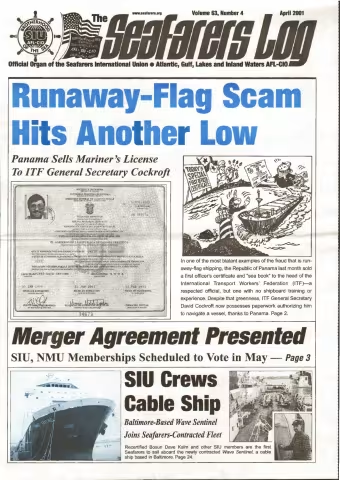
In one of the most blatant examples of the fraud that is run
away-flag shipping, the Republic of Panama last month sold
a first officer's certificate and "sea book" to the head of the
International Transport Workers' Federation (ITF)-a
respected official, but one with no shipboard training or
experience. Despite that greenness, ITF General Secretary
David Cockroft now possesses paperwork authorizing him
to navigate a vessel, thanks to Panama. Page 2.
Merger Agreement Presented
SIU, NMU Memberships Scheduled to Vote in May - Page 3
. --
SIU Crews
Cable Ship
Baltimore-Based Wave Sentinel
Joins Seafarers-Contracted Fleet
Recertified Bosun Dave Kalm and other SIU members are the first
Seafarers to sail aboard the newly contracted Wave Sentinel, a cable
_ ship based in Baltimore. Page 24.
---~._____~
President's Report
History on the Horizon
Can you believe it?
After more than 60 years of sailing toward the same port,
the members of the SIU and NMU are almost
there.
We are all gathered on the bridge, looking
past the bow, and we don't need binoculars!
The dock is in sight! We are coming home.
Next month, Seafarers and their counter
parts in the National Maritime Union will
Michael Sacco
have an opportunity to finalize a truly historic
event: the merger of the NMU into the SIU. Details, including
the full text of the proposed agreement, are printed on page 3
of this issue of the Seafarers LOG.
As the formal merger agreement is presented to both mem
berships, I am more convinced than ever that this unification is
the right move at the right time, for all concerned.
Members already are benefiting because our respective
unions no longer work against each other, as we often did
throughout the past six decades. As one union, we can concen
trate on more job security aboard new ships built in U.S. yards.
We can fight for better benefits and safer working conditions.
The rest of the industry will gain from this merger, too. First
and foremost, the merger will help build a bigger, more quali
fied manpower pool. In fact, those benefits already have begun
materializing since we first welcomed our NMU brothers and
sisters at the Paul Hall Center for Maritime Training and
Education in Piney Point, Md.
Another advantage-less obvious but very important-is
that instead of consuming our respective resources while bat
tling each other, the SIU and NMU instead will be better
equipped to take on the enemies of the American-flag fleet.
We will settle for nothing less than the true revitalization of
our merchant marine.
I have been overwhelmed by the positive responses from
SIU and NMU members since we started working together.
The good news has come from the school as well as the ves
sels on which SIU and NMU members have sailed together.
Seafarers have accepted and welcomed the NMU because we
are all mariners, dedicated to the same task.
Such camaraderie and cooperation is refreshing. As many of
you know, merger talks between our two unions date back all
the way to the 1960s, but none of those discussions produced
an alliance. Conflicts between us date back even further, to the
late 1930s. It's an interesting history that has been told many
times.
But now, a new chapter is being written. Throughout the
multi-step process involved in this merger, the great majority
of our members (and those of the NMU) have made it clear
that now is the time to come together.
I couldn't agree more. The merger means increased security
and stability for both memberships. It means we'll be better
equipped to meet the changing times that inevitably lie ahead.
It will help set a solid foundation for us in this new century.
The merger is an exciting, overdue step. I thank the mem
bers of both unions for their foresight and support throughout
the process. Let's bring the ship safely into our home port by
approving the proposed formal agreement next month.
Volume 63, Number 4 April 2001
The SIU on line: www.seafarers.org
The Seafarers LOG (ISSN 1086-4636) is published month
ly by the Seafarers International Union; Atlantic, Gulf,
Lakes and Inland Waters District; AFL-CIO; 5201 Auth
Way; Camp Springs, MD 20746. Telephone (301) 899-
0675. Periodicals postage paid at Southern Maryland
20790-9998 and at additional offices. POSTMASTER:
Send address changes to the Seafarers LOG, 5201 Auth Way
Camp Springs, MD 20746.
Communications Director, Jordan Biscardo; Managing
Editor/Production, Deborah A. Hirtes; Associate Editor, Jim
Guthrie; Art, Bill Brower; Administrative Support, Jeanne
Textor.
Copyright© 2001 Seafarers International Union, AGLIWD
All Rights Reserved.
2 Seafarers LOS
Meet '1st Officer Cockroft1
Panama Sells Phony Credentials;
ITF Further Exposes FOC Scam
For sheer size, the International Transport
Workers' Federation (ITF) exhibition ship Global
Mariner may have been the ultimate visual aid in
the fight against runaway-flag shipping. The con
verted cargo vessel early last year concluded a 20-
month, worldwide voyage that attracted nearly
three-quarters of a million visitors to its shipboard
presentation on runaway flags.
Last month, however, the ITF dramatically fur
ther exposed the flag-of-convenience (FOC) rip-off
with a single sheet of paper. The federation's gener
al secretary, David Cockroft, bought a first officer's
certificate (and "sea book") issued by the Republic
of Panama.
The paperwork authorizes Cockroft to navigate a
vessel and "deputize for its captain, despite his com
plete lack of marine training and skills," the ITF
noted.
"This is one of those situations where you don't
know whether to laugh or cry," said SIU Secretary
Treasurer David Heindel, who serves as second vice
chair of the ITF Seafarers' Section. "Obviously, it's
ridiculous that anyone could buy an officer's
license. Yet, that's the reality of runaway-flag ship
ping."
Cockroft's documentation didn't come cheap. It
reportedly took about $4,000 to secure his paper
work.
"This just proves- if more proof is needed-that
it is time to eliminate the culture of greed and cor
ruption rooted in the FOC system," Cockroft stated.
"However good international conventions look on
paper, they will never guarantee standards until ship
registers which exist solely to make money are dri
ven out of business."
VllDUINll.Tfn/l..<'\.I
~l'\--Of~ ' •
---~----~~ ... ~
Panama issued this first officer's certificate to ITF
General Secretary David Cockroft, despite his com
plete absence of marine training and skills.
'Slavery' at Sea?
Cockroft displays his newly bought mariner's cre
dentials. "It is time to eliminate the culture of greed
and corruption rooted in the FOC system," he says.
He further described runaway-flag shipping as
"an under-policed system that encourages bad oper
ators to undercut good ones .... It is courting human
and environmental disaster."
The SIU is one of 570 unions affiliated with the
London-based ITF. Altogether, those affiliates rep
resent more than 5 million members.
For more than a half-century, the ITF has fought
against runaway-flag or FOC shipping. An FOC
vessel is one that flies the flag of a country other
than the country of ownership. Shipowners who par
ticipate in the runaway-flag scam typically do so to
avoid taxes and regulations while employing cheap,
often unqualified labor.
Panama is the world's largest shipping register as
well as "one of 29 FOC countries that flag ships
owned by foreign businesses purely for profit," the
ITF reported. "Almost none of the 6,000-plus ships
registered in Panama are owned by genuine
Panamanian companies, staffed by Panamanian
crews or commanded by Panamanian officers. Its
ship registry has nothing to do with assuring safety
and responsible shipping, and everything to do with
making money."
Although Cockroft's licensing escapade contains
humorous undertones, it mainly highlights the
potential dangers of FOCs. Cockroft likened the
incongruous issuance of his officer's certificate by
Panama to "awarding a good-conduct medal to
Attila the Hun .... Do you want someone like me,
with no practical seafaring experience, steering a
ship full of dangerous chemicals or radioactive
materials off your coast, or plowing through the
same sea lanes as oil supertankers and crowded pas
senger ferries?"
The Seafarers' International Research Center at
the University of Wales is investigating the issuance
of fraudulent qualifications worldwide. Preliminary
findings revealed more than 12,000 cases of forgery,
the federation pointed out.
Year-Long Research
Yields Grim Evidence
velopment (OECD) which indi
cate that a given vessel's annual
operating costs can be slashed by
16 percent by dodging interna
tional safety requirements.
The commission offered
numerous recommendations, in
cluding stronger supervision of
classification societies by the
European Commission and
tougher policy application by the
societies to their clients; tighter
port state controls and implemen
tation of reward systems for qual
ity ships; severe penalties for
charterers and major shippers
using sub-standard ships; im
proved flag state performance,
and many others.
A new report by the
International Commission on
Shipping (ICONS) describes
"slave conditions" faced by thou
sands of mariners worldwide.
Titled "Ships, Slaves and
Competition," the report is based
on a year-long, global investiga
tion in which virtually every
component of the maritime indus
try had input, noted ICONS
Chairman Peter Morris, former
Australian transport minister.
"The obscenity is that the ben
eficiaries of the suffering include
some of the wealthiest individu
als and corporations on earth,"
Morris said in a news report.
"They need to be held account
able for the way their cargoes are
transported just as every other
industry is."
The commission said it gath
ered evidence that "tens of thou
sands of seafarers in 10 to 15 per
cent of the world's ships work in
slave conditions, with minimal
safety, long hours for little or no
pay, starvation diets, rape and
beatings. [ICONS] has been told
of crew who have disappeared
after complaints to officers, and
employer practices of blacklisting
sailors who complain to unions."
Substandard shipping "oper
ates because of a veil of secrecy
on ship ownership and support
from cargo owners seeking lower
freight rates at the expense of the
majority of quality ship opera
tors," the commission stated.
Along those lines, Morris cited
studies by the Organization for
Economic Cooperation and De-
Morris said those proposals
won't increase prices for most
shippers and consumers. "In fact
there is considerable evidence to
suggest that best practice will
result in cheaper prices through
reduced insurance costs, simpli
fied port inspections and shorter
turnaround times," he observed.
The full report is available via
the internet at www.icons.org.au.
ApTil 2001
SIU-NMU Merger Pact Presented
May Votes Slated for Both Unions North America.
From Dec. 1, 1999 through
Jan. 31 , 2000, SIU and NMU
members voted by secret ballot
on whether the unions should
proceed with merging. SIU mem
bers approved the resolution with
86 percent voting in favor of full
merger talks; in the NMU, 93 per
cent of those voting approved the
resolution.
proved two constitutional amend
ments related to the proposed
merger. Eighty-four percent of
those voting, approved the
amendment adding "NMU" to the
union 's full name; 87 percent
approved the amendment calling
for the addition of two executive
board slots. Those results were
affirmed by the Sill's rank-and
file tallying committee, whose
report in tum was approved last
month at SIU halls throughout the
country.
The SIU-NMU merger agreement will be presented for votes at the May membership
meetings of the respective unions, following the document's completion in late February.
If the agreement is approved, then this will be the final step in merging the NMU into the SIU's
Atlantic, Gulf, Lakes and Inland Waters District. In that event, it is anticipated that the merger's
effective date will be sometime in late spring or early summer.
If the agreement is not ap- The May votes-which will
proved, then a new one will be include NMU members voting on
negotiated and presented to the whether to accept the SIU consti
memberships. tution- represent the third step in
The full text of the agreement the merger process, as previously
is printed on this page of the detailed in several issues of the
Seafarers LOG. LOG. The process being used is
similar to the one implemented
during 1977-78 when the Marine
Cooks & Stewards (MC&S)
merged into the SIU. Like the
MC&S was in 1977, the NMU is
an autonomous union within the
Seafarers International Union of
During the most recent SIU
general election, from Nov. 1-
Dec. 30, 2000, Seafarers ap-
Text of SIU-NMU Merger Agreement to Be Voted on by the Memberships
AGREEMENT OF MERGER
WHEREAS, the Seafarers Inter
national Union, AGLIWD (hereinafter
referred to as "SIU") and the National
Maritime Union (hereinafter referred to
as "NMU") both represent unlicensed
seamen working aboard merchant ves
sels on the seas, the lakes and inland
waterways; and
WHEREAS, over the last several
decades, the commercial maritime
industry in the United States has been in
a state of flux which has impacted upon
the employment opportunities of the
collective membership of the SIU and
the NMU; and
WHEREAS, due to the unique
nature of the maritime industry, both the
SIU and the NMU have, over the years,
maintained separate union/hiring hall
facilities at various locations in the
United States, some of which are locat
ed in the same geographical areas, and
have negotiated separate and distinct
collective bargaining agreements with
the employers for whom their respective
memberships are employed, to enable
each union to represent its members;
WHEREAS, such a duplication of
resources and efforts does not efficient
ly serve the needs of either membership;
and
WHEREAS, as a result, the Execu
tive Boards of both the SIU and the
NMU met on several occasions to dis
cuss the possibility of merging and/or
consolidating operations and reached
agr~ement to pursue the matter; and
WHEREAS, the concept of merger
was presented, via referendum votes, to
the membership of both unions; and
WHEREAS, the membership of
both unions voted overwhelmingly in
favor of such a merger and authorized
their respective Executive Boards to
negotiate a merger agreement which
would set forth the proposed terms and
conditions of a merger between these
two unions; and
WHEREAS, the Executive Boards
of these unions have met and have
reached agreement on the essential
terms of a merger and now wish to cod
ify and formalize such agreement into a
document for the purpose of presenting
such document to the respective mem
berships of the SIU and the NMU for
their action;
NOW THEREFORE BE IT RE
SOLVED THAT, UPON MEMBER
SHIP APPROVAL, THE FOLLOWING
TERMS AND CONDITIONS WILL
BE INCORPORATED INTO AND
APPLIED TO THE MERGER OF THE
SIU AND NMU AND WILL GOVERN
THE NEW MERGED ENTITY:
1. NMU shall merge into and
become an integral part of the SIU.
2. The name of the merged entity
shall be the Seafarers International
Union, AGLIWD/National Maritime
Union (hereinafter referred to as
"SIU/NMU").
3. The terms and provisions of such
merger and of the continued existence
of the SIU/NMU, except as specifically
elaborated herein, shall be as set forth in
the Constitution of the SIU, as amended
by membership vote effective March
2001 , and which shall be the
Constitution of the merged organization
and shall be in the name of the
SIU/NMU. A complete and accurate
copy of the Constitution of the SIU, to
be submitted for approval to the mem
bership of SIU in March, 2001 , has been
April 2001
provided to the Executive Board of the
NMU prior to the signing of this
Agreement of Merger and shall be pub
lished to the membership of the NMU in
connection with their vote to approve
and accept this Merger Agreement.
4. The Constitution of the
SIU/NMU, as amended, shall govern
and set forth rights and obligations to all
such members. All NMU full book
members in good standing, possessing
such status under the pre-merger NMU
Constitution shall, subsequent to the
merger, become full book members of
the SIU/NMU. [Editor s note: Full book
membership has nothing to do with
seniority. They are separate issues. For
an explanation of the proposed seniori
ty system, see No. 8, in the next column.}
All SIU full book members in good
standing, possessing such status under
the pre-merger SIU Constitution shall ,
subsequent to the merger, become full
book members of the SIU/NMU. Non
full book members of the SIU/NMU
who are not eligible to become full book
members as of the date of the merger
shall have their membership rights sub
sequently determined by the provisions
of the SIU/NMU Constitution, provid
ed, however, that such non-full book
members shall receive credit toward full
book membership for all days of service
which they have accrued prior to the
effective date of this Merger Agreement.
Any and all moneys paid to NMU or to
SIU by non-full book members towards
the payment of the Constitutionally
mandated initiation fees as set forth in
the respective Constitutions of both
unions, shall be credited to such per
son's initiation fee obligation to the
SIU/NMU as provided in the SIU/NMU
Constitution.
5. For all purposes of the SIU/NMU
Constitution, the terms "good standing
or continuous good standing in the
Union" shall include such status of
members in the SIU and the NMU prior
to this merger.
6. Subsequent to the merger, the
SIU/NMU will commence a procedure
by which they will gain recognition for
the SIU/NMU from their various signa
tory employers as the exclusive bargain
ing representative for all SIU and NMU
collective bargaining units existing as of
the effective date of this Merger
Agreement. However, the pre-merger
job and seniority rights of SIU and NMU
members will not be affected by the
merger prior to the expiration of the
existing NMU Collective Bargaining
Agreement. (see paragraph 8 herein).
The terms and conditions of all SIU and
NMU collective bargaining agreements
in effect on the effective date of this
Merger Agreement shall remain in full
force and effect until their expiration
dates. Subject to Article X of the
SIU/NMU Constitution, contract
enforcement with respect to collective
bargaining agreements possessed by
NMU prior to the merger shall be, for
the duration of said contracts, under the
direction and supervision of the Vice
Presidents at Large referenced in
Paragraph 19 hereof.
7. The SIU/NMU shall , upon
approval of this Merger Agreement,
succeed to any and all SIU and NMU
rights in and to all NLRB certifications
and shall become the exclusive bargain
ing representative of all individuals
employed on former NMU and former
SIU contracted equipment. If deemed
necessary, motions will be submitted to
the NLRB for amendment of certifica
tion to reflect the merger of these
unions.
8. The job and seniority rights of
both SIU and NMU members are cur
rently contained in the shipping rules of
each union and are incorporated in the
aforementioned collective bargaining
agreements. Until such time that the
Executive Board of the newly formed
SIU/NMU decides otherwise, but no
sooner than the expiration dates of the
existing NMU collective bargaining
agreements, both sets of such shipping
rules shall continue to be maintained
and shall continue to be applied to
employment aboard the same vessels as
they were prior to the merger.
Accordingly, the job rights of all SIU
members as presently contained in the
SIU shipping rules shall, subject to the
provisions of such rules, continue in full
force and effect. Likewise, the job rights
of all NMU members as presently con
tained in the NMU shipping rules shall,
subject to the provisions of such rules,
continue in full force and effect. The
SIU's current contracted employers
shall constitute a separate unit for pur
poses of determining job or shipping
rights and the NMU's current contracted
employers shall constitute a separate
unit for purposes of determining job or
shipping rights. Former NMU members,
who by virtue of the merger become
SIU/NMU members, may register for
employment aboard former SIU con
tracted vessels and will be treated as any
other individual possessing C seniority
under the existing SIU shipping rules.
Likewise, former SIU members, who by
virtue of the merger become SIU/NMU
members, may register for employment
aboard former NMU contracted vessels
and shall be treated as any other indi
vidual possessing Class 3 seniority
under the existing NMU shipping rules.
Seniority shall then accrue in accor
dance with the particular shipping rules
under which the individual works.
9. The parties agree that, subsequent
to the merger, they will recommend to
the respective Boards of Trustees of their
existing pension, welfare and vacation
benefit plans that such plans shall not be
merged or combined in a manner that
would have an adverse impact on the
present participants of these plans (the
"Plans")' prior to June 15, 2007. The
parties further agree to recommend to
these Boards of Trustees to expeditious
ly initiate a study to determine the feasi
bility of establishing and implementing
reciprocity agreements between the
respective Plans to enable individuals
working under SIU/NMU contracts to
accumulate and combine credits
received under these Plans regardless of
their particular job assignment.
I 0. The parties also agree that, sub
sequent to the merger, they will recom
mend to the respective Boards of
Trustees of their existing "hiring hall
organizations"2 that such Trustees
should act towards merging these funds
to reduce and/or eliminate duplication
of expense and effort and to more effec
tively serve the needs and interests of
the combined membership of the newly
created SIU/NMU. In no event, howev
er, shall such merger take place prior to
the expiration dates of the existing
NMU collective bargaining agree
ments .. Upon the effective date of this
Merger Agreement all funds transmitted
to the NMU by the NMU Joint
Employment Committee will be trans
mitted to SIU/NMU.
11. The parties agree that subsequent
to the effective date of this Merger
Agreement, they will work toward coor
dinating and combining the activities of
the Transportation Institute and Labor
Management Maritime Committee.
12. The parties agree that subsequent
to the effective date of this Merger
Agreement, they will work towards
merging SPAD and NMU PLOW.
13.During the discussions leading
up to this merger agreement, the parties
acknowledge that they have each sub
mitted to the other certified statements
of their assets and liabilities, current as
of December 31 , 1999 and that both par
ties now represent that for the period of
time following such date, to the date of
execution of this Agreement, there have
been no appreciable changes in their
assets and liabilities; except as other
wise previously disclosed. In addition,
the NMU represents that it has no con
tractual liabilities except as set forth in
the aforementioned certified statements
or as listed in Schedule A to be provid
ed and attached hereto.
14. The NMU further agrees that it
will not incur any liabilities or make any
expenditure without the SIU 's consent,
except those that are necessary to con
tinue the routine and ordinary business
of the NMU during the period of the
vote on this Merger Agreement. The
term "routine and ordinary business of
the NMU" shall include the following
items of expenses and any other items
similar thereto:
• Salaries, withholding taxes and
employee fringe benefits
• Reimbursement of travel and other
legitimate business expenses
• Rent
• Telephone
e Per capita (SIU, AFL-CIO Mari
time Committee, SMART and ITF)
• Real estate and personal property
taxes
• Utilities
• Building maintenance
• Office supplies and postage
• Office equipment, supplies and sta
tionary, maintenance and repair
• Automobile
• Reproduction and printing
• Subscription and periodicals
• Interest expenses
• Newsletter publication costs
• Professional expenses including,
but not limited to legal and accounting
• Leases of office equipment
• Office furnishings
• Conference, seminar, convention
and meeting expenses
IS.In the event of approval of this
Merger Agreement, the NMU agrees
that such appro al will constitute an
assignment to the SIU/NMU of all of its
right, title and interest in and to all of its
assets (both real and personal property)
including but not limited to accounts
receivable and union monetary obliga
tions due from members and that the
NMU will act as soon as is practical
subsequent to the merger to take any
and all necessary actions to transfer
such rights and title to the SIU/NMU.
Upon approval of this Merger
Agreement, SIU/NMU shall assume full
responsibility for all financial obliga
tions of NMU including, but not limited
to, all expenses associated with the
administration and enforcement of all
NMU collective bargaining agreements
in effect on the effective date of this
Merger Agreement.
16.For the purpose of executing any
and all documents on behalf of the
NMU which may be required by any
person, firm , association, corporation or
governmental agency subsequent to the
effectuation of this merger for all NMU
acts and matters prior to such merger,
the authorized signators for NMU shall
be two current NMU officers as desig
nated by the present NMU President.
17. For the purpose of executing any
and all documents on behalf of the SIU
which may be required by any person,
firm, association, corporation or gov
ernmental agency subsequent to the
effectuation of this merger for all SIU
acts and matters prior to such merger,
John Fay and David Heindel, current
SIU officers, or the survivor, shall be
and are so authorized.
18. This Merger Agreement shall not
become effective unless and until a
majority of those SIU members so vot
ing and a majority of those NMU mem
bers so voting, vote to approve and
accept this Merger Agreement. In the
event that such approval is not granted
by a majority of each of the respective
voting members of the two unions, then
this Merger Agreement shall be deemed
cancelled, null and void and of no force
and effect.
19. The Constitution of the
SIU/NMU shall create two Vice
Presidential positions to be known as
'Vice-Presidents at Large'. Upon
approval of this Merger Agreement, as
specified in Paragraph 18 hereof, the
SIU/NMU National President shall
appoint two current elected NMU offi
cers, as recommended by the present
NMU President, to fill the newly creat
ed NMU Vice-President positions.
Thereafter, such individuals, or their
successors, shall continue to serve in
such capacity until the regularly sched
uled election of SIU/NMU officers held
in 2004. All other current elected NMU
officers shall continue to be employed
by SIU/NMU, in such capacity as the
General Executive Board shall deter
mine, for the balance of their current
NMU term of office.
20. It is hereby agreed and under
stood that all parties to this Merger
Agreement have negotiated its terms in
good faith with every intention to fully
comply with all provisions herein.
IN WITNESS WHEREOF, we have
made and executed this Agreement this
21 day of February 2001 .
ational
Maritime
Union
Seafarers International
International
Union, AGLIWD
1 The terms "existing pension, welfare, vacation and training and education plans" or "the Plans" refers to the following entities: NMU
Pension Trust (NMU Pension Plan); NMU Welfare Trust (NMU Welfare Plan); NMU Vacation Trust (NMU Vacation Plan); NMU Rivers Pension
Trust (NMU Rivers Pension Plan); NMU Rivers Welfare Trust (NMU Rivers Welfare Plan); NMU Upgrading and Training Plan; Seafarers
Health and Benefits Plan; Seafarers Pension Plan; Seafarers Money Purchase Pension Plan; Seafarers Vacation Plan; Seafarers Harry
Lundeberg School of Seamanship
2 The term "hiring hall organizations" refers to the following entities: NMU Joint Employment Committee; Seafarers Joint Employment
Fund.
Seafarers LOG 3
Senior members of the Page's SIU crew were on hand for the ceremo
ny. Pictured from left to right are Chief Steward James Okidd Jr., Bosun
Michael M. Moore and Chief Cook McKennly Jones.
Newark Bay Renamed
Ammunition Ship Conversion Complete
The U.S. Military Sealift
Command (MSC), during cere
monies Feb. 21 at the Norfolk
Shipbuilding and Drydock
Company in Norfolk, Va.,
renamed the SIU-crewed Newark
Bay to the Lt. Col. John UD.
Page, in honor of a Korean War
hero.
The vessel has been undergo
ing conversion from a commer
cial container ship to a self-sus
taining ammunition transporter at
the shipyard since October 2000.
With all required modifications
complete, it was delivered to
MSC March 1.
Patricia T. Holder, wife of
MSC Commander Vice Adm.
Gordon S. Holder, was the ship's
sponsor. She broke the ceremoni
al bottle of champagne on the
vessel's hull, officially naming it.
Adm. Holder was the keynote
speaker.
As previously reported, the
conversion was part of a transac
tion in which the SIU is gaining
two ships.
Col. Page, an Army officer,
posthumously was awarded the
Medal of Honor for his actions
from Nov. 29 to Dec. 10, 1950,
near Chosin Reservoir, Korea.
The colonel received the mission
of establishing traffic control on
the main supply route to the
Chasin Reservoir Plateau. After
completing his mission, he had
two opportunities to vacate the
combat zone. But rather than
leave, he remained in the area to
assist an isolated signal station,
which had been cut off from a
U.S. Marine division.
Col. Page trained a reserve
force of assorted troops-Army
and Marines-to defend an
improvised airstrip. He continued
to fight courageously until he was
mortally wounded.
"Today, we again honor that
heroism, that patriotism, as we
name this great ship," said Adm.
Holder during his keynote
address. "I am sure she will live
up to her name, going in harm's
way if necessary, to deliver the
ammunition the Army needs to
carry out its worldwide mission."
The Page and its sister ship,
the SIU-crewed Sgt. Edward A.
Carter Jr.-scheduled for deliv
ery to MSC in June-will carry
all of the Army's containerized
prepositioned ammunition by the
end of this year. Each vessel will
carry a total of2,500 20-foot con
tainers-2,230 under deck and
270 in a cocoon above deck. Both
cargo areas will be air condi
tioned and dehumidified to pro
tect the ammunition.
The Page has four cranes on
deck that allow the vessel to load
and off-load ammunition without
shoreside cranes. According to
MSC, this critical feature gives
the Page the flexibility to off
load in undeveloped ports.
The 949.8-foot vessel is
owned and operated by Maersk
Lines Ltd. ofNorfolk, Va. under a
five-year charter to MSC. The
Page will operate from the Diego
Garcia area in the Indian Ocean.
The Page was one of two for
eign-flag cargo vessels which
were reflagged under the Stars
and Stripes in mid-2000 and
tagged for conversion to use as
ammunition ships under a five
year operating agreement to
Maersk by MSC. The OOCL
Innovation was the second vessel.
After being reflagged, the
Innovation initially (Aug. 6,
2000) was renamed the Sealand
Oregon. Today it is the Sgt.
Edward A. Carter Jr.
Maersk Line Limited, based in
Norfolk, operates about two
dozen SIU-crewed vessels for
MSC and in the Maritime
Security Program. Its Seafarers
crewed fleet includes container
ships, roll-on/roll off preposition
ing vessels and T-AGOS ships.
The remaining SIU crewmembers joined Bosun Michael M. Moore, left,
following the ceremony. Pictured with Moore (from left) are AB Carlos
Perrilla, AB George Mareo, AB Ed Jaynes, AB Steve Westfall and AB
Don Manrick.
4 Seafarers LOG
Tacoma Hall Withstands Earthquake
While many residents of the Pacific Northwest
were being shaken into a frenzy by a Feb. 21 earth
quake, which sent debris crashing to the ground in
some areas, it was pretty much business as usual at
the SIU hall in Tacoma, Wash.
"We did evacuate our building," said Jamie
Overby, safety director at the West Coast hall . "But
we did not experience any damage at all to our facil
ity, and no one was injured.
"We were fully staffed that day, and I think we
actually were pretty fortunate because our building
is not located around any high-rise structures,"
Overby continued. "The other thing is that everyone
responded very well. They all got out of the build
ing and assembled in the parking lot just like they
were supposed to. They all knew exactly what to
do."
The SIU's Tacoma hall is located at 3411 South
Union Ave. It opened in 1996. Previously, the union
operated a hall in Seattle.
The February quake hit at 10:55 a.m. and mea
sured a 6.8 magnitude, officials at the U.S.
Geological Survey said. The rumble's epicenter was
35 miles southwest of Seattle, according to data
released by the West Coast and Alaska Tsunami
Warning Center in Palmer, Alaska, and was felt as
far away as Portland, Ore. Published reports say fol
lowing the quake, a crack was visible in a column at
the capitol dome in Olympia, about 10 miles from
the epicenter.
"We are located about 15 miles from Olympia,"
said Overby. "But still it shook us around pretty
good, the whole building was shaking. To me it felt
like the bow of a ship hitting a big wave and shak
ing the house."
Brenda Belia, an administrative specialist at the
Seafarer Brian Burchett completes paperwork at the
SIU Hall in Tacoma, Wash., shortly after the Feb. 21
earthquake.
The SIU Hall in Tacoma, Wash. withstood the fury of
the Feb. 21 earthquake, which measured 6.8 in
magnitude.
hall, shared Overby's appraisal of the event and
added, "It scared the living daylight out of me! I was
born and raised here and have always felt the small
tremors, but this one really was bad. It kept going
and going- it lasted for about 20-30 seconds.
"But the building held up great," she continued.
"The pictures on the wall were crooked, but other
than that, we had no problems."
A pair of aftershocks agitated Olympia and
Tacoma twice more Feb. 22. The first- a 3.4 mag
nitude quake-occurred at about 1: 10 a.m., while
the second came around 6:23 a.m. The latter after
shock was a 2.7- magnitude rumble. Both were cen
tered near the location of the original quake.
While no one was killed during the original
quake or aftershocks, Washington state officials say 1
the underground eruptions were responsible for 300
injuries, some serious. Utility officials estimated
that 17 ,000 of its 3 50,000 customers in Seattle were
without power. Damage to property in the Seattle
Tacoma-Olympia area was estimated in the billions.
Health Plan ID Cards Slated for Distribution
New identification cards soon will be in
the hands of Seafarers Health and Benefits
Plan participants.
Intended to better serve the needs of eli
gible members and their families, the cards
will be made of a high-quality plastic com
posite. They will be packaged and mailed
out in much the same fashion as credit
cards, according to Plan Administrator Lou
Delma.
The new forms of identification will
contain routine data such as bearers'
names, Social Security numbers, and insur
ance contacts. Health providers typically
require such information to verify cover
age.
The cards were scheduled to be mailed
in early April.
The Seafarers Health and Benefits Plans
is the new name for the Seafarers Welfare
Plan. The name change was announced last
year by the plan's board of trustees.
Eligible SIU members will receive medical
identification cards like the one pictured at
right for themselves and their families.
This card does not guarantee coverage
Qii or confirm eligibility.
Member's Name Printed Member's SSN
• Red Cross Honors Jim Hanson . . . . . . .......... Page 9
• More on STCW Requirements .................. Page 11
• Upcoming Paul Hall Center Courses . . . . . . . . . . . . . Page 21
April 2001
Dangerous Mexican Trucks
Threaten U.S. Road Safety
remain unresolved, and that the
United States is ill prepared to
handle the massive influx of for
eign traffic that would result from
opening the border. A substantial
majority in Congress has publicly
expressed serious concerns over
safety and strong opposition to
implementing the NAFTA cross
border transportation provisions
until these safety concerns have
been effectively addressed."
Texas Safety Official: 'We Only Inspect
The Ones That Look Really, Really Bad'
The 1998 DOT report con
cluded that the agency lacks a
consistent enforcement program
that provides reasonable assur
ance of the safety of Mexican
trucks entering the United States.
There are numerous problems
across the border, too. The report
also stated that Mexico did not
have in place: regulations or prac
tices for hours of service; a drug
and alcohol testing program; a
program to conduct safety inspec
tions of commercial vehicles at
the roadside and on carrier prop
erty; a carrier/driver database
with economic and vehicle
licensing information; a drivers'
licensing module with dri'ver
licensing data; and a safety mod
ule with accident, infraction and
inspection data. Further, Mexico
had not announced a time frame
for implementation of a safety
management oversight program
for Mexican motor carriers with
U.S. operating authority.
Yet another regrettable aspect
of the so-called North American
Free Trade Agreement (NAFTA)
is at the fore as Mexico presses
for complete access to United
States highways.
The U.S. did not meet the
NAFTA-imposed March 8 dead
line for opening all U.S. roads to
Mexican trucks, but U.S. officials
reportedly are working toward a
policy on the issue.
The AFL-CIO executive coun
cil (on which SIU President
Michael Sacco serves) recently
spelled out the myriad safety
issues related to Mexican cross
border trucking. The federation
insisted that American lives will
be imperiled by completely open
ing U.S. borders.
As Teamsters President James
P. Hoffa wrote March 13 in a
nationally published op-ed piece,
"With 4 million (Mexican) trucks
crossing the border with sub-par
equipment, overworked drivers
struggling to support families on
often-meager wages, and the U.S.
able to inspect fewer than 1 per
cent (of those trucks), it won't be
long before an unsafe Mexican
truck kills a U.S. family."
On Feb. 6, a NAFTA dispute
resolution panel ruled that the
United States must end its current
moratorium on considering
Mexican applications for cross
border trucking privileges and
must consider these applications
Not Over Yet
on a case-by-case basis. Failure to
do so could result in compensat
ing Mexico through higher tariffs
on goods or services going there.
However, as pointed out by the
labor federation, Mexican truck,
bus and driver safety standards
are still significantly below those
in the United States, and U.S.
inspection and enfor9ement pro
grams are not adequate to assure
the safety of American highways.
A report last month by the
Associated Press highlighted the
problem's scope. For the past six
years, Mexican rigs have had
access to U.S. border states, up to
20 miles. Millions of foreign
trucks enter the country each
year, with the vast majority com
pletely uninspected.
A spokeswoman for the Texas
Department of Public Safety told
an AP reporter, "We only inspect
the ones that look really, really
bad. Like, 'Oh my God, how's
that gonna stay together?' We're
only taking the worst of the
worst."
The newspaper story further
states that only one of every 100
rigs is checked. Nearly half of the
vehicles inspected last year were
removed from service because of
various mechanical flaws, unse
cured loads and other safety
issues.
Hoffa noted that cross-border
trucking carries numerous con
cerns, starting with drivers'
Steelworkers Steadfast
In NAnA Court Battle
The United Steelworkers of America (USWA) on March 2 vowed
to take their federal court fight against the constitutionality of the so
called North American Free Trade Agreement (NAFTA) all the way to
the U.S. Supreme Court.
Their pledge followed a ruling by the 11th U.S. Circuit Court of
Appeals in Atlanta rejecting the union's suit against the pact. The court
described NAFTA as "a non-justiciable political question" that courts
should not manage.
The USWA, which first challenged NAFTA in court in the summer
of 1998, contends that the agreement's ratification didn't meet the
United States Constitutional requirement of two-thirds support by the
U.S. Senate. Article II, Section 2 requires that "two thirds of the
Senators present [must] concur" with any treaty negotiated by the
executive branch of government.
President Clinton formally labeled NAFTA an "executive agree
ment."
According to the most recent data available from the U.S.
Department of Labor, more than a half-million U.S. workers have been
certified under one NAFTA unemployment program - meaning they
lost their jobs due to NAFTA. Those workers represent only a fraction
of the total U.S. jobs lost because ofNAFTA.
Merchant Marine Panel Named
Chairman Bob Stump (R
Ariz.) and ranking member Ike
Skelton (D-Mo.) of the House
Armed Services Committee last
month announced the members
of the Special Oversight Panel
on Merchant Marine.
Chairing the panel in the
107th Congress is Rep. Duncan
Hunter (R-Calif.). Other Repub
lican members are Reps. Curt
Apri/2001
Weldon (Pa.), Jim Saxton (N.J.),
Walter B. Jones Jr. (N.C.), An
drew Crenshaw (Fla.) and Jo
Ann Davis (Va.).
Rep. Tom Allen (D-Maine)
is the panel's ranking member.
Other Democrats serving on the
panel are Gene Taylor (Miss.),
Adam Smith (Wash.), and
James Maloney (Conn.).
rights. "Mexican drivers have no
basic worker protections," he
wrote. "U.S. drivers keep log
books and are limited to driving
10 hours a day. Mexicans have no
such rules and often pull shifts of
18 hours or more. U.S. drivers are
also subject to Department of
Transportation (DOT) physicals
and random drug tests, while
employers in Mexico offer no
such protection for workers or the
public."
Another key facet of this issue
is drug trafficking, the Teamsters
president asserted. "Drug lords
are salivating with anticipation of
an open border, buying up
Mexican truck firms and dream
ing of tractor-trailers full of hero
in and cocaine making deliveries
across our heartland."
Teamsters President James P.
Hoffa warns that the combination
of inadequate inspections and
unsafe Mexican trucks entering
the United States threatens the
safety of U.S. citizens.
In a resolution issued in
February, the AFL-CIO executive
council cited studies by the DOT
and the U.S. General Accounting
Office (GAO) which "concluded
that far too many safety hazards
The federation concluded by
calling on the Bush administra-
tion and Congress "to keep the
border closed to unsafe truck and
bus traffic until comprehensive
safety standards are agreed to and
enforced by both nations, com
prehensive and adequately tested
enforcement programs are in
place, and financial resources
have been committed to establish
dedicated border inspection facil
ities and to staff them adequately
with full-time personnel.... The
safety of American highways
should take precedence ....
Whatever sanctions the United
States may face as a result will be
a small cost to protect American
lives on our highways."
Legislation Introduced in House
To Rescue U.S. Steel Industry
In an effort to stem the tide on foreign-subsidized
steel exports to the U.S., which already have sent 16
steel firms into bankruptcy and threaten other firms
and more than 200,000 American jobs, a steel res
cue package has been introduced in the House of
Representatives, where it has been referred to the
House Ways and Means Committee.
The legislation (H.R. 808), introduced March 1
by Reps. Peter Visclosky (D-Ind.), Jack Quinn (R
N.Y.) and other members of the Congressional Steel
Caucus, is aimed at providing certain safeguards for
the domestic steel industry, including rolling back
the high levels of foreign-subsidized steel that are
being imported-and dumped-into this country.
"The steel industry and its workers have been
fighting for their lives for the past three years," stat
ed new United Steelworkers of America (USWA)
President Leo Gerard at a recent press conference
with lawmakers. He demanded that President
George W. Bush, a staunch advocate of free trade,
take the necessary steps to impose quotas, tariff sur
charges and other necessary actions to alleviate
some of the more damaging effects of the govern-
ment's trade policies allowing "offshore dumping"
of steel. He stated that a "comprehensive policy to
prevent the industry's collapse and ensure its future
in a global economy" is needed, and named his
immediate predecessor, George Becker, to head the
lobbying effort.
Labor productivity in steel has increased by 174
percent since 1980, Becker noted, while real wages
have remained the same.
The package, backed by more than 80 House
Republicans and Democrats, is designed to:
• Limit steel imports for five years, setting them
at pre-1998 levels;
• Establish a trust fund, paid for by a 2 percent
surcharge on all steel sold in the U.S., to pay retiree
health benefits;
• Establish a $10 billion load fund, with govern
ment loan guarantees, to let the industry revitalize;
and
• Provide grants to pay for environmental compli
ance costs for plants that maintain target levels of
employment and production.
On Paper, MarAd Tests RRF Crewing
Personnel from the SIU's
manpower office and union halls
will participate this month in a
drill conducted by the U.S.
Maritime Administration (Mar
Ad) to test the procedures, peo
ple and communications equip
ment involved in Ready Reserve
Force (RRF) activations.
MarAd's "Command Post
Exercise Breakout 0 I" is sched
uled for April 16-27. In a letter to
SIU President Michael Sacco
requesting the union's "strong
support" for the experiment,
Acting Deputy Maritime Ad
ministrator Bruce J. Carlton
noted, "As in the past, this will
be a paper exercise only and
mariners will not be required to
actually report to their ships."
Carlton indicated the overall
objective of the exercise is "to
test the procedures and coordina
tion necessary to activate the
RRF to meet strategic sealift
requirements.... Using their
existing collective bargaining
agreements and manning scales
based on the current contract,
MarAd's RRF ship managers
will call out full crews to be
assigned to specific RRF ships
during the exercise period .... It
is my desire that Breakout 01
will once again serve to confirm
the effectiveness of civilian
crewing of reserve sealift
assets."
This is the ninth in a series of
similar exercises conducted by
MarAd. For the SIU, the task
means frequent contact between
the manpower office and the
union halls.
For MarAd employees, the
assignment will provide refresh
er training (for experienced staff
members) or orientation (for
newcomers) for activation proce
dures.
Please be advised that SIU headquarters and all
SIU hiring halls will be closed Monday, May 28, 2001
for the observance of Memorial Day
(unless an emergency arises).
Normal business hours will resume
the following workday.
Seafarers LOG 5
Seal arers Seek Good-Faith Negotiations With ITT Navy Base Unit
"
,fil
Seafarers working for ITT at the U.S. Naval Station Roosevelt Roads in Puerto Rico are joined by other SIU
members in a peaceful, informational picket line. ITT has refused to honor the workers' contract or to negoti
ate a new one. One of the signs reads "ITT: The Grinch That Stole Christmas,'' referring to the fact that the
company did not give the employees their Christmas bonus.
Scholarships Announced for ASC Mariners
In SIU's Unlicensed Apprentice Program
In an effort to recruit well
trained and highly qualified
mariners to serve aboard the ves
sels operated by SIU-contracted
American Steamship Co. (ASC)
on the Great Lakes, the company
has set up a new scholarship pro
gram.
The scholarships are designed
to help disadvantaged, worthy
candidates attend the unlicensed
apprentice program at the Paul
Hall Center for Maritime Training
and Education in Piney Point, Md.
While there is no tuition for
this program, and room and board
are free, other expenses (trans
portation to and from the school,
clothing costs, the U.S. Coast
Guard fee and routine pre-entry
medical screenings) typically
amount to around $1,000. These
are the costs that will be covered
(up to 80 percent) for each select
ed applicant.
For ASC, the scholarship pro
gram is an important recruitment
and retention tool. ASC's scholar
ship will cover students in all
three phases of the program. The
Unlicensed apprentices honor the
U.S. flag at the end of the day.
Great Lakes 2001 Season
Off to an Early Start
Thawing out from a frigid
winter, the Great Lakes are once
again seeing the start of a new
shipping season as SIU members
begin boarding the vessels and
readying them for their loads-a
process known as fitout.
Inland Lakes, a company that
manages a fleet of bulk cement
carriers hauling products for the
Lafarge Corp., notes that the
Alpena came out of winter layup
March 1 and already is carrying
cement from Alpena to South
Chicago. Another Inland Lakes
vessel, the J.A. W. Iglehart, is
expected to sail April 1, and the
Paul H Townsend, which wrapped
up its season last November, will
sail shortly thereafter.
The tug Susan W Hannah and
barge Southdown Conquest were
upbound in the St. Clair River
early last month, and four of
American Steamship Co. 's (ASC)
boats scheduled their fitouts in
early March as well: the Indiana
Harbor, Walter J McCarthy,
John J Boland and American
Republic.
Other ASC vessels (H Lee
White, Buffalo, A.E. Cornelius,
American Mariner, Sam Laud and
St. Clair) have tentatively sched
uled their fitouts later in the
month. (By the time this issue of
the LOG has been printed and
mailed, most of these boats will
already have started sailing.)
company additionally will help
the SIU in recruiting candidates
for the program, but ASC will
select the scholarship recipients.
ASC's direct involvement in
creases the likelihood that the
scholarship recipients will even
tually work aboard ASC vessels.
The unlicensed apprentice
program includes an initial 12-
week training session at the
school covering the basics, fol
lowed by a 90-day practical train
ing and assessment period that
takes place aboard a U.S.-flag
ship (aboard an ASC vessel in the
case of the scholarship recipi
ents). Finally, students return to
the center for department-specific
training that prepares them to
begin sailing aboard SIU-con
tracted vessels.
In a letter from ASC Senior
Vice President David A. Schultz
to SIU President Michael Sacco,
the vice president notes that this
program is a "joint company/
union partnership leading to a
continued developing workforce
where labor and management are
working hard together for our
combined futures."
Last summer saw low water
levels on the lakes, and this year
is not going to be any better,
experts say, even though the
snowpack around the Great Lakes
is thicker this winter than a year
ago. Thornton noted that the
water level is already 15 inches
lower outside the union hall on
the St. Clair River than it was this
time last year.
Right: OS Robert Said
and AB James Werda
tie up the Alpena in
Detroit.
Informational picket lines went up around the U.S. Naval Station
Roosevelt Roads last month as Seafarers showed their support for SIU
members working for ITT on that base, located at the eastern edge of
Puerto Rico. ITT is refusing to renegotiate their contract.
The 48 MOE (Marine Ocean Engineering) Seafarers at the ITI unit
work on torpedo recovery vessels. They set the targets for naval exer
cises and, after the Navy has fired at the targets, reset them. They also
perform maintenance on the vessels.
ITT is refusing to honor the present contract, which has already
been extended several times, nor will they pay a Christmas bonus or
negotiate a new agreement.
•
Helping distribute informational
materials pertaining to ITT's
refusal to negotiate a new con
tract for the MOE Seafarers are
(clockwise from top left) AB
Joseph Hubert, Pensioner Luis
Roman, OMU Orlando Herrera
and AB Victor Pacheco, SIU Port
Agent Victor Nunez and AB Noel
Otero.
• , .
The early starting dates for the
2001 season are due to higher
customer demand, according to
Walter Watkins, fleet captain
from Inland Lakes.
According to SIU Algonac
Port Agent Don Thornton, the ice
covering the lakes dissipated
quickly. He noted that Lake Erie,
which was frozen in January, was
ice-free by early March.
Left: Securing the self-unloading system on board the Alpena are Assistant Conveyorman Fred Hart, AB
Dan Hart and AB Roland Lindemuth. Right: AB Dan Hart, Conveyorman Josh MacNicol and Assistant
Conveyorman Fred Hart connect the self-unloading system at the Lafarge Cement Terminal in Detroit.
6 Seafarers LOG April 2001
Stewards:
Upgrading Is Essential
The SIU's newest class of
recertified stewards graduated
last month at the Paul Hall Center
for Maritime Training and
Education in Piney Point, Md.
Each of the dozen Seafarers in
the class offered strong praise for
the school, with several describ
ing it as vital to the long-term
success of fellow members.
Graduating at the March mem
bership meeting were Pablo Al
varez, Stephen Avallone, Joseph
Birke, Joseph Gallo Jr., Carlton
Griffm, Michael Kozak, Stanley
Krystosiak, Robert Mensching,
Susan Moe, Benedict Opaon,
Scott Opsahl and Robert Wilcox.
The month-long course is con
sidered the Paul Hall Center's top
curriculum for steward depart
ment Seafarers. Among other
studies, it includes fire fighting
and basic safety training, various
lessons in the galley labs, a trip to
AFL-CIO headquarters in
Washington, D.C. and meetings
with SIU department representa
tives at the union's headquarters.
Alvarez, who sails from the
port of Houston, said he appreci
ates the opportunities he has
enjoyed in the SIU. The native of
Honduras told the audience, "If
you work, it doesn't matter where
you come from-you're wel
come in the SIU."
Like his classmates, Avallone
has upgraded numerous times at
Piney Point. "The advantage we
have as a union involves our train
ing and professionalism," he said.
"We must to continue to meet and
exceed the training [require
ments] of the global market.
"My hat is off to our instruc
tors and officials for the stand-up
job they have done," added
Avallone, whose home port is
Wilmington, Calif. "Their vision
ary path has given us as mem
bers, choices in our careers."
Birke, from New Orleans,
encouraged the unlicensed
apprentices in attendance. He
said that, by utilizing the school
and doing a good job aboard ship,
they can enjoy bright careers as
Seafarers.
Gallo delivered heartfelt and
impassioned remarks describing
his feelings about the union.
"There's no greater love than a
man who will lay down his life
for his brother. That is the SIU,"
said Gallo, who sails from the
port of New York.
On behalf of the entire class,
Gallo also presented Paul Hall
Center Executive Chef Romeo
Lupinacci with an honorary
plaque, thanking him for his
guidance.
A Seafarer for more than 20
years who sails from the port of
San Francisco, Griffin said he
recommends upgrading because
"the more information we have,
the better we'll be able to do our
jobs aboard ships."
He said the fire fighting and
water survival training were the
most interesting parts of the
recertification class. "My overall
experience was very informative
and enjoyable."
Kozak, whose home port is
New York, said he is "very proud
to be a part" of the union and the
school. "The level of education in
our industry is soaring. It's
important to keep up," he added.
Another class member who
sails from New York, Krystosiak,
said he particularly enjoyed
"learning about the inner func
tions of the union and the various
plans."
Students participate in, and observe, CPR and first aid training.
April 2001
Recertified stewards and SIU officials meet on stage after last month's membership meeting in Piney Point,
Md. Pictured from left to right are Robert Wilcox, Scott Opsahl, SIU Plans Administrator Lou Delma, Stephen
Avallone, Benedict Opaon, Michael Kozak, SIU VP Contracts Augie Tellez, Joseph Gallo Jr., SIU Asst: VP
Contracts George Tricker, SIU President Michael Sacco, Paul Hall Center VP Don Nolan, Joseph Birke,
Susan Moe, Pablo Alvarez, SIU Secretary-Treasurer David Heindel, Carlton Griffin, and Stanley Krystosiak.
Not pictured is Robert Mensching.
He described the school as
"the best training facility in the
world. The classes were helpful
and the instructors were great ....
Upgrading is no longer optional.
We must continue to hone our
skills in order to maintain a com
petitive edge in the shipping
industry."
From the port of Honolulu,
Mensching said, "I always seem
to learn something new at the
school. And I recommend
upgrading to my fellow
Seafarers, to further their careers
as well as their education."
He added, "I was pleased to
find out there are so many people
working behind the scenes to
benefit the maritime industry. It
looks like they are succeeding, as
the potential for growth is great."
Moe, also from Honolulu, said
the curriculums as well instruc
tors greatly have improved during
the past 10 years. "I'm sure in the
coming years, it will just get bet
ter and better.... Upgrading at
Piney Point is essential to the
industry to better yourself and
keep abreast of new industry
standards."
Opaon, whose home port is
Wilmington, said that hearing
about the upgrading programs at
Piney Point encouraged him to
join the SIU in 1984. Now, hav
ing upgraded four times at the
school, "I am very confident and
ready to face the challenges of the
future.
"I strongly suggest and recom
mend these courses to all my
brothers and sisters, for their per
sonal improvement," he contin
ued. "Take advantage of the good
intention of the SIU leadership."
Opsahl, who sails from the
port of Tacoma, Wash., said he
"enjoyed coming back and seeing
the progress the school has gone
through, and its plans for the
future."
He said there is ample motiva
tion for upgrading. "You have to
keep current with your endorse
ment or you'll be left behind,
especially with STCW. You also
increase your opportunity to ship
out on ships that require certain
endorsements. And, while
upgrading, you have a chance to
bump into an old friend and
maybe collect that $20!"
Joseph Gallo Jr. says he strongly
believes in the Brotherhood of the
Sea.
From Jacksonville, Fla.,
Wilcox said the course contained
numerous highlights, including
menu planning, CPR and first aid,
sanitation, and computer training.
"I'm proud to be a member of
the SIU," he said. "Our school is
state-of-the-art with its training
facilities and staff. I am thankful
that our leadership has had the
foresight to keep expanding our
training facilities."
'Mysterious' Cook-Off Unfolds at Piney Point
During their stay at the Paul Hall Center, the recer
tified stewards took part in a "mystery basket cook
off' Feb. 9 designed to test and enhance their respec
tive skills.
According to the guidelines for the friendly contest,
a mystery basket is "a container of set ingredients from
which each team will be writing a menu and prepar
ing a meal. Everyone receives the same ingredients and
has the same amount of time to work, so this is a true
test of your creativity, skill and teamwork."
The Seafarers divided into six teams of two apiece.
They each had three hours to prepare a menu and full
course meal. Judging was based on finishing time, fla
vor, appearance and originality.
"Any of the dishes would make you proud of our
people's abilities and creativity," said one observer.
"This is what makes the steward department the main
source of a happy crew."
The team of Joseph Gallo Jr. and Michael Kozak
won the extremely close competition.
With the ingregients they were given, the team of
Stanley Krystosiak and Pablo Alvarez begins work
on their four-course meal.
Seafarers LOG 1
'Thanks, Seafarers!'
Longtime SIU Member Credits SARC
For 'Tremendous Boost, New Life'
Editor s note: This article was
written by an SIU member who
joined the union in the early
1970s. In keeping with the spirit
of recovery, it is anonymous.
The Seafarers Addiction Re
habilitation Center (SARC) for
mally began operating in early
1976. Any SIU member who
meets the eligibility requirements
for the Seafare rs Health and
Benefits Plan (formerly named
the Seafarers Welfare Plan) also
is eligible for treatment- at no
cost-at the SARC.
The first step is to contact your
port agent. Your confidentiality
will be respected.
An estimated 2, 000 SIU mem
bers have participated in the
SARC program.
It is with total gratitude that I
write this open letter to both the
leadership, and as importantly,
the membership of the Seafarers
International Union. In an effort
to say thank you to the union for
what they have given me, I've
decided to reflect back over the
past 25 years and take an honest
look at the changes that have
come over me.
On April 12, 1976, I reached
out to the Seafarers for help with
my drinking problem. I had final
ly reached such a low that there
really was no other way for me to
go. My days were filled with a
constant effort to stay under the
influence of alcohol primarily,
but on occasion any other drug
that was available to help me
escape.
No one has asked me or told
me that I should share with all of
you my story, but I feel com
pelled to do so. There's a very
good chance that some of the
people that started to read this let
ter have already turned the page
and moved on to something else.
Some people just aren't interest
ed. Then, there are those other
folks that just don't want to hear
about it. They are my kind of peo
ple. That's exactly what I would
have done. It's also the most nat
ural reaction to liave if you have
the disease that I have. The most
common symptom of the disease
is the denial of the disease.
Believe it or not, I was the last
one to know that I had a drinking
problem.
My behavior at times was very
unpredictable, and I frequently
discovered that I was in one kind
of trouble or another. At age 18, a
judge suggested very strongly
that I get help with my drinking
B Seafarers LOB
problem and he recommended
that attendance at Alcoholics
Anonymous might be a good
place to start. His suggestion
came in the form of a court order,
so I figured maybe I should check
it out.
I surely was relieved to learn
that I wasn't as bad as those folks .
I mean I had never lost a wife, or
a home, or a business. I had never
even gotten fired from a job
because of my drinking (I'd quit
before they could fire me).
After listening to all their tales
of woe, I felt a tremendous sense
"There is no shame
in needing and ask
ing for help. The
real shame is in
needing help and
not asking for it. "
of relief. I mentioned to one gent
on my way out the door that, for
tunately, I wasn't as bad as they
were, and how my drinking prob
lems were very minor compared
to the people I had just listened
to. His response to me wasn't
quite what I was expecting. He
suggested that if I was in fact an
alcoholic, all that I needed to do
was keep on drinking and all the
things that hadn't happened to me
yet, would in the course of time.
Less than two years later, I had
arrived.
At that point in my life, my
biggest consequences from drink
ing were an occasional night in
jail, a car accident, or a break-up
with a girlfriend if she nagged me
about my drinking (I'd dump her
before she could dump me). I
always focused on the problems
other people had with their drink
ing, minimizing my own. This
allowed me to justify a continu
ance, and shifted the focus away
from me.
I heard some time ago that
over 2,000 people have had the
opportunity to go through the
Seafarers Addiction Rehabilita
tion Center (SARC) since its
inception. I've often wondered if
I was the only beneficiary of this
wonderful facility who was lucky
enough to have received the gift
of a fresh start. I know better.
Without the strong foundation,
and the education about my
addictive personality, coupled
with the active involvement with
area AA groups, my chances of
continued sobriety would have
been significantly reduced.
I can't emphasize enough the
tremendous boost the SARC gave
to me when it was time for me to
start my new life. The profession
alism of the staff, the comfortable
and peaceful facilities, and the
first class support of the union
officials are benefits and luxuries
only offered to a small percentage
of people contending with the
disease of alcoholism. Most peo
ple don't have the opportunity to
receive treatment.
The SIU has, in my opinion,
settled for nothing less than the
best in the administration and
staffing of the SARC. The devo
tion to the whole person, and the
utilization of all the important
resources, substantially boosted
my ability to make the needed
changes in my lifestyle. Also, I
know how important confiden
tiality is to the continued success
of this treatment center and that is
precisely the reason I am choos
ing to remain anonymous in my
letter.
I don't think I'm any better
than anybody else, I don't think
I'm any worse either. I do believe
that I'm better than I used to be.
In other words, I'm not the man I
want to be, I'm not the man I
ought to be, but best of all, I'm
not the man I used to be.
I don't know how many peo
ple I have heard speak over the
years about their alcoholism.
Many talk about the effect their
occupations had on its severity. I
always chuckle to myself and
wonder if they would believe me
if I told them some sailors have
also been rumored to drink a bit
more than their fair share ....
Washer-Dryer School, Spin
Dry, The Farm-no matter what
the uninformed people call this
wonderful facility, the SARC, I
know the percentage of people
that go through a treatment facili
ty and remain clean and sober for
any length of time is very small.
When you add to this the fact that
a merchant mariner is, by the
very nature of his/her job,
required to be in an almost con
stant state of motion, it can also
serve to erode the odds.
When you are given a good
base to build on, and you walk
out the door with your dignity
restored, your chances of success
are greatly increased. With AA
spread all over the world, contin-
ued involvement at meetings
greatly increases the likelihood of
a sober life.
At 21 years of age, the thought
of not drinking for the rest of my
life seemed to me quite impossi
ble. I couldn't imagine how I
would fill such a void. Drinking
consumed a significant amount of
time. The reality was that the way
I was heading, my life probably
wasn't going to be much longer
anyway. I was taught to just live
one day at a time and worry about
tomorrow if I woke up. Now it
seems that I never have enough
time, and believe me, I'm always
up to something.
A short time ago, I watched
one of my shipmates go down the
ladder because he didn't pass a
drug test. I can only imagine the
emptiness he must have felt
inside. How do you explain the
loss of your very livelihood?
How do you convince the people
depending on you that it was
worth it? How do you convince
yourself?
The SARC taught me more
than about my addictive personal
ity. They showed me where I
needed to go in order to maintain
some semblance of sanity in my
life. There is no shame in needing
and asking for help. The real
shame is in needing help and not
asking for it. They gave me the
tools, now it's up to me whether
or not I use them.
Time and space won't allow
me to describe accurately enough
School Gets New ATM
the wonderful friendships that I
have developed in sobriety, all
around the Great Lakes, or the
relationships that I enjoy with
each and every member of my
family. I've been blessed with a
very supportive and beautiful
woman that I'll celebrate a silver
wedding anniversary with in
October. We have three healthy
and great children that have never
seen me drink. Because of that,
the first and second born have
been put through college, and the
youngest only has a couple more
years before she will graduate.
By no means do I wish to
imply or suggest that my life has
become perfect. What I have now
are the tools to help me cope with
life as it keeps coming at me. I've
dealt with the loss of both my
parents and a younger sister to
cancer. At no time did I feel that a
drink was needed to help me get
through it.
Sobriety is the single greatest
gift that I have ever received,
because without it, everything
else would have only been tem
porary.
By keeping it my # 1 priority, I
am able to make rational deci
sions and choices in all aspects of
my life, minimizing problems
that can be avoided. It's not so
important how far away I get
from my last drink; the only thing
that really matters is how close
am I to the next one? That's what
I have to think about.
An upgrader makes a
withdrawal from the
new ATM machine in
the lobby area of the
Training & Recreation
Center Hotel at the
Paul Hall Center in
Piney Point, Md. The
apparatus was
installed Feb. 9 to
meet the needs of stu
dents and staff mem
bers alike at the facili
ty. The machine
accepts ATM cards
from all major banks,
and customers using it
may withdraw up to
$300 per transaction.
Officials at the school
say the machine is
very popular so far
and users seem
pleased to have it on
board.
Apri/2001
This photo of the first group from Guam to enroll at the Paul Hall Center
includes recent unlicensed apprentice graduates Ryan Legario (fourth
from left) and Joe Benavente Jr. (second from right), plus new GED
owner Jerald Martinez (third from right). Others in the group are
enrolled in the program's final phase and are scheduled to graduate
soon.
Trio from Guam Achieves Goals
Less than a year after first
arriving at the Paul Hall Center
for Maritime Training and
Education, three unlicensed
apprentices (Class 603) from
Guam have earned a proud place
in the territory's history.
In late February, Joe Bena
vente Jr. and Ryan Legario be
came the first students from
Guam to complete the unlicensed
apprentice program. Around that
same time, their classmate Jerald
Martinez earned the distinction
of being the first student from the
territory to earn a GED at the
Paul Hall Center.
Jerald Martinez is all smiles
shortly after receiving his GED at
the March membership meeting
in Piney Point, Md.
The school is located in Piney
Point, Md.
"I had a lot of fun," said
Benavente, who plans to sail in
the engine department. "It's
something I wanted to do-go to
a school that's mostly hands-on. I
really enjoyed the classes and I
have nothing bad to say about this
program."
The unlicensed apprentice
program begins with a 12-week
segment in Piney Point covering
the basics. From there, students
embark on a 90-day shipboard
stint (known as phase 2) during
which they rotate through each
department. Finally, the appren
tices return to the Paul Hall
Center for department-specific
training.
Benavente said the school's
first-rate facilities and instructors
helped prepare him for the second
component of the program.
"When we went out for phase 2,
we realized we were well-pre
pared in phase l," he recalled.
"People (on the ship) were really
into safety. The whole experience
was fun."
He quickly noted one excep
tion: "I was scared I would get
seasick, and I did once, in a
storm. But others have, too, so I
didn't feel so bad."
SMPPP Statements Mailed in March
Annual statements from the
Seafarers Money Purchase Pen
sion Plan (SMPPP) were mailed to
Plan participants during the last
week of March, according to
SMPPP Administrator Lou Delma.
Based on year-end reports
received from Morgan Stanley
Dean Witter, SMPPP investment
manager, the Plan continues to per
form well despite recent and ongo
ing market volatility. Since its
inception through year-end 2000,
the Plan bas earned 43.85 percent
of its original value for an average
annual earning rate of 11.14 per
cent. The year-end 2000 earnings
checked in at 9 .31 percent.
The SMPPP originated in 1996,
as the SIU successfully negotiated
the new benefit into standard
freightship and tanker agreements.
The SMPPP subsequently has
been included in other SIU con
tracts.
Approved by the Internal
Revenue Service, the SMPPP is an
individual interest-earning invest
ment account funded by a daily
contribution made by an SIU-con
tracted company on behalf of a
Seafarer who is working for that
employer. SIU members may
make voluntary contributions to
their respective accounts through a
vacation plan deduction.
The SMPPP is completely separate
from a memrer's defined benefit pension.
Under the SMPPP. a Seafarer is immedi
ately vested from the fiIBt day money is
ApTil 2001
received on his or her behalf.
Unlike the Seafarers Pension Plan,
there is no minimum amount of
seatime needed to receive the
money from an SMPPP account.
Seafarers can collect the funds
from their SMPPP account when
they reach retirement age, become
totally and permanently disabled,
or leave the industry. Widows/wid
owers may collect the funds in the
event of their spouse's death.
The annual statement includes
the following information:
• Member's name, address and
Social Security number (which
is also the participant's account
number);
• Statement date;
• The opening balance for
2000 (which was the year-end
1999 closing balance);
• Contributions received
through Dec. 31, 2000 (listed
individually and in total);
• Interest earned and adminis
trative expenses charged;
• Any payouts made to the
member in 2000; and
• The closing balance for 2000
(which will appear as the open
ing balance on next year's
annual statement).
Members who have questions
about their accounts may call 1-
800-485-3703.
Red Cross Honors Hanson
The American Red Cross'
CJara Barton Volunteer Leader
ship Honor Award has been
bestowed upon Jim Hanson,
safety director at the Paul Hall
Center for Maritime Training
and Education in Piney Point,
Md. Hanson received the award
Feb. 15 during a luncheon at the
school.
Given by the St. Mary's
County, Md. Chapter of the
American Red Cross, the award
recognized Hanson for his more
than 36 years of volunteer ser
vice to the organization. He also
received a pin in acknowledg
ment of his contributions.
Hanson began working as a
volunteer with the Red Cross in
1963. In that capacity, he trained
several thousand individuals
through the years. In addition to
other subjects, he has trained
people in basic and advanced
first aid, CPR, swimming and
life guarding.
Hanson currently chairs the
local chapter's health and safety
committee.
He also serves as an advisor
to the chapter staff in health and
safety matters. According to the
citation, which accompanied his
award, Hanson's expertise, guid
ance and leadership enabled the
chapter to make valuable service
contributions to the citizens of
St. Mary's County.
The citation reads in part:
"Jimmy's [Hanson's] advice,
counsel, dedication and efforts
have enhanced volunteer perfor
mance and Chapter success. His
cooperation and guidance with
the staff and volunteers has
resulted in the development and
implementation of effective
solutions in a resourceful and
productive manner to all health
and safety challenges encoun
tered by the Chapter."
Despite his many contribu
tions to the Red Cross, Hanson
never considered formal recog
nition. "It was kind of a shock
for me because I don't do it [vol
unteering] for that," said Hanson
Jim Hanson, right, receives the American Red Cross' Clara Barton
Volunteer Honor Award from John L. Zimmerman. Hanson is the safe
ty director at the Paul Hall Center. Zimmerman is chairman of the St.
Mary's County Chapter of the Red Cross.
in reaction to receiving the
award. "I do it because I enjoy
working with different people.
"Still, it was a surprise," he
continued, "And a very nice one.
It made me feel really good that
other people appreciate my
efforts and realize that I have
been volunteering so long."
At 16, Hanson became certi
fied in first aid and CPR. He
received his instructor certifica
tion a year later, and by his 18th
birthday was teaching classes for
the Red Cross and Heart
Association. He has been teach
ing ever since.
"My family members have
always been involved in volun
teer fire departments and rescue
squads," he shared. "So when I
turned 16, I was old enough to
get in. The reason I stick to it
[after so many years] is because
I still like doing it."
Hanson has been employed at
the Paul Hall Center since 1968,
shortly after it first opened.
During his tenure at the school,
he has served in many capacities
including fire chief, instructor,
and supervisor of health and
safety. Currently, he serves as
director for both the Joseph
Sacco Fire Fighting and Safety
School and the school's farm
facility.
The Clara Barton Volunteer
Leadership Honor Award may be
given to a volunteer for service
in a number of leadership posi
tions maintained through a peri
od of years. It may be presented
at any level of the organization
and by any sector to a volunteer
meeting the following criteria:
• Service in a number of
leadership positions and person
al expertise that has enabled the
Red Cross to contribute valuable
service to the community.
• Leadership in identifying
and assessing volunteer perfor
mance and organizational con
cerns. Cooperation with other
paid and volunteer staff in devel
oping and implementing effec
tive solutions in a resourceful
and proactive manner.
• Constructive guidance to
co-workers in the efficient per
formance of assignments.
A volunteer can receive the
award only once in a unit, but
may receive it from more than
one unit.
Crusader Safety: 3 Years and Counting
Seafarers and officers aboard
the CSX Crusader in late
February celebrated a milestone,
as the vessel surpassed three
years of accident-free sailing.
"Safety is something we take
seriously," stated Recertified
Steward Joe Emidy, who joined
the SIU in 1980. "At every safety
meeting, which we have every
two weeks, we discuss any safety
issues that may exist aboard the
vessel. If there are ever any
unsafe conditions, they're report-
ed immediately. Every once in a
while, our record is discussed,
too."
In recognition of the three
year achievement, CSX supplied
company jackets for everyone
aboard.
The Crusader, a container
ship, sails on the Gulf-Atlantic
express run, calling on the ports
of Houston; San Juan, P.R.; and
New Orleans.
SIU members pictured in Houston aboard the CSX Crusader, along
with officers, are Bosun Robert Diaz, ABs Frank Caceras, Jose Osorio,
Jose Canalas, John Walsh and Ken Baker, Electrician Tom Priscu,
Engine Utility Everett Henry, Oilers Joel Encarnacion, Valentine
Martinez and Norman Barbosa, DEU Eusebio Zapata, Recertified
Steward Joe Emidy, Chief Cook Bill Blees, SA Tom Mccurdy and
Unlicensed Apprentices Shawn Waring and Robert Stellon.
Left: Crusader crew members are proud of
their safety record, as shown by this sign.
Seafarers LOG 9
Survivor
Torpedo SBJJk SS Leliigb,
But Not Pete Bartlett's Spirit
Although he spends a lot of
time on the golf course these
days, National Maritime Union
(NMU) retiree Pete Bartlett, 85,
has plenty of memories from his
adventurous days at sea.
None, however, can rival a
chilling and now historic episode
which occurred Oct. 19, 1941.
"I'll never forget that day,"
shared Bartlett, who started his
career with the Marine Cooks
and Stewards in 1936. "I'll
remember it for the rest of my
life."
On that fateful date, the then-
24-year-old Bartlett and two of
his shipmates aboard the SS
Lehigh were wounded during the
dawn of World War II. Their ves
sel, which sailed out of New
York and was operated by United
States Lines, was torpedoed and
sunk by a German submarine
some 75 miles northwest of Free
town, Sierra Leone.
"I was an ordinary seaman at
the time and had been going to
sea for about four years," Bartlett
recalled. "It was only the second
time I had made that particular
run.
"We were sailing empty down
to West Africa," he continued.
"We had already taken a full
cargo of grain over to Spain and
were headed to West Africa to
pick up a load of ore to take it
back to Philadelphia."
The Lehigh departed port for
what would be its last time dur
ing the week commencing Oct.
12, 1941. "We left port probably
in the middle of the week,"
Bartlett said. "I remember
because about three days at sea
on a Saturday morning, we were
down cleaning the hold. The
bosun came down and shouted
for us to get out of there because
German planes were flying over
head."
The next day, the Germans
struck the vessel- but not from
the air. "We had just finished
breakfast and I was on deck
pulling the 8 to 12 watch," said
Bartlett. "Me and another guy
were on the stem just shooting
the breeze and all of a sudden we
got hit [torpedoed].
"I don't really remember what
it felt like," Bartlett noted. "I
must have been in some kind of
shock because when I finally
realized what was happening, the
guy that was sitting opposite me
was already gone. His reflexes
were faster than mine were
because he got the hell out of
there in a hurry.
"Everybody was scurrying all
over the ship," he continued.
"They knew it was time to grab
their valuables and get off the
ship."
The Lehigh was torpedoed at
about 8:55 a.m., Bartlett said.
Surprisingly, no lives were lost.
The attack, however, left Bartlett
devoid of the four smaller toes
on his right foot. The vessel's
bosun and third engineer also
sustained injuries, but not nearly
as serious as Bartlett's.
10 Seafarers LOG
After the initial pandemonium
subsided, crew members scram
bled to save themselves and
whatever rations they could.
"We launched all four of our
lifeboats," Bartlett said. "There
were about 11 or 12 people in the
boat with me; the other crew
members were pretty evenly dis
tributed in the rest of the
lifeboats. After getting off, we all
got roped together just before the
ship sunk," Bartlett said.
The Lehigh sank at 10: 15 a.m.
"It was one hell of an empty feel
ing to see her go," Bartlett stated.
"You just felt like there goes
everything .... It was almost like
losing your house. It's not there
anymore and all of your posses
sions are gone."
The torpedo's impact prevent
ed the crew from sending an
SOS.
"It was basically us, the ocean
and no place to go," Bartlett said.
"We pretty much had an idea
where we were because we shot
the sun earlier to determine our
position. But, it did not really
matter, because we could not row
against the currents. We tried for
a while but it did no good. We
basically just drifted for three
days."
The only provisions they had
were water and hard flour bis
cuits called "hard tacks" Bartlett
said.
"The biscuits were so hard
that you could not bite them," he
said. "You just sucked on them
until your saliva softened them
up so you could bite them."
The water situation was even
worse. "I believe we got maybe a
little more than a thimbleful at a
time," recalled Bartlett, "you 'd
get another thimbleful a little
later on in the day."
He and his shipmates were
picked up the following Tuesday
evening. "An observation plane
spotted us in the morning three
days after our ship sank," he
said. "A boat was sent out in the
morning, but it did not get to us
until late that afternoon. The ves
sel that picked us was something
like a PT or patrol boat."
After being rescued, Bartlett
and his shipmates were quartered
aboard a British hospital ship
berthed in Freetown. " I was
aboard that ship approximately
three weeks. We later were
picked up by the Octavia, a
coastal passenger ship that usual
ly ran between Boston and New
York."
Bartlett subsequently was hos
pitalized for two months, primar
ily in Baltimore. He had multiple
surgeries on his injured foot.
Following a long recovery,
Bartlett stayed on shore for a
while, but soon found himself
yearning to rejoin the war effort.
"Back in those days, they had
those big recruiting posters wher
ever you went," he said. "They
all encouraged people to get
involved and support the country.
"I especially remember one that
had an old merchant seaman on it
with the sea bag over his shoul
der. It said 'You Bet I'm Going
Back to Sea.' They had to be in
every bar throughout the country.
"Seeing those posters proba
bly had something to do with my
going back to sea," he added. "I
really did not have to go back
because I was classified 4-F after
getting my foot injured."
Bartlett returned to sea in the
late summer of 1942. He contin-
ued to sail through World War II.
"I finally quit and got married
in 1951 ," he said. These days, he
spends a lot of time on the golf
course when the weather permits.
When it rains, he stays indoors
and reads.
His home in Columbia City,
Ore. sits on the shores of the pic
turesque Columbia River.
"I can look out of my kitchen
window and see three miles up
Pete Bartlett
river towards St. Helen's and
Portland," he said. My dining
room is the same and my living
room gives me even more of a
view of the river.
"The only sad part is that
most of the ships I see go by are
foreign
flagged," he
concluded.
The Lehigh
sinks after
being destroyed
by a German
torpedo as Pete
Bartlett and his
fellow crew
members watch
from their
lifeboats.
Instructor Casey Taylor
Dies of Heart Failure at 53
Kenneth "Casey" Taylor, a
highly regarded instructor at the
Paul Hall Center for Maritime
Training and Education, passed
away March 11 in Lexington
Park, Md. following a long ill
ness. Taylor, who died of heart
failure, was 53.
A decorated veteran (U.S.
Navy) of the Vietnam War,
Taylor sailed as an AB and unin
spected towboat operator, main
ly with Crowley.
Beginning in 1987, he taught
a wide range of classes at the
Paul Hall Center, located in
Piney Point, Md. A partial list
includes oil spill containment
and other hazardous-materials
classes, bridge management,
AB, limited license, and
lifeboat/ water survival. Taylor
also worked as a technical writer
at the school.
"He was very well-liked, very
dedicated, and he was deck
department through and
through," stated Paul Hall
Center Vice President Don
Nolan. "He wants his ashes
sprinkled off the back of a
Crowley tug, which tells you
much he was into this industry."
Eric Malzkuhn, engine
department instructor at the Paul
Hall Center and a very close
friend of Taylor's, remembered
him as totally committed to
whatever task he tackled.
"Anything he did in life, he did
with gusto and gave it his all,"
recalled Malzkuhn. "One of the
things that made him special
here was, he was a former mer
chant seaman. He connected and
bonded with the students so well
Casey Taylor (standing at right
in both photos) taught at the
Paul Hall Center since 1987.
because he was one of them."
Malzkuhn added a point that
anyone who knew Taylor surely
realized. "His intellect was awe
some. If you looked at his per
sonal library, you'd be astound
ed at the breadth and depth. Yet,
he could have a rapport with
anybody."
A native of Glen Cove, N.Y.,
Taylor earned numerous teach
ing certificates and also was a
nationally published writer, on
topics ranging from the environ
ment to the internet. He was an
ally of the SIU communications
staff, and his behind-the-scenes
support helped the union estab
lish its on-line presence begin
ning in 1997.
Paul Gelrud, another of
Taylor's longtime friends and a
steward department instructor in
Piney Point, noted that Taylor
enjoyed playing golf, following
the New York Yankees and read
ing about the Civil War. "He had
that gravelly voice and the big
moustache, and he was as ornery
as could be when he got into an
argument with you," Gelrud
recalled with a chuckle. "But
everybody loved him. He was an
extremely intelligent man, he
had a good way of getting
lessons across to the students,
and he could go from one com
ponent of society to another
without missing a beat. Really,
he was loved throughout the
county."
In an anonymous evaluation
of a course taught by Taylor in
1996, one student summed up
the instructor's skill by writing,
"If Casey Taylor could teach all
small children, we wouldn't
have a dumb adult in the world.
Personally, I think he's the best."
A memorial service took
place March 20 at the Paul Hall
Center.
April 2001
Mariners sailing aboard deep sea or near-coastal ves
sels must comply with the amended STCW convention as
of Feb. 1. 2002. If a mariner doesn't complete STCW Basic
Safety Training (BST) or acquire the 1995 STCW certifi
cate, if required, by Feb. 1, 2002, then that mariner cannot
sail aboard · deeg sea or near-coastal shigs.
All SIU members who sail on these types of vessels
are asked to contact the Paul Hall Center for Maritime
Training and Education at this toll-free number: 1-800-732-
2739. Please contact the school even if you already have
completed basic safety and you have an STCW certificate.
April 2001
TllB clack ia ticking/
Ban~t/Btit
ran oat
an yaa!
Seafarers LOG 11
Aboard SIU-Crewed Tanken
A good mix of seasoned professionals and
old friends makes sailing aboard the SIU
crewed tankers HMI Diamond Shoals, Blue
Ridge and Coast Range a safe and enjoyable
experience, according to crew members.
In addition to the pride and professionalism
that abounds in all departments of each vessel,
the scenic splendor of the great Northwest
adds to the experience.
The three vessels currently shuttle between
the loading port of Cherry Point, Wash. and
the discharge port of Portland, Ore. Interocean
Ugland Management operates the HMI
Diamond Shoals. Both the Blue Ridge and
Coast Range are operated by Crowley
Petroleum Transport.
AB Steve Kastel, left, OMU member Sam Montana, right front,
AB Don Deflorio and AB Eddie Martinez enjoy a meal in the
galley.
Recertified Chief Steward Laura Lee, right, joins Chief Mate Kimberly
Borges during a Halloween outing.
Recertified Bosun Ramon Castro services a
lifeboat during the annual U.S. Coast Guard
inspection in Portland, Ore.
OMU Michael Snow, left, helps a fellow crew member repair
equipment.
Chief Cook Bagio S. Wibisono, left,
poses for a photo with Dee Poitenien
while sailing through the Columbia
River. Crew members perform fire fighting drills during an annual U.S. Coast Guard inspection in Portland, Ore.
OJpt. Wadord Calls It A Career
An SIU tug captain recently came
ashore for the last time following nearly
40 years at the helm of inland waterway
vessels.
Capt. Steve Warford, who began sail
ing in 1961, called it quits Feb. 28 after
spending his entire career with Crowley
Towing and Transportation in
Wilmington, Calif. A U.S. Army veteran
and Arkansas native, he joined the
Seafarers Aug. 1, 1978.
"There's no way that I won't miss
going out on the waterways again," he
said. "After doing it every day for 39
years, it becomes a part of your normal
routine, a part of you."
His first contact with the maritime pro
fession came in the Pacific Northwest
while living with his brother. "When I got
out of high school in Arkansas, nothing
much was happening there so I came out
here to visit my brother who lived in
Washington State," Warford said. "I liked
it up there so I stayed."
He worked in various capacities on
dredges while living in Washington.
"When I came down here [to
Wilmington], I worked for about one year
on a fishing boat," Warford said. "I decid
ed then that the fishing industry was not
for me, but I still wanted to be around the
water."
Pictured at a party for Capt. Warford in Wilmington Feb. 17 are Engineer Jim Gray, Mate
John Zarolli, Engineer Deso Haboka, AB Henry Salles, Engineer Dave Walblom, Engineer
Hugh Wain, Capt. Jim McNutt, Mate Ed Brooks, Capt. John Rakyta, Capt. Warford, AB
Mike Privette, Capt. Rick Cavallier, Port Agent John Cox, Cook Larry Jamieson, Pilot Levi
Levinson, Mate Chad Macauley, Pilot Alan Reid, AB Dragi Odak, AB Hernam Moningka,
Engineer Willie Gardner and AB Vladimir Salamon.
f 2 Seafarer.; LOS
Warford became an inland deckhand
and sailed on boats that traveled up and
down the Pacific Coast from North
Alaska to Mexico.
As the years passed, Warford honed
and expanded his skills. He worked his
way up to captain in the late 1960s. "I've
had my license for about 30 years now,"
he said, "so as best I can remember, I
became a captain in 1966 or 1967."
"I have done all different types of tow
ing during my career," he continued. "I
even towed parts and cargoes associated
with the production of the stealth bomber.
I had to have top-secret clearance to work
on the vessel at the time."
Warford's final voyage was aboard
Crowley's Sea Robin in February.
Looking back over his career, he is
amazed at how much has changed in his
profession. "You can't compare the life of
merchant mariner today versus what it is
used to be like when I started," he said.
"To begin with, vessels have gotten big
ger and more powerful than they used to
be." Warford said his first vessel had
about 1,500 horsepower. Another on
which he sailed topped out at 1,600 - and
these were the most powerful vessels on
the coast at the time, he shared.
"The other thing is that training is
much easier to come by these days," he
said. "Unless you were an able bodied
seaman, you got very little work back in
them days.
"Before the SIU school (Warton
attended the Paul Hall Center in Piney
Point, Md. for radar training), you learned
Captain Steve Warford, right, retired Feb.
28. Warford was a captain for Crowley
Towing for more than 30 years.
your skills on your own while you were
working," he said. "You either learned it
on your own or you did not learn it at all.
You either sank or swam if you wanted to
go higher."
Warton concluded by describing
unions as essential for today's mariners.
"I don't know what they'd do if it were
not for unions .... You've got to have them
regardless of where you work or the busi
ness you are in. Without them, the compa
nies would do what they dam well please
to you. It's [a union is] the only way that
workers can get backing and have their
voices heard."
April 2IJIJ1
A look up the stern ramp of the USNS Watkins is evidence
of the large tanks and tractor-trailers it can accommodate.
In inset is a display about Army Master Sgt. Travis E.
Watkins, for whom the ship is named.
US#S Watkins
De ivered to MSC
The SIU-crewed USNS Watkins (T
AKR 315) was delivered to the U.S.
Navy's Military Sealift Command
(MSC) last month-ahead of schedule
-from the National Steel and
Shipbuilding Company (NASSCO) in
San Diego, where it was constructed.
Representing the SIU at the March
5 delivery ceremonies were SIU
President Michael Sacco, Executive
Vice President John Fay, Vice
President Contracts Augie Tellez and
SIU Wilmington Port Agent John Cox.
The 950-foot prepositioning ship, a
roll-on/roll-off (RO/RO) vessel, was
launched July 28, 2000. Seafarers
climbed aboard the gangway in
December and, following some addi
tional work to the ship, assisted in sea
trials.
The vessel is named in honor of
Army Master Sgt. Travis E. Watkins,
who was awarded the Medal of Honor
posthumously for his heroic actions in
the Korean War.
The Watkins is one of 14 new builds
and six converted vessels comprising a
government-mandated initiative
known as the Strategic Sealift
Program. It is the sixth new construc
tion ship completed by NASSCO
under the program. The seventh, the
USNS Pomeroy was launched March
10.
The ships in the prepositioning fleet
carry U.S. Army tanks, armored per
sonnel carriers, tractor-trailers and
other equipment and supplies to poten
tial areas of conflict around the world.
They also provide surge sealift support
of remote military actions. Their
multi-use capabilities make these
cargo ships among the most flexible
ever built.
Capt. Kurt Kleinschmidt (left) receives a framed photo
of the ship from Steve Eckberg, the project manager
at NASSCO.
Ready for the cutting of the cere
monial cake are (from left) SIU
Wilmington Port Agent John Cox,
Steward/Baker Chris Hale and
Capt. Kurt Kleinschmidt.
Posing on deck are (from left) SIU Exec. VP
John Fay, VP Contract Augie Tellez, AB
Robert Stenehjem and SIU President Michael
Sacco.
Notice to SIU Civil Service Mariners
In September 2000, representatives of the Afloat
Personnel Management Center (APMC) and the union met to
discuss a number of items affecting the working conditions of
civit service mariners sailing aboard MSC vessels.
The agency wanted to implement a new policy concerning
-mariners who report for duty with expired Coast Guard docu
;ments. Initially, the APMC intended to implement this policy in
November 2000. After lengthy negotiations in which the union
$ought a number of protections and certain administrative
~ssistance for mariners, it was determined that beginning July
1) 2001, mariners who report to duty with expired Coast
· Guard documents will be ineligible to receive subsistence and
quarters payments. Please take the necessary steps to renew
your documents early.
The ship's purser has all the forms and wiU send your
paperwork to the Coast Guard for renewal. Please keep proof
of mailing your documents for renewal. Home of record must
,pe the United States. If you renew early enough, your docu
ments should be waiting for you when you complete your tour
;:of duty. The APMC and the union also have information to
· help you. Do not hesitate to ask for assistance. Remember to
'~r~new early to remain eligible for subsistence and quarter
.siPRYr.J1ents.
/t;:#f} ·~
Apri/2001
Recertified Bosun Edward Cain meets
with SIU President Michael Sacco.
Left: With VP Contracts Augie Tellez
(left) and SIU President Michael Sacco
is QMED Charles H. Kennedy.
Chief Cook Claudia Kammeyer shows
off a slice of freshly baked salmon.
Membership Approves Tally Committee Report
During the March membership meetings,
Seafarers approved the report of the rank-and-file
tallying committee, which detailed the results of the
recently concluded SIU general election.
The report noted that there were two or more
candidates in each of the following five races for
office: president, secretary-treasurer, vice president
contacts, vice president West Coast, and vice presi
dent Great Lakes and inland waters.
In those respective elections, the committee report
ed the following results from eligible votes cast:
• President-Michael Sacco received 91 per
cent of votes cast. Robert J. Clinton III received 6.5
percent; Charles Burdette Collins received 2.4 per
cent.
• Secretary-Treasurer-David Heindel received
81 percent of votes cast. Michael D. Murphy
received 12 percent; William Parker received 7 per
cent.
• Vice president contracts-Augie Tellez
received 89 percent of votes cast. Larry Frank
Phillips received 11 percent.
• Vice president West Coast-Nick Marrone
received 88 percent of votes cast. Kevin Bertel
received 12 percent.
• Vice president Great Lakes and inland
waters-Thomas Orzechowski received 82 percent
of votes cast. Woodrow Shelton received 18 percent.
The committee also reported that the member
ship approved each of the five proposed constitu
tional amendments appearing on the ballot. In order,
the amendments pertained to a dues increase; an
increase in officials' working dues; membership
meeting quorums; a name change to reflect the
merger of the National Maritime Union (NMU) into
the SIU; and the addition of two executive board
slots, also in consideration of the SIU-NMU merg
er.
In that same order, the amendments were
approved with the majority of eligible votes account
ing for 76, 77, 84, 87 and 91 percent, respectively.
As reported in previous issues of the Seafarers
LOG, voting took place via secret ballot from Nov.
1 through Dec. 30, 2000.
The tallying committee was composed of 20
Seafarers (two members elected from each of the
SIU's 10 constitutional halls).
Seafarers LOB 13
PINEYPOIJ T
The essential piece
to your family
vacation puzzle/
Here it is ... already April. The kids will be out of school
within the next couple of months, and they are busy think
ing of things they would like to do this summer. You are
probably thinking of ways you would like to spend your
vacation, too. How to solve the problem of satisfying
each member of the family? Everyone can do the activ
ities they enjoy most by taking advantage of the Paul
Hall Center in Piney Point, Md. Let the facilities at
Piney Point be the final piece to a memorable sum
mer vacation.
Ideally situated on the banks
of the St. George's Creek in
Southern Maryland, all the ingre
dients for a fun-filled holiday can
be found on the grounds or with
in driving distance of the center.
Entertaining day trips throughout
historic Maryland and the
Washington, DC. metropolitan
area can fill time between fishing
trips or tennis matches right on
the center's facilities.
The Paul Hall Center, which
houses the largest training facility
for deep sea merchant seafarers
and inland waterways boatmen in
the United States, is composed
of a number of administrative
and educational buildings as well
as a library and maritime muse
um and a six-story training and
recreation center on more than
60 acres of waterfront property. A
number of the rooms in the train
ing and recreation center are set
aside during the summer months
for vacationing SIU members
and their families.
The rooms are comfortable
and well equipped, and in the
lobby is the Sea Chest, where
personal items, magazines,
snacks and SIU souvenirs are
sold. Your stay at Piney Point,
which can last up to two weeks
per family, also includes three
delicious meals each day.
At the center are a picnic area
with grills and tables, outdoor ten
nis and basketball courts, an
Olympic-size swimming pool, a
health spa (including Nautilus,
free weights, universal gym,
sauna and steamroom) and plen
ty of space for walks or jogs on
the beautifully landscaped
grounds.
This peaceful setting provides
the opportunity for both water
and land-based expeditions. The
center has a marina where vaca
tioners may take a boat out for the
day to sail around the region or
look for a good fishing spot. With
400 miles of waterline surround
ing St. Mary's County, water
borne activities are abundant.
But there is plenty to do out
side the gates of the Paul Hall
Center as well.
In Southern Maryland alone
are lots of places of historical sig
nificance as well as other attrac
tions, including seafood festivals,
art exhibitions, antique and craft
shows and theater productions.
A drive of less than two hours
will bring you into the nation's
capital. The Washington Monu
ment reopened late last summer
after a 30-month, $9.4 million
restoration and affords a great
view of the city. And at the
National Zoo are two pandas,
recently brought over from China,
as well as a baby giraffe-not to
mention hundreds of other rare
animals, living in their natural
habitats.
Or you can catch an Orioles'
ball game at Camden Yards in
Baltimore.
The choices are unlimited,
depending on your interests. And
the Paul Hall Center is the link to
all of them.
To take advantage of this
unique benefit to SIU members
and their families, send in your
reservation form now.
UNION MEMBER
VACATION RATES
PAUL HALL CENTER TRAINING & RECREATION CENTER
Vacation Reservation Information
4/01
A vacation stay at the Paul Hall
Center is limited to two weeks per
family.
Member
Spouse
Child
$40.00/day
$10.00/day
$10.00/day
Note: There is no charge for chil
dren 11 years of age or younger.
The prices listed above include all
meals but do not include tax.
Name:
Social Security number: _________ _ Book number:
Address:
Telephone number:
Number in party I ages of children, if applicable: ______________ _
Date of arrival: 1st choice: __ _ 2nd choice: __ _ 3rd choice: __ _
(Stay is limited to a maximum of two weeks)
Date of departure: ___________ _
Send this completed application to the Seafarers Training & Recreation Center, P.O. Box 75, Piney Point, MD 20674-0075.
Apri/2001
Dispatchers' Report for Deep Sea
FEBRUARY 16 - MARCH 15, 2001
*TOTAL REGISTERED
AU Groups
Class A Class B Class C
Port
Algonac
Baltiinore
Guam
l
1
I
0
0
0
0
0
Honolulu 10 6 3
Houston 24 16 4
Jacksonville 26 16 9
Mobile 20 10 4
New Orleans 12 17 7
~ew York 25 13 5
Norfolk 16 14 5
Philadelphia 10 2 2
Piney Point 3 2 3
, PuertO Rico 7 4 3
San Francisco 22 6
St. L-Ouis 3 3 3
Tacoma 19 11 10
Wilmington 30 12 9
Totals 230 133 68
Port
'.Alg~ti~c ···· o o o .
Baltllpore 2 3 1
.~· J1•,J~Qt 0 0 fl,
Honolulu 5 7
Houston 18 2 2
Jacksonville 17 10 2
Mobile 7 4 0
,New Orleans 5 z}.
Ne~York 15 . ·10·····
Norfolk 4 7 2
Philadelphia 3 4 1
Piney Point . 2 2 0
pueop Rico 6 l 3
San Francisco lo.> ·· 'J 3 ·.
St. Louis I 1 0
Tacoma 8 6 11
Wilmington 9 6 9
Totals 112 77 40
Port
Algonac 0 · 1 1
Baltimore 3 Q 0
Guam 0 0 0
Honolulu 5 5 13
Houston 14 2 2
Jacksonville 19 5 2
Mobile 7 4 1
New Orleans 9 6 3
New York 11 7 0
Norfolk 6 2 3
Philadelphia 1 0 0
Piney Point 3 1 1
Puerto Rico 1 1 0
San Francisco 18 1 0
St. Louis 0 0 0
Tacoma 19 0 I
Wilmington 16 5 3
Totals 132 40 30
Port
r AtgOJ;laC 0 4 0
Baltimore 0 3 l
Guam 0 0 0
Honolulu 5
Houston 1
Jacksonville 4
Mobile 1
New Orleans 3
New York 6
Norfolk 2
Philadelphia 0
Piney Point 1
Puerto Rico 5
San Francisco 5
St. Louis 0
Tacoma 6
Wilmington 4
Totals 43
Totals All
Departments 517
17 102
10 6
7 9
4 5
7 5
19 18
11 17
3 3
4 23
2 3
14 8
1 0
16 17
9 8
131 225
381 363
TOTAL SHIPPED
AJI Groups Trip
Reliefs Class A Class B Class C
DECK DEPARTMENT
I 1 1 0
3 1 0 2
1 0 0 0
8
19
18
9
21
9
9
4
0
6
18
2
23
28
4
11
9
2
8
7
20
2
5
6
1
8
9
1
3
4
5
7
0
0
2
2
8
5
0
8
10
2
3
3
3
0
0
3
8
0
8
3
179 95 41 53
ENGINE DEPARTMENT
4
12
20
3
3
7
4
2
3
1
14
9
0 0
2 0 0
0 0 0
4
3
8
4
4
10
2
2
2
3
4
l
0
3
0
2
2
2
0
1
0
T
0
7
5
0
3
7
l
1
1
0
1
0
0
6
0
96 57 24 22
STEWARD DEPARTMENT
0 0 0 0
3 0 0 4
0 0 0 0
6
6
13
2
11
12
4
2
2
(j
17
1
15
14
3
2
6
4
0
2
4
0
0
0
2
0
5
3
0
3
1
1
0
1
0
0
0
0
0
I
0
2
5
11
0
4
4
1
0
0
6
0
7
5
108 29 10 50
0
0
0
1
3
1
0
5
0
0
0
2
6
0
6
4
29
412
ENTRY DEPARTMENT
I
2
0
13
6
10
5
7
10
2
12
1
2
0
13
6
91
272
0
0
0
44
1
9
1
9
5
1
19
3
6
0
4
5
108
183
0
0
0
0
0
0
0
0
0
0
0
0
0
0
0
0
0
0
125
**REGISTERED ON BEACH
All Groups
Class A Class B Class C
1
4
0
17
54
55
22
25
54
29
15
4
13
36
5
46
34
414
0
6
0
7
26
4
6
11
3
19
6
188
0
3
0
16
24
23
14
12
30
10
3
8
4
43
43
27
261
0
0
0
9
2
10
I
5
10
3
0
1
5
7
0
7
8
68
931
2
3
3
2
1
0
11 3
18 6
25 15
16 8
24 14
22 10
19 6
4 2
4 4
3 3
8 2
6 5
17 13
12 16
197 110
l
6 3
0 0
12 4
6 7
16 4
7 0
&
11 4
6
5 2
3 3
6 6
5
15 11
15 8
142 64
1 2
1 0
0 0
7 24
3 2
8 4
4 0
10 3
10 0
8 4
0 0
3 3
2 1
4 0
3 0
1
7 5
72 49
3 0
4 3
0 1
43
20
18
10
14
40
21
2
25
4
27
2
24
19
276
687
163
12
21
7
11
28
27
2
27
6
7
3
46
23
387
610
*"Total Registered" means the number of Seafarers who actually registered for shipping at the port.
**"Registered on Beach" means the total number of Seafarers registered at the port.
April2DD1
May & June 2001
Membership Meetings
Deep Sea, Lakes, Inland Waters
Piney Point ............. Monday, May 7, June 4
Algonac .................. Friday: May 11, June 8
Baltimore ................ Thursday: May 10, June 7
Duluth ..................... Wednesday: May 16, June 13
Honolulu ................. Friday: May 18, June 15
Houston .................. Monday: May 14, June 11
Jacksonville ............ Thursday: May 10, June 7
Jersey City .............. Wednesday: May 23, June 20
Mobile .................... Wednesday: May 16, June 13
New Bedford -~~ ...... ;.1)iesday: May 22, June 19
New Orlea~l: ., ..... ?:.;Tuesday: May 15, June 12
New York ................ Tuesday: May 8, June 5
Norfolk ................... Thursday: May 10~ June 7
Philadelphia ............ Wednesday: May 9, June 6
San:Erancisco ... ·~ .... ,.Thursday!.May V1, June 14
San Juan .................. Thursday: May 10, June 7
St. Louis .... ~ ........... .Friday: May 18, June 15
Tacoma .................. :Fnday: May 25;1'.Jiine 22
Wi~ngton +·w ... , .... Monday: May ~li,June 18
Eadl port's meeting starts at 10:30 a.m.
Personal
JACK SWEENY
SIU Pensioner Eugene Soyring would like to get
in touch with 2nd Cook Jack Sweeny, a friend with
whom he worked on the Great Lakes. Anyone with
information about Brother Sweeny should contact
Eugene Soyring at 1625 Maryland Avenue,
Superior, WI 54880.
Burial at Sea for Chief Cook Grant
The remains of Chief Cook Willie Grant were committed
to the deep last December from aboard the CSX Hawaii.
At latitude 27 degrees 14 minutes north, longitude 69
degrees 22 minutes west, the crew mustered on the
stern of the vessel (top photo). Bosun Jim Hassan, far
right, sent the photos to the LOG. The Lord's Prayer was
read, followed by a moment of silence. His friend and
shipmate AB
Roberto Feliciano
(left) scattered the
ashes over the
sea. Others of the
crew who knew
and sailed with
Chief Cook Grant,
who died Dec. 9,
2000, were Ron
ald Bleacher, An
thony Rosa and
Nevelle Hughes.
Seafarers LOG 15
-
Seafarers International Union
Directory
Michael Sacco
President
John Fay
Executive Vice President
David Heindel
Secretary-Treasurer
Augustin Tellez
Vice President Contracts
Jack Caffey
Vice President Atlantic Coast
Tom Orzechowski
Vice President Lakes and Inland Waters
Dean Corgey
Vice President Gulf Coast
Nicholas J. Marrone
Vice President West Coast
Kermett Mangram
Vice President Government Services .. ..
HEADQUARTERS
5201 Auth Way
Camp Springs, MD 20746
(301) 899-0675
ALGONAC
520 St. Clair River Dr., Algonac, MI 4800 l
(810) 794-4988
ANCHORAGE
721 Sesame St., #IC, Anchorage. AK 99503
(907) 561-4988
BALTIMORE
2315 Essex St, Baltimore, MD 21224
(410) 327-4900
DULUTH
705 Medical Arts Building, Duluth, MN 55802
(218) 722-4110
GUAM
125 Sunny Plaza, Suite 301-E
Tun Jesus Crisostomo St.
Tamuning, Guam 96911
(671) 647-1350
HONOLULU
606 Kalihi St., Honolulu, HI 96819
(808) 845-5222
HOUSTON
1221 Pierce St., Houston, TX 77002
(713) 659-5152
JACKSONVILLE
3315 Liberty St., Jacksonville, FL 32206
(904) 353-0987
JERSEY CITY
99 Montgomery St., Jersey City, NJ 07302
(201) 435-9424
MOBILE
1640 Dauphin Island Pkwy, Mobile, AL 36605
(334) 478...()916
NEW BEDFORD
48 Union St., New Bedford, MA 02740
(508) 997-5404
NEW ORLEANS
3911 Lapalco Blvd., Harvey, LA 70058
(504) 328· 7545
NEW YORK
635 Fourth Ave., Brooklyn, NY 11232
(718) 499-6600
NORFOLK
115Third St., Norfolk, VA 23510
(757) 622-1892
PHILADELPIDA
2604 S. 4 St, Philadelphia, PA 19148
(215)336-3818
PINEY POINT
P.O. Box 75, Piney Point, MD 20674
(301) 994-0010
PORT EVERGLADES
1221 S.AndrewsAve., Ft. Lauderdale, FL 33316
(954) 522· 7984
SAN FRANCISCO
350 Fremont St.
San Francisco, CA 94105
(415) 543-5855
Government Services Division
(415) 861-3400
SANTURCE
1057 Fernandez Juncos Ave., Stop 16Y2
Santurce, PR 00907
(787) 721-4033
ST.LOUIS
4581 Gravois Ave., St. Louis, MO 63116
(314) 752-6500
TACOMA
3411 South Union Ave., Tacoma, WA 98409
{253) 272-7774
WILMINGTON
SION. Broad Ave., Wilmington, CA 90744
(310) 549-4000
16 Seafarers LOG
Dispatchers' Report for Great Lakes
FEBRUARY 16 - MARCH 15, 2001
L-Lakes NP - Non Priority CL - Company/Lakes
*TOTAL REGISTERED
All Groups
TOTAL SHIPPED
All Groups
**REGISTERED ON BEACH
All Groups
Class CL Class L Class NP Class CL Class L Class NP Class CL Class L Class NP
Port
Algonac
Port
Algonac
Port
Algonac
Port
Algonac
0
0
0
0
19
4
8
17
9
2
3
31
DECK DEPARTMENT
0 0 0 0 19
ENGINE DEPARTMENT
0 3 1 0 1
STEWARD DEPARTMENT
0 1 0 0 7
ENTRY DEPARTMENT
0 3 0 0 14
Totals All Depts 0 48 45 0 7 1 0 41
*"Total Registered" means the number of Seafarers who actually registered for shipping at the port.
**"Registered on Beach" means the total number of Seafarers registered at the port.
8
1
3
31
43
Dispatchers' Report for Inland Waters
FEBRUARY 16 - MARCH 15, 2001
*TOTAL REGISTERED TOTAL SHIPPED **REGISTERED ON BEACH
All Groups All Groups All Groups
Class A Class B Class C Class A Class B Class C Class A Class B
Region DECK DEPARTMENT
Atlantic Coast 0 0 0 0 0, 0 0 0
·-:·.;. ~:·f
Gulf Coast 2 0 3 0 0 0 0 0
Lakes, Inland Waters 0 0 0 0 0 0 0 0
West Coast 1 0 4 0 2 3 1 1
Totals 3 0 7 0 2 3 1 1
Region ENGINE DEPARTMENT
Atlantic Coast 0 0 0 0 0 0 0 0
Gulf Coast 0 0 0 0 0 0 0 0
Lakes, Inland Waters 0 0 0 0 0 0 0 0
West Coast 0 0 0 0 0 0 0 0
Totals 0 0 0 0 0 0 0 0
Region STEWARD DEPARTMENT
Atlantic Coast 0 0 0 0 0 0 0 0
Gulf Coast 0 0 0 0 0 0 0 0
Lakes, Inland Waters 0 0 0 Q .. 0 0 0
West Coast 0 0 0 0 0 0 0 0
Totals 0 0 0 0 0 0 0 0
Totals All Depts 3 0 7 0 2 3 1 1
*"Total Registered" means the number of Seafarers who actually registered for shipping at the port.
**"Registered on Beach" means the total number of Seafarers registered at the port.
PIG-FROM-THE-PAST
The photo at right was sent to
the LOG by Pensioner Mike Carlin
of Ship Bottom, N.J.
It was taken in July 1956 aboard
the SS Steel Seafarer, an Isthmian
Steamship Co. vessel. The ship
was en route to Saigon with a full
load. "After two weeks we back
loaded for Kaohsiung," Carlin wrote
in a note accompanying the photo.
''Then to Yokohama and Hawaii to
load for North Europe. We were the
first 'Steel' ship to enter Antwerp
since the old Steel Traveler hit a
mine and sank in 1945. We were in
Bremerhaven loading for the
Persian Gulf when the Suez War
broke out, closing the Canal and
sending us back to the U.S."
From the left are AB Mike
Carlin, AB Gunnar Hansen, OS
Harold 'Knobby' Eustace, Bosun
Horace 'Rudy' Mobley, AB Leo
Doucette and (in front) AB Vic
Carravello.
Brother Carlin joined the SIU in
1949, first sailing on the Liberty
Ship Irene Star. He retired in 1997.
"Looking back," he wrote, the trip
during which this photo was taken
''was the best trip I ever made."
Class C
0
5
0
22
27
0
0
0
0
0
0
0
0
0
0
27
Ir " I
Apri/2001
Five captains are among the
14 Seafarers announcing
their retirements this month.
Inland members Percy P. Doucet,
James C. Hudgins, Herman L,
Ireland Jr., Richard C. Morris,
and Ernie E. Watson sailed the
inland waterways at the helms of
their respective vessels for a com
bined 134 years.
One of the retirees sailed in
the deep sea division. Three plied
the Great Lakes, and the remain
ing 10, which include the former
captains, navigated the inland
waterways. Eleven of the retirees
worked in the deck department,
two shipped in the engine depart
ment and one sailed in the stew
ard department. On this page, the
Seafarers LOG presents brief bio
graphical accounts of the retiring
Seafarers.
DEEP SEA
FAGALILO
MALIGA, 58
started his SIU
career in 1978,
joining in the
port of San
Francisco.
. Brother
Maliga first
sailed aboard Delta Steamship
Lines' Santa Magdelena. Born in
American Samoa, he shipped as a
member of the steward depart
ment. Brother Maliga last worked
aboard the Sea-Land Innovator.
He lives in Long Beach, Calif.
GREAT LAKES
KENNETH
GLASER, 61,
joined the SIU
in 1975 in the
port of Detroit.
Prior to start
ing his career
with the
Seafarers,
Brother Glaser served in the U.S.
Air Force from 1956 to 1959. He
was born in Monroe, Mich. and
first sailed aboard an H&M Lake
Transport vessel. Brother Glaser
shipped in the deck department,
upgrading his skills at the SIU's
training school in Piney Point,
Md. in 1978, 1986, 1988, 1992,
1993 and 1994. Brother Glaser
last sailed aboard a Luedtke
Engineering Co. vessel. He lives
in Unionville, Mich.
HOWARD
HEROLD,
57, joined the
SIU in 1968.
Brother
Herold first
sailed aboard
the Huron
Portland
Cement, operated by Inland
Lakes Management, Inc. He
shipped as a member of the deck
department. Brother Herold
upgraded his skills in 1978 at the
Seafarers Harry Lundeberg
School of Seamanship in Piney
Point, Md. He last sailed aboard
American Steamship Co. 's
American Republic. Brother
Herold calls Evergreen Park, Ill.
home.
MOHAMED A. OMER, 64,
hails from Yemen. Brother Omer
joined the SIU in 1987 in the port
of Algonac, Mich. He first sailed
aboard the Southdown
Challenger, operated by Cement
Transit Co. Brother Omer shipped
as a member of the engine depart
ment. He last sailed aboard
American Steamship Co. 's Walter
J. McCarthy. Brother Omer
resides in Dearborn, Mich.
INLAND
CHARLES
COLLINGS,
62, hails from
Philadelphia.
Boatman
Collings start
ed his SIU
career in 1960 ¥
in New York.
He sailed as a member of the
deck department. Boatman
Collings sailed primarily aboard
Crowley Liner Services, Inc.
(Crowley TMT) vessels. He lives
in Philadelphia.
PERCYP.
DOUCET,
62, started his
career with
the SIU in
1967, joining
in Port Arthur,
Texas. Born in
...___.....11m..._J Louisiana,
Boatman Doucet shipped as a
captain. He worked primarily
aboard Hvide Marine Towing Co.
Politically Active in Virginia
Supporting pro-maritime political candidates is a constant
endeavor for retired Seafarer Max Simerly (left), an officer in the
Hampton Roads, Va. chapter of the American Merchant Marine
Veterans. He is pictured during a campaign event last year in
Williamsburg, Va. with U.S. Rep. Jo Ann Davis (R), whose district
includes Newport News Shipbuilding, and U.S. Sen. John Warner
(R), who cosponsored the Maritime Security Program.
Apri/2001
Welcome Ashore
Each month, the Seafarers LOG pays tribute to the SIU members who have devoted their
working lives to sailing aboard U.S.-jlag vessels on the deep seas, inland waterways or
Great Lakes. Listed below are brief biographical sketches of those members who recently
retired from the union. The brothers and sisters of the SIU thank those members for a job
well done and wish them happiness and good health in the days ahead.
vessels. Boatman Doucet calls
Welsh, La. home.
WILLIAM
M.HOEY,
68, started his
SIU career in
1982, joining
in the port of
Philadelphia.
Amember of
the deck
department, Boatman Hoey sailed
primarily aboard Crowley Liner
Services, Inc. vessels. A native of
Philadelphia, he now calls
Wilmington, Del. home.
=----=""'JAMES C.
HUDGINS,
62, began his
SIU career in
1961, joining
in the port of
Norfolk, Va.
Born in Vir
L____. ............ ......_ _ __J ginia, Captain
Hudgins first sailed aboard the
Steel Architect, operated by Isco
Inc. He last shipped on an Allied
Towing Co. vessel. The captain
calls New Point, Va. home.
HERMANL.
IRELAND
JR., 61, joined
the SIU in
1970 in the
port of Piney
Point, Md.
Born in Low
land, N.C.,
Boatman Ireland first sailed
aboard an Express Marine Inc.
vessel. A member of the deck
department, he shipped as a mas
ter. He last sailed aboard a
Mariner Towing (Mari trans) ves
sel. Boatman Ireland lives in
Bayboro, N.C.
ROBERSON
F. IRELAND,
45, hails from
Fairfield, N.C.
Boatman
Ireland began
his SIU career
in 1974 in
"' Norfolk, Va.
He frrst sailed aboard a Steuart
Transportation Co. vessel. Boat
man Ireland shipped as a member
of the deck department. He
upgraded his skills at the SIU's
training school in Piney Point,
Md. in 1978 and 1998. Boatman
Ireland last sailed aboard the
Diplomat, operated by Maritrans.
He resides in Engelhard, N.C.
RICHARD C.
MORRIS, 57,
was born in
Giles County,
Va. He started
his SIU career
in 1966, join
ing in the port
of Norfolk, Va . ....___......__ .....
A captain, Boatman Morris sailed
primarily aboard Allied Towing
Co. vessels. He upgraded his
skills in 1993 at the Seafarers
Harry Lundeberg School of
Seamanship in Piney Point, Md.
Captain Morris lives in
Morehead, N.C.
JIMMY NGUYEN, 62, hails
from Vietnam. Boatman Nguyen
joined the SIU in 1989 in the port
of Wilmington, Calif. He worked
in the engine
department.
Boatman
Nguyen sailed
primarily
aboard
Crowley
Towing and
Transportation
Co. vessels. He lives in
Huntington Beach, Calif.
• ERNIE N.
WATSON,
62, joined the
SIU in 1968 in
the port of
Philadelphia.
Prior to
becoming a
Seafarer, the
North Carolina native served in
the U.S. Marine Corps from 1956
to 1959. A captain, Boatman
Watson sailed primarily aboard
Mariner Towing Co. vessels. He
resides in Pantego, N.C.
EARNESTE.
WYATT, 58,
hails from
Hopewell, Va.
Boatman
Wyatt began
his SIU career
in 1960, join
ing in the port
of Norfolk, Va. He sailed in the
deck department, first working
aboard a Gulf Atlantic Transport
Corp. vessel. Boatman Wyatt
upgraded his skills at the SIU's
training school in Piney Point,
Md. in 1992, 1994 and 1997. He
last sailed aboard an Allied
Towing Co. vessel. Boatman
Wyatt lives in Prince George, Va.
Reprinted from past issues of the Seafarers LOG the Peter Larsen Memorial Oinic, drew an
audience of more than ·500 guests from
1946
Voting on the ships of the Isthmian
Steamship Company in the National Labor
Relations Board election commenced on
March 29. The first ship to be voted was
the SS Mobile City in New Orleans, on
.. the industry, various government agencies
including tile U.S. Public Health Service
and the Coast Guard, the medical profes
sion and the trade union movement, plus
Seafarers. The Brooklyn center is the first
of four planned. The other three will be
rr;:::::==========================~ located in
Baltimore, New
Saturday, Jvlarch
29. Within a few
days, baHots were
cast on the Wm. N.
Byers in Galveston,
THIS MONTH Orleans and Mobile.
the Nicaragua
Victory and the
Mandan Victory in
IN SIU HISTORY 1965
The SIU sharply
protested another
effort by the
Secretary of
Baltimore, the
Thomas Cresap in New York and the
Marine Fox in Seattle. All reports indicate
a favorable SIU vote. (Editor's note: The
NLRB later certified the SIU as the bargain
ing representative of the company's unli
censed mariners.)
1957
The Seafarers Welfare Plan medical cen
ter, the first seamen's health center in
maritime, was officially opened in
Brooklyn on April 16. The next morning
the center was functioning, giving com
plete physical examinations to Seafarers
and recommending treatment where nec
essary by private physictans or the Public
Health Service. Dedication of the center,
Agriculture, Orville L Freeman1 to under
mine the 50· 50 laws by attempting to
end the requirement on the use of
American-flag vessels in the export of
farm products to Soviet bloc countries.
Under federal regulations in effect since
the first wheat safes to Russia were negoti
ated by the Kennedy administration in
1963, at least half of these cargoes must
be carried in U.S. ships. SIU's criticism
was voiced in a letter signed by SIUNA
President Paul Hall, and sent to members
of the President's Maritime Advisory
Committee as well as to the chairmen of
the appropriate House and Senate com
mittees.
Seafarers LOB 17
•
-
• f '
~nal Departures
DEEP SEA
CHESTER ALLEN
Pensioner
Chester Allen,
81, died Dec.
12, 2000.
Brother Allen
started his
career with the
SIU in 1953 in
the port of Bal
'----"-"----.!..4.---- timore. A mem
ber of the engine department, he first
sailed aboard the Oremar. Brother
Allen, a native of Illinois, last
shipped aboard Puerto Rico Marine
Management, Inc. 's Bayamon. He
served in the U.S. Coast Guard from
1941 to 1942 and began receiving
his pension in 1982. Brother Allen
lived in Baltimore.
PERRY BURNETTE
Pensioner Perry
Burnette, 78,
died Nov. 14,
2000. Brother
Burnette started
his SIU career
in 1969 in
Tampa. Born in
New Port Richey,
'-----="""""'L.---' Fla., he sailed
as a member of the deck department.
Brother Burnette first shipped
aboard a Waterman Steamship Corp.
vessel. He last sailed on Crowley
American Transport's Diplomat.
Brother Burnette served in the U.S.
Army from 1940 to 1943 and began
receiving his pension in 1982. Lake
Panasoflkee, Fla. was his home.
LESLIE COVERT
Pensioner
Leslie Covert,
72, passed away
Dec. 12, 2000.
Brother Covert
began his career
with the SIU in
1967, joining in
the port of
L~~~~~'.:_J Seattle. Born in
Pennsylvania, he first sailed aboard
the Inger, a Reynolds Metals Co.
vessel. Brother Covert shipped in the
deck department. He last sailed
aboard the Great Land, operated by
Interocean Ugland Management
Corp. Brother Covert served in the
U.S. Navy from 1950 to 1954. He
began receiving his pension in 1994.
Brother Covert lived in Seattle.
LOUIS DURACHER
Pensioner Louis
Duracher, 66,
died Oct. 21,
2000. Brother
Duracher began
his SIU career
in 1951, joining
in the port of
New Orleans. A
'---"""""'""......_-'-"• member of the
deck department, he first sailed
aboard the Alcoa Partner. The
Louisiana native last worked on a
Waterman Steamship Corp. vessel.
Brother Duracher began receiving
his pension in 1984. He resided in
Metairie, La.
RICHARD GUERIN
Pensioner
Richard Guerin,
77, passed away
Dec. 19, 2000.
Brother Guerin
began his career
with the SIU in
1953, joining in
the port of New
::::..__--..i York. The New
York native shipped in the deck
department. He last sailed aboard the
Sea-Land Oregon. Brother Guerin
served in the U.S. Navy from 1941
to 1945 and began receiving his pen
sion in 1991. He lived in Las Vegas.
ANTHONY GUILIANO
Pensioner Anthony Guiliano, 76,
18 Seafarers LOS
died Nov. 21,
2000. Brother
Guiliano started
his SIU career
in 1947 in the
port of New
York. Born in
Elizabeth, N.J.,
he sailed in the
deck depart
ment. Brother Guiliano served in the
U.S. Army from 1942 to 1945. He
began receiving his pension in 1969
at bis home in New Jersey.
LUCIEN GUMM
Pensioner
Lucien Gumm,
65, passed
away Dec. 16,
2000. Brother
Gumm began
his career with
the SIU in 1967
in the port of
Seattle. He first
sailed aboard the Seatrain New
Jersey. Born in Washington state,
Brother Gumm shipped in the deck
department. Brother Gumm served
in the U.S. Navy from 1952 to 1972.
He began receiving his pension in
1994. Brother Gumm resided in
Tacoma, Wash.
FLOYD JENKINS
Pensioner Floyd
Jenkins, 72,
died Dec. 13,
2000. He joined
the SIU in 1951
in the port of
New York.
Born in Florida,
Brother Jenkins
first shipped
aboard a Waterman Steamship Corp.
vessel. The engine department mem
ber last shipped aboard the Overseas
Washington. He began receiving his
pension in 1984. Brother Jenkins
resided in Shelbyville, Texas.
RICHARD KOCH
Pensioner
Richard Koch,
84, died Nov. 3,
2000. Brother
Koch joined the
SIU in 1951 in
the port of New
York. Born in
Newark, NJ.,
he sailed in the
engine department. Brother Koch's
first ship was the Chiwawa, operated
by Interocean Ugland Management
Corp. He last sailed on the
Connecticut. Brother Koch began
receiving his pension in 1978. He
called Piney Point, Md. home.
ROBERT MACKEEN
Pensioner
Robert
Mackeen, 72,
passed away
Nov. 11, 2000.
Brother
Mackeen joined
the Marine
Cooks and
Stewards
(MC&S) in 1953 in Portland, Ore.
Born in Boston, he shipped as a
member of the steward department.
He first sailed aboard the President
Jefferson, and his last ship was the
President Pierce, both American
President Lines vessels. Brother
Mackeen served in the U.S. Army
from 1950 to 1952. He began receiv
ing his pension in 1989. Brother
Mackeen resided in Oregon.
DOMINGO MILLA
Pensioner
Domingo Milla,
77, died Dec. 2,
2000. He start
ed his SIU
career in 1968
in the port of
Seattle. Brother
Milla first
sailed on the Enid Victory, operated
by Columbia Steamship Co. Born in
Hawaii, he shipped as a member of
the steward department. Brother
Milla last sailed aboard the Sea
Land Express. He started receiving
his pension in 1994. Bay Point,
Calif. was his home.
RUBEN NEGRON
Pensioner
Ruben Negron,
79, passed
away Dec. 16,
2000. Brother
Negron joined
the SIU in 1951
in Miami. He
first sailed
aboard the
Stonewall Jackson, operated by
Waterman Steamship Corp. Born in
Puerto Rico, Brother Negron worked
in the steward department. He last
sailed on Puerto Rico Marine Man
agement, Inc. 's Borinquen. Brother
Negron began receiving his pension
in 1982. He lived in his native com
monwealth.
MASAYUKI OHIRA
Pensioner
Masayuki
"Harry" Ohira,
died Sept. 27,
2000. Born in
Hawaii, Brother
Obira began his
career with the
SIU in 1956 in
the port of San
Francisco. As a member of the stew
ard department, he shipped primarily
aboard American President Lines
vessels including the President
Kennedy and the President Wilson.
He began receiving his pension in
1985. Brother Ohira resided in San
Francisco.
AUBREY RANKIN
Pensioner
Aubrey Rankin,
78, passed away
Dec. 12, 2000.
He began his
SIU career in
1942,joining in
the port of
Mobile, Ala.
Born in Ala
bama, he shipped in the steward
department. Brother Rankin first
sailed aboard the Alcoa Runner. He
last worked on the Cove Navigator.
Brother Rankin, who lived in Mobile,
began receiving his pension in 1984.
WILLIAM SMITH
Pensioner
William Smith,
88, passed away
Nov. 17, 2000.
He started his
SIU career in
1951,joining in
the port of New
York. Brother
Smith first
sailed on the Yorkmar. Born in
Apoka, Fla., he shipped as a member
of the steward department. Brother
Smith last sailed aboard a Cove
Shipping Co. vessel. He served in the
U.S. Navy from 1943 to 1945 and
started receiving his pension in 1982.
Brother Smith lived in Houston.
JOHN SULLIVAN
Pensioner John
Sullivan, 77,
passed away
Nov. 18, 2000.
Brother Sulli
van started his
SIU career in
1951 in the port
of New York.
Born in
Massachusetts, he sailed in the
engine department. Brother Sullivan
last worked on the Sea-Land
Tacoma. He began receiving his pen
sion in 1986. Brother Sullivan lived
in Shelton, Wash.
GLENN WINCHESTER
Pensioner
Glenn
Winchester, 65,
passed away
Aug. 29, 2000.
Born in
Colorado, he
started his SIU
career in 1963
in New York. A
member of the engine department,
he first sailed aboard the Beau
regard. Brother Winchester last
worked aboard the Sea-Land
Hawaii. He began receiving his pen
sion in 1994. Brother Winchester
lived in San Jose, Calif.
NORMAN WROTON
Pensioner
Norman
Wroton, 70,
died Jan. 9. He
. began his SIU
career in 1948,
joining in the
port of Norfolk,
Va. Brother
Wroton shipped
as a member of the engine depart
ment and sailed primarily aboard
Waterman Steamship Corp. vessels.
He served in the U.S. Marine Corps
from 1950 to 1952 and began
receiving bis pension in 1985.
Brother Wroton resided in
Chesapeake, Va.
FERNANDO ZAVALA
Brother Fernando Zavala, 7 6, died
Oct. 15, 2000. He joined the SIU in
1963 in the port of New York. Born
in Puerto Rico, Brother Zavala
sailed in the steward department. His
first ship was an Intercontinental
Transportation vessel. Brother
Zavala last worked aboard the San
Juan, operated by Puerto Rico
Marine Management, Inc. He called
Bronx, N. Y. home.
INLAND
JACK CHAPMAN
Pensioner Jack
Chapman, 84,
died Nov. 11,
2000. Born in
North Carolina,
he joined the
SIU in 1957 in
Philadelphia. A
member of the
deck depart
ment, he shipped as a tug captain.
Boatman Chapman last worked
aboard a McAllister Towing of
Virginia vessel. He began receiving
his pension in 1978. Boatman
Chapman lived in Kitty Hawk, N.C.
IRVIN CUTRES
Pensioner Irvin
Cutres, 83
passed away
Oct. 9, 2000.
Boatman Cutres
began his career
with the SIU in
1958, joining in
the port of New
~...____, Orleans. Born
in Louisiana, he served in the U.S.
Army from 1944 to 1947. The deck
department member worked primari
ly aboard Dravo Basic Materials Co.
vessels. Boatman Cutres began
receiving his pension in 1982. He
resided in Marnmond, La.
WAYNE KNAPP
Boatman Wayne
Knapp, 74
passed away
April 4, 2000.
He joined the
SIU in 1967 in
the port of
Detroit. Boat
man Knapp
served in the
U.S. Air Force from 1943 to 1947.
A member of the deck department,
he first shipped aboard an H&M
Lake Transport vessel. Boatman
Knapp last worked on a Bigane
Vessel Fuel Co. of Chicago vessel.
Manitowoc, Wis. was his home.
GIOVANNI MENNELLA
Pensioner
Giovanni
Mennella, 71,
died Oct. 24,
2000. Boatman
Mennella began
his career with
the SIU in
1980, joining in
the port of
Wilmington, Calif. He served with
the U.S. Army from 1947 to 1951. A
member of the steward department,
he worked primarily aboard Crowley
Towing & Transportation vessels.
Boatman Mennella started receiving
his pension in 1997. He lived in
Fontana, Calif.
LOUIS P. ROLLO
Pensioner Louis
P. Rollo, 77,
passed away
Oct. 28, 2000.
Boatman Rollo
joined the SIU
in 1961 in the
port of Phila
delphia. A
member of the
steward department, the New Jersey
native worked primarily aboard
Moran Towing of Philadelphia ves
sels. He began receiving his pension
in 1992. Boatman Rollo lived in
Philadelphia.
JOHN SHAW
Pensioner John
Shaw, 88, died
Nov. 18, 2000.
He began his
career with the
SIU in 1961 in
Philadelphia.
Boatman Shaw
shipped as a
member of the
steward department. The Penn
sylvania native sailed primarily
aboard Moran Towing of
Philadelphia vessels. Boatman Shaw
began receiving his pension in 1977.
He resided in Tampa, Fla.
GREAT LAKES
JACOB HAJOSTEK
Pensioner Jacob
Hajostek, 79,
passed away
Jan. 31. Brother
Hajostek began
his career with
the SIU in 1962
in Cleveland. A
member of the
:....-....:s..---.... deck depart
ment, he worked primarily aboard
Great Lakes Towing Co. vessels.
Born in Cleveland, Brother Hajostek
served in the U.S. Army from 1942
to 1945. He started receiving his
pension in 1983. Brother Hajostek
called Lakewood, Ohio home.
JOSEPH KEELAN
Pensioner
Joseph Keelan,
88, died Jan 22.
Brother Keelan
started his SIU
career in 194 7
in the port of
Mobile, Ala.
Born in
-i.....-Jo....._~ Pennsylvania,
Brother Keelan shipped as a member
of the deck department. He started
receiving his pension in 1977. He
lived in Tampa, Fla.
Apl'il 2001
Digest of ~ipboard
n. ~ pnioli 'Meetings
The "8eatarenLOG attempts to print as many digests at union shipboard
minutes as possible. On occasion~ because of space
limflallons, some will be omitted.
Ships minutes first are reviewed by the union's contract department.
Those issues requiring attention or resolution are addressed by the union
upon receipt of the ships' minutes. The minutes are then forwarded
to the Seafarers LOG tor publication.
CONSUMER (CSX Lines), Jan.
24----Chairrnan Redentor G. Borja,
Secretary Terry L. Allen,
Educational Director Ray L.
Chapman, Steward Delegate John
Bennett. Chairman announced pay
off Jan. 30 on arrival in Oakland,
Calif. He led discussion of company
policy against harassment and
encouraged crew members to read
policy and follow it carefully.
Secretary announced vessel going
into shipyard in Singapore for
approximately 35 days beginning in
February. Educational director
advised everyone to check expiration
dates on seamen's documents and be
ready for Feb. 1, 2002 STCW com
pliance. No beefs reported. Some
disputed OT noted by deck and
engine delegates. Crew members in
engine department listed repairs
needed to pumps. Suggestion made
for health plan to issue identification
cards to family members and
improve dental and optical coverage.
Next ports: Tacoma, Wash.;
Oakland; Honolulu.
DEFENDER (U.S. Ship Mgmt.),
Jan. 31-Chairman George B.
Khan, Secretary Jasper Jackson Jr.
Ship to pay off Feb. 7 in Long
Beach, Cali£, according to chair
man. Secretary noted smooth voy
age. Educational director reminded
crew members to keep STCW and
Coast Guard documents up to date.
Treasurer announced $260 in ship's
fund. Some beefs and disputed OT
reported in engine department.
Request made for second washing
machine and repair of dryer.
Suggestion made to check if compa
ny will supply summer or light
weight overalls.
HM/CAPE LOOKOUT SHOALS
(IUM), Jan. 4----Chairman Peter R.
Hokenson, Secretary Alan W.
Bartley, Educational Director
Salome Castro, Steward Delegate
Christopher Amigable. Chairman
noted washer and dryer received on
board in Alaska and now waiting to
be installed. Two new refrigerators
also received and installed in each
mess room. He thanked steward
department for holding meals for
deck department members who were
docking vessel. Secretary thanked all
engine and deck personnel for help
given him since he returned from
vacation. He also thanked DEU
Amin Ali for fme job. Educational
director informed crew about need to
have STCW certificate by Feb. 1,
2002. He also suggested upgrading
skills at Paul Hall Center in Piney
Point, Md. as often as possible.
Deck delegate reported problems
with working hours in Alaska, and
engine delegate requested water
fountain for lower engine room.
Recommendation made to have SA
aboard ship to take heavy workload
off steward. Suggestions made to
increase dental coverage and reduce
time needed for retirement. Clari
fication needed regarding pay raises.
Next ports: Anacortes, Wash.;
Valdez and Kenai, Alaska.
HM/ DEFENDER (Hvide Marine),
Jan. 29-Chairman Juan Castillo,
Secretary Steven R. Wagner,
Educational Director George H.
Bixby, Deck Delegate Frederick C.
April2001
Meier, Engine Delegate Robert
Young, Steward Delegate Peter
Crum. Chairman announced ship
payoff in Lake Charles, La.
Everyone advised to use extra pre
caution on deck where work is being
done. Secretary asked for help keep
ing pantry area clean at night. He
also mentioned that crew should
leave fresh linens in rooms for
reliefs. Educational director stressed
importance of going to Piney Point
to upgrade skills and ratings. No
beefs or disputed OT reported.
Effective Jan. 1, 2001, IUM no
longer in charge of personnel and
transportation. Hvide Marine has
their own personnel staff, and pay
roll will come from Texas. Vote of
thanks given to steward department
for job well done. Next ports: Lake
Charles; Tampa, Fla.
/TB JACKSONVILLE (Sheridan
Transportation Corp.), Jan. 30-
Chairman Timothy J. Jackson,
Secretary Brenda M. Kamiya,
Educational Director Stanley M.
Sporna, Deck Delegate Allan C.
Davis, Engine Delegate Gary Boyd,
Steward Delegate Eugene N. Perez
Jr. Chairman has copy of Family
and Medical Leave Act of 1993 for
those interested in reading it. He
announced payoff scheduled for Feb.
1 in Houston. Secretary thanked
crew for helping keep mess hall
clean and orderly and noted great
crew aboard vessel. Educational
director advised crew members to
keep up with maritime industry by
taking courses at Paul Hall Center.
No beefs or disputed OT reported.
Suggestions made for prescription
and dental coverage for dependents
and for one day off or extra day's
pay for one month worked. Also
requested that cost of living be
added to pension benefit. Thanks
given to steward department for
extra food preparation and baking to
help make voyage pleasant. Great
job by DEU Boyd for keeping pas
sageways in house spotless.
OVERSEAS JOYCE (OSG), Jan.
2-Chairrnan Ralph G. Broadway,
Secretary James E. Willey,
Educational Director William E.
Scott, Deck Delegate Richard L.
Thomas, Steward Delegate Jack A.
Hart. Chairman advised everyone to
read LOG to keep updated on union
and maritime activities. He also
reminded crew to be sure seamen's
documents are current and of impor
tance of contributing to SPAD for
job security. Payoff scheduled in
Long Beach, Calif. Educational
director talked about SIU benefits to
help individuals improve them
selves: the scholarship for seafarers
and their dependents and the facility
at Piney Point for upgrading skills.
No beefs or disputed OT reported.
Suggestion made to increase vaca
tion pay and raise <layman's wages.
Crew thanked steward department
for barbecues and spectacular holi
day meals. Bosun said he had never
seen anything like the the great food
in all his years at sea. Next ports:
Long Beach; Portland, Ore.
OVERSEAS JUNEAU (OSG),
Jan. 12-Chairman Benedict B.
Born, Secretary Charles Atkins,
Educational Director Vladimir
Babenko. Chairman sent fax regard
ing transportation policies of OSG.
He noted Captain William T. Orr's
letters of commendation to crew and
to chief cook for excellent jobs.
"You have performed in a profes
sional manner and in this you may
be proud," the captain wrote.
Educational director urged everone
to upgrade at Paul Hall Center and
keep up with STCW rules and regu
lations. No beefs or disputed OT
reported. Recommendation made for
health plan to provide prescription
coverage for family members.
Request made for new water foun
tain for crew mess hall. Next port:
Portland, Ore.
PETERSBURG (IUM), January
22-Chairman Peter Funk, Secre
tary George J. Borromeo, Educa
tional Director David Bodah, Deck
Delegate Michael R. Merrell,
Engine Delegate Jessie U. Ulibas,
Steward Delegate Riyadh K. Shabi.
Chairman expressed gratitude to VP
Contracts Augie Tellez for great
contract. "It has fully enriched our
lives and pockets." Also thanked
Secretary-Treasurer David Heindel
for visiting ship in Guam, where it is
stationed. Secretary stressed need for
crew to meet STCW requirements
by Feb. 1, 2002. Beefs reported in
all three departments. Request made
for clarifications of vessel's manning
scale and shipping rules. Suggestion
made to use some of ship's fund to
subscribe to several magazines.
Crew also asked for status of
retroactive pay, if any, and expressed
need for new ice machine in crew's
mess hall and additional dryer(s).
RELIANCE (CSX Lines), Jan. 7-
Chairrnan Timothy J. Fitzgerald,
Secretary Thomas M. Wybo,
Educational Director Orlando
Cancel, Deck Delegate Norman
Tourtellot, Engine Delegate Omar
Sharif, Steward Delegate Abdulla
M. Baabbad. Chairman noted new
mattress should arrive in Oakland
Jan. 16. He asked for cooperation in
putting trash in laundry room, not in
small bags on deck. He also suggest
ed everyone show consideration for
others when doing laundry at night
(e.g., items with metal buckles or
large snaps create loud noise in
washer and dryer). Secretary com
mended all for teamwork and for
helping keep house clean. He
requested that anyone departing ship
see steward for clean linen for next
person. Educational director advised
crew members to take advantage of
upgrading facilities at Paul Hall
Center. No beefs or disputed OT
reported. Suggestion made to reduce
time needed to receive vacation
check. Request made for new VCR
tape rewinder. Vote of thanks given
to steward department for variety of
good food and clean house. Next
ports: Tacoma, Wash.; Oakland,
Calif.; Honolulu.
SAM HOUSTON (Waterman
Steamship Corp.), Jan. 14----Chair
man Mark S. Downey, Secretary
Roderick K. Bright, Educational
Director Donnell C. Tagart, Deck
Delegate Robert Stevenson, Engine
Delegate Dominic V. Whitty,
Steward Delegate Stanley J.
Krystosiak. Chairman noted toaster
being replaced and new washer on
order. He stated sickness and accident
benefit now $25 per day and new
name for Seafarers Welfare Plan is
Seafarers Health and Benefits Plan.
He also advised everyone to be sure
their sailing documents are updated
and that they are STCW compliant
by Feb. 1, 2002. No beefs or disput
ed OT reported. Recommendation
made to increase manpower aboard
ship for cargo operations. Suggestion
also made for transportation after
180 days and increased vacation.
Next ports: Morehead City, N.C.;
New Orleans, La.
SPIRIT (CSX Lines), Jan. 28-
Chairman Edward J. Stoetzel,
Secretary Edgardo G. Ombac,
Deck Delegate Stanley W. Parker,
Steward Delegate Blaine R.
Amundson. Chairman announced
payoff in Tacoma, Wash., possibly
sailing for Oakland, Calif. the next
day. Everyone should check sailing
board before going ashore. He
advised crew not to go out on deck
in bad weather. Educational director
James D. Palmquist, Engine
Delegate Warren H. Wright,
Steward Delegate Thomas E.
Kleine. Chairman stated ship pulled
into Okinawa, Japan Dec. 6 for four
days, then again Dec. 24 for one day
to put injured crew member ashore
and pick up new member as well as
fresh vegetables, fruit and ice cream.
He recommended that new crew
members be instructed at union hall
what gear to bring with them-
Working on the Prince William Sound
Chief Cook Christopher Amigable (left) and Chief Steward Alan W.
Bartley take time out to pose for a photo before serving dinner
aboard the HM/ Cape Lookout Shoals. The IUM vessel was on a
stopover in Kenai, Alaska at the time, where crew members were
waiting for a new washer and dryer to be installed.
advised crew members to upgrade at
Piney Point and check out new
courses. Treasurer stated $165 in
ship's fund to be used for purchase
of movies in Taiwan and new VCR
head cleaner. Some beefs reported in
deck department. Clarification
requested from patrolman on why
transportation is taxed. Crew also
would like new mattresses, bed
sheets, pillows and pillow covers.
Steward department given vote of
thanks for good food and clean mess
hall.
USNS ABLE (T-AGOS 20),
(Maersk Line, Ltd.), Jan. 14-
Cbairman Patrick A. Vandegrift,
Secretary William F. Farmer,
Educational Director Ken Carter.
Chairman led discussion on new
contract and answered all questions.
Educational director suggested unli
censed crew members take advan
tage of Paul Hall Center to upgrade
skills and better themselves. No
beefs or disputed OT reported. All
members expressed gratitude for
new contract and gave vote of
thanks to SIU officials for job well
done.
USNS BOWDITCH (Dyn Marine
Services), Jan 7-Chairman Ed
Nelson, Educational Director Rahul
Bagcbi, Deck Delegate Donald L.
Kelly, Engine Delegate David W.
DeHart, Steward Harry Kimble.
Chairman announced vessel leaving
Singapore for Okinawa, Japan and
asked everyone to practice safety at
all times. Educational director noted
everyone needs STCW certificate by
Feb. 1, 2002. Those without STCW
basic safety and basic fire fighting
endorsements should attend courses
at Piney Point as soon as possible.
Several beefs reported relating to
lack of overtime. Requested clarifi
cation on shipping rules. Suggestion
made for medical identification
cards for members and their families
as well as coverage for family mem
bers living outside U.S. and territo
ries.
USNS EFFECTIVE (Maersk Line,
Ltd.), Jan. 6--Chairman Ronald H.
Corgey, Secretary Howard G.
Williams, Educational Director Paul
E. Worthington, Deck Delegate
including steel-toed shoes, buck
knives, work clothes. Secretary
thanked VP Contracts Augie Tellez
for great job on contract and wage
increase. He noted everyone very
happy with results. Everything run
ning smoothly with no beefs or dis
puted OT reported. Engine delegate
stated "you can work all the over
time you like, if you want to."
Request made for new gym equip
ment. Treadmill broken for several
years and rest of equipment fairly
old. Officers and unlicensed crew
very pleased with great job by stew
ard department.
USNS KANE (T-AGS 27) (Dyn
Marine Services), Jan. 24-
Chairman Jay C. Dillon, Secretary
Todd Easley, Educational Director
Kenneth Koontz, Deck Delegate
Kenneth H. Smith, Engine Delegate
Curtis Thornton, Steward Delegate
Jonn Noel. Chairman announced
NavOps should fmish late Jan. 24 or
early Jan. 25. Docking will be on the
29th with a draw after money arrives
and is counted. Ship's turnover to
foreign service still stands as briefed
by captain. Educational director
reminded everyone of benefits to
upgrading skills at Paul Hall Center.
Suggestion made that clarifications
on all contracts be sent to company
ships, faxed to union halls and print
ed in LOG. Next ports: Singapore;
Istanbul, Turkey.
MAYAGUEZ (NPR, Inc.), Feb. 4-
Chairman Russell F. Barrack Jr.,
Secretary Edward P. Dunn,
Educational Director Kevin DeSue,
Deck Delegate Charles Wright,
Steward Delegate Jorge Mora.
Chairman announced Feb. 9 payoff
in Philadelphia. Everything running
smoothly. Secretary thanked crew
for helping keep ship clean and
orderly. Educational director urged
crew members to practice safety at
all times, especially on deck and
around reefers. No beefs or disputed
OT. Suggestion made to increase
number of vacation days and raise
monthly pension rate. Request made
for more light bulbs, and all crew
members were asked for ideas for
new contract. Thanks given to stew
ard department for good food. Next
port: San Juan, P.R.
Seafarers LOG 19
•
~
~
~
~
~
• ~ ,
~
~
~
f
~
~
•
• ~
~
• ~
• "" ,
• • •
• ~ """ ~
~
~ ,
•
~ ..,
Ldtars to the Editor
(Editor s note: the Seafarers LOG
reserves the right to edit letters
for grammar as well as space
provisions without changing the
writers intent. The LOG wel
comes letters from members, pen
sioners, their families and ship
mates and will publish them on a
timely basis.)
..
The Makings
Of a Seafarer
..
What makes a member pick
the sea for a career? Here are my
reasons.
While growing up on the north
side of Brooklyn, I-and others
-would go down to the docks
two blocks away with my home
made wagon in search of wood
and coal for my apartment to burn
in a belly stove for heat and cook
ing. There was no steam heat in
those days.
In doing so, I'd stop and watch
ships of all shapes and sizes pass
by with sticks (booms) raised in
the air and with foreign flags fly
ing at the rear. Once home, I'd
look in an atlas of the world and
locate the flags I remembered and
see what country they were from
and think of how far the ships had
come.
Sometimes I'd see crew mem
bers pass by talking a funny lan
guage and I'd wonder what it
would be like in their country.
There was a long pier in which
the Brooklyn Navy Yard could be
seen-where Navy ships were
built before and after WWII.
When the battleship North
Carolina was launched before
WWII, I saw it and wondered
what it would be like to sail on it.
Once WWII had started and
America joined in, my older
Brother, Steve, joined the mar
itime service and was trained at
Sheepshead Bay in Brooklyn. He
gave me and my brother, John, a
sweatshirt with a logo of a shield
and "U.S.M.S.T.S" - United
States Maritime Service Training
Station. We were so proud of him
and showed it by wearing the
shirts and telling everyone about
him sailing in dangerous waters
aboard the troopship Thomas A.
Berry.
His letters would describe life
aboard the ship and the ports he'd
been in. Once home, there were
all his pictures to look at.
He continued sailing and
would write from ports all over
the world, causing me to decide
to sail also. So I went to a city
maritime high school (Metro
politan Voe.). My last year before
graduating, the school was given
the Liberty Ship John W. Brown
aboard which we could study.
Everyone had a real pride in the
ship. We wore a khaki uniform
with a logo on the collar-an
anchor for the deck department
and a propeller for the engine
department.
The first day aboard, I got the
feel of the deck under my feet.
Entering the engine room, the
smell of steam and oil convinced
me that this was the life for me.
Graduating in 1948 with my
seamen's papers, I'd go to
steamship companies only to be
refused a job because I had no rat
ing. I tried countless times, going
to the SIU at Beaver Street, never
able to get past Pete Larson, the
doorman.
I held odd jobs, but continued
to go to the union hall until 1951.
I guess Pete got tired of looking at
me and sent me to the third floor,
where I was given a trip card,
meaning it was good for one for
eign trip or 60 days coastwise.
After the first trip on the Greeley
Victory as a wiper going to the
Persian Gulf, I was given a permit
and sailed on it for eight years
before getting a full book.
There is no better job in the
world than with the SIU-seeing
all parts of the world, getting paid
for it and enjoying the best bene
fits.
To this day, I often dream of
being on an SIU ship again.
Walter Karlak
Woodside, N.Y.-
..
Chief Steward
Roslyn Nikita
Brooks (center)
enjoys working
aboard the Fidelio
with SA Eric
Hernandez (left)
and Chief Cook
Elizer Saintvil.
Kindness Doesn't
Cost Anything
I recently was asked to fill the
chief steward position aboard the
MV Fidelio. It is always a won
derful experience to be able to
work aboard different types of
vessels.
I would like to thank Carl Peth
for his encouragement during my
time upgrading at Piney Point. I
would also like to enclose a poem
that I wrote while serving on the
Fidelio. I have witnessed that
positive changes always come
about when kindness is present.
Kindness is like a precious
flower, dripping from the morn
ing rain.
Kindness is coming a long way
from nowhere. Whenever we get
lost, kindness is always there.
Kindness doesn 1 cost anything.
Kindness is daring ourselves to
dream, only to find peaches and
cream.
Kindness is praying for, hoping
for, and looking for that rainbow.
Kindness doesn 1 cost anything.
Every day, there is a broken
heart, a tear is cried, a wish is
made that never comes true, but
kindness will always see us
through.
The things we do, the things we
say, are gentle rays of hope that
touch us every day.
Kindness is a great big expres
sion of happiness.
It is important to keep in our
hearts.
Kindness doesn 't cost anything.
Roslyn Nikita Brooks
Norfolk, Va.
Indomitable Crew Assists All Denizens of the Sea
SIU crew members aboard the USNS Indomitable (T-AGOS 7) recently got involved in a couple tasks
that were "a litt~e out of the o~dinary," according to the ship's captain, Bruce E. Sonn.
In a letter (with accompanymg photo) to the Seafarers LOG, Sonn states, "During an afternoon watch,
AB James Hornby spotted what turned out to be a tangled clump of discarded fishing nets.
"After maneuvering for a closer look, we noticed a loggerhead sea turtle hopelessly caught in the tan
gle. Bosun Robert Taylor, AB Adeeb Saleh and OS Clyde Wynne volunteered and launched the res
cue boat to free the turtle. It took them about 40 minutes to cut away the nets.
. "They mentioned that the turtle seemed to know that they were helping it and was actually cooperat
mg. When Clyde unwrapped the
last line from around the turtle's
neck, it took off in a flash, obvi
ously healthy and, I'm sure,
quite happy."
The trio also recovered the
nets and disposed of them ashore
to prevent any similar problems
from occurring.
This was not the first good
deed performed by the Maersk
ship's crew, according to Capt.
Sann. The day before, the same
three men brought MDR
Martha "Ellen" Bye over to a
Costa Rican fishing boat where
she treated the captain for a
shark bite.
20 Seafarers LOS
Know Your Rights
FINANCIAL REPORTS. The
Constitution of the SIU Atlantic,
Gulf, Lakes and Inland Waters
District makes specific provision for
safeguarding the membership's
money and union finances. The con
stitution requires a detailed audit by
certified public accountants every
year, which is to be submitted to the
membership by the secretary-treasur
er. A yearly finance committee of
rank-and-file members, elected by
the membership, each year examines
the finances of the union and reports
fully their findings and recommenda
tions. The annual financial commit
tee will be elected during the May 7,
2001 headquarters membership
meeting to review the 2000 records.
Members of this committee may
make dissenting reports, specific rec
ommendations and separate findings.
TRUST FUNDS. All trust funds of
the SIU Atlantic, Gulf, Lakes and
Inland Waters District are adminis
tered in accordance with the provi
sions of various trust fund agree
ments. All these agreements specify
that the trustees in charge of these
funds shall equally consist of union
and management representatives and
their alternates. All expenditures and
disbursements of trust funds are
made only upon approval by a
majority of the trustees. All trust
fund financial records are available
at the headquarters of the various
trust funds.
SHIPPING RIGHTS. A mem
ber's shipping rights and seniority
are protected exclusively by con
tracts between the union and the
employers. Members should get to
know their shipping rights. Copies of
these contracts are posted and avail
able in all union halls. If members
believe there have been violations of
their shipping or seniority rights as
contained in the contracts between
the union and the employers, they
should notify the Seafarers Appeals
Board by certified mail, return
receipt requested. The proper
address for this is:
Augustin Tellez, Chairman
Seafarers Appeals Board
5201 Auth Way
Camp Springs, MD 20746
Full copies of contracts as referred
to are available to members at all
times, either by writing directly to
the union or to the Seafarers Appeals
Board.
CONTRACTS. Copies of all SIU
contracts are available in all SIU
halls. These contracts specify the
wages and conditions under which an
SIU member works and lives aboard
a ship or boat. Members should know
their contract rights, as well as their
obligations, such as filing for over
time (OT) on the proper sheets and in
the proper manner. If, at any time, a
member believes that an SIU patrol
man or other union official fails to
protect their contractual rights prop
erly, he or she should contact the
nearest SIU port agent.
EDITORIAL POLICY - THE
SEAFARERS LOG. The Seafarers
LOG traditionally has refrained from
publishing any article serving the
political purposes of any individual
in the union, officer or member. It
also has refrained from publishing
articles deemed harmful to the union
or its collective membership. This
established policy has been reaf
firmed by membership action at the
September 1960 meetings in all con
stitutional ports. The responsibility
for Seafarers LOG policy is vested in
an editorial board which consists of
the executive board of the union. The
executive board may delegate, from
among its ranks, one individual to
carry out this responsibility.
PAYMENT OF MONIES. No
monies are to be paid to anyone in
any official capacity in the SIU
unless an official union receipt is
given for same. Under no circum
stances should any member pay any
money for any reason unless he is
given such receipt. In the event any
one attempts to require any such
payment be made without supplying
a receipt, or if a member is required
to make a payment and is given an
official receipt, but feels that he or
she should not have been required to
make such payment, this should
immediately be reported to union
headquarters.
CONSTITUTIONAL RIGHTS
AND OBLIGATIONS. Copies of
the SIU Constitution are available in
all union halls. All members should
obtain copies of this constitution so
as to familiarize themselves with its
contents. Any time a member feels
any other member or officer is
attempting to deprive him or her of
any constitutional right or obligation
by any methods, such as dealing with
charges, trials, etc., as well as all
other details, the member so affected
should immediately notify headquar
ters.
EQUAL RIGHTS. All members
are guaranteed equal rights in
employment and as members of the
SIU. These rights are clearly set forth
in the SIU Constitution and in the
contracts which the union has negoti
ated with the employers. Conse
quently, no member may be discrimi
nated against because of race creed
color, sex, national or ge graphic ori~
gin.
If any member feels that he or she
is denied the equal rights to which he
or she is entitled, the member should
notify union headquarters.
SEAFARERS POLITICAL
ACTIVITY DONATION
SPAD. SPAD is a separate egregat
ed fund. Its proceeds are used to fur
ther its objects and purposes includ
ing, but not limited to, furthering the
political, social and economic inter
ests of maritime workers, the preser
vation and furthering of the
American merchant marine with
improved employment opportunities
for seamen and boatmen and the
advancement of trade union con
cepts. In connection with such
objects, SPAD supports and con
tributes to political candidates for
elective office. All contributions are
voluntary. No contribution may be
solicited or received because of
force, job discrimination, financial
reprisal, or threat of such conduct, or
as a condition of membership in the
union or of employment. If a contri
bution is made by reason of the
above improper conduct, the mem
ber should notify the Seafarers
International Union or SPAD by cer
tified mail within 30 days of the con
tribution for investigation and appro
priate action and refund, if involun
tary. A member should support
SPAD to protect and further his or
her economic, political and social
interests, and American trade union
concepts.
NOTIFYING THE UNION-If
at any time a member feels that any
of the above rights have been violat
ed, or that he or she bas been denied
the constitutional right of access to
union records or information, the
member should immediately notify
SIU President Michael Sacco at
headquarters by certified mail, return
receipt requested. The address is:
Michael Sacco, President
Seafarers International Union
5201 Auth Way
Camp Springs, MD 20746.
April2001
SEAFARERS PAUL HALL CENTER
UPGRADING COURSE SCHEDULE
The following is the schedule for classes for the months of April through July 2001
at the Paul Hall Center for Maritime Training and Education in Piney Point, Md. All pro
grams are geared to improve the job skills of Seafarers and to promote the American
maritime industry.
Please note that this schedule may change to reflect the needs of the membership, the
maritime industry and-in times of conflict-the nation's security.
Students attending any of these classes should check in the Saturday before their
course's start date. The courses listed here wil1 begin promptly on the morning of the
start dates. For classes ending on a Friday, departure reservations should be made/or
Saturday.
Seafarers who have any questions regarding the upgrading courses offered at the Paul
Hall Center may call the admissions office at (301) 994-00 I 0.
Deck Upgrading Courses
Course
Able Seaman
(including simulator
steering assessments)
LifeboatmanJWater Survival
Radar (simulator)
Radar (one-day renewal)
Radar (three-day renewal)
Automatic Radar Plotting Aids*
(ARPA) (simulator)
(*must have radar unlimited)
GMDSS (simulator)
· ge Resource Management
Arrival Date
April 7
Mays
June 2
June 30
July 28
April 21
May19
June 16
July 14
April 7
July 6
July 27
July3
July 23
April 21
June 16
July7
Ap,ril 14
Mayl2
June 9
July 7
June 23
July 14
Course
Engine Upgrading Courses
Arrival Date
Fireman/Watertender
& Oiler
QMED - Any Rating
Welding
May 19
July 14
April 30
April 28
June9
July 21
Date of Completion
May4
June 1
June29
July 27
August 24
Mays
June2
June30
July 28
April 20
July 5
July 26
April27
June 22
July 13
April 27
May25
June 23
July 21
June29
July 20
Date of Completion
June 29
August 24
July 20
May 18
June 29
Au.gust 10
Steward Upgrading Courses
Course Start Date Date of Completion
Galley Operations/ Advanced Galley Operations modules start every week begin
ning January 8. Certified Chief Cook/Chief Steward classes start every other week
beginning January 6.
Recertification
Bosun Recertification
Steward Recertification
April 7
July7
Safety Specialty Courses
Course
Basic Fire Fighting
Advanced Fire Fighting (one week)
Advanced Fire Fighting - First Aid
Government Vessels
STCW Basic Safety
STCW Medical Care Provider
Basic Fire Figbting/STCW
Basic Safety
Ta ker Familiarization/
Assistant Cargo (DL)*
(*must have basic fire fighting)
Tankerman (PIC) Barge*
(*must have basicfll'ejighting)
Arrival Date
April 14
May12
June9
May5
May 19
April 14
April 28
May12
May26
June9
June 23
July 7
July 21
April 21
May12
May19
June 9
April 14
April 28
May12
May26
June2
June9
June 23
June30
July7
July 21
July 28
pril 28
May26
June 23
July 21
June 16
May7
August 6
Date of Completion
April 21
May 19
Jone 16
May12
Jone2
May4
May 18
June 1
June 15
June 29
July 13
July 27
August 10
April 28
May19
May26
June 16
April 27
May 11
May25
June8
June8
June 16
June 29
July 6
July 14
July 27
August 3
May12
June9
July7
August4
June 23
Academic Department Courses
General education and college courses are available as needed. In addition, basic voca
tional support program courses are offered throughout the year, one week prior to the
AB, QMED, FOWT, Third Mate, Tanker Assistant and Water Survival courses. An
introduction to computers course will be self-study.
q
---~---·-·-·-·-·-·-·-·-·- · -·-·-·-·-·-·-·-·-·-·-·-·-·-·-·-·-·-·-·-·-·-·-·-·-·-·-·-·-·-·-·-·-·-·-·-·-·-·-·-·-·-·-·-·-·-·-·-·-·-·-·-
UPGRADING APPLICATION
Date of Birth Telephone __________ _ - --- ------
Deep Sea Member D Lakes Member D Inland Waters Member D
If the following information is not filled out completely, your application will not be
processed.
Social Security# _________ _
Seniority _ ____________ Department ______ _ _ _
U.S. Citizen: Yes D No D Home Port
Endorsement(s) or License(s) now held _______________ _
Are you a graduate of the SHLSS/PHC trainee program? D Yes DNo
If yes, class# - ----- ----------- --------
Have you attended any SHLSS/PHC upgrading courses? D Yes DNo
If yes, course(s) taken _ _ __________ _ _ ______ _ _
Do you hold the U.S. Coast Guard Lifeboatman Endorsement?
D Yes 0 No Firefighting: D Yes D No CPR: D Yes DNo
Primary language spoken ____________________ _
Apri/2001
With this application, COPIES of the following must be sent: One hundred and twenty
(120) days seatimefor the previous year, one day in the last six months prior to the date
your class starts, US MMD (z-card) front and back, front page of your union book indi
cating your department and seniority, and qualifying seatime for the course if it is
Coast Guard tested. All FOWT. AB and OMED applicants must submit a U.S. Coast Guard
fee of $280 with their application. The payment should be made with a money order onlv.
payable to LMSS.
COURSE
BEGIN
DATE
END
DATE
Rating: ____ _
Date On: Date Off:
~-----------
SIGNATURE DATE ---------------
NOTE: Transportation will be paid in accordance with the scheduling letter only if you
present original receipts and successfully complete the course. If you have any ques
tions, contact your port agent before departing for Piney Point.
RETURN COMPLETED APPUCATION TO: Paul Hall Center for Maritime Training and Education,
Admissions Office, PO. Box 75, Piney Point, MD 20674-0075; or fax to (301) 994-2189.
The Seafarers Harry Lundeberg School of Seamanship at the Paul Hall Center for Maritime Training and
Education is a private, non-profit, equal opportunity institution and admits students, who are otherwise qual
ified, of any race, nationality or sex. The school complies with applicable laws with regard to admission,
access or treatment of students in its programs or activities.
4/01
Seafarers LOG 21
•
_ ...
..
..
Paul Hall Center Classes
Phase ID Unlicensed Apprentices - Unlicensed apprentices from classes 603, 604 and 605 are in the third phase of
their training, having completed the government vessels course as well as the DEU and tanker assistant cargo classes in
February and March. They are (in alphabetical order) Emilio Abreu, Christopher Dionio, Paul Gohs, Michael Herrera, Jason
Hudkins, Kevin Ignacio, Haven lussig, Justin Johnson, Roderic Kelly, Ralph Martin Jr., Jerald Martinez, William Mcintyre,
John Rochez, Darren Rollins, Timothy Squire Jr., Damion Straughter, Daryl Thomas and David Vaughn.
Limited License - Captain Brad Wheeler (left)
helped prepare students to take the limited license
exam. From the left are Wheeler, John Daunoras,
William Schuppman and James Anderson Ill.
Wheeler graduated from Piney Point and later sailed
as a hawsepiper before getting his master's license.
Unlicensed Apprentice
Class 612 - Completing the
CPR portion of their training
are members of class 612. The
full class roster includes (in no
particular order) Kareem
Joseph, Ronald Carney Jr. ,
Jermaine Williams, Machavellia
Bagsby, Justin Koger, Jason
Frank, Paul Simpson, Tremaine
Shamlee, Gary Martin, Melvin
Espaillat, Eugene Burke II ,
Maynor Castro, Lisa Harewood,
Juanita Christia, Manolo Cruz,
Marlene Cunningham, Angelo
Bottoni, Harry Morales and
Rafael Costas.
Basic Fire Fighting/STCW Basic Safety - Crew members who will be
working aboard American Classic Voyages' new cruise ships recently completed the
basic fire fighting course required for STCW certification. They are (in alphabetical
order) Paulina Bigting, Gustavo Bolanos, Richard Jackson, Cheri Johnstone, Ronnie
Kirby, Jason Musmeci, Heidi Pehrson, Kenisha Talbert, Linda VanNieuwenhuyse,
Kristi Wickline, Chad Wistey, Melissa Gaskill, Tracy Ciavarelli and Michelle Kavlitzke.
Their instructors were Joseph Zienda and Jennifer Lankford.
Galley Operations- Completing one of the required two-week modules in the
galley operations curriculum are (foreground, from left) Virginia Panocillo, Marlon
Flores and Ronaldo Torres. Their instructors are (back, from left) Jeff Nelson, Anitra
Mccleod and Chef Ed White.
Bridge Resource Management - Captain Herb Walling instructs Cro cap-
tains in the new bridge resource management course, which uses the school's full m
sion bridge simulator. Completing the course Feb. 16 are (in no specific order) James
Tank, Roger Horton, Robert August Sr., Steven Mitchell , William Callahan, John
Jackson, Ronnie Harrington and Kenneth Griggs.
Chief Cook
Good food doesn't
just happen! The
efforts of SIU mem
bers like (from left)
Marcus Rowe, Chris
topher Boronski ,
Louis Hyde Sr. and
Jeanette Higgins,
under the direction
of the school
chef/instructors,
account for the
healthy and tasty
food served in the
galley.
Any student who has registered for a class and
finds-for whatever reason-that he or she cannot
attend, please inform the admissions department
so that another student may take that place.
Basic Fire Fighting/STCW - This group of Seafarers who sail aboard NY
Waterway vessels recently completed the STCW-required fire fighting course at the school.
In no particular order are Dawn Burns, Tim Byam, Pepe Carumba, Tony Finn, Gabriel Joza,
Keven Lohr, Mike Minnuies, Chris Mitchell, Tony Moyet, Anthony J. Rinkus Ill , Lenny Roman,
Anthony Ryan, Mark Summers and Paul Ward .
22 Seafarers LOB Apri/2001
Paul Hall Center Classes
Breakfast, Anyone?
Army Corps of Engineers - Members of the U.S. Army Corps of Engineers recently took advantage of the
facilities at the Paul Hall Center for training in fire fighting and water survival for STCW compliance. Those attend
ing the course, which ended Jan. 18, include (in no specific order) Peter Sutton, Donald Brown, Wray Sweatt, Larry
Watts, Lloyd Stock, Frank Gray, Kevin Combs, Lawrence Williams, Gualberto Salaria, Daniel Mccready, James
O'Connor, Douvall Smith, Bob Childs, Bill Birch, John Rank, Arthur Rubolino, Joseph Layden, Andre Black, Don
Dilley, George Cruzen Jr., Mark Trepp, Kevin Penrose, Joseph Conlin and Sam March.
Unlicensed apprentices and staff members at the Paul Hall
Center are the smiling faces who serve hundreds of meals
to their SIU brothers and sisters and other staff and guests.
The UAs rotate through the galley as part of their training.
From the left are Matt Himes (class 613), staff member
Chidi J. Ezeakolam and Michael King (class 613).
ESL - Instructor Peggy Densford
(standing in photo at left) works with
unlicensed apprentices and
upgraders to significantly improve
their English language skills. From
the left are Ali Alhaddad and Raul
Napoles.
Computer Class - Computer lit
eracy is required in all departments
on today's modern ships. In photo at
right, Alex Aguinaldo (left) and Leon
Pulley (right) receive help from
instructor Richard Prucha.
First Group Completes Medical Training in New STCW Course
Nine SIU members on March
2 completed the Paul Hall
Center's first-ever medical first
aid provider course.
Conducted by instructors at
the Joseph Sacco Fire Fighting
and Safety School in Piney Point,
Md., the three-day, 21-hour mod
ule is the second level of medical
training required by the amended
STCW convention. It is designed
to enhance the medical first aid
provider skills of SIU members.
"It's a very good course,"
offered AB Peter N agowski, a
graduate. "I have had prior first
aid training during my career, but
I learned quite a bit more this
time around. My skills were espe
cially enhanced in the areas of
trauma care, splinting and critical
patient care. I definitely think this
training will benefit me in the
future should the need arise."
Nagowski's frrst aid skills pre
viously were put to task while at
sea. The Buffalo, N.Y. native
came to the aid of a shipmate who
sustained major cuts aboard a
vessel. "Thanks to my previous
first aid training, I was able to
stop the bleeding and provide
care for him until we got him off
the ship," recalled Nagowski,
who joined the SIU in 1976.
"Now that I have had this course,
I will be able to provide better
care to injured crew members
while on ships. I would definitely
recommend it for everyone in the
mariner community.
April 2001
"The instructor was very
good," Nagowski concluded. "She
(Jennifer Lankford) always lis
tened to our questions and sug
gestions. I also think that the
course time was adequate for the
material presented."
Massachusetts native AB
Brian Wynn shared a similar
assessment of the course. "I have
had first aid and CPR training in
the past, but I definitely am more
knowledgeable now," he said.
"This course is perhaps the most
informative for mariners where
rescuer safety is concerned."
In addition to teaching what to
do when injuries occur at sea, this
training affords instruction on
how to perform procedures safely
so that victims and providers are
not subjected to further injuries,
Wynn said.
"Injuries are common on
ships, but often people don't
know what to do from a safety
perspective while caring for the
injured," he said. "Through this
training, I'm now a lot more
knowledgeable of what to look
out for as well as well as what to
do when injuries occur."
Wynn joined the SIU in 1987
and currently sails out of San
Francisco. "We covered a lot of
material in a short time during the
course, but I think the instructor
did an excellent job," he conclud
ed.
QMED Dennis Keenan
regards the course as a stepping-
stone in his career, and he looks
forward to increased responsibili
ty. "My mate is the medical per
son in charge on my vessel and he
needed someone to assist him,"
the native New Yorker said. "This
is one of the reasons why I took
the course. I can now help him
out as well as render assistance to
other people aboard ship on the
spot if needed."
Keenan began his Seafaring
career in 1998, joining in
California. "I think it's a very
beneficial course," Keenan con
tinued. "Although I previously
had EMT, first aid and CPR train
ing, my skills have been greatly
improved since taking this
course.
"Among many other things, I
learned how to look up medica
tions and their properties. This is
very important if you are not sure
about which medications to
give," he said.
Keenan himself needed imme
diate medical attention while at
sea earlier in his career. "I got hit
in the back with a line and block,"
he said. "No one really knew
what to do at the time.u
As it turned out, his injuries
were not life-threatening.
Eventually, he received proper
care and now is fine.
"When you are on watch and
someone gets injured, you're sup
posed to get the mate before
doing anything," Keenan said.
"But now I can help someone
needing assistance while the mate
is getting there. I definitely can
use the new skills I have ac
quired."
In addition to Nagowski,
Wynn and Keenan, the SCTW
medical first aid provider class
was completed by ABs Albert
Austin, James Hoffman, Jerry
Martinsen, David Rankin,
Carlton Richardson and Stella
Zebrowski.
During the course, the nine
mariners underwent a compre
hensive review of the following
topics:
• Cardiac and airway manage-
ment;
• Rescuer safety;
• Body structure;
• Examination of trauma vic-
tims and medical patients;
• Head and spinal injuries;
• Treatment of burns;
• Musculoskeletal injuries;
• Medical care of rescued per
sons;
• Obtaining radio medical
advice;
• Medication administration,
and
e Sterilization techniques.
Instructor Lankford was
pleased with the efforts put for
ward by members of the class and
expressed pride at their respective
accomplishments.
"This was the first class, but it
seemed to go great from my per
spective," she said. "The students
were genuinely interested in the
materials we presented and they
asked some very pointed ques
tions.
"As a group, they had many
good ideas on things we could do
better the next time around, and
we 're always receptive to that.
We appreciate the feedback,"
Lankford said.
Seafarers LOS 23
•
...
.....
·-
IT
-
covering other Sill-crewed cable
ships.
Recertified Bosun Dave Kalm
reported smooth operations since
Seafarers first signed on to the
vessel Dec. 18, including during
the ship's most recent cable repair
job--a three-week assignment off
the Florida coast in February.
Attention Seafarers:
Let the Paul Hall Center solve your
vacation needs. See page 14 for
additional Information.
Based in Baltimore, the Wave Sentinel signifies new shipboard job
opportunities for the SIU.
The Sill recently gained new
shipboard jobs when Seafarers
climbed the gangway to the cable
ship Wave Sentinel.
"This was a case where the
ship was going to carry American
mariners in the unlicensed ranks,
so we organized it," said SIU
Vice President Contracts Augie
Tellez. "It's a fairly unique situa
tion and it's always gratifying to
see a ship sail with a union crew
instead of going non-union. We
welcome the new jobs."
"The crew has done a tremen
dous job," stated Kalm. He added
that Sill Baltimore Port Agent
Dennis Metz "deserves recogni
tion also, because he's been here
quite often to help us make the
adjustment to working aboard a
newly contracted ship."
Kalm noted that the interac
tion between the vessel's senior
officers, who are British, and the
SIU crew has been positive. "The
officers have been great. They're
really pleasant and we've all got
ten along well with them."
The steward department includes
(from left) SAs Richard Jefferson
and Justin Van Pelt along with
Chief Cook Harry Galdeira.
Built in 1995, the 415-foot
vessel is based in Baltimore. It is
owned by Global Marine Systems
of Chelmsford, England, and flies
the British flag.
U.S. immigration laws require
the ship to utilize American citi
zens in the unlicensed positions
and in some of the officers' posts.
The contract covering wages
and benefits on the Wave Sentinel
basically parallels the agreements
The Wave Sentinel has a top
speed of 19 knots and can carry
up to 2,600 tons of cable. It has a
beam of 69 feet and a maximum
draft of 20.6 feet.
With Seafaren in Baltimore • • •
Deckhand Joe Schrack (standing)
and Engineer Billy Epps are part of
the crew on the tug Cape Romain.
Right: Storekeeper Joe
Tegiacchi (left) wel
comes SIU Port Agent
Dennis Metz aboard the
USNS Fisher.
Recent stops during a drizzly Friday in Baltimore
found SIU members typically active aboard com
mercial ships, military support vessels, and tugboats.
Also evident was the membership's continued enthu
siasm for the new SIU hall on Essex Street, which
opened last summer.
These photos were taken March 16.
Deckhand Dave Green is pic
tured on the tug Mora Moran.
SUPER CELEBRATION: Enjoying the spirit of the Baltimore
Ravens' Super Bowl victory are (from left) Bosun Brian
Fountain, Retired Bosun Roland "Snake" Williams, Lisa Clark
and AB William Thomas.
Right: SIU hawsepiper
Matthew Sandy recently
began his first assignment
as a third mate, on the
Wave Sentinel.
Getting the job done aboard the USNS Fisher are Chief Cook
James Kelly (left) and Chief Steward Robert Brown.
The Baltimore hall
features modern
decor (left)
blended with
historical fur
nishings from
previous SIU
halls (right) in
that city.
FRIENDLY FACES: Retired
Bosun Roland "Snake"
Williams (top photo) and
Administrative Assistant
Lisa Clark (right) help keep
the Baltimore hall operating
smoothly.
Left: Changing a filter on the
tug Cape Romain is Engineer
Billy Epps.
MDS02863
MDS02864
MDS02865
MDS02866
MDS02867
MDS02868
MDS02869
MDS02870
MDS02871
MDS02872
MDS02873
MDS02874
MDS02875
MDS02876
MDS02877
MDS02878
MDS02880
MDS02881
MDS02882
MDS02883
MDS02884
MDS02885
MDS02886
MDS02887
Runaway- ag cam
Hits Another Low
Panama Sells Mariner's License
To ITF General Secretary Cockroft
REfUBLICA DE PANAMA,
. ·'. RB!'.UBUCOJ' P•l'f\M"
· . AUToRIDAI> MARmMA DE ~ANAMA,
.. PAl<A~ ... MAR!T!MEAl'T!lORITY
34673
I
FECHA DE NACIMIE!l.'TO ' ... I
l).);7£ Oi' 8\RT!f " I
In one of the most blatant examples of the fraud that is run
away-flag shipping, the Republic of Panama last month sold
a first officer's certificate and "sea book" to the head of the
International Transport Workers' Federation (ITF)-a
respected official, but one with no shipboard training or
experience. Despite that greenness, ITF General Secretary
David Cockroft now possesses paperwork authorizing him
to navigate a vessel, thanks to Panama. Page 2.
Merger Agreement Presented
SIU, NMU Memberships Scheduled to Vote in May - Page 3
. --
SIU Crews
Cable Ship
Baltimore-Based Wave Sentinel
Joins Seafarers-Contracted Fleet
Recertified Bosun Dave Kalm and other SIU members are the first
Seafarers to sail aboard the newly contracted Wave Sentinel, a cable
_ ship based in Baltimore. Page 24.
---~._____~
President's Report
History on the Horizon
Can you believe it?
After more than 60 years of sailing toward the same port,
the members of the SIU and NMU are almost
there.
We are all gathered on the bridge, looking
past the bow, and we don't need binoculars!
The dock is in sight! We are coming home.
Next month, Seafarers and their counter
parts in the National Maritime Union will
Michael Sacco
have an opportunity to finalize a truly historic
event: the merger of the NMU into the SIU. Details, including
the full text of the proposed agreement, are printed on page 3
of this issue of the Seafarers LOG.
As the formal merger agreement is presented to both mem
berships, I am more convinced than ever that this unification is
the right move at the right time, for all concerned.
Members already are benefiting because our respective
unions no longer work against each other, as we often did
throughout the past six decades. As one union, we can concen
trate on more job security aboard new ships built in U.S. yards.
We can fight for better benefits and safer working conditions.
The rest of the industry will gain from this merger, too. First
and foremost, the merger will help build a bigger, more quali
fied manpower pool. In fact, those benefits already have begun
materializing since we first welcomed our NMU brothers and
sisters at the Paul Hall Center for Maritime Training and
Education in Piney Point, Md.
Another advantage-less obvious but very important-is
that instead of consuming our respective resources while bat
tling each other, the SIU and NMU instead will be better
equipped to take on the enemies of the American-flag fleet.
We will settle for nothing less than the true revitalization of
our merchant marine.
I have been overwhelmed by the positive responses from
SIU and NMU members since we started working together.
The good news has come from the school as well as the ves
sels on which SIU and NMU members have sailed together.
Seafarers have accepted and welcomed the NMU because we
are all mariners, dedicated to the same task.
Such camaraderie and cooperation is refreshing. As many of
you know, merger talks between our two unions date back all
the way to the 1960s, but none of those discussions produced
an alliance. Conflicts between us date back even further, to the
late 1930s. It's an interesting history that has been told many
times.
But now, a new chapter is being written. Throughout the
multi-step process involved in this merger, the great majority
of our members (and those of the NMU) have made it clear
that now is the time to come together.
I couldn't agree more. The merger means increased security
and stability for both memberships. It means we'll be better
equipped to meet the changing times that inevitably lie ahead.
It will help set a solid foundation for us in this new century.
The merger is an exciting, overdue step. I thank the mem
bers of both unions for their foresight and support throughout
the process. Let's bring the ship safely into our home port by
approving the proposed formal agreement next month.
Volume 63, Number 4 April 2001
The SIU on line: www.seafarers.org
The Seafarers LOG (ISSN 1086-4636) is published month
ly by the Seafarers International Union; Atlantic, Gulf,
Lakes and Inland Waters District; AFL-CIO; 5201 Auth
Way; Camp Springs, MD 20746. Telephone (301) 899-
0675. Periodicals postage paid at Southern Maryland
20790-9998 and at additional offices. POSTMASTER:
Send address changes to the Seafarers LOG, 5201 Auth Way
Camp Springs, MD 20746.
Communications Director, Jordan Biscardo; Managing
Editor/Production, Deborah A. Hirtes; Associate Editor, Jim
Guthrie; Art, Bill Brower; Administrative Support, Jeanne
Textor.
Copyright© 2001 Seafarers International Union, AGLIWD
All Rights Reserved.
2 Seafarers LOS
Meet '1st Officer Cockroft1
Panama Sells Phony Credentials;
ITF Further Exposes FOC Scam
For sheer size, the International Transport
Workers' Federation (ITF) exhibition ship Global
Mariner may have been the ultimate visual aid in
the fight against runaway-flag shipping. The con
verted cargo vessel early last year concluded a 20-
month, worldwide voyage that attracted nearly
three-quarters of a million visitors to its shipboard
presentation on runaway flags.
Last month, however, the ITF dramatically fur
ther exposed the flag-of-convenience (FOC) rip-off
with a single sheet of paper. The federation's gener
al secretary, David Cockroft, bought a first officer's
certificate (and "sea book") issued by the Republic
of Panama.
The paperwork authorizes Cockroft to navigate a
vessel and "deputize for its captain, despite his com
plete lack of marine training and skills," the ITF
noted.
"This is one of those situations where you don't
know whether to laugh or cry," said SIU Secretary
Treasurer David Heindel, who serves as second vice
chair of the ITF Seafarers' Section. "Obviously, it's
ridiculous that anyone could buy an officer's
license. Yet, that's the reality of runaway-flag ship
ping."
Cockroft's documentation didn't come cheap. It
reportedly took about $4,000 to secure his paper
work.
"This just proves- if more proof is needed-that
it is time to eliminate the culture of greed and cor
ruption rooted in the FOC system," Cockroft stated.
"However good international conventions look on
paper, they will never guarantee standards until ship
registers which exist solely to make money are dri
ven out of business."
VllDUINll.Tfn/l..<'\.I
~l'\--Of~ ' •
---~----~~ ... ~
Panama issued this first officer's certificate to ITF
General Secretary David Cockroft, despite his com
plete absence of marine training and skills.
'Slavery' at Sea?
Cockroft displays his newly bought mariner's cre
dentials. "It is time to eliminate the culture of greed
and corruption rooted in the FOC system," he says.
He further described runaway-flag shipping as
"an under-policed system that encourages bad oper
ators to undercut good ones .... It is courting human
and environmental disaster."
The SIU is one of 570 unions affiliated with the
London-based ITF. Altogether, those affiliates rep
resent more than 5 million members.
For more than a half-century, the ITF has fought
against runaway-flag or FOC shipping. An FOC
vessel is one that flies the flag of a country other
than the country of ownership. Shipowners who par
ticipate in the runaway-flag scam typically do so to
avoid taxes and regulations while employing cheap,
often unqualified labor.
Panama is the world's largest shipping register as
well as "one of 29 FOC countries that flag ships
owned by foreign businesses purely for profit," the
ITF reported. "Almost none of the 6,000-plus ships
registered in Panama are owned by genuine
Panamanian companies, staffed by Panamanian
crews or commanded by Panamanian officers. Its
ship registry has nothing to do with assuring safety
and responsible shipping, and everything to do with
making money."
Although Cockroft's licensing escapade contains
humorous undertones, it mainly highlights the
potential dangers of FOCs. Cockroft likened the
incongruous issuance of his officer's certificate by
Panama to "awarding a good-conduct medal to
Attila the Hun .... Do you want someone like me,
with no practical seafaring experience, steering a
ship full of dangerous chemicals or radioactive
materials off your coast, or plowing through the
same sea lanes as oil supertankers and crowded pas
senger ferries?"
The Seafarers' International Research Center at
the University of Wales is investigating the issuance
of fraudulent qualifications worldwide. Preliminary
findings revealed more than 12,000 cases of forgery,
the federation pointed out.
Year-Long Research
Yields Grim Evidence
velopment (OECD) which indi
cate that a given vessel's annual
operating costs can be slashed by
16 percent by dodging interna
tional safety requirements.
The commission offered
numerous recommendations, in
cluding stronger supervision of
classification societies by the
European Commission and
tougher policy application by the
societies to their clients; tighter
port state controls and implemen
tation of reward systems for qual
ity ships; severe penalties for
charterers and major shippers
using sub-standard ships; im
proved flag state performance,
and many others.
A new report by the
International Commission on
Shipping (ICONS) describes
"slave conditions" faced by thou
sands of mariners worldwide.
Titled "Ships, Slaves and
Competition," the report is based
on a year-long, global investiga
tion in which virtually every
component of the maritime indus
try had input, noted ICONS
Chairman Peter Morris, former
Australian transport minister.
"The obscenity is that the ben
eficiaries of the suffering include
some of the wealthiest individu
als and corporations on earth,"
Morris said in a news report.
"They need to be held account
able for the way their cargoes are
transported just as every other
industry is."
The commission said it gath
ered evidence that "tens of thou
sands of seafarers in 10 to 15 per
cent of the world's ships work in
slave conditions, with minimal
safety, long hours for little or no
pay, starvation diets, rape and
beatings. [ICONS] has been told
of crew who have disappeared
after complaints to officers, and
employer practices of blacklisting
sailors who complain to unions."
Substandard shipping "oper
ates because of a veil of secrecy
on ship ownership and support
from cargo owners seeking lower
freight rates at the expense of the
majority of quality ship opera
tors," the commission stated.
Along those lines, Morris cited
studies by the Organization for
Economic Cooperation and De-
Morris said those proposals
won't increase prices for most
shippers and consumers. "In fact
there is considerable evidence to
suggest that best practice will
result in cheaper prices through
reduced insurance costs, simpli
fied port inspections and shorter
turnaround times," he observed.
The full report is available via
the internet at www.icons.org.au.
ApTil 2001
SIU-NMU Merger Pact Presented
May Votes Slated for Both Unions North America.
From Dec. 1, 1999 through
Jan. 31 , 2000, SIU and NMU
members voted by secret ballot
on whether the unions should
proceed with merging. SIU mem
bers approved the resolution with
86 percent voting in favor of full
merger talks; in the NMU, 93 per
cent of those voting approved the
resolution.
proved two constitutional amend
ments related to the proposed
merger. Eighty-four percent of
those voting, approved the
amendment adding "NMU" to the
union 's full name; 87 percent
approved the amendment calling
for the addition of two executive
board slots. Those results were
affirmed by the Sill's rank-and
file tallying committee, whose
report in tum was approved last
month at SIU halls throughout the
country.
The SIU-NMU merger agreement will be presented for votes at the May membership
meetings of the respective unions, following the document's completion in late February.
If the agreement is approved, then this will be the final step in merging the NMU into the SIU's
Atlantic, Gulf, Lakes and Inland Waters District. In that event, it is anticipated that the merger's
effective date will be sometime in late spring or early summer.
If the agreement is not ap- The May votes-which will
proved, then a new one will be include NMU members voting on
negotiated and presented to the whether to accept the SIU consti
memberships. tution- represent the third step in
The full text of the agreement the merger process, as previously
is printed on this page of the detailed in several issues of the
Seafarers LOG. LOG. The process being used is
similar to the one implemented
during 1977-78 when the Marine
Cooks & Stewards (MC&S)
merged into the SIU. Like the
MC&S was in 1977, the NMU is
an autonomous union within the
Seafarers International Union of
During the most recent SIU
general election, from Nov. 1-
Dec. 30, 2000, Seafarers ap-
Text of SIU-NMU Merger Agreement to Be Voted on by the Memberships
AGREEMENT OF MERGER
WHEREAS, the Seafarers Inter
national Union, AGLIWD (hereinafter
referred to as "SIU") and the National
Maritime Union (hereinafter referred to
as "NMU") both represent unlicensed
seamen working aboard merchant ves
sels on the seas, the lakes and inland
waterways; and
WHEREAS, over the last several
decades, the commercial maritime
industry in the United States has been in
a state of flux which has impacted upon
the employment opportunities of the
collective membership of the SIU and
the NMU; and
WHEREAS, due to the unique
nature of the maritime industry, both the
SIU and the NMU have, over the years,
maintained separate union/hiring hall
facilities at various locations in the
United States, some of which are locat
ed in the same geographical areas, and
have negotiated separate and distinct
collective bargaining agreements with
the employers for whom their respective
memberships are employed, to enable
each union to represent its members;
WHEREAS, such a duplication of
resources and efforts does not efficient
ly serve the needs of either membership;
and
WHEREAS, as a result, the Execu
tive Boards of both the SIU and the
NMU met on several occasions to dis
cuss the possibility of merging and/or
consolidating operations and reached
agr~ement to pursue the matter; and
WHEREAS, the concept of merger
was presented, via referendum votes, to
the membership of both unions; and
WHEREAS, the membership of
both unions voted overwhelmingly in
favor of such a merger and authorized
their respective Executive Boards to
negotiate a merger agreement which
would set forth the proposed terms and
conditions of a merger between these
two unions; and
WHEREAS, the Executive Boards
of these unions have met and have
reached agreement on the essential
terms of a merger and now wish to cod
ify and formalize such agreement into a
document for the purpose of presenting
such document to the respective mem
berships of the SIU and the NMU for
their action;
NOW THEREFORE BE IT RE
SOLVED THAT, UPON MEMBER
SHIP APPROVAL, THE FOLLOWING
TERMS AND CONDITIONS WILL
BE INCORPORATED INTO AND
APPLIED TO THE MERGER OF THE
SIU AND NMU AND WILL GOVERN
THE NEW MERGED ENTITY:
1. NMU shall merge into and
become an integral part of the SIU.
2. The name of the merged entity
shall be the Seafarers International
Union, AGLIWD/National Maritime
Union (hereinafter referred to as
"SIU/NMU").
3. The terms and provisions of such
merger and of the continued existence
of the SIU/NMU, except as specifically
elaborated herein, shall be as set forth in
the Constitution of the SIU, as amended
by membership vote effective March
2001 , and which shall be the
Constitution of the merged organization
and shall be in the name of the
SIU/NMU. A complete and accurate
copy of the Constitution of the SIU, to
be submitted for approval to the mem
bership of SIU in March, 2001 , has been
April 2001
provided to the Executive Board of the
NMU prior to the signing of this
Agreement of Merger and shall be pub
lished to the membership of the NMU in
connection with their vote to approve
and accept this Merger Agreement.
4. The Constitution of the
SIU/NMU, as amended, shall govern
and set forth rights and obligations to all
such members. All NMU full book
members in good standing, possessing
such status under the pre-merger NMU
Constitution shall, subsequent to the
merger, become full book members of
the SIU/NMU. [Editor s note: Full book
membership has nothing to do with
seniority. They are separate issues. For
an explanation of the proposed seniori
ty system, see No. 8, in the next column.}
All SIU full book members in good
standing, possessing such status under
the pre-merger SIU Constitution shall ,
subsequent to the merger, become full
book members of the SIU/NMU. Non
full book members of the SIU/NMU
who are not eligible to become full book
members as of the date of the merger
shall have their membership rights sub
sequently determined by the provisions
of the SIU/NMU Constitution, provid
ed, however, that such non-full book
members shall receive credit toward full
book membership for all days of service
which they have accrued prior to the
effective date of this Merger Agreement.
Any and all moneys paid to NMU or to
SIU by non-full book members towards
the payment of the Constitutionally
mandated initiation fees as set forth in
the respective Constitutions of both
unions, shall be credited to such per
son's initiation fee obligation to the
SIU/NMU as provided in the SIU/NMU
Constitution.
5. For all purposes of the SIU/NMU
Constitution, the terms "good standing
or continuous good standing in the
Union" shall include such status of
members in the SIU and the NMU prior
to this merger.
6. Subsequent to the merger, the
SIU/NMU will commence a procedure
by which they will gain recognition for
the SIU/NMU from their various signa
tory employers as the exclusive bargain
ing representative for all SIU and NMU
collective bargaining units existing as of
the effective date of this Merger
Agreement. However, the pre-merger
job and seniority rights of SIU and NMU
members will not be affected by the
merger prior to the expiration of the
existing NMU Collective Bargaining
Agreement. (see paragraph 8 herein).
The terms and conditions of all SIU and
NMU collective bargaining agreements
in effect on the effective date of this
Merger Agreement shall remain in full
force and effect until their expiration
dates. Subject to Article X of the
SIU/NMU Constitution, contract
enforcement with respect to collective
bargaining agreements possessed by
NMU prior to the merger shall be, for
the duration of said contracts, under the
direction and supervision of the Vice
Presidents at Large referenced in
Paragraph 19 hereof.
7. The SIU/NMU shall , upon
approval of this Merger Agreement,
succeed to any and all SIU and NMU
rights in and to all NLRB certifications
and shall become the exclusive bargain
ing representative of all individuals
employed on former NMU and former
SIU contracted equipment. If deemed
necessary, motions will be submitted to
the NLRB for amendment of certifica
tion to reflect the merger of these
unions.
8. The job and seniority rights of
both SIU and NMU members are cur
rently contained in the shipping rules of
each union and are incorporated in the
aforementioned collective bargaining
agreements. Until such time that the
Executive Board of the newly formed
SIU/NMU decides otherwise, but no
sooner than the expiration dates of the
existing NMU collective bargaining
agreements, both sets of such shipping
rules shall continue to be maintained
and shall continue to be applied to
employment aboard the same vessels as
they were prior to the merger.
Accordingly, the job rights of all SIU
members as presently contained in the
SIU shipping rules shall, subject to the
provisions of such rules, continue in full
force and effect. Likewise, the job rights
of all NMU members as presently con
tained in the NMU shipping rules shall,
subject to the provisions of such rules,
continue in full force and effect. The
SIU's current contracted employers
shall constitute a separate unit for pur
poses of determining job or shipping
rights and the NMU's current contracted
employers shall constitute a separate
unit for purposes of determining job or
shipping rights. Former NMU members,
who by virtue of the merger become
SIU/NMU members, may register for
employment aboard former SIU con
tracted vessels and will be treated as any
other individual possessing C seniority
under the existing SIU shipping rules.
Likewise, former SIU members, who by
virtue of the merger become SIU/NMU
members, may register for employment
aboard former NMU contracted vessels
and shall be treated as any other indi
vidual possessing Class 3 seniority
under the existing NMU shipping rules.
Seniority shall then accrue in accor
dance with the particular shipping rules
under which the individual works.
9. The parties agree that, subsequent
to the merger, they will recommend to
the respective Boards of Trustees of their
existing pension, welfare and vacation
benefit plans that such plans shall not be
merged or combined in a manner that
would have an adverse impact on the
present participants of these plans (the
"Plans")' prior to June 15, 2007. The
parties further agree to recommend to
these Boards of Trustees to expeditious
ly initiate a study to determine the feasi
bility of establishing and implementing
reciprocity agreements between the
respective Plans to enable individuals
working under SIU/NMU contracts to
accumulate and combine credits
received under these Plans regardless of
their particular job assignment.
I 0. The parties also agree that, sub
sequent to the merger, they will recom
mend to the respective Boards of
Trustees of their existing "hiring hall
organizations"2 that such Trustees
should act towards merging these funds
to reduce and/or eliminate duplication
of expense and effort and to more effec
tively serve the needs and interests of
the combined membership of the newly
created SIU/NMU. In no event, howev
er, shall such merger take place prior to
the expiration dates of the existing
NMU collective bargaining agree
ments .. Upon the effective date of this
Merger Agreement all funds transmitted
to the NMU by the NMU Joint
Employment Committee will be trans
mitted to SIU/NMU.
11. The parties agree that subsequent
to the effective date of this Merger
Agreement, they will work toward coor
dinating and combining the activities of
the Transportation Institute and Labor
Management Maritime Committee.
12. The parties agree that subsequent
to the effective date of this Merger
Agreement, they will work towards
merging SPAD and NMU PLOW.
13.During the discussions leading
up to this merger agreement, the parties
acknowledge that they have each sub
mitted to the other certified statements
of their assets and liabilities, current as
of December 31 , 1999 and that both par
ties now represent that for the period of
time following such date, to the date of
execution of this Agreement, there have
been no appreciable changes in their
assets and liabilities; except as other
wise previously disclosed. In addition,
the NMU represents that it has no con
tractual liabilities except as set forth in
the aforementioned certified statements
or as listed in Schedule A to be provid
ed and attached hereto.
14. The NMU further agrees that it
will not incur any liabilities or make any
expenditure without the SIU 's consent,
except those that are necessary to con
tinue the routine and ordinary business
of the NMU during the period of the
vote on this Merger Agreement. The
term "routine and ordinary business of
the NMU" shall include the following
items of expenses and any other items
similar thereto:
• Salaries, withholding taxes and
employee fringe benefits
• Reimbursement of travel and other
legitimate business expenses
• Rent
• Telephone
e Per capita (SIU, AFL-CIO Mari
time Committee, SMART and ITF)
• Real estate and personal property
taxes
• Utilities
• Building maintenance
• Office supplies and postage
• Office equipment, supplies and sta
tionary, maintenance and repair
• Automobile
• Reproduction and printing
• Subscription and periodicals
• Interest expenses
• Newsletter publication costs
• Professional expenses including,
but not limited to legal and accounting
• Leases of office equipment
• Office furnishings
• Conference, seminar, convention
and meeting expenses
IS.In the event of approval of this
Merger Agreement, the NMU agrees
that such appro al will constitute an
assignment to the SIU/NMU of all of its
right, title and interest in and to all of its
assets (both real and personal property)
including but not limited to accounts
receivable and union monetary obliga
tions due from members and that the
NMU will act as soon as is practical
subsequent to the merger to take any
and all necessary actions to transfer
such rights and title to the SIU/NMU.
Upon approval of this Merger
Agreement, SIU/NMU shall assume full
responsibility for all financial obliga
tions of NMU including, but not limited
to, all expenses associated with the
administration and enforcement of all
NMU collective bargaining agreements
in effect on the effective date of this
Merger Agreement.
16.For the purpose of executing any
and all documents on behalf of the
NMU which may be required by any
person, firm , association, corporation or
governmental agency subsequent to the
effectuation of this merger for all NMU
acts and matters prior to such merger,
the authorized signators for NMU shall
be two current NMU officers as desig
nated by the present NMU President.
17. For the purpose of executing any
and all documents on behalf of the SIU
which may be required by any person,
firm, association, corporation or gov
ernmental agency subsequent to the
effectuation of this merger for all SIU
acts and matters prior to such merger,
John Fay and David Heindel, current
SIU officers, or the survivor, shall be
and are so authorized.
18. This Merger Agreement shall not
become effective unless and until a
majority of those SIU members so vot
ing and a majority of those NMU mem
bers so voting, vote to approve and
accept this Merger Agreement. In the
event that such approval is not granted
by a majority of each of the respective
voting members of the two unions, then
this Merger Agreement shall be deemed
cancelled, null and void and of no force
and effect.
19. The Constitution of the
SIU/NMU shall create two Vice
Presidential positions to be known as
'Vice-Presidents at Large'. Upon
approval of this Merger Agreement, as
specified in Paragraph 18 hereof, the
SIU/NMU National President shall
appoint two current elected NMU offi
cers, as recommended by the present
NMU President, to fill the newly creat
ed NMU Vice-President positions.
Thereafter, such individuals, or their
successors, shall continue to serve in
such capacity until the regularly sched
uled election of SIU/NMU officers held
in 2004. All other current elected NMU
officers shall continue to be employed
by SIU/NMU, in such capacity as the
General Executive Board shall deter
mine, for the balance of their current
NMU term of office.
20. It is hereby agreed and under
stood that all parties to this Merger
Agreement have negotiated its terms in
good faith with every intention to fully
comply with all provisions herein.
IN WITNESS WHEREOF, we have
made and executed this Agreement this
21 day of February 2001 .
ational
Maritime
Union
Seafarers International
International
Union, AGLIWD
1 The terms "existing pension, welfare, vacation and training and education plans" or "the Plans" refers to the following entities: NMU
Pension Trust (NMU Pension Plan); NMU Welfare Trust (NMU Welfare Plan); NMU Vacation Trust (NMU Vacation Plan); NMU Rivers Pension
Trust (NMU Rivers Pension Plan); NMU Rivers Welfare Trust (NMU Rivers Welfare Plan); NMU Upgrading and Training Plan; Seafarers
Health and Benefits Plan; Seafarers Pension Plan; Seafarers Money Purchase Pension Plan; Seafarers Vacation Plan; Seafarers Harry
Lundeberg School of Seamanship
2 The term "hiring hall organizations" refers to the following entities: NMU Joint Employment Committee; Seafarers Joint Employment
Fund.
Seafarers LOG 3
Senior members of the Page's SIU crew were on hand for the ceremo
ny. Pictured from left to right are Chief Steward James Okidd Jr., Bosun
Michael M. Moore and Chief Cook McKennly Jones.
Newark Bay Renamed
Ammunition Ship Conversion Complete
The U.S. Military Sealift
Command (MSC), during cere
monies Feb. 21 at the Norfolk
Shipbuilding and Drydock
Company in Norfolk, Va.,
renamed the SIU-crewed Newark
Bay to the Lt. Col. John UD.
Page, in honor of a Korean War
hero.
The vessel has been undergo
ing conversion from a commer
cial container ship to a self-sus
taining ammunition transporter at
the shipyard since October 2000.
With all required modifications
complete, it was delivered to
MSC March 1.
Patricia T. Holder, wife of
MSC Commander Vice Adm.
Gordon S. Holder, was the ship's
sponsor. She broke the ceremoni
al bottle of champagne on the
vessel's hull, officially naming it.
Adm. Holder was the keynote
speaker.
As previously reported, the
conversion was part of a transac
tion in which the SIU is gaining
two ships.
Col. Page, an Army officer,
posthumously was awarded the
Medal of Honor for his actions
from Nov. 29 to Dec. 10, 1950,
near Chosin Reservoir, Korea.
The colonel received the mission
of establishing traffic control on
the main supply route to the
Chasin Reservoir Plateau. After
completing his mission, he had
two opportunities to vacate the
combat zone. But rather than
leave, he remained in the area to
assist an isolated signal station,
which had been cut off from a
U.S. Marine division.
Col. Page trained a reserve
force of assorted troops-Army
and Marines-to defend an
improvised airstrip. He continued
to fight courageously until he was
mortally wounded.
"Today, we again honor that
heroism, that patriotism, as we
name this great ship," said Adm.
Holder during his keynote
address. "I am sure she will live
up to her name, going in harm's
way if necessary, to deliver the
ammunition the Army needs to
carry out its worldwide mission."
The Page and its sister ship,
the SIU-crewed Sgt. Edward A.
Carter Jr.-scheduled for deliv
ery to MSC in June-will carry
all of the Army's containerized
prepositioned ammunition by the
end of this year. Each vessel will
carry a total of2,500 20-foot con
tainers-2,230 under deck and
270 in a cocoon above deck. Both
cargo areas will be air condi
tioned and dehumidified to pro
tect the ammunition.
The Page has four cranes on
deck that allow the vessel to load
and off-load ammunition without
shoreside cranes. According to
MSC, this critical feature gives
the Page the flexibility to off
load in undeveloped ports.
The 949.8-foot vessel is
owned and operated by Maersk
Lines Ltd. ofNorfolk, Va. under a
five-year charter to MSC. The
Page will operate from the Diego
Garcia area in the Indian Ocean.
The Page was one of two for
eign-flag cargo vessels which
were reflagged under the Stars
and Stripes in mid-2000 and
tagged for conversion to use as
ammunition ships under a five
year operating agreement to
Maersk by MSC. The OOCL
Innovation was the second vessel.
After being reflagged, the
Innovation initially (Aug. 6,
2000) was renamed the Sealand
Oregon. Today it is the Sgt.
Edward A. Carter Jr.
Maersk Line Limited, based in
Norfolk, operates about two
dozen SIU-crewed vessels for
MSC and in the Maritime
Security Program. Its Seafarers
crewed fleet includes container
ships, roll-on/roll off preposition
ing vessels and T-AGOS ships.
The remaining SIU crewmembers joined Bosun Michael M. Moore, left,
following the ceremony. Pictured with Moore (from left) are AB Carlos
Perrilla, AB George Mareo, AB Ed Jaynes, AB Steve Westfall and AB
Don Manrick.
4 Seafarers LOG
Tacoma Hall Withstands Earthquake
While many residents of the Pacific Northwest
were being shaken into a frenzy by a Feb. 21 earth
quake, which sent debris crashing to the ground in
some areas, it was pretty much business as usual at
the SIU hall in Tacoma, Wash.
"We did evacuate our building," said Jamie
Overby, safety director at the West Coast hall . "But
we did not experience any damage at all to our facil
ity, and no one was injured.
"We were fully staffed that day, and I think we
actually were pretty fortunate because our building
is not located around any high-rise structures,"
Overby continued. "The other thing is that everyone
responded very well. They all got out of the build
ing and assembled in the parking lot just like they
were supposed to. They all knew exactly what to
do."
The SIU's Tacoma hall is located at 3411 South
Union Ave. It opened in 1996. Previously, the union
operated a hall in Seattle.
The February quake hit at 10:55 a.m. and mea
sured a 6.8 magnitude, officials at the U.S.
Geological Survey said. The rumble's epicenter was
35 miles southwest of Seattle, according to data
released by the West Coast and Alaska Tsunami
Warning Center in Palmer, Alaska, and was felt as
far away as Portland, Ore. Published reports say fol
lowing the quake, a crack was visible in a column at
the capitol dome in Olympia, about 10 miles from
the epicenter.
"We are located about 15 miles from Olympia,"
said Overby. "But still it shook us around pretty
good, the whole building was shaking. To me it felt
like the bow of a ship hitting a big wave and shak
ing the house."
Brenda Belia, an administrative specialist at the
Seafarer Brian Burchett completes paperwork at the
SIU Hall in Tacoma, Wash., shortly after the Feb. 21
earthquake.
The SIU Hall in Tacoma, Wash. withstood the fury of
the Feb. 21 earthquake, which measured 6.8 in
magnitude.
hall, shared Overby's appraisal of the event and
added, "It scared the living daylight out of me! I was
born and raised here and have always felt the small
tremors, but this one really was bad. It kept going
and going- it lasted for about 20-30 seconds.
"But the building held up great," she continued.
"The pictures on the wall were crooked, but other
than that, we had no problems."
A pair of aftershocks agitated Olympia and
Tacoma twice more Feb. 22. The first- a 3.4 mag
nitude quake-occurred at about 1: 10 a.m., while
the second came around 6:23 a.m. The latter after
shock was a 2.7- magnitude rumble. Both were cen
tered near the location of the original quake.
While no one was killed during the original
quake or aftershocks, Washington state officials say 1
the underground eruptions were responsible for 300
injuries, some serious. Utility officials estimated
that 17 ,000 of its 3 50,000 customers in Seattle were
without power. Damage to property in the Seattle
Tacoma-Olympia area was estimated in the billions.
Health Plan ID Cards Slated for Distribution
New identification cards soon will be in
the hands of Seafarers Health and Benefits
Plan participants.
Intended to better serve the needs of eli
gible members and their families, the cards
will be made of a high-quality plastic com
posite. They will be packaged and mailed
out in much the same fashion as credit
cards, according to Plan Administrator Lou
Delma.
The new forms of identification will
contain routine data such as bearers'
names, Social Security numbers, and insur
ance contacts. Health providers typically
require such information to verify cover
age.
The cards were scheduled to be mailed
in early April.
The Seafarers Health and Benefits Plans
is the new name for the Seafarers Welfare
Plan. The name change was announced last
year by the plan's board of trustees.
Eligible SIU members will receive medical
identification cards like the one pictured at
right for themselves and their families.
This card does not guarantee coverage
Qii or confirm eligibility.
Member's Name Printed Member's SSN
• Red Cross Honors Jim Hanson . . . . . . .......... Page 9
• More on STCW Requirements .................. Page 11
• Upcoming Paul Hall Center Courses . . . . . . . . . . . . . Page 21
April 2001
Dangerous Mexican Trucks
Threaten U.S. Road Safety
remain unresolved, and that the
United States is ill prepared to
handle the massive influx of for
eign traffic that would result from
opening the border. A substantial
majority in Congress has publicly
expressed serious concerns over
safety and strong opposition to
implementing the NAFTA cross
border transportation provisions
until these safety concerns have
been effectively addressed."
Texas Safety Official: 'We Only Inspect
The Ones That Look Really, Really Bad'
The 1998 DOT report con
cluded that the agency lacks a
consistent enforcement program
that provides reasonable assur
ance of the safety of Mexican
trucks entering the United States.
There are numerous problems
across the border, too. The report
also stated that Mexico did not
have in place: regulations or prac
tices for hours of service; a drug
and alcohol testing program; a
program to conduct safety inspec
tions of commercial vehicles at
the roadside and on carrier prop
erty; a carrier/driver database
with economic and vehicle
licensing information; a drivers'
licensing module with dri'ver
licensing data; and a safety mod
ule with accident, infraction and
inspection data. Further, Mexico
had not announced a time frame
for implementation of a safety
management oversight program
for Mexican motor carriers with
U.S. operating authority.
Yet another regrettable aspect
of the so-called North American
Free Trade Agreement (NAFTA)
is at the fore as Mexico presses
for complete access to United
States highways.
The U.S. did not meet the
NAFTA-imposed March 8 dead
line for opening all U.S. roads to
Mexican trucks, but U.S. officials
reportedly are working toward a
policy on the issue.
The AFL-CIO executive coun
cil (on which SIU President
Michael Sacco serves) recently
spelled out the myriad safety
issues related to Mexican cross
border trucking. The federation
insisted that American lives will
be imperiled by completely open
ing U.S. borders.
As Teamsters President James
P. Hoffa wrote March 13 in a
nationally published op-ed piece,
"With 4 million (Mexican) trucks
crossing the border with sub-par
equipment, overworked drivers
struggling to support families on
often-meager wages, and the U.S.
able to inspect fewer than 1 per
cent (of those trucks), it won't be
long before an unsafe Mexican
truck kills a U.S. family."
On Feb. 6, a NAFTA dispute
resolution panel ruled that the
United States must end its current
moratorium on considering
Mexican applications for cross
border trucking privileges and
must consider these applications
Not Over Yet
on a case-by-case basis. Failure to
do so could result in compensat
ing Mexico through higher tariffs
on goods or services going there.
However, as pointed out by the
labor federation, Mexican truck,
bus and driver safety standards
are still significantly below those
in the United States, and U.S.
inspection and enfor9ement pro
grams are not adequate to assure
the safety of American highways.
A report last month by the
Associated Press highlighted the
problem's scope. For the past six
years, Mexican rigs have had
access to U.S. border states, up to
20 miles. Millions of foreign
trucks enter the country each
year, with the vast majority com
pletely uninspected.
A spokeswoman for the Texas
Department of Public Safety told
an AP reporter, "We only inspect
the ones that look really, really
bad. Like, 'Oh my God, how's
that gonna stay together?' We're
only taking the worst of the
worst."
The newspaper story further
states that only one of every 100
rigs is checked. Nearly half of the
vehicles inspected last year were
removed from service because of
various mechanical flaws, unse
cured loads and other safety
issues.
Hoffa noted that cross-border
trucking carries numerous con
cerns, starting with drivers'
Steelworkers Steadfast
In NAnA Court Battle
The United Steelworkers of America (USWA) on March 2 vowed
to take their federal court fight against the constitutionality of the so
called North American Free Trade Agreement (NAFTA) all the way to
the U.S. Supreme Court.
Their pledge followed a ruling by the 11th U.S. Circuit Court of
Appeals in Atlanta rejecting the union's suit against the pact. The court
described NAFTA as "a non-justiciable political question" that courts
should not manage.
The USWA, which first challenged NAFTA in court in the summer
of 1998, contends that the agreement's ratification didn't meet the
United States Constitutional requirement of two-thirds support by the
U.S. Senate. Article II, Section 2 requires that "two thirds of the
Senators present [must] concur" with any treaty negotiated by the
executive branch of government.
President Clinton formally labeled NAFTA an "executive agree
ment."
According to the most recent data available from the U.S.
Department of Labor, more than a half-million U.S. workers have been
certified under one NAFTA unemployment program - meaning they
lost their jobs due to NAFTA. Those workers represent only a fraction
of the total U.S. jobs lost because ofNAFTA.
Merchant Marine Panel Named
Chairman Bob Stump (R
Ariz.) and ranking member Ike
Skelton (D-Mo.) of the House
Armed Services Committee last
month announced the members
of the Special Oversight Panel
on Merchant Marine.
Chairing the panel in the
107th Congress is Rep. Duncan
Hunter (R-Calif.). Other Repub
lican members are Reps. Curt
Apri/2001
Weldon (Pa.), Jim Saxton (N.J.),
Walter B. Jones Jr. (N.C.), An
drew Crenshaw (Fla.) and Jo
Ann Davis (Va.).
Rep. Tom Allen (D-Maine)
is the panel's ranking member.
Other Democrats serving on the
panel are Gene Taylor (Miss.),
Adam Smith (Wash.), and
James Maloney (Conn.).
rights. "Mexican drivers have no
basic worker protections," he
wrote. "U.S. drivers keep log
books and are limited to driving
10 hours a day. Mexicans have no
such rules and often pull shifts of
18 hours or more. U.S. drivers are
also subject to Department of
Transportation (DOT) physicals
and random drug tests, while
employers in Mexico offer no
such protection for workers or the
public."
Another key facet of this issue
is drug trafficking, the Teamsters
president asserted. "Drug lords
are salivating with anticipation of
an open border, buying up
Mexican truck firms and dream
ing of tractor-trailers full of hero
in and cocaine making deliveries
across our heartland."
Teamsters President James P.
Hoffa warns that the combination
of inadequate inspections and
unsafe Mexican trucks entering
the United States threatens the
safety of U.S. citizens.
In a resolution issued in
February, the AFL-CIO executive
council cited studies by the DOT
and the U.S. General Accounting
Office (GAO) which "concluded
that far too many safety hazards
The federation concluded by
calling on the Bush administra-
tion and Congress "to keep the
border closed to unsafe truck and
bus traffic until comprehensive
safety standards are agreed to and
enforced by both nations, com
prehensive and adequately tested
enforcement programs are in
place, and financial resources
have been committed to establish
dedicated border inspection facil
ities and to staff them adequately
with full-time personnel.... The
safety of American highways
should take precedence ....
Whatever sanctions the United
States may face as a result will be
a small cost to protect American
lives on our highways."
Legislation Introduced in House
To Rescue U.S. Steel Industry
In an effort to stem the tide on foreign-subsidized
steel exports to the U.S., which already have sent 16
steel firms into bankruptcy and threaten other firms
and more than 200,000 American jobs, a steel res
cue package has been introduced in the House of
Representatives, where it has been referred to the
House Ways and Means Committee.
The legislation (H.R. 808), introduced March 1
by Reps. Peter Visclosky (D-Ind.), Jack Quinn (R
N.Y.) and other members of the Congressional Steel
Caucus, is aimed at providing certain safeguards for
the domestic steel industry, including rolling back
the high levels of foreign-subsidized steel that are
being imported-and dumped-into this country.
"The steel industry and its workers have been
fighting for their lives for the past three years," stat
ed new United Steelworkers of America (USWA)
President Leo Gerard at a recent press conference
with lawmakers. He demanded that President
George W. Bush, a staunch advocate of free trade,
take the necessary steps to impose quotas, tariff sur
charges and other necessary actions to alleviate
some of the more damaging effects of the govern-
ment's trade policies allowing "offshore dumping"
of steel. He stated that a "comprehensive policy to
prevent the industry's collapse and ensure its future
in a global economy" is needed, and named his
immediate predecessor, George Becker, to head the
lobbying effort.
Labor productivity in steel has increased by 174
percent since 1980, Becker noted, while real wages
have remained the same.
The package, backed by more than 80 House
Republicans and Democrats, is designed to:
• Limit steel imports for five years, setting them
at pre-1998 levels;
• Establish a trust fund, paid for by a 2 percent
surcharge on all steel sold in the U.S., to pay retiree
health benefits;
• Establish a $10 billion load fund, with govern
ment loan guarantees, to let the industry revitalize;
and
• Provide grants to pay for environmental compli
ance costs for plants that maintain target levels of
employment and production.
On Paper, MarAd Tests RRF Crewing
Personnel from the SIU's
manpower office and union halls
will participate this month in a
drill conducted by the U.S.
Maritime Administration (Mar
Ad) to test the procedures, peo
ple and communications equip
ment involved in Ready Reserve
Force (RRF) activations.
MarAd's "Command Post
Exercise Breakout 0 I" is sched
uled for April 16-27. In a letter to
SIU President Michael Sacco
requesting the union's "strong
support" for the experiment,
Acting Deputy Maritime Ad
ministrator Bruce J. Carlton
noted, "As in the past, this will
be a paper exercise only and
mariners will not be required to
actually report to their ships."
Carlton indicated the overall
objective of the exercise is "to
test the procedures and coordina
tion necessary to activate the
RRF to meet strategic sealift
requirements.... Using their
existing collective bargaining
agreements and manning scales
based on the current contract,
MarAd's RRF ship managers
will call out full crews to be
assigned to specific RRF ships
during the exercise period .... It
is my desire that Breakout 01
will once again serve to confirm
the effectiveness of civilian
crewing of reserve sealift
assets."
This is the ninth in a series of
similar exercises conducted by
MarAd. For the SIU, the task
means frequent contact between
the manpower office and the
union halls.
For MarAd employees, the
assignment will provide refresh
er training (for experienced staff
members) or orientation (for
newcomers) for activation proce
dures.
Please be advised that SIU headquarters and all
SIU hiring halls will be closed Monday, May 28, 2001
for the observance of Memorial Day
(unless an emergency arises).
Normal business hours will resume
the following workday.
Seafarers LOG 5
Seal arers Seek Good-Faith Negotiations With ITT Navy Base Unit
"
,fil
Seafarers working for ITT at the U.S. Naval Station Roosevelt Roads in Puerto Rico are joined by other SIU
members in a peaceful, informational picket line. ITT has refused to honor the workers' contract or to negoti
ate a new one. One of the signs reads "ITT: The Grinch That Stole Christmas,'' referring to the fact that the
company did not give the employees their Christmas bonus.
Scholarships Announced for ASC Mariners
In SIU's Unlicensed Apprentice Program
In an effort to recruit well
trained and highly qualified
mariners to serve aboard the ves
sels operated by SIU-contracted
American Steamship Co. (ASC)
on the Great Lakes, the company
has set up a new scholarship pro
gram.
The scholarships are designed
to help disadvantaged, worthy
candidates attend the unlicensed
apprentice program at the Paul
Hall Center for Maritime Training
and Education in Piney Point, Md.
While there is no tuition for
this program, and room and board
are free, other expenses (trans
portation to and from the school,
clothing costs, the U.S. Coast
Guard fee and routine pre-entry
medical screenings) typically
amount to around $1,000. These
are the costs that will be covered
(up to 80 percent) for each select
ed applicant.
For ASC, the scholarship pro
gram is an important recruitment
and retention tool. ASC's scholar
ship will cover students in all
three phases of the program. The
Unlicensed apprentices honor the
U.S. flag at the end of the day.
Great Lakes 2001 Season
Off to an Early Start
Thawing out from a frigid
winter, the Great Lakes are once
again seeing the start of a new
shipping season as SIU members
begin boarding the vessels and
readying them for their loads-a
process known as fitout.
Inland Lakes, a company that
manages a fleet of bulk cement
carriers hauling products for the
Lafarge Corp., notes that the
Alpena came out of winter layup
March 1 and already is carrying
cement from Alpena to South
Chicago. Another Inland Lakes
vessel, the J.A. W. Iglehart, is
expected to sail April 1, and the
Paul H Townsend, which wrapped
up its season last November, will
sail shortly thereafter.
The tug Susan W Hannah and
barge Southdown Conquest were
upbound in the St. Clair River
early last month, and four of
American Steamship Co. 's (ASC)
boats scheduled their fitouts in
early March as well: the Indiana
Harbor, Walter J McCarthy,
John J Boland and American
Republic.
Other ASC vessels (H Lee
White, Buffalo, A.E. Cornelius,
American Mariner, Sam Laud and
St. Clair) have tentatively sched
uled their fitouts later in the
month. (By the time this issue of
the LOG has been printed and
mailed, most of these boats will
already have started sailing.)
company additionally will help
the SIU in recruiting candidates
for the program, but ASC will
select the scholarship recipients.
ASC's direct involvement in
creases the likelihood that the
scholarship recipients will even
tually work aboard ASC vessels.
The unlicensed apprentice
program includes an initial 12-
week training session at the
school covering the basics, fol
lowed by a 90-day practical train
ing and assessment period that
takes place aboard a U.S.-flag
ship (aboard an ASC vessel in the
case of the scholarship recipi
ents). Finally, students return to
the center for department-specific
training that prepares them to
begin sailing aboard SIU-con
tracted vessels.
In a letter from ASC Senior
Vice President David A. Schultz
to SIU President Michael Sacco,
the vice president notes that this
program is a "joint company/
union partnership leading to a
continued developing workforce
where labor and management are
working hard together for our
combined futures."
Last summer saw low water
levels on the lakes, and this year
is not going to be any better,
experts say, even though the
snowpack around the Great Lakes
is thicker this winter than a year
ago. Thornton noted that the
water level is already 15 inches
lower outside the union hall on
the St. Clair River than it was this
time last year.
Right: OS Robert Said
and AB James Werda
tie up the Alpena in
Detroit.
Informational picket lines went up around the U.S. Naval Station
Roosevelt Roads last month as Seafarers showed their support for SIU
members working for ITT on that base, located at the eastern edge of
Puerto Rico. ITT is refusing to renegotiate their contract.
The 48 MOE (Marine Ocean Engineering) Seafarers at the ITI unit
work on torpedo recovery vessels. They set the targets for naval exer
cises and, after the Navy has fired at the targets, reset them. They also
perform maintenance on the vessels.
ITT is refusing to honor the present contract, which has already
been extended several times, nor will they pay a Christmas bonus or
negotiate a new agreement.
•
Helping distribute informational
materials pertaining to ITT's
refusal to negotiate a new con
tract for the MOE Seafarers are
(clockwise from top left) AB
Joseph Hubert, Pensioner Luis
Roman, OMU Orlando Herrera
and AB Victor Pacheco, SIU Port
Agent Victor Nunez and AB Noel
Otero.
• , .
The early starting dates for the
2001 season are due to higher
customer demand, according to
Walter Watkins, fleet captain
from Inland Lakes.
According to SIU Algonac
Port Agent Don Thornton, the ice
covering the lakes dissipated
quickly. He noted that Lake Erie,
which was frozen in January, was
ice-free by early March.
Left: Securing the self-unloading system on board the Alpena are Assistant Conveyorman Fred Hart, AB
Dan Hart and AB Roland Lindemuth. Right: AB Dan Hart, Conveyorman Josh MacNicol and Assistant
Conveyorman Fred Hart connect the self-unloading system at the Lafarge Cement Terminal in Detroit.
6 Seafarers LOG April 2001
Stewards:
Upgrading Is Essential
The SIU's newest class of
recertified stewards graduated
last month at the Paul Hall Center
for Maritime Training and
Education in Piney Point, Md.
Each of the dozen Seafarers in
the class offered strong praise for
the school, with several describ
ing it as vital to the long-term
success of fellow members.
Graduating at the March mem
bership meeting were Pablo Al
varez, Stephen Avallone, Joseph
Birke, Joseph Gallo Jr., Carlton
Griffm, Michael Kozak, Stanley
Krystosiak, Robert Mensching,
Susan Moe, Benedict Opaon,
Scott Opsahl and Robert Wilcox.
The month-long course is con
sidered the Paul Hall Center's top
curriculum for steward depart
ment Seafarers. Among other
studies, it includes fire fighting
and basic safety training, various
lessons in the galley labs, a trip to
AFL-CIO headquarters in
Washington, D.C. and meetings
with SIU department representa
tives at the union's headquarters.
Alvarez, who sails from the
port of Houston, said he appreci
ates the opportunities he has
enjoyed in the SIU. The native of
Honduras told the audience, "If
you work, it doesn't matter where
you come from-you're wel
come in the SIU."
Like his classmates, Avallone
has upgraded numerous times at
Piney Point. "The advantage we
have as a union involves our train
ing and professionalism," he said.
"We must to continue to meet and
exceed the training [require
ments] of the global market.
"My hat is off to our instruc
tors and officials for the stand-up
job they have done," added
Avallone, whose home port is
Wilmington, Calif. "Their vision
ary path has given us as mem
bers, choices in our careers."
Birke, from New Orleans,
encouraged the unlicensed
apprentices in attendance. He
said that, by utilizing the school
and doing a good job aboard ship,
they can enjoy bright careers as
Seafarers.
Gallo delivered heartfelt and
impassioned remarks describing
his feelings about the union.
"There's no greater love than a
man who will lay down his life
for his brother. That is the SIU,"
said Gallo, who sails from the
port of New York.
On behalf of the entire class,
Gallo also presented Paul Hall
Center Executive Chef Romeo
Lupinacci with an honorary
plaque, thanking him for his
guidance.
A Seafarer for more than 20
years who sails from the port of
San Francisco, Griffin said he
recommends upgrading because
"the more information we have,
the better we'll be able to do our
jobs aboard ships."
He said the fire fighting and
water survival training were the
most interesting parts of the
recertification class. "My overall
experience was very informative
and enjoyable."
Kozak, whose home port is
New York, said he is "very proud
to be a part" of the union and the
school. "The level of education in
our industry is soaring. It's
important to keep up," he added.
Another class member who
sails from New York, Krystosiak,
said he particularly enjoyed
"learning about the inner func
tions of the union and the various
plans."
Students participate in, and observe, CPR and first aid training.
April 2001
Recertified stewards and SIU officials meet on stage after last month's membership meeting in Piney Point,
Md. Pictured from left to right are Robert Wilcox, Scott Opsahl, SIU Plans Administrator Lou Delma, Stephen
Avallone, Benedict Opaon, Michael Kozak, SIU VP Contracts Augie Tellez, Joseph Gallo Jr., SIU Asst: VP
Contracts George Tricker, SIU President Michael Sacco, Paul Hall Center VP Don Nolan, Joseph Birke,
Susan Moe, Pablo Alvarez, SIU Secretary-Treasurer David Heindel, Carlton Griffin, and Stanley Krystosiak.
Not pictured is Robert Mensching.
He described the school as
"the best training facility in the
world. The classes were helpful
and the instructors were great ....
Upgrading is no longer optional.
We must continue to hone our
skills in order to maintain a com
petitive edge in the shipping
industry."
From the port of Honolulu,
Mensching said, "I always seem
to learn something new at the
school. And I recommend
upgrading to my fellow
Seafarers, to further their careers
as well as their education."
He added, "I was pleased to
find out there are so many people
working behind the scenes to
benefit the maritime industry. It
looks like they are succeeding, as
the potential for growth is great."
Moe, also from Honolulu, said
the curriculums as well instruc
tors greatly have improved during
the past 10 years. "I'm sure in the
coming years, it will just get bet
ter and better.... Upgrading at
Piney Point is essential to the
industry to better yourself and
keep abreast of new industry
standards."
Opaon, whose home port is
Wilmington, said that hearing
about the upgrading programs at
Piney Point encouraged him to
join the SIU in 1984. Now, hav
ing upgraded four times at the
school, "I am very confident and
ready to face the challenges of the
future.
"I strongly suggest and recom
mend these courses to all my
brothers and sisters, for their per
sonal improvement," he contin
ued. "Take advantage of the good
intention of the SIU leadership."
Opsahl, who sails from the
port of Tacoma, Wash., said he
"enjoyed coming back and seeing
the progress the school has gone
through, and its plans for the
future."
He said there is ample motiva
tion for upgrading. "You have to
keep current with your endorse
ment or you'll be left behind,
especially with STCW. You also
increase your opportunity to ship
out on ships that require certain
endorsements. And, while
upgrading, you have a chance to
bump into an old friend and
maybe collect that $20!"
Joseph Gallo Jr. says he strongly
believes in the Brotherhood of the
Sea.
From Jacksonville, Fla.,
Wilcox said the course contained
numerous highlights, including
menu planning, CPR and first aid,
sanitation, and computer training.
"I'm proud to be a member of
the SIU," he said. "Our school is
state-of-the-art with its training
facilities and staff. I am thankful
that our leadership has had the
foresight to keep expanding our
training facilities."
'Mysterious' Cook-Off Unfolds at Piney Point
During their stay at the Paul Hall Center, the recer
tified stewards took part in a "mystery basket cook
off' Feb. 9 designed to test and enhance their respec
tive skills.
According to the guidelines for the friendly contest,
a mystery basket is "a container of set ingredients from
which each team will be writing a menu and prepar
ing a meal. Everyone receives the same ingredients and
has the same amount of time to work, so this is a true
test of your creativity, skill and teamwork."
The Seafarers divided into six teams of two apiece.
They each had three hours to prepare a menu and full
course meal. Judging was based on finishing time, fla
vor, appearance and originality.
"Any of the dishes would make you proud of our
people's abilities and creativity," said one observer.
"This is what makes the steward department the main
source of a happy crew."
The team of Joseph Gallo Jr. and Michael Kozak
won the extremely close competition.
With the ingregients they were given, the team of
Stanley Krystosiak and Pablo Alvarez begins work
on their four-course meal.
Seafarers LOG 1
'Thanks, Seafarers!'
Longtime SIU Member Credits SARC
For 'Tremendous Boost, New Life'
Editor s note: This article was
written by an SIU member who
joined the union in the early
1970s. In keeping with the spirit
of recovery, it is anonymous.
The Seafarers Addiction Re
habilitation Center (SARC) for
mally began operating in early
1976. Any SIU member who
meets the eligibility requirements
for the Seafare rs Health and
Benefits Plan (formerly named
the Seafarers Welfare Plan) also
is eligible for treatment- at no
cost-at the SARC.
The first step is to contact your
port agent. Your confidentiality
will be respected.
An estimated 2, 000 SIU mem
bers have participated in the
SARC program.
It is with total gratitude that I
write this open letter to both the
leadership, and as importantly,
the membership of the Seafarers
International Union. In an effort
to say thank you to the union for
what they have given me, I've
decided to reflect back over the
past 25 years and take an honest
look at the changes that have
come over me.
On April 12, 1976, I reached
out to the Seafarers for help with
my drinking problem. I had final
ly reached such a low that there
really was no other way for me to
go. My days were filled with a
constant effort to stay under the
influence of alcohol primarily,
but on occasion any other drug
that was available to help me
escape.
No one has asked me or told
me that I should share with all of
you my story, but I feel com
pelled to do so. There's a very
good chance that some of the
people that started to read this let
ter have already turned the page
and moved on to something else.
Some people just aren't interest
ed. Then, there are those other
folks that just don't want to hear
about it. They are my kind of peo
ple. That's exactly what I would
have done. It's also the most nat
ural reaction to liave if you have
the disease that I have. The most
common symptom of the disease
is the denial of the disease.
Believe it or not, I was the last
one to know that I had a drinking
problem.
My behavior at times was very
unpredictable, and I frequently
discovered that I was in one kind
of trouble or another. At age 18, a
judge suggested very strongly
that I get help with my drinking
B Seafarers LOB
problem and he recommended
that attendance at Alcoholics
Anonymous might be a good
place to start. His suggestion
came in the form of a court order,
so I figured maybe I should check
it out.
I surely was relieved to learn
that I wasn't as bad as those folks .
I mean I had never lost a wife, or
a home, or a business. I had never
even gotten fired from a job
because of my drinking (I'd quit
before they could fire me).
After listening to all their tales
of woe, I felt a tremendous sense
"There is no shame
in needing and ask
ing for help. The
real shame is in
needing help and
not asking for it. "
of relief. I mentioned to one gent
on my way out the door that, for
tunately, I wasn't as bad as they
were, and how my drinking prob
lems were very minor compared
to the people I had just listened
to. His response to me wasn't
quite what I was expecting. He
suggested that if I was in fact an
alcoholic, all that I needed to do
was keep on drinking and all the
things that hadn't happened to me
yet, would in the course of time.
Less than two years later, I had
arrived.
At that point in my life, my
biggest consequences from drink
ing were an occasional night in
jail, a car accident, or a break-up
with a girlfriend if she nagged me
about my drinking (I'd dump her
before she could dump me). I
always focused on the problems
other people had with their drink
ing, minimizing my own. This
allowed me to justify a continu
ance, and shifted the focus away
from me.
I heard some time ago that
over 2,000 people have had the
opportunity to go through the
Seafarers Addiction Rehabilita
tion Center (SARC) since its
inception. I've often wondered if
I was the only beneficiary of this
wonderful facility who was lucky
enough to have received the gift
of a fresh start. I know better.
Without the strong foundation,
and the education about my
addictive personality, coupled
with the active involvement with
area AA groups, my chances of
continued sobriety would have
been significantly reduced.
I can't emphasize enough the
tremendous boost the SARC gave
to me when it was time for me to
start my new life. The profession
alism of the staff, the comfortable
and peaceful facilities, and the
first class support of the union
officials are benefits and luxuries
only offered to a small percentage
of people contending with the
disease of alcoholism. Most peo
ple don't have the opportunity to
receive treatment.
The SIU has, in my opinion,
settled for nothing less than the
best in the administration and
staffing of the SARC. The devo
tion to the whole person, and the
utilization of all the important
resources, substantially boosted
my ability to make the needed
changes in my lifestyle. Also, I
know how important confiden
tiality is to the continued success
of this treatment center and that is
precisely the reason I am choos
ing to remain anonymous in my
letter.
I don't think I'm any better
than anybody else, I don't think
I'm any worse either. I do believe
that I'm better than I used to be.
In other words, I'm not the man I
want to be, I'm not the man I
ought to be, but best of all, I'm
not the man I used to be.
I don't know how many peo
ple I have heard speak over the
years about their alcoholism.
Many talk about the effect their
occupations had on its severity. I
always chuckle to myself and
wonder if they would believe me
if I told them some sailors have
also been rumored to drink a bit
more than their fair share ....
Washer-Dryer School, Spin
Dry, The Farm-no matter what
the uninformed people call this
wonderful facility, the SARC, I
know the percentage of people
that go through a treatment facili
ty and remain clean and sober for
any length of time is very small.
When you add to this the fact that
a merchant mariner is, by the
very nature of his/her job,
required to be in an almost con
stant state of motion, it can also
serve to erode the odds.
When you are given a good
base to build on, and you walk
out the door with your dignity
restored, your chances of success
are greatly increased. With AA
spread all over the world, contin-
ued involvement at meetings
greatly increases the likelihood of
a sober life.
At 21 years of age, the thought
of not drinking for the rest of my
life seemed to me quite impossi
ble. I couldn't imagine how I
would fill such a void. Drinking
consumed a significant amount of
time. The reality was that the way
I was heading, my life probably
wasn't going to be much longer
anyway. I was taught to just live
one day at a time and worry about
tomorrow if I woke up. Now it
seems that I never have enough
time, and believe me, I'm always
up to something.
A short time ago, I watched
one of my shipmates go down the
ladder because he didn't pass a
drug test. I can only imagine the
emptiness he must have felt
inside. How do you explain the
loss of your very livelihood?
How do you convince the people
depending on you that it was
worth it? How do you convince
yourself?
The SARC taught me more
than about my addictive personal
ity. They showed me where I
needed to go in order to maintain
some semblance of sanity in my
life. There is no shame in needing
and asking for help. The real
shame is in needing help and not
asking for it. They gave me the
tools, now it's up to me whether
or not I use them.
Time and space won't allow
me to describe accurately enough
School Gets New ATM
the wonderful friendships that I
have developed in sobriety, all
around the Great Lakes, or the
relationships that I enjoy with
each and every member of my
family. I've been blessed with a
very supportive and beautiful
woman that I'll celebrate a silver
wedding anniversary with in
October. We have three healthy
and great children that have never
seen me drink. Because of that,
the first and second born have
been put through college, and the
youngest only has a couple more
years before she will graduate.
By no means do I wish to
imply or suggest that my life has
become perfect. What I have now
are the tools to help me cope with
life as it keeps coming at me. I've
dealt with the loss of both my
parents and a younger sister to
cancer. At no time did I feel that a
drink was needed to help me get
through it.
Sobriety is the single greatest
gift that I have ever received,
because without it, everything
else would have only been tem
porary.
By keeping it my # 1 priority, I
am able to make rational deci
sions and choices in all aspects of
my life, minimizing problems
that can be avoided. It's not so
important how far away I get
from my last drink; the only thing
that really matters is how close
am I to the next one? That's what
I have to think about.
An upgrader makes a
withdrawal from the
new ATM machine in
the lobby area of the
Training & Recreation
Center Hotel at the
Paul Hall Center in
Piney Point, Md. The
apparatus was
installed Feb. 9 to
meet the needs of stu
dents and staff mem
bers alike at the facili
ty. The machine
accepts ATM cards
from all major banks,
and customers using it
may withdraw up to
$300 per transaction.
Officials at the school
say the machine is
very popular so far
and users seem
pleased to have it on
board.
Apri/2001
This photo of the first group from Guam to enroll at the Paul Hall Center
includes recent unlicensed apprentice graduates Ryan Legario (fourth
from left) and Joe Benavente Jr. (second from right), plus new GED
owner Jerald Martinez (third from right). Others in the group are
enrolled in the program's final phase and are scheduled to graduate
soon.
Trio from Guam Achieves Goals
Less than a year after first
arriving at the Paul Hall Center
for Maritime Training and
Education, three unlicensed
apprentices (Class 603) from
Guam have earned a proud place
in the territory's history.
In late February, Joe Bena
vente Jr. and Ryan Legario be
came the first students from
Guam to complete the unlicensed
apprentice program. Around that
same time, their classmate Jerald
Martinez earned the distinction
of being the first student from the
territory to earn a GED at the
Paul Hall Center.
Jerald Martinez is all smiles
shortly after receiving his GED at
the March membership meeting
in Piney Point, Md.
The school is located in Piney
Point, Md.
"I had a lot of fun," said
Benavente, who plans to sail in
the engine department. "It's
something I wanted to do-go to
a school that's mostly hands-on. I
really enjoyed the classes and I
have nothing bad to say about this
program."
The unlicensed apprentice
program begins with a 12-week
segment in Piney Point covering
the basics. From there, students
embark on a 90-day shipboard
stint (known as phase 2) during
which they rotate through each
department. Finally, the appren
tices return to the Paul Hall
Center for department-specific
training.
Benavente said the school's
first-rate facilities and instructors
helped prepare him for the second
component of the program.
"When we went out for phase 2,
we realized we were well-pre
pared in phase l," he recalled.
"People (on the ship) were really
into safety. The whole experience
was fun."
He quickly noted one excep
tion: "I was scared I would get
seasick, and I did once, in a
storm. But others have, too, so I
didn't feel so bad."
SMPPP Statements Mailed in March
Annual statements from the
Seafarers Money Purchase Pen
sion Plan (SMPPP) were mailed to
Plan participants during the last
week of March, according to
SMPPP Administrator Lou Delma.
Based on year-end reports
received from Morgan Stanley
Dean Witter, SMPPP investment
manager, the Plan continues to per
form well despite recent and ongo
ing market volatility. Since its
inception through year-end 2000,
the Plan bas earned 43.85 percent
of its original value for an average
annual earning rate of 11.14 per
cent. The year-end 2000 earnings
checked in at 9 .31 percent.
The SMPPP originated in 1996,
as the SIU successfully negotiated
the new benefit into standard
freightship and tanker agreements.
The SMPPP subsequently has
been included in other SIU con
tracts.
Approved by the Internal
Revenue Service, the SMPPP is an
individual interest-earning invest
ment account funded by a daily
contribution made by an SIU-con
tracted company on behalf of a
Seafarer who is working for that
employer. SIU members may
make voluntary contributions to
their respective accounts through a
vacation plan deduction.
The SMPPP is completely separate
from a memrer's defined benefit pension.
Under the SMPPP. a Seafarer is immedi
ately vested from the fiIBt day money is
ApTil 2001
received on his or her behalf.
Unlike the Seafarers Pension Plan,
there is no minimum amount of
seatime needed to receive the
money from an SMPPP account.
Seafarers can collect the funds
from their SMPPP account when
they reach retirement age, become
totally and permanently disabled,
or leave the industry. Widows/wid
owers may collect the funds in the
event of their spouse's death.
The annual statement includes
the following information:
• Member's name, address and
Social Security number (which
is also the participant's account
number);
• Statement date;
• The opening balance for
2000 (which was the year-end
1999 closing balance);
• Contributions received
through Dec. 31, 2000 (listed
individually and in total);
• Interest earned and adminis
trative expenses charged;
• Any payouts made to the
member in 2000; and
• The closing balance for 2000
(which will appear as the open
ing balance on next year's
annual statement).
Members who have questions
about their accounts may call 1-
800-485-3703.
Red Cross Honors Hanson
The American Red Cross'
CJara Barton Volunteer Leader
ship Honor Award has been
bestowed upon Jim Hanson,
safety director at the Paul Hall
Center for Maritime Training
and Education in Piney Point,
Md. Hanson received the award
Feb. 15 during a luncheon at the
school.
Given by the St. Mary's
County, Md. Chapter of the
American Red Cross, the award
recognized Hanson for his more
than 36 years of volunteer ser
vice to the organization. He also
received a pin in acknowledg
ment of his contributions.
Hanson began working as a
volunteer with the Red Cross in
1963. In that capacity, he trained
several thousand individuals
through the years. In addition to
other subjects, he has trained
people in basic and advanced
first aid, CPR, swimming and
life guarding.
Hanson currently chairs the
local chapter's health and safety
committee.
He also serves as an advisor
to the chapter staff in health and
safety matters. According to the
citation, which accompanied his
award, Hanson's expertise, guid
ance and leadership enabled the
chapter to make valuable service
contributions to the citizens of
St. Mary's County.
The citation reads in part:
"Jimmy's [Hanson's] advice,
counsel, dedication and efforts
have enhanced volunteer perfor
mance and Chapter success. His
cooperation and guidance with
the staff and volunteers has
resulted in the development and
implementation of effective
solutions in a resourceful and
productive manner to all health
and safety challenges encoun
tered by the Chapter."
Despite his many contribu
tions to the Red Cross, Hanson
never considered formal recog
nition. "It was kind of a shock
for me because I don't do it [vol
unteering] for that," said Hanson
Jim Hanson, right, receives the American Red Cross' Clara Barton
Volunteer Honor Award from John L. Zimmerman. Hanson is the safe
ty director at the Paul Hall Center. Zimmerman is chairman of the St.
Mary's County Chapter of the Red Cross.
in reaction to receiving the
award. "I do it because I enjoy
working with different people.
"Still, it was a surprise," he
continued, "And a very nice one.
It made me feel really good that
other people appreciate my
efforts and realize that I have
been volunteering so long."
At 16, Hanson became certi
fied in first aid and CPR. He
received his instructor certifica
tion a year later, and by his 18th
birthday was teaching classes for
the Red Cross and Heart
Association. He has been teach
ing ever since.
"My family members have
always been involved in volun
teer fire departments and rescue
squads," he shared. "So when I
turned 16, I was old enough to
get in. The reason I stick to it
[after so many years] is because
I still like doing it."
Hanson has been employed at
the Paul Hall Center since 1968,
shortly after it first opened.
During his tenure at the school,
he has served in many capacities
including fire chief, instructor,
and supervisor of health and
safety. Currently, he serves as
director for both the Joseph
Sacco Fire Fighting and Safety
School and the school's farm
facility.
The Clara Barton Volunteer
Leadership Honor Award may be
given to a volunteer for service
in a number of leadership posi
tions maintained through a peri
od of years. It may be presented
at any level of the organization
and by any sector to a volunteer
meeting the following criteria:
• Service in a number of
leadership positions and person
al expertise that has enabled the
Red Cross to contribute valuable
service to the community.
• Leadership in identifying
and assessing volunteer perfor
mance and organizational con
cerns. Cooperation with other
paid and volunteer staff in devel
oping and implementing effec
tive solutions in a resourceful
and proactive manner.
• Constructive guidance to
co-workers in the efficient per
formance of assignments.
A volunteer can receive the
award only once in a unit, but
may receive it from more than
one unit.
Crusader Safety: 3 Years and Counting
Seafarers and officers aboard
the CSX Crusader in late
February celebrated a milestone,
as the vessel surpassed three
years of accident-free sailing.
"Safety is something we take
seriously," stated Recertified
Steward Joe Emidy, who joined
the SIU in 1980. "At every safety
meeting, which we have every
two weeks, we discuss any safety
issues that may exist aboard the
vessel. If there are ever any
unsafe conditions, they're report-
ed immediately. Every once in a
while, our record is discussed,
too."
In recognition of the three
year achievement, CSX supplied
company jackets for everyone
aboard.
The Crusader, a container
ship, sails on the Gulf-Atlantic
express run, calling on the ports
of Houston; San Juan, P.R.; and
New Orleans.
SIU members pictured in Houston aboard the CSX Crusader, along
with officers, are Bosun Robert Diaz, ABs Frank Caceras, Jose Osorio,
Jose Canalas, John Walsh and Ken Baker, Electrician Tom Priscu,
Engine Utility Everett Henry, Oilers Joel Encarnacion, Valentine
Martinez and Norman Barbosa, DEU Eusebio Zapata, Recertified
Steward Joe Emidy, Chief Cook Bill Blees, SA Tom Mccurdy and
Unlicensed Apprentices Shawn Waring and Robert Stellon.
Left: Crusader crew members are proud of
their safety record, as shown by this sign.
Seafarers LOG 9
Survivor
Torpedo SBJJk SS Leliigb,
But Not Pete Bartlett's Spirit
Although he spends a lot of
time on the golf course these
days, National Maritime Union
(NMU) retiree Pete Bartlett, 85,
has plenty of memories from his
adventurous days at sea.
None, however, can rival a
chilling and now historic episode
which occurred Oct. 19, 1941.
"I'll never forget that day,"
shared Bartlett, who started his
career with the Marine Cooks
and Stewards in 1936. "I'll
remember it for the rest of my
life."
On that fateful date, the then-
24-year-old Bartlett and two of
his shipmates aboard the SS
Lehigh were wounded during the
dawn of World War II. Their ves
sel, which sailed out of New
York and was operated by United
States Lines, was torpedoed and
sunk by a German submarine
some 75 miles northwest of Free
town, Sierra Leone.
"I was an ordinary seaman at
the time and had been going to
sea for about four years," Bartlett
recalled. "It was only the second
time I had made that particular
run.
"We were sailing empty down
to West Africa," he continued.
"We had already taken a full
cargo of grain over to Spain and
were headed to West Africa to
pick up a load of ore to take it
back to Philadelphia."
The Lehigh departed port for
what would be its last time dur
ing the week commencing Oct.
12, 1941. "We left port probably
in the middle of the week,"
Bartlett said. "I remember
because about three days at sea
on a Saturday morning, we were
down cleaning the hold. The
bosun came down and shouted
for us to get out of there because
German planes were flying over
head."
The next day, the Germans
struck the vessel- but not from
the air. "We had just finished
breakfast and I was on deck
pulling the 8 to 12 watch," said
Bartlett. "Me and another guy
were on the stem just shooting
the breeze and all of a sudden we
got hit [torpedoed].
"I don't really remember what
it felt like," Bartlett noted. "I
must have been in some kind of
shock because when I finally
realized what was happening, the
guy that was sitting opposite me
was already gone. His reflexes
were faster than mine were
because he got the hell out of
there in a hurry.
"Everybody was scurrying all
over the ship," he continued.
"They knew it was time to grab
their valuables and get off the
ship."
The Lehigh was torpedoed at
about 8:55 a.m., Bartlett said.
Surprisingly, no lives were lost.
The attack, however, left Bartlett
devoid of the four smaller toes
on his right foot. The vessel's
bosun and third engineer also
sustained injuries, but not nearly
as serious as Bartlett's.
10 Seafarers LOG
After the initial pandemonium
subsided, crew members scram
bled to save themselves and
whatever rations they could.
"We launched all four of our
lifeboats," Bartlett said. "There
were about 11 or 12 people in the
boat with me; the other crew
members were pretty evenly dis
tributed in the rest of the
lifeboats. After getting off, we all
got roped together just before the
ship sunk," Bartlett said.
The Lehigh sank at 10: 15 a.m.
"It was one hell of an empty feel
ing to see her go," Bartlett stated.
"You just felt like there goes
everything .... It was almost like
losing your house. It's not there
anymore and all of your posses
sions are gone."
The torpedo's impact prevent
ed the crew from sending an
SOS.
"It was basically us, the ocean
and no place to go," Bartlett said.
"We pretty much had an idea
where we were because we shot
the sun earlier to determine our
position. But, it did not really
matter, because we could not row
against the currents. We tried for
a while but it did no good. We
basically just drifted for three
days."
The only provisions they had
were water and hard flour bis
cuits called "hard tacks" Bartlett
said.
"The biscuits were so hard
that you could not bite them," he
said. "You just sucked on them
until your saliva softened them
up so you could bite them."
The water situation was even
worse. "I believe we got maybe a
little more than a thimbleful at a
time," recalled Bartlett, "you 'd
get another thimbleful a little
later on in the day."
He and his shipmates were
picked up the following Tuesday
evening. "An observation plane
spotted us in the morning three
days after our ship sank," he
said. "A boat was sent out in the
morning, but it did not get to us
until late that afternoon. The ves
sel that picked us was something
like a PT or patrol boat."
After being rescued, Bartlett
and his shipmates were quartered
aboard a British hospital ship
berthed in Freetown. " I was
aboard that ship approximately
three weeks. We later were
picked up by the Octavia, a
coastal passenger ship that usual
ly ran between Boston and New
York."
Bartlett subsequently was hos
pitalized for two months, primar
ily in Baltimore. He had multiple
surgeries on his injured foot.
Following a long recovery,
Bartlett stayed on shore for a
while, but soon found himself
yearning to rejoin the war effort.
"Back in those days, they had
those big recruiting posters wher
ever you went," he said. "They
all encouraged people to get
involved and support the country.
"I especially remember one that
had an old merchant seaman on it
with the sea bag over his shoul
der. It said 'You Bet I'm Going
Back to Sea.' They had to be in
every bar throughout the country.
"Seeing those posters proba
bly had something to do with my
going back to sea," he added. "I
really did not have to go back
because I was classified 4-F after
getting my foot injured."
Bartlett returned to sea in the
late summer of 1942. He contin-
ued to sail through World War II.
"I finally quit and got married
in 1951 ," he said. These days, he
spends a lot of time on the golf
course when the weather permits.
When it rains, he stays indoors
and reads.
His home in Columbia City,
Ore. sits on the shores of the pic
turesque Columbia River.
"I can look out of my kitchen
window and see three miles up
Pete Bartlett
river towards St. Helen's and
Portland," he said. My dining
room is the same and my living
room gives me even more of a
view of the river.
"The only sad part is that
most of the ships I see go by are
foreign
flagged," he
concluded.
The Lehigh
sinks after
being destroyed
by a German
torpedo as Pete
Bartlett and his
fellow crew
members watch
from their
lifeboats.
Instructor Casey Taylor
Dies of Heart Failure at 53
Kenneth "Casey" Taylor, a
highly regarded instructor at the
Paul Hall Center for Maritime
Training and Education, passed
away March 11 in Lexington
Park, Md. following a long ill
ness. Taylor, who died of heart
failure, was 53.
A decorated veteran (U.S.
Navy) of the Vietnam War,
Taylor sailed as an AB and unin
spected towboat operator, main
ly with Crowley.
Beginning in 1987, he taught
a wide range of classes at the
Paul Hall Center, located in
Piney Point, Md. A partial list
includes oil spill containment
and other hazardous-materials
classes, bridge management,
AB, limited license, and
lifeboat/ water survival. Taylor
also worked as a technical writer
at the school.
"He was very well-liked, very
dedicated, and he was deck
department through and
through," stated Paul Hall
Center Vice President Don
Nolan. "He wants his ashes
sprinkled off the back of a
Crowley tug, which tells you
much he was into this industry."
Eric Malzkuhn, engine
department instructor at the Paul
Hall Center and a very close
friend of Taylor's, remembered
him as totally committed to
whatever task he tackled.
"Anything he did in life, he did
with gusto and gave it his all,"
recalled Malzkuhn. "One of the
things that made him special
here was, he was a former mer
chant seaman. He connected and
bonded with the students so well
Casey Taylor (standing at right
in both photos) taught at the
Paul Hall Center since 1987.
because he was one of them."
Malzkuhn added a point that
anyone who knew Taylor surely
realized. "His intellect was awe
some. If you looked at his per
sonal library, you'd be astound
ed at the breadth and depth. Yet,
he could have a rapport with
anybody."
A native of Glen Cove, N.Y.,
Taylor earned numerous teach
ing certificates and also was a
nationally published writer, on
topics ranging from the environ
ment to the internet. He was an
ally of the SIU communications
staff, and his behind-the-scenes
support helped the union estab
lish its on-line presence begin
ning in 1997.
Paul Gelrud, another of
Taylor's longtime friends and a
steward department instructor in
Piney Point, noted that Taylor
enjoyed playing golf, following
the New York Yankees and read
ing about the Civil War. "He had
that gravelly voice and the big
moustache, and he was as ornery
as could be when he got into an
argument with you," Gelrud
recalled with a chuckle. "But
everybody loved him. He was an
extremely intelligent man, he
had a good way of getting
lessons across to the students,
and he could go from one com
ponent of society to another
without missing a beat. Really,
he was loved throughout the
county."
In an anonymous evaluation
of a course taught by Taylor in
1996, one student summed up
the instructor's skill by writing,
"If Casey Taylor could teach all
small children, we wouldn't
have a dumb adult in the world.
Personally, I think he's the best."
A memorial service took
place March 20 at the Paul Hall
Center.
April 2001
Mariners sailing aboard deep sea or near-coastal ves
sels must comply with the amended STCW convention as
of Feb. 1. 2002. If a mariner doesn't complete STCW Basic
Safety Training (BST) or acquire the 1995 STCW certifi
cate, if required, by Feb. 1, 2002, then that mariner cannot
sail aboard · deeg sea or near-coastal shigs.
All SIU members who sail on these types of vessels
are asked to contact the Paul Hall Center for Maritime
Training and Education at this toll-free number: 1-800-732-
2739. Please contact the school even if you already have
completed basic safety and you have an STCW certificate.
April 2001
TllB clack ia ticking/
Ban~t/Btit
ran oat
an yaa!
Seafarers LOG 11
Aboard SIU-Crewed Tanken
A good mix of seasoned professionals and
old friends makes sailing aboard the SIU
crewed tankers HMI Diamond Shoals, Blue
Ridge and Coast Range a safe and enjoyable
experience, according to crew members.
In addition to the pride and professionalism
that abounds in all departments of each vessel,
the scenic splendor of the great Northwest
adds to the experience.
The three vessels currently shuttle between
the loading port of Cherry Point, Wash. and
the discharge port of Portland, Ore. Interocean
Ugland Management operates the HMI
Diamond Shoals. Both the Blue Ridge and
Coast Range are operated by Crowley
Petroleum Transport.
AB Steve Kastel, left, OMU member Sam Montana, right front,
AB Don Deflorio and AB Eddie Martinez enjoy a meal in the
galley.
Recertified Chief Steward Laura Lee, right, joins Chief Mate Kimberly
Borges during a Halloween outing.
Recertified Bosun Ramon Castro services a
lifeboat during the annual U.S. Coast Guard
inspection in Portland, Ore.
OMU Michael Snow, left, helps a fellow crew member repair
equipment.
Chief Cook Bagio S. Wibisono, left,
poses for a photo with Dee Poitenien
while sailing through the Columbia
River. Crew members perform fire fighting drills during an annual U.S. Coast Guard inspection in Portland, Ore.
OJpt. Wadord Calls It A Career
An SIU tug captain recently came
ashore for the last time following nearly
40 years at the helm of inland waterway
vessels.
Capt. Steve Warford, who began sail
ing in 1961, called it quits Feb. 28 after
spending his entire career with Crowley
Towing and Transportation in
Wilmington, Calif. A U.S. Army veteran
and Arkansas native, he joined the
Seafarers Aug. 1, 1978.
"There's no way that I won't miss
going out on the waterways again," he
said. "After doing it every day for 39
years, it becomes a part of your normal
routine, a part of you."
His first contact with the maritime pro
fession came in the Pacific Northwest
while living with his brother. "When I got
out of high school in Arkansas, nothing
much was happening there so I came out
here to visit my brother who lived in
Washington State," Warford said. "I liked
it up there so I stayed."
He worked in various capacities on
dredges while living in Washington.
"When I came down here [to
Wilmington], I worked for about one year
on a fishing boat," Warford said. "I decid
ed then that the fishing industry was not
for me, but I still wanted to be around the
water."
Pictured at a party for Capt. Warford in Wilmington Feb. 17 are Engineer Jim Gray, Mate
John Zarolli, Engineer Deso Haboka, AB Henry Salles, Engineer Dave Walblom, Engineer
Hugh Wain, Capt. Jim McNutt, Mate Ed Brooks, Capt. John Rakyta, Capt. Warford, AB
Mike Privette, Capt. Rick Cavallier, Port Agent John Cox, Cook Larry Jamieson, Pilot Levi
Levinson, Mate Chad Macauley, Pilot Alan Reid, AB Dragi Odak, AB Hernam Moningka,
Engineer Willie Gardner and AB Vladimir Salamon.
f 2 Seafarer.; LOS
Warford became an inland deckhand
and sailed on boats that traveled up and
down the Pacific Coast from North
Alaska to Mexico.
As the years passed, Warford honed
and expanded his skills. He worked his
way up to captain in the late 1960s. "I've
had my license for about 30 years now,"
he said, "so as best I can remember, I
became a captain in 1966 or 1967."
"I have done all different types of tow
ing during my career," he continued. "I
even towed parts and cargoes associated
with the production of the stealth bomber.
I had to have top-secret clearance to work
on the vessel at the time."
Warford's final voyage was aboard
Crowley's Sea Robin in February.
Looking back over his career, he is
amazed at how much has changed in his
profession. "You can't compare the life of
merchant mariner today versus what it is
used to be like when I started," he said.
"To begin with, vessels have gotten big
ger and more powerful than they used to
be." Warford said his first vessel had
about 1,500 horsepower. Another on
which he sailed topped out at 1,600 - and
these were the most powerful vessels on
the coast at the time, he shared.
"The other thing is that training is
much easier to come by these days," he
said. "Unless you were an able bodied
seaman, you got very little work back in
them days.
"Before the SIU school (Warton
attended the Paul Hall Center in Piney
Point, Md. for radar training), you learned
Captain Steve Warford, right, retired Feb.
28. Warford was a captain for Crowley
Towing for more than 30 years.
your skills on your own while you were
working," he said. "You either learned it
on your own or you did not learn it at all.
You either sank or swam if you wanted to
go higher."
Warton concluded by describing
unions as essential for today's mariners.
"I don't know what they'd do if it were
not for unions .... You've got to have them
regardless of where you work or the busi
ness you are in. Without them, the compa
nies would do what they dam well please
to you. It's [a union is] the only way that
workers can get backing and have their
voices heard."
April 2IJIJ1
A look up the stern ramp of the USNS Watkins is evidence
of the large tanks and tractor-trailers it can accommodate.
In inset is a display about Army Master Sgt. Travis E.
Watkins, for whom the ship is named.
US#S Watkins
De ivered to MSC
The SIU-crewed USNS Watkins (T
AKR 315) was delivered to the U.S.
Navy's Military Sealift Command
(MSC) last month-ahead of schedule
-from the National Steel and
Shipbuilding Company (NASSCO) in
San Diego, where it was constructed.
Representing the SIU at the March
5 delivery ceremonies were SIU
President Michael Sacco, Executive
Vice President John Fay, Vice
President Contracts Augie Tellez and
SIU Wilmington Port Agent John Cox.
The 950-foot prepositioning ship, a
roll-on/roll-off (RO/RO) vessel, was
launched July 28, 2000. Seafarers
climbed aboard the gangway in
December and, following some addi
tional work to the ship, assisted in sea
trials.
The vessel is named in honor of
Army Master Sgt. Travis E. Watkins,
who was awarded the Medal of Honor
posthumously for his heroic actions in
the Korean War.
The Watkins is one of 14 new builds
and six converted vessels comprising a
government-mandated initiative
known as the Strategic Sealift
Program. It is the sixth new construc
tion ship completed by NASSCO
under the program. The seventh, the
USNS Pomeroy was launched March
10.
The ships in the prepositioning fleet
carry U.S. Army tanks, armored per
sonnel carriers, tractor-trailers and
other equipment and supplies to poten
tial areas of conflict around the world.
They also provide surge sealift support
of remote military actions. Their
multi-use capabilities make these
cargo ships among the most flexible
ever built.
Capt. Kurt Kleinschmidt (left) receives a framed photo
of the ship from Steve Eckberg, the project manager
at NASSCO.
Ready for the cutting of the cere
monial cake are (from left) SIU
Wilmington Port Agent John Cox,
Steward/Baker Chris Hale and
Capt. Kurt Kleinschmidt.
Posing on deck are (from left) SIU Exec. VP
John Fay, VP Contract Augie Tellez, AB
Robert Stenehjem and SIU President Michael
Sacco.
Notice to SIU Civil Service Mariners
In September 2000, representatives of the Afloat
Personnel Management Center (APMC) and the union met to
discuss a number of items affecting the working conditions of
civit service mariners sailing aboard MSC vessels.
The agency wanted to implement a new policy concerning
-mariners who report for duty with expired Coast Guard docu
;ments. Initially, the APMC intended to implement this policy in
November 2000. After lengthy negotiations in which the union
$ought a number of protections and certain administrative
~ssistance for mariners, it was determined that beginning July
1) 2001, mariners who report to duty with expired Coast
· Guard documents will be ineligible to receive subsistence and
quarters payments. Please take the necessary steps to renew
your documents early.
The ship's purser has all the forms and wiU send your
paperwork to the Coast Guard for renewal. Please keep proof
of mailing your documents for renewal. Home of record must
,pe the United States. If you renew early enough, your docu
ments should be waiting for you when you complete your tour
;:of duty. The APMC and the union also have information to
· help you. Do not hesitate to ask for assistance. Remember to
'~r~new early to remain eligible for subsistence and quarter
.siPRYr.J1ents.
/t;:#f} ·~
Apri/2001
Recertified Bosun Edward Cain meets
with SIU President Michael Sacco.
Left: With VP Contracts Augie Tellez
(left) and SIU President Michael Sacco
is QMED Charles H. Kennedy.
Chief Cook Claudia Kammeyer shows
off a slice of freshly baked salmon.
Membership Approves Tally Committee Report
During the March membership meetings,
Seafarers approved the report of the rank-and-file
tallying committee, which detailed the results of the
recently concluded SIU general election.
The report noted that there were two or more
candidates in each of the following five races for
office: president, secretary-treasurer, vice president
contacts, vice president West Coast, and vice presi
dent Great Lakes and inland waters.
In those respective elections, the committee report
ed the following results from eligible votes cast:
• President-Michael Sacco received 91 per
cent of votes cast. Robert J. Clinton III received 6.5
percent; Charles Burdette Collins received 2.4 per
cent.
• Secretary-Treasurer-David Heindel received
81 percent of votes cast. Michael D. Murphy
received 12 percent; William Parker received 7 per
cent.
• Vice president contracts-Augie Tellez
received 89 percent of votes cast. Larry Frank
Phillips received 11 percent.
• Vice president West Coast-Nick Marrone
received 88 percent of votes cast. Kevin Bertel
received 12 percent.
• Vice president Great Lakes and inland
waters-Thomas Orzechowski received 82 percent
of votes cast. Woodrow Shelton received 18 percent.
The committee also reported that the member
ship approved each of the five proposed constitu
tional amendments appearing on the ballot. In order,
the amendments pertained to a dues increase; an
increase in officials' working dues; membership
meeting quorums; a name change to reflect the
merger of the National Maritime Union (NMU) into
the SIU; and the addition of two executive board
slots, also in consideration of the SIU-NMU merg
er.
In that same order, the amendments were
approved with the majority of eligible votes account
ing for 76, 77, 84, 87 and 91 percent, respectively.
As reported in previous issues of the Seafarers
LOG, voting took place via secret ballot from Nov.
1 through Dec. 30, 2000.
The tallying committee was composed of 20
Seafarers (two members elected from each of the
SIU's 10 constitutional halls).
Seafarers LOB 13
PINEYPOIJ T
The essential piece
to your family
vacation puzzle/
Here it is ... already April. The kids will be out of school
within the next couple of months, and they are busy think
ing of things they would like to do this summer. You are
probably thinking of ways you would like to spend your
vacation, too. How to solve the problem of satisfying
each member of the family? Everyone can do the activ
ities they enjoy most by taking advantage of the Paul
Hall Center in Piney Point, Md. Let the facilities at
Piney Point be the final piece to a memorable sum
mer vacation.
Ideally situated on the banks
of the St. George's Creek in
Southern Maryland, all the ingre
dients for a fun-filled holiday can
be found on the grounds or with
in driving distance of the center.
Entertaining day trips throughout
historic Maryland and the
Washington, DC. metropolitan
area can fill time between fishing
trips or tennis matches right on
the center's facilities.
The Paul Hall Center, which
houses the largest training facility
for deep sea merchant seafarers
and inland waterways boatmen in
the United States, is composed
of a number of administrative
and educational buildings as well
as a library and maritime muse
um and a six-story training and
recreation center on more than
60 acres of waterfront property. A
number of the rooms in the train
ing and recreation center are set
aside during the summer months
for vacationing SIU members
and their families.
The rooms are comfortable
and well equipped, and in the
lobby is the Sea Chest, where
personal items, magazines,
snacks and SIU souvenirs are
sold. Your stay at Piney Point,
which can last up to two weeks
per family, also includes three
delicious meals each day.
At the center are a picnic area
with grills and tables, outdoor ten
nis and basketball courts, an
Olympic-size swimming pool, a
health spa (including Nautilus,
free weights, universal gym,
sauna and steamroom) and plen
ty of space for walks or jogs on
the beautifully landscaped
grounds.
This peaceful setting provides
the opportunity for both water
and land-based expeditions. The
center has a marina where vaca
tioners may take a boat out for the
day to sail around the region or
look for a good fishing spot. With
400 miles of waterline surround
ing St. Mary's County, water
borne activities are abundant.
But there is plenty to do out
side the gates of the Paul Hall
Center as well.
In Southern Maryland alone
are lots of places of historical sig
nificance as well as other attrac
tions, including seafood festivals,
art exhibitions, antique and craft
shows and theater productions.
A drive of less than two hours
will bring you into the nation's
capital. The Washington Monu
ment reopened late last summer
after a 30-month, $9.4 million
restoration and affords a great
view of the city. And at the
National Zoo are two pandas,
recently brought over from China,
as well as a baby giraffe-not to
mention hundreds of other rare
animals, living in their natural
habitats.
Or you can catch an Orioles'
ball game at Camden Yards in
Baltimore.
The choices are unlimited,
depending on your interests. And
the Paul Hall Center is the link to
all of them.
To take advantage of this
unique benefit to SIU members
and their families, send in your
reservation form now.
UNION MEMBER
VACATION RATES
PAUL HALL CENTER TRAINING & RECREATION CENTER
Vacation Reservation Information
4/01
A vacation stay at the Paul Hall
Center is limited to two weeks per
family.
Member
Spouse
Child
$40.00/day
$10.00/day
$10.00/day
Note: There is no charge for chil
dren 11 years of age or younger.
The prices listed above include all
meals but do not include tax.
Name:
Social Security number: _________ _ Book number:
Address:
Telephone number:
Number in party I ages of children, if applicable: ______________ _
Date of arrival: 1st choice: __ _ 2nd choice: __ _ 3rd choice: __ _
(Stay is limited to a maximum of two weeks)
Date of departure: ___________ _
Send this completed application to the Seafarers Training & Recreation Center, P.O. Box 75, Piney Point, MD 20674-0075.
Apri/2001
Dispatchers' Report for Deep Sea
FEBRUARY 16 - MARCH 15, 2001
*TOTAL REGISTERED
AU Groups
Class A Class B Class C
Port
Algonac
Baltiinore
Guam
l
1
I
0
0
0
0
0
Honolulu 10 6 3
Houston 24 16 4
Jacksonville 26 16 9
Mobile 20 10 4
New Orleans 12 17 7
~ew York 25 13 5
Norfolk 16 14 5
Philadelphia 10 2 2
Piney Point 3 2 3
, PuertO Rico 7 4 3
San Francisco 22 6
St. L-Ouis 3 3 3
Tacoma 19 11 10
Wilmington 30 12 9
Totals 230 133 68
Port
'.Alg~ti~c ···· o o o .
Baltllpore 2 3 1
.~· J1•,J~Qt 0 0 fl,
Honolulu 5 7
Houston 18 2 2
Jacksonville 17 10 2
Mobile 7 4 0
,New Orleans 5 z}.
Ne~York 15 . ·10·····
Norfolk 4 7 2
Philadelphia 3 4 1
Piney Point . 2 2 0
pueop Rico 6 l 3
San Francisco lo.> ·· 'J 3 ·.
St. Louis I 1 0
Tacoma 8 6 11
Wilmington 9 6 9
Totals 112 77 40
Port
Algonac 0 · 1 1
Baltimore 3 Q 0
Guam 0 0 0
Honolulu 5 5 13
Houston 14 2 2
Jacksonville 19 5 2
Mobile 7 4 1
New Orleans 9 6 3
New York 11 7 0
Norfolk 6 2 3
Philadelphia 1 0 0
Piney Point 3 1 1
Puerto Rico 1 1 0
San Francisco 18 1 0
St. Louis 0 0 0
Tacoma 19 0 I
Wilmington 16 5 3
Totals 132 40 30
Port
r AtgOJ;laC 0 4 0
Baltimore 0 3 l
Guam 0 0 0
Honolulu 5
Houston 1
Jacksonville 4
Mobile 1
New Orleans 3
New York 6
Norfolk 2
Philadelphia 0
Piney Point 1
Puerto Rico 5
San Francisco 5
St. Louis 0
Tacoma 6
Wilmington 4
Totals 43
Totals All
Departments 517
17 102
10 6
7 9
4 5
7 5
19 18
11 17
3 3
4 23
2 3
14 8
1 0
16 17
9 8
131 225
381 363
TOTAL SHIPPED
AJI Groups Trip
Reliefs Class A Class B Class C
DECK DEPARTMENT
I 1 1 0
3 1 0 2
1 0 0 0
8
19
18
9
21
9
9
4
0
6
18
2
23
28
4
11
9
2
8
7
20
2
5
6
1
8
9
1
3
4
5
7
0
0
2
2
8
5
0
8
10
2
3
3
3
0
0
3
8
0
8
3
179 95 41 53
ENGINE DEPARTMENT
4
12
20
3
3
7
4
2
3
1
14
9
0 0
2 0 0
0 0 0
4
3
8
4
4
10
2
2
2
3
4
l
0
3
0
2
2
2
0
1
0
T
0
7
5
0
3
7
l
1
1
0
1
0
0
6
0
96 57 24 22
STEWARD DEPARTMENT
0 0 0 0
3 0 0 4
0 0 0 0
6
6
13
2
11
12
4
2
2
(j
17
1
15
14
3
2
6
4
0
2
4
0
0
0
2
0
5
3
0
3
1
1
0
1
0
0
0
0
0
I
0
2
5
11
0
4
4
1
0
0
6
0
7
5
108 29 10 50
0
0
0
1
3
1
0
5
0
0
0
2
6
0
6
4
29
412
ENTRY DEPARTMENT
I
2
0
13
6
10
5
7
10
2
12
1
2
0
13
6
91
272
0
0
0
44
1
9
1
9
5
1
19
3
6
0
4
5
108
183
0
0
0
0
0
0
0
0
0
0
0
0
0
0
0
0
0
0
125
**REGISTERED ON BEACH
All Groups
Class A Class B Class C
1
4
0
17
54
55
22
25
54
29
15
4
13
36
5
46
34
414
0
6
0
7
26
4
6
11
3
19
6
188
0
3
0
16
24
23
14
12
30
10
3
8
4
43
43
27
261
0
0
0
9
2
10
I
5
10
3
0
1
5
7
0
7
8
68
931
2
3
3
2
1
0
11 3
18 6
25 15
16 8
24 14
22 10
19 6
4 2
4 4
3 3
8 2
6 5
17 13
12 16
197 110
l
6 3
0 0
12 4
6 7
16 4
7 0
&
11 4
6
5 2
3 3
6 6
5
15 11
15 8
142 64
1 2
1 0
0 0
7 24
3 2
8 4
4 0
10 3
10 0
8 4
0 0
3 3
2 1
4 0
3 0
1
7 5
72 49
3 0
4 3
0 1
43
20
18
10
14
40
21
2
25
4
27
2
24
19
276
687
163
12
21
7
11
28
27
2
27
6
7
3
46
23
387
610
*"Total Registered" means the number of Seafarers who actually registered for shipping at the port.
**"Registered on Beach" means the total number of Seafarers registered at the port.
April2DD1
May & June 2001
Membership Meetings
Deep Sea, Lakes, Inland Waters
Piney Point ............. Monday, May 7, June 4
Algonac .................. Friday: May 11, June 8
Baltimore ................ Thursday: May 10, June 7
Duluth ..................... Wednesday: May 16, June 13
Honolulu ................. Friday: May 18, June 15
Houston .................. Monday: May 14, June 11
Jacksonville ............ Thursday: May 10, June 7
Jersey City .............. Wednesday: May 23, June 20
Mobile .................... Wednesday: May 16, June 13
New Bedford -~~ ...... ;.1)iesday: May 22, June 19
New Orlea~l: ., ..... ?:.;Tuesday: May 15, June 12
New York ................ Tuesday: May 8, June 5
Norfolk ................... Thursday: May 10~ June 7
Philadelphia ............ Wednesday: May 9, June 6
San:Erancisco ... ·~ .... ,.Thursday!.May V1, June 14
San Juan .................. Thursday: May 10, June 7
St. Louis .... ~ ........... .Friday: May 18, June 15
Tacoma .................. :Fnday: May 25;1'.Jiine 22
Wi~ngton +·w ... , .... Monday: May ~li,June 18
Eadl port's meeting starts at 10:30 a.m.
Personal
JACK SWEENY
SIU Pensioner Eugene Soyring would like to get
in touch with 2nd Cook Jack Sweeny, a friend with
whom he worked on the Great Lakes. Anyone with
information about Brother Sweeny should contact
Eugene Soyring at 1625 Maryland Avenue,
Superior, WI 54880.
Burial at Sea for Chief Cook Grant
The remains of Chief Cook Willie Grant were committed
to the deep last December from aboard the CSX Hawaii.
At latitude 27 degrees 14 minutes north, longitude 69
degrees 22 minutes west, the crew mustered on the
stern of the vessel (top photo). Bosun Jim Hassan, far
right, sent the photos to the LOG. The Lord's Prayer was
read, followed by a moment of silence. His friend and
shipmate AB
Roberto Feliciano
(left) scattered the
ashes over the
sea. Others of the
crew who knew
and sailed with
Chief Cook Grant,
who died Dec. 9,
2000, were Ron
ald Bleacher, An
thony Rosa and
Nevelle Hughes.
Seafarers LOG 15
-
Seafarers International Union
Directory
Michael Sacco
President
John Fay
Executive Vice President
David Heindel
Secretary-Treasurer
Augustin Tellez
Vice President Contracts
Jack Caffey
Vice President Atlantic Coast
Tom Orzechowski
Vice President Lakes and Inland Waters
Dean Corgey
Vice President Gulf Coast
Nicholas J. Marrone
Vice President West Coast
Kermett Mangram
Vice President Government Services .. ..
HEADQUARTERS
5201 Auth Way
Camp Springs, MD 20746
(301) 899-0675
ALGONAC
520 St. Clair River Dr., Algonac, MI 4800 l
(810) 794-4988
ANCHORAGE
721 Sesame St., #IC, Anchorage. AK 99503
(907) 561-4988
BALTIMORE
2315 Essex St, Baltimore, MD 21224
(410) 327-4900
DULUTH
705 Medical Arts Building, Duluth, MN 55802
(218) 722-4110
GUAM
125 Sunny Plaza, Suite 301-E
Tun Jesus Crisostomo St.
Tamuning, Guam 96911
(671) 647-1350
HONOLULU
606 Kalihi St., Honolulu, HI 96819
(808) 845-5222
HOUSTON
1221 Pierce St., Houston, TX 77002
(713) 659-5152
JACKSONVILLE
3315 Liberty St., Jacksonville, FL 32206
(904) 353-0987
JERSEY CITY
99 Montgomery St., Jersey City, NJ 07302
(201) 435-9424
MOBILE
1640 Dauphin Island Pkwy, Mobile, AL 36605
(334) 478...()916
NEW BEDFORD
48 Union St., New Bedford, MA 02740
(508) 997-5404
NEW ORLEANS
3911 Lapalco Blvd., Harvey, LA 70058
(504) 328· 7545
NEW YORK
635 Fourth Ave., Brooklyn, NY 11232
(718) 499-6600
NORFOLK
115Third St., Norfolk, VA 23510
(757) 622-1892
PHILADELPIDA
2604 S. 4 St, Philadelphia, PA 19148
(215)336-3818
PINEY POINT
P.O. Box 75, Piney Point, MD 20674
(301) 994-0010
PORT EVERGLADES
1221 S.AndrewsAve., Ft. Lauderdale, FL 33316
(954) 522· 7984
SAN FRANCISCO
350 Fremont St.
San Francisco, CA 94105
(415) 543-5855
Government Services Division
(415) 861-3400
SANTURCE
1057 Fernandez Juncos Ave., Stop 16Y2
Santurce, PR 00907
(787) 721-4033
ST.LOUIS
4581 Gravois Ave., St. Louis, MO 63116
(314) 752-6500
TACOMA
3411 South Union Ave., Tacoma, WA 98409
{253) 272-7774
WILMINGTON
SION. Broad Ave., Wilmington, CA 90744
(310) 549-4000
16 Seafarers LOG
Dispatchers' Report for Great Lakes
FEBRUARY 16 - MARCH 15, 2001
L-Lakes NP - Non Priority CL - Company/Lakes
*TOTAL REGISTERED
All Groups
TOTAL SHIPPED
All Groups
**REGISTERED ON BEACH
All Groups
Class CL Class L Class NP Class CL Class L Class NP Class CL Class L Class NP
Port
Algonac
Port
Algonac
Port
Algonac
Port
Algonac
0
0
0
0
19
4
8
17
9
2
3
31
DECK DEPARTMENT
0 0 0 0 19
ENGINE DEPARTMENT
0 3 1 0 1
STEWARD DEPARTMENT
0 1 0 0 7
ENTRY DEPARTMENT
0 3 0 0 14
Totals All Depts 0 48 45 0 7 1 0 41
*"Total Registered" means the number of Seafarers who actually registered for shipping at the port.
**"Registered on Beach" means the total number of Seafarers registered at the port.
8
1
3
31
43
Dispatchers' Report for Inland Waters
FEBRUARY 16 - MARCH 15, 2001
*TOTAL REGISTERED TOTAL SHIPPED **REGISTERED ON BEACH
All Groups All Groups All Groups
Class A Class B Class C Class A Class B Class C Class A Class B
Region DECK DEPARTMENT
Atlantic Coast 0 0 0 0 0, 0 0 0
·-:·.;. ~:·f
Gulf Coast 2 0 3 0 0 0 0 0
Lakes, Inland Waters 0 0 0 0 0 0 0 0
West Coast 1 0 4 0 2 3 1 1
Totals 3 0 7 0 2 3 1 1
Region ENGINE DEPARTMENT
Atlantic Coast 0 0 0 0 0 0 0 0
Gulf Coast 0 0 0 0 0 0 0 0
Lakes, Inland Waters 0 0 0 0 0 0 0 0
West Coast 0 0 0 0 0 0 0 0
Totals 0 0 0 0 0 0 0 0
Region STEWARD DEPARTMENT
Atlantic Coast 0 0 0 0 0 0 0 0
Gulf Coast 0 0 0 0 0 0 0 0
Lakes, Inland Waters 0 0 0 Q .. 0 0 0
West Coast 0 0 0 0 0 0 0 0
Totals 0 0 0 0 0 0 0 0
Totals All Depts 3 0 7 0 2 3 1 1
*"Total Registered" means the number of Seafarers who actually registered for shipping at the port.
**"Registered on Beach" means the total number of Seafarers registered at the port.
PIG-FROM-THE-PAST
The photo at right was sent to
the LOG by Pensioner Mike Carlin
of Ship Bottom, N.J.
It was taken in July 1956 aboard
the SS Steel Seafarer, an Isthmian
Steamship Co. vessel. The ship
was en route to Saigon with a full
load. "After two weeks we back
loaded for Kaohsiung," Carlin wrote
in a note accompanying the photo.
''Then to Yokohama and Hawaii to
load for North Europe. We were the
first 'Steel' ship to enter Antwerp
since the old Steel Traveler hit a
mine and sank in 1945. We were in
Bremerhaven loading for the
Persian Gulf when the Suez War
broke out, closing the Canal and
sending us back to the U.S."
From the left are AB Mike
Carlin, AB Gunnar Hansen, OS
Harold 'Knobby' Eustace, Bosun
Horace 'Rudy' Mobley, AB Leo
Doucette and (in front) AB Vic
Carravello.
Brother Carlin joined the SIU in
1949, first sailing on the Liberty
Ship Irene Star. He retired in 1997.
"Looking back," he wrote, the trip
during which this photo was taken
''was the best trip I ever made."
Class C
0
5
0
22
27
0
0
0
0
0
0
0
0
0
0
27
Ir " I
Apri/2001
Five captains are among the
14 Seafarers announcing
their retirements this month.
Inland members Percy P. Doucet,
James C. Hudgins, Herman L,
Ireland Jr., Richard C. Morris,
and Ernie E. Watson sailed the
inland waterways at the helms of
their respective vessels for a com
bined 134 years.
One of the retirees sailed in
the deep sea division. Three plied
the Great Lakes, and the remain
ing 10, which include the former
captains, navigated the inland
waterways. Eleven of the retirees
worked in the deck department,
two shipped in the engine depart
ment and one sailed in the stew
ard department. On this page, the
Seafarers LOG presents brief bio
graphical accounts of the retiring
Seafarers.
DEEP SEA
FAGALILO
MALIGA, 58
started his SIU
career in 1978,
joining in the
port of San
Francisco.
. Brother
Maliga first
sailed aboard Delta Steamship
Lines' Santa Magdelena. Born in
American Samoa, he shipped as a
member of the steward depart
ment. Brother Maliga last worked
aboard the Sea-Land Innovator.
He lives in Long Beach, Calif.
GREAT LAKES
KENNETH
GLASER, 61,
joined the SIU
in 1975 in the
port of Detroit.
Prior to start
ing his career
with the
Seafarers,
Brother Glaser served in the U.S.
Air Force from 1956 to 1959. He
was born in Monroe, Mich. and
first sailed aboard an H&M Lake
Transport vessel. Brother Glaser
shipped in the deck department,
upgrading his skills at the SIU's
training school in Piney Point,
Md. in 1978, 1986, 1988, 1992,
1993 and 1994. Brother Glaser
last sailed aboard a Luedtke
Engineering Co. vessel. He lives
in Unionville, Mich.
HOWARD
HEROLD,
57, joined the
SIU in 1968.
Brother
Herold first
sailed aboard
the Huron
Portland
Cement, operated by Inland
Lakes Management, Inc. He
shipped as a member of the deck
department. Brother Herold
upgraded his skills in 1978 at the
Seafarers Harry Lundeberg
School of Seamanship in Piney
Point, Md. He last sailed aboard
American Steamship Co. 's
American Republic. Brother
Herold calls Evergreen Park, Ill.
home.
MOHAMED A. OMER, 64,
hails from Yemen. Brother Omer
joined the SIU in 1987 in the port
of Algonac, Mich. He first sailed
aboard the Southdown
Challenger, operated by Cement
Transit Co. Brother Omer shipped
as a member of the engine depart
ment. He last sailed aboard
American Steamship Co. 's Walter
J. McCarthy. Brother Omer
resides in Dearborn, Mich.
INLAND
CHARLES
COLLINGS,
62, hails from
Philadelphia.
Boatman
Collings start
ed his SIU
career in 1960 ¥
in New York.
He sailed as a member of the
deck department. Boatman
Collings sailed primarily aboard
Crowley Liner Services, Inc.
(Crowley TMT) vessels. He lives
in Philadelphia.
PERCYP.
DOUCET,
62, started his
career with
the SIU in
1967, joining
in Port Arthur,
Texas. Born in
...___.....11m..._J Louisiana,
Boatman Doucet shipped as a
captain. He worked primarily
aboard Hvide Marine Towing Co.
Politically Active in Virginia
Supporting pro-maritime political candidates is a constant
endeavor for retired Seafarer Max Simerly (left), an officer in the
Hampton Roads, Va. chapter of the American Merchant Marine
Veterans. He is pictured during a campaign event last year in
Williamsburg, Va. with U.S. Rep. Jo Ann Davis (R), whose district
includes Newport News Shipbuilding, and U.S. Sen. John Warner
(R), who cosponsored the Maritime Security Program.
Apri/2001
Welcome Ashore
Each month, the Seafarers LOG pays tribute to the SIU members who have devoted their
working lives to sailing aboard U.S.-jlag vessels on the deep seas, inland waterways or
Great Lakes. Listed below are brief biographical sketches of those members who recently
retired from the union. The brothers and sisters of the SIU thank those members for a job
well done and wish them happiness and good health in the days ahead.
vessels. Boatman Doucet calls
Welsh, La. home.
WILLIAM
M.HOEY,
68, started his
SIU career in
1982, joining
in the port of
Philadelphia.
Amember of
the deck
department, Boatman Hoey sailed
primarily aboard Crowley Liner
Services, Inc. vessels. A native of
Philadelphia, he now calls
Wilmington, Del. home.
=----=""'JAMES C.
HUDGINS,
62, began his
SIU career in
1961, joining
in the port of
Norfolk, Va.
Born in Vir
L____. ............ ......_ _ __J ginia, Captain
Hudgins first sailed aboard the
Steel Architect, operated by Isco
Inc. He last shipped on an Allied
Towing Co. vessel. The captain
calls New Point, Va. home.
HERMANL.
IRELAND
JR., 61, joined
the SIU in
1970 in the
port of Piney
Point, Md.
Born in Low
land, N.C.,
Boatman Ireland first sailed
aboard an Express Marine Inc.
vessel. A member of the deck
department, he shipped as a mas
ter. He last sailed aboard a
Mariner Towing (Mari trans) ves
sel. Boatman Ireland lives in
Bayboro, N.C.
ROBERSON
F. IRELAND,
45, hails from
Fairfield, N.C.
Boatman
Ireland began
his SIU career
in 1974 in
"' Norfolk, Va.
He frrst sailed aboard a Steuart
Transportation Co. vessel. Boat
man Ireland shipped as a member
of the deck department. He
upgraded his skills at the SIU's
training school in Piney Point,
Md. in 1978 and 1998. Boatman
Ireland last sailed aboard the
Diplomat, operated by Maritrans.
He resides in Engelhard, N.C.
RICHARD C.
MORRIS, 57,
was born in
Giles County,
Va. He started
his SIU career
in 1966, join
ing in the port
of Norfolk, Va . ....___......__ .....
A captain, Boatman Morris sailed
primarily aboard Allied Towing
Co. vessels. He upgraded his
skills in 1993 at the Seafarers
Harry Lundeberg School of
Seamanship in Piney Point, Md.
Captain Morris lives in
Morehead, N.C.
JIMMY NGUYEN, 62, hails
from Vietnam. Boatman Nguyen
joined the SIU in 1989 in the port
of Wilmington, Calif. He worked
in the engine
department.
Boatman
Nguyen sailed
primarily
aboard
Crowley
Towing and
Transportation
Co. vessels. He lives in
Huntington Beach, Calif.
• ERNIE N.
WATSON,
62, joined the
SIU in 1968 in
the port of
Philadelphia.
Prior to
becoming a
Seafarer, the
North Carolina native served in
the U.S. Marine Corps from 1956
to 1959. A captain, Boatman
Watson sailed primarily aboard
Mariner Towing Co. vessels. He
resides in Pantego, N.C.
EARNESTE.
WYATT, 58,
hails from
Hopewell, Va.
Boatman
Wyatt began
his SIU career
in 1960, join
ing in the port
of Norfolk, Va. He sailed in the
deck department, first working
aboard a Gulf Atlantic Transport
Corp. vessel. Boatman Wyatt
upgraded his skills at the SIU's
training school in Piney Point,
Md. in 1992, 1994 and 1997. He
last sailed aboard an Allied
Towing Co. vessel. Boatman
Wyatt lives in Prince George, Va.
Reprinted from past issues of the Seafarers LOG the Peter Larsen Memorial Oinic, drew an
audience of more than ·500 guests from
1946
Voting on the ships of the Isthmian
Steamship Company in the National Labor
Relations Board election commenced on
March 29. The first ship to be voted was
the SS Mobile City in New Orleans, on
.. the industry, various government agencies
including tile U.S. Public Health Service
and the Coast Guard, the medical profes
sion and the trade union movement, plus
Seafarers. The Brooklyn center is the first
of four planned. The other three will be
rr;:::::==========================~ located in
Baltimore, New
Saturday, Jvlarch
29. Within a few
days, baHots were
cast on the Wm. N.
Byers in Galveston,
THIS MONTH Orleans and Mobile.
the Nicaragua
Victory and the
Mandan Victory in
IN SIU HISTORY 1965
The SIU sharply
protested another
effort by the
Secretary of
Baltimore, the
Thomas Cresap in New York and the
Marine Fox in Seattle. All reports indicate
a favorable SIU vote. (Editor's note: The
NLRB later certified the SIU as the bargain
ing representative of the company's unli
censed mariners.)
1957
The Seafarers Welfare Plan medical cen
ter, the first seamen's health center in
maritime, was officially opened in
Brooklyn on April 16. The next morning
the center was functioning, giving com
plete physical examinations to Seafarers
and recommending treatment where nec
essary by private physictans or the Public
Health Service. Dedication of the center,
Agriculture, Orville L Freeman1 to under
mine the 50· 50 laws by attempting to
end the requirement on the use of
American-flag vessels in the export of
farm products to Soviet bloc countries.
Under federal regulations in effect since
the first wheat safes to Russia were negoti
ated by the Kennedy administration in
1963, at least half of these cargoes must
be carried in U.S. ships. SIU's criticism
was voiced in a letter signed by SIUNA
President Paul Hall, and sent to members
of the President's Maritime Advisory
Committee as well as to the chairmen of
the appropriate House and Senate com
mittees.
Seafarers LOB 17
•
-
• f '
~nal Departures
DEEP SEA
CHESTER ALLEN
Pensioner
Chester Allen,
81, died Dec.
12, 2000.
Brother Allen
started his
career with the
SIU in 1953 in
the port of Bal
'----"-"----.!..4.---- timore. A mem
ber of the engine department, he first
sailed aboard the Oremar. Brother
Allen, a native of Illinois, last
shipped aboard Puerto Rico Marine
Management, Inc. 's Bayamon. He
served in the U.S. Coast Guard from
1941 to 1942 and began receiving
his pension in 1982. Brother Allen
lived in Baltimore.
PERRY BURNETTE
Pensioner Perry
Burnette, 78,
died Nov. 14,
2000. Brother
Burnette started
his SIU career
in 1969 in
Tampa. Born in
New Port Richey,
'-----="""""'L.---' Fla., he sailed
as a member of the deck department.
Brother Burnette first shipped
aboard a Waterman Steamship Corp.
vessel. He last sailed on Crowley
American Transport's Diplomat.
Brother Burnette served in the U.S.
Army from 1940 to 1943 and began
receiving his pension in 1982. Lake
Panasoflkee, Fla. was his home.
LESLIE COVERT
Pensioner
Leslie Covert,
72, passed away
Dec. 12, 2000.
Brother Covert
began his career
with the SIU in
1967, joining in
the port of
L~~~~~'.:_J Seattle. Born in
Pennsylvania, he first sailed aboard
the Inger, a Reynolds Metals Co.
vessel. Brother Covert shipped in the
deck department. He last sailed
aboard the Great Land, operated by
Interocean Ugland Management
Corp. Brother Covert served in the
U.S. Navy from 1950 to 1954. He
began receiving his pension in 1994.
Brother Covert lived in Seattle.
LOUIS DURACHER
Pensioner Louis
Duracher, 66,
died Oct. 21,
2000. Brother
Duracher began
his SIU career
in 1951, joining
in the port of
New Orleans. A
'---"""""'""......_-'-"• member of the
deck department, he first sailed
aboard the Alcoa Partner. The
Louisiana native last worked on a
Waterman Steamship Corp. vessel.
Brother Duracher began receiving
his pension in 1984. He resided in
Metairie, La.
RICHARD GUERIN
Pensioner
Richard Guerin,
77, passed away
Dec. 19, 2000.
Brother Guerin
began his career
with the SIU in
1953, joining in
the port of New
::::..__--..i York. The New
York native shipped in the deck
department. He last sailed aboard the
Sea-Land Oregon. Brother Guerin
served in the U.S. Navy from 1941
to 1945 and began receiving his pen
sion in 1991. He lived in Las Vegas.
ANTHONY GUILIANO
Pensioner Anthony Guiliano, 76,
18 Seafarers LOS
died Nov. 21,
2000. Brother
Guiliano started
his SIU career
in 1947 in the
port of New
York. Born in
Elizabeth, N.J.,
he sailed in the
deck depart
ment. Brother Guiliano served in the
U.S. Army from 1942 to 1945. He
began receiving his pension in 1969
at bis home in New Jersey.
LUCIEN GUMM
Pensioner
Lucien Gumm,
65, passed
away Dec. 16,
2000. Brother
Gumm began
his career with
the SIU in 1967
in the port of
Seattle. He first
sailed aboard the Seatrain New
Jersey. Born in Washington state,
Brother Gumm shipped in the deck
department. Brother Gumm served
in the U.S. Navy from 1952 to 1972.
He began receiving his pension in
1994. Brother Gumm resided in
Tacoma, Wash.
FLOYD JENKINS
Pensioner Floyd
Jenkins, 72,
died Dec. 13,
2000. He joined
the SIU in 1951
in the port of
New York.
Born in Florida,
Brother Jenkins
first shipped
aboard a Waterman Steamship Corp.
vessel. The engine department mem
ber last shipped aboard the Overseas
Washington. He began receiving his
pension in 1984. Brother Jenkins
resided in Shelbyville, Texas.
RICHARD KOCH
Pensioner
Richard Koch,
84, died Nov. 3,
2000. Brother
Koch joined the
SIU in 1951 in
the port of New
York. Born in
Newark, NJ.,
he sailed in the
engine department. Brother Koch's
first ship was the Chiwawa, operated
by Interocean Ugland Management
Corp. He last sailed on the
Connecticut. Brother Koch began
receiving his pension in 1978. He
called Piney Point, Md. home.
ROBERT MACKEEN
Pensioner
Robert
Mackeen, 72,
passed away
Nov. 11, 2000.
Brother
Mackeen joined
the Marine
Cooks and
Stewards
(MC&S) in 1953 in Portland, Ore.
Born in Boston, he shipped as a
member of the steward department.
He first sailed aboard the President
Jefferson, and his last ship was the
President Pierce, both American
President Lines vessels. Brother
Mackeen served in the U.S. Army
from 1950 to 1952. He began receiv
ing his pension in 1989. Brother
Mackeen resided in Oregon.
DOMINGO MILLA
Pensioner
Domingo Milla,
77, died Dec. 2,
2000. He start
ed his SIU
career in 1968
in the port of
Seattle. Brother
Milla first
sailed on the Enid Victory, operated
by Columbia Steamship Co. Born in
Hawaii, he shipped as a member of
the steward department. Brother
Milla last sailed aboard the Sea
Land Express. He started receiving
his pension in 1994. Bay Point,
Calif. was his home.
RUBEN NEGRON
Pensioner
Ruben Negron,
79, passed
away Dec. 16,
2000. Brother
Negron joined
the SIU in 1951
in Miami. He
first sailed
aboard the
Stonewall Jackson, operated by
Waterman Steamship Corp. Born in
Puerto Rico, Brother Negron worked
in the steward department. He last
sailed on Puerto Rico Marine Man
agement, Inc. 's Borinquen. Brother
Negron began receiving his pension
in 1982. He lived in his native com
monwealth.
MASAYUKI OHIRA
Pensioner
Masayuki
"Harry" Ohira,
died Sept. 27,
2000. Born in
Hawaii, Brother
Obira began his
career with the
SIU in 1956 in
the port of San
Francisco. As a member of the stew
ard department, he shipped primarily
aboard American President Lines
vessels including the President
Kennedy and the President Wilson.
He began receiving his pension in
1985. Brother Ohira resided in San
Francisco.
AUBREY RANKIN
Pensioner
Aubrey Rankin,
78, passed away
Dec. 12, 2000.
He began his
SIU career in
1942,joining in
the port of
Mobile, Ala.
Born in Ala
bama, he shipped in the steward
department. Brother Rankin first
sailed aboard the Alcoa Runner. He
last worked on the Cove Navigator.
Brother Rankin, who lived in Mobile,
began receiving his pension in 1984.
WILLIAM SMITH
Pensioner
William Smith,
88, passed away
Nov. 17, 2000.
He started his
SIU career in
1951,joining in
the port of New
York. Brother
Smith first
sailed on the Yorkmar. Born in
Apoka, Fla., he shipped as a member
of the steward department. Brother
Smith last sailed aboard a Cove
Shipping Co. vessel. He served in the
U.S. Navy from 1943 to 1945 and
started receiving his pension in 1982.
Brother Smith lived in Houston.
JOHN SULLIVAN
Pensioner John
Sullivan, 77,
passed away
Nov. 18, 2000.
Brother Sulli
van started his
SIU career in
1951 in the port
of New York.
Born in
Massachusetts, he sailed in the
engine department. Brother Sullivan
last worked on the Sea-Land
Tacoma. He began receiving his pen
sion in 1986. Brother Sullivan lived
in Shelton, Wash.
GLENN WINCHESTER
Pensioner
Glenn
Winchester, 65,
passed away
Aug. 29, 2000.
Born in
Colorado, he
started his SIU
career in 1963
in New York. A
member of the engine department,
he first sailed aboard the Beau
regard. Brother Winchester last
worked aboard the Sea-Land
Hawaii. He began receiving his pen
sion in 1994. Brother Winchester
lived in San Jose, Calif.
NORMAN WROTON
Pensioner
Norman
Wroton, 70,
died Jan. 9. He
. began his SIU
career in 1948,
joining in the
port of Norfolk,
Va. Brother
Wroton shipped
as a member of the engine depart
ment and sailed primarily aboard
Waterman Steamship Corp. vessels.
He served in the U.S. Marine Corps
from 1950 to 1952 and began
receiving bis pension in 1985.
Brother Wroton resided in
Chesapeake, Va.
FERNANDO ZAVALA
Brother Fernando Zavala, 7 6, died
Oct. 15, 2000. He joined the SIU in
1963 in the port of New York. Born
in Puerto Rico, Brother Zavala
sailed in the steward department. His
first ship was an Intercontinental
Transportation vessel. Brother
Zavala last worked aboard the San
Juan, operated by Puerto Rico
Marine Management, Inc. He called
Bronx, N. Y. home.
INLAND
JACK CHAPMAN
Pensioner Jack
Chapman, 84,
died Nov. 11,
2000. Born in
North Carolina,
he joined the
SIU in 1957 in
Philadelphia. A
member of the
deck depart
ment, he shipped as a tug captain.
Boatman Chapman last worked
aboard a McAllister Towing of
Virginia vessel. He began receiving
his pension in 1978. Boatman
Chapman lived in Kitty Hawk, N.C.
IRVIN CUTRES
Pensioner Irvin
Cutres, 83
passed away
Oct. 9, 2000.
Boatman Cutres
began his career
with the SIU in
1958, joining in
the port of New
~...____, Orleans. Born
in Louisiana, he served in the U.S.
Army from 1944 to 1947. The deck
department member worked primari
ly aboard Dravo Basic Materials Co.
vessels. Boatman Cutres began
receiving his pension in 1982. He
resided in Marnmond, La.
WAYNE KNAPP
Boatman Wayne
Knapp, 74
passed away
April 4, 2000.
He joined the
SIU in 1967 in
the port of
Detroit. Boat
man Knapp
served in the
U.S. Air Force from 1943 to 1947.
A member of the deck department,
he first shipped aboard an H&M
Lake Transport vessel. Boatman
Knapp last worked on a Bigane
Vessel Fuel Co. of Chicago vessel.
Manitowoc, Wis. was his home.
GIOVANNI MENNELLA
Pensioner
Giovanni
Mennella, 71,
died Oct. 24,
2000. Boatman
Mennella began
his career with
the SIU in
1980, joining in
the port of
Wilmington, Calif. He served with
the U.S. Army from 1947 to 1951. A
member of the steward department,
he worked primarily aboard Crowley
Towing & Transportation vessels.
Boatman Mennella started receiving
his pension in 1997. He lived in
Fontana, Calif.
LOUIS P. ROLLO
Pensioner Louis
P. Rollo, 77,
passed away
Oct. 28, 2000.
Boatman Rollo
joined the SIU
in 1961 in the
port of Phila
delphia. A
member of the
steward department, the New Jersey
native worked primarily aboard
Moran Towing of Philadelphia ves
sels. He began receiving his pension
in 1992. Boatman Rollo lived in
Philadelphia.
JOHN SHAW
Pensioner John
Shaw, 88, died
Nov. 18, 2000.
He began his
career with the
SIU in 1961 in
Philadelphia.
Boatman Shaw
shipped as a
member of the
steward department. The Penn
sylvania native sailed primarily
aboard Moran Towing of
Philadelphia vessels. Boatman Shaw
began receiving his pension in 1977.
He resided in Tampa, Fla.
GREAT LAKES
JACOB HAJOSTEK
Pensioner Jacob
Hajostek, 79,
passed away
Jan. 31. Brother
Hajostek began
his career with
the SIU in 1962
in Cleveland. A
member of the
:....-....:s..---.... deck depart
ment, he worked primarily aboard
Great Lakes Towing Co. vessels.
Born in Cleveland, Brother Hajostek
served in the U.S. Army from 1942
to 1945. He started receiving his
pension in 1983. Brother Hajostek
called Lakewood, Ohio home.
JOSEPH KEELAN
Pensioner
Joseph Keelan,
88, died Jan 22.
Brother Keelan
started his SIU
career in 194 7
in the port of
Mobile, Ala.
Born in
-i.....-Jo....._~ Pennsylvania,
Brother Keelan shipped as a member
of the deck department. He started
receiving his pension in 1977. He
lived in Tampa, Fla.
Apl'il 2001
Digest of ~ipboard
n. ~ pnioli 'Meetings
The "8eatarenLOG attempts to print as many digests at union shipboard
minutes as possible. On occasion~ because of space
limflallons, some will be omitted.
Ships minutes first are reviewed by the union's contract department.
Those issues requiring attention or resolution are addressed by the union
upon receipt of the ships' minutes. The minutes are then forwarded
to the Seafarers LOG tor publication.
CONSUMER (CSX Lines), Jan.
24----Chairrnan Redentor G. Borja,
Secretary Terry L. Allen,
Educational Director Ray L.
Chapman, Steward Delegate John
Bennett. Chairman announced pay
off Jan. 30 on arrival in Oakland,
Calif. He led discussion of company
policy against harassment and
encouraged crew members to read
policy and follow it carefully.
Secretary announced vessel going
into shipyard in Singapore for
approximately 35 days beginning in
February. Educational director
advised everyone to check expiration
dates on seamen's documents and be
ready for Feb. 1, 2002 STCW com
pliance. No beefs reported. Some
disputed OT noted by deck and
engine delegates. Crew members in
engine department listed repairs
needed to pumps. Suggestion made
for health plan to issue identification
cards to family members and
improve dental and optical coverage.
Next ports: Tacoma, Wash.;
Oakland; Honolulu.
DEFENDER (U.S. Ship Mgmt.),
Jan. 31-Chairman George B.
Khan, Secretary Jasper Jackson Jr.
Ship to pay off Feb. 7 in Long
Beach, Cali£, according to chair
man. Secretary noted smooth voy
age. Educational director reminded
crew members to keep STCW and
Coast Guard documents up to date.
Treasurer announced $260 in ship's
fund. Some beefs and disputed OT
reported in engine department.
Request made for second washing
machine and repair of dryer.
Suggestion made to check if compa
ny will supply summer or light
weight overalls.
HM/CAPE LOOKOUT SHOALS
(IUM), Jan. 4----Chairman Peter R.
Hokenson, Secretary Alan W.
Bartley, Educational Director
Salome Castro, Steward Delegate
Christopher Amigable. Chairman
noted washer and dryer received on
board in Alaska and now waiting to
be installed. Two new refrigerators
also received and installed in each
mess room. He thanked steward
department for holding meals for
deck department members who were
docking vessel. Secretary thanked all
engine and deck personnel for help
given him since he returned from
vacation. He also thanked DEU
Amin Ali for fme job. Educational
director informed crew about need to
have STCW certificate by Feb. 1,
2002. He also suggested upgrading
skills at Paul Hall Center in Piney
Point, Md. as often as possible.
Deck delegate reported problems
with working hours in Alaska, and
engine delegate requested water
fountain for lower engine room.
Recommendation made to have SA
aboard ship to take heavy workload
off steward. Suggestions made to
increase dental coverage and reduce
time needed for retirement. Clari
fication needed regarding pay raises.
Next ports: Anacortes, Wash.;
Valdez and Kenai, Alaska.
HM/ DEFENDER (Hvide Marine),
Jan. 29-Chairman Juan Castillo,
Secretary Steven R. Wagner,
Educational Director George H.
Bixby, Deck Delegate Frederick C.
April2001
Meier, Engine Delegate Robert
Young, Steward Delegate Peter
Crum. Chairman announced ship
payoff in Lake Charles, La.
Everyone advised to use extra pre
caution on deck where work is being
done. Secretary asked for help keep
ing pantry area clean at night. He
also mentioned that crew should
leave fresh linens in rooms for
reliefs. Educational director stressed
importance of going to Piney Point
to upgrade skills and ratings. No
beefs or disputed OT reported.
Effective Jan. 1, 2001, IUM no
longer in charge of personnel and
transportation. Hvide Marine has
their own personnel staff, and pay
roll will come from Texas. Vote of
thanks given to steward department
for job well done. Next ports: Lake
Charles; Tampa, Fla.
/TB JACKSONVILLE (Sheridan
Transportation Corp.), Jan. 30-
Chairman Timothy J. Jackson,
Secretary Brenda M. Kamiya,
Educational Director Stanley M.
Sporna, Deck Delegate Allan C.
Davis, Engine Delegate Gary Boyd,
Steward Delegate Eugene N. Perez
Jr. Chairman has copy of Family
and Medical Leave Act of 1993 for
those interested in reading it. He
announced payoff scheduled for Feb.
1 in Houston. Secretary thanked
crew for helping keep mess hall
clean and orderly and noted great
crew aboard vessel. Educational
director advised crew members to
keep up with maritime industry by
taking courses at Paul Hall Center.
No beefs or disputed OT reported.
Suggestions made for prescription
and dental coverage for dependents
and for one day off or extra day's
pay for one month worked. Also
requested that cost of living be
added to pension benefit. Thanks
given to steward department for
extra food preparation and baking to
help make voyage pleasant. Great
job by DEU Boyd for keeping pas
sageways in house spotless.
OVERSEAS JOYCE (OSG), Jan.
2-Chairrnan Ralph G. Broadway,
Secretary James E. Willey,
Educational Director William E.
Scott, Deck Delegate Richard L.
Thomas, Steward Delegate Jack A.
Hart. Chairman advised everyone to
read LOG to keep updated on union
and maritime activities. He also
reminded crew to be sure seamen's
documents are current and of impor
tance of contributing to SPAD for
job security. Payoff scheduled in
Long Beach, Calif. Educational
director talked about SIU benefits to
help individuals improve them
selves: the scholarship for seafarers
and their dependents and the facility
at Piney Point for upgrading skills.
No beefs or disputed OT reported.
Suggestion made to increase vaca
tion pay and raise <layman's wages.
Crew thanked steward department
for barbecues and spectacular holi
day meals. Bosun said he had never
seen anything like the the great food
in all his years at sea. Next ports:
Long Beach; Portland, Ore.
OVERSEAS JUNEAU (OSG),
Jan. 12-Chairman Benedict B.
Born, Secretary Charles Atkins,
Educational Director Vladimir
Babenko. Chairman sent fax regard
ing transportation policies of OSG.
He noted Captain William T. Orr's
letters of commendation to crew and
to chief cook for excellent jobs.
"You have performed in a profes
sional manner and in this you may
be proud," the captain wrote.
Educational director urged everone
to upgrade at Paul Hall Center and
keep up with STCW rules and regu
lations. No beefs or disputed OT
reported. Recommendation made for
health plan to provide prescription
coverage for family members.
Request made for new water foun
tain for crew mess hall. Next port:
Portland, Ore.
PETERSBURG (IUM), January
22-Chairman Peter Funk, Secre
tary George J. Borromeo, Educa
tional Director David Bodah, Deck
Delegate Michael R. Merrell,
Engine Delegate Jessie U. Ulibas,
Steward Delegate Riyadh K. Shabi.
Chairman expressed gratitude to VP
Contracts Augie Tellez for great
contract. "It has fully enriched our
lives and pockets." Also thanked
Secretary-Treasurer David Heindel
for visiting ship in Guam, where it is
stationed. Secretary stressed need for
crew to meet STCW requirements
by Feb. 1, 2002. Beefs reported in
all three departments. Request made
for clarifications of vessel's manning
scale and shipping rules. Suggestion
made to use some of ship's fund to
subscribe to several magazines.
Crew also asked for status of
retroactive pay, if any, and expressed
need for new ice machine in crew's
mess hall and additional dryer(s).
RELIANCE (CSX Lines), Jan. 7-
Chairrnan Timothy J. Fitzgerald,
Secretary Thomas M. Wybo,
Educational Director Orlando
Cancel, Deck Delegate Norman
Tourtellot, Engine Delegate Omar
Sharif, Steward Delegate Abdulla
M. Baabbad. Chairman noted new
mattress should arrive in Oakland
Jan. 16. He asked for cooperation in
putting trash in laundry room, not in
small bags on deck. He also suggest
ed everyone show consideration for
others when doing laundry at night
(e.g., items with metal buckles or
large snaps create loud noise in
washer and dryer). Secretary com
mended all for teamwork and for
helping keep house clean. He
requested that anyone departing ship
see steward for clean linen for next
person. Educational director advised
crew members to take advantage of
upgrading facilities at Paul Hall
Center. No beefs or disputed OT
reported. Suggestion made to reduce
time needed to receive vacation
check. Request made for new VCR
tape rewinder. Vote of thanks given
to steward department for variety of
good food and clean house. Next
ports: Tacoma, Wash.; Oakland,
Calif.; Honolulu.
SAM HOUSTON (Waterman
Steamship Corp.), Jan. 14----Chair
man Mark S. Downey, Secretary
Roderick K. Bright, Educational
Director Donnell C. Tagart, Deck
Delegate Robert Stevenson, Engine
Delegate Dominic V. Whitty,
Steward Delegate Stanley J.
Krystosiak. Chairman noted toaster
being replaced and new washer on
order. He stated sickness and accident
benefit now $25 per day and new
name for Seafarers Welfare Plan is
Seafarers Health and Benefits Plan.
He also advised everyone to be sure
their sailing documents are updated
and that they are STCW compliant
by Feb. 1, 2002. No beefs or disput
ed OT reported. Recommendation
made to increase manpower aboard
ship for cargo operations. Suggestion
also made for transportation after
180 days and increased vacation.
Next ports: Morehead City, N.C.;
New Orleans, La.
SPIRIT (CSX Lines), Jan. 28-
Chairman Edward J. Stoetzel,
Secretary Edgardo G. Ombac,
Deck Delegate Stanley W. Parker,
Steward Delegate Blaine R.
Amundson. Chairman announced
payoff in Tacoma, Wash., possibly
sailing for Oakland, Calif. the next
day. Everyone should check sailing
board before going ashore. He
advised crew not to go out on deck
in bad weather. Educational director
James D. Palmquist, Engine
Delegate Warren H. Wright,
Steward Delegate Thomas E.
Kleine. Chairman stated ship pulled
into Okinawa, Japan Dec. 6 for four
days, then again Dec. 24 for one day
to put injured crew member ashore
and pick up new member as well as
fresh vegetables, fruit and ice cream.
He recommended that new crew
members be instructed at union hall
what gear to bring with them-
Working on the Prince William Sound
Chief Cook Christopher Amigable (left) and Chief Steward Alan W.
Bartley take time out to pose for a photo before serving dinner
aboard the HM/ Cape Lookout Shoals. The IUM vessel was on a
stopover in Kenai, Alaska at the time, where crew members were
waiting for a new washer and dryer to be installed.
advised crew members to upgrade at
Piney Point and check out new
courses. Treasurer stated $165 in
ship's fund to be used for purchase
of movies in Taiwan and new VCR
head cleaner. Some beefs reported in
deck department. Clarification
requested from patrolman on why
transportation is taxed. Crew also
would like new mattresses, bed
sheets, pillows and pillow covers.
Steward department given vote of
thanks for good food and clean mess
hall.
USNS ABLE (T-AGOS 20),
(Maersk Line, Ltd.), Jan. 14-
Cbairman Patrick A. Vandegrift,
Secretary William F. Farmer,
Educational Director Ken Carter.
Chairman led discussion on new
contract and answered all questions.
Educational director suggested unli
censed crew members take advan
tage of Paul Hall Center to upgrade
skills and better themselves. No
beefs or disputed OT reported. All
members expressed gratitude for
new contract and gave vote of
thanks to SIU officials for job well
done.
USNS BOWDITCH (Dyn Marine
Services), Jan 7-Chairman Ed
Nelson, Educational Director Rahul
Bagcbi, Deck Delegate Donald L.
Kelly, Engine Delegate David W.
DeHart, Steward Harry Kimble.
Chairman announced vessel leaving
Singapore for Okinawa, Japan and
asked everyone to practice safety at
all times. Educational director noted
everyone needs STCW certificate by
Feb. 1, 2002. Those without STCW
basic safety and basic fire fighting
endorsements should attend courses
at Piney Point as soon as possible.
Several beefs reported relating to
lack of overtime. Requested clarifi
cation on shipping rules. Suggestion
made for medical identification
cards for members and their families
as well as coverage for family mem
bers living outside U.S. and territo
ries.
USNS EFFECTIVE (Maersk Line,
Ltd.), Jan. 6--Chairman Ronald H.
Corgey, Secretary Howard G.
Williams, Educational Director Paul
E. Worthington, Deck Delegate
including steel-toed shoes, buck
knives, work clothes. Secretary
thanked VP Contracts Augie Tellez
for great job on contract and wage
increase. He noted everyone very
happy with results. Everything run
ning smoothly with no beefs or dis
puted OT reported. Engine delegate
stated "you can work all the over
time you like, if you want to."
Request made for new gym equip
ment. Treadmill broken for several
years and rest of equipment fairly
old. Officers and unlicensed crew
very pleased with great job by stew
ard department.
USNS KANE (T-AGS 27) (Dyn
Marine Services), Jan. 24-
Chairman Jay C. Dillon, Secretary
Todd Easley, Educational Director
Kenneth Koontz, Deck Delegate
Kenneth H. Smith, Engine Delegate
Curtis Thornton, Steward Delegate
Jonn Noel. Chairman announced
NavOps should fmish late Jan. 24 or
early Jan. 25. Docking will be on the
29th with a draw after money arrives
and is counted. Ship's turnover to
foreign service still stands as briefed
by captain. Educational director
reminded everyone of benefits to
upgrading skills at Paul Hall Center.
Suggestion made that clarifications
on all contracts be sent to company
ships, faxed to union halls and print
ed in LOG. Next ports: Singapore;
Istanbul, Turkey.
MAYAGUEZ (NPR, Inc.), Feb. 4-
Chairman Russell F. Barrack Jr.,
Secretary Edward P. Dunn,
Educational Director Kevin DeSue,
Deck Delegate Charles Wright,
Steward Delegate Jorge Mora.
Chairman announced Feb. 9 payoff
in Philadelphia. Everything running
smoothly. Secretary thanked crew
for helping keep ship clean and
orderly. Educational director urged
crew members to practice safety at
all times, especially on deck and
around reefers. No beefs or disputed
OT. Suggestion made to increase
number of vacation days and raise
monthly pension rate. Request made
for more light bulbs, and all crew
members were asked for ideas for
new contract. Thanks given to stew
ard department for good food. Next
port: San Juan, P.R.
Seafarers LOG 19
•
~
~
~
~
~
• ~ ,
~
~
~
f
~
~
•
• ~
~
• ~
• "" ,
• • •
• ~ """ ~
~
~ ,
•
~ ..,
Ldtars to the Editor
(Editor s note: the Seafarers LOG
reserves the right to edit letters
for grammar as well as space
provisions without changing the
writers intent. The LOG wel
comes letters from members, pen
sioners, their families and ship
mates and will publish them on a
timely basis.)
..
The Makings
Of a Seafarer
..
What makes a member pick
the sea for a career? Here are my
reasons.
While growing up on the north
side of Brooklyn, I-and others
-would go down to the docks
two blocks away with my home
made wagon in search of wood
and coal for my apartment to burn
in a belly stove for heat and cook
ing. There was no steam heat in
those days.
In doing so, I'd stop and watch
ships of all shapes and sizes pass
by with sticks (booms) raised in
the air and with foreign flags fly
ing at the rear. Once home, I'd
look in an atlas of the world and
locate the flags I remembered and
see what country they were from
and think of how far the ships had
come.
Sometimes I'd see crew mem
bers pass by talking a funny lan
guage and I'd wonder what it
would be like in their country.
There was a long pier in which
the Brooklyn Navy Yard could be
seen-where Navy ships were
built before and after WWII.
When the battleship North
Carolina was launched before
WWII, I saw it and wondered
what it would be like to sail on it.
Once WWII had started and
America joined in, my older
Brother, Steve, joined the mar
itime service and was trained at
Sheepshead Bay in Brooklyn. He
gave me and my brother, John, a
sweatshirt with a logo of a shield
and "U.S.M.S.T.S" - United
States Maritime Service Training
Station. We were so proud of him
and showed it by wearing the
shirts and telling everyone about
him sailing in dangerous waters
aboard the troopship Thomas A.
Berry.
His letters would describe life
aboard the ship and the ports he'd
been in. Once home, there were
all his pictures to look at.
He continued sailing and
would write from ports all over
the world, causing me to decide
to sail also. So I went to a city
maritime high school (Metro
politan Voe.). My last year before
graduating, the school was given
the Liberty Ship John W. Brown
aboard which we could study.
Everyone had a real pride in the
ship. We wore a khaki uniform
with a logo on the collar-an
anchor for the deck department
and a propeller for the engine
department.
The first day aboard, I got the
feel of the deck under my feet.
Entering the engine room, the
smell of steam and oil convinced
me that this was the life for me.
Graduating in 1948 with my
seamen's papers, I'd go to
steamship companies only to be
refused a job because I had no rat
ing. I tried countless times, going
to the SIU at Beaver Street, never
able to get past Pete Larson, the
doorman.
I held odd jobs, but continued
to go to the union hall until 1951.
I guess Pete got tired of looking at
me and sent me to the third floor,
where I was given a trip card,
meaning it was good for one for
eign trip or 60 days coastwise.
After the first trip on the Greeley
Victory as a wiper going to the
Persian Gulf, I was given a permit
and sailed on it for eight years
before getting a full book.
There is no better job in the
world than with the SIU-seeing
all parts of the world, getting paid
for it and enjoying the best bene
fits.
To this day, I often dream of
being on an SIU ship again.
Walter Karlak
Woodside, N.Y.-
..
Chief Steward
Roslyn Nikita
Brooks (center)
enjoys working
aboard the Fidelio
with SA Eric
Hernandez (left)
and Chief Cook
Elizer Saintvil.
Kindness Doesn't
Cost Anything
I recently was asked to fill the
chief steward position aboard the
MV Fidelio. It is always a won
derful experience to be able to
work aboard different types of
vessels.
I would like to thank Carl Peth
for his encouragement during my
time upgrading at Piney Point. I
would also like to enclose a poem
that I wrote while serving on the
Fidelio. I have witnessed that
positive changes always come
about when kindness is present.
Kindness is like a precious
flower, dripping from the morn
ing rain.
Kindness is coming a long way
from nowhere. Whenever we get
lost, kindness is always there.
Kindness doesn 1 cost anything.
Kindness is daring ourselves to
dream, only to find peaches and
cream.
Kindness is praying for, hoping
for, and looking for that rainbow.
Kindness doesn 1 cost anything.
Every day, there is a broken
heart, a tear is cried, a wish is
made that never comes true, but
kindness will always see us
through.
The things we do, the things we
say, are gentle rays of hope that
touch us every day.
Kindness is a great big expres
sion of happiness.
It is important to keep in our
hearts.
Kindness doesn 't cost anything.
Roslyn Nikita Brooks
Norfolk, Va.
Indomitable Crew Assists All Denizens of the Sea
SIU crew members aboard the USNS Indomitable (T-AGOS 7) recently got involved in a couple tasks
that were "a litt~e out of the o~dinary," according to the ship's captain, Bruce E. Sonn.
In a letter (with accompanymg photo) to the Seafarers LOG, Sonn states, "During an afternoon watch,
AB James Hornby spotted what turned out to be a tangled clump of discarded fishing nets.
"After maneuvering for a closer look, we noticed a loggerhead sea turtle hopelessly caught in the tan
gle. Bosun Robert Taylor, AB Adeeb Saleh and OS Clyde Wynne volunteered and launched the res
cue boat to free the turtle. It took them about 40 minutes to cut away the nets.
. "They mentioned that the turtle seemed to know that they were helping it and was actually cooperat
mg. When Clyde unwrapped the
last line from around the turtle's
neck, it took off in a flash, obvi
ously healthy and, I'm sure,
quite happy."
The trio also recovered the
nets and disposed of them ashore
to prevent any similar problems
from occurring.
This was not the first good
deed performed by the Maersk
ship's crew, according to Capt.
Sann. The day before, the same
three men brought MDR
Martha "Ellen" Bye over to a
Costa Rican fishing boat where
she treated the captain for a
shark bite.
20 Seafarers LOS
Know Your Rights
FINANCIAL REPORTS. The
Constitution of the SIU Atlantic,
Gulf, Lakes and Inland Waters
District makes specific provision for
safeguarding the membership's
money and union finances. The con
stitution requires a detailed audit by
certified public accountants every
year, which is to be submitted to the
membership by the secretary-treasur
er. A yearly finance committee of
rank-and-file members, elected by
the membership, each year examines
the finances of the union and reports
fully their findings and recommenda
tions. The annual financial commit
tee will be elected during the May 7,
2001 headquarters membership
meeting to review the 2000 records.
Members of this committee may
make dissenting reports, specific rec
ommendations and separate findings.
TRUST FUNDS. All trust funds of
the SIU Atlantic, Gulf, Lakes and
Inland Waters District are adminis
tered in accordance with the provi
sions of various trust fund agree
ments. All these agreements specify
that the trustees in charge of these
funds shall equally consist of union
and management representatives and
their alternates. All expenditures and
disbursements of trust funds are
made only upon approval by a
majority of the trustees. All trust
fund financial records are available
at the headquarters of the various
trust funds.
SHIPPING RIGHTS. A mem
ber's shipping rights and seniority
are protected exclusively by con
tracts between the union and the
employers. Members should get to
know their shipping rights. Copies of
these contracts are posted and avail
able in all union halls. If members
believe there have been violations of
their shipping or seniority rights as
contained in the contracts between
the union and the employers, they
should notify the Seafarers Appeals
Board by certified mail, return
receipt requested. The proper
address for this is:
Augustin Tellez, Chairman
Seafarers Appeals Board
5201 Auth Way
Camp Springs, MD 20746
Full copies of contracts as referred
to are available to members at all
times, either by writing directly to
the union or to the Seafarers Appeals
Board.
CONTRACTS. Copies of all SIU
contracts are available in all SIU
halls. These contracts specify the
wages and conditions under which an
SIU member works and lives aboard
a ship or boat. Members should know
their contract rights, as well as their
obligations, such as filing for over
time (OT) on the proper sheets and in
the proper manner. If, at any time, a
member believes that an SIU patrol
man or other union official fails to
protect their contractual rights prop
erly, he or she should contact the
nearest SIU port agent.
EDITORIAL POLICY - THE
SEAFARERS LOG. The Seafarers
LOG traditionally has refrained from
publishing any article serving the
political purposes of any individual
in the union, officer or member. It
also has refrained from publishing
articles deemed harmful to the union
or its collective membership. This
established policy has been reaf
firmed by membership action at the
September 1960 meetings in all con
stitutional ports. The responsibility
for Seafarers LOG policy is vested in
an editorial board which consists of
the executive board of the union. The
executive board may delegate, from
among its ranks, one individual to
carry out this responsibility.
PAYMENT OF MONIES. No
monies are to be paid to anyone in
any official capacity in the SIU
unless an official union receipt is
given for same. Under no circum
stances should any member pay any
money for any reason unless he is
given such receipt. In the event any
one attempts to require any such
payment be made without supplying
a receipt, or if a member is required
to make a payment and is given an
official receipt, but feels that he or
she should not have been required to
make such payment, this should
immediately be reported to union
headquarters.
CONSTITUTIONAL RIGHTS
AND OBLIGATIONS. Copies of
the SIU Constitution are available in
all union halls. All members should
obtain copies of this constitution so
as to familiarize themselves with its
contents. Any time a member feels
any other member or officer is
attempting to deprive him or her of
any constitutional right or obligation
by any methods, such as dealing with
charges, trials, etc., as well as all
other details, the member so affected
should immediately notify headquar
ters.
EQUAL RIGHTS. All members
are guaranteed equal rights in
employment and as members of the
SIU. These rights are clearly set forth
in the SIU Constitution and in the
contracts which the union has negoti
ated with the employers. Conse
quently, no member may be discrimi
nated against because of race creed
color, sex, national or ge graphic ori~
gin.
If any member feels that he or she
is denied the equal rights to which he
or she is entitled, the member should
notify union headquarters.
SEAFARERS POLITICAL
ACTIVITY DONATION
SPAD. SPAD is a separate egregat
ed fund. Its proceeds are used to fur
ther its objects and purposes includ
ing, but not limited to, furthering the
political, social and economic inter
ests of maritime workers, the preser
vation and furthering of the
American merchant marine with
improved employment opportunities
for seamen and boatmen and the
advancement of trade union con
cepts. In connection with such
objects, SPAD supports and con
tributes to political candidates for
elective office. All contributions are
voluntary. No contribution may be
solicited or received because of
force, job discrimination, financial
reprisal, or threat of such conduct, or
as a condition of membership in the
union or of employment. If a contri
bution is made by reason of the
above improper conduct, the mem
ber should notify the Seafarers
International Union or SPAD by cer
tified mail within 30 days of the con
tribution for investigation and appro
priate action and refund, if involun
tary. A member should support
SPAD to protect and further his or
her economic, political and social
interests, and American trade union
concepts.
NOTIFYING THE UNION-If
at any time a member feels that any
of the above rights have been violat
ed, or that he or she bas been denied
the constitutional right of access to
union records or information, the
member should immediately notify
SIU President Michael Sacco at
headquarters by certified mail, return
receipt requested. The address is:
Michael Sacco, President
Seafarers International Union
5201 Auth Way
Camp Springs, MD 20746.
April2001
SEAFARERS PAUL HALL CENTER
UPGRADING COURSE SCHEDULE
The following is the schedule for classes for the months of April through July 2001
at the Paul Hall Center for Maritime Training and Education in Piney Point, Md. All pro
grams are geared to improve the job skills of Seafarers and to promote the American
maritime industry.
Please note that this schedule may change to reflect the needs of the membership, the
maritime industry and-in times of conflict-the nation's security.
Students attending any of these classes should check in the Saturday before their
course's start date. The courses listed here wil1 begin promptly on the morning of the
start dates. For classes ending on a Friday, departure reservations should be made/or
Saturday.
Seafarers who have any questions regarding the upgrading courses offered at the Paul
Hall Center may call the admissions office at (301) 994-00 I 0.
Deck Upgrading Courses
Course
Able Seaman
(including simulator
steering assessments)
LifeboatmanJWater Survival
Radar (simulator)
Radar (one-day renewal)
Radar (three-day renewal)
Automatic Radar Plotting Aids*
(ARPA) (simulator)
(*must have radar unlimited)
GMDSS (simulator)
· ge Resource Management
Arrival Date
April 7
Mays
June 2
June 30
July 28
April 21
May19
June 16
July 14
April 7
July 6
July 27
July3
July 23
April 21
June 16
July7
Ap,ril 14
Mayl2
June 9
July 7
June 23
July 14
Course
Engine Upgrading Courses
Arrival Date
Fireman/Watertender
& Oiler
QMED - Any Rating
Welding
May 19
July 14
April 30
April 28
June9
July 21
Date of Completion
May4
June 1
June29
July 27
August 24
Mays
June2
June30
July 28
April 20
July 5
July 26
April27
June 22
July 13
April 27
May25
June 23
July 21
June29
July 20
Date of Completion
June 29
August 24
July 20
May 18
June 29
Au.gust 10
Steward Upgrading Courses
Course Start Date Date of Completion
Galley Operations/ Advanced Galley Operations modules start every week begin
ning January 8. Certified Chief Cook/Chief Steward classes start every other week
beginning January 6.
Recertification
Bosun Recertification
Steward Recertification
April 7
July7
Safety Specialty Courses
Course
Basic Fire Fighting
Advanced Fire Fighting (one week)
Advanced Fire Fighting - First Aid
Government Vessels
STCW Basic Safety
STCW Medical Care Provider
Basic Fire Figbting/STCW
Basic Safety
Ta ker Familiarization/
Assistant Cargo (DL)*
(*must have basic fire fighting)
Tankerman (PIC) Barge*
(*must have basicfll'ejighting)
Arrival Date
April 14
May12
June9
May5
May 19
April 14
April 28
May12
May26
June9
June 23
July 7
July 21
April 21
May12
May19
June 9
April 14
April 28
May12
May26
June2
June9
June 23
June30
July7
July 21
July 28
pril 28
May26
June 23
July 21
June 16
May7
August 6
Date of Completion
April 21
May 19
Jone 16
May12
Jone2
May4
May 18
June 1
June 15
June 29
July 13
July 27
August 10
April 28
May19
May26
June 16
April 27
May 11
May25
June8
June8
June 16
June 29
July 6
July 14
July 27
August 3
May12
June9
July7
August4
June 23
Academic Department Courses
General education and college courses are available as needed. In addition, basic voca
tional support program courses are offered throughout the year, one week prior to the
AB, QMED, FOWT, Third Mate, Tanker Assistant and Water Survival courses. An
introduction to computers course will be self-study.
q
---~---·-·-·-·-·-·-·-·-·- · -·-·-·-·-·-·-·-·-·-·-·-·-·-·-·-·-·-·-·-·-·-·-·-·-·-·-·-·-·-·-·-·-·-·-·-·-·-·-·-·-·-·-·-·-·-·-·-·-·-·-·-
UPGRADING APPLICATION
Date of Birth Telephone __________ _ - --- ------
Deep Sea Member D Lakes Member D Inland Waters Member D
If the following information is not filled out completely, your application will not be
processed.
Social Security# _________ _
Seniority _ ____________ Department ______ _ _ _
U.S. Citizen: Yes D No D Home Port
Endorsement(s) or License(s) now held _______________ _
Are you a graduate of the SHLSS/PHC trainee program? D Yes DNo
If yes, class# - ----- ----------- --------
Have you attended any SHLSS/PHC upgrading courses? D Yes DNo
If yes, course(s) taken _ _ __________ _ _ ______ _ _
Do you hold the U.S. Coast Guard Lifeboatman Endorsement?
D Yes 0 No Firefighting: D Yes D No CPR: D Yes DNo
Primary language spoken ____________________ _
Apri/2001
With this application, COPIES of the following must be sent: One hundred and twenty
(120) days seatimefor the previous year, one day in the last six months prior to the date
your class starts, US MMD (z-card) front and back, front page of your union book indi
cating your department and seniority, and qualifying seatime for the course if it is
Coast Guard tested. All FOWT. AB and OMED applicants must submit a U.S. Coast Guard
fee of $280 with their application. The payment should be made with a money order onlv.
payable to LMSS.
COURSE
BEGIN
DATE
END
DATE
Rating: ____ _
Date On: Date Off:
~-----------
SIGNATURE DATE ---------------
NOTE: Transportation will be paid in accordance with the scheduling letter only if you
present original receipts and successfully complete the course. If you have any ques
tions, contact your port agent before departing for Piney Point.
RETURN COMPLETED APPUCATION TO: Paul Hall Center for Maritime Training and Education,
Admissions Office, PO. Box 75, Piney Point, MD 20674-0075; or fax to (301) 994-2189.
The Seafarers Harry Lundeberg School of Seamanship at the Paul Hall Center for Maritime Training and
Education is a private, non-profit, equal opportunity institution and admits students, who are otherwise qual
ified, of any race, nationality or sex. The school complies with applicable laws with regard to admission,
access or treatment of students in its programs or activities.
4/01
Seafarers LOG 21
•
_ ...
..
..
Paul Hall Center Classes
Phase ID Unlicensed Apprentices - Unlicensed apprentices from classes 603, 604 and 605 are in the third phase of
their training, having completed the government vessels course as well as the DEU and tanker assistant cargo classes in
February and March. They are (in alphabetical order) Emilio Abreu, Christopher Dionio, Paul Gohs, Michael Herrera, Jason
Hudkins, Kevin Ignacio, Haven lussig, Justin Johnson, Roderic Kelly, Ralph Martin Jr., Jerald Martinez, William Mcintyre,
John Rochez, Darren Rollins, Timothy Squire Jr., Damion Straughter, Daryl Thomas and David Vaughn.
Limited License - Captain Brad Wheeler (left)
helped prepare students to take the limited license
exam. From the left are Wheeler, John Daunoras,
William Schuppman and James Anderson Ill.
Wheeler graduated from Piney Point and later sailed
as a hawsepiper before getting his master's license.
Unlicensed Apprentice
Class 612 - Completing the
CPR portion of their training
are members of class 612. The
full class roster includes (in no
particular order) Kareem
Joseph, Ronald Carney Jr. ,
Jermaine Williams, Machavellia
Bagsby, Justin Koger, Jason
Frank, Paul Simpson, Tremaine
Shamlee, Gary Martin, Melvin
Espaillat, Eugene Burke II ,
Maynor Castro, Lisa Harewood,
Juanita Christia, Manolo Cruz,
Marlene Cunningham, Angelo
Bottoni, Harry Morales and
Rafael Costas.
Basic Fire Fighting/STCW Basic Safety - Crew members who will be
working aboard American Classic Voyages' new cruise ships recently completed the
basic fire fighting course required for STCW certification. They are (in alphabetical
order) Paulina Bigting, Gustavo Bolanos, Richard Jackson, Cheri Johnstone, Ronnie
Kirby, Jason Musmeci, Heidi Pehrson, Kenisha Talbert, Linda VanNieuwenhuyse,
Kristi Wickline, Chad Wistey, Melissa Gaskill, Tracy Ciavarelli and Michelle Kavlitzke.
Their instructors were Joseph Zienda and Jennifer Lankford.
Galley Operations- Completing one of the required two-week modules in the
galley operations curriculum are (foreground, from left) Virginia Panocillo, Marlon
Flores and Ronaldo Torres. Their instructors are (back, from left) Jeff Nelson, Anitra
Mccleod and Chef Ed White.
Bridge Resource Management - Captain Herb Walling instructs Cro cap-
tains in the new bridge resource management course, which uses the school's full m
sion bridge simulator. Completing the course Feb. 16 are (in no specific order) James
Tank, Roger Horton, Robert August Sr., Steven Mitchell , William Callahan, John
Jackson, Ronnie Harrington and Kenneth Griggs.
Chief Cook
Good food doesn't
just happen! The
efforts of SIU mem
bers like (from left)
Marcus Rowe, Chris
topher Boronski ,
Louis Hyde Sr. and
Jeanette Higgins,
under the direction
of the school
chef/instructors,
account for the
healthy and tasty
food served in the
galley.
Any student who has registered for a class and
finds-for whatever reason-that he or she cannot
attend, please inform the admissions department
so that another student may take that place.
Basic Fire Fighting/STCW - This group of Seafarers who sail aboard NY
Waterway vessels recently completed the STCW-required fire fighting course at the school.
In no particular order are Dawn Burns, Tim Byam, Pepe Carumba, Tony Finn, Gabriel Joza,
Keven Lohr, Mike Minnuies, Chris Mitchell, Tony Moyet, Anthony J. Rinkus Ill , Lenny Roman,
Anthony Ryan, Mark Summers and Paul Ward .
22 Seafarers LOB Apri/2001
Paul Hall Center Classes
Breakfast, Anyone?
Army Corps of Engineers - Members of the U.S. Army Corps of Engineers recently took advantage of the
facilities at the Paul Hall Center for training in fire fighting and water survival for STCW compliance. Those attend
ing the course, which ended Jan. 18, include (in no specific order) Peter Sutton, Donald Brown, Wray Sweatt, Larry
Watts, Lloyd Stock, Frank Gray, Kevin Combs, Lawrence Williams, Gualberto Salaria, Daniel Mccready, James
O'Connor, Douvall Smith, Bob Childs, Bill Birch, John Rank, Arthur Rubolino, Joseph Layden, Andre Black, Don
Dilley, George Cruzen Jr., Mark Trepp, Kevin Penrose, Joseph Conlin and Sam March.
Unlicensed apprentices and staff members at the Paul Hall
Center are the smiling faces who serve hundreds of meals
to their SIU brothers and sisters and other staff and guests.
The UAs rotate through the galley as part of their training.
From the left are Matt Himes (class 613), staff member
Chidi J. Ezeakolam and Michael King (class 613).
ESL - Instructor Peggy Densford
(standing in photo at left) works with
unlicensed apprentices and
upgraders to significantly improve
their English language skills. From
the left are Ali Alhaddad and Raul
Napoles.
Computer Class - Computer lit
eracy is required in all departments
on today's modern ships. In photo at
right, Alex Aguinaldo (left) and Leon
Pulley (right) receive help from
instructor Richard Prucha.
First Group Completes Medical Training in New STCW Course
Nine SIU members on March
2 completed the Paul Hall
Center's first-ever medical first
aid provider course.
Conducted by instructors at
the Joseph Sacco Fire Fighting
and Safety School in Piney Point,
Md., the three-day, 21-hour mod
ule is the second level of medical
training required by the amended
STCW convention. It is designed
to enhance the medical first aid
provider skills of SIU members.
"It's a very good course,"
offered AB Peter N agowski, a
graduate. "I have had prior first
aid training during my career, but
I learned quite a bit more this
time around. My skills were espe
cially enhanced in the areas of
trauma care, splinting and critical
patient care. I definitely think this
training will benefit me in the
future should the need arise."
Nagowski's frrst aid skills pre
viously were put to task while at
sea. The Buffalo, N.Y. native
came to the aid of a shipmate who
sustained major cuts aboard a
vessel. "Thanks to my previous
first aid training, I was able to
stop the bleeding and provide
care for him until we got him off
the ship," recalled Nagowski,
who joined the SIU in 1976.
"Now that I have had this course,
I will be able to provide better
care to injured crew members
while on ships. I would definitely
recommend it for everyone in the
mariner community.
April 2001
"The instructor was very
good," Nagowski concluded. "She
(Jennifer Lankford) always lis
tened to our questions and sug
gestions. I also think that the
course time was adequate for the
material presented."
Massachusetts native AB
Brian Wynn shared a similar
assessment of the course. "I have
had first aid and CPR training in
the past, but I definitely am more
knowledgeable now," he said.
"This course is perhaps the most
informative for mariners where
rescuer safety is concerned."
In addition to teaching what to
do when injuries occur at sea, this
training affords instruction on
how to perform procedures safely
so that victims and providers are
not subjected to further injuries,
Wynn said.
"Injuries are common on
ships, but often people don't
know what to do from a safety
perspective while caring for the
injured," he said. "Through this
training, I'm now a lot more
knowledgeable of what to look
out for as well as well as what to
do when injuries occur."
Wynn joined the SIU in 1987
and currently sails out of San
Francisco. "We covered a lot of
material in a short time during the
course, but I think the instructor
did an excellent job," he conclud
ed.
QMED Dennis Keenan
regards the course as a stepping-
stone in his career, and he looks
forward to increased responsibili
ty. "My mate is the medical per
son in charge on my vessel and he
needed someone to assist him,"
the native New Yorker said. "This
is one of the reasons why I took
the course. I can now help him
out as well as render assistance to
other people aboard ship on the
spot if needed."
Keenan began his Seafaring
career in 1998, joining in
California. "I think it's a very
beneficial course," Keenan con
tinued. "Although I previously
had EMT, first aid and CPR train
ing, my skills have been greatly
improved since taking this
course.
"Among many other things, I
learned how to look up medica
tions and their properties. This is
very important if you are not sure
about which medications to
give," he said.
Keenan himself needed imme
diate medical attention while at
sea earlier in his career. "I got hit
in the back with a line and block,"
he said. "No one really knew
what to do at the time.u
As it turned out, his injuries
were not life-threatening.
Eventually, he received proper
care and now is fine.
"When you are on watch and
someone gets injured, you're sup
posed to get the mate before
doing anything," Keenan said.
"But now I can help someone
needing assistance while the mate
is getting there. I definitely can
use the new skills I have ac
quired."
In addition to Nagowski,
Wynn and Keenan, the SCTW
medical first aid provider class
was completed by ABs Albert
Austin, James Hoffman, Jerry
Martinsen, David Rankin,
Carlton Richardson and Stella
Zebrowski.
During the course, the nine
mariners underwent a compre
hensive review of the following
topics:
• Cardiac and airway manage-
ment;
• Rescuer safety;
• Body structure;
• Examination of trauma vic-
tims and medical patients;
• Head and spinal injuries;
• Treatment of burns;
• Musculoskeletal injuries;
• Medical care of rescued per
sons;
• Obtaining radio medical
advice;
• Medication administration,
and
e Sterilization techniques.
Instructor Lankford was
pleased with the efforts put for
ward by members of the class and
expressed pride at their respective
accomplishments.
"This was the first class, but it
seemed to go great from my per
spective," she said. "The students
were genuinely interested in the
materials we presented and they
asked some very pointed ques
tions.
"As a group, they had many
good ideas on things we could do
better the next time around, and
we 're always receptive to that.
We appreciate the feedback,"
Lankford said.
Seafarers LOS 23
•
...
.....
·-
IT
-
covering other Sill-crewed cable
ships.
Recertified Bosun Dave Kalm
reported smooth operations since
Seafarers first signed on to the
vessel Dec. 18, including during
the ship's most recent cable repair
job--a three-week assignment off
the Florida coast in February.
Attention Seafarers:
Let the Paul Hall Center solve your
vacation needs. See page 14 for
additional Information.
Based in Baltimore, the Wave Sentinel signifies new shipboard job
opportunities for the SIU.
The Sill recently gained new
shipboard jobs when Seafarers
climbed the gangway to the cable
ship Wave Sentinel.
"This was a case where the
ship was going to carry American
mariners in the unlicensed ranks,
so we organized it," said SIU
Vice President Contracts Augie
Tellez. "It's a fairly unique situa
tion and it's always gratifying to
see a ship sail with a union crew
instead of going non-union. We
welcome the new jobs."
"The crew has done a tremen
dous job," stated Kalm. He added
that Sill Baltimore Port Agent
Dennis Metz "deserves recogni
tion also, because he's been here
quite often to help us make the
adjustment to working aboard a
newly contracted ship."
Kalm noted that the interac
tion between the vessel's senior
officers, who are British, and the
SIU crew has been positive. "The
officers have been great. They're
really pleasant and we've all got
ten along well with them."
The steward department includes
(from left) SAs Richard Jefferson
and Justin Van Pelt along with
Chief Cook Harry Galdeira.
Built in 1995, the 415-foot
vessel is based in Baltimore. It is
owned by Global Marine Systems
of Chelmsford, England, and flies
the British flag.
U.S. immigration laws require
the ship to utilize American citi
zens in the unlicensed positions
and in some of the officers' posts.
The contract covering wages
and benefits on the Wave Sentinel
basically parallels the agreements
The Wave Sentinel has a top
speed of 19 knots and can carry
up to 2,600 tons of cable. It has a
beam of 69 feet and a maximum
draft of 20.6 feet.
With Seafaren in Baltimore • • •
Deckhand Joe Schrack (standing)
and Engineer Billy Epps are part of
the crew on the tug Cape Romain.
Right: Storekeeper Joe
Tegiacchi (left) wel
comes SIU Port Agent
Dennis Metz aboard the
USNS Fisher.
Recent stops during a drizzly Friday in Baltimore
found SIU members typically active aboard com
mercial ships, military support vessels, and tugboats.
Also evident was the membership's continued enthu
siasm for the new SIU hall on Essex Street, which
opened last summer.
These photos were taken March 16.
Deckhand Dave Green is pic
tured on the tug Mora Moran.
SUPER CELEBRATION: Enjoying the spirit of the Baltimore
Ravens' Super Bowl victory are (from left) Bosun Brian
Fountain, Retired Bosun Roland "Snake" Williams, Lisa Clark
and AB William Thomas.
Right: SIU hawsepiper
Matthew Sandy recently
began his first assignment
as a third mate, on the
Wave Sentinel.
Getting the job done aboard the USNS Fisher are Chief Cook
James Kelly (left) and Chief Steward Robert Brown.
The Baltimore hall
features modern
decor (left)
blended with
historical fur
nishings from
previous SIU
halls (right) in
that city.
FRIENDLY FACES: Retired
Bosun Roland "Snake"
Williams (top photo) and
Administrative Assistant
Lisa Clark (right) help keep
the Baltimore hall operating
smoothly.
Left: Changing a filter on the
tug Cape Romain is Engineer
Billy Epps.
MDS02863
MDS02864
MDS02865
MDS02866
MDS02867
MDS02868
MDS02869
MDS02870
MDS02871
MDS02872
MDS02873
MDS02874
MDS02875
MDS02876
MDS02877
MDS02878
MDS02880
MDS02881
MDS02882
MDS02883
MDS02884
MDS02885
MDS02886
MDS02887