Media
Issue Date
2002-02-01
Volume
64
Issue Number
2
Plaintext
Annual Tax Tips for Mariners
Pages 12-13
Hannah Marine Crews Honored
Volume 64, Number 2 February 2002
I
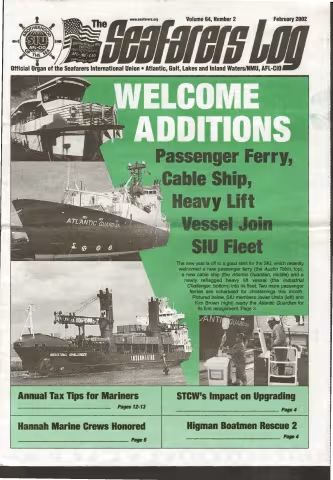
Passenger Ferry,
Cable Ship,
Heavy Lift
The new year is off to a good start for the SIU, which recentJy
welcomed a new passenger ferry (the Austin Tobin, top),.
a new cable ship {the Atlantic Guardian, middle) and a
newly reflagged heavy lift vessel (the Industrial
Challenger, bottom) into its fleet. Two more passenger
ferries are scheduled for christenings this month.
Pictured below, SIU members Javier Ureta (left) and
Kim Brown (right) ready the Atlantic Guardian for
its first assignment. Page 3.
STCW's Impact on Upgrading
Higman Boatmen Rescue 2
~-------------------Page'
President's Report
Extend, Expand Maritime Security Program
It is time to expand and extend the U.S. Maritime Security Program
(MSP).
Enacted in 1996, the MSP is a key part of America's national and
economic security. The 10-year program provides
limited funding for up to 47 U.S.-flag commercial
ships which are available to the Department of
Defense in times of war or contingency.
The MSP delivers many benefits. It helps main
tain a pool of skilled American mariners who are
needed to crew not only the MSP ships, but also the
U.S. government-owned strategic sealift and Ready
Reserve Force vessels, both in peace and war. The
Michael Sacco MSP helps our nation maintain a presence in interna
tional commerce. It also gives the Defense
Department access to program participants' infrastructure, terminals,
communications networks and more.
In short, the program works. And it has been cost-effective for our
nation. According to government figures, MSP payments account for
roughly 13 percent of the cost of operating U.S.-flag vessels. Without the
MSP, imagine how much more it would cost the government to obtain
cargo ships exclusively designated for transporting military gear.
Estimates of such costs run into the billions. One report concluded that it
would cost the military as much as eight times more than what it current
ly spends to build, crew and maintain such a fleet.
Why bring up the MSP now, when it still has a few years remaining?
Quite simply, we cannot afford to wait until the last minute to extend and
build upon the current program. Despite its bipartisan support and its
passage eight years ago by overwhelming majorities in both the House
and the Senate, it actually took years to make the MSP law. That's the
nature of politics.
We know shipowners will need time to replace some of their vessels
that will enroll in a new MSP. By the time the current program is sched
uled to expire, some of the MSP ships will be due for substitutions.
Again, such operations take time to plan and execute.
Last month, Maritime Administrator William Schubert stated his sup
port for the MSP. I commend him for taking a leading role in speaking
out for a new program.
I also believe that our nation's war against terrorism heightens the
need to address the MSP sooner rather than later. Make no mistake,
maintaining a strong U.S. Merchant Marine in the commercial sector
absolutely is a security issue for America.
In fact, in recent months, working with the National Defense
Transportation Association and its Defense Department partners, I have
participated in a number of meetings about port and vessel security.
Other SIU officials also have taken part in these important sessions.
Many of these issues were discussed-and their seriousness and scope
identified-at the Security Summit conducted by the U.S. Transportation
Command, which oversees the military's worldwide logistics.
One way to make the situation safer is to invest in the U.S. fleet
through an expanded MSP. In regard to port traffic in the United States,
how could anyone disagree with the belief that U.S.-crewed, U.S.
flagged, U.S.-built ships are safer and more desirable than their foreign
counterparts?
Before we even can climb a gangway, we are required to have photo
IDs (merchant mariner documents) issued by the U.S. Coast Guard. In
short, we are accountable and held to high standards of certification. We
also have demonstrated, from generation to generation, our unfailing
patriotism.
The current crisis also calls to mind what happened during the
Persian Gulf War, when some foreign crews declined to sail into a war
zone. They were supposed to deliver much-needed supplies to U.S.
troops. They refused. And American forces didn't get their equipment on
time because those foreign crews balked.
Additionally, in some countries that claim to be maritime nations,
efforts are under way to reduce crew sizes. This could mean, among
other potential security drawbacks, fewer lookouts, fewer chances to
monitor and inspect cargo, and generally less efficiency because of
fatigue. Obviously, we 've seen technology and automation leading to
reductions in our crew sizes over the last 20 years. But that doesn't mean
we should consider giving up the safety of our vessels or ports.
I've been asked what can be done to help the U.S. Coast Guard in
securing our coastlines and ports. I've been asked what the port authori
ties and longshoremen can do to help prevent a terrorist attack coming
from an enclosed and locked container. The answers are complicated and
multiple. But this much is certain: The Coast Guard, port authorities,
longshoremen and everyone else involved in maritime security will be
best-served by a stronger U.S. fleet. So will every United States citizen.
That's why an extended and expanded MSP is simply the safest
way to go.
Volume 64, Number 2 February 2002
The SIU on line: www.seafarers.org
The Seafarers LOG (ISSN 1086-4636) is published month
ly by the Seafarers International Union; Atlantic, Gulf,
Lakes and Inland Waters District/NMU, AFL-CIO; 5201
Auth Way; Camp Springs, MD 20746. Telephone (30 l)
899-0675 . Periodicals postage paid at Southern
Maryland 20790-9998 and at additional offices. POST
MASTER: Send address changes to the Seafarers LOG,
5201 Auth Way Camp Springs, MD 20746.
Communications Director, Jordan Biscardo; Managing
Editor/Production, Deborah A. Hirtes; Associate Editor, Jim
Guthrie; Art, Bill Brower; Administrative Support, Jeanne
Textor.
Copyright © 2002 Seafarers International Union, AGLIWD
All Rights Reserved.
2 Seafarers LOB
Schubert Calls tor Cooperation
As Industry Seeks Resurgence
New Administrator Pledges '100 Percent Commitment'
In his first public remarks in
Washington, D.C. since becoming
the head of the U.S. Maritime
Administration (MarAd), Capt.
William Schubert emphatically
stated that industry-wide coopera
tion will be vital to U.S. fleet's
resurgence.
Schubert spoke to the U.S.
Merchant Marine Academy
Alumni Association (he is a Kings
Point graduate) on Jan. 10, then
addressed the Washington chapter
of the Propeller Club on Jan. 23.
He stressed many of the same
points during those meetings.
Excerpts of his Jan. 10 speech
follow:
"In light of the events of
September 11, and the crucial
ongoing war against terrorism,
every action taken at the Maritime
Administration is now examined
and re-examined with this per
spective in mind. Business as
usual is not enough anymore, and
every initiative at MARAD is now
viewed in terms of how it helps
American jobs, the American
economy and American securi-
ty ....
"I sincerely wish I could stand
hear today and proclaim that the
maritime industry is healthy or
that we are poised for an immedi
ate turnaround. An industry-wide
turnaround may take some time.
However, if industry and govern
ment will work together to pro
mote sound maritime policy, we
will certainly get there sooner
rather than later.
"I am 100 percent committed
to take on the significant chal
lenges of this job to do all I can to
help move the U.S. maritime
industry forward. At the same
time, we must also all be ready to
work together to support the war
on terrorism.
"The September 11 attacks
altered the culture at the
Department of Transportation, and
we now face a new era in manag
ing our transportation in
frastructure and other transporta
tion-related assets, not only to
ensure our economic strength and
viability, but also our nation's self
defense and security ....
"The maritime industry
labor, management, shipyards, the
maritime academies , U.S.-flag
carriers, U.S. shipowners, the
maritime press, and anyone whose
livelihood is dependent upon the
existence of a U.S. maritime
industry- can learn something
from Secretary Mineta's recent
strong words to the modal admin
istrators. He said, 'The only turf
you need to be worried about is
the turf under your feet.' The sec
retary was very diplomatic in
telling us that we cannot be wor
ried about internal squabbles
when we have a larger issue of
homeland security facing us. The
realities of the new security envi
ronment that surround us have
forced every mode within the
department to consider each other
and recognize that we are all inter
connected and interdependent.
"We in the industry can either
worry about our the petty fights,
the arguments over who has more
or less, the backstabbing, the in
fighting, or we can worry about
our own survival. The great states
man Ben Franklin said it best, 'We
must indeed all hang together, or
assuredly, we shall all hang sepa
rately.'
"These may seem like harsh
words, especially from a strong
advocate of the U.S. maritime
industry. However, we at the
Department of Transportation
want to see the industry work
together, be competitive, be inno
vative and succeed. As the govern
ment official responsible for pro
moting the U.S. maritime industry,
I want to help it succeed in a way
that will quiet all the nay-sayers.
"Let me briefly mention some
important challenges that we are
facing. The newly established
Transportation Security Admin
istration does not only seek to pro
tect aviation security interests, but
maritime, highway, transit and
rail-all modes-and we must all
cooperate to develop this security
agency together. Every aspect of
the maritime industry has a role to
play ....
"Now, more than ever in this
new environment, the maritime
community will accomplish more
if we speak as a group. We are not
going to win every battle. We are
not always going to get exactly
U.S. Maritime Administrator
William Schubert
what we want. But in order to
achieve some success, we need to
be willing to fight together. If we
don't, we have accepted defeat.
"We must not accept the con
tinued overall decline of the U.S.
flag fleet. There has been an
unprecedented decline in U.S.
flag tonnage over the past 10
years. I have pledged to work dili
gently with industry and labor
over the next few years to encour
age new tonnage to enter the com
mercial market. We must also
work hard to form a consensus on
the reauthorization of the MSP
program. And it won't stop there.
We need to find innovative ways
to encourage other types vessels to
enter the domestic and foreign
trades, flying the U.S. flag. I will
use resources available to me,
department-wide, in order achieve
this goal.
"The United States is the
world's only superpower-and we
did not reach this point without
being a sea power. Our strong
200-plus year maritime heritage
helped build a critical foundation
for the development of this nation.
And merchant mariners, like so
many of you, have served the
nation with bravery and dedica
tion, in peacetime and in war, ever
since there has been an American
flag to fly.
''Now, we too must serve our
Nation, following their example,
by working together to strengthen
our merchant marine and develop
a maritime policy for the 21 st cen
tury. I believe the goal is a worthy
one- to keep the Stars and Stripes
flying proudly over the world's
best merchant marine."
Coast Guard Issues 'Tamper-Resistant' Licenses;
Agency Reports STCW-lnduced Backlog at RECs
The U.S. Coast Guard last month announced it had
begun issuing new merchant mariner license certifi
cates with anti-counterfeiting technology using a com
puterized system for better security and centralized
record keeping.
The agency also cautioned that mariners "who
haven't already begun the process of requesting new or
upgraded licenses or other credentials face delays in
processing" at Coast Guard regional exam centers
(RECs) because of the Feb. 1, 2002 deadline for the
amended STCW convention.
The new licenses will be issued to all licensed mer
chant mariners. According to the Coast Guard, "This
license retains the traditional border design, title and
vessel graphic design of the old version but will not
have pre-printed text and fill-in-the-blank endorsement
lines. On new licenses, the text, title, endorsements and
issue/signature information will now be completely
printed from the Coast Guard's computerized Merchant
Marine Licensing and Documentation System. The new
license forms, produced by the U. S. Bureau of
Engraving and Printing, employ the latest technology in
counterfeiting deterrence. The old-style licenses remain
valid and mariners do not have to obtain a new one until
their regular renewal date or when an endorsement or
some other change is required."
News about the RECs and the STCW deadline was
less appealing. As reported many times in prior issues
of the Seafarers LOG, the amended treaty requires
additional training for most mariners as well as new
methods for demonstrating shipboard competencies.
For unlicensed mariners sailing on international voy
ages aboard vessels over 200 gross registered tons, the
updated convention requires them to demonstrate pro
ficiency in the Basic Safety Training components
spelled out in Chapter VI. Also, bosuns, ABs, QMEDs
and FOWTs are required to possess an STCW '95 cer
tificate.
"Coast Guard licensing officials report that the ser
vice's regional exam centers already have backlogs in
processing license and merchant mariner document
requests because of an increase in STCW certification
requests," the agency noted in a mid-January news
release. "With the STCW compliance deadline now
just two weeks away, mariners who are just now sub
mitting their applications are not likely to receive their
STCW certificate until well after the compliance dead
line [Feb. 1, 2002]."
More information about STCW compliance (and
other merchant mariner news) is available on the Coast
Guard's National Maritime Center web site, located at
http://www. us cg. mil/nmc.
February 2002
Seal arers Crew Up Industrial Challenger
Heavy Lift Vessel 'Flags In, ' Augments U.S. Sealift Capacity
More new shipboard jobs for the SIU are on the
way as the union this month welcomes the heavy lift
vessel Industrial Challenger to the U.S.-flag fleet.
Seafarers are scheduled to crew up the ship some
time during the first week of February, in Houston.
The 393-foot Industrial Challenger will enroll in
the U.S. Voluntary Intermodal Sealift Agreement
(VISA) program, designed to provide a smooth tran
sition between peacetime and contingency opera
tions . VISA jointly was established by the U.S.
Military Sealift Command (MSC), the U.S .
Maritime Administration (MarAd), the U.S.
Transportation Command (TRANSCOM) and the
Office of the U.S. Secretary of Defense. It also was
accomplished in cooperation with the maritime
industry.
Shipping LLC.
The ship is considered a multi-purpose vessel. It
has a lifting capacity of 400 metric tons and a service
speed of 16 knots. Listed at 7,300 metric tons, the
Industrial Challenger has three holds and hatches,
and is equipped with two electro-hydraulic cranes.
Pacific Gulf Marine noted that the vessel proba
bly will operate in the U.S. to South America trade
"while pursuing other opportunities to move both
commercial and/or U.S. government cargoes from
the U.S . to worldwide destinations."
The Industrial Challenger is slated to crew up early this month in the
port of Houston.
The Industrial Challenger, built in 2000, former
ly flew the flag of the Bahamas. It will be operated
by SIU-contracted Pacific Gulf Marine for Patriot
In joining the VISA program, the vessel is part of
a sealift agreement in which the Department of
Defense is permitted to reserve space for its cargo
on board privately owned and operated ships in the
event of war or contingency. VISA also includes
agreements for using ship loading terminals, rail
facilities and other commercial transport facilities
during the movement of Defense Department cargo.
New Cable Ship Joins SIU Fleet
The Atlantic Guardian is the
newest SIU-crewed cable ship.
Based in Baltimore, the vessel
crewed up in late December. It
quickly received its first assign
ment, sailing on New Year's Eve.
The 335-foot vessel still was at
work in St. Croix late last month.
The Atlantic Guardian re
places the Wave Sentinel in the
fleet owned by Global Marine
Systems of Chelmsford, England.
It flies the British flag.
As previously reported in the
Febnla17 2002
Seafarers LOG, U.S. immigration
laws require the ship to utilize
American citizens in the unli
censed positions and in some of
the officers ' posts . "As we stated
when the Wave Sentinel arrived
early last year, it's a fairly unique
situation," noted SIU Vice
President Contracts Augie Tellez.
"The ship is going to carry U.S.
mariners in the unlicensed ranks,
and it's always preferable for a
ship to sail with a union crew."
The contract covering wages
and benefits on the Atlantic
Guardian essentially parallels the
agreements covering other SIU
crewed cable ships.
Built last year in Bremer
haven, Germany, the vessel has a
standby crew of approximately
20. The ship has a top speed of 15
knots and is equipped with three
bow thrusters and two stern
thrusters. The vessel is 59 feet
wide and is listed at 3 ,250 dead
weight tons. It has a bollard pull
of 60 tons.
Among the fi rst Seafarers aboard the
new cable ship were (clockwise from
left) AB Kim Brown, Chief Steward
Terrance Stowall, QMED Ron Celious
and AB Greg Baker.
The Atlantic Guardian kicked off the new year with its first assignment,
a repair job in the Caribbean.
NY Waterway Christenings
Signify New Jobs for SIU
3 More Passenger Ferries Join Fleet
The newest NY Waterway ferries can transport 97 passengers per trip.
SIU-contracted NY Waterway is welcoming three new passenger
ferries as the company continues addressing sharply increased busi
ness.
The additions will give NY Waterway 37 boats (including eight
which they lease). The company-which transports commuters
between New York City and New Jersey-reports that its average daily
ridership increased from about 34,000 passengers before Sept. 11 to
almost 60,000 since then. A big reason for that surge is that the terror
ist attacks destroyed a subway terminal located beneath the twin tow
ers, and NY Waterway offers a reliable, long-popular means of com
muting between Manhattan and points in New Jersey.
The first of the three newest ferries was scheduled for christening
Jan. 24 in New York, as this issue of the Seafarers LOG went to press.
The Austin Tobin , named after the man credited with building the
World Trade Center, was constructed by Allen Marine of Sitka, Alaska.
It is a "Sea Otter" class ferry, which carries 97 passengers at more than
30 knots. It is a single-hull boat with the bow-loading feature , powered
by three Caterpillar 3406 clean-burning electronic engines, generating
600 hp each. The engines drive three Hamilton water jets.
This month, NY Waterway will christen two more ferries: the
Father Mychal Judge, in honor of the Fire Department chaplain and all
the fire fighters who died Sept. 11 ; and the Moira Smith , honoring
Police Officer Smith and all her colleagues who died that day.
The ferries will be used in the company's new East River commuter
service, carrying passengers from East 90th Street to Pier 11 at the foot
of Wall Street. That trip will take 15 minutes aboard the new boats.
Additionally, Sitka is building five more ferries for NY Waterway
that are expected to replace some of the boats currently under lease.
On Sept. 11, Seafarers aboard NY Waterway ferries evacuated
approximately 158,000 people from Manhattan.
Seafal'fll'S LOS 3
Higman Crew Saves 2
From Foundering Skiff
Practice paid off for four SIU
boatmen on the Higman Barge
Lines tug Capt. D.J.
Babin- and, more notably, for
the two men they saved Dec. 6
near Lake Charles, La.
Seafarers Wayne Williams,
Dennis Ridley, Doug Clark and
John Bethune rescued John
Theriot and Doug Bonvillian
moments after the latter two
individuals took an unexpected
plunge into the cold water near
the Grand Lake Bridge. Theriot
and Bonvillian had been operat
ing a skiff and were transporting
supplies to a nearby vessel when
their boat capsized around 11
a.m.
Williams said the men were
in danger not only from the
chilly water, but also from heavy
traffic in the channel. They were
perhaps 300 feet from shore. "It
was backed up for five miles,
but traffic was moving,"
Williams recalled. "They were
lucky we happened to be look-
ing. The main thing was to get
them out of the water."
Higman crews routinely par
ticipate in shipboard safety
drills, and the preparation
proved priceless, Williams said.
"We happened to see their boat
flip over- it was loaded down
real heavy-and we all automat
ically did the things that had to
be done. It truly was an automat
ic response," he noted. "We do
safety drills constantly, and
that's why the response was so
immediate. 'Man o erboard is
one of the main drill , and pollu
tion control is another. It was
fresh in our minds and every
thing fell into place."
Tankermen Bethune and
Clark launched the Babin's skiff,
while Capt. Williams and Pilot
Ridley hurried onto an adjacent
barge to provide further assis
tance. "Once we got the two
guys out of the water, we gath
ered as many of their supplies as
we could, then used our boom to
raise their skiff," stated
Williams. "From the time they
hit the water, it was no more
than 10 minutes before they
were on board (the tug)."
Theriot and Bonvillian were
uninjured- and grateful. The
SIU tug transported them and the
salvaged supplies to the intended
U.S. Union Membership Stable in 2001
Latest BLS Data Shows Increase During 5-Year Period
ing unions at work, but today's
numbers show that steady dedi
cation and perseverance is lay
ing the groundwork for greater
change."
Puerto Rico, where labor organi
zations have focused a great deal
of recent organizing attention,
helping more than 110,000
workers to form unions over the
last three years.
port a union, the federation
reports.
The AFL-CI 0 represents 13
million working men and
women.
essel.
Williams emphasized, "There
was never a thought given to the
hopes of receiving praise or even
a 'thank you'- which, by the
way, we received wholehearted
ly from the men we rescued. But
I believe my crew deserves
recognition for their readiness
and willingness to do whatever
is needed to render assistance to
anyone who's in trouble."
Although the rescue proved
more involved than another in
which Williams participated,
back in 1997, it lacked the oddi
ties of the earlier recovery.
Nearly five years ago, while
working aboard another Higman
tug near Port Arthur, Texas,
Williams and his fellow boat
men rescued a woman who had
been bitten by an alligator. She
told Coast Guard investigators
that she had gotten into a fight
with her boyfriend and was try
ing to swim across the Gulf
Intracoastal Waterway.
"But we just pulled her on
board," Williams said. "This
(more recent) incident was a
full-fledged life-saving opera
tion."
Union membership grew
slightly in 2001 despite a year of
recession and uncertainty, and
the percentage of American
workers with a union remained
stable at 13.5 percent, according
to new data released Jan. 17 by
the U.S. Bureau of Labor
Statistics (BLS).
The number of women who
are union members is at an all
time high of 6. 77 million. Ac
cording to the statistics, in 2001,
union membership increased by
93,000 among all women; and
42,000 more Hispanic women
were union members in 2001
than in the year before.
Young workers are increas
ingly open to unions. Polling
shows that a majority of young
workers ages 18 to 34 who don't
have a union say they would
likely vote for one. Graduate
teaching assistants are among
younger workers who formed
unions last year at Michigan
State, Temple and New York
University. Campaigns are also
underway at Penn State, Yale,
Columbia and the University of
Pennsylvania.
STCW 'In Plain English'
The latest BLS figures also
show that, while there have been
slight rises and dips in union
membership in recent years, the
number of union members has
shown an overall five-year
growth of 180,000.
The number of union mem
bers in the U.S. in 2001 was
16.28 million compared to 16.26
million members in 2000, 16.48
million in 1999, 16.21 million in
1998 and 16.11 million in 1997.
The figures are a 12-month aver
age.
"Despite a year of record lay
offs and historic national up
heaval, unions held their own in
terms of membership in 2001,"
said AFL-CIO President John
Sweeney. "Two-and-a-half mil
lion workers have formed new
unions since 1996. Unions still
can do much more to help work
ers improve their lives by form-
The percentage of private
sector workers who have a union
also remained stable.
At least 400,000 workers
organized unions in 2001,
according to internal AFL-CIO
and affiliate union data-just
slightly ahead of the number
who formed unions in 2000. In
order to grow in a changing
economy, unions need to orga
nize between 500,000 and a
million workers a year, the
AFL-CIO has said. In order to
meet that goal, unions are
launching more large-scale and
multi-union organizing cam
paigns.
Not included in the BLS
numbers is union membership in
NY Waterway Crews Tackle STCW
Independent polling also
shows that 30 to 40 million
workers in America wouldjoin a
union if they had a chance.
However, relatively few ever get
that chance because employers
routinely block workers' efforts
to improve their lives through
unions. Ninety-seven percent of
private-sector employers fight
their workers' efforts to form
unions, including a third who
illegally fire workers who sup-
A number of Seafarers who crew NY Waterway passenger ferries have completed STCW Basic Safety
Training (BST) at the Paul Hall Center in Piney Point, Md. After last month's membership meeting at
the school, several of the students from NY Waterway who are enrolled in the BST course chatted with
SIU officials. Pictured from left to right (front row) are SIU VP Contracts Augie Tellez, Albert Maietti,
Amed Kety, Priscilla Rodriguez, SIU Pres. Mike Sacco, Steven Rivera, Max Munnigh, SIU Philadelphia
Port Agent Joe Soresi, Jose Beof Sr., (back) SIU Asst. VP Contracts George Tricker and SIU Sec.
Treasurer David Heindel.
4 Seafarers LOG
Training Director
Examines STCW's
Impact on Upgrading
Editors Note: The following is
the second in an occasional
series, written by Bill Eglinton,
director of training at the Paul
Hall Center in Piney Point, Md.
This month, our industry will
begin finding out the extent to
which we're truly ready for the
long-awaited STCW deadline of
Feb. 1, 2002.
I expect that, as the saying
goes, results may vary.
For instance, a recent press
report stated that more than
38,000 Malaysian mariners will
be blocked from working on
ships because they haven't com
plied with the amended STCW
convention. Slightly more than
7, 100 certificates for STCW
Basic Safety Training (BST) have
been issued in that country.
In the U.S., there is cautious
optimism that most (though cer
tainly not all) American mariners
are in compliance. Stay tuned.
This much we already know:
The system for upgrading has
changed, especially for unli
censed mariners sailing deep sea.
The old method largely relied
upon accumulating sea time,
training and then passing a Coast
Guard test. The new method still
includes sea-time requirements
and training, but it emphasizes
practical demonstration of skills,
rather than testing.
The best example I've heard is
one that compares the new way of
upgrading to acquiring a learner's
permit for driving a car. It's an
interim step preceding the actual
driver's-license exam. It repre
sents a time during which aspir
ing drivers typically must sharp
en their skills behind the wheel
and demonstrate them to the
appropriate people. In some
cases, it carries a minimum time
requirement.
Another way to look at it: The
big change in maritime is, up
grading by training and assess
ment, rather than training and
testing. Other industries also are
moving toward this type of career
advancement.
For instance, let's say you sail
as a wiper for four years and you
have 600 days of sea service in
the engine room. When you're
ready to become an oiler, you
cannot just take a test. Instead,
you would need specialized train
ing (for ratings forming part of an
engineering watch), and then you
would go to sea and demonstrate
those newly acquired competen
cies, for a minimum of 60 days.
Then you would take the oiler's
class. Your certificate of comple
tion for that course (as long as it's
Coast Guard-approved) earns you
the rating.
It's basically the same path in
the deck department. Say you sail
OS for four years and build up
600 days of sea time. The new
interim step to becoming an
AB-the "learner's permit"
stage-is taking the course for
specially trained OS. As in the
previous example, you then
would go to sea for at least 60
days, before returning to school
for the AB course.
On that note, I'll put in a plug
for the SIU and the Paul Hall
Center. Both the union and the
school were very far-sighted in
developing the training record
book (TRB) in 1997. This gave
members (as well as officers and
Coast Guard REC personnel)
almost five years to get used to
the book and learn how to use it.
That is the way of the future in
our industry.
Check upcoming issues of the
LOG for articles about engine
department career paths, recent
and pending Coast Guard
approvals of revised Paul Hall
Center courses, and other news
either directly or indirectly relat
ed to the amended STCW con
vention.
February 2002
Federation Embraces 4 Focal l'oints
The delegates to the 2001
AFL-CIO Convention, which
took place Dec. 3-6 in Las Vegas,
approved four major program res
olutions without dissent.
These declarations, presented
to the convention by the AFL
CI O's Executive Council (to
which SIU President Michael
Sacco was reelected), summarize
the federation's strategy for con
tinuing positive change in-and
the empowerment of-national
unions, state and local central
bodies and the federation as a
whole. In a recent memo to exec
utive council members and top
officials of national and interna
tional unions; state federations
and central labor bodies; and
trade departments, AFL-CIO
President John Sweeney urged
the widest dissemination of infor
mation about the four programs
and the critical importance of
each in the United States' union
movement.
"If we have learned anything
these past months, and these past
years," he said in his memo, "it is
that we can do anything if we are
united and strong." These four
programs, and the labor presi
dent's analysis of each are:
Organizing-Plans to craft
national union-federation part-
U.S. Supreme Court Rules
On Coast Guard/OSHA Case
The U.S. Supreme Court on Jan. 9 issued a ruling
that puts to rest litigation involving oversight juris
diction of uninspected vessels between the U.S.
Coast Guard and the Occupational Safety and
Health Administration (OSHA).
In the case of Elaine L. Chao, Secretary of Labor
vs. Mallard Bay Drilling, the court ruled that since
the Coast Guard exercises minimal oversight of
uninspected vessels, the OSHA shares jurisdiction
with the Coast Guard over working conditions on
such vessels.
The 8-0 decision reversed a June 2000 ruling by
the U.S. Court of Appeals for the Fifth Circuit that
an uninspected oil drilling barge on a navigable
waterway within state waters was a vessel over
which the Coast Guard had exclusive regulatory
authority-not a "workplace" over which OSHA
would have jurisdiction. The U.S. Department of
Labor challenged that decision and appealed to the
Supreme Court.
The case at issue arose from a 1997 explosion on
a drilling barge owned by Mallard Bay Drilling.
While the Coast Guard took the lead in investigating
the explosion, OSHA issued a citation against the
company charging Mallard Bay with three viola
tions of the Occupational Safety and Health Act.
"SMPPP Pelfor111i11g Well; StatenlelilS iJue Out Soon
At the January membership is annualized to 6.64 percent. In these difficufi economic
meetings, a report from Plan (Compare that to the Dow Jones~ t~~s,- t!Jis. eo~es .a~.~,goo~ news
Administrator Lou Delma was which was down more than 13 to cparti~i_pants=:"'in: ·me S~1PPP,
read. , Delma stated that partici- pef97nt fof200J .. ~ th~~&P, 'ihiclt. wh~ch his bee!l ~n e~istence onl~
pants in the Se11farers Money ;iwa8(lowri·nearly·19 percent; and since June 1996; Delma said. c ...
~~~e Jr~psiotf f lan:,.(~~PP) · CDs~ which 0;'Were yietding As always, contributions for
will be pl~sed to note thaf the remms of only 3 to 4 percedt.) .. ·~: the'r month of . Decemberr were
plan 'continues ··~ out~perf:onn An unofficial oral update , received in January. Once the
recognized indu~py bel;\chma.rks:_ " rec · 2, 2002by D~lma ye~ _ is closed~ .. annual s~t,ement
. al teRO .,, . edc ;-m . tlie"ac<f{)un /"l . ..s ...•.. umm .. ·· ... · .. -.·.·.·.-.-.•_:···:·.··.· ... -.·.· .. a.rt_ -.. · .. ~._e.·.····· ... -••... s ..... ·.· ... · .. ···· .. Wl .. : ... ~ .... ·.l··.·.1 .• _ .. -.·:·.·.··.· ... },le ..,, ru.: .. ···.··.:e·c···· .. ·.-.:a .... ·an(f. · .. •.·.· .. ·.·.· .. ·· ,.:A' ... s·~·~'e ... n. t: ,.• n .. ''" n. er' , ""·· _; ••. '.~ ·.·.: ••. ·.·.'T_;;s" :_'.·.-._... ;~.-.. 1···.J.;:.<m·.··.··· •. 1:1'·\1 .. ' ... ·1 •. ';o:·,.... . . . :-:.... -- .... ... .. . . .. ; : . . . . - ;, , ·-.-. ¥"' UH Uo .. '~ .. ;:'. mailed to;;fill ·~rti, . st lf··YOlf
,0¥org~µ Stahley Dean Witter,._,for ·'· increase reflects' additional:,,eoa'".; do,, fiot .receive a ci9PY '}·feyou~ ·
.. !.he period ep.din:gOct. .:31, 2001, "tributions " received during< statement by ·mid.;'April, '1iplease
-..the account"was valued at $12.1 November and Decemb~r of call or write the administrator ai
<'million. The account had a total slightly more than $600,000 and 5201 Auth Way, Camp Springs;
return from inception through additional gains on investments MD 20746; telephone (301)
:' that date of31.63 percent, which of approximately $400,000. 899-0675.
Reciprocal Agreements
In Place for Pension,
Vacation Benet its
The Seafarers Vacation Plan and the Seafarers
Pension Plan have announced reciprocal agree
ments with their National Maritime Union (NMU)
counterparts, which are designed to benefit
Seafarers.
Authorized late last year by the Plans' respective
boards of trustees, the agreements essentially allow
SIU members (including those who formerly were
members of the NMU) to receive credit toward their
pension and vacation benefits based on their total
days worked, even if their sea time is divided
between companies that are signatory to the Plans.
For instance, the reciprocal agreement for the
vacation funds notes, "A reciprocal vacation benefit
is provided under this Plan for employees who
·:Not Ready to Roll
would otherwise lack sufficient days of covered
employment to be eligible for a vacation benefit
because their periods of covered employment were
divided between different vacation plans .... "
The reciprocal vacation benefit shall be effective
with respect to vacation benefits payable on or after
January 1, 2002.
Under terms of the reciprocal pension benefit,
pension credits accumulated and maintained by an
employee after Jan. 1, 2001 under a "related plan"
shall be recognized by the other as related pension
credits. In other words, members don 't lessen their
benefit by sailing for different companies, as long as
those companies are signatory to one or the other
pension plan.
The rules of both plans still apply, and the rec
iprocal agreements do not supersede the respec
tive regulations of the plans.
The NMU merged into the SIU last year, creating
one union while maintaining-in accordance with
membership approval through balloting-separate
benefits plans.
· · ' The U.S. Department of Transportation has not developed a comprehensive plan to ensure the
,, ~.afety of Mexican trucks that will be allowed access to U.S. highways this year, the AFL-CIO
reported last month.
According to the federation, the General Accounting Office reports only two of the 25 U.S. com
mercial points of entry have permanent inspection facilities. The department also has not reached
agreement with border states on sharing inspection responsibilities, the GAO said.
Many members of Congress fought last year to impose strict safety standards on Mexican trucks
that will operate in this country under provisions of the North American Free Trade Agreement.
February 2002
nership agreements to support
and advance the organizing pro
grams of the national affiliates
are proceeding. These agree
ments will be built on the three
major building blocks of the fed
eration's organizing strategy
increasing the resources commit
ted to organizing, using all avail
able resources to advance orga
nizing, and changing the climate
for organizing.
Political-The federation
continues to prepare for the
important national mid-term elec
tions this fall. Our goal is to turn
back those legislators who are
anti-worker and bolster the num
bers of those who are progressive
in their leadership styles-and set
the stage for the critical national
elections in 2004. A huge effort
must also be made in critical state
and local elections. Finally,
important decisions must be
made about the ongoing funding
of our political work in the com
ing months.
Global Economy-The reces
sion is hitting nearly every sector.
Unions in the manufacturing sec
tor especially are being hard hit.
We will face critical bargaining
struggles in the coming year. And
we must work with an adminis-
tration that does not share our
views on expanding trade and
commitment to global labor and
environmental standards. The
recent one-vote loss on fast track
authority in the House was a dis
appointment, but we did manage
to gain the support of some who
had voted against us in the past.
Work In Our Communi
ties-The importance of rebuild
ing our grass roots cannot be
overstated. We will continue to
expand our Union Cities and our
New Alliance programs, to forge
even stronger bonds with our
allies, and to reach out to working
families across lines of race and
ethnicity- focusing on our work
with immigrant communities and
our support for civil and human
rights in all communities.
Sweeney said both the federa
tion and its affiliates must focus
on these four areas of work in
order to strengthen the labor
movement in the United States.
Of the four programs, however,
organizing is by far the most cru
cial, he said: "We cannot accom
plish all our other goals unless we
are larger and stronger. Every
affiliate must confront again this
challenge of growth."
Magaw Takes Helm
Of New DOT Sector
John W. Magaw, a former
director of the U.S Secret
Service, has been appointed by
President Bush to head up the
U.S. Department of Transporta
tion's newest component-the
Transportation Security Adminis
tration (TSA).
As under secretary of trans
portation for security, Magaw
will have substantial powers to
~~tablish security procedures for
aviation as well as other types of
transportation. His position car
ries a five-year term.
TSA's primary m1ss10ns
include developing and imple
menting new security equipment
at airports. The agency is slated
to assume control of aircraft
security by the end of this month.
Magaw served in 14 assign
ments with the Secret Service
before being appointed director
in 1992. As director, he oversaw
protective operations for the
president and first family.
Before his current appoint
ment, he served as acting director
of the Office of National Pre
paredness at the Federal Emer
gency Management Agency.
Additionally, he headed the
Bureau of Alcohol, Tobacco and
Firearms from 1993 to 1999.
"The American traveling pub
lic could not ask for a finer, more
devoted public servant, nor an
individual more qualified in law
enforcement than John Magaw,"
said Secretary of Transportation
Norman Mineta during Magaw's
confirmation hearing on Capitol
Hill. "The skills he has developed
over the course of his stellar
career will prove instrumental as
he goes about the job of rebuild
ing public trust and confidence in
our transportation systems.
"John Magaw is a man who
has stood shoulder to shoulder
with eight presidents, and he has
Transportation Security
Administration Under Secretary
John W. Magaw
been willing to lay down his life
for every one of them," the trans
portation secretary continued.
"Today, another president has
asked him to stand shoulder to
shoulder with the American peo
ple and demonstrate the same
courage and the same resolve on
their behalf. I am confident that
he will do nothing less."
Magaw will have responsibili
ty for the day-to-day screening
activities of U.S. air passengers.
Included will be the development
and implementation of hiring and
training standards for aviation
security screeners.
Additionally, he will receive,
assess and distribute intelligence
and threat information and devel
op policies for dealing with
threats to transportation security.
His department also will coordi
nate with law enforcement agen
cies; enforce security regulations;
and implement, inspect, maintain
and test security facilities.
Magaw will address cargo
issues separately from passenger
issues, and work with the
International Civil Aviation
Organization and the Federal
Aviation Administration.
Seafarers LOG 5
Lakes Boatmen Honored for Courageous Rescue
Hannah Crews 1st Lakes Mariners to Receive Seamanship Trophy
Seafarers who crew a pair of
Hannah Marine Corporation tugs
recently were recognized for their
Oct. 8, 2000 rescue actions
involving a damaged tug and
barge on Lake Michigan.
Jointly receiving the 2001
American Merchant Marine
Seamanship Trophy Jan. 12 dur
ing a luncheon at the U.S.
Merchant Marine Academy in
Kings Point, N .Y. were the crews
of the Donald C. Hannah and the
James A. Hannah. Recognized
were Capt. William Meilicke,
Dave Patterson, Murray Smith,
Capt. David Heim, Capt. Ad
dison Bell, William Thorp,
Joshua Brenner, Stephen Smith,
Dave Wierscheim and Capt.
Edward Hogan.
These mariners also were hon
ored May 18, 2001 for the same
actions, during a special ceremo
ny at the Chicago Propeller
Club's Maritime Day luncheon.
On that occasion, they were pre
sented a Public Service Com
mendation by the U.S. Coast
Guard Marine Safety Office
Chicago.
The towing vessel Undaunted
(with a crew of 11) in October
2000 was pushing the work barge
Pere Marquette 41 on Lake
Michigan when severe weather
moved through the region. Gale
force winds, snow and sea condi
tions in excess of 12 feet were
pasting the tug and barge when
the barge's cargo of 5,000 tons of
iron and several tons of large
industrial equipment shifted and
dangerously upset the tow's sta
bility.
The crew executed an emer
gency breakaway to disconnect
the tug from the barge. Without
warning, the 68,000-pound barge
struck the tug, ripping a hole at its
waterline before drifting away.
The pilot hailed "mayday" on the
radio and was forced to push the
tug around.
Despite the severe weather
conditions, the towing vessels
Donald C. Hannah and James A.
Hannah were dispatched to assist
the disabled tug and recover the
barge, which had drifted 24 miles
from where it was released. Once
the vessel arrived on the scene,
crews began assessing the situa
tion and initiating corrective mea
sures.
A Coast Guard helicopter and
small boat already had removed
some of the tug crew members
Safety Dir. Jim Storm Dies
Jim Storm, Honolulu-based
safety director for the SIU,
passed away Dec. 15, 2001 in
Hawaii. He was 60.
Storm reportedly died of
complications following surgery.
"I knew Jim as a rank-and
file member and as an SIU rep
resentative," recalled Neil Dietz,
SIU port agent in Honolulu.
"Jim was always one to volun
teer for the political rallies,
marches and demonstrations that
are critical to SIU solidarity in
the labor movement and in our
community. Jim never turned me
down when I asked for his help.
"Jim Storm was a proud,
unabashed liberal of the old
style," Dietz continued. "He
would not apologize to anyone
for being a liberal Democrat. He
wore it like a badge of honor that
was based on his love for ordi
nary working families and their
needs."
Fay Rawles-Schoch, director
of human resources for Ameri
can Hawaii Cruises, described
Storm as "always a professional,
and it was very clear that he
always worked for the best inter
ests of the SIU membership. He
was dogged, determined and
very positive in his pursuit of
resolving a problem."
SIU Honolulu
Patrolman Frank Iver
son, who knew Storm
for five years, said,
"Jim lived his life for
the union, and the
union is a much sadder
place without him."
CIO for his work in the Labor
98 campaign that year, during
which he helped register union
voters and assisted them to the
polls. A year later, he completed
the SIU's safety director train
ing at the Paul Hall Center in
Piney Point, Md., and he also
finished a course on grievance
handling at the University of
Hawaii's Center for Labor
Research and Education. In
2000, he graduated from the
AFL-CIO Union Counselor pro
gram and finished a labor law
seminar offered at the
University of Hawaii.
Storm was an ardent support
er of U.S. Rep. Neil Aber
crombie (D-Hawaii), who is a
longtime friend of the SIU and
the U.S. Merchant Marine. In
addition to the routine duties of
an SIU representative at the ser
vice counter and on ship payoffs,
he handled grievances for
Seafarers aboard American
Hawaii Cruises vessels. He was
on the ms Patriot during its first
two weeks of Hawaii service (in
late 2000), dealing with the diffi
culties inherent in a new cruise
ship operation, and he continued
servicing the vessel thereafter.
Storm is survived by two
daughters and three sons.
Born in Painesville,
Ohio, Storm joined the
SIU in 1991. He sailed
on passenger vessels
and cargo ships before
coming ashore in 1997
to work for the union.
He received a letter
of appreciation from
the Hawaii State AFL-
Safety Director Jim Storm (holding paper)
is pictured aboard the Long Lines this past
December in Honolulu. Pictured with
Storm are (seated) OMU Ali Sidek and
(standing, from left) AB Todd Conley and
AB Victorgil Mariano.
6 Seafarers LOG
from the Undaunted, but the cap
tain and engineer remained on
board. The Donald C. Hannah
successfully made a connection
to the barge Pere Marquette 41,
and eliminated its threat to public
safety. Meanwhile, the James A.
Hannah escorted the impaired
Undaunted, now suffering from
overheated engines and hull dam
age, safely into port.
"The crews of James A.
Hannah and Donald C. Hannah
are directly responsible for bring
ing the towing vessel Undaunted
along with her remaining crew and
the barge Pere Marquette 41 safely
to port," according to the commen
dation, which accompanied the
U.S. Coast Guard Award. "Their
actions are in keeping with the life
saving traditions of the United
States Coast Guard and are highly
commended for this service."
The Seamanship Trophy has
been awarded since 1962 to
acknowledge the highest stan
dards of professional competence
on the water in the presence of
extreme peril to life and/or prop
erty and under adverse and severe
weather conditions.
Posing with the American Merchant Marine Seamanship Trophy are
(from left), SIU VP Great Lakes Tom Orzechowski; Hannah Marine
Corp. President Jeffrey Covinsky; William Meilicke and David Heim,
skippers of the Hannah Marine vessels; Hannah Marine VP for
Operations Edward Hogan; and Capt. Donald Safarik, U.S. Merchant
Marine Academy.
"The skillful response of the
Donald C. Hannah and James A
Hannah crews to an emergency
situation saved not only a tug and
barge in distress, but also the
Undaunted captain and engineer
from a potentially dire fate," said
Martin P. Skrocki, public infor
mation officer, U.S. Merchant
Marine Academy, Kings Point,
N.Y., in a letter of congratulations
to Jeffrey N. Covinsky, president,
Hannah Marine Corp.
The correspondence further
noted that this marks the first
time the Seamanship Trophy has
been awarded for actions occur
ring on the Great Lakes.
Brother Abshire Memorialized
By Seabulk Challenge Seafarers
Editor's note: This article was
written at sea Nov. JO, 2001 by
Father Sinclair Oubre, president
of the Apostleship of the Sea of
the U.S.-and member of the SIU.
The photos accompanying the
story were taken by Oiler Paul
Weil.
The motto Brotherhood of the
Sea is a much-used term, but
often its real meaning seemingly
harkens back to a past time.
However, there are still a few
events that bring alive this
motto's meaning and demonstrate
that it carries much relevance
even in the modern merchant
marine.
One of these times is when a
ship is in distress, and its crew is
in peril. At this time, the ship's
flag, the mariner's nationality or
the company for which he or she
works does not matter. The desire
to help a fellow seafarer reaches
across all borders, and makes all
seafarers Brothers of the Sea.
Another time is when a
mariner requests that his or mor
tal remains be laid to rest in the
vast oceans, the place where he or
she has poured out so much of his
or her life.
The opportunity to serve a
brother mariner for the last time
came to the SIU crew of the
Seabulk Challenge on Nov. 10,
2001, when the ashes of Brother
Gilbert Abshire (who began his
sailing career with the NMU)
were laid to rest as the vessel
transited between Citgo Refinery
in Lake Charles, La. and Kinder
Morgan Refinery in Houston.
On this particular voyage, I
had signed on in Boston to spend
my vacation as the 0800-1200 AB
watchstander. A few months
before, I had been approached by
a parishioner, Donna Beard, with
the request to see to the burial of
her father's ashes the next time I
Father Sinclair Oubre, who
sails with the SIU as an AB,
conducts the memorial ser
vice aboard the Seabulk
Challenge in transit from
Lake Charles, La. to Houston.
Among those joining in the
remembrance of Brother
Gilbert Abshire were Chief
Steward William Perry, AB
Manny Wedeil, Bosun Omaha Redda and Oilers Iqbal Mahmood and
Paul Weil.
went to sea. This request was one
of the greatest honors any
Apostleship of the Sea chaplain
could be asked.
After making arrangements
with Capt. Parker, and with
Bosun Omaha Redda, those
crew members who were free
gathered on the stern of the vessel
on the sunny afternoon of Nov.
10. God had blessed the day with
clear skies, light breezes and
calm seas.
At 1520 hours (3:20 p.m.), the
crew gathered around a flag
draped stage plank on which the
urn containing the remains of
Brother Abshire was placed.
Leading the crew in prayer, I
began with a reading from Psalm
107 in which the psalmist recalls
the wonders that God has done
for those who sail the seas. After
the reading, all prayed together
the Lord's Prayer, which was fol
lowed by the prayer of Final
Commendation taken from the
Roman Catholic Funeral rite.
At this time, the urn was taken
by Bosun Omaha and reverently
placed over the stem. The mate
on watch recorded the position as
028.57N & 093.37W. A moment
of silence followed, then the crew
joined me in reciting a special
seafarer's prayer.
In commenting on the service,
Bosun Omaha stated that this was
something very important
because it was for all merchant
manners.
On arrival in Houston, I signed
off. On returning to Port Arthur, I
relayed the details of the service
to Brother Abshire's daughter and
presented her with photographs
of the service.
For all of those involved, it
was a very touching and consol
ing moment, for we all knew that
even at death, the Brotherhood of
the Sea endures.
February 2002
Reti•• Enjoys
Presidentiil
Encounter
Retired Seafarer Henry W.
Lovelace already had lots of
compelling anecdotes. The 7 6-
year-old Navy veteran was part
of the first wave of Allied
forces who stormed the beaches
of Normandy during the D-Day
invasion. He had been in
Hawaii during the surprise
attack on Pearl Harbor. And, as
an able bodied seaman in the
SIU, he traveled to many ports
around the globe and had
numerous experiences, which
he still recalls.
Last year, Lovelace added
another memorable chapter
when he met President Bush.
Lovelace was one of six World
War II veterans chosen to share
the stage with the president dur
ing the June 6 dedication of a
D-Day memorial in Bedford,
Va.
The small Virginia munici
pality was selected as the site
for the monument because of
the number of Bedford natives
who died during the invasion.
Published reports say 23 of the
35 Bedford soldiers who fought
on D-Day perished-presum
ably the highest per capita loss
of any community in the United
States.
Lovelace had been chosen to
represent the Navy for all veter
ans who served in the Navy
during World War II. He deliv
ered an address on behalf of
high-ranking Navy officials to a
crowd that numbered approxi
mately 15,000 people.
"I was scared to death when
I walked out on stage to the
podium and looked out at all
those people," Lovelace said. "I
almost froze."
The Gladys, Va. resident,
along with the five other World
War II veterans who participat
ed in the memorial dedication,
met briefly with President Bush
before the ceremony. The group
assembled near a tent when a
Secret Service agent
approached them and said the
president wanted to see them
inside the tent.
Following the agent's lead,
the group made its way inside.
"He [President Bush] intro
duced himself and said he was
very proud to be here with us
today," Lovelace said. "He
shook each of our hands ... he
shook my hand twice ... and
then walked between us and we
followed him out to the dedica
tion and laying of the wreath.
"We stood with him and then
I led all of us off to chairs
where we sat with President
Bush," the retired Seafarer said.
Following speeches by the
president and all the World War
AP Photo/Ron Edmonds
President Bush along with World War II veteran and retired Seafarer Henry Lovelace (center) pause after
Bush laid a wreath June 6, 2001 in Bedford, Va . to dedicate the National D-Day Memorial to the Allied forces
who fought during the invasion.
II veterans, a 21-gun salute was
rendered. The playing of Taps
signaled the ceremony's conclu
sion.
"I can't describe the feeling
of being that close to the presi
dent of the United States,"
Lovelace said during the event's
aftermath.
Portions of this article were
extracted with permission from
an article written by Paula I.
Bryant of the Brookneal, Va. -
based newspaper, The Union
Star.
Challenger Celebrates
Holiday Season at Sea
Weather was pleasant and seas were
mild as the Challenger crew celebrated the
holiday season on its domestic run from
Houston to New Orleans to San Juan.
According to Brandon Maeda, recerti
fied chief steward aboard the CSX Lines
container vessel (who sent the accompany
ing photos to the LOG), "a merry time was
had by all."
Captain E.P Skoropowski is in
the holiday spirit as he hands out
gifts to each crew member on
Christmas morning.
February 2002
Chief Cook Fausto D. Aranda
In a festive mood are, from left, standing, AB Juan
Ayala , OMU Ken Biddle and Electrician Ramon
Standing before an assortment of
homemade cream puffs, sugar cookies
coconut cake, sweet potato pie as well
as a wide variety of nuts, chocolates
and candy is SA Juan Rios.
serves Christmas dinner. Borrero. Seated at right is OMU
Michael N. Blue Jr. , and in front is
OMU Jose Quinones.
SA Carlos
Grillasca
(left) and
AB Benny
Perez await
the holiday
feast.
Enjoying a little quiet time in the lounge are (from left) Wiper Joaquin
Martinez, OMU Jose Castro and Electrician Ramon Borrero.
Seafarers LOS 7
11 More Courses Approved
Additional College Credit Recommendations
Awarded by A CE for Paul Hall Center Classes
Eleven courses available at the Paul Hall
Center for Maritime Training and Education have
been added to the list of those for which students
may receive college credits.
Late last year, the school (located in Piney
Point, Md.) underwent a review by the American
Council on Education's (ACE) College Credit
Recommendation Service. A team of content spe
cialists, selected from college faculty, reported
that certain Paul Hall Center vocational training
courses are comparable to college-level classes
and may be used as transfer credit at many col
leges and universities.
The newly approved courses are Automatic
Radar Plotting Aids (ARPA); Baking and Galley
Operations (formerly Galley Operations); Basic
Fire Fighting; Basic/ Advanced Fire Fighting com
bined; Bridge Resource Management; Certified
Chief Cook; First Aid/CPR; Global Maritime
Distress and Safety System (GMDSS); STCW
Basic Safety Training; Tankerman Assistant
Cargo; and Tankerman- PIC (Barge) Dangerous
Liquids.
Additionally, two previously approved courses
were reauthorized after their regularly scheduled
reviews: Celestial Navigation, and Water Survival.
Many other classes available at the Piney Point
facility also qualify for college credit recommen
dations.
"Superior training increases productivity," stat
ed Jo Ann Robinson, director of ACE's College
Credit Recommendation Service. With that in
mind, more and more businesses and educational
institutions are turning to ACE to help assure the
quality of that training, she noted.
In addition to the Paul Hall Center, the United
Auto Workers, AT&T, and Union Pacific Railroad
among many other organizations offering ACE
college credit-recommended courses.
Among the Paul Hall Center courses _....""""""""""',.,,,..,""""""'"""""=
newly approved for college credit rec
ommendations are (clockwise, from
upper left) First Aid/CPR, Bridge
Resource Management, Certified Chief
Cook and Basic Fire Fighting.
School Welcomes UAs from Puerto Rico Apprentice's 1st Trip to Washington
Includes Introduction to Pres. Bush
Assisted by a career-placement program run by the common
wealth, two Puerto Rico residents are enrolled in the entry train
ing program at the Paul Hall Center in Piney Point, Md.
Unlicensed Apprentices Beato Diaz (left) and Antonio Mendez
(right)-pictured Jan. 7 at the school with SIU Port Agent Victor
Nunez-are the first students to utilize Puerto Rico's vocational
placement structure to attend Piney Point. The apprentice pro
gram blends hands-on training with classroom instruction, prepar
ing students to begin sailing aboard SIU-contracted vessels.
Another International Deadline:
IMO Issues ISM Code 'Warning'
The Feb. 1, 2002 deadline for
complying with the amended
STCW convention understandably
has commanded much attention
throughout the maritime indus
try-but it is not the only closing
date scheduled.
The International Maritime
Organization (IMO) last month
issued what it called a "warning"
for compliance of phase two of the
International Safety Management
(ISM) Code. "Shipping companies
need to plan and schedule their
implementation activities without
delay if they are to meet the
impending deadline of July 1,
2002," the IMO noted. "Govern
ments have been urged to take
'urgent action' to ensure sufficient
time is allowed for the verification
process to be carried out."
In a communication sent to all
nations that are signatory to the
ISM Code (including the United
States), the IMO stated that "verifi
cation of compliance with the ISM
Code should include objective evi
dence that the Company Safety
Management System (SMS) has
been in operation for at least three
months and an SMS has been in
operation on board at least one ship
B Seafarers LOG
of each type operated by the com
pany for at least three months prior
to the issue of valid Documents of
Compliance and Safety Manage
ment Certificates."
The IMO release also pointed
out that the ISM Code was adopted
in the early 1990s "to provide a
blueprint for the way shipping
companies manage and operate
their ships and to promote the
development of a widespread safe
ty culture and environmental con
science in shipping. By defining
the company's responsibility for
safety and ensuring that senior
management were committed to
enhanced safety and environmental
protection and could more easily
be held accountable, the code seeks
to ensure that safety should be
given top priority."
On July 1, 1998, the code be
came mandatory for passenger
ships, oil tankers, chemical tankers,
gas carriers, bulk carriers and other
cargo vessels of 500 gross tons or
more. Beginning in July, it also will
apply to cargo ships "other than
those liable to the first implementa
tion date and mobile offshore
drilling units of 500 gross tonnage
and above."
Union, Administration Officials Discuss Energy Policy
When Ronnie Johnson and
Eric Baggs told Jeff Faulkner
about all the opportunities the
young Texan would gain by
attending the unlicensed appren
tice program at the Paul Hall
Center for Maritime Training and
Education, he never in his wildest
dreams expected what happened
to him on Jan. 17.
On that day, Brother Faulkner
stood for all Seafarers and
American merchant mariners
when he met President George W.
Bush.
Along with the 19-year-old
Phase I apprentice from Class
623 were SIU President Michael
Sacco and SIU Political Action
and Government Relations
Director Terry Turner. Also
attending the private gathering in
Washington, D.C. wereAFL-CIO
Building and Construction Trades
Department President Edward
Sullivan, Teamsters President
James P. Hoffa and Carpenters
President Douglas Mccarron.
In his khaki uniform, Faulkner
informed the president he was
looking forward to sailing for
years to come thanks to the many
jobs that would be created with
passage of a National Energy
Policy that includes the environ
mentally safe exploration and
development of oil within
Alaska's Arctic National Wildlife
Refuge.
"I got nervous for a little bit,"
Faulkner admitted shortly after
the meeting in the Teamsters
building. "It was really interest
ing."
Faulkner and Sacco joined the
other union presidents at a table
where President Bush met with
them. Seated across the table
from both Sacco and Bush,
Faulkner was asked what he
wanted to do when he started
drawing his paychecks. "Buy a
car," he told the president to
smiles and laughter.
Bush asked the Galveston
County native if he went to
Galveston Ball High School.
"I told him, 'No,
sir. You probably
haven't heard of it. It's
Hitchcock High School
in Galveston County. '"
Bush smiled like he
had heard of the school
and reminded Faulk
ner, "I was the gover
nor of Texas."
Faulkner said the
president was very laid
back. "He joked with
everybody. He even
made a joke about my SIU President Michael Sacco (left) reassures
hair, but 1 don't Unlicensed Apprentice Jeff Faulkner before
the meeting with President Bush.
remember what he
said." (Like all male
unlicensed apprentices
in Phase I, Faulkner wears a burr
haircut.)
He noted Bush listened to all
the union presidents, "especially
when President Sacco talked. He
knocked him dead."
The SIU president explained
to the president that inclusion of
ANWR in the National Energy
Policy would mean jobs over the
next 30 years for American ship
yard workers, mariners and their
suppliers. He said a young per
son, like Faulkner, could start a
career now as an apprentice,
upgrade throughout his career,
get married and raise a family,
work steady, then retire on a good
pension during this 30-year peri
od. (Bush interrupted Sacco to
ask Faulkner if he was ready to
get married. The apprentice
replied, "No, sir. Not yet!" to
laughter.)
"Jeff was wonderful," noted
Sacco. "He showed the president
what this bill will mean to just
one of the hundreds of thousands
of American workers who will be
affected by it. He had the presi
dent's attention and those who
were with him."
Besides President Bush,
Faulkner met Secretary of Labor
Elaine Chao, Secretary of Energy
Spencer Abraham, Secretary of
the Interior Gail Norton and
White House Chief of Staff
Andrew Card (who served as
Transportation Secretary for
Bush's father).
"I met so many people, I don't
know who all of them are," added
Faulkner, who was still reeling
from his first-ever visit to
Washington.
As noted, two Seafarers from
the Galveston area convinced
him to come to Piney Point after
he graduated from high school
last summer. Johnson sails with
G&H Towing, while Baggs
works aboard Crowley tugs.
"I like being on the water and
they told me I could get trained,
get a job and get paid good with
benefits. It sounded good to me,"
Faulkner said.
Faulkner was in his last days
as a Phase I apprentice when he
was told to report to the appren
tice commandant's office.
"They asked me, 'How'd you
like to meet the president of the
United States?' I thought it was a
joke or something. But I knew it
was for real when I met Mr.
(Don) Nolan (vice president of
the school). I was shocked."
He had less than 24 hours to
think about what he was about to
go through.
When the visit was finished,
Faulkner was asked what he
thought he would remember from
the day. "I talked to the president
and he joked with me."
February 2002
Members of the Pomeroy family gather on deck to hold
the name board of the vessel (below) bearing the name
of their relative,
Army Pvt. First Class
Ralph E. Pomeroy,
who was killed in
Korea in 1952 and
posthumously was
awarded the Medal
of Honor for his brav
ery.
Thanks to Chief
Steward WH.
Watson Ill for the
photos on this page.
Februa,, 2002
Photo by National Steel and Shipbuilding Co.
Welcome
USNS Pomeroy
Namesakes
AboardSbip
When the SIU-crewed USNS Pomeroy (T-AKR
316) was christened last March in San Diego, Calif.,
members of the Pomeroy family were on hand for the
ceremonial breaking of a bottle of champagne over
the ship's bow.
And last November-as the ship was to be
deployed for the first time-they traveled to the other
side of the country, to Charleston, S.C., for a day
aboard the vessel bearing their name.
The USNS Pomeroy is the seventh ship completed
of eight Watson-class large, medium-speed, roll
on/roll-off ships built at National
Steel and Shipbuilding Co. in San
Diego. It was named in honor of U.S.
Army Pvt. First Class Ralph E.
Pomeroy, who posthumously was
awarded the Medal of Honor for his
Gathering for a group
shot are members of
the Pomeroy's steward
department. From left
are Chief Cook Lewis
Johansen, SA Connie
Tarplin, Chief Steward
W.H. Watson 111, SA
Lisa Knight and SA
Ivan Perez (and in
front, on loan from the
deck department, is
George Lavender Jr.).
The Galley Gang
Preparing everything from the condi
ments to the baby back ribs to the
mounds of coconut shrimp to the hors
d'oeuvres-and more-are (clockwise
from top left) Chief Steward W.H .
Watson Ill; SA Ivan Perez and Watson;
SA Lisa Knight; Chief Cook Lewis
Johansen; and SA Connie Tarplin.
brave actions in Korea in October 1952.
More than 80 members of the hero's family were
treated by the Military Sealift Command to a day
aboard the 950-ft. long vessel that has more than
390,000 square feet of cargo space. They were given a
full tour of the bridge, engine room and helicopter
decks and were then feted with a specially prepared
luncheon, complete with a cake decorated with the
likeness of the USNS Pomeroy.
After all the festivities, the ship loaded up U.S.
Army equipment in Charleston and departed for
Diego Garcia, in the Indian Ocean, where it will
spend about 30 months on station.
It is perhaps some comfort to the Pomeroy family
that they got to know the crew members aboard the
ship that will sail as a monument to their brave loved
one.'
Mike Finnegan, captain of the USNS Pomeroy, poses with
some of the children in the Pomeroy family (from left) Autumn
Crow, Emily Kadar, Laura Crow and Ashley Crow and a cake,
specially decorated for the occasion.
Enjoying the luncheon buffet with the Pomeroy family are QMED Eric
Rodgers (left) and Storekeeper Joseph Zagrocki.
Seafarers LOG 9
Tampa Bay Pilots Follow Historic Route
Throughout
the always
evolving mar
itime industry,
from the smallest tugboat to the
largest cargo ship, high-tech
equipment is the norm.
Such is the case at SIU-con
tracted Tampa Bay Pilots, based
in Egmont Key, Fla., near St.
Petersburg. The eight SIU boat-
men at Tampa Bay Pilots utilize
the newest gear in performing
their jobs.
Despite the contemporary sur
roundings, piloting is an old com
ponent of Tampa lore. As the
company notes, "From the earli
est records of civilization, man
has traveled the waters and relied
upon the expertise of pilots to
assure safe passage . . .. Pilots are
Among the SIU-crewed pilot boats docked at the station on Egmont
Key, Fla. is the Manatee.
an important aspect
of the history of
Tampa Bay. One of
the earliest pilots,
identified as Anton
De Alaminos, ex
plored both the
Atlantic and Gulf
coasts of Florida. He
established the exis
tence of the Gulf
Stream and is credit
ed with the discov- Located near St. Petersburg, Fla., the pilot sta
ery of Tampa Bay. tion on Egmont Key offers a practical site for
The pilots who fol- awaiting incoming vessels.
lowed played a vital
role in the settling
and growth of Tampa and the
entire bay area."
The Tampa Bay Pilots
Association was founded in 1886.
Notwithstanding technological
advancements, "the profession of
piloting remains relatively un
changed," the association noted.
"Today, the Tampa Bay Pilots
offer the same critical judgment
and unsurpassed familiarity with
the land, sea. and the ever-chang
ing elements as have pilots since
the dawn of history."
Late last year, SIU members
employed by Tampa Bay Pilots
unanimously approved a three
year contract that calls for signif
icant gains. Highlights of the
agreement include increases in
wages and overtime, improved
pension benefits (in the form of
pension credits), and increasing
Editorial Praises Merchant Mariners was changing from "neutral" to
"non-belligerency."
Editors note: The following
editorial appeared in the October
2001 edition of the Bonnes
Nouvelles, a monthly newspaper
based in Ville Platte, La. Written by
Pascal Fuselier, it is reprinted here
with permission.
BONJOUR MES AMIS:
During World War II, I served
with the U.S. Naval Amphibious
Forces in the Pacific, and on two
occasions I was transported from
one base to another · by merchant
ships manned by merchant seamen.
I was first transported from San
Bruno, Calif. to Pearl Harbor on the
former luxury liner, SS Lurline,
which was converted into a troop
carrier after the Japanese attack on
Pearl Harbor.
Since I was very young growing
up on the Mamou Prairie I had a
deep admiration for the courage,
ingenuity, skill and stamina of the
American merchant seamen.
The history of the treatment of
American seamen is not a pretty
one. The men who sailed our early,
beautiful packets and clippers were
protected by no law. The laws made
in Washington were designed to
protect the ship owners and their
profits. The laws encouraged
. degradation, brutality and corrup
tion.
As late as 1897, the U.S .
Supreme Court ruled that the
Thirteenth Amendment, which out
lawed involuntary servitude, did
not apply to American seamen.
Until the mid-1930s the seamen
were a class apart; outcast and
unwanted ashore except by those
who were out to rob them. At sea
they were under the tyrant's heel.
There was no one to speak for
them, and if one did speak about
conditions, he did so at great risk.
It would be a long time before
America's seamen would reach the
status they enjoy today. The
National Labor Relations Act of
1935 (also known as the Wagner
Act) was a big boom for American
workers, including seamen.
Like in the rest of the country in
the mid-'30s, the Great Depression
was at its worse in Evangeline
Parish. Many sharecroppers' sons
Union Perseverance Pays Off
Avondale Workers Returning
With Full Back Pay, Benefits
The AFL-CIO Metal Trades
Department recently announced
that the National Labor Relations
Board (NLRB) has accepted the
settlement agreement negotiated
between the New Orleans Metal
Trades Department (AFL-CIO)
and Avondale Shipyard to for
mally end long-running litigation
over massive unfair labor prac
tice charges stemming from the
10-year battle for union represen
tation at the yard, now owned by
Northrop-Grumman.
The NLRB order provides that
the company returns 54 employ
ees to their previous positions
with full back pay and benefits.
The union estimates the back pay
involved will reach $2.15 mil
lion.
John Meese, national presi
dent of the Metal Trades
Department, praised the workers
for their determination and faith
in the process, and commended
the company for its cooperation.
"The department salutes our
New Orleans Metal Trades
10 Seafarers LOG
Council, its affiliate members,
and the workers at Avondale for
their perseverance and support
during this difficult time. We
commend the company for its
willingness to resolve these mat
ters and move toward a positive,
productive and long-term rela
tionship into the future," Meese
said.
The agreement also stipulates
that- in addition to reinstating
the 54 employees illegally fired
for their union activities-the
records of numerous other
employees who were illegally
sanctioned, suspended or other
wise disciplined for pro-union
activities, be expunged.
"This agreement effectively
resolves the hundreds of charges
that emanated from our long
campaign at the New Orleans
shipyard," Meese added. "It ends
the extraordinary litigation that
resulted in thousands of pages of
transcripts, testimony and end
less hours of hearings and court
proceedings."
were becoming of age and ready to
leave home and start a life of their
own, but what to do? Jobs were
scarce.
In March 1933, Congress had
passed FDR's Forestation Act,
establishing the Civilian Con
servation Corps (CCC) which pro
vided work for many young men 18
to 25 years old. Many young chaps
from Evangeline Parish joined the
C.C. Camps, but each state had · a
quota and there was not enough
work for all, so our young men
began to look towards the sea to go
and make enough money to possi
bly marry their sweethearts and
buy a team of horses or mules to go
into sharecropping au troisieme
(giving the owner one-third of the
harvest) .
Through the efforts of the
National Maritime Union (NMU),
the Seafarers International Union
(SIU), and other unions, the ship
owners were getting jittery, and
began paying seamen $50 to
$62.50 a month in the late 1930s.
This was fabulous pay for the
young lads of Evangeline Parish. A
wedding during ses hon vieux
. temps, (these good ol' times)
would cost as little as twenty bucks
including a honeymoon at Kinder
Pump. A few young men from Ville
Platte, Mamou, and surrounding
coves and communities got a few
bucks together and headed for Port
Arthur to obtain their merchant
marine documents (les Papers de
bateaux).
Like wildfire, through prairies
and across bayous, by word of
mouth, the message went out to our
young men that a good place to go
was Mr. & Mrs. Michel's
Boardinghouse on Houston
Avenue in Port Arthur. Mrs. Michel
would not only help you obtain
your seaman's papers, she would
help you to sign on a ship and
would let you room and board until
you faire un bateau (make a ship),
before you paid her (if the walls of
that boardinghouse could talk,
they'd have many stories to tell
about the Cajuns of Evageline
Parish.)
During those hard times a mad
dictator in Germany had dreams of
conquering the world. On March
14, 1939, Hitler's German Army
invaded Czechoslovakia, and on
September 1, 193 9, German forces
invaded Poland. By June 22, 1940,
France capitulated to the Germans,
and that same month President
Roosevelt declared that U.S. policy
With the Japanese attack on
Pearl Harbor, Sunday, December 7,
1941, which left 2,403 soldiers,
sailors and civilians killed and
1, 178 wounded, America was sud
denly faced with two wars- the
one in Europe which we had been
supplying under the pretense of
neutrality and another to the far
thest reaches of the Pacific. Our
shipyards expanded the production
of new ships. Miracles were
demanded of our merchant marine
and they were delivered through
courage, sweat and blood. In the
course of the war, 5,600 ships were
produced by workers in American
shipyards and our merchant sea
men were there to sail them when
they came off the assembly line.
Seamen from Evangeline Parish
and the rest of the U.S.A. were the
first Americans to experience the
war. During the early days of the
war, where American armies were
being formed in Fort Polk and other
training camps, and our allies
fought at Stalingrad and El
Aleman, the U.S. Marines were
establishing our first beachhead at
Guadalcanal. Our merchant seamen
were waging a grim race between
sinkings and deliveries of ships.
German submarines were well
aware that merchant shipping was
the vital backbone of warfare, and
like hungry sharks, German U
boats roamed the sea and laid in
wait at the mouth of our harbors for
their prey.
Just like the World War II veter
ans of the U.S. Armed Forces, the
merchant seamen who so gallantly
sailed the ships that carried their
cargoes of troops, ammunition,
tanks and other necessary material
during those desperate times, were
dying in great numbers every day.
There are still a few left in
Evangeline Parish who remember,
and it is to them I want to pay trib
ute. For much too long the part they
played in winning the war has been
ignored and underrated.
From 1941 to late summer
1945, to our American seamen, the
Atlantic coast became known as
"Gasoline Alley" and they slept in
life jackets while passing through
"Torpedo Junction" off the tip of
Florida. Torpedoed tankers off the
New Jersey coast were not uncom
mon and those brave men were
dying with scorched lungs in seas
of blazing oil barely a mile off the
U.S. coast, while others were going
down in the icy waters of the
Arctic, others in the Pacific and off
SIU Port Agent Tony McQuay
(standing) delivers copies of the
new contract to Boatman Jeff
Hilliard at the Egmont Key facility.
health benefits to the same levels
as those in the standard contracts.
Seafarers working for the
association include Kevin
Whispell, Randy Huth, Stephen
Jean, Greg Keelean, Russ
Garner and Ron Calbert.
the coast of Africa- the Seven
Seas were a combat zone, and they
ran red with the blood of our mer
chant seamen.
Of the hundreds of seamen from
Evangeline Parish who manned our
vital ships during this critical era in
our country's history, some who
were killed on flaming vessels
include Dowell and Edward "Dole"
Chapman (brothers of the late
Moise Chapman), who went down
on two different ships; Joe Hollier,
from the Reddell area and my fel
low L'Anse Johnsonne comrade,
Davis Veillon.
Just like those who died in uni
form, those unsung heroes gave
their lives for their country.
Tallying the achievements of the
American merchant marine, the
figures are very impressive. In the
three-and-a-half years the United
States was in combat, they had
moved more than 268 million tons
of cargo overseas . The great major
ity of America's 7 million overseas
troops and 150,000 civilians had
been transported by merchant
ships; and fully 80 percent of all the
supplies needed by our allies were
carried on American vessels. But
the price was heavy-5 ,579 sea
men were killed and thousands
wounded. 773 of our merchant
ships were destroyed.
It was the greatest effort and the
greatest sacrifice by any civilian
group in American history. It had
been achieved by a group of peo
ple, who, · a few years earlier, had
been scorned in the press, harassed
by police, exploited by ship owners
and looked down upon as second
class citizens by their fellow
Americans. At White House cere
monies they were praised by
President Roosevelt for their
courage and dedication, and he told
them they would not be forgotten
when the war ended. But on April
12, 1945, FDR died at Warm
Springs, Ga. and the war formally
ended September 2, 1945. The
nation thanked the merchant sea
men for a job well done and
promptly forgot about them.
My second and final transport
by a merchant ship was when I was
in the U.S . Naval Amphibious
Forces. It was in early Spring 1945,
from Hawaii to Okinawa, to partic
ipate in the last battle of World War
II, where like all of us in the Armed
Forces, merchant seamen had to
face suicide attacks by kamikaze
planes. While engaged as a smoke
boat operator to confuse the kami
kazes by making smoke around the
Continued on page 17
February 2002
Good news is always welcome! On this page, we would
like to share some happy events in the lives of our fellow
Seafarers.
If you have a family-related photo you would like to be
included in the next family photo page, please send it to
the Seafarers LOG, 5201 Auth Way, Camp Springs, MD
20746. Photos will be returned, if so requested.
If e-mailing digital images, please send them to
dhirtes@seafarers.org. The higher the resolution, the
better.
February 2002 Seafarers LOG 11
·TAX TIPS FOR SEAFARERS
WHAT'S NEW?
On June 7, 2001, new tax legislation, The Economic Growth and Tax Relief
Reconciliation Act of 2001, was signed into law by President Bush. Here are some
of the changes that will take effect in 2001 and 2002.
TAX RATE REDUCTION - Individual income tax rates will be reduced. In
2001, the rates will be 10%, 15%, 27.5%, 30.5% and 39.1%. The new 10% rate
applies to the first $67,000 of taxable income for single taxpayers, $10,000 of tax
able income for heads of household, and $12,000 of taxable income for married
couples filing jointly. For supplemental wage payments, such as bonuses, the
withholding rate is 27.5%. For 2002 and 2003, the tax rates will be 10%, 15%,
27%, 30% 35% and 38.6%.
CHILD TAX CREDIT - The child tax credit will increase from $500 per
child to $600 per child for tax years 2001 through 2004 for a qualifying child
under age 17. The child credit will gradually increase to $1,000 per child in 2010.
ADOPTION CREDIT - The current maximum adoption credit for qualified
adoption expenses which can be claimed for an eligible child is $5,000 ($6,000 for
a special needs child). In 2002, the credit will increase to $10,000 for any child
including special needs children. The income phaseout range will increase from
$75,000 to $150,000 of modified adjusted gross income.
EDUCATION IRAs - The current annual contribution of $500 that can be
made for a designated beneficiary will increase in 2002 to $2,000. Qualified
expenditures, which can be paid tax free from an education IRA, will now include
those from elementary and secondary public (including kindergarten), private or
religious school tuition and expenses. In 2002, joint filers with adjusted gross
income below $190,000 can make a full contribution and those below $220,000
can make a partial contribution.
QUALIFIED TUITION (Section 529) PROGRAMS - Under the new law,
distributions made after 2001 from qualified state tuition plans will be fully
excluded from gross income. Private educational institutions will also be able to
establish prepaid educational services accounts and sell credits or certificates for
the payment at a future date of qualified higher education expenses. Beginning in
2004, qualifying distributions from those will be excluded from gross income.
STUDEVT LOAN INTEREST - The 60-month limit on interest paid for
qualified education loads after Dec. 31, 200 l, is repealed.
EMPLOYER-PROVIDED EDUCATIONAL ASSISTANCE - After Dec.
31, 2001, the annual ex,clusion of up to $5,250, is permanently extended to cover
both undergraduate and graduate level courses.
DEDUCTION FOR HIGHER EDUCATION EXPENSES - Eligible tax
payers will be able to claim a deduction for up to $3,000 beginning in 2002
($4,000 in 2004) of qualified higher education expenses. This deduction is also
adjusted to gross income and is available even if you do not itemize your deduc
tions.
IRA CONTRIBUTIONS LIMITS - The maximum annual contribution lim
its for both traditional and Roth IRAs will increase from $2,000 to $3,000 for
2002 through 2004. Also, taxpayers who have attained age 50 by the end of the
year will be able to make additional catch-up contributions of $500 for 2002
through 2005. The maximum annual contribution for those taxpayers will be
$3,500 until 2006.
TAX CREDIT FOR CERTAIN RETIREMENT DEFERRALS - Starting in
2002,joint filers with adjusted gross income below $50,000, single filers and mar
ried filing separately with adjusted gross income below $25,000, can qualify for a
tax credit of up to $1,000, for contributions or deferrals to retirement savings
plans. The maximum credit is 50% of the contribution or deferral (up to $2,000).
HOW TO PREPARE
A TAX RETURN
Step 1. Get all records together.
• Income Records. These include
any Forms W-2, W-2G and 1099.
• Itemized deductions and tax cred
its.
• Medical and dental payment
records.
• Real estate and personal property
tax receipts.
• Interest payment records for items
such as a home mortgage or home
equity loan.
• Records of payments for child care
so an individual could work.
Step 2. Get any forms, schedules
or publications necessary to assist in
filing the return. IRS Publication 17
entitled "Your Federal Income Tax
for Individuals" is the most compre
hensive guide the agency has issued
this year. Most IRS offices and many
local banks, post offices and libraries
have publications designed to provide
individuals with information on cor
rectly filing tax returns. Also, you
may access the IRS web site at
www.irs.ustreas.gov for forms,
instructions and publications.
Step 3. Fill in the return.
Step 4. Check the return to
make sure it is correct.
Step 5. Sign and date the return.
Form l 040 is not considered a valid
return unless signed. A spouse must
also sign if it is a joint return.
Step 6. Attach all required forms
and schedules. Attach the first copy
of Copy B of Forms W-2, W-2G and
1099R to the front of the Form 1040.
Attach all other schedules and forms
STANDARD DEDUCTION
This is the standard deduction chart for most people. If a taxpayer is 65
or older or blind, there are additional standard deduction ($900 for a
married couple or $1, 100 for an unmarried per on). Note that the personal
exemption deduction is $2) 900.
Filing
Status
Standard
Deduction
Single .......................................... $4,550
Married filing joint return or qualifying widow(er)
with dependen children ........................... $7 ,600
Married filing separate return ....................... $3,800
Head of household ............................... $6,650
12 Seafarers LOG
behind Form 1040 in order of the
attachment sequence number. If tax
is owed, attach the payment to the
front of Form 1040 along with Form
1040-V (original only). Write name,
address, phone number, Social
Security number and form number
on your check or money order.
Payment also can be made by credit
card. You may use American
Express, Discover or Master cards.
To pay by credit card, call the toll
free number 1-800-272-9829 or 1-
888-255-8299. There is a fee charged
based on the amount you are paying.
Rounding Off to Whole Dollars:
Cents may be rounded off to the
nearest whole dollar on the tax
return and schedules. To do so, raise
amounts from 50 to 99 cents to the
next dollar. For example, $1.39
becomes $1 and $2.50 becomes $3.
Fast Refund:
Taxpayers are able to request
direct deposit of their tax refunds by
filling out lines 68b, 68c and 68d on
their Form 1040. Line 68b is for the
bank's routing number. Line 68c
indicates the type of account, and
line 68d is the taxpayer's account
number at the bank.
When tax returns are filed electron
ically, a refund will be received in about
3 weeks, or in 2 weeks if it is deposited
directly into a savings or checking
account. For a charge, many prof es
sional tax return preparers offer elec
tronic filing in addition to their return
preparation services. If an individual
prepared his or her own return, a pre
parer or transmitter in their area can
file the return electronically. For a list of
who can file a tax return electronically
in any given area, call the IRS toll-free
number, 1-800-829-1040, and ask for
the Electronic Filing Office.
WHAT ARE
CONSIDERED
DEDUCTIONS
AND CREDITS
Personal Exemption Amount The
deduction for each exemption- for
the individual, his or her spouse and
dependents has increased to $2,900
per person. In 2001, the exemption
deduction for high income taxpayers
may be reduced or eliminated if their
adjusted gross income exceeds cer
tain threshold amounts.
Standard Deduction ~ Increased:
The standard deduction, or dollar
amount that reduces the amount that
is taxed, has increased for most peo
ple (see box on this page). Because of
this increase, it may be to an individ
ual's benefit to take the standard
deduction this year even if that per
son has itemized deductions in the
past.
Personal Interest Deductions:
For 2001 , per onal interest cannot be
deducted. Personal interest includes
interest on car loans, credit cards and
per anal loans.
Interest on Secured Loans De
ductible: Interest paid on mort
gages or investments is 100 percent
deductible.
Union Dues Deduction: Union
dues, including working dues, are
deductible only if they exceed 2 per
cent of adjusted gross income. If they
do, only the portion over the 2 per
cent is deductible. SPAD contribu
tions have never been deductible.
Club Dues Deduction: No deduc
tion i permitted for club dues; how
ever, dues paid to professional or
public service organizations are
deductible for business reasons.
Deductions Subject to 2% of
Adjusted Gross Income: These
include investment advisory fees,
trustee's administrative fees, legal
expenses that are paid to produce tax
able income, safe deposit box rental and
tax preparation fees.
Deducting W01k-Related Expenses:
Expenses associated with a seaman's
work may be considered tax de
ductible. However, no expense can be
deducted for which a seaman has
been reimbursed by the employer.
Travel to the union hall to register or
travel to the union's designated med
ical facility to take the required physi
cal and drug tests are examples of
expenses which are work-related but
not reimbursed by the company.
Members of the galley crew may
deduct the costs of knives and other
equipment they personally own but
use when on a ship performing their
work duties. The purchase of
work-related clothing and other gear,
as long as it is truly for work and not
paid for by the employer, are likely to
be considered tax-deductible.
Deducting Work-Related Car
Expenses: Use of a personally-owned
automobile in work-related travel can
result in deductible expenses. Two
methods can be used to compute
automobile expenses- either listing a
standard mileage rate or determining
actual cost. On the tax return due
April 15 of this year, the IRS is
accepting a standard mileage rate of
34.5 cents per mile for all miles dri
ven in 2001. Parking fees and tolls
can be added when using the stan
dard mileage rate. If using actual
expenses, information must be avail
able on all operating-related costs for
the vehicle, including intere t, insur
ance, taxes, licenses, maintenance,
repairs, depreciation, gas, oil, tolls
and parking.
In either the standard mileage rate or
the actual cost method of determin
ing car expenses, accurate records
should be kept. The IRS recom
mends keeping a log book or diary
listing all expenses related to travel.
Only work-related expenses not
reimbursed by an employer can be
claimed.
Deducting Work-Related Meals
When Traveling: Workers in trans
portation are allowed a special rate on
the meal allowance of $38 per day in
the continental U.S. and $42 per day
outside the continental U.S. Otherwise
the IRS standard meal allowance is
generally $34. In some locations it is
$42, and in Hawaii and Alaska it is
computed differently. Travel expenses,
including meals, can only be deducted if
directly related to one's work and if they
have not been reimbursed from any
other source.
There has been a recent tax court case
(jolmson v. Comm. TC No. 5114-98)
where a merchant seaman was denied
a frill deduction for the full M & IE
rates. The court ruled that in situa
tion where meal are provided at no
cost, the incidental expense rate
allowable as an itemized deduction is
limited to $2 (in the continental U.S.)
and rates ranging from 1 to $53 in
other areas. In lieu of these rates, to
the extent you have receipts, a higher
deduction amount may be allowed.
Llmit on Itemized Deductions:
In 2001 , itemized deductions may be
limited for individual earning more
than $132,950 of federal adjusted
gross income (or $66,475 if married
and filing separately).
Earned Income Credit: A
refundable earned income credit
Presented on these two p
are handy tax tips-so
specifically tor mariner,
deduction amounts tor 20
additional i
WHERE TO GE
General Information:
1-800-829-1040 may be called for
questions 24 hours a day.
Publications:
Call 1-800-829-3676 to order cur
and publications.
Walk-In Help:
IRS representatives are available i
try to help with tax questions that ca
To find the location of an IRS office, l
States Government, Internal Revenu
Telephone Help:
The IRS is prepared to answer
agency's taxpayer information servic
tax-filing can be ordered.
The federal Tele-Tax system ha
about 150 topics. 1-800-829-44 77 is
When calling from a touch tone pho
repeat the topic and the letter "C" or
To listen to a directory of topics after
123. You can also check the status of
This telephone service is available
time).
Personal Computer:
Access the IRS's Internet Web Si
forms, instructions and publications;
questions; search publications on-line
holding allowances using their W-4
requests for help via e-mail; and sign
news by e-mail from the IRS Digital
Send IRS Written Questions:
Written questions regarding the t
IRS District Director (listed on the
number with the letter.
(EIC) is available to certain low
income individuals who have earned
income and meet certain adjusted
gross income thresholds. For tax year
2001 , an individual does not have to
have a qualifying child to be eligible
for this credit if certain conditions are
met. Different credit percentages and
phase-out percentages are provided
based on the taxpayer's income level
and the number of qualifying children
eligible, if any. The maximum credit
allowed is as follows: Taxpayers with
income less than $10, 710 and no qual
ifying children- $364 maximum
credit; taxpayers with income less than
$28,281 and with 1 qualifying
child-$2428 maximum credit; tax
payers with income less than $32,121
and with 2 or more qualifying chil
dren- $4,008 maximum credit. If the
earned income credit reduces the
income tax liability below zero, a
refund will be granted by the IRS.
Taxpayers should use form 1040,
schedule EiC to see if they are eligible
for the credit.
Dependent's Social Security
Number: Each dependent must
have a Social Security number (SSN).
Individuals may get an SSN for their
dependent by filing Form SS-5 with
their local Social Security Admin
istration office or calling the Admin
istration at 1-800-772-1213. It usual
ly takes about two weeks to receive an
SSN.
Dependent Child Credit: Effec
tive for tax year 2001, taxpayers who
have a qualifying child who is a U.S.
citizen and for whom the taxpayer
may claim a dependency exemption
and who is less than 1 7 years old, are
OVERSEAS Ii.
Should a Seafarer find himself or h
forms or assistance, U.S. embassie n
vide some taxpayer-related service . -\
able at all U.S. embassies and con 11
Caracas, Venezuela; London, Engl n
Bahamas; Ottawa, Canada; Pari
Rome, Italy; Sao Paulo, Brazil; Sydne,
February 2002
1ges of the Seafarers LOG
e of which are intended
i. Included are the new
'1 as well as where to get
rformation.
I INFORMATION
~eneral information. IRS staff answer
ent and prior year forms, instructions
1 many IRS offices around the coun
mot be answered easily by telephone.
:>ok in the phone book under "United
Service."
questions by phone. Through the
:, publications covering all aspects of
recorded tax information covering
1e IRS's automated Tele-Tax system.
te, the letter "R" or number "7" will
number "2" will cancel the message.
he introductory message finishes, dial
your refund.
rom 7:00 a.m. until 11:30 p.m. ~ocal
: at www.irs.ustreas.gov to: download
see answers to frequently asked tax
)y topic or keyword; figure your with
calculator, send them comments or
;p to receive the latest tax issues and
)ispatch.
x returns can be sent directly to an
ax form). Include a Social Security
entitled to the child tax credit. The
amount of the credit is $600 per
ild. The credit begins to phase out
hen modified Adjusted Gross In
come (AGI) reaches $110,000 for
joint filers, $75,000 for single taxpay
ers or $5,500 for married taxpayers
filing separately.
Credit for Higher Education
Tuition: Individuals may be able to
take the "HOPE" credit for tuition
and related expenses paid for oneself,
spouse or dependents to enroll at or
attend an eligible educational institu
tion (i.e., college or graduate school
or vocational training). The HOPE
credit provides a maximum allowable
credit of $1 ,500 per student for each
of the first two years of postsec
ondary education. For qualified
expenses paid after January 1, 2001,
axpayers can take the "Lifetime
earning Credit," that is a credit of
0 percent of qualified tuition ex
enses paid by the taxpayer for any
ear (after that date) the HOPE cred
t is not claimed. This credit is not
'mited to the first two years of post
econdary education. Also, no credits
re available for expenses of a stu
ent in any year that tax-free distrib
tions from an education IRA are
sed to pay the student's expenses.
hese credits are subject to income
imitations. The phaseout of the
redits begins for most taxpayers
hen modified AGI reaches $40,000,
nd completely phase out when mod
fied AGI reaches $50,000. For joint
ilers, the phaseout range is $80,000
o $100,000. The HOPE and
ifetime Learning Credit are not
vailable to taxpayers married filing
eparately.
TAX TIME
erself overseas and seeking IRS
consulates are equipped to pro
a minimum, IRS forms are avail
tes located in: Berlin, Germany;
; Mexico City, Mexico; Nassau,
ranee; Riyadh, Saudi Arabia;
, Australia; Tokyo, Japan.
February 2002
TAX TIPS· FOR SEAFARERS
Student Loan Interest Taxpayers
may be able to deduct up to $2,500
of interest paid after December 31,
1997 for qualified education expens
es for oneself, spouse or dependents.
The deduction is allowed in figuring
adjusted gross income.
Individual Retirement
Accounts:
• Education IRAs- Taxpayers
can contribute up to $500 each year
to an Education IRA for a person
under age 18. The contribution is not
deductible. Earnings on the contribu
tion will be distributed tax-free pro
vided that they are used to pay the
beneficiary's postsecondary educa
tion expenses. However, the exclu
sion is not available for any year in
which the HOPE credit or the
Lifetime Learning Credit is claimed.
Also, no contribution may be made
by any person for the same beneficia
ry during any year in which a contri
bution is made to a qualified state
tuition program.
• Roth IRAs- The maximum
total yearly contribution that can be
made by an individual to a Roth IRA
is $2,000. Roth IRAs are subject to
income limits. The maximum yearly
contribution is phased out for single
taxpayers with an Adjusted Gross
Income (AGI) between $95,000 and
$110,000, for joint filers with an AGI
between $150,000 and $160,000,
and for married filing separately with
an AGI between $0 and $10,000.
Although the contributions are not
deductible, the distributions may be
tax-free depending on when and why
they are made.
Penalty-Free IRA Distribu
tions- The additional 10 percent
tax penalty on an early distribution
from an IRA may not apply if you
pay higher education expenses for
yourself, spouse or your children or
grandchildren. The tax also may not
apply if you pay expenses related to
the purchase of a home by a first
time homebuyer. Only $10,000 dur
ing the individual's lifetime may be
withdrawn without a penalty for this
purpose.
OTHER TAX
INFORMATION
Private Delivery Services: Tax
returns and extensions can be mailed
through private delivery services such
as Airborne Express, DHL
Worldwide Express, Federal Expre s
and United Parcel Service.
Forms of Payments: One can pay
the Internal Revenue Service
through credit cards, debit cards,
charge cards, cash, bank check or
money order.
WHICH RECORDS
TO KEEP
Keep records of income (such as
receipts), deductions (for example,
canceled checks) and credits shown
on the tax return, as well as any
worksheets used to figure them, until
the statute of limitations runs out for
that return, usually 3 years from the
date the return was due or filed, or 2
years from the date the tax was paid,
whichever is later. However, it is rec
ommended that all records be kept
for about 6 years.
Change of Address: If an individ
ual has changed his or her address
from the one li ted on that person' last
tax return, IRS Form 8822 should be
filled out and filed with the agency.
Death of a Taxpayer: If a taxpay
er died before filing a required return
for 2001, the taxpayer's personal rep
resentative (and spouse, in the case of
a joint return) must file and sign the
return for that person. A personal
representative can be an executor,
administrator or anyone who is in
charge of the taxpayer's property.
WHICH INCOME
TO REPORT
In addition to wages, salaries, tips,
unemployment compensation, capi
tal gain , dividend payments and
other income listed on the federal tax
return, the following kinds of income
must be reported.
• Jones Act settlements for lost
wages.
• Amounts received in place of
wages from accident and health plans
(including sick pay and disability pen
sions) if employer paid for the policy.
• Life insurance proceeds from a
policy cashed in if the proceeds are
more than the premium paid.
• Profits from corporations, part
nerships, estates and trusts.
• Endowments.
• Original Issue Discount.
• Distributions from self-employed
plans.
• Bartering income (fair-market
value of goods or services received in
return for services).
• Ti r 2 and supplemental annu
ities under the Railroad Retirement
Act.
• Lump-sum distributions.
• Gains from the sale or exchange
(including barter) or real estate, secu
rities, coins, gold, silver, gems or
other property (capital gains).
• Accumulation distributions from
trusts.
• Prizes and awards (contests, raf
fles, lottery and gambling winnings).
• Earned income from sources out
side the United States.
• Director's fees.
• Fees received as an executor or
administrator of an estate.
• Embezzled or other illegal
income.
WHICH INCOME
NEED NOT BE
REPORTED
The following kinds of income do
not need to be reported on the feder
al tax return:
• Benefits from government welfare
programs.
• Jones Act settlements for injuries,
pain, suffering, medical costs.
• Maintenance and Cure.
• Worker ' compen ation benefits,
insurance damage , etc. for injury or
ickne .
• Disability retirement payments
(and other benefits) paid by th e
Veterans' Administration.
• Child support.
• Gifts, money or other property
inherited or willed.
• Dividends on veterans' life insur
ance.
• Life insurance proceeds received
because of a person's death.
• Amounts received from insurance
because of loss of the use of a home
due to fire or other casualty to the
extent the amounts were more than
the cost of normal expenses while liv
ing in the home.
• Certain amounts received as a
scholarship.
FILING
AN EXTENSION
IRS Form 4868 can be used to ask
for a four-month extension to file IRS
Form 1040A. An individual request
ing an extension is under no obliga
tion to explain why the additional
time is needed. Filing of the form
gives an individual until August 15,
2002 to file his or her 2001 federal
tax return. The IRS will contact the
individual directly only if the request
for an extension is denied.
To extend the period of time in
which one can file a tax return, that
individual must correctly fill out
Form 4868 and pay all of the tax
monies due.
If the filing of Form 4868 and the
subsequent four-month extension to
file does not provide the individual
with enough time, he or she can then
file Form 2688, known as
'1\.pplication for Additional Exten
sion of Time to File U.S. Individual
Income Tax Return." Another
option open to the person seeking
more time in which to file is to write
a letter to the IRS stating the reason
the extension is necessary.
TAXES
DUE
APRIL IS,
2002
An individual seeking an exten
sion is advised by the IRS to file Form
4868 before filing Form 2688.
Copies of Form 4868 are avail
able by calling the agency's toll-free
number which is dedicated to tax
form requests (800) 829-3676. Also,
the form is available from all main
IRS branch offices and from the IRS
web site at www.irs.ustreas.gov. And
if a Seafarer finds himself or herself
overseas, he or she can obtain the
form from any U.S. embassy or con
sulate.
It is i7n.portant to bear in
7n.ind that the filing of For7n.
4868 requesting an extension
does not get one off the hook
fro7n. having to pay any taxes
due. For7n. 4868, when sent in,
must be accompanied by all tax
monies due the U.S. government
from, the individual filing the
extension.
TAX RELIEF FOR
VICTIMS OF
SEPTEMBER 11
Victims of the September 11
terrorist attacks have until
February 12, 2002 to file Federal
returns for 2000.
WHY SEAFARERS MUST PAY
STATE INCOME TAX
Federal law prohibits employers from v.rithholding state and local taxes
from the wages of mariners working aboard U.S.-flag ships.
Specifically, the law (46 USCA 11108(11) ] provides that "no part of the
wages due or accruing to a master, officer or any other seaman who is a
member of the crew on a vessel engaged in the foreign, coastwise, inter
coastal, interstate or non-contiguous trade shall be withheld pursuant to the
provisions of the tax laws of any state, territory, possession or common
wealth, or a subdivision of any of them, but nothing in this section shall
prohibit any such withholding of the wages of any seaman who is employed
in the coastwise trade between ports in the same state if such withholding is
pursuant to a voluntary agreement between such seaman and his employ
er."
The law, however, does not exempt seamen from paying state and local
taxes. Mariners, just like any other citizens of any given state, must meet
their obligations to the government of the area in which they live.
Each state has a set of criteria to determine whether an individual is a
resident of that state. A seaman should check with a state tax office if he or
she is unsure about residency status.
For example, in California during the early 1970s, a case before the
California State Board of Equalization stated that a merchant
seaman- de pite the fact that he was on a ship for 210 days of the
year--was a resident of the state for tax purposes. The board took into con
sideration the fact that the seaman owned a home in California and main
tained a bank account in a California-based bank.
Additionally, each state has established conditions under which non-res
idents of that state must pay a portion of state tax if uch an individual
earned income from a source based in that state.
Many states allow a credit in the amount an individual must pay the state
if that person has already paid taxes in another state.
In 2000, President Clinton signed into law the bipartisan Transportation
Worker Tax Fairne s Act a measure aimed at providing "equitable treat
ment with re pect to tate and local income taxes for certain individuals who
perform duties on vessel . "
The law, which took effect Nov. 9, 2000, stipulate that pilots and other
mariners "who perform regularly a igned duties while engaged as a mas
ter, officer or crewman on a vessel operating on the navigable waters of
more than one State" shall be ubject to tate income tax only in his or her
residential tate.
If any questions arise regarding residency and state tax
issues, 1nariners should telephone the taxpayer assistance office
in the state in which they reside.
Seafarers LD6 13
OUR NEVV YEAR'S RESOLUTION
The Seafarers LOG is updating and validating its monthly mailing list. This
update should not affect active SIU members or pensioners. nor should it
impact SIU-contracted companies. government representatives or agencies.
media. educational institutions. port authorities or other unions who receive the
LOG.
However, if you:
~ Currently receive a single monthly copy of the LOG via mail, and
~ You are not an active SIU member or an SIU pensioner, and
~ You also don't fit into any category mentioned in the underlined sentence
above, and
~ You want to remain on the mailing list,
Please let us know by completing the form on this page and mailing it to:
Data Management/Address Corrections Dept.
5201 Auth Way
Camp Springs, MD 20746
OR
Contact us via email at kclements@seafarers.org.
r--------------------------------------------------,
SEAFARERS LOG ADDRESS FORM
(Please Print)
Name: _________________ _
Phone No.: _______ Social Security No.: _____ _
Address: ________________ _
L--------------------------------------------------~
14 Seafarers LOG
Thank you for your
assistance and for your
continued interest in the
Seafarers LOG.
Febmary 2002
Dispatchers' Report for Deep Sea
DECEMBER 16, 2001 - JANUARY 15, 2002
*TOTAL REGISTERED
All Groups
Class A Class B Class C
Port
Algonac 3
Baltimore 4
Guam 2
Honolulu- 7
Houston 29
Jacksonville 35
-~obile 23
New Orleans 25
.. ~~1¥ yqrk 30
Norfolk 15
Philadelphia 4
Piney Point 3
?·Puerto Rico 10
San Francisco 25
St Louis l
Tacoma 34
Wilmington 23
Totals 273
Port
;1A!gonac 0
Baltimore 5
·Guam 0
Honolulu 6
Houston 9
Jacksonville
·Mobile
N~Orleans
,..;;~ew York
Norfolk 6
Philadelphia
Piney Point 1
:i:i'fliieifo llfco 2
San Francisco 6
St ~ouis 2
Tacoma 9
Wilmington 9
Totals 111
Port
Algonac 0
Baltimore 3
Guam 0
Honolulu 10
Houston
Jacksonville
Mobile
New Orleans
-~ewYork
Norfolk
Philadelphia
Piney Point
Pu.erto Rico
~an Francisco
St. Louis
Tacoma
Wilmington
Totals
Port
Algonac
Baltimore
Guam
Honolulu
Houston
Jacksonville
Mobile
New Orleans
. !'l~wYork
Norfolk
Philadelphia
11
17
2
8
12
5
3
0
1
28
15
24
140
(}
0
0
6
1
2
3
10
0
Piney Point 0
Puerto Rico 3
San Francisco 2
St. Louis 0
Tacoma 7
Wilmington 3
Totals 39
Totals All
Departments 563
1
2
4
6
13
28
12
12
10
16
7
3
8
5
2
17
13
159
l
5
0
2
9
6
4
3
10
1
10
9
103
0
0
_2
9
0
1
l
6
6
6
0
3
4
0
2
5
46
2
5
2
13
14
19
8
12
24
12
2
4
4
17
1
15
7
161
469
1
3
1
5
8
14
3
5
7
14
0
2
0
4
5
10
10
92
3
0
2
1
9
4
0
2
l
2
0
7
5
53
0
l
0
3
0
6
4
0
4
2
0
2
0
0
0
2
25
3
3
4
15
9
22
0
12
36
6
40
6
11
0
23
11
202
373
TOTAL SffiPPED
All Groups
Class A Class B Class C
4
0
7
22
18
16
22
23
13
5
18
1
15
9
DECK DEPARTMENT
2 0
2 1
2 1
6 0
9 2
17 8
9 5
9 2
9
15
5
4
3
4
2
18
10
8
5
0
5
5
8
7
Trip
Reliefs
1
1
0
2
13
19
6
6
12
6
2
0
10
0
19
2
176 126 59 100
ENGINE DEPARTMENT
0 0 3
3 4 0
0 0
4
5
0
3
5
7
2
3 3
1
13 9
10 4
0
2
2
0
3
3
7
94 70 26 49
STEWARD DEPARTMENT
0 0 0 0
2 0 0 0
0 0 0
3
11
16
5
5
10
5
3
2
1
20
0
11
2
2
2
1
0
3
7
0
3
1
2
0
2
0
8
4
1
0
1
0
3
0
I
0
0
11 3 2
105 27 22
2
11
10
1
0
7
5
2
0
1
8
0
6
4
58
ENTRY DEPARTMENT
0 0 1
0 0 2
0 2 2
3
1
4
5
0
0
0
l
1
0
8
3
28
403
3
5
-10
4
6
14
3
0
23
3
14
7
1
96
319
6
5
11
0
4
10
3
1
19
1
9
0
11
2
87
194
0
0
0
0
0
0
0
0
0
0
0
0
0
0
0
0
0
0
207
**REGISTERED ON BEACH
All Groups
Class A Class B Class C
2
9
2
19
46
56
25
31
50
24
10
2
20
41
1
54
45
437
0
8
0
11
27
9
2
17
11
208
0
6
0
17
24
29
4
14
21
16
4
2
3
42
3
30
41
256
0
0
0
15
3
4
1
3
11
2
1
5
10
0
10
7
73
974
0
3 4
2 2
12 7
19 19
44 9
12 7
20 9
20 18
19 12
7 2
2 2
11 0
12 4
3 4
17 11
19 12
222 123
2 2
7 0
0 1
8 5
9 17
32 13
4 1
17 6
13 11
22 3
6
5 0
··t5·~
10
4 0
17 13
8 4
169 80
l 0
0
2 0
11 34
3
6
6
8
10
10
0
7
0
6
l
3
6
80
5
6
3
58
24
30
8
17
50
21
3
17
6
25
0
33
15
321
792
4
7
2
7
4
0
2
1
1
0
4
3
71
, 5
9
246
22
40
3
17
66
22
26
9
14
1
40
28
550
824
*"Total Registered" means the number of Seafarers who actually registered for shipping at the port.
**"Registered on Beach" means the total number of Seafarers registered at the port.
February 2002
lfan:ll & April 2IJIJ2
lfe!Jlbersblp Meetings
Deep Sea, Lakes, Inland Waters
Piney Point ............. Monday: March 4, April 8
Algonac .................. Friday: March 8, April 12
Baltimore ................ Thursday: March 7, April 11
Boston ..................... Friday: March 8, April 12
Duluth ..................... Wednesday: March 13, April 17
Honolulu ................. Friday: March 15, April 19
Houston ............. : .... Monday: March 11, April 15
Jacksonville ............ Thursday: March 7, April 11
Jersey City .............. Wednesday: March 20, April 24
Mobile .................... Wednesday: March 13, April 17
New Bedford .......... Tuesday: March 19, April 23
New Orleans ........... Tuesday: March 12, April 16
New York ................ Tuesday: March 5, April 9
Norfolk ................... Thursday: March 7, April 11
Philadelphia ............ Wednesday: March 6, April 10
Port Everglades ....... Thursday: March 14,April 18
San Francisco ......... Thursday: March 14, April 18
San Juan .................. Thursday: March 7, April 11
Personal
RICHARD P. HITCHCOCK III
Please contact your sister at (904) 733-1882.
Correction
A caption on page 7 of the January 2002 LOG stated
that a lifeboat endorsement is part of the Basic Safety
Training (BST) required of deep sea mariners under the
STCW convention. IT IS NOT. While BST does
include four elements, lifeboat is not one of them.
Scholarship Deadline
Just Around Corner
Two months remain
until the deadline
April 15-for receipt
of scholarship applica
tions from Seafarers as
well as from their
spouses and children
who wish to continue
their education at the
college level in the fall
of 2002
Three scholarships
are being set aside for
SIU members--one for $20,000 and two each for
$6,000. Additionally, five grants will be awarded to SIU
dependents, each for $20,000.
Time is running out to take advantage of this gener
ous benefit, provided by the Seafarers Health and
Benefits Plan.
Application booklets (which contain eligibility
requirements, application procedures and an application
form) are available in any SIU hall. Also, applicants who
were not selected for a scholarship in the past may want
to consider reapplying this year.
You have nothing to lose-and no time to waste!
Seafarers LOG 15
•
•
•
•
Seafarers International Union
Dlrer:tary
Michael Saccot President
John Fay, Executive nee President
David Heindel, Secrelary·TreasiJrer
Augustin Tellez, nee President Contracts
Tom Orzechowski,
Vice President Lakes and Inland Waters
Dean Corgey, Vice President Gulf Coast
Nicholas J. Marrone, Vice President West Coast
Kermett Mangram,
Vice President Government Services
Rene Lioeanjie, Vice Presidem at Large
Charles Stewart, Vice President at large . ...
HEADQUARTERS
5201 Auth Way, Camp Springs, MD 20746
(301) 899-0675
ALGONAC
520 St. Clair River Dr., Algonac, Ml 48001
(810) 794-4988
ALTON
325 Market Sc, Suite B,Alton, lL 62002
(618) 462-3456
ANCHORAGE
121 Sesame St., #lC, Anchorage, AK 99503
(907) 561-4988
BALTIMORE
2315 Essex St., Baltimore, MD 21224
(410) 327-4900
BOSTON
520 Dorchester Ave., Boston, MA 02127
(617) 269-7877
DULUTH
705 Medical Arts Building, Duluth, MN 55802
(218) 722-4110
GUAM
P.O, Box 23127, Barrigada, Guam 96921
125 Sunny Plaza, Suite301-E
Tun Jesus Crisostomo St., Tamuning, Guam 969 J l
(671) 647-1350
HONOLULU
606 Kalibi St., Honolulu, HI 96819
(808) 845-5222
HOUSTON
1221 Pierce St., Houston, TX 77002
(713) 659-5152
JACKSONVILLE
3315 Liberty St., Jacksonville, FL 32206
(904) 353-0987
JERSEY CITY
99 Montgomery St., Jersey City, NJ 07302
(201) 435-9424
MOBILE
1640 Dauphin Island Pkwy, Mobile, AL 36605
(251) 478-0916
NEW BEDFORD
48 Union St., New Bedford, MA 02740
(508) 997-5404
NEW ORLEANS
3911 Lapalco Blvd., Harvey, LA 70058
{504) 328-7545
NEW YORK
635 Fourth Ave., Brooklyn, NY 11232
(718) 499-6600
NORFOLK
U5 Third St., Norfolk, VA 23510
(757) 622-1892
PHILADEL.PBJA
2604 S. 4 SL, Philadelphia, PA 19148
(215) 336-3818
PINEY POINT
P.O. Box 75, Piney Point, MD 20674
(301) 994-0010
PORT EVERGLADES
1221 S.AndrewsAve.,Ft. Lauderdale, FL 31316
(954) 522-7984
SAN FRANCISCO
350 Fremont St., San Francisco, CA 94105
(415) 543-5855
Government Services Division: (415) 861-3400
SANTURCE
l057 Fernandez Juncos Ave., Stop 16
Santurce, PR 00907
(787) 721-4033
ST. LOUIS
4581 Gravois Ave., St. Louis, MO 63116
(314) 752-6500
SAVANNAH
2220 Bull St., Savannah, GA 31401
(912) 238-4958
TACOMA
3411 South Union Ave., Tacoma, WA 98409
(253) 272-7774
WILMINGTON
510 N. Broad Ave., Wilmington. CA 90744
(310) 549-4000
16 Seafarers LOB
l\TmU monthly Shipping cf/; Registration Report
TOTAL REGISTERED
AU Groups
DECEMBER 2001
TOTAL SIDPPED
All Groups
Group I Group II Group III Group I Group II Group ID
Port
Boston
Houston
Harvey, LA
New York
Norfolk
San Pedro
Savannah
Tacoma
Totals
Port
Boston
Houston
Harvey, LA
New York
Norfolk
San Pedro
Savannah
Tacoma
Totals
Port
Boston
Houston
Harvey, LA
New York
Norfolk
San Pedro
Savannah
Tacoma
Totals
Port
Boston
Houston
Harvey, LA
New York
Norfolk
San Pedro
Savannah
Tacoma
Totals
Totals All
Departments
2
6
6
9
0
12
2
6
43
0
5
4
2
5
3
1
21
2
1
4
l
4
2
16
0
0
1
3
0
4
0
0
8
88
0
0
0
2
0
0
0
2
4
0
0
2
0
Q
1
3
7
0
0
0
0
0
0
2
0
4
3
7
0
3
3
21
34
0
0
0
0
0
0
1
0
1
0
0
0
1
0
0
0
0
1
0
0
0
0
0
0
0
0
0
0
10
1
8
0
0
0
20
22
DECK DEPARTMENT
4
3
2
1
2
4
0
1
17
0
0
0
0
0
0
0
0
0
0
0
0
1
0
0
0
0
1
ENGINE DEPARTMENT
0 0 0
4
0
1
0
9
0
0
0
0
Q
0
0
0
0
0
0
STEWARD DEPARTMENT
0
6
1
0
0
2
0
0
9
0
0
0
0
0
0
0
0
0
0
0
0
0
0
0
0
1
ENTRY DEPARTMENT
0
0
0
0
0
0
0
0
0
35
0
0
1
0
0
0
0
0
1
1
0
0
0
0
0
0
2
0
2
4
PI CS-FROM-THE-PAST
These pho
tos were sent
to the Sea
farers LOG by
Pensioner
Alfred Porcari
of Howard
Beach, NY
They were
taken aboard
the SS Steel
Voyager on
Sept. 20, 1972.
In a note to
the Seafarers
LOG accom
panying these
pictures,
Porcari wrote
that the cap
I
1L"'~
tain decided that the ship--on its way to
Vietnam-was not going fast enough and ordered
three sails put up (above). Made from new tarpau
lins, two were hoisted forward and one was put up
on the #4 hatch (right).
According to the captain, the ship picked up one
knot in speed with the sails.
"Ships that passed us could not believe what they
were seeing ," Porcari added.
"And I'll bet some, if not all the old-timers, will find
this hard to believe. But seeing is believing (far
right)."
Porcari, now 72, joined the SIU in 1947 and
retired in 1991.
Trip
Reliefs
0
15
6
7
0
14
4
6
52
0
4
5
2
2
20
0
2
3
1
0
4
2
2
14
0
9
3
6
0
2
2
23
109
REGISTERED ON BEACH
All Groups
Group I Group II Group III
0
22
9
53
1
7
8
6
106
2
5
11
76
0
8
3
13
2
4
6
0
36
0
10
6
20
0
23
0
0
59
277
0
3
1
9
0
11
5
30
0
0
2
7
0
,2~
6
2
46
0
0
2
3
0
1
2
9
0
13
5
34
0
28
4
39
123
208
0
3
1
3
0
2
1
0
10
0
2
0
3
0
8
0
0
13
0
0
0
1
0
13
0
0
14
0
13
2
30
0
14
5
10
74
111
The sails stood up for about 12
days in the trade winds of the Pacific.
The trip took 108 days in all.
February 2002
Arecertified bosun is among
the nine Seafarers an
nouncing their retirements
this month. Recertified Bosun
John E. Stout completed the
highest level of training available
to members of the deck depart
ment at the SIU's training school
in Piney Point, Md.
Including Stout, six of the
retirees sailed in the deep sea divi
sion. Three plied the Great Lakes.
Six of the retirees worked in the
deck department, one shipped in
the engine department and two
sailed in the steward department.
On this page, the Seafarers
LOG presents brief biographical
accounts of the retiring Seafarers.
DEEP SEA
r:-7'.W!E::::~~• MANUELE.
CAMARA,
64, hails from
Portugal. He
started his
SIU career in
1978 in the
port of New
York. Brother
Camara first sailed in the inland
division aboard the Bradford
Island, a Steuart Tanker Co. ves
sel. The deck department member
later transferred to the deep sea
division and upgraded his skills at
the Seafarers Harry Lundberg
School of Seamanship in 1984
and 1996. He last shipped aboard
the Sea-Land Spirit. Brother
Camara resides in Warren, R.I.
PEDRO
JUAN
LaBOY, 62,
was born in
Ponce, P.R. He
began his
career with the
Seafarers in
1967, joining
in the port of New York. Brother
LaBoy first shipped aboard the
Detroit, a Sea-Land Service ves
sel. The steward department
member last worked aboard the
Sea-Land Cntsader. Brother
Editorial
Continued from page 10
fleet, I saw many merchant ships
there and got to know many of the
crew members.
I had so much admiration for
the merchant seamen who sailed
our tankers and freighters during
the war. In less than a month after I
was discharged from the military, I
obtained my seaman's document
from the U.S. Coast Guard in Port
Arthur. In early January 1946, I
signed on as a crew member on my
first merchant vessel, and for the
next 21 years I sailed all over the
world with the finest people on
earth.
When I was discharged from the
military in Nov. 1945, I had two
choices-go to college under the
G.I. Bill or join the merchant
marine and see the world. I never
regretted that I chose the latter. I
had the pleasure of sailing with
men who sailed the great clippers
around Cape Hom (off Argentina)
before the Panama Canal opened in
August 1914 and many who had
sailed during the recent war. I had
the honor of meeting Nick
February 2002
JUANA.
LOPEZ, 57,
began his SIU
career in 1969
in the port of
New York. He
first sailed
aboard the
Avenger a
Marine Carriers Corp. vessel. The
deck department member, who
also sailed as a steward, was born
in Puerto Rico. Brother Lopez
lives in Utuado, P.R.
GABER
MOHAMED,
65, was born
in Arabia.
Brother
Mohamed
started his
career with the
Seafarers in
1968 in the port of New York. He
first sailed aboard the Anniston
Victory, a Waterman Steamship
Corp. vessel. The engine depart
ment member upgraded his skills
at the Seafarers training school in
Piney Point, Md. Brother
Mohamed most recently worked
on the USNS Chesapeake, an
Interocean Ugland Management
Corp. vessel. He now makes his
home in Brooklyn, N.Y.
VICTORM.
PACHECO,
71, began his
SIU career in
1970 in the
port of New
York. He
served in the
U.S. Army
from 1951 to 1955. Brother
Pacheco first sailed on the
Monticello, operated by
Monticello Tanker Co. The deck
department member also shipped
as a steward. He upgraded his
skills in 1970 at the Seafarers
Harry Lundeberg School of
Seamanship in Piney Point, Md.
Hoogendam, who was too young
for military service but had sur
vived 83 days on a life raft. By the
way, as far as I know, the only mer
chant seaman from Evangeline
Parish who was a prisoner of war
during World War II was the late
Hilton "Solqui" Blanchard of
Duralde. His ship, a Texaco tanker,
SS California, was captured early
in the war by the Germans and
traded for with the Japanese. For
almost four years, Blanchard and
his shipmates suffered untold hard
ships at the hands of their captors.
Ironically, it was over four
decades after World War II ended
that the U.S. Congress, realizing a
great injustice had been made to
these brave men who had served
their country so well in wartime,
granted them full veteran's status.
Many had died and most were too
old to take advantage of all the ben
efits, but at least they know they
can be buried with full military
honors.
On this Veterans' Day 2001, I
hope all my military veteran
friends will join me in saluting
these brave men for a job well done
Bien merci, mes amis.
Welcome Ashore
Each month, the Seafarers LOG pays tribute to the SIU members who have devoted their
working lives to sailing aboard US.-jlag vessels on the deep seas, inland waterways or
Great Lakes. Listed below are brief biographical sketches of those members who recently
retired from the union. The brothers and sisters of the SIU thank those members for a job
well done and wish them happiness and good health in the days ahead.
the Seafarers
in 1966 in
Detroit. His
Brother Pacheco last worked on
Puerto Rico Marine Management,
Inc. 's Humacao. He resides in
Santurce, P.R.
MUSAIDA.
ISMAIL, 65,
began his SIU
career in 1966
in Detroit,
shipping in
both the stew
ard and engine
departments.
~ initial voyage
JOHNE.
STOUT, 59,
was born in
Savannah, Ga.
He began his
career with the
SIU in 1962 in
the port of
New York.
was aboard an
American
Steamship Co.
vessel. The
...........~.____, deck depart-
Brother Stout served in the U.S.
Navy from 1958 to 1961. He first
sailed aboard a Hercules
Steamship Corp. vessel. The deck
department member shipped as a
bosun. He upgraded his skills at
the Seafarers training school in
Piney Point, Md., where he also
graduated from the bosun recerti
fication program. Brother Stout
last worked on the Innovator, a
U.S. Ship Management vessel.
Brother Ismail 's first ship was the
Reiss Brothers. Born in Arabia,
Brother Ismail last worked aboard
the John Boland, an American
Steamship Co. vessel. He lives in
Yemen.
ABDO M. YAHYA, 64, joined
ment member, who also worked
in the engine department during
his career, was born in Arabia.
His last voyage was aboard the
Walter J McCarthy, an
Armstrong Steamship Co. vessel.
Brother Yahya lives in Dearborn,
Mich.
Editors Note: The following brothers and sisters, all
members of the NMU and participants in the NMU
Pension Trust, went on pension during 2001. Their
names appear alphabetically and according to the
month in which their retirements became effective.
July 2001 He is a resident of Magnolia,
Texas.
GREAT LAKES
r--~,...,,....,,.,..,,.r---, ALBIN J.
FILARSKI,
65, started his
SIU career in
1988 in
Detroit. He
served in the
U.S. Army
from 1956 to
Warner Crawford
Austin Gates
Peter Juba
Guessler Linwood
Robert Requa
Enrique Silva
Robert Simpson
John Zanjabil
September 2001
Ivan Benham
Edward Foster
Robert James
Raymond Mikell
Ronald Robinson
Pablo Solis
October 2001
Armando Aguilar
Jerry Booker
James Burrow
Levi Chase
Roberto Hernandez
Wilfred Jones
Mohamed Madhigi
Leonila Manning
Antonio Pizarro
George Santiago
James Tripp
Warren Knight
August 2001 1958. Brother Pilarski first
shipped aboard the Paul H.
Townsend, an Inland Lakes
Management vessel. Born in
Michigan, he sailed in the deck
department. Brother Pilarski
upgraded his skills at the Seafar
ers training school in Piney Point,
Md. in 1991. His most recent
voyage was aboard the Presque
Isle. Brother Pilirski makes his
home in Hubbard Lakes, Mich.
Joseph Brooks
Joe Everhart
Rubildo Garcia
Herman Harrison
Howard Lopes
Arvin Musil
Karl Reese
Carlos Rosado
Reprinted from past issues of the Seafarers LOG
1942
During the last week of February, the S.S.
Marore was attacked about midnight by three
German submarines. Even though she was tor·
pedoed and hit by over 100 shells, the entire
officers and members of the SIU voted to
protest to all levels of government.
1946
The membership voted overwhelmingly for a
resolution that authorized the election of a
committee to investigate the possibilities and
crew escaped in
lifeboats. One of the
boats rigged a sail and
made port at Cape
Hatteras. The other
two boats, containing
25 men, were spotted
by a Navy plane
rr.=:==============================::;i advisability of estab
lishing an upgrading
THIS MONTH school in the Port of
New Orleans. The
membership felt very
strongly that the
union should establish
IJ'I SIU HISTORY
which directed a ship
to their rescue.
1944
In the midst of World War II, a war in which
the merchant marine suffers greater propor
tional casualties than any of the military ser
vices, the Maritime War Emergency Board has
proposed a cut in pay for merchant seamen.
Although the average wage for a Seafarer is
only $1,6 77. 14 a year including bonus and
overtime pay-which breaks down to $32.25
per week-the board is trying to cut the pay
of the men who risk their lives in submarine
and bombing attacks for 24 hours a day. On
receipt of a letter from the board secretary
announcing the government's intentions, the
and operate its own
training schools rather
than have schools
controlled and operated by the government.
An additional reason is that there is a shortage
of qualified ratings in all departments.
1991
As of February 4, the U.S. government had
s~nt 5 billion pounds of dry cargo and 8.6 bil
lion pounds of fuel by ship-many of them
crewed by Seafarers- to the allied armed
forces stationed in the Persian Gulf. Converted
into short tons, the logistical supply line has
transferred 2.5 million short tons of dry cargo
and 4.3 million short tons of fuel to the gulf
since the United States began its military
deployment last August.
Seafarers LOS 17
DEEP SEA
ROBERT ANDERSON
Pensioner
Robert
Anderson, 73,
died Oct. 15.
He started his
career with the
Seafarers in
1951 in Lake
Charles, La.
~_....lllL..-.J Born in Evans
ville, Ind., Brother Anderson shipped
in the deck department. His final
voyage was on the Sea-Land
Producer. He started receiving his
retirement stipend in 1986. Brother
Anderson lived in New Orleans.
GENARO ARROYO
Pensioner
Genaro Arroyo,
74, passed away
Nov. 15.
Brother Arroyo
• began his SIU
career in 1956,
joining in the
port of New
York. Born in
San Juan, P.R., Brother Arroyo
shipped in the steward department.
He sailed primarily aboard vessels
operated by Delta Steamship Lines.
Brother Arroyo began collecting his
retirement compensation in 1979. He
made his home in Puerto Rico.
VERNON BARFIELD
Pensioner
Vernon
Barfield, 90,
died Nov. 11.
Born in
Georgia, he
joined the
Seafarers in
1951 in the port
of New York.
Brother Barfield first went to sea
aboard the North Platte Victory, a
Delta Steamship Lines vessel. The
steward department member's final
voyage was on Waterman Steamship
Corp. 's Thomas Lynch. Brother Bar
field started receiving his pension in
1983. Mobile, Ala. was his home.
OTIS BLACKWELL
Pensioner Otis
Blackwell, 87,
passed away
Dec. 2. Brother
Blackwell
began his
career with the
Marine Cooks
and Stewards
"""""""-........_;~_..,- (MC&S) in
I 945 in San Francisco. The Texas
native first sailed on American
President Lines' (APL) Cape Sandy.
Brother Blackwell shipped in the
steward department and last went to
sea aboard the President Grant,
another APL vessel. He started col
lecting compensation for his retire
ment in 1969. Brother Blackwell
called San Francisco home.
FELIPE CLOTTER
rA~~~;:-1 Brother Felipe
Clatter, 66, died
Dec. 3. A native
of Honduras, he
joined the SIU
in 1990 in the
port of Wil
mington, Calif.
His initial voy
'-----''---"""--....-...__, age was aboard
the SS Independence, an American
Hawaii Cruises vessel. Brother
Clatter shipped in the engine depart
ment, last sailing on U.S. Ship
Management's Sea/and Pride. He
made his home in Houston.
WARREN CONNER
Pensioner Warren Conner, 83,
passed away Dec. 20. Brother
Conner, a charter member of the
18 Sealal'el'S LOB
~-Bi~ SIU, joined the
union in 1938
in the port of
Philadelphia.
Born in Bath,
N.Y.,he
shipped in the
deck depart
ment. Brother
L....~""=~_..._---l Conner first
sailed aboard Waterman Steamship
Corp. 's De Soto. He last went to sea
on the Bradford Island, a Steuart
Tanker Co. vessel. Brother Conner
began receiving his pension in 1980.
He was a resident of New Orleans.
JAMES CORDER
Pensioner
James Corder,
75, died Dec.
11. He joined
the Seafarers in
1951 in the port
of New York.
Brother Corder
served in the
U.S. Navy from
1944 to 1946. Born in Rock Hill,
S.C., he first sailed for the SIU
aboard Ore Navigation's Export
Leader. A bosun, he last went to sea
on the Sea-Land Economy. Brother
Corder started collecting his retire
ment pay in 1988. He lived in South
Carolina.
CHARLES CORRENTE
Pensioner
Charles
Corrente, 75,
passed away
Oct. 6. Born in
Louisiana, he
started his SIU
career in 1951,
joining in the
port of New
Orleans. Before becoming a Sea
farer, Brother Corrente served four
years in the U.S. Navy. His initial
voyage under the SIU colors was
aboard the John Evans, a Delta
Steamship Lines vessel. Brother
Corrente shipped as a chief cook and
completed the highest level of train
ing available to members in the
steward department. He was a mem
ber of Steward Recertification Class
#9, which graduated from the
Seafarers training school in Piney
Point, Md. in 1980. Brother
Corrente's final SIU voyage was
aboard the Lake, an American
Overseas Marine vessel. He started
receiving compensation for his
retirement in 1991. Brother Corrente
lived in Bogalusa, La.
EDWARD LEON
DePARLIER
.---..-ln"'!"1'l!l""I~--, Pensioner
Edward
DeParlier, 76,
died Sept. 16.
Brother
DeParlier start
ed his SIU
career in 1948,
joining in the
port of Norfolk,
Va. Born in North Carolina, he
served in the U.S. Air Force from
1954 to 1958. Brother DeParlier first
sailed aboard the Fort Bridge, oper
ated by T. J. Stevenson NSA. The
steward department member last
sailed on Waterman Steamship
Corp. 's Green Valley. Brother
DeParlier started receiving his retire
ment income in 1989. He resided in
Mobile, Ala.
JOHN FLOYD
Pensioner John
Floyd, 73,
passed away
Jan 9, 2001.
Brother Floyd
was born in
Horry County,
S.C. He started
his SIU career
in 1948,joining in the port ofNew
York. Brother Floyd first went to sea
on the Ft. Hoskins, an Interocean
Management, Corp. vessel. A mem
ber of the deck department, he last
worked on Crowley American
Transport, Inc. 's Senator. Brother
Floyd started receiving his retire
ment income in 1986. He made his
home in Savannah, Ga.
EDWARD GLAZDER
Pensioner
Edward
Glazder, 74,
died Nov. 11.
Brother Glazder
started his
career with the
Seafarers in
1951 in the port
.__..____ ___ _...__ __ of New York.
He served in the U.S. Navy from
1946 to 1947. Brother Glazder's ini
tial SIU voyage was aboard an
Interocean Management Corp. ves
sel. The steward department member
last worked aboard Delta Steamship
Lines' Santa Cruz. Brother Glazder
began receiving his pension in 1992.
He was a resident of New Jersey.
HERVEY HAMILTON
Pensioner Hervey Hamilton, 87,
passed away Dec. 5. The Louisiana
native joined the SIU in 1968 in the
port of San Francisco. He served in
the U.S. Army from 1942 to 1948.
Brother Hamilton's first ship was the
President Jackson, an American
President Lines vessel. A member of
the steward department, he last
worked on Interocean Management
Corp. 's Cape Fear. Brother Hamil
ton began receiving compensation
for his retirement in 1984. He lived
in California.
JOSE MELENDEZ
Pensioner Jose Melendez, 77, died
Sept. 20. He started his career with
the MC&S in 1945, joining in the
port of San Francisco. His first trip
was aboard Matson 's Thomas Hart
Benton. The steward department
member, who was born in Puerto
Rico, last shipped on the ~oming, a
States Shipping vessel. He started
receiving his pension in 1974.
Brother Melendez resided in
Bayamon, P.R.
DORIS MOODY
Pensioner Doris Moody, 77, died
Aug. 11. Sister Moody started her
career with the MC&S in San
Francisco. Born in Olympia, Wash.,
she worked in the steward depart
ment and began receiving her pen
sion in 1977. Sister Moody was a
resident of Eugene, Ore.
THOMAS MYLAN
Brother Thomas
Mylan, 53,
passed away
Nov. 7. He
started his SIU
career in 1 968,
joining in the
port of New
York. A native
~------.... ofNewYork
and a member of the deck depart
ment, he first went to sea aboard a
Cosmos Navigation Corp. vessel.
Brother Mylan last worked on
Liberty Maritime Corp. 's Liberty
Sea. He made his home in Spring
field, Ore.
TERRELL NESBITT
~-----~ Pensioner
/ Terrell Nesbitt,
84, died Sept.
30. Brother
Nesbitt started
his career with
the Seafarers in
1952 in the port
of New
Orleans. He
served in the U.S. Navy from 1942
to 1945. Born in Gretna, La.,
Brother Nesbitt's first and last SIU
voyages were aboard Delta Steam
ship Lines vessels. The engine
department member started receiv
ing his pension in 1978. Abita
Springs, La., was his home.
LEONARD OLBRANTZ
Pensioner
Leonard
Olbrantz, 68,
passed away
Nov. 22. The
Wisconsin-born
mariner started
his career with
the Seafarers in
1960 in the port
of New York. He first sailed on the
San Marino. A bosun, he last
worked on Vivian Tankships Corp. 's
Overseas Vivian. Brother Olbrantz
started receiving his retirement com
pensation in 1991. He called
Olongapo City, Republic of the
Philippines home.
MICHAEL ORTIZ
Brother
Michael Ortiz,
40, died Oct.
10. He joined
the SIU in 1982
in the port of
Piney Point,
Md. Brother
Ortiz's initial -----'--=------ voyage was
aboard the Santa Mercedes, a Delta
Steamship Lines vessel. The
California-born mariner shipped in
the deck department. He last worked
on Alaska Tanker Co. 's Overseas
Washington. Brother Oritz was a res
ident of Ventura, Calif.
JOSEPH PAZOS
Pensioner Joseph Pazos, 60, passed
away Sept. 9. Brother Pazos started
his career with the Seafarers in 1968
in the port of New York. He served
in the U.S. Marine Corps from 1958
to 1961. His first ship was the Ft.
Hoskins, operated by Interocean
Ugland Management Corp. The New
York native shipped in the engine
department. He last worked on
Waterman Steamship Corp. 's Robert
E. Lee. Brother Pazos began collect
ing his pension in 1993. He resided
in Astoria, N.Y.
RENE PELLICCIA
Pensioner Rene
Pelliccia, 90,
died Dec. 12.
He began his
SIU career in
1953 in the port
of New York.
Brother
Pelliccia first
.___..-.:..---=----a---' went to sea
aboard the Bethore, an Ore
Navigation Corp. vessel. Born in
Puerto Rico, he shipped in both the
steward and deck departments. His
final voyage was on Hudson
Waterways Corp. 's Transcolorado.
Brother Pelliccia started receiving
his pension in 1976. He was a resi
dent of Santa Cruz, Calif.
ROBERT RAFF
Brother Robert
Raff, 61 , passed
away Oct. 4. He
started his
career with the
Seafarers in
1968 in the port
of New York.
Brother Raff
L____:~liiiooli.~___..L.LJ served in the
U.S. Navy from 1958 to 1962. He
first sailed on an Alcoa Steamship
Co. vessel. Born in Michigan,
Brother Raff shipped in the engine
department. He last worked on the
Sea-Land Consumer. Brother Raff
lived in Los Angeles.
CASIMIRO RAMOS
Pensioner Casimiro Ramos, 74, died
Nov. 3. Brother Ramos started his
career with the MC&S in 1945 in
San Francisco. He first sailed aboard
the Thomas Johnson, a Marion
Sulphur & Oil vessel. Born in
Guanica, P.R., Brother Ramos was a
member of the steward department.
He last worked on Bulk Food
Carriers' Rice Queen. Brother
Ramos started receiving his pension
in 1970. He resided in his native
commonwealth.
MONSERRATE SALIVA
Pensioner
Monserrate
Saliva, 93,
passed away
Oct. 22. Brother
Saliva began his
career with the
Seafarers in
1944 in the port
of New York. A
native of Ponce, P.R., he shipped as
a member of the deck department.
Brother Saliva started collecting
compensation for his retirement in
1972. He was a resident of Ponce.
GEORGE SLACK
Pensioner George Slack, 76, died
Sept. 4. He joined the Seafarers in
1965 in the port of San Francisco.
Brother Slack served in the U.S.
Navy from 1943 to 1950. He first
sailed on the Sea-Land Adventurer.
The Oxford, Miss. native shipped in
the engine department. He last went
to sea on Waterman Steamship
Corp. 's Stonewall Jackson. Brother
Slack started receiving his pension
in 1991. He made his home in
Jackson, Tenn.
POLICARPIO TAMBIO
Pensioner Policarpio Tambio, 94,
passed away Oct. 20. Brother
Tambio began his career with the
MC&S in 1946 in San Francisco.
His first voyage was aboard the
Aleutian. Born in the Philippines,
Brother Tambio shipped in the stew
ard department. His final voyage
was aboard the Mariposa. Brother
Tambio began receiving his pension
in 1973. He lived in his native
republic.
WILBUR TAYLOR
Pensioner
Wilbur Taylor,
96, died Dec.
10. Brother
Taylor started
1 his career with
the Seafarers in
1944 in the port
of New York.
The deck
department member was born in
New Jersey. Brother Taylor started
receiving his pension in 1970. He
made his home in Honolulu.
DONALD THOMPSON
Pensioner
Donald Thomp
son, 80, passed
away Nov. 20.
He began his
SIU career in
1966 in the port
ofNorfolk, Va.
Brother Thomp
son served in the U.S. Marine Corps
from 1940 to 1945. The steward
department member was born in
New York. He last worked on the
Sea-Land Explorer. Brother
Thompson began receiving retire
ment compensation in 1988. He
lived in Antioch, Calif.
Febnlary 2002
Digfft of Shipboard
lf':'i•~'~'.-."ss OGatt1111p#tii.pti11f as many tiliiests of union shipboard
utes at possible. On occasion, because of space
limitations, some will be omitted.
Ships minutes first are reviewed by the union's contract department.
Thoseissues requiring attention or resolution are addressed by the union
.upon receipt of the ships' minutes. The minutes are then forwarded
-- to the Seafarers LOG tor publication.
USNS POMEROY (Maersk
Line), Sept. 18-Chairman Mark
Coleman, Secretary Christopher
Maye, Educational Director Roy
Zanca, Engine Delegate Keith
Mcintosh. Chairman read presi
dent's report from September LOG.
Since this is a new ship, he will
check with captain regarding
amount of funds in ship's treasury.
Educational director suggested
everyone read LOG to find out
about upgrading course schedules.
No beefs or disputed OT reported.
Communications read regarding
restriction to ship during national
crises. Movies expected aboard
ship soon after arrival at Boston
shipyard. Secretary will look into
library books as per contract.
DEFENDER (U.S. Ship Manage
ment), Oct. 14-Chairman
Kissinfor Taylor, Secretary
Richard Casuga, Educational
Director Hardin Chancey, Engine
Delegate Horst Baetjer, Steward
Delegate Ernest Polk. Chairman
announced payoff Oct. 17 in Long
Beach, Calif. U.S. Coast Guard to
board ship upon arrival. Secretary
noted importance of contributing to
SPAD. He reminded those getting
off in Long Beach and Oakland to
clean rooms and get fresh linen for
replacements before arri al in port
sin teward is very busy at that
time. No beefs or disputed OT
reported. Letter submitted to cap
tain regarding availability of better
shuttle service for crew members.
Suggestion made for union to
check into telephone service to
ships in port. Clarification request
ed on suiting up for fire and boat
drills. New washers and dryers to
be installed in crew laundry.
EL MORRO (Interocean Ugland
Management), Oct. 29-Chairman
Steven Copeland, Secretary Kris
Hopkins, Educational Director
Fredrick Dougherty Jr., Deck
Delegate Isidro Soto Jr., Engine
Delegate Levi Rollins, Steward
Delegate Duane Washington.
Chairman requested crew members
separate plastic items from regular
trash and keep noise down in pas
sageway. Educational director
urged everyone to upgrade skills at
Paul Hall Center in Piney Point,
Md., especially for completion of
STCW training by Feb. 1, 2002.
Treasurer stated $80 in ship's fund.
No beefs or disputed OT reported.
Crew members asked to help keep
laundry and cleaning gear lockers
tidy and to use earphones when lis
tening to radios and TVs. Recom
mendations made to increase pen
sion benefits and have vacation
pay electronically deposited into
members' accounts. Clarification
requested on Family Leave Act.
Vote of thanks given to steward
department for great job. Next
port: Jacksonville, Fla.
ERIC G. GIBSON (Osprey Ship
Management), Sept. 28-Chairman
Thomas Minton, Secretary Exxl
Ronquillo, Deck Delegate John
Williams, Steward Delegate David
Brown Ill. Chairman read reply
from VP Contracts Augie Tellez
about extra compensation for feed
ing riding crews and shoreside con
tractors. He explained importance
of upgrading skills at Piney Point
and need to have TRBs signed. He
noted that the more training you
Feb,.uary 2002
have, the more job security. He
also explained various SIU busi
ness forms available aboard ship.
Bosun handed out information on
Jones Act. He suggested new mem
bers learn more about industry and
union and that Paul Hall Center is
good source for this education. He
explained how motions work and
are submitted and explained SPAD
procedure. No disputed OT report
ed. Next port is Guam, at which
time Patrolman Matt Holley will
visit ship for Q&A session and
bring LOGs and insurance pam
phlets. Crew members were
warned that base security is tight
and that Marines are stationed at
all check points. The crew of the
Gibson wishes to extend condo
lences to families and friends of
the victims of the Sept. 11 terrorist
attacks.
/TB BALTIMORE (Sheridan
Transportation), Oct. 28-Chair
man Jeffrey Kass, Secretary Gary
Griswold, Educational Director
Brandon Purcell, Deck Delegate
Allen Davis, Engine Delegate
Ahmed Salim, Steward El Sayed
Amasha. Chairman advised crew
members of upcoming STCW
deadline. He recommended every
one wear safety gear provided by
company and try to keep noi e
down when returning from shore.
Educational director recommended
all members attend upgrading
courses at Piney Point and donate
to SPAD for job security. Treasurer
announced $200 in movie fund. No
beefs or disputed OT reported.
Communications from headquar
ters read regarding SIU's involve
ment in relief efforts following
Sept. 11 attacks. Repair of TV
antenna needed. Thanks given to
steward department for excellent
job.
JAMES ANDERSON JR.
(Maersk Line), Oct. 4-Chairman
Wallace William, Secretary
Michael Watts, Educational
Director Michael Rueter, Deck
Delegate James Olando, Engine
Delegate Thomas Hawks, Steward
Delegate Jonathan Gibson. Bosun
received copy of new standard con
tract. He read and explained some
of the changes pertaining to med
ical and pension benefits and the
increase in the SMPPP. He also led
discussion about drug testing.
Secretary announced $356 in ship's
fund. Plan is to purchase DVD
player and movies, but if anyone
has other ideas, they should let him
know. Educational director encour
aged crew members to upgrade
skills at Paul Hall Center and
reminded them about STCW dead
line. Some disputed OT reported in
engine delegate. Ship returning to
Diego Garcia.
LIBERTY GRACE (Liberty
Maritime), Oct. 30-Chairman
Samuel Reed III, Secretary Doyle
Cornelius, Educational Director
Asher Liss, Deck Delegate Earl
Sparkes, Engine Delegate Abdul
Mosa, Steward Delegate Vincent
Igneri. Chairman thanked crew for
good trip on maiden voyage of
Liberty Grace. Secretary added his
thanks to members for helping
keep ship clean. Educational direc
tor encouraged everyone to attend
Paul Hall Center to upgrade skills.
No beefs or disputed OT reported.
R mm nda i n or ntra
department to loo mto changing
crew rotation from 120 days to 90
days on Liberty ships. Clarification
requested on draws in foreign
ports. Next port: Houston.
MAERSK CALIFORNIA
(Maersk Line), Oct. 14-Chairman
Brian Fountain, Secretary John
Reid, Educational Director Daniel
Gibbons, Deck Delegate Leo
Sullivan, Engine Delegate Jose
David Colon, Steward Delegate
William Muniz. Chairman
thanked everyone for smooth trip
and hard work. He led discussion
on cap for OT in unlicensed
departments. Secretary noted fresh
stores to be loaded in Newark and
Newport News, and thanked crew
for helping keep mess halls clean.
Educational director reminded
members about STCW deadline
and of educational and upgrading
facilities available at Piney Point.
Treasurer stated $125 in ship's
fund. New movies to be purchased
soon. Beef reported in steward
department. No disputed OT noted.
Communications from headquar
ters read and posted about restric
tion to ship. A moment of silence
was stood in memory of all those
who lost their lives or family mem
bers or friends in the Sept. 11 ter
rorist attacks. Suggestion made to
reduce seatime requirements for
pension and to look into 401K plan
for members. Clarification request
ed on rotary shipping rules for AB
watchstanders, chief cook and
OVA on Maersk ships. Steward
department given vote of thanks
for job well done, especially for
cookouts. New microwave
received in Capetown, South
Africa; new toaster now needed.
Next ports: Newark; Baltimore;
Newport News; Charleston, S.C.
MAERSK TEXAS (Maersk Line),
Oct. 30-Chairrnan John Zepeda,
Secretary Donna Decesare,
Educational Director Edward
Mancke, Deck Delegate Shawn
Williams, Steward Delegate
Malcolm Holmes. Chairman stated
members may file for vacation pay
after 60 days. Secretary noted
everything running fine and gave
special thanks to GVA Artis
Pilgrim for a great job. Educa
tional director encouraged upgrad
ing at Piney Point to improve
skills, pay and job security.
Treasurer announced $265 in ship's
fund. No beefs or disputed OT
reported. Recommendation made
to reduce age for retirement bene
fits and reinstate time off on
freighters. Request also made for
SIU unlicensed apprentices aboard
ship. Satellite TV would be espe
cially welcome. Thanks given to
steward department for job well
done. Next port Balboa, Panama.
PERSEVERANCE (Mari trans),
Oct. 29-Chairman Thomas
Lasater, Secretary Catherine
Hays, Educational Director Soo II
Ahn, Deck Delegate Hector
Cumba, Engine Delegate Milton
Israel, Steward Delegate William
Young. Chairman announced
arrival and payoff Oct. 30 in
Savannah, Ga. He said he received
word that contract was finalized
and is awaiting a copy. He also
noted that STCW renewal time is
getting short and advised crew
members to upgrade at Paul Hall
Center as soon as possible and
donate to SPAD. Educational direc
tor urged everyone to utilize the
union's school at Piney Point for
upgrading skills. No beefs or dis
puted OT reported. Crew members
asked to work safely and keep
noise down in house since others
may be sleeping at any time.
Thanks given to steward depart
ment for good job. Next ports:
Savannah; Lake Champlain, La.;
Houston; Long Angeles, Calif.
TELL US (Pacific Gulf Marine),
Oct. I-Chairman Michael
Brown Secretary Robert Owens,
Educational Director Charles A.
Perryman, Deck Delegate
Edward Ayres. Chairman spoke
about recent terrorist attacks on
U.S. and heightened security mea
sures when entering port.
Educational director reminded
crew members about STCW dead
line Feb. 1, 2002. Engine depart
ment reported beefs regarding
security watches in European ports
and not being able to work over
time due to standing security
watches. Deck department brought
up question of equalization of
overtime as well as questions about
new contract. Steward department
director stated that those members
who do not yet have required
STCW training must get it before
Feb. 1, 2002 if they wish to contin
ue sailing. No beefs or disputed
OT reported. Recommendation
made for computer access by crew
(probably in lounge or ship's
office) and that all union halls be
accessible by e-mail. Suggestion
made that members in money pur
chase pension plan be able to bor
row or withdraw company con
tributed money as needed, or that
union establish emergency guide
lines to make this possible. Next
ports: Elizabeth; Charleston, S.C.;
Miami; Houston.
Feeding the Bob Hope Crew
Aboard the USNS Bob Hope are Chief Cook Ernie Aguinaldo (left)
and SA Valencia Williams. The vessel, operated by Maersk Line for
the Military Sealift Command, was in Norfolk, Va. at the time this
photo was snapped. It is the lead ship in the Bob Hope class of
sealift vessels built at Avondale Industries in New Orleans and was
named in honor of Bob Hope, an entertainer who has given more
than 50 years of support to U.S. forces stationed around the world.
given vote of thanks for job well
done. Next ports: Baltimore;
Charleston, S.C.; Brunswick, Ga.
TRADER (CSX Lines), Oct. 22-
Chairman Robert Wankmueller,
Secretary Kevin Dougherty,
Educational Director Marvin
Wells, Deck Delegate Augustus
Udan, Engine Delegate Glenn
Henderson, Steward Delegate
Alejo Fabia Jr. Chairman
announced Oct. 23 payoff in
Oakland, Calif. He stated any work
done in different departments
should be paid at penalty rate and
that gangway watch is entitled to
coffee break. There will be an ABS
ship inspection this voyage and a
U.S. Coast Guard drill and inspec
tion the following trip. Educational
director reminded crew members
to be fully aware of STCW re
quirements and not to wait until
last minute to sign up for basic
safety classes. The Feb. 1, 2002
deadline is coming up fast.
Treasurer announced $120 in ship's
fund. One hundred dollars was
donated to the Red Cross NY /DC
Disaster Relief Fund from ship's
treasury, along with personal crew
donations and a CSX company
match-for a total of $1,860. All
crew members were thanked for
helping their fellow Americans in
time of need. No beefs or disputed
OT reported. Request made for
contracts department to talk with
company regarding new policy for
paying standby reliefs in steward
department. Captain agreed that
second dryer should be connected
in crew laundry room. Electrician
was thanked for solving antenna
problem and improving TV recep
tion. Clarification requested on
proposed satellite system. Next
ports: Oakland and Long Beach,
Calif.; Honolulu.
INTEGRITY (U.S. Ship Manage
ment), Nov. 11-Chairman
Domingo Leon Jr., Secretary
Jonny Cruz, Educational Director
Brian Sengelaub, Deck Delegate
Danny Miller, Steward Delegate
Evans Verveniotis. Chairman
reported smooth voyage with no
hitches. He announced payoff Nov.
18 in Elizabeth, N.J. Educational
LIBERTY STAR (Liberty
Maritime), Nov. 4-Chairman
Thomas Grosskurth, Secretary
Terry Smith, Educational Director
Lionel Taylor, Deck Delegate
Carlos McPherson, Engine
Delegate Richard Stuverud,
Steward Delegate Joseph Brooks.
Chairman reminded crew members
about need for STCW training
before Feb. 1, 2002 deadline. He
also asked that everyone clean
rooms for next person before leav
ing ship, including new set of
linen. Awaiting arrival of juice
machine and washing machine.
Educational director spoke about
opportunities for upgrading avail
able at Paul Hall Center. No beefs
or disputed OT reported. Clarifi
cation requested on restriction to
ship in certain ports. Crew encour
aged to contribute to SPAD and to
save dues receipts. Next ports:
New Orleans, Pakistan.
OVERSEAS JOYCE (OSG Ship
Management), Nov. 4-Chairman
Ralph Broadway, Secretary
James Willey, Educational
Director Royce Barrett, Deck
Delegate Billy Pinkston.
Chairman announced payoff Nov.
12 or 13 in Long Beach, Calif.
Those members getting off
reminded to clean cabins and leave
keys. Thanks given to all for being
safety conscious aboard ship.
Educational director stated no one
will be able to ship after Feb. 1,
2002 without updated STCW.
Training classes are filling fast, so
be sure to sign up for them now.
Treasurer announced $107 left in
ship's fund following purchase of
$47 for papers and magazines. No
beefs or disputed OT reported.
Suggestion made for launch/shut
tle service in Japan. Crew mem
bers urged to contribute to SPAD.
"In our government, there are
many individuals who try to cut
the U.S. Merchant Marine. But
through strong lobbying, the SIU
is able to fight back. So give to
SPAD. It's our future at stake."
Thanks given to the steward
department for a job well done.
Next port: Portland, Ore.; Long
Beach; Japan.
Seafarers LOG 19
•
(Editors note: the Seafarers
LOG reserves the right to edit let
ters for grammar as well as space
provisions without changing the
writers intent. The LOG wel
comes letters from members, pen
sioners, their families and ship
mates and will publish them on a
timely basis.)
Ill( ..
SF Thanksgiving Feast
Brings Us Together
On 20 November 2001 , my
staff and I of the MEBA in San
Francisco were invited to the
annual Thanksgiving feast hosted
by Nick Celona, Nick Marrone
and retired West Coast Vice
President George McCartney at
the Seafarers International Union
At this annual affair, labor,
management and politicians sat
side by side and enjoyed a won
derful Thanksgiving meal similar
to those same wonderful Thanks
giving meals we have enjoyed in
our years going to sea.
Thank you kindly for inviting
us to what has become the best
holiday gathering of the Christ
mas season.
In troubled times, it's nice to
know that we can sit down with
friends and management to give
thanks.
Louie "Bud" Jacque
Executive VP, MEBA
San Francisco, Calif.
Ill( ..
October LOG Cover
Depicts SIU History
The front page of the October
issue of the LOG was terrific,
showing the past and present gen
erations of ships and members.
The rendition of the Liberty
ship reminds me of Metropolitan
Vocational High School, where
future mariners such as I were
given the John W. Brown on
which to train.
The Liberty ships were built at
the rate of one per day and were
to make one trip. Any more than
one trip was a miracle. The fact
that the Brown is still sailable
today shows that "Made in USA"
is still the best.
The cover also depicts con
tainer ships, which replaced
hand-loading and unloading by
longshoremen. The next genera
tion shows the roll-on/roll-off
vessels.
But, most important, is allow
ing women into the union, show
ing that the SIU doesn't discrimi
nate--just as long as someone is
capable of doing his or her job.
Whoever was responsible for
the front page sure knew what
they were doing.
Walter Karlak
Woodside, N.Y.
20 Seafarers LOS
Person of the Year
By Victor S. Kamber
Editors note: Victor S.
Kamber is president and CEO of
The Kamber Group, a communi
cations firm based in Washington,
D. C. and New York City. This
piece appeared in a number of
commercial newspapers in
December. It is reprinted here
with permission.
It's that time of the year again
when magazine editors, journal
ists and television commentators
of every stripe start speculating
about the Man or Woman of the
Year. Time magazine's quintes
sential Man of the Year award has
already been the source of much
conjecture over the last three or
four weeks. Prior to September
11, some highly likely candidates
would have been Senator Jim
Jeffords for the role he played in
literally switching and overturn
ing the political and policy agen
da in Washington. D.C. with pro
found effect at both ends of
Pennsylvania Avenue; Bill
Clinton for his continued domi
nance in Democratic party poli
tics and "presence" despite a new
occupant at 1600 Pennsylvania
Avenue; Colin Powell as our first
black Secretary of State; or on the
lighter side, Harry Potter for his
(and his author's) cosmic impact
on book, merchandising and
anticipated movie sales!
But September 11 changed
everything. Clearly among the
leading candidates are George
Bush for his transformation in
office during this tragically
unique period in our history;
Osama bin Laden for redefining
"evil" in the footsteps of Hitler,
Stalin and Pol Pot as 'Men of the
Year'; Rudolph Giuliani for
extraordinary leadership of a bro
ken-hearted New York in his last
months of office; Kofi Annan, for
the renewal of the role of the
United Nations already recog
nized by the Nobel committee;
Tony Blair, for taking up America
and the world's cause against ter
rorism; or the Todd Beamers of
September 11 who now symbol
ize the very essence of bravery
embodied in the two words "let's
roll!"
But with this incredible array
before us, my choice for Man of
the Year is even more representa
tive of what makes America as
strong and as tough and as great
as it is.
It is the everyman. The blue
collar worker who has defined
courage and conviction and per
severance and commitment. It is
the firefighter, the ironworker, the
plumber, the painter, the sheet
metal worker, the hotel and
restaurant employee, the airline
pilot, the flight attendant, the
paramedic and the sanitation
worker-all those who died and
those who survived and struggled
in and with this tragedy.
Those who lost their lives as
well as those who live with their
hearts and lives broken and go on,
those who helped save lives and
are rebuilding minds and spirits
shattered by these scarring events.
These are the collective Man of
the Year. These are the People of
the Year. These are the families
and strangers who deserve respect
and acknowledgement and sup
port. The spirit they embody is the
real message to be absorbed by
those who seek to destroy rather
than to build. These are the people
who built the Towers and who
embodied it...and they will build
again. It is a message of strength,
of courage, of generosity. It is
message of fortitude, determina
tion and love. America is its peo
ple. And there is no more shining
example of what it means to be an
American than the blue collar
everyman who forges ahead with
incredible resilience and faith in
country, in his and her fellow
workers, and in what it means to
be a person of heart, of faith and
of peace.
Ill( )It
MDR Appreciates
The Brotherhood
Editors note: Last August,
MDR James D. Lowell returned
to medical practice ashore
though he hopes to return to sea
in a year or two. Meanwhile, he
shared his impressions of the
union, in a letter to SIU Asst. VP
Jim McGee. Segments of the let
ter are reprinted here.
When I first presented to the
Houston hall, I feared that I might
be viewed as an interloper
someone pursuing a frivolous
diversion in seeking a position
afloat. Quite the contrary, I was
welcomed by your staff and other
SIU members, and treated by SIU
members as a brother. The SIU
truly is the Brotherhood of the
Sea.
I will miss shipping, and the
many shipmates whom I came to
admire and respect beyond their
belief. I knew, as a member of the
American Merchant Marine,
however small my contribution,
whatever I was doing was part of
something important. I pity the
individual who has never shipped
and known the camaraderie I
knew as an SIU member.
Everything else I have done in
life pales in comparison.
I have had shipmates who
probably saved my life without
my ever knowing it. I am eternal
ly indebted to them. I hope that I
was able, in some small way, to
return the favor. Life ashore
should be reduced to such a mea
sure of personal worth.
James D. Lowell, MD
Baytown, Texas
Know Your Rights
FINANCIAL REPORTS. The
Constitution of the SIU Atlantic,
Gulf, Lakes and Inland Waters
District makes specific provision for
safeguarding the membership's·
money and union finances . The con
stitution requires a detailed audit by
certified public accountants every
year, which is to be submitted to the
membership by the secretary-trea
surer. A yearly finance committee of
rank-and-file members, elected by
the membership, each year examines
the finances of the union and reports
fully their findings and recommen
dations. Members of this committee
may make dissenting reports, specif
ic recommendations and separate
findings.
TRUST FUNDS. All trust funds of
the SIU Atlantic, Gulf, Lakes and
Inland Waters District are adminis
tered in accordance with the provi
sions of various trust fund agree
ments. All these agreements specify
that the trustees in charge of these
funds shall equally consist of union
and management representatives and
their alternates. All expenditures and
disbursements of trust funds are
made only upon approval by a
majority of the trustees. All trust
fund financial records are available
at the headquarters of the various
trust funds.
SHIPPING RIGHTS. A mem
ber's shipping rights and seniority
are protected exclusively by con
tracts betwe n the union and the
employers. Members should get to
know their shipping rights. Copies of
these contracts are posted and avail
able in all union halls. If members
believe there have been violations of
their shipping or seniority rights as
containe9 in the contracts between
the union and the employers, they
should notify the Seafarers Appeals
Board by certified mail, return
receipt requested. The proper
address for this is:
Augustin Tellez, Chairman
Seafarers Appeals Board
5201 Auth Way
Camp Springs, MD 207 46
Full copies of contracts as referred
to are available to members at all
times, either by writing directly to
the union or to the Seafarers Appeals
Board.
CONTRACTS. Copies of all SIU
contracts are available in all SIU
halls. These contracts specify the
wages and conditions under which
an SIU member works and lives
aboard a ship or boat. Members
should know their contract rights, as
well as their obligations, such as fil
ing for overtime (OT) on the proper
sheets and in the proper manner. If,
at any time, a member believes that
an SIU patrolman or other union
official fails to protect their contrac
tual rights properly, he or she should
contact the nearest SIU port agent.
EDITORIAL POLICY - THE
SEAFARERS LOG. The Seafarers
LOG traditionally has refrained from
publishing any article serving the
political purposes of any individual
in the union, officer or member. It
also has refrained from publishing
articles deemed harmful to the union
or its collective membership. This
established policy ha been reaf
firmed by membership action at the
September 1960 meetings in all con
stitutional ports. The responsibility
for Seafarers LOG policy is vested in
an editorial board which consists of
the executive board of the union. The
executive board may delegate, from
among its ranks, one individual to
carry out this responsibility.
PAYMENT OF MONIES. No
monies are to be paid to anyone in
any official capacity in the SIU
unless an official union receipt is
given for same. Under no circum
stances should any member pay any
money for any reason unless he is
given such receipt. In the event any
one attempts to require any such
payment be made without supplying
a receipt, or if a member is required
to make a payment and is given an
official receipt, but feels that he or
she should not have been required to
make such payment, this should
immediately be reported to union
headquarters.
CONSTITUTIONAL RIGHTS
AND OBLIGATIONS. Copies of
the SIU Constitution are available in
all union halls. All members should
obtain copies of this constitution so
as to familiarize themselves with its
contents. Any time a member feels
any other member or officer is
attempting to deprive him or her of
any constitutional right or obligation
by any methods, such as dealing with
charges, trials, etc., as well as all
other details, the member so affected
should immediately notify headquar
ters.
EQUAL RIGHTS. All members
are guaranteed equal rights in
employment and as members of the
SIU. These rights are clearly set
forth in the SIU Constitution and in
the contracts which the union has
negotiated with the employers.
Consequently, no member may be
discriminated against because of
race, creed, color, sex, national or
geographic origin.
If any member feels that he or he
is denied the equal rights to which he
or she is entitled, the member should
no ify union headquarters.
SEAFARERS POLITICAL
ACTIVITY DONATION
SPAD. SPAD is a separate segregat
ed fund. Its proceeds are used to fur
ther its objects and purposes includ
ing, but not limited to, furthering the
political, social and economic inter
ests of maritime workers, the preser
vation and furthering of the
American merchant marine with
improved employment opportunities
for seamen and boatmen and the
advancement of trade union con
cepts. In connection with such
objects, SPAD supports and con
tributes to political candidates for
elective office. All contributions are
voluntary. No contribution may be
solicited or received because of
force, job discrimination, financial
reprisal, or threat of such conduct, or
as a condition of membership in the
union or of employment. If a contri
bution is made by reason of the
above improper conduct, the mem
ber should notify the Seafarers
International Union or SPAD by cer
tified mail within 30 days of the con
tribution for investigation and appro
priate action and refund, if involun
tary. A member should support
SPAD to protect and further his or
her economic, political and social
interests, and American trade union
concepts.
NOTIFYING THE UNION-If
at any time a member feels that any
of the above rights have been violat
ed, or that he or she has been denied
the constitutional right of access to
union records or information, the
member should immediately notify
SIU President Michael Sacco at
headquarters by certified mail, return
receipt requested. The address is:
Michael Sacco, President
Seafarers International Union
5201 Auth Way
Camp Springs, MD 207 46.
Febmary 2002
SEAFARERS PAUL HALL CENTER
UPGRADING COURSE SCHEDULE
The following is the schedule of courses at the Paul Hall Center for Maritime
Training and Education in Piney Point, Md. from March through June 2002. All
programs are geared to improve the job skills of Seafarers and to promote the
American maritime industry.
Please note that this schedule may change to reflect the needs of the mem
bership, the maritime industry and-in times of conflict-the nation's security.
Students attending any of these classes should check in the Saturday before
their course's start date. The courses listed here will begin promptly on the
morning of the start dates. For classes ending on a Friday, departure reserva
tions should be made for Saturday.
Seafarers who have any questions regarding the upgrading courses offered at
the Paul Hall Center may call the admissions office at (301) 994-0010.
Deck Upgrading Courses
Arrival
Course
Able Seaman
Automatic Radar Plotting Aids*
(*must have radar unlimited)
Bridge Resource Management
(BRM) - Inland
Bridge Resource Management
(BRM} - Unlimited*
(*prerequisite required)
GMDSS (Simulator)
Lif eboatman/Water Survival
pedalty Trained o~ <
Bosun
Date
April 1
May 13
March 23
April 27
March30
March4
March 11
April 15
May20
March 18
April 15
April29
May13
March 11
April 1
Aprll29
MaY; 27
Recertification
April8
Date of
Completion
April 26
June7
March 29
May3
April 5
March3
March 22
April 26
May31
March 29
April 26
May 10
May24
March 20
March 15
April 12
20
May3
Course
Steward Upgrading Courses
Start
Date
Date of
Completion
Galley Operations/Advanced Galley Operations modules start every week beginning
January 7. Certified Chief Cook/Chief Steward classes start every other week begin
ning January 7.
Course
Fireman/Watertender
& Oiler
QMED -Any Rating
Welding
Engine Upgrading Courses
Arrival
Date
April 29
April 29
March 4
April 1
May6
Safety Specialty Courses
Arrival
Course Date
Advanced Firefighting March 18
Government Vessels March 4
April 1
April 29
May27
Tanker Familiarization/ April 15
Assistant Cargo (DL)*
(*must have basic fire fighting)
Basic Fire Fighting/STCW
STCW Medical Care.Provider
March 4
March 11
M;irch 18,
March 25
April 1
April 8
April 15
April22
April ,29
May6
March 11
April 1
Date of
Completion
June7
July 19
March 22
April 19
May24
Date of
Completion
March 28
March22
April 19
May17
June 14
April 26
March 8
March 15
.M~.rchll .
M~r~h~9
Academic Department Courses
Genera) education and college courses are available as needed. In addition, basic voca
tional support program courses are offered throughout the year, one week prior to the
AB, QMED, FOWT, Third Mate, Tanker Assistant and Water Survival courses. An
introduction to computers course will be self-study.
-·-~-~-·-·-·-·-·-·-·-·-·-•-·-·-··-r-•-•'-~·-·-·-·-·-·-·-·-·-•-·-·-·-·-·-·-·-·-·-·-·-·-•-·-•- Y-•-·-·-·-·-·-·-·-·-·-·-·-·-·-·-·-·-·-·-
UPGRADING APPLICATION
Date of Birth Telephone _______ _ __ _ - ---------
Deep Sea Member D Lakes Member D Inland Waters Member D
If the following information is not filled out completely, your application will not be
processed.
Social Security# _________ _
Seniority _____________ Department ________ _
U.S. Citizen: Yes D No D Home Port
Endorsement(s) or License(s) now held _______________ _
Are you a graduate of the SHLSS/PHC trainee program? DYes ONo
If yes, class#------------------------
Have you attended any SHLSS/PHC upgrading courses? DYes DNo
If yes, course(s) taken _____________________ _
Do you hold the U.S. Coast Guard Lifeboatman Endorsement?
D Yes D No Firefighting: D Yes D No CPR: D Yes DNo
Primary language spoken _ ___________________ _
February 2002
With this application, COPIES of the following must be sent: One hundred and twenty
(120) days seatime for the previous year, one day in the last six months prior to the
date your class starts, USMMD (z-card) front and back, front page of your union book
indicating your department and seniority, and qualifying sea time for the course if it is
Coast Guard tested. All FOWT. AB and QMED applicants must submit a U.S. Coast Guard
fee of $280 with their aoolication. The payment should be made with a money order only.
payable to LMSS.
COURSE
BEGIN
DATE
END
DATE
LAST VESSEL: _______________ Rating: ___ _
Date On: Date Off: ------------
SIGNATURE ____________ DATE
NOTE: Transportation will be paid in accordance with the scheduling letter only if you
present original receipts and successfally complete the course. If you have any ques
tions, contact your port agent before departing for Piney Point.
RETURN COMPLETED APPLICATION TO: Paul Hall Center for Maritime Training and Education,
Admissions Office, PO. Box 75, Piney Point, MD 20674-0075; or fax to (301) 994-2189.
The Seafarers Harry Lundeberg School of Seamanship at the Paul Hall Center for Maritime Training and
Education is a private, non-profit, equal opportunity institution and admits students, who are otherwise qual
ified, of any race, nationality or sex. The school complies with applicable laws with regard to admission,
access or treatment of students in its programs or activities. 2102
Seafarers LOG 21
..
Paul Hall Center Classes
Able Bodied Seaman- Dec. 14 was graduation day for upgrading Seafarers in
the AB class. They include (in alphabetical order) Emilio Abreu, David Alexander,
Henry Brown, William Burnham, Erik Forsgren, Patricia Hausner, Ralph Kirby, Ryan
Legario, Tracy Mitchell, Mikhail Pinchevskiy, Hilaro Rochez, Darren Rollins, James
Stanford, and George Villalba.
Government Vessels - Upgrading SIU members who graduated from the government
vessels course Dec. 14 are (from left, kneeling) Anthony Brown, Rodolfo Antonio, James
Grubbs, Caswell Simmonds, Joseph Carrillo, Ramon Martinez, (second row) Paul
McClatcher, Evan Bradley, John Carr, Jonathan Stringer, Shawn Strand, Mario Ruiz, Donte
Martin, Brian Jonsson, Donald Sparks, Jamie Hernandez, James Brockington, Morgarete
Carey and Greg Thompson (instructor).
Welding - Completing the welding course Dec. 14 are (from left)
David Watkins, Buzzy Andrews (instructor), Stephen Blanchard,
Jeffrey Pope, Donald Tye, Darryl Smith, Eddie Ebanks and Dwayne
Perrin.
FOWT - Earning their FOWT endorsements Dec. 14 are (from left, first row) Jimmy Brants, Charles
Fitzpatrick, Thomas Hawks, Mark Mosher, Alfred Norris, Karen Aguilar, Milan Dzurek, (second row) Robert
Stafford, Gilbert Brown, Daryl Thomas, Robert Scott, Kevin Johnson, Nicholas Jones, Sidney Wagner,
Kenneth Green, (third row) Henrique Tavares, Joseph Yamson, Michael Ziegler, Ralph Martin, Anthony
Burrell and Eric Malzkuhn (instructor). Not pictured are Terry Linyear, Wade Randolph, Norman Dauphin and
Shawn Alexander.
Computer Lab Classes
GMDSS- Under the
instruction of Brad Wheeler,
students completing the
GMDSS course Dec. 7 are
(from left, seated) Jerome
Wong, Robert Pesulima,
(back row) Emmanuel
Wabe, Joseph Butasek Jr.,
Douglas Covil, Brad
Wheeler (instructor) and
Peter Luhn.
Kenneth McHellen, Reina Mendez, Ronnie Micklos, William Muniz, Linwood Newsome
Jr., Mircea Opriciu, Eric Ortwein, Stephen Osovitz, Rafael Pagan, Randy Pearson,
Lucian Plesa, James Porter, Antonio Rivera Jr., Jose Rivera, Diosdado Retire, Carolina
Rodriguez, Edison Rodriguez, Roberto Rodriguez, Stephen Roth and Nelson Sala.
22 Sllafa1'81S LOii
Pictured at left are recent gradu
ates of the computer lab with their
certificates. All completed the
Windows 95 Operating System
course Dec. 7. Additionally, Jose
Ayon-Ayon (left), a steward from
Honolulu, mastered the Computer
Basics class; Noland Earl (front),
an engine department member
from Philadelphia, finished the
Beginning Excel class; and Larry
Bradley (right), a deck department
member from Norfolk, completed
the Computer Basics course. With
them is Rick Prucha, their comput
er lab instructor.
Charles Fincher, Oscar Flores, Bonifacio Fortes, John Frylinck, Ronald Gillette, Joao
Gomes, Trawn Gooch, Wayne Green, Jaime Guerrero, Eusebio Gonzalex, William Hahn,
Eron Hall, Michael Hass, Alfred Herrmann, Billy Hill, Muharam Husin, Philip Inman, Tyrone
Jackson, David Johnson, Robert Johnson and Damon Johnson. (Note: not all are pictured.)
Febnla17 211112
Paul Hall Center Classes
Sarni Abdulla, Luis Amadeo, Santiago Amaya, Charles Atkins,
Ronald Aubuchon, David Bautista, Claire Benoit, Othman
Binchik, Harold Boone, Fitzroy Brown, Howard Bryant, Calvin
Burrus Ill, Andres Caballero, Tenereo Cacpal, James Camp,
Barry Carrano, Norberto Castillo, Donald Coffee, Charles
Dahlhaus, James Davidson and Charles Davis.
if:.' ·;!, .
~ :
Jerome Torrence, Michael Torrens, Tommy Trader, Henry Tucker Jr.,
Marvin Tucker, Karl VanFlorcke, Robert Varney, Gabriel Verdejo, Evans
Verveniotis, David Wall, Robert Wankmueller, Michael Whitney, Bernard
j son Jr., Leroy Wilson, Michael Woolard, Josef Wouthyzen, Andre
Wright, Michael Yarbrough and Cecil.Yearwood. (Note: not all are pic
tured.)
Hugh Catron, Andres Castillo, James Cleland, Wade Conner, Johnny
Grinder, Albert DeCruz Jr. , Cruz DeJesus, Michael Dempster, Jorge
Desantiago, Steven Dickson, Robert Dixon, James Fekany, Aquilino
Fernandez, Alexis Frederick, Robert Funck, Pedro Gago, James
Gallant, Rodriquez Gonzales, Nelson Suazo and Justin Bing. (Note: not
all are pictured.)
Basic Safety
Training Classes
Shawn Strand, Gregory Stone, Alexander Rembert, Irving Carlos
Rueda, David Van Natter, Bobby Riddick, Edward Schiller, Roman
Zarkiewicz, George Rose, Darryl Smith, Kenneth Sullivan, Darrell
Sutton, Karel Sumilat, Donald Sparks, Mario Ruiz and Ronald
Ramos.
Raymond Alexander, Mann
Aroon, Noel Arrieta,
Robbie Ballard, Troy
Banks, Curtis Barnett, Alan
Bickauskas, Natale Binetti,
Jose Blanco, John
Bodden, Rex Bolin,
Severiano Bonafont, Edwin
Bonefont, Paul Borg ,
Carlos Cabezas, Kennard
Campbell , Juan Cardona,
Dennis Bennett, Andrew
Blair and Sarni Abdulla.
(Note: not all are pictured .)
Eugene Grantham, John Gray, Ernesto Guarin, Raul Guerra, William Harris, Jack Hart Jr., Howard Hawrey,
Ramon Hernandez, Grady Ingram, Robert lvanauskas, James Jetson, Louins Johnson, Gregory Keene,
David Kline, Stanley King, Richard Kucharski, Richard Lane, William Lehman, Joseph Letang, Sheila Lewis
and Santos Lopez.
Richard Abbott, Floyd
Acord, John Alamar, Willie
Allen , Porfirio Amaya,
Evangelista Anaya Jr. , Julio
Arzu , Andrew Austin , Daniel
Becerra, Ronald Belcher,
Eric Beltford , Tyrone
Benjamin, Oswald Bermeo,
Robinson Bidwell, Teofila
Blanco, Oliver Bohannon Jr. ,
David Brown, James Burke,
Robert Carlisle, Nathaniel
Carr and Charles Carroll.
(Note: not all are pictured.)
Gerald Lunt, Reynaldo Macalino, David Manix, Frank Martin , Kelly Mayo, Donivan
Mccants, Thomas Mccurdy, Irving Melton, John Mendez, Renato Miguel, Joseph
Mishica, Victor Mondeci, Abdulhamid Musaed, Raymond Naquin, Yvan Nobile, Dorothy
Odoms, Miguel Pabon and John Padilla.
Cynthia Caster, Faustino
Castillo, Miguel Castro,
Ronald Ceron , Kelvin
Cherington, Darlene
Cherry, Glenn
Christianson, Agustin
Clatter, Harvey Colon,
Kenneth Croose,
Bernabe Crisanto,
Raymond Cuccia Jr. ,
Mathew Dallas, Kevin
Dela ittee, Francis
DelosAngelos, James
Diamond, Kruger Donald,
Clifton Favorite and
Walter Ferrero Jr. (Note:
not all are pictured.)
Febmary 2002 Seafarers LOG 23
--
..
•
Volume 64 Number 2
cti • vem
A ctivity at the SIU hall in
Philadelphia continues
at a fast r--------------r-----,
pace, notes Port
Agent Joe Soresi.
He, along with
the other union
representatives,
attend to the day
to-day operations
of the hall as well
as the servicing
of ships and other
marine equipment
in the area.
Some SIU
members can be
found crewing the ocean-going
ships, tankers, tugs and barges
that sail into the Delaware
River port, which extends to
Camden_, N.J. Others may be
performing maintenance
aboard ship and on shore or
even collecting tickets for the
rry, which links Philadelphia
to New Jersey.
Much of the "behind-the
scenes" work is accomplished
by the shoregang.
In a recent letter from
Captain Ed Galston aboard the
SS Carolina_, he recognizes the
hard work and professionalism
of the Philadelphia shoregang.
"Tony Leo and his gang . . .
helped expedite the work of the
shoreside vendors, opening and
closing hatch covers and get
ting the ship ready for tow.
They were focused on the tasks
of moving spare parts on
board, loading and unloading
gear, repairing and maintaining
machinery and keeping the
workplace safe .... They 'put
their back into it,' cleaning 2 Yi
tons of mud and trash out of
the cargo holds and securing
the ship for sea.
"This was accomplished
while still meeting the needs of
our fleet's regular scheduled
port calls."
Seafarers are active people.
And some, when not working,
will pitch in at the hall, help on
a picket line or campaign for a
pro-maritime candidate. The
SIU hall is a second home for
many, and it's no wonder pen
sioners can be found there on
any given day, reliving their
experiences with their brothers
and sisters of the sea.
AB R.J. Wical works on the
Crowley tug Commander.
Deckhands Billy Spirit and
Ed Zolynski collect tickets
aboard McGovern Marine's
River/ink ferry, which goes
from Philadelphia to New
Jersey, bypassing the
heavy bridge traffic.
Getting the job done in the galley aboard the Mayaguez
are (from left)
Chief Cook Neville
Hughes, Steward
Eva Myers and
UMM Ramon
Hernandez.
Linda Kluska is the secretary at the SIU hall in
Philadelphia.
John Wozunk passses out cam
paign literature to help the public
decide on a candidate during a
recent election.
Even though they're through with the job call routine, SIU retirees
continue to come to the SIU hall in Philadelphia-a relaxed and
friendly environment in which to spend some time.
Giving reports at the monthly membership meeting are (from left)
Petty's Island Shop Steward John Gallagher, SIU Philadelphia Port
Agent Joe Soresi and SIU Rep Jim Malone .
Right: SIU
member Bill
Rushen helps
paint lines in
the parking lot
at the
Philadelphia
hall.
DUE ON APRIL 15:
Applications for SID Scholarship
-page 15
Income Taxes - see Jntormatlon
for Seafarers on pages 12 and 13
At Crowley's Petty's Island terminal in New Jersey,
Mike Kirby (left) and John Haller perform some
maintenance work.
SIU Rep Joe Mieluchowski (left)
meets with Bill Mccorkle at
Crowley's Petty's Island Terminal.
MDS03113
MDS03114
MDS03115
MDS03116
MDS03117
MDS03118
MDS03119
MDS03121
MDS03122
MDS03123
MDS03124
MDS03125
MDS03126
MDS03127
MDS03128
MDS03129
MDS03130
MDS03132
MDS03133
MDS03134
MDS03135
MDS03136
MDS03137
MDS03139
Pages 12-13
Hannah Marine Crews Honored
Volume 64, Number 2 February 2002
I
Passenger Ferry,
Cable Ship,
Heavy Lift
The new year is off to a good start for the SIU, which recentJy
welcomed a new passenger ferry (the Austin Tobin, top),.
a new cable ship {the Atlantic Guardian, middle) and a
newly reflagged heavy lift vessel (the Industrial
Challenger, bottom) into its fleet. Two more passenger
ferries are scheduled for christenings this month.
Pictured below, SIU members Javier Ureta (left) and
Kim Brown (right) ready the Atlantic Guardian for
its first assignment. Page 3.
STCW's Impact on Upgrading
Higman Boatmen Rescue 2
~-------------------Page'
President's Report
Extend, Expand Maritime Security Program
It is time to expand and extend the U.S. Maritime Security Program
(MSP).
Enacted in 1996, the MSP is a key part of America's national and
economic security. The 10-year program provides
limited funding for up to 47 U.S.-flag commercial
ships which are available to the Department of
Defense in times of war or contingency.
The MSP delivers many benefits. It helps main
tain a pool of skilled American mariners who are
needed to crew not only the MSP ships, but also the
U.S. government-owned strategic sealift and Ready
Reserve Force vessels, both in peace and war. The
Michael Sacco MSP helps our nation maintain a presence in interna
tional commerce. It also gives the Defense
Department access to program participants' infrastructure, terminals,
communications networks and more.
In short, the program works. And it has been cost-effective for our
nation. According to government figures, MSP payments account for
roughly 13 percent of the cost of operating U.S.-flag vessels. Without the
MSP, imagine how much more it would cost the government to obtain
cargo ships exclusively designated for transporting military gear.
Estimates of such costs run into the billions. One report concluded that it
would cost the military as much as eight times more than what it current
ly spends to build, crew and maintain such a fleet.
Why bring up the MSP now, when it still has a few years remaining?
Quite simply, we cannot afford to wait until the last minute to extend and
build upon the current program. Despite its bipartisan support and its
passage eight years ago by overwhelming majorities in both the House
and the Senate, it actually took years to make the MSP law. That's the
nature of politics.
We know shipowners will need time to replace some of their vessels
that will enroll in a new MSP. By the time the current program is sched
uled to expire, some of the MSP ships will be due for substitutions.
Again, such operations take time to plan and execute.
Last month, Maritime Administrator William Schubert stated his sup
port for the MSP. I commend him for taking a leading role in speaking
out for a new program.
I also believe that our nation's war against terrorism heightens the
need to address the MSP sooner rather than later. Make no mistake,
maintaining a strong U.S. Merchant Marine in the commercial sector
absolutely is a security issue for America.
In fact, in recent months, working with the National Defense
Transportation Association and its Defense Department partners, I have
participated in a number of meetings about port and vessel security.
Other SIU officials also have taken part in these important sessions.
Many of these issues were discussed-and their seriousness and scope
identified-at the Security Summit conducted by the U.S. Transportation
Command, which oversees the military's worldwide logistics.
One way to make the situation safer is to invest in the U.S. fleet
through an expanded MSP. In regard to port traffic in the United States,
how could anyone disagree with the belief that U.S.-crewed, U.S.
flagged, U.S.-built ships are safer and more desirable than their foreign
counterparts?
Before we even can climb a gangway, we are required to have photo
IDs (merchant mariner documents) issued by the U.S. Coast Guard. In
short, we are accountable and held to high standards of certification. We
also have demonstrated, from generation to generation, our unfailing
patriotism.
The current crisis also calls to mind what happened during the
Persian Gulf War, when some foreign crews declined to sail into a war
zone. They were supposed to deliver much-needed supplies to U.S.
troops. They refused. And American forces didn't get their equipment on
time because those foreign crews balked.
Additionally, in some countries that claim to be maritime nations,
efforts are under way to reduce crew sizes. This could mean, among
other potential security drawbacks, fewer lookouts, fewer chances to
monitor and inspect cargo, and generally less efficiency because of
fatigue. Obviously, we 've seen technology and automation leading to
reductions in our crew sizes over the last 20 years. But that doesn't mean
we should consider giving up the safety of our vessels or ports.
I've been asked what can be done to help the U.S. Coast Guard in
securing our coastlines and ports. I've been asked what the port authori
ties and longshoremen can do to help prevent a terrorist attack coming
from an enclosed and locked container. The answers are complicated and
multiple. But this much is certain: The Coast Guard, port authorities,
longshoremen and everyone else involved in maritime security will be
best-served by a stronger U.S. fleet. So will every United States citizen.
That's why an extended and expanded MSP is simply the safest
way to go.
Volume 64, Number 2 February 2002
The SIU on line: www.seafarers.org
The Seafarers LOG (ISSN 1086-4636) is published month
ly by the Seafarers International Union; Atlantic, Gulf,
Lakes and Inland Waters District/NMU, AFL-CIO; 5201
Auth Way; Camp Springs, MD 20746. Telephone (30 l)
899-0675 . Periodicals postage paid at Southern
Maryland 20790-9998 and at additional offices. POST
MASTER: Send address changes to the Seafarers LOG,
5201 Auth Way Camp Springs, MD 20746.
Communications Director, Jordan Biscardo; Managing
Editor/Production, Deborah A. Hirtes; Associate Editor, Jim
Guthrie; Art, Bill Brower; Administrative Support, Jeanne
Textor.
Copyright © 2002 Seafarers International Union, AGLIWD
All Rights Reserved.
2 Seafarers LOB
Schubert Calls tor Cooperation
As Industry Seeks Resurgence
New Administrator Pledges '100 Percent Commitment'
In his first public remarks in
Washington, D.C. since becoming
the head of the U.S. Maritime
Administration (MarAd), Capt.
William Schubert emphatically
stated that industry-wide coopera
tion will be vital to U.S. fleet's
resurgence.
Schubert spoke to the U.S.
Merchant Marine Academy
Alumni Association (he is a Kings
Point graduate) on Jan. 10, then
addressed the Washington chapter
of the Propeller Club on Jan. 23.
He stressed many of the same
points during those meetings.
Excerpts of his Jan. 10 speech
follow:
"In light of the events of
September 11, and the crucial
ongoing war against terrorism,
every action taken at the Maritime
Administration is now examined
and re-examined with this per
spective in mind. Business as
usual is not enough anymore, and
every initiative at MARAD is now
viewed in terms of how it helps
American jobs, the American
economy and American securi-
ty ....
"I sincerely wish I could stand
hear today and proclaim that the
maritime industry is healthy or
that we are poised for an immedi
ate turnaround. An industry-wide
turnaround may take some time.
However, if industry and govern
ment will work together to pro
mote sound maritime policy, we
will certainly get there sooner
rather than later.
"I am 100 percent committed
to take on the significant chal
lenges of this job to do all I can to
help move the U.S. maritime
industry forward. At the same
time, we must also all be ready to
work together to support the war
on terrorism.
"The September 11 attacks
altered the culture at the
Department of Transportation, and
we now face a new era in manag
ing our transportation in
frastructure and other transporta
tion-related assets, not only to
ensure our economic strength and
viability, but also our nation's self
defense and security ....
"The maritime industry
labor, management, shipyards, the
maritime academies , U.S.-flag
carriers, U.S. shipowners, the
maritime press, and anyone whose
livelihood is dependent upon the
existence of a U.S. maritime
industry- can learn something
from Secretary Mineta's recent
strong words to the modal admin
istrators. He said, 'The only turf
you need to be worried about is
the turf under your feet.' The sec
retary was very diplomatic in
telling us that we cannot be wor
ried about internal squabbles
when we have a larger issue of
homeland security facing us. The
realities of the new security envi
ronment that surround us have
forced every mode within the
department to consider each other
and recognize that we are all inter
connected and interdependent.
"We in the industry can either
worry about our the petty fights,
the arguments over who has more
or less, the backstabbing, the in
fighting, or we can worry about
our own survival. The great states
man Ben Franklin said it best, 'We
must indeed all hang together, or
assuredly, we shall all hang sepa
rately.'
"These may seem like harsh
words, especially from a strong
advocate of the U.S. maritime
industry. However, we at the
Department of Transportation
want to see the industry work
together, be competitive, be inno
vative and succeed. As the govern
ment official responsible for pro
moting the U.S. maritime industry,
I want to help it succeed in a way
that will quiet all the nay-sayers.
"Let me briefly mention some
important challenges that we are
facing. The newly established
Transportation Security Admin
istration does not only seek to pro
tect aviation security interests, but
maritime, highway, transit and
rail-all modes-and we must all
cooperate to develop this security
agency together. Every aspect of
the maritime industry has a role to
play ....
"Now, more than ever in this
new environment, the maritime
community will accomplish more
if we speak as a group. We are not
going to win every battle. We are
not always going to get exactly
U.S. Maritime Administrator
William Schubert
what we want. But in order to
achieve some success, we need to
be willing to fight together. If we
don't, we have accepted defeat.
"We must not accept the con
tinued overall decline of the U.S.
flag fleet. There has been an
unprecedented decline in U.S.
flag tonnage over the past 10
years. I have pledged to work dili
gently with industry and labor
over the next few years to encour
age new tonnage to enter the com
mercial market. We must also
work hard to form a consensus on
the reauthorization of the MSP
program. And it won't stop there.
We need to find innovative ways
to encourage other types vessels to
enter the domestic and foreign
trades, flying the U.S. flag. I will
use resources available to me,
department-wide, in order achieve
this goal.
"The United States is the
world's only superpower-and we
did not reach this point without
being a sea power. Our strong
200-plus year maritime heritage
helped build a critical foundation
for the development of this nation.
And merchant mariners, like so
many of you, have served the
nation with bravery and dedica
tion, in peacetime and in war, ever
since there has been an American
flag to fly.
''Now, we too must serve our
Nation, following their example,
by working together to strengthen
our merchant marine and develop
a maritime policy for the 21 st cen
tury. I believe the goal is a worthy
one- to keep the Stars and Stripes
flying proudly over the world's
best merchant marine."
Coast Guard Issues 'Tamper-Resistant' Licenses;
Agency Reports STCW-lnduced Backlog at RECs
The U.S. Coast Guard last month announced it had
begun issuing new merchant mariner license certifi
cates with anti-counterfeiting technology using a com
puterized system for better security and centralized
record keeping.
The agency also cautioned that mariners "who
haven't already begun the process of requesting new or
upgraded licenses or other credentials face delays in
processing" at Coast Guard regional exam centers
(RECs) because of the Feb. 1, 2002 deadline for the
amended STCW convention.
The new licenses will be issued to all licensed mer
chant mariners. According to the Coast Guard, "This
license retains the traditional border design, title and
vessel graphic design of the old version but will not
have pre-printed text and fill-in-the-blank endorsement
lines. On new licenses, the text, title, endorsements and
issue/signature information will now be completely
printed from the Coast Guard's computerized Merchant
Marine Licensing and Documentation System. The new
license forms, produced by the U. S. Bureau of
Engraving and Printing, employ the latest technology in
counterfeiting deterrence. The old-style licenses remain
valid and mariners do not have to obtain a new one until
their regular renewal date or when an endorsement or
some other change is required."
News about the RECs and the STCW deadline was
less appealing. As reported many times in prior issues
of the Seafarers LOG, the amended treaty requires
additional training for most mariners as well as new
methods for demonstrating shipboard competencies.
For unlicensed mariners sailing on international voy
ages aboard vessels over 200 gross registered tons, the
updated convention requires them to demonstrate pro
ficiency in the Basic Safety Training components
spelled out in Chapter VI. Also, bosuns, ABs, QMEDs
and FOWTs are required to possess an STCW '95 cer
tificate.
"Coast Guard licensing officials report that the ser
vice's regional exam centers already have backlogs in
processing license and merchant mariner document
requests because of an increase in STCW certification
requests," the agency noted in a mid-January news
release. "With the STCW compliance deadline now
just two weeks away, mariners who are just now sub
mitting their applications are not likely to receive their
STCW certificate until well after the compliance dead
line [Feb. 1, 2002]."
More information about STCW compliance (and
other merchant mariner news) is available on the Coast
Guard's National Maritime Center web site, located at
http://www. us cg. mil/nmc.
February 2002
Seal arers Crew Up Industrial Challenger
Heavy Lift Vessel 'Flags In, ' Augments U.S. Sealift Capacity
More new shipboard jobs for the SIU are on the
way as the union this month welcomes the heavy lift
vessel Industrial Challenger to the U.S.-flag fleet.
Seafarers are scheduled to crew up the ship some
time during the first week of February, in Houston.
The 393-foot Industrial Challenger will enroll in
the U.S. Voluntary Intermodal Sealift Agreement
(VISA) program, designed to provide a smooth tran
sition between peacetime and contingency opera
tions . VISA jointly was established by the U.S.
Military Sealift Command (MSC), the U.S .
Maritime Administration (MarAd), the U.S.
Transportation Command (TRANSCOM) and the
Office of the U.S. Secretary of Defense. It also was
accomplished in cooperation with the maritime
industry.
Shipping LLC.
The ship is considered a multi-purpose vessel. It
has a lifting capacity of 400 metric tons and a service
speed of 16 knots. Listed at 7,300 metric tons, the
Industrial Challenger has three holds and hatches,
and is equipped with two electro-hydraulic cranes.
Pacific Gulf Marine noted that the vessel proba
bly will operate in the U.S. to South America trade
"while pursuing other opportunities to move both
commercial and/or U.S. government cargoes from
the U.S . to worldwide destinations."
The Industrial Challenger is slated to crew up early this month in the
port of Houston.
The Industrial Challenger, built in 2000, former
ly flew the flag of the Bahamas. It will be operated
by SIU-contracted Pacific Gulf Marine for Patriot
In joining the VISA program, the vessel is part of
a sealift agreement in which the Department of
Defense is permitted to reserve space for its cargo
on board privately owned and operated ships in the
event of war or contingency. VISA also includes
agreements for using ship loading terminals, rail
facilities and other commercial transport facilities
during the movement of Defense Department cargo.
New Cable Ship Joins SIU Fleet
The Atlantic Guardian is the
newest SIU-crewed cable ship.
Based in Baltimore, the vessel
crewed up in late December. It
quickly received its first assign
ment, sailing on New Year's Eve.
The 335-foot vessel still was at
work in St. Croix late last month.
The Atlantic Guardian re
places the Wave Sentinel in the
fleet owned by Global Marine
Systems of Chelmsford, England.
It flies the British flag.
As previously reported in the
Febnla17 2002
Seafarers LOG, U.S. immigration
laws require the ship to utilize
American citizens in the unli
censed positions and in some of
the officers ' posts . "As we stated
when the Wave Sentinel arrived
early last year, it's a fairly unique
situation," noted SIU Vice
President Contracts Augie Tellez.
"The ship is going to carry U.S.
mariners in the unlicensed ranks,
and it's always preferable for a
ship to sail with a union crew."
The contract covering wages
and benefits on the Atlantic
Guardian essentially parallels the
agreements covering other SIU
crewed cable ships.
Built last year in Bremer
haven, Germany, the vessel has a
standby crew of approximately
20. The ship has a top speed of 15
knots and is equipped with three
bow thrusters and two stern
thrusters. The vessel is 59 feet
wide and is listed at 3 ,250 dead
weight tons. It has a bollard pull
of 60 tons.
Among the fi rst Seafarers aboard the
new cable ship were (clockwise from
left) AB Kim Brown, Chief Steward
Terrance Stowall, QMED Ron Celious
and AB Greg Baker.
The Atlantic Guardian kicked off the new year with its first assignment,
a repair job in the Caribbean.
NY Waterway Christenings
Signify New Jobs for SIU
3 More Passenger Ferries Join Fleet
The newest NY Waterway ferries can transport 97 passengers per trip.
SIU-contracted NY Waterway is welcoming three new passenger
ferries as the company continues addressing sharply increased busi
ness.
The additions will give NY Waterway 37 boats (including eight
which they lease). The company-which transports commuters
between New York City and New Jersey-reports that its average daily
ridership increased from about 34,000 passengers before Sept. 11 to
almost 60,000 since then. A big reason for that surge is that the terror
ist attacks destroyed a subway terminal located beneath the twin tow
ers, and NY Waterway offers a reliable, long-popular means of com
muting between Manhattan and points in New Jersey.
The first of the three newest ferries was scheduled for christening
Jan. 24 in New York, as this issue of the Seafarers LOG went to press.
The Austin Tobin , named after the man credited with building the
World Trade Center, was constructed by Allen Marine of Sitka, Alaska.
It is a "Sea Otter" class ferry, which carries 97 passengers at more than
30 knots. It is a single-hull boat with the bow-loading feature , powered
by three Caterpillar 3406 clean-burning electronic engines, generating
600 hp each. The engines drive three Hamilton water jets.
This month, NY Waterway will christen two more ferries: the
Father Mychal Judge, in honor of the Fire Department chaplain and all
the fire fighters who died Sept. 11 ; and the Moira Smith , honoring
Police Officer Smith and all her colleagues who died that day.
The ferries will be used in the company's new East River commuter
service, carrying passengers from East 90th Street to Pier 11 at the foot
of Wall Street. That trip will take 15 minutes aboard the new boats.
Additionally, Sitka is building five more ferries for NY Waterway
that are expected to replace some of the boats currently under lease.
On Sept. 11, Seafarers aboard NY Waterway ferries evacuated
approximately 158,000 people from Manhattan.
Seafal'fll'S LOS 3
Higman Crew Saves 2
From Foundering Skiff
Practice paid off for four SIU
boatmen on the Higman Barge
Lines tug Capt. D.J.
Babin- and, more notably, for
the two men they saved Dec. 6
near Lake Charles, La.
Seafarers Wayne Williams,
Dennis Ridley, Doug Clark and
John Bethune rescued John
Theriot and Doug Bonvillian
moments after the latter two
individuals took an unexpected
plunge into the cold water near
the Grand Lake Bridge. Theriot
and Bonvillian had been operat
ing a skiff and were transporting
supplies to a nearby vessel when
their boat capsized around 11
a.m.
Williams said the men were
in danger not only from the
chilly water, but also from heavy
traffic in the channel. They were
perhaps 300 feet from shore. "It
was backed up for five miles,
but traffic was moving,"
Williams recalled. "They were
lucky we happened to be look-
ing. The main thing was to get
them out of the water."
Higman crews routinely par
ticipate in shipboard safety
drills, and the preparation
proved priceless, Williams said.
"We happened to see their boat
flip over- it was loaded down
real heavy-and we all automat
ically did the things that had to
be done. It truly was an automat
ic response," he noted. "We do
safety drills constantly, and
that's why the response was so
immediate. 'Man o erboard is
one of the main drill , and pollu
tion control is another. It was
fresh in our minds and every
thing fell into place."
Tankermen Bethune and
Clark launched the Babin's skiff,
while Capt. Williams and Pilot
Ridley hurried onto an adjacent
barge to provide further assis
tance. "Once we got the two
guys out of the water, we gath
ered as many of their supplies as
we could, then used our boom to
raise their skiff," stated
Williams. "From the time they
hit the water, it was no more
than 10 minutes before they
were on board (the tug)."
Theriot and Bonvillian were
uninjured- and grateful. The
SIU tug transported them and the
salvaged supplies to the intended
U.S. Union Membership Stable in 2001
Latest BLS Data Shows Increase During 5-Year Period
ing unions at work, but today's
numbers show that steady dedi
cation and perseverance is lay
ing the groundwork for greater
change."
Puerto Rico, where labor organi
zations have focused a great deal
of recent organizing attention,
helping more than 110,000
workers to form unions over the
last three years.
port a union, the federation
reports.
The AFL-CI 0 represents 13
million working men and
women.
essel.
Williams emphasized, "There
was never a thought given to the
hopes of receiving praise or even
a 'thank you'- which, by the
way, we received wholehearted
ly from the men we rescued. But
I believe my crew deserves
recognition for their readiness
and willingness to do whatever
is needed to render assistance to
anyone who's in trouble."
Although the rescue proved
more involved than another in
which Williams participated,
back in 1997, it lacked the oddi
ties of the earlier recovery.
Nearly five years ago, while
working aboard another Higman
tug near Port Arthur, Texas,
Williams and his fellow boat
men rescued a woman who had
been bitten by an alligator. She
told Coast Guard investigators
that she had gotten into a fight
with her boyfriend and was try
ing to swim across the Gulf
Intracoastal Waterway.
"But we just pulled her on
board," Williams said. "This
(more recent) incident was a
full-fledged life-saving opera
tion."
Union membership grew
slightly in 2001 despite a year of
recession and uncertainty, and
the percentage of American
workers with a union remained
stable at 13.5 percent, according
to new data released Jan. 17 by
the U.S. Bureau of Labor
Statistics (BLS).
The number of women who
are union members is at an all
time high of 6. 77 million. Ac
cording to the statistics, in 2001,
union membership increased by
93,000 among all women; and
42,000 more Hispanic women
were union members in 2001
than in the year before.
Young workers are increas
ingly open to unions. Polling
shows that a majority of young
workers ages 18 to 34 who don't
have a union say they would
likely vote for one. Graduate
teaching assistants are among
younger workers who formed
unions last year at Michigan
State, Temple and New York
University. Campaigns are also
underway at Penn State, Yale,
Columbia and the University of
Pennsylvania.
STCW 'In Plain English'
The latest BLS figures also
show that, while there have been
slight rises and dips in union
membership in recent years, the
number of union members has
shown an overall five-year
growth of 180,000.
The number of union mem
bers in the U.S. in 2001 was
16.28 million compared to 16.26
million members in 2000, 16.48
million in 1999, 16.21 million in
1998 and 16.11 million in 1997.
The figures are a 12-month aver
age.
"Despite a year of record lay
offs and historic national up
heaval, unions held their own in
terms of membership in 2001,"
said AFL-CIO President John
Sweeney. "Two-and-a-half mil
lion workers have formed new
unions since 1996. Unions still
can do much more to help work
ers improve their lives by form-
The percentage of private
sector workers who have a union
also remained stable.
At least 400,000 workers
organized unions in 2001,
according to internal AFL-CIO
and affiliate union data-just
slightly ahead of the number
who formed unions in 2000. In
order to grow in a changing
economy, unions need to orga
nize between 500,000 and a
million workers a year, the
AFL-CIO has said. In order to
meet that goal, unions are
launching more large-scale and
multi-union organizing cam
paigns.
Not included in the BLS
numbers is union membership in
NY Waterway Crews Tackle STCW
Independent polling also
shows that 30 to 40 million
workers in America wouldjoin a
union if they had a chance.
However, relatively few ever get
that chance because employers
routinely block workers' efforts
to improve their lives through
unions. Ninety-seven percent of
private-sector employers fight
their workers' efforts to form
unions, including a third who
illegally fire workers who sup-
A number of Seafarers who crew NY Waterway passenger ferries have completed STCW Basic Safety
Training (BST) at the Paul Hall Center in Piney Point, Md. After last month's membership meeting at
the school, several of the students from NY Waterway who are enrolled in the BST course chatted with
SIU officials. Pictured from left to right (front row) are SIU VP Contracts Augie Tellez, Albert Maietti,
Amed Kety, Priscilla Rodriguez, SIU Pres. Mike Sacco, Steven Rivera, Max Munnigh, SIU Philadelphia
Port Agent Joe Soresi, Jose Beof Sr., (back) SIU Asst. VP Contracts George Tricker and SIU Sec.
Treasurer David Heindel.
4 Seafarers LOG
Training Director
Examines STCW's
Impact on Upgrading
Editors Note: The following is
the second in an occasional
series, written by Bill Eglinton,
director of training at the Paul
Hall Center in Piney Point, Md.
This month, our industry will
begin finding out the extent to
which we're truly ready for the
long-awaited STCW deadline of
Feb. 1, 2002.
I expect that, as the saying
goes, results may vary.
For instance, a recent press
report stated that more than
38,000 Malaysian mariners will
be blocked from working on
ships because they haven't com
plied with the amended STCW
convention. Slightly more than
7, 100 certificates for STCW
Basic Safety Training (BST) have
been issued in that country.
In the U.S., there is cautious
optimism that most (though cer
tainly not all) American mariners
are in compliance. Stay tuned.
This much we already know:
The system for upgrading has
changed, especially for unli
censed mariners sailing deep sea.
The old method largely relied
upon accumulating sea time,
training and then passing a Coast
Guard test. The new method still
includes sea-time requirements
and training, but it emphasizes
practical demonstration of skills,
rather than testing.
The best example I've heard is
one that compares the new way of
upgrading to acquiring a learner's
permit for driving a car. It's an
interim step preceding the actual
driver's-license exam. It repre
sents a time during which aspir
ing drivers typically must sharp
en their skills behind the wheel
and demonstrate them to the
appropriate people. In some
cases, it carries a minimum time
requirement.
Another way to look at it: The
big change in maritime is, up
grading by training and assess
ment, rather than training and
testing. Other industries also are
moving toward this type of career
advancement.
For instance, let's say you sail
as a wiper for four years and you
have 600 days of sea service in
the engine room. When you're
ready to become an oiler, you
cannot just take a test. Instead,
you would need specialized train
ing (for ratings forming part of an
engineering watch), and then you
would go to sea and demonstrate
those newly acquired competen
cies, for a minimum of 60 days.
Then you would take the oiler's
class. Your certificate of comple
tion for that course (as long as it's
Coast Guard-approved) earns you
the rating.
It's basically the same path in
the deck department. Say you sail
OS for four years and build up
600 days of sea time. The new
interim step to becoming an
AB-the "learner's permit"
stage-is taking the course for
specially trained OS. As in the
previous example, you then
would go to sea for at least 60
days, before returning to school
for the AB course.
On that note, I'll put in a plug
for the SIU and the Paul Hall
Center. Both the union and the
school were very far-sighted in
developing the training record
book (TRB) in 1997. This gave
members (as well as officers and
Coast Guard REC personnel)
almost five years to get used to
the book and learn how to use it.
That is the way of the future in
our industry.
Check upcoming issues of the
LOG for articles about engine
department career paths, recent
and pending Coast Guard
approvals of revised Paul Hall
Center courses, and other news
either directly or indirectly relat
ed to the amended STCW con
vention.
February 2002
Federation Embraces 4 Focal l'oints
The delegates to the 2001
AFL-CIO Convention, which
took place Dec. 3-6 in Las Vegas,
approved four major program res
olutions without dissent.
These declarations, presented
to the convention by the AFL
CI O's Executive Council (to
which SIU President Michael
Sacco was reelected), summarize
the federation's strategy for con
tinuing positive change in-and
the empowerment of-national
unions, state and local central
bodies and the federation as a
whole. In a recent memo to exec
utive council members and top
officials of national and interna
tional unions; state federations
and central labor bodies; and
trade departments, AFL-CIO
President John Sweeney urged
the widest dissemination of infor
mation about the four programs
and the critical importance of
each in the United States' union
movement.
"If we have learned anything
these past months, and these past
years," he said in his memo, "it is
that we can do anything if we are
united and strong." These four
programs, and the labor presi
dent's analysis of each are:
Organizing-Plans to craft
national union-federation part-
U.S. Supreme Court Rules
On Coast Guard/OSHA Case
The U.S. Supreme Court on Jan. 9 issued a ruling
that puts to rest litigation involving oversight juris
diction of uninspected vessels between the U.S.
Coast Guard and the Occupational Safety and
Health Administration (OSHA).
In the case of Elaine L. Chao, Secretary of Labor
vs. Mallard Bay Drilling, the court ruled that since
the Coast Guard exercises minimal oversight of
uninspected vessels, the OSHA shares jurisdiction
with the Coast Guard over working conditions on
such vessels.
The 8-0 decision reversed a June 2000 ruling by
the U.S. Court of Appeals for the Fifth Circuit that
an uninspected oil drilling barge on a navigable
waterway within state waters was a vessel over
which the Coast Guard had exclusive regulatory
authority-not a "workplace" over which OSHA
would have jurisdiction. The U.S. Department of
Labor challenged that decision and appealed to the
Supreme Court.
The case at issue arose from a 1997 explosion on
a drilling barge owned by Mallard Bay Drilling.
While the Coast Guard took the lead in investigating
the explosion, OSHA issued a citation against the
company charging Mallard Bay with three viola
tions of the Occupational Safety and Health Act.
"SMPPP Pelfor111i11g Well; StatenlelilS iJue Out Soon
At the January membership is annualized to 6.64 percent. In these difficufi economic
meetings, a report from Plan (Compare that to the Dow Jones~ t~~s,- t!Jis. eo~es .a~.~,goo~ news
Administrator Lou Delma was which was down more than 13 to cparti~i_pants=:"'in: ·me S~1PPP,
read. , Delma stated that partici- pef97nt fof200J .. ~ th~~&P, 'ihiclt. wh~ch his bee!l ~n e~istence onl~
pants in the Se11farers Money ;iwa8(lowri·nearly·19 percent; and since June 1996; Delma said. c ...
~~~e Jr~psiotf f lan:,.(~~PP) · CDs~ which 0;'Were yietding As always, contributions for
will be pl~sed to note thaf the remms of only 3 to 4 percedt.) .. ·~: the'r month of . Decemberr were
plan 'continues ··~ out~perf:onn An unofficial oral update , received in January. Once the
recognized indu~py bel;\chma.rks:_ " rec · 2, 2002by D~lma ye~ _ is closed~ .. annual s~t,ement
. al teRO .,, . edc ;-m . tlie"ac<f{)un /"l . ..s ...•.. umm .. ·· ... · .. -.·.·.·.-.-.•_:···:·.··.· ... -.·.· .. a.rt_ -.. · .. ~._e.·.····· ... -••... s ..... ·.· ... · .. ···· .. Wl .. : ... ~ .... ·.l··.·.1 .• _ .. -.·:·.·.··.· ... },le ..,, ru.: .. ···.··.:e·c···· .. ·.-.:a .... ·an(f. · .. •.·.· .. ·.·.· .. ·· ,.:A' ... s·~·~'e ... n. t: ,.• n .. ''" n. er' , ""·· _; ••. '.~ ·.·.: ••. ·.·.'T_;;s" :_'.·.-._... ;~.-.. 1···.J.;:.<m·.··.··· •. 1:1'·\1 .. ' ... ·1 •. ';o:·,.... . . . :-:.... -- .... ... .. . . .. ; : . . . . - ;, , ·-.-. ¥"' UH Uo .. '~ .. ;:'. mailed to;;fill ·~rti, . st lf··YOlf
,0¥org~µ Stahley Dean Witter,._,for ·'· increase reflects' additional:,,eoa'".; do,, fiot .receive a ci9PY '}·feyou~ ·
.. !.he period ep.din:gOct. .:31, 2001, "tributions " received during< statement by ·mid.;'April, '1iplease
-..the account"was valued at $12.1 November and Decemb~r of call or write the administrator ai
<'million. The account had a total slightly more than $600,000 and 5201 Auth Way, Camp Springs;
return from inception through additional gains on investments MD 20746; telephone (301)
:' that date of31.63 percent, which of approximately $400,000. 899-0675.
Reciprocal Agreements
In Place for Pension,
Vacation Benet its
The Seafarers Vacation Plan and the Seafarers
Pension Plan have announced reciprocal agree
ments with their National Maritime Union (NMU)
counterparts, which are designed to benefit
Seafarers.
Authorized late last year by the Plans' respective
boards of trustees, the agreements essentially allow
SIU members (including those who formerly were
members of the NMU) to receive credit toward their
pension and vacation benefits based on their total
days worked, even if their sea time is divided
between companies that are signatory to the Plans.
For instance, the reciprocal agreement for the
vacation funds notes, "A reciprocal vacation benefit
is provided under this Plan for employees who
·:Not Ready to Roll
would otherwise lack sufficient days of covered
employment to be eligible for a vacation benefit
because their periods of covered employment were
divided between different vacation plans .... "
The reciprocal vacation benefit shall be effective
with respect to vacation benefits payable on or after
January 1, 2002.
Under terms of the reciprocal pension benefit,
pension credits accumulated and maintained by an
employee after Jan. 1, 2001 under a "related plan"
shall be recognized by the other as related pension
credits. In other words, members don 't lessen their
benefit by sailing for different companies, as long as
those companies are signatory to one or the other
pension plan.
The rules of both plans still apply, and the rec
iprocal agreements do not supersede the respec
tive regulations of the plans.
The NMU merged into the SIU last year, creating
one union while maintaining-in accordance with
membership approval through balloting-separate
benefits plans.
· · ' The U.S. Department of Transportation has not developed a comprehensive plan to ensure the
,, ~.afety of Mexican trucks that will be allowed access to U.S. highways this year, the AFL-CIO
reported last month.
According to the federation, the General Accounting Office reports only two of the 25 U.S. com
mercial points of entry have permanent inspection facilities. The department also has not reached
agreement with border states on sharing inspection responsibilities, the GAO said.
Many members of Congress fought last year to impose strict safety standards on Mexican trucks
that will operate in this country under provisions of the North American Free Trade Agreement.
February 2002
nership agreements to support
and advance the organizing pro
grams of the national affiliates
are proceeding. These agree
ments will be built on the three
major building blocks of the fed
eration's organizing strategy
increasing the resources commit
ted to organizing, using all avail
able resources to advance orga
nizing, and changing the climate
for organizing.
Political-The federation
continues to prepare for the
important national mid-term elec
tions this fall. Our goal is to turn
back those legislators who are
anti-worker and bolster the num
bers of those who are progressive
in their leadership styles-and set
the stage for the critical national
elections in 2004. A huge effort
must also be made in critical state
and local elections. Finally,
important decisions must be
made about the ongoing funding
of our political work in the com
ing months.
Global Economy-The reces
sion is hitting nearly every sector.
Unions in the manufacturing sec
tor especially are being hard hit.
We will face critical bargaining
struggles in the coming year. And
we must work with an adminis-
tration that does not share our
views on expanding trade and
commitment to global labor and
environmental standards. The
recent one-vote loss on fast track
authority in the House was a dis
appointment, but we did manage
to gain the support of some who
had voted against us in the past.
Work In Our Communi
ties-The importance of rebuild
ing our grass roots cannot be
overstated. We will continue to
expand our Union Cities and our
New Alliance programs, to forge
even stronger bonds with our
allies, and to reach out to working
families across lines of race and
ethnicity- focusing on our work
with immigrant communities and
our support for civil and human
rights in all communities.
Sweeney said both the federa
tion and its affiliates must focus
on these four areas of work in
order to strengthen the labor
movement in the United States.
Of the four programs, however,
organizing is by far the most cru
cial, he said: "We cannot accom
plish all our other goals unless we
are larger and stronger. Every
affiliate must confront again this
challenge of growth."
Magaw Takes Helm
Of New DOT Sector
John W. Magaw, a former
director of the U.S Secret
Service, has been appointed by
President Bush to head up the
U.S. Department of Transporta
tion's newest component-the
Transportation Security Adminis
tration (TSA).
As under secretary of trans
portation for security, Magaw
will have substantial powers to
~~tablish security procedures for
aviation as well as other types of
transportation. His position car
ries a five-year term.
TSA's primary m1ss10ns
include developing and imple
menting new security equipment
at airports. The agency is slated
to assume control of aircraft
security by the end of this month.
Magaw served in 14 assign
ments with the Secret Service
before being appointed director
in 1992. As director, he oversaw
protective operations for the
president and first family.
Before his current appoint
ment, he served as acting director
of the Office of National Pre
paredness at the Federal Emer
gency Management Agency.
Additionally, he headed the
Bureau of Alcohol, Tobacco and
Firearms from 1993 to 1999.
"The American traveling pub
lic could not ask for a finer, more
devoted public servant, nor an
individual more qualified in law
enforcement than John Magaw,"
said Secretary of Transportation
Norman Mineta during Magaw's
confirmation hearing on Capitol
Hill. "The skills he has developed
over the course of his stellar
career will prove instrumental as
he goes about the job of rebuild
ing public trust and confidence in
our transportation systems.
"John Magaw is a man who
has stood shoulder to shoulder
with eight presidents, and he has
Transportation Security
Administration Under Secretary
John W. Magaw
been willing to lay down his life
for every one of them," the trans
portation secretary continued.
"Today, another president has
asked him to stand shoulder to
shoulder with the American peo
ple and demonstrate the same
courage and the same resolve on
their behalf. I am confident that
he will do nothing less."
Magaw will have responsibili
ty for the day-to-day screening
activities of U.S. air passengers.
Included will be the development
and implementation of hiring and
training standards for aviation
security screeners.
Additionally, he will receive,
assess and distribute intelligence
and threat information and devel
op policies for dealing with
threats to transportation security.
His department also will coordi
nate with law enforcement agen
cies; enforce security regulations;
and implement, inspect, maintain
and test security facilities.
Magaw will address cargo
issues separately from passenger
issues, and work with the
International Civil Aviation
Organization and the Federal
Aviation Administration.
Seafarers LOG 5
Lakes Boatmen Honored for Courageous Rescue
Hannah Crews 1st Lakes Mariners to Receive Seamanship Trophy
Seafarers who crew a pair of
Hannah Marine Corporation tugs
recently were recognized for their
Oct. 8, 2000 rescue actions
involving a damaged tug and
barge on Lake Michigan.
Jointly receiving the 2001
American Merchant Marine
Seamanship Trophy Jan. 12 dur
ing a luncheon at the U.S.
Merchant Marine Academy in
Kings Point, N .Y. were the crews
of the Donald C. Hannah and the
James A. Hannah. Recognized
were Capt. William Meilicke,
Dave Patterson, Murray Smith,
Capt. David Heim, Capt. Ad
dison Bell, William Thorp,
Joshua Brenner, Stephen Smith,
Dave Wierscheim and Capt.
Edward Hogan.
These mariners also were hon
ored May 18, 2001 for the same
actions, during a special ceremo
ny at the Chicago Propeller
Club's Maritime Day luncheon.
On that occasion, they were pre
sented a Public Service Com
mendation by the U.S. Coast
Guard Marine Safety Office
Chicago.
The towing vessel Undaunted
(with a crew of 11) in October
2000 was pushing the work barge
Pere Marquette 41 on Lake
Michigan when severe weather
moved through the region. Gale
force winds, snow and sea condi
tions in excess of 12 feet were
pasting the tug and barge when
the barge's cargo of 5,000 tons of
iron and several tons of large
industrial equipment shifted and
dangerously upset the tow's sta
bility.
The crew executed an emer
gency breakaway to disconnect
the tug from the barge. Without
warning, the 68,000-pound barge
struck the tug, ripping a hole at its
waterline before drifting away.
The pilot hailed "mayday" on the
radio and was forced to push the
tug around.
Despite the severe weather
conditions, the towing vessels
Donald C. Hannah and James A.
Hannah were dispatched to assist
the disabled tug and recover the
barge, which had drifted 24 miles
from where it was released. Once
the vessel arrived on the scene,
crews began assessing the situa
tion and initiating corrective mea
sures.
A Coast Guard helicopter and
small boat already had removed
some of the tug crew members
Safety Dir. Jim Storm Dies
Jim Storm, Honolulu-based
safety director for the SIU,
passed away Dec. 15, 2001 in
Hawaii. He was 60.
Storm reportedly died of
complications following surgery.
"I knew Jim as a rank-and
file member and as an SIU rep
resentative," recalled Neil Dietz,
SIU port agent in Honolulu.
"Jim was always one to volun
teer for the political rallies,
marches and demonstrations that
are critical to SIU solidarity in
the labor movement and in our
community. Jim never turned me
down when I asked for his help.
"Jim Storm was a proud,
unabashed liberal of the old
style," Dietz continued. "He
would not apologize to anyone
for being a liberal Democrat. He
wore it like a badge of honor that
was based on his love for ordi
nary working families and their
needs."
Fay Rawles-Schoch, director
of human resources for Ameri
can Hawaii Cruises, described
Storm as "always a professional,
and it was very clear that he
always worked for the best inter
ests of the SIU membership. He
was dogged, determined and
very positive in his pursuit of
resolving a problem."
SIU Honolulu
Patrolman Frank Iver
son, who knew Storm
for five years, said,
"Jim lived his life for
the union, and the
union is a much sadder
place without him."
CIO for his work in the Labor
98 campaign that year, during
which he helped register union
voters and assisted them to the
polls. A year later, he completed
the SIU's safety director train
ing at the Paul Hall Center in
Piney Point, Md., and he also
finished a course on grievance
handling at the University of
Hawaii's Center for Labor
Research and Education. In
2000, he graduated from the
AFL-CIO Union Counselor pro
gram and finished a labor law
seminar offered at the
University of Hawaii.
Storm was an ardent support
er of U.S. Rep. Neil Aber
crombie (D-Hawaii), who is a
longtime friend of the SIU and
the U.S. Merchant Marine. In
addition to the routine duties of
an SIU representative at the ser
vice counter and on ship payoffs,
he handled grievances for
Seafarers aboard American
Hawaii Cruises vessels. He was
on the ms Patriot during its first
two weeks of Hawaii service (in
late 2000), dealing with the diffi
culties inherent in a new cruise
ship operation, and he continued
servicing the vessel thereafter.
Storm is survived by two
daughters and three sons.
Born in Painesville,
Ohio, Storm joined the
SIU in 1991. He sailed
on passenger vessels
and cargo ships before
coming ashore in 1997
to work for the union.
He received a letter
of appreciation from
the Hawaii State AFL-
Safety Director Jim Storm (holding paper)
is pictured aboard the Long Lines this past
December in Honolulu. Pictured with
Storm are (seated) OMU Ali Sidek and
(standing, from left) AB Todd Conley and
AB Victorgil Mariano.
6 Seafarers LOG
from the Undaunted, but the cap
tain and engineer remained on
board. The Donald C. Hannah
successfully made a connection
to the barge Pere Marquette 41,
and eliminated its threat to public
safety. Meanwhile, the James A.
Hannah escorted the impaired
Undaunted, now suffering from
overheated engines and hull dam
age, safely into port.
"The crews of James A.
Hannah and Donald C. Hannah
are directly responsible for bring
ing the towing vessel Undaunted
along with her remaining crew and
the barge Pere Marquette 41 safely
to port," according to the commen
dation, which accompanied the
U.S. Coast Guard Award. "Their
actions are in keeping with the life
saving traditions of the United
States Coast Guard and are highly
commended for this service."
The Seamanship Trophy has
been awarded since 1962 to
acknowledge the highest stan
dards of professional competence
on the water in the presence of
extreme peril to life and/or prop
erty and under adverse and severe
weather conditions.
Posing with the American Merchant Marine Seamanship Trophy are
(from left), SIU VP Great Lakes Tom Orzechowski; Hannah Marine
Corp. President Jeffrey Covinsky; William Meilicke and David Heim,
skippers of the Hannah Marine vessels; Hannah Marine VP for
Operations Edward Hogan; and Capt. Donald Safarik, U.S. Merchant
Marine Academy.
"The skillful response of the
Donald C. Hannah and James A
Hannah crews to an emergency
situation saved not only a tug and
barge in distress, but also the
Undaunted captain and engineer
from a potentially dire fate," said
Martin P. Skrocki, public infor
mation officer, U.S. Merchant
Marine Academy, Kings Point,
N.Y., in a letter of congratulations
to Jeffrey N. Covinsky, president,
Hannah Marine Corp.
The correspondence further
noted that this marks the first
time the Seamanship Trophy has
been awarded for actions occur
ring on the Great Lakes.
Brother Abshire Memorialized
By Seabulk Challenge Seafarers
Editor's note: This article was
written at sea Nov. JO, 2001 by
Father Sinclair Oubre, president
of the Apostleship of the Sea of
the U.S.-and member of the SIU.
The photos accompanying the
story were taken by Oiler Paul
Weil.
The motto Brotherhood of the
Sea is a much-used term, but
often its real meaning seemingly
harkens back to a past time.
However, there are still a few
events that bring alive this
motto's meaning and demonstrate
that it carries much relevance
even in the modern merchant
marine.
One of these times is when a
ship is in distress, and its crew is
in peril. At this time, the ship's
flag, the mariner's nationality or
the company for which he or she
works does not matter. The desire
to help a fellow seafarer reaches
across all borders, and makes all
seafarers Brothers of the Sea.
Another time is when a
mariner requests that his or mor
tal remains be laid to rest in the
vast oceans, the place where he or
she has poured out so much of his
or her life.
The opportunity to serve a
brother mariner for the last time
came to the SIU crew of the
Seabulk Challenge on Nov. 10,
2001, when the ashes of Brother
Gilbert Abshire (who began his
sailing career with the NMU)
were laid to rest as the vessel
transited between Citgo Refinery
in Lake Charles, La. and Kinder
Morgan Refinery in Houston.
On this particular voyage, I
had signed on in Boston to spend
my vacation as the 0800-1200 AB
watchstander. A few months
before, I had been approached by
a parishioner, Donna Beard, with
the request to see to the burial of
her father's ashes the next time I
Father Sinclair Oubre, who
sails with the SIU as an AB,
conducts the memorial ser
vice aboard the Seabulk
Challenge in transit from
Lake Charles, La. to Houston.
Among those joining in the
remembrance of Brother
Gilbert Abshire were Chief
Steward William Perry, AB
Manny Wedeil, Bosun Omaha Redda and Oilers Iqbal Mahmood and
Paul Weil.
went to sea. This request was one
of the greatest honors any
Apostleship of the Sea chaplain
could be asked.
After making arrangements
with Capt. Parker, and with
Bosun Omaha Redda, those
crew members who were free
gathered on the stern of the vessel
on the sunny afternoon of Nov.
10. God had blessed the day with
clear skies, light breezes and
calm seas.
At 1520 hours (3:20 p.m.), the
crew gathered around a flag
draped stage plank on which the
urn containing the remains of
Brother Abshire was placed.
Leading the crew in prayer, I
began with a reading from Psalm
107 in which the psalmist recalls
the wonders that God has done
for those who sail the seas. After
the reading, all prayed together
the Lord's Prayer, which was fol
lowed by the prayer of Final
Commendation taken from the
Roman Catholic Funeral rite.
At this time, the urn was taken
by Bosun Omaha and reverently
placed over the stem. The mate
on watch recorded the position as
028.57N & 093.37W. A moment
of silence followed, then the crew
joined me in reciting a special
seafarer's prayer.
In commenting on the service,
Bosun Omaha stated that this was
something very important
because it was for all merchant
manners.
On arrival in Houston, I signed
off. On returning to Port Arthur, I
relayed the details of the service
to Brother Abshire's daughter and
presented her with photographs
of the service.
For all of those involved, it
was a very touching and consol
ing moment, for we all knew that
even at death, the Brotherhood of
the Sea endures.
February 2002
Reti•• Enjoys
Presidentiil
Encounter
Retired Seafarer Henry W.
Lovelace already had lots of
compelling anecdotes. The 7 6-
year-old Navy veteran was part
of the first wave of Allied
forces who stormed the beaches
of Normandy during the D-Day
invasion. He had been in
Hawaii during the surprise
attack on Pearl Harbor. And, as
an able bodied seaman in the
SIU, he traveled to many ports
around the globe and had
numerous experiences, which
he still recalls.
Last year, Lovelace added
another memorable chapter
when he met President Bush.
Lovelace was one of six World
War II veterans chosen to share
the stage with the president dur
ing the June 6 dedication of a
D-Day memorial in Bedford,
Va.
The small Virginia munici
pality was selected as the site
for the monument because of
the number of Bedford natives
who died during the invasion.
Published reports say 23 of the
35 Bedford soldiers who fought
on D-Day perished-presum
ably the highest per capita loss
of any community in the United
States.
Lovelace had been chosen to
represent the Navy for all veter
ans who served in the Navy
during World War II. He deliv
ered an address on behalf of
high-ranking Navy officials to a
crowd that numbered approxi
mately 15,000 people.
"I was scared to death when
I walked out on stage to the
podium and looked out at all
those people," Lovelace said. "I
almost froze."
The Gladys, Va. resident,
along with the five other World
War II veterans who participat
ed in the memorial dedication,
met briefly with President Bush
before the ceremony. The group
assembled near a tent when a
Secret Service agent
approached them and said the
president wanted to see them
inside the tent.
Following the agent's lead,
the group made its way inside.
"He [President Bush] intro
duced himself and said he was
very proud to be here with us
today," Lovelace said. "He
shook each of our hands ... he
shook my hand twice ... and
then walked between us and we
followed him out to the dedica
tion and laying of the wreath.
"We stood with him and then
I led all of us off to chairs
where we sat with President
Bush," the retired Seafarer said.
Following speeches by the
president and all the World War
AP Photo/Ron Edmonds
President Bush along with World War II veteran and retired Seafarer Henry Lovelace (center) pause after
Bush laid a wreath June 6, 2001 in Bedford, Va . to dedicate the National D-Day Memorial to the Allied forces
who fought during the invasion.
II veterans, a 21-gun salute was
rendered. The playing of Taps
signaled the ceremony's conclu
sion.
"I can't describe the feeling
of being that close to the presi
dent of the United States,"
Lovelace said during the event's
aftermath.
Portions of this article were
extracted with permission from
an article written by Paula I.
Bryant of the Brookneal, Va. -
based newspaper, The Union
Star.
Challenger Celebrates
Holiday Season at Sea
Weather was pleasant and seas were
mild as the Challenger crew celebrated the
holiday season on its domestic run from
Houston to New Orleans to San Juan.
According to Brandon Maeda, recerti
fied chief steward aboard the CSX Lines
container vessel (who sent the accompany
ing photos to the LOG), "a merry time was
had by all."
Captain E.P Skoropowski is in
the holiday spirit as he hands out
gifts to each crew member on
Christmas morning.
February 2002
Chief Cook Fausto D. Aranda
In a festive mood are, from left, standing, AB Juan
Ayala , OMU Ken Biddle and Electrician Ramon
Standing before an assortment of
homemade cream puffs, sugar cookies
coconut cake, sweet potato pie as well
as a wide variety of nuts, chocolates
and candy is SA Juan Rios.
serves Christmas dinner. Borrero. Seated at right is OMU
Michael N. Blue Jr. , and in front is
OMU Jose Quinones.
SA Carlos
Grillasca
(left) and
AB Benny
Perez await
the holiday
feast.
Enjoying a little quiet time in the lounge are (from left) Wiper Joaquin
Martinez, OMU Jose Castro and Electrician Ramon Borrero.
Seafarers LOS 7
11 More Courses Approved
Additional College Credit Recommendations
Awarded by A CE for Paul Hall Center Classes
Eleven courses available at the Paul Hall
Center for Maritime Training and Education have
been added to the list of those for which students
may receive college credits.
Late last year, the school (located in Piney
Point, Md.) underwent a review by the American
Council on Education's (ACE) College Credit
Recommendation Service. A team of content spe
cialists, selected from college faculty, reported
that certain Paul Hall Center vocational training
courses are comparable to college-level classes
and may be used as transfer credit at many col
leges and universities.
The newly approved courses are Automatic
Radar Plotting Aids (ARPA); Baking and Galley
Operations (formerly Galley Operations); Basic
Fire Fighting; Basic/ Advanced Fire Fighting com
bined; Bridge Resource Management; Certified
Chief Cook; First Aid/CPR; Global Maritime
Distress and Safety System (GMDSS); STCW
Basic Safety Training; Tankerman Assistant
Cargo; and Tankerman- PIC (Barge) Dangerous
Liquids.
Additionally, two previously approved courses
were reauthorized after their regularly scheduled
reviews: Celestial Navigation, and Water Survival.
Many other classes available at the Piney Point
facility also qualify for college credit recommen
dations.
"Superior training increases productivity," stat
ed Jo Ann Robinson, director of ACE's College
Credit Recommendation Service. With that in
mind, more and more businesses and educational
institutions are turning to ACE to help assure the
quality of that training, she noted.
In addition to the Paul Hall Center, the United
Auto Workers, AT&T, and Union Pacific Railroad
among many other organizations offering ACE
college credit-recommended courses.
Among the Paul Hall Center courses _....""""""""""',.,,,..,""""""'"""""=
newly approved for college credit rec
ommendations are (clockwise, from
upper left) First Aid/CPR, Bridge
Resource Management, Certified Chief
Cook and Basic Fire Fighting.
School Welcomes UAs from Puerto Rico Apprentice's 1st Trip to Washington
Includes Introduction to Pres. Bush
Assisted by a career-placement program run by the common
wealth, two Puerto Rico residents are enrolled in the entry train
ing program at the Paul Hall Center in Piney Point, Md.
Unlicensed Apprentices Beato Diaz (left) and Antonio Mendez
(right)-pictured Jan. 7 at the school with SIU Port Agent Victor
Nunez-are the first students to utilize Puerto Rico's vocational
placement structure to attend Piney Point. The apprentice pro
gram blends hands-on training with classroom instruction, prepar
ing students to begin sailing aboard SIU-contracted vessels.
Another International Deadline:
IMO Issues ISM Code 'Warning'
The Feb. 1, 2002 deadline for
complying with the amended
STCW convention understandably
has commanded much attention
throughout the maritime indus
try-but it is not the only closing
date scheduled.
The International Maritime
Organization (IMO) last month
issued what it called a "warning"
for compliance of phase two of the
International Safety Management
(ISM) Code. "Shipping companies
need to plan and schedule their
implementation activities without
delay if they are to meet the
impending deadline of July 1,
2002," the IMO noted. "Govern
ments have been urged to take
'urgent action' to ensure sufficient
time is allowed for the verification
process to be carried out."
In a communication sent to all
nations that are signatory to the
ISM Code (including the United
States), the IMO stated that "verifi
cation of compliance with the ISM
Code should include objective evi
dence that the Company Safety
Management System (SMS) has
been in operation for at least three
months and an SMS has been in
operation on board at least one ship
B Seafarers LOG
of each type operated by the com
pany for at least three months prior
to the issue of valid Documents of
Compliance and Safety Manage
ment Certificates."
The IMO release also pointed
out that the ISM Code was adopted
in the early 1990s "to provide a
blueprint for the way shipping
companies manage and operate
their ships and to promote the
development of a widespread safe
ty culture and environmental con
science in shipping. By defining
the company's responsibility for
safety and ensuring that senior
management were committed to
enhanced safety and environmental
protection and could more easily
be held accountable, the code seeks
to ensure that safety should be
given top priority."
On July 1, 1998, the code be
came mandatory for passenger
ships, oil tankers, chemical tankers,
gas carriers, bulk carriers and other
cargo vessels of 500 gross tons or
more. Beginning in July, it also will
apply to cargo ships "other than
those liable to the first implementa
tion date and mobile offshore
drilling units of 500 gross tonnage
and above."
Union, Administration Officials Discuss Energy Policy
When Ronnie Johnson and
Eric Baggs told Jeff Faulkner
about all the opportunities the
young Texan would gain by
attending the unlicensed appren
tice program at the Paul Hall
Center for Maritime Training and
Education, he never in his wildest
dreams expected what happened
to him on Jan. 17.
On that day, Brother Faulkner
stood for all Seafarers and
American merchant mariners
when he met President George W.
Bush.
Along with the 19-year-old
Phase I apprentice from Class
623 were SIU President Michael
Sacco and SIU Political Action
and Government Relations
Director Terry Turner. Also
attending the private gathering in
Washington, D.C. wereAFL-CIO
Building and Construction Trades
Department President Edward
Sullivan, Teamsters President
James P. Hoffa and Carpenters
President Douglas Mccarron.
In his khaki uniform, Faulkner
informed the president he was
looking forward to sailing for
years to come thanks to the many
jobs that would be created with
passage of a National Energy
Policy that includes the environ
mentally safe exploration and
development of oil within
Alaska's Arctic National Wildlife
Refuge.
"I got nervous for a little bit,"
Faulkner admitted shortly after
the meeting in the Teamsters
building. "It was really interest
ing."
Faulkner and Sacco joined the
other union presidents at a table
where President Bush met with
them. Seated across the table
from both Sacco and Bush,
Faulkner was asked what he
wanted to do when he started
drawing his paychecks. "Buy a
car," he told the president to
smiles and laughter.
Bush asked the Galveston
County native if he went to
Galveston Ball High School.
"I told him, 'No,
sir. You probably
haven't heard of it. It's
Hitchcock High School
in Galveston County. '"
Bush smiled like he
had heard of the school
and reminded Faulk
ner, "I was the gover
nor of Texas."
Faulkner said the
president was very laid
back. "He joked with
everybody. He even
made a joke about my SIU President Michael Sacco (left) reassures
hair, but 1 don't Unlicensed Apprentice Jeff Faulkner before
the meeting with President Bush.
remember what he
said." (Like all male
unlicensed apprentices
in Phase I, Faulkner wears a burr
haircut.)
He noted Bush listened to all
the union presidents, "especially
when President Sacco talked. He
knocked him dead."
The SIU president explained
to the president that inclusion of
ANWR in the National Energy
Policy would mean jobs over the
next 30 years for American ship
yard workers, mariners and their
suppliers. He said a young per
son, like Faulkner, could start a
career now as an apprentice,
upgrade throughout his career,
get married and raise a family,
work steady, then retire on a good
pension during this 30-year peri
od. (Bush interrupted Sacco to
ask Faulkner if he was ready to
get married. The apprentice
replied, "No, sir. Not yet!" to
laughter.)
"Jeff was wonderful," noted
Sacco. "He showed the president
what this bill will mean to just
one of the hundreds of thousands
of American workers who will be
affected by it. He had the presi
dent's attention and those who
were with him."
Besides President Bush,
Faulkner met Secretary of Labor
Elaine Chao, Secretary of Energy
Spencer Abraham, Secretary of
the Interior Gail Norton and
White House Chief of Staff
Andrew Card (who served as
Transportation Secretary for
Bush's father).
"I met so many people, I don't
know who all of them are," added
Faulkner, who was still reeling
from his first-ever visit to
Washington.
As noted, two Seafarers from
the Galveston area convinced
him to come to Piney Point after
he graduated from high school
last summer. Johnson sails with
G&H Towing, while Baggs
works aboard Crowley tugs.
"I like being on the water and
they told me I could get trained,
get a job and get paid good with
benefits. It sounded good to me,"
Faulkner said.
Faulkner was in his last days
as a Phase I apprentice when he
was told to report to the appren
tice commandant's office.
"They asked me, 'How'd you
like to meet the president of the
United States?' I thought it was a
joke or something. But I knew it
was for real when I met Mr.
(Don) Nolan (vice president of
the school). I was shocked."
He had less than 24 hours to
think about what he was about to
go through.
When the visit was finished,
Faulkner was asked what he
thought he would remember from
the day. "I talked to the president
and he joked with me."
February 2002
Members of the Pomeroy family gather on deck to hold
the name board of the vessel (below) bearing the name
of their relative,
Army Pvt. First Class
Ralph E. Pomeroy,
who was killed in
Korea in 1952 and
posthumously was
awarded the Medal
of Honor for his brav
ery.
Thanks to Chief
Steward WH.
Watson Ill for the
photos on this page.
Februa,, 2002
Photo by National Steel and Shipbuilding Co.
Welcome
USNS Pomeroy
Namesakes
AboardSbip
When the SIU-crewed USNS Pomeroy (T-AKR
316) was christened last March in San Diego, Calif.,
members of the Pomeroy family were on hand for the
ceremonial breaking of a bottle of champagne over
the ship's bow.
And last November-as the ship was to be
deployed for the first time-they traveled to the other
side of the country, to Charleston, S.C., for a day
aboard the vessel bearing their name.
The USNS Pomeroy is the seventh ship completed
of eight Watson-class large, medium-speed, roll
on/roll-off ships built at National
Steel and Shipbuilding Co. in San
Diego. It was named in honor of U.S.
Army Pvt. First Class Ralph E.
Pomeroy, who posthumously was
awarded the Medal of Honor for his
Gathering for a group
shot are members of
the Pomeroy's steward
department. From left
are Chief Cook Lewis
Johansen, SA Connie
Tarplin, Chief Steward
W.H. Watson 111, SA
Lisa Knight and SA
Ivan Perez (and in
front, on loan from the
deck department, is
George Lavender Jr.).
The Galley Gang
Preparing everything from the condi
ments to the baby back ribs to the
mounds of coconut shrimp to the hors
d'oeuvres-and more-are (clockwise
from top left) Chief Steward W.H .
Watson Ill; SA Ivan Perez and Watson;
SA Lisa Knight; Chief Cook Lewis
Johansen; and SA Connie Tarplin.
brave actions in Korea in October 1952.
More than 80 members of the hero's family were
treated by the Military Sealift Command to a day
aboard the 950-ft. long vessel that has more than
390,000 square feet of cargo space. They were given a
full tour of the bridge, engine room and helicopter
decks and were then feted with a specially prepared
luncheon, complete with a cake decorated with the
likeness of the USNS Pomeroy.
After all the festivities, the ship loaded up U.S.
Army equipment in Charleston and departed for
Diego Garcia, in the Indian Ocean, where it will
spend about 30 months on station.
It is perhaps some comfort to the Pomeroy family
that they got to know the crew members aboard the
ship that will sail as a monument to their brave loved
one.'
Mike Finnegan, captain of the USNS Pomeroy, poses with
some of the children in the Pomeroy family (from left) Autumn
Crow, Emily Kadar, Laura Crow and Ashley Crow and a cake,
specially decorated for the occasion.
Enjoying the luncheon buffet with the Pomeroy family are QMED Eric
Rodgers (left) and Storekeeper Joseph Zagrocki.
Seafarers LOG 9
Tampa Bay Pilots Follow Historic Route
Throughout
the always
evolving mar
itime industry,
from the smallest tugboat to the
largest cargo ship, high-tech
equipment is the norm.
Such is the case at SIU-con
tracted Tampa Bay Pilots, based
in Egmont Key, Fla., near St.
Petersburg. The eight SIU boat-
men at Tampa Bay Pilots utilize
the newest gear in performing
their jobs.
Despite the contemporary sur
roundings, piloting is an old com
ponent of Tampa lore. As the
company notes, "From the earli
est records of civilization, man
has traveled the waters and relied
upon the expertise of pilots to
assure safe passage . . .. Pilots are
Among the SIU-crewed pilot boats docked at the station on Egmont
Key, Fla. is the Manatee.
an important aspect
of the history of
Tampa Bay. One of
the earliest pilots,
identified as Anton
De Alaminos, ex
plored both the
Atlantic and Gulf
coasts of Florida. He
established the exis
tence of the Gulf
Stream and is credit
ed with the discov- Located near St. Petersburg, Fla., the pilot sta
ery of Tampa Bay. tion on Egmont Key offers a practical site for
The pilots who fol- awaiting incoming vessels.
lowed played a vital
role in the settling
and growth of Tampa and the
entire bay area."
The Tampa Bay Pilots
Association was founded in 1886.
Notwithstanding technological
advancements, "the profession of
piloting remains relatively un
changed," the association noted.
"Today, the Tampa Bay Pilots
offer the same critical judgment
and unsurpassed familiarity with
the land, sea. and the ever-chang
ing elements as have pilots since
the dawn of history."
Late last year, SIU members
employed by Tampa Bay Pilots
unanimously approved a three
year contract that calls for signif
icant gains. Highlights of the
agreement include increases in
wages and overtime, improved
pension benefits (in the form of
pension credits), and increasing
Editorial Praises Merchant Mariners was changing from "neutral" to
"non-belligerency."
Editors note: The following
editorial appeared in the October
2001 edition of the Bonnes
Nouvelles, a monthly newspaper
based in Ville Platte, La. Written by
Pascal Fuselier, it is reprinted here
with permission.
BONJOUR MES AMIS:
During World War II, I served
with the U.S. Naval Amphibious
Forces in the Pacific, and on two
occasions I was transported from
one base to another · by merchant
ships manned by merchant seamen.
I was first transported from San
Bruno, Calif. to Pearl Harbor on the
former luxury liner, SS Lurline,
which was converted into a troop
carrier after the Japanese attack on
Pearl Harbor.
Since I was very young growing
up on the Mamou Prairie I had a
deep admiration for the courage,
ingenuity, skill and stamina of the
American merchant seamen.
The history of the treatment of
American seamen is not a pretty
one. The men who sailed our early,
beautiful packets and clippers were
protected by no law. The laws made
in Washington were designed to
protect the ship owners and their
profits. The laws encouraged
. degradation, brutality and corrup
tion.
As late as 1897, the U.S .
Supreme Court ruled that the
Thirteenth Amendment, which out
lawed involuntary servitude, did
not apply to American seamen.
Until the mid-1930s the seamen
were a class apart; outcast and
unwanted ashore except by those
who were out to rob them. At sea
they were under the tyrant's heel.
There was no one to speak for
them, and if one did speak about
conditions, he did so at great risk.
It would be a long time before
America's seamen would reach the
status they enjoy today. The
National Labor Relations Act of
1935 (also known as the Wagner
Act) was a big boom for American
workers, including seamen.
Like in the rest of the country in
the mid-'30s, the Great Depression
was at its worse in Evangeline
Parish. Many sharecroppers' sons
Union Perseverance Pays Off
Avondale Workers Returning
With Full Back Pay, Benefits
The AFL-CIO Metal Trades
Department recently announced
that the National Labor Relations
Board (NLRB) has accepted the
settlement agreement negotiated
between the New Orleans Metal
Trades Department (AFL-CIO)
and Avondale Shipyard to for
mally end long-running litigation
over massive unfair labor prac
tice charges stemming from the
10-year battle for union represen
tation at the yard, now owned by
Northrop-Grumman.
The NLRB order provides that
the company returns 54 employ
ees to their previous positions
with full back pay and benefits.
The union estimates the back pay
involved will reach $2.15 mil
lion.
John Meese, national presi
dent of the Metal Trades
Department, praised the workers
for their determination and faith
in the process, and commended
the company for its cooperation.
"The department salutes our
New Orleans Metal Trades
10 Seafarers LOG
Council, its affiliate members,
and the workers at Avondale for
their perseverance and support
during this difficult time. We
commend the company for its
willingness to resolve these mat
ters and move toward a positive,
productive and long-term rela
tionship into the future," Meese
said.
The agreement also stipulates
that- in addition to reinstating
the 54 employees illegally fired
for their union activities-the
records of numerous other
employees who were illegally
sanctioned, suspended or other
wise disciplined for pro-union
activities, be expunged.
"This agreement effectively
resolves the hundreds of charges
that emanated from our long
campaign at the New Orleans
shipyard," Meese added. "It ends
the extraordinary litigation that
resulted in thousands of pages of
transcripts, testimony and end
less hours of hearings and court
proceedings."
were becoming of age and ready to
leave home and start a life of their
own, but what to do? Jobs were
scarce.
In March 1933, Congress had
passed FDR's Forestation Act,
establishing the Civilian Con
servation Corps (CCC) which pro
vided work for many young men 18
to 25 years old. Many young chaps
from Evangeline Parish joined the
C.C. Camps, but each state had · a
quota and there was not enough
work for all, so our young men
began to look towards the sea to go
and make enough money to possi
bly marry their sweethearts and
buy a team of horses or mules to go
into sharecropping au troisieme
(giving the owner one-third of the
harvest) .
Through the efforts of the
National Maritime Union (NMU),
the Seafarers International Union
(SIU), and other unions, the ship
owners were getting jittery, and
began paying seamen $50 to
$62.50 a month in the late 1930s.
This was fabulous pay for the
young lads of Evangeline Parish. A
wedding during ses hon vieux
. temps, (these good ol' times)
would cost as little as twenty bucks
including a honeymoon at Kinder
Pump. A few young men from Ville
Platte, Mamou, and surrounding
coves and communities got a few
bucks together and headed for Port
Arthur to obtain their merchant
marine documents (les Papers de
bateaux).
Like wildfire, through prairies
and across bayous, by word of
mouth, the message went out to our
young men that a good place to go
was Mr. & Mrs. Michel's
Boardinghouse on Houston
Avenue in Port Arthur. Mrs. Michel
would not only help you obtain
your seaman's papers, she would
help you to sign on a ship and
would let you room and board until
you faire un bateau (make a ship),
before you paid her (if the walls of
that boardinghouse could talk,
they'd have many stories to tell
about the Cajuns of Evageline
Parish.)
During those hard times a mad
dictator in Germany had dreams of
conquering the world. On March
14, 1939, Hitler's German Army
invaded Czechoslovakia, and on
September 1, 193 9, German forces
invaded Poland. By June 22, 1940,
France capitulated to the Germans,
and that same month President
Roosevelt declared that U.S. policy
With the Japanese attack on
Pearl Harbor, Sunday, December 7,
1941, which left 2,403 soldiers,
sailors and civilians killed and
1, 178 wounded, America was sud
denly faced with two wars- the
one in Europe which we had been
supplying under the pretense of
neutrality and another to the far
thest reaches of the Pacific. Our
shipyards expanded the production
of new ships. Miracles were
demanded of our merchant marine
and they were delivered through
courage, sweat and blood. In the
course of the war, 5,600 ships were
produced by workers in American
shipyards and our merchant sea
men were there to sail them when
they came off the assembly line.
Seamen from Evangeline Parish
and the rest of the U.S.A. were the
first Americans to experience the
war. During the early days of the
war, where American armies were
being formed in Fort Polk and other
training camps, and our allies
fought at Stalingrad and El
Aleman, the U.S. Marines were
establishing our first beachhead at
Guadalcanal. Our merchant seamen
were waging a grim race between
sinkings and deliveries of ships.
German submarines were well
aware that merchant shipping was
the vital backbone of warfare, and
like hungry sharks, German U
boats roamed the sea and laid in
wait at the mouth of our harbors for
their prey.
Just like the World War II veter
ans of the U.S. Armed Forces, the
merchant seamen who so gallantly
sailed the ships that carried their
cargoes of troops, ammunition,
tanks and other necessary material
during those desperate times, were
dying in great numbers every day.
There are still a few left in
Evangeline Parish who remember,
and it is to them I want to pay trib
ute. For much too long the part they
played in winning the war has been
ignored and underrated.
From 1941 to late summer
1945, to our American seamen, the
Atlantic coast became known as
"Gasoline Alley" and they slept in
life jackets while passing through
"Torpedo Junction" off the tip of
Florida. Torpedoed tankers off the
New Jersey coast were not uncom
mon and those brave men were
dying with scorched lungs in seas
of blazing oil barely a mile off the
U.S. coast, while others were going
down in the icy waters of the
Arctic, others in the Pacific and off
SIU Port Agent Tony McQuay
(standing) delivers copies of the
new contract to Boatman Jeff
Hilliard at the Egmont Key facility.
health benefits to the same levels
as those in the standard contracts.
Seafarers working for the
association include Kevin
Whispell, Randy Huth, Stephen
Jean, Greg Keelean, Russ
Garner and Ron Calbert.
the coast of Africa- the Seven
Seas were a combat zone, and they
ran red with the blood of our mer
chant seamen.
Of the hundreds of seamen from
Evangeline Parish who manned our
vital ships during this critical era in
our country's history, some who
were killed on flaming vessels
include Dowell and Edward "Dole"
Chapman (brothers of the late
Moise Chapman), who went down
on two different ships; Joe Hollier,
from the Reddell area and my fel
low L'Anse Johnsonne comrade,
Davis Veillon.
Just like those who died in uni
form, those unsung heroes gave
their lives for their country.
Tallying the achievements of the
American merchant marine, the
figures are very impressive. In the
three-and-a-half years the United
States was in combat, they had
moved more than 268 million tons
of cargo overseas . The great major
ity of America's 7 million overseas
troops and 150,000 civilians had
been transported by merchant
ships; and fully 80 percent of all the
supplies needed by our allies were
carried on American vessels. But
the price was heavy-5 ,579 sea
men were killed and thousands
wounded. 773 of our merchant
ships were destroyed.
It was the greatest effort and the
greatest sacrifice by any civilian
group in American history. It had
been achieved by a group of peo
ple, who, · a few years earlier, had
been scorned in the press, harassed
by police, exploited by ship owners
and looked down upon as second
class citizens by their fellow
Americans. At White House cere
monies they were praised by
President Roosevelt for their
courage and dedication, and he told
them they would not be forgotten
when the war ended. But on April
12, 1945, FDR died at Warm
Springs, Ga. and the war formally
ended September 2, 1945. The
nation thanked the merchant sea
men for a job well done and
promptly forgot about them.
My second and final transport
by a merchant ship was when I was
in the U.S . Naval Amphibious
Forces. It was in early Spring 1945,
from Hawaii to Okinawa, to partic
ipate in the last battle of World War
II, where like all of us in the Armed
Forces, merchant seamen had to
face suicide attacks by kamikaze
planes. While engaged as a smoke
boat operator to confuse the kami
kazes by making smoke around the
Continued on page 17
February 2002
Good news is always welcome! On this page, we would
like to share some happy events in the lives of our fellow
Seafarers.
If you have a family-related photo you would like to be
included in the next family photo page, please send it to
the Seafarers LOG, 5201 Auth Way, Camp Springs, MD
20746. Photos will be returned, if so requested.
If e-mailing digital images, please send them to
dhirtes@seafarers.org. The higher the resolution, the
better.
February 2002 Seafarers LOG 11
·TAX TIPS FOR SEAFARERS
WHAT'S NEW?
On June 7, 2001, new tax legislation, The Economic Growth and Tax Relief
Reconciliation Act of 2001, was signed into law by President Bush. Here are some
of the changes that will take effect in 2001 and 2002.
TAX RATE REDUCTION - Individual income tax rates will be reduced. In
2001, the rates will be 10%, 15%, 27.5%, 30.5% and 39.1%. The new 10% rate
applies to the first $67,000 of taxable income for single taxpayers, $10,000 of tax
able income for heads of household, and $12,000 of taxable income for married
couples filing jointly. For supplemental wage payments, such as bonuses, the
withholding rate is 27.5%. For 2002 and 2003, the tax rates will be 10%, 15%,
27%, 30% 35% and 38.6%.
CHILD TAX CREDIT - The child tax credit will increase from $500 per
child to $600 per child for tax years 2001 through 2004 for a qualifying child
under age 17. The child credit will gradually increase to $1,000 per child in 2010.
ADOPTION CREDIT - The current maximum adoption credit for qualified
adoption expenses which can be claimed for an eligible child is $5,000 ($6,000 for
a special needs child). In 2002, the credit will increase to $10,000 for any child
including special needs children. The income phaseout range will increase from
$75,000 to $150,000 of modified adjusted gross income.
EDUCATION IRAs - The current annual contribution of $500 that can be
made for a designated beneficiary will increase in 2002 to $2,000. Qualified
expenditures, which can be paid tax free from an education IRA, will now include
those from elementary and secondary public (including kindergarten), private or
religious school tuition and expenses. In 2002, joint filers with adjusted gross
income below $190,000 can make a full contribution and those below $220,000
can make a partial contribution.
QUALIFIED TUITION (Section 529) PROGRAMS - Under the new law,
distributions made after 2001 from qualified state tuition plans will be fully
excluded from gross income. Private educational institutions will also be able to
establish prepaid educational services accounts and sell credits or certificates for
the payment at a future date of qualified higher education expenses. Beginning in
2004, qualifying distributions from those will be excluded from gross income.
STUDEVT LOAN INTEREST - The 60-month limit on interest paid for
qualified education loads after Dec. 31, 200 l, is repealed.
EMPLOYER-PROVIDED EDUCATIONAL ASSISTANCE - After Dec.
31, 2001, the annual ex,clusion of up to $5,250, is permanently extended to cover
both undergraduate and graduate level courses.
DEDUCTION FOR HIGHER EDUCATION EXPENSES - Eligible tax
payers will be able to claim a deduction for up to $3,000 beginning in 2002
($4,000 in 2004) of qualified higher education expenses. This deduction is also
adjusted to gross income and is available even if you do not itemize your deduc
tions.
IRA CONTRIBUTIONS LIMITS - The maximum annual contribution lim
its for both traditional and Roth IRAs will increase from $2,000 to $3,000 for
2002 through 2004. Also, taxpayers who have attained age 50 by the end of the
year will be able to make additional catch-up contributions of $500 for 2002
through 2005. The maximum annual contribution for those taxpayers will be
$3,500 until 2006.
TAX CREDIT FOR CERTAIN RETIREMENT DEFERRALS - Starting in
2002,joint filers with adjusted gross income below $50,000, single filers and mar
ried filing separately with adjusted gross income below $25,000, can qualify for a
tax credit of up to $1,000, for contributions or deferrals to retirement savings
plans. The maximum credit is 50% of the contribution or deferral (up to $2,000).
HOW TO PREPARE
A TAX RETURN
Step 1. Get all records together.
• Income Records. These include
any Forms W-2, W-2G and 1099.
• Itemized deductions and tax cred
its.
• Medical and dental payment
records.
• Real estate and personal property
tax receipts.
• Interest payment records for items
such as a home mortgage or home
equity loan.
• Records of payments for child care
so an individual could work.
Step 2. Get any forms, schedules
or publications necessary to assist in
filing the return. IRS Publication 17
entitled "Your Federal Income Tax
for Individuals" is the most compre
hensive guide the agency has issued
this year. Most IRS offices and many
local banks, post offices and libraries
have publications designed to provide
individuals with information on cor
rectly filing tax returns. Also, you
may access the IRS web site at
www.irs.ustreas.gov for forms,
instructions and publications.
Step 3. Fill in the return.
Step 4. Check the return to
make sure it is correct.
Step 5. Sign and date the return.
Form l 040 is not considered a valid
return unless signed. A spouse must
also sign if it is a joint return.
Step 6. Attach all required forms
and schedules. Attach the first copy
of Copy B of Forms W-2, W-2G and
1099R to the front of the Form 1040.
Attach all other schedules and forms
STANDARD DEDUCTION
This is the standard deduction chart for most people. If a taxpayer is 65
or older or blind, there are additional standard deduction ($900 for a
married couple or $1, 100 for an unmarried per on). Note that the personal
exemption deduction is $2) 900.
Filing
Status
Standard
Deduction
Single .......................................... $4,550
Married filing joint return or qualifying widow(er)
with dependen children ........................... $7 ,600
Married filing separate return ....................... $3,800
Head of household ............................... $6,650
12 Seafarers LOG
behind Form 1040 in order of the
attachment sequence number. If tax
is owed, attach the payment to the
front of Form 1040 along with Form
1040-V (original only). Write name,
address, phone number, Social
Security number and form number
on your check or money order.
Payment also can be made by credit
card. You may use American
Express, Discover or Master cards.
To pay by credit card, call the toll
free number 1-800-272-9829 or 1-
888-255-8299. There is a fee charged
based on the amount you are paying.
Rounding Off to Whole Dollars:
Cents may be rounded off to the
nearest whole dollar on the tax
return and schedules. To do so, raise
amounts from 50 to 99 cents to the
next dollar. For example, $1.39
becomes $1 and $2.50 becomes $3.
Fast Refund:
Taxpayers are able to request
direct deposit of their tax refunds by
filling out lines 68b, 68c and 68d on
their Form 1040. Line 68b is for the
bank's routing number. Line 68c
indicates the type of account, and
line 68d is the taxpayer's account
number at the bank.
When tax returns are filed electron
ically, a refund will be received in about
3 weeks, or in 2 weeks if it is deposited
directly into a savings or checking
account. For a charge, many prof es
sional tax return preparers offer elec
tronic filing in addition to their return
preparation services. If an individual
prepared his or her own return, a pre
parer or transmitter in their area can
file the return electronically. For a list of
who can file a tax return electronically
in any given area, call the IRS toll-free
number, 1-800-829-1040, and ask for
the Electronic Filing Office.
WHAT ARE
CONSIDERED
DEDUCTIONS
AND CREDITS
Personal Exemption Amount The
deduction for each exemption- for
the individual, his or her spouse and
dependents has increased to $2,900
per person. In 2001, the exemption
deduction for high income taxpayers
may be reduced or eliminated if their
adjusted gross income exceeds cer
tain threshold amounts.
Standard Deduction ~ Increased:
The standard deduction, or dollar
amount that reduces the amount that
is taxed, has increased for most peo
ple (see box on this page). Because of
this increase, it may be to an individ
ual's benefit to take the standard
deduction this year even if that per
son has itemized deductions in the
past.
Personal Interest Deductions:
For 2001 , per onal interest cannot be
deducted. Personal interest includes
interest on car loans, credit cards and
per anal loans.
Interest on Secured Loans De
ductible: Interest paid on mort
gages or investments is 100 percent
deductible.
Union Dues Deduction: Union
dues, including working dues, are
deductible only if they exceed 2 per
cent of adjusted gross income. If they
do, only the portion over the 2 per
cent is deductible. SPAD contribu
tions have never been deductible.
Club Dues Deduction: No deduc
tion i permitted for club dues; how
ever, dues paid to professional or
public service organizations are
deductible for business reasons.
Deductions Subject to 2% of
Adjusted Gross Income: These
include investment advisory fees,
trustee's administrative fees, legal
expenses that are paid to produce tax
able income, safe deposit box rental and
tax preparation fees.
Deducting W01k-Related Expenses:
Expenses associated with a seaman's
work may be considered tax de
ductible. However, no expense can be
deducted for which a seaman has
been reimbursed by the employer.
Travel to the union hall to register or
travel to the union's designated med
ical facility to take the required physi
cal and drug tests are examples of
expenses which are work-related but
not reimbursed by the company.
Members of the galley crew may
deduct the costs of knives and other
equipment they personally own but
use when on a ship performing their
work duties. The purchase of
work-related clothing and other gear,
as long as it is truly for work and not
paid for by the employer, are likely to
be considered tax-deductible.
Deducting Work-Related Car
Expenses: Use of a personally-owned
automobile in work-related travel can
result in deductible expenses. Two
methods can be used to compute
automobile expenses- either listing a
standard mileage rate or determining
actual cost. On the tax return due
April 15 of this year, the IRS is
accepting a standard mileage rate of
34.5 cents per mile for all miles dri
ven in 2001. Parking fees and tolls
can be added when using the stan
dard mileage rate. If using actual
expenses, information must be avail
able on all operating-related costs for
the vehicle, including intere t, insur
ance, taxes, licenses, maintenance,
repairs, depreciation, gas, oil, tolls
and parking.
In either the standard mileage rate or
the actual cost method of determin
ing car expenses, accurate records
should be kept. The IRS recom
mends keeping a log book or diary
listing all expenses related to travel.
Only work-related expenses not
reimbursed by an employer can be
claimed.
Deducting Work-Related Meals
When Traveling: Workers in trans
portation are allowed a special rate on
the meal allowance of $38 per day in
the continental U.S. and $42 per day
outside the continental U.S. Otherwise
the IRS standard meal allowance is
generally $34. In some locations it is
$42, and in Hawaii and Alaska it is
computed differently. Travel expenses,
including meals, can only be deducted if
directly related to one's work and if they
have not been reimbursed from any
other source.
There has been a recent tax court case
(jolmson v. Comm. TC No. 5114-98)
where a merchant seaman was denied
a frill deduction for the full M & IE
rates. The court ruled that in situa
tion where meal are provided at no
cost, the incidental expense rate
allowable as an itemized deduction is
limited to $2 (in the continental U.S.)
and rates ranging from 1 to $53 in
other areas. In lieu of these rates, to
the extent you have receipts, a higher
deduction amount may be allowed.
Llmit on Itemized Deductions:
In 2001 , itemized deductions may be
limited for individual earning more
than $132,950 of federal adjusted
gross income (or $66,475 if married
and filing separately).
Earned Income Credit: A
refundable earned income credit
Presented on these two p
are handy tax tips-so
specifically tor mariner,
deduction amounts tor 20
additional i
WHERE TO GE
General Information:
1-800-829-1040 may be called for
questions 24 hours a day.
Publications:
Call 1-800-829-3676 to order cur
and publications.
Walk-In Help:
IRS representatives are available i
try to help with tax questions that ca
To find the location of an IRS office, l
States Government, Internal Revenu
Telephone Help:
The IRS is prepared to answer
agency's taxpayer information servic
tax-filing can be ordered.
The federal Tele-Tax system ha
about 150 topics. 1-800-829-44 77 is
When calling from a touch tone pho
repeat the topic and the letter "C" or
To listen to a directory of topics after
123. You can also check the status of
This telephone service is available
time).
Personal Computer:
Access the IRS's Internet Web Si
forms, instructions and publications;
questions; search publications on-line
holding allowances using their W-4
requests for help via e-mail; and sign
news by e-mail from the IRS Digital
Send IRS Written Questions:
Written questions regarding the t
IRS District Director (listed on the
number with the letter.
(EIC) is available to certain low
income individuals who have earned
income and meet certain adjusted
gross income thresholds. For tax year
2001 , an individual does not have to
have a qualifying child to be eligible
for this credit if certain conditions are
met. Different credit percentages and
phase-out percentages are provided
based on the taxpayer's income level
and the number of qualifying children
eligible, if any. The maximum credit
allowed is as follows: Taxpayers with
income less than $10, 710 and no qual
ifying children- $364 maximum
credit; taxpayers with income less than
$28,281 and with 1 qualifying
child-$2428 maximum credit; tax
payers with income less than $32,121
and with 2 or more qualifying chil
dren- $4,008 maximum credit. If the
earned income credit reduces the
income tax liability below zero, a
refund will be granted by the IRS.
Taxpayers should use form 1040,
schedule EiC to see if they are eligible
for the credit.
Dependent's Social Security
Number: Each dependent must
have a Social Security number (SSN).
Individuals may get an SSN for their
dependent by filing Form SS-5 with
their local Social Security Admin
istration office or calling the Admin
istration at 1-800-772-1213. It usual
ly takes about two weeks to receive an
SSN.
Dependent Child Credit: Effec
tive for tax year 2001, taxpayers who
have a qualifying child who is a U.S.
citizen and for whom the taxpayer
may claim a dependency exemption
and who is less than 1 7 years old, are
OVERSEAS Ii.
Should a Seafarer find himself or h
forms or assistance, U.S. embassie n
vide some taxpayer-related service . -\
able at all U.S. embassies and con 11
Caracas, Venezuela; London, Engl n
Bahamas; Ottawa, Canada; Pari
Rome, Italy; Sao Paulo, Brazil; Sydne,
February 2002
1ges of the Seafarers LOG
e of which are intended
i. Included are the new
'1 as well as where to get
rformation.
I INFORMATION
~eneral information. IRS staff answer
ent and prior year forms, instructions
1 many IRS offices around the coun
mot be answered easily by telephone.
:>ok in the phone book under "United
Service."
questions by phone. Through the
:, publications covering all aspects of
recorded tax information covering
1e IRS's automated Tele-Tax system.
te, the letter "R" or number "7" will
number "2" will cancel the message.
he introductory message finishes, dial
your refund.
rom 7:00 a.m. until 11:30 p.m. ~ocal
: at www.irs.ustreas.gov to: download
see answers to frequently asked tax
)y topic or keyword; figure your with
calculator, send them comments or
;p to receive the latest tax issues and
)ispatch.
x returns can be sent directly to an
ax form). Include a Social Security
entitled to the child tax credit. The
amount of the credit is $600 per
ild. The credit begins to phase out
hen modified Adjusted Gross In
come (AGI) reaches $110,000 for
joint filers, $75,000 for single taxpay
ers or $5,500 for married taxpayers
filing separately.
Credit for Higher Education
Tuition: Individuals may be able to
take the "HOPE" credit for tuition
and related expenses paid for oneself,
spouse or dependents to enroll at or
attend an eligible educational institu
tion (i.e., college or graduate school
or vocational training). The HOPE
credit provides a maximum allowable
credit of $1 ,500 per student for each
of the first two years of postsec
ondary education. For qualified
expenses paid after January 1, 2001,
axpayers can take the "Lifetime
earning Credit," that is a credit of
0 percent of qualified tuition ex
enses paid by the taxpayer for any
ear (after that date) the HOPE cred
t is not claimed. This credit is not
'mited to the first two years of post
econdary education. Also, no credits
re available for expenses of a stu
ent in any year that tax-free distrib
tions from an education IRA are
sed to pay the student's expenses.
hese credits are subject to income
imitations. The phaseout of the
redits begins for most taxpayers
hen modified AGI reaches $40,000,
nd completely phase out when mod
fied AGI reaches $50,000. For joint
ilers, the phaseout range is $80,000
o $100,000. The HOPE and
ifetime Learning Credit are not
vailable to taxpayers married filing
eparately.
TAX TIME
erself overseas and seeking IRS
consulates are equipped to pro
a minimum, IRS forms are avail
tes located in: Berlin, Germany;
; Mexico City, Mexico; Nassau,
ranee; Riyadh, Saudi Arabia;
, Australia; Tokyo, Japan.
February 2002
TAX TIPS· FOR SEAFARERS
Student Loan Interest Taxpayers
may be able to deduct up to $2,500
of interest paid after December 31,
1997 for qualified education expens
es for oneself, spouse or dependents.
The deduction is allowed in figuring
adjusted gross income.
Individual Retirement
Accounts:
• Education IRAs- Taxpayers
can contribute up to $500 each year
to an Education IRA for a person
under age 18. The contribution is not
deductible. Earnings on the contribu
tion will be distributed tax-free pro
vided that they are used to pay the
beneficiary's postsecondary educa
tion expenses. However, the exclu
sion is not available for any year in
which the HOPE credit or the
Lifetime Learning Credit is claimed.
Also, no contribution may be made
by any person for the same beneficia
ry during any year in which a contri
bution is made to a qualified state
tuition program.
• Roth IRAs- The maximum
total yearly contribution that can be
made by an individual to a Roth IRA
is $2,000. Roth IRAs are subject to
income limits. The maximum yearly
contribution is phased out for single
taxpayers with an Adjusted Gross
Income (AGI) between $95,000 and
$110,000, for joint filers with an AGI
between $150,000 and $160,000,
and for married filing separately with
an AGI between $0 and $10,000.
Although the contributions are not
deductible, the distributions may be
tax-free depending on when and why
they are made.
Penalty-Free IRA Distribu
tions- The additional 10 percent
tax penalty on an early distribution
from an IRA may not apply if you
pay higher education expenses for
yourself, spouse or your children or
grandchildren. The tax also may not
apply if you pay expenses related to
the purchase of a home by a first
time homebuyer. Only $10,000 dur
ing the individual's lifetime may be
withdrawn without a penalty for this
purpose.
OTHER TAX
INFORMATION
Private Delivery Services: Tax
returns and extensions can be mailed
through private delivery services such
as Airborne Express, DHL
Worldwide Express, Federal Expre s
and United Parcel Service.
Forms of Payments: One can pay
the Internal Revenue Service
through credit cards, debit cards,
charge cards, cash, bank check or
money order.
WHICH RECORDS
TO KEEP
Keep records of income (such as
receipts), deductions (for example,
canceled checks) and credits shown
on the tax return, as well as any
worksheets used to figure them, until
the statute of limitations runs out for
that return, usually 3 years from the
date the return was due or filed, or 2
years from the date the tax was paid,
whichever is later. However, it is rec
ommended that all records be kept
for about 6 years.
Change of Address: If an individ
ual has changed his or her address
from the one li ted on that person' last
tax return, IRS Form 8822 should be
filled out and filed with the agency.
Death of a Taxpayer: If a taxpay
er died before filing a required return
for 2001, the taxpayer's personal rep
resentative (and spouse, in the case of
a joint return) must file and sign the
return for that person. A personal
representative can be an executor,
administrator or anyone who is in
charge of the taxpayer's property.
WHICH INCOME
TO REPORT
In addition to wages, salaries, tips,
unemployment compensation, capi
tal gain , dividend payments and
other income listed on the federal tax
return, the following kinds of income
must be reported.
• Jones Act settlements for lost
wages.
• Amounts received in place of
wages from accident and health plans
(including sick pay and disability pen
sions) if employer paid for the policy.
• Life insurance proceeds from a
policy cashed in if the proceeds are
more than the premium paid.
• Profits from corporations, part
nerships, estates and trusts.
• Endowments.
• Original Issue Discount.
• Distributions from self-employed
plans.
• Bartering income (fair-market
value of goods or services received in
return for services).
• Ti r 2 and supplemental annu
ities under the Railroad Retirement
Act.
• Lump-sum distributions.
• Gains from the sale or exchange
(including barter) or real estate, secu
rities, coins, gold, silver, gems or
other property (capital gains).
• Accumulation distributions from
trusts.
• Prizes and awards (contests, raf
fles, lottery and gambling winnings).
• Earned income from sources out
side the United States.
• Director's fees.
• Fees received as an executor or
administrator of an estate.
• Embezzled or other illegal
income.
WHICH INCOME
NEED NOT BE
REPORTED
The following kinds of income do
not need to be reported on the feder
al tax return:
• Benefits from government welfare
programs.
• Jones Act settlements for injuries,
pain, suffering, medical costs.
• Maintenance and Cure.
• Worker ' compen ation benefits,
insurance damage , etc. for injury or
ickne .
• Disability retirement payments
(and other benefits) paid by th e
Veterans' Administration.
• Child support.
• Gifts, money or other property
inherited or willed.
• Dividends on veterans' life insur
ance.
• Life insurance proceeds received
because of a person's death.
• Amounts received from insurance
because of loss of the use of a home
due to fire or other casualty to the
extent the amounts were more than
the cost of normal expenses while liv
ing in the home.
• Certain amounts received as a
scholarship.
FILING
AN EXTENSION
IRS Form 4868 can be used to ask
for a four-month extension to file IRS
Form 1040A. An individual request
ing an extension is under no obliga
tion to explain why the additional
time is needed. Filing of the form
gives an individual until August 15,
2002 to file his or her 2001 federal
tax return. The IRS will contact the
individual directly only if the request
for an extension is denied.
To extend the period of time in
which one can file a tax return, that
individual must correctly fill out
Form 4868 and pay all of the tax
monies due.
If the filing of Form 4868 and the
subsequent four-month extension to
file does not provide the individual
with enough time, he or she can then
file Form 2688, known as
'1\.pplication for Additional Exten
sion of Time to File U.S. Individual
Income Tax Return." Another
option open to the person seeking
more time in which to file is to write
a letter to the IRS stating the reason
the extension is necessary.
TAXES
DUE
APRIL IS,
2002
An individual seeking an exten
sion is advised by the IRS to file Form
4868 before filing Form 2688.
Copies of Form 4868 are avail
able by calling the agency's toll-free
number which is dedicated to tax
form requests (800) 829-3676. Also,
the form is available from all main
IRS branch offices and from the IRS
web site at www.irs.ustreas.gov. And
if a Seafarer finds himself or herself
overseas, he or she can obtain the
form from any U.S. embassy or con
sulate.
It is i7n.portant to bear in
7n.ind that the filing of For7n.
4868 requesting an extension
does not get one off the hook
fro7n. having to pay any taxes
due. For7n. 4868, when sent in,
must be accompanied by all tax
monies due the U.S. government
from, the individual filing the
extension.
TAX RELIEF FOR
VICTIMS OF
SEPTEMBER 11
Victims of the September 11
terrorist attacks have until
February 12, 2002 to file Federal
returns for 2000.
WHY SEAFARERS MUST PAY
STATE INCOME TAX
Federal law prohibits employers from v.rithholding state and local taxes
from the wages of mariners working aboard U.S.-flag ships.
Specifically, the law (46 USCA 11108(11) ] provides that "no part of the
wages due or accruing to a master, officer or any other seaman who is a
member of the crew on a vessel engaged in the foreign, coastwise, inter
coastal, interstate or non-contiguous trade shall be withheld pursuant to the
provisions of the tax laws of any state, territory, possession or common
wealth, or a subdivision of any of them, but nothing in this section shall
prohibit any such withholding of the wages of any seaman who is employed
in the coastwise trade between ports in the same state if such withholding is
pursuant to a voluntary agreement between such seaman and his employ
er."
The law, however, does not exempt seamen from paying state and local
taxes. Mariners, just like any other citizens of any given state, must meet
their obligations to the government of the area in which they live.
Each state has a set of criteria to determine whether an individual is a
resident of that state. A seaman should check with a state tax office if he or
she is unsure about residency status.
For example, in California during the early 1970s, a case before the
California State Board of Equalization stated that a merchant
seaman- de pite the fact that he was on a ship for 210 days of the
year--was a resident of the state for tax purposes. The board took into con
sideration the fact that the seaman owned a home in California and main
tained a bank account in a California-based bank.
Additionally, each state has established conditions under which non-res
idents of that state must pay a portion of state tax if uch an individual
earned income from a source based in that state.
Many states allow a credit in the amount an individual must pay the state
if that person has already paid taxes in another state.
In 2000, President Clinton signed into law the bipartisan Transportation
Worker Tax Fairne s Act a measure aimed at providing "equitable treat
ment with re pect to tate and local income taxes for certain individuals who
perform duties on vessel . "
The law, which took effect Nov. 9, 2000, stipulate that pilots and other
mariners "who perform regularly a igned duties while engaged as a mas
ter, officer or crewman on a vessel operating on the navigable waters of
more than one State" shall be ubject to tate income tax only in his or her
residential tate.
If any questions arise regarding residency and state tax
issues, 1nariners should telephone the taxpayer assistance office
in the state in which they reside.
Seafarers LD6 13
OUR NEVV YEAR'S RESOLUTION
The Seafarers LOG is updating and validating its monthly mailing list. This
update should not affect active SIU members or pensioners. nor should it
impact SIU-contracted companies. government representatives or agencies.
media. educational institutions. port authorities or other unions who receive the
LOG.
However, if you:
~ Currently receive a single monthly copy of the LOG via mail, and
~ You are not an active SIU member or an SIU pensioner, and
~ You also don't fit into any category mentioned in the underlined sentence
above, and
~ You want to remain on the mailing list,
Please let us know by completing the form on this page and mailing it to:
Data Management/Address Corrections Dept.
5201 Auth Way
Camp Springs, MD 20746
OR
Contact us via email at kclements@seafarers.org.
r--------------------------------------------------,
SEAFARERS LOG ADDRESS FORM
(Please Print)
Name: _________________ _
Phone No.: _______ Social Security No.: _____ _
Address: ________________ _
L--------------------------------------------------~
14 Seafarers LOG
Thank you for your
assistance and for your
continued interest in the
Seafarers LOG.
Febmary 2002
Dispatchers' Report for Deep Sea
DECEMBER 16, 2001 - JANUARY 15, 2002
*TOTAL REGISTERED
All Groups
Class A Class B Class C
Port
Algonac 3
Baltimore 4
Guam 2
Honolulu- 7
Houston 29
Jacksonville 35
-~obile 23
New Orleans 25
.. ~~1¥ yqrk 30
Norfolk 15
Philadelphia 4
Piney Point 3
?·Puerto Rico 10
San Francisco 25
St Louis l
Tacoma 34
Wilmington 23
Totals 273
Port
;1A!gonac 0
Baltimore 5
·Guam 0
Honolulu 6
Houston 9
Jacksonville
·Mobile
N~Orleans
,..;;~ew York
Norfolk 6
Philadelphia
Piney Point 1
:i:i'fliieifo llfco 2
San Francisco 6
St ~ouis 2
Tacoma 9
Wilmington 9
Totals 111
Port
Algonac 0
Baltimore 3
Guam 0
Honolulu 10
Houston
Jacksonville
Mobile
New Orleans
-~ewYork
Norfolk
Philadelphia
Piney Point
Pu.erto Rico
~an Francisco
St. Louis
Tacoma
Wilmington
Totals
Port
Algonac
Baltimore
Guam
Honolulu
Houston
Jacksonville
Mobile
New Orleans
. !'l~wYork
Norfolk
Philadelphia
11
17
2
8
12
5
3
0
1
28
15
24
140
(}
0
0
6
1
2
3
10
0
Piney Point 0
Puerto Rico 3
San Francisco 2
St. Louis 0
Tacoma 7
Wilmington 3
Totals 39
Totals All
Departments 563
1
2
4
6
13
28
12
12
10
16
7
3
8
5
2
17
13
159
l
5
0
2
9
6
4
3
10
1
10
9
103
0
0
_2
9
0
1
l
6
6
6
0
3
4
0
2
5
46
2
5
2
13
14
19
8
12
24
12
2
4
4
17
1
15
7
161
469
1
3
1
5
8
14
3
5
7
14
0
2
0
4
5
10
10
92
3
0
2
1
9
4
0
2
l
2
0
7
5
53
0
l
0
3
0
6
4
0
4
2
0
2
0
0
0
2
25
3
3
4
15
9
22
0
12
36
6
40
6
11
0
23
11
202
373
TOTAL SffiPPED
All Groups
Class A Class B Class C
4
0
7
22
18
16
22
23
13
5
18
1
15
9
DECK DEPARTMENT
2 0
2 1
2 1
6 0
9 2
17 8
9 5
9 2
9
15
5
4
3
4
2
18
10
8
5
0
5
5
8
7
Trip
Reliefs
1
1
0
2
13
19
6
6
12
6
2
0
10
0
19
2
176 126 59 100
ENGINE DEPARTMENT
0 0 3
3 4 0
0 0
4
5
0
3
5
7
2
3 3
1
13 9
10 4
0
2
2
0
3
3
7
94 70 26 49
STEWARD DEPARTMENT
0 0 0 0
2 0 0 0
0 0 0
3
11
16
5
5
10
5
3
2
1
20
0
11
2
2
2
1
0
3
7
0
3
1
2
0
2
0
8
4
1
0
1
0
3
0
I
0
0
11 3 2
105 27 22
2
11
10
1
0
7
5
2
0
1
8
0
6
4
58
ENTRY DEPARTMENT
0 0 1
0 0 2
0 2 2
3
1
4
5
0
0
0
l
1
0
8
3
28
403
3
5
-10
4
6
14
3
0
23
3
14
7
1
96
319
6
5
11
0
4
10
3
1
19
1
9
0
11
2
87
194
0
0
0
0
0
0
0
0
0
0
0
0
0
0
0
0
0
0
207
**REGISTERED ON BEACH
All Groups
Class A Class B Class C
2
9
2
19
46
56
25
31
50
24
10
2
20
41
1
54
45
437
0
8
0
11
27
9
2
17
11
208
0
6
0
17
24
29
4
14
21
16
4
2
3
42
3
30
41
256
0
0
0
15
3
4
1
3
11
2
1
5
10
0
10
7
73
974
0
3 4
2 2
12 7
19 19
44 9
12 7
20 9
20 18
19 12
7 2
2 2
11 0
12 4
3 4
17 11
19 12
222 123
2 2
7 0
0 1
8 5
9 17
32 13
4 1
17 6
13 11
22 3
6
5 0
··t5·~
10
4 0
17 13
8 4
169 80
l 0
0
2 0
11 34
3
6
6
8
10
10
0
7
0
6
l
3
6
80
5
6
3
58
24
30
8
17
50
21
3
17
6
25
0
33
15
321
792
4
7
2
7
4
0
2
1
1
0
4
3
71
, 5
9
246
22
40
3
17
66
22
26
9
14
1
40
28
550
824
*"Total Registered" means the number of Seafarers who actually registered for shipping at the port.
**"Registered on Beach" means the total number of Seafarers registered at the port.
February 2002
lfan:ll & April 2IJIJ2
lfe!Jlbersblp Meetings
Deep Sea, Lakes, Inland Waters
Piney Point ............. Monday: March 4, April 8
Algonac .................. Friday: March 8, April 12
Baltimore ................ Thursday: March 7, April 11
Boston ..................... Friday: March 8, April 12
Duluth ..................... Wednesday: March 13, April 17
Honolulu ................. Friday: March 15, April 19
Houston ............. : .... Monday: March 11, April 15
Jacksonville ............ Thursday: March 7, April 11
Jersey City .............. Wednesday: March 20, April 24
Mobile .................... Wednesday: March 13, April 17
New Bedford .......... Tuesday: March 19, April 23
New Orleans ........... Tuesday: March 12, April 16
New York ................ Tuesday: March 5, April 9
Norfolk ................... Thursday: March 7, April 11
Philadelphia ............ Wednesday: March 6, April 10
Port Everglades ....... Thursday: March 14,April 18
San Francisco ......... Thursday: March 14, April 18
San Juan .................. Thursday: March 7, April 11
Personal
RICHARD P. HITCHCOCK III
Please contact your sister at (904) 733-1882.
Correction
A caption on page 7 of the January 2002 LOG stated
that a lifeboat endorsement is part of the Basic Safety
Training (BST) required of deep sea mariners under the
STCW convention. IT IS NOT. While BST does
include four elements, lifeboat is not one of them.
Scholarship Deadline
Just Around Corner
Two months remain
until the deadline
April 15-for receipt
of scholarship applica
tions from Seafarers as
well as from their
spouses and children
who wish to continue
their education at the
college level in the fall
of 2002
Three scholarships
are being set aside for
SIU members--one for $20,000 and two each for
$6,000. Additionally, five grants will be awarded to SIU
dependents, each for $20,000.
Time is running out to take advantage of this gener
ous benefit, provided by the Seafarers Health and
Benefits Plan.
Application booklets (which contain eligibility
requirements, application procedures and an application
form) are available in any SIU hall. Also, applicants who
were not selected for a scholarship in the past may want
to consider reapplying this year.
You have nothing to lose-and no time to waste!
Seafarers LOG 15
•
•
•
•
Seafarers International Union
Dlrer:tary
Michael Saccot President
John Fay, Executive nee President
David Heindel, Secrelary·TreasiJrer
Augustin Tellez, nee President Contracts
Tom Orzechowski,
Vice President Lakes and Inland Waters
Dean Corgey, Vice President Gulf Coast
Nicholas J. Marrone, Vice President West Coast
Kermett Mangram,
Vice President Government Services
Rene Lioeanjie, Vice Presidem at Large
Charles Stewart, Vice President at large . ...
HEADQUARTERS
5201 Auth Way, Camp Springs, MD 20746
(301) 899-0675
ALGONAC
520 St. Clair River Dr., Algonac, Ml 48001
(810) 794-4988
ALTON
325 Market Sc, Suite B,Alton, lL 62002
(618) 462-3456
ANCHORAGE
121 Sesame St., #lC, Anchorage, AK 99503
(907) 561-4988
BALTIMORE
2315 Essex St., Baltimore, MD 21224
(410) 327-4900
BOSTON
520 Dorchester Ave., Boston, MA 02127
(617) 269-7877
DULUTH
705 Medical Arts Building, Duluth, MN 55802
(218) 722-4110
GUAM
P.O, Box 23127, Barrigada, Guam 96921
125 Sunny Plaza, Suite301-E
Tun Jesus Crisostomo St., Tamuning, Guam 969 J l
(671) 647-1350
HONOLULU
606 Kalibi St., Honolulu, HI 96819
(808) 845-5222
HOUSTON
1221 Pierce St., Houston, TX 77002
(713) 659-5152
JACKSONVILLE
3315 Liberty St., Jacksonville, FL 32206
(904) 353-0987
JERSEY CITY
99 Montgomery St., Jersey City, NJ 07302
(201) 435-9424
MOBILE
1640 Dauphin Island Pkwy, Mobile, AL 36605
(251) 478-0916
NEW BEDFORD
48 Union St., New Bedford, MA 02740
(508) 997-5404
NEW ORLEANS
3911 Lapalco Blvd., Harvey, LA 70058
{504) 328-7545
NEW YORK
635 Fourth Ave., Brooklyn, NY 11232
(718) 499-6600
NORFOLK
U5 Third St., Norfolk, VA 23510
(757) 622-1892
PHILADEL.PBJA
2604 S. 4 SL, Philadelphia, PA 19148
(215) 336-3818
PINEY POINT
P.O. Box 75, Piney Point, MD 20674
(301) 994-0010
PORT EVERGLADES
1221 S.AndrewsAve.,Ft. Lauderdale, FL 31316
(954) 522-7984
SAN FRANCISCO
350 Fremont St., San Francisco, CA 94105
(415) 543-5855
Government Services Division: (415) 861-3400
SANTURCE
l057 Fernandez Juncos Ave., Stop 16
Santurce, PR 00907
(787) 721-4033
ST. LOUIS
4581 Gravois Ave., St. Louis, MO 63116
(314) 752-6500
SAVANNAH
2220 Bull St., Savannah, GA 31401
(912) 238-4958
TACOMA
3411 South Union Ave., Tacoma, WA 98409
(253) 272-7774
WILMINGTON
510 N. Broad Ave., Wilmington. CA 90744
(310) 549-4000
16 Seafarers LOB
l\TmU monthly Shipping cf/; Registration Report
TOTAL REGISTERED
AU Groups
DECEMBER 2001
TOTAL SIDPPED
All Groups
Group I Group II Group III Group I Group II Group ID
Port
Boston
Houston
Harvey, LA
New York
Norfolk
San Pedro
Savannah
Tacoma
Totals
Port
Boston
Houston
Harvey, LA
New York
Norfolk
San Pedro
Savannah
Tacoma
Totals
Port
Boston
Houston
Harvey, LA
New York
Norfolk
San Pedro
Savannah
Tacoma
Totals
Port
Boston
Houston
Harvey, LA
New York
Norfolk
San Pedro
Savannah
Tacoma
Totals
Totals All
Departments
2
6
6
9
0
12
2
6
43
0
5
4
2
5
3
1
21
2
1
4
l
4
2
16
0
0
1
3
0
4
0
0
8
88
0
0
0
2
0
0
0
2
4
0
0
2
0
Q
1
3
7
0
0
0
0
0
0
2
0
4
3
7
0
3
3
21
34
0
0
0
0
0
0
1
0
1
0
0
0
1
0
0
0
0
1
0
0
0
0
0
0
0
0
0
0
10
1
8
0
0
0
20
22
DECK DEPARTMENT
4
3
2
1
2
4
0
1
17
0
0
0
0
0
0
0
0
0
0
0
0
1
0
0
0
0
1
ENGINE DEPARTMENT
0 0 0
4
0
1
0
9
0
0
0
0
Q
0
0
0
0
0
0
STEWARD DEPARTMENT
0
6
1
0
0
2
0
0
9
0
0
0
0
0
0
0
0
0
0
0
0
0
0
0
0
1
ENTRY DEPARTMENT
0
0
0
0
0
0
0
0
0
35
0
0
1
0
0
0
0
0
1
1
0
0
0
0
0
0
2
0
2
4
PI CS-FROM-THE-PAST
These pho
tos were sent
to the Sea
farers LOG by
Pensioner
Alfred Porcari
of Howard
Beach, NY
They were
taken aboard
the SS Steel
Voyager on
Sept. 20, 1972.
In a note to
the Seafarers
LOG accom
panying these
pictures,
Porcari wrote
that the cap
I
1L"'~
tain decided that the ship--on its way to
Vietnam-was not going fast enough and ordered
three sails put up (above). Made from new tarpau
lins, two were hoisted forward and one was put up
on the #4 hatch (right).
According to the captain, the ship picked up one
knot in speed with the sails.
"Ships that passed us could not believe what they
were seeing ," Porcari added.
"And I'll bet some, if not all the old-timers, will find
this hard to believe. But seeing is believing (far
right)."
Porcari, now 72, joined the SIU in 1947 and
retired in 1991.
Trip
Reliefs
0
15
6
7
0
14
4
6
52
0
4
5
2
2
20
0
2
3
1
0
4
2
2
14
0
9
3
6
0
2
2
23
109
REGISTERED ON BEACH
All Groups
Group I Group II Group III
0
22
9
53
1
7
8
6
106
2
5
11
76
0
8
3
13
2
4
6
0
36
0
10
6
20
0
23
0
0
59
277
0
3
1
9
0
11
5
30
0
0
2
7
0
,2~
6
2
46
0
0
2
3
0
1
2
9
0
13
5
34
0
28
4
39
123
208
0
3
1
3
0
2
1
0
10
0
2
0
3
0
8
0
0
13
0
0
0
1
0
13
0
0
14
0
13
2
30
0
14
5
10
74
111
The sails stood up for about 12
days in the trade winds of the Pacific.
The trip took 108 days in all.
February 2002
Arecertified bosun is among
the nine Seafarers an
nouncing their retirements
this month. Recertified Bosun
John E. Stout completed the
highest level of training available
to members of the deck depart
ment at the SIU's training school
in Piney Point, Md.
Including Stout, six of the
retirees sailed in the deep sea divi
sion. Three plied the Great Lakes.
Six of the retirees worked in the
deck department, one shipped in
the engine department and two
sailed in the steward department.
On this page, the Seafarers
LOG presents brief biographical
accounts of the retiring Seafarers.
DEEP SEA
r:-7'.W!E::::~~• MANUELE.
CAMARA,
64, hails from
Portugal. He
started his
SIU career in
1978 in the
port of New
York. Brother
Camara first sailed in the inland
division aboard the Bradford
Island, a Steuart Tanker Co. ves
sel. The deck department member
later transferred to the deep sea
division and upgraded his skills at
the Seafarers Harry Lundberg
School of Seamanship in 1984
and 1996. He last shipped aboard
the Sea-Land Spirit. Brother
Camara resides in Warren, R.I.
PEDRO
JUAN
LaBOY, 62,
was born in
Ponce, P.R. He
began his
career with the
Seafarers in
1967, joining
in the port of New York. Brother
LaBoy first shipped aboard the
Detroit, a Sea-Land Service ves
sel. The steward department
member last worked aboard the
Sea-Land Cntsader. Brother
Editorial
Continued from page 10
fleet, I saw many merchant ships
there and got to know many of the
crew members.
I had so much admiration for
the merchant seamen who sailed
our tankers and freighters during
the war. In less than a month after I
was discharged from the military, I
obtained my seaman's document
from the U.S. Coast Guard in Port
Arthur. In early January 1946, I
signed on as a crew member on my
first merchant vessel, and for the
next 21 years I sailed all over the
world with the finest people on
earth.
When I was discharged from the
military in Nov. 1945, I had two
choices-go to college under the
G.I. Bill or join the merchant
marine and see the world. I never
regretted that I chose the latter. I
had the pleasure of sailing with
men who sailed the great clippers
around Cape Hom (off Argentina)
before the Panama Canal opened in
August 1914 and many who had
sailed during the recent war. I had
the honor of meeting Nick
February 2002
JUANA.
LOPEZ, 57,
began his SIU
career in 1969
in the port of
New York. He
first sailed
aboard the
Avenger a
Marine Carriers Corp. vessel. The
deck department member, who
also sailed as a steward, was born
in Puerto Rico. Brother Lopez
lives in Utuado, P.R.
GABER
MOHAMED,
65, was born
in Arabia.
Brother
Mohamed
started his
career with the
Seafarers in
1968 in the port of New York. He
first sailed aboard the Anniston
Victory, a Waterman Steamship
Corp. vessel. The engine depart
ment member upgraded his skills
at the Seafarers training school in
Piney Point, Md. Brother
Mohamed most recently worked
on the USNS Chesapeake, an
Interocean Ugland Management
Corp. vessel. He now makes his
home in Brooklyn, N.Y.
VICTORM.
PACHECO,
71, began his
SIU career in
1970 in the
port of New
York. He
served in the
U.S. Army
from 1951 to 1955. Brother
Pacheco first sailed on the
Monticello, operated by
Monticello Tanker Co. The deck
department member also shipped
as a steward. He upgraded his
skills in 1970 at the Seafarers
Harry Lundeberg School of
Seamanship in Piney Point, Md.
Hoogendam, who was too young
for military service but had sur
vived 83 days on a life raft. By the
way, as far as I know, the only mer
chant seaman from Evangeline
Parish who was a prisoner of war
during World War II was the late
Hilton "Solqui" Blanchard of
Duralde. His ship, a Texaco tanker,
SS California, was captured early
in the war by the Germans and
traded for with the Japanese. For
almost four years, Blanchard and
his shipmates suffered untold hard
ships at the hands of their captors.
Ironically, it was over four
decades after World War II ended
that the U.S. Congress, realizing a
great injustice had been made to
these brave men who had served
their country so well in wartime,
granted them full veteran's status.
Many had died and most were too
old to take advantage of all the ben
efits, but at least they know they
can be buried with full military
honors.
On this Veterans' Day 2001, I
hope all my military veteran
friends will join me in saluting
these brave men for a job well done
Bien merci, mes amis.
Welcome Ashore
Each month, the Seafarers LOG pays tribute to the SIU members who have devoted their
working lives to sailing aboard US.-jlag vessels on the deep seas, inland waterways or
Great Lakes. Listed below are brief biographical sketches of those members who recently
retired from the union. The brothers and sisters of the SIU thank those members for a job
well done and wish them happiness and good health in the days ahead.
the Seafarers
in 1966 in
Detroit. His
Brother Pacheco last worked on
Puerto Rico Marine Management,
Inc. 's Humacao. He resides in
Santurce, P.R.
MUSAIDA.
ISMAIL, 65,
began his SIU
career in 1966
in Detroit,
shipping in
both the stew
ard and engine
departments.
~ initial voyage
JOHNE.
STOUT, 59,
was born in
Savannah, Ga.
He began his
career with the
SIU in 1962 in
the port of
New York.
was aboard an
American
Steamship Co.
vessel. The
...........~.____, deck depart-
Brother Stout served in the U.S.
Navy from 1958 to 1961. He first
sailed aboard a Hercules
Steamship Corp. vessel. The deck
department member shipped as a
bosun. He upgraded his skills at
the Seafarers training school in
Piney Point, Md., where he also
graduated from the bosun recerti
fication program. Brother Stout
last worked on the Innovator, a
U.S. Ship Management vessel.
Brother Ismail 's first ship was the
Reiss Brothers. Born in Arabia,
Brother Ismail last worked aboard
the John Boland, an American
Steamship Co. vessel. He lives in
Yemen.
ABDO M. YAHYA, 64, joined
ment member, who also worked
in the engine department during
his career, was born in Arabia.
His last voyage was aboard the
Walter J McCarthy, an
Armstrong Steamship Co. vessel.
Brother Yahya lives in Dearborn,
Mich.
Editors Note: The following brothers and sisters, all
members of the NMU and participants in the NMU
Pension Trust, went on pension during 2001. Their
names appear alphabetically and according to the
month in which their retirements became effective.
July 2001 He is a resident of Magnolia,
Texas.
GREAT LAKES
r--~,...,,....,,.,..,,.r---, ALBIN J.
FILARSKI,
65, started his
SIU career in
1988 in
Detroit. He
served in the
U.S. Army
from 1956 to
Warner Crawford
Austin Gates
Peter Juba
Guessler Linwood
Robert Requa
Enrique Silva
Robert Simpson
John Zanjabil
September 2001
Ivan Benham
Edward Foster
Robert James
Raymond Mikell
Ronald Robinson
Pablo Solis
October 2001
Armando Aguilar
Jerry Booker
James Burrow
Levi Chase
Roberto Hernandez
Wilfred Jones
Mohamed Madhigi
Leonila Manning
Antonio Pizarro
George Santiago
James Tripp
Warren Knight
August 2001 1958. Brother Pilarski first
shipped aboard the Paul H.
Townsend, an Inland Lakes
Management vessel. Born in
Michigan, he sailed in the deck
department. Brother Pilarski
upgraded his skills at the Seafar
ers training school in Piney Point,
Md. in 1991. His most recent
voyage was aboard the Presque
Isle. Brother Pilirski makes his
home in Hubbard Lakes, Mich.
Joseph Brooks
Joe Everhart
Rubildo Garcia
Herman Harrison
Howard Lopes
Arvin Musil
Karl Reese
Carlos Rosado
Reprinted from past issues of the Seafarers LOG
1942
During the last week of February, the S.S.
Marore was attacked about midnight by three
German submarines. Even though she was tor·
pedoed and hit by over 100 shells, the entire
officers and members of the SIU voted to
protest to all levels of government.
1946
The membership voted overwhelmingly for a
resolution that authorized the election of a
committee to investigate the possibilities and
crew escaped in
lifeboats. One of the
boats rigged a sail and
made port at Cape
Hatteras. The other
two boats, containing
25 men, were spotted
by a Navy plane
rr.=:==============================::;i advisability of estab
lishing an upgrading
THIS MONTH school in the Port of
New Orleans. The
membership felt very
strongly that the
union should establish
IJ'I SIU HISTORY
which directed a ship
to their rescue.
1944
In the midst of World War II, a war in which
the merchant marine suffers greater propor
tional casualties than any of the military ser
vices, the Maritime War Emergency Board has
proposed a cut in pay for merchant seamen.
Although the average wage for a Seafarer is
only $1,6 77. 14 a year including bonus and
overtime pay-which breaks down to $32.25
per week-the board is trying to cut the pay
of the men who risk their lives in submarine
and bombing attacks for 24 hours a day. On
receipt of a letter from the board secretary
announcing the government's intentions, the
and operate its own
training schools rather
than have schools
controlled and operated by the government.
An additional reason is that there is a shortage
of qualified ratings in all departments.
1991
As of February 4, the U.S. government had
s~nt 5 billion pounds of dry cargo and 8.6 bil
lion pounds of fuel by ship-many of them
crewed by Seafarers- to the allied armed
forces stationed in the Persian Gulf. Converted
into short tons, the logistical supply line has
transferred 2.5 million short tons of dry cargo
and 4.3 million short tons of fuel to the gulf
since the United States began its military
deployment last August.
Seafarers LOS 17
DEEP SEA
ROBERT ANDERSON
Pensioner
Robert
Anderson, 73,
died Oct. 15.
He started his
career with the
Seafarers in
1951 in Lake
Charles, La.
~_....lllL..-.J Born in Evans
ville, Ind., Brother Anderson shipped
in the deck department. His final
voyage was on the Sea-Land
Producer. He started receiving his
retirement stipend in 1986. Brother
Anderson lived in New Orleans.
GENARO ARROYO
Pensioner
Genaro Arroyo,
74, passed away
Nov. 15.
Brother Arroyo
• began his SIU
career in 1956,
joining in the
port of New
York. Born in
San Juan, P.R., Brother Arroyo
shipped in the steward department.
He sailed primarily aboard vessels
operated by Delta Steamship Lines.
Brother Arroyo began collecting his
retirement compensation in 1979. He
made his home in Puerto Rico.
VERNON BARFIELD
Pensioner
Vernon
Barfield, 90,
died Nov. 11.
Born in
Georgia, he
joined the
Seafarers in
1951 in the port
of New York.
Brother Barfield first went to sea
aboard the North Platte Victory, a
Delta Steamship Lines vessel. The
steward department member's final
voyage was on Waterman Steamship
Corp. 's Thomas Lynch. Brother Bar
field started receiving his pension in
1983. Mobile, Ala. was his home.
OTIS BLACKWELL
Pensioner Otis
Blackwell, 87,
passed away
Dec. 2. Brother
Blackwell
began his
career with the
Marine Cooks
and Stewards
"""""""-........_;~_..,- (MC&S) in
I 945 in San Francisco. The Texas
native first sailed on American
President Lines' (APL) Cape Sandy.
Brother Blackwell shipped in the
steward department and last went to
sea aboard the President Grant,
another APL vessel. He started col
lecting compensation for his retire
ment in 1969. Brother Blackwell
called San Francisco home.
FELIPE CLOTTER
rA~~~;:-1 Brother Felipe
Clatter, 66, died
Dec. 3. A native
of Honduras, he
joined the SIU
in 1990 in the
port of Wil
mington, Calif.
His initial voy
'-----''---"""--....-...__, age was aboard
the SS Independence, an American
Hawaii Cruises vessel. Brother
Clatter shipped in the engine depart
ment, last sailing on U.S. Ship
Management's Sea/and Pride. He
made his home in Houston.
WARREN CONNER
Pensioner Warren Conner, 83,
passed away Dec. 20. Brother
Conner, a charter member of the
18 Sealal'el'S LOB
~-Bi~ SIU, joined the
union in 1938
in the port of
Philadelphia.
Born in Bath,
N.Y.,he
shipped in the
deck depart
ment. Brother
L....~""=~_..._---l Conner first
sailed aboard Waterman Steamship
Corp. 's De Soto. He last went to sea
on the Bradford Island, a Steuart
Tanker Co. vessel. Brother Conner
began receiving his pension in 1980.
He was a resident of New Orleans.
JAMES CORDER
Pensioner
James Corder,
75, died Dec.
11. He joined
the Seafarers in
1951 in the port
of New York.
Brother Corder
served in the
U.S. Navy from
1944 to 1946. Born in Rock Hill,
S.C., he first sailed for the SIU
aboard Ore Navigation's Export
Leader. A bosun, he last went to sea
on the Sea-Land Economy. Brother
Corder started collecting his retire
ment pay in 1988. He lived in South
Carolina.
CHARLES CORRENTE
Pensioner
Charles
Corrente, 75,
passed away
Oct. 6. Born in
Louisiana, he
started his SIU
career in 1951,
joining in the
port of New
Orleans. Before becoming a Sea
farer, Brother Corrente served four
years in the U.S. Navy. His initial
voyage under the SIU colors was
aboard the John Evans, a Delta
Steamship Lines vessel. Brother
Corrente shipped as a chief cook and
completed the highest level of train
ing available to members in the
steward department. He was a mem
ber of Steward Recertification Class
#9, which graduated from the
Seafarers training school in Piney
Point, Md. in 1980. Brother
Corrente's final SIU voyage was
aboard the Lake, an American
Overseas Marine vessel. He started
receiving compensation for his
retirement in 1991. Brother Corrente
lived in Bogalusa, La.
EDWARD LEON
DePARLIER
.---..-ln"'!"1'l!l""I~--, Pensioner
Edward
DeParlier, 76,
died Sept. 16.
Brother
DeParlier start
ed his SIU
career in 1948,
joining in the
port of Norfolk,
Va. Born in North Carolina, he
served in the U.S. Air Force from
1954 to 1958. Brother DeParlier first
sailed aboard the Fort Bridge, oper
ated by T. J. Stevenson NSA. The
steward department member last
sailed on Waterman Steamship
Corp. 's Green Valley. Brother
DeParlier started receiving his retire
ment income in 1989. He resided in
Mobile, Ala.
JOHN FLOYD
Pensioner John
Floyd, 73,
passed away
Jan 9, 2001.
Brother Floyd
was born in
Horry County,
S.C. He started
his SIU career
in 1948,joining in the port ofNew
York. Brother Floyd first went to sea
on the Ft. Hoskins, an Interocean
Management, Corp. vessel. A mem
ber of the deck department, he last
worked on Crowley American
Transport, Inc. 's Senator. Brother
Floyd started receiving his retire
ment income in 1986. He made his
home in Savannah, Ga.
EDWARD GLAZDER
Pensioner
Edward
Glazder, 74,
died Nov. 11.
Brother Glazder
started his
career with the
Seafarers in
1951 in the port
.__..____ ___ _...__ __ of New York.
He served in the U.S. Navy from
1946 to 1947. Brother Glazder's ini
tial SIU voyage was aboard an
Interocean Management Corp. ves
sel. The steward department member
last worked aboard Delta Steamship
Lines' Santa Cruz. Brother Glazder
began receiving his pension in 1992.
He was a resident of New Jersey.
HERVEY HAMILTON
Pensioner Hervey Hamilton, 87,
passed away Dec. 5. The Louisiana
native joined the SIU in 1968 in the
port of San Francisco. He served in
the U.S. Army from 1942 to 1948.
Brother Hamilton's first ship was the
President Jackson, an American
President Lines vessel. A member of
the steward department, he last
worked on Interocean Management
Corp. 's Cape Fear. Brother Hamil
ton began receiving compensation
for his retirement in 1984. He lived
in California.
JOSE MELENDEZ
Pensioner Jose Melendez, 77, died
Sept. 20. He started his career with
the MC&S in 1945, joining in the
port of San Francisco. His first trip
was aboard Matson 's Thomas Hart
Benton. The steward department
member, who was born in Puerto
Rico, last shipped on the ~oming, a
States Shipping vessel. He started
receiving his pension in 1974.
Brother Melendez resided in
Bayamon, P.R.
DORIS MOODY
Pensioner Doris Moody, 77, died
Aug. 11. Sister Moody started her
career with the MC&S in San
Francisco. Born in Olympia, Wash.,
she worked in the steward depart
ment and began receiving her pen
sion in 1977. Sister Moody was a
resident of Eugene, Ore.
THOMAS MYLAN
Brother Thomas
Mylan, 53,
passed away
Nov. 7. He
started his SIU
career in 1 968,
joining in the
port of New
York. A native
~------.... ofNewYork
and a member of the deck depart
ment, he first went to sea aboard a
Cosmos Navigation Corp. vessel.
Brother Mylan last worked on
Liberty Maritime Corp. 's Liberty
Sea. He made his home in Spring
field, Ore.
TERRELL NESBITT
~-----~ Pensioner
/ Terrell Nesbitt,
84, died Sept.
30. Brother
Nesbitt started
his career with
the Seafarers in
1952 in the port
of New
Orleans. He
served in the U.S. Navy from 1942
to 1945. Born in Gretna, La.,
Brother Nesbitt's first and last SIU
voyages were aboard Delta Steam
ship Lines vessels. The engine
department member started receiv
ing his pension in 1978. Abita
Springs, La., was his home.
LEONARD OLBRANTZ
Pensioner
Leonard
Olbrantz, 68,
passed away
Nov. 22. The
Wisconsin-born
mariner started
his career with
the Seafarers in
1960 in the port
of New York. He first sailed on the
San Marino. A bosun, he last
worked on Vivian Tankships Corp. 's
Overseas Vivian. Brother Olbrantz
started receiving his retirement com
pensation in 1991. He called
Olongapo City, Republic of the
Philippines home.
MICHAEL ORTIZ
Brother
Michael Ortiz,
40, died Oct.
10. He joined
the SIU in 1982
in the port of
Piney Point,
Md. Brother
Ortiz's initial -----'--=------ voyage was
aboard the Santa Mercedes, a Delta
Steamship Lines vessel. The
California-born mariner shipped in
the deck department. He last worked
on Alaska Tanker Co. 's Overseas
Washington. Brother Oritz was a res
ident of Ventura, Calif.
JOSEPH PAZOS
Pensioner Joseph Pazos, 60, passed
away Sept. 9. Brother Pazos started
his career with the Seafarers in 1968
in the port of New York. He served
in the U.S. Marine Corps from 1958
to 1961. His first ship was the Ft.
Hoskins, operated by Interocean
Ugland Management Corp. The New
York native shipped in the engine
department. He last worked on
Waterman Steamship Corp. 's Robert
E. Lee. Brother Pazos began collect
ing his pension in 1993. He resided
in Astoria, N.Y.
RENE PELLICCIA
Pensioner Rene
Pelliccia, 90,
died Dec. 12.
He began his
SIU career in
1953 in the port
of New York.
Brother
Pelliccia first
.___..-.:..---=----a---' went to sea
aboard the Bethore, an Ore
Navigation Corp. vessel. Born in
Puerto Rico, he shipped in both the
steward and deck departments. His
final voyage was on Hudson
Waterways Corp. 's Transcolorado.
Brother Pelliccia started receiving
his pension in 1976. He was a resi
dent of Santa Cruz, Calif.
ROBERT RAFF
Brother Robert
Raff, 61 , passed
away Oct. 4. He
started his
career with the
Seafarers in
1968 in the port
of New York.
Brother Raff
L____:~liiiooli.~___..L.LJ served in the
U.S. Navy from 1958 to 1962. He
first sailed on an Alcoa Steamship
Co. vessel. Born in Michigan,
Brother Raff shipped in the engine
department. He last worked on the
Sea-Land Consumer. Brother Raff
lived in Los Angeles.
CASIMIRO RAMOS
Pensioner Casimiro Ramos, 74, died
Nov. 3. Brother Ramos started his
career with the MC&S in 1945 in
San Francisco. He first sailed aboard
the Thomas Johnson, a Marion
Sulphur & Oil vessel. Born in
Guanica, P.R., Brother Ramos was a
member of the steward department.
He last worked on Bulk Food
Carriers' Rice Queen. Brother
Ramos started receiving his pension
in 1970. He resided in his native
commonwealth.
MONSERRATE SALIVA
Pensioner
Monserrate
Saliva, 93,
passed away
Oct. 22. Brother
Saliva began his
career with the
Seafarers in
1944 in the port
of New York. A
native of Ponce, P.R., he shipped as
a member of the deck department.
Brother Saliva started collecting
compensation for his retirement in
1972. He was a resident of Ponce.
GEORGE SLACK
Pensioner George Slack, 76, died
Sept. 4. He joined the Seafarers in
1965 in the port of San Francisco.
Brother Slack served in the U.S.
Navy from 1943 to 1950. He first
sailed on the Sea-Land Adventurer.
The Oxford, Miss. native shipped in
the engine department. He last went
to sea on Waterman Steamship
Corp. 's Stonewall Jackson. Brother
Slack started receiving his pension
in 1991. He made his home in
Jackson, Tenn.
POLICARPIO TAMBIO
Pensioner Policarpio Tambio, 94,
passed away Oct. 20. Brother
Tambio began his career with the
MC&S in 1946 in San Francisco.
His first voyage was aboard the
Aleutian. Born in the Philippines,
Brother Tambio shipped in the stew
ard department. His final voyage
was aboard the Mariposa. Brother
Tambio began receiving his pension
in 1973. He lived in his native
republic.
WILBUR TAYLOR
Pensioner
Wilbur Taylor,
96, died Dec.
10. Brother
Taylor started
1 his career with
the Seafarers in
1944 in the port
of New York.
The deck
department member was born in
New Jersey. Brother Taylor started
receiving his pension in 1970. He
made his home in Honolulu.
DONALD THOMPSON
Pensioner
Donald Thomp
son, 80, passed
away Nov. 20.
He began his
SIU career in
1966 in the port
ofNorfolk, Va.
Brother Thomp
son served in the U.S. Marine Corps
from 1940 to 1945. The steward
department member was born in
New York. He last worked on the
Sea-Land Explorer. Brother
Thompson began receiving retire
ment compensation in 1988. He
lived in Antioch, Calif.
Febnlary 2002
Digfft of Shipboard
lf':'i•~'~'.-."ss OGatt1111p#tii.pti11f as many tiliiests of union shipboard
utes at possible. On occasion, because of space
limitations, some will be omitted.
Ships minutes first are reviewed by the union's contract department.
Thoseissues requiring attention or resolution are addressed by the union
.upon receipt of the ships' minutes. The minutes are then forwarded
-- to the Seafarers LOG tor publication.
USNS POMEROY (Maersk
Line), Sept. 18-Chairman Mark
Coleman, Secretary Christopher
Maye, Educational Director Roy
Zanca, Engine Delegate Keith
Mcintosh. Chairman read presi
dent's report from September LOG.
Since this is a new ship, he will
check with captain regarding
amount of funds in ship's treasury.
Educational director suggested
everyone read LOG to find out
about upgrading course schedules.
No beefs or disputed OT reported.
Communications read regarding
restriction to ship during national
crises. Movies expected aboard
ship soon after arrival at Boston
shipyard. Secretary will look into
library books as per contract.
DEFENDER (U.S. Ship Manage
ment), Oct. 14-Chairman
Kissinfor Taylor, Secretary
Richard Casuga, Educational
Director Hardin Chancey, Engine
Delegate Horst Baetjer, Steward
Delegate Ernest Polk. Chairman
announced payoff Oct. 17 in Long
Beach, Calif. U.S. Coast Guard to
board ship upon arrival. Secretary
noted importance of contributing to
SPAD. He reminded those getting
off in Long Beach and Oakland to
clean rooms and get fresh linen for
replacements before arri al in port
sin teward is very busy at that
time. No beefs or disputed OT
reported. Letter submitted to cap
tain regarding availability of better
shuttle service for crew members.
Suggestion made for union to
check into telephone service to
ships in port. Clarification request
ed on suiting up for fire and boat
drills. New washers and dryers to
be installed in crew laundry.
EL MORRO (Interocean Ugland
Management), Oct. 29-Chairman
Steven Copeland, Secretary Kris
Hopkins, Educational Director
Fredrick Dougherty Jr., Deck
Delegate Isidro Soto Jr., Engine
Delegate Levi Rollins, Steward
Delegate Duane Washington.
Chairman requested crew members
separate plastic items from regular
trash and keep noise down in pas
sageway. Educational director
urged everyone to upgrade skills at
Paul Hall Center in Piney Point,
Md., especially for completion of
STCW training by Feb. 1, 2002.
Treasurer stated $80 in ship's fund.
No beefs or disputed OT reported.
Crew members asked to help keep
laundry and cleaning gear lockers
tidy and to use earphones when lis
tening to radios and TVs. Recom
mendations made to increase pen
sion benefits and have vacation
pay electronically deposited into
members' accounts. Clarification
requested on Family Leave Act.
Vote of thanks given to steward
department for great job. Next
port: Jacksonville, Fla.
ERIC G. GIBSON (Osprey Ship
Management), Sept. 28-Chairman
Thomas Minton, Secretary Exxl
Ronquillo, Deck Delegate John
Williams, Steward Delegate David
Brown Ill. Chairman read reply
from VP Contracts Augie Tellez
about extra compensation for feed
ing riding crews and shoreside con
tractors. He explained importance
of upgrading skills at Piney Point
and need to have TRBs signed. He
noted that the more training you
Feb,.uary 2002
have, the more job security. He
also explained various SIU busi
ness forms available aboard ship.
Bosun handed out information on
Jones Act. He suggested new mem
bers learn more about industry and
union and that Paul Hall Center is
good source for this education. He
explained how motions work and
are submitted and explained SPAD
procedure. No disputed OT report
ed. Next port is Guam, at which
time Patrolman Matt Holley will
visit ship for Q&A session and
bring LOGs and insurance pam
phlets. Crew members were
warned that base security is tight
and that Marines are stationed at
all check points. The crew of the
Gibson wishes to extend condo
lences to families and friends of
the victims of the Sept. 11 terrorist
attacks.
/TB BALTIMORE (Sheridan
Transportation), Oct. 28-Chair
man Jeffrey Kass, Secretary Gary
Griswold, Educational Director
Brandon Purcell, Deck Delegate
Allen Davis, Engine Delegate
Ahmed Salim, Steward El Sayed
Amasha. Chairman advised crew
members of upcoming STCW
deadline. He recommended every
one wear safety gear provided by
company and try to keep noi e
down when returning from shore.
Educational director recommended
all members attend upgrading
courses at Piney Point and donate
to SPAD for job security. Treasurer
announced $200 in movie fund. No
beefs or disputed OT reported.
Communications from headquar
ters read regarding SIU's involve
ment in relief efforts following
Sept. 11 attacks. Repair of TV
antenna needed. Thanks given to
steward department for excellent
job.
JAMES ANDERSON JR.
(Maersk Line), Oct. 4-Chairman
Wallace William, Secretary
Michael Watts, Educational
Director Michael Rueter, Deck
Delegate James Olando, Engine
Delegate Thomas Hawks, Steward
Delegate Jonathan Gibson. Bosun
received copy of new standard con
tract. He read and explained some
of the changes pertaining to med
ical and pension benefits and the
increase in the SMPPP. He also led
discussion about drug testing.
Secretary announced $356 in ship's
fund. Plan is to purchase DVD
player and movies, but if anyone
has other ideas, they should let him
know. Educational director encour
aged crew members to upgrade
skills at Paul Hall Center and
reminded them about STCW dead
line. Some disputed OT reported in
engine delegate. Ship returning to
Diego Garcia.
LIBERTY GRACE (Liberty
Maritime), Oct. 30-Chairman
Samuel Reed III, Secretary Doyle
Cornelius, Educational Director
Asher Liss, Deck Delegate Earl
Sparkes, Engine Delegate Abdul
Mosa, Steward Delegate Vincent
Igneri. Chairman thanked crew for
good trip on maiden voyage of
Liberty Grace. Secretary added his
thanks to members for helping
keep ship clean. Educational direc
tor encouraged everyone to attend
Paul Hall Center to upgrade skills.
No beefs or disputed OT reported.
R mm nda i n or ntra
department to loo mto changing
crew rotation from 120 days to 90
days on Liberty ships. Clarification
requested on draws in foreign
ports. Next port: Houston.
MAERSK CALIFORNIA
(Maersk Line), Oct. 14-Chairman
Brian Fountain, Secretary John
Reid, Educational Director Daniel
Gibbons, Deck Delegate Leo
Sullivan, Engine Delegate Jose
David Colon, Steward Delegate
William Muniz. Chairman
thanked everyone for smooth trip
and hard work. He led discussion
on cap for OT in unlicensed
departments. Secretary noted fresh
stores to be loaded in Newark and
Newport News, and thanked crew
for helping keep mess halls clean.
Educational director reminded
members about STCW deadline
and of educational and upgrading
facilities available at Piney Point.
Treasurer stated $125 in ship's
fund. New movies to be purchased
soon. Beef reported in steward
department. No disputed OT noted.
Communications from headquar
ters read and posted about restric
tion to ship. A moment of silence
was stood in memory of all those
who lost their lives or family mem
bers or friends in the Sept. 11 ter
rorist attacks. Suggestion made to
reduce seatime requirements for
pension and to look into 401K plan
for members. Clarification request
ed on rotary shipping rules for AB
watchstanders, chief cook and
OVA on Maersk ships. Steward
department given vote of thanks
for job well done, especially for
cookouts. New microwave
received in Capetown, South
Africa; new toaster now needed.
Next ports: Newark; Baltimore;
Newport News; Charleston, S.C.
MAERSK TEXAS (Maersk Line),
Oct. 30-Chairrnan John Zepeda,
Secretary Donna Decesare,
Educational Director Edward
Mancke, Deck Delegate Shawn
Williams, Steward Delegate
Malcolm Holmes. Chairman stated
members may file for vacation pay
after 60 days. Secretary noted
everything running fine and gave
special thanks to GVA Artis
Pilgrim for a great job. Educa
tional director encouraged upgrad
ing at Piney Point to improve
skills, pay and job security.
Treasurer announced $265 in ship's
fund. No beefs or disputed OT
reported. Recommendation made
to reduce age for retirement bene
fits and reinstate time off on
freighters. Request also made for
SIU unlicensed apprentices aboard
ship. Satellite TV would be espe
cially welcome. Thanks given to
steward department for job well
done. Next port Balboa, Panama.
PERSEVERANCE (Mari trans),
Oct. 29-Chairman Thomas
Lasater, Secretary Catherine
Hays, Educational Director Soo II
Ahn, Deck Delegate Hector
Cumba, Engine Delegate Milton
Israel, Steward Delegate William
Young. Chairman announced
arrival and payoff Oct. 30 in
Savannah, Ga. He said he received
word that contract was finalized
and is awaiting a copy. He also
noted that STCW renewal time is
getting short and advised crew
members to upgrade at Paul Hall
Center as soon as possible and
donate to SPAD. Educational direc
tor urged everyone to utilize the
union's school at Piney Point for
upgrading skills. No beefs or dis
puted OT reported. Crew members
asked to work safely and keep
noise down in house since others
may be sleeping at any time.
Thanks given to steward depart
ment for good job. Next ports:
Savannah; Lake Champlain, La.;
Houston; Long Angeles, Calif.
TELL US (Pacific Gulf Marine),
Oct. I-Chairman Michael
Brown Secretary Robert Owens,
Educational Director Charles A.
Perryman, Deck Delegate
Edward Ayres. Chairman spoke
about recent terrorist attacks on
U.S. and heightened security mea
sures when entering port.
Educational director reminded
crew members about STCW dead
line Feb. 1, 2002. Engine depart
ment reported beefs regarding
security watches in European ports
and not being able to work over
time due to standing security
watches. Deck department brought
up question of equalization of
overtime as well as questions about
new contract. Steward department
director stated that those members
who do not yet have required
STCW training must get it before
Feb. 1, 2002 if they wish to contin
ue sailing. No beefs or disputed
OT reported. Recommendation
made for computer access by crew
(probably in lounge or ship's
office) and that all union halls be
accessible by e-mail. Suggestion
made that members in money pur
chase pension plan be able to bor
row or withdraw company con
tributed money as needed, or that
union establish emergency guide
lines to make this possible. Next
ports: Elizabeth; Charleston, S.C.;
Miami; Houston.
Feeding the Bob Hope Crew
Aboard the USNS Bob Hope are Chief Cook Ernie Aguinaldo (left)
and SA Valencia Williams. The vessel, operated by Maersk Line for
the Military Sealift Command, was in Norfolk, Va. at the time this
photo was snapped. It is the lead ship in the Bob Hope class of
sealift vessels built at Avondale Industries in New Orleans and was
named in honor of Bob Hope, an entertainer who has given more
than 50 years of support to U.S. forces stationed around the world.
given vote of thanks for job well
done. Next ports: Baltimore;
Charleston, S.C.; Brunswick, Ga.
TRADER (CSX Lines), Oct. 22-
Chairman Robert Wankmueller,
Secretary Kevin Dougherty,
Educational Director Marvin
Wells, Deck Delegate Augustus
Udan, Engine Delegate Glenn
Henderson, Steward Delegate
Alejo Fabia Jr. Chairman
announced Oct. 23 payoff in
Oakland, Calif. He stated any work
done in different departments
should be paid at penalty rate and
that gangway watch is entitled to
coffee break. There will be an ABS
ship inspection this voyage and a
U.S. Coast Guard drill and inspec
tion the following trip. Educational
director reminded crew members
to be fully aware of STCW re
quirements and not to wait until
last minute to sign up for basic
safety classes. The Feb. 1, 2002
deadline is coming up fast.
Treasurer announced $120 in ship's
fund. One hundred dollars was
donated to the Red Cross NY /DC
Disaster Relief Fund from ship's
treasury, along with personal crew
donations and a CSX company
match-for a total of $1,860. All
crew members were thanked for
helping their fellow Americans in
time of need. No beefs or disputed
OT reported. Request made for
contracts department to talk with
company regarding new policy for
paying standby reliefs in steward
department. Captain agreed that
second dryer should be connected
in crew laundry room. Electrician
was thanked for solving antenna
problem and improving TV recep
tion. Clarification requested on
proposed satellite system. Next
ports: Oakland and Long Beach,
Calif.; Honolulu.
INTEGRITY (U.S. Ship Manage
ment), Nov. 11-Chairman
Domingo Leon Jr., Secretary
Jonny Cruz, Educational Director
Brian Sengelaub, Deck Delegate
Danny Miller, Steward Delegate
Evans Verveniotis. Chairman
reported smooth voyage with no
hitches. He announced payoff Nov.
18 in Elizabeth, N.J. Educational
LIBERTY STAR (Liberty
Maritime), Nov. 4-Chairman
Thomas Grosskurth, Secretary
Terry Smith, Educational Director
Lionel Taylor, Deck Delegate
Carlos McPherson, Engine
Delegate Richard Stuverud,
Steward Delegate Joseph Brooks.
Chairman reminded crew members
about need for STCW training
before Feb. 1, 2002 deadline. He
also asked that everyone clean
rooms for next person before leav
ing ship, including new set of
linen. Awaiting arrival of juice
machine and washing machine.
Educational director spoke about
opportunities for upgrading avail
able at Paul Hall Center. No beefs
or disputed OT reported. Clarifi
cation requested on restriction to
ship in certain ports. Crew encour
aged to contribute to SPAD and to
save dues receipts. Next ports:
New Orleans, Pakistan.
OVERSEAS JOYCE (OSG Ship
Management), Nov. 4-Chairman
Ralph Broadway, Secretary
James Willey, Educational
Director Royce Barrett, Deck
Delegate Billy Pinkston.
Chairman announced payoff Nov.
12 or 13 in Long Beach, Calif.
Those members getting off
reminded to clean cabins and leave
keys. Thanks given to all for being
safety conscious aboard ship.
Educational director stated no one
will be able to ship after Feb. 1,
2002 without updated STCW.
Training classes are filling fast, so
be sure to sign up for them now.
Treasurer announced $107 left in
ship's fund following purchase of
$47 for papers and magazines. No
beefs or disputed OT reported.
Suggestion made for launch/shut
tle service in Japan. Crew mem
bers urged to contribute to SPAD.
"In our government, there are
many individuals who try to cut
the U.S. Merchant Marine. But
through strong lobbying, the SIU
is able to fight back. So give to
SPAD. It's our future at stake."
Thanks given to the steward
department for a job well done.
Next port: Portland, Ore.; Long
Beach; Japan.
Seafarers LOG 19
•
(Editors note: the Seafarers
LOG reserves the right to edit let
ters for grammar as well as space
provisions without changing the
writers intent. The LOG wel
comes letters from members, pen
sioners, their families and ship
mates and will publish them on a
timely basis.)
Ill( ..
SF Thanksgiving Feast
Brings Us Together
On 20 November 2001 , my
staff and I of the MEBA in San
Francisco were invited to the
annual Thanksgiving feast hosted
by Nick Celona, Nick Marrone
and retired West Coast Vice
President George McCartney at
the Seafarers International Union
At this annual affair, labor,
management and politicians sat
side by side and enjoyed a won
derful Thanksgiving meal similar
to those same wonderful Thanks
giving meals we have enjoyed in
our years going to sea.
Thank you kindly for inviting
us to what has become the best
holiday gathering of the Christ
mas season.
In troubled times, it's nice to
know that we can sit down with
friends and management to give
thanks.
Louie "Bud" Jacque
Executive VP, MEBA
San Francisco, Calif.
Ill( ..
October LOG Cover
Depicts SIU History
The front page of the October
issue of the LOG was terrific,
showing the past and present gen
erations of ships and members.
The rendition of the Liberty
ship reminds me of Metropolitan
Vocational High School, where
future mariners such as I were
given the John W. Brown on
which to train.
The Liberty ships were built at
the rate of one per day and were
to make one trip. Any more than
one trip was a miracle. The fact
that the Brown is still sailable
today shows that "Made in USA"
is still the best.
The cover also depicts con
tainer ships, which replaced
hand-loading and unloading by
longshoremen. The next genera
tion shows the roll-on/roll-off
vessels.
But, most important, is allow
ing women into the union, show
ing that the SIU doesn't discrimi
nate--just as long as someone is
capable of doing his or her job.
Whoever was responsible for
the front page sure knew what
they were doing.
Walter Karlak
Woodside, N.Y.
20 Seafarers LOS
Person of the Year
By Victor S. Kamber
Editors note: Victor S.
Kamber is president and CEO of
The Kamber Group, a communi
cations firm based in Washington,
D. C. and New York City. This
piece appeared in a number of
commercial newspapers in
December. It is reprinted here
with permission.
It's that time of the year again
when magazine editors, journal
ists and television commentators
of every stripe start speculating
about the Man or Woman of the
Year. Time magazine's quintes
sential Man of the Year award has
already been the source of much
conjecture over the last three or
four weeks. Prior to September
11, some highly likely candidates
would have been Senator Jim
Jeffords for the role he played in
literally switching and overturn
ing the political and policy agen
da in Washington. D.C. with pro
found effect at both ends of
Pennsylvania Avenue; Bill
Clinton for his continued domi
nance in Democratic party poli
tics and "presence" despite a new
occupant at 1600 Pennsylvania
Avenue; Colin Powell as our first
black Secretary of State; or on the
lighter side, Harry Potter for his
(and his author's) cosmic impact
on book, merchandising and
anticipated movie sales!
But September 11 changed
everything. Clearly among the
leading candidates are George
Bush for his transformation in
office during this tragically
unique period in our history;
Osama bin Laden for redefining
"evil" in the footsteps of Hitler,
Stalin and Pol Pot as 'Men of the
Year'; Rudolph Giuliani for
extraordinary leadership of a bro
ken-hearted New York in his last
months of office; Kofi Annan, for
the renewal of the role of the
United Nations already recog
nized by the Nobel committee;
Tony Blair, for taking up America
and the world's cause against ter
rorism; or the Todd Beamers of
September 11 who now symbol
ize the very essence of bravery
embodied in the two words "let's
roll!"
But with this incredible array
before us, my choice for Man of
the Year is even more representa
tive of what makes America as
strong and as tough and as great
as it is.
It is the everyman. The blue
collar worker who has defined
courage and conviction and per
severance and commitment. It is
the firefighter, the ironworker, the
plumber, the painter, the sheet
metal worker, the hotel and
restaurant employee, the airline
pilot, the flight attendant, the
paramedic and the sanitation
worker-all those who died and
those who survived and struggled
in and with this tragedy.
Those who lost their lives as
well as those who live with their
hearts and lives broken and go on,
those who helped save lives and
are rebuilding minds and spirits
shattered by these scarring events.
These are the collective Man of
the Year. These are the People of
the Year. These are the families
and strangers who deserve respect
and acknowledgement and sup
port. The spirit they embody is the
real message to be absorbed by
those who seek to destroy rather
than to build. These are the people
who built the Towers and who
embodied it...and they will build
again. It is a message of strength,
of courage, of generosity. It is
message of fortitude, determina
tion and love. America is its peo
ple. And there is no more shining
example of what it means to be an
American than the blue collar
everyman who forges ahead with
incredible resilience and faith in
country, in his and her fellow
workers, and in what it means to
be a person of heart, of faith and
of peace.
Ill( )It
MDR Appreciates
The Brotherhood
Editors note: Last August,
MDR James D. Lowell returned
to medical practice ashore
though he hopes to return to sea
in a year or two. Meanwhile, he
shared his impressions of the
union, in a letter to SIU Asst. VP
Jim McGee. Segments of the let
ter are reprinted here.
When I first presented to the
Houston hall, I feared that I might
be viewed as an interloper
someone pursuing a frivolous
diversion in seeking a position
afloat. Quite the contrary, I was
welcomed by your staff and other
SIU members, and treated by SIU
members as a brother. The SIU
truly is the Brotherhood of the
Sea.
I will miss shipping, and the
many shipmates whom I came to
admire and respect beyond their
belief. I knew, as a member of the
American Merchant Marine,
however small my contribution,
whatever I was doing was part of
something important. I pity the
individual who has never shipped
and known the camaraderie I
knew as an SIU member.
Everything else I have done in
life pales in comparison.
I have had shipmates who
probably saved my life without
my ever knowing it. I am eternal
ly indebted to them. I hope that I
was able, in some small way, to
return the favor. Life ashore
should be reduced to such a mea
sure of personal worth.
James D. Lowell, MD
Baytown, Texas
Know Your Rights
FINANCIAL REPORTS. The
Constitution of the SIU Atlantic,
Gulf, Lakes and Inland Waters
District makes specific provision for
safeguarding the membership's·
money and union finances . The con
stitution requires a detailed audit by
certified public accountants every
year, which is to be submitted to the
membership by the secretary-trea
surer. A yearly finance committee of
rank-and-file members, elected by
the membership, each year examines
the finances of the union and reports
fully their findings and recommen
dations. Members of this committee
may make dissenting reports, specif
ic recommendations and separate
findings.
TRUST FUNDS. All trust funds of
the SIU Atlantic, Gulf, Lakes and
Inland Waters District are adminis
tered in accordance with the provi
sions of various trust fund agree
ments. All these agreements specify
that the trustees in charge of these
funds shall equally consist of union
and management representatives and
their alternates. All expenditures and
disbursements of trust funds are
made only upon approval by a
majority of the trustees. All trust
fund financial records are available
at the headquarters of the various
trust funds.
SHIPPING RIGHTS. A mem
ber's shipping rights and seniority
are protected exclusively by con
tracts betwe n the union and the
employers. Members should get to
know their shipping rights. Copies of
these contracts are posted and avail
able in all union halls. If members
believe there have been violations of
their shipping or seniority rights as
containe9 in the contracts between
the union and the employers, they
should notify the Seafarers Appeals
Board by certified mail, return
receipt requested. The proper
address for this is:
Augustin Tellez, Chairman
Seafarers Appeals Board
5201 Auth Way
Camp Springs, MD 207 46
Full copies of contracts as referred
to are available to members at all
times, either by writing directly to
the union or to the Seafarers Appeals
Board.
CONTRACTS. Copies of all SIU
contracts are available in all SIU
halls. These contracts specify the
wages and conditions under which
an SIU member works and lives
aboard a ship or boat. Members
should know their contract rights, as
well as their obligations, such as fil
ing for overtime (OT) on the proper
sheets and in the proper manner. If,
at any time, a member believes that
an SIU patrolman or other union
official fails to protect their contrac
tual rights properly, he or she should
contact the nearest SIU port agent.
EDITORIAL POLICY - THE
SEAFARERS LOG. The Seafarers
LOG traditionally has refrained from
publishing any article serving the
political purposes of any individual
in the union, officer or member. It
also has refrained from publishing
articles deemed harmful to the union
or its collective membership. This
established policy ha been reaf
firmed by membership action at the
September 1960 meetings in all con
stitutional ports. The responsibility
for Seafarers LOG policy is vested in
an editorial board which consists of
the executive board of the union. The
executive board may delegate, from
among its ranks, one individual to
carry out this responsibility.
PAYMENT OF MONIES. No
monies are to be paid to anyone in
any official capacity in the SIU
unless an official union receipt is
given for same. Under no circum
stances should any member pay any
money for any reason unless he is
given such receipt. In the event any
one attempts to require any such
payment be made without supplying
a receipt, or if a member is required
to make a payment and is given an
official receipt, but feels that he or
she should not have been required to
make such payment, this should
immediately be reported to union
headquarters.
CONSTITUTIONAL RIGHTS
AND OBLIGATIONS. Copies of
the SIU Constitution are available in
all union halls. All members should
obtain copies of this constitution so
as to familiarize themselves with its
contents. Any time a member feels
any other member or officer is
attempting to deprive him or her of
any constitutional right or obligation
by any methods, such as dealing with
charges, trials, etc., as well as all
other details, the member so affected
should immediately notify headquar
ters.
EQUAL RIGHTS. All members
are guaranteed equal rights in
employment and as members of the
SIU. These rights are clearly set
forth in the SIU Constitution and in
the contracts which the union has
negotiated with the employers.
Consequently, no member may be
discriminated against because of
race, creed, color, sex, national or
geographic origin.
If any member feels that he or he
is denied the equal rights to which he
or she is entitled, the member should
no ify union headquarters.
SEAFARERS POLITICAL
ACTIVITY DONATION
SPAD. SPAD is a separate segregat
ed fund. Its proceeds are used to fur
ther its objects and purposes includ
ing, but not limited to, furthering the
political, social and economic inter
ests of maritime workers, the preser
vation and furthering of the
American merchant marine with
improved employment opportunities
for seamen and boatmen and the
advancement of trade union con
cepts. In connection with such
objects, SPAD supports and con
tributes to political candidates for
elective office. All contributions are
voluntary. No contribution may be
solicited or received because of
force, job discrimination, financial
reprisal, or threat of such conduct, or
as a condition of membership in the
union or of employment. If a contri
bution is made by reason of the
above improper conduct, the mem
ber should notify the Seafarers
International Union or SPAD by cer
tified mail within 30 days of the con
tribution for investigation and appro
priate action and refund, if involun
tary. A member should support
SPAD to protect and further his or
her economic, political and social
interests, and American trade union
concepts.
NOTIFYING THE UNION-If
at any time a member feels that any
of the above rights have been violat
ed, or that he or she has been denied
the constitutional right of access to
union records or information, the
member should immediately notify
SIU President Michael Sacco at
headquarters by certified mail, return
receipt requested. The address is:
Michael Sacco, President
Seafarers International Union
5201 Auth Way
Camp Springs, MD 207 46.
Febmary 2002
SEAFARERS PAUL HALL CENTER
UPGRADING COURSE SCHEDULE
The following is the schedule of courses at the Paul Hall Center for Maritime
Training and Education in Piney Point, Md. from March through June 2002. All
programs are geared to improve the job skills of Seafarers and to promote the
American maritime industry.
Please note that this schedule may change to reflect the needs of the mem
bership, the maritime industry and-in times of conflict-the nation's security.
Students attending any of these classes should check in the Saturday before
their course's start date. The courses listed here will begin promptly on the
morning of the start dates. For classes ending on a Friday, departure reserva
tions should be made for Saturday.
Seafarers who have any questions regarding the upgrading courses offered at
the Paul Hall Center may call the admissions office at (301) 994-0010.
Deck Upgrading Courses
Arrival
Course
Able Seaman
Automatic Radar Plotting Aids*
(*must have radar unlimited)
Bridge Resource Management
(BRM) - Inland
Bridge Resource Management
(BRM} - Unlimited*
(*prerequisite required)
GMDSS (Simulator)
Lif eboatman/Water Survival
pedalty Trained o~ <
Bosun
Date
April 1
May 13
March 23
April 27
March30
March4
March 11
April 15
May20
March 18
April 15
April29
May13
March 11
April 1
Aprll29
MaY; 27
Recertification
April8
Date of
Completion
April 26
June7
March 29
May3
April 5
March3
March 22
April 26
May31
March 29
April 26
May 10
May24
March 20
March 15
April 12
20
May3
Course
Steward Upgrading Courses
Start
Date
Date of
Completion
Galley Operations/Advanced Galley Operations modules start every week beginning
January 7. Certified Chief Cook/Chief Steward classes start every other week begin
ning January 7.
Course
Fireman/Watertender
& Oiler
QMED -Any Rating
Welding
Engine Upgrading Courses
Arrival
Date
April 29
April 29
March 4
April 1
May6
Safety Specialty Courses
Arrival
Course Date
Advanced Firefighting March 18
Government Vessels March 4
April 1
April 29
May27
Tanker Familiarization/ April 15
Assistant Cargo (DL)*
(*must have basic fire fighting)
Basic Fire Fighting/STCW
STCW Medical Care.Provider
March 4
March 11
M;irch 18,
March 25
April 1
April 8
April 15
April22
April ,29
May6
March 11
April 1
Date of
Completion
June7
July 19
March 22
April 19
May24
Date of
Completion
March 28
March22
April 19
May17
June 14
April 26
March 8
March 15
.M~.rchll .
M~r~h~9
Academic Department Courses
Genera) education and college courses are available as needed. In addition, basic voca
tional support program courses are offered throughout the year, one week prior to the
AB, QMED, FOWT, Third Mate, Tanker Assistant and Water Survival courses. An
introduction to computers course will be self-study.
-·-~-~-·-·-·-·-·-·-·-·-·-•-·-·-··-r-•-•'-~·-·-·-·-·-·-·-·-·-•-·-·-·-·-·-·-·-·-·-·-·-·-•-·-•- Y-•-·-·-·-·-·-·-·-·-·-·-·-·-·-·-·-·-·-·-
UPGRADING APPLICATION
Date of Birth Telephone _______ _ __ _ - ---------
Deep Sea Member D Lakes Member D Inland Waters Member D
If the following information is not filled out completely, your application will not be
processed.
Social Security# _________ _
Seniority _____________ Department ________ _
U.S. Citizen: Yes D No D Home Port
Endorsement(s) or License(s) now held _______________ _
Are you a graduate of the SHLSS/PHC trainee program? DYes ONo
If yes, class#------------------------
Have you attended any SHLSS/PHC upgrading courses? DYes DNo
If yes, course(s) taken _____________________ _
Do you hold the U.S. Coast Guard Lifeboatman Endorsement?
D Yes D No Firefighting: D Yes D No CPR: D Yes DNo
Primary language spoken _ ___________________ _
February 2002
With this application, COPIES of the following must be sent: One hundred and twenty
(120) days seatime for the previous year, one day in the last six months prior to the
date your class starts, USMMD (z-card) front and back, front page of your union book
indicating your department and seniority, and qualifying sea time for the course if it is
Coast Guard tested. All FOWT. AB and QMED applicants must submit a U.S. Coast Guard
fee of $280 with their aoolication. The payment should be made with a money order only.
payable to LMSS.
COURSE
BEGIN
DATE
END
DATE
LAST VESSEL: _______________ Rating: ___ _
Date On: Date Off: ------------
SIGNATURE ____________ DATE
NOTE: Transportation will be paid in accordance with the scheduling letter only if you
present original receipts and successfally complete the course. If you have any ques
tions, contact your port agent before departing for Piney Point.
RETURN COMPLETED APPLICATION TO: Paul Hall Center for Maritime Training and Education,
Admissions Office, PO. Box 75, Piney Point, MD 20674-0075; or fax to (301) 994-2189.
The Seafarers Harry Lundeberg School of Seamanship at the Paul Hall Center for Maritime Training and
Education is a private, non-profit, equal opportunity institution and admits students, who are otherwise qual
ified, of any race, nationality or sex. The school complies with applicable laws with regard to admission,
access or treatment of students in its programs or activities. 2102
Seafarers LOG 21
..
Paul Hall Center Classes
Able Bodied Seaman- Dec. 14 was graduation day for upgrading Seafarers in
the AB class. They include (in alphabetical order) Emilio Abreu, David Alexander,
Henry Brown, William Burnham, Erik Forsgren, Patricia Hausner, Ralph Kirby, Ryan
Legario, Tracy Mitchell, Mikhail Pinchevskiy, Hilaro Rochez, Darren Rollins, James
Stanford, and George Villalba.
Government Vessels - Upgrading SIU members who graduated from the government
vessels course Dec. 14 are (from left, kneeling) Anthony Brown, Rodolfo Antonio, James
Grubbs, Caswell Simmonds, Joseph Carrillo, Ramon Martinez, (second row) Paul
McClatcher, Evan Bradley, John Carr, Jonathan Stringer, Shawn Strand, Mario Ruiz, Donte
Martin, Brian Jonsson, Donald Sparks, Jamie Hernandez, James Brockington, Morgarete
Carey and Greg Thompson (instructor).
Welding - Completing the welding course Dec. 14 are (from left)
David Watkins, Buzzy Andrews (instructor), Stephen Blanchard,
Jeffrey Pope, Donald Tye, Darryl Smith, Eddie Ebanks and Dwayne
Perrin.
FOWT - Earning their FOWT endorsements Dec. 14 are (from left, first row) Jimmy Brants, Charles
Fitzpatrick, Thomas Hawks, Mark Mosher, Alfred Norris, Karen Aguilar, Milan Dzurek, (second row) Robert
Stafford, Gilbert Brown, Daryl Thomas, Robert Scott, Kevin Johnson, Nicholas Jones, Sidney Wagner,
Kenneth Green, (third row) Henrique Tavares, Joseph Yamson, Michael Ziegler, Ralph Martin, Anthony
Burrell and Eric Malzkuhn (instructor). Not pictured are Terry Linyear, Wade Randolph, Norman Dauphin and
Shawn Alexander.
Computer Lab Classes
GMDSS- Under the
instruction of Brad Wheeler,
students completing the
GMDSS course Dec. 7 are
(from left, seated) Jerome
Wong, Robert Pesulima,
(back row) Emmanuel
Wabe, Joseph Butasek Jr.,
Douglas Covil, Brad
Wheeler (instructor) and
Peter Luhn.
Kenneth McHellen, Reina Mendez, Ronnie Micklos, William Muniz, Linwood Newsome
Jr., Mircea Opriciu, Eric Ortwein, Stephen Osovitz, Rafael Pagan, Randy Pearson,
Lucian Plesa, James Porter, Antonio Rivera Jr., Jose Rivera, Diosdado Retire, Carolina
Rodriguez, Edison Rodriguez, Roberto Rodriguez, Stephen Roth and Nelson Sala.
22 Sllafa1'81S LOii
Pictured at left are recent gradu
ates of the computer lab with their
certificates. All completed the
Windows 95 Operating System
course Dec. 7. Additionally, Jose
Ayon-Ayon (left), a steward from
Honolulu, mastered the Computer
Basics class; Noland Earl (front),
an engine department member
from Philadelphia, finished the
Beginning Excel class; and Larry
Bradley (right), a deck department
member from Norfolk, completed
the Computer Basics course. With
them is Rick Prucha, their comput
er lab instructor.
Charles Fincher, Oscar Flores, Bonifacio Fortes, John Frylinck, Ronald Gillette, Joao
Gomes, Trawn Gooch, Wayne Green, Jaime Guerrero, Eusebio Gonzalex, William Hahn,
Eron Hall, Michael Hass, Alfred Herrmann, Billy Hill, Muharam Husin, Philip Inman, Tyrone
Jackson, David Johnson, Robert Johnson and Damon Johnson. (Note: not all are pictured.)
Febnla17 211112
Paul Hall Center Classes
Sarni Abdulla, Luis Amadeo, Santiago Amaya, Charles Atkins,
Ronald Aubuchon, David Bautista, Claire Benoit, Othman
Binchik, Harold Boone, Fitzroy Brown, Howard Bryant, Calvin
Burrus Ill, Andres Caballero, Tenereo Cacpal, James Camp,
Barry Carrano, Norberto Castillo, Donald Coffee, Charles
Dahlhaus, James Davidson and Charles Davis.
if:.' ·;!, .
~ :
Jerome Torrence, Michael Torrens, Tommy Trader, Henry Tucker Jr.,
Marvin Tucker, Karl VanFlorcke, Robert Varney, Gabriel Verdejo, Evans
Verveniotis, David Wall, Robert Wankmueller, Michael Whitney, Bernard
j son Jr., Leroy Wilson, Michael Woolard, Josef Wouthyzen, Andre
Wright, Michael Yarbrough and Cecil.Yearwood. (Note: not all are pic
tured.)
Hugh Catron, Andres Castillo, James Cleland, Wade Conner, Johnny
Grinder, Albert DeCruz Jr. , Cruz DeJesus, Michael Dempster, Jorge
Desantiago, Steven Dickson, Robert Dixon, James Fekany, Aquilino
Fernandez, Alexis Frederick, Robert Funck, Pedro Gago, James
Gallant, Rodriquez Gonzales, Nelson Suazo and Justin Bing. (Note: not
all are pictured.)
Basic Safety
Training Classes
Shawn Strand, Gregory Stone, Alexander Rembert, Irving Carlos
Rueda, David Van Natter, Bobby Riddick, Edward Schiller, Roman
Zarkiewicz, George Rose, Darryl Smith, Kenneth Sullivan, Darrell
Sutton, Karel Sumilat, Donald Sparks, Mario Ruiz and Ronald
Ramos.
Raymond Alexander, Mann
Aroon, Noel Arrieta,
Robbie Ballard, Troy
Banks, Curtis Barnett, Alan
Bickauskas, Natale Binetti,
Jose Blanco, John
Bodden, Rex Bolin,
Severiano Bonafont, Edwin
Bonefont, Paul Borg ,
Carlos Cabezas, Kennard
Campbell , Juan Cardona,
Dennis Bennett, Andrew
Blair and Sarni Abdulla.
(Note: not all are pictured .)
Eugene Grantham, John Gray, Ernesto Guarin, Raul Guerra, William Harris, Jack Hart Jr., Howard Hawrey,
Ramon Hernandez, Grady Ingram, Robert lvanauskas, James Jetson, Louins Johnson, Gregory Keene,
David Kline, Stanley King, Richard Kucharski, Richard Lane, William Lehman, Joseph Letang, Sheila Lewis
and Santos Lopez.
Richard Abbott, Floyd
Acord, John Alamar, Willie
Allen , Porfirio Amaya,
Evangelista Anaya Jr. , Julio
Arzu , Andrew Austin , Daniel
Becerra, Ronald Belcher,
Eric Beltford , Tyrone
Benjamin, Oswald Bermeo,
Robinson Bidwell, Teofila
Blanco, Oliver Bohannon Jr. ,
David Brown, James Burke,
Robert Carlisle, Nathaniel
Carr and Charles Carroll.
(Note: not all are pictured.)
Gerald Lunt, Reynaldo Macalino, David Manix, Frank Martin , Kelly Mayo, Donivan
Mccants, Thomas Mccurdy, Irving Melton, John Mendez, Renato Miguel, Joseph
Mishica, Victor Mondeci, Abdulhamid Musaed, Raymond Naquin, Yvan Nobile, Dorothy
Odoms, Miguel Pabon and John Padilla.
Cynthia Caster, Faustino
Castillo, Miguel Castro,
Ronald Ceron , Kelvin
Cherington, Darlene
Cherry, Glenn
Christianson, Agustin
Clatter, Harvey Colon,
Kenneth Croose,
Bernabe Crisanto,
Raymond Cuccia Jr. ,
Mathew Dallas, Kevin
Dela ittee, Francis
DelosAngelos, James
Diamond, Kruger Donald,
Clifton Favorite and
Walter Ferrero Jr. (Note:
not all are pictured.)
Febmary 2002 Seafarers LOG 23
--
..
•
Volume 64 Number 2
cti • vem
A ctivity at the SIU hall in
Philadelphia continues
at a fast r--------------r-----,
pace, notes Port
Agent Joe Soresi.
He, along with
the other union
representatives,
attend to the day
to-day operations
of the hall as well
as the servicing
of ships and other
marine equipment
in the area.
Some SIU
members can be
found crewing the ocean-going
ships, tankers, tugs and barges
that sail into the Delaware
River port, which extends to
Camden_, N.J. Others may be
performing maintenance
aboard ship and on shore or
even collecting tickets for the
rry, which links Philadelphia
to New Jersey.
Much of the "behind-the
scenes" work is accomplished
by the shoregang.
In a recent letter from
Captain Ed Galston aboard the
SS Carolina_, he recognizes the
hard work and professionalism
of the Philadelphia shoregang.
"Tony Leo and his gang . . .
helped expedite the work of the
shoreside vendors, opening and
closing hatch covers and get
ting the ship ready for tow.
They were focused on the tasks
of moving spare parts on
board, loading and unloading
gear, repairing and maintaining
machinery and keeping the
workplace safe .... They 'put
their back into it,' cleaning 2 Yi
tons of mud and trash out of
the cargo holds and securing
the ship for sea.
"This was accomplished
while still meeting the needs of
our fleet's regular scheduled
port calls."
Seafarers are active people.
And some, when not working,
will pitch in at the hall, help on
a picket line or campaign for a
pro-maritime candidate. The
SIU hall is a second home for
many, and it's no wonder pen
sioners can be found there on
any given day, reliving their
experiences with their brothers
and sisters of the sea.
AB R.J. Wical works on the
Crowley tug Commander.
Deckhands Billy Spirit and
Ed Zolynski collect tickets
aboard McGovern Marine's
River/ink ferry, which goes
from Philadelphia to New
Jersey, bypassing the
heavy bridge traffic.
Getting the job done in the galley aboard the Mayaguez
are (from left)
Chief Cook Neville
Hughes, Steward
Eva Myers and
UMM Ramon
Hernandez.
Linda Kluska is the secretary at the SIU hall in
Philadelphia.
John Wozunk passses out cam
paign literature to help the public
decide on a candidate during a
recent election.
Even though they're through with the job call routine, SIU retirees
continue to come to the SIU hall in Philadelphia-a relaxed and
friendly environment in which to spend some time.
Giving reports at the monthly membership meeting are (from left)
Petty's Island Shop Steward John Gallagher, SIU Philadelphia Port
Agent Joe Soresi and SIU Rep Jim Malone .
Right: SIU
member Bill
Rushen helps
paint lines in
the parking lot
at the
Philadelphia
hall.
DUE ON APRIL 15:
Applications for SID Scholarship
-page 15
Income Taxes - see Jntormatlon
for Seafarers on pages 12 and 13
At Crowley's Petty's Island terminal in New Jersey,
Mike Kirby (left) and John Haller perform some
maintenance work.
SIU Rep Joe Mieluchowski (left)
meets with Bill Mccorkle at
Crowley's Petty's Island Terminal.
MDS03113
MDS03114
MDS03115
MDS03116
MDS03117
MDS03118
MDS03119
MDS03121
MDS03122
MDS03123
MDS03124
MDS03125
MDS03126
MDS03127
MDS03128
MDS03129
MDS03130
MDS03132
MDS03133
MDS03134
MDS03135
MDS03136
MDS03137
MDS03139