Media
Issue Date
2018-10-01
Volume
80
Issue Number
10
Plaintext
OCTOBER 2018 VOLUME 80, NO. 10FEBRUARY 2014 VOLUME 76 o NO. 2
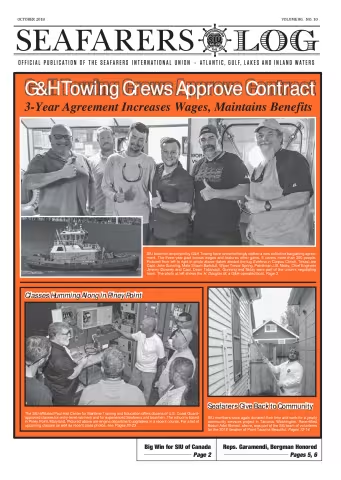
G&H Towing Crews Approve Contract
3-Year Agreement Increases Wages, Maintains Benefits
SIU boatmen employed by G&H Towing have overwhelmingly ratified a new collective bargaining agree-
ment. The three-year pact boosts wages and features other gains. It covers more than 300 people.
Pictured from left to right in photo above (taken aboard the tug Evelena in Corpus Christi, Texas) are
Capt. John Gunning, Mate Shawn Barkdull, Wiper Trevor Spring, Patrolman J.B. Niday, Chief Engineer
Jeremy Downey and Capt. Dean Taliancich. Gunning and Niday were part of the union’s negotiating
team. The photo at left shows the H. Douglas M, a G&H-operated boat. Page 3.
The SIU-affiliated Paul Hall Center for Maritime Training and Education offers dozens of U.S. Coast Guard-
approved classes for entry-level mariners and for experienced Seafarers and boatmen. The school is based
in Piney Point, Maryland. Pictured above are engine department upgraders in a recent course. For a list of
upcoming classes as well as recent class photos, see Pages 20-23.
Classes Humming Along in Piney Point
SIU members once again donated their time and work for a yearly
community services project in Tacoma, Washington. Recertified
Bosun Adel Ahmed, above, was part of the SIU team of volunteers
for the 2018 iteration of Paint Tacoma Beautiful. Pages 12-14.
Seafarers Give Back to Community
Big Win for SIU of Canada
Page 2
Reps. Garamendi, Bergman Honored
Pages 5, 6
45321_OCTOBER_2K18_LOG_X.indd 1 9/28/2018 3:44:09 PM
2 Seafarers LOG October 2018
The Seafarers LOG (ISSN 1086-4636) is published monthly by the
Seafarers International Union; Atlantic, Gulf, Lakes and Inland Waters,
AFL-CIO; 5201 Auth Way; Camp Springs, MD 20746. Telephone (301)
899-0675. Periodicals postage paid at Southern Maryland 20790-9998.
POSTMASTER: Send address changes to the Seafarers LOG, 5201 Auth
Way, Camp Springs, MD 20746.
Communications Director, Jordan Biscardo;
Managing Editor/Production, Jim Guthrie; Assistant
Editor, Nick Merrill; Photographer, Harry Gieske;
Administrative Support, Jenny Stokes; Content Curator,
Mark Clements.
Copyright © 2018 Seafarers International Union, AGLIW. All Rights
Reserved.
Volume 80 Number 10 October 2018
The SIU online: www.seafarers.org
The Seafarers International
Union engaged an environ-
mentally friendly printer
for the production of this
newspaper.
President’s Report
FEBRUARY 2014 VOLUME 76 o NO. 2
Reversed to White
Reversed to White
Since our next edition will be published right around Election Day, I’ll begin
this month’s message with one more reminder to make sure you’re registered to
vote, and then go with families and friends to the polls on November 6. If you’re
not sure which candidates the union is supporting, check with your port agent.
Throughout my years with our union, I have consistently seen surprised
reactions from new members (and even some who’d already been with us for a
while) when they learn about the gigantic impact that politics has on their jobs.
The short version is that if maritime unions, vessel operators, coalitions and
other organizations from our industry were not politi-
cally active, there wouldn’t be a U.S. Merchant Marine.
That’s why we’re on the front lines practically every day,
fighting to protect the Jones Act, the Maritime Security
Program, cargo preference laws and anything else that
boosts the U.S.-flag fleet and American crews.
That’s also why I talk with Seafarers all the time
about grassroots political action, and why we devote so
much coverage (in print and online) to politics. It’s why
we support pro-maritime candidates at every level of
government, regardless of party. Our involvement is a
matter of survival, but a strong American-flag fleet – and
reliable, well-trained, U.S. citizen crews – are equally
vital to national, economic and homeland security.
The stakes are just as high when it comes to workers’
rights and freedom of association. It’s no secret that unions have been under
attack for decades, and those legislative and judicial assaults are only intensify-
ing. But the labor movement not only is fighting back, we are winning some
key victories, starting with the Teachers’ protests in the spring. Unions led the
way in defeating so-called right-to-work provisions in Missouri, and we also
successfully challenged anti-worker executive orders that would harm federal
employees (including members of the SIU Government Services Division). Ad-
ditionally, non-partisan polling shows that the public’s opinion of unions is at
a modern high point. In fact, nearly two-thirds of the people 35 and under who
were polled expressed their support for unions, according to Gallup.
Put all of that together and it’s easy to see why we must vote for pro-mari-
time, pro-labor candidates this year. At stake are all 435 seats in the U.S. House
of Representatives, 35 positions in the Senate and 36 governorships, along with
state-level and local offices.
So get out there and vote, and if your port agent asks for help with a cam-
paign or with getting people to the polls, please make every effort to volunteer
your time.
Last but not least, I thank every Seafarer who already contributes to the
union’s voluntary political action fund, SPAD. If you’re not on board with
SPAD, the time to sign up is now. It’s definitely not the only tool in our political
arsenal, but it’s an important one.
Jones Act Facts
Like our fellow citizens all across the country, I was cringing and pray-
ing for the best when Hurricane Florence devastated parts of the East Coast in
mid-September. You know it’s bad when the highway signs all the way up here
around D.C. are warning you not to attempt any travel to the Carolinas.
Ahead of the storm, SIU members did a fantastic job crewing up ships and
moving them out of harm’s way. The activations required a lot of extra work in
our manpower office and at the hiring halls, and I’m proud of the way you all
rose to the occasion.
Meanwhile, in the immediate aftermath of Florence, I thought I was in some
kind of movie where I woke up one morning and I’d somehow gone back in
time a year. That’s because I started reading new articles slamming the Jones
Act for allegedly impeding the recovery from Hurricane Maria in Puerto Rico
in 2017. (Those pieces were trying to compare the federal responses to Florence
and Maria.)
We’ve covered this ad nauseum, but if you’re new to the union or the indus-
try, don’t fall for the lies being resurrected by Jones Act critics. The facts are
that Jones Act carriers led the way in the recovery in Puerto Rico, and the law
greatly benefits that territory. And, as many of you know, American crews on
Jones Act vessels still are bringing the needed supplies to rebuild the common-
wealth. If you want to get up to speed on the Jones Act and Puerto Rico, visit
the excellent website americanmaritimepartnership.com (the SIU is a member
of the coalition that runs the site).
As always, we have a lot of work ahead, well beyond Election Day. And as
always, we’re up to those tasks.
Michael Sacco
Election Day Almost Here
The printed version of the Sep-
tember LOG contained a mistake on
the front page, where the main head-
line erroneously identified the new
ship El Coqui as a tanker. The ship
in fact is a combination container/
roll-on roll-off (ConRo) vessel,
something clearly known to every-
one on our staff (and something re-
flected in the rest of the coverage).
We corrected the PDF version of the
September edition, which is posted
on the union website.
We strive to make every issue
of the LOG interesting, useful –
and accurate. While we never will
be immune from making mistakes,
we don’t take last month’s lightly.
We apologize. We’ll do better, and
we thank you for your understand-
ing and your support. On a per-
sonal note, both the original error
and the ultimate responsibility are
mine.
Lastly, this seems an oppor-
tune time to mention that although
we are not asking Seafarers to
act as proofreaders, please let us
know if you ever spot a mistake
that warrants a correction, and/or
one that at least can be changed
online. Our staff emails are listed
in the LOG section of the SIU
website (mine is jbiscardo@sea-
farers.org); our phone number is
(301) 899-0675, and our fax num-
ber is (301) 702-4407.
Respectfully,
Jordan P. Biscardo
Communications Director
An Apology to Our Readers
Canadian seafaring unions re-
cently finalized an agreement with
the Canadian government that se-
cured cabotage rights for Canadian
mariners aboard vessels flying any
flag traversing that nation’s domes-
tic waterways.
Seafarers International Union of
Canada President Jim Given said on
Sept. 11, “Our victory is official!”
Given, who serves as the East-
ern Area Executive Board Member
for the AFL-CIO’s Maritime Trades
Department (MTD), has spearheaded
this fight to enforce and strengthen
Canada’s cabotage laws for years.
He has reported on this campaign
several times at MTD Executive
Board meetings. (SIU President Mi-
chael Sacco also is president of the
MTD.)
Under the provisions agreed
upon, the Canadian government
will not issue any temporary foreign
worker permits to mariners from out-
side nations for more than 30 days
without the written consent of the
maritime unions of Canada, which
will be coordinated through the SIU
of Canada.
“What this means,” noted Given,
“is Canadian mariners will get first
work on any vessel running cabotage
regardless of the vessel’s flag. This is
an important win, and the first of its
kind for this program.”
In the event that no Canadian
mariners are available for such a
cabotage run, Given pointed out that
the foreign mariners must be granted
new employment contracts which
clearly show the Canadian wage
rates and working conditions they
are under while engaged in Canadian
waters. Additionally, such conditions
must meet the standards set by the
laws of Canada
In 2015, the SIU of Canada filed
42 lawsuits against the Canadian
government for violating the Tempo-
rary Foreign Worker Program. The
union found evidence that Canadian
seafarers were not offered the jobs
and many foreign mariners were paid
as little as $2.41 an hour while work-
ing in Canadian waters. A year later,
the union filed 13 more lawsuits with
similar allegations.
In July 2016, the Canadian gov-
ernment admitted it improperly is-
sued work permits to the foreign
crew aboard a Marshall Islands
tanker sailing in Canadian waters.
The Canadian Federal Court granted
the union’s judicial review applica-
tion and, in February 2017, the SIU
of Canada and the national govern-
ment settled the remaining lawsuits.
As part of the settlement, the
union worked with branches of the
government to establish a new Tem-
porary Foreign Worker Program
policy to address the issues of con-
cern to Canada’s maritime labor
community.
“This is a significant step to en-
sure that Canadian vessel charter-
ers will no longer be able to use the
Temporary Foreign Worker Program
to exploit foreign labor as a means
to undercut and undermine the Cana-
dian maritime industry and Canadian
seafarers,” added Given.
The MTD is a constitutionally
mandated department of the AFL-
CIO. It features 23 affiliate unions
(representing around five million
members) and a network of 21 port
maritime councils.
Canadian Maritime Unions
Win Major Cabotage Rights
Jim Given
President, SIU of Canada
U.S. Rep. Bill Shuster (R-Penn-
sylvania), chairman of the House
Committee on Transportation and
Infrastructure, recently named Rep.
Brian Mast (R-Florida) to serve
as chairman of the Subcommittee
on the Coast Guard and Maritime
Transportation for the remainder of
the 115th Congress.
The subcommittee, one of six
subcommittees within the Transpor-
tation and Infrastructure Committee,
conducts oversight of the United
States Coast Guard, and has jurisdic-
tion over regulation of ocean ship-
ping, maritime transportation safety,
and the Jones Act. The subcommit-
tee also has oversight of the U.S.
Merchant Marine as a whole, except
in cases of national security.
“Oversight of the Coast Guard
and the nation’s maritime transporta-
tion system is a vital responsibility of
the Transportation and Infrastructure
Committee. The Coast Guard, as one
of the nation’s five armed services,
conducts an array of critical missions
on behalf of the American people,”
said Shuster. “Brian is an effective
member of this subcommittee and
has a firm grasp of the issues. He
understands the critical nature of the
Coast Guard’s missions and is ready
to take the gavel.”
“Maritime transportation is a
critical issue for Florida and the
Coast Guard has an important pres-
ence in our state, which is why I
asked Chairman Bill Shuster for the
opportunity to take on leadership of
this subcommittee,” Mast said. “The
Coast Guard plays an essential role
in maintaining the rule of law on our
waterways, including securing our
borders and enforcing marine pol-
lution laws. Working together, I’m
confident we can ensure they have
the tools they need to succeed at
these critical missions.”
U.S. Rep. Mast Named New Chairman
Of Maritime Transportation Subcommittee
Congressman Brian Mast (center) pauses for a photo after a meeting
with members of the maritime community during 2018’s Congressional
Sail-In. Also pictured, from left to right: American Maritime Officers
Service’s Legislative Consultant Brenda Otterson; AMO President
Paul Doell; AMO Member Captain Kevin Stith; and SIU Port Agent
Todd Brdak.
45321_OCTOBER_2K18_LOG_X.indd 2 9/28/2018 3:44:11 PM
October 2018 Seafarers LOG 3
G&H Boatmen Approve 3-Year Contract
SIU boatmen employed by Galveston,
Texas-based G&H Towing have over-
whelmingly approved a three-year contract
featuring wage gains and other improve-
ments.
The pact, which also maintains benefits,
covers more than 300 SIU members. Vot-
ing took place Sept. 1-5, and the agreement
was approved by a 9:1 ratio.
SIU Vice President Gulf Coast Dean
Corgey stated, “The key to this contract is
that the SIU and G&H Towing company
have a longstanding relationship that is
excellent. We’ve shown the industry how
working together on national and local pol-
itics, recruiting, manning and good-faith
bargaining has a positive outcome for all
parties.”
Representing the SIU during negotia-
tions (which primarily took place for sev-
eral days in August) were Assistant Vice
President Mike Russo, Patrolman J.B.
Niday, Mate Cameron Schroeder, Capt.
Mark Kazin, Capt. John Gunning, Chief
Engineer Howard Cook and Oiler Steve
Prendergast. The company negotiators in-
cluded Steve Huttman, Elaine Lauzon and
Xavier Valverde.
G&H operates nearly 40 harbor tugs in
Houston, Galveston, Texas City, Corpus
Christi and Freeport. The company expects
to add up to a dozen more boats.
The rank-and-file members who served
on the bargaining committee said nego-
tiations went well, and the end result is a
collective bargaining agreement that was
met with enthusiasm by fellow boatmen.
In addition to the yearly wage increases,
the contract calls for paid parental leave;
maintains medical and pension benefits;
further secures vocational training oppor-
tunities; successfully addresses some is-
sues pertaining to vacation and sick leave;
and offers bonuses for engine room per-
sonnel.
“I’m excited about the contract and the
membership was, too,” stated Cook, who
had served on one other bargaining com-
mittee while working at G&H. “The whole
demeanor of the negotiations went well.
Mike and J.B. – I can’t say enough about
those guys. They did a fantastic job and
they treated us very well, too.”
Kazin said, “I definitely think it was a
good contract. This is our best wage in-
crease since 1998…. I’m proud of what
we accomplished.”
He added that as a first-time member
of the bargaining team, “It was definitely a
learning experience and a good experience.”
Similarly, Schroeder hadn’t previously
been part of contract negotiations. “I really
enjoyed it,” he said. “It was a great learn-
ing experience, and I wouldn’t mind doing
it again.”
Schroeder said the addition of paternity/
maternity leave is “a step in the right di-
rection. Some people won’t be able to use
it, but I think for a company that’s getting
younger, it’ll definitely be a huge deal and
people will be thankful for it. Adding new
things to the contract is always big.”
Likewise, Gunning pointed to the new
benefit as well as the wage gains as con-
tract highlights. “The newborn leave is a
really interesting and great development,”
he said. “In terms of overall money, I think
we did extraordinarily well.”
He, too, was a first-time negotiator. “It
was very different than what I had imagined,”
Gunning said. “It all went very smooth, and
in in a really positive direction.”
Prendergast took a big-picture view
of the contract and the company. He ex-
pressed confidence in G&H’s growth and
new management, and pointed out busi-
ness is thriving in the Port of Houston (and
doing well in other Texas ports).
“I’m optimistic about the future be-
cause of the direction the maritime indus-
try is going,” said Prendergast, who also
served on the union bargaining team for
the prior contract in 2015.
Russo said the negotiations “went really
well, and the delegates did a heck of a job.
We took no monetary losses, and where
the company had things that they wanted,
we were able to reach compromises that
were agreeable. Everybody was profes-
sional and respectful; we hammered out an
agreement in record time, and that’s due in
no small part to the outstanding work of
our rank-and-file delegates.”
Corgey added that G&H crews have
been represented by the SIU dating back to
the mid-20th century. Further, four of the
five union officials based at the Houston
hiring hall have worked at G&H at some
point.
“The roots run deep,” Corgey said. “Ev-
erybody realizes that we’re going to get a
lot more done working together, and the
key for the members is stability. Our mem-
bers can plan on a future for their family
budgets, their retirement. They can look
forward to a nice, stable occupation and
they can also look forward to a secure re-
tirement. After all, none of this can happen
without the boatmen and women; they’re
the best in the business.”
Pact Boosts Wages, Includes Additional Improvements
The SIU-crewed David B (photo at left) is operated by G&H for Bay-
Houston Towing. In the photo above, SIU boatmen meet with Patrol-
man J.B. Niday (left) aboard the C.R. Haden.
Bargaining committee members from the union and company, respectively, gather for a photo upon successful
completion of negotiations. Pictured from left are SIU Asst. VP Mike Russo, Mate Cameron Schroeder, Elaine Lau-
zon of G&H, Capt. Mark Kazin, Capt. John Gunning, Steve Huttman and Xavier Valverde of G&H, Chief Engineer
Howard Cook, AB Steve Prendergast and Patrolman J.B. Niday.
Oiler Shaun McCleese (left) and Chief Engineer Roy Wick are
pictured aboard the tugboat Zeus.
45321_OCTOBER_2K18_LOG.indd 3 9/27/2018 11:43:56 PM
4 Seafarers LOG October 2018
Sen. Kaine, Rep. Scott Discuss Maritime
SIU Participates in Port Council Gathering in Virginia
With representatives from 16 different
international unions present – including the
Seafarers – the Hampton Roads (Virginia)
Port Council kicked off Labor Day week-
end on Aug. 31 with a lunchtime question-
and-answer session featuring U.S Sen. Tim
Kaine (D-Virginia) and U.S. Rep. Bobby
Scott (D-Virginia).
Iron Workers Local 79 hosted the meet-
ing in Norfolk, Virginia.
The port council is part of the AFL-CIO
Maritime Trades Department (MTD), to
which the SIU is affiliated. SIU Port Agent
Georg Kenny and Government Services
Division Representative Sam Spain were
among the attendees, as was MTD Execu-
tive Secretary-Treasurer Daniel Duncan,
who served as moderator.
The 90-minute gathering brought to-
gether elements from the Norfolk-area’s
shipbuilding, ship repair and seafaring
communities. The two elected officials
dealt with a variety of questions ranging
from port activities to finding new ways to
spark apprenticeship programs.
Kaine and Scott both serve on their
bodies’ main committees that oversee
labor and workforce issues. Before tak-
ing questions, both spoke briefly about
creating legislation that would allow fed-
erally funded Pell Grants to be used to
cover the costs associated with appren-
ticeship training. (Currently, Pell Grants
only help cover expenses associated with
getting a college degree.) In addition,
both spoke out strongly against President
Trump’s announcement the day before to
cancel a 2 percent pay raise for federal
workers.
Kaine and Scott reiterated their long-
standing support for the Jones Act, the
Maritime Security Program and cargo pref-
erence. Both noted the need for a strong
domestic shipbuilding industry to maintain
America’s military and commercial fleets.
The pair cited Norfolk’s efforts to be-
come the largest port in terms of cargo
along the U.S. Atlantic coast, stating they
would do whatever is possible in Wash-
ington to help achieve this goal. However,
both were unaware that the Norfolk/Tide-
water/Hampton Roads region is the only
major U.S. port on the East Coast that does
not have a seamen’s center for U.S. and
foreign mariners whose ships dock at the
facilities. Both agreed to work with local
governmental and business officials to al-
leviate that concern.
SIU President Michael Sacco also
serves as president of the MTD, which is
a constitutionally mandated department of
the AFL-CIO. The MTD features 23 affili-
ate unions (representing around five mil-
lion members) and a network of 21 port
maritime councils. Those port councils
give the affiliates a mechanism to pool
their resources on a wide range of issues
and projects.
Pictured from left at the port council event are SIU Senior Political Consultant Terry Turner, SIU Port Agent Georg Kenny (who also serves as secretary-treasurer of the port council),
Tracy Burke of MEBA, U.S. Sen. Tim Kaine, ITF Inspector Barbara Shipley, U.S. Rep. Bobby Scott, Capt. Randall Rockwood of MM&P, and SIU Government Services Representa-
tive Sam Spain.
The SIU last month launched a
new training initiative for current
union representatives. Most of the
sessions are taking place at the SIU-
affiliated Paul Hall Center for Mari-
time Training and Education, located
in Piney Point, Maryland.
Three individual conferences –
each designated by region – were
planned for officials. A group from
the East Coast and Great Lakes com-
pleted the initial seminar Sept. 17-
21. The remaining ones are for SIU
personnel from the West Coast (Oct.
1-5) and the Gulf Coast (Oct. 22-26).
Regional vice presidents, assistant
vice presidents, port agents, safety
directors and patrolmen are attend-
ing the conferences.
SIU Secretary-Treasurer David
Heindel and Piney Point Port Agent
Pat Vandegrift handled much of the
planning for all of the training.
“This is being done in order to
best serve the rank-and-file mem-
bership,” Heindel stated. “There are
always a lot of changes happening
within the maritime industry, and
we are also facing some unique chal-
lenges in the labor movement, so the
timing of these conferences is excel-
lent.”
Current officials began the initial
session with a review of the union’s
newly updated port procedures man-
ual, a comprehensive document cov-
ering virtually all aspects of union
representation. They reviewed the
union’s constitution along with
various legal considerations; lead-
ership techniques; the International
Transport Workers’ Federation; the
government’s request-for-proposal
process; contracts and shipping
rules; political action and more.
SIU Exec. VP Augie Tellez (standing) ad-
dresses the attendees.
Union Reps Train
In Piney Point
SIU President Michael Sacco (left) opens the first training session. Also pictured (from
left) are Secretary-Treasurer David Heindel, Counsel Leslie Tarantola, and Seafarers
Plans Administrator Maggie Bowen.
45321_OCTOBER_2K18_LOG.indd 4 9/27/2018 11:43:57 PM
October 2018 Seafarers LOG 5
In a recent article written by Daniel
Goure, Ph.D., vice president at the Lex-
ington Institute think tank, the U.S-flagged
fleet received high praise for the crucial
role the American maritime industry plays
in the nation’s defense.
In the article, Goure stated, “Support
for a U.S.-flagged commercial sealift
fleet is one of the few economic areas
where the U.S. government, Republican
and Democratic administrations alike,
has practiced what amounts to indus-
trial policy. And rightly so. The mainte-
nance of a viable and reliable capability
to move military-relevant cargoes around
the world in support of U.S. forces abroad
is critical.”
The Lexington Institute is based in
Arlington, Virginia. On its website, the
organization states, “It is the goal of the
Lexington Institute to inform, educate, and
shape the public debate of national priori-
ties in those areas that are of surpassing
importance to the future success of democ-
racy, such as national security, education
reform, tax reform, immigration and fed-
eral policy concerning science and tech-
nology. By promoting America’s ability
to project power around the globe we not
only defend the homeland of democracy,
but also sustain the international stability
in which other free-market democracies
can thrive.”
Goure continued, “Recent assessments
of the U.S. industrial base have identified
several critical vulnerabilities that could
compromise the military’s ability to con-
duct high-intensity warfare. One of these
is the ability of the U.S.-flagged sealift
fleet to meet the transportation demands
created by the overseas deployments and
operation of large combat formations in
a war zone. Simply put, the U.S.-flagged
sealift fleet has been allowed to erode to
the point that it is of only barely sufficient
size and capability to meet the demands
created by relatively small contingencies
such as those conducted in this century in
Southwest Asia.”
The article quoted Gen. Darren McDew
(USAF), who recently retired after serving
as commanding officer of the U.S. Trans-
portation Command. During his time at the
agency, McDew stated, “An aging organic
sealift fleet coupled with a reduction in
U.S.-flagged vessels threatens our ability
to meet national security requirements.
The U.S.-flagged fleet has been in steady
decline since World War II as a result of
decreasing demand and the rising cost of
the U.S.-flagged fleet compared to inter-
national fleets. In 1951, 1,288 U.S.-flagged
ships were registered in the United States.
In 1990, the fleet was down to 408 ships,
and in 2013 just 106. Today, 82 U.S.-
flagged ships operate in international trade,
representing a 25 percent reduction in just
the last 5 years. .... If the fleet continues
to lose ships, a lengthy, mass deployment
on the scale of Desert Shield/Desert Storm
could eventually require U.S. Forces to
rely on foreign-flagged ships for sustain-
ment.”
Goure then outlined the basic duties of
the Maritime Administration (MARAD)
before talking in detail about their impor-
tant programs: “Two of MARAD’s main
tools for assisting the U.S. commercial
fleet are the Maritime Security Program
(MSP) and the Voluntary Intermodal Sea-
lift Agreement (VISA),” he wrote. “These
programs are designed to assure the avail-
ability of sufficient U.S. commercial sealift
capability and the supporting infrastructure
to sustain U.S. military operations over-
seas in an emergency.
“The MSP provides supplementary
funding, currently $5 million per ship annu-
ally, for a specific number of U.S.-flagged,
privately owned ships which conduct inter-
national commerce but which are available
under agreement to respond to Department
of Defense (DoD) requirements during
war and national emergencies. Currently,
the MSP fleet consists of 60 vessels in a
mix of container ships, roll-on/roll-off car-
riers, and heavy lift platforms. The VISA
program is similar to MSP insofar as it too
is a partnership between the U.S. govern-
ment and the maritime industry to provide
the DoD with assured access to commer-
cial sealift, terminal facilities, and supply
chain management services to support the
emergency deployment and sustainment
of U.S. military forces. VISA participants
commit to providing a graduated level of
carrying capacity to DoD based on a three-
stage activation system. In return, these
participants receive preference regard-
ing the transportation of DoD cargoes in
peacetime. VISA allows DoD access to
a broader range of vessels than are in the
MSP, including tankers.”
He then talked about another impor-
tant program, saying, “A third way that
MARAD ensures the availability of a U.S-
flagged sealift fleet is through the cargo
preference program. This program man-
dates that U.S. government shippers use
U.S.-flagged ships, if available, to trans-
port 50 percent of any oceangoing cargo
that either directly or indirectly involves
the government. Except in wartime, food
aid cargoes are the single greatest source
of preference cargoes. Removing or even
reducing the 50 percent preference would
be highly damaging to the U.S. commer-
cial transport fleet.”
He continued, “Because the cargo pref-
erence program can necessitate that U.S.
government departments and agencies
pay higher shipping prices, it has led to
some intra-governmental tensions. The
U.S. Agency for International Develop-
ment has argued that it should be allowed
to ship more food aid on foreign carriers
to stretch its budget. There are reports
that even some DoD agencies responsible
for the movement of bulk supplies have
sought to circumvent the cargo preference
requirements.”
The article concluded, “The cost of
MARAD’s programs to support a viable
and effective U.S. commercial sealift ca-
pability amounts to a small fraction of the
projected $65 billion it would cost the gov-
ernment to replicate this capacity and the
intermodal infrastructure and global cargo
networks provided to the DoD by private-
sector MSP participants. For a relatively
small expenditure, a critical national secu-
rity capability can be maintained.”
Lexington Institute: National Security
Requires U.S.-Flag Fleet, U.S. Mariners
One of the U.S. maritime industry’s
leading advocates recently received one
of its most prestigious honors.
U.S. Rep. John Garamendi (D-Califor-
nia) on Sept. 17 was presented with the
American Maritime Partnership’s (AMP)
annual Champion of Maritime Award.
It’s the coalition’s top award, and is given
“to a member of Congress for extraordi-
nary support and dedication to the Ameri-
can maritime industry,” AMP noted in a
press release.
SIU Vice President West Coast Nick
Marrone attended the presentation in
Vallejo, California.
The SIU is an AMP affiliate.
“Through his years of work in the
U.S. Congress, Rep. Garamendi has
shown unwavering and ardent support
for domestic maritime, which includes
the men and women who build, operate
and crew the tens of thousands of vessels
that transport goods and people safely
in the more than 95,000 miles of U.S.
coastline and inland waterways,” AMP
stated.
Garamendi serves as ranking member
of the House Coast Guard and Maritime
Transportation Subcommittee of the
House Transportation Committee. He re-
cently introduced legislation aimed at in-
creasing jobs for U.S. mariners, boosting
domestic shipbuilding, and helping en-
sure that American-flag vessels are used
for a percentage of LNG exports.
In announcing the award, AMP added,
“In addition to his work to promote the
contribution that the American maritime
industry makes to California by providing
thousands of family-waged jobs and add-
ing more than $6.6 billion annually to the
state’s economy alone, Rep. Garamendi
recognizes the importance of this industry
to the nation’s economic, national, and
homeland security interests. Nationwide,
the domestic maritime industry accounts
for approximately 500,000 American
jobs and more than $100 billion in annual
economic impact.”
During the ceremony, the congress-
man stated, “When we think about all
the issues at the forefront of American
politics right now – good-paying jobs,
energy independence, national security,
trade, and rebuilding our manufacturing
sector – the American maritime industry
is at the forefront of all of them. Unfortu-
nately, it’s not on the minds of many of
our leaders in Washington. I’m proud of
the work we’re doing together to change
that.
“The successes we’ve had for our do-
mestic maritime industry would not be
possible without the tireless efforts of
the American Maritime Partnership, and
I couldn’t be more honored to receive the
Champion of Maritime Award,” he con-
tinued. “I also want to thank the Propeller
Club of Northern California, the Califor-
nia State University Maritime Academy
(which hosted the event), and my Mari-
time Advisory Committee for bringing
the maritime community together today
to discuss the challenges and opportuni-
ties before us. As a united maritime in-
dustry, we will continue to rebuild this
critical sector to advance America’s na-
tional and economic security.”
“It is hard to imagine a more tireless
supporter of our industry,” said Matt
Woodruff, chairman of AMP. “When the
American maritime industry faces a chal-
lenge or an opportunity, we can be sure
with absolute certainty that Rep. Gara-
mendi will be a leader for the men and
women of American maritime. At the top
of our list, he is a leading champion of
the Jones Act, the fundamental law of
the American maritime industry which is
essential to the strength of our domestic,
homeland and national security.”
AMP’s member organizations include
the SIU and other maritime unions, ves-
sel owners and operators, shipboard and
shoreside workers, shipbuilders and re-
pair yards, equipment manufacturers and
vendors, dredging and marine construc-
tion contractors, plus numerous maritime
associations and national security organi-
zations.
Congressman John Garamendi
Named ‘Champion of Maritime’
U.S. Rep. John Garamendi addresses those gathered at the awards ceremony. (Photo courtesy AMP)
45321_OCTOBER_2K18_LOG.indd 5 9/27/2018 11:43:58 PM
6 Seafarers LOG October 2018
The story of the U.S. Merchant Marine
is as old as the nation itself. However, the
legislative fight to protect the rights of the
American mariner didn’t gain traction until
much later.
One of the first such moments occurred
with the enactment of the Passenger Ves-
sel Services Act (PVSA) of 1886. That law,
which assessed a fine to any foreign ship
carrying passengers between two ports in
the U.S., was a first step towards the coun-
try’s modern cabotage laws.
Following soon behind was the Military
Cargo Preference Act of 1904, which dictated
that 100 percent of military cargoes be car-
ried on board U.S.-flag vessels. Exceptions
could be made if an American vessel was un-
available, but only with the concurrence of
the Maritime Administration (MARAD).
In 1915, mariners achieved a break-
through with passage of The Seamen’s Act,
thanks in large part to a years-long push by
an SIU forerunner, the International Sea-
men’s Union. As noted by the late SIU
historian John Bunker, the law was “de-
signed to counteract fears for the safety of
American sailors during the early years of
World War I. In order to improve living and
working conditions for the crews of vessels
registered in the United States, it abolished
imprisonment for desertion; reduced pen-
alties for disobedience; regulated hours of
work at sea and in port; fixed a minimum
quality of rations; regulated the payment of
wages; required a certain number of life-
boats; increased the fraction of able seamen
on board; and required 75 percent of each
ship department to understand the language
spoken by the officers.”
Meanwhile, once the PVSA helped slow
if not stop foreign interests from attempting
to cut costs at the expense of their mariners,
U.S. lawmakers devised a similar law for
cargo transportation: The Merchant Marine
Act of 1920.
The goals of the Merchant Marine Act
of 1920 (far better known nowadays as the
Jones Act) are outlined in the preamble of
the law, which reads, “It is necessary for the
national defense and for the proper growth of
its foreign and domestic commerce that the
United States shall have a merchant marine of
the best equipped and most suitable types of
vessels sufficient to carry the greater portion
of its commerce and serve as a naval or mili-
tary auxiliary in time of war or national emer-
gency, ultimately to be owned and operated
privately by citizens of the United States; and
it is declared to be the policy of the United
States to do whatever may be necessary to de-
velop and encourage the maintenance of such
a merchant marine, and, in so far as may not
be inconsistent with the express provisions
of this Act, the Secretary of Transportation
shall, in the disposition of vessels and ship-
ping property as hereinafter provided, in the
making of rules and regulations, and in the
administration of the shipping laws keep al-
ways in view this purpose and object as the
primary end to be attained.”
The law was reaffirmed in 1936, and later
amended in 1954 with the addition of cargo
preference laws, which dictated that certain
percentages of the volume of government-
impelled cargoes be transported on privately
owned U.S.-registered vessels.
Also taking place in 1954, Public Law
480 (PL-480) was enacted; it would later
be termed Food for Peace. This program
was originally intended to serve as a way
for domestic farmers to ship surplus product
overseas, but was revised in 1966 to allocate
part of U.S. food production for distribution
among the poorest countries in the world.
The program was formally replaced with the
similar Food for Peace Act in 2008.
In a recent statement, the coalition USA
Maritime described the benefits of PL-480:
“Unlike other foreign aid programs, the pro-
gram does more than just send aid overseas.
Food for Peace is a point of pride for the
44,000 American farmers, shippers, proces-
sors, port workers, and merchant mariners
whose jobs depend upon the program. Food
for Peace is not just a handout.
It’s the sharing of American bounty and
American know-how to help rescue those
less fortunate from starvation and chronic
food insecurity. By creating a uniquely sus-
tainable public-private partnership between
American faith-based organizations, U.S.
industry, and the U.S. government, Food for
Peace leverages private and public resources
to make a meaningful difference for millions
of people in a way that government alone
simply cannot.”
Since its enactment in 1954, PL-480 is
considered one of America’s most success-
ful foreign aid programs.
Supporting Our Military
The U.S.-flag fleet has a well-docu-
mented history of answering the call of the
U.S. military in times of crisis. As the needs
of the military have shifted and expanded
over the years, the importance of maintain-
ing a surge sealift fleet of privately owned,
militarily useful vessels became even more
critical. On October 8, 1996, President
Clinton signed the Maritime Security Act of
1996, which established the Maritime Secu-
rity Program (MSP).
According to the MARAD, “The MSP
maintains a modern U.S.-flag fleet provid-
ing military access to vessels and vessel ca-
pacity, as well as a total global, intermodal
transportation network. This network in-
cludes not only vessels, but logistics man-
agement services, infrastructure, terminals
facilities and U.S. citizen merchant mariners
to crew the government owned/controlled
and commercial fleets.”
Experts have estimated it would cost the
government tens of billions of dollars to rep-
licate what the MSP (and its related Volun-
tary Intermodal Sealift Agreement) provides.
All of these laws help protect the coun-
try’s national, economic and homeland secu-
rity. The Jones Act alone, for example, helps
maintain nearly 500,000 American jobs and
pumps billions of dollars into the economy
every year. It also is vital to helping main-
tain the country’s shipbuilding capability
and its pool of civilian mariners.
Rationale for Longstanding Maritime Bills
In USA Remains Powerfully Sound Today
Jones Act, Cargo Preference, MSP all Boost American Security
Following are a few quotes from the Congressional Record of June 4, 1920, when U.S.
Senators voted to institute their version of the Merchant Marine Act of 1920, better known
as the Jones Act. These quotes show the recognition of the need for such a law, and the
prescience of the Senators who voted in favor of the bill.
Sen. John Nugent (D-Idaho)
“Mr. President, I appreciate the fact that it is not only desirable but necessary that we
have a great merchant fleet in order that the products of our mines, fields, and factories may
be transported to every quarter of the globe in American bottoms, and in order that, should
the emergency arise, the ships may be used as auxiliaries to our Navy.”
Sen. Park Trammell (D-Florida)
“I heartily share the sentiment of the committee favorable to the maintenance of a great
American merchant marine. I believe prior to the war that this was one of the crying needs of
the Nation, and it was one of the misfortunes of our country that the merchant marine which
we formerly had in the early days had from time to time passed into the hands of foreign-
ers, and that on account of that fact there were very few vessels sailing under the Stars and
Stripes and operating under American control.
“As one of the fortunes of war our Nation acquired a very large fleet. This fleet, in my
opinion, should be permanently maintained and the Nation should have such advantages as
will accrue to it as the result of the maintenance of an efficient American merchant marine.”
Sen. William King (D-Utah)
“In my judgment you can build up a merchant marine by fair and just and sensible leg-
islation.”
Sen. Nathaniel Dial (D-South Carolina)
“The time has come when we need a merchant marine which will be commensurate with
our demands and necessities. We wish to ship our goods to every market in the world. I
am, therefore, strongly in favor of building up a great merchant marine.... We want to build
up a merchant marine of which we will be proud; we want to carry and distribute a large
proportion of our merchandise in our own vessels, as we did long ago, before the days of
the Civil War.”
Sen. Wesley L. Jones (R-Washington)
(Note: This text is from the law itself, sponsored by Sen. Jones)
“The Merchant Marine Act of 1920 is an earnest effort to lay the foundation of a policy
that will build up and maintain an adequate American merchant marine in competition with
the shipping of the world…. If every American will place the nation’s good above individual
welfare; think, talk and act Americanism and give whole-hearted support to the law passed to
aid the United States and uphold those who administer it solely in the interest of the United
States and its citizens, we will have an adequate merchant marine that will secure our own
interests and promote the world’s welfare.”
Jones Act – Quotes from
Senate Floor, June 4, 1920
Rep. Bergman Receives Lakes Honor
U.S. Rep. Jack Bergman (R-Michigan)
has been named 2018 Great Lakes Legislator
of the Year by the largest labor/management
coalition representing shipping on America’s
Fourth Sea Coast. The award is presented
annually by the Great Lakes Maritime Task
Force (GLMTF) to a legislator who has
helped advance waterborne commerce on the
Great Lakes and St. Lawrence Seaway.
Rep. Bergman was honored Sept. 18 at a
ceremony in Traverse City, Michigan.
The SIU is a member of the coalition.
“Although this is just his first term, Rep.
Bergman has quickly become recognized as
a leader on Great Lakes and Seaway issues,”
said Jim Weakley, president of the GLMTF.
“This reflects that his district fronts on three
of the five Great Lakes: Superior, Michigan
and Huron.”
Weakley, who is also president of the Lake
Carriers’ Association, said the GLTMF is es-
pecially grateful that Bergman spoke directly
to President Trump about the need for a sec-
ond Poe-sized lock at Sault Ste. Marie, Michi-
gan. “Within hours of Congressman Bergman
talking to the president, our nation’s leader
publicly declared his support for fixing the
Soo Locks. That support … puts the project
in the best spot it’s been in years.”
Bergman’s commitment to adequate U.S.
Coast Guard icebreaking resources is another
reason for his selection, the coalition noted.
“The locks at Sault Ste. Marie, Michigan,
open on March 25 and close on January 15,”
said John D. Baker, first vice president of
the GLMTF, and president emeritus of the
International Longshoremen’s Association’s
Great Lakes District Council. “But if heavy
ice covers the Lakes, the resumption of the
iron ore trade and overseas exports of grain
from the Lakes largest grain-shipping ports
will be delayed. Rep. Bergman is fully sup-
portive of building another heavy icebreaker
to help the Mackinaw and other icebreakers
keep commerce moving under even the most
trying conditions.”
Other’s pointed to the congressman’s sup-
port for adequate dredging of Great Lakes
ports and waterways, and his backing of a
strong U.S. Merchant Marine as reasons for
his selection for the award.
Bergman becomes the tenth Michigan leg-
islator to receive the award since its inception
in 1998.
Founded in 1992, the Great Lakes Mari-
time Task Force promotes domestic and in-
ternational shipping on the Great Lakes. With
78 members, it is the largest U.S. coalition to
ever speak for the Great Lakes shipping com-
munity and draws its membership from both
labor and management representing U.S.-flag
vessel operators, shipboard and longshore
unions, port authorities, cargo shippers, ter-
minal operators, shipyards and other Great
Lakes interests. Its goals include ensuring
Lakes dredging is adequately funded; con-
struction of a second Poe-sized lock at Sault
Ste. Marie, Michigan; bolstering the Coast
Guard’s icebreaking resources; protecting the
Jones Act and other U.S. maritime cabotage
laws and regulations; maximizing the Lakes
overseas trade via the St. Lawrence Seaway;
opposing exports and/or increased diversions
of Great Lakes water; and expanding short sea
shipping on the Lakes.
U.S. Rep. Jack Bergman
(R-Michigan)
45321_OCTOBER_2K18_LOG.indd 6 9/27/2018 11:43:58 PM
October 2018 Seafarers LOG 7
Houston is one of the
largest ports in the United
States and, not surpris-
ingly, it’s a busy area for
Seafarers.
Most of the photos on
this page show SIU mem-
bers and officials in that
city – aboard a ship (Lib-
erty Glory), at the hir-
ing hall and at area labor
events.
The Liberty Promise
photos were taken in Cor-
pus Christi, Texas, around
200 miles to the southeast.
BOOKS GALORE – In photo at left below, Second Mate Thomas Griffin (right) gets sworn in for his full book by Patrolman Joe Zavala. The large group photo above features AB
Joselito Lampong (wearing white shirt, front near the center, holding his full B-book) and Patrolman J.B. Niday (also displaying the book), along with other members. At the counter
in photo at center below, QMED Samuel Takyi (right) receives his probationary B-book from Niday. In the remaining photo at right, below, AB Choh Zuom (left) is sworn in by Safety
Director Kevin Sykes for his full B-book.
ABOARD LIBERTY GLORY – Pictured from left to right on deck in the photo at left, are AB Timothy Kauble, AB Franklin Akins and Patrolman Joe
Zavala. SA Pete Hernandez (center photo) makes his way to the galley of the Liberty Maritime vessel, while the photo directly above shows AB John
Rascon (left) and Chief Cook Ali Bazzi.
RALLYING FOR CITY – Seafarers turn out Aug. 16 for a rally in support of
the city’s bid to host the 2020 Democratic National Convention. Some of the
SIU contingent is pictured with U.S. Rep. Al Green (fourth from left) near the
Toyota Center, site of the demonstration. Houston, Milwaukee and Miami are
the finalists.
CELEBRATING LABOR DAY – Enjoying a cookout are (photo at left, from left) Hany Khalil, execu-
tive director of the Texas Gulf Coast Area Labor Federation; U.S. Rep. Sheila Jackson Lee (D-Texas);
future Seafarer Joe Jesse Zavala IV and his dad, SIU Patrolman Joe Zavala. Shown in the photo
at right are Zavala and son, Houston Mayor Sylvester Turner and SIU Safety Director Kevin Sykes.
ABOARD L IBERTY
PROMISE – AB William
Steele (immediate right)
operates a forklift on the
Liberty Maritime vessel,
while (photo at far right,
from left) AB Edward Mills
and SA Alfonso Thomas
Martinez are pictured at
the security desk. The
center photo includes
(from left) AB Sirio Cen-
tino, GUDE Camonte Ter-
rell and GUDE Francois
Doucet.
With Seafarers in the Lone Star State
45321_OCTOBER_2K18_LOG.indd 7 9/27/2018 11:44:01 PM
8 Seafarers LOG October 2018
Spotlight on Mariner Health
Editor’s note: The following article was
provided by the Seafarers Health and Ben-
efits Plan Medical Department.
Seizures are a symptom of a brain prob-
lem. They can happen suddenly, due to ab-
normal electrical activity in the brain. Most
people think of a seizure as meaning when
someone has convulsions and the body
shakes rapidly and uncontrollably. Not all
seizures are like this. There are many types
of seizures and some are very mild.
Overall, seizures can fall into two main
groups. There are focal seizures (also called
partial seizures). These happen in just one
area of the brain. They are named after the
part where the seizure originated.
By contrast, generalized seizures are the
result of abnormal activity on both sides of
the brain. This happens when never cells on
both sides of the brain start to misfire. They
can make you have muscle spasms, black
out, or fall. These are usually called grand
mal or tonic-clonic seizures.
Seizures can last from 30 seconds to
two minutes and usually do not cause any
lasting harm. However, if the seizure lasts
longer than five minutes, or the person does
not wake up after a seizure, this is a medical
emergency.
There are many things that can cause a
seizure. The most common is a head injury.
This is an injury to the brain, skull, or scalp.
This can range from a mild bump or a bruise
to a traumatic injury to the brain.
Eclampsia is a rare but serious condi-
tion that causes seizures during pregnancy
or right after delivery. You can develop this
even if you do not have a history of seizures.
Alcohol withdrawal delirium also may
cause seizures.
Intracranial hemorrhage, brain aneu-
rysms, or skull fractures are life-threatening
conditions in which you have bleeding in-
side your skull.
Cerebral Palsy is a group of disorders
that affect muscle movement and coordina-
tion.
Concussions from trauma or sports in-
jury require medical treatment. They can
cause an altered mental state.
Low blood sugar or low blood sodium
can change the chemical balance inside the
brain.
Brain cancer, febrile illnesses, malig-
nant hypertension, heat emergencies, or
amphetamine dependencies can also cause
seizures.
There are many treatments for seizures,
and most involve medications. A neurologist
should be able to identify the medicine that
works best for your type of seizure activity,
although a patient may go through many dif-
ferent meds until the right one is chosen.
If medications do not work, there are
other options. There are a few types of im-
plants that can help to control the brainwave
activity that may become erratic. Responsive
neuro-stimulators work directly with the
nerves in the brain.
Vagus-nerve stimulation works with the
vagus nerve in the chest up to the brain.
Diet, exercise, and occupational therapy
are also used with good results.
Lastly, surgery may be needed to that
area of the brain so that no further seizure
will occur.
If a seizure happens to someone, place
them on their side and help to keep them free
from any injury during the incident. Call for
help and make sure they are breathing. If not,
begin CPR.
8 corn tortilla, 6-inch
Cooking spray
2 pounds chicken breast, cooked shredded
1 cup mushroom, chopped
1 ½ tablespoons onion, chopped
1 ½ tablespoons cilantro, chopped
1 whole jalapeno, seeded and chopped
1 cup 2% milk cheddar cheese, shredded
1 cup roma tomato, diced
½ cup olive, sliced
3 cups iceberg lettuce, shredded
1 cup sour cream, light
Enchilada Sauce Recipe
8 ounces tomato sauce
3 tablespoons chili pepper, ground
1 teaspoon cumin powder, ground
1 teaspoon granulated garlic
1 ½ cups water
¼ teaspoon salt
¼ cup cold water
1 tablespoon cornstarch
Enchiladas Sauce: Add all of the ingre-
dients to a sauce pot or steam kettle; cook
over medium heat for about 8 minutes or
until the sauce boils. Thicken the sauce
with the corn starch slurry to reach desired
thickness. Take the pot off of heat.
Enchiladas: Coat a large nonstick skillet
with cooking spray; place over medium-
high heat until hot. Warm the tortillas on
each side for 10-15 seconds. Stack the
warmed tortillas up and cover with clean
kitchen towel. Set aside. Next, sauté the
onion, mushroom, cilantro, and jalapeno;
sauté until onion and mushrooms are ten-
der. Add chicken and ½ of the enchilada
sauce; cook 5 minutes.
Serving Suggestion: Spoon chicken mix-
ture evenly down centers of each tortilla.
Roll up tortillas; place, seam sides down,
in a 13x9 inch baking dish; pour the other
half of the enchilada sauce over the en-
chiladas and top with cheese. Bake at 350
degrees F for 10-15 minutes or until en-
chiladas are thoroughly heated and cheese
melts. Sprinkle evenly with tomato and ol-
ives. Serve over lettuce with a tablespoon
of sour cream on top.
Nutrition Information: Per Serving (Exclud-
ing unknown items): 259 calories: 11g Fat
(36.9% calories from fat); 22g Protein; 19g Car-
bohydrate; 3g Dietary Fiber; 60mg Cholesterol;
424mg Sodium. Exchanges: 1 Grain (starch); 3
Lean meat; 1 Vegetable; 0 Fruit; ½ Fat; 0 other
Carbohydrates.
Provided by the Paul Hall Center for Maritime Train-
ing and Education’s Lundeberg School of Seamanship
Healthful Recipe
Chicken Enchiladas
8 Servings
Understanding and Addressing Seizures
The American maritime in-
dustry received a welcome if
unsurprising affirmation that the
U.S.-flag fleet and its mariners
remain a crucial component of
national defense, thanks to a re-
cent report released by the United
States Government Accountabil-
ity Office (GAO).
According to the report, the
agency reviewed and subsequently
commented on American-flag
ships that trade internationally.
The GAO spent more than a year
and a half conducting research
and finalizing the report.
The 55-page document es-
sentially concluded – much like
previous studies have determined
– that the cost of maintaining the
fleet is a worthy investment. For
example, the GAO found that
the Maritime Security Program
(MSP), which provides a rela-
tively small annual subsidy to en-
rolled U.S.-flag vessels that are
crewed by civilians and privately
operated, helps ensure there are
enough mariners and tonnage to
support our troops in times of cri-
sis.
Additionally, the MSP offers
the federal government a capa-
bility that would be hard to rep-
licate otherwise. According to
the U.S. Maritime Administration
(MARAD) and the Department of
Transportation (DOT), the finan-
cial cost of replacing these ben-
efits with a government-owned
fleet, as well as replicating the
related intermodal infrastructure
that allows the cargoes to travel
to areas that would otherwise be
difficult to access, would exceed
$60 billion by the latest estimate.
The GAO study served to also
impress upon the DOT the need
to release the long-awaited Na-
tional Maritime Strategy: “The
DOT has drafted but not issued
the national maritime strate-
gies mandated by Congress. The
strategies are intended to address
U.S.-flag vessels’ competitive-
ness and ensure the long-term
viability of U.S.-flag vessels and
U.S.-citizen mariners. Accord-
ing to DOT officials, a combined
draft strategy was developed
under the previous administration
but is now being reviewed by the
current administration. DOT has
not established a timeline for fi-
nalizing the strategy even though
it was to be completed by 2015.
Without establishing a timeline to
complete this required strategy,
DOT continues to delay providing
decision-makers the information
they need to determine how best
to address the challenges facing
the U.S.-flag fleet…. The GAO
recommends that DOT complete
the national maritime strategy
and establish time frames for its
issuance. DOT concurred with our
recommendation….”
Much of the report focused on
challenges facing the industry,
prominently including a decline
in the amount of government
cargoes dating to 2004, and a
growing shortage of shipboard
manpower. The latter point is
consistent with urgent, public
comments by the respective heads
of the U.S. Transportation Com-
mand and the U.S. Maritime Ad-
ministration.
GAO Report Cites Defense
Function of American-Flag
Fleet, U.S. Merchant Mariners
45321_OCTOBER_2K18_LOG.indd 8 9/27/2018 11:44:03 PM
October 2018 Seafarers LOG 9
When SIU hawsepiper Felix Nunez received a packet of
letters from his stepdaughter’s third-grade class, he immedi-
ately knew he wanted to share them with fellow mariners.
“They got wind I’m some type of sailor,” Nunez explained.
“They decided to write me letters, which are hilarious. I think
the membership would get a kick out of them.”
Nunez sailed with the SIU for more than a decade (begin-
ning in 2001), primarily as an AB, before joining the Seafarers-
affiliated American Maritime Officers (AMO). He now sails
as a second mate and chief mate, and resides in the Dominican
Republic.
His stepdaughter attends a private, Christian school in San-
tiago that opened in 1967.
He concluded, “My thanks go to the whole class and the
teacher. The letters were well-received and very much appreci-
ated.”
Following are some lightly edited excerpts from the letters,
offered in that same spirit of appreciation. The first is from
his stepdaughter. (Editor’s note: While the class members
understandably aren’t familiar with the nuances of the U.S.
Merchant Marine, they hit the mark in equating the seafaring
life with contributing to freedom. They also almost universally
promoted Nunez to captain.)
n “Our [classes] are Spanish, technology, art, library, music
and P.E. I love P.E. and library. My less favorite is music….
My favorite activity is ‘guess who has the dice.’ It is so, so fun.
By dad, love you.”
n “In our class, we are talking about freedom. First we
talked about the Statue of Liberty, and then we talked about
people who fight for freedom. Is that what you do? Every year
we also have a day called field day. On field day we do a lot of
competitions. Elementary splits up into two groups…. At the
end of the day they say who won, red team or blue team.”
n “We have been learning a lot about freedom. I know you
are doing a very hard job. I trust that you’re a good man. I’m
praying that nothing bad happens to you. I also pray you have a
long life. A good life. Thanks for always fighting for freedom.”
n “I have learned a lot about freedom. It is not free and is
not like slavery. Your sacrifice has saved a lot of people all of
your hard work. What does it feel to be in the navy?”
n “Me and my class have learned about freedom. It is very
important to you and to other people, not to all, but to most of
them…. We want to thank you for being a hero, for saving the
world…. You are America’s protector.”
n “Thanks for saving your life to save other people’s lives
and thank you for giving freedom to people. Thank you for
your service bravery and trustworthy and hard work and thank
you for saving the USA. Thank you because freedom is not
free and you have given it to people. Do you have more kids?”
n “Thank you for your bravery and service. Thank you for
fighting for our freedom and United States freedom. Your hard
work and protecting us from the enemies and we all thank God
He brought you to life. And if you want to know more about
[your stepdaughter] she is a great student, friends with every-
body and a hard worker just like YOU!”
n “We have been learning about freedom and we have
been learning that freedom is not free and someone had to
pay a price and that was Jesus. Thank you for your service
and your sacrifice for all the USA. Also thank you for your
bravery.”
n “I have learned that freedom is not free and I know that
you work really hard for freedom. I know that it is hard to get.
Thank you for all you have done and for protecting the United
States.”
n “We are praying for you captain. I wish God can help
you train for battle. Our colors of our school are red, blue and
white. At recess me and my friends are going to make a movie
about a boat…. We have seeds in our classroom. We have
four types of seeds. They are watermelon, spinach, onions and
tomatoes. Our tomatoes have 16 votes that they would grow
first.”
Letters from Students Brighten Mariner’s Day
Nunez received a thick stack of notes from the students – a few pages the letters are shown here. The salutations mean merchant captain.
Former Seafarer Felix Nunez (above) appreciates the notes he received from class
members pictured at left (their teacher is standing in back). The kids attend Santiago
Christian School in the Dominican Republic.
45321_OCTOBER_2K18_LOG_X.indd 9 9/28/2018 3:44:13 PM
10 Seafarers LOG October 2018
At Sea and Ashore with the SIU
PROMOTING MARITIME IN GUAM – SIU Port Agent Fred
Sanchez (right) recently met with Congresswoman Made-
leine Bordallo, Guam’s delegate to the U.S. House of Rep-
resentatives. They discussed the U.S. Merchant Marine in
general, and the Jones Act and cargo preference specifi-
cally. Congresswoman Bordallo reiterated her support for
those measures and for the industry as a whole
TALKING MERCHANT MARINE IN FLORIDA – SIU Asst. VP Kris Hopkins (right in both photos) recently had separate
meetings with members of Congress. The main discussion topics were the Jones Act, the Maritime Security Program,
cargo preference and how the nation depends on a viable U.S. Merchant Marine. With Hopkins in photo at left is U.S.
Rep. Ted Deutch (D-Florida); in the other photo is U.S. Rep. Mario Diaz-Balart (R-Florida).
WELCOME ASHORE IN NEW ORLEANS – QMED Bruce Zenon
(left) picks up his first pension check at the hiring hall. Congratulat-
ing him is Port Agent Chris Westbrook. Zenon began sailing with
the SIU in 1989.
NY WATERWAY NOTABLES – NY Waterway Captain Vince Lombardi (right in photo at left) displays his full
book. He’s pictured with Patrolman Ray Henderson. (Vince has had the full book for a while. We’re a little tardy
with the photo.) The company recently threw a party for Seafarer George Schumpp (right in the photo at right),
in recognition of his 30 years with the company. The senior deckhand is pictured with NY Waterway President
and Founder Arthur E. Imperatore, inventor of the modern commuter ferry system.
ABOARD ALLIANCE NORFOLK – Recertified Bosun Wilfredo Velez submitted
these photos of deck gang members earlier this year aboard the Maersk Line,
Limited vessel. In photo at far left, AB Arsenio Omabao performs routine main-
tenance on a lifeboat. AB Eldin Ebanks (center photo) preps a ramp for a coat
of paint. In photo at immediate left, AB John Paul performs rust maintenance
on a vent. Bosun Velez (photo directly above) assists raising deck panels in
preparation for loading cargo.
45321_OCTOBER_2K18_LOG.indd 10 9/27/2018 11:44:07 PM
October 2018 Seafarers LOG 11
At Sea and Ashore with the SIU
ABOARD SEABULK ARCTIC – Thanks to Recertified Bosun John Cedeno Jr. for these snapshots from the Seabulk Tankers vessel. Some of the crew members are pictured after
reviewing wage rates, while two others are shown in the galley. Cedeno said it’s “a great crew.” Pictured from left in photo at left are AB Richard Benoit, AB Christopher Sanchez, AB
Blake Braye and Cedeno Jr. Chief Cook John Jewell (left) and Chief Steward Gordon Major are shown in photo at center, while the remaining snapshot features (from left) Pumpman
James Rodweller, AB Christopher Sanchez, GVA Jose Martinez, Cedeno Jr. and Wiper Anthony Williams.
ABOARD APL PRESIDENT TRUMAN – Recertified
Bosun Gerry Gianan sent this photo of the steward
department. “This galley gang is a good feeder,” the
bosun noted. Pictured from left are Recertified Steward
Benedict Opaon, ACU Roberto Firme and Recertified
Steward Joseph Gallo.
ABOARD OVERSEAS TAMPA – Recertified Steward Bobby
Darku (photo at left) takes seafood seriously. “On the Overseas
Tampa, we don’t wait until Thanksgiving or Christmas to have
lobster!” he said in a recent email from the Overseas Ship Man-
agement vessel. “By the way, any steward wanting to do this, go
see Tony’s Seafood when in Baton Rouge.”
ABOARD USNS BOBO – Many thanks
to Chief Officer Jennifer L. Senner (an
SIU hawsepiper and graduate of Ap-
prentice Class 622) for these photos
of the deck gang. Pictured aboard the
Crowley-operated ship are Bosun Nate
Elliott, ABs Joven Deocampo, James
Osborne and Marcus Smith, and OSs
Nagi Said, Jamal Freeman and Ke-
frem Jones. (Editor’s note: In the posed
photo, the ship is at anchor and the life-
boat is in the stowed position over the
deck.)
45321_OCTOBER_2K18_LOG.indd 11 9/27/2018 11:44:09 PM
12 Seafarers LOG October 2018
ABM Kareem Ahmed, GUDE Abdul Salam Mohamed, ABM Justin Bowe, AB Mohamed Aboubaker
AB John Villa Recertified Bosun Richard Szabo Chief Cook Abelardo Reyes
AB David Brusco (standing) and Recertified Bosun Adel Ahmed
A tradition that began some 12 years ago for Tacoma,
Washington-area SIU members remains very much
alive and well today, as evidenced by the recent
completion of another project with philanthropy at its core.
Responding to the call of Paint Tacoma Beautiful, a
crew of Seafarers (including family members and friends)
on Sept. 19 put the finishing touches on a project involving
the exterior upgrade of a private residence in their com-
munity. Armed with an assortment of drop cloths, ladders,
paint brushes, other tools and a collective mindset of com-
passion, the crew completed what days earlier had been a
full-scale upgrading project on the home of David Rees.
Altogether, the team devoted more than 150 man-
hours effecting repairs to Rees’ residence. Specifically,
team members power washed, scraped, sanded, primed
and painted the entire dwelling, including trim, doors and
hand rails. Essentially, they gave the entire abode a much-
needed facelift.
Rees said he heard about the Paint Tacoma Beauti-
ful project a while ago and that it normally was done for
older, low-income people, but he was not sure if he quali-
fied. Nonetheless, he said, he applied and hoped for the
best.
“Some people from the project (Paint Tacoma Beauti-
ful) stopped by my house and talked to me about the pro-
gram and I told them about my income situation,” he said.
“Later on, they called and told me that I did qualify for
the program, and that they would be happy to take on my
house. I thought that it was fantastic because my house re-
ally needed some work and I was not able to do it myself.”
Not long after this get-acquainted encounter with Paint
Tacoma representatives (in late August), members the SIU
crew arrived at Rees’ residence. They assessed the mag-
nitude of the work to be done, formulated a plan of attack
and launched the initial phases of their upgrades.
From the outset, the group made a genuinely positive
and abiding impression on the homeowner. “They were a
bunch of real nice, well-mannered guys who did a really
good job,” Rees said. “It was a real pleasure meeting and
talking with all of them. They were just a group of real
neat guys, and a couple of gals came by, too. They all were
just really nice people.”
Rees is a senior citizen who lives alone and is ap-
proaching his 8oth birthday. “I was glad to get to 80 and
now I’m hoping to get to 90,” said the military veteran
who was born and raised in Utah. “I am not originally
from Tacoma,” he shard. “The service brought me out
here, so after my service ended, I just stayed.”
Incidentally and by pure happenstance, Rees has ties
to the SIU. It turns out that a family member of his (Clair
Cox) back in the 1980s graduated from the SIU-affiliated
Paul Hall Center for Maritime Training and Education’s
apprentice program. She sailed with the union for a few
years out of the Seattle hall.
“Like I said, all of the people who came here and la-
bored on my house were really neat guys (and “gals”),
they did a fantastic job and I really appreciate all the work
they have done,” Rees added. “It’s just great.”
Ben Anderson, SIU Tacoma safety director, who or-
ganized this year’s project, was pleased with Rees’ kind
words about the SIU team’s performance. “We’re all
elated that Mr. Rees found our efforts beneficial and that
they made a difference in his quality of life,” he said. “I’d
like to thank our members for once again giving of them-
selves and supporting this effort to help people in or com-
munity. I can’t say that I am surprised about their response
though, because that’s what they always do.”
SIU Port Agent Joe Vincenzo stated, “The thing that
strikes me most about this project is that providing this
service cuts across national, ethnic and religious barriers
Many of the SIU volunteers pose with the homeowner following the completion of the project. Pictured from left to right in the photo above are: Home owner-David Rees, ABM Justin Bowe, Port Sec-
retary Brenda Flesner, OMU Joe Ritchey, AB/Dragtender William Born, Port Agent Joe Vincenzo, Safety Director Ben Anderson, Recertified Bosun Thomas Macgregor, Electrician William Mogg, AB
Raul Molina, AB John Villa, AB Mark Louie Manalansan and OMU Eduardo Arroyo.
Seafarers Continue Tradition of Community Service
Continued on page 14
45321_OCTOBER_2K18_LOG_X.indd 12 9/28/2018 3:44:15 PM
October 2018 Seafarers LOG 13
ABM Justin Bowe Alicia Bishop and Emilia Flesner
Recertified Bosun Thomas Macgregor QMED Randall Kramer, OMU Joe RitcheyAB David Brusco (standing) and Recertified Bosun Adel Ahmed
Many of the SIU volunteers pose with the homeowner following the completion of the project. Pictured from left to right in the photo above are: Home owner-David Rees, ABM Justin Bowe, Port Sec-
retary Brenda Flesner, OMU Joe Ritchey, AB/Dragtender William Born, Port Agent Joe Vincenzo, Safety Director Ben Anderson, Recertified Bosun Thomas Macgregor, Electrician William Mogg, AB
Raul Molina, AB John Villa, AB Mark Louie Manalansan and OMU Eduardo Arroyo.
45321_OCTOBER_2K18_LOG.indd 13 9/27/2018 11:44:13 PM
14 Seafarers LOG October 2018
Editor’s note: This article was
penned by Rafael Alvarez, a writer and
former SIU member based in Baltimore.
Alvarez is also the son of a retired,
longtime SIU member who sailed with
the union for more than three decades.
Anyone with information about long-lost
mariner Harrison Worrell or the tug
Schoodic is asked to contact Alvarez via
email at orlo.leini@gmail.com.
The last known whereabouts of ma-
rine engineer Harrison “Happy” Worrell
was on board an East Coast tug called
the Schoodic in late December of 1939.
Worrell’s family never saw him again.
And though a body didn’t surface – nor
was a death certificate discovered – an
insurance benefit of a thousand dollars
was paid out to his widow, a woman
with many layers of secrets named Myr-
tle Whittier Joyner Worrell.
Before compensating the alleged
widow, Monumental Life argued in
court papers, “Harrison Worrell is not
dead.” Company investigators appar-
ently were not able to prove this any-
more than Myrtle could show that he
was dead. The policy was issued just
weeks before his disappearance on or
about Dec. 26, 1939.
Insurance industry officials said it is
virtually unheard of for a benefit to be
paid without a death certificate.
Worrell was born in 1896 in Rollins
Fork, Virginia, a small town between the
Chesapeake Bay and the Rappahannock
River. Blue-eyed, sandy-haired, he was
in his early 40s when he vanished, and
had several failed relationships resulting
in children by other women at the time
he went missing.
Not much more is known about
Worrell beyond a string of Baltimore
addresses, his registration for the draft
during World War I and his application
for a Social Security card.
His story is a seafaring puzzle worthy
of Conrad and Conan Doyle, one further
muddied by Myrtle’s lickety-split mar-
riage to a “boarder” in her house before
tears shed for Worrell (if there were any)
were dry.
“I want to know if the insurance com-
pany actually investigated anything,”
and if so, what they found out, said
Terry Grove Barbera, Worrell’s biologi-
cal granddaughter who spent most of her
life thinking that the boarder – Clyde
Martin Hatt (1914-1978) – was her
grandfather.
Similarly, her mother – LaVerne
Worrell Grove, now 81 and living in a
suburban Baltimore nursing home – be-
lieved that Clyde Hatt was her father
until she was in the seventh grade.
One day in 1949 or 1950, the adoles-
cent LaVerne was rooting around in the
basement of the family home on Mosher
Street in West Baltimore and found a
box of papers – among them, her birth
certificate naming Harrison Benjamin
Worrell as her father. When LaVerne
asked her mother about it, Myrtle evaded
the question..
The moment has vexed LaVerne ever
since. “I was hurt by something I didn’t
know anything about,” said LaVerne,
who long ago spent $300 on a detective
who turned up a few out-of-touch rela-
tives but no firm answers.
“It was a feeling of being alone,” she
said, “of wondering, ‘Who am I.’”
Several years ago, the investigation
was taken up by Barbera, raised in Bal-
timore and now living near Seattle. Her
list of unanswered questions is lengthy.
Did Worrell die on board the tug?
Was it a boating accident that went
unreported?
Did Worrell hurl himself overboard
from grief over the death by pneumonia
of his infant daughter Geraldine (La-
Verne’s younger sister), who passed
away that June?
Was his disappearance reported to the
police? Was there any accounting by the
family that owned the Schoodic – Nora
and H.B. Messenger of Caroline County
on Maryland’s Eastern Shore?
Was the Coast Guard involved?
Did a newspaper somewhere in the
mid-Atlantic report that a body had
washed up on shore fitting the descrip-
tion of Worrell?
A habitué of the rough stevedore sa-
loons that once crowded the South Balti-
more waterfront, might Happy have said
the wrong thing to the wrong guy?
Or, most troubling of all, said Bar-
bera, “Did he just walk away from his
family one day and make it look like an
accident?”
Barbera has chased most of these
leads without satisfaction. She is par-
ticularly seeking cooperation from
Monumental Life, now known as Trans-
america Premier Life Insurance Com-
pany, headquartered in Cedar Rapids,
Iowa. So far, they have not been helpful.
Named for a peninsula in Down East,
Maine, the Schoodic was built near
Portland in the Pine Tree State in 1907
and was owned by the Messenger Trans-
portation Company of Federalsburg be-
tween the World Wars.
The tug was primarily used to tow
petroleum bunkers between Baltimore
and Philadelphia. In 1942, she sailed via
canals near Lake Okeechobee in Florida
to bring a new barge to the Chesapeake.
Forty years after she was built, the
Schoodic was destroyed by fire in April
of 1947 near Drum Point off the shores
of southern Calvert County in Mary-
land.
Barbera’s labors began as a simple
pastime, the building of a family tree.
It grew and came to focus on Harrison
Worrell for her mother, “a woman who
has lived with this hole in her identity
most of her life, who was crippled for
being told it was improper to ask for the
truth from her own mother.
“My interest in solving the mystery of
Harrison’s disappearance is to round out
the story while Mom is still alive,” she
said. “If nothing else, I might be able to
give her this last gift.”
The Tug Schoodic: Man Overboard?
The tugboat Schoodic sails in Baltimore Harbor. (Photo courtesy Maryland Historical Society)
in that it brings together work parties
consisting of all walks, creeds and colors.
We just don’t see enough of this in the
news. I’m sure that it is out there, but you
just don’t see it or hear about it unless
you yourself are involved. It is not only
out there, but it is also here alive and
well in Tacoma.” (Vincenzo originally
spearheaded the union’s participation
both in Paint Tacoma and Santa’s Castle,
the latter an annual holiday toy drive for
U.S. military families.)
AB Justin Bowe, a member of this
year’s team, is one of many Seafarers
whose selfless devotion to volunteering
in order to help others continues to make
Paint Tacoma Beautiful flourish. “Justin
Bowe helps us every year,” Vincenzo
said. “He’s the best.”
“I volunteered because it was a good
way to give back to the community and
at the same time represent union labor
and show those in our community that we
care,” said Bowe, who has been sailing
under the SIU banner for nearly 16 years.
“Also, the project took place while I was
on vacation. I happened to be between
ships at the time, so it was ideal for me.
“Volunteering for programs like Paint
Tacoma Beautiful is something that we
as Seafarers can do because of our unique
work schedule,” he continued. “We can
get involved in these community projects
during our down time. And that’s differ-
ent from a lot of people who work 8 to 5
or more than 250 days a year and don’t
have the time or opportunity to volunteer
for these types of community projects.
Volunteering for the project gave me a
good feeling inside because the people
who submit their houses for the program
usually are not physically or financially
capable of going out and painting their
houses on their own. This is my second
or third time and it’s always been for se-
nior citizens living alone.”
Speaking of both Paint Tacoma and
Santa’s Castle, Bowe concluded, “It’s
wonderful to do this because it makes
you feel like you are a part of the city
that you live in. I’m sure that efforts
like this reflect positively on individual
Seafarers as well as the union as a whole,
but beyond that, I think it sends an even
greater message. It clearly demonstrates
to the people in the community that we
do indeed care about performing service
in our community. Hopefully it will
inspire others people to give a little bit
more of themselves.”
Chief Cook Abelardo Reyes, who
joined the SIU in 2009, was a member of
Paul Hall Center Apprentice Class 729
and has been sailing for almost 10 years,
echoed Bowe’s sentiments.
“I was off of work when the project
started, so I just wanted to volunteer in
order to serve the city of Tacoma and
help people by doing what is necessary
to make their lives better,” he said. “I
worked on this project from about 8 a.m.
to 3:30 p.m. on the first day. The group
went back the next day, but I could not
go because I was back on my ship.
“I’ve been blessed since joining the
SIU and I just wanted to give back,” he
continued. “This is the first time that I
did such a project with my SIU brothers
and sisters, but I have done similar types
of endeavors before with different friends
of mine who belong to other organiza-
tions.”
Reyes added, “Volunteering made
me feel good because I know that I have
done something nice to help people, my
fellow man, my fellow Tacoma people. I
will encourage more of my brothers and
sisters to get involved in such projects,
because to me it helps build morale and
character. It’s always good to do some-
thing for someone else and not expect
anything in return.
Paint Tacoma Beautiful is a large-
scale regional effort to spruce up homes
for citizens who don’t have the means or
resources to do it themselves. Tacoma
Seafarers are believed to be the longest-
standing supporters of the program.
This year’s SIU Paint Tacoma
Beautiful crew included: Recertified
Bosun Richard Szabo, QMED Randal
Kramer, AB/Dragtender Billy Born,
ABM Justin Bowe, Port Secretary
Brenda Flesner, Emilia Flesner, Alicia
Bishop, Port Agent Joe Vincenzo, Pa-
trolman Warren Asp, Safety Director Ben
Anderson, Recertified Bosun Thomas
MacGregor, QEE William Mogg, AB
Raul Molina, AB John Villa, AB Mark
Louie Manalansan, OMU Eduardo Ar-
royo, AB Mohamed Aboubaker, ABM
Kareem Ahmed, GUDE Abdul Salam
Mohamed, Recertified Bosun Adel
Ahmed, AB David Brusco, Chief Cook
Abelardo Reyes, OS Corey Shanley and
OMU Joe Ritchey.
Continued from Page 12
Tacoma-Area Mariners Donate Time
Completing Project to Benefit Neighbors
45321_OCTOBER_2K18_LOG.indd 14 9/27/2018 11:44:13 PM
October 2018 Seafarers LOG 15
August 16, 2018 - September 15, 2018
Total Registered Total Shipped Registered on Beach
All Groups All Groups Trip All Groups
Port A B C A B C Reliefs A B C
Dispatchers’ Report for Deep Sea
Deck Department
Algonac 12 6 0 18 10 0 6 18 18 2
Anchorage 1 1 1 0 0 2 0 5 2 1
Baltimore 4 1 0 2 0 1 0 6 3 0
Fort Lauderdale 13 5 7 16 7 2 9 27 17 11
Guam 1 0 0 1 1 0 0 3 0 0
Harvey 8 3 4 7 4 3 1 14 3 7
Honolulu 9 2 2 7 3 0 1 12 4 4
Houston 39 18 18 39 16 10 16 87 20 18
Jacksonville 24 17 9 21 13 7 8 57 29 9
Jersey City 30 4 9 26 13 7 12 71 22 8
Joliet 5 3 1 4 3 1 2 8 3 1
Mobile 9 1 1 13 3 1 0 15 5 5
Norfolk 17 7 6 16 10 8 7 32 15 9
Oakland 14 3 3 8 1 2 3 22 4 5
Philadelphia 3 2 3 2 2 2 2 7 4 1
Piney Point 1 2 1 1 1 0 0 3 4 1
Puerto Rico 4 4 1 4 4 0 3 6 16 4
Tacoma 23 7 5 20 6 1 11 54 26 23
St. Louis 3 2 2 1 1 1 0 6 3 3
Wilmington 17 12 6 15 6 4 4 45 16 8
TOTALS 237 100 79 221 104 52 85 498 214 120
Engine Department
Algonac 3 0 3 3 1 1 1 4 0 3
Anchorage 0 0 0 2 0 0 0 0 0 0
Baltimore 2 4 1 2 4 1 3 1 3 0
Fort Lauderdale 5 9 0 3 5 0 0 19 7 1
Guam 0 1 0 1 1 0 0 0 1 0
Harvey 1 1 1 4 1 1 0 4 3 3
Honolulu 8 3 1 8 2 0 3 12 6 1
Houston 16 4 4 17 6 0 5 26 12 4
Jacksonville 10 11 0 7 10 0 7 30 25 1
Jersey City 12 10 0 9 3 1 2 21 19 0
Joliet 3 0 0 4 1 0 0 1 2 0
Mobile 3 2 2 3 3 1 0 6 4 1
Norfolk 10 10 9 11 12 9 2 21 15 8
Oakland 2 2 3 4 4 0 3 6 6 3
Philadelphia 2 3 0 1 1 0 0 2 2 0
Piney Point 1 3 1 1 1 0 0 3 7 1
Puerto Rico 2 0 0 2 3 0 3 6 0 0
Tacoma 12 6 3 12 3 2 2 24 10 4
St. Louis 2 1 1 0 1 0 0 3 4 2
Wilmington 8 14 1 6 5 1 1 24 18 6
TOTALS 102 84 30 100 67 17 32 213 144 38
Steward Department
Algonac 1 0 0 3 1 0 0 3 2 0
Anchorage 0 2 0 0 1 0 1 1 1 0
Baltimore 2 0 0 1 0 0 1 1 0 0
Fort Lauderdale 11 4 0 9 6 0 3 17 6 1
Guam 1 0 0 1 1 0 0 3 0 0
Harvey 5 1 0 4 0 1 2 7 4 0
Honolulu 12 2 0 6 0 0 2 22 2 0
Houston 14 3 1 18 4 1 5 38 5 2
Jacksonville 17 10 4 11 6 0 8 26 17 4
Jersey City 9 4 1 13 1 0 6 14 6 1
Joliet 0 0 0 1 0 0 0 0 1 0
Mobile 2 1 1 2 1 0 2 6 2 2
Norfolk 7 5 1 6 7 0 2 15 12 1
Oakland 15 1 0 7 5 0 4 33 5 1
Philadelphia 2 0 0 3 0 0 0 4 0 1
Piney Point 9 1 0 6 2 0 2 6 1 0
Puerto Rico 2 8 1 2 5 0 3 5 8 1
Tacoma 9 1 2 8 0 0 1 19 2 2
St. Louis 2 1 1 1 0 1 0 5 2 0
Wilmington 19 7 2 11 7 0 4 36 14 2
TOTALS 139 51 14 113 47 3 46 261 90 18
Entry Department
Algonac 2 8 11 0 4 4 4 2 12 18
Anchorage 1 0 1 1 1 2 0 0 0 2
Baltimore 1 1 2 1 0 4 0 0 0 1
Fort Lauderdale 0 5 4 0 3 1 1 0 12 8
Guam 0 1 2 0 1 0 0 0 3 2
Harvey 0 2 2 0 0 1 0 0 2 1
Honolulu 1 4 3 0 2 6 1 10 7 5
Houston 5 7 11 5 11 3 1 11 19 20
Jacksonville 2 13 30 1 14 14 1 5 25 80
Jersey City 2 20 8 1 8 6 1 2 26 17
Joliet 0 1 0 0 0 0 0 0 4 0
Mobile 1 0 1 0 0 0 1 1 0 3
Norfolk 2 21 21 1 17 22 1 1 26 37
Oakland 1 7 11 0 7 5 2 4 16 26
Philadelphia 1 1 1 0 1 1 0 0 2 0
Piney Point 0 1 1 0 1 0 0 0 2 1
Puerto Rico 1 0 0 1 0 1 0 1 0 0
Tacoma 3 7 9 0 7 3 1 8 21 21
St. Louis 0 0 0 0 0 0 0 0 0 0
Wilmington 2 18 11 1 8 12 2 5 36 45
TOTALS 25 117 129 12 85 85 16 50 213 287
GRAND TOTAL: 503 352 252 446 303 157 179 1,022 661 463
Piney Point...........*Tuesday: October 9, Monday: November 5
Algonac...................................Friday: October 12, November 9
Baltimore............................Thursday: October 11, November 8
Guam...................Thursday: October 25, *Friday: November 23
Honolulu................................Friday: October 19, November 16
Houston...............Monday: October 15, *Tuesday, November 13
Jacksonville........................Thursday: October 11, November 8
Joliet.................................Thursday: October 18, November 15
Mobile...........................Wednesday: October 17, November 14
New Orleans........................Tuesday: October 16, November 13
Jersey City.............................Tuesday: October 9, November 6
Norfolk...............................Thursday: October 11, November 8
Oakland............................Thursday: October 18, November 15
Philadelphia....................Wednesday: October 10, November 7
Port Everglades.................Thursday: October 18, November 15
San Juan.............................Thursday: October 11, November 8
St. Louis.................................Friday: October 19, November 16
Tacoma...................................Friday: October 26, November 23
Wilmington.............................Monday: October 22, November 19
* Piney Point change due to Columbus Day holiday observance.
* Guam change due to Thanksgiving Day observance
* Houston change due to Veterans Day observance
Each port’s meeting starts at 10:30 a.m
October & November 2018
Membership Meetings
Change took Effect September 1, 2018
As previously reported in multiple editions of the Seafar-
ers LOG and during monthly membership meetings, the union
announced that – effective September 1, 2018 – the hiring
halls no longer are open on Saturdays.
The corresponding Seafarers Appeals Board action is
printed below. The only amendment is the removal of a sen-
tence indicating Saturday hours for the halls.
However, please note that in accordance with the union’s
constitution, the halls will be open on Saturdays for individual
ballot pickup during the next SIU election period, which is
scheduled for the final two months of the year 2020. (Ballots
also may be obtained at the halls Monday through Friday, or
by mail, during the election period.)
Seafarers Appeals Board Action 478
Effective: September 1, 2018
The Board has been provided information by the Union
supporting the need to adjust prescribed business hours for
hiring halls via closure on Saturdays. The Board in its de-
termination to make such amendment considered: a majority
of contracted employers are closed on Saturdays, non-peak
member utilization of the hiring hall and the continued ability
to have on-call persons available to assist in pier-head jump
situations.
With the aforementioned in mind the Seafarers Appeals
Board takes the following action to close union hiring halls
for business on Saturdays.
AMEND Shipping Rule 4. Business Hours and Job Calls,
Paragraphs A. & B. as follows.
“A. Except as otherwise provided herein, all Union hiring
halls shall be open Monday through Friday from 8 a.m. to 5
p.m. The hiring halls shall be closed on July 4, Christmas Day,
New Year’s Day, Labor Day, and such other holidays as are
determined by the port agents. Notice of such additional clos-
ings shall be posted on the hiring halls’ bulletin boards on the
day preceding the Holiday.”
Hiring Halls Closed on Saturdays
SPAD Works For You.
Contribute To The
Seafarers Political Activities Donation
SPAD
45321_OCTOBER_2K18_LOG_X.indd 15 9/28/2018 3:44:15 PM
16 Seafarers LOG October 2018
Michael Sacco, President
Augustin Tellez, Executive Vice President
David Heindel, Secretary-Treasurer
George Tricker, Vice President Contracts
Tom Orzechowski,
Vice President Lakes and Inland Waters
Dean Corgey, Vice President Gulf Coast
Nicholas J. Marrone, Vice President West Coast
Joseph T. Soresi, Vice President Atlantic Coast
Kermett Mangram,
Vice President Government Services
HEADQUARTERS
5201 Auth Way, Camp Springs, MD 20746
(301) 899-0675
ALGONAC
520 St. Clair River Dr., Algonac, MI 48001
(810) 794-4988
ANCHORAGE
721 Sesame St., #1C, Anchorage, AK 99503
(907) 561-4988
BALTIMORE
2315 Essex St., Baltimore, MD 21224
(410) 327-4900
GUAM
P.O. Box 3328, Hagatna, Guam 96932
Cliffline Office Ctr. Bldg., Suite 103B
422 West O’Brien Dr., Hagatna, Guam 96910
(671) 477-1350
HONOLULU
606 Kalihi St., Honolulu, HI 96819
(808) 845-5222
HOUSTON
625 N. York St., Houston, TX 77003
(713) 659-5152
JACKSONVILLE
5100 Belfort Rd., Jacksonville, FL 32256
(904) 281-2622
JERSEY CITY
104 Broadway, Jersey City, NJ 07306
(201) 434-6000
JOLIET
10 East Clinton St., Joliet, IL 60432
(815) 723-8002
MOBILE
1640 Dauphin Island Pkwy, Mobile, AL 36605
(251) 478-0916
NEW ORLEANS
3911 Lapalco Blvd., Harvey, LA 70058
(504) 328-7545
NORFOLK
115 Third St., Norfolk, VA 23510
(757) 622-1892
OAKLAND
1121 7th St., Oakland, CA 94607
(510) 444-2360
PHILADELPHIA
2604 S. 4 St., Philadelphia, PA 19148
(215) 336-3818
PINEY POINT
P.O. Box 75, Piney Point, MD 20674
(301) 994-0010
PORT EVERGLADES
1221 S. Andrews Ave., Ft. Lauderdale, FL 33316
(954) 522-7984
SANTURCE
1057 Fernandez Juncos Stop 16 1/2
Santurce, PR 00907-4601
(787) 721-4033
ST. LOUIS/ALTON
4581 Gravois Ave., St. Louis, MO 63116
(314) 752-6500
TACOMA
3411 South Union Ave., Tacoma, WA 98409
(253) 272-7774
WILMINGTON
510 N. Broad Ave., Wilmington, CA 90744
(310) 549-4000
Seafarers International
Union Directory Inquiring Seafarer
This month’s question was answered by the members of the Paul Hall Center’s most recent bosun recerti-
fication class.
Nicholas Smithling
Recertified Bosun
“I joined in 2003, and I’ve re-
mained in the union because of
the job security and the benefits. I
felt a reason to be loyal because of
the opportunity I was given at just
18 years of age. I came from very
humble means, and when I received
my first check, I was sold.”
Josephus Willis
Recertified Bosun
“My cousin was in the SIU, and
he really enjoyed being part of the
union. I joined in 1999 to better my-
self and to see the world. I’ve met
a lot of good people, I upgraded to
AB and worked my way up to where
I am now. I’m proud to be an SIU
member.”
Thomas Moore
Recertified Bosun
“I joined the SIU to improve my
life, and to serve as a crew member
aboard ships. I have remained with
the SIU due to the improved life-
style it has afforded me, the avail-
able jobs, the type of work, the good
benefits, and the Brotherhood of the
Sea.”
Modesto Y. Rabena Jr.
Recertified Bosun
“It is my privilege to be a mem-
ber of this union for the rest of my
life. I’m very proud to be an SIU
member, deep in my heart. I’m satis-
fied with who I am now, as a profes-
sional U.S. Merchant Mariner. I will
continue to be a member of only one
union: the Seafarers International
Union.”
Question: Why did you join the SIU and why have you remained with the union?
Artis Williams
Recertified Bosun
“I came to the SIU through MSC,
and have stayed union from 1993 to
the present. I enjoy going to sea, and
the SIU has given me a good life.”
Sanyboy Whiting
Recertified Bosun
“I love the ocean, and through
the SIU I’ve found the experience of
a lifetime that I treasure. It’s not just
a job, it’s my professional career. I
joined the SIU in 1989, and sailed
aboard the S.S. Constitution as my
first ship. I’m grateful to the union,
and hope to work for many more
years to come.”
Adel Ahmed
Recertified Bosun
“I joined the union because my
father and brother are also members
of the SIU. I remain in the union
because I tried many careers before
I joined, and just wasn’t happy. I
make good money, and am able to
spend quality time with my family
on vacations.”
John D. Cedeno Jr.
Recertified Bosun
“I joined the union in 1991 –
Class 486 – straight out of high
school. My stepfather was a former
Crowley ship’s agent in Puerto Rico.
As a teen, there were times when I
joined him as he boarded docking
vessels. The captains of those ves-
sels would always greet me with,
‘You look like a strong teen, you
would be a great seafarer.’ At 18,
I decided I wanted to be a part of
the SIU, and I have remained in the
union for many reasons. Most im-
portantly, I have a level of security and a stable financial back-
ing that has allowed me to provide for my family.”Eugene Perez Jr.
Recertified Bosun
“I joined the union through my
uncle, Joe Perez, who is a retiree.
Coming from the streets of Brook-
lyn, New York, it was a great way to
get out. I have remained in the union
for 34 years and it has been the best
thing that has ever happened to me.
It changed my life in so many ways.
I want to thank the SIU for letting
me provide for my family and give
them a great life.”
Amin Quraish
Recertified Bosun
“I joined the SIU because my fa-
ther was a union member. I’ve been
sailing for 17 years, and I love what
I do. I would like to thank our union
leadership for affording me these
opportunities.”
Victor Nunez
Recertified Bosun
“I joined the SIU looking for a
career with a future. It was the best
decision I ever made! The union not
only made me a merchant mariner,
but also made me a better man, a
better individual, a hard worker, a
professional and last but not least,
a leader. That’s why I remain in the
union.”
45321_OCTOBER_2K18_LOG.indd 16 9/27/2018 11:44:16 PM
October 2018 Seafarers LOG 17
DEEP SEA
ZEIN ACHMAD
Brother Zein Achmad, 69, signed
on with the SIU in 1980, initially
working on the
Santa Mercedes.
A steward depart-
ment member,
he upgraded on
several occasions
at the Paul Hall
Center. Brother
Achmad most
recently sailed
on the Maersk Idaho. He resides in
Harrisburg, Pennsylvania.
ENRIQUE AGOSTO
Brother Enrique Agosto, 60, became
a union member in
1981, first sailing
aboard the Long
Beach. He sailed
in the steward
department and up-
graded on several
occasions at the
Piney Point school.
Brother Agosto’s last vessel was the
Ocean Jazz. He makes his home in
Houston.
LARRY COKLEY
Brother Larry Cokley, 65, signed on
with the SIU in 1988 when he sailed
on the Bay Ridge.
He was a deck de-
partment member
and frequently
enhanced his skills
at the Piney Point
school. Brother
Cokley last sailed
on the Horizon
Hunter. He lives in
San Pablo, California.
JOSAN CONSTANTIN
Brother Josan Constantin, 66,
donned the SIU colors in 2001 when
he worked aboard the USNS Heezen.
A deck department member, he
upgraded his skills on multiple occa-
sions at the maritime training center
in Piney Point, Maryland. Brother
Constantin most recently sailed on
the Maersk Kensington. He resides
in Ridgewood, New York.
DONALD GEARHART
Brother Donald Gearhart, 63,
began his career with the Seafar-
ers in 1977, first sailing aboard the
Mt. Washington. He was a deck
department member and a frequent
upgrader at the union-affiliated Paul
Hall Center. Brother Gearhart con-
cluded his career aboard the USNS
Pollux. He calls Portland, Pennsyl-
vania, home.
JOSEPH HOLZINGER
Brother Joseph Holzinger, 65, joined
the Seafarers in 1990 when he sailed
aboard the Cape Carthage. He was
an engine department member and
regularly upgraded his skills at the
Paul Hall Center. Brother Holzing-
er’s last vessel was the Trader. He
calls Corona, California, home.
CHROMER JEFFERSON
Brother Chromer Jefferson, 65,
became a member of the union
in 1979 when he sailed on the
Merrimac. An engine department
member, he enhanced his skills on
a frequent basis at the union-affil-
iated Piney Point school. Brother
Jefferson most recently sailed
aboard the Maersk Chicago before
settling in Las Vegas.
JENNIFER JIM
Sister Jennifer Jim, 58, signed on
with the union in 1981, when she
worked aboard the
Independence. She
was a steward de-
partment member
and enhanced her
skills on multiple
occasions at the
Paul Hall Center.
Sister Jim’s last
vessel was the Ho-
rizon Reliance. She makes her home
in Kappa, Hawaii.
JOSEPH LEBEAU
Brother Joseph LeBeau, 68, became
a member of the SIU in 1968, first
working on the
Alcoa Explorer. A
deck department
member, he up-
graded his skills on
several occasions
at the Piney Point
school. Brother Le-
Beau most recently
sailed on the Bellatrix. He lives in
New Orleans.
GEORGE PAPUCHIS
Brother George Papuchis, 65, began
his career with the Seafarers in 1970
when he worked
for C.G. Willis.
He enhanced his
skills in 2002
when he upgraded
at the Paul Hall
Center. A member
of the deck depart-
ment, Brother
Papuchis last sailed
aboard the USNS Regulus. He calls
Ephraim, Utah, home.
GEORGE PRICE
Brother George Price, 66, started
his seafaring career in 1977. He
initially worked for
Crescent Towing
and sailed in the
deck department.
Brother Price took
advantage of the
upgrading opportu-
nities at the union-
affiliated Piney
Point school, enhancing his skills
often. He most recently shipped on
the Charleston Express, and resides
in Kenner, Louisiana.
EDWIN RIVERA
Brother Edwin
Rivera, 63, joined
the SIU in 1979. A
deck department
member, he first
sailed aboard the
Mount Explorer.
Brother Rivera up-
graded often at the
maritime training
center in Piney Point, Maryland. He
last sailed on the Garden State before
settling in Jacksonville Beach, Florida.
ANTONIO SIMON
Brother Antonio Simon, 49, signed
on with the union in 1994. He first
worked aboard the Sealift Pacific and
was a member of the engine depart-
ment. Brother Simon upgraded often
at the Paul Hall Center before con-
cluding his career aboard the Ocean
Giant. He resides in Mobile, Alabama.
STEVE SMITH
Brother Steve Smith, 62, joined the
SIU in 1998 when he worked for
Penn Maritime. He sailed in the
deck department and enhanced his
skills on several
occasions at the
Piney Point school.
Brother Smith last
worked on the
Steven W. Pless
before settling in
Stanhope, New
Jersey.
RAFAEL TANNIS
Brother Rafael Tannis, 70, began
sailing with the SIU in 2001. One
of his first Seafarers-crewed vessels
was the Maersk Maine. A member
of the deck depart-
ment, he upgraded
at the union-affili-
ated Paul Hall Cen-
ter. Brother Tannis
last sailed on the
Maersk Denver. He
resides in Bronx,
New York.
ROBERTO ZAPATA
Brother Roberto Zapata, 66, became a
member of the union in 2001 when he
sailed aboard the Global Link. He was
a deck department member and last
worked on the Liberty Pride. Brother
Zapata makes his home in Houston.
BRUCE ZENON
Brother Bruce Zenon, 65, joined the
SIU in 1989, initially sailing aboard
the OMI Champion. An engine de-
partment member, he upgraded his
skills often at the Paul Hall Center.
Brother Zenon most recently sailed
on the Safmarine Nimba. He calls
Gretna, Louisiana, home.
GREAT LAKES
KENNETH BLUITT
Brother Kenneth
Bluitt, 65, joined
the Seafarers in
1971, initially
sailing on the Bal-
timore. A member
of the deck de-
partment, he fre-
quently upgraded
his skills at the Paul Hall Center.
Brother Bluitt most recently sailed
on the Burns Harbor and settled in
Delray Beach, Florida.
SCOTT GALLAGHER
Brother Scott Gallagher, 51, signed
on with the SIU in 1989 when he
worked for Bob-Lo Island. The
deck department
member regularly
enhanced his skills
at the Piney Point
school. Brother
Gallagher most
recently sailed
aboard the H. Lee
White and settled
in Alpena, Michigan.
TERENCE HIRN
Brother Terence Hirn, 65, started
his career with the Seafarers in
1995, initially
working for
Upper Lakes
Towing. He was a
deck department
member and often
upgradeded his
skills at the Piney
Point school.
Brother Hirn last
worked on the Prentiss Brown.
He makes his home in Bark River,
Michigan.
INLAND
JIMMY DUGGAN
Brother Jimmy Duggan, 56, began
his career with
the union in 1998
when he worked
for Crowley Tow-
ing. He was a
member of the
deck department
and upgraded often
at the Paul Hall
Center. Brother
Duggan remained with the same
company for his entire career and
makes his home in Jacksonville,
Florida.
DANIEL GODWIN
Brother Daniel Godwin, 57, joined
the SIU in 1992. A deck depart-
ment member,
he worked for
Crowley Towing
and Transportation
for the duration of
his career. Brother
Godwin calls Jack-
sonville, Florida,
home.
JAMES GRENFELL
Brother James Grenfell, 62, joined
the SIU in 1975, initially work-
ing for Steuart Transportation. A
member of the deck department, he
upgraded his skills on multiple oc-
casions at the Piney Point school.
Brother Grenfell concluded his
career with OSG Ship Management
and makes his home in the Marshall
Islands.
ROY HONEYCUTT
Brother Roy Honeycutt, 62,
began his SIU career in 1995
when he worked for Cape Fear
Towing. He was a member of the
deck department and upgraded
on several occasions at the Piney
Point school. Brother Honeycutt
remained with the same company
for the duration of his career. He
resides in Supply, North Caro-
lina.
ROBERT HENNINGER
Brother Robert Henninger, 62,
signed on with the SIU in 1973. He
worked for Moran Towing of Mary-
land for the majority of his career.
Brother Henninger makes his home
in Baltimore.
ALAN LEONARD
Brother Alan Leon-
ard, 62, joined the
SIU in 1990, ini-
tially working for
Mariner Towing.
He was a deck de-
partment member
and last worked for
OSG Ship Man-
agement. He calls
Palm Harbor, Florida, home.
PHILIP ROBINSON
Brother Philip Robinson, 62, became
a Seafarer in 1979, initially working
for Crowley Tow-
ing and Transporta-
tion. The engine
department member
upgraded in 2000 at
the maritime train-
ing center in Piney
Point, Maryland.
Brother Robinson
concluded his
career with Crowley and resides in
DeLeon Springs, Florida.
STEVEN SORENSON
Brother Steven Sorenson, 65, began
his career with the Seafarers in
1993. He was a deck department
member and sailed with American
Marine for his entire career. Brother
Sorenson last sailed aboard the
California and calls Westminster,
California, home.
RORY ST. JOHN
Brother Rory St John, 58, joined the
SIU in 1997, initially working for
Crowley Towing and Transporta-
tion. A deck de-
partment member,
he worked for the
same company for
the duration of his
SIU career. Brother
St. John lives
in Jacksonville,
Florida.
HOWARD THOMULKA
Brother Howard Thomulka, 63,
signed on with the
SIU in 1974 when
he worked for In-
terstate Oil. A deck
department mem-
ber, he enhanced
his skills in 1991
at the maritime
training center in
Piney Point. Brother
Thomulka concluded his career work-
ing for Piney Point Transportation be-
fore settling in Oxford, Pennsylvania.
NMU
CLARENCE WALLACE
Brother Clarence Wallace, 65, was
an NMU member before the 2001
SIU/NMU merger. He resides in
Bronx, New York.
Each month, the Seafarers LOG pays tribute to the SIU members who have devoted
their working lives to sailing aboard U.S.-flag vessels on the deep seas, inland water-
ways or Great Lakes. Listed below are brief biographical sketches of those members
who recently retired from the union. The brothers and sisters of the SIU thank those
members for a job well done and wish them happiness and good health in the days
ahead.
Welcome Ashore
45321_OCTOBER_2K18_LOG.indd 17 9/27/2018 11:44:17 PM
18 Seafarers LOG October 2018
Final
Departures
DEEP SEA
MOHAMAD ABDULLAH
Brother Mohamad Abdullah, 55,
passed away May 1. He embarked
on his Seafarers career in 1991, ini-
tially sailing aboard the Hawaii. An
engine department member, Brother
Abdullah most recently sailed in
2016, on the Eugene A. Obregon.
He was a resident of Daly City,
California.
KENNETH ADAMCZAK
Pensioner Kenneth Adamczak, 78,
died August 22. He
joined the SIU in
1977, first sailing
on the JT Hutchin-
son. Brother Adam-
czak was an engine
department member
and last sailed on
the El Morro. He
went on pension in 2006 and made
his home in Ocala, Florida.
ALBERT ALEXANDER
Pensioner Albert Alexander, 74,
passed away August 15. He was
born in Norfolk,
Virginia, and joined
the union in 1965
when he worked for
Waterman Steam-
ship Corporation.
A deck department
member, he last
sailed aboard the
Performance. Brother Alexander re-
tired in 2003 and settled in Virginia
Beach, Virginia.
LIONEL DUNKINS
Pensioner Lionel Dunkins, 82, died
August 29. He joined the union in
1960 and first sailed
on the Navigator.
Brother Dunkins
was a member of
the steward depart-
ment and his last
vessel was the
Williamette. He
began collecting his
pension in 1998 and called Mobile,
Alabama, home.
BOBBY GILLAIN
Pensioner Bobby Gillain, 85, passed
away May 29.
Born in Alabama,
he signed on with
the SIU in 1960. A
deck department
member, Brother
Gillain first shipped
on the Beaugard.
He last sailed with
Michigan Tankers,
in 1980, and resided in Birmingham,
Alabama.
ALFREDO MARTINEZ-SABIO
Pensioner Alfredo Martinez-Sabio,
80, died Septem-
ber 3. He became
an SIU member
in 2005, initially
sailing aboard the
Atlantic Forest.
Brother Martinez-
Sabio was a steward
department mem-
ber, and he last sailed aboard the
Integrity. He began collecting his
pension in 2009 and lived in Bronx,
New York.
RONALD MATHEWS
Brother Ronald
Mathews, 70,
passed away July
12. He began his
career with the SIU
in 1964. A steward
department mem-
ber, he last sailed
aboard the Seatrain
Texas. Brother Mathews was a resi-
dent of Baltimore.
FRANK NIGRO
Pensioner Frank Nigro, 95, died July
25. He joined the union in 1951 and
initially worked for
Waterman Steam-
ship Corporation.
Brother Nigro was
born in San An-
tonio, Texas, and
was a member of
the steward depart-
ment. He last sailed
aboard the Cape
Ann, and lived in College Station,
Texas.
EUGENIO OYA
Pensioner Eugenio Oya, 86, passed
away July 23. Born in Spain, he
joined the SIU
in 1960 when
he sailed on the
Corsair. A deck
department mem-
ber, Brother Oya
last shipped on the
Express. He went
on pension in 2002
and made his home in Brownsville,
Texas.
JOSEPH SADLER
Pensioner Joseph Sadler, 89, died
August 18. He was born in Bel Air,
Maryland, and
joined the union
in 1953. Brother
Sadler first worked
for New York Dock
Railway. An engine
department member,
he last sailed aboard
the Denebola.
Brother Sadler re-
tired in 1994 and lived in Coventry,
Rhode Island.
JAMES SIMMS
Pensioner James Simms, 79, passed
away August 22. He signed on with
the SIU in 1959,
initially sailing on
the Edith. Brother
Simms worked
in both the deck
department and
steward department
and last sailed
on the John Paul
Bobo. He became a
pensioner in 2001 and was a resident
of Baltimore.
PHILIP ZALEWSKI
Brother Philip Zalewski, 69, died
August 5. He joined the union in
1990, initially sailing on the Gopher
State. An engine department mem-
ber, he most recently sailed on the
USNS Stockham. Brother Zalewski
lived in Chesapeake, Virginia.
GREAT LAKES
LEO NOLDE
Pensioner Leo Nolde, 65, passed
away August 20. He became
an SIU mem-
ber in 2005 and
first shipped
on the Paul H.
Townsend. A
member of the
deck department,
Brother Nolde’s
last vessel was
the Steel T. Crapo. He became a
pensioner in 2018 and called Es-
canaba, Michigan, home.
INLAND
DUANE MADDEN
Pensioner Duane
Madden, 87, died
August 14. He
joined the union in
1968 and spent most
of his career work-
ing for Interstate
Oil. A deck department member,
Brother Madden retired in 1994 and
resided in Pennsauken, New Jersey.
W.F. MILES
Pensioner W.F. Miles, 86, passed
away July 30. He signed on with the
union in 1967 when he worked for
Dravo Basic Materials. Brother Miles
was a deck department member and
remained with the same company
until his retirement in 1998. He lived
in DeFuniak Springs, Florida.
RAILROAD MARINE
OSCAR HOLTON
Pensioner Oscar Holton, 98, died
August 28. He
was born in Ports-
mouth, Virginia,
and worked in the
Railroad Marine
division. Brother
Holton became a
pensioner in 1966
and settled in Ches-
apeake, Virginia.
NMU
THOMAS COOK
Pensioner Thomas Cook, 91, passed
away August 19. Brother Cook was
born in Brooklyn, New York. A
resident of Flushing, New York, he
retired in 1969.
LEVERN HUGHES
Pensioner Levern Hughes, 89, died
August 5. Brother Hughes was na-
tive of North Carolina and became a
pensioner in 1994. He continued to
live in his home state in the city of
Fayetteville.
In addition to the foregoing
individuals, the following union
members have also passed away.
Insufficient information was avail-
able to develop summaries of their
respective careers.
Name Age DOD
Ardoin, James 90 08/04/2018
Chase, Levi 75 08/28/2018
Daniels, George 91 08/04/2018
El Jahmi, Abdeh 82 08/05/2018
Garcia, Benjamin 91 08/17/2018
Givens, James 76 08/02/2018
Inman, Daniel 90 08/08/2018
Landberg, Lawrence 90 08/22/2018
Wallace, Dewaine 80 04/19/2018
Seafarers hit the chow line at the SIU hall in New York during the General Strike of 1946. In September
of that year, the strike stopped all shipping throughout the U.S. maritime industry. The strikers, Seafarers
prominently included, objected to the government’s post-war National Wage Stabilization Board order
that reduced pay increases already negotiated by maritime unions. After eight days, the board rescinded
the order and the strike was called off.
Pic From The Past
If anyone has a vintage union-related photograph he or she would like to share with other Seafarers LOG readers,
please send it to the Seafarers LOG, 5201 Auth Way, Camp Springs, MD 20746. Photographs will be returned, if so
requested. High-resolution digital images may be sent to webmaster@seafarers.org
45321_OCTOBER_2K18_LOG_X.indd 18 9/28/2018 3:44:17 PM
October 2018 Seafarers LOG 19
Digest of Shipboard
Union Meetings
The Seafarers LOG attempts to print as many digests of union shipboard minutes as
possible. On occasion, because of space limitations, some will be omitted.
Ships’ minutes first are reviewed by the union’s contract department. Those issues
requiring attention or resolution are addressed by the union upon receipt of the ships’
minutes. The minutes are then forwarded to the Seafarers LOG for publication.
ALASKAN FRONTIER (Alaska
Tanker Company), May 20
– Chairman Jose Loureiro,
Secretary Lewis Johansen,
Educational Director Marion
Collins, Deck Delegate Ramon
Guimba, Engine Delegate
Corey Hann, Steward Delegate
Justo Reyes. Ship laying up
in Labuan for unknown time
period. Chairman thanked deck
department members for control-
ling noise during tank clean-
ing operations and noted good
morale among crew. Secretary
reminded everyone to stay hy-
drated. Educational director
encouraged members to take
advantage of upgrading oppor-
tunities at Piney Point and to be
sure documents are in order. No
beefs or disputed OT reported.
Members read president’s report
from Seafarers LOG. Chairman
commended steward department
for outstanding food and thanked
Corey Hann for buying donuts
for shipmates. Next Port: Singa-
pore.
OCEAN GLORY (Crowley),
June 3 – Chairman Evan Brad-
ley, Secretary Diani Melendez
Castillo, Educational Director
James Donohue. Ship passed
Coast Guard inspection. All
departments commended for
working well together. Internet
currently not working. Captain
allowing crew to use satellite
phone to check allotment status.
Crew doing well with keeping
ship clean. Secretary reiterated
importance of internet use for
members. Educational director
reminded crew to keep docu-
ments up to date. He encouraged
members to upgrade at the Piney
Point school. No beefs or dis-
puted OT reported. Parts for bro-
ken washer to arrive when vessel
is in Suez Canal.
MAERSK HARTFORD
(Maersk Line, Limited), June
9 – Chairman Karl Mayhew,
Secretary Johnnie McGill, Edu-
cational Director Shawn Clark,
Deck Delegate Jose Bermudez,
Engine Delegate Abdulnaser
Saeed, Steward Delegate Angel
Bernardez. Discussion held
concerning needs for an addi-
tional electrician. Educational
director reminded members to
come to him for guidance with
STCW information. No beefs
or disputed OT reported. Crew
members see lack of consis-
tency for overtime availability,
particularly for deck depart-
ment. Steward department was
thanked for their excellence
while remaining within budget.
Members suggested modifying
contract language pertaining to
watch standers. Next Port: New-
ark, New Jersey.
MAERSK KENTUCKY (Maersk
Line, Limited), June 14 – Chair-
man Albert Williams, Secretary
Wilma Jackson, Educational
Director Patrick Milton, Deck
Delegate Dominic Marco,
Steward Delegate Wardell
Paze. Members requested new
chairs for crew lounge. Chair-
man and secretary thanked
everyone for working safely.
Steward delegate reported
ongoing issue regarding food
shortage. Members asked for
an increase in vacation time
and increased medical benefits.
Crew requested a rice cooker on
ship. Steward department doing
a great job. Next Port: Norfolk,
Virginia.
MAERSK COLUMBUS (Maersk
Line, Limited), June 16 – Chair-
man Ion Irimia, Educational
Director Donald Williams, Deck
Delegate Michael Ratigan,
Steward Delegate Gertrudis
Arzu. Chairman and secretary
thanked everyone for a nice and
safe trip. Educational director
encouraged members to attend
upgrading courses at Piney
Point. No beefs or disputed OT
reported. New contract on ship.
Members requested more com-
puters along with Wi-Fi access.
Crew asks for 32-inch TVs as
per contract as well as correctly
sized mattresses for beds. Mem-
bers would like transportation to
and from ship in South Carolina
and Georgia.
MAERSK SELETAR (Maersk
Line, Limited), June 17 – Chair-
man Cleofe Bernardez-Castro,
Secretary Steven Dickson, Edu-
cational Director Steven Miller,
Deck Delegate Ronmel Lopez,
Engine Delegate Gregorio Clot-
ter, Steward Delegate Brian
McEleney. Chairman informed
members of payoff in Newark.
Secretary reminded crew to be
sure all documents are updated
and renewed in advance. He
advised members to vote for
candidates that support the Jones
Act. Educational director urged
members to upgrade at the Piney
Point school as often as possible
and recommended they enroll
in the Seafarers 401(k) Plan.
He encouraged crew to donate
to SPAD. No beefs or disputed
OT reported. New hard drive
purchased for movies in crew
lounge. Members await installa-
tion of satellite phone. Crew was
reminded to keep common areas
clean and ready for arriving
members. Certain crew quarters
in need of new transformers.
Members request travel reim-
bursement increase when travel-
ing to and from airports. Vote
of thanks to steward department
for great service and food. Next
Port: Newark, New Jersey.
CHEMICAL PIONEER (USS
Transport), June 20 – Chairman
Trevorous Ellison. Chairman
reminded members to keep
documents current and upgrade
at Piney Point. He urged crew
to support SPAD. Chairman
congratulated everyone on
maintaining safe working condi-
tions. No beefs or disputed OT
reported. Vote of thanks to the
steward department for great
food.
MAERSK DENVER (Maersk
Line, Limited), June 23 – Chair-
man Arsenio Obenza, Secretary
Caezar Mercado, Educational
Director Julio Gomez, Engine
Delegate Sandra Baker, Stew-
ard Delegate Yolanda Marti-
nez. Washer and dryer in need
of repair. Chairman thanked
everyone for working safely. He
reminded crew to leave clean
rooms for oncoming members.
Chairman advised members to
update credentials before seek-
ing new jobs at the hiring hall.
Secretary reminded crew about
updated benefits effective in
July. Educational director en-
couraged members to upgrade at
the Piney Point school. No beefs
or disputed OT reported. Crew
still awaits update on Wi-Fi and
satellite TV. Members request
a new monitor in computer
room. New mattresses to arrive
in Norfolk, Virginia. Next Port:
Charleston, South Carolina.
JEAN ANNE (Pasha), June
26 – Chairman Noel Camacho,
Secretary David Stephens, Edu-
cational Director David Wat-
kins, Deck Delegate Dennis
Bracamonte, Engine Delegate
Rosalio Cordova, Steward
Delegate Mary Maddox. Chair-
man welcomed new Steward
Stephens. Educational director
advised members to apply for
scholarships and upgrade at
the school. Members discussed
new prescription medication
regulations and were encour-
aged to donate to SPAD. Engine
delegate urged crew to keep on
top of documents. He discussed
physical exam requirements, in-
cluding how often they’re due.
MARJORIE C (Pasha), July
7 – Chairman Daniel Dav-
enport, Secretary Samuel
Sinclair, Educational Director
Milan Dzurek, Deck Delegate
Billy Cooley, Engine Delegate
Sutthipong Ticer, Steward
Delegate Jatniel Aguilera San-
tiago. Chairman said GVAs will
assist electrician with refer duty
cargo watch in Honolulu and
Los Angeles. He reiterated im-
portance of keeping documents
up to date. Chairman also asked
members for input with crew re-
quests for purchases of movies
and other entertainment items.
Educational director encouraged
members to donate to SPAD. No
beefs or disputed OT reported.
State rooms now have refrig-
erators. Permanent shelving
and securing will be provided
by deck department. To limit
disruptions, members asked
that meal times be adjusted for
riding crew. Members request
repair of dishwasher and use of
deep fryer. Steward department
thanked for hard work including
good meals and stripping and
waxing passageways. Next Port:
Honolulu.
FINANCIAL REPORTS. The Constitu-
tion of the SIU Atlantic, Gulf, Lakes and In-
land Waters District makes specific provision
for safeguarding the membership’s money
and union finances. The constitution requires
a detailed audit by certified public accoun-
tants every year, which is to be submitted to
the membership by the secretary-treasurer.
A yearly finance committee of rank-and-file
members, elected by the membership, each
year examines the finances of the union and
reports fully their findings and recommenda-
tions. Members of this committee may make
dissenting reports, specific recommendations
and separate findings.
TRUST FUNDS. All trust funds of the
SIU Atlantic, Gulf, Lakes and Inland Waters
District are administered in accordance with
the provisions of various trust fund agree-
ments. All these agreements specify that the
trustees in charge of these funds shall equally
consist of union and management representa-
tives and their alternates. All expenditures and
disbursements of trust funds are made only
upon approval by a majority of the trustees.
All trust fund financial records are available
at the headquarters of the various trust funds.
SHIPPING RIGHTS. A member’s ship-
ping rights and seniority are protected exclu-
sively by contracts between the union and
the employers. Members should get to know
their shipping rights. Copies of these contracts
are posted and available in all union halls. If
members believe there have been violations of
their shipping or seniority rights as contained
in the contracts between the union and the em-
ployers, they should notify the Seafarers Ap-
peals Board by certified mail, return receipt
requested. The proper address for this is:
Augustin Tellez, Chairman
Seafarers Appeals Board
5201 Auth Way
Camp Springs, MD 20746
Full copies of contracts as referred to are
available to members at all times, either by
writing directly to the union or to the Seafar-
ers Appeals Board.
CONTRACTS. Copies of all SIU contracts
are available in all SIU halls. These contracts
specify the wages and conditions under which
an SIU member works and lives aboard a ship
or boat. Members should know their contract
rights, as well as their obligations, such as fil-
ing for overtime (OT) on the proper sheets and
in the proper manner. If, at any time, a member
believes that an SIU patrolman or other union
official fails to protect their contractual rights
properly, he or she should contact the nearest
SIU port agent.
EDITORIAL POLICY — THE SEA-
FARERS LOG. The Seafarers LOG tradition-
ally has refrained from publishing any article
serving the political purposes of any individual
in the union, officer or member. It also has re-
frained from publishing articles deemed harm-
ful to the union or its collective membership.
This established policy has been reaffirmed
by membership action at the September 1960
meetings in all constitutional ports. The respon-
sibility for Sea farers LOG policy is vested in an
editorial board which consists of the executive
board of the union. The executive board may
delegate, from among its ranks, one individual
to carry out this responsibility.
PAYMENT OF MONIES. No monies
are to be paid to anyone in any official capac-
ity in the SIU unless an official union receipt
is given for same. Under no circumstances
should any member pay any money for any
reason unless he is given such receipt. In the
event anyone attempts to require any such pay-
ment be made without supplying a receipt, or
if a member is required to make a payment and
is given an official receipt, but feels that he
or she should not have been required to make
such payment, this should immediately be re-
ported to union headquarters.
CONSTITUTIONAL RIGHTS AND
OBLIGATIONS. Copies of the SIU Con-
stitution are available in all union halls. All
members should obtain copies of this consti-
tution so as to familiarize themselves with its
contents. Any time a member feels any other
member or officer is attempting to deprive
him or her of any constitutional right or ob-
ligation by any methods, such as dealing with
charges, trials, etc., as well as all other details,
the member so affected should immediately
notify headquarters.
EQUAL RIGHTS. All members are guar-
anteed equal rights in employment and as
members of the SIU. These rights are clearly
set forth in the SIU Constitution and in the con-
tracts which the union has negotiated with the
employers. Conse quently, no member may be
discriminated against because of race, creed,
color, sex, national or geographic origin.
If any member feels that he or she is denied
the equal rights to which he or she is entitled,
the member should notify union headquarters.
SEAFARERS POLITICAL ACTIVITY
DONATION (SPAD). SPAD is a separate
segregated fund. Its proceeds are used to fur-
ther its objects and purposes including, but
not limited to, furthering the political, social
and economic interests of maritime workers,
the preservation and furthering of the Ameri-
can merchant marine with improved employ-
ment opportunities for seamen and boatmen
and the advancement of trade union concepts.
In connection with such objects, SPAD sup-
ports and contributes to political candidates
for elective office. All contributions are vol-
untary. No contribution may be solicited or
received because of force, job discrimination,
financial reprisal, or threat of such conduct,
or as a condition of membership in the union
or of employment. If a contribution is made
by reason of the above improper conduct,
the member should notify the Seafarers In-
ternational Union or SPAD by certified mail
within 30 days of the contribution for inves-
tigation and appropriate action and refund, if
involuntary. A member should support SPAD
to protect and further his or her economic,
political and social interests, and American
trade union concepts.
NOTIFYING THE UNION — If at any
time a member feels that any of the above
rights have been violated, or that he or she has
been denied the constitutional right of access
to union records or information, the member
should immediately notify SIU President Mi-
chael Sacco at headquarters by certified mail,
return receipt requested. The address is:
Michael Sacco, President
Seafarers International Union
5201 Auth Way
Camp Springs, MD 20746.
Know Your Rights
45321_OCTOBER_2K18_LOG.indd 19 9/27/2018 11:44:19 PM
20 Seafarers LOG October 2018
Paul Hall Center Upgrading Course Information
The following is a schedule of courses at the Paul Hall Center for Maritime
Training and Education in Piney Point, Maryland, for the next several months.
All programs are geared toward improving the job skills of Seafarers and promot-
ing the American maritime industry.
Seafarers who have any questions regarding the upgrading courses offered at
the Paul Hall Center may call the admissions office at (301) 994-0010.
Title of Start Date of
Course Date Completion
Gap Closing Courses
Leadership & Managerial Skills October 13 October 19
Storekeeper Courses
MSC Supply Configuration Management October 20 November 16
Deck Department Upgrading Courses
Able Seafarer Deck October 20 November 16
AB to Mate Modules Module dates vary throughout the year.
Students will be advised of dates once
accepted.
ARPA October 20 October 26
100 Ton Master October 13 November 2
ECDIS October 20 October 26
Lifeboat October 20 November 2
November 17 November 30
December 15 December 28
Radar Renewal (one day) Contact the PHC Admissions Office
RFPNW November 17 December 14
Engine Department Upgrading Courses
Advanced Refer Containers December 1 December 14
BAPO November 17 December 14
FOWT October 20 November 16
Junior Engineer October 27 December 21
Welding October 27 November 16
Steward Department Courses
Advanced Galley Ops November 10 December 7
Certified Chief Cook Modules run every other week. The next
class will start October 15.
Orientation/Assessment Chief Cook 2.0 October 27 November 2
December 1 December 7
Title of Start Date of
Course Date Completion
Orientation/Assessment Chief Steward 2.0 October 13 October 19
October 20 October 26
November 3 November 9
November 24 November 30
December 8 December 14
Safety Upgrading Courses
Basic Training/Basic FF November 3 November 9
Basic Training Revalidation November 9 November 9
November 30 November 30
December 7 December 7
December 14 December 14
Basic Training/Adv. FF Revalidation October 13 October 19
Government Vessels October 27 November 2
November 10 November 16
December 1 December 7
Tank Ship Familiarization - DL October 13 October 19
Tank Ship Familiarization - LG October 20 October 26
December 8 December 14
UPGRADING APPLICATION
Name ________________________________________________________________________
Address ______________________________________________________________________
_____________________________________________________________________________
Telephone (Home)_________________________ (Cell)_________________________
Date of Birth __________________________________________________________________
Deep Sea Member o Lakes Member o Inland Waters Member o
If the following information is not filled out completely, your application will not be processed.
Social Security #_______________________ Book # _________________________________
Seniority_____________________________ Department_____________________________
Home Port____________________________________________________________________
E-mail_______________________________________________________________________
Endorsement(s) or License(s) now held_____________________________________________
_____________________________________________________________________________
Are you a graduate of the SHLSS/PHC trainee program? o Yes o No
If yes, class # and dates attended __________________________________________________
Have you attended any SHLSS/PHC upgrading courses? oYes o No
_____________________________________________________________________________
With this application, COPIES of the following must be sent: One hundred and twenty-five
(125) days seatime for the previous year, MMC, TWIC, front page of your book including your
department and seniority and qualifying sea time for the course if it is Coast Guard tested.
Must have a valid SHBP clinic through course date.
I authorize the Paul Hall Center to release any of the information contained in this applica-
tion, or any of the supporting documentation that I have or will submit with this application
to related organizations, for the purpose of better servicing my needs and helping me to apply
for any benefits which might become due to me.
COURSE START DATE OF
DATE COMPLETION
____________________________ _______________ ________________________
____________________________ _______________ ________________________
____________________________ _______________ ________________________
____________________________ _______________ ________________________
____________________________ _______________ ________________________
____________________________ _______________ ________________________
LAST VESSEL: ___________________________________ Rating: ____________________
Date On: _______________________________ Date Off:____________________________
SIGNATURE ____________________________________ DATE______________________
NOTE: Transportation will be paid in accordance with the scheduling letter only if
you present original receipts and successfully complete the course. If you have any
questions, contact your port agent before departing for Piney Point. Not all classes are
reimbursable. Return completed application to: Paul Hall Center for Maritime Training
and Education Admissions Office, P.O. Box 75, Piney Point, MD 20674-0075; or fax
to (301) 994-2189.
The Seafarers Harry Lundeberg School of Seamanship at the Paul Hall Center for Maritime
Training and Education is a private, non-profit, equal opportunity institution and admits stu-
dents, who are otherwise qualified, or any race, nationality or sex. The school complies with
applicable laws with regard to admission, access or treatment of students in its programs or
activities. 10/18
Students who have registered for classes at the Paul Hall Center for Maritime
Training and Education, but later discover - for whatever reason - that they can’t
attend, should inform the admissions department immediately so arrangements can
be made to have other students take their places.
Notice to All Students
45321_OCTOBER_2K18_LOG.indd 20 9/27/2018 11:44:20 PM
October 2018 Seafarers LOG 21
Paul Hall Center Classes
Advanced Refer Maintenance
– Graduated June 15 ((photo at
left, in alphabetical order): Derrick
Clark, Cirico Laurea Geonanga
Jr., Darrell Goggins, Nat Lamb,
Lionel Rivera and Steven Tatum
McField. Class instructor William
Dodd is at the far right.
Apprentice Water Survival Class #839
– Graduated July 13 (photo at left, in
alphabetical order): William Alston III,
Roberto Enrique Anaya, Kendall Davis,
Zena Louise Escobedo McQuade, Anto-
nio Manuel Gonzales-Esteves, Lorenz
Grice, Roman Hutson, Matthew Ka-
tona, Robert Kennedy, Derwood Lupton,
Zion Lyons, Jackson McDaniel, Attalah
Moore, Michael Nims, Andrew Robey,
and Christian Vincent. (Note: Not all are
pictured.) Also graduating with this class
was upgrader William Sullivan (photo
below).
BAPO – Graduated June 29 (above, in alphabetical order): Frederic Salazar
Agsalud, Keondre Bell and Srawut Petchsaitip.
Radar Observer – Graduated June 29 (above, in alphabetical order): Glenn Agustin, Timothy Hess,
Mason Melland and Shoal Nervo.
Small Arms – Graduated June 8
(photo at right, in alphabetical order):
Keith Butts Jr., Timothy Chestnut,
William Dowzicky III, William Howell
III, Thomas Moore, Gary Torres and
Nicholas Turano.
Students who have registered
for classes at the Paul Hall Cen-
ter for Maritime Training and
Education, but later discover -
for whatever reason - that they
can’t attend, should inform the
admissions department imme-
diately so arrangements can
be made to have other students
take their places.
Important Notice
To All Students
45321_OCTOBER_2K18_LOG.indd 21 9/27/2018 11:44:22 PM
22 Seafarers LOG October 2018
Paul Hall Center Classes
Government Vessels –
Graduated June 29 (photo at
right, in alphabetical order):
Felsher Beasley Jr., Jack Ford
II, Shavonne Freeman, Daniel
Harris, Derrick Horvath, Mi-
chael Hunnicutt, Thomas Mc-
Conville, Montree Nakwichet,
Eddy Newman, Robert Owens
Sr., Patricia Placek, Marvin
Sacaza, George Steube III and
Nicole Walton.
GMDSS – Graduated June 15 (photo above, in alphabetical order): Daniel Harris, Kelly Krick Jr., Reisa Marie
Martinez-Serrano, Mason Melland, Harry Schrefer III, Gavin Scott and Nicholas Selle. Instructor Patrick
Schoenberger is at the far left in the back row.
Tank Ship Familiariza-
tion DL – Graduated June
15 (photo at right, in al-
phabetical order): Shawn
Cox, Michael Palle Du-
rago, Michael Elmore Jr.,
Shavonne Freeman, Larry
Manuel Genetiano, Karen
Gossett, Alonzo Griswell,
Shantaz Harper, Ken-
nard Latson Graham, An-
tonio McAdams, Andres
Nunezs-Rochez, Charles
Ortiz Quinones, Jonathan
Perez Borroto Sanchez,
Alex Reyes, Marcus Smith,
Rahjahn Travail Sorey,
Mario Standberry and
Giancarlo Arturo Thomae.
Tank Ship Familiarization LG – Graduated June 8 (above, in alphabetical order): Romeo Barredo Bendico, Shawn Cox, Ronald Drew, Aaron Ellis, Michael Elmore Jr., Larry Manuel
Genetiano, Alonzo Griswell, Shantaz Harper, Kennard Latson Graham, Montree Nakwichet, Charles Ortiz Quinones, Jonathan Perez Borroto Sanchez, Ricardo Flores Salazar, Marcus
Smith, Thomas Smith and Giancarlo Arturo Thomae. (Note: Not all are pictured.)
Fast Rescue Boat - Graduated July 13 (above, starting from center)
Tyler Durant and Shea Connor. Also graduating, but not pictured, was
Welton Grooms. Instructor Tom Truitt is at the left.
45321_OCTOBER_2K18_LOG.indd 22 9/27/2018 11:44:23 PM
October 2018 Seafarers LOG 23
Paul Hall Center Classes
Basic Training Re-
validation – Graduated
June 15 (photo at right,
in alphabetical order):
Michael Barron, Rob-
ert Eastwood, David
Greenamyer, Thomas
Griffin, Kevin Hale,
Jasper Hayward, David
Kendrick, Christopher
Kibodeaux, Anthony
Kimbrell, Maximo Sara-
bia Lambert, Montree
Nakwichet and Justin
Enrique Valencia Rodri-
guez. Instructor Joseph
Zienda is at the far right.
Basic Firefighting (Upgraders) – Graduated June 22 (above, in alphabetical order): Tucker Bailey, Peter Crum, Cody
Higgs, Derrick Horvath, Kevin Hunt, Exavier Jackson, Shawn Kelly, Reisa Marie Martinez-Serrano, Thomas McConville,
Kyle Moccia, Jim Nausbaum, Rolando Nazareno, Robert Owens Sr., Gheorghe Savencu and Michael Zampella. (Note:
Not all are pictured.)
Chief Cook 2.0 – Graduated June 8: Paul Diesner
(above, left) and Diogenes Camaongay Derecho.
Certified Chief Cook (Module
3) – Graduated June 15: Sherron
Davita DeCoteau.
Chief Cook 2.0 – Graduated June 29 (above, from left) Isaac New-
some Jr., Tracey Newsome and Jatniel Cesar Aguilera Santiago.
Chief Steward 2.0 – Graduated June 15 (above, in alphabetical order):
Brian Burchett, Ronald Drew, Adele George, Benedict Nazareno Opaon and
Jermaine Robinson.
Chief Steward 2.0 – Graduated June 22 (above, in alphabetical order): Antoinette
Michelle Amato, Thomas Kleine, Marcus Rowe and Gerald Toledo.
Chief Steward – Graduated June 8 (above, in alphabetical order): Gilbert Tito Allende Jr.,
Frances-Brian Toledo Bautista, Carmelo Calderon Santini, Marguerite Diggs and Anthony Har-
rell Jr. (Note: Not all are pictured.)
45321_OCTOBER_2K18_LOG_X.indd 23 9/28/2018 3:44:19 PM
FEBRUARY 2014 VOLUME 76 o NO. 2OCTOBER 2018 VOLUME 80, NO. 10
Paul Hall Center
Class Photos
Pages 21-23
For Recertified Bosun Carlos Lou-
reiro, 1,000 words wouldn’t begin
to cover the experiences he can
recall when viewing an unexpectedly ac-
quired photo of the Overseas New York
and Alaskan Frontier.
While the longtime Seafarer has
sailed on many different vessels since
joining the union in 1991, he has spent
the majority of his career aboard those
two ships, dating back to when he
first signed onto the New York in June
1996. (That ship was built in 1977 and
scrapped in 2005. There’s also a current
SIU-crewed tanker named Overseas New
York.)
Last year, he finished what he thought
was his last voyage on the Frontier be-
fore the vessel was going to enter deep
layup overseas. (The ship subsequently
continued sailing until June 2018, then
went into layup.) Prior to descending the
gangway for what he believed was one
final time, he followed friendly orders
from an Alaska Tanker Company (ATC)
official to find a new home for the photo,
which had been taken down specifi-
cally for Loureiro after being on display
aboard the ship since 2004.
“The photo was taken near Valdez,
Alaska, during the Alaskan Frontier’s
maiden voyage in 2004,” the bosun re-
called. “We were anchored for five days
at Knowles Head, and the New York was
there at the same time. We put a fast
rescue boat in the water and took photos.
I remember thinking at the time, ‘This
picture is mine, and it’s eventually going
home with me.’ It took a while, but I did
end up with it.”
He continued, “That picture has a lot
of meaning for me. You’ve got all this
time on two ships – that’s something you
always want to remember, something I
can show my grandkids.” (He has two
grandchildren.)
While most of his memories of work-
ing on those vessels are positive, the
ships themselves are “totally different,”
he pointed out. “For starters, they had
different plants. One was a steamship
(the New York) and the other is diesel/
electric. The New York was 90,000 dwt
and would carry about 650,000 barrels
of oil, whereas the Frontier is 193,000
dwt and carries 1.3 million barrels.
One thing they do have in common is
they both were built in the same ship-
yard, NASSCO (a union facility in San
Diego).”
Both ships also stayed on a West
Coast run, normally with stops in Cali-
fornia, Washington, Alaska and Hawaii.
They also had the same operator,
Alaska Tanker Company (though the
New York initially was run by OSG).
“It’s a top-of-the-line company,” the
bosun said. “They treat you right, there’s
good morale on the ships, and the money
is good. There’s a lot of emphasis on
safety.
“In fact, we are really proud of the
safety accomplishments over the years,”
he continued. “It’s a team effort all the
way and the company and crews have
earned an outstanding safety record.”
Indeed, ATC has accumulated a sub-
stantial collection of well-earned safety
awards. That list includes the Governor’s
2017 Special Achievement Award, pre-
sented during a conference in Anchor-
age, Alaska. ATC was recognized for its
crews having completed more than 21
million man-hours (spanning 15 years)
with only a single lost-time injury (a
broken finger).
Ironically, while the Alaskan Frontier
entered service almost three decades
after the New York, Loureiro (who com-
pleted the bosun recertification course in
1997) said the older vessel had at least
one advantage: “It had an elevator all the
way down to the machine shop. On the
Frontier, it’s all stairs.”
Reflecting on his career, the bosun
concluded that while it feels natural for
him to sometimes consider retirement,
he’s in no hurry. “I recently turned 62
and I’ve got my time in, but I love what
I do,” he said. “ATC is a great company
to work for and the SIU has helped me
provide for my family all these years.
There’s a lot to be thankful for.”
Framed Photo has Special Meaning for Bosun
SIU members, including these mariners from the Alaskan Frontier, have significantly contributed to Alaska Tanker Company’s outstand-
ing safety record – a source of pride for all concerned.
Recertified Bosun Carlos Loureiro has spent most of his SIU career on the Alaskan Frontier
(larger ship in foreground of photo) and on the old Overseas New York (vessel at right). Seafarers depart from the ship in Labuan, Malaysia.
45321_OCTOBER_2K18_LOG.indd 24 9/27/2018 11:44:26 PM
G&H Towing Crews Approve Contract
3-Year Agreement Increases Wages, Maintains Benefits
SIU boatmen employed by G&H Towing have overwhelmingly ratified a new collective bargaining agree-
ment. The three-year pact boosts wages and features other gains. It covers more than 300 people.
Pictured from left to right in photo above (taken aboard the tug Evelena in Corpus Christi, Texas) are
Capt. John Gunning, Mate Shawn Barkdull, Wiper Trevor Spring, Patrolman J.B. Niday, Chief Engineer
Jeremy Downey and Capt. Dean Taliancich. Gunning and Niday were part of the union’s negotiating
team. The photo at left shows the H. Douglas M, a G&H-operated boat. Page 3.
The SIU-affiliated Paul Hall Center for Maritime Training and Education offers dozens of U.S. Coast Guard-
approved classes for entry-level mariners and for experienced Seafarers and boatmen. The school is based
in Piney Point, Maryland. Pictured above are engine department upgraders in a recent course. For a list of
upcoming classes as well as recent class photos, see Pages 20-23.
Classes Humming Along in Piney Point
SIU members once again donated their time and work for a yearly
community services project in Tacoma, Washington. Recertified
Bosun Adel Ahmed, above, was part of the SIU team of volunteers
for the 2018 iteration of Paint Tacoma Beautiful. Pages 12-14.
Seafarers Give Back to Community
Big Win for SIU of Canada
Page 2
Reps. Garamendi, Bergman Honored
Pages 5, 6
45321_OCTOBER_2K18_LOG_X.indd 1 9/28/2018 3:44:09 PM
2 Seafarers LOG October 2018
The Seafarers LOG (ISSN 1086-4636) is published monthly by the
Seafarers International Union; Atlantic, Gulf, Lakes and Inland Waters,
AFL-CIO; 5201 Auth Way; Camp Springs, MD 20746. Telephone (301)
899-0675. Periodicals postage paid at Southern Maryland 20790-9998.
POSTMASTER: Send address changes to the Seafarers LOG, 5201 Auth
Way, Camp Springs, MD 20746.
Communications Director, Jordan Biscardo;
Managing Editor/Production, Jim Guthrie; Assistant
Editor, Nick Merrill; Photographer, Harry Gieske;
Administrative Support, Jenny Stokes; Content Curator,
Mark Clements.
Copyright © 2018 Seafarers International Union, AGLIW. All Rights
Reserved.
Volume 80 Number 10 October 2018
The SIU online: www.seafarers.org
The Seafarers International
Union engaged an environ-
mentally friendly printer
for the production of this
newspaper.
President’s Report
FEBRUARY 2014 VOLUME 76 o NO. 2
Reversed to White
Reversed to White
Since our next edition will be published right around Election Day, I’ll begin
this month’s message with one more reminder to make sure you’re registered to
vote, and then go with families and friends to the polls on November 6. If you’re
not sure which candidates the union is supporting, check with your port agent.
Throughout my years with our union, I have consistently seen surprised
reactions from new members (and even some who’d already been with us for a
while) when they learn about the gigantic impact that politics has on their jobs.
The short version is that if maritime unions, vessel operators, coalitions and
other organizations from our industry were not politi-
cally active, there wouldn’t be a U.S. Merchant Marine.
That’s why we’re on the front lines practically every day,
fighting to protect the Jones Act, the Maritime Security
Program, cargo preference laws and anything else that
boosts the U.S.-flag fleet and American crews.
That’s also why I talk with Seafarers all the time
about grassroots political action, and why we devote so
much coverage (in print and online) to politics. It’s why
we support pro-maritime candidates at every level of
government, regardless of party. Our involvement is a
matter of survival, but a strong American-flag fleet – and
reliable, well-trained, U.S. citizen crews – are equally
vital to national, economic and homeland security.
The stakes are just as high when it comes to workers’
rights and freedom of association. It’s no secret that unions have been under
attack for decades, and those legislative and judicial assaults are only intensify-
ing. But the labor movement not only is fighting back, we are winning some
key victories, starting with the Teachers’ protests in the spring. Unions led the
way in defeating so-called right-to-work provisions in Missouri, and we also
successfully challenged anti-worker executive orders that would harm federal
employees (including members of the SIU Government Services Division). Ad-
ditionally, non-partisan polling shows that the public’s opinion of unions is at
a modern high point. In fact, nearly two-thirds of the people 35 and under who
were polled expressed their support for unions, according to Gallup.
Put all of that together and it’s easy to see why we must vote for pro-mari-
time, pro-labor candidates this year. At stake are all 435 seats in the U.S. House
of Representatives, 35 positions in the Senate and 36 governorships, along with
state-level and local offices.
So get out there and vote, and if your port agent asks for help with a cam-
paign or with getting people to the polls, please make every effort to volunteer
your time.
Last but not least, I thank every Seafarer who already contributes to the
union’s voluntary political action fund, SPAD. If you’re not on board with
SPAD, the time to sign up is now. It’s definitely not the only tool in our political
arsenal, but it’s an important one.
Jones Act Facts
Like our fellow citizens all across the country, I was cringing and pray-
ing for the best when Hurricane Florence devastated parts of the East Coast in
mid-September. You know it’s bad when the highway signs all the way up here
around D.C. are warning you not to attempt any travel to the Carolinas.
Ahead of the storm, SIU members did a fantastic job crewing up ships and
moving them out of harm’s way. The activations required a lot of extra work in
our manpower office and at the hiring halls, and I’m proud of the way you all
rose to the occasion.
Meanwhile, in the immediate aftermath of Florence, I thought I was in some
kind of movie where I woke up one morning and I’d somehow gone back in
time a year. That’s because I started reading new articles slamming the Jones
Act for allegedly impeding the recovery from Hurricane Maria in Puerto Rico
in 2017. (Those pieces were trying to compare the federal responses to Florence
and Maria.)
We’ve covered this ad nauseum, but if you’re new to the union or the indus-
try, don’t fall for the lies being resurrected by Jones Act critics. The facts are
that Jones Act carriers led the way in the recovery in Puerto Rico, and the law
greatly benefits that territory. And, as many of you know, American crews on
Jones Act vessels still are bringing the needed supplies to rebuild the common-
wealth. If you want to get up to speed on the Jones Act and Puerto Rico, visit
the excellent website americanmaritimepartnership.com (the SIU is a member
of the coalition that runs the site).
As always, we have a lot of work ahead, well beyond Election Day. And as
always, we’re up to those tasks.
Michael Sacco
Election Day Almost Here
The printed version of the Sep-
tember LOG contained a mistake on
the front page, where the main head-
line erroneously identified the new
ship El Coqui as a tanker. The ship
in fact is a combination container/
roll-on roll-off (ConRo) vessel,
something clearly known to every-
one on our staff (and something re-
flected in the rest of the coverage).
We corrected the PDF version of the
September edition, which is posted
on the union website.
We strive to make every issue
of the LOG interesting, useful –
and accurate. While we never will
be immune from making mistakes,
we don’t take last month’s lightly.
We apologize. We’ll do better, and
we thank you for your understand-
ing and your support. On a per-
sonal note, both the original error
and the ultimate responsibility are
mine.
Lastly, this seems an oppor-
tune time to mention that although
we are not asking Seafarers to
act as proofreaders, please let us
know if you ever spot a mistake
that warrants a correction, and/or
one that at least can be changed
online. Our staff emails are listed
in the LOG section of the SIU
website (mine is jbiscardo@sea-
farers.org); our phone number is
(301) 899-0675, and our fax num-
ber is (301) 702-4407.
Respectfully,
Jordan P. Biscardo
Communications Director
An Apology to Our Readers
Canadian seafaring unions re-
cently finalized an agreement with
the Canadian government that se-
cured cabotage rights for Canadian
mariners aboard vessels flying any
flag traversing that nation’s domes-
tic waterways.
Seafarers International Union of
Canada President Jim Given said on
Sept. 11, “Our victory is official!”
Given, who serves as the East-
ern Area Executive Board Member
for the AFL-CIO’s Maritime Trades
Department (MTD), has spearheaded
this fight to enforce and strengthen
Canada’s cabotage laws for years.
He has reported on this campaign
several times at MTD Executive
Board meetings. (SIU President Mi-
chael Sacco also is president of the
MTD.)
Under the provisions agreed
upon, the Canadian government
will not issue any temporary foreign
worker permits to mariners from out-
side nations for more than 30 days
without the written consent of the
maritime unions of Canada, which
will be coordinated through the SIU
of Canada.
“What this means,” noted Given,
“is Canadian mariners will get first
work on any vessel running cabotage
regardless of the vessel’s flag. This is
an important win, and the first of its
kind for this program.”
In the event that no Canadian
mariners are available for such a
cabotage run, Given pointed out that
the foreign mariners must be granted
new employment contracts which
clearly show the Canadian wage
rates and working conditions they
are under while engaged in Canadian
waters. Additionally, such conditions
must meet the standards set by the
laws of Canada
In 2015, the SIU of Canada filed
42 lawsuits against the Canadian
government for violating the Tempo-
rary Foreign Worker Program. The
union found evidence that Canadian
seafarers were not offered the jobs
and many foreign mariners were paid
as little as $2.41 an hour while work-
ing in Canadian waters. A year later,
the union filed 13 more lawsuits with
similar allegations.
In July 2016, the Canadian gov-
ernment admitted it improperly is-
sued work permits to the foreign
crew aboard a Marshall Islands
tanker sailing in Canadian waters.
The Canadian Federal Court granted
the union’s judicial review applica-
tion and, in February 2017, the SIU
of Canada and the national govern-
ment settled the remaining lawsuits.
As part of the settlement, the
union worked with branches of the
government to establish a new Tem-
porary Foreign Worker Program
policy to address the issues of con-
cern to Canada’s maritime labor
community.
“This is a significant step to en-
sure that Canadian vessel charter-
ers will no longer be able to use the
Temporary Foreign Worker Program
to exploit foreign labor as a means
to undercut and undermine the Cana-
dian maritime industry and Canadian
seafarers,” added Given.
The MTD is a constitutionally
mandated department of the AFL-
CIO. It features 23 affiliate unions
(representing around five million
members) and a network of 21 port
maritime councils.
Canadian Maritime Unions
Win Major Cabotage Rights
Jim Given
President, SIU of Canada
U.S. Rep. Bill Shuster (R-Penn-
sylvania), chairman of the House
Committee on Transportation and
Infrastructure, recently named Rep.
Brian Mast (R-Florida) to serve
as chairman of the Subcommittee
on the Coast Guard and Maritime
Transportation for the remainder of
the 115th Congress.
The subcommittee, one of six
subcommittees within the Transpor-
tation and Infrastructure Committee,
conducts oversight of the United
States Coast Guard, and has jurisdic-
tion over regulation of ocean ship-
ping, maritime transportation safety,
and the Jones Act. The subcommit-
tee also has oversight of the U.S.
Merchant Marine as a whole, except
in cases of national security.
“Oversight of the Coast Guard
and the nation’s maritime transporta-
tion system is a vital responsibility of
the Transportation and Infrastructure
Committee. The Coast Guard, as one
of the nation’s five armed services,
conducts an array of critical missions
on behalf of the American people,”
said Shuster. “Brian is an effective
member of this subcommittee and
has a firm grasp of the issues. He
understands the critical nature of the
Coast Guard’s missions and is ready
to take the gavel.”
“Maritime transportation is a
critical issue for Florida and the
Coast Guard has an important pres-
ence in our state, which is why I
asked Chairman Bill Shuster for the
opportunity to take on leadership of
this subcommittee,” Mast said. “The
Coast Guard plays an essential role
in maintaining the rule of law on our
waterways, including securing our
borders and enforcing marine pol-
lution laws. Working together, I’m
confident we can ensure they have
the tools they need to succeed at
these critical missions.”
U.S. Rep. Mast Named New Chairman
Of Maritime Transportation Subcommittee
Congressman Brian Mast (center) pauses for a photo after a meeting
with members of the maritime community during 2018’s Congressional
Sail-In. Also pictured, from left to right: American Maritime Officers
Service’s Legislative Consultant Brenda Otterson; AMO President
Paul Doell; AMO Member Captain Kevin Stith; and SIU Port Agent
Todd Brdak.
45321_OCTOBER_2K18_LOG_X.indd 2 9/28/2018 3:44:11 PM
October 2018 Seafarers LOG 3
G&H Boatmen Approve 3-Year Contract
SIU boatmen employed by Galveston,
Texas-based G&H Towing have over-
whelmingly approved a three-year contract
featuring wage gains and other improve-
ments.
The pact, which also maintains benefits,
covers more than 300 SIU members. Vot-
ing took place Sept. 1-5, and the agreement
was approved by a 9:1 ratio.
SIU Vice President Gulf Coast Dean
Corgey stated, “The key to this contract is
that the SIU and G&H Towing company
have a longstanding relationship that is
excellent. We’ve shown the industry how
working together on national and local pol-
itics, recruiting, manning and good-faith
bargaining has a positive outcome for all
parties.”
Representing the SIU during negotia-
tions (which primarily took place for sev-
eral days in August) were Assistant Vice
President Mike Russo, Patrolman J.B.
Niday, Mate Cameron Schroeder, Capt.
Mark Kazin, Capt. John Gunning, Chief
Engineer Howard Cook and Oiler Steve
Prendergast. The company negotiators in-
cluded Steve Huttman, Elaine Lauzon and
Xavier Valverde.
G&H operates nearly 40 harbor tugs in
Houston, Galveston, Texas City, Corpus
Christi and Freeport. The company expects
to add up to a dozen more boats.
The rank-and-file members who served
on the bargaining committee said nego-
tiations went well, and the end result is a
collective bargaining agreement that was
met with enthusiasm by fellow boatmen.
In addition to the yearly wage increases,
the contract calls for paid parental leave;
maintains medical and pension benefits;
further secures vocational training oppor-
tunities; successfully addresses some is-
sues pertaining to vacation and sick leave;
and offers bonuses for engine room per-
sonnel.
“I’m excited about the contract and the
membership was, too,” stated Cook, who
had served on one other bargaining com-
mittee while working at G&H. “The whole
demeanor of the negotiations went well.
Mike and J.B. – I can’t say enough about
those guys. They did a fantastic job and
they treated us very well, too.”
Kazin said, “I definitely think it was a
good contract. This is our best wage in-
crease since 1998…. I’m proud of what
we accomplished.”
He added that as a first-time member
of the bargaining team, “It was definitely a
learning experience and a good experience.”
Similarly, Schroeder hadn’t previously
been part of contract negotiations. “I really
enjoyed it,” he said. “It was a great learn-
ing experience, and I wouldn’t mind doing
it again.”
Schroeder said the addition of paternity/
maternity leave is “a step in the right di-
rection. Some people won’t be able to use
it, but I think for a company that’s getting
younger, it’ll definitely be a huge deal and
people will be thankful for it. Adding new
things to the contract is always big.”
Likewise, Gunning pointed to the new
benefit as well as the wage gains as con-
tract highlights. “The newborn leave is a
really interesting and great development,”
he said. “In terms of overall money, I think
we did extraordinarily well.”
He, too, was a first-time negotiator. “It
was very different than what I had imagined,”
Gunning said. “It all went very smooth, and
in in a really positive direction.”
Prendergast took a big-picture view
of the contract and the company. He ex-
pressed confidence in G&H’s growth and
new management, and pointed out busi-
ness is thriving in the Port of Houston (and
doing well in other Texas ports).
“I’m optimistic about the future be-
cause of the direction the maritime indus-
try is going,” said Prendergast, who also
served on the union bargaining team for
the prior contract in 2015.
Russo said the negotiations “went really
well, and the delegates did a heck of a job.
We took no monetary losses, and where
the company had things that they wanted,
we were able to reach compromises that
were agreeable. Everybody was profes-
sional and respectful; we hammered out an
agreement in record time, and that’s due in
no small part to the outstanding work of
our rank-and-file delegates.”
Corgey added that G&H crews have
been represented by the SIU dating back to
the mid-20th century. Further, four of the
five union officials based at the Houston
hiring hall have worked at G&H at some
point.
“The roots run deep,” Corgey said. “Ev-
erybody realizes that we’re going to get a
lot more done working together, and the
key for the members is stability. Our mem-
bers can plan on a future for their family
budgets, their retirement. They can look
forward to a nice, stable occupation and
they can also look forward to a secure re-
tirement. After all, none of this can happen
without the boatmen and women; they’re
the best in the business.”
Pact Boosts Wages, Includes Additional Improvements
The SIU-crewed David B (photo at left) is operated by G&H for Bay-
Houston Towing. In the photo above, SIU boatmen meet with Patrol-
man J.B. Niday (left) aboard the C.R. Haden.
Bargaining committee members from the union and company, respectively, gather for a photo upon successful
completion of negotiations. Pictured from left are SIU Asst. VP Mike Russo, Mate Cameron Schroeder, Elaine Lau-
zon of G&H, Capt. Mark Kazin, Capt. John Gunning, Steve Huttman and Xavier Valverde of G&H, Chief Engineer
Howard Cook, AB Steve Prendergast and Patrolman J.B. Niday.
Oiler Shaun McCleese (left) and Chief Engineer Roy Wick are
pictured aboard the tugboat Zeus.
45321_OCTOBER_2K18_LOG.indd 3 9/27/2018 11:43:56 PM
4 Seafarers LOG October 2018
Sen. Kaine, Rep. Scott Discuss Maritime
SIU Participates in Port Council Gathering in Virginia
With representatives from 16 different
international unions present – including the
Seafarers – the Hampton Roads (Virginia)
Port Council kicked off Labor Day week-
end on Aug. 31 with a lunchtime question-
and-answer session featuring U.S Sen. Tim
Kaine (D-Virginia) and U.S. Rep. Bobby
Scott (D-Virginia).
Iron Workers Local 79 hosted the meet-
ing in Norfolk, Virginia.
The port council is part of the AFL-CIO
Maritime Trades Department (MTD), to
which the SIU is affiliated. SIU Port Agent
Georg Kenny and Government Services
Division Representative Sam Spain were
among the attendees, as was MTD Execu-
tive Secretary-Treasurer Daniel Duncan,
who served as moderator.
The 90-minute gathering brought to-
gether elements from the Norfolk-area’s
shipbuilding, ship repair and seafaring
communities. The two elected officials
dealt with a variety of questions ranging
from port activities to finding new ways to
spark apprenticeship programs.
Kaine and Scott both serve on their
bodies’ main committees that oversee
labor and workforce issues. Before tak-
ing questions, both spoke briefly about
creating legislation that would allow fed-
erally funded Pell Grants to be used to
cover the costs associated with appren-
ticeship training. (Currently, Pell Grants
only help cover expenses associated with
getting a college degree.) In addition,
both spoke out strongly against President
Trump’s announcement the day before to
cancel a 2 percent pay raise for federal
workers.
Kaine and Scott reiterated their long-
standing support for the Jones Act, the
Maritime Security Program and cargo pref-
erence. Both noted the need for a strong
domestic shipbuilding industry to maintain
America’s military and commercial fleets.
The pair cited Norfolk’s efforts to be-
come the largest port in terms of cargo
along the U.S. Atlantic coast, stating they
would do whatever is possible in Wash-
ington to help achieve this goal. However,
both were unaware that the Norfolk/Tide-
water/Hampton Roads region is the only
major U.S. port on the East Coast that does
not have a seamen’s center for U.S. and
foreign mariners whose ships dock at the
facilities. Both agreed to work with local
governmental and business officials to al-
leviate that concern.
SIU President Michael Sacco also
serves as president of the MTD, which is
a constitutionally mandated department of
the AFL-CIO. The MTD features 23 affili-
ate unions (representing around five mil-
lion members) and a network of 21 port
maritime councils. Those port councils
give the affiliates a mechanism to pool
their resources on a wide range of issues
and projects.
Pictured from left at the port council event are SIU Senior Political Consultant Terry Turner, SIU Port Agent Georg Kenny (who also serves as secretary-treasurer of the port council),
Tracy Burke of MEBA, U.S. Sen. Tim Kaine, ITF Inspector Barbara Shipley, U.S. Rep. Bobby Scott, Capt. Randall Rockwood of MM&P, and SIU Government Services Representa-
tive Sam Spain.
The SIU last month launched a
new training initiative for current
union representatives. Most of the
sessions are taking place at the SIU-
affiliated Paul Hall Center for Mari-
time Training and Education, located
in Piney Point, Maryland.
Three individual conferences –
each designated by region – were
planned for officials. A group from
the East Coast and Great Lakes com-
pleted the initial seminar Sept. 17-
21. The remaining ones are for SIU
personnel from the West Coast (Oct.
1-5) and the Gulf Coast (Oct. 22-26).
Regional vice presidents, assistant
vice presidents, port agents, safety
directors and patrolmen are attend-
ing the conferences.
SIU Secretary-Treasurer David
Heindel and Piney Point Port Agent
Pat Vandegrift handled much of the
planning for all of the training.
“This is being done in order to
best serve the rank-and-file mem-
bership,” Heindel stated. “There are
always a lot of changes happening
within the maritime industry, and
we are also facing some unique chal-
lenges in the labor movement, so the
timing of these conferences is excel-
lent.”
Current officials began the initial
session with a review of the union’s
newly updated port procedures man-
ual, a comprehensive document cov-
ering virtually all aspects of union
representation. They reviewed the
union’s constitution along with
various legal considerations; lead-
ership techniques; the International
Transport Workers’ Federation; the
government’s request-for-proposal
process; contracts and shipping
rules; political action and more.
SIU Exec. VP Augie Tellez (standing) ad-
dresses the attendees.
Union Reps Train
In Piney Point
SIU President Michael Sacco (left) opens the first training session. Also pictured (from
left) are Secretary-Treasurer David Heindel, Counsel Leslie Tarantola, and Seafarers
Plans Administrator Maggie Bowen.
45321_OCTOBER_2K18_LOG.indd 4 9/27/2018 11:43:57 PM
October 2018 Seafarers LOG 5
In a recent article written by Daniel
Goure, Ph.D., vice president at the Lex-
ington Institute think tank, the U.S-flagged
fleet received high praise for the crucial
role the American maritime industry plays
in the nation’s defense.
In the article, Goure stated, “Support
for a U.S.-flagged commercial sealift
fleet is one of the few economic areas
where the U.S. government, Republican
and Democratic administrations alike,
has practiced what amounts to indus-
trial policy. And rightly so. The mainte-
nance of a viable and reliable capability
to move military-relevant cargoes around
the world in support of U.S. forces abroad
is critical.”
The Lexington Institute is based in
Arlington, Virginia. On its website, the
organization states, “It is the goal of the
Lexington Institute to inform, educate, and
shape the public debate of national priori-
ties in those areas that are of surpassing
importance to the future success of democ-
racy, such as national security, education
reform, tax reform, immigration and fed-
eral policy concerning science and tech-
nology. By promoting America’s ability
to project power around the globe we not
only defend the homeland of democracy,
but also sustain the international stability
in which other free-market democracies
can thrive.”
Goure continued, “Recent assessments
of the U.S. industrial base have identified
several critical vulnerabilities that could
compromise the military’s ability to con-
duct high-intensity warfare. One of these
is the ability of the U.S.-flagged sealift
fleet to meet the transportation demands
created by the overseas deployments and
operation of large combat formations in
a war zone. Simply put, the U.S.-flagged
sealift fleet has been allowed to erode to
the point that it is of only barely sufficient
size and capability to meet the demands
created by relatively small contingencies
such as those conducted in this century in
Southwest Asia.”
The article quoted Gen. Darren McDew
(USAF), who recently retired after serving
as commanding officer of the U.S. Trans-
portation Command. During his time at the
agency, McDew stated, “An aging organic
sealift fleet coupled with a reduction in
U.S.-flagged vessels threatens our ability
to meet national security requirements.
The U.S.-flagged fleet has been in steady
decline since World War II as a result of
decreasing demand and the rising cost of
the U.S.-flagged fleet compared to inter-
national fleets. In 1951, 1,288 U.S.-flagged
ships were registered in the United States.
In 1990, the fleet was down to 408 ships,
and in 2013 just 106. Today, 82 U.S.-
flagged ships operate in international trade,
representing a 25 percent reduction in just
the last 5 years. .... If the fleet continues
to lose ships, a lengthy, mass deployment
on the scale of Desert Shield/Desert Storm
could eventually require U.S. Forces to
rely on foreign-flagged ships for sustain-
ment.”
Goure then outlined the basic duties of
the Maritime Administration (MARAD)
before talking in detail about their impor-
tant programs: “Two of MARAD’s main
tools for assisting the U.S. commercial
fleet are the Maritime Security Program
(MSP) and the Voluntary Intermodal Sea-
lift Agreement (VISA),” he wrote. “These
programs are designed to assure the avail-
ability of sufficient U.S. commercial sealift
capability and the supporting infrastructure
to sustain U.S. military operations over-
seas in an emergency.
“The MSP provides supplementary
funding, currently $5 million per ship annu-
ally, for a specific number of U.S.-flagged,
privately owned ships which conduct inter-
national commerce but which are available
under agreement to respond to Department
of Defense (DoD) requirements during
war and national emergencies. Currently,
the MSP fleet consists of 60 vessels in a
mix of container ships, roll-on/roll-off car-
riers, and heavy lift platforms. The VISA
program is similar to MSP insofar as it too
is a partnership between the U.S. govern-
ment and the maritime industry to provide
the DoD with assured access to commer-
cial sealift, terminal facilities, and supply
chain management services to support the
emergency deployment and sustainment
of U.S. military forces. VISA participants
commit to providing a graduated level of
carrying capacity to DoD based on a three-
stage activation system. In return, these
participants receive preference regard-
ing the transportation of DoD cargoes in
peacetime. VISA allows DoD access to
a broader range of vessels than are in the
MSP, including tankers.”
He then talked about another impor-
tant program, saying, “A third way that
MARAD ensures the availability of a U.S-
flagged sealift fleet is through the cargo
preference program. This program man-
dates that U.S. government shippers use
U.S.-flagged ships, if available, to trans-
port 50 percent of any oceangoing cargo
that either directly or indirectly involves
the government. Except in wartime, food
aid cargoes are the single greatest source
of preference cargoes. Removing or even
reducing the 50 percent preference would
be highly damaging to the U.S. commer-
cial transport fleet.”
He continued, “Because the cargo pref-
erence program can necessitate that U.S.
government departments and agencies
pay higher shipping prices, it has led to
some intra-governmental tensions. The
U.S. Agency for International Develop-
ment has argued that it should be allowed
to ship more food aid on foreign carriers
to stretch its budget. There are reports
that even some DoD agencies responsible
for the movement of bulk supplies have
sought to circumvent the cargo preference
requirements.”
The article concluded, “The cost of
MARAD’s programs to support a viable
and effective U.S. commercial sealift ca-
pability amounts to a small fraction of the
projected $65 billion it would cost the gov-
ernment to replicate this capacity and the
intermodal infrastructure and global cargo
networks provided to the DoD by private-
sector MSP participants. For a relatively
small expenditure, a critical national secu-
rity capability can be maintained.”
Lexington Institute: National Security
Requires U.S.-Flag Fleet, U.S. Mariners
One of the U.S. maritime industry’s
leading advocates recently received one
of its most prestigious honors.
U.S. Rep. John Garamendi (D-Califor-
nia) on Sept. 17 was presented with the
American Maritime Partnership’s (AMP)
annual Champion of Maritime Award.
It’s the coalition’s top award, and is given
“to a member of Congress for extraordi-
nary support and dedication to the Ameri-
can maritime industry,” AMP noted in a
press release.
SIU Vice President West Coast Nick
Marrone attended the presentation in
Vallejo, California.
The SIU is an AMP affiliate.
“Through his years of work in the
U.S. Congress, Rep. Garamendi has
shown unwavering and ardent support
for domestic maritime, which includes
the men and women who build, operate
and crew the tens of thousands of vessels
that transport goods and people safely
in the more than 95,000 miles of U.S.
coastline and inland waterways,” AMP
stated.
Garamendi serves as ranking member
of the House Coast Guard and Maritime
Transportation Subcommittee of the
House Transportation Committee. He re-
cently introduced legislation aimed at in-
creasing jobs for U.S. mariners, boosting
domestic shipbuilding, and helping en-
sure that American-flag vessels are used
for a percentage of LNG exports.
In announcing the award, AMP added,
“In addition to his work to promote the
contribution that the American maritime
industry makes to California by providing
thousands of family-waged jobs and add-
ing more than $6.6 billion annually to the
state’s economy alone, Rep. Garamendi
recognizes the importance of this industry
to the nation’s economic, national, and
homeland security interests. Nationwide,
the domestic maritime industry accounts
for approximately 500,000 American
jobs and more than $100 billion in annual
economic impact.”
During the ceremony, the congress-
man stated, “When we think about all
the issues at the forefront of American
politics right now – good-paying jobs,
energy independence, national security,
trade, and rebuilding our manufacturing
sector – the American maritime industry
is at the forefront of all of them. Unfortu-
nately, it’s not on the minds of many of
our leaders in Washington. I’m proud of
the work we’re doing together to change
that.
“The successes we’ve had for our do-
mestic maritime industry would not be
possible without the tireless efforts of
the American Maritime Partnership, and
I couldn’t be more honored to receive the
Champion of Maritime Award,” he con-
tinued. “I also want to thank the Propeller
Club of Northern California, the Califor-
nia State University Maritime Academy
(which hosted the event), and my Mari-
time Advisory Committee for bringing
the maritime community together today
to discuss the challenges and opportuni-
ties before us. As a united maritime in-
dustry, we will continue to rebuild this
critical sector to advance America’s na-
tional and economic security.”
“It is hard to imagine a more tireless
supporter of our industry,” said Matt
Woodruff, chairman of AMP. “When the
American maritime industry faces a chal-
lenge or an opportunity, we can be sure
with absolute certainty that Rep. Gara-
mendi will be a leader for the men and
women of American maritime. At the top
of our list, he is a leading champion of
the Jones Act, the fundamental law of
the American maritime industry which is
essential to the strength of our domestic,
homeland and national security.”
AMP’s member organizations include
the SIU and other maritime unions, ves-
sel owners and operators, shipboard and
shoreside workers, shipbuilders and re-
pair yards, equipment manufacturers and
vendors, dredging and marine construc-
tion contractors, plus numerous maritime
associations and national security organi-
zations.
Congressman John Garamendi
Named ‘Champion of Maritime’
U.S. Rep. John Garamendi addresses those gathered at the awards ceremony. (Photo courtesy AMP)
45321_OCTOBER_2K18_LOG.indd 5 9/27/2018 11:43:58 PM
6 Seafarers LOG October 2018
The story of the U.S. Merchant Marine
is as old as the nation itself. However, the
legislative fight to protect the rights of the
American mariner didn’t gain traction until
much later.
One of the first such moments occurred
with the enactment of the Passenger Ves-
sel Services Act (PVSA) of 1886. That law,
which assessed a fine to any foreign ship
carrying passengers between two ports in
the U.S., was a first step towards the coun-
try’s modern cabotage laws.
Following soon behind was the Military
Cargo Preference Act of 1904, which dictated
that 100 percent of military cargoes be car-
ried on board U.S.-flag vessels. Exceptions
could be made if an American vessel was un-
available, but only with the concurrence of
the Maritime Administration (MARAD).
In 1915, mariners achieved a break-
through with passage of The Seamen’s Act,
thanks in large part to a years-long push by
an SIU forerunner, the International Sea-
men’s Union. As noted by the late SIU
historian John Bunker, the law was “de-
signed to counteract fears for the safety of
American sailors during the early years of
World War I. In order to improve living and
working conditions for the crews of vessels
registered in the United States, it abolished
imprisonment for desertion; reduced pen-
alties for disobedience; regulated hours of
work at sea and in port; fixed a minimum
quality of rations; regulated the payment of
wages; required a certain number of life-
boats; increased the fraction of able seamen
on board; and required 75 percent of each
ship department to understand the language
spoken by the officers.”
Meanwhile, once the PVSA helped slow
if not stop foreign interests from attempting
to cut costs at the expense of their mariners,
U.S. lawmakers devised a similar law for
cargo transportation: The Merchant Marine
Act of 1920.
The goals of the Merchant Marine Act
of 1920 (far better known nowadays as the
Jones Act) are outlined in the preamble of
the law, which reads, “It is necessary for the
national defense and for the proper growth of
its foreign and domestic commerce that the
United States shall have a merchant marine of
the best equipped and most suitable types of
vessels sufficient to carry the greater portion
of its commerce and serve as a naval or mili-
tary auxiliary in time of war or national emer-
gency, ultimately to be owned and operated
privately by citizens of the United States; and
it is declared to be the policy of the United
States to do whatever may be necessary to de-
velop and encourage the maintenance of such
a merchant marine, and, in so far as may not
be inconsistent with the express provisions
of this Act, the Secretary of Transportation
shall, in the disposition of vessels and ship-
ping property as hereinafter provided, in the
making of rules and regulations, and in the
administration of the shipping laws keep al-
ways in view this purpose and object as the
primary end to be attained.”
The law was reaffirmed in 1936, and later
amended in 1954 with the addition of cargo
preference laws, which dictated that certain
percentages of the volume of government-
impelled cargoes be transported on privately
owned U.S.-registered vessels.
Also taking place in 1954, Public Law
480 (PL-480) was enacted; it would later
be termed Food for Peace. This program
was originally intended to serve as a way
for domestic farmers to ship surplus product
overseas, but was revised in 1966 to allocate
part of U.S. food production for distribution
among the poorest countries in the world.
The program was formally replaced with the
similar Food for Peace Act in 2008.
In a recent statement, the coalition USA
Maritime described the benefits of PL-480:
“Unlike other foreign aid programs, the pro-
gram does more than just send aid overseas.
Food for Peace is a point of pride for the
44,000 American farmers, shippers, proces-
sors, port workers, and merchant mariners
whose jobs depend upon the program. Food
for Peace is not just a handout.
It’s the sharing of American bounty and
American know-how to help rescue those
less fortunate from starvation and chronic
food insecurity. By creating a uniquely sus-
tainable public-private partnership between
American faith-based organizations, U.S.
industry, and the U.S. government, Food for
Peace leverages private and public resources
to make a meaningful difference for millions
of people in a way that government alone
simply cannot.”
Since its enactment in 1954, PL-480 is
considered one of America’s most success-
ful foreign aid programs.
Supporting Our Military
The U.S.-flag fleet has a well-docu-
mented history of answering the call of the
U.S. military in times of crisis. As the needs
of the military have shifted and expanded
over the years, the importance of maintain-
ing a surge sealift fleet of privately owned,
militarily useful vessels became even more
critical. On October 8, 1996, President
Clinton signed the Maritime Security Act of
1996, which established the Maritime Secu-
rity Program (MSP).
According to the MARAD, “The MSP
maintains a modern U.S.-flag fleet provid-
ing military access to vessels and vessel ca-
pacity, as well as a total global, intermodal
transportation network. This network in-
cludes not only vessels, but logistics man-
agement services, infrastructure, terminals
facilities and U.S. citizen merchant mariners
to crew the government owned/controlled
and commercial fleets.”
Experts have estimated it would cost the
government tens of billions of dollars to rep-
licate what the MSP (and its related Volun-
tary Intermodal Sealift Agreement) provides.
All of these laws help protect the coun-
try’s national, economic and homeland secu-
rity. The Jones Act alone, for example, helps
maintain nearly 500,000 American jobs and
pumps billions of dollars into the economy
every year. It also is vital to helping main-
tain the country’s shipbuilding capability
and its pool of civilian mariners.
Rationale for Longstanding Maritime Bills
In USA Remains Powerfully Sound Today
Jones Act, Cargo Preference, MSP all Boost American Security
Following are a few quotes from the Congressional Record of June 4, 1920, when U.S.
Senators voted to institute their version of the Merchant Marine Act of 1920, better known
as the Jones Act. These quotes show the recognition of the need for such a law, and the
prescience of the Senators who voted in favor of the bill.
Sen. John Nugent (D-Idaho)
“Mr. President, I appreciate the fact that it is not only desirable but necessary that we
have a great merchant fleet in order that the products of our mines, fields, and factories may
be transported to every quarter of the globe in American bottoms, and in order that, should
the emergency arise, the ships may be used as auxiliaries to our Navy.”
Sen. Park Trammell (D-Florida)
“I heartily share the sentiment of the committee favorable to the maintenance of a great
American merchant marine. I believe prior to the war that this was one of the crying needs of
the Nation, and it was one of the misfortunes of our country that the merchant marine which
we formerly had in the early days had from time to time passed into the hands of foreign-
ers, and that on account of that fact there were very few vessels sailing under the Stars and
Stripes and operating under American control.
“As one of the fortunes of war our Nation acquired a very large fleet. This fleet, in my
opinion, should be permanently maintained and the Nation should have such advantages as
will accrue to it as the result of the maintenance of an efficient American merchant marine.”
Sen. William King (D-Utah)
“In my judgment you can build up a merchant marine by fair and just and sensible leg-
islation.”
Sen. Nathaniel Dial (D-South Carolina)
“The time has come when we need a merchant marine which will be commensurate with
our demands and necessities. We wish to ship our goods to every market in the world. I
am, therefore, strongly in favor of building up a great merchant marine.... We want to build
up a merchant marine of which we will be proud; we want to carry and distribute a large
proportion of our merchandise in our own vessels, as we did long ago, before the days of
the Civil War.”
Sen. Wesley L. Jones (R-Washington)
(Note: This text is from the law itself, sponsored by Sen. Jones)
“The Merchant Marine Act of 1920 is an earnest effort to lay the foundation of a policy
that will build up and maintain an adequate American merchant marine in competition with
the shipping of the world…. If every American will place the nation’s good above individual
welfare; think, talk and act Americanism and give whole-hearted support to the law passed to
aid the United States and uphold those who administer it solely in the interest of the United
States and its citizens, we will have an adequate merchant marine that will secure our own
interests and promote the world’s welfare.”
Jones Act – Quotes from
Senate Floor, June 4, 1920
Rep. Bergman Receives Lakes Honor
U.S. Rep. Jack Bergman (R-Michigan)
has been named 2018 Great Lakes Legislator
of the Year by the largest labor/management
coalition representing shipping on America’s
Fourth Sea Coast. The award is presented
annually by the Great Lakes Maritime Task
Force (GLMTF) to a legislator who has
helped advance waterborne commerce on the
Great Lakes and St. Lawrence Seaway.
Rep. Bergman was honored Sept. 18 at a
ceremony in Traverse City, Michigan.
The SIU is a member of the coalition.
“Although this is just his first term, Rep.
Bergman has quickly become recognized as
a leader on Great Lakes and Seaway issues,”
said Jim Weakley, president of the GLMTF.
“This reflects that his district fronts on three
of the five Great Lakes: Superior, Michigan
and Huron.”
Weakley, who is also president of the Lake
Carriers’ Association, said the GLTMF is es-
pecially grateful that Bergman spoke directly
to President Trump about the need for a sec-
ond Poe-sized lock at Sault Ste. Marie, Michi-
gan. “Within hours of Congressman Bergman
talking to the president, our nation’s leader
publicly declared his support for fixing the
Soo Locks. That support … puts the project
in the best spot it’s been in years.”
Bergman’s commitment to adequate U.S.
Coast Guard icebreaking resources is another
reason for his selection, the coalition noted.
“The locks at Sault Ste. Marie, Michigan,
open on March 25 and close on January 15,”
said John D. Baker, first vice president of
the GLMTF, and president emeritus of the
International Longshoremen’s Association’s
Great Lakes District Council. “But if heavy
ice covers the Lakes, the resumption of the
iron ore trade and overseas exports of grain
from the Lakes largest grain-shipping ports
will be delayed. Rep. Bergman is fully sup-
portive of building another heavy icebreaker
to help the Mackinaw and other icebreakers
keep commerce moving under even the most
trying conditions.”
Other’s pointed to the congressman’s sup-
port for adequate dredging of Great Lakes
ports and waterways, and his backing of a
strong U.S. Merchant Marine as reasons for
his selection for the award.
Bergman becomes the tenth Michigan leg-
islator to receive the award since its inception
in 1998.
Founded in 1992, the Great Lakes Mari-
time Task Force promotes domestic and in-
ternational shipping on the Great Lakes. With
78 members, it is the largest U.S. coalition to
ever speak for the Great Lakes shipping com-
munity and draws its membership from both
labor and management representing U.S.-flag
vessel operators, shipboard and longshore
unions, port authorities, cargo shippers, ter-
minal operators, shipyards and other Great
Lakes interests. Its goals include ensuring
Lakes dredging is adequately funded; con-
struction of a second Poe-sized lock at Sault
Ste. Marie, Michigan; bolstering the Coast
Guard’s icebreaking resources; protecting the
Jones Act and other U.S. maritime cabotage
laws and regulations; maximizing the Lakes
overseas trade via the St. Lawrence Seaway;
opposing exports and/or increased diversions
of Great Lakes water; and expanding short sea
shipping on the Lakes.
U.S. Rep. Jack Bergman
(R-Michigan)
45321_OCTOBER_2K18_LOG.indd 6 9/27/2018 11:43:58 PM
October 2018 Seafarers LOG 7
Houston is one of the
largest ports in the United
States and, not surpris-
ingly, it’s a busy area for
Seafarers.
Most of the photos on
this page show SIU mem-
bers and officials in that
city – aboard a ship (Lib-
erty Glory), at the hir-
ing hall and at area labor
events.
The Liberty Promise
photos were taken in Cor-
pus Christi, Texas, around
200 miles to the southeast.
BOOKS GALORE – In photo at left below, Second Mate Thomas Griffin (right) gets sworn in for his full book by Patrolman Joe Zavala. The large group photo above features AB
Joselito Lampong (wearing white shirt, front near the center, holding his full B-book) and Patrolman J.B. Niday (also displaying the book), along with other members. At the counter
in photo at center below, QMED Samuel Takyi (right) receives his probationary B-book from Niday. In the remaining photo at right, below, AB Choh Zuom (left) is sworn in by Safety
Director Kevin Sykes for his full B-book.
ABOARD LIBERTY GLORY – Pictured from left to right on deck in the photo at left, are AB Timothy Kauble, AB Franklin Akins and Patrolman Joe
Zavala. SA Pete Hernandez (center photo) makes his way to the galley of the Liberty Maritime vessel, while the photo directly above shows AB John
Rascon (left) and Chief Cook Ali Bazzi.
RALLYING FOR CITY – Seafarers turn out Aug. 16 for a rally in support of
the city’s bid to host the 2020 Democratic National Convention. Some of the
SIU contingent is pictured with U.S. Rep. Al Green (fourth from left) near the
Toyota Center, site of the demonstration. Houston, Milwaukee and Miami are
the finalists.
CELEBRATING LABOR DAY – Enjoying a cookout are (photo at left, from left) Hany Khalil, execu-
tive director of the Texas Gulf Coast Area Labor Federation; U.S. Rep. Sheila Jackson Lee (D-Texas);
future Seafarer Joe Jesse Zavala IV and his dad, SIU Patrolman Joe Zavala. Shown in the photo
at right are Zavala and son, Houston Mayor Sylvester Turner and SIU Safety Director Kevin Sykes.
ABOARD L IBERTY
PROMISE – AB William
Steele (immediate right)
operates a forklift on the
Liberty Maritime vessel,
while (photo at far right,
from left) AB Edward Mills
and SA Alfonso Thomas
Martinez are pictured at
the security desk. The
center photo includes
(from left) AB Sirio Cen-
tino, GUDE Camonte Ter-
rell and GUDE Francois
Doucet.
With Seafarers in the Lone Star State
45321_OCTOBER_2K18_LOG.indd 7 9/27/2018 11:44:01 PM
8 Seafarers LOG October 2018
Spotlight on Mariner Health
Editor’s note: The following article was
provided by the Seafarers Health and Ben-
efits Plan Medical Department.
Seizures are a symptom of a brain prob-
lem. They can happen suddenly, due to ab-
normal electrical activity in the brain. Most
people think of a seizure as meaning when
someone has convulsions and the body
shakes rapidly and uncontrollably. Not all
seizures are like this. There are many types
of seizures and some are very mild.
Overall, seizures can fall into two main
groups. There are focal seizures (also called
partial seizures). These happen in just one
area of the brain. They are named after the
part where the seizure originated.
By contrast, generalized seizures are the
result of abnormal activity on both sides of
the brain. This happens when never cells on
both sides of the brain start to misfire. They
can make you have muscle spasms, black
out, or fall. These are usually called grand
mal or tonic-clonic seizures.
Seizures can last from 30 seconds to
two minutes and usually do not cause any
lasting harm. However, if the seizure lasts
longer than five minutes, or the person does
not wake up after a seizure, this is a medical
emergency.
There are many things that can cause a
seizure. The most common is a head injury.
This is an injury to the brain, skull, or scalp.
This can range from a mild bump or a bruise
to a traumatic injury to the brain.
Eclampsia is a rare but serious condi-
tion that causes seizures during pregnancy
or right after delivery. You can develop this
even if you do not have a history of seizures.
Alcohol withdrawal delirium also may
cause seizures.
Intracranial hemorrhage, brain aneu-
rysms, or skull fractures are life-threatening
conditions in which you have bleeding in-
side your skull.
Cerebral Palsy is a group of disorders
that affect muscle movement and coordina-
tion.
Concussions from trauma or sports in-
jury require medical treatment. They can
cause an altered mental state.
Low blood sugar or low blood sodium
can change the chemical balance inside the
brain.
Brain cancer, febrile illnesses, malig-
nant hypertension, heat emergencies, or
amphetamine dependencies can also cause
seizures.
There are many treatments for seizures,
and most involve medications. A neurologist
should be able to identify the medicine that
works best for your type of seizure activity,
although a patient may go through many dif-
ferent meds until the right one is chosen.
If medications do not work, there are
other options. There are a few types of im-
plants that can help to control the brainwave
activity that may become erratic. Responsive
neuro-stimulators work directly with the
nerves in the brain.
Vagus-nerve stimulation works with the
vagus nerve in the chest up to the brain.
Diet, exercise, and occupational therapy
are also used with good results.
Lastly, surgery may be needed to that
area of the brain so that no further seizure
will occur.
If a seizure happens to someone, place
them on their side and help to keep them free
from any injury during the incident. Call for
help and make sure they are breathing. If not,
begin CPR.
8 corn tortilla, 6-inch
Cooking spray
2 pounds chicken breast, cooked shredded
1 cup mushroom, chopped
1 ½ tablespoons onion, chopped
1 ½ tablespoons cilantro, chopped
1 whole jalapeno, seeded and chopped
1 cup 2% milk cheddar cheese, shredded
1 cup roma tomato, diced
½ cup olive, sliced
3 cups iceberg lettuce, shredded
1 cup sour cream, light
Enchilada Sauce Recipe
8 ounces tomato sauce
3 tablespoons chili pepper, ground
1 teaspoon cumin powder, ground
1 teaspoon granulated garlic
1 ½ cups water
¼ teaspoon salt
¼ cup cold water
1 tablespoon cornstarch
Enchiladas Sauce: Add all of the ingre-
dients to a sauce pot or steam kettle; cook
over medium heat for about 8 minutes or
until the sauce boils. Thicken the sauce
with the corn starch slurry to reach desired
thickness. Take the pot off of heat.
Enchiladas: Coat a large nonstick skillet
with cooking spray; place over medium-
high heat until hot. Warm the tortillas on
each side for 10-15 seconds. Stack the
warmed tortillas up and cover with clean
kitchen towel. Set aside. Next, sauté the
onion, mushroom, cilantro, and jalapeno;
sauté until onion and mushrooms are ten-
der. Add chicken and ½ of the enchilada
sauce; cook 5 minutes.
Serving Suggestion: Spoon chicken mix-
ture evenly down centers of each tortilla.
Roll up tortillas; place, seam sides down,
in a 13x9 inch baking dish; pour the other
half of the enchilada sauce over the en-
chiladas and top with cheese. Bake at 350
degrees F for 10-15 minutes or until en-
chiladas are thoroughly heated and cheese
melts. Sprinkle evenly with tomato and ol-
ives. Serve over lettuce with a tablespoon
of sour cream on top.
Nutrition Information: Per Serving (Exclud-
ing unknown items): 259 calories: 11g Fat
(36.9% calories from fat); 22g Protein; 19g Car-
bohydrate; 3g Dietary Fiber; 60mg Cholesterol;
424mg Sodium. Exchanges: 1 Grain (starch); 3
Lean meat; 1 Vegetable; 0 Fruit; ½ Fat; 0 other
Carbohydrates.
Provided by the Paul Hall Center for Maritime Train-
ing and Education’s Lundeberg School of Seamanship
Healthful Recipe
Chicken Enchiladas
8 Servings
Understanding and Addressing Seizures
The American maritime in-
dustry received a welcome if
unsurprising affirmation that the
U.S.-flag fleet and its mariners
remain a crucial component of
national defense, thanks to a re-
cent report released by the United
States Government Accountabil-
ity Office (GAO).
According to the report, the
agency reviewed and subsequently
commented on American-flag
ships that trade internationally.
The GAO spent more than a year
and a half conducting research
and finalizing the report.
The 55-page document es-
sentially concluded – much like
previous studies have determined
– that the cost of maintaining the
fleet is a worthy investment. For
example, the GAO found that
the Maritime Security Program
(MSP), which provides a rela-
tively small annual subsidy to en-
rolled U.S.-flag vessels that are
crewed by civilians and privately
operated, helps ensure there are
enough mariners and tonnage to
support our troops in times of cri-
sis.
Additionally, the MSP offers
the federal government a capa-
bility that would be hard to rep-
licate otherwise. According to
the U.S. Maritime Administration
(MARAD) and the Department of
Transportation (DOT), the finan-
cial cost of replacing these ben-
efits with a government-owned
fleet, as well as replicating the
related intermodal infrastructure
that allows the cargoes to travel
to areas that would otherwise be
difficult to access, would exceed
$60 billion by the latest estimate.
The GAO study served to also
impress upon the DOT the need
to release the long-awaited Na-
tional Maritime Strategy: “The
DOT has drafted but not issued
the national maritime strate-
gies mandated by Congress. The
strategies are intended to address
U.S.-flag vessels’ competitive-
ness and ensure the long-term
viability of U.S.-flag vessels and
U.S.-citizen mariners. Accord-
ing to DOT officials, a combined
draft strategy was developed
under the previous administration
but is now being reviewed by the
current administration. DOT has
not established a timeline for fi-
nalizing the strategy even though
it was to be completed by 2015.
Without establishing a timeline to
complete this required strategy,
DOT continues to delay providing
decision-makers the information
they need to determine how best
to address the challenges facing
the U.S.-flag fleet…. The GAO
recommends that DOT complete
the national maritime strategy
and establish time frames for its
issuance. DOT concurred with our
recommendation….”
Much of the report focused on
challenges facing the industry,
prominently including a decline
in the amount of government
cargoes dating to 2004, and a
growing shortage of shipboard
manpower. The latter point is
consistent with urgent, public
comments by the respective heads
of the U.S. Transportation Com-
mand and the U.S. Maritime Ad-
ministration.
GAO Report Cites Defense
Function of American-Flag
Fleet, U.S. Merchant Mariners
45321_OCTOBER_2K18_LOG.indd 8 9/27/2018 11:44:03 PM
October 2018 Seafarers LOG 9
When SIU hawsepiper Felix Nunez received a packet of
letters from his stepdaughter’s third-grade class, he immedi-
ately knew he wanted to share them with fellow mariners.
“They got wind I’m some type of sailor,” Nunez explained.
“They decided to write me letters, which are hilarious. I think
the membership would get a kick out of them.”
Nunez sailed with the SIU for more than a decade (begin-
ning in 2001), primarily as an AB, before joining the Seafarers-
affiliated American Maritime Officers (AMO). He now sails
as a second mate and chief mate, and resides in the Dominican
Republic.
His stepdaughter attends a private, Christian school in San-
tiago that opened in 1967.
He concluded, “My thanks go to the whole class and the
teacher. The letters were well-received and very much appreci-
ated.”
Following are some lightly edited excerpts from the letters,
offered in that same spirit of appreciation. The first is from
his stepdaughter. (Editor’s note: While the class members
understandably aren’t familiar with the nuances of the U.S.
Merchant Marine, they hit the mark in equating the seafaring
life with contributing to freedom. They also almost universally
promoted Nunez to captain.)
n “Our [classes] are Spanish, technology, art, library, music
and P.E. I love P.E. and library. My less favorite is music….
My favorite activity is ‘guess who has the dice.’ It is so, so fun.
By dad, love you.”
n “In our class, we are talking about freedom. First we
talked about the Statue of Liberty, and then we talked about
people who fight for freedom. Is that what you do? Every year
we also have a day called field day. On field day we do a lot of
competitions. Elementary splits up into two groups…. At the
end of the day they say who won, red team or blue team.”
n “We have been learning a lot about freedom. I know you
are doing a very hard job. I trust that you’re a good man. I’m
praying that nothing bad happens to you. I also pray you have a
long life. A good life. Thanks for always fighting for freedom.”
n “I have learned a lot about freedom. It is not free and is
not like slavery. Your sacrifice has saved a lot of people all of
your hard work. What does it feel to be in the navy?”
n “Me and my class have learned about freedom. It is very
important to you and to other people, not to all, but to most of
them…. We want to thank you for being a hero, for saving the
world…. You are America’s protector.”
n “Thanks for saving your life to save other people’s lives
and thank you for giving freedom to people. Thank you for
your service bravery and trustworthy and hard work and thank
you for saving the USA. Thank you because freedom is not
free and you have given it to people. Do you have more kids?”
n “Thank you for your bravery and service. Thank you for
fighting for our freedom and United States freedom. Your hard
work and protecting us from the enemies and we all thank God
He brought you to life. And if you want to know more about
[your stepdaughter] she is a great student, friends with every-
body and a hard worker just like YOU!”
n “We have been learning about freedom and we have
been learning that freedom is not free and someone had to
pay a price and that was Jesus. Thank you for your service
and your sacrifice for all the USA. Also thank you for your
bravery.”
n “I have learned that freedom is not free and I know that
you work really hard for freedom. I know that it is hard to get.
Thank you for all you have done and for protecting the United
States.”
n “We are praying for you captain. I wish God can help
you train for battle. Our colors of our school are red, blue and
white. At recess me and my friends are going to make a movie
about a boat…. We have seeds in our classroom. We have
four types of seeds. They are watermelon, spinach, onions and
tomatoes. Our tomatoes have 16 votes that they would grow
first.”
Letters from Students Brighten Mariner’s Day
Nunez received a thick stack of notes from the students – a few pages the letters are shown here. The salutations mean merchant captain.
Former Seafarer Felix Nunez (above) appreciates the notes he received from class
members pictured at left (their teacher is standing in back). The kids attend Santiago
Christian School in the Dominican Republic.
45321_OCTOBER_2K18_LOG_X.indd 9 9/28/2018 3:44:13 PM
10 Seafarers LOG October 2018
At Sea and Ashore with the SIU
PROMOTING MARITIME IN GUAM – SIU Port Agent Fred
Sanchez (right) recently met with Congresswoman Made-
leine Bordallo, Guam’s delegate to the U.S. House of Rep-
resentatives. They discussed the U.S. Merchant Marine in
general, and the Jones Act and cargo preference specifi-
cally. Congresswoman Bordallo reiterated her support for
those measures and for the industry as a whole
TALKING MERCHANT MARINE IN FLORIDA – SIU Asst. VP Kris Hopkins (right in both photos) recently had separate
meetings with members of Congress. The main discussion topics were the Jones Act, the Maritime Security Program,
cargo preference and how the nation depends on a viable U.S. Merchant Marine. With Hopkins in photo at left is U.S.
Rep. Ted Deutch (D-Florida); in the other photo is U.S. Rep. Mario Diaz-Balart (R-Florida).
WELCOME ASHORE IN NEW ORLEANS – QMED Bruce Zenon
(left) picks up his first pension check at the hiring hall. Congratulat-
ing him is Port Agent Chris Westbrook. Zenon began sailing with
the SIU in 1989.
NY WATERWAY NOTABLES – NY Waterway Captain Vince Lombardi (right in photo at left) displays his full
book. He’s pictured with Patrolman Ray Henderson. (Vince has had the full book for a while. We’re a little tardy
with the photo.) The company recently threw a party for Seafarer George Schumpp (right in the photo at right),
in recognition of his 30 years with the company. The senior deckhand is pictured with NY Waterway President
and Founder Arthur E. Imperatore, inventor of the modern commuter ferry system.
ABOARD ALLIANCE NORFOLK – Recertified Bosun Wilfredo Velez submitted
these photos of deck gang members earlier this year aboard the Maersk Line,
Limited vessel. In photo at far left, AB Arsenio Omabao performs routine main-
tenance on a lifeboat. AB Eldin Ebanks (center photo) preps a ramp for a coat
of paint. In photo at immediate left, AB John Paul performs rust maintenance
on a vent. Bosun Velez (photo directly above) assists raising deck panels in
preparation for loading cargo.
45321_OCTOBER_2K18_LOG.indd 10 9/27/2018 11:44:07 PM
October 2018 Seafarers LOG 11
At Sea and Ashore with the SIU
ABOARD SEABULK ARCTIC – Thanks to Recertified Bosun John Cedeno Jr. for these snapshots from the Seabulk Tankers vessel. Some of the crew members are pictured after
reviewing wage rates, while two others are shown in the galley. Cedeno said it’s “a great crew.” Pictured from left in photo at left are AB Richard Benoit, AB Christopher Sanchez, AB
Blake Braye and Cedeno Jr. Chief Cook John Jewell (left) and Chief Steward Gordon Major are shown in photo at center, while the remaining snapshot features (from left) Pumpman
James Rodweller, AB Christopher Sanchez, GVA Jose Martinez, Cedeno Jr. and Wiper Anthony Williams.
ABOARD APL PRESIDENT TRUMAN – Recertified
Bosun Gerry Gianan sent this photo of the steward
department. “This galley gang is a good feeder,” the
bosun noted. Pictured from left are Recertified Steward
Benedict Opaon, ACU Roberto Firme and Recertified
Steward Joseph Gallo.
ABOARD OVERSEAS TAMPA – Recertified Steward Bobby
Darku (photo at left) takes seafood seriously. “On the Overseas
Tampa, we don’t wait until Thanksgiving or Christmas to have
lobster!” he said in a recent email from the Overseas Ship Man-
agement vessel. “By the way, any steward wanting to do this, go
see Tony’s Seafood when in Baton Rouge.”
ABOARD USNS BOBO – Many thanks
to Chief Officer Jennifer L. Senner (an
SIU hawsepiper and graduate of Ap-
prentice Class 622) for these photos
of the deck gang. Pictured aboard the
Crowley-operated ship are Bosun Nate
Elliott, ABs Joven Deocampo, James
Osborne and Marcus Smith, and OSs
Nagi Said, Jamal Freeman and Ke-
frem Jones. (Editor’s note: In the posed
photo, the ship is at anchor and the life-
boat is in the stowed position over the
deck.)
45321_OCTOBER_2K18_LOG.indd 11 9/27/2018 11:44:09 PM
12 Seafarers LOG October 2018
ABM Kareem Ahmed, GUDE Abdul Salam Mohamed, ABM Justin Bowe, AB Mohamed Aboubaker
AB John Villa Recertified Bosun Richard Szabo Chief Cook Abelardo Reyes
AB David Brusco (standing) and Recertified Bosun Adel Ahmed
A tradition that began some 12 years ago for Tacoma,
Washington-area SIU members remains very much
alive and well today, as evidenced by the recent
completion of another project with philanthropy at its core.
Responding to the call of Paint Tacoma Beautiful, a
crew of Seafarers (including family members and friends)
on Sept. 19 put the finishing touches on a project involving
the exterior upgrade of a private residence in their com-
munity. Armed with an assortment of drop cloths, ladders,
paint brushes, other tools and a collective mindset of com-
passion, the crew completed what days earlier had been a
full-scale upgrading project on the home of David Rees.
Altogether, the team devoted more than 150 man-
hours effecting repairs to Rees’ residence. Specifically,
team members power washed, scraped, sanded, primed
and painted the entire dwelling, including trim, doors and
hand rails. Essentially, they gave the entire abode a much-
needed facelift.
Rees said he heard about the Paint Tacoma Beauti-
ful project a while ago and that it normally was done for
older, low-income people, but he was not sure if he quali-
fied. Nonetheless, he said, he applied and hoped for the
best.
“Some people from the project (Paint Tacoma Beauti-
ful) stopped by my house and talked to me about the pro-
gram and I told them about my income situation,” he said.
“Later on, they called and told me that I did qualify for
the program, and that they would be happy to take on my
house. I thought that it was fantastic because my house re-
ally needed some work and I was not able to do it myself.”
Not long after this get-acquainted encounter with Paint
Tacoma representatives (in late August), members the SIU
crew arrived at Rees’ residence. They assessed the mag-
nitude of the work to be done, formulated a plan of attack
and launched the initial phases of their upgrades.
From the outset, the group made a genuinely positive
and abiding impression on the homeowner. “They were a
bunch of real nice, well-mannered guys who did a really
good job,” Rees said. “It was a real pleasure meeting and
talking with all of them. They were just a group of real
neat guys, and a couple of gals came by, too. They all were
just really nice people.”
Rees is a senior citizen who lives alone and is ap-
proaching his 8oth birthday. “I was glad to get to 80 and
now I’m hoping to get to 90,” said the military veteran
who was born and raised in Utah. “I am not originally
from Tacoma,” he shard. “The service brought me out
here, so after my service ended, I just stayed.”
Incidentally and by pure happenstance, Rees has ties
to the SIU. It turns out that a family member of his (Clair
Cox) back in the 1980s graduated from the SIU-affiliated
Paul Hall Center for Maritime Training and Education’s
apprentice program. She sailed with the union for a few
years out of the Seattle hall.
“Like I said, all of the people who came here and la-
bored on my house were really neat guys (and “gals”),
they did a fantastic job and I really appreciate all the work
they have done,” Rees added. “It’s just great.”
Ben Anderson, SIU Tacoma safety director, who or-
ganized this year’s project, was pleased with Rees’ kind
words about the SIU team’s performance. “We’re all
elated that Mr. Rees found our efforts beneficial and that
they made a difference in his quality of life,” he said. “I’d
like to thank our members for once again giving of them-
selves and supporting this effort to help people in or com-
munity. I can’t say that I am surprised about their response
though, because that’s what they always do.”
SIU Port Agent Joe Vincenzo stated, “The thing that
strikes me most about this project is that providing this
service cuts across national, ethnic and religious barriers
Many of the SIU volunteers pose with the homeowner following the completion of the project. Pictured from left to right in the photo above are: Home owner-David Rees, ABM Justin Bowe, Port Sec-
retary Brenda Flesner, OMU Joe Ritchey, AB/Dragtender William Born, Port Agent Joe Vincenzo, Safety Director Ben Anderson, Recertified Bosun Thomas Macgregor, Electrician William Mogg, AB
Raul Molina, AB John Villa, AB Mark Louie Manalansan and OMU Eduardo Arroyo.
Seafarers Continue Tradition of Community Service
Continued on page 14
45321_OCTOBER_2K18_LOG_X.indd 12 9/28/2018 3:44:15 PM
October 2018 Seafarers LOG 13
ABM Justin Bowe Alicia Bishop and Emilia Flesner
Recertified Bosun Thomas Macgregor QMED Randall Kramer, OMU Joe RitcheyAB David Brusco (standing) and Recertified Bosun Adel Ahmed
Many of the SIU volunteers pose with the homeowner following the completion of the project. Pictured from left to right in the photo above are: Home owner-David Rees, ABM Justin Bowe, Port Sec-
retary Brenda Flesner, OMU Joe Ritchey, AB/Dragtender William Born, Port Agent Joe Vincenzo, Safety Director Ben Anderson, Recertified Bosun Thomas Macgregor, Electrician William Mogg, AB
Raul Molina, AB John Villa, AB Mark Louie Manalansan and OMU Eduardo Arroyo.
45321_OCTOBER_2K18_LOG.indd 13 9/27/2018 11:44:13 PM
14 Seafarers LOG October 2018
Editor’s note: This article was
penned by Rafael Alvarez, a writer and
former SIU member based in Baltimore.
Alvarez is also the son of a retired,
longtime SIU member who sailed with
the union for more than three decades.
Anyone with information about long-lost
mariner Harrison Worrell or the tug
Schoodic is asked to contact Alvarez via
email at orlo.leini@gmail.com.
The last known whereabouts of ma-
rine engineer Harrison “Happy” Worrell
was on board an East Coast tug called
the Schoodic in late December of 1939.
Worrell’s family never saw him again.
And though a body didn’t surface – nor
was a death certificate discovered – an
insurance benefit of a thousand dollars
was paid out to his widow, a woman
with many layers of secrets named Myr-
tle Whittier Joyner Worrell.
Before compensating the alleged
widow, Monumental Life argued in
court papers, “Harrison Worrell is not
dead.” Company investigators appar-
ently were not able to prove this any-
more than Myrtle could show that he
was dead. The policy was issued just
weeks before his disappearance on or
about Dec. 26, 1939.
Insurance industry officials said it is
virtually unheard of for a benefit to be
paid without a death certificate.
Worrell was born in 1896 in Rollins
Fork, Virginia, a small town between the
Chesapeake Bay and the Rappahannock
River. Blue-eyed, sandy-haired, he was
in his early 40s when he vanished, and
had several failed relationships resulting
in children by other women at the time
he went missing.
Not much more is known about
Worrell beyond a string of Baltimore
addresses, his registration for the draft
during World War I and his application
for a Social Security card.
His story is a seafaring puzzle worthy
of Conrad and Conan Doyle, one further
muddied by Myrtle’s lickety-split mar-
riage to a “boarder” in her house before
tears shed for Worrell (if there were any)
were dry.
“I want to know if the insurance com-
pany actually investigated anything,”
and if so, what they found out, said
Terry Grove Barbera, Worrell’s biologi-
cal granddaughter who spent most of her
life thinking that the boarder – Clyde
Martin Hatt (1914-1978) – was her
grandfather.
Similarly, her mother – LaVerne
Worrell Grove, now 81 and living in a
suburban Baltimore nursing home – be-
lieved that Clyde Hatt was her father
until she was in the seventh grade.
One day in 1949 or 1950, the adoles-
cent LaVerne was rooting around in the
basement of the family home on Mosher
Street in West Baltimore and found a
box of papers – among them, her birth
certificate naming Harrison Benjamin
Worrell as her father. When LaVerne
asked her mother about it, Myrtle evaded
the question..
The moment has vexed LaVerne ever
since. “I was hurt by something I didn’t
know anything about,” said LaVerne,
who long ago spent $300 on a detective
who turned up a few out-of-touch rela-
tives but no firm answers.
“It was a feeling of being alone,” she
said, “of wondering, ‘Who am I.’”
Several years ago, the investigation
was taken up by Barbera, raised in Bal-
timore and now living near Seattle. Her
list of unanswered questions is lengthy.
Did Worrell die on board the tug?
Was it a boating accident that went
unreported?
Did Worrell hurl himself overboard
from grief over the death by pneumonia
of his infant daughter Geraldine (La-
Verne’s younger sister), who passed
away that June?
Was his disappearance reported to the
police? Was there any accounting by the
family that owned the Schoodic – Nora
and H.B. Messenger of Caroline County
on Maryland’s Eastern Shore?
Was the Coast Guard involved?
Did a newspaper somewhere in the
mid-Atlantic report that a body had
washed up on shore fitting the descrip-
tion of Worrell?
A habitué of the rough stevedore sa-
loons that once crowded the South Balti-
more waterfront, might Happy have said
the wrong thing to the wrong guy?
Or, most troubling of all, said Bar-
bera, “Did he just walk away from his
family one day and make it look like an
accident?”
Barbera has chased most of these
leads without satisfaction. She is par-
ticularly seeking cooperation from
Monumental Life, now known as Trans-
america Premier Life Insurance Com-
pany, headquartered in Cedar Rapids,
Iowa. So far, they have not been helpful.
Named for a peninsula in Down East,
Maine, the Schoodic was built near
Portland in the Pine Tree State in 1907
and was owned by the Messenger Trans-
portation Company of Federalsburg be-
tween the World Wars.
The tug was primarily used to tow
petroleum bunkers between Baltimore
and Philadelphia. In 1942, she sailed via
canals near Lake Okeechobee in Florida
to bring a new barge to the Chesapeake.
Forty years after she was built, the
Schoodic was destroyed by fire in April
of 1947 near Drum Point off the shores
of southern Calvert County in Mary-
land.
Barbera’s labors began as a simple
pastime, the building of a family tree.
It grew and came to focus on Harrison
Worrell for her mother, “a woman who
has lived with this hole in her identity
most of her life, who was crippled for
being told it was improper to ask for the
truth from her own mother.
“My interest in solving the mystery of
Harrison’s disappearance is to round out
the story while Mom is still alive,” she
said. “If nothing else, I might be able to
give her this last gift.”
The Tug Schoodic: Man Overboard?
The tugboat Schoodic sails in Baltimore Harbor. (Photo courtesy Maryland Historical Society)
in that it brings together work parties
consisting of all walks, creeds and colors.
We just don’t see enough of this in the
news. I’m sure that it is out there, but you
just don’t see it or hear about it unless
you yourself are involved. It is not only
out there, but it is also here alive and
well in Tacoma.” (Vincenzo originally
spearheaded the union’s participation
both in Paint Tacoma and Santa’s Castle,
the latter an annual holiday toy drive for
U.S. military families.)
AB Justin Bowe, a member of this
year’s team, is one of many Seafarers
whose selfless devotion to volunteering
in order to help others continues to make
Paint Tacoma Beautiful flourish. “Justin
Bowe helps us every year,” Vincenzo
said. “He’s the best.”
“I volunteered because it was a good
way to give back to the community and
at the same time represent union labor
and show those in our community that we
care,” said Bowe, who has been sailing
under the SIU banner for nearly 16 years.
“Also, the project took place while I was
on vacation. I happened to be between
ships at the time, so it was ideal for me.
“Volunteering for programs like Paint
Tacoma Beautiful is something that we
as Seafarers can do because of our unique
work schedule,” he continued. “We can
get involved in these community projects
during our down time. And that’s differ-
ent from a lot of people who work 8 to 5
or more than 250 days a year and don’t
have the time or opportunity to volunteer
for these types of community projects.
Volunteering for the project gave me a
good feeling inside because the people
who submit their houses for the program
usually are not physically or financially
capable of going out and painting their
houses on their own. This is my second
or third time and it’s always been for se-
nior citizens living alone.”
Speaking of both Paint Tacoma and
Santa’s Castle, Bowe concluded, “It’s
wonderful to do this because it makes
you feel like you are a part of the city
that you live in. I’m sure that efforts
like this reflect positively on individual
Seafarers as well as the union as a whole,
but beyond that, I think it sends an even
greater message. It clearly demonstrates
to the people in the community that we
do indeed care about performing service
in our community. Hopefully it will
inspire others people to give a little bit
more of themselves.”
Chief Cook Abelardo Reyes, who
joined the SIU in 2009, was a member of
Paul Hall Center Apprentice Class 729
and has been sailing for almost 10 years,
echoed Bowe’s sentiments.
“I was off of work when the project
started, so I just wanted to volunteer in
order to serve the city of Tacoma and
help people by doing what is necessary
to make their lives better,” he said. “I
worked on this project from about 8 a.m.
to 3:30 p.m. on the first day. The group
went back the next day, but I could not
go because I was back on my ship.
“I’ve been blessed since joining the
SIU and I just wanted to give back,” he
continued. “This is the first time that I
did such a project with my SIU brothers
and sisters, but I have done similar types
of endeavors before with different friends
of mine who belong to other organiza-
tions.”
Reyes added, “Volunteering made
me feel good because I know that I have
done something nice to help people, my
fellow man, my fellow Tacoma people. I
will encourage more of my brothers and
sisters to get involved in such projects,
because to me it helps build morale and
character. It’s always good to do some-
thing for someone else and not expect
anything in return.
Paint Tacoma Beautiful is a large-
scale regional effort to spruce up homes
for citizens who don’t have the means or
resources to do it themselves. Tacoma
Seafarers are believed to be the longest-
standing supporters of the program.
This year’s SIU Paint Tacoma
Beautiful crew included: Recertified
Bosun Richard Szabo, QMED Randal
Kramer, AB/Dragtender Billy Born,
ABM Justin Bowe, Port Secretary
Brenda Flesner, Emilia Flesner, Alicia
Bishop, Port Agent Joe Vincenzo, Pa-
trolman Warren Asp, Safety Director Ben
Anderson, Recertified Bosun Thomas
MacGregor, QEE William Mogg, AB
Raul Molina, AB John Villa, AB Mark
Louie Manalansan, OMU Eduardo Ar-
royo, AB Mohamed Aboubaker, ABM
Kareem Ahmed, GUDE Abdul Salam
Mohamed, Recertified Bosun Adel
Ahmed, AB David Brusco, Chief Cook
Abelardo Reyes, OS Corey Shanley and
OMU Joe Ritchey.
Continued from Page 12
Tacoma-Area Mariners Donate Time
Completing Project to Benefit Neighbors
45321_OCTOBER_2K18_LOG.indd 14 9/27/2018 11:44:13 PM
October 2018 Seafarers LOG 15
August 16, 2018 - September 15, 2018
Total Registered Total Shipped Registered on Beach
All Groups All Groups Trip All Groups
Port A B C A B C Reliefs A B C
Dispatchers’ Report for Deep Sea
Deck Department
Algonac 12 6 0 18 10 0 6 18 18 2
Anchorage 1 1 1 0 0 2 0 5 2 1
Baltimore 4 1 0 2 0 1 0 6 3 0
Fort Lauderdale 13 5 7 16 7 2 9 27 17 11
Guam 1 0 0 1 1 0 0 3 0 0
Harvey 8 3 4 7 4 3 1 14 3 7
Honolulu 9 2 2 7 3 0 1 12 4 4
Houston 39 18 18 39 16 10 16 87 20 18
Jacksonville 24 17 9 21 13 7 8 57 29 9
Jersey City 30 4 9 26 13 7 12 71 22 8
Joliet 5 3 1 4 3 1 2 8 3 1
Mobile 9 1 1 13 3 1 0 15 5 5
Norfolk 17 7 6 16 10 8 7 32 15 9
Oakland 14 3 3 8 1 2 3 22 4 5
Philadelphia 3 2 3 2 2 2 2 7 4 1
Piney Point 1 2 1 1 1 0 0 3 4 1
Puerto Rico 4 4 1 4 4 0 3 6 16 4
Tacoma 23 7 5 20 6 1 11 54 26 23
St. Louis 3 2 2 1 1 1 0 6 3 3
Wilmington 17 12 6 15 6 4 4 45 16 8
TOTALS 237 100 79 221 104 52 85 498 214 120
Engine Department
Algonac 3 0 3 3 1 1 1 4 0 3
Anchorage 0 0 0 2 0 0 0 0 0 0
Baltimore 2 4 1 2 4 1 3 1 3 0
Fort Lauderdale 5 9 0 3 5 0 0 19 7 1
Guam 0 1 0 1 1 0 0 0 1 0
Harvey 1 1 1 4 1 1 0 4 3 3
Honolulu 8 3 1 8 2 0 3 12 6 1
Houston 16 4 4 17 6 0 5 26 12 4
Jacksonville 10 11 0 7 10 0 7 30 25 1
Jersey City 12 10 0 9 3 1 2 21 19 0
Joliet 3 0 0 4 1 0 0 1 2 0
Mobile 3 2 2 3 3 1 0 6 4 1
Norfolk 10 10 9 11 12 9 2 21 15 8
Oakland 2 2 3 4 4 0 3 6 6 3
Philadelphia 2 3 0 1 1 0 0 2 2 0
Piney Point 1 3 1 1 1 0 0 3 7 1
Puerto Rico 2 0 0 2 3 0 3 6 0 0
Tacoma 12 6 3 12 3 2 2 24 10 4
St. Louis 2 1 1 0 1 0 0 3 4 2
Wilmington 8 14 1 6 5 1 1 24 18 6
TOTALS 102 84 30 100 67 17 32 213 144 38
Steward Department
Algonac 1 0 0 3 1 0 0 3 2 0
Anchorage 0 2 0 0 1 0 1 1 1 0
Baltimore 2 0 0 1 0 0 1 1 0 0
Fort Lauderdale 11 4 0 9 6 0 3 17 6 1
Guam 1 0 0 1 1 0 0 3 0 0
Harvey 5 1 0 4 0 1 2 7 4 0
Honolulu 12 2 0 6 0 0 2 22 2 0
Houston 14 3 1 18 4 1 5 38 5 2
Jacksonville 17 10 4 11 6 0 8 26 17 4
Jersey City 9 4 1 13 1 0 6 14 6 1
Joliet 0 0 0 1 0 0 0 0 1 0
Mobile 2 1 1 2 1 0 2 6 2 2
Norfolk 7 5 1 6 7 0 2 15 12 1
Oakland 15 1 0 7 5 0 4 33 5 1
Philadelphia 2 0 0 3 0 0 0 4 0 1
Piney Point 9 1 0 6 2 0 2 6 1 0
Puerto Rico 2 8 1 2 5 0 3 5 8 1
Tacoma 9 1 2 8 0 0 1 19 2 2
St. Louis 2 1 1 1 0 1 0 5 2 0
Wilmington 19 7 2 11 7 0 4 36 14 2
TOTALS 139 51 14 113 47 3 46 261 90 18
Entry Department
Algonac 2 8 11 0 4 4 4 2 12 18
Anchorage 1 0 1 1 1 2 0 0 0 2
Baltimore 1 1 2 1 0 4 0 0 0 1
Fort Lauderdale 0 5 4 0 3 1 1 0 12 8
Guam 0 1 2 0 1 0 0 0 3 2
Harvey 0 2 2 0 0 1 0 0 2 1
Honolulu 1 4 3 0 2 6 1 10 7 5
Houston 5 7 11 5 11 3 1 11 19 20
Jacksonville 2 13 30 1 14 14 1 5 25 80
Jersey City 2 20 8 1 8 6 1 2 26 17
Joliet 0 1 0 0 0 0 0 0 4 0
Mobile 1 0 1 0 0 0 1 1 0 3
Norfolk 2 21 21 1 17 22 1 1 26 37
Oakland 1 7 11 0 7 5 2 4 16 26
Philadelphia 1 1 1 0 1 1 0 0 2 0
Piney Point 0 1 1 0 1 0 0 0 2 1
Puerto Rico 1 0 0 1 0 1 0 1 0 0
Tacoma 3 7 9 0 7 3 1 8 21 21
St. Louis 0 0 0 0 0 0 0 0 0 0
Wilmington 2 18 11 1 8 12 2 5 36 45
TOTALS 25 117 129 12 85 85 16 50 213 287
GRAND TOTAL: 503 352 252 446 303 157 179 1,022 661 463
Piney Point...........*Tuesday: October 9, Monday: November 5
Algonac...................................Friday: October 12, November 9
Baltimore............................Thursday: October 11, November 8
Guam...................Thursday: October 25, *Friday: November 23
Honolulu................................Friday: October 19, November 16
Houston...............Monday: October 15, *Tuesday, November 13
Jacksonville........................Thursday: October 11, November 8
Joliet.................................Thursday: October 18, November 15
Mobile...........................Wednesday: October 17, November 14
New Orleans........................Tuesday: October 16, November 13
Jersey City.............................Tuesday: October 9, November 6
Norfolk...............................Thursday: October 11, November 8
Oakland............................Thursday: October 18, November 15
Philadelphia....................Wednesday: October 10, November 7
Port Everglades.................Thursday: October 18, November 15
San Juan.............................Thursday: October 11, November 8
St. Louis.................................Friday: October 19, November 16
Tacoma...................................Friday: October 26, November 23
Wilmington.............................Monday: October 22, November 19
* Piney Point change due to Columbus Day holiday observance.
* Guam change due to Thanksgiving Day observance
* Houston change due to Veterans Day observance
Each port’s meeting starts at 10:30 a.m
October & November 2018
Membership Meetings
Change took Effect September 1, 2018
As previously reported in multiple editions of the Seafar-
ers LOG and during monthly membership meetings, the union
announced that – effective September 1, 2018 – the hiring
halls no longer are open on Saturdays.
The corresponding Seafarers Appeals Board action is
printed below. The only amendment is the removal of a sen-
tence indicating Saturday hours for the halls.
However, please note that in accordance with the union’s
constitution, the halls will be open on Saturdays for individual
ballot pickup during the next SIU election period, which is
scheduled for the final two months of the year 2020. (Ballots
also may be obtained at the halls Monday through Friday, or
by mail, during the election period.)
Seafarers Appeals Board Action 478
Effective: September 1, 2018
The Board has been provided information by the Union
supporting the need to adjust prescribed business hours for
hiring halls via closure on Saturdays. The Board in its de-
termination to make such amendment considered: a majority
of contracted employers are closed on Saturdays, non-peak
member utilization of the hiring hall and the continued ability
to have on-call persons available to assist in pier-head jump
situations.
With the aforementioned in mind the Seafarers Appeals
Board takes the following action to close union hiring halls
for business on Saturdays.
AMEND Shipping Rule 4. Business Hours and Job Calls,
Paragraphs A. & B. as follows.
“A. Except as otherwise provided herein, all Union hiring
halls shall be open Monday through Friday from 8 a.m. to 5
p.m. The hiring halls shall be closed on July 4, Christmas Day,
New Year’s Day, Labor Day, and such other holidays as are
determined by the port agents. Notice of such additional clos-
ings shall be posted on the hiring halls’ bulletin boards on the
day preceding the Holiday.”
Hiring Halls Closed on Saturdays
SPAD Works For You.
Contribute To The
Seafarers Political Activities Donation
SPAD
45321_OCTOBER_2K18_LOG_X.indd 15 9/28/2018 3:44:15 PM
16 Seafarers LOG October 2018
Michael Sacco, President
Augustin Tellez, Executive Vice President
David Heindel, Secretary-Treasurer
George Tricker, Vice President Contracts
Tom Orzechowski,
Vice President Lakes and Inland Waters
Dean Corgey, Vice President Gulf Coast
Nicholas J. Marrone, Vice President West Coast
Joseph T. Soresi, Vice President Atlantic Coast
Kermett Mangram,
Vice President Government Services
HEADQUARTERS
5201 Auth Way, Camp Springs, MD 20746
(301) 899-0675
ALGONAC
520 St. Clair River Dr., Algonac, MI 48001
(810) 794-4988
ANCHORAGE
721 Sesame St., #1C, Anchorage, AK 99503
(907) 561-4988
BALTIMORE
2315 Essex St., Baltimore, MD 21224
(410) 327-4900
GUAM
P.O. Box 3328, Hagatna, Guam 96932
Cliffline Office Ctr. Bldg., Suite 103B
422 West O’Brien Dr., Hagatna, Guam 96910
(671) 477-1350
HONOLULU
606 Kalihi St., Honolulu, HI 96819
(808) 845-5222
HOUSTON
625 N. York St., Houston, TX 77003
(713) 659-5152
JACKSONVILLE
5100 Belfort Rd., Jacksonville, FL 32256
(904) 281-2622
JERSEY CITY
104 Broadway, Jersey City, NJ 07306
(201) 434-6000
JOLIET
10 East Clinton St., Joliet, IL 60432
(815) 723-8002
MOBILE
1640 Dauphin Island Pkwy, Mobile, AL 36605
(251) 478-0916
NEW ORLEANS
3911 Lapalco Blvd., Harvey, LA 70058
(504) 328-7545
NORFOLK
115 Third St., Norfolk, VA 23510
(757) 622-1892
OAKLAND
1121 7th St., Oakland, CA 94607
(510) 444-2360
PHILADELPHIA
2604 S. 4 St., Philadelphia, PA 19148
(215) 336-3818
PINEY POINT
P.O. Box 75, Piney Point, MD 20674
(301) 994-0010
PORT EVERGLADES
1221 S. Andrews Ave., Ft. Lauderdale, FL 33316
(954) 522-7984
SANTURCE
1057 Fernandez Juncos Stop 16 1/2
Santurce, PR 00907-4601
(787) 721-4033
ST. LOUIS/ALTON
4581 Gravois Ave., St. Louis, MO 63116
(314) 752-6500
TACOMA
3411 South Union Ave., Tacoma, WA 98409
(253) 272-7774
WILMINGTON
510 N. Broad Ave., Wilmington, CA 90744
(310) 549-4000
Seafarers International
Union Directory Inquiring Seafarer
This month’s question was answered by the members of the Paul Hall Center’s most recent bosun recerti-
fication class.
Nicholas Smithling
Recertified Bosun
“I joined in 2003, and I’ve re-
mained in the union because of
the job security and the benefits. I
felt a reason to be loyal because of
the opportunity I was given at just
18 years of age. I came from very
humble means, and when I received
my first check, I was sold.”
Josephus Willis
Recertified Bosun
“My cousin was in the SIU, and
he really enjoyed being part of the
union. I joined in 1999 to better my-
self and to see the world. I’ve met
a lot of good people, I upgraded to
AB and worked my way up to where
I am now. I’m proud to be an SIU
member.”
Thomas Moore
Recertified Bosun
“I joined the SIU to improve my
life, and to serve as a crew member
aboard ships. I have remained with
the SIU due to the improved life-
style it has afforded me, the avail-
able jobs, the type of work, the good
benefits, and the Brotherhood of the
Sea.”
Modesto Y. Rabena Jr.
Recertified Bosun
“It is my privilege to be a mem-
ber of this union for the rest of my
life. I’m very proud to be an SIU
member, deep in my heart. I’m satis-
fied with who I am now, as a profes-
sional U.S. Merchant Mariner. I will
continue to be a member of only one
union: the Seafarers International
Union.”
Question: Why did you join the SIU and why have you remained with the union?
Artis Williams
Recertified Bosun
“I came to the SIU through MSC,
and have stayed union from 1993 to
the present. I enjoy going to sea, and
the SIU has given me a good life.”
Sanyboy Whiting
Recertified Bosun
“I love the ocean, and through
the SIU I’ve found the experience of
a lifetime that I treasure. It’s not just
a job, it’s my professional career. I
joined the SIU in 1989, and sailed
aboard the S.S. Constitution as my
first ship. I’m grateful to the union,
and hope to work for many more
years to come.”
Adel Ahmed
Recertified Bosun
“I joined the union because my
father and brother are also members
of the SIU. I remain in the union
because I tried many careers before
I joined, and just wasn’t happy. I
make good money, and am able to
spend quality time with my family
on vacations.”
John D. Cedeno Jr.
Recertified Bosun
“I joined the union in 1991 –
Class 486 – straight out of high
school. My stepfather was a former
Crowley ship’s agent in Puerto Rico.
As a teen, there were times when I
joined him as he boarded docking
vessels. The captains of those ves-
sels would always greet me with,
‘You look like a strong teen, you
would be a great seafarer.’ At 18,
I decided I wanted to be a part of
the SIU, and I have remained in the
union for many reasons. Most im-
portantly, I have a level of security and a stable financial back-
ing that has allowed me to provide for my family.”Eugene Perez Jr.
Recertified Bosun
“I joined the union through my
uncle, Joe Perez, who is a retiree.
Coming from the streets of Brook-
lyn, New York, it was a great way to
get out. I have remained in the union
for 34 years and it has been the best
thing that has ever happened to me.
It changed my life in so many ways.
I want to thank the SIU for letting
me provide for my family and give
them a great life.”
Amin Quraish
Recertified Bosun
“I joined the SIU because my fa-
ther was a union member. I’ve been
sailing for 17 years, and I love what
I do. I would like to thank our union
leadership for affording me these
opportunities.”
Victor Nunez
Recertified Bosun
“I joined the SIU looking for a
career with a future. It was the best
decision I ever made! The union not
only made me a merchant mariner,
but also made me a better man, a
better individual, a hard worker, a
professional and last but not least,
a leader. That’s why I remain in the
union.”
45321_OCTOBER_2K18_LOG.indd 16 9/27/2018 11:44:16 PM
October 2018 Seafarers LOG 17
DEEP SEA
ZEIN ACHMAD
Brother Zein Achmad, 69, signed
on with the SIU in 1980, initially
working on the
Santa Mercedes.
A steward depart-
ment member,
he upgraded on
several occasions
at the Paul Hall
Center. Brother
Achmad most
recently sailed
on the Maersk Idaho. He resides in
Harrisburg, Pennsylvania.
ENRIQUE AGOSTO
Brother Enrique Agosto, 60, became
a union member in
1981, first sailing
aboard the Long
Beach. He sailed
in the steward
department and up-
graded on several
occasions at the
Piney Point school.
Brother Agosto’s last vessel was the
Ocean Jazz. He makes his home in
Houston.
LARRY COKLEY
Brother Larry Cokley, 65, signed on
with the SIU in 1988 when he sailed
on the Bay Ridge.
He was a deck de-
partment member
and frequently
enhanced his skills
at the Piney Point
school. Brother
Cokley last sailed
on the Horizon
Hunter. He lives in
San Pablo, California.
JOSAN CONSTANTIN
Brother Josan Constantin, 66,
donned the SIU colors in 2001 when
he worked aboard the USNS Heezen.
A deck department member, he
upgraded his skills on multiple occa-
sions at the maritime training center
in Piney Point, Maryland. Brother
Constantin most recently sailed on
the Maersk Kensington. He resides
in Ridgewood, New York.
DONALD GEARHART
Brother Donald Gearhart, 63,
began his career with the Seafar-
ers in 1977, first sailing aboard the
Mt. Washington. He was a deck
department member and a frequent
upgrader at the union-affiliated Paul
Hall Center. Brother Gearhart con-
cluded his career aboard the USNS
Pollux. He calls Portland, Pennsyl-
vania, home.
JOSEPH HOLZINGER
Brother Joseph Holzinger, 65, joined
the Seafarers in 1990 when he sailed
aboard the Cape Carthage. He was
an engine department member and
regularly upgraded his skills at the
Paul Hall Center. Brother Holzing-
er’s last vessel was the Trader. He
calls Corona, California, home.
CHROMER JEFFERSON
Brother Chromer Jefferson, 65,
became a member of the union
in 1979 when he sailed on the
Merrimac. An engine department
member, he enhanced his skills on
a frequent basis at the union-affil-
iated Piney Point school. Brother
Jefferson most recently sailed
aboard the Maersk Chicago before
settling in Las Vegas.
JENNIFER JIM
Sister Jennifer Jim, 58, signed on
with the union in 1981, when she
worked aboard the
Independence. She
was a steward de-
partment member
and enhanced her
skills on multiple
occasions at the
Paul Hall Center.
Sister Jim’s last
vessel was the Ho-
rizon Reliance. She makes her home
in Kappa, Hawaii.
JOSEPH LEBEAU
Brother Joseph LeBeau, 68, became
a member of the SIU in 1968, first
working on the
Alcoa Explorer. A
deck department
member, he up-
graded his skills on
several occasions
at the Piney Point
school. Brother Le-
Beau most recently
sailed on the Bellatrix. He lives in
New Orleans.
GEORGE PAPUCHIS
Brother George Papuchis, 65, began
his career with the Seafarers in 1970
when he worked
for C.G. Willis.
He enhanced his
skills in 2002
when he upgraded
at the Paul Hall
Center. A member
of the deck depart-
ment, Brother
Papuchis last sailed
aboard the USNS Regulus. He calls
Ephraim, Utah, home.
GEORGE PRICE
Brother George Price, 66, started
his seafaring career in 1977. He
initially worked for
Crescent Towing
and sailed in the
deck department.
Brother Price took
advantage of the
upgrading opportu-
nities at the union-
affiliated Piney
Point school, enhancing his skills
often. He most recently shipped on
the Charleston Express, and resides
in Kenner, Louisiana.
EDWIN RIVERA
Brother Edwin
Rivera, 63, joined
the SIU in 1979. A
deck department
member, he first
sailed aboard the
Mount Explorer.
Brother Rivera up-
graded often at the
maritime training
center in Piney Point, Maryland. He
last sailed on the Garden State before
settling in Jacksonville Beach, Florida.
ANTONIO SIMON
Brother Antonio Simon, 49, signed
on with the union in 1994. He first
worked aboard the Sealift Pacific and
was a member of the engine depart-
ment. Brother Simon upgraded often
at the Paul Hall Center before con-
cluding his career aboard the Ocean
Giant. He resides in Mobile, Alabama.
STEVE SMITH
Brother Steve Smith, 62, joined the
SIU in 1998 when he worked for
Penn Maritime. He sailed in the
deck department and enhanced his
skills on several
occasions at the
Piney Point school.
Brother Smith last
worked on the
Steven W. Pless
before settling in
Stanhope, New
Jersey.
RAFAEL TANNIS
Brother Rafael Tannis, 70, began
sailing with the SIU in 2001. One
of his first Seafarers-crewed vessels
was the Maersk Maine. A member
of the deck depart-
ment, he upgraded
at the union-affili-
ated Paul Hall Cen-
ter. Brother Tannis
last sailed on the
Maersk Denver. He
resides in Bronx,
New York.
ROBERTO ZAPATA
Brother Roberto Zapata, 66, became a
member of the union in 2001 when he
sailed aboard the Global Link. He was
a deck department member and last
worked on the Liberty Pride. Brother
Zapata makes his home in Houston.
BRUCE ZENON
Brother Bruce Zenon, 65, joined the
SIU in 1989, initially sailing aboard
the OMI Champion. An engine de-
partment member, he upgraded his
skills often at the Paul Hall Center.
Brother Zenon most recently sailed
on the Safmarine Nimba. He calls
Gretna, Louisiana, home.
GREAT LAKES
KENNETH BLUITT
Brother Kenneth
Bluitt, 65, joined
the Seafarers in
1971, initially
sailing on the Bal-
timore. A member
of the deck de-
partment, he fre-
quently upgraded
his skills at the Paul Hall Center.
Brother Bluitt most recently sailed
on the Burns Harbor and settled in
Delray Beach, Florida.
SCOTT GALLAGHER
Brother Scott Gallagher, 51, signed
on with the SIU in 1989 when he
worked for Bob-Lo Island. The
deck department
member regularly
enhanced his skills
at the Piney Point
school. Brother
Gallagher most
recently sailed
aboard the H. Lee
White and settled
in Alpena, Michigan.
TERENCE HIRN
Brother Terence Hirn, 65, started
his career with the Seafarers in
1995, initially
working for
Upper Lakes
Towing. He was a
deck department
member and often
upgradeded his
skills at the Piney
Point school.
Brother Hirn last
worked on the Prentiss Brown.
He makes his home in Bark River,
Michigan.
INLAND
JIMMY DUGGAN
Brother Jimmy Duggan, 56, began
his career with
the union in 1998
when he worked
for Crowley Tow-
ing. He was a
member of the
deck department
and upgraded often
at the Paul Hall
Center. Brother
Duggan remained with the same
company for his entire career and
makes his home in Jacksonville,
Florida.
DANIEL GODWIN
Brother Daniel Godwin, 57, joined
the SIU in 1992. A deck depart-
ment member,
he worked for
Crowley Towing
and Transportation
for the duration of
his career. Brother
Godwin calls Jack-
sonville, Florida,
home.
JAMES GRENFELL
Brother James Grenfell, 62, joined
the SIU in 1975, initially work-
ing for Steuart Transportation. A
member of the deck department, he
upgraded his skills on multiple oc-
casions at the Piney Point school.
Brother Grenfell concluded his
career with OSG Ship Management
and makes his home in the Marshall
Islands.
ROY HONEYCUTT
Brother Roy Honeycutt, 62,
began his SIU career in 1995
when he worked for Cape Fear
Towing. He was a member of the
deck department and upgraded
on several occasions at the Piney
Point school. Brother Honeycutt
remained with the same company
for the duration of his career. He
resides in Supply, North Caro-
lina.
ROBERT HENNINGER
Brother Robert Henninger, 62,
signed on with the SIU in 1973. He
worked for Moran Towing of Mary-
land for the majority of his career.
Brother Henninger makes his home
in Baltimore.
ALAN LEONARD
Brother Alan Leon-
ard, 62, joined the
SIU in 1990, ini-
tially working for
Mariner Towing.
He was a deck de-
partment member
and last worked for
OSG Ship Man-
agement. He calls
Palm Harbor, Florida, home.
PHILIP ROBINSON
Brother Philip Robinson, 62, became
a Seafarer in 1979, initially working
for Crowley Tow-
ing and Transporta-
tion. The engine
department member
upgraded in 2000 at
the maritime train-
ing center in Piney
Point, Maryland.
Brother Robinson
concluded his
career with Crowley and resides in
DeLeon Springs, Florida.
STEVEN SORENSON
Brother Steven Sorenson, 65, began
his career with the Seafarers in
1993. He was a deck department
member and sailed with American
Marine for his entire career. Brother
Sorenson last sailed aboard the
California and calls Westminster,
California, home.
RORY ST. JOHN
Brother Rory St John, 58, joined the
SIU in 1997, initially working for
Crowley Towing and Transporta-
tion. A deck de-
partment member,
he worked for the
same company for
the duration of his
SIU career. Brother
St. John lives
in Jacksonville,
Florida.
HOWARD THOMULKA
Brother Howard Thomulka, 63,
signed on with the
SIU in 1974 when
he worked for In-
terstate Oil. A deck
department mem-
ber, he enhanced
his skills in 1991
at the maritime
training center in
Piney Point. Brother
Thomulka concluded his career work-
ing for Piney Point Transportation be-
fore settling in Oxford, Pennsylvania.
NMU
CLARENCE WALLACE
Brother Clarence Wallace, 65, was
an NMU member before the 2001
SIU/NMU merger. He resides in
Bronx, New York.
Each month, the Seafarers LOG pays tribute to the SIU members who have devoted
their working lives to sailing aboard U.S.-flag vessels on the deep seas, inland water-
ways or Great Lakes. Listed below are brief biographical sketches of those members
who recently retired from the union. The brothers and sisters of the SIU thank those
members for a job well done and wish them happiness and good health in the days
ahead.
Welcome Ashore
45321_OCTOBER_2K18_LOG.indd 17 9/27/2018 11:44:17 PM
18 Seafarers LOG October 2018
Final
Departures
DEEP SEA
MOHAMAD ABDULLAH
Brother Mohamad Abdullah, 55,
passed away May 1. He embarked
on his Seafarers career in 1991, ini-
tially sailing aboard the Hawaii. An
engine department member, Brother
Abdullah most recently sailed in
2016, on the Eugene A. Obregon.
He was a resident of Daly City,
California.
KENNETH ADAMCZAK
Pensioner Kenneth Adamczak, 78,
died August 22. He
joined the SIU in
1977, first sailing
on the JT Hutchin-
son. Brother Adam-
czak was an engine
department member
and last sailed on
the El Morro. He
went on pension in 2006 and made
his home in Ocala, Florida.
ALBERT ALEXANDER
Pensioner Albert Alexander, 74,
passed away August 15. He was
born in Norfolk,
Virginia, and joined
the union in 1965
when he worked for
Waterman Steam-
ship Corporation.
A deck department
member, he last
sailed aboard the
Performance. Brother Alexander re-
tired in 2003 and settled in Virginia
Beach, Virginia.
LIONEL DUNKINS
Pensioner Lionel Dunkins, 82, died
August 29. He joined the union in
1960 and first sailed
on the Navigator.
Brother Dunkins
was a member of
the steward depart-
ment and his last
vessel was the
Williamette. He
began collecting his
pension in 1998 and called Mobile,
Alabama, home.
BOBBY GILLAIN
Pensioner Bobby Gillain, 85, passed
away May 29.
Born in Alabama,
he signed on with
the SIU in 1960. A
deck department
member, Brother
Gillain first shipped
on the Beaugard.
He last sailed with
Michigan Tankers,
in 1980, and resided in Birmingham,
Alabama.
ALFREDO MARTINEZ-SABIO
Pensioner Alfredo Martinez-Sabio,
80, died Septem-
ber 3. He became
an SIU member
in 2005, initially
sailing aboard the
Atlantic Forest.
Brother Martinez-
Sabio was a steward
department mem-
ber, and he last sailed aboard the
Integrity. He began collecting his
pension in 2009 and lived in Bronx,
New York.
RONALD MATHEWS
Brother Ronald
Mathews, 70,
passed away July
12. He began his
career with the SIU
in 1964. A steward
department mem-
ber, he last sailed
aboard the Seatrain
Texas. Brother Mathews was a resi-
dent of Baltimore.
FRANK NIGRO
Pensioner Frank Nigro, 95, died July
25. He joined the union in 1951 and
initially worked for
Waterman Steam-
ship Corporation.
Brother Nigro was
born in San An-
tonio, Texas, and
was a member of
the steward depart-
ment. He last sailed
aboard the Cape
Ann, and lived in College Station,
Texas.
EUGENIO OYA
Pensioner Eugenio Oya, 86, passed
away July 23. Born in Spain, he
joined the SIU
in 1960 when
he sailed on the
Corsair. A deck
department mem-
ber, Brother Oya
last shipped on the
Express. He went
on pension in 2002
and made his home in Brownsville,
Texas.
JOSEPH SADLER
Pensioner Joseph Sadler, 89, died
August 18. He was born in Bel Air,
Maryland, and
joined the union
in 1953. Brother
Sadler first worked
for New York Dock
Railway. An engine
department member,
he last sailed aboard
the Denebola.
Brother Sadler re-
tired in 1994 and lived in Coventry,
Rhode Island.
JAMES SIMMS
Pensioner James Simms, 79, passed
away August 22. He signed on with
the SIU in 1959,
initially sailing on
the Edith. Brother
Simms worked
in both the deck
department and
steward department
and last sailed
on the John Paul
Bobo. He became a
pensioner in 2001 and was a resident
of Baltimore.
PHILIP ZALEWSKI
Brother Philip Zalewski, 69, died
August 5. He joined the union in
1990, initially sailing on the Gopher
State. An engine department mem-
ber, he most recently sailed on the
USNS Stockham. Brother Zalewski
lived in Chesapeake, Virginia.
GREAT LAKES
LEO NOLDE
Pensioner Leo Nolde, 65, passed
away August 20. He became
an SIU mem-
ber in 2005 and
first shipped
on the Paul H.
Townsend. A
member of the
deck department,
Brother Nolde’s
last vessel was
the Steel T. Crapo. He became a
pensioner in 2018 and called Es-
canaba, Michigan, home.
INLAND
DUANE MADDEN
Pensioner Duane
Madden, 87, died
August 14. He
joined the union in
1968 and spent most
of his career work-
ing for Interstate
Oil. A deck department member,
Brother Madden retired in 1994 and
resided in Pennsauken, New Jersey.
W.F. MILES
Pensioner W.F. Miles, 86, passed
away July 30. He signed on with the
union in 1967 when he worked for
Dravo Basic Materials. Brother Miles
was a deck department member and
remained with the same company
until his retirement in 1998. He lived
in DeFuniak Springs, Florida.
RAILROAD MARINE
OSCAR HOLTON
Pensioner Oscar Holton, 98, died
August 28. He
was born in Ports-
mouth, Virginia,
and worked in the
Railroad Marine
division. Brother
Holton became a
pensioner in 1966
and settled in Ches-
apeake, Virginia.
NMU
THOMAS COOK
Pensioner Thomas Cook, 91, passed
away August 19. Brother Cook was
born in Brooklyn, New York. A
resident of Flushing, New York, he
retired in 1969.
LEVERN HUGHES
Pensioner Levern Hughes, 89, died
August 5. Brother Hughes was na-
tive of North Carolina and became a
pensioner in 1994. He continued to
live in his home state in the city of
Fayetteville.
In addition to the foregoing
individuals, the following union
members have also passed away.
Insufficient information was avail-
able to develop summaries of their
respective careers.
Name Age DOD
Ardoin, James 90 08/04/2018
Chase, Levi 75 08/28/2018
Daniels, George 91 08/04/2018
El Jahmi, Abdeh 82 08/05/2018
Garcia, Benjamin 91 08/17/2018
Givens, James 76 08/02/2018
Inman, Daniel 90 08/08/2018
Landberg, Lawrence 90 08/22/2018
Wallace, Dewaine 80 04/19/2018
Seafarers hit the chow line at the SIU hall in New York during the General Strike of 1946. In September
of that year, the strike stopped all shipping throughout the U.S. maritime industry. The strikers, Seafarers
prominently included, objected to the government’s post-war National Wage Stabilization Board order
that reduced pay increases already negotiated by maritime unions. After eight days, the board rescinded
the order and the strike was called off.
Pic From The Past
If anyone has a vintage union-related photograph he or she would like to share with other Seafarers LOG readers,
please send it to the Seafarers LOG, 5201 Auth Way, Camp Springs, MD 20746. Photographs will be returned, if so
requested. High-resolution digital images may be sent to webmaster@seafarers.org
45321_OCTOBER_2K18_LOG_X.indd 18 9/28/2018 3:44:17 PM
October 2018 Seafarers LOG 19
Digest of Shipboard
Union Meetings
The Seafarers LOG attempts to print as many digests of union shipboard minutes as
possible. On occasion, because of space limitations, some will be omitted.
Ships’ minutes first are reviewed by the union’s contract department. Those issues
requiring attention or resolution are addressed by the union upon receipt of the ships’
minutes. The minutes are then forwarded to the Seafarers LOG for publication.
ALASKAN FRONTIER (Alaska
Tanker Company), May 20
– Chairman Jose Loureiro,
Secretary Lewis Johansen,
Educational Director Marion
Collins, Deck Delegate Ramon
Guimba, Engine Delegate
Corey Hann, Steward Delegate
Justo Reyes. Ship laying up
in Labuan for unknown time
period. Chairman thanked deck
department members for control-
ling noise during tank clean-
ing operations and noted good
morale among crew. Secretary
reminded everyone to stay hy-
drated. Educational director
encouraged members to take
advantage of upgrading oppor-
tunities at Piney Point and to be
sure documents are in order. No
beefs or disputed OT reported.
Members read president’s report
from Seafarers LOG. Chairman
commended steward department
for outstanding food and thanked
Corey Hann for buying donuts
for shipmates. Next Port: Singa-
pore.
OCEAN GLORY (Crowley),
June 3 – Chairman Evan Brad-
ley, Secretary Diani Melendez
Castillo, Educational Director
James Donohue. Ship passed
Coast Guard inspection. All
departments commended for
working well together. Internet
currently not working. Captain
allowing crew to use satellite
phone to check allotment status.
Crew doing well with keeping
ship clean. Secretary reiterated
importance of internet use for
members. Educational director
reminded crew to keep docu-
ments up to date. He encouraged
members to upgrade at the Piney
Point school. No beefs or dis-
puted OT reported. Parts for bro-
ken washer to arrive when vessel
is in Suez Canal.
MAERSK HARTFORD
(Maersk Line, Limited), June
9 – Chairman Karl Mayhew,
Secretary Johnnie McGill, Edu-
cational Director Shawn Clark,
Deck Delegate Jose Bermudez,
Engine Delegate Abdulnaser
Saeed, Steward Delegate Angel
Bernardez. Discussion held
concerning needs for an addi-
tional electrician. Educational
director reminded members to
come to him for guidance with
STCW information. No beefs
or disputed OT reported. Crew
members see lack of consis-
tency for overtime availability,
particularly for deck depart-
ment. Steward department was
thanked for their excellence
while remaining within budget.
Members suggested modifying
contract language pertaining to
watch standers. Next Port: New-
ark, New Jersey.
MAERSK KENTUCKY (Maersk
Line, Limited), June 14 – Chair-
man Albert Williams, Secretary
Wilma Jackson, Educational
Director Patrick Milton, Deck
Delegate Dominic Marco,
Steward Delegate Wardell
Paze. Members requested new
chairs for crew lounge. Chair-
man and secretary thanked
everyone for working safely.
Steward delegate reported
ongoing issue regarding food
shortage. Members asked for
an increase in vacation time
and increased medical benefits.
Crew requested a rice cooker on
ship. Steward department doing
a great job. Next Port: Norfolk,
Virginia.
MAERSK COLUMBUS (Maersk
Line, Limited), June 16 – Chair-
man Ion Irimia, Educational
Director Donald Williams, Deck
Delegate Michael Ratigan,
Steward Delegate Gertrudis
Arzu. Chairman and secretary
thanked everyone for a nice and
safe trip. Educational director
encouraged members to attend
upgrading courses at Piney
Point. No beefs or disputed OT
reported. New contract on ship.
Members requested more com-
puters along with Wi-Fi access.
Crew asks for 32-inch TVs as
per contract as well as correctly
sized mattresses for beds. Mem-
bers would like transportation to
and from ship in South Carolina
and Georgia.
MAERSK SELETAR (Maersk
Line, Limited), June 17 – Chair-
man Cleofe Bernardez-Castro,
Secretary Steven Dickson, Edu-
cational Director Steven Miller,
Deck Delegate Ronmel Lopez,
Engine Delegate Gregorio Clot-
ter, Steward Delegate Brian
McEleney. Chairman informed
members of payoff in Newark.
Secretary reminded crew to be
sure all documents are updated
and renewed in advance. He
advised members to vote for
candidates that support the Jones
Act. Educational director urged
members to upgrade at the Piney
Point school as often as possible
and recommended they enroll
in the Seafarers 401(k) Plan.
He encouraged crew to donate
to SPAD. No beefs or disputed
OT reported. New hard drive
purchased for movies in crew
lounge. Members await installa-
tion of satellite phone. Crew was
reminded to keep common areas
clean and ready for arriving
members. Certain crew quarters
in need of new transformers.
Members request travel reim-
bursement increase when travel-
ing to and from airports. Vote
of thanks to steward department
for great service and food. Next
Port: Newark, New Jersey.
CHEMICAL PIONEER (USS
Transport), June 20 – Chairman
Trevorous Ellison. Chairman
reminded members to keep
documents current and upgrade
at Piney Point. He urged crew
to support SPAD. Chairman
congratulated everyone on
maintaining safe working condi-
tions. No beefs or disputed OT
reported. Vote of thanks to the
steward department for great
food.
MAERSK DENVER (Maersk
Line, Limited), June 23 – Chair-
man Arsenio Obenza, Secretary
Caezar Mercado, Educational
Director Julio Gomez, Engine
Delegate Sandra Baker, Stew-
ard Delegate Yolanda Marti-
nez. Washer and dryer in need
of repair. Chairman thanked
everyone for working safely. He
reminded crew to leave clean
rooms for oncoming members.
Chairman advised members to
update credentials before seek-
ing new jobs at the hiring hall.
Secretary reminded crew about
updated benefits effective in
July. Educational director en-
couraged members to upgrade at
the Piney Point school. No beefs
or disputed OT reported. Crew
still awaits update on Wi-Fi and
satellite TV. Members request
a new monitor in computer
room. New mattresses to arrive
in Norfolk, Virginia. Next Port:
Charleston, South Carolina.
JEAN ANNE (Pasha), June
26 – Chairman Noel Camacho,
Secretary David Stephens, Edu-
cational Director David Wat-
kins, Deck Delegate Dennis
Bracamonte, Engine Delegate
Rosalio Cordova, Steward
Delegate Mary Maddox. Chair-
man welcomed new Steward
Stephens. Educational director
advised members to apply for
scholarships and upgrade at
the school. Members discussed
new prescription medication
regulations and were encour-
aged to donate to SPAD. Engine
delegate urged crew to keep on
top of documents. He discussed
physical exam requirements, in-
cluding how often they’re due.
MARJORIE C (Pasha), July
7 – Chairman Daniel Dav-
enport, Secretary Samuel
Sinclair, Educational Director
Milan Dzurek, Deck Delegate
Billy Cooley, Engine Delegate
Sutthipong Ticer, Steward
Delegate Jatniel Aguilera San-
tiago. Chairman said GVAs will
assist electrician with refer duty
cargo watch in Honolulu and
Los Angeles. He reiterated im-
portance of keeping documents
up to date. Chairman also asked
members for input with crew re-
quests for purchases of movies
and other entertainment items.
Educational director encouraged
members to donate to SPAD. No
beefs or disputed OT reported.
State rooms now have refrig-
erators. Permanent shelving
and securing will be provided
by deck department. To limit
disruptions, members asked
that meal times be adjusted for
riding crew. Members request
repair of dishwasher and use of
deep fryer. Steward department
thanked for hard work including
good meals and stripping and
waxing passageways. Next Port:
Honolulu.
FINANCIAL REPORTS. The Constitu-
tion of the SIU Atlantic, Gulf, Lakes and In-
land Waters District makes specific provision
for safeguarding the membership’s money
and union finances. The constitution requires
a detailed audit by certified public accoun-
tants every year, which is to be submitted to
the membership by the secretary-treasurer.
A yearly finance committee of rank-and-file
members, elected by the membership, each
year examines the finances of the union and
reports fully their findings and recommenda-
tions. Members of this committee may make
dissenting reports, specific recommendations
and separate findings.
TRUST FUNDS. All trust funds of the
SIU Atlantic, Gulf, Lakes and Inland Waters
District are administered in accordance with
the provisions of various trust fund agree-
ments. All these agreements specify that the
trustees in charge of these funds shall equally
consist of union and management representa-
tives and their alternates. All expenditures and
disbursements of trust funds are made only
upon approval by a majority of the trustees.
All trust fund financial records are available
at the headquarters of the various trust funds.
SHIPPING RIGHTS. A member’s ship-
ping rights and seniority are protected exclu-
sively by contracts between the union and
the employers. Members should get to know
their shipping rights. Copies of these contracts
are posted and available in all union halls. If
members believe there have been violations of
their shipping or seniority rights as contained
in the contracts between the union and the em-
ployers, they should notify the Seafarers Ap-
peals Board by certified mail, return receipt
requested. The proper address for this is:
Augustin Tellez, Chairman
Seafarers Appeals Board
5201 Auth Way
Camp Springs, MD 20746
Full copies of contracts as referred to are
available to members at all times, either by
writing directly to the union or to the Seafar-
ers Appeals Board.
CONTRACTS. Copies of all SIU contracts
are available in all SIU halls. These contracts
specify the wages and conditions under which
an SIU member works and lives aboard a ship
or boat. Members should know their contract
rights, as well as their obligations, such as fil-
ing for overtime (OT) on the proper sheets and
in the proper manner. If, at any time, a member
believes that an SIU patrolman or other union
official fails to protect their contractual rights
properly, he or she should contact the nearest
SIU port agent.
EDITORIAL POLICY — THE SEA-
FARERS LOG. The Seafarers LOG tradition-
ally has refrained from publishing any article
serving the political purposes of any individual
in the union, officer or member. It also has re-
frained from publishing articles deemed harm-
ful to the union or its collective membership.
This established policy has been reaffirmed
by membership action at the September 1960
meetings in all constitutional ports. The respon-
sibility for Sea farers LOG policy is vested in an
editorial board which consists of the executive
board of the union. The executive board may
delegate, from among its ranks, one individual
to carry out this responsibility.
PAYMENT OF MONIES. No monies
are to be paid to anyone in any official capac-
ity in the SIU unless an official union receipt
is given for same. Under no circumstances
should any member pay any money for any
reason unless he is given such receipt. In the
event anyone attempts to require any such pay-
ment be made without supplying a receipt, or
if a member is required to make a payment and
is given an official receipt, but feels that he
or she should not have been required to make
such payment, this should immediately be re-
ported to union headquarters.
CONSTITUTIONAL RIGHTS AND
OBLIGATIONS. Copies of the SIU Con-
stitution are available in all union halls. All
members should obtain copies of this consti-
tution so as to familiarize themselves with its
contents. Any time a member feels any other
member or officer is attempting to deprive
him or her of any constitutional right or ob-
ligation by any methods, such as dealing with
charges, trials, etc., as well as all other details,
the member so affected should immediately
notify headquarters.
EQUAL RIGHTS. All members are guar-
anteed equal rights in employment and as
members of the SIU. These rights are clearly
set forth in the SIU Constitution and in the con-
tracts which the union has negotiated with the
employers. Conse quently, no member may be
discriminated against because of race, creed,
color, sex, national or geographic origin.
If any member feels that he or she is denied
the equal rights to which he or she is entitled,
the member should notify union headquarters.
SEAFARERS POLITICAL ACTIVITY
DONATION (SPAD). SPAD is a separate
segregated fund. Its proceeds are used to fur-
ther its objects and purposes including, but
not limited to, furthering the political, social
and economic interests of maritime workers,
the preservation and furthering of the Ameri-
can merchant marine with improved employ-
ment opportunities for seamen and boatmen
and the advancement of trade union concepts.
In connection with such objects, SPAD sup-
ports and contributes to political candidates
for elective office. All contributions are vol-
untary. No contribution may be solicited or
received because of force, job discrimination,
financial reprisal, or threat of such conduct,
or as a condition of membership in the union
or of employment. If a contribution is made
by reason of the above improper conduct,
the member should notify the Seafarers In-
ternational Union or SPAD by certified mail
within 30 days of the contribution for inves-
tigation and appropriate action and refund, if
involuntary. A member should support SPAD
to protect and further his or her economic,
political and social interests, and American
trade union concepts.
NOTIFYING THE UNION — If at any
time a member feels that any of the above
rights have been violated, or that he or she has
been denied the constitutional right of access
to union records or information, the member
should immediately notify SIU President Mi-
chael Sacco at headquarters by certified mail,
return receipt requested. The address is:
Michael Sacco, President
Seafarers International Union
5201 Auth Way
Camp Springs, MD 20746.
Know Your Rights
45321_OCTOBER_2K18_LOG.indd 19 9/27/2018 11:44:19 PM
20 Seafarers LOG October 2018
Paul Hall Center Upgrading Course Information
The following is a schedule of courses at the Paul Hall Center for Maritime
Training and Education in Piney Point, Maryland, for the next several months.
All programs are geared toward improving the job skills of Seafarers and promot-
ing the American maritime industry.
Seafarers who have any questions regarding the upgrading courses offered at
the Paul Hall Center may call the admissions office at (301) 994-0010.
Title of Start Date of
Course Date Completion
Gap Closing Courses
Leadership & Managerial Skills October 13 October 19
Storekeeper Courses
MSC Supply Configuration Management October 20 November 16
Deck Department Upgrading Courses
Able Seafarer Deck October 20 November 16
AB to Mate Modules Module dates vary throughout the year.
Students will be advised of dates once
accepted.
ARPA October 20 October 26
100 Ton Master October 13 November 2
ECDIS October 20 October 26
Lifeboat October 20 November 2
November 17 November 30
December 15 December 28
Radar Renewal (one day) Contact the PHC Admissions Office
RFPNW November 17 December 14
Engine Department Upgrading Courses
Advanced Refer Containers December 1 December 14
BAPO November 17 December 14
FOWT October 20 November 16
Junior Engineer October 27 December 21
Welding October 27 November 16
Steward Department Courses
Advanced Galley Ops November 10 December 7
Certified Chief Cook Modules run every other week. The next
class will start October 15.
Orientation/Assessment Chief Cook 2.0 October 27 November 2
December 1 December 7
Title of Start Date of
Course Date Completion
Orientation/Assessment Chief Steward 2.0 October 13 October 19
October 20 October 26
November 3 November 9
November 24 November 30
December 8 December 14
Safety Upgrading Courses
Basic Training/Basic FF November 3 November 9
Basic Training Revalidation November 9 November 9
November 30 November 30
December 7 December 7
December 14 December 14
Basic Training/Adv. FF Revalidation October 13 October 19
Government Vessels October 27 November 2
November 10 November 16
December 1 December 7
Tank Ship Familiarization - DL October 13 October 19
Tank Ship Familiarization - LG October 20 October 26
December 8 December 14
UPGRADING APPLICATION
Name ________________________________________________________________________
Address ______________________________________________________________________
_____________________________________________________________________________
Telephone (Home)_________________________ (Cell)_________________________
Date of Birth __________________________________________________________________
Deep Sea Member o Lakes Member o Inland Waters Member o
If the following information is not filled out completely, your application will not be processed.
Social Security #_______________________ Book # _________________________________
Seniority_____________________________ Department_____________________________
Home Port____________________________________________________________________
E-mail_______________________________________________________________________
Endorsement(s) or License(s) now held_____________________________________________
_____________________________________________________________________________
Are you a graduate of the SHLSS/PHC trainee program? o Yes o No
If yes, class # and dates attended __________________________________________________
Have you attended any SHLSS/PHC upgrading courses? oYes o No
_____________________________________________________________________________
With this application, COPIES of the following must be sent: One hundred and twenty-five
(125) days seatime for the previous year, MMC, TWIC, front page of your book including your
department and seniority and qualifying sea time for the course if it is Coast Guard tested.
Must have a valid SHBP clinic through course date.
I authorize the Paul Hall Center to release any of the information contained in this applica-
tion, or any of the supporting documentation that I have or will submit with this application
to related organizations, for the purpose of better servicing my needs and helping me to apply
for any benefits which might become due to me.
COURSE START DATE OF
DATE COMPLETION
____________________________ _______________ ________________________
____________________________ _______________ ________________________
____________________________ _______________ ________________________
____________________________ _______________ ________________________
____________________________ _______________ ________________________
____________________________ _______________ ________________________
LAST VESSEL: ___________________________________ Rating: ____________________
Date On: _______________________________ Date Off:____________________________
SIGNATURE ____________________________________ DATE______________________
NOTE: Transportation will be paid in accordance with the scheduling letter only if
you present original receipts and successfully complete the course. If you have any
questions, contact your port agent before departing for Piney Point. Not all classes are
reimbursable. Return completed application to: Paul Hall Center for Maritime Training
and Education Admissions Office, P.O. Box 75, Piney Point, MD 20674-0075; or fax
to (301) 994-2189.
The Seafarers Harry Lundeberg School of Seamanship at the Paul Hall Center for Maritime
Training and Education is a private, non-profit, equal opportunity institution and admits stu-
dents, who are otherwise qualified, or any race, nationality or sex. The school complies with
applicable laws with regard to admission, access or treatment of students in its programs or
activities. 10/18
Students who have registered for classes at the Paul Hall Center for Maritime
Training and Education, but later discover - for whatever reason - that they can’t
attend, should inform the admissions department immediately so arrangements can
be made to have other students take their places.
Notice to All Students
45321_OCTOBER_2K18_LOG.indd 20 9/27/2018 11:44:20 PM
October 2018 Seafarers LOG 21
Paul Hall Center Classes
Advanced Refer Maintenance
– Graduated June 15 ((photo at
left, in alphabetical order): Derrick
Clark, Cirico Laurea Geonanga
Jr., Darrell Goggins, Nat Lamb,
Lionel Rivera and Steven Tatum
McField. Class instructor William
Dodd is at the far right.
Apprentice Water Survival Class #839
– Graduated July 13 (photo at left, in
alphabetical order): William Alston III,
Roberto Enrique Anaya, Kendall Davis,
Zena Louise Escobedo McQuade, Anto-
nio Manuel Gonzales-Esteves, Lorenz
Grice, Roman Hutson, Matthew Ka-
tona, Robert Kennedy, Derwood Lupton,
Zion Lyons, Jackson McDaniel, Attalah
Moore, Michael Nims, Andrew Robey,
and Christian Vincent. (Note: Not all are
pictured.) Also graduating with this class
was upgrader William Sullivan (photo
below).
BAPO – Graduated June 29 (above, in alphabetical order): Frederic Salazar
Agsalud, Keondre Bell and Srawut Petchsaitip.
Radar Observer – Graduated June 29 (above, in alphabetical order): Glenn Agustin, Timothy Hess,
Mason Melland and Shoal Nervo.
Small Arms – Graduated June 8
(photo at right, in alphabetical order):
Keith Butts Jr., Timothy Chestnut,
William Dowzicky III, William Howell
III, Thomas Moore, Gary Torres and
Nicholas Turano.
Students who have registered
for classes at the Paul Hall Cen-
ter for Maritime Training and
Education, but later discover -
for whatever reason - that they
can’t attend, should inform the
admissions department imme-
diately so arrangements can
be made to have other students
take their places.
Important Notice
To All Students
45321_OCTOBER_2K18_LOG.indd 21 9/27/2018 11:44:22 PM
22 Seafarers LOG October 2018
Paul Hall Center Classes
Government Vessels –
Graduated June 29 (photo at
right, in alphabetical order):
Felsher Beasley Jr., Jack Ford
II, Shavonne Freeman, Daniel
Harris, Derrick Horvath, Mi-
chael Hunnicutt, Thomas Mc-
Conville, Montree Nakwichet,
Eddy Newman, Robert Owens
Sr., Patricia Placek, Marvin
Sacaza, George Steube III and
Nicole Walton.
GMDSS – Graduated June 15 (photo above, in alphabetical order): Daniel Harris, Kelly Krick Jr., Reisa Marie
Martinez-Serrano, Mason Melland, Harry Schrefer III, Gavin Scott and Nicholas Selle. Instructor Patrick
Schoenberger is at the far left in the back row.
Tank Ship Familiariza-
tion DL – Graduated June
15 (photo at right, in al-
phabetical order): Shawn
Cox, Michael Palle Du-
rago, Michael Elmore Jr.,
Shavonne Freeman, Larry
Manuel Genetiano, Karen
Gossett, Alonzo Griswell,
Shantaz Harper, Ken-
nard Latson Graham, An-
tonio McAdams, Andres
Nunezs-Rochez, Charles
Ortiz Quinones, Jonathan
Perez Borroto Sanchez,
Alex Reyes, Marcus Smith,
Rahjahn Travail Sorey,
Mario Standberry and
Giancarlo Arturo Thomae.
Tank Ship Familiarization LG – Graduated June 8 (above, in alphabetical order): Romeo Barredo Bendico, Shawn Cox, Ronald Drew, Aaron Ellis, Michael Elmore Jr., Larry Manuel
Genetiano, Alonzo Griswell, Shantaz Harper, Kennard Latson Graham, Montree Nakwichet, Charles Ortiz Quinones, Jonathan Perez Borroto Sanchez, Ricardo Flores Salazar, Marcus
Smith, Thomas Smith and Giancarlo Arturo Thomae. (Note: Not all are pictured.)
Fast Rescue Boat - Graduated July 13 (above, starting from center)
Tyler Durant and Shea Connor. Also graduating, but not pictured, was
Welton Grooms. Instructor Tom Truitt is at the left.
45321_OCTOBER_2K18_LOG.indd 22 9/27/2018 11:44:23 PM
October 2018 Seafarers LOG 23
Paul Hall Center Classes
Basic Training Re-
validation – Graduated
June 15 (photo at right,
in alphabetical order):
Michael Barron, Rob-
ert Eastwood, David
Greenamyer, Thomas
Griffin, Kevin Hale,
Jasper Hayward, David
Kendrick, Christopher
Kibodeaux, Anthony
Kimbrell, Maximo Sara-
bia Lambert, Montree
Nakwichet and Justin
Enrique Valencia Rodri-
guez. Instructor Joseph
Zienda is at the far right.
Basic Firefighting (Upgraders) – Graduated June 22 (above, in alphabetical order): Tucker Bailey, Peter Crum, Cody
Higgs, Derrick Horvath, Kevin Hunt, Exavier Jackson, Shawn Kelly, Reisa Marie Martinez-Serrano, Thomas McConville,
Kyle Moccia, Jim Nausbaum, Rolando Nazareno, Robert Owens Sr., Gheorghe Savencu and Michael Zampella. (Note:
Not all are pictured.)
Chief Cook 2.0 – Graduated June 8: Paul Diesner
(above, left) and Diogenes Camaongay Derecho.
Certified Chief Cook (Module
3) – Graduated June 15: Sherron
Davita DeCoteau.
Chief Cook 2.0 – Graduated June 29 (above, from left) Isaac New-
some Jr., Tracey Newsome and Jatniel Cesar Aguilera Santiago.
Chief Steward 2.0 – Graduated June 15 (above, in alphabetical order):
Brian Burchett, Ronald Drew, Adele George, Benedict Nazareno Opaon and
Jermaine Robinson.
Chief Steward 2.0 – Graduated June 22 (above, in alphabetical order): Antoinette
Michelle Amato, Thomas Kleine, Marcus Rowe and Gerald Toledo.
Chief Steward – Graduated June 8 (above, in alphabetical order): Gilbert Tito Allende Jr.,
Frances-Brian Toledo Bautista, Carmelo Calderon Santini, Marguerite Diggs and Anthony Har-
rell Jr. (Note: Not all are pictured.)
45321_OCTOBER_2K18_LOG_X.indd 23 9/28/2018 3:44:19 PM
FEBRUARY 2014 VOLUME 76 o NO. 2OCTOBER 2018 VOLUME 80, NO. 10
Paul Hall Center
Class Photos
Pages 21-23
For Recertified Bosun Carlos Lou-
reiro, 1,000 words wouldn’t begin
to cover the experiences he can
recall when viewing an unexpectedly ac-
quired photo of the Overseas New York
and Alaskan Frontier.
While the longtime Seafarer has
sailed on many different vessels since
joining the union in 1991, he has spent
the majority of his career aboard those
two ships, dating back to when he
first signed onto the New York in June
1996. (That ship was built in 1977 and
scrapped in 2005. There’s also a current
SIU-crewed tanker named Overseas New
York.)
Last year, he finished what he thought
was his last voyage on the Frontier be-
fore the vessel was going to enter deep
layup overseas. (The ship subsequently
continued sailing until June 2018, then
went into layup.) Prior to descending the
gangway for what he believed was one
final time, he followed friendly orders
from an Alaska Tanker Company (ATC)
official to find a new home for the photo,
which had been taken down specifi-
cally for Loureiro after being on display
aboard the ship since 2004.
“The photo was taken near Valdez,
Alaska, during the Alaskan Frontier’s
maiden voyage in 2004,” the bosun re-
called. “We were anchored for five days
at Knowles Head, and the New York was
there at the same time. We put a fast
rescue boat in the water and took photos.
I remember thinking at the time, ‘This
picture is mine, and it’s eventually going
home with me.’ It took a while, but I did
end up with it.”
He continued, “That picture has a lot
of meaning for me. You’ve got all this
time on two ships – that’s something you
always want to remember, something I
can show my grandkids.” (He has two
grandchildren.)
While most of his memories of work-
ing on those vessels are positive, the
ships themselves are “totally different,”
he pointed out. “For starters, they had
different plants. One was a steamship
(the New York) and the other is diesel/
electric. The New York was 90,000 dwt
and would carry about 650,000 barrels
of oil, whereas the Frontier is 193,000
dwt and carries 1.3 million barrels.
One thing they do have in common is
they both were built in the same ship-
yard, NASSCO (a union facility in San
Diego).”
Both ships also stayed on a West
Coast run, normally with stops in Cali-
fornia, Washington, Alaska and Hawaii.
They also had the same operator,
Alaska Tanker Company (though the
New York initially was run by OSG).
“It’s a top-of-the-line company,” the
bosun said. “They treat you right, there’s
good morale on the ships, and the money
is good. There’s a lot of emphasis on
safety.
“In fact, we are really proud of the
safety accomplishments over the years,”
he continued. “It’s a team effort all the
way and the company and crews have
earned an outstanding safety record.”
Indeed, ATC has accumulated a sub-
stantial collection of well-earned safety
awards. That list includes the Governor’s
2017 Special Achievement Award, pre-
sented during a conference in Anchor-
age, Alaska. ATC was recognized for its
crews having completed more than 21
million man-hours (spanning 15 years)
with only a single lost-time injury (a
broken finger).
Ironically, while the Alaskan Frontier
entered service almost three decades
after the New York, Loureiro (who com-
pleted the bosun recertification course in
1997) said the older vessel had at least
one advantage: “It had an elevator all the
way down to the machine shop. On the
Frontier, it’s all stairs.”
Reflecting on his career, the bosun
concluded that while it feels natural for
him to sometimes consider retirement,
he’s in no hurry. “I recently turned 62
and I’ve got my time in, but I love what
I do,” he said. “ATC is a great company
to work for and the SIU has helped me
provide for my family all these years.
There’s a lot to be thankful for.”
Framed Photo has Special Meaning for Bosun
SIU members, including these mariners from the Alaskan Frontier, have significantly contributed to Alaska Tanker Company’s outstand-
ing safety record – a source of pride for all concerned.
Recertified Bosun Carlos Loureiro has spent most of his SIU career on the Alaskan Frontier
(larger ship in foreground of photo) and on the old Overseas New York (vessel at right). Seafarers depart from the ship in Labuan, Malaysia.
45321_OCTOBER_2K18_LOG.indd 24 9/27/2018 11:44:26 PM