Media
Issue Date
2018-06-01
Volume
80
Issue Number
6
Plaintext
JUNE 2018 VOLUME 80, NO. 6
Annual Funding Notices
Pages 10-11
Congressman Backs Jones Act
Page 3
Advisory Board Meets
Page 4
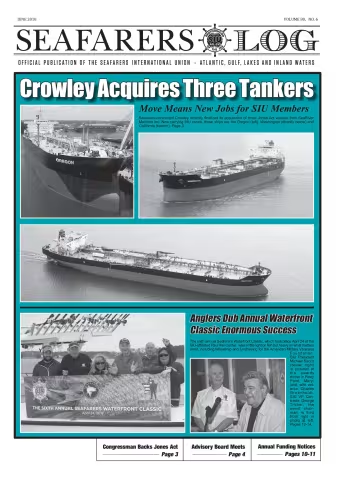
Crowley Acquires Three Tankers
Move Means New Jobs for SIU Members
Anglers Dub Annual Waterfront
Classic Enormous Success
Seafarers-contracted Crowley recently finalized its acquisition of three Jones Act vessels from SeaRiver
Maritime Inc. Now carrying SIU crews, those ships are the Oregon (left), Washington (directly below) and
California (bottom). Page 3.
The sixth annual Seafarers Waterfront Classic, which took place April 24 at the
SIU-affiliated Paul Hall Center, was a little light on fish but heavy on what matters
most, including fellowship and fundraising for the American Military Veterans
Foundat ion.
SIU President
Michael Sacco
(below, right)
is pictured at
the awards
dinner in Piney
Point, Mary-
land, with vet-
eran Charles
Greenhold t .
SIU VP Con-
tracts George
Tricker, the
event chair-
man, is third
from right in
photo at left.
Pages 12-14.
2 Seafarers LOG June 2018
The Seafarers LOG (ISSN 1086-4636) is published monthly by the
Seafarers International Union; Atlantic, Gulf, Lakes and Inland Waters,
AFL-CIO; 5201 Auth Way; Camp Springs, MD 20746. Telephone (301)
899-0675. Periodicals postage paid at Southern Maryland 20790-9998.
POSTMASTER: Send address changes to the Seafarers LOG, 5201 Auth
Way, Camp Springs, MD 20746.
Communications Director, Jordan Biscardo;
Managing Editor/Production, Jim Guthrie; Assistant
Editor, Nick Merrill; Photographer, Harry Gieske;
Administrative Support, Jenny Stokes; Content Curator,
Mark Clements.
Copyright © 2018 Seafarers International Union, AGLIW. All Rights
Reserved.
Volume 80, Number 6 June 2018
The SIU online: www.seafarers.org
The Seafarers International
Union engaged an environ-
mentally friendly printer
for the production of this
newspaper.
President’s Report
Quick, how many of you had ever heard of National Maritime Day
before you started working in the industry?
Don’t worry, you’re not alone. Just like the U.S. Merchant Marine
is often an unintentionally well-kept secret other than in port towns
and in maritime families, National Maritime Day doesn’t exactly pop
out from the average calendar.
Congress designated May 22 of each year as National Maritime
Day in 1933. The original intent was to com-
memorate the first transoceanic voyage by a
steamship, in 1819 by the SS Savannah. Through
the decades, though, the day’s focus has under-
standably shifted. Given the U.S. Merchant Ma-
rine’s vital contributions in every conflict of the
last and present centuries, it’s fitting that Maritime
Day ceremonies often highlight those efforts. In
particular, the commemorations in the nation’s
capital and in other cities across the country duly
credit the absolutely indispensable, heroic sealift
mission carried out by our World War II mariners.
(For those who are unaware, more than 1,200 SIU
members lost their lives during the war.)
But Maritime Day isn’t just a history lesson or a memorial service.
Prominent speakers from the military, government and industry usu-
ally also explain why America still needs a strong U.S.-flag industry
with American crews. The White House annually issues a proclama-
tion that also blends a tip of the cap to past service with an informal
summary of why our country simply cannot afford to lose our fleet or
our mariners.
In fact, here’s a brief excerpt from last year’s statement by Presi-
dent Trump: “Today, the men and women who crew ships remain es-
sential to our Nation’s prosperity and security. Those in the maritime
industry, including merchant mariners, promote our economic growth,
facilitating the export of more than $475 billion in goods just last year
and sustaining our critical defense industrial base. Merchant mariners
also actively protect our homeland, serving as our eyes and ears on the
seas. They serve with distinction and courage, heading into war zones,
and too often sacrificing their own lives for our protection.”
Brothers and sisters, that’s anything but token acknowledgement,
and it shows that despite the previously mentioned challenge of edu-
cating the public about the U.S. Merchant Marine, we don’t always
lack for recognition.
All in all, National Maritime Day is a very important occasion for
the SIU and for our industry, even if you can’t find a greeting card for
it. This year’s ceremony in D.C. was scheduled to happen right after
the LOG’s deadline, so we’ll have full coverage next month. In the
meantime, please check out our National Maritime Day posts on the
SIU website and on our Facebook page. We usually have that cover-
age available the same day of the gathering.
Meanwhile, I would be remiss in not briefly stating the case for
why we need a strong U.S. Merchant Marine moving forward. Our
domestic maritime industry alone supports nearly 500,000 American
jobs and pumps billions of dollars into the economy every year. Our
internationally trading deep-sea ships help ensure that we won’t be
held as economic hostages by other nations, and our civilian-crewed
military support ships guarantee that our brave men and women in
uniform won’t have to cross their fingers and hope that foreign crews
on foreign-flag ships decide to deliver the vital materiel they need in
times of conflict.
We can honor the past by working hard to ensure the ongoing vi-
brancy of this vital industry.
Michael Sacco
National Maritime Day
According to a report released
April 26 by the AFL-CIO, 5,190
American workers died on the job
in 2016, an increase from 4,836
deaths the previous year. An-
other estimated 50,000 to 60,000
died from occupational diseases,
meaning approximately 150 work-
ers died on the job each day from
preventable, hazardous workplace
conditions. Overall, the national
job fatality rate increased to 3.6 per
100,000 workers from 3.4 in 2015,
the federation reported.
“We deserve to walk out the
front door in the morning knowing
we’ll return home safe and healthy
after a full day’s work,” said AFL-
CIO President Richard Trumka.
“It’s a travesty that working peo-
ple continue to lose their lives to
corporate greed. The selfish and
reckless decisions being made in
boardrooms and in Washington
are killing the very people who
built this country. This is officially
a national crisis, and it’s only get-
ting worse.”
The report, titled “Death on the
Job: The Toll of Neglect,” marks
the 27th year the AFL-CIO has
produced its findings on the state
of safety and health protections for
workers within the United States.
The report shows the highest work-
place fatality rates are in Wyoming
(12.3 per 100,000 workers), Alaska
(10.6), Montana (7.9), South Da-
kota (7.5) and North Dakota (7.0).
Startlingly, workplace violence
is now the second-leading cause
of death on the job, accounting for
866 workplace deaths.
Other report highlights show
that the construction, transporta-
tion and agriculture industries re-
main among the most dangerous.
In 2016, some 991 construction
workers were killed – the highest
total of any sector. Agriculture,
forestry, fishing and hunting was
the most dangerous industry sec-
tor, with a fatality rate of 23.2 per
100,000 workers.
Despite these alarming find-
ings, the Occupational Safety and
Health Administration (OSHA)
continues to face a desperate dearth
of resources. Responsible for reg-
ulating 9 million workplaces, the
agency’s 764 federal inspectors
would need 158 years to visit each
site just once.
The annual report features state
and national information on work-
place fatalities, injuries, illnesses,
the number and frequency of work-
place inspections, penalties, fund-
ing, staffing and public employee
coverage under the Occupational
Safety and Health Act. It also in-
cludes information on the state of
mine safety and health.
The Occupational Safety and
Health Act was signed into law
in 1970, signaling a promise to
American workers for safe jobs.
The federation estimates that more
than 579,000 workers “now can
say their lives have been saved
since the passage of the act. “Since
that time, workplace safety and
health conditions have improved,”
the AFL-CIO said when announc-
ing the latest report. “But too many
workers remain at serious risk of
injury, illness or death as chemi-
cal plant explosions, major fires,
construction collapses and other
preventable workplace tragedies
continue to occur. Workplace vio-
lence is a growing threat. Many
other workplace hazards kill and
disable thousands of workers each
year.”
Moreover, the federation as-
serted that chronic occupational
diseases “receive less attention be-
cause most are not detected for
years after workers are exposed to
toxic chemicals, and occupational
illnesses often are misdiagnosed
and poorly tracked.”
In 2016, nearly 3.7 million
workers across all industries, in-
cluding state and local govern-
ment, had work-related injuries
and illnesses that were reported by
employers, with 2.9 million inju-
ries and illnesses reported in pri-
vate industry. Due to limitations in
the current injury reporting system
and widespread underreporting of
workplace injuries, this number
understates the problem, the AFL-
CIO reported. “The true toll is es-
timated to be two to three times
greater – or 7.4 million to 11.1 mil-
lion injuries and illnesses a year,”
the federation said. “The cost of
these injuries and illnesses is enor-
mous – estimated at $250 billion to
$360 billion a year.”
The report also noted that Presi-
dent Trump ran on a pro-business,
deregulatory agenda, promising
to cut regulations by 70 percent.
Since taking office at the end of
January 2017, he has acted on that
promise, issuing a number of exec-
utive orders to roll back or review
existing regulations, including one
order that requires that for any new
regulatory item issued, an agency
must remove two from the books.
He signed more than a dozen bills
overturning regulations issued by
the Obama administration.
In part, the report concluded,
“These are challenging times for
working people and their unions,
and the future prospects for safety
and health protections are uncer-
tain. What is clear, however, is that
the toll of workplace injury, dis-
ease and death remains too high.
Workers in the United States need
more safety and health protection,
not less. More than four decades
after the passage of the Occupa-
tional Safety and Health Act, there
is much more work to be done.”
Federation Releases Annual Report on State
Of Safety, Health Protections for U.S. Workers
SIU officials turned out
in support of two recent
events in New York City
that honored individuals
for their backing of the
U.S. maritime industry.
The Marine Society of the
City of New York on April
16 honored Ed Hanley,
vice president of labor re-
lations and marine stan-
dards at SIU-contracted
Maersk Line, Limited.
Hanley is pictured at far
left in photo at right, with
(from left) AMO National
President Paul Doell, SIU
President Michael Sacco
and Paul Hall Center
Trustee Tony Naccarato.
On April 25, the Seafar-
ers International House
presented its Outstand-
ing Friend of Seafarers
awards to Phil Fisher
(lower right) and Bill Van
Loo (lower left). Fisher is
the executive VP of SIU-
contracted Keystone;
Van Loo serves as sec-
retary-treasurer of the
MEBA. SIU attendees at
the latter event included
President Sacco, Execu-
tive VP Augie Tellez, VP
Atlantic Coast Joseph
Soresi, Port Agents Joe
Baselice and Mark von
Siegel and Patrolmen
Ray Henderson and
Andre MacCray.
Honored in
‘The Big Apple’
June 2018 Seafarers LOG 3
U.S. Rep. Rick Larsen (D-Washington)
recently spoke on the House floor in support
of the Jones Act, a maritime law that is vital
to protecting U.S. national, economic and
homeland security.
A longtime backer of the American mari-
time industry, Larsen delivered his brief re-
marks April 18.
He stated, “Mr. Speaker, I rise today to
express my continued support of Ameri-
can maritime jobs through enforcement of
the Jones Act. The Merchant Marine Act
of 1920 is more commonly known as the
Jones Act, named for the primary sponsor
at the time Wesley Jones from my home
state, Washington state. The Jones Act ex-
ists for good reason. It sustains and protects
a strong domestic maritime and shipbuild-
ing industry.
“It creates job opportunities for U.S.
mariners, many of whom are veterans,” the
congressman continued. “It underpins U.S.
maritime defense policy and is essential
to preserving national security interests at
home and abroad. The Jones Act requires
the use of American owned and operated
vessels to move all waterborne cargo be-
tween points in the U.S.”
Larsen added, “I have long maintained
that the Jones Act ensures domestic indus-
tries can remain vibrant contributors to the
global shipping industry. At its core, the
Jones Act is a critical labor standard that
helps put U.S. seafarers to work and main-
tains important workplace rights…. In 2012,
I called on the then-administration to pro-
tect American jobs by adhering to the Jones
Act in response to rising gas prices and the
proposed release of oil from the Strategic
Petroleum Reserve. Last year I spoke up to
support the Jones Act fleet in its heroic re-
sponse to the natural disaster that hit Puerto
Rico and the U.S. Virgin Islands.”
He concluded, “As a senior member of
the Coast Guard and Maritime Transpor-
tation Subcommittee, I am committed to
working with my colleagues to uphold the
longstanding tenets of the Jones Act to safe-
guard the important role maritime industries
play in our economy. The Jones Act exists
for good reason. We should use it to good
effect.”
A video of Larsen delivering the remarks
is available on his website and also is linked
in an April 19 post in the News section of
www.seafarers.org.
Congressman Rick Larsen
Speaks Out for Jones Act
SIU Members Secure New Jobs on 3 Tankers
Seafarers-contracted Crowley in mid-
April announced that it completed the ac-
quisition of three tankers from SeaRiver
Maritime Inc., and is now chartering them
back to SeaRiver under varying multi-year
terms.
“This development means new jobs
for SIU members,” said SIU Vice Presi-
dent Contracts George Tricker. “I’m fully
confident our crews will do their typically
outstanding work aboard all three vessels.”
The tankers previously named Liberty
Bay and Eagle Bay, now under Crowley
ownership and operation, each have a ca-
pacity of 760,000 barrels and transport
crude from Alaska to West Coast refiner-
ies. The tanker formerly named American
Progress has a capacity of 342,000 barrels
and transports refined petroleum between
the U.S. Gulf and East Coast ports.
Crowley has renamed the ships. The
Liberty Bay is now the Washington; the
Eagle Bay is the California; and the Amer-
ican Progress is the Oregon.
“With the regulatory approvals in place
and the sale officially complete, we are
now focused on operating these tankers in
the safest, most reliable manner possible,”
said Tom Crowley, chairman and CEO of
Crowley Maritime Corp. “Our knowledge,
passion, talent, ingenuity and helpfulness
drive business for the company and provide
the basis for highly successful partnerships
such as the one announced today.”
An SIU-contracted company for de-
cades, Crowley operates and manages the
largest U.S.-flag petroleum and chemical
tank vessel fleet in the country. With the
acquisition of these three tankers, the com-
pany now operates 40 Jones Act-qualified
large petroleum transportation vessels in
the United States with a combined capac-
ity of more than 12 million barrels. Among
this tank vessel fleet is a tanker and an ar-
ticulated tug-barge (ATB) already on char-
ter to SeaRiver.
“Throughout the transition, the officers
and crews have proven to be a great fit and
we are very happy that so many are now
Crowley employees,” said Rudy Leming,
Crowley vice president of labor relations.
“They have embodied the highest levels
of professionalism and commitment to the
project and we are certain they’ll be a criti-
cal piece to our ongoing success.”
“Safety is of paramount importance to
us and our record reflects that,” said Rob
Grune, Crowley senior vice president
and general manager, Crowley Shipping.
“Last year, for example, we transported
more than 472 million barrels of product
and made 5,196 product transfers with zero
spills – a credit to our professional, safety-
minded crews and management systems.”
Crowley has been operating in Alaska
since 1953, six years before statehood,
providing upstream energy support ser-
vices, tanker assistance and escort services
with tugboats, and petroleum transporta-
tion, distribution and sales throughout the
state. In addition to the company’s own
ATBs operating in Alaska, Crowley cur-
rently manages and crews tankers carrying
petroleum between Alaska and U.S. West
Coast refineries.
Crowley owns and/or operates a di-
verse, sophisticated fleet of double-hull
tank vessels, including 17 ATBs and now
23 tankers, all built since 2002.
SeaRiver Maritime, Inc., headquar-
tered in Spring, Texas, is a privately held
subsidiary wholly owned by ExxonMobil
that provides a wide range of technical and
commercial marine services to ExxonMo-
bil affiliates throughout the world.
The Jones Act has helped protect U.S.
national, economic and homeland security
for nearly a century. The law mandates that
cargoes moving between domestic ports
are carried on vessels that are crewed,
built, flagged and owned American. It
helps sustain nearly 500,000 American
jobs, and pumps billions of dollars into the
U.S. economy each year.
Seafarers are pictured aboard the Oregon, with SIU Asst. VP Kris Hopkins (back row, second from left).
U.S. Rep. Rick Larsen
SIU Asst. VP Nick Celona (left) is pictured with U.S. Sen. Kamala Harris (cen-
ter) (D-California) and Charles Farruggia last month at a political gathering
in San Francisco. Celona and Farruggia, a longtime friend of the SIU, both
thanked Harris for her ardent support of the U.S. Merchant Marine. The sena-
tor is a consistently outspoken advocate for American-flag shipping and U.S.
crews. She is signatory to a recent Senate letter backing the U.S. Maritime
Security Program
Thanking Senator for Support
4 Seafarers LOG June 2018
The Paul Hall Center for Maritime Train-
ing and Education (PHC) is constantly push-
ing to stay ahead of the ever-changing needs
of the industry – and that’s an endeavor that
works best with input from different stake-
holders.
With that in mind, the PHC on April 25
hosted a meeting of its advisory board, which
features representatives from the school, the
SIU and Seafarers-contracted companies.
The information-packed gathering took place
at the Piney Point, Maryland-based campus,
with approximately 40 people in attendance.
Topics covered by the board included
engine department curriculums; storekeeper
training; the revamp of the school’s steward
department classes; the global opioid epi-
demic and what’s being done to combat it;
and apprentice training that focuses on social
responsibilities, communication and more.
The meeting blended formal presentations
with substantial question-and-answer sessions.
Attendees included officials and staff from
the school, the union and the Seafarers Plans;
executives from a half-dozen SIU-contracted
companies; an inspector from the International
Transport Workers’ Federation; and employees
from Comprehensive Health Services.
The formal presentations were given by (in
order) Bill Dodd, a PHC engine department
instructor; PHC Director of Training Priscilla
Labanowski; PHC Vice President/Manpower
Director Bart Rogers; PHC Executive Chef
John Hetmanski; SIU Plans Medical Director
Dr. Eric Schaub; and Dr. John Gallagher, di-
rector of the Seafarers Addictions Rehabilita-
tion Center.
Also addressing the meeting were PHC
Acting Vice President Tom Orzechowski,
SIU Vice President Contracts George Tricker
and Seafarers Plans Administrator Maggie
Bowen.
Dodd comprehensively explained current
and projected engine department courses, in-
cluding a program that’s being developed to
facilitate progress from apprentice to third
assistant engineer. He said all of the classes
are very true to what mariners will experience
aboard ship.
Dodd also said the school’s hands-on train-
ing is a valuable hit with students. “It’s not
just show and tell” in the courses, he said.
Orzechowski, Rogers and Labanowski
then talked about the school’s new class for
storekeepers (see related story on page 7).
“It’s pretty intense,” Labanowski said.
Rogers stated, “All in all, it’s a huge suc-
cess.”
Instructors and students in the first offering
sometimes teamed up for 12 hours a day in
order to properly review the curriculum.
Next, Hetmanski and Labanowski re-
viewed Culinary 2.0, the school’s revamped
coursework for steward department members.
The updated classes are being offered to up-
graders and to apprentices.
“It has been going very well,” Hetmanski
said. “The interest is there” from students.
Extensively covered in past editions of
the Seafarers LOG, Culinary 2.0 refers to the
overall steward department curriculums and
also to a pair of specific courses: Orientation/
Assessment Chief Steward 2.0 and Orienta-
tion/Assessment Chief Cook 2.0.
Labanowski said the course critiques sub-
mitted by students have been “extremely won-
derful.”
Schaub briefly reviewed the U.S. Coast
Guard’s history of drug testing, which started
in the 1990s. He also described both how the
opioid crisis developed and a relatively new
concern about possible impairment on the job
from legal drugs.
Schaub talked about ways in which the
medical department, the Seafarers Plans and
the union are working together to help ensure
personal and shipboard safety while also fa-
cilitating members’ ongoing eligibility to ship.
Finally, Gallagher gave an energetic over-
view of various topics that are mandatory parts
of training for the school’s apprentices. They
include social responsibility, communication,
problem solving and conflict resolution, diver-
sity, health awareness and much more.
Near the end of the meeting, a shipping
company executive who first visited the
school in the 1970s stated, “Everyone here
should be complimented, from the top down,
on everything from the quality of the training
to the quality of the food to the quality of the
facilities. It’s remarkable and you should all
be proud of it. It’s very impressive.”
Advisory Board Examines Training Needs,
Updates Attendees on Piney Point Progress
The advisory board meeting convenes in Piney Point, Maryland. Tom Orzechowski
PHC Acting VP
Priscilla Labanowski
PHC Director of Training
George Tricker
SIU VP Contracts
Bart Rogers
PHC VP/Manpower Director
Dr. Eric Schaub
SIU Plans Medical Director
John Hetmanksi
PHC Executive Chef
Dr. John Gallagher
ARC Director
PHC Instructor Bill Dodd reviews the
school’s engine department courses.
June 2018 Seafarers LOG 5
Rank-and-file Seafarers met with legislators and staff
April 17 in the nation’s capital as part of a day-long out-
reach to express thanks for support of America’s freight
cabotage law, the Jones Act. SIU Port Agent John Hoskins,
Legislative Director Brian Schoeneman, and Senior Politi-
cal Consultant Terry Turner joined SIU members Cesar
Dela Cruz, Robinson Eromosele, Michael Ingram,
Breon Lucas, Stephen Martin and Tyrell Thabit for
the event, which was coordinated by the Maritime Trades
Department and the Metal Trades Department (each a con-
stitutional department of the AFL-CIO).
Members of other unions also participated.
Led by Maritime Trades Department Executive Secre-
tary-Treasurer Daniel Duncan and Executive Board Mem-
ber Brett McCoy (from the United Association), nearly 75
people worked with Metal Trades Department President
James Hart and Dredging Contractors of America Execu-
tive Director and CEO William Doyle for a rally outside
the steps of the Capitol before heading to legislators’ of-
fices.
Duncan, Hart and Doyle spoke about the importance
of the Jones Act for the nation’s economic and domes-
tic security. They pointed out that the Jones Act directly
and indirectly provides “approximately 500,000 decent,
family-sustaining American jobs resulting in nearly $100
billion annually for the economy.” In addition, American
mariners working on Jones Act vessels offer security on
the nation’s inland waterways and harbors.
Representatives from the Maritime Trades De-
partment-affiliated Electrical Workers; Machinists;
Seafarers; Sheet Metal, Air, Rail and Transportation
Workers; Transportation-Communications Union; and
United Association donned red, white and blue “Jones
Act All American” lapel stickers to show their appre-
ciation. Each legislator or their aide received a book-
let containing Jones Act facts and figures, including
the six-month data revealing 114,000 containers have
been delivered by American-crewed Jones Act vessels
since Hurricane Maria struck Puerto Rico.
Union members met with U.S. Senators Maria
Cantwell (D-Washington), Doug Jones (D-Alabama),
Chuck Schumer (D-New York) and Richard Shelby (R-
Alabama) as well as U.S. Representatives Rick Larsen (D-
Washington) and Linda Sanchez (D-California). They also
discussed the Jones Act with aides from other Senate and
House offices representing both political parties, reflect-
ing the continued strong bipartisan support of the mea-
sure, which has helped protect U.S. national, economic
and homeland security for nearly a century.
Capitol Hill Outreach Thanks
Legislators for Backing Cabotage Law
Metal Trades Department President James Hart (at microphone) helps kick off the event.
Seafarers Help Deliver
Jones Act Message
Seafarer Tyrell Thabit (right), an Alabama resident, meets
U.S. Sen. Doug Jones (D-Alabama).
Three SIU members are pictured with U.S. Sen. Richard
Shelby (R-Alabama). From left: Stephen Martin, Shelby,
Breon Lucas and Tyrell Thabit.
SIU personnel helped promote the Jones Act in Washington, D.C. Pictured from left
are Tyrell Thabit, Michael Ingram, Robinson Eromosele, Stephen Martin, Cesar Dela
Cruz, Port Agent John Hoskins and Breon Lucas.
Pictured from left are SIU Senior Political Consultant Terry Turner, Seafarer Robinson Ero-
mosele, U.S. Rep. Rick Larsen (D-Washington), Seafarer Cesar Dela Cruz, Seafarer Michael
Ingram and Maritime Trades Dept. Exec. Board member Brett McCoy.
6 Seafarers LOG June 2018
made me a better person.”
His advice to the trainees was simple. “My recom-
mendation to those coming up: Have a dream, and work to
achieve it,” he said.
Michael Ingram
Sailing out of the Port of Joliet, Illinois, Ingram joined
the union in 2006. He began his speech with a quote from
poet Maya Angelou: “If you don’t like something, change
it. If you can’t change it, change your attitude.”
He then spoke on the impact that the union has had on
his life, saying, “The union has allowed me to provide for
my family, purchase my own home and has allowed me to
travel to many different countries.”
After mentioning the knowledge he gained about the
political process from visiting Capitol Hill, he took the
opportunity to thank the school’s instructors who helped
him get where he is today. “I’d like to thank John Het-
manski, John Dobson, Paulie (Gelrud), Chef R.J. (Robert
Johnson) and Jessie (Sunga), along with many others that
have come and gone. I’d also like to thank Steward Danny
Jackson, as well as the rest of my fellow Recertified Stew-
ards.”
He offered some personal advice to the apprentices, say-
ing, “Study hard while you are here. Believe it or not, I was
days away from being homeless, and look at me now!”
Breon Lucas
Lucas, who sails from Jacksonville, Florida, spoke about
his 23-year career.
“The union has been good to me. They’ve put a roof
over my head and offered me a better way of life in gen-
eral. Through working for the SIU, I have also been able to
travel to various different places,” he said.
After praising Instructor John Dobson, he thanked the
union leadership for allowing the recertified stewards to
attend the recent trip to Congress, saying, “I saw firsthand
how you guys have to stand up for us. Thank you for pro-
tecting us and our jobs.”
Stephen Martin
Martin joined the union in Wilmington, California in
1999 and now sails from the Port of Jersey City, New Jer-
sey. He said he is proud to graduate from the recertification
program.
“The staff at this school have been great. It’s been like
spending time with family,” he said.
Turning his attention to the trainees, Martin contin-
ued, “Remember, when you are working in the galley,
you are part of a team. Be proactive, and if you have any
questions, come see the bosuns or the stewards. Out of
all of your lessons, learn to work together, work hard
and you’ll be just fine.”
He closed by congratulating his fellow graduates and
thanking the SIU for helping to provide the life he now leads.
Tyrell Thabit
Before joining the union in Mobile, Alabama, in 1992,
Thabit explained that he served in the U.S. Navy for over
10 years.
“In my career, I have sailed on over 50 different ships,
and travelled to most of the places a merchant mariner
could possibly sail,” said Thabit. “The union has been a
very important part of my life, because it has given me
opportunities to grow and develop my skills in my chosen
profession.
“I would like to thank the instructors and staff here at the
school for all that they do,” he continued. “You are all very
professional people, who work very hard to make sure that
we, as trainees and upgraders, get the best education.”
He also expressed his gratitude for the firsthand look at
what it takes to defend the Jones Act on a daily basis, be-
fore saying, “The union leadership needs our help to protect
our industry and our way of life. We need to always do our
best, upgrade our skills, and donate to SPAD.”
He concluded by offering the following advice to the
future mariners in the room: “Study hard while you’re here.
Learn from your instructors, and work together with your
classmates. When you get to the ship, listen to your super-
visor, ask questions, and never be afraid to stand up for
yourself.”
Recertified Stewards Michael Ingram (left) and Tyrell Thabit share a lighthearted moment
while listening to the speech of one of their classmates.
Recertified Steward Breon Lucas (left) is congratulated by SIU Secretary-Treasurer
David Heindel just prior to taking the podium to deliver his speech. SIU VP Contracts
George Tricker is in the background.
Six Ascend Ladder to Recertified Steward Status
Near the end of their training, each of the recertified stew-
ards was required to individually prepare, plate and serve
a complete meal for lunch. Included in the menu were:
Salad – shrimp pasta salad with Italian dressing; Entrée –
Chicken Cacciatore; Starch – fried sweet potatoes; Vegat-
able – Steamed Broccoli; and Dessert – homemade apple
pie. Proudly displaying their respective creations are Re-
certified Steward Cesar Cera Dela Cruz (photo above) Re-
certified Steward Robinson Eromosele (photo below, left)
Recertified Steward Stephen Martin (below, center) and
Recertified Steward Tyrell Thabit (below right).
Continued from Page 24
June 2018 Seafarers LOG 7
Spotlight on Mariner Health
E-cigarettes and other vaporizers use a battery
to heat a liquid – commonly referred to as “vape
juice” – and produce a vapor for inhaling. The juice
often contains varying levels of nicotine and is pop-
ular among teenagers and adults as an alternative to
smoking traditional cigarettes.
Most vape juice contains a mixture of glycerin,
propylene glycol and water, along with various
flavorings and specific amounts of nicotine. While
some vape juice does not contain nicotine, most
does, and as such can be as addictive as tobacco
cigarettes.
In recent years, the number of teenagers that
have taken to vaping has soared. An annual survey
by the Minnesota Department of Health recently
revealed that one in five high school students use
e-cigarettes. (The survey also showed youth to-
bacco use is rising for the first time in 17 years;
it concluded that using e-cigarettes or vaping is a
gateway to smoking.)
The availability of vape juice and e-cigarettes
has grown dramatically as well, with an increased
focus on fruit-flavored juices and smaller, more
discrete designs in vaporizers. This burgeoning
market has also seen an increase in vape juice and
vaporizers with poor quality control, so buyer be-
ware when purchasing from less-reputable sources.
For example, according to Dr. J. Taylor Hays,
director of the Mayo Clinic Nicotine Dependence
Center, “There are probably 600 different kinds
(of e-cigarettes) you can purchase on the internet.
There are 7,000 to 8,000 different solutions you can
purchase.
Vaping as Smoking-Cessation Tool
Some turn to vaping as a way to gradually quit
smoking. With vape juices prominently display-
ing the nicotine content on the bottles, smokers are
able to gradually wean themselves off of nicotine,
as opposed to cutting themselves off “cold turkey.”
While the full effects of vaping are currently un-
known, it does not contain the harmful carcinogens
that are found in traditional cigarettes.
The possible side effects of vaping are very
similar to cigarettes: coughing, lung irritation, diz-
ziness and more. In addition, most vaporizers use
lithium-ion batteries, which have the potential to
ignite or explode if improperly charged, stored or
overused.
The bottom line is that, despite the lack of to-
bacco and carcinogens, vaping any level of nicotine
can be highly addictive, and can damage your lungs
and pulmonary system.
“It’s safer, but it’s not safe,” Hays stated. “What
we don’t know are what long-term effects will
these lower-level toxicants have.”
Presenting the Real Scoop
On Vaping and E-Cigarettes Grilled Chicken Breast
Servings: 15
Ingredients
15 6 oz chicken breasts without skin, but-
terflied
1 tablespoon Mrs Dash seasoning
2 teaspoons paprika, ground
1 tablespoon oregano, dry, ground
3 tablespoons olive oil
Preparation
❑✃Season chicken with the Mrs Dash,
paprika, oregano, and olive oil.
❑✃Brown the chicken breasts in a frying
pan over med-high heat. Cook both sides
2-3 min, cook to an internal temperature
of 165 degrees F. Chicken can be fin-
ished in a 350 degree F oven to reach desired internal temperature.
Nutrition Information
Per Serving (excluding unknown items): 175 Calories; 4g Fat (23.9% calories
from fat); 31g Protein; trace Carbohydrate; trace Dietary Fiber; 79mg Choles-
terol; 89mg Sodium. Exchanges: 0 Grain (Starch); 4 ½ Lean Meat; ½ Fat.
Provided by the Paul Hall Center for Maritime Training and Education’s
Lundeberg School of Seamanship
Healthful Recipe
The SIU-affiliated Paul Hall Center for
Maritime Training and Education recently
witnessed a milestone achievement: a beta-
test class of students successfully completed
the Military Sealift Command (MSC) Basic
Storekeeping course along with Supply Con-
figuration Management. Both were offered for
the first time in the history of the Piney Point,
Maryland-based facility.
According to Paul Hall Center (PHC) offi-
cials, in the future, throughout seven consecu-
tive weeks, students will attend two classes: a
three-week Basic Storekeeper class, and a di-
rectly related, four-week Supply Configuration
Management class. Both courses must be com-
pleted in order to be eligible to sail as a store-
keeper on an MSC vessel.
“This course was two years in the mak-
ing,” said PHC Assistant Vice President and
Manpower Director Bart Rogers. “We had
many planning meetings between the school
and MSC. It was a collaborative effort that cre-
ated this course, and there were many people
involved from both the SIU and MSC that made
this a reality.”
The course, Rogers said, was created out
of a demand for highly qualified, MSC-trained
storekeepers to sail on their civilian-crewed ves-
sels. He explained, “At first, there was a little
resistance from MSC, but we were able to con-
vince them that there was a need on board the
vessels for this particular rating and the training
that’s associated with it. We were having more
and more difficulty finding [storekeepers] in the
military, so the best solution was to teach and
train our own.”
As with every course designed for mariners
to sail on MSC-contracted vessels, the curricu-
lum was taken directly from MSC training ma-
terials. For the first iteration of the class, MSC
provided an instructor. A second instructor
from the Paul Hall Center assisted and gained
knowledge on how to properly teach the class
in the future.
The first class served as a trial run of sorts,
but the mariners who completed the course were
highly qualified, according to Paul Hall Center
Acting Vice President Thomas Orzechowski:
“This was an excellent class. Moving forward,
we’re going to sit down with the instructors,
we’re going to sit down with our development
team, and we’re going to have to put together a
list of prerequisites or a test to ensure that the
members coming in have the skills they need to
pass the course.”
“The class itself was pretty intense,” said
Paul Hall Center Director of Training Priscilla
Labanowski. “It was kind of interesting to see
the students huddled in the classroom together,
and they always came out of the classroom with
tons of books.... If you talk to anyone who has
taken the class, they will tell you it is definitely
one of the hardest courses they’ve ever taken at
Piney Point.”
Rogers offered some insight into the state-
of-the-art class: “This course requires some
computer skills, specifically in Microsoft Word
and Excel. If you do not have the required com-
puter skills, the course would be very difficult.
It is also very helpful to have a background in
engineering, but it is not required.”
Beyond some slight technical issues, stu-
dents praised the structured pace of the class,
stating in anonymous reviews that “with the
slow, slow learning curve, it was still somewhat
overwhelming because of the amount of infor-
mation and the rate at which we had to learn
... but the intense dedication, loyalty and hard
work (of the instructors) to be sure we all suc-
ceeded – and still knew the material – brings
tears to a man’s eyes. I thank them both very
much!”
The next classes are expected to take place
in July 2018.
Paul Hall Center Offers New Storekeeper Course
Mariners study intently during MSC Storekeeper class. From left to right: Joseph Evans,
Joseph Garnett, William Mulcahy, Miles Partridge and Zarko Vrbljanac.
EARN YOUR COLLEGE DEGREE
THROUGH THE PAUL HALL CENTER !
The following classes will convene at
SHLSS:
July 9, 2018 through July 27, 2018
English 1011 – Composition and Rhetoric
Math 1011 – Math for Technologies
7 Credit Hours
Includes: tuition, textbooks, room and
board plus one hour of tutoring following
each daily class session
The Paul Hall Center’s Seafarers Harry
Lundeberg School of Seamanship (SHLSS)
has partnered with the College of Southern
Maryland (CSM) to offer an Associate of
Applied Science degree in Maritime
Operations Technology with a concentration
in either
Nautical Science (Deck department)
-or-
Marine Engineering (Engine dept.)
Students must complete a combination of
academic general education courses and
technical education courses in order to earn
the degree.
Courses completed during the Unlicensed
Apprentice program apply toward the
degree.
Students can complete English, Math and
Physics courses at SHLSS. The remaining
general education courses can be completed
online.
Associate of Applied Science Degree
UA courses apply toward the degree
Fully accredited
Some courses held at SHLSS
Online classes
Scholarships available
Enrollment Information
Please contact Seafarers Harry Lundeberg
School Academic Coordinator Dale Rausch
(301) 994-0010 Ext. 5411 -or-
drausch@seafarers.org
6/18
8 Seafarers LOG June 2018
At Sea and Ashore with the SIU
ABOARD MAERSK HARTFORD – Labor and management get together
for a photo aboard the Maersk Lines, Limited (MLL) vessel. That’s MLL
President and CEO Bill Woodhour second from right, along with SIU VP
Contracts George Tricker, second from left, plus Seafarers and the vessel
master.
WELCOMING NEW CONTRACT – Seafarers at New York
New Jersey Rail recently ratified a new four-year contract fea-
turing annual wage increases. Pictured from left are SIU Safety
Director Osvaldo Ramos, Brakeman Rich Vaughan and Con-
ductor James Lada Sr., who serves as shop steward.
NOT A ROUTINE STOP ASHORE – SA Italy Byers is pictured
at the tiger park in Thailand. She visited the site during a re-
cent voyage aboard the USNS Pililaau. No matter how calm
she looks in the photos, Italy told the Seafarers LOG, “I was
terrified, but I just figured, I’m traveling, it’s my first time in Thai-
land, and I might as well do everything.” Visit our Facebook
page for additional photos from the park.
COMMITTED TO THE INDUSTRY –
The Seafaring life agrees with FOWT
Francisco Valle, who recently got a tat-
too reflecting his enthusiasm for the in-
dustry. In photo above, he’s pictured at
right with Port Agent Nick Marrone II .
The photo below is a closeup of Val-
le’s new ink.
TALKING JONES ACT IN PUERTO RICO –
SIU Port Agent Amancio Crespo (right) meets
with The Hon. Michael A. Quinones, a member
of the Puerto Rico House of Representatives,
in San Juan on April 24. They discussed the
numerous, vital economic and social benefits
of the Jones Act on Puerto Rico, including the
job opportunities it offers to residents of the
territory.
ABOARD USNS BELLATRIX – Pictured from left aboard the TOTE Services-operated vessel during a recent
breakout exercise are Chief Steward Samuel Sinclair, SA Melaethon Silas, SA Isreal Caldwell and Chief Cook
Paulette Hilliard.
B-BOOK IN OAKLAND – Congratulations to
Chief Cook Ronald Williams (right) on receiving
his full B-seniority book. He is pictured with SIU
VP West Coast Nick Marrone during the April
membership meeting in Oakland, California.
ACTIVE IN LABOR MOVEMENT –
Congratulations to SIU Port Agent Todd
Brdak (left) on his election to the Metro
Detroit AFL-CIO executive board. He’s
pictured with Rick Blocker, president of
the Metro Detroit AFL-CIO.
FULL BOOK FOR QMED – Congrats to QMED
Daniel Grant (left) on getting his full book. Dan-
iel is a shop steward at Harley Marine NY. He’s
pictured with Patrolman Ray Henderson
ABOARD ATB VISION – Pictured from left to right aboard the
Crowley vessel are Chief Engineer John McCranie, Chief Mate
David Nimmer, Tankerman Sidnei Barboza, Capt. Charlie Carlson
and Port Agent Nick Marrone II.
June 2018 Seafarers LOG 9
1 3
2 4
APPLY
TO EASTERN GATEWAY
THE FREE FAFSA
ENROLL
6/18
10 Seafarers LOG June 2018
The Seafarers Health and Benefits Plan
(SHBP) is notifying you of the right to elect to
purchase continuation of health coverage if you
lose coverage, or experience a reduction in cov-
erage due to certain qualifying events. This con-
tinuation of coverage is known as COBRA.
Generally, if you are the employee, you will
be eligible to purchase COBRA coverage for a
certain period of time if you lost coverage be-
cause you did not have enough days of covered
employment (unless the job was lost due to gross
misconduct). If you are the family member of a
covered employee, you may also elect COBRA
for a certain period of time when the employee
loses coverage; or if you are going to lose cover-
age because of a divorce or the death of the em-
ployee; or in the case of a child of an employee,
the child reaches an age at which the Plan no
longer considers him or her to be a “dependent
child.” In the case of a divorce or the death of
an employee, you must notify the Plan within 60
days of the divorce or death in order to be eligible
to purchase continuation coverage. If you do not
notify the Plan in a timely manner, you may not
be eligible to receive further coverage. If you are
the spouse or dependent child of an employee,
you may also elect COBRA if you experience a
reduction in coverage when the employee retires.
When you retire, if you were eligible for ben-
efits from the SHBP at the time of your retire-
ment, you will be eligible to purchase COBRA
continuation coverage for yourself and/or your
family members, even if you are eligible for re-
tiree health benefits. This will enable you and/or
your family to continue to receive the same level
of benefits that you had prior to your retirement
for a certain period of time. If you meet the eli-
gibility requirements for retiree health benefits,
you will begin to receive those benefits when the
COBRA period ends.
For more information about continuation cov-
erage rights under COBRA, please refer to the
Plan’s “Guide to Your Benefits.” The guide is
also available in PDF format on the SIU website,
www.seafarers.org, under “Member Benefits-Sea-
farers Benefit Plans-Seafarers Health and Benefits
Plan.” If you have questions regarding this notice
or COBRA, contact the Plan at (800) 252-4674.
SHBP Offers COBRA Continuation Coverage to Union Members
Introduction
This notice includes important information about the funding status of your multiemployer pension plan
(the “Plan”). It also includes general information about the benefit payments guaranteed by the Pension
Benefit Guaranty Corporation (“PBGC”), a federal insurance agency. All traditional pension plans (called
“defined benefit pension plans”) must provide this notice every year regardless of their funding status. This
notice does not mean that the Plan is terminating. It is provided for informational purposes and you are
not required to respond in any way. This notice is required by federal law. This notice is for the plan year
beginning January 1, 2017 and ending December 31, 2017 (“Plan Year”).
How Well Funded Is Your Plan
The law requires the administrator of the Plan to tell you how well the Plan is funded, using a measure
called the “funded percentage.” The Plan divides its assets by its liabilities on the Valuation Date for the
plan year to get this percentage. In general, the higher the percentage, the better funded the plan. The Plan’s
funded percentage for the Plan Year and each of the two preceding plan years is shown in the chart below.
The chart also states the value of the Plan’s assets and liabilities for the same period.
Funded Percentage
2017 2016 2015
Valuation Date January 1, 2017 January 1, 2016 January 1, 2015
Funded Percentage 133.6% 136.9% 138.3%
Value of Assets $1,467,872,431 $1,424,697,469 $1,441,263,299
Value of Liabilities $1,098,922,827 $1,041,022,333 $1,042,173,488
Year-End Fair Market Value of Assets
The asset values in the chart above are measured as of the Valuation Date. They also are “actuarial val-
ues.” Actuarial values differ from market values in that they do not fluctuate daily based on changes in the
stock or other markets. Actuarial values smooth out those fluctuations and can allow for more predictable
levels of future contributions. Despite the fluctuations, market values tend to show a clearer picture of a
plan’s funded status at a given point in time. The asset values in the chart below are market values and are
measured on the last day of the Plan Year. The chart also includes the year-end market value of the Plan’s
assets for each of the two preceding plan years.
The December 31, 2017 fair value of assets disclosed below is reported on an unaudited basis since
this notice is required to be distributed before the normal completion time of the audit which is currently
in progress.
December 31, 2017 December 31, 2016 December 31, 2015
Fair Market Value of Assets $1,600,000,000 $1,467,872,431 $1,424,697,469
Endangered, Critical, or Critical and Declining Status
Under federal pension law, a plan generally is in “endangered” status if its funded percentage is less than
80 percent. A plan is in “critical” status if the funded percentage is less than 65 percent (other factors may
also apply). A plan is in “critical and declining” status if it is in critical status and is projected to become
insolvent (run out of money to pay benefits) within 15 years (or within 20 years if a special rule applies).
If a pension plan enters endangered status, the trustees of the plan are required to adopt a funding improve-
ment plan. Similarly, if a pension plan enters critical status or critical and declining status, the trustees of
the plan are required to adopt a rehabilitation plan. Funding improvement and rehabilitation plans establish
steps and benchmarks for pension plans to improve their funding status over a specified period of time. The
plan sponsor of a plan in critical and declining status may apply for approval to amend the plan to reduce
current and future payment obligations to participants and beneficiaries.
The Plan was not in endangered, critical, or critical and declining status in the Plan Year.
If the plan is in endangered, critical, or critical and declining status for the plan year ending December
31, 2018, separate notification of the status has or will be provided.
Participant Information
The total number of participants and beneficiaries covered by the plan on the valuation date was 19,487.
Of this number, 6,865 were current employees, 7,360 were retired and receiving benefits, and 5,262 were
retired or no longer working for the employer and have a right to future benefits.
Funding & Investment Policies
Every pension plan must have a procedure to establish a funding policy for plan objectives. A funding
policy relates to how much money is needed to pay promised benefits. The funding policy of the Plan is to
provide benefits from contributions by signatory employers under the terms of collective bargaining agree-
ments between the Seafarers International Union of North America, Atlantic, Gulf, Lakes and Inland Waters
and the employers. The Plan may receive the portion of the employers’ contributions made to the Seafarers
Health and Benefits Plan which the Trustees determine is necessary to provide for pension benefits based
on the recommendation of the Plan’s Actuary.
Investment objectives:
Assets of the Plan shall be invested with sufficient diversification so as to minimize the risk of large
losses unless it is clearly prudent under the then current circumstances not to do so. Plan assets shall be
invested in a manner consistent with the fiduciary standards of ERISA and supporting regulations, and all
transactions will be undertaken on behalf of the Plan in the sole interest of Plan participants and beneficia-
ries. Assets of the Plan shall be invested to maintain sufficient liquidity to meet benefit payment obligations
and other Plan expenses.
Investment Guidelines:
With respect to any Investment Manager who is appointed by the Trustees, the Investment Manager is a
bank (trust company), insurance company, or registered investment advisor under the Investment Advisers
Act of 1940. Full discretion, within certain guidelines, is granted to each Investment Manager with regard
to the sector and security selection and the timing of any transactions.
Asset Allocation:
The Fund’s assets are invested in the following asset classes and maintained within the corresponding
ranges. The Trustees make appropriate adjustments if one or more of the limits are breeched.
Asset Class Target Range
Domestic Equities 50% 40% - 60%
Fixed Income and Cash Equivalents 40% 30% - 50%
Real Estate 10% 0% - 20%
Standards of Investment Performance:
Each Investment Manager is reviewed regularly regarding performance, personnel, strategy, research
capabilities, organizational and business matters and other qualitative factors that may affect its ability to
achieve the desired investment results. Consideration will be given to the extent to which performance re-
sults are consistent with the goals and objectives set forth in the Investment Policy and/or individual guide-
lines provided to an Investment Manager. The Plan’s investment policy outlines prohibited investments as
well as limits regarding the percentage of the fund that may be invested in any one company and industry.
Minimum credit quality guidelines are established and provided to investment managers. No investment
may be made which violates the provisions of ERISA or the Internal Revenue Code.
The Trustees review the Plan’s investment policy on a regular basis and make periodic changes when,
based on all available information, it is prudent to do so.
Under the Plan’s investment policy, the Plan’s assets were allocated among the following categories of
investments, as of the end of the Plan Year. These allocations are percentages of total assets:
Asset Allocations Percentage
1. Cash (Interest-bearing and non-interest bearing) 0
2. U.S. Government securities 12
3. Corporate debt instruments (other than employer securities):
a. Preferred 9
b. All other 0
4. Corporate stocks (other than employer securities):
a. Preferred 0
b. Common 33
5. Partnership/joint venture interests 5
6. Real estate (other than employer real property) 1
7. Loans (other than to participants) 0
8. Participant loans 0
9. Value of interest in common/collective trusts 31
10. Value of interest in pooled separate accounts 0
11. Value of interest in master trust investment accounts 0
12. Value of interest in 103-12 investment entities 0
13. Value of interest in registered investment companies (e.g., mutual funds) 9
14. Value of funds held in insurance co. general account (unallocated contracts) 0
15. Employer-related investments:
a. Employer Securities 0
b. Employer real property 0
16. Buildings and other property used in plan operation 0
17. Other 0
For information about the plan’s investment in any of the following type of investments as described
in the chart above – common/collective trusts, pooled separate accounts, master trust investment ac-
counts, or 103-12 investment entities, contact: Margaret Bowen, Plan Administrator, at (301) 899-0675,
or by writing to: Plan Administrator, 5201 Auth Way, Camp Springs, Maryland 20746
Right to Request a Copy of the Annual Report
Pension plans must file annual reports with the U.S. Department of Labor. The report is called the
“Form 5500.” These reports contain financial and other information. You may obtain an electronic copy
of your Plan’s annual report by going to www.efast.dol.gov and using the search tool. Annual reports also
are available from the U.S. Department of Labor, Employee Benefits Security Administration’s Public
Disclosure Room at 200 Constitution Avenue, NW, Room N-1513, Washington, D.C. 20210, or by calling
(202) 693-8673. Or you may obtain a copy of the Plan’s annual report by making a written request to the
plan administrator. Annual reports do not contain personal information, such as the amount of your accrued
benefit. You may contact your plan administrator if you want information about your accrued benefits. Your
plan administrator is identified below under “Where To Get More Information.”
Summary of Rules Governing Insolvent Plans
Federal law has a number of special rules that apply to financially troubled multiemployer plans that
become insolvent, either as ongoing plans or plans terminated by mass withdrawal. The plan administrator
is required by law to include a summary of these rules in the annual funding notice. A plan is insolvent for
a plan year if its available financial resources are not sufficient to pay benefits when due for that plan year.
An insolvent plan must reduce benefit payments to the highest level that can be paid from the plan’s avail-
able resources. If such resources are not enough to pay benefits at the level specified by law (see Benefit
Payments Guaranteed by the PBGC, below), the plan must apply to the PBGC for financial assistance. The
PBGC will loan the plan the amount necessary to pay benefits at the guaranteed level. Reduced benefits
may be restored if the plan’s financial condition improves.
A plan that becomes insolvent must provide prompt notice of its status to participants and beneficiaries,
contributing employers, labor unions representing participants, and PBGC. In addition, participants and
beneficiaries also must receive information regarding whether, and how, their benefits will be reduced or
affected, including loss of a lump sum option.
Benefit Payments Guaranteed by the PBGC
The maximum benefit that the PBGC guarantees is set by law. Only benefits that you have earned a
right to receive and that cannot be forfeited (called vested benefits) are guaranteed. There are separate
insurance programs with different benefit guarantees and other provisions for single-employer plans and
multiemployer plans. Your Plan is covered by PBGC’s multiemployer program. Specifically, the PBGC
guarantees a monthly benefit payment equal to 100 percent of the first $11 of the Plan’s monthly benefit
accrual rate, plus 75 percent of the next $33 of the accrual rate, times each year of credited service. The
PBGC’s maximum guarantee, therefore, is $35.75 per month times a participant’s years of credited service.
Example 1: If a participant with 10 years of credited service has an accrued monthly benefit of $600, the
accrual rate for purposes of determining the PBGC guarantee would be determined by dividing the monthly
benefit by the participant’s years of service ($600/10), which equals $60. The guaranteed amount for a $60
monthly accrual rate is equal to the sum of $11 plus $24.75 (.75 x $33), or $35.75. Thus, the participant’s
guaranteed monthly benefit is $357.50 ($35.75 x 10).
Example 2: If the participant in Example 1 has an accrued monthly benefit of $200, the accrual rate
for purposes of determining the guarantee would be $20 (or $200/10). The guaranteed amount for a $20
monthly accrual rate is equal to the sum of $11 plus $6.75 (.75 x $9), or $17.75. Thus, the participant’s
guaranteed monthly benefit would be $177.50 ($17.75 x 10).
The PBGC guarantees pension benefits payable at normal retirement age and some early retirement ben-
efits. In addition, the PBGC guarantees qualified preretirement survivor benefits (which are preretirement
death benefits payable to the surviving spouse of a participant who dies before starting to receive benefit
payments). In calculating a person’s monthly payment, the PBGC will disregard any benefit increases that
were made under a plan within 60 months before the earlier of the plan’s termination or insolvency (or
benefits that were in effect for less than 60 months at the time of termination or insolvency). Similarly,
the PBGC does not guarantee benefits above the normal retirement benefit, disability benefits not in pay
status, or non-pension benefits, such as health insurance, life insurance, death benefits, vacation pay, or
severance pay.
For additional information about the PBGC and the pension insurance program guarantees, go to the
Multiemployer Page on PBGC’s website at www.pbgc.gov/multiemployer. Please contact your employer
or plan administrator for specific information about your pension plan or pension benefit. PBGC does not
have that information. See “Where to Get More Information About Your Plan,” below.
Where to Get More Information
For more information about this notice, you may contact the Plan Administrator at: Seafarers Pension
Plan, Attn: Margaret Bowen, 5201 Auth Way, Camp Springs, MD 20746; (301) 899-0675.
For identification purposes, the official plan number is 001 and the plan sponsor’s employer identifica-
tion number or “EIN” is 13-6100329.
Annual Funding Notice – Seafarers Pension Plan
June 2018 Seafarers LOG 11
Summary Annual Report for SIU Pacific District Supplemental Benefits Fund, Inc.
Summary Annual Report for SIU Pacific District Seafarers’ Medical Center Fund
Annual Funding Notice – MCS Supplementary Pension Plan
This is a summary of the annual report of the SIU
Pacific District Supplemental Benefits Fund, Inc.,
EIN 94-1431246, for the year ended July 31, 2017.
The annual report has been filed with the Department
of Labor, as required under the Employee Retirement
Income Security Act of 1974 (ERISA).
Supplemental vacation pay benefits under the plan
are provided by the SIU Pacific District Supplemental
Benefits Fund, Inc., a Trust Fund.
Basic Financial Statement
The value of plan assets, after subtracting liabili-
ties of the plan, was $839,931 as of July 31, 2017,
compared to $486,181 as of August 1, 2016. During
the plan year the plan experienced an increase in its
net assets of $353,750. This increase includes unreal-
ized appreciation or depreciation in the value of plan
assets; that is, the difference between the value of the
plan’s assets at the end of the year and the value of
the assets at the beginning of the year or the cost of
assets acquired during the year. During the plan year,
the plan had total income of $13,625,376, including
employer contributions of $13,607,753, earnings from
investments of $16,103 and other income of $1,520.
Plan expenses were $13,271,626. These ex-
penses included $355,285 in administrative
expenses and $12,916,341 in benefits paid to par-
ticipants and beneficiaries.
Your Rights to Additional Information
You have the right to receive a copy of the full an-
nual report, or any part thereof, on request. The items
listed below are included in that report:
1. An accountant’s report;
2. Financial information and information on pay-
ments to service providers;
3. Assets held for investment; and
4. Transactions in excess of 5 percent of plan assets.
To obtain a copy of the full annual report, or any
part thereof, write or call the office of SIU Pacific
District Supplemental Benefits Fund, Inc., the plan’s
administrator at 730 Harrison Street, Suite 400, San
Francisco, CA 94107, telephone number (415) 764-
4990. The charge to cover copying costs will be $6.25
for the full annual report, or $.25 per page for any part
thereof.
You also have the right to receive from the plan
administrator, on request and at no charge, a statement
of the assets and liabilities of the plan and accompany-
ing notes, or a statement of income and expenses of the
plan and accompanying notes, or both. If you request a
copy of the full annual report from the plan administra-
tor, these two statements and accompanying notes will
be included as part of that report. The charge to cover
copying costs given above does not include a charge
for the copying of these portions of the report because
these portions are furnished without charge.
You also have the legally protected right to exam-
ine the annual report at the main office of the plan at
730 Harrison Street Suite 400, San Francisco, Cali-
fornia 94107 and at the U.S. Department of Labor in
Washington, D.C. or to obtain a copy from the U.S.
Department of Labor upon payment of copying costs.
Requests to the Department should be addressed to:
Public Disclosure Room, N-1513, Employee Benefits
Security Administration, U.S. Department of Labor,
200 Constitution Avenue, N.W., Washington, D.C.
20210.
This is a summary of the annual report of the
SIU Pacific District Seafarers’ Medical Center
Fund, EIN 94-2430964, for the year ended June 30,
2017. The annual report has been filed with the De-
partment of Labor, as required under the Employee
Retirement Income Security Act of 1974 (ERISA).
Medical exam benefits paid under the plan are
provided by the SIU Pacific District Seafarers’
Medical Center Fund, a trust fund.
Basic Financial Statement
The value of plan assets, after subtracting liabili-
ties of the plan, was $(80,274) as of June 30, 2017,
compared to $(73,411) as of July 1, 2016. During
the plan year the plan experienced a decrease in its
net assets of $6,863. During the plan year, the plan
had total income of $702,791, including employer
contributions of $701,113, earnings from invest-
ments of $103, and other income of $1,575.
Plan expenses were $709,654. These expenses
included $220,422 in administrative expenses, and
$489,232 in benefits paid to participants and ben-
eficiaries.
Your Rights to Additional Information
You have the right to receive a copy of the full
annual report, or any part thereof, on request. The
items listed below are included in that report:
1. An accountant’s report;
2. Financial information and information on
payments to service providers; and
3. Assets held for investment.
To obtain a copy of the full annual report, or
any part thereof, write or call the office of SIU
Pacific District Seafarers’ Medical Center Fund,
the plan’s administrator, at 730 Harrison Street,
Suite 400, San Francisco, California 94107, tele-
phone (415) 392-3611. The charge to cover copy-
ing costs will be $2.25 for the full annual report,
or $.25 per page for any part thereof.
You also have the right to receive from the plan
administrator, on request and at no charge, a state-
ment of the assets and liabilities of the plan and
accompanying notes, or a statement of income and
expenses of the plan and accompanying notes, or
both. If you request a copy of the full annual report
from the plan administrator, these two statements
and accompanying notes will be included as part
of that report. The charge to cover copying costs
given above does not include a charge for the copy-
ing of these portions of the report because these
portions are furnished without charge.
You also have the legally protected right to
examine the annual report at the main office of
the plan at 730 Harrison Street, Suite 400, San
Francisco, California 94107, and at the U.S. De-
partment of Labor in Washington, D.C. or to ob-
tain a copy from the U.S. Department of Labor
upon payment of copying costs. Requests to the
Department should be addressed to: Public Dis-
closure Room, N-1513, Employee Benefits Secu-
rity Administration, U.S. Department of Labor,
200 Constitution Avenue, N.W., Washington, DC
20210.
Introduction
This notice includes important information about the funding status of your multiemployer pension plan
(the “Plan”). It also includes general information about the benefit payments guaranteed by the Pension
Benefit Guaranty Corporation (“PBGC”), a federal insurance agency. All traditional pension plans (called
“defined benefit pension plans”) must provide this notice every year regardless of their funding status. This
notice does not mean that the Plan is terminating. It is provided for informational purposes and you are not
required to respond in any way. This notice is required by federal law. This notice is for the plan year begin-
ning January 1, 2017 and ending December 31, 2017 (“Plan Year”).
Funded Percentage
The law requires the administrator of the Plan to tell you how well the Plan is funded, using a measure
called the “funded percentage.” The Plan divides its assets by its liabilities on the Valuation Date for the
plan year to get this percentage. In general, the higher the percentage, the better funded the plan. The Plan’s
funded percentage for the Plan Year and each of the two preceding plan years is shown in the chart below.
The chart also states the value of the Plan’s assets and liabilities for the same period.
2017 2016 2015
Valuation Date January 1, 2017 January 1, 2016 January 1, 2015
Funded Percentage 164.79% 164.72% 163.51%
Value of Assets $6,678,855 $6,692,948 $6,748,469
Value of Liabilities $4,053,069 $4,063,143 $4,127,355
Fair Market Value of Assets
The asset values in the chart above are measured as of the Valuation Date. They also are “actuarial
values.” Actuarial values differ from market values in that they do not fluctuate daily based on changes in
the stock or other markets. Actuarial values smooth out those fluctuations and can allow for more predict-
able levels of future contributions. Despite the fluctuations, market values tend to show a clearer picture of
a plan’s funded status at a given point in time. The asset values in the chart below are market values and are
measured on the last day of the Plan Year. The chart also includes the year-end market value of the Plan’s
assets for each of the two preceding plan years.
The December 31, 2017 fair value of assets disclosed below is reported on an unaudited basis since
this notice is required to be distributed before the normal completion time of the audit which is currently
in progress.
December 31, 2017 December 31, 2016 December 31, 2015
Fair Market Value of Assets $6,843,579 $6,685,248 $6,758,034
Participant Information
The total number of participants and beneficiaries covered by the plan on the valuation date was 779. Of
this number, 299 were current employees, 343 were retired and receiving benefits, and 137 were retired or
no longer working for the employer and have a right to future benefits.
Funding & Investment Policies
Every pension plan must have a procedure to establish a funding policy for plan objectives. A funding
policy relates to how much money is needed to pay promised benefits. The funding policy of the Plan is to
make contributions in accordance with the existing Collective Bargaining Agreement, but in no event less
than the minimum amount annually as required by law.
Pension plans also have investment policies. These generally are written guidelines or general instruc-
tions for making investment management decisions. The investment policy of the Plan is to provide a source
of retirement income for its participants and beneficiaries while attaining an annual investment return of 6
percent. To preserve capital, some of the assets are invested in a general account with Prudential Life Insur-
ance Company that pays a guaranteed rate of interest each year. Approximately 30 percent of the remainder
of the Plan’s assets is invested in equity securities with the balance invested in fixed income securities.
Under the Plan’s investment policy, the Plan’s assets were allocated among the following categories of
investments, as of the end of the Plan Year. These allocations are percentages of total assets:
Asset Allocations Percentage
1. Cash (Interest bearing and non-interest bearing) 0.7
2. U.S. Government securities 3.2
3. Corporate debt instruments (other than employer securities):
a. Preferred 10.9
b. All other 0
4. Corporate stocks (other than employer securities):
a. Preferred 0
b. Common 24.2
5. Partnership/joint venture interests 0
6. Real estate (other than employer real property) 0
7. Loans (other than to participants) 0
8. Participant loans 0
9. Value of interest in common/collective trusts 8.6
10. Value of interest in pooled separate accounts 0
11. Value of interest in master trust investment accounts 0
12. Value of interest in 103-12 investment entities 0
13. Value of interest in registered investment companies (e.g., mutual funds) 5.9
14. Value of funds held in insurance co. general account (unallocated contracts) 46.3
15. Employer-related investments:
a. Employer Securities 0
b. Employer real property 0
16. Buildings and other property used in plan operation 0
17. Other 0
For information about the plan’s investment in any of the following types of investments common/col-
lective trusts, pooled separate accounts, or 103-12 investment entities – contact Margaret Bowen, 5201 Auth
Way, Camp Springs, MD 20746-4275, (301) 899-0675.
Endangered, Critical, or Critical and Declining Status
Under federal pension law, a plan generally is in “endangered” status if its funded percentage is less than
80 percent. A plan is in “critical” status if the funded percentage is less than 65 percent (other factors may
also apply). A plan is in “critical and declining” status if it is in critical status and is projected to become
insolvent (run out of money to pay benefits) within 15 years (or within 20 years if a special rule applies). If a
pension plan enters endangered status, the trustees of the plan are required to adopt a funding improvement
plan. Similarly, if a pension plan enters critical status or critical and declining status, the trustees of the plan
are required to adopt a rehabilitation plan. Funding improvement and rehabilitation plans establish steps and
benchmarks for pension plans to improve their funding status over a specified period of time. The plan spon-
sor of a plan in critical and declining status may apply for approval to amend the plan to reduce current and
future payment obligations to participants and beneficiaries. The Plan was not in endangered, critical, or
critical and declining status in the Plan Year. If the plan is in endangered, critical, or critical and declining
status for the plan year ending December 31, 2018, separate notification of the status has or will be provided.
Right to Request a Copy of the Annual Report
Pension plans must file annual reports with the U.S. Department of Labor. The report is called the “Form
5500.” These reports contain financial and other information. You may obtain an electronic copy of your
Plan’s annual report by going to www.efast.dol.gov and using the search tool. Annual reports also are avail-
able from the U.S. Department of Labor, Employee Benefits Security Administration’s Public Disclosure
Room at 200 Constitution Avenue, NW, Room N-1513, Washington, D.C. 20210, or by calling (202) 693-
8673. Or you may obtain a copy of the Plan’s annual report by making a written request to the plan admin-
istrator. Annual reports do not contain personal information, such as the amount of your accrued benefit.
You may contact your plan administrator if you want information about your accrued benefits. Your plan
administrator is identified below under “Where To Get More Information.”
Summary of Rules Governing Insolvent Plans
Federal law has a number of special rules that apply to financially troubled multiemployer plans that
become insolvent, either as ongoing plans or plans terminated by mass withdrawal. The plan administrator
is required by law to include a summary of these rules in the annual funding notice. A plan is insolvent for a
plan year if its available financial resources are not sufficient to pay benefits when due for that plan year. An
insolvent plan must reduce benefit payments to the highest level that can be paid from the plan’s available
resources. If such resources are not enough to pay benefits at the level specified by law (see Benefit Payments
Guaranteed by the PBGC, below), the plan must apply to the PBGC for financial assistance. The PBGC will
loan the plan the amount necessary to pay benefits at the guaranteed level. Reduced benefits may be restored
if the plan’s financial condition improves.
A plan that becomes insolvent must provide prompt notice of its status to participants and beneficiaries,
contributing employers, labor unions representing participants, and PBGC. In addition, participants and
beneficiaries also must receive information regarding whether, and how, their benefits will be reduced or
affected, including loss of a lump sum option.
Benefit Payments Guaranteed by the PBGC
The maximum benefit that the PBGC guarantees is set by law. Only benefits that you have earned a right
to receive and that cannot be forfeited (called vested benefits) are guaranteed. There are separate insurance
programs with different benefit guarantees and other provisions for single-employer plans and multiem-
ployer plans. Your Plan is covered by PBGC’s multiemployer program. Specifically, the PBGC guarantees a
monthly benefit payment equal to 100 percent of the first $11 of the Plan’s monthly benefit accrual rate, plus
75 percent of the next $33 of the accrual rate, times each year of credited service. The PBGC’s maximum
guarantee, therefore, is $35.75 per month times a participant’s years of credited service.
Example 1: If a participant with 10 years of credited service has an accrued monthly benefit of $600, the
accrual rate for purposes of determining the PBGC guarantee would be determined by dividing the monthly
benefit by the participant’s years of service ($600/10), which equals $60. The guaranteed amount for a $60
monthly accrual rate is equal to the sum of $11 plus $24.75 (.75 x $33), or $35.75. Thus, the participant’s
guaranteed monthly benefit is $357.50 ($35.75 x 10).
Example 2: If the participant in Example 1 has an accrued monthly benefit of $200, the accrual rate for
purposes of determining the guarantee would be $20 (or $200/10). The guaranteed amount for a $20 monthly
accrual rate is equal to the sum of $11 plus $6.75 (.75 x $9), or $17.75. Thus, the participant’s guaranteed
monthly benefit would be $177.50 ($17.75 x 10). The PBGC guarantees pension benefits payable at normal
retirement age and some early retirement benefits. In addition, the PBGC guarantees qualified preretirement
survivor benefits (which are preretirement death benefits payable to the surviving spouse of a participant who
dies before starting to receive benefit payments). In calculating a person’s monthly payment, the PBGC will
disregard any benefit increases that were made under a plan within 60 months before the earlier of the plan’s
termination or insolvency (or benefits that were in effect for less than 60 months at the time of termination or
insolvency). Similarly, the PBGC does not guarantee benefits above the normal retirement benefit, disability
benefits not in pay status, or non-pension benefits, such as health insurance, life insurance, death benefits,
vacation pay, or severance pay.
For additional information about the PBGC and the pension insurance program guarantees, go to the Mul-
tiemployer Page on PBGC’s website at www.pbgc.gov/prac/multiemployer. Please contact your employer or
plan administrator for specific information about your pension plan or pension benefit. PBGC does not have
that information. See “Where to Get More Information About Your Plan,” below.
Where to Get More Information
For more information about this notice, you may contact the office of the Plan Administrator at: Margaret
Bowen, 5201 Auth Way, Camp Springs, Maryland 20746, (301) 899-0675
For identification purposes, the official plan number is 001 and the plan sponsor’s employer identification
number or “EIN” is 51-6097856.
12 Seafarers LOG June 2018
Mutual respect, camaraderie and laugh-
ter were displayed abundantly throughout
the latest iteration of the Seafarers Water-
front Classic.
The sixth annual event took place April
24 at the SIU-affiliated Paul Hall Cen-
ter (PHC) in Piney Point, Maryland. As
usual, it brought together members of the
American Military Veterans Foundation
(AMMILVETS), rank-and-file Seafarers,
SIU and PHC officials and staff, contracted
operators, vendors and other guests. Alto-
gether, nearly 150 individuals participated
in the yearly affair, which generates funds
primarily for the AMMILVETS (formerly
named the Wounded Warrior Anglers).
Fellowship on the 19 boats and at the
dinner afterwards completely overshadowed
a scarcity of fish for the second straight
year. Some of the anglers reeled in catches,
but there were no keepers of qualifying size.
“Not catching fish was just a blip,”
said SIU Vice President Contracts George
Tricker, founder and chairman of the Sea-
farers Waterfront Classic. “We’re grateful
that we have an event that brings together
so many friends in a comfortable setting
to honor those who have served. The main
point is really to salute our heroes and enjoy
the seafood feast together. The AMMIL-
VETS guests are the stars of the show.”
AMMILVETS President David Souders
emphasized how much he and the others
from his group appreciated the warm wel-
come and the friendly treatment throughout
their stay at the southern Maryland campus.
“It was a great time – it’s always a great
time,” he stated. “Each year, we bring dif-
ferent guys up, so it’s not always the same
people. Most of the individuals attending
this year are Vietnam veterans dealing with
PTSD. They initially were a little leery of
getting on boats with people they don’t
know, but we got there a day early, and
they got to know people and were treated as
family.
“It put a lot of them at ease,” Souders
continued. “The key thing is the guys truly
got the feeling we’re treated as family, and
we feel the same about you.”
SIU Assistant Vice President Kris Hop-
kins helped plan and conduct the event.
Based at the SIU hall in Fort Lauderdale,
Florida, he frequently interacted with AM-
MILVETS personnel leading up to the clas-
sic. (The AMMILVETS is headquartered in
Cape Coral, Florida.)
“I think it was another great event,”
Hopkins said. “Any time that we can help
out our veterans and contribute to their
wellbeing it is worthwhile, and what better
way than the Seafarers Waterfront Classic?
As in past years, a great job was done by
all in organizing the event and making it all
happen. From Mike (SIU President Michael
Sacco) and George to the school staff and
the boat crews, everyone was great. Our
industry came together to make this hap-
pen for a worthwhile cause. Kudos to the
anglers, the leadership, everybody that’s
involved – the school, the captains and
the mates on the boats. In the end, what it
does for the anglers and veterans is a great
thing.”
The dinner included an awards ceremony
plus an auction featuring paintings and
other artwork, along with hand-built fishing
rods. The latter items are part of an AM-
MILVETS therapy course named the War-
riors’ Handcrafted Rod Building Program.
“Our focus is always on the veterans,”
Tricker concluded. “It’s a pleasure and a
privilege to host them, and I look forward
to continuing this tradition for many years
to come. I also extend a special thanks
to (PHC Acting Vice President) Tom
Orzechowski and the entire staff for work-
ing so hard and making it look easy. Their
efforts definitely are not taken for granted.”
For more photos from the Waterfront
Classic, see Page 14.
‘We’re Treated as Family’
Seafarers Waterfront Classic Again Honors Veterans
Personnel aboard the Miss Evelyn enjoy the day. Nineteen boats were utilized for this year’s tournament.
Fleet Capt. Butch Cornelius (right) chats with the event chairman, SIU VP Contracts George
Tricker.
SIU Asst. VP Kris Hopkins helped organize
the event. Those aboard the Kit 2 group up for a post-sailing
This one didn’t get away, but Chris Mack threw
it back since it was under the qualifying size.
June 2018 Seafarers LOG 13
It’s a tournament tradition: Seafarers Plans Administrator Maggie
Bowen (who’s also the dock master) wishes good luck to all the an-
glers.
The crew of the Bay Quest gathers on the stern. Those aboard the North Star show off this year’s banner.
photo.
When SIU Executive Vice President Augie Tellez
won an auction for a painting as part of the Seafarers
Waterfront Classic, it seemed like a routine part of the
evening.
But the union official had additional steps in
mind. Tellez later that week donated the artwork to
the American Military Veterans Foundation (AM-
MILVETS), and shipped it with a heartfelt letter that
reflects the tenor of the annual gathering. Here’s the
full text of the note sent to AMMILVETS President
David Souders:
“It was a privilege and honor to once again partici-
pate in the AMMILVETS annual fishing tournament.
It is obvious that the commitment and dedication ex-
hibited by all involved to the care and wellbeing of our
veterans is the key to mission success. I am proud to
play a small part in the endeavor.
“Enclosed is the painting I won at the auction at
Tuesday night’s festivities. I would like to donate it to
the Foundation. May it hang on your walls as a token
of the everlasting bond forged by the simple idea of
getting folks together to go fishing each year. Besides
the monies raised, the obvious good will towards our
veterans is profound. Of significance in the painting is
that the ship’s telegraph indication is set on “Finished
with Engines”. Let it serve as a gentle reminder that
our mission will never be finished with engines until
every veteran in this country receives the care and at-
tention they so rightfully deserve.
“Stay true to the course, hope to see you next year
and as always I remain.”
Respectfully yours,
Augustin Tellez
Executive Vice President
Union Official Captures True Spirit
Of Yearly Waterfront Outing for Vets
SIU Exec. VP Augie Tellez donated this painting to the
AMMILVETS.
14 Seafarers LOG June 2018
Veteran David Tucker, a Bronze Star recipient, is
pictured with PHC Trustee Tony Naccarato.
It’s not that retired Recertified Steward Carl Poggioli (right) can’t
bear to look. He’s just being fair during a drawing. SIU VP Con-
tracts George Tricker is at left.
USAF Technical Sergeant Joseph Charles Steele (left)
constructed the fishing rod in the foreground, as part of
a therapeutic program run by the AMMILVETS. With him
are PHC Acting VP Tom Orzechowski (center) and PHC
Trustee Tony Naccarato.
SIU Pensioner Nicholas Grassia (left) listens as SIU VP Contracts
George Tricker addresses the dinner guests.
Seafarers Waterfront Classic participants and guests pack the main dining room. Among those pictured at the
table in front are SIU President Michael Sacco (lower right) and SIU Exec. VP Augie Tellez (center, wearing
SIU jacket).
SIU President Michael Sacco (left) is surprised by the sight of a new painting featuring
him by Charles Greenholdt (center). AMMILVETS President David Souders is at right.
More Photos From Annual
Seafarers Waterfront Classic
Trophies and plaques are always part of the dinner event at the Seafarers Waterfront Clas-
sic.
June 2018 Seafarers LOG 15
April 14, 2018 - May 13, 2018
Total Registered Total Shipped Registered on Beach
All Groups All Groups Trip All Groups
Port A B C A B C Reliefs A B C
Dispatchers’ Report for Deep Sea
Deck Department
Algonac 14 8 1 7 7 0 4 17 7 3
Anchorage 3 1 0 3 1 0 2 5 2 1
Baltimore 6 1 2 8 2 2 1 4 5 1
Fort Lauderdale 15 13 8 12 5 4 9 25 18 10
Guam 1 2 0 0 1 0 0 3 1 0
Harvey 7 1 8 8 0 6 7 20 3 12
Honolulu 7 5 1 3 5 0 1 19 10 2
Houston 43 10 17 34 9 6 18 98 18 27
Jacksonville 42 19 10 32 11 6 19 63 30 22
Jersey City 41 13 6 27 8 1 20 68 17 10
Joliet 1 6 1 2 4 0 0 1 6 1
Mobile 8 5 6 9 3 2 6 15 6 10
Norfolk 22 14 5 14 7 8 12 42 32 12
Oakland 30 5 6 7 4 0 2 40 11 9
Philadelphia 2 1 1 2 2 0 0 4 7 2
Piney Point 3 0 1 2 1 0 0 2 2 1
Puerto Rico 3 4 2 3 2 1 3 9 8 1
Tacoma 36 7 6 19 6 3 18 64 15 11
St. Louis 2 2 0 1 1 0 0 4 2 0
Wilmington 31 9 4 19 6 2 9 45 16 16
TOTALS 317 126 85 212 85 41 131 548 216 151
Engine Department
Algonac 4 5 0 0 0 0 0 4 6 0
Anchorage 1 0 0 0 0 0 0 1 0 0
Baltimore 4 5 2 1 3 0 1 3 3 1
Fort Lauderdale 8 6 3 10 2 2 7 14 8 4
Guam 0 2 0 0 0 0 0 1 2 1
Harvey 1 1 0 1 0 0 0 3 4 0
Honolulu 10 5 2 4 2 1 3 10 6 1
Houston 12 4 6 14 1 1 7 21 9 9
Jacksonville 24 12 1 14 10 2 11 37 23 3
Jersey City 15 8 0 11 9 1 7 23 7 2
Joliet 2 0 0 3 0 0 1 2 0 0
Mobile 5 6 1 2 3 2 1 10 6 2
Norfolk 17 12 0 8 11 3 4 24 16 9
Oakland 11 5 1 4 2 1 0 19 7 3
Philadelphia 9 2 0 3 1 0 0 7 1 0
Piney Point 4 6 0 2 3 0 0 4 4 0
Puerto Rico 3 1 2 2 0 0 1 11 5 3
Tacoma 14 5 2 12 1 2 4 24 8 4
St. Louis 1 1 0 2 1 0 1 4 0 0
Wilmington 13 11 4 6 7 2 9 25 23 9
TOTALS 158 97 24 99 56 17 57 247 138 51
Steward Department
Algonac 6 1 0 1 0 0 0 6 1 0
Anchorage 0 0 0 0 0 0 0 0 0 0
Baltimore 3 1 0 1 0 0 0 3 1 0
Fort Lauderdale 9 2 1 10 5 0 3 18 3 2
Guam 0 0 0 1 1 0 0 1 0 0
Harvey 4 0 0 3 0 0 0 11 1 0
Honolulu 7 1 1 6 1 1 3 22 1 0
Houston 21 6 4 23 3 1 11 30 7 3
Jacksonville 16 11 1 12 5 1 8 34 11 2
Jersey City 10 4 0 6 3 0 4 17 3 1
Joliet 2 0 0 0 1 0 0 4 0 0
Mobile 3 1 0 3 2 1 3 5 3 0
Norfolk 14 10 0 14 7 2 11 19 14 0
Oakland 12 2 1 9 4 2 5 26 7 1
Philadelphia 3 0 0 1 0 0 0 4 0 1
Piney Point 3 3 0 0 2 0 1 9 3 0
Puerto Rico 2 5 0 1 0 0 0 2 9 2
Tacoma 14 4 0 8 1 1 5 23 3 1
St. Louis 0 0 2 1 1 0 0 3 0 2
Wilmington 17 10 1 14 3 0 10 29 18 2
TOTALS 146 61 11 114 39 9 64 266 85 17
Entry Department
Algonac 0 6 8 0 1 4 2 2 12 14
Anchorage 0 4 2 0 0 2 0 1 4 3
Baltimore 0 3 5 0 1 3 0 0 2 2
Fort Lauderdale 1 2 7 0 6 1 3 1 7 11
Guam 0 0 0 0 1 1 0 0 1 0
Harvey 1 2 4 0 0 2 2 1 2 5
Honolulu 0 4 2 0 2 3 0 2 11 5
Houston 5 10 14 4 6 8 5 6 15 30
Jacksonville 2 16 35 0 9 10 1 4 27 82
Jersey City 1 14 15 2 5 3 2 2 28 30
Joliet 0 0 0 0 0 0 0 0 0 1
Mobile 1 1 2 0 0 0 0 2 1 3
Norfolk 3 17 29 1 10 17 3 4 29 59
Oakland 2 10 10 1 6 6 2 3 20 24
Philadelphia 0 0 1 0 1 0 0 0 0 1
Piney Point 1 0 3 0 0 1 0 1 1 5
Puerto Rico 0 0 1 0 0 0 0 0 1 2
Tacoma 6 12 8 4 3 5 2 9 20 26
St. Louis 0 0 0 0 0 0 0 0 0 1
Wilmington 2 15 24 2 9 10 3 8 25 56
TOTALS 25 116 170 14 60 76 25 46 206 360
GRAND TOTAL: 646 400 290 439 240 143 277 1,107 645 579
Piney Point.............................................Monday: June 4, July 2
Algonac....................................................Friday: June 8, July 6
Baltimore..............................................Thursday: June 7, July 5
Guam................................................Thursday: June 21, July 19
Honolulu...............................................Friday: June 15, July 13
Houston..................................................Monday: June 11, July 9
Jacksonville..........................................Thursday: June 7, July 5
Joliet..................................................Thursday: June 14, July 12
Mobile...........................................Wednesday: June 13, July 11
New Orleans.........................................Tuesday: June 12, July10
Jersey City.............................................Tuesday: June 5, July 3
Norfolk.................................................Thursday: June 7, July 5
Oakland............................................Thursday: June 14, July 12
Philadelphia....................Wednesday: June 6, *Thursday: July 5
Port Everglades................................Thursday: June 14, July 12
San Juan..............................................Thursday: June 7, July 5
St. Louis.................................................Friday: June 15, July 13
Tacoma..................................................Friday: June 22, July 20
Wilmington............................................ Monday: June 18, July 16
* Philadelphia change due to Independence Day holiday
Each port’s meeting starts at 10:30 a.m
June & July 2018
Membership Meetings
SPAD Works For You!
ATTENTION SEAFARERS
Contribute to the
Seafarers Political
Activities Donation
Editor’s note: The following news item was posted May 8 on
the U.S. Coast Guard’s Maritime Commons blog.
For the convenience of our readers, this post provides updated
information for mariners who need to submit payments for ser-
vices and documents associated with merchant mariner creden-
tialing, inspections, and vessel documentation.
Online payments for Coast Guard user fees
The Coast Guard encourages online payments by credit card or
from a checking account. Forms for payments of fees for merchant
mariner and vessel documentation services, as well as, forms for
vessel inspection user fee payments are available at www.pay.gov.
Once on the site, find Coast Guard forms for online payments by
entering ‘USCG’ in the search field at the top of the page. The
results will list Coast Guard forms for available online payments.
New addresses for paying Coast Guard vessel inspection user fees
by check
The addresses for submitting payments by check to the Coast
Guard, including for vessel inspection user fees, have changed.
Payments sent to the old addresses will not be forwarded to the
Coast Guard. Payments received after the due date will result in
late fees and penalties.
To ensure the Coast Guard receives payments sent by check
through the U.S. Postal Service, use the following address:
US Coast Guard Vessel Inspection
P.O. Box 979118
St. Louis, MO 63197-9000
If using a delivery service that requires a street address, use
the following address:
U. S. Bank Government Lockbox
Lockbox Number 979118 (COI)
1005 Convention Plaza
ATTN: Gov’t Lockbox, SL-MOC1 GL
St. Louis, MO 63101
Don’t forget to include the invoice number or the vessel name
and identification number on the check. Additional information
is available on the Coast Guard Finance Center’s website (https://
www.fincen.uscg.mil/VIF.htm).
Options for Paying
Coast Guard User Fees
16 Seafarers LOG June 2018
Michael Sacco, President
Augustin Tellez, Executive Vice President
David Heindel, Secretary-Treasurer
George Tricker, Vice President Contracts
Tom Orzechowski,
Vice President Lakes and Inland Waters
Dean Corgey, Vice President Gulf Coast
Nicholas J. Marrone, Vice President West Coast
Joseph T. Soresi, Vice President Atlantic Coast
Kermett Mangram,
Vice President Government Services
HEADQUARTERS
5201 Auth Way, Camp Springs, MD 20746
(301) 899-0675
ALGONAC
520 St. Clair River Dr., Algonac, MI 48001
(810) 794-4988
ANCHORAGE
721 Sesame St., #1C, Anchorage, AK 99503
(907) 561-4988
BALTIMORE
2315 Essex St., Baltimore, MD 21224
(410) 327-4900
GUAM
P.O. Box 3328, Hagatna, Guam 96932
Cliffline Office Ctr. Bldg., Suite 103B
422 West O’Brien Dr., Hagatna, Guam 96910
(671) 477-1350
HONOLULU
606 Kalihi St., Honolulu, HI 96819
(808) 845-5222
HOUSTON
625 N. York St., Houston, TX 77003
(713) 659-5152
JACKSONVILLE
5100 Belfort Rd., Jacksonville, FL 32256
(904) 281-2622
JERSEY CITY
104 Broadway, Jersey City, NJ 07306
(201) 434-6000
JOLIET
10 East Clinton St., Joliet, IL 60432
(815) 723-8002
MOBILE
1640 Dauphin Island Pkwy, Mobile, AL 36605
(251) 478-0916
NEW ORLEANS
3911 Lapalco Blvd., Harvey, LA 70058
(504) 328-7545
NORFOLK
115 Third St., Norfolk, VA 23510
(757) 622-1892
OAKLAND
1121 7th St., Oakland, CA 94607
(510) 444-2360
PHILADELPHIA
2604 S. 4 St., Philadelphia, PA 19148
(215) 336-3818
PINEY POINT
P.O. Box 75, Piney Point, MD 20674
(301) 994-0010
PORT EVERGLADES
1221 S. Andrews Ave., Ft. Lauderdale, FL 33316
(954) 522-7984
SANTURCE
1057 Fernandez Juncos Stop 16 1/2
Santurce, PR 00907-4601
(787) 721-4033
ST. LOUIS/ALTON
4581 Gravois Ave., St. Louis, MO 63116
(314) 752-6500
TACOMA
3411 South Union Ave., Tacoma, WA 98409
(253) 272-7774
WILMINGTON
510 N. Broad Ave., Wilmington, CA 90744
(310) 549-4000
Seafarers International
Union Directory Inquiring Seafarer
If anyone has a vintage union-related photograph he or she would like to share with other Seafarers LOG readers, please send it to the
Seafarers LOG, 5201 Auth Way, Camp Springs, MD 20746. Photographs will be returned, if so requested. High-resolution digital images may
be sent to webmaster@seafarers.org
This month’s question was answered by members in Tacoma, Washington.
Justin Bowe
AB
I would say the flexibility of sched-
ule is the number one reason I’ve
stuck with it, but also the security of
having a pension and health care that
comes with being in the union. I usu-
ally work (as a) dayman, so it’s a new
job every day, and I enjoy working a
job that lets me stay physically active.
Daniel Lovely
Bosun/AB
I’ve always been on the ocean, but
I’ve stayed sailing – and stayed union
– because of the job security. I’ve
always been on the sea, and I can’t
imagine doing anything else. I’ve been
able to buy a house because of this
job, and the economic freedom offered
by sailing has opened new doors for
me.
Jonas Robinson
AB
I started my career in the Navy,
and I realized that I loved working on
the sea, but I didn’t want to do it in the
military. While I was still in the Navy,
I met an SIU AB who told me all
about the union and being a merchant
marine, and I knew that was for me. I
tell my kids, make sure to find a job
you love, and I’m not sure what I’d
do if I couldn’t sail anymore. If it ever
came to that, I’d like to become an
SIU patrolman or port agent.
Gerret Jarman
Bosun/AB
I would have to say the flexibility
of the schedule. It’s a well-paying job,
especially for a non-college graduate.
I love the travel, seeing new places
and getting new experiences. I’m a
Piney Point graduate, and I’m very
happy I made this my career.
Question: What are some of the reasons you’ve made sailing your career, and why have you stuck
with it?
Nasser Hafid
Bosun/AB
I started out sailing with my father,
and when I was old enough I entered
the “family business” and went to (the
SIU-affiliated school in) Piney Point.
It doesn’t hurt that the money is pretty
great, and the flexible scheduling is
hard to beat!
Mark Billiot
Recertified Bosun
Just because I’ve enjoyed it so
much, and I wanted to see the world,
which this job has afforded me the op-
portunity to do. I’ve stuck with it be-
cause I really enjoyed being at sea and
serving on the deck, and I figure why
leave a job that you enjoy? I’m very
happy with what I do for a living.
Pic From The Past
This photo first ran in a 1958 edition of the LOG. It was taken at one of the Andrew Furuseth Training Schools – a collection of
facilities that were forerunners to the Paul Hall Center in Piney Point, Maryland. Cliff Taggart, mentioned in the original caption,
was a charter member of the SIU. Here’s the full description from No. 14, Volume 20: “Congratulations are in order as Seafarer
Cliff Taggart (left), instructor at the SIU Stewards Training School in Mobile, gives farewell handshake to graduates of month-
long course. The culinary cum laudes (l to r) are Dimitrio Franco, Robert Christian, John Young, Eddie Jackson, Cleo Jones
and Milton Thibodeaux. Course includes shipboard culinary procedures and safety rules designed to maintain high standard
of SIU feeding.”
June 2018 Seafarers LOG 17
DEEP SEA
MUSA AHMED
Brother Musa Ahmed, 66,
joined the union in 1989, ini-
tially sailing on the Indepen-
dence. A steward department
member, he upgraded at the
Piney Point school in 2002.
Brother Ahmed last sailed on
the Equality State and makes
his home in Dearborn, Michi-
gan.
ERIBERTO BULALACAO
Brother Eriberto Bulalacao,
68, donned the SIU colors in
1999, first sailing aboard the
USNS Assertive. A steward
department member, he last
sailed on the USNS Mary
Sears. Brother Bulalacao
makes his home in Summer-
ville, South Carolina.
DENIS BURKE
Brother Denis Burke, 58,
donned the SIU colors in
1982, initially
sailing aboard
the Inde-
pendence. A
member of the
steward depart-
ment, he up-
graded often at
the Piney Point
school. Brother Burke last
sailed on the APL Philippines
and lives in Seabrook, Texas.
RONALD DREW
Brother Ronald Drew, 69,
became a member of the SIU
in 1991, initially sailing on
the Anchorage. He upgraded
his skills often at the Paul
Hall Center and was a steward
department member. Brother
Drew most recently sailed
aboard the Garden State
and resides in Punta Gorda,
Florida.
LOUIS NICOUD
Brother Louis Nicoud, 61,
signed on with the SIU in
1980, when he sailed aboard
the Oceanic Independence.
The steward department mem-
ber upgraded on several oc-
casions at the union-affiliated
Paul Hall Center. Brother
Nicoud most recently sailed
aboard the Manoa and calls
Stateline, Nevada, home.
ROBERT PESULIMA
Brother Robert Pesulima, 70,
signed on with the SIU in
1997, initially working aboard
the Sam Houston. The deck
department member took ad-
vantage of opportunities at
the Piney Point school and
upgraded on several occa-
sions. Brother Pesulima most
recently sailed aboard the
Maersk Pittsburgh and lives in
Moreno Valley, California.
JETHRO POWERS
Brother Jethro Powers, 66,
donned the SIU colors in
2004, when he sailed on the
Atlantic Forest. He was an
engine department member
and upgraded his skills at the
Paul Hall Center on multiple
occasions. Brother Powers
most recently sailed aboard
the Overseas Texas City and
resides in Pensacola, Florida.
GUILLERMO QUINONES
Brother Guillermo Quinones,
65, joined the SIU in 1969.
He first shipped on the Steel
Apprentice and was a mem-
ber of the deck department.
Brother Quinones upgraded at
the union-affiliated school in
Piney Point in 1977. He last
sailed on the Value and calls
Mercedita, Puerto Rico, home.
PATRICK RAY
Brother Patrick Ray, 58,
joined the SIU in 1979 and
first sailed aboard the Pacer.
A member of the deck depart-
ment, he upgraded often at the
union-affiliated Piney Point
school. Brother Ray last sailed
on the Perla Del Caribe. He
lives in St. Augustine, Florida.
JOSE SIALANA
Brother Jose Sialana, 65,
signed on with the union in
1991, initially sailing aboard
the Indepen-
dence. He
worked in the
steward de-
partment and
upgraded on
multiple occa-
sions at the Paul
Hall Center. Brother Sialana
last sailed on the Freedom. He
resides in Tacoma, Washing-
ton.
JOHN STEWART
Brother John Stewart, 66, be-
came a union member in 2001.
His first ship was the Grand
Canyon State; his last, the
Green Bay. An engine depart-
ment member, Brother Stew-
art upgraded his skills at the
Paul Hall Center in 2004 and
settled in San Francisco.
DULIP SOOKHIRAM
Brother Dulip Sookhiram, 65,
began his career with the Sea-
farers in 1999 when he sailed
on the Shughart. He was a
steward department member
and upgraded on several oc-
casions. Brother Sookhiram
last sailed aboard the Maersk
Idaho and calls Woodside,
New York, home.
ELY TAYAG
Brother Ely Tayag, 71, signed
on with the SIU in 2003 when
he sailed aboard the Cape
Henry. He sailed in the stew-
ard department and upgraded
at the union-affiliated Piney
Point school on multiple oc-
casions. Brother Tayag last
sailed on the Garden State.
He resides in Jacksonville,
Florida.
JOHN TAYLOR
Brother John Taylor, 65,
joined the union in 1990,
initially sail-
ing aboard the
Independence.
He was a deck
department
member and
upgraded at the
Paul Hall Center
in 1997. Brother
Taylor last sailed aboard the
Maersk Texas and resides in
Modesto, California.
RICHARD TROVILLO
Brother Richard Trovillo, 69,
signed on with the union in
2003. The deck
department
member’s first
ship was the
USNS Impec-
cable. Brother
Trovillo up-
graded his
skills often at
the Piney Point school. He
last sailed on the USNS John
Glenn and settled in Olympia,
Washington.
RAPHAEL VARGAS
Brother Raphael Vargas, 65,
began his career with the SIU
in 1977, when
he sailed aboard
the Overseas
Joyce. He was a
deck department
member and
upgraded at the
Paul Hall Center
on multiple oc-
casions. Brother Vargas most
recently sailed on the Alliance
St. Louis. He makes his home
in Jacksonville Beach, Florida.
RAY WAITERS
Brother Ray Waiters, 65,
joined the SIU in 1973, first
sailing aboard
the Walter Rice.
The deck depart-
ment member
upgraded on
multiple oc-
casions at the
maritime train-
ing center in Piney Point.
Brother Waiters most recently
shipped aboard the Sulfur En-
terprise and settled in Mobile,
Alabama.
FAISAL ZAIN
Brother Faisal Zain, 66,
donned the SIU colors in
1991, initially
shipping on the
Overseas Viv-
ian. The stew-
ard department
member up-
graded his skills
at the union-
affiliated Piney
Point school in 2003. Brother
Zain last sailed on the Hori-
zon Hawk. He calls Dearborn,
Michigan, home.
NATIVIDAD ZAPATA
Brother Natividad Zapata,
65, signed on with the SIU in
1992. He first worked aboard
the Independence and was a
member of the steward depart-
ment. He upgraded his skills
often at the Piney Point school
and last sailed aboard the
Maersk Detroit. Brother Za-
pata resides in Atlanta.
INLAND
RONALD CHAVERS
Brother Ronald Chavers, 62,
signed on with the union in
1979. He first worked for
Dixie Carriers and was a mem-
ber of the deck department.
Brother Chaves upgraded his
skills on several occasions at
the maritime training center in
Piney Point. He most recently
sailed with Crowley Towing
and Transportation, and re-
sides in Abingdon, Maryland.
STEVIE ELLIOTT
Brother Stevie Elliot, 62,
joined the SIU in 1977, when
he worked for Higman Barge
Lines. A mem-
ber of the deck
department, he
worked for the
same company
for the duration
of his career.
Brother Elliott
makes his home in Wiergate,
Texas.
WILLIAM HUDNELL
Brother William Hudnell,
67, joined the union in 1998,
when he sailed for Express
Marine. He was a deck depart-
ment member and upgraded
on multiple occasions at the
Piney Point school. Brother
Hudnell remained with the
same company for his entire
career and lives in Belhaven,
North Carolina.
FRANK MAHR
Brother Frank Mahr, 65,
signed on with the union
in 2000. He was a member
of the deck department and
upgraded on multiple occa-
sions at the Paul Hall Center.
Brother Mahr remained with
Penn Maritime for the dura-
tion of his career. He makes
his home in New Port Richey,
Florida.
NATIONAL
MARITIME UNION
STEVE PIERSON
Brother Steve Pierson, 65,
joined the union in 1974,
when he sailed on the Keva
Ideal. Brother Pierson was an
engine department member.
He calls Plymouth, Massachu-
setts, home.
Each month, the Seafarers LOG pays tribute to the SIU members who have devoted
their working lives to sailing aboard U.S.-flag vessels on the deep seas, inland water-
ways or Great Lakes. Listed below are brief biographical sketches of those members
who recently retired from the union. The brothers and sisters of the SIU thank those
members for a job well done and wish them happiness and good health in the days
ahead.
Welcome Ashore
GUDE Bryan Velazquez (left) picks up his high school diploma at
the May membership meeting in Piney Point, Maryland. Velazquez
earned the degree through the certified program offered by the
SIU-affiliated Paul Hall Center for Maritime Training and Educa-
tion. Congratulating him on the achievement is SIU Exec. VP
Augie Tellez.
Congratulations, Graduate!
18 Seafarers LOG June 2018
Final
Departures
MORRIS CORNELL
Pensioner Morris Cornell,
80, passed away April 19. He
joined the union in 1991 and
first sailed on the Cape Ed-
mont. Brother Cornell was a
member of the steward depart-
ment and last worked aboard
the Champion. He retired in
2009 and settled in Altemonte,
Florida.
SORIANO GRANDE
Pensioner Soriano Grande, 67,
died April 22. He joined the
union in 1989
when he shipped
aboard the In-
dependence. A
steward depart-
ment member,
he last worked
aboard the Green
Bay. Brother
Grande retired in 2016 and
lived in Waipahu, Hawaii.
WILLIAM HUDSON
Pensioner William Hudson,
77, passed away April 3. He
signed on with
the SIU in 1957,
initially sailing
on the Cathrine.
A member of the
engine depart-
ment, Brother
Hudson last
sailed on the
Blue Ridge. The Mississippi
native became a pensioner in
2003 and was a resident of
Malcolm, Alabama.
WARNER JAMES
Brother Warner James, 61,
died November 7. He joined
the SIU in 2005 when he
shipped on the Noble Star.
A deck department member,
brother James most recently
sailed aboard the Pacific
Tracker. He resided in Oak
Harbor, Washington.
GREGORY JOHNS
Pensioner Gregory Johns, 65,
passed away
April 14. He
signed on with
the union in
1970, initially
working with
Rye Marine. An
engine depart-
ment member, Brother Johns
last sailed on the Maersk Mon-
tana. He retired in 2016 and
lived in Sanford, Florida.
GEORGE NOTTINGHAM
Pensioner George Nottingham,
84, died May 1. He donned
the SIU colors in 1991, first
sailing aboard the Meteor. A
member of the deck depart-
ment, he most recently sailed
on the Cornhusker State.
Brother Nottingham retired in
2005 and resided in Pikesville,
Maryland
THOMAS ONEYEAR
Pensioner Thomas Oneyear,
73, passed away April 7. He
became a member of the SIU
in 1994, initially sailing on the
USNS Persistent. A member of
the deck department, Brother
Oneyear last sailed on the Ed-
ward A. Carter Jr. He became
a pensioner in 2009 and made
his home in Elizabeth City,
North Carolina.
JAMES SMITH
Brother James Smith, 55, died
December 9. He joined the
union in 1982 and first sailed
aboard the Charles E. Wilson.
The deck department member
most recently sailed aboard
the Sam Laud. Brother Smith
lived in Myrtle Beach, South
Carolina.
GLENN TAAN
Brother Glenn Taan, 52,
passed away January 15.
He joined the
union in 1989,
initially sailing
aboard the In-
dependence. A
member of the
steward depart-
ment, Brother
Taan most
recently worked aboard the
Maersk Arkansas. He called
Waipahu, Hawaii, home.
ANTONIO TREVINO
Pensioner Antonio Trevino,
83, died April 22. He signed
on with the
union in 1968
and first sailed
on the Chatham.
The deck depart-
ment member
last shipped on
the Cove Sailor.
Brother Trevino
went on pension in 1999 and
lived in Carrollton, Texas.
MARK WELSH
Brother Mark Welsh, 53,
passed away March 24. He
signed on with the SIU in
2000, initially working aboard
the USNS Bold. An engine
department member, Brother
Welsh last sailed aboard the
Cape Intrepid. He resided in
Edgewater, Maryland.
PETER WOODWARD
Pensioner Peter Woodward,
65, died April
27. He became
an SIU member
in 1976 and first
sailed on the RD
Conrad. Brother
Woodward was
a member of
the deck department and most
recently sailed aboard the In-
dependence II. He became a
pensioner in 2017 and settled
in Whaleyville, Maryland.
INLAND
HASSAN AHMED
Pensioner Hassan Ahmed,
87, passed away March 3.
He started his career in the
Great Lakes division in 1969
and first sailed aboard the
American Seaocean. Brother
Ahmed worked in the engine
department and last sailed on
the Bob Lo Island. He retired
in 1996 and made his home in
University Place, Washington.
ALVIN STEVENSON
Pensioner Alvin Stevenson,
70, died April 24. He joined
the union in 1988 when he
worked for Red Circle Trans-
port. Brother Stevenson
remained with the same com-
pany until his retirement in
2011. He lived in D’Iberville,
Mississippi.
ARMANDO VIDAL
Pensioner Armando Vidal,
79, passed away April 14. He
signed on with the union in
1969, first sail-
ing on the Steel
Seafarer in the
deep-sea divi-
sion. He sailed
in both the en-
gine and steward
departments
and later worked on the shore
gang in Elizabeth, New Jersey.
Brother Vidal retired in 1997
and resided in Bronx, New
York.
THOMAS WHITE
Pensioner Thomas White, 68,
died April 22. He became a
member of the SIU in 1991
when he worked for Sealand.
Brother White was a member of
the engine department and last
worked with Cargotec Services.
He went on pension in 2015 and
settled in Norfolk, Virginia.
NATIONAL
MARITIME UNION
LEONARD PADEN
Brother Leonard Paden, 92,
passed away March 12. He
was born in Willisville, Ar-
kansas and lived in made his
home in Portland, Oregon.
CHARLES PITT
Pensioner
Charles Pitt,
94, died April
20. Brother
Pitt was born
in Brooklyn,
New York. He
called Galveston,
Texas, home.
In addition to the forego-
ing individuals, the follow-
ing union members have also
passed away. Insufficient in-
formation was available to
develop summaries of their re-
spective careers.
Bratten, James 94 04/30/2018
Cedeno, Mauro 95 04/16/2018
Colon, Marcos 91 02/11/2018
Fadl, Ibrahim 91 04/06/2018
Feliciano, Domingo 95 04/18/2018
Jones, Orio 81 10/29/2017
Richard, Joseph 91 03/15/2018
Saeed, Ali 85 04/20/2018
Simon, Mark 70 04/28/2018
Stover, Lyle 83 04/11/2018
Taylor, Arthur 71 03/19/2018
Villafane, Vicente 94 04/30/2018
The Seafarers-crewed
USNS Henry J. Kaiser (left)
conducts a replenishment at
sea with the aircraft carrier
USS John C. Stennis in the
Pacific Ocean on May 10.
The Kaiser is a replenish-
ment oiler whose crew in-
cludes members of the SIU
Government Services Divi-
sion. The Stennis is shown
underway with the ships and
squadrons of Carrier Strike
Group 3, conducting a
group-sail training in prepa-
ration for its next scheduled
deployment. (U.S. Navy
photo by Mass Communi-
cation Specialist 2nd Class
David A. Brandenburg)
UNREP
In Pacific
June 2018 Seafarers LOG 19
Digest of Shipboard
Union Meetings
The Seafarers LOG attempts to print as many digests of union shipboard minutes as
possible. On occasion, because of space limitations, some will be omitted.
Ships’ minutes first are reviewed by the union’s contract department. Those issues
requiring attention or resolution are addressed by the union upon receipt of the ships’
minutes. The minutes are then forwarded to the Seafarers LOG for publication.
OVERSEAS NEW YORK
(Overseas Ship Management),
February 13 – Chairman Robert
Pagan, Secretary Judi Chester,
Educational Director Justin
Valencia Rodriguez, Steward
Delegate Betty Cooper. Crew
discussed room sanitary issue
in relation to overtime hours.
Secretary thanked deck depart-
ment for job well done strip-
ping and waxing decks. Crew
was praised for working well
together. Educational direc-
tor reminded members to go to
Piney Point to upgrade and gave
thanks for steward department’s
hard work. No beefs or disputed
OT reported. Members discussed
concerns with cold temperatures
aboard ship. New blankets due to
arrive. Crew expressed frustra-
tion regarding high costs to get
ashore. Next Port: Jacksonville,
Florida.
ALLIANCE FAIRFAX (Maersk
Line, Limited), February 26
– Chairman Robert Arneel,
Secretary Robin Ballard, Edu-
cational Director Paul Pagano.
New contracts available in
crew lounge. Secretary reiter-
ated importance of being aware
of document expiration dates.
Educational director encouraged
members to upgrade. Engine
delegate reported overtime issue.
Members were reminded to be
respectful of shipmates. Special
thanks given to steward depart-
ment. Crew requested new foun-
tain drink machine.
GOLDEN STATE (Crowley),
March 14 – Chairman Philip
McGeoghegan, Secretary
Michael Carello. Members
reviewed mattress and linen or-
ders. Chairman discussed Presi-
dent Michael Sacco’s report in
Seafarers LOG and emphasized
importance of Jones Act, which
helps sustain almost 500,000
U.S. jobs. Secretary mentioned
effects of new tax laws on mer-
chant mariners. Educational
director reminded members to
keep documents up to date. Crew
was directed to go to captain re-
garding purchases for vessel. No
beefs or disputed OT reported.
Members requested new micro-
wave and that dryer be repaired.
KEYSTONE STATE (Pacific
Gulf Marine), March 19 – Chair-
man Gheorghe Savencu, Secre-
tary John Stephens, Educational
Director David Quade, Stew-
ard Delegate Gregg Blevins.
Buffet-style meals served to
members. Crew thanked steward
department for a job well done.
Educational director reminded
members of upgrading op-
portunities at Piney Point and
stressed importance of keeping
documents up to date. No beefs
or disputed OT reported. Bosun
instructed crew to collect dirty
linen in bags and to turn in keys
upon payoff. Crew acknowl-
edged and thanked captain for
assisting AB with blood-pressure
check. Crew touched on 50th an-
niversary of SIU-affiliated Paul
Hall Center for Maritime Train-
ing and Education, which took
place last year.
HORIZON PACIFIC (PASHA),
March 24 – Chairman Daniel
Ticer, Secretary Donald Irvine,
Educational Director Mario
Delacruz, Deck Delegate An-
tjuan Webb, Engine Delegate
Noli Aguirre, Steward Delegate
Mercurion Abuan. Crew revis-
ited requests for fans in rooms
and lounge. Captain thanked
members for a job well done
on Coast Guard drills. Crew
went over materials given by
union representative in Oakland,
California. Secretary advised
members to contribute to SPAD
and thanked them for repairs and
cooperation. Educational direc-
tor reminded crew to upgrade
at Piney Point and stay up to
date on documents. No beefs or
disputed OT reported. Vote of
thanks given to SIU president
and staff. Chairman asked mem-
bers to keep noise down while
off-watch crewmembers sleep.
Steward department agreed with
members’ requests for night
lunch menu. Next Port: Oakland.
OVERSEAS NEW YORK
(Overseas Ship Management),
March 25 – Chairman Robert
Pagan, Secretary Judi Chester,
Educational Director Justin
Valencia Rodriguez, Deck Del-
egate Willie McCray, Engine
Delegate Braulio Ente, Steward
Delegate Deitre Jackson. Old
business discussed among mem-
bers. New blankets provided for
crew. Chairman reiterated im-
portance of keeping up with ship
cleanliness. He noted good work
in shipyard and job well done by
steward department. Secretary
told members where to find new
contract and asked that it be re-
turned promptly when borrowed.
Educational director encour-
aged members to upgrade at the
Piney Point school before he an-
nounced his hope to see them in
the future. No beefs or disputed
OT reported. Crew requested
to use ship’s fund for TVs and
refrigerators. Members asked for
Wi-Fi access. Next Port: Pasa-
dena, Texas.
PALMETTO STATE (Crowley),
March 28 – Chairman Charles
Hill, Secretary Danny Brown,
Steward Delegate Francisco
Zuniga Arzu. Chairman dis-
cussed wheel relief and related
communications with chief mate.
Deck delegate reported 10 hours
of disputed OT. Engine delegate
reminded everyone about pro-
tocols for resolving problems.
Bosun thanked galley gang for
good food and hard work.
ALASKAN EXPLORER (Alaska
Tanker Company), March 31
– Chairman Michael Moore,
Secretary John Huyett, Educa-
tional Director Tristan Brand,
Deck Delegate Domingo Cazon,
Engine Delegate Kevin Kelly,
Steward Delegate Deandre
Speight. Crew awaits update on
replacement computer chairs and
recliners. Educational director
urged members to upgrade and
mentioned available help with
application process. No beefs or
disputed OT reported. Steward
department thanked for good
food. Next Port: Valdez, Alaska.
LIBERTY PASSION (Liberty
Maritime), April 2 – Chairman
David Crisp, Secretary Sulay
Martinez, Steward Delegate
Daniel Miller. Crew discussed
benefits of upgrading at SIU-
affiliated school in Piney Point.
Treasurer reported $1,500 in
ship fund. Deck delegate re-
ported problem with OT. Mari-
ners encouraged each other to
read union newspaper. Crew
suggested lowering sea-time re-
quirements needed to qualify for
pension.
ALASKAN FRONTIER (Alaska
Tanker Company), April 7
– Chairman Jose Loureiro,
Secretary Lewis Johansen,
Educational Director Marion
Collins, Engine Delegate Corey
Hann. Ship reactivated from
lay-up in Portland, Oregon.
Crew scheduled to make three
voyages before heading to Ma-
laysia for cold lay-up. Chairman
wants membership meetings to
be held more frequently and re-
minded members to keep union
dues up to date. Chairman pro-
vided clarification on new pen-
alty rates and gave instructions
for filling in time sheets. Secre-
tary advised members to keep up
with all necessary endorsements
and medical cards. Educational
director recommended crew take
as many courses possible at the
Piney Point school. No beefs
or disputed OT reported. DVD
players ordered for members.
Steward department commended
for great food. Good morale on
ship.
ALASKAN LEGEND (Alaska
Tanker Company), April 8 –
Chairman Alvin Martin, Sec-
retary Just Self, Educational
Director Jeremias Cepeda,
Deck Delegate Lindsey Austin,
Engine Delegate Mohamed
Ghaleb, Steward Delegate Rob-
ert Resurreccion. Chairman dis-
cussed email from team leader of
Alaska Tanker Company. Email
pertained to weekly meetings
and standard tanker agreement.
Small food stores port order set
for Valdez, Alaska. Secretary re-
ported issues with produce walk-
in box and deck walk-in freezer.
Repair needed for middle dryer
on b-deck. Deck delegate re-
quested clarification regarding
travel arrangements. No beefs
or disputed OT reported. Crew
voted for new television satel-
lite system. Members requested
updated music systems and new
recliners for state rooms.
FINANCIAL REPORTS. The Constitu-
tion of the SIU Atlantic, Gulf, Lakes and In-
land Waters District makes specific provision
for safeguarding the membership’s money
and union finances. The constitution requires
a detailed audit by certified public accoun-
tants every year, which is to be submitted to
the membership by the secretary-treasurer.
A yearly finance committee of rank-and-file
members, elected by the membership, each
year examines the finances of the union and
reports fully their findings and recommenda-
tions. Members of this committee may make
dissenting reports, specific recommendations
and separate findings.
TRUST FUNDS. All trust funds of the
SIU Atlantic, Gulf, Lakes and Inland Waters
District are administered in accordance with
the provisions of various trust fund agree-
ments. All these agreements specify that the
trustees in charge of these funds shall equally
consist of union and management representa-
tives and their alternates. All expenditures and
disbursements of trust funds are made only
upon approval by a majority of the trustees.
All trust fund financial records are available
at the headquarters of the various trust funds.
SHIPPING RIGHTS. A member’s ship-
ping rights and seniority are protected exclu-
sively by contracts between the union and
the employers. Members should get to know
their shipping rights. Copies of these contracts
are posted and available in all union halls. If
members believe there have been violations of
their shipping or seniority rights as contained
in the contracts between the union and the em-
ployers, they should notify the Seafarers Ap-
peals Board by certified mail, return receipt
requested. The proper address for this is:
Augustin Tellez, Chairman
Seafarers Appeals Board
5201 Auth Way
Camp Springs, MD 20746
Full copies of contracts as referred to are
available to members at all times, either by
writing directly to the union or to the Seafar-
ers Appeals Board.
CONTRACTS. Copies of all SIU contracts
are available in all SIU halls. These contracts
specify the wages and conditions under which
an SIU member works and lives aboard a ship
or boat. Members should know their contract
rights, as well as their obligations, such as fil-
ing for overtime (OT) on the proper sheets and
in the proper manner. If, at any time, a member
believes that an SIU patrolman or other union
official fails to protect their contractual rights
properly, he or she should contact the nearest
SIU port agent.
EDITORIAL POLICY — THE SEA-
FARERS LOG. The Seafarers LOG tradition-
ally has refrained from publishing any article
serving the political purposes of any individual
in the union, officer or member. It also has re-
frained from publishing articles deemed harm-
ful to the union or its collective membership.
This established policy has been reaffirmed
by membership action at the September 1960
meetings in all constitutional ports. The respon-
sibility for Sea farers LOG policy is vested in an
editorial board which consists of the executive
board of the union. The executive board may
delegate, from among its ranks, one individual
to carry out this responsibility.
PAYMENT OF MONIES. No monies
are to be paid to anyone in any official capac-
ity in the SIU unless an official union receipt
is given for same. Under no circumstances
should any member pay any money for any
reason unless he is given such receipt. In the
event anyone attempts to require any such pay-
ment be made without supplying a receipt, or
if a member is required to make a payment and
is given an official receipt, but feels that he
or she should not have been required to make
such payment, this should immediately be re-
ported to union headquarters.
CONSTITUTIONAL RIGHTS AND
OBLIGATIONS. Copies of the SIU Con-
stitution are available in all union halls. All
members should obtain copies of this consti-
tution so as to familiarize themselves with its
contents. Any time a member feels any other
member or officer is attempting to deprive
him or her of any constitutional right or ob-
ligation by any methods, such as dealing with
charges, trials, etc., as well as all other details,
the member so affected should immediately
notify headquarters.
EQUAL RIGHTS. All members are guar-
anteed equal rights in employment and as
members of the SIU. These rights are clearly
set forth in the SIU Constitution and in the con-
tracts which the union has negotiated with the
employers. Conse quently, no member may be
discriminated against because of race, creed,
color, sex, national or geographic origin.
If any member feels that he or she is denied
the equal rights to which he or she is entitled,
the member should notify union headquarters.
SEAFARERS POLITICAL ACTIVITY
DONATION (SPAD). SPAD is a separate
segregated fund. Its proceeds are used to fur-
ther its objects and purposes including, but
not limited to, furthering the political, social
and economic interests of maritime workers,
the preservation and furthering of the Ameri-
can merchant marine with improved employ-
ment opportunities for seamen and boatmen
and the advancement of trade union concepts.
In connection with such objects, SPAD sup-
ports and contributes to political candidates
for elective office. All contributions are vol-
untary. No contribution may be solicited or
received because of force, job discrimination,
financial reprisal, or threat of such conduct,
or as a condition of membership in the union
or of employment. If a contribution is made
by reason of the above improper conduct,
the member should notify the Seafarers In-
ternational Union or SPAD by certified mail
within 30 days of the contribution for inves-
tigation and appropriate action and refund, if
involuntary. A member should support SPAD
to protect and further his or her economic,
political and social interests, and American
trade union concepts.
NOTIFYING THE UNION — If at any
time a member feels that any of the above
rights have been violated, or that he or she has
been denied the constitutional right of access
to union records or information, the member
should immediately notify SIU President Mi-
chael Sacco at headquarters by certified mail,
return receipt requested. The address is:
Michael Sacco, President
Seafarers International Union
5201 Auth Way
Camp Springs, MD 20746.
Know Your Rights
20 Seafarers LOG June 2018
Paul Hall Center Upgrading Course Information
The following is a schedule of courses at the Paul Hall Center for Maritime
Training and Education in Piney Point, Maryland, for the next several months.
All programs are geared toward improving the job skills of Seafarers and promot-
ing the American maritime industry.
Seafarers who have any questions regarding the upgrading courses offered at
the Paul Hall Center may call the admissions office at (301) 994-0010.
Title of Start Date of
Course Date Completion
Gap Closing Courses
Engineroom Resource Management October 6 October 12
Leadership & Manageral Skills October 13 October 19
Deck Department Upgrading Courses
Able Seafarer Deck August 25 September 21
October 20 November 16
AB to Mate Modules Module dates vary throughout the year.
Students will be advised of dates once
accepted.
Advanced Shiphandling June 23 July 6
ARPA June 30 July 6
October 20 October 26
Bosun Recertification July 21 August 6
Crane Familiarization July 14 July 20
100 Ton Master October 13 November 2
ECDIS October 20 October 26
Fast Rescue Boat June 16 June 22
July 7 July 13
August 11 August 17
GMDSS September 22 October 5
Lifeboat June 30 July 13
July 28 August 10
August 25 September 7
September 22 October 5
October 20 November 2
Radar Observer June 16 June 29
October 6 October 19
Radar Renewal (one day) Contact the PHC Admissions Office
RFPNW July 28 August 24
September 22 October 19
November 17 December 14
Engine Department Upgrading Courses
Advanced Refer Containers December 1 December 14
Title of Start Date of
Course Date Completion
BAPO July 28 August 24
September 22 October 19
FOWT August 25 September 21
Junior Engineer August 11 October 5
October 27 December 21
Machinist June 16 July 6
September 1 September 21
Marine Electrician August 11 October 5
Marine Refer Tech October 6 November 16
MEECE July 21 August 3
Pumpman July 7 July 13
Welding August 18 September 7
Steward Department Courses
Advanced Galley Ops August 25 September 21
Certified Chief Cook Modules run every other week. The next
class will start June 11.
Chief Steward July 7 August 24
Galley Operations July 14 August 10
Orientation/Assessment Chief Cook 2.0 June 23 June 29
July 21 July 27
Orientation/Assessment Chief Steward 2.0 June 16 June 22
July 7 July 13
Serve Safe July 28 August 3
Safety Upgrading Courses
Basic Training w/16hr FF June 16 June 22
July 14 July 20
Basic Training Revalidation July 13 July 13
July 27 July 27
Basic Training/Adv. FF Revalidation August 18 August 24
Combined Basic/Advanced Firefighting July 7 July 13
Government Vessels June 23 June 29
Medical Care Provider July 14 July 20
Tank Ship Familiarization - DL August 25 August 31
Tank Ship Familiarization - LG August 4 August 10
UPGRADING APPLICATION
Name ________________________________________________________________________
Address ______________________________________________________________________
_____________________________________________________________________________
Telephone (Home)_________________________ (Cell)_________________________
Date of Birth __________________________________________________________________
Deep Sea Member Lakes Member Inland Waters Member
If the following information is not filled out completely, your application will not be processed.
Social Security #_______________________ Book # _________________________________
Seniority_____________________________ Department_____________________________
Home Port____________________________________________________________________
E-mail_______________________________________________________________________
Endorsement(s) or License(s) now held_____________________________________________
_____________________________________________________________________________
Are you a graduate of the SHLSS/PHC trainee program? Yes No
If yes, class # and dates attended __________________________________________________
Have you attended any SHLSS/PHC upgrading courses? Yes No
_____________________________________________________________________________
With this application, COPIES of the following must be sent: One hundred and twenty-five
(125) days seatime for the previous year, MMC, TWIC, front page of your book including your
department and seniority and qualifying sea time for the course if it is Coast Guard tested.
Must have a valid SHBP clinic through course date.
I authorize the Paul Hall Center to release any of the information contained in this applica-
tion, or any of the supporting documentation that I have or will submit with this application
to related organizations, for the purpose of better servicing my needs and helping me to apply
for any benefits which might become due to me.
COURSE START DATE OF
DATE COMPLETION
____________________________ _______________ ________________________
____________________________ _______________ ________________________
____________________________ _______________ ________________________
____________________________ _______________ ________________________
____________________________ _______________ ________________________
____________________________ _______________ ________________________
LAST VESSEL: ___________________________________ Rating: ____________________
Date On: _______________________________ Date Off:____________________________
SIGNATURE ____________________________________ DATE______________________
NOTE: Transportation will be paid in accordance with the scheduling letter only if
you present original receipts and successfully complete the course. If you have any
questions, contact your port agent before departing for Piney Point. Not all classes are
reimbursable. Return completed application to: Paul Hall Center for Maritime Training
and Education Admissions Office, P.O. Box 75, Piney Point, MD 20674-0075; or fax
to (301) 994-2189.
The Seafarers Harry Lundeberg School of Seamanship at the Paul Hall Center for Maritime
Training and Education is a private, non-profit, equal opportunity institution and admits stu-
dents, who are otherwise qualified, or any race, nationality or sex. The school complies with
applicable laws with regard to admission, access or treatment of students in its programs or
activities. 6/18
June 2018 Seafarers LOG 21
Paul Hall Center Classes
Apprentice Water Survival Class #835 – Graduated March 23 (in alphabetical order): Dominique Archibald, Reny Arzu,
Badr Eddine Bouziane, Mark Dennison, James Douglas, Steven Ellis Jr., Adam Salim Elmenani, Marcus Lopez, Brady
Martin, Ivan Gabriel Meza, David Franz Pelczmann, Quinton Sashington, Bertram Horatio Solomon Jr., Steven Thornton,
Cole Vose and Demario Cortez Walter. Instructor Bernabe Pelingon is at the far right.
Apprentice Water Survival Class #834 – Graduated February 23 (in alphabetical order): Patrick Anderson Jr., Keilah
Freeman, Matthew Jasper, Joshua Mann, Nelito Ronie Monterio, David Moore, Andrew Murphy, Luther Sarvis IV, Taj
Scott, Harry Whitney IV, Kevin Willis and Seamus Woods.
Water Survival Upgraders – Graduated February 23:
Antonio Duhaylungsod Zorrilla (left) and Mark Nover Mi-
randa Lata
Water Survival Upgraders – Graduated March 23 :
Mark Loreto Mamangun Lagundi (left), Rahsean Sharp
and Francois Emmanuel Doucet III. Instructor Bernabe
Pelingon is at right. (Note: Not all are pictured.)
Welding – Graduated March 16 (in alphabetical order): Steven Gedrich, Thomas
Leroy and Matthew McClintock. Instructor Chris Raley is at the far right.
BAPO – Graduated March 9 (in alphabetical order): Enrique Tabamo Ampil, Peter Babor Du-
rangparang, Merville Lariosa Gallema, Mohammed Alam Gir, Jared Johnson, Mark Loreto Ma-
mangun Lagundi, Bryant McGiffen Jr. and Mason McGowan.
BAPO – Graduating
March 9 (in alphabeti-
cal order) were Phase
III apprentices Alberto
Luis Alvarez-Gonzalez,
Caleb Donovan, Fran-
cois Emmanuel Doucet
III, Tianna Evans, Cody
Klekar, Michael Lane,
Eli Lopez, Ethan Love,
Montel MacKey, Tommy
McGahe, Philip Pete,
Camonte Terrell, Ste-
phen Venditti and Shawn
Yancey Jr. Each plans to
work in the engine depart-
ments of American-flag
vessels upon completion
of their training.
22 Seafarers LOG June 2018
Paul Hall Center Classes
RFPNW – Graduated March 9 (in alphabetical order): Phase
III Apprentices Mason Cook, Benjamin Little Feet Curran, John
Hodges, Alphonso Johnson Jr., and Rahsean Ameir Sharp. Once
their training is completed, each plans to work in the deck depart-
ments of SIU-contracted vessels.
Junior Engineer – Graduated March 16 (in alphabetical order): Ryan Brandle, Kem Burton, Vincente Dunbar,
Gabriel Freeman, James Grant, Jing Hui Huang, Joseph Marino, Isaac Nugen, Daniel Joshua Ramos Resultan,
Michael Antonio Ribeiro and Tad Van. Instructor Christopher Thomas is second from the left. (Note: Not all are
pictured.)
Government Vessels – Graduated March 23 (in alphabetical order): An-
drew Barrows, Randall Campbell, Laurentis Colbert, Timothy Fogg, Jasper
Hayward, Marva Paige and Jeffrey Wheatley.
Marine Electrician – Graduated March 16 (in alphabetical order): Alvin Cabahit, Jared Cabasug, Derek
Chestnut, Earl Dimmick, David Kelch, Todd Lander, Jean Paul Merino Lozada, Mana Hassan Muhsen
and Charles Packer. Instructor Sterling Cox is at the far left.
GMDSS – Graduated March 23 (in alphabetical order): Dylan Mikaele Casuga, Johnathon Gager, Scott
Gilleland, Charles Hosea Jr., Shoal Nervo, Earnest Paulk III and Douglas Simmons. Instructor Patrick
Schoenberger is at the far left.
Engineroom Resource Management – Graduated March 16 (in alpha-
betical order): Van Dixon, George Bernasco Pobee and Daniel Tapley.
Instructor William Dodd is at the far right.
RFPNW – Graduated March 9: Daniel Afran Mensah
(left) and William Asdrubal Mercado Ramos.
Combined Basic & Advanced Firefighting – Graduated March 9 (in alphabetical order): Robert Boomer, Servando Jesus
Canales Jr., Scott Gilleland, Charles Hosea Jr., Joseph Loguidice, Shoal Peter Nervo, Angel Alfredo Nunez, Michael Riley,
Patrick Schoenberger, David Seymore, Richard Vega Villafane and Ameen Abdo Yahya. Instructor Joe Zienda is at the far left.
Basic Training Revalidation – Graduated February 23 (both photos above, in alphabetical order): Hussein Hussein Ali, Richard Barnes, William Barrett, Romeo Barredo Bendico,
Nathan Bryant, Cesar Cera Dela Cruz, Alexander Vasilyevich Glebov, Lucian Gravelle, Kaamil Ibn Salam Gray, Mohamad Mahmoud Kammoun, Michael Kanga, Mohammad Salim
Khan, Ammar Saeed Mohamed, David Amer Mohamed, David Myrick, Abdulsalam Mohamed Omar, Eduardo Osorio, Stephen Roseberry, Mark Stahovic, Scott Thompson, Andrezej
Tlalka, Wayne Webb and Marvin White.
June 2018 Seafarers LOG 23
Paul Hall Center Classes
Galley Ops – Graduated February 9 (from left): Khiry Bivins*, Munassar Mo-
hamed Ali and Luis Guardado Jr.
MSC Storekeeper (Basic) – Graduated March 16 (in alphabetical order): Tyesha Boyd, John
Cedeno Jr., David Dunklin, Joseph Evans, Joseph Garnett, Christopher King, Sebastian Damian
Krowicki, William Mulcahy, Eduardo Osorio, Miles Partridge, Zarko Vrbljanac and William Young.
Instructor Matthew Rogers is at the far left.
Basic Training (Advanced Firefighting Revalidation) – Graduated March 16 (in alphabetical order):
Charles Mills, Christopher Morgan, Michael Morgan, Thomas Powell, Elmer Prestidge, William Racette,
Brett Ruppert, Jason Stahl, Benjamin Stevens and Andrew Van Bourg. Instructor John Thomas is at
the far left.
Basic Training Basic Firefighting (Upgraders) – Graduated March 30
(in alphabetical order): Crista Ali, Toriano Aderyll Brown, Jovita Guadalupe
Carino, Ines Armando Castillo Flores, Lawrence Croft, Abdul Ali Hassan,
Gerald Joseph, Fernando Fernandes Lopes, Erik Loret, David Seymore,
Michael Sivells, Lowell Topham Jr., Ronaldo Salazar Torres and Robert
Vazquez.
Chief Steward – Graduated March 2 (in alphabetical order): Alonzo
Belcher, James Cameron, Darryl Goggins, Jerome Jordan and Cayetano
Terria Toledo.
MLC Cook – Graduated March 16: Brenda
Taylor (left) and Miriam Merluzzo.
Certified Chief Cook –
Graduated from Module
1 February 12: Kevin
Joel Valentin Rivera.
Galley Ops – Phase III
Apprentice Michael Mus-
grave graduated from this
course March 9. Once he
completes his training,
Musgrave plans to work
in the steward department
aboard SIU-contracted
vessels.
Chief Steward – Graduated March 16 (in alphabetical order):
Alphonzo Berry, Danny Brown, Robert Greenwood and Greg-
ory Melvin. Chief Steward – Graduated March 23 (from left): Arlene
Yalo Thomas, Shanita Flachbart and Darrion Ingram.
Chief Steward – Graduated March 30 (in alphabetical
order): Alan Bartley, Thomas Cyrus Jr., Caezar Rivera
Mercado and Jonda Tanner.
Paul Hall Center
Class Photos
Pages 21-23
Six SIU members recently earned their
respective ways to the top of the steward
department upgrading ladder.
During the May 7 membership meeting
in Piney Point, Maryland, the following
Seafarers graduated from the Paul Hall Cen-
ter’s steward recertification program: Cesar
Cera Dela Cruz, Robinson Eromosele,
Michael Ingram, Breon Lucas, Stephen
Martin and Tyrell Thabit.
The three-week class blends practical in-
struction with classroom work, and covers a
wide range of topics. Those subjects include
collective bargaining, communications
and problem solving, functions of various
departments within the SIU and the AFL-
CIO’s Maritime Trades Department, and
computer technology. The class also covers
social responsibilities and leadership, bak-
ing skills, sanitation, nutrition and more.
This particular class of upgraders also
participated in a trip to Capitol Hill, where
they joined other maritime industry allies
in meeting with congressmen and senators
who support the Jones Act and other crucial
components of the U.S.-flag fleet. (See
story, page 5.)
As part of the graduation ceremony, each
newly minted recertified steward offered
some insight into their personal stories, as
well as some words of wisdom for the ap-
prentices in attendance. The following are
excerpts from their graduation speeches, as
well as comments submitted to the Seafar-
ers LOG by the graduates in advance.
Cesar Cera Dela Cruz
Sailing out of Honolulu, Dela Cruz
joined the SIU in 1983, and offered his
thanks to the staff and instructors at the
school. He then described his relationship
with the union: “The SIU has been impor-
tant in my life; it is my bread and butter.
It has helped create the foundation of my
life in Honolulu, and without the union I
wouldn’t have any of that.”
He also offered advice to the trainees as-
sembled in the school’s auditorium, saying,
“Study while you’re here and learn from
your instructors. Learn to work with your
classmates, and when you get out to sea,
work hard and carry your load. Never be
afraid to be ask questions of your depart-
ment head.”
After reminding the mariners assembled
of the importance of upgrading their skills
at the Paul Hall Center, he concluded, “The
union’s leadership needs our help to protect
our industry and our jobs. We need to donate
to SPAD (the union’s voluntary political ac-
tion fund) in order to give our leadership the
resources they need to work for us.”
Robinson Eromosele
Eromosele, who emigrated from Nigeria
to the United States in 2001, joined the SIU
in 2003 and began sailing out of the Port of
Houston. He admitted that, while his Eng-
lish skills were lacking at first, he quickly
gained proficiency in the language.
“I have been so blessed that I have been
able to send my children to college without
borrowing money,” he said, noting that two
of his children are now medical doctors,
with a third child working as a chemical
engineer. “The union has been a blessing
to me and my family in all aspects of life. I
have been able to purchase my dream home
in Nigeria, and another family home in
Richmond, Texas.”
He also spoke highly of his time spent
upgrading at Piney Point: “The overall
experience has been very awesome, as this
recertification class has given me the op-
portunity to understand the full meaning of
the Jones Act and the importance of SPAD.
Everything I have come to know about
shipping is all because of the tireless, gentle
and very humble instructors I met or took
their classes at one point or another. They
Stewards Complete Highest Level of Training
Recertified Steward
Cesar Cera Dela Cruz
Recertified Steward
Stephen Martin
Recertified Steward
Robinson Eromosele
Recertified Steward
Michael Ingram
Recertified Steward
Breon Lucas
Recertified Steward
Tyrell Thabit
Continued on Page 6
SIU officials joined the newly minted recertified stewards and one spouse for this photo immediately following their graduation.
JUNE 2018 VOLUME 80, NO. 6