Media
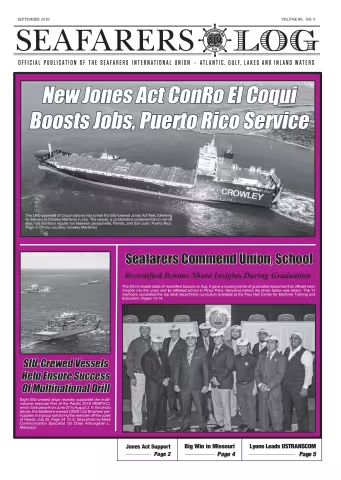
Issue Date
2018-09-01
Volume
80
Issue Number
9
Plaintext
SEPTEMBER 2018 VOLUME 80, NO. 9
Lyons Leads USTRANSCOM
Page 5
Jones Act Support
Page 2
Big Win in Missouri
Page 4
Seafarers Commend Union, School
The SIU’s newest class of recertified bosuns on Aug. 6 gave a rousing series of graduation speeches that offered keen
insights into the union and its affiliated school in Piney Point, Maryland (where the photo below was taken). The 11
members completed the top deck department curriculum available at the Paul Hall Center for Maritime Training and
Education. Pages 12-14.
The LNG-powered El Coqui (above) has joined the SIU-crewed Jones Act fleet, following
its delivery to Crowley Maritime in July. The vessel, a combination container/roll-on roll-off
ship, has started a regular run between Jacksonville, Florida, and San Juan, Puerto Rico.
Page 3. (Photo courtesy Crowley Maritime)
Recertified Bosuns Share Insights During Graduation
Eight SIU-crewed ships recently supported the multi-
national exercise Rim of the Pacific 2018 (RIMPAC),
which took place from June 27 to August 2. In the photo
above, the Seafarers-crewed USNS Carl Brashear par-
ticipates in a group sail during the exercise off the coast
of Hawaii, July 26. Page 24. (U.S. Navy photo by Mass
Communication Specialist 1st Class Arthurgwain L.
Marquez)
SIU-Crewed Vessels
Help Ensure Success
Of Multinational Drill
New Jones Act ConRo El Coqui
Boosts Jobs, Puerto Rico Service
2 Seafarers LOG September 2018
The Seafarers LOG (ISSN 1086-4636) is published monthly by the
Seafarers International Union; Atlantic, Gulf, Lakes and Inland Waters,
AFL-CIO; 5201 Auth Way; Camp Springs, MD 20746. Telephone (301)
899-0675. Periodicals postage paid at Southern Maryland 20790-9998.
POSTMASTER: Send address changes to the Seafarers LOG, 5201 Auth
Way, Camp Springs, MD 20746.
Communications Director, Jordan Biscardo;
Managing Editor/Production, Jim Guthrie; Assistant
Editor, Nick Merrill; Photographer, Harry Gieske;
Administrative Support, Jenny Stokes; Content Curator,
Mark Clements.
Copyright © 2018 Seafarers International Union, AGLIW. All Rights
Reserved.
Volume 80 Number 9 September 2018
The SIU online: www.seafarers.org
The Seafarers International
Union engaged an environ-
mentally friendly printer
for the production of this
newspaper.
President’s Report
The labor movement’s victory last month in Missouri against the
state’s right-to-work (for less) law is a triumph for all working families,
not just for unions. We dive into the details elsewhere in this edition, but
the most important takeaway is that American workers still have a voice,
and we still have clout when we join together.
Leading up to the statewide vote on August 7, union members, of-
ficials and staff (including Seafarers) led a grassroots effort to educate
fellow citizens about the ugly truth behind so-called
right-to-work (RTW) provisions. For starters, the
name is intentionally misleading. No one, after all,
could possibly be opposed to the literal right to work.
But we know that’s not even remotely what RTW
is about. It’s actually about driving down wages,
weakening workplace protections, and giving an un-
healthy amount of power to management. It’s about
trying to divide working women and men who’ve
come together to form or join a union.
Fortunately, the people of Missouri saw through
the big lie of RTW and overturned it in a landslide.
This didn’t happen by accident – our movement
worked for the win.
We’ve got no shortage of other battles ahead, but our decisive victory
in the Show Me State demonstrates that reports of labor’s demise have
indeed been greatly exaggerated.
Heartwarming Speeches
Be sure to read this month’s article about the SIU’s newest class of
recertified bosuns. And, if you know someone who’s considering joining
our union, or just wants to know what we’re all about, give them a copy
of that article or send them the link.
The Seafarers who complete recertification aren’t the only members
who know us extremely well, but they’re among the most familiar with
how we operate. I am always energized when I hear class after class
describe how the SIU and our affiliated school gave them a career op-
portunity, enabled them to make a good living and perhaps raise a family,
and do a job they enjoy. Many members have talked about how they were
able to put kids through college thanks to their maritime career, which is
no small financial feat nowadays.
Not every individual story is identical, of course, but there are usually
common threads. In many cases, including with the new class of bosuns,
those stories involve multi-generation SIU families. There’s no greater
compliment to our organization and our way of life than for a parent to
encourage a son or daughter to join up. And you have my word that we
will continue doing everything possible to earn that confidence and trust.
Register and Vote
As mentioned above, when working families join together for grass-
roots activism, we get things done. And on that note, you know it’s an
election year when I’m constantly tossing out reminders to make sure
you’re registered, and to either head to the polls on November 6 or vote
absentee if you’ll be on a ship at that time.
Brothers and sisters, I cannot over-emphasize that our union does
not care about political party! We care about the maritime industry and
about workers’ rights. And we will work with anyone who supports the
U.S. Merchant Marine and the American labor movement, regardless of
whether they’re a Republican, a Democrat or an Independent.
Check with your port agent if you’re not sure where the union stands
on a particular candidate or issue. But meanwhile, the first step is to make
sure you’re registered. It’s really easy to do online – visit vote.org or usa.
gov/register-to-vote to get started.
Our industry’s survival depends on political support. The best way for-
ward – so that American-flag shipping doesn’t merely survive, but grows
– is to elect people at every level of government who agree that the U.S.
Merchant Marine is vital to national, economic and homeland security.
Michael Sacco
Big Win – And More Work Ahead
New Report Thoroughly Examines Cabotage Law, U.S. Territory
Economists from Boston-based
Reeve & Associates and San Juan-
based Estudios Técnicos, Inc. on
July 18 released a joint report, “The
Impact of the Jones Act on Puerto
Rico,” that concluded the Jones Act
has no impact on either retail prices
or the cost of living in Puerto Rico.
In addition, the report found that the
state-of-the-art maritime technology,
Puerto-Rico focused investments,
and dedicated closed-loop service of-
fered by Jones Act carriers provide a
significant positive economic impact
to the island, at freight rates lower or
comparable to similar services to
other Caribbean Islands.
In the first comprehensive re-
port on the impact of the Jones Act
in Puerto Rico following Hurricane
Maria, the authors analyzed the eco-
nomic impact of the Jones Act – a
critical economic and national se-
curity law that ensures goods trans-
ported from U.S. port to U.S. port be
carried on vessels that are American-
crewed, American-built, American-
owned and American-flagged. The
report analyzed the impact on con-
sumers by evaluating the competi-
tiveness of freight rates in the United
States/Puerto Rico market, the qual-
ity of service provided by the Jones
Act carriers, and the impact of the
carriers’ freight rates on the prices of
goods shipped between the United
States mainland and Puerto Rico.
“There has been much debate
about the impact of the Jones Act on
Puerto Rico, particularly following
Hurricane Maria,” said John Reeve,
the principal in Reeve & Associates
and the lead economist on the study.
“The findings of our analysis show
that reliable, efficient, and regular
Jones Act services benefit consum-
ers and businesses on the island, and
no evidence suggests that exempt-
ing Puerto Rico from the Jones Act
would reduce consumer prices in
Puerto Rico. On the contrary, such
an action may well increase prices.”
“The results were overwhelm-
ingly conclusive regarding the eco-
nomic contributions of the Jones
Act to Puerto Rico. Their detailed,
fact-based analysis found that Puerto
Rico received very similar or lower
shipping freight rates when com-
pared to neighboring islands and that
the transportation costs have no im-
pact on retail prices on the island,”
said Matt Woodruff, chairman of
the American Maritime Partner-
ship, a coalition to which the SIU
is affiliated. “Moreover, the study
found that prior claims and press re-
ports that questioned the value of the
Jones Act to Puerto Rico were erro-
neous and their validity completely
undermined when compared to the
economic facts at hand.”
In summary, the findings include:
The Jones Act has no impact
on either retail prices or the cost of
living in Puerto Rico. The report
found that shipping costs between
the mainland and Puerto Rico make
up only a small percentage of the re-
tail price. For example, ocean ship-
ping accounts for just three cents
(or two percent) in the retail price
of $1.58 for a can of chicken soup
in San Juan. It found that, “[e]ssen-
tially, transportation costs for Puerto
Rico are not materially different than
those on the mainland.”
A market basket analysis of
an assortment of consumer goods at
Walmart Stores in San Juan, Puerto
Rico, and Jacksonville, Florida,
found there was “no significant dif-
ference in the prices of either gro-
cery items or durable goods between
Source: American Maritime Partnership
Jones Act Has No Effect on Prices in Puerto Rico
The U.S. House Transportation
and Infrastructure Subcommit-
tee on Coast Guard and Maritime
Transportation conducted a round-
table discussion July 26 titled
“The Impact of the Jones Act on
Consumer Prices in Puerto Rico.”
The bipartisan group of congres-
sional members, economists and
maritime leaders – including SIU
Executive Vice President Augie
Tellez – discussed the findings of
a new fact-based, comprehensive
study on the economic importance
of the nation’s freight cabotage law
to Puerto Rico and highlighted its
significant economic and national
security contributions to the island
and nation.
In addition to Tellez, other guest
panelists included John Reeve,
economist and principal, Reeve &
Associates; Michael G. Roberts, se-
nior vice president, general counsel
and corporate secretary for Crowley
Maritime; and Jonathan Kaskin, na-
tional vice president for legislative
affairs, Navy League of the United
States.
In the newly released report,
“The Impact of the U.S. Jones Act
on Puerto Rico,” economists from
Boston-based Reeve & Associates
and San Juan-based Estudios Tec-
nicos, Inc., concluded that the Jones
Act has no impact on either retail
prices or the cost of living in Puerto
Rico (see related story, this page).
In his opening remarks, U.S.
Rep. Duncan Hunter (R-Califor-
nia), chairman of the Subcommittee
on Coast Guard and Marine Trans-
portation, reminded attendees about
the importance of the Jones Act to
the nation and the need to explain
the facts about the law.
“The bottom line is that the
Jones Act was designed to maintain
domestic U.S. shipbuilding capac-
ity and to create employment op-
portunities for American mariners
– American jobs, serving American
commerce,” Hunter said. “These
shipyards, welders, and mariners
are the same individuals we would
rely on to provide our country the
maritime capacity required in times
of conflict. There have been a lot
Members of Congress, Economists,
U.S. Maritime Industry Leaders
Underscore Importance of Jones Act
See Report, Page 7
SIU Exec. VP Augie Tellez (third from right at table in foreground) and other panelists discuss the
Jones Act with members of Congress.
See House, Page 7
September 2018 Seafarers LOG 3
El Coqui, a ConRo, Joins SIU-Crewed Fleet
SIU members are sailing aboard a new addi-
tion to the Seafarers-contracted fleet.
Crowley Maritime in late July took delivery
of the El Coqui, one of the world’s first com-
bination container/roll-on roll-off (ConRo)
ships powered by liquefied natural gas (LNG).
Less than two weeks later, an SIU crew helped
complete the vessel’s successful maiden voyage
as the ship delivered cargo from Jacksonville,
Florida, to Crowley’s modernized Isla Grande
Terminal in San Juan, Puerto Rico.
“The SIU is excited about this brand-new
ship, which will sail in the Jones Act trade,”
stated SIU Vice President Contracts George
Tricker. “I’m confident that the SIU crew will
continue to demonstrate their usual outstanding
professionalism. It’s also worth pointing out that
new ships like the El Coqui help boost Ameri-
ca’s national, economic and homeland security.”
Among the Seafarers comprising the El Co-
qui’s first crew were Recertified Bosun Abel
Vazquez Torres, ABs Victor Cortes Maldo-
nado, Julio Perez, Kemer Rojas, Richard
Scales, John Telles and Manuel Rodriguez
Maldonado, Electrician Rodney Passapera-
Barbosa, QMEDs Hector Ginel and Christian
Rosado, Oiler Edwin Velez, Recertified Stew-
ard Kimberly Strate, Chief Cook Bryan Alva-
rez, and SA La’sonia Randolph.
Built at VT Halter Marine Inc., the El Coqui
is the first of two Commitment Class ships
being constructed for Crowley’s shipping and
logistics services between Jacksonville and San
Juan. Construction of sister ship Taino is well
underway at VT Halter Marine’s facility in Pas-
cagoula, Mississippi; that vessel is scheduled to
enter service later this year.
The new vessels are 720 feet in length,
26,500 deadweight tons (DWT), and will be able
to transport up to 2,400 twenty-foot-equivalent
container units (TEUs) at a cruising speed of 22
knots. According to Crowley, “A wide range of
container sizes and types will be accommodated,
including 53-foot by 102-inch-wide, high-capac-
ity containers, up to 300 refrigerated containers,
and a mix of about 400 cars and larger vehicles
in the enclosed, ventilated and weather-tight Ro/
Ro decks. This type of shipboard garage is of-
fered exclusively by Crowley in the trade.”
Following the acquisition of the El Coqui
(named for the popular indigenous frog in Puerto
Rico), Crowley Maritime Chairman and CEO
Tom Crowley stated, “This delivery represents
another milestone in our unwavering commit-
ment to Puerto Rico and the Jones Act. We have
dedicated significant time, effort and more than
$550 million, which includes these new ships, to
transform our Puerto Rico shipping and logistics
services to world-class standards. We thank the
men and women at Crowley, VT Halter Marine
and other partners, who have dedicated them-
selves to bringing this magnificent new ship to
life.”
Matthew Paxton, president of the Shipbuild-
ers Council of America, added, “This is a thrill-
ing time for the U.S. shipbuilding industry, as
evolutions in LNG technology are providing a
historic opportunity for American yards and the
supporting industrial base to design, build and
outfit some of the most technically advanced
and environmentally friendly vessels that are the
envy of the world. American skill and ingenuity,
as well as critical laws like the Jones Act, serve
as the backbone of our industry and embolden
innovation and investment in domestic ship-
building. El Coqui is a shining example of the
work being done each day in our industry, and
we are proud to support her, her crew and those
who built her….”
The Jones Act is a federal law that regu-
lates maritime commerce in the United States.
The Jones Act requires goods shipped between
U.S. ports to be transported on vessels that are
crewed, built, owned and operated by United
States citizens or permanent residents. Also
known as the Merchant Marine Act of 1920, the
law is vitally important to maintaining a strong
U.S. maritime capability.
Besides full loads of dry containers, the El
Coqui’s inaugural cargo also included various
equipment and automobiles, trucks and SUVs,
as well as refrigerated containers for produce.
“We have eagerly anticipated this initial port
call for some time now, and very much look for-
ward to the added speed and efficiency that this
high-performing ship will add to our customers’
supply chains,” said Frank Larkin, Crowley’s
senior vice president and general manager, lo-
gistics and commercial services. “The ship’s
reduced transit time complements major invest-
ments in technology and other infrastructure up-
grades to our terminals that make it easier and
quicker for our trucking partners to access our
terminals for cargo moves. We’ve also evolved
our warehouse operations to bring greater effi-
ciencies all the way through to final mile deliv-
eries. We’ve created greater speed to market all
the way around.”
“This momentous occasion marks yet an-
other milestone in our historic Commitment
Class project, which ultimately offers shippers
faster and more efficient logistics services that
will match the needs of consumers and busi-
nesses in Puerto Rico,” said Jose “Pache” Ayala,
vice president, Crowley Puerto Rico services, in
San Juan.
The company reported that fueling the ships
with LNG “will reduce emissions significantly,
including a 100-percent reduction in sulphur
oxide (SOx) and particulate matter (PM); a
92-percent reduction in nitrogen oxide (NOx);
and a reduction of carbon dioxide (CO2) of more
than 35 percent per container, compared with
current fossil fuels. Working with Eagle LNG
Partners, the ships will be bunkered from a sho-
reside fuel depot at JAXPORT.”
These snapshots, courtesy of Crowley, show the El Coqui during its maiden voyage. The
ship made its first delivery July 30 in San Juan, Puerto Rico.
Seafarers-contracted Overseas Shi-
pholding Group (OSG) made two big an-
nouncements in July, and the results will
mean more jobs for SIU members.
On July 16, OSG reported that it has
signed contracts with a Korean shipyard
to build two product chemical tankers
that will sail under the Stars and Stripes.
Two weeks later, on July 31, OSG an-
nounced an agreement for construction
of a 204,000-barrel oil and chemical tank
barge for dual-mode integrated tug-barge
(ITB) service.
The two tankers, slated for delivery
during the second half of 2019, will be
built at Hyundai Mipo Dockyard Com-
pany’s Ulsan, Korea, facilities. In a news
release, OSG said the vessels “will be
built to comply with MARPOL Annex
VI Regulation 13 Tier III standards re-
garding nitrogen oxide emissions within
emission control areas. In addition, each
vessel will have installed exhaust gas
cleaning systems, often referred to as
scrubbers, to meet the standards of MAR-
POL Annex VI Regulation 14 standards
regarding sulphur oxide emissions.”
Sam Norton, president and CEO of
OSG, stated, “OSG is committed to main-
taining a leading presence in the U.S.-flag
petroleum transportation sector. Our ini-
tiative to pursue construction of modern,
efficient and environmentally responsible
vessels sends a strong signal to our cus-
tomers, our stockholders and our employ-
ees that we are confident in achieving
our commitment and that we have the
resources and unique skill sets to enable
us to do so. We look forward to the contri-
bution that these vessels will make to our
long-term success once delivered.”
Meanwhile, the 581-foot barge will
be built by Gunderson Marine, a subsid-
iary of The Greenbrier Companies. It’s
scheduled for delivery during the second
quarter of 2020; the agreement includes
an option to build a second barge, which
would have a slated delivery date during
the fourth-quarter of 2020.
OSG plans to pair the barge with ex-
isting tugs from its SIU-crewed fleet. It
will be utilized in the Jones Act trade.
“The Gunderson Marine contract for
construction of a new barge is an excit-
ing development for OSG,” said Norton.
“This transaction represents the first sig-
nificant new capital investment into our
Jones Act businesses in nearly a decade
and is an affirmation of our commitment
to operate ATBs, as well as tankers,
within this market.”
OSG Orders
Two Tankers,
One Barge
4 Seafarers LOG September 2018
Missouri voters on Aug. 7 provided
the state’s working families – and the
labor movement nationwide – with a tre-
mendous victory by rejecting the state’s
so-called right-to-work law.
Senate Bill 19, which appeared on the
ballot as Proposition A during the state
primary, afforded voters the opportunity
to strike down a measure the state legis-
lature passed in early 2017. If allowed to
stand, Prop A would prohibit employees
from being required to join a union (even
though a majority of employees would
have voted for representation) or to oth-
erwise pay “fair share” fees to a given
workplace’s union.
In dramatic fashion, the electorate
made its feelings crystal clear: There
would be no right-to -work (for less) dur-
ing their watch. By better than a 2 to 1
ratio (67 percent to 33 percent), voters in
the Show Me State smashed the measure.
AFL-CIO President Richard Trumka,
in a prepared statement released in the
wake of the primary’s result, said, “Mis-
souri is the latest sign of a true ground-
swell, and working people are just getting
started. The defeat of this poisonous anti-
worker legislation is a victory for all
workers across the country. The message
sent by every single person who worked
to defeat Prop A is clear: When we see an
opportunity to use our political voice to
give workers a more level playing field,
we will seize it with overwhelming pas-
sion and determination. Tonight is the
latest act of working people changing a
rigged system that for decades has been
favoring corporations, the mega-wealthy
and the privileged few.
“The victory in Missouri follows a
national wave of inspiring activism that
is leading to life-changing collective
bargaining agreements and electoral tri-
umphs that remind America the path to
power runs through the labor movement,”
he continued. “From statehouses and city
councils to the halls of Congress, work-
ing people are fighting back, and this No-
vember, we will elect our allies and retire
our enemies. Working people across Mis-
souri made this transformational moment
possible, and we are following their lead
to changing the world.”
Mike Louis, president of the Missouri
AFL-CIO, was equally pleased with the
primary’s outcome, offering “Work-
ing people made our voices heard at the
ballot box today and overturned ‘right
to work.’ It’s a truly historic moment.
Thousands of hard-working men and
women in Missouri talked to their neigh-
bors, friends and co-workers. We owe
them this victory.
“Together, we knocked on more than
800,000 doors, made more than 1 million
phone calls and talked to working people
on more than 1,000 different job sites
across the state,” Louis added. “Tonight,
we celebrate, but tomorrow we’re getting
back to work. We’re going to take this
energy and momentum and build more
power for working people in Missouri.”
The Missouri vote marked a major
victory for unions during an era saturated
with anti-worker attacks at different
levels of government and from extrem-
ists. For instance, as reported earlier in
the Seafarers LOG, the U.S. Supreme
Court on June 27 issued its opinion in
the much-anticipated Janus v. AFSCME
Council 31 case, which overturned 40
years of public-sector collective bargain-
ing policy. The 5-4 decision bars states
from requiring non-members from pay-
ing what are known as agency or fair-
share fees to unions who collectively
bargain on behalf of an entire unit in a
public-sector workplace.
The Supreme Court held in 1977 that
unions could charge non-members fees
for benefits they received from certain
representational activities. But the late-
June decision overturned that ruling on
First Amendment grounds, and it is ex-
pected to weaken workers’ rights.
A little more than a month earlier on
May 25 in the late afternoon right before
the start of Memorial Day weekend, the
administration issued three executive or-
ders (numbered 13836, 13837 and 13839)
that aggressively restricted collective
bargaining in federal organizations and
constrained the ability of labor leaders to
represent not just their members but all
employees in a bargaining unit, regard-
less of whether they pay dues.
The foregoing setbacks and others
notwithstanding, the Missouri vote came
on the heels of a string of successful
red-state protests about teachers’ wages.
Teachers strikes and demonstrations in
West Virginia, Oklahoma, Kentucky and
Arizona were successful as educators
rallied and demanded fair wages and im-
proved working conditions for the better-
ment of students.
As a result, many union members
around the country now are viewing the
win in Missouri as a watershed moment
and a sign of victories to come. If polls
offer any indications as to where orga-
nized labor stands, then union members’
optimism could be well-founded. Ac-
cording to Gallup, Americans’ views
on unions hit a 14-year high last year,
reaching 61 percent approval, just above
its historical average in recent decades.
Missouri Defeats Right-to-Work (for less) Law
Promoting Maritime in Virginia
By many measures, quality of life is
worse in states with right-to-work laws.
Wages are lower, people are less likely
to have health insurance and the neces-
sary resources for a quality education,
poverty levels are higher, and so are
workplace fatality rates.
States with Right-to-Work Laws Have
Lower Wages and Incomes
On average, workers in states with
right-to-work laws make $6,109 a year
(12.1%) less annually than workers in
other states ($44,401, compared with
$50,511).
Median household income in states
with these laws is $8,174 (13.9%)
less than in other states ($50,712 vs.
$58,886).
29.6 percent of jobs in right-to-work
states were in low-wage occupations,
compared with 22.8% of jobs in other
states.
States with Right-to-Work Laws Have
Lower Rates of Health Insurance Cover-
age
People under the age of 65 in states
with right-to-work laws are more likely
to be uninsured (13.0%, compared with
9.4% in free-bargaining states).
Only 47% of private-sector employers
in states with these laws offer insurance
coverage to their employees, compared
with 52.2% in other states. That differ-
ence is even more pronounced among
employers with fewer than 50 workers:
only 30.1% offer health insurance com-
pared with 38.1% of small employers in
other states.
Workers in right-to-work states also
pay a larger share of their health insur-
ance premiums, on average, than those
in free-bargaining states (28.5% of the
premium compared with 25.4% in free-
bargaining states).
States with Right-to-Work Laws Have
Higher Poverty and Infant Mortality Rates
Poverty rates are higher in states with
right-to-work laws (15.3% overall and
21.4% for children), compared with pov-
erty rates of 12.8% overall and 18.0%
for children in states without these laws.
The infant mortality rate is 12.4%
higher in states with right to work laws.
States with Right-to-Work Laws Invest
Less in Education
States with right-to-work laws spend
32.5% less per pupil on elementary and
secondary education than other states.
States with Right-to-Work Laws Have
Higher Workplace Fatality Rates
The rate of workplace deaths is 49%
higher in states with right-to-work laws,
according to data from the Bureau of
Labor Statistics.
SIU Port Agent Georg Kenny (right in both photos) delivered a pro-maritime mes-
sage last month at the Virginia AFL-CIO Convention in Williamsburg. He’s pictured
Aug. 9 with (respectively) U.S. Sen. Tim Kaine (D) (photo above) and U.S. Rep.
Bobby Scott (D) – both longtime backers of the U.S. Merchant Marine. Kenny was
unanimously re-elected for a third five-year term on the state AFL-CIO’s executive
board, where he represents the Eastern Virginia Labor Federation.
Right-to-Work Laws Hurt Everyone
Richard Trumka (left) and Mike Louis were among the guest speakers who addressed
delegates and guests during the Maritime Trades Department’s October 19-20, 2017
Convention in St. Louis. Trumka is president of the AFL-CIO and Louis is president of the
Missouri AFL-CIO.
September 2018 Seafarers LOG 5
Maritime Administrator Cites Importance of RRF
In a recent blog post, U.S. Maritime Administrator
Mark “Buzz” Buzby confirmed what many SIU mem-
bers already knew from experience: 2017 was a busy
year for mariners sailing on vessels in the Ready Re-
serve Force.
“Merchant mariner numbers may be at a low in the
U.S., but the men and women of the Ready Reserve
Force (RRF) have increased their operating days by
245 percent from Fiscal Year (FY) 2016 to FY 2017,”
Buzby wrote. He briefly described some of the various
missions these vessels participated in, before continu-
ing, “To sum up – in FY 2017 there were about 345
operating days (days away from layberth) for RRF ves-
sels on cargo missions, exercises, and FEMA mission
assignments. In 2016 there were around 100 operating
days for RRF vessels on missions and exercises. 2018
is on track to match, if not surpass, 2017.”
He then provided some historical context for those
numbers: “From 2002 to June of 2008, 118 ship acti-
vations were called
for in support of Op-
erations Enduring
Freedom and Iraqi
Freedom. In that
period, there were
13,575 ship operat-
ing days with a re-
liability rate of 99
percent. Almost 25
percent of the initial
equipment needed
to support the U.S.
Armed Forces op-
erations in Iraq was
moved by the RRF.
By comparison, Mili-
tary Sealift Command’s combined sealift fleet of Large,
Medium-Speed Roll-on/Roll-off (RO/RO) and Fast
Sealift Ships carried 29 percent of the cargo required
for the invasion.”
The administrator continued, citing more examples
of the value and utility of the RRF fleet. “The RRF
provides significant cost savings to the Department of
Defense by maintaining shipping capacity in a reduced
operating status until needed,” he pointed out. “These
vessels also provide maximum flexibility to an already
thinly stretched Navy. In 2014, the RRF vessel Cape
Ray was converted into a floating incinerator for the
safe destruction of the most dangerous chemical war-
fare materials in Syria’s declared chemical weapons
arsenal. The historic mission supported the Defense
Threat Reduction Agency (DTRA) in neutralizing al-
most 600 tons of declared chemical weapons, and that
same vessel is still active today, carrying military cargo
and supporting a U.S. Army Logistics-Over-the-Shore
(LOTS) exercise overseas. In the same year as Cape
Ray’s DTRA mission, the Cape Rise and Cape Wrath
were deployed to support the global effort to end the
Ebola virus disease outbreak in West Africa.”
In his own words, Buzby succinctly explained the
RRF: “The RRF program was initiated in 1976 as a
subset of the Maritime Administration’s (MARAD)
National Defense Reserve Fleet (NDRF) to support the
rapid worldwide deployment of U.S. military forces.
The NDRF consists primarily of RO/RO vessels with
some tankers and
military auxiliaries
set aside for national
defense and national
emergencies. Of the
nearly 100 vessels in
the NDRF, 46 ships
are assigned to the
RRF and kept in an
increased readiness
state with a small
crew to be activated
in short order.”
He went on to
characterize the ves-
sels operating within
the RRF, saying,
“Generally, RRF ships must be ready to load military
cargo for transport to areas of operation within five days
of activation. Operated under contract by commercial
U.S. ship managers, these vessels form three-quarters of
the Government’s surge sealift capacity, and are crewed
by volunteer, contract, U.S. mariners. The majority of
the RRF ships are RO/RO vessels that are uniquely built
for the movement of vehicles, tanks and rolling stock.
The RRF also boasts six auxiliary craneships, and two
aviation repair vessels. These ocean-going ships pro-
vide the initial surge of military capability that rapidly
delivers military equipment and supplies during major
contingencies.”
Looking towards the future of the RRF, he con-
cluded, “While our crews work hard to keep the RRF
fleet ready, that task is becoming increasingly chal-
lenging and costly for ships with an average age of 43
years – well past the prime for most commercial ves-
sels. MARAD is working closely with the Navy, U.S.
Transportation Command, and Congress to recapitalize
and replace these critical assets to our national defense.”
Buzby Credits Mariners, Says Ships are ‘Critical Assets to National Defense’
Mark Buzby
U.S. Maritime Administrator
U.S. Army Lt. Gen. Stephen R. Lyons is the new
commander of the U.S. Transportation Command (US-
TRANSCOM) at Scott AFB, Illinois.
Lyons, who was confirmed for the post August 1 by
the U.S. Senate, replaced U.S. Air Force Gen. Darren
McDew. McDew, who had been at the command’s helm
since August 2015, retired August 24 following a change
of command ceremony.
“Lt. Gen. Lyons is a rare soldier, officer, and leader,”
said McDew of his successor. “He will be the command’s
first Army commander, as well as the Army’s first Logis-
tician Combatant Commander.
“As our joint warfighting enterprise continues to
evolve in today’s unique environment, Lyons’ expertise
will surely enable the continued advancement of our com-
mand,” he continued. “Having commanded at every level
from company to major subordinate command, and previ-
ously serving as USTRANSCOM’s deputy commander,
he is up to the crucial task of leading the 144,000-strong
USTRANSCOM team. Everyone across the command
and the joint deployment and distribution enterprise will
benefit from his direction and leadership.”
A strong supporter of the U.S. Merchant Marine, the
American maritime industry and key programs that help
keep the industry alive – including the Jones Act, Mari-
time Security Program (MSP) and cargo preference –
Lyons is keenly aware of the crucial role that each plays in
U.S. national security and continued economic prosperity.
In testimony before the U.S. House of Representatives
in May 2016 wherein the size of the country’s maritime
security fleet was at issue, Lyons joined a host of con-
gressmen and senior maritime transportation officials who
defended and stood behind a strong and robust American-
flag capability. He testified that “the case for a U.S.-flag
fleet is compelling” and that several mobility capability
studies done by Transportation Command have repeatedly
reaffirmed the need for at least a 60-ship MSP fleet.
Lyons again spoke out for maritime in June 2017 dur-
ing a naming ceremony for the SIU-crewed MV Liberty,
an American Roll-On Roll-Off Carrier (ARC)-owned ves-
sel that earlier in the year reflagged under the Stars and
Stripes and entered the U.S. registry.
“ARC plays a significant role in our nation’s commit-
ment to the security of our nation and our NATO allies,”
Lyons said to attendees at the ceremony in Charleston,
South Carolina. “We can’t underestimate the strategic im-
pact of global images depicting the arrival of an armored
brigade combat team on ARC’s Resolve, Endurance, and
Freedom, or the arrival of a combat air brigade on En-
durance and Honor. And now we are happy to welcome
Liberty to the fleet.”
A native of Rensselaer, New York, the general gradu-
ated from the Rochester Institute of Technology and was
commissioned in 1983. He received a master’s degree in lo-
gistics management from the Naval Postgraduate School in
1993, and national resource strategy master’s degree from
the Industrial College of the Armed Forces in 2005.
Lyons previously served as the USTRANSCOM dep-
uty commander. He also served as commanding general
of the 8th Theater Sustainment Command in Fort Shafter,
Hawaii. Prior to serving as commanding general he served
as the director for logistics, operations, readiness, force
integration, and strategy, office the deputy chief of staff
of the Army, in Washington, D.C.
The general has also served in a variety of assignments
providing him with extensive logistics and management
expertise. He began his career in Germany during the Cold
War and subsequently held a wide range of operational as-
signments to include command at company, battalion, bri-
gade, and major command levels. Since 2003, Lyons has
spent more than 40 months deployed to the U.S. Central
Command area of responsibility in support of Operation
Enduring Freedom and Operation Iraqi Freedom.
USTRANSCOM is a global combatant command and
the transportation provider for the Department of De-
fense.
Lyons Takes Helm at Transportation Command
Lt. Gen. Stephen R. Lyons
Commander, USTRANSCOM
“While our crews work hard to keep the RRF
fleet ready, that task is becoming increasingly
challenging and costly for ships with an av-
erage age of 43 years – well past the prime
for most commercial vessels. MARAD is work-
ing closely with the Navy, U.S. Transportation
Command, and Congress to recapitalize and
replace these critical assets to our national
defense.” - Mark Buzby, U.S. Maritime Administrator
6 Seafarers LOG September 2018
TWIC Cards
Get New Look
The Transportation Worker
Identification Credential
(TWIC) has been redesigned
for the first time in more than a
decade. On July 10, the Trans-
portation Security Administra-
tion (TSA) began issuing TWIC
cards sporting the new look, for
both new applicants and renew-
als, officially dubbed TWIC
NexGen.
TWICs issued before July 10
remain valid until their respec-
tive expiration dates.
As outlined in documents
released by the TSA, “The Nex-
Gen effort is focused on en-
hanced card functionality, new
physical security features, and
changes to the Technology In-
frastructure Modernization sys-
tem to realize a NexGen card.
Where TWIC is used often as a
‘flash pass’ physical updates to
deter counterfeiting were a pri-
ority of TSA.”
The updated design includes,
according to the TSA: enhanced
card substrates; covert, overt and
forensic features; color-coded
expiration field; and optically
variable devices. In addition,
the laminate itself has been en-
hanced with a variety of security
and tactile features.
This redesign is part of a
larger series of policy changes
and enhanced security mea-
sures the TSA has been intro-
ducing in recent years. The
previous design of the TWIC
will remain valid until 2023.
For additional information,
contact the TSA at twic.issue@
tsa.dhs.gov or visit www.tsa.
gov/twic. The TSA issued this image of a sample card showing the new TWIC design.
Regardless of the specific laws con-
cerning cannabidiol (CBD) in a mariner’s
home state, there’s no ambiguity in the
eyes of the government: CBD is a Sched-
ule I controlled substance, and illegal
under federal law.
As explained in a recent article by Con-
sumer Reports, “Cannabidiol, commonly
called CBD, holds the promise of reliev-
ing a long list of ailments, from pain to
epilepsy to multiple sclerosis. While this
chemical compound comes from mari-
juana or its close relative hemp, CBD does
not get users high, unlike another com-
pound from the marijuana plant, tetrahy-
drocannabinol, or THC.”
While it’s true that some CBD oils are
made with hemp instead of marijuana, and
therefore contain a much lower level of
THC, the vast majority of CBD products
are not regulated by the Food and Drug
Administration, and the aforementioned
claims have not been verified. As CBD is
still illegal at the federal level, any positive
test for either THC or CBD would cause a
mariner to fail that drug screening.
Additionally, even if a mariner legally
purchased a product that contains CBD
in their home state, they would not be
allowed to possess it while aboard a ves-
sel.
According to the Substance Abuse and
Mental Health Services Administration
(SAMHSA), “CBD is chemically distin-
guishable from THC and will not cause
a positive drug test result under the cur-
rent drug testing panel but is a Schedule
I drug. However, CBD products may
contain other cannabinoids such as THC,
therefore, use of CBD oils and marijuana-
derived products may result in a positive
urine drug test for THCA…. There have
been no changes to the drug testing panel
regarding marijuana, under the federal
Drug-Free Workplace Program (DFWP).
The DFWP (as established under Execu-
tive Order 12564, Public Law 100-71 and
the Mandatory Guidelines) will continue
to operate in accordance with federal law,
which identifies marijuana and marijuana
extracts (e.g. CBD) as a Schedule I con-
trolled substance.”
Federal Laws Still Regard CBD Oil as Controlled Substance
It has come to the attention of union
officialsthat some members may be un-
aware they can file for vacation ben-
efits for reduced operating status (ROS)
time.
All time filed must still meet the usual
requirements for Seafarers Vacation Plan
benefits.
Per the current contracts, the following
vessels are eligible for ROS vacation pay
through the Seafarers Vacation Plan:
Sgt. Matej Kocak
Stephen W. Pless
Eugene A. Obregon
Dewayne T. Williams
John Paul Bobo
William R. Button
Baldomero Lopez
Jack Lummus
USNS Bob Hope
USNS Brittin
USNS Fisher
USNS Pililaau
USNS Mendonca
USNS Benavidez
USNS Gilliland
USNS Gordon
USNS Seay
USNS Yano
Shughart
The USNS Bob Hope (T-AKR-300) prepares to load an improved Navy lighterage system dur-
ing exercise Brilliant Tern. Brilliant Tern was conducted by Military Sealift Command ships using
real world scenarios. (U.S. Navy photo by MCSA Jasmine Sheard)
Reduced Operating Status, Vacation Pay
Notice/Reminder
With Seafarers Aboard Tanker California
Earlier this year, Seafarers-contracted
Crowley acquired three tankers from
SeaRiver Maritime, signaling new jobs
for SIU members. Recertified Bosun
John Cedeno submitted these photos
from one of those vessels, the Califor-
nia. He reports smooth sailing with the
SIU crew and AMO officers.
September 2018 Seafarers LOG 7
SIU members are reminded that they
have an online option for placing orders for
clinic exam services in addition to services
offered at the hiring halls.
As previously reported, those services
may be ordered through the members-only
portal on the union’s website, www.seafar-
ers.org. The members-only area itself has
been available since June 2011 and is free
of charge. It can be directly accessed at
https://members.seafarers.org/
Seafarers Health and Benefits Plans
(SHBP) Administrator Maggie Bowen
stated, “You can order exams within 60
days of your current expiration dates, so
don’t wait until the last minute. This site
also allows ineligible participants to order
exams and pay using PayPal.”
She added, “If you do not see the exam
that you are trying to order, please email
shbpmedical@seafarers.org and if you
have any other questions please email
map@seafarers.org or call 1-800-252-
4674.”
The SHBP started using a new health
clinic system, Comprehensive Health
Services (CHSi), in early 2013. CHSi
features more than 2,000 participat-
ing facilities in the contiguous United
States, which has made it much easier for
Seafarers to find clinics that are closer
to home, whether they’re taking annual
exams, functional capacity evaluations
or interval exams.
Using the member portal allows mari-
ners to order the exams they need as fol-
lows:
Automated Exams
Annual/MSC Physical Examina-
tion – Required no more than once annu-
ally, no sooner than 60 days prior to the
expiration date of the previous exam.
Functional Capacity Evaluation –
Required no more than once annually, no
sooner than 60 days prior to expiration date
of previous annual exam.
New Member Physical Exam – This
is a one-time requirement and is necessary
prior to registration.
U.S. Coast Guard Exam – Required
once every two years unless the mariner is
upgrading.
Interval Exam – Needed once every
six months for deep sea members and
under several inland contracts.
DOT/U.S. Coast Guard Drug
Test (Pre-Employment or Periodic)
– Required when renewing documents,
returning to work, or when random ex-
ception expires.
Benzene Clearance – Mandatory
(for mariners sailing on tankers) no more
than once annually, no sooner than 60
days prior to the expiration date of previ-
ous clearance.
Food Handler Certification – Re-
quired no more than once annually, no
sooner than 60 days prior to the expiration
date of the mariner’s certification.
Unlicensed Apprentice Physical
Exam – This exam is required for those
participating in the UA program. Once the
admissions department notifies you of ac-
ceptance into the UA program, you must
work with a local port office.
TB Screening only – Required no
more than once annually, no sooner than
60 days prior to expiration of existing
clearance. The TB screening is included in
every Annual/MSC exam, UA exam and
New Member exam.
MSC Shots only – Required by job
order and approved as necessary by the
SHBP Medical Department.
Commercial Non-MSC Shots only
– Approved as necessary by the SHBP
Medical Department.
Approval Required Exams
Return to Duty Exam – (repatria-
tion, interval illness or injury, etc.) Re-
quired upon demand by SHBP Medical
Department.
ARC Exam – Approval required by
Addictions Rehabilitation Center (ARC)
and SHBP Medical Department.
Member Portal Offers Scheduling Clinic Exams Option
Make sure your documents and pa-
perwork are current:
Merchant mariner credential
(MMC) with security endorsements
(maritime security awareness and/or
vessel personnel with designated se-
curity duties, abbreviated as VPDSD,
vessel security officer/VSO for offi-
cers)
MMC indicating completion of
Basic Training (formerly BST) (VI/1
and related verbiage)
Transportation Worker Identifica-
tion Credential (TWIC)
Passport
ServSafe Management (chief cook
and higher)
ServSafe Food Handler (entry
level)
Medical certificate (acquired by
passing U.S. Coast Guard physical
once every two years and submitting
to local REC)
Annual physical exam and interval
exam (required once every six months)
Drug test (every six months unless
continuously sailing)
If you take prescription drugs,
make sure your medications will last
longer than the duration of your voy-
age. If you need early or extended re-
fills, contact the claims department for
assistance. Dial 1-800-252-4674 and
follow the prompt for prescriptions.
Ready to Ship Out?
the two locations.” In fact, retail prices of goods
in Puerto Rico are essentially the same as on the
mainland.
Foreign vessels can deliver directly to
Puerto Rico from foreign countries. Finding that
57 percent of San Juan’s port traffic in 2016 was
carried on foreign vessels, the report noted that
there is “nothing in the Jones Act that precludes
foreign-flag vessels from serving Puerto Rico di-
rectly from foreign countries.” It concluded that
there was strong competition between carriers
serving the island, stating that “if cargo owners
in Puerto Rico believed that the Jones Act ship-
ping services were adding costs that negatively
impacted their business, you would expect to see
[an increase in foreign flag shipping].”
There is no Jones Act freight rate premium
for ocean transport. The report found that freight
rates for shipments between the mainland and
Puerto Rico are very similar to or lower than rates
for shipping between the mainland and neighbor-
ing islands, including the U.S. Virgin Islands,
Haiti, and the Dominican Republic.
The report flatly refuted assertions in other
studies that the negative impact of the Jones Act
is $850 million per year, noting that total annual
gross revenues for Jones Act shipping services
“was substantially below” that level. In other
words, “[t]he Jones Act carriers could have pro-
vided shipping services for free and … there still
would have been a negative economic impact,”
according to these studies – which defies logic.
Moreover, the report found that since 2000,
the carriers’ ocean freight rates in real terms have
not increased.
Southbound service is vital to Puerto Rico
consumers, while the northbound service is a key
contributor to economic development on the is-
land. As highlighted in the report, the fact that the
vessels operating in the Puerto Rico trade are dedi-
cated to that route “gives shippers very fast transit
times directly between the mainland and Puerto
Rico without stops in intermediate ports as typi-
cally occurs in international shipping markets.”
The Puerto Rico-continental U.S. trade op-
erates in a “closed-loop” route. Goods vital for
the welfare of the people are delivered promptly
from the mainland, while high-value goods are
shipped directly to the mainland from Puerto
Rico, providing a high-speed and very economi-
cal supply chain to Puerto Rican exporters.
The dedicated Jones Act vessels’ cargo ca-
pacity is highly underutilized in the northbound
service. As a result, producers in Puerto Rico
obtain shipping services at a very attractive rate.
Carriers provide highly effective logistics
systems, including economical and environmen-
tally friendly vessels, that ensure a high level of
supply chain efficiency.
According to the report, “The fact that the
Jones Act carriers operate dedicated services for
Puerto Rico with vessels and intermodal equip-
ment that are uniquely designed to closely in-
tegrate the commonwealth with the advanced
logistics systems of the mainland provides cargo
owners with major economic and service advan-
tages.”
The report noted that the “size of equip-
ment has a major impact on the cost of moving
cargo ‘intermodally’ in containers.” For example,
a 53-foot container that is widely used in Puerto
Rican service has 43 percent more cubic capacity
than the standard international 40-foot unit – this
differential provides an estimated $92 million of
cost savings annually through greater efficiency.
The report highlighted that the carriers in
Puerto Rico offer shippers options that are “de-
signed to meet the requirements of the range of
cargoes moving in the trade,” including fleets
of thousands of containers and trailers capable
of carrying either dry or refrigerated cargoes, as
well as vessels and barges designed to carry ve-
hicles in roll-on/roll-off mode and carry break-
bulk cargo that is too large to be accommodated
in a standard container. Some carriers have also
invested in state-of-the-art containerships pow-
ered by liquefied natural gas (LNG), which is
significantly more economical and environmen-
tally friendly than standard bunker fuels used by
virtually all other similar vessels.
In announcing the results of the study, the
American Maritime Partnership noted, “After
Hurricane Maria struck Puerto Rico with devas-
tating force on September 20, 2017, a number of
news reports claimed that the Jones Act had se-
verely damaged the Puerto Rican economy both
over time and in the immediate aftermath of the
storm. Following a comprehensive analysis of
the facts, this new report sets the record straight
on the important role of the Jones Act shipping
industry before the hurricane, in the immediate
aftermath, and in the months that followed. The
Jones Act fleet delivers a dedicated and reliable
flow of essential goods to the people of Puerto
Rico and provides significant economic benefits
for the island.”
Report Says Jones Act Has No Impact
On Product Retail Prices in Puerto Rico
of unsubstantiated claims regarding the
Jones Act, including the claim that the
law negatively impacts Puerto Rico….
We are here to discuss a report from a new
team of economists to provide actual data
on real consumer prices to determine the
Jones Act’s impact in Puerto Rico.”
U.S. Rep. John Garamendi (D-Cali-
fornia), ranking member of the subcom-
mittee, reinforced that the Jones Act does
not drive up the cost of consumer goods
in Puerto Rico.
“This study is extremely important,”
he said. “By all accounts and by my read-
ing of it, it is accurate, and it covers the
issues that needed to be covered.… The
comparative market analysis of consumer
prices for common household goods
found that there is virtually no difference
at all between what you would pay at the
Walmart in Jacksonville, Florida, and
what you pay in San Juan, Puerto Rico.”
Speaking specifically to the cost of
automobiles in Puerto Rico compared to
the United States, Tellez highlighted a
Puerto Rico-specific tax, rather than the
Jones Act, as the dominant contributing
cause of the higher cost of vehicles in
Puerto Rico.
“There is a tremendous difference
in the cost of cars in the Puerto Rico as
compared to the United States,” he ex-
plained. “The difference in price comes
from the hacienda. They tack on a figure
on every car, from 16 to 35 percent. It
does not matter whether that car is com-
ing from the mainland or from a foreign
country. It is not because of the Jones
Act; it is this arbitrary tax imposed by
the government.”
Reeve stated, “Freight rates between
the U.S. mainland and Puerto Rico are
very comparable to those between the
U.S. and Puerto Rico’s neighbors such
as the Dominican Republic, Haiti and
the U.S. Virgin Islands… If you apply a
freight rate to ship a can of chicken noo-
dle soup, three cents of that $1.58 soup
can would be the actual price of port-to-
port shipping. That is just two percent….
Therefore, there is essentially no cost.”
Roberts discussed the benefits of cus-
tomized shipping and logistics services
and the investments made by American
carriers in Puerto Rico.
“Direct freight service instead of one-
stop or two-stop freight service gives
Puerto Rico’s suppliers and consumers
an extremely efficient and reliable sup-
ply chain,” he said. “It also gives Puerto
Rico’s producers reliable and inexpen-
sive access to their customers on the
mainland…. The carriers in the market
have invested around $1 billion in ships,
infrastructure and equipment to renew
their fleets and enhance their services in
the Puerto Rico market.”
Kaskin highlighted the underlying
importance of the Jones Act to maintain-
ing fully qualified, active, certified U.S.
mariners for national security.
“Now that this report shows that the
Jones Act is not responsible for retail
prices in Puerto Rico, Congress should
be even more committed to this legisla-
tion, since any reduction to the Jones Act
fleet would be detrimental to our national
security,” he said.
In later remarks, Hunter reinforced
the important role of the Jones Act in
ensuring national security, specifically
the necessity to have a readied force and
shipbuilding capacity in times of crisis:
“We need every single commercial yard
that we can (have) involved in American
trade, so that when the stuff hits the fan,
we have the people and the ships and the
ability to make more ships quickly if we
needed to have it…. In the end, it’s na-
tional security.”
Garamendi also highlighted how the
Jones Act helps maintain state-of-the-art
shipbuilding capabilities, which are es-
sential in times of conflict: “Not only does
the Jones Act provide tens of thousands of
jobs with all kinds of vessels being made
in about every place there is water, but it
has created advanced shipbuilding in the
United States…. Because of the Jones
Act, American shipbuilding can and is
leading in [the use of LNG] technology.”
Reinforcing comments by his col-
leagues, U.S. Rep. Peter A. DeFazio (D-
Oregon) added to the discussion his view
on the indispensable nature of the law.
“The Jones Act is not a relic,” he said.
“The Jones Act is vibrant and the Jones
Act is absolutely essential for the eco-
nomic and the maritime security of this
country.”
Continued from Page 2 Continued from Page 2
House Members Express
Support for Cabotage Law
8 Seafarers LOG September 2018
Spotlight on Mariner Health
Editor’s note: The following article
was provided by the Seafarers Health
and Benefits Plan Medical Depart-
ment.
A significant number of people
suffer from foot problems. Most,
however, do not pay attention
to their feet until something is
wrong.
A common occurrence is sore-
ness. Sore feet often are symp-
tomatic of underlying conditions
or disorders. Depending on the
cause of the discomfort, those
affected should closely moni-
tor the following indicators that
may occur in their feet: redness,
tenderness to the touch, inflam-
mation, aching and/or dull pain.
Diff icul ty walking, problems
wearing shoes, sores or ulcers,
and swelling/edema also should
be scrutinized.
Soreness in the feet can be
caused by various culprits includ-
ing: the use of improper or ill-fit-
ting shoes, age, obesity, pregnancy,
muscle strain, sports injuries, flat
feet/arches, poor circulation, dia-
betes, heel spurs, plantar fasciitis,
arch problems, bunions and cal-
louses.
Some who suffer from foot pain
may need to visit a pediatrist to pin-
point the causes of their problems.
Others may require over-the-coun-
ter medications to treat the pain or
use orthotic devices such as inserts
and additional padding to increase
arch support. Massage, stretching
exercises, weight loss, icing, wear-
ing compressions devices (such as
ace wraps), support hose, cortisone
injections and multivitamin supple-
ments are alternatives that also may
be taken.
To help prevent the foregoing
conditions from occurring, people
are encouraged to:
Wear quality footwear that
will support your feet and provide
comfort even if they are worn all
day.
Keep feet clean and dry. Wear
breathable socks. Wash them daily
and use powder if you sweat exces-
sively.
Use antifungal ointment/
creams if you have athlete’s foot.
Also, apply lotion to the feet often
and change socks frequently.
For avid runners or walkers,
be aware of any stress fractures,
plantar fasciitis, or pain in the heel
and leg areas. If insoles are used in
shoes, make sure that they are of
high quality.
Elevate feet as often as possi-
ble, keep toenails trimmed and visit
the pediatrist when needed.
Be sure to properly break in
your shoes or boots by wearing
them a few hours each day.
Ingredients
10 pounds chicken breast half without skin, defrosted
½ cup garlic, chopped fine
1/3 cup lemon juice
1 tablespoon granulated garlic
1 ½ tablespoons kosher salt
1 tablespoon garlic pepper
2 tablespoons olive oil
2 ¾ tablespoons olive oil, to drizzle on chicken
½ cup white wine
½ cup capers
1/3 lemon juice
Lemon, twists
¼ cup fresh parsley, chopped
Preparation
In a large container add the chicken, garlic, lemon juice, olive oil, and seasonings. Mari-
nate for 2 hrs.
Grill the chicken over med-high heat until half way done. Place in 2” hotel pans.
Drizzle olive oil and white wine over the top of the chicken to keep moist. Add the capers
to the pans evenly. Bake the chicken uncovered in a 325 degree F oven for 15-20 min until
internal temp of 165 is reached and browned on top.
Place one cut lemon on each piece of chicken, drizzle lemon juice over the chicken. Cover
and serve. Garnish with fresh chopped parsley.
Nutrition Information: Per serving (excluding unknown items): 193 calories; 4g fat (21.7% calories
from fat); 34g protein, 2g carbohydrate; trace dietary fiber; 84mg cholesterol; 459 mg sodium. Ex-
changes: 0 grain (starch); 4 ½ lean meat; 0 vegetable; 0 fruit; ½ fat; 0 other carbohydrates.
Provided by the Paul Hall Center for Maritime Training and Education’s Lundeberg School of Sea-
manship
Give Foot Problems the Boot Healthful Recipe
Chicken Piccata
25 Servings
Hiring Halls Closing on Saturdays
Change takes Effect September 1, 2018
As previously reported, during the July membership meetings
the union announced
that – effective September 1, 2018 – the hiring halls no longer
will be open on Saturdays. The corresponding Seafarers Appeals
Board action is printed below. The only amendment is the re-
moval of a sentence indicating Saturday hours for the halls.
However, please note that in accordance with the union’s con-
stitution, the halls will be open on Saturdays for individual ballot
pickup during the next SIU election period, which is scheduled
for the final two months of the year 2020. (Ballots also may be
obtained at the halls Monday through Friday, or by mail, during
the election period.)
Seafarers Appeals Board Action 478
Effective: September 1, 2018
The Board has been provided information by the Union sup-
porting the need to adjust prescribed business hours for hiring
halls via closure on Saturdays. The Board in its determination to
make such amendment considered: a majority of contracted em-
ployers are closed on Saturdays, non-peak member utilization of
the hiring hall and the continued ability to have on-call persons
available to assist in pier-head jump situations.
With the aforementioned in mind the Seafarers Appeals
Board takes the following action to close union hiring halls for
business on Saturdays.
AMEND Shipping Rule 4. Business Hours and Job Calls,
Paragraphs A. & B. as follows.
“A. Except as otherwise provided herein, all Union hiring
halls shall be open Monday through Friday from 8 a.m. to 5
p.m. The hiring halls shall be closed on July 4, Christmas Day,
New Year’s Day, Labor Day, and such other holidays as are de-
termined by the port agents. Notice of such additional closings
shall be posted on the hiring halls’ bulletin boards on the day
preceding the Holiday.”
In Case You Missed it
In Last Month’s Edition
September 2018 Seafarers LOG 9
Maritime Administrator Mark Buzby (left) visits
the ship and takes a snapshot with Recertified
Steward Mike Ingram.
SIU Galley Gang Rises to Special Occasion
When a unique assignment recently
popped up for a dozen steward-department
Seafarers, they handled it with smooth, en-
thusiastic professionalism.
That’s the description provided by
Recertified Steward Mike Ingram, who
teamed up with his fellow SIU members
for a two-month voyage aboard the train-
ing vessel Kennedy. The ship belongs to
the Massachusetts Maritime Academy and
was chartered by the Texas A&M Maritime
Academy.
Seafarers worked with a similar number
of employees from a separately contracted
food-service provider to make the mission
successful.
“It was unique because it was more like
restaurant service,” Ingram said. “We spent
two months on the ship; the cadet training
requires two months at sea. We started May
24 in Massachusetts, went to Cape Canav-
eral (Florida), then New Orleans, Corpus
Christi, Tampa and Massachusetts again.
We spent three or four days in each port.”
Ingram said the vessel master initially
admitted he didn’t know what to expect
from the combined, larger-than-usual stew-
ard department. “But he said it went seam-
lessly,” Ingram recalled. “My staff was very
professional and we are used to being self-
motivated. We don’t need to talk about our
job; we just do it.
“We learned a lot from each other and
[the non-SIU personnel] said they wouldn’t
mind working with us in the future,” Ingram
added.
The trip included a visit from U.S. Mari-
time Administrator Mark Buzby, a longtime
friend of the SIU and tireless advocate for
the U.S. Merchant Marine.
Ingram concluded, “Everybody did their
jobs. Sometimes you have to think outside
the box. We made it work.”
SIU members aboard the Kennedy
included Ingram, Steward/Baker John
Stephens, Chief Cook Derrick Williams,
ACUs Ines Castillo Flores, Julio Ciliezar,
Pauline Crespo, David Simon and Annie
Walker, and SAs Valentin Arzu, Nahun
Bernardez, Fernando Castillo and Ariel
Lopez.
SIU members gather near the vessel.
Former astronaut Michael Fossum (left),
who now serves as chief operating officer
of Texas A&M University at Galveston, is
pictured with Recertified Steward Mike In-
gram.
Photo by Glenn L. Fontaine Seafarers helped ensure fellow mariners were well-fed aboard the Kennedy.
ACU Julio Ciliezar, Chief Cook Derrick Williams, ACU Pauline Crespo
10 Seafarers LOG September 2018
At Sea and Ashore with the SIU
PORT COUNCIL EVENT – SIU Port Agent Hazel Galbiso recently helped host a Hawaii Ports Maritime Council gathering.
She is the executive secretary-treasurer for the port council, which is part of the Maritime Trades Department, AFL-CIO.
Pictured from left in photo directly above are Port Council President Randy Swindell, U.S. Rep. Tulsi Gabbard (D-Hawaii)
and Galbiso. In the photo at right, the port agent is standing with Hawaii State Sen. Brickwood Galuteria (D).
WELCOME ASHORE IN LAUDERDALE – Recertified
Bosun Joe Caruso (left) displays his first pension check
at the hall in Fort Lauderdale, Florida. At right is SIU
Asst. VP Kris Hopkins.
WELCOME ASHORE (TIMES 2) IN PHILLY – Two longtime Seafarers recently picked up their first respective pension
checks. Recertified Steward Hazel Johnson is at left in photo at left, with his wife, Doretha (center) and Port Agent Joe
Baselice. Member John Chapin is at right in the other photo, with Safety Director Andre MacCray. Chapin worked for Crowley
at Petty’s Island.
TALKING MARITIME WITH CONGRESSMAN – SIU
Patrolman Ray Henderson (right) meets with U.S. Rep.
Donald Payne (D-New Jersey) during a job fair for military
veterans – an event hosted by the congressman.
WELCOME ASHORE IN JAX – Recertified Bosun Thomas
Grosskurth (right) receives his first pension check, at the
hall in Jacksonville, Florida. Congratulating him is Safety
Director Joseph Koncul.
B-BOOK IN BALTIMORE – QMED Vernon Humbles (left)
receives his full B-book from Patrolman DeCarlo Harris at
the hiring hall.
B-BOOK IN HAWAII – OMU Ferdinand Cabanlit obtains
his full B-book at the hall in Honolulu, Hawaii. Congratulat-
ing him is Shureen Yatchmenoff, administrative assistant.
ACTIVE IN LABOR MOVEMENT – SIU Patrolman Adrian Frac-
carolli (center) is sworn in as a delegate of the Alameda Labor
Council, AFL-CIO.
A-BOOK IN OAKLAND – AB Walid Nasser (left) re-
ceives his A-seniority union book at the hall in Oakland,
California. Congratulating him is Port Agent Nick Mar-
rone II.
September 2018 Seafarers LOG 11
At Sea and Ashore with the SIU
ABOARD USNS BOB HOPE – These photos were submit-
ted by AB George Owen, and depict the newly upgraded
guard shack aboard the U.S. Marine Management-oper-
ated vessel. The shack was redecorated by AB Christopher
Jensen, and features tributes to the vessel’s namesake,
legendary comedian Bob Hope – who was an ardent sup-
porter of the U.S. Merchant Marine. (Check out a transcript
of Hope’s 1944 broadcast to mariners online at http://www.
usmm.org/hope.html)
WITH STARLIGHT MARINE BOATMEN – SIU Asst. VP Nick Celona (third from right) meets with Seafarers
on the West Coast.
ABOARD SHIPS IN GUAM – Port Agent Fred Sanchez Jr. submitted these snapshots from the Matson-operated Maunalei (photo at left) and the Crowley-operated Lummus (directly
above). Pictured from left to right on the Maunalei are ACU Walter Harris, Sanchez, Chief Steward Steven Bowmer and Chief Cook Mario Ferrer. Pictured from left on the Lummus
are SA Patrick Lara, SA Chester Catunao, Chief Cook Christopher Lanier, SA Musa Quraish, Chief Steward Richard Gray and Sanchez.
FUTURE SEAFARER – Jaxon Snow, son of Seafarer Curtis Snow,
is all smiles at the hiring hall in Mobile, Alabama. (Editor’s note: This
photo was a hit on our Facebook page, @SeafarersInternational.
Check out the Aug. 1 post, which drew many fun comments.)
12 Seafarers LOG September 2018
The union’s newest class of recertified bosuns has plenty of
positive experiences to share, as described in their respective
graduation speeches Aug. 6 in Piney Point, Maryland.
Completing the top deck department curriculum available
at the SIU-affiliated Paul Hall Center for Maritime Training
and Education (PHC) were Adel Ahmed, John D. Cedeno Jr.,
Thomas Moore, Victor R. Nunez, Eugene Perez Jr., Amin
Quraish, Modesto Y. Rabena Jr., Nicholas Smithling, Sany-
boy Whiting, Artis Williams and Josephus Willis.
The two-week class includes a mix of refresher and practi-
cal training, classroom work, meetings with representatives
from different union offices, gatherings with personnel from
the Seafarers Plans, a day trip to AFL-CIO headquarters (also
home to the Maritime Trades Department), and more.
The following are highlights from the graduation speeches
(delivered during the monthly membership meeting), supple-
mented by written statements submitted by the Seafarers.
Thomas Moore
Moore took to the stage first. He joined the union in 1989,
and sails from the port of Baltimore.
He spoke about his personal journey to becoming a Sea-
farer: “Before I joined the SIU in August of 1989, I worked
for three years in a paper mill, and lived in a school bus. I was
searching for a better way, and I told my father I would like to
join the U.S. Merchant Marine. A few days later, he gave me a
phone number to call, and said, ‘It’s the SIU.’ Soon after, I was
here at Piney Point.”
He continued, describing his first job aboard a research
vessel in Singapore, saying, “It was a good job. I learned to
complete jobs, earn my transportation home, and ship back out.
I also learned what it meant to me when an SIU bosun said,
‘You can make another trip.’ I never had a bad job; they have
all been good.”
He concluded, “Since I have been an SIU member, I have
seen nothing but improvement, both at the school and in my
life. Thanks to President Michael Sacco and our other union
leaders for all you do to keep the SIU great. I thank my SIU
brothers for a class I will never forget.”
Sanyboy Whiting
Whiting, who sails from the port of Honolulu, took the po-
dium next.
“I have been a part of the SIU since I was 28 years old,
and I have been sailing for 28 years,” he began. “I have sailed
around the world, and now I work on AT&T and Tyco cable
ships, a job that takes me all over the world.”
He reflected on the personal significance of the SIU: “The
union has been important in my life, because it taught me the
value of life, respect, dignity, pride and the importance of ab-
sorbing all the experiences of life. Those are the things I trea-
sure the most about my time in the union.”
After thanking the union leadership, he turned to another
topic that would become a theme of the day’s speeches: the im-
portance of the Seafarers Political Activities Donation (SPAD).
“The union leadership needs our help to protect our industry
and jobs,” he said. “We need to always do our best on the job,
and we need to upgrade our skills, but we need to donate to
SPAD so that the union officials have the resources they need
to go to work for us on Capitol Hill. And, of course, we need to
always vote in elections.”
Nicholas Smithling
Sailing from the Port of Houston, Smithling offered a look
into his reasons for graduating from the class, saying, “I have
enjoyed continuing my grandfather’s legacy as a recertified
bosun. I hope in death that he looks upon me and can see
what I’ve done to preserve what he and the union have fought
so hard for. I came in at the age of 18, and was given every
opportunity to persevere in my maritime career. I received a
Maryland State diploma (via the certified program at the Paul
Hall Center), after taking a vast array of educational courses.
I had dropped out of school as a kid, so that means a lot to
me.”
He continued, “This industry has afforded me many ex-
periences. I am truly proud of where I have arrived in life. I
feel I’ve come a long way from my beginning as a small-town
hardhead. And I’ve picked up knowledge from all four cor-
ners of the Earth along the way.”
Smithling also thanked the staff and instructors at the
PHC: “I truly admire your hard work and dedication to the
school. I furthermore would like to recognize the union lead-
ership for the daunting tasks of keeping this union and the
U.S.-flag fleet so very strong. But it cannot be done without
our SPAD contributions.”
Modesto Y. Rabena Jr.
Rabena was next to receive his diploma. He sails from the
Port of Tacoma, Washington.
“I’m so blessed, fortunate and lucky enough to be here
today,” he said. “I joined the SIU back in 2000 at age 37, and
I’ve been sailing for the past 18 years.... This union has been
important in my life because it allows me to support the needs
of myself and my family.”
A frequent upgrader, Rabena said the school continues to
improve.
“I’m truly in love with the school,” he stated. “I’ve en-
joyed my latest stay, and I’m amazed how beautiful and
wonderful it is. My overall experience at Piney Point is very
precious to me, and I will remember fondly my time here. The
training here has challenged me to become who I am today,
and has given me a sense of power to be my best self. I will
take the methods that I have learned here – with the finest
crewmates in the entire SIU – and apply them on whichever
ship I sail on next.”
He finished his graduation speech by saying, “I would like
to thank our teachers and the staff at the school for all that
they do, and I’d like to thank the union leadership for all their
hard work protecting our jobs. During my visit to headquar-
ters and the Maritime Trades Department, I saw firsthand the
kind of work they have to do to protect our jobs and keep our
union strong, for this generation and the next.”
Josephus O. Willis
Willis, a member for 18 years who sails from the Port of
Norfolk, Virginia, summarized his thoughts on his most re-
cent experience at the PHC in a single word: “Professional.”
He expanded on that thought during his graduation speech,
saying, “I would like to thank President Sacco, Mr. (Augie)
Tellez (the union’s executive vice president) and all the SIU
instructors and staff for a job well done. They’ve showed
professionalism at its best. On our trips to Camp Springs and
Washington D.C., I saw firsthand their hard work negotiating
contracts – and it’s not an easy job. Thank you for what you
do for us, and for the whole SIU.”
He also outlined some of the specific knowledge he gained
from the recertification course, including leadership respon-
sibilities, information on the Seafarers Pension Plan and Sea-
Adel Saleh Ahmed
Recertified Bosun
Port of Tacoma
Thomas Moore
Recertified Bosun
Port of Baltimore
Artis Williams
Recertified Bosun
Port of Oakland
Nicholas Smithling
Recertified Bosun
Port of Houston
Eugene Perez Jr.
Recertified Bosun
Port of Jacksonville
Bosuns Utilize Union, School to
September 2018 Seafarers LOG 13
farers Health and Benefits Plan, the contracts process and the
importance of SPAD. Being armed with this information, he
said, “helps me be a better leader for my shipmates, and give
them advice on problems or questions they have to the best of
my ability.”
Adel Ahmed
Ahmed, a proud member of 2001’s Class 619, took the
stage next. He sails out of the Port of Tacoma.
“It’s good to be here. It took me 17 years of hard work and
dedication to stand in front of you all today,” he began. “It all
started back in 2001 when I was 20 years old. That’s when I
decided to follow in my dad’s footsteps. I was travelling from
state to state, searching for work that I’d enjoy doing, as my
father had spent the past two years trying to convince me to
join the SIU. Dad, I’m sorry for not following your advice
earlier.”
He then reflected on a few memories: “I remember the
day I arrived at Piney Point for my first phase. I remember
losing my long, silky hair in the barbershop chair – the same
chair that is still used today. I remember hearing third-phase
students laughing and making jokes about how ugly my head
looked without hair…. I remember waking up at 4 a.m. to
make my bed and start a long day, from working in the gal-
ley to marching to class. I remember asking myself, ‘Why
am I here?’ But that answer became clear during my time as
a union member.... All the sacrifices we endure, the sleepless
nights we go through, it all pays off in the end.”
He then thanked the union officials, as well as his father
and wife, before specifically thanking some staff members
at the PHC. “Special thanks to the academic department, the
transportation department and the color guard who raise our
flags during morning colors,” Ahmed stated. “I also want
to thank to the Port of Tacoma reps: Joe, Ben, Warren and
Brenda” (Port Agent Joe Vincenzo, Safety Director Ben An-
derson, Patrolman Warren Asp and Administrative Assistant
Brenda Flesner).
Artis Williams
Hailing from the Port of Oakland, California, Williams
kept his speech short and direct. He first sailed with the SIU
from 1980 to 1986, taking some time off before returning to
the union in 1993.
“I come from a union family. My dad was a local union
president,” he said. “The union has been important to me be-
cause it keeps me working, and helps me sustain my way of
life.”
He later spoke on how the union influenced him. “Ev-
erything I have today comes from this job,” Williams said.
“Being a mariner will show you things that will help you in
other parts of your life. I have learned that if I take care of the
SIU and take care in my job, then the union will take care of
me.”
He also recounted his experiences in and out of the class-
room, specifically mentioning his trip to the union’s head-
quarters, saying the trip “helped me get a better understanding
of the political side of the SIU, and gave me more insight
into the inner workings of contracts and union leadership as a
whole.”
Eugene Perez Jr.
Perez, an SIU mariner since 1984, joined the union at the
New York hall, which has since moved to New Jersey. He
currently sails out of Jacksonville, Florida.
“As a kid coming from the Red Hook projects in Brook-
lyn, to this beautiful school here in Piney Point, I knew my
life was going to change for the better,” he said. “This union
has helped me provide very well for my family. I am so proud
to be a member of the SIU.”
Perez also took a moment to acknowledge the SIU execu-
tives, saying, “I would like to thank the leadership for all the
hard work they do protecting our jobs. I cannot stress how
important it is to donate to SPAD, as those funds give the
leadership the resources to help protect the Jones Act and our
jobs.”
“It has been an awesome experience, one that I will never
forget,” he concluded about the recertification class.
Amin Quraish
Quraish, a member since 2001, offered up his story next.
He sails from the Port of Algonac, Michigan.
“I started back in 2001 on the Great Lakes. I worked my
way up the ladder, working hard every day, and sacrificed
a lot of time away from my family to provide for them,” he
said. “It’s an honor for me to be here, to celebrate this special
day in my life.
“I would like to thank our union leaders, instructors and
union reps for getting me to where I am today,” he continued.
“I would also like to thank our leaders for standing up for us,
and what they’ve accomplished behind the scenes to protect
and fight for our jobs. An easier way to say it is, they are not
just here at Piney Point, brothers and sisters, they are our
Amin Ali Quraish
Recertified Bosun
Port of Algonac
John Cedeno Jr.
Recertified Bosun
Port of Jacksonville
Victor Nunez
Recertified Bosun
Port of Baltimore
Josephus Willis
Recertified Bosun
Port of Norfolk
Sanyboy Saramosing Whiting
Recertified Bosun
Port of Honolulu
o Chart Successful Career Paths
Continued on Page 14
Modesto Yepes Rabena Jr.
Recertified Bosun
Port of Tacoma
backbone that makes us thrive forward.”
He had previously talked about his experience at the
PHC, saying, “My experience in Piney Point has been
very educational. I was very impressed by our instructors;
they were very knowledgeable about our jobs.... During
the course, I improved my leadership skills, how to coach
new members, and learned in greater detail all of my re-
sponsibilities as a bosun, and how to keep a professional
workplace.”
John D. Cedeno, Jr.
Sailing from Jacksonville, Cedeno reflected on his 27-
year career with the SIU during his speech.
He said, “As a Seafarer, I’ve traveled to many coun-
tries, like India, Singapore, Panama, Costa Rica, Venezu-
ela ... the list goes on and on. But one thing’s for certain,
I’ve created a lot of memories. Good ones, for sure. For
27 years now, the union has been a very important part of
my life.”
He added, “I’m pleased to have been able to attend
many programs and courses to help me further my skills
and increase my knowledge of all aspects of my career. I
enjoy upgrading, as it gives me a chance to meet more of
my sea brothers and sisters, as well as spending time talk-
ing to and mentoring new trainees.”
After listing the numerous reasons he’s stayed a union
mariner, Cedeno offered up his sincere thanks: “I have
much gratitude for all the hard work and dedication our
union leadership has demonstrated in protecting our jobs.
They’ve also provided us with elite maritime training and
education, which leads me into thanking the instructors
and staff here at the school. Thank you for all your com-
mitment and hard work. Muchas Gracias!”
He closed by offering some words of encouragement,
which he attributed as quotes from Manpower Director Bart
Rogers, who also serves as PHC assistant vice president.
Victor R. Nunez
Nunez was the last to speak, and handled the task mas-
terfully. He joined the SIU in 1991 in Puerto Rico, though
he now sails out of Baltimore.
He said, “I would like to begin by thanking those that
made this opportunity possible, and helped me to stand
here today. At the age of 21, I joined the SIU through the
trainee program in Class 467 here at Piney Point. In the
past 28 years, I’ve been able to perform in various capaci-
ties, from ordinary seaman to AB, as a the port agent in
Puerto Rico, to finally sailing as a bosun.”
He then spoke briefly about the struggle of growing up
in Puerto Rico, before coming to the SIU with literal holes
in his shoes: “Joining the SIU changed my life completely.
The union not only put shoes on my feet, but made me
who I am today: a better man, a better father and a better
human being. With the opportunities afforded to me by
the union, I was able to raise three beautiful children, and
accomplish many of my lifelong dreams and goals.”
Nunez continued, “The past two weeks have been a
great experience for me, returning here to Piney Point. I
couldn’t have asked for better classsmates. This is the big-
gest accomplishment in my career. We’ve made it to the
top!”
He then thanked the union officials, saying, “Broth-
ers and sisters, they make the magic happen. They make
these jobs that we see on the boards every day, and enable
us to be able to provide for our families and enjoy all the
benefits we have. But, as they have the responsibility to
protect our jobs by fighting the constant political battles,
we also have the responsibility to play our role by exercis-
ing our right to vote, by getting involved in elections, and
continuing to donate to SPAD.”
He concluded with an appropriate inspirational quote:
“Shoot for the moon, because if you fail, you will land
among the stars.”
14 Seafarers LOG September 2018
During their speeches, the newly recertified bosuns of-
fered words of wisdom to the Paul Hall Center apprentices
in attendance at the ceremony. Following are excerpts from
the bosuns’ respective presentations.
“Brothers and sisters, your SPAD contributions are
vitally important for the growth of the SIU and this mem-
bership, and for you trainees, if you haven’t felt it yet, I
believe you will soon know: The SIU is, truly, the Broth-
erhood of the Sea.”
Thomas Moore
“Aloha! Study hard while you’re here. Learn from
your instructors, and learn to work together with your
classmates. When you get out to sea, work hard, carry
your load, and never be afraid to ask questions. Be safe
and be true to the course in which you are already steer-
ing towards.”
Sanyboy Whiting
“Trainees, please go back to the fleet with an open
mind and a strong back. Remember, you are portraying
an image much larger than your own. This union is your
future and you are the future of the union.”
Nicholas Smithling
“Study hard while you’re here. This is it; you are al-
ready in. Learn as much as you can from your teachers.
Learn to work together with your classmates, and stayfo-
cused. When you get out to sea, challenge yourself, and
have faith in yourself. Believe me, if I can do it, I know
you can do it as well. Be a good worker, carry your load,
never give up, and never be afraid to ask questions.”
Modesto Y. Rabena Jr.
“Study hard, learn, work together, and when you get
on a ship and go to sea, work hard and climb the ladder.
This is a great start for your future.”
Josephus O. Willis
“You have made the right choice in choosing this
career, and to be a part of this great union. Not everyone
gets to build their career from an early age, and earn all
the benefits the union provides for us and our families.
Work hard and make the right choices, whether you’re on
a ship or on vacation. You are the future of this union.”
Adel Ahmed
“Study hard while you’re here. This is your job, and
you’ve got to make it last.”
Artis Williams
“An old wise man – well, he wasn’t old at the time –
once told me, ‘Kid, keep your nose clean, do what you’re
told, stay out of trouble, and you will go far in this busi-
ness.’ For 30 years, I have not forgotten that piece of
advice.”
Eugene Perez Jr.
“I encourage you to have the will to succeed. Learn
from your instructors, and when you get out to sea, never
be afraid to ask questions.”
Amin Quraish
“Trust me when I say, we are the greatest union ever!
You are the future of the SIU, and together we need to
help our union leadership protect our industry and our
jobs. So, how do we make this happen? Simple: do your
part. Upgrade your skills, put in the hard work and help
support what we all believe in.”
John D. Cedeno Jr.
“You are the future of the SIU. You should feel spe-
cial for sitting here today, and having this opportunity in
your hands. Feel proud, represent the union, and when
you get out there, work hard and stand tall. Do what you
love, and love what you do, and you will never work.”
Victor R. Nunez
Bosuns Offer
Apprentices Advice
At the conclusion of the union’s August membership meeting in Piney Point, Maryland, SIU President Michael Sacco (wearing white and black shirt in front row) and other union officials
joined the eleven recertified bosuns and two family members for this photo.
Continued from Page 13
Deck Department Members Realize Career Aspirations
September 2018 Seafarers LOG 15
July 16, 2018 - August 15, 2018
Total Registered Total Shipped Registered on Beach
All Groups All Groups Trip All Groups
Port A B C A B C Reliefs A B C
Dispatchers’ Report for Deep Sea
Deck Department
Algonac 15 18 2 16 5 0 5 26 20 3
Anchorage 4 4 1 1 5 0 2 4 2 4
Baltimore 4 2 0 3 0 0 1 5 3 2
Fort Lauderdale 15 18 5 27 11 5 12 31 21 8
Guam 6 0 0 5 1 0 0 4 2 0
Harvey 13 5 6 16 3 1 10 17 4 7
Honolulu 8 6 2 5 4 0 2 14 5 2
Houston 54 15 20 38 12 9 21 113 23 27
Jacksonville 37 22 9 27 14 9 20 63 22 12
Jersey City 48 17 4 33 4 3 18 71 29 5
Joliet 7 1 0 0 2 0 0 8 4 1
Mobile 11 8 4 9 3 4 3 19 7 4
Norfolk 19 6 8 15 11 6 12 33 14 13
Oakland 21 2 1 11 2 2 7 20 2 6
Philadelphia 4 3 0 2 0 0 0 9 5 1
Piney Point 5 5 0 3 1 1 0 6 8 0
Puerto Rico 5 4 0 6 4 2 3 9 17 3
Tacoma 25 16 12 23 5 4 14 55 22 15
St. Louis 5 2 2 2 0 0 0 4 3 3
Wilmington 39 9 7 30 8 6 14 46 16 7
TOTALS 345 163 83 272 95 52 144 557 229 123
Engine Department
Algonac 1 0 1 6 1 2 3 4 2 1
Anchorage 1 0 0 0 0 0 0 2 0 0
Baltimore 2 2 0 3 1 0 3 3 7 0
Fort Lauderdale 13 5 1 9 5 0 5 18 6 3
Guam 0 1 0 0 1 0 1 2 0 0
Harvey 6 2 2 2 3 0 1 8 2 3
Honolulu 10 2 0 10 3 0 1 12 5 0
Houston 16 10 2 12 6 4 6 32 18 1
Jacksonville 15 17 1 22 10 0 11 28 31 1
Jersey City 12 12 2 13 5 1 8 19 14 2
Joliet 1 3 0 3 2 0 0 3 3 0
Mobile 4 4 1 3 1 1 2 8 7 1
Norfolk 16 8 8 6 5 4 5 21 19 9
Oakland 10 6 0 4 5 1 4 11 6 0
Philadelphia 1 3 0 1 3 0 3 1 3 0
Piney Point 5 6 0 1 2 0 0 4 5 0
Puerto Rico 1 3 0 0 1 0 1 4 7 1
Tacoma 13 4 4 5 4 2 2 27 12 5
St. Louis 1 1 1 0 0 1 0 1 5 1
Wilmington 12 6 2 10 4 5 4 28 11 3
TOTALS 140 95 25 110 62 21 60 236 163 31
Steward Department
Algonac 7 2 0 5 0 1 1 5 3 0
Anchorage 1 0 0 0 0 0 0 1 0 0
Baltimore 1 0 0 2 0 0 0 0 0 0
Fort Lauderdale 12 3 0 9 2 0 4 19 11 2
Guam 2 0 0 0 1 0 0 3 0 0
Harvey 4 4 3 6 1 1 1 8 3 2
Honolulu 12 0 0 8 1 0 2 12 0 0
Houston 20 6 1 17 4 2 8 37 11 2
Jacksonville 13 11 2 13 6 3 9 26 13 1
Jersey City 11 3 0 9 2 0 5 18 3 0
Joliet 3 1 1 2 1 1 0 2 1 0
Mobile 3 2 1 2 3 0 1 7 2 1
Norfolk 12 16 0 9 7 0 5 17 14 0
Oakland 16 6 2 9 1 1 3 33 9 1
Philadelphia 6 0 1 6 0 0 1 5 0 1
Piney Point 1 3 0 3 2 1 0 3 2 0
Puerto Rico 4 3 0 1 2 0 0 7 3 0
Tacoma 14 2 0 7 1 0 5 27 3 0
St. Louis 3 1 0 0 0 0 0 5 1 0
Wilmington 20 11 0 13 6 0 9 35 12 0
TOTALS 165 74 11 121 40 10 54 270 91 10
Entry Department
Algonac 2 9 10 2 9 3 5 0 10 15
Anchorage 0 1 1 0 3 0 1 0 1 4
Baltimore 0 1 6 0 3 3 4 0 0 3
Fort Lauderdale 1 6 7 1 1 2 2 0 12 8
Guam 0 4 1 0 1 2 0 0 3 1
Harvey 0 0 0 1 2 0 0 0 0 2
Honolulu 1 5 5 1 1 3 0 5 6 12
Houston 4 15 14 2 3 6 5 15 24 30
Jacksonville 5 21 37 0 12 22 4 7 27 67
Jersey City 0 12 13 1 6 2 1 2 24 22
Joliet 0 0 0 0 1 1 0 0 3 1
Mobile 0 0 2 0 0 1 0 0 0 3
Norfolk 2 17 35 2 8 19 5 0 26 41
Oakland 0 10 11 1 4 4 2 4 18 23
Philadelphia 0 1 0 0 1 0 0 3 1 3
Piney Point 0 2 1 0 1 0 0 0 4 2
Puerto Rico 1 2 2 0 0 1 0 1 0 1
Tacoma 6 9 5 4 10 3 3 6 17 18
St. Louis 0 1 1 0 1 0 0 0 0 1
Wilmington 3 11 19 1 13 17 3 11 35 44
TOTALS 25 127 170 16 80 89 35 54 211 301
GRAND TOTAL: 675 459 289 519 277 172 293 1,117 694 465
Piney Point...........*Tuesday: September 4, *Tuesday: October 9
Algonac...................................Friday: September 7, October 12
Baltimore............................Thursday: September 6, October 11
Guam................................Thursday: September 20, October 25
Honolulu................................Friday: September 14, October 19
Houston................................Monday: September 10, October 15
Jacksonville.........................Thursday: September 6, October 11
Joliet.................................Thursday: September 13, October 18
Mobile...........................Wednesday: September 12, October 17
New Orleans........................Tuesday: September 11, October 16
Jersey City.............................Tuesday: September 4, October 9
Norfolk...............................Thursday: September 6, October 11
Oakland............................Thursday: September 13, October 18
Philadelphia....................Wednesday: September 5, October 10
Port Everglades.................Thursday: September 13, October 18
San Juan.............................Thursday: September 6, October 11
St. Louis.................................Friday: September 14, October 19
Tacoma.................................Friday: September 21, October 26
Wilmington.............................Monday: September 17, October 22
* Piney Point changes due to Labor Day and Columbus Day
holiday observances, respectively.
Each port’s meeting starts at 10:30 a.m
September & October 2018
Membership Meetings
University Services, the
medical review office utilized
by the Seafarers Health and
Benefits Plan Medical Depart-
ment for drug screens, has a new
address. As of August 1, 2018,
the correct address for Univer-
sity Services is:
2800 Black Lake Place
Suite A
Philadelphia, PA 19154
All other contact infor-
mation is unchanged, in-
c luding phone numbers ,
fax numbers, and email ad-
dresses.
SPAD Works For You.
Contribute To The
Seafarers Political Activities Donation
ATTENTION SEAFARERS
Another New Ship
SPAD
University Services Relocates
According to a communica-
tion from the Transportation
Security Administration (TSA),
starting September 1, when an
individual applies for a Trans-
portation Worker Identification
Credential (TWIC), all money
orders, company checks, and
certified/cashier’s checks used
during enrollment must be made
payable to “IDEMIA.” (Per-
sonal checks and cash are not
accepted.)
Payment must be made dur-
ing in-person enrollment; credit
cards are the preferred method
of payment. Enrollment cen-
ters accept Visa, MasterCard,
American Express, and Discover
credit cards. Money orders,
company checks, and certified/
cashier’s checks are accepted if
made payable to “IDEMIA” and
for the exact transaction amount.
Questions may be emailed to
TWIC.Issue@tsa.dhs.gov.
TWIC Payment Note
16 Seafarers LOG September 2018
Michael Sacco, President
Augustin Tellez, Executive Vice President
David Heindel, Secretary-Treasurer
George Tricker, Vice President Contracts
Tom Orzechowski,
Vice President Lakes and Inland Waters
Dean Corgey, Vice President Gulf Coast
Nicholas J. Marrone, Vice President West Coast
Joseph T. Soresi, Vice President Atlantic Coast
Kermett Mangram,
Vice President Government Services
HEADQUARTERS
5201 Auth Way, Camp Springs, MD 20746
(301) 899-0675
ALGONAC
520 St. Clair River Dr., Algonac, MI 48001
(810) 794-4988
ANCHORAGE
721 Sesame St., #1C, Anchorage, AK 99503
(907) 561-4988
BALTIMORE
2315 Essex St., Baltimore, MD 21224
(410) 327-4900
GUAM
P.O. Box 3328, Hagatna, Guam 96932
Cliffline Office Ctr. Bldg., Suite 103B
422 West O’Brien Dr., Hagatna, Guam 96910
(671) 477-1350
HONOLULU
606 Kalihi St., Honolulu, HI 96819
(808) 845-5222
HOUSTON
625 N. York St., Houston, TX 77003
(713) 659-5152
JACKSONVILLE
5100 Belfort Rd., Jacksonville, FL 32256
(904) 281-2622
JERSEY CITY
104 Broadway, Jersey City, NJ 07306
(201) 434-6000
JOLIET
10 East Clinton St., Joliet, IL 60432
(815) 723-8002
MOBILE
1640 Dauphin Island Pkwy, Mobile, AL 36605
(251) 478-0916
NEW ORLEANS
3911 Lapalco Blvd., Harvey, LA 70058
(504) 328-7545
NORFOLK
115 Third St., Norfolk, VA 23510
(757) 622-1892
OAKLAND
1121 7th St., Oakland, CA 94607
(510) 444-2360
PHILADELPHIA
2604 S. 4 St., Philadelphia, PA 19148
(215) 336-3818
PINEY POINT
P.O. Box 75, Piney Point, MD 20674
(301) 994-0010
PORT EVERGLADES
1221 S. Andrews Ave., Ft. Lauderdale, FL 33316
(954) 522-7984
SANTURCE
1057 Fernandez Juncos Stop 16 1/2
Santurce, PR 00907-4601
(787) 721-4033
ST. LOUIS/ALTON
4581 Gravois Ave., St. Louis, MO 63116
(314) 752-6500
TACOMA
3411 South Union Ave., Tacoma, WA 98409
(253) 272-7774
WILMINGTON
510 N. Broad Ave., Wilmington, CA 90744
(310) 549-4000
Seafarers International
Union Directory Inquiring Seafarer
If anyone has a vintage union-related photograph he or she would like to share with other Seafarers LOG readers, please send it to the
Seafarers LOG, 5201 Auth Way, Camp Springs, MD 20746. Photographs will be returned, if so requested. High-resolution digital images may
be sent to webmaster@seafarers.org
This month’s question was answered by Seafarers attending classes at the SIU-affiliated Paul Hall Center
for Maritime Training and Education in Piney Point, Maryland.
Mario P. Standberry
QMED
I love the union. It gives me a
chance to do a lot of things I’d never
be able to do otherwise. The greatest
part is that it allows me to take care
of my family, and the time off allows
me to be home with my family when
I need to be. Home is where the heart
is, after all.
James Rodweller
QMED
The solid pay, great benefits and
job security all helped make me fi-
nancially sound and able to take care
of my daughter. Couldn’t have done
that without the union. As an aside,
the quality of training and instruction
here at the Paul Hall Center has been
really great.
Tonya Johnson
Chief Cook
As long as I’ve been sailing, life
in the union has been pretty good.
Good insurance, good benefits, and
the travelling is hard to get at other
jobs. I’d advise any young person to
join the SIU, get your training at the
Paul Hall Center, and get to work.
Cole Briggs
Chief Cook
Because of the union, I have a
good, steady job, and one that allows
me to take vacations when I want.
Good benefits, good insurance, and a
job that allows me to travel the world
while still getting my free time.
Question: What are some good things about being in a union?
Darrell Bell
Chief Cook
The union has helped me a lot. I
don’t think you can get this level of
job training anywhere else. I can’t
wait to use what I’ve learned here
and use that knowledge to get better
and better jobs in this industry.
Rodriques Carson
Pumpman
It was a good foundation for me to
take care of my family over the years,
and it has allowed me to spend a lot
of time with my family. The job se-
curity has also allowed me to start my
own business.
Pic From The Past
The original caption from the September 1973 LOG: “The ultra-modern Delta Sud hits the waters of the Mississippi for the first
time as she is launched from Avondale Shipyards, Inc., Main Yard Division in New Orleans, La.” The vessel was the third LASH
ship built at Avondale for Delta Steamship Lines.
September 2018 Seafarers LOG 17
DEEP SEA
ABDO ASHARIKI
Brother Abdo Ashariki, 65, became
a union member in 1991, first sail-
ing aboard the
Harkness. He
sailed in the engine
department and up-
graded on multiple
occasions. Brother
Ashariki’s last ves-
sel was the Watson.
He calls Brooklyn,
New York, home.
EDWARD AYRES
Brother Edward Ayres, 66, joined
the Seafarers in 1998, initially sail-
ing on the Fidelio. A member of the
deck department, he upgraded his
skills at the Piney Point school in
2001. Brother Ayres most recently
sailed on the Freedom and settled in
Somerdale, New Jersey.
JOHN BODDEN
Brother John Bodden, 69, donned
the SIU colors in 1996 when he
worked for Moran Towing of Texas.
An engine department member, he
switched to the deep sea division,
and upgraded his skills at the Paul
Hall Center on multiple occasions.
Brother Bodden most recently sailed
on the Seakay Spirit and resides in
New Orleans.
GARY CARTER
Brother Gary Carter, 65, started his
career with the Seafarers in 1971,
initially sailing on
the Steel Rover.
He was an engine
department member
and enhanced his
skills on multiple
occasions at the
maritime training
center in Piney
Point, Maryland. Brother Carter last
worked on the Balboa and makes his
home in Clarksburg, West Virginia.
JOSEPH CARUSO
Brother Joseph Caruso, 60, became
a member of the SIU in 1980, first
working on the Del
Sol. A deck depart-
ment member,
he upgraded his
skills on multiple
occasions at the
Piney Point school.
Brother Caruso
most recently sailed
on the Oregon before settling in
Deerfield Beach, Florida.
DENCIO CAYAN
Brother Dencio Cayan, 65, began
his career with the Seafarers in
1992 when he sailed on the Spirit.
He was an engine department
member and last sailed aboard the
USNS John Glenn. Brother Cayan
calls Carson, California, home.
JEREMIAS CEPEDA
Brother Jeremias Cepeda, 65,
started his seafaring career in
2004. He initially worked on the
Tonsina and sailed in the engine
department. Brother Cepeda took
advantage of the upgrading op-
portunities at the union-affiliated
Piney Point school on several oc-
casions. He most recently shipped
on the Alaskan Legend and resides
in Buena Park, California.
CHRISTEN CHRISTENSEN
Brother Christen Christensen, 67,
signed on with
the union in 2004.
He first worked
aboard the LNG
Virgo and was a
member of the
deck department.
He upgraded on
multiple occasions
at the Paul Hall
Center before concluding his ca-
reer aboard the Horizon Kodiak.
JAY DILLON
Brother Jay Dillon, 62, joined the
SIU in 1979. He
first sailed aboard
the Capricorn.
Brother Dillon
sailed in the deck
department and
upgraded his skills
often at the Piney
Point school. He
last worked on the
Horizon Pacific before settling in
Brookesville, Florida.
THOMAS GROSSKURTH
Brother Thomas Grosskurth, 60,
joined the SIU in 1990, initially
sailing aboard the Anders. A deck
department member, he upgraded
his skills at the Paul Hall Center
on multiple occasions. Brother
Grosskurth most recently sailed on
the Independence II. He calls Jack-
sonville, Florida, home.
MARK HAYES
Brother Mark Hayes, 65, embarked
on his career with the Seafarers in
1991, first ship-
ping on the Paul
Buck. He was a
member of the
deck department
and upgraded on
numerous occa-
sions at the Piney
Point school.
Brother Hayes’ last vessel was the
LNG Virgo. He resides in Braden-
ton, Florida.
PAUL ISHERWOOD
Brother Paul Isherwood, 65,
donned the SIU colors in 2003
as a steward department member
aboard the Maersk Vermont. He
enhanced his skills regularly at the
maritime training center located in
Piney Point. Brother Isherwood’s
last vessel was the Maersk Iowa.
He resides in Westford, Massa-
chusetts.
EARL KENDRICK
Brother Earl Kendrick, 69, became
an SIU member in 1999 when he
sailed on the USNS Altair. The deck
department member upgraded on
multiple occasions at the Paul Hall
Center. Brother Kendrick most re-
cently worked on the Betty Wood and
calls Picayune, Mississippi, home.
AUSBERTO LASPINAS
Brother Ausberto Laspinas, 68,
signed on with the union in 2002,
initially sailing on the Green
Mountain State. A deck depart-
ment member, he upgraded his
skills on multiple occasions at the
Piney Point school. Brother Laspi-
nas last sailed aboard the Midnight
Sun and makes his home in Glad-
stone, Oregon.
CLIFFORD McCOY
Brother Clifford McCoy, 65,
joined the SIU in 1988, initially
working aboard the USNS Wilkes.
He was a member of the engine
department and last sailed on the
Global Sentinel. Brother McCoy
settled in Colville, Washington.
CHRISTOPHER MOSLEY
Brother Christopher Mosley, 63,
joined the SIU in 1980, first sail-
ing aboard the El Paso Savannah.
He was a member of the steward
department and upgraded his skills
often at the union-affiliated Paul
Hall Center. Brother Mosley con-
cluded his career on the Ocean
Globe before settling in Reading,
Pennsylvania.
GREGORY SCOTT
Brother Gregory Scott, 66, joined
the ranks of the SIU in 1991 when
he sailed on the
Gopher State. A
member of the
deck department,
he enhanced his
skills on numerous
occasions at the
Paul Hall Center.
Brother Scott last
sailed on the Jacksonville and lives
in Forestdale, Massachusetts.
MAURICE WHITE
Brother Maurice White, 65, began
his career with the union in 1978,
initially sailing on the Mount
Explorer. He was an engine de-
partment member and upgraded
at the Piney Point school in 1985.
Brother White last sailed aboard
the Equality State and makes his
home in Norfolk, Virginia.
GREAT LAKES
CARLTON DORRANCE
Brother Carlton Dorrance, 65,
joined the SIU in 1979, first sail-
ing on the South-
down Challenger.
A member of the
deck department,
he upgraded on
numerous occa-
sions at the Piney
Point school.
Brother Dorrance
last sailed on the John Boland be-
fore settling in Conway, Michigan.
LEO NOLDE
Brother Leo
Nolde, 65, started
his SIU career
in 2005 when he
sailed aboard the
Paul H. Townsend.
He worked in the
deck department
and last sailed on the Steel T.
Crapo. Brother Nolde calls Es-
canaba, Michigan, home.
BILL THOMEN
Brother Bill
Thomen, 65, signed
on with the SIU
in 1972 when he
worked on the JB
Ford. He was a
deck department
member and most
recently sailed
aboard the Alpena. Brother Thomen
resides in Alpena, Michigan.
INLAND
MICHAEL BRADY
Brother Michael Brady, 65, joined
the SIU in 2003,
initially working
aboard the North-
erly Island. He was
an engine depart-
ment member and
upgraded at the
Paul Hall Center
in 2015. Brother
Brady last sailed aboard the Dodge
Island and calls Rhinelander, Wis-
consin, home.
EDWARD BURDORF
Brother Edward Burdorf, 62, began
his SIU career in 1978 when he
worked with Crow-
ley Towing. He
was a member of
the deck depart-
ment and upgraded
on multiple occa-
sions at the Piney
Point school.
Brother Burdorf
remained with the
same company for the duration of
his career and resides in Jackson-
ville, Florida.
ANGEL CHARRIEZ
Brother Angel Charriez, 62, joined
the SIU in 1976. He was a deck
department member and worked
for Crowley Puerto Rico Services.
Brother Charriez remained with the
same company for his entire career
before settling in San Juan, Puerto
Rico.
JAMES HEBERT
Brother James Hebert, 54, became
a Seafarer in 1985, initially work-
ing for Hvide Marine. The deck
department member upgraded often
at the maritime training center in
Piney Point, Maryland. Brother
Hebert concluded his career sail-
ing aboard the Titan and lives in
Brookeland, Texas.
MARK HOWELL
Brother Mark Howell, 62, began
his career with the
Seafarers in 1979.
He was a deck de-
partment member
and first worked
for Inland Tugs.
Brother Howell last
sailed with OSG
Ship Management
and calls Atlantic Beach, Florida,
home.
EDDIE MOORE
Brother Eddie Moore, 62, signed
on with the SIU in 1991 when he
worked for Red Circle Transport
Company. A deck department mem-
ber, he concluded his career aboard
the Anders. Brother Moore resides
in Racine, Wisconsin.
DANTE MUNGIOLI
Brother Dante Mun-
gioli, 60, began his
career with the union
in 1996 when he
worked for Crowley.
He was a member of
the deck department
and remained with
the same company
for his entire career. Brother Mungioli
lives in Berlin, New Jersey.
SEAN O’CALLAGHAN
Brother Sean O’Callaghan, 55,
joined the SIU in 1990, after
working as a member of the Sea-
farers-affiliated United Industrial
Workers. He was employed by
Crowley Liner Services, Inc. for
the remainder of his SIU career.
Brother O’Callaghan settled in
Norwood, Pennsylvania.
EDWARD OLIVER
Brother Edward Oliver, 63, became
a member of the SIU in 1973, when
he worked for Dixie Carriers. He
was a deck department member and
most recently worked with Moran
Towing of Texas. Brother Oliver
makes his home in Alpine, Ten-
nessee.
THEODORE SCHENDEL
Brother Theodore Schendel, 62,
joined the SIU
in 1981. He was
a deck depart-
ment member and
worked for Crow-
ley for his entire
SIU career. Brother
Schendel lives in
Portland, Oregon.
BRUCE SWANSON
Brother Bruce Swanson, 64, signed
on with the SIU in 1996. He was a
member of the deck department and
worked for Crowley for the dura-
tion of his career. Brother Swanson
resides in Sicklerville, New Jersey.
ERNEST WALSH
Brother Earnest Walsh, 64, joined
the SIU in 1981, first working for
Bulkfleet Marine. A member of the
deck department, he upgraded his
skills on multiple occasions at the
Paul Hall Center. Brother Walsh
concluded his career working for
Penn Maritime. He calls Forestdale,
Massachusetts, home.
NMU
ROBERT MARTIN
Brother Robert Martin, 65, was
an NMU member before the 2001
SIU/NMU merger. He worked as a
deck department member. Brother
Martin resides in Baton Rouge,
Louisiana.
Each month, the Seafarers LOG pays tribute to the SIU members who have devoted
their working lives to sailing aboard U.S.-flag vessels on the deep seas, inland water-
ways or Great Lakes. Listed below are brief biographical sketches of those members
who recently retired from the union. The brothers and sisters of the SIU thank those
members for a job well done and wish them happiness and good health in the days
ahead.
Welcome Ashore
18 Seafarers LOG September 2018
Final
Departures
DEEP SEA
KLAUS AHMELS
Pensioner Klaus Ahmels, 78,
passed away May 22. He joined
the union in 1965
when he sailed on
the Maiden Creek.
Brother Ahmels
was a deck depart-
ment member and
last worked aboard
the Jacksonville.
He retired in 2006
and was a resident of Neihart,
Montana.
FRANK JOHN BIGORNIA
Brother Frank John Bigornia, 30,
passed away April 20. He joined
the union in 2016 and first sailed
on the Buffalo. Brother Bigornia
was a member of the engine de-
partment and last worked aboard
the Charleston Express. He called
Kahului, Hawaii, home.
MIRIAM CHACON
Pensioner Miriam Chacon, 73,
died July 23. She joined the SIU
in 1995, initially
working with Delta
Queen Steamboat.
Sister Chacon was
a steward depart-
ment member and
last sailed aboard
the USNS Bob
Hope. She went
on pension in 2012 and made her
home in Kenner, Louisiana.
JAMES COLEMAN
Pensioner James Coleman, 68,
died July 20. He was born in Hon-
duras and joined
the union in 2001
when he sailed
on the Chelsea. A
deck department
member, he last
worked aboard the
Maersk Chicago.
Brother Coleman
retired in 2016 and lived in Brook-
lyn, New York.
JOSE CONSTANTINO
Pensioner Jose Constantino, 72,
passed away May 14. He signed
on with the SIU in
1996, initially sail-
ing on the USNS
Capella. A mem-
ber of the stew-
ard department,
Brother Constan-
tino last sailed on
the Intrepid. He
became a pensioner in 2013 and
was a resident of Affton, Missouri.
JOSE ESPANOL
Pensioner Jose Espanol, 92, died
July 16. He signed on with the
union in 1959 and first sailed on
the Sampan Hitch. Brother Es-
panol was an engine department
member and last sailed on the
San Juan. He began collecting his
pension in 1990 and lived in Man-
chester, Connecticut.
CLARENCE EVANS
Pensioner Clarence Evans, 83,
passed away June 8. He joined the
union in 1978 and
first sailed on the
Overseas Joyce.
Brother Evans
was a member of
the steward de-
partment and last
worked aboard
the Guayama. He
retired in 2001 and called Mobile,
Alabama, home.
WALTER HANTUSCH
Pensioner Walter Hantusch, 89,
died July 11. He joined the SIU
in 1951, initially
working with
Waterman Steam-
ship Corporation.
Brother Hantusch
was a deck depart-
ment member and
last sailed aboard
the Defender. He
went on pension in 1983 and made
his home in Houston.
CLYDE KREISS
Pensioner Clyde Kreiss, 90, died
July 23. He joined
the union in 1951
when he sailed
with Waterman
Steamship Cor-
poration. A stew-
ard department
member, he last
worked aboard the
Missouri. Brother Kreiss retired in
1995 and lived in Houston.
SAMUEL MCKNIGHT
Pensioner Samuel McKnight,
73, passed away March 27. He
signed on with
the SIU in 1978,
initially sailing
on the West-
ward Venture. A
member of the
deck department,
Brother McK-
night last sailed
on the Lightning. He became a
pensioner in 2009 and was a resi-
dent of Bothell, Washington.
TONY MOHAMMED-GONZALEZ
Pensioner Tony Mohammed-
Gonzalez, 59, passed away July
17. He joined the union in 1980
and first sailed on the El Paso
Consolidated. Brother Moham-
med-Gonzalez was a member
of the engine department and
last worked for Horizon Lines
of Puerto Rico. He became a
pensioner in 2006 and called
Gainesville, Florida, home.
ALI MOSAD
Pensioner Ali Mosad, 67, died
April 11. He joined the SIU in
1980, initially sailing on the
Thompson Pass. Brother Mosad
was a deck department member
and last sailed
aboard the Alas-
kan Frontier. He
went on pension
in 2016 and made
his home in De-
troit.
HENRY PETERSON
Pensioner Henry Peterson, 76,
died June 29. He
joined the union in
1983, first working
for Dixie Carriers.
A deck department
member, he last
worked aboard the
Honor. Brother
Peterson retired
in 2013 and lived in Little Rock,
Arkansas.
ANTHONY PITURA
Pensioner Anthony Pitura, 90,
passed away July 17. He signed
on with the SIU in
1953, initially sail-
ing with Seatrade
Corporation. A
member of the en-
gine department,
Brother Pitura last
sailed with Steam-
ship Services
Corp. He became a pensioner in
1984 and was a resident of Joppa,
Maryland.
GREAT LAKES
FRANKLIN KOSIBOSKI
Pensioner Franklin Kosiboski, 77,
passed away July 20. He became
a member of the SIU in 1977
and first worked for Michigan
Interstate Railway. A member
of the deck department, Brother
Kosiboski last sailed aboard the
St. Mary’s Challenger. He became
a pensioner in 2011 and called
Mount Plymouth, Florida, home.
ALI YEHIA
Pensioner Ali Yehia, 90, died May
10. He signed on with the union
in 1969 when he
worked for Great
Lakes Associates.
Sailing in the stew-
ard department,
he last shipped
aboard the Paul
H. Townsend. He
began collecting his
pension in 1993 before settling in
Dearborn, Michigan.
INLAND
EMETERIO HOOI
Pensioner Emeterio Hooi, 86,
died July 29. He
embarked on his
SIU career in
1981, working for
Crowley Puerto
Rico. The engine
department mem-
ber sailed with the
same company
for his entire career. Brother Hooi
retired in 1997 and resided in San
Juan, Puerto Rico.
JOHN LACKEY
Pensioner John Lackey, 89, passed
away July 15. He signed on with
the SIU in 1961 when he worked
for Bethlehem Steel Company.
Brother lackey last worked for
Dunbar and Sullivan before retir-
ing in 1987. He made his home in
Sault Ste. Marie, Michigan.
STEPHEN LATOCHA
Pensioner Stephen Latocha, 78,
passed away July 13. He joined
the union in 1973
and first worked
with Interstate Oil.
Brother Latocha
sailed in the deck
department and
worked with the
same company
for the majority of
his SIU career. He became a pen-
sioner in 2002 and was a resident
of Felton, Delaware.
LUCIUS LEONARD
Pensioner Lucius Leonard, 74,
died July 2. He began his SIU ca-
reer in 1967 when he worked for
Crescent Towing and Salvage. A
member of the deck department,
Brother Leonard continued to sail
with the same company until his
retirement in 2006. He was a resi-
dent of Luling, Louisiana.
JOSEPH LUQUETTE
Pensioner Joseph Luquette, 76,
passed away January 25. He
joined the SIU in
1968, working for
Dixie Carriers.
Brother Luquette
sailed in the deck
department and
remained with the
same company
for the duration
of his career. He began collecting
his pension in 2006 and lived in
Kaplan, Louisiana.
PATRICK ROGERS
Brother Patrick Rogers, 48, died
April 14. A Texas native, he began
his career with the SIU in 2003,
sailing aboard the USNS Yano.
Brother Rogers was a steward
department member and most re-
cently shipped on the Resolve. He
was a resident of Houston.
DONALD VANCE
Pensioner Donald Vance, 69,
passed away June 27. He signed
on with the union in 1966, initially
sailing aboard the Northern Lights.
A deck department member,
Brother Vance last worked for Al-
lied Transportation. He retired in
1988 and resided in Poplar Beach,
North Carolina.
PATRICK WELSH
Pensioner Patrick Welsh, 62,
died June 18. He
donned the union
colors in 1980,
initially working
for Hvide Marine.
A member of the
deck department,
brother Welsh
most recently
sailed with Crowley Towing and
Transportation. He went on pen-
sion in 2015 and called Danbury,
New Hampshire, home.
JOHN WINT
Pensioner John
Wint, 72, passed
away July 7. He
joined the SIU in
1994. Working in
the engine depart-
ment, Brother
Wint sailed with
Crescent Towing
and Salvage for
his entire career. He became a
pensioner in 2011 and settled in
Chickasaw, Alabama.
NMU
ERIC GAYNOR
Pensioner Eric Gaynor, 91, passed
away July 14. Brother Gaynor was
native to Kingston, Jamaica, and
became a pensioner in in 1986. He
lived in Ft. Lauderdale, Florida.
CHARLES PLEASANT
Pensioner Charles Pleasant, 73,
died July 17. An engine depart-
ment member, Brother Pleasant’s
last vessel was the Cape Horn.
He went on pension in 2004 and
settled in Bronx, New York.
BERLIN SIMMONS
Pensioner Berlin Simmons, 72,
passed away July 11. Brother Sim-
mons was born in South Carolina
and became a pensioner in 2002.
He continued to reside in his home
state in the city of Charleston.
In addition to the foregoing
individuals, the following union
members have also passed away.
Insufficient information was avail-
able to develop summaries of their
respective careers.
Name Age DOD
Allen, Charles 89 07/09/2018
Bodden, Winston 77 05/28/2018
Burrow, James 81 06/28/2018
Dawson, Allen 89 05/22/2018
Hinson, James 78 08/05/2018
Isaac, Roberto 93 05/03/2018
Johnson, Darol 68 08/07/2018
Johnson, Roosevelt 77 08/04/2018
Goff, Leroy 91 07/06/2018
McCall, Junious 90 08/11/2018
McLaughlin, Carlos 92 07/19/2018
McQuade, Bernard 88 05/11/2018
Moore, Donald 94 06/05/2018
O’Brien, Allan 83 07/10/2018
Prevost, Aaron 79 08/11/2018
Quinones, Robert 94 05/19/2018
Sauvageau, Joseph 91 07/18/2018
Schwerzler, Kenneth 90 07/10/2018
Sosa, Carin 88 05/21/2018
Williams, Christopher 84 07/10/2018
Williams, James 89 07/07/2018
September 2018 Seafarers LOG 19
Digest of Shipboard
Union Meetings
The Seafarers LOG attempts to print as many digests of union shipboard minutes as
possible. On occasion, because of space limitations, some will be omitted.
Ships’ minutes first are reviewed by the union’s contract department. Those issues
requiring attention or resolution are addressed by the union upon receipt of the ships’
minutes. The minutes are then forwarded to the Seafarers LOG for publication.
MAERSK CHICAGO (Maersk
Line, Limited), May 12 – Chairman
Roy Madrio, Secretary Gregory
Johnson, Educational Director
Mbarek Nouhairi, Deck Delegate
Carlton Banks, Engine Delegate
Gregorio Blanco, Steward Delegate
Marquisha Simmons. Members
requested installation of Wi-Fi to
communicate with loved ones. Crew
expressed concern over lack of
privacy on SAT phone. Chairman
noted smooth voyage and thanked
crew for their hard work getting ship
in order. He commended steward
department for a job well done and
advised members to keep medi-
cal certifications up to date. Relief
members were made aware of new
linen and linen bags provided out-
side their doors. Educational director
advised members to upgrade at Paull
Hall Center to help achieve better
pay. Overtime dispute reported and
to be handled at the hall. Crew dis-
cussed frequency requirements for
physicals and would like an increase
in vacation days per trip. Members
requested new chairs, mattresses
for state rooms, refrigerator in crew
lounge, new grill and satellite TV
service. Next port: Newark, New
Jersey.
MAERSK SELETAR (Maersk
Line, Limited), May 16 – Chair-
man Cleofe Bernardez-Castro,
Secretary Steven Dickson, Edu-
cational Director Steven Miller,
Deck Delegate Reynaldo Nuqui,
Engine Delegate Gregorio Clotter,
Steward Delegate Marilou Toledo.
Chairman announced payoff in
Newark. Secretary reminded crew
to keep documents updated and
renewed. Members were advised
to vote for candidates that support
the Jones Act. Educational director
recommended members upgrade
whenever possible and enroll in Sea-
farers 401K plan. Crew encouraged
to donate to SPAD. No beefs or
disputed OT reported. New refrig-
erator received in dining room along
with new TV in crew lounge. SAT
phone available for emergencies.
Crew discussed pension benefits
and requirements. Members were
reminded to keep common areas
clean for arriving crew and to care-
fully check pockets of clothing be-
fore loading washing machine. Next
port: Newark.
SAFMARINE NGAMI (Maersk
Line, Limited), May 19 – Chairman
Mathew Bevak, Secretary Cleto
Lindong, Educational Director
Allan Bombita, Deck Delegate
Pablo Rochez, Engine Delegate
Reynaldo Lacayo, Steward Del-
egate Noel Segovia. Crew still try-
ing to secure carpet replacement in
cabins. Chairman reiterated impor-
tance of safety and thanked steward
department for great food. He urged
members to pay dues on time and
support political activities. Chair-
man commended crew for hard
work and professionalism. Secretary
gave thanks to members for good
housekeeping and reminded them to
keep up with their time. Educational
director advised crew to take every
opportunity possible and upgrade
at the Piney Point school. Members
requested large dryer for ship linens,
new DVD player in crew lounge
and water fountain in office.
MAERSK PITTSBURGH (Maersk
Line, Limited), May 20 – Chairman
Domingo Leon, Secretary Jerome
Jordan, Educational Director
Shawn Pantschyschak, Engine
Delegate Roger Nesbeth, Steward
Delegate Angel Corchado. Chair-
man thanked crew for safe voyage.
Ship in need of commercial carpet
cleaning machine for crew rooms.
Secretary gave vote of thanks to all
departments and reminded members
to leave clean rooms for oncom-
ing crew. Educational director re-
minded crew to upgrade their skills
at Paul Hall Center in Piney Point,
Maryland. Members were provided
instructions for sea time inquiries
and using website. No beefs or
disputed OT reported. Members
request improvement to Wi-Fi and
upgraded computer. Crew desires
cost-of-living raises as well as raises
in pension and vacation pay. Next
port: Newark, New Jersey.
CALIFORNIA (Intrepid Personnel
and Provisioning), May 27 – Chair-
man John Cedeno, Secretary Ben-
jamin Ines, Educational Director
Mark Canada, Deck Delegate
Anthony Newbill, Engine Delegate
Tyesha Boyd, Steward Delegate
Quentin Hood. Chairman explained
importance of member contributions
and SPAD donations. He advised
members to keep track of creden-
tials and reiterated importance of
safety. Members were reminded to
empty all drawers and lockers and
leave clean linens for oncoming
crew. Secretary instructed members
to gather dirty linen in sacks pro-
vided in linen locker. Educational
director urged members to attend
upgrading courses at the Piney
Point school. No beefs or disputed
OT reported. Chairman asked for
safety ideas from members. Crew
discussed increase of vacation days
and matching 401K. They request
flat screen TVs and refrigerators be
available in each room. Congrats to
Bosun Cedeno for receiving com-
pany safety award. Next port: Long
Beach, California.
ENDURANCE (TOTE Services),
May 27 – Chairman Yamira
Colon, Secretary Robert Wright.
Chairman read email from Eric
Mark, port engineer, expressing his
gratitude for improvements to ship.
Secretary said new linens located
in officers’ linen room. Educational
director reminded members to up-
grade. Member reportedly doing
trash for three days without extra
compensation. Steward assistant due
extra hour of OT for washing linen.
Captain was notified of issue and
agreed to pay. Members discussed
new information regarding DOT
drug testing. Crew requests new
printer for lounge. Vote of thanks
given to steward department for
great barbeque. Deck department
commended for hard work. Next
port: Beaumont, Texas.
ALASKAN EXPLORER (Alaska
Tanker Company), May 27 – Chair-
man Robert Pagan, Secretary
John Huyett, Educational Director
Winfred Opare, Deck Delegate
Francisco Hernandez Davila, En-
gine Delegate Eric Garcia, Steward
Delegate Roberto Martinez. Chair-
man announced upcoming audit
at next port and asked members to
keep house clean in preparation for
inspection. Crowley now operat-
ing three new tankers. Members
were reminded to put all trash in
cage located in trash room. Steward
department thanked for good ser-
vice and great food. Members read
new information concerning health
coverage for hearing aids, infertility
treatments and sterilization. Educa-
tional director discussed free college
benefit and encouraged members to
take opportunity to upgrade at Piney
Point. No beefs or disputed OT re-
ported. Crew urged to be sure cloth-
ing is fully dried before removing
from dryer. Next port: Long Beach,
California.
MAERSK IDAHO (Maersk Line,
Limited), June 3 – Chairman Ron-
ald Mena, Secretary Zein Achmad,
Educational Director Fidel Blanco,
Deck Delegate Kevin Combs, En-
gine Delegate Samuel Addo. Crew
revisited requests for TV antennas.
Chairman reported zero injuries
and thanked everyone for a job well
done. He reminded members to shut
off TVs after each use and to check
paperwork before joining ship.
Secretary asked members to return
silverware to the galley. Educational
director advised crew to take ad-
vantage of upgrading opportunities
at Piney Point. Members request
chairs for bridge and extra heaters
in rooms. They discussed interest
in increased benefits and vacation
time. Next port: Charleston, South
Carolina.
LIBERTY PEACE (North Star
Shipping), June 10 – Chairman
Nathaniel Sherrill, Secretary Gor-
don Major, Deck Delegate Jairo
Rochez, Steward Delegate Shawn
Mitchell. Chairman reminded mem-
bers to keep up with documents and
recommended the new LNG class.
No beefs or disputed OT reported.
Crew discussed pension benefits and
motioned to reduce days required to
retire. Members asked that company
stop requesting Anderson Kelly
physicals. Concerns with mattresses
and overtime wages discussed. Call-
ing card system not working.
LOS ANGELES (Overseas Ship
Management), June 17 – Chairman
Teodulfo Alanano, Secretary Louis
Johnson, Educational Director
Edgardo Barrios, Deck Delegate
Charles Herrera, Engine Delegate
Nestor Montano, Steward Delegate
Carmelo Dela Cruz. Chairman
thanked crew for job well done and
reminded everyone to look out for
one another. Educational director
recommended upgrading as often as
possible. No beefs or disputed OT
reported. Members requested that
both flavored and regular water be
ordered.
FINANCIAL REPORTS. The Constitu-
tion of the SIU Atlantic, Gulf, Lakes and In-
land Waters District makes specific provision
for safeguarding the membership’s money
and union finances. The constitution requires
a detailed audit by certified public accoun-
tants every year, which is to be submitted to
the membership by the secretary-treasurer.
A yearly finance committee of rank-and-file
members, elected by the membership, each
year examines the finances of the union and
reports fully their findings and recommenda-
tions. Members of this committee may make
dissenting reports, specific recommendations
and separate findings.
TRUST FUNDS. All trust funds of the
SIU Atlantic, Gulf, Lakes and Inland Waters
District are administered in accordance with
the provisions of various trust fund agree-
ments. All these agreements specify that the
trustees in charge of these funds shall equally
consist of union and management representa-
tives and their alternates. All expenditures and
disbursements of trust funds are made only
upon approval by a majority of the trustees.
All trust fund financial records are available
at the headquarters of the various trust funds.
SHIPPING RIGHTS. A member’s ship-
ping rights and seniority are protected exclu-
sively by contracts between the union and
the employers. Members should get to know
their shipping rights. Copies of these contracts
are posted and available in all union halls. If
members believe there have been violations of
their shipping or seniority rights as contained
in the contracts between the union and the em-
ployers, they should notify the Seafarers Ap-
peals Board by certified mail, return receipt
requested. The proper address for this is:
Augustin Tellez, Chairman
Seafarers Appeals Board
5201 Auth Way
Camp Springs, MD 20746
Full copies of contracts as referred to are
available to members at all times, either by
writing directly to the union or to the Seafar-
ers Appeals Board.
CONTRACTS. Copies of all SIU contracts
are available in all SIU halls. These contracts
specify the wages and conditions under which
an SIU member works and lives aboard a ship
or boat. Members should know their contract
rights, as well as their obligations, such as fil-
ing for overtime (OT) on the proper sheets and
in the proper manner. If, at any time, a member
believes that an SIU patrolman or other union
official fails to protect their contractual rights
properly, he or she should contact the nearest
SIU port agent.
EDITORIAL POLICY — THE SEA-
FARERS LOG. The Seafarers LOG tradition-
ally has refrained from publishing any article
serving the political purposes of any individual
in the union, officer or member. It also has re-
frained from publishing articles deemed harm-
ful to the union or its collective membership.
This established policy has been reaffirmed
by membership action at the September 1960
meetings in all constitutional ports. The respon-
sibility for Sea farers LOG policy is vested in an
editorial board which consists of the executive
board of the union. The executive board may
delegate, from among its ranks, one individual
to carry out this responsibility.
PAYMENT OF MONIES. No monies
are to be paid to anyone in any official capac-
ity in the SIU unless an official union receipt
is given for same. Under no circumstances
should any member pay any money for any
reason unless he is given such receipt. In the
event anyone attempts to require any such pay-
ment be made without supplying a receipt, or
if a member is required to make a payment and
is given an official receipt, but feels that he
or she should not have been required to make
such payment, this should immediately be re-
ported to union headquarters.
CONSTITUTIONAL RIGHTS AND
OBLIGATIONS. Copies of the SIU Con-
stitution are available in all union halls. All
members should obtain copies of this consti-
tution so as to familiarize themselves with its
contents. Any time a member feels any other
member or officer is attempting to deprive
him or her of any constitutional right or ob-
ligation by any methods, such as dealing with
charges, trials, etc., as well as all other details,
the member so affected should immediately
notify headquarters.
EQUAL RIGHTS. All members are guar-
anteed equal rights in employment and as
members of the SIU. These rights are clearly
set forth in the SIU Constitution and in the con-
tracts which the union has negotiated with the
employers. Conse quently, no member may be
discriminated against because of race, creed,
color, sex, national or geographic origin.
If any member feels that he or she is denied
the equal rights to which he or she is entitled,
the member should notify union headquarters.
SEAFARERS POLITICAL ACTIVITY
DONATION (SPAD). SPAD is a separate
segregated fund. Its proceeds are used to fur-
ther its objects and purposes including, but
not limited to, furthering the political, social
and economic interests of maritime workers,
the preservation and furthering of the Ameri-
can merchant marine with improved employ-
ment opportunities for seamen and boatmen
and the advancement of trade union concepts.
In connection with such objects, SPAD sup-
ports and contributes to political candidates
for elective office. All contributions are vol-
untary. No contribution may be solicited or
received because of force, job discrimination,
financial reprisal, or threat of such conduct,
or as a condition of membership in the union
or of employment. If a contribution is made
by reason of the above improper conduct,
the member should notify the Seafarers In-
ternational Union or SPAD by certified mail
within 30 days of the contribution for inves-
tigation and appropriate action and refund, if
involuntary. A member should support SPAD
to protect and further his or her economic,
political and social interests, and American
trade union concepts.
NOTIFYING THE UNION — If at any
time a member feels that any of the above
rights have been violated, or that he or she has
been denied the constitutional right of access
to union records or information, the member
should immediately notify SIU President Mi-
chael Sacco at headquarters by certified mail,
return receipt requested. The address is:
Michael Sacco, President
Seafarers International Union
5201 Auth Way
Camp Springs, MD 20746.
Know Your Rights
20 Seafarers LOG September 2018
Paul Hall Center Upgrading Course Information
The following is a schedule of courses at the Paul Hall Center for Maritime
Training and Education in Piney Point, Maryland, for the next several months.
All programs are geared toward improving the job skills of Seafarers and promot-
ing the American maritime industry.
Seafarers who have any questions regarding the upgrading courses offered at
the Paul Hall Center may call the admissions office at (301) 994-0010.
Title of Start Date of
Course Date Completion
Gap Closing Courses
Engineroom Resource Management October 6 October 12
Leadership & Managerial Skills October 13 October 19
Storekeeper Courses
MSC Storekeeper Basic September 29 October 19
MSC Supply Configuration Management October 20 November 16
Deck Department Upgrading Courses
Able Seafarer Deck October 20 November 16
AB to Mate Modules Module dates vary throughout the year.
Students will be advised of dates once
accepted.
ARPA October 20 October 26
100 Ton Master October 13 November 2
ECDIS October 20 October 26
Fast Rescue Boat September 8 September 14
GMDSS September 22 October 5
Lifeboat September 22 October 5
October 20 November 2
November 17 November 30
December 15 December 28
Radar Observer October 6 October 19
Radar Renewal (one day) Contact the PHC Admissions Office
RFPNW September 22 October 19
November 17 December 14
Engine Department Upgrading Courses
Advanced Refer Containers December 1 December 14
BAPO September 22 October 19
November 17 December 14
FOWT October 20 November 16
Junior Engineer October 27 December 21
Title of Start Date of
Course Date Completion
Marine Refer Tech October 6 November 16
Pumpman September 22 September 28
Welding September 22 October 12
October 27 November 16
Steward Department Courses
Advanced Galley Ops November 10 December 7
Certified Chief Cook Modules run every other week. The next
class will start September 3.
Chief Steward September 22 November 9
Orientation/Assessment Chief Cook 2.0 September 29 October 5
October 27 November 2
December 1 December 7
Orientation/Assessment Chief Steward 2.0 September 15 September 21
September 22 September 28
October 13 October 19
October 20 October 26
November 3 November 9
November 24 November 30
December 8 December 14
ServSafe September 22 September 28
Safety Upgrading Courses
Basic Training/Basic FF September 22 September 28
October 6 October 12
November 3 November 9
Basic Training Revalidation September 28 September 28
November 9 November 9
November 30 November 30
December 7 December 7
December 14 December 14
Basic Training/Adv. FF Revalidation October 13 October 19
Combined Basic/Advanced Firefighting September 15 September 21
Government Vessels September 8 September 14
September 28 October 5
October 27 November 2
November 10 November 16
December 1 December 7
Medical Care Provider September 8 September 14
Tank Ship Familiarization - DL October 13 October 19
Tank Ship Familiarization - LG October 20 October 26
December 8 December 14
UPGRADING APPLICATION
Name ________________________________________________________________________
Address ______________________________________________________________________
_____________________________________________________________________________
Telephone (Home)_________________________ (Cell)_________________________
Date of Birth __________________________________________________________________
Deep Sea Member Lakes Member Inland Waters Member
If the following information is not filled out completely, your application will not be processed.
Social Security #_______________________ Book # _________________________________
Seniority_____________________________ Department_____________________________
Home Port____________________________________________________________________
E-mail_______________________________________________________________________
Endorsement(s) or License(s) now held_____________________________________________
_____________________________________________________________________________
Are you a graduate of the SHLSS/PHC trainee program? Yes No
If yes, class # and dates attended __________________________________________________
Have you attended any SHLSS/PHC upgrading courses? Yes No
_____________________________________________________________________________
With this application, COPIES of the following must be sent: One hundred and twenty-five
(125) days seatime for the previous year, MMC, TWIC, front page of your book including your
department and seniority and qualifying sea time for the course if it is Coast Guard tested.
Must have a valid SHBP clinic through course date.
I authorize the Paul Hall Center to release any of the information contained in this applica-
tion, or any of the supporting documentation that I have or will submit with this application
to related organizations, for the purpose of better servicing my needs and helping me to apply
for any benefits which might become due to me.
COURSE START DATE OF
DATE COMPLETION
____________________________ _______________ ________________________
____________________________ _______________ ________________________
____________________________ _______________ ________________________
____________________________ _______________ ________________________
____________________________ _______________ ________________________
____________________________ _______________ ________________________
LAST VESSEL: ___________________________________ Rating: ____________________
Date On: _______________________________ Date Off:____________________________
SIGNATURE ____________________________________ DATE______________________
NOTE: Transportation will be paid in accordance with the scheduling letter only if
you present original receipts and successfully complete the course. If you have any
questions, contact your port agent before departing for Piney Point. Not all classes are
reimbursable. Return completed application to: Paul Hall Center for Maritime Training
and Education Admissions Office, P.O. Box 75, Piney Point, MD 20674-0075; or fax
to (301) 994-2189.
The Seafarers Harry Lundeberg School of Seamanship at the Paul Hall Center for Maritime
Training and Education is a private, non-profit, equal opportunity institution and admits stu-
dents, who are otherwise qualified, or any race, nationality or sex. The school complies with
applicable laws with regard to admission, access or treatment of students in its programs or
activities. 9/18
September 2018 Seafarers LOG 21
Paul Hall Center Classes
Government Vessels – Graduated May 14 (above, in alphabetical order): Leo De Los Reyes Bierneza, Henry Callahan, Oscar Tabarejos Catabay, Laura Davies, Rufinio Sacdalan
Gonzales Jr., Kaamil Ibn Salam Gray, Carlos Louis Guzman, Rodante Golimlim Niebres, Mohammed Obad, Frederick Fra’quann Radford, Donte Sawyer, Jacqueline Sivels, Rolando
Dejarme Torres, Douglas Vaughn, Edward Echague Villanda, De’vine Washington and Antjuan Webb.
Apprentice Water Survival Class # 838 – Graduated June 4 (photo
at right, in alphabetical order): Elizabeth Ashworth, Christopher Col-
lins, Michael Day Jr., Jada Gay, Jack Lanier, Johnathan Lebeaux,
Nakia Miller, Aaliyah Richardson, Samuel Schwimmer, Shayne
Searle and Daniel Villarruel. Also graduating were upgraders (photo
below, from left) Felsher Beasley Jr., Raymond Fernandez and Sh-
antel Reid.
Fast Rescue Boat – Graduated June 18 (above, in alphabetical order): Annie Bivens,
Joshua Gonzales, David Kendrick, Bud Sok Khuth, Nicholas Selle, George Steube III
and Dexter Madrona Turija. (Note: Not all are pictured.)
Welding – Graduated June 11 (above, in alphabetical order): John Abernathy, Manolito Gener
Garcia, Antonio Griffin, Patrick Spark, Robert Thomas and Bryan Velazquez. Instructor Chris
Raley is at the far right.
BAPO (Phase III Apprentices) –
Graduated June 4 (photo at left,
in alphabetical order): Samuel
Ayers, Reco Bennefield, Nicholas
Brailsford, Devon David, Eshrak
El Sami Dewan, Desmon Graham,
Daryl Hicks, Joshua Irvine, Jorge
Laboriel Lalin, Kevin Lueddeke,
Tresten Porter, Anthony Williams
Jr. and Thomas Zamora. Christo-
pher Morgan, their instructor, is at
the far left. Upon the completion
of their training, each apprentice
plans to work in the engine depart-
ment of SIU-contracted vessels.
22 Seafarers LOG September 2018
Paul Hall Center Classes
Government Vessels –
Graduated May 28 (photo at
right, in alphabetical order):
Frederic Salazar Agsalud,
Arthur Bailey, Ashley Car-
michael, Shawn Cox, Paul
Diesner, Rocky Dupraw,
Aaron Ellis, Michael Elmore
Jr., Benito Figueroa, Alonzo
Griswell, Srawut Petch-
saitip, Alex Reyes, Mario
Standberry, James Stimage
and Nicholas Turano. (Note:
Not all are pictured.)
Government Vessels – Graduated
April 30 (photo at left, in alphabeti-
cal order): Monasser Mohamed Ali,
Warren Armstead Jr., Mark Ba-
clayon, John Brantly, Alvin Caba-
hit, David Dingman, Emily Glavan,
Derrick Martin, Saif Obad, Zarko Vr-
bljanac and William Young.
Combined Basic/Advanced Fire-
fighting – Graduated June 1 (photo
at right, in alphabetical order): Rob-
ert Brady, Henry Callahan, Tom
Dary, Kelly Krick Jr., Reisa Marie
Martinez-Serrano, Mason Con Mel-
land, Malek Mohamed Hassan Muh-
sen, Charles Ortiz Quinones, John
Schmanski, Gavin Scott, Nicholas
Selle, Marcus Smith, Glen Williams
and Joshua Zelinsky. Class instruc-
tor Joe Zienda is at the far right.
Basic Training (Basic Firefighting Upgraders) – Graduated May 25 (above, in alphabetical order): Warren Armstead Jr., Alan Artman, Scott Branson, Jermaine Colon-Mendez,
Michael Elmore Jr., Frederick Gathers, Robert Lupton, Rashaad Mangram, Donald Mann Jr., Brian Peralta, Emma Porter, Yuriy Prytchak, James Stimage and Michael Tiderman.
Joe Zienda, their instructor, is at the far right.
Students who have registered
for classes at the Paul Hall Cen-
ter for Maritime Training and
Education, but later discover -
for whatever reason - that they
can’t attend, should inform the
admissions department imme-
diately so arrangements can
be made to have other students
take their places.
Notice to All Students
September 2018 Seafarers LOG 23
Paul Hall Center Classes
RFPNW (Phase III Apprentices) – Graduated June 29
(right, in alphabetical order): Erik Andersen, Brandon
Caruthers, Jamil Andre Centeno-Rosario, Jeffery Gullett
Jr., Thomas Howarth, Da’vonte Junies and Lucas Vasili-
ades. Upon the completion of their training, each plans to
work in the deck department of union-contracted vessels.
Upgrader Antony Chapman (photo below) graduated
from this course May 4.
Certified Chief Cook (Module
1) – Steward Department Up-
grader Van Nessa Curd (above)
graduated from this module May
18.
Certified Chief Cook (Module 2) – Graduated June 1 (above, from
left): Alexander Marcelino Dominguez, Christina Leboeuf and Mi-
chael Musgrave.
Chief Steward 2.0 – Graduated May 25 (above, in alphabetical order): Ruti
Demont, Rocky Dupraw, Josue Luis Iglesia Jr., Amanda Fedelina Suncin
and Stephen Valencia.
Chief Cook 2.0 – Graduated May 18 (photo above, from left)
Gary Loftin and David Dingman.
Chief Steward 2.0 – Graduated May 4 (photo above,
from left): John Stephens and William Grow.
Chief Steward 2.0 – Graduated May 11 (above, from left):
Robert Mensching and Joseph Gallo Jr.
Galley Ops – Gradu-
ated May 18 (right, in
alphabetical order):
Rowena Melo Da-
guio, Tomeka Fred-
erick, Hazza Ahmed
Hussein, Edilberto
Montano Medallo Jr.,
Dante Moyer, Munasar
Ali Abdulla Muthana,
Brian Peralta, Nathaniel
Paqueo Rana, Tamara
Russ, Annie Walker, Mi-
chael Wees and Philip
Zulueta. Instructor Hill-
ary Dyson is at the far
right.
SEPTEMBER 2018 VOLUME 80, NO. 9
Paul Hall Center
Class Photos
Pages 21-23
Seafarers serving aboard eight Military Sealift Command
(MSC) vessels participated in the multinational exercise Rim
of the Pacific 2018 (RIMPAC), which took place from June 27
to August 2.
According to the U.S. Navy, as the world’s largest interna-
tional maritime exercise, RIMPAC provides a unique training
opportunity designed to foster and sustain cooperative relation-
ships that are critical to ensuring the safety and security of the
seas. RIMPAC 2018 is the 26th exercise in the series, which
began in 1971.
Twenty-five nations, 46 surface ships, five submarines, 18
national land forces, more than 200 aircraft, and 25,000 person-
nel participated in the biennial RIMPAC exercise. During the
operation, SIU Government Services Division members sailed
aboard the USNS Rappahannock, USNS Charles Drew, USNS
Henry J. Kaiser, USNS Carl Brashear, USNS Sioux, USNS
Yukon and USNS Mercy. Additionally, cargo for the operation
was loaded onto the Brashear by the SIU-crewed USNS Bob
Hope in a skin-to-skin operation just prior to the start of the
exercise. (The Bob Hope is operated by U.S. Marine Manage-
ment for MSC.)
This year’s exercise included forces from Australia, Brunei,
Canada, Chile, Colombia, France, Germany, India, Indone-
sia, Israel, Japan, Malaysia, Mexico, the Netherlands, New
Zealand, Peru, the Republic of Korea, the Republic of the
Philippines, Singapore, Sri Lanka, Thailand, Tonga, the United
Kingdom, the United States and Vietnam.
According to the Military Sealift Command Pacific Logistics
and Operations departments, over the course of the exercise,
MSC delivered more than eight million gallons of diesel ship
fuel, four million gallons of JP5 aviation fuel and 1,130 pallets
of food and supplies during 101 resupply evolutions at sea.
“By providing underway replenishment at sea, we enable
the combatant ship to stay on station at sea longer without hav-
ing to pull into port for resupply,” explained Capt. Stephen
Scott, one of two civil service masters who commanded the
Brashear during RIMPAC. “During our first evolution we pro-
vided replenishment services to seven different ships at once.
Five of the ships were U.S. Navy ships and two of the ships
were international partners. The partner ships leapfrogged
into the formation, came alongside USNS Carl Brashear, thus
demonstrating their ability to maintain the position required to
perform underway replenishments at sea.”
One of the distinctive aspects of RIMPAC is the number of
countries participating, and the interaction between them and
the U.S. Navy. MSC ships provided logistics services to for-
eign navy ships 61 times during the exercise.
The logistics aspect of MSC’s task during RIMPAC isn’t
limited to just vessels. On the ground, the MSCPAC Combat
Logistic Office (CLO) coordinated the acquisition and move-
ment of all the cargo needs for the entire exercise.
According to the Navy, “Working in concert with directly
with Commander Third Fleet and Commander Task Force
(CTF) 173, the MSCPAC CLO coordinated not only the deliv-
ery of food and stores, but also the pier-side time at the correct
pier for the loadouts of cargo to the specific ships scheduled
for later RAS. Six MSC ships, as well as MSC reservists
from Military Sealift Command Pacific’s Headquarters Unit,
MSCPAC’s Hawaii Detachment, and Expeditionary Port Unit
114, are supporting RIMPAC 2018.”
“RIMPAC has continued to grow – more participants, more
ships, more evolutions – all requiring logistics support in order
to remain at sea and maximize opportunities to train and oper-
ate together,” said Capt. Brett Hershman, commander, Military
Sealift Command Pacific and CTF 173. “Increased exercise
tempo means a greater customer demand signal on MSC. Our
CTF 173 operations are more complex this year than ever, with
over 100 RAS events providing fuel, food, repair parts and am-
munition to everyone out there.”
In photo above, a U.S. helicopter flies over the Seafarers-crewed
USNS Mercy July 2 at Joint Base Pearl Harbor-Hickam during the
Rim of the Pacific exercise. (U.S. Navy photo by Mass Communica-
tion Specialist 3rd Class Jason Isaacs) Sailors assigned to guided-
missile destroyer USS Sterett (foreground of photo at right) stand by
for the firing of the shot line during a replenishment-at-sea with the
Seafarers-crewed fleet replenishment oiler USNS Henry J. Kaiser
during the RIMPAC exercise, July 20. (U.S. Navy photo by Mass
Communication Specialist 3rd Class Alexander C. Kubitza)
SIU-Crewed MSC Ships Pitch in During RIMPAC 2018
Sailors assigned to the amphibious dock landing ship USS
Harpers Ferry (foreground) receive a pallet of stores from
the Seafarers-crewed USNS Yukon July 14. (U.S. Navy
photo by Mass Communication Specialist 3rd Class Logan
C. Kellums)
The Seafarers-crewed Military Sealift Command ships
USNS Carl Brashear (right) and USNS Bob Hope moor
feet apart while conducting ship-to-ship transfer operations
at Naval Base Everett, Washington. (Photo released by
Sarah Burford)
The guided missile destroyer USS Preble (right) pulls
alongside the SIU-crewed dry cargo ammunition ship
USNS Carl Brashear to conduct an underway replenish-
ment at sea, July 17. (U.S. Navy photo by Bill Mesta)
Lyons Leads USTRANSCOM
Page 5
Jones Act Support
Page 2
Big Win in Missouri
Page 4
Seafarers Commend Union, School
The SIU’s newest class of recertified bosuns on Aug. 6 gave a rousing series of graduation speeches that offered keen
insights into the union and its affiliated school in Piney Point, Maryland (where the photo below was taken). The 11
members completed the top deck department curriculum available at the Paul Hall Center for Maritime Training and
Education. Pages 12-14.
The LNG-powered El Coqui (above) has joined the SIU-crewed Jones Act fleet, following
its delivery to Crowley Maritime in July. The vessel, a combination container/roll-on roll-off
ship, has started a regular run between Jacksonville, Florida, and San Juan, Puerto Rico.
Page 3. (Photo courtesy Crowley Maritime)
Recertified Bosuns Share Insights During Graduation
Eight SIU-crewed ships recently supported the multi-
national exercise Rim of the Pacific 2018 (RIMPAC),
which took place from June 27 to August 2. In the photo
above, the Seafarers-crewed USNS Carl Brashear par-
ticipates in a group sail during the exercise off the coast
of Hawaii, July 26. Page 24. (U.S. Navy photo by Mass
Communication Specialist 1st Class Arthurgwain L.
Marquez)
SIU-Crewed Vessels
Help Ensure Success
Of Multinational Drill
New Jones Act ConRo El Coqui
Boosts Jobs, Puerto Rico Service
2 Seafarers LOG September 2018
The Seafarers LOG (ISSN 1086-4636) is published monthly by the
Seafarers International Union; Atlantic, Gulf, Lakes and Inland Waters,
AFL-CIO; 5201 Auth Way; Camp Springs, MD 20746. Telephone (301)
899-0675. Periodicals postage paid at Southern Maryland 20790-9998.
POSTMASTER: Send address changes to the Seafarers LOG, 5201 Auth
Way, Camp Springs, MD 20746.
Communications Director, Jordan Biscardo;
Managing Editor/Production, Jim Guthrie; Assistant
Editor, Nick Merrill; Photographer, Harry Gieske;
Administrative Support, Jenny Stokes; Content Curator,
Mark Clements.
Copyright © 2018 Seafarers International Union, AGLIW. All Rights
Reserved.
Volume 80 Number 9 September 2018
The SIU online: www.seafarers.org
The Seafarers International
Union engaged an environ-
mentally friendly printer
for the production of this
newspaper.
President’s Report
The labor movement’s victory last month in Missouri against the
state’s right-to-work (for less) law is a triumph for all working families,
not just for unions. We dive into the details elsewhere in this edition, but
the most important takeaway is that American workers still have a voice,
and we still have clout when we join together.
Leading up to the statewide vote on August 7, union members, of-
ficials and staff (including Seafarers) led a grassroots effort to educate
fellow citizens about the ugly truth behind so-called
right-to-work (RTW) provisions. For starters, the
name is intentionally misleading. No one, after all,
could possibly be opposed to the literal right to work.
But we know that’s not even remotely what RTW
is about. It’s actually about driving down wages,
weakening workplace protections, and giving an un-
healthy amount of power to management. It’s about
trying to divide working women and men who’ve
come together to form or join a union.
Fortunately, the people of Missouri saw through
the big lie of RTW and overturned it in a landslide.
This didn’t happen by accident – our movement
worked for the win.
We’ve got no shortage of other battles ahead, but our decisive victory
in the Show Me State demonstrates that reports of labor’s demise have
indeed been greatly exaggerated.
Heartwarming Speeches
Be sure to read this month’s article about the SIU’s newest class of
recertified bosuns. And, if you know someone who’s considering joining
our union, or just wants to know what we’re all about, give them a copy
of that article or send them the link.
The Seafarers who complete recertification aren’t the only members
who know us extremely well, but they’re among the most familiar with
how we operate. I am always energized when I hear class after class
describe how the SIU and our affiliated school gave them a career op-
portunity, enabled them to make a good living and perhaps raise a family,
and do a job they enjoy. Many members have talked about how they were
able to put kids through college thanks to their maritime career, which is
no small financial feat nowadays.
Not every individual story is identical, of course, but there are usually
common threads. In many cases, including with the new class of bosuns,
those stories involve multi-generation SIU families. There’s no greater
compliment to our organization and our way of life than for a parent to
encourage a son or daughter to join up. And you have my word that we
will continue doing everything possible to earn that confidence and trust.
Register and Vote
As mentioned above, when working families join together for grass-
roots activism, we get things done. And on that note, you know it’s an
election year when I’m constantly tossing out reminders to make sure
you’re registered, and to either head to the polls on November 6 or vote
absentee if you’ll be on a ship at that time.
Brothers and sisters, I cannot over-emphasize that our union does
not care about political party! We care about the maritime industry and
about workers’ rights. And we will work with anyone who supports the
U.S. Merchant Marine and the American labor movement, regardless of
whether they’re a Republican, a Democrat or an Independent.
Check with your port agent if you’re not sure where the union stands
on a particular candidate or issue. But meanwhile, the first step is to make
sure you’re registered. It’s really easy to do online – visit vote.org or usa.
gov/register-to-vote to get started.
Our industry’s survival depends on political support. The best way for-
ward – so that American-flag shipping doesn’t merely survive, but grows
– is to elect people at every level of government who agree that the U.S.
Merchant Marine is vital to national, economic and homeland security.
Michael Sacco
Big Win – And More Work Ahead
New Report Thoroughly Examines Cabotage Law, U.S. Territory
Economists from Boston-based
Reeve & Associates and San Juan-
based Estudios Técnicos, Inc. on
July 18 released a joint report, “The
Impact of the Jones Act on Puerto
Rico,” that concluded the Jones Act
has no impact on either retail prices
or the cost of living in Puerto Rico.
In addition, the report found that the
state-of-the-art maritime technology,
Puerto-Rico focused investments,
and dedicated closed-loop service of-
fered by Jones Act carriers provide a
significant positive economic impact
to the island, at freight rates lower or
comparable to similar services to
other Caribbean Islands.
In the first comprehensive re-
port on the impact of the Jones Act
in Puerto Rico following Hurricane
Maria, the authors analyzed the eco-
nomic impact of the Jones Act – a
critical economic and national se-
curity law that ensures goods trans-
ported from U.S. port to U.S. port be
carried on vessels that are American-
crewed, American-built, American-
owned and American-flagged. The
report analyzed the impact on con-
sumers by evaluating the competi-
tiveness of freight rates in the United
States/Puerto Rico market, the qual-
ity of service provided by the Jones
Act carriers, and the impact of the
carriers’ freight rates on the prices of
goods shipped between the United
States mainland and Puerto Rico.
“There has been much debate
about the impact of the Jones Act on
Puerto Rico, particularly following
Hurricane Maria,” said John Reeve,
the principal in Reeve & Associates
and the lead economist on the study.
“The findings of our analysis show
that reliable, efficient, and regular
Jones Act services benefit consum-
ers and businesses on the island, and
no evidence suggests that exempt-
ing Puerto Rico from the Jones Act
would reduce consumer prices in
Puerto Rico. On the contrary, such
an action may well increase prices.”
“The results were overwhelm-
ingly conclusive regarding the eco-
nomic contributions of the Jones
Act to Puerto Rico. Their detailed,
fact-based analysis found that Puerto
Rico received very similar or lower
shipping freight rates when com-
pared to neighboring islands and that
the transportation costs have no im-
pact on retail prices on the island,”
said Matt Woodruff, chairman of
the American Maritime Partner-
ship, a coalition to which the SIU
is affiliated. “Moreover, the study
found that prior claims and press re-
ports that questioned the value of the
Jones Act to Puerto Rico were erro-
neous and their validity completely
undermined when compared to the
economic facts at hand.”
In summary, the findings include:
The Jones Act has no impact
on either retail prices or the cost of
living in Puerto Rico. The report
found that shipping costs between
the mainland and Puerto Rico make
up only a small percentage of the re-
tail price. For example, ocean ship-
ping accounts for just three cents
(or two percent) in the retail price
of $1.58 for a can of chicken soup
in San Juan. It found that, “[e]ssen-
tially, transportation costs for Puerto
Rico are not materially different than
those on the mainland.”
A market basket analysis of
an assortment of consumer goods at
Walmart Stores in San Juan, Puerto
Rico, and Jacksonville, Florida,
found there was “no significant dif-
ference in the prices of either gro-
cery items or durable goods between
Source: American Maritime Partnership
Jones Act Has No Effect on Prices in Puerto Rico
The U.S. House Transportation
and Infrastructure Subcommit-
tee on Coast Guard and Maritime
Transportation conducted a round-
table discussion July 26 titled
“The Impact of the Jones Act on
Consumer Prices in Puerto Rico.”
The bipartisan group of congres-
sional members, economists and
maritime leaders – including SIU
Executive Vice President Augie
Tellez – discussed the findings of
a new fact-based, comprehensive
study on the economic importance
of the nation’s freight cabotage law
to Puerto Rico and highlighted its
significant economic and national
security contributions to the island
and nation.
In addition to Tellez, other guest
panelists included John Reeve,
economist and principal, Reeve &
Associates; Michael G. Roberts, se-
nior vice president, general counsel
and corporate secretary for Crowley
Maritime; and Jonathan Kaskin, na-
tional vice president for legislative
affairs, Navy League of the United
States.
In the newly released report,
“The Impact of the U.S. Jones Act
on Puerto Rico,” economists from
Boston-based Reeve & Associates
and San Juan-based Estudios Tec-
nicos, Inc., concluded that the Jones
Act has no impact on either retail
prices or the cost of living in Puerto
Rico (see related story, this page).
In his opening remarks, U.S.
Rep. Duncan Hunter (R-Califor-
nia), chairman of the Subcommittee
on Coast Guard and Marine Trans-
portation, reminded attendees about
the importance of the Jones Act to
the nation and the need to explain
the facts about the law.
“The bottom line is that the
Jones Act was designed to maintain
domestic U.S. shipbuilding capac-
ity and to create employment op-
portunities for American mariners
– American jobs, serving American
commerce,” Hunter said. “These
shipyards, welders, and mariners
are the same individuals we would
rely on to provide our country the
maritime capacity required in times
of conflict. There have been a lot
Members of Congress, Economists,
U.S. Maritime Industry Leaders
Underscore Importance of Jones Act
See Report, Page 7
SIU Exec. VP Augie Tellez (third from right at table in foreground) and other panelists discuss the
Jones Act with members of Congress.
See House, Page 7
September 2018 Seafarers LOG 3
El Coqui, a ConRo, Joins SIU-Crewed Fleet
SIU members are sailing aboard a new addi-
tion to the Seafarers-contracted fleet.
Crowley Maritime in late July took delivery
of the El Coqui, one of the world’s first com-
bination container/roll-on roll-off (ConRo)
ships powered by liquefied natural gas (LNG).
Less than two weeks later, an SIU crew helped
complete the vessel’s successful maiden voyage
as the ship delivered cargo from Jacksonville,
Florida, to Crowley’s modernized Isla Grande
Terminal in San Juan, Puerto Rico.
“The SIU is excited about this brand-new
ship, which will sail in the Jones Act trade,”
stated SIU Vice President Contracts George
Tricker. “I’m confident that the SIU crew will
continue to demonstrate their usual outstanding
professionalism. It’s also worth pointing out that
new ships like the El Coqui help boost Ameri-
ca’s national, economic and homeland security.”
Among the Seafarers comprising the El Co-
qui’s first crew were Recertified Bosun Abel
Vazquez Torres, ABs Victor Cortes Maldo-
nado, Julio Perez, Kemer Rojas, Richard
Scales, John Telles and Manuel Rodriguez
Maldonado, Electrician Rodney Passapera-
Barbosa, QMEDs Hector Ginel and Christian
Rosado, Oiler Edwin Velez, Recertified Stew-
ard Kimberly Strate, Chief Cook Bryan Alva-
rez, and SA La’sonia Randolph.
Built at VT Halter Marine Inc., the El Coqui
is the first of two Commitment Class ships
being constructed for Crowley’s shipping and
logistics services between Jacksonville and San
Juan. Construction of sister ship Taino is well
underway at VT Halter Marine’s facility in Pas-
cagoula, Mississippi; that vessel is scheduled to
enter service later this year.
The new vessels are 720 feet in length,
26,500 deadweight tons (DWT), and will be able
to transport up to 2,400 twenty-foot-equivalent
container units (TEUs) at a cruising speed of 22
knots. According to Crowley, “A wide range of
container sizes and types will be accommodated,
including 53-foot by 102-inch-wide, high-capac-
ity containers, up to 300 refrigerated containers,
and a mix of about 400 cars and larger vehicles
in the enclosed, ventilated and weather-tight Ro/
Ro decks. This type of shipboard garage is of-
fered exclusively by Crowley in the trade.”
Following the acquisition of the El Coqui
(named for the popular indigenous frog in Puerto
Rico), Crowley Maritime Chairman and CEO
Tom Crowley stated, “This delivery represents
another milestone in our unwavering commit-
ment to Puerto Rico and the Jones Act. We have
dedicated significant time, effort and more than
$550 million, which includes these new ships, to
transform our Puerto Rico shipping and logistics
services to world-class standards. We thank the
men and women at Crowley, VT Halter Marine
and other partners, who have dedicated them-
selves to bringing this magnificent new ship to
life.”
Matthew Paxton, president of the Shipbuild-
ers Council of America, added, “This is a thrill-
ing time for the U.S. shipbuilding industry, as
evolutions in LNG technology are providing a
historic opportunity for American yards and the
supporting industrial base to design, build and
outfit some of the most technically advanced
and environmentally friendly vessels that are the
envy of the world. American skill and ingenuity,
as well as critical laws like the Jones Act, serve
as the backbone of our industry and embolden
innovation and investment in domestic ship-
building. El Coqui is a shining example of the
work being done each day in our industry, and
we are proud to support her, her crew and those
who built her….”
The Jones Act is a federal law that regu-
lates maritime commerce in the United States.
The Jones Act requires goods shipped between
U.S. ports to be transported on vessels that are
crewed, built, owned and operated by United
States citizens or permanent residents. Also
known as the Merchant Marine Act of 1920, the
law is vitally important to maintaining a strong
U.S. maritime capability.
Besides full loads of dry containers, the El
Coqui’s inaugural cargo also included various
equipment and automobiles, trucks and SUVs,
as well as refrigerated containers for produce.
“We have eagerly anticipated this initial port
call for some time now, and very much look for-
ward to the added speed and efficiency that this
high-performing ship will add to our customers’
supply chains,” said Frank Larkin, Crowley’s
senior vice president and general manager, lo-
gistics and commercial services. “The ship’s
reduced transit time complements major invest-
ments in technology and other infrastructure up-
grades to our terminals that make it easier and
quicker for our trucking partners to access our
terminals for cargo moves. We’ve also evolved
our warehouse operations to bring greater effi-
ciencies all the way through to final mile deliv-
eries. We’ve created greater speed to market all
the way around.”
“This momentous occasion marks yet an-
other milestone in our historic Commitment
Class project, which ultimately offers shippers
faster and more efficient logistics services that
will match the needs of consumers and busi-
nesses in Puerto Rico,” said Jose “Pache” Ayala,
vice president, Crowley Puerto Rico services, in
San Juan.
The company reported that fueling the ships
with LNG “will reduce emissions significantly,
including a 100-percent reduction in sulphur
oxide (SOx) and particulate matter (PM); a
92-percent reduction in nitrogen oxide (NOx);
and a reduction of carbon dioxide (CO2) of more
than 35 percent per container, compared with
current fossil fuels. Working with Eagle LNG
Partners, the ships will be bunkered from a sho-
reside fuel depot at JAXPORT.”
These snapshots, courtesy of Crowley, show the El Coqui during its maiden voyage. The
ship made its first delivery July 30 in San Juan, Puerto Rico.
Seafarers-contracted Overseas Shi-
pholding Group (OSG) made two big an-
nouncements in July, and the results will
mean more jobs for SIU members.
On July 16, OSG reported that it has
signed contracts with a Korean shipyard
to build two product chemical tankers
that will sail under the Stars and Stripes.
Two weeks later, on July 31, OSG an-
nounced an agreement for construction
of a 204,000-barrel oil and chemical tank
barge for dual-mode integrated tug-barge
(ITB) service.
The two tankers, slated for delivery
during the second half of 2019, will be
built at Hyundai Mipo Dockyard Com-
pany’s Ulsan, Korea, facilities. In a news
release, OSG said the vessels “will be
built to comply with MARPOL Annex
VI Regulation 13 Tier III standards re-
garding nitrogen oxide emissions within
emission control areas. In addition, each
vessel will have installed exhaust gas
cleaning systems, often referred to as
scrubbers, to meet the standards of MAR-
POL Annex VI Regulation 14 standards
regarding sulphur oxide emissions.”
Sam Norton, president and CEO of
OSG, stated, “OSG is committed to main-
taining a leading presence in the U.S.-flag
petroleum transportation sector. Our ini-
tiative to pursue construction of modern,
efficient and environmentally responsible
vessels sends a strong signal to our cus-
tomers, our stockholders and our employ-
ees that we are confident in achieving
our commitment and that we have the
resources and unique skill sets to enable
us to do so. We look forward to the contri-
bution that these vessels will make to our
long-term success once delivered.”
Meanwhile, the 581-foot barge will
be built by Gunderson Marine, a subsid-
iary of The Greenbrier Companies. It’s
scheduled for delivery during the second
quarter of 2020; the agreement includes
an option to build a second barge, which
would have a slated delivery date during
the fourth-quarter of 2020.
OSG plans to pair the barge with ex-
isting tugs from its SIU-crewed fleet. It
will be utilized in the Jones Act trade.
“The Gunderson Marine contract for
construction of a new barge is an excit-
ing development for OSG,” said Norton.
“This transaction represents the first sig-
nificant new capital investment into our
Jones Act businesses in nearly a decade
and is an affirmation of our commitment
to operate ATBs, as well as tankers,
within this market.”
OSG Orders
Two Tankers,
One Barge
4 Seafarers LOG September 2018
Missouri voters on Aug. 7 provided
the state’s working families – and the
labor movement nationwide – with a tre-
mendous victory by rejecting the state’s
so-called right-to-work law.
Senate Bill 19, which appeared on the
ballot as Proposition A during the state
primary, afforded voters the opportunity
to strike down a measure the state legis-
lature passed in early 2017. If allowed to
stand, Prop A would prohibit employees
from being required to join a union (even
though a majority of employees would
have voted for representation) or to oth-
erwise pay “fair share” fees to a given
workplace’s union.
In dramatic fashion, the electorate
made its feelings crystal clear: There
would be no right-to -work (for less) dur-
ing their watch. By better than a 2 to 1
ratio (67 percent to 33 percent), voters in
the Show Me State smashed the measure.
AFL-CIO President Richard Trumka,
in a prepared statement released in the
wake of the primary’s result, said, “Mis-
souri is the latest sign of a true ground-
swell, and working people are just getting
started. The defeat of this poisonous anti-
worker legislation is a victory for all
workers across the country. The message
sent by every single person who worked
to defeat Prop A is clear: When we see an
opportunity to use our political voice to
give workers a more level playing field,
we will seize it with overwhelming pas-
sion and determination. Tonight is the
latest act of working people changing a
rigged system that for decades has been
favoring corporations, the mega-wealthy
and the privileged few.
“The victory in Missouri follows a
national wave of inspiring activism that
is leading to life-changing collective
bargaining agreements and electoral tri-
umphs that remind America the path to
power runs through the labor movement,”
he continued. “From statehouses and city
councils to the halls of Congress, work-
ing people are fighting back, and this No-
vember, we will elect our allies and retire
our enemies. Working people across Mis-
souri made this transformational moment
possible, and we are following their lead
to changing the world.”
Mike Louis, president of the Missouri
AFL-CIO, was equally pleased with the
primary’s outcome, offering “Work-
ing people made our voices heard at the
ballot box today and overturned ‘right
to work.’ It’s a truly historic moment.
Thousands of hard-working men and
women in Missouri talked to their neigh-
bors, friends and co-workers. We owe
them this victory.
“Together, we knocked on more than
800,000 doors, made more than 1 million
phone calls and talked to working people
on more than 1,000 different job sites
across the state,” Louis added. “Tonight,
we celebrate, but tomorrow we’re getting
back to work. We’re going to take this
energy and momentum and build more
power for working people in Missouri.”
The Missouri vote marked a major
victory for unions during an era saturated
with anti-worker attacks at different
levels of government and from extrem-
ists. For instance, as reported earlier in
the Seafarers LOG, the U.S. Supreme
Court on June 27 issued its opinion in
the much-anticipated Janus v. AFSCME
Council 31 case, which overturned 40
years of public-sector collective bargain-
ing policy. The 5-4 decision bars states
from requiring non-members from pay-
ing what are known as agency or fair-
share fees to unions who collectively
bargain on behalf of an entire unit in a
public-sector workplace.
The Supreme Court held in 1977 that
unions could charge non-members fees
for benefits they received from certain
representational activities. But the late-
June decision overturned that ruling on
First Amendment grounds, and it is ex-
pected to weaken workers’ rights.
A little more than a month earlier on
May 25 in the late afternoon right before
the start of Memorial Day weekend, the
administration issued three executive or-
ders (numbered 13836, 13837 and 13839)
that aggressively restricted collective
bargaining in federal organizations and
constrained the ability of labor leaders to
represent not just their members but all
employees in a bargaining unit, regard-
less of whether they pay dues.
The foregoing setbacks and others
notwithstanding, the Missouri vote came
on the heels of a string of successful
red-state protests about teachers’ wages.
Teachers strikes and demonstrations in
West Virginia, Oklahoma, Kentucky and
Arizona were successful as educators
rallied and demanded fair wages and im-
proved working conditions for the better-
ment of students.
As a result, many union members
around the country now are viewing the
win in Missouri as a watershed moment
and a sign of victories to come. If polls
offer any indications as to where orga-
nized labor stands, then union members’
optimism could be well-founded. Ac-
cording to Gallup, Americans’ views
on unions hit a 14-year high last year,
reaching 61 percent approval, just above
its historical average in recent decades.
Missouri Defeats Right-to-Work (for less) Law
Promoting Maritime in Virginia
By many measures, quality of life is
worse in states with right-to-work laws.
Wages are lower, people are less likely
to have health insurance and the neces-
sary resources for a quality education,
poverty levels are higher, and so are
workplace fatality rates.
States with Right-to-Work Laws Have
Lower Wages and Incomes
On average, workers in states with
right-to-work laws make $6,109 a year
(12.1%) less annually than workers in
other states ($44,401, compared with
$50,511).
Median household income in states
with these laws is $8,174 (13.9%)
less than in other states ($50,712 vs.
$58,886).
29.6 percent of jobs in right-to-work
states were in low-wage occupations,
compared with 22.8% of jobs in other
states.
States with Right-to-Work Laws Have
Lower Rates of Health Insurance Cover-
age
People under the age of 65 in states
with right-to-work laws are more likely
to be uninsured (13.0%, compared with
9.4% in free-bargaining states).
Only 47% of private-sector employers
in states with these laws offer insurance
coverage to their employees, compared
with 52.2% in other states. That differ-
ence is even more pronounced among
employers with fewer than 50 workers:
only 30.1% offer health insurance com-
pared with 38.1% of small employers in
other states.
Workers in right-to-work states also
pay a larger share of their health insur-
ance premiums, on average, than those
in free-bargaining states (28.5% of the
premium compared with 25.4% in free-
bargaining states).
States with Right-to-Work Laws Have
Higher Poverty and Infant Mortality Rates
Poverty rates are higher in states with
right-to-work laws (15.3% overall and
21.4% for children), compared with pov-
erty rates of 12.8% overall and 18.0%
for children in states without these laws.
The infant mortality rate is 12.4%
higher in states with right to work laws.
States with Right-to-Work Laws Invest
Less in Education
States with right-to-work laws spend
32.5% less per pupil on elementary and
secondary education than other states.
States with Right-to-Work Laws Have
Higher Workplace Fatality Rates
The rate of workplace deaths is 49%
higher in states with right-to-work laws,
according to data from the Bureau of
Labor Statistics.
SIU Port Agent Georg Kenny (right in both photos) delivered a pro-maritime mes-
sage last month at the Virginia AFL-CIO Convention in Williamsburg. He’s pictured
Aug. 9 with (respectively) U.S. Sen. Tim Kaine (D) (photo above) and U.S. Rep.
Bobby Scott (D) – both longtime backers of the U.S. Merchant Marine. Kenny was
unanimously re-elected for a third five-year term on the state AFL-CIO’s executive
board, where he represents the Eastern Virginia Labor Federation.
Right-to-Work Laws Hurt Everyone
Richard Trumka (left) and Mike Louis were among the guest speakers who addressed
delegates and guests during the Maritime Trades Department’s October 19-20, 2017
Convention in St. Louis. Trumka is president of the AFL-CIO and Louis is president of the
Missouri AFL-CIO.
September 2018 Seafarers LOG 5
Maritime Administrator Cites Importance of RRF
In a recent blog post, U.S. Maritime Administrator
Mark “Buzz” Buzby confirmed what many SIU mem-
bers already knew from experience: 2017 was a busy
year for mariners sailing on vessels in the Ready Re-
serve Force.
“Merchant mariner numbers may be at a low in the
U.S., but the men and women of the Ready Reserve
Force (RRF) have increased their operating days by
245 percent from Fiscal Year (FY) 2016 to FY 2017,”
Buzby wrote. He briefly described some of the various
missions these vessels participated in, before continu-
ing, “To sum up – in FY 2017 there were about 345
operating days (days away from layberth) for RRF ves-
sels on cargo missions, exercises, and FEMA mission
assignments. In 2016 there were around 100 operating
days for RRF vessels on missions and exercises. 2018
is on track to match, if not surpass, 2017.”
He then provided some historical context for those
numbers: “From 2002 to June of 2008, 118 ship acti-
vations were called
for in support of Op-
erations Enduring
Freedom and Iraqi
Freedom. In that
period, there were
13,575 ship operat-
ing days with a re-
liability rate of 99
percent. Almost 25
percent of the initial
equipment needed
to support the U.S.
Armed Forces op-
erations in Iraq was
moved by the RRF.
By comparison, Mili-
tary Sealift Command’s combined sealift fleet of Large,
Medium-Speed Roll-on/Roll-off (RO/RO) and Fast
Sealift Ships carried 29 percent of the cargo required
for the invasion.”
The administrator continued, citing more examples
of the value and utility of the RRF fleet. “The RRF
provides significant cost savings to the Department of
Defense by maintaining shipping capacity in a reduced
operating status until needed,” he pointed out. “These
vessels also provide maximum flexibility to an already
thinly stretched Navy. In 2014, the RRF vessel Cape
Ray was converted into a floating incinerator for the
safe destruction of the most dangerous chemical war-
fare materials in Syria’s declared chemical weapons
arsenal. The historic mission supported the Defense
Threat Reduction Agency (DTRA) in neutralizing al-
most 600 tons of declared chemical weapons, and that
same vessel is still active today, carrying military cargo
and supporting a U.S. Army Logistics-Over-the-Shore
(LOTS) exercise overseas. In the same year as Cape
Ray’s DTRA mission, the Cape Rise and Cape Wrath
were deployed to support the global effort to end the
Ebola virus disease outbreak in West Africa.”
In his own words, Buzby succinctly explained the
RRF: “The RRF program was initiated in 1976 as a
subset of the Maritime Administration’s (MARAD)
National Defense Reserve Fleet (NDRF) to support the
rapid worldwide deployment of U.S. military forces.
The NDRF consists primarily of RO/RO vessels with
some tankers and
military auxiliaries
set aside for national
defense and national
emergencies. Of the
nearly 100 vessels in
the NDRF, 46 ships
are assigned to the
RRF and kept in an
increased readiness
state with a small
crew to be activated
in short order.”
He went on to
characterize the ves-
sels operating within
the RRF, saying,
“Generally, RRF ships must be ready to load military
cargo for transport to areas of operation within five days
of activation. Operated under contract by commercial
U.S. ship managers, these vessels form three-quarters of
the Government’s surge sealift capacity, and are crewed
by volunteer, contract, U.S. mariners. The majority of
the RRF ships are RO/RO vessels that are uniquely built
for the movement of vehicles, tanks and rolling stock.
The RRF also boasts six auxiliary craneships, and two
aviation repair vessels. These ocean-going ships pro-
vide the initial surge of military capability that rapidly
delivers military equipment and supplies during major
contingencies.”
Looking towards the future of the RRF, he con-
cluded, “While our crews work hard to keep the RRF
fleet ready, that task is becoming increasingly chal-
lenging and costly for ships with an average age of 43
years – well past the prime for most commercial ves-
sels. MARAD is working closely with the Navy, U.S.
Transportation Command, and Congress to recapitalize
and replace these critical assets to our national defense.”
Buzby Credits Mariners, Says Ships are ‘Critical Assets to National Defense’
Mark Buzby
U.S. Maritime Administrator
U.S. Army Lt. Gen. Stephen R. Lyons is the new
commander of the U.S. Transportation Command (US-
TRANSCOM) at Scott AFB, Illinois.
Lyons, who was confirmed for the post August 1 by
the U.S. Senate, replaced U.S. Air Force Gen. Darren
McDew. McDew, who had been at the command’s helm
since August 2015, retired August 24 following a change
of command ceremony.
“Lt. Gen. Lyons is a rare soldier, officer, and leader,”
said McDew of his successor. “He will be the command’s
first Army commander, as well as the Army’s first Logis-
tician Combatant Commander.
“As our joint warfighting enterprise continues to
evolve in today’s unique environment, Lyons’ expertise
will surely enable the continued advancement of our com-
mand,” he continued. “Having commanded at every level
from company to major subordinate command, and previ-
ously serving as USTRANSCOM’s deputy commander,
he is up to the crucial task of leading the 144,000-strong
USTRANSCOM team. Everyone across the command
and the joint deployment and distribution enterprise will
benefit from his direction and leadership.”
A strong supporter of the U.S. Merchant Marine, the
American maritime industry and key programs that help
keep the industry alive – including the Jones Act, Mari-
time Security Program (MSP) and cargo preference –
Lyons is keenly aware of the crucial role that each plays in
U.S. national security and continued economic prosperity.
In testimony before the U.S. House of Representatives
in May 2016 wherein the size of the country’s maritime
security fleet was at issue, Lyons joined a host of con-
gressmen and senior maritime transportation officials who
defended and stood behind a strong and robust American-
flag capability. He testified that “the case for a U.S.-flag
fleet is compelling” and that several mobility capability
studies done by Transportation Command have repeatedly
reaffirmed the need for at least a 60-ship MSP fleet.
Lyons again spoke out for maritime in June 2017 dur-
ing a naming ceremony for the SIU-crewed MV Liberty,
an American Roll-On Roll-Off Carrier (ARC)-owned ves-
sel that earlier in the year reflagged under the Stars and
Stripes and entered the U.S. registry.
“ARC plays a significant role in our nation’s commit-
ment to the security of our nation and our NATO allies,”
Lyons said to attendees at the ceremony in Charleston,
South Carolina. “We can’t underestimate the strategic im-
pact of global images depicting the arrival of an armored
brigade combat team on ARC’s Resolve, Endurance, and
Freedom, or the arrival of a combat air brigade on En-
durance and Honor. And now we are happy to welcome
Liberty to the fleet.”
A native of Rensselaer, New York, the general gradu-
ated from the Rochester Institute of Technology and was
commissioned in 1983. He received a master’s degree in lo-
gistics management from the Naval Postgraduate School in
1993, and national resource strategy master’s degree from
the Industrial College of the Armed Forces in 2005.
Lyons previously served as the USTRANSCOM dep-
uty commander. He also served as commanding general
of the 8th Theater Sustainment Command in Fort Shafter,
Hawaii. Prior to serving as commanding general he served
as the director for logistics, operations, readiness, force
integration, and strategy, office the deputy chief of staff
of the Army, in Washington, D.C.
The general has also served in a variety of assignments
providing him with extensive logistics and management
expertise. He began his career in Germany during the Cold
War and subsequently held a wide range of operational as-
signments to include command at company, battalion, bri-
gade, and major command levels. Since 2003, Lyons has
spent more than 40 months deployed to the U.S. Central
Command area of responsibility in support of Operation
Enduring Freedom and Operation Iraqi Freedom.
USTRANSCOM is a global combatant command and
the transportation provider for the Department of De-
fense.
Lyons Takes Helm at Transportation Command
Lt. Gen. Stephen R. Lyons
Commander, USTRANSCOM
“While our crews work hard to keep the RRF
fleet ready, that task is becoming increasingly
challenging and costly for ships with an av-
erage age of 43 years – well past the prime
for most commercial vessels. MARAD is work-
ing closely with the Navy, U.S. Transportation
Command, and Congress to recapitalize and
replace these critical assets to our national
defense.” - Mark Buzby, U.S. Maritime Administrator
6 Seafarers LOG September 2018
TWIC Cards
Get New Look
The Transportation Worker
Identification Credential
(TWIC) has been redesigned
for the first time in more than a
decade. On July 10, the Trans-
portation Security Administra-
tion (TSA) began issuing TWIC
cards sporting the new look, for
both new applicants and renew-
als, officially dubbed TWIC
NexGen.
TWICs issued before July 10
remain valid until their respec-
tive expiration dates.
As outlined in documents
released by the TSA, “The Nex-
Gen effort is focused on en-
hanced card functionality, new
physical security features, and
changes to the Technology In-
frastructure Modernization sys-
tem to realize a NexGen card.
Where TWIC is used often as a
‘flash pass’ physical updates to
deter counterfeiting were a pri-
ority of TSA.”
The updated design includes,
according to the TSA: enhanced
card substrates; covert, overt and
forensic features; color-coded
expiration field; and optically
variable devices. In addition,
the laminate itself has been en-
hanced with a variety of security
and tactile features.
This redesign is part of a
larger series of policy changes
and enhanced security mea-
sures the TSA has been intro-
ducing in recent years. The
previous design of the TWIC
will remain valid until 2023.
For additional information,
contact the TSA at twic.issue@
tsa.dhs.gov or visit www.tsa.
gov/twic. The TSA issued this image of a sample card showing the new TWIC design.
Regardless of the specific laws con-
cerning cannabidiol (CBD) in a mariner’s
home state, there’s no ambiguity in the
eyes of the government: CBD is a Sched-
ule I controlled substance, and illegal
under federal law.
As explained in a recent article by Con-
sumer Reports, “Cannabidiol, commonly
called CBD, holds the promise of reliev-
ing a long list of ailments, from pain to
epilepsy to multiple sclerosis. While this
chemical compound comes from mari-
juana or its close relative hemp, CBD does
not get users high, unlike another com-
pound from the marijuana plant, tetrahy-
drocannabinol, or THC.”
While it’s true that some CBD oils are
made with hemp instead of marijuana, and
therefore contain a much lower level of
THC, the vast majority of CBD products
are not regulated by the Food and Drug
Administration, and the aforementioned
claims have not been verified. As CBD is
still illegal at the federal level, any positive
test for either THC or CBD would cause a
mariner to fail that drug screening.
Additionally, even if a mariner legally
purchased a product that contains CBD
in their home state, they would not be
allowed to possess it while aboard a ves-
sel.
According to the Substance Abuse and
Mental Health Services Administration
(SAMHSA), “CBD is chemically distin-
guishable from THC and will not cause
a positive drug test result under the cur-
rent drug testing panel but is a Schedule
I drug. However, CBD products may
contain other cannabinoids such as THC,
therefore, use of CBD oils and marijuana-
derived products may result in a positive
urine drug test for THCA…. There have
been no changes to the drug testing panel
regarding marijuana, under the federal
Drug-Free Workplace Program (DFWP).
The DFWP (as established under Execu-
tive Order 12564, Public Law 100-71 and
the Mandatory Guidelines) will continue
to operate in accordance with federal law,
which identifies marijuana and marijuana
extracts (e.g. CBD) as a Schedule I con-
trolled substance.”
Federal Laws Still Regard CBD Oil as Controlled Substance
It has come to the attention of union
officialsthat some members may be un-
aware they can file for vacation ben-
efits for reduced operating status (ROS)
time.
All time filed must still meet the usual
requirements for Seafarers Vacation Plan
benefits.
Per the current contracts, the following
vessels are eligible for ROS vacation pay
through the Seafarers Vacation Plan:
Sgt. Matej Kocak
Stephen W. Pless
Eugene A. Obregon
Dewayne T. Williams
John Paul Bobo
William R. Button
Baldomero Lopez
Jack Lummus
USNS Bob Hope
USNS Brittin
USNS Fisher
USNS Pililaau
USNS Mendonca
USNS Benavidez
USNS Gilliland
USNS Gordon
USNS Seay
USNS Yano
Shughart
The USNS Bob Hope (T-AKR-300) prepares to load an improved Navy lighterage system dur-
ing exercise Brilliant Tern. Brilliant Tern was conducted by Military Sealift Command ships using
real world scenarios. (U.S. Navy photo by MCSA Jasmine Sheard)
Reduced Operating Status, Vacation Pay
Notice/Reminder
With Seafarers Aboard Tanker California
Earlier this year, Seafarers-contracted
Crowley acquired three tankers from
SeaRiver Maritime, signaling new jobs
for SIU members. Recertified Bosun
John Cedeno submitted these photos
from one of those vessels, the Califor-
nia. He reports smooth sailing with the
SIU crew and AMO officers.
September 2018 Seafarers LOG 7
SIU members are reminded that they
have an online option for placing orders for
clinic exam services in addition to services
offered at the hiring halls.
As previously reported, those services
may be ordered through the members-only
portal on the union’s website, www.seafar-
ers.org. The members-only area itself has
been available since June 2011 and is free
of charge. It can be directly accessed at
https://members.seafarers.org/
Seafarers Health and Benefits Plans
(SHBP) Administrator Maggie Bowen
stated, “You can order exams within 60
days of your current expiration dates, so
don’t wait until the last minute. This site
also allows ineligible participants to order
exams and pay using PayPal.”
She added, “If you do not see the exam
that you are trying to order, please email
shbpmedical@seafarers.org and if you
have any other questions please email
map@seafarers.org or call 1-800-252-
4674.”
The SHBP started using a new health
clinic system, Comprehensive Health
Services (CHSi), in early 2013. CHSi
features more than 2,000 participat-
ing facilities in the contiguous United
States, which has made it much easier for
Seafarers to find clinics that are closer
to home, whether they’re taking annual
exams, functional capacity evaluations
or interval exams.
Using the member portal allows mari-
ners to order the exams they need as fol-
lows:
Automated Exams
Annual/MSC Physical Examina-
tion – Required no more than once annu-
ally, no sooner than 60 days prior to the
expiration date of the previous exam.
Functional Capacity Evaluation –
Required no more than once annually, no
sooner than 60 days prior to expiration date
of previous annual exam.
New Member Physical Exam – This
is a one-time requirement and is necessary
prior to registration.
U.S. Coast Guard Exam – Required
once every two years unless the mariner is
upgrading.
Interval Exam – Needed once every
six months for deep sea members and
under several inland contracts.
DOT/U.S. Coast Guard Drug
Test (Pre-Employment or Periodic)
– Required when renewing documents,
returning to work, or when random ex-
ception expires.
Benzene Clearance – Mandatory
(for mariners sailing on tankers) no more
than once annually, no sooner than 60
days prior to the expiration date of previ-
ous clearance.
Food Handler Certification – Re-
quired no more than once annually, no
sooner than 60 days prior to the expiration
date of the mariner’s certification.
Unlicensed Apprentice Physical
Exam – This exam is required for those
participating in the UA program. Once the
admissions department notifies you of ac-
ceptance into the UA program, you must
work with a local port office.
TB Screening only – Required no
more than once annually, no sooner than
60 days prior to expiration of existing
clearance. The TB screening is included in
every Annual/MSC exam, UA exam and
New Member exam.
MSC Shots only – Required by job
order and approved as necessary by the
SHBP Medical Department.
Commercial Non-MSC Shots only
– Approved as necessary by the SHBP
Medical Department.
Approval Required Exams
Return to Duty Exam – (repatria-
tion, interval illness or injury, etc.) Re-
quired upon demand by SHBP Medical
Department.
ARC Exam – Approval required by
Addictions Rehabilitation Center (ARC)
and SHBP Medical Department.
Member Portal Offers Scheduling Clinic Exams Option
Make sure your documents and pa-
perwork are current:
Merchant mariner credential
(MMC) with security endorsements
(maritime security awareness and/or
vessel personnel with designated se-
curity duties, abbreviated as VPDSD,
vessel security officer/VSO for offi-
cers)
MMC indicating completion of
Basic Training (formerly BST) (VI/1
and related verbiage)
Transportation Worker Identifica-
tion Credential (TWIC)
Passport
ServSafe Management (chief cook
and higher)
ServSafe Food Handler (entry
level)
Medical certificate (acquired by
passing U.S. Coast Guard physical
once every two years and submitting
to local REC)
Annual physical exam and interval
exam (required once every six months)
Drug test (every six months unless
continuously sailing)
If you take prescription drugs,
make sure your medications will last
longer than the duration of your voy-
age. If you need early or extended re-
fills, contact the claims department for
assistance. Dial 1-800-252-4674 and
follow the prompt for prescriptions.
Ready to Ship Out?
the two locations.” In fact, retail prices of goods
in Puerto Rico are essentially the same as on the
mainland.
Foreign vessels can deliver directly to
Puerto Rico from foreign countries. Finding that
57 percent of San Juan’s port traffic in 2016 was
carried on foreign vessels, the report noted that
there is “nothing in the Jones Act that precludes
foreign-flag vessels from serving Puerto Rico di-
rectly from foreign countries.” It concluded that
there was strong competition between carriers
serving the island, stating that “if cargo owners
in Puerto Rico believed that the Jones Act ship-
ping services were adding costs that negatively
impacted their business, you would expect to see
[an increase in foreign flag shipping].”
There is no Jones Act freight rate premium
for ocean transport. The report found that freight
rates for shipments between the mainland and
Puerto Rico are very similar to or lower than rates
for shipping between the mainland and neighbor-
ing islands, including the U.S. Virgin Islands,
Haiti, and the Dominican Republic.
The report flatly refuted assertions in other
studies that the negative impact of the Jones Act
is $850 million per year, noting that total annual
gross revenues for Jones Act shipping services
“was substantially below” that level. In other
words, “[t]he Jones Act carriers could have pro-
vided shipping services for free and … there still
would have been a negative economic impact,”
according to these studies – which defies logic.
Moreover, the report found that since 2000,
the carriers’ ocean freight rates in real terms have
not increased.
Southbound service is vital to Puerto Rico
consumers, while the northbound service is a key
contributor to economic development on the is-
land. As highlighted in the report, the fact that the
vessels operating in the Puerto Rico trade are dedi-
cated to that route “gives shippers very fast transit
times directly between the mainland and Puerto
Rico without stops in intermediate ports as typi-
cally occurs in international shipping markets.”
The Puerto Rico-continental U.S. trade op-
erates in a “closed-loop” route. Goods vital for
the welfare of the people are delivered promptly
from the mainland, while high-value goods are
shipped directly to the mainland from Puerto
Rico, providing a high-speed and very economi-
cal supply chain to Puerto Rican exporters.
The dedicated Jones Act vessels’ cargo ca-
pacity is highly underutilized in the northbound
service. As a result, producers in Puerto Rico
obtain shipping services at a very attractive rate.
Carriers provide highly effective logistics
systems, including economical and environmen-
tally friendly vessels, that ensure a high level of
supply chain efficiency.
According to the report, “The fact that the
Jones Act carriers operate dedicated services for
Puerto Rico with vessels and intermodal equip-
ment that are uniquely designed to closely in-
tegrate the commonwealth with the advanced
logistics systems of the mainland provides cargo
owners with major economic and service advan-
tages.”
The report noted that the “size of equip-
ment has a major impact on the cost of moving
cargo ‘intermodally’ in containers.” For example,
a 53-foot container that is widely used in Puerto
Rican service has 43 percent more cubic capacity
than the standard international 40-foot unit – this
differential provides an estimated $92 million of
cost savings annually through greater efficiency.
The report highlighted that the carriers in
Puerto Rico offer shippers options that are “de-
signed to meet the requirements of the range of
cargoes moving in the trade,” including fleets
of thousands of containers and trailers capable
of carrying either dry or refrigerated cargoes, as
well as vessels and barges designed to carry ve-
hicles in roll-on/roll-off mode and carry break-
bulk cargo that is too large to be accommodated
in a standard container. Some carriers have also
invested in state-of-the-art containerships pow-
ered by liquefied natural gas (LNG), which is
significantly more economical and environmen-
tally friendly than standard bunker fuels used by
virtually all other similar vessels.
In announcing the results of the study, the
American Maritime Partnership noted, “After
Hurricane Maria struck Puerto Rico with devas-
tating force on September 20, 2017, a number of
news reports claimed that the Jones Act had se-
verely damaged the Puerto Rican economy both
over time and in the immediate aftermath of the
storm. Following a comprehensive analysis of
the facts, this new report sets the record straight
on the important role of the Jones Act shipping
industry before the hurricane, in the immediate
aftermath, and in the months that followed. The
Jones Act fleet delivers a dedicated and reliable
flow of essential goods to the people of Puerto
Rico and provides significant economic benefits
for the island.”
Report Says Jones Act Has No Impact
On Product Retail Prices in Puerto Rico
of unsubstantiated claims regarding the
Jones Act, including the claim that the
law negatively impacts Puerto Rico….
We are here to discuss a report from a new
team of economists to provide actual data
on real consumer prices to determine the
Jones Act’s impact in Puerto Rico.”
U.S. Rep. John Garamendi (D-Cali-
fornia), ranking member of the subcom-
mittee, reinforced that the Jones Act does
not drive up the cost of consumer goods
in Puerto Rico.
“This study is extremely important,”
he said. “By all accounts and by my read-
ing of it, it is accurate, and it covers the
issues that needed to be covered.… The
comparative market analysis of consumer
prices for common household goods
found that there is virtually no difference
at all between what you would pay at the
Walmart in Jacksonville, Florida, and
what you pay in San Juan, Puerto Rico.”
Speaking specifically to the cost of
automobiles in Puerto Rico compared to
the United States, Tellez highlighted a
Puerto Rico-specific tax, rather than the
Jones Act, as the dominant contributing
cause of the higher cost of vehicles in
Puerto Rico.
“There is a tremendous difference
in the cost of cars in the Puerto Rico as
compared to the United States,” he ex-
plained. “The difference in price comes
from the hacienda. They tack on a figure
on every car, from 16 to 35 percent. It
does not matter whether that car is com-
ing from the mainland or from a foreign
country. It is not because of the Jones
Act; it is this arbitrary tax imposed by
the government.”
Reeve stated, “Freight rates between
the U.S. mainland and Puerto Rico are
very comparable to those between the
U.S. and Puerto Rico’s neighbors such
as the Dominican Republic, Haiti and
the U.S. Virgin Islands… If you apply a
freight rate to ship a can of chicken noo-
dle soup, three cents of that $1.58 soup
can would be the actual price of port-to-
port shipping. That is just two percent….
Therefore, there is essentially no cost.”
Roberts discussed the benefits of cus-
tomized shipping and logistics services
and the investments made by American
carriers in Puerto Rico.
“Direct freight service instead of one-
stop or two-stop freight service gives
Puerto Rico’s suppliers and consumers
an extremely efficient and reliable sup-
ply chain,” he said. “It also gives Puerto
Rico’s producers reliable and inexpen-
sive access to their customers on the
mainland…. The carriers in the market
have invested around $1 billion in ships,
infrastructure and equipment to renew
their fleets and enhance their services in
the Puerto Rico market.”
Kaskin highlighted the underlying
importance of the Jones Act to maintain-
ing fully qualified, active, certified U.S.
mariners for national security.
“Now that this report shows that the
Jones Act is not responsible for retail
prices in Puerto Rico, Congress should
be even more committed to this legisla-
tion, since any reduction to the Jones Act
fleet would be detrimental to our national
security,” he said.
In later remarks, Hunter reinforced
the important role of the Jones Act in
ensuring national security, specifically
the necessity to have a readied force and
shipbuilding capacity in times of crisis:
“We need every single commercial yard
that we can (have) involved in American
trade, so that when the stuff hits the fan,
we have the people and the ships and the
ability to make more ships quickly if we
needed to have it…. In the end, it’s na-
tional security.”
Garamendi also highlighted how the
Jones Act helps maintain state-of-the-art
shipbuilding capabilities, which are es-
sential in times of conflict: “Not only does
the Jones Act provide tens of thousands of
jobs with all kinds of vessels being made
in about every place there is water, but it
has created advanced shipbuilding in the
United States…. Because of the Jones
Act, American shipbuilding can and is
leading in [the use of LNG] technology.”
Reinforcing comments by his col-
leagues, U.S. Rep. Peter A. DeFazio (D-
Oregon) added to the discussion his view
on the indispensable nature of the law.
“The Jones Act is not a relic,” he said.
“The Jones Act is vibrant and the Jones
Act is absolutely essential for the eco-
nomic and the maritime security of this
country.”
Continued from Page 2 Continued from Page 2
House Members Express
Support for Cabotage Law
8 Seafarers LOG September 2018
Spotlight on Mariner Health
Editor’s note: The following article
was provided by the Seafarers Health
and Benefits Plan Medical Depart-
ment.
A significant number of people
suffer from foot problems. Most,
however, do not pay attention
to their feet until something is
wrong.
A common occurrence is sore-
ness. Sore feet often are symp-
tomatic of underlying conditions
or disorders. Depending on the
cause of the discomfort, those
affected should closely moni-
tor the following indicators that
may occur in their feet: redness,
tenderness to the touch, inflam-
mation, aching and/or dull pain.
Diff icul ty walking, problems
wearing shoes, sores or ulcers,
and swelling/edema also should
be scrutinized.
Soreness in the feet can be
caused by various culprits includ-
ing: the use of improper or ill-fit-
ting shoes, age, obesity, pregnancy,
muscle strain, sports injuries, flat
feet/arches, poor circulation, dia-
betes, heel spurs, plantar fasciitis,
arch problems, bunions and cal-
louses.
Some who suffer from foot pain
may need to visit a pediatrist to pin-
point the causes of their problems.
Others may require over-the-coun-
ter medications to treat the pain or
use orthotic devices such as inserts
and additional padding to increase
arch support. Massage, stretching
exercises, weight loss, icing, wear-
ing compressions devices (such as
ace wraps), support hose, cortisone
injections and multivitamin supple-
ments are alternatives that also may
be taken.
To help prevent the foregoing
conditions from occurring, people
are encouraged to:
Wear quality footwear that
will support your feet and provide
comfort even if they are worn all
day.
Keep feet clean and dry. Wear
breathable socks. Wash them daily
and use powder if you sweat exces-
sively.
Use antifungal ointment/
creams if you have athlete’s foot.
Also, apply lotion to the feet often
and change socks frequently.
For avid runners or walkers,
be aware of any stress fractures,
plantar fasciitis, or pain in the heel
and leg areas. If insoles are used in
shoes, make sure that they are of
high quality.
Elevate feet as often as possi-
ble, keep toenails trimmed and visit
the pediatrist when needed.
Be sure to properly break in
your shoes or boots by wearing
them a few hours each day.
Ingredients
10 pounds chicken breast half without skin, defrosted
½ cup garlic, chopped fine
1/3 cup lemon juice
1 tablespoon granulated garlic
1 ½ tablespoons kosher salt
1 tablespoon garlic pepper
2 tablespoons olive oil
2 ¾ tablespoons olive oil, to drizzle on chicken
½ cup white wine
½ cup capers
1/3 lemon juice
Lemon, twists
¼ cup fresh parsley, chopped
Preparation
In a large container add the chicken, garlic, lemon juice, olive oil, and seasonings. Mari-
nate for 2 hrs.
Grill the chicken over med-high heat until half way done. Place in 2” hotel pans.
Drizzle olive oil and white wine over the top of the chicken to keep moist. Add the capers
to the pans evenly. Bake the chicken uncovered in a 325 degree F oven for 15-20 min until
internal temp of 165 is reached and browned on top.
Place one cut lemon on each piece of chicken, drizzle lemon juice over the chicken. Cover
and serve. Garnish with fresh chopped parsley.
Nutrition Information: Per serving (excluding unknown items): 193 calories; 4g fat (21.7% calories
from fat); 34g protein, 2g carbohydrate; trace dietary fiber; 84mg cholesterol; 459 mg sodium. Ex-
changes: 0 grain (starch); 4 ½ lean meat; 0 vegetable; 0 fruit; ½ fat; 0 other carbohydrates.
Provided by the Paul Hall Center for Maritime Training and Education’s Lundeberg School of Sea-
manship
Give Foot Problems the Boot Healthful Recipe
Chicken Piccata
25 Servings
Hiring Halls Closing on Saturdays
Change takes Effect September 1, 2018
As previously reported, during the July membership meetings
the union announced
that – effective September 1, 2018 – the hiring halls no longer
will be open on Saturdays. The corresponding Seafarers Appeals
Board action is printed below. The only amendment is the re-
moval of a sentence indicating Saturday hours for the halls.
However, please note that in accordance with the union’s con-
stitution, the halls will be open on Saturdays for individual ballot
pickup during the next SIU election period, which is scheduled
for the final two months of the year 2020. (Ballots also may be
obtained at the halls Monday through Friday, or by mail, during
the election period.)
Seafarers Appeals Board Action 478
Effective: September 1, 2018
The Board has been provided information by the Union sup-
porting the need to adjust prescribed business hours for hiring
halls via closure on Saturdays. The Board in its determination to
make such amendment considered: a majority of contracted em-
ployers are closed on Saturdays, non-peak member utilization of
the hiring hall and the continued ability to have on-call persons
available to assist in pier-head jump situations.
With the aforementioned in mind the Seafarers Appeals
Board takes the following action to close union hiring halls for
business on Saturdays.
AMEND Shipping Rule 4. Business Hours and Job Calls,
Paragraphs A. & B. as follows.
“A. Except as otherwise provided herein, all Union hiring
halls shall be open Monday through Friday from 8 a.m. to 5
p.m. The hiring halls shall be closed on July 4, Christmas Day,
New Year’s Day, Labor Day, and such other holidays as are de-
termined by the port agents. Notice of such additional closings
shall be posted on the hiring halls’ bulletin boards on the day
preceding the Holiday.”
In Case You Missed it
In Last Month’s Edition
September 2018 Seafarers LOG 9
Maritime Administrator Mark Buzby (left) visits
the ship and takes a snapshot with Recertified
Steward Mike Ingram.
SIU Galley Gang Rises to Special Occasion
When a unique assignment recently
popped up for a dozen steward-department
Seafarers, they handled it with smooth, en-
thusiastic professionalism.
That’s the description provided by
Recertified Steward Mike Ingram, who
teamed up with his fellow SIU members
for a two-month voyage aboard the train-
ing vessel Kennedy. The ship belongs to
the Massachusetts Maritime Academy and
was chartered by the Texas A&M Maritime
Academy.
Seafarers worked with a similar number
of employees from a separately contracted
food-service provider to make the mission
successful.
“It was unique because it was more like
restaurant service,” Ingram said. “We spent
two months on the ship; the cadet training
requires two months at sea. We started May
24 in Massachusetts, went to Cape Canav-
eral (Florida), then New Orleans, Corpus
Christi, Tampa and Massachusetts again.
We spent three or four days in each port.”
Ingram said the vessel master initially
admitted he didn’t know what to expect
from the combined, larger-than-usual stew-
ard department. “But he said it went seam-
lessly,” Ingram recalled. “My staff was very
professional and we are used to being self-
motivated. We don’t need to talk about our
job; we just do it.
“We learned a lot from each other and
[the non-SIU personnel] said they wouldn’t
mind working with us in the future,” Ingram
added.
The trip included a visit from U.S. Mari-
time Administrator Mark Buzby, a longtime
friend of the SIU and tireless advocate for
the U.S. Merchant Marine.
Ingram concluded, “Everybody did their
jobs. Sometimes you have to think outside
the box. We made it work.”
SIU members aboard the Kennedy
included Ingram, Steward/Baker John
Stephens, Chief Cook Derrick Williams,
ACUs Ines Castillo Flores, Julio Ciliezar,
Pauline Crespo, David Simon and Annie
Walker, and SAs Valentin Arzu, Nahun
Bernardez, Fernando Castillo and Ariel
Lopez.
SIU members gather near the vessel.
Former astronaut Michael Fossum (left),
who now serves as chief operating officer
of Texas A&M University at Galveston, is
pictured with Recertified Steward Mike In-
gram.
Photo by Glenn L. Fontaine Seafarers helped ensure fellow mariners were well-fed aboard the Kennedy.
ACU Julio Ciliezar, Chief Cook Derrick Williams, ACU Pauline Crespo
10 Seafarers LOG September 2018
At Sea and Ashore with the SIU
PORT COUNCIL EVENT – SIU Port Agent Hazel Galbiso recently helped host a Hawaii Ports Maritime Council gathering.
She is the executive secretary-treasurer for the port council, which is part of the Maritime Trades Department, AFL-CIO.
Pictured from left in photo directly above are Port Council President Randy Swindell, U.S. Rep. Tulsi Gabbard (D-Hawaii)
and Galbiso. In the photo at right, the port agent is standing with Hawaii State Sen. Brickwood Galuteria (D).
WELCOME ASHORE IN LAUDERDALE – Recertified
Bosun Joe Caruso (left) displays his first pension check
at the hall in Fort Lauderdale, Florida. At right is SIU
Asst. VP Kris Hopkins.
WELCOME ASHORE (TIMES 2) IN PHILLY – Two longtime Seafarers recently picked up their first respective pension
checks. Recertified Steward Hazel Johnson is at left in photo at left, with his wife, Doretha (center) and Port Agent Joe
Baselice. Member John Chapin is at right in the other photo, with Safety Director Andre MacCray. Chapin worked for Crowley
at Petty’s Island.
TALKING MARITIME WITH CONGRESSMAN – SIU
Patrolman Ray Henderson (right) meets with U.S. Rep.
Donald Payne (D-New Jersey) during a job fair for military
veterans – an event hosted by the congressman.
WELCOME ASHORE IN JAX – Recertified Bosun Thomas
Grosskurth (right) receives his first pension check, at the
hall in Jacksonville, Florida. Congratulating him is Safety
Director Joseph Koncul.
B-BOOK IN BALTIMORE – QMED Vernon Humbles (left)
receives his full B-book from Patrolman DeCarlo Harris at
the hiring hall.
B-BOOK IN HAWAII – OMU Ferdinand Cabanlit obtains
his full B-book at the hall in Honolulu, Hawaii. Congratulat-
ing him is Shureen Yatchmenoff, administrative assistant.
ACTIVE IN LABOR MOVEMENT – SIU Patrolman Adrian Frac-
carolli (center) is sworn in as a delegate of the Alameda Labor
Council, AFL-CIO.
A-BOOK IN OAKLAND – AB Walid Nasser (left) re-
ceives his A-seniority union book at the hall in Oakland,
California. Congratulating him is Port Agent Nick Mar-
rone II.
September 2018 Seafarers LOG 11
At Sea and Ashore with the SIU
ABOARD USNS BOB HOPE – These photos were submit-
ted by AB George Owen, and depict the newly upgraded
guard shack aboard the U.S. Marine Management-oper-
ated vessel. The shack was redecorated by AB Christopher
Jensen, and features tributes to the vessel’s namesake,
legendary comedian Bob Hope – who was an ardent sup-
porter of the U.S. Merchant Marine. (Check out a transcript
of Hope’s 1944 broadcast to mariners online at http://www.
usmm.org/hope.html)
WITH STARLIGHT MARINE BOATMEN – SIU Asst. VP Nick Celona (third from right) meets with Seafarers
on the West Coast.
ABOARD SHIPS IN GUAM – Port Agent Fred Sanchez Jr. submitted these snapshots from the Matson-operated Maunalei (photo at left) and the Crowley-operated Lummus (directly
above). Pictured from left to right on the Maunalei are ACU Walter Harris, Sanchez, Chief Steward Steven Bowmer and Chief Cook Mario Ferrer. Pictured from left on the Lummus
are SA Patrick Lara, SA Chester Catunao, Chief Cook Christopher Lanier, SA Musa Quraish, Chief Steward Richard Gray and Sanchez.
FUTURE SEAFARER – Jaxon Snow, son of Seafarer Curtis Snow,
is all smiles at the hiring hall in Mobile, Alabama. (Editor’s note: This
photo was a hit on our Facebook page, @SeafarersInternational.
Check out the Aug. 1 post, which drew many fun comments.)
12 Seafarers LOG September 2018
The union’s newest class of recertified bosuns has plenty of
positive experiences to share, as described in their respective
graduation speeches Aug. 6 in Piney Point, Maryland.
Completing the top deck department curriculum available
at the SIU-affiliated Paul Hall Center for Maritime Training
and Education (PHC) were Adel Ahmed, John D. Cedeno Jr.,
Thomas Moore, Victor R. Nunez, Eugene Perez Jr., Amin
Quraish, Modesto Y. Rabena Jr., Nicholas Smithling, Sany-
boy Whiting, Artis Williams and Josephus Willis.
The two-week class includes a mix of refresher and practi-
cal training, classroom work, meetings with representatives
from different union offices, gatherings with personnel from
the Seafarers Plans, a day trip to AFL-CIO headquarters (also
home to the Maritime Trades Department), and more.
The following are highlights from the graduation speeches
(delivered during the monthly membership meeting), supple-
mented by written statements submitted by the Seafarers.
Thomas Moore
Moore took to the stage first. He joined the union in 1989,
and sails from the port of Baltimore.
He spoke about his personal journey to becoming a Sea-
farer: “Before I joined the SIU in August of 1989, I worked
for three years in a paper mill, and lived in a school bus. I was
searching for a better way, and I told my father I would like to
join the U.S. Merchant Marine. A few days later, he gave me a
phone number to call, and said, ‘It’s the SIU.’ Soon after, I was
here at Piney Point.”
He continued, describing his first job aboard a research
vessel in Singapore, saying, “It was a good job. I learned to
complete jobs, earn my transportation home, and ship back out.
I also learned what it meant to me when an SIU bosun said,
‘You can make another trip.’ I never had a bad job; they have
all been good.”
He concluded, “Since I have been an SIU member, I have
seen nothing but improvement, both at the school and in my
life. Thanks to President Michael Sacco and our other union
leaders for all you do to keep the SIU great. I thank my SIU
brothers for a class I will never forget.”
Sanyboy Whiting
Whiting, who sails from the port of Honolulu, took the po-
dium next.
“I have been a part of the SIU since I was 28 years old,
and I have been sailing for 28 years,” he began. “I have sailed
around the world, and now I work on AT&T and Tyco cable
ships, a job that takes me all over the world.”
He reflected on the personal significance of the SIU: “The
union has been important in my life, because it taught me the
value of life, respect, dignity, pride and the importance of ab-
sorbing all the experiences of life. Those are the things I trea-
sure the most about my time in the union.”
After thanking the union leadership, he turned to another
topic that would become a theme of the day’s speeches: the im-
portance of the Seafarers Political Activities Donation (SPAD).
“The union leadership needs our help to protect our industry
and jobs,” he said. “We need to always do our best on the job,
and we need to upgrade our skills, but we need to donate to
SPAD so that the union officials have the resources they need
to go to work for us on Capitol Hill. And, of course, we need to
always vote in elections.”
Nicholas Smithling
Sailing from the Port of Houston, Smithling offered a look
into his reasons for graduating from the class, saying, “I have
enjoyed continuing my grandfather’s legacy as a recertified
bosun. I hope in death that he looks upon me and can see
what I’ve done to preserve what he and the union have fought
so hard for. I came in at the age of 18, and was given every
opportunity to persevere in my maritime career. I received a
Maryland State diploma (via the certified program at the Paul
Hall Center), after taking a vast array of educational courses.
I had dropped out of school as a kid, so that means a lot to
me.”
He continued, “This industry has afforded me many ex-
periences. I am truly proud of where I have arrived in life. I
feel I’ve come a long way from my beginning as a small-town
hardhead. And I’ve picked up knowledge from all four cor-
ners of the Earth along the way.”
Smithling also thanked the staff and instructors at the
PHC: “I truly admire your hard work and dedication to the
school. I furthermore would like to recognize the union lead-
ership for the daunting tasks of keeping this union and the
U.S.-flag fleet so very strong. But it cannot be done without
our SPAD contributions.”
Modesto Y. Rabena Jr.
Rabena was next to receive his diploma. He sails from the
Port of Tacoma, Washington.
“I’m so blessed, fortunate and lucky enough to be here
today,” he said. “I joined the SIU back in 2000 at age 37, and
I’ve been sailing for the past 18 years.... This union has been
important in my life because it allows me to support the needs
of myself and my family.”
A frequent upgrader, Rabena said the school continues to
improve.
“I’m truly in love with the school,” he stated. “I’ve en-
joyed my latest stay, and I’m amazed how beautiful and
wonderful it is. My overall experience at Piney Point is very
precious to me, and I will remember fondly my time here. The
training here has challenged me to become who I am today,
and has given me a sense of power to be my best self. I will
take the methods that I have learned here – with the finest
crewmates in the entire SIU – and apply them on whichever
ship I sail on next.”
He finished his graduation speech by saying, “I would like
to thank our teachers and the staff at the school for all that
they do, and I’d like to thank the union leadership for all their
hard work protecting our jobs. During my visit to headquar-
ters and the Maritime Trades Department, I saw firsthand the
kind of work they have to do to protect our jobs and keep our
union strong, for this generation and the next.”
Josephus O. Willis
Willis, a member for 18 years who sails from the Port of
Norfolk, Virginia, summarized his thoughts on his most re-
cent experience at the PHC in a single word: “Professional.”
He expanded on that thought during his graduation speech,
saying, “I would like to thank President Sacco, Mr. (Augie)
Tellez (the union’s executive vice president) and all the SIU
instructors and staff for a job well done. They’ve showed
professionalism at its best. On our trips to Camp Springs and
Washington D.C., I saw firsthand their hard work negotiating
contracts – and it’s not an easy job. Thank you for what you
do for us, and for the whole SIU.”
He also outlined some of the specific knowledge he gained
from the recertification course, including leadership respon-
sibilities, information on the Seafarers Pension Plan and Sea-
Adel Saleh Ahmed
Recertified Bosun
Port of Tacoma
Thomas Moore
Recertified Bosun
Port of Baltimore
Artis Williams
Recertified Bosun
Port of Oakland
Nicholas Smithling
Recertified Bosun
Port of Houston
Eugene Perez Jr.
Recertified Bosun
Port of Jacksonville
Bosuns Utilize Union, School to
September 2018 Seafarers LOG 13
farers Health and Benefits Plan, the contracts process and the
importance of SPAD. Being armed with this information, he
said, “helps me be a better leader for my shipmates, and give
them advice on problems or questions they have to the best of
my ability.”
Adel Ahmed
Ahmed, a proud member of 2001’s Class 619, took the
stage next. He sails out of the Port of Tacoma.
“It’s good to be here. It took me 17 years of hard work and
dedication to stand in front of you all today,” he began. “It all
started back in 2001 when I was 20 years old. That’s when I
decided to follow in my dad’s footsteps. I was travelling from
state to state, searching for work that I’d enjoy doing, as my
father had spent the past two years trying to convince me to
join the SIU. Dad, I’m sorry for not following your advice
earlier.”
He then reflected on a few memories: “I remember the
day I arrived at Piney Point for my first phase. I remember
losing my long, silky hair in the barbershop chair – the same
chair that is still used today. I remember hearing third-phase
students laughing and making jokes about how ugly my head
looked without hair…. I remember waking up at 4 a.m. to
make my bed and start a long day, from working in the gal-
ley to marching to class. I remember asking myself, ‘Why
am I here?’ But that answer became clear during my time as
a union member.... All the sacrifices we endure, the sleepless
nights we go through, it all pays off in the end.”
He then thanked the union officials, as well as his father
and wife, before specifically thanking some staff members
at the PHC. “Special thanks to the academic department, the
transportation department and the color guard who raise our
flags during morning colors,” Ahmed stated. “I also want
to thank to the Port of Tacoma reps: Joe, Ben, Warren and
Brenda” (Port Agent Joe Vincenzo, Safety Director Ben An-
derson, Patrolman Warren Asp and Administrative Assistant
Brenda Flesner).
Artis Williams
Hailing from the Port of Oakland, California, Williams
kept his speech short and direct. He first sailed with the SIU
from 1980 to 1986, taking some time off before returning to
the union in 1993.
“I come from a union family. My dad was a local union
president,” he said. “The union has been important to me be-
cause it keeps me working, and helps me sustain my way of
life.”
He later spoke on how the union influenced him. “Ev-
erything I have today comes from this job,” Williams said.
“Being a mariner will show you things that will help you in
other parts of your life. I have learned that if I take care of the
SIU and take care in my job, then the union will take care of
me.”
He also recounted his experiences in and out of the class-
room, specifically mentioning his trip to the union’s head-
quarters, saying the trip “helped me get a better understanding
of the political side of the SIU, and gave me more insight
into the inner workings of contracts and union leadership as a
whole.”
Eugene Perez Jr.
Perez, an SIU mariner since 1984, joined the union at the
New York hall, which has since moved to New Jersey. He
currently sails out of Jacksonville, Florida.
“As a kid coming from the Red Hook projects in Brook-
lyn, to this beautiful school here in Piney Point, I knew my
life was going to change for the better,” he said. “This union
has helped me provide very well for my family. I am so proud
to be a member of the SIU.”
Perez also took a moment to acknowledge the SIU execu-
tives, saying, “I would like to thank the leadership for all the
hard work they do protecting our jobs. I cannot stress how
important it is to donate to SPAD, as those funds give the
leadership the resources to help protect the Jones Act and our
jobs.”
“It has been an awesome experience, one that I will never
forget,” he concluded about the recertification class.
Amin Quraish
Quraish, a member since 2001, offered up his story next.
He sails from the Port of Algonac, Michigan.
“I started back in 2001 on the Great Lakes. I worked my
way up the ladder, working hard every day, and sacrificed
a lot of time away from my family to provide for them,” he
said. “It’s an honor for me to be here, to celebrate this special
day in my life.
“I would like to thank our union leaders, instructors and
union reps for getting me to where I am today,” he continued.
“I would also like to thank our leaders for standing up for us,
and what they’ve accomplished behind the scenes to protect
and fight for our jobs. An easier way to say it is, they are not
just here at Piney Point, brothers and sisters, they are our
Amin Ali Quraish
Recertified Bosun
Port of Algonac
John Cedeno Jr.
Recertified Bosun
Port of Jacksonville
Victor Nunez
Recertified Bosun
Port of Baltimore
Josephus Willis
Recertified Bosun
Port of Norfolk
Sanyboy Saramosing Whiting
Recertified Bosun
Port of Honolulu
o Chart Successful Career Paths
Continued on Page 14
Modesto Yepes Rabena Jr.
Recertified Bosun
Port of Tacoma
backbone that makes us thrive forward.”
He had previously talked about his experience at the
PHC, saying, “My experience in Piney Point has been
very educational. I was very impressed by our instructors;
they were very knowledgeable about our jobs.... During
the course, I improved my leadership skills, how to coach
new members, and learned in greater detail all of my re-
sponsibilities as a bosun, and how to keep a professional
workplace.”
John D. Cedeno, Jr.
Sailing from Jacksonville, Cedeno reflected on his 27-
year career with the SIU during his speech.
He said, “As a Seafarer, I’ve traveled to many coun-
tries, like India, Singapore, Panama, Costa Rica, Venezu-
ela ... the list goes on and on. But one thing’s for certain,
I’ve created a lot of memories. Good ones, for sure. For
27 years now, the union has been a very important part of
my life.”
He added, “I’m pleased to have been able to attend
many programs and courses to help me further my skills
and increase my knowledge of all aspects of my career. I
enjoy upgrading, as it gives me a chance to meet more of
my sea brothers and sisters, as well as spending time talk-
ing to and mentoring new trainees.”
After listing the numerous reasons he’s stayed a union
mariner, Cedeno offered up his sincere thanks: “I have
much gratitude for all the hard work and dedication our
union leadership has demonstrated in protecting our jobs.
They’ve also provided us with elite maritime training and
education, which leads me into thanking the instructors
and staff here at the school. Thank you for all your com-
mitment and hard work. Muchas Gracias!”
He closed by offering some words of encouragement,
which he attributed as quotes from Manpower Director Bart
Rogers, who also serves as PHC assistant vice president.
Victor R. Nunez
Nunez was the last to speak, and handled the task mas-
terfully. He joined the SIU in 1991 in Puerto Rico, though
he now sails out of Baltimore.
He said, “I would like to begin by thanking those that
made this opportunity possible, and helped me to stand
here today. At the age of 21, I joined the SIU through the
trainee program in Class 467 here at Piney Point. In the
past 28 years, I’ve been able to perform in various capaci-
ties, from ordinary seaman to AB, as a the port agent in
Puerto Rico, to finally sailing as a bosun.”
He then spoke briefly about the struggle of growing up
in Puerto Rico, before coming to the SIU with literal holes
in his shoes: “Joining the SIU changed my life completely.
The union not only put shoes on my feet, but made me
who I am today: a better man, a better father and a better
human being. With the opportunities afforded to me by
the union, I was able to raise three beautiful children, and
accomplish many of my lifelong dreams and goals.”
Nunez continued, “The past two weeks have been a
great experience for me, returning here to Piney Point. I
couldn’t have asked for better classsmates. This is the big-
gest accomplishment in my career. We’ve made it to the
top!”
He then thanked the union officials, saying, “Broth-
ers and sisters, they make the magic happen. They make
these jobs that we see on the boards every day, and enable
us to be able to provide for our families and enjoy all the
benefits we have. But, as they have the responsibility to
protect our jobs by fighting the constant political battles,
we also have the responsibility to play our role by exercis-
ing our right to vote, by getting involved in elections, and
continuing to donate to SPAD.”
He concluded with an appropriate inspirational quote:
“Shoot for the moon, because if you fail, you will land
among the stars.”
14 Seafarers LOG September 2018
During their speeches, the newly recertified bosuns of-
fered words of wisdom to the Paul Hall Center apprentices
in attendance at the ceremony. Following are excerpts from
the bosuns’ respective presentations.
“Brothers and sisters, your SPAD contributions are
vitally important for the growth of the SIU and this mem-
bership, and for you trainees, if you haven’t felt it yet, I
believe you will soon know: The SIU is, truly, the Broth-
erhood of the Sea.”
Thomas Moore
“Aloha! Study hard while you’re here. Learn from
your instructors, and learn to work together with your
classmates. When you get out to sea, work hard, carry
your load, and never be afraid to ask questions. Be safe
and be true to the course in which you are already steer-
ing towards.”
Sanyboy Whiting
“Trainees, please go back to the fleet with an open
mind and a strong back. Remember, you are portraying
an image much larger than your own. This union is your
future and you are the future of the union.”
Nicholas Smithling
“Study hard while you’re here. This is it; you are al-
ready in. Learn as much as you can from your teachers.
Learn to work together with your classmates, and stayfo-
cused. When you get out to sea, challenge yourself, and
have faith in yourself. Believe me, if I can do it, I know
you can do it as well. Be a good worker, carry your load,
never give up, and never be afraid to ask questions.”
Modesto Y. Rabena Jr.
“Study hard, learn, work together, and when you get
on a ship and go to sea, work hard and climb the ladder.
This is a great start for your future.”
Josephus O. Willis
“You have made the right choice in choosing this
career, and to be a part of this great union. Not everyone
gets to build their career from an early age, and earn all
the benefits the union provides for us and our families.
Work hard and make the right choices, whether you’re on
a ship or on vacation. You are the future of this union.”
Adel Ahmed
“Study hard while you’re here. This is your job, and
you’ve got to make it last.”
Artis Williams
“An old wise man – well, he wasn’t old at the time –
once told me, ‘Kid, keep your nose clean, do what you’re
told, stay out of trouble, and you will go far in this busi-
ness.’ For 30 years, I have not forgotten that piece of
advice.”
Eugene Perez Jr.
“I encourage you to have the will to succeed. Learn
from your instructors, and when you get out to sea, never
be afraid to ask questions.”
Amin Quraish
“Trust me when I say, we are the greatest union ever!
You are the future of the SIU, and together we need to
help our union leadership protect our industry and our
jobs. So, how do we make this happen? Simple: do your
part. Upgrade your skills, put in the hard work and help
support what we all believe in.”
John D. Cedeno Jr.
“You are the future of the SIU. You should feel spe-
cial for sitting here today, and having this opportunity in
your hands. Feel proud, represent the union, and when
you get out there, work hard and stand tall. Do what you
love, and love what you do, and you will never work.”
Victor R. Nunez
Bosuns Offer
Apprentices Advice
At the conclusion of the union’s August membership meeting in Piney Point, Maryland, SIU President Michael Sacco (wearing white and black shirt in front row) and other union officials
joined the eleven recertified bosuns and two family members for this photo.
Continued from Page 13
Deck Department Members Realize Career Aspirations
September 2018 Seafarers LOG 15
July 16, 2018 - August 15, 2018
Total Registered Total Shipped Registered on Beach
All Groups All Groups Trip All Groups
Port A B C A B C Reliefs A B C
Dispatchers’ Report for Deep Sea
Deck Department
Algonac 15 18 2 16 5 0 5 26 20 3
Anchorage 4 4 1 1 5 0 2 4 2 4
Baltimore 4 2 0 3 0 0 1 5 3 2
Fort Lauderdale 15 18 5 27 11 5 12 31 21 8
Guam 6 0 0 5 1 0 0 4 2 0
Harvey 13 5 6 16 3 1 10 17 4 7
Honolulu 8 6 2 5 4 0 2 14 5 2
Houston 54 15 20 38 12 9 21 113 23 27
Jacksonville 37 22 9 27 14 9 20 63 22 12
Jersey City 48 17 4 33 4 3 18 71 29 5
Joliet 7 1 0 0 2 0 0 8 4 1
Mobile 11 8 4 9 3 4 3 19 7 4
Norfolk 19 6 8 15 11 6 12 33 14 13
Oakland 21 2 1 11 2 2 7 20 2 6
Philadelphia 4 3 0 2 0 0 0 9 5 1
Piney Point 5 5 0 3 1 1 0 6 8 0
Puerto Rico 5 4 0 6 4 2 3 9 17 3
Tacoma 25 16 12 23 5 4 14 55 22 15
St. Louis 5 2 2 2 0 0 0 4 3 3
Wilmington 39 9 7 30 8 6 14 46 16 7
TOTALS 345 163 83 272 95 52 144 557 229 123
Engine Department
Algonac 1 0 1 6 1 2 3 4 2 1
Anchorage 1 0 0 0 0 0 0 2 0 0
Baltimore 2 2 0 3 1 0 3 3 7 0
Fort Lauderdale 13 5 1 9 5 0 5 18 6 3
Guam 0 1 0 0 1 0 1 2 0 0
Harvey 6 2 2 2 3 0 1 8 2 3
Honolulu 10 2 0 10 3 0 1 12 5 0
Houston 16 10 2 12 6 4 6 32 18 1
Jacksonville 15 17 1 22 10 0 11 28 31 1
Jersey City 12 12 2 13 5 1 8 19 14 2
Joliet 1 3 0 3 2 0 0 3 3 0
Mobile 4 4 1 3 1 1 2 8 7 1
Norfolk 16 8 8 6 5 4 5 21 19 9
Oakland 10 6 0 4 5 1 4 11 6 0
Philadelphia 1 3 0 1 3 0 3 1 3 0
Piney Point 5 6 0 1 2 0 0 4 5 0
Puerto Rico 1 3 0 0 1 0 1 4 7 1
Tacoma 13 4 4 5 4 2 2 27 12 5
St. Louis 1 1 1 0 0 1 0 1 5 1
Wilmington 12 6 2 10 4 5 4 28 11 3
TOTALS 140 95 25 110 62 21 60 236 163 31
Steward Department
Algonac 7 2 0 5 0 1 1 5 3 0
Anchorage 1 0 0 0 0 0 0 1 0 0
Baltimore 1 0 0 2 0 0 0 0 0 0
Fort Lauderdale 12 3 0 9 2 0 4 19 11 2
Guam 2 0 0 0 1 0 0 3 0 0
Harvey 4 4 3 6 1 1 1 8 3 2
Honolulu 12 0 0 8 1 0 2 12 0 0
Houston 20 6 1 17 4 2 8 37 11 2
Jacksonville 13 11 2 13 6 3 9 26 13 1
Jersey City 11 3 0 9 2 0 5 18 3 0
Joliet 3 1 1 2 1 1 0 2 1 0
Mobile 3 2 1 2 3 0 1 7 2 1
Norfolk 12 16 0 9 7 0 5 17 14 0
Oakland 16 6 2 9 1 1 3 33 9 1
Philadelphia 6 0 1 6 0 0 1 5 0 1
Piney Point 1 3 0 3 2 1 0 3 2 0
Puerto Rico 4 3 0 1 2 0 0 7 3 0
Tacoma 14 2 0 7 1 0 5 27 3 0
St. Louis 3 1 0 0 0 0 0 5 1 0
Wilmington 20 11 0 13 6 0 9 35 12 0
TOTALS 165 74 11 121 40 10 54 270 91 10
Entry Department
Algonac 2 9 10 2 9 3 5 0 10 15
Anchorage 0 1 1 0 3 0 1 0 1 4
Baltimore 0 1 6 0 3 3 4 0 0 3
Fort Lauderdale 1 6 7 1 1 2 2 0 12 8
Guam 0 4 1 0 1 2 0 0 3 1
Harvey 0 0 0 1 2 0 0 0 0 2
Honolulu 1 5 5 1 1 3 0 5 6 12
Houston 4 15 14 2 3 6 5 15 24 30
Jacksonville 5 21 37 0 12 22 4 7 27 67
Jersey City 0 12 13 1 6 2 1 2 24 22
Joliet 0 0 0 0 1 1 0 0 3 1
Mobile 0 0 2 0 0 1 0 0 0 3
Norfolk 2 17 35 2 8 19 5 0 26 41
Oakland 0 10 11 1 4 4 2 4 18 23
Philadelphia 0 1 0 0 1 0 0 3 1 3
Piney Point 0 2 1 0 1 0 0 0 4 2
Puerto Rico 1 2 2 0 0 1 0 1 0 1
Tacoma 6 9 5 4 10 3 3 6 17 18
St. Louis 0 1 1 0 1 0 0 0 0 1
Wilmington 3 11 19 1 13 17 3 11 35 44
TOTALS 25 127 170 16 80 89 35 54 211 301
GRAND TOTAL: 675 459 289 519 277 172 293 1,117 694 465
Piney Point...........*Tuesday: September 4, *Tuesday: October 9
Algonac...................................Friday: September 7, October 12
Baltimore............................Thursday: September 6, October 11
Guam................................Thursday: September 20, October 25
Honolulu................................Friday: September 14, October 19
Houston................................Monday: September 10, October 15
Jacksonville.........................Thursday: September 6, October 11
Joliet.................................Thursday: September 13, October 18
Mobile...........................Wednesday: September 12, October 17
New Orleans........................Tuesday: September 11, October 16
Jersey City.............................Tuesday: September 4, October 9
Norfolk...............................Thursday: September 6, October 11
Oakland............................Thursday: September 13, October 18
Philadelphia....................Wednesday: September 5, October 10
Port Everglades.................Thursday: September 13, October 18
San Juan.............................Thursday: September 6, October 11
St. Louis.................................Friday: September 14, October 19
Tacoma.................................Friday: September 21, October 26
Wilmington.............................Monday: September 17, October 22
* Piney Point changes due to Labor Day and Columbus Day
holiday observances, respectively.
Each port’s meeting starts at 10:30 a.m
September & October 2018
Membership Meetings
University Services, the
medical review office utilized
by the Seafarers Health and
Benefits Plan Medical Depart-
ment for drug screens, has a new
address. As of August 1, 2018,
the correct address for Univer-
sity Services is:
2800 Black Lake Place
Suite A
Philadelphia, PA 19154
All other contact infor-
mation is unchanged, in-
c luding phone numbers ,
fax numbers, and email ad-
dresses.
SPAD Works For You.
Contribute To The
Seafarers Political Activities Donation
ATTENTION SEAFARERS
Another New Ship
SPAD
University Services Relocates
According to a communica-
tion from the Transportation
Security Administration (TSA),
starting September 1, when an
individual applies for a Trans-
portation Worker Identification
Credential (TWIC), all money
orders, company checks, and
certified/cashier’s checks used
during enrollment must be made
payable to “IDEMIA.” (Per-
sonal checks and cash are not
accepted.)
Payment must be made dur-
ing in-person enrollment; credit
cards are the preferred method
of payment. Enrollment cen-
ters accept Visa, MasterCard,
American Express, and Discover
credit cards. Money orders,
company checks, and certified/
cashier’s checks are accepted if
made payable to “IDEMIA” and
for the exact transaction amount.
Questions may be emailed to
TWIC.Issue@tsa.dhs.gov.
TWIC Payment Note
16 Seafarers LOG September 2018
Michael Sacco, President
Augustin Tellez, Executive Vice President
David Heindel, Secretary-Treasurer
George Tricker, Vice President Contracts
Tom Orzechowski,
Vice President Lakes and Inland Waters
Dean Corgey, Vice President Gulf Coast
Nicholas J. Marrone, Vice President West Coast
Joseph T. Soresi, Vice President Atlantic Coast
Kermett Mangram,
Vice President Government Services
HEADQUARTERS
5201 Auth Way, Camp Springs, MD 20746
(301) 899-0675
ALGONAC
520 St. Clair River Dr., Algonac, MI 48001
(810) 794-4988
ANCHORAGE
721 Sesame St., #1C, Anchorage, AK 99503
(907) 561-4988
BALTIMORE
2315 Essex St., Baltimore, MD 21224
(410) 327-4900
GUAM
P.O. Box 3328, Hagatna, Guam 96932
Cliffline Office Ctr. Bldg., Suite 103B
422 West O’Brien Dr., Hagatna, Guam 96910
(671) 477-1350
HONOLULU
606 Kalihi St., Honolulu, HI 96819
(808) 845-5222
HOUSTON
625 N. York St., Houston, TX 77003
(713) 659-5152
JACKSONVILLE
5100 Belfort Rd., Jacksonville, FL 32256
(904) 281-2622
JERSEY CITY
104 Broadway, Jersey City, NJ 07306
(201) 434-6000
JOLIET
10 East Clinton St., Joliet, IL 60432
(815) 723-8002
MOBILE
1640 Dauphin Island Pkwy, Mobile, AL 36605
(251) 478-0916
NEW ORLEANS
3911 Lapalco Blvd., Harvey, LA 70058
(504) 328-7545
NORFOLK
115 Third St., Norfolk, VA 23510
(757) 622-1892
OAKLAND
1121 7th St., Oakland, CA 94607
(510) 444-2360
PHILADELPHIA
2604 S. 4 St., Philadelphia, PA 19148
(215) 336-3818
PINEY POINT
P.O. Box 75, Piney Point, MD 20674
(301) 994-0010
PORT EVERGLADES
1221 S. Andrews Ave., Ft. Lauderdale, FL 33316
(954) 522-7984
SANTURCE
1057 Fernandez Juncos Stop 16 1/2
Santurce, PR 00907-4601
(787) 721-4033
ST. LOUIS/ALTON
4581 Gravois Ave., St. Louis, MO 63116
(314) 752-6500
TACOMA
3411 South Union Ave., Tacoma, WA 98409
(253) 272-7774
WILMINGTON
510 N. Broad Ave., Wilmington, CA 90744
(310) 549-4000
Seafarers International
Union Directory Inquiring Seafarer
If anyone has a vintage union-related photograph he or she would like to share with other Seafarers LOG readers, please send it to the
Seafarers LOG, 5201 Auth Way, Camp Springs, MD 20746. Photographs will be returned, if so requested. High-resolution digital images may
be sent to webmaster@seafarers.org
This month’s question was answered by Seafarers attending classes at the SIU-affiliated Paul Hall Center
for Maritime Training and Education in Piney Point, Maryland.
Mario P. Standberry
QMED
I love the union. It gives me a
chance to do a lot of things I’d never
be able to do otherwise. The greatest
part is that it allows me to take care
of my family, and the time off allows
me to be home with my family when
I need to be. Home is where the heart
is, after all.
James Rodweller
QMED
The solid pay, great benefits and
job security all helped make me fi-
nancially sound and able to take care
of my daughter. Couldn’t have done
that without the union. As an aside,
the quality of training and instruction
here at the Paul Hall Center has been
really great.
Tonya Johnson
Chief Cook
As long as I’ve been sailing, life
in the union has been pretty good.
Good insurance, good benefits, and
the travelling is hard to get at other
jobs. I’d advise any young person to
join the SIU, get your training at the
Paul Hall Center, and get to work.
Cole Briggs
Chief Cook
Because of the union, I have a
good, steady job, and one that allows
me to take vacations when I want.
Good benefits, good insurance, and a
job that allows me to travel the world
while still getting my free time.
Question: What are some good things about being in a union?
Darrell Bell
Chief Cook
The union has helped me a lot. I
don’t think you can get this level of
job training anywhere else. I can’t
wait to use what I’ve learned here
and use that knowledge to get better
and better jobs in this industry.
Rodriques Carson
Pumpman
It was a good foundation for me to
take care of my family over the years,
and it has allowed me to spend a lot
of time with my family. The job se-
curity has also allowed me to start my
own business.
Pic From The Past
The original caption from the September 1973 LOG: “The ultra-modern Delta Sud hits the waters of the Mississippi for the first
time as she is launched from Avondale Shipyards, Inc., Main Yard Division in New Orleans, La.” The vessel was the third LASH
ship built at Avondale for Delta Steamship Lines.
September 2018 Seafarers LOG 17
DEEP SEA
ABDO ASHARIKI
Brother Abdo Ashariki, 65, became
a union member in 1991, first sail-
ing aboard the
Harkness. He
sailed in the engine
department and up-
graded on multiple
occasions. Brother
Ashariki’s last ves-
sel was the Watson.
He calls Brooklyn,
New York, home.
EDWARD AYRES
Brother Edward Ayres, 66, joined
the Seafarers in 1998, initially sail-
ing on the Fidelio. A member of the
deck department, he upgraded his
skills at the Piney Point school in
2001. Brother Ayres most recently
sailed on the Freedom and settled in
Somerdale, New Jersey.
JOHN BODDEN
Brother John Bodden, 69, donned
the SIU colors in 1996 when he
worked for Moran Towing of Texas.
An engine department member, he
switched to the deep sea division,
and upgraded his skills at the Paul
Hall Center on multiple occasions.
Brother Bodden most recently sailed
on the Seakay Spirit and resides in
New Orleans.
GARY CARTER
Brother Gary Carter, 65, started his
career with the Seafarers in 1971,
initially sailing on
the Steel Rover.
He was an engine
department member
and enhanced his
skills on multiple
occasions at the
maritime training
center in Piney
Point, Maryland. Brother Carter last
worked on the Balboa and makes his
home in Clarksburg, West Virginia.
JOSEPH CARUSO
Brother Joseph Caruso, 60, became
a member of the SIU in 1980, first
working on the Del
Sol. A deck depart-
ment member,
he upgraded his
skills on multiple
occasions at the
Piney Point school.
Brother Caruso
most recently sailed
on the Oregon before settling in
Deerfield Beach, Florida.
DENCIO CAYAN
Brother Dencio Cayan, 65, began
his career with the Seafarers in
1992 when he sailed on the Spirit.
He was an engine department
member and last sailed aboard the
USNS John Glenn. Brother Cayan
calls Carson, California, home.
JEREMIAS CEPEDA
Brother Jeremias Cepeda, 65,
started his seafaring career in
2004. He initially worked on the
Tonsina and sailed in the engine
department. Brother Cepeda took
advantage of the upgrading op-
portunities at the union-affiliated
Piney Point school on several oc-
casions. He most recently shipped
on the Alaskan Legend and resides
in Buena Park, California.
CHRISTEN CHRISTENSEN
Brother Christen Christensen, 67,
signed on with
the union in 2004.
He first worked
aboard the LNG
Virgo and was a
member of the
deck department.
He upgraded on
multiple occasions
at the Paul Hall
Center before concluding his ca-
reer aboard the Horizon Kodiak.
JAY DILLON
Brother Jay Dillon, 62, joined the
SIU in 1979. He
first sailed aboard
the Capricorn.
Brother Dillon
sailed in the deck
department and
upgraded his skills
often at the Piney
Point school. He
last worked on the
Horizon Pacific before settling in
Brookesville, Florida.
THOMAS GROSSKURTH
Brother Thomas Grosskurth, 60,
joined the SIU in 1990, initially
sailing aboard the Anders. A deck
department member, he upgraded
his skills at the Paul Hall Center
on multiple occasions. Brother
Grosskurth most recently sailed on
the Independence II. He calls Jack-
sonville, Florida, home.
MARK HAYES
Brother Mark Hayes, 65, embarked
on his career with the Seafarers in
1991, first ship-
ping on the Paul
Buck. He was a
member of the
deck department
and upgraded on
numerous occa-
sions at the Piney
Point school.
Brother Hayes’ last vessel was the
LNG Virgo. He resides in Braden-
ton, Florida.
PAUL ISHERWOOD
Brother Paul Isherwood, 65,
donned the SIU colors in 2003
as a steward department member
aboard the Maersk Vermont. He
enhanced his skills regularly at the
maritime training center located in
Piney Point. Brother Isherwood’s
last vessel was the Maersk Iowa.
He resides in Westford, Massa-
chusetts.
EARL KENDRICK
Brother Earl Kendrick, 69, became
an SIU member in 1999 when he
sailed on the USNS Altair. The deck
department member upgraded on
multiple occasions at the Paul Hall
Center. Brother Kendrick most re-
cently worked on the Betty Wood and
calls Picayune, Mississippi, home.
AUSBERTO LASPINAS
Brother Ausberto Laspinas, 68,
signed on with the union in 2002,
initially sailing on the Green
Mountain State. A deck depart-
ment member, he upgraded his
skills on multiple occasions at the
Piney Point school. Brother Laspi-
nas last sailed aboard the Midnight
Sun and makes his home in Glad-
stone, Oregon.
CLIFFORD McCOY
Brother Clifford McCoy, 65,
joined the SIU in 1988, initially
working aboard the USNS Wilkes.
He was a member of the engine
department and last sailed on the
Global Sentinel. Brother McCoy
settled in Colville, Washington.
CHRISTOPHER MOSLEY
Brother Christopher Mosley, 63,
joined the SIU in 1980, first sail-
ing aboard the El Paso Savannah.
He was a member of the steward
department and upgraded his skills
often at the union-affiliated Paul
Hall Center. Brother Mosley con-
cluded his career on the Ocean
Globe before settling in Reading,
Pennsylvania.
GREGORY SCOTT
Brother Gregory Scott, 66, joined
the ranks of the SIU in 1991 when
he sailed on the
Gopher State. A
member of the
deck department,
he enhanced his
skills on numerous
occasions at the
Paul Hall Center.
Brother Scott last
sailed on the Jacksonville and lives
in Forestdale, Massachusetts.
MAURICE WHITE
Brother Maurice White, 65, began
his career with the union in 1978,
initially sailing on the Mount
Explorer. He was an engine de-
partment member and upgraded
at the Piney Point school in 1985.
Brother White last sailed aboard
the Equality State and makes his
home in Norfolk, Virginia.
GREAT LAKES
CARLTON DORRANCE
Brother Carlton Dorrance, 65,
joined the SIU in 1979, first sail-
ing on the South-
down Challenger.
A member of the
deck department,
he upgraded on
numerous occa-
sions at the Piney
Point school.
Brother Dorrance
last sailed on the John Boland be-
fore settling in Conway, Michigan.
LEO NOLDE
Brother Leo
Nolde, 65, started
his SIU career
in 2005 when he
sailed aboard the
Paul H. Townsend.
He worked in the
deck department
and last sailed on the Steel T.
Crapo. Brother Nolde calls Es-
canaba, Michigan, home.
BILL THOMEN
Brother Bill
Thomen, 65, signed
on with the SIU
in 1972 when he
worked on the JB
Ford. He was a
deck department
member and most
recently sailed
aboard the Alpena. Brother Thomen
resides in Alpena, Michigan.
INLAND
MICHAEL BRADY
Brother Michael Brady, 65, joined
the SIU in 2003,
initially working
aboard the North-
erly Island. He was
an engine depart-
ment member and
upgraded at the
Paul Hall Center
in 2015. Brother
Brady last sailed aboard the Dodge
Island and calls Rhinelander, Wis-
consin, home.
EDWARD BURDORF
Brother Edward Burdorf, 62, began
his SIU career in 1978 when he
worked with Crow-
ley Towing. He
was a member of
the deck depart-
ment and upgraded
on multiple occa-
sions at the Piney
Point school.
Brother Burdorf
remained with the
same company for the duration of
his career and resides in Jackson-
ville, Florida.
ANGEL CHARRIEZ
Brother Angel Charriez, 62, joined
the SIU in 1976. He was a deck
department member and worked
for Crowley Puerto Rico Services.
Brother Charriez remained with the
same company for his entire career
before settling in San Juan, Puerto
Rico.
JAMES HEBERT
Brother James Hebert, 54, became
a Seafarer in 1985, initially work-
ing for Hvide Marine. The deck
department member upgraded often
at the maritime training center in
Piney Point, Maryland. Brother
Hebert concluded his career sail-
ing aboard the Titan and lives in
Brookeland, Texas.
MARK HOWELL
Brother Mark Howell, 62, began
his career with the
Seafarers in 1979.
He was a deck de-
partment member
and first worked
for Inland Tugs.
Brother Howell last
sailed with OSG
Ship Management
and calls Atlantic Beach, Florida,
home.
EDDIE MOORE
Brother Eddie Moore, 62, signed
on with the SIU in 1991 when he
worked for Red Circle Transport
Company. A deck department mem-
ber, he concluded his career aboard
the Anders. Brother Moore resides
in Racine, Wisconsin.
DANTE MUNGIOLI
Brother Dante Mun-
gioli, 60, began his
career with the union
in 1996 when he
worked for Crowley.
He was a member of
the deck department
and remained with
the same company
for his entire career. Brother Mungioli
lives in Berlin, New Jersey.
SEAN O’CALLAGHAN
Brother Sean O’Callaghan, 55,
joined the SIU in 1990, after
working as a member of the Sea-
farers-affiliated United Industrial
Workers. He was employed by
Crowley Liner Services, Inc. for
the remainder of his SIU career.
Brother O’Callaghan settled in
Norwood, Pennsylvania.
EDWARD OLIVER
Brother Edward Oliver, 63, became
a member of the SIU in 1973, when
he worked for Dixie Carriers. He
was a deck department member and
most recently worked with Moran
Towing of Texas. Brother Oliver
makes his home in Alpine, Ten-
nessee.
THEODORE SCHENDEL
Brother Theodore Schendel, 62,
joined the SIU
in 1981. He was
a deck depart-
ment member and
worked for Crow-
ley for his entire
SIU career. Brother
Schendel lives in
Portland, Oregon.
BRUCE SWANSON
Brother Bruce Swanson, 64, signed
on with the SIU in 1996. He was a
member of the deck department and
worked for Crowley for the dura-
tion of his career. Brother Swanson
resides in Sicklerville, New Jersey.
ERNEST WALSH
Brother Earnest Walsh, 64, joined
the SIU in 1981, first working for
Bulkfleet Marine. A member of the
deck department, he upgraded his
skills on multiple occasions at the
Paul Hall Center. Brother Walsh
concluded his career working for
Penn Maritime. He calls Forestdale,
Massachusetts, home.
NMU
ROBERT MARTIN
Brother Robert Martin, 65, was
an NMU member before the 2001
SIU/NMU merger. He worked as a
deck department member. Brother
Martin resides in Baton Rouge,
Louisiana.
Each month, the Seafarers LOG pays tribute to the SIU members who have devoted
their working lives to sailing aboard U.S.-flag vessels on the deep seas, inland water-
ways or Great Lakes. Listed below are brief biographical sketches of those members
who recently retired from the union. The brothers and sisters of the SIU thank those
members for a job well done and wish them happiness and good health in the days
ahead.
Welcome Ashore
18 Seafarers LOG September 2018
Final
Departures
DEEP SEA
KLAUS AHMELS
Pensioner Klaus Ahmels, 78,
passed away May 22. He joined
the union in 1965
when he sailed on
the Maiden Creek.
Brother Ahmels
was a deck depart-
ment member and
last worked aboard
the Jacksonville.
He retired in 2006
and was a resident of Neihart,
Montana.
FRANK JOHN BIGORNIA
Brother Frank John Bigornia, 30,
passed away April 20. He joined
the union in 2016 and first sailed
on the Buffalo. Brother Bigornia
was a member of the engine de-
partment and last worked aboard
the Charleston Express. He called
Kahului, Hawaii, home.
MIRIAM CHACON
Pensioner Miriam Chacon, 73,
died July 23. She joined the SIU
in 1995, initially
working with Delta
Queen Steamboat.
Sister Chacon was
a steward depart-
ment member and
last sailed aboard
the USNS Bob
Hope. She went
on pension in 2012 and made her
home in Kenner, Louisiana.
JAMES COLEMAN
Pensioner James Coleman, 68,
died July 20. He was born in Hon-
duras and joined
the union in 2001
when he sailed
on the Chelsea. A
deck department
member, he last
worked aboard the
Maersk Chicago.
Brother Coleman
retired in 2016 and lived in Brook-
lyn, New York.
JOSE CONSTANTINO
Pensioner Jose Constantino, 72,
passed away May 14. He signed
on with the SIU in
1996, initially sail-
ing on the USNS
Capella. A mem-
ber of the stew-
ard department,
Brother Constan-
tino last sailed on
the Intrepid. He
became a pensioner in 2013 and
was a resident of Affton, Missouri.
JOSE ESPANOL
Pensioner Jose Espanol, 92, died
July 16. He signed on with the
union in 1959 and first sailed on
the Sampan Hitch. Brother Es-
panol was an engine department
member and last sailed on the
San Juan. He began collecting his
pension in 1990 and lived in Man-
chester, Connecticut.
CLARENCE EVANS
Pensioner Clarence Evans, 83,
passed away June 8. He joined the
union in 1978 and
first sailed on the
Overseas Joyce.
Brother Evans
was a member of
the steward de-
partment and last
worked aboard
the Guayama. He
retired in 2001 and called Mobile,
Alabama, home.
WALTER HANTUSCH
Pensioner Walter Hantusch, 89,
died July 11. He joined the SIU
in 1951, initially
working with
Waterman Steam-
ship Corporation.
Brother Hantusch
was a deck depart-
ment member and
last sailed aboard
the Defender. He
went on pension in 1983 and made
his home in Houston.
CLYDE KREISS
Pensioner Clyde Kreiss, 90, died
July 23. He joined
the union in 1951
when he sailed
with Waterman
Steamship Cor-
poration. A stew-
ard department
member, he last
worked aboard the
Missouri. Brother Kreiss retired in
1995 and lived in Houston.
SAMUEL MCKNIGHT
Pensioner Samuel McKnight,
73, passed away March 27. He
signed on with
the SIU in 1978,
initially sailing
on the West-
ward Venture. A
member of the
deck department,
Brother McK-
night last sailed
on the Lightning. He became a
pensioner in 2009 and was a resi-
dent of Bothell, Washington.
TONY MOHAMMED-GONZALEZ
Pensioner Tony Mohammed-
Gonzalez, 59, passed away July
17. He joined the union in 1980
and first sailed on the El Paso
Consolidated. Brother Moham-
med-Gonzalez was a member
of the engine department and
last worked for Horizon Lines
of Puerto Rico. He became a
pensioner in 2006 and called
Gainesville, Florida, home.
ALI MOSAD
Pensioner Ali Mosad, 67, died
April 11. He joined the SIU in
1980, initially sailing on the
Thompson Pass. Brother Mosad
was a deck department member
and last sailed
aboard the Alas-
kan Frontier. He
went on pension
in 2016 and made
his home in De-
troit.
HENRY PETERSON
Pensioner Henry Peterson, 76,
died June 29. He
joined the union in
1983, first working
for Dixie Carriers.
A deck department
member, he last
worked aboard the
Honor. Brother
Peterson retired
in 2013 and lived in Little Rock,
Arkansas.
ANTHONY PITURA
Pensioner Anthony Pitura, 90,
passed away July 17. He signed
on with the SIU in
1953, initially sail-
ing with Seatrade
Corporation. A
member of the en-
gine department,
Brother Pitura last
sailed with Steam-
ship Services
Corp. He became a pensioner in
1984 and was a resident of Joppa,
Maryland.
GREAT LAKES
FRANKLIN KOSIBOSKI
Pensioner Franklin Kosiboski, 77,
passed away July 20. He became
a member of the SIU in 1977
and first worked for Michigan
Interstate Railway. A member
of the deck department, Brother
Kosiboski last sailed aboard the
St. Mary’s Challenger. He became
a pensioner in 2011 and called
Mount Plymouth, Florida, home.
ALI YEHIA
Pensioner Ali Yehia, 90, died May
10. He signed on with the union
in 1969 when he
worked for Great
Lakes Associates.
Sailing in the stew-
ard department,
he last shipped
aboard the Paul
H. Townsend. He
began collecting his
pension in 1993 before settling in
Dearborn, Michigan.
INLAND
EMETERIO HOOI
Pensioner Emeterio Hooi, 86,
died July 29. He
embarked on his
SIU career in
1981, working for
Crowley Puerto
Rico. The engine
department mem-
ber sailed with the
same company
for his entire career. Brother Hooi
retired in 1997 and resided in San
Juan, Puerto Rico.
JOHN LACKEY
Pensioner John Lackey, 89, passed
away July 15. He signed on with
the SIU in 1961 when he worked
for Bethlehem Steel Company.
Brother lackey last worked for
Dunbar and Sullivan before retir-
ing in 1987. He made his home in
Sault Ste. Marie, Michigan.
STEPHEN LATOCHA
Pensioner Stephen Latocha, 78,
passed away July 13. He joined
the union in 1973
and first worked
with Interstate Oil.
Brother Latocha
sailed in the deck
department and
worked with the
same company
for the majority of
his SIU career. He became a pen-
sioner in 2002 and was a resident
of Felton, Delaware.
LUCIUS LEONARD
Pensioner Lucius Leonard, 74,
died July 2. He began his SIU ca-
reer in 1967 when he worked for
Crescent Towing and Salvage. A
member of the deck department,
Brother Leonard continued to sail
with the same company until his
retirement in 2006. He was a resi-
dent of Luling, Louisiana.
JOSEPH LUQUETTE
Pensioner Joseph Luquette, 76,
passed away January 25. He
joined the SIU in
1968, working for
Dixie Carriers.
Brother Luquette
sailed in the deck
department and
remained with the
same company
for the duration
of his career. He began collecting
his pension in 2006 and lived in
Kaplan, Louisiana.
PATRICK ROGERS
Brother Patrick Rogers, 48, died
April 14. A Texas native, he began
his career with the SIU in 2003,
sailing aboard the USNS Yano.
Brother Rogers was a steward
department member and most re-
cently shipped on the Resolve. He
was a resident of Houston.
DONALD VANCE
Pensioner Donald Vance, 69,
passed away June 27. He signed
on with the union in 1966, initially
sailing aboard the Northern Lights.
A deck department member,
Brother Vance last worked for Al-
lied Transportation. He retired in
1988 and resided in Poplar Beach,
North Carolina.
PATRICK WELSH
Pensioner Patrick Welsh, 62,
died June 18. He
donned the union
colors in 1980,
initially working
for Hvide Marine.
A member of the
deck department,
brother Welsh
most recently
sailed with Crowley Towing and
Transportation. He went on pen-
sion in 2015 and called Danbury,
New Hampshire, home.
JOHN WINT
Pensioner John
Wint, 72, passed
away July 7. He
joined the SIU in
1994. Working in
the engine depart-
ment, Brother
Wint sailed with
Crescent Towing
and Salvage for
his entire career. He became a
pensioner in 2011 and settled in
Chickasaw, Alabama.
NMU
ERIC GAYNOR
Pensioner Eric Gaynor, 91, passed
away July 14. Brother Gaynor was
native to Kingston, Jamaica, and
became a pensioner in in 1986. He
lived in Ft. Lauderdale, Florida.
CHARLES PLEASANT
Pensioner Charles Pleasant, 73,
died July 17. An engine depart-
ment member, Brother Pleasant’s
last vessel was the Cape Horn.
He went on pension in 2004 and
settled in Bronx, New York.
BERLIN SIMMONS
Pensioner Berlin Simmons, 72,
passed away July 11. Brother Sim-
mons was born in South Carolina
and became a pensioner in 2002.
He continued to reside in his home
state in the city of Charleston.
In addition to the foregoing
individuals, the following union
members have also passed away.
Insufficient information was avail-
able to develop summaries of their
respective careers.
Name Age DOD
Allen, Charles 89 07/09/2018
Bodden, Winston 77 05/28/2018
Burrow, James 81 06/28/2018
Dawson, Allen 89 05/22/2018
Hinson, James 78 08/05/2018
Isaac, Roberto 93 05/03/2018
Johnson, Darol 68 08/07/2018
Johnson, Roosevelt 77 08/04/2018
Goff, Leroy 91 07/06/2018
McCall, Junious 90 08/11/2018
McLaughlin, Carlos 92 07/19/2018
McQuade, Bernard 88 05/11/2018
Moore, Donald 94 06/05/2018
O’Brien, Allan 83 07/10/2018
Prevost, Aaron 79 08/11/2018
Quinones, Robert 94 05/19/2018
Sauvageau, Joseph 91 07/18/2018
Schwerzler, Kenneth 90 07/10/2018
Sosa, Carin 88 05/21/2018
Williams, Christopher 84 07/10/2018
Williams, James 89 07/07/2018
September 2018 Seafarers LOG 19
Digest of Shipboard
Union Meetings
The Seafarers LOG attempts to print as many digests of union shipboard minutes as
possible. On occasion, because of space limitations, some will be omitted.
Ships’ minutes first are reviewed by the union’s contract department. Those issues
requiring attention or resolution are addressed by the union upon receipt of the ships’
minutes. The minutes are then forwarded to the Seafarers LOG for publication.
MAERSK CHICAGO (Maersk
Line, Limited), May 12 – Chairman
Roy Madrio, Secretary Gregory
Johnson, Educational Director
Mbarek Nouhairi, Deck Delegate
Carlton Banks, Engine Delegate
Gregorio Blanco, Steward Delegate
Marquisha Simmons. Members
requested installation of Wi-Fi to
communicate with loved ones. Crew
expressed concern over lack of
privacy on SAT phone. Chairman
noted smooth voyage and thanked
crew for their hard work getting ship
in order. He commended steward
department for a job well done and
advised members to keep medi-
cal certifications up to date. Relief
members were made aware of new
linen and linen bags provided out-
side their doors. Educational director
advised members to upgrade at Paull
Hall Center to help achieve better
pay. Overtime dispute reported and
to be handled at the hall. Crew dis-
cussed frequency requirements for
physicals and would like an increase
in vacation days per trip. Members
requested new chairs, mattresses
for state rooms, refrigerator in crew
lounge, new grill and satellite TV
service. Next port: Newark, New
Jersey.
MAERSK SELETAR (Maersk
Line, Limited), May 16 – Chair-
man Cleofe Bernardez-Castro,
Secretary Steven Dickson, Edu-
cational Director Steven Miller,
Deck Delegate Reynaldo Nuqui,
Engine Delegate Gregorio Clotter,
Steward Delegate Marilou Toledo.
Chairman announced payoff in
Newark. Secretary reminded crew
to keep documents updated and
renewed. Members were advised
to vote for candidates that support
the Jones Act. Educational director
recommended members upgrade
whenever possible and enroll in Sea-
farers 401K plan. Crew encouraged
to donate to SPAD. No beefs or
disputed OT reported. New refrig-
erator received in dining room along
with new TV in crew lounge. SAT
phone available for emergencies.
Crew discussed pension benefits
and requirements. Members were
reminded to keep common areas
clean for arriving crew and to care-
fully check pockets of clothing be-
fore loading washing machine. Next
port: Newark.
SAFMARINE NGAMI (Maersk
Line, Limited), May 19 – Chairman
Mathew Bevak, Secretary Cleto
Lindong, Educational Director
Allan Bombita, Deck Delegate
Pablo Rochez, Engine Delegate
Reynaldo Lacayo, Steward Del-
egate Noel Segovia. Crew still try-
ing to secure carpet replacement in
cabins. Chairman reiterated impor-
tance of safety and thanked steward
department for great food. He urged
members to pay dues on time and
support political activities. Chair-
man commended crew for hard
work and professionalism. Secretary
gave thanks to members for good
housekeeping and reminded them to
keep up with their time. Educational
director advised crew to take every
opportunity possible and upgrade
at the Piney Point school. Members
requested large dryer for ship linens,
new DVD player in crew lounge
and water fountain in office.
MAERSK PITTSBURGH (Maersk
Line, Limited), May 20 – Chairman
Domingo Leon, Secretary Jerome
Jordan, Educational Director
Shawn Pantschyschak, Engine
Delegate Roger Nesbeth, Steward
Delegate Angel Corchado. Chair-
man thanked crew for safe voyage.
Ship in need of commercial carpet
cleaning machine for crew rooms.
Secretary gave vote of thanks to all
departments and reminded members
to leave clean rooms for oncom-
ing crew. Educational director re-
minded crew to upgrade their skills
at Paul Hall Center in Piney Point,
Maryland. Members were provided
instructions for sea time inquiries
and using website. No beefs or
disputed OT reported. Members
request improvement to Wi-Fi and
upgraded computer. Crew desires
cost-of-living raises as well as raises
in pension and vacation pay. Next
port: Newark, New Jersey.
CALIFORNIA (Intrepid Personnel
and Provisioning), May 27 – Chair-
man John Cedeno, Secretary Ben-
jamin Ines, Educational Director
Mark Canada, Deck Delegate
Anthony Newbill, Engine Delegate
Tyesha Boyd, Steward Delegate
Quentin Hood. Chairman explained
importance of member contributions
and SPAD donations. He advised
members to keep track of creden-
tials and reiterated importance of
safety. Members were reminded to
empty all drawers and lockers and
leave clean linens for oncoming
crew. Secretary instructed members
to gather dirty linen in sacks pro-
vided in linen locker. Educational
director urged members to attend
upgrading courses at the Piney
Point school. No beefs or disputed
OT reported. Chairman asked for
safety ideas from members. Crew
discussed increase of vacation days
and matching 401K. They request
flat screen TVs and refrigerators be
available in each room. Congrats to
Bosun Cedeno for receiving com-
pany safety award. Next port: Long
Beach, California.
ENDURANCE (TOTE Services),
May 27 – Chairman Yamira
Colon, Secretary Robert Wright.
Chairman read email from Eric
Mark, port engineer, expressing his
gratitude for improvements to ship.
Secretary said new linens located
in officers’ linen room. Educational
director reminded members to up-
grade. Member reportedly doing
trash for three days without extra
compensation. Steward assistant due
extra hour of OT for washing linen.
Captain was notified of issue and
agreed to pay. Members discussed
new information regarding DOT
drug testing. Crew requests new
printer for lounge. Vote of thanks
given to steward department for
great barbeque. Deck department
commended for hard work. Next
port: Beaumont, Texas.
ALASKAN EXPLORER (Alaska
Tanker Company), May 27 – Chair-
man Robert Pagan, Secretary
John Huyett, Educational Director
Winfred Opare, Deck Delegate
Francisco Hernandez Davila, En-
gine Delegate Eric Garcia, Steward
Delegate Roberto Martinez. Chair-
man announced upcoming audit
at next port and asked members to
keep house clean in preparation for
inspection. Crowley now operat-
ing three new tankers. Members
were reminded to put all trash in
cage located in trash room. Steward
department thanked for good ser-
vice and great food. Members read
new information concerning health
coverage for hearing aids, infertility
treatments and sterilization. Educa-
tional director discussed free college
benefit and encouraged members to
take opportunity to upgrade at Piney
Point. No beefs or disputed OT re-
ported. Crew urged to be sure cloth-
ing is fully dried before removing
from dryer. Next port: Long Beach,
California.
MAERSK IDAHO (Maersk Line,
Limited), June 3 – Chairman Ron-
ald Mena, Secretary Zein Achmad,
Educational Director Fidel Blanco,
Deck Delegate Kevin Combs, En-
gine Delegate Samuel Addo. Crew
revisited requests for TV antennas.
Chairman reported zero injuries
and thanked everyone for a job well
done. He reminded members to shut
off TVs after each use and to check
paperwork before joining ship.
Secretary asked members to return
silverware to the galley. Educational
director advised crew to take ad-
vantage of upgrading opportunities
at Piney Point. Members request
chairs for bridge and extra heaters
in rooms. They discussed interest
in increased benefits and vacation
time. Next port: Charleston, South
Carolina.
LIBERTY PEACE (North Star
Shipping), June 10 – Chairman
Nathaniel Sherrill, Secretary Gor-
don Major, Deck Delegate Jairo
Rochez, Steward Delegate Shawn
Mitchell. Chairman reminded mem-
bers to keep up with documents and
recommended the new LNG class.
No beefs or disputed OT reported.
Crew discussed pension benefits and
motioned to reduce days required to
retire. Members asked that company
stop requesting Anderson Kelly
physicals. Concerns with mattresses
and overtime wages discussed. Call-
ing card system not working.
LOS ANGELES (Overseas Ship
Management), June 17 – Chairman
Teodulfo Alanano, Secretary Louis
Johnson, Educational Director
Edgardo Barrios, Deck Delegate
Charles Herrera, Engine Delegate
Nestor Montano, Steward Delegate
Carmelo Dela Cruz. Chairman
thanked crew for job well done and
reminded everyone to look out for
one another. Educational director
recommended upgrading as often as
possible. No beefs or disputed OT
reported. Members requested that
both flavored and regular water be
ordered.
FINANCIAL REPORTS. The Constitu-
tion of the SIU Atlantic, Gulf, Lakes and In-
land Waters District makes specific provision
for safeguarding the membership’s money
and union finances. The constitution requires
a detailed audit by certified public accoun-
tants every year, which is to be submitted to
the membership by the secretary-treasurer.
A yearly finance committee of rank-and-file
members, elected by the membership, each
year examines the finances of the union and
reports fully their findings and recommenda-
tions. Members of this committee may make
dissenting reports, specific recommendations
and separate findings.
TRUST FUNDS. All trust funds of the
SIU Atlantic, Gulf, Lakes and Inland Waters
District are administered in accordance with
the provisions of various trust fund agree-
ments. All these agreements specify that the
trustees in charge of these funds shall equally
consist of union and management representa-
tives and their alternates. All expenditures and
disbursements of trust funds are made only
upon approval by a majority of the trustees.
All trust fund financial records are available
at the headquarters of the various trust funds.
SHIPPING RIGHTS. A member’s ship-
ping rights and seniority are protected exclu-
sively by contracts between the union and
the employers. Members should get to know
their shipping rights. Copies of these contracts
are posted and available in all union halls. If
members believe there have been violations of
their shipping or seniority rights as contained
in the contracts between the union and the em-
ployers, they should notify the Seafarers Ap-
peals Board by certified mail, return receipt
requested. The proper address for this is:
Augustin Tellez, Chairman
Seafarers Appeals Board
5201 Auth Way
Camp Springs, MD 20746
Full copies of contracts as referred to are
available to members at all times, either by
writing directly to the union or to the Seafar-
ers Appeals Board.
CONTRACTS. Copies of all SIU contracts
are available in all SIU halls. These contracts
specify the wages and conditions under which
an SIU member works and lives aboard a ship
or boat. Members should know their contract
rights, as well as their obligations, such as fil-
ing for overtime (OT) on the proper sheets and
in the proper manner. If, at any time, a member
believes that an SIU patrolman or other union
official fails to protect their contractual rights
properly, he or she should contact the nearest
SIU port agent.
EDITORIAL POLICY — THE SEA-
FARERS LOG. The Seafarers LOG tradition-
ally has refrained from publishing any article
serving the political purposes of any individual
in the union, officer or member. It also has re-
frained from publishing articles deemed harm-
ful to the union or its collective membership.
This established policy has been reaffirmed
by membership action at the September 1960
meetings in all constitutional ports. The respon-
sibility for Sea farers LOG policy is vested in an
editorial board which consists of the executive
board of the union. The executive board may
delegate, from among its ranks, one individual
to carry out this responsibility.
PAYMENT OF MONIES. No monies
are to be paid to anyone in any official capac-
ity in the SIU unless an official union receipt
is given for same. Under no circumstances
should any member pay any money for any
reason unless he is given such receipt. In the
event anyone attempts to require any such pay-
ment be made without supplying a receipt, or
if a member is required to make a payment and
is given an official receipt, but feels that he
or she should not have been required to make
such payment, this should immediately be re-
ported to union headquarters.
CONSTITUTIONAL RIGHTS AND
OBLIGATIONS. Copies of the SIU Con-
stitution are available in all union halls. All
members should obtain copies of this consti-
tution so as to familiarize themselves with its
contents. Any time a member feels any other
member or officer is attempting to deprive
him or her of any constitutional right or ob-
ligation by any methods, such as dealing with
charges, trials, etc., as well as all other details,
the member so affected should immediately
notify headquarters.
EQUAL RIGHTS. All members are guar-
anteed equal rights in employment and as
members of the SIU. These rights are clearly
set forth in the SIU Constitution and in the con-
tracts which the union has negotiated with the
employers. Conse quently, no member may be
discriminated against because of race, creed,
color, sex, national or geographic origin.
If any member feels that he or she is denied
the equal rights to which he or she is entitled,
the member should notify union headquarters.
SEAFARERS POLITICAL ACTIVITY
DONATION (SPAD). SPAD is a separate
segregated fund. Its proceeds are used to fur-
ther its objects and purposes including, but
not limited to, furthering the political, social
and economic interests of maritime workers,
the preservation and furthering of the Ameri-
can merchant marine with improved employ-
ment opportunities for seamen and boatmen
and the advancement of trade union concepts.
In connection with such objects, SPAD sup-
ports and contributes to political candidates
for elective office. All contributions are vol-
untary. No contribution may be solicited or
received because of force, job discrimination,
financial reprisal, or threat of such conduct,
or as a condition of membership in the union
or of employment. If a contribution is made
by reason of the above improper conduct,
the member should notify the Seafarers In-
ternational Union or SPAD by certified mail
within 30 days of the contribution for inves-
tigation and appropriate action and refund, if
involuntary. A member should support SPAD
to protect and further his or her economic,
political and social interests, and American
trade union concepts.
NOTIFYING THE UNION — If at any
time a member feels that any of the above
rights have been violated, or that he or she has
been denied the constitutional right of access
to union records or information, the member
should immediately notify SIU President Mi-
chael Sacco at headquarters by certified mail,
return receipt requested. The address is:
Michael Sacco, President
Seafarers International Union
5201 Auth Way
Camp Springs, MD 20746.
Know Your Rights
20 Seafarers LOG September 2018
Paul Hall Center Upgrading Course Information
The following is a schedule of courses at the Paul Hall Center for Maritime
Training and Education in Piney Point, Maryland, for the next several months.
All programs are geared toward improving the job skills of Seafarers and promot-
ing the American maritime industry.
Seafarers who have any questions regarding the upgrading courses offered at
the Paul Hall Center may call the admissions office at (301) 994-0010.
Title of Start Date of
Course Date Completion
Gap Closing Courses
Engineroom Resource Management October 6 October 12
Leadership & Managerial Skills October 13 October 19
Storekeeper Courses
MSC Storekeeper Basic September 29 October 19
MSC Supply Configuration Management October 20 November 16
Deck Department Upgrading Courses
Able Seafarer Deck October 20 November 16
AB to Mate Modules Module dates vary throughout the year.
Students will be advised of dates once
accepted.
ARPA October 20 October 26
100 Ton Master October 13 November 2
ECDIS October 20 October 26
Fast Rescue Boat September 8 September 14
GMDSS September 22 October 5
Lifeboat September 22 October 5
October 20 November 2
November 17 November 30
December 15 December 28
Radar Observer October 6 October 19
Radar Renewal (one day) Contact the PHC Admissions Office
RFPNW September 22 October 19
November 17 December 14
Engine Department Upgrading Courses
Advanced Refer Containers December 1 December 14
BAPO September 22 October 19
November 17 December 14
FOWT October 20 November 16
Junior Engineer October 27 December 21
Title of Start Date of
Course Date Completion
Marine Refer Tech October 6 November 16
Pumpman September 22 September 28
Welding September 22 October 12
October 27 November 16
Steward Department Courses
Advanced Galley Ops November 10 December 7
Certified Chief Cook Modules run every other week. The next
class will start September 3.
Chief Steward September 22 November 9
Orientation/Assessment Chief Cook 2.0 September 29 October 5
October 27 November 2
December 1 December 7
Orientation/Assessment Chief Steward 2.0 September 15 September 21
September 22 September 28
October 13 October 19
October 20 October 26
November 3 November 9
November 24 November 30
December 8 December 14
ServSafe September 22 September 28
Safety Upgrading Courses
Basic Training/Basic FF September 22 September 28
October 6 October 12
November 3 November 9
Basic Training Revalidation September 28 September 28
November 9 November 9
November 30 November 30
December 7 December 7
December 14 December 14
Basic Training/Adv. FF Revalidation October 13 October 19
Combined Basic/Advanced Firefighting September 15 September 21
Government Vessels September 8 September 14
September 28 October 5
October 27 November 2
November 10 November 16
December 1 December 7
Medical Care Provider September 8 September 14
Tank Ship Familiarization - DL October 13 October 19
Tank Ship Familiarization - LG October 20 October 26
December 8 December 14
UPGRADING APPLICATION
Name ________________________________________________________________________
Address ______________________________________________________________________
_____________________________________________________________________________
Telephone (Home)_________________________ (Cell)_________________________
Date of Birth __________________________________________________________________
Deep Sea Member Lakes Member Inland Waters Member
If the following information is not filled out completely, your application will not be processed.
Social Security #_______________________ Book # _________________________________
Seniority_____________________________ Department_____________________________
Home Port____________________________________________________________________
E-mail_______________________________________________________________________
Endorsement(s) or License(s) now held_____________________________________________
_____________________________________________________________________________
Are you a graduate of the SHLSS/PHC trainee program? Yes No
If yes, class # and dates attended __________________________________________________
Have you attended any SHLSS/PHC upgrading courses? Yes No
_____________________________________________________________________________
With this application, COPIES of the following must be sent: One hundred and twenty-five
(125) days seatime for the previous year, MMC, TWIC, front page of your book including your
department and seniority and qualifying sea time for the course if it is Coast Guard tested.
Must have a valid SHBP clinic through course date.
I authorize the Paul Hall Center to release any of the information contained in this applica-
tion, or any of the supporting documentation that I have or will submit with this application
to related organizations, for the purpose of better servicing my needs and helping me to apply
for any benefits which might become due to me.
COURSE START DATE OF
DATE COMPLETION
____________________________ _______________ ________________________
____________________________ _______________ ________________________
____________________________ _______________ ________________________
____________________________ _______________ ________________________
____________________________ _______________ ________________________
____________________________ _______________ ________________________
LAST VESSEL: ___________________________________ Rating: ____________________
Date On: _______________________________ Date Off:____________________________
SIGNATURE ____________________________________ DATE______________________
NOTE: Transportation will be paid in accordance with the scheduling letter only if
you present original receipts and successfully complete the course. If you have any
questions, contact your port agent before departing for Piney Point. Not all classes are
reimbursable. Return completed application to: Paul Hall Center for Maritime Training
and Education Admissions Office, P.O. Box 75, Piney Point, MD 20674-0075; or fax
to (301) 994-2189.
The Seafarers Harry Lundeberg School of Seamanship at the Paul Hall Center for Maritime
Training and Education is a private, non-profit, equal opportunity institution and admits stu-
dents, who are otherwise qualified, or any race, nationality or sex. The school complies with
applicable laws with regard to admission, access or treatment of students in its programs or
activities. 9/18
September 2018 Seafarers LOG 21
Paul Hall Center Classes
Government Vessels – Graduated May 14 (above, in alphabetical order): Leo De Los Reyes Bierneza, Henry Callahan, Oscar Tabarejos Catabay, Laura Davies, Rufinio Sacdalan
Gonzales Jr., Kaamil Ibn Salam Gray, Carlos Louis Guzman, Rodante Golimlim Niebres, Mohammed Obad, Frederick Fra’quann Radford, Donte Sawyer, Jacqueline Sivels, Rolando
Dejarme Torres, Douglas Vaughn, Edward Echague Villanda, De’vine Washington and Antjuan Webb.
Apprentice Water Survival Class # 838 – Graduated June 4 (photo
at right, in alphabetical order): Elizabeth Ashworth, Christopher Col-
lins, Michael Day Jr., Jada Gay, Jack Lanier, Johnathan Lebeaux,
Nakia Miller, Aaliyah Richardson, Samuel Schwimmer, Shayne
Searle and Daniel Villarruel. Also graduating were upgraders (photo
below, from left) Felsher Beasley Jr., Raymond Fernandez and Sh-
antel Reid.
Fast Rescue Boat – Graduated June 18 (above, in alphabetical order): Annie Bivens,
Joshua Gonzales, David Kendrick, Bud Sok Khuth, Nicholas Selle, George Steube III
and Dexter Madrona Turija. (Note: Not all are pictured.)
Welding – Graduated June 11 (above, in alphabetical order): John Abernathy, Manolito Gener
Garcia, Antonio Griffin, Patrick Spark, Robert Thomas and Bryan Velazquez. Instructor Chris
Raley is at the far right.
BAPO (Phase III Apprentices) –
Graduated June 4 (photo at left,
in alphabetical order): Samuel
Ayers, Reco Bennefield, Nicholas
Brailsford, Devon David, Eshrak
El Sami Dewan, Desmon Graham,
Daryl Hicks, Joshua Irvine, Jorge
Laboriel Lalin, Kevin Lueddeke,
Tresten Porter, Anthony Williams
Jr. and Thomas Zamora. Christo-
pher Morgan, their instructor, is at
the far left. Upon the completion
of their training, each apprentice
plans to work in the engine depart-
ment of SIU-contracted vessels.
22 Seafarers LOG September 2018
Paul Hall Center Classes
Government Vessels –
Graduated May 28 (photo at
right, in alphabetical order):
Frederic Salazar Agsalud,
Arthur Bailey, Ashley Car-
michael, Shawn Cox, Paul
Diesner, Rocky Dupraw,
Aaron Ellis, Michael Elmore
Jr., Benito Figueroa, Alonzo
Griswell, Srawut Petch-
saitip, Alex Reyes, Mario
Standberry, James Stimage
and Nicholas Turano. (Note:
Not all are pictured.)
Government Vessels – Graduated
April 30 (photo at left, in alphabeti-
cal order): Monasser Mohamed Ali,
Warren Armstead Jr., Mark Ba-
clayon, John Brantly, Alvin Caba-
hit, David Dingman, Emily Glavan,
Derrick Martin, Saif Obad, Zarko Vr-
bljanac and William Young.
Combined Basic/Advanced Fire-
fighting – Graduated June 1 (photo
at right, in alphabetical order): Rob-
ert Brady, Henry Callahan, Tom
Dary, Kelly Krick Jr., Reisa Marie
Martinez-Serrano, Mason Con Mel-
land, Malek Mohamed Hassan Muh-
sen, Charles Ortiz Quinones, John
Schmanski, Gavin Scott, Nicholas
Selle, Marcus Smith, Glen Williams
and Joshua Zelinsky. Class instruc-
tor Joe Zienda is at the far right.
Basic Training (Basic Firefighting Upgraders) – Graduated May 25 (above, in alphabetical order): Warren Armstead Jr., Alan Artman, Scott Branson, Jermaine Colon-Mendez,
Michael Elmore Jr., Frederick Gathers, Robert Lupton, Rashaad Mangram, Donald Mann Jr., Brian Peralta, Emma Porter, Yuriy Prytchak, James Stimage and Michael Tiderman.
Joe Zienda, their instructor, is at the far right.
Students who have registered
for classes at the Paul Hall Cen-
ter for Maritime Training and
Education, but later discover -
for whatever reason - that they
can’t attend, should inform the
admissions department imme-
diately so arrangements can
be made to have other students
take their places.
Notice to All Students
September 2018 Seafarers LOG 23
Paul Hall Center Classes
RFPNW (Phase III Apprentices) – Graduated June 29
(right, in alphabetical order): Erik Andersen, Brandon
Caruthers, Jamil Andre Centeno-Rosario, Jeffery Gullett
Jr., Thomas Howarth, Da’vonte Junies and Lucas Vasili-
ades. Upon the completion of their training, each plans to
work in the deck department of union-contracted vessels.
Upgrader Antony Chapman (photo below) graduated
from this course May 4.
Certified Chief Cook (Module
1) – Steward Department Up-
grader Van Nessa Curd (above)
graduated from this module May
18.
Certified Chief Cook (Module 2) – Graduated June 1 (above, from
left): Alexander Marcelino Dominguez, Christina Leboeuf and Mi-
chael Musgrave.
Chief Steward 2.0 – Graduated May 25 (above, in alphabetical order): Ruti
Demont, Rocky Dupraw, Josue Luis Iglesia Jr., Amanda Fedelina Suncin
and Stephen Valencia.
Chief Cook 2.0 – Graduated May 18 (photo above, from left)
Gary Loftin and David Dingman.
Chief Steward 2.0 – Graduated May 4 (photo above,
from left): John Stephens and William Grow.
Chief Steward 2.0 – Graduated May 11 (above, from left):
Robert Mensching and Joseph Gallo Jr.
Galley Ops – Gradu-
ated May 18 (right, in
alphabetical order):
Rowena Melo Da-
guio, Tomeka Fred-
erick, Hazza Ahmed
Hussein, Edilberto
Montano Medallo Jr.,
Dante Moyer, Munasar
Ali Abdulla Muthana,
Brian Peralta, Nathaniel
Paqueo Rana, Tamara
Russ, Annie Walker, Mi-
chael Wees and Philip
Zulueta. Instructor Hill-
ary Dyson is at the far
right.
SEPTEMBER 2018 VOLUME 80, NO. 9
Paul Hall Center
Class Photos
Pages 21-23
Seafarers serving aboard eight Military Sealift Command
(MSC) vessels participated in the multinational exercise Rim
of the Pacific 2018 (RIMPAC), which took place from June 27
to August 2.
According to the U.S. Navy, as the world’s largest interna-
tional maritime exercise, RIMPAC provides a unique training
opportunity designed to foster and sustain cooperative relation-
ships that are critical to ensuring the safety and security of the
seas. RIMPAC 2018 is the 26th exercise in the series, which
began in 1971.
Twenty-five nations, 46 surface ships, five submarines, 18
national land forces, more than 200 aircraft, and 25,000 person-
nel participated in the biennial RIMPAC exercise. During the
operation, SIU Government Services Division members sailed
aboard the USNS Rappahannock, USNS Charles Drew, USNS
Henry J. Kaiser, USNS Carl Brashear, USNS Sioux, USNS
Yukon and USNS Mercy. Additionally, cargo for the operation
was loaded onto the Brashear by the SIU-crewed USNS Bob
Hope in a skin-to-skin operation just prior to the start of the
exercise. (The Bob Hope is operated by U.S. Marine Manage-
ment for MSC.)
This year’s exercise included forces from Australia, Brunei,
Canada, Chile, Colombia, France, Germany, India, Indone-
sia, Israel, Japan, Malaysia, Mexico, the Netherlands, New
Zealand, Peru, the Republic of Korea, the Republic of the
Philippines, Singapore, Sri Lanka, Thailand, Tonga, the United
Kingdom, the United States and Vietnam.
According to the Military Sealift Command Pacific Logistics
and Operations departments, over the course of the exercise,
MSC delivered more than eight million gallons of diesel ship
fuel, four million gallons of JP5 aviation fuel and 1,130 pallets
of food and supplies during 101 resupply evolutions at sea.
“By providing underway replenishment at sea, we enable
the combatant ship to stay on station at sea longer without hav-
ing to pull into port for resupply,” explained Capt. Stephen
Scott, one of two civil service masters who commanded the
Brashear during RIMPAC. “During our first evolution we pro-
vided replenishment services to seven different ships at once.
Five of the ships were U.S. Navy ships and two of the ships
were international partners. The partner ships leapfrogged
into the formation, came alongside USNS Carl Brashear, thus
demonstrating their ability to maintain the position required to
perform underway replenishments at sea.”
One of the distinctive aspects of RIMPAC is the number of
countries participating, and the interaction between them and
the U.S. Navy. MSC ships provided logistics services to for-
eign navy ships 61 times during the exercise.
The logistics aspect of MSC’s task during RIMPAC isn’t
limited to just vessels. On the ground, the MSCPAC Combat
Logistic Office (CLO) coordinated the acquisition and move-
ment of all the cargo needs for the entire exercise.
According to the Navy, “Working in concert with directly
with Commander Third Fleet and Commander Task Force
(CTF) 173, the MSCPAC CLO coordinated not only the deliv-
ery of food and stores, but also the pier-side time at the correct
pier for the loadouts of cargo to the specific ships scheduled
for later RAS. Six MSC ships, as well as MSC reservists
from Military Sealift Command Pacific’s Headquarters Unit,
MSCPAC’s Hawaii Detachment, and Expeditionary Port Unit
114, are supporting RIMPAC 2018.”
“RIMPAC has continued to grow – more participants, more
ships, more evolutions – all requiring logistics support in order
to remain at sea and maximize opportunities to train and oper-
ate together,” said Capt. Brett Hershman, commander, Military
Sealift Command Pacific and CTF 173. “Increased exercise
tempo means a greater customer demand signal on MSC. Our
CTF 173 operations are more complex this year than ever, with
over 100 RAS events providing fuel, food, repair parts and am-
munition to everyone out there.”
In photo above, a U.S. helicopter flies over the Seafarers-crewed
USNS Mercy July 2 at Joint Base Pearl Harbor-Hickam during the
Rim of the Pacific exercise. (U.S. Navy photo by Mass Communica-
tion Specialist 3rd Class Jason Isaacs) Sailors assigned to guided-
missile destroyer USS Sterett (foreground of photo at right) stand by
for the firing of the shot line during a replenishment-at-sea with the
Seafarers-crewed fleet replenishment oiler USNS Henry J. Kaiser
during the RIMPAC exercise, July 20. (U.S. Navy photo by Mass
Communication Specialist 3rd Class Alexander C. Kubitza)
SIU-Crewed MSC Ships Pitch in During RIMPAC 2018
Sailors assigned to the amphibious dock landing ship USS
Harpers Ferry (foreground) receive a pallet of stores from
the Seafarers-crewed USNS Yukon July 14. (U.S. Navy
photo by Mass Communication Specialist 3rd Class Logan
C. Kellums)
The Seafarers-crewed Military Sealift Command ships
USNS Carl Brashear (right) and USNS Bob Hope moor
feet apart while conducting ship-to-ship transfer operations
at Naval Base Everett, Washington. (Photo released by
Sarah Burford)
The guided missile destroyer USS Preble (right) pulls
alongside the SIU-crewed dry cargo ammunition ship
USNS Carl Brashear to conduct an underway replenish-
ment at sea, July 17. (U.S. Navy photo by Bill Mesta)