Media
Issue Date
2020-08-01
Volume
82
Issue Number
8
Plaintext
AUGUST 2020 VOLUME 82, NO. 8
O F F I C I A L P U B L I C A T I O N O F T H E S E A F A R E R S I N T E R N A T I O N A L U N I O N A T L A N T I C , G U L F, L A K E S A N D I N L A N D W A T E R S , A F L - C I O
Matson Christens Con-Ro MatsoniaMatson Christens Con-Ro Matsonia
The novel coronavirus that causes COVID-19 surged in numerous states in late June and July, and American-flag
shipping wasn’t immune. Despite industry-wide precautions, some SIU members were stricken with the virus, and
some of the hiring halls that had reopened June 15 subsequently were closed again, temporarily and for precaution-
ary reasons. Nevertheless, the vast majority of the SIU fleet remains in operation, and the union-affiliated school in
Piney Point, Maryland, was scheduled to reopen Aug. 1. Face coverings are part of the routine these days, as dem-
onstrated by (photo above, from left) Chief Cook Perry Asuncion, Chief Steward Steve Bowmer and ACU Roberto
Firme aboard APL’s President Truman on the West Coast, and by (photo at immediate left, from left) Recertified
Steward Sam Harris and Chief Steward Kenneth Greenidge, pictured at the Oakland hall, where they volunteered
to help with safety screening. Page 3.
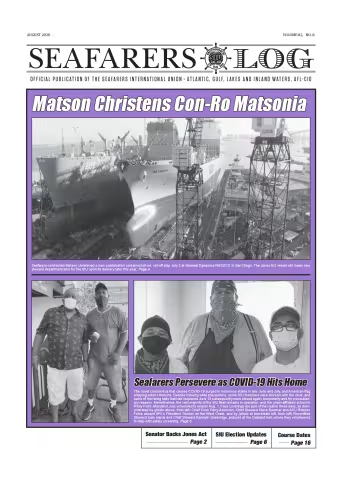
Seafarers-contracted Matson christened a new combination container/roll-on, roll-off ship July 2 at General Dynamics NASSCO in San Diego. The Jones Act vessel will mean new
steward department jobs for the SIU upon its delivery later this year. Page 4.
Seafarers Persevere as COVID-19 Hits HomeSeafarers Persevere as COVID-19 Hits Home
Course Dates
Page 16
SIU Election Updates
Page 6
Senator Backs Jones Act
Page 2
63272_AUGUST_2K20_LOG.indd 163272_AUGUST_2K20_LOG.indd 1 7/20/20 3:18 PM7/20/20 3:18 PM
2 Seafarers LOG August 2020
The Seafarers LOG (ISSN 1086-4636) is published monthly by the
Seafarers International Union; Atlantic, Gulf, Lakes and Inland Waters,
AFL-CIO; 5201 Capital Gateway Drive; Camp Springs, MD 20746.
Telephone (301) 899-0675. Periodicals postage paid at Southern Maryland
20790-9998. POSTMASTER: Send address changes to the Seafarers LOG,
5201 Capital Gateway Drive, Camp Springs, MD 20746.
Communications Director, Jordan Biscardo;
Managing Editor/Production, Jim Guthrie; Assistant
Editor, Nick Merrill; Photographer, Harry Gieske;
Administrative Support, Jenny Stokes; Content Curator,
Mark Clements.
Copyright © 2020 Seafarers International Union, AGLIW. All Rights
Reserved.
Volume 82 Number 8 August 2020
The SIU online: www.seafarers.org
The Seafarers International
Union engaged an environ-
mentally friendly printer
for the production of this
newspaper.
Reversed to White
Reversed to White
O F F I C I A L P U B L I C A T I O N O F T H E S E A F A R E R S I N T E R N A T I O N A L U N I O N A T L A N T I C , G U L F, L A K E S A N D I N L A N D W A T E R S , A F L - C I O
Time to Redouble Safety Efforts
President’s ReportPresident’s Report U.S. Senator Backs Jones Act
As the United States mari-
time community celebrated the
centennial of the nation’s freight
cabotage law, numerous legis-
lators issued supportive state-
ments.
U.S. Sen. Gary Peters (D-
Michigan) was among those
elected officials who praised
the Jones Act in early June. He
posted a news release that read
in part, “June 5, 2020 marks the
100th Anniversary of the en-
actment of the U.S. Merchant
Marine Act of 1920. Com-
monly referred to as the Jones
Act, the Act has served over the
last century as the foundation
of the Great Lakes and domes-
tic shipping industry. This vital
maritime law ensures that cargo
moving between domestic ports
is carried aboard vessels that
are American-built, American-
owned, and American-flagged,
which in turn strengthens and
supports U.S. homeland security
while driving economic benefits
to local communities. Each and
every day, 365 days a year, the
Jones Act functions to protect
our nation’s 95,000 miles of
coastline and inland waterways,
limiting inland access to foreign
vessels and crews while mari-
ners serve as the eyes and ears to
strengthen border and homeland
security.”
The senator continued,
“America’s dependence on the
Great Lakes and the seas is inte-
gral to our economic health and
our sovereignty. Nowhere is this
more evident than in my own
state of Michigan. According to
The American Maritime Partner-
ship, Michigan’s Great Lakes
domestic maritime industry
contributes $2.8 billion annually
to our state economy, including
12,140 jobs and $703.6 million
in worker income. With 37 deep-
draft ports, Michigan has more
than the seven other Great Lakes
States combined.
“Over the last 100 years, the
men and women of the U.S.
maritime workforce have also
unfailingly answered the call
to duty, providing vital services
to support the nation in times
of crisis,” Peters added. “Their
service was never clearer than
during the activation of civil-
ian merchant mariners amidst
the Second World War. These
men and women moved criti-
cal supplies to overseas troops
and allies, while enduring the
highest rate of casualties of any
service. More recently our do-
mestic maritime workforce has
responded swiftly to a range of
crises facing the nation, includ-
ing facilitating the largest boat-
lift in world history following
9/11, and the current and ongo-
ing delivery of essential medical
supplies and goods to communi-
ties in need during the COVID-
19 pandemic.”
The senator concluded, “On
this week’s centennial anniver-
sary of the Jones Act, I thank
the men and women of the U.S.
maritime industry for their ser-
vice, and I vow to continue to
work here in the Senate to up-
hold the integrity of the Act’s
protections for our Michigan
and Great Lakes workforce.”
A 2019 study conducted by
PricewaterhouseCoopers for the
Transportation Institute showed
the Jones Act is responsible for
650,000 American jobs creating
more than $40 billion annually
in income. Workers whose jobs
are related to the law can be
found in all 50 states.Cabotage
law is not unique to the United
States. The London-based Sea-
farers’ Rights International re-
leased a study in 2018 listing
more than 90 countries that have
some type of cabotage law on
their books.
Editor’s note: See the July
issue of the Seafarers LOG and
the SIU website (www.seafarers.
org) for additional coverage of
the Jones Act’s centennial, in-
cluding statements from other
members of Congress.
SCA Honors Maritime Administrator
A longtime maritime stalwart
recently received well-earned
recognition from a prominent
United States shipbuilding group.
The Shipbuilders Council of
America (SCA), the national as-
sociation representing the U.S.
shipyard industry, on June 30
honored Maritime Administra-
tion (MARAD) Administrator
Mark H. Buzby with the SCA
Maritime Leadership Award dur-
ing this year’s virtual advocacy
meeting. The award is given an-
nually to national leaders who
demonstrate exemplary dedica-
tion and support of the U.S. ship-
building and repair industry.
“Rear Admiral Buzby has
dedicated his life to military
and public service to protect the
United States’ national and do-
mestic security, and on behalf
of the hundreds of thousands of
hardworking men and women of
our industry, we are bestowing
on him the Shipbuilders Council
of America’s highest honor – the
2020 SCA Maritime Leadership
Award,” said Matthew Paxton,
president of SCA. “Administra-
tor Buzby personifies this award,
which recognizes exemplary sup-
port for the crucial contributions
shipbuilders, maintainers, and
suppliers make to our nation, and
we thank him for his decades of
maritime leadership.”
“I want to thank SCA for this
honor,” Buzby stated. “I know
we share a passionate commit-
ment to a strong and growing
U.S. maritime industry, and par-
ticularly the necessity to foster
and strengthen U.S. shipbuilding,
which is an indispensable com-
ponent of our defense industrial
base. I appreciate this recognition
and SCA’s leadership on behalf
of the roughly 400,000 Ameri-
cans whose jobs depend on this
vital industry.”
Rear Admiral Buzby (USN,
Ret) has served as MARAD’s top
official since August 2017. Be-
fore this appointment, Buzby was
president of the National Defense
Transportation Association, a po-
sition he held since retiring from
the U.S. Navy in 2013 with more
than 34 years of dedicated service
to the United States. Buzby served
as commanding officer of the U.S.
Military Sealift Command.
SCA members constitute the
shipyard industrial base that
builds, repairs, maintains and
modernizes U.S. Navy ships and
craft, U.S. Coast Guard vessels
of all sizes, as well as vessels for
other U.S. government agencies.
In addition, SCA members build,
repair and service America’s fleet
of commercial vessels.
The council represents 40
companies that own and oper-
ate more than 80 shipyards, with
facilities on all three U.S. coasts,
the Great Lakes, the inland wa-
terways system, Alaska and Ha-
waii. The SCA also represents
87 partner members that provide
goods and services to the ship-
yard industry.
U.S. Sen. Gary Peters
(D-Michigan)
RAdm. Mark Buzby (USN, Ret)
U.S. Maritime Administrator
Back in February, if someone had used the expression “COVID
fatigue,” we’d have looked at them as if they were crazy.
Unfortunately, everyone reading this column knows what it means,
and I think it’s no exaggeration to say we’ve all experienced it at least
from time to time.
Brothers and sisters, over the years, I have usually written about
various aspects of the U.S. Merchant Marine and the labor movement.
Vocational training, grassroots political action,
new opportunities for growth in our industry,
workers’ rights – these are the important everyday
subjects we tackle.
This month, the topic is of utmost seriousness
and magnitude. It is nothing short of a life-and-
death matter.
I urge every Seafarer to summon the energy
to overcome COVID fatigue and double down
on your efforts to keep yourselves, your families
and your shipmates safe. Many of you know that
the American-flag fleet, including several SIU-
crewed ships, recently experienced a number of
confirmed cases of the coronavirus. Even though
the numbers are relatively small, they aren’t insignificant – and it goes
without saying that even one case is too many.
In some ways, I think our country collectively let down our guard
around Memorial Day weekend. People were tired of the entire expe-
rience, and as various states eased into different phases of reopening,
it may have been inevitable that we’d have as many individual inter-
pretations of the definition of safety as there are individuals. Look, if
I feel this way, I’ll bet you might, too: It’s fair to say that some of the
guidelines have been inconsistent. We’ve all seen the resulting spikes
in various states across the country.
It hasn’t been rampant, but that same relaxation of caution seems
to have happened on some of the ships. I have no interest in pointing
fingers and I believe that the vast majority of our members are in fact
being very careful, both at sea and ashore. But with this pandemic,
it only takes one careless individual – even somebody visiting from
ashore – to infect an entire crew. That’s why it’s so vital to find a
second wind and understand that all of the safety protocols not only
are lifesavers, they are going to be part of the “new normal” for the
foreseeable future.
This is also the time for our ships’ chairmen and shipboard com-
mittees to step up as leaders and embrace those responsibilities.
Not to be overlooked in this discussion is mariners’ role as part of
America’s essential workforce. Such a designation isn’t lightly made
by federal and state governments. And if there were any doubt about
how crucial Seafarers’ work really is, recall the recent messages of
thanks posted by U.S. Secretary of Transportation Elaine Chao, U.S.
Transportation Command’s commanding officer Gen. Steve Lyons,
and U.S. Maritime Administrator Mark Buzby. All of them went out
of their way to express respect and gratitude for our crews. They
know you are making sacrifices during this emergency to get the job
done. They know it’s not easy. And they also know they can count on
you to uphold the finest traditions of the Brotherhood of the Sea.
We were bound to take some hits from the pandemic. It’s a global
crisis with no modern-era comparison. But we owe it to ourselves, to
our families, and to our shipmates to remain vigilant and do every-
thing possible to remain safe, regardless of location.
Whenever this finally ends – and it will end – I certainly won’t
miss all the conference calls and masks and barriers and hand sani-
tizer. But in the meantime, I’m treating the precautions like my life
depends on it. Please do the same, and we’ll all be around for better
days.
Michael Sacco
Without exception, any-
one entering an SIU hiring
hall or signing onto a vessel
has passed a number of safety
protocols, often including test-
ing for COVID-19, two-week
quarantines, and verifying
health-related items on a ques-
tionnaire. For that reason, not
everyone you see pictured in
the LOG is wearing a mask. In
addition, in many cases, people
have briefly removed their
masks only long enough to
snap a quick photo. We cannot
stress enough the importance
of following all safety proto-
cols for your protection and the
protection of those around you.
Note to
Our Readers
63272_AUGUST_2K20_LOG_X.indd 263272_AUGUST_2K20_LOG_X.indd 2 7/21/20 2:25 PM7/21/20 2:25 PM
August 2020 Seafarers LOG 3
COVID-19 PANDEMICCOVID-19 PANDEMIC
Editor’s note: The following message,
dated July 10, 2020, is signed by the presidents
of six maritime unions, including SIU Presi-
dent Michael Sacco. For a PDF copy, visit the
SIU website.
It has become increasingly apparent the
COVID-19 crisis is not going away anytime
soon. Our members aboard ships in distant
waters as well as aboard vessels of all types in
inland waters remain in grave danger and the
global supply chain is at risk.
Despite continuous appeals for meaningful
assistance from both maritime labor and U.S.-
flag vessel operators, the federal government
has not mandated enforceable standards of
shipboard health and safe operations. Further,
our advocacy for a consistent, reliable, and
rapid testing regimen for mariners remains
without definitive support. As the supply chain
and military security of the country are becom-
ing increasingly at risk, we have demanded a
more active role of government in support of
mariners.
Each shipowner/operator has established
its own diverging policies and protocol, and
they vary greatly from employer to employer,
even from ship to ship depending on shipboard
culture. In the absence of uniform and govern-
ment-enforced protocol during vessel in-port
time with such critical evolutions as cargo
operations, vendor/contractor access and ship-
yard repairs remain essentially unregulated and
haphazard. This is an unacceptable situation
that is beyond the control of ship’s personnel.
However, as always, the burden on main-
taining safety at sea remains in large part with
the licensed and unlicensed personnel aboard
ship. While every member of a crew recog-
nizes his or her duty to their shipmates, em-
ployers and government must share ship safety
responsibility through consistent policies and
regulations. Health and safety aboard ship is a
joint endeavor and should not be placed on the
shoulders of mariners alone.
To do our part, we the undersigned urge
our Members to take every precaution against
the Coronavirus as recommended by com-
pany protocol and by such CDC guidelines
that are applicable. Masks, social distancing,
hand and respiratory hygiene, cleaning and
sanitizing must all become routine and strictly
maintained, whether aboard ship, in transit to
or from a ship, in a hiring hall or at home in
preparation for shipping out.
As your representatives, we are working
together and using every advantage to both
protect your health and safeguard your rights.
With infection rates spiking again we must
protect our lives and our livelihoods with re-
newed vigilance and discipline. Employers
may intervene with reasonable or ineffective
workplace policy; either way we will let them
know that our contract rights remain in place.
We understand the stress and anxiety of work-
ing in persistent and intensified danger and
so we support common sense safety practices
ashore and at sea. Your dedication, profes-
sionalism and perseverance is recognized,
and your efforts are best honored by ensur-
ing your own safety and that of others you
encounter onboard ship, in your travels, at
home or otherwise. Please continue to notify
your Union if you have concerns regarding
potential or actual COVID-19 exposure or the
safety of your vessel.
Wishing all health, safety, and fraternity,
Michael Sacco, President
Augie Tellez, Executive Vice President
Seafarers International Union
bpotter@seafarers.org
atellez@seafarers.org
Marshall Ainley
President
Marine Engineers’ Beneficial Association
mainley@mebaunion.org
Paul Doell
President
American Maritime Officers
pdoell@amo-union.org
Anthony Poplawski
President/Secretary-Treasurer
Marine Firemen, Oilers, Watertenders and
Wipers Association
mfow_president@yahoo.com
Dave Connolly
President
Sailor’s Union of the Pacific
dave@sailors.org
Don Marcus
President
International Organization of Masters,
Mates & Pilots
dmarcus@bridgedeck.org
Bosun Romualdo Medina doesn’t
know exactly how he contracted COVID-
19, but he’s certain that any inconve-
niences are worthwhile sacrifices in order
to avoid it.
“I hope every SIU member will take
care of themselves and their families,”
said Medina, who was stricken by the
coronavirus in June aboard the Maersk
Idaho. “Wear a mask, and stay home if
you can when you’re not working. I don’t
know when we’re going to get out of this.
It looks like a long haul.”
A Seafarer since 1994, Medina knows
from firsthand experience that sometimes
even the most cautious individuals end up
with COVID-19. He wasn’t reckless at
any point during the Idaho’s voyage from
the U.S. to Europe and back, and he’d
been mindful of safety before joining
the ship. But, on the return from Bremer-
haven, Germany, roughly four days out
from New Jersey, his health began to de-
teriorate.
“I started feeling bad and tried some-
thing like a Tylenol or aspirin, but there
was no relief. I couldn’t breathe normally.
At first, I thought it was just sinuses, but
then I felt a little bit of fever. Then things
began to get complicated.”
Very little time elapsed between the
onset of Medina’s symptoms and his
reporting them to the chief mate. From
there, he remained quarantined but
learned that others aboard the ship also
weren’t feeling well. Eventually, 11 mari-
ners (including five SIU members) were
diagnosed as COVID-19 positive.
Medina also experienced an unusual
– and painful – side effect: hiccups that
persisted on and off for days.
But that wasn’t his only complica-
tion. When the ship arrived in Newark,
New Jersey, on June 19, he arranged for
a clinic visit. However, the facility was
closed for the weekend by the time Me-
dina arrived around 9 p.m.
“By that time, I was in pain, so I took
a taxi to the nearest hospital,” he recalled.
“I knew if I went back to the ship, it
wasn’t going to be a happy ending.”
Although it took several hours for him
to be seen at the hospital (New Jersey and
New York were still epicenters of the pan-
demic at that time), it could be argued that
he arrived just in time.
“By that point, I could hardly breathe,”
the bosun said. “I was spitting blood. Fi-
nally, I got some medicine, and got tested
for COVID. They took so many X-rays
and did so much bloodwork – all that
stuff.”
He was hospitalized for more than a
week, then relocated to a quarantine hotel
for two more weeks. He returned to his
home in Houston July 14, feeling fine
and with multiple “negative” test results
confirmed.
“One good thing was I was never put
on any kind of oxygen,” he recalled. “The
doctor said I have good lungs; I don’t
smoke. But I am diabetic, and that’s why
I was really worried about complications.
Thank God it didn’t get to that point.”
Medina said he appreciated that per-
sonnel from the Houston hiring hall
stayed in touch with him throughout his
experience, and he added that the difficul-
ties didn’t change his outlook on sailing.
“This career has been something very
economically consistent for me and my
family” he noted. “I used to suffer a lot
of layoffs and inconsistent employment
in my prior field, which was architectural
design. I decided to join the union and get
my AB ticket and all my endorsements.
This has helped me raise my family: three
beautiful children.”
He added this advice to fellow mem-
bers: “If you start feeling weird when
you’re on the ship, go see the captain and
get a test.”
Bosun Shares Experience
Combatting Coronavirus
Industry Continues Grappling with Challenges
Editor’s note: SIU members are encour-
aged to regularly check the union’s website
for the latest union-specific news about the
pandemic. There is a prominent COVID-19
section on the home page. Members also
may sign up for text alerts by texting the
word “join” (without the quotation marks) to
97779.
The American maritime industry seem-
ingly mirrored the nation at large from mid-
June to mid-July when it came to combatting
the COVID-19 pandemic. The coronavirus
surged in numerous states, and it hit home for
the union, too.
As of July 14, there had been more than
3.4 million confirmed cases of COVID-19
in the U.S. and more than 138,000 deaths.
Worldwide, those figures were more than
13.1 million cases and at least 571,000 deaths.
The vast majority of the SIU-crewed fleet
is still operating, as Seafarers live up to their
federally designated role as essential work-
ers. But, SIU members from several ships and
tugs recently contracted COVID-19, as did at
least a couple of crew members from ATBs.
New cases were reported aboard the USNS
Grumman, whose crew includes members of
the SIU Government Services Division. At
least two SIU employees and one employee
of the SIU-affiliated United Industrial Work-
ers (UIW) were diagnosed with the coronavi-
rus that causes COVID-19.
The uptick in cases caused three hiring
halls to close for precautionary reasons within
a couple of weeks after they’d reopened June
15. At press time, the halls in Jersey City,
New Jersey and Wilmington, California, had
again reopened; the hall in Houston was ex-
pected to reopen soon.
Perhaps the most prominent recent in-
stance of shipboard COVID-19 in the U.S.-
flag fleet occurred in late June, aboard the
Maersk Idaho. Eleven mariners, including
five SIU members, tested positive. One crew
member was hospitalized but recovered (see
sidebar). Thankfully, the other mariners who
tested positive experienced few or no symp-
toms.
Within the industry, Maersk was hailed for
its quick, comprehensive plan to safely vacate
the crew, move them to a quarantine facility,
professionally clean the vessel, and then bring
on a new crew. They worked with the Coast
Guard, medical professionals and other au-
thorities to ensure diligence, efficiency and
safety. The SIU also worked closely with the
crew and company to provide support and to
secure additional testing for crews on other
American-flag Maersk ships.
Weeks later, all concerned received an un-
welcome reminder that even the best plans,
no matter how well-executed, cannot ensure
total safety from the virus. At least a couple of
SIU Members Rise to the Occasion, Fulfilling Roles as ‘Essential Workers’
Six Maritime Union Presidents
Draft, Sign Message Addressing
COVID-19 Aboard At-Sea VesselsContinued on Page 5
Face coverings often are utilized to help curb the spread of COVID-19. While unloading
a dummy during boat drills July 7 in Benicia, California, GVA Julian Lacuesta (left) and
Bosun Roberto Flauta do their part aboard the TOTE-operated USNS Petersburg.
63272_AUGUST_2K20_LOG_X.indd 363272_AUGUST_2K20_LOG_X.indd 3 7/21/20 2:25 PM7/21/20 2:25 PM
4 Seafarers LOG August 2020
New Jones Act Con-Ro Vessel Joins SIU Fleet
New steward-department jobs for SIU
members are on the horizon following the
recent christening of an historic vessel.
SIU-contracted Matson, Inc., christened
the second of two Kanaloa Class vessels, the
Matsonia, in a ceremony at General Dynam-
ics NASSCO – a union shipyard – in San
Diego on July 2.
The Jones Act vessel, the largest combi-
nation container/roll-on, roll-off (Con-Ro)
ship ever built in the United States along with
its sister ship the Lurline, is the second of two
new builds for Matson by NASSCO.
“The SIU looks forward to providing our
typically outstanding steward department
personnel when the ship is delivered later this
year,” stated SIU Vice President Contracts
George Tricker. “We applaud the company
for its commitment to American-flag ship-
ping and U.S. crews, and we appreciate the
terrific work by union shipyard workers who
handled the construction.”
The Matsonia is slated for delivery in the
fourth quarter of 2020.
“Matson is already benefiting from the
speed, capacity and improved environmen-
tal profile of the three new ships we’ve put
into service since 2018,” said Matt Cox, Mat-
son’s chairman and chief executive officer,
after the shipyard ceremony. “Matsonia will
be our fourth new ship, completing a three-
year fleet renewal program that positions us
well to serve the needs of our communities in
Hawaii for many years to come.”
During the ceremony, Peggy Forest, wife
of Matson President Ron Forest, officially
christened the vessel by breaking a ceremo-
nial bottle of champagne against the ship’s
hull.
“As a proud U.S. company and Jones
Act carrier, our investment in this new ship
is about much more than maintaining a high
level of service to Hawaii. It also helps drive
substantial economic benefits and opportuni-
ties in communities around the Pacific, where
this vessel will operate,” Cox added. “The
construction of Matsonia represents over a
year’s work for about 2,000 professionals
here at NASSCO: engineers, tradesmen and
lots of support people and countless others
who produced the materials used to build this
ship that are sourced here in the U.S. Over its
expected lifespan, this ship will generate ap-
proximately 4.5 million man-hours of work
opportunity for the U.S. mariners who will
operate it and decades of steady work for all
of the dockworkers and terminal personnel
that move the cargo on and off our ships.”
He concluded, “These are all living-wage
jobs, supporting the families of these Ameri-
can workers and the taxes they pay. Multiply
that by all the ships NASSCO and other U.S.
shipyards are building, and you get a sense
of the value of the maritime industry to our
country and its economy. In California alone,
there are more than 51,000 jobs tied to the
American maritime industry, providing over
3.6 billion dollars in labor income with a
total economic impact in the state of more
than twelve billion dollars.”
Dave Carver, president of General Dy-
namics NASSCO, said, “The Matsonia is a
reflection of the highest standards of ship-
building and we are proud to celebrate her
launching. This extraordinary vessel is a tes-
tament to the hard work, unity and strength
of our thousands of dedicated shipbuilders
who made this possible.”
Matsonia is an iconic name in Matson’s
long history, dating to the construction of
Matson’s first ship of that name in 1912.
Three more ships were given the name in
subsequent years; this vessel will be the fifth.
Named in honor of the ocean deity re-
vered in native Hawaiian culture, Matson’s
two Kanaloa Class vessels constructed at
NASSCO are built on a 3,500 TEU vessel
platform. At 870 feet long, 114 feet wide
(beam), with a deep draft of 38 feet and
weighing in at over 50,000 metric tons, the
Matsonia will join the Seafarers-crewed
Lurline (delivered in late 2019) as Matson’s
largest ships.
They are among Matson’s fastest ves-
sels, with a top speed of 23 knots. Both new
Kanaloa Class vessels have an enclosed garage
with room for approximately 500 vehicles,
plus ample space for rolling stock and break-
bulk cargo. They also feature state-of-the-art
green technology, including a fuel-efficient
hull design, environmentally safe double-hull
fuel tanks, fresh water ballast systems and the
first Tier 3 dual-fuel engines to be deployed
in containerships regularly serving West Coast
ports, according to Matson.
The Jones Act, America’s freight cabotage
law, supports the domestic maritime industry
that employs approximately 650,0000 Amer-
icans across all 50 states, creates $41 billion
in labor income for American workers and
adds more than $154.8 billion in annual eco-
nomic output each year. Nationally, there are
more than 40,000 American vessels – built
in American shipyards, crewed by American
mariners, and owned by American compa-
nies – that operate in U.S. waters daily.
Matson Christens Matsonia in San Diego
The Matsonia’s (vessel at right in photo at immediate left) addition to the union
fleet means new jobs for SIU members sailing in the steward department. In photo
above, Peggy Forest, wife of Matson President Ron Forest, does the honors for
the christening.
The photo above was taken July 4 as the vessel was headed to Valdez, Alaska. Pictured from left to right are: Recertified Bosun Modesto Rabena Jr., Chief Steward Sajid
Foster, Chief Cook Melissa McCartney, QEP Diole Bonifacio, AB Pablo Borja, AB Adam Riley, Steward Assistant Kevin Arroyo and AB Michael Elmore Jr. Thanks to Recertified
Bosun Rabena for the photo.
With Seafarers Aboard Tanker Washington
63272_AUGUST_2K20_LOG_X.indd 463272_AUGUST_2K20_LOG_X.indd 4 7/21/20 2:25 PM7/21/20 2:25 PM
August 2020 Seafarers LOG 5
U.S. Congressman Rob Wittman Underscores
Need for Strong U.S. Sealift, Revitalized RRF
Longtime friend of maritime U.S.
Rep. Rob Wittman (R-Virginia) recently
penned an op-ed emphasizing the impor-
tance of strong sealift – which should
include revitalizing and maintaining the
U.S. Ready Reserve Force (RRF).
Wittman, who is the ranking member on
the Seapower and Projection Forces Sub-
committee in the House, wrote, “Today,
our entire military, a force with over 1.3
million active service members and tens
of thousands of vehicles and aircraft, re-
lies on an aging fleet of 61 logistics ships
to transport and sustain the force. By com-
parison, during World War II, the United
States built over 2,700 Liberty ships to
transport troops and supplies and had a
service squadron of 365 logistics ships just
to service the Pacific theater.”
He continued, “Compounding the
problem of inadequate numbers, many
ships in our logistics fleet are already past
due for replacement. The average age of
the ships in the Ready Reserve Force,
which constitute the majority of our na-
tion’s surge sealift capability, is 45 years.
That is more than double the age at which
most commercial cargo ships are retired
and the fleet is showing its age. In Sep-
tember of 2019, the U.S. Transportation
Command (TRANSCOM) conducted an
exercise to test the readiness of the or-
ganic surge fleet, attempting to get just
under half of the fleet underway. The of-
ficial TRANSCOM after action report
noted a cumulative success rate of only
40 percent and this exercise did not even
test the loading and unloading of cargo.”
He also gave a brief history lesson to
underline the importance of a robust, mili-
tarily-useful surge fleet: “Since our found-
ing, America has been a maritime nation.
Trade across the vast ocean expanses to
Europe and Asia has defined our economic
development and driven our national se-
curity strategies. Over 200 years ago, the
original six frigates of the United States
Navy were constructed to protect Ameri-
can commerce from attacks by pirates in
the Mediterranean. Since then, a powerful
Navy, capable of protecting global com-
merce and projecting power around the
globe, has become the cornerstone of our
national defense. This strategy has also
meant fighting the vast majority of the na-
tion’s armed conflict far from our shores,
protecting the homeland from the terrible
destruction that was a defining character-
istic of war in the 20th century.
“The reasoning that led George Wash-
ington to approve those first six frigates
remains true today – American commerce
and diplomacy must be supported by a
military capable of global power projec-
tion to maintain international order, deter
conflict, and, if necessary, defeat hostile
powers,” Wittman continued. “To be a
credible deterrent, American forces must
be engaged around the globe and be able to
sustain those efforts, during peace or war,
far from our shores. While the Department
of Defense is investing heavily in technol-
ogy to compete in a new era of great power
competition, it has given short shrift to its
ability to transport and sustain forces. Our
continued lack of investment in logistics
will reduce the effectiveness of our mari-
time forces in combat but, more worrying,
is the debilitating effect it will have on our
land forces.”
He then referenced a more modern
example of the indispensable role of the
RRF, writing, “Operation Iraqi Freedom
provides some informative lessons on the
importance of a capable logistics fleet. In
preparation for the invasion of Iraq, the
U.S. military moved over 2 million tons
of cargo and equipment. This massive ef-
fort began in late 2001 and did not cul-
minate until combat operations began in
March of 2003. The long buildup masked
the inadequacy of the U.S. military sea-
lift capacity with an estimated 85 percent
of all sustainment material transported
by civilian vessels. A multi-year logis-
tic buildup across uncontested seas is a
luxury the U.S. simply won’t enjoy in the
event of conflict in the Indo-Pacific. Our
armed forces, particularly the Army, sim-
ply lack the logistic capability to effec-
tively project power across the Pacific.”
He concluded, “To help address these
issues, Congress has given the Navy
funding to purchase commercial cargo
ships to help bridge the gap until the or-
ganic surge fleet can be rebuilt to meet
the requirements outlined in the National
Defense Strategy. Inexplicably, the De-
partment of Defense has not purchased
a single commercial vessel and still
doesn’t have even a plan to reconstitute
the logistics fleet. Our national security
is founded on an ability to project power
and maintain our forces around the globe.
A capable logistics force is the foundation
of power projection and we neglect it at
our own peril.”
U.S. Rep. Rob Wittman
R-Virginia
SIU members employed by American
Steamship Company (ASC) are working
under the terms of a contract extension fol-
lowing the company’s recent acquisition by
Rand Logistics, Inc. A union negotiating
committee (which includes six rank-and-
file members) has started bargaining with
the new owner.
“We are optimistic about the eventual
outcome of negotiations, and are very con-
fident about the job security of SIU mem-
bers sailing with ASC,” stated SIU Vice
President Great Lakes Tom Orzechowski.
“Despite the ownership change, things are
basically business as usual.”
Rand finalized the purchase in mid-
May, acquiring ASC from GATX Corpo-
ration. Rand is part of American Industrial
Partners, and provides dry bulk shipping
services throughout the Great Lakes re-
gion.
“The combination of Rand and ASC
moves almost 50 million tons annually of
dry bulk commodities such as iron ore, coal
and limestone on vessels ranging in size
from 634 feet to over 1,000 feet,” Rand an-
nounced in a news release. “The combined
company’s diverse fleet will offer custom-
ers unprecedented flexibility through its in-
tegrated transportation network and range
of vessel options.”
“This transaction is a game-changer for
both Rand and our customers. Our com-
bined 24-vessel fleet gives us the capabil-
ity to meet almost every type of dry bulk
transportation need on the Great Lakes,”
said Peter Coxon, chief executive officer of
Rand. “ASC brings a rich history, superior
assets, a safe and efficient operation, and
a great team which complement our op-
erations and will benefit our customers in
so many tangible ways, such as increased
overall transportation capacity through fleet
synergies and greater number of loading op-
portunities. Our vendors will also benefit
from the consolidation of tens of millions
of dollars of operating and capital spending
each year.”
“ASC is thrilled to be a part of the cre-
ation of a truly unique company with the
scale and flexibility to meet the diverse
needs of the Great Lakes region,” said
David Foster, president of American Steam-
ship Company. “ASC brings new asset
classes to the combined company along
with the efficient, highly qualified crews
and shoreside personnel that operate them,
all making the combined company one of
the premier marine transportation compa-
nies in North America.”
Meanwhile, the Lake Carriers’ Associa-
tion (LCA) in early July reported that ship-
ments of iron ore on the Great Lakes totaled
4 million tons in June, a decrease of 29.9
percent from 2019. Shipments were 29.7
percent below the month’s five-year aver-
age.
Year-to-date, the iron ore trade stood at
17.2 million tons, 14.9 percent below the
previous year’s total of 20.2 million tons.
Iron shipments were below their five-year
average by 13.4 percent for the first half of
the year.
The Lakes sailing season began in late
March, around the same time much of the
country was implementing stay-at-home
guidelines and other steps to slow the
spread of COVID-19.
Lakes vessels, many of them crewed by
SIU members, carry (among other cargoes)
iron ore for steel, stone and cement for con-
struction, grain, coal, sand, and salt.
Seafarers’ Jobs Secure as Rand
Logistics Completes American
Steamship Company Purchasethe replacement crew members tested posi-
tive, so the vessel went into a quarantined
state at a Florida anchorage.
Despite the challenges, there were posi-
tive developments as well. They included
a return to work for many Seafarers em-
ployed by NY Waterway, which operates
passenger ferries between New York and
New Jersey. The company’s waterborne
operations essentially shut down when
those states were at their combined nadir.
Additionally, and following months of
intensive preparation, the SIU-affiliated
Paul Hall Center for Maritime Training and
Education was scheduled to reopen Aug. 1.
The school (located in Piney Point, Mary-
land) initially scheduled several upgrading
courses and plans to resume training ap-
prentices in September.
Moreover, most of the hiring halls
stayed open without interruption, as mem-
bers and staff easily adjusted to new safety
protocols. Those steps include the by-now-
standard face coverings, social distancing,
temperature checks, hand sanitizing, and
use of protective barriers.
Progress was made with overseas crew
changes for American-flag ships as the
SIU continued working with other unions,
vessel operators, the Maritime Adminis-
tration and the State Department to fa-
cilitate those reliefs. Operators also have
chartered two private planes for reliefs in
Diego Garcia.
The international maritime community
hasn’t always been as fortunate. The In-
ternational Maritime Organization and In-
ternational Transport Workers’ Federation
are leading the fight on behalf of foreign
crews who in many cases have worked
for months beyond their scheduled reliefs,
mostly due to travel restrictions.
It also has been a busy legislative
stretch for U.S. maritime. At press time,
floor action was expected on the National
Defense Authorization Act, which funds
most key commercial maritime govern-
ment programs. Additionally, Rep. Sean
Patrick Maloney (D-New York) and Peter
DeFazio (D-Oregon) last month intro-
duced a new bill to provide financial relief
for maritime stakeholders who’ve been
impacted by the pandemic.
The House is scheduled to adjourn for
recess on July 31, while the Senate will de-
part on Aug. 7. Both chambers are slated
to return Sept. 8 before adjourning in early
October for the run-up to the November 3
presidential election.
Recertified Bosun James Blitch, pictured
at the hall in Jacksonville, Florida, en-
courages fellow members to be cautious.
“People think this is a joke. People are
dying out here! It’s important we are all
wearing our masks!” he said.
Mariners Show True Colors, Meet
Varied Challenges Posed by COVID
Continued from Page 3
63272_AUGUST_2K20_LOG_X.indd 563272_AUGUST_2K20_LOG_X.indd 5 7/21/20 2:25 PM7/21/20 2:25 PM
6 Seafarers LOG August 2020
The 2020 edition of the Seafarers Health
and Benefit Plan’s (SHPB) annual Scholar-
ship Program has been postponed because
of the COVID-19 Pandemic, but grants are
scheduled to be awarded this summer.
According to Seafarers Plans Administra-
tor Maggie Bowen, the program’s deadline
– which in years past was April 15 – in June
was extended until July 15. She added that
members of the program’s selection com-
mittee, due to concerns about COVID-19,
postponed their meeting that’s usually held
in May, opting instead to convene around
August 14.
Despite the former delay, scholarships to-
taling $132,000 will still be awarded to eight
individuals (three active Seafarers and five
dependents) deemed most deserving by the
committee. Once selected, these individuals
will be awarded scholarships of $6,000 or
$20,000 apiece to pursue two- and four-year
degrees, respectively, at accredited commu-
nity colleges, vocational schools, colleges or
universities.
Award recipients will be announced in a
future edition of the Seafarers LOG.
Scholarships Slated for Award in Near Future
Secretary-Treasurer Sends Important Message
To Seafarers Concerning Upcoming SIU Election
Editor’s note: This article was posted
on the SIU website on June 24 and also
was promoted via the union’s text-alert
service and on social media. Some of the
information previously was published in
the Seafarers LOG.
As you probably know, 2020 is an elec-
tion year for the SIU. Due to the pandemic,
the union has relaxed a requirement to run
for office.
Specifically, and, as you may have seen
in prior communications, the union’s ex-
ecutive board has approved lenience for
prospective candidates who are unable
to pay their dues on time for the second
and/or third quarters of this year because
of the pandemic. On the latter point, our
constitution specifies that candidates must
have been in continuous good standing for
at least three years (12 calendar quarters)
immediately prior to the nomination period
(which is July 15-August 15). Per execu-
tive board action, any candidate who was
in good standing for at least 10 consecutive
quarters as of the end of the first quarter of
2020 will not be precluded from nomina-
tion because of late dues payments in the
second or third quarters this year.
While not required to do so, we encour-
age members to use certified or registered
mail to submit your nominations/creden-
tials. If you use regular/traditional mail,
please follow up with my office to verify
that we have received your submission, as
mail deliveries have been delayed at times
during this pandemic.
Additionally, there are sea-time require-
ments for nominees (100 days in the deep
sea division during the period between
January 1, 2020 and the date nominations
begin [July 15, 2020] or 65 days in the in-
land or Great Lakes divisions). If someone
wants to run for office but cannot meet
those requirements due to circumstances
related to COVID-19, you are encouraged
to nominate yourself anyway. The creden-
tials committee will review each case and
may relax the requirements. Note that you
must have been registered to ship during
the relevant time period and be able to
show that you were not able to accumulate
sufficient sea time because crew changes
were limited due to the COVID-19 pan-
demic.
Also, during our election years, my July
membership report normally features the
details of our nominations, procedures, etc.
Since our July 2020 meetings are cancelled
due to the pandemic, I am including that
information here.
Nominations For Of ficers, Assistant Vice
Presidents, and Port Agents
In accordance with the provisions of
Article XIII, Section 1, of our Constitu-
tion, letters of nominations must reach
Headquarters between July 15 and August
15, 2020. Following are the constitutional
provisions regarding nominations:
Article XIII, Section 1 – Nominations
Except as provided in Section 2(b) of
this Article, any full book member may
submit his name for nomination for any of-
fice, or the job of Assistant Vice-President
or Port Agent by delivering or causing to
be delivered in person, to the office of the
Secretary-Treasurer at Headquarters, or
sending a letter addressed to the Creden-
tials Committee, in care of the Secretary-
Treasurer at the address of Headquarters.
This letter shall be dated and shall contain
the following:
(a) The name of the candidate.
(b) His home address and mailing ad-
dress.
(c) His book number.
(d) The title of the office or other job
for which he is a candidate, including the
name of the Port in the event the position
being sought is that of Port Agent.
(e) Proof of citizenship.
(f) Proof of seatime and/or employment
as required for candidates.
(g) In the event the member is on a ves-
sel, he shall notify the Credentials Com-
mittee what vessel he is on. This shall be
done also if he ships subsequent to for-
warding his credentials.
(h) Annexing a certificate in the follow-
ing form, signed and dated by the proposed
nominee:
“I hereby certify that during the past
thirteen (13) years I have not been con-
victed of, or served any part of a prison
term resulting from a conviction for rob-
bery, bribery, extortion, embezzlement,
grand larceny, burglary, arson, violation of
narcotics laws, murder, rape, assault with
intent to kill, assault which inflicts griev-
ous bodily injury, or violation of Title II
or III of the Landrum Griffin Act, or con-
spiracy to commit such crimes. In addition,
I certify that I support the Constitution of
the United States of America, its institu-
tions and form of government.”
Dated
Signature of Member
Book No.
Printed forms of the certificate shall
be made available to nominees. Where a
nominee cannot truthfully execute such a
certificate, but is, in fact, legally eligible
for an office or job by reason of the resto-
ration of civil rights originally revoked by
such conviction or a favorable determina-
tion by the Board of Parole of the United
States Department of Justice, he shall, in
lieu of the foregoing certificate, furnish a
complete signed statement of the facts of
his case together with true copies of the
documents supporting his statement.
Any full book member may nominate
any other full book member in which event
such full book member so nominated shall
comply with the provisions of the Article
as they are set forth herein relating to the
submission of credentials. By reason of
the above self nomination provision the
responsibility, if any, for notifying a nomi-
nee of his nomination to office shall be that
of the nominator.
All documents must reach Headquarters
no earlier than July 15 and no later than
August 15 of the election year.
The Secretary-Treasurer is charged with
safekeeping of these letters and shall turn
them over to the Credentials Committee
upon the latter’s request.
Lastly, information about the balloting
process, including absentee ballots, will be
forthcoming.
Fraternally submitted,
David Heindel
Secretary-Treasurer
SIU Absentee-Ballot Procedures
Editor’s note: The union’s executive
board is constantly reviewing the latest
developments with the pandemic and how
it affects shipping. Modifications already
have been made in order to promote maxi-
mum participation in the SIU election. If any
changes are made to the absentee-ballot pro-
cedures, they will be announced in print and
online, and again will be aimed at facilitat-
ing utmost rank-and-file involvement.
Elections for the SIU Atlantic, Gulf,
Lakes and Inland Waters are scheduled for
later this year. As in past SIU election years,
a comprehensive guide will be published in
the Seafarers LOG prior to the balloting.
In the case of members eligible to vote
who believe they will be at sea during the
Nov. 1 through Dec. 31, 2020 voting pe-
riod or who otherwise think they will need
absentee ballots, absentee ballots will be
available.
The SIU constitution ensures that mem-
bers who are eligible to vote and who find
themselves in this situation may vote. Pro-
cedures are established in the SIU constitu-
tion to safeguard the secret ballot election,
including the absentee ballot process.
Here is the procedure to follow when re-
questing an absentee ballot:
1. Make the request in writing to the SIU
office of the secretary-treasurer, 5201 Capi-
tal Gateway Drive, Camp Springs, Maryland
20746.
2. Include in the request the correct ad-
dress where the absentee ballot should be
mailed.
3. Send the request for an absentee ballot
by registered or certified mail.
4. The registered or certified mail enve-
lope must be postmarked no later than mid-
night, Nov. 15, 2020 and must be received at
5201 Capital Gateway Drive, Camp Springs,
Maryland 20746 no later than Nov. 25, 2020.
5. The secretary-treasurer, after confirm-
ing eligibility, will send by registered mail,
return receipt requested, to the address des-
ignated in the request, a ballot, together with
an envelope marked “Ballot” and a mailing
envelope no later than Nov. 30, 2020.
6. Upon receiving the ballot and enve-
lope, vote by marking the ballot. After voting
the ballot, place the ballot in the envelope
marked “Ballot.” Do not write on the “Bal-
lot” envelope.
7. Place the envelope marked “Ballot”
in the mailing envelope which is imprinted
with the mailing address of the bank deposi-
tory where all ballots are sent.
8. Sign the mailing envelope on the first
line of the upper left-hand corner. Print
name and book number on the second line.
The mailing envelope is self-addressed and
stamped.
9. The mailing envelope must be post-
marked no later than midnight, Dec. 31,
2020 and received by the bank depository
no later than Jan. 5, 2021.
Welcome Ashore in Tacoma
Recertified Steward Steve Dickson (left) picks up his first pension check outside
the hiring hall. The longtime Seafarer is pictured with SIU Safety Director Ben An-
derson.
63272_AUGUST_2K20_LOG.indd 663272_AUGUST_2K20_LOG.indd 6 7/20/20 3:18 PM7/20/20 3:18 PM
August 2020 Seafarers LOG 7
The Transportation Security Administration
(TSA) on July 8 announced a potential benefit of
carrying a Transportation Worker Identification Cre-
dential (TWIC).
The agency indicated that all active TWIC hold-
ers as well as Hazardous Materials Endorsement
(HME) holders who are U.S. citizens, U.S. nationals
or lawful permanent residents are immediately eli-
gible for TSA “PreCheck,” which can considerably
shorten waiting times in airport lines.
“This new benefit immediately allows nearly
3.5 million individuals to obtain TSA PreCheck at
no additional cost beyond what they have already
paid for their credentials,” said TSA Executive As-
sistant Administrator for Operations Support Stacey
Fitzmaurice.
As noted in a news release from the agency,
TWIC and HME holders “have already paid for, and
successfully completed, a security threat assessment
comparable to the TSA PreCheck security threat as-
sessment.”
A TWIC is required by the Maritime Transporta-
tion Security Act for workers who need access to
secure areas of the nation’s maritime facilities and
vessels. The HME program is for individuals seek-
ing to obtain, renew or transfer an HME on a state-
issued commercial driver’s license (CDL), allowing
them to transport hazardous materials in commerce.
TWIC and HME holders can obtain TSA Pre-
Check expedited screening by entering the iden-
tification numbers printed on their TWIC card or
state-issued CDL during the airline reservation pro-
cess. Active TWIC holders enter their TWIC cre-
dential identification number (CIN) in the known
traveler number (KTN) field of their airline reserva-
tion. The CIN is printed on the back of each TWIC
in the lower left-hand corner.
According to the release, “TSA PreCheck is an
expedited screening program offered by TSA that
allows travelers to leave on their shoes, light outer-
wear and belt, keep their laptop in its case and their
food and 3-1-1 compliant liquids/gels bag in a carry-
on, in select TSA airport checkpoint screening lanes.
More than 200 airports participate in TSA PreCheck
nationwide and dozens of airlines participate in the
popular program.”
More information is linked in a July 8 news post
on the SIU website and on the TSA website (www.
tsa.gov).
TWICs May Be
Used to Obtain
‘TSA PreCheck’
Absentee Voting Has Deep Roots in U.S. History
While it might be making recent headlines,
there’s very little about absentee voting that
is new.
According to the Constitutional Account-
ability Center, “One of the earliest known in-
stances of absentee voting occurred during the
American Revolution. In December 1775, a
group of soldiers from the Continental Army
sent a letter back to their town asking if their
votes could be counted in a local election. And
at the town meeting held to discuss the issue,
the town agreed to count the votes, ‘as if the
men were present themselves.’”
During the War of 1812, Pennsylvania al-
lowed soldiers to cast absentee ballots if they
were stationed more than two miles from their
home. After the end of the Civil War, the states
gradually passed new laws to expand absentee
voting to civilians. Between 1911 and 1924,
45 of the 48 states adopted some kind of ab-
sentee voting.
By World War II, every state let soldiers
vote absentee, and the military was responsi-
ble for about 3.2 million absentee ballots cast,
nearly seven percent of the total electorate in
the 1944 presidential election.
For a more recent example, in the 2016
election, about 24 percent of all ballots were
cast in the mail, according to the federal Elec-
tion Assistance Commission.
As of press time, 34 states (plus D.C.)
offer “no-excuse” absentee ballots, and
will mail residents an early ballot upon
request: Alaska, Arizona, California, Col-
orado, District of Columbia, Florida, Geor-
gia, Hawaii, Idaho, Illinois, Iowa, Kansas,
Maine, Maryland, Michigan, Minnesota,
Montana, Nebraska, Nevada, New Jersey,
New Mexico, North Carolina, North Da-
kota, Ohio, Oklahoma, Oregon, Pennsyl-
vania, Rhode Island, South Dakota, Utah,
Vermont, Virginia, Washington, Wisconsin
and Wyoming.
Requests for an absentee ballot may be
made online by visiting absentee.vote.org, and
filling out a short request form.
Colorado, Hawaii, Oregon, Utah and
Washington already send ballots to all eligible
voters, so residents do not need to request one.
All states permit residents who will be outside
their home county to vote absentee, as well
as voters with an illness or disability. Indiana,
Kentucky, Louisiana, Mississippi, South Car-
olina, Tennessee, Texas and West Virginia also
offer the option to elderly voters.
SIU Crew, Coast Guard Rescue 3 Sailors
The Mahi Mahi, operated by SIU-contracted Matson and
partially crewed by Seafarers, worked with the Coast Guard
to rescue three stranded mariners from a doomed trimaran in
the Pacific Ocean on July 8.
The SIU crew aboard the Mahi Mahi included Recertified
Chief Steward Gregory Broyles, Chief Cook Carmelo Bar-
tolome Dela Cruz and ACU Kevin Robinson.
The 50-foot trimaran Third Try, which was on a non-stop
circumnavigation of the globe, had not reported in for a few
days. On the morning of July 7, the Joint Rescue Coordina-
tion Center (JRCC) issued a SAFETYNET broadcast notify-
ing merchant vessels in the region of the situation, and the
Mahi Mahi agreed to divert and travel along the Third Try’s
suspected route.
At 3 p.m. on July 7, watchstanders at the JRCC received
an alert from an Emergency Position Indicating Radio Bea-
con (EPIRB) registered to the Third Try. The SAFETYNET
broadcast was updated with the new location, and the Coast
Guard launched an HC-130 Hercules aircrew with a life raft
aboard in response. They also notified the Mahi Mahi of the
new location.
The aircrew located the damaged vessel and determined
that the sailors needed to be rescued. Early on July 8, the Mahi
Mahi arrived on station, 825 miles northeast of Oahu, and
rescued the three men from the trimaran.
“One of our greatest challenges out here in the Pacific is dis-
tance,” said Lt. Diane French, a JRCC command duty officer.
“First responders are often days away and we regularly rely
on merchant vessel crews like the Mahi Mahi’s to assist with
search and rescue cases. We are always grateful for their help.”
SA Ahmed Korish (right) receives his B-book at the Algonac, Michigan, hiring hall. At left is his father, AB Omar
Korish.
Family Tradition
63272_AUGUST_2K20_LOG.indd 763272_AUGUST_2K20_LOG.indd 7 7/20/20 3:18 PM7/20/20 3:18 PM
8 Seafarers LOG August 2020
CREDIT
CARDS
MORTGAGE
PROGRAM
FLOWERS
& GIFTS
Stay Connected
Learn more at unionplus.org
We are relying on our devices more than ever.
Now is the time to save on the monthly service charge
for eligible wireless plans, take advantage of additional
savings on select accessories, and get up to $45 waived
activation and upgrade fees.
Discover more exclusive wireless savings for union
members at unionplus.org/att
FREE
COLLEGE
3 15% ON THE MONTHLY SERVICE CHARGE of QUALIFIED WIRELESS PLANS: Available only to current members of qualifi ed AFL-CIO member unions, other authorized individuals associated with eligible unions and other sponsoring organizations with a qualifying agreement. Must
provide acceptable proof of union membership such as a membership card from your local union, a pay stub showing dues deduction or the Union Plus Member Discount Card and subscribe to service under an individual account for which the member is personally liable. Off er
contingent upon in-store verifi cation of union member status. Discount subject to agreement between Union Privilege and AT&T and may be interrupted, changed or discontinued without notice. Discount applies only to recurring monthly service charge of qualifi ed voice and data
plans, not overages. Not available with unlimited voice or unlimited data plans. For Family Talk, applies only to primary line. For all Mobile Share plans, applies only to monthly plan charge of plans with 1GB or more, not to additional monthly device access charges. Additional
restrictions apply. May take up to 2 bill cycles after eligibility confi rmed and will not apply to prior charges. Applied after application of any available credit. May not be combined with other service discounts. Visit unionplus.org/att or contact AT&T at 866-499-8008 for details.
SIU-ATT-6-29-2020
8/20
63272_AUGUST_2K20_LOG.indd 863272_AUGUST_2K20_LOG.indd 8 7/20/20 3:18 PM7/20/20 3:18 PM
August 2020 Seafarers LOG 9
“Total Registered” and “Total Shipped” data is cumulative from June 17-July 15. “Registered on the Beach” data is as of July 15.
Total Registered Total Shipped Registered on Beach
All Groups All Groups Trip All Groups
Port A B C A B C Reliefs A B C
Dispatchers’ Report for Deep SeaDispatchers’ Report for Deep Sea
Deck Department
Algonac 18 5 0 22 6 0 8 46 13 4
Anchorage 2 2 0 2 3 0 2 3 2 0
Baltimore 2 1 0 2 2 0 1 3 3 0
Fort Lauderdale 20 5 4 15 6 0 10 29 11 9
Guam 3 0 1 1 0 0 0 9 2 1
Harvey 9 2 9 6 4 1 10 19 4 10
Honolulu 6 2 0 4 2 0 4 10 8 0
Houston 33 14 8 24 13 5 19 59 25 8
Jacksonville 33 17 5 16 16 1 18 53 37 12
Jersey City 27 8 3 12 10 1 16 51 14 5
Joliet 2 1 0 1 0 0 0 2 4 0
Mobile 9 2 2 4 1 2 2 11 2 1
Norfolk 24 13 7 13 12 3 21 40 19 8
Oakland 12 3 2 11 4 1 6 19 5 2
Philadelphia 1 0 2 2 2 1 3 2 1 3
Piney Point 1 2 6 0 1 0 0 4 3 8
Puerto Rico 7 3 1 7 3 0 4 13 3 0
Tacoma 19 5 3 15 3 2 9 44 7 7
St. Louis 1 0 1 0 0 0 0 3 2 2
Wilmington 23 9 3 21 8 3 15 56 17 6
TOTALS 252 94 66 178 96 27 149 476 182 88
Engine Department
Algonac 2 1 1 6 0 0 3 5 4 2
Anchorage 0 1 0 0 0 0 0 0 1 0
Baltimore 2 2 0 1 2 0 2 4 2 0
Fort Lauderdale 5 8 2 3 7 1 3 14 13 1
Guam 1 0 1 1 0 0 0 0 0 1
Harvey 2 2 1 1 2 0 1 5 1 1
Honolulu 6 2 0 6 2 0 4 8 10 1
Houston 11 10 2 9 6 0 3 24 15 2
Jacksonville 22 11 0 7 14 0 12 36 21 1
Jersey City 4 8 0 6 3 0 2 12 10 0
Joliet 1 1 1 1 0 1 1 6 2 1
Mobile 0 4 2 0 2 0 1 4 6 1
Norfolk 11 13 0 8 10 2 9 22 23 3
Oakland 2 5 3 4 2 1 4 9 8 2
Philadelphia 1 1 0 0 1 0 2 2 2 1
Piney Point 2 2 0 1 2 0 1 2 5 1
Puerto Rico 4 1 1 5 1 0 3 5 1 1
Tacoma 17 3 1 10 6 1 5 28 10 6
St. Louis 0 1 1 2 0 1 1 2 1 0
Wilmington 9 3 2 7 7 0 4 37 10 4
TOTALS 102 79 18 78 67 7 61 225 145 29
Steward Department
Algonac 3 2 1 5 1 0 2 11 2 1
Anchorage 0 1 0 0 0 0 0 1 1 0
Baltimore 0 0 0 1 0 0 0 0 0 0
Fort Lauderdale 8 6 0 8 1 0 2 13 7 0
Guam 2 1 0 0 0 0 0 2 2 0
Harvey 5 1 0 4 1 0 2 6 2 0
Honolulu 8 2 1 5 0 0 3 12 3 1
Houston 8 5 1 7 1 1 1 23 12 1
Jacksonville 21 9 4 15 3 2 8 36 13 6
Jersey City 5 2 0 6 0 0 4 14 4 0
Joliet 1 0 0 1 0 0 1 1 1 2
Mobile 5 1 0 5 0 0 1 4 5 0
Norfolk 16 8 1 4 6 1 11 28 19 3
Oakland 13 4 0 13 2 0 2 27 7 1
Philadelphia 3 0 0 2 0 0 2 4 0 0
Piney Point 5 1 0 5 3 0 1 6 4 1
Puerto Rico 2 2 0 2 3 0 2 4 2 0
Tacoma 7 2 2 7 1 0 6 18 1 3
St. Louis 2 1 0 0 1 0 0 4 0 0
Wilmington 17 6 2 14 6 2 9 28 14 3
TOTALS 131 54 12 104 29 6 57 242 99 22
Entry Department
Algonac 0 11 13 0 6 6 8 2 22 19
Anchorage 0 0 1 0 2 1 1 0 1 2
Baltimore 0 2 1 0 1 1 0 0 3 0
Fort Lauderdale 0 4 6 0 3 5 3 0 4 5
Guam 0 3 0 0 0 2 0 0 4 0
Harvey 1 2 4 1 1 1 1 1 2 3
Honolulu 0 3 2 0 3 1 2 0 4 5
Houston 2 8 4 2 4 3 4 3 15 11
Jacksonville 3 20 19 1 13 8 4 6 41 27
Jersey City 3 15 6 1 11 4 2 4 25 4
Joliet 0 1 1 0 0 1 1 0 1 4
Mobile 0 0 0 0 0 0 0 1 0 1
Norfolk 0 11 20 0 7 16 8 1 21 33
Oakland 3 7 7 3 5 2 2 5 22 10
Philadelphia 1 1 0 0 2 0 1 1 2 0
Piney Point 0 2 3 0 2 4 3 1 2 5
Puerto Rico 2 0 0 1 0 0 1 1 0 0
Seattle 8 7 4 4 7 6 2 7 19 10
St. Louis 0 0 0 0 0 0 0 0 0 0
Wilmington 1 9 8 4 11 3 3 3 32 22
TOTALS 24 106 99 17 78 64 46 36 220 161
GRAND TOTAL: 509 333 195 377 270 104 313 979 646 300
August & SeptemberAugust & September
Membership MeetingsMembership Meetings
Piney Point..............Monday: August 3, *Tuesday: September 8
Algonac.....................................Friday: August 7, September 11
Baltimore..............................Thursday: August 6, September 10
Guam..................................Thursday: August 20, September 24
Honolulu................................Friday: August 14, September 18
Houston......................................Monday: August 10, September 14
Jacksonville......................Thursday: August 6, September 10
Joliet.....................................Thursday: August 13, September 17
Mobile.............................Wednesday: August 12, September 16
New Orleans............................Tuesday: August 11, September 15
Jersey City...............................Tuesday: August 4, September 8
Norfolk..................................Thursday: August 6, September 10
Oakland.............................Thursday: August 13, September 17
Philadelphia...................Wednesday: August 5, September 9
Port Everglades..................Thursday: August 13, September 17
San Juan............................Thursday: August 6, September 10
St. Louis......................................Friday: August 14, September 18
Tacoma................................Friday: August 21, September 25
Wilmington.....................Monday: August 17, September 21
*Piney Point change due to Labor Day observance
Each port’s meeting starts at 10:30 a.m
CorrectionCorrection
Editor’s note: The July
issue of the LOG included a
pension write-up with errone-
ous information. The corrected
version follows:
Brother Charles Kennedy,
66, joined the union in 1975,
initially sailing aboard the
Yukon. He worked in the en-
gine department and upgraded
at the Paul Hall Center on
numerous occasions. Brother
Kennedy most recently sailed
aboard the Overseas Key West
and lives in Mobile, Alabama.
though there was not the least
hurry about delivery for their
cargoes of war.
Beauregard Takes the ‘Road’
Captain William Patterson
and his SIU crew took the
Waterman Company’s SS Be-
auregard out of New York for
Halifax on May 1, 1942, joining
an eight-knot convoy from there
to Hull, England, where the
cargo was taken out and the ship
re-loaded with tanks and other
equipment for which the Rus-
sians were said to be in desper-
ate and urgent need.
By September, the Beaure-
gard was in Lock Ewe, Scot-
land. Then to Glasgow for some
repairs. After that to Belfast,
where the crew were surprised
to meet 12 other ships of the
original group with which they
had left the States. To Russia
now? Not at all, for the dispatch
of ships in those days was not so
simple as all that.
It was now the middle of
October, and during the next
eight weeks the tired old Be-
auregard was sent, in turn, to
Kirkwall, The Firth o’ Forth, and
Edinburgh, where the outmoded
tanks were taken off and re-
placed with newer models.
Sailing for Russia at long last
the ship arrived in Murmansk on
Christmas Day, and then on for
a month the crew sweated out
130 air raids, shooting down one
Nazi bomber with a rocket gun.
The Beauregard returned to
the States just one month short
of a year-long trip.
Other SIU ships like the
Schoharie, and the Gateway
City, wasted weeks in cruising
between Scotland and Iceland,
or laying idle at Reykjavik.
The Gateway City rode at
her anchor chain for 107 days
in Iceland while the crew, who
were forbidden to go ashore lest
they divulge matters of “military
importance” to Axis spies, made
skiffs out of dunnage and pad-
dled around to other ships in the
harbor, including the Russians.
The “Russkies” liked check-
ers and chess, and the men from
the Gateway City answered
many challenges from the Rus-
sian crewmen (and women).
Historian Recalls SIU in WWII
Continued from Page 20
Pandemic permitting, the union plans to resume conducting mem-
bership meetings beginning this month. Those attending are reminded
to bring face coverings. Safety protocols are in place at the halls and
will remain in effect during the meetings. Seafarers are urged to check
the SIU website and/or check with their hiring halls to verify that the
membership meetings listed here are still happening.
63272_AUGUST_2K20_LOG.indd 963272_AUGUST_2K20_LOG.indd 9 7/20/20 3:18 PM7/20/20 3:18 PM
10 Seafarers LOG August 2020
At Sea and Ashore with the SIU
ABOARD HORIZON PACIFIC – The Sunrise Operations vessel was one of the first SIU-crewed ships to be serviced after restrictions lifted in mid-June. Pictured in Oakland, Califor-
nia, are (above, center) Bosun Richard Grubbs, (above, left) Port Agent Nick Marrone II (left) and AB Ahmed Ahmed, and (photo immediately above, from left) Marrone II, Chief Cook
Keith Hall, AB Mariano Gutierrez-Garcia, SA Neil Ball, QEE Jason Powell, Patrolman Adrian Fraccarolli, Grubbs, OMU Rodolfo Caldo and EU Larry Calixto.
ABOARD USNS ALGOL – Crew members from both the USNS Capella and USNS Algol are pictured aboard the latter
vessel in San Francisco. From left, Chief Steward Dante Cruz, Recertified Bosun Ritche Acuman, Chief Steward Matthew
Caroll, GUDE Mohsin Mohamed, GUDE Mousa Sailan, GUDE Edsel Felipe and QEE Lamar Pinckney. Both vessels are
operated by Ocean Duchess.
A-BOOK IN ALGONAC – AB Abdulghafor Ahmed dis-
plays his newly acquired A-book July 1 at the hiring hall.
ABOARD PERLA DEL CARIBE – Chief Steward Ingrid Ortiz is pictured
aboard the TOTE Services ship in San Juan, Puerto Rico. Thanks to
SIU Port Agent Amancio Crespo for the photo.
ABOARD PRESIDENT ROOSEVELT – Standing (from left) aboard the APL vessel in Oakland, California,
are ACU Walter Harris, Chief Cook George Farala and Recertified Steward Sergio Castellanos. SIU Port
Agent Nick Marrone II is in foreground.
63272_AUGUST_2K20_LOG.indd 1063272_AUGUST_2K20_LOG.indd 10 7/20/20 3:18 PM7/20/20 3:18 PM
August 2020 Seafarers LOG 11
At Sea and Ashore with the SIU
ABOARD GRAND CANYON STATE – Seafarers meet in Alameda, California, in mid-June as the union resumes vessel servicing. ROS crews from the Gem State and Keystone State
joined fellow Seafarers and SIU representatives aboard the Grand Canyon State. All three ships are operated by Pacific-Gulf Marine. The photo above includes SIU Oakland Patrolman
Adrian Fraccarolli, Chief Steward Charlito Aseberos, QEE Jessie Turner, Bosun Georghe Savencu, Bosun John Young, GUDE Yousif Malahi, QEE Sukhbir Bains, GUDE Sari Alkarnoon,
Chief Steward Abdullah Falah, GUDE Ali Naser, GUDE Douglas Maravelias, GVA Deja Nae Gardener-Johnson, GVA Rodolfo Ludovice, Bosun Michael Carvalho and GVA Ahmed Hussain.
ABOARD MAERSK MICHIGAN – Vessel master Capt. T. Pham pro-
vided these snapshots in June, while the ship was on a Far East run,
delivering fuel for the U.S. Military Sealift Command. Pictured from left
in photo at top left are AB Tomas Calderon Robinson, AB Osei Baffoe,
AB Gregory Baker, AB Jessica Kanehl, AB Dean Crisostomo and Bosun
Gregorio Cudal. Pictured from left in photo at immediate left are GVA
Ibrahim Ghalib, Pumpman Walden Galacgac, QMED Theodore Gonzales
and QMED John Morrison. The photo directly above includes (from left)
Chief Steward Elizabeth Byrd and Chief Cook Dustin Haney.
CELEBRATING DAY OF SEAFARER – The SIU-crewed Safmarine Mafadi (Maersk Line, Limited)
receives local acknowledgement in Bremerhaven for the International Maritime Organization’s
“Day of the Seafarer” (June 25). This year’s theme was, “Seafarers Are Key Workers.” The related
campaign emphasized how mariners are on the front line of the COVID-19 pandemic, playing an
essential role in maintaining the flow of vital goods.
63272_AUGUST_2K20_LOG.indd 1163272_AUGUST_2K20_LOG.indd 11 7/20/20 3:18 PM7/20/20 3:18 PM
12 Seafarers LOG August 2020
Michael Sacco, President
Augustin Tellez, Executive Vice President
David Heindel, Secretary-Treasurer
George Tricker, Vice President Contracts
Tom Orzechowski,
Vice President Lakes and Inland Waters
Dean Corgey, Vice President Gulf Coast
Nicholas J. Marrone, Vice President West Coast
Joseph T. Soresi, Vice President Atlantic Coast
Kate Hunt, Vice President Government Services
HEADQUARTERS
5201 Capital Gateway Drive
Camp Springs, MD 20746 (301) 899-0675
ALGONAC
520 St. Clair River Dr., Algonac, MI 48001
(810) 794-4988
ANCHORAGE
721 Sesame St., #1C, Anchorage, AK 99503
(907) 561-4988
BALTIMORE
2315 Essex St., Baltimore, MD 21224
(410) 327-4900
GUAM
P.O. Box 3328, Hagatna, Guam 96932
Cliffline Office Ctr. Bldg., Suite 103B
422 West O’Brien Dr., Hagatna, Guam 96910
(671) 477-1350
HONOLULU
606 Kalihi St., Honolulu, HI 96819
(808) 845-5222
HOUSTON
625 N. York St., Houston, TX 77003
(713) 659-5152
JACKSONVILLE
5100 Belfort Rd., Jacksonville, FL 32256
(904) 281-2622
JERSEY CITY
104 Broadway, Jersey City, NJ 07306
(201) 434-6000
JOLIET
10 East Clinton St., Joliet, IL 60432
(815) 723-8002
MOBILE
1640 Dauphin Island Pkwy, Mobile, AL 36605
(251) 478-0916
NEW ORLEANS
3911 Lapalco Blvd., Harvey, LA 70058
(504) 328-7545
NORFOLK
115 Third St., Norfolk, VA 23510
(757) 622-1892
OAKLAND
1121 7th St., Oakland, CA 94607
(510) 444-2360
PHILADELPHIA
2604 S. 4 St., Philadelphia, PA 19148
(215) 336-3818
PINEY POINT
45353 St. George’s Avenue, Piney Point, MD
20674
(301) 994-0010
PORT EVERGLADES
1221 S. Andrews Ave., Ft. Lauderdale, FL 33316
(954) 522-7984
SAN JUAN
659 Hill Side St., Summit Hills
San Juan, PR 00920
(787) 721-4033
ST. LOUIS/ALTON
4581 Gravois Ave., St. Louis, MO 63116
(314) 752-6500
TACOMA
3411 South Union Ave., Tacoma, WA 98409
(253) 272-7774
WILMINGTON
510 N. Broad Ave., Wilmington, CA 90744
(310) 549-4000
Seafarers International Seafarers International
Union DirectoryUnion Directory Inquiring SeafarerInquiring Seafarer
This month’s question was answered by three members who ship from Baltimore (first three responses) and
three who ship from Algonac, Michigan.
Question: What are some steps you’re taking to remain safe during the pandemic, and why are they important?
Pic Pic
From From
The Past The Past
If anyone has a vintage union-related photograph he or she would like to share with other Seafarers LOG readers, please send it to the
Seafarers LOG, 5201 Capital Gateway Drive, Camp Springs, MD 20746. Photographs will be returned, if so requested. High-resolution digital
images may be sent to webmaster@seafarers.org
Chris Ceyzyk
QMED
Being on a ship can be one of the saf-
est places in that it’s a quarantined envi-
ronment. It’s a nice benefit to our job. I’m
like everybody else, I wear a mask, social
distancing, and try not to face people. In
other words, I try to offset myself when
I’m talking to someone. I can’t honestly
say I always wear a mask, but I try. These
steps are important to me because we live
in a society that looks out for other people.
You’re wearing that mask to look out for
other people – older individuals, people
with compromised immune systems. That’s
important to me.
Joshua Gail
AB
Our biggest risk as ABs is the gang-
way watches. We have people coming
aboard, dropping off supplies. We set
up a station with hand sanitizer, and
we provide masks for anyone com-
ing aboard. Most of the time, we meet
them off the ship; they don’t even
come aboard. We’re also doing ques-
tionnaires and we all have our masks.
If one of us gets [the virus], the whole
ship is getting it. We’re touching the
same things all day, so we have to be
really mindful.
Devin Hoerr
AB
I was on the Global Sentinel when
the pandemic started. It kind of snow-
balled while I was out there. It hasn’t
been too bad in the area where I live in
Pennsylvania, but I’m socially distanc-
ing myself in public and limiting the
social events I go to. That’s important
to stop the spread. I’m wearing a mask
when I feel it’s needed – definitely in
public, at grocery stores, gas stations.
Timothy Van Pelt
QMED
I just got a job on the SBX, which
is an MSC contract. While I was on
the ship, we had people doing crew
changes, but they went into a 17-day
quarantine where they were tested
twice. We have plenty of hand sani-
tizer and temperature checks. Every-
body coming aboard had to wear a
mask for a week. We just need to fol-
low the simple rules we were taught as
kids about keeping our hands clean. In
my opinion, it’s imperative that mari-
ners not only take care of themselves
during the pandemic and aboard ship,
but also off the ship. At work, we live
in a medically remote environment.
Paul Gohs
Recertified Bosun
Increased hand washing and wearing a
mask whenever being out in public. Defi-
nitely more sanitation at home and on the
ship – wiping things down and keeping
them clean. Temperature checks are good,
too. In the hall, you’re going to want to
follow all those practices. It’s important
to reduce exposure and the possibility of
infection. You have to protect your family
and your fellow Seafarers. You may have
[the coronavirus] and not know it, so I wish
more people would wear masks. I’m start-
ing to see [mask wearing] drop off here in
Michigan.
Saleh Ahmed
Recertified Bosun
I’m keeping distance from friends, stay-
ing close to family all the time. Try not to
go to any restaurants or anyplace with large
gatherings. Wash hands and sanitize all the
time, wear the mask. It’s a new thing but
we’re taking it step by step. I know a couple
of guys who got sick after being at gather-
ings, and it’s a reminder to avoid things like
that. That way nobody will get the virus.
This undated file
photo featuring three
late titans was a
big hit recently on
the SIU’s Facebook
page. From left are
SIUNA VP Ed Pul-
ver, Paul Hall Center
Trainee Comman-
dant Ken Conklin,
and SIU Exec. VP
Joseph Sacco.
63272_AUGUST_2K20_LOG.indd 1263272_AUGUST_2K20_LOG.indd 12 7/20/20 3:18 PM7/20/20 3:18 PM
August 2020 Seafarers LOG 13
DEEP SEA
CESAR DELA CRUZ
Brother Cesar Dela Cruz, 70,
signed on with the SIU in 1985. He
was a member
of the steward
department and
upgraded at
the Piney Point
school on numer-
ous occasions.
Brother Dela
Cruz’s first ves-
sel was the Sugar
Island; his last,
the SBX. He makes his home in Ewa
Beach, Hawaii.
STEPHEN DINNES
Brother Stephen Dinnes, 65, joined
the Seafarers in
1975 and first
sailed on an
Anchorage Tank-
ship vessel. An
engine department
member, he fre-
quently upgraded
his skills at the
Paul Hall Center.
Brother Dinnes
last sailed on the
OMI Hudson. He
resides in Mary Esther, Florida.
REGINA FLORES
Sister Regina Flores, 70, started
her career with the union in 1997,
initially sail-
ing aboard the
Independence.
She upgraded at
the Piney Point
school in 2001
and sailed in both
the deck and stew-
ard departments.
Sister Flores’ final
vessel was the
Honor. She makes
her home in the Bronx, New York.
PHILIP PARENT
Brother Philip Parent, 70, signed
on with the Seafarers in 1985. He
was an engine department member
and first sailed on the Dewayne
Williams. Brother Parent upgraded
often at the Paul Hall Center. He
last sailed aboard the Baldomero
Lopez and resides in Incline Village,
Nevada.
JANET PRICE
Sister Janet Price, 65, joined the
Seafarers International Union in
1980, initially
sailing on the El
Paso Southern.
She was a steward
department mem-
ber and upgraded
at the Paul Hall
Center on numer-
ous occasions.
Sister Price most
recently sailed on
the Diamond State. She makes her
home in Ponte Vedra Beach, Florida.
SIMEON RIVAS
Brother Simeon Rivas, 65, began his
career with the union in 1991, first
shipping aboard the Independence.
He sailed in both the deck and en-
gine departments. Brother Rivas
upgraded at the Piney Point school
on several occasions. He last sailed
on the Maersk Atlanta and lives in
the Bronx, New York.
FRANCIS ROMAN
Brother Fran-
cis Roman, 58,
started sailing
with the SIU in
2001 when he
shipped on the
Kodiak. A mem-
ber of the deck
department, he
last sailed on the
Cape Douglas.
Brother Roman settled in Palm
Coast, Florida.
WALTER SAINVIL
Brother Walter Sainvil, 70, began
his career with the Seafarers Inter-
national Union in 1999 when he
shipped on the Sgt. Matej Kocak. He
upgraded at the Piney Point school
on numerous occasions and sailed
in both the deck and engine depart-
ments. Brother Sainvil most recently
sailed aboard the Green Bay. He
makes his home in Brandon, Florida.
JOHN SILVA
Brother John Silva, 65, signed on
with the union in 2001 when he
sailed aboard the Franklin J. Phil-
lips. He was a member of the stew-
ard department and upgraded at the
Piney Point school in 2002. Brother
Silva’s final vessel was the USNS
Pathfinder. He resides in St. Peters-
burg, Florida.
EARL THOMAS
Brother Earl Thomas, 65, began
sailing with the Seafarers in 1998,
initially shipping on the USNS Al-
tair. A steward department member,
he upgraded his skills at the Paul
Hall Center on multiple occasions.
Brother Thomas last sailed on the
USNS Waters. He lives in Norfolk,
Virginia.
JAMES TRACEY
Brother James Tracey, 60, started his
career with the union in 1979, first
sailing aboard the Banner. He was a
member of the deck department and
upgraded at the Piney Point school
on numerous occasions. Brother
Tracey most recently shipped on the
Endurance and calls Waltham, Mas-
sachusetts, home.
INLAND
CHRISTI CALVERT
Sister Christi Calvert, 62, signed on
with the union
in 1978. She
worked for Crow-
ley Towing and
Transportation for
her entire career.
Sister Calvert
shipped in the
deck department
and upgraded at
the Piney Point
school on multiple occasions. She
makes her home in San Clemente,
California.
TIMOTHY COCHRAN
Brother Timothy Cochran, 63, em-
barked on his career with the SIU in
1995. He was first employed with
Hvide Marine and sailed in the en-
gine department. Brother Cochran’s
final vessel was the Hermes. He
resides in Groves, Texas.
ALLEN COLE
Brother Allen Cole, 62, signed on
with the SIU in 2004 when he sailed
aboard the Abby
G. He sailed in the
deck department
and upgraded at
the Paul Hall Cen-
ter on multiple
occasions. Brother
Cole concluded
his career with
Crowley Towing
and Transporta-
tion. He lives in Indiantown, Florida.
FRANCIS COYLE
Brother Francis Coyle, 62, joined
the union in 1978. He first shipped
with National Marine Service and
was a member of the deck depart-
ment. Brother Coyle upgraded at the
union-affiliated Piney Point school
on numerous occasions. He was last
employed with Interstate Oil and
calls Bellmawr, New Jersey, home.
JAMES DALEY
Brother James Daley, 66, joined
the SIU in 1977.
A deck depart-
ment member, he
worked for Crow-
ley Towing and
Transportation for
the duration of his
career. Brother
Daley upgraded at
the Paul Hall Cen-
ter on multiple
occasions. He makes his home in
Jacksonville, Florida.
EDWARD EHRHARDT
Brother Edward Ehrhardt, 62, signed
on with the Sea-
farers in 1987.
He sailed in the
engine department
and worked for
McAllister Tow-
ing of Virginia.
Brother Ehrhardt
remained with the
same company for
the duration of his
career. He settled in Panama, Florida.
LARRY EVANS
Brother Larry Evans, 62, began sail-
ing with the SIU in 1976. A deck
department member, he upgraded
at the Paul Hall Center on multiple
occasions. Brother Evans was em-
ployed by G&H Towing for the
majority of his career. He lives in
Friendswood, Texas.
WILLIAM FOLEY
Brother William Foley, 64, joined
the SIU in 1976, first sailing aboard
Westchester Marine’s William. He
primarily shipped in the engine de-
partment and upgraded often at the
Paul Hall Center. Brother Foley’s
final vessel was the Pride. He settled
in St. Petersburg, Florida.
GENE HUDGINS
Brother Gene Hudgins, 62, signed on
with the SIU in 1977. He was a mem-
ber of the deck
department and
first worked with
Steuart Transpor-
tation. Brother
Hudgins upgraded
at the Paul Hall
Center in 1981. He
last worked with
STC Little Curtis
Company and
makes his home in Mathews County,
Virginia.
JOHN KING
Brother John King,
65, became a mem-
ber of the union
in 1973, initially
sailing with H&M
Lake Transport. He
sailed in the deck
department and
was last employed
by OLS Transport.
Brother King resides in Sault Ste.
Marie, Michigan.
MICHAEL LEAGER
Brother Michael Leager, 65, joined
the Seafarers in 1973 when he
worked for Interstate Oil. A deck
department member, he continued to
work for the same company for the
majority of his career. Brother Lea-
ger makes his home in Stroudsburg,
Pennsylvania.
DAVID LEGROW
Brother David Legrow, 65, embarked
on his career with
the SIU in 2007.
He shipped in the
deck department
and upgraded at
the Piney Point
school on multiple
occasions. Brother
Legrow was em-
ployed with Penn
Maritime for the
duration of his ca-
reer. He lives in Titusville, Florida.
RICHARD LORD
Brother Richard Lord, 62, began
sailing with the union in 1977. A
deck department
member, he was
first employed
by G&H Tow-
ing. Brother Lord
upgraded his skills
at the Paul Hall
Center on numer-
ous occasions. He
was most recently
employed by OSG
Ship Management and settled in
Turnersville, New Jersey.
WILLIAM MILLER
Brother William
Miller, 65, became
a member of the
SIU in 1980. He
was a deck depart-
ment member
and worked for
Virginia Pilot Cor-
poration for the
duration of his career. Brother Miller
lives in Fort Myers, Florida.
DAVID STECKEL
Brother David Steckel, 65, signed
on with the union
in 1977 when he
worked for Inter-
state Oil. A deck
department mem-
ber, he upgraded
at the Piney Point
school on multiple
occasions. Brother
Steckel was last
employed by
McAllister Towing of Philadelphia.
He resides in Wenonah, New Jersey.
PAUL STINGLEN
Brother Paul Stinglen, 66, began
his career with
the SIU in 1974,
initially sailing
aboard the In-
dependence. He
upgraded at the
Paul Hall Center
in 2001 and was
a member of the
deck department.
Brother Stinglen
last sailed with
Penn Maritime. He lives in Cape
Coral, Florida.
ELVIS SUMARIA
Brother Elvis
Sumaria, 56,
joined the Seafar-
ers in 2002 when
he shipped on
the Sugar Island.
He worked in the
engine depart-
ment and most
recently sailed on
the Dodge Island.
Brother Sumaria is a Los Angeles
resident.
MARC TOMUSCHAT
Brother Marc Tomuschat, 55, em-
barked on his
career with the
SIU in 1994,
initially sailing
with McAllister
Towing of Vir-
ginia. He shipped
in both the deck
and steward de-
partments and
upgraded often
at the Paul Hall
Center. Brother Tomuschat was most
recently employed by Intrepid Per-
sonnel and Provisioning. He lives in
Scarborough, Maine.
DONALD WILLIS
Brother Donald Willis, 62, began
sailing with the
union in 1977.
A deck depart-
ment member, he
first worked with
Allied Transpor-
tation. Brother
Willis upgraded
at the union-affil-
iated Piney Point
school on several
occasions. He last sailed with OSG
Ship Management and is a resident
of Beaufort, North Carolina.
Each month, the Seafarers LOG pays tribute to the SIU members who have devoted
their working lives to sailing aboard U.S.-flag vessels on the deep seas, inland water-
ways or Great Lakes. Listed below are brief biographical sketches of those members
who recently retired from the union. The brothers and sisters of the SIU thank those
members for a job well done and wish them happiness and good health in the days
ahead.
Welcome AshoreWelcome Ashore
63272_AUGUST_2K20_LOG.indd 1363272_AUGUST_2K20_LOG.indd 13 7/20/20 3:18 PM7/20/20 3:18 PM
14 Seafarers LOG August 2020
DEEP SEA
ALEX ALEXANDER
Pensioner Alex Alexander, 91,
died May 10. He signed on with
the SIU in 1951
and first shipped
with Delta Lines.
Brother Alexan-
der was a member
of the steward
department. He
concluded his
career on the Pro-
ducer and became
a pensioner in
1987. Brother Alexander resided in
New Orleans.
SANTIAGO ARROYO
Pensioner Santiago Arroyo, 102,
passed away June 3. He joined the
SIU in 1973. A steward department
member, Brother Arroyo first sailed
aboard the Fairland. He last shipped
on the San Pedro before retiring in
1987. Brother Arroyo was a resident
of Puerto Rico.
PATRICK BISHOP
Pensioner Patrick Bishop, 65, died
May 23. He signed on with the Sea-
farers in 1977; his
first vessel was
the John Tyler.
Brother Bishop
worked in the en-
gine department.
He most recently
sailed aboard the
Cape Juby and
became a pen-
sioner in 2020.
Brother Bishop made his home in
Virginia Beach, Virginia.
HEATH BRYAN
Pensioner Heath Bryan, 75, passed
away June 20. He began sailing with
the SIU in 1970 when he worked
for Vivian Tankships. Brother Bryan
was a steward department member.
He last shipped aboard the Seabulk
Challenge before going on pension
in 2009. Brother Bryan was a resi-
dent of Ft. Lauderdale, Florida.
DAN BUCKLEY
Pensioner Dan Buckley, 67, died
May 29. He became a member of
the union in 1971, initially sailing
aboard the Western Hunter. Brother
Buckley primarily sailed in the deck
department. He last shipped aboard
the Liberty Wave before becoming a
pensioner in 2019. Brother Buckley
lived in Metairie, Louisiana.
RODWELL FORBES
Pensioner Rodwell Forbes, 82,
passed away June 19. He embarked
on his career with the SIU in 2001
when he sailed aboard the USNS
Capable. Brother Forbes was an
engine department member and last
shipped on the Energy Enterprise.
He retired in 2015 and resided in
Metairie, Louisiana.
DONALD HOPKINS
Pensioner Donald Hopkins, 82,
died June 11. He joined the union
in 1959, initially working with Paco
Tankers. Brother Hopkins sailed in
the engine depart-
ment. He last
shipped on the
Vail and became
a pensioner in
2002. Brother
Hopkins was a
Baltimore resi-
dent.
SHERWIN JONES
Brother Sherwin Jones 37, passed
away June 1. He started his career
with the Seafarers International
Union in 2006 when he sailed aboard
the USNS Impeccable. Brother Jones
was a deck department member and
most recently worked for Watco
Transloading LLC. He was a resident
of Brooklyn, New York.
STANLEY LA GRANGE
Pensioner Stanley La Grange, 68,
died June 6. Signing on with the SIU
in 1972, he was
first employed
by CSX Lines.
Brother La Grange
was a deck depart-
ment member. He
last sailed aboard
the Green Island
and went on pen-
sion in 2003.
Brother La Grange
lived in Houston.
MICHAEL LINUS
Pensioner Michael Linus, 76, passed
away June 14. He started sailing
with the union in 1974 and shipped
in the steward department. Brother
Linus’s first vessel was the President
Kennedy; his last, the Tacoma. He
retired in 2009 and made his home in
Kalispell, Montana.
WILFREDO MIRANDA
Pensioner Wil-
fredo Miranda,
81, died April 26.
A steward depart-
ment member, he
joined the SIU
in 1969 when he
shipped aboard
the Steel Engine.
Brother Miranda’s
final vessel was
the Expedition. He
went on pension in 2003 and was a
Puerto Rico resident.
KENNETH PINCHIN
Pensioner Kenneth Pinchin, 71,
passed away June
12. He signed on
with the union
in 1998 when he
shipped aboard
the USNS Altair.
An engine depart-
ment member,
Brother Pinchin
last shipped on the
Florida. He re-
tired in 2014 and settled in Pompano
Beach, Florida.
FRANKLIN ROBERTSON
Brother Franklin Robertson, 61,
died April 7. Born in Seaboard,
North Carolina, he embarked on
his career with the SIU in 1978.
Brother Robertson first shipped on
the Philadelphia and worked in the
steward department. He last sailed on
the Motivator and made his home in
Norfolk, Virginia.
JAMES SHORT
Pensioner James Short, 78, passed
away June 10. He
was born in Wise,
Virginia, and be-
came a member of
the SIU in 2001.
Brother Short
sailed in both the
steward and engine
departments. His
first vessel was the
Patriot; his last,
the SBX. Brother
Short retired in 2013 and called Kirby,
Texas, home.
GUY WILSON
Brother Guy Wilson, 60, died Febru-
ary 29. A deck department member,
he joined the Seafarers International
Union in 2001. Brother Wilson’s first
vessel was the Cape Orlando. He last
shipped on the Horizon Pacific and
was a resident of Modesto, California.
INLAND
GUISEPPE BOCCANFUSO
Pensioner Guiseppe Boccanfuso, 96,
passed away June
12. He embarked
on his career with
the SIU in 1970
when he worked
for Michigan
Tankers. Brother
Boccanfuso sailed
in the steward
department. He
was last employed
with Crowley Towing and Trans-
portation before going on pension in
1997. Brother Boccanfuso resided in
Torrance, California.
CHARLES BRANCH
Pensioner Charles Branch, 80, died
March 9. He
signed on with the
Seafarers in 1962.
Brother Branch
first worked for
G&H Towing.
He concluded his
career with the
same company
before retiring
in 2001. Brother
Branch lived in
Shelbyville, Texas.
FREDDIE CANTRELL
Pensioner Freddie Cantrell, 67,
passed away June 15. He began sail-
ing with the union
in 1975 when he
worked for Allied
Transportation. A
deck department
member, Brother
Cantrell was last
employed with
Penn Maritime.
He became a pen-
sioner in 2015 and
settled in Greeneville, Tennessee.
RICHARD FOLEY
Pensioner Richard Foley, 81, died
May 25. He was born in Brooklyn,
New York, and
started sailing
with the SIU in
2001. Brother
Foley first
shipped aboard
the Cape Jacob
and sailed in the
deck department.
He concluded his
career working for Crowley Towing
and Transportation and went on pen-
sion in 2009. Brother Foley resided
in Waco, Texas.
FREDERICK SHIFERDEK
Pensioner Frederick Shiferdek, 76,
passed away June 17. He joined the
SIU in 1966 and
first sailed with
United States
Shipping Com-
pany. Brother
Shiferdek was a
deck department
member. He last
sailed with Crow-
ley Towing and
Transportation
before retiring in
2005. Brother Shiferdek was a resi-
dent of Yulee, Florida.
NMU
MAURICE MARTIN
Pensioner Maurice Martin, 80, died
June 16. He was
an NMU member
before the 2001
NMU/SIU merger.
Brother Martin
sailed in the deck
department and
last shipped aboard
the Blue Bayou.
He called Port Ar-
thur, Texas, home.
In addition to the foregoing indi-
viduals, the following union members
have also passed away. Insufficient
information was available to de-
velop summaries of their respective
careers.
NAME AGE DOD
Alves, Joseph 88 06/15/2020
Bush, Ward 94 06/01/2020
Chimeno, Rodolfo 95 05/15/2020
Ebanks, Leroy 89 04/21/2020
Evora, Joaquim 88 02/21/2020
Greenidge, Kenneth 99 05/22/2020
James, Robert 77 04/14/2020
Johnson, Richard 95 06/08/2020
McFarlin, Roderick 77 04/29/2020
Medina, Luis 92 06/12/2020
Muhammad, Lateef 93 06/11/2020
Newman, Trotti 91 05/25/2020
Williams, Paul 91 06/19/2020
Final Final
DeparturesDepartures
Aboard Cape Henry
The FOS crew is pictured in early June, returning to San Francisco after a successful post-repair sea trial. Vessel is operated by Matson.
63272_AUGUST_2K20_LOG.indd 1463272_AUGUST_2K20_LOG.indd 14 7/20/20 3:18 PM7/20/20 3:18 PM
August 2020 Seafarers LOG 15
FINANCIAL REPORTS. The Constitu-
tion of the SIU Atlantic, Gulf, Lakes and In-
land Waters District makes specific provision
for safeguarding the membership’s money
and union finances. The constitution requires
a detailed audit by certified public accoun-
tants every year, which is to be submitted to
the membership by the secretary-treasurer.
A yearly finance committee of rank-and-file
members, elected by the membership, each
year examines the finances of the union and
reports fully their findings and recommenda-
tions. Members of this committee may make
dissenting reports, specific recommendations
and separate findings.
TRUST FUNDS. All trust funds of the SIU
Atlantic, Gulf, Lakes and Inland Waters Dis-
trict are administered in accordance with the
provisions of various trust fund agreements.
All these agreements specify that the trustees
in charge of these funds shall equally consist
of union and management representatives and
their alternates. All expenditures and disburse-
ments of trust funds are made only upon ap-
proval by a majority of the trustees. All trust
fund financial records are available at the
headquarters of the various trust funds.
SHIPPING RIGHTS. A member’s ship-
ping rights and seniority are protected ex-
clusively by contracts between the union and
the employers. Members should get to know
their shipping rights. Copies of these contracts
are posted and available in all union halls. If
members believe there have been violations of
their shipping or seniority rights as contained
in the contracts between the union and the em-
ployers, they should notify the Seafarers Ap-
peals Board by certified mail, return receipt
requested. The proper address for this is:
Augustin Tellez, Chairman
Seafarers Appeals Board
5201 Capital Gateway Drive
Camp Springs, MD 20746
Full copies of contracts as referred to are
available to members at all times, either by
writing directly to the union or to the Seafar-
ers Appeals Board.
CONTRACTS. Copies of all SIU contracts
are available in all SIU halls. These contracts
specify the wages and conditions under which
an SIU member works and lives aboard a ship
or boat. Members should know their contract
rights, as well as their obligations, such as fil-
ing for overtime (OT) on the proper sheets and
in the proper manner. If, at any time, a member
believes that an SIU patrolman or other union
official fails to protect their contractual rights
properly, he or she should contact the nearest
SIU port agent.
EDITORIAL POLICY — THE SEA-
FARERS LOG. The Seafarers LOG tradition-
ally has refrained from publishing any article
serving the political purposes of any individual
in the union, officer or member. It also has re-
frained from publishing articles deemed harm-
ful to the union or its collective membership.
This established policy has been reaffirmed
by membership action at the September 1960
meetings in all constitutional ports. The respon-
sibility for Seafarers LOG policy is vested in an
editorial board which consists of the executive
board of the union. The executive board may
delegate, from among its ranks, one individual
to carry out this responsibility.
PAYMENT OF MONIES. No monies are
to be paid to anyone in any official capacity in
the SIU unless an official union receipt is given
for same. Under no circumstances should any
member pay any money for any reason unless
he is given such receipt. In the event anyone
attempts to require any such payment be made
without supplying a receipt, or if a member is
required to make a payment and is given an
official receipt, but feels that he or she should
not have been required to make such payment,
this should immediately be reported to union
headquarters.
CONSTITUTIONAL RIGHTS AND
OBLIGATIONS. Copies of the SIU Con-
stitution are available in all union halls. All
members should obtain copies of this consti-
tution so as to familiarize themselves with its
contents. Any time a member feels any other
member or officer is attempting to deprive
him or her of any constitutional right or ob-
ligation by any methods, such as dealing with
charges, trials, etc., as well as all other details,
the member so affected should immediately
notify headquarters.
EQUAL RIGHTS. All members are guar-
anteed equal rights in employment and as
members of the SIU. These rights are clearly
set forth in the SIU Constitution and in the con-
tracts which the union has negotiated with the
employers. Consequently, no member may be
discriminated against because of race, creed,
color, sex, national or geographic origin.
If any member feels that he or she is denied
the equal rights to which he or she is entitled,
the member should notify union headquarters.
SEAFARERS POLITICAL ACTIVITY
DONATION (SPAD). SPAD is a separate
segregated fund. Its proceeds are used to fur-
ther its objects and purposes including, but
not limited to, furthering the political, social
and economic interests of maritime workers,
the preservation and furthering of the Ameri-
can merchant marine with improved employ-
ment opportunities for seamen and boatmen
and the advancement of trade union concepts.
In connection with such objects, SPAD sup-
ports and contributes to political candidates
for elective office. All contributions are vol-
untary. No contribution may be solicited or
received because of force, job discrimination,
financial reprisal, or threat of such conduct,
or as a condition of membership in the union
or of employment. If a contribution is made
by reason of the above improper conduct,
the member should notify the Seafarers In-
ternational Union or SPAD by certified mail
within 30 days of the contribution for inves-
tigation and appropriate action and refund, if
involuntary. A member should support SPAD
to protect and further his or her economic,
political and social interests, and American
trade union concepts.
NOTIFYING THE UNION — If at any
time a member feels that any of the above
rights have been violated, or that he or she has
been denied the constitutional right of access
to union records or information, the member
should immediately notify SIU President Mi-
chael Sacco at headquarters by certified mail,
return receipt requested. The address is:
Michael Sacco, President
Seafarers International Union
5201 Capital Gateway Drive
Camp Springs, MD 20746
Know Your Rights Know Your Rights
Digest of Shipboard Digest of Shipboard
Union MeetingsUnion Meetings
The Seafarers LOG attempts to print as many digests of union shipboard minutes as pos-
sible. On occasion, because of space limitations, some will be omitted.
Ships’ minutes first are reviewed by the union’s contract department. Those issues requir-
ing attention or resolution are addressed by the union upon receipt of the ships’ minutes. The
minutes are then forwarded to the Seafarers LOG for publication.
MAERSK OHIO (Maersk Line,
Limited), April 14 – Chairman
James Joyce, Secretary Christina
Mateer, Educational Director
Vicente Dunbar Reve, Steward
Delegate Quinsha Davis. Crew was
commended for a safe voyage. Spe-
cial thanks given to gangway gang.
Soiled linen should be bagged and
taken to laundry room as directed
by secretary. Educational director
reminded members to upgrade at the
Paul Hall Center and to keep docu-
ments in order. No beefs or disputed
OT reported. Crew discussed text
message inquiry regarding health
aboard ship. More info to follow.
President’s report from latest edi-
tion of Seafarers LOG posted in
mess hall. Steward department was
thanked for excellent Easter meal.
Members voiced safety concerns
and requested increase in pension.
Captain working on Wi-Fi. Next
port: Norfolk, Virginia.
TAINO (Crowley), May 2 – Chair-
man Donley Johnson, Secretary
Kimberly Strate, Educational
Director Jesus Martinez Ortiz,
Engine Delegate Angel Cintron.
Brief meeting held to discuss restric-
tions to ship. No beefs or disputed
OT reported. Crew went over text
message communications from SIU
headquarters. Members requested
“All Ports” posting on website por-
tals. Crew was praised for outstand-
ing job sanitizing ship. Next port:
Jacksonville, Florida.
AMERICAN PRIDE (Crowley),
May 9 – Chairman Felsher Beasley,
Secretary Richard Jones, Engine
Delegate Marcus Brown, Steward
Delegate Santiago Amaya. Mem-
bers went over ship restrictions and
are hopeful for compensation. All is
well with crew. Educational direc-
tor reiterated importance of keeping
documents current, particularly dur-
ing current COVID-19 pandemic.
No beefs or disputed OT reported.
Crew read communications and
noted the 100th Anniversary of the
Jones Act, America’s freight cabo-
tage law. Members asked for more
clarity regarding ship restrictions.
Crew requested increase in pension
and vacation benefits. Next port:
Port Everglades, Florida.
MAERSK HARTFORD (Maersk
Line, Limited), May 9 – Chair-
man Anecito Limboy, Secretary
Ali Matari, Educational Director
Shawn Pantschyschak, Deck
Delegate Kirk Willis. Chairman
reminded mariners to leave clean
rooms and fresh linen for joining
crew. He encouraged members to
support the SIU and donate to SPAD
(Seafarers Political Activities Dona-
tion, the union’s voluntary political
action fund). Crew was thanked for
garbage separation. Educational di-
rector advised members to stay up-
dated about class schedules. Engine
delegate reported beef with OT for
QMED. Crew requested increase in
vacation days as well as faster inter-
net on board. Contract clarifications
needed for the roles of electrician
and QMED. Next port: Port Eliza-
beth, New Jersey.
CALIFORNIA (Crowley), May 10
– Chairman Kenneth Abrahamson,
Secretary Raymond Lackland, Ed-
ucational Director Joshua Zelinsky,
Deck Delegate Leonard Ajoste,
Engine Delegate Alvin Cabahit.
Crew received bigger TVs and cable
boxes for rooms. Wi-Fi now avail-
able. Chairman discussed how to
do paperwork and file for vacation
during COVID-19 pandemic. Red
Circle crew extended through June
30, 2022. Deck delegate reminded
members to separate trash in proper
containers. Crew read various com-
munications and President’s Report
from Seafarers LOG. Members
are now able to communicate with
family via email and Facetime with
improved Wi-Fi. Next port: Long
Beach, California.
ALLIANCE FAIRFAX (Maersk
Line, Limited), May 10 – Chairman
Emmanuel Gazzier, Secretary
Robert Seim, Deck Delegate Mark
Butler, Engine Delegate Hilario
Martinez. Chairman advised mem-
bers to keep union dues paid. Edu-
cational director reminded crew to
keep credentials up to date. No beefs
or disputed OT reported. Crew read
and posted recent information about
pandemic.
MAGNOLIA STATE (Crowley),
May 31 – Chairman Octavio Ruiz,
Secretary Jerome Jordan, Edu-
cational Director David Garrett,
Engine Delegate Luis Sepulveda,
Steward Delegate Munasser
Ahmed. Chairman advised crew to
leave clean rooms for relief mem-
bers. Deck department was thanked
for working together to keep ship
clean. Educational director encour-
aged members to take advantage of
upgrading opportunities at the Paul
Hall Center. No beefs or disputed
OT reported. Crew discussed Wi-Fi
access aboard ship. Vote of thanks
given to steward department. Crew
requested boost in vacation benefits.
AMERICAN FREEDOM (Crow-
ley), June 14 – Chairman Joshua
Mensah, Secretary Francisco
Madsen, Educational Director
Felix Garcia, Deck Delegate
Ryan Legario, Engine Delegate
Daniel Daligcon, Steward Del-
egate Daniel Mergillano. New
mattresses to be ordered. Educa-
tional director urged members to
upgrade their skills at the union-
affiliated Piney Point school upon
its reopening (classes resume in
August). No beefs or disputed OT
reported. Crew requested increase
in pension while decreasing sea
time requirements. Next port:
Long Beach, California.
Aboard USNS Brittin
Pictured aboard the U.S. Marine Management vessel earlier this year in the Middle East are (from left)
AB Adolfo Figueroa, AB Clayton Walker and OS Antonio Hamilton. Thanks to Third Mate Matt Thomas
(SIU hawsepiper) for the photo.
63272_AUGUST_2K20_LOG.indd 1563272_AUGUST_2K20_LOG.indd 15 7/20/20 3:18 PM7/20/20 3:18 PM
16 Seafarers LOG August 2020
Paul Hall Center ClassesPaul Hall Center Classes
The following is a list of courses that currently are scheduled to be held at the
Paul Hall Center for Maritime Training and Education in Piney Point, Maryland
during the next several months. More courses may be added. Course additions and
cancellations are subject to change due to COVID-19 protocols. All programs are
geared toward improving the job skills of Seafarers and promoting the American
maritime industry.
Seafarers who have any questions regarding the upgrading courses offered at the
Paul Hall Center may call the admissions office at (301) 994-0010.
Title of Start Date of
Course Date Completion
Deck Department Upgrading Courses
Able Seafarer Deck August 24 September 11
AB to Mate Modules
Module dates vary throughout the year. Once accepted, students will be advised of
dates. Classes are only open to students in AB to Mate program and modules must be
taken in order.
Module 3 August 17 August 21
August 24 August 28
August 31 September 2
September 3 September 4
September 7 September 11
Module 4 September 15 September 18
September 21 October 09
October 12 October 16
Module 5 October 19 October 23
October 26 October 30
November 2 November 3
November 4 November 6
November 10 November 20
Module 6 November 23 December 18
Engine Department Upgrading Courses
FOWT October 19 November 13
Junior Engineer September 21 November 13
October 26 December 18
Steward Department Upgrading Courses
Galley Operations September 28 October 23
November 16 December 11
Certified Chief Cook September 7 October 9
October 12 November 13
November 16 December 18
Chief Steward August 3 September 11
Title of Start Date of
Course Date Completion
Safety Upgrading Courses
Basic Training August 24 August 28
Safety/Open Upgrading Courses
Basic Training August 24 August 28
Basic Training Revalidation August 17 August 17
August 21 August 21
August 31 August 31
September 4 September 4
September 11 September 11
September 14 September 14
September 18 September 18
Basic Training/Adv. FF Revalidation August 10 August 14
Government Vessels August 10 August 14
August 24 August 28
UPGRADING APPLICATION
Name_________________________________________________________________________
Address_______________________________________________________________________
_____________________________________________________________________________
Telephone (Home)_________________________ (Cell)_________________________
Date of Birth___________________________________________________________________
Deep Sea Member o Lakes Member o Inland Waters Member o
If the following information is not filled out completely, your application will not be processed.
Social Security #_______________________ Book #__________________________________
Seniority_____________________________ Department_____________________________
Home Port____________________________________________________________________
E-mail_______________________________________________________________________
Endorsement(s) or License(s) now held_____________________________________________
_____________________________________________________________________________
Are you a graduate of the SHLSS/PHC trainee program? o Yes o No
If yes, class # and dates attended_ __________________________________________________
Have you attended any SHLSS/PHC upgrading courses? oYes o No
_____________________________________________________________________________
With this application, COPIES of the following must be sent: One hundred and twenty-five
(125) days seatime for the previous year, MMC, TWIC, front page of your book including your
department and seniority and qualifying sea time for the course if it is Coast Guard tested.
Must have a valid SHBP clinic through course date.
I authorize the Paul Hall Center to release any of the information contained in this applica-
tion, or any of the supporting documentation that I have or will submit with this application
to related organizations, for the purpose of better servicing my needs and helping me to apply
for any benefits which might become due to me.
COURSE START DATE OF
DATE COMPLETION
____________________________ _______________ ________________________
____________________________ _______________ ________________________
____________________________ _______________ ________________________
____________________________ _______________ ________________________
____________________________ _______________ ________________________
____________________________ _______________ ________________________
LAST VESSEL: ___________________________________ Rating: ____________________
Date On: _______________________________ Date Off:____________________________
SIGNATURE ____________________________________ DATE______________________
NOTE: Transportation will be paid in accordance with the scheduling letter only if
you present original receipts and successfully complete the course. If you have any
questions, contact your port agent before departing for Piney Point. Not all classes are
reimbursable. Return completed application to: Paul Hall Center for Maritime Train-
ing and Education Admissions Office, P.O. Box 75, Piney Point, MD 20674-0075; or
fax to (301) 994-2189.
The Seafarers Harry Lundeberg School of Seamanship at the Paul Hall Center for Maritime
Training and Education is a private, non-profit, equal opportunity institution and admits stu-
dents, who are otherwise qualified, or any race, nationality or sex. The school complies with
applicable laws with regard to admission, access or treatment of students in its programs or
activities.
8/20
63272_AUGUST_2K20_LOG.indd 1663272_AUGUST_2K20_LOG.indd 16 7/20/20 3:18 PM7/20/20 3:18 PM
August 2020 Seafarers LOG 17
Paul Hall Center ClassesPaul Hall Center Classes
Apprentice Water Survival Class #861 – Graduated March 20 (above, in alphabetical order): Joshua Aldana, William Borders, Howard Brand, Johnathan Bumgarner, Dennison
Forsman, Carter Fuller, Talon-Angie Garces, Aniah Harold, Ramon Hilerio Rosa, Jafet Misla-Mendez, Ehukai W.B. Rawlins, Gabriel Rawls, Kenneth Von Kaenel, Tristan Webber,
Anthony Williams, Sarah Wilson and Johnny Young.
Apprentice Water Survival Class #862 – Graduated April 17 (above, in alphabetical order): Sarah Awad, Devin Brashear, Richard Diaz, Christopher Emanuel, Michael Garcia,
Mynisha George, Caleb Jackson, James Lagroue, Scott Miller, Raymond Murphy, Tanner Page, Alexandra Resto, Luke Satsuma, Mitchell Seman, Yacoub Shack, Kelvin Ivan Soto-
Melendez, Anoalo Stanley, Michael Taylor and Matthew Vargas.
63272_AUGUST_2K20_LOG.indd 1763272_AUGUST_2K20_LOG.indd 17 7/20/20 3:18 PM7/20/20 3:18 PM
18 Seafarers LOG August 2020
Paul Hall Center ClassesPaul Hall Center Classes
S t u d e n t s w h o
have registered for
classes at the Paul
Hall Center for Mar-
itime Training and
Education, but later
discover - for what-
ever reason - that
they can’t attend,
should inform the
admissions depart-
ment immediately so
arrangements can be
made to have other
students take their
places.
Important Notice To All Students
Water Survival (Upgraders) – Graduated March 20: Darryl Brown (above, left) and
Willie Smith Jr.
Basic Motor Plant – Graduated March 20 (above, in alphabetical order): Mohamed Alghazali,
Andrew Blacker and Basheer Ghazali.
Government Vessels (Phase 1) – Graduated March 6 (photo at
left, in alphabetical order): Jessica Davis, Shamir Jameil Ford, Tyler
Foster, Austin Jandreau, Taylor Rabb and Chadon Williams
Government Vessels (Upgraders) – Graduated March 6 (above, in alphabetical order): Francia Helena Alvarez, Annie Bivens, Monserrate Blas Jr., Jackson Blaty, Virnabeth Tomo
Cano, Susan Villar Emmons, Ardeccia Hill, Jewel Lamb, Petronio Paragas and Willie Smith Jr. (Note: Not all are pictured.)
63272_AUGUST_2K20_LOG.indd 1863272_AUGUST_2K20_LOG.indd 18 7/20/20 3:18 PM7/20/20 3:18 PM
August 2020 Seafarers LOG 19
Paul Hall Center ClassesPaul Hall Center Classes
Certified Chief Cook (Module 2) – Graduated April 3: Seth Duke Alejandro
Alonzo (above, left) and Neyda Oviedo-Bermudez.
Chief Cook 2.0 – Graduated March 13 (above, in alphabetical order): Angel Bernardez, Edward
English and Shantay Chanell Joquin.
Chief Steward 2.0 – Gradu-
ated March 6 (photo at left,
in alphabetical order): Ste-
phen Avallone, Solomon
Darku, Shari Hardman and
Gregory Lynch.
COVID Rules and Regulations 2.0
have been adopted by the Paul Hall Cen-
ter for Maritime Training and Education.
According to officials at the Piney,
Point, Maryland-based campus, these new
rules, which must be strictly adhered to by
all concerned, override any prior rules and
regulations until further notice.
Due to the ongoing pandemic, the
following rules and regulations must be
adhered to for your safety, as well as
all staff, visitors, guests and contractors
safety:
1. Once you arrive on campus and check
in, you WILL NOT be permitted to leave
base. This includes during exercising
(walking, running, riding bikes, etc.)
Please pack and prepare for your time at
the school, just as if you were going to
a ship. If you choose to leave base with-
out prior approval, you will be denied
access when returning. Under certain cir-
cumstances, you may be allowed to leave
base, with PRIOR approval from the As-
sistant Vice President, for approved clinic
runs or similar. Additionally, there will be
no store (Walmart/Target) or church runs.
2. When arriving, you must fill out and
sign the health questionnaire which will
be provided to you upon check-in at the
front desk. You will also be shown a
campus safety and sanitation video and
will be asked to sign a statement indicat-
ing that you have seen the video.
3. When inside of any buildings and in
common areas on campus, you must wear
a protective face covering/mask which
is secured behind both ears or head. You
will not be required to wear face masks
when in your hotel room/personal space
or outside. Face coverings that are NOT
acceptable include;
n Bandanas
n T-shirts
n Any covering with inappropriate art,
words, references. In the event you do not
have a proper face covering/mask, they
will be available for sale in the sea chest.
4. You will be required to adhere to
campus wide social distancing guide-
lines. Maintain at least a 6-foot distance
between yourself and other individuals.
This includes while on break from class.
5. Students will be permitted to order
needed supplies online, and have them
delivered to the school address.
6. Be sure you have all needed medica-
tions with you, and have enough supply
to last you through the extent of your
stay on campus.
7. Mooney’s Pub/Port of Call Bar will
remain closed due to COVID and renova-
tion until further notice.
8. The Health Spa is open, with restric-
tions (no more than 10 people at a time).
All guidelines must be followed when in
the health spa including wearing a mask.
9. The pool will be open with social dis-
tancing in place.
10. If at any time you develop symptoms
or feel/become sick please report it to a
staff member and report to the nurse im-
mediately for further direction.
11. All students’ temperatures will be
taken upon arrival to the school and daily
in the morning in the classroom. In ad-
dition, students are subject to random
temperature checks throughout the day.
If it is found you have a temperature of
100.4 F or above you may be denied ac-
cess to the facility and/or class. Please
keep in mind you cannot miss more than
10% of any class or you must repeat the
class and you will NOT be permitted in
class with a fever. NOTE: When a remote
temperature gun is being used, any tem-
perature that measures over 99 degrees
F will be considered a fever. This will
require an additional test and other pos-
sible screening. Readings from tempera-
ture guns are typically around one degree
lower than what would be indicated on a
standard oral thermometer.
12. NO spouses, family members or
guests will be permitted on campus, at
any time.
13. All meal hours will be assigned and
strictly adhered to by all students. You
WILL NOT be permitted into the gal-
ley/cafeteria outside your assigned meal
time.
The following rules govern student-
transportation to and on the Paul Hall
Center campus:
1. All students traveling in a school ve-
hicle must wear a protective mask during
transport.
2. All students will be subject to tem-
perature checks prior to entering a school
vehicle for transport. If it is found that
you have a temperature at or above the
readings described above, you will be
denied transport. Denial of transport is
for the safety of all school staff, students
and guests.
3. In the event you are denied transport
in a school vehicle, you will be pro-
vided with an information sheet from the
driver. The information sheet will list
local testing sites, emergency rooms and
hotels for your convenience.
4. If you travel using your personal ve-
hicle, you will be subject to temperature
screenings at the front gate. If it is found
you have a temperature at or above the
readings above, you will be denied ac-
cess to the campus.
5. In the event you are denied access to
the campus, security will provide you
with an information sheet containing
local testing sites, hotels and emergency
rooms for your convenience.
6. In the event you are denied transport
or access to campus, please contact the
Travel department toll free at 877-789-
7829
School Adopts, Releases COVID 19-Specific Rules for Students
63272_AUGUST_2K20_LOG_X.indd 1963272_AUGUST_2K20_LOG_X.indd 19 7/21/20 2:25 PM7/21/20 2:25 PM
Text “Join” to 97779Text “Join” to 97779
To Sign Up for SIUTo Sign Up for SIU
Text AlertsText Alerts
O F F I C I A L P U B L I C A T I O N O F T H E S E A F A R E R S I N T E R N A T I O N A L U N I O N A T L A N T I C , G U L F, L A K E S A N D I N L A N D W A T E R S , A F L - C I O
AUGUST 2020 VOLUME 82, NO. 8
Recalling the Service of WWII Seafarers
Editor’s note: This is the fourth installment
from a 1951 booklet titled “The Seafarers in
World War II.” Penned by the late SIU histo-
rian John Bunker, the publication recapped SIU
members’ service in the War. More than 1,200
SIU members lost their lives to wartime service
in the U.S. Merchant Marine. Earlier install-
ments are available on the SIU website and
in print beginning with the May 2020 edition
of the LOG. This one picks up after a recap of
numerous sinkings including that of Waterman’s
Afoundria near Haiti, in May 1942. The ship
was carrying bombs and beans when it was
struck by a torpedo; all hands were saved.
It is, unfortunately, impossible in this ac-
count even to mention all of the Union’s con-
tracted ships that went down in these tropic
waters, but not to be forgotten are some of the
“oldtimers” including the Barbara, sunk with
considerable loss of life among passengers and
crews; the Alcoa Carrier, Alcoa Partner, Edith,
Lebore, Alaskan and Antinous.
To these ships and the men who sailed them
across “U-boat Lake,” in most cases without
guns or armed escort, it’s “hail and farewell.
Yours was a job well done.”
To Malta and Suez
October of 1942 was one of the most critical
periods of history.
Field Marshal Erwin Rommel and his
Afrika Korps were less than 60 miles from
Alexandria, striking for Suez and domination of
the Middle East. They had destroyed 200 tanks,
two-thirds of all the 8th Army possessed and
victory seemed to be almost theirs.
Hard pressed were the desert-hardened
fighters of the British Army and its Allies. It
looked as though nothing could stop the Ger-
man panzers from running through Egypt to the
Suez Canal.
And then the 8th Army stiffened, giving
Rommel a stiff right to the chin at Alam El
Halfa. Taking a deep breath, they swung hard
and hit the Germans with a succession of hard
body bows at El Alamein, after which the
Afrika Korps turned back and, chased by the
“desert rats,” headed pell-mell toward the west
across the burning sands.
Aid to Desert Rats
That the 8th Army accomplished this victory
in the face of defeat may well have been made
possible by the historic voyage of the SS Seat-
rain Texas and her SIU crew.
This train-carrying freighter had just re-
turned to New York from England in the sum-
mer of 1942, when she was rushed to dock
and started taking on a load of Sherman tanks
which had been diverted from our own armed
forces on an emergency order from President
Roosevelt.
She was ordered to rush the tanks to the
British at Suez without so much as an hour’s
delay, for two American ships carrying Sher-
mans for the 8th Army had just recently been
sunk – their precious cargoes entirely lost be-
neath the seas.
With 180 tanks and 165 Army technicians
aboard, the Seatrain Texas left New York as
soon as loading was complete, with Capt.
Albert Dalzell in command. Hazardous as the
ocean lanes were at that period of the war, there
was no time to wait for convoys.
Proceeding at top speed, the Seatrain Texas
zig-zagged through the dangerous Caribbean
with guns manned every minute and double
lookouts on watch continuously day and night.
Then came the precarious dash across the long
and lonely South Atlantic, where Nazi raiders
were known to be operating.
Stopping at Cape Town only long enough
for fuel, the Texas coursed along the east coast
of Africa to rendezvous with a British corvette,
her only escort of the entire voyage, at “torpedo
point” off Madagascar.
From Ship to Battle
Furrowing the warm seas as they speeded
north, the two ships passed a convoy which
had left the States three weeks before the Texas
slipped her hawsers from the Jersey pier, and
they arrived at Suez a full seven days ahead of
the convoy.
Unloading gear was already rigged as the
Seatrain Texas came to anchor. Tank drivers
of the 8th Army were there to meet her, and
as soon as the broad, heavy Shermans hit the
shore they were rumbling off toward the fight-
ing fronts not many miles away.
Said the Seatrain Lines of this exploit, “It
was the men of the Seatrain Texas as well as
Montgomery who turned the tide in North
Africa.” They helped put Rommel to rout and,
perhaps without exaggeration, played an impor-
tant part in changing the course of history.
No better accolade for the ship and her crew
could have been given. Theirs had been an his-
toric mission ably fulfilled.
Action-packed voyages in the Mediterra-
nean were not unusual for SIU-manned ships,
from the time of the Malta convoys till after
Italy had surrendered.
The Liberty ship Daniel Huger of the Mis-
sissippi Shipping Company, for instance, was
loaded with 6,000 tons of high octane gasoline
in barrels when she was caught in an air raid
in Bone, Algeria, in 1943 and hit by a bomb
which wounded several gunners and started a
fire in the ’tween decks.
Battled Gasoline
Although the ship threatened to blow up
at any minute, with flames from exploding
gasolines roaring 300 feet into the air, the crew
stayed by their posts till the order came to aban-
don ship.
Later a fire brigade arrived and crewmen
volunteered to help the shoreside fire-fighters
put out the flames and save ship and cargo.
Several of the crew dared death to enter the
hold adjacent to the fire and spray foamite over
the red-hot bulkheads.
When the Alcoa-operated William Wirt was
attacked by Nazi bombers in the Mediterranean,
the War Shipping Administration later said of
its crew that “although it was the first experi-
ence in action for the majority of merchant sea-
men stationed with the guns, they served like
seasoned veterans.” The same commendation
could be made of many another SIU crew.
After the SS Maiden Creek, a C-3 operated
by Waterman, was torpedoed near the coast of
North Africa in 1944, crewmen returned to the
ship when it was seen she wouldn’t sink imme-
diately, and volunteers went below to break out
towing hawsers from the after-chain locker.
As they were at work below, a second
torpedo struck the vessel in the stern, with six
sailors losing their lives and 12 others being
injured as this SIU crew attempted to save their
vessel and its valuable cargo of war supplies.
SIU men played an important role in an-
other thrill-packed theater of war, when the SS
Robin Locksley of the Seas Shipping Company
helped to rush food, gasoline and ammunition
to beleaguered Malta, that brave bastion of the
middle Mediterranean, which proudly bore the
title of the “most bombed spot on earth.”
German and Italian airmen had tried futilely
to blast this 17-mile long island out of the war
with innumerable raids, for Malta had three fly-
ing fields and British planes were using them to
exact costly tolls from Axis convoys supplying
Rommel in North Africa.
But for several small and heavily protected
Allied convoys that reinforced the island by
running the “bomb blockade,” Malta might
have fallen and the conquest of Africa been
made immensely more costly in men and mate-
rial.
It was on November 17, 1942, that the
Robin Locksley, the Bantam (Dutch) and the
Denbighshire (Br.) left Port Said for Malta.
Importance of the convoy is emphasized by
the size of the escort they had: five cruisers and
seven large destroyers!
The first heavy attack was by seven Junkers
88s, which were driven off by intense ack-ack
fire, but three torpedo planes came in soon after
and hit the cruiser Arethusa. In this attack the
Robin Locksley was given credit for downing
one of the torpedo raiders.
On the 19th, a flight of 27 Nazi troop-carry-
ing planes bound for Africa made the mistake
of passing over the convoy, and long range
Beaufighters from Malta which were flying
cover for the fleet at the time knocked down
four of the transports with their human cargoes.
Heavy seas and frequent overcast helped
the convoy to reach Malta without loss on
November 20, delivering a cargo that helped
immeasurably to keep the island fortress in the
war. The Robin Locksley and her companion
ships skirted subs and bombs to arrive safely
back in Port Said.
The Russian Run
As long as men from World War II still go
to sea, there will be told stirring tales of the
Russian run – the long, cold, hazardous voyage
to Murmansk and the ports of the White Sea.
Close to 350 American ships made the run to
Russian with bombs, guns, tanks, ammunition,
gasoline, beans, bandages, dried eggs, sugar,
shoes, grain, and even gin for the big brass.
Up to March of 1943, 32 American ships
out of 143 setting out for the Barents Sea had
been lost. Many of these, and not a few of those
lost later, were manned by men of the SIU, for
the number of ships crewed by Seafarers on the
legendary run to Russia was almost legion.
Greatest danger on this northern voyage
came when the convoys approached North
Cape, the Arctic tip of Scandinavia, which
posed the last great hurdle before they reached
their destination on the upper rim of the world.
Some convoys delivered their cargoes
without loss, but most of them saw action from
planes, subs, and Nazi surface craft. Added
to this were the natural hazards of bitter cold,
storms, ice and fog.
Nearly every ship setting out for Russia was
given a load of explosives to carry: anywhere
from several hundred to a thousand tons. It was
“sudden death” that could – and more than once
did –send ship and crew to kingdom-come in a
sudden fearful roar.
Seamen in convoy PQ-18, which included
the Schoharie, Virginia Dare, William Moultrie,
and other SIU ships, will never forget the end
of the freighter Mary Luckenbach.
Wiped Off the Sea
During the heavy air attack, a torpedo
bomber either crashed on her deck or dropped
its torpedo like a bomb. No one can ever tell
exactly what happened, for the vessel was com-
pletely obliterated.
When the William Moultrie steamed over
the spot (she was in column behind the Luck-
enbach) crewmen could not spot a single bit
of wreckage from the unfortunate vessel – not
even a board or shattered piece of life raft.
The Skipper of the nearby freighter St. Olaf
entered in his log that the Mary Luckenbach
“flew into a million parts like a giant hand gre-
nade.”
Following the famous “Fourth of July” con-
voy – which was decimated by planes and subs
when deserted by its escort – convoy PQ-18
was heavily protected, but still had to fight its
way through to the White Sea.
Of 40 merchant ships in this convoy,13 were
sunk in bitter attacks that included as many as
40 torpedo bombers at one time, and which
lasted even to the moment the fleet arrived in
Archangel.
Sailing the “road to Russia” was frequently
quite exasperating to crews whose ships either
sat at anchor for weary, uneventful weeks,
or went wandering around over the ocean as
Smoke is visible from a merchant ship bombed in an Allied convoy to the Soviet Union in October 1942. The convoy, including SIU-
crewed vessels, fought through a four-day attack by German torpedo planes and U-boats to deliver cargo to a Soviet Arctic port.
Continued on Page 9
63272_AUGUST_2K20_LOG.indd 2063272_AUGUST_2K20_LOG.indd 20 7/20/20 3:18 PM7/20/20 3:18 PM
O F F I C I A L P U B L I C A T I O N O F T H E S E A F A R E R S I N T E R N A T I O N A L U N I O N A T L A N T I C , G U L F, L A K E S A N D I N L A N D W A T E R S , A F L - C I O
Matson Christens Con-Ro MatsoniaMatson Christens Con-Ro Matsonia
The novel coronavirus that causes COVID-19 surged in numerous states in late June and July, and American-flag
shipping wasn’t immune. Despite industry-wide precautions, some SIU members were stricken with the virus, and
some of the hiring halls that had reopened June 15 subsequently were closed again, temporarily and for precaution-
ary reasons. Nevertheless, the vast majority of the SIU fleet remains in operation, and the union-affiliated school in
Piney Point, Maryland, was scheduled to reopen Aug. 1. Face coverings are part of the routine these days, as dem-
onstrated by (photo above, from left) Chief Cook Perry Asuncion, Chief Steward Steve Bowmer and ACU Roberto
Firme aboard APL’s President Truman on the West Coast, and by (photo at immediate left, from left) Recertified
Steward Sam Harris and Chief Steward Kenneth Greenidge, pictured at the Oakland hall, where they volunteered
to help with safety screening. Page 3.
Seafarers-contracted Matson christened a new combination container/roll-on, roll-off ship July 2 at General Dynamics NASSCO in San Diego. The Jones Act vessel will mean new
steward department jobs for the SIU upon its delivery later this year. Page 4.
Seafarers Persevere as COVID-19 Hits HomeSeafarers Persevere as COVID-19 Hits Home
Course Dates
Page 16
SIU Election Updates
Page 6
Senator Backs Jones Act
Page 2
63272_AUGUST_2K20_LOG.indd 163272_AUGUST_2K20_LOG.indd 1 7/20/20 3:18 PM7/20/20 3:18 PM
2 Seafarers LOG August 2020
The Seafarers LOG (ISSN 1086-4636) is published monthly by the
Seafarers International Union; Atlantic, Gulf, Lakes and Inland Waters,
AFL-CIO; 5201 Capital Gateway Drive; Camp Springs, MD 20746.
Telephone (301) 899-0675. Periodicals postage paid at Southern Maryland
20790-9998. POSTMASTER: Send address changes to the Seafarers LOG,
5201 Capital Gateway Drive, Camp Springs, MD 20746.
Communications Director, Jordan Biscardo;
Managing Editor/Production, Jim Guthrie; Assistant
Editor, Nick Merrill; Photographer, Harry Gieske;
Administrative Support, Jenny Stokes; Content Curator,
Mark Clements.
Copyright © 2020 Seafarers International Union, AGLIW. All Rights
Reserved.
Volume 82 Number 8 August 2020
The SIU online: www.seafarers.org
The Seafarers International
Union engaged an environ-
mentally friendly printer
for the production of this
newspaper.
Reversed to White
Reversed to White
O F F I C I A L P U B L I C A T I O N O F T H E S E A F A R E R S I N T E R N A T I O N A L U N I O N A T L A N T I C , G U L F, L A K E S A N D I N L A N D W A T E R S , A F L - C I O
Time to Redouble Safety Efforts
President’s ReportPresident’s Report U.S. Senator Backs Jones Act
As the United States mari-
time community celebrated the
centennial of the nation’s freight
cabotage law, numerous legis-
lators issued supportive state-
ments.
U.S. Sen. Gary Peters (D-
Michigan) was among those
elected officials who praised
the Jones Act in early June. He
posted a news release that read
in part, “June 5, 2020 marks the
100th Anniversary of the en-
actment of the U.S. Merchant
Marine Act of 1920. Com-
monly referred to as the Jones
Act, the Act has served over the
last century as the foundation
of the Great Lakes and domes-
tic shipping industry. This vital
maritime law ensures that cargo
moving between domestic ports
is carried aboard vessels that
are American-built, American-
owned, and American-flagged,
which in turn strengthens and
supports U.S. homeland security
while driving economic benefits
to local communities. Each and
every day, 365 days a year, the
Jones Act functions to protect
our nation’s 95,000 miles of
coastline and inland waterways,
limiting inland access to foreign
vessels and crews while mari-
ners serve as the eyes and ears to
strengthen border and homeland
security.”
The senator continued,
“America’s dependence on the
Great Lakes and the seas is inte-
gral to our economic health and
our sovereignty. Nowhere is this
more evident than in my own
state of Michigan. According to
The American Maritime Partner-
ship, Michigan’s Great Lakes
domestic maritime industry
contributes $2.8 billion annually
to our state economy, including
12,140 jobs and $703.6 million
in worker income. With 37 deep-
draft ports, Michigan has more
than the seven other Great Lakes
States combined.
“Over the last 100 years, the
men and women of the U.S.
maritime workforce have also
unfailingly answered the call
to duty, providing vital services
to support the nation in times
of crisis,” Peters added. “Their
service was never clearer than
during the activation of civil-
ian merchant mariners amidst
the Second World War. These
men and women moved criti-
cal supplies to overseas troops
and allies, while enduring the
highest rate of casualties of any
service. More recently our do-
mestic maritime workforce has
responded swiftly to a range of
crises facing the nation, includ-
ing facilitating the largest boat-
lift in world history following
9/11, and the current and ongo-
ing delivery of essential medical
supplies and goods to communi-
ties in need during the COVID-
19 pandemic.”
The senator concluded, “On
this week’s centennial anniver-
sary of the Jones Act, I thank
the men and women of the U.S.
maritime industry for their ser-
vice, and I vow to continue to
work here in the Senate to up-
hold the integrity of the Act’s
protections for our Michigan
and Great Lakes workforce.”
A 2019 study conducted by
PricewaterhouseCoopers for the
Transportation Institute showed
the Jones Act is responsible for
650,000 American jobs creating
more than $40 billion annually
in income. Workers whose jobs
are related to the law can be
found in all 50 states.Cabotage
law is not unique to the United
States. The London-based Sea-
farers’ Rights International re-
leased a study in 2018 listing
more than 90 countries that have
some type of cabotage law on
their books.
Editor’s note: See the July
issue of the Seafarers LOG and
the SIU website (www.seafarers.
org) for additional coverage of
the Jones Act’s centennial, in-
cluding statements from other
members of Congress.
SCA Honors Maritime Administrator
A longtime maritime stalwart
recently received well-earned
recognition from a prominent
United States shipbuilding group.
The Shipbuilders Council of
America (SCA), the national as-
sociation representing the U.S.
shipyard industry, on June 30
honored Maritime Administra-
tion (MARAD) Administrator
Mark H. Buzby with the SCA
Maritime Leadership Award dur-
ing this year’s virtual advocacy
meeting. The award is given an-
nually to national leaders who
demonstrate exemplary dedica-
tion and support of the U.S. ship-
building and repair industry.
“Rear Admiral Buzby has
dedicated his life to military
and public service to protect the
United States’ national and do-
mestic security, and on behalf
of the hundreds of thousands of
hardworking men and women of
our industry, we are bestowing
on him the Shipbuilders Council
of America’s highest honor – the
2020 SCA Maritime Leadership
Award,” said Matthew Paxton,
president of SCA. “Administra-
tor Buzby personifies this award,
which recognizes exemplary sup-
port for the crucial contributions
shipbuilders, maintainers, and
suppliers make to our nation, and
we thank him for his decades of
maritime leadership.”
“I want to thank SCA for this
honor,” Buzby stated. “I know
we share a passionate commit-
ment to a strong and growing
U.S. maritime industry, and par-
ticularly the necessity to foster
and strengthen U.S. shipbuilding,
which is an indispensable com-
ponent of our defense industrial
base. I appreciate this recognition
and SCA’s leadership on behalf
of the roughly 400,000 Ameri-
cans whose jobs depend on this
vital industry.”
Rear Admiral Buzby (USN,
Ret) has served as MARAD’s top
official since August 2017. Be-
fore this appointment, Buzby was
president of the National Defense
Transportation Association, a po-
sition he held since retiring from
the U.S. Navy in 2013 with more
than 34 years of dedicated service
to the United States. Buzby served
as commanding officer of the U.S.
Military Sealift Command.
SCA members constitute the
shipyard industrial base that
builds, repairs, maintains and
modernizes U.S. Navy ships and
craft, U.S. Coast Guard vessels
of all sizes, as well as vessels for
other U.S. government agencies.
In addition, SCA members build,
repair and service America’s fleet
of commercial vessels.
The council represents 40
companies that own and oper-
ate more than 80 shipyards, with
facilities on all three U.S. coasts,
the Great Lakes, the inland wa-
terways system, Alaska and Ha-
waii. The SCA also represents
87 partner members that provide
goods and services to the ship-
yard industry.
U.S. Sen. Gary Peters
(D-Michigan)
RAdm. Mark Buzby (USN, Ret)
U.S. Maritime Administrator
Back in February, if someone had used the expression “COVID
fatigue,” we’d have looked at them as if they were crazy.
Unfortunately, everyone reading this column knows what it means,
and I think it’s no exaggeration to say we’ve all experienced it at least
from time to time.
Brothers and sisters, over the years, I have usually written about
various aspects of the U.S. Merchant Marine and the labor movement.
Vocational training, grassroots political action,
new opportunities for growth in our industry,
workers’ rights – these are the important everyday
subjects we tackle.
This month, the topic is of utmost seriousness
and magnitude. It is nothing short of a life-and-
death matter.
I urge every Seafarer to summon the energy
to overcome COVID fatigue and double down
on your efforts to keep yourselves, your families
and your shipmates safe. Many of you know that
the American-flag fleet, including several SIU-
crewed ships, recently experienced a number of
confirmed cases of the coronavirus. Even though
the numbers are relatively small, they aren’t insignificant – and it goes
without saying that even one case is too many.
In some ways, I think our country collectively let down our guard
around Memorial Day weekend. People were tired of the entire expe-
rience, and as various states eased into different phases of reopening,
it may have been inevitable that we’d have as many individual inter-
pretations of the definition of safety as there are individuals. Look, if
I feel this way, I’ll bet you might, too: It’s fair to say that some of the
guidelines have been inconsistent. We’ve all seen the resulting spikes
in various states across the country.
It hasn’t been rampant, but that same relaxation of caution seems
to have happened on some of the ships. I have no interest in pointing
fingers and I believe that the vast majority of our members are in fact
being very careful, both at sea and ashore. But with this pandemic,
it only takes one careless individual – even somebody visiting from
ashore – to infect an entire crew. That’s why it’s so vital to find a
second wind and understand that all of the safety protocols not only
are lifesavers, they are going to be part of the “new normal” for the
foreseeable future.
This is also the time for our ships’ chairmen and shipboard com-
mittees to step up as leaders and embrace those responsibilities.
Not to be overlooked in this discussion is mariners’ role as part of
America’s essential workforce. Such a designation isn’t lightly made
by federal and state governments. And if there were any doubt about
how crucial Seafarers’ work really is, recall the recent messages of
thanks posted by U.S. Secretary of Transportation Elaine Chao, U.S.
Transportation Command’s commanding officer Gen. Steve Lyons,
and U.S. Maritime Administrator Mark Buzby. All of them went out
of their way to express respect and gratitude for our crews. They
know you are making sacrifices during this emergency to get the job
done. They know it’s not easy. And they also know they can count on
you to uphold the finest traditions of the Brotherhood of the Sea.
We were bound to take some hits from the pandemic. It’s a global
crisis with no modern-era comparison. But we owe it to ourselves, to
our families, and to our shipmates to remain vigilant and do every-
thing possible to remain safe, regardless of location.
Whenever this finally ends – and it will end – I certainly won’t
miss all the conference calls and masks and barriers and hand sani-
tizer. But in the meantime, I’m treating the precautions like my life
depends on it. Please do the same, and we’ll all be around for better
days.
Michael Sacco
Without exception, any-
one entering an SIU hiring
hall or signing onto a vessel
has passed a number of safety
protocols, often including test-
ing for COVID-19, two-week
quarantines, and verifying
health-related items on a ques-
tionnaire. For that reason, not
everyone you see pictured in
the LOG is wearing a mask. In
addition, in many cases, people
have briefly removed their
masks only long enough to
snap a quick photo. We cannot
stress enough the importance
of following all safety proto-
cols for your protection and the
protection of those around you.
Note to
Our Readers
63272_AUGUST_2K20_LOG_X.indd 263272_AUGUST_2K20_LOG_X.indd 2 7/21/20 2:25 PM7/21/20 2:25 PM
August 2020 Seafarers LOG 3
COVID-19 PANDEMICCOVID-19 PANDEMIC
Editor’s note: The following message,
dated July 10, 2020, is signed by the presidents
of six maritime unions, including SIU Presi-
dent Michael Sacco. For a PDF copy, visit the
SIU website.
It has become increasingly apparent the
COVID-19 crisis is not going away anytime
soon. Our members aboard ships in distant
waters as well as aboard vessels of all types in
inland waters remain in grave danger and the
global supply chain is at risk.
Despite continuous appeals for meaningful
assistance from both maritime labor and U.S.-
flag vessel operators, the federal government
has not mandated enforceable standards of
shipboard health and safe operations. Further,
our advocacy for a consistent, reliable, and
rapid testing regimen for mariners remains
without definitive support. As the supply chain
and military security of the country are becom-
ing increasingly at risk, we have demanded a
more active role of government in support of
mariners.
Each shipowner/operator has established
its own diverging policies and protocol, and
they vary greatly from employer to employer,
even from ship to ship depending on shipboard
culture. In the absence of uniform and govern-
ment-enforced protocol during vessel in-port
time with such critical evolutions as cargo
operations, vendor/contractor access and ship-
yard repairs remain essentially unregulated and
haphazard. This is an unacceptable situation
that is beyond the control of ship’s personnel.
However, as always, the burden on main-
taining safety at sea remains in large part with
the licensed and unlicensed personnel aboard
ship. While every member of a crew recog-
nizes his or her duty to their shipmates, em-
ployers and government must share ship safety
responsibility through consistent policies and
regulations. Health and safety aboard ship is a
joint endeavor and should not be placed on the
shoulders of mariners alone.
To do our part, we the undersigned urge
our Members to take every precaution against
the Coronavirus as recommended by com-
pany protocol and by such CDC guidelines
that are applicable. Masks, social distancing,
hand and respiratory hygiene, cleaning and
sanitizing must all become routine and strictly
maintained, whether aboard ship, in transit to
or from a ship, in a hiring hall or at home in
preparation for shipping out.
As your representatives, we are working
together and using every advantage to both
protect your health and safeguard your rights.
With infection rates spiking again we must
protect our lives and our livelihoods with re-
newed vigilance and discipline. Employers
may intervene with reasonable or ineffective
workplace policy; either way we will let them
know that our contract rights remain in place.
We understand the stress and anxiety of work-
ing in persistent and intensified danger and
so we support common sense safety practices
ashore and at sea. Your dedication, profes-
sionalism and perseverance is recognized,
and your efforts are best honored by ensur-
ing your own safety and that of others you
encounter onboard ship, in your travels, at
home or otherwise. Please continue to notify
your Union if you have concerns regarding
potential or actual COVID-19 exposure or the
safety of your vessel.
Wishing all health, safety, and fraternity,
Michael Sacco, President
Augie Tellez, Executive Vice President
Seafarers International Union
bpotter@seafarers.org
atellez@seafarers.org
Marshall Ainley
President
Marine Engineers’ Beneficial Association
mainley@mebaunion.org
Paul Doell
President
American Maritime Officers
pdoell@amo-union.org
Anthony Poplawski
President/Secretary-Treasurer
Marine Firemen, Oilers, Watertenders and
Wipers Association
mfow_president@yahoo.com
Dave Connolly
President
Sailor’s Union of the Pacific
dave@sailors.org
Don Marcus
President
International Organization of Masters,
Mates & Pilots
dmarcus@bridgedeck.org
Bosun Romualdo Medina doesn’t
know exactly how he contracted COVID-
19, but he’s certain that any inconve-
niences are worthwhile sacrifices in order
to avoid it.
“I hope every SIU member will take
care of themselves and their families,”
said Medina, who was stricken by the
coronavirus in June aboard the Maersk
Idaho. “Wear a mask, and stay home if
you can when you’re not working. I don’t
know when we’re going to get out of this.
It looks like a long haul.”
A Seafarer since 1994, Medina knows
from firsthand experience that sometimes
even the most cautious individuals end up
with COVID-19. He wasn’t reckless at
any point during the Idaho’s voyage from
the U.S. to Europe and back, and he’d
been mindful of safety before joining
the ship. But, on the return from Bremer-
haven, Germany, roughly four days out
from New Jersey, his health began to de-
teriorate.
“I started feeling bad and tried some-
thing like a Tylenol or aspirin, but there
was no relief. I couldn’t breathe normally.
At first, I thought it was just sinuses, but
then I felt a little bit of fever. Then things
began to get complicated.”
Very little time elapsed between the
onset of Medina’s symptoms and his
reporting them to the chief mate. From
there, he remained quarantined but
learned that others aboard the ship also
weren’t feeling well. Eventually, 11 mari-
ners (including five SIU members) were
diagnosed as COVID-19 positive.
Medina also experienced an unusual
– and painful – side effect: hiccups that
persisted on and off for days.
But that wasn’t his only complica-
tion. When the ship arrived in Newark,
New Jersey, on June 19, he arranged for
a clinic visit. However, the facility was
closed for the weekend by the time Me-
dina arrived around 9 p.m.
“By that time, I was in pain, so I took
a taxi to the nearest hospital,” he recalled.
“I knew if I went back to the ship, it
wasn’t going to be a happy ending.”
Although it took several hours for him
to be seen at the hospital (New Jersey and
New York were still epicenters of the pan-
demic at that time), it could be argued that
he arrived just in time.
“By that point, I could hardly breathe,”
the bosun said. “I was spitting blood. Fi-
nally, I got some medicine, and got tested
for COVID. They took so many X-rays
and did so much bloodwork – all that
stuff.”
He was hospitalized for more than a
week, then relocated to a quarantine hotel
for two more weeks. He returned to his
home in Houston July 14, feeling fine
and with multiple “negative” test results
confirmed.
“One good thing was I was never put
on any kind of oxygen,” he recalled. “The
doctor said I have good lungs; I don’t
smoke. But I am diabetic, and that’s why
I was really worried about complications.
Thank God it didn’t get to that point.”
Medina said he appreciated that per-
sonnel from the Houston hiring hall
stayed in touch with him throughout his
experience, and he added that the difficul-
ties didn’t change his outlook on sailing.
“This career has been something very
economically consistent for me and my
family” he noted. “I used to suffer a lot
of layoffs and inconsistent employment
in my prior field, which was architectural
design. I decided to join the union and get
my AB ticket and all my endorsements.
This has helped me raise my family: three
beautiful children.”
He added this advice to fellow mem-
bers: “If you start feeling weird when
you’re on the ship, go see the captain and
get a test.”
Bosun Shares Experience
Combatting Coronavirus
Industry Continues Grappling with Challenges
Editor’s note: SIU members are encour-
aged to regularly check the union’s website
for the latest union-specific news about the
pandemic. There is a prominent COVID-19
section on the home page. Members also
may sign up for text alerts by texting the
word “join” (without the quotation marks) to
97779.
The American maritime industry seem-
ingly mirrored the nation at large from mid-
June to mid-July when it came to combatting
the COVID-19 pandemic. The coronavirus
surged in numerous states, and it hit home for
the union, too.
As of July 14, there had been more than
3.4 million confirmed cases of COVID-19
in the U.S. and more than 138,000 deaths.
Worldwide, those figures were more than
13.1 million cases and at least 571,000 deaths.
The vast majority of the SIU-crewed fleet
is still operating, as Seafarers live up to their
federally designated role as essential work-
ers. But, SIU members from several ships and
tugs recently contracted COVID-19, as did at
least a couple of crew members from ATBs.
New cases were reported aboard the USNS
Grumman, whose crew includes members of
the SIU Government Services Division. At
least two SIU employees and one employee
of the SIU-affiliated United Industrial Work-
ers (UIW) were diagnosed with the coronavi-
rus that causes COVID-19.
The uptick in cases caused three hiring
halls to close for precautionary reasons within
a couple of weeks after they’d reopened June
15. At press time, the halls in Jersey City,
New Jersey and Wilmington, California, had
again reopened; the hall in Houston was ex-
pected to reopen soon.
Perhaps the most prominent recent in-
stance of shipboard COVID-19 in the U.S.-
flag fleet occurred in late June, aboard the
Maersk Idaho. Eleven mariners, including
five SIU members, tested positive. One crew
member was hospitalized but recovered (see
sidebar). Thankfully, the other mariners who
tested positive experienced few or no symp-
toms.
Within the industry, Maersk was hailed for
its quick, comprehensive plan to safely vacate
the crew, move them to a quarantine facility,
professionally clean the vessel, and then bring
on a new crew. They worked with the Coast
Guard, medical professionals and other au-
thorities to ensure diligence, efficiency and
safety. The SIU also worked closely with the
crew and company to provide support and to
secure additional testing for crews on other
American-flag Maersk ships.
Weeks later, all concerned received an un-
welcome reminder that even the best plans,
no matter how well-executed, cannot ensure
total safety from the virus. At least a couple of
SIU Members Rise to the Occasion, Fulfilling Roles as ‘Essential Workers’
Six Maritime Union Presidents
Draft, Sign Message Addressing
COVID-19 Aboard At-Sea VesselsContinued on Page 5
Face coverings often are utilized to help curb the spread of COVID-19. While unloading
a dummy during boat drills July 7 in Benicia, California, GVA Julian Lacuesta (left) and
Bosun Roberto Flauta do their part aboard the TOTE-operated USNS Petersburg.
63272_AUGUST_2K20_LOG_X.indd 363272_AUGUST_2K20_LOG_X.indd 3 7/21/20 2:25 PM7/21/20 2:25 PM
4 Seafarers LOG August 2020
New Jones Act Con-Ro Vessel Joins SIU Fleet
New steward-department jobs for SIU
members are on the horizon following the
recent christening of an historic vessel.
SIU-contracted Matson, Inc., christened
the second of two Kanaloa Class vessels, the
Matsonia, in a ceremony at General Dynam-
ics NASSCO – a union shipyard – in San
Diego on July 2.
The Jones Act vessel, the largest combi-
nation container/roll-on, roll-off (Con-Ro)
ship ever built in the United States along with
its sister ship the Lurline, is the second of two
new builds for Matson by NASSCO.
“The SIU looks forward to providing our
typically outstanding steward department
personnel when the ship is delivered later this
year,” stated SIU Vice President Contracts
George Tricker. “We applaud the company
for its commitment to American-flag ship-
ping and U.S. crews, and we appreciate the
terrific work by union shipyard workers who
handled the construction.”
The Matsonia is slated for delivery in the
fourth quarter of 2020.
“Matson is already benefiting from the
speed, capacity and improved environmen-
tal profile of the three new ships we’ve put
into service since 2018,” said Matt Cox, Mat-
son’s chairman and chief executive officer,
after the shipyard ceremony. “Matsonia will
be our fourth new ship, completing a three-
year fleet renewal program that positions us
well to serve the needs of our communities in
Hawaii for many years to come.”
During the ceremony, Peggy Forest, wife
of Matson President Ron Forest, officially
christened the vessel by breaking a ceremo-
nial bottle of champagne against the ship’s
hull.
“As a proud U.S. company and Jones
Act carrier, our investment in this new ship
is about much more than maintaining a high
level of service to Hawaii. It also helps drive
substantial economic benefits and opportuni-
ties in communities around the Pacific, where
this vessel will operate,” Cox added. “The
construction of Matsonia represents over a
year’s work for about 2,000 professionals
here at NASSCO: engineers, tradesmen and
lots of support people and countless others
who produced the materials used to build this
ship that are sourced here in the U.S. Over its
expected lifespan, this ship will generate ap-
proximately 4.5 million man-hours of work
opportunity for the U.S. mariners who will
operate it and decades of steady work for all
of the dockworkers and terminal personnel
that move the cargo on and off our ships.”
He concluded, “These are all living-wage
jobs, supporting the families of these Ameri-
can workers and the taxes they pay. Multiply
that by all the ships NASSCO and other U.S.
shipyards are building, and you get a sense
of the value of the maritime industry to our
country and its economy. In California alone,
there are more than 51,000 jobs tied to the
American maritime industry, providing over
3.6 billion dollars in labor income with a
total economic impact in the state of more
than twelve billion dollars.”
Dave Carver, president of General Dy-
namics NASSCO, said, “The Matsonia is a
reflection of the highest standards of ship-
building and we are proud to celebrate her
launching. This extraordinary vessel is a tes-
tament to the hard work, unity and strength
of our thousands of dedicated shipbuilders
who made this possible.”
Matsonia is an iconic name in Matson’s
long history, dating to the construction of
Matson’s first ship of that name in 1912.
Three more ships were given the name in
subsequent years; this vessel will be the fifth.
Named in honor of the ocean deity re-
vered in native Hawaiian culture, Matson’s
two Kanaloa Class vessels constructed at
NASSCO are built on a 3,500 TEU vessel
platform. At 870 feet long, 114 feet wide
(beam), with a deep draft of 38 feet and
weighing in at over 50,000 metric tons, the
Matsonia will join the Seafarers-crewed
Lurline (delivered in late 2019) as Matson’s
largest ships.
They are among Matson’s fastest ves-
sels, with a top speed of 23 knots. Both new
Kanaloa Class vessels have an enclosed garage
with room for approximately 500 vehicles,
plus ample space for rolling stock and break-
bulk cargo. They also feature state-of-the-art
green technology, including a fuel-efficient
hull design, environmentally safe double-hull
fuel tanks, fresh water ballast systems and the
first Tier 3 dual-fuel engines to be deployed
in containerships regularly serving West Coast
ports, according to Matson.
The Jones Act, America’s freight cabotage
law, supports the domestic maritime industry
that employs approximately 650,0000 Amer-
icans across all 50 states, creates $41 billion
in labor income for American workers and
adds more than $154.8 billion in annual eco-
nomic output each year. Nationally, there are
more than 40,000 American vessels – built
in American shipyards, crewed by American
mariners, and owned by American compa-
nies – that operate in U.S. waters daily.
Matson Christens Matsonia in San Diego
The Matsonia’s (vessel at right in photo at immediate left) addition to the union
fleet means new jobs for SIU members sailing in the steward department. In photo
above, Peggy Forest, wife of Matson President Ron Forest, does the honors for
the christening.
The photo above was taken July 4 as the vessel was headed to Valdez, Alaska. Pictured from left to right are: Recertified Bosun Modesto Rabena Jr., Chief Steward Sajid
Foster, Chief Cook Melissa McCartney, QEP Diole Bonifacio, AB Pablo Borja, AB Adam Riley, Steward Assistant Kevin Arroyo and AB Michael Elmore Jr. Thanks to Recertified
Bosun Rabena for the photo.
With Seafarers Aboard Tanker Washington
63272_AUGUST_2K20_LOG_X.indd 463272_AUGUST_2K20_LOG_X.indd 4 7/21/20 2:25 PM7/21/20 2:25 PM
August 2020 Seafarers LOG 5
U.S. Congressman Rob Wittman Underscores
Need for Strong U.S. Sealift, Revitalized RRF
Longtime friend of maritime U.S.
Rep. Rob Wittman (R-Virginia) recently
penned an op-ed emphasizing the impor-
tance of strong sealift – which should
include revitalizing and maintaining the
U.S. Ready Reserve Force (RRF).
Wittman, who is the ranking member on
the Seapower and Projection Forces Sub-
committee in the House, wrote, “Today,
our entire military, a force with over 1.3
million active service members and tens
of thousands of vehicles and aircraft, re-
lies on an aging fleet of 61 logistics ships
to transport and sustain the force. By com-
parison, during World War II, the United
States built over 2,700 Liberty ships to
transport troops and supplies and had a
service squadron of 365 logistics ships just
to service the Pacific theater.”
He continued, “Compounding the
problem of inadequate numbers, many
ships in our logistics fleet are already past
due for replacement. The average age of
the ships in the Ready Reserve Force,
which constitute the majority of our na-
tion’s surge sealift capability, is 45 years.
That is more than double the age at which
most commercial cargo ships are retired
and the fleet is showing its age. In Sep-
tember of 2019, the U.S. Transportation
Command (TRANSCOM) conducted an
exercise to test the readiness of the or-
ganic surge fleet, attempting to get just
under half of the fleet underway. The of-
ficial TRANSCOM after action report
noted a cumulative success rate of only
40 percent and this exercise did not even
test the loading and unloading of cargo.”
He also gave a brief history lesson to
underline the importance of a robust, mili-
tarily-useful surge fleet: “Since our found-
ing, America has been a maritime nation.
Trade across the vast ocean expanses to
Europe and Asia has defined our economic
development and driven our national se-
curity strategies. Over 200 years ago, the
original six frigates of the United States
Navy were constructed to protect Ameri-
can commerce from attacks by pirates in
the Mediterranean. Since then, a powerful
Navy, capable of protecting global com-
merce and projecting power around the
globe, has become the cornerstone of our
national defense. This strategy has also
meant fighting the vast majority of the na-
tion’s armed conflict far from our shores,
protecting the homeland from the terrible
destruction that was a defining character-
istic of war in the 20th century.
“The reasoning that led George Wash-
ington to approve those first six frigates
remains true today – American commerce
and diplomacy must be supported by a
military capable of global power projec-
tion to maintain international order, deter
conflict, and, if necessary, defeat hostile
powers,” Wittman continued. “To be a
credible deterrent, American forces must
be engaged around the globe and be able to
sustain those efforts, during peace or war,
far from our shores. While the Department
of Defense is investing heavily in technol-
ogy to compete in a new era of great power
competition, it has given short shrift to its
ability to transport and sustain forces. Our
continued lack of investment in logistics
will reduce the effectiveness of our mari-
time forces in combat but, more worrying,
is the debilitating effect it will have on our
land forces.”
He then referenced a more modern
example of the indispensable role of the
RRF, writing, “Operation Iraqi Freedom
provides some informative lessons on the
importance of a capable logistics fleet. In
preparation for the invasion of Iraq, the
U.S. military moved over 2 million tons
of cargo and equipment. This massive ef-
fort began in late 2001 and did not cul-
minate until combat operations began in
March of 2003. The long buildup masked
the inadequacy of the U.S. military sea-
lift capacity with an estimated 85 percent
of all sustainment material transported
by civilian vessels. A multi-year logis-
tic buildup across uncontested seas is a
luxury the U.S. simply won’t enjoy in the
event of conflict in the Indo-Pacific. Our
armed forces, particularly the Army, sim-
ply lack the logistic capability to effec-
tively project power across the Pacific.”
He concluded, “To help address these
issues, Congress has given the Navy
funding to purchase commercial cargo
ships to help bridge the gap until the or-
ganic surge fleet can be rebuilt to meet
the requirements outlined in the National
Defense Strategy. Inexplicably, the De-
partment of Defense has not purchased
a single commercial vessel and still
doesn’t have even a plan to reconstitute
the logistics fleet. Our national security
is founded on an ability to project power
and maintain our forces around the globe.
A capable logistics force is the foundation
of power projection and we neglect it at
our own peril.”
U.S. Rep. Rob Wittman
R-Virginia
SIU members employed by American
Steamship Company (ASC) are working
under the terms of a contract extension fol-
lowing the company’s recent acquisition by
Rand Logistics, Inc. A union negotiating
committee (which includes six rank-and-
file members) has started bargaining with
the new owner.
“We are optimistic about the eventual
outcome of negotiations, and are very con-
fident about the job security of SIU mem-
bers sailing with ASC,” stated SIU Vice
President Great Lakes Tom Orzechowski.
“Despite the ownership change, things are
basically business as usual.”
Rand finalized the purchase in mid-
May, acquiring ASC from GATX Corpo-
ration. Rand is part of American Industrial
Partners, and provides dry bulk shipping
services throughout the Great Lakes re-
gion.
“The combination of Rand and ASC
moves almost 50 million tons annually of
dry bulk commodities such as iron ore, coal
and limestone on vessels ranging in size
from 634 feet to over 1,000 feet,” Rand an-
nounced in a news release. “The combined
company’s diverse fleet will offer custom-
ers unprecedented flexibility through its in-
tegrated transportation network and range
of vessel options.”
“This transaction is a game-changer for
both Rand and our customers. Our com-
bined 24-vessel fleet gives us the capabil-
ity to meet almost every type of dry bulk
transportation need on the Great Lakes,”
said Peter Coxon, chief executive officer of
Rand. “ASC brings a rich history, superior
assets, a safe and efficient operation, and
a great team which complement our op-
erations and will benefit our customers in
so many tangible ways, such as increased
overall transportation capacity through fleet
synergies and greater number of loading op-
portunities. Our vendors will also benefit
from the consolidation of tens of millions
of dollars of operating and capital spending
each year.”
“ASC is thrilled to be a part of the cre-
ation of a truly unique company with the
scale and flexibility to meet the diverse
needs of the Great Lakes region,” said
David Foster, president of American Steam-
ship Company. “ASC brings new asset
classes to the combined company along
with the efficient, highly qualified crews
and shoreside personnel that operate them,
all making the combined company one of
the premier marine transportation compa-
nies in North America.”
Meanwhile, the Lake Carriers’ Associa-
tion (LCA) in early July reported that ship-
ments of iron ore on the Great Lakes totaled
4 million tons in June, a decrease of 29.9
percent from 2019. Shipments were 29.7
percent below the month’s five-year aver-
age.
Year-to-date, the iron ore trade stood at
17.2 million tons, 14.9 percent below the
previous year’s total of 20.2 million tons.
Iron shipments were below their five-year
average by 13.4 percent for the first half of
the year.
The Lakes sailing season began in late
March, around the same time much of the
country was implementing stay-at-home
guidelines and other steps to slow the
spread of COVID-19.
Lakes vessels, many of them crewed by
SIU members, carry (among other cargoes)
iron ore for steel, stone and cement for con-
struction, grain, coal, sand, and salt.
Seafarers’ Jobs Secure as Rand
Logistics Completes American
Steamship Company Purchasethe replacement crew members tested posi-
tive, so the vessel went into a quarantined
state at a Florida anchorage.
Despite the challenges, there were posi-
tive developments as well. They included
a return to work for many Seafarers em-
ployed by NY Waterway, which operates
passenger ferries between New York and
New Jersey. The company’s waterborne
operations essentially shut down when
those states were at their combined nadir.
Additionally, and following months of
intensive preparation, the SIU-affiliated
Paul Hall Center for Maritime Training and
Education was scheduled to reopen Aug. 1.
The school (located in Piney Point, Mary-
land) initially scheduled several upgrading
courses and plans to resume training ap-
prentices in September.
Moreover, most of the hiring halls
stayed open without interruption, as mem-
bers and staff easily adjusted to new safety
protocols. Those steps include the by-now-
standard face coverings, social distancing,
temperature checks, hand sanitizing, and
use of protective barriers.
Progress was made with overseas crew
changes for American-flag ships as the
SIU continued working with other unions,
vessel operators, the Maritime Adminis-
tration and the State Department to fa-
cilitate those reliefs. Operators also have
chartered two private planes for reliefs in
Diego Garcia.
The international maritime community
hasn’t always been as fortunate. The In-
ternational Maritime Organization and In-
ternational Transport Workers’ Federation
are leading the fight on behalf of foreign
crews who in many cases have worked
for months beyond their scheduled reliefs,
mostly due to travel restrictions.
It also has been a busy legislative
stretch for U.S. maritime. At press time,
floor action was expected on the National
Defense Authorization Act, which funds
most key commercial maritime govern-
ment programs. Additionally, Rep. Sean
Patrick Maloney (D-New York) and Peter
DeFazio (D-Oregon) last month intro-
duced a new bill to provide financial relief
for maritime stakeholders who’ve been
impacted by the pandemic.
The House is scheduled to adjourn for
recess on July 31, while the Senate will de-
part on Aug. 7. Both chambers are slated
to return Sept. 8 before adjourning in early
October for the run-up to the November 3
presidential election.
Recertified Bosun James Blitch, pictured
at the hall in Jacksonville, Florida, en-
courages fellow members to be cautious.
“People think this is a joke. People are
dying out here! It’s important we are all
wearing our masks!” he said.
Mariners Show True Colors, Meet
Varied Challenges Posed by COVID
Continued from Page 3
63272_AUGUST_2K20_LOG_X.indd 563272_AUGUST_2K20_LOG_X.indd 5 7/21/20 2:25 PM7/21/20 2:25 PM
6 Seafarers LOG August 2020
The 2020 edition of the Seafarers Health
and Benefit Plan’s (SHPB) annual Scholar-
ship Program has been postponed because
of the COVID-19 Pandemic, but grants are
scheduled to be awarded this summer.
According to Seafarers Plans Administra-
tor Maggie Bowen, the program’s deadline
– which in years past was April 15 – in June
was extended until July 15. She added that
members of the program’s selection com-
mittee, due to concerns about COVID-19,
postponed their meeting that’s usually held
in May, opting instead to convene around
August 14.
Despite the former delay, scholarships to-
taling $132,000 will still be awarded to eight
individuals (three active Seafarers and five
dependents) deemed most deserving by the
committee. Once selected, these individuals
will be awarded scholarships of $6,000 or
$20,000 apiece to pursue two- and four-year
degrees, respectively, at accredited commu-
nity colleges, vocational schools, colleges or
universities.
Award recipients will be announced in a
future edition of the Seafarers LOG.
Scholarships Slated for Award in Near Future
Secretary-Treasurer Sends Important Message
To Seafarers Concerning Upcoming SIU Election
Editor’s note: This article was posted
on the SIU website on June 24 and also
was promoted via the union’s text-alert
service and on social media. Some of the
information previously was published in
the Seafarers LOG.
As you probably know, 2020 is an elec-
tion year for the SIU. Due to the pandemic,
the union has relaxed a requirement to run
for office.
Specifically, and, as you may have seen
in prior communications, the union’s ex-
ecutive board has approved lenience for
prospective candidates who are unable
to pay their dues on time for the second
and/or third quarters of this year because
of the pandemic. On the latter point, our
constitution specifies that candidates must
have been in continuous good standing for
at least three years (12 calendar quarters)
immediately prior to the nomination period
(which is July 15-August 15). Per execu-
tive board action, any candidate who was
in good standing for at least 10 consecutive
quarters as of the end of the first quarter of
2020 will not be precluded from nomina-
tion because of late dues payments in the
second or third quarters this year.
While not required to do so, we encour-
age members to use certified or registered
mail to submit your nominations/creden-
tials. If you use regular/traditional mail,
please follow up with my office to verify
that we have received your submission, as
mail deliveries have been delayed at times
during this pandemic.
Additionally, there are sea-time require-
ments for nominees (100 days in the deep
sea division during the period between
January 1, 2020 and the date nominations
begin [July 15, 2020] or 65 days in the in-
land or Great Lakes divisions). If someone
wants to run for office but cannot meet
those requirements due to circumstances
related to COVID-19, you are encouraged
to nominate yourself anyway. The creden-
tials committee will review each case and
may relax the requirements. Note that you
must have been registered to ship during
the relevant time period and be able to
show that you were not able to accumulate
sufficient sea time because crew changes
were limited due to the COVID-19 pan-
demic.
Also, during our election years, my July
membership report normally features the
details of our nominations, procedures, etc.
Since our July 2020 meetings are cancelled
due to the pandemic, I am including that
information here.
Nominations For Of ficers, Assistant Vice
Presidents, and Port Agents
In accordance with the provisions of
Article XIII, Section 1, of our Constitu-
tion, letters of nominations must reach
Headquarters between July 15 and August
15, 2020. Following are the constitutional
provisions regarding nominations:
Article XIII, Section 1 – Nominations
Except as provided in Section 2(b) of
this Article, any full book member may
submit his name for nomination for any of-
fice, or the job of Assistant Vice-President
or Port Agent by delivering or causing to
be delivered in person, to the office of the
Secretary-Treasurer at Headquarters, or
sending a letter addressed to the Creden-
tials Committee, in care of the Secretary-
Treasurer at the address of Headquarters.
This letter shall be dated and shall contain
the following:
(a) The name of the candidate.
(b) His home address and mailing ad-
dress.
(c) His book number.
(d) The title of the office or other job
for which he is a candidate, including the
name of the Port in the event the position
being sought is that of Port Agent.
(e) Proof of citizenship.
(f) Proof of seatime and/or employment
as required for candidates.
(g) In the event the member is on a ves-
sel, he shall notify the Credentials Com-
mittee what vessel he is on. This shall be
done also if he ships subsequent to for-
warding his credentials.
(h) Annexing a certificate in the follow-
ing form, signed and dated by the proposed
nominee:
“I hereby certify that during the past
thirteen (13) years I have not been con-
victed of, or served any part of a prison
term resulting from a conviction for rob-
bery, bribery, extortion, embezzlement,
grand larceny, burglary, arson, violation of
narcotics laws, murder, rape, assault with
intent to kill, assault which inflicts griev-
ous bodily injury, or violation of Title II
or III of the Landrum Griffin Act, or con-
spiracy to commit such crimes. In addition,
I certify that I support the Constitution of
the United States of America, its institu-
tions and form of government.”
Dated
Signature of Member
Book No.
Printed forms of the certificate shall
be made available to nominees. Where a
nominee cannot truthfully execute such a
certificate, but is, in fact, legally eligible
for an office or job by reason of the resto-
ration of civil rights originally revoked by
such conviction or a favorable determina-
tion by the Board of Parole of the United
States Department of Justice, he shall, in
lieu of the foregoing certificate, furnish a
complete signed statement of the facts of
his case together with true copies of the
documents supporting his statement.
Any full book member may nominate
any other full book member in which event
such full book member so nominated shall
comply with the provisions of the Article
as they are set forth herein relating to the
submission of credentials. By reason of
the above self nomination provision the
responsibility, if any, for notifying a nomi-
nee of his nomination to office shall be that
of the nominator.
All documents must reach Headquarters
no earlier than July 15 and no later than
August 15 of the election year.
The Secretary-Treasurer is charged with
safekeeping of these letters and shall turn
them over to the Credentials Committee
upon the latter’s request.
Lastly, information about the balloting
process, including absentee ballots, will be
forthcoming.
Fraternally submitted,
David Heindel
Secretary-Treasurer
SIU Absentee-Ballot Procedures
Editor’s note: The union’s executive
board is constantly reviewing the latest
developments with the pandemic and how
it affects shipping. Modifications already
have been made in order to promote maxi-
mum participation in the SIU election. If any
changes are made to the absentee-ballot pro-
cedures, they will be announced in print and
online, and again will be aimed at facilitat-
ing utmost rank-and-file involvement.
Elections for the SIU Atlantic, Gulf,
Lakes and Inland Waters are scheduled for
later this year. As in past SIU election years,
a comprehensive guide will be published in
the Seafarers LOG prior to the balloting.
In the case of members eligible to vote
who believe they will be at sea during the
Nov. 1 through Dec. 31, 2020 voting pe-
riod or who otherwise think they will need
absentee ballots, absentee ballots will be
available.
The SIU constitution ensures that mem-
bers who are eligible to vote and who find
themselves in this situation may vote. Pro-
cedures are established in the SIU constitu-
tion to safeguard the secret ballot election,
including the absentee ballot process.
Here is the procedure to follow when re-
questing an absentee ballot:
1. Make the request in writing to the SIU
office of the secretary-treasurer, 5201 Capi-
tal Gateway Drive, Camp Springs, Maryland
20746.
2. Include in the request the correct ad-
dress where the absentee ballot should be
mailed.
3. Send the request for an absentee ballot
by registered or certified mail.
4. The registered or certified mail enve-
lope must be postmarked no later than mid-
night, Nov. 15, 2020 and must be received at
5201 Capital Gateway Drive, Camp Springs,
Maryland 20746 no later than Nov. 25, 2020.
5. The secretary-treasurer, after confirm-
ing eligibility, will send by registered mail,
return receipt requested, to the address des-
ignated in the request, a ballot, together with
an envelope marked “Ballot” and a mailing
envelope no later than Nov. 30, 2020.
6. Upon receiving the ballot and enve-
lope, vote by marking the ballot. After voting
the ballot, place the ballot in the envelope
marked “Ballot.” Do not write on the “Bal-
lot” envelope.
7. Place the envelope marked “Ballot”
in the mailing envelope which is imprinted
with the mailing address of the bank deposi-
tory where all ballots are sent.
8. Sign the mailing envelope on the first
line of the upper left-hand corner. Print
name and book number on the second line.
The mailing envelope is self-addressed and
stamped.
9. The mailing envelope must be post-
marked no later than midnight, Dec. 31,
2020 and received by the bank depository
no later than Jan. 5, 2021.
Welcome Ashore in Tacoma
Recertified Steward Steve Dickson (left) picks up his first pension check outside
the hiring hall. The longtime Seafarer is pictured with SIU Safety Director Ben An-
derson.
63272_AUGUST_2K20_LOG.indd 663272_AUGUST_2K20_LOG.indd 6 7/20/20 3:18 PM7/20/20 3:18 PM
August 2020 Seafarers LOG 7
The Transportation Security Administration
(TSA) on July 8 announced a potential benefit of
carrying a Transportation Worker Identification Cre-
dential (TWIC).
The agency indicated that all active TWIC hold-
ers as well as Hazardous Materials Endorsement
(HME) holders who are U.S. citizens, U.S. nationals
or lawful permanent residents are immediately eli-
gible for TSA “PreCheck,” which can considerably
shorten waiting times in airport lines.
“This new benefit immediately allows nearly
3.5 million individuals to obtain TSA PreCheck at
no additional cost beyond what they have already
paid for their credentials,” said TSA Executive As-
sistant Administrator for Operations Support Stacey
Fitzmaurice.
As noted in a news release from the agency,
TWIC and HME holders “have already paid for, and
successfully completed, a security threat assessment
comparable to the TSA PreCheck security threat as-
sessment.”
A TWIC is required by the Maritime Transporta-
tion Security Act for workers who need access to
secure areas of the nation’s maritime facilities and
vessels. The HME program is for individuals seek-
ing to obtain, renew or transfer an HME on a state-
issued commercial driver’s license (CDL), allowing
them to transport hazardous materials in commerce.
TWIC and HME holders can obtain TSA Pre-
Check expedited screening by entering the iden-
tification numbers printed on their TWIC card or
state-issued CDL during the airline reservation pro-
cess. Active TWIC holders enter their TWIC cre-
dential identification number (CIN) in the known
traveler number (KTN) field of their airline reserva-
tion. The CIN is printed on the back of each TWIC
in the lower left-hand corner.
According to the release, “TSA PreCheck is an
expedited screening program offered by TSA that
allows travelers to leave on their shoes, light outer-
wear and belt, keep their laptop in its case and their
food and 3-1-1 compliant liquids/gels bag in a carry-
on, in select TSA airport checkpoint screening lanes.
More than 200 airports participate in TSA PreCheck
nationwide and dozens of airlines participate in the
popular program.”
More information is linked in a July 8 news post
on the SIU website and on the TSA website (www.
tsa.gov).
TWICs May Be
Used to Obtain
‘TSA PreCheck’
Absentee Voting Has Deep Roots in U.S. History
While it might be making recent headlines,
there’s very little about absentee voting that
is new.
According to the Constitutional Account-
ability Center, “One of the earliest known in-
stances of absentee voting occurred during the
American Revolution. In December 1775, a
group of soldiers from the Continental Army
sent a letter back to their town asking if their
votes could be counted in a local election. And
at the town meeting held to discuss the issue,
the town agreed to count the votes, ‘as if the
men were present themselves.’”
During the War of 1812, Pennsylvania al-
lowed soldiers to cast absentee ballots if they
were stationed more than two miles from their
home. After the end of the Civil War, the states
gradually passed new laws to expand absentee
voting to civilians. Between 1911 and 1924,
45 of the 48 states adopted some kind of ab-
sentee voting.
By World War II, every state let soldiers
vote absentee, and the military was responsi-
ble for about 3.2 million absentee ballots cast,
nearly seven percent of the total electorate in
the 1944 presidential election.
For a more recent example, in the 2016
election, about 24 percent of all ballots were
cast in the mail, according to the federal Elec-
tion Assistance Commission.
As of press time, 34 states (plus D.C.)
offer “no-excuse” absentee ballots, and
will mail residents an early ballot upon
request: Alaska, Arizona, California, Col-
orado, District of Columbia, Florida, Geor-
gia, Hawaii, Idaho, Illinois, Iowa, Kansas,
Maine, Maryland, Michigan, Minnesota,
Montana, Nebraska, Nevada, New Jersey,
New Mexico, North Carolina, North Da-
kota, Ohio, Oklahoma, Oregon, Pennsyl-
vania, Rhode Island, South Dakota, Utah,
Vermont, Virginia, Washington, Wisconsin
and Wyoming.
Requests for an absentee ballot may be
made online by visiting absentee.vote.org, and
filling out a short request form.
Colorado, Hawaii, Oregon, Utah and
Washington already send ballots to all eligible
voters, so residents do not need to request one.
All states permit residents who will be outside
their home county to vote absentee, as well
as voters with an illness or disability. Indiana,
Kentucky, Louisiana, Mississippi, South Car-
olina, Tennessee, Texas and West Virginia also
offer the option to elderly voters.
SIU Crew, Coast Guard Rescue 3 Sailors
The Mahi Mahi, operated by SIU-contracted Matson and
partially crewed by Seafarers, worked with the Coast Guard
to rescue three stranded mariners from a doomed trimaran in
the Pacific Ocean on July 8.
The SIU crew aboard the Mahi Mahi included Recertified
Chief Steward Gregory Broyles, Chief Cook Carmelo Bar-
tolome Dela Cruz and ACU Kevin Robinson.
The 50-foot trimaran Third Try, which was on a non-stop
circumnavigation of the globe, had not reported in for a few
days. On the morning of July 7, the Joint Rescue Coordina-
tion Center (JRCC) issued a SAFETYNET broadcast notify-
ing merchant vessels in the region of the situation, and the
Mahi Mahi agreed to divert and travel along the Third Try’s
suspected route.
At 3 p.m. on July 7, watchstanders at the JRCC received
an alert from an Emergency Position Indicating Radio Bea-
con (EPIRB) registered to the Third Try. The SAFETYNET
broadcast was updated with the new location, and the Coast
Guard launched an HC-130 Hercules aircrew with a life raft
aboard in response. They also notified the Mahi Mahi of the
new location.
The aircrew located the damaged vessel and determined
that the sailors needed to be rescued. Early on July 8, the Mahi
Mahi arrived on station, 825 miles northeast of Oahu, and
rescued the three men from the trimaran.
“One of our greatest challenges out here in the Pacific is dis-
tance,” said Lt. Diane French, a JRCC command duty officer.
“First responders are often days away and we regularly rely
on merchant vessel crews like the Mahi Mahi’s to assist with
search and rescue cases. We are always grateful for their help.”
SA Ahmed Korish (right) receives his B-book at the Algonac, Michigan, hiring hall. At left is his father, AB Omar
Korish.
Family Tradition
63272_AUGUST_2K20_LOG.indd 763272_AUGUST_2K20_LOG.indd 7 7/20/20 3:18 PM7/20/20 3:18 PM
8 Seafarers LOG August 2020
CREDIT
CARDS
MORTGAGE
PROGRAM
FLOWERS
& GIFTS
Stay Connected
Learn more at unionplus.org
We are relying on our devices more than ever.
Now is the time to save on the monthly service charge
for eligible wireless plans, take advantage of additional
savings on select accessories, and get up to $45 waived
activation and upgrade fees.
Discover more exclusive wireless savings for union
members at unionplus.org/att
FREE
COLLEGE
3 15% ON THE MONTHLY SERVICE CHARGE of QUALIFIED WIRELESS PLANS: Available only to current members of qualifi ed AFL-CIO member unions, other authorized individuals associated with eligible unions and other sponsoring organizations with a qualifying agreement. Must
provide acceptable proof of union membership such as a membership card from your local union, a pay stub showing dues deduction or the Union Plus Member Discount Card and subscribe to service under an individual account for which the member is personally liable. Off er
contingent upon in-store verifi cation of union member status. Discount subject to agreement between Union Privilege and AT&T and may be interrupted, changed or discontinued without notice. Discount applies only to recurring monthly service charge of qualifi ed voice and data
plans, not overages. Not available with unlimited voice or unlimited data plans. For Family Talk, applies only to primary line. For all Mobile Share plans, applies only to monthly plan charge of plans with 1GB or more, not to additional monthly device access charges. Additional
restrictions apply. May take up to 2 bill cycles after eligibility confi rmed and will not apply to prior charges. Applied after application of any available credit. May not be combined with other service discounts. Visit unionplus.org/att or contact AT&T at 866-499-8008 for details.
SIU-ATT-6-29-2020
8/20
63272_AUGUST_2K20_LOG.indd 863272_AUGUST_2K20_LOG.indd 8 7/20/20 3:18 PM7/20/20 3:18 PM
August 2020 Seafarers LOG 9
“Total Registered” and “Total Shipped” data is cumulative from June 17-July 15. “Registered on the Beach” data is as of July 15.
Total Registered Total Shipped Registered on Beach
All Groups All Groups Trip All Groups
Port A B C A B C Reliefs A B C
Dispatchers’ Report for Deep SeaDispatchers’ Report for Deep Sea
Deck Department
Algonac 18 5 0 22 6 0 8 46 13 4
Anchorage 2 2 0 2 3 0 2 3 2 0
Baltimore 2 1 0 2 2 0 1 3 3 0
Fort Lauderdale 20 5 4 15 6 0 10 29 11 9
Guam 3 0 1 1 0 0 0 9 2 1
Harvey 9 2 9 6 4 1 10 19 4 10
Honolulu 6 2 0 4 2 0 4 10 8 0
Houston 33 14 8 24 13 5 19 59 25 8
Jacksonville 33 17 5 16 16 1 18 53 37 12
Jersey City 27 8 3 12 10 1 16 51 14 5
Joliet 2 1 0 1 0 0 0 2 4 0
Mobile 9 2 2 4 1 2 2 11 2 1
Norfolk 24 13 7 13 12 3 21 40 19 8
Oakland 12 3 2 11 4 1 6 19 5 2
Philadelphia 1 0 2 2 2 1 3 2 1 3
Piney Point 1 2 6 0 1 0 0 4 3 8
Puerto Rico 7 3 1 7 3 0 4 13 3 0
Tacoma 19 5 3 15 3 2 9 44 7 7
St. Louis 1 0 1 0 0 0 0 3 2 2
Wilmington 23 9 3 21 8 3 15 56 17 6
TOTALS 252 94 66 178 96 27 149 476 182 88
Engine Department
Algonac 2 1 1 6 0 0 3 5 4 2
Anchorage 0 1 0 0 0 0 0 0 1 0
Baltimore 2 2 0 1 2 0 2 4 2 0
Fort Lauderdale 5 8 2 3 7 1 3 14 13 1
Guam 1 0 1 1 0 0 0 0 0 1
Harvey 2 2 1 1 2 0 1 5 1 1
Honolulu 6 2 0 6 2 0 4 8 10 1
Houston 11 10 2 9 6 0 3 24 15 2
Jacksonville 22 11 0 7 14 0 12 36 21 1
Jersey City 4 8 0 6 3 0 2 12 10 0
Joliet 1 1 1 1 0 1 1 6 2 1
Mobile 0 4 2 0 2 0 1 4 6 1
Norfolk 11 13 0 8 10 2 9 22 23 3
Oakland 2 5 3 4 2 1 4 9 8 2
Philadelphia 1 1 0 0 1 0 2 2 2 1
Piney Point 2 2 0 1 2 0 1 2 5 1
Puerto Rico 4 1 1 5 1 0 3 5 1 1
Tacoma 17 3 1 10 6 1 5 28 10 6
St. Louis 0 1 1 2 0 1 1 2 1 0
Wilmington 9 3 2 7 7 0 4 37 10 4
TOTALS 102 79 18 78 67 7 61 225 145 29
Steward Department
Algonac 3 2 1 5 1 0 2 11 2 1
Anchorage 0 1 0 0 0 0 0 1 1 0
Baltimore 0 0 0 1 0 0 0 0 0 0
Fort Lauderdale 8 6 0 8 1 0 2 13 7 0
Guam 2 1 0 0 0 0 0 2 2 0
Harvey 5 1 0 4 1 0 2 6 2 0
Honolulu 8 2 1 5 0 0 3 12 3 1
Houston 8 5 1 7 1 1 1 23 12 1
Jacksonville 21 9 4 15 3 2 8 36 13 6
Jersey City 5 2 0 6 0 0 4 14 4 0
Joliet 1 0 0 1 0 0 1 1 1 2
Mobile 5 1 0 5 0 0 1 4 5 0
Norfolk 16 8 1 4 6 1 11 28 19 3
Oakland 13 4 0 13 2 0 2 27 7 1
Philadelphia 3 0 0 2 0 0 2 4 0 0
Piney Point 5 1 0 5 3 0 1 6 4 1
Puerto Rico 2 2 0 2 3 0 2 4 2 0
Tacoma 7 2 2 7 1 0 6 18 1 3
St. Louis 2 1 0 0 1 0 0 4 0 0
Wilmington 17 6 2 14 6 2 9 28 14 3
TOTALS 131 54 12 104 29 6 57 242 99 22
Entry Department
Algonac 0 11 13 0 6 6 8 2 22 19
Anchorage 0 0 1 0 2 1 1 0 1 2
Baltimore 0 2 1 0 1 1 0 0 3 0
Fort Lauderdale 0 4 6 0 3 5 3 0 4 5
Guam 0 3 0 0 0 2 0 0 4 0
Harvey 1 2 4 1 1 1 1 1 2 3
Honolulu 0 3 2 0 3 1 2 0 4 5
Houston 2 8 4 2 4 3 4 3 15 11
Jacksonville 3 20 19 1 13 8 4 6 41 27
Jersey City 3 15 6 1 11 4 2 4 25 4
Joliet 0 1 1 0 0 1 1 0 1 4
Mobile 0 0 0 0 0 0 0 1 0 1
Norfolk 0 11 20 0 7 16 8 1 21 33
Oakland 3 7 7 3 5 2 2 5 22 10
Philadelphia 1 1 0 0 2 0 1 1 2 0
Piney Point 0 2 3 0 2 4 3 1 2 5
Puerto Rico 2 0 0 1 0 0 1 1 0 0
Seattle 8 7 4 4 7 6 2 7 19 10
St. Louis 0 0 0 0 0 0 0 0 0 0
Wilmington 1 9 8 4 11 3 3 3 32 22
TOTALS 24 106 99 17 78 64 46 36 220 161
GRAND TOTAL: 509 333 195 377 270 104 313 979 646 300
August & SeptemberAugust & September
Membership MeetingsMembership Meetings
Piney Point..............Monday: August 3, *Tuesday: September 8
Algonac.....................................Friday: August 7, September 11
Baltimore..............................Thursday: August 6, September 10
Guam..................................Thursday: August 20, September 24
Honolulu................................Friday: August 14, September 18
Houston......................................Monday: August 10, September 14
Jacksonville......................Thursday: August 6, September 10
Joliet.....................................Thursday: August 13, September 17
Mobile.............................Wednesday: August 12, September 16
New Orleans............................Tuesday: August 11, September 15
Jersey City...............................Tuesday: August 4, September 8
Norfolk..................................Thursday: August 6, September 10
Oakland.............................Thursday: August 13, September 17
Philadelphia...................Wednesday: August 5, September 9
Port Everglades..................Thursday: August 13, September 17
San Juan............................Thursday: August 6, September 10
St. Louis......................................Friday: August 14, September 18
Tacoma................................Friday: August 21, September 25
Wilmington.....................Monday: August 17, September 21
*Piney Point change due to Labor Day observance
Each port’s meeting starts at 10:30 a.m
CorrectionCorrection
Editor’s note: The July
issue of the LOG included a
pension write-up with errone-
ous information. The corrected
version follows:
Brother Charles Kennedy,
66, joined the union in 1975,
initially sailing aboard the
Yukon. He worked in the en-
gine department and upgraded
at the Paul Hall Center on
numerous occasions. Brother
Kennedy most recently sailed
aboard the Overseas Key West
and lives in Mobile, Alabama.
though there was not the least
hurry about delivery for their
cargoes of war.
Beauregard Takes the ‘Road’
Captain William Patterson
and his SIU crew took the
Waterman Company’s SS Be-
auregard out of New York for
Halifax on May 1, 1942, joining
an eight-knot convoy from there
to Hull, England, where the
cargo was taken out and the ship
re-loaded with tanks and other
equipment for which the Rus-
sians were said to be in desper-
ate and urgent need.
By September, the Beaure-
gard was in Lock Ewe, Scot-
land. Then to Glasgow for some
repairs. After that to Belfast,
where the crew were surprised
to meet 12 other ships of the
original group with which they
had left the States. To Russia
now? Not at all, for the dispatch
of ships in those days was not so
simple as all that.
It was now the middle of
October, and during the next
eight weeks the tired old Be-
auregard was sent, in turn, to
Kirkwall, The Firth o’ Forth, and
Edinburgh, where the outmoded
tanks were taken off and re-
placed with newer models.
Sailing for Russia at long last
the ship arrived in Murmansk on
Christmas Day, and then on for
a month the crew sweated out
130 air raids, shooting down one
Nazi bomber with a rocket gun.
The Beauregard returned to
the States just one month short
of a year-long trip.
Other SIU ships like the
Schoharie, and the Gateway
City, wasted weeks in cruising
between Scotland and Iceland,
or laying idle at Reykjavik.
The Gateway City rode at
her anchor chain for 107 days
in Iceland while the crew, who
were forbidden to go ashore lest
they divulge matters of “military
importance” to Axis spies, made
skiffs out of dunnage and pad-
dled around to other ships in the
harbor, including the Russians.
The “Russkies” liked check-
ers and chess, and the men from
the Gateway City answered
many challenges from the Rus-
sian crewmen (and women).
Historian Recalls SIU in WWII
Continued from Page 20
Pandemic permitting, the union plans to resume conducting mem-
bership meetings beginning this month. Those attending are reminded
to bring face coverings. Safety protocols are in place at the halls and
will remain in effect during the meetings. Seafarers are urged to check
the SIU website and/or check with their hiring halls to verify that the
membership meetings listed here are still happening.
63272_AUGUST_2K20_LOG.indd 963272_AUGUST_2K20_LOG.indd 9 7/20/20 3:18 PM7/20/20 3:18 PM
10 Seafarers LOG August 2020
At Sea and Ashore with the SIU
ABOARD HORIZON PACIFIC – The Sunrise Operations vessel was one of the first SIU-crewed ships to be serviced after restrictions lifted in mid-June. Pictured in Oakland, Califor-
nia, are (above, center) Bosun Richard Grubbs, (above, left) Port Agent Nick Marrone II (left) and AB Ahmed Ahmed, and (photo immediately above, from left) Marrone II, Chief Cook
Keith Hall, AB Mariano Gutierrez-Garcia, SA Neil Ball, QEE Jason Powell, Patrolman Adrian Fraccarolli, Grubbs, OMU Rodolfo Caldo and EU Larry Calixto.
ABOARD USNS ALGOL – Crew members from both the USNS Capella and USNS Algol are pictured aboard the latter
vessel in San Francisco. From left, Chief Steward Dante Cruz, Recertified Bosun Ritche Acuman, Chief Steward Matthew
Caroll, GUDE Mohsin Mohamed, GUDE Mousa Sailan, GUDE Edsel Felipe and QEE Lamar Pinckney. Both vessels are
operated by Ocean Duchess.
A-BOOK IN ALGONAC – AB Abdulghafor Ahmed dis-
plays his newly acquired A-book July 1 at the hiring hall.
ABOARD PERLA DEL CARIBE – Chief Steward Ingrid Ortiz is pictured
aboard the TOTE Services ship in San Juan, Puerto Rico. Thanks to
SIU Port Agent Amancio Crespo for the photo.
ABOARD PRESIDENT ROOSEVELT – Standing (from left) aboard the APL vessel in Oakland, California,
are ACU Walter Harris, Chief Cook George Farala and Recertified Steward Sergio Castellanos. SIU Port
Agent Nick Marrone II is in foreground.
63272_AUGUST_2K20_LOG.indd 1063272_AUGUST_2K20_LOG.indd 10 7/20/20 3:18 PM7/20/20 3:18 PM
August 2020 Seafarers LOG 11
At Sea and Ashore with the SIU
ABOARD GRAND CANYON STATE – Seafarers meet in Alameda, California, in mid-June as the union resumes vessel servicing. ROS crews from the Gem State and Keystone State
joined fellow Seafarers and SIU representatives aboard the Grand Canyon State. All three ships are operated by Pacific-Gulf Marine. The photo above includes SIU Oakland Patrolman
Adrian Fraccarolli, Chief Steward Charlito Aseberos, QEE Jessie Turner, Bosun Georghe Savencu, Bosun John Young, GUDE Yousif Malahi, QEE Sukhbir Bains, GUDE Sari Alkarnoon,
Chief Steward Abdullah Falah, GUDE Ali Naser, GUDE Douglas Maravelias, GVA Deja Nae Gardener-Johnson, GVA Rodolfo Ludovice, Bosun Michael Carvalho and GVA Ahmed Hussain.
ABOARD MAERSK MICHIGAN – Vessel master Capt. T. Pham pro-
vided these snapshots in June, while the ship was on a Far East run,
delivering fuel for the U.S. Military Sealift Command. Pictured from left
in photo at top left are AB Tomas Calderon Robinson, AB Osei Baffoe,
AB Gregory Baker, AB Jessica Kanehl, AB Dean Crisostomo and Bosun
Gregorio Cudal. Pictured from left in photo at immediate left are GVA
Ibrahim Ghalib, Pumpman Walden Galacgac, QMED Theodore Gonzales
and QMED John Morrison. The photo directly above includes (from left)
Chief Steward Elizabeth Byrd and Chief Cook Dustin Haney.
CELEBRATING DAY OF SEAFARER – The SIU-crewed Safmarine Mafadi (Maersk Line, Limited)
receives local acknowledgement in Bremerhaven for the International Maritime Organization’s
“Day of the Seafarer” (June 25). This year’s theme was, “Seafarers Are Key Workers.” The related
campaign emphasized how mariners are on the front line of the COVID-19 pandemic, playing an
essential role in maintaining the flow of vital goods.
63272_AUGUST_2K20_LOG.indd 1163272_AUGUST_2K20_LOG.indd 11 7/20/20 3:18 PM7/20/20 3:18 PM
12 Seafarers LOG August 2020
Michael Sacco, President
Augustin Tellez, Executive Vice President
David Heindel, Secretary-Treasurer
George Tricker, Vice President Contracts
Tom Orzechowski,
Vice President Lakes and Inland Waters
Dean Corgey, Vice President Gulf Coast
Nicholas J. Marrone, Vice President West Coast
Joseph T. Soresi, Vice President Atlantic Coast
Kate Hunt, Vice President Government Services
HEADQUARTERS
5201 Capital Gateway Drive
Camp Springs, MD 20746 (301) 899-0675
ALGONAC
520 St. Clair River Dr., Algonac, MI 48001
(810) 794-4988
ANCHORAGE
721 Sesame St., #1C, Anchorage, AK 99503
(907) 561-4988
BALTIMORE
2315 Essex St., Baltimore, MD 21224
(410) 327-4900
GUAM
P.O. Box 3328, Hagatna, Guam 96932
Cliffline Office Ctr. Bldg., Suite 103B
422 West O’Brien Dr., Hagatna, Guam 96910
(671) 477-1350
HONOLULU
606 Kalihi St., Honolulu, HI 96819
(808) 845-5222
HOUSTON
625 N. York St., Houston, TX 77003
(713) 659-5152
JACKSONVILLE
5100 Belfort Rd., Jacksonville, FL 32256
(904) 281-2622
JERSEY CITY
104 Broadway, Jersey City, NJ 07306
(201) 434-6000
JOLIET
10 East Clinton St., Joliet, IL 60432
(815) 723-8002
MOBILE
1640 Dauphin Island Pkwy, Mobile, AL 36605
(251) 478-0916
NEW ORLEANS
3911 Lapalco Blvd., Harvey, LA 70058
(504) 328-7545
NORFOLK
115 Third St., Norfolk, VA 23510
(757) 622-1892
OAKLAND
1121 7th St., Oakland, CA 94607
(510) 444-2360
PHILADELPHIA
2604 S. 4 St., Philadelphia, PA 19148
(215) 336-3818
PINEY POINT
45353 St. George’s Avenue, Piney Point, MD
20674
(301) 994-0010
PORT EVERGLADES
1221 S. Andrews Ave., Ft. Lauderdale, FL 33316
(954) 522-7984
SAN JUAN
659 Hill Side St., Summit Hills
San Juan, PR 00920
(787) 721-4033
ST. LOUIS/ALTON
4581 Gravois Ave., St. Louis, MO 63116
(314) 752-6500
TACOMA
3411 South Union Ave., Tacoma, WA 98409
(253) 272-7774
WILMINGTON
510 N. Broad Ave., Wilmington, CA 90744
(310) 549-4000
Seafarers International Seafarers International
Union DirectoryUnion Directory Inquiring SeafarerInquiring Seafarer
This month’s question was answered by three members who ship from Baltimore (first three responses) and
three who ship from Algonac, Michigan.
Question: What are some steps you’re taking to remain safe during the pandemic, and why are they important?
Pic Pic
From From
The Past The Past
If anyone has a vintage union-related photograph he or she would like to share with other Seafarers LOG readers, please send it to the
Seafarers LOG, 5201 Capital Gateway Drive, Camp Springs, MD 20746. Photographs will be returned, if so requested. High-resolution digital
images may be sent to webmaster@seafarers.org
Chris Ceyzyk
QMED
Being on a ship can be one of the saf-
est places in that it’s a quarantined envi-
ronment. It’s a nice benefit to our job. I’m
like everybody else, I wear a mask, social
distancing, and try not to face people. In
other words, I try to offset myself when
I’m talking to someone. I can’t honestly
say I always wear a mask, but I try. These
steps are important to me because we live
in a society that looks out for other people.
You’re wearing that mask to look out for
other people – older individuals, people
with compromised immune systems. That’s
important to me.
Joshua Gail
AB
Our biggest risk as ABs is the gang-
way watches. We have people coming
aboard, dropping off supplies. We set
up a station with hand sanitizer, and
we provide masks for anyone com-
ing aboard. Most of the time, we meet
them off the ship; they don’t even
come aboard. We’re also doing ques-
tionnaires and we all have our masks.
If one of us gets [the virus], the whole
ship is getting it. We’re touching the
same things all day, so we have to be
really mindful.
Devin Hoerr
AB
I was on the Global Sentinel when
the pandemic started. It kind of snow-
balled while I was out there. It hasn’t
been too bad in the area where I live in
Pennsylvania, but I’m socially distanc-
ing myself in public and limiting the
social events I go to. That’s important
to stop the spread. I’m wearing a mask
when I feel it’s needed – definitely in
public, at grocery stores, gas stations.
Timothy Van Pelt
QMED
I just got a job on the SBX, which
is an MSC contract. While I was on
the ship, we had people doing crew
changes, but they went into a 17-day
quarantine where they were tested
twice. We have plenty of hand sani-
tizer and temperature checks. Every-
body coming aboard had to wear a
mask for a week. We just need to fol-
low the simple rules we were taught as
kids about keeping our hands clean. In
my opinion, it’s imperative that mari-
ners not only take care of themselves
during the pandemic and aboard ship,
but also off the ship. At work, we live
in a medically remote environment.
Paul Gohs
Recertified Bosun
Increased hand washing and wearing a
mask whenever being out in public. Defi-
nitely more sanitation at home and on the
ship – wiping things down and keeping
them clean. Temperature checks are good,
too. In the hall, you’re going to want to
follow all those practices. It’s important
to reduce exposure and the possibility of
infection. You have to protect your family
and your fellow Seafarers. You may have
[the coronavirus] and not know it, so I wish
more people would wear masks. I’m start-
ing to see [mask wearing] drop off here in
Michigan.
Saleh Ahmed
Recertified Bosun
I’m keeping distance from friends, stay-
ing close to family all the time. Try not to
go to any restaurants or anyplace with large
gatherings. Wash hands and sanitize all the
time, wear the mask. It’s a new thing but
we’re taking it step by step. I know a couple
of guys who got sick after being at gather-
ings, and it’s a reminder to avoid things like
that. That way nobody will get the virus.
This undated file
photo featuring three
late titans was a
big hit recently on
the SIU’s Facebook
page. From left are
SIUNA VP Ed Pul-
ver, Paul Hall Center
Trainee Comman-
dant Ken Conklin,
and SIU Exec. VP
Joseph Sacco.
63272_AUGUST_2K20_LOG.indd 1263272_AUGUST_2K20_LOG.indd 12 7/20/20 3:18 PM7/20/20 3:18 PM
August 2020 Seafarers LOG 13
DEEP SEA
CESAR DELA CRUZ
Brother Cesar Dela Cruz, 70,
signed on with the SIU in 1985. He
was a member
of the steward
department and
upgraded at
the Piney Point
school on numer-
ous occasions.
Brother Dela
Cruz’s first ves-
sel was the Sugar
Island; his last,
the SBX. He makes his home in Ewa
Beach, Hawaii.
STEPHEN DINNES
Brother Stephen Dinnes, 65, joined
the Seafarers in
1975 and first
sailed on an
Anchorage Tank-
ship vessel. An
engine department
member, he fre-
quently upgraded
his skills at the
Paul Hall Center.
Brother Dinnes
last sailed on the
OMI Hudson. He
resides in Mary Esther, Florida.
REGINA FLORES
Sister Regina Flores, 70, started
her career with the union in 1997,
initially sail-
ing aboard the
Independence.
She upgraded at
the Piney Point
school in 2001
and sailed in both
the deck and stew-
ard departments.
Sister Flores’ final
vessel was the
Honor. She makes
her home in the Bronx, New York.
PHILIP PARENT
Brother Philip Parent, 70, signed
on with the Seafarers in 1985. He
was an engine department member
and first sailed on the Dewayne
Williams. Brother Parent upgraded
often at the Paul Hall Center. He
last sailed aboard the Baldomero
Lopez and resides in Incline Village,
Nevada.
JANET PRICE
Sister Janet Price, 65, joined the
Seafarers International Union in
1980, initially
sailing on the El
Paso Southern.
She was a steward
department mem-
ber and upgraded
at the Paul Hall
Center on numer-
ous occasions.
Sister Price most
recently sailed on
the Diamond State. She makes her
home in Ponte Vedra Beach, Florida.
SIMEON RIVAS
Brother Simeon Rivas, 65, began his
career with the union in 1991, first
shipping aboard the Independence.
He sailed in both the deck and en-
gine departments. Brother Rivas
upgraded at the Piney Point school
on several occasions. He last sailed
on the Maersk Atlanta and lives in
the Bronx, New York.
FRANCIS ROMAN
Brother Fran-
cis Roman, 58,
started sailing
with the SIU in
2001 when he
shipped on the
Kodiak. A mem-
ber of the deck
department, he
last sailed on the
Cape Douglas.
Brother Roman settled in Palm
Coast, Florida.
WALTER SAINVIL
Brother Walter Sainvil, 70, began
his career with the Seafarers Inter-
national Union in 1999 when he
shipped on the Sgt. Matej Kocak. He
upgraded at the Piney Point school
on numerous occasions and sailed
in both the deck and engine depart-
ments. Brother Sainvil most recently
sailed aboard the Green Bay. He
makes his home in Brandon, Florida.
JOHN SILVA
Brother John Silva, 65, signed on
with the union in 2001 when he
sailed aboard the Franklin J. Phil-
lips. He was a member of the stew-
ard department and upgraded at the
Piney Point school in 2002. Brother
Silva’s final vessel was the USNS
Pathfinder. He resides in St. Peters-
burg, Florida.
EARL THOMAS
Brother Earl Thomas, 65, began
sailing with the Seafarers in 1998,
initially shipping on the USNS Al-
tair. A steward department member,
he upgraded his skills at the Paul
Hall Center on multiple occasions.
Brother Thomas last sailed on the
USNS Waters. He lives in Norfolk,
Virginia.
JAMES TRACEY
Brother James Tracey, 60, started his
career with the union in 1979, first
sailing aboard the Banner. He was a
member of the deck department and
upgraded at the Piney Point school
on numerous occasions. Brother
Tracey most recently shipped on the
Endurance and calls Waltham, Mas-
sachusetts, home.
INLAND
CHRISTI CALVERT
Sister Christi Calvert, 62, signed on
with the union
in 1978. She
worked for Crow-
ley Towing and
Transportation for
her entire career.
Sister Calvert
shipped in the
deck department
and upgraded at
the Piney Point
school on multiple occasions. She
makes her home in San Clemente,
California.
TIMOTHY COCHRAN
Brother Timothy Cochran, 63, em-
barked on his career with the SIU in
1995. He was first employed with
Hvide Marine and sailed in the en-
gine department. Brother Cochran’s
final vessel was the Hermes. He
resides in Groves, Texas.
ALLEN COLE
Brother Allen Cole, 62, signed on
with the SIU in 2004 when he sailed
aboard the Abby
G. He sailed in the
deck department
and upgraded at
the Paul Hall Cen-
ter on multiple
occasions. Brother
Cole concluded
his career with
Crowley Towing
and Transporta-
tion. He lives in Indiantown, Florida.
FRANCIS COYLE
Brother Francis Coyle, 62, joined
the union in 1978. He first shipped
with National Marine Service and
was a member of the deck depart-
ment. Brother Coyle upgraded at the
union-affiliated Piney Point school
on numerous occasions. He was last
employed with Interstate Oil and
calls Bellmawr, New Jersey, home.
JAMES DALEY
Brother James Daley, 66, joined
the SIU in 1977.
A deck depart-
ment member, he
worked for Crow-
ley Towing and
Transportation for
the duration of his
career. Brother
Daley upgraded at
the Paul Hall Cen-
ter on multiple
occasions. He makes his home in
Jacksonville, Florida.
EDWARD EHRHARDT
Brother Edward Ehrhardt, 62, signed
on with the Sea-
farers in 1987.
He sailed in the
engine department
and worked for
McAllister Tow-
ing of Virginia.
Brother Ehrhardt
remained with the
same company for
the duration of his
career. He settled in Panama, Florida.
LARRY EVANS
Brother Larry Evans, 62, began sail-
ing with the SIU in 1976. A deck
department member, he upgraded
at the Paul Hall Center on multiple
occasions. Brother Evans was em-
ployed by G&H Towing for the
majority of his career. He lives in
Friendswood, Texas.
WILLIAM FOLEY
Brother William Foley, 64, joined
the SIU in 1976, first sailing aboard
Westchester Marine’s William. He
primarily shipped in the engine de-
partment and upgraded often at the
Paul Hall Center. Brother Foley’s
final vessel was the Pride. He settled
in St. Petersburg, Florida.
GENE HUDGINS
Brother Gene Hudgins, 62, signed on
with the SIU in 1977. He was a mem-
ber of the deck
department and
first worked with
Steuart Transpor-
tation. Brother
Hudgins upgraded
at the Paul Hall
Center in 1981. He
last worked with
STC Little Curtis
Company and
makes his home in Mathews County,
Virginia.
JOHN KING
Brother John King,
65, became a mem-
ber of the union
in 1973, initially
sailing with H&M
Lake Transport. He
sailed in the deck
department and
was last employed
by OLS Transport.
Brother King resides in Sault Ste.
Marie, Michigan.
MICHAEL LEAGER
Brother Michael Leager, 65, joined
the Seafarers in 1973 when he
worked for Interstate Oil. A deck
department member, he continued to
work for the same company for the
majority of his career. Brother Lea-
ger makes his home in Stroudsburg,
Pennsylvania.
DAVID LEGROW
Brother David Legrow, 65, embarked
on his career with
the SIU in 2007.
He shipped in the
deck department
and upgraded at
the Piney Point
school on multiple
occasions. Brother
Legrow was em-
ployed with Penn
Maritime for the
duration of his ca-
reer. He lives in Titusville, Florida.
RICHARD LORD
Brother Richard Lord, 62, began
sailing with the union in 1977. A
deck department
member, he was
first employed
by G&H Tow-
ing. Brother Lord
upgraded his skills
at the Paul Hall
Center on numer-
ous occasions. He
was most recently
employed by OSG
Ship Management and settled in
Turnersville, New Jersey.
WILLIAM MILLER
Brother William
Miller, 65, became
a member of the
SIU in 1980. He
was a deck depart-
ment member
and worked for
Virginia Pilot Cor-
poration for the
duration of his career. Brother Miller
lives in Fort Myers, Florida.
DAVID STECKEL
Brother David Steckel, 65, signed
on with the union
in 1977 when he
worked for Inter-
state Oil. A deck
department mem-
ber, he upgraded
at the Piney Point
school on multiple
occasions. Brother
Steckel was last
employed by
McAllister Towing of Philadelphia.
He resides in Wenonah, New Jersey.
PAUL STINGLEN
Brother Paul Stinglen, 66, began
his career with
the SIU in 1974,
initially sailing
aboard the In-
dependence. He
upgraded at the
Paul Hall Center
in 2001 and was
a member of the
deck department.
Brother Stinglen
last sailed with
Penn Maritime. He lives in Cape
Coral, Florida.
ELVIS SUMARIA
Brother Elvis
Sumaria, 56,
joined the Seafar-
ers in 2002 when
he shipped on
the Sugar Island.
He worked in the
engine depart-
ment and most
recently sailed on
the Dodge Island.
Brother Sumaria is a Los Angeles
resident.
MARC TOMUSCHAT
Brother Marc Tomuschat, 55, em-
barked on his
career with the
SIU in 1994,
initially sailing
with McAllister
Towing of Vir-
ginia. He shipped
in both the deck
and steward de-
partments and
upgraded often
at the Paul Hall
Center. Brother Tomuschat was most
recently employed by Intrepid Per-
sonnel and Provisioning. He lives in
Scarborough, Maine.
DONALD WILLIS
Brother Donald Willis, 62, began
sailing with the
union in 1977.
A deck depart-
ment member, he
first worked with
Allied Transpor-
tation. Brother
Willis upgraded
at the union-affil-
iated Piney Point
school on several
occasions. He last sailed with OSG
Ship Management and is a resident
of Beaufort, North Carolina.
Each month, the Seafarers LOG pays tribute to the SIU members who have devoted
their working lives to sailing aboard U.S.-flag vessels on the deep seas, inland water-
ways or Great Lakes. Listed below are brief biographical sketches of those members
who recently retired from the union. The brothers and sisters of the SIU thank those
members for a job well done and wish them happiness and good health in the days
ahead.
Welcome AshoreWelcome Ashore
63272_AUGUST_2K20_LOG.indd 1363272_AUGUST_2K20_LOG.indd 13 7/20/20 3:18 PM7/20/20 3:18 PM
14 Seafarers LOG August 2020
DEEP SEA
ALEX ALEXANDER
Pensioner Alex Alexander, 91,
died May 10. He signed on with
the SIU in 1951
and first shipped
with Delta Lines.
Brother Alexan-
der was a member
of the steward
department. He
concluded his
career on the Pro-
ducer and became
a pensioner in
1987. Brother Alexander resided in
New Orleans.
SANTIAGO ARROYO
Pensioner Santiago Arroyo, 102,
passed away June 3. He joined the
SIU in 1973. A steward department
member, Brother Arroyo first sailed
aboard the Fairland. He last shipped
on the San Pedro before retiring in
1987. Brother Arroyo was a resident
of Puerto Rico.
PATRICK BISHOP
Pensioner Patrick Bishop, 65, died
May 23. He signed on with the Sea-
farers in 1977; his
first vessel was
the John Tyler.
Brother Bishop
worked in the en-
gine department.
He most recently
sailed aboard the
Cape Juby and
became a pen-
sioner in 2020.
Brother Bishop made his home in
Virginia Beach, Virginia.
HEATH BRYAN
Pensioner Heath Bryan, 75, passed
away June 20. He began sailing with
the SIU in 1970 when he worked
for Vivian Tankships. Brother Bryan
was a steward department member.
He last shipped aboard the Seabulk
Challenge before going on pension
in 2009. Brother Bryan was a resi-
dent of Ft. Lauderdale, Florida.
DAN BUCKLEY
Pensioner Dan Buckley, 67, died
May 29. He became a member of
the union in 1971, initially sailing
aboard the Western Hunter. Brother
Buckley primarily sailed in the deck
department. He last shipped aboard
the Liberty Wave before becoming a
pensioner in 2019. Brother Buckley
lived in Metairie, Louisiana.
RODWELL FORBES
Pensioner Rodwell Forbes, 82,
passed away June 19. He embarked
on his career with the SIU in 2001
when he sailed aboard the USNS
Capable. Brother Forbes was an
engine department member and last
shipped on the Energy Enterprise.
He retired in 2015 and resided in
Metairie, Louisiana.
DONALD HOPKINS
Pensioner Donald Hopkins, 82,
died June 11. He joined the union
in 1959, initially working with Paco
Tankers. Brother Hopkins sailed in
the engine depart-
ment. He last
shipped on the
Vail and became
a pensioner in
2002. Brother
Hopkins was a
Baltimore resi-
dent.
SHERWIN JONES
Brother Sherwin Jones 37, passed
away June 1. He started his career
with the Seafarers International
Union in 2006 when he sailed aboard
the USNS Impeccable. Brother Jones
was a deck department member and
most recently worked for Watco
Transloading LLC. He was a resident
of Brooklyn, New York.
STANLEY LA GRANGE
Pensioner Stanley La Grange, 68,
died June 6. Signing on with the SIU
in 1972, he was
first employed
by CSX Lines.
Brother La Grange
was a deck depart-
ment member. He
last sailed aboard
the Green Island
and went on pen-
sion in 2003.
Brother La Grange
lived in Houston.
MICHAEL LINUS
Pensioner Michael Linus, 76, passed
away June 14. He started sailing
with the union in 1974 and shipped
in the steward department. Brother
Linus’s first vessel was the President
Kennedy; his last, the Tacoma. He
retired in 2009 and made his home in
Kalispell, Montana.
WILFREDO MIRANDA
Pensioner Wil-
fredo Miranda,
81, died April 26.
A steward depart-
ment member, he
joined the SIU
in 1969 when he
shipped aboard
the Steel Engine.
Brother Miranda’s
final vessel was
the Expedition. He
went on pension in 2003 and was a
Puerto Rico resident.
KENNETH PINCHIN
Pensioner Kenneth Pinchin, 71,
passed away June
12. He signed on
with the union
in 1998 when he
shipped aboard
the USNS Altair.
An engine depart-
ment member,
Brother Pinchin
last shipped on the
Florida. He re-
tired in 2014 and settled in Pompano
Beach, Florida.
FRANKLIN ROBERTSON
Brother Franklin Robertson, 61,
died April 7. Born in Seaboard,
North Carolina, he embarked on
his career with the SIU in 1978.
Brother Robertson first shipped on
the Philadelphia and worked in the
steward department. He last sailed on
the Motivator and made his home in
Norfolk, Virginia.
JAMES SHORT
Pensioner James Short, 78, passed
away June 10. He
was born in Wise,
Virginia, and be-
came a member of
the SIU in 2001.
Brother Short
sailed in both the
steward and engine
departments. His
first vessel was the
Patriot; his last,
the SBX. Brother
Short retired in 2013 and called Kirby,
Texas, home.
GUY WILSON
Brother Guy Wilson, 60, died Febru-
ary 29. A deck department member,
he joined the Seafarers International
Union in 2001. Brother Wilson’s first
vessel was the Cape Orlando. He last
shipped on the Horizon Pacific and
was a resident of Modesto, California.
INLAND
GUISEPPE BOCCANFUSO
Pensioner Guiseppe Boccanfuso, 96,
passed away June
12. He embarked
on his career with
the SIU in 1970
when he worked
for Michigan
Tankers. Brother
Boccanfuso sailed
in the steward
department. He
was last employed
with Crowley Towing and Trans-
portation before going on pension in
1997. Brother Boccanfuso resided in
Torrance, California.
CHARLES BRANCH
Pensioner Charles Branch, 80, died
March 9. He
signed on with the
Seafarers in 1962.
Brother Branch
first worked for
G&H Towing.
He concluded his
career with the
same company
before retiring
in 2001. Brother
Branch lived in
Shelbyville, Texas.
FREDDIE CANTRELL
Pensioner Freddie Cantrell, 67,
passed away June 15. He began sail-
ing with the union
in 1975 when he
worked for Allied
Transportation. A
deck department
member, Brother
Cantrell was last
employed with
Penn Maritime.
He became a pen-
sioner in 2015 and
settled in Greeneville, Tennessee.
RICHARD FOLEY
Pensioner Richard Foley, 81, died
May 25. He was born in Brooklyn,
New York, and
started sailing
with the SIU in
2001. Brother
Foley first
shipped aboard
the Cape Jacob
and sailed in the
deck department.
He concluded his
career working for Crowley Towing
and Transportation and went on pen-
sion in 2009. Brother Foley resided
in Waco, Texas.
FREDERICK SHIFERDEK
Pensioner Frederick Shiferdek, 76,
passed away June 17. He joined the
SIU in 1966 and
first sailed with
United States
Shipping Com-
pany. Brother
Shiferdek was a
deck department
member. He last
sailed with Crow-
ley Towing and
Transportation
before retiring in
2005. Brother Shiferdek was a resi-
dent of Yulee, Florida.
NMU
MAURICE MARTIN
Pensioner Maurice Martin, 80, died
June 16. He was
an NMU member
before the 2001
NMU/SIU merger.
Brother Martin
sailed in the deck
department and
last shipped aboard
the Blue Bayou.
He called Port Ar-
thur, Texas, home.
In addition to the foregoing indi-
viduals, the following union members
have also passed away. Insufficient
information was available to de-
velop summaries of their respective
careers.
NAME AGE DOD
Alves, Joseph 88 06/15/2020
Bush, Ward 94 06/01/2020
Chimeno, Rodolfo 95 05/15/2020
Ebanks, Leroy 89 04/21/2020
Evora, Joaquim 88 02/21/2020
Greenidge, Kenneth 99 05/22/2020
James, Robert 77 04/14/2020
Johnson, Richard 95 06/08/2020
McFarlin, Roderick 77 04/29/2020
Medina, Luis 92 06/12/2020
Muhammad, Lateef 93 06/11/2020
Newman, Trotti 91 05/25/2020
Williams, Paul 91 06/19/2020
Final Final
DeparturesDepartures
Aboard Cape Henry
The FOS crew is pictured in early June, returning to San Francisco after a successful post-repair sea trial. Vessel is operated by Matson.
63272_AUGUST_2K20_LOG.indd 1463272_AUGUST_2K20_LOG.indd 14 7/20/20 3:18 PM7/20/20 3:18 PM
August 2020 Seafarers LOG 15
FINANCIAL REPORTS. The Constitu-
tion of the SIU Atlantic, Gulf, Lakes and In-
land Waters District makes specific provision
for safeguarding the membership’s money
and union finances. The constitution requires
a detailed audit by certified public accoun-
tants every year, which is to be submitted to
the membership by the secretary-treasurer.
A yearly finance committee of rank-and-file
members, elected by the membership, each
year examines the finances of the union and
reports fully their findings and recommenda-
tions. Members of this committee may make
dissenting reports, specific recommendations
and separate findings.
TRUST FUNDS. All trust funds of the SIU
Atlantic, Gulf, Lakes and Inland Waters Dis-
trict are administered in accordance with the
provisions of various trust fund agreements.
All these agreements specify that the trustees
in charge of these funds shall equally consist
of union and management representatives and
their alternates. All expenditures and disburse-
ments of trust funds are made only upon ap-
proval by a majority of the trustees. All trust
fund financial records are available at the
headquarters of the various trust funds.
SHIPPING RIGHTS. A member’s ship-
ping rights and seniority are protected ex-
clusively by contracts between the union and
the employers. Members should get to know
their shipping rights. Copies of these contracts
are posted and available in all union halls. If
members believe there have been violations of
their shipping or seniority rights as contained
in the contracts between the union and the em-
ployers, they should notify the Seafarers Ap-
peals Board by certified mail, return receipt
requested. The proper address for this is:
Augustin Tellez, Chairman
Seafarers Appeals Board
5201 Capital Gateway Drive
Camp Springs, MD 20746
Full copies of contracts as referred to are
available to members at all times, either by
writing directly to the union or to the Seafar-
ers Appeals Board.
CONTRACTS. Copies of all SIU contracts
are available in all SIU halls. These contracts
specify the wages and conditions under which
an SIU member works and lives aboard a ship
or boat. Members should know their contract
rights, as well as their obligations, such as fil-
ing for overtime (OT) on the proper sheets and
in the proper manner. If, at any time, a member
believes that an SIU patrolman or other union
official fails to protect their contractual rights
properly, he or she should contact the nearest
SIU port agent.
EDITORIAL POLICY — THE SEA-
FARERS LOG. The Seafarers LOG tradition-
ally has refrained from publishing any article
serving the political purposes of any individual
in the union, officer or member. It also has re-
frained from publishing articles deemed harm-
ful to the union or its collective membership.
This established policy has been reaffirmed
by membership action at the September 1960
meetings in all constitutional ports. The respon-
sibility for Seafarers LOG policy is vested in an
editorial board which consists of the executive
board of the union. The executive board may
delegate, from among its ranks, one individual
to carry out this responsibility.
PAYMENT OF MONIES. No monies are
to be paid to anyone in any official capacity in
the SIU unless an official union receipt is given
for same. Under no circumstances should any
member pay any money for any reason unless
he is given such receipt. In the event anyone
attempts to require any such payment be made
without supplying a receipt, or if a member is
required to make a payment and is given an
official receipt, but feels that he or she should
not have been required to make such payment,
this should immediately be reported to union
headquarters.
CONSTITUTIONAL RIGHTS AND
OBLIGATIONS. Copies of the SIU Con-
stitution are available in all union halls. All
members should obtain copies of this consti-
tution so as to familiarize themselves with its
contents. Any time a member feels any other
member or officer is attempting to deprive
him or her of any constitutional right or ob-
ligation by any methods, such as dealing with
charges, trials, etc., as well as all other details,
the member so affected should immediately
notify headquarters.
EQUAL RIGHTS. All members are guar-
anteed equal rights in employment and as
members of the SIU. These rights are clearly
set forth in the SIU Constitution and in the con-
tracts which the union has negotiated with the
employers. Consequently, no member may be
discriminated against because of race, creed,
color, sex, national or geographic origin.
If any member feels that he or she is denied
the equal rights to which he or she is entitled,
the member should notify union headquarters.
SEAFARERS POLITICAL ACTIVITY
DONATION (SPAD). SPAD is a separate
segregated fund. Its proceeds are used to fur-
ther its objects and purposes including, but
not limited to, furthering the political, social
and economic interests of maritime workers,
the preservation and furthering of the Ameri-
can merchant marine with improved employ-
ment opportunities for seamen and boatmen
and the advancement of trade union concepts.
In connection with such objects, SPAD sup-
ports and contributes to political candidates
for elective office. All contributions are vol-
untary. No contribution may be solicited or
received because of force, job discrimination,
financial reprisal, or threat of such conduct,
or as a condition of membership in the union
or of employment. If a contribution is made
by reason of the above improper conduct,
the member should notify the Seafarers In-
ternational Union or SPAD by certified mail
within 30 days of the contribution for inves-
tigation and appropriate action and refund, if
involuntary. A member should support SPAD
to protect and further his or her economic,
political and social interests, and American
trade union concepts.
NOTIFYING THE UNION — If at any
time a member feels that any of the above
rights have been violated, or that he or she has
been denied the constitutional right of access
to union records or information, the member
should immediately notify SIU President Mi-
chael Sacco at headquarters by certified mail,
return receipt requested. The address is:
Michael Sacco, President
Seafarers International Union
5201 Capital Gateway Drive
Camp Springs, MD 20746
Know Your Rights Know Your Rights
Digest of Shipboard Digest of Shipboard
Union MeetingsUnion Meetings
The Seafarers LOG attempts to print as many digests of union shipboard minutes as pos-
sible. On occasion, because of space limitations, some will be omitted.
Ships’ minutes first are reviewed by the union’s contract department. Those issues requir-
ing attention or resolution are addressed by the union upon receipt of the ships’ minutes. The
minutes are then forwarded to the Seafarers LOG for publication.
MAERSK OHIO (Maersk Line,
Limited), April 14 – Chairman
James Joyce, Secretary Christina
Mateer, Educational Director
Vicente Dunbar Reve, Steward
Delegate Quinsha Davis. Crew was
commended for a safe voyage. Spe-
cial thanks given to gangway gang.
Soiled linen should be bagged and
taken to laundry room as directed
by secretary. Educational director
reminded members to upgrade at the
Paul Hall Center and to keep docu-
ments in order. No beefs or disputed
OT reported. Crew discussed text
message inquiry regarding health
aboard ship. More info to follow.
President’s report from latest edi-
tion of Seafarers LOG posted in
mess hall. Steward department was
thanked for excellent Easter meal.
Members voiced safety concerns
and requested increase in pension.
Captain working on Wi-Fi. Next
port: Norfolk, Virginia.
TAINO (Crowley), May 2 – Chair-
man Donley Johnson, Secretary
Kimberly Strate, Educational
Director Jesus Martinez Ortiz,
Engine Delegate Angel Cintron.
Brief meeting held to discuss restric-
tions to ship. No beefs or disputed
OT reported. Crew went over text
message communications from SIU
headquarters. Members requested
“All Ports” posting on website por-
tals. Crew was praised for outstand-
ing job sanitizing ship. Next port:
Jacksonville, Florida.
AMERICAN PRIDE (Crowley),
May 9 – Chairman Felsher Beasley,
Secretary Richard Jones, Engine
Delegate Marcus Brown, Steward
Delegate Santiago Amaya. Mem-
bers went over ship restrictions and
are hopeful for compensation. All is
well with crew. Educational direc-
tor reiterated importance of keeping
documents current, particularly dur-
ing current COVID-19 pandemic.
No beefs or disputed OT reported.
Crew read communications and
noted the 100th Anniversary of the
Jones Act, America’s freight cabo-
tage law. Members asked for more
clarity regarding ship restrictions.
Crew requested increase in pension
and vacation benefits. Next port:
Port Everglades, Florida.
MAERSK HARTFORD (Maersk
Line, Limited), May 9 – Chair-
man Anecito Limboy, Secretary
Ali Matari, Educational Director
Shawn Pantschyschak, Deck
Delegate Kirk Willis. Chairman
reminded mariners to leave clean
rooms and fresh linen for joining
crew. He encouraged members to
support the SIU and donate to SPAD
(Seafarers Political Activities Dona-
tion, the union’s voluntary political
action fund). Crew was thanked for
garbage separation. Educational di-
rector advised members to stay up-
dated about class schedules. Engine
delegate reported beef with OT for
QMED. Crew requested increase in
vacation days as well as faster inter-
net on board. Contract clarifications
needed for the roles of electrician
and QMED. Next port: Port Eliza-
beth, New Jersey.
CALIFORNIA (Crowley), May 10
– Chairman Kenneth Abrahamson,
Secretary Raymond Lackland, Ed-
ucational Director Joshua Zelinsky,
Deck Delegate Leonard Ajoste,
Engine Delegate Alvin Cabahit.
Crew received bigger TVs and cable
boxes for rooms. Wi-Fi now avail-
able. Chairman discussed how to
do paperwork and file for vacation
during COVID-19 pandemic. Red
Circle crew extended through June
30, 2022. Deck delegate reminded
members to separate trash in proper
containers. Crew read various com-
munications and President’s Report
from Seafarers LOG. Members
are now able to communicate with
family via email and Facetime with
improved Wi-Fi. Next port: Long
Beach, California.
ALLIANCE FAIRFAX (Maersk
Line, Limited), May 10 – Chairman
Emmanuel Gazzier, Secretary
Robert Seim, Deck Delegate Mark
Butler, Engine Delegate Hilario
Martinez. Chairman advised mem-
bers to keep union dues paid. Edu-
cational director reminded crew to
keep credentials up to date. No beefs
or disputed OT reported. Crew read
and posted recent information about
pandemic.
MAGNOLIA STATE (Crowley),
May 31 – Chairman Octavio Ruiz,
Secretary Jerome Jordan, Edu-
cational Director David Garrett,
Engine Delegate Luis Sepulveda,
Steward Delegate Munasser
Ahmed. Chairman advised crew to
leave clean rooms for relief mem-
bers. Deck department was thanked
for working together to keep ship
clean. Educational director encour-
aged members to take advantage of
upgrading opportunities at the Paul
Hall Center. No beefs or disputed
OT reported. Crew discussed Wi-Fi
access aboard ship. Vote of thanks
given to steward department. Crew
requested boost in vacation benefits.
AMERICAN FREEDOM (Crow-
ley), June 14 – Chairman Joshua
Mensah, Secretary Francisco
Madsen, Educational Director
Felix Garcia, Deck Delegate
Ryan Legario, Engine Delegate
Daniel Daligcon, Steward Del-
egate Daniel Mergillano. New
mattresses to be ordered. Educa-
tional director urged members to
upgrade their skills at the union-
affiliated Piney Point school upon
its reopening (classes resume in
August). No beefs or disputed OT
reported. Crew requested increase
in pension while decreasing sea
time requirements. Next port:
Long Beach, California.
Aboard USNS Brittin
Pictured aboard the U.S. Marine Management vessel earlier this year in the Middle East are (from left)
AB Adolfo Figueroa, AB Clayton Walker and OS Antonio Hamilton. Thanks to Third Mate Matt Thomas
(SIU hawsepiper) for the photo.
63272_AUGUST_2K20_LOG.indd 1563272_AUGUST_2K20_LOG.indd 15 7/20/20 3:18 PM7/20/20 3:18 PM
16 Seafarers LOG August 2020
Paul Hall Center ClassesPaul Hall Center Classes
The following is a list of courses that currently are scheduled to be held at the
Paul Hall Center for Maritime Training and Education in Piney Point, Maryland
during the next several months. More courses may be added. Course additions and
cancellations are subject to change due to COVID-19 protocols. All programs are
geared toward improving the job skills of Seafarers and promoting the American
maritime industry.
Seafarers who have any questions regarding the upgrading courses offered at the
Paul Hall Center may call the admissions office at (301) 994-0010.
Title of Start Date of
Course Date Completion
Deck Department Upgrading Courses
Able Seafarer Deck August 24 September 11
AB to Mate Modules
Module dates vary throughout the year. Once accepted, students will be advised of
dates. Classes are only open to students in AB to Mate program and modules must be
taken in order.
Module 3 August 17 August 21
August 24 August 28
August 31 September 2
September 3 September 4
September 7 September 11
Module 4 September 15 September 18
September 21 October 09
October 12 October 16
Module 5 October 19 October 23
October 26 October 30
November 2 November 3
November 4 November 6
November 10 November 20
Module 6 November 23 December 18
Engine Department Upgrading Courses
FOWT October 19 November 13
Junior Engineer September 21 November 13
October 26 December 18
Steward Department Upgrading Courses
Galley Operations September 28 October 23
November 16 December 11
Certified Chief Cook September 7 October 9
October 12 November 13
November 16 December 18
Chief Steward August 3 September 11
Title of Start Date of
Course Date Completion
Safety Upgrading Courses
Basic Training August 24 August 28
Safety/Open Upgrading Courses
Basic Training August 24 August 28
Basic Training Revalidation August 17 August 17
August 21 August 21
August 31 August 31
September 4 September 4
September 11 September 11
September 14 September 14
September 18 September 18
Basic Training/Adv. FF Revalidation August 10 August 14
Government Vessels August 10 August 14
August 24 August 28
UPGRADING APPLICATION
Name_________________________________________________________________________
Address_______________________________________________________________________
_____________________________________________________________________________
Telephone (Home)_________________________ (Cell)_________________________
Date of Birth___________________________________________________________________
Deep Sea Member o Lakes Member o Inland Waters Member o
If the following information is not filled out completely, your application will not be processed.
Social Security #_______________________ Book #__________________________________
Seniority_____________________________ Department_____________________________
Home Port____________________________________________________________________
E-mail_______________________________________________________________________
Endorsement(s) or License(s) now held_____________________________________________
_____________________________________________________________________________
Are you a graduate of the SHLSS/PHC trainee program? o Yes o No
If yes, class # and dates attended_ __________________________________________________
Have you attended any SHLSS/PHC upgrading courses? oYes o No
_____________________________________________________________________________
With this application, COPIES of the following must be sent: One hundred and twenty-five
(125) days seatime for the previous year, MMC, TWIC, front page of your book including your
department and seniority and qualifying sea time for the course if it is Coast Guard tested.
Must have a valid SHBP clinic through course date.
I authorize the Paul Hall Center to release any of the information contained in this applica-
tion, or any of the supporting documentation that I have or will submit with this application
to related organizations, for the purpose of better servicing my needs and helping me to apply
for any benefits which might become due to me.
COURSE START DATE OF
DATE COMPLETION
____________________________ _______________ ________________________
____________________________ _______________ ________________________
____________________________ _______________ ________________________
____________________________ _______________ ________________________
____________________________ _______________ ________________________
____________________________ _______________ ________________________
LAST VESSEL: ___________________________________ Rating: ____________________
Date On: _______________________________ Date Off:____________________________
SIGNATURE ____________________________________ DATE______________________
NOTE: Transportation will be paid in accordance with the scheduling letter only if
you present original receipts and successfully complete the course. If you have any
questions, contact your port agent before departing for Piney Point. Not all classes are
reimbursable. Return completed application to: Paul Hall Center for Maritime Train-
ing and Education Admissions Office, P.O. Box 75, Piney Point, MD 20674-0075; or
fax to (301) 994-2189.
The Seafarers Harry Lundeberg School of Seamanship at the Paul Hall Center for Maritime
Training and Education is a private, non-profit, equal opportunity institution and admits stu-
dents, who are otherwise qualified, or any race, nationality or sex. The school complies with
applicable laws with regard to admission, access or treatment of students in its programs or
activities.
8/20
63272_AUGUST_2K20_LOG.indd 1663272_AUGUST_2K20_LOG.indd 16 7/20/20 3:18 PM7/20/20 3:18 PM
August 2020 Seafarers LOG 17
Paul Hall Center ClassesPaul Hall Center Classes
Apprentice Water Survival Class #861 – Graduated March 20 (above, in alphabetical order): Joshua Aldana, William Borders, Howard Brand, Johnathan Bumgarner, Dennison
Forsman, Carter Fuller, Talon-Angie Garces, Aniah Harold, Ramon Hilerio Rosa, Jafet Misla-Mendez, Ehukai W.B. Rawlins, Gabriel Rawls, Kenneth Von Kaenel, Tristan Webber,
Anthony Williams, Sarah Wilson and Johnny Young.
Apprentice Water Survival Class #862 – Graduated April 17 (above, in alphabetical order): Sarah Awad, Devin Brashear, Richard Diaz, Christopher Emanuel, Michael Garcia,
Mynisha George, Caleb Jackson, James Lagroue, Scott Miller, Raymond Murphy, Tanner Page, Alexandra Resto, Luke Satsuma, Mitchell Seman, Yacoub Shack, Kelvin Ivan Soto-
Melendez, Anoalo Stanley, Michael Taylor and Matthew Vargas.
63272_AUGUST_2K20_LOG.indd 1763272_AUGUST_2K20_LOG.indd 17 7/20/20 3:18 PM7/20/20 3:18 PM
18 Seafarers LOG August 2020
Paul Hall Center ClassesPaul Hall Center Classes
S t u d e n t s w h o
have registered for
classes at the Paul
Hall Center for Mar-
itime Training and
Education, but later
discover - for what-
ever reason - that
they can’t attend,
should inform the
admissions depart-
ment immediately so
arrangements can be
made to have other
students take their
places.
Important Notice To All Students
Water Survival (Upgraders) – Graduated March 20: Darryl Brown (above, left) and
Willie Smith Jr.
Basic Motor Plant – Graduated March 20 (above, in alphabetical order): Mohamed Alghazali,
Andrew Blacker and Basheer Ghazali.
Government Vessels (Phase 1) – Graduated March 6 (photo at
left, in alphabetical order): Jessica Davis, Shamir Jameil Ford, Tyler
Foster, Austin Jandreau, Taylor Rabb and Chadon Williams
Government Vessels (Upgraders) – Graduated March 6 (above, in alphabetical order): Francia Helena Alvarez, Annie Bivens, Monserrate Blas Jr., Jackson Blaty, Virnabeth Tomo
Cano, Susan Villar Emmons, Ardeccia Hill, Jewel Lamb, Petronio Paragas and Willie Smith Jr. (Note: Not all are pictured.)
63272_AUGUST_2K20_LOG.indd 1863272_AUGUST_2K20_LOG.indd 18 7/20/20 3:18 PM7/20/20 3:18 PM
August 2020 Seafarers LOG 19
Paul Hall Center ClassesPaul Hall Center Classes
Certified Chief Cook (Module 2) – Graduated April 3: Seth Duke Alejandro
Alonzo (above, left) and Neyda Oviedo-Bermudez.
Chief Cook 2.0 – Graduated March 13 (above, in alphabetical order): Angel Bernardez, Edward
English and Shantay Chanell Joquin.
Chief Steward 2.0 – Gradu-
ated March 6 (photo at left,
in alphabetical order): Ste-
phen Avallone, Solomon
Darku, Shari Hardman and
Gregory Lynch.
COVID Rules and Regulations 2.0
have been adopted by the Paul Hall Cen-
ter for Maritime Training and Education.
According to officials at the Piney,
Point, Maryland-based campus, these new
rules, which must be strictly adhered to by
all concerned, override any prior rules and
regulations until further notice.
Due to the ongoing pandemic, the
following rules and regulations must be
adhered to for your safety, as well as
all staff, visitors, guests and contractors
safety:
1. Once you arrive on campus and check
in, you WILL NOT be permitted to leave
base. This includes during exercising
(walking, running, riding bikes, etc.)
Please pack and prepare for your time at
the school, just as if you were going to
a ship. If you choose to leave base with-
out prior approval, you will be denied
access when returning. Under certain cir-
cumstances, you may be allowed to leave
base, with PRIOR approval from the As-
sistant Vice President, for approved clinic
runs or similar. Additionally, there will be
no store (Walmart/Target) or church runs.
2. When arriving, you must fill out and
sign the health questionnaire which will
be provided to you upon check-in at the
front desk. You will also be shown a
campus safety and sanitation video and
will be asked to sign a statement indicat-
ing that you have seen the video.
3. When inside of any buildings and in
common areas on campus, you must wear
a protective face covering/mask which
is secured behind both ears or head. You
will not be required to wear face masks
when in your hotel room/personal space
or outside. Face coverings that are NOT
acceptable include;
n Bandanas
n T-shirts
n Any covering with inappropriate art,
words, references. In the event you do not
have a proper face covering/mask, they
will be available for sale in the sea chest.
4. You will be required to adhere to
campus wide social distancing guide-
lines. Maintain at least a 6-foot distance
between yourself and other individuals.
This includes while on break from class.
5. Students will be permitted to order
needed supplies online, and have them
delivered to the school address.
6. Be sure you have all needed medica-
tions with you, and have enough supply
to last you through the extent of your
stay on campus.
7. Mooney’s Pub/Port of Call Bar will
remain closed due to COVID and renova-
tion until further notice.
8. The Health Spa is open, with restric-
tions (no more than 10 people at a time).
All guidelines must be followed when in
the health spa including wearing a mask.
9. The pool will be open with social dis-
tancing in place.
10. If at any time you develop symptoms
or feel/become sick please report it to a
staff member and report to the nurse im-
mediately for further direction.
11. All students’ temperatures will be
taken upon arrival to the school and daily
in the morning in the classroom. In ad-
dition, students are subject to random
temperature checks throughout the day.
If it is found you have a temperature of
100.4 F or above you may be denied ac-
cess to the facility and/or class. Please
keep in mind you cannot miss more than
10% of any class or you must repeat the
class and you will NOT be permitted in
class with a fever. NOTE: When a remote
temperature gun is being used, any tem-
perature that measures over 99 degrees
F will be considered a fever. This will
require an additional test and other pos-
sible screening. Readings from tempera-
ture guns are typically around one degree
lower than what would be indicated on a
standard oral thermometer.
12. NO spouses, family members or
guests will be permitted on campus, at
any time.
13. All meal hours will be assigned and
strictly adhered to by all students. You
WILL NOT be permitted into the gal-
ley/cafeteria outside your assigned meal
time.
The following rules govern student-
transportation to and on the Paul Hall
Center campus:
1. All students traveling in a school ve-
hicle must wear a protective mask during
transport.
2. All students will be subject to tem-
perature checks prior to entering a school
vehicle for transport. If it is found that
you have a temperature at or above the
readings described above, you will be
denied transport. Denial of transport is
for the safety of all school staff, students
and guests.
3. In the event you are denied transport
in a school vehicle, you will be pro-
vided with an information sheet from the
driver. The information sheet will list
local testing sites, emergency rooms and
hotels for your convenience.
4. If you travel using your personal ve-
hicle, you will be subject to temperature
screenings at the front gate. If it is found
you have a temperature at or above the
readings above, you will be denied ac-
cess to the campus.
5. In the event you are denied access to
the campus, security will provide you
with an information sheet containing
local testing sites, hotels and emergency
rooms for your convenience.
6. In the event you are denied transport
or access to campus, please contact the
Travel department toll free at 877-789-
7829
School Adopts, Releases COVID 19-Specific Rules for Students
63272_AUGUST_2K20_LOG_X.indd 1963272_AUGUST_2K20_LOG_X.indd 19 7/21/20 2:25 PM7/21/20 2:25 PM
Text “Join” to 97779Text “Join” to 97779
To Sign Up for SIUTo Sign Up for SIU
Text AlertsText Alerts
O F F I C I A L P U B L I C A T I O N O F T H E S E A F A R E R S I N T E R N A T I O N A L U N I O N A T L A N T I C , G U L F, L A K E S A N D I N L A N D W A T E R S , A F L - C I O
AUGUST 2020 VOLUME 82, NO. 8
Recalling the Service of WWII Seafarers
Editor’s note: This is the fourth installment
from a 1951 booklet titled “The Seafarers in
World War II.” Penned by the late SIU histo-
rian John Bunker, the publication recapped SIU
members’ service in the War. More than 1,200
SIU members lost their lives to wartime service
in the U.S. Merchant Marine. Earlier install-
ments are available on the SIU website and
in print beginning with the May 2020 edition
of the LOG. This one picks up after a recap of
numerous sinkings including that of Waterman’s
Afoundria near Haiti, in May 1942. The ship
was carrying bombs and beans when it was
struck by a torpedo; all hands were saved.
It is, unfortunately, impossible in this ac-
count even to mention all of the Union’s con-
tracted ships that went down in these tropic
waters, but not to be forgotten are some of the
“oldtimers” including the Barbara, sunk with
considerable loss of life among passengers and
crews; the Alcoa Carrier, Alcoa Partner, Edith,
Lebore, Alaskan and Antinous.
To these ships and the men who sailed them
across “U-boat Lake,” in most cases without
guns or armed escort, it’s “hail and farewell.
Yours was a job well done.”
To Malta and Suez
October of 1942 was one of the most critical
periods of history.
Field Marshal Erwin Rommel and his
Afrika Korps were less than 60 miles from
Alexandria, striking for Suez and domination of
the Middle East. They had destroyed 200 tanks,
two-thirds of all the 8th Army possessed and
victory seemed to be almost theirs.
Hard pressed were the desert-hardened
fighters of the British Army and its Allies. It
looked as though nothing could stop the Ger-
man panzers from running through Egypt to the
Suez Canal.
And then the 8th Army stiffened, giving
Rommel a stiff right to the chin at Alam El
Halfa. Taking a deep breath, they swung hard
and hit the Germans with a succession of hard
body bows at El Alamein, after which the
Afrika Korps turned back and, chased by the
“desert rats,” headed pell-mell toward the west
across the burning sands.
Aid to Desert Rats
That the 8th Army accomplished this victory
in the face of defeat may well have been made
possible by the historic voyage of the SS Seat-
rain Texas and her SIU crew.
This train-carrying freighter had just re-
turned to New York from England in the sum-
mer of 1942, when she was rushed to dock
and started taking on a load of Sherman tanks
which had been diverted from our own armed
forces on an emergency order from President
Roosevelt.
She was ordered to rush the tanks to the
British at Suez without so much as an hour’s
delay, for two American ships carrying Sher-
mans for the 8th Army had just recently been
sunk – their precious cargoes entirely lost be-
neath the seas.
With 180 tanks and 165 Army technicians
aboard, the Seatrain Texas left New York as
soon as loading was complete, with Capt.
Albert Dalzell in command. Hazardous as the
ocean lanes were at that period of the war, there
was no time to wait for convoys.
Proceeding at top speed, the Seatrain Texas
zig-zagged through the dangerous Caribbean
with guns manned every minute and double
lookouts on watch continuously day and night.
Then came the precarious dash across the long
and lonely South Atlantic, where Nazi raiders
were known to be operating.
Stopping at Cape Town only long enough
for fuel, the Texas coursed along the east coast
of Africa to rendezvous with a British corvette,
her only escort of the entire voyage, at “torpedo
point” off Madagascar.
From Ship to Battle
Furrowing the warm seas as they speeded
north, the two ships passed a convoy which
had left the States three weeks before the Texas
slipped her hawsers from the Jersey pier, and
they arrived at Suez a full seven days ahead of
the convoy.
Unloading gear was already rigged as the
Seatrain Texas came to anchor. Tank drivers
of the 8th Army were there to meet her, and
as soon as the broad, heavy Shermans hit the
shore they were rumbling off toward the fight-
ing fronts not many miles away.
Said the Seatrain Lines of this exploit, “It
was the men of the Seatrain Texas as well as
Montgomery who turned the tide in North
Africa.” They helped put Rommel to rout and,
perhaps without exaggeration, played an impor-
tant part in changing the course of history.
No better accolade for the ship and her crew
could have been given. Theirs had been an his-
toric mission ably fulfilled.
Action-packed voyages in the Mediterra-
nean were not unusual for SIU-manned ships,
from the time of the Malta convoys till after
Italy had surrendered.
The Liberty ship Daniel Huger of the Mis-
sissippi Shipping Company, for instance, was
loaded with 6,000 tons of high octane gasoline
in barrels when she was caught in an air raid
in Bone, Algeria, in 1943 and hit by a bomb
which wounded several gunners and started a
fire in the ’tween decks.
Battled Gasoline
Although the ship threatened to blow up
at any minute, with flames from exploding
gasolines roaring 300 feet into the air, the crew
stayed by their posts till the order came to aban-
don ship.
Later a fire brigade arrived and crewmen
volunteered to help the shoreside fire-fighters
put out the flames and save ship and cargo.
Several of the crew dared death to enter the
hold adjacent to the fire and spray foamite over
the red-hot bulkheads.
When the Alcoa-operated William Wirt was
attacked by Nazi bombers in the Mediterranean,
the War Shipping Administration later said of
its crew that “although it was the first experi-
ence in action for the majority of merchant sea-
men stationed with the guns, they served like
seasoned veterans.” The same commendation
could be made of many another SIU crew.
After the SS Maiden Creek, a C-3 operated
by Waterman, was torpedoed near the coast of
North Africa in 1944, crewmen returned to the
ship when it was seen she wouldn’t sink imme-
diately, and volunteers went below to break out
towing hawsers from the after-chain locker.
As they were at work below, a second
torpedo struck the vessel in the stern, with six
sailors losing their lives and 12 others being
injured as this SIU crew attempted to save their
vessel and its valuable cargo of war supplies.
SIU men played an important role in an-
other thrill-packed theater of war, when the SS
Robin Locksley of the Seas Shipping Company
helped to rush food, gasoline and ammunition
to beleaguered Malta, that brave bastion of the
middle Mediterranean, which proudly bore the
title of the “most bombed spot on earth.”
German and Italian airmen had tried futilely
to blast this 17-mile long island out of the war
with innumerable raids, for Malta had three fly-
ing fields and British planes were using them to
exact costly tolls from Axis convoys supplying
Rommel in North Africa.
But for several small and heavily protected
Allied convoys that reinforced the island by
running the “bomb blockade,” Malta might
have fallen and the conquest of Africa been
made immensely more costly in men and mate-
rial.
It was on November 17, 1942, that the
Robin Locksley, the Bantam (Dutch) and the
Denbighshire (Br.) left Port Said for Malta.
Importance of the convoy is emphasized by
the size of the escort they had: five cruisers and
seven large destroyers!
The first heavy attack was by seven Junkers
88s, which were driven off by intense ack-ack
fire, but three torpedo planes came in soon after
and hit the cruiser Arethusa. In this attack the
Robin Locksley was given credit for downing
one of the torpedo raiders.
On the 19th, a flight of 27 Nazi troop-carry-
ing planes bound for Africa made the mistake
of passing over the convoy, and long range
Beaufighters from Malta which were flying
cover for the fleet at the time knocked down
four of the transports with their human cargoes.
Heavy seas and frequent overcast helped
the convoy to reach Malta without loss on
November 20, delivering a cargo that helped
immeasurably to keep the island fortress in the
war. The Robin Locksley and her companion
ships skirted subs and bombs to arrive safely
back in Port Said.
The Russian Run
As long as men from World War II still go
to sea, there will be told stirring tales of the
Russian run – the long, cold, hazardous voyage
to Murmansk and the ports of the White Sea.
Close to 350 American ships made the run to
Russian with bombs, guns, tanks, ammunition,
gasoline, beans, bandages, dried eggs, sugar,
shoes, grain, and even gin for the big brass.
Up to March of 1943, 32 American ships
out of 143 setting out for the Barents Sea had
been lost. Many of these, and not a few of those
lost later, were manned by men of the SIU, for
the number of ships crewed by Seafarers on the
legendary run to Russia was almost legion.
Greatest danger on this northern voyage
came when the convoys approached North
Cape, the Arctic tip of Scandinavia, which
posed the last great hurdle before they reached
their destination on the upper rim of the world.
Some convoys delivered their cargoes
without loss, but most of them saw action from
planes, subs, and Nazi surface craft. Added
to this were the natural hazards of bitter cold,
storms, ice and fog.
Nearly every ship setting out for Russia was
given a load of explosives to carry: anywhere
from several hundred to a thousand tons. It was
“sudden death” that could – and more than once
did –send ship and crew to kingdom-come in a
sudden fearful roar.
Seamen in convoy PQ-18, which included
the Schoharie, Virginia Dare, William Moultrie,
and other SIU ships, will never forget the end
of the freighter Mary Luckenbach.
Wiped Off the Sea
During the heavy air attack, a torpedo
bomber either crashed on her deck or dropped
its torpedo like a bomb. No one can ever tell
exactly what happened, for the vessel was com-
pletely obliterated.
When the William Moultrie steamed over
the spot (she was in column behind the Luck-
enbach) crewmen could not spot a single bit
of wreckage from the unfortunate vessel – not
even a board or shattered piece of life raft.
The Skipper of the nearby freighter St. Olaf
entered in his log that the Mary Luckenbach
“flew into a million parts like a giant hand gre-
nade.”
Following the famous “Fourth of July” con-
voy – which was decimated by planes and subs
when deserted by its escort – convoy PQ-18
was heavily protected, but still had to fight its
way through to the White Sea.
Of 40 merchant ships in this convoy,13 were
sunk in bitter attacks that included as many as
40 torpedo bombers at one time, and which
lasted even to the moment the fleet arrived in
Archangel.
Sailing the “road to Russia” was frequently
quite exasperating to crews whose ships either
sat at anchor for weary, uneventful weeks,
or went wandering around over the ocean as
Smoke is visible from a merchant ship bombed in an Allied convoy to the Soviet Union in October 1942. The convoy, including SIU-
crewed vessels, fought through a four-day attack by German torpedo planes and U-boats to deliver cargo to a Soviet Arctic port.
Continued on Page 9
63272_AUGUST_2K20_LOG.indd 2063272_AUGUST_2K20_LOG.indd 20 7/20/20 3:18 PM7/20/20 3:18 PM