Media
Issue Date
2021-02-01
Volume
83
Issue Number
2
Plaintext
FEBRUARY 2021 VOLUME 83, NO. 2
O F F I C I A L P U B L I C A T I O N O F T H E S E A F A R E R S I N T E R N A T I O N A L U N I O N A T L A N T I C , G U L F, L A K E S A N D I N L A N D W A T E R S , A F L - C I O
Tax Tips for 2021 Filing Season
Pages 12-14, 23
SIU Election Results
Page 3
Tanker Security Program Enacted
Maritime Industry Bolstered by New Legislation Page 2
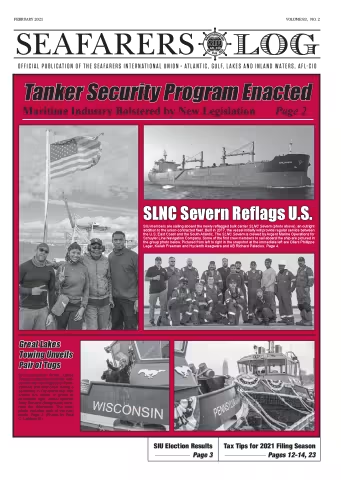
SLNC Severn Reflags U.S.
SIU members are sailing aboard the newly reflagged bulk carrier SLNC Severn (photo above), an outright
addition to the union-contracted fleet. Built in 2017, the vessel initially will provide regular service between
the U.S. East Coast and the South Atlantic. The SLNC Severn is crewed by Argent Marine Operations for
Schuyler Line Navigation Company. Some of the first crew members to sail aboard the ship are pictured in
the group photo below. Pictured from left to right in the snapshot at the immediate left are Oilers Phillippe
Leger, Keilah Freeman and Hycienth Asagwara and AB Richard Palacios. Page 4.
Great Lakes
Towing Unveils
Pair of Tugs
SIU-contracted Great Lakes
Towing Company recently wel-
comed the new tugboats Penn-
sylvania and Wisconsin during a
ceremony in Cleveland that was
shown live online. In photo at
immediate right, vessel sponsor
Sally Stevens (foreground) chris-
tens the Wisconsin. The other
photo includes both of the new
boats. Page 4. (Photos by Paul
C. LaMarre III)
68795_FEBRUARY_2021_LOG_X.indd 1 1/21/21 3:25 PM
2 Seafarers LOG February 2021
The Seafarers LOG (ISSN 1086-4636) is published monthly by the
Seafarers International Union; Atlantic, Gulf, Lakes and Inland Waters,
AFL-CIO; 5201 Capital Gateway Drive; Camp Springs, MD 20746.
Telephone (301) 899-0675. Periodicals postage paid at Southern Maryland
20790-9998. POSTMASTER: Send address changes to the Seafarers LOG,
5201 Capital Gateway Drive, Camp Springs, MD 20746.
Communications Director, Jordan Biscardo;
Assistant Communications Director & Managing Editor/
Production, Jim Guthrie; Assistant Editor, Nick Merrill;
Photographer, Harry Gieske; Administrative Support,
Jenny Stokes; Content Curator, Mark Clements.
Copyright © 2021 Seafarers International Union, AGLIW. All Rights
Reserved.
Volume 83 Number 2 February 2021
The SIU online: www.seafarers.org
The Seafarers International
Union engaged an environ-
mentally friendly printer
for the production of this
newspaper.
President’s Report
Reversed to White
Reversed to White
Even though the early parts of 2021 feel suspiciously like 2020 in some
ways, I am extremely optimistic about what the new year holds for our
industry. One reason for that outlook: The pro-maritime legislation enacted
late last year gives us plenty of momentum and great opportunities for the
future.
One of the most significant components of the Defense bill establishes
a Tanker Security Program, along the lines of the
Maritime Security Program (which was voted into
law in 1996). While these are not the best days for the
tanker industry, the longer-term picture with this new
plan is favorable and important. U.S. military leaders
have said they want dozens of tankers available in
times of crisis. The Tanker Security Program starts
building the foundation.
As reported elsewhere in this edition and at last
month’s membership meetings, other legislative wins
include solidifying the Jones Act’s application to
wind farms, strictly enforcing cargo preference laws,
and bolstering the Maritime Security Program.
The pro-maritime, pro-labor Biden administration
and continued bipartisan support in Congress will
also help ensure that we’re able to keep the U.S. Merchant Marine on
everyone’s radar. And on that note, we had already begun meeting
(virtually, in most cases) with new legislators and longtime supporters
even before Inauguration Day, in order to either educate people about
maritime or simply to solidify goals for the industry.
We take nothing for granted and will continue working hard to help
ensure your job security. But I’ve never felt better about the prospects for
the U.S. Merchant Marine than I do now.
Pandemic Continues
As of this writing in mid-January, we as a nation are still working on
implementing comprehensive strategies for administering vaccines for
COVID-19. However, the SIU has teamed up with other maritime unions
to push for prioritizing our respective rank-and-file members, in light of
their proper classification as essential workers.
Logistically, I think there are more questions than answers at this point,
but the vaccines themselves have been deemed safe (by the time you read
this, I hope to have had my first shot). However it plays out, I am asking
all SIU members to have faith that your union will handle it the right way.
We will continue doing what we’ve done since the start of the pandemic,
and that is putting your safety of you, and that of your families and
shipmates at the top of the list. Nothing is more important, and we’ll
behave accordingly.
Meanwhile, please keep your guard up and remain safe. There is finally
daylight on the horizon, but there also have been spikes around the world,
and that includes an uptick in positive cases among our membership.
We’ve come too far to slack off. Follow the safety protocols, and keep the
faith that we’ll get through it together.
Many Thanks
I would be remiss in not extending another heartfelt “thank you” to
outgoing U.S. Secretary of Transportation Elaine L. Chao and outgoing
Maritime Administrator Mark Buzby, two of our industry’s all-time greatest
champions who also happened to be true friends of the SIU. They left the
prior administration as our nation was gripped by rioting, impeachment
and the understandable emotions associated with those developments.
There’s not enough space to do justice to what Secretary Chao and Admiral
Buzby have meant to the U.S. Merchant Marine, so I’ll simply thank them
and wish them well in whatever comes next.
Last but not least, I also thank our membership for giving me another
term as your president. Our continuity of leadership has been vital to the
SIU’s success, and I want you to know that we don’t have any passengers
on our executive board or elsewhere in our ranks. Our union weathers
every storm and emerges stronger because we pour everything we’ve got
into the job. That will never change, and that’s why I again look forward to
even more progress.
Great Opportunities Ahead
O F F I C I A L P U B L I C A T I O N O F T H E S E A F A R E R S I N T E R N A T I O N A L U N I O N A T L A N T I C , G U L F, L A K E S A N D I N L A N D W A T E R S , A F L - C I O
Michael Sacco
New jobs are on the horizon for members of the
SIU Government Services Division following the
Jan. 12 launch of the future USNS John Lewis in
San Diego.
The launch took place at General Dynamics
NASSCO in San Diego, a union shipyard.
The Lewis is the first of six vessels in a new
fleet oiler program designed to support the U.S.
Navy.
Vessel construction began in the fall of 2018
and utilized more than 18,575 tons of steel to
complete. The 742-foot-long vessel is designed to
transfer fuel to U.S. Navy carrier strike group ships
operating at sea. Each of the oilers in this class will
have a capacity of 157,000 barrels of oil, a signifi-
cant dry cargo capacity, aviation capability and up
to a speed of 20 knots.
“NASSCO is immensely honored to be a part of
this historic day launching the future John Lewis,”
said Dave Carver, president of General Dynam-
ics NASSCO. “This ship reaffirms our nation’s
stability and represents the same strength, values
and honor that her namesake, the Honorable John
Lewis, stood for. The shipbuilders of NASSCO are
proud to ensure his legacy will live on in this ma-
jestic vessel.”
Additionally, NASSCO started construction on
the future USNS Earl Warren, the third vessel in
the program, late last year.
In 2016, General Dynamics NASSCO was
awarded the contract by the U.S. Navy for the
detailed design and construction of the next gen-
eration of fleet oilers, the John Lewis-class (T-AO
205), previously known as the TAO(X).
According to the shipyard, the christening of the
future USNS John Lewis “will be celebrated later
in 2021 with the ship’s sponsor following tradition
of breaking a champagne bottle on the ship’s hull.”
Union shipyard General Dynamics NASSCO launches the USNS John Lewis in San Diego. (Photo cour-
tesy General Dynamics NASSCO)
NASSCO Launches USNS John Lewis
While 2020 served up more than its share of
challenges, the year ended with a flurry of good
news for the American maritime industry.
Late last year, Congress passed the National De-
fense Authorization Act, which included a number
of critical maritime provisions. The president vetoed
the bill for reasons completely unrelated to the mari-
time components, but Congress overrode the veto.
One highlight of the NDAA for the maritime
industry is the creation of a 10-ship Tanker Secu-
rity Fleet, modeled after the successful Maritime
Security Program (MSP), to provide a stipend to
shipowners who make their militarily useful tank-
ers available in times of war or national emergency.
This provision, like many others in the overall leg-
islation, has been supported by the SIU for years.
Also of great significance, the NDAA included a
section that confirms the Jones Act applies to all off-
shore wind farms inside the territorial jurisdiction of
the United States, including those on the Outer Con-
tinental Shelf. It also included provisions clarifying
that Jones Act defense-related waivers may only be
issued for legitimate national defense needs; non-de-
fense waivers are time-limited; and foreign vessels
that take advantage of any Jones Act waiver will be
subject to significant public reporting requirements.
The bill also requires the comptroller general of
the United States to undertake a review of all federal
agencies’ compliance with cargo preference laws,
and highlight those agencies who are not following
the law properly.
“It is hard to overstate how big a win this was
for maritime labor,” said SIU Legislative and Politi-
cal Director Brian Schoeneman. “Not only did we
see the creation of the new Tanker Security Fleet,
we saw an increased authorization amount for MSP,
clarification that the Jones Act applies to offshore
wind farms and we are finally taking a big step to-
wards getting some real enforcement of the cargo
preference laws. It was one of the biggest wins for
maritime we’ve seen in years.”
The NDAA also included two maritime-related
“Sense of the Congress” statements that put the
government on record as to what official policy is.
Those read:
“It is the Sense of Congress that United States
coastwise trade laws promote a strong domestic
maritime industry, which supports the national se-
curity and economic vitality of the United States and
the efficient operation of the United States transpor-
tation system; and a strong commercial maritime in-
dustry makes the United States more secure.” (Sec.
3522)
“It is the Sense of Congress that the maritime
industry of the United States contributes to the Na-
tion’s economic prosperity and national security.”
(Sec. 8403)
Finally, the NDAA established a new Maritime
Transportation System Emergency Relief program
designed to ensure that the Maritime Administra-
tion (MARAD) and other agencies within the fed-
eral government have the authority to provide relief
to parts of the industry that have been severely im-
pacted by an emergency, such as our continuing ef-
forts to combat COVID-19.
These provisions represent a major win for the
SIU, and will be important to helping protect and
expand our U.S. Merchant Marine in the future.
Congress Passes Major Funding Bill
In addition to the NDAA, Congress also passed
an omnibus appropriations bill that included signifi-
cant funding for maritime priorities.
The appropriations act provides full funding for
the Maritime Security Program fleet – $314 million
for fiscal year 2021. The full funding level allows
for a stipend of approximately $5.23 million for
each of the MSP’s 60 militarily useful U.S.-flagged
ships, which are crewed by U.S. merchant mariners
and operate in international commercial trades.
In addition to the MSP funding, the bill pro-
vided $376 million for the National Defense Re-
serve Fleet, nearly $2 billion for cargo preference
programs including the PL-480 Food for Peace
Program, $390 million for the final National Se-
curity Multi-Mission Vessel “school ship,” and
$10 million to fully fund the Cable Security Fleet
program.
New Defense Authorization Act
Has Major Maritime Components
68795_FEBRUARY_2021_LOG_X.indd 2 1/21/21 3:25 PM
February 2021 Seafarers LOG 3
Michael Sacco is Reelected President of Seafarers International Union
A committee of rank-and-file members
recently released its official report on the
voting for national officers of the Seafarers
International Union’s Atlantic, Gulf, Lakes
and Inland Waters. Voting took place Nov.
1 through Dec. 31, 2020.
The union’s tallying committee con-
sisted of 20 Seafarers (two members
elected from each of the SIU’s 10 constitu-
tional halls). The group certified the reelec-
tions of Michael Sacco as president of the
SIU; Augie Tellez as the union’s executive
vice president; David Heindel as secretary
treasurer; and George Tricker as vice presi-
dent of contracts and contract enforcement,
among other results.
The tallying committee’s report will be
submitted for approval by the membership
at union meetings in March.
According to the report, the two con-
tested races for office were decided by
large margins. The committee disclosed the
election of the following officers, who will
serve four-year terms:
n Michael Sacco, president;
n Augie Tellez, executive vice president;
n David Heindel, secretary-treasurer;
n George Tricker, contracts and contract
enforcement vice president;
n Joseph Soresi, Atlantic Coast vice presi-
dent;
n Dean Corgey, Gulf Coast vice president;
n Nick Marrone, West Coast vice presi-
dent;
n Tom Orzechowski, Southern Region, Great
Lakes and inland waters vice president;
n Kate Hunt, Government Services and
fishing industries vice president;
n Pat Vandegrift, contracts and contract
enforcement assistant vice president;
n Nick Celona, Atlantic Coast assistant
vice president;
n Kris Hopkins, Gulf Coast assistant vice
president;
n Bryan Powell, West Coast assistant vice
president;
n Mike Russo, Southern Region, Great
Lakes and inland waters assistant vice
president;
n Joe Vincenzo, Government Services and
fishing industries assistant vice president;
n Mark von Siegel, Piney Point port agent;
n Ray Henderson, New York/New Jersey
port agent;
n Joe Baselice, Philadelphia port agent;
n John Hoskins, Baltimore port agent;
n Jimmy White, Mobile port agent;
n Chris Westbrook, New Orleans port
agent;
n Joe Zavala, Houston port agent;
n Nick Marrone II, Oakland port agent;
n Chad Partridge, St. Louis port agent;
n Todd Brdak, Detroit-Algonac port agent.
The committee met with the union’s
secretary-treasurer to receive instructions
following the Piney Point, Maryland,
membership meeting on Jan. 4 and con-
cluded both their tallying and report by the
evening of January 7. They met during that
week at the union’s headquarters in Camp
Springs, Maryland, and at the SIU-affili-
ated school in Piney Point.
Serving as co-chairmen of the tallying
committee were Jack McElveen and Tim-
othy Pillsworth, both of whom credited
their fellow Seafarers for being thorough
and efficient. Joining them on the com-
mittee were Seafarers Ritche Acuman,
Mark Butler, Patrick Coppola, James
Crate, Fontanos Ellison, Anthony Jacob-
son, Trevor Manion, Mohamed Mosed,
Foaad Saleh, Joe Bowen, Cleofe Castro,
Gerard Costello, Riley Donahue, Rene
Guity, Kelvin Johnson, Kyle Miller, Exxl
Ronquillo and Tyrell Thabit.
Unanimously approved by the commit-
tee, the report consists of more than 5,800
words. It reflects a strong rank-and-file
turnout for balloting. The committee mem-
bers concluded that they “wish to express
[our] deep appreciation for the cooperation
and assistance given to us by the union’s
legal department and its technical and cler-
ical staff. Finally, the members of the union
tallying committee wish to congratulate the
elected officers and jobholders. We extend
our best wishes for the next four years. We
hope that you will carry on the tradition of
our union and advance the strength of the
maritime industry.”
In light of the COVID-19 global pan-
demic, extra precautions were taken not
only before and during the election itself,
but also throughout the committee’s work.
All committee members were required to
test negative for the novel coronavirus, and
they also had to isolate before travelling to
Piney Point. Additionally, two alternates
from each constitutional port also were
chosen by fellow members during special
meetings Dec. 28 (none ultimately were
needed to fill in).
Tallying Committee Announces Election Results
Committee members tackle the initial workload in the main conference room at head-
quarters.
Members of the union’s election tallying committee are pictured Jan. 7 at headquarters in Camp Springs, Maryland. Joining them for the snapshot are SIU Secretary-Treasurer David
Heindel (middle row, center) and SIU Asst. VP Pat Vandegrift (middle row, far right).
68795_FEBRUARY_2021_LOG_X.indd 3 1/21/21 3:25 PM
4 Seafarers LOG February 2021
Crew members (photo at immediate left) celebrate the reflagging in early December in Florida. The SLNC Severn (remaining photos) is
an outright addition to the SIU fleet. (Vessel photos courtesy of Schuyler Line Navigation Co.)
SLNC Severn Reflags Under Stars & Stripes
The new year brings new jobs for SIU
members following the recent reflagging
of the bulk carrier SLNC Severn, an out-
right addition to the union-contracted fleet.
Built in 2017, the vessel initially will
provide regular service between the U.S.
East Coast and the South Atlantic. The
ship is 623 feet long, is equipped with four
cranes and has the ability to carry a com-
bination of containerized, breakbulk and
bulk cargo. It has a sailing speed of 14.5
knots and reflagged under the Stars and
Stripes in early December in Florida.
The SLNC Severn is crewed by Argent
Marine Operations for Schuyler Line Nav-
igation Company.
The original SIU crew included Bosun
Mario Loria, ABs Benjamin Carroll,
Kenneth Zuniga, Willie Myrick and
Richard Palacios, Oilers Hycienth
Asagwara, Keilah Freeman and Phil-
lippe Leger, Steward/Baker Tyrone
Hall, ACU Mercedes Jasmin and GVA
Johanns Rivera-Rivera.
From aboard the vessel, Loria on Jan.
6 said, “It’s hard work reflagging a vessel,
but everything is good. For the first few
weeks, you work with whatever you’ve
got. You have to order everything: tools,
parts, miscellaneous. It’s a learning expe-
rience for a lot of us, and everyone is in
good spirits.”
SIU Vice President Contracts George
Tricker stated, “The company’s commitment
to American-flag shipping, both in the Jones
Act trade and internationally, is underscored
by this reflagging, as is their faith in SIU
crews. We welcome these new employment
opportunities and, as always, I am 100 per-
cent confident that SIU members will come
through with their typically outstanding pro-
fessionalism aboard the vessel.”
Russell Paret, CEO of Schuyler Line
Navigation Company, stated, “We are
proud to add the SLNC Severn to our
U.S.-flag fleet. The SLNC Severn’s crew,
our shoreside team and all the regulatory
agencies worked together seamlessly to
efficiently reflag the vessel, even in the
midst of a pandemic. We offer a warm
welcome to our newest crew members and
are grateful to all of our mariners around
the world for their commitment during this
uncertain time.”
Schuyler Line’s other SIU-crewed
vessels include the SLNC Corsica, SLNC
Goodwill, SLNC Magothy and SLNC
Pax.
Formerly named the Frederike Olden-
dorff, the SLNC Severn was constructed in
China.
Frigid weather didn’t chill the mood
during a dual christening Dec. 16 in
Cleveland.
Seafarers-contracted Great Lakes
Towing Company welcomed the new
tugboats Pennsylvania and Wisconsin
during a brief but spirited ceremony
that was shown live online. Employ-
ees from Great Lakes Towing and from
Great Lakes Shipyard (builder of both
boats) attended.
SIU members recently approved
a new six-year contract with Great
Lakes Towing that raises wages and
maintains benefits. The company pro-
vides harbor assist and towing services
to ships in more than 40 U.S. Great
Lakes ports.
During the christening, Great Lakes
Towing Company President Joe Starck
said, “Amid the COVID-19 pandemic,
it is remarkable that the [company] has
persevered with the successful com-
pletion of these two new tugs, despite
the adversity the pandemic brought to
bear, not only on us, but the industry,
not to mention the country, and the en-
tire world. The Towing Company, as
always, showed its resilience and its
resolve to muscle through these diffi-
cult conditions.”
The tug Pennsylvania was chris-
tened by vessel sponsor Louise Kan-
dzer, girlfriend of Gregg Thauvette,
the company’s senior vice president-
operations; and the tug Wisconsin was
christened by vessel sponsor Sally Ste-
vens, wife of Robert Zadkovich, vice
president-business Development.
The new boats are the fourth and
fifth tugs, respectively, in a series of
10 64-foot Damen 1907 ICE design
harbor tugs that Great Lakes Shipyard
is building for Great Lakes Towing.
In a news release, Great Lakes Tow-
ing noted, “The tugs are 64’x24’x11’,
powered by two 1,000-hp MTU
8V4000 Tier III diesel engines, and
generate over 30-tons of bollard pull.
Their propulsion systems include
the Canal Marine designed Logan
FlexaDrive Hybrid power system,
allowing the tugs to operate on elec-
tric power while at idle, underway at
low speeds, or when under low loads,
without the need to utilize the main
engines, thereby reducing emissions
and the cost of engine maintenance.
The tugs’ compact size and high ma-
neuverability make them ideal for the
narrow waterways and low bridges
that characterize harbor towing on the
Great Lakes.”
The sixth tug, not yet named, is
slated for a summer 2021 comple-
tion.
Great Lakes Towing Christens 2 Tugs
Boat sponsor Louise Kandzer does the honors aboard the Pennsylvania. Christening the Wisconsin is the vessel’s sponsor, Sally Stevens.
Great Lakes Towing Company President Joe
Starck welcomes the attendees. (Photos by Paul
C. LaMarre III)
68795_FEBRUARY_2021_LOG_X.indd 4 1/21/21 3:25 PM
February 2021 Seafarers LOG 5
SIU-contracted Matson, Inc., recently
took delivery of the Matsonia, the second
of two new Kanaloa Class combination
container/roll-on, roll-off (con-ro) ships
built for the company by General Dynam-
ics NASSCO.
According to Matson, the Matsonia and
sister ship Lurline are the largest vessels of
their kind ever built in the U.S. They join
two other new Seafarers-crewed container-
ships, the Daniel K Inouye and the Kaimana
Hila, themselves the largest of their kind in
the U.S. commercial fleet, in completing the
renewal of Matson’s Hawaii fleet. All four
of these ships carry SIU crews.
“Putting four new ships into service
in a three-year span is a significant ac-
complishment that culminates eight
years of planning, project management
and coordination for teams across many
departments at Matson,” said Matt Cox,
chairman and chief executive officer.
“Together with the modernization and
expansion of our Honolulu terminal,
these investments position Matson to
provide efficient, reliable service to Ha-
waii for decades to come.”
The Matsonia and Lurline are each 870
feet long, 114 feet wide, with a deep draft
of 38 feet and weighing in at over 50,000
metric tons. The sister ships have an en-
closed garage with room for approximately
500 vehicles, plus ample space for rolling
stock and breakbulk cargo.
In a news release announcing the recent
delivery, the company noted, “Matsonia
and Lurline are iconic vessel names in
Matson’s long history. Matsonia dates to
the construction of Matson’s first ship of
that name in 1912. Three more ships were
given the name in subsequent years; the
new vessel is the fifth. Lurline dates to the
construction of Captain William Matson’s
first ship of that name in 1887. Four more
ships were given the name in subsequent
years; the newest vessel is the sixth.”
Additionally, the Daniel K. Inouye was
named in honor of the late Hawaii Sena-
tor, who was a strong supporter of the U.S.
Merchant Marine and a powerful advocate
of the maritime industry. He held an honor-
ary SIU book.
Kaimana Hila is a Hawaiian translitera-
tion for Diamond Head, one of Hawaii’s
most iconic landmarks.
Built by Philly Shipyard (which, like
NASSCO, is a union facility), Matson’s
new Aloha Class containerships Daniel
K. Inouye and Kaimana Hila entered ser-
vice in 2018 and 2019, respectively. Each
850-foot-long vessel has a 3,600 twenty-
foot equivalent (TEU) capacity.
Designed and built specifically for the
Hawaii trade, all four of the new ships
feature state-of-the-art green technology,
including fuel-efficient hull design, envi-
ronmentally safe double hull fuel tanks,
liquid natural gas (LNG) compatible en-
gines, and freshwater ballast systems. The
four new ships are also Matson’s fastest
vessels, with the ability to operate at or
above 23 knots.
New Con-Ro Matsonia Poised to Join SIU Fleet
The U.S. Coast Guard’s National Mari-
time Center has circulated multiple Ma-
rine Safety Information Bulletins (MSIB)
that are relevant to many SIU members.
Updates from those bulletins follow. The
original MSIBs are also linked on the SIU
website.
TWIC Extension
As laid out in Maritime Safety Infor-
mation Bulletin number 13-20, “For mari-
ners already holding a Merchant Marine
Credential (MMC), if their Transportation
Worker Identification Credential (TWIC)
expires, and their credential remains valid,
then no action needs to be taken and the
credential remains valid.” This means that,
as long as your MMC is not suspended or
revoked, the Coast Guard will not pur-
sue any suspension and revocation ac-
tions based on expired TWICs during the
COVID-19 pandemic.
MMC/STCW Extension
Mariners whose MMC expires between
March 1, 2020 and June 30, 2021 are ex-
tended one year after the initial expira-
tion date of the credential or until Oct. 31,
2021, whichever is earlier. According to
the NMC, “Mariners must carry copy of
the relevant Marine Safety Information
Bulletin (MSIB) along with their expired
MMC.” (It’s contained in a Dec. 28, 2020
news post on the SIU website, and that
post includes a link to the PDF version.)
Revalidation/Training Waivers
Until Oct. 31, 2021, for mariners who
have met the requirements for initial com-
petency and whose MMC expires between
March 01, 2020 and June 30, 2021, if you
have 360 days of relevant sea time in the
past five years, you do not need to take
any revalidation courses. (Relevant sea
time means: shipboard experience in fire,
emergency, and/or abandon ship drills for
demonstrating continued competence in
Proficiency in Survival Craft, Proficiency
in Survival Craft-Limited, Fast Rescue
Boat, Basic Training and/or Advanced
Firefighting. Service is determined as de-
scribed in Navigation and Vessel Inspec-
tion Circulars (NVICs) 4-14, 05-14, 08-14
and 09-14.)
International endorsements affected in-
clude Basic Training (VI/1), Fast Rescue
Boat (VI/2), Basic Training/Adv. Fire-
fighting (VI/3) and Personal Survival Craft
(PSC) (VI/2).
If you qualify for this training waiver
and your MMC falls within the above dates,
you should renew your MMC immediately.
You should be issued a renewed MMC with
a five-year expiration date and will NOT
be required to attend any revalidation train-
ing. All other renewal requirements must
be met (i.e., if you hold a Tanker-DL or LG
endorsement you must meet the sea time
or training requirement to renew that en-
dorsement).
How to Renew
To renew your credentials online, visit:
https://www.dco.uscg.mil/nmc/merchant_
mariner_credential/ and follow the instruc-
tions listed for renewal.
Notice Concerning Recent
Marine Safety Info. Bulletins
The Matsonia is pictured last summer during its launch in San Diego.
For members of the Greater South Florida Maritime Trades Council (part of the MTD), the COVID pandemic didn’t deter the holiday spirit of helping others. During the week
before Christmas, Council Vice President/SIU Asst. VP Kris Hopkins along with rank-and-file SIU members delivered hundreds of new toys and games to Lifenet4Families of
Fort Lauderdale, Florida. Among those helping deliver the donations were AB James Wynegar (right) and AB Donald Hutchens (left). “We have been doing this for about 10
years,” Hopkins said. “We may not have collected as much as usual because of COVID, but the people at Lifenet were very appreciative.”
Port Council Brightens Holidays for Kids
68795_FEBRUARY_2021_LOG_X.indd 5 1/21/21 3:25 PM
6 Seafarers LOG February 2021
The Seafarers Health and Benefits Plan
(SHBP) Scholarship Program will offer
eight awards totaling $132,000 for the 2021
calendar year.
Three scholarships will be designated
for Seafarers while five will be targeted
for spouses and dependents. One of the
endowments reserved for Seafarers totals
$20,000 and is intended to help defray the
costs associated with attending a four-year,
college-level course of study. The remain-
ing two are in the amount of $6,000 each
and are designed as two-year awards for
study at a postsecondary vocational school
or community college. Each of the five
scholarships for spouses and dependents is
for $20,000.
Now is an ideal time to begin the appli-
cation process. The first step is to obtain a
scholarship program booklet. This package
contains eligibility information, procedures
for applying for the scholarships and an ap-
plication form. Union members and their
dependents now have three avenues through
which they may obtain this booklet.
Prospective applicants may request
these booklets via mail by completing and
mailing the form provided. Booklets may
also be obtained by visiting any SIU hall.
Finally, applicants may obtain the booklet
online by visiting www.seafarers.org, navi-
gating to the Seafarers Health and Benefits
Plan menu and selecting Scholarship Book-
let (PDF).
Once the scholarship booklet has been
received, applicants should check the eli-
gibility criteria. They should also begin
collecting and assembling the remainder
of the paperwork needed to submit with
the full application, which must be re-
ceived by April 15, 2021.
A scholarship selection committee, con-
sisting of a panel of professional educators,
will examine the high school grades of all
applicants as well as evaluate scores from
their Scholastic Aptitude Tests (SAT) and
American College Tests (ACT). Accord-
ingly, arrangements should be made by ap-
plicants who have not done so to take these
tests no later than February 2021. Doing so
will virtually assure that the results reach
the evaluation committee in time for re-
view.
Seafarers and dependents who previ-
ously applied for the scholarship program
and were not selected are encouraged to
apply again this year, provided they still
meet the eligibility requirements.
Please send me the 2021 SHBP Scholarship Program Booklet which contains eligibility in-
formation, procedures for applying and a copy of the application form.
Name ..........................................................................................................................................
Street Address ............................................................................................................................
City, State, Zip Code...................................................................................................................
Telephone Number ( ) ..........................................................................................................
This application is for: Self Dependent
Mail this completed form to: Scholarship Program, Seafarers Health and Benefits Plan,
5201 Capital Gateway Drive, Camp Springs, MD 20746
SHBP Offers Scholarships for 2021
2/21
U.S. Citizens late last year received argu-
ably their best news to date regarding the
COVID-19 Pandemic when the federal govern-
ment announced the release of two vaccines.
The U.S. Food and Drug Administration
(FDA) in December 2020 issued emergency
use authorizations (EUA) for the distribution
of a pair of vaccines for the prevention of coro-
navirus disease 2019 caused by severe acute
respiratory syndrome coronavirus 2 (SARS-
CoV-2). On Dec. 11, the agency issued its
first EUA that allowed the Pfizer-BioNTech
COVID-19 Vaccine to be distributed in the U.S.
for use by individuals 16 years of age and older.
Seven days later, on Dec. 18, the FDA issued its
second EUA. This one cleared the way for the
distribution of the Moderna COVID-19 Vaccine
for use by individuals 18 years of age and older.
According to the Centers for Disease Con-
trol, both vaccines have shown to be very ef-
fective at preventing COVID-19 infection. The
Pfizer vaccine has shown to be 95% effective
across all age, racial and ethnic groups. The
Moderna vaccine has shown to be 94.1% effec-
tive across all racial and ethnic groups, but this
number did appear to be a little lower among
those 65 years of age or older.
Pfizer-BioNTech COVID-19 Vaccine
Manufactured by Pfizer Inc., the Pfizer-
BioNTech COVID-19 Vaccine is administered
as a two-dose series, three weeks apart, into the
muscle.
The most commonly reported side effects,
which typically lasted several days, were pain
at the injection site, tiredness, headache, muscle
pain, chills, joint pain, and fever. Of note, more
people experienced these side effects after the
second dose than after the first dose, so it is
important for vaccination providers and recipi-
ents to expect that there may be some side ef-
fects after either dose, but even more so after
the second dose.
Moderna COVID-19 Vaccine
The Moderna COVID-19 Vaccine is manu-
factured by ModernaTX, Inc. It is administered
as a two-dose series, one month apart, into the
muscle. The Moderna COVID-19 Vaccine may
not protect everyone.
The most commonly reported side effects,
which typically lasted several days, were pain
at the injection site, tiredness, headache, muscle
pain, chills, joint pain, swollen lymph nodes in
the same arm as the injection, nausea and vom-
iting, and fever. Of note, more people experi-
enced these side effects after the second dose
than after the first dose, so it is important for
vaccination providers and recipients to expect
that there may be some side effects after either
dose, but even more so after the second dose
While the rollout of the vaccines indeed is
welcome news, it has actually created more
questions than federal/state health officials ap-
pear able to answer. And while these questions
vary widely, those most consistently posed cen-
ter around actual vaccine injections, distribu-
tion of the life-saving cocktail, number of doses
available, and length of time the vaccines pro-
tect people from the virus.
The Advisory Committee on Immuniza-
tion Practices (ACIP), a U.S. federal group
within the CDC made up of medical and
public health experts, has recommended that
in the first phase of vaccination in the U.S.,
COVID-19 vaccines should be given first to
health care personnel (HCW) and adult resi-
dents of long-term care facilities (LTC).
The ACIP has also recommended that the
next group to get a vaccine in the U.S. should
include people age 75 and older and frontline
essential workers, such as first responders,
teachers and public transit and grocery store
workers.
The third priority group recommended to get
the vaccine in the U.S. includes people ages 65
to 74, people ages 16 to 64 who are at high risk
of severe COVID-19 due to underlying medical
conditions, and all other essential workers, such
as those working in food service and construc-
tion. Examples of underlying medical condi-
tions include type 2 diabetes and severe obesity.
Based on the foregoing ACIP recommenda-
tions, health officials in each state have formu-
lated their plans for who should be vaccinated
and when. Earlier CDC recommendations gave
the highest priority to health care workers and
nursing home residents. But the slow pace of
the rollout has frustrated many Americans at a
time when the coronavirus death toll has con-
tinued to rise.
According to a health system tracker con-
ducted by the Peterson Center on Healthcare
and Kaiser Family Foundation, most states
are following ACIP’s Phase 1a recommen-
dation:
n 45 states are following ACIP’s interim
Phase 1a recommendation to prioritize HCWs
and LTC residents. Some states will start vac-
cinating both of these groups together, while
others will start with one of these groups first
as they await more supply to start vaccinating
the other. Still, even with these state criteria,
decisions about how to allocate limited ini-
tial vaccines to HCWs and LTC residents will
mostly be left to facilities.
n Seven states depart from ACIP’s Phase 1a
recommendation in some way. For example, the
District of Columbia and Utah include HCWs
in Phase 1a but LTC residents in Phase 1b. In
addition to HCWs and LTC residents, Nevada,
New Hampshire, and Wyoming also include
law enforcement in Phase 1a (per ACIP’s
proposed framework, they are in 1b). Massa-
chusetts also includes people incarcerated in
prisons and those living in homeless shelters
in Phase 1a (neither is explicitly mentioned
ACIP’s Phase 1 framework).
n More than 20 states also provide further sub-
prioritization rankings or criteria within HCW
and/or LTC resident groupings. For example,
Alabama segments HCWs into “very-high,”
“high” and “medium” risk. Idaho provides spe-
cific rankings within each group. Texas groups
Phase 1a into “first” and “seond” tier.
The SIU is working with other unions, gov-
ernment agencies and health care providers to
help ensure that U.S. mariners are given high
priority for vaccination. Among many other ef-
forts, the SIU signed on to a letter in early Janu-
ary that explained an “appeal for assistance in
facilitating access to vaccines for the … U.S.
citizen merchant mariners who are responsible
for keeping the economic and military supply
lines of the United States open on the high seas.
The undersigned organizations are deeply con-
cerned that the military and economic security
of our nation may be at risk if the distribution
of vaccines allows seafarers to fall between the
cracks of federal and state efforts to distribute
vaccines under the guidelines established by the
ACIP.”
Remembering Capt. Jeff
The crew of the Liberty Eagle (Liberty Maritime) mourns the loss of their beloved Capt. Jeff Powell, who passed away on Nov. 24
at age 61. They recently conducted a shipboard remembrance for him and gathered for this photo. Among those taking part in
the memorial were Bosun Kyle Silva, ABs Luis Ruiz, Freddy David, Adam Mohamed, Abobkr Alkhaili and Raul Gomez, DEUs Mo-
hamed Alasfoor, Edsin Abueg and Derick Dy, Steward/Baker Rene Gil, Chief Cook Dewayne Thomas, SA Joseph Chrisante, CM
Jarrett Podaski, 2M Cliff Passmore, 3M Page Mentuck, CE John Brooks, 1E Scott Cukierski, 2E Mike Welch and 3E Robert Allen.
USDA Approves Vaccines for COVID-19
68795_FEBRUARY_2021_LOG.indd 6 1/20/21 6:53 PM
February 2021 Seafarers LOG 7
SIU Assistant Vice President Joe
Vincenzo has unfailing confidence in
Seafarers, but even he didn’t know what
to expect late last year when it was time
for the union’s annual participation in a
charitable drive for U.S. military families
in the Pacific Northwest.
His faith proved well-founded, how-
ever, as rank-and-file members didn’t let
the COVID-19 pandemic break their long
streak of supporting Santa’s Castle. The
project raises donations of toys and other
gifts to U.S. military families (primarily
E-4 and below) from Joint Base Lewis-
McChord (JBLM), Washington, and from
other bases.
Seafarers stepped up with approxi-
mately $6,400 worth of gifts, and they got
an assist from SIU headquarters personnel
after a wrinkle that proved particularly
distasteful. Someone broke into the hall
and swiped a number of higher-end elec-
tronic items.
“The break-in was a kick in the teeth,
but then something interesting hap-
pened,” Vincenzo said. “Donations began
to pour in as a direct response, not only
from members but also from our execu-
tive board and staff at headquarters. We
quickly made up the difference and I even
received a bit of advice on how best to
handle another possible future visitation
from the thief. Let’s just say it was good
advice from the old school!” (In the in-
terim, security at the hall has been signifi-
cantly enhanced.)
Similarly, Retired Recertified Bosun
Dana Cella, a longtime contributor to the
yearly endeavor, expressed displeasure
about the stolen items but remained fo-
cused on the bigger picture.
“The break-in was disgusting,” he said.
“To have them steal charitable gifts….
They were bloody well scumbags just try-
ing to make a fast buck.
“But this is a great program,” he con-
tinued, “and I’m going to contribute to it
as long as possible. I support it because
it’s helping our servicemen and their kids.
The SIU is a family-oriented organization,
and we respect other families.”
Retired Recertified Steward Shawn
Fujiwara also is a longtime backer of
Santa’s Castle. He said the response
to the break-in “just shows that even
though there’s evil in the world, there’s
still good. My donation arrived the same
day, and Joe said that kind of softened
the blow…. I’ve always believed in
Santa’s Castle.”
Anita Vargo, vice president of purchas-
ing at Santa’s Castle, said her organiza-
tion exhausted every donation while
supporting 1,245 families (including more
than 2,600 children). “We worked with
255 volunteers who logged more than
4,000 volunteer hours,” she said.
As for the SIU’s participation, Vargo
said she “didn’t know for sure, due to the
pandemic, but Joe, our angel, said they
still wanted to support it, and they did.
They were a godsend. We’re always so
grateful to know we can depend on the
Seafarers International Union.”
Longtime Support
In 2007 and 2008, Tacoma-area Sea-
farers teamed up to support Toys for Tots
during the winter holidays. Then, in 2009,
they shifted to Santa’s Castle, which is a
private, non-profit organization.
“The move had a lot to do with my
own prior service and affinity for the mili-
tary, along with the close ties between the
SIU and the military,” recalled Vincenzo,
who served in the U.S. Navy. “It has
been a perfect fit, and since then we have
donated a collective total of more than
$100,000.”
Despite that history, he said, “With all
of the hardship and heartache of 2020,
we didn’t know what to expect or even if
we should put out the Santa’s Castle sign
and kitty. We thought it may be something
of a ‘Hail Mary,’ but donations came in
even though the foot traffic in the hall was
down.”
One thing that fell victim to the
pandemic was the associated luncheon
normally hosted by the SIU for military
personnel, Seafarers, Santa’s Castle em-
ployees and others. Typically, that gather-
ing is tied in with loading the donations
into trucks and vans. All concerned are
hopeful, however, that the gathering will
take place next time.
Fujiwara, for one, is counting on it for
several reasons, not the least of which in-
volves a locally renowned elf costume that
he described as “my second uniform. It’ll
be ready next December, and I know the
SIU will step up again, like always.
SIU-contracted Crowley Maritime is a longtime partner in the Santa’s Castle outreach. They donated three
bicycles for the most recent effort. Pictured from left in the photo above are Crowley Labor Relations Manager
Dan Lowry, SIU Asst. VP Joe Vincenzo and SIU Port Agent Warren Asp, with various donated items. In photo
at right, Recertified Bosun Tar Ahmed (right) and Command Sgt. Major Frank Graham of Joint Base Lewis Mc-
Chord show their holiday spirit.
Pandemic Doesn’t Stop SIU Philanthropy
Seafarers Overcome Obstacles to Support Santa’s Castle
From front to back, QEE Lon Maduro,
QMED Leodiane Torrenueva and Chief
Cook Nasser Ahmed carry donations to a
nearby truck. Joni Bradley, SIU administra-
tive assistant, is in the background.
In photo above, QMED Ryan Palmer (left)
and ACU Marcelino Pabito pitch in to
brighten the holidays for military families.
Teamwork is evident (photo at left) as mem-
bers and military personnel haul toys for
delivery.
68795_FEBRUARY_2021_LOG.indd 7 1/20/21 6:53 PM
8 Seafarers LOG February 2021
At Sea and Ashore with the SIU
AROUND THE ALGONAC HALL – In photo at right, AB Frank Pivik (left) casts the last ballot received there, on New Year’s Eve. SIU Port Agent Todd Brdak is at right. AB Doyle Ling
(left in photo at center) picks up his first pension check. He’s also pictured with Brdak. AB Harriet Groenleer is in photo at left, receiving her full B-book and a ballot.
FULL BOOK IN HOUSTON – QMED J. Diola (left) obtains his book at the hiring
hall. Presenting it is SIU ITF Inspector Shwe Aung.
VOTING IN HOUSTON – GUDE Fausto Aranda (center) receives his B-seniority book and pre-
pares to cast his vote in the union election at the hiring hall. He’s pictured with SIU Asst. VP Mike
Russo (left) and SIU Safety Director Kevin Sykes.
AT WILMINGTON HALL – SA Anas Mihakel (photo at left) displays his newly acquired B-book, while QMED
Sean Hernandez (left in photo at right, with SIU Patrolman Jesse Sunga Jr.) receives his A-seniority book prior
to voting in the SIU election.
ABOARD USNS
FISHER – This
c a m e r a - s h y
group aboard
the U.S. Marine
M a n a g e m e n t -
operated vessel
includes Bosun
Algernon Reed,
AB Sherma l
Morris, AB Fidel
Dipasupil , AB
Rommel Marti-
nez, OS Shamek
Daniels, OS Ce-
dric Armstrong,
OS Marcell San-
tos, Cargo Mate
Ed Pollard, 2M
Philip Scott and
3M Steve Mc-
Combs. Thanks
to vessel master Capt. Jennifer Senner for the photo.
ABOARD OVERSEAS TAMPA – Pictured on the Overseas Ship
Management vessel in Houston are (from left) Recertified Stew-
ard Derrick Moore, Recertified Bosun Raymond Johnson and AB
Darius McCastle.
ABOARD HORIZON PACIFIC – Recer-
tified Bosun Antjuan Webb is pictured
aboard the Sunrise Operations ship on
the West Coast.
B-BOOK IN JOLIET – AB Adam Petrucci gets
his full B-book at the hiring hall.
68795_FEBRUARY_2021_LOG.indd 8 1/20/21 6:53 PM
February 2021 Seafarers LOG 9
At Sea and Ashore with the SIU
ABOARD INDIANA HARBOR – At the risk of editorializing, Chief
Cook Saleh Saleh very clearly has mastered holiday meals aboard
ship. Here are some snapshots from Christmas dinner aboard the
American Steamship vessel (many others are available on the SIU
Facebook page). The group photo includes (from left) Bosun Jeremy
Shenett, Saleh and QMED Ameen Yahya.
WELCOME ASHORE IN HOUSTON – Chief Engineer Rusty LeFrage (photo at
far right) recently called it a career after 41 years at G&H Towing. SA Marco Guity
(photo at immediate right) did the same after 31 years with the union, while Chief
Cook Wilfred Lambey (left in photo above, with SIU Asst. VP Mike Russo) also
retired, following 27 years with the SIU.
ABOARD PACIFIC RELIANCE – In photo at left, Chief Cook Sharon Hoffman (left) and AB Freddy Hamilton are
pictured on the Intrepid Personnel and Provisioning vessel in Houston. The photo at right includes Hamilton (right)
and an old shipmate: SIU Houston Port Agent Joe Zavala.
UNION BOOKS IN NEW
ORLEANS – Receiving their
full books at the membership
meeting Dec. 15 are (from
left) GVA Benito Figueroa, AB
Ronaldo Fajardo, AB Dean
Diaz and OMU Brandon
Hickman. SIU Safety Director
James Brown is at right.
FULL BOOK IN OAKLAND – AB Paul Clow (right) picks up his
full B-book at the hiring hall. He’s pictured with SIU Patrolman
Adrian Fraccarolli.
68795_FEBRUARY_2021_LOG.indd 9 1/20/21 6:53 PM
10 Seafarers LOG February 2021
At Sea and Ashore with the SIU
ABOARD SBX – Displaying their sealed, completed ballots for the SIU election aboard the TOTE Services vessel in Honolulu
are (group photo, from left) Chief Steward Marcus Rowe, Bosun James Reynolds, OS Ayesh Ahmed and ACK Anthony Jack-
son. MDR Duane Akers is in the snapshot at left.
A-BOOK IN PUERTO RICO – Chief Steward Ingrid
Ortiz receives her A-seniority book late last year.
She’s pictured at the San Juan hall with SIU Port
Agent Amancio Crespo.
ABOARD CAPE MOHICAN – The galley gang put out a deli-
cious meal (and desserts) for Christmas aboard the Ocean Duch-
ess-operated ship on the West Coast. (Visit the SIU Facebook
page for a dozen or so additional photos.)
UNION BOOKS IN JERSEY – QMED Samuel Sand-
ers (left in photo above) and AB Andrew Porpora (left
in photo below) recently received their respective full
B-books at the hiring hall in Jersey City, New Jersey.
SIU Port Agent Ray Henderson is at right in both
photos.
BOATMEN CAST BALLOTS – Crew members from the Great Lakes Towing boat Nebraska complete their ballots for the union
election last year in Detroit. From left are AB Scott Rosseel, AB Adil Hussein and Deckhand Jeffery Davis.
68795_FEBRUARY_2021_LOG.indd 10 1/20/21 6:53 PM
February 2021 Seafarers LOG 11
At Sea and Ashore with the SIU
WELCOME ASHORE IN TACOMA – AB Michael Ostrowski (left) picks up his first pen-
sion check at the hiring hall. SIU Port Agent Warren Asp is at right.
ABOARD USNS MAURY – Pictured near the holiday buffet that was put out for their
fellow mariners on Christmas are (from left) Chief Steward Rhonda Jenkins, GVA
Fradarius Smith, GVA Keeno Rock and SA Alize Lassiter. The vessel, operated by
Ocean Shipholdings, was in Charleston, South Carolina.
ABOARD OCEAN JAZZ – Pictured on the Crowley-operated vessel in Jacksonville,
Florida, are (from left) QMED Alberto Semedo, SIU Port Agent Ashley Nelson and Bosun
Yamira Colon.
MEETING WITH MARINES – SIU Asst. VP Nick Celona (center) confers with members of the
4th Marine Division, 23rd Regiment, in San Bruno, California. They discussed teamwork and
the vital role of the U.S. Merchant Marine as America’s fourth arm of defense.
SAFETY AWARD EARNED – STOS Fernando Martinez (left) recently received a
safety award from vessel operator Crowley aboard the National Glory in Houston.
Also pictured, starting second from left, are Bosun James Morris, STOS Enrique
Ampil, Cap. Langford, Crowley Port Engineer Fritz Jean (who presented the award)
and SIU Patrolman J.B. Niday. “Fernando’s knowledge of the shipboard safety
system and quick actions during a Coast Guard inspection impressed the crew, the
Coast Guard and Crowley, as well as making the SIU proud,” Niday said.
APPRENTICE EARNS GED – Apprentice Luke Vandegrift (right) recently earned his General
Educational Diploma (GED) at the SIU-affiliated Paul Hall Center for Maritime Training and
Education (PHC) in Piney Point, Maryland. The 20-year-old Charles County, Maryland-native
is a member of PHC Apprentice Class #863 and has been attending maritime training classes
at the school for the past 15 weeks. Congratulating the future steward department member
and presenting him with his GED transcripts is Peggy Densford, PHC Academic instructor. The
Freedom Star, the school’s training vessel, is pictured in the background.
68795_FEBRUARY_2021_LOG_X.indd 11 1/21/21 3:25 PM
12 Seafarers LOG February 2021
What’s New for the 2021 Tax Filing Season
Following are some of the changes that took
effect in 2020, along with provisions that remain
in effect from prior years.
Please check www.irs.gov before filing your
return.
Tax Legislation Updates & Considerations
The following is a list of tax legislation and
considerations affecting the current and future
tax years as noted. Provided in parenthesis are
the abbreviations that will be used throughout
this document in reference to the respective leg-
islation.
n The Tax Cuts and Job Act (TCJA):
The Tax Cuts and Job Act (TCJA) was enacted
on December 22, 2017. Described as the largest
major tax reform in over three decades, the TCJA
contains a host of tax provisions that impact indi-
viduals and businesses.
n The Setting Every Community Up
for Retirement Enhancement Act (SECURE
Act): The SECURE Act was signed into law
on December 20, 2019 significantly modifying
many requirements for employer-provided re-
tirement plans, individual retirement accounts
(IRAs), and other tax-favored savings accounts.
While some of the modifications went into effect
retroactively or upon enactment (December 20,
2019), many of them carry future effective dates.
n The Coronavirus Aid, Relief, and
Economic Security Act (CARES Act): The
CARES Act is a $2.2 trillion economic stimulus
bill that was signed into law on March 27, 2020
in response to economic fallout of the COVID-
19 pandemic. Provisions in the Act were en-
hanced and expanded by the recent signing of
the Consolidated Appropriations Act, 2021.
n The Taxpayer Certainty and Disaster
Tax Relief Act (Tax Extenders Act): The Relief
Act, as part of the Consolidated Appropriations
Act, 2021 was signed on December 27, 2020,
extending several tax provisions that were set to
expire.
n Considerations – Change in White
House Administration: As with any transition
in the White House Administration, it will be
prudent to monitor tax legislation updates after
the new administration takes office. As this tran-
sition has not yet taken place, any prospective
tax legislation changes from the incoming ad-
ministration’s proposals have been omitted from
this document. All information provided below
is currently in effect until otherwise altered by
future legislation.
Due Date of Return
File Form 1040 by April 15, 2021. An auto-
matic 6-month extension can be made by filing
Form 4868 by April 15, 2021, along with all tax
monies due. An extended Form 1040 is due Oc-
tober 15, 2021.
Net Investment Income Tax: In 2020, a tax equal
to 3.8% of the lesser of the individual’s net in-
vestment income for the year or the amount the
individual’s modified adjusted gross income
(MAGI) exceeds the threshold amount. The
MAGI threshold amounts for the additional tax
are as follows:
n $250,000 (Married Filing Joint/Surviv-
ing Spouse)
n $200,000 (Single/Head of Household)
n $125,000 (Married Filing Separately)
Investment income reduced by deductions
properly allocable to that income is net invest-
ment income. Investment income includes in-
come interest, dividends, annuities, royalties and
rents and net gain from disposition of property,
other than such income derived in the ordinary
course of a trade or business. However, income
from a trade or business that is a passive activ-
ity and from a trade or business of trading in fi-
nancial instruments or commodities is included
in investment income. Modified adjusted gross
income for the purpose of calculating the addi-
tional Medicare tax is a person’s adjusted gross
income with the foreign earned income exclu-
sion or foreign housing exclusion added back in.
Social Security Tax: Part of FICA tax on wages,
an employee and employer are each subject to
a 6.2% tax on wages for Social Security. The
maximum amount of wages subject to the Social
Security are as follows:
$137,700 (2020)
$142,800 (2021)
n Medicare Tax: Part of FICA tax on
wages, an employee and employer are each sub-
ject to a 1.45% tax on wages for Medicare. There
is no limit on the amount of wages subject to the
Medicare tax. In 2020, in addition to the standard
Medicare tax, there will be an additional 0.9%
tax on wages that exceed the following threshold
amounts:
n $250,000 (Married Filing Joint/Surviv-
ing Spouse)
n $200,000 (Single/Head of Household)
n $125,000 (Married Filing Separately)
n Self-Employment Tax Rate and De-
duction: The Social Security portion of the self-
employment tax is 12.4% in 2020. The Medicare
portion of the SE tax is 2.9% not including the
0.9% additional tax on the amounts above the
applicable thresholds as noted above. The self-
employment tax deduction is equal to one-half
of self-employment tax.
n Kiddie Tax: The kiddie tax changes in-
troduced by the TCJA were repealed by the SE-
CURE Act. For tax years 2020-2021, the first
$1,100 of the net unearned income of a child
meeting certain requirements is not taxed, the
next $1,100 is taxed at the child’s marginal tax
rate and amounts over $2,200 are taxed at the
parent’s marginal tax rate. For purposes of the
Kiddie Tax, a child is (1) under age 18 at the end
of the tax year, (2) age 18 at the end of the tax
year and does not provide more than half of his/
her own support with unearned income, or (3) is
age 19-23 at the end of the tax year, a full-time
student, and does not provide more than half of
his/her own support with unearned income.
Itemized Deductions
If more advantageous than the standard de-
duction, an individual may elect to claim certain
itemized deductions of personal expenses in de-
termining taxable income. The most common
itemized deductions are listed below.
n Medical and Dental Expenses: Unre-
imbursed medical expenses may be claimed as
an itemized deduction to the extent they exceed
7.5% of adjusted gross income. The Tax Extend-
ers Act of 2020 extended this threshold, eliminat-
ing the initial increase to 10% of AGI.
n State & Local Tax Deduction: For
tax years 2018-2025, the itemized deduction
for state and local taxes paid or accrued in the
tax year is limited to $10,000 ($5,000 for MFS)
of the aggregate of (1) state and local property
taxes, (2) state and local income taxes, and (3)
state and local general sales taxes deducted in
lieu of state and local income taxes.
n Mortgage Interest Deduction: The de-
duction for mortgage interest is limited to under-
lying indebtedness of up to $750,000 ($375,000
for MFS) for tax years 2018-2025. The deduc-
tion for interest on home equity indebtedness is
eliminated. The lower limit doesn’t apply to any
acquisition indebtedness incurred on or before
December 15, 2017, which is limited to $1 mil-
lion ($500,000 for MFS).
n Mortgage Insurance Premiums: The
deduction for mortgage insurance premiums
(PMI) was extended by the Tax Extenders Act
through 2020. This allows a taxpayer whose
income is below certain thresholds to deduct
the cost of premiums on mortgage insurance
purchased in connection with acquisition indebt-
edness on a taxpayer’s principal residence. The
deduction is reduced by 10% for every $1,000
by which the taxpayer’s AGI exceeds $100,000.
Starting in 2021 the deduction will not be avail-
able unless extended by Congress.
n Charitable Contribution Deduction:
The limitation under IRC Sec. 170(b) for cash
contributions to public charities and certain pri-
vate foundations is 60% of an individual’s con-
tribution base for tax years 2021-2025. Under
the CARES Act, the 60% limitation has been
increased to allow for contributions up to 100%
of the taxpayer’s contribution base for tax year
2020 only. The contribution base is an individu-
al’s adjusted gross income (AGI), not including
the charitable deduction or any net operating loss
(NOL) carrybacks. The percentage limit depends
on the aggregate contributions of the spouses if
married filing jointly. Contributions exceeding
the limitation are generally allowed to be carried
forward and deducted for up to five years, sub-
ject to the later year’s ceiling. For taxpayers not
itemizing, the CARES Act allows up to a $300
above-the-line deduction for charitable contri-
butions made in 2020, as discussed in the next
section.
n Miscellaneous Deductions: Job-related
expenses, as well as other miscellaneous item-
ized deductions that were previously subject to
the 2%-of-adjusted-gross-income floor, are no
longer deductible for tax years 2018-2025. The
eliminated deductions include expenses for tax
preparation, union dues, and investment fees.
n Gambling Losses: All deductions for
expenses incurred in carrying out wagering
transactions, and not just gambling losses, are
deductible only to the extent of gambling win-
nings.
n Phaseout: Before 2018, an individual’s
itemized deductions were reduced by 3% of ad-
justed gross income (AGI) when AGI exceeded
certain threshold amounts. This phaseout of
itemized deductions is temporarily eliminated
by the TCJA, and therefore does not apply to tax
years 2018-2025.
n State Itemized Deductions: The TCJA
modified or eliminated several popular itemized
deductions. It is important to note that although
the federal deductions have been adjusted, you
may still qualify for deductions at the state level.
Tax Exemptions, Credits, & Other Deductions
n Exemptions: Under the TCJA, for tax
years 2018-2025, the deduction for the personal
exemption is reduced to zero.
n Child and Dependent Tax Credits:
Below are tax credits related to child and depen-
dent care expenses.
n Definition of a Qualifying Child: To be
claimed as a qualifying child, the person must
meet certain criteria:
n Relationship: The person must be your
child, stepchild, adopted child, foster child,
brother or sister, or a descendant of one of these
(for example, a grandchild or nephew).
n Residence: For more than half the year,
the person must have the same residence as you
do.
n Age: the person must be under age 19 at
the end of the year, or age 19-23 and be a full-
time student for at least five months out of the
year, or any age if totally and permanently dis-
abled.
n Support: the person did not provide
more than half of his or her own support during
the year.
n Dependent Social Security Number:
Each dependent must have a Social Security
number (SSN). Individuals may get a SSN for
their dependent by filing Form SS-5 with their
local Social Security Administration office or
calling the Administration at 1-800-772-1213. It
usually takes about two weeks to receive a SSN.
n Definition of a Qualifying Relative:
To be a qualifying relative, the person must meet
certain criteria:
n Relationship: the person must be your
parent, stepparent, grandparent, aunt/uncle, in-
law, or an individual who has the same place of
abode as the taxpayer for the entire year.
n Gross Income: The individual’s gross
income for the year must be less than $4,200.
n Support: the person did not provide
more than half of his or her own support during
the year.
n Not a Qualifying Child: The individual
must not be the qualifying child of the taxpayer/
other taxpayer.
n Child Tax Credit: The maximum child
tax credit for tax year 2020 is $2,000 per child
under the age of 17 and $500 for any other de-
pendent.
The child tax credit starts to be reduced when
MAGI income reaches the following levels:
n $400,000 (Married Filing Joint)
n $200,000 (Married Filing Separately)
n $200,000 (Single or Head of Household)
In the phase-out range, the child tax credit is
reduced by $50 for each $1,000 of income above
these thresholds.
The child tax credit is generally a nonrefund-
able credit that is limited to regular tax liability
plus alternative minimum tax liability. However,
a portion of the credit is refundable for certain
taxpayers (see Form 8812 and IRS Pub. 972). In
certain circumstances, families may receive up to
a $1,400 refund per child.
Additional (Refundable) Child Tax Credit:
This credit is for certain individuals who get less
than the full amount of the child tax credit. The
additional child tax credit may be refundable
even if you owe no tax.
Taxpayers cannot claim the Child Tax Credit
for any tax year if the individual or a qualifying
child did not have an individual SSN issued on or
before the due date of the return for that tax year.
The TCJA eliminated the exemption deduc-
tion for dependents for tax years 2018-2025.
Therefore, releasing the dependency exemption
to the noncustodial parent does not entitle that
parent to an exemption deduction; however, it
does make the noncustodial parent eligible for
the child tax credit with respect to the child.
n Child and Dependent Care Credit:
For 2020, there is a credit equal to the amount
of qualified expenses multiplied by an appli-
cable percentage determined by the taxpayer’s
adjusted gross income. The maximum amount
of qualified expenses to which the credit may be
applied is $3,000 for cost to care for one child
Tax Rates & Thresholds
2020 Tax Brackets: Below are the tax brackets for tax year 2020, including the taxable income range for each bracket
Married Filing Joint Head of Household Single Married Filing Separately Estates & Trusts
10% $0 - $19,750 $0 - $14,100 $0 - $9,875 $0 - $9,875 $0 - $2,600
12% $19,751 - $80,250 $14,101 – $53,700 $9,876 - $40,125 $9,876 - $40,125 N/A
22% $80,251 - $171,050 $53,701 - $85,500 $40,126 - $85,525 $40,126 - $85,525 N/A
24% $171,051 – $326,600 $85,501 - $163,300 $85,526 - $163,300 $85,526 - $163,300 $2,601 - $9,450
32% $326,601 – $414,700 $163,301 - $207,350 $163,301 - $207,350 $163,301 - $207,350 N/A
35% $414,701 - $622,050 $207,351 - $518,400 $207,351 - $518,400 $207,351 - $311,025 $9,451 - $12,950
37% $622,050+ $518,400+ $518,400+ $311,025+ $12,950+
2020 Net Capital Gains & Qualified Dividend Rates: Below are the 2020 net capital gains and qualified dividend rates per taxable income range for each type of filing
status.
Married Filing Joint Head of Household Single Married Filing Separately Estates & Trusts
0% $0 - $80,000 $0 - $53,600 $0 - $40,000 $0 - $40,000 $0 - $2,650
15% $80,000 - $496,600 $53,600 – $469,050 $40,000 - $441,450 $40,000 - $248,300 $2,650 - $13,150
20% $496,000+ $469,050+ $441,450+ $248,300+ $13,150+
Capital gains and losses are reported on Form 8949 and then totaled on Schedule D. If you sold a covered security in 2020, your broker will report the cost basis on your Form 1099-B. Refer
to the IRS website at www.irs.gov/form8949 for additional information and other new developments affecting this form and Schedule D.
Continued on Page 14
68795_FEBRUARY_2021_LOG.indd 12 1/20/21 6:53 PM
February 2021 Seafarers LOG 13
How to Prepare A Tax Return
Step 1. Gather all records for the cur-
rent tax return filing year.
Income Records
These include Forms W-2/W-2G,
Forms 1099 (Interest, Dividends Brokerage
Statements, Misc.) and Schedules K-1 (In-
vestment in Partnerships/S-Corporations)
Itemized deductions and tax credits
n Medical and dental payment records
n Real estate and personal property
tax receipts
n State and local tax payments
n Interest payment records for items
such as a home mortgage or home equity loan
n Charitable contributions
n Records of payments for childcare
so an individual could work
n Educational expenses
Step 2. Gather any forms, schedules
or publications necessary to assist in
filing the return. Most IRS offices and
many local banks, post offices and librar-
ies have publications designed to provide
individuals with information on correctly
filing tax returns. Also, you may ac-
cess the IRS website at www.irs.gov for
forms, instructions and publications.
Step 3. Fill in the return. Cents may
be rounded to the nearest whole dollar on
the tax return and schedules. To do so,
raise amounts from 50-99 cents to the
next dollar. For example, $1.39 becomes
$1 and $1.50 becomes $2.
Step 4. Review the return for accu-
racy.
Step 5. Sign and date the return. Form
1040 is not considered a valid return un-
less signed. A spouse must also sign if it
is a joint return.
Step 6. File Return.
Filing Electronically (E-file)
n Due to staffing issues, process-
ing paper returns can take several
weeks longer. The IRS encourages tax-
payers to file electronically.
n Information regarding available
e-filing options can be found at www.irs
gov/e-file-options
Filing Paper Return
n Attach Copy B of Forms W-2, W-2G
and 1099-R to the front of the Form 1040.
n Attach all other schedules and forms
behind Form 1040 in order of the attach-
ment sequence number.
n If paying any balance due by check,
do not staple or attach the payment or
Form 1040-V (payment voucher) to the
return. Instead, just put them loose in the
envelope. Write your name, address, phone
number, Social Security number, and form
number on your check or money order.
n Private Delivery Services - Tax re-
turns and extensions can be mailed through
private delivery services such as DHL Ex-
press, Federal Express, and United Parcel
Service.
Electronic Payment Options
n Visit www.irs.gov/payments for full
listing of electronic payment options.
n Direct Pay – Payment can be directly
withdrawn from a bank account through
the IRS website or through the software/
website the taxpayer or paid preparer used
to electronically file the tax return.
n Debit/Credit Cards – The IRS web-
site listed above provides links to pay by
debit or credit card. All major cards (VISA,
MasterCard, American Express, etc.) are
accepted, fees apply.
n Payments by Phone – The IRS web-
site also lists toll-free numbers available to
make payments by phone.
Refunds
n Taxpayers can request direct deposit
of their tax refunds by filling out the refund
section on Form 1040, which includes the
taxpayer’s bank account number and the
bank’s routing number.
n For electronically filed returns, a re-
fund will typically be received in about 2
weeks if deposited directly into a checking
or savings account.
n Paper checks will be mailed to the
address listed on the tax return if direct de-
posit is not requested. Paper check refunds
may take several weeks to arrive by mail.
n Where’s My Refund - If taxpayers
have not received a refund check within 28
days from the original IRS mailing date,
information can be accessed through the
website at www.irs.gov/refunds.
Filing an extension
n Taxpayers can get an automatic 6-month
extension if, no later than April 15, 2021, Form
4868 will be filed with the IRS. It is important to
remember that a 6-month extension to file does
not extend the time to pay the taxes. Form 4868,
when sent in, must be accompanied by all tax
monies due to the U.S. government.
Change of Address: If an individual
has changed his or her address from the one
listed on that person’s last tax return, IRS
Form 8822 should be filled out and filed
with the agency.
Death of a Taxpayer: If a taxpayer died
before filing a required return for 2020, the
taxpayer’s personal representative (and
spouse, in the case of a joint return) must
file and sign the return for that person. A
personal representative can be an executor,
administrator or anyone who oversees the
taxpayer’s property.
Your Online Account: To access your
online account, you must authenticate your
identity. To securely log in to your federal
tax account, go to IRS.gov/Account. View
the amount you owe, review 24 months of
payment history, access online payment
options, and create or modify an online
payment agreement. You can also access
your tax records online.
Which Income to Report
In addition to wages, salaries, tips, un-
employment compensation, capital gains,
dividend payments and other income
listed on the federal tax return, the fol-
lowing kinds of income must be reported:
n Jones Act settlements for lost wages
n Amounts received in place of wages
from accident and health plans (including
sick pay and disability pensions) if em-
ployer paid for the policy
n Life insurance proceeds from a pol-
icy cashed in if the proceeds are more than
the premium paid
n Canceled debts
n State income tax refunds
n Rents
n Repayments
n Royalties
n Unemployment benefits
n Profits from corporations, partner-
ships, estates and trusts
n Endowments
n Original Issue Discount
n Distributions from self-employed plans
n Bartering income (fair-market value
of goods or services received in return for
services)
n Tier 2 and supplemental annuities
under the Railroad Retirement Act
n Lump-sum distributions
n Gains from the sale or exchange
(including barter) of real estate, se-
curities, coins, gold, silver, gems or
other property (capital gains)
n Accumulation distributions from
trusts
n Prizes and awards (contests, raffles,
lottery and gambling winnings)
n Earned income from sources outside
the United States
n Director’s fees
n Fees received as an executor or ad-
ministrator of an estate
n Embezzled or other illegal income
n Social Security benefits
Which Income Need Not Be Reported
The following kinds of income do not
need to be reported on the federal tax return:
n Benefits from government welfare
programs
n Jones Act settlements for injuries,
pain, suffering, and medical costs
n Maintenance and Cure
n Workers’ compensation benefits,
insurance, damages, etc. for injury or sick-
ness
n Disability retirement payments (and
other benefits) paid by the Veterans Ad-
ministration
n Child support
n Gifts, money or other property in-
herited or willed
n Dividends on veterans’ life insur-
ance
n Life insurance proceeds received
because of a person’s death
n Amounts received from insurance
because of loss of the use of a home due
to fire or other casualty to the extent the
amounts were more than the cost of nor-
mal expenses while living in the home
n Certain amounts received as a schol-
arship
What Items Are Considered Deduc-
tions and Credits
The following are common deductions
and credits, which are discussed in more
detail in above sections:
n Standard Deduction
n Itemized Deductions
n Medical and Dental Expenses
n State and Local Taxes
n Home Mortgage Interest
n Mortgage Insurance Premiums
n Charitable Contributions
n Gambling Losses
n Qualified Business Income Deduc-
tion
n Student Loan Interest
n Education Credits & Deductions
n Earned Income Credit (EIC)
n Child & Dependent Care Credit
n Energy Credits
Which Records to Keep
Keep records of income (such as re-
ceipts), deductions (such as canceled
checks) and credits shown on the tax re-
turn, as well as any worksheets used to
figure them, until the statute of limita-
tions runs out for that return, usually 3
years from the date the return was due
or filed, or 2 years from the date the tax
was paid, whichever is later. However, it
is recommended that all records be kept
for about 6 years. Some records should
be kept even longer. For example, keep
property records (your home, stocks)
as long as they are needed to figure the
basis of property.
Why Seafarers Must Pay State Income
Tax
Federal law prohibits employers from
withholding state and local taxes from the
wages of mariners working aboard U.S.-
flag ships. Specifically, the law [46 USCA
11108(11)] provides that “no part of the
wages due or accruing to a master, officer
or any other seaman who is a member of
the crew on a vessel engaged in the foreign,
coastwise, intercostal, interstate or non-con-
tiguous trade shall be withheld pursuant to
the provisions of the tax laws of any state,
territory, possession or commonwealth, or
a subdivision of any of them, but nothing
in this section shall prohibit any such with-
holding of the wages of any seaman who is
employed in the coastwise trade between
ports in the same state if such withholding is
pursuant to a voluntary agreement between
such seaman and his employer.”
The law, however, does not exempt
seamen from paying state and local
taxes. Mariners, just like any other
citizens of any given state, must meet
their obligations to the government of
the area in which they live. Each state
has a set of criteria to determine whether
an individual is a resident of that state.
A seaman should check with a state tax
office if he or she is unsure about resi-
dency status.
For example, in California during the
early 1970s, a case before the Califor-
nia State Board of Equalization stated
that a merchant seaman—despite the
fact that he was on a ship for 210 days
of the year—was a resident of the state
for tax purposes. The board took into
consideration the fact that the seaman
owned a home in California and main-
tained a bank account in a California-
based bank. Additionally, each state has
established conditions under which non-
residents of that state must pay a portion
of state tax if such an individual earned
income from a source based in that state.
Many states allow a credit in the amount
an individual must pay the state if that
person has already paid taxes in another
state. In 2000, President Clinton signed
into law the bipartisan Transportation
Worker Tax Fairness Act, a measure
aimed at providing “equitable treatment
with respect to state and local income
taxes for certain individuals who per-
form duties on vessels.”
The law, which took effect Nov. 9,
2000, stipulates that pilots and other
mariners “who perform regularly as-
signed duties while engaged as a master,
officer or crewman on a vessel operat-
ing on the navigable waters of more than
one State” shall be subject to state in-
come tax only in his or her residential
state. If any questions arise regarding
residency and state tax issues, mariners
should telephone the taxpayer assistance
office in the state in which they reside.
Tax Tips for Members Away At Tax Time
Should Seafarers find themselves
overseas and seeking IRS forms or
assistance, U.S. embassies and con-
sulates are equipped to provide some
taxpayer-related services. At a mini-
mum, IRS forms are available at all
U.S. embassies and consulates located
in: Berlin, Germany; Caracas, Venezu-
ela; London, England; Mexico City,
Mexico; Nassau, Bahamas; Ottawa,
Canada; Paris, France; Riyadh, Saudi
Arabia; Rome, Italy; Sao Paulo, Bra-
zil; Sydney, Australia; Tokyo, Japan.
Where To Get Information
General Information: 1-800-829-1040 may be called for
general information between 7am-7pm your local time.
Online: Access the IRS website at www.irs.gov to
download forms, instructions and publications; see answers
to frequently asked tax questions; search publications on-
line by topic or keyword; figure your withholding allow-
ances using their W-4 calculator; check the status of your
refund; send the IRS comments or requests for help via
email; and sign up to receive local and national tax news
by email.
Telephone Help: The IRS is prepared to answer questions
by phone. Through the agency’s taxpayer information service,
publications covering all aspects of tax-filing can be ordered.
The federal Tele-Tax system has recorded tax information cov-
ering about 150 topics. 1-800-829-4477 is the IRS’s automated
Tele-Tax system. When calling from a touch tone phone, the
number “9” will repeat the topic and the number “2” will cancel
the topic. To listen to a directory of topics after the introduc-
tory message finishes, dial 123. You can also check the status
of your refund. This telephone service is available 24 hours a
day, 7 days a week.
Walk-In Help: IRS representatives are available in many
IRS offices around the country to help with tax questions that
cannot be answered easily by telephone.
Send IRS Written Questions: Written questions regard-
ing tax returns can be sent directly to an IRS District Director
(listed on the tax form). Include a Social Security number with
the letter.
Publications: Call 1-800-829-3676 to order current and
prior year forms, instructions and publications.
68795_FEBRUARY_2021_LOG.indd 13 1/20/21 6:53 PM
14 Seafarers LOG February 2021
What’s New for the 2021 Tax Filing Season
under the age of 13 or up to $6,000 for two or
more children, so that the parents can either go
to work or be in the process of looking for work.
There must be earned income in order to take
the credit. The maximum credit is $1,050 for one
qualifying individual and $2,100 for two or more
qualifying individuals.
n Adoption credit: The maximum adop-
tion credit has increased to $14,300 per child
with adjusted gross income phase out starting
at $214,520. The credit is nonrefundable. Any
unused credit can be carried forward for five
years. In general, the adoption credit is based on
the reasonable and necessary expenses related
to a legal adoption, including adoption fees,
court costs, attorney’s fees and travel expenses.
Income limits and other special rules apply. In
addition to filling out Form 8839, Qualified
Adoption Expenses, eligible taxpayers must in-
clude with their 2020 tax returns one or more
adoption-related documents.
Earned Income Credit (EIC): The EIC is a re-
fundable tax credit available to low-income indi-
viduals meeting certain requirements including
income amount, income source, and filing status.
n The maximum amount of income you
can earn and credit available increased for 2020:
n 3+ Qualifying Children: Credit up to
$6,660 if you earn less than $50,954 ($56,844 if
married filing joint)
n 2 Qualifying Children: Credit up to
$5,920 if you earn less than $47,440 ($53,330 if
married filing joint)
n 1 Qualifying Child: Credit up to $3,584
if you earn less than $41,756 ($47,646 if married
filing joint)
n No Qualifying Children: Credit up to
$538 if you earn less than $15,820 ($21,710 if
married filing joint)
n IRS Refund Claim: The IRS has addi-
tional time to review refund claims based on the
Earned Income Credit or the refundable portion
of the additional Child Tax Credit in order to
reduce fraud and improper payments. No credit
or refund for an overpayment shall be made to
a taxpayer before February 15 following the
close of the tax year, if the taxpayer claimed the
Earned Income Credit or additional Child Tax
Credit.
n A SSN is not valid for EIC purposes
unless it was issued on or before the due date of
the return. For tax years beginning after 2017,
you may be able to qualify for the EIC under
the rules for taxpayers without a qualifying child
if you have a qualifying child for the EIC who
is claimed as a qualifying child by another tax-
payer.
n Deduction for Qualified Business In-
come: An individual generally may deduct 20%
of qualified business income from a partnership,
S corporation or sole proprietorship, as well as
20% of aggregate qualified REIT dividends and
qualified publicly traded partnership income.
The 20% deduction is not allowed in computing
AGI, but rather is allowed as a deduction reduc-
ing taxable income. A limitation based on W-2
wages paid or capital investment is phased in for
MFJ taxpayers with taxable income of $326,600
or more ($163,300 for other individuals). A dis-
allowance of the deduction with respect to speci-
fied service trades or businesses also is phased
in above these threshold amounts of taxable
income.
n Charitable Contributions (Above-the-
Line Deduction): Under the CARES Act, for
tax year 2020 only, an individual who does not
elect to itemize deductions may claim an above-
the-line deduction of up to $300 for qualified
charitable contributions.
n Economic Impact Payments (Stimu-
lus Checks): Eligible individuals are entitled to
a Recovery Rebate Credit up to $1,200 for their
first tax year beginning in 2020. The IRS made
advanced refunds of the credit via Economic Im-
pact Payments (EIP) during 2020, with eligibility
and credit amounts based on information from
2019 or 2018. EIPs are not income and they are
not taxable. Although the advance credit is based
on earlier tax years, the Recovery Rebate credit
applies to the taxpayer’s first tax year beginning
in 2020. The EIP reduces the amount of the tax-
payer’s credit for 2020, but not below zero. Tax-
payers do not have to repay any of the EIP if they
would be entitled to a lesser credit based on their
2020 circumstances. Taxpayers whose 2020 tax
information entitles them to a larger credit than
their EIP may claim the additional credit on their
2020 tax returns. Taxpayers may check their EIP
status by visiting the website https://www.irs.
gov/coronavirus/get-my-payment and entering
requested information to validate identity.
n Education Credits & Deductions:
Below are tax credits and deductions related to
educational expenses incurred during the tax
year, including definitions of qualifying ex-
penses.
n The American Opportunity Tax
Credit: For tax year 2020, the maximum credit
amount can be up to $2,500 and up to 40% of
that credit amount may be refundable. The credit
applies to the first 4 years of post-secondary edu-
cation in a degree or certificate program. The
credit is calculated by taking 100% of the first
$2,000 of qualified tuition and related educa-
tional expenses and 25% of the next $2,000 of
such expenses. The credit is gradually phased
out if your Modified AGI is between $80,000-
$90,000 ($160,000-$180,000). Taxpayers cannot
claim the American Opportunity Credit for any
tax year if the individual or a student did not have
a Taxpayer Identification Number (TIN) issued
on or before the due date of the return for that
tax year. Taxpayers must report the Employer
Identification Number (EIN) of the educational
institution to which payments were made.
n Lifetime Learning Credit: For tax year
2020, the maximum credit amount per tax return
can be up to $2,000. The credit is calculated by
taking 20% of the educational expenses on the
first $10,000 of qualified educational expenses.
The credit is gradually reduced if your Modified
AGI exceeds $59,000 ($118,000 if married fil-
ing joint return) and is completely eliminated if
your Modified AGI exceeds $69,000 ($138,000
if married filing joint return). The credit cannot
be claimed if your filing status is “married fil-
ing separately”. There is no limit on the number
of years for which the credit can be claimed for
each student.
n Tuition and Fees Deductions: The Tax
Extenders Act of 2019 extended this deduc-
tion through 2020. The maximum deduction
is $4,000 for a taxpayer with AGI of $65,000
or less ($130,000 if married filing joint), and
$2,000 if AGI is between $65,000-$80,000
($130,000-$160,000). The deduction is not al-
lowed for Married Filing Separately filers or
for any taxpayer who qualifies as a dependent
(whether or not claimed) on another taxpayer’s
tax return. The tuition and fees deduction may
not be claimed if an education credit is claimed
for the same student in the same year. The Tax
Extenders Act of 2020 has eliminated this de-
duction to transition to an increased income limi-
tation on the Lifetime Learning Credit.
n Expanded Definition of Qualified
Expenses for Qualified Tuition Programs:
Qualified higher education expenses generally
include tuition, fees, and related expenses such
as books and supplies. The expenses must be
for the student pursuing a degree, certificate,
or similar program, at an eligible educational
institution. An eligible educational institution
includes most colleges, universities, and certain
vocational schools.
n 529 Plan Qualified Education Ex-
penses: The TCJA changed the definition of
qualified higher education expense. For pur-
poses of the 529 plan rules, qualified higher edu-
cation expenses now include expenses for tuition
for attendance at an elementary or secondary
public, private or religious school. Cash distri-
butions from all 529 plans are limited to $10,000
for elementary and secondary school tuition per
tax year, per student. Under the SECURE Act,
qualified higher education expenses now also
include student loan repayments as well as the
expenses of registered apprenticeships.
n Form 1098-T Required to Claim Cer-
tain Education Incentives: Taxpayers must
receive a form 1098-T, Tuition Statement, from
educational institutions to claim the American
opportunity credit, the Lifetime Learning tax
credit or the above-the- line deduction for quali-
fied tuition and fees.
n Educator Expenses: The Protecting
Americans from Tax Hikes Act of 2015 ex-
tended the above-the-line deduction for eligible
grade K-12 school teachers of up to $250 per
year ($500 if you and your spouse were both
eligible educators) for expenses paid or incurred
for books, certain supplies, computer and other
equipment, and supplementary materials used
in the classroom. For tax years beginning after
2015, eligible expenses also include expenses
for professional development courses the educa-
tor takes related to the curriculum he/she teaches
or to the student he/she teaches.
n Education IRAs (Coverdell Education
Savings Account): Taxpayers can contribute a
maximum of $2,000 cash each year to an Educa-
tion IRA for a person under age 18. The dollar
limit is phased out for married individuals fil-
ing jointly with modified adjusted gross income
between $190,000 and $220,000, and between
$95,000 and $110,000 for single filers. The con-
tribution is not deductible.
Retirement Accounts
Below is information regarding current tax
year contribution limits, required distributions,
and various legislation updates to Individual Re-
tirement Accounts (IRA) and 401(k) plans.
n Traditional IRAs: For 2020, the con-
tribution limit to a traditional IRA is the lesser
of $6,000 or your compensation. For taxpayers
age 50+ at year end, an additional catch-up con-
tribution of up to $1,000 is allowed, increasing
the 2020 limit for these taxpayers to the lesser
of $7,000 or compensation. For the deduction,
when a taxpayer is covered by an employer’s
retirement plan at any time during the year, the
Modified Adjusted Gross Income (AGI) phase-
out range in 2020 is $65,000-$75,000 ($104,000-
$124,000 for married filing joint).
n Roth IRAs: The maximum total yearly
contribution that can be made by an individual
to a Roth IRA is the lesser of $6,000 (increased
to $7,000 for taxpayers age 50+ at year end) or
your compensation. Roth IRAs are subject to
income limits. The maximum yearly contribu-
tion is gradually phased out for taxpayers with
Modified AGI between $124,000-$139,000
($196,000-$206,000 for married filing joint).
Although the contributions are not deductible,
the distributions may be tax-free depending on
the timing and reasoning of the distribution.
n IRA Updates: Under the SECURE Act,
the following legislation updates are in effect
beginning tax year 2020. Additional provisions
enacted by the CARES Act are also noted.
The starting age for individuals to begin tak-
ing Required Minimum Distributions (RMDs)
has been increased to 72 years old from 70½
years old, effective for taxpayers turning 72
years old January 1, 2020 or later. Under the
CARES Act, the Required Minimum Distribu-
tion for tax year 2020 is not required.
The 70½ age limit for contributions to an
IRA has been eliminated.
Non-spouse individuals who inherit an IRA
after December 31, 2019 must withdraw the bal-
ance within 10 years, subject to certain excep-
tions.
Early Withdrawal 10% Penalty: The CARES
Act waives the penalty on early withdrawals up
to $100,000 from qualified retirement plans for
COVID-19 related distributions. Any income
from an early withdrawal is subject to tax over
a 3-year period. Taxpayers may recontribute the
withdrawn amounts to the plan without regard
to annual contribution limits if made within 3
years.
n Rollovers to SIMPLE IRAs: For roll-
over contributions made after December 18,
2015, distributions to employer sponsored retire-
ment plans and traditional IRAs may be rolled
over from a SIMPLE IRA, if the SIMPLE IRA
has been open for at least two years.
n Special Charitable Contributions:
An IRA owner age 70½ or older can directly
transfer, tax-free, up to $100,000 per year to eli-
gible charities. Known as a qualified charitable
distribution (QCD), this option is available for
distributions from IRAs, regardless of whether
the owners itemize their deductions. Distri-
butions from employer-sponsored retirement
plans, including SIMPLE IRAs and simplified
employee pension (SEP) plans, are not eligible
to be treated as a qualified charitable distribu-
tion. To qualify, the funds must be contributed
directly by the IRA trustee to an eligible char-
ity. Amounts so transferred are not taxable and
no deduction is available for the transfer. Not
all charities are eligible. For example, donor-
advised funds and supporting organizations are
not eligible recipients. Remember to check eli-
gibility of the charity before requesting a QCD.
All QCDs from an IRA to eligible charities are
counted in determining whether the owner has
met the IRA’s required minimum distribution.
Where individuals have made nondeductible
contributions to their traditional IRAs, a special
rule treats QCD amounts as coming first from
taxable funds, instead of proportionately from
taxable and nontaxable funds, as would be the
case with regular distributions.
n 401(k) Updates: Under the SECURE
Act, the following provisions are in effect for the
noted tax years.
Long-term, part-time employees may now
qualify to participate in elective deferral plans in
plan years beginning after December 31, 2020.
Early withdrawal penalty exemption of
$5,000 for qualified birth or adoption distribu-
tions in taxable years beginning after December
31, 2019.
Included in compensation for purposes of
determining retirement plan contributions are
taxable non-tuition fellowships/stipends and
nontaxable “difficulty of care payments” earned
by home healthcare workers in taxable years be-
ginning after December 31, 2019.
Increased cap to encourage higher auto-en-
rollments in taxable years beginning after De-
cember 31, 2019.
n Health Care Coverage Credits: Below
is health care coverage reporting information
and current year requirements for related tax
credits.
n Health Care Coverage: Beginning with
tax year 2019, you no longer need to either make
a shared responsibility payment or file Form
8965 if you don’t have essential health care cov-
erage for part or all of the tax year.
Premium Tax Credit
Individuals with low to moderate income
who get health coverage through the Health In-
surance Marketplace may be eligible for this re-
fundable credit. Individuals who are eligible for
PTC need to meet the following requirements:
n Purchased coverage in the Market-
place for someone in their tax family (taxpayer,
spouse, if married filing jointly and dependents
for which a personal exemption is claimed) for a
month that person was not eligible for minimum
essential coverage (other than coverage in the
individual market).
n Have household income at least 100%,
but no more than 400% of the federal poverty
line for taxpayer’s family size. An exception, a
resident alien who is ineligible for Medicaid and
has household income less than 100% of the fed-
eral poverty line can take the credit.
n If married, individuals must file a joint
return. Exceptions apply to victims of domestic
abuse or spousal abandonment and to individu-
als who are considered unmarried.
n Cannot be claimed as a dependent by
another person.
n Health Coverage Tax Credit (HCTC):
The HCTC is a tax credit that pays a percentage
of health insurance premiums for certain eligible
taxpayers and their qualifying family members.
The HCTC is a separate tax credit with differ-
ent eligibility rules than the PTC and has been
extended by the Tax Extender Act through 2021.
n Affordable Care Act: Several very im-
portant provisions of the Affordable Care Act
(ACA) that affect individuals and businesses
first became effective in 2015. The Employer
Shared Responsibility provision of the Afford-
able Care Act requires employers with 50 or
more full-time equivalent employees to either
offer minimum essential coverage that is “af-
fordable” and that provides “minimum value” to
their full-time employees and their dependents,
or potentially make an employer shared respon-
sibility payment to the IRS.
Energy Credits
The Tax Extenders Act of 2020 extended
many energy-related provisions that were set to
expire at the end of 2020. Below are common
energy credits.
n Nonbusiness Energy Property: A credit
is allowed for 10% of the amounts paid/incurred
by the taxpayer for qualified energy improve-
Continued from Page 12
Continued on Page 23
The standard deduction adjusts annually for inflation. The standard deduction for taxpay-
ers who are at least 65 years old and/or blind at the close of the year can be increased with an
additional deduction added for each taxpayer for each qualifying condition. See the current
amounts below.
Filing Status 2021 2020
Married filing Joint $25,100 $24,800
Head of Household $18,800 $18,650
Single/Married Filing Separately $12,550 $12, 400
Additional Standard Deductions
Age 65+ and/or Blind (MFJ) $1,350 $1,300
Age 65+ and/or Blind (Single/HOH) $1,700 $1,695
Standard Deduction
68795_FEBRUARY_2021_LOG.indd 14 1/20/21 6:53 PM
February 2021 Seafarers LOG 15
“Total Registered” and “Total Shipped” data is cumulative from Dec.10-Jan.14. “Registered on the Beach” data is as of Jan. 14.
Total Registered Total Shipped Registered on Beach
All Groups All Groups Trip All Groups
Port A B C A B C Reliefs A B C
Dispatchers’ Report for Deep Sea
Piney Point..................................Monday: February 8, March 8
Algonac..................................Friday: February 12, March 12
Baltimore...........................Thursday: February 11 March 11
Guam................................Thursday: February 25 March 25
Honolulu..............................Friday: February 19 March19
Houston....................*Tuesday: February 16, Monday: March 15
Jacksonville...............................Thursday: February 11, March 11
Joliet...................................Thursday: February 18, March18
Mobile............................Wednesday: February 17, March 17
New Orleans................................Tuesday: February 16, March 16
Jersey City...................................Tuesday: February 9, March 9
Norfolk......................................Friday: February 12, March 12
Oakland...................................Thursday: February 18, March 18
Philadelphia..........................Wednesday: February 10, March 10
Port Everglades...........................Thursday: February 18, March 18
San Juan.....................................Thursday: February 11, March 11
St. Louis.........................................Friday: February 19, March 19
Tacoma..........................................Friday: February 26, March 26
Wilmington.......................................Monday: February 22, March 22
*Houston change due to President’s Day Observance.
Each port’s meeting starts at 10:30 a.m
February & March
Membership Meetings
breath but quickly revived him.
Flames already covered the water all around the blazing tanker
but, by swimming underwater intermittently, and splashing away
the flames from in front of his face when he came up for air, he
was able to clear the ship without getting seriously burned.
Roaring Inferno
Finally finding a clear spot, he kept to windward and watched
the flames roaring high above the masts of the Jacksonville in a
terrifying spectacle that seemed too destructive to be real.
After a while, he saw some of his shipmates floating in the sea,
but they were too badly burned to be recognizable.
One man was alive and Hodges tried to hold him up, but his
strength was not equal to the task. Perhaps it was just as well, for
the man was badly burned. There were many lifejackets floating
around – the crew had no time to put them on before they jumped.
Other ships in the convoy estimated that the Jacksonville was
enveloped by flames no more than 15 seconds after the torpedo hit
– a solid mass of fire from stern to counter.
Hodges was picked up about 1 ½ hours later by an escorting
destroyer, along with Navy gunner Marcellus Wags.
Captain Edgar Winter and 48 merchant crewmen and all but
one of the Navy gun crew perished in the blast.
Boats Away
The story of SIU ships in World War II includes many inci-
dents of long voyages in small boats after seamen left their sink-
ing ships.
There was the 1,200-mile trip of the Star of Scotland’s men
after their big schooner was shelled by a sub in the South Atlantic,
and the long, cold voyage in the boats after the Liberty ship Jona-
than Sturges was torpedoed in the North Atlantic, a voyage that
ended in the capture of the survivors by a German submarine and
their internment for the duration of the war.
Some of these lifeboat voyages were strenuous ordeals in
which only a few of the men were eventually rescued. In other
cases, like that of one lifeboat from the SS Maiden Creek, the sur-
vivors were never found.
More fortunate was the SIU crew of the SS James W. Denver,
a brand-new Liberty which was bound for North Africa on April
11, 1943.
Captain Everett Staley reckoned their position as 400 miles
west of the Canary Islands, as the Denver hurried along at 11
½ knots trying to rejoin the convoy, which it had lost sometime
previously during a prolonged and heavy fog. All lookouts were
scanning the horizon for wisps of smoke that might indicate the
“missing” fleet.
They never even saw the track of the torpedo that hit them. It
smashed into number-two hold and all hands abandoned ship soon
after. No casualties occurred, for the boats were well handled, and
they stood some distance off from the big Liberty as she settled
slowly beneath the waves.
Historian Recalls Heroism
Of Merchant Mariners
During World War II
Continued from Page 24
Deck Department
Algonac 16 3 1 14 6 0 4 28 12 2
Anchorage 1 2 1 0 0 1 0 2 4 0
Baltimore 5 2 1 3 3 3 4 4 0 1
Fort Lauderdale 31 12 2 16 5 2 8 41 18 3
Guam 3 0 0 3 1 0 1 6 1 0
Harvey 10 2 3 6 5 1 5 14 7 2
Honolulu 14 2 0 4 0 0 2 20 3 0
Houston 48 24 12 28 20 3 21 79 34 13
Jacksonville 33 25 11 22 21 6 20 52 44 8
Jersey City 29 15 2 25 8 5 15 43 18 3
Joliet 0 6 0 2 3 0 1 2 4 0
Mobile 9 6 5 5 2 0 2 17 9 7
Norfolk 21 14 9 11 12 2 12 32 20 10
Oakland 12 5 2 14 5 0 4 15 9 2
Philadelphia 6 2 0 2 3 0 0 7 3 0
Piney Point 2 4 1 2 1 1 2 2 6 0
Puerto Rico 7 5 1 3 4 0 2 15 9 1
Tacoma 28 8 7 13 7 2 8 45 9 9
St. Louis 2 2 1 0 0 0 0 3 1 1
Wilmington 25 13 3 18 5 1 6 50 21 7
TOTALS 302 152 62 191 111 27 117 477 232 69
Engine Department
Algonac 2 1 0 1 1 1 0 3 4 0
Anchorage 1 1 0 1 0 0 0 1 1 0
Baltimore 3 2 1 4 3 0 2 2 3 1
Fort Lauderdale 7 5 3 4 5 0 4 13 10 4
Guam 0 1 0 0 1 0 0 1 0 0
Harvey 2 4 1 3 2 1 3 5 6 0
Honolulu 7 4 0 7 1 1 0 11 7 0
Houston 15 9 0 11 8 1 13 27 14 4
Jacksonville 25 14 2 11 12 0 13 35 24 2
Jersey City 11 4 1 4 4 0 2 22 7 1
Joliet 1 2 2 1 0 1 1 2 2 2
Mobile 3 5 1 0 1 1 1 4 6 0
Norfolk 16 24 3 5 15 3 8 22 25 3
Oakland 8 3 0 6 3 0 1 8 7 3
Philadelphia 2 2 0 0 0 0 0 2 4 0
Piney Point 2 1 0 1 0 0 0 2 3 0
Puerto Rico 5 1 1 6 0 0 0 9 4 1
Tacoma 16 8 1 10 8 2 7 20 8 1
St. Louis 2 4 0 1 0 0 0 4 4 0
Wilmington 13 2 1 6 7 1 5 20 15 3
TOTALS 141 97 17 82 71 12 60 213 154 25
Steward Department
Algonac 3 1 0 2 1 0 1 5 2 0
Anchorage 0 0 0 0 0 0 0 1 0 0
Baltimore 2 0 0 2 1 0 0 0 0 0
Fort Lauderdale 15 6 1 7 4 1 5 24 7 1
Guam 1 0 0 1 0 0 0 2 0 0
Harvey 3 2 0 1 0 0 1 5 2 0
Honolulu 7 3 0 9 2 0 1 13 4 0
Houston 19 7 3 9 3 0 7 30 9 4
Jacksonville 21 9 2 17 5 1 10 35 15 2
Jersey City 11 4 0 4 3 0 2 14 3 1
Joliet 4 0 0 2 0 0 0 2 0 0
Mobile 4 4 0 5 3 0 4 4 6 0
Norfolk 18 8 1 11 9 2 7 20 20 2
Oakland 8 9 0 9 6 0 5 22 10 0
Philadelphia 1 0 0 0 0 0 0 1 0 0
Piney Point 1 2 0 2 1 0 1 2 5 0
Puerto Rico 5 3 0 0 2 0 3 8 8 1
Tacoma 13 6 2 10 2 2 3 21 7 2
St. Louis 0 1 0 1 0 0 0 1 1 0
Wilmington 17 9 2 10 4 0 5 29 16 3
TOTALS 153 74 12 102 46 7 55 239 115 16
Entry Department
Algonac 1 10 6 0 3 1 0 2 21 8
Anchorage 1 1 2 0 0 0 0 1 2 4
Baltimore 0 1 3 0 0 0 0 0 1 3
Fort Lauderdale 0 2 5 0 3 1 2 0 8 7
Guam 0 2 1 0 0 0 0 0 2 2
Harvey 0 2 1 2 2 1 3 4 2 0
Honolulu 0 3 0 0 2 1 0 0 5 2
Houston 4 9 10 0 7 5 5 9 19 16
Jacksonville 7 22 51 0 13 21 9 8 41 78
Jersey City 0 14 5 2 8 6 1 3 16 10
Joliet 0 0 2 0 1 0 0 0 1 4
Mobile 1 0 2 0 0 1 0 1 0 1
Norfolk 0 22 30 0 16 11 4 1 25 41
Oakland 2 4 1 1 9 3 1 2 17 2
Philadelphia 0 0 0 0 0 1 0 0 0 1
Piney Point 0 2 17 0 0 13 4 0 2 6
Puerto Rico 0 0 2 0 0 3 1 1 0 1
Tacoma 6 11 11 1 7 5 5 8 16 14
St. Louis 0 1 4 0 1 0 0 0 0 4
Wilmington 3 15 6 1 11 4 2 4 29 17
TOTALS 25 121 159 7 83 77 37 44 207 221
GRAND TOTAL: 621 444 250 382 311 123 269 973 708 331
68795_FEBRUARY_2021_LOG_X.indd 15 1/21/21 3:25 PM
16 Seafarers LOG February 2021
Michael Sacco, President
Augustin Tellez, Executive Vice President
David Heindel, Secretary-Treasurer
George Tricker, Vice President Contracts
Tom Orzechowski,
Vice President Lakes and Inland Waters
Dean Corgey, Vice President Gulf Coast
Nicholas J. Marrone, Vice President West Coast
Joseph T. Soresi, Vice President Atlantic Coast
Kate Hunt,
Vice President Government Services
HEADQUARTERS
5201 Capital Gateway Drive,
Camp Springs, MD 20746
(301) 899-0675
ALGONAC
520 St. Clair River Dr., Algonac, MI 48001
(810) 794-4988
ANCHORAGE
721 Sesame St., #1C, Anchorage, AK 99503
(907) 561-4988
BALTIMORE
2315 Essex St., Baltimore, MD 21224
(410) 327-4900
GUAM
P.O. Box 3328, Hagatna, Guam 96932
Cliffline Office Ctr. Bldg., Suite 103B
422 West O’Brien Dr., Hagatna, Guam 96910
(671) 477-1350
HONOLULU
606 Kalihi St., Honolulu, HI 96819
(808) 845-5222
HOUSTON
625 N. York St., Houston, TX 77003
(713) 659-5152
JACKSONVILLE
5100 Belfort Rd., Jacksonville, FL 32256
(904) 281-2622
JERSEY CITY
104 Broadway, Jersey City, NJ 07306
(201) 434-6000
JOLIET
10 East Clinton St., Joliet, IL 60432
(815) 723-8002
MOBILE
1640 Dauphin Island Pkwy, Mobile, AL 36605
(251) 478-0916
NEW ORLEANS
3911 Lapalco Blvd., Harvey, LA 70058
(504) 328-7545
NORFOLK
115 Third St., Norfolk, VA 23510
(757) 622-1892
OAKLAND
1121 7th St., Oakland, CA 94607
(510) 444-2360
PHILADELPHIA
2604 S. 4 St., Philadelphia, PA 19148
(215) 336-3818
PINEY POINT
45353 St. George’s Ave., Piney Point, MD 20674
(301) 994-0010
PORT EVERGLADES
1221 S. Andrews Ave., Ft. Lauderdale, FL 33316
(954) 522-7984
SAN JUAN
659 Hill Side St., Summit Hills
San Juan, PR 00920
(787) 721-4033
ST. LOUIS/ALTON
4581 Gravois Ave., St. Louis, MO 63116
(314) 752-6500
TACOMA
3411 South Union Ave., Tacoma, WA 98409
(253) 272-7774
WILMINGTON
510 N. Broad Ave., Wilmington, CA 90744
(310) 549-4000
Seafarers International
Union Directory Inquiring Seafarer
This month’s question was answered by SIU members in Camp Springs, Maryland.
Question: Why did you join the union and why have you stuck with it?
If anyone has a vintage union-related photograph he or she would like to share with other Seafarers LOG readers, please send it to the
Seafarers LOG, 5201 Capital Gateway Drive, Camp Springs, MD 20746. Photographs will be returned, if so requested. High-resolution digital
images may be sent to webmaster@seafarers.org
Exxl Ronquillo
Recertified Steward
It’s a good opportunity for me to
support my family. I’ll always sup-
port them, especially for their educa-
tion. The SIU is really good for me.
That’s why I’m still here after almost
30 years and why I’ll retire here.
Cleofe Castro
Recertified Bosun
I joined the union to travel,
and it’s been very good for me.
It has helped me take care of my
kids and have assets. It helped me
change to a better life. The best
parts are the travel and performing
the job to the best of your ability.
James Crate
Bosun
I went through the gates in
Piney Point in 1990. Prior to that,
I was an underground miner, for
gold, in Canada. In 1990, I was
in Paris and had traveled all over
Europe. I had a choice either to go
back to mining or try something
completely different…. My dad
sailed SIU back in the 1950s. He
got me the SIU’s information and
the next thing you know, I was on
a plane coming over here. The SIU
has provided me the freedom and
the financial stability to pursue my
interests.
Ritche Acuman
Recertified Bosun
I had already been a merchant
mariner (overseas, since the early
1990s). I joined the union in 2002
and stuck with it because I can
support my family. The SIU is
great. I also enjoy interacting with
people from different cultures.
Rene Guity
Recertified Steward
I worked many places before I got
to the SIU, and there’s not another
place like this place. I travel the
world and I meet different people.
I love what I do for a living and I
don’t think I’ll do anything else.
Jack McElveen
Recertified Steward
I joined the union to travel the
world as well as benefit from the
lucrative side – being able to provide
for my family and myself. It has
been very fulfilling to see the world
as well as to embrace the SIU com-
munity and what it represents and
stands for.
During the 2008 SIU Thanksgiving gathering at the hiring hall in Oakland, California, then-San Francisco District Attorney Ka-
mala Harris (center) is greeted by SIU officials Nick Marrone (left) and Nick Celona.
Pic From The Past
68795_FEBRUARY_2021_LOG_X.indd 16 1/21/21 3:25 PM
February 2021 Seafarers LOG 17
DEEP SEA
ABDULHAMEED AL OMARI
Brother Abdulhameed Al Omari,
65, donned the SIU colors in 1979,
initially sailing aboard the Stuyves-
ant. A deck department member,
he upgraded at the union-affiliated
Piney Point school in 2014.
Brother Al Omari last shipped on
the USNS Capella. He resides in
Garden Grove, California.
DOUGLAS BARNES
Brother Douglas Barnes, 65,
signed on with the Seafarers in
1976 when he
sailed with Na-
tional Marine
Service. He was
a member of the
engine depart-
ment and up-
graded his skills
at the Piney Point
school on mul-
tiple occasions.
Brother Barnes last shipped aboard
the Gem State. He makes his home
in Curlew, Washington.
JOHNY BOLTON
Brother Johny Bolton, 65, joined
the SIU in 1979, initially sailing
on the Santa Mercedes. A mem-
ber of the steward department, he
upgraded at the Paul Hall Center
on several occasions. Brother
Bolton most recently shipped on
the Maersk Georgia. He lives in
Brooklyn, New York.
TYRONNE BURRELL
Brother Tyronne Burrell, 68, began
his career with the Seafarers in
1988 when he sailed on the Sam-
uel L. Cobb. He sailed in the deck
department and upgraded his skills
at the Piney Point school in 1993.
Brother Burrell last shipped on the
Overseas Santorini. He makes his
home in Terrytown, Louisiana.
MARCOS CLOTTER
Brother Marcos Clotter, 70, started
shipping with the Seafarers In-
ternational Union in 1988, first
sailing aboard the Performance.
He primarily sailed in the engine
department and upgraded at the
Paul Hall Center in 2010. Brother
Clotter’s final vessel was the Bay
State. He calls Baytown, Texas,
home.
DOUGLAS CRAFT
Brother Douglas Craft, 64, joined
the SIU in 1979.
He was a deck
department
member and
upgraded often
at the Piney
Point school.
Brother Craft’s
first vessel was
the Virgo; his
last, the Burns
Harbor. He is a resident of Palm
Harbor, Florida.
MARSHALL DAGUIO
Brother Marshall Daguio, 66,
signed on with the union in 2003,
initially sailing on the Global
Link. The
steward depart-
ment member
upgraded at the
Paul Hall Center
on several occa-
sions. Brother
Daguio most
recently shipped
on the Horizon
Tacoma. He lives in Federal Way,
Washington.
FRED DOMINGO
Brother Fred Domingo, 67, began
sailing with the Seafarers in 1976
when he shipped with Dixie Car-
riers. He was a deck department
member and last sailed aboard the
Liberty Sea. Brother Domingo is
a resident of Zachary, Louisiana.
MANUEL ENRICO
Brother Manuel Enrico, 69,
donned the SIU colors in 2001,
first sailing aboard the Indepen-
dence. He worked in the deck
department and upgraded at the
Piney Point school on several
occasions. Brother Enrico most
recently shipped on the Alaskan
Navigator. He makes his home in
Carson, California.
DARRYL GOGGINS
Brother Darryl Goggins, 60,
signed on with the union in 1980
when he sailed aboard the Pisces.
A steward department member, he
upgraded at the Paul Hall Center
on multiple occasions. Brother
Goggins’ final vessel was the
Maersk Pittsburgh. He is a resi-
dent of St Johns, Florida.
WILLIAM HENDERSON
Brother William Henderson, 63,
began his career with the SIU in
1990, initially shipping on the
USNS Altair. He sailed in the
deck department and upgraded
on several occasions at the Piney
Point school. Brother Henderson
last shipped on the USNS Bob
Hope. He resides in Virginia
Beach, Virginia.
MICHAEL JACKSON
Brother Michael Jackson, 63,
embarked on his career with the
Seafarers in 1976. He upgraded
his skills at the Paul Hall Center
in 2001 and was a member of
the deck department. Brother
Jackson’s first vessel was the
Afoundria; his last, the Overseas
Cascade. He makes his home in
Mobile, Alabama.
WORCESTER JOHNSON
Brother Worcester Johnson, 65,
started shipping with the SIU in
1975, initially
sailing aboard
the USNS
Potomac. An
engine depart-
ment member, he
upgraded at the
union-affiliated
Piney Point
school on mul-
tiple occasions.
Brother Johnson’s final vessel
was the Overseas Washington. He
lives in Harvey, Louisiana.
CIRILO JUMAMIL
Brother Cirilo Jumamil, 72,
joined the union in 2005 when he
sailed aboard
the Green Point.
He shipped in
the deck de-
partment, most
recently aboard
the Maersk Pitts-
burgh. Brother
Jumamil is a
Houston resident.
ROBERT LEAKE
Brother Robert Leake, 66, donned
the SIU colors in 1978. He was
a deck department member and
upgraded on multiple occasions
at the Piney Point school. Brother
Leake’s first vessel was the Cap-
ricorn; his last, the Charles L.
Brown. He is a resident of Carroll-
ton, Virginia.
CLARENCE MOSLEY
Brother Clarence Mosley, 66,
began shipping with the union in
1978, initially sailing on the Delta
Columbia. An engine department
member, he upgraded at the union-
affiliated Piney Point school in
1979. Brother Mosley last shipped
aboard the USNS Able. He lives in
Norfolk, Virginia.
MOSED MUSA SALEH
Brother Mosed Musa Saleh, 65,
embarked on his career with the
SIU in 1994
when he shipped
aboard the In-
dependence. He
sailed in all three
departments and
upgraded at the
Paul Hall Center
on several occa-
sions. Brother
Musa Saleh’s
final vessel was the Presque Isle.
He calls Melvindale, Michigan,
home.
STANLEY ORLANDO
Brother Stanley Orlando, 65,
joined the Seafarers International
Union in 1973. He sailed in all
three departments and first shipped
on the William T. Steel. Brother
Orlando upgraded on multiple oc-
casions at the Paul Hall Center.
He last shipped on the American
Kestrel and resides in Joppa,
Maryland.
VIDELIO ROMAN
Brother Videlio Roman, 69, signed
on with the Seafarers in 2007.
Sailing in the
deck department,
he first shipped
on the Pride of
Hawaii. Brother
Roman upgraded
his skills often at
the Piney Point
school. He most
recently shipped
on the Maersk
Seletar and resides in Roselle
Park, New Jersey.
LARRY VIOLA
Brother Larry Viola, 65, joined the
union in 1973.
He primarily
sailed in the deck
department and
first shipped on
a Seatrain Lines
vessel. Brother
Viola upgraded
at the Paul Hall
Center on mul-
tiple occasions. He last sailed
aboard the Green Dale and calls
Sayre, Oklahoma, home.
ALBERT WASHINGTON
Brother Albert Washington, 69,
began shipping with the Seafarers
International Union in 1992 when
he sailed on the USNS Denebola.
He was a member of the deck
department and upgraded at the
Paul Hall Center on numerous oc-
casions. Brother Washington most
recently sailed aboard the Indepen-
dence. He lives in Prosper, Texas.
MARIANO YLAYA
Brother Mariano Ylaya, 66, em-
barked on his career with the
SIU in 2000,
initially sail-
ing aboard the
Independence.
He upgraded at
the Piney Point
school on several
occasions and
was a member
of the engine
department.
Brother Ylaya’s final vessel was
the USNS Seay. He is a Honolulu
resident.
INLAND
KEITHLEY ANDREW
Brother Keithley Andrew, 67,
signed on with the Seafarers in
1999. He was a member of the
engine department and upgraded
often at the Paul Hall Center.
Brother Andrew’s first vessel was
the Flickertail State; his last, the
Vision. He lives in Coconut Creek,
Florida.
MICHAEL BANNISTER
Brother Michael Bannister, 64,
started shipping with the union
in 2007 when he was employed
by Penn Maritime. He upgraded
at the Piney Point school in 2008
and remained with the same com-
pany for the duration of his career.
Brother Bannister makes his home
in Mooresville, North Carolina.
THOMAS BETZ
Brother Thomas Betz, 63, donned
the SIU colors in 1975, initially
sailing aboard the Cove Navigator.
A deck department member, he
upgraded at the Paul Hall Center
on multiple occasions. Brother
Betz was last employed by Mari-
ner Towing and calls Selbyville,
Delaware, home.
CARROLL CUDWORTH
Brother Carrol Cudworth, 71,
became a member of the SIU in
1969, first working for Baltimore
Towing. He sailed in the deck de-
partment and upgraded his skills at
the Paul Hall Center on numerous
occasions. Brother Cudworth last
sailed with McAllister Towing
of Baltimore. He lives in Bel Air,
Maryland.
JOSEPH ENDRES
Brother Jo-
seph Endres,
55, joined the
Seafarers Inter-
national Union
in 1996, initially
working with
Crowley Liner
Services. He was
a shore gang
member and currently resides in
Baltimore.
KEVIN FOSS
Brother Kevin Foss, 64, began his
career with the SIU in 1993 when
he worked for Crowley Puerto
Rico Services. A deck department
member, he upgraded his skills
at the Paul Hall Center in 2001.
Brother Foss last worked for
Crowley Towing and Transporta-
tion. He is a resident of Hamburg,
New York.
STEVEN HUTTMAN
Brother Steven
Huttman, 62,
first shipped
with the Seafar-
ers International
Union in 1997.
He sailed in the
deck department
and worked for
G&H Towing for
his entire career.
Brother Huttman calls Katy, Texas,
home.
LEE ROGERS
Brother Lee Rogers, 59, signed on
with the union in 1980. He was
first employed with ST Towing
and worked in the deck depart-
ment. Brother Rogers upgraded
on multiple occasions at the Piney
Point school. He last worked for
Crowley Towing and Transporta-
tion and makes his home in Zeph-
yrhills, Florida.
WESLEY ROSS
Brother Wesley Ross, 62, started
his career with the Seafarers in
1988, initially sailing with Mari-
ner Towing. He sailed in the deck
department and upgraded at the
Piney Point school on several oc-
casions. Brother Ross was last em-
ployed by Penn Maritime. He lives
in Bayboro, North Carolina.
MARTIN TIMNEY
Brother Martin Timney, 64, joined
the SIU in 1989. He sailed in the
deck department
and upgraded
at the Piney
Point school on
multiple occa-
sions. Brother
Timney worked
for OSG Ship
Management for
the majority of
his career. He
resides in Upper Chichester, Penn-
sylvania..
Each month, the Seafarers LOG pays tribute to the SIU members who have devoted
their working lives to sailing aboard U.S.-flag vessels on the deep seas, inland water-
ways or Great Lakes. Listed below are brief biographical sketches of those members
who recently retired from the union. The brothers and sisters of the SIU thank those
members for a job well done and wish them happiness and good health in the days
ahead.
Welcome Ashore
68795_FEBRUARY_2021_LOG.indd 17 1/20/21 6:53 PM
18 Seafarers LOG February 2021
DEEP SEA
DAVID ABLE
Pensioner David Able, 92, died
December 11. He signed on with
the union in 1966
and was an engine
department mem-
ber. Brother Able
first shipped on
the Long Lines. He
last sailed on the
Carolina before
going on pension
in 1996. Brother Able was a resi-
dent of Hudson, Florida.
SANDRA BAKER
Sister Sandra Baker, 59, passed
away July 27. Born in Lorain,
Ohio, she began her career with
the SIU in 2003. Sister Baker’s
first vessel was the Cape Edmont.
She primarily sailed in the engine
department and most recently
shipped on the USNS Watson. Sis-
ter Baker resided in Yulee, Florida.
EMIL BROOKS
Pensioner Emil Brooks, 68, died
December 7. He started shipping
with the SIU in
2003 when he
sailed on the Chel-
sea. A steward de-
partment member,
Brother Brooks
concluded his ca-
reer on the Cape
May. He retired
in 2014 and lived in Dorchester,
Massachusetts.
EARL CHAPPEL
Pensioner Earl Chappel, 78,
passed away September 29. He
joined the Seafarers International
Union in 1968, initially sailing
aboard the Chatham. Brother
Chappel was a member of the en-
gine department and last shipped
on the American Eagle. He be-
came a pensioner in 2005 and
settled in Jacksonville, Florida.
HENRY COLAR
Pensioner Henry Colar, 79, died
January 1. Signing on with the
union in 1963, he
first sailed on the
Cathy. Brother
Colar was a
deck department
member and last
worked aboard the
Carolina. He went
on pension in 2006
and resided in Marrero, Louisiana.
MATTHEW DUNLAVY
Pensioner Matthew Dunlavy, 85,
passed away December 2. He
began shipping with the SIU in
1958 when he
sailed aboard the
Waldo. Brother
Dunlavy was an
engine department
member. His final
vessel was the
Houston and he
retired in 2006. Brother Dunlavy
lived in Baytown, Texas.
ANDRZEJ FURMANOWSKI
Pensioner Andrzej Furmanowski,
68, died December 15. He donned
the SIU colors in 1999, initially
sailing aboard the Sumner. Brother
Furmanowski sailed in both the
deck and engine departments and
concluded his career aboard the
North Star. He went on pension
in 2019 and was a resident of Ta-
coma, Washington.
OSCAR JOHNSON
Pensioner Oscar Johnson, 79,
passed away December 12. He
embarked on his
career with the
Seafarers in 1968,
initially shipping
on the Overseas
Jason. A stew-
ard department
member, Brother
Johnson last sailed
aboard the Mayaguez. He began
collecting his pension in 1996 and
settled in New Orleans.
MARIANO MARCELINO
Pensioner Mariano Marcelino,
97, died December 21. He began
his career with
the SIU in 1951
and initially
sailed with Em-
erson Steamship.
Brother Marcelino
was a member
of the steward
department and
concluded his career on the Sam
Houston. He became a pensioner
in 1986 and resided in Sugarland,
Texas.
ALFREDO PANICO
Pensioner Alfredo Panico, 90,
passed away December 22. He
signed on with the union in 1963
and first worked for Interocean
American Shipping. Brother
Panico sailed in the steward de-
partment and concluded his career
with Crowley Towing and Trans-
portation. He began collecting
his pension in 1995 and made his
home in Jacksonville, Florida.
STEVEN SMITH
Pensioner Steven Smith, 68, died
December 30. He
joined the Seafarers
in 1998 and first
sailed with Penn
Maritime. Brother
Smith was a deck
department mem-
ber. He last shipped
on the Stephen W.
Pless and retired in 2018. Brother
Smith lived in Tampa, Florida.
JAMES STILLER
Pensioner James Stiller, 74, passed
away December 31. He signed
on with the union in 1978, ini-
tially sailing on the Point Susan.
Brother Stiller worked in the deck
department and last shipped on the
Stonewall Jackson. He became a
pensioner in 2013 and settled in
Bogalusa, Louisiana.
ERIC YOUNG
Pensioner Eric Young, 66, died
November 29. He started sailing
with the SIU in 1970 when he
worked for Michigan Tankers.
Brother Young was a deck de-
partment member. He last sailed
aboard the New York and retired in
2020. Brother Young called Mo-
bile, Alabama, home.
GREAT LAKES
ARNOLD HEATHERLY
Pensioner Arnold Heatherly, 93,
passed away January 9. He started
sailing with the Sea-
farers International
Union in 1963
when he worked for
American Steam-
ship Company.
Brother Heatherly
was a deck depart-
ment member and
last shipped aboard the Sam Laud.
He went on pension in 1992 and
settled in Lafollette, Tennessee.
MOHAMED MADHIGI
Pensioner Mohamed Madhigi, 84,
died November 10. He joined the
Seafarers in 1989 and was a mem-
ber of the stew-
ard department.
Brother Mad-
higi’s first vessel
was the Paul H
Townsend; his
last, the Sam
Laud. He be-
came a pensioner
in 2001 and lived in Dearborn,
Michigan.
CHARLES RICHARDSON
Pensioner Charles Richardson,
66, passed away December 13. He
signed on with the SIU in 1974,
initially sailing
on the Adam E.
Cornelius. Brother
Richardson was a
deck department
member. He most
recently shipped
on the American
Spirit, and retired
in 2018. Brother Richardson made
his home in Naples, Florida.
HAMID SHOHATEE
Pensioner Hamid Shohatee, 83,
died November 26. He donned
the SIU colors in 1966 when he
shipped on the Reiss Brothers.
Brother Shohatee sailed in both
the deck and engine departments
and concluded his career aboard
the William Roesch. He began col-
lecting his pension in 2002 and
lived in Detroit.
JEROME ZAWADSKI
Pensioner Jerome Zawadski, 91,
passed away January 7. He joined
the SIU in 1959. Brother Zawad-
ski sailed in the deck department.
His first vessel was the Redland;
his last, the American Mariner.
Brother Zawadski became a pen-
sioner in 1991 and settled in Ex-
eter, Pennsylvania.
INLAND
HARRY BRYAN
Pensioner Harry Bryan, 82,
died October 9.
A deck depart-
ment member, he
signed on with
the SIU in 1996.
Brother Bryan
was employed by
Crowley for his
entire career and
retired in 2003.
He was a resident of Edgewater,
Florida.
KIM GILL
Pensioner Kim Gill, 75, passed
away December 23. He joined
the Seafarers in 1974 when he
worked for H&M Lake Transport.
A member of the deck department,
Brother Gill last worked with
OLS Transport. He retired in 2010
and called Wyandotte, Michigan,
home.
RICHARD LORD
Pensioner Richard Lord, 62, died
October 6. Sign-
ing on with the
SIU in 1977, he
was first employed
by G&H Towing.
Brother Lord was
a deck department
member and last
worked for OSG
Ship Management. He retired in
2020 and resided in Turnersville,
New Jersey.
ERNEST PARKS
Pensioner Ernest Parks, 76, passed
away December 28. He began
sailing with the union in 1969, ini-
tially working with Southern Car-
riers. A deck department member,
Brother Parks last shipped with
Express Marine. He went on pen-
sion in 2006 and lived in Tangier,
Virginia.
NORMAN PETERS
Pensioner Norman Peters, 65, died
December 4. He
joined the union in
1973 and sailed in
the engine depart-
ment. Brother Pe-
ters was employed
by Allied Trans-
portation for the
duration of his ca-
reer. He retired in 2017 and settled
in Jarvisburg, North Carolina.
NMU
DAVID WRIGHT
Pensioner David Wright, 77,
passed away December 15. He
joined the SIU
during the 2001
NMU/SIU merger.
Brother Wright
was a deck depart-
ment member. His
first vessel was the
Fredericksburg;
his last, the En-
ergy Enterprise. Brother Wright
became a pensioner in 2005 and
resided in Concord, New Hamp-
shire.
In addition to the foregoing
individuals, the following union
members have also passed away.
Insufficient information was avail-
able to develop summaries of their
respective careers.
NAME AGE DOD
Aguayo, Miguel 92 11/25/2020
Andrews, Theodore 95 12/29/2020
Cleveland, James 87 10/05/2020
Dixon, Garnet 93 12/20/2020
Gonzales, Roy 92 12/04/2020
Hendricks, Lawrence 95 11/24/2020
Jones, Sidney 95 09/02/2020
Lewis, Robert 87 01/05/2021
McChristian, Jennie 85 11/04/2020
McConnell, Richard 94 11/20/2020
Moore, James 92 11/29/2020
Pagan, Alejandro 90 12/14/2020
Rosello, Carlos 89 11/29/2020
Steer, Jesse 78 09/24/2020
Sweeney, Richard 96 12/11/2020
Toledo, Ernest 87 12/14/2020
Waiters, Douglas 93 12/06/2020
Zirkle, Arnold 97 12/08/2020
Final
Departures
PDF copies of al-
most every edition
are available on the
SIU website. Look in
the “News” section,
then select “Com-
plete Seafarers LOG
Archive.”
You can also go di-
rectly to the archive
at seafarerslog.org
Missed an issue of the LOG?
68795_FEBRUARY_2021_LOG.indd 18 1/20/21 6:53 PM
February 2021 Seafarers LOG 19
FINANCIAL REPORTS. The Constitu-
tion of the SIU Atlantic, Gulf, Lakes and In-
land Waters District makes specific provision
for safeguarding the membership’s money
and union finances. The constitution requires
a detailed audit by certified public accoun-
tants every year, which is to be submitted to
the membership by the secretary-treasurer.
A yearly finance committee of rank-and-file
members, elected by the membership, each
year examines the finances of the union and
reports fully their findings and recommenda-
tions. Members of this committee may make
dissenting reports, specific recommendations
and separate findings.
TRUST FUNDS. All trust funds of the SIU
Atlantic, Gulf, Lakes and Inland Waters Dis-
trict are administered in accordance with the
provisions of various trust fund agreements.
All these agreements specify that the trustees
in charge of these funds shall equally consist
of union and management representatives and
their alternates. All expenditures and disburse-
ments of trust funds are made only upon ap-
proval by a majority of the trustees. All trust
fund financial records are available at the
headquarters of the various trust funds.
SHIPPING RIGHTS. A member’s ship-
ping rights and seniority are protected ex-
clusively by contracts between the union and
the employers. Members should get to know
their shipping rights. Copies of these contracts
are posted and available in all union halls. If
members believe there have been violations of
their shipping or seniority rights as contained
in the contracts between the union and the em-
ployers, they should notify the Seafarers Ap-
peals Board by certified mail, return receipt
requested. The proper address for this is:
Augustin Tellez, Chairman
Seafarers Appeals Board
5201 Capital Gateway Drive
Camp Springs, MD 20746
Full copies of contracts as referred to are
available to members at all times, either by
writing directly to the union or to the Seafar-
ers Appeals Board.
CONTRACTS. Copies of all SIU contracts
are available in all SIU halls. These contracts
specify the wages and conditions under which
an SIU member works and lives aboard a ship
or boat. Members should know their contract
rights, as well as their obligations, such as fil-
ing for overtime (OT) on the proper sheets and
in the proper manner. If, at any time, a member
believes that an SIU patrolman or other union
official fails to protect their contractual rights
properly, he or she should contact the nearest
SIU port agent.
EDITORIAL POLICY — THE SEA-
FARERS LOG. The Seafarers LOG tradition-
ally has refrained from publishing any article
serving the political purposes of any individual
in the union, officer or member. It also has re-
frained from publishing articles deemed harm-
ful to the union or its collective membership.
This established policy has been reaffirmed
by membership action at the September 1960
meetings in all constitutional ports. The respon-
sibility for Sea farers LOG policy is vested in an
editorial board which consists of the executive
board of the union. The executive board may
delegate, from among its ranks, one individual
to carry out this responsibility.
PAYMENT OF MONIES. No monies are
to be paid to anyone in any official capacity in
the SIU unless an official union receipt is given
for same. Under no circumstances should any
member pay any money for any reason unless
he is given such receipt. In the event anyone
attempts to require any such payment be made
without supplying a receipt, or if a member is
required to make a payment and is given an
official receipt, but feels that he or she should
not have been required to make such payment,
this should immediately be reported to union
headquarters.
CONSTITUTIONAL RIGHTS AND
OBLIGATIONS. Copies of the SIU Con-
stitution are available in all union halls. All
members should obtain copies of this consti-
tution so as to familiarize themselves with its
contents. Any time a member feels any other
member or officer is attempting to deprive
him or her of any constitutional right or ob-
ligation by any methods, such as dealing with
charges, trials, etc., as well as all other details,
the member so affected should immediately
notify headquarters.
EQUAL RIGHTS. All members are guar-
anteed equal rights in employment and as
members of the SIU. These rights are clearly
set forth in the SIU Constitution and in the con-
tracts which the union has negotiated with the
employers. Conse quently, no member may be
discriminated against because of race, creed,
color, sex, national or geographic origin.
If any member feels that he or she is denied
the equal rights to which he or she is entitled,
the member should notify union headquarters.
SEAFARERS POLITICAL ACTIVITY
DONATION (SPAD). SPAD is a separate
segregated fund. Its proceeds are used to fur-
ther its objects and purposes including, but
not limited to, furthering the political, social
and economic interests of maritime workers,
the preservation and furthering of the Ameri-
can merchant marine with improved employ-
ment opportunities for seamen and boatmen
and the advancement of trade union concepts.
In connection with such objects, SPAD sup-
ports and contributes to political candidates
for elective office. All contributions are vol-
untary. No contribution may be solicited or
received because of force, job discrimination,
financial reprisal, or threat of such conduct,
or as a condition of membership in the union
or of employment. If a contribution is made
by reason of the above improper conduct,
the member should notify the Seafarers In-
ternational Union or SPAD by certified mail
within 30 days of the contribution for inves-
tigation and appropriate action and refund, if
involuntary. A member should support SPAD
to protect and further his or her economic,
political and social interests, and American
trade union concepts.
NOTIFYING THE UNION — If at any
time a member feels that any of the above
rights have been violated, or that he or she has
been denied the constitutional right of access
to union records or information, the member
should immediately notify SIU President Mi-
chael Sacco at headquarters by certified mail,
return receipt requested. The address is:
Michael Sacco, President
Seafarers International Union
5201 Capital Gateway Drive
Camp Springs, MD 20746.
Know Your Rights
Digest of Shipboard
Union Meetings
ALLIANCE FAIRFAX
(Maersk Line, Limited) August
2 – Chairman James Bishop,
Secretary Rocky Dupraw,
Educational Director Paul
Pagano, Deck Delegate Mark
Butler, Engine Delegate
Ralph Thomas, Steward Del-
egate Isaac Newsome. Bosun
discussed new monetary
agreement for ship restric-
tion and thanked crew for a
safe voyage. Secretary went
over crew change plan and
instructed members to leave
turnover notes for oncoming
crew. Rooms must be sanitized
before payoff. Educational
director reminded members to
keep documents up to date. No
beefs or disputed OT reported.
Members request QMED/Elec-
trician on billet to be changed
to just Electrician. Vote of
thanks given to steward de-
partment for great meals and
BBQs. Crew would like more
1,000-watt transformers. Next
port: Kingston, Jamaica.
ANCHORAGE (Horizon
Lines), September 28 – Chair-
man Shawn Strand, Secretary
Amanda Suncin, Educational
Director Gary Dahl, Engine
Delegate Mikel Tittsworth,
Steward Delegate Paul
Diesner. Payoff at sea in Ta-
coma, Washington. Chairman
reminded crew to sign up for
union text alerts. Secretary
urged members to stay current
on all documents. Educational
director encouraged crew to
upgrade at the Paul Hall Cen-
ter for Maritime Training and
Education (located in Piney
Point, Maryland) and to con-
tribute to SPAD (Seafarers
Political Activities Donation,
the union’s voluntary political
action fund). No beefs or dis-
puted OT reported. Crew read
over communications. Mem-
bers request company to pay
for cold-weather gear in ports
in Alaska. Crew requests 20
for 30 for vacation pay and for
OT pay to be a part of pension.
Members would like physicals
to be required once per year
and two job calls a day.
OVERSEAS NEW YORK
(Overseas Ship Management),
October 25 – Ship to be in
port October 26 and inspection
to occur same day. Ship low
on stores and waiting to get
more in Tampa, Florida. Edu-
cational director encouraged
members to renew documents
and reminded them of possible
delays due to COVID-19 pan-
demic. No beefs or disputed
OT reported. Crew requested
TVs, fans and Wi-Fi availabil-
ity aboard ship.
HONOR (TOTE) November 8
– Chairman Nathaniel Leary,
Secretary Sulay Martinez.
Chairman advised members
to continue upgrading at the
Piney Point school. He re-
minded them to practice social
distancing and continue wear-
ing masks in order to promote
safety. Vote of thanks given to
steward department for a job
well done. No beefs or dis-
puted OT reported.
ALASKAN EXPLORER
(Alaska Tanker Company)
November 22 – Chairman Jose
Loureiro, Secretary Ingra
Maddox, Educational Director
Winfred Opare, Engine Del-
egate Tristan Brand, Steward
Delegate Jada Gay. Chairman
reviewed crew change memo.
Manpower office reported
an increase in reliefs and re-
minded crew that reliefs must
board ship before members
depart. Educational director
recommended members at-
tend upgrading classes at the
Paul Hall Center in Piney
Point, Maryland. No beefs or
disputed OT reported. Mem-
bers are asking for increased
pension benefits as contract
negotiations are approach-
ing. Company is not issuing
COVID tests but performing
temperature screens and asking
members to fill out question-
naires before crew changes.
Members noted tremendous
improvements in steward de-
partment and are very appre-
ciative for the quality of food.
Crew also pleased with TV
service improvements.
WASHINGTON EXPRESS
(Marine Personnel and Pro-
visioning), November 26 –
Chairman Zeki Karaahmet,
Secretary Delia Peters, Edu-
cational Director Samir Elba-
guer, Deck Delegate Kenney
Gaston, Engine Delegate
Fidel Pascua, Steward Del-
egate Gregory McNiel. Chair-
man reiterated the importance
of wearing masks, especially
when going ashore. He ad-
vised crew to wait for reliefs,
despite difficulty to find one
during pandemic. Members
were reminded to clean filter
when doing laundry to avoid
any fire hazards. Secretary
thanked deck department for
assisting steward department
with painting their passage-
way. She thanked members for
their upbeat attitudes and for
being easy to please with food
accommodations. Educational
director urged crew to upgrade
at the SIU-affiliated school
in southern Maryland to help
ensure better pay. No beefs or
disputed OT reported. Mem-
bers expressed appreciation for
vacation day increase and seek
more information about pen-
sion benefits. Crew thankful
for healthy variety of foods,
clean areas and DVD in gym.
Next port: Houston.
HORIZON PACIFIC (Sunrise
Operations), November 28 –
Chairman Richard Grubbs,
Secretary Clifton Medley.
Chairman thanked crew for
being understanding during
policy changes due to the
COVID-19 global pandemic.
Replacement electrician to be
picked up in Oakland. Secre-
tary reminded crew of con-
tractual steward department
obligations. No beefs or dis-
puted OT reported. Next port:
Oakland, California.
CALIFORNIA (Intrepid
Personnel and Provision-
ing), November 29 – Chair-
man Kenneth Abrahamson,
Secretary Lloyd Ingram,
Educational Director Charles
Walker, Deck Delegate Barry
Briggs, Engine Delegate Ray-
mond Roldan, Steward Del-
egate Ian Schluder. Chairman
informed crew that flu vac-
cines are needed with medical
clearances. Company is email-
ing copies of pay vouchers to
personal email. Some crew
cabins in need of stripping
and waxing this winter. Secre-
tary and educational director
advised members to upgrade
at the union-affiliated Piney
Point school whenever pos-
sible. No beefs or disputed OT
reported. Vote of thanks given
to steward department for a
job well done with Thanksgiv-
ing feast. Vacation days have
been increased. New refrig-
erator is on its way. Crew re-
quested moveable brackets for
TV. Next port: Valdez, Alaska.
SUNSHINE STATE (Intrepid
Personnel and Provisioning),
November 30 – Chairman
Charles Hill, Secretary Ken-
neth McHellen, Educational
Director Michael Williams,
Deck Delegate Daniel Har-
ris. Members are all doing
well, and practicing social
distancing. Chairman wished
ongoing health and safety for
SIU members as well as their
families during the COVID-19
pandemic. Steward department
was thanked for providing
good service. Members would
like to see more vacation days
added to the contract.
The Seafarers LOG attempts to print as many digests of union shipboard minutes as pos-
sible. On occasion, because of space limitations, some will be omitted.
Ships’ minutes first are reviewed by the union’s contract department. Those issues requir-
ing attention or resolution are addressed by the union upon receipt of the ships’ minutes. The
minutes are then forwarded to the Seafarers LOG for publication.
68795_FEBRUARY_2021_LOG.indd 19 1/20/21 6:53 PM
20 Seafarers LOG February 2021
Paul Hall Center Upgrading Course Information
The following is a list of courses that currently are scheduled to be held at the
Paul Hall Center for Maritime Training and Education in Piney Point, Maryland
during the next several months. More courses may be added. Course additions and
cancellations are subject to change due to COVID-19 protocols. All programs are
geared toward improving the job skills of Seafarers and promoting the American
maritime industry.
Seafarers who have any questions regarding the upgrading courses offered at the
Paul Hall Center may call the admissions office at (301) 994-0010.
Title of Start Date of
Course Date Completion
Gap Closing Courses
MSC Storekeeper Basic March 22 April 9
MSC Supply Configuration Management April 12 May 7
Deck Department Upgrading Courses
Able Seafarer-Deck (online lecture) April 5 April 16
Able Seafarer-Deck (at Piney Point) April 19 April 23
Engine Department Upgrading Courses
FOWT March 15 April 9
Junior Engineer March 29 May 21
Marine Electrician March 8 April 9
Machinist February 15 March 5
Pumpman March 8 March 12
Welding April 19 May 7
Steward Department Upgrading Courses
Galley Operations May 3 May 28
Certified Chief Cook March 1 April 2
April 5 May 7
Advanced Galley Operations March 8 April 2
Chief Steward May 3 May 28
Safety/Open Upgrading Courses
Basic Training March 8 March 12
Basic Training Revalidation April 16 April 16
Government Vessels February 15 February 19
March 8 March 12
March 22 March 26
UPGRADING APPLICATION
Name ________________________________________________________________________
Address ______________________________________________________________________
_____________________________________________________________________________
Telephone (Home)_________________________ (Cell)_________________________
Date of Birth __________________________________________________________________
Deep Sea Member Lakes Member Inland Waters Member
If the following information is not filled out completely, your application will not be processed.
Social Security #_______________________ Book # _________________________________
Seniority_____________________________ Department_____________________________
Home Port____________________________________________________________________
E-mail_______________________________________________________________________
Endorsement(s) or License(s) now held_____________________________________________
_____________________________________________________________________________
Are you a graduate of the SHLSS/PHC trainee program? Yes No
If yes, class # and dates attended __________________________________________________
Have you attended any SHLSS/PHC upgrading courses? Yes No
_____________________________________________________________________________
With this application, COPIES of the following must be sent: One hundred and twenty-five
(125) days seatime for the previous year, MMC, TWIC, front page of your book including your
department and seniority and qualifying sea time for the course if it is Coast Guard tested.
Must have a valid SHBP clinic through course date.
I authorize the Paul Hall Center to release any of the information contained in this applica-
tion, or any of the supporting documentation that I have or will submit with this application
to related organizations, for the purpose of better servicing my needs and helping me to apply
for any benefits which might become due to me.
COURSE START DATE OF
DATE COMPLETION
____________________________ _______________ ________________________
____________________________ _______________ ________________________
____________________________ _______________ ________________________
____________________________ _______________ ________________________
____________________________ _______________ ________________________
____________________________ _______________ ________________________
LAST VESSEL: ___________________________________ Rating: ____________________
Date On: _______________________________ Date Off:____________________________
SIGNATURE ____________________________________ DATE______________________
NOTE: Transportation will be paid in accordance with the scheduling letter only if
you present original receipts and successfully complete the course. If you have any
questions, contact your port agent before departing for Piney Point. Not all classes are
reimbursable. Return completed application to: Paul Hall Center for Maritime Training
and Education Admissions Office, 45353 St. George’s Avenue, Piney Point, MD 20674-
0075; or fax to (301) 994-2189.
The Seafarers Harry Lundeberg School of Seamanship at the Paul Hall Center for Maritime
Training and Education is a private, non-profit, equal opportunity institution and admits stu-
dents, who are otherwise qualified, or any race, nationality or sex. The school complies with
applicable laws with regard to admission, access or treatment of students in its programs or
activities.
2/21
68795_FEBRUARY_2021_LOG.indd 20 1/20/21 6:53 PM
February 2021 Seafarers LOG 21
Paul Hall Center Classes
Apprentice Water Survival Class #864 – Graduated Dec. 4 (above, in alphabetical order): Paul Calcaterra, Manuel De Jesus Cienfuegos-Sanchez, Dylan Green, Jaquaz Jenkins,
Mary Moelk, Munassar Fadel Nagi Saleh, Jonathan Slattery, Mindy Tyler and Sergio Warnick.
BAPO (Phase III) – Graduated Dec. 11 (above, in alphabetical order): David Argo, Cody Carroll, Nicholas Chiappini, Charles Fischer Jr., Anson Johny, Julian Misla-Mendez, Julianne
Perez-Borroto-Sanchez, Isaac Pili, Seth Schrader, Anthony Solovyov and Roberto Wadsworth. Each plans to work in the engine departments of union-crewed vessels upon the
completion of their training. Class instructor John Wiegman III is at the far left.
68795_FEBRUARY_2021_LOG.indd 21 1/20/21 6:53 PM
22 Seafarers LOG February 2021
Paul Hall Center Classes
Students who have regis-
tered for classes at the Paul
Hall Center for Maritime
Training and Education, but
later discover - for whatever
reason - that they can’t attend,
should inform the admissions
department immediately so
arrangements can be made to
have other students take their
places.
Important Notice
To All Students
Deck Operations (Phase III) –
Graduated Dec. 11 (photo at right,
in alphabetical order): John Alic-
away, Jacob Garatti, David May,
Mica Sexton and Dalvin Storey.
Upon the completion of their train-
ing, each plans to work in the deck
departments of union-contracted
vessels.
Government Vessels – Grad-
uated Dec. 10 (photo at left,
in alphabetical order): Kobe
Cisero, Braxton Clay, Christo-
pher Dhanoolal, Kimoni Dick-
ens Jr., Jordan Griffin, Mikel
Hatcher, Jamel Hollomond,
Mary Moelk, Mindy Tyler and
Luke Vandegrift.
Galley Operations – Graduated
Dec. 11 (photo at right, in alpha-
betical order): Cathleen Dell,
Eliezer Estremera, Ashley Fabor,
Ahmed Haridy, Rosetta Jackson,
Kevin Santiago De Jesus and Me-
laethon Deshenda Silas.
68795_FEBRUARY_2021_LOG.indd 22 1/20/21 6:53 PM
February 2021 Seafarers LOG 23
Paul Hall Center Classes
Galley Operations (Phase III) – Graduated Dec. 11 (above, in alphabetical order):
Juan Andres Vallejo and Matthew Waiwaiole. Upon the completion of their training,
each plans to work in the steward departments aboard SIU-contracted vessels.
Chief Steward – Graduated Dec. 11 (above, in alphabetical order): Dorothea Fabrizius, Kim
Smith and Richard Toth.
What’s New for the 2021 Tax Filing Season
ments of principal residences (windows, doors,
skylights, and roofs). Taxpayers can take $50-
$300 fixed dollar amount credits allowed for
energy-efficient property including furnaces,
boilers, biomass stoves, heat pumps, water
heaters, central air conditioners, and circulat-
ing fans, which are subject to a lifetime cap of
$500. This credit has been extended through
2021.
n Residential Energy Efficient Prop-
erty Credit: For property placed in service
after December 31, 2016 and before January
1, 2024, the credit is available only for eligible
solar electric property and solar water heating
property. The credit is equal to 30% of the cost
of eligible property placed in service in 2018
or 2019; 26% of the cost of the property placed
in service 2020-2022; and 22% of the cost of
property placed in service in 2023.
n Alternative Fuel Vehicle Refueling
Property Credit: An individual taxpayer may
claim a 30% credit for the cost of installing
non-hydrogen alternative vehicle refueling
property at the taxpayer’s principal residence.
This credit has been extended to include prop-
erty placed in service before January 1, 2022.
n Energy Efficient Homes Credit: An
eligible contractor may claim a tax credit of
$1,000 or $2,000 for the construction or man-
ufacture of a new energy efficient home that
meets qualifying criteria. The credit is avail-
able on homes acquired before January 1, 2022.
n Qualified Fuel Cell Motor Vehicles:
Extended through 2021, a credit of between
$4,000 and $40,000, depending on the weight
of the vehicle, is available for the purchase of
qualified fuel cell motor vehicles. Depending
on fuel efficiency, other vehicles may qualify
for an additional $1,000 to $4,000 credit.
n 2-Wheeled Plug-In Electric Vehicle
Credit: Capped at $2,500, the 10% credit for
highway-capable, two-wheeled plug-in elec-
tric vehicles has been extended for vehicles
acquired prior to January 1, 2022. To qualify,
battery capacity within the vehicle must be
greater than or equal to 2.5 kilowatts/hour.
Disaster-Related Tax Relief
The Disaster Act, officially part of the Tax-
payer Certainty and Disaster Relief Act, pro-
vides relief for taxpayers affected by Federally
declared disasters in 2020 through 60 days
following the enactment of the Act. A disaster
zone does not include any areas that have been
so declared only by reason of COVID-19.
n Use of Retirement Funds: To allow
for the re-contribution of retirement plan with-
drawals for home purchases canceled due to
eligible disasters and provide flexibility for
loans from retirement plans for qualified disas-
ter relief, there is now an exception to the 10%
early retirement plan withdrawal penalty for
qualified disaster relief distributions.
n Employee Retention Credit: The
Employee Retention Credit allows for a tax
credit equal to 40% of wages (up to $6,000/
employee) paid by disaster-affected employ-
ers to employees from a core disaster area.
This credit applies to wages paid regardless of
where the services associated with those wages
were performed. The credit should be taken
as a current year business credit under Code
Sec. 38(b).
Other Disaster-Related Tax Relief
n Per the Disaster Act Sec. 304, other
disaster-related tax relief items include the fol-
lowing, applied after any related provisions
under the CARES Act.
n Temporary suspension of limitations on
charitable contributions associated with quali-
fied disaster relief.
n For personal casualty losses, The Disas-
ter Act eliminates the current requirements that
personal uncompensated casualty losses must
exceed 10% of AGI to qualify for deduction.
Also, the taxpayer is not required to itemize
deductions to qualify for this relief.
n Taxpayers in designated disaster areas
may use the immediately preceding year to de-
termine the Earned Income Tax Credit and the
Child Tax Credit.
n Automatic Extension of Filing Dead-
line: The IRS gives affected taxpayers until
the last day of the extension period to file tax
returns and make tax payments, including esti-
mated tax payments, that either have an origi-
nal or extended due date falling in the declared
disaster period.
Other Exemptions, Credits, & Deductions
Below are additional miscellaneous exemp-
tions, credits, and deductions that may be ben-
eficial to reducing taxable income.
n Exclusion of Cancellation of Indebt-
edness on Principal Residence: Cancellation
of indebtedness income is generally includ-
ible in taxable income. However, extended by
the Tax Extenders Act of 2019, income from
cancellation of debt on a qualified principal
residence of up to $2 million may be exclud-
able for 2020. For discharges of indebtedness
during tax years 2021-2025, the Tax Extenders
Act of 2020 reduces the maximum exclusion
to $1 million.
n Repayment of First-Time Home-
buyer Credit: The first-time homebuyer credit
is not available for homes purchased in 2020.
However, taxpayers who previously claimed
the credit, which was available for homes pur-
chased during 2008-2011, may have to repay
(recapture) their credits.
n Moving Expenses: For tax years 2018-
2025, moving expenses are no longer deduct-
ible unless you are a member of the Armed
Forces on active duty (and their spouse and
dependents) who moved pursuant to a military
order and incident to a permanent change of
station. Moving expenses are claimed on Form
3903.
n Transit Benefits: The Protecting
Americans from Tax Hikes Act of 2015 ex-
tended transit benefits. These include com-
muter highway vehicle benefits, transit passes,
and qualified parking. For taxable years begin-
ning in 2020, the monthly exclusion amount
has increased to $270.
n Standard Mileage Rates: The stan-
dard mileage rate for 2020 is 57.5 cents per
mile for business miles driven, 17 cents per
mile for medical and moving expense, and
14 cents per mile for charitable services. For
tax year 2021, the business mileage rate is de-
creased to 56 cents per mile, medical and mov-
ing expense rate is decreased to 16 cents per
mile, and the charitable rate remains the same
at 14 cents per mile.
n The Alternative Minimum Tax
(AMT) Exemption: In 2020, the AMT exemp-
tion amounts increased to $113,400 for mar-
ried filing jointly, $56,700 for married filing
separately, and $72,900 for single or head of
household filers. The AMT exemption begins
to phase out at $1,036,800 (MFJ) and $518,400
for other filers.
Foreign Income
n Foreign Financial Assets: If you had
foreign financial assets in 2020, you may have
to file Form 8938 with your return. In addition,
a separate FBAR document must be e-filed by
April 15, 2021 if the aggregate value of the for-
eign accounts exceeds $10,000 any time dur-
ing the calendar year. An automatic extension
to October 15, 2021 is allowed.
n Foreign Earned Income Exclusion:
For tax year 2020, the maximum foreign
earned income exclusion amount is $107,600.
This exclusion amount is increased to $108,700
for tax year 2021.
Consumer Alert
The IRS warns taxpayers to be on the alert
for emails and phone calls they may receive
which claim to come from the IRS or other
federal agencies and which mention their tax
refund. These are scams whose purpose is to
obtain personal and financial information (such
as name, Social Security number, bank account
and credit card numbers, or even PIN numbers)
from taxpayers which can be used by the scam-
mers to commit identity theft. The emails and
calls usually state that the IRS needs the infor-
mation to process a refund or deposit it into the
taxpayer’s bank account. The emails often con-
tain links or attachments to what appears to be
the IRS website or an IRS “refund application
form.” However genuine in appearance, these
phonies are designed to elicit the information
the scammers are looking for.
The IRS does not send taxpayers emails
about their tax accounts. Also, the IRS does not
request detailed personal information through
email or ask taxpayers for the PIN numbers,
passwords, or similar secret access information
for their credit card, bank, or other financial
accounts. If you receive an unsolicited email
claiming to be from the IRS, forward the mes-
sage to phishing@irs.gov. You may also report
misuse of the IRS name, logo, forms or other
IRS property to the Treasury Inspector General
for Tax Administration toll-free at 1-800-366-
4484 or TTY/TDD 1-800-877-8339. If you lost
money to a scam that started with an email, you
can report the incident with the Federal Trade
Commission at www.ftc.gov/complaint or
1-877-IDTHEFT (1-877-438-4338). Visit IRS.
gov and enter “identity theft” in the search box
to learn more about identity theft and how to
reduce your risk.
If your tax records are affected by identity
theft and you receive a notice from the IRS,
respond right away to the name and phone
number printed on the IRS notice or letter. If
your tax records are not currently affected by
identity theft but you think you are at risk due
to a lost or stolen purse or wallet, questionable
credit card activity or credit report, etc., contact
the IRS Identity Protection Specialized Unit at
1-800-908-4490 or submit Form 14039. For
more information, see Publication 4535, Iden-
tity Theft Prevention and Victim Assistance.
Victims of identity theft who are experiencing
economic harm or a systemic problem or are
seeking help in resolving tax problems that
have not been resolved through normal chan-
nels, may be eligible for Taxpayer Advocate
Service (TAS) assistance. You can reach TAS
by calling the National Taxpayer Advocate
helpline at 1-877-777-4778.
Identity Protection PIN (IP PIN) Pro-
gram: An Identity Protection PIN (IP PIN) is
a six-digit number that prevents someone else
from filing a tax return using your SSN. The IP
PIN is known only to you and the IRS and helps
verify your identity when you file your tax re-
turn. Starting in 2021, you may voluntarily opt
into the IP PIN program as a proactive way to
protect yourself from tax-related identity theft.
Visit https://www.irs.gov/identity-theft-fraud-
scams/get-an-identity-protection-pin for ad-
ditional information and to access the online
application.
Continued from Page 14
68795_FEBRUARY_2021_LOG.indd 23 1/20/21 6:53 PM
Text “Join” to 97779
To Sign Up for SIU
Text Alerts
O F F I C I A L P U B L I C A T I O N O F T H E S E A F A R E R S I N T E R N A T I O N A L U N I O N A T L A N T I C , G U L F, L A K E S A N D I N L A N D W A T E R S , A F L - C I O
FEBRUARY 2021 VOLUME 83, NO. 2
Editor’s note: This is the tenth installment
from a 1951 booklet titled “The Seafarers in
World War II.” Penned by the late SIU histo-
rian John Bunker, the publication recapped
SIU members’ service in the War. More than
1,200 SIU members lost their lives to war-
time service in the U.S. Merchant Marine.
Earlier segments are available on the SIU
website and in print beginning with the May
2020 edition of the LOG. (We are planning
to post a PDF of the entire booklet on the
SIU website once all of the text has been
published here. There are probably one or
two installments remaining after this month.)
This one picks up right after the Liberty ship
Jean Nicolet was struck by two torpedoes
in the Indian Ocean in July 1944. All hands
abandoned ship.
Savagery Starts
After 15 minutes of shelling the sub de-
cided it wasn’t getting anywhere towards
sending this stout Liberty to the bottom, so
it maneuvered among the lifeboats, ordering
the men aboard the deck of the U-boat, one
boatload at a time, all except a tiny doughnut
raft with the armed guard lieutenant, several
gunners and a soldier.
The first boatload of 25 were forced to
kneel on the deck and have their hands tied
behind them. William Musser, a Messboy,
was shot and thrown overboard for no reason
at all.
More of the survivors were then ordered
onto the sub, and those who didn’t move fast
enough were clubbed on the head with rifle
butts. Others were beaten with lengths of
pipe, or pricked and cut with bayonets.
This cruelty was kept up for nearly three
hours, while the Japanese systematically took
off the shoes of their captives and beat them
with bayonets across the ankles and feet.
Finally, the Japanese lined up on the deck
of the U-boat and the captives, their hands
still tied behind them, were forced to run the
gauntlet.
Third Assistant Charles Pyle was the first
to start through, hesitating from the dreaded
ordeal just long enough to be hit over the
head with the butt of a gun. Blows rained
down on him till he was clubbed into uncon-
sciousness and tumbled over the side into the
sea.
Miraculous Survival
The water revived him and after a while
he managed to free his hands enough that he
could keep himself afloat. Perhaps an hour
later – or it might have been more – Able
Seaman Stuart Vanderhurst, who had jumped
clear of the U-boat before the final torture,
found Mr. Pyle and cut his bonds after pains-
taking labor with his lifebelt knife. Together,
they clung to a piece of wreckage.
Sometime later, they heard the drone of
a plane, a big Catalina that had responded to
the Nicolet’s SOS. But as soon as the plane
approached, the U-boat hastily submerged,
then the air was filled with shouts and cries
of the tortured, beaten men who were left on
her deck.
Victims Drown
Some of them floundered in the water for
a while, then sank. Seven others were saved
by a Navy gunner who had secreted a knife in
his trousers and cut their bonds in time.
The Catalina returned some hours later to
drop life preservers and food, then directed
the SS Huxac of the Indian Navy to the spot.
The survivors were picked up at 11 a.m., July
4.
Of the more than 100 men on the Nicolet
when she was torpedoed, only 23 survived, of
which 10 were Navy gunners and three were
Army passengers.
Such was the way of the Japanese!
Tankermen
Man-made volcanoes! Tankers crammed
with oil and gasoline were certainly that, and
the men who rode them did so knowing full
well that a torpedo, a stick of bombs from a
Stuka, or a collision in convoy might set off
that cargo of “lightning” in a holocaust that
would take not only the ship but many – per-
haps all – of her crew as well.
Despite the hazard, there was no scarcity
of men in the SIU-SUP to ride the “volcano
fleets” on their dangerous missions ’round
the world. This country furnished nearly 80
percent of all the oil and gasoline that pow-
ered the bombers, the tanks and the jeeps
of World War II. It was the tankermen – the
merchant sailors of the oil ships and their
armed guard comrades at the guns –who de-
livered this “lifeblood of the battle fray.”
Covered the Globe
To Salerno and Murmansk they went;
across the Pacific to Freemantle with fuel for
our submarines; and through the buzzbomb
barrage to fill the tanks at Antwerp. On all
the oceans of the world plied the vital petro-
leum carriers; from the English Channel to
the Bering Sea; from the Gulf of Maine to the
Straits of Magellan off “old cape stiff.”
From December 7, 1941, till V-J Day,
1945, nearly 65,000,000 tons of oil and
gasoline were carried to Allied and friendly
nations, to the beachheads and the fighting
fronts!
A special tribute is due to those men who
manned the tankers on the “Abadan run,”
freighting oil from the huge refineries in the
Persian Gulf to Australia and, later, to Ma-
cArthur’s forces in the South Pacific.
The War Shipping Administration as-
signed between 60 to 70 of the T-2, war-built
tankers to a shuttle service between Abadan
and the Pacific, and for the men who manned
them it was an arduous run indeed.
Many of the ships stayed on the service
for more than a year, with the crews remain-
ing aboard for the duration of the vessels’
assignment. It took no more than 48 hours
to load in Abadan and seldom did they get
ashore at the other end of the line which,
likely as not, was merely a Navy fueling sta-
tion at some islet of atoll in the South Pacific.
Fought Back
As the war years went by and the ships
became more adequately armed, the subma-
rine attacking a tanker frequently got much
more then he was looking for. Tankermen
paid back, in some measure, for the fearful
losses suffered by their comrades of 1942.
The battle put up by the Yamhill of Los
Angeles Tankers (SUP) is one such instance.
During a voyage to the South Pacific in
1944, a lookout on the early morning watch
was amazed to spy a torpedo streaking to-
ward them on the port side. As soon as he
yelled the alarm, the man at the wheel swung
the helm hard over and the “tin fish” missed
the stern by less than six feet. The alarm was
still ringing as 80 merchant seamen and Navy
gunners ran to battle stations.
While the guns were being manned, a sec-
ond torpedo sped at the Yamhill, only to miss
when the vessel was again maneuvered out
of the way by a deft turn of the helm. Three
more torpedoes were fired by the unseen sub
and they all missed.
Determined that such a fat prize should
not get away after this lavish waste of costly
torpedoes, the submarine broke the surface
close by on the starboard side, its crew pour-
ing out of the conning tower to man the big
gun on the forward deck.
Hair-Line Misses
Even as the Yamhill turned sharply about
to present her stern to the raider, two shells
missed by a short distance, splashing into
the sea. The tanker’s gunners then answered
the fire, and saw their shells skip over the
raider’s deck so close that the Japanese must
have shivered from the breeze. Their next
shot was just short of the target.
They had bracketed her now and another
shot would do it! But the Japanese didn’t
give them time. Knowing the attacked was
now the attacker, they deserted their gun and
hurried below decks as fast as they could
scramble.
Before the Yamhill’s gun crew could get
in another shot, water was foaming around
the U-boat’s nose as it made a hurried plunge
toward the bottom.
Less than an hour later, however, the sub
was up again several miles away and the Jap-
anese fired some 60 shells, and a long-range
gun duel developed in which the tankermen
scored another near miss. For miles the two
vessels kept company, the Japanese changing
course every time that Captain Phillip Shinn
turned the Yamhill on a different heading.
The Japanese were determined to sink their
oil-laden prey.
Aid From The Skies
Just when darkness was approaching,
and the sub would have the necessary cover
for a close-up torpedo attack, there was the
drone of an approaching plane, responding
to the Yamhill’s SOS. This time the Japanese
submerged and stayed down for good and,
with a PBY for escort, the Yamhill delivered
her cargo of oil safely to Navy bases in the
Far East.
A dangerous assignment it was, riding
the tankers that carried high octane aviation
gasoline, for along with dynamite, this was
the tenderest cargo on the seas. Torpedoes
that hit such vessels could – and often did –
destroy them with an amazing completeness.
High octane gasoline caused the end of
the SS Jacksonville, a Deconhil tanker. She
was torpedoed when almost at the end of a
trans-Atlantic voyage on August 30, 1944,
blowing up with but two survivors out of the
entire crew of merchant seamen and Navy
gunners.
Fireman Frank Hodges was sitting in the
crew’s messroom at 4 p.m. on the fatal day,
as the Jacksonville approached the coast of
Ireland in convoy. He was just about to go
down into the engineroom on watch when
there was a terrific explosion that shook the
vessel from bow to stern.
Running out on the deck, Hodges saw
that the Jacksonville had become almost
completely enveloped in flames within a
matter of seconds. He ran toward a lifeboat,
but a wall of fire leaped up in front of him as
though by magic, dazing him with it searing
heat.
Realizing that the boats would never be
launched, he ran to the rail and jumped over
the stern into cold water that sucked away his
Mariners Fight Back During WWII
A U.S.-flag cargo ship explodes after being hit by enemy aircraft in Sicily in 1943.
Survivors of the SS Alcoa Guide sinking are pictured by a fellow mariner aboard a lifeboat
in 1942. Continued on Page 15
68795_FEBRUARY_2021_LOG.indd 24 1/20/21 6:53 PM
O F F I C I A L P U B L I C A T I O N O F T H E S E A F A R E R S I N T E R N A T I O N A L U N I O N A T L A N T I C , G U L F, L A K E S A N D I N L A N D W A T E R S , A F L - C I O
Tax Tips for 2021 Filing Season
Pages 12-14, 23
SIU Election Results
Page 3
Tanker Security Program Enacted
Maritime Industry Bolstered by New Legislation Page 2
SLNC Severn Reflags U.S.
SIU members are sailing aboard the newly reflagged bulk carrier SLNC Severn (photo above), an outright
addition to the union-contracted fleet. Built in 2017, the vessel initially will provide regular service between
the U.S. East Coast and the South Atlantic. The SLNC Severn is crewed by Argent Marine Operations for
Schuyler Line Navigation Company. Some of the first crew members to sail aboard the ship are pictured in
the group photo below. Pictured from left to right in the snapshot at the immediate left are Oilers Phillippe
Leger, Keilah Freeman and Hycienth Asagwara and AB Richard Palacios. Page 4.
Great Lakes
Towing Unveils
Pair of Tugs
SIU-contracted Great Lakes
Towing Company recently wel-
comed the new tugboats Penn-
sylvania and Wisconsin during a
ceremony in Cleveland that was
shown live online. In photo at
immediate right, vessel sponsor
Sally Stevens (foreground) chris-
tens the Wisconsin. The other
photo includes both of the new
boats. Page 4. (Photos by Paul
C. LaMarre III)
68795_FEBRUARY_2021_LOG_X.indd 1 1/21/21 3:25 PM
2 Seafarers LOG February 2021
The Seafarers LOG (ISSN 1086-4636) is published monthly by the
Seafarers International Union; Atlantic, Gulf, Lakes and Inland Waters,
AFL-CIO; 5201 Capital Gateway Drive; Camp Springs, MD 20746.
Telephone (301) 899-0675. Periodicals postage paid at Southern Maryland
20790-9998. POSTMASTER: Send address changes to the Seafarers LOG,
5201 Capital Gateway Drive, Camp Springs, MD 20746.
Communications Director, Jordan Biscardo;
Assistant Communications Director & Managing Editor/
Production, Jim Guthrie; Assistant Editor, Nick Merrill;
Photographer, Harry Gieske; Administrative Support,
Jenny Stokes; Content Curator, Mark Clements.
Copyright © 2021 Seafarers International Union, AGLIW. All Rights
Reserved.
Volume 83 Number 2 February 2021
The SIU online: www.seafarers.org
The Seafarers International
Union engaged an environ-
mentally friendly printer
for the production of this
newspaper.
President’s Report
Reversed to White
Reversed to White
Even though the early parts of 2021 feel suspiciously like 2020 in some
ways, I am extremely optimistic about what the new year holds for our
industry. One reason for that outlook: The pro-maritime legislation enacted
late last year gives us plenty of momentum and great opportunities for the
future.
One of the most significant components of the Defense bill establishes
a Tanker Security Program, along the lines of the
Maritime Security Program (which was voted into
law in 1996). While these are not the best days for the
tanker industry, the longer-term picture with this new
plan is favorable and important. U.S. military leaders
have said they want dozens of tankers available in
times of crisis. The Tanker Security Program starts
building the foundation.
As reported elsewhere in this edition and at last
month’s membership meetings, other legislative wins
include solidifying the Jones Act’s application to
wind farms, strictly enforcing cargo preference laws,
and bolstering the Maritime Security Program.
The pro-maritime, pro-labor Biden administration
and continued bipartisan support in Congress will
also help ensure that we’re able to keep the U.S. Merchant Marine on
everyone’s radar. And on that note, we had already begun meeting
(virtually, in most cases) with new legislators and longtime supporters
even before Inauguration Day, in order to either educate people about
maritime or simply to solidify goals for the industry.
We take nothing for granted and will continue working hard to help
ensure your job security. But I’ve never felt better about the prospects for
the U.S. Merchant Marine than I do now.
Pandemic Continues
As of this writing in mid-January, we as a nation are still working on
implementing comprehensive strategies for administering vaccines for
COVID-19. However, the SIU has teamed up with other maritime unions
to push for prioritizing our respective rank-and-file members, in light of
their proper classification as essential workers.
Logistically, I think there are more questions than answers at this point,
but the vaccines themselves have been deemed safe (by the time you read
this, I hope to have had my first shot). However it plays out, I am asking
all SIU members to have faith that your union will handle it the right way.
We will continue doing what we’ve done since the start of the pandemic,
and that is putting your safety of you, and that of your families and
shipmates at the top of the list. Nothing is more important, and we’ll
behave accordingly.
Meanwhile, please keep your guard up and remain safe. There is finally
daylight on the horizon, but there also have been spikes around the world,
and that includes an uptick in positive cases among our membership.
We’ve come too far to slack off. Follow the safety protocols, and keep the
faith that we’ll get through it together.
Many Thanks
I would be remiss in not extending another heartfelt “thank you” to
outgoing U.S. Secretary of Transportation Elaine L. Chao and outgoing
Maritime Administrator Mark Buzby, two of our industry’s all-time greatest
champions who also happened to be true friends of the SIU. They left the
prior administration as our nation was gripped by rioting, impeachment
and the understandable emotions associated with those developments.
There’s not enough space to do justice to what Secretary Chao and Admiral
Buzby have meant to the U.S. Merchant Marine, so I’ll simply thank them
and wish them well in whatever comes next.
Last but not least, I also thank our membership for giving me another
term as your president. Our continuity of leadership has been vital to the
SIU’s success, and I want you to know that we don’t have any passengers
on our executive board or elsewhere in our ranks. Our union weathers
every storm and emerges stronger because we pour everything we’ve got
into the job. That will never change, and that’s why I again look forward to
even more progress.
Great Opportunities Ahead
O F F I C I A L P U B L I C A T I O N O F T H E S E A F A R E R S I N T E R N A T I O N A L U N I O N A T L A N T I C , G U L F, L A K E S A N D I N L A N D W A T E R S , A F L - C I O
Michael Sacco
New jobs are on the horizon for members of the
SIU Government Services Division following the
Jan. 12 launch of the future USNS John Lewis in
San Diego.
The launch took place at General Dynamics
NASSCO in San Diego, a union shipyard.
The Lewis is the first of six vessels in a new
fleet oiler program designed to support the U.S.
Navy.
Vessel construction began in the fall of 2018
and utilized more than 18,575 tons of steel to
complete. The 742-foot-long vessel is designed to
transfer fuel to U.S. Navy carrier strike group ships
operating at sea. Each of the oilers in this class will
have a capacity of 157,000 barrels of oil, a signifi-
cant dry cargo capacity, aviation capability and up
to a speed of 20 knots.
“NASSCO is immensely honored to be a part of
this historic day launching the future John Lewis,”
said Dave Carver, president of General Dynam-
ics NASSCO. “This ship reaffirms our nation’s
stability and represents the same strength, values
and honor that her namesake, the Honorable John
Lewis, stood for. The shipbuilders of NASSCO are
proud to ensure his legacy will live on in this ma-
jestic vessel.”
Additionally, NASSCO started construction on
the future USNS Earl Warren, the third vessel in
the program, late last year.
In 2016, General Dynamics NASSCO was
awarded the contract by the U.S. Navy for the
detailed design and construction of the next gen-
eration of fleet oilers, the John Lewis-class (T-AO
205), previously known as the TAO(X).
According to the shipyard, the christening of the
future USNS John Lewis “will be celebrated later
in 2021 with the ship’s sponsor following tradition
of breaking a champagne bottle on the ship’s hull.”
Union shipyard General Dynamics NASSCO launches the USNS John Lewis in San Diego. (Photo cour-
tesy General Dynamics NASSCO)
NASSCO Launches USNS John Lewis
While 2020 served up more than its share of
challenges, the year ended with a flurry of good
news for the American maritime industry.
Late last year, Congress passed the National De-
fense Authorization Act, which included a number
of critical maritime provisions. The president vetoed
the bill for reasons completely unrelated to the mari-
time components, but Congress overrode the veto.
One highlight of the NDAA for the maritime
industry is the creation of a 10-ship Tanker Secu-
rity Fleet, modeled after the successful Maritime
Security Program (MSP), to provide a stipend to
shipowners who make their militarily useful tank-
ers available in times of war or national emergency.
This provision, like many others in the overall leg-
islation, has been supported by the SIU for years.
Also of great significance, the NDAA included a
section that confirms the Jones Act applies to all off-
shore wind farms inside the territorial jurisdiction of
the United States, including those on the Outer Con-
tinental Shelf. It also included provisions clarifying
that Jones Act defense-related waivers may only be
issued for legitimate national defense needs; non-de-
fense waivers are time-limited; and foreign vessels
that take advantage of any Jones Act waiver will be
subject to significant public reporting requirements.
The bill also requires the comptroller general of
the United States to undertake a review of all federal
agencies’ compliance with cargo preference laws,
and highlight those agencies who are not following
the law properly.
“It is hard to overstate how big a win this was
for maritime labor,” said SIU Legislative and Politi-
cal Director Brian Schoeneman. “Not only did we
see the creation of the new Tanker Security Fleet,
we saw an increased authorization amount for MSP,
clarification that the Jones Act applies to offshore
wind farms and we are finally taking a big step to-
wards getting some real enforcement of the cargo
preference laws. It was one of the biggest wins for
maritime we’ve seen in years.”
The NDAA also included two maritime-related
“Sense of the Congress” statements that put the
government on record as to what official policy is.
Those read:
“It is the Sense of Congress that United States
coastwise trade laws promote a strong domestic
maritime industry, which supports the national se-
curity and economic vitality of the United States and
the efficient operation of the United States transpor-
tation system; and a strong commercial maritime in-
dustry makes the United States more secure.” (Sec.
3522)
“It is the Sense of Congress that the maritime
industry of the United States contributes to the Na-
tion’s economic prosperity and national security.”
(Sec. 8403)
Finally, the NDAA established a new Maritime
Transportation System Emergency Relief program
designed to ensure that the Maritime Administra-
tion (MARAD) and other agencies within the fed-
eral government have the authority to provide relief
to parts of the industry that have been severely im-
pacted by an emergency, such as our continuing ef-
forts to combat COVID-19.
These provisions represent a major win for the
SIU, and will be important to helping protect and
expand our U.S. Merchant Marine in the future.
Congress Passes Major Funding Bill
In addition to the NDAA, Congress also passed
an omnibus appropriations bill that included signifi-
cant funding for maritime priorities.
The appropriations act provides full funding for
the Maritime Security Program fleet – $314 million
for fiscal year 2021. The full funding level allows
for a stipend of approximately $5.23 million for
each of the MSP’s 60 militarily useful U.S.-flagged
ships, which are crewed by U.S. merchant mariners
and operate in international commercial trades.
In addition to the MSP funding, the bill pro-
vided $376 million for the National Defense Re-
serve Fleet, nearly $2 billion for cargo preference
programs including the PL-480 Food for Peace
Program, $390 million for the final National Se-
curity Multi-Mission Vessel “school ship,” and
$10 million to fully fund the Cable Security Fleet
program.
New Defense Authorization Act
Has Major Maritime Components
68795_FEBRUARY_2021_LOG_X.indd 2 1/21/21 3:25 PM
February 2021 Seafarers LOG 3
Michael Sacco is Reelected President of Seafarers International Union
A committee of rank-and-file members
recently released its official report on the
voting for national officers of the Seafarers
International Union’s Atlantic, Gulf, Lakes
and Inland Waters. Voting took place Nov.
1 through Dec. 31, 2020.
The union’s tallying committee con-
sisted of 20 Seafarers (two members
elected from each of the SIU’s 10 constitu-
tional halls). The group certified the reelec-
tions of Michael Sacco as president of the
SIU; Augie Tellez as the union’s executive
vice president; David Heindel as secretary
treasurer; and George Tricker as vice presi-
dent of contracts and contract enforcement,
among other results.
The tallying committee’s report will be
submitted for approval by the membership
at union meetings in March.
According to the report, the two con-
tested races for office were decided by
large margins. The committee disclosed the
election of the following officers, who will
serve four-year terms:
n Michael Sacco, president;
n Augie Tellez, executive vice president;
n David Heindel, secretary-treasurer;
n George Tricker, contracts and contract
enforcement vice president;
n Joseph Soresi, Atlantic Coast vice presi-
dent;
n Dean Corgey, Gulf Coast vice president;
n Nick Marrone, West Coast vice presi-
dent;
n Tom Orzechowski, Southern Region, Great
Lakes and inland waters vice president;
n Kate Hunt, Government Services and
fishing industries vice president;
n Pat Vandegrift, contracts and contract
enforcement assistant vice president;
n Nick Celona, Atlantic Coast assistant
vice president;
n Kris Hopkins, Gulf Coast assistant vice
president;
n Bryan Powell, West Coast assistant vice
president;
n Mike Russo, Southern Region, Great
Lakes and inland waters assistant vice
president;
n Joe Vincenzo, Government Services and
fishing industries assistant vice president;
n Mark von Siegel, Piney Point port agent;
n Ray Henderson, New York/New Jersey
port agent;
n Joe Baselice, Philadelphia port agent;
n John Hoskins, Baltimore port agent;
n Jimmy White, Mobile port agent;
n Chris Westbrook, New Orleans port
agent;
n Joe Zavala, Houston port agent;
n Nick Marrone II, Oakland port agent;
n Chad Partridge, St. Louis port agent;
n Todd Brdak, Detroit-Algonac port agent.
The committee met with the union’s
secretary-treasurer to receive instructions
following the Piney Point, Maryland,
membership meeting on Jan. 4 and con-
cluded both their tallying and report by the
evening of January 7. They met during that
week at the union’s headquarters in Camp
Springs, Maryland, and at the SIU-affili-
ated school in Piney Point.
Serving as co-chairmen of the tallying
committee were Jack McElveen and Tim-
othy Pillsworth, both of whom credited
their fellow Seafarers for being thorough
and efficient. Joining them on the com-
mittee were Seafarers Ritche Acuman,
Mark Butler, Patrick Coppola, James
Crate, Fontanos Ellison, Anthony Jacob-
son, Trevor Manion, Mohamed Mosed,
Foaad Saleh, Joe Bowen, Cleofe Castro,
Gerard Costello, Riley Donahue, Rene
Guity, Kelvin Johnson, Kyle Miller, Exxl
Ronquillo and Tyrell Thabit.
Unanimously approved by the commit-
tee, the report consists of more than 5,800
words. It reflects a strong rank-and-file
turnout for balloting. The committee mem-
bers concluded that they “wish to express
[our] deep appreciation for the cooperation
and assistance given to us by the union’s
legal department and its technical and cler-
ical staff. Finally, the members of the union
tallying committee wish to congratulate the
elected officers and jobholders. We extend
our best wishes for the next four years. We
hope that you will carry on the tradition of
our union and advance the strength of the
maritime industry.”
In light of the COVID-19 global pan-
demic, extra precautions were taken not
only before and during the election itself,
but also throughout the committee’s work.
All committee members were required to
test negative for the novel coronavirus, and
they also had to isolate before travelling to
Piney Point. Additionally, two alternates
from each constitutional port also were
chosen by fellow members during special
meetings Dec. 28 (none ultimately were
needed to fill in).
Tallying Committee Announces Election Results
Committee members tackle the initial workload in the main conference room at head-
quarters.
Members of the union’s election tallying committee are pictured Jan. 7 at headquarters in Camp Springs, Maryland. Joining them for the snapshot are SIU Secretary-Treasurer David
Heindel (middle row, center) and SIU Asst. VP Pat Vandegrift (middle row, far right).
68795_FEBRUARY_2021_LOG_X.indd 3 1/21/21 3:25 PM
4 Seafarers LOG February 2021
Crew members (photo at immediate left) celebrate the reflagging in early December in Florida. The SLNC Severn (remaining photos) is
an outright addition to the SIU fleet. (Vessel photos courtesy of Schuyler Line Navigation Co.)
SLNC Severn Reflags Under Stars & Stripes
The new year brings new jobs for SIU
members following the recent reflagging
of the bulk carrier SLNC Severn, an out-
right addition to the union-contracted fleet.
Built in 2017, the vessel initially will
provide regular service between the U.S.
East Coast and the South Atlantic. The
ship is 623 feet long, is equipped with four
cranes and has the ability to carry a com-
bination of containerized, breakbulk and
bulk cargo. It has a sailing speed of 14.5
knots and reflagged under the Stars and
Stripes in early December in Florida.
The SLNC Severn is crewed by Argent
Marine Operations for Schuyler Line Nav-
igation Company.
The original SIU crew included Bosun
Mario Loria, ABs Benjamin Carroll,
Kenneth Zuniga, Willie Myrick and
Richard Palacios, Oilers Hycienth
Asagwara, Keilah Freeman and Phil-
lippe Leger, Steward/Baker Tyrone
Hall, ACU Mercedes Jasmin and GVA
Johanns Rivera-Rivera.
From aboard the vessel, Loria on Jan.
6 said, “It’s hard work reflagging a vessel,
but everything is good. For the first few
weeks, you work with whatever you’ve
got. You have to order everything: tools,
parts, miscellaneous. It’s a learning expe-
rience for a lot of us, and everyone is in
good spirits.”
SIU Vice President Contracts George
Tricker stated, “The company’s commitment
to American-flag shipping, both in the Jones
Act trade and internationally, is underscored
by this reflagging, as is their faith in SIU
crews. We welcome these new employment
opportunities and, as always, I am 100 per-
cent confident that SIU members will come
through with their typically outstanding pro-
fessionalism aboard the vessel.”
Russell Paret, CEO of Schuyler Line
Navigation Company, stated, “We are
proud to add the SLNC Severn to our
U.S.-flag fleet. The SLNC Severn’s crew,
our shoreside team and all the regulatory
agencies worked together seamlessly to
efficiently reflag the vessel, even in the
midst of a pandemic. We offer a warm
welcome to our newest crew members and
are grateful to all of our mariners around
the world for their commitment during this
uncertain time.”
Schuyler Line’s other SIU-crewed
vessels include the SLNC Corsica, SLNC
Goodwill, SLNC Magothy and SLNC
Pax.
Formerly named the Frederike Olden-
dorff, the SLNC Severn was constructed in
China.
Frigid weather didn’t chill the mood
during a dual christening Dec. 16 in
Cleveland.
Seafarers-contracted Great Lakes
Towing Company welcomed the new
tugboats Pennsylvania and Wisconsin
during a brief but spirited ceremony
that was shown live online. Employ-
ees from Great Lakes Towing and from
Great Lakes Shipyard (builder of both
boats) attended.
SIU members recently approved
a new six-year contract with Great
Lakes Towing that raises wages and
maintains benefits. The company pro-
vides harbor assist and towing services
to ships in more than 40 U.S. Great
Lakes ports.
During the christening, Great Lakes
Towing Company President Joe Starck
said, “Amid the COVID-19 pandemic,
it is remarkable that the [company] has
persevered with the successful com-
pletion of these two new tugs, despite
the adversity the pandemic brought to
bear, not only on us, but the industry,
not to mention the country, and the en-
tire world. The Towing Company, as
always, showed its resilience and its
resolve to muscle through these diffi-
cult conditions.”
The tug Pennsylvania was chris-
tened by vessel sponsor Louise Kan-
dzer, girlfriend of Gregg Thauvette,
the company’s senior vice president-
operations; and the tug Wisconsin was
christened by vessel sponsor Sally Ste-
vens, wife of Robert Zadkovich, vice
president-business Development.
The new boats are the fourth and
fifth tugs, respectively, in a series of
10 64-foot Damen 1907 ICE design
harbor tugs that Great Lakes Shipyard
is building for Great Lakes Towing.
In a news release, Great Lakes Tow-
ing noted, “The tugs are 64’x24’x11’,
powered by two 1,000-hp MTU
8V4000 Tier III diesel engines, and
generate over 30-tons of bollard pull.
Their propulsion systems include
the Canal Marine designed Logan
FlexaDrive Hybrid power system,
allowing the tugs to operate on elec-
tric power while at idle, underway at
low speeds, or when under low loads,
without the need to utilize the main
engines, thereby reducing emissions
and the cost of engine maintenance.
The tugs’ compact size and high ma-
neuverability make them ideal for the
narrow waterways and low bridges
that characterize harbor towing on the
Great Lakes.”
The sixth tug, not yet named, is
slated for a summer 2021 comple-
tion.
Great Lakes Towing Christens 2 Tugs
Boat sponsor Louise Kandzer does the honors aboard the Pennsylvania. Christening the Wisconsin is the vessel’s sponsor, Sally Stevens.
Great Lakes Towing Company President Joe
Starck welcomes the attendees. (Photos by Paul
C. LaMarre III)
68795_FEBRUARY_2021_LOG_X.indd 4 1/21/21 3:25 PM
February 2021 Seafarers LOG 5
SIU-contracted Matson, Inc., recently
took delivery of the Matsonia, the second
of two new Kanaloa Class combination
container/roll-on, roll-off (con-ro) ships
built for the company by General Dynam-
ics NASSCO.
According to Matson, the Matsonia and
sister ship Lurline are the largest vessels of
their kind ever built in the U.S. They join
two other new Seafarers-crewed container-
ships, the Daniel K Inouye and the Kaimana
Hila, themselves the largest of their kind in
the U.S. commercial fleet, in completing the
renewal of Matson’s Hawaii fleet. All four
of these ships carry SIU crews.
“Putting four new ships into service
in a three-year span is a significant ac-
complishment that culminates eight
years of planning, project management
and coordination for teams across many
departments at Matson,” said Matt Cox,
chairman and chief executive officer.
“Together with the modernization and
expansion of our Honolulu terminal,
these investments position Matson to
provide efficient, reliable service to Ha-
waii for decades to come.”
The Matsonia and Lurline are each 870
feet long, 114 feet wide, with a deep draft
of 38 feet and weighing in at over 50,000
metric tons. The sister ships have an en-
closed garage with room for approximately
500 vehicles, plus ample space for rolling
stock and breakbulk cargo.
In a news release announcing the recent
delivery, the company noted, “Matsonia
and Lurline are iconic vessel names in
Matson’s long history. Matsonia dates to
the construction of Matson’s first ship of
that name in 1912. Three more ships were
given the name in subsequent years; the
new vessel is the fifth. Lurline dates to the
construction of Captain William Matson’s
first ship of that name in 1887. Four more
ships were given the name in subsequent
years; the newest vessel is the sixth.”
Additionally, the Daniel K. Inouye was
named in honor of the late Hawaii Sena-
tor, who was a strong supporter of the U.S.
Merchant Marine and a powerful advocate
of the maritime industry. He held an honor-
ary SIU book.
Kaimana Hila is a Hawaiian translitera-
tion for Diamond Head, one of Hawaii’s
most iconic landmarks.
Built by Philly Shipyard (which, like
NASSCO, is a union facility), Matson’s
new Aloha Class containerships Daniel
K. Inouye and Kaimana Hila entered ser-
vice in 2018 and 2019, respectively. Each
850-foot-long vessel has a 3,600 twenty-
foot equivalent (TEU) capacity.
Designed and built specifically for the
Hawaii trade, all four of the new ships
feature state-of-the-art green technology,
including fuel-efficient hull design, envi-
ronmentally safe double hull fuel tanks,
liquid natural gas (LNG) compatible en-
gines, and freshwater ballast systems. The
four new ships are also Matson’s fastest
vessels, with the ability to operate at or
above 23 knots.
New Con-Ro Matsonia Poised to Join SIU Fleet
The U.S. Coast Guard’s National Mari-
time Center has circulated multiple Ma-
rine Safety Information Bulletins (MSIB)
that are relevant to many SIU members.
Updates from those bulletins follow. The
original MSIBs are also linked on the SIU
website.
TWIC Extension
As laid out in Maritime Safety Infor-
mation Bulletin number 13-20, “For mari-
ners already holding a Merchant Marine
Credential (MMC), if their Transportation
Worker Identification Credential (TWIC)
expires, and their credential remains valid,
then no action needs to be taken and the
credential remains valid.” This means that,
as long as your MMC is not suspended or
revoked, the Coast Guard will not pur-
sue any suspension and revocation ac-
tions based on expired TWICs during the
COVID-19 pandemic.
MMC/STCW Extension
Mariners whose MMC expires between
March 1, 2020 and June 30, 2021 are ex-
tended one year after the initial expira-
tion date of the credential or until Oct. 31,
2021, whichever is earlier. According to
the NMC, “Mariners must carry copy of
the relevant Marine Safety Information
Bulletin (MSIB) along with their expired
MMC.” (It’s contained in a Dec. 28, 2020
news post on the SIU website, and that
post includes a link to the PDF version.)
Revalidation/Training Waivers
Until Oct. 31, 2021, for mariners who
have met the requirements for initial com-
petency and whose MMC expires between
March 01, 2020 and June 30, 2021, if you
have 360 days of relevant sea time in the
past five years, you do not need to take
any revalidation courses. (Relevant sea
time means: shipboard experience in fire,
emergency, and/or abandon ship drills for
demonstrating continued competence in
Proficiency in Survival Craft, Proficiency
in Survival Craft-Limited, Fast Rescue
Boat, Basic Training and/or Advanced
Firefighting. Service is determined as de-
scribed in Navigation and Vessel Inspec-
tion Circulars (NVICs) 4-14, 05-14, 08-14
and 09-14.)
International endorsements affected in-
clude Basic Training (VI/1), Fast Rescue
Boat (VI/2), Basic Training/Adv. Fire-
fighting (VI/3) and Personal Survival Craft
(PSC) (VI/2).
If you qualify for this training waiver
and your MMC falls within the above dates,
you should renew your MMC immediately.
You should be issued a renewed MMC with
a five-year expiration date and will NOT
be required to attend any revalidation train-
ing. All other renewal requirements must
be met (i.e., if you hold a Tanker-DL or LG
endorsement you must meet the sea time
or training requirement to renew that en-
dorsement).
How to Renew
To renew your credentials online, visit:
https://www.dco.uscg.mil/nmc/merchant_
mariner_credential/ and follow the instruc-
tions listed for renewal.
Notice Concerning Recent
Marine Safety Info. Bulletins
The Matsonia is pictured last summer during its launch in San Diego.
For members of the Greater South Florida Maritime Trades Council (part of the MTD), the COVID pandemic didn’t deter the holiday spirit of helping others. During the week
before Christmas, Council Vice President/SIU Asst. VP Kris Hopkins along with rank-and-file SIU members delivered hundreds of new toys and games to Lifenet4Families of
Fort Lauderdale, Florida. Among those helping deliver the donations were AB James Wynegar (right) and AB Donald Hutchens (left). “We have been doing this for about 10
years,” Hopkins said. “We may not have collected as much as usual because of COVID, but the people at Lifenet were very appreciative.”
Port Council Brightens Holidays for Kids
68795_FEBRUARY_2021_LOG_X.indd 5 1/21/21 3:25 PM
6 Seafarers LOG February 2021
The Seafarers Health and Benefits Plan
(SHBP) Scholarship Program will offer
eight awards totaling $132,000 for the 2021
calendar year.
Three scholarships will be designated
for Seafarers while five will be targeted
for spouses and dependents. One of the
endowments reserved for Seafarers totals
$20,000 and is intended to help defray the
costs associated with attending a four-year,
college-level course of study. The remain-
ing two are in the amount of $6,000 each
and are designed as two-year awards for
study at a postsecondary vocational school
or community college. Each of the five
scholarships for spouses and dependents is
for $20,000.
Now is an ideal time to begin the appli-
cation process. The first step is to obtain a
scholarship program booklet. This package
contains eligibility information, procedures
for applying for the scholarships and an ap-
plication form. Union members and their
dependents now have three avenues through
which they may obtain this booklet.
Prospective applicants may request
these booklets via mail by completing and
mailing the form provided. Booklets may
also be obtained by visiting any SIU hall.
Finally, applicants may obtain the booklet
online by visiting www.seafarers.org, navi-
gating to the Seafarers Health and Benefits
Plan menu and selecting Scholarship Book-
let (PDF).
Once the scholarship booklet has been
received, applicants should check the eli-
gibility criteria. They should also begin
collecting and assembling the remainder
of the paperwork needed to submit with
the full application, which must be re-
ceived by April 15, 2021.
A scholarship selection committee, con-
sisting of a panel of professional educators,
will examine the high school grades of all
applicants as well as evaluate scores from
their Scholastic Aptitude Tests (SAT) and
American College Tests (ACT). Accord-
ingly, arrangements should be made by ap-
plicants who have not done so to take these
tests no later than February 2021. Doing so
will virtually assure that the results reach
the evaluation committee in time for re-
view.
Seafarers and dependents who previ-
ously applied for the scholarship program
and were not selected are encouraged to
apply again this year, provided they still
meet the eligibility requirements.
Please send me the 2021 SHBP Scholarship Program Booklet which contains eligibility in-
formation, procedures for applying and a copy of the application form.
Name ..........................................................................................................................................
Street Address ............................................................................................................................
City, State, Zip Code...................................................................................................................
Telephone Number ( ) ..........................................................................................................
This application is for: Self Dependent
Mail this completed form to: Scholarship Program, Seafarers Health and Benefits Plan,
5201 Capital Gateway Drive, Camp Springs, MD 20746
SHBP Offers Scholarships for 2021
2/21
U.S. Citizens late last year received argu-
ably their best news to date regarding the
COVID-19 Pandemic when the federal govern-
ment announced the release of two vaccines.
The U.S. Food and Drug Administration
(FDA) in December 2020 issued emergency
use authorizations (EUA) for the distribution
of a pair of vaccines for the prevention of coro-
navirus disease 2019 caused by severe acute
respiratory syndrome coronavirus 2 (SARS-
CoV-2). On Dec. 11, the agency issued its
first EUA that allowed the Pfizer-BioNTech
COVID-19 Vaccine to be distributed in the U.S.
for use by individuals 16 years of age and older.
Seven days later, on Dec. 18, the FDA issued its
second EUA. This one cleared the way for the
distribution of the Moderna COVID-19 Vaccine
for use by individuals 18 years of age and older.
According to the Centers for Disease Con-
trol, both vaccines have shown to be very ef-
fective at preventing COVID-19 infection. The
Pfizer vaccine has shown to be 95% effective
across all age, racial and ethnic groups. The
Moderna vaccine has shown to be 94.1% effec-
tive across all racial and ethnic groups, but this
number did appear to be a little lower among
those 65 years of age or older.
Pfizer-BioNTech COVID-19 Vaccine
Manufactured by Pfizer Inc., the Pfizer-
BioNTech COVID-19 Vaccine is administered
as a two-dose series, three weeks apart, into the
muscle.
The most commonly reported side effects,
which typically lasted several days, were pain
at the injection site, tiredness, headache, muscle
pain, chills, joint pain, and fever. Of note, more
people experienced these side effects after the
second dose than after the first dose, so it is
important for vaccination providers and recipi-
ents to expect that there may be some side ef-
fects after either dose, but even more so after
the second dose.
Moderna COVID-19 Vaccine
The Moderna COVID-19 Vaccine is manu-
factured by ModernaTX, Inc. It is administered
as a two-dose series, one month apart, into the
muscle. The Moderna COVID-19 Vaccine may
not protect everyone.
The most commonly reported side effects,
which typically lasted several days, were pain
at the injection site, tiredness, headache, muscle
pain, chills, joint pain, swollen lymph nodes in
the same arm as the injection, nausea and vom-
iting, and fever. Of note, more people experi-
enced these side effects after the second dose
than after the first dose, so it is important for
vaccination providers and recipients to expect
that there may be some side effects after either
dose, but even more so after the second dose
While the rollout of the vaccines indeed is
welcome news, it has actually created more
questions than federal/state health officials ap-
pear able to answer. And while these questions
vary widely, those most consistently posed cen-
ter around actual vaccine injections, distribu-
tion of the life-saving cocktail, number of doses
available, and length of time the vaccines pro-
tect people from the virus.
The Advisory Committee on Immuniza-
tion Practices (ACIP), a U.S. federal group
within the CDC made up of medical and
public health experts, has recommended that
in the first phase of vaccination in the U.S.,
COVID-19 vaccines should be given first to
health care personnel (HCW) and adult resi-
dents of long-term care facilities (LTC).
The ACIP has also recommended that the
next group to get a vaccine in the U.S. should
include people age 75 and older and frontline
essential workers, such as first responders,
teachers and public transit and grocery store
workers.
The third priority group recommended to get
the vaccine in the U.S. includes people ages 65
to 74, people ages 16 to 64 who are at high risk
of severe COVID-19 due to underlying medical
conditions, and all other essential workers, such
as those working in food service and construc-
tion. Examples of underlying medical condi-
tions include type 2 diabetes and severe obesity.
Based on the foregoing ACIP recommenda-
tions, health officials in each state have formu-
lated their plans for who should be vaccinated
and when. Earlier CDC recommendations gave
the highest priority to health care workers and
nursing home residents. But the slow pace of
the rollout has frustrated many Americans at a
time when the coronavirus death toll has con-
tinued to rise.
According to a health system tracker con-
ducted by the Peterson Center on Healthcare
and Kaiser Family Foundation, most states
are following ACIP’s Phase 1a recommen-
dation:
n 45 states are following ACIP’s interim
Phase 1a recommendation to prioritize HCWs
and LTC residents. Some states will start vac-
cinating both of these groups together, while
others will start with one of these groups first
as they await more supply to start vaccinating
the other. Still, even with these state criteria,
decisions about how to allocate limited ini-
tial vaccines to HCWs and LTC residents will
mostly be left to facilities.
n Seven states depart from ACIP’s Phase 1a
recommendation in some way. For example, the
District of Columbia and Utah include HCWs
in Phase 1a but LTC residents in Phase 1b. In
addition to HCWs and LTC residents, Nevada,
New Hampshire, and Wyoming also include
law enforcement in Phase 1a (per ACIP’s
proposed framework, they are in 1b). Massa-
chusetts also includes people incarcerated in
prisons and those living in homeless shelters
in Phase 1a (neither is explicitly mentioned
ACIP’s Phase 1 framework).
n More than 20 states also provide further sub-
prioritization rankings or criteria within HCW
and/or LTC resident groupings. For example,
Alabama segments HCWs into “very-high,”
“high” and “medium” risk. Idaho provides spe-
cific rankings within each group. Texas groups
Phase 1a into “first” and “seond” tier.
The SIU is working with other unions, gov-
ernment agencies and health care providers to
help ensure that U.S. mariners are given high
priority for vaccination. Among many other ef-
forts, the SIU signed on to a letter in early Janu-
ary that explained an “appeal for assistance in
facilitating access to vaccines for the … U.S.
citizen merchant mariners who are responsible
for keeping the economic and military supply
lines of the United States open on the high seas.
The undersigned organizations are deeply con-
cerned that the military and economic security
of our nation may be at risk if the distribution
of vaccines allows seafarers to fall between the
cracks of federal and state efforts to distribute
vaccines under the guidelines established by the
ACIP.”
Remembering Capt. Jeff
The crew of the Liberty Eagle (Liberty Maritime) mourns the loss of their beloved Capt. Jeff Powell, who passed away on Nov. 24
at age 61. They recently conducted a shipboard remembrance for him and gathered for this photo. Among those taking part in
the memorial were Bosun Kyle Silva, ABs Luis Ruiz, Freddy David, Adam Mohamed, Abobkr Alkhaili and Raul Gomez, DEUs Mo-
hamed Alasfoor, Edsin Abueg and Derick Dy, Steward/Baker Rene Gil, Chief Cook Dewayne Thomas, SA Joseph Chrisante, CM
Jarrett Podaski, 2M Cliff Passmore, 3M Page Mentuck, CE John Brooks, 1E Scott Cukierski, 2E Mike Welch and 3E Robert Allen.
USDA Approves Vaccines for COVID-19
68795_FEBRUARY_2021_LOG.indd 6 1/20/21 6:53 PM
February 2021 Seafarers LOG 7
SIU Assistant Vice President Joe
Vincenzo has unfailing confidence in
Seafarers, but even he didn’t know what
to expect late last year when it was time
for the union’s annual participation in a
charitable drive for U.S. military families
in the Pacific Northwest.
His faith proved well-founded, how-
ever, as rank-and-file members didn’t let
the COVID-19 pandemic break their long
streak of supporting Santa’s Castle. The
project raises donations of toys and other
gifts to U.S. military families (primarily
E-4 and below) from Joint Base Lewis-
McChord (JBLM), Washington, and from
other bases.
Seafarers stepped up with approxi-
mately $6,400 worth of gifts, and they got
an assist from SIU headquarters personnel
after a wrinkle that proved particularly
distasteful. Someone broke into the hall
and swiped a number of higher-end elec-
tronic items.
“The break-in was a kick in the teeth,
but then something interesting hap-
pened,” Vincenzo said. “Donations began
to pour in as a direct response, not only
from members but also from our execu-
tive board and staff at headquarters. We
quickly made up the difference and I even
received a bit of advice on how best to
handle another possible future visitation
from the thief. Let’s just say it was good
advice from the old school!” (In the in-
terim, security at the hall has been signifi-
cantly enhanced.)
Similarly, Retired Recertified Bosun
Dana Cella, a longtime contributor to the
yearly endeavor, expressed displeasure
about the stolen items but remained fo-
cused on the bigger picture.
“The break-in was disgusting,” he said.
“To have them steal charitable gifts….
They were bloody well scumbags just try-
ing to make a fast buck.
“But this is a great program,” he con-
tinued, “and I’m going to contribute to it
as long as possible. I support it because
it’s helping our servicemen and their kids.
The SIU is a family-oriented organization,
and we respect other families.”
Retired Recertified Steward Shawn
Fujiwara also is a longtime backer of
Santa’s Castle. He said the response
to the break-in “just shows that even
though there’s evil in the world, there’s
still good. My donation arrived the same
day, and Joe said that kind of softened
the blow…. I’ve always believed in
Santa’s Castle.”
Anita Vargo, vice president of purchas-
ing at Santa’s Castle, said her organiza-
tion exhausted every donation while
supporting 1,245 families (including more
than 2,600 children). “We worked with
255 volunteers who logged more than
4,000 volunteer hours,” she said.
As for the SIU’s participation, Vargo
said she “didn’t know for sure, due to the
pandemic, but Joe, our angel, said they
still wanted to support it, and they did.
They were a godsend. We’re always so
grateful to know we can depend on the
Seafarers International Union.”
Longtime Support
In 2007 and 2008, Tacoma-area Sea-
farers teamed up to support Toys for Tots
during the winter holidays. Then, in 2009,
they shifted to Santa’s Castle, which is a
private, non-profit organization.
“The move had a lot to do with my
own prior service and affinity for the mili-
tary, along with the close ties between the
SIU and the military,” recalled Vincenzo,
who served in the U.S. Navy. “It has
been a perfect fit, and since then we have
donated a collective total of more than
$100,000.”
Despite that history, he said, “With all
of the hardship and heartache of 2020,
we didn’t know what to expect or even if
we should put out the Santa’s Castle sign
and kitty. We thought it may be something
of a ‘Hail Mary,’ but donations came in
even though the foot traffic in the hall was
down.”
One thing that fell victim to the
pandemic was the associated luncheon
normally hosted by the SIU for military
personnel, Seafarers, Santa’s Castle em-
ployees and others. Typically, that gather-
ing is tied in with loading the donations
into trucks and vans. All concerned are
hopeful, however, that the gathering will
take place next time.
Fujiwara, for one, is counting on it for
several reasons, not the least of which in-
volves a locally renowned elf costume that
he described as “my second uniform. It’ll
be ready next December, and I know the
SIU will step up again, like always.
SIU-contracted Crowley Maritime is a longtime partner in the Santa’s Castle outreach. They donated three
bicycles for the most recent effort. Pictured from left in the photo above are Crowley Labor Relations Manager
Dan Lowry, SIU Asst. VP Joe Vincenzo and SIU Port Agent Warren Asp, with various donated items. In photo
at right, Recertified Bosun Tar Ahmed (right) and Command Sgt. Major Frank Graham of Joint Base Lewis Mc-
Chord show their holiday spirit.
Pandemic Doesn’t Stop SIU Philanthropy
Seafarers Overcome Obstacles to Support Santa’s Castle
From front to back, QEE Lon Maduro,
QMED Leodiane Torrenueva and Chief
Cook Nasser Ahmed carry donations to a
nearby truck. Joni Bradley, SIU administra-
tive assistant, is in the background.
In photo above, QMED Ryan Palmer (left)
and ACU Marcelino Pabito pitch in to
brighten the holidays for military families.
Teamwork is evident (photo at left) as mem-
bers and military personnel haul toys for
delivery.
68795_FEBRUARY_2021_LOG.indd 7 1/20/21 6:53 PM
8 Seafarers LOG February 2021
At Sea and Ashore with the SIU
AROUND THE ALGONAC HALL – In photo at right, AB Frank Pivik (left) casts the last ballot received there, on New Year’s Eve. SIU Port Agent Todd Brdak is at right. AB Doyle Ling
(left in photo at center) picks up his first pension check. He’s also pictured with Brdak. AB Harriet Groenleer is in photo at left, receiving her full B-book and a ballot.
FULL BOOK IN HOUSTON – QMED J. Diola (left) obtains his book at the hiring
hall. Presenting it is SIU ITF Inspector Shwe Aung.
VOTING IN HOUSTON – GUDE Fausto Aranda (center) receives his B-seniority book and pre-
pares to cast his vote in the union election at the hiring hall. He’s pictured with SIU Asst. VP Mike
Russo (left) and SIU Safety Director Kevin Sykes.
AT WILMINGTON HALL – SA Anas Mihakel (photo at left) displays his newly acquired B-book, while QMED
Sean Hernandez (left in photo at right, with SIU Patrolman Jesse Sunga Jr.) receives his A-seniority book prior
to voting in the SIU election.
ABOARD USNS
FISHER – This
c a m e r a - s h y
group aboard
the U.S. Marine
M a n a g e m e n t -
operated vessel
includes Bosun
Algernon Reed,
AB Sherma l
Morris, AB Fidel
Dipasupil , AB
Rommel Marti-
nez, OS Shamek
Daniels, OS Ce-
dric Armstrong,
OS Marcell San-
tos, Cargo Mate
Ed Pollard, 2M
Philip Scott and
3M Steve Mc-
Combs. Thanks
to vessel master Capt. Jennifer Senner for the photo.
ABOARD OVERSEAS TAMPA – Pictured on the Overseas Ship
Management vessel in Houston are (from left) Recertified Stew-
ard Derrick Moore, Recertified Bosun Raymond Johnson and AB
Darius McCastle.
ABOARD HORIZON PACIFIC – Recer-
tified Bosun Antjuan Webb is pictured
aboard the Sunrise Operations ship on
the West Coast.
B-BOOK IN JOLIET – AB Adam Petrucci gets
his full B-book at the hiring hall.
68795_FEBRUARY_2021_LOG.indd 8 1/20/21 6:53 PM
February 2021 Seafarers LOG 9
At Sea and Ashore with the SIU
ABOARD INDIANA HARBOR – At the risk of editorializing, Chief
Cook Saleh Saleh very clearly has mastered holiday meals aboard
ship. Here are some snapshots from Christmas dinner aboard the
American Steamship vessel (many others are available on the SIU
Facebook page). The group photo includes (from left) Bosun Jeremy
Shenett, Saleh and QMED Ameen Yahya.
WELCOME ASHORE IN HOUSTON – Chief Engineer Rusty LeFrage (photo at
far right) recently called it a career after 41 years at G&H Towing. SA Marco Guity
(photo at immediate right) did the same after 31 years with the union, while Chief
Cook Wilfred Lambey (left in photo above, with SIU Asst. VP Mike Russo) also
retired, following 27 years with the SIU.
ABOARD PACIFIC RELIANCE – In photo at left, Chief Cook Sharon Hoffman (left) and AB Freddy Hamilton are
pictured on the Intrepid Personnel and Provisioning vessel in Houston. The photo at right includes Hamilton (right)
and an old shipmate: SIU Houston Port Agent Joe Zavala.
UNION BOOKS IN NEW
ORLEANS – Receiving their
full books at the membership
meeting Dec. 15 are (from
left) GVA Benito Figueroa, AB
Ronaldo Fajardo, AB Dean
Diaz and OMU Brandon
Hickman. SIU Safety Director
James Brown is at right.
FULL BOOK IN OAKLAND – AB Paul Clow (right) picks up his
full B-book at the hiring hall. He’s pictured with SIU Patrolman
Adrian Fraccarolli.
68795_FEBRUARY_2021_LOG.indd 9 1/20/21 6:53 PM
10 Seafarers LOG February 2021
At Sea and Ashore with the SIU
ABOARD SBX – Displaying their sealed, completed ballots for the SIU election aboard the TOTE Services vessel in Honolulu
are (group photo, from left) Chief Steward Marcus Rowe, Bosun James Reynolds, OS Ayesh Ahmed and ACK Anthony Jack-
son. MDR Duane Akers is in the snapshot at left.
A-BOOK IN PUERTO RICO – Chief Steward Ingrid
Ortiz receives her A-seniority book late last year.
She’s pictured at the San Juan hall with SIU Port
Agent Amancio Crespo.
ABOARD CAPE MOHICAN – The galley gang put out a deli-
cious meal (and desserts) for Christmas aboard the Ocean Duch-
ess-operated ship on the West Coast. (Visit the SIU Facebook
page for a dozen or so additional photos.)
UNION BOOKS IN JERSEY – QMED Samuel Sand-
ers (left in photo above) and AB Andrew Porpora (left
in photo below) recently received their respective full
B-books at the hiring hall in Jersey City, New Jersey.
SIU Port Agent Ray Henderson is at right in both
photos.
BOATMEN CAST BALLOTS – Crew members from the Great Lakes Towing boat Nebraska complete their ballots for the union
election last year in Detroit. From left are AB Scott Rosseel, AB Adil Hussein and Deckhand Jeffery Davis.
68795_FEBRUARY_2021_LOG.indd 10 1/20/21 6:53 PM
February 2021 Seafarers LOG 11
At Sea and Ashore with the SIU
WELCOME ASHORE IN TACOMA – AB Michael Ostrowski (left) picks up his first pen-
sion check at the hiring hall. SIU Port Agent Warren Asp is at right.
ABOARD USNS MAURY – Pictured near the holiday buffet that was put out for their
fellow mariners on Christmas are (from left) Chief Steward Rhonda Jenkins, GVA
Fradarius Smith, GVA Keeno Rock and SA Alize Lassiter. The vessel, operated by
Ocean Shipholdings, was in Charleston, South Carolina.
ABOARD OCEAN JAZZ – Pictured on the Crowley-operated vessel in Jacksonville,
Florida, are (from left) QMED Alberto Semedo, SIU Port Agent Ashley Nelson and Bosun
Yamira Colon.
MEETING WITH MARINES – SIU Asst. VP Nick Celona (center) confers with members of the
4th Marine Division, 23rd Regiment, in San Bruno, California. They discussed teamwork and
the vital role of the U.S. Merchant Marine as America’s fourth arm of defense.
SAFETY AWARD EARNED – STOS Fernando Martinez (left) recently received a
safety award from vessel operator Crowley aboard the National Glory in Houston.
Also pictured, starting second from left, are Bosun James Morris, STOS Enrique
Ampil, Cap. Langford, Crowley Port Engineer Fritz Jean (who presented the award)
and SIU Patrolman J.B. Niday. “Fernando’s knowledge of the shipboard safety
system and quick actions during a Coast Guard inspection impressed the crew, the
Coast Guard and Crowley, as well as making the SIU proud,” Niday said.
APPRENTICE EARNS GED – Apprentice Luke Vandegrift (right) recently earned his General
Educational Diploma (GED) at the SIU-affiliated Paul Hall Center for Maritime Training and
Education (PHC) in Piney Point, Maryland. The 20-year-old Charles County, Maryland-native
is a member of PHC Apprentice Class #863 and has been attending maritime training classes
at the school for the past 15 weeks. Congratulating the future steward department member
and presenting him with his GED transcripts is Peggy Densford, PHC Academic instructor. The
Freedom Star, the school’s training vessel, is pictured in the background.
68795_FEBRUARY_2021_LOG_X.indd 11 1/21/21 3:25 PM
12 Seafarers LOG February 2021
What’s New for the 2021 Tax Filing Season
Following are some of the changes that took
effect in 2020, along with provisions that remain
in effect from prior years.
Please check www.irs.gov before filing your
return.
Tax Legislation Updates & Considerations
The following is a list of tax legislation and
considerations affecting the current and future
tax years as noted. Provided in parenthesis are
the abbreviations that will be used throughout
this document in reference to the respective leg-
islation.
n The Tax Cuts and Job Act (TCJA):
The Tax Cuts and Job Act (TCJA) was enacted
on December 22, 2017. Described as the largest
major tax reform in over three decades, the TCJA
contains a host of tax provisions that impact indi-
viduals and businesses.
n The Setting Every Community Up
for Retirement Enhancement Act (SECURE
Act): The SECURE Act was signed into law
on December 20, 2019 significantly modifying
many requirements for employer-provided re-
tirement plans, individual retirement accounts
(IRAs), and other tax-favored savings accounts.
While some of the modifications went into effect
retroactively or upon enactment (December 20,
2019), many of them carry future effective dates.
n The Coronavirus Aid, Relief, and
Economic Security Act (CARES Act): The
CARES Act is a $2.2 trillion economic stimulus
bill that was signed into law on March 27, 2020
in response to economic fallout of the COVID-
19 pandemic. Provisions in the Act were en-
hanced and expanded by the recent signing of
the Consolidated Appropriations Act, 2021.
n The Taxpayer Certainty and Disaster
Tax Relief Act (Tax Extenders Act): The Relief
Act, as part of the Consolidated Appropriations
Act, 2021 was signed on December 27, 2020,
extending several tax provisions that were set to
expire.
n Considerations – Change in White
House Administration: As with any transition
in the White House Administration, it will be
prudent to monitor tax legislation updates after
the new administration takes office. As this tran-
sition has not yet taken place, any prospective
tax legislation changes from the incoming ad-
ministration’s proposals have been omitted from
this document. All information provided below
is currently in effect until otherwise altered by
future legislation.
Due Date of Return
File Form 1040 by April 15, 2021. An auto-
matic 6-month extension can be made by filing
Form 4868 by April 15, 2021, along with all tax
monies due. An extended Form 1040 is due Oc-
tober 15, 2021.
Net Investment Income Tax: In 2020, a tax equal
to 3.8% of the lesser of the individual’s net in-
vestment income for the year or the amount the
individual’s modified adjusted gross income
(MAGI) exceeds the threshold amount. The
MAGI threshold amounts for the additional tax
are as follows:
n $250,000 (Married Filing Joint/Surviv-
ing Spouse)
n $200,000 (Single/Head of Household)
n $125,000 (Married Filing Separately)
Investment income reduced by deductions
properly allocable to that income is net invest-
ment income. Investment income includes in-
come interest, dividends, annuities, royalties and
rents and net gain from disposition of property,
other than such income derived in the ordinary
course of a trade or business. However, income
from a trade or business that is a passive activ-
ity and from a trade or business of trading in fi-
nancial instruments or commodities is included
in investment income. Modified adjusted gross
income for the purpose of calculating the addi-
tional Medicare tax is a person’s adjusted gross
income with the foreign earned income exclu-
sion or foreign housing exclusion added back in.
Social Security Tax: Part of FICA tax on wages,
an employee and employer are each subject to
a 6.2% tax on wages for Social Security. The
maximum amount of wages subject to the Social
Security are as follows:
$137,700 (2020)
$142,800 (2021)
n Medicare Tax: Part of FICA tax on
wages, an employee and employer are each sub-
ject to a 1.45% tax on wages for Medicare. There
is no limit on the amount of wages subject to the
Medicare tax. In 2020, in addition to the standard
Medicare tax, there will be an additional 0.9%
tax on wages that exceed the following threshold
amounts:
n $250,000 (Married Filing Joint/Surviv-
ing Spouse)
n $200,000 (Single/Head of Household)
n $125,000 (Married Filing Separately)
n Self-Employment Tax Rate and De-
duction: The Social Security portion of the self-
employment tax is 12.4% in 2020. The Medicare
portion of the SE tax is 2.9% not including the
0.9% additional tax on the amounts above the
applicable thresholds as noted above. The self-
employment tax deduction is equal to one-half
of self-employment tax.
n Kiddie Tax: The kiddie tax changes in-
troduced by the TCJA were repealed by the SE-
CURE Act. For tax years 2020-2021, the first
$1,100 of the net unearned income of a child
meeting certain requirements is not taxed, the
next $1,100 is taxed at the child’s marginal tax
rate and amounts over $2,200 are taxed at the
parent’s marginal tax rate. For purposes of the
Kiddie Tax, a child is (1) under age 18 at the end
of the tax year, (2) age 18 at the end of the tax
year and does not provide more than half of his/
her own support with unearned income, or (3) is
age 19-23 at the end of the tax year, a full-time
student, and does not provide more than half of
his/her own support with unearned income.
Itemized Deductions
If more advantageous than the standard de-
duction, an individual may elect to claim certain
itemized deductions of personal expenses in de-
termining taxable income. The most common
itemized deductions are listed below.
n Medical and Dental Expenses: Unre-
imbursed medical expenses may be claimed as
an itemized deduction to the extent they exceed
7.5% of adjusted gross income. The Tax Extend-
ers Act of 2020 extended this threshold, eliminat-
ing the initial increase to 10% of AGI.
n State & Local Tax Deduction: For
tax years 2018-2025, the itemized deduction
for state and local taxes paid or accrued in the
tax year is limited to $10,000 ($5,000 for MFS)
of the aggregate of (1) state and local property
taxes, (2) state and local income taxes, and (3)
state and local general sales taxes deducted in
lieu of state and local income taxes.
n Mortgage Interest Deduction: The de-
duction for mortgage interest is limited to under-
lying indebtedness of up to $750,000 ($375,000
for MFS) for tax years 2018-2025. The deduc-
tion for interest on home equity indebtedness is
eliminated. The lower limit doesn’t apply to any
acquisition indebtedness incurred on or before
December 15, 2017, which is limited to $1 mil-
lion ($500,000 for MFS).
n Mortgage Insurance Premiums: The
deduction for mortgage insurance premiums
(PMI) was extended by the Tax Extenders Act
through 2020. This allows a taxpayer whose
income is below certain thresholds to deduct
the cost of premiums on mortgage insurance
purchased in connection with acquisition indebt-
edness on a taxpayer’s principal residence. The
deduction is reduced by 10% for every $1,000
by which the taxpayer’s AGI exceeds $100,000.
Starting in 2021 the deduction will not be avail-
able unless extended by Congress.
n Charitable Contribution Deduction:
The limitation under IRC Sec. 170(b) for cash
contributions to public charities and certain pri-
vate foundations is 60% of an individual’s con-
tribution base for tax years 2021-2025. Under
the CARES Act, the 60% limitation has been
increased to allow for contributions up to 100%
of the taxpayer’s contribution base for tax year
2020 only. The contribution base is an individu-
al’s adjusted gross income (AGI), not including
the charitable deduction or any net operating loss
(NOL) carrybacks. The percentage limit depends
on the aggregate contributions of the spouses if
married filing jointly. Contributions exceeding
the limitation are generally allowed to be carried
forward and deducted for up to five years, sub-
ject to the later year’s ceiling. For taxpayers not
itemizing, the CARES Act allows up to a $300
above-the-line deduction for charitable contri-
butions made in 2020, as discussed in the next
section.
n Miscellaneous Deductions: Job-related
expenses, as well as other miscellaneous item-
ized deductions that were previously subject to
the 2%-of-adjusted-gross-income floor, are no
longer deductible for tax years 2018-2025. The
eliminated deductions include expenses for tax
preparation, union dues, and investment fees.
n Gambling Losses: All deductions for
expenses incurred in carrying out wagering
transactions, and not just gambling losses, are
deductible only to the extent of gambling win-
nings.
n Phaseout: Before 2018, an individual’s
itemized deductions were reduced by 3% of ad-
justed gross income (AGI) when AGI exceeded
certain threshold amounts. This phaseout of
itemized deductions is temporarily eliminated
by the TCJA, and therefore does not apply to tax
years 2018-2025.
n State Itemized Deductions: The TCJA
modified or eliminated several popular itemized
deductions. It is important to note that although
the federal deductions have been adjusted, you
may still qualify for deductions at the state level.
Tax Exemptions, Credits, & Other Deductions
n Exemptions: Under the TCJA, for tax
years 2018-2025, the deduction for the personal
exemption is reduced to zero.
n Child and Dependent Tax Credits:
Below are tax credits related to child and depen-
dent care expenses.
n Definition of a Qualifying Child: To be
claimed as a qualifying child, the person must
meet certain criteria:
n Relationship: The person must be your
child, stepchild, adopted child, foster child,
brother or sister, or a descendant of one of these
(for example, a grandchild or nephew).
n Residence: For more than half the year,
the person must have the same residence as you
do.
n Age: the person must be under age 19 at
the end of the year, or age 19-23 and be a full-
time student for at least five months out of the
year, or any age if totally and permanently dis-
abled.
n Support: the person did not provide
more than half of his or her own support during
the year.
n Dependent Social Security Number:
Each dependent must have a Social Security
number (SSN). Individuals may get a SSN for
their dependent by filing Form SS-5 with their
local Social Security Administration office or
calling the Administration at 1-800-772-1213. It
usually takes about two weeks to receive a SSN.
n Definition of a Qualifying Relative:
To be a qualifying relative, the person must meet
certain criteria:
n Relationship: the person must be your
parent, stepparent, grandparent, aunt/uncle, in-
law, or an individual who has the same place of
abode as the taxpayer for the entire year.
n Gross Income: The individual’s gross
income for the year must be less than $4,200.
n Support: the person did not provide
more than half of his or her own support during
the year.
n Not a Qualifying Child: The individual
must not be the qualifying child of the taxpayer/
other taxpayer.
n Child Tax Credit: The maximum child
tax credit for tax year 2020 is $2,000 per child
under the age of 17 and $500 for any other de-
pendent.
The child tax credit starts to be reduced when
MAGI income reaches the following levels:
n $400,000 (Married Filing Joint)
n $200,000 (Married Filing Separately)
n $200,000 (Single or Head of Household)
In the phase-out range, the child tax credit is
reduced by $50 for each $1,000 of income above
these thresholds.
The child tax credit is generally a nonrefund-
able credit that is limited to regular tax liability
plus alternative minimum tax liability. However,
a portion of the credit is refundable for certain
taxpayers (see Form 8812 and IRS Pub. 972). In
certain circumstances, families may receive up to
a $1,400 refund per child.
Additional (Refundable) Child Tax Credit:
This credit is for certain individuals who get less
than the full amount of the child tax credit. The
additional child tax credit may be refundable
even if you owe no tax.
Taxpayers cannot claim the Child Tax Credit
for any tax year if the individual or a qualifying
child did not have an individual SSN issued on or
before the due date of the return for that tax year.
The TCJA eliminated the exemption deduc-
tion for dependents for tax years 2018-2025.
Therefore, releasing the dependency exemption
to the noncustodial parent does not entitle that
parent to an exemption deduction; however, it
does make the noncustodial parent eligible for
the child tax credit with respect to the child.
n Child and Dependent Care Credit:
For 2020, there is a credit equal to the amount
of qualified expenses multiplied by an appli-
cable percentage determined by the taxpayer’s
adjusted gross income. The maximum amount
of qualified expenses to which the credit may be
applied is $3,000 for cost to care for one child
Tax Rates & Thresholds
2020 Tax Brackets: Below are the tax brackets for tax year 2020, including the taxable income range for each bracket
Married Filing Joint Head of Household Single Married Filing Separately Estates & Trusts
10% $0 - $19,750 $0 - $14,100 $0 - $9,875 $0 - $9,875 $0 - $2,600
12% $19,751 - $80,250 $14,101 – $53,700 $9,876 - $40,125 $9,876 - $40,125 N/A
22% $80,251 - $171,050 $53,701 - $85,500 $40,126 - $85,525 $40,126 - $85,525 N/A
24% $171,051 – $326,600 $85,501 - $163,300 $85,526 - $163,300 $85,526 - $163,300 $2,601 - $9,450
32% $326,601 – $414,700 $163,301 - $207,350 $163,301 - $207,350 $163,301 - $207,350 N/A
35% $414,701 - $622,050 $207,351 - $518,400 $207,351 - $518,400 $207,351 - $311,025 $9,451 - $12,950
37% $622,050+ $518,400+ $518,400+ $311,025+ $12,950+
2020 Net Capital Gains & Qualified Dividend Rates: Below are the 2020 net capital gains and qualified dividend rates per taxable income range for each type of filing
status.
Married Filing Joint Head of Household Single Married Filing Separately Estates & Trusts
0% $0 - $80,000 $0 - $53,600 $0 - $40,000 $0 - $40,000 $0 - $2,650
15% $80,000 - $496,600 $53,600 – $469,050 $40,000 - $441,450 $40,000 - $248,300 $2,650 - $13,150
20% $496,000+ $469,050+ $441,450+ $248,300+ $13,150+
Capital gains and losses are reported on Form 8949 and then totaled on Schedule D. If you sold a covered security in 2020, your broker will report the cost basis on your Form 1099-B. Refer
to the IRS website at www.irs.gov/form8949 for additional information and other new developments affecting this form and Schedule D.
Continued on Page 14
68795_FEBRUARY_2021_LOG.indd 12 1/20/21 6:53 PM
February 2021 Seafarers LOG 13
How to Prepare A Tax Return
Step 1. Gather all records for the cur-
rent tax return filing year.
Income Records
These include Forms W-2/W-2G,
Forms 1099 (Interest, Dividends Brokerage
Statements, Misc.) and Schedules K-1 (In-
vestment in Partnerships/S-Corporations)
Itemized deductions and tax credits
n Medical and dental payment records
n Real estate and personal property
tax receipts
n State and local tax payments
n Interest payment records for items
such as a home mortgage or home equity loan
n Charitable contributions
n Records of payments for childcare
so an individual could work
n Educational expenses
Step 2. Gather any forms, schedules
or publications necessary to assist in
filing the return. Most IRS offices and
many local banks, post offices and librar-
ies have publications designed to provide
individuals with information on correctly
filing tax returns. Also, you may ac-
cess the IRS website at www.irs.gov for
forms, instructions and publications.
Step 3. Fill in the return. Cents may
be rounded to the nearest whole dollar on
the tax return and schedules. To do so,
raise amounts from 50-99 cents to the
next dollar. For example, $1.39 becomes
$1 and $1.50 becomes $2.
Step 4. Review the return for accu-
racy.
Step 5. Sign and date the return. Form
1040 is not considered a valid return un-
less signed. A spouse must also sign if it
is a joint return.
Step 6. File Return.
Filing Electronically (E-file)
n Due to staffing issues, process-
ing paper returns can take several
weeks longer. The IRS encourages tax-
payers to file electronically.
n Information regarding available
e-filing options can be found at www.irs
gov/e-file-options
Filing Paper Return
n Attach Copy B of Forms W-2, W-2G
and 1099-R to the front of the Form 1040.
n Attach all other schedules and forms
behind Form 1040 in order of the attach-
ment sequence number.
n If paying any balance due by check,
do not staple or attach the payment or
Form 1040-V (payment voucher) to the
return. Instead, just put them loose in the
envelope. Write your name, address, phone
number, Social Security number, and form
number on your check or money order.
n Private Delivery Services - Tax re-
turns and extensions can be mailed through
private delivery services such as DHL Ex-
press, Federal Express, and United Parcel
Service.
Electronic Payment Options
n Visit www.irs.gov/payments for full
listing of electronic payment options.
n Direct Pay – Payment can be directly
withdrawn from a bank account through
the IRS website or through the software/
website the taxpayer or paid preparer used
to electronically file the tax return.
n Debit/Credit Cards – The IRS web-
site listed above provides links to pay by
debit or credit card. All major cards (VISA,
MasterCard, American Express, etc.) are
accepted, fees apply.
n Payments by Phone – The IRS web-
site also lists toll-free numbers available to
make payments by phone.
Refunds
n Taxpayers can request direct deposit
of their tax refunds by filling out the refund
section on Form 1040, which includes the
taxpayer’s bank account number and the
bank’s routing number.
n For electronically filed returns, a re-
fund will typically be received in about 2
weeks if deposited directly into a checking
or savings account.
n Paper checks will be mailed to the
address listed on the tax return if direct de-
posit is not requested. Paper check refunds
may take several weeks to arrive by mail.
n Where’s My Refund - If taxpayers
have not received a refund check within 28
days from the original IRS mailing date,
information can be accessed through the
website at www.irs.gov/refunds.
Filing an extension
n Taxpayers can get an automatic 6-month
extension if, no later than April 15, 2021, Form
4868 will be filed with the IRS. It is important to
remember that a 6-month extension to file does
not extend the time to pay the taxes. Form 4868,
when sent in, must be accompanied by all tax
monies due to the U.S. government.
Change of Address: If an individual
has changed his or her address from the one
listed on that person’s last tax return, IRS
Form 8822 should be filled out and filed
with the agency.
Death of a Taxpayer: If a taxpayer died
before filing a required return for 2020, the
taxpayer’s personal representative (and
spouse, in the case of a joint return) must
file and sign the return for that person. A
personal representative can be an executor,
administrator or anyone who oversees the
taxpayer’s property.
Your Online Account: To access your
online account, you must authenticate your
identity. To securely log in to your federal
tax account, go to IRS.gov/Account. View
the amount you owe, review 24 months of
payment history, access online payment
options, and create or modify an online
payment agreement. You can also access
your tax records online.
Which Income to Report
In addition to wages, salaries, tips, un-
employment compensation, capital gains,
dividend payments and other income
listed on the federal tax return, the fol-
lowing kinds of income must be reported:
n Jones Act settlements for lost wages
n Amounts received in place of wages
from accident and health plans (including
sick pay and disability pensions) if em-
ployer paid for the policy
n Life insurance proceeds from a pol-
icy cashed in if the proceeds are more than
the premium paid
n Canceled debts
n State income tax refunds
n Rents
n Repayments
n Royalties
n Unemployment benefits
n Profits from corporations, partner-
ships, estates and trusts
n Endowments
n Original Issue Discount
n Distributions from self-employed plans
n Bartering income (fair-market value
of goods or services received in return for
services)
n Tier 2 and supplemental annuities
under the Railroad Retirement Act
n Lump-sum distributions
n Gains from the sale or exchange
(including barter) of real estate, se-
curities, coins, gold, silver, gems or
other property (capital gains)
n Accumulation distributions from
trusts
n Prizes and awards (contests, raffles,
lottery and gambling winnings)
n Earned income from sources outside
the United States
n Director’s fees
n Fees received as an executor or ad-
ministrator of an estate
n Embezzled or other illegal income
n Social Security benefits
Which Income Need Not Be Reported
The following kinds of income do not
need to be reported on the federal tax return:
n Benefits from government welfare
programs
n Jones Act settlements for injuries,
pain, suffering, and medical costs
n Maintenance and Cure
n Workers’ compensation benefits,
insurance, damages, etc. for injury or sick-
ness
n Disability retirement payments (and
other benefits) paid by the Veterans Ad-
ministration
n Child support
n Gifts, money or other property in-
herited or willed
n Dividends on veterans’ life insur-
ance
n Life insurance proceeds received
because of a person’s death
n Amounts received from insurance
because of loss of the use of a home due
to fire or other casualty to the extent the
amounts were more than the cost of nor-
mal expenses while living in the home
n Certain amounts received as a schol-
arship
What Items Are Considered Deduc-
tions and Credits
The following are common deductions
and credits, which are discussed in more
detail in above sections:
n Standard Deduction
n Itemized Deductions
n Medical and Dental Expenses
n State and Local Taxes
n Home Mortgage Interest
n Mortgage Insurance Premiums
n Charitable Contributions
n Gambling Losses
n Qualified Business Income Deduc-
tion
n Student Loan Interest
n Education Credits & Deductions
n Earned Income Credit (EIC)
n Child & Dependent Care Credit
n Energy Credits
Which Records to Keep
Keep records of income (such as re-
ceipts), deductions (such as canceled
checks) and credits shown on the tax re-
turn, as well as any worksheets used to
figure them, until the statute of limita-
tions runs out for that return, usually 3
years from the date the return was due
or filed, or 2 years from the date the tax
was paid, whichever is later. However, it
is recommended that all records be kept
for about 6 years. Some records should
be kept even longer. For example, keep
property records (your home, stocks)
as long as they are needed to figure the
basis of property.
Why Seafarers Must Pay State Income
Tax
Federal law prohibits employers from
withholding state and local taxes from the
wages of mariners working aboard U.S.-
flag ships. Specifically, the law [46 USCA
11108(11)] provides that “no part of the
wages due or accruing to a master, officer
or any other seaman who is a member of
the crew on a vessel engaged in the foreign,
coastwise, intercostal, interstate or non-con-
tiguous trade shall be withheld pursuant to
the provisions of the tax laws of any state,
territory, possession or commonwealth, or
a subdivision of any of them, but nothing
in this section shall prohibit any such with-
holding of the wages of any seaman who is
employed in the coastwise trade between
ports in the same state if such withholding is
pursuant to a voluntary agreement between
such seaman and his employer.”
The law, however, does not exempt
seamen from paying state and local
taxes. Mariners, just like any other
citizens of any given state, must meet
their obligations to the government of
the area in which they live. Each state
has a set of criteria to determine whether
an individual is a resident of that state.
A seaman should check with a state tax
office if he or she is unsure about resi-
dency status.
For example, in California during the
early 1970s, a case before the Califor-
nia State Board of Equalization stated
that a merchant seaman—despite the
fact that he was on a ship for 210 days
of the year—was a resident of the state
for tax purposes. The board took into
consideration the fact that the seaman
owned a home in California and main-
tained a bank account in a California-
based bank. Additionally, each state has
established conditions under which non-
residents of that state must pay a portion
of state tax if such an individual earned
income from a source based in that state.
Many states allow a credit in the amount
an individual must pay the state if that
person has already paid taxes in another
state. In 2000, President Clinton signed
into law the bipartisan Transportation
Worker Tax Fairness Act, a measure
aimed at providing “equitable treatment
with respect to state and local income
taxes for certain individuals who per-
form duties on vessels.”
The law, which took effect Nov. 9,
2000, stipulates that pilots and other
mariners “who perform regularly as-
signed duties while engaged as a master,
officer or crewman on a vessel operat-
ing on the navigable waters of more than
one State” shall be subject to state in-
come tax only in his or her residential
state. If any questions arise regarding
residency and state tax issues, mariners
should telephone the taxpayer assistance
office in the state in which they reside.
Tax Tips for Members Away At Tax Time
Should Seafarers find themselves
overseas and seeking IRS forms or
assistance, U.S. embassies and con-
sulates are equipped to provide some
taxpayer-related services. At a mini-
mum, IRS forms are available at all
U.S. embassies and consulates located
in: Berlin, Germany; Caracas, Venezu-
ela; London, England; Mexico City,
Mexico; Nassau, Bahamas; Ottawa,
Canada; Paris, France; Riyadh, Saudi
Arabia; Rome, Italy; Sao Paulo, Bra-
zil; Sydney, Australia; Tokyo, Japan.
Where To Get Information
General Information: 1-800-829-1040 may be called for
general information between 7am-7pm your local time.
Online: Access the IRS website at www.irs.gov to
download forms, instructions and publications; see answers
to frequently asked tax questions; search publications on-
line by topic or keyword; figure your withholding allow-
ances using their W-4 calculator; check the status of your
refund; send the IRS comments or requests for help via
email; and sign up to receive local and national tax news
by email.
Telephone Help: The IRS is prepared to answer questions
by phone. Through the agency’s taxpayer information service,
publications covering all aspects of tax-filing can be ordered.
The federal Tele-Tax system has recorded tax information cov-
ering about 150 topics. 1-800-829-4477 is the IRS’s automated
Tele-Tax system. When calling from a touch tone phone, the
number “9” will repeat the topic and the number “2” will cancel
the topic. To listen to a directory of topics after the introduc-
tory message finishes, dial 123. You can also check the status
of your refund. This telephone service is available 24 hours a
day, 7 days a week.
Walk-In Help: IRS representatives are available in many
IRS offices around the country to help with tax questions that
cannot be answered easily by telephone.
Send IRS Written Questions: Written questions regard-
ing tax returns can be sent directly to an IRS District Director
(listed on the tax form). Include a Social Security number with
the letter.
Publications: Call 1-800-829-3676 to order current and
prior year forms, instructions and publications.
68795_FEBRUARY_2021_LOG.indd 13 1/20/21 6:53 PM
14 Seafarers LOG February 2021
What’s New for the 2021 Tax Filing Season
under the age of 13 or up to $6,000 for two or
more children, so that the parents can either go
to work or be in the process of looking for work.
There must be earned income in order to take
the credit. The maximum credit is $1,050 for one
qualifying individual and $2,100 for two or more
qualifying individuals.
n Adoption credit: The maximum adop-
tion credit has increased to $14,300 per child
with adjusted gross income phase out starting
at $214,520. The credit is nonrefundable. Any
unused credit can be carried forward for five
years. In general, the adoption credit is based on
the reasonable and necessary expenses related
to a legal adoption, including adoption fees,
court costs, attorney’s fees and travel expenses.
Income limits and other special rules apply. In
addition to filling out Form 8839, Qualified
Adoption Expenses, eligible taxpayers must in-
clude with their 2020 tax returns one or more
adoption-related documents.
Earned Income Credit (EIC): The EIC is a re-
fundable tax credit available to low-income indi-
viduals meeting certain requirements including
income amount, income source, and filing status.
n The maximum amount of income you
can earn and credit available increased for 2020:
n 3+ Qualifying Children: Credit up to
$6,660 if you earn less than $50,954 ($56,844 if
married filing joint)
n 2 Qualifying Children: Credit up to
$5,920 if you earn less than $47,440 ($53,330 if
married filing joint)
n 1 Qualifying Child: Credit up to $3,584
if you earn less than $41,756 ($47,646 if married
filing joint)
n No Qualifying Children: Credit up to
$538 if you earn less than $15,820 ($21,710 if
married filing joint)
n IRS Refund Claim: The IRS has addi-
tional time to review refund claims based on the
Earned Income Credit or the refundable portion
of the additional Child Tax Credit in order to
reduce fraud and improper payments. No credit
or refund for an overpayment shall be made to
a taxpayer before February 15 following the
close of the tax year, if the taxpayer claimed the
Earned Income Credit or additional Child Tax
Credit.
n A SSN is not valid for EIC purposes
unless it was issued on or before the due date of
the return. For tax years beginning after 2017,
you may be able to qualify for the EIC under
the rules for taxpayers without a qualifying child
if you have a qualifying child for the EIC who
is claimed as a qualifying child by another tax-
payer.
n Deduction for Qualified Business In-
come: An individual generally may deduct 20%
of qualified business income from a partnership,
S corporation or sole proprietorship, as well as
20% of aggregate qualified REIT dividends and
qualified publicly traded partnership income.
The 20% deduction is not allowed in computing
AGI, but rather is allowed as a deduction reduc-
ing taxable income. A limitation based on W-2
wages paid or capital investment is phased in for
MFJ taxpayers with taxable income of $326,600
or more ($163,300 for other individuals). A dis-
allowance of the deduction with respect to speci-
fied service trades or businesses also is phased
in above these threshold amounts of taxable
income.
n Charitable Contributions (Above-the-
Line Deduction): Under the CARES Act, for
tax year 2020 only, an individual who does not
elect to itemize deductions may claim an above-
the-line deduction of up to $300 for qualified
charitable contributions.
n Economic Impact Payments (Stimu-
lus Checks): Eligible individuals are entitled to
a Recovery Rebate Credit up to $1,200 for their
first tax year beginning in 2020. The IRS made
advanced refunds of the credit via Economic Im-
pact Payments (EIP) during 2020, with eligibility
and credit amounts based on information from
2019 or 2018. EIPs are not income and they are
not taxable. Although the advance credit is based
on earlier tax years, the Recovery Rebate credit
applies to the taxpayer’s first tax year beginning
in 2020. The EIP reduces the amount of the tax-
payer’s credit for 2020, but not below zero. Tax-
payers do not have to repay any of the EIP if they
would be entitled to a lesser credit based on their
2020 circumstances. Taxpayers whose 2020 tax
information entitles them to a larger credit than
their EIP may claim the additional credit on their
2020 tax returns. Taxpayers may check their EIP
status by visiting the website https://www.irs.
gov/coronavirus/get-my-payment and entering
requested information to validate identity.
n Education Credits & Deductions:
Below are tax credits and deductions related to
educational expenses incurred during the tax
year, including definitions of qualifying ex-
penses.
n The American Opportunity Tax
Credit: For tax year 2020, the maximum credit
amount can be up to $2,500 and up to 40% of
that credit amount may be refundable. The credit
applies to the first 4 years of post-secondary edu-
cation in a degree or certificate program. The
credit is calculated by taking 100% of the first
$2,000 of qualified tuition and related educa-
tional expenses and 25% of the next $2,000 of
such expenses. The credit is gradually phased
out if your Modified AGI is between $80,000-
$90,000 ($160,000-$180,000). Taxpayers cannot
claim the American Opportunity Credit for any
tax year if the individual or a student did not have
a Taxpayer Identification Number (TIN) issued
on or before the due date of the return for that
tax year. Taxpayers must report the Employer
Identification Number (EIN) of the educational
institution to which payments were made.
n Lifetime Learning Credit: For tax year
2020, the maximum credit amount per tax return
can be up to $2,000. The credit is calculated by
taking 20% of the educational expenses on the
first $10,000 of qualified educational expenses.
The credit is gradually reduced if your Modified
AGI exceeds $59,000 ($118,000 if married fil-
ing joint return) and is completely eliminated if
your Modified AGI exceeds $69,000 ($138,000
if married filing joint return). The credit cannot
be claimed if your filing status is “married fil-
ing separately”. There is no limit on the number
of years for which the credit can be claimed for
each student.
n Tuition and Fees Deductions: The Tax
Extenders Act of 2019 extended this deduc-
tion through 2020. The maximum deduction
is $4,000 for a taxpayer with AGI of $65,000
or less ($130,000 if married filing joint), and
$2,000 if AGI is between $65,000-$80,000
($130,000-$160,000). The deduction is not al-
lowed for Married Filing Separately filers or
for any taxpayer who qualifies as a dependent
(whether or not claimed) on another taxpayer’s
tax return. The tuition and fees deduction may
not be claimed if an education credit is claimed
for the same student in the same year. The Tax
Extenders Act of 2020 has eliminated this de-
duction to transition to an increased income limi-
tation on the Lifetime Learning Credit.
n Expanded Definition of Qualified
Expenses for Qualified Tuition Programs:
Qualified higher education expenses generally
include tuition, fees, and related expenses such
as books and supplies. The expenses must be
for the student pursuing a degree, certificate,
or similar program, at an eligible educational
institution. An eligible educational institution
includes most colleges, universities, and certain
vocational schools.
n 529 Plan Qualified Education Ex-
penses: The TCJA changed the definition of
qualified higher education expense. For pur-
poses of the 529 plan rules, qualified higher edu-
cation expenses now include expenses for tuition
for attendance at an elementary or secondary
public, private or religious school. Cash distri-
butions from all 529 plans are limited to $10,000
for elementary and secondary school tuition per
tax year, per student. Under the SECURE Act,
qualified higher education expenses now also
include student loan repayments as well as the
expenses of registered apprenticeships.
n Form 1098-T Required to Claim Cer-
tain Education Incentives: Taxpayers must
receive a form 1098-T, Tuition Statement, from
educational institutions to claim the American
opportunity credit, the Lifetime Learning tax
credit or the above-the- line deduction for quali-
fied tuition and fees.
n Educator Expenses: The Protecting
Americans from Tax Hikes Act of 2015 ex-
tended the above-the-line deduction for eligible
grade K-12 school teachers of up to $250 per
year ($500 if you and your spouse were both
eligible educators) for expenses paid or incurred
for books, certain supplies, computer and other
equipment, and supplementary materials used
in the classroom. For tax years beginning after
2015, eligible expenses also include expenses
for professional development courses the educa-
tor takes related to the curriculum he/she teaches
or to the student he/she teaches.
n Education IRAs (Coverdell Education
Savings Account): Taxpayers can contribute a
maximum of $2,000 cash each year to an Educa-
tion IRA for a person under age 18. The dollar
limit is phased out for married individuals fil-
ing jointly with modified adjusted gross income
between $190,000 and $220,000, and between
$95,000 and $110,000 for single filers. The con-
tribution is not deductible.
Retirement Accounts
Below is information regarding current tax
year contribution limits, required distributions,
and various legislation updates to Individual Re-
tirement Accounts (IRA) and 401(k) plans.
n Traditional IRAs: For 2020, the con-
tribution limit to a traditional IRA is the lesser
of $6,000 or your compensation. For taxpayers
age 50+ at year end, an additional catch-up con-
tribution of up to $1,000 is allowed, increasing
the 2020 limit for these taxpayers to the lesser
of $7,000 or compensation. For the deduction,
when a taxpayer is covered by an employer’s
retirement plan at any time during the year, the
Modified Adjusted Gross Income (AGI) phase-
out range in 2020 is $65,000-$75,000 ($104,000-
$124,000 for married filing joint).
n Roth IRAs: The maximum total yearly
contribution that can be made by an individual
to a Roth IRA is the lesser of $6,000 (increased
to $7,000 for taxpayers age 50+ at year end) or
your compensation. Roth IRAs are subject to
income limits. The maximum yearly contribu-
tion is gradually phased out for taxpayers with
Modified AGI between $124,000-$139,000
($196,000-$206,000 for married filing joint).
Although the contributions are not deductible,
the distributions may be tax-free depending on
the timing and reasoning of the distribution.
n IRA Updates: Under the SECURE Act,
the following legislation updates are in effect
beginning tax year 2020. Additional provisions
enacted by the CARES Act are also noted.
The starting age for individuals to begin tak-
ing Required Minimum Distributions (RMDs)
has been increased to 72 years old from 70½
years old, effective for taxpayers turning 72
years old January 1, 2020 or later. Under the
CARES Act, the Required Minimum Distribu-
tion for tax year 2020 is not required.
The 70½ age limit for contributions to an
IRA has been eliminated.
Non-spouse individuals who inherit an IRA
after December 31, 2019 must withdraw the bal-
ance within 10 years, subject to certain excep-
tions.
Early Withdrawal 10% Penalty: The CARES
Act waives the penalty on early withdrawals up
to $100,000 from qualified retirement plans for
COVID-19 related distributions. Any income
from an early withdrawal is subject to tax over
a 3-year period. Taxpayers may recontribute the
withdrawn amounts to the plan without regard
to annual contribution limits if made within 3
years.
n Rollovers to SIMPLE IRAs: For roll-
over contributions made after December 18,
2015, distributions to employer sponsored retire-
ment plans and traditional IRAs may be rolled
over from a SIMPLE IRA, if the SIMPLE IRA
has been open for at least two years.
n Special Charitable Contributions:
An IRA owner age 70½ or older can directly
transfer, tax-free, up to $100,000 per year to eli-
gible charities. Known as a qualified charitable
distribution (QCD), this option is available for
distributions from IRAs, regardless of whether
the owners itemize their deductions. Distri-
butions from employer-sponsored retirement
plans, including SIMPLE IRAs and simplified
employee pension (SEP) plans, are not eligible
to be treated as a qualified charitable distribu-
tion. To qualify, the funds must be contributed
directly by the IRA trustee to an eligible char-
ity. Amounts so transferred are not taxable and
no deduction is available for the transfer. Not
all charities are eligible. For example, donor-
advised funds and supporting organizations are
not eligible recipients. Remember to check eli-
gibility of the charity before requesting a QCD.
All QCDs from an IRA to eligible charities are
counted in determining whether the owner has
met the IRA’s required minimum distribution.
Where individuals have made nondeductible
contributions to their traditional IRAs, a special
rule treats QCD amounts as coming first from
taxable funds, instead of proportionately from
taxable and nontaxable funds, as would be the
case with regular distributions.
n 401(k) Updates: Under the SECURE
Act, the following provisions are in effect for the
noted tax years.
Long-term, part-time employees may now
qualify to participate in elective deferral plans in
plan years beginning after December 31, 2020.
Early withdrawal penalty exemption of
$5,000 for qualified birth or adoption distribu-
tions in taxable years beginning after December
31, 2019.
Included in compensation for purposes of
determining retirement plan contributions are
taxable non-tuition fellowships/stipends and
nontaxable “difficulty of care payments” earned
by home healthcare workers in taxable years be-
ginning after December 31, 2019.
Increased cap to encourage higher auto-en-
rollments in taxable years beginning after De-
cember 31, 2019.
n Health Care Coverage Credits: Below
is health care coverage reporting information
and current year requirements for related tax
credits.
n Health Care Coverage: Beginning with
tax year 2019, you no longer need to either make
a shared responsibility payment or file Form
8965 if you don’t have essential health care cov-
erage for part or all of the tax year.
Premium Tax Credit
Individuals with low to moderate income
who get health coverage through the Health In-
surance Marketplace may be eligible for this re-
fundable credit. Individuals who are eligible for
PTC need to meet the following requirements:
n Purchased coverage in the Market-
place for someone in their tax family (taxpayer,
spouse, if married filing jointly and dependents
for which a personal exemption is claimed) for a
month that person was not eligible for minimum
essential coverage (other than coverage in the
individual market).
n Have household income at least 100%,
but no more than 400% of the federal poverty
line for taxpayer’s family size. An exception, a
resident alien who is ineligible for Medicaid and
has household income less than 100% of the fed-
eral poverty line can take the credit.
n If married, individuals must file a joint
return. Exceptions apply to victims of domestic
abuse or spousal abandonment and to individu-
als who are considered unmarried.
n Cannot be claimed as a dependent by
another person.
n Health Coverage Tax Credit (HCTC):
The HCTC is a tax credit that pays a percentage
of health insurance premiums for certain eligible
taxpayers and their qualifying family members.
The HCTC is a separate tax credit with differ-
ent eligibility rules than the PTC and has been
extended by the Tax Extender Act through 2021.
n Affordable Care Act: Several very im-
portant provisions of the Affordable Care Act
(ACA) that affect individuals and businesses
first became effective in 2015. The Employer
Shared Responsibility provision of the Afford-
able Care Act requires employers with 50 or
more full-time equivalent employees to either
offer minimum essential coverage that is “af-
fordable” and that provides “minimum value” to
their full-time employees and their dependents,
or potentially make an employer shared respon-
sibility payment to the IRS.
Energy Credits
The Tax Extenders Act of 2020 extended
many energy-related provisions that were set to
expire at the end of 2020. Below are common
energy credits.
n Nonbusiness Energy Property: A credit
is allowed for 10% of the amounts paid/incurred
by the taxpayer for qualified energy improve-
Continued from Page 12
Continued on Page 23
The standard deduction adjusts annually for inflation. The standard deduction for taxpay-
ers who are at least 65 years old and/or blind at the close of the year can be increased with an
additional deduction added for each taxpayer for each qualifying condition. See the current
amounts below.
Filing Status 2021 2020
Married filing Joint $25,100 $24,800
Head of Household $18,800 $18,650
Single/Married Filing Separately $12,550 $12, 400
Additional Standard Deductions
Age 65+ and/or Blind (MFJ) $1,350 $1,300
Age 65+ and/or Blind (Single/HOH) $1,700 $1,695
Standard Deduction
68795_FEBRUARY_2021_LOG.indd 14 1/20/21 6:53 PM
February 2021 Seafarers LOG 15
“Total Registered” and “Total Shipped” data is cumulative from Dec.10-Jan.14. “Registered on the Beach” data is as of Jan. 14.
Total Registered Total Shipped Registered on Beach
All Groups All Groups Trip All Groups
Port A B C A B C Reliefs A B C
Dispatchers’ Report for Deep Sea
Piney Point..................................Monday: February 8, March 8
Algonac..................................Friday: February 12, March 12
Baltimore...........................Thursday: February 11 March 11
Guam................................Thursday: February 25 March 25
Honolulu..............................Friday: February 19 March19
Houston....................*Tuesday: February 16, Monday: March 15
Jacksonville...............................Thursday: February 11, March 11
Joliet...................................Thursday: February 18, March18
Mobile............................Wednesday: February 17, March 17
New Orleans................................Tuesday: February 16, March 16
Jersey City...................................Tuesday: February 9, March 9
Norfolk......................................Friday: February 12, March 12
Oakland...................................Thursday: February 18, March 18
Philadelphia..........................Wednesday: February 10, March 10
Port Everglades...........................Thursday: February 18, March 18
San Juan.....................................Thursday: February 11, March 11
St. Louis.........................................Friday: February 19, March 19
Tacoma..........................................Friday: February 26, March 26
Wilmington.......................................Monday: February 22, March 22
*Houston change due to President’s Day Observance.
Each port’s meeting starts at 10:30 a.m
February & March
Membership Meetings
breath but quickly revived him.
Flames already covered the water all around the blazing tanker
but, by swimming underwater intermittently, and splashing away
the flames from in front of his face when he came up for air, he
was able to clear the ship without getting seriously burned.
Roaring Inferno
Finally finding a clear spot, he kept to windward and watched
the flames roaring high above the masts of the Jacksonville in a
terrifying spectacle that seemed too destructive to be real.
After a while, he saw some of his shipmates floating in the sea,
but they were too badly burned to be recognizable.
One man was alive and Hodges tried to hold him up, but his
strength was not equal to the task. Perhaps it was just as well, for
the man was badly burned. There were many lifejackets floating
around – the crew had no time to put them on before they jumped.
Other ships in the convoy estimated that the Jacksonville was
enveloped by flames no more than 15 seconds after the torpedo hit
– a solid mass of fire from stern to counter.
Hodges was picked up about 1 ½ hours later by an escorting
destroyer, along with Navy gunner Marcellus Wags.
Captain Edgar Winter and 48 merchant crewmen and all but
one of the Navy gun crew perished in the blast.
Boats Away
The story of SIU ships in World War II includes many inci-
dents of long voyages in small boats after seamen left their sink-
ing ships.
There was the 1,200-mile trip of the Star of Scotland’s men
after their big schooner was shelled by a sub in the South Atlantic,
and the long, cold voyage in the boats after the Liberty ship Jona-
than Sturges was torpedoed in the North Atlantic, a voyage that
ended in the capture of the survivors by a German submarine and
their internment for the duration of the war.
Some of these lifeboat voyages were strenuous ordeals in
which only a few of the men were eventually rescued. In other
cases, like that of one lifeboat from the SS Maiden Creek, the sur-
vivors were never found.
More fortunate was the SIU crew of the SS James W. Denver,
a brand-new Liberty which was bound for North Africa on April
11, 1943.
Captain Everett Staley reckoned their position as 400 miles
west of the Canary Islands, as the Denver hurried along at 11
½ knots trying to rejoin the convoy, which it had lost sometime
previously during a prolonged and heavy fog. All lookouts were
scanning the horizon for wisps of smoke that might indicate the
“missing” fleet.
They never even saw the track of the torpedo that hit them. It
smashed into number-two hold and all hands abandoned ship soon
after. No casualties occurred, for the boats were well handled, and
they stood some distance off from the big Liberty as she settled
slowly beneath the waves.
Historian Recalls Heroism
Of Merchant Mariners
During World War II
Continued from Page 24
Deck Department
Algonac 16 3 1 14 6 0 4 28 12 2
Anchorage 1 2 1 0 0 1 0 2 4 0
Baltimore 5 2 1 3 3 3 4 4 0 1
Fort Lauderdale 31 12 2 16 5 2 8 41 18 3
Guam 3 0 0 3 1 0 1 6 1 0
Harvey 10 2 3 6 5 1 5 14 7 2
Honolulu 14 2 0 4 0 0 2 20 3 0
Houston 48 24 12 28 20 3 21 79 34 13
Jacksonville 33 25 11 22 21 6 20 52 44 8
Jersey City 29 15 2 25 8 5 15 43 18 3
Joliet 0 6 0 2 3 0 1 2 4 0
Mobile 9 6 5 5 2 0 2 17 9 7
Norfolk 21 14 9 11 12 2 12 32 20 10
Oakland 12 5 2 14 5 0 4 15 9 2
Philadelphia 6 2 0 2 3 0 0 7 3 0
Piney Point 2 4 1 2 1 1 2 2 6 0
Puerto Rico 7 5 1 3 4 0 2 15 9 1
Tacoma 28 8 7 13 7 2 8 45 9 9
St. Louis 2 2 1 0 0 0 0 3 1 1
Wilmington 25 13 3 18 5 1 6 50 21 7
TOTALS 302 152 62 191 111 27 117 477 232 69
Engine Department
Algonac 2 1 0 1 1 1 0 3 4 0
Anchorage 1 1 0 1 0 0 0 1 1 0
Baltimore 3 2 1 4 3 0 2 2 3 1
Fort Lauderdale 7 5 3 4 5 0 4 13 10 4
Guam 0 1 0 0 1 0 0 1 0 0
Harvey 2 4 1 3 2 1 3 5 6 0
Honolulu 7 4 0 7 1 1 0 11 7 0
Houston 15 9 0 11 8 1 13 27 14 4
Jacksonville 25 14 2 11 12 0 13 35 24 2
Jersey City 11 4 1 4 4 0 2 22 7 1
Joliet 1 2 2 1 0 1 1 2 2 2
Mobile 3 5 1 0 1 1 1 4 6 0
Norfolk 16 24 3 5 15 3 8 22 25 3
Oakland 8 3 0 6 3 0 1 8 7 3
Philadelphia 2 2 0 0 0 0 0 2 4 0
Piney Point 2 1 0 1 0 0 0 2 3 0
Puerto Rico 5 1 1 6 0 0 0 9 4 1
Tacoma 16 8 1 10 8 2 7 20 8 1
St. Louis 2 4 0 1 0 0 0 4 4 0
Wilmington 13 2 1 6 7 1 5 20 15 3
TOTALS 141 97 17 82 71 12 60 213 154 25
Steward Department
Algonac 3 1 0 2 1 0 1 5 2 0
Anchorage 0 0 0 0 0 0 0 1 0 0
Baltimore 2 0 0 2 1 0 0 0 0 0
Fort Lauderdale 15 6 1 7 4 1 5 24 7 1
Guam 1 0 0 1 0 0 0 2 0 0
Harvey 3 2 0 1 0 0 1 5 2 0
Honolulu 7 3 0 9 2 0 1 13 4 0
Houston 19 7 3 9 3 0 7 30 9 4
Jacksonville 21 9 2 17 5 1 10 35 15 2
Jersey City 11 4 0 4 3 0 2 14 3 1
Joliet 4 0 0 2 0 0 0 2 0 0
Mobile 4 4 0 5 3 0 4 4 6 0
Norfolk 18 8 1 11 9 2 7 20 20 2
Oakland 8 9 0 9 6 0 5 22 10 0
Philadelphia 1 0 0 0 0 0 0 1 0 0
Piney Point 1 2 0 2 1 0 1 2 5 0
Puerto Rico 5 3 0 0 2 0 3 8 8 1
Tacoma 13 6 2 10 2 2 3 21 7 2
St. Louis 0 1 0 1 0 0 0 1 1 0
Wilmington 17 9 2 10 4 0 5 29 16 3
TOTALS 153 74 12 102 46 7 55 239 115 16
Entry Department
Algonac 1 10 6 0 3 1 0 2 21 8
Anchorage 1 1 2 0 0 0 0 1 2 4
Baltimore 0 1 3 0 0 0 0 0 1 3
Fort Lauderdale 0 2 5 0 3 1 2 0 8 7
Guam 0 2 1 0 0 0 0 0 2 2
Harvey 0 2 1 2 2 1 3 4 2 0
Honolulu 0 3 0 0 2 1 0 0 5 2
Houston 4 9 10 0 7 5 5 9 19 16
Jacksonville 7 22 51 0 13 21 9 8 41 78
Jersey City 0 14 5 2 8 6 1 3 16 10
Joliet 0 0 2 0 1 0 0 0 1 4
Mobile 1 0 2 0 0 1 0 1 0 1
Norfolk 0 22 30 0 16 11 4 1 25 41
Oakland 2 4 1 1 9 3 1 2 17 2
Philadelphia 0 0 0 0 0 1 0 0 0 1
Piney Point 0 2 17 0 0 13 4 0 2 6
Puerto Rico 0 0 2 0 0 3 1 1 0 1
Tacoma 6 11 11 1 7 5 5 8 16 14
St. Louis 0 1 4 0 1 0 0 0 0 4
Wilmington 3 15 6 1 11 4 2 4 29 17
TOTALS 25 121 159 7 83 77 37 44 207 221
GRAND TOTAL: 621 444 250 382 311 123 269 973 708 331
68795_FEBRUARY_2021_LOG_X.indd 15 1/21/21 3:25 PM
16 Seafarers LOG February 2021
Michael Sacco, President
Augustin Tellez, Executive Vice President
David Heindel, Secretary-Treasurer
George Tricker, Vice President Contracts
Tom Orzechowski,
Vice President Lakes and Inland Waters
Dean Corgey, Vice President Gulf Coast
Nicholas J. Marrone, Vice President West Coast
Joseph T. Soresi, Vice President Atlantic Coast
Kate Hunt,
Vice President Government Services
HEADQUARTERS
5201 Capital Gateway Drive,
Camp Springs, MD 20746
(301) 899-0675
ALGONAC
520 St. Clair River Dr., Algonac, MI 48001
(810) 794-4988
ANCHORAGE
721 Sesame St., #1C, Anchorage, AK 99503
(907) 561-4988
BALTIMORE
2315 Essex St., Baltimore, MD 21224
(410) 327-4900
GUAM
P.O. Box 3328, Hagatna, Guam 96932
Cliffline Office Ctr. Bldg., Suite 103B
422 West O’Brien Dr., Hagatna, Guam 96910
(671) 477-1350
HONOLULU
606 Kalihi St., Honolulu, HI 96819
(808) 845-5222
HOUSTON
625 N. York St., Houston, TX 77003
(713) 659-5152
JACKSONVILLE
5100 Belfort Rd., Jacksonville, FL 32256
(904) 281-2622
JERSEY CITY
104 Broadway, Jersey City, NJ 07306
(201) 434-6000
JOLIET
10 East Clinton St., Joliet, IL 60432
(815) 723-8002
MOBILE
1640 Dauphin Island Pkwy, Mobile, AL 36605
(251) 478-0916
NEW ORLEANS
3911 Lapalco Blvd., Harvey, LA 70058
(504) 328-7545
NORFOLK
115 Third St., Norfolk, VA 23510
(757) 622-1892
OAKLAND
1121 7th St., Oakland, CA 94607
(510) 444-2360
PHILADELPHIA
2604 S. 4 St., Philadelphia, PA 19148
(215) 336-3818
PINEY POINT
45353 St. George’s Ave., Piney Point, MD 20674
(301) 994-0010
PORT EVERGLADES
1221 S. Andrews Ave., Ft. Lauderdale, FL 33316
(954) 522-7984
SAN JUAN
659 Hill Side St., Summit Hills
San Juan, PR 00920
(787) 721-4033
ST. LOUIS/ALTON
4581 Gravois Ave., St. Louis, MO 63116
(314) 752-6500
TACOMA
3411 South Union Ave., Tacoma, WA 98409
(253) 272-7774
WILMINGTON
510 N. Broad Ave., Wilmington, CA 90744
(310) 549-4000
Seafarers International
Union Directory Inquiring Seafarer
This month’s question was answered by SIU members in Camp Springs, Maryland.
Question: Why did you join the union and why have you stuck with it?
If anyone has a vintage union-related photograph he or she would like to share with other Seafarers LOG readers, please send it to the
Seafarers LOG, 5201 Capital Gateway Drive, Camp Springs, MD 20746. Photographs will be returned, if so requested. High-resolution digital
images may be sent to webmaster@seafarers.org
Exxl Ronquillo
Recertified Steward
It’s a good opportunity for me to
support my family. I’ll always sup-
port them, especially for their educa-
tion. The SIU is really good for me.
That’s why I’m still here after almost
30 years and why I’ll retire here.
Cleofe Castro
Recertified Bosun
I joined the union to travel,
and it’s been very good for me.
It has helped me take care of my
kids and have assets. It helped me
change to a better life. The best
parts are the travel and performing
the job to the best of your ability.
James Crate
Bosun
I went through the gates in
Piney Point in 1990. Prior to that,
I was an underground miner, for
gold, in Canada. In 1990, I was
in Paris and had traveled all over
Europe. I had a choice either to go
back to mining or try something
completely different…. My dad
sailed SIU back in the 1950s. He
got me the SIU’s information and
the next thing you know, I was on
a plane coming over here. The SIU
has provided me the freedom and
the financial stability to pursue my
interests.
Ritche Acuman
Recertified Bosun
I had already been a merchant
mariner (overseas, since the early
1990s). I joined the union in 2002
and stuck with it because I can
support my family. The SIU is
great. I also enjoy interacting with
people from different cultures.
Rene Guity
Recertified Steward
I worked many places before I got
to the SIU, and there’s not another
place like this place. I travel the
world and I meet different people.
I love what I do for a living and I
don’t think I’ll do anything else.
Jack McElveen
Recertified Steward
I joined the union to travel the
world as well as benefit from the
lucrative side – being able to provide
for my family and myself. It has
been very fulfilling to see the world
as well as to embrace the SIU com-
munity and what it represents and
stands for.
During the 2008 SIU Thanksgiving gathering at the hiring hall in Oakland, California, then-San Francisco District Attorney Ka-
mala Harris (center) is greeted by SIU officials Nick Marrone (left) and Nick Celona.
Pic From The Past
68795_FEBRUARY_2021_LOG_X.indd 16 1/21/21 3:25 PM
February 2021 Seafarers LOG 17
DEEP SEA
ABDULHAMEED AL OMARI
Brother Abdulhameed Al Omari,
65, donned the SIU colors in 1979,
initially sailing aboard the Stuyves-
ant. A deck department member,
he upgraded at the union-affiliated
Piney Point school in 2014.
Brother Al Omari last shipped on
the USNS Capella. He resides in
Garden Grove, California.
DOUGLAS BARNES
Brother Douglas Barnes, 65,
signed on with the Seafarers in
1976 when he
sailed with Na-
tional Marine
Service. He was
a member of the
engine depart-
ment and up-
graded his skills
at the Piney Point
school on mul-
tiple occasions.
Brother Barnes last shipped aboard
the Gem State. He makes his home
in Curlew, Washington.
JOHNY BOLTON
Brother Johny Bolton, 65, joined
the SIU in 1979, initially sailing
on the Santa Mercedes. A mem-
ber of the steward department, he
upgraded at the Paul Hall Center
on several occasions. Brother
Bolton most recently shipped on
the Maersk Georgia. He lives in
Brooklyn, New York.
TYRONNE BURRELL
Brother Tyronne Burrell, 68, began
his career with the Seafarers in
1988 when he sailed on the Sam-
uel L. Cobb. He sailed in the deck
department and upgraded his skills
at the Piney Point school in 1993.
Brother Burrell last shipped on the
Overseas Santorini. He makes his
home in Terrytown, Louisiana.
MARCOS CLOTTER
Brother Marcos Clotter, 70, started
shipping with the Seafarers In-
ternational Union in 1988, first
sailing aboard the Performance.
He primarily sailed in the engine
department and upgraded at the
Paul Hall Center in 2010. Brother
Clotter’s final vessel was the Bay
State. He calls Baytown, Texas,
home.
DOUGLAS CRAFT
Brother Douglas Craft, 64, joined
the SIU in 1979.
He was a deck
department
member and
upgraded often
at the Piney
Point school.
Brother Craft’s
first vessel was
the Virgo; his
last, the Burns
Harbor. He is a resident of Palm
Harbor, Florida.
MARSHALL DAGUIO
Brother Marshall Daguio, 66,
signed on with the union in 2003,
initially sailing on the Global
Link. The
steward depart-
ment member
upgraded at the
Paul Hall Center
on several occa-
sions. Brother
Daguio most
recently shipped
on the Horizon
Tacoma. He lives in Federal Way,
Washington.
FRED DOMINGO
Brother Fred Domingo, 67, began
sailing with the Seafarers in 1976
when he shipped with Dixie Car-
riers. He was a deck department
member and last sailed aboard the
Liberty Sea. Brother Domingo is
a resident of Zachary, Louisiana.
MANUEL ENRICO
Brother Manuel Enrico, 69,
donned the SIU colors in 2001,
first sailing aboard the Indepen-
dence. He worked in the deck
department and upgraded at the
Piney Point school on several
occasions. Brother Enrico most
recently shipped on the Alaskan
Navigator. He makes his home in
Carson, California.
DARRYL GOGGINS
Brother Darryl Goggins, 60,
signed on with the union in 1980
when he sailed aboard the Pisces.
A steward department member, he
upgraded at the Paul Hall Center
on multiple occasions. Brother
Goggins’ final vessel was the
Maersk Pittsburgh. He is a resi-
dent of St Johns, Florida.
WILLIAM HENDERSON
Brother William Henderson, 63,
began his career with the SIU in
1990, initially shipping on the
USNS Altair. He sailed in the
deck department and upgraded
on several occasions at the Piney
Point school. Brother Henderson
last shipped on the USNS Bob
Hope. He resides in Virginia
Beach, Virginia.
MICHAEL JACKSON
Brother Michael Jackson, 63,
embarked on his career with the
Seafarers in 1976. He upgraded
his skills at the Paul Hall Center
in 2001 and was a member of
the deck department. Brother
Jackson’s first vessel was the
Afoundria; his last, the Overseas
Cascade. He makes his home in
Mobile, Alabama.
WORCESTER JOHNSON
Brother Worcester Johnson, 65,
started shipping with the SIU in
1975, initially
sailing aboard
the USNS
Potomac. An
engine depart-
ment member, he
upgraded at the
union-affiliated
Piney Point
school on mul-
tiple occasions.
Brother Johnson’s final vessel
was the Overseas Washington. He
lives in Harvey, Louisiana.
CIRILO JUMAMIL
Brother Cirilo Jumamil, 72,
joined the union in 2005 when he
sailed aboard
the Green Point.
He shipped in
the deck de-
partment, most
recently aboard
the Maersk Pitts-
burgh. Brother
Jumamil is a
Houston resident.
ROBERT LEAKE
Brother Robert Leake, 66, donned
the SIU colors in 1978. He was
a deck department member and
upgraded on multiple occasions
at the Piney Point school. Brother
Leake’s first vessel was the Cap-
ricorn; his last, the Charles L.
Brown. He is a resident of Carroll-
ton, Virginia.
CLARENCE MOSLEY
Brother Clarence Mosley, 66,
began shipping with the union in
1978, initially sailing on the Delta
Columbia. An engine department
member, he upgraded at the union-
affiliated Piney Point school in
1979. Brother Mosley last shipped
aboard the USNS Able. He lives in
Norfolk, Virginia.
MOSED MUSA SALEH
Brother Mosed Musa Saleh, 65,
embarked on his career with the
SIU in 1994
when he shipped
aboard the In-
dependence. He
sailed in all three
departments and
upgraded at the
Paul Hall Center
on several occa-
sions. Brother
Musa Saleh’s
final vessel was the Presque Isle.
He calls Melvindale, Michigan,
home.
STANLEY ORLANDO
Brother Stanley Orlando, 65,
joined the Seafarers International
Union in 1973. He sailed in all
three departments and first shipped
on the William T. Steel. Brother
Orlando upgraded on multiple oc-
casions at the Paul Hall Center.
He last shipped on the American
Kestrel and resides in Joppa,
Maryland.
VIDELIO ROMAN
Brother Videlio Roman, 69, signed
on with the Seafarers in 2007.
Sailing in the
deck department,
he first shipped
on the Pride of
Hawaii. Brother
Roman upgraded
his skills often at
the Piney Point
school. He most
recently shipped
on the Maersk
Seletar and resides in Roselle
Park, New Jersey.
LARRY VIOLA
Brother Larry Viola, 65, joined the
union in 1973.
He primarily
sailed in the deck
department and
first shipped on
a Seatrain Lines
vessel. Brother
Viola upgraded
at the Paul Hall
Center on mul-
tiple occasions. He last sailed
aboard the Green Dale and calls
Sayre, Oklahoma, home.
ALBERT WASHINGTON
Brother Albert Washington, 69,
began shipping with the Seafarers
International Union in 1992 when
he sailed on the USNS Denebola.
He was a member of the deck
department and upgraded at the
Paul Hall Center on numerous oc-
casions. Brother Washington most
recently sailed aboard the Indepen-
dence. He lives in Prosper, Texas.
MARIANO YLAYA
Brother Mariano Ylaya, 66, em-
barked on his career with the
SIU in 2000,
initially sail-
ing aboard the
Independence.
He upgraded at
the Piney Point
school on several
occasions and
was a member
of the engine
department.
Brother Ylaya’s final vessel was
the USNS Seay. He is a Honolulu
resident.
INLAND
KEITHLEY ANDREW
Brother Keithley Andrew, 67,
signed on with the Seafarers in
1999. He was a member of the
engine department and upgraded
often at the Paul Hall Center.
Brother Andrew’s first vessel was
the Flickertail State; his last, the
Vision. He lives in Coconut Creek,
Florida.
MICHAEL BANNISTER
Brother Michael Bannister, 64,
started shipping with the union
in 2007 when he was employed
by Penn Maritime. He upgraded
at the Piney Point school in 2008
and remained with the same com-
pany for the duration of his career.
Brother Bannister makes his home
in Mooresville, North Carolina.
THOMAS BETZ
Brother Thomas Betz, 63, donned
the SIU colors in 1975, initially
sailing aboard the Cove Navigator.
A deck department member, he
upgraded at the Paul Hall Center
on multiple occasions. Brother
Betz was last employed by Mari-
ner Towing and calls Selbyville,
Delaware, home.
CARROLL CUDWORTH
Brother Carrol Cudworth, 71,
became a member of the SIU in
1969, first working for Baltimore
Towing. He sailed in the deck de-
partment and upgraded his skills at
the Paul Hall Center on numerous
occasions. Brother Cudworth last
sailed with McAllister Towing
of Baltimore. He lives in Bel Air,
Maryland.
JOSEPH ENDRES
Brother Jo-
seph Endres,
55, joined the
Seafarers Inter-
national Union
in 1996, initially
working with
Crowley Liner
Services. He was
a shore gang
member and currently resides in
Baltimore.
KEVIN FOSS
Brother Kevin Foss, 64, began his
career with the SIU in 1993 when
he worked for Crowley Puerto
Rico Services. A deck department
member, he upgraded his skills
at the Paul Hall Center in 2001.
Brother Foss last worked for
Crowley Towing and Transporta-
tion. He is a resident of Hamburg,
New York.
STEVEN HUTTMAN
Brother Steven
Huttman, 62,
first shipped
with the Seafar-
ers International
Union in 1997.
He sailed in the
deck department
and worked for
G&H Towing for
his entire career.
Brother Huttman calls Katy, Texas,
home.
LEE ROGERS
Brother Lee Rogers, 59, signed on
with the union in 1980. He was
first employed with ST Towing
and worked in the deck depart-
ment. Brother Rogers upgraded
on multiple occasions at the Piney
Point school. He last worked for
Crowley Towing and Transporta-
tion and makes his home in Zeph-
yrhills, Florida.
WESLEY ROSS
Brother Wesley Ross, 62, started
his career with the Seafarers in
1988, initially sailing with Mari-
ner Towing. He sailed in the deck
department and upgraded at the
Piney Point school on several oc-
casions. Brother Ross was last em-
ployed by Penn Maritime. He lives
in Bayboro, North Carolina.
MARTIN TIMNEY
Brother Martin Timney, 64, joined
the SIU in 1989. He sailed in the
deck department
and upgraded
at the Piney
Point school on
multiple occa-
sions. Brother
Timney worked
for OSG Ship
Management for
the majority of
his career. He
resides in Upper Chichester, Penn-
sylvania..
Each month, the Seafarers LOG pays tribute to the SIU members who have devoted
their working lives to sailing aboard U.S.-flag vessels on the deep seas, inland water-
ways or Great Lakes. Listed below are brief biographical sketches of those members
who recently retired from the union. The brothers and sisters of the SIU thank those
members for a job well done and wish them happiness and good health in the days
ahead.
Welcome Ashore
68795_FEBRUARY_2021_LOG.indd 17 1/20/21 6:53 PM
18 Seafarers LOG February 2021
DEEP SEA
DAVID ABLE
Pensioner David Able, 92, died
December 11. He signed on with
the union in 1966
and was an engine
department mem-
ber. Brother Able
first shipped on
the Long Lines. He
last sailed on the
Carolina before
going on pension
in 1996. Brother Able was a resi-
dent of Hudson, Florida.
SANDRA BAKER
Sister Sandra Baker, 59, passed
away July 27. Born in Lorain,
Ohio, she began her career with
the SIU in 2003. Sister Baker’s
first vessel was the Cape Edmont.
She primarily sailed in the engine
department and most recently
shipped on the USNS Watson. Sis-
ter Baker resided in Yulee, Florida.
EMIL BROOKS
Pensioner Emil Brooks, 68, died
December 7. He started shipping
with the SIU in
2003 when he
sailed on the Chel-
sea. A steward de-
partment member,
Brother Brooks
concluded his ca-
reer on the Cape
May. He retired
in 2014 and lived in Dorchester,
Massachusetts.
EARL CHAPPEL
Pensioner Earl Chappel, 78,
passed away September 29. He
joined the Seafarers International
Union in 1968, initially sailing
aboard the Chatham. Brother
Chappel was a member of the en-
gine department and last shipped
on the American Eagle. He be-
came a pensioner in 2005 and
settled in Jacksonville, Florida.
HENRY COLAR
Pensioner Henry Colar, 79, died
January 1. Signing on with the
union in 1963, he
first sailed on the
Cathy. Brother
Colar was a
deck department
member and last
worked aboard the
Carolina. He went
on pension in 2006
and resided in Marrero, Louisiana.
MATTHEW DUNLAVY
Pensioner Matthew Dunlavy, 85,
passed away December 2. He
began shipping with the SIU in
1958 when he
sailed aboard the
Waldo. Brother
Dunlavy was an
engine department
member. His final
vessel was the
Houston and he
retired in 2006. Brother Dunlavy
lived in Baytown, Texas.
ANDRZEJ FURMANOWSKI
Pensioner Andrzej Furmanowski,
68, died December 15. He donned
the SIU colors in 1999, initially
sailing aboard the Sumner. Brother
Furmanowski sailed in both the
deck and engine departments and
concluded his career aboard the
North Star. He went on pension
in 2019 and was a resident of Ta-
coma, Washington.
OSCAR JOHNSON
Pensioner Oscar Johnson, 79,
passed away December 12. He
embarked on his
career with the
Seafarers in 1968,
initially shipping
on the Overseas
Jason. A stew-
ard department
member, Brother
Johnson last sailed
aboard the Mayaguez. He began
collecting his pension in 1996 and
settled in New Orleans.
MARIANO MARCELINO
Pensioner Mariano Marcelino,
97, died December 21. He began
his career with
the SIU in 1951
and initially
sailed with Em-
erson Steamship.
Brother Marcelino
was a member
of the steward
department and
concluded his career on the Sam
Houston. He became a pensioner
in 1986 and resided in Sugarland,
Texas.
ALFREDO PANICO
Pensioner Alfredo Panico, 90,
passed away December 22. He
signed on with the union in 1963
and first worked for Interocean
American Shipping. Brother
Panico sailed in the steward de-
partment and concluded his career
with Crowley Towing and Trans-
portation. He began collecting
his pension in 1995 and made his
home in Jacksonville, Florida.
STEVEN SMITH
Pensioner Steven Smith, 68, died
December 30. He
joined the Seafarers
in 1998 and first
sailed with Penn
Maritime. Brother
Smith was a deck
department mem-
ber. He last shipped
on the Stephen W.
Pless and retired in 2018. Brother
Smith lived in Tampa, Florida.
JAMES STILLER
Pensioner James Stiller, 74, passed
away December 31. He signed
on with the union in 1978, ini-
tially sailing on the Point Susan.
Brother Stiller worked in the deck
department and last shipped on the
Stonewall Jackson. He became a
pensioner in 2013 and settled in
Bogalusa, Louisiana.
ERIC YOUNG
Pensioner Eric Young, 66, died
November 29. He started sailing
with the SIU in 1970 when he
worked for Michigan Tankers.
Brother Young was a deck de-
partment member. He last sailed
aboard the New York and retired in
2020. Brother Young called Mo-
bile, Alabama, home.
GREAT LAKES
ARNOLD HEATHERLY
Pensioner Arnold Heatherly, 93,
passed away January 9. He started
sailing with the Sea-
farers International
Union in 1963
when he worked for
American Steam-
ship Company.
Brother Heatherly
was a deck depart-
ment member and
last shipped aboard the Sam Laud.
He went on pension in 1992 and
settled in Lafollette, Tennessee.
MOHAMED MADHIGI
Pensioner Mohamed Madhigi, 84,
died November 10. He joined the
Seafarers in 1989 and was a mem-
ber of the stew-
ard department.
Brother Mad-
higi’s first vessel
was the Paul H
Townsend; his
last, the Sam
Laud. He be-
came a pensioner
in 2001 and lived in Dearborn,
Michigan.
CHARLES RICHARDSON
Pensioner Charles Richardson,
66, passed away December 13. He
signed on with the SIU in 1974,
initially sailing
on the Adam E.
Cornelius. Brother
Richardson was a
deck department
member. He most
recently shipped
on the American
Spirit, and retired
in 2018. Brother Richardson made
his home in Naples, Florida.
HAMID SHOHATEE
Pensioner Hamid Shohatee, 83,
died November 26. He donned
the SIU colors in 1966 when he
shipped on the Reiss Brothers.
Brother Shohatee sailed in both
the deck and engine departments
and concluded his career aboard
the William Roesch. He began col-
lecting his pension in 2002 and
lived in Detroit.
JEROME ZAWADSKI
Pensioner Jerome Zawadski, 91,
passed away January 7. He joined
the SIU in 1959. Brother Zawad-
ski sailed in the deck department.
His first vessel was the Redland;
his last, the American Mariner.
Brother Zawadski became a pen-
sioner in 1991 and settled in Ex-
eter, Pennsylvania.
INLAND
HARRY BRYAN
Pensioner Harry Bryan, 82,
died October 9.
A deck depart-
ment member, he
signed on with
the SIU in 1996.
Brother Bryan
was employed by
Crowley for his
entire career and
retired in 2003.
He was a resident of Edgewater,
Florida.
KIM GILL
Pensioner Kim Gill, 75, passed
away December 23. He joined
the Seafarers in 1974 when he
worked for H&M Lake Transport.
A member of the deck department,
Brother Gill last worked with
OLS Transport. He retired in 2010
and called Wyandotte, Michigan,
home.
RICHARD LORD
Pensioner Richard Lord, 62, died
October 6. Sign-
ing on with the
SIU in 1977, he
was first employed
by G&H Towing.
Brother Lord was
a deck department
member and last
worked for OSG
Ship Management. He retired in
2020 and resided in Turnersville,
New Jersey.
ERNEST PARKS
Pensioner Ernest Parks, 76, passed
away December 28. He began
sailing with the union in 1969, ini-
tially working with Southern Car-
riers. A deck department member,
Brother Parks last shipped with
Express Marine. He went on pen-
sion in 2006 and lived in Tangier,
Virginia.
NORMAN PETERS
Pensioner Norman Peters, 65, died
December 4. He
joined the union in
1973 and sailed in
the engine depart-
ment. Brother Pe-
ters was employed
by Allied Trans-
portation for the
duration of his ca-
reer. He retired in 2017 and settled
in Jarvisburg, North Carolina.
NMU
DAVID WRIGHT
Pensioner David Wright, 77,
passed away December 15. He
joined the SIU
during the 2001
NMU/SIU merger.
Brother Wright
was a deck depart-
ment member. His
first vessel was the
Fredericksburg;
his last, the En-
ergy Enterprise. Brother Wright
became a pensioner in 2005 and
resided in Concord, New Hamp-
shire.
In addition to the foregoing
individuals, the following union
members have also passed away.
Insufficient information was avail-
able to develop summaries of their
respective careers.
NAME AGE DOD
Aguayo, Miguel 92 11/25/2020
Andrews, Theodore 95 12/29/2020
Cleveland, James 87 10/05/2020
Dixon, Garnet 93 12/20/2020
Gonzales, Roy 92 12/04/2020
Hendricks, Lawrence 95 11/24/2020
Jones, Sidney 95 09/02/2020
Lewis, Robert 87 01/05/2021
McChristian, Jennie 85 11/04/2020
McConnell, Richard 94 11/20/2020
Moore, James 92 11/29/2020
Pagan, Alejandro 90 12/14/2020
Rosello, Carlos 89 11/29/2020
Steer, Jesse 78 09/24/2020
Sweeney, Richard 96 12/11/2020
Toledo, Ernest 87 12/14/2020
Waiters, Douglas 93 12/06/2020
Zirkle, Arnold 97 12/08/2020
Final
Departures
PDF copies of al-
most every edition
are available on the
SIU website. Look in
the “News” section,
then select “Com-
plete Seafarers LOG
Archive.”
You can also go di-
rectly to the archive
at seafarerslog.org
Missed an issue of the LOG?
68795_FEBRUARY_2021_LOG.indd 18 1/20/21 6:53 PM
February 2021 Seafarers LOG 19
FINANCIAL REPORTS. The Constitu-
tion of the SIU Atlantic, Gulf, Lakes and In-
land Waters District makes specific provision
for safeguarding the membership’s money
and union finances. The constitution requires
a detailed audit by certified public accoun-
tants every year, which is to be submitted to
the membership by the secretary-treasurer.
A yearly finance committee of rank-and-file
members, elected by the membership, each
year examines the finances of the union and
reports fully their findings and recommenda-
tions. Members of this committee may make
dissenting reports, specific recommendations
and separate findings.
TRUST FUNDS. All trust funds of the SIU
Atlantic, Gulf, Lakes and Inland Waters Dis-
trict are administered in accordance with the
provisions of various trust fund agreements.
All these agreements specify that the trustees
in charge of these funds shall equally consist
of union and management representatives and
their alternates. All expenditures and disburse-
ments of trust funds are made only upon ap-
proval by a majority of the trustees. All trust
fund financial records are available at the
headquarters of the various trust funds.
SHIPPING RIGHTS. A member’s ship-
ping rights and seniority are protected ex-
clusively by contracts between the union and
the employers. Members should get to know
their shipping rights. Copies of these contracts
are posted and available in all union halls. If
members believe there have been violations of
their shipping or seniority rights as contained
in the contracts between the union and the em-
ployers, they should notify the Seafarers Ap-
peals Board by certified mail, return receipt
requested. The proper address for this is:
Augustin Tellez, Chairman
Seafarers Appeals Board
5201 Capital Gateway Drive
Camp Springs, MD 20746
Full copies of contracts as referred to are
available to members at all times, either by
writing directly to the union or to the Seafar-
ers Appeals Board.
CONTRACTS. Copies of all SIU contracts
are available in all SIU halls. These contracts
specify the wages and conditions under which
an SIU member works and lives aboard a ship
or boat. Members should know their contract
rights, as well as their obligations, such as fil-
ing for overtime (OT) on the proper sheets and
in the proper manner. If, at any time, a member
believes that an SIU patrolman or other union
official fails to protect their contractual rights
properly, he or she should contact the nearest
SIU port agent.
EDITORIAL POLICY — THE SEA-
FARERS LOG. The Seafarers LOG tradition-
ally has refrained from publishing any article
serving the political purposes of any individual
in the union, officer or member. It also has re-
frained from publishing articles deemed harm-
ful to the union or its collective membership.
This established policy has been reaffirmed
by membership action at the September 1960
meetings in all constitutional ports. The respon-
sibility for Sea farers LOG policy is vested in an
editorial board which consists of the executive
board of the union. The executive board may
delegate, from among its ranks, one individual
to carry out this responsibility.
PAYMENT OF MONIES. No monies are
to be paid to anyone in any official capacity in
the SIU unless an official union receipt is given
for same. Under no circumstances should any
member pay any money for any reason unless
he is given such receipt. In the event anyone
attempts to require any such payment be made
without supplying a receipt, or if a member is
required to make a payment and is given an
official receipt, but feels that he or she should
not have been required to make such payment,
this should immediately be reported to union
headquarters.
CONSTITUTIONAL RIGHTS AND
OBLIGATIONS. Copies of the SIU Con-
stitution are available in all union halls. All
members should obtain copies of this consti-
tution so as to familiarize themselves with its
contents. Any time a member feels any other
member or officer is attempting to deprive
him or her of any constitutional right or ob-
ligation by any methods, such as dealing with
charges, trials, etc., as well as all other details,
the member so affected should immediately
notify headquarters.
EQUAL RIGHTS. All members are guar-
anteed equal rights in employment and as
members of the SIU. These rights are clearly
set forth in the SIU Constitution and in the con-
tracts which the union has negotiated with the
employers. Conse quently, no member may be
discriminated against because of race, creed,
color, sex, national or geographic origin.
If any member feels that he or she is denied
the equal rights to which he or she is entitled,
the member should notify union headquarters.
SEAFARERS POLITICAL ACTIVITY
DONATION (SPAD). SPAD is a separate
segregated fund. Its proceeds are used to fur-
ther its objects and purposes including, but
not limited to, furthering the political, social
and economic interests of maritime workers,
the preservation and furthering of the Ameri-
can merchant marine with improved employ-
ment opportunities for seamen and boatmen
and the advancement of trade union concepts.
In connection with such objects, SPAD sup-
ports and contributes to political candidates
for elective office. All contributions are vol-
untary. No contribution may be solicited or
received because of force, job discrimination,
financial reprisal, or threat of such conduct,
or as a condition of membership in the union
or of employment. If a contribution is made
by reason of the above improper conduct,
the member should notify the Seafarers In-
ternational Union or SPAD by certified mail
within 30 days of the contribution for inves-
tigation and appropriate action and refund, if
involuntary. A member should support SPAD
to protect and further his or her economic,
political and social interests, and American
trade union concepts.
NOTIFYING THE UNION — If at any
time a member feels that any of the above
rights have been violated, or that he or she has
been denied the constitutional right of access
to union records or information, the member
should immediately notify SIU President Mi-
chael Sacco at headquarters by certified mail,
return receipt requested. The address is:
Michael Sacco, President
Seafarers International Union
5201 Capital Gateway Drive
Camp Springs, MD 20746.
Know Your Rights
Digest of Shipboard
Union Meetings
ALLIANCE FAIRFAX
(Maersk Line, Limited) August
2 – Chairman James Bishop,
Secretary Rocky Dupraw,
Educational Director Paul
Pagano, Deck Delegate Mark
Butler, Engine Delegate
Ralph Thomas, Steward Del-
egate Isaac Newsome. Bosun
discussed new monetary
agreement for ship restric-
tion and thanked crew for a
safe voyage. Secretary went
over crew change plan and
instructed members to leave
turnover notes for oncoming
crew. Rooms must be sanitized
before payoff. Educational
director reminded members to
keep documents up to date. No
beefs or disputed OT reported.
Members request QMED/Elec-
trician on billet to be changed
to just Electrician. Vote of
thanks given to steward de-
partment for great meals and
BBQs. Crew would like more
1,000-watt transformers. Next
port: Kingston, Jamaica.
ANCHORAGE (Horizon
Lines), September 28 – Chair-
man Shawn Strand, Secretary
Amanda Suncin, Educational
Director Gary Dahl, Engine
Delegate Mikel Tittsworth,
Steward Delegate Paul
Diesner. Payoff at sea in Ta-
coma, Washington. Chairman
reminded crew to sign up for
union text alerts. Secretary
urged members to stay current
on all documents. Educational
director encouraged crew to
upgrade at the Paul Hall Cen-
ter for Maritime Training and
Education (located in Piney
Point, Maryland) and to con-
tribute to SPAD (Seafarers
Political Activities Donation,
the union’s voluntary political
action fund). No beefs or dis-
puted OT reported. Crew read
over communications. Mem-
bers request company to pay
for cold-weather gear in ports
in Alaska. Crew requests 20
for 30 for vacation pay and for
OT pay to be a part of pension.
Members would like physicals
to be required once per year
and two job calls a day.
OVERSEAS NEW YORK
(Overseas Ship Management),
October 25 – Ship to be in
port October 26 and inspection
to occur same day. Ship low
on stores and waiting to get
more in Tampa, Florida. Edu-
cational director encouraged
members to renew documents
and reminded them of possible
delays due to COVID-19 pan-
demic. No beefs or disputed
OT reported. Crew requested
TVs, fans and Wi-Fi availabil-
ity aboard ship.
HONOR (TOTE) November 8
– Chairman Nathaniel Leary,
Secretary Sulay Martinez.
Chairman advised members
to continue upgrading at the
Piney Point school. He re-
minded them to practice social
distancing and continue wear-
ing masks in order to promote
safety. Vote of thanks given to
steward department for a job
well done. No beefs or dis-
puted OT reported.
ALASKAN EXPLORER
(Alaska Tanker Company)
November 22 – Chairman Jose
Loureiro, Secretary Ingra
Maddox, Educational Director
Winfred Opare, Engine Del-
egate Tristan Brand, Steward
Delegate Jada Gay. Chairman
reviewed crew change memo.
Manpower office reported
an increase in reliefs and re-
minded crew that reliefs must
board ship before members
depart. Educational director
recommended members at-
tend upgrading classes at the
Paul Hall Center in Piney
Point, Maryland. No beefs or
disputed OT reported. Mem-
bers are asking for increased
pension benefits as contract
negotiations are approach-
ing. Company is not issuing
COVID tests but performing
temperature screens and asking
members to fill out question-
naires before crew changes.
Members noted tremendous
improvements in steward de-
partment and are very appre-
ciative for the quality of food.
Crew also pleased with TV
service improvements.
WASHINGTON EXPRESS
(Marine Personnel and Pro-
visioning), November 26 –
Chairman Zeki Karaahmet,
Secretary Delia Peters, Edu-
cational Director Samir Elba-
guer, Deck Delegate Kenney
Gaston, Engine Delegate
Fidel Pascua, Steward Del-
egate Gregory McNiel. Chair-
man reiterated the importance
of wearing masks, especially
when going ashore. He ad-
vised crew to wait for reliefs,
despite difficulty to find one
during pandemic. Members
were reminded to clean filter
when doing laundry to avoid
any fire hazards. Secretary
thanked deck department for
assisting steward department
with painting their passage-
way. She thanked members for
their upbeat attitudes and for
being easy to please with food
accommodations. Educational
director urged crew to upgrade
at the SIU-affiliated school
in southern Maryland to help
ensure better pay. No beefs or
disputed OT reported. Mem-
bers expressed appreciation for
vacation day increase and seek
more information about pen-
sion benefits. Crew thankful
for healthy variety of foods,
clean areas and DVD in gym.
Next port: Houston.
HORIZON PACIFIC (Sunrise
Operations), November 28 –
Chairman Richard Grubbs,
Secretary Clifton Medley.
Chairman thanked crew for
being understanding during
policy changes due to the
COVID-19 global pandemic.
Replacement electrician to be
picked up in Oakland. Secre-
tary reminded crew of con-
tractual steward department
obligations. No beefs or dis-
puted OT reported. Next port:
Oakland, California.
CALIFORNIA (Intrepid
Personnel and Provision-
ing), November 29 – Chair-
man Kenneth Abrahamson,
Secretary Lloyd Ingram,
Educational Director Charles
Walker, Deck Delegate Barry
Briggs, Engine Delegate Ray-
mond Roldan, Steward Del-
egate Ian Schluder. Chairman
informed crew that flu vac-
cines are needed with medical
clearances. Company is email-
ing copies of pay vouchers to
personal email. Some crew
cabins in need of stripping
and waxing this winter. Secre-
tary and educational director
advised members to upgrade
at the union-affiliated Piney
Point school whenever pos-
sible. No beefs or disputed OT
reported. Vote of thanks given
to steward department for a
job well done with Thanksgiv-
ing feast. Vacation days have
been increased. New refrig-
erator is on its way. Crew re-
quested moveable brackets for
TV. Next port: Valdez, Alaska.
SUNSHINE STATE (Intrepid
Personnel and Provisioning),
November 30 – Chairman
Charles Hill, Secretary Ken-
neth McHellen, Educational
Director Michael Williams,
Deck Delegate Daniel Har-
ris. Members are all doing
well, and practicing social
distancing. Chairman wished
ongoing health and safety for
SIU members as well as their
families during the COVID-19
pandemic. Steward department
was thanked for providing
good service. Members would
like to see more vacation days
added to the contract.
The Seafarers LOG attempts to print as many digests of union shipboard minutes as pos-
sible. On occasion, because of space limitations, some will be omitted.
Ships’ minutes first are reviewed by the union’s contract department. Those issues requir-
ing attention or resolution are addressed by the union upon receipt of the ships’ minutes. The
minutes are then forwarded to the Seafarers LOG for publication.
68795_FEBRUARY_2021_LOG.indd 19 1/20/21 6:53 PM
20 Seafarers LOG February 2021
Paul Hall Center Upgrading Course Information
The following is a list of courses that currently are scheduled to be held at the
Paul Hall Center for Maritime Training and Education in Piney Point, Maryland
during the next several months. More courses may be added. Course additions and
cancellations are subject to change due to COVID-19 protocols. All programs are
geared toward improving the job skills of Seafarers and promoting the American
maritime industry.
Seafarers who have any questions regarding the upgrading courses offered at the
Paul Hall Center may call the admissions office at (301) 994-0010.
Title of Start Date of
Course Date Completion
Gap Closing Courses
MSC Storekeeper Basic March 22 April 9
MSC Supply Configuration Management April 12 May 7
Deck Department Upgrading Courses
Able Seafarer-Deck (online lecture) April 5 April 16
Able Seafarer-Deck (at Piney Point) April 19 April 23
Engine Department Upgrading Courses
FOWT March 15 April 9
Junior Engineer March 29 May 21
Marine Electrician March 8 April 9
Machinist February 15 March 5
Pumpman March 8 March 12
Welding April 19 May 7
Steward Department Upgrading Courses
Galley Operations May 3 May 28
Certified Chief Cook March 1 April 2
April 5 May 7
Advanced Galley Operations March 8 April 2
Chief Steward May 3 May 28
Safety/Open Upgrading Courses
Basic Training March 8 March 12
Basic Training Revalidation April 16 April 16
Government Vessels February 15 February 19
March 8 March 12
March 22 March 26
UPGRADING APPLICATION
Name ________________________________________________________________________
Address ______________________________________________________________________
_____________________________________________________________________________
Telephone (Home)_________________________ (Cell)_________________________
Date of Birth __________________________________________________________________
Deep Sea Member Lakes Member Inland Waters Member
If the following information is not filled out completely, your application will not be processed.
Social Security #_______________________ Book # _________________________________
Seniority_____________________________ Department_____________________________
Home Port____________________________________________________________________
E-mail_______________________________________________________________________
Endorsement(s) or License(s) now held_____________________________________________
_____________________________________________________________________________
Are you a graduate of the SHLSS/PHC trainee program? Yes No
If yes, class # and dates attended __________________________________________________
Have you attended any SHLSS/PHC upgrading courses? Yes No
_____________________________________________________________________________
With this application, COPIES of the following must be sent: One hundred and twenty-five
(125) days seatime for the previous year, MMC, TWIC, front page of your book including your
department and seniority and qualifying sea time for the course if it is Coast Guard tested.
Must have a valid SHBP clinic through course date.
I authorize the Paul Hall Center to release any of the information contained in this applica-
tion, or any of the supporting documentation that I have or will submit with this application
to related organizations, for the purpose of better servicing my needs and helping me to apply
for any benefits which might become due to me.
COURSE START DATE OF
DATE COMPLETION
____________________________ _______________ ________________________
____________________________ _______________ ________________________
____________________________ _______________ ________________________
____________________________ _______________ ________________________
____________________________ _______________ ________________________
____________________________ _______________ ________________________
LAST VESSEL: ___________________________________ Rating: ____________________
Date On: _______________________________ Date Off:____________________________
SIGNATURE ____________________________________ DATE______________________
NOTE: Transportation will be paid in accordance with the scheduling letter only if
you present original receipts and successfully complete the course. If you have any
questions, contact your port agent before departing for Piney Point. Not all classes are
reimbursable. Return completed application to: Paul Hall Center for Maritime Training
and Education Admissions Office, 45353 St. George’s Avenue, Piney Point, MD 20674-
0075; or fax to (301) 994-2189.
The Seafarers Harry Lundeberg School of Seamanship at the Paul Hall Center for Maritime
Training and Education is a private, non-profit, equal opportunity institution and admits stu-
dents, who are otherwise qualified, or any race, nationality or sex. The school complies with
applicable laws with regard to admission, access or treatment of students in its programs or
activities.
2/21
68795_FEBRUARY_2021_LOG.indd 20 1/20/21 6:53 PM
February 2021 Seafarers LOG 21
Paul Hall Center Classes
Apprentice Water Survival Class #864 – Graduated Dec. 4 (above, in alphabetical order): Paul Calcaterra, Manuel De Jesus Cienfuegos-Sanchez, Dylan Green, Jaquaz Jenkins,
Mary Moelk, Munassar Fadel Nagi Saleh, Jonathan Slattery, Mindy Tyler and Sergio Warnick.
BAPO (Phase III) – Graduated Dec. 11 (above, in alphabetical order): David Argo, Cody Carroll, Nicholas Chiappini, Charles Fischer Jr., Anson Johny, Julian Misla-Mendez, Julianne
Perez-Borroto-Sanchez, Isaac Pili, Seth Schrader, Anthony Solovyov and Roberto Wadsworth. Each plans to work in the engine departments of union-crewed vessels upon the
completion of their training. Class instructor John Wiegman III is at the far left.
68795_FEBRUARY_2021_LOG.indd 21 1/20/21 6:53 PM
22 Seafarers LOG February 2021
Paul Hall Center Classes
Students who have regis-
tered for classes at the Paul
Hall Center for Maritime
Training and Education, but
later discover - for whatever
reason - that they can’t attend,
should inform the admissions
department immediately so
arrangements can be made to
have other students take their
places.
Important Notice
To All Students
Deck Operations (Phase III) –
Graduated Dec. 11 (photo at right,
in alphabetical order): John Alic-
away, Jacob Garatti, David May,
Mica Sexton and Dalvin Storey.
Upon the completion of their train-
ing, each plans to work in the deck
departments of union-contracted
vessels.
Government Vessels – Grad-
uated Dec. 10 (photo at left,
in alphabetical order): Kobe
Cisero, Braxton Clay, Christo-
pher Dhanoolal, Kimoni Dick-
ens Jr., Jordan Griffin, Mikel
Hatcher, Jamel Hollomond,
Mary Moelk, Mindy Tyler and
Luke Vandegrift.
Galley Operations – Graduated
Dec. 11 (photo at right, in alpha-
betical order): Cathleen Dell,
Eliezer Estremera, Ashley Fabor,
Ahmed Haridy, Rosetta Jackson,
Kevin Santiago De Jesus and Me-
laethon Deshenda Silas.
68795_FEBRUARY_2021_LOG.indd 22 1/20/21 6:53 PM
February 2021 Seafarers LOG 23
Paul Hall Center Classes
Galley Operations (Phase III) – Graduated Dec. 11 (above, in alphabetical order):
Juan Andres Vallejo and Matthew Waiwaiole. Upon the completion of their training,
each plans to work in the steward departments aboard SIU-contracted vessels.
Chief Steward – Graduated Dec. 11 (above, in alphabetical order): Dorothea Fabrizius, Kim
Smith and Richard Toth.
What’s New for the 2021 Tax Filing Season
ments of principal residences (windows, doors,
skylights, and roofs). Taxpayers can take $50-
$300 fixed dollar amount credits allowed for
energy-efficient property including furnaces,
boilers, biomass stoves, heat pumps, water
heaters, central air conditioners, and circulat-
ing fans, which are subject to a lifetime cap of
$500. This credit has been extended through
2021.
n Residential Energy Efficient Prop-
erty Credit: For property placed in service
after December 31, 2016 and before January
1, 2024, the credit is available only for eligible
solar electric property and solar water heating
property. The credit is equal to 30% of the cost
of eligible property placed in service in 2018
or 2019; 26% of the cost of the property placed
in service 2020-2022; and 22% of the cost of
property placed in service in 2023.
n Alternative Fuel Vehicle Refueling
Property Credit: An individual taxpayer may
claim a 30% credit for the cost of installing
non-hydrogen alternative vehicle refueling
property at the taxpayer’s principal residence.
This credit has been extended to include prop-
erty placed in service before January 1, 2022.
n Energy Efficient Homes Credit: An
eligible contractor may claim a tax credit of
$1,000 or $2,000 for the construction or man-
ufacture of a new energy efficient home that
meets qualifying criteria. The credit is avail-
able on homes acquired before January 1, 2022.
n Qualified Fuel Cell Motor Vehicles:
Extended through 2021, a credit of between
$4,000 and $40,000, depending on the weight
of the vehicle, is available for the purchase of
qualified fuel cell motor vehicles. Depending
on fuel efficiency, other vehicles may qualify
for an additional $1,000 to $4,000 credit.
n 2-Wheeled Plug-In Electric Vehicle
Credit: Capped at $2,500, the 10% credit for
highway-capable, two-wheeled plug-in elec-
tric vehicles has been extended for vehicles
acquired prior to January 1, 2022. To qualify,
battery capacity within the vehicle must be
greater than or equal to 2.5 kilowatts/hour.
Disaster-Related Tax Relief
The Disaster Act, officially part of the Tax-
payer Certainty and Disaster Relief Act, pro-
vides relief for taxpayers affected by Federally
declared disasters in 2020 through 60 days
following the enactment of the Act. A disaster
zone does not include any areas that have been
so declared only by reason of COVID-19.
n Use of Retirement Funds: To allow
for the re-contribution of retirement plan with-
drawals for home purchases canceled due to
eligible disasters and provide flexibility for
loans from retirement plans for qualified disas-
ter relief, there is now an exception to the 10%
early retirement plan withdrawal penalty for
qualified disaster relief distributions.
n Employee Retention Credit: The
Employee Retention Credit allows for a tax
credit equal to 40% of wages (up to $6,000/
employee) paid by disaster-affected employ-
ers to employees from a core disaster area.
This credit applies to wages paid regardless of
where the services associated with those wages
were performed. The credit should be taken
as a current year business credit under Code
Sec. 38(b).
Other Disaster-Related Tax Relief
n Per the Disaster Act Sec. 304, other
disaster-related tax relief items include the fol-
lowing, applied after any related provisions
under the CARES Act.
n Temporary suspension of limitations on
charitable contributions associated with quali-
fied disaster relief.
n For personal casualty losses, The Disas-
ter Act eliminates the current requirements that
personal uncompensated casualty losses must
exceed 10% of AGI to qualify for deduction.
Also, the taxpayer is not required to itemize
deductions to qualify for this relief.
n Taxpayers in designated disaster areas
may use the immediately preceding year to de-
termine the Earned Income Tax Credit and the
Child Tax Credit.
n Automatic Extension of Filing Dead-
line: The IRS gives affected taxpayers until
the last day of the extension period to file tax
returns and make tax payments, including esti-
mated tax payments, that either have an origi-
nal or extended due date falling in the declared
disaster period.
Other Exemptions, Credits, & Deductions
Below are additional miscellaneous exemp-
tions, credits, and deductions that may be ben-
eficial to reducing taxable income.
n Exclusion of Cancellation of Indebt-
edness on Principal Residence: Cancellation
of indebtedness income is generally includ-
ible in taxable income. However, extended by
the Tax Extenders Act of 2019, income from
cancellation of debt on a qualified principal
residence of up to $2 million may be exclud-
able for 2020. For discharges of indebtedness
during tax years 2021-2025, the Tax Extenders
Act of 2020 reduces the maximum exclusion
to $1 million.
n Repayment of First-Time Home-
buyer Credit: The first-time homebuyer credit
is not available for homes purchased in 2020.
However, taxpayers who previously claimed
the credit, which was available for homes pur-
chased during 2008-2011, may have to repay
(recapture) their credits.
n Moving Expenses: For tax years 2018-
2025, moving expenses are no longer deduct-
ible unless you are a member of the Armed
Forces on active duty (and their spouse and
dependents) who moved pursuant to a military
order and incident to a permanent change of
station. Moving expenses are claimed on Form
3903.
n Transit Benefits: The Protecting
Americans from Tax Hikes Act of 2015 ex-
tended transit benefits. These include com-
muter highway vehicle benefits, transit passes,
and qualified parking. For taxable years begin-
ning in 2020, the monthly exclusion amount
has increased to $270.
n Standard Mileage Rates: The stan-
dard mileage rate for 2020 is 57.5 cents per
mile for business miles driven, 17 cents per
mile for medical and moving expense, and
14 cents per mile for charitable services. For
tax year 2021, the business mileage rate is de-
creased to 56 cents per mile, medical and mov-
ing expense rate is decreased to 16 cents per
mile, and the charitable rate remains the same
at 14 cents per mile.
n The Alternative Minimum Tax
(AMT) Exemption: In 2020, the AMT exemp-
tion amounts increased to $113,400 for mar-
ried filing jointly, $56,700 for married filing
separately, and $72,900 for single or head of
household filers. The AMT exemption begins
to phase out at $1,036,800 (MFJ) and $518,400
for other filers.
Foreign Income
n Foreign Financial Assets: If you had
foreign financial assets in 2020, you may have
to file Form 8938 with your return. In addition,
a separate FBAR document must be e-filed by
April 15, 2021 if the aggregate value of the for-
eign accounts exceeds $10,000 any time dur-
ing the calendar year. An automatic extension
to October 15, 2021 is allowed.
n Foreign Earned Income Exclusion:
For tax year 2020, the maximum foreign
earned income exclusion amount is $107,600.
This exclusion amount is increased to $108,700
for tax year 2021.
Consumer Alert
The IRS warns taxpayers to be on the alert
for emails and phone calls they may receive
which claim to come from the IRS or other
federal agencies and which mention their tax
refund. These are scams whose purpose is to
obtain personal and financial information (such
as name, Social Security number, bank account
and credit card numbers, or even PIN numbers)
from taxpayers which can be used by the scam-
mers to commit identity theft. The emails and
calls usually state that the IRS needs the infor-
mation to process a refund or deposit it into the
taxpayer’s bank account. The emails often con-
tain links or attachments to what appears to be
the IRS website or an IRS “refund application
form.” However genuine in appearance, these
phonies are designed to elicit the information
the scammers are looking for.
The IRS does not send taxpayers emails
about their tax accounts. Also, the IRS does not
request detailed personal information through
email or ask taxpayers for the PIN numbers,
passwords, or similar secret access information
for their credit card, bank, or other financial
accounts. If you receive an unsolicited email
claiming to be from the IRS, forward the mes-
sage to phishing@irs.gov. You may also report
misuse of the IRS name, logo, forms or other
IRS property to the Treasury Inspector General
for Tax Administration toll-free at 1-800-366-
4484 or TTY/TDD 1-800-877-8339. If you lost
money to a scam that started with an email, you
can report the incident with the Federal Trade
Commission at www.ftc.gov/complaint or
1-877-IDTHEFT (1-877-438-4338). Visit IRS.
gov and enter “identity theft” in the search box
to learn more about identity theft and how to
reduce your risk.
If your tax records are affected by identity
theft and you receive a notice from the IRS,
respond right away to the name and phone
number printed on the IRS notice or letter. If
your tax records are not currently affected by
identity theft but you think you are at risk due
to a lost or stolen purse or wallet, questionable
credit card activity or credit report, etc., contact
the IRS Identity Protection Specialized Unit at
1-800-908-4490 or submit Form 14039. For
more information, see Publication 4535, Iden-
tity Theft Prevention and Victim Assistance.
Victims of identity theft who are experiencing
economic harm or a systemic problem or are
seeking help in resolving tax problems that
have not been resolved through normal chan-
nels, may be eligible for Taxpayer Advocate
Service (TAS) assistance. You can reach TAS
by calling the National Taxpayer Advocate
helpline at 1-877-777-4778.
Identity Protection PIN (IP PIN) Pro-
gram: An Identity Protection PIN (IP PIN) is
a six-digit number that prevents someone else
from filing a tax return using your SSN. The IP
PIN is known only to you and the IRS and helps
verify your identity when you file your tax re-
turn. Starting in 2021, you may voluntarily opt
into the IP PIN program as a proactive way to
protect yourself from tax-related identity theft.
Visit https://www.irs.gov/identity-theft-fraud-
scams/get-an-identity-protection-pin for ad-
ditional information and to access the online
application.
Continued from Page 14
68795_FEBRUARY_2021_LOG.indd 23 1/20/21 6:53 PM
Text “Join” to 97779
To Sign Up for SIU
Text Alerts
O F F I C I A L P U B L I C A T I O N O F T H E S E A F A R E R S I N T E R N A T I O N A L U N I O N A T L A N T I C , G U L F, L A K E S A N D I N L A N D W A T E R S , A F L - C I O
FEBRUARY 2021 VOLUME 83, NO. 2
Editor’s note: This is the tenth installment
from a 1951 booklet titled “The Seafarers in
World War II.” Penned by the late SIU histo-
rian John Bunker, the publication recapped
SIU members’ service in the War. More than
1,200 SIU members lost their lives to war-
time service in the U.S. Merchant Marine.
Earlier segments are available on the SIU
website and in print beginning with the May
2020 edition of the LOG. (We are planning
to post a PDF of the entire booklet on the
SIU website once all of the text has been
published here. There are probably one or
two installments remaining after this month.)
This one picks up right after the Liberty ship
Jean Nicolet was struck by two torpedoes
in the Indian Ocean in July 1944. All hands
abandoned ship.
Savagery Starts
After 15 minutes of shelling the sub de-
cided it wasn’t getting anywhere towards
sending this stout Liberty to the bottom, so
it maneuvered among the lifeboats, ordering
the men aboard the deck of the U-boat, one
boatload at a time, all except a tiny doughnut
raft with the armed guard lieutenant, several
gunners and a soldier.
The first boatload of 25 were forced to
kneel on the deck and have their hands tied
behind them. William Musser, a Messboy,
was shot and thrown overboard for no reason
at all.
More of the survivors were then ordered
onto the sub, and those who didn’t move fast
enough were clubbed on the head with rifle
butts. Others were beaten with lengths of
pipe, or pricked and cut with bayonets.
This cruelty was kept up for nearly three
hours, while the Japanese systematically took
off the shoes of their captives and beat them
with bayonets across the ankles and feet.
Finally, the Japanese lined up on the deck
of the U-boat and the captives, their hands
still tied behind them, were forced to run the
gauntlet.
Third Assistant Charles Pyle was the first
to start through, hesitating from the dreaded
ordeal just long enough to be hit over the
head with the butt of a gun. Blows rained
down on him till he was clubbed into uncon-
sciousness and tumbled over the side into the
sea.
Miraculous Survival
The water revived him and after a while
he managed to free his hands enough that he
could keep himself afloat. Perhaps an hour
later – or it might have been more – Able
Seaman Stuart Vanderhurst, who had jumped
clear of the U-boat before the final torture,
found Mr. Pyle and cut his bonds after pains-
taking labor with his lifebelt knife. Together,
they clung to a piece of wreckage.
Sometime later, they heard the drone of
a plane, a big Catalina that had responded to
the Nicolet’s SOS. But as soon as the plane
approached, the U-boat hastily submerged,
then the air was filled with shouts and cries
of the tortured, beaten men who were left on
her deck.
Victims Drown
Some of them floundered in the water for
a while, then sank. Seven others were saved
by a Navy gunner who had secreted a knife in
his trousers and cut their bonds in time.
The Catalina returned some hours later to
drop life preservers and food, then directed
the SS Huxac of the Indian Navy to the spot.
The survivors were picked up at 11 a.m., July
4.
Of the more than 100 men on the Nicolet
when she was torpedoed, only 23 survived, of
which 10 were Navy gunners and three were
Army passengers.
Such was the way of the Japanese!
Tankermen
Man-made volcanoes! Tankers crammed
with oil and gasoline were certainly that, and
the men who rode them did so knowing full
well that a torpedo, a stick of bombs from a
Stuka, or a collision in convoy might set off
that cargo of “lightning” in a holocaust that
would take not only the ship but many – per-
haps all – of her crew as well.
Despite the hazard, there was no scarcity
of men in the SIU-SUP to ride the “volcano
fleets” on their dangerous missions ’round
the world. This country furnished nearly 80
percent of all the oil and gasoline that pow-
ered the bombers, the tanks and the jeeps
of World War II. It was the tankermen – the
merchant sailors of the oil ships and their
armed guard comrades at the guns –who de-
livered this “lifeblood of the battle fray.”
Covered the Globe
To Salerno and Murmansk they went;
across the Pacific to Freemantle with fuel for
our submarines; and through the buzzbomb
barrage to fill the tanks at Antwerp. On all
the oceans of the world plied the vital petro-
leum carriers; from the English Channel to
the Bering Sea; from the Gulf of Maine to the
Straits of Magellan off “old cape stiff.”
From December 7, 1941, till V-J Day,
1945, nearly 65,000,000 tons of oil and
gasoline were carried to Allied and friendly
nations, to the beachheads and the fighting
fronts!
A special tribute is due to those men who
manned the tankers on the “Abadan run,”
freighting oil from the huge refineries in the
Persian Gulf to Australia and, later, to Ma-
cArthur’s forces in the South Pacific.
The War Shipping Administration as-
signed between 60 to 70 of the T-2, war-built
tankers to a shuttle service between Abadan
and the Pacific, and for the men who manned
them it was an arduous run indeed.
Many of the ships stayed on the service
for more than a year, with the crews remain-
ing aboard for the duration of the vessels’
assignment. It took no more than 48 hours
to load in Abadan and seldom did they get
ashore at the other end of the line which,
likely as not, was merely a Navy fueling sta-
tion at some islet of atoll in the South Pacific.
Fought Back
As the war years went by and the ships
became more adequately armed, the subma-
rine attacking a tanker frequently got much
more then he was looking for. Tankermen
paid back, in some measure, for the fearful
losses suffered by their comrades of 1942.
The battle put up by the Yamhill of Los
Angeles Tankers (SUP) is one such instance.
During a voyage to the South Pacific in
1944, a lookout on the early morning watch
was amazed to spy a torpedo streaking to-
ward them on the port side. As soon as he
yelled the alarm, the man at the wheel swung
the helm hard over and the “tin fish” missed
the stern by less than six feet. The alarm was
still ringing as 80 merchant seamen and Navy
gunners ran to battle stations.
While the guns were being manned, a sec-
ond torpedo sped at the Yamhill, only to miss
when the vessel was again maneuvered out
of the way by a deft turn of the helm. Three
more torpedoes were fired by the unseen sub
and they all missed.
Determined that such a fat prize should
not get away after this lavish waste of costly
torpedoes, the submarine broke the surface
close by on the starboard side, its crew pour-
ing out of the conning tower to man the big
gun on the forward deck.
Hair-Line Misses
Even as the Yamhill turned sharply about
to present her stern to the raider, two shells
missed by a short distance, splashing into
the sea. The tanker’s gunners then answered
the fire, and saw their shells skip over the
raider’s deck so close that the Japanese must
have shivered from the breeze. Their next
shot was just short of the target.
They had bracketed her now and another
shot would do it! But the Japanese didn’t
give them time. Knowing the attacked was
now the attacker, they deserted their gun and
hurried below decks as fast as they could
scramble.
Before the Yamhill’s gun crew could get
in another shot, water was foaming around
the U-boat’s nose as it made a hurried plunge
toward the bottom.
Less than an hour later, however, the sub
was up again several miles away and the Jap-
anese fired some 60 shells, and a long-range
gun duel developed in which the tankermen
scored another near miss. For miles the two
vessels kept company, the Japanese changing
course every time that Captain Phillip Shinn
turned the Yamhill on a different heading.
The Japanese were determined to sink their
oil-laden prey.
Aid From The Skies
Just when darkness was approaching,
and the sub would have the necessary cover
for a close-up torpedo attack, there was the
drone of an approaching plane, responding
to the Yamhill’s SOS. This time the Japanese
submerged and stayed down for good and,
with a PBY for escort, the Yamhill delivered
her cargo of oil safely to Navy bases in the
Far East.
A dangerous assignment it was, riding
the tankers that carried high octane aviation
gasoline, for along with dynamite, this was
the tenderest cargo on the seas. Torpedoes
that hit such vessels could – and often did –
destroy them with an amazing completeness.
High octane gasoline caused the end of
the SS Jacksonville, a Deconhil tanker. She
was torpedoed when almost at the end of a
trans-Atlantic voyage on August 30, 1944,
blowing up with but two survivors out of the
entire crew of merchant seamen and Navy
gunners.
Fireman Frank Hodges was sitting in the
crew’s messroom at 4 p.m. on the fatal day,
as the Jacksonville approached the coast of
Ireland in convoy. He was just about to go
down into the engineroom on watch when
there was a terrific explosion that shook the
vessel from bow to stern.
Running out on the deck, Hodges saw
that the Jacksonville had become almost
completely enveloped in flames within a
matter of seconds. He ran toward a lifeboat,
but a wall of fire leaped up in front of him as
though by magic, dazing him with it searing
heat.
Realizing that the boats would never be
launched, he ran to the rail and jumped over
the stern into cold water that sucked away his
Mariners Fight Back During WWII
A U.S.-flag cargo ship explodes after being hit by enemy aircraft in Sicily in 1943.
Survivors of the SS Alcoa Guide sinking are pictured by a fellow mariner aboard a lifeboat
in 1942. Continued on Page 15
68795_FEBRUARY_2021_LOG.indd 24 1/20/21 6:53 PM