Media
Issue Date
2022-06-01
Volume
85
Issue Number
6
Plaintext
JUNE 2022 VOLUME 84, NO. 6
O F F I C I A L P U B L I C A T I O N O F T H E S E A F A R E R S I N T E R N A T I O N A L U N I O N A T L A N T I C , G U L F, L A K E S A N D I N L A N D W A T E R S , A F L - C I O
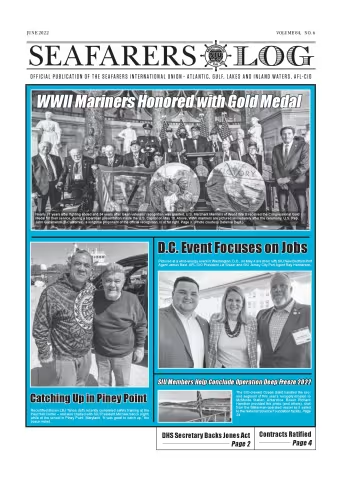
DHS Secretary Backs Jones Act
Page 2
Contracts Ratified
Page 4
Catching Up in Piney Point
Recertified Bosun LBJ Tanoa (left) recently completed safety training at the
Paul Hall Center – and also chatted with SIU President Michael Sacco (right)
while at the school in Piney Point, Maryland. “It was great to catch up,” the
bosun noted.
D.C. Event Focuses on Jobs
Pictured at a wind-energy event in Washington, D.C., on May 4 are (from left) SIU New Bedford Port
Agent James Bast, AFL-CIO President Liz Shuler and SIU Jersey City Port Agent Ray Henderson.
The SIU-crewed Ocean Giant handled the sec-
ond segment of this year’s resupply mission to
McMurdo Station, Antarctica. Bosun Richard
Hamilton provided this photo (and others), shot
from the Waterman-operated vessel as it sailed
to the National Science Foundation facility. Page
24.
SIU Members Help Conclude Operation Deep Freeze 2022
WWII Mariners Honored with Gold Medal
Nearly 77 years after fighting ended and 34 years after token veterans’ recognition was granted, U.S. Merchant Mariners of World War II received the Congressional Gold
Medal for their service, during a bipartisan presentation inside the U.S. Capitol on May 18. Above, WWII mariners are pictured immediately after the ceremony. U.S. Rep.
John Garamendi (D-California), a longtime proponent of the official recognition, is at far right. Page 3. (Photo courtesy Defense Dept.)
73682_JUNE 2022_SEAFARERS_LOG_X.indd 1 5/23/22 4:16 PM
2 Seafarers LOG June 2022
The Seafarers LOG (ISSN 1086-4636) is published monthly by the
Seafarers International Union; Atlantic, Gulf, Lakes and Inland Waters,
AFL-CIO; 5201 Capital Gateway Drive; Camp Springs, MD 20746.
Telephone (301) 899-0675. Periodicals postage paid at Southern Maryland
20790-9998. POSTMASTER: Send address changes to the Seafarers LOG,
5201 Capital Gateway Drive, Camp Springs, MD 20746.
Communications Director, Jordan Biscardo;
Assistant Communications Director & Managing Editor/
Production, Jim Guthrie; Assistant Editor, Nick Merrill;
Administrative Support, Jenny Stokes. Copyright ©
2022 Seafarers International Union, AGLIW. All Rights
Reserved.
Volume 84 Number 6 June 2022
The SIU online: www.seafarers.org
The Seafarers International
Union engaged an environ-
mentally friendly printer
for the production of this
newspaper.
Reversed to White
Reversed to White
O F F I C I A L P U B L I C A T I O N O F T H E S E A F A R E R S I N T E R N A T I O N A L U N I O N A T L A N T I C , G U L F, L A K E S A N D I N L A N D W A T E R S , A F L - C I O
Answering the Call
President’s Report
Congratulations to SIU members and to all of our union’s port per-
sonnel for the incredible job you did last month in filling a large number
of jobs in less than 24 hours, in response to a handful of no-notice vessel
activations. Our industry, like so many others, is currently weathering
a manpower strain, so this wasn’t exactly an
ideal time to handle those activations – but
you all rose to the occasion, like always.
On one hand, sure, this was just a case of
doing our jobs. But realistically, it wasn’t easy,
it was important and time-sensitive, and our
team answered the call.
I extend my thanks and admiration to ev-
eryone who helped get it done.
New Leadership at MARAD
Speaking of congratulations, I’m glad to
note the recent confirmation of Rear Adm. Ann
Phillips (USN, Ret.) to the post of maritime ad-
ministrator. She definitely has big shoes to fill
– our longtime friend, Rear Adm. Mark Buzby,
did an excellent job at MARAD (and previ-
ously at the Military Sealift Command) – but I know she’s up to the task.
We’re already working with the new administrator and will continue
doing everything possible to help the agency fulfill its critical mission
of strengthening and maintaining the U.S. Merchant Marine. MARAD
obviously is a crucial agency for Seafarers; their work to promote Amer-
ican-flag shipping and U.S. crews is part of our lifeblood.
My thanks also go to Lucinda Lessley for her outstanding work as
acting administrator prior to Adm. Phillips’ confirmation. Her integrity
and thoughtfulness shined through at all times.
Register and Vote
While some Seafarers already have voted in this year’s primaries,
it’s not too soon for others to double-check their voter registration status
ahead of Election Day 2022 (Tuesday, November 8). Make sure you and
your eligible family members are registered, and please support pro-
maritime, pro-worker candidates.
Without question, there has been an awakening across the U.S. re-
garding workers’ rights. In part, that’s why the labor movement finds
itself at a crossroads with the elections on the horizon. The combina-
tion of a labor-friendly administration and a rising interest in collective
action has generated considerable momentum, but at the same time,
the opponents of labor are as well-funded and determined to dismantle
worker power as they have ever been. To make matters even more com-
plicated, partisan gridlock has stalled progress on more than one item on
the labor movement’s agenda.
It’s no secret that union membership across the country has declined
over the years, but union households still play a major role in determin-
ing outcomes of many elections. This depends, though, on everyone
from the movement exercising their constitutional right to vote. That the
enemies of the working class have attempted so many times to interfere
with that right only reveals how terrified they are of a unified labor
movement making its voice heard.
This encouragement goes beyond presidential and congressional
elections. Union families must vote the whole ballot from state legisla-
tures to city hall to local school boards. Those who seek to swipe power
away from America’s working class operate best under the cover of
darkness, funneling money into races and legislative manipulations that
mostly escape the notice of national and even your local media.
That’s why labor cannot leave any political stone unturned. Leader-
ship must do its part to educate members on the issues, but ultimately
the responsibility rests with each union member to cast her or his bal-
lot strategically. Without concentrated political power at every level of
government, the labor movement cannot achieve its goals. And make no
mistake, those goals benefit not just America’s working families, but all
of America.
Michael Sacco
U.S. Department of Homeland Security Sec-
retary Alejandro Mayorkas recently underscored
his support of America’s freight cabotage law.
During an April 27 hearing of the House Ap-
propriations Subcommittee on Homeland Secu-
rity, the secretary answered a question from U.S.
Rep. Steven Palazzo (R-Mississippi) about the
Jones Act.
Palazzo noted that during his time in Con-
gress, he has seen “constant attacks against the
Jones Act by special interest groups bent on
allowing foreign ships and crews to push out
American sailors and shipbuilders.”
The congressman then pointed out that Presi-
dent Biden’s Made in America executive order
“explicitly emphasized the importance of Jones
Act shipping…. Do you support the Jones Act
and are you committed to rigorous enforcement
of the Jones Act?”
Mayorkas replied, “I do and I am. And I want
you to know that the President’s Buy American
initiative is something that he is holding the en-
tire administration to. We have strict protocols
to which we must adhere and we do so quite
proudly with respect to our contracting to make
sure that we are indeed buying American…. I do
believe in the Jones Act. I do support it. I know
I have a waiver authority and we exercise that
quite prudently in only cases of emergency….”
The hearing concerned the Fiscal Year 2023
Department of Homeland Security Budget.
The Jones Act is vital to U.S. national, eco-
nomic and homeland security. It helps sustain
more than 650,000 American jobs while pump-
ing billions of dollars into the U.S. economy
each year.
DHS Secretary Backs Jones Act
DHS Secretary Alejandro Mayorkas
House Staffers May Form a Union
U.S. Rep. Andy Levin (D-Michigan), longtime
union organizer and member of the House Educa-
tion and Labor Committee and the House Labor
Caucus, announced on May 10 that the U.S. House
of Representatives adopted his resolution to grant
congressional staff in the right to organize and bar-
gain collectively, which was included in the rule for
the Ukraine supplemental, by a vote of 217-202.
The passage of the House resolution is the final
step required to grant legal protection to most con-
gressional House employees. The Senate must pass
its own resolution in order for Senate employees to
have the same protections.
“After 26 years, the House has finally provided
its workers the fundamental human right to form
a union without fear of retaliation. As someone
who has spent decades in the labor movement
and devoted their life to protecting and enhanc-
ing workers’ rights, this moment stands out as a
major highlight,” said Levin. “Congressional staff
are joining a broader movement of workers in our
society who are organizing, bargaining collectively
and stepping up to make clear that they want more
of a voice in their workplaces. I’m so proud that
Congressional Democrats upheld our values of be-
lieving in the collective voice today. If there is any
place in the country that needs to walk the walk and
respect the will of workers, it is the U.S. Congress –
the bedrock of democracy. We cannot stop fighting
until every worker in the country can form a union
without interference.”
He added, “I want to thank deeply Speaker
Nancy Pelosi (D-California), Majority Leader
Steny Hoyer (D-Maryland), Whip James Clyburn
(D-South Carolina) and Chairperson Zoe Logfren
(D-California) for their partnership in this important
effort and for their steadfast commitment to workers
in the People’s House. Finally, I want to express my
sincere gratitude and admiration to the congressio-
nal staff who fought to make this moment possible,
shared bravely their workplace experiences, good
and bad, clearly illustrated their need for the pro-
tected right to organize and demonstrated the sheer
power of worker solidarity.”
Logfren stated, “One of the first votes I cast as
a Member of the House – late on my very first day
in that Congress – was to pass the Congressional
Accountability Act. As someone who grew up in
a union family, as a former congressional staffer,
and as a longtime advocate of workers’ rights and
protections, I was proud to cast that vote. However,
Congress failed to follow through on an important
part of the law that would provide legislative branch
staff with the option to organize, if they choose.
Today, I’m proud to cast my vote for Congress to
follow through on that promise. I am thankful for
the tireless advocacy on behalf of Congressional
staff by my colleague Representative Levin, the
members of the Congressional Workers Union for
their courage, and Speaker Pelosi for her leadership
as we act to support those who make our work on
behalf of the American people possible.”
U.S. Rep. Joe Courtney (D-Connecticut),
a longtime advocate of the U.S. maritime
industry, received the prestigious Salute
to Congress award May 17 in Arlington,
Virginia. The award is sponsored by the
International Propeller Club. When an-
nouncing Courtney’s selection as this
year’s honoree, International Propeller Club
President C. James Patti said, “During his
time in Congress, Chairman Courtney has
been a forceful and outspoken advocate
for all segments of the maritime industry.
Throughout his career, he has played a key
role in the enactment of numerous maritime
legislative initiatives and has worked tire-
lessly to ensure that the programs and poli-
cies important to our industry are funded,
implemented and enforced.” SIU Executive
Vice President Augie Tellez and Legislative
Director Brian Schoeneman attended the
gathering.
International Propeller
Club Honors U.S. Rep.
Joe Courtney At Event
U.S. Rep. Joe Courtney (D-Connecticut)
73682_JUNE 2022_SEAFARERS_LOG.indd 2 5/20/22 8:11 PM
June 2022 Seafarers LOG 3
The coalition USA Maritime, to which
the SIU is affiliated, has expressed strong
opposition to a misguided attempt to turn
over the transportation of U.S.-government
financed cargoes to foreign-flag, foreign-
crewed shipping interests. Such a move
would, according to USA maritime, severely
weaken the U.S.-Flag Merchant Marine,
cost thousands of American maritime work-
ers their jobs, and destroy the ability of the
U.S.-flag industry to provide the commer-
cial sealift readiness capability relied upon
by the Department of Defense.
Writing in response to a pair of con-
current resolutions introduced in the U.S.
Senate, the coalition described the “ship
American” components of cargo preference
as “essential to the maintenance of our U.S.-
Flag Merchant Marine.”
Further, USA Maritime called the resolu-
tions unnecessary, because the law “already
allows for the waiver of Ship American pref-
erences if U.S.-flag vessels are not available
at fair and reasonable rates. USAID cur-
rently waives Ship American rules for 40%
of its flagship Food for Peace program and
awards 70% of such cargoes to foreign car-
riers.”
The statement continued, “The resolu-
tions are overbroad. They are not limited
only to supplies for Ukraine but would waive
Ship American rules everywhere. Resolution
37 would waive Ship American rules indefi-
nitely; Resolution 38 would divert cargoes
to foreign carriers for an arbitrary three-year
period.”
Significantly, the coalition also spelled
out how the resolutions “dramatically over-
state the cost of shipping American. All
ocean shipping under the Food for Peace
program – foreign-flag and U.S.-flag com-
bined – accounts for only 8% of program
costs. The premium for using U.S.-flag ships
accounts for less than 1% of program costs.”
The statement concluded, “Today’s en-
vironment of rising peer nation competition
from Russia and China is not the time to give
up our U.S.-flag shipping capacity or turn
it over to foreign interests. We need to be
prepared to support our allies in Europe and
elsewhere with American sealift ships and
American mariners who have never failed to
answer the call when needed by our nation.”
According to the U.S. Department of
Transportation, cargo preference “is the
general term used to describe U.S. laws,
regulations and policies that require the
use of U.S.-flag vessels in the movement
of cargo that is owned, procured, furnished,
or financed by the U.S. Government. It also
includes cargo that is being shipped under
an agreement of the U.S. Government, or as
part of a Government program.”
Preference cargoes typically include mil-
itary items, food aid, and shipments gener-
ated by the U.S. Export-Import Bank. There
are corresponding percentage requirements
that specify how much of the cargo must be
moved on American bottoms, ranging any-
where from 50 to 100 percent.
Cargo amounts themselves vary from
year to year. For example, according to the
Congressional Research Service, U.S. inter-
national food-assistance outlays fluctuated
from Fiscal Years 2016 to 2020 based in part
on demands that changed due to conflicts in
Syria, South Sudan, Somalia, and Ethiopia.
In the fiscal year beginning October 1, 2020
and ending September 30, 2021, U.S.-flag
ships delivered approximately 650,000
metric tons of food-aid cargoes around the
globe.
USA Maritime: Keep ‘Ship American’ Rules
“The premium for using U.S.-flag ships accounts for less than 1% of
program costs.” – USA Maritime
The SIU on May 18 joined in cel-
ebrating long-overdue recognition for
U.S. Merchant Mariners of World War
II as they received the Congressional
Gold Medal in the Capitol Building.
Ten members of the American Mer-
chant Marine Veterans (AMMV) partici-
pated in the one-hour ceremony, which
featured remarks from members of con-
gress, the administration, and the mili-
tary. SIU Executive Vice President Augie
Tellez represented the SIU at the event.
The Congressional Gold Medal is the
highest honor bestowed by the U.S. Con-
gress. The veterans received the medal
on behalf of the approximately 1,500 re-
maining mariners of World War II.
More than 1,200 SIU members lost
their lives in wartime service.
“The bravery demonstrated by the
U.S. Merchant Mariners to keep Allied
Forces supplied during World War II is
second to none,” said AMMV President
Dru DiMattia. “In the face of targeted
attacks by German submarines and U-
boats, the unarmed U.S. Merchant Mar-
iners met the moment with resilience
and courage, and serve as an inspiration
for all of American maritime.”
In 2020, Congress unanimously
passed the Merchant Mariners of World
War II Congressional Gold Medal Act
thanks in part to the advocacy of U.S.
Rep. John Garamendi (D-California)
and Senator Lisa Murkowski (R-
Alaska) along with organizations in-
cluding the SIU. The bill was promptly
signed into law, but the official award
was delayed due to the global pandemic.
“We gave up our yesterdays for your
and their tomorrow,” stated former mar-
iner Dave Yoho during the ceremony,
which he called a “humble tribute to
my fallen brothers.” Yoho served in
the engine department, signing on as a
16-year-old.
House Speaker Nancy Pelosi (D-
California) and Senate Republican
Leader Mitch McConnell (Kentucky)
led the congressional delegation to rec-
ognize the mariners.
“We celebrate these patriots for
doing their part to preserve liberty,” Pe-
losi told them.
“They earned their rallying cry: ‘We
deliver the goods,’” added McConnell.
Garamendi and the late U.S. Rep.
Don Young (R-Alaska) pushed Con-
gress for years to honor the World War
II mariners with a gold medal.
After saying it was “a great day,
a happy day,” Garamendi declared,
“Without you, the success of the World
War II would not have happened.”
House Republican Leader Kevin
McCarthy (California) said the presen-
tation was “long overdue.” He saluted
the mariners: “Everything America
asked them to do, they delivered.”
U.S. Rep. Joe Courtney (D-Connect-
icut) paid tribute by quoting President
Franklin Roosevelt: “The merchant ma-
rine delivered the goods when and where
needed in every theater of operation and
across every ocean in the biggest, most
difficult job ever undertaken.”
Also taking part in the presentation
were Rear Adm. Michael Wettlaufer,
commander of the U.S. Military Sealift
Command; U.S. Coast Guard Vice Ad-
miral Scott Buschman; and U.S. Mari-
time Deputy Administrator Lucinda
Lesley.
The gold medal will be placed on
display in the American Merchant Ma-
rine Museum at the Academy in Kings
Point, New York. The World War mari-
ners on hand received duplicates. They
included Yoho, William Balabanow,
Gerard Driscoll, James T. Lindsey,
Charles A. Mills, George Offenhauser
Sr., Bob Ross, James Sciple, Jack Laub
and George Shaw.
For information on ordering a rep-
lica of the medal, email Katrina McRae
at katrina.mcrae@dot.gov.
World War II Merchant Mariners Honored
With Congressional Gold Medal in D.C.
One day before the medal ceremony, personnel from the American Merchant Marine Veterans, their families and
friends visit the National World War II Memorial in Washington, D.C.
Ann Phillips is the new head
of the U.S. Maritime Adminis-
tration (MARAD), following her
confirmation by the Senate on
May 10.
Phillips retired as a rear ad-
miral after serving nearly 31
years on active duty with the
U.S. Navy.
“We look forward to work-
ing with Admiral Phillips at the
Maritime Administration,” stated
SIU President Michael Sacco.
“She has an accomplished record
within the Navy and in Virginia.
“We also thank Lucinda Less-
ley for her work as the acting ad-
ministrator,” he added.
Prior to being nominated by
President Biden in October 2021,
Phillips was the Special Assis-
tant to the Virginia Governor for
Coastal Adaptation and Protec-
tion. In that role, she coordinated
with federal, state and local part-
ners to create equitable strategies
to deal with rising waters and
climate impact to critical coastal
infrastructure assets within the
commonwealth.
She received her commis-
sion through the Naval Reserve
Officers Training Corps upon
graduation from the University
of North Carolina in 1983. She
served aboard two vessels – the
USS Cape Cod and the USS San
Jose – during Operations Desert
Shield/Desert Storm. She was
the first commanding officer
aboard the USS Mustin.
As the executive assistant to
the 6th Fleet Commander, Phil-
lips was involved in the deploy-
ment of goods in support of the
Pakistani earthquake relief ef-
forts. Prior to her retirement, she
was commander of Expedition-
ary Strike Group Two, which
included 14 vessels and 10 sub-
ordinate commands – all part of
the Amphibious Expeditionary
Forces along the U.S. east coast.
She earned a Master of Busi-
ness Administration from the Col-
lege of William and Mary in 2016.
Ku’uhaku Park, president of
the American Maritime Partner-
ship (to which the SIU is affili-
ated), said Phillips’ confirmation
comes “at a time when maintain-
ing a strong American Maritime
is even more critical than ever.
We look forward to working
with Admiral Phillips to ensure
our nation has the shipbuild-
ing, sealift capacity, and reliable
movement of commerce that is
essential to America’s security.”
MARAD is self-described
as the Department of Transpor-
tation agency “responsible for
America’s waterborne transpor-
tation system…. At our core, we
support the technical aspects of
America’s maritime transporta-
tion infrastructure – things like
ships and shipping, port and
vessel operations, national se-
curity, environment, and safety.
We promote the use of water-
borne transportation, and ensure
that its infrastructure integrates
seamlessly with other methods
of transportation. MARAD also
maintains a fleet of cargo ships
in reserve to provide surge sealift
during war and national emer-
gencies, and is responsible for
disposing of ships in that fleet,
as well as other non-combatant
government ships as they be-
come obsolete.
“Beyond that, we work hard
to maintain the overall health of
the U.S. Merchant Marine. Com-
mercial mariners, vessels, and
intermodal facilities are vital
for supporting national security,
and so the agency provides sup-
port and information for current
mariners, extensive support for
educating future mariners, and
programs to educate America’s
young people about the vital
role of maritime operations in
the lives of all Americans.”
Rear Adm. Phillips Takes
Leadership Reins At U.S.
Maritime Administration
Ann Phillips testifies at a Senate
hearing in late December 2021.
(Sipa USA/Alamy)
73682_JUNE 2022_SEAFARERS_LOG.indd 3 5/20/22 8:11 PM
4 Seafarers LOG June 2022
SIU members employed by Penn Mari-
time recently ratified a three-year contract
that features significant gains.
The new agreement, approved in
mid-April and covering approximately
250 Seafarers, calls for annual wage in-
creases; boosts contributions to the Sea-
farers Money Purchase Pension Plan
(SMPPP); raises the food allowance; and
provides medical coverage for all mem-
bers through the Seafarers Health and
Benefits Plan (SHBP).
The latter point is noteworthy, accord-
ing to members and union officials. Penn
Maritime was acquired by Kirby Corpora-
tion in 2012. Since then, any new employ-
ees received medical coverage through a
company plan. Typically, those mariners
paid several thousand dollars apiece each
year just for the premiums (whereas Penn
Maritime members covered via the SHBP
do not have to pay premiums).
“Getting everybody back on the SHBP
medical coverage was huge,” said Chief
Mate John Harvard, who served on the
union negotiating committee. “For guys
that have families, it’s a really big help.
It shows that the company has some com-
mitment to the members; hopefully, we
can keep building trust and mutual re-
spect.”
The SIU bargaining team included
Vice President Gulf Coast Dean Corgey,
Vice President Atlantic Coast Joseph
Soresi, Assistant Vice President Mike
Russo, Harvard, Lead Tankerman Mi-
chael Lyons and Chief Engineer Jeff
Rydza. Negotiations took place in Hous-
ton.
“This is a great example of a union and
a company working together to hammer
out a good agreement,” Russo said. “It’s
something we can all be proud of. I think
everybody walked away feeling good
about this.”
Harvard said the contract “exceeded
my expectations. I think it was a good
contract and we’re headed in the right di-
rection. You don’t always walk away with
everything you want, but we didn’t lose
anything – just gained. Kudos to Dean,
Joe and Mike for their work on the con-
tract.”
Soresi said, “The bargaining went well
and we secured a good agreement. It cer-
tainly seems as if most the members are
happy with the results.”
Penn Maritime operates up to 15 tug-
boats and barges in the Gulf region, pri-
marily moving asphalt along inland and
coastal waterways.
Penn Maritime Crews Approve 3-Year Pact
Pictured from left are Lead Tankerman Michael Lyons, Chief Mate John Harvard, SIU VP Atlantic Coast Joseph Soresi, Kirby Exec. VP
of Vessel Operations Jim Guidry, SIU Asst. VP Mike Russo and Chief Engineer Jeff Rydza.
Seafarers Ratify New Contract
At VanEnkevort Tug and Barge
A new six-year agreement is in place for
Seafarers employed at VanEnkevort Tug &
Barge, Inc. (VTB). Members overwhelm-
ingly ratified the pact through a combination
of shipboard and remote voting in April.
The contract took effect April 1 and lasts
through March 2028. It calls for annual wage
increases for the first three years and then
a wage and benefit reopener in April 2025.
The pact boosts company contributions to
the Seafarers Money Purchase Pension Plan
(SMPPP), maintains health benefits, and also
preserves the Paul Hall Center benefit for
training and upgrading.
SIU Assistant Vice President Bryan Pow-
ell and Port Agent Todd Brdak negotiated on
behalf of the union.
Nearly 50 Seafarers are employed by VTB.
They work aboard four state-of-the-art articu-
lated tug-barge units on the Great Lakes, pri-
marily hauling taconite and stone.
VTB was founded in 1967.
Conveyorman Chris Heffernan said
maintaining health care coverage and secur-
ing yearly wage increases for the first three
years are the contract’s highlights.
OS Joshua Childers said he values the boost
to the SMPPP “and how every year, there will
be pay raises. This was a good step forward,
working towards what everybody wants.”
Powell stated,“This agreement provides
a robust wage package and various other
enhancements for our members working for
VTB. It is a fair and reasonable package both
for the members and company, which is al-
ways the goal.”
SIU Algonac Port Agent Todd Brdak (left in photo directly above) meets with Cook Mark Quin-
ney, AB Jonathan Slanga, OS Darrin McMillan, OS Alphonso Davis and OS Joshua Childers
aboard the Dirk VanEnkevort in Toledo, Ohio. Pictured from left aboard the Clyde VanEnkevort
in Toledo, Ohio in photo at immediate right are SIU Patrolman Ryan Covert, Watchman Gerald
Johnson, Conveyorman Chris Heffernan, OS Adam VonRiedel and AB/Delegate Anthony Cronk.
The SIU-crewed Laura L. VanEnkevort is shown in the photo at top right.
73682_JUNE 2022_SEAFARERS_LOG.indd 4 5/20/22 8:11 PM
June 2022 Seafarers LOG 5
Biden Administration Mandates U.S.
Materials for Infrastructure Projects
The White House has issued new
guidance, requiring that the materials
purchased for projects funded by the
Infrastructure Investment and Jobs Act
(IIJA) be produced domestically. The
stated goal is to ensure that federal
dollars spent on infrastructure projects
support U.S. manufacturing and stimu-
late the domestic economy.
As highlighted by this latest guid-
ance, the bipartisan infrastructure
package contained a requirement that,
starting on May 14, “none of the funds”
allocated to federal agencies for proj-
ects may be spent “unless all of the
iron, steel, manufactured products, and
construction materials used in the proj-
ect are produced in the United States.”
“From day one, every action I’ve
taken to rebuild our economy has
been guided by one principle: Made
in America,” President Joe Biden said
in an April 14 speech in Greensboro,
North Carolina. “It takes a federal gov-
ernment that doesn’t just give lip ser-
vice to buying American but actually
takes action.”
“There are going to be additional op-
portunities for good jobs in the manu-
facturing sector,” said Celeste Drake,
director of Made in America at the White
House Office of Management and Bud-
get.
Biden said he looks to reduce reliance
on foreign materials, create American
jobs and ease supply chain concerns.
United Steelworkers (USW) Inter-
national President Tom Conway said
in a statement, “President Joe Biden’s
interim Build America, Buy America
guidance will ensure that publicly
funded infrastructure projects help
to rebuild the nation’s manufacturing
base, strengthen supply chains and sup-
port good-paying jobs for U.S. work-
ers…. America’s workers stand ready
not only to build new transportation
systems, communications networks and
other infrastructure through the IIJA,
but to supply the raw materials, parts
and components needed for all of those
projects. These workers lead the world
in responsible production practices,
and they’ll deliver unparalleled quality,
ensuring new roads, bridges and other
improvements stand the test of time.
The USW looks forward to working
with President Biden and his adminis-
tration to finalize the Build America,
Buy America guidance and unlock the
full power of the IIJA.”
The guidance includes three condi-
tions that must be met for the require-
ment to be waived: if the purchase
“would be inconsistent with the public
interest”; if the needed materials aren’t
produced “in sufficient and reasonably
available quantities or of a satisfactory
quality”; or if U.S. materials increase a
project’s cost by more than 25%.
President Biden speaks in mid-April in North Carolina, underscoring his commitment to
maintaining U.S. jobs. (Image courtesy White House Twitter account)
The Biden administration will continue working to
be known not merely as pro-worker, but as the most
pro-union administration in U.S. history.
Vice President Kamala Harris delivered that message
April 12 during a gathering at a Sheet Metal Workers
facility in Philadelphia. Attendees included U.S. Sec-
retary of Labor Marty Walsh; U.S. Sen. Bob Casey
(D-Pennsylvania); U.S. Rep. Mary Scanlon (D-Penn-
sylvania); U.S. Rep. Dwight Evans (D-Pennsylvania);
Pennsylvania Gov. Tom Wolf (D); Philadelphia Mayor
Jim Kenney (D); and AFL-CIO President Liz Shuler,
who traveled with the vice president.
Harris described Shuler as a friend and “a fighter.
She goes to work every day for the working people of
our nation, and she is an essential partner to our admin-
istration.”
The vice president’s speech was titled, “The Admin-
istration’s Historic Commitment to Worker Organizing
and Empowerment.” She detailed many of the steps that
demonstrate the commitment, including cross-country
travel with Walsh for visits to “job sites and training
facilities and union halls.”
After mentioning Walsh’s long background in or-
ganized labor (including growing up in a union house-
hold), Harris said that although their respective histories
differ, they have much in common.
“My parents met while they were marching for civil
rights,” Harris stated. “They taught me that people can
make a difference and that when we use our collective
voice, whether at a protest or a picket line, we can drive
great change. And that belief in the power of solidarity
has guided me, [Walsh], and all of us our entire lives.
And it guides our administration.
“President Joe Biden and I are determined to lead
the most pro-union administration in America’s history,”
she continued. “We know, each and every day in ways
big and small, unions change lives. Unions negotiate
better wages and safer working conditions for millions
of workers around our country.”
Harris also pointed out, “Even if you are not a mem-
ber of a union, you (should) thank unions for every
benefit that you receive. Thank unions for the five-day
workweek, for the weekend, for sick leave. We should
all – anyone who works in America – know that you
have benefited from the hard work, from the fight of the
leaders in this movement. Our labor leaders, our unions
train people to take on good jobs.”
However, unions contribute more to society than just
a skilled workforce, she said. The labor movement and
the good jobs it helps create and maintain “provides
community. It provides home. It provides a place that
remembers that nobody should be made to fight alone.
It is so fundamental in terms of the approach, which
says that we all know we are stronger when we stand
together. That is at the heart of the spirit behind this
movement.”
She continued, “Unions create stronger communities.
They bring people together. And they, of course, protect
workers from things like harassment and discrimination.
They give workers a voice. Put simply, unions move our
nation forward. And the American people know it. The
American people know that when unions win, work-
ers win, families win, communities win. When unions
win, America wins, as evidenced by the fact that, today,
unions have their highest approval rating since 1965.”
Despite the favorable views of unions, it often re-
mains an uphill climb to join one. The vice president
said that’s because, in part, “powerful forces in our
country have been hard at work building barriers to stop
workers from organizing. We’ve got to then take it on
with a powerful counterforce, which is why our admin-
istration is working even harder to tear those barriers
down.”
She discussed the work of the White House Task
Force on Worker Organizing and Empowerment, which
she and Walsh lead. “Last year, our task force proposed
nearly 70 actions the executive branch of our govern-
ment can take to protect and expand the rights of work-
ers to organize and collectively bargain,” Harris stated.
“Our President, Joe Biden, accepted every single one.”
Harris explained that the bipartisan infrastructure bill
that recently became law “will put thousands of union
workers, carpenters, and pipefitters, and plumbers, and,
yes, sheet metal workers, to work across the country.”
She concluded, “Every worker deserves a safe and
a healthy workplace. Every worker deserves a job with
good wages and fair benefits. Every worker in America
deserves the choice to join a union. And the President
and I will always stand with you to defend these sa-
cred principles. Our administration will do everything
in our power to ensure the workers of our nation can
succeed and can thrive. Because when workers succeed
and thrive, so does our nation.”
VP Emphasizes ‘Historic Commitment
To Worker Organizing and Empowerment’
Vice President Kamala Harris tells a Philadelphia audi-
ence that the administration remains solidly committed
to workers and the labor movement. (Photo by Bastiaan
Slabbers)
73682_JUNE 2022_SEAFARERS_LOG.indd 5 5/20/22 8:43 PM
6 Seafarers LOG June 2022
The AFL-CIO on April 26 released its
31st annual report, “Death on the Job: The
Toll of Neglect,” a national and state-by-
state profile of worker safety and health.
The report features information on work-
place fatalities, injuries and illnesses,
as well as workplace safety inspections,
penalties, funding, staffing and public em-
ployee coverage under the Occupational
Safety and Health (OSH) Act. It also in-
cludes information on the state of mine
safety and health, and the state of worker
safety during the COVID-19 pandemic.
During a video press conference which
highlighted the report’s release, AFL-CIO
President Liz Shuler outlined the findings
of this year’s narrative and stressed the
federation’s commitment to worker safety.
She also expresses urgency in holding the
Occupational Safety and Health Admin-
istration (OSHA), the Mine Safety and
Health Administration (MSHA), Congress
and employers everywhere accountable for
stronger safety measures. Joining Shuler
were AFL-CIO Safety and Health Direc-
tor Rebecca Reindel; M.J. Burke, first
executive vice president of the American
Federation of Government Employees Na-
tional VA Council; and Isaiah Thomas, an
Amazon warehouse worker in Bessemer,
Alabama.
Among other disturbing findings, this
year’s report reveals that in 2020:
n 340 working people died every day
because of hazardous working conditions.
n More than 4,764 workers were killed
on the job from injuries alone.
n An estimated 120,000 workers died
from occupational diseases.
n The job fatality rate was 3.4 per
100,000 workers.
n Latino and Black workers remain at
greater risk of dying on the job than all
workers.
n Employers reported nearly 3.2 mil-
lion work-related injuries and illnesses.
n Musculoskeletal disorders continue
to make up the largest portion (21%) of
work-related injuries and illnesses.
n Underreporting is widespread—the
true toll of work-related injuries and ill-
nesses is estimated at 5.4 million to 8.1
million each year.
“That’s tens of thousands of families
losing a parent, a child, a sibling, every sin-
gle year,” said Shuler. “Latino and Black
workers specifically remain at greater risk
of dying on the job than all workers. That
is, frankly, unacceptable.”
Despite these disturbing findings,
OSHA still does not have the resources
needed to hold employers accountable and
enact lasting change, the federation re-
ported. “Workers need more job safety and
health protections, not less,” the AFL-CIO
said when announcing the report. “Last
year, there were only 1,719 OSHA inspec-
tors nationwide, 755 on the federal level
and 965 on the state level. That’s just one
inspector for every 81,427 workers. Fed-
eral OSHA’s budget amounts to $4.37 to
protect each worker, with no federal stan-
dards for protections against workplace
violence and COVID-19.”
Reindel emphasized how the AFL-CIO
is calling on both OSHA and MSHA to
enact stronger job safety and health pro-
tections, for Congress to increase resources
for job safety agencies, and for workers to
have a real voice on safety and health in
our workplaces without the fear of retalia-
tion or intimidation.
“Having regulations is important,” said
Burke during the call. “COVID-19 and
the pandemic disproportionately impact
minorities and Latinos, as well as women
who are about to give birth. It’s so im-
portant as we hear the voices of workers
across America. I can tell you why I joined
a union: It’s about the safety and security
of each other.”
“Amazon loves to brag about how they
have a safe work environment, and if there
are any issues, the workers can bring them
up to management,” said Thomas. “How-
ever, we do not work in a safe work en-
vironment, and every time we bring these
issues up to management, we are not heard,
which is why we’re fighting so hard for our
union at Amazon.”
The OSH Act went into effect some
51 years ago, promising every worker
the right to a safe job. More than 647,000
workers now can say their lives have been
saved since the passage of the OSH Act,
the AFL-CIO reported. Since that time,
workplace safety and health conditions
have improved, the federation added.
“But too many workers remain at serious
risk of injury, illness or death as chemical
plant explosions, major fires, construction
collapses, infectious disease outbreaks,
workplace assaults and other preventable
workplace tragedies continue to occur,”
the AFL-CIO stated. “Workplace hazards
kill and disable approximately 125,000
workers each year – 4,764 from traumatic
injuries, and an estimated 120,000 from oc-
cupational diseases. Job injury and illness
numbers continue to be severe undercounts
of the real problem.
“Over the years, our progress has be-
come more challenging as employers’ op-
position to workers’ rights and protections
has grown, and attacks on unions have in-
tensified,” the federation continued. “Big
Business and many conservative politi-
cians have launched aggressive assaults on
worker protections. They are attempting to
shift employers’ responsibility to maintain
a safe workplace to individual worker be-
havior, and undermine the core responsi-
bilities of workplace safety agencies.”
The federation also reported that the
prior administration in Washington “rolled
back progress, attacking longstanding
workplace safety protections – targeting
job safety rules on beryllium, mine safety
examinations and injury reporting, and
cutting agency budgets and staff – and at-
tempted to dismantle the systems for future
protections.”
In the fall of 2019, OSHA began reduc-
ing the number of inspections involving
significant cases and complex health haz-
ards, a policy that is still in place today. In
the first year of the COVID-19 pandemic,
OSHA was largely absent from workplaces
where it has the authority and responsi-
bility to enforce workplace safety laws,
according to the federation. While the
number of inspectors and inspections have
improved in FY 2021, “there is much more
progress to be made to meet or exceed pre-
pandemic levels,” the AFL-CIO noted.
“The COVID-19 pandemic also brought to
light the weaknesses in federal oversight of
state OSHA plans. Congress continues to
fund job safety at stagnant levels, allowing
an OSHA budget that still only amounts to
$4.37 to protect each worker covered by
the OSH Act.”
The federation concluded, “While
progress is slow, the Biden administra-
tion has taken important steps to protect
workers, prioritizing worker protections
on its regulatory agenda, taking steps on
targeted enforcement efforts on urgent
hazards, and filling staff and leadership
vacancies. It also launched broad efforts
on worker empowerment and targeting
workplace inequities. President Joe Biden
has appointed and nominated strong can-
didates focused on worker protection to
lead job safety and health agencies and
labor agencies. Immediately upon taking
office, he appointed a longtime United
Steelworkers (USW) safety and health
leader, James Frederick, as acting assis-
tant secretary for occupational safety and
health. In April 2021, the Senate con-
firmed Marty Walsh, the Boston mayor
from the construction trades unions, as
secretary of labor. In April 2021, Biden
nominated Doug Parker to be assistant
secretary of labor for occupational safety
and health – the head of OSHA – and he
was confirmed Oct. 25, 2021.”
The “Death on the Job: The Toll of
Neglect” report may be viewed in its en-
tirety at aflcio.org/reports/death-job-toll-
neglect-2022
AFL-CIO Posts Annual ‘Death on the Job’ Report
A top executive from an SIU-con-
tracted company recently received acco-
lades from the U.S. Coast Guard.
On April 22, the Coast Guard Fed-
eration conducted its 26th Tribute to the
United States Coast Guard Seventh Dis-
trict, which honors personnel from the
agency and members of the general mari-
time community who have contributed to
the success of the Coast Guard’s mission.
The night’s main honoree was Dan-
iel Thorogood, president and CEO of
Seabulk, for his support of the men and
women of the Coast Guard throughout
his career, which spans more than 30
years.
In attendance from the SIU were Ex-
ecutive Vice President Augie Tellez, Vice
President of Contracts and Contract En-
forcement George Tricker, Assistant Vice
President Kris Hopkins, and Seafarers
Plans Administrator Margaret Bowen.
During his remarks, Thorogood told
a story about how Coast Guard-operated
landing craft supported U.S. Marines in
the Pacific Theater of World War II, ulti-
mately leading to the release of his grand-
parents, who had been taken captive by
Japanese forces from a diplomatic post-
ing.
Keynote speaker Coast Guard Com-
mandant Adm. Karl Schultz thanked the
foundation and those in attendance for
their support, and was met with a stand-
ing ovation. Schultz was set to retire from
the Coast Guard in June after 39 years of
service.
Also recognized were Coast Guard
and industry efforts to safely evacuate
250,000 cruise ship passengers at the
start of the pandemic, as well as the work
of a helicopter crew from Coast Guard
Air Station Clearwater that rescued four
people after extreme weather capsized
their vessel 30 miles west of Cedar Key
in June 2021.
Coast Guard Foundation
Recognizes Seabulk CEO
Daniel Thorogood, president and CEO
of Seabulk (left), is pictured with Crowley
Chief Operating Officer Ray Fitzgerald.
(Photo courtesy Coast Guard Foundation)
The U.S. Department of
Transportation’s Maritime Ad-
ministration (MARAD) in late
April announced the availabil-
ity of an additional $14.8 mil-
lion in funding, for a total of
$39.8 million, for the Ameri-
ca’s Marine Highway Program
(AMHP).
In March, MARAD an-
nounced the availability of
nearly $25 million in grant
funding for the AMHP through
the Bipartisan Infrastructure
Law. The FY 2022 Appropria-
tions Act made an additional
$14.8 million available for the
AMHP.
According to the agency,
“The America’s Marine High-
way Program supports the
increased use of the nation’s
navigable waterways to relieve landside
congestion, provide new and efficient
transportation options, and increase the
productivity of the surface transporta-
tion system. By working closely with
public and private organizations, the
AMHP helps create and sustain Ameri-
can jobs in U.S. ports, on vessels, and
at shipyards, while also improving our
supply chains.”
“Under the president’s leadership, we
are making a once-in-a-generation invest-
ment in our ports and intermodal infra-
structure to move goods faster, strengthen
supply chain resiliency, and reduce the
climate impacts of port operations,” said
Acting Maritime Administrator Lucinda
Lessley.
In announcing the additional funding,
MARAD also reported, “The Bipartisan
Infrastructure Law aims to rebuild Amer-
ica’s roads, bridges and rails; upgrade
and expand public transit; modernize
the nation’s ports and airports; improve
safety; help tackle the climate crisis; ad-
vance environmental justice; and invest
in communities that have too often been
left behind. It will drive the creation of
good-paying jobs and grow the economy
sustainably and equitably to help everyone
get ahead for decades to come.”
Marine Highway Program
Gets $14.8 Million Boost
Raises Available Grant Funding to nearly $40 Million
73682_JUNE 2022_SEAFARERS_LOG.indd 6 5/20/22 8:11 PM
June 2022 Seafarers LOG 7
Spotlight on Mariner Health
Healthy Recipe
Editor’s note: This article is provided
by the Seafarers Health and Benefits
Plan Medical Department.
According to the U.S. Centers for
Disease Control and Prevention (CDC),
nearly 800,000 people in the United
States have a stroke every year. During
the past few years, strokes were the sec-
ond-leading cause of mortality around
the world, accounting for 11% of all
deaths.
There are three main types of strokes.
The first (and most common) accounts
for approximately 87 percent of all cases.
This is the ischemic stroke. It happens
when blood flow through the arteries in
the brain become blocked and there is a
decreased supply of oxygen and nutri-
ents to the area below the blockage.
The second type of stroke is the hem-
orrhagic stroke. This is caused by a rup-
ture in an artery in the brain, which in
turn causes damage to surrounding tis-
sues.
The third type is the transient isch-
emic attack, abbreviated as TIA. It is
sometimes called a “mini-stroke.” This
happens when blood flow in an artery is
temporarily blocked, usually for no lon-
ger than a few minutes.
Common risk factors for strokes
include untreated hyper tension,
smoking, high cholesterol, obesity,
and diabetes. Trauma to the head or
neck, and cardiac arrhythmias are
also sometimes responsible.
Many risk factors can be modified
through lifestyle changes. For instance,
exercising regularly and adopting a
healthful diet can decrease chances of
having a stroke. Managing diabetes, hy-
pertension and high cholesterol, limiting
alcohol intake, and losing weight also
may help.
It may be useful to be aware of stroke
symptoms. For example, the face may
droop to one side, and/or a person’s
smile may be uneven. The face may
become numb. Other symptoms can
include arm weakness, slurred speech,
confusion, dizziness, and headache.
Strokes can occur at any age but are
most common in people ages 55 and
older.
Getting prompt medical treatment is
imperative to decrease the damage done
by a blocked artery. Treatment may in-
clude blood thinners (to dissolve a clot)
and other medications.
According to the Mayo Clinic, “A
stroke is a medical emergency, and
prompt treatment is crucial. Early action
can reduce brain damage and other com-
plications…. Effective treatments can
also help prevent disability from stroke.”
The CDC reported that stroke-re-
lated costs in the United States “came
to nearly $53 billion between 2017 and
2018. This total includes the cost of
health care services, medicines to treat
stroke, and missed days of work.”
Strokes: Know the Signs,
Take Preventive Steps
Servings: 24
Ingredients
9 pounds salmon fillet, cut into
5oz. portions
2 tablespoons olive oil
2 teaspoons poppy seeds
1 tablespoon sesame seeds
1 tablespoon black sesame seeds
2 teaspoons dried garlic, minced
1 tablespoon dried onion, minced
1 tablespoon sea salt
Preparation
Preheat oven to 400 degrees.
In a small bowl, combine dehy-
drated garlic, poppy seeds, sesame
seeds, caraway seeds and fennel
seeds and stir to combine.
Generously sprinkle salmon with
salt and pepper and press skinless side into the “everything” seasoning mixture to
coat.
Heat oil in a large oven-safe heavy pan over medium-high heat. Flip.
Add salmon seed-side down and sear 3-4 minutes. Flip salmon.
Transfer pan with everything salmon into oven and cook 6-8 minutes, until fish is
fully cooked.
Serve hot,
Nutrition Information
Per Serving (excluding unknown items): 214 Calories; 7g Fat (32.8% calories
from fat); 34g Protein: Trace Carbohydrate; Trace Dietary Fiber; 89mg Choles-
terol; 349mg Sodium. Exchanges: 0 Grain (Starch); 5 Lean Meat; 0 Vegetable;
1/2 Fat.
Provided by the Paul Hall Center’s Lundeberg School of Seamanship
Baked Salmon w/Everything Bagel Seasoning
The SIU is proud to partner with the Louisiana-based “Open Waters” project, which aims to attract
people to employment opportunities in the domestic maritime industry – and in particular, works to
increase diversity within the industry. SIU Port Agent Chris Westbrook (second from left) is pictured at
a recent meeting with other Open Waters personnel. From left are Captain Michael Bopp, president,
Crescent River Port Pilots Association; Westbrook; Captain Roy Vance of the Crescent River Port Pilots
Association; Captain Louis Wattigney, Jr., vice president, New Orleans-Baton Rouge Steamship Pilots
Association; and Captain Lee Jackson of the New Orleans-Baton Rouge Steamship Pilots Association.
For more info about Open Waters, visit: https://openwaterslouisiana.com/
Partnership to Boost Diversity
The SIU joins the rest of the
nation in mourning the passing of
Norman Y. Mineta, who died May
3 at the age of 90.
Mineta, serving as U.S. Secre-
tary of Transportation during the
George W. Bush administration,
addressed SIU-affiliated Mari-
time Trades Department Execu-
tive Board meetings in 2004, 2005
and 2006.
“Secretary Mineta was some-
one our industry could count on,”
recalled SIU President Michael
Sacco. “He always stood with us
while serving in the Cabinet and
the Congress.”
The California native served
20 years in the U.S. House of
Representatives, where he rep-
resented San Jose and nearby
California cities. He rose to
chair the House Transportation
Committee before leaving Con-
gress in 1995. In 2000, Presi-
dent Clinton nominated him to
be Commerce Secretary. Upon
confirmation, he became the
first Asian-American to serve
in the Cabinet.
In 2001, President Bush asked
Mineta to stay in the Cabinet as
the Transportation Secretary. He
held the post into 2006.
Mineta never forgot being
uprooted as a 10-year-old from
his California home to spend 18
months with his family in a Wyo-
ming internment camp created
immediately after Japan attacked
Pearl Harbor in December 1941 to
bring the United States into World
War II. He championed civil lib-
erties and worked hard to gain an
official apology for those Japa-
nese Americans from the federal
government, which happened in
1988.
Former Transportation Sec.
Mineta Passes Away at 90
Secretary Mineta addresses a
2005 Maritime Trades Department
meeting.
73682_JUNE 2022_SEAFARERS_LOG.indd 7 5/20/22 8:11 PM
8 Seafarers LOG June 2022
Introduction
This notice includes important information about the funding status of your multiemployer pension plan
(the “Plan”). It also includes general information about the benefit payments guaranteed by the Pension
Benefit Guaranty Corporation (“PBGC”), a federal insurance agency. All traditional pension plans (called
“defined benefit pension plans”) must provide this notice every year regardless of their funding status. This
notice does not mean that the Plan is terminating. It is provided for informational purposes and you are not
required to respond in any way. This notice is required by federal law. This notice is for the plan year begin-
ning January 1, 2021 and ending December 31, 2021 (“Plan Year”).
How Well Funded Is Your Plan
The law requires the administrator of the Plan to tell you how well the Plan is funded, using a measure
called the “funded percentage.” The Plan divides its assets by its liabilities on the Valuation Date for the
plan year to get this percentage. In general, the higher the percentage, the better funded the plan. The Plan’s
funded percentage for the Plan Year and each of the two preceding plan years is shown in the chart below.
The chart also states the value of the Plan’s assets and liabilities for the same period.
Funded Percentage
2021 2020 2019
Valuation Date January 1, 2021 January 1, 2020 January 1, 2019
Funded Percentage 151.6% 145.9% 131.9%
Value of Assets $1,926,792,688 $1,760,929,899 $1,547,219,772
Value of Liabilities $1,270,798,767 $1,207,119,802 $1,172,841,327
Year-End Fair Market Value of Assets
The asset values in the chart above are measured as of the Valuation Date. They also are “actuarial val-
ues.” Actuarial values differ from market values in that they do not fluctuate daily based on changes in the
stock or other markets. Actuarial values smooth out those fluctuations and can allow for more predictable
levels of future contributions. Despite the fluctuations, market values tend to show a clearer picture of a
plan’s funded status at a given point in time. The asset values in the chart below are market values and are
measured on the last day of the Plan Year. The chart also includes the year-end market value of the Plan’s
assets for each of the two preceding plan years.
The December 31, 2021 fair value of assets disclosed below is reported on an unaudited basis since
this notice is required to be distributed before the normal completion time of the audit which is currently in
progress.
December 31, 2021 December 31, 2020 December 31, 2019
Fair Market Value of Assets $2,130,000,000 $1,926,792,688 $1,760,929,899
Endangered, Critical, or Critical and Declining Status
Under federal pension law, a plan generally is in “endangered” status if its funded percentage is less than
80 percent. A plan is in “critical” status if the funded percentage is less than 65 percent (other factors may
also apply). A plan is in “critical and declining” status if it is in critical status and is projected to become
insolvent (run out of money to pay benefits) within 15 years (or within 20 years if a special rule applies). If
a pension plan enters endangered status, the trustees of the plan are required to adopt a funding improvement
plan. Similarly, if a pension plan enters critical status or critical and declining status, the trustees of the plan
are required to adopt a rehabilitation plan. Funding improvement and rehabilitation plans establish steps and
benchmarks for pension plans to improve their funding status over a specified period of time. The plan spon-
sor of a plan in critical and declining status may apply for approval to amend the plan to reduce current and
future payment obligations to participants and beneficiaries. The Plan was not in endangered, critical, or
critical and declining status in the Plan Year. If the plan is in endangered, critical, or critical and declining
status for the plan year ending December 31, 2022, separate notification of the status has or will be provided.
Participant Information
The total number of participants and beneficiaries covered by the plan on the valuation date was 19,197.
Of this number, 7,312 were current employees, 6,785 were retired and receiving benefits, and 5,100 were
retired or no longer working for the employer and have a right to future benefits.
Funding & Investment Policies
Every pension plan must have a procedure to establish a funding policy for plan objectives. A funding
policy relates to how much money is needed to pay promised benefits. The funding policy of the Plan is to
provide benefits from contributions by signatory employers under the terms of collective bargaining agree-
ments between the Seafarers International Union of North America, Atlantic, Gulf, Lakes and Inland Waters
and the employers. The Plan may receive the portion of the employers’ contributions made to the Seafarers
Health and Benefits Plan which the Trustees determine is necessary to provide for pension benefits based on
the recommendation of the Plan’s Actuary.
Investment objectives
Assets of the Plan shall be invested with sufficient diversification so as to minimize the risk of large
losses unless it is clearly prudent under the then current circumstances not to do so. Plan assets shall be
invested in a manner consistent with the fiduciary standards of ERISA and supporting regulations, and all
transactions will be undertaken on behalf of the Plan in the sole interest of Plan participants and beneficiaries.
Assets of the Plan shall be invested to maintain sufficient liquidity to meet benefit payment obligations and
other Plan expenses.
Investment Guidelines
With respect to any Investment Manager who is appointed by the Trustees, the Investment Manager is a
bank (trust company), insurance company, or registered investment advisor under the Investment Advisers
Act of 1940. Full discretion, within certain guidelines, is granted to each Investment Manager with regard
to the sector and security selection and the timing of any transactions.
Asset Allocation
The Fund’s assets are invested in the following asset classes and maintained within the corresponding
ranges. The Trustees make appropriate adjustments if one or more of the limits are breeched.
Asset Class Target Range
Domestic Equities 50% 40% - 60%
Fixed Income and Cash Equivalents 40% 30% - 50%
Real Estate 10% 0% - 20%
Standards of Investment Performance:
Each Investment Manager is reviewed regularly regarding performance, personnel, strategy, research
capabilities, organizational and business matters and other qualitative factors that may affect its ability to
achieve the desired investment results. Consideration will be given to the extent to which performance
results are consistent with the goals and objectives set forth in the Investment Policy and/or individual guide-
lines provided to an Investment Manager. The Plan’s investment policy outlines prohibited investments as
well as limits regarding the percentage of the fund that may be invested in any one company and industry.
Minimum credit quality guidelines are established and provided to investment managers. No investment
may be made which violates the provisions of ERISA or the Internal Revenue Code.
The Trustees review the Plan’s investment policy on a regular basis and make periodic changes when,
based on all available information, it is prudent to do so.
Under the Plan’s investment policy, the Plan’s assets were allocated among the following categories of
investments, as of the end of the Plan Year. These allocations are percentages of total assets:
Asset Allocations Percentage
1. Cash (Interest-bearing and non-interest bearing) 0
2. U.S. Government securities 9
3. Corporate debt instruments (other than employer securities):
a. Preferred 11
b. All other 0
4. Corporate stocks (other than employer securities):
a. Preferred 0
b. Common 26
5. Partnership/joint venture interests 5
6 Real estate (other than employer real property) 1
7. Loans (other than to participants) 0
8. Participant loans 0
9. Value of interest in common/collective trusts 35
10. Value of interest in pooled separate accounts 0
11. Value of interest in master trust investment accounts 0
12. Value of interest in 103-12 investment entities 0
13. Value of interest in registered investment companies (e.g., mutual funds) 13
14. Value of funds held in insurance co. general account (unallocated contracts) 0
15. Employer-related investments:
a. Employer Securities
b. Employer real property 0
16. Buildings and other property used in plan operation 0
17. Other 0
For information about the plan’s investment in any of the following type of investments as described
in the chart above – common/collective trusts, pooled separate accounts, master trust investment ac-
counts, or 103-12 investment entities, contact: Margaret Bowen, Plan Administrator, at (301) 899-0675,
or by writing to: Plan Administrator, 5201 Capital Gateway Drive, Camp Springs, Maryland 20746
Right to Request a Copy of the Annual Report
Pension plans must file annual reports with the US Department of Labor. The report is called the
“Form 5500.” These reports contain financial and other information. You may obtain an electronic copy
of your Plan’s annual report by going to www.efast.dol.gov and using the search tool. Annual reports
also are available from the US Department of Labor, Employee Benefits Security Administration’s
Public Disclosure Room at 200 Constitution Avenue, NW, Room N-1513, Washington, DC 20210, or by
calling (202) 693-8673. Or you may obtain a copy of the Plan’s annual report by making a written re-
quest to the plan administrator. Annual reports do not contain personal information, such as the amount
of your accrued benefit. You may contact your plan administrator if you want information about your
accrued benefits. Your plan administrator is identified below under “Where To Get More Information.”
Summary of Rules Governing Insolvent Plans
Federal law has a number of special rules that apply to financially troubled multiemployer plans
that become insolvent, either as ongoing plans or plans terminated by mass withdrawal. The plan
administrator is required by law to include a summary of these rules in the annual funding notice. A
plan is insolvent for a plan year if its available financial resources are not sufficient to pay benefits
when due for that plan year. An insolvent plan must reduce benefit payments to the highest level that
can be paid from the plan’s available resources. If such resources are not enough to pay benefits at the
level specified by law (see Benefit Payments Guaranteed by the PBGC, below), the plan must apply to
the PBGC for financial assistance. The PBGC will loan the plan the amount necessary to pay benefits
at the guaranteed level. Reduced benefits may be restored if the plan’s financial condition improves.
A plan that becomes insolvent must provide prompt notice of its status to participants and benefi-
ciaries, contributing employers, labor unions representing participants, and PBGC. In addition, partici-
pants and beneficiaries also must receive information regarding whether, and how, their benefits will
be reduced or affected, including loss of a lump sum option.
Benefit Payments Guaranteed by the PBGC
The maximum benefit that the PBGC guarantees is set by law. Only benefits that you have earned a
right to receive and that cannot be forfeited (called vested benefits) are guaranteed. There are separate
insurance programs with different benefit guarantees and other provisions for single-employer plans
and multiemployer plans. Your Plan is covered by PBGC’s multiemployer program. Specifically, the
PBGC guarantees a monthly benefit payment equal to 100 percent of the first $11 of the Plan’s monthly
benefit accrual rate, plus 75 percent of the next $33 of the accrual rate, times each year of credited
service. The PBGC’s maximum guarantee, therefore, is $35.75 per month times a participant’s years
of credited service.
Example 1: If a participant with 10 years of credited service has an accrued monthly benefit of
$600, the accrual rate for purposes of determining the PBGC guarantee would be determined by dividing
the monthly benefit by the participant’s years of service ($600/10), which equals $60. The guaranteed
amount for a $60 monthly accrual rate is equal to the sum of $11 plus $24.75 (.75 x $33), or $35.75.
Thus, the participant’s guaranteed monthly benefit is $357.50 ($35.75 x 10).
Example 2: If the participant in Example 1 has an accrued monthly benefit of $200, the accrual rate
for purposes of determining the guarantee would be $20 (or $200/10). The guaranteed amount for a $20
monthly accrual rate is equal to the sum of $11 plus $6.75 (.75 x $9), or $17.75. Thus, the participant’s
guaranteed monthly benefit would be $177.50 ($17.75 x 10).
The PBGC guarantees pension benefits payable at normal retirement age and some early retire-
ment benefits. In addition, the PBGC guarantees qualified preretirement survivor benefits (which are
preretirement death benefits payable to the surviving spouse of a participant who dies before starting
to receive benefit payments). In calculating a person’s monthly payment, the PBGC will disregard any
benefit increases that were made under a plan within 60 months before the earlier of the plan’s termi-
nation or insolvency (or benefits that were in effect for less than 60 months at the time of termination
or insolvency). Similarly, the PBGC does not guarantee benefits above the normal retirement benefit,
disability benefits not in pay status, or non-pension benefits, such as health insurance, life insurance,
death benefits, vacation pay, or severance pay.
For additional information about the PBGC and the pension insurance program guarantees, go
to the Multiemployer Page on PBGC’s website at www.pbgc.gov/multiemployer. Please contact
your employer or plan administrator for specific information about your pension plan or pension
benefit. PBGC does not have that information. See “Where to Get More Information About Your
Plan,” below.
Where to Get More Information
For more information about this notice, you may contact the Plan Administrator at: Seafarers Pen-
sion Plan, Attn: Margaret Bowen, 5201 Capital Gateway Drive, Camp Springs, MD 20746; (301) 899-
0675. For identification purposes, the official plan number is 001 and the plan sponsor’s employer
identification number or “EIN” is 13-6100329.
The Seafarers Health and Benefits Plan (SHBP)
is notifying you of the right to elect to purchase con-
tinuation of health coverage if you lose coverage,
or experience a reduction in coverage due to certain
qualifying events. This continuation of coverage is
known as COBRA.
Generally, if you are the employee, you will be
eligible to purchase COBRA coverage for a certain
period of time if you lost coverage because you did
not have enough days of covered employment (un-
less the job was lost due to gross misconduct). If
you are the family member of a covered employee,
you may also elect COBRA for a certain period of
time when the employee loses coverage; or if you
are going to lose coverage because of a divorce or
the death of the employee; or in the case of a child
of an employee, the child reaches an age at which
the Plan no longer considers him or her to be a “de-
pendent child.” In the case of a divorce or the death
of an employee, you must notify the Plan within 60
days of the divorce or death in order to be eligible to
purchase continuation coverage. If you do not notify
the Plan in a timely manner, you may not be eligible
to receive further coverage. If you are the spouse or
dependent child of an employee, you may also elect
COBRA if you experience a reduction in coverage
when the employee retires.
When you retire, if you were eligible for benefits
from the SHBP at the time of your retirement, you
will be eligible to purchase COBRA continuation
coverage for yourself and/or your family members,
even if you are eligible for retiree health benefits.
This will enable you and/or your family to continue
to receive the same level of benefits that you had
prior to your retirement for a certain period of time.
If you meet the eligibility requirements for retiree
health benefits, you will begin to receive those
benefits when the COBRA period ends. The Plan
will now accept money orders as payment for the
COBRA premium.
For more information about continuation cov-
erage rights under COBRA, please refer to the
Plan’s “Guide to Your Benefits.” The guide is also
available in PDF format on the SIU website, www.
seafarers.org, under “Benefits-Seafarers Health
and Benefits Plan.” If you have questions regard-
ing this notice or COBRA, contact the Plan at 800-
252-4674.
SHBP Offers COBRA Continuation Coverage to Union Members
Annual Funding Notice Seafarers Pension Plan
73682_JUNE 2022_SEAFARERS_LOG_X.indd 8 5/23/22 4:16 PM
June 2022 Seafarers LOG 9
This is a summary of the annual report of the SIU Pacific District Supplemental Benefits Fund, Inc., EIN 94-
1431246, for the year ended July 31, 2021. The annual report has been filed with the Employee Benefits Security
Administration, as required under the Employee Retirement Income Security Act of 1974 (ERISA).
Supplemental vacation pay benefits under the plan are provided by the SIU Pacific District Supplemental
Benefits Fund, Inc., a Trust Fund.
Basic Financial Statement
The value of plan assets, after subtracting liabilities of the plan, was $2,150,712 as of July 31, 2021, compared
to $1,683,441 as of August 1, 2020. During the plan year the plan experienced an increase in its net assets of
$467,271. This increase includes unrealized appreciation or depreciation in the value of plan assets; that is, the
difference between the value of the plan’s assets at the end of the year and the value of the assets at the begin-
ning of the year or the cost of assets acquired during the year. During the plan year, the plan had total income of
$15,001,476, including employer contributions of $14,992,140, realized losses of $10,980 from the sale of assets,
earnings from investments of $17,510 and other income of $2,806.
Plan expenses were $14,534,205. These expenses included $400,876 in administrative expenses and
$14,133,329 in benefits paid to participants and beneficiaries.
Your Rights to Additional Information
You have the right to receive a copy of the full annual report, or any part thereof, on request. The items listed
below are included in that report:
1. An accountant’s report;
2. Financial information and information on payments to service providers;
3. Assets held for investment; and
4. Transactions in excess of 5% of plan assets.
To obtain a copy of the full annual report, or any part thereof, write or call the office of SIU Pacific District
Supplemental Benefits Fund, Inc., the plan’s administrator at 730 Harrison Street, Suite 400, San Francisco, CA
94107, telephone number (415) 764-4990. The charge to cover copying costs will be $6.25 for the full annual
report, or $0.25 per page for any part thereof.
You also have the right to receive from the plan administrator, on request and at no charge, a statement of the
assets and liabilities of the plan and accompanying notes, or a statement of income and expenses of the plan and
accompanying notes, or both. If you request a copy of the full annual report from the plan administrator, these
two statements and accompanying notes will be included as part of that report. The charge to cover copying costs
given above does not include a charge for the copying of these portions of the report because these portions are
furnished without charge.
You also have the legally protected right to examine the annual report at the main office of the plan at 730
Harrison Street Suite 400, San Francisco, California 94107 and at the U.S. Department of Labor in Washington,
DC or to obtain a copy from the U.S. Department of Labor upon payment of copying costs. Requests to the Depart-
ment should be addressed to: Public Disclosure Room, N-1513, Employee Benefits Security Administration, U.S.
Department of Labor, 200 Constitution Avenue, N.W., Washington, DC 20210.
Summary Annual Report for SIU Pacific District Supplemental Benefits Fund, Inc.
This is a summary of the annual report of the SIU Pacific District Seafarers Medical Center Fund, EIN 94-
2430964, for the year ended June 30, 2021. The annual report has been filed with the Employee Benefits Security
Administration, as required under the Employee Retirement Income Security Act of 1974 (ERISA).
Medical exam benefits paid under the plan are provided by the SIU Pacific District Seafarers’ Medical Center
Fund, a trust fund.
Basic Financial Statement
The value of plan assets, after subtracting liabilities of the plan, was $83,495 as of June 30, 2021
compared to $45,678 as of July 1, 2020. During the plan year, the plan experienced an increase in its
net assets of $37,817. During the plan year, the plan had total income of $700,148, including employer
contributions of $695,826, earnings from investments of $42 and other income of $4,280.
Plan expenses were $662,331. These expenses included $238,822 in administrative expenses and $423,509 in
benefits paid to participants and beneficiaries.
Your Rights to Additional Information
You have the right to receive a copy of the full annual report, or any part thereof, on request. The items listed
below are included in that report:
1. An accountant’s report;
2. Financial information and information on payments to service providers; and
3. Assets held for investment.
To obtain a copy of the full annual report, or any part thereof, write or call the office of SIU Pacific District
Seafarers Medical Center Fund, the plan’s administrator, at 730 Harrison Street, Suite 400, San Francisco, Califor-
nia 94107, telephone (415) 392-3611. The charge to cover copying costs will be $2.50 for the full annual report,
or $.25 per page for any part thereof.
You also have the right to receive from the plan administrator, on request and at no charge, a statement of the
assets and liabilities of the plan and accompanying notes, or a statement of income and expenses of the plan and
accompanying notes, or both. If you request a copy of the full annual report from the plan administrator, these
two statements and accompanying notes will be included as part of that report. The charge to cover copying costs
given above does not include a charge for the copying of these portions of the report because these portions are
furnished without charge.
You also have the legally protected right to examine the annual report at the main office of the plan at
730 Harrison Street, No. 400, San Francisco, CA 94107 and at the U.S. Department of Labor in Washington,
DC or to obtain a copy from the U.S. Department of Labor upon payment of copying costs. Requests to the
Department should be addressed to: Public Disclosure Room, N-1513, Employee Benefits Security Adminis-
tration, U.S. Department of Labor, 200 Constitution Avenue, N.W., Washington, DC 20210.
Summary Annual Report for SIU Pacific District Seafarers Medical Center Fund
Introduction
This notice includes important information about the funding status of your multiemployer pension plan (the
“Plan”). It also includes general information about the benefit payments guaranteed by the Pension Benefit Guar-
anty Corporation (“PBGC”), a federal insurance agency. All traditional pension plans (called “defined benefit
pension plans”) must provide this notice every year regardless of their funding status. This notice does not mean
that the Plan is terminating. It is provided for informational purposes and you are not required to respond in any
way. This notice is required by federal law. This notice is for the plan year beginning January 1, 2021 and ending
December 31, 2021 (“Plan Year”).
Funded Percentage
The law requires the administrator of the Plan to tell you how well the Plan is funded, using a measure called
the “funded percentage.” The Plan divides its assets by its liabilities on the Valuation Date for the plan year to get
this percentage. In general, the higher the percentage, the better funded the plan. The Plan’s funded percentage for
the Plan Year and each of the two preceding plan years is shown in the chart below. The chart also states the value
of the Plan’s assets and liabilities for the same period.
2021 2020 2019
Valuation Date January 1, 2021 January 1, 2020 January 1, 2019
Funded Percentage 310.30% 302.33% 314.91%
Value of Assets $6,449,649 $6,405,877 $6,561,949
Value of Liabilities $2,078,497 $2,118,801 $2,083,726
Fair Market Value of Assets
The asset values in the chart above are measured as of the Valuation Date. They also are “actuarial values.”
Actuarial values differ from market values in that they do not fluctuate daily based on changes in the stock
or other markets. Actuarial values smooth out those fluctuations and can allow for more predictable levels of
future contributions. Despite the fluctuations, market values tend to show a clearer picture of a plan’s funded
status at a given point in time. The asset values in the chart below are market values and are measured on the
last day of the Plan Year. The chart also includes the year-end market value of the Plan’s assets for each of
the two preceding plan years.
The December 31, 2021 fair value of assets disclosed below is reported on an unaudited basis since
this notice is required to be distributed before the normal completion time of the audit which is currently in
progress.
December 31, 2021 December 31, 2020 December 31, 2019
Fair Market Value of Assets $6,990,835 $6,801,674 $6,700,794
Participant Information
The total number of participants and beneficiaries covered by the plan on the valuation date was 708. Of this
number, 305 were current employees, 274 were retired and receiving benefits, and 129 were retired or no longer
working for the employer and have a right to future benefits.
Funding & Investment Policies
Every pension plan must have a procedure to establish a funding policy for plan objectives. A funding policy
relates to how much money is needed to pay promised benefits. The funding policy of the Plan is to make contri-
butions in accordance with the existing Collective Bargaining Agreement, but in no event less than the minimum
amount annually as required by law.
Pension plans also have investment policies. These generally are written guidelines or general instructions for
making investment management decisions. The investment policy of the Plan is to provide a source of retirement
income for its participants and beneficiaries while attaining an annual investment return of 6%. To preserve capital,
some of the assets are invested in a general account with Prudential Life Insurance Company that pays a guaranteed
rate of interest each year. Approximately 30% of the remainder of the Plan’s assets is invested in equity securities
with the balance invested in fixed income securities.
Under the Plan’s investment policy, the Plan’s assets were allocated among the following categories of invest-
ments, as of the end of the Plan Year. These allocations are percentages of total assets:
Asset Allocations Percentage
1. Cash (Interest bearing and non-interest bearing) 0
2. U.S. Government securities 8
3. Corporate debt instruments (other than employer securities):
a. Preferred 9
b. All other 0
4. Corporate stocks (other than employer securities):
a. Preferred 0
b. Common 23
5. Partnership/joint venture interests 0
6. Real estate (other than employer real property) 0
7. Loans (other than to participants) 0
8. Participant loans 0
9. Value of interest in common/collective trusts 2
10. Value of interest in pooled separate accounts 0
11. Value of interest in master trust investment accounts 0
12. Value of interest in 103-12 investment entities 0
13. Value of interest in registered investment companies (e.g., mutual funds) 8
14. Value of funds held in insurance co. general account (unallocated contracts) 50
15. Employer-related investments:
a. Employer Securities 0
b. Employer real property 0
16. Buildings and other property used in plan operation 0
17. Other 0
For information about the plan’s investment in any of the following types of investments common/collective
trusts, pooled separate accounts, or 103-12 investment entities, contact Margaret Bowen, 5201 Capital Gateway
Drive, Camp Springs, MD 20746-4275, (301) 899-0675.
Endangered, Critical, or Critical and Declining Status
Under federal pension law, a plan generally is in “endangered” status if its funded percentage is less than
80 percent. A plan is in “critical” status if the funded percentage is less than 65 percent (other factors may also
apply). A plan is in “critical and declining” status if it is in critical status and is projected to become insolvent
(run out of money to pay benefits) within 15 years (or within 20 years if a special rule applies). If a pension plan
enters endangered status, the trustees of the plan are required to adopt a funding improvement plan. Similarly, if
a pension plan enters critical status or critical and declining status, the trustees of the plan are required to adopt
a rehabilitation plan. Funding improvement and rehabilitation plans establish steps and benchmarks for pension
plans to improve their funding status over a specified period of time. The plan sponsor of a plan in critical and
declining status may apply for approval to amend the plan to reduce current and future payment obligations to
participants and beneficiaries.
The Plan was not in endangered, critical, or critical and declining status in the Plan Year.
If the plan is in endangered, critical, or critical and declining status for the plan year ending December 31, 2022,
separate notification of the status has or will be provided.
Right to Request a Copy of the Annual Report
Pension plans must file annual reports with the US Department of Labor. The report is called the “Form
5500.” These reports contain financial and other information. You may obtain an electronic copy of your Plan’s
annual report by going to www.efast.dol.gov and using the search tool. Annual reports also are available from
the US Department of Labor, Employee Benefits Security Administration’s Public Disclosure Room at 200
Constitution Avenue, NW, Room N-1513, Washington, DC 20210, or by calling 202.693.8673. Or you may
obtain a copy of the Plan’s annual report by making a written request to the plan administrator. Annual reports
do not contain personal information, such as the amount of your accrued benefit. You may contact your plan
administrator if you want information about your accrued benefits. Your plan administrator is identified below
under “Where To Get More Information.”
Summary of Rules Governing Insolvent Plans
Federal law has a number of special rules that apply to financially troubled multiemployer plans that become
insolvent, either as ongoing plans or plans terminated by mass withdrawal. The plan administrator is required
by law to include a summary of these rules in the annual funding notice. A plan is insolvent for a plan year if
its available financial resources are not sufficient to pay benefits when due for that plan year. An insolvent plan
must reduce benefit payments to the highest level that can be paid from the plan’s available resources. If such
resources are not enough to pay benefits at the level specified by law (see Benefit Payments Guaranteed by
the PBGC, below), the plan must apply to the PBGC for financial assistance. The PBGC will loan the plan the
amount necessary to pay benefits at the guaranteed level. Reduced benefits may be restored if the plan’s financial
condition improves.
A plan that becomes insolvent must provide prompt notice of its status to participants and beneficiaries, con-
tributing employers, labor unions representing participants, and PBGC. In addition, participants and beneficiaries
also must receive information regarding whether, and how, their benefits will be reduced or affected, including
loss of a lump sum option.
Benefit Payments Guaranteed by the PBGC
The maximum benefit that the PBGC guarantees is set by law. Only benefits that you have earned a right to
receive and that cannot be forfeited (called vested benefits) are guaranteed. There are separate insurance programs
with different benefit guarantees and other provisions for single- employer plans and multiemployer plans. Your
Plan is covered by PBGC’s multiemployer program. Specifically, the PBGC guarantees a monthly benefit payment
equal to 100 percent of the first $11 of the Plan’s monthly benefit accrual rate, plus 75 percent of the next $33 of the
accrual rate, times each year of credited service. The PBGC’s maximum guarantee, therefore, is $35.75 per month
times a participant’s years of credited service.
Example 1: If a participant with 10 years of credited service has an accrued monthly benefit of $600, the accrual
rate for purposes of determining the PBGC guarantee would be determined by dividing the monthly benefit by the
participant’s years of service ($600/10), which equals $60. The guaranteed amount for a $60 monthly accrual rate
is equal to the sum of $11 plus $24.75 (.75 x $33), or $35.75. Thus, the participant’s guaranteed monthly benefit
is $357.50 ($35.75 x 10).
Example 2: If the participant in Example 1 has an accrued monthly benefit of $200, the accrual rate for purposes
of determining the guarantee would be $20 (or $200/10). The guaranteed amount for a
$20 monthly accrual rate is equal to the sum of $11 plus $6.75 (.75 x $9), or $17.75. Thus, the participant’s
guaranteed monthly benefit would be $177.50 ($17.75 x 10).
The PBGC guarantees pension benefits payable at normal retirement age and some early retirement ben-
efits. In addition, the PBGC guarantees qualified preretirement survivor benefits (which are preretirement
death benefits payable to the surviving spouse of a participant who dies before starting to receive benefit
payments). In calculating a person’s monthly payment, the PBGC will disregard any benefit increases that
were made under a plan within 60 months before the earlier of the plan’s termination or insolvency (or
benefits that were in effect for less than 60 months at the time of termination or insolvency). Similarly,
the PBGC does not guarantee benefits above the normal retirement benefit, disability benefits not in pay
status, or non-pension benefits, such as health insurance, life insurance, death benefits, vacation pay, or
severance pay.
For additional information about the PBGC and the pension insurance program guarantees, go to the Multi-
employer Page on PBGC’s website at www.pbgc.gov/prac/multiemployer. Please contact your employer or plan
administrator for specific information about your pension plan or pension benefit. PBGC does not have that infor-
mation. See “Where to Get More Information About Your Plan,” below.
Where to Get More Information
For more information about this notice, you may contact the office of the Plan Administrator at: Margaret
Bowen 5201 Capital Gateway Drive, Camp Springs, Maryland 20746 301-899-0675.
Annual Funding Notice MCS Supplementary Pension Fund
73682_JUNE 2022_SEAFARERS_LOG.indd 9 5/20/22 8:11 PM
10 Seafarers LOG June 2022
Editor’s note: Due to the turnaround
times for merchant mariner creden-
tial (MMC) renewals, Seafarers are
encouraged to start the process up to
eight months before their respective
documents expire. Starting the pro-
cess early will not shorten the “life”
of the original document. This is due
to a postdating option that the Coast
Guard’s National Maritime Center
began offering in 2014. Parts of the
original notice (which is still in effect)
explaining the postdating procedures
and related benefits follow.
Postdating of Merchant Mariner Cre-
dentials
The recently published rule titled “Im-
plementation of the Amendments to the
International Convention on Standards of
Training, Certification, and Watchkeep-
ing for Seafarers (STCW), 1978, and
Changes to National Endorsements” (78
FR 77796) authorizes the Coast Guard to
postdate a Merchant Mariner Credential
(MMC) up to 8 months…. The implemen-
tation plan for postdating MMCs and the
impact on the current delayed issuance
process are listed below.
Postdating:
n Postdating of an MMC is defined
as placing an issue date on the MMC
that is in the future.
n Postdating of MMCs will only apply
to applications for renewal of a credential
where no other credential activity is re-
quested or results from the transaction.
n Except upon receipt of written re-
quest documenting the need for imme-
diate issuance, the National Maritime
Center (NMC) will automatically post-
date credentials with the appropriate
future date.
n The issue date of the MMC will
be the day following the date of ex-
piration of the current MMC, but no
more than 8 months in the future. The
expiration date and period of validity
of the credential will be 5 years from
the date of issuance.
n If the expiration date of the mari-
ner’s current credential is beyond 8
months from the date that the Coast
Guard accepts a complete application,
the new credential issue date will be
8 months from the date of application
acceptance, at which time the current
active credential will become invalid.
n Any transactions initiated after a
postdated MMC has been approved and
mailed will result in endorsement labels
being printed and mailed for both the
mariner’s active MMC and the postdated
MMC. Mariners must ensure that the en-
dorsement labels are properly placed in
the appropriate MMC.
n The new credential will not be valid
until the issue date listed on the new
MMC. Mariners must continue to carry
their current credential until that date.
n In accordance with the Code of
Federal Regulations (CFR), mariners are
required to return expired or otherwise in-
valid credentials to the NMC. When the
current credential expires, it should be
mailed to the NMC.
n It is the responsibility of the mari-
ner to maintain control of the postdated
credential. If a credential is lost, mariners
must follow the procedures to apply for a
duplicate, found in 46 CFR Part 10.231.
Mariners and other providers should
contact the Customer Service Cen-
ter at IASKNMC@uscg.mil or 1-888-
IASKNMC (427-5662) with any
questions or feedback.
This code will open the NMC land-
ing page for credential applications and
renewals. Scroll down and look for the
“Renewal” tab. For desktop access, go to
https://www.dco.uscg.mil/nmc/merchant_
mariner_credential/
The “Renewal” tab on the desktop version
is on the right side, approximately halfway
down the landing page.
Seafarers Are Encouraged
To Renew Documents Early
Renewing Tanker Asst.
Endorsements: What
Seafarers Should Know
In an effort to assist in combatting the de-
lays at the National Maritime Center (NMC)
for renewing Merchant Mariner Credentials
(MMC), the Vocational Office of the Paul
Hall Center for Maritime Training and Edu-
cation has identified a frequent issue that
causes applications to be delayed.
If a mariner is renewing their MMC and
holds endorsement(s) for Tanker Assistant
DL and/or Tanker Assistant LG, they must
meet the sea service requirement for renewal.
To do this, one must show proof of 90 days
of seatime, on a DL or LG tanker, within the
past five years, to maintain the endorsement,
OR a new course completion certificate. If
the mariner does not have either the quali-
fying seatime or the course certificate, they
must request in writing to renew without
the Tanker Assistant DL and/or Tanker
Assistant LG endorsements. This can be
done by writing a statement on the USCG
CG-719B MMC application form under Sec-
tion II, in the “Description of Endorsement(s)
Desired” box, or by attaching a separate writ-
ten statement requesting to renew the MMC
without Tanker Assistant DL and/or Tanker
Assistant LG along with any international
tanker endorsements.
If the mariner does not provide this in-
formation, the renewal application will be
delayed and an “Awaiting Information”
letter will be mailed requesting it. The
mariner then will need to provide the neces-
sary information in the allotted time, as the
application will not move through processing
until it has been received.
For more information, visit:
https://www.dco.uscg.mil/national_mari-
time_center/
Coast Guard: Shipboard Mask
Mandate No Longer in Effect
Following a court ruling in mid-April,
the U.S. Coast Guard announced the elimi-
nation of shipboard mask mandates for
U.S.-flag vessels (and for some other modes
of transportation).
The agency on April 19 posted an update
to its “Marine Safety Information Bulletin:
COVID-19 Safety Requirements in the
Maritime Transportation System.”
In part, that update reads, “On April
18, 2022, the U.S. District Court, Middle
District of Florida, vacated the Centers for
Disease Control and Prevention (CDC)
mandate for mask wear in airports, train sta-
tions, and other transportation hubs as well
as on airplanes, buses, trains, and most other
public conveyances in the United States, in-
cluding vessels. Per this ruling, the CDC
has declared that the mandate is no longer
in effect. Federal agencies are reviewing
the court’s decision. In the interim the Coast
Guard will not enforce the directives requir-
ing mask use on public transportation and in
transportation hubs. CDC continues to rec-
ommend that people wear masks in indoor
public transportation settings.”
The complete update and several related
links are available in an April 20 news post
on the SIU website.
The agency further pointed out, “Ques-
tions concerning this notice may be
forwarded to Coast Guard Office of Com-
mercial Vessel Compliance, at weara-
mask@uscg.mil.”
Previously, the Coast Guard reported,
“The CDC mask order applies to all per-
sons traveling on commercial maritime con-
veyances into, within, or out of the United
States and to all persons at U.S. seaports.
The term commercial maritime conveyance
means all forms of commercial maritime
vessels, including but not limited to cargo
ships, fishing vessels, research vessels, self-
propelled barges, and all forms of passen-
ger carrying vessels including ferries, river
cruise ships, and those chartered for fishing
trips, unless otherwise exempted.”
Notice to Seafarers
About ROS Seatime
The union has learned that the U.S. Coast
Guard’s National Maritime Center (NMC) is
denying mariners who have submitted ROS
time for renewal of Basic Training (BT). For
the purpose of the recency requirement, ROS
seatime counts day for day for renewal of BT,
Advance Fire Fighting, Personal Survival
Craft (PSC), and Fast Rescue Boat (FRB).
If you have received a denial letter for
this issue, you should immediately email
iasknmc@uscg.mil with the subject line “ele-
vate to supervisor” and request reconsideration
of ROS seatime not being counted day for day.
Both the union and our affiliated school in
Piney Point are in contact with NMC person-
nel regarding this situation.
Important News Notices, Maritime Notes for All Seafarers
The SIU has partnered with WellCheck to bring members
a new way of keeping proof of COVID-19 vaccination at the
ready, on mobile devices.
By using the WellCheck app, SIU members can upload their
vaccine cards using their smartphone, where the information
listed will be verified by state medical databases. Once veri-
fied, the information can be stored digitally on the member’s
mobile device, as well as uploaded to their online SIU member
portal (the latter will happen automatically).
Once a member’s vaccine records are verified by the state
medical database, their proof of vaccination through the Well-
Check app can be used at both foreign ports of entry as well as
various events and gatherings which require a verified record.
All members are strongly encouraged to upload their vaccine
cards through the WellCheck app, even if they have previously
submitted their information. Additionally, when a member re-
ceives a COVID-19 booster shot, they are encouraged to up-
load their updated vaccine card through WellCheck.
Members can also save their verified vaccine information to
their Apple Wallet or Google Wallet on their mobile devices,
to ensure they have ready access even if they lose internet con-
nectivity.
This is an added service being provided to the membership
at no cost, and is not mandatory.
To get started, see the May 17 post on the SIU website or
visit:
https://tinyurl.com/bdz48avh
New Service Offers Convenient
Method to Show Vaccination Status
This is the first screen that will greet Seafarers when
signing up with WellCheck.
73682_JUNE 2022_SEAFARERS_LOG_X.indd 10 5/23/22 3:37 PM
June 2022 Seafarers LOG 11
At Sea and Ashore with the SIU
MEETING WITH PRO-WORKER CANDIDATE – SIU Port Agent Ashley Nelson (right) and
Patrolman Adam Bucalo (left) chat with Florida Agriculture Commissioner Nikki Fried during
a labor-sponsored “meet and greet” at an IBEW hall. Fried is running for governor of Florida.
FULL BOOK IN HOUSTON – OSM Carlos Velasquez (left) receives his full B-book
at the hiring hall. He’s pictured with SIU Patrolman Clay Casteel.
ABOARD GLOBAL SENTINEL – Recertified Bosun Lee
Hardman (photo at immediate left) and AB Desmond Un-
utoa (directly above) display mahi-mahi they caught in
Hawaii, while AB John Escobar (photo at far left) puts the
finishing touches on his new artwork aboard the SubCom
vessel.
ON THE RECRUITING TRAIL – In-person career fairs are becoming more common as COVID-19 restrictions
ease throughout much of the nation. In photo at right, SIU Jersey City Port Agent Ray Henderson (right) and
Patrolman James Bast man the SIU table at a recruiting event in Brooklyn, New York. In the photo above, SIU
Houston Patrolmen Kelly Krick (right) and Clay Casteel (second from right) chat with students at a “Career
Day” event hosted by Aransas Pass High School.
73682_JUNE 2022_SEAFARERS_LOG.indd 11 5/20/22 8:11 PM
12 Seafarers LOG June 2022
At Sea and Ashore with the SIU
WITH CIVMARS ON WEST COAST – SIU Asst. VP Joe Vincenzo and SIU Government Services Division
Representative Jesse Ruth recently met with federal mariners in San Diego. They also helped conduct
habitability inspections on two new builds at General
Dynamics NASSCO, a union shipyard. The photo at
left was taken at NASSCO; Vincenzo is second from
right, while Ruth is at left. The other two individuals are
from the U.S. Military Sealift Command. The large group
photo below was taken aboard the USNS Miguel Keith,
while the remaining shapshot above includes new and
longtime CIVMARS waiting at a local hotel for vessel
assignments.
ABOARD ARC COMMITMENT – Many thanks to Bosun An-
thony Newbill (below left) for these recent photos from one
of the newer additions to the SIU-crewed fleet. “It’s a very
nice and clean ship with an around-the-world trip,” the bosun
noted. “The crew aboard the vessel has seemed very happy
with the size of the rooms and the Wi-Fi.” The Commitment
is operated by TOTE Services for American Roll-On Roll-Off
Carrier.
Oiler Seth Schrader
SA Samone Alston, Chief Cook Ricardo
Petilo
Steward/Baker
Reshawn SolomonOiler John Albritton AB Yassid Lalin
73682_JUNE 2022_SEAFARERS_LOG_X.indd 12 5/23/22 4:16 PM
June 2022 Seafarers LOG 13
At Sea and Ashore with the SIU
NEW DUTIES IN OAKLAND – SIU Patrolman Antjuan
Webb (left), who sailed as a recertified bosun, shipped
out his first member in early April: Recertified Steward
Robert Bostick.
REMEMBERING BROTHER BROYLES – Aboard Matson’s
Mahimahi, vessel master Capt. Leonard Lambert (left) presents
SIU Patrolman Antjuan Webb with the paperwork and flag from
Recertified Steward Greg Broyles’ burial at sea. (The paperwork
is illegible in the photo only because of lighting.) Brother Broyles
shipped out of Oakland and sailed with the SIU since 1989. He
passed away in December, at age 58, after a courageous battle
with cancer. His last ship was the Mahimahi.
FIRST TRIP COMPLETE – SA Maximo Bencosme (right)
is pictured at the San Juan hall with his wife, Vivian, after
completing his first voyage as a Seafarer (aboard the
Crowley-operated USNS Able).
WELCOME ASHORE IN TACOMA – Recertified
Bosun Gregory Agren (left) is pictured at the hiring hall
as he receives his first pension check (SIU Port Agent
Warren Asp is at right). Agren started sailing with the
SIU in 1987.
WELCOME ASHORE IN JERSEY CITY – QMED James
Sieger (left), who began sailing with the SIU in 1973,
displays his first pension check at the hiring hall hall. SIU
Port Agent Ray Henderson is at right.
SPRUCING UP HOUSTON HALL – Bosun Sergio Gonzalez volunteers some time and elbow grease in early April in the
Lone Star State.
CONNECTING IN ATLANTIC – The SIU-crewed tanker Maersk Peary (right) and the fast combat support ship USNS Sup-
ply (left), whose crew includes members of the SIU Government Services Division, meet April 21 in the Atlantic Ocean.
According to the U.S. Navy, they conducted “the first two-station consolidated cargo replenishment at sea (CONSOL).
CONSOL capability is when a specially outfitted commercial tanker charted by Military Sealift Command conducts underway
refueling operations, transferring cargo to a fleet oiler at sea.” (U.S. Navy photo by 2nd Mate Daniel Hall)
73682_JUNE 2022_SEAFARERS_LOG.indd 13 5/20/22 8:11 PM
14 Seafarers LOG June 2022
Exclusive discounts for union families
Wireless
Savings
Cash Back
Shopping
Restaurant
Discounts
Movie Tickets
& Live Events
See more at
unionplus.org
Everyday savings just for you
Looking for new ways to save? Union Plus makes everyday life more
affordable with wireless savings, cash back shopping, discounts at
restaurants and on movie tickets and live events, and much more.
6/22
73682_JUNE 2022_SEAFARERS_LOG.indd 14 5/20/22 8:11 PM
June 2022 Seafarers LOG 15
“Total Registered” and “Total Shipped” data is cumulative from April 12 - May 13. “Registered on the Beach” data is as of May 13.
Total Registered Total Shipped Registered on Beach
All Groups All Groups Trip All Groups
Port A B C A B C Reliefs A B C
Dispatchers’ Report for Deep Sea
Piney Point..............................Monday: June 6, *Tuesday : July 5
Algonac...........................................Friday: June 10, July 8
Baltimore..........................................Thursday: June 9, July 7
Guam...............................................Thursday: June 23, July 21
Honolulu................................................Friday: June 17, July 15
Houston..............................................Monday: June 13, July 11
Jacksonville.......................................Thursday: June 9, July 7
Joliet..............................................Thursday: June 16, July 14
Mobile...........................................Wednesday: June 15, July 13
New Orleans.........................................Tuesday: June 14, July 12
Jersey City............................................Tuesday: June 7, July 5
Norfolk..................................................Friday: June 10, July 8
Oakland..............................................Thursday: June 16, July 14
Philadelphia....................................Wednesday: June 8 , July 6
Port Everglades.................................Thursday: June 16, July 14
San Juan..............................................Thursday: June 9, July 7
St. Louis...................................................Friday: June 17, July 15
Tacoma..................................................Friday: June 24, July 22
Wilmington......................... *Tuesday : June 21, Monday: July 18
* Piney Point change in July due to Independence Day observance
* Wilmington change in June due to Juneteenth observance
Each port’s meeting starts at 10:30 a.m
June & July
Membership Meetings
Editor’s note: The U.S. Depart-
ment of State issued this notice earlier
in the year. It’s also available on the
SIU website.
Updated Notice to Mariners With In-
ternational Voyages
Effective February 18, 2022
To better serve mariners during
this time we are updating our tempo-
rary provisions for passport renewals.
These provisions are subject to change
once operations are on a more normal
footing.
Qualifications
n Be a credentialed merchant
mariner;
nBe eligible to apply on a DS-82
application for passport renewal.
(Check eligibility at https://travel.
state.gov/content/travel/en/passports/
have-passport/renew.html); and
nHave a current passport that is
expired or expiring in 7 months or less.
Application and Mailing Instructions
Applicants must submit the fol-
lowing:
n DS-82 application completed,
signed, and dated. Please use the on-
line form filler tool to fill out and print
your form: https://pptform.state.gov.
This tool produces a barcode to help
us process your application faster;
n Passport photograph taken
within the past six months;
nCurrent passport;
nCopy of Merchant Mariner Cre-
dential (MCC), front and back.
nA check or money order in the
amount of $208.32 made payable to
U.S. Department of State if applying
for a passport book only. If applying
for both the passport book and card,
the total fee is $238.32. This amount
includes the passport fee, expedite fee,
and 1-2 day delivery fee (for informa-
tion regarding passport fees, please
visit travel.state.gov).
nLetter from supervisor on company
letterhead or your U.S. mariner’s union.
The supervisor letter should in-
clude the following details:
nApplicant’s full name;
n Printed name and title of appli-
cant’s supervisor or mariners’ union
representative;
n Supervisor’s or union represen-
tative’s signature; and
nDate the letter was issued.
Applications must be sent by
traceable overnight delivery service
to: El Paso Passport Agency (PPT/
EP) 44132 Mercure Circile, PO Box
1073, Sterling, VA 20166-1073. Attn:
Mariner Program
Service Expectations
Completed passports will be
mailed using a 1-2 day delivery ser-
vice. Please be sure the application in-
cludes a physical U.S. mailing address
and not a P.O. Box.
Every effort will be made to pro-
cess the passport application in about
one week of receipt. For instance, ap-
plications received on Monday may be
completed and sent out by Friday of
the same week.
Requesting a Second Passport
Mariners may wish to apply for
a second limited validity passport
(4 years). Second passports provide
greater flexibility, particularly if mari-
ners need to apply for visas when trav-
eling domestically and overseas. For
more information, please see: travel.
state.gov/content/travel/en/passports/
have-passport/second-passport-book.
html.
Following are the two options for
applying for a second passport.
Option 1: Requesting a Second Pass-
port when Renewing a Passport
To apply for a second passport, ap-
plicants must also include:
n A second DS-82 application
(with photograph) completed, signed,
and dated;
n Signed statement describing
the need for a second passport. (This
is required in addition to the company
letter authorizing use of these special
procedures); and
n Include payment for both ap-
plications in a single check totaling
$416.64 ($208.32 per application).
Option 2: Requesting a Second Pass-
port without Submitting a Current
Valid Passport
If mariners need to use their cur-
rent (10-year) passport while applying
for their second passport, they can
apply at a passport acceptance facility
using a DS-11 form. They can expect
to receive the second passport within
the expedited timeframe posted at
travel.state.gov. To apply at a passport
acceptance facility, applicants need:
nCompleted (not signed) DS-11
application;
n Passport photograph;
n Photocopy of their 10-year
passport data page;
n Signed statement of need for
a second passport as outlined on our
website;
n Payment of $208.32 to the U.S.
Department of State, which includes
$60 for expedite service and the ad-
ditional $18.32 for 1-2-day return
delivery; and
n Additional payment of $35 to
the passport acceptance facility to ex-
ecute the application.
To locate the nearest passport ac-
ceptance facility, see iafdb.travel.state.
gov.
State Dept. Offers
Passport Reminder
73682_JUNE 2022_SEAFARERS_LOG_X.indd 15 5/23/22 3:37 PM
16 Seafarers LOG June 2022
Michael Sacco, President
Augustin Tellez, Executive Vice President
David Heindel, Secretary-Treasurer
George Tricker, Vice President Contracts
Tom Orzechowski,
Vice President Lakes and Inland Waters
Dean Corgey, Vice President Gulf Coast
Nicholas J. Marrone, Vice President West Coast
Joseph T. Soresi, Vice President Atlantic Coast
Nicholas Celona, Vice President Government
Services
HEADQUARTERS
5201 Capital Gateway Drive
Camp Springs, MD 20746 (301) 899-0675
ALGONAC
520 St. Clair River Dr., Algonac, MI 48001
(810) 794-4988
ANCHORAGE
721 Sesame St., #1C, Anchorage, AK 99503
(907) 561-4988
BALTIMORE
2315 Essex St., Baltimore, MD 21224
(410) 327-4900
GUAM
P.O. Box 3328, Hagatna, Guam 96932
Cliffline Office Ctr. Bldg., Suite 103B
422 West O’Brien Dr., Hagatna, Guam 96910
(671) 477-1350
HONOLULU
606 Kalihi St., Honolulu, HI 96819
(808) 845-5222
HOUSTON
625 N. York St., Houston, TX 77003
(713) 659-5152
JACKSONVILLE
5100 Belfort Rd., Jacksonville, FL 32256
(904) 281-2622
JERSEY CITY
104 Broadway, Jersey City, NJ 07306
(201) 434-6000
JOLIET
10 East Clinton St., Joliet, IL 60432
(815) 723-8002
MOBILE
1640 Dauphin Island Pkwy, Mobile, AL 36605
(251) 478-0916
NEW ORLEANS
3911 Lapalco Blvd., Harvey, LA 70058
(504) 328-7545
NORFOLK
115 Third St., Norfolk, VA 23510
(757) 622-1892
OAKLAND
1121 7th St., Oakland, CA 94607
(510) 444-2360
PHILADELPHIA
2604 S. 4 St., Philadelphia, PA 19148
(215) 336-3818
PINEY POINT
45353 St. George’s Avenue, Piney Point, MD
20674
(301) 994-0010
PORT EVERGLADES
1221 S. Andrews Ave., Ft. Lauderdale, FL 33316
(954) 522-7984
SAN JUAN
659 Hill Side St., Summit Hills
San Juan, PR 00920
(787) 721-4033
ST. LOUIS/ALTON
4581 Gravois Ave., St. Louis, MO 63116
(314) 752-6500
TACOMA
3411 South Union Ave., Tacoma, WA 98409
(253) 272-7774
WILMINGTON
510 N. Broad Ave., Wilmington, CA 90744
(310) 549-4001/4002
Seafarers International
Union Directory Inquiring Seafarer
This month’s question was answered by Seafarers who recently served on the annual financial committee.
Question: Why did you enter this industry and why have you stuck with it?
If anyone has a vintage union-related photograph he or she would like to share with other Seafarers LOG readers, please send it to the
Seafarers LOG, 5201 Capital Gateway Drive, Camp Springs, MD 20746. Photographs will be returned, if so requested. High-resolution digital
images may be sent to webmaster@seafarers.org
Exxl Ronquillo
Recertified Steward
This was the best opportunity for me
and my family. You can travel around
the world. I’ve always appreciated the
SIU since I joined in 1989.
Richard Toth
Chief Steward
I got into this industry after
being in the restaurant business,
back in the mid-1990s. I shipped
for seven or eight years and then
got back into the restaurant busi-
ness – went through three or four
restaurants, owning, running, con-
sulting. Then I decided the place
for me is back at sea, with this
wonderful union we have.
Riley Donahue
QMED
I always liked travel, and you
get plenty of that in this industry.
You can make good money, too.
It’s just a good lifestyle for me.
Marilou Toledo
Chief Cook
You have a chance to travel all
over the world, and it’s a good-
paying job. This career has helped
me and my family a lot.
Gerard Costello
Recertified Bosun
I basically wanted to be a free man
and control my own life. I saw the op-
portunity when I was very young –
other men that did this – and I followed
them. It’s been 38 years now.
Cayetano Toledo
Chief Steward
You can travel around the world
for free, and at the same time, you get
paid. I’ve been doing this for 26 years
and I love it. A number of my family
members also are in the SIU.
Pic From The Past
Steward-department Seafarers are pictured aboard the Long Lines in October 1981 in Newark, New Jersey, where the cable
ship was prepping for its next job. Overall, the galley gang included 22 people – part of a crew of 120 that was almost evenly
split between licensed and unlicensed personnel. Few steward-department names are available in the original captions that
accompanied this and other photos from the AT&T ship, but, Chief Cook Ralph Trotman is in front, second from right; Saloon
Messman Terrence McArdle is seated at far left in the second row; Saloon Messman Pierre Bailey is seated at far right in the
second row; and Third Cook Clarence Lacey is standing second from right in the back row.
73682_JUNE 2022_SEAFARERS_LOG.indd 16 5/20/22 8:11 PM
June 2022 Seafarers LOG 17
DEEP SEA
MOHAMED ALI
Brother Mohamed Ali, 66, began
sailing with the SIU in 1993.
He first sailed
aboard the In-
dependence and
worked in all
three depart-
ments. Brother
Ali upgraded
at the Paul Hall
Center on mul-
tiple occasions.
He last sailed
aboard the USNS Red Cloud and
lives in Oakland, California.
FELICISIMO BALORAN
Brother Felicisimo Baloran,
67, joined
the Seafarers
International
Union in 1999,
initially sail-
ing aboard the
Independence.
He shipped in
the steward de-
partment, most
recently aboard
the Maunalei. Brother Baloran is a
Honolulu resident.
RICHARD BARNHART
Brother Richard Barnhart, 62,
signed on with the Seafarers
International
Union in 1990
when he sailed
on the Flicker-
tail State. He
upgraded often
at the union-
affiliated Piney
Point school and
shipped in the
deck department. Brother Barn-
hart’s final vessel was the Horizon
Enterprise. He resides in Murrieta,
California.
KERMIT BENGTSON
Brother Kermit Bengtson, 67,
became a member of the Seafar-
ers International
Union in 1999.
He worked in the
deck department
and upgraded
at the Paul Hall
Center on mul-
tiple occasions.
Brother Bengt-
son’s first vessel
was the Long Lines; his last, the
Comet. He lives in Wells, Nevada.
RAMON DURAN
Brother Ramon Duran, 65, em-
barked on his career with the Sea-
farers in 1992,
initially sailing
on the Indepen-
dence. He was a
member of the
deck department
and upgraded
at the Piney
Point school in
1997. Brother
Duran last shipped on the Horizon
Pacific and makes his home in
Stockton, California.
CARLITO EPISIOCO
Brother Carlito Episioco, 65,
signed on with the union in 1988,
initially shipping
with Crowley
Towing and
Transporta-
tion. He sailed
in the engine
department and
upgraded at the
Paul Hall Center
on multiple oc-
casions. Brother
Episioco last shipped aboard the
APL Thailand. He is a Las Vegas
resident.
REGINALD GREEN
Brother Reginald Green, 65,
started sailing with the union
in 1978 when
he worked for
Southern Ohio
Towing. He
primarily sailed
in the deck de-
partment and
upgraded at
the Piney Point
school in 1985.
Brother Green’s final vessel was
the Ambassador. He lives in
Tampa, Florida.
JAIME GUERRERO
Brother Jaime Guerrero, 66,
joined the union in 2001 and first
sailed aboard
the Fredericks-
burg. He sailed
in both the deck
and engine de-
partments and
upgraded at the
Paul Hall Center
on multiple oc-
casions. Brother
Guerrero most recently shipped on
the Maersk Detroit and resides in
Selma, North Carolina.
PERRY McCALL
Brother Perry McCall, 66, em-
barked on his career with the SIU
in 1982 when
he sailed on the
Cove Leader.
He shipped in
the steward
department and
upgraded often
at the Piney
Point school.
Brother McCall
concluded his career on the Cape
Orlando and settled in Modesto,
California.
SHIRLEY ROGERS
Sister Shirley Rogers, 66, became
a member of the
Seafarers Inter-
national Union
in 2016. She
initially sailed
aboard the Ed-
ward A. Carter,
Jr. and worked in
the steward de-
partment. Sister Rogers upgraded
at the Paul Hall Center on mul-
tiple occasions. She most recently
sailed aboard the Ohio and calls
Clarksville, Tennessee, home.
JOHN SCHAFER
Brother John Schafer, 57, donned
the SIU colors
in 1993 when he
shipped on the
Gemini. An en-
gine department
member, he up-
graded often at
the Piney Point
school. Brother
Schafer’s final
vessel was
the Indiana Harbor. He lives in
Blackduck, Minnesota.
JOSEPHUS WILLIS
Brother Josephus Willis, 61, began
sailing with the union in 1999. He
upgraded at the Paul Hall Center
on several occasions and was a
member of the deck department.
Brother Willis’ first vessel was the
USNS Pollux; his last, the Cape
Race. He makes his home in Nor-
folk, Virginia.
GREAT LAKES
STEVEN MCDONALD
Brother Steven McDonald, 62,
joined the union in 1993 and
first sailed with
Upper Lakes
Barge Lines.
He sailed in the
deck department
and upgraded
at the union-
affiliated Piney
Point school in
1995. Brother
McDonald remained with the
same company for the duration of
his career. He resides in Escanaba,
Michigan.
JUAN SANCHEZ
Brother Juan Sanchez, 65, started
sailing with the union in 1974,
initially ship-
ping on the J.T.
Hutchinson. A
deck depart-
ment member,
Brother Sanchez
upgraded at the
Paul Hall Center
on numerous oc-
casions. He con-
cluded his career
working with Great Lakes Towing
and lives in Cape Coral, Florida.
INLAND
STEVEN CURRENCE
Brother Steven Currence, 62, em-
barked on his career with the Sea-
farers in 1989 when he shipped
with Moran Towing of Texas. He
was a member of the deck depart-
ment and upgraded at the Piney
Point school on multiple occa-
sions. Brother Currence remained
with the same company for his
entire career. He resides in Gulf
Breeze, Florida.
JOHN FIGGINS
Brother John Figgins, 64, signed
on with the union in 2007, ini-
tially sailing
aboard the Adam
E. Cornelius.
Brother Figgins
was a deck de-
partment mem-
ber and upgraded
on multiple
occasions at the
Paul Hall Center.
He was most re-
cently employed by Crowley Tow-
ing and Transportation and settled
in Montpelier, Ohio.
RUSSELL FURTNEY
Brother Russell Furtney, 67,
joined the Seafarers International
Union in 2013.
He upgraded
at the Piney
Point school on
numerous occa-
sions and was a
member of the
deck department.
Brother Furtney
worked with
Foss Maritime for the duration of
his career. He lives in Seattle.
THOMAS MERCER
Brother Thomas Mercer, 62,
started sailing with the Seafar-
ers in 1996. He
sailed in the deck
department and
upgraded often
at the Paul Hall
Center. Brother
Mercer was em-
ployed by Allied
Transportation
for his entire
career. He resides in Emerald Isle,
North Carolina.
JOSE GONZALEZ-MORALES
Brother Jose Gonzalez-Morales,
66, signed on with the union
in 1976 when he worked with
Crowley Puerto Rico Services. He
sailed in the deck department and
upgraded at the Piney Point school
on multiple occasions. Brother
Gonzalez-Morales continued
working for the same company
for the duration of his career. He
makes his home in Miami.
DANIEL MORRIS
Brother Daniel Morris, 66, donned
the SIU colors
in 1986. A deck
department
member, he was
employed by
Crowley Towing
and Transporta-
tion for most
of his career.
Brother Morris
is a resident of
Laurel Fork, Virginia.
ANTHONY RINKUS
Brother Anthony Rinkus, 64,
joined the Seafarers in 1990 and
first shipped aboard the George
Washington. He upgraded at the
Piney Point school in 2001 and
worked for Port Imperial Ferry
for the duration of his career.
Brother Rinkus resides in Chal-
mette, Louisiana.
STEPHEN THALHEIMER
Brother Stephen Thalheimer,
62, signed on
with the union
in 1992. A deck
department
member, he was
employed by
Moran Towing
of Maryland
for his entire
career. Brother
Thalheimer settled in Dover,
Delaware.
ROBERT VAN BLUNK
Brother Robert Van Blunk, 63,
joined the Seafarers International
Union in 1978 when he sailed
with Mariner Towing. He was a
member of the deck department
and upgraded at the Piney Point
school within a year after join-
ing the union. Brother Van Blunk
was last employed by McAllister
Towing and is a Philadelphia
resident.
JAMES WILKISON
Brother James
Wilkison, 62,
started sailing
with the Seafar-
ers in 2004. He
sailed in the
deck department
and worked for
G&H Towing
for the duration
of his career. Brother Wilkison
resides in Houston.
NMU
MIECZYSLAW PEKALSKI
Brother Mieczyslaw Pekalski, 65,
donned the SIU colors during the
2001 SIU/NMU Merger. A deck
department member, he upgraded
at the Piney Point school in
2002. Brother Pekalski last sailed
aboard the Energy Enterprise. He
resides in Poland.
RAYMONA POHLMAN
Sister Raymona
Pohlman, 65,
became a mem-
ber of the SIU in
2001. She sailed
with the NMU
prior to the SIU/
NMU merger.
Sister Pohlman
was a member
of the steward
department and concluded her
career on the Chelsea. She makes
her home in Arcade, New York.
Each month, the Seafarers LOG pays tribute to the SIU members who have devoted
their working lives to sailing aboard U.S.-flag vessels on the deep seas, inland water-
ways or Great Lakes. Listed below are brief biographical sketches of those members
who recently retired from the union. The brothers and sisters of the SIU thank those
members for a job well done and wish them happiness and good health in the days
ahead.
Welcome Ashore
73682_JUNE 2022_SEAFARERS_LOG.indd 17 5/20/22 8:11 PM
18 Seafarers LOG June 2022
DEEP SEA
NGOC ALLEN
Pensioner Ngoc Allen, 70, passed
away February 15. She joined the
Seafarers Inter-
national Union
in 1988 and first
shipped on the
Bonnyman. Sister
Allen sailed in the
steward depart-
ment and con-
cluded her career
aboard the Ocean
Atlas. She became
a pensioner in 2016 and settled in
Robertsdale, Alabama.
EDWARD CAIN
Pensioner Edward Cain, 81, died
April 19. He
donned the SIU
colors in 1960
when he sailed
aboard the
Sampan Hitch.
Brother Cain was
a deck department
member and last
shipped on the
Independence. He
retired in 2002 and resided in Grand
Bay, Alabama.
DOYLE ELLETTE
Pensioner Doyle Ellette, 75, passed
away April 4. He signed on with
the SIU in 1969,
initially sailing
aboard the Eagle
Traveler. Brother
Ellette was a
deck department
member. He last
shipped on the
Constellation
before going on
pension in 2011.
Brother Ellette lived in Irvington,
Alabama.
REUBEN FIFE
Pensioner Reuben
Fife, 74, died
March 7. A deck
department mem-
ber, he started
sailing with the
union in 1987.
Brother Fife’s
first vessel was
the USNS Silas
Bent; his last, the
Intrepid. He became a pensioner in
2015 and settled in Thailand.
JERRY GONZAGA
Pensioner Jerry Gonzaga, 70, passed
away March 31. He began his career
with the Seafar-
ers in 1989. The
deck department
member’s first
vessel was the
Independence.
Brother Gonzaga
last shipped on
the USNS Wheeler
before retiring in
2017. He resided
in Omaha, Nebraska.
DAVID KNUTSON
Pensioner David Knutson, 67,
died March 10. He joined the SIU
in 1976, initially shipping on the
Saginaw Bay. Brother Knutson was
a member of the deck department
and last sailed aboard the USNS Red
Cloud in 2007. He became a pen-
sioner in 2021 and settled in Med-
ford, Oregon.
FERDINAND LUGO
Pensioner Ferdinand Lugo, 83,
passed away March 3. He signed on
with the Seafar-
ers International
Union in 1990. A
deck department
member, Brother
Lugo first sailed
on the Sea Fox.
After concluding
his career aboard
the Alliance Fair-
fax, he retired in
2015. Brother Lugo made his home
in Jacksonville, Florida.
JULIAN MENDOZA
Pensioner Julian Mendoza, 89, died
March 26. He embarked on his ca-
reer with the SIU
in 1961, initially
sailing with Wa-
terman Steamship.
Brother Mendoza
sailed in all three
departments. He
last shipped on
the Cleveland
before becoming a
pensioner in 1998.
Brother Mendoza called Laredo,
Texas, home.
LUIS PEREZ COLON
Pensioner Luis Perez Colon, 77,
passed away April 15. He began
sailing with the
Seafarers in 1970;
one of his first
ships was oper-
ated by Moore-
McCormack.
Brother Perez
Colon was a
deck department
member and also
worked on shore
gangs. He last worked for Horizon
Lines of Puerto Rico before retiring
in 2006. Brother Perez Colon lived
in Puerto Rico.
GILBERTO SERRANO
Pensioner Gilberto Serrano, 84,
died April 2. He joined the union
in 1961 and was
a steward depart-
ment member.
Brother Ser-
rano first sailed
aboard the Alcoa
Pilgrim. He last
shipped on the
Hawaii and went
on pension in
2003. Brother
Serrano was a resident of Lauder-
dale Lakes, Florida.
MIGUEL VINCA
Pensioner Miguel Vinca, 81,
passed away March 31. He started
sailing with the SIU in 1990.
Brother Vinca sailed in the stew-
ard department. His first vessel
was the USNS
Capella; his last,
the Cleveland.
Brother Vinca
became a pen-
sioner in 2006
and settled in
Corpus Christi,
Texas.
GREAT LAKES
JAMES JOHNSON
Pensioner James Johnson, 93, died
April 14. He joined the Seafarers
International Union in 1953. Brother
Johnson first worked for Michigan
Interstate Railway. He was last em-
ployed by Michigan Tankers before
his retirement in 1975. Brother John-
son lived in Traverse City, Michigan.
LYNN MINER
Pensioner Lynn Miner, 72, passed
away February
25. He signed
on with the SIU
in 1978 when he
sailed with Michi-
gan Interstate
Railway. Brother
Miner worked in
all three depart-
ments and last
shipped on the
Buffalo. He became a pensioner in
2014 and resided in Beulah, Michi-
gan.
RICHARD ROWLAND
Pensioner Richard Rowland, 73,
died March 16. He began his career
with the Seafar-
ers in 2004. An
engine depart-
ment member,
Brother Rowland
first sailed on the
Sam Laud. He last
shipped on the
Burns Harbor and
went on pension
in 2015. Brother
Rowland resided in Hampstead,
North Carolina.
INLAND
ELTON ADAMS
Pensioner Elton Adams, 79, passed
away March 15. A member of the
deck department,
he joined the
union in 1963.
Brother Adams
first worked for
Hvide Marine.
He was last
employed with
Crowley Towing
and Transporta-
tion. Brother
Adams became a pensioner in 2005
and made his home in Hemphill,
Texas.
WAYNE BERRY
Pensioner Wayne Berry, 66, died
March 28. He signed on with the
Seafarers in 1987. Sailing in the
deck department, Brother Berry
worked for Crowley Towing and
Transportation for the duration of his
career. He went on pension in 2007
and was a Phoenix resident.
BERNARD CAIRES
Pensioner Bernard Caires, 78,
passed away March 8. He joined
the SIU in 1981
and first sailed
with Gloucester
Fisherman’s
Fund. Brother
Caires was a
member of the
deck department.
He concluded
his career with
Crowley Towing
and Transportation and retired in
2009. Brother Caires resided in Cape
Canaveral, Florida.
STEWART CORRY
Pensioner Stewart Corry, 89, died
August 15. He began sailing with
the SIU in 1962.
Brother Corry
was employed
by G&H Towing
for his entire ca-
reer. He became
a pensioner in
1999 and settled
in Houston, his
birthplace.
MICHAEL DOUTHITT
Pensioner Michael Douthitt, 74,
passed away March 23. He signed
on with the union
in 1983, initially
working with
Dravo Basic Ma-
terials. Brother
Douthitt sailed in
the deck depart-
ment. He was
last employed by
Martin Marietta
and went on pen-
sion in 2011. Brother Douthitt made
his home in Houma, Louisiana.
HENRY FOSTER
Pensioner Henry Foster, 88, died
March 14. He became a member of
the Seafarers In-
ternational Union
in 1962 when he
worked for R.K.
Davis Transpor-
tation. Brother
Foster was a deck
department mem-
ber. He concluded
his career with
Express Marine
before retiring in 1999. Brother
Foster resided in Pinetown, North
Carolina.
ELWIN LEBOUEF
Pensioner Elwin Lebouef, 74, passed
away April 3. A steward depart-
ment member, he
joined the Sea-
farers in 1992.
Brother Lebouef
first shipped with
Dixie Carriers.
He most recently
worked with Al-
lied Transporta-
tion and began
collecting his
pension in 2014. Brother Lebouef
lived in Houma, Louisiana.
JERRY MUNSON
Pensioner Jerry Munson, 83, died
April 2. He donned the SIU colors in
1970, initially
sailing with
Michigan Tank-
ers. Brother
Munson was a
member of the
deck department
and was last
employed by
Mariner Tow-
ing. He became
a pensioner in 2000 and settled in
Green Bay, Wisconsin.
WILLIAM PARKS
Pensioner William Parks, 92, passed
away February 26. He embarked on
his career with
the union in 1970
when he worked
for Moran Tow-
ing of Virginia.
Brother Parks
sailed in the deck
department and
was last employed
by STC Peggy S.
Corporation. He
retired in 1991 and lived in Onan-
cock, Virginia.
THEOPHLIOUS WALLACE
Pensioner Theophlious Wallace, 92,
died April 16. He signed on with the
Seafarers Inter-
national Union
in 1970. Brother
Wallace was first
employed with
Brooklyn Eastern
District Terminal.
He last worked
with New York
Railroad Com-
pany and went on
pension in 2001. Brother Wallace
went on pension in 2001 and settled
in Staten Island, New York.
NMU
GEORGE BROWN
Pensioner George Brown, 78, died
March 25. He sailed with the NMU
prior to the 2001 merger with SIU.
Brother Brown was an engine de-
partment member. He last sailed
aboard the Eric G. Gibson before be-
coming a pensioner in 2008. Brother
Brown made his home in Shreve-
port, Louisiana.
In addition to the foregoing individu-
als, the following union members
have also passed away. Insufficient
information was available to de-
velop summaries of their respective
careers.
NAME AGE DOD
Fernandez, Miguel 94 04/09/2022
Kasky, Benny 100 03/16/2022
Walker, Earl 89 04/12/2022
West, Lawrence 93 04/16/2022
Final
Departures
73682_JUNE 2022_SEAFARERS_LOG.indd 18 5/20/22 8:11 PM
June 2022 Seafarers LOG 19
FINANCIAL REPORTS. The Constitu-
tion of the SIU Atlantic, Gulf, Lakes and In-
land Waters District makes specific provision
for safeguarding the membership’s money
and union finances. The constitution requires
a detailed audit by certified public accoun-
tants every year, which is to be submitted to
the membership by the secretary-treasurer.
A yearly finance committee of rank-and-file
members, elected by the membership, each
year examines the finances of the union and
reports fully their findings and recommenda-
tions. Members of this committee may make
dissenting reports, specific recommendations
and separate findings.
TRUST FUNDS. All trust funds of the
SIU Atlantic, Gulf, Lakes and Inland Waters
District are administered in accordance with
the provisions of various trust fund agree-
ments. All these agreements specify that the
trustees in charge of these funds shall equally
consist of union and management representa-
tives and their alternates. All expenditures and
disbursements of trust funds are made only
upon approval by a majority of the trustees.
All trust fund financial records are available
at the headquarters of the various trust funds.
SHIPPING RIGHTS. A member’s ship-
ping rights and seniority are protected exclu-
sively by contracts between the union and
the employers. Members should get to know
their shipping rights. Copies of these contracts
are posted and available in all union halls. If
members believe there have been violations of
their shipping or seniority rights as contained
in the contracts between the union and the em-
ployers, they should notify the Seafarers Ap-
peals Board by certified mail, return receipt
requested. The proper address for this is:
Augustin Tellez, Chairman
Seafarers Appeals Board
5201 Capital Gateway Drive
Camp Springs, MD 20746
Full copies of contracts as referred to are
available to members at all times, either by
writing directly to the union or to the Seafar-
ers Appeals Board.
CONTRACTS. Copies of all SIU con-
tracts are available in all SIU halls. These
contracts specify the wages and conditions
under which an SIU member works and lives
aboard a ship or boat. Members should know
their contract rights, as well as their obliga-
tions, such as filing for overtime (OT) on the
proper sheets and in the proper manner. If,
at any time, a member believes that an SIU
patrolman or other union official fails to pro-
tect their contractual rights properly, he or she
should contact the nearest SIU port agent.
EDITORIAL POLICY — THE SEA-
FARERS LOG. The Seafarers LOG tradition-
ally has refrained from publishing any article
serving the political purposes of any individual
in the union, officer or member. It also has re-
frained from publishing articles deemed harm-
ful to the union or its collective membership.
This established policy has been reaffirmed
by membership action at the September 1960
meetings in all constitutional ports. The respon-
sibility for Seafarers LOG policy is vested in an
editorial board which consists of the executive
board of the union. The executive board may
delegate, from among its ranks, one individual
to carry out this responsibility.
PAYMENT OF MONIES. No monies are
to be paid to anyone in any official capacity
in the SIU unless an official union receipt
is given for same. Under no circumstances
should any member pay any money for any
reason unless he is given such receipt. In the
event anyone attempts to require any such
payment be made without supplying a receipt,
or if a member is required to make a payment
and is given an official receipt, but feels that
he or she should not have been required to
make such payment, this should immediately
be reported to union headquarters.
CONSTITUTIONAL RIGHTS AND
OBLIGATIONS. Copies of the SIU Con-
stitution are available in all union halls. All
members should obtain copies of this consti-
tution so as to familiarize themselves with its
contents. Any time a member feels any other
member or officer is attempting to deprive
him or her of any constitutional right or ob-
ligation by any methods, such as dealing with
charges, trials, etc., as well as all other details,
the member so affected should immediately
notify headquarters.
EQUAL RIGHTS. All members are guar-
anteed equal rights in employment and as
members of the SIU. These rights are clearly
set forth in the SIU Constitution and in the
contracts which the union has negotiated
with the employers. Consequently, no mem-
ber may be discriminated against because of
race, creed, color, sex, national or geographic
origin.
If any member feels that he or she is de-
nied the equal rights to which he or she is
entitled, the member should notify union
headquarters.
SEAFARERS POLITICAL ACTIVITY
DONATION (SPAD). SPAD is a separate
segregated fund. Its proceeds are used to fur-
ther its objects and purposes including, but not
limited to, furthering the political, social and
economic interests of maritime workers, the
preservation and furthering of the American
merchant marine with improved employment
opportunities for seamen and boatmen and the
advancement of trade union concepts. In con-
nection with such objects, SPAD supports and
contributes to political candidates for elective
office. All contributions are voluntary. No con-
tribution may be solicited or received because
of force, job discrimination, financial reprisal,
or threat of such conduct, or as a condition of
membership in the union or of employment. If
a contribution is made by reason of the above
improper conduct, the member should notify
the Seafarers International Union or SPAD by
certified mail within 30 days of the contribu-
tion for investigation and appropriate action
and refund, if involuntary. A member should
support SPAD to protect and further his or her
economic, political and social interests, and
American trade union concepts.
NOTIFYING THE UNION — If at any
time a member feels that any of the above
rights have been violated, or that he or she has
been denied the constitutional right of access
to union records or information, the member
should immediately notify SIU President Mi-
chael Sacco at headquarters by certified mail,
return receipt requested. The address is:
Michael Sacco, President
Seafarers International Union
5201 Capital Gateway Drive
Camp Springs, MD 20746
Know Your Rights
Digest of Shipboard
Union Meetings
The Seafarers LOG attempts to print as many digests of union shipboard minutes as pos-
sible. On occasion, because of space limitations, some will be omitted.
Ships’ minutes first are reviewed by the union’s contract department. Those issues requir-
ing attention or resolution are addressed by the union upon receipt of the ships’ minutes.
The minutes are then forwarded to the Seafarers LOG for publication.
HORIZON ENTERPRISE
(Sunrise Operations), Febru-
ary 19 – Chairman George
Khan, Secretary Toney Mor-
ris, Educational Director
Carlos Amaya Avila, Deck
Delegate Gerald Durham,
Engine Delegate Michael John
Valdez, Steward Delegate
Jaime Austria. Chairman
reminded crew to follow the
company’s COVID-19 policy
and mentioned new policy
promoting safe workplaces.
Crew discussed CHS and the
long wait for physicals to clear.
Educational director reminded
members to keep documents up
to date. No beefs or disputed
OT reported. Members were
reminded to keep all pub-
lic places clean. Crew made
several recommendations for
the next standard contract ne-
gotiation. Recommendations
included the availability of
Wi-Fi at all times, a raise in
overtime budgets when there
is an annual crew raise, as well
as raises in vacation pay and
dental coverage. Members sug-
gested annual pay raises and
dental benefits for pensioners
to match membership rates.
CHS is not doing a very good
job with physicals. According
to members, CHS doesn’t an-
swer phone calls and takes too
long to provide results.
COMMITMENT (TOTE Ser-
vices), February 21 – Chair-
man Anthony Newbill, Engine
Delegate John Albritton.
Chairman thanked members
for a safe voyage and reminded
everyone to leave clean rooms
for oncoming crew. Secretary
praised crew for keeping mess
hall clean. Educational direc-
tor encouraged members to
upgrade at the Piney Point
school and to stay on top of
documents. No beefs or dis-
puted OT reported. Members
requested improvements to the
movie room, more gym equip-
ment, transformers for rooms,
better Wi-Fi and an upgrade
to the computer room. Crew
also asked for improvements
to health coverage, better com-
munication from union hall and
more clarification for shore
leave. Next port: Brunswick,
Georgia.
EMPIRE STATE (Intrepid Per-
sonnel & Provisioning), March
18 – Chairman Abdulkarim
Mohamed, Secretary Troy
Smith, Educational Director
Ahmed Sennain, Engine Dele-
gate Mark Canada. Chairman
advised crew to take advantage
of the upgrading opportuni-
ties at the Paul Hall Center for
Maritime Training and Educa-
tion, located in Piney Point,
Maryland. Educational director
urged members to check docu-
ments for expiration. No beefs
or disputed OT reported. Crew
still without Wi-Fi access.
Members were encouraged
to donate to SPAD (Seafarers
Political Activity Donation, the
union’s voluntary political ac-
tion fund). Steward department
was commended for a job well
done. Crew requested increases
to retirement and medical ben-
efits. Next port: Cherry Point,
Washington.
MAERSK ATLANTA (Maersk
Line, Limited), March
20 – Chairman Ferdinand
Gongora, Secretary Glenn
Williams, Educational Director
Samuel Sanders, Deck Del-
egate Zachary Ballard, Stew-
ard Delegate Adele Messina.
Chairman commended crew for
a wonderful trip. Secretary re-
minded members to place used
linens in laundry bag outside in
passageway before departure.
Educational director recom-
mended that crew upgrade at
the Piney Point school. No
beefs or disputed OT reported.
Members requested increases
in vacation to 20 for 30 and
asked for one day off per
month. Crew would like to see
all contracted companies under
one standard contract.
USNS BRUCE HEEZEN
(Ocean Shipholdings, Inc.),
March 27 – Chairman Robert
Natividad, Secretary Tyrane
Savage, Educational Direc-
tor Michael Ribeiro, Deck
Delegate Abdo Saleh, Engine
Delegate Alex Oliva, Steward
Delegate Emmanuel Matias.
Educational director reiterated
the importance of upgrading at
the Paul Hall Center. Members
were advised to keep a current
address on file. No beefs or
disputed OT reported. Crew
discussed COVID-19 home test
kits and a possible data breach
at CHS. Letters regarding data
breach have been mailed out.
Educational director stressed
the importance of remaining
ready and available due to the
ongoing war in Ukraine. Mem-
bers requested internet access.
ISLA BELLA (TOTE Ser-
vices), March 27 – Chairman
John Cedeno, Secretary In-
grid Ortiz-Rosario, Edu-
cational Director Jesus
Martinez-Ortiz, Deck Del-
egate Junior Augustin. Chair-
man reminded members to
keep all documents safe when
going ashore. He explained
the importance of contribut-
ing to SPAD (Seafarers Po-
litical Activity Donation) and
401K participation. Chairman
thanked everyone for good
housekeeping, working safely,
and reported positive moral on
ship. Members were instructed
to place used linens in laundry
bags outside stateroom doors.
New linens will be issued
the day before arrival of new
sign-on. Educational director
advised crew to take advantage
of the upgrading opportunities
at the union-affiliated Piney
Point school. Interested mem-
bers should submit applications
well in advance due to high
demand. No beefs or disputed
OT reported. DVR is on order
for crew lounge. Crew would
like better pillows and new
mattresses. Members asked
when requests for standbys will
be reestablished instead of pay
in lieu of day off. Crew went
over various topics including
pension, vacation and 401K
benefits as well as tour of duty
completions. Steward depart-
ment was thanked for a job
well done organizing storage
spaces. Next port: Jacksonville,
Florida.
NATIONAL GLORY (In-
trepid Personnel & Pro-
visioning), March 27
– Chairman Joseph White,
Secretary Lionel Packnett,
Deck Delegate Hernando
Bansuelo, Engine Delegate
Christian Frederick, Stew-
ard Delegate Esperanza
Crespo-Guillen. Crew ex-
pressed gratitude for new
contractual wage increase.
Chairman thanked mem-
bers for a job well done.
He reminded everyone to
be considerate of shipmates
by cleaning up after them-
selves and being quiet in
passageways. Crew reviewed
new contractual working
rules and wages. Secretary
thanked members for helping
with storage and garbage,
and keeping the mess halls
clean. Educational director
reminded everyone of the
benefits of upgrading often
at the Paul Hall Center. No
beefs or disputed OT re-
ported. Crew requested new
mattresses. Next port: Hous-
ton.
JEAN ANNE (PASHA),
April 3 – Chairman
Thomas Johnson , Sec-
retary Samuel Sinclair .
Secretary stressed the
importance of member
participation in contract
discussions with company.
Crew went over various
contract negotiation topics
including days required for
retirement, 401K match-
ing, cost of living increases
and physical requirements.
No beefs or disputed OT
reported. Members re-
quested new mattresses and
flatscreen TVs in rooms.
Good morale reported on
ship. Vote of thanks given
to steward department for
doing an outstanding job.
73682_JUNE 2022_SEAFARERS_LOG.indd 19 5/20/22 8:11 PM
20 Seafarers LOG June 2022
UPGRADING APPLICATION
Name________________________________________________________________________
Address ______________________________________________________________________
_____________________________________________________________________________
Telephone (Home)_________________________ (Cell)_________________________
Date of Birth __________________________________________________________________
Deep Sea Member o Lakes Member o Inland Waters Member o
If the following information is not filled out completely, your application will not be processed.
Social Security #_______________________ Book #_________________________________
Seniority_____________________________ Department_____________________________
Home Port____________________________________________________________________
E-mail_______________________________________________________________________
Endorsement(s) or License(s) now held_____________________________________________
_____________________________________________________________________________
Are you a graduate of the SHLSS/PHC trainee program? o Yes o No
If yes, class # and dates attended __________________________________________________
Have you attended any SHLSS/PHC upgrading courses? oYes o No
_____________________________________________________________________________
With this application, COPIES of the following must be sent: One hundred and twenty-five
(125) days seatime for the previous year, MMC, TWIC, front page of your book including your
department and seniority and qualifying sea time for the course if it is Coast Guard tested.
Must have a valid SHBP clinic through course date.
I authorize the Paul Hall Center to release any of the information contained in this applica-
tion, or any of the supporting documentation that I have or will submit with this application
to related organizations, for the purpose of better servicing my needs and helping me to apply
for any benefits which might become due to me.
COURSE START DATE OF
DATE COMPLETION
____________________________ _______________ ________________________
____________________________ _______________ ________________________
____________________________ _______________ ________________________
____________________________ _______________ ________________________
____________________________ _______________ ________________________
____________________________ _______________ ________________________
LAST VESSEL: ___________________________________ Rating: ____________________
Date On: _______________________________ Date Off:____________________________
SIGNATURE ____________________________________ DATE______________________
NOTE: Transportation will be paid in accordance with the scheduling letter only if you
present original receipts and successfully complete the course. If you have any ques-
tions, contact your port agent before departing for Piney Point. Not all classes are reim-
bursable. Return completed application to: Paul Hall Center for Maritime Training and
Education Admissions Office, Email:upgrading@seafarers.org Mail: 45353 St. George’s
Ave., Piney Point, MD 20674 Fax: 301-994-2189.
The Seafarers Harry Lundeberg School of Seamanship at the Paul Hall Center for Maritime
Training and Education is a private, non-profit, equal opportunity institution and admits stu-
dents, who are otherwise qualified, or any race, nationality or sex. The school complies with
applicable laws with regard to admission, access or treatment of students in its programs or
activities.
6/22
The following is a list of courses that currently are scheduled to be held at the
Paul Hall Center for Maritime Training and Education in Piney Point, Maryland
during the next several months. More courses may be added. Course additions and
cancellations are subject to change due to COVID-19 protocols. All programs are
geared toward improving the job skills of Seafarers and promoting the American
maritime industry.
Seafarers who have any questions regarding the upgrading courses offered at the
Paul Hall Center may call the admissions office at (301) 994-0010.
Title of Start Date of
Course Date Completion
Deck Department Upgrading Courses
Able Seafarer-Deck June 27 July 15
August 29 September 16
Radar/ARPA October 10 October 21
Lifeboat/Water Survival August 1 August 12
August 29 September 9
September 26 October 7
October 24 November 4
November 21 December 2
Fast Rescue Boat June 20 June 24
August 22 August 26
RFPNW July 25 August 12
September 26 October 14
November 14 December 2
August 1 August 19
Leadership and Management Skills August 8 August 12
Advanced Shiphandling August 22 September 2
Advanced Meteorology September 12 September 16
Advanced Stability September 5 September 9
Engine Department Upgrading Courses
RFPEW July 25 August 19
September 26 October 21
November 14 December 9
FOWT August 29 September 23
October 24 November 18
Junior Engineer July 11 September 2
September 19 November 11
Marine Electrician October 31 December 2
Marine Refer Tech September 19 October 28
Advanced Refer Containers July 18 July 29
Welding July 11 July 29
September 26 October 14
Title of Start Date of
Course Date Completion
Engine Department Upgrading Courses
Welding October 31 November 18
Engineroom Resource Management August 1 August 5
Steward Department Upgrading Courses
Certified Chief Cook July 11 August 12
August 15 September 16
September 19 October 21
ServSafe Management July 4 July 8
August 8 August 12
September 12 September 16
Advanced Galley Operations June 20 July 15
August 15 September 9
October 10 November 4
Chief Steward July 18 August 12
September 12 October 7
November 14 December 9
Safety/Open Upgrading Courses
Combined Basic/Advanced Firefighting September 19 September 23
Medical Care Provider September 26 September 30
Basic Training August 8 August 12
October 3 October 7
Basic Training Revalidation July 8 July 8
July 11 Juy 11
July 15 July 15
August 1 August 1
Basic Training/Adv. FF Revalidation August 29 September 2
December 12 December 16
Government Vessels June 27 July 1
July 18 July 22
August 1 August 5
August 15 August 19
August 29 September 2
September 19 September 23
September 26 September 30
October 17 October 21
October 24 October 28
Tank Ship-DL (PIC) October 24 October 28
Tank Ship Familiarization DL June 27 July 1
October 24 October 28
Tank Ship Familiarization LG August 15 August 19
October 31 November 4
Paul Hall Center Upgrading Course Dates
73682_JUNE 2022_SEAFARERS_LOG.indd 20 5/20/22 8:11 PM
June 2022 Seafarers LOG 21
Paul Hall Center Classes
Apprentice Water Survival Class #881 – Graduated April 22 (above, in alphabetical order): Jahnia Cain, Peter Krsna Katha Espinosa, Julius Franks II, Shailynn Guillory, Justin
Manley, Zachary Parker, Alton Simpson, William Taylor, Alexia Villaescusa and Nashell Williams.
UA to AS-D – Graduated March 4 (above, in alphabetical order): Bryan Aleman Medina,
Robert Coleman III, Jacob Couvillon, Richard Diaz Jr., and Brandon Hoisington. (Note: Not
all are pictured.)
UA to AS-D – Graduated April 22 (above, in alphabetical order): Lucas Anderson, Erik
Arnold and Tyler Vitulli.
Tank Ship Familiarization LG (Phase III) – Graduated April 22 (above, in alphabetical
order): Alexander Boothby, Padgett Carpenter, Robert Cruz, Declan Gallagher, Daniel Moran,
Travis Morris and Jaime Rios.
Welding & Metallurgy – Graduated March 4 (above, in alphabetical order): Alvin Eb-
dane Alcasid, Diole Abello Bonifacio, Daniel Jaim Leon-Bruges, Wordell U’lam Prescott
and Lonny Scott. Class instructor Chris Raley is at the far left.
73682_JUNE 2022_SEAFARERS_LOG.indd 21 5/20/22 8:11 PM
22 Seafarers LOG June 2022
Paul Hall Center Classes
Government Vessels – Graduated March 4 (above, in alphabetical order): Roslyn Anderson, Toby Blunt, Joherky
Concepcion Castillo, Orin Godfrey Jr., Anthony Martinez, Shereka Morris, Rahman Phillip, Brian Alberto Rojas
Perez, Michael Smith and Donald Williams Jr.
Government Vessels (Bosuns) – Graduated March 18 (above,
from left): Naser Abdulaziz Saed Ahmed, Gregory Jackson and
Franz Eder.
Machinist – Graduated April 1 (above, in alphabetical order): Theodore Gonzales, Vernon Van Humbles, Daniel
Jaim Leon-Bruges, Joshua Mann, George Marcelo Mardones, Wordell U’lam Prescott and Lonny Scott.
Tank Ship Familiarization DL – Graduated March 18 (above, in
alphabetical order): Daniel Hanback, Nathaniel Lynch and Roger
Stewart.
Small Arms – Graduated March 24 (above, in alphabetical order): Munassar Hassan Ahmed, Franz Eder, Noel Ramos Gemo, Gregory Jackson, Charles James, Mustafa Abdul Malik,
Tomas Merel, Godofredo Froiland Milabo III, Nadiyah Taylor and Montiesha Wilcox. (Note: Not all are pictured.)
Tank Ship Familiarization LG – Graduated April 22: Juan Rafael
Santiago Robles (left) and Ricardo Ramos-Rodriguez.
73682_JUNE 2022_SEAFARERS_LOG.indd 22 5/20/22 8:11 PM
June 2022 Seafarers LOG 23
Paul Hall Center Classes
Combined Basic & Advanced Firefighting – Graduated April 8 (above, in alphabetical order): Abdullah Mohsen Munassar
Alamri, Luke Coffelt, Terrell Cuffee, Cody Fox, Jahmal Jones, Kenneth Ledeoux, Christopher Marcani, Michael McGlone, Justin
Nicholson, Gajatri Normatova and Julius Castillo Udan.
Basic Firefighting (Upgraders) – Graduated April
8: Ronald Caoleng Santos (left) and George Steph-
anos Galanis.
Basic First Aid – Graduated April 29: LBJ
Bliss Tanoa.
Government Vessels – Graduated April 15 (above, in alphabetical order): Gilbert Tito Allende Jr., Rodolfo Campbell, Sherron Davita
Decoteau, Theodore Gonzales, Aurora Santos Kirkwood, Toriano Addaryl Lawson Jr., Emily De Dios Lepley, Domenick Longmire,
Mustafa Abdul Malik, George Marcelo Mardones, Wilson Onixon Montero Centeno, Abdulla Nasar Mohamed Mused, Muafa Ali Mo-
hamed Quraish, Isabel Reino Sabio, Derrick Siefke, Kim Smith, Travis Smith, Loretta Stewart, Mukhtar Ahmed Mohamed Suwaileh
and Michael Wees.
Advanced Galley Ops – Graduated April 29: Nicoll Quinones-
Rodriguez (left) and Agnes Jocson Gamboa.
Certified Chief Cook (Module 4) – Graduated April 15 (above, in alphabetical order): Juan Domingo Cardona,
Jocecil Lugo Rivera, Nadine Cecile Nomed-Ryf, Samuel Ortiz Reyes, Johanns Rivera-Rivera, Kevin Santiago De
Jesus, Dewayne Thomas and Dennis B. Vega. (Note: Not all are pictured.)
Students who have registered for classes at the Paul Hall
Center for Maritime Training and Education, but later dis-
cover - for whatever reason - that they can’t attend, should
inform the admissions department immediately so arrange-
ments can be made to have other students take their places.
Important Notice To All Students
73682_JUNE 2022_SEAFARERS_LOG.indd 23 5/20/22 8:11 PM
24 Seafarers LOG June 2022
O F F I C I A L P U B L I C A T I O N O F T H E S E A F A R E R S I N T E R N A T I O N A L U N I O N A T L A N T I C , G U L F, L A K E S A N D I N L A N D W A T E R S , A F L - C I O
JUNE 2022 VOLUME 84, NO. 6
Paul Hall Center
Class Photos
Pages 21-23
The Virginia General Assembly ear-
lier this year passed a resolution sup-
porting the Jones Act, America’s freight
cabotage law. Text of the resolution
follows.
WHEREAS, Virginia’s rich history
of shipbuilding and maritime trade
makes the Commonwealth a critical hub
in the nation’s transportation system
and essential in the growth of offshore
renewable energy development; and
WHEREAS, the COVID-19 pan-
demic has demonstrated the critical
importance of maintaining resilient
domestic industries and transporta-
tion services for Virginia’s citizens and
workforce; and
WHEREAS, the Merchant Marine
Act of 1920, known as the Jones Act
and codified in Title 46 of the United
States Code, requires that vessels car-
rying cargo between locations in the
United States be owned by American
companies, crewed by American mari-
ners, and built in American shipyards;
and
WHEREAS, America’s ability to
project and deploy forces globally and
to supply and maintain military instal-
lations domestically depends on the
civilian fleet of Jones Act vessels and
mariners; and
WHEREAS, mariners aboard Jones
Act vessels strengthen America’s home-
land security as additional eyes and ears
to monitor the nation’s 95,000 miles of
shoreline and 25,000 miles of navigable
inland waterways; and
WHEREAS, Virginia is home to over
19,280 maritime jobs supported by the
Jones Act that generate $1.3 billion in
labor income; and
WHEREAS, maritime industry jobs
create ladders of opportunity through
high-paying, family-wage careers that
offer significant career advancement
without generally necessitating ad-
vanced formal education and extensive
student loans; and
WHEREAS, the Jones Act fleet,
more than 40,000 vessels strong, sup-
ports nearly 650,000 family-wage jobs
and over $154 billion in economic out-
put nationally, including more than $4
billion in the Virginia economy; now,
therefore, be it
RESOLVED by the Senate, the
House of Delegates concurring, That
the General Assembly hereby express
its support for the Jones Act. In af-
firming its resolute support for the
Jones Act, the General Assembly also
celebrates the centennial of the Jones
Act as it continues to foster a strong
domestic maritime industry that is
critical to Virginia’s and the nation’s
economic prosperity and national secu-
rity; and, be it
RESOLVED FURTHER, That the
Clerk of the Senate transmit copies of
this resolution to the Speaker of the
United States House of Representatives,
the President of the United States Sen-
ate, and the members of the Virginia
Congressional Delegation so that they
may be apprised of the sense of the
General Assembly of Virginia in this
matter.
Virginia Backs Jones Act
Virginia Capitol (in Richmond)
Bosun Richard Hamilton did his
homework before sailing to Antarctica for
the first time, but reading about Operation
Deep Freeze (ODF) definitely isn’t the
same as helping run it.
“I knew what to expect but, being from
Florida, I didn’t know much about winter
clothing,” Hamilton said. “The only ice I
know about goes in a glass.”
Nevertheless, he and his shipmates
aboard the Waterman-operated Ocean
Giant earlier this year successfully
wrapped up the latest iteration of ODF,
the annual resupply mission to McMurdo
Station, which is overseen by the U.S.
National Science Foundation. The mis-
sion began in late December on the West
Coast; the Ocean Giant returned to Port
Hueneme, California, in late March.
(Earlier, the SIU-crewed Maersk Peary
delivered fuel to McMurdo during the first
segment of ODF.)
“We had to keep moving to stay
warm,” Hamilton recalled. “The crew did
very well. Everybody did their job. Over-
all, it was a good discharge, especially
considering the conditions we were work-
ing in.”
According to the U.S. Military Sealift
Command (MSC), the Ocean Giant ar-
rived at McMurdo Station’s ice pier in
mid-February, after a stop at partner facil-
ity in New Zealand. The cargo offload was
conducted by Seabees from Navy Cargo
Handling Battalion ONE. During a 14-day
period, 503 pieces of cargo that include
containers filled with mechanical parts,
vehicles, construction materials, office
supplies and electronics equipment, and
also a modular building were transferred
from the ship, MSC reported. In total, the
SIU-crewed vessel “delivered 80 percent
of the supplies needed (for) the year’s sur-
vival at McMurdo Station,” according to
the agency.
“This year’s ODF mission was a great
success for MSC,” said Leonard Bell,
deputy commander, Military Sealift Com-
mand Pacific. “The mission presented
unique challenges that the crews of our
ships and our team on the ground handled
flawlessly. The mission is an example of
the true professionalism and dedication
to duty that our entire team exemplifies
over and over again. We are truly proud to
have supported ODF 2022, and we look
forward to our continued support to the
National Science Foundation in the years
ahead.”
Hamilton said the crew made the best
of it despite not being able to leave the
ship due to COVID-19 protocols, and de-
spite worsening weather.
“The first day, the weather was beauti-
ful – cold, but not bad,” he said. “It turned
a lot worse from that point on. Minus-15
degrees was the coldest, and the warm-
est was 3. I had never experienced cold
weather like that before, but everything
went well between the crew, the McMurdo
personnel, Navy personnel and others who
were involved.”
He added that he would make the voy-
age again: “It’s definitely something to
see.”
SIU crews have supported Operation
Deep Freeze for decades; the first mission
took place in 1955.
Seafarers-Crewed Ocean Giant
Finishes Operation Deep Freeze
Cargo operations (photo below, left) involving the SIU-crewed Ocean Giant take place
during Operation Deep Freeze 2022 in Antarctica. In the file photo directly above, the ship
loads materials in California for a prior iteration of Deep Freeze. (Vessel photo by Vance
Vasquez, courtesy U.S. Navy)
73682_JUNE 2022_SEAFARERS_LOG.indd 24 5/20/22 8:43 PM
O F F I C I A L P U B L I C A T I O N O F T H E S E A F A R E R S I N T E R N A T I O N A L U N I O N A T L A N T I C , G U L F, L A K E S A N D I N L A N D W A T E R S , A F L - C I O
DHS Secretary Backs Jones Act
Page 2
Contracts Ratified
Page 4
Catching Up in Piney Point
Recertified Bosun LBJ Tanoa (left) recently completed safety training at the
Paul Hall Center – and also chatted with SIU President Michael Sacco (right)
while at the school in Piney Point, Maryland. “It was great to catch up,” the
bosun noted.
D.C. Event Focuses on Jobs
Pictured at a wind-energy event in Washington, D.C., on May 4 are (from left) SIU New Bedford Port
Agent James Bast, AFL-CIO President Liz Shuler and SIU Jersey City Port Agent Ray Henderson.
The SIU-crewed Ocean Giant handled the sec-
ond segment of this year’s resupply mission to
McMurdo Station, Antarctica. Bosun Richard
Hamilton provided this photo (and others), shot
from the Waterman-operated vessel as it sailed
to the National Science Foundation facility. Page
24.
SIU Members Help Conclude Operation Deep Freeze 2022
WWII Mariners Honored with Gold Medal
Nearly 77 years after fighting ended and 34 years after token veterans’ recognition was granted, U.S. Merchant Mariners of World War II received the Congressional Gold
Medal for their service, during a bipartisan presentation inside the U.S. Capitol on May 18. Above, WWII mariners are pictured immediately after the ceremony. U.S. Rep.
John Garamendi (D-California), a longtime proponent of the official recognition, is at far right. Page 3. (Photo courtesy Defense Dept.)
73682_JUNE 2022_SEAFARERS_LOG_X.indd 1 5/23/22 4:16 PM
2 Seafarers LOG June 2022
The Seafarers LOG (ISSN 1086-4636) is published monthly by the
Seafarers International Union; Atlantic, Gulf, Lakes and Inland Waters,
AFL-CIO; 5201 Capital Gateway Drive; Camp Springs, MD 20746.
Telephone (301) 899-0675. Periodicals postage paid at Southern Maryland
20790-9998. POSTMASTER: Send address changes to the Seafarers LOG,
5201 Capital Gateway Drive, Camp Springs, MD 20746.
Communications Director, Jordan Biscardo;
Assistant Communications Director & Managing Editor/
Production, Jim Guthrie; Assistant Editor, Nick Merrill;
Administrative Support, Jenny Stokes. Copyright ©
2022 Seafarers International Union, AGLIW. All Rights
Reserved.
Volume 84 Number 6 June 2022
The SIU online: www.seafarers.org
The Seafarers International
Union engaged an environ-
mentally friendly printer
for the production of this
newspaper.
Reversed to White
Reversed to White
O F F I C I A L P U B L I C A T I O N O F T H E S E A F A R E R S I N T E R N A T I O N A L U N I O N A T L A N T I C , G U L F, L A K E S A N D I N L A N D W A T E R S , A F L - C I O
Answering the Call
President’s Report
Congratulations to SIU members and to all of our union’s port per-
sonnel for the incredible job you did last month in filling a large number
of jobs in less than 24 hours, in response to a handful of no-notice vessel
activations. Our industry, like so many others, is currently weathering
a manpower strain, so this wasn’t exactly an
ideal time to handle those activations – but
you all rose to the occasion, like always.
On one hand, sure, this was just a case of
doing our jobs. But realistically, it wasn’t easy,
it was important and time-sensitive, and our
team answered the call.
I extend my thanks and admiration to ev-
eryone who helped get it done.
New Leadership at MARAD
Speaking of congratulations, I’m glad to
note the recent confirmation of Rear Adm. Ann
Phillips (USN, Ret.) to the post of maritime ad-
ministrator. She definitely has big shoes to fill
– our longtime friend, Rear Adm. Mark Buzby,
did an excellent job at MARAD (and previ-
ously at the Military Sealift Command) – but I know she’s up to the task.
We’re already working with the new administrator and will continue
doing everything possible to help the agency fulfill its critical mission
of strengthening and maintaining the U.S. Merchant Marine. MARAD
obviously is a crucial agency for Seafarers; their work to promote Amer-
ican-flag shipping and U.S. crews is part of our lifeblood.
My thanks also go to Lucinda Lessley for her outstanding work as
acting administrator prior to Adm. Phillips’ confirmation. Her integrity
and thoughtfulness shined through at all times.
Register and Vote
While some Seafarers already have voted in this year’s primaries,
it’s not too soon for others to double-check their voter registration status
ahead of Election Day 2022 (Tuesday, November 8). Make sure you and
your eligible family members are registered, and please support pro-
maritime, pro-worker candidates.
Without question, there has been an awakening across the U.S. re-
garding workers’ rights. In part, that’s why the labor movement finds
itself at a crossroads with the elections on the horizon. The combina-
tion of a labor-friendly administration and a rising interest in collective
action has generated considerable momentum, but at the same time,
the opponents of labor are as well-funded and determined to dismantle
worker power as they have ever been. To make matters even more com-
plicated, partisan gridlock has stalled progress on more than one item on
the labor movement’s agenda.
It’s no secret that union membership across the country has declined
over the years, but union households still play a major role in determin-
ing outcomes of many elections. This depends, though, on everyone
from the movement exercising their constitutional right to vote. That the
enemies of the working class have attempted so many times to interfere
with that right only reveals how terrified they are of a unified labor
movement making its voice heard.
This encouragement goes beyond presidential and congressional
elections. Union families must vote the whole ballot from state legisla-
tures to city hall to local school boards. Those who seek to swipe power
away from America’s working class operate best under the cover of
darkness, funneling money into races and legislative manipulations that
mostly escape the notice of national and even your local media.
That’s why labor cannot leave any political stone unturned. Leader-
ship must do its part to educate members on the issues, but ultimately
the responsibility rests with each union member to cast her or his bal-
lot strategically. Without concentrated political power at every level of
government, the labor movement cannot achieve its goals. And make no
mistake, those goals benefit not just America’s working families, but all
of America.
Michael Sacco
U.S. Department of Homeland Security Sec-
retary Alejandro Mayorkas recently underscored
his support of America’s freight cabotage law.
During an April 27 hearing of the House Ap-
propriations Subcommittee on Homeland Secu-
rity, the secretary answered a question from U.S.
Rep. Steven Palazzo (R-Mississippi) about the
Jones Act.
Palazzo noted that during his time in Con-
gress, he has seen “constant attacks against the
Jones Act by special interest groups bent on
allowing foreign ships and crews to push out
American sailors and shipbuilders.”
The congressman then pointed out that Presi-
dent Biden’s Made in America executive order
“explicitly emphasized the importance of Jones
Act shipping…. Do you support the Jones Act
and are you committed to rigorous enforcement
of the Jones Act?”
Mayorkas replied, “I do and I am. And I want
you to know that the President’s Buy American
initiative is something that he is holding the en-
tire administration to. We have strict protocols
to which we must adhere and we do so quite
proudly with respect to our contracting to make
sure that we are indeed buying American…. I do
believe in the Jones Act. I do support it. I know
I have a waiver authority and we exercise that
quite prudently in only cases of emergency….”
The hearing concerned the Fiscal Year 2023
Department of Homeland Security Budget.
The Jones Act is vital to U.S. national, eco-
nomic and homeland security. It helps sustain
more than 650,000 American jobs while pump-
ing billions of dollars into the U.S. economy
each year.
DHS Secretary Backs Jones Act
DHS Secretary Alejandro Mayorkas
House Staffers May Form a Union
U.S. Rep. Andy Levin (D-Michigan), longtime
union organizer and member of the House Educa-
tion and Labor Committee and the House Labor
Caucus, announced on May 10 that the U.S. House
of Representatives adopted his resolution to grant
congressional staff in the right to organize and bar-
gain collectively, which was included in the rule for
the Ukraine supplemental, by a vote of 217-202.
The passage of the House resolution is the final
step required to grant legal protection to most con-
gressional House employees. The Senate must pass
its own resolution in order for Senate employees to
have the same protections.
“After 26 years, the House has finally provided
its workers the fundamental human right to form
a union without fear of retaliation. As someone
who has spent decades in the labor movement
and devoted their life to protecting and enhanc-
ing workers’ rights, this moment stands out as a
major highlight,” said Levin. “Congressional staff
are joining a broader movement of workers in our
society who are organizing, bargaining collectively
and stepping up to make clear that they want more
of a voice in their workplaces. I’m so proud that
Congressional Democrats upheld our values of be-
lieving in the collective voice today. If there is any
place in the country that needs to walk the walk and
respect the will of workers, it is the U.S. Congress –
the bedrock of democracy. We cannot stop fighting
until every worker in the country can form a union
without interference.”
He added, “I want to thank deeply Speaker
Nancy Pelosi (D-California), Majority Leader
Steny Hoyer (D-Maryland), Whip James Clyburn
(D-South Carolina) and Chairperson Zoe Logfren
(D-California) for their partnership in this important
effort and for their steadfast commitment to workers
in the People’s House. Finally, I want to express my
sincere gratitude and admiration to the congressio-
nal staff who fought to make this moment possible,
shared bravely their workplace experiences, good
and bad, clearly illustrated their need for the pro-
tected right to organize and demonstrated the sheer
power of worker solidarity.”
Logfren stated, “One of the first votes I cast as
a Member of the House – late on my very first day
in that Congress – was to pass the Congressional
Accountability Act. As someone who grew up in
a union family, as a former congressional staffer,
and as a longtime advocate of workers’ rights and
protections, I was proud to cast that vote. However,
Congress failed to follow through on an important
part of the law that would provide legislative branch
staff with the option to organize, if they choose.
Today, I’m proud to cast my vote for Congress to
follow through on that promise. I am thankful for
the tireless advocacy on behalf of Congressional
staff by my colleague Representative Levin, the
members of the Congressional Workers Union for
their courage, and Speaker Pelosi for her leadership
as we act to support those who make our work on
behalf of the American people possible.”
U.S. Rep. Joe Courtney (D-Connecticut),
a longtime advocate of the U.S. maritime
industry, received the prestigious Salute
to Congress award May 17 in Arlington,
Virginia. The award is sponsored by the
International Propeller Club. When an-
nouncing Courtney’s selection as this
year’s honoree, International Propeller Club
President C. James Patti said, “During his
time in Congress, Chairman Courtney has
been a forceful and outspoken advocate
for all segments of the maritime industry.
Throughout his career, he has played a key
role in the enactment of numerous maritime
legislative initiatives and has worked tire-
lessly to ensure that the programs and poli-
cies important to our industry are funded,
implemented and enforced.” SIU Executive
Vice President Augie Tellez and Legislative
Director Brian Schoeneman attended the
gathering.
International Propeller
Club Honors U.S. Rep.
Joe Courtney At Event
U.S. Rep. Joe Courtney (D-Connecticut)
73682_JUNE 2022_SEAFARERS_LOG.indd 2 5/20/22 8:11 PM
June 2022 Seafarers LOG 3
The coalition USA Maritime, to which
the SIU is affiliated, has expressed strong
opposition to a misguided attempt to turn
over the transportation of U.S.-government
financed cargoes to foreign-flag, foreign-
crewed shipping interests. Such a move
would, according to USA maritime, severely
weaken the U.S.-Flag Merchant Marine,
cost thousands of American maritime work-
ers their jobs, and destroy the ability of the
U.S.-flag industry to provide the commer-
cial sealift readiness capability relied upon
by the Department of Defense.
Writing in response to a pair of con-
current resolutions introduced in the U.S.
Senate, the coalition described the “ship
American” components of cargo preference
as “essential to the maintenance of our U.S.-
Flag Merchant Marine.”
Further, USA Maritime called the resolu-
tions unnecessary, because the law “already
allows for the waiver of Ship American pref-
erences if U.S.-flag vessels are not available
at fair and reasonable rates. USAID cur-
rently waives Ship American rules for 40%
of its flagship Food for Peace program and
awards 70% of such cargoes to foreign car-
riers.”
The statement continued, “The resolu-
tions are overbroad. They are not limited
only to supplies for Ukraine but would waive
Ship American rules everywhere. Resolution
37 would waive Ship American rules indefi-
nitely; Resolution 38 would divert cargoes
to foreign carriers for an arbitrary three-year
period.”
Significantly, the coalition also spelled
out how the resolutions “dramatically over-
state the cost of shipping American. All
ocean shipping under the Food for Peace
program – foreign-flag and U.S.-flag com-
bined – accounts for only 8% of program
costs. The premium for using U.S.-flag ships
accounts for less than 1% of program costs.”
The statement concluded, “Today’s en-
vironment of rising peer nation competition
from Russia and China is not the time to give
up our U.S.-flag shipping capacity or turn
it over to foreign interests. We need to be
prepared to support our allies in Europe and
elsewhere with American sealift ships and
American mariners who have never failed to
answer the call when needed by our nation.”
According to the U.S. Department of
Transportation, cargo preference “is the
general term used to describe U.S. laws,
regulations and policies that require the
use of U.S.-flag vessels in the movement
of cargo that is owned, procured, furnished,
or financed by the U.S. Government. It also
includes cargo that is being shipped under
an agreement of the U.S. Government, or as
part of a Government program.”
Preference cargoes typically include mil-
itary items, food aid, and shipments gener-
ated by the U.S. Export-Import Bank. There
are corresponding percentage requirements
that specify how much of the cargo must be
moved on American bottoms, ranging any-
where from 50 to 100 percent.
Cargo amounts themselves vary from
year to year. For example, according to the
Congressional Research Service, U.S. inter-
national food-assistance outlays fluctuated
from Fiscal Years 2016 to 2020 based in part
on demands that changed due to conflicts in
Syria, South Sudan, Somalia, and Ethiopia.
In the fiscal year beginning October 1, 2020
and ending September 30, 2021, U.S.-flag
ships delivered approximately 650,000
metric tons of food-aid cargoes around the
globe.
USA Maritime: Keep ‘Ship American’ Rules
“The premium for using U.S.-flag ships accounts for less than 1% of
program costs.” – USA Maritime
The SIU on May 18 joined in cel-
ebrating long-overdue recognition for
U.S. Merchant Mariners of World War
II as they received the Congressional
Gold Medal in the Capitol Building.
Ten members of the American Mer-
chant Marine Veterans (AMMV) partici-
pated in the one-hour ceremony, which
featured remarks from members of con-
gress, the administration, and the mili-
tary. SIU Executive Vice President Augie
Tellez represented the SIU at the event.
The Congressional Gold Medal is the
highest honor bestowed by the U.S. Con-
gress. The veterans received the medal
on behalf of the approximately 1,500 re-
maining mariners of World War II.
More than 1,200 SIU members lost
their lives in wartime service.
“The bravery demonstrated by the
U.S. Merchant Mariners to keep Allied
Forces supplied during World War II is
second to none,” said AMMV President
Dru DiMattia. “In the face of targeted
attacks by German submarines and U-
boats, the unarmed U.S. Merchant Mar-
iners met the moment with resilience
and courage, and serve as an inspiration
for all of American maritime.”
In 2020, Congress unanimously
passed the Merchant Mariners of World
War II Congressional Gold Medal Act
thanks in part to the advocacy of U.S.
Rep. John Garamendi (D-California)
and Senator Lisa Murkowski (R-
Alaska) along with organizations in-
cluding the SIU. The bill was promptly
signed into law, but the official award
was delayed due to the global pandemic.
“We gave up our yesterdays for your
and their tomorrow,” stated former mar-
iner Dave Yoho during the ceremony,
which he called a “humble tribute to
my fallen brothers.” Yoho served in
the engine department, signing on as a
16-year-old.
House Speaker Nancy Pelosi (D-
California) and Senate Republican
Leader Mitch McConnell (Kentucky)
led the congressional delegation to rec-
ognize the mariners.
“We celebrate these patriots for
doing their part to preserve liberty,” Pe-
losi told them.
“They earned their rallying cry: ‘We
deliver the goods,’” added McConnell.
Garamendi and the late U.S. Rep.
Don Young (R-Alaska) pushed Con-
gress for years to honor the World War
II mariners with a gold medal.
After saying it was “a great day,
a happy day,” Garamendi declared,
“Without you, the success of the World
War II would not have happened.”
House Republican Leader Kevin
McCarthy (California) said the presen-
tation was “long overdue.” He saluted
the mariners: “Everything America
asked them to do, they delivered.”
U.S. Rep. Joe Courtney (D-Connect-
icut) paid tribute by quoting President
Franklin Roosevelt: “The merchant ma-
rine delivered the goods when and where
needed in every theater of operation and
across every ocean in the biggest, most
difficult job ever undertaken.”
Also taking part in the presentation
were Rear Adm. Michael Wettlaufer,
commander of the U.S. Military Sealift
Command; U.S. Coast Guard Vice Ad-
miral Scott Buschman; and U.S. Mari-
time Deputy Administrator Lucinda
Lesley.
The gold medal will be placed on
display in the American Merchant Ma-
rine Museum at the Academy in Kings
Point, New York. The World War mari-
ners on hand received duplicates. They
included Yoho, William Balabanow,
Gerard Driscoll, James T. Lindsey,
Charles A. Mills, George Offenhauser
Sr., Bob Ross, James Sciple, Jack Laub
and George Shaw.
For information on ordering a rep-
lica of the medal, email Katrina McRae
at katrina.mcrae@dot.gov.
World War II Merchant Mariners Honored
With Congressional Gold Medal in D.C.
One day before the medal ceremony, personnel from the American Merchant Marine Veterans, their families and
friends visit the National World War II Memorial in Washington, D.C.
Ann Phillips is the new head
of the U.S. Maritime Adminis-
tration (MARAD), following her
confirmation by the Senate on
May 10.
Phillips retired as a rear ad-
miral after serving nearly 31
years on active duty with the
U.S. Navy.
“We look forward to work-
ing with Admiral Phillips at the
Maritime Administration,” stated
SIU President Michael Sacco.
“She has an accomplished record
within the Navy and in Virginia.
“We also thank Lucinda Less-
ley for her work as the acting ad-
ministrator,” he added.
Prior to being nominated by
President Biden in October 2021,
Phillips was the Special Assis-
tant to the Virginia Governor for
Coastal Adaptation and Protec-
tion. In that role, she coordinated
with federal, state and local part-
ners to create equitable strategies
to deal with rising waters and
climate impact to critical coastal
infrastructure assets within the
commonwealth.
She received her commis-
sion through the Naval Reserve
Officers Training Corps upon
graduation from the University
of North Carolina in 1983. She
served aboard two vessels – the
USS Cape Cod and the USS San
Jose – during Operations Desert
Shield/Desert Storm. She was
the first commanding officer
aboard the USS Mustin.
As the executive assistant to
the 6th Fleet Commander, Phil-
lips was involved in the deploy-
ment of goods in support of the
Pakistani earthquake relief ef-
forts. Prior to her retirement, she
was commander of Expedition-
ary Strike Group Two, which
included 14 vessels and 10 sub-
ordinate commands – all part of
the Amphibious Expeditionary
Forces along the U.S. east coast.
She earned a Master of Busi-
ness Administration from the Col-
lege of William and Mary in 2016.
Ku’uhaku Park, president of
the American Maritime Partner-
ship (to which the SIU is affili-
ated), said Phillips’ confirmation
comes “at a time when maintain-
ing a strong American Maritime
is even more critical than ever.
We look forward to working
with Admiral Phillips to ensure
our nation has the shipbuild-
ing, sealift capacity, and reliable
movement of commerce that is
essential to America’s security.”
MARAD is self-described
as the Department of Transpor-
tation agency “responsible for
America’s waterborne transpor-
tation system…. At our core, we
support the technical aspects of
America’s maritime transporta-
tion infrastructure – things like
ships and shipping, port and
vessel operations, national se-
curity, environment, and safety.
We promote the use of water-
borne transportation, and ensure
that its infrastructure integrates
seamlessly with other methods
of transportation. MARAD also
maintains a fleet of cargo ships
in reserve to provide surge sealift
during war and national emer-
gencies, and is responsible for
disposing of ships in that fleet,
as well as other non-combatant
government ships as they be-
come obsolete.
“Beyond that, we work hard
to maintain the overall health of
the U.S. Merchant Marine. Com-
mercial mariners, vessels, and
intermodal facilities are vital
for supporting national security,
and so the agency provides sup-
port and information for current
mariners, extensive support for
educating future mariners, and
programs to educate America’s
young people about the vital
role of maritime operations in
the lives of all Americans.”
Rear Adm. Phillips Takes
Leadership Reins At U.S.
Maritime Administration
Ann Phillips testifies at a Senate
hearing in late December 2021.
(Sipa USA/Alamy)
73682_JUNE 2022_SEAFARERS_LOG.indd 3 5/20/22 8:11 PM
4 Seafarers LOG June 2022
SIU members employed by Penn Mari-
time recently ratified a three-year contract
that features significant gains.
The new agreement, approved in
mid-April and covering approximately
250 Seafarers, calls for annual wage in-
creases; boosts contributions to the Sea-
farers Money Purchase Pension Plan
(SMPPP); raises the food allowance; and
provides medical coverage for all mem-
bers through the Seafarers Health and
Benefits Plan (SHBP).
The latter point is noteworthy, accord-
ing to members and union officials. Penn
Maritime was acquired by Kirby Corpora-
tion in 2012. Since then, any new employ-
ees received medical coverage through a
company plan. Typically, those mariners
paid several thousand dollars apiece each
year just for the premiums (whereas Penn
Maritime members covered via the SHBP
do not have to pay premiums).
“Getting everybody back on the SHBP
medical coverage was huge,” said Chief
Mate John Harvard, who served on the
union negotiating committee. “For guys
that have families, it’s a really big help.
It shows that the company has some com-
mitment to the members; hopefully, we
can keep building trust and mutual re-
spect.”
The SIU bargaining team included
Vice President Gulf Coast Dean Corgey,
Vice President Atlantic Coast Joseph
Soresi, Assistant Vice President Mike
Russo, Harvard, Lead Tankerman Mi-
chael Lyons and Chief Engineer Jeff
Rydza. Negotiations took place in Hous-
ton.
“This is a great example of a union and
a company working together to hammer
out a good agreement,” Russo said. “It’s
something we can all be proud of. I think
everybody walked away feeling good
about this.”
Harvard said the contract “exceeded
my expectations. I think it was a good
contract and we’re headed in the right di-
rection. You don’t always walk away with
everything you want, but we didn’t lose
anything – just gained. Kudos to Dean,
Joe and Mike for their work on the con-
tract.”
Soresi said, “The bargaining went well
and we secured a good agreement. It cer-
tainly seems as if most the members are
happy with the results.”
Penn Maritime operates up to 15 tug-
boats and barges in the Gulf region, pri-
marily moving asphalt along inland and
coastal waterways.
Penn Maritime Crews Approve 3-Year Pact
Pictured from left are Lead Tankerman Michael Lyons, Chief Mate John Harvard, SIU VP Atlantic Coast Joseph Soresi, Kirby Exec. VP
of Vessel Operations Jim Guidry, SIU Asst. VP Mike Russo and Chief Engineer Jeff Rydza.
Seafarers Ratify New Contract
At VanEnkevort Tug and Barge
A new six-year agreement is in place for
Seafarers employed at VanEnkevort Tug &
Barge, Inc. (VTB). Members overwhelm-
ingly ratified the pact through a combination
of shipboard and remote voting in April.
The contract took effect April 1 and lasts
through March 2028. It calls for annual wage
increases for the first three years and then
a wage and benefit reopener in April 2025.
The pact boosts company contributions to
the Seafarers Money Purchase Pension Plan
(SMPPP), maintains health benefits, and also
preserves the Paul Hall Center benefit for
training and upgrading.
SIU Assistant Vice President Bryan Pow-
ell and Port Agent Todd Brdak negotiated on
behalf of the union.
Nearly 50 Seafarers are employed by VTB.
They work aboard four state-of-the-art articu-
lated tug-barge units on the Great Lakes, pri-
marily hauling taconite and stone.
VTB was founded in 1967.
Conveyorman Chris Heffernan said
maintaining health care coverage and secur-
ing yearly wage increases for the first three
years are the contract’s highlights.
OS Joshua Childers said he values the boost
to the SMPPP “and how every year, there will
be pay raises. This was a good step forward,
working towards what everybody wants.”
Powell stated,“This agreement provides
a robust wage package and various other
enhancements for our members working for
VTB. It is a fair and reasonable package both
for the members and company, which is al-
ways the goal.”
SIU Algonac Port Agent Todd Brdak (left in photo directly above) meets with Cook Mark Quin-
ney, AB Jonathan Slanga, OS Darrin McMillan, OS Alphonso Davis and OS Joshua Childers
aboard the Dirk VanEnkevort in Toledo, Ohio. Pictured from left aboard the Clyde VanEnkevort
in Toledo, Ohio in photo at immediate right are SIU Patrolman Ryan Covert, Watchman Gerald
Johnson, Conveyorman Chris Heffernan, OS Adam VonRiedel and AB/Delegate Anthony Cronk.
The SIU-crewed Laura L. VanEnkevort is shown in the photo at top right.
73682_JUNE 2022_SEAFARERS_LOG.indd 4 5/20/22 8:11 PM
June 2022 Seafarers LOG 5
Biden Administration Mandates U.S.
Materials for Infrastructure Projects
The White House has issued new
guidance, requiring that the materials
purchased for projects funded by the
Infrastructure Investment and Jobs Act
(IIJA) be produced domestically. The
stated goal is to ensure that federal
dollars spent on infrastructure projects
support U.S. manufacturing and stimu-
late the domestic economy.
As highlighted by this latest guid-
ance, the bipartisan infrastructure
package contained a requirement that,
starting on May 14, “none of the funds”
allocated to federal agencies for proj-
ects may be spent “unless all of the
iron, steel, manufactured products, and
construction materials used in the proj-
ect are produced in the United States.”
“From day one, every action I’ve
taken to rebuild our economy has
been guided by one principle: Made
in America,” President Joe Biden said
in an April 14 speech in Greensboro,
North Carolina. “It takes a federal gov-
ernment that doesn’t just give lip ser-
vice to buying American but actually
takes action.”
“There are going to be additional op-
portunities for good jobs in the manu-
facturing sector,” said Celeste Drake,
director of Made in America at the White
House Office of Management and Bud-
get.
Biden said he looks to reduce reliance
on foreign materials, create American
jobs and ease supply chain concerns.
United Steelworkers (USW) Inter-
national President Tom Conway said
in a statement, “President Joe Biden’s
interim Build America, Buy America
guidance will ensure that publicly
funded infrastructure projects help
to rebuild the nation’s manufacturing
base, strengthen supply chains and sup-
port good-paying jobs for U.S. work-
ers…. America’s workers stand ready
not only to build new transportation
systems, communications networks and
other infrastructure through the IIJA,
but to supply the raw materials, parts
and components needed for all of those
projects. These workers lead the world
in responsible production practices,
and they’ll deliver unparalleled quality,
ensuring new roads, bridges and other
improvements stand the test of time.
The USW looks forward to working
with President Biden and his adminis-
tration to finalize the Build America,
Buy America guidance and unlock the
full power of the IIJA.”
The guidance includes three condi-
tions that must be met for the require-
ment to be waived: if the purchase
“would be inconsistent with the public
interest”; if the needed materials aren’t
produced “in sufficient and reasonably
available quantities or of a satisfactory
quality”; or if U.S. materials increase a
project’s cost by more than 25%.
President Biden speaks in mid-April in North Carolina, underscoring his commitment to
maintaining U.S. jobs. (Image courtesy White House Twitter account)
The Biden administration will continue working to
be known not merely as pro-worker, but as the most
pro-union administration in U.S. history.
Vice President Kamala Harris delivered that message
April 12 during a gathering at a Sheet Metal Workers
facility in Philadelphia. Attendees included U.S. Sec-
retary of Labor Marty Walsh; U.S. Sen. Bob Casey
(D-Pennsylvania); U.S. Rep. Mary Scanlon (D-Penn-
sylvania); U.S. Rep. Dwight Evans (D-Pennsylvania);
Pennsylvania Gov. Tom Wolf (D); Philadelphia Mayor
Jim Kenney (D); and AFL-CIO President Liz Shuler,
who traveled with the vice president.
Harris described Shuler as a friend and “a fighter.
She goes to work every day for the working people of
our nation, and she is an essential partner to our admin-
istration.”
The vice president’s speech was titled, “The Admin-
istration’s Historic Commitment to Worker Organizing
and Empowerment.” She detailed many of the steps that
demonstrate the commitment, including cross-country
travel with Walsh for visits to “job sites and training
facilities and union halls.”
After mentioning Walsh’s long background in or-
ganized labor (including growing up in a union house-
hold), Harris said that although their respective histories
differ, they have much in common.
“My parents met while they were marching for civil
rights,” Harris stated. “They taught me that people can
make a difference and that when we use our collective
voice, whether at a protest or a picket line, we can drive
great change. And that belief in the power of solidarity
has guided me, [Walsh], and all of us our entire lives.
And it guides our administration.
“President Joe Biden and I are determined to lead
the most pro-union administration in America’s history,”
she continued. “We know, each and every day in ways
big and small, unions change lives. Unions negotiate
better wages and safer working conditions for millions
of workers around our country.”
Harris also pointed out, “Even if you are not a mem-
ber of a union, you (should) thank unions for every
benefit that you receive. Thank unions for the five-day
workweek, for the weekend, for sick leave. We should
all – anyone who works in America – know that you
have benefited from the hard work, from the fight of the
leaders in this movement. Our labor leaders, our unions
train people to take on good jobs.”
However, unions contribute more to society than just
a skilled workforce, she said. The labor movement and
the good jobs it helps create and maintain “provides
community. It provides home. It provides a place that
remembers that nobody should be made to fight alone.
It is so fundamental in terms of the approach, which
says that we all know we are stronger when we stand
together. That is at the heart of the spirit behind this
movement.”
She continued, “Unions create stronger communities.
They bring people together. And they, of course, protect
workers from things like harassment and discrimination.
They give workers a voice. Put simply, unions move our
nation forward. And the American people know it. The
American people know that when unions win, work-
ers win, families win, communities win. When unions
win, America wins, as evidenced by the fact that, today,
unions have their highest approval rating since 1965.”
Despite the favorable views of unions, it often re-
mains an uphill climb to join one. The vice president
said that’s because, in part, “powerful forces in our
country have been hard at work building barriers to stop
workers from organizing. We’ve got to then take it on
with a powerful counterforce, which is why our admin-
istration is working even harder to tear those barriers
down.”
She discussed the work of the White House Task
Force on Worker Organizing and Empowerment, which
she and Walsh lead. “Last year, our task force proposed
nearly 70 actions the executive branch of our govern-
ment can take to protect and expand the rights of work-
ers to organize and collectively bargain,” Harris stated.
“Our President, Joe Biden, accepted every single one.”
Harris explained that the bipartisan infrastructure bill
that recently became law “will put thousands of union
workers, carpenters, and pipefitters, and plumbers, and,
yes, sheet metal workers, to work across the country.”
She concluded, “Every worker deserves a safe and
a healthy workplace. Every worker deserves a job with
good wages and fair benefits. Every worker in America
deserves the choice to join a union. And the President
and I will always stand with you to defend these sa-
cred principles. Our administration will do everything
in our power to ensure the workers of our nation can
succeed and can thrive. Because when workers succeed
and thrive, so does our nation.”
VP Emphasizes ‘Historic Commitment
To Worker Organizing and Empowerment’
Vice President Kamala Harris tells a Philadelphia audi-
ence that the administration remains solidly committed
to workers and the labor movement. (Photo by Bastiaan
Slabbers)
73682_JUNE 2022_SEAFARERS_LOG.indd 5 5/20/22 8:43 PM
6 Seafarers LOG June 2022
The AFL-CIO on April 26 released its
31st annual report, “Death on the Job: The
Toll of Neglect,” a national and state-by-
state profile of worker safety and health.
The report features information on work-
place fatalities, injuries and illnesses,
as well as workplace safety inspections,
penalties, funding, staffing and public em-
ployee coverage under the Occupational
Safety and Health (OSH) Act. It also in-
cludes information on the state of mine
safety and health, and the state of worker
safety during the COVID-19 pandemic.
During a video press conference which
highlighted the report’s release, AFL-CIO
President Liz Shuler outlined the findings
of this year’s narrative and stressed the
federation’s commitment to worker safety.
She also expresses urgency in holding the
Occupational Safety and Health Admin-
istration (OSHA), the Mine Safety and
Health Administration (MSHA), Congress
and employers everywhere accountable for
stronger safety measures. Joining Shuler
were AFL-CIO Safety and Health Direc-
tor Rebecca Reindel; M.J. Burke, first
executive vice president of the American
Federation of Government Employees Na-
tional VA Council; and Isaiah Thomas, an
Amazon warehouse worker in Bessemer,
Alabama.
Among other disturbing findings, this
year’s report reveals that in 2020:
n 340 working people died every day
because of hazardous working conditions.
n More than 4,764 workers were killed
on the job from injuries alone.
n An estimated 120,000 workers died
from occupational diseases.
n The job fatality rate was 3.4 per
100,000 workers.
n Latino and Black workers remain at
greater risk of dying on the job than all
workers.
n Employers reported nearly 3.2 mil-
lion work-related injuries and illnesses.
n Musculoskeletal disorders continue
to make up the largest portion (21%) of
work-related injuries and illnesses.
n Underreporting is widespread—the
true toll of work-related injuries and ill-
nesses is estimated at 5.4 million to 8.1
million each year.
“That’s tens of thousands of families
losing a parent, a child, a sibling, every sin-
gle year,” said Shuler. “Latino and Black
workers specifically remain at greater risk
of dying on the job than all workers. That
is, frankly, unacceptable.”
Despite these disturbing findings,
OSHA still does not have the resources
needed to hold employers accountable and
enact lasting change, the federation re-
ported. “Workers need more job safety and
health protections, not less,” the AFL-CIO
said when announcing the report. “Last
year, there were only 1,719 OSHA inspec-
tors nationwide, 755 on the federal level
and 965 on the state level. That’s just one
inspector for every 81,427 workers. Fed-
eral OSHA’s budget amounts to $4.37 to
protect each worker, with no federal stan-
dards for protections against workplace
violence and COVID-19.”
Reindel emphasized how the AFL-CIO
is calling on both OSHA and MSHA to
enact stronger job safety and health pro-
tections, for Congress to increase resources
for job safety agencies, and for workers to
have a real voice on safety and health in
our workplaces without the fear of retalia-
tion or intimidation.
“Having regulations is important,” said
Burke during the call. “COVID-19 and
the pandemic disproportionately impact
minorities and Latinos, as well as women
who are about to give birth. It’s so im-
portant as we hear the voices of workers
across America. I can tell you why I joined
a union: It’s about the safety and security
of each other.”
“Amazon loves to brag about how they
have a safe work environment, and if there
are any issues, the workers can bring them
up to management,” said Thomas. “How-
ever, we do not work in a safe work en-
vironment, and every time we bring these
issues up to management, we are not heard,
which is why we’re fighting so hard for our
union at Amazon.”
The OSH Act went into effect some
51 years ago, promising every worker
the right to a safe job. More than 647,000
workers now can say their lives have been
saved since the passage of the OSH Act,
the AFL-CIO reported. Since that time,
workplace safety and health conditions
have improved, the federation added.
“But too many workers remain at serious
risk of injury, illness or death as chemical
plant explosions, major fires, construction
collapses, infectious disease outbreaks,
workplace assaults and other preventable
workplace tragedies continue to occur,”
the AFL-CIO stated. “Workplace hazards
kill and disable approximately 125,000
workers each year – 4,764 from traumatic
injuries, and an estimated 120,000 from oc-
cupational diseases. Job injury and illness
numbers continue to be severe undercounts
of the real problem.
“Over the years, our progress has be-
come more challenging as employers’ op-
position to workers’ rights and protections
has grown, and attacks on unions have in-
tensified,” the federation continued. “Big
Business and many conservative politi-
cians have launched aggressive assaults on
worker protections. They are attempting to
shift employers’ responsibility to maintain
a safe workplace to individual worker be-
havior, and undermine the core responsi-
bilities of workplace safety agencies.”
The federation also reported that the
prior administration in Washington “rolled
back progress, attacking longstanding
workplace safety protections – targeting
job safety rules on beryllium, mine safety
examinations and injury reporting, and
cutting agency budgets and staff – and at-
tempted to dismantle the systems for future
protections.”
In the fall of 2019, OSHA began reduc-
ing the number of inspections involving
significant cases and complex health haz-
ards, a policy that is still in place today. In
the first year of the COVID-19 pandemic,
OSHA was largely absent from workplaces
where it has the authority and responsi-
bility to enforce workplace safety laws,
according to the federation. While the
number of inspectors and inspections have
improved in FY 2021, “there is much more
progress to be made to meet or exceed pre-
pandemic levels,” the AFL-CIO noted.
“The COVID-19 pandemic also brought to
light the weaknesses in federal oversight of
state OSHA plans. Congress continues to
fund job safety at stagnant levels, allowing
an OSHA budget that still only amounts to
$4.37 to protect each worker covered by
the OSH Act.”
The federation concluded, “While
progress is slow, the Biden administra-
tion has taken important steps to protect
workers, prioritizing worker protections
on its regulatory agenda, taking steps on
targeted enforcement efforts on urgent
hazards, and filling staff and leadership
vacancies. It also launched broad efforts
on worker empowerment and targeting
workplace inequities. President Joe Biden
has appointed and nominated strong can-
didates focused on worker protection to
lead job safety and health agencies and
labor agencies. Immediately upon taking
office, he appointed a longtime United
Steelworkers (USW) safety and health
leader, James Frederick, as acting assis-
tant secretary for occupational safety and
health. In April 2021, the Senate con-
firmed Marty Walsh, the Boston mayor
from the construction trades unions, as
secretary of labor. In April 2021, Biden
nominated Doug Parker to be assistant
secretary of labor for occupational safety
and health – the head of OSHA – and he
was confirmed Oct. 25, 2021.”
The “Death on the Job: The Toll of
Neglect” report may be viewed in its en-
tirety at aflcio.org/reports/death-job-toll-
neglect-2022
AFL-CIO Posts Annual ‘Death on the Job’ Report
A top executive from an SIU-con-
tracted company recently received acco-
lades from the U.S. Coast Guard.
On April 22, the Coast Guard Fed-
eration conducted its 26th Tribute to the
United States Coast Guard Seventh Dis-
trict, which honors personnel from the
agency and members of the general mari-
time community who have contributed to
the success of the Coast Guard’s mission.
The night’s main honoree was Dan-
iel Thorogood, president and CEO of
Seabulk, for his support of the men and
women of the Coast Guard throughout
his career, which spans more than 30
years.
In attendance from the SIU were Ex-
ecutive Vice President Augie Tellez, Vice
President of Contracts and Contract En-
forcement George Tricker, Assistant Vice
President Kris Hopkins, and Seafarers
Plans Administrator Margaret Bowen.
During his remarks, Thorogood told
a story about how Coast Guard-operated
landing craft supported U.S. Marines in
the Pacific Theater of World War II, ulti-
mately leading to the release of his grand-
parents, who had been taken captive by
Japanese forces from a diplomatic post-
ing.
Keynote speaker Coast Guard Com-
mandant Adm. Karl Schultz thanked the
foundation and those in attendance for
their support, and was met with a stand-
ing ovation. Schultz was set to retire from
the Coast Guard in June after 39 years of
service.
Also recognized were Coast Guard
and industry efforts to safely evacuate
250,000 cruise ship passengers at the
start of the pandemic, as well as the work
of a helicopter crew from Coast Guard
Air Station Clearwater that rescued four
people after extreme weather capsized
their vessel 30 miles west of Cedar Key
in June 2021.
Coast Guard Foundation
Recognizes Seabulk CEO
Daniel Thorogood, president and CEO
of Seabulk (left), is pictured with Crowley
Chief Operating Officer Ray Fitzgerald.
(Photo courtesy Coast Guard Foundation)
The U.S. Department of
Transportation’s Maritime Ad-
ministration (MARAD) in late
April announced the availabil-
ity of an additional $14.8 mil-
lion in funding, for a total of
$39.8 million, for the Ameri-
ca’s Marine Highway Program
(AMHP).
In March, MARAD an-
nounced the availability of
nearly $25 million in grant
funding for the AMHP through
the Bipartisan Infrastructure
Law. The FY 2022 Appropria-
tions Act made an additional
$14.8 million available for the
AMHP.
According to the agency,
“The America’s Marine High-
way Program supports the
increased use of the nation’s
navigable waterways to relieve landside
congestion, provide new and efficient
transportation options, and increase the
productivity of the surface transporta-
tion system. By working closely with
public and private organizations, the
AMHP helps create and sustain Ameri-
can jobs in U.S. ports, on vessels, and
at shipyards, while also improving our
supply chains.”
“Under the president’s leadership, we
are making a once-in-a-generation invest-
ment in our ports and intermodal infra-
structure to move goods faster, strengthen
supply chain resiliency, and reduce the
climate impacts of port operations,” said
Acting Maritime Administrator Lucinda
Lessley.
In announcing the additional funding,
MARAD also reported, “The Bipartisan
Infrastructure Law aims to rebuild Amer-
ica’s roads, bridges and rails; upgrade
and expand public transit; modernize
the nation’s ports and airports; improve
safety; help tackle the climate crisis; ad-
vance environmental justice; and invest
in communities that have too often been
left behind. It will drive the creation of
good-paying jobs and grow the economy
sustainably and equitably to help everyone
get ahead for decades to come.”
Marine Highway Program
Gets $14.8 Million Boost
Raises Available Grant Funding to nearly $40 Million
73682_JUNE 2022_SEAFARERS_LOG.indd 6 5/20/22 8:11 PM
June 2022 Seafarers LOG 7
Spotlight on Mariner Health
Healthy Recipe
Editor’s note: This article is provided
by the Seafarers Health and Benefits
Plan Medical Department.
According to the U.S. Centers for
Disease Control and Prevention (CDC),
nearly 800,000 people in the United
States have a stroke every year. During
the past few years, strokes were the sec-
ond-leading cause of mortality around
the world, accounting for 11% of all
deaths.
There are three main types of strokes.
The first (and most common) accounts
for approximately 87 percent of all cases.
This is the ischemic stroke. It happens
when blood flow through the arteries in
the brain become blocked and there is a
decreased supply of oxygen and nutri-
ents to the area below the blockage.
The second type of stroke is the hem-
orrhagic stroke. This is caused by a rup-
ture in an artery in the brain, which in
turn causes damage to surrounding tis-
sues.
The third type is the transient isch-
emic attack, abbreviated as TIA. It is
sometimes called a “mini-stroke.” This
happens when blood flow in an artery is
temporarily blocked, usually for no lon-
ger than a few minutes.
Common risk factors for strokes
include untreated hyper tension,
smoking, high cholesterol, obesity,
and diabetes. Trauma to the head or
neck, and cardiac arrhythmias are
also sometimes responsible.
Many risk factors can be modified
through lifestyle changes. For instance,
exercising regularly and adopting a
healthful diet can decrease chances of
having a stroke. Managing diabetes, hy-
pertension and high cholesterol, limiting
alcohol intake, and losing weight also
may help.
It may be useful to be aware of stroke
symptoms. For example, the face may
droop to one side, and/or a person’s
smile may be uneven. The face may
become numb. Other symptoms can
include arm weakness, slurred speech,
confusion, dizziness, and headache.
Strokes can occur at any age but are
most common in people ages 55 and
older.
Getting prompt medical treatment is
imperative to decrease the damage done
by a blocked artery. Treatment may in-
clude blood thinners (to dissolve a clot)
and other medications.
According to the Mayo Clinic, “A
stroke is a medical emergency, and
prompt treatment is crucial. Early action
can reduce brain damage and other com-
plications…. Effective treatments can
also help prevent disability from stroke.”
The CDC reported that stroke-re-
lated costs in the United States “came
to nearly $53 billion between 2017 and
2018. This total includes the cost of
health care services, medicines to treat
stroke, and missed days of work.”
Strokes: Know the Signs,
Take Preventive Steps
Servings: 24
Ingredients
9 pounds salmon fillet, cut into
5oz. portions
2 tablespoons olive oil
2 teaspoons poppy seeds
1 tablespoon sesame seeds
1 tablespoon black sesame seeds
2 teaspoons dried garlic, minced
1 tablespoon dried onion, minced
1 tablespoon sea salt
Preparation
Preheat oven to 400 degrees.
In a small bowl, combine dehy-
drated garlic, poppy seeds, sesame
seeds, caraway seeds and fennel
seeds and stir to combine.
Generously sprinkle salmon with
salt and pepper and press skinless side into the “everything” seasoning mixture to
coat.
Heat oil in a large oven-safe heavy pan over medium-high heat. Flip.
Add salmon seed-side down and sear 3-4 minutes. Flip salmon.
Transfer pan with everything salmon into oven and cook 6-8 minutes, until fish is
fully cooked.
Serve hot,
Nutrition Information
Per Serving (excluding unknown items): 214 Calories; 7g Fat (32.8% calories
from fat); 34g Protein: Trace Carbohydrate; Trace Dietary Fiber; 89mg Choles-
terol; 349mg Sodium. Exchanges: 0 Grain (Starch); 5 Lean Meat; 0 Vegetable;
1/2 Fat.
Provided by the Paul Hall Center’s Lundeberg School of Seamanship
Baked Salmon w/Everything Bagel Seasoning
The SIU is proud to partner with the Louisiana-based “Open Waters” project, which aims to attract
people to employment opportunities in the domestic maritime industry – and in particular, works to
increase diversity within the industry. SIU Port Agent Chris Westbrook (second from left) is pictured at
a recent meeting with other Open Waters personnel. From left are Captain Michael Bopp, president,
Crescent River Port Pilots Association; Westbrook; Captain Roy Vance of the Crescent River Port Pilots
Association; Captain Louis Wattigney, Jr., vice president, New Orleans-Baton Rouge Steamship Pilots
Association; and Captain Lee Jackson of the New Orleans-Baton Rouge Steamship Pilots Association.
For more info about Open Waters, visit: https://openwaterslouisiana.com/
Partnership to Boost Diversity
The SIU joins the rest of the
nation in mourning the passing of
Norman Y. Mineta, who died May
3 at the age of 90.
Mineta, serving as U.S. Secre-
tary of Transportation during the
George W. Bush administration,
addressed SIU-affiliated Mari-
time Trades Department Execu-
tive Board meetings in 2004, 2005
and 2006.
“Secretary Mineta was some-
one our industry could count on,”
recalled SIU President Michael
Sacco. “He always stood with us
while serving in the Cabinet and
the Congress.”
The California native served
20 years in the U.S. House of
Representatives, where he rep-
resented San Jose and nearby
California cities. He rose to
chair the House Transportation
Committee before leaving Con-
gress in 1995. In 2000, Presi-
dent Clinton nominated him to
be Commerce Secretary. Upon
confirmation, he became the
first Asian-American to serve
in the Cabinet.
In 2001, President Bush asked
Mineta to stay in the Cabinet as
the Transportation Secretary. He
held the post into 2006.
Mineta never forgot being
uprooted as a 10-year-old from
his California home to spend 18
months with his family in a Wyo-
ming internment camp created
immediately after Japan attacked
Pearl Harbor in December 1941 to
bring the United States into World
War II. He championed civil lib-
erties and worked hard to gain an
official apology for those Japa-
nese Americans from the federal
government, which happened in
1988.
Former Transportation Sec.
Mineta Passes Away at 90
Secretary Mineta addresses a
2005 Maritime Trades Department
meeting.
73682_JUNE 2022_SEAFARERS_LOG.indd 7 5/20/22 8:11 PM
8 Seafarers LOG June 2022
Introduction
This notice includes important information about the funding status of your multiemployer pension plan
(the “Plan”). It also includes general information about the benefit payments guaranteed by the Pension
Benefit Guaranty Corporation (“PBGC”), a federal insurance agency. All traditional pension plans (called
“defined benefit pension plans”) must provide this notice every year regardless of their funding status. This
notice does not mean that the Plan is terminating. It is provided for informational purposes and you are not
required to respond in any way. This notice is required by federal law. This notice is for the plan year begin-
ning January 1, 2021 and ending December 31, 2021 (“Plan Year”).
How Well Funded Is Your Plan
The law requires the administrator of the Plan to tell you how well the Plan is funded, using a measure
called the “funded percentage.” The Plan divides its assets by its liabilities on the Valuation Date for the
plan year to get this percentage. In general, the higher the percentage, the better funded the plan. The Plan’s
funded percentage for the Plan Year and each of the two preceding plan years is shown in the chart below.
The chart also states the value of the Plan’s assets and liabilities for the same period.
Funded Percentage
2021 2020 2019
Valuation Date January 1, 2021 January 1, 2020 January 1, 2019
Funded Percentage 151.6% 145.9% 131.9%
Value of Assets $1,926,792,688 $1,760,929,899 $1,547,219,772
Value of Liabilities $1,270,798,767 $1,207,119,802 $1,172,841,327
Year-End Fair Market Value of Assets
The asset values in the chart above are measured as of the Valuation Date. They also are “actuarial val-
ues.” Actuarial values differ from market values in that they do not fluctuate daily based on changes in the
stock or other markets. Actuarial values smooth out those fluctuations and can allow for more predictable
levels of future contributions. Despite the fluctuations, market values tend to show a clearer picture of a
plan’s funded status at a given point in time. The asset values in the chart below are market values and are
measured on the last day of the Plan Year. The chart also includes the year-end market value of the Plan’s
assets for each of the two preceding plan years.
The December 31, 2021 fair value of assets disclosed below is reported on an unaudited basis since
this notice is required to be distributed before the normal completion time of the audit which is currently in
progress.
December 31, 2021 December 31, 2020 December 31, 2019
Fair Market Value of Assets $2,130,000,000 $1,926,792,688 $1,760,929,899
Endangered, Critical, or Critical and Declining Status
Under federal pension law, a plan generally is in “endangered” status if its funded percentage is less than
80 percent. A plan is in “critical” status if the funded percentage is less than 65 percent (other factors may
also apply). A plan is in “critical and declining” status if it is in critical status and is projected to become
insolvent (run out of money to pay benefits) within 15 years (or within 20 years if a special rule applies). If
a pension plan enters endangered status, the trustees of the plan are required to adopt a funding improvement
plan. Similarly, if a pension plan enters critical status or critical and declining status, the trustees of the plan
are required to adopt a rehabilitation plan. Funding improvement and rehabilitation plans establish steps and
benchmarks for pension plans to improve their funding status over a specified period of time. The plan spon-
sor of a plan in critical and declining status may apply for approval to amend the plan to reduce current and
future payment obligations to participants and beneficiaries. The Plan was not in endangered, critical, or
critical and declining status in the Plan Year. If the plan is in endangered, critical, or critical and declining
status for the plan year ending December 31, 2022, separate notification of the status has or will be provided.
Participant Information
The total number of participants and beneficiaries covered by the plan on the valuation date was 19,197.
Of this number, 7,312 were current employees, 6,785 were retired and receiving benefits, and 5,100 were
retired or no longer working for the employer and have a right to future benefits.
Funding & Investment Policies
Every pension plan must have a procedure to establish a funding policy for plan objectives. A funding
policy relates to how much money is needed to pay promised benefits. The funding policy of the Plan is to
provide benefits from contributions by signatory employers under the terms of collective bargaining agree-
ments between the Seafarers International Union of North America, Atlantic, Gulf, Lakes and Inland Waters
and the employers. The Plan may receive the portion of the employers’ contributions made to the Seafarers
Health and Benefits Plan which the Trustees determine is necessary to provide for pension benefits based on
the recommendation of the Plan’s Actuary.
Investment objectives
Assets of the Plan shall be invested with sufficient diversification so as to minimize the risk of large
losses unless it is clearly prudent under the then current circumstances not to do so. Plan assets shall be
invested in a manner consistent with the fiduciary standards of ERISA and supporting regulations, and all
transactions will be undertaken on behalf of the Plan in the sole interest of Plan participants and beneficiaries.
Assets of the Plan shall be invested to maintain sufficient liquidity to meet benefit payment obligations and
other Plan expenses.
Investment Guidelines
With respect to any Investment Manager who is appointed by the Trustees, the Investment Manager is a
bank (trust company), insurance company, or registered investment advisor under the Investment Advisers
Act of 1940. Full discretion, within certain guidelines, is granted to each Investment Manager with regard
to the sector and security selection and the timing of any transactions.
Asset Allocation
The Fund’s assets are invested in the following asset classes and maintained within the corresponding
ranges. The Trustees make appropriate adjustments if one or more of the limits are breeched.
Asset Class Target Range
Domestic Equities 50% 40% - 60%
Fixed Income and Cash Equivalents 40% 30% - 50%
Real Estate 10% 0% - 20%
Standards of Investment Performance:
Each Investment Manager is reviewed regularly regarding performance, personnel, strategy, research
capabilities, organizational and business matters and other qualitative factors that may affect its ability to
achieve the desired investment results. Consideration will be given to the extent to which performance
results are consistent with the goals and objectives set forth in the Investment Policy and/or individual guide-
lines provided to an Investment Manager. The Plan’s investment policy outlines prohibited investments as
well as limits regarding the percentage of the fund that may be invested in any one company and industry.
Minimum credit quality guidelines are established and provided to investment managers. No investment
may be made which violates the provisions of ERISA or the Internal Revenue Code.
The Trustees review the Plan’s investment policy on a regular basis and make periodic changes when,
based on all available information, it is prudent to do so.
Under the Plan’s investment policy, the Plan’s assets were allocated among the following categories of
investments, as of the end of the Plan Year. These allocations are percentages of total assets:
Asset Allocations Percentage
1. Cash (Interest-bearing and non-interest bearing) 0
2. U.S. Government securities 9
3. Corporate debt instruments (other than employer securities):
a. Preferred 11
b. All other 0
4. Corporate stocks (other than employer securities):
a. Preferred 0
b. Common 26
5. Partnership/joint venture interests 5
6 Real estate (other than employer real property) 1
7. Loans (other than to participants) 0
8. Participant loans 0
9. Value of interest in common/collective trusts 35
10. Value of interest in pooled separate accounts 0
11. Value of interest in master trust investment accounts 0
12. Value of interest in 103-12 investment entities 0
13. Value of interest in registered investment companies (e.g., mutual funds) 13
14. Value of funds held in insurance co. general account (unallocated contracts) 0
15. Employer-related investments:
a. Employer Securities
b. Employer real property 0
16. Buildings and other property used in plan operation 0
17. Other 0
For information about the plan’s investment in any of the following type of investments as described
in the chart above – common/collective trusts, pooled separate accounts, master trust investment ac-
counts, or 103-12 investment entities, contact: Margaret Bowen, Plan Administrator, at (301) 899-0675,
or by writing to: Plan Administrator, 5201 Capital Gateway Drive, Camp Springs, Maryland 20746
Right to Request a Copy of the Annual Report
Pension plans must file annual reports with the US Department of Labor. The report is called the
“Form 5500.” These reports contain financial and other information. You may obtain an electronic copy
of your Plan’s annual report by going to www.efast.dol.gov and using the search tool. Annual reports
also are available from the US Department of Labor, Employee Benefits Security Administration’s
Public Disclosure Room at 200 Constitution Avenue, NW, Room N-1513, Washington, DC 20210, or by
calling (202) 693-8673. Or you may obtain a copy of the Plan’s annual report by making a written re-
quest to the plan administrator. Annual reports do not contain personal information, such as the amount
of your accrued benefit. You may contact your plan administrator if you want information about your
accrued benefits. Your plan administrator is identified below under “Where To Get More Information.”
Summary of Rules Governing Insolvent Plans
Federal law has a number of special rules that apply to financially troubled multiemployer plans
that become insolvent, either as ongoing plans or plans terminated by mass withdrawal. The plan
administrator is required by law to include a summary of these rules in the annual funding notice. A
plan is insolvent for a plan year if its available financial resources are not sufficient to pay benefits
when due for that plan year. An insolvent plan must reduce benefit payments to the highest level that
can be paid from the plan’s available resources. If such resources are not enough to pay benefits at the
level specified by law (see Benefit Payments Guaranteed by the PBGC, below), the plan must apply to
the PBGC for financial assistance. The PBGC will loan the plan the amount necessary to pay benefits
at the guaranteed level. Reduced benefits may be restored if the plan’s financial condition improves.
A plan that becomes insolvent must provide prompt notice of its status to participants and benefi-
ciaries, contributing employers, labor unions representing participants, and PBGC. In addition, partici-
pants and beneficiaries also must receive information regarding whether, and how, their benefits will
be reduced or affected, including loss of a lump sum option.
Benefit Payments Guaranteed by the PBGC
The maximum benefit that the PBGC guarantees is set by law. Only benefits that you have earned a
right to receive and that cannot be forfeited (called vested benefits) are guaranteed. There are separate
insurance programs with different benefit guarantees and other provisions for single-employer plans
and multiemployer plans. Your Plan is covered by PBGC’s multiemployer program. Specifically, the
PBGC guarantees a monthly benefit payment equal to 100 percent of the first $11 of the Plan’s monthly
benefit accrual rate, plus 75 percent of the next $33 of the accrual rate, times each year of credited
service. The PBGC’s maximum guarantee, therefore, is $35.75 per month times a participant’s years
of credited service.
Example 1: If a participant with 10 years of credited service has an accrued monthly benefit of
$600, the accrual rate for purposes of determining the PBGC guarantee would be determined by dividing
the monthly benefit by the participant’s years of service ($600/10), which equals $60. The guaranteed
amount for a $60 monthly accrual rate is equal to the sum of $11 plus $24.75 (.75 x $33), or $35.75.
Thus, the participant’s guaranteed monthly benefit is $357.50 ($35.75 x 10).
Example 2: If the participant in Example 1 has an accrued monthly benefit of $200, the accrual rate
for purposes of determining the guarantee would be $20 (or $200/10). The guaranteed amount for a $20
monthly accrual rate is equal to the sum of $11 plus $6.75 (.75 x $9), or $17.75. Thus, the participant’s
guaranteed monthly benefit would be $177.50 ($17.75 x 10).
The PBGC guarantees pension benefits payable at normal retirement age and some early retire-
ment benefits. In addition, the PBGC guarantees qualified preretirement survivor benefits (which are
preretirement death benefits payable to the surviving spouse of a participant who dies before starting
to receive benefit payments). In calculating a person’s monthly payment, the PBGC will disregard any
benefit increases that were made under a plan within 60 months before the earlier of the plan’s termi-
nation or insolvency (or benefits that were in effect for less than 60 months at the time of termination
or insolvency). Similarly, the PBGC does not guarantee benefits above the normal retirement benefit,
disability benefits not in pay status, or non-pension benefits, such as health insurance, life insurance,
death benefits, vacation pay, or severance pay.
For additional information about the PBGC and the pension insurance program guarantees, go
to the Multiemployer Page on PBGC’s website at www.pbgc.gov/multiemployer. Please contact
your employer or plan administrator for specific information about your pension plan or pension
benefit. PBGC does not have that information. See “Where to Get More Information About Your
Plan,” below.
Where to Get More Information
For more information about this notice, you may contact the Plan Administrator at: Seafarers Pen-
sion Plan, Attn: Margaret Bowen, 5201 Capital Gateway Drive, Camp Springs, MD 20746; (301) 899-
0675. For identification purposes, the official plan number is 001 and the plan sponsor’s employer
identification number or “EIN” is 13-6100329.
The Seafarers Health and Benefits Plan (SHBP)
is notifying you of the right to elect to purchase con-
tinuation of health coverage if you lose coverage,
or experience a reduction in coverage due to certain
qualifying events. This continuation of coverage is
known as COBRA.
Generally, if you are the employee, you will be
eligible to purchase COBRA coverage for a certain
period of time if you lost coverage because you did
not have enough days of covered employment (un-
less the job was lost due to gross misconduct). If
you are the family member of a covered employee,
you may also elect COBRA for a certain period of
time when the employee loses coverage; or if you
are going to lose coverage because of a divorce or
the death of the employee; or in the case of a child
of an employee, the child reaches an age at which
the Plan no longer considers him or her to be a “de-
pendent child.” In the case of a divorce or the death
of an employee, you must notify the Plan within 60
days of the divorce or death in order to be eligible to
purchase continuation coverage. If you do not notify
the Plan in a timely manner, you may not be eligible
to receive further coverage. If you are the spouse or
dependent child of an employee, you may also elect
COBRA if you experience a reduction in coverage
when the employee retires.
When you retire, if you were eligible for benefits
from the SHBP at the time of your retirement, you
will be eligible to purchase COBRA continuation
coverage for yourself and/or your family members,
even if you are eligible for retiree health benefits.
This will enable you and/or your family to continue
to receive the same level of benefits that you had
prior to your retirement for a certain period of time.
If you meet the eligibility requirements for retiree
health benefits, you will begin to receive those
benefits when the COBRA period ends. The Plan
will now accept money orders as payment for the
COBRA premium.
For more information about continuation cov-
erage rights under COBRA, please refer to the
Plan’s “Guide to Your Benefits.” The guide is also
available in PDF format on the SIU website, www.
seafarers.org, under “Benefits-Seafarers Health
and Benefits Plan.” If you have questions regard-
ing this notice or COBRA, contact the Plan at 800-
252-4674.
SHBP Offers COBRA Continuation Coverage to Union Members
Annual Funding Notice Seafarers Pension Plan
73682_JUNE 2022_SEAFARERS_LOG_X.indd 8 5/23/22 4:16 PM
June 2022 Seafarers LOG 9
This is a summary of the annual report of the SIU Pacific District Supplemental Benefits Fund, Inc., EIN 94-
1431246, for the year ended July 31, 2021. The annual report has been filed with the Employee Benefits Security
Administration, as required under the Employee Retirement Income Security Act of 1974 (ERISA).
Supplemental vacation pay benefits under the plan are provided by the SIU Pacific District Supplemental
Benefits Fund, Inc., a Trust Fund.
Basic Financial Statement
The value of plan assets, after subtracting liabilities of the plan, was $2,150,712 as of July 31, 2021, compared
to $1,683,441 as of August 1, 2020. During the plan year the plan experienced an increase in its net assets of
$467,271. This increase includes unrealized appreciation or depreciation in the value of plan assets; that is, the
difference between the value of the plan’s assets at the end of the year and the value of the assets at the begin-
ning of the year or the cost of assets acquired during the year. During the plan year, the plan had total income of
$15,001,476, including employer contributions of $14,992,140, realized losses of $10,980 from the sale of assets,
earnings from investments of $17,510 and other income of $2,806.
Plan expenses were $14,534,205. These expenses included $400,876 in administrative expenses and
$14,133,329 in benefits paid to participants and beneficiaries.
Your Rights to Additional Information
You have the right to receive a copy of the full annual report, or any part thereof, on request. The items listed
below are included in that report:
1. An accountant’s report;
2. Financial information and information on payments to service providers;
3. Assets held for investment; and
4. Transactions in excess of 5% of plan assets.
To obtain a copy of the full annual report, or any part thereof, write or call the office of SIU Pacific District
Supplemental Benefits Fund, Inc., the plan’s administrator at 730 Harrison Street, Suite 400, San Francisco, CA
94107, telephone number (415) 764-4990. The charge to cover copying costs will be $6.25 for the full annual
report, or $0.25 per page for any part thereof.
You also have the right to receive from the plan administrator, on request and at no charge, a statement of the
assets and liabilities of the plan and accompanying notes, or a statement of income and expenses of the plan and
accompanying notes, or both. If you request a copy of the full annual report from the plan administrator, these
two statements and accompanying notes will be included as part of that report. The charge to cover copying costs
given above does not include a charge for the copying of these portions of the report because these portions are
furnished without charge.
You also have the legally protected right to examine the annual report at the main office of the plan at 730
Harrison Street Suite 400, San Francisco, California 94107 and at the U.S. Department of Labor in Washington,
DC or to obtain a copy from the U.S. Department of Labor upon payment of copying costs. Requests to the Depart-
ment should be addressed to: Public Disclosure Room, N-1513, Employee Benefits Security Administration, U.S.
Department of Labor, 200 Constitution Avenue, N.W., Washington, DC 20210.
Summary Annual Report for SIU Pacific District Supplemental Benefits Fund, Inc.
This is a summary of the annual report of the SIU Pacific District Seafarers Medical Center Fund, EIN 94-
2430964, for the year ended June 30, 2021. The annual report has been filed with the Employee Benefits Security
Administration, as required under the Employee Retirement Income Security Act of 1974 (ERISA).
Medical exam benefits paid under the plan are provided by the SIU Pacific District Seafarers’ Medical Center
Fund, a trust fund.
Basic Financial Statement
The value of plan assets, after subtracting liabilities of the plan, was $83,495 as of June 30, 2021
compared to $45,678 as of July 1, 2020. During the plan year, the plan experienced an increase in its
net assets of $37,817. During the plan year, the plan had total income of $700,148, including employer
contributions of $695,826, earnings from investments of $42 and other income of $4,280.
Plan expenses were $662,331. These expenses included $238,822 in administrative expenses and $423,509 in
benefits paid to participants and beneficiaries.
Your Rights to Additional Information
You have the right to receive a copy of the full annual report, or any part thereof, on request. The items listed
below are included in that report:
1. An accountant’s report;
2. Financial information and information on payments to service providers; and
3. Assets held for investment.
To obtain a copy of the full annual report, or any part thereof, write or call the office of SIU Pacific District
Seafarers Medical Center Fund, the plan’s administrator, at 730 Harrison Street, Suite 400, San Francisco, Califor-
nia 94107, telephone (415) 392-3611. The charge to cover copying costs will be $2.50 for the full annual report,
or $.25 per page for any part thereof.
You also have the right to receive from the plan administrator, on request and at no charge, a statement of the
assets and liabilities of the plan and accompanying notes, or a statement of income and expenses of the plan and
accompanying notes, or both. If you request a copy of the full annual report from the plan administrator, these
two statements and accompanying notes will be included as part of that report. The charge to cover copying costs
given above does not include a charge for the copying of these portions of the report because these portions are
furnished without charge.
You also have the legally protected right to examine the annual report at the main office of the plan at
730 Harrison Street, No. 400, San Francisco, CA 94107 and at the U.S. Department of Labor in Washington,
DC or to obtain a copy from the U.S. Department of Labor upon payment of copying costs. Requests to the
Department should be addressed to: Public Disclosure Room, N-1513, Employee Benefits Security Adminis-
tration, U.S. Department of Labor, 200 Constitution Avenue, N.W., Washington, DC 20210.
Summary Annual Report for SIU Pacific District Seafarers Medical Center Fund
Introduction
This notice includes important information about the funding status of your multiemployer pension plan (the
“Plan”). It also includes general information about the benefit payments guaranteed by the Pension Benefit Guar-
anty Corporation (“PBGC”), a federal insurance agency. All traditional pension plans (called “defined benefit
pension plans”) must provide this notice every year regardless of their funding status. This notice does not mean
that the Plan is terminating. It is provided for informational purposes and you are not required to respond in any
way. This notice is required by federal law. This notice is for the plan year beginning January 1, 2021 and ending
December 31, 2021 (“Plan Year”).
Funded Percentage
The law requires the administrator of the Plan to tell you how well the Plan is funded, using a measure called
the “funded percentage.” The Plan divides its assets by its liabilities on the Valuation Date for the plan year to get
this percentage. In general, the higher the percentage, the better funded the plan. The Plan’s funded percentage for
the Plan Year and each of the two preceding plan years is shown in the chart below. The chart also states the value
of the Plan’s assets and liabilities for the same period.
2021 2020 2019
Valuation Date January 1, 2021 January 1, 2020 January 1, 2019
Funded Percentage 310.30% 302.33% 314.91%
Value of Assets $6,449,649 $6,405,877 $6,561,949
Value of Liabilities $2,078,497 $2,118,801 $2,083,726
Fair Market Value of Assets
The asset values in the chart above are measured as of the Valuation Date. They also are “actuarial values.”
Actuarial values differ from market values in that they do not fluctuate daily based on changes in the stock
or other markets. Actuarial values smooth out those fluctuations and can allow for more predictable levels of
future contributions. Despite the fluctuations, market values tend to show a clearer picture of a plan’s funded
status at a given point in time. The asset values in the chart below are market values and are measured on the
last day of the Plan Year. The chart also includes the year-end market value of the Plan’s assets for each of
the two preceding plan years.
The December 31, 2021 fair value of assets disclosed below is reported on an unaudited basis since
this notice is required to be distributed before the normal completion time of the audit which is currently in
progress.
December 31, 2021 December 31, 2020 December 31, 2019
Fair Market Value of Assets $6,990,835 $6,801,674 $6,700,794
Participant Information
The total number of participants and beneficiaries covered by the plan on the valuation date was 708. Of this
number, 305 were current employees, 274 were retired and receiving benefits, and 129 were retired or no longer
working for the employer and have a right to future benefits.
Funding & Investment Policies
Every pension plan must have a procedure to establish a funding policy for plan objectives. A funding policy
relates to how much money is needed to pay promised benefits. The funding policy of the Plan is to make contri-
butions in accordance with the existing Collective Bargaining Agreement, but in no event less than the minimum
amount annually as required by law.
Pension plans also have investment policies. These generally are written guidelines or general instructions for
making investment management decisions. The investment policy of the Plan is to provide a source of retirement
income for its participants and beneficiaries while attaining an annual investment return of 6%. To preserve capital,
some of the assets are invested in a general account with Prudential Life Insurance Company that pays a guaranteed
rate of interest each year. Approximately 30% of the remainder of the Plan’s assets is invested in equity securities
with the balance invested in fixed income securities.
Under the Plan’s investment policy, the Plan’s assets were allocated among the following categories of invest-
ments, as of the end of the Plan Year. These allocations are percentages of total assets:
Asset Allocations Percentage
1. Cash (Interest bearing and non-interest bearing) 0
2. U.S. Government securities 8
3. Corporate debt instruments (other than employer securities):
a. Preferred 9
b. All other 0
4. Corporate stocks (other than employer securities):
a. Preferred 0
b. Common 23
5. Partnership/joint venture interests 0
6. Real estate (other than employer real property) 0
7. Loans (other than to participants) 0
8. Participant loans 0
9. Value of interest in common/collective trusts 2
10. Value of interest in pooled separate accounts 0
11. Value of interest in master trust investment accounts 0
12. Value of interest in 103-12 investment entities 0
13. Value of interest in registered investment companies (e.g., mutual funds) 8
14. Value of funds held in insurance co. general account (unallocated contracts) 50
15. Employer-related investments:
a. Employer Securities 0
b. Employer real property 0
16. Buildings and other property used in plan operation 0
17. Other 0
For information about the plan’s investment in any of the following types of investments common/collective
trusts, pooled separate accounts, or 103-12 investment entities, contact Margaret Bowen, 5201 Capital Gateway
Drive, Camp Springs, MD 20746-4275, (301) 899-0675.
Endangered, Critical, or Critical and Declining Status
Under federal pension law, a plan generally is in “endangered” status if its funded percentage is less than
80 percent. A plan is in “critical” status if the funded percentage is less than 65 percent (other factors may also
apply). A plan is in “critical and declining” status if it is in critical status and is projected to become insolvent
(run out of money to pay benefits) within 15 years (or within 20 years if a special rule applies). If a pension plan
enters endangered status, the trustees of the plan are required to adopt a funding improvement plan. Similarly, if
a pension plan enters critical status or critical and declining status, the trustees of the plan are required to adopt
a rehabilitation plan. Funding improvement and rehabilitation plans establish steps and benchmarks for pension
plans to improve their funding status over a specified period of time. The plan sponsor of a plan in critical and
declining status may apply for approval to amend the plan to reduce current and future payment obligations to
participants and beneficiaries.
The Plan was not in endangered, critical, or critical and declining status in the Plan Year.
If the plan is in endangered, critical, or critical and declining status for the plan year ending December 31, 2022,
separate notification of the status has or will be provided.
Right to Request a Copy of the Annual Report
Pension plans must file annual reports with the US Department of Labor. The report is called the “Form
5500.” These reports contain financial and other information. You may obtain an electronic copy of your Plan’s
annual report by going to www.efast.dol.gov and using the search tool. Annual reports also are available from
the US Department of Labor, Employee Benefits Security Administration’s Public Disclosure Room at 200
Constitution Avenue, NW, Room N-1513, Washington, DC 20210, or by calling 202.693.8673. Or you may
obtain a copy of the Plan’s annual report by making a written request to the plan administrator. Annual reports
do not contain personal information, such as the amount of your accrued benefit. You may contact your plan
administrator if you want information about your accrued benefits. Your plan administrator is identified below
under “Where To Get More Information.”
Summary of Rules Governing Insolvent Plans
Federal law has a number of special rules that apply to financially troubled multiemployer plans that become
insolvent, either as ongoing plans or plans terminated by mass withdrawal. The plan administrator is required
by law to include a summary of these rules in the annual funding notice. A plan is insolvent for a plan year if
its available financial resources are not sufficient to pay benefits when due for that plan year. An insolvent plan
must reduce benefit payments to the highest level that can be paid from the plan’s available resources. If such
resources are not enough to pay benefits at the level specified by law (see Benefit Payments Guaranteed by
the PBGC, below), the plan must apply to the PBGC for financial assistance. The PBGC will loan the plan the
amount necessary to pay benefits at the guaranteed level. Reduced benefits may be restored if the plan’s financial
condition improves.
A plan that becomes insolvent must provide prompt notice of its status to participants and beneficiaries, con-
tributing employers, labor unions representing participants, and PBGC. In addition, participants and beneficiaries
also must receive information regarding whether, and how, their benefits will be reduced or affected, including
loss of a lump sum option.
Benefit Payments Guaranteed by the PBGC
The maximum benefit that the PBGC guarantees is set by law. Only benefits that you have earned a right to
receive and that cannot be forfeited (called vested benefits) are guaranteed. There are separate insurance programs
with different benefit guarantees and other provisions for single- employer plans and multiemployer plans. Your
Plan is covered by PBGC’s multiemployer program. Specifically, the PBGC guarantees a monthly benefit payment
equal to 100 percent of the first $11 of the Plan’s monthly benefit accrual rate, plus 75 percent of the next $33 of the
accrual rate, times each year of credited service. The PBGC’s maximum guarantee, therefore, is $35.75 per month
times a participant’s years of credited service.
Example 1: If a participant with 10 years of credited service has an accrued monthly benefit of $600, the accrual
rate for purposes of determining the PBGC guarantee would be determined by dividing the monthly benefit by the
participant’s years of service ($600/10), which equals $60. The guaranteed amount for a $60 monthly accrual rate
is equal to the sum of $11 plus $24.75 (.75 x $33), or $35.75. Thus, the participant’s guaranteed monthly benefit
is $357.50 ($35.75 x 10).
Example 2: If the participant in Example 1 has an accrued monthly benefit of $200, the accrual rate for purposes
of determining the guarantee would be $20 (or $200/10). The guaranteed amount for a
$20 monthly accrual rate is equal to the sum of $11 plus $6.75 (.75 x $9), or $17.75. Thus, the participant’s
guaranteed monthly benefit would be $177.50 ($17.75 x 10).
The PBGC guarantees pension benefits payable at normal retirement age and some early retirement ben-
efits. In addition, the PBGC guarantees qualified preretirement survivor benefits (which are preretirement
death benefits payable to the surviving spouse of a participant who dies before starting to receive benefit
payments). In calculating a person’s monthly payment, the PBGC will disregard any benefit increases that
were made under a plan within 60 months before the earlier of the plan’s termination or insolvency (or
benefits that were in effect for less than 60 months at the time of termination or insolvency). Similarly,
the PBGC does not guarantee benefits above the normal retirement benefit, disability benefits not in pay
status, or non-pension benefits, such as health insurance, life insurance, death benefits, vacation pay, or
severance pay.
For additional information about the PBGC and the pension insurance program guarantees, go to the Multi-
employer Page on PBGC’s website at www.pbgc.gov/prac/multiemployer. Please contact your employer or plan
administrator for specific information about your pension plan or pension benefit. PBGC does not have that infor-
mation. See “Where to Get More Information About Your Plan,” below.
Where to Get More Information
For more information about this notice, you may contact the office of the Plan Administrator at: Margaret
Bowen 5201 Capital Gateway Drive, Camp Springs, Maryland 20746 301-899-0675.
Annual Funding Notice MCS Supplementary Pension Fund
73682_JUNE 2022_SEAFARERS_LOG.indd 9 5/20/22 8:11 PM
10 Seafarers LOG June 2022
Editor’s note: Due to the turnaround
times for merchant mariner creden-
tial (MMC) renewals, Seafarers are
encouraged to start the process up to
eight months before their respective
documents expire. Starting the pro-
cess early will not shorten the “life”
of the original document. This is due
to a postdating option that the Coast
Guard’s National Maritime Center
began offering in 2014. Parts of the
original notice (which is still in effect)
explaining the postdating procedures
and related benefits follow.
Postdating of Merchant Mariner Cre-
dentials
The recently published rule titled “Im-
plementation of the Amendments to the
International Convention on Standards of
Training, Certification, and Watchkeep-
ing for Seafarers (STCW), 1978, and
Changes to National Endorsements” (78
FR 77796) authorizes the Coast Guard to
postdate a Merchant Mariner Credential
(MMC) up to 8 months…. The implemen-
tation plan for postdating MMCs and the
impact on the current delayed issuance
process are listed below.
Postdating:
n Postdating of an MMC is defined
as placing an issue date on the MMC
that is in the future.
n Postdating of MMCs will only apply
to applications for renewal of a credential
where no other credential activity is re-
quested or results from the transaction.
n Except upon receipt of written re-
quest documenting the need for imme-
diate issuance, the National Maritime
Center (NMC) will automatically post-
date credentials with the appropriate
future date.
n The issue date of the MMC will
be the day following the date of ex-
piration of the current MMC, but no
more than 8 months in the future. The
expiration date and period of validity
of the credential will be 5 years from
the date of issuance.
n If the expiration date of the mari-
ner’s current credential is beyond 8
months from the date that the Coast
Guard accepts a complete application,
the new credential issue date will be
8 months from the date of application
acceptance, at which time the current
active credential will become invalid.
n Any transactions initiated after a
postdated MMC has been approved and
mailed will result in endorsement labels
being printed and mailed for both the
mariner’s active MMC and the postdated
MMC. Mariners must ensure that the en-
dorsement labels are properly placed in
the appropriate MMC.
n The new credential will not be valid
until the issue date listed on the new
MMC. Mariners must continue to carry
their current credential until that date.
n In accordance with the Code of
Federal Regulations (CFR), mariners are
required to return expired or otherwise in-
valid credentials to the NMC. When the
current credential expires, it should be
mailed to the NMC.
n It is the responsibility of the mari-
ner to maintain control of the postdated
credential. If a credential is lost, mariners
must follow the procedures to apply for a
duplicate, found in 46 CFR Part 10.231.
Mariners and other providers should
contact the Customer Service Cen-
ter at IASKNMC@uscg.mil or 1-888-
IASKNMC (427-5662) with any
questions or feedback.
This code will open the NMC land-
ing page for credential applications and
renewals. Scroll down and look for the
“Renewal” tab. For desktop access, go to
https://www.dco.uscg.mil/nmc/merchant_
mariner_credential/
The “Renewal” tab on the desktop version
is on the right side, approximately halfway
down the landing page.
Seafarers Are Encouraged
To Renew Documents Early
Renewing Tanker Asst.
Endorsements: What
Seafarers Should Know
In an effort to assist in combatting the de-
lays at the National Maritime Center (NMC)
for renewing Merchant Mariner Credentials
(MMC), the Vocational Office of the Paul
Hall Center for Maritime Training and Edu-
cation has identified a frequent issue that
causes applications to be delayed.
If a mariner is renewing their MMC and
holds endorsement(s) for Tanker Assistant
DL and/or Tanker Assistant LG, they must
meet the sea service requirement for renewal.
To do this, one must show proof of 90 days
of seatime, on a DL or LG tanker, within the
past five years, to maintain the endorsement,
OR a new course completion certificate. If
the mariner does not have either the quali-
fying seatime or the course certificate, they
must request in writing to renew without
the Tanker Assistant DL and/or Tanker
Assistant LG endorsements. This can be
done by writing a statement on the USCG
CG-719B MMC application form under Sec-
tion II, in the “Description of Endorsement(s)
Desired” box, or by attaching a separate writ-
ten statement requesting to renew the MMC
without Tanker Assistant DL and/or Tanker
Assistant LG along with any international
tanker endorsements.
If the mariner does not provide this in-
formation, the renewal application will be
delayed and an “Awaiting Information”
letter will be mailed requesting it. The
mariner then will need to provide the neces-
sary information in the allotted time, as the
application will not move through processing
until it has been received.
For more information, visit:
https://www.dco.uscg.mil/national_mari-
time_center/
Coast Guard: Shipboard Mask
Mandate No Longer in Effect
Following a court ruling in mid-April,
the U.S. Coast Guard announced the elimi-
nation of shipboard mask mandates for
U.S.-flag vessels (and for some other modes
of transportation).
The agency on April 19 posted an update
to its “Marine Safety Information Bulletin:
COVID-19 Safety Requirements in the
Maritime Transportation System.”
In part, that update reads, “On April
18, 2022, the U.S. District Court, Middle
District of Florida, vacated the Centers for
Disease Control and Prevention (CDC)
mandate for mask wear in airports, train sta-
tions, and other transportation hubs as well
as on airplanes, buses, trains, and most other
public conveyances in the United States, in-
cluding vessels. Per this ruling, the CDC
has declared that the mandate is no longer
in effect. Federal agencies are reviewing
the court’s decision. In the interim the Coast
Guard will not enforce the directives requir-
ing mask use on public transportation and in
transportation hubs. CDC continues to rec-
ommend that people wear masks in indoor
public transportation settings.”
The complete update and several related
links are available in an April 20 news post
on the SIU website.
The agency further pointed out, “Ques-
tions concerning this notice may be
forwarded to Coast Guard Office of Com-
mercial Vessel Compliance, at weara-
mask@uscg.mil.”
Previously, the Coast Guard reported,
“The CDC mask order applies to all per-
sons traveling on commercial maritime con-
veyances into, within, or out of the United
States and to all persons at U.S. seaports.
The term commercial maritime conveyance
means all forms of commercial maritime
vessels, including but not limited to cargo
ships, fishing vessels, research vessels, self-
propelled barges, and all forms of passen-
ger carrying vessels including ferries, river
cruise ships, and those chartered for fishing
trips, unless otherwise exempted.”
Notice to Seafarers
About ROS Seatime
The union has learned that the U.S. Coast
Guard’s National Maritime Center (NMC) is
denying mariners who have submitted ROS
time for renewal of Basic Training (BT). For
the purpose of the recency requirement, ROS
seatime counts day for day for renewal of BT,
Advance Fire Fighting, Personal Survival
Craft (PSC), and Fast Rescue Boat (FRB).
If you have received a denial letter for
this issue, you should immediately email
iasknmc@uscg.mil with the subject line “ele-
vate to supervisor” and request reconsideration
of ROS seatime not being counted day for day.
Both the union and our affiliated school in
Piney Point are in contact with NMC person-
nel regarding this situation.
Important News Notices, Maritime Notes for All Seafarers
The SIU has partnered with WellCheck to bring members
a new way of keeping proof of COVID-19 vaccination at the
ready, on mobile devices.
By using the WellCheck app, SIU members can upload their
vaccine cards using their smartphone, where the information
listed will be verified by state medical databases. Once veri-
fied, the information can be stored digitally on the member’s
mobile device, as well as uploaded to their online SIU member
portal (the latter will happen automatically).
Once a member’s vaccine records are verified by the state
medical database, their proof of vaccination through the Well-
Check app can be used at both foreign ports of entry as well as
various events and gatherings which require a verified record.
All members are strongly encouraged to upload their vaccine
cards through the WellCheck app, even if they have previously
submitted their information. Additionally, when a member re-
ceives a COVID-19 booster shot, they are encouraged to up-
load their updated vaccine card through WellCheck.
Members can also save their verified vaccine information to
their Apple Wallet or Google Wallet on their mobile devices,
to ensure they have ready access even if they lose internet con-
nectivity.
This is an added service being provided to the membership
at no cost, and is not mandatory.
To get started, see the May 17 post on the SIU website or
visit:
https://tinyurl.com/bdz48avh
New Service Offers Convenient
Method to Show Vaccination Status
This is the first screen that will greet Seafarers when
signing up with WellCheck.
73682_JUNE 2022_SEAFARERS_LOG_X.indd 10 5/23/22 3:37 PM
June 2022 Seafarers LOG 11
At Sea and Ashore with the SIU
MEETING WITH PRO-WORKER CANDIDATE – SIU Port Agent Ashley Nelson (right) and
Patrolman Adam Bucalo (left) chat with Florida Agriculture Commissioner Nikki Fried during
a labor-sponsored “meet and greet” at an IBEW hall. Fried is running for governor of Florida.
FULL BOOK IN HOUSTON – OSM Carlos Velasquez (left) receives his full B-book
at the hiring hall. He’s pictured with SIU Patrolman Clay Casteel.
ABOARD GLOBAL SENTINEL – Recertified Bosun Lee
Hardman (photo at immediate left) and AB Desmond Un-
utoa (directly above) display mahi-mahi they caught in
Hawaii, while AB John Escobar (photo at far left) puts the
finishing touches on his new artwork aboard the SubCom
vessel.
ON THE RECRUITING TRAIL – In-person career fairs are becoming more common as COVID-19 restrictions
ease throughout much of the nation. In photo at right, SIU Jersey City Port Agent Ray Henderson (right) and
Patrolman James Bast man the SIU table at a recruiting event in Brooklyn, New York. In the photo above, SIU
Houston Patrolmen Kelly Krick (right) and Clay Casteel (second from right) chat with students at a “Career
Day” event hosted by Aransas Pass High School.
73682_JUNE 2022_SEAFARERS_LOG.indd 11 5/20/22 8:11 PM
12 Seafarers LOG June 2022
At Sea and Ashore with the SIU
WITH CIVMARS ON WEST COAST – SIU Asst. VP Joe Vincenzo and SIU Government Services Division
Representative Jesse Ruth recently met with federal mariners in San Diego. They also helped conduct
habitability inspections on two new builds at General
Dynamics NASSCO, a union shipyard. The photo at
left was taken at NASSCO; Vincenzo is second from
right, while Ruth is at left. The other two individuals are
from the U.S. Military Sealift Command. The large group
photo below was taken aboard the USNS Miguel Keith,
while the remaining shapshot above includes new and
longtime CIVMARS waiting at a local hotel for vessel
assignments.
ABOARD ARC COMMITMENT – Many thanks to Bosun An-
thony Newbill (below left) for these recent photos from one
of the newer additions to the SIU-crewed fleet. “It’s a very
nice and clean ship with an around-the-world trip,” the bosun
noted. “The crew aboard the vessel has seemed very happy
with the size of the rooms and the Wi-Fi.” The Commitment
is operated by TOTE Services for American Roll-On Roll-Off
Carrier.
Oiler Seth Schrader
SA Samone Alston, Chief Cook Ricardo
Petilo
Steward/Baker
Reshawn SolomonOiler John Albritton AB Yassid Lalin
73682_JUNE 2022_SEAFARERS_LOG_X.indd 12 5/23/22 4:16 PM
June 2022 Seafarers LOG 13
At Sea and Ashore with the SIU
NEW DUTIES IN OAKLAND – SIU Patrolman Antjuan
Webb (left), who sailed as a recertified bosun, shipped
out his first member in early April: Recertified Steward
Robert Bostick.
REMEMBERING BROTHER BROYLES – Aboard Matson’s
Mahimahi, vessel master Capt. Leonard Lambert (left) presents
SIU Patrolman Antjuan Webb with the paperwork and flag from
Recertified Steward Greg Broyles’ burial at sea. (The paperwork
is illegible in the photo only because of lighting.) Brother Broyles
shipped out of Oakland and sailed with the SIU since 1989. He
passed away in December, at age 58, after a courageous battle
with cancer. His last ship was the Mahimahi.
FIRST TRIP COMPLETE – SA Maximo Bencosme (right)
is pictured at the San Juan hall with his wife, Vivian, after
completing his first voyage as a Seafarer (aboard the
Crowley-operated USNS Able).
WELCOME ASHORE IN TACOMA – Recertified
Bosun Gregory Agren (left) is pictured at the hiring hall
as he receives his first pension check (SIU Port Agent
Warren Asp is at right). Agren started sailing with the
SIU in 1987.
WELCOME ASHORE IN JERSEY CITY – QMED James
Sieger (left), who began sailing with the SIU in 1973,
displays his first pension check at the hiring hall hall. SIU
Port Agent Ray Henderson is at right.
SPRUCING UP HOUSTON HALL – Bosun Sergio Gonzalez volunteers some time and elbow grease in early April in the
Lone Star State.
CONNECTING IN ATLANTIC – The SIU-crewed tanker Maersk Peary (right) and the fast combat support ship USNS Sup-
ply (left), whose crew includes members of the SIU Government Services Division, meet April 21 in the Atlantic Ocean.
According to the U.S. Navy, they conducted “the first two-station consolidated cargo replenishment at sea (CONSOL).
CONSOL capability is when a specially outfitted commercial tanker charted by Military Sealift Command conducts underway
refueling operations, transferring cargo to a fleet oiler at sea.” (U.S. Navy photo by 2nd Mate Daniel Hall)
73682_JUNE 2022_SEAFARERS_LOG.indd 13 5/20/22 8:11 PM
14 Seafarers LOG June 2022
Exclusive discounts for union families
Wireless
Savings
Cash Back
Shopping
Restaurant
Discounts
Movie Tickets
& Live Events
See more at
unionplus.org
Everyday savings just for you
Looking for new ways to save? Union Plus makes everyday life more
affordable with wireless savings, cash back shopping, discounts at
restaurants and on movie tickets and live events, and much more.
6/22
73682_JUNE 2022_SEAFARERS_LOG.indd 14 5/20/22 8:11 PM
June 2022 Seafarers LOG 15
“Total Registered” and “Total Shipped” data is cumulative from April 12 - May 13. “Registered on the Beach” data is as of May 13.
Total Registered Total Shipped Registered on Beach
All Groups All Groups Trip All Groups
Port A B C A B C Reliefs A B C
Dispatchers’ Report for Deep Sea
Piney Point..............................Monday: June 6, *Tuesday : July 5
Algonac...........................................Friday: June 10, July 8
Baltimore..........................................Thursday: June 9, July 7
Guam...............................................Thursday: June 23, July 21
Honolulu................................................Friday: June 17, July 15
Houston..............................................Monday: June 13, July 11
Jacksonville.......................................Thursday: June 9, July 7
Joliet..............................................Thursday: June 16, July 14
Mobile...........................................Wednesday: June 15, July 13
New Orleans.........................................Tuesday: June 14, July 12
Jersey City............................................Tuesday: June 7, July 5
Norfolk..................................................Friday: June 10, July 8
Oakland..............................................Thursday: June 16, July 14
Philadelphia....................................Wednesday: June 8 , July 6
Port Everglades.................................Thursday: June 16, July 14
San Juan..............................................Thursday: June 9, July 7
St. Louis...................................................Friday: June 17, July 15
Tacoma..................................................Friday: June 24, July 22
Wilmington......................... *Tuesday : June 21, Monday: July 18
* Piney Point change in July due to Independence Day observance
* Wilmington change in June due to Juneteenth observance
Each port’s meeting starts at 10:30 a.m
June & July
Membership Meetings
Editor’s note: The U.S. Depart-
ment of State issued this notice earlier
in the year. It’s also available on the
SIU website.
Updated Notice to Mariners With In-
ternational Voyages
Effective February 18, 2022
To better serve mariners during
this time we are updating our tempo-
rary provisions for passport renewals.
These provisions are subject to change
once operations are on a more normal
footing.
Qualifications
n Be a credentialed merchant
mariner;
nBe eligible to apply on a DS-82
application for passport renewal.
(Check eligibility at https://travel.
state.gov/content/travel/en/passports/
have-passport/renew.html); and
nHave a current passport that is
expired or expiring in 7 months or less.
Application and Mailing Instructions
Applicants must submit the fol-
lowing:
n DS-82 application completed,
signed, and dated. Please use the on-
line form filler tool to fill out and print
your form: https://pptform.state.gov.
This tool produces a barcode to help
us process your application faster;
n Passport photograph taken
within the past six months;
nCurrent passport;
nCopy of Merchant Mariner Cre-
dential (MCC), front and back.
nA check or money order in the
amount of $208.32 made payable to
U.S. Department of State if applying
for a passport book only. If applying
for both the passport book and card,
the total fee is $238.32. This amount
includes the passport fee, expedite fee,
and 1-2 day delivery fee (for informa-
tion regarding passport fees, please
visit travel.state.gov).
nLetter from supervisor on company
letterhead or your U.S. mariner’s union.
The supervisor letter should in-
clude the following details:
nApplicant’s full name;
n Printed name and title of appli-
cant’s supervisor or mariners’ union
representative;
n Supervisor’s or union represen-
tative’s signature; and
nDate the letter was issued.
Applications must be sent by
traceable overnight delivery service
to: El Paso Passport Agency (PPT/
EP) 44132 Mercure Circile, PO Box
1073, Sterling, VA 20166-1073. Attn:
Mariner Program
Service Expectations
Completed passports will be
mailed using a 1-2 day delivery ser-
vice. Please be sure the application in-
cludes a physical U.S. mailing address
and not a P.O. Box.
Every effort will be made to pro-
cess the passport application in about
one week of receipt. For instance, ap-
plications received on Monday may be
completed and sent out by Friday of
the same week.
Requesting a Second Passport
Mariners may wish to apply for
a second limited validity passport
(4 years). Second passports provide
greater flexibility, particularly if mari-
ners need to apply for visas when trav-
eling domestically and overseas. For
more information, please see: travel.
state.gov/content/travel/en/passports/
have-passport/second-passport-book.
html.
Following are the two options for
applying for a second passport.
Option 1: Requesting a Second Pass-
port when Renewing a Passport
To apply for a second passport, ap-
plicants must also include:
n A second DS-82 application
(with photograph) completed, signed,
and dated;
n Signed statement describing
the need for a second passport. (This
is required in addition to the company
letter authorizing use of these special
procedures); and
n Include payment for both ap-
plications in a single check totaling
$416.64 ($208.32 per application).
Option 2: Requesting a Second Pass-
port without Submitting a Current
Valid Passport
If mariners need to use their cur-
rent (10-year) passport while applying
for their second passport, they can
apply at a passport acceptance facility
using a DS-11 form. They can expect
to receive the second passport within
the expedited timeframe posted at
travel.state.gov. To apply at a passport
acceptance facility, applicants need:
nCompleted (not signed) DS-11
application;
n Passport photograph;
n Photocopy of their 10-year
passport data page;
n Signed statement of need for
a second passport as outlined on our
website;
n Payment of $208.32 to the U.S.
Department of State, which includes
$60 for expedite service and the ad-
ditional $18.32 for 1-2-day return
delivery; and
n Additional payment of $35 to
the passport acceptance facility to ex-
ecute the application.
To locate the nearest passport ac-
ceptance facility, see iafdb.travel.state.
gov.
State Dept. Offers
Passport Reminder
73682_JUNE 2022_SEAFARERS_LOG_X.indd 15 5/23/22 3:37 PM
16 Seafarers LOG June 2022
Michael Sacco, President
Augustin Tellez, Executive Vice President
David Heindel, Secretary-Treasurer
George Tricker, Vice President Contracts
Tom Orzechowski,
Vice President Lakes and Inland Waters
Dean Corgey, Vice President Gulf Coast
Nicholas J. Marrone, Vice President West Coast
Joseph T. Soresi, Vice President Atlantic Coast
Nicholas Celona, Vice President Government
Services
HEADQUARTERS
5201 Capital Gateway Drive
Camp Springs, MD 20746 (301) 899-0675
ALGONAC
520 St. Clair River Dr., Algonac, MI 48001
(810) 794-4988
ANCHORAGE
721 Sesame St., #1C, Anchorage, AK 99503
(907) 561-4988
BALTIMORE
2315 Essex St., Baltimore, MD 21224
(410) 327-4900
GUAM
P.O. Box 3328, Hagatna, Guam 96932
Cliffline Office Ctr. Bldg., Suite 103B
422 West O’Brien Dr., Hagatna, Guam 96910
(671) 477-1350
HONOLULU
606 Kalihi St., Honolulu, HI 96819
(808) 845-5222
HOUSTON
625 N. York St., Houston, TX 77003
(713) 659-5152
JACKSONVILLE
5100 Belfort Rd., Jacksonville, FL 32256
(904) 281-2622
JERSEY CITY
104 Broadway, Jersey City, NJ 07306
(201) 434-6000
JOLIET
10 East Clinton St., Joliet, IL 60432
(815) 723-8002
MOBILE
1640 Dauphin Island Pkwy, Mobile, AL 36605
(251) 478-0916
NEW ORLEANS
3911 Lapalco Blvd., Harvey, LA 70058
(504) 328-7545
NORFOLK
115 Third St., Norfolk, VA 23510
(757) 622-1892
OAKLAND
1121 7th St., Oakland, CA 94607
(510) 444-2360
PHILADELPHIA
2604 S. 4 St., Philadelphia, PA 19148
(215) 336-3818
PINEY POINT
45353 St. George’s Avenue, Piney Point, MD
20674
(301) 994-0010
PORT EVERGLADES
1221 S. Andrews Ave., Ft. Lauderdale, FL 33316
(954) 522-7984
SAN JUAN
659 Hill Side St., Summit Hills
San Juan, PR 00920
(787) 721-4033
ST. LOUIS/ALTON
4581 Gravois Ave., St. Louis, MO 63116
(314) 752-6500
TACOMA
3411 South Union Ave., Tacoma, WA 98409
(253) 272-7774
WILMINGTON
510 N. Broad Ave., Wilmington, CA 90744
(310) 549-4001/4002
Seafarers International
Union Directory Inquiring Seafarer
This month’s question was answered by Seafarers who recently served on the annual financial committee.
Question: Why did you enter this industry and why have you stuck with it?
If anyone has a vintage union-related photograph he or she would like to share with other Seafarers LOG readers, please send it to the
Seafarers LOG, 5201 Capital Gateway Drive, Camp Springs, MD 20746. Photographs will be returned, if so requested. High-resolution digital
images may be sent to webmaster@seafarers.org
Exxl Ronquillo
Recertified Steward
This was the best opportunity for me
and my family. You can travel around
the world. I’ve always appreciated the
SIU since I joined in 1989.
Richard Toth
Chief Steward
I got into this industry after
being in the restaurant business,
back in the mid-1990s. I shipped
for seven or eight years and then
got back into the restaurant busi-
ness – went through three or four
restaurants, owning, running, con-
sulting. Then I decided the place
for me is back at sea, with this
wonderful union we have.
Riley Donahue
QMED
I always liked travel, and you
get plenty of that in this industry.
You can make good money, too.
It’s just a good lifestyle for me.
Marilou Toledo
Chief Cook
You have a chance to travel all
over the world, and it’s a good-
paying job. This career has helped
me and my family a lot.
Gerard Costello
Recertified Bosun
I basically wanted to be a free man
and control my own life. I saw the op-
portunity when I was very young –
other men that did this – and I followed
them. It’s been 38 years now.
Cayetano Toledo
Chief Steward
You can travel around the world
for free, and at the same time, you get
paid. I’ve been doing this for 26 years
and I love it. A number of my family
members also are in the SIU.
Pic From The Past
Steward-department Seafarers are pictured aboard the Long Lines in October 1981 in Newark, New Jersey, where the cable
ship was prepping for its next job. Overall, the galley gang included 22 people – part of a crew of 120 that was almost evenly
split between licensed and unlicensed personnel. Few steward-department names are available in the original captions that
accompanied this and other photos from the AT&T ship, but, Chief Cook Ralph Trotman is in front, second from right; Saloon
Messman Terrence McArdle is seated at far left in the second row; Saloon Messman Pierre Bailey is seated at far right in the
second row; and Third Cook Clarence Lacey is standing second from right in the back row.
73682_JUNE 2022_SEAFARERS_LOG.indd 16 5/20/22 8:11 PM
June 2022 Seafarers LOG 17
DEEP SEA
MOHAMED ALI
Brother Mohamed Ali, 66, began
sailing with the SIU in 1993.
He first sailed
aboard the In-
dependence and
worked in all
three depart-
ments. Brother
Ali upgraded
at the Paul Hall
Center on mul-
tiple occasions.
He last sailed
aboard the USNS Red Cloud and
lives in Oakland, California.
FELICISIMO BALORAN
Brother Felicisimo Baloran,
67, joined
the Seafarers
International
Union in 1999,
initially sail-
ing aboard the
Independence.
He shipped in
the steward de-
partment, most
recently aboard
the Maunalei. Brother Baloran is a
Honolulu resident.
RICHARD BARNHART
Brother Richard Barnhart, 62,
signed on with the Seafarers
International
Union in 1990
when he sailed
on the Flicker-
tail State. He
upgraded often
at the union-
affiliated Piney
Point school and
shipped in the
deck department. Brother Barn-
hart’s final vessel was the Horizon
Enterprise. He resides in Murrieta,
California.
KERMIT BENGTSON
Brother Kermit Bengtson, 67,
became a member of the Seafar-
ers International
Union in 1999.
He worked in the
deck department
and upgraded
at the Paul Hall
Center on mul-
tiple occasions.
Brother Bengt-
son’s first vessel
was the Long Lines; his last, the
Comet. He lives in Wells, Nevada.
RAMON DURAN
Brother Ramon Duran, 65, em-
barked on his career with the Sea-
farers in 1992,
initially sailing
on the Indepen-
dence. He was a
member of the
deck department
and upgraded
at the Piney
Point school in
1997. Brother
Duran last shipped on the Horizon
Pacific and makes his home in
Stockton, California.
CARLITO EPISIOCO
Brother Carlito Episioco, 65,
signed on with the union in 1988,
initially shipping
with Crowley
Towing and
Transporta-
tion. He sailed
in the engine
department and
upgraded at the
Paul Hall Center
on multiple oc-
casions. Brother
Episioco last shipped aboard the
APL Thailand. He is a Las Vegas
resident.
REGINALD GREEN
Brother Reginald Green, 65,
started sailing with the union
in 1978 when
he worked for
Southern Ohio
Towing. He
primarily sailed
in the deck de-
partment and
upgraded at
the Piney Point
school in 1985.
Brother Green’s final vessel was
the Ambassador. He lives in
Tampa, Florida.
JAIME GUERRERO
Brother Jaime Guerrero, 66,
joined the union in 2001 and first
sailed aboard
the Fredericks-
burg. He sailed
in both the deck
and engine de-
partments and
upgraded at the
Paul Hall Center
on multiple oc-
casions. Brother
Guerrero most recently shipped on
the Maersk Detroit and resides in
Selma, North Carolina.
PERRY McCALL
Brother Perry McCall, 66, em-
barked on his career with the SIU
in 1982 when
he sailed on the
Cove Leader.
He shipped in
the steward
department and
upgraded often
at the Piney
Point school.
Brother McCall
concluded his career on the Cape
Orlando and settled in Modesto,
California.
SHIRLEY ROGERS
Sister Shirley Rogers, 66, became
a member of the
Seafarers Inter-
national Union
in 2016. She
initially sailed
aboard the Ed-
ward A. Carter,
Jr. and worked in
the steward de-
partment. Sister Rogers upgraded
at the Paul Hall Center on mul-
tiple occasions. She most recently
sailed aboard the Ohio and calls
Clarksville, Tennessee, home.
JOHN SCHAFER
Brother John Schafer, 57, donned
the SIU colors
in 1993 when he
shipped on the
Gemini. An en-
gine department
member, he up-
graded often at
the Piney Point
school. Brother
Schafer’s final
vessel was
the Indiana Harbor. He lives in
Blackduck, Minnesota.
JOSEPHUS WILLIS
Brother Josephus Willis, 61, began
sailing with the union in 1999. He
upgraded at the Paul Hall Center
on several occasions and was a
member of the deck department.
Brother Willis’ first vessel was the
USNS Pollux; his last, the Cape
Race. He makes his home in Nor-
folk, Virginia.
GREAT LAKES
STEVEN MCDONALD
Brother Steven McDonald, 62,
joined the union in 1993 and
first sailed with
Upper Lakes
Barge Lines.
He sailed in the
deck department
and upgraded
at the union-
affiliated Piney
Point school in
1995. Brother
McDonald remained with the
same company for the duration of
his career. He resides in Escanaba,
Michigan.
JUAN SANCHEZ
Brother Juan Sanchez, 65, started
sailing with the union in 1974,
initially ship-
ping on the J.T.
Hutchinson. A
deck depart-
ment member,
Brother Sanchez
upgraded at the
Paul Hall Center
on numerous oc-
casions. He con-
cluded his career
working with Great Lakes Towing
and lives in Cape Coral, Florida.
INLAND
STEVEN CURRENCE
Brother Steven Currence, 62, em-
barked on his career with the Sea-
farers in 1989 when he shipped
with Moran Towing of Texas. He
was a member of the deck depart-
ment and upgraded at the Piney
Point school on multiple occa-
sions. Brother Currence remained
with the same company for his
entire career. He resides in Gulf
Breeze, Florida.
JOHN FIGGINS
Brother John Figgins, 64, signed
on with the union in 2007, ini-
tially sailing
aboard the Adam
E. Cornelius.
Brother Figgins
was a deck de-
partment mem-
ber and upgraded
on multiple
occasions at the
Paul Hall Center.
He was most re-
cently employed by Crowley Tow-
ing and Transportation and settled
in Montpelier, Ohio.
RUSSELL FURTNEY
Brother Russell Furtney, 67,
joined the Seafarers International
Union in 2013.
He upgraded
at the Piney
Point school on
numerous occa-
sions and was a
member of the
deck department.
Brother Furtney
worked with
Foss Maritime for the duration of
his career. He lives in Seattle.
THOMAS MERCER
Brother Thomas Mercer, 62,
started sailing with the Seafar-
ers in 1996. He
sailed in the deck
department and
upgraded often
at the Paul Hall
Center. Brother
Mercer was em-
ployed by Allied
Transportation
for his entire
career. He resides in Emerald Isle,
North Carolina.
JOSE GONZALEZ-MORALES
Brother Jose Gonzalez-Morales,
66, signed on with the union
in 1976 when he worked with
Crowley Puerto Rico Services. He
sailed in the deck department and
upgraded at the Piney Point school
on multiple occasions. Brother
Gonzalez-Morales continued
working for the same company
for the duration of his career. He
makes his home in Miami.
DANIEL MORRIS
Brother Daniel Morris, 66, donned
the SIU colors
in 1986. A deck
department
member, he was
employed by
Crowley Towing
and Transporta-
tion for most
of his career.
Brother Morris
is a resident of
Laurel Fork, Virginia.
ANTHONY RINKUS
Brother Anthony Rinkus, 64,
joined the Seafarers in 1990 and
first shipped aboard the George
Washington. He upgraded at the
Piney Point school in 2001 and
worked for Port Imperial Ferry
for the duration of his career.
Brother Rinkus resides in Chal-
mette, Louisiana.
STEPHEN THALHEIMER
Brother Stephen Thalheimer,
62, signed on
with the union
in 1992. A deck
department
member, he was
employed by
Moran Towing
of Maryland
for his entire
career. Brother
Thalheimer settled in Dover,
Delaware.
ROBERT VAN BLUNK
Brother Robert Van Blunk, 63,
joined the Seafarers International
Union in 1978 when he sailed
with Mariner Towing. He was a
member of the deck department
and upgraded at the Piney Point
school within a year after join-
ing the union. Brother Van Blunk
was last employed by McAllister
Towing and is a Philadelphia
resident.
JAMES WILKISON
Brother James
Wilkison, 62,
started sailing
with the Seafar-
ers in 2004. He
sailed in the
deck department
and worked for
G&H Towing
for the duration
of his career. Brother Wilkison
resides in Houston.
NMU
MIECZYSLAW PEKALSKI
Brother Mieczyslaw Pekalski, 65,
donned the SIU colors during the
2001 SIU/NMU Merger. A deck
department member, he upgraded
at the Piney Point school in
2002. Brother Pekalski last sailed
aboard the Energy Enterprise. He
resides in Poland.
RAYMONA POHLMAN
Sister Raymona
Pohlman, 65,
became a mem-
ber of the SIU in
2001. She sailed
with the NMU
prior to the SIU/
NMU merger.
Sister Pohlman
was a member
of the steward
department and concluded her
career on the Chelsea. She makes
her home in Arcade, New York.
Each month, the Seafarers LOG pays tribute to the SIU members who have devoted
their working lives to sailing aboard U.S.-flag vessels on the deep seas, inland water-
ways or Great Lakes. Listed below are brief biographical sketches of those members
who recently retired from the union. The brothers and sisters of the SIU thank those
members for a job well done and wish them happiness and good health in the days
ahead.
Welcome Ashore
73682_JUNE 2022_SEAFARERS_LOG.indd 17 5/20/22 8:11 PM
18 Seafarers LOG June 2022
DEEP SEA
NGOC ALLEN
Pensioner Ngoc Allen, 70, passed
away February 15. She joined the
Seafarers Inter-
national Union
in 1988 and first
shipped on the
Bonnyman. Sister
Allen sailed in the
steward depart-
ment and con-
cluded her career
aboard the Ocean
Atlas. She became
a pensioner in 2016 and settled in
Robertsdale, Alabama.
EDWARD CAIN
Pensioner Edward Cain, 81, died
April 19. He
donned the SIU
colors in 1960
when he sailed
aboard the
Sampan Hitch.
Brother Cain was
a deck department
member and last
shipped on the
Independence. He
retired in 2002 and resided in Grand
Bay, Alabama.
DOYLE ELLETTE
Pensioner Doyle Ellette, 75, passed
away April 4. He signed on with
the SIU in 1969,
initially sailing
aboard the Eagle
Traveler. Brother
Ellette was a
deck department
member. He last
shipped on the
Constellation
before going on
pension in 2011.
Brother Ellette lived in Irvington,
Alabama.
REUBEN FIFE
Pensioner Reuben
Fife, 74, died
March 7. A deck
department mem-
ber, he started
sailing with the
union in 1987.
Brother Fife’s
first vessel was
the USNS Silas
Bent; his last, the
Intrepid. He became a pensioner in
2015 and settled in Thailand.
JERRY GONZAGA
Pensioner Jerry Gonzaga, 70, passed
away March 31. He began his career
with the Seafar-
ers in 1989. The
deck department
member’s first
vessel was the
Independence.
Brother Gonzaga
last shipped on
the USNS Wheeler
before retiring in
2017. He resided
in Omaha, Nebraska.
DAVID KNUTSON
Pensioner David Knutson, 67,
died March 10. He joined the SIU
in 1976, initially shipping on the
Saginaw Bay. Brother Knutson was
a member of the deck department
and last sailed aboard the USNS Red
Cloud in 2007. He became a pen-
sioner in 2021 and settled in Med-
ford, Oregon.
FERDINAND LUGO
Pensioner Ferdinand Lugo, 83,
passed away March 3. He signed on
with the Seafar-
ers International
Union in 1990. A
deck department
member, Brother
Lugo first sailed
on the Sea Fox.
After concluding
his career aboard
the Alliance Fair-
fax, he retired in
2015. Brother Lugo made his home
in Jacksonville, Florida.
JULIAN MENDOZA
Pensioner Julian Mendoza, 89, died
March 26. He embarked on his ca-
reer with the SIU
in 1961, initially
sailing with Wa-
terman Steamship.
Brother Mendoza
sailed in all three
departments. He
last shipped on
the Cleveland
before becoming a
pensioner in 1998.
Brother Mendoza called Laredo,
Texas, home.
LUIS PEREZ COLON
Pensioner Luis Perez Colon, 77,
passed away April 15. He began
sailing with the
Seafarers in 1970;
one of his first
ships was oper-
ated by Moore-
McCormack.
Brother Perez
Colon was a
deck department
member and also
worked on shore
gangs. He last worked for Horizon
Lines of Puerto Rico before retiring
in 2006. Brother Perez Colon lived
in Puerto Rico.
GILBERTO SERRANO
Pensioner Gilberto Serrano, 84,
died April 2. He joined the union
in 1961 and was
a steward depart-
ment member.
Brother Ser-
rano first sailed
aboard the Alcoa
Pilgrim. He last
shipped on the
Hawaii and went
on pension in
2003. Brother
Serrano was a resident of Lauder-
dale Lakes, Florida.
MIGUEL VINCA
Pensioner Miguel Vinca, 81,
passed away March 31. He started
sailing with the SIU in 1990.
Brother Vinca sailed in the stew-
ard department. His first vessel
was the USNS
Capella; his last,
the Cleveland.
Brother Vinca
became a pen-
sioner in 2006
and settled in
Corpus Christi,
Texas.
GREAT LAKES
JAMES JOHNSON
Pensioner James Johnson, 93, died
April 14. He joined the Seafarers
International Union in 1953. Brother
Johnson first worked for Michigan
Interstate Railway. He was last em-
ployed by Michigan Tankers before
his retirement in 1975. Brother John-
son lived in Traverse City, Michigan.
LYNN MINER
Pensioner Lynn Miner, 72, passed
away February
25. He signed
on with the SIU
in 1978 when he
sailed with Michi-
gan Interstate
Railway. Brother
Miner worked in
all three depart-
ments and last
shipped on the
Buffalo. He became a pensioner in
2014 and resided in Beulah, Michi-
gan.
RICHARD ROWLAND
Pensioner Richard Rowland, 73,
died March 16. He began his career
with the Seafar-
ers in 2004. An
engine depart-
ment member,
Brother Rowland
first sailed on the
Sam Laud. He last
shipped on the
Burns Harbor and
went on pension
in 2015. Brother
Rowland resided in Hampstead,
North Carolina.
INLAND
ELTON ADAMS
Pensioner Elton Adams, 79, passed
away March 15. A member of the
deck department,
he joined the
union in 1963.
Brother Adams
first worked for
Hvide Marine.
He was last
employed with
Crowley Towing
and Transporta-
tion. Brother
Adams became a pensioner in 2005
and made his home in Hemphill,
Texas.
WAYNE BERRY
Pensioner Wayne Berry, 66, died
March 28. He signed on with the
Seafarers in 1987. Sailing in the
deck department, Brother Berry
worked for Crowley Towing and
Transportation for the duration of his
career. He went on pension in 2007
and was a Phoenix resident.
BERNARD CAIRES
Pensioner Bernard Caires, 78,
passed away March 8. He joined
the SIU in 1981
and first sailed
with Gloucester
Fisherman’s
Fund. Brother
Caires was a
member of the
deck department.
He concluded
his career with
Crowley Towing
and Transportation and retired in
2009. Brother Caires resided in Cape
Canaveral, Florida.
STEWART CORRY
Pensioner Stewart Corry, 89, died
August 15. He began sailing with
the SIU in 1962.
Brother Corry
was employed
by G&H Towing
for his entire ca-
reer. He became
a pensioner in
1999 and settled
in Houston, his
birthplace.
MICHAEL DOUTHITT
Pensioner Michael Douthitt, 74,
passed away March 23. He signed
on with the union
in 1983, initially
working with
Dravo Basic Ma-
terials. Brother
Douthitt sailed in
the deck depart-
ment. He was
last employed by
Martin Marietta
and went on pen-
sion in 2011. Brother Douthitt made
his home in Houma, Louisiana.
HENRY FOSTER
Pensioner Henry Foster, 88, died
March 14. He became a member of
the Seafarers In-
ternational Union
in 1962 when he
worked for R.K.
Davis Transpor-
tation. Brother
Foster was a deck
department mem-
ber. He concluded
his career with
Express Marine
before retiring in 1999. Brother
Foster resided in Pinetown, North
Carolina.
ELWIN LEBOUEF
Pensioner Elwin Lebouef, 74, passed
away April 3. A steward depart-
ment member, he
joined the Sea-
farers in 1992.
Brother Lebouef
first shipped with
Dixie Carriers.
He most recently
worked with Al-
lied Transporta-
tion and began
collecting his
pension in 2014. Brother Lebouef
lived in Houma, Louisiana.
JERRY MUNSON
Pensioner Jerry Munson, 83, died
April 2. He donned the SIU colors in
1970, initially
sailing with
Michigan Tank-
ers. Brother
Munson was a
member of the
deck department
and was last
employed by
Mariner Tow-
ing. He became
a pensioner in 2000 and settled in
Green Bay, Wisconsin.
WILLIAM PARKS
Pensioner William Parks, 92, passed
away February 26. He embarked on
his career with
the union in 1970
when he worked
for Moran Tow-
ing of Virginia.
Brother Parks
sailed in the deck
department and
was last employed
by STC Peggy S.
Corporation. He
retired in 1991 and lived in Onan-
cock, Virginia.
THEOPHLIOUS WALLACE
Pensioner Theophlious Wallace, 92,
died April 16. He signed on with the
Seafarers Inter-
national Union
in 1970. Brother
Wallace was first
employed with
Brooklyn Eastern
District Terminal.
He last worked
with New York
Railroad Com-
pany and went on
pension in 2001. Brother Wallace
went on pension in 2001 and settled
in Staten Island, New York.
NMU
GEORGE BROWN
Pensioner George Brown, 78, died
March 25. He sailed with the NMU
prior to the 2001 merger with SIU.
Brother Brown was an engine de-
partment member. He last sailed
aboard the Eric G. Gibson before be-
coming a pensioner in 2008. Brother
Brown made his home in Shreve-
port, Louisiana.
In addition to the foregoing individu-
als, the following union members
have also passed away. Insufficient
information was available to de-
velop summaries of their respective
careers.
NAME AGE DOD
Fernandez, Miguel 94 04/09/2022
Kasky, Benny 100 03/16/2022
Walker, Earl 89 04/12/2022
West, Lawrence 93 04/16/2022
Final
Departures
73682_JUNE 2022_SEAFARERS_LOG.indd 18 5/20/22 8:11 PM
June 2022 Seafarers LOG 19
FINANCIAL REPORTS. The Constitu-
tion of the SIU Atlantic, Gulf, Lakes and In-
land Waters District makes specific provision
for safeguarding the membership’s money
and union finances. The constitution requires
a detailed audit by certified public accoun-
tants every year, which is to be submitted to
the membership by the secretary-treasurer.
A yearly finance committee of rank-and-file
members, elected by the membership, each
year examines the finances of the union and
reports fully their findings and recommenda-
tions. Members of this committee may make
dissenting reports, specific recommendations
and separate findings.
TRUST FUNDS. All trust funds of the
SIU Atlantic, Gulf, Lakes and Inland Waters
District are administered in accordance with
the provisions of various trust fund agree-
ments. All these agreements specify that the
trustees in charge of these funds shall equally
consist of union and management representa-
tives and their alternates. All expenditures and
disbursements of trust funds are made only
upon approval by a majority of the trustees.
All trust fund financial records are available
at the headquarters of the various trust funds.
SHIPPING RIGHTS. A member’s ship-
ping rights and seniority are protected exclu-
sively by contracts between the union and
the employers. Members should get to know
their shipping rights. Copies of these contracts
are posted and available in all union halls. If
members believe there have been violations of
their shipping or seniority rights as contained
in the contracts between the union and the em-
ployers, they should notify the Seafarers Ap-
peals Board by certified mail, return receipt
requested. The proper address for this is:
Augustin Tellez, Chairman
Seafarers Appeals Board
5201 Capital Gateway Drive
Camp Springs, MD 20746
Full copies of contracts as referred to are
available to members at all times, either by
writing directly to the union or to the Seafar-
ers Appeals Board.
CONTRACTS. Copies of all SIU con-
tracts are available in all SIU halls. These
contracts specify the wages and conditions
under which an SIU member works and lives
aboard a ship or boat. Members should know
their contract rights, as well as their obliga-
tions, such as filing for overtime (OT) on the
proper sheets and in the proper manner. If,
at any time, a member believes that an SIU
patrolman or other union official fails to pro-
tect their contractual rights properly, he or she
should contact the nearest SIU port agent.
EDITORIAL POLICY — THE SEA-
FARERS LOG. The Seafarers LOG tradition-
ally has refrained from publishing any article
serving the political purposes of any individual
in the union, officer or member. It also has re-
frained from publishing articles deemed harm-
ful to the union or its collective membership.
This established policy has been reaffirmed
by membership action at the September 1960
meetings in all constitutional ports. The respon-
sibility for Seafarers LOG policy is vested in an
editorial board which consists of the executive
board of the union. The executive board may
delegate, from among its ranks, one individual
to carry out this responsibility.
PAYMENT OF MONIES. No monies are
to be paid to anyone in any official capacity
in the SIU unless an official union receipt
is given for same. Under no circumstances
should any member pay any money for any
reason unless he is given such receipt. In the
event anyone attempts to require any such
payment be made without supplying a receipt,
or if a member is required to make a payment
and is given an official receipt, but feels that
he or she should not have been required to
make such payment, this should immediately
be reported to union headquarters.
CONSTITUTIONAL RIGHTS AND
OBLIGATIONS. Copies of the SIU Con-
stitution are available in all union halls. All
members should obtain copies of this consti-
tution so as to familiarize themselves with its
contents. Any time a member feels any other
member or officer is attempting to deprive
him or her of any constitutional right or ob-
ligation by any methods, such as dealing with
charges, trials, etc., as well as all other details,
the member so affected should immediately
notify headquarters.
EQUAL RIGHTS. All members are guar-
anteed equal rights in employment and as
members of the SIU. These rights are clearly
set forth in the SIU Constitution and in the
contracts which the union has negotiated
with the employers. Consequently, no mem-
ber may be discriminated against because of
race, creed, color, sex, national or geographic
origin.
If any member feels that he or she is de-
nied the equal rights to which he or she is
entitled, the member should notify union
headquarters.
SEAFARERS POLITICAL ACTIVITY
DONATION (SPAD). SPAD is a separate
segregated fund. Its proceeds are used to fur-
ther its objects and purposes including, but not
limited to, furthering the political, social and
economic interests of maritime workers, the
preservation and furthering of the American
merchant marine with improved employment
opportunities for seamen and boatmen and the
advancement of trade union concepts. In con-
nection with such objects, SPAD supports and
contributes to political candidates for elective
office. All contributions are voluntary. No con-
tribution may be solicited or received because
of force, job discrimination, financial reprisal,
or threat of such conduct, or as a condition of
membership in the union or of employment. If
a contribution is made by reason of the above
improper conduct, the member should notify
the Seafarers International Union or SPAD by
certified mail within 30 days of the contribu-
tion for investigation and appropriate action
and refund, if involuntary. A member should
support SPAD to protect and further his or her
economic, political and social interests, and
American trade union concepts.
NOTIFYING THE UNION — If at any
time a member feels that any of the above
rights have been violated, or that he or she has
been denied the constitutional right of access
to union records or information, the member
should immediately notify SIU President Mi-
chael Sacco at headquarters by certified mail,
return receipt requested. The address is:
Michael Sacco, President
Seafarers International Union
5201 Capital Gateway Drive
Camp Springs, MD 20746
Know Your Rights
Digest of Shipboard
Union Meetings
The Seafarers LOG attempts to print as many digests of union shipboard minutes as pos-
sible. On occasion, because of space limitations, some will be omitted.
Ships’ minutes first are reviewed by the union’s contract department. Those issues requir-
ing attention or resolution are addressed by the union upon receipt of the ships’ minutes.
The minutes are then forwarded to the Seafarers LOG for publication.
HORIZON ENTERPRISE
(Sunrise Operations), Febru-
ary 19 – Chairman George
Khan, Secretary Toney Mor-
ris, Educational Director
Carlos Amaya Avila, Deck
Delegate Gerald Durham,
Engine Delegate Michael John
Valdez, Steward Delegate
Jaime Austria. Chairman
reminded crew to follow the
company’s COVID-19 policy
and mentioned new policy
promoting safe workplaces.
Crew discussed CHS and the
long wait for physicals to clear.
Educational director reminded
members to keep documents up
to date. No beefs or disputed
OT reported. Members were
reminded to keep all pub-
lic places clean. Crew made
several recommendations for
the next standard contract ne-
gotiation. Recommendations
included the availability of
Wi-Fi at all times, a raise in
overtime budgets when there
is an annual crew raise, as well
as raises in vacation pay and
dental coverage. Members sug-
gested annual pay raises and
dental benefits for pensioners
to match membership rates.
CHS is not doing a very good
job with physicals. According
to members, CHS doesn’t an-
swer phone calls and takes too
long to provide results.
COMMITMENT (TOTE Ser-
vices), February 21 – Chair-
man Anthony Newbill, Engine
Delegate John Albritton.
Chairman thanked members
for a safe voyage and reminded
everyone to leave clean rooms
for oncoming crew. Secretary
praised crew for keeping mess
hall clean. Educational direc-
tor encouraged members to
upgrade at the Piney Point
school and to stay on top of
documents. No beefs or dis-
puted OT reported. Members
requested improvements to the
movie room, more gym equip-
ment, transformers for rooms,
better Wi-Fi and an upgrade
to the computer room. Crew
also asked for improvements
to health coverage, better com-
munication from union hall and
more clarification for shore
leave. Next port: Brunswick,
Georgia.
EMPIRE STATE (Intrepid Per-
sonnel & Provisioning), March
18 – Chairman Abdulkarim
Mohamed, Secretary Troy
Smith, Educational Director
Ahmed Sennain, Engine Dele-
gate Mark Canada. Chairman
advised crew to take advantage
of the upgrading opportuni-
ties at the Paul Hall Center for
Maritime Training and Educa-
tion, located in Piney Point,
Maryland. Educational director
urged members to check docu-
ments for expiration. No beefs
or disputed OT reported. Crew
still without Wi-Fi access.
Members were encouraged
to donate to SPAD (Seafarers
Political Activity Donation, the
union’s voluntary political ac-
tion fund). Steward department
was commended for a job well
done. Crew requested increases
to retirement and medical ben-
efits. Next port: Cherry Point,
Washington.
MAERSK ATLANTA (Maersk
Line, Limited), March
20 – Chairman Ferdinand
Gongora, Secretary Glenn
Williams, Educational Director
Samuel Sanders, Deck Del-
egate Zachary Ballard, Stew-
ard Delegate Adele Messina.
Chairman commended crew for
a wonderful trip. Secretary re-
minded members to place used
linens in laundry bag outside in
passageway before departure.
Educational director recom-
mended that crew upgrade at
the Piney Point school. No
beefs or disputed OT reported.
Members requested increases
in vacation to 20 for 30 and
asked for one day off per
month. Crew would like to see
all contracted companies under
one standard contract.
USNS BRUCE HEEZEN
(Ocean Shipholdings, Inc.),
March 27 – Chairman Robert
Natividad, Secretary Tyrane
Savage, Educational Direc-
tor Michael Ribeiro, Deck
Delegate Abdo Saleh, Engine
Delegate Alex Oliva, Steward
Delegate Emmanuel Matias.
Educational director reiterated
the importance of upgrading at
the Paul Hall Center. Members
were advised to keep a current
address on file. No beefs or
disputed OT reported. Crew
discussed COVID-19 home test
kits and a possible data breach
at CHS. Letters regarding data
breach have been mailed out.
Educational director stressed
the importance of remaining
ready and available due to the
ongoing war in Ukraine. Mem-
bers requested internet access.
ISLA BELLA (TOTE Ser-
vices), March 27 – Chairman
John Cedeno, Secretary In-
grid Ortiz-Rosario, Edu-
cational Director Jesus
Martinez-Ortiz, Deck Del-
egate Junior Augustin. Chair-
man reminded members to
keep all documents safe when
going ashore. He explained
the importance of contribut-
ing to SPAD (Seafarers Po-
litical Activity Donation) and
401K participation. Chairman
thanked everyone for good
housekeeping, working safely,
and reported positive moral on
ship. Members were instructed
to place used linens in laundry
bags outside stateroom doors.
New linens will be issued
the day before arrival of new
sign-on. Educational director
advised crew to take advantage
of the upgrading opportunities
at the union-affiliated Piney
Point school. Interested mem-
bers should submit applications
well in advance due to high
demand. No beefs or disputed
OT reported. DVR is on order
for crew lounge. Crew would
like better pillows and new
mattresses. Members asked
when requests for standbys will
be reestablished instead of pay
in lieu of day off. Crew went
over various topics including
pension, vacation and 401K
benefits as well as tour of duty
completions. Steward depart-
ment was thanked for a job
well done organizing storage
spaces. Next port: Jacksonville,
Florida.
NATIONAL GLORY (In-
trepid Personnel & Pro-
visioning), March 27
– Chairman Joseph White,
Secretary Lionel Packnett,
Deck Delegate Hernando
Bansuelo, Engine Delegate
Christian Frederick, Stew-
ard Delegate Esperanza
Crespo-Guillen. Crew ex-
pressed gratitude for new
contractual wage increase.
Chairman thanked mem-
bers for a job well done.
He reminded everyone to
be considerate of shipmates
by cleaning up after them-
selves and being quiet in
passageways. Crew reviewed
new contractual working
rules and wages. Secretary
thanked members for helping
with storage and garbage,
and keeping the mess halls
clean. Educational director
reminded everyone of the
benefits of upgrading often
at the Paul Hall Center. No
beefs or disputed OT re-
ported. Crew requested new
mattresses. Next port: Hous-
ton.
JEAN ANNE (PASHA),
April 3 – Chairman
Thomas Johnson , Sec-
retary Samuel Sinclair .
Secretary stressed the
importance of member
participation in contract
discussions with company.
Crew went over various
contract negotiation topics
including days required for
retirement, 401K match-
ing, cost of living increases
and physical requirements.
No beefs or disputed OT
reported. Members re-
quested new mattresses and
flatscreen TVs in rooms.
Good morale reported on
ship. Vote of thanks given
to steward department for
doing an outstanding job.
73682_JUNE 2022_SEAFARERS_LOG.indd 19 5/20/22 8:11 PM
20 Seafarers LOG June 2022
UPGRADING APPLICATION
Name________________________________________________________________________
Address ______________________________________________________________________
_____________________________________________________________________________
Telephone (Home)_________________________ (Cell)_________________________
Date of Birth __________________________________________________________________
Deep Sea Member o Lakes Member o Inland Waters Member o
If the following information is not filled out completely, your application will not be processed.
Social Security #_______________________ Book #_________________________________
Seniority_____________________________ Department_____________________________
Home Port____________________________________________________________________
E-mail_______________________________________________________________________
Endorsement(s) or License(s) now held_____________________________________________
_____________________________________________________________________________
Are you a graduate of the SHLSS/PHC trainee program? o Yes o No
If yes, class # and dates attended __________________________________________________
Have you attended any SHLSS/PHC upgrading courses? oYes o No
_____________________________________________________________________________
With this application, COPIES of the following must be sent: One hundred and twenty-five
(125) days seatime for the previous year, MMC, TWIC, front page of your book including your
department and seniority and qualifying sea time for the course if it is Coast Guard tested.
Must have a valid SHBP clinic through course date.
I authorize the Paul Hall Center to release any of the information contained in this applica-
tion, or any of the supporting documentation that I have or will submit with this application
to related organizations, for the purpose of better servicing my needs and helping me to apply
for any benefits which might become due to me.
COURSE START DATE OF
DATE COMPLETION
____________________________ _______________ ________________________
____________________________ _______________ ________________________
____________________________ _______________ ________________________
____________________________ _______________ ________________________
____________________________ _______________ ________________________
____________________________ _______________ ________________________
LAST VESSEL: ___________________________________ Rating: ____________________
Date On: _______________________________ Date Off:____________________________
SIGNATURE ____________________________________ DATE______________________
NOTE: Transportation will be paid in accordance with the scheduling letter only if you
present original receipts and successfully complete the course. If you have any ques-
tions, contact your port agent before departing for Piney Point. Not all classes are reim-
bursable. Return completed application to: Paul Hall Center for Maritime Training and
Education Admissions Office, Email:upgrading@seafarers.org Mail: 45353 St. George’s
Ave., Piney Point, MD 20674 Fax: 301-994-2189.
The Seafarers Harry Lundeberg School of Seamanship at the Paul Hall Center for Maritime
Training and Education is a private, non-profit, equal opportunity institution and admits stu-
dents, who are otherwise qualified, or any race, nationality or sex. The school complies with
applicable laws with regard to admission, access or treatment of students in its programs or
activities.
6/22
The following is a list of courses that currently are scheduled to be held at the
Paul Hall Center for Maritime Training and Education in Piney Point, Maryland
during the next several months. More courses may be added. Course additions and
cancellations are subject to change due to COVID-19 protocols. All programs are
geared toward improving the job skills of Seafarers and promoting the American
maritime industry.
Seafarers who have any questions regarding the upgrading courses offered at the
Paul Hall Center may call the admissions office at (301) 994-0010.
Title of Start Date of
Course Date Completion
Deck Department Upgrading Courses
Able Seafarer-Deck June 27 July 15
August 29 September 16
Radar/ARPA October 10 October 21
Lifeboat/Water Survival August 1 August 12
August 29 September 9
September 26 October 7
October 24 November 4
November 21 December 2
Fast Rescue Boat June 20 June 24
August 22 August 26
RFPNW July 25 August 12
September 26 October 14
November 14 December 2
August 1 August 19
Leadership and Management Skills August 8 August 12
Advanced Shiphandling August 22 September 2
Advanced Meteorology September 12 September 16
Advanced Stability September 5 September 9
Engine Department Upgrading Courses
RFPEW July 25 August 19
September 26 October 21
November 14 December 9
FOWT August 29 September 23
October 24 November 18
Junior Engineer July 11 September 2
September 19 November 11
Marine Electrician October 31 December 2
Marine Refer Tech September 19 October 28
Advanced Refer Containers July 18 July 29
Welding July 11 July 29
September 26 October 14
Title of Start Date of
Course Date Completion
Engine Department Upgrading Courses
Welding October 31 November 18
Engineroom Resource Management August 1 August 5
Steward Department Upgrading Courses
Certified Chief Cook July 11 August 12
August 15 September 16
September 19 October 21
ServSafe Management July 4 July 8
August 8 August 12
September 12 September 16
Advanced Galley Operations June 20 July 15
August 15 September 9
October 10 November 4
Chief Steward July 18 August 12
September 12 October 7
November 14 December 9
Safety/Open Upgrading Courses
Combined Basic/Advanced Firefighting September 19 September 23
Medical Care Provider September 26 September 30
Basic Training August 8 August 12
October 3 October 7
Basic Training Revalidation July 8 July 8
July 11 Juy 11
July 15 July 15
August 1 August 1
Basic Training/Adv. FF Revalidation August 29 September 2
December 12 December 16
Government Vessels June 27 July 1
July 18 July 22
August 1 August 5
August 15 August 19
August 29 September 2
September 19 September 23
September 26 September 30
October 17 October 21
October 24 October 28
Tank Ship-DL (PIC) October 24 October 28
Tank Ship Familiarization DL June 27 July 1
October 24 October 28
Tank Ship Familiarization LG August 15 August 19
October 31 November 4
Paul Hall Center Upgrading Course Dates
73682_JUNE 2022_SEAFARERS_LOG.indd 20 5/20/22 8:11 PM
June 2022 Seafarers LOG 21
Paul Hall Center Classes
Apprentice Water Survival Class #881 – Graduated April 22 (above, in alphabetical order): Jahnia Cain, Peter Krsna Katha Espinosa, Julius Franks II, Shailynn Guillory, Justin
Manley, Zachary Parker, Alton Simpson, William Taylor, Alexia Villaescusa and Nashell Williams.
UA to AS-D – Graduated March 4 (above, in alphabetical order): Bryan Aleman Medina,
Robert Coleman III, Jacob Couvillon, Richard Diaz Jr., and Brandon Hoisington. (Note: Not
all are pictured.)
UA to AS-D – Graduated April 22 (above, in alphabetical order): Lucas Anderson, Erik
Arnold and Tyler Vitulli.
Tank Ship Familiarization LG (Phase III) – Graduated April 22 (above, in alphabetical
order): Alexander Boothby, Padgett Carpenter, Robert Cruz, Declan Gallagher, Daniel Moran,
Travis Morris and Jaime Rios.
Welding & Metallurgy – Graduated March 4 (above, in alphabetical order): Alvin Eb-
dane Alcasid, Diole Abello Bonifacio, Daniel Jaim Leon-Bruges, Wordell U’lam Prescott
and Lonny Scott. Class instructor Chris Raley is at the far left.
73682_JUNE 2022_SEAFARERS_LOG.indd 21 5/20/22 8:11 PM
22 Seafarers LOG June 2022
Paul Hall Center Classes
Government Vessels – Graduated March 4 (above, in alphabetical order): Roslyn Anderson, Toby Blunt, Joherky
Concepcion Castillo, Orin Godfrey Jr., Anthony Martinez, Shereka Morris, Rahman Phillip, Brian Alberto Rojas
Perez, Michael Smith and Donald Williams Jr.
Government Vessels (Bosuns) – Graduated March 18 (above,
from left): Naser Abdulaziz Saed Ahmed, Gregory Jackson and
Franz Eder.
Machinist – Graduated April 1 (above, in alphabetical order): Theodore Gonzales, Vernon Van Humbles, Daniel
Jaim Leon-Bruges, Joshua Mann, George Marcelo Mardones, Wordell U’lam Prescott and Lonny Scott.
Tank Ship Familiarization DL – Graduated March 18 (above, in
alphabetical order): Daniel Hanback, Nathaniel Lynch and Roger
Stewart.
Small Arms – Graduated March 24 (above, in alphabetical order): Munassar Hassan Ahmed, Franz Eder, Noel Ramos Gemo, Gregory Jackson, Charles James, Mustafa Abdul Malik,
Tomas Merel, Godofredo Froiland Milabo III, Nadiyah Taylor and Montiesha Wilcox. (Note: Not all are pictured.)
Tank Ship Familiarization LG – Graduated April 22: Juan Rafael
Santiago Robles (left) and Ricardo Ramos-Rodriguez.
73682_JUNE 2022_SEAFARERS_LOG.indd 22 5/20/22 8:11 PM
June 2022 Seafarers LOG 23
Paul Hall Center Classes
Combined Basic & Advanced Firefighting – Graduated April 8 (above, in alphabetical order): Abdullah Mohsen Munassar
Alamri, Luke Coffelt, Terrell Cuffee, Cody Fox, Jahmal Jones, Kenneth Ledeoux, Christopher Marcani, Michael McGlone, Justin
Nicholson, Gajatri Normatova and Julius Castillo Udan.
Basic Firefighting (Upgraders) – Graduated April
8: Ronald Caoleng Santos (left) and George Steph-
anos Galanis.
Basic First Aid – Graduated April 29: LBJ
Bliss Tanoa.
Government Vessels – Graduated April 15 (above, in alphabetical order): Gilbert Tito Allende Jr., Rodolfo Campbell, Sherron Davita
Decoteau, Theodore Gonzales, Aurora Santos Kirkwood, Toriano Addaryl Lawson Jr., Emily De Dios Lepley, Domenick Longmire,
Mustafa Abdul Malik, George Marcelo Mardones, Wilson Onixon Montero Centeno, Abdulla Nasar Mohamed Mused, Muafa Ali Mo-
hamed Quraish, Isabel Reino Sabio, Derrick Siefke, Kim Smith, Travis Smith, Loretta Stewart, Mukhtar Ahmed Mohamed Suwaileh
and Michael Wees.
Advanced Galley Ops – Graduated April 29: Nicoll Quinones-
Rodriguez (left) and Agnes Jocson Gamboa.
Certified Chief Cook (Module 4) – Graduated April 15 (above, in alphabetical order): Juan Domingo Cardona,
Jocecil Lugo Rivera, Nadine Cecile Nomed-Ryf, Samuel Ortiz Reyes, Johanns Rivera-Rivera, Kevin Santiago De
Jesus, Dewayne Thomas and Dennis B. Vega. (Note: Not all are pictured.)
Students who have registered for classes at the Paul Hall
Center for Maritime Training and Education, but later dis-
cover - for whatever reason - that they can’t attend, should
inform the admissions department immediately so arrange-
ments can be made to have other students take their places.
Important Notice To All Students
73682_JUNE 2022_SEAFARERS_LOG.indd 23 5/20/22 8:11 PM
24 Seafarers LOG June 2022
O F F I C I A L P U B L I C A T I O N O F T H E S E A F A R E R S I N T E R N A T I O N A L U N I O N A T L A N T I C , G U L F, L A K E S A N D I N L A N D W A T E R S , A F L - C I O
JUNE 2022 VOLUME 84, NO. 6
Paul Hall Center
Class Photos
Pages 21-23
The Virginia General Assembly ear-
lier this year passed a resolution sup-
porting the Jones Act, America’s freight
cabotage law. Text of the resolution
follows.
WHEREAS, Virginia’s rich history
of shipbuilding and maritime trade
makes the Commonwealth a critical hub
in the nation’s transportation system
and essential in the growth of offshore
renewable energy development; and
WHEREAS, the COVID-19 pan-
demic has demonstrated the critical
importance of maintaining resilient
domestic industries and transporta-
tion services for Virginia’s citizens and
workforce; and
WHEREAS, the Merchant Marine
Act of 1920, known as the Jones Act
and codified in Title 46 of the United
States Code, requires that vessels car-
rying cargo between locations in the
United States be owned by American
companies, crewed by American mari-
ners, and built in American shipyards;
and
WHEREAS, America’s ability to
project and deploy forces globally and
to supply and maintain military instal-
lations domestically depends on the
civilian fleet of Jones Act vessels and
mariners; and
WHEREAS, mariners aboard Jones
Act vessels strengthen America’s home-
land security as additional eyes and ears
to monitor the nation’s 95,000 miles of
shoreline and 25,000 miles of navigable
inland waterways; and
WHEREAS, Virginia is home to over
19,280 maritime jobs supported by the
Jones Act that generate $1.3 billion in
labor income; and
WHEREAS, maritime industry jobs
create ladders of opportunity through
high-paying, family-wage careers that
offer significant career advancement
without generally necessitating ad-
vanced formal education and extensive
student loans; and
WHEREAS, the Jones Act fleet,
more than 40,000 vessels strong, sup-
ports nearly 650,000 family-wage jobs
and over $154 billion in economic out-
put nationally, including more than $4
billion in the Virginia economy; now,
therefore, be it
RESOLVED by the Senate, the
House of Delegates concurring, That
the General Assembly hereby express
its support for the Jones Act. In af-
firming its resolute support for the
Jones Act, the General Assembly also
celebrates the centennial of the Jones
Act as it continues to foster a strong
domestic maritime industry that is
critical to Virginia’s and the nation’s
economic prosperity and national secu-
rity; and, be it
RESOLVED FURTHER, That the
Clerk of the Senate transmit copies of
this resolution to the Speaker of the
United States House of Representatives,
the President of the United States Sen-
ate, and the members of the Virginia
Congressional Delegation so that they
may be apprised of the sense of the
General Assembly of Virginia in this
matter.
Virginia Backs Jones Act
Virginia Capitol (in Richmond)
Bosun Richard Hamilton did his
homework before sailing to Antarctica for
the first time, but reading about Operation
Deep Freeze (ODF) definitely isn’t the
same as helping run it.
“I knew what to expect but, being from
Florida, I didn’t know much about winter
clothing,” Hamilton said. “The only ice I
know about goes in a glass.”
Nevertheless, he and his shipmates
aboard the Waterman-operated Ocean
Giant earlier this year successfully
wrapped up the latest iteration of ODF,
the annual resupply mission to McMurdo
Station, which is overseen by the U.S.
National Science Foundation. The mis-
sion began in late December on the West
Coast; the Ocean Giant returned to Port
Hueneme, California, in late March.
(Earlier, the SIU-crewed Maersk Peary
delivered fuel to McMurdo during the first
segment of ODF.)
“We had to keep moving to stay
warm,” Hamilton recalled. “The crew did
very well. Everybody did their job. Over-
all, it was a good discharge, especially
considering the conditions we were work-
ing in.”
According to the U.S. Military Sealift
Command (MSC), the Ocean Giant ar-
rived at McMurdo Station’s ice pier in
mid-February, after a stop at partner facil-
ity in New Zealand. The cargo offload was
conducted by Seabees from Navy Cargo
Handling Battalion ONE. During a 14-day
period, 503 pieces of cargo that include
containers filled with mechanical parts,
vehicles, construction materials, office
supplies and electronics equipment, and
also a modular building were transferred
from the ship, MSC reported. In total, the
SIU-crewed vessel “delivered 80 percent
of the supplies needed (for) the year’s sur-
vival at McMurdo Station,” according to
the agency.
“This year’s ODF mission was a great
success for MSC,” said Leonard Bell,
deputy commander, Military Sealift Com-
mand Pacific. “The mission presented
unique challenges that the crews of our
ships and our team on the ground handled
flawlessly. The mission is an example of
the true professionalism and dedication
to duty that our entire team exemplifies
over and over again. We are truly proud to
have supported ODF 2022, and we look
forward to our continued support to the
National Science Foundation in the years
ahead.”
Hamilton said the crew made the best
of it despite not being able to leave the
ship due to COVID-19 protocols, and de-
spite worsening weather.
“The first day, the weather was beauti-
ful – cold, but not bad,” he said. “It turned
a lot worse from that point on. Minus-15
degrees was the coldest, and the warm-
est was 3. I had never experienced cold
weather like that before, but everything
went well between the crew, the McMurdo
personnel, Navy personnel and others who
were involved.”
He added that he would make the voy-
age again: “It’s definitely something to
see.”
SIU crews have supported Operation
Deep Freeze for decades; the first mission
took place in 1955.
Seafarers-Crewed Ocean Giant
Finishes Operation Deep Freeze
Cargo operations (photo below, left) involving the SIU-crewed Ocean Giant take place
during Operation Deep Freeze 2022 in Antarctica. In the file photo directly above, the ship
loads materials in California for a prior iteration of Deep Freeze. (Vessel photo by Vance
Vasquez, courtesy U.S. Navy)
73682_JUNE 2022_SEAFARERS_LOG.indd 24 5/20/22 8:43 PM