Media
Issue Date
1947-01-24
Volume
9
Issue Number
4
Plaintext
wr^ •
Official Organ of the Atlantic and Gulf District, Seafarers International Union of North America
VOL. IX. NEW YORK. N. Y., FRIDAY. JANUARY 24. 1947 No. 4
m'
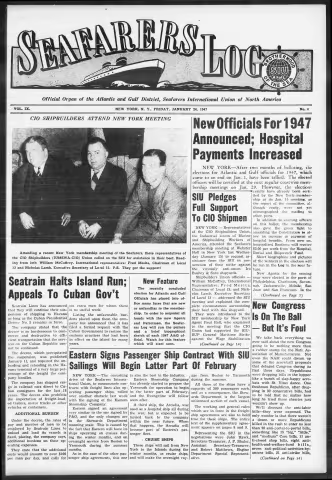
CIO SHIPBUILDERS ATTEND NEW YORK MEETING
Allending a recenl New York membership meeting of the Seafarers, these representatives of
the CIO Shipbuilders (lUMSWA-CIO) Union called on the SIU for assistance in their beef. Read
ing from left: William McCaffrey. International representative; Fred Mesita. Chairman of Local
13 and Nicholas Lamb, Executive Secretary of Loral 13. P,S. They got the support!
Seatrain Halts Island Run;
Appeals To Cuban Gov't
Seatrain Lines has announced
that they will continue their sus
pension of shipping to Havana
as long as the Cuban Presidential
Decree No. 5 remains in force.
The company stated that the
decree is so burdensome to com
merce and destructive to effi
cient transportation that the serv
ices . to the Cuban Republic can
not be continued.
The decree, which precipitated
the suspension, was published
January 11, and required the un
loading and reloading in the Ha
vana terminal of a very large per
centage of the freight the com
pany handles.
The company has shipped car
go in railroad cars direct to Cu
ban consignees for the last-18
years. The decree also prohibits
the importation of freight-load
ed trailers, motor trucks or other
vehicles or containers.
ADDITIONAL BURDEN
Under the decree, the rates of
pay and number of men to be
employed by Seatrain Lines to
unload and load its vessels is
fixed, placing, the company says,
additional burdens on their op
erating expenses.
They state that the additional
costs would amount to over $100
per man per day, and calls for
si.x e.xtra men for whom there
is no useful work.
Listing the unfavorable bur
dens placed upon them the com
pany has announced that it has
filed a formal request with the
Cuban Government to restore the
customs practices that had been
in effect on the island for many
years.
New Feature
The recently concluded
election for Atlantic and Gulf
Officials has placed into of
fice many faces that are new
or unfamiliar to the member
ship. In order to acquaint all
hands with the new Agents
and Patrolmen, the Seafar
ers Log will run the picture
and a brief biographical
sketch of each 1947 A&G of
ficial. Watch for this feature
which will start soon.
New Officials For 1947
Announced; Hospital
Payments increased
NEW YORK—After two montlis of balloting, the
elections for Atlantic and Gulf officials for 1947, wliich
came to an end on Jan. 1, have been tallied. The elected
officers will be certified at the next regular coastwise mem
bership meetings on Jan. 29. However, the elections
results have already been certi-
SIU Pledges
Full Support
To CIO Shipmen
NEW YORK — Representatives
of the CIO Shipbuilders Union,
the Industrial Union of Marine
and Shipbuilding Workers of
America, attended the Seafarers
membership meeting at Webster
Hall in New York last Wednes
day (January 15) to request as-
•sistance from the STU in pro
secution of their strike against
the viciously anti-union Ira
Bushey & Sons shipyards.
Shipbuilders Union officials —
William McCaffrey, International
Representative: Fred Mesita,
Chairman of Loeal 13; and Nieh-
olas Lamb, Executive Secretary
of Loeal 13 — addressed the SIU
meeting and explained the com
plete circumstances surrounding,
their beef with this shipyard.
They were introduced to the
SIU membership by New Yoi'k
Agent Paul Hall, who explained
to the meeting that the CIO
Union had supported the SIU-
SUP General Maritime Strike
against the Wage Stabilization
{Contimied on Page 14)
fied by the New York, member
ship at its Jan. 15 meeting, as
the report of the committee, al
though ready, were not yet
mimeographed for maifing to
other ports.
In addition to electing officers
on this ballot, the membership
also gave the green light to
amending the Constitution t« al
low an increase in payinent of
hospital benefits. From now on,
hospitalized Brothers will receive
$3.00 per week from the Hospital,
Burial and Shipwreck Fund.
Short biographies and pictures
of the winners in the election will
be run in the Log in the near fu
ture.
New Agents for the coming
year were elected in the ports of
Philadelphia, Charleston, Savan
nah, Jacksonville, Mobile, San
Juan and San Francisco. In the
{Continued on Page J)
Eastern Signs Passenger Ship Contract With SIU
Sailings Will Begin Latter Part Of February
NEW YORK — The onrushing is also the best in the industry,
drive of the Seafarers Interna- Eastern Steamship Company
tional Union, to consummate con- has already started to prepare the
tracts with freight lines also op- • Yarmouth for operation to begin
erating passenger ships, rolled in the latter part of February,
over another obstacle last week' and the Evangeline will follow
with the signing of the Eastern soon after.
Steamship Company. A third ship, the Arcadia, was
Eastern signed an agreement used as a hospital ship all during
very similar to the one signed by the war, but is expected to be
P&O, and the only changes are turned
in the Stewards Department
manning scale. This is caused by
the fact that Eastern will have its
ships operating on cruises dur
ing the winter months, and on
overnight service from Boston to
Yarmouth during the summer
months.
As in the case of the other pas
senger ship agreements, this one
back to the company
within the near future. When
that happens, the Arcadia will
become part of Eastern's pas
senger fleet.
^ CRUISE SHIPS
These ships'will sail from New
York to the Islands during the
winter months, as cruise ships,
and will make the overnight voy
age from Boston to Yarmouth
during the summer.
All three of the ships have a
capacity of 380 passengers each,
and as a consequence, the Stew
ards Department is the largest
unlicensed section of each vessel.
The working and general rules
which are in force in the freight
ship agreements are also to hold
true for these ships. The entire
text of the supplementary agree
ment appears on pages 8 and 9.
Representing the SIU in the
negotiations were John Hawk,
Secretary-Treasurer; J. P. Shuler,
Assistant Secretary-Treasurer;
and Robert Matthews, Engine
Department Special Represent
ative.
New Congress
Is On The Ball
— But It's Foul
We take back everything we
ever said about the new Congress
going to be nothing more than
a rubber stamp for the Natl. As
sociation of Manufacturers. Not
even the NAM could dream up
some of the screwball proposals
that deluged Congress duririg its
first three days. Republicans
were dropping bills in the hopper
like a bunch of slap-happy acro
bats with St. Vitus dance. One
freshman Republican, after drop
ping in 32 consecutive bills, had
to be told that no matter how
long he tried three cherries just
wouldn't show up.
We'll discount the anti-labor
bills—they were expected. The
only wonder is that there weren't
a dozen or more Republicans
killed in the rush to enter no less
than 20 anti-portal-to-portal bills,
something like 15 "big," "little,"
and "medium" Case bills, 11 an
ti-closed shop bills, eight anti-
health-and-welfare-fund bills,
seven anti-political-activities-by-
unions bills, 21 anti-strike bills,
(Continued on Page 14)
Page Two THE SEAFARERS LOG Friday. January 24, 1947
|;f;
1'^
In'
SEAFARERS LOG
Published ^Weekly by the
SEAFARERS INTERNATIONAL UNION
OF NORTH AMERICA
Atlantic and Gulf District
Affiliated with the American Federation of Labor
At 51 Beaver Street, New York 4, N. Y.
HAnovcr 2-2784
X X X
HARRY LUNDEBERG ------- President
105 Market Street, San Francisco, Calif.
JOHN HAWK - -- -- -- - Secy-Treas.
p. O. Box 25, Station P, New York City
Entered as second class matter Jime 15, 1945, at the Post Office
in New York, N. Y., under the Act of August 24, 1912.
267
sr
1 i-.v
Labor's Pains
Union solidarity is a valuable thing. It is a two-edged
sword which can be used against the bosses and for the
workers at all times. And it is the biggest single weapon
that workers have.
Just this past week the Seafarers International Union
pledged support to the Industrial Union Marine and Ship
building Workers of America, CIO, and this same support
has been extended to other unions when they felt in need
of moral or financial bolstering.
Only recently, when the United Auto Workers were
involved in a strike with General Motors Corporation, the
SIU donated money to assist the strikers so that starvation
would not be a deciding factor in their beef. And many
CIO seamen's unions have had the helping hand of the
SIU when they needed it.
That is the wa)' a strong labor movement must be
built. The common enemy of all workers is the power
of the bosses. When labor is split, the bosses use this divi
sion to further their own ends, and those ends are opposed
to the reasonable demands of labor.
The bosses are united against labor. No matter what
thv-Ir competitive aims might be, capital still has enough
sense to realize that their weakness is labor's strength. No
matter how much one boss might hate another boss, they
usually contrive to get together so that labor is always
battling a solid front.
That is a lesson that all labor might profitably learn.
Jurisdictional squabbles serve the bosses, and they there
fore foster them and then sit quietly by while labor slugs
it out.
We have all had many lessons on union solidarity.
Seamen, especially, know -that 'the lack of a united front
against the operators can lead to disaster on the waterfront.
Too many strikes have been broken by finks and scabs for
VIS to have any illusions about union strength unless it is
backed up by union solidarity.
The communist-dominated unions of the Committee
for Maritime Unity have many times attempted to raid the
'AFL seamen's unions. On all occasions they have suffered
terrific defeats, but their raids were not called for in the
first place.
Who profits when the CIO and the APT meet in
bloody fights? Only the bosses. When the workers realize
this, then it will be impossible for the bosses and the com
munists to start inter-union conflicts.
The communists like such combat because it gives
them a chance to capitalize on the division of forces, and
the employers desire a situation in which they can watch
both sections of Labor destroy each other.
The Seafarers International Union has never played
the game of either the communists or the bosses. Our rec
ord is clean, and we have always been among the first to
help a brother union against the red howlers or the em
ployers.
It is easy to see which side a worker should be on—
iand that side is solidarity with other honest toilers, and
(against the commies and the exploiters.
Men Now In The Marine Hospitals
These are the Union Brothers currently in the marine hospitals,
as reported by the Port Agents. These Brothers find time hanging
heavily on their hands. Do what you can to cheer them up by writ
ing to them.
BALTIMORE HOSPITAL
JOHN SETTLE
JOHN DUDKO
JOHN TILL
CARSON McCOY
CARL GRINDBERG
FRANCIS O'BRIEN
RAYMOND HODGES
CHARLES HAHN
SALVATORE PIZZILO
PETER LOPEZ
THOMAS WADSWORTH
MANUEL ROMERO
t, % %
STATEN ISLAND HOSPITAL
J. L. EAKIN
E. F. SPEAR
P. J. WILKINSON
R. G. MOSSELLER
D. IIUTCIIINS
M. J. QUINN
W. B. MUIR
J. S. WOOD
W. G. H.-BAUSE
MOSES MORRIS
J. GRIFFIN
L. A. CORNWALL
P. STEWART
"CHIPS" NEILSEN
H. BELCHER
L. L. MOODY JR.
C. KOLSTE
NORFOLK HOSPITAL
T. R. GOING
R. P. McBRIDE
J. E. HARRISON
NELSN«COLLSTIUP
W. MANNING
J. MCNEELLY
T. BOIGOS
R. FITTS
H. S. HARRISON
G. AHTIAINEN
F. BONNER
& ^ ^
NEW ORLEANS HOSPITAL
H. G. DARNELL
LIONEL ROTHERHAM
THOMAS J. BAIER
JOHN SERCU
CENTRAL MASON
W. BROCE, Jr.
ERNEST J. COOPER
JACINTO NAVARRO
JOHN P. BROOKS
RALPH EWING •
J. STEFANIDES
ED WARD CUSTER
KARL PETTERSSEN
F. BERGLAND
E. R. BUCKLEY
E. J. RIVIERE
J. W. DENNIS
R. M. NOLAN
JOHN RETOUR
Hospital Patients
When entering the hospital
notify the delegate by post
card, giving your name and
the number of your ward.
Stat en Island Hospital
You can contact your Hos
pital delegate at the Staten
Island Hospital at the follow
ing times:
Tuesday—1:30 to 3:30 p.m.
(on 5th and Gth floors)
Thursday — 1:30 to 3:30 p.m.
(on 3rd and 4th floors.)
Saturday—1:30 to 3:30 p.m.
(on 1st and 2nd floors.)
GALVESTON HOSPITAL
MILLER
WOLF
BENNETT •
SEYLOR
JONES, R. V.
JOHNSON
WILKI
CRIGLET
BARNEY, J. L.
DAUGHERTY, W.
FORD
SWENSON
STREIZ
SEGLER
4- S. 4-
NEPONSIT HOSPITAL
LINDER CLARK
J. FIGUEROA !
L. L. LEWIS i
H. SELBY 1
H. BURKE -
J. S. CAMPBELL
J. T. EDWARDS " T
B. LUFLIN I
G. F. McCOMB
E. FERRER
R. BLAKE ; r-:
J. R. HENCHEY
Friday, January 24, 1947 THE SEAFARERS LOG Page Three
Phony Pact Between Tidewater,
Company Union Hoids Up Election
By EARL SHEPPARD
Action on the Tidewater Tank
er election petition of the Sea
farers has been held up by the
National Labor Relations Board
pending their decision on this
matter.
Both the company and a phony
company union—the Tidewater
Tankermen's Association—claim
the existence of a supposed col
lective bargaining agreement be
tween them, and this has helped
to confuse the overall picture in
the Tidewater Fleet.
Sometime ^ago, the SIU peti
tioned for an election to deter
mine the union bargaining agent
for Tidewater tankermen, as we
had signed pledge cards from the
vast majority of the Tidewater
tankermen. However, due to the
intervention of the phony com
pany union, the election date has
been held up by the NLRB.
This stooge company outfit
I claims to have a signed contract
: with Tidewater, originally signed
by the company in 1940 and since
' then renewed on a yearly basis.
But, due to the fact that the SIU
has pledge cards from practically
all of the unlicensed Tidewater
• personnel, we refuse to recognize
the validity of this so-called
agreement between a company
union and their own parent, the
Tidewater Company.
The SIU refuses to recognize
this phony contract with a com
pany stooge outfit, and has de
manded sole bargaining rights
from the NLRB and Tidewater.
No claim of any agreement by
either Tidewater or their illegal
offspring is accepted by the Sea
farers. We have the men, and
we maintain that we're entitled
to a contract.
PLENTY OF PROOF
As proof of the Seafarers
willingness to prove beyond any
shadow of a doubt that the over
whelming majority of Tidewater
tankermen want the SIU for their
union, we've submitted signed
pledge cards for the SIU and
we're willing to abide by the de
cision of an NLRB election.
But, if the Tidewater outfit
thinks that the SIU is fooling,
we're fully prepared to job ac
tion every one of their ships until
such time as an election is held.
Look at our record on the wa
terfront. The militant SIU com
pletely defeated the WSA com- j
petency card and medical exam-,
iination set-up. We job-actioned
ships all up and down the At
lantic and Gulf Coasts until the
operators and the WSA were
forced into agreeing to the best
Foreign Rider articles ever placed
in the ships articles.
Our own SIU whipped the
Wage Stabilization Board into
line with the most successful
maritime strike ever pulled in
this country when these guys
tried to interfere with free col
lective bargaining between the
SIU and the operators.
We 'e taken direct action in
the past on all of these beefs,
and we'll take direct action in
the Tidewater Fleet if that out
fit doesn't agree to an NLRB
election for all Tidewater tank
ermen.
spoken louder than our words,
and this Tidewater business is no
exception. We're getting sick
and tired over getting the run-
around from both Tidewater and
the NLRB, Either we get action,
and that quickly, or we'll pro
vide all the action necessai-y. This
is no idle threat, as the Seafar
ers always backs up its words
with action.
During the past few weeks,
numerous Tidewater men have
come into the SIU Halls with
their complaints. These men need
the protection and advantages of
an SIU contract, and the condi
tions which such a contract
brings aboard the ships.
And, Brother, that's our job—
to see that these unorganized
tankermen get what they want,
a contract with the SIU covering
all Tidewater unlicensed person
nel.
These fellows all laugh when
Ihey mention the Tidewater
Tankermen's Association. If a
wasn't for the fact that the com
pany is using this so-called un
ion as a means of preventing their
employees from being represent
ed by a bona fide union, it would
be a huge joke.
However, anything which pre
vents seamen from securing the
wages and conditions to which
they are rightfully entitled is no
laughing matter.
Organizers, both shoreside and
shipside, all agree that Tidewater
tankermen are pretty well fed up
with conditions as they now exist.
The fact that no one except
the died-in-the-wool company
stiffs (very few of these rotten
eggs in the Tidewater Fleet, too)
wants any part of the phony
Tidewater Tankermen's Associa
tion, proves beyond any doubt
I hat they are really ripe for SIU
membership, and the many ben
efits which go with that mem
bership and an SIU contract.
ANTI-LABOR LAWS
Probably the greatest threat to
organized labor today, and to the
conditions for which we fight, is
the drive by big business and
their servants in Congress, as
well as the various State Legis
latures, against the closed or un
ion shop.
This drive against the closed
shop can threaten the very ex
istence of the labor movement.
Think of what it will mean to
our Union hiring halls and the
rotary shipping .system if our
contracts containing these pro
visions are outlawed!
Closed shop bans have already
been made into law as constitu
tional amendments in five states
—Nebraska, Arizona, South Da
kota, Arkansas and Florida. Four
other states are also drafting leg
islation against the closed shop
Georgia, Colorado, Penn.sylvania
and Texas—and other states with
viciously anti-labor administra
tions are not far behind these
bell-wethers.
In addition, "labor's friends"
in Washington are very busy
beating the drums for national
legislation outlawing the union
shop. Although these laws have
not yet passed the Supreme
Court test, plans are afoot to
beat down all of the gains made
by organized labor in the past
few years by means of these, and
similar, laws either on the state
or national level.
Look at the battles which the
SIU had in the states of Florida
and Texas during our General
Maritime Strike last year. By
means of legislation and court
injunctions, as well as anti-union
local administrations, the victory
of the SIU was made much more
difficult in these particular
states. And, today in Florida
(Tampa), our affiliates in the
Teamsters Union are having the
battle of their lives.
Don't think that our "friends,"
the shipowners, are not rubbing
their hands and laughing to them
selves as they pour money and
legal brains into the battle
against organized labor.
However, we've taken these
guys and the Washington bureau
crats on before, and we can do
it again.
We will do it again, and we'll
whip them in the same decisive
fashion as before. That's our job
—the one that's cut out for all
of us.
Ed Wares, Former Lakes Agent,
Dies At Detroit Marine Hospital
The
ACTION TALKS
Seafarers stands on its
By FRED FARNEN
DETROIT — Brother Edward
Wares, better known to his many
friends and all Lakes members
as Stew Pot," died on January
18, at the Detroit Marine Hos
pital. His passing away is re
ceived by all who knew him with
deep regret and sorrow.
His many friends, members
and officials of the Seafarers,
will miss his jolly personality,
and wish to extend to his family
their most heartfelt sympathy.
Brother Wares had been con
fined at the Detroit Marine Hos
pital for about a year. Before
his illness he was an Agent in the
Port of Cleveland and later in
Detroit.
As a boy, Ed Wares started out
as a coalpasser on the old See-
andbee, owned by the Cleveland
record. Our actions have always and Buffalo Transit Company of
Cleveland. Later he worked for
the Detroit and Cleveland Navi
gation Company as a Fireman,
Oiler and Watertender, spending
the majority of his sailing time
aboard the SS City of Cleveland
HI, operating between Detroit
and Cleveland.
In 1942 he was elected as
Agent for the SIU in Cleveland,
and the following year he was
appointed as Agent in Detroit,
the post he held until the fall of
1945 when he resigned.
He then went back to the City
of Cleveland as an Oiler, but
left after a few months due to
his failing health.
He is survived by his mother,
sister and brother, Stanley Wares,
who is Agent in Cleveland. Bur
ial took place in Cleveland on
Tuesday, January 21.
By PAUL HALL
The Seafarers membership is daily exhibiting a growing aware
ness of its strong position in the maritime field, and as an integral
part of the labor movement as a whole. With the emergence of
the Seafarers as the dominant waterfront factor, the membership
is becoming more and more conscious of its prestige. There are
concrete indications that it intends to guard that prestige jealously
and vigilantly. In the final analysis, this vigilance on the part
of an intelligent membership will bear fruits for all hands.
The reputation and prestige of the Seafarers as a sound, demo
cratically-functioning organization of seafaring men, who show
they understand the obligations and responsibilities of a major role
in maritime, will reach new heights, both in industry and labor.
Want To Improve Position
Specifically, let me state one e.xample, among the many, that
proves the point that Seafarers are out to improve their position.
Recently, a new crew dispatched from the New York Hall
boarded a ship and found that the old crew, a bunch of drunken
performers, had left the vessel in very bad shape—entirely out of
line with the ideas of good Unionism as laid down by the Sea
farers' membership.
This new crew was plenty sore at this violation of our Unions'
ideas, and refused to let the incident pass. They felt the matter
reflected on the membership, and on the SIU's hard-won prestige.
The new crew then appeared at the Union hall and preferred
charges against the offenders.
A rank and file committee was elected to hear the case. The
decision of the trial committee was both interesting and enlight
ening. It recommended that several of the book men among the
offenders be fined as well as placed on probation. It also ruled
that several gas hound tripcarders and permit men who shared the
responsibility for the inconsiderate shipboard conduct be expelled
as unworthy of SIU membership.
Performers In Minority
Such deniunstiations of Union-consciousness are on the in
crease. The average Seafarer does not go for the kind of horse-play
and irresponsible attitude displayed by the crew mentioned above.
It is high time the gashounds and the performers were set straight.
These birds, fortunately, are but a tiny minority. Nevertheless,
their actions are prejudicing and weakening the position of the
rest of the membership.
The vast majority of Seafarers are straight-thinking, guys
who are responsible for the considerably improved status of the
merchant seamen of today. There is no room among them for .those
who seek to obstruct and hamper their progress on the road to a
better life.
Seafarers have fought for years to improve shipboard condi
tions. The battle at times seemed impossible of success, but alert
ness and intelligence, coupled with hard-hitting tactics, brought
victory.
After these long, drawn-out struggles, the membership will not
allow a few bums, whose ideas of sea-going life must have been
gotten out of some phony motion pictures or sea story, or a few
"oldtime" gashounds, wreck the gains that have been fought for
so hard.
Phony Militancy
Some of these guys, in an attempt to defend their failings, pass
it off as "militancy" when they wreck some of the crews gears.
Obviously, that is sheer bunk. What is wrong with demanding
that these guys assume some of the responsibilities of good union
men? Isn't it their job to solidify the Union structure, as well
as enjoy the fruit of its victories?
We are protecting ourselves. Those who refuse to add to our
protective armor actually are nothing more or less then shipowners'
stooges. They are the few weak links in the chain of forward-
looking Seafarers.
The Seafarers is practically the only maritime union that
relys on economic action at the point of production in order to win
and maintain conditions. We will continue to do so. But, at the
same time, we cannot tolerate a few drunks and performers actions
to jeopardize the Union position.
Pride Is Mark Of Good Union Man
A good Union man is proud, not only of Union's ability to take
successful job action, by tying up the shipowners' scows, he is proud
also of his seamanship. If he has a job to dp, he does it well—
whether it be tying up a ship, or doing a day's work.
All hands should be on the lookout for these performers. They
are mighty few in number, and, therefore, should not be allowed
to put the Union majority on the spot. This does not mean that the
Union intends to legislate against drinking and fighting that's part of
an individual's private life, and we have no intention of invading it.
But pick your spots. If you want to get drunk, go to the neaurest
gin mill—don't do it on the job. If you want to fight, go on the hatch,
or ashore. In other words, use your head.
Remember, if you can point to a job well done, your beefs will
hold more water.
Page Four THE SEAFARERS LOG Friday. January 24. 1S47
WHAT
^tWNK...
QUESTION: Which of the SIU Ports do you think needs added facilities?
ALFONSO LOGIUDIS.
Deck Engineer;
Miami should-be built up be
cause it is a new HaU. and will
need plenty of work to bring it
into shape. With the SIU grow
ing as it is, it becomes plain to
see that we will need more Halls
in places where we never dream
ed of having them before. Miami
is one instance, but there are
others. Now that Isthmian is
SIU, we should have a Hall
some place in the Far East, say
Shanghai, to service Isthmian
and Waterman crews. In Trini
dad we need a Hall for men on
the bauxite run who are stuck
down there for months at a time.
JOHN WARD, Deck Engineer:
In every port that has a con-
centrcition of tanker men coming
in, the SIU should take steps to
build up the Halls there. Mainly,
right -now. that means Marcus
Hook and Port Arthur. As mem-
. bers and would-be-m embers
come into those ports for recrea
tion, the Seafarers should have
an outstanding Hall that would
make a man feel at home. We
should have well staffed baggage
rooms, a reading lounge, and
other comforts. Those things all
help to carry on organizing work
and.it is in the tanker field that
the SIU will be doing quite a bit
of its organizing in the next few
years.
MORIS MANDEL, AB:
To my mind, I think that Mar
cus Hook is the one that needs- a
larger Hall and more facilities.
"We're getting more tankers un
der the SIU banner, and so more
znen are going down to that port.
If we get a larger Hall it will add
lo our prestige down there, and
it will give the SIU men more
room to move around. From the
lime the Marcus Hook Hall open
ed up, it has been a success, and
it can be counted on for even
belter things if the SIU builds it
up so that more work can be
done from there.
MANUEL SANCHEZ, AB:
The men who are spearheading
our organizing drive in Marcus
Hook are doing a good job, and
they need all the help they can
get. As far as I can see. the SIU
is doing a bang-up job down
there, and if that Hall is built up.
men will be flocking to the SIU
in droves. Room for recreation
is needed so that-men will con
gregate around the Hall instead
of hanging out in the local bars.
A little more cooperation from
the SIU men down there in crew-
ing up unorganized tankers
would be welcome. I know.
PHS Agent Will Visit Galveston Hospital
To Investigate Feeding And Facilities
The recent blast of the SIU
against conditions and food at
the Galveston Marine Hospital
has bom some fruit in the form
of a letter from Dr. Otis L. An
derson, Medical Director and
Chief of the Hospital Division of
the U. S. Public Health Service,
who asserts that conditions have
improved considerably since the
SIU complaint.
Dr. Anderson's letter, in reply
to a recent letter &om SIU Spe
cial Services representative Jo
seph H. Volpian, stated, "This
office is in receipt of a report
from Galveston to the effect that
the food situation seems to be
very well under control since no
complaints relative to quantity
or quality of food have been re
ceived for some time.'-
In the Seafarers Log of No
vember 29, complete details of
the SIU complaints and the text
of Volpian's letter to the U. S.
Public Health Service were car
ried. At that time, it was re
ported that the original SIU ac
tion resulted from the complaints
of 63 seamen and veteran pa
tients of the Galveston Marine
Hospital.
INSPECTION ORDERED
In his letter. Dr. Anderson also
asserted that the Chief Dietitian
from Headquarters had been
asked to visit the Galveston Hos
pital in order to inspect the lay
out and make any necessary
recommendations or suggestions
in line with the Public Health
Service policy of "serving a suf
ficient quantity of good food to
all patients in our Marine Hos
pitals."
Dated December 30, the com
plete text of Dr. Anderson's let
ter reads as follows:
Dear Mr. Volpian:
Reference is made to our let
ter of November 26 in reply to
yours of November 20 concern
ing complaints relative to food
and medical treatment at the
Galveston Marine Hospital.
This office is in receipt of a
report from Galveston to the ef
fect that the food situation seems
to be very well under control
since no complaints relative to
quantity or quality of food have
been received for some time.
WILL MAKE SUGGESTIONS
We have asked the Chief Dieti
tian from Headquarters to visit
Galveston in the near future to
inspect the facilities and make
suggestion and/or recommenda
tion to the management which
seems advisable at the time. We
are interested in serving a suf
ficient quantity of good food to
all patients in our Marine Hos
pitals.
With reference to your state
ment relative to "indiffrent
treatment and lax medical stand
ards," the Public Health Service
is interested in the highest qual
ity of medical service and every
effort is being made to keep
these objectives constantly be
fore us. We wodld appreciate it
if patients who fee! that they are
not receiving proper medical
care would call that fact to the
attention of the Medical Officer
in Charge at the time. Such a
procedure would enable the
Medical Officer to investigate the
complaint immediately and take
any indicated action at the time.
We trust that this information
will satisfactorily answer your
letter of November 20, 1946.
Sincerely yours,
Otis L. Anderson.
Medical Director
Chief. Hospital Division
Certainly, the Seafarers hope
that the type of cooperation in
dicated in Dr. Anderson's letter
means that the SIU complaints
will be fully investigated, and
that in the future conditions will
much nearly aproximate the
ideal state of affairs which the
SIU desires. Seamen patients in
the Marine Hospitals will attest
to the sincerity of the U. S. Pub
lic Health Service in carrying
out their promises.
Send Those Minutes
Send in the minutes of
your ship's meeting to the
New York HalL Only in that
way can the membership act
on your recommendations.
£ind then the minutes can be
printed in the LOG for the
benefit of all other SIU
crews.
Hold those shipboard meet
ings regularly, and send
those minutes in as soon as
possible. That's the SIU way I
Jobless Payment
Is Clarified By
N.Y. State Reps
NEW YORK, January 21 —
Representatives of the New York
State Department of Labor — Mr.
Memelsdorff, Mr. Donnelly, Mr.
Purcell and Mr. Keirnan — call
ed on SIU Special Services Rep
resentative Joseph H. Volpian
today to discuss problems con
fronting them in the handling of
seamen's claims for unemploy
ment compensation, and also dis
cover ways and means of exped-
"nting those claims.
In talking over the problems of
unemployment insurance with
Volpian, the men from the Divi
sion of Placement and Unem
ployment Insurance pointed out
that no matter when a voyage
was completed and the payoff
made, the money so earned would
be pro-rated over the period of
the entire trip rather than ap
plied to the specific quarter in
which the money was received.
Another point which was stres
sed was the fact that seamen who
apply for unemployment insur
ance under the terms of the act
must be available for employ
ment during the period in which
they register for compensation.
This means that if you expect
to collect unemployment insur
ance when you are out of a job,
that you must be registered on
the shipping list as well as at the
Unemployment Insurance Office.
Further, you must be available
for employment when a job is
open. This does not mean that
you can register for insurance in
New York, go to your home in
Wisconsin, and expect to draw
payments while you are there.
You must be available in the
port in which you register for
a job and for compensation.
Seamen who worked during
1945 for employers who paid
taxes on their wages to the State
are eligible for benefits provided
they earned sufficient wages to
qualify under the law. This means
that if a seamen earned $100 or
more in the highest quarter in
from $300 to $630 or more during
1945, and if he earned a total of
the whole year, that he is eligible
to receive benefits of $10 to $21
weekly.
Any further information on the
subject of eligibility or other
questions may be secui-ed at your
nearest Unemployment Insurance
office or the SIU Special Services
Department.
Port Savannah Is Just Waiting
For South Atlantic To Begin
By ARTHUR
SAVANNAH—We had another
payoff this week. The Hatties-
burg Victory came in with quite
a few beefs which, at thfis writ
ing,, are in the process of being
squared away.
This makes the fourth SUP
ship since Christmas and that's
all the shipping we've had in this
port. Most of the oldtimers have
left for Mobile and the Gulf
Area in hopes of shipping out
quicker.
Savannah has been exception
ally slow for the past two months
and, with the cattle business
coming to a close next month, the
prospects are for the worse.
When the South Atlantic starts
running this way again, business
THOMPSON
should pick up, but for some ,
time now all .their ships have
been paying off in other ports.
HAPPY DAYS COMING
The Coast Guard is still sen
tencing seamen to enforced im-
employment for minor infractions
of rules. The American merchant
flaot is still growing smaller. The
Government is stiU "training" |
seamen for the merchant marine.
Numerous congressmen, with
malice aforethought, are concoct
ing laws to hamstring labor.
No other business of impor
tance is on hand except the ne
gotiations with the Atlantic Tow- -
ing Co» which should start next
week.
Friday« January 24. .1847 THE SEAFARERS LOG Page Five
Results Of Atlantie And Gulf Elections
(Continued from Pege I)
other ports, Agents who served
during 1946 were returned to of"
fke.
It should be noted that the to
tal number of votes cast is for
the A&G District only, and does
not include any balloting from
the Great Lakes or the Pacific
District, SUP.
These two sections of the SIU
elect their own officers in sep
arate elections.
A much larger vote would
have been recorded had it not
been that shipping spurted after
the 1946 General Strike, and
many Brothers were away at sea
during the entire course of the
elections.
The Tallying Committee, elect
ed at the regular meeting on Jan.
2, 1947, consisted of William
Higgs, Sam Luttrell, Robert Hill-
man, L. Salvatore, Robert Jones,
Isaac Miller and Matthew Sams.
The results of the elections,
and the committee's report, fol
low:
Secretary-Treasurer
John Hawk, 2212 3512*
Write Ins. Voids, No Votes 537
Total 4049
Assistant Sec.-Treas.
J. P. Shuler, 101 3539*
Write Ins, Voids, No Votes 510
Total : 4049
BOSTON
Agent
Rocky Benson, 7297 960
3; Mogan, 216 2492*
Write Ins, Voids, No Votes 597
Total 4049
Jt. Patrolman
S. Carr, 22217 230
S. Greenridge, 1863 183
T. Griffiths, 115 353
E. A. Parr, 96 577
J. Sweeney, 1530 2181*
Write Ins, Voids, No Votes 535
TAKING AN ACCURATE COUNT
mm
" ' ' ' ' iHL.
? "
"
;L
This is the Ballot Tallying Committee, whose report on the balloting for 1947 Atlantic and
Gulf District officials is announced in this issue of the Log. From left to right, the members are
Sam Luttrell. Isaac MiUer, standing; Bill Higgs, Committee Chairman; Robert Jones, Louis Sal
vatore, standing: and Robert Hillman.
PHILADELPHIA
Agent
E. Higdon, 182 2284*
•J. Truesdale, 3517 1365
Write Ins, Voids, No Votes 400
Total 4049
Patrolman
C. Bush, 127 2628*
Write Ins, Voids, No Votes 1421
Total 4049
BALTIMORE
Agent
W. McKay, 8 1214
W. Rentz, 26445 - 2464*
Write Ins, Voids, No Votes 371
Total 4049
NEW YORK
Agent
Paul Hall, 190 3541*
Write Ins, Voids, No Votes 508
Total 4049
Deck Patrolmen
J. Algina, 1320 2854*
E. Guszczynsky, 3100 622
J. Sheehan, 306 2918*
Write Ins, Voids, No Votes 1704
Total 8098
Engine Patrolmen
J. Purcell, 27124 2718*
J. Volpian, 56 2988*
Write Ins, Voids, No Votes 2392
Total 8098
Steward Patrolmen
R. Gonzales, 174 2490*
H. Guinier, 478 2244*
W. Hamilton, 3400 830
C. Stevens, 7036 r 886
Write Ins, Voids, No Votes 1648
Total 8098
Joint Patrolmen
R. Bunce, 7165 1240
.J. Drawdy, 28523 2146*
L. Goffin, 4526 2460*
J. Udiljak, 7163 637
Write Ins, Voids, No Votes 1615
Total 8098
Total 4049
Deck Patrolman
R. Dickey, 652 2773*
Write Ins, Voids, No Votes 1276
Total 4049
Engine Patrolman
E. DiPietro, 35 997
G. Masterson, 20297 2419*
Write Ins, Voids, No Votes 633
Total 4049
Steward Patrolman
J. Hatgimisios, 23434 2901*
Write Ins, Voids, No Votes 1148
Total 4049
NORFOLK
Agent
P. Gavillo, 21001 334
R. White, 57 3339*
Write Ins, Voids, No Votes 376
Total 4049
Joint Patrolman
B. Rees, 95 2751*
Write Ins, Voids, No Votes 1298
Total 4049
CHARLESTON
Agent
E. Smith, 20057 2434*
E. Tilley, 75 1077
Write Ins, Voids, No Votes 538
Total 4049
SAVANNAH
Agent
W. Brantley, 111 769
C. Starling, 6920 2126*
J. Tucker, 2209 634
Write Ins, Voids, No Votes 550
4049
JACKSONVILLE
Agent
J. Banners, 256 3319*
Write Ins, Voids, No Votes 730
4049
TAMPA
Agent
C. Simmons, 368 3158*
Write Ins, Voids, No Votes 891
Total 4049
MOBILE
Agent
L. Collins, 5 845
J. Prescott, 114 449
C. Tanner, 44 2278*
Write Ins, Voids, No Votes 477
4049
Joint Patrolmen
J. Carroll, 14 977
R. Jordan, 71 660
L. F. Lewis, 2029 1645*
J. Morrison, 34213 1815*
W. Thomas, 12 622
P. Warren, 114 562
Write Ins, Voids, No Votes 1817
8098
NEW ORLEANS
Agent
Steely White, 56 3114*
Write Ins, Voids, No Votes 935
4049
Engine Patrolman
L. Neira, 26393 791
C. J. Stephens, 76 2657^
Write Ins, Voids, No Votes 601
4049
Declc Patrolman
C. Gibbs, 2341 333
J. Johnston, 53 - 1721*
C. Kimball, 52 519
F. Sullivan, 2 868
Write Ins, Voids, No Votes 608
Write Ins, Voids, No Votes 772
4049
HOUSTON
Agent
C. Haymond, 98 2636»
Write Ins, Voids, No Votes 1413
4049
Patrolman
W. Brightwell, 390 934
G. .Suit, 6951 2508*
Write Ins, Voids, No Votes 607
4049
Steward Patrolman
R. Birmingham, 390 727
C. Turner, 15 2550*
Total 4049
GALVESTON
Agent
D. Parker, 160 3I57»
Write Ins, Voids, No Votes S92
Total 4C49
Patrolman
J. DeVito, 185 1434
L. MacDonnell, 343 446
R. Sweeney, 20 1606*
Write Ins, Voids, No Votes 563
Total 4049
PORT ARTHUR
Agent
L. Johnson, 108 2724*
Write Ins, Voids, No Votes 1325
Total 4049
. SAN JUAN
Agent
D. Butts, 190 957
S. Colls, 21085 1691*
J. Wagner, 153 860'
Write Ins, Voids, No Votes 541
Total 4049
SAN FRANCISCO
Agent '
W. Simmons, 215 2939*
Write Ins, Voids, No Votes lUO
Total 4049
RESOLUTION
Yes 2917*
No 251
Voids, No Votes 881
Total 4049
REPORT OF SIU TALLYING COMMITTEE
We, the undersigned Tally
Committee, duly elected at the
regular business meeting at
Headquarters January 2, 1947,
submit the following report and
recommendations;
All .used ballots were counted
and the corrected tally is sub
mitted herein. An asterik is
placed besides the names of the
candidates that were elected to
office. The ballots used and un
used in each port were checked
and the correct check is submit
ted herein.
Nineteen (19) votes from the
Port of Galveston were voided
in their entirety due to the fact
that one envelope containing
eight (8) ballots did not have the
signatures of the Tally Commit
tee in the Port of Galveston and
one envelope containing eleven
(11) ballots was unsealed. It is
to be noted that the voiding of
these ballots in no way affected
the election of any candidate in
asmuch as each man elected was
elected by more than a majority
of nineteen (19) votes.
It is to be pointed out further
that this Committee on checking
various outport ballots and tally
sheets found that all reports sub-
mitted by all outports' commit
tees were correct and in every
case checked evenly with the
New York Headquarters Com
mittee's tallies.
The Resolution calling for the
raising of hospital benefits from
$2.00 to $3.00 per week carried
by over a two-thirds majority as
required by the Constitution.
This committee recommends
that the total results of this elec
tion, giving number of votes re
ceived by each candidate, be car
ried in as early an issue as pos
sible of the Seafarers Log. This
to be done for the benefit of our
members who are now at sea.
This committee found one bal
lot missing from the returns of
the Port of Philadelphia. This
finding checked with the tally
of the committee elected in the
Port of Philadelphia to count the
ballots in that port.
This ballot was not included in
the tabulation sheets. Thus, the
actual vote returns show the fi
gure of 378 votes cast in Phila
delphia instead of 379.
This committee points out in
this case that this in no way af
fects the outcome of the election
for any candidate oleeled fur of
fice.
Due to the fact that it is im
possible to determine the number
bci- of the ballot missing, this
report includes the missing bal
lot listed as a used ballot.
This committee recommends
that these used ballots be held 03i
hand in the Headquarters Offices
as per constitution.
It is to be noted that two com
mittee members' signatures do
not appear in the mimeograph
ed sheets. This is due to the
fact that R. Jones shipped beCoro
this report was mimeographed in
its entirety and L. Salvatcro
wasn't present.
Their signatures do appear
however in reports now held ;..n
Headquarters Office. i
Fraternally submitted, _ ,
W. Higgs, 223
Sam Luttrell, 46568
L. Salvatore, 733G ^
R. Hillman, 3188
R. Jones, 22238
I. Miller, 8522
M. Sams, 21386: AWw
Page Six THE SEAFARERS LOG Friday, January 24, 1947
Midland Victory Ciears The Way
For An Ail-Out Drive On Lakes
CS By HENRY W. CHAPPELL
TOLEDO—Now that the lights group of employees start a union
have changed from red to green' after first finding out how wages
for seamens' unions, and it has and conditions are on union ships,
been proven to the rank and file and then adjusting their wages
of the NMU that their union and to a slightly higher scale, and in
treasury has been used as a front some instances granting minor
for the communist political party,' concessions to the crews,
the real sailors union can goj The SIU doesn't expect much
ahead and concentrate on our: opposition from this phony LSU,
common enemies the shipowners but is prepared to expect more
m
mm
iJ illiVI J VJm i ; I 13 J \J1
and their government agencies, resistance from the men who
The NLRB has at last certified ^ cannot see through the ruses, and
the SIU as the bargaining agent believe the companies give these
for the Midland Line on the Great ^ conditions out of the goodness of
Lakes. Now Midland seamen can their hearts.
enjoy the same working condi
tions as other SIU ships have had
for years.
Contracts ai'e now in negotia
tion with his line and will be the
same as other SIU freight ships
which are the best of any con
tracts on the Great Lakes.
These contracts will be amend
ed each year to include any im
provements the membership de-
These men, who are known as
back riders, are always ready to
accept union wages and condi
tions after they have been fought
for, but they are never ready to
give a hand.
The SIU Great Lakes district
has at last cast off our mooring
lines, and while we are going
ahead on a slow bell now, this
spring, when the ships start to
sires, and any suggestions from gj^ organizers are
the crews will be acted on by the
negotiating committees.
If a crew member has any sug
gestions for improvements it is
his duty to notify union officials
so it can be acted on.
NMU EXPOSED
Recent developments within
the NMU should prove conclu
sively to the members that they
have been governed for years by
a group of politicians who place
their political ambitions above
the memberships desires and in
terests.
Results of this discovery are
beginning to show already on
the Lakes as more men are com
ing into SIU halls each day, in
quiring about how our Union is
run, and wondering why it took
Joe Curran so long to find out
what was happening to his union,
when it was common knowledge
to all other interested parties.
It's too early to predict what
the company-sponsored Lakes
Seamens Union will attempt to
contacting them, we will put her
over to full speed ahead and
steady as she goes.
NO NEWS??
Silence fhis week from,the
Branch Agents of thb follow
ing ports:
PHILADELPHIA
BOSTON
CHARLESTON
HOUSTON
NORFOLK
JACKSONVILLE
MOBILE
BALTIMORE
NMU Develops Sudden Interest
In Sun Oil, But Little Too Late
By BLACKIE CARDULLO
The deadline for port re
ports, monies due. etc., is the
Monday preceeding publica
tion. While every effort will
be made to use in the current
issue material received after
that date, space commitments
generally do not permit us to
do so.
MARCUS HOOK — News has
been kind of scarce in the port
of Marcus Hook for the past
week; however, we will make up
for it in this issue.
Now that we have all of the
tankers in this area to payoff,
and due to the fact that there has
been an increase in the number
of tankers coming out of the
boneyard, we have been kept
quite busy.
We don't feel sorry about this
increase in business, and our or
ganizers are busy contacting the
ships as soon as they come in.
With the increase in activity of
shipping our organizing drive has
likewise increased its tempo.
Evidently since the NMU lost
the Isthmian election, they have
changed their tactics of organiz
ing, or i§ it possible that Joe
Stack-it has been taught a new
line by the Communist Party.
LINE CHANGE
SIU Certified As Bargaining Agent In Midland;
NLRB Throws Out Usual Vicious Protest Of NMU
By FRED EARNEN
DETROIT — Last September a
bargaining election was held on
the seven ships comprising the
entire fleet of the Midland
Steamship Company.
The Seafarers International
pull on the Lakes this spring.
The majority of Lakemen know
that this outfit is no union, and
that its leal purpose is to keep
any union out that wants to put
its oars in when wages, working
conditions, etc., are to be dis
cussed.
SEAMEN WISED-UP
The company that sponsors
this phony set-up still regard
sailors as a group of morons who
are incapable of thinking for
themselves, and will accept any
wages and conditions that they
deem sufficient. But those days
are gone forever, and the type of
man who goes to sea these days
demands to be recognized as an
important factor ih this great in
dustry.
This demand can be achieved
not by individuals, but by the
merging of all seamen in one
body.
The shipowners knew this
years ago. That's why companies
like Cleveland Cliffs have a
Mate Discovers
He Must Follow
SIU Contract
By J. S. WILLIAMS
CORPUS CHRISTI — After a
spurt of business last week, things
have slowed down pretty much
in this port.
The only ship tied up here at
present is the Cape Corwin, Bull
line, and she will be leaving soon
for New Orleans where she will
be delivered to another company.
The crew isn't happy about
losing their home, but there isn't
much that can be done about it.
When we went aboard her to
settle a few beefs, we found that
they were all due to the stupidity
of the phony Chief Mate.
This bird couldn't get it through
his head that we have a contract
with the Bull Line which covers
our men, and the interpretation
of that agreement is not for every
bucko mate to decide.
TAUGHT CONTRACT
We went l ound and round with,
him for awhile convincing him
that the rules aboard ship have
already been laid down and agreed
to by the company and the Un
ion; and that no one, even if he
does wear a high pressure hat, is
going to make up his own rules
aboard ship.
He was finally convinced that
there were a few things out of
his jurisdiction and we left the
ship in shipshape condition.
We expect business to be some
what better next week, and with
it more to report from this Texas
port.
Union won this election by a
wide majority, but the NMU re
fused to take this decision, and
thereupon filed objections with
the National Labor Relations
Board.
The fact that the NMU filed
objections after a fair and square
election is bad enough, but the
vicious lies they used to back up
their charges is something that
will not soon be forgotten by
Great Lakes seamen.
Now, after months of delay,
the NLRB has finally certified
the SIU as the baigaining agent
for unlicensed Midland seamen.
No doubt, the NMU officials will
tiy to excuse themselves to Mid
land seamen for depriving them
of Union representation by tell
ing them it was all a mistake and
that they are sorry it happened.
the Midland contracts is already
well under way towards getting
SIU benefits for Lakes sailors,
and in the spring those advan
tages will be a major factor in or
ganizing other Lakes sailors and
ships into the Seafarers.
The NMU's practice used to be
to shun the Sun Oil seamen by
calling them scabs, finks, com
pany stooges, and everything
foul they could lay their tongue
to. But since the SIU has come
into this port, and shown the Sun
Oil seamen what* a real Seamen'.t
union is like, the NMU has sud
denly grown awfully concerned
with the welfare of the Sun Oil
HANDS FULL
That's what they did last Aug
ust when their attempt to picket
ships under contract to the SIU
was broken up at the Bob-Lo
dock in Detroit.
SIU CONTRACTS BEST
With this line under our ban
ner, the Midland seamen will be
able to see how democratically the
SIU is run. These freighters will
enjoy the same privileges, decent
wages, and Union conditions that
have been enjoyed by SIU con
tract ships for years.
Any unbelievers are urged to
look at our contracts and see for
themselves that we had the 40-
hour week in 1942 for work
during fit-out and lay-up.
The Negotiating Committee on
My guess is that Joe Curran
will have his hands full in getting
the NMU out of the communist
fleabag, the CMU. He will even
have trouble in keeping his un
ion together.
Lakes seamen are wise to the
phony .setup in the NMU, but
keep in mind that the Lakes Sea
men's Union, the revised Lakes
Carriers Association, is still try
ing to knife Lakes seamen.
They will probably be contact
ing you by mail, but remember
that this is a company union
which employs stooges to act for
them in forming an organization,
and that its only purpose is to
keep a real Union from fighting
for the men.
Keep it Clean!
It is the proud boast of the
Seafarers International Un
ion that an SIU ship is a clean
ship Let's keep it that way.
Although most of the crews
leave a ship in excellent con
dition, it has come to the at
tention of the membership
that a few crews have vio
lated this rule. So they have
gone on record to have all
quarters inspected by the
Patrolman before the payoff,
and if the conditions are un
satisfactory. he has the right
to hold up the payoff until
everything is spic and span.
Remember that the Patrol
man can only have repairs
made if he knows what has
to be done. Cooperate by
making up a repair list be
fore the ship docks. Give one
copy to the Skipper, and one
to the Patrolman. Then you'll
see' some action.
men.
Now they are leaning over
backwards to be friendly to them,
but they are doomed to the same
failure in Sun Oil as they were
in Isthmian.
They are also doomed in City
Service, Tidewater, and all other
companies that the SIU is or
ganizing, because they have noth
ing to sell a seamen but over
crowded union halls, and over-
stacked membership, with 20
men for every job.
A few years back the NMU
tried to organize the Sun Oil and
their name stunk. Today it still
stinks, only with a much stronger
odor.
It runs the same way in Rus
sia. Everytime Russia fails in
any undertaking off go a lot of
heads and a new change takes
place in their line.
SOME CHANGES MADE
We have been paying off quite
a few Pacific Tankers and have
run across a character who is a
company agent for them, by the
name of Captain Cole.
He is not a bad guy, and yet
he is not a good guy either. We
are going to go to work on him
soon, and he'll be a different man
when we get through. He'll be
tipping his hat to the Agent and
Patrolman in this port. That is,
if he continues to come down
here for the payoffs.
We wonder where Captain
Dyer, his running mate, spends
his evenings when he is away
from home? Question, Captain
Dyer.
A bit of gossip: Is it romance
or trouble betwen our dispatcher
Bob Pohle and a certain ex-Wac?
NO SALUTE. PLEASE
Gur two Wilmington fla.shes
just passed through the port.
Brothors Chandler and Gordon,
we mean, and they are still
aboard the SS Carlsbad. Wc
wonder whether Gordon has his
alimony paid up s^et? As for you
Bosun Chandler, the ordinary j
seamen don't have to salute you
coming on and going off watch
. . . don't do it Mike.
Will the joker whom I saved
from going on the rock pile for
30 days be kind enough to send
me the money it cost me, so that
I can get the next guy out.
P. S. to Pat from New Orleans:
Guess who is doing my typing?
Friday, January 24, 1947 THE SEAFARERS L aC Page Seven
TALKING OVER SIU ORGANIZING PROBLEMS
Seated around a conference table in the Organizers' Headquarters at the New York Hall
are (left to right): Johnny Ward, Blackie Cardullo. Lindsey Williams. Bob Pohla and A1 Kerr.
They all hold various positions on the Seafarers organizational staff, and are discussing mutual
problems encountered in their day-to-day activities.
MidiandContract
Will Be The Best
Organizing Aid
By EINAR NORDAAS
DULUTH — Though things are
at a standstill up here in the
frozen north, the seamen around
here still manage to come down
to the Hall to inquire how things
are shaping up on the Lakes.
Well, this week wc have good
news to pass on to them, as we
were notified that the SIU has
•been recognized by the NLRB as
the bargaining agent for the Mid
land Company.
Now that we have these ships,
we will soon have them in SIU-
shape, and they will be floating
examples of real unionism to all
unorganized seamen on the Lakes.
The ,STU won this company
through the efforts of the men
who work the Midland ships, and
they will be our best salesmen
for unionism to the other unor
ganized seamen when we install
the SIU procedure aboard the
ships.
Bill Higgs
Bill Higgs, Chief Steward
comes from a long family of sea
faring men, and he is carrying
on the traditions of his family
Bill started .sailing in 1935, and
has been following the sea ever
since.
In the days when he first start
ed, conditions were pretty bad
Some of the men used to bring
their own canned food aboard to
supplement the meager feeding.
"Those days were plenty bad,"
Bill recalls. "We couldn't do any
thing with the owners, and so it
became obvious that the union
was the only solution to seamen's
problems."
That's why, when the SIU was
organized. Bill Higgs was one of
the first men to join. That's why
Bill has been in the forefront of
practically all the action that the
SIU has participated in during
These seamen recognized the
NMU for the bungling outfit it is
and chose the only Union on the
lakes with a solid trade union
foundation. They will have no
regrets.
A great deal of credit should
also be given to Joe Shima, who,
for awhile, gave me a hand in
this port last fall. He was tire
less in his efforts to convince
if s experience.
ACTION STARTS
He wasn't in the Union very
long before he was taking part,
in the P&O Strike in Tampa,
Florida. He was in charge of the
stewpot, and also collected money
from incoming ships to buy food.
After that he was in the Sea-
train Strike in New Orleans, in
Midland men that the SIU was 1938. This was a hot time for all
the only union that is interested concerned, and Bill was right in
in seamen's welfare.
I hear that Joe went to the
coast after shipping ended here
last fall. Wherever he is I'm
sure he will be in there plugging
for the SIU.
Now that the NMU is falling j
the thick of everything.
When there was no trouble
brewing. Bill sailed on ships to all
corners of the earth. And during
the war he sailed on ships that
carried supplies to Europe.
He was in the first convoy that
apart and trying to rid itself of Antwerp after the Bat-
the communist-dominated CMU, ^he Bulge, and he still re-
the rank and file of that outfit j^e^b^rs the buzz bombs that
can see for themselves that they hurtling out of the air with-
have been played for suckers all warning
along by a few ranking officials, ' MOCT CTTMW
who have proven that they are ALMObi bUKK.
only interested in promoting. the i That, however, was not his
CP line. By their tactic these experience with the enemy.
officials have demonstrated that Sub attacks marked practically
the seamen were secondary to every crossing, and when he was
their interests and efforts. aboai'd the Walter M. Christian-
When Union conditions are no- sen, American Range Liberty
ticsd by the men who sail unor- Lines, the ship hit a mine, and
ganized ships, they will want the almost went down. No lives were
same. So, through the united lost, but three other ships in the
efforts of the SIU men on the convoy were sent to the bottom.
Lakes we will give them the With the end of the war. Bill
Union representation they want did not forget the militancy that
and make the Great Lakes solid had marked all his years in the
for the SIU. Union. During the Longshore
Beef, he was on the beach in New
York, where he took part in the
move that drove the communists
off the New York docks.
Later he was assigned to the
Bisso Tug Beef in New Orleans,
and tlie Fen-y Strike in Norfolk.
When the Seafarers General
Strike came off. Brother Higgs
was an Area Commander and
then stood special picket duty.
LAKES NEXT
Bill has sailed on many unor
ganized ships during the course
of the many organizing drives
undertaken by the SIU. In the
Spring he expects to go up to the
Great Lakes to aid in the SIU
drive in that area.
"I've seen the whole water
front change in the ten years that
I have been sailing," Bill says.
"In the past, the sea was the last
refuge for bums, and guys who
couldn't get jobs ashore. Now
that has all changed. Through
Unions, .seamen now enjoy the
dignity that other workers are
receiving."
What Brother Higgs says is
absolutely true. And it is through
the Vork of men like him that
the SIU has been able to make
the strides forward that have
benefitted all seamen.
Plenty Of Ships Hit New York
But They Are All In Transit
By JOE ALGINA
NEW YORK—This port is like
the old maid in the song who was
always a bridesmaid, but never a
bride.
Every day we see plenty of
ships come into the port of New
York, and after we service them
here, the ships take off for Phil
adelphia or Baltimore for final
discharge.
Now don't get the idea that we
mind that. That's not it at all; we
would just like to have some pay
offs and sign-ons in this port for
a change.
Shipping has taken an awful
slump since our last bragging
column, and last week was the
poorest week in many a month.
We are keeping our spirits up,
and hoping that better days and
weeks are in store.
STRICTLY ON BALL
One thing about" ships in tran
sit— they keep the Patrolmen
hopping. New York Patrolmen
have been hitting the ships that
come in here just to visit, and they
are also bu.sy contacting the coast-
Galveston Goes
Back To Normal
After Holiday
By R. W. SWEENEY
GALVESTON—Well, the holi
days are over and the boys have
all started coming back to Gal
veston to ship out. During the
holidays we were short of all
ratings, but now shipping has
slowed down and this port is
somewhat normal again.
WATERMANS IN
We are having several Water
man ships hitting here while in
transit from Mobile to load grain,
but there are very few replace
ments needed. We still have
some of the tankers in, but not
as many as before.
wise tankers for organizational
purposes.
When we start getting calls
for men to crev/ ships, then we
will all be happy in this Branch;
that is if Congress doesn't figure
out a new way to put a straight-
jacket on merchant seamen.
The crew of the SS American
Press contributed $27.00 to the
hospital fund. Most SIU crews
are generous to their Brothers
who are laid up in the various
marine h'ospitals—some of them
for long periods of time. But true
unionism is more than wages
and conditions—and that is the
SIU way.
Heavy Fog Halts
All Shipping
in Port Arthur
PORT ARTHUR—Four days of
very bad weather have brought
the movement of vessels in this
area almost to a standstill. At
least 17 ships last night were at-
anchor off Sabine Bar, awaiting
the lifting of one of the most
severe fogs in years before vcn-
turing into the ports in the Sa
bine district.
As a result, sailings of ships
from ports within the district are
being handicapped becairse of the
fog. The oldtimers around here
say it is the worst fog since 19.38,
when a heavy fog kept all ship
ping at a .standstill for five days.
SOUP IS THICK
The fog is so bad that ships are
afraid to move through the canal
i to docks, and ships tied up at
[ municipal docks are not receiv-
I ing cargo. When that happens,
' you can guess how thick the soup
is here.
I would like to remind any
' member who signs on a ship in
j one port on foreign articles and
I goes to another, that unless the
! man and the Master can come
to a mutual agreement to pay
him off, there is very little any
Patrolman or Agent can do about
it.
An another thing—I think all
members should be informed that
' when one man pays off under
- mustual consent, that does not
break the articles for the bal
ance of the crew.
If there is any doubt in your
mind regarding this, please
check with the Agent of your
port.
OLDTIMERS AROUND
Lately we have had several
oldtimers in here. Brother H. J.
Collins paid off the Council Crest
in Texas City recently, and the
ship left here in A-1 shape with
plenty of stores and everything
properly stored.
Just a word about the slop-
chests: Brothers, remember to
check your slopchest before you
sign on, because aftei- your name
is on those Articles it is a hell of
a lot harder to get what you want
than it would be had you not
signed on.
Whenever you are in a port
where there is a Hall, drop
around—you may see and hear
something new.
Right now we have riding at
anchor 17 ships and 6 more are
expected in the next few days.
I
We're really going to have oui'
hands full when they all scramble
for berths at once, and all start
calling for Patrolmen.
Many of these ships are un
organized and we're waiting
eagerly for them to tie-up so we
can get aboard. This port is real
ly booming and with this flood
of ships we can keep our or
ganizers busy contacting them
and squaring things away.
In my last report to the Log
I mentioned that there were ru
mors that J. M. "Windy" Walsh
was about to get spliced. Having
just received a letter from him,
I find that he has shipped to Ger-
manj'. He'll be back in nine or
ten weeks, so he might take up
where he left off and get spliced
after all.
I#
Page Bghl TBE SEAFARERS LOG Friday, January 24, 1947
AGREEMENT
•Bettveen
Seafarers International Union
Of North America
—And
Eastern Steamship Lines, Inc.
Supplement Agreement to Agreement dated October
23 1946, between Eastern Steamship Lines, Inc., ana
the Seafarers' International Union of North-America.
GENERAL RULES
Employment. The Company agrees that only mem
bers of the Union shall be employed in all unlicensed
personnel ratings on their Passenger vessels or Anieri-
can Flag Passenger vessels taken over on bareboat
charter, with the exception of the following: Cadets,
Super-Cargo, Pursers, Doctors, Concessionaires, and
female employees other than Stewardesses and Wait
resses.
Except as provided herein, all other provisions of the
General Rules of the agreement shall apply.
DECK DEPARTMENT
Special Working Rules and Wages for certain ratings
in the Deck Department of the SS YARMOUTH AND
EVANGELINE type passenger vessels.
Monthly
Wages
Boatswain (Yarmouth and Evangeline type
passenger vessel) $225.00
Carpenter (Yarmouth and Evangeline type
passenger vessel) 225.00
Boatswain's Mate (Yarmouth and Evangeline
type passenger vessel) 205.00
Section 1. Boatswain's Mate and Night AB Main
tenance Men:
(a) Off-Shore Service: (1) While at sea, and in port
when watches are not broken, their regular working
hours shall be from 3 A.M. to 11 A.M., Monday through
Friday with an unbroken hour for breakfast from 7
A.M. to 8 A.M. and from 3 A.M. to 7 A.M. on Saturdays,
Sundays, and Holidays. Overtime to be paid for all
hours worked at sea on Sundays and Holidays, and on
Saturday, Sunday and Holidays in port.
(2) Between 3 A.M. and 7 A.M., their work shall be
confined to general cleaning, such as cleaning paint
work, barberizing, sweeping and washing down decks,
washing windows, polishing brass and wiping rails.
They shall not be required to scrub or barberize boat
covers, awnings or canvas weather screens, or do gen-
- eral sougeeing or painting between 3 A.M. and 7 A.M.
without the payment of overtime.
(3) In all ports where stay of vessel will exceed twen
ty-four (24) hours, the above ratings shall work the
same hours as provided for other unlicensed deck per
sonnel on day work.
(b) Overnight Service: (1) The hours of work for the
above mentioned ratings shall be as set forth in Article
3, Section 6 of the Deck Department Working Rules.
Section 2. Watchmen's Duties:
(a) Watdimen shall stand watches of eight (8) hours
on and sixteen (16) hours off and shall be required to
make regular rounds of watchmen's key stations and
puxich clocks; they may also be required to stand gang
way watches in port and while on gangway watch they
shall only be required to raise or lower gangway, tend
gangway lights, and man ropes.
(b) Watchmen shall be paid overtime for all watches
stood on Sundays at sea. Watchmen shall receive over
time for all watches stood on Saturday, Sunday, and
Holidays in port.
(c) Watchmen shall not be required to perform duties
normally under the jurisdiction of a Master-At-Arms.
Where no Master-at-Arms is carried, his duties shall not
be delegated to other members of the Deck Department.
(d) Any work performed by Watchmen other than
their regular and accepted duties shall be paid for at
the regular overtime rate.
Section 3. Quartermaster's Duties:
(a) \^ile on watch the Quartermaster shall not be
required to leave the wheelhouse or navigation bridge
for any purpose unless relieved by another Quarter
master or by an Able Seaman. The sending of the
Quartei-master on watch for tools or supplies or for the
purpose of carrying messages shall not be deemed
an adequate reason for his leaving the bridge or wheel-
house without proper relief.
(b) Quartermaster shall be relieved thirty (30) min
utes during each watch for coffee by one of the AB's
on his watch. However, the AB shall not receive any
extra compensation for such relief. In port Quarter
masters may be required to stand gangway watches
without payment of overtime except on Saturdays, Sun
day, and Holidays.
(c) The Quartermaster shall be responsible for the
rigging of the flags upon arrival or departure of the
vessel from any port. Other members of the Deck De
partment shall not be utilized for this purpose except
when ship is being dressed.
Section 4. Sanitary Work: In overnight seiwices the
watch on deck shall perform sanitary work week days
between 6 A.M. and 8 A.M. without overtime. Sanitary
work shall mean sweeping down bridge deck, boat deck,
and passenger decks only. However, the watch on deck
between 5 P.M. and 8 A.M. shall be required to wipe
off rails on passenger decks, and fold and lash chairs
in event the vessel runs aground or encounters heavy
weather or rain without the payment of overtime. This
shall not include folding and lashing of chairs in order
to clear decks before arrival in port. The customary
cleaning and washing of the wheelhouse, chart room,
and bridge deck shall be performed between 8 A.M.
and 5 P.M.
Except as provided herein, all other provisions of the
Deck Department, Working Rules of the Agreement
shall apply."
ENGINE DEPARTMENT
Special working rules to cover certain ratings in the
Engine Department on Twin Screw, Yarmouth, and
Evangeline type passenger vessels. Except as provided
herein, all other rules of the Engine Department Work
ing Rules of the Agreement shall apply.
Section 1. Donkey Watches. (Off-Shore Trade and
Overnight Runs):
(a) When the vessel is in port, as defined in port
time clause. Article II, Section 20, and sea watches are
broken, watertenders shall be put on Donkey Watches
in the fireroom for the purpose of keeping steam for
the auxiliaries. Three oilers shall be assigned to stand
Donkey Watches in the Engine Room for the purpose
of taking care of auxiliaries. The other three oilers
shall be put on day work. These Donkey Watches shall
be stood without the payment of overtime Monday
through Friday. For such watches stood on Saturdays,
Sundays, and holidays, both the watertender and the
oiler shall be paid at the regular overtime rate of pay.
(b) When sea watches are broken at any time and
two or more boilers are cut in, a Fireman shall be as
signed to the Donkey Watch with the watertender in
the fireroom.
Section 2. Duties of Firemen at Sea. (a) Firemen
shall perform routine duties, clean burners, clean strain
ers, clean didp pans, punch carbon, keep steam, watch
fuel oil pressure and temperature.
(b) On all watches he shall clean up excess oil oc
casioned by cleaning burners and strainers without the
payment of overtime, and shall leave the fireroom at
the end of the watch in a safe condition.
(c) Firemen on watch shall be required to keep their
respective stations cleaned between the lowest grating
and the floor plates. On vessels with irregular gratings,
ten (10) feet from the floor plates shall be considered
the fireman's station limit. Cleaning work for fire
men on watch shall be confined to the hours between
8 A.M. and 5 P.M. week days and between 8 A.M. and
12 Noon on Saturdays. Firemen on sea watch shall not
be required to do any painting, wirebrushing, chipping,
or scaling without the payment of overtime.
Section 3. Firemen—In Port—Sea Watches. When
a vessel is in port as defined in port time clause, Ar
ticle 2, Section,20, and sea watches are maintained, the
firemen shall work as follows:
(a) When only one boiler is being used to maintain
steam, both firemen on the watch may be required to
do repair work on boiler auxiliaries and boiler mounts
in the fireroom between the hours of 8 A.M. and 5 P.M.
Monday through Friday.
(b) When either two or three boilers are cut in and
being used, one fireman shall assist the Watertender
in maintaining steam and one Fireman may be required
to do repair work on boiler auxiliaries and boiler
mounts in the Fireroom between the hours of 8 A.M.
and 5 P.M. Monday thi'ough Friday.
(C) When all four boilers are cut in and are being
used, both Firemen on the watch shall assist the Water-
tender in maintaining steam and they shall not be re
quired to do repair work.
(d) Any repair work other than that provided for
under this Section, or outside the hours provided for
under this section, shall be paid for at the overtime
rate of pay.
Section 4. Firemen—In Port—Day Work, (a) In
Poi't, when seawatches are broken and Firemen have
been put on day work, their working hours shall be
the same as those for day workers.
(b) In port. Firemen on day work may be required
to do general cleaning, polishing, and painting work
in the fireroom, sponging and blowing tubes, and assist
the engineer in making repairs to boiler mounts and
boiler auxiliaiies in the fireroom.
(c) When firemen are required to enter boilers or
fire boxes for the purpose of cleaning or making re
pairs therein, they shall be paid for this work at the oj
regular overtime rate.
STEWARDS DEPARTMENT
Working Rules
Section 1. Routine Duties, (a) Routine duties for
the members of the Stewards Department shall be to ;
prepare and serve regular meals, cleaning and mainten
ance of licensed officers, staff officers, chief stewards,
and passengei's' quarters, dining rooms and messrooms, ij
all enclosed passageways, smoking and lounge rooms,!
dance hall, bath rooms, toilets, galleys, pantries, and all ;
departmental equipment.
(b) When dock porters are not employed to handle
passengers' hand baggage, members of the Stewards
Department shall carry such baggage from dock en
trance to staterooms when embarking passengers. \
When disembarking passengers, they shall carry hand j
baggage from rooms to Customs Inspection section on
dock. i
Friday. Janixary 24, 1947 THE SEAFARERS LOG Page Nine
(b) The Company agrees to select all other unli
censed personnel in the Stewards Department through
the offices of the Union.
Section 3. Overtime Work, (a) All work performed
on Saturdays, Sundays and holidays in port, and Sun
days and holidays at sea shall be paid at the overtime
rate.
(b) (Overnight Services.) On days when vessels ar
rive and sail the same day, the hours of work shall be
eight hours within a spread of sixteen hours. All
work in excess of eight hours within a spread of six
teen hours shall be paid for at the regular overtime
rate. All worjt outside of a spread of sixteen hours shall
be paid for at the rate of overtime and one-half.
(c) On days when ship does not arrive and sail the
same day, the hours of work shall be eight hours with
in a spread of twelve hours. Any work in excess of
eight hours or in excess of the spread of twelve hours
shall be paid for at the regular overtime rate.
(d) (Off-Shore Services.) The hours of work shall
be eight hours in a spread of fourteen hours. Any work
in excess of eight hours or outside the spread of four*-
teen hours shall be paid for at the regular overtime rate.
(e) At all times, members of the Stewards Depart
ment assigned for the exclusive service of the crew shall
perform their regular duties between the hours of b;dO
A.M. and 6:30 P.M.
Section 4. Saloon Service and Bell Service, (a) The
Master, Licensed Officers, Staff Officers, Cruise Direc
tor, Chief Steward, Beauticians, and Musicians shall
be served in the dining saloon. One messman shall be
assigned to serve the officers' table when .in the dining
saloon but shall not be required to serve passengers.
(b) Bell service shall be rendered to the Master,
Chief Engineer, Doctor, Purser, Cruise Director, Chief
Steward, Second Steward, and Purser's office.
(c) No member of the Stewards Department shall be
required to serve meals to officers or crew lexcept those
entitled to dining saloon service as provided in Section
4 Paragraph (a) J outside their respective messrooms,
without the payment of overtime. This section shall
not be construed to apply to passengers -or unlicensed
personnel served during regular working hours on .ac
count of illness.
Section 5. Late Meals, (a) When members of the
Stewards Department are required to serve late meals
due to officers failure to cat within the prescribed time,
the members of the Stewards Department actually re
quired to stand by to prepare and serve the late meal
shall be paid at the regular overtime rate.
(b) The above shall not be construed to apply when
meal hours are shifted in accordance with Section 37,
Paragraph (c), Ai'ticle 2, of this agreement.
Section 6. Extra Meals, (a) When meals are served
to other than officers or crew in the messrooms, fifty
cents ((50c) per meal shall be paid. This is to be di
vided among the members of the Stewards Department
actually engaged in preparing and serving the meals.
No extra meals shall be served without the authority
of the Master of the Chief Steward of the vessel.
(b) In off-shore service, all meals served in vessel's
dining saloon other than to passengers, vessel personnel
listed in Section 4 (a), Company executives, or Gov
ernment officials, shall be paid for at the rate of fifty
cents (50c) per meal served, to be paid to the waiter
actually serving the meals. However, guests may be
served'during the regular eight (8) hours without extra
compensation when the combined total of passengers
on board and guests does not exceed 380 persons on the
"YARMOUTH" and "EVANGELINE" type vessels.
(c) When in overnight service dining room men shall
serve a total of 12 extra meals to Company officials or
employees, guests, or Government officials within their
8 hours without extra compensation. Meals in excess of
12 shall be compensated for to the man serving same by
payment of fifty cents (50c) per "extra" meal served.
Section 7. Stores and Linen. Members of the Stew
ards Department shall not be required to carry stores
or linen to or from the dock, but when stores or linen
are delivered aboard the ship, members of the Stew
ards Department may place them in their respective
store rooms within their regular prescribed eight hours
without the payment of overtime.
Section 8. Cleaning Chill Boxes. Members of the
Stewards Department shall be assigned by the Steward
to clean domestic refrigerated walk-in boxes and shall
be paid at the regular overtime rate for the time that
the work is perfoimcd. This shall not apply to re
frigerators in pantries, messrooms, bake shops, etc.
Section 9. Chipping and Painting. Members of the
Stewards Department shall not be required to chip,
scale, .or paint.
Section 10. Sougeeing. At sea, members of the
Stewards Department, other than Porters, Utility men.
Section 2. Selection of Personnel, (a) Recognizing
the fact that the following are essential to the welfare
of the passengers the Union agrees that the Company
ele • ' may select and employ men for the following ratings
from those members of the Union who are available,
provided such men are suitable to the Company. The
Company shall be the sole judge of the man's compe
tence. The Company agrees to make every reasonable
effort to obtain suitable men from within the member
ship of the Union, and if such men are not available
from among the Union membership, the Union a^ees
that the Company may secure men for those ratings
from any source. Men so selected may remain in the
employ of the Company provided that they are ac
ceptable to and become members of the Union.
and waiters and bedroom stewards on day work when
full passenger complement is not carried, shall be paid
overtime when required to sougee; however, spotting
up shall be performed within the regular 8 hours with
out the payment of overtime.
Section 11. Shifting Ship. When a ship is making a
shift as prescribed in this agreement. Article 11, Sec
tion 21, it shall be considered in port and overtime shall
be paid to members of the Stewards Department on
duty on Saturdays, Sundays, and holidays.
The penalty provided in Article 1, Section 3 of the
General Rules shall not be applicable to this section.
Chief Steward Head Waiter Chief Baker
Ass't Chief Steward Head Cafe Man Cashier
2nd Steward Storekeeper * Checker
3rd Steward Chief Cook
Section 12. Required Complement, (a) When mem
bers of the Stewards Department are required to do
extra work because a vessel sailed without the full
complement required by this agreement or because of
illness or injury, the wages of the missing or disabled
men shall be divided among the men who do their
work, but no overtime shall be included in such wages.
This shall not apply when extra work is not necessary
due to the fact that the number of passengers carried
does not require the services of the full Stewards De
partment complement.
(b) In port, members of the Stewards Department
shall be paid overtime for work in excess of eight
hours caused by the shortage in the department, but
there shall be no division of wages because of such
shortage.
Section 13. Galley Gear and Uniforms, (a) The Com
pany shall furnish all tools for the galley including
knives for the cook. White caps, aprons, and coats
worn by the Stewards Department shall be furnished
and laundered by the Company.
(b) The uniforms worn by the Stewardesses shall be
furnished and laundered by the Company.
Section 14. Fireroom, etc. Members of the Stewards
Department shall not be required to enter the Engine
Room or Fiieroom for any purpose.
Section 15. Minimum Complement, (a) No member
of the Stewards Department shall be laid off Sundays
or holidays while at sea.
(b) On ships arriving or sailing on Saturdays, over
time shall be paid to members of the Stewards Depart
ment for hours actually worked in port.
(c) When the ship is in port and no passengers are
aboard but officers and crew are eating aboar-d, the
minimum Stewards Department required aboard on
Saturaays, Sundays, and holidays for the purpose of
preparing and serving meals shall be one cook, one
crew, cook, one galley utility, five messmen, and one
dining room man. The above members of the Stew
ards Department shall be required to do all cooking and
serving the officers and crew in port. Other members
of the Stewards Department whose service is not re-
quired by the Company shall not be turned to on Satur
days, bundays or holidays in any continental U. S. port.
Section 16. Cleaning Toilets. No member of the
Stewards Department who is required to handle food
fur the unlicensed personnel siiall be required to clean
toilets or baths.
Sectibn 17. Day Work, (a) When the full comple
ment of the Stewards Department is carried and the
passenger complement aboard ship does not requue
full Stewards Department service, members of the Stew
ards Department not required for the service of the
passengers may be placed on day work and shall be
subject to the following working rules:
(b) When members of the Stewards Department ai'e
on day work, they may be required to work in store
rooms, linen lockers, toilets, passenger and officer quar
ters, messrooms, galleys, bake shops, and butcher shops,
steward department passageways, and do general clean
ing, including sougeeing, within their regular hours
without the payment of overtime.
(c) When members of the Stewards Department are
on day work their hours shall be from 8 A.M. to 12
Noon and from 1 P.M. to 5 P.M. Mondays through Fri
days.
(d) When members of the Stewards Department are
on day woi'k they shall receive one full hour from 12
Noon to 1 P.M. for lunch.
(e) When any members of the Stewards Department
on day work are required to change their hours so as to
serve visitors, parties other than passengers, in the
dining saloon, they shall be knocked off their day work
at least four hours prior to the time of beginning such
service or shall be paid at the regular overtime rate for
all work performed outside of their regular day work
schedule.
Section 18. Penally work. Any work performed by
the Stewards Department that is not recognized as
routine duties in this agreement shall be paid at the
regular overtime rate.
Section 19. Authority of Chief Steward. Nothing in
these working rules shall be deemed to detract from the
authority of the Chief Steward who shall be final au
thority aboard the vessel in all disputes in the Stewards
Department, subject to the provisions of Article 11,
Section 9 of this agreement.
Section 20. The working rules for the Stewai-d De
partment, as outlined herein, are applicable to Pas
senger vessels of the SS YARMOUTH and EVANGE
LINE type only.
Manning and Wage Scale
Overnight Service
Number Rating Monthly Wage Rate
1 Chief Steward $325.00
1 Ass't Chief Steward 225.00
1 Second Steward 220.00
1 Third Steward 185.00
1 Cashier 175.00
1 Checker 170.00
3
22
Telephone Operators 150.00
Linen Keeper 165.00
Head Cafe Man 182.50
Service Bar Man 172.50
Cafe Waiter 150.00
Chief Cook 260.00
Second Cook 220.00
Third. Cook 195.00
Fourth Cook 180.00
Assistant Cook 175.00
Crev/ Cook : 205.00
Galley Utilitymen 150.00
Butcher 222.75
Baker .-. 250.00
Head Pantryman 195.00
Second Pantryman 180.00
Pantry Utilitymen 150.00
Messmen 150.00
Gloryhole Steward 150.00
Porters 152.50
Stewardess 175.00
Deck Steward (when carried) 155.00
Office Man 150.00
Bath Steward 150.00
Night Bellman 150.00
Bellmen 150.00
Head Waiter 205.00
Captain's Waiter 150.00
Dining Room men 150.00
Waiters—Bedroom Stewards 150.00
Manning and Wage Scale
Off-Sbore Service
Number Rating Monthly Wage Rate j
1 Chief Steward $325.00
1 Ass't Chief Steward 225.00
1 Second Steward 220.00
1 Third Steward 185.00
1 Storekeeper 195.00
1 • "Printer-Porter 152.50
1 Deck Steward 155.00
1 Ass't Deck Steward (when carried) .... 150.00
2 Bath Stewards 150.00
1 Stewardess 175.00
1 A.ss't Stewardess 150.00
1 Gloryhole Steward 150.00
2 Officers' Bedroom Stewards 150.00
3 Porters (Two to work nights) 152.50
1 Linen Keeper 165.00
3 Telephone Operators 150.00
1 Night Bellman .' 150.00
3 Bellmen 150.00
1 Head Cafe Man 182.50
1 Service Bar Man 172.50
2 Cafe Waiters 150.00
1 Chief Cook 260.00
1 Second Cook 220.00
1 Third Cook 195.00
1 Fourth Cook 180.00
3 Ass't Cooks (one to work nights) 175.00
1 Chief Butcher 222.75
1 Second Butcher 190.00
1 Chief Baker 250.00-
1 Second Baker 211.25
1 Crew Cook 205.00
4 Galley Utilities 150.00
5 Messmen 150.00
1 Chief Pantryman 195.00
1 Second Pantryman 180.00
1 Third Pantryman 170.00
6 Pantry Utilities 150.00
1 Head Waiter 205.00
1 Captain's Waiter 150.00
18 Dining Room Waiters 150.00
17 Bedroom Stewards 150.00
'This rating is only to be carried on the cruise run.
The number of bedroom stewards in this Manning
Scale is based on the occupancy of 170-186 bedrooms.]
Wlien the number of rooms in use is less than 170, the
number of bedroom stewards may be reduced by the
ratio of one (1) bedroom steward for each ten (10)
rooms. If the number of bedrooms exceeds 186. one (1)
bedroom steward shall be added for each ten (10)|
rooms or fractional part thereof.
This manning scale is based on a maximum, of SBC
passengers. When less than 300 passengers are carriedJ
the number of waiters may be reduced by the ratio
one (1) waiter for each twenty (20) passengers.
This supplement agreement is being signed subject]
to the ratification of the membership of the Unioi.i
and in case no notice is given the Company withiiJ
thirty (30) days from January 17, 1947, it shall bJ
deemed ratified by the Union and binding on botl,|
parties hereto.
This supplement agreement shall automatically gc|
into effect on January 17. 1947.
Dated:—January 17. 1947
EASTERN STEAIMSHIP LINES. INC.
Signed by:
T. W. NORTON
L. A. PARKS
SEAFARERS INTERNATIONAL UNION
OF NORTH AMERICA
Signed by:
JOHN HAWK
J. P. SHULER
ROBT. A MATTHEWS
PAUL HALL
Page Ten THE SEAFARERS LOG Friday, Januivy 24; 1947
SBVS' MINUTES AND NEWS
SIU Makes
Short Shrift
Of Chief Eng.
A problem that might have
proved a difficult affair aboard a
non-Union ship was swept aside
in clean SIU fashion by the En
gine Delegate aboard the SS L.
J. Duster.
More accurately the problem
was the Chief Engineer. The
Delegate who set him straight
was Seafarer Donald Short, Deck
Engineer. The point at issue was
overtime. Here's the story, as
culled from a recent set of the
ship's minutes:
It sems the Chief had some
pecular notion concerning over
time. He made some shelves in
the steering-engine room — did it
all by himself, too. When the
Wipers put in for overtime, the
Chief, very firmly, said no.
. The Wipers, who know the ad-
vantages of Union protection
against such incursions, went to
their department Delegate, Bro
ther Short. The Black Gang Del
egate, in turn, saw the Chief
Engineer. A discussion followed.
When it v/as over, the Chief
understood that his tactic was
; wrong and didn't hold water.
) But the engineering officer
wasn't one to give up after the
first try. He next tried to get
one of the Wipers, Brother King,
to work on Saturday evening be
cause he had missed three days
work on account of a leg injury.
Delegate Short set him straight
on that one, too. The Union men
held the line all along the way.
Sounds like a good Short Story.
Photo at left shows crowd
gathered at dock in Hamilton.
Bermuda, awaiting debarka
tion of the Alcoa vessel's pas
sengers. At right is a view
from the ship's bridge, as the
vessel was tied up. Fort Town-
send lies in the background.
Due to continued heavy de
mand for passenger accommo
dations, Alcoa has extended the
George Washington's weekly
rim to Bermuda until April.
The run, which began last July,
was to have been suspended on
Jan. I. Passenger capacity was
reduced recently from 270
berths to provide more two-
room berths. The Washington
leaves New York on Saturdays
and returns on Thursdays.
Cooperation
Sparks The
Newhall Hills
Cooperation is the keynote
aboard' the Newhall Hills, Pa
cific Tankers' according to the
minutes submitted by Brother D.
Burback, who recorded the pro
ceedings at the shipboard meet
ings.
Brother Burback, in giving the
dope as to what took place at two
shipboard meetings, stressed the
cooperation received from Captain
Lenahan, who attended the Good
and Welfare part of the meetings.
At the meeting of Nov. 2, the
crew invited the Master to sit •
in on the last part of the session,
at whioh time he agreed to the
painting of the quarters as per
Posing on deck are three Seafarers: (lefl lo
right) George Tazzini, Joe Hilton and Deck Dele-
gaJe Stanley Brown.
Brother Brown models the latest in sea-going
headgear. All photos were taken by Stanley
Hunt.
Four Seafarers were injured, three of them seriously,
[in an accident aboard the MV Coastal Mariner, at sea, on
Jan. 1. The three with serious injuries are in a Norfolk
hospital, where they were rushed after being transferred
£ ^ Coast*' from the Mariner to
Guard cutter off the Virginia
1 sbore.
The accident occurred at night
las the Deck Gang was stowing
[lines in the forward part of the
I ship, according to R. L. McKen-
[zie, a Coastal Mariner crewmem-
fber.
The •victims of the accident,
[who were hospitalized, and the
[injuries they sustained, are as
1 follows:
FITTS, ROY, an AB of Tyn-
jingville, Miss.; broken arm and
[back injuries.
BURGOS, JUAN, an OS, of
iTajapo, P. R.; broken leg and
I back injuries.
McNEEI.Y, JAMES, Deck
)ept., address unavailable; both
piegs broken.
Pedro Erazo, the Coastal Mar-
liner's Bosun, suffered minor in
juries in the mishap but did not
require hospitalization.
Irnmediately after the accident,
le vessel, which was on a south
ern run, headed for Norfolk, the
learest port, so that the injured
pital, and replacements for them
taken on.
Meanwhile, the Mariner's Cap
tain, radioed the Coast Guard to
have a vessel ready in the stream
to lend aid.
Heavy fog impeded the Mar
iner's progress and she arrived
off Norfolk five hours late. The
cutter likewise had difficulty
making the rendezvous, due to
the poor visibility, McKenzie re
ports. The Mariner dropped an
chor and waited for the cutter to
arrive.
Four Seafarers Injured On Coastal Mariner Mississippi
Gets Subsidy
For New Run
Tv/o hours later, McKenzie
said, the cutter came alongside
the Mariner and removed the in
jured Seafarers. She headed for
port, while the Mariner resumed
her course.
The Mississippi Shipping Com
pany has been granted a subsidy
by the Maritime Commission for
service between Gulf ports and
ports on the West African coast
from the southern border of
French Morrocco to Cape Frio.
Severe Storm Abates In North Atlantic
The violent storms that have
plagued trans-Atlantic shipping
for 10 days appeared to be sub
siding last week end. Heavy fog
that further hampered ship
movements had lifted and opera
tions began to approach normal.
For the entire ten-day period,
ships plying the North Atlantic
lanes were buffeted about on the
storm-swept seas. Crews of bat
tered vessels arriving in East
coast ports from one to four days
late, reported that they encoun
tered waves 50 to 60 feet high
at the peak of the storm. Winds
of hurricane proportions added to
en could be transferred to a hos- | the hazards.
In addition to the delays in
ship arrivals, postponements in
the sailing time of numerous ves
sels were announced as a result
of the heavy fog in New York
harbor.
TRAWLER MISSING
Late reports said that the search
continues for the Boston fishing
trawler, Belle, unheard from
since Jan. 9, when she radioed
that her engines were disabled
100 rniles off Boston. Eight
planes have joined the Coast
Guard cutter combing the Cape
Cod area for the missing ves
sel, vyhich has a 17-man crew.
Another storm, casualty, the
British tanker Fousularca, has
not been heard from since her
report on Jan. 15 that she was un
able to steer because of rudder
damage. The Empire McCallUm,
a British freighter, was believed
to be in somewhere near the
stricken tanker, approximately
300 miles east of St. John's, Nfld.
A Canadian freighter, original
ly reported to be breaking up in
a storm off Argentia, Nfld., is
now heading south for Bermuda.
Aided by following seas, the
freighter was proceeding at seven
knots.
Veterans of North Atlantic
crossings said that the storm was
the worst within memory.
crew vote. For his cooperation
the crew gave him a vote of
thanks.
At the next meeting, held Dec.
8, the Captain was again invited,
and gave his okay to have a
washing machine installed in the
gun crew quarters head. This
time it was the Captain who did
the praising. He rose and gave
the crew a vote of thanks for
their cooperation.
The amiable relations between
Captain Lenahan and the SIU
crew aboard has its assets for the
ship's delegates at both meetings
reported no beefs in their respec
tive departments. The meetings
were chaired by Brother Shea.
According to the terms of the
subsidy, a minimum of 12 sail
ings a year must be made to the
ports specified.
The commission's approval of
the Mississippi outfit's request
for an operating differential sub
sidy was granted under the Mer
chant Marine Act of 1936. The
Government financial aid is
given to enable American ship
ping companies to meet lower-'
cost foreign competition.
A subsidy was granted also to
the American South African Line
for a service out of Atlantic ports
to the West Coast of Africa. An
application from Seas Shipping,
Inc. for a subsidy to operate over
the same route was denied.
The commission, in explaining
the rejection of the Seas Ship
ping application, said a survey of
traffic potentialities indicated
that movements from Atlantic
ports are not yet in sufficient
volume to warrant subsidies to
two operators. • • [Hi
Friday, January 24, 1947 THE SEAFARERS LOG Page Eleven
Digested Minutes Of SlU Ship Meetings
X' »rl
—'ir'i-
ARGONAUT, Dec. 8—Chair
man L. Mesuiey; Secretary J.
Evga. Motion carried to dele
gate one man to secure new
books for library. Motion car
ried to fine anyone abusing
pantry toaster. Motion carried
to fine anyone leaving dirty
cups on messhall tables; wear
ing dirty clothes into messhall;
defacing messroom in any way.
Fine agreed upon to be 50c min
imum, with money to go to the
hospital fund. Good and Wel
fare: There was a question on
the floor as to whether there
is adequate linen aboard. Stew
ard said there is enough linen
and soap.
» » »
Morsels Make
Meeting Mellow
A proposal made at the Jan.
8 shipboard meeting of the Cape
Hatteras had the men on the
night watch patting their stom
achs and nodding their heads af
firmatively.
Brothcfr Rodriguez suggested
that the meats and other choice
morsels left over from day meals
be added to the night lunches.
All hands and all stomachs in
dicated that Rodriguez' sugges
tion was well put.
Several other proposals were
introduced to improve conditions
on the Hatteras were made at the
meeting. Among these were;
That no one help themself to
food as there is a Pantryman for
that purpose.
That cups be put in the sink
after use.
Brother Santiago was chair
man of the meeting, and Obbregt
served as Secretary.
X. X i.
NEWHALL HILLS, Nov. 2
—Chairman Burbach; Chair
man Young. Delegates reported
everything running smoothly.
New Business: Captain's orders
read regarding linen, cleanliness
of heads and occupedion of pro
per quarters. Motion carried
that messhall decks be swabbed
and cleaned daily. Agreed that
Steward Department keep clean)
passageway from Messmen's
foc'sle to wipers* foc'sle. Good
and Welfare: Captain invited to
remainder of meeting. Hd
agreed to paint rooms as per
crew vote. Captain given vote
of thanks.
Saec
i X X
MALDAN VICTORY, Dec. 29
•—Chair. R. L. Arnall; Secre
tary L. B. Clyde. New Business:
to have port officials investi
gate through company why
seamen can't get U. S. money
in foreign ports of call; to in
vestigate slop chest on insuf~
ficient clothing for cold weather
and items required by Federal
law; all crew members and
pro-book members be obligated
at earliest convenient meet
ing; that all crew members stay
in contact with Union Hall un
til all disputed overtime is set
tled; that any crewmember be
ing disorderly or drunk at pay
off will be fined $5, money go
ing to Seafarers Log; that all
crewmembers turn in all dirty
linen to Steward and leave
quarters clean for new crew.
Good and Welfare: to have all
radiators repaired or replaced;
repair locks on all doors that
require such work; run steam
line into crew's laundry; re
pair all porthole gaskets that
require such work; check and
repair all toilet bowls; repair
all bed springs; repair or renew
all lockers in crew quarters;
have ship fumigated.
it
WILLIAM H. CLAGETT,
June 13—Chairman J. Flani-
gan; Secretary R. Littleton.
Delegates reported everything
okay. Motions carried: to draw
up a list of fines owing to the
condition of toilets, messroom
and passageways; that money
collected be donated to hos
pital fund; that the ship's dele
gate present the Captain with a
copy of the rules pertaining to
keeping the messroom in good
condition. Good and Welfare:
Brother Flanagan read a letter
which he wrote to Brother
Rentz, Baltimore Agent, in re
gards to the Coast Cuard's at
titude toward a sick man on
this vessel. A suggestion was
made for the men to give the
names and addresses of some
good gin mills down South
America way to be sent to the
Log. One minute of silence for
departed brothers.
XXX
LEBORE, Dec. 22—Chairman
(not given); Secretary John E.
Harris. Due to having so many
non-union men aboard, all
books, strike clearance and dues
were checked before meeting)
was called to order. 18 mem
bers were present which com
prised the union crew on board
the ship. We are hoping the
next trip will have a 100 per
cent union crew. Steward De
partment delgate reported Bed
room Steward to see Patrol
man about Steward counting)
dirty linen. Cooks to see Pa
trolman about the cleaning of
iceboxes if the three weekly
hours for cleaning applies to
this company. Good and Wel
fare: Recommended that one
non-union wiper, who ctdls
himself "Chief Wiper" be re-
moved from P. O. mess.
Keep It Clean!
It is the proud boast of the
Seafarers International Un
ion that an SIU ship Is a clean
ship Let's keep it that way.
Although most of the crews
leave a ship in excellent con
dition, it has come to the at
tention of the membership
that a few crews have vio
lated this* rule. So they have
gone on record to have all
quarters inspected by the
Patrolman before the payoff,
and if the conditions are un
satisfactory, he has the right
to hold up the payoff until
everything is spic and span.
Remember that the Patrol
man can only have repairs
made if he knows what has
to be done. Cooperate by
making up a repair list be
fore the ship docks. Give ohe
copy to the Skipper, and one
to the Patrolman. Then you'll
see some action.
EVELYN, Dec. 22—Chairman
Matthew Brune; Secretary
Everett W. Swanson. Motions
carried: to serve Christmas
dinner on Tuesday; to place
perculators in officers lounge,
crew's mess, and engine room
accepted; that request be made
to Captain that crew be paid off
in full on December 31, and
articles be broken so the crew's
income tax would not be fouled
up. Also that some sort of re
ceipt be made out with a total
of overtime due when a draw
is made within the six month's
articles. Good and Welfare:
plea made by Tilley thai all ex
cess linen be brought back to
the Steward. This was mainly
for face towels, due to the short
age. Request to have First En
gineer remove or fix plug in
laundry room for the use of
iron. Request to put braces)
around the crew's mess hot
plate. Request to install writing
desks in all crew's foc'sles. Re
quest to install sufficient lock
er space in order to hang dress
clothes. One minute of silence
for Brothers lost at sea.
i 4. S.
Wanna Electrocute
A Cheese-Burger, Bud?
Grillrd rheese sandwiches are
to be grilled—not toasted.
But some guys aboard the SS
Wild Ranger have a theory that
it works the other way around,
according to a recent set of the
ship's minutes.
These cheesy experimenters
have been bucking the elements
by placing the cheese in the
bread toasters, and the elements
are beginning to show the ef
fects. -Consequently, the toasters
are breaking down.
The perpetrators have been ad
vised to lay off, the minutes say.
For their own good, too. If they
fail to heed this sound, earthy
advice, they may find themselves
eating their grilled cheese snacks
riding skyward on an overdose
of current.
The toasters, it was brought
out at the meeting, are of high
voltage.
That should be enough to make
anyone think twice.
XXX
NEWHALL HILLS, Dec. 8—
Chairman W. Shea; Secxelary
Burbach. Departmental dele-
gales reported everything okay.
New Business: Motion carried
to have committee elected to
approach Captain regarding the
use of the gun crew quarters
head as a laundry. Good and
Welfare: Suggested Chief
Steward try to procure equip
ment such as toasters, elec
tric perculators, and juice
squeezers. It was decided that
each foc'sle for repairs such as
locks, lockers, screens, fans,
bunk lights, etc., and to turn
list into the Ship's Delegate.
Also decided to have slopchest
checked by patrolman before
ship sails regarding cigarettes,
etc. Raingear for fellows work
ing in tanks should be furnish
ed by company and should be
purchased before next trip. Cap
tain called to meeting and gave
his thanks to crew for their
spirit of cooperation and gave
his okay to install a washing
machine in the gun crew quar
ters head. Said he had already
taken steps to have glass ports
installed. Crew gave Captain
vote of thanks.
WRITING fOR INFORMATION
ON WAGES, MONEY PUE, LUGGAGE,
E"TC., PLBASe lAJCLUDg NAMS
SHIP, COMPANY, DAT^S AND FIACES
OF SIGN-ONI AND PAYO?=F. ••
CUT and RUN
By HANK
Shipping sure picked up. January-registered cards are going
out fast because the wet ships are finally coming in, wagging their
fan-tails and shaking off that recent big Atlantic storm . . . Well,
since his shipping mate, "Lil Abner" Barthes, the newly-welded
electrician, shipped out—Brother J. Schupstik, nicknamed "Chop
sticks," is anchoring down this town by himself, after his other
shipmate, Deck Engineer Guy White-hurst, also shipped . . . Bruther
"Red" Summers, who's waiting for an Oiler's job, smilingly said
that he was accidentally involved with a South Street NMU stiff
and a copy of the Pilot . . . Steward Joe Ryan is still aboard the tug,
Pigeon Point, probably waiting for the company to give him a va
cation or a pension. Little Joe really dishes out with real tasty
humor, indeed . . . Fireman-Watertender W. W. "Boaty" Boatwright
just grabbed a scow this week, we've noticed . . . Last week. Bosun
"Lucky Lee" Luciano and his wife, celebrated the happy birth of
his third mate's ticket. Congratulations, good luck and mucho clear
sailing when you get your first ship, Lee.
Brother John W. Prescotl, Electrician was in town about
two weeks ago . . . Henry Robinson just blew in after an
Isthmian trip . . . Oldlimer Steward Frank Inman is still in, town.
Frank, we had no special Steward in mind when we recently
wrote that cirticle about belly-robbers . . . We wonder if Bosun
Robert Hillman and Sam Lutrell are sharpening their winter
tools and mothballing their horse sense for some ship soon . . .
Even oldtimer Isaac Miller is waiting for a ship—any ship going
anywhere . . . Before Leslie Leslie Brilhart sailed, he celebrated
Christmas by telling us of his son, Robert John, who was four
and a half months at Christmastime. Sorry, Leslie, but your
photo of your son was not printed since it was too small and
faded.
X X X X
Relaxing from repairing electric bulbs and winding up those
electric winches, Electrician Frank Bose sends us this short-circuited
letter: "I see by the papers (Log) that you are getting to be quite an
editoricil writer. Can't see how you analyze the Steward situation
the way you do. Now take me (if you have a strong stomach), I
figure it this way. When I go aboard a scow, I look up the Steward.
If he's of the big fat type, a la Collins or Seeburger, then I figure
he likes to eat well and so I take a chance and sign on. If he's the
tall skinny type a la J. P., I decide to stay ashore a little longer.
The big, rolly-poly type feed much better. Of course, this is only
one man's opinion. Mine. Hope this don't start a controversy abou.-)
Stewards, but I just thought I'd let you know how I pick them. I'm
taking a short vacation and won't be ready to ship until some tim©
in March. Just sitting around, spending all that retroactive and
blood money I earned last trip. Good luck and I'll be seeing you.'"
. . . Well, Frank, your shipmate of an electrician, Charlie Scofield,
says that when you were with him on a ship you never did eat any
thing, anyway. Just gin and Virginia Dare!
X ^X X X
Here's a list of oldtime Brothers in two departments, who
either shipped, or are still in town: Stewards Dept.—M. Gordils:
V. Bonet, F. Guinjaya, J. McGrath, H. Martin, C. Choice, G.
Mirabueno. J. Hernandez, A. Gurskie, M. Serrano, A. Frizarry.
A. Vance, P. O'Connor, E. Seeley, Colon Juan, R. Martinez, V,
Silva, A. Morales, A. Sanchez, A. J. Lomas, V. Hammarcrea . •
Deck Dept.—L. Figueroa, R. Garrett, P. Soto, A. Garofalo, J.
Corsa, J J. Livingston, C. De French. S. Lesley, J. Landron, F.
Fromm, E. Larson, N. Lundquist, F. Martens. J. Norgaard, P.
Barbosa, L. Zwerling, W. Morse, M. Murphy. A. Gonzalez and
J. Rockhill.
Pas* Twelve THE SEAFARERS LOG Friday# January 24. 1947r
THE MEMBERSHIP SPEAKS
Labor Must Gird For Fight
To Preserve Hard-Won Gains
Dear Editor:
The excellent editorial in this
week's Log (Jan. 10) gives a true
picture of hnw Congress operates
as one of the arms of Big Busi
ness. It ends up sa.ying that the
only way that labor can lick this
monster is to organize against
this mis-representation of the
American working people.
Okay, Brothers, that's the
straight goods. But what kind
of organization is it that labor
needs in order to beat these Wash
ington servants of the monopo
lists at their own game? If eco
nomic organization alone could
do the trick we would have had
them on the run a long time ago.
The 15 million members of Amer
ican trade unions are not only
the strongest labor movement in
American history, but also the
strongest labor movement the
world has ever seen. And yet
the Washington bureaucrats are
able to threaten us with vicious
anti-labor legislation which will
deprive us of all we've earned,
the hard way, over the years.
MINER'S STRIKE
Let's look at it this way. Re
cently, our brother union, the
United Mine Workers, were
Ait-J'T
f ROfA COAL
X)OST,ICA^
TELLYO'JI I
forced to hit the bricks for higher
wages and better conditions.
Economically their strike was a
great success. It could hardly
have been more successful. You
could take all the scab coal that
was mined and pile it into a fly's
eye and it wouldn't make him
blink. And the miners received
support from all sections of the
labor movement, our own Union
included.
Nevertheless they had to go
back to work without their con
tract. Why? Were they beaten
economically? No! They were
beaten by the political combina
tion of the courts of Big Busi
ness and its ally, the corpora
tion-dominated Congress.
POLITICAL SET-UP
Well, Brothers, it looks like this;
Economic action, by itself, is just
not enough to bring home the
pork chops nowadays. Whatever
we wring out of the shipowners
and industrialists by our hard
fought strikes they steal from us
by their control of the political
EOt-up of this country. And the
only way for us to beat their poli
tics is for us to organize our
selves politically. Only by an in
dependent organization of all la
bor can we put an end to the
switch game that the two corpo
ration-dominated parties have
been running in the Capitol for
years.
It will only be when we have
our own union representatives in
the houses of Congress and we
back them up all up and down
the economic front that we will
be able to call the shots on
whether or not this country is to
be run for the shipowners and
their allies, or for the seamen
and our allies.
Joseph Dames
All full book men. says the information accompanying this
pictur* of the SS John P. Mitchell. It adds that Jack Zievies is
Bosun aboard the Robin line vessel.
The Threat Of Idleness Sharpens
Need For The Four-Watch System
Dear Editor:
Today, and every day, we read
of workers crying out in pro
test against increased prices and
idleness being forced upon the
wage slave by his masters of the
capitalist system. To meet such
a problem, we as workers, es
pecially in the Marine Industry,
must advocate the four-watch
system to stem the tide of un
employment that will eventually
roll upon us, as it has done after
all of these so-called reconver
sion war periods.
There is something structur
ally wrong, and vitally wrong,
in any human society wherein
men are held inferior to ma
chines and money. The earliest,
and the simplest^ of instruments
are the plow and the ax. The
primitive man who used them
was also the owner of them. He
was their master; they were his
tools. j
There came a time when the
user of the tools found that some
body else owned them, and that
the person v/ho owned the tooLs
-a person whom he may have
never seen—could deprive him of
their use, and expel him from the
land and send him into outer
darkness without means to sup
port himself.
PATTERN DEVELOPS
From this beginning the pat
tern of capitalist society develop
ed. But it became so thoroughly
entrenched in the course of cen
turies that the social order itself
degenerated into a function of
capitalism. We have seen the
spectacle of millions of people
out of work and living on public
charity, while in the silent mills
and ships' graveyards, machinery
stood in shining insolence, care
fully housed and protected.
Thousands of thoughtful and
class-conscious workers in years
past have looked to the general
strike for deliverance from wage
slavery. Today their hopes are
stronger than ever. Their num
ber has been increased with ad
ditional thousands who are confi
dent that the general strike, and
the general strike alone, can save
humanity from the torture and
degradation of the continuation
of capitalism and the misery and i
privation of its recurrent wars
and depressions.
LABOR'S CHILD
The general- strike is the child
of the labor movement. It is La
bor's natural reaction to a system
of society based up on the pri
vate ownership of the machinery
of production. It is Labor's ulti
mate attitude in the class strug-
fle. It is Labor's answer to the
problem of economic disorgani
zation.
Logically enough, the general
strike has become the rallying-
cry of millions of persons the
world over who favor it simply
because they do not wish to see
the highly industrialized modern
world sink into chaos, and hu
man society sink to the level of
savage survival.
The idea of the general strike
is here to stay. It same into be
ing with the perfection of the
machine process and the centrali
zation of control which made it
possible. And it will remain as
a constant challenge to capitalism
as long as the machinery of pro
duction is operated for profit in
stead of for use.
"The working class and the
employing class have nothing, in
common. There can be no peace
so long as hunger and want are
found among millions of the
working people, and the few, who
make up the employing class,
have aU the good things in life."
Joseph Buckley
Baltimore, Md.
Seafarer Sails On Standard
Tanker, Finds Union Needed
Dear Editor:
Having heard so much about
the lovely conditions enjoyed by
Standard Oil seamen and as how
there was no sentiment for or
ganization I decided to make a
trip on one of thir scows.
I signed on in Houston, Texas,
as AB aboard the SS bound
for New York and during my
i.oov<SLi<eAeAS6
OPA^JEMIA...oe
NlOW MiMBCRSHlP
OR SOW6TMIK/:.
trip up the East Coast I learned
a lot about open shop conditions.
On my watch below I used
to listen to my watch partner,
who was an old time S. O. tank-
erman, relate how the company
used discrimination against old
timers who refused to honey
around the officers and not carry
tales against their shipmates, by
pulling them off the ships and
assigning them to shore relief
jobs where S. O. could keep an
eye on them. Also if the com
pany suspected that they had
union ideas, the S. O. would have
their company, doctors disqualify
them physically and on many
other pretenses to get rid of them.
SIU FRATERNITY
On this ship a seaman who has
been used to union conditions
and enjoyed the fraternal com-
madeship that exists among SIU
members could see that these un
organized yokels had no use for
one another and were afraid and
suspicious of each other's inten
tions. They seemed to always
be looking for a chance to get
something on each other so they
could run to the Mate and snitch
on one another.
Regardless of the big money
that S. O. pays their seamen, the
desire to organize and enjoy un
ion hiring and conditions is strong
among the better element of old
time tankermen working for S. O.
and they will eventually organ
ize in the SIU to achieve these
conditions.
My impression is that the bona-
fide Standard Oil seaman resent
the compauy-miion plan of and
it is only the ranting kind of
"Johnnie-come-lately" that sticks
up for it.
Ropeyarn
Log -A' Rhythms
Tale Of A Trip
By Derniis Saunders
She's a Laker, a Bull Line ship.
And she sailed out on a soulhern
trip.
She had dead heads and gas-'
hounds in her crew.
And some who didn't lush, but?
they were few.
Characters from all parts of the
U. S. A.
Were on the Jean when she went
out the bay.
From Baltimore to Santos all
went welL
But in Santos they let out like
wild men in hell.
The Chief Cook stayed drunk for
two weeks straight
And cursed everyone from mess-
boy to Mate,
The old man-spent his time pay--
ing bail
For fun-loving characters who
had got in jail.
The purser was a phony, the
Third Mate was too.
Such were the men who comt
prised the Jean's crew:
Chips was a bull-thrower, and
to him
Thowing the bull was a natural
whim.
Frank, the messboy, was a ladies'
man.
Until, one night, he was lodged
in the can:
Sporty (chief character) was a
natural viper.
But the Worst Assistant-changed
him to wiper.
There was Red, with the great
big feet^
Who never seemed to get enough
to eat.
Then Teddy, who stayed true to
a loved one at home.
And swore that nevermore would
he roam.
And don't forget Rispoldi, the
Brooklyn Blimp,
Who fell for Celia until he was
a simp.
Also C - - - from Virginia Hills,
Who always boarded but never
paid bills.
And every day on a drinking
bend
Stayed Jimm B - - - on a Lost
'Weekend,
So did Jimmy the Bosun, a
Simon Legree,
Who drank all he could when it
was free.
{Continued on Page 13)
Friday, January 24, 1947 THE SEAFARERS LOG Page Thirteen
Seamen's War Record Earned
Them A Rill Of Rights*—Bause
Dear Editor:
If you will permit me, I would
like to reply to the unnamed SUP
Brother regarding my "exagger
ated statement" on food and con
ditions in this institution.
I would like to assure the
Brother that as far as food in con
cerned, it has improved consid
erably since a year ago today. A
year ago the food was not only
insufficient, but also was served
cold and of poor quality. There is
still much room for improve
ment.
I merely took advantage of my
rights as an American citizen, at
the time, to criticize a deplorable
situation. I saw no reason not to
sign my name. I have enough
confidence in the truth of my
statement or I would not send
them to be published.
AGREES ON LAXITY
Your statement that attention
is lax has its point. Let me call
Log - A - Rhythms
{Continued From Page 12)
Diego, Tony. Carlos and Cinlron
were San Juan men
Who swore never to sail deep sea
again.
Three dogs were also in the crew.
Along with a cat and a monkey
too.
Then there was Hugh who slept
on the floor
In his condition he couldn't get
out the door.
L - - - spent his first night ashore
In company of a lady whcr proved
an awful bore.
Goldie, Jerry and Callis wouldn't
drink
But they were right guys, so I
think.
Lame-brain Sammy stayed off
the beam^
He once tried to catch a bucket
of steam.
Saiitos and Rio were two ports
they made,
B. A. and Rosario were the long
est we stayed.
Montevideo for fuel and some let
ters mailed.
And on to the Canary Islands
they sailed.
In the twenty days they spent
at sea.
Every one was as sober as could
be.
But ashore in Las Palmas they
ran into some
Brandy, wine. Cognac and rum.
At present the Jean is bound for
Sweden shore.
Where the characters hope to in
dulge in more
Of anything that contains a bit
of alcohol.
As long as it's not hair tonic or
petrol.
So, the Chief Bellyrobber, your
usual scribe.
Bids you goodbye, from this
character tribe.
your attention to a few facts that
you may not know. I am in Ward
B-5, so we shall take it as an
example.
This ward is designed to house
14 beds. It has, today, 28 beds,
including the solarium. Reason
I mention this is that it may ex
plain why you cannot get the
nurse or orderly when you need
them. I am reasonably sure that,
while the patients have almost
doubled, the staff has not been
increased accordingly.
I don't know where the pres
sure should be put to remedy
those conditions, but Washing
ton, D. C. is a good place to start.
I regret. Brother SUP, that you
criticized my statement rather
than state your own complaint,
for if you stated where the
wrongs exist, something could be
done about it.
I repeat, food and conditions
have improved since I entered
the hospital^ and I am just as
quick to show my appreciation as
I was to criticize. That fact that
this institution is overcrowded
shows that hardships must be
worked on the patients.
As a Union man I am aware
that the condition also works
hardship on those that take care
of us. I have seen the same doc
tor coming in here at 7 a. m.,
leaving between 6-7 p. m. (Uncle
Sam does not pay overtime here.
Although this place is known
as a Marine Hospital, it is not
for seamen only. Seamen are in
the minority, in fact. I honestly
believe that in the 12 months
I have been here I have received
the same attention the other pa
tients. Facilities of all marine
hospitals are overworked. The
in order that the Ameri-
ican seamen can get adequate
care. Even though the Ameri
can merchant marine has ex
panded to top position in world
shipping, the government still
works with the same facilities as
when we were near the bottom
of the list.
I would like to call to the at
tention of all Seafarers the fact
that an effort is being made in
Washington by Representative
Fred Bradley of Michigan, the
new chaii-man of the House Mer
chant Marine Committee, to- pass
a seamen's "Bill of Rights." This
would give all seamen with war
time service, similar rights as
contained in the GI bill, such as
hospitalization, education, etc.
This bill was approved by the
committee in the last session of
Congress but was not acted upon
in either House. This matter is of
extreme importance and should
be discussed at every meeting
aboard ship and in the Union
Halls. Send your sentiments to
Rep. Fred Bradley, Chairman,
House Merchant Marine Commit
tee, Washington, D. C. Do it now!
More than 6^000 seamen gave
their lives during the war, thous
ands more were disabled for the
rest of their lives. Let's see to it
this bill is not pigeon-holed. It
may not seem so now, but it is a
life-line that all of us will need
sometime.
All wartime seamen have earn
ed the right to these benefits, as
contained in the bill. We should
not, and must not, be deprived of
it. It is our right and we will
win it. Let's go!
William Bause
Marine Hospital
Slalen Island, N. Y.
Maine Seafarer Proposes
Branch For Portland Port
answer lies in more hospitals.
Dear Editor:
I am a Portland, Maine, man
and I believe I have a beef that
I would like to bring to the at
tention of the membership.
Boston handles the shipping
for the Port of Portland, although
part of the time Portland has
more shipping than Boston.
Everyday a tanker or two comes
in here. We're trying to organize
tankers—right? Well, we have
plenty of both Union and non
union tankers coming in; also a
considerable number of freight
ers. This is also a port for Isth
mian intercoastals, and I believe,
therefore, we should have a hall
here.
SHUTTLE RUN
When a ship signs on or pays
off here, we have a Boston Pa
trolman who has to make a shut-
RoorA
SERVICE,,
PLEASE/
ping card. At the meeting, 15 or
20 men get excused even though
they live in Boston. Some are
legitimate excuses, but most are
probably not. I beefed against
this but was over-ruled by the
members, which is their right.
MAINE TRAVELERS
But the Brother members who
live in Maine and have 200 miles
' or more to travel are not ex
cused. Why?
A few days ago the steamship
agents told me they were going
to call Boston for ABs the next
day. I called Boston and asked
them to throw In my shipping
card by telephone because I was
broke and didn't have the money
to go to Boston and then back to
Portland again to catch the ship.
After that I raised enough money
to go to the meeting and out of
curiosity asked the dates of the
men that got the jobs. One man
had registered two days before.
I therefore lost a job.
If headquarters can do any
thing to remedy this situation,
the Maine brothers will be very
much obliged.
Bob Bums
tie run up here. The distance is
103 miles each way.
In the last month I have been
on that shuttle run. I can't af
ford to live in Boston. (It's too
cold to live in Boston Commons
even if the cops would let me).
I have attended the last two
meetings in Boston which I have
to do in order to keep my ship-
GISEAFARER WANTS INFO '
ON STATUS AFTER RELEASE
I have sailed as a member of the SIU. but since have found
myself in army uniform. Therefore, I have a question to which
I would appreciate an answer from you.
My papers were stolen from me while I was in basic training,
and I would like to know what procedure I can follow in order to
have them duplicated.
I was a tripcard man before I came into the army. I had enough
time to get my probationary book, but I put it off until the next
trip, as my payoff was very small. Before I could make another
trip I was in the army.
Is there any way I could continue sailing after I am discharged
without continuing as a tripcard man? In short, could I possibly
get my probationary book while I'm in the army? If not, is there
anyway I can be sure of getting my tripcard back when I get out?
Pvt. Billy E. Clantz
APO 547. c/o PM
San Francisco, Calif.
ANSWER:—Insofar as your papers are concerned, it is ad
visable that you communicate with the U. S. Shipping Commis-
r'-iner now in the port where you originally got your papers.
However, you can procure duplicates from a shipping commis
sioner anywhere, we have been told.
As for your status in the Union, the procedure is for Sea
farers now in the armed forces to forward their cards or books
to headquarters, where they are inserted in a file, pending dis
charge from the service. Dues must be pcud up to the time of
entry in the forces. Upon release from service, you can re
ceive your card or book by coming to Union headquarters with
your discharge papers.
In your case, however, we were unable to find any records,
so we have turned the matter over to the bookkeeping depart
ment. They will check back and wil communicate with you
directly.
SEAFARER LIKES
THINGS 'DEEP IN
THE HEART OF'
Dear Editor:
Just to break the monotony of
post-voyage articles in the paper,
I'm writing a little pre-voyage
note. This should be a good
Voyage No. 1 aboard the good
ship SS Charles Goodyear, of the
Waterman company.
This is one of several ships
that Waterman has pulled out of
the Mobile river in the last cou
ple of weeks. Shipping was the
btfst I have ever seen two weeks
ago in New Orleans and Mobile.
This is especially true now when
it is considered that Night Cook
and Baker's jobs wil be scarce
as hell. There were several avail
able down there in the Gulf.
YOUNG CREW
As far as the crew goes aboard
this ship, most of the men are in
their early twenties, except for
the Steward, Chief Cook and a
couple of engineers.
We've been here in Galveston
for 11 days now, and today is the
first warm, sunny day we've ex
perienced. Texans really got a
nice 25 degree touch of our yan-
kee weather. Oh yes, we've had
quite a little "California dew,"
too.
All in all, Texas is really a
friendly and carefree place to be.'
These Texas gals are really nice
to dance with. They don't think
evil like one is accustomed to
find in most East coast ports.
Here's wishing all the Broth
ers well. I hope you've all re
cuperated from New Year's Eve.
As for myself, I sailed out of
Mobile at 10:30 that glorious
night.
Robert A. Lowry
Houston, Texas
CHOW SETUP POOR
AT NEPONSIT,
SAYS PATIENT
Dear Editor:
Sometime ago tliere was an ar
ticle in the Log stating that there
has been a new $100,000 unit for
cooking installed here and that
we would get better meals.
Well, all I can say is that some
one gave out the wrong dope be
cause things have not changed.
In fact, they are worse. The ar
ticles also said that we woxild get
more hot rolls and biscuits. To
tell you the truth I don't think
they have anyone here that
knows how to make them for we
never see any.
According to all medical books
and doctors, TB patients are sup
posed to have good, wholesome
and nutritious food four, five and
even six times a day. Well, the
setup here is breakfast at 7:30
a. m., dinner at 11:30 a. m. and
supper at 4:30 p. m. From 4:30
p. m. until 7:30 a. m. the next
morning they give you a glass of
milk at about 7 p. m. That is sup
posed to do you until the next
morning.
HAVE GOOD APPETITES
Most of the patients here have
good appetites and they are up
and around. It is not enough
even for the sick bed patients.
What I want to get at is why
they can't make two shifts in the
kitchen, say from four to twelve
and from twelve to eight. Then
someone would always be in the_ |
kitchen and we could have a de
cent breakfast and a night Ixmch.
As things are the kitchen is
not open before 6 a. m. and you
know you can't prepare a good
meal in one and a half hours for
300 patients and about 100 em
ployees. If you can, you're noi
a cook—you're a magician.
James S. Campbell
Page Fourteen THE SEAFARERS LOG Friday, January 24, 1947
SlU Pledges
Full Support
To CIO Shipmen
(Continued from Page 1)
Board, last September. Brother
Hall also explained that this same
union had gone down the line
with the SIU on several other
beefs, and that they were entitled
to the full support and backing of
the Seafarers.
PASS RESOLUTIONS
Following the discussion, sev
eral Seafarers hit the deck and
all agreed that SIU support for
the Shipbuilding Workers should,
and would, be forthcoming. In
line with this, a resolution was
introduced to the meeting and
was passed unanimously.
The resolution pledged all-out
support from the SIU for the
lUMSWA strikers, with the fur
ther stipulataion that all ship
owners who had contracts with|
the Seafarers would be notified
that SIU crews would not handle
ships going into the struck ship
yard.
Further, the resolution promis
ed any necp.ssavy support to the
strikers. This will not probably
take the line of financial support,
inasmuch as the Shipbuilding
Workers had asserted that they
needed no financial assistance.
This action on the part of the
Seafarers carried through on the
SIU policy of cooperating with
and supporting any legitimate
I strikes, whether the striking union
be an AFL affiliate or a CIO
union.
Certainly, a union like the
Shipyard Workers, which has
fully cooperated with the SIU
on several occasions, deserves,
and will get all-out support from
the Seafarers.
By JOE VOLPIAN
Send Those Minutes
Send in the minutes of
your ship's meeting to the
New York Hall. Only in that
way can the membership act
on your recommendations,
and then the minutes can be
printed in the LOG for the
- benefit of all other SIU
crews.
Hold those shipboard meet
ings regularly, and send
those minutes in as soon as
possible. That's the SIU way!
Accidents aboard ships caused
by heavy seas are frequent, and
pose many interesting 'questions
which the Courts are called upon
to decide. Invariably, the de
fense set up by the shipowners
is that the heavy swell which
swept over the deck was an "Act
of God" for which they are not
responsible, and which they could
not foi-esee and therefore could
not provide against. This de
fense rarely holds water.
The first point to be consider
ed from the injured seamen's
angle is: Why was he sent out
on open deck or other unpro
tected place to perform work
which could have been done in
calm weather or in a safe port?
Many cases arise where a ship
sails from port after being load
ed with cargo, but before the
crew has had a chance to com
pletely batten down hatches, or
to properly secure cargo, or to
secure gear, etc; the Master of
the vessel, it is found, is trying
to save the payment of overtime
to the crew, or perhaps he is in
a hurry to set a speed record, and
so he sets sail thinking of having
the crew do this work while on
the high seas.
On the high seas, rough weath
er is encountered and all hands
are ordered out on deck to do
the work which could have been
done, and should have been done,
in a safe port.
Men are ordered out on deck
to do dangerous work under ex
tremely hazardous conditions un
der the guise of "safety of the
ship" for which they may not
make claim for overtime.
STORMY WEATHER
The merchant seaman is not so
much concerned with the paltry
overtime which he loses by this
trick, but what he so rightly de
cries is the fact that it is he who
has to go out on the open deck in
a raging storm, with heavy seas
smashing , across the slippery
decks, to do something which
could have been safely done be
fore and under more favorable
working conditions.
Another point to be consider
ed concerns proper navigation
New Congress Really On The Ball,
Number Eight And Slightly Foul
during rough weather. When
seamen are ordered out to per
form work on deck during in
clement weather, the Master of
the vessel should cause the ves
sel to be heaved to in order to
afford the men some shelter from
the seas.
lie should also reduce the speed
of the vessel. Failure of the
Master to take these precautions
may determine the liability for
any injuries or loss to the sea
men.
Still another point to be con
sidered is: What precautions were
taken by the officers to prevent
the men from being washed over
board or injured?
For example, were life lines
provided on which the men could
hold to prevent being washed
overboard? Could the storm have
been anticipated in advance by
radio communication, weather
reports and ordinary sea exper
ience?
If the storm could have been
anticipated, then the Master
should have seen to it that all
necessary deck work was taken
care of before the full fury of
the storm struck. If necessary,
he should alter his course to es
cape the brunt of the elements.
The loss of life and serious in
jury suffered by the seamen is
deplorable enough, but when the
claim agents employed by the
shipowners then try to induce
the victims or their next-of-kin
to accept small amounts in set
tlement of their claims, because,
as they assert, there is no liability
for an "Act of God" — that is
downright dishonesty.
Isthmian Men Even More Pro-Sill
Than Bargaining Election Showed
Charles H. Cummings, who
sails Deck Engineer, has made a
couple of trips on the Isthmian
well-qualified to give out with
scow, Monroe Victory, and is
little Isthmian chatter. It's Char
lie's studied opinion that Isth
mian is practically all SIU today
with very few NMUers left in
the fleet.
This is not only due to the fact
that Isthmian men voted SIU
and that the NMU is delaying an
SIU contract, but also because of
the many advantages which Isth
mian seamen can see in Seafarers
membership, according to Cum
mings.
On the Monroe Victory, only a
couple of NMUers are left, and
this includes their ships organiz
er in the Stewards Department.
Brother Cummings declared,
"A number of Isthmian men who
were cariying NMU books have
become disgusted with the in
ternal dissension going on in that
outfit. In addition, the statements
of Curran and others, which re
veal the commie control of the
NMU, have made these men real
ize that they want no part of
such a set-up.
"Isthmian seamen today real
ize," went on Cummings, "that
only by joining the SIU can they
secure real, honest-to-goodness
union representation. They also
are aware of the fact that the
.Seafarers is the only maritime
union which is not only demo
cratically run by the members,
but is also completely free of any
phony political entanglements
with the commies and their
stooge outfit, the CMU."
REAL FISHERMAN
Among his many other accom
plishments, Charlie claims to be
the only SIU fisherman in exist
ence who ever caught an AB on
his hook. It happened in this
manner: Charlie was trolling for
whatever he could catch while
What To Bo: Some Departmental
Suggestions For Second Cooks
Isthmicui Fisherman
(Continued from Page 1)
and about 105 bills. calling var-
I iously for compulsorj' arbitration,
mediation, conciliation, and liti
gation by boards, panels, courts,
I voodoo and tea-leaf reading.
Those didn't show the real cali-
I ber of the new Congress. For
that, you have to understand the
subtle and complete political wis
dom behind the following legis-
I lative brainstorms:
Rep. Bradley (Mich.) intro-
I duced 3 consecutive bills num
bered HR 211, 212 and 213. The
first would make it a felony to
bet on any sporting event in
Washington, D. C.; the second
would prohibit "mixed boxing"
in Washington, D. C.; and the
third would prohibit boxing al
together in Washington, D. C.
Rep. Bui winkle (N. Car.): A
bill to investigate thunderstorms.
Rep. Dondero (Mich.): A bill to
incorporate the "Moms of Amer
ica."
Rep. Canfield (N. J.): A bill to
create the office of "Senator At
Large" for ex-presidents of the
U. S.
Rep. Bradley again: A bill to
prohibit the interstate transpor
tation of "certain stolen dogs."
Rep. Sikes (Fla.): ,A bill re
quiring railroads to install re
flectors on railroad cars.
That gives you an idea. About
the only thing forgotten was a
bill requiring General Eisen
hower to salute all Boy Scouts,
and one to force James C. Pe-
trillo to hire stand-bys for his
11 vice-presidents, '
i (This article is not an inter
pretation of the agreement as
it covers the Stewards Depart
ment. It merely makes sug
gestions to that Department in
answer to many questions
raised by members. Each week
the Log prints an article mak
ing suggestions to each of the
ratings in the Stewards De
partment. This week's, the
third of the series, is for the
benefit of the Second Cooks).
It is es.sential for the .smooth
functioning of the Stewards De
partment that the Second Cook
work in the closest possible co
operation with the Chief Cook.
It is well, in matters that raise
doubts and questions, for the
Second Cook to discuss them
with the Chief Cook.
More specifically, the Second
Cook is charged with the prepara
tion of all vegetables for cook
ing and serving.
CLEANLINESS
It is also necessai-y that he help
maintain the cleanliness of the
galley. It is the galley, which,
above everything else, should be
kept .spotlessly clean and sani
tary. Not only the Second Cook's,
but the health of every man
aboard ship, must be guarded,
and a clean galley is a positive
means of protecting the health
of all hands.
The Second Cook has the duty
of preparing the grilled food
served aboard his vessel. In ad
dition, the dishing out of food in
the galley should be his respon
sibility. Portions, of course,
should be uniform—all hands are
entitled to an equal ration.
The Second Cook should also
feel that it is his duty to take
care of the dairy box and vege
table box, or the "chill box," as it
it commonly called. The boxes
should be kept clean at all times,
and items stored in it in a neat
manner.
NEAT AND DRY
He should also take an interest
in the cleanliness of the dry
storerooms. They should be kept
nfeat, clean and dry. Dry stores
should be stowed neatly, and in
a way that makes them as ac
cessible as conditions will per
mit.
Generally, the fresher stores
should be placed' behind the
items that have been on hand
longer, which, obviously should
be used first.
(Next week the duties of
Night Cook and Baker will be
discussed and suggestions
made.)
t Isthmian volunteer organizer
Charles H. Cummings claims to
be the only Seafarer who ever
caught an AB with his fishing
ability.
his ship was moving slowly at
around ten knots. He was using
gum wrappers (cellophane) for
bait and had already caught two
king mackerel.
.Suddenly, there was a terrific
pull on his hook; Charlie thought
it must be at least a young shark.
So, he pulled, and pulled. Finally
when he had reeled his line in,
an arm with an attached body
broke the water's surface. Yes,
sirree! He had hooked a man!
Seems as though one of the
AB's had been draining out one
of the lifeboats, when the boat
broke loose and carried him
overboard. The boat turned over
on the helpless seaman, and he
was partially stunned.
Chances are that, if Charlie
hadn't accidentally hooked the
lucky AB, that he would have
been carried away by the ship's
wake and drowned. However, he
was lucky and only sustained a
badly torn arm where the fish
hook ripped into the flesh.
ISTHMIAN STATUS
Incidentally, while on the .sub
ject of Isthmian, hei-e's the latest
on the status of that company.
Nothing new has developed since
the Log article of last week.
The National Labor Relations
Board is still considering the
charges contained in an NMU
brief that there was collusion be
tween the SIU and the Isthmian
Steamship Company in the re
cently-concluded election.
Certification of the SIU as the
sole collective bargaining agent
for all Isthmian unlicensed per
sonnel will be.held up until the
NLRB hands down its final de
cision in this matter. However,
there is no doubt of the final out
come as the Seafarers has clearly
won the election with a 58.7 per
centage, and the NMU's phony
charges are merely so much
whistling in the dark.
The only'loser in the NMU's
stalling devices is the Isthmian .
seaman, and the NMU misleaders .
certainly don't give a damn about
him. They've proven that fact
beyond doubt numerous times.
Isthmian seamen know this,
and are governing their actions
accordingly. " They are telling
one and all that they are holding
the NMU solely responsible for
their being denied the SIU rep
resentation which they voted so
strongly for.
d:,.
Friday, Januaf/ 24,1947 THE SEAFARERS LOG Page Fifteen
BijLmiN
-J- il /-- I
Retroactive Pay Waiting
American-Liberty SS Corp.
American - Liberty Steamship
Corporation is holding retroac
tive pay checks for the following
men at their offices, 75 West
Street, New York 6, N. Y., room
902. The money can be claimed
in person or by writing the com
pany.
SS THOMAS W. GREGORY
Antonio Colina, Clarence Cahp-
man, James Law, Sison Moises,
R. Verderflor, L. Hamas, J. Hig-*
gins.
^ ^
SS STEPHEN W. GAMBRILL
Deibert Steele, Howard Savini,
Samuel Harris, Joseph Fryoux,
John Burgau, John Burgau, R.
Plunket, N. Williams, C. Jack
son, J. B. Norris.
ir it i-
SS WALTER KIDDIE
Jesse Milton, M. Higginbotham,
S. Frankiewitz, N. Serrano, F.
Rylance, R. Jones, J. Hanna, A.
Haag, R. Cissna, R. Padilla, H.
Hopkins, C. D'Andrade.
it it it
SS WEBB MILLER
J. Doyle, P. Workingcr, • A.
Tamm, W. Cole, E. Belpre, T.
Winey, R. Boyette, K. Perry.
it it i-
SS GEORGE G. CRAWFORD
T. Wooden, D. Convertino, C.
Convertino, M. Fahkry, S. Eayes,
S. Eaves, M. Eison, J. Davis, T.
Conner, L. Cason, J. Blizzard, A.
Boncel, R. Browdei-, W. Axgon.
C. Barrineau, T. Ashe, H.
Weathers, R. Woods, J. Whitley,
R. MacColloch, C. Akers, L. Yar-
brough, W. Youmans, J. Williams,
F. Rauser, R. Williams, H. Wes
ton, H. Thompson, C. Story.
R. Strickland, A. Tannachi, E.
Sims, M. Skinner, W. Smith, J.
Roza, J. Pruitt, J. Martin, E.
Mitchum, C. Mizel, W. Mochen-
fuss, O. Martin, F. Judah Jr., R.
Kline.
J. Lassiter, M.' Gordon, D.
Greenhill, G. Finklea, T. Free-
land, T. Doyle, J. Farrow, R.
Phillips, C. Jaynor, J. Gavin.
it it it
SS JAMES MANNING
T. Sondstern, C, Suppa, E.
Sweeney, R. McCoy.
SS COASTAL COMPETITOR
E.. E. Weaver, M. Hagerty, C.
Cummins.
4" 4" 4"
SS ROBERT S. LOVETT
H. Duggan, M. Delvalle, E., Ru-
bio, J. Bernai'do, T. Moriarty, L.
Taylor, D.. Matin, J. Wood, J.
McMains.
^ %
SS HALTON R. CAREY
J. Lanctot, F. Lambert, W.
NOTICE!
Men who paid off the SS Sii-oc-
co on December 31, 1946, in San
Fi-ancisco, can now collect their
transportation pay which was
okayed on January 3. Contact
the company office for your
money.
Kirkland, H. F. Kirk, F. Flaig, A.
Broadwin, L. Armantano, E.
Buzalewski, T. Bette, J. DcBase,
P. Curtis, W. Fisher, M. Getchell,
H. Hanscom, H. Mace, H. Milli-
ron, N. Pearson, R. Rozpedowski,
W. Nunn.
4. 4. 4-
JOHN LA FARGE
L. Baileau, A. Manhood, C.
Brown, E. Getty, T. Malone, A.
Shaw, R. Williams, L. McCarthy,
J. Dulle, J. Manfredi, G. Shuler,
C. Hunsicker, C. Duyer, F. Brew
er, C. Dudley.
4. 4. 4.
SS JOSEPH I. KEMP
C. Gibbs, T. Diffee, J. Cotter,
G. Bogdcn, A. Valdcz, R. Moe-
sant, H. Collins, B. Coilings, A.
Bunn.
L. Hartley, E. Strahan, H. Mon-
teiro, G. Adams, A. Abates, L.
Hilmuth, K. Romm, R. Frye, D.
Hamilton, E. Crocker, J. Taylor.
4- 4. 4.
SS ALBERT S. BURLESON
J. Downic, C. Corbin, H. John
son, F. Goldsborough, H. Man
tel, E. Mantel, R. Matthews, R.
Matthews.
P. Pager, J. Reynolds, S. Panel-
la, C. Thomlcy, E. Smith, E.
Spooner, R. White, J. Yai'-
hornugh, G. Neilsen, J. Self, D.
Greenberg.
4* 4- 4*
SS LLOYD S. CARLSON
S. Haney, M. Kanter, E. Na
pier, R. Morris, Z. Foster, J. Ack-
erson, D. Nicholson, G. Prevost,
D. Allen, J. Wing, G. Blackstock,
B. Lucas.
4. 4. 4.
SS OTIS E. HALL
J. Lord, W. Taylor, A. Anag-
nostoy, J. Pizeicki, E. O'Mara, W.
Gardner, W. Dworanczy, R. Di
Pala, E. Dworanczyk.
L. Gillis, A. Goven, J. Motro,
E; Johnson, J. Martin, H. Del-
hunty, H. Corbctt, V. Mansalto,
C. Conte, R. Padilla, J. Judge,
F. Connel.
4- 4- 4-
SS W. CHRISTIANSEN
R. Harris, A. Morales, S. Hei-
ducki, W. Gorman, C. Figuroa,
W. Clift, B. Christensan, C.
Moseley.
M. Walsh, L. Cannon, W.
Tatham, A. Southers, M. McCul-
lagh, C. Shartzer, W. Smith, J.
Stuntebeck, L. Hummell, T.
Baier, J. Madden.
SlU HALLS
BALTIMORE 14 North Gay St.
Calvert 4539
BOSTON 276 State St.
Boudoin 4455
BUFFALO 10 Exchange St.
Cleveland 7391
CHARLESTON 68 Society St.
Phone 3-3680
CHICAGO 24 W. Superior Ave.
Superior 5175
CLEVELAND ...1014 E. St. Clair Ave.
Main 0147
CORPUS CHRISTI ..1824 Mesquite St.
Corpus Christi 3-1509
DETROIT 1038 Third St.
Cadillac 6857
DULUTH 531 W. Michigan St.
Melrose 4110
GALVESTON 305 22nd St.
2-8448
HONOLULU 16 Merchant St,
58777
HOUSTON 1515 75th Street
Phone Wentworth 3-3809
JACKSONVILLE 920 Main St.
Phone 5-5919
MARCUS HOOK 114 W. 8th St.
Chester 5-3110
MIAMI 1355 N. E. 1st Ave.
MOBILE 7 St. Michael St.
2-1754
NEW ORLEANS 339 Chartres St.
TAX REBATES
Mississippi Shipping Company
Seafarers who were employed on Mississippi Shipping
Company vessels and have credit balances in their unclaim
ed wage account covering overdeductions of Social Security
taxes for the years 1943, 1944 and 1945, can now receive
money due them by writing to the Mississippi Shipping
Company, 1300 Hibernia Building, New Orleans, La. When
writing the company mention the money is due for Federal
Old Age Benefit overdeductions, and give your Social
Security number.
Those entitled to rebates and the amout due are listed
below. • •
Gentry, Elmer L 50
Gillespie, John C .• 3.60
Girunis, M 1.44
Gjedstad, Harry 1.11
Glas.s, J. A 9.85
4.09
Gobroski, Lawrence V 12;
Godwin, Welroso G. .26
Magnolia 6112-6113 Goddard, Robert P 11.41
NEW YORK 51 Beaver St.
HAnover 2-2784
NORFOLK 127-129 Dank Street
4-1083
PHILADELPHIA 9 South 7th St.
Phone LOmbard 3-7651
PORT ARTHUR ..909 Fort V/orth Ave.
Phone: 2-8532
PORTLAND Ill W. Burnside St
Beacon 4336
RICHMOND, Calif 257 Sth St
2599
SAN FRANCISCO 105 Market St
Douglas 5475-8363
SAN JUAN, P. R 252 Ponce de Leon
San Juan 2-5996
SAVANNAH 220 East Bay St
8-1728
SEATTLE 86 Seneca St
Main 0290
TAMPA 1809-1811 N. Franklin St,
M-1323
TOLEDO CIS Summit St
WILMINGTON 440 Avalon Blvd
Terminal 4-3131
VICTORIA, B. C 602 Boughton St
Garden 8331
VANCOUVER 144 W. Hastings St
Pacific 7824
PERSONALS
MONEY DUE
SS A. H. STEPHENS
Deck department men who
were aboard this vessel for Voy
age No. 10 may obtain unclaimed
wages (overtime) by writing to
the, Mississippi Shipping Com
pany, New Orleans 9, La.
\ it it
SS R. SEMMES
L. A. Cheesemar, John Shee-
han and H. L. Lewis can collect
125 hours of overtime due at the
Waterman Offices, 19 Rector St.,
New York City.
JOSEPH CIMINI
Please write to your mother as
soon as possible.
S- t i
JOHN LAMAR FOLLIS
You are urgently requested to
communicate immediately with
Mrs. John L. Follis, Box 394,
Hempstead, Texas.
J. i- it
ANDREW FORD
Your sister, Mrs. Jessie Nave-
jar, 1806 Edwards St., Houson,
Texas, writes that she has not
heard from you in some time.
Three of her letters to you have
been returned. She asks that you
write her immediately.
JAMES O. NLARTIN
ELVIN MOORE
Mrs. J. L. Twitty, 809 >2 E. Os
borne Ave., Tampa, Fla., is anx
ious to get in touch with you.
She says that it is very impor
tant that you write to her as
soon as possible.
^ 4*
ROBERT GIDSGN VORNON
John Popovich wishes to hear
from you. Write him c/o United
Seamen's Service, Manila, P.I.
RALPH LARSON
Miss Mary Kathryn Green
wishes to .hear from you. Write
her at 728 South Erie Street,
Toledo 4, Ohio, or call her at
MA 9921, extention 233, or
EM 3093.
1.49
Gonzalez, O. R 20.12
Gordon, William F 1.74
16.29
Goriup, Erminio 2.73
1.59
Graham, Walter 68
Gray, Jackson D 14.26
Green, Cass E 63
Grenade, Louis 21
Grepp, Paul 2.81
Grcsham, Thomas F .75
.55
Griffin. James H 1.66
Grizzall, Frank J 9.21"'
Galhandsen, Thorleif 12.00
Guresbj', J 74
Haggerty, W. F 7.00
Haiffer, Paul 12
Halbe, Ed 68
Hall, Claude W 1.44
Halle, John F 22.70
Hammer, Francis 2.80
1.44
Hanlon, Edmond F 9.83
Hansen. Berge 12.28
Hare, Frederick P 1.89
8.24
Harinen, Terry S 11
Harpell, F. M 32.26
Ilarrell, Frederick M 4.74
Harrington, Ire W. Jr 02
Harten, James N 1.64
Harton, Don C 96
Hatte, Louis M 12
Haukins, John 1.05
Haylock, Caludc .02
Hemund, Rudolph L 4.00
Herhansen, Ctto T .97
3.52
Hill, Charles E .01
Hill, Edward C 7.58
Hill, Edwin W 5.09
Hopkins. Charles 4.09
Howard, J. W .39
Howard, Lloyd W 1.25
Huffman, Turley S. .21
Hull, Arthur L .87
Hulme, Kenneth A 8.67
1.28
NOTICE!
The following named members
have papers, social security cards,
dues receipts, birth certificates,
and other miscellaneous papers,
and what-not at the Baltimore
Hall. Come and get them.
Edgar Wilson Travis, Aloysius
Kessen, George A. Victor, Wm.
Joseph Pickley, Robert Lee Lit
tleton, Harry CIsen, Cscar W.
Jones, Willis Eugene Bancroft,
Richard D. Baker, Nicholas T.
Tala, Harold T. Doerfler, Crville
Thompson, Gerald D. Martin,
Donald Leroy Vangsness, Wil-
mont Lee Draper, Daniel Galla
gher, and James A. Linberger.
it it it
JOHN LAMBERT No. 842
Vancouver Branch. SIU
AUGUST A. SMITH. No. 828
Vancouver Branch. SIU
L. REID. No. 2135
Vancouver Branch, SIU
Please have your books check
ed at 6th Floor, 51 Beaver St.,
New York City. There are dis
crepancies in your dues records.
Retroactive Pay Waiting
American-Hawaiian SS Company
Retroactive pay due the fol- Erikson, Angelo Fort, Wilfred P.
lowing named men, who sailed
aboard the SS Colabee, during
the period from April 1, 1946 to
June 14, 1946, can be collected by
calling at the Paymaster's office,
American - Hawaiian Steamship
Co., 2nd Floor, 90 Broad Street,
New York 4, N. Y.
SS COLABEE
Voyage No. 14
Pedro Almoceras, Albin H. An
derson, Knut L. Anderson, Bur-
mur C. Blair, Jr., Finer Blakstad,
William S. Brackett, William R.
Cheuvront, Eugene Dauber,
Henry M. De La Haba, Helge A.
Garcia.
Edward F. Gibbs, Murray Gor
don, William Hauck, Fred L.
Hopfer, Edward F. Howell, Dun-
aid P. Huff, Robert E. Jessel, Al
bert Junes, Alvin J. Lawton,
Francis Le Jan, Christopher
Long, Martin V. McLoughlin, Ra
mon Morales, Theodore Murphy,
Joseph V. Crnowski.
George C'Rourke, Nathan N.
Pearcc, Charles N. Pendergraft,
Joe C. Rainwater, Atnhony V^
Rimkus, Merrill H. Robb, Jaipes
C. Rocco, Alfred A. Rogers, Her- ''
man Schwartz, Herbert Stillman,
Eugene Sullivan, Thomas
Thomas.
fl i
fh' Page Sixteen TBE SEAFARERS LOG Friday, Januajry 24, 1M7
SUN OIL
tL .u. .1 ^OY tjcars fhe NMU could
•PiMd no-f-irMe-foFciou/fheu
called qou ̂ cobs and'finid;
Hrheq ne^modeaii(|
OfH'enifst'ib help uou irianci
(uatf. i^^oui-fhorfffie
Secdbrers has ̂ rfepped in
and IS receii^mb ({OUK
Support,+he NMUenleis
•Hie pidnre-foir no other
Keason Hhanio coniHise
the sitttorhon.
The Isthmidn seamen
necobnizedthe NMU -(br
(uhartheqaKe.
IdntermeriThao.Knou} u)ho
•Hieir friends one.
op Yorm 'HOffe^ea.
vm
•(\
Official Organ of the Atlantic and Gulf District, Seafarers International Union of North America
VOL. IX. NEW YORK. N. Y., FRIDAY. JANUARY 24. 1947 No. 4
m'
CIO SHIPBUILDERS ATTEND NEW YORK MEETING
Allending a recenl New York membership meeting of the Seafarers, these representatives of
the CIO Shipbuilders (lUMSWA-CIO) Union called on the SIU for assistance in their beef. Read
ing from left: William McCaffrey. International representative; Fred Mesita. Chairman of Local
13 and Nicholas Lamb, Executive Secretary of Loral 13. P,S. They got the support!
Seatrain Halts Island Run;
Appeals To Cuban Gov't
Seatrain Lines has announced
that they will continue their sus
pension of shipping to Havana
as long as the Cuban Presidential
Decree No. 5 remains in force.
The company stated that the
decree is so burdensome to com
merce and destructive to effi
cient transportation that the serv
ices . to the Cuban Republic can
not be continued.
The decree, which precipitated
the suspension, was published
January 11, and required the un
loading and reloading in the Ha
vana terminal of a very large per
centage of the freight the com
pany handles.
The company has shipped car
go in railroad cars direct to Cu
ban consignees for the last-18
years. The decree also prohibits
the importation of freight-load
ed trailers, motor trucks or other
vehicles or containers.
ADDITIONAL BURDEN
Under the decree, the rates of
pay and number of men to be
employed by Seatrain Lines to
unload and load its vessels is
fixed, placing, the company says,
additional burdens on their op
erating expenses.
They state that the additional
costs would amount to over $100
per man per day, and calls for
si.x e.xtra men for whom there
is no useful work.
Listing the unfavorable bur
dens placed upon them the com
pany has announced that it has
filed a formal request with the
Cuban Government to restore the
customs practices that had been
in effect on the island for many
years.
New Feature
The recently concluded
election for Atlantic and Gulf
Officials has placed into of
fice many faces that are new
or unfamiliar to the member
ship. In order to acquaint all
hands with the new Agents
and Patrolmen, the Seafar
ers Log will run the picture
and a brief biographical
sketch of each 1947 A&G of
ficial. Watch for this feature
which will start soon.
New Officials For 1947
Announced; Hospital
Payments increased
NEW YORK—After two montlis of balloting, the
elections for Atlantic and Gulf officials for 1947, wliich
came to an end on Jan. 1, have been tallied. The elected
officers will be certified at the next regular coastwise mem
bership meetings on Jan. 29. However, the elections
results have already been certi-
SIU Pledges
Full Support
To CIO Shipmen
NEW YORK — Representatives
of the CIO Shipbuilders Union,
the Industrial Union of Marine
and Shipbuilding Workers of
America, attended the Seafarers
membership meeting at Webster
Hall in New York last Wednes
day (January 15) to request as-
•sistance from the STU in pro
secution of their strike against
the viciously anti-union Ira
Bushey & Sons shipyards.
Shipbuilders Union officials —
William McCaffrey, International
Representative: Fred Mesita,
Chairman of Loeal 13; and Nieh-
olas Lamb, Executive Secretary
of Loeal 13 — addressed the SIU
meeting and explained the com
plete circumstances surrounding,
their beef with this shipyard.
They were introduced to the
SIU membership by New Yoi'k
Agent Paul Hall, who explained
to the meeting that the CIO
Union had supported the SIU-
SUP General Maritime Strike
against the Wage Stabilization
{Contimied on Page 14)
fied by the New York, member
ship at its Jan. 15 meeting, as
the report of the committee, al
though ready, were not yet
mimeographed for maifing to
other ports.
In addition to electing officers
on this ballot, the membership
also gave the green light to
amending the Constitution t« al
low an increase in payinent of
hospital benefits. From now on,
hospitalized Brothers will receive
$3.00 per week from the Hospital,
Burial and Shipwreck Fund.
Short biographies and pictures
of the winners in the election will
be run in the Log in the near fu
ture.
New Agents for the coming
year were elected in the ports of
Philadelphia, Charleston, Savan
nah, Jacksonville, Mobile, San
Juan and San Francisco. In the
{Continued on Page J)
Eastern Signs Passenger Ship Contract With SIU
Sailings Will Begin Latter Part Of February
NEW YORK — The onrushing is also the best in the industry,
drive of the Seafarers Interna- Eastern Steamship Company
tional Union, to consummate con- has already started to prepare the
tracts with freight lines also op- • Yarmouth for operation to begin
erating passenger ships, rolled in the latter part of February,
over another obstacle last week' and the Evangeline will follow
with the signing of the Eastern soon after.
Steamship Company. A third ship, the Arcadia, was
Eastern signed an agreement used as a hospital ship all during
very similar to the one signed by the war, but is expected to be
P&O, and the only changes are turned
in the Stewards Department
manning scale. This is caused by
the fact that Eastern will have its
ships operating on cruises dur
ing the winter months, and on
overnight service from Boston to
Yarmouth during the summer
months.
As in the case of the other pas
senger ship agreements, this one
back to the company
within the near future. When
that happens, the Arcadia will
become part of Eastern's pas
senger fleet.
^ CRUISE SHIPS
These ships'will sail from New
York to the Islands during the
winter months, as cruise ships,
and will make the overnight voy
age from Boston to Yarmouth
during the summer.
All three of the ships have a
capacity of 380 passengers each,
and as a consequence, the Stew
ards Department is the largest
unlicensed section of each vessel.
The working and general rules
which are in force in the freight
ship agreements are also to hold
true for these ships. The entire
text of the supplementary agree
ment appears on pages 8 and 9.
Representing the SIU in the
negotiations were John Hawk,
Secretary-Treasurer; J. P. Shuler,
Assistant Secretary-Treasurer;
and Robert Matthews, Engine
Department Special Represent
ative.
New Congress
Is On The Ball
— But It's Foul
We take back everything we
ever said about the new Congress
going to be nothing more than
a rubber stamp for the Natl. As
sociation of Manufacturers. Not
even the NAM could dream up
some of the screwball proposals
that deluged Congress duririg its
first three days. Republicans
were dropping bills in the hopper
like a bunch of slap-happy acro
bats with St. Vitus dance. One
freshman Republican, after drop
ping in 32 consecutive bills, had
to be told that no matter how
long he tried three cherries just
wouldn't show up.
We'll discount the anti-labor
bills—they were expected. The
only wonder is that there weren't
a dozen or more Republicans
killed in the rush to enter no less
than 20 anti-portal-to-portal bills,
something like 15 "big," "little,"
and "medium" Case bills, 11 an
ti-closed shop bills, eight anti-
health-and-welfare-fund bills,
seven anti-political-activities-by-
unions bills, 21 anti-strike bills,
(Continued on Page 14)
Page Two THE SEAFARERS LOG Friday. January 24, 1947
|;f;
1'^
In'
SEAFARERS LOG
Published ^Weekly by the
SEAFARERS INTERNATIONAL UNION
OF NORTH AMERICA
Atlantic and Gulf District
Affiliated with the American Federation of Labor
At 51 Beaver Street, New York 4, N. Y.
HAnovcr 2-2784
X X X
HARRY LUNDEBERG ------- President
105 Market Street, San Francisco, Calif.
JOHN HAWK - -- -- -- - Secy-Treas.
p. O. Box 25, Station P, New York City
Entered as second class matter Jime 15, 1945, at the Post Office
in New York, N. Y., under the Act of August 24, 1912.
267
sr
1 i-.v
Labor's Pains
Union solidarity is a valuable thing. It is a two-edged
sword which can be used against the bosses and for the
workers at all times. And it is the biggest single weapon
that workers have.
Just this past week the Seafarers International Union
pledged support to the Industrial Union Marine and Ship
building Workers of America, CIO, and this same support
has been extended to other unions when they felt in need
of moral or financial bolstering.
Only recently, when the United Auto Workers were
involved in a strike with General Motors Corporation, the
SIU donated money to assist the strikers so that starvation
would not be a deciding factor in their beef. And many
CIO seamen's unions have had the helping hand of the
SIU when they needed it.
That is the wa)' a strong labor movement must be
built. The common enemy of all workers is the power
of the bosses. When labor is split, the bosses use this divi
sion to further their own ends, and those ends are opposed
to the reasonable demands of labor.
The bosses are united against labor. No matter what
thv-Ir competitive aims might be, capital still has enough
sense to realize that their weakness is labor's strength. No
matter how much one boss might hate another boss, they
usually contrive to get together so that labor is always
battling a solid front.
That is a lesson that all labor might profitably learn.
Jurisdictional squabbles serve the bosses, and they there
fore foster them and then sit quietly by while labor slugs
it out.
We have all had many lessons on union solidarity.
Seamen, especially, know -that 'the lack of a united front
against the operators can lead to disaster on the waterfront.
Too many strikes have been broken by finks and scabs for
VIS to have any illusions about union strength unless it is
backed up by union solidarity.
The communist-dominated unions of the Committee
for Maritime Unity have many times attempted to raid the
'AFL seamen's unions. On all occasions they have suffered
terrific defeats, but their raids were not called for in the
first place.
Who profits when the CIO and the APT meet in
bloody fights? Only the bosses. When the workers realize
this, then it will be impossible for the bosses and the com
munists to start inter-union conflicts.
The communists like such combat because it gives
them a chance to capitalize on the division of forces, and
the employers desire a situation in which they can watch
both sections of Labor destroy each other.
The Seafarers International Union has never played
the game of either the communists or the bosses. Our rec
ord is clean, and we have always been among the first to
help a brother union against the red howlers or the em
ployers.
It is easy to see which side a worker should be on—
iand that side is solidarity with other honest toilers, and
(against the commies and the exploiters.
Men Now In The Marine Hospitals
These are the Union Brothers currently in the marine hospitals,
as reported by the Port Agents. These Brothers find time hanging
heavily on their hands. Do what you can to cheer them up by writ
ing to them.
BALTIMORE HOSPITAL
JOHN SETTLE
JOHN DUDKO
JOHN TILL
CARSON McCOY
CARL GRINDBERG
FRANCIS O'BRIEN
RAYMOND HODGES
CHARLES HAHN
SALVATORE PIZZILO
PETER LOPEZ
THOMAS WADSWORTH
MANUEL ROMERO
t, % %
STATEN ISLAND HOSPITAL
J. L. EAKIN
E. F. SPEAR
P. J. WILKINSON
R. G. MOSSELLER
D. IIUTCIIINS
M. J. QUINN
W. B. MUIR
J. S. WOOD
W. G. H.-BAUSE
MOSES MORRIS
J. GRIFFIN
L. A. CORNWALL
P. STEWART
"CHIPS" NEILSEN
H. BELCHER
L. L. MOODY JR.
C. KOLSTE
NORFOLK HOSPITAL
T. R. GOING
R. P. McBRIDE
J. E. HARRISON
NELSN«COLLSTIUP
W. MANNING
J. MCNEELLY
T. BOIGOS
R. FITTS
H. S. HARRISON
G. AHTIAINEN
F. BONNER
& ^ ^
NEW ORLEANS HOSPITAL
H. G. DARNELL
LIONEL ROTHERHAM
THOMAS J. BAIER
JOHN SERCU
CENTRAL MASON
W. BROCE, Jr.
ERNEST J. COOPER
JACINTO NAVARRO
JOHN P. BROOKS
RALPH EWING •
J. STEFANIDES
ED WARD CUSTER
KARL PETTERSSEN
F. BERGLAND
E. R. BUCKLEY
E. J. RIVIERE
J. W. DENNIS
R. M. NOLAN
JOHN RETOUR
Hospital Patients
When entering the hospital
notify the delegate by post
card, giving your name and
the number of your ward.
Stat en Island Hospital
You can contact your Hos
pital delegate at the Staten
Island Hospital at the follow
ing times:
Tuesday—1:30 to 3:30 p.m.
(on 5th and Gth floors)
Thursday — 1:30 to 3:30 p.m.
(on 3rd and 4th floors.)
Saturday—1:30 to 3:30 p.m.
(on 1st and 2nd floors.)
GALVESTON HOSPITAL
MILLER
WOLF
BENNETT •
SEYLOR
JONES, R. V.
JOHNSON
WILKI
CRIGLET
BARNEY, J. L.
DAUGHERTY, W.
FORD
SWENSON
STREIZ
SEGLER
4- S. 4-
NEPONSIT HOSPITAL
LINDER CLARK
J. FIGUEROA !
L. L. LEWIS i
H. SELBY 1
H. BURKE -
J. S. CAMPBELL
J. T. EDWARDS " T
B. LUFLIN I
G. F. McCOMB
E. FERRER
R. BLAKE ; r-:
J. R. HENCHEY
Friday, January 24, 1947 THE SEAFARERS LOG Page Three
Phony Pact Between Tidewater,
Company Union Hoids Up Election
By EARL SHEPPARD
Action on the Tidewater Tank
er election petition of the Sea
farers has been held up by the
National Labor Relations Board
pending their decision on this
matter.
Both the company and a phony
company union—the Tidewater
Tankermen's Association—claim
the existence of a supposed col
lective bargaining agreement be
tween them, and this has helped
to confuse the overall picture in
the Tidewater Fleet.
Sometime ^ago, the SIU peti
tioned for an election to deter
mine the union bargaining agent
for Tidewater tankermen, as we
had signed pledge cards from the
vast majority of the Tidewater
tankermen. However, due to the
intervention of the phony com
pany union, the election date has
been held up by the NLRB.
This stooge company outfit
I claims to have a signed contract
: with Tidewater, originally signed
by the company in 1940 and since
' then renewed on a yearly basis.
But, due to the fact that the SIU
has pledge cards from practically
all of the unlicensed Tidewater
• personnel, we refuse to recognize
the validity of this so-called
agreement between a company
union and their own parent, the
Tidewater Company.
The SIU refuses to recognize
this phony contract with a com
pany stooge outfit, and has de
manded sole bargaining rights
from the NLRB and Tidewater.
No claim of any agreement by
either Tidewater or their illegal
offspring is accepted by the Sea
farers. We have the men, and
we maintain that we're entitled
to a contract.
PLENTY OF PROOF
As proof of the Seafarers
willingness to prove beyond any
shadow of a doubt that the over
whelming majority of Tidewater
tankermen want the SIU for their
union, we've submitted signed
pledge cards for the SIU and
we're willing to abide by the de
cision of an NLRB election.
But, if the Tidewater outfit
thinks that the SIU is fooling,
we're fully prepared to job ac
tion every one of their ships until
such time as an election is held.
Look at our record on the wa
terfront. The militant SIU com
pletely defeated the WSA com- j
petency card and medical exam-,
iination set-up. We job-actioned
ships all up and down the At
lantic and Gulf Coasts until the
operators and the WSA were
forced into agreeing to the best
Foreign Rider articles ever placed
in the ships articles.
Our own SIU whipped the
Wage Stabilization Board into
line with the most successful
maritime strike ever pulled in
this country when these guys
tried to interfere with free col
lective bargaining between the
SIU and the operators.
We 'e taken direct action in
the past on all of these beefs,
and we'll take direct action in
the Tidewater Fleet if that out
fit doesn't agree to an NLRB
election for all Tidewater tank
ermen.
spoken louder than our words,
and this Tidewater business is no
exception. We're getting sick
and tired over getting the run-
around from both Tidewater and
the NLRB, Either we get action,
and that quickly, or we'll pro
vide all the action necessai-y. This
is no idle threat, as the Seafar
ers always backs up its words
with action.
During the past few weeks,
numerous Tidewater men have
come into the SIU Halls with
their complaints. These men need
the protection and advantages of
an SIU contract, and the condi
tions which such a contract
brings aboard the ships.
And, Brother, that's our job—
to see that these unorganized
tankermen get what they want,
a contract with the SIU covering
all Tidewater unlicensed person
nel.
These fellows all laugh when
Ihey mention the Tidewater
Tankermen's Association. If a
wasn't for the fact that the com
pany is using this so-called un
ion as a means of preventing their
employees from being represent
ed by a bona fide union, it would
be a huge joke.
However, anything which pre
vents seamen from securing the
wages and conditions to which
they are rightfully entitled is no
laughing matter.
Organizers, both shoreside and
shipside, all agree that Tidewater
tankermen are pretty well fed up
with conditions as they now exist.
The fact that no one except
the died-in-the-wool company
stiffs (very few of these rotten
eggs in the Tidewater Fleet, too)
wants any part of the phony
Tidewater Tankermen's Associa
tion, proves beyond any doubt
I hat they are really ripe for SIU
membership, and the many ben
efits which go with that mem
bership and an SIU contract.
ANTI-LABOR LAWS
Probably the greatest threat to
organized labor today, and to the
conditions for which we fight, is
the drive by big business and
their servants in Congress, as
well as the various State Legis
latures, against the closed or un
ion shop.
This drive against the closed
shop can threaten the very ex
istence of the labor movement.
Think of what it will mean to
our Union hiring halls and the
rotary shipping .system if our
contracts containing these pro
visions are outlawed!
Closed shop bans have already
been made into law as constitu
tional amendments in five states
—Nebraska, Arizona, South Da
kota, Arkansas and Florida. Four
other states are also drafting leg
islation against the closed shop
Georgia, Colorado, Penn.sylvania
and Texas—and other states with
viciously anti-labor administra
tions are not far behind these
bell-wethers.
In addition, "labor's friends"
in Washington are very busy
beating the drums for national
legislation outlawing the union
shop. Although these laws have
not yet passed the Supreme
Court test, plans are afoot to
beat down all of the gains made
by organized labor in the past
few years by means of these, and
similar, laws either on the state
or national level.
Look at the battles which the
SIU had in the states of Florida
and Texas during our General
Maritime Strike last year. By
means of legislation and court
injunctions, as well as anti-union
local administrations, the victory
of the SIU was made much more
difficult in these particular
states. And, today in Florida
(Tampa), our affiliates in the
Teamsters Union are having the
battle of their lives.
Don't think that our "friends,"
the shipowners, are not rubbing
their hands and laughing to them
selves as they pour money and
legal brains into the battle
against organized labor.
However, we've taken these
guys and the Washington bureau
crats on before, and we can do
it again.
We will do it again, and we'll
whip them in the same decisive
fashion as before. That's our job
—the one that's cut out for all
of us.
Ed Wares, Former Lakes Agent,
Dies At Detroit Marine Hospital
The
ACTION TALKS
Seafarers stands on its
By FRED FARNEN
DETROIT — Brother Edward
Wares, better known to his many
friends and all Lakes members
as Stew Pot," died on January
18, at the Detroit Marine Hos
pital. His passing away is re
ceived by all who knew him with
deep regret and sorrow.
His many friends, members
and officials of the Seafarers,
will miss his jolly personality,
and wish to extend to his family
their most heartfelt sympathy.
Brother Wares had been con
fined at the Detroit Marine Hos
pital for about a year. Before
his illness he was an Agent in the
Port of Cleveland and later in
Detroit.
As a boy, Ed Wares started out
as a coalpasser on the old See-
andbee, owned by the Cleveland
record. Our actions have always and Buffalo Transit Company of
Cleveland. Later he worked for
the Detroit and Cleveland Navi
gation Company as a Fireman,
Oiler and Watertender, spending
the majority of his sailing time
aboard the SS City of Cleveland
HI, operating between Detroit
and Cleveland.
In 1942 he was elected as
Agent for the SIU in Cleveland,
and the following year he was
appointed as Agent in Detroit,
the post he held until the fall of
1945 when he resigned.
He then went back to the City
of Cleveland as an Oiler, but
left after a few months due to
his failing health.
He is survived by his mother,
sister and brother, Stanley Wares,
who is Agent in Cleveland. Bur
ial took place in Cleveland on
Tuesday, January 21.
By PAUL HALL
The Seafarers membership is daily exhibiting a growing aware
ness of its strong position in the maritime field, and as an integral
part of the labor movement as a whole. With the emergence of
the Seafarers as the dominant waterfront factor, the membership
is becoming more and more conscious of its prestige. There are
concrete indications that it intends to guard that prestige jealously
and vigilantly. In the final analysis, this vigilance on the part
of an intelligent membership will bear fruits for all hands.
The reputation and prestige of the Seafarers as a sound, demo
cratically-functioning organization of seafaring men, who show
they understand the obligations and responsibilities of a major role
in maritime, will reach new heights, both in industry and labor.
Want To Improve Position
Specifically, let me state one e.xample, among the many, that
proves the point that Seafarers are out to improve their position.
Recently, a new crew dispatched from the New York Hall
boarded a ship and found that the old crew, a bunch of drunken
performers, had left the vessel in very bad shape—entirely out of
line with the ideas of good Unionism as laid down by the Sea
farers' membership.
This new crew was plenty sore at this violation of our Unions'
ideas, and refused to let the incident pass. They felt the matter
reflected on the membership, and on the SIU's hard-won prestige.
The new crew then appeared at the Union hall and preferred
charges against the offenders.
A rank and file committee was elected to hear the case. The
decision of the trial committee was both interesting and enlight
ening. It recommended that several of the book men among the
offenders be fined as well as placed on probation. It also ruled
that several gas hound tripcarders and permit men who shared the
responsibility for the inconsiderate shipboard conduct be expelled
as unworthy of SIU membership.
Performers In Minority
Such deniunstiations of Union-consciousness are on the in
crease. The average Seafarer does not go for the kind of horse-play
and irresponsible attitude displayed by the crew mentioned above.
It is high time the gashounds and the performers were set straight.
These birds, fortunately, are but a tiny minority. Nevertheless,
their actions are prejudicing and weakening the position of the
rest of the membership.
The vast majority of Seafarers are straight-thinking, guys
who are responsible for the considerably improved status of the
merchant seamen of today. There is no room among them for .those
who seek to obstruct and hamper their progress on the road to a
better life.
Seafarers have fought for years to improve shipboard condi
tions. The battle at times seemed impossible of success, but alert
ness and intelligence, coupled with hard-hitting tactics, brought
victory.
After these long, drawn-out struggles, the membership will not
allow a few bums, whose ideas of sea-going life must have been
gotten out of some phony motion pictures or sea story, or a few
"oldtime" gashounds, wreck the gains that have been fought for
so hard.
Phony Militancy
Some of these guys, in an attempt to defend their failings, pass
it off as "militancy" when they wreck some of the crews gears.
Obviously, that is sheer bunk. What is wrong with demanding
that these guys assume some of the responsibilities of good union
men? Isn't it their job to solidify the Union structure, as well
as enjoy the fruit of its victories?
We are protecting ourselves. Those who refuse to add to our
protective armor actually are nothing more or less then shipowners'
stooges. They are the few weak links in the chain of forward-
looking Seafarers.
The Seafarers is practically the only maritime union that
relys on economic action at the point of production in order to win
and maintain conditions. We will continue to do so. But, at the
same time, we cannot tolerate a few drunks and performers actions
to jeopardize the Union position.
Pride Is Mark Of Good Union Man
A good Union man is proud, not only of Union's ability to take
successful job action, by tying up the shipowners' scows, he is proud
also of his seamanship. If he has a job to dp, he does it well—
whether it be tying up a ship, or doing a day's work.
All hands should be on the lookout for these performers. They
are mighty few in number, and, therefore, should not be allowed
to put the Union majority on the spot. This does not mean that the
Union intends to legislate against drinking and fighting that's part of
an individual's private life, and we have no intention of invading it.
But pick your spots. If you want to get drunk, go to the neaurest
gin mill—don't do it on the job. If you want to fight, go on the hatch,
or ashore. In other words, use your head.
Remember, if you can point to a job well done, your beefs will
hold more water.
Page Four THE SEAFARERS LOG Friday. January 24. 1S47
WHAT
^tWNK...
QUESTION: Which of the SIU Ports do you think needs added facilities?
ALFONSO LOGIUDIS.
Deck Engineer;
Miami should-be built up be
cause it is a new HaU. and will
need plenty of work to bring it
into shape. With the SIU grow
ing as it is, it becomes plain to
see that we will need more Halls
in places where we never dream
ed of having them before. Miami
is one instance, but there are
others. Now that Isthmian is
SIU, we should have a Hall
some place in the Far East, say
Shanghai, to service Isthmian
and Waterman crews. In Trini
dad we need a Hall for men on
the bauxite run who are stuck
down there for months at a time.
JOHN WARD, Deck Engineer:
In every port that has a con-
centrcition of tanker men coming
in, the SIU should take steps to
build up the Halls there. Mainly,
right -now. that means Marcus
Hook and Port Arthur. As mem-
. bers and would-be-m embers
come into those ports for recrea
tion, the Seafarers should have
an outstanding Hall that would
make a man feel at home. We
should have well staffed baggage
rooms, a reading lounge, and
other comforts. Those things all
help to carry on organizing work
and.it is in the tanker field that
the SIU will be doing quite a bit
of its organizing in the next few
years.
MORIS MANDEL, AB:
To my mind, I think that Mar
cus Hook is the one that needs- a
larger Hall and more facilities.
"We're getting more tankers un
der the SIU banner, and so more
znen are going down to that port.
If we get a larger Hall it will add
lo our prestige down there, and
it will give the SIU men more
room to move around. From the
lime the Marcus Hook Hall open
ed up, it has been a success, and
it can be counted on for even
belter things if the SIU builds it
up so that more work can be
done from there.
MANUEL SANCHEZ, AB:
The men who are spearheading
our organizing drive in Marcus
Hook are doing a good job, and
they need all the help they can
get. As far as I can see. the SIU
is doing a bang-up job down
there, and if that Hall is built up.
men will be flocking to the SIU
in droves. Room for recreation
is needed so that-men will con
gregate around the Hall instead
of hanging out in the local bars.
A little more cooperation from
the SIU men down there in crew-
ing up unorganized tankers
would be welcome. I know.
PHS Agent Will Visit Galveston Hospital
To Investigate Feeding And Facilities
The recent blast of the SIU
against conditions and food at
the Galveston Marine Hospital
has bom some fruit in the form
of a letter from Dr. Otis L. An
derson, Medical Director and
Chief of the Hospital Division of
the U. S. Public Health Service,
who asserts that conditions have
improved considerably since the
SIU complaint.
Dr. Anderson's letter, in reply
to a recent letter &om SIU Spe
cial Services representative Jo
seph H. Volpian, stated, "This
office is in receipt of a report
from Galveston to the effect that
the food situation seems to be
very well under control since no
complaints relative to quantity
or quality of food have been re
ceived for some time.'-
In the Seafarers Log of No
vember 29, complete details of
the SIU complaints and the text
of Volpian's letter to the U. S.
Public Health Service were car
ried. At that time, it was re
ported that the original SIU ac
tion resulted from the complaints
of 63 seamen and veteran pa
tients of the Galveston Marine
Hospital.
INSPECTION ORDERED
In his letter. Dr. Anderson also
asserted that the Chief Dietitian
from Headquarters had been
asked to visit the Galveston Hos
pital in order to inspect the lay
out and make any necessary
recommendations or suggestions
in line with the Public Health
Service policy of "serving a suf
ficient quantity of good food to
all patients in our Marine Hos
pitals."
Dated December 30, the com
plete text of Dr. Anderson's let
ter reads as follows:
Dear Mr. Volpian:
Reference is made to our let
ter of November 26 in reply to
yours of November 20 concern
ing complaints relative to food
and medical treatment at the
Galveston Marine Hospital.
This office is in receipt of a
report from Galveston to the ef
fect that the food situation seems
to be very well under control
since no complaints relative to
quantity or quality of food have
been received for some time.
WILL MAKE SUGGESTIONS
We have asked the Chief Dieti
tian from Headquarters to visit
Galveston in the near future to
inspect the facilities and make
suggestion and/or recommenda
tion to the management which
seems advisable at the time. We
are interested in serving a suf
ficient quantity of good food to
all patients in our Marine Hos
pitals.
With reference to your state
ment relative to "indiffrent
treatment and lax medical stand
ards," the Public Health Service
is interested in the highest qual
ity of medical service and every
effort is being made to keep
these objectives constantly be
fore us. We wodld appreciate it
if patients who fee! that they are
not receiving proper medical
care would call that fact to the
attention of the Medical Officer
in Charge at the time. Such a
procedure would enable the
Medical Officer to investigate the
complaint immediately and take
any indicated action at the time.
We trust that this information
will satisfactorily answer your
letter of November 20, 1946.
Sincerely yours,
Otis L. Anderson.
Medical Director
Chief. Hospital Division
Certainly, the Seafarers hope
that the type of cooperation in
dicated in Dr. Anderson's letter
means that the SIU complaints
will be fully investigated, and
that in the future conditions will
much nearly aproximate the
ideal state of affairs which the
SIU desires. Seamen patients in
the Marine Hospitals will attest
to the sincerity of the U. S. Pub
lic Health Service in carrying
out their promises.
Send Those Minutes
Send in the minutes of
your ship's meeting to the
New York HalL Only in that
way can the membership act
on your recommendations.
£ind then the minutes can be
printed in the LOG for the
benefit of all other SIU
crews.
Hold those shipboard meet
ings regularly, and send
those minutes in as soon as
possible. That's the SIU way I
Jobless Payment
Is Clarified By
N.Y. State Reps
NEW YORK, January 21 —
Representatives of the New York
State Department of Labor — Mr.
Memelsdorff, Mr. Donnelly, Mr.
Purcell and Mr. Keirnan — call
ed on SIU Special Services Rep
resentative Joseph H. Volpian
today to discuss problems con
fronting them in the handling of
seamen's claims for unemploy
ment compensation, and also dis
cover ways and means of exped-
"nting those claims.
In talking over the problems of
unemployment insurance with
Volpian, the men from the Divi
sion of Placement and Unem
ployment Insurance pointed out
that no matter when a voyage
was completed and the payoff
made, the money so earned would
be pro-rated over the period of
the entire trip rather than ap
plied to the specific quarter in
which the money was received.
Another point which was stres
sed was the fact that seamen who
apply for unemployment insur
ance under the terms of the act
must be available for employ
ment during the period in which
they register for compensation.
This means that if you expect
to collect unemployment insur
ance when you are out of a job,
that you must be registered on
the shipping list as well as at the
Unemployment Insurance Office.
Further, you must be available
for employment when a job is
open. This does not mean that
you can register for insurance in
New York, go to your home in
Wisconsin, and expect to draw
payments while you are there.
You must be available in the
port in which you register for
a job and for compensation.
Seamen who worked during
1945 for employers who paid
taxes on their wages to the State
are eligible for benefits provided
they earned sufficient wages to
qualify under the law. This means
that if a seamen earned $100 or
more in the highest quarter in
from $300 to $630 or more during
1945, and if he earned a total of
the whole year, that he is eligible
to receive benefits of $10 to $21
weekly.
Any further information on the
subject of eligibility or other
questions may be secui-ed at your
nearest Unemployment Insurance
office or the SIU Special Services
Department.
Port Savannah Is Just Waiting
For South Atlantic To Begin
By ARTHUR
SAVANNAH—We had another
payoff this week. The Hatties-
burg Victory came in with quite
a few beefs which, at thfis writ
ing,, are in the process of being
squared away.
This makes the fourth SUP
ship since Christmas and that's
all the shipping we've had in this
port. Most of the oldtimers have
left for Mobile and the Gulf
Area in hopes of shipping out
quicker.
Savannah has been exception
ally slow for the past two months
and, with the cattle business
coming to a close next month, the
prospects are for the worse.
When the South Atlantic starts
running this way again, business
THOMPSON
should pick up, but for some ,
time now all .their ships have
been paying off in other ports.
HAPPY DAYS COMING
The Coast Guard is still sen
tencing seamen to enforced im-
employment for minor infractions
of rules. The American merchant
flaot is still growing smaller. The
Government is stiU "training" |
seamen for the merchant marine.
Numerous congressmen, with
malice aforethought, are concoct
ing laws to hamstring labor.
No other business of impor
tance is on hand except the ne
gotiations with the Atlantic Tow- -
ing Co» which should start next
week.
Friday« January 24. .1847 THE SEAFARERS LOG Page Five
Results Of Atlantie And Gulf Elections
(Continued from Pege I)
other ports, Agents who served
during 1946 were returned to of"
fke.
It should be noted that the to
tal number of votes cast is for
the A&G District only, and does
not include any balloting from
the Great Lakes or the Pacific
District, SUP.
These two sections of the SIU
elect their own officers in sep
arate elections.
A much larger vote would
have been recorded had it not
been that shipping spurted after
the 1946 General Strike, and
many Brothers were away at sea
during the entire course of the
elections.
The Tallying Committee, elect
ed at the regular meeting on Jan.
2, 1947, consisted of William
Higgs, Sam Luttrell, Robert Hill-
man, L. Salvatore, Robert Jones,
Isaac Miller and Matthew Sams.
The results of the elections,
and the committee's report, fol
low:
Secretary-Treasurer
John Hawk, 2212 3512*
Write Ins. Voids, No Votes 537
Total 4049
Assistant Sec.-Treas.
J. P. Shuler, 101 3539*
Write Ins, Voids, No Votes 510
Total : 4049
BOSTON
Agent
Rocky Benson, 7297 960
3; Mogan, 216 2492*
Write Ins, Voids, No Votes 597
Total 4049
Jt. Patrolman
S. Carr, 22217 230
S. Greenridge, 1863 183
T. Griffiths, 115 353
E. A. Parr, 96 577
J. Sweeney, 1530 2181*
Write Ins, Voids, No Votes 535
TAKING AN ACCURATE COUNT
mm
" ' ' ' ' iHL.
? "
"
;L
This is the Ballot Tallying Committee, whose report on the balloting for 1947 Atlantic and
Gulf District officials is announced in this issue of the Log. From left to right, the members are
Sam Luttrell. Isaac MiUer, standing; Bill Higgs, Committee Chairman; Robert Jones, Louis Sal
vatore, standing: and Robert Hillman.
PHILADELPHIA
Agent
E. Higdon, 182 2284*
•J. Truesdale, 3517 1365
Write Ins, Voids, No Votes 400
Total 4049
Patrolman
C. Bush, 127 2628*
Write Ins, Voids, No Votes 1421
Total 4049
BALTIMORE
Agent
W. McKay, 8 1214
W. Rentz, 26445 - 2464*
Write Ins, Voids, No Votes 371
Total 4049
NEW YORK
Agent
Paul Hall, 190 3541*
Write Ins, Voids, No Votes 508
Total 4049
Deck Patrolmen
J. Algina, 1320 2854*
E. Guszczynsky, 3100 622
J. Sheehan, 306 2918*
Write Ins, Voids, No Votes 1704
Total 8098
Engine Patrolmen
J. Purcell, 27124 2718*
J. Volpian, 56 2988*
Write Ins, Voids, No Votes 2392
Total 8098
Steward Patrolmen
R. Gonzales, 174 2490*
H. Guinier, 478 2244*
W. Hamilton, 3400 830
C. Stevens, 7036 r 886
Write Ins, Voids, No Votes 1648
Total 8098
Joint Patrolmen
R. Bunce, 7165 1240
.J. Drawdy, 28523 2146*
L. Goffin, 4526 2460*
J. Udiljak, 7163 637
Write Ins, Voids, No Votes 1615
Total 8098
Total 4049
Deck Patrolman
R. Dickey, 652 2773*
Write Ins, Voids, No Votes 1276
Total 4049
Engine Patrolman
E. DiPietro, 35 997
G. Masterson, 20297 2419*
Write Ins, Voids, No Votes 633
Total 4049
Steward Patrolman
J. Hatgimisios, 23434 2901*
Write Ins, Voids, No Votes 1148
Total 4049
NORFOLK
Agent
P. Gavillo, 21001 334
R. White, 57 3339*
Write Ins, Voids, No Votes 376
Total 4049
Joint Patrolman
B. Rees, 95 2751*
Write Ins, Voids, No Votes 1298
Total 4049
CHARLESTON
Agent
E. Smith, 20057 2434*
E. Tilley, 75 1077
Write Ins, Voids, No Votes 538
Total 4049
SAVANNAH
Agent
W. Brantley, 111 769
C. Starling, 6920 2126*
J. Tucker, 2209 634
Write Ins, Voids, No Votes 550
4049
JACKSONVILLE
Agent
J. Banners, 256 3319*
Write Ins, Voids, No Votes 730
4049
TAMPA
Agent
C. Simmons, 368 3158*
Write Ins, Voids, No Votes 891
Total 4049
MOBILE
Agent
L. Collins, 5 845
J. Prescott, 114 449
C. Tanner, 44 2278*
Write Ins, Voids, No Votes 477
4049
Joint Patrolmen
J. Carroll, 14 977
R. Jordan, 71 660
L. F. Lewis, 2029 1645*
J. Morrison, 34213 1815*
W. Thomas, 12 622
P. Warren, 114 562
Write Ins, Voids, No Votes 1817
8098
NEW ORLEANS
Agent
Steely White, 56 3114*
Write Ins, Voids, No Votes 935
4049
Engine Patrolman
L. Neira, 26393 791
C. J. Stephens, 76 2657^
Write Ins, Voids, No Votes 601
4049
Declc Patrolman
C. Gibbs, 2341 333
J. Johnston, 53 - 1721*
C. Kimball, 52 519
F. Sullivan, 2 868
Write Ins, Voids, No Votes 608
Write Ins, Voids, No Votes 772
4049
HOUSTON
Agent
C. Haymond, 98 2636»
Write Ins, Voids, No Votes 1413
4049
Patrolman
W. Brightwell, 390 934
G. .Suit, 6951 2508*
Write Ins, Voids, No Votes 607
4049
Steward Patrolman
R. Birmingham, 390 727
C. Turner, 15 2550*
Total 4049
GALVESTON
Agent
D. Parker, 160 3I57»
Write Ins, Voids, No Votes S92
Total 4C49
Patrolman
J. DeVito, 185 1434
L. MacDonnell, 343 446
R. Sweeney, 20 1606*
Write Ins, Voids, No Votes 563
Total 4049
PORT ARTHUR
Agent
L. Johnson, 108 2724*
Write Ins, Voids, No Votes 1325
Total 4049
. SAN JUAN
Agent
D. Butts, 190 957
S. Colls, 21085 1691*
J. Wagner, 153 860'
Write Ins, Voids, No Votes 541
Total 4049
SAN FRANCISCO
Agent '
W. Simmons, 215 2939*
Write Ins, Voids, No Votes lUO
Total 4049
RESOLUTION
Yes 2917*
No 251
Voids, No Votes 881
Total 4049
REPORT OF SIU TALLYING COMMITTEE
We, the undersigned Tally
Committee, duly elected at the
regular business meeting at
Headquarters January 2, 1947,
submit the following report and
recommendations;
All .used ballots were counted
and the corrected tally is sub
mitted herein. An asterik is
placed besides the names of the
candidates that were elected to
office. The ballots used and un
used in each port were checked
and the correct check is submit
ted herein.
Nineteen (19) votes from the
Port of Galveston were voided
in their entirety due to the fact
that one envelope containing
eight (8) ballots did not have the
signatures of the Tally Commit
tee in the Port of Galveston and
one envelope containing eleven
(11) ballots was unsealed. It is
to be noted that the voiding of
these ballots in no way affected
the election of any candidate in
asmuch as each man elected was
elected by more than a majority
of nineteen (19) votes.
It is to be pointed out further
that this Committee on checking
various outport ballots and tally
sheets found that all reports sub-
mitted by all outports' commit
tees were correct and in every
case checked evenly with the
New York Headquarters Com
mittee's tallies.
The Resolution calling for the
raising of hospital benefits from
$2.00 to $3.00 per week carried
by over a two-thirds majority as
required by the Constitution.
This committee recommends
that the total results of this elec
tion, giving number of votes re
ceived by each candidate, be car
ried in as early an issue as pos
sible of the Seafarers Log. This
to be done for the benefit of our
members who are now at sea.
This committee found one bal
lot missing from the returns of
the Port of Philadelphia. This
finding checked with the tally
of the committee elected in the
Port of Philadelphia to count the
ballots in that port.
This ballot was not included in
the tabulation sheets. Thus, the
actual vote returns show the fi
gure of 378 votes cast in Phila
delphia instead of 379.
This committee points out in
this case that this in no way af
fects the outcome of the election
for any candidate oleeled fur of
fice.
Due to the fact that it is im
possible to determine the number
bci- of the ballot missing, this
report includes the missing bal
lot listed as a used ballot.
This committee recommends
that these used ballots be held 03i
hand in the Headquarters Offices
as per constitution.
It is to be noted that two com
mittee members' signatures do
not appear in the mimeograph
ed sheets. This is due to the
fact that R. Jones shipped beCoro
this report was mimeographed in
its entirety and L. Salvatcro
wasn't present.
Their signatures do appear
however in reports now held ;..n
Headquarters Office. i
Fraternally submitted, _ ,
W. Higgs, 223
Sam Luttrell, 46568
L. Salvatore, 733G ^
R. Hillman, 3188
R. Jones, 22238
I. Miller, 8522
M. Sams, 21386: AWw
Page Six THE SEAFARERS LOG Friday, January 24, 1947
Midland Victory Ciears The Way
For An Ail-Out Drive On Lakes
CS By HENRY W. CHAPPELL
TOLEDO—Now that the lights group of employees start a union
have changed from red to green' after first finding out how wages
for seamens' unions, and it has and conditions are on union ships,
been proven to the rank and file and then adjusting their wages
of the NMU that their union and to a slightly higher scale, and in
treasury has been used as a front some instances granting minor
for the communist political party,' concessions to the crews,
the real sailors union can goj The SIU doesn't expect much
ahead and concentrate on our: opposition from this phony LSU,
common enemies the shipowners but is prepared to expect more
m
mm
iJ illiVI J VJm i ; I 13 J \J1
and their government agencies, resistance from the men who
The NLRB has at last certified ^ cannot see through the ruses, and
the SIU as the bargaining agent believe the companies give these
for the Midland Line on the Great ^ conditions out of the goodness of
Lakes. Now Midland seamen can their hearts.
enjoy the same working condi
tions as other SIU ships have had
for years.
Contracts ai'e now in negotia
tion with his line and will be the
same as other SIU freight ships
which are the best of any con
tracts on the Great Lakes.
These contracts will be amend
ed each year to include any im
provements the membership de-
These men, who are known as
back riders, are always ready to
accept union wages and condi
tions after they have been fought
for, but they are never ready to
give a hand.
The SIU Great Lakes district
has at last cast off our mooring
lines, and while we are going
ahead on a slow bell now, this
spring, when the ships start to
sires, and any suggestions from gj^ organizers are
the crews will be acted on by the
negotiating committees.
If a crew member has any sug
gestions for improvements it is
his duty to notify union officials
so it can be acted on.
NMU EXPOSED
Recent developments within
the NMU should prove conclu
sively to the members that they
have been governed for years by
a group of politicians who place
their political ambitions above
the memberships desires and in
terests.
Results of this discovery are
beginning to show already on
the Lakes as more men are com
ing into SIU halls each day, in
quiring about how our Union is
run, and wondering why it took
Joe Curran so long to find out
what was happening to his union,
when it was common knowledge
to all other interested parties.
It's too early to predict what
the company-sponsored Lakes
Seamens Union will attempt to
contacting them, we will put her
over to full speed ahead and
steady as she goes.
NO NEWS??
Silence fhis week from,the
Branch Agents of thb follow
ing ports:
PHILADELPHIA
BOSTON
CHARLESTON
HOUSTON
NORFOLK
JACKSONVILLE
MOBILE
BALTIMORE
NMU Develops Sudden Interest
In Sun Oil, But Little Too Late
By BLACKIE CARDULLO
The deadline for port re
ports, monies due. etc., is the
Monday preceeding publica
tion. While every effort will
be made to use in the current
issue material received after
that date, space commitments
generally do not permit us to
do so.
MARCUS HOOK — News has
been kind of scarce in the port
of Marcus Hook for the past
week; however, we will make up
for it in this issue.
Now that we have all of the
tankers in this area to payoff,
and due to the fact that there has
been an increase in the number
of tankers coming out of the
boneyard, we have been kept
quite busy.
We don't feel sorry about this
increase in business, and our or
ganizers are busy contacting the
ships as soon as they come in.
With the increase in activity of
shipping our organizing drive has
likewise increased its tempo.
Evidently since the NMU lost
the Isthmian election, they have
changed their tactics of organiz
ing, or i§ it possible that Joe
Stack-it has been taught a new
line by the Communist Party.
LINE CHANGE
SIU Certified As Bargaining Agent In Midland;
NLRB Throws Out Usual Vicious Protest Of NMU
By FRED EARNEN
DETROIT — Last September a
bargaining election was held on
the seven ships comprising the
entire fleet of the Midland
Steamship Company.
The Seafarers International
pull on the Lakes this spring.
The majority of Lakemen know
that this outfit is no union, and
that its leal purpose is to keep
any union out that wants to put
its oars in when wages, working
conditions, etc., are to be dis
cussed.
SEAMEN WISED-UP
The company that sponsors
this phony set-up still regard
sailors as a group of morons who
are incapable of thinking for
themselves, and will accept any
wages and conditions that they
deem sufficient. But those days
are gone forever, and the type of
man who goes to sea these days
demands to be recognized as an
important factor ih this great in
dustry.
This demand can be achieved
not by individuals, but by the
merging of all seamen in one
body.
The shipowners knew this
years ago. That's why companies
like Cleveland Cliffs have a
Mate Discovers
He Must Follow
SIU Contract
By J. S. WILLIAMS
CORPUS CHRISTI — After a
spurt of business last week, things
have slowed down pretty much
in this port.
The only ship tied up here at
present is the Cape Corwin, Bull
line, and she will be leaving soon
for New Orleans where she will
be delivered to another company.
The crew isn't happy about
losing their home, but there isn't
much that can be done about it.
When we went aboard her to
settle a few beefs, we found that
they were all due to the stupidity
of the phony Chief Mate.
This bird couldn't get it through
his head that we have a contract
with the Bull Line which covers
our men, and the interpretation
of that agreement is not for every
bucko mate to decide.
TAUGHT CONTRACT
We went l ound and round with,
him for awhile convincing him
that the rules aboard ship have
already been laid down and agreed
to by the company and the Un
ion; and that no one, even if he
does wear a high pressure hat, is
going to make up his own rules
aboard ship.
He was finally convinced that
there were a few things out of
his jurisdiction and we left the
ship in shipshape condition.
We expect business to be some
what better next week, and with
it more to report from this Texas
port.
Union won this election by a
wide majority, but the NMU re
fused to take this decision, and
thereupon filed objections with
the National Labor Relations
Board.
The fact that the NMU filed
objections after a fair and square
election is bad enough, but the
vicious lies they used to back up
their charges is something that
will not soon be forgotten by
Great Lakes seamen.
Now, after months of delay,
the NLRB has finally certified
the SIU as the baigaining agent
for unlicensed Midland seamen.
No doubt, the NMU officials will
tiy to excuse themselves to Mid
land seamen for depriving them
of Union representation by tell
ing them it was all a mistake and
that they are sorry it happened.
the Midland contracts is already
well under way towards getting
SIU benefits for Lakes sailors,
and in the spring those advan
tages will be a major factor in or
ganizing other Lakes sailors and
ships into the Seafarers.
The NMU's practice used to be
to shun the Sun Oil seamen by
calling them scabs, finks, com
pany stooges, and everything
foul they could lay their tongue
to. But since the SIU has come
into this port, and shown the Sun
Oil seamen what* a real Seamen'.t
union is like, the NMU has sud
denly grown awfully concerned
with the welfare of the Sun Oil
HANDS FULL
That's what they did last Aug
ust when their attempt to picket
ships under contract to the SIU
was broken up at the Bob-Lo
dock in Detroit.
SIU CONTRACTS BEST
With this line under our ban
ner, the Midland seamen will be
able to see how democratically the
SIU is run. These freighters will
enjoy the same privileges, decent
wages, and Union conditions that
have been enjoyed by SIU con
tract ships for years.
Any unbelievers are urged to
look at our contracts and see for
themselves that we had the 40-
hour week in 1942 for work
during fit-out and lay-up.
The Negotiating Committee on
My guess is that Joe Curran
will have his hands full in getting
the NMU out of the communist
fleabag, the CMU. He will even
have trouble in keeping his un
ion together.
Lakes seamen are wise to the
phony .setup in the NMU, but
keep in mind that the Lakes Sea
men's Union, the revised Lakes
Carriers Association, is still try
ing to knife Lakes seamen.
They will probably be contact
ing you by mail, but remember
that this is a company union
which employs stooges to act for
them in forming an organization,
and that its only purpose is to
keep a real Union from fighting
for the men.
Keep it Clean!
It is the proud boast of the
Seafarers International Un
ion that an SIU ship is a clean
ship Let's keep it that way.
Although most of the crews
leave a ship in excellent con
dition, it has come to the at
tention of the membership
that a few crews have vio
lated this rule. So they have
gone on record to have all
quarters inspected by the
Patrolman before the payoff,
and if the conditions are un
satisfactory. he has the right
to hold up the payoff until
everything is spic and span.
Remember that the Patrol
man can only have repairs
made if he knows what has
to be done. Cooperate by
making up a repair list be
fore the ship docks. Give one
copy to the Skipper, and one
to the Patrolman. Then you'll
see' some action.
men.
Now they are leaning over
backwards to be friendly to them,
but they are doomed to the same
failure in Sun Oil as they were
in Isthmian.
They are also doomed in City
Service, Tidewater, and all other
companies that the SIU is or
ganizing, because they have noth
ing to sell a seamen but over
crowded union halls, and over-
stacked membership, with 20
men for every job.
A few years back the NMU
tried to organize the Sun Oil and
their name stunk. Today it still
stinks, only with a much stronger
odor.
It runs the same way in Rus
sia. Everytime Russia fails in
any undertaking off go a lot of
heads and a new change takes
place in their line.
SOME CHANGES MADE
We have been paying off quite
a few Pacific Tankers and have
run across a character who is a
company agent for them, by the
name of Captain Cole.
He is not a bad guy, and yet
he is not a good guy either. We
are going to go to work on him
soon, and he'll be a different man
when we get through. He'll be
tipping his hat to the Agent and
Patrolman in this port. That is,
if he continues to come down
here for the payoffs.
We wonder where Captain
Dyer, his running mate, spends
his evenings when he is away
from home? Question, Captain
Dyer.
A bit of gossip: Is it romance
or trouble betwen our dispatcher
Bob Pohle and a certain ex-Wac?
NO SALUTE. PLEASE
Gur two Wilmington fla.shes
just passed through the port.
Brothors Chandler and Gordon,
we mean, and they are still
aboard the SS Carlsbad. Wc
wonder whether Gordon has his
alimony paid up s^et? As for you
Bosun Chandler, the ordinary j
seamen don't have to salute you
coming on and going off watch
. . . don't do it Mike.
Will the joker whom I saved
from going on the rock pile for
30 days be kind enough to send
me the money it cost me, so that
I can get the next guy out.
P. S. to Pat from New Orleans:
Guess who is doing my typing?
Friday, January 24, 1947 THE SEAFARERS L aC Page Seven
TALKING OVER SIU ORGANIZING PROBLEMS
Seated around a conference table in the Organizers' Headquarters at the New York Hall
are (left to right): Johnny Ward, Blackie Cardullo. Lindsey Williams. Bob Pohla and A1 Kerr.
They all hold various positions on the Seafarers organizational staff, and are discussing mutual
problems encountered in their day-to-day activities.
MidiandContract
Will Be The Best
Organizing Aid
By EINAR NORDAAS
DULUTH — Though things are
at a standstill up here in the
frozen north, the seamen around
here still manage to come down
to the Hall to inquire how things
are shaping up on the Lakes.
Well, this week wc have good
news to pass on to them, as we
were notified that the SIU has
•been recognized by the NLRB as
the bargaining agent for the Mid
land Company.
Now that we have these ships,
we will soon have them in SIU-
shape, and they will be floating
examples of real unionism to all
unorganized seamen on the Lakes.
The ,STU won this company
through the efforts of the men
who work the Midland ships, and
they will be our best salesmen
for unionism to the other unor
ganized seamen when we install
the SIU procedure aboard the
ships.
Bill Higgs
Bill Higgs, Chief Steward
comes from a long family of sea
faring men, and he is carrying
on the traditions of his family
Bill started .sailing in 1935, and
has been following the sea ever
since.
In the days when he first start
ed, conditions were pretty bad
Some of the men used to bring
their own canned food aboard to
supplement the meager feeding.
"Those days were plenty bad,"
Bill recalls. "We couldn't do any
thing with the owners, and so it
became obvious that the union
was the only solution to seamen's
problems."
That's why, when the SIU was
organized. Bill Higgs was one of
the first men to join. That's why
Bill has been in the forefront of
practically all the action that the
SIU has participated in during
These seamen recognized the
NMU for the bungling outfit it is
and chose the only Union on the
lakes with a solid trade union
foundation. They will have no
regrets.
A great deal of credit should
also be given to Joe Shima, who,
for awhile, gave me a hand in
this port last fall. He was tire
less in his efforts to convince
if s experience.
ACTION STARTS
He wasn't in the Union very
long before he was taking part,
in the P&O Strike in Tampa,
Florida. He was in charge of the
stewpot, and also collected money
from incoming ships to buy food.
After that he was in the Sea-
train Strike in New Orleans, in
Midland men that the SIU was 1938. This was a hot time for all
the only union that is interested concerned, and Bill was right in
in seamen's welfare.
I hear that Joe went to the
coast after shipping ended here
last fall. Wherever he is I'm
sure he will be in there plugging
for the SIU.
Now that the NMU is falling j
the thick of everything.
When there was no trouble
brewing. Bill sailed on ships to all
corners of the earth. And during
the war he sailed on ships that
carried supplies to Europe.
He was in the first convoy that
apart and trying to rid itself of Antwerp after the Bat-
the communist-dominated CMU, ^he Bulge, and he still re-
the rank and file of that outfit j^e^b^rs the buzz bombs that
can see for themselves that they hurtling out of the air with-
have been played for suckers all warning
along by a few ranking officials, ' MOCT CTTMW
who have proven that they are ALMObi bUKK.
only interested in promoting. the i That, however, was not his
CP line. By their tactic these experience with the enemy.
officials have demonstrated that Sub attacks marked practically
the seamen were secondary to every crossing, and when he was
their interests and efforts. aboai'd the Walter M. Christian-
When Union conditions are no- sen, American Range Liberty
ticsd by the men who sail unor- Lines, the ship hit a mine, and
ganized ships, they will want the almost went down. No lives were
same. So, through the united lost, but three other ships in the
efforts of the SIU men on the convoy were sent to the bottom.
Lakes we will give them the With the end of the war. Bill
Union representation they want did not forget the militancy that
and make the Great Lakes solid had marked all his years in the
for the SIU. Union. During the Longshore
Beef, he was on the beach in New
York, where he took part in the
move that drove the communists
off the New York docks.
Later he was assigned to the
Bisso Tug Beef in New Orleans,
and tlie Fen-y Strike in Norfolk.
When the Seafarers General
Strike came off. Brother Higgs
was an Area Commander and
then stood special picket duty.
LAKES NEXT
Bill has sailed on many unor
ganized ships during the course
of the many organizing drives
undertaken by the SIU. In the
Spring he expects to go up to the
Great Lakes to aid in the SIU
drive in that area.
"I've seen the whole water
front change in the ten years that
I have been sailing," Bill says.
"In the past, the sea was the last
refuge for bums, and guys who
couldn't get jobs ashore. Now
that has all changed. Through
Unions, .seamen now enjoy the
dignity that other workers are
receiving."
What Brother Higgs says is
absolutely true. And it is through
the Vork of men like him that
the SIU has been able to make
the strides forward that have
benefitted all seamen.
Plenty Of Ships Hit New York
But They Are All In Transit
By JOE ALGINA
NEW YORK—This port is like
the old maid in the song who was
always a bridesmaid, but never a
bride.
Every day we see plenty of
ships come into the port of New
York, and after we service them
here, the ships take off for Phil
adelphia or Baltimore for final
discharge.
Now don't get the idea that we
mind that. That's not it at all; we
would just like to have some pay
offs and sign-ons in this port for
a change.
Shipping has taken an awful
slump since our last bragging
column, and last week was the
poorest week in many a month.
We are keeping our spirits up,
and hoping that better days and
weeks are in store.
STRICTLY ON BALL
One thing about" ships in tran
sit— they keep the Patrolmen
hopping. New York Patrolmen
have been hitting the ships that
come in here just to visit, and they
are also bu.sy contacting the coast-
Galveston Goes
Back To Normal
After Holiday
By R. W. SWEENEY
GALVESTON—Well, the holi
days are over and the boys have
all started coming back to Gal
veston to ship out. During the
holidays we were short of all
ratings, but now shipping has
slowed down and this port is
somewhat normal again.
WATERMANS IN
We are having several Water
man ships hitting here while in
transit from Mobile to load grain,
but there are very few replace
ments needed. We still have
some of the tankers in, but not
as many as before.
wise tankers for organizational
purposes.
When we start getting calls
for men to crev/ ships, then we
will all be happy in this Branch;
that is if Congress doesn't figure
out a new way to put a straight-
jacket on merchant seamen.
The crew of the SS American
Press contributed $27.00 to the
hospital fund. Most SIU crews
are generous to their Brothers
who are laid up in the various
marine h'ospitals—some of them
for long periods of time. But true
unionism is more than wages
and conditions—and that is the
SIU way.
Heavy Fog Halts
All Shipping
in Port Arthur
PORT ARTHUR—Four days of
very bad weather have brought
the movement of vessels in this
area almost to a standstill. At
least 17 ships last night were at-
anchor off Sabine Bar, awaiting
the lifting of one of the most
severe fogs in years before vcn-
turing into the ports in the Sa
bine district.
As a result, sailings of ships
from ports within the district are
being handicapped becairse of the
fog. The oldtimers around here
say it is the worst fog since 19.38,
when a heavy fog kept all ship
ping at a .standstill for five days.
SOUP IS THICK
The fog is so bad that ships are
afraid to move through the canal
i to docks, and ships tied up at
[ municipal docks are not receiv-
I ing cargo. When that happens,
' you can guess how thick the soup
is here.
I would like to remind any
' member who signs on a ship in
j one port on foreign articles and
I goes to another, that unless the
! man and the Master can come
to a mutual agreement to pay
him off, there is very little any
Patrolman or Agent can do about
it.
An another thing—I think all
members should be informed that
' when one man pays off under
- mustual consent, that does not
break the articles for the bal
ance of the crew.
If there is any doubt in your
mind regarding this, please
check with the Agent of your
port.
OLDTIMERS AROUND
Lately we have had several
oldtimers in here. Brother H. J.
Collins paid off the Council Crest
in Texas City recently, and the
ship left here in A-1 shape with
plenty of stores and everything
properly stored.
Just a word about the slop-
chests: Brothers, remember to
check your slopchest before you
sign on, because aftei- your name
is on those Articles it is a hell of
a lot harder to get what you want
than it would be had you not
signed on.
Whenever you are in a port
where there is a Hall, drop
around—you may see and hear
something new.
Right now we have riding at
anchor 17 ships and 6 more are
expected in the next few days.
I
We're really going to have oui'
hands full when they all scramble
for berths at once, and all start
calling for Patrolmen.
Many of these ships are un
organized and we're waiting
eagerly for them to tie-up so we
can get aboard. This port is real
ly booming and with this flood
of ships we can keep our or
ganizers busy contacting them
and squaring things away.
In my last report to the Log
I mentioned that there were ru
mors that J. M. "Windy" Walsh
was about to get spliced. Having
just received a letter from him,
I find that he has shipped to Ger-
manj'. He'll be back in nine or
ten weeks, so he might take up
where he left off and get spliced
after all.
I#
Page Bghl TBE SEAFARERS LOG Friday, January 24, 1947
AGREEMENT
•Bettveen
Seafarers International Union
Of North America
—And
Eastern Steamship Lines, Inc.
Supplement Agreement to Agreement dated October
23 1946, between Eastern Steamship Lines, Inc., ana
the Seafarers' International Union of North-America.
GENERAL RULES
Employment. The Company agrees that only mem
bers of the Union shall be employed in all unlicensed
personnel ratings on their Passenger vessels or Anieri-
can Flag Passenger vessels taken over on bareboat
charter, with the exception of the following: Cadets,
Super-Cargo, Pursers, Doctors, Concessionaires, and
female employees other than Stewardesses and Wait
resses.
Except as provided herein, all other provisions of the
General Rules of the agreement shall apply.
DECK DEPARTMENT
Special Working Rules and Wages for certain ratings
in the Deck Department of the SS YARMOUTH AND
EVANGELINE type passenger vessels.
Monthly
Wages
Boatswain (Yarmouth and Evangeline type
passenger vessel) $225.00
Carpenter (Yarmouth and Evangeline type
passenger vessel) 225.00
Boatswain's Mate (Yarmouth and Evangeline
type passenger vessel) 205.00
Section 1. Boatswain's Mate and Night AB Main
tenance Men:
(a) Off-Shore Service: (1) While at sea, and in port
when watches are not broken, their regular working
hours shall be from 3 A.M. to 11 A.M., Monday through
Friday with an unbroken hour for breakfast from 7
A.M. to 8 A.M. and from 3 A.M. to 7 A.M. on Saturdays,
Sundays, and Holidays. Overtime to be paid for all
hours worked at sea on Sundays and Holidays, and on
Saturday, Sunday and Holidays in port.
(2) Between 3 A.M. and 7 A.M., their work shall be
confined to general cleaning, such as cleaning paint
work, barberizing, sweeping and washing down decks,
washing windows, polishing brass and wiping rails.
They shall not be required to scrub or barberize boat
covers, awnings or canvas weather screens, or do gen-
- eral sougeeing or painting between 3 A.M. and 7 A.M.
without the payment of overtime.
(3) In all ports where stay of vessel will exceed twen
ty-four (24) hours, the above ratings shall work the
same hours as provided for other unlicensed deck per
sonnel on day work.
(b) Overnight Service: (1) The hours of work for the
above mentioned ratings shall be as set forth in Article
3, Section 6 of the Deck Department Working Rules.
Section 2. Watchmen's Duties:
(a) Watdimen shall stand watches of eight (8) hours
on and sixteen (16) hours off and shall be required to
make regular rounds of watchmen's key stations and
puxich clocks; they may also be required to stand gang
way watches in port and while on gangway watch they
shall only be required to raise or lower gangway, tend
gangway lights, and man ropes.
(b) Watchmen shall be paid overtime for all watches
stood on Sundays at sea. Watchmen shall receive over
time for all watches stood on Saturday, Sunday, and
Holidays in port.
(c) Watchmen shall not be required to perform duties
normally under the jurisdiction of a Master-At-Arms.
Where no Master-at-Arms is carried, his duties shall not
be delegated to other members of the Deck Department.
(d) Any work performed by Watchmen other than
their regular and accepted duties shall be paid for at
the regular overtime rate.
Section 3. Quartermaster's Duties:
(a) \^ile on watch the Quartermaster shall not be
required to leave the wheelhouse or navigation bridge
for any purpose unless relieved by another Quarter
master or by an Able Seaman. The sending of the
Quartei-master on watch for tools or supplies or for the
purpose of carrying messages shall not be deemed
an adequate reason for his leaving the bridge or wheel-
house without proper relief.
(b) Quartermaster shall be relieved thirty (30) min
utes during each watch for coffee by one of the AB's
on his watch. However, the AB shall not receive any
extra compensation for such relief. In port Quarter
masters may be required to stand gangway watches
without payment of overtime except on Saturdays, Sun
day, and Holidays.
(c) The Quartermaster shall be responsible for the
rigging of the flags upon arrival or departure of the
vessel from any port. Other members of the Deck De
partment shall not be utilized for this purpose except
when ship is being dressed.
Section 4. Sanitary Work: In overnight seiwices the
watch on deck shall perform sanitary work week days
between 6 A.M. and 8 A.M. without overtime. Sanitary
work shall mean sweeping down bridge deck, boat deck,
and passenger decks only. However, the watch on deck
between 5 P.M. and 8 A.M. shall be required to wipe
off rails on passenger decks, and fold and lash chairs
in event the vessel runs aground or encounters heavy
weather or rain without the payment of overtime. This
shall not include folding and lashing of chairs in order
to clear decks before arrival in port. The customary
cleaning and washing of the wheelhouse, chart room,
and bridge deck shall be performed between 8 A.M.
and 5 P.M.
Except as provided herein, all other provisions of the
Deck Department, Working Rules of the Agreement
shall apply."
ENGINE DEPARTMENT
Special working rules to cover certain ratings in the
Engine Department on Twin Screw, Yarmouth, and
Evangeline type passenger vessels. Except as provided
herein, all other rules of the Engine Department Work
ing Rules of the Agreement shall apply.
Section 1. Donkey Watches. (Off-Shore Trade and
Overnight Runs):
(a) When the vessel is in port, as defined in port
time clause. Article II, Section 20, and sea watches are
broken, watertenders shall be put on Donkey Watches
in the fireroom for the purpose of keeping steam for
the auxiliaries. Three oilers shall be assigned to stand
Donkey Watches in the Engine Room for the purpose
of taking care of auxiliaries. The other three oilers
shall be put on day work. These Donkey Watches shall
be stood without the payment of overtime Monday
through Friday. For such watches stood on Saturdays,
Sundays, and holidays, both the watertender and the
oiler shall be paid at the regular overtime rate of pay.
(b) When sea watches are broken at any time and
two or more boilers are cut in, a Fireman shall be as
signed to the Donkey Watch with the watertender in
the fireroom.
Section 2. Duties of Firemen at Sea. (a) Firemen
shall perform routine duties, clean burners, clean strain
ers, clean didp pans, punch carbon, keep steam, watch
fuel oil pressure and temperature.
(b) On all watches he shall clean up excess oil oc
casioned by cleaning burners and strainers without the
payment of overtime, and shall leave the fireroom at
the end of the watch in a safe condition.
(c) Firemen on watch shall be required to keep their
respective stations cleaned between the lowest grating
and the floor plates. On vessels with irregular gratings,
ten (10) feet from the floor plates shall be considered
the fireman's station limit. Cleaning work for fire
men on watch shall be confined to the hours between
8 A.M. and 5 P.M. week days and between 8 A.M. and
12 Noon on Saturdays. Firemen on sea watch shall not
be required to do any painting, wirebrushing, chipping,
or scaling without the payment of overtime.
Section 3. Firemen—In Port—Sea Watches. When
a vessel is in port as defined in port time clause, Ar
ticle 2, Section,20, and sea watches are maintained, the
firemen shall work as follows:
(a) When only one boiler is being used to maintain
steam, both firemen on the watch may be required to
do repair work on boiler auxiliaries and boiler mounts
in the fireroom between the hours of 8 A.M. and 5 P.M.
Monday through Friday.
(b) When either two or three boilers are cut in and
being used, one fireman shall assist the Watertender
in maintaining steam and one Fireman may be required
to do repair work on boiler auxiliaries and boiler
mounts in the Fireroom between the hours of 8 A.M.
and 5 P.M. Monday thi'ough Friday.
(C) When all four boilers are cut in and are being
used, both Firemen on the watch shall assist the Water-
tender in maintaining steam and they shall not be re
quired to do repair work.
(d) Any repair work other than that provided for
under this Section, or outside the hours provided for
under this section, shall be paid for at the overtime
rate of pay.
Section 4. Firemen—In Port—Day Work, (a) In
Poi't, when seawatches are broken and Firemen have
been put on day work, their working hours shall be
the same as those for day workers.
(b) In port. Firemen on day work may be required
to do general cleaning, polishing, and painting work
in the fireroom, sponging and blowing tubes, and assist
the engineer in making repairs to boiler mounts and
boiler auxiliaiies in the fireroom.
(c) When firemen are required to enter boilers or
fire boxes for the purpose of cleaning or making re
pairs therein, they shall be paid for this work at the oj
regular overtime rate.
STEWARDS DEPARTMENT
Working Rules
Section 1. Routine Duties, (a) Routine duties for
the members of the Stewards Department shall be to ;
prepare and serve regular meals, cleaning and mainten
ance of licensed officers, staff officers, chief stewards,
and passengei's' quarters, dining rooms and messrooms, ij
all enclosed passageways, smoking and lounge rooms,!
dance hall, bath rooms, toilets, galleys, pantries, and all ;
departmental equipment.
(b) When dock porters are not employed to handle
passengers' hand baggage, members of the Stewards
Department shall carry such baggage from dock en
trance to staterooms when embarking passengers. \
When disembarking passengers, they shall carry hand j
baggage from rooms to Customs Inspection section on
dock. i
Friday. Janixary 24, 1947 THE SEAFARERS LOG Page Nine
(b) The Company agrees to select all other unli
censed personnel in the Stewards Department through
the offices of the Union.
Section 3. Overtime Work, (a) All work performed
on Saturdays, Sundays and holidays in port, and Sun
days and holidays at sea shall be paid at the overtime
rate.
(b) (Overnight Services.) On days when vessels ar
rive and sail the same day, the hours of work shall be
eight hours within a spread of sixteen hours. All
work in excess of eight hours within a spread of six
teen hours shall be paid for at the regular overtime
rate. All worjt outside of a spread of sixteen hours shall
be paid for at the rate of overtime and one-half.
(c) On days when ship does not arrive and sail the
same day, the hours of work shall be eight hours with
in a spread of twelve hours. Any work in excess of
eight hours or in excess of the spread of twelve hours
shall be paid for at the regular overtime rate.
(d) (Off-Shore Services.) The hours of work shall
be eight hours in a spread of fourteen hours. Any work
in excess of eight hours or outside the spread of four*-
teen hours shall be paid for at the regular overtime rate.
(e) At all times, members of the Stewards Depart
ment assigned for the exclusive service of the crew shall
perform their regular duties between the hours of b;dO
A.M. and 6:30 P.M.
Section 4. Saloon Service and Bell Service, (a) The
Master, Licensed Officers, Staff Officers, Cruise Direc
tor, Chief Steward, Beauticians, and Musicians shall
be served in the dining saloon. One messman shall be
assigned to serve the officers' table when .in the dining
saloon but shall not be required to serve passengers.
(b) Bell service shall be rendered to the Master,
Chief Engineer, Doctor, Purser, Cruise Director, Chief
Steward, Second Steward, and Purser's office.
(c) No member of the Stewards Department shall be
required to serve meals to officers or crew lexcept those
entitled to dining saloon service as provided in Section
4 Paragraph (a) J outside their respective messrooms,
without the payment of overtime. This section shall
not be construed to apply to passengers -or unlicensed
personnel served during regular working hours on .ac
count of illness.
Section 5. Late Meals, (a) When members of the
Stewards Department are required to serve late meals
due to officers failure to cat within the prescribed time,
the members of the Stewards Department actually re
quired to stand by to prepare and serve the late meal
shall be paid at the regular overtime rate.
(b) The above shall not be construed to apply when
meal hours are shifted in accordance with Section 37,
Paragraph (c), Ai'ticle 2, of this agreement.
Section 6. Extra Meals, (a) When meals are served
to other than officers or crew in the messrooms, fifty
cents ((50c) per meal shall be paid. This is to be di
vided among the members of the Stewards Department
actually engaged in preparing and serving the meals.
No extra meals shall be served without the authority
of the Master of the Chief Steward of the vessel.
(b) In off-shore service, all meals served in vessel's
dining saloon other than to passengers, vessel personnel
listed in Section 4 (a), Company executives, or Gov
ernment officials, shall be paid for at the rate of fifty
cents (50c) per meal served, to be paid to the waiter
actually serving the meals. However, guests may be
served'during the regular eight (8) hours without extra
compensation when the combined total of passengers
on board and guests does not exceed 380 persons on the
"YARMOUTH" and "EVANGELINE" type vessels.
(c) When in overnight service dining room men shall
serve a total of 12 extra meals to Company officials or
employees, guests, or Government officials within their
8 hours without extra compensation. Meals in excess of
12 shall be compensated for to the man serving same by
payment of fifty cents (50c) per "extra" meal served.
Section 7. Stores and Linen. Members of the Stew
ards Department shall not be required to carry stores
or linen to or from the dock, but when stores or linen
are delivered aboard the ship, members of the Stew
ards Department may place them in their respective
store rooms within their regular prescribed eight hours
without the payment of overtime.
Section 8. Cleaning Chill Boxes. Members of the
Stewards Department shall be assigned by the Steward
to clean domestic refrigerated walk-in boxes and shall
be paid at the regular overtime rate for the time that
the work is perfoimcd. This shall not apply to re
frigerators in pantries, messrooms, bake shops, etc.
Section 9. Chipping and Painting. Members of the
Stewards Department shall not be required to chip,
scale, .or paint.
Section 10. Sougeeing. At sea, members of the
Stewards Department, other than Porters, Utility men.
Section 2. Selection of Personnel, (a) Recognizing
the fact that the following are essential to the welfare
of the passengers the Union agrees that the Company
ele • ' may select and employ men for the following ratings
from those members of the Union who are available,
provided such men are suitable to the Company. The
Company shall be the sole judge of the man's compe
tence. The Company agrees to make every reasonable
effort to obtain suitable men from within the member
ship of the Union, and if such men are not available
from among the Union membership, the Union a^ees
that the Company may secure men for those ratings
from any source. Men so selected may remain in the
employ of the Company provided that they are ac
ceptable to and become members of the Union.
and waiters and bedroom stewards on day work when
full passenger complement is not carried, shall be paid
overtime when required to sougee; however, spotting
up shall be performed within the regular 8 hours with
out the payment of overtime.
Section 11. Shifting Ship. When a ship is making a
shift as prescribed in this agreement. Article 11, Sec
tion 21, it shall be considered in port and overtime shall
be paid to members of the Stewards Department on
duty on Saturdays, Sundays, and holidays.
The penalty provided in Article 1, Section 3 of the
General Rules shall not be applicable to this section.
Chief Steward Head Waiter Chief Baker
Ass't Chief Steward Head Cafe Man Cashier
2nd Steward Storekeeper * Checker
3rd Steward Chief Cook
Section 12. Required Complement, (a) When mem
bers of the Stewards Department are required to do
extra work because a vessel sailed without the full
complement required by this agreement or because of
illness or injury, the wages of the missing or disabled
men shall be divided among the men who do their
work, but no overtime shall be included in such wages.
This shall not apply when extra work is not necessary
due to the fact that the number of passengers carried
does not require the services of the full Stewards De
partment complement.
(b) In port, members of the Stewards Department
shall be paid overtime for work in excess of eight
hours caused by the shortage in the department, but
there shall be no division of wages because of such
shortage.
Section 13. Galley Gear and Uniforms, (a) The Com
pany shall furnish all tools for the galley including
knives for the cook. White caps, aprons, and coats
worn by the Stewards Department shall be furnished
and laundered by the Company.
(b) The uniforms worn by the Stewardesses shall be
furnished and laundered by the Company.
Section 14. Fireroom, etc. Members of the Stewards
Department shall not be required to enter the Engine
Room or Fiieroom for any purpose.
Section 15. Minimum Complement, (a) No member
of the Stewards Department shall be laid off Sundays
or holidays while at sea.
(b) On ships arriving or sailing on Saturdays, over
time shall be paid to members of the Stewards Depart
ment for hours actually worked in port.
(c) When the ship is in port and no passengers are
aboard but officers and crew are eating aboar-d, the
minimum Stewards Department required aboard on
Saturaays, Sundays, and holidays for the purpose of
preparing and serving meals shall be one cook, one
crew, cook, one galley utility, five messmen, and one
dining room man. The above members of the Stew
ards Department shall be required to do all cooking and
serving the officers and crew in port. Other members
of the Stewards Department whose service is not re-
quired by the Company shall not be turned to on Satur
days, bundays or holidays in any continental U. S. port.
Section 16. Cleaning Toilets. No member of the
Stewards Department who is required to handle food
fur the unlicensed personnel siiall be required to clean
toilets or baths.
Sectibn 17. Day Work, (a) When the full comple
ment of the Stewards Department is carried and the
passenger complement aboard ship does not requue
full Stewards Department service, members of the Stew
ards Department not required for the service of the
passengers may be placed on day work and shall be
subject to the following working rules:
(b) When members of the Stewards Department ai'e
on day work, they may be required to work in store
rooms, linen lockers, toilets, passenger and officer quar
ters, messrooms, galleys, bake shops, and butcher shops,
steward department passageways, and do general clean
ing, including sougeeing, within their regular hours
without the payment of overtime.
(c) When members of the Stewards Department are
on day work their hours shall be from 8 A.M. to 12
Noon and from 1 P.M. to 5 P.M. Mondays through Fri
days.
(d) When members of the Stewards Department are
on day woi'k they shall receive one full hour from 12
Noon to 1 P.M. for lunch.
(e) When any members of the Stewards Department
on day work are required to change their hours so as to
serve visitors, parties other than passengers, in the
dining saloon, they shall be knocked off their day work
at least four hours prior to the time of beginning such
service or shall be paid at the regular overtime rate for
all work performed outside of their regular day work
schedule.
Section 18. Penally work. Any work performed by
the Stewards Department that is not recognized as
routine duties in this agreement shall be paid at the
regular overtime rate.
Section 19. Authority of Chief Steward. Nothing in
these working rules shall be deemed to detract from the
authority of the Chief Steward who shall be final au
thority aboard the vessel in all disputes in the Stewards
Department, subject to the provisions of Article 11,
Section 9 of this agreement.
Section 20. The working rules for the Stewai-d De
partment, as outlined herein, are applicable to Pas
senger vessels of the SS YARMOUTH and EVANGE
LINE type only.
Manning and Wage Scale
Overnight Service
Number Rating Monthly Wage Rate
1 Chief Steward $325.00
1 Ass't Chief Steward 225.00
1 Second Steward 220.00
1 Third Steward 185.00
1 Cashier 175.00
1 Checker 170.00
3
22
Telephone Operators 150.00
Linen Keeper 165.00
Head Cafe Man 182.50
Service Bar Man 172.50
Cafe Waiter 150.00
Chief Cook 260.00
Second Cook 220.00
Third. Cook 195.00
Fourth Cook 180.00
Assistant Cook 175.00
Crev/ Cook : 205.00
Galley Utilitymen 150.00
Butcher 222.75
Baker .-. 250.00
Head Pantryman 195.00
Second Pantryman 180.00
Pantry Utilitymen 150.00
Messmen 150.00
Gloryhole Steward 150.00
Porters 152.50
Stewardess 175.00
Deck Steward (when carried) 155.00
Office Man 150.00
Bath Steward 150.00
Night Bellman 150.00
Bellmen 150.00
Head Waiter 205.00
Captain's Waiter 150.00
Dining Room men 150.00
Waiters—Bedroom Stewards 150.00
Manning and Wage Scale
Off-Sbore Service
Number Rating Monthly Wage Rate j
1 Chief Steward $325.00
1 Ass't Chief Steward 225.00
1 Second Steward 220.00
1 Third Steward 185.00
1 Storekeeper 195.00
1 • "Printer-Porter 152.50
1 Deck Steward 155.00
1 Ass't Deck Steward (when carried) .... 150.00
2 Bath Stewards 150.00
1 Stewardess 175.00
1 A.ss't Stewardess 150.00
1 Gloryhole Steward 150.00
2 Officers' Bedroom Stewards 150.00
3 Porters (Two to work nights) 152.50
1 Linen Keeper 165.00
3 Telephone Operators 150.00
1 Night Bellman .' 150.00
3 Bellmen 150.00
1 Head Cafe Man 182.50
1 Service Bar Man 172.50
2 Cafe Waiters 150.00
1 Chief Cook 260.00
1 Second Cook 220.00
1 Third Cook 195.00
1 Fourth Cook 180.00
3 Ass't Cooks (one to work nights) 175.00
1 Chief Butcher 222.75
1 Second Butcher 190.00
1 Chief Baker 250.00-
1 Second Baker 211.25
1 Crew Cook 205.00
4 Galley Utilities 150.00
5 Messmen 150.00
1 Chief Pantryman 195.00
1 Second Pantryman 180.00
1 Third Pantryman 170.00
6 Pantry Utilities 150.00
1 Head Waiter 205.00
1 Captain's Waiter 150.00
18 Dining Room Waiters 150.00
17 Bedroom Stewards 150.00
'This rating is only to be carried on the cruise run.
The number of bedroom stewards in this Manning
Scale is based on the occupancy of 170-186 bedrooms.]
Wlien the number of rooms in use is less than 170, the
number of bedroom stewards may be reduced by the
ratio of one (1) bedroom steward for each ten (10)
rooms. If the number of bedrooms exceeds 186. one (1)
bedroom steward shall be added for each ten (10)|
rooms or fractional part thereof.
This manning scale is based on a maximum, of SBC
passengers. When less than 300 passengers are carriedJ
the number of waiters may be reduced by the ratio
one (1) waiter for each twenty (20) passengers.
This supplement agreement is being signed subject]
to the ratification of the membership of the Unioi.i
and in case no notice is given the Company withiiJ
thirty (30) days from January 17, 1947, it shall bJ
deemed ratified by the Union and binding on botl,|
parties hereto.
This supplement agreement shall automatically gc|
into effect on January 17. 1947.
Dated:—January 17. 1947
EASTERN STEAIMSHIP LINES. INC.
Signed by:
T. W. NORTON
L. A. PARKS
SEAFARERS INTERNATIONAL UNION
OF NORTH AMERICA
Signed by:
JOHN HAWK
J. P. SHULER
ROBT. A MATTHEWS
PAUL HALL
Page Ten THE SEAFARERS LOG Friday, Januivy 24; 1947
SBVS' MINUTES AND NEWS
SIU Makes
Short Shrift
Of Chief Eng.
A problem that might have
proved a difficult affair aboard a
non-Union ship was swept aside
in clean SIU fashion by the En
gine Delegate aboard the SS L.
J. Duster.
More accurately the problem
was the Chief Engineer. The
Delegate who set him straight
was Seafarer Donald Short, Deck
Engineer. The point at issue was
overtime. Here's the story, as
culled from a recent set of the
ship's minutes:
It sems the Chief had some
pecular notion concerning over
time. He made some shelves in
the steering-engine room — did it
all by himself, too. When the
Wipers put in for overtime, the
Chief, very firmly, said no.
. The Wipers, who know the ad-
vantages of Union protection
against such incursions, went to
their department Delegate, Bro
ther Short. The Black Gang Del
egate, in turn, saw the Chief
Engineer. A discussion followed.
When it v/as over, the Chief
understood that his tactic was
; wrong and didn't hold water.
) But the engineering officer
wasn't one to give up after the
first try. He next tried to get
one of the Wipers, Brother King,
to work on Saturday evening be
cause he had missed three days
work on account of a leg injury.
Delegate Short set him straight
on that one, too. The Union men
held the line all along the way.
Sounds like a good Short Story.
Photo at left shows crowd
gathered at dock in Hamilton.
Bermuda, awaiting debarka
tion of the Alcoa vessel's pas
sengers. At right is a view
from the ship's bridge, as the
vessel was tied up. Fort Town-
send lies in the background.
Due to continued heavy de
mand for passenger accommo
dations, Alcoa has extended the
George Washington's weekly
rim to Bermuda until April.
The run, which began last July,
was to have been suspended on
Jan. I. Passenger capacity was
reduced recently from 270
berths to provide more two-
room berths. The Washington
leaves New York on Saturdays
and returns on Thursdays.
Cooperation
Sparks The
Newhall Hills
Cooperation is the keynote
aboard' the Newhall Hills, Pa
cific Tankers' according to the
minutes submitted by Brother D.
Burback, who recorded the pro
ceedings at the shipboard meet
ings.
Brother Burback, in giving the
dope as to what took place at two
shipboard meetings, stressed the
cooperation received from Captain
Lenahan, who attended the Good
and Welfare part of the meetings.
At the meeting of Nov. 2, the
crew invited the Master to sit •
in on the last part of the session,
at whioh time he agreed to the
painting of the quarters as per
Posing on deck are three Seafarers: (lefl lo
right) George Tazzini, Joe Hilton and Deck Dele-
gaJe Stanley Brown.
Brother Brown models the latest in sea-going
headgear. All photos were taken by Stanley
Hunt.
Four Seafarers were injured, three of them seriously,
[in an accident aboard the MV Coastal Mariner, at sea, on
Jan. 1. The three with serious injuries are in a Norfolk
hospital, where they were rushed after being transferred
£ ^ Coast*' from the Mariner to
Guard cutter off the Virginia
1 sbore.
The accident occurred at night
las the Deck Gang was stowing
[lines in the forward part of the
I ship, according to R. L. McKen-
[zie, a Coastal Mariner crewmem-
fber.
The •victims of the accident,
[who were hospitalized, and the
[injuries they sustained, are as
1 follows:
FITTS, ROY, an AB of Tyn-
jingville, Miss.; broken arm and
[back injuries.
BURGOS, JUAN, an OS, of
iTajapo, P. R.; broken leg and
I back injuries.
McNEEI.Y, JAMES, Deck
)ept., address unavailable; both
piegs broken.
Pedro Erazo, the Coastal Mar-
liner's Bosun, suffered minor in
juries in the mishap but did not
require hospitalization.
Irnmediately after the accident,
le vessel, which was on a south
ern run, headed for Norfolk, the
learest port, so that the injured
pital, and replacements for them
taken on.
Meanwhile, the Mariner's Cap
tain, radioed the Coast Guard to
have a vessel ready in the stream
to lend aid.
Heavy fog impeded the Mar
iner's progress and she arrived
off Norfolk five hours late. The
cutter likewise had difficulty
making the rendezvous, due to
the poor visibility, McKenzie re
ports. The Mariner dropped an
chor and waited for the cutter to
arrive.
Four Seafarers Injured On Coastal Mariner Mississippi
Gets Subsidy
For New Run
Tv/o hours later, McKenzie
said, the cutter came alongside
the Mariner and removed the in
jured Seafarers. She headed for
port, while the Mariner resumed
her course.
The Mississippi Shipping Com
pany has been granted a subsidy
by the Maritime Commission for
service between Gulf ports and
ports on the West African coast
from the southern border of
French Morrocco to Cape Frio.
Severe Storm Abates In North Atlantic
The violent storms that have
plagued trans-Atlantic shipping
for 10 days appeared to be sub
siding last week end. Heavy fog
that further hampered ship
movements had lifted and opera
tions began to approach normal.
For the entire ten-day period,
ships plying the North Atlantic
lanes were buffeted about on the
storm-swept seas. Crews of bat
tered vessels arriving in East
coast ports from one to four days
late, reported that they encoun
tered waves 50 to 60 feet high
at the peak of the storm. Winds
of hurricane proportions added to
en could be transferred to a hos- | the hazards.
In addition to the delays in
ship arrivals, postponements in
the sailing time of numerous ves
sels were announced as a result
of the heavy fog in New York
harbor.
TRAWLER MISSING
Late reports said that the search
continues for the Boston fishing
trawler, Belle, unheard from
since Jan. 9, when she radioed
that her engines were disabled
100 rniles off Boston. Eight
planes have joined the Coast
Guard cutter combing the Cape
Cod area for the missing ves
sel, vyhich has a 17-man crew.
Another storm, casualty, the
British tanker Fousularca, has
not been heard from since her
report on Jan. 15 that she was un
able to steer because of rudder
damage. The Empire McCallUm,
a British freighter, was believed
to be in somewhere near the
stricken tanker, approximately
300 miles east of St. John's, Nfld.
A Canadian freighter, original
ly reported to be breaking up in
a storm off Argentia, Nfld., is
now heading south for Bermuda.
Aided by following seas, the
freighter was proceeding at seven
knots.
Veterans of North Atlantic
crossings said that the storm was
the worst within memory.
crew vote. For his cooperation
the crew gave him a vote of
thanks.
At the next meeting, held Dec.
8, the Captain was again invited,
and gave his okay to have a
washing machine installed in the
gun crew quarters head. This
time it was the Captain who did
the praising. He rose and gave
the crew a vote of thanks for
their cooperation.
The amiable relations between
Captain Lenahan and the SIU
crew aboard has its assets for the
ship's delegates at both meetings
reported no beefs in their respec
tive departments. The meetings
were chaired by Brother Shea.
According to the terms of the
subsidy, a minimum of 12 sail
ings a year must be made to the
ports specified.
The commission's approval of
the Mississippi outfit's request
for an operating differential sub
sidy was granted under the Mer
chant Marine Act of 1936. The
Government financial aid is
given to enable American ship
ping companies to meet lower-'
cost foreign competition.
A subsidy was granted also to
the American South African Line
for a service out of Atlantic ports
to the West Coast of Africa. An
application from Seas Shipping,
Inc. for a subsidy to operate over
the same route was denied.
The commission, in explaining
the rejection of the Seas Ship
ping application, said a survey of
traffic potentialities indicated
that movements from Atlantic
ports are not yet in sufficient
volume to warrant subsidies to
two operators. • • [Hi
Friday, January 24, 1947 THE SEAFARERS LOG Page Eleven
Digested Minutes Of SlU Ship Meetings
X' »rl
—'ir'i-
ARGONAUT, Dec. 8—Chair
man L. Mesuiey; Secretary J.
Evga. Motion carried to dele
gate one man to secure new
books for library. Motion car
ried to fine anyone abusing
pantry toaster. Motion carried
to fine anyone leaving dirty
cups on messhall tables; wear
ing dirty clothes into messhall;
defacing messroom in any way.
Fine agreed upon to be 50c min
imum, with money to go to the
hospital fund. Good and Wel
fare: There was a question on
the floor as to whether there
is adequate linen aboard. Stew
ard said there is enough linen
and soap.
» » »
Morsels Make
Meeting Mellow
A proposal made at the Jan.
8 shipboard meeting of the Cape
Hatteras had the men on the
night watch patting their stom
achs and nodding their heads af
firmatively.
Brothcfr Rodriguez suggested
that the meats and other choice
morsels left over from day meals
be added to the night lunches.
All hands and all stomachs in
dicated that Rodriguez' sugges
tion was well put.
Several other proposals were
introduced to improve conditions
on the Hatteras were made at the
meeting. Among these were;
That no one help themself to
food as there is a Pantryman for
that purpose.
That cups be put in the sink
after use.
Brother Santiago was chair
man of the meeting, and Obbregt
served as Secretary.
X. X i.
NEWHALL HILLS, Nov. 2
—Chairman Burbach; Chair
man Young. Delegates reported
everything running smoothly.
New Business: Captain's orders
read regarding linen, cleanliness
of heads and occupedion of pro
per quarters. Motion carried
that messhall decks be swabbed
and cleaned daily. Agreed that
Steward Department keep clean)
passageway from Messmen's
foc'sle to wipers* foc'sle. Good
and Welfare: Captain invited to
remainder of meeting. Hd
agreed to paint rooms as per
crew vote. Captain given vote
of thanks.
Saec
i X X
MALDAN VICTORY, Dec. 29
•—Chair. R. L. Arnall; Secre
tary L. B. Clyde. New Business:
to have port officials investi
gate through company why
seamen can't get U. S. money
in foreign ports of call; to in
vestigate slop chest on insuf~
ficient clothing for cold weather
and items required by Federal
law; all crew members and
pro-book members be obligated
at earliest convenient meet
ing; that all crew members stay
in contact with Union Hall un
til all disputed overtime is set
tled; that any crewmember be
ing disorderly or drunk at pay
off will be fined $5, money go
ing to Seafarers Log; that all
crewmembers turn in all dirty
linen to Steward and leave
quarters clean for new crew.
Good and Welfare: to have all
radiators repaired or replaced;
repair locks on all doors that
require such work; run steam
line into crew's laundry; re
pair all porthole gaskets that
require such work; check and
repair all toilet bowls; repair
all bed springs; repair or renew
all lockers in crew quarters;
have ship fumigated.
it
WILLIAM H. CLAGETT,
June 13—Chairman J. Flani-
gan; Secretary R. Littleton.
Delegates reported everything
okay. Motions carried: to draw
up a list of fines owing to the
condition of toilets, messroom
and passageways; that money
collected be donated to hos
pital fund; that the ship's dele
gate present the Captain with a
copy of the rules pertaining to
keeping the messroom in good
condition. Good and Welfare:
Brother Flanagan read a letter
which he wrote to Brother
Rentz, Baltimore Agent, in re
gards to the Coast Cuard's at
titude toward a sick man on
this vessel. A suggestion was
made for the men to give the
names and addresses of some
good gin mills down South
America way to be sent to the
Log. One minute of silence for
departed brothers.
XXX
LEBORE, Dec. 22—Chairman
(not given); Secretary John E.
Harris. Due to having so many
non-union men aboard, all
books, strike clearance and dues
were checked before meeting)
was called to order. 18 mem
bers were present which com
prised the union crew on board
the ship. We are hoping the
next trip will have a 100 per
cent union crew. Steward De
partment delgate reported Bed
room Steward to see Patrol
man about Steward counting)
dirty linen. Cooks to see Pa
trolman about the cleaning of
iceboxes if the three weekly
hours for cleaning applies to
this company. Good and Wel
fare: Recommended that one
non-union wiper, who ctdls
himself "Chief Wiper" be re-
moved from P. O. mess.
Keep It Clean!
It is the proud boast of the
Seafarers International Un
ion that an SIU ship Is a clean
ship Let's keep it that way.
Although most of the crews
leave a ship in excellent con
dition, it has come to the at
tention of the membership
that a few crews have vio
lated this* rule. So they have
gone on record to have all
quarters inspected by the
Patrolman before the payoff,
and if the conditions are un
satisfactory, he has the right
to hold up the payoff until
everything is spic and span.
Remember that the Patrol
man can only have repairs
made if he knows what has
to be done. Cooperate by
making up a repair list be
fore the ship docks. Give ohe
copy to the Skipper, and one
to the Patrolman. Then you'll
see some action.
EVELYN, Dec. 22—Chairman
Matthew Brune; Secretary
Everett W. Swanson. Motions
carried: to serve Christmas
dinner on Tuesday; to place
perculators in officers lounge,
crew's mess, and engine room
accepted; that request be made
to Captain that crew be paid off
in full on December 31, and
articles be broken so the crew's
income tax would not be fouled
up. Also that some sort of re
ceipt be made out with a total
of overtime due when a draw
is made within the six month's
articles. Good and Welfare:
plea made by Tilley thai all ex
cess linen be brought back to
the Steward. This was mainly
for face towels, due to the short
age. Request to have First En
gineer remove or fix plug in
laundry room for the use of
iron. Request to put braces)
around the crew's mess hot
plate. Request to install writing
desks in all crew's foc'sles. Re
quest to install sufficient lock
er space in order to hang dress
clothes. One minute of silence
for Brothers lost at sea.
i 4. S.
Wanna Electrocute
A Cheese-Burger, Bud?
Grillrd rheese sandwiches are
to be grilled—not toasted.
But some guys aboard the SS
Wild Ranger have a theory that
it works the other way around,
according to a recent set of the
ship's minutes.
These cheesy experimenters
have been bucking the elements
by placing the cheese in the
bread toasters, and the elements
are beginning to show the ef
fects. -Consequently, the toasters
are breaking down.
The perpetrators have been ad
vised to lay off, the minutes say.
For their own good, too. If they
fail to heed this sound, earthy
advice, they may find themselves
eating their grilled cheese snacks
riding skyward on an overdose
of current.
The toasters, it was brought
out at the meeting, are of high
voltage.
That should be enough to make
anyone think twice.
XXX
NEWHALL HILLS, Dec. 8—
Chairman W. Shea; Secxelary
Burbach. Departmental dele-
gales reported everything okay.
New Business: Motion carried
to have committee elected to
approach Captain regarding the
use of the gun crew quarters
head as a laundry. Good and
Welfare: Suggested Chief
Steward try to procure equip
ment such as toasters, elec
tric perculators, and juice
squeezers. It was decided that
each foc'sle for repairs such as
locks, lockers, screens, fans,
bunk lights, etc., and to turn
list into the Ship's Delegate.
Also decided to have slopchest
checked by patrolman before
ship sails regarding cigarettes,
etc. Raingear for fellows work
ing in tanks should be furnish
ed by company and should be
purchased before next trip. Cap
tain called to meeting and gave
his thanks to crew for their
spirit of cooperation and gave
his okay to install a washing
machine in the gun crew quar
ters head. Said he had already
taken steps to have glass ports
installed. Crew gave Captain
vote of thanks.
WRITING fOR INFORMATION
ON WAGES, MONEY PUE, LUGGAGE,
E"TC., PLBASe lAJCLUDg NAMS
SHIP, COMPANY, DAT^S AND FIACES
OF SIGN-ONI AND PAYO?=F. ••
CUT and RUN
By HANK
Shipping sure picked up. January-registered cards are going
out fast because the wet ships are finally coming in, wagging their
fan-tails and shaking off that recent big Atlantic storm . . . Well,
since his shipping mate, "Lil Abner" Barthes, the newly-welded
electrician, shipped out—Brother J. Schupstik, nicknamed "Chop
sticks," is anchoring down this town by himself, after his other
shipmate, Deck Engineer Guy White-hurst, also shipped . . . Bruther
"Red" Summers, who's waiting for an Oiler's job, smilingly said
that he was accidentally involved with a South Street NMU stiff
and a copy of the Pilot . . . Steward Joe Ryan is still aboard the tug,
Pigeon Point, probably waiting for the company to give him a va
cation or a pension. Little Joe really dishes out with real tasty
humor, indeed . . . Fireman-Watertender W. W. "Boaty" Boatwright
just grabbed a scow this week, we've noticed . . . Last week. Bosun
"Lucky Lee" Luciano and his wife, celebrated the happy birth of
his third mate's ticket. Congratulations, good luck and mucho clear
sailing when you get your first ship, Lee.
Brother John W. Prescotl, Electrician was in town about
two weeks ago . . . Henry Robinson just blew in after an
Isthmian trip . . . Oldlimer Steward Frank Inman is still in, town.
Frank, we had no special Steward in mind when we recently
wrote that cirticle about belly-robbers . . . We wonder if Bosun
Robert Hillman and Sam Lutrell are sharpening their winter
tools and mothballing their horse sense for some ship soon . . .
Even oldtimer Isaac Miller is waiting for a ship—any ship going
anywhere . . . Before Leslie Leslie Brilhart sailed, he celebrated
Christmas by telling us of his son, Robert John, who was four
and a half months at Christmastime. Sorry, Leslie, but your
photo of your son was not printed since it was too small and
faded.
X X X X
Relaxing from repairing electric bulbs and winding up those
electric winches, Electrician Frank Bose sends us this short-circuited
letter: "I see by the papers (Log) that you are getting to be quite an
editoricil writer. Can't see how you analyze the Steward situation
the way you do. Now take me (if you have a strong stomach), I
figure it this way. When I go aboard a scow, I look up the Steward.
If he's of the big fat type, a la Collins or Seeburger, then I figure
he likes to eat well and so I take a chance and sign on. If he's the
tall skinny type a la J. P., I decide to stay ashore a little longer.
The big, rolly-poly type feed much better. Of course, this is only
one man's opinion. Mine. Hope this don't start a controversy abou.-)
Stewards, but I just thought I'd let you know how I pick them. I'm
taking a short vacation and won't be ready to ship until some tim©
in March. Just sitting around, spending all that retroactive and
blood money I earned last trip. Good luck and I'll be seeing you.'"
. . . Well, Frank, your shipmate of an electrician, Charlie Scofield,
says that when you were with him on a ship you never did eat any
thing, anyway. Just gin and Virginia Dare!
X ^X X X
Here's a list of oldtime Brothers in two departments, who
either shipped, or are still in town: Stewards Dept.—M. Gordils:
V. Bonet, F. Guinjaya, J. McGrath, H. Martin, C. Choice, G.
Mirabueno. J. Hernandez, A. Gurskie, M. Serrano, A. Frizarry.
A. Vance, P. O'Connor, E. Seeley, Colon Juan, R. Martinez, V,
Silva, A. Morales, A. Sanchez, A. J. Lomas, V. Hammarcrea . •
Deck Dept.—L. Figueroa, R. Garrett, P. Soto, A. Garofalo, J.
Corsa, J J. Livingston, C. De French. S. Lesley, J. Landron, F.
Fromm, E. Larson, N. Lundquist, F. Martens. J. Norgaard, P.
Barbosa, L. Zwerling, W. Morse, M. Murphy. A. Gonzalez and
J. Rockhill.
Pas* Twelve THE SEAFARERS LOG Friday# January 24. 1947r
THE MEMBERSHIP SPEAKS
Labor Must Gird For Fight
To Preserve Hard-Won Gains
Dear Editor:
The excellent editorial in this
week's Log (Jan. 10) gives a true
picture of hnw Congress operates
as one of the arms of Big Busi
ness. It ends up sa.ying that the
only way that labor can lick this
monster is to organize against
this mis-representation of the
American working people.
Okay, Brothers, that's the
straight goods. But what kind
of organization is it that labor
needs in order to beat these Wash
ington servants of the monopo
lists at their own game? If eco
nomic organization alone could
do the trick we would have had
them on the run a long time ago.
The 15 million members of Amer
ican trade unions are not only
the strongest labor movement in
American history, but also the
strongest labor movement the
world has ever seen. And yet
the Washington bureaucrats are
able to threaten us with vicious
anti-labor legislation which will
deprive us of all we've earned,
the hard way, over the years.
MINER'S STRIKE
Let's look at it this way. Re
cently, our brother union, the
United Mine Workers, were
Ait-J'T
f ROfA COAL
X)OST,ICA^
TELLYO'JI I
forced to hit the bricks for higher
wages and better conditions.
Economically their strike was a
great success. It could hardly
have been more successful. You
could take all the scab coal that
was mined and pile it into a fly's
eye and it wouldn't make him
blink. And the miners received
support from all sections of the
labor movement, our own Union
included.
Nevertheless they had to go
back to work without their con
tract. Why? Were they beaten
economically? No! They were
beaten by the political combina
tion of the courts of Big Busi
ness and its ally, the corpora
tion-dominated Congress.
POLITICAL SET-UP
Well, Brothers, it looks like this;
Economic action, by itself, is just
not enough to bring home the
pork chops nowadays. Whatever
we wring out of the shipowners
and industrialists by our hard
fought strikes they steal from us
by their control of the political
EOt-up of this country. And the
only way for us to beat their poli
tics is for us to organize our
selves politically. Only by an in
dependent organization of all la
bor can we put an end to the
switch game that the two corpo
ration-dominated parties have
been running in the Capitol for
years.
It will only be when we have
our own union representatives in
the houses of Congress and we
back them up all up and down
the economic front that we will
be able to call the shots on
whether or not this country is to
be run for the shipowners and
their allies, or for the seamen
and our allies.
Joseph Dames
All full book men. says the information accompanying this
pictur* of the SS John P. Mitchell. It adds that Jack Zievies is
Bosun aboard the Robin line vessel.
The Threat Of Idleness Sharpens
Need For The Four-Watch System
Dear Editor:
Today, and every day, we read
of workers crying out in pro
test against increased prices and
idleness being forced upon the
wage slave by his masters of the
capitalist system. To meet such
a problem, we as workers, es
pecially in the Marine Industry,
must advocate the four-watch
system to stem the tide of un
employment that will eventually
roll upon us, as it has done after
all of these so-called reconver
sion war periods.
There is something structur
ally wrong, and vitally wrong,
in any human society wherein
men are held inferior to ma
chines and money. The earliest,
and the simplest^ of instruments
are the plow and the ax. The
primitive man who used them
was also the owner of them. He
was their master; they were his
tools. j
There came a time when the
user of the tools found that some
body else owned them, and that
the person v/ho owned the tooLs
-a person whom he may have
never seen—could deprive him of
their use, and expel him from the
land and send him into outer
darkness without means to sup
port himself.
PATTERN DEVELOPS
From this beginning the pat
tern of capitalist society develop
ed. But it became so thoroughly
entrenched in the course of cen
turies that the social order itself
degenerated into a function of
capitalism. We have seen the
spectacle of millions of people
out of work and living on public
charity, while in the silent mills
and ships' graveyards, machinery
stood in shining insolence, care
fully housed and protected.
Thousands of thoughtful and
class-conscious workers in years
past have looked to the general
strike for deliverance from wage
slavery. Today their hopes are
stronger than ever. Their num
ber has been increased with ad
ditional thousands who are confi
dent that the general strike, and
the general strike alone, can save
humanity from the torture and
degradation of the continuation
of capitalism and the misery and i
privation of its recurrent wars
and depressions.
LABOR'S CHILD
The general- strike is the child
of the labor movement. It is La
bor's natural reaction to a system
of society based up on the pri
vate ownership of the machinery
of production. It is Labor's ulti
mate attitude in the class strug-
fle. It is Labor's answer to the
problem of economic disorgani
zation.
Logically enough, the general
strike has become the rallying-
cry of millions of persons the
world over who favor it simply
because they do not wish to see
the highly industrialized modern
world sink into chaos, and hu
man society sink to the level of
savage survival.
The idea of the general strike
is here to stay. It same into be
ing with the perfection of the
machine process and the centrali
zation of control which made it
possible. And it will remain as
a constant challenge to capitalism
as long as the machinery of pro
duction is operated for profit in
stead of for use.
"The working class and the
employing class have nothing, in
common. There can be no peace
so long as hunger and want are
found among millions of the
working people, and the few, who
make up the employing class,
have aU the good things in life."
Joseph Buckley
Baltimore, Md.
Seafarer Sails On Standard
Tanker, Finds Union Needed
Dear Editor:
Having heard so much about
the lovely conditions enjoyed by
Standard Oil seamen and as how
there was no sentiment for or
ganization I decided to make a
trip on one of thir scows.
I signed on in Houston, Texas,
as AB aboard the SS bound
for New York and during my
i.oov<SLi<eAeAS6
OPA^JEMIA...oe
NlOW MiMBCRSHlP
OR SOW6TMIK/:.
trip up the East Coast I learned
a lot about open shop conditions.
On my watch below I used
to listen to my watch partner,
who was an old time S. O. tank-
erman, relate how the company
used discrimination against old
timers who refused to honey
around the officers and not carry
tales against their shipmates, by
pulling them off the ships and
assigning them to shore relief
jobs where S. O. could keep an
eye on them. Also if the com
pany suspected that they had
union ideas, the S. O. would have
their company, doctors disqualify
them physically and on many
other pretenses to get rid of them.
SIU FRATERNITY
On this ship a seaman who has
been used to union conditions
and enjoyed the fraternal com-
madeship that exists among SIU
members could see that these un
organized yokels had no use for
one another and were afraid and
suspicious of each other's inten
tions. They seemed to always
be looking for a chance to get
something on each other so they
could run to the Mate and snitch
on one another.
Regardless of the big money
that S. O. pays their seamen, the
desire to organize and enjoy un
ion hiring and conditions is strong
among the better element of old
time tankermen working for S. O.
and they will eventually organ
ize in the SIU to achieve these
conditions.
My impression is that the bona-
fide Standard Oil seaman resent
the compauy-miion plan of and
it is only the ranting kind of
"Johnnie-come-lately" that sticks
up for it.
Ropeyarn
Log -A' Rhythms
Tale Of A Trip
By Derniis Saunders
She's a Laker, a Bull Line ship.
And she sailed out on a soulhern
trip.
She had dead heads and gas-'
hounds in her crew.
And some who didn't lush, but?
they were few.
Characters from all parts of the
U. S. A.
Were on the Jean when she went
out the bay.
From Baltimore to Santos all
went welL
But in Santos they let out like
wild men in hell.
The Chief Cook stayed drunk for
two weeks straight
And cursed everyone from mess-
boy to Mate,
The old man-spent his time pay--
ing bail
For fun-loving characters who
had got in jail.
The purser was a phony, the
Third Mate was too.
Such were the men who comt
prised the Jean's crew:
Chips was a bull-thrower, and
to him
Thowing the bull was a natural
whim.
Frank, the messboy, was a ladies'
man.
Until, one night, he was lodged
in the can:
Sporty (chief character) was a
natural viper.
But the Worst Assistant-changed
him to wiper.
There was Red, with the great
big feet^
Who never seemed to get enough
to eat.
Then Teddy, who stayed true to
a loved one at home.
And swore that nevermore would
he roam.
And don't forget Rispoldi, the
Brooklyn Blimp,
Who fell for Celia until he was
a simp.
Also C - - - from Virginia Hills,
Who always boarded but never
paid bills.
And every day on a drinking
bend
Stayed Jimm B - - - on a Lost
'Weekend,
So did Jimmy the Bosun, a
Simon Legree,
Who drank all he could when it
was free.
{Continued on Page 13)
Friday, January 24, 1947 THE SEAFARERS LOG Page Thirteen
Seamen's War Record Earned
Them A Rill Of Rights*—Bause
Dear Editor:
If you will permit me, I would
like to reply to the unnamed SUP
Brother regarding my "exagger
ated statement" on food and con
ditions in this institution.
I would like to assure the
Brother that as far as food in con
cerned, it has improved consid
erably since a year ago today. A
year ago the food was not only
insufficient, but also was served
cold and of poor quality. There is
still much room for improve
ment.
I merely took advantage of my
rights as an American citizen, at
the time, to criticize a deplorable
situation. I saw no reason not to
sign my name. I have enough
confidence in the truth of my
statement or I would not send
them to be published.
AGREES ON LAXITY
Your statement that attention
is lax has its point. Let me call
Log - A - Rhythms
{Continued From Page 12)
Diego, Tony. Carlos and Cinlron
were San Juan men
Who swore never to sail deep sea
again.
Three dogs were also in the crew.
Along with a cat and a monkey
too.
Then there was Hugh who slept
on the floor
In his condition he couldn't get
out the door.
L - - - spent his first night ashore
In company of a lady whcr proved
an awful bore.
Goldie, Jerry and Callis wouldn't
drink
But they were right guys, so I
think.
Lame-brain Sammy stayed off
the beam^
He once tried to catch a bucket
of steam.
Saiitos and Rio were two ports
they made,
B. A. and Rosario were the long
est we stayed.
Montevideo for fuel and some let
ters mailed.
And on to the Canary Islands
they sailed.
In the twenty days they spent
at sea.
Every one was as sober as could
be.
But ashore in Las Palmas they
ran into some
Brandy, wine. Cognac and rum.
At present the Jean is bound for
Sweden shore.
Where the characters hope to in
dulge in more
Of anything that contains a bit
of alcohol.
As long as it's not hair tonic or
petrol.
So, the Chief Bellyrobber, your
usual scribe.
Bids you goodbye, from this
character tribe.
your attention to a few facts that
you may not know. I am in Ward
B-5, so we shall take it as an
example.
This ward is designed to house
14 beds. It has, today, 28 beds,
including the solarium. Reason
I mention this is that it may ex
plain why you cannot get the
nurse or orderly when you need
them. I am reasonably sure that,
while the patients have almost
doubled, the staff has not been
increased accordingly.
I don't know where the pres
sure should be put to remedy
those conditions, but Washing
ton, D. C. is a good place to start.
I regret. Brother SUP, that you
criticized my statement rather
than state your own complaint,
for if you stated where the
wrongs exist, something could be
done about it.
I repeat, food and conditions
have improved since I entered
the hospital^ and I am just as
quick to show my appreciation as
I was to criticize. That fact that
this institution is overcrowded
shows that hardships must be
worked on the patients.
As a Union man I am aware
that the condition also works
hardship on those that take care
of us. I have seen the same doc
tor coming in here at 7 a. m.,
leaving between 6-7 p. m. (Uncle
Sam does not pay overtime here.
Although this place is known
as a Marine Hospital, it is not
for seamen only. Seamen are in
the minority, in fact. I honestly
believe that in the 12 months
I have been here I have received
the same attention the other pa
tients. Facilities of all marine
hospitals are overworked. The
in order that the Ameri-
ican seamen can get adequate
care. Even though the Ameri
can merchant marine has ex
panded to top position in world
shipping, the government still
works with the same facilities as
when we were near the bottom
of the list.
I would like to call to the at
tention of all Seafarers the fact
that an effort is being made in
Washington by Representative
Fred Bradley of Michigan, the
new chaii-man of the House Mer
chant Marine Committee, to- pass
a seamen's "Bill of Rights." This
would give all seamen with war
time service, similar rights as
contained in the GI bill, such as
hospitalization, education, etc.
This bill was approved by the
committee in the last session of
Congress but was not acted upon
in either House. This matter is of
extreme importance and should
be discussed at every meeting
aboard ship and in the Union
Halls. Send your sentiments to
Rep. Fred Bradley, Chairman,
House Merchant Marine Commit
tee, Washington, D. C. Do it now!
More than 6^000 seamen gave
their lives during the war, thous
ands more were disabled for the
rest of their lives. Let's see to it
this bill is not pigeon-holed. It
may not seem so now, but it is a
life-line that all of us will need
sometime.
All wartime seamen have earn
ed the right to these benefits, as
contained in the bill. We should
not, and must not, be deprived of
it. It is our right and we will
win it. Let's go!
William Bause
Marine Hospital
Slalen Island, N. Y.
Maine Seafarer Proposes
Branch For Portland Port
answer lies in more hospitals.
Dear Editor:
I am a Portland, Maine, man
and I believe I have a beef that
I would like to bring to the at
tention of the membership.
Boston handles the shipping
for the Port of Portland, although
part of the time Portland has
more shipping than Boston.
Everyday a tanker or two comes
in here. We're trying to organize
tankers—right? Well, we have
plenty of both Union and non
union tankers coming in; also a
considerable number of freight
ers. This is also a port for Isth
mian intercoastals, and I believe,
therefore, we should have a hall
here.
SHUTTLE RUN
When a ship signs on or pays
off here, we have a Boston Pa
trolman who has to make a shut-
RoorA
SERVICE,,
PLEASE/
ping card. At the meeting, 15 or
20 men get excused even though
they live in Boston. Some are
legitimate excuses, but most are
probably not. I beefed against
this but was over-ruled by the
members, which is their right.
MAINE TRAVELERS
But the Brother members who
live in Maine and have 200 miles
' or more to travel are not ex
cused. Why?
A few days ago the steamship
agents told me they were going
to call Boston for ABs the next
day. I called Boston and asked
them to throw In my shipping
card by telephone because I was
broke and didn't have the money
to go to Boston and then back to
Portland again to catch the ship.
After that I raised enough money
to go to the meeting and out of
curiosity asked the dates of the
men that got the jobs. One man
had registered two days before.
I therefore lost a job.
If headquarters can do any
thing to remedy this situation,
the Maine brothers will be very
much obliged.
Bob Bums
tie run up here. The distance is
103 miles each way.
In the last month I have been
on that shuttle run. I can't af
ford to live in Boston. (It's too
cold to live in Boston Commons
even if the cops would let me).
I have attended the last two
meetings in Boston which I have
to do in order to keep my ship-
GISEAFARER WANTS INFO '
ON STATUS AFTER RELEASE
I have sailed as a member of the SIU. but since have found
myself in army uniform. Therefore, I have a question to which
I would appreciate an answer from you.
My papers were stolen from me while I was in basic training,
and I would like to know what procedure I can follow in order to
have them duplicated.
I was a tripcard man before I came into the army. I had enough
time to get my probationary book, but I put it off until the next
trip, as my payoff was very small. Before I could make another
trip I was in the army.
Is there any way I could continue sailing after I am discharged
without continuing as a tripcard man? In short, could I possibly
get my probationary book while I'm in the army? If not, is there
anyway I can be sure of getting my tripcard back when I get out?
Pvt. Billy E. Clantz
APO 547. c/o PM
San Francisco, Calif.
ANSWER:—Insofar as your papers are concerned, it is ad
visable that you communicate with the U. S. Shipping Commis-
r'-iner now in the port where you originally got your papers.
However, you can procure duplicates from a shipping commis
sioner anywhere, we have been told.
As for your status in the Union, the procedure is for Sea
farers now in the armed forces to forward their cards or books
to headquarters, where they are inserted in a file, pending dis
charge from the service. Dues must be pcud up to the time of
entry in the forces. Upon release from service, you can re
ceive your card or book by coming to Union headquarters with
your discharge papers.
In your case, however, we were unable to find any records,
so we have turned the matter over to the bookkeeping depart
ment. They will check back and wil communicate with you
directly.
SEAFARER LIKES
THINGS 'DEEP IN
THE HEART OF'
Dear Editor:
Just to break the monotony of
post-voyage articles in the paper,
I'm writing a little pre-voyage
note. This should be a good
Voyage No. 1 aboard the good
ship SS Charles Goodyear, of the
Waterman company.
This is one of several ships
that Waterman has pulled out of
the Mobile river in the last cou
ple of weeks. Shipping was the
btfst I have ever seen two weeks
ago in New Orleans and Mobile.
This is especially true now when
it is considered that Night Cook
and Baker's jobs wil be scarce
as hell. There were several avail
able down there in the Gulf.
YOUNG CREW
As far as the crew goes aboard
this ship, most of the men are in
their early twenties, except for
the Steward, Chief Cook and a
couple of engineers.
We've been here in Galveston
for 11 days now, and today is the
first warm, sunny day we've ex
perienced. Texans really got a
nice 25 degree touch of our yan-
kee weather. Oh yes, we've had
quite a little "California dew,"
too.
All in all, Texas is really a
friendly and carefree place to be.'
These Texas gals are really nice
to dance with. They don't think
evil like one is accustomed to
find in most East coast ports.
Here's wishing all the Broth
ers well. I hope you've all re
cuperated from New Year's Eve.
As for myself, I sailed out of
Mobile at 10:30 that glorious
night.
Robert A. Lowry
Houston, Texas
CHOW SETUP POOR
AT NEPONSIT,
SAYS PATIENT
Dear Editor:
Sometime ago tliere was an ar
ticle in the Log stating that there
has been a new $100,000 unit for
cooking installed here and that
we would get better meals.
Well, all I can say is that some
one gave out the wrong dope be
cause things have not changed.
In fact, they are worse. The ar
ticles also said that we woxild get
more hot rolls and biscuits. To
tell you the truth I don't think
they have anyone here that
knows how to make them for we
never see any.
According to all medical books
and doctors, TB patients are sup
posed to have good, wholesome
and nutritious food four, five and
even six times a day. Well, the
setup here is breakfast at 7:30
a. m., dinner at 11:30 a. m. and
supper at 4:30 p. m. From 4:30
p. m. until 7:30 a. m. the next
morning they give you a glass of
milk at about 7 p. m. That is sup
posed to do you until the next
morning.
HAVE GOOD APPETITES
Most of the patients here have
good appetites and they are up
and around. It is not enough
even for the sick bed patients.
What I want to get at is why
they can't make two shifts in the
kitchen, say from four to twelve
and from twelve to eight. Then
someone would always be in the_ |
kitchen and we could have a de
cent breakfast and a night Ixmch.
As things are the kitchen is
not open before 6 a. m. and you
know you can't prepare a good
meal in one and a half hours for
300 patients and about 100 em
ployees. If you can, you're noi
a cook—you're a magician.
James S. Campbell
Page Fourteen THE SEAFARERS LOG Friday, January 24, 1947
SlU Pledges
Full Support
To CIO Shipmen
(Continued from Page 1)
Board, last September. Brother
Hall also explained that this same
union had gone down the line
with the SIU on several other
beefs, and that they were entitled
to the full support and backing of
the Seafarers.
PASS RESOLUTIONS
Following the discussion, sev
eral Seafarers hit the deck and
all agreed that SIU support for
the Shipbuilding Workers should,
and would, be forthcoming. In
line with this, a resolution was
introduced to the meeting and
was passed unanimously.
The resolution pledged all-out
support from the SIU for the
lUMSWA strikers, with the fur
ther stipulataion that all ship
owners who had contracts with|
the Seafarers would be notified
that SIU crews would not handle
ships going into the struck ship
yard.
Further, the resolution promis
ed any necp.ssavy support to the
strikers. This will not probably
take the line of financial support,
inasmuch as the Shipbuilding
Workers had asserted that they
needed no financial assistance.
This action on the part of the
Seafarers carried through on the
SIU policy of cooperating with
and supporting any legitimate
I strikes, whether the striking union
be an AFL affiliate or a CIO
union.
Certainly, a union like the
Shipyard Workers, which has
fully cooperated with the SIU
on several occasions, deserves,
and will get all-out support from
the Seafarers.
By JOE VOLPIAN
Send Those Minutes
Send in the minutes of
your ship's meeting to the
New York Hall. Only in that
way can the membership act
on your recommendations,
and then the minutes can be
printed in the LOG for the
- benefit of all other SIU
crews.
Hold those shipboard meet
ings regularly, and send
those minutes in as soon as
possible. That's the SIU way!
Accidents aboard ships caused
by heavy seas are frequent, and
pose many interesting 'questions
which the Courts are called upon
to decide. Invariably, the de
fense set up by the shipowners
is that the heavy swell which
swept over the deck was an "Act
of God" for which they are not
responsible, and which they could
not foi-esee and therefore could
not provide against. This de
fense rarely holds water.
The first point to be consider
ed from the injured seamen's
angle is: Why was he sent out
on open deck or other unpro
tected place to perform work
which could have been done in
calm weather or in a safe port?
Many cases arise where a ship
sails from port after being load
ed with cargo, but before the
crew has had a chance to com
pletely batten down hatches, or
to properly secure cargo, or to
secure gear, etc; the Master of
the vessel, it is found, is trying
to save the payment of overtime
to the crew, or perhaps he is in
a hurry to set a speed record, and
so he sets sail thinking of having
the crew do this work while on
the high seas.
On the high seas, rough weath
er is encountered and all hands
are ordered out on deck to do
the work which could have been
done, and should have been done,
in a safe port.
Men are ordered out on deck
to do dangerous work under ex
tremely hazardous conditions un
der the guise of "safety of the
ship" for which they may not
make claim for overtime.
STORMY WEATHER
The merchant seaman is not so
much concerned with the paltry
overtime which he loses by this
trick, but what he so rightly de
cries is the fact that it is he who
has to go out on the open deck in
a raging storm, with heavy seas
smashing , across the slippery
decks, to do something which
could have been safely done be
fore and under more favorable
working conditions.
Another point to be consider
ed concerns proper navigation
New Congress Really On The Ball,
Number Eight And Slightly Foul
during rough weather. When
seamen are ordered out to per
form work on deck during in
clement weather, the Master of
the vessel should cause the ves
sel to be heaved to in order to
afford the men some shelter from
the seas.
lie should also reduce the speed
of the vessel. Failure of the
Master to take these precautions
may determine the liability for
any injuries or loss to the sea
men.
Still another point to be con
sidered is: What precautions were
taken by the officers to prevent
the men from being washed over
board or injured?
For example, were life lines
provided on which the men could
hold to prevent being washed
overboard? Could the storm have
been anticipated in advance by
radio communication, weather
reports and ordinary sea exper
ience?
If the storm could have been
anticipated, then the Master
should have seen to it that all
necessary deck work was taken
care of before the full fury of
the storm struck. If necessary,
he should alter his course to es
cape the brunt of the elements.
The loss of life and serious in
jury suffered by the seamen is
deplorable enough, but when the
claim agents employed by the
shipowners then try to induce
the victims or their next-of-kin
to accept small amounts in set
tlement of their claims, because,
as they assert, there is no liability
for an "Act of God" — that is
downright dishonesty.
Isthmian Men Even More Pro-Sill
Than Bargaining Election Showed
Charles H. Cummings, who
sails Deck Engineer, has made a
couple of trips on the Isthmian
well-qualified to give out with
scow, Monroe Victory, and is
little Isthmian chatter. It's Char
lie's studied opinion that Isth
mian is practically all SIU today
with very few NMUers left in
the fleet.
This is not only due to the fact
that Isthmian men voted SIU
and that the NMU is delaying an
SIU contract, but also because of
the many advantages which Isth
mian seamen can see in Seafarers
membership, according to Cum
mings.
On the Monroe Victory, only a
couple of NMUers are left, and
this includes their ships organiz
er in the Stewards Department.
Brother Cummings declared,
"A number of Isthmian men who
were cariying NMU books have
become disgusted with the in
ternal dissension going on in that
outfit. In addition, the statements
of Curran and others, which re
veal the commie control of the
NMU, have made these men real
ize that they want no part of
such a set-up.
"Isthmian seamen today real
ize," went on Cummings, "that
only by joining the SIU can they
secure real, honest-to-goodness
union representation. They also
are aware of the fact that the
.Seafarers is the only maritime
union which is not only demo
cratically run by the members,
but is also completely free of any
phony political entanglements
with the commies and their
stooge outfit, the CMU."
REAL FISHERMAN
Among his many other accom
plishments, Charlie claims to be
the only SIU fisherman in exist
ence who ever caught an AB on
his hook. It happened in this
manner: Charlie was trolling for
whatever he could catch while
What To Bo: Some Departmental
Suggestions For Second Cooks
Isthmicui Fisherman
(Continued from Page 1)
and about 105 bills. calling var-
I iously for compulsorj' arbitration,
mediation, conciliation, and liti
gation by boards, panels, courts,
I voodoo and tea-leaf reading.
Those didn't show the real cali-
I ber of the new Congress. For
that, you have to understand the
subtle and complete political wis
dom behind the following legis-
I lative brainstorms:
Rep. Bradley (Mich.) intro-
I duced 3 consecutive bills num
bered HR 211, 212 and 213. The
first would make it a felony to
bet on any sporting event in
Washington, D. C.; the second
would prohibit "mixed boxing"
in Washington, D. C.; and the
third would prohibit boxing al
together in Washington, D. C.
Rep. Bui winkle (N. Car.): A
bill to investigate thunderstorms.
Rep. Dondero (Mich.): A bill to
incorporate the "Moms of Amer
ica."
Rep. Canfield (N. J.): A bill to
create the office of "Senator At
Large" for ex-presidents of the
U. S.
Rep. Bradley again: A bill to
prohibit the interstate transpor
tation of "certain stolen dogs."
Rep. Sikes (Fla.): ,A bill re
quiring railroads to install re
flectors on railroad cars.
That gives you an idea. About
the only thing forgotten was a
bill requiring General Eisen
hower to salute all Boy Scouts,
and one to force James C. Pe-
trillo to hire stand-bys for his
11 vice-presidents, '
i (This article is not an inter
pretation of the agreement as
it covers the Stewards Depart
ment. It merely makes sug
gestions to that Department in
answer to many questions
raised by members. Each week
the Log prints an article mak
ing suggestions to each of the
ratings in the Stewards De
partment. This week's, the
third of the series, is for the
benefit of the Second Cooks).
It is es.sential for the .smooth
functioning of the Stewards De
partment that the Second Cook
work in the closest possible co
operation with the Chief Cook.
It is well, in matters that raise
doubts and questions, for the
Second Cook to discuss them
with the Chief Cook.
More specifically, the Second
Cook is charged with the prepara
tion of all vegetables for cook
ing and serving.
CLEANLINESS
It is also necessai-y that he help
maintain the cleanliness of the
galley. It is the galley, which,
above everything else, should be
kept .spotlessly clean and sani
tary. Not only the Second Cook's,
but the health of every man
aboard ship, must be guarded,
and a clean galley is a positive
means of protecting the health
of all hands.
The Second Cook has the duty
of preparing the grilled food
served aboard his vessel. In ad
dition, the dishing out of food in
the galley should be his respon
sibility. Portions, of course,
should be uniform—all hands are
entitled to an equal ration.
The Second Cook should also
feel that it is his duty to take
care of the dairy box and vege
table box, or the "chill box," as it
it commonly called. The boxes
should be kept clean at all times,
and items stored in it in a neat
manner.
NEAT AND DRY
He should also take an interest
in the cleanliness of the dry
storerooms. They should be kept
nfeat, clean and dry. Dry stores
should be stowed neatly, and in
a way that makes them as ac
cessible as conditions will per
mit.
Generally, the fresher stores
should be placed' behind the
items that have been on hand
longer, which, obviously should
be used first.
(Next week the duties of
Night Cook and Baker will be
discussed and suggestions
made.)
t Isthmian volunteer organizer
Charles H. Cummings claims to
be the only Seafarer who ever
caught an AB with his fishing
ability.
his ship was moving slowly at
around ten knots. He was using
gum wrappers (cellophane) for
bait and had already caught two
king mackerel.
.Suddenly, there was a terrific
pull on his hook; Charlie thought
it must be at least a young shark.
So, he pulled, and pulled. Finally
when he had reeled his line in,
an arm with an attached body
broke the water's surface. Yes,
sirree! He had hooked a man!
Seems as though one of the
AB's had been draining out one
of the lifeboats, when the boat
broke loose and carried him
overboard. The boat turned over
on the helpless seaman, and he
was partially stunned.
Chances are that, if Charlie
hadn't accidentally hooked the
lucky AB, that he would have
been carried away by the ship's
wake and drowned. However, he
was lucky and only sustained a
badly torn arm where the fish
hook ripped into the flesh.
ISTHMIAN STATUS
Incidentally, while on the .sub
ject of Isthmian, hei-e's the latest
on the status of that company.
Nothing new has developed since
the Log article of last week.
The National Labor Relations
Board is still considering the
charges contained in an NMU
brief that there was collusion be
tween the SIU and the Isthmian
Steamship Company in the re
cently-concluded election.
Certification of the SIU as the
sole collective bargaining agent
for all Isthmian unlicensed per
sonnel will be.held up until the
NLRB hands down its final de
cision in this matter. However,
there is no doubt of the final out
come as the Seafarers has clearly
won the election with a 58.7 per
centage, and the NMU's phony
charges are merely so much
whistling in the dark.
The only'loser in the NMU's
stalling devices is the Isthmian .
seaman, and the NMU misleaders .
certainly don't give a damn about
him. They've proven that fact
beyond doubt numerous times.
Isthmian seamen know this,
and are governing their actions
accordingly. " They are telling
one and all that they are holding
the NMU solely responsible for
their being denied the SIU rep
resentation which they voted so
strongly for.
d:,.
Friday, Januaf/ 24,1947 THE SEAFARERS LOG Page Fifteen
BijLmiN
-J- il /-- I
Retroactive Pay Waiting
American-Liberty SS Corp.
American - Liberty Steamship
Corporation is holding retroac
tive pay checks for the following
men at their offices, 75 West
Street, New York 6, N. Y., room
902. The money can be claimed
in person or by writing the com
pany.
SS THOMAS W. GREGORY
Antonio Colina, Clarence Cahp-
man, James Law, Sison Moises,
R. Verderflor, L. Hamas, J. Hig-*
gins.
^ ^
SS STEPHEN W. GAMBRILL
Deibert Steele, Howard Savini,
Samuel Harris, Joseph Fryoux,
John Burgau, John Burgau, R.
Plunket, N. Williams, C. Jack
son, J. B. Norris.
ir it i-
SS WALTER KIDDIE
Jesse Milton, M. Higginbotham,
S. Frankiewitz, N. Serrano, F.
Rylance, R. Jones, J. Hanna, A.
Haag, R. Cissna, R. Padilla, H.
Hopkins, C. D'Andrade.
it it it
SS WEBB MILLER
J. Doyle, P. Workingcr, • A.
Tamm, W. Cole, E. Belpre, T.
Winey, R. Boyette, K. Perry.
it it i-
SS GEORGE G. CRAWFORD
T. Wooden, D. Convertino, C.
Convertino, M. Fahkry, S. Eayes,
S. Eaves, M. Eison, J. Davis, T.
Conner, L. Cason, J. Blizzard, A.
Boncel, R. Browdei-, W. Axgon.
C. Barrineau, T. Ashe, H.
Weathers, R. Woods, J. Whitley,
R. MacColloch, C. Akers, L. Yar-
brough, W. Youmans, J. Williams,
F. Rauser, R. Williams, H. Wes
ton, H. Thompson, C. Story.
R. Strickland, A. Tannachi, E.
Sims, M. Skinner, W. Smith, J.
Roza, J. Pruitt, J. Martin, E.
Mitchum, C. Mizel, W. Mochen-
fuss, O. Martin, F. Judah Jr., R.
Kline.
J. Lassiter, M.' Gordon, D.
Greenhill, G. Finklea, T. Free-
land, T. Doyle, J. Farrow, R.
Phillips, C. Jaynor, J. Gavin.
it it it
SS JAMES MANNING
T. Sondstern, C, Suppa, E.
Sweeney, R. McCoy.
SS COASTAL COMPETITOR
E.. E. Weaver, M. Hagerty, C.
Cummins.
4" 4" 4"
SS ROBERT S. LOVETT
H. Duggan, M. Delvalle, E., Ru-
bio, J. Bernai'do, T. Moriarty, L.
Taylor, D.. Matin, J. Wood, J.
McMains.
^ %
SS HALTON R. CAREY
J. Lanctot, F. Lambert, W.
NOTICE!
Men who paid off the SS Sii-oc-
co on December 31, 1946, in San
Fi-ancisco, can now collect their
transportation pay which was
okayed on January 3. Contact
the company office for your
money.
Kirkland, H. F. Kirk, F. Flaig, A.
Broadwin, L. Armantano, E.
Buzalewski, T. Bette, J. DcBase,
P. Curtis, W. Fisher, M. Getchell,
H. Hanscom, H. Mace, H. Milli-
ron, N. Pearson, R. Rozpedowski,
W. Nunn.
4. 4. 4-
JOHN LA FARGE
L. Baileau, A. Manhood, C.
Brown, E. Getty, T. Malone, A.
Shaw, R. Williams, L. McCarthy,
J. Dulle, J. Manfredi, G. Shuler,
C. Hunsicker, C. Duyer, F. Brew
er, C. Dudley.
4. 4. 4.
SS JOSEPH I. KEMP
C. Gibbs, T. Diffee, J. Cotter,
G. Bogdcn, A. Valdcz, R. Moe-
sant, H. Collins, B. Coilings, A.
Bunn.
L. Hartley, E. Strahan, H. Mon-
teiro, G. Adams, A. Abates, L.
Hilmuth, K. Romm, R. Frye, D.
Hamilton, E. Crocker, J. Taylor.
4- 4. 4.
SS ALBERT S. BURLESON
J. Downic, C. Corbin, H. John
son, F. Goldsborough, H. Man
tel, E. Mantel, R. Matthews, R.
Matthews.
P. Pager, J. Reynolds, S. Panel-
la, C. Thomlcy, E. Smith, E.
Spooner, R. White, J. Yai'-
hornugh, G. Neilsen, J. Self, D.
Greenberg.
4* 4- 4*
SS LLOYD S. CARLSON
S. Haney, M. Kanter, E. Na
pier, R. Morris, Z. Foster, J. Ack-
erson, D. Nicholson, G. Prevost,
D. Allen, J. Wing, G. Blackstock,
B. Lucas.
4. 4. 4.
SS OTIS E. HALL
J. Lord, W. Taylor, A. Anag-
nostoy, J. Pizeicki, E. O'Mara, W.
Gardner, W. Dworanczy, R. Di
Pala, E. Dworanczyk.
L. Gillis, A. Goven, J. Motro,
E; Johnson, J. Martin, H. Del-
hunty, H. Corbctt, V. Mansalto,
C. Conte, R. Padilla, J. Judge,
F. Connel.
4- 4- 4-
SS W. CHRISTIANSEN
R. Harris, A. Morales, S. Hei-
ducki, W. Gorman, C. Figuroa,
W. Clift, B. Christensan, C.
Moseley.
M. Walsh, L. Cannon, W.
Tatham, A. Southers, M. McCul-
lagh, C. Shartzer, W. Smith, J.
Stuntebeck, L. Hummell, T.
Baier, J. Madden.
SlU HALLS
BALTIMORE 14 North Gay St.
Calvert 4539
BOSTON 276 State St.
Boudoin 4455
BUFFALO 10 Exchange St.
Cleveland 7391
CHARLESTON 68 Society St.
Phone 3-3680
CHICAGO 24 W. Superior Ave.
Superior 5175
CLEVELAND ...1014 E. St. Clair Ave.
Main 0147
CORPUS CHRISTI ..1824 Mesquite St.
Corpus Christi 3-1509
DETROIT 1038 Third St.
Cadillac 6857
DULUTH 531 W. Michigan St.
Melrose 4110
GALVESTON 305 22nd St.
2-8448
HONOLULU 16 Merchant St,
58777
HOUSTON 1515 75th Street
Phone Wentworth 3-3809
JACKSONVILLE 920 Main St.
Phone 5-5919
MARCUS HOOK 114 W. 8th St.
Chester 5-3110
MIAMI 1355 N. E. 1st Ave.
MOBILE 7 St. Michael St.
2-1754
NEW ORLEANS 339 Chartres St.
TAX REBATES
Mississippi Shipping Company
Seafarers who were employed on Mississippi Shipping
Company vessels and have credit balances in their unclaim
ed wage account covering overdeductions of Social Security
taxes for the years 1943, 1944 and 1945, can now receive
money due them by writing to the Mississippi Shipping
Company, 1300 Hibernia Building, New Orleans, La. When
writing the company mention the money is due for Federal
Old Age Benefit overdeductions, and give your Social
Security number.
Those entitled to rebates and the amout due are listed
below. • •
Gentry, Elmer L 50
Gillespie, John C .• 3.60
Girunis, M 1.44
Gjedstad, Harry 1.11
Glas.s, J. A 9.85
4.09
Gobroski, Lawrence V 12;
Godwin, Welroso G. .26
Magnolia 6112-6113 Goddard, Robert P 11.41
NEW YORK 51 Beaver St.
HAnover 2-2784
NORFOLK 127-129 Dank Street
4-1083
PHILADELPHIA 9 South 7th St.
Phone LOmbard 3-7651
PORT ARTHUR ..909 Fort V/orth Ave.
Phone: 2-8532
PORTLAND Ill W. Burnside St
Beacon 4336
RICHMOND, Calif 257 Sth St
2599
SAN FRANCISCO 105 Market St
Douglas 5475-8363
SAN JUAN, P. R 252 Ponce de Leon
San Juan 2-5996
SAVANNAH 220 East Bay St
8-1728
SEATTLE 86 Seneca St
Main 0290
TAMPA 1809-1811 N. Franklin St,
M-1323
TOLEDO CIS Summit St
WILMINGTON 440 Avalon Blvd
Terminal 4-3131
VICTORIA, B. C 602 Boughton St
Garden 8331
VANCOUVER 144 W. Hastings St
Pacific 7824
PERSONALS
MONEY DUE
SS A. H. STEPHENS
Deck department men who
were aboard this vessel for Voy
age No. 10 may obtain unclaimed
wages (overtime) by writing to
the, Mississippi Shipping Com
pany, New Orleans 9, La.
\ it it
SS R. SEMMES
L. A. Cheesemar, John Shee-
han and H. L. Lewis can collect
125 hours of overtime due at the
Waterman Offices, 19 Rector St.,
New York City.
JOSEPH CIMINI
Please write to your mother as
soon as possible.
S- t i
JOHN LAMAR FOLLIS
You are urgently requested to
communicate immediately with
Mrs. John L. Follis, Box 394,
Hempstead, Texas.
J. i- it
ANDREW FORD
Your sister, Mrs. Jessie Nave-
jar, 1806 Edwards St., Houson,
Texas, writes that she has not
heard from you in some time.
Three of her letters to you have
been returned. She asks that you
write her immediately.
JAMES O. NLARTIN
ELVIN MOORE
Mrs. J. L. Twitty, 809 >2 E. Os
borne Ave., Tampa, Fla., is anx
ious to get in touch with you.
She says that it is very impor
tant that you write to her as
soon as possible.
^ 4*
ROBERT GIDSGN VORNON
John Popovich wishes to hear
from you. Write him c/o United
Seamen's Service, Manila, P.I.
RALPH LARSON
Miss Mary Kathryn Green
wishes to .hear from you. Write
her at 728 South Erie Street,
Toledo 4, Ohio, or call her at
MA 9921, extention 233, or
EM 3093.
1.49
Gonzalez, O. R 20.12
Gordon, William F 1.74
16.29
Goriup, Erminio 2.73
1.59
Graham, Walter 68
Gray, Jackson D 14.26
Green, Cass E 63
Grenade, Louis 21
Grepp, Paul 2.81
Grcsham, Thomas F .75
.55
Griffin. James H 1.66
Grizzall, Frank J 9.21"'
Galhandsen, Thorleif 12.00
Guresbj', J 74
Haggerty, W. F 7.00
Haiffer, Paul 12
Halbe, Ed 68
Hall, Claude W 1.44
Halle, John F 22.70
Hammer, Francis 2.80
1.44
Hanlon, Edmond F 9.83
Hansen. Berge 12.28
Hare, Frederick P 1.89
8.24
Harinen, Terry S 11
Harpell, F. M 32.26
Ilarrell, Frederick M 4.74
Harrington, Ire W. Jr 02
Harten, James N 1.64
Harton, Don C 96
Hatte, Louis M 12
Haukins, John 1.05
Haylock, Caludc .02
Hemund, Rudolph L 4.00
Herhansen, Ctto T .97
3.52
Hill, Charles E .01
Hill, Edward C 7.58
Hill, Edwin W 5.09
Hopkins. Charles 4.09
Howard, J. W .39
Howard, Lloyd W 1.25
Huffman, Turley S. .21
Hull, Arthur L .87
Hulme, Kenneth A 8.67
1.28
NOTICE!
The following named members
have papers, social security cards,
dues receipts, birth certificates,
and other miscellaneous papers,
and what-not at the Baltimore
Hall. Come and get them.
Edgar Wilson Travis, Aloysius
Kessen, George A. Victor, Wm.
Joseph Pickley, Robert Lee Lit
tleton, Harry CIsen, Cscar W.
Jones, Willis Eugene Bancroft,
Richard D. Baker, Nicholas T.
Tala, Harold T. Doerfler, Crville
Thompson, Gerald D. Martin,
Donald Leroy Vangsness, Wil-
mont Lee Draper, Daniel Galla
gher, and James A. Linberger.
it it it
JOHN LAMBERT No. 842
Vancouver Branch. SIU
AUGUST A. SMITH. No. 828
Vancouver Branch. SIU
L. REID. No. 2135
Vancouver Branch, SIU
Please have your books check
ed at 6th Floor, 51 Beaver St.,
New York City. There are dis
crepancies in your dues records.
Retroactive Pay Waiting
American-Hawaiian SS Company
Retroactive pay due the fol- Erikson, Angelo Fort, Wilfred P.
lowing named men, who sailed
aboard the SS Colabee, during
the period from April 1, 1946 to
June 14, 1946, can be collected by
calling at the Paymaster's office,
American - Hawaiian Steamship
Co., 2nd Floor, 90 Broad Street,
New York 4, N. Y.
SS COLABEE
Voyage No. 14
Pedro Almoceras, Albin H. An
derson, Knut L. Anderson, Bur-
mur C. Blair, Jr., Finer Blakstad,
William S. Brackett, William R.
Cheuvront, Eugene Dauber,
Henry M. De La Haba, Helge A.
Garcia.
Edward F. Gibbs, Murray Gor
don, William Hauck, Fred L.
Hopfer, Edward F. Howell, Dun-
aid P. Huff, Robert E. Jessel, Al
bert Junes, Alvin J. Lawton,
Francis Le Jan, Christopher
Long, Martin V. McLoughlin, Ra
mon Morales, Theodore Murphy,
Joseph V. Crnowski.
George C'Rourke, Nathan N.
Pearcc, Charles N. Pendergraft,
Joe C. Rainwater, Atnhony V^
Rimkus, Merrill H. Robb, Jaipes
C. Rocco, Alfred A. Rogers, Her- ''
man Schwartz, Herbert Stillman,
Eugene Sullivan, Thomas
Thomas.
fl i
fh' Page Sixteen TBE SEAFARERS LOG Friday, Januajry 24, 1M7
SUN OIL
tL .u. .1 ^OY tjcars fhe NMU could
•PiMd no-f-irMe-foFciou/fheu
called qou ̂ cobs and'finid;
Hrheq ne^modeaii(|
OfH'enifst'ib help uou irianci
(uatf. i^^oui-fhorfffie
Secdbrers has ̂ rfepped in
and IS receii^mb ({OUK
Support,+he NMUenleis
•Hie pidnre-foir no other
Keason Hhanio coniHise
the sitttorhon.
The Isthmidn seamen
necobnizedthe NMU -(br
(uhartheqaKe.
IdntermeriThao.Knou} u)ho
•Hieir friends one.
op Yorm 'HOffe^ea.
vm
•(\