Media
Issue Date
2022-02-01
Volume
84
Issue Number
2
Plaintext
FEBRUARY 2022 VOLUME 84, NO. 2
O F F I C I A L P U B L I C A T I O N O F T H E S E A F A R E R S I N T E R N A T I O N A L U N I O N A T L A N T I C , G U L F , L A K E S A N D I N L A N D W A T E R S , A F L - C I O
Tax Tips for 2022 Filing Season
Pages 12-14, 20
Pandemic News
Page 3
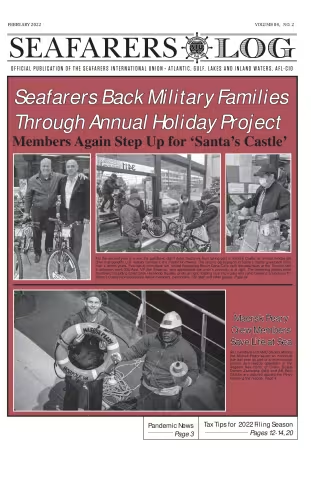
Seafarers Back Military FamiliesSeafarers Back Military Families
Through Annual Holiday ProjectThrough Annual Holiday Project
For the second year in a row, the pandemic didn’t deter Seafarers from taking part in Santa’s Castle, an annual holiday gift
drive that benefits U.S. military families in the Pacific Northwest. The union’s participation in Santa’s Castle goes back more
than a dozen years. Pictured at immediate left, retired Recertified Bosun Dana Cella (left) donates bikes at the Tacoma hall,
a collection point. SIU Asst. VP Joe Vincenzo, who spearheads the union’s outreach, is at right. The remaining photos show
Seafarers (including Chief Cook Hernando Basilan, photo at right) loading toys into trucks and vans following a luncheon for
Santa’s Castle representatives, fellow members, pensioners, SIU staff and other guests. Page 24.
Members Again Step Up for ‘Santa’s Castle’
SIU members and AMO officers aboard
the Maersk Peary saved an individual
late last year as part of a multinational
search and rescue operation in the
Aegean Sea north of Crete. Bosun
Damon Zschoche (left) and AB Roni
Castillo are pictured aboard the Peary
following the rescue. Page 4.
Maersk Peary Maersk Peary
Crew MembersCrew Members
Save Life at SeaSave Life at Sea
2 Seafarers LOG February 2022
A ceremony late last year signaled good news for
U.S. shipbuilding.
Philly Shipyard – a union facility – on Dec. 10 con-
ducted a keel-laying event for the first of up to five
state-of-the-art training vessels for the nation’s state
maritime academies. SIU Executive Vice President
Augie Tellez attended the ceremony, along with a wide
range of guests from the industry, government and the
military.
“These new vessels – known as National Security
Multi-Mission Vessels (NSMVs) – are designed to pro-
vide world-class training for America’s future mariners
and to support humanitarian assistance and disaster re-
lief missions in times of need,” the shipyard noted in
a joint news release with TOTE Services, the vessel
construction manager.
“Today’s first NSMV keel laying is a critical mile-
stone in an innovative effort that is producing state-
of-the-art vessels in an American shipyard that will
both train the next generation of American mariners
and provide a new disaster response capability for the
nation,” said Acting Maritime Administrator Lucinda
Lessley. “We commend everyone who is working hard
to keep this effort on schedule and on budget, and we
look forward to the final delivery of the first ship.”
The keel laying is a ceremonial recognition in
which the first grand block of the vessel is loaded into
the building dock. Keel laying traditions are said to
bring good luck to the ship during construction and to
the captain, crew and cadets that will sail on the ves-
sel throughout her operating life. The first NSMV is
scheduled to be delivered to SUNY Maritime College
in 2023.
Steinar Nerbovik, president and CEO of Philly
Shipyard, stated, “Today represents a momentous
achievement in U.S. maritime education and a sig-
nificant investment in the local economy and job cre-
ation.”
According to the release, “The NSMV is an im-
portant investment in America’s shipbuilding indus-
try, which supports nearly 400,000 U.S. jobs. Each
NSMV will be built using 7,000 metric tons of steel
produced by U.S. mills and fabricated by skilled labor.
The first of four main generator engines, manufactured
by Wabtec Corp. in Grove City, Pennsylvania, recently
arrived at the shipyard and will be lowered into the hull
in the first quarter of 2022.”
The NSMV will feature numerous instructional
spaces, a full training bridge, and accommodations for
up to 600 cadets to train at sea.
The U.S. Department of Transportation’s Maritime
Administration (MARAD) selected TOTE Services to
be the vessel construction manager for the NSMV pro-
gram in May 2019 “to ensure the utilization of best
practices in commercial ship construction,” the agency
reported. “As an industry leader in vessel services, ship
management and marine operations, TOTE Services
will oversee development of these new vessels, which
will provide a strong U.S. maritime fleet, crewed by
the world’s best-trained merchant mariners.” In April
2020, TOTE Services awarded Philly Shipyard a con-
tract to construct up to five NSMVs. These ships will
be owned and operated by MARAD.
“TOTE Services’ contract with MARAD demon-
strates a new acquisition process to federal shipbuild-
ing, where the government benefits from commercial
best practices to design and construct vessels that are
built by union labor in a U.S. shipyard with U.S.-made
steel and U.S.- made engines,” said TOTE Services
President Jeff Dixon. “Our aim is straight – we’re com-
mitted to the success of this program and to delivering
these vessels for MARAD, so that our future cadets
have the modern training platforms they deserve.”
Congress has appropriated funding to replace aging
training vessels at SUNY Maritime College, Massa-
chusetts Maritime Academy, Maine Maritime Acad-
emy and Texas A&M Maritime Academy, respectively.
TOTE Services retains an option for a fifth NSMV for
the California State University Maritime Academy, if
additional funding is appropriated by Congress.
The Seafarers LOG (ISSN 1086-4636) is published monthly by the
Seafarers International Union; Atlantic, Gulf, Lakes and Inland Waters,
AFL-CIO; 5201 Capital Gateway Drive; Camp Springs, MD 20746.
Telephone (301) 899-0675. Periodicals postage paid at Southern Maryland
20790-9998. POSTMASTER: Send address changes to the Seafarers LOG,
5201 Capital Gateway Drive, Camp Springs, MD 20746.
Communications Director, Jordan Biscardo;
Assistant Communications Director & Managing Editor/
Production, Jim Guthrie; Assistant Editor, Nick Merrill;
Administrative Support, Jenny Stokes; Content Curator,
Mark Clements.
Copyright © 2021 Seafarers International Union, AGLIW. All Rights
Reserved.
Volume 82 Number 2 February 2022
The SIU online: www.seafarers.org
The Seafarers International
Union engaged an environ-
mentally friendly printer
for the production of this
newspaper.
O F F I C I A L P U B L I C A T I O N O F T H E S E A F A R E R S I N T E R N A T I O N A L U N I O N A T L A N T I C , G U L F, L A K E S A N D I N L A N D W A T E R S , A F L - C I O
Fight for Voting Rights Continues
President’s ReportPresident’s Report
Despite a congressional setback in late January, the AFL-CIO and
other proponents of voting-rights legislation will continue the fight.
As you may know, our efforts are focused on two bills: the John
Lewis Voting Rights Advancement Act, which would reinstate federal
power to review some state voting laws in
order to avoid discrimination, and the Free-
dom to Vote Act, a wider-ranging piece of
legislation that aims to establish national
guidelines for voting by mail, early voting and
other segments of the electoral process.
I believe that the Freedom to Vote Act and
the John Lewis Voting Rights Advancement
Act would protect the right of every American
to cast our vote and have that vote counted.
Collectively, the bills are an appropriate federal
response to the attacks on voting rights happen-
ing in state legislatures all across the country.
“Advancing voting rights is how we de-
fend America against those who want to tear
workers apart,” stated AFL-CIO President Liz
Shuler. “Mobilizing on voting rights is also
how we can take on the filibuster, which has been used for generations
to block progress for workers.”
The federation has noted dozens of states in recent years have modi-
fied their voting laws to make the process of casting a ballot more dif-
ficult or to replace nonpartisan election officials with those professing
support for only one side.
Unfortunately, any action on two bills has been stalled by the threat
of a filibuster, which under current Senate rules calls for 60 senators to
declare they are willing to allow either measure to simply be debated.
There is nothing more fundamental in a democracy than the right
to vote, and that’s why we’ll continue working with the federation and
other allies to defeat voter suppression tactics and secure voting rights
for working people nationwide.
Put simply, voting is a fundamental right. I encourage Seafarers to
be involved, to know the issues and to meet the candidates. This union
doesn’t care what party they belong to. We just ask them to stand up for
the workers and their families who elected them.
Annual BLS Report
Around press time, the U.S. Bureau of Labor Statistics (BLS) issued
its annual report on union membership. It showed a decline in 2021 to
the same rate as in 2019, which was 10.3 percent, and an overall total
membership of 14 million. In 2020, membership rates had increased,
but that was mostly because union jobs proved more secure than non-
union ones during that stretch of the pandemic.
One stat that jumped out at me from the report: On average, union
members earn an additional $10,000 per year compared to unrepre-
sented workers. They also typically enjoy better benefits.
While it isn’t immediately reflected by the raw data, I don’t think
there’s any question the past year saw remarkable union momentum –
high-profile campaigns at flagship American employers, major moves
in new industries, and widespread strikes as workers stood up for a fair
deal and a better life.
The substantial level of union activity in 2021 demonstrates that
workers want and value unions. The fact that unionization neverthe-
less declined is a glaring testament to how easy it is for employers who
oppose unions to exploit our weak and outdated labor laws to thwart
workers’ attempts at organizing, and how broken U.S. labor law really
is. It is urgent that Congress pass the Protecting the Right to Organize
(PRO) Act and the Public Service Freedom to Negotiate Act.
In some ways, the 2021 union numbers are a wakeup call. The Biden
administration and Congress must institute policies (such as the PRO
Act and the Public Service Freedom to Negotiate Act) that promote the
right to union representation and collective bargaining as we rebuild our
economy.
Michael Sacco
It remains an uphill climb, but new dates have been
set for a rerun vote for union representation at Amazon’s
warehouse in Bessemer, Alabama. The National Labor
Relations Board (NLRB) on Jan. 11 announced that bal-
lots will be mailed Feb. 4 and counted March 28.
Last year, the Retail, Wholesale and Department Store
Union (RWDSU) lost in an election “skewed by massive
company labor law-breaking,” as one pro-worker pundit
noted. The campaign, vote and aftermath gained nation-
wide attention; President Biden vocally supported the
organizing drive.
RWDSU President Stuart Appelbaum said the recent
NLRB notice doesn’t go far enough to prevent illegal
tactics by the company similar to the ones they used in
2021. According to the Press Associates union news ser-
vice, “In the last election, the RWDSU lost after Ama-
zon intimidated workers and convinced the U.S. Postal
Service to put a big gray mail collection box under an
Amazon-emblazoned tent in the company’s parking lot
right outside the main entrance to the warehouse, which
is the size of several football fields. After Amazon forced
enlargement of the electorate, a common employer tactic,
some 1,600 workers were eligible to vote.”
The board’s notice said the mailbox “created the ap-
pearance of irregularity” in the voting. So did Amazon’s
illegal polling of workers’ views during “mandatory”
captive-audience meetings. Both “tainted the outcome”
and made a fair election impossible, Appelbaum said.
He added, “We are deeply concerned the decision fails
to adequately prevent Amazon from continuing its objec-
tionable behavior in a new election. We proposed to the
NLRB a number of remedies that could have made the
process fairer to workers” but they weren’t included in
the rerun election notice.
Press Associates also reported that, since the first
vote, the NLRB ordered Amazon to post a notice at all
of its warehouses and other facilities nationwide admit-
ting it broke labor laws through various anti-union tactics
(banning conversations in break rooms, for example) and
promising not to do so again.
Workers who were employed by Amazon during first
vote, but no longer work there, are not eligible to vote this
time. Because of the company’s high turnover, union or-
ganizers have had to essentially start from the beginning.
The NLRB’s Birmingham regional office (which cov-
ers Bessemer) was scheduled to mail ballots to all work-
ers on the warehouse payroll on Jan. 8, or to those who
toiled there an average of at least four hours a week for
the 13 weeks before that date.
Appelbaum concluded, “Workers’ voices can and
must be heard fairly, unencumbered by Amazon’s limit-
less power to control what must be a fair and free elec-
tion, and we will continue to hold them accountable for
their actions.”
NLRB Sets Dates for Rerun Vote at Amazon
Domestic Shipbuilding Gets Boost
With Keel-Laying at Philly Shipyard
Multi-Mission Vessel Achieves Construction Milestone
This illustration from the U.S. Maritime Administration shows the general look of the multi-mission vessels
February 2022 Seafarers LOG 3
Given the sometimes-exhausting nature
of persevering through the COVID-19 global
pandemic, it occasionally may seem as if the
novel coronavirus has been around forever.
However, March 11 in fact will mark
two years since the World Health Organiza-
tion (WHO) declared COVID-19, the dis-
ease caused by the severe acute respiratory
syndrome coronavirus 2 (SARS-CoV-2), a
pandemic. The Trump administration had
pronounced a public health emergency a
month earlier (Feb. 3, 2020).
At press time (late January), there had
been at least 850,000 deaths in the United
States caused by COVID-19 since the pan-
demic’s onset. More than 66 million cases in
all 50 states, U.S. territories and Washington,
D.C. had been reported.
Globally, there have been more than
331 million cases and more than 5.54 mil-
lion deaths confirmed. More than 9.71 bil-
lion vaccine doses have been administered
worldwide.
Meanwhile, the omicron variant – first
detected in the U.S. on Dec. 1, 2021 – has
rapidly become the dominant strain of the
coronavirus. Just one month after that first
detection, it accounted for 95 percent of the
nation’s COVID cases. The U.S. in early
January recorded more than one million posi-
tive cases in a single day, as hospitalizations
skyrocketed. Public health experts said that
although omicron is extremely contagious,
vaccines have helped prevent more-severe
reactions among many who’ve been immu-
nized.
Like the rest of the nation, the SIU has felt
omicron’s effects. At various times from late
December to mid-January, the union periodi-
cally and temporarily closed several hiring
halls for precautionary reasons (including
Baltimore, Jersey City, Wilmington and Jack-
sonville, plus headquarters). In early January,
headquarters temporarily reduced its in-per-
son staffing while increasing off-site work.
The union-affiliated school in Piney Point,
Maryland, announced that, effective Febru-
ary 1, 2022, any upgraders or apprentices
must be fully vaccinated against COVID-19,
including a booster shot if the student is eli-
gible to receive one.
Just before the New Year, the union and
Intrepid Personnel and Provisioning an-
nounced a memorandum of understanding
(effective Jan. 1) regarding COVID protocols
for mariners sailing aboard vessels operating
in the Jones Act trade (excluding MSC-char-
tered vessels). The memorandum, available
on the SIU website and at the halls, modifies
the vaccine requirement and stipulates cor-
responding shipboard safety measures.
While the U.S. health care system became
overwhelmed due to omicron, the Supreme
Court on Jan. 13 temporarily blocked the
Biden administration’s vaccine-or-test man-
date for large employers. The court did per-
mit a vaccine mandate to remain for medical
facilities that take Medicare or Medicaid pay-
ments.
Justices Stephen Breyer, Sonia Sotomayor
and Elena Kagan dissented in the former
ruling. They said the majority usurped the
power of Congress, the president and the Oc-
cupational Health and Safety Administration.
“In the face of a still-raging pandemic,
this Court tells the agency charged with pro-
tecting worker safety that it may not do so in
all the workplaces needed,” they said in their
dissent. “As disease and death continue to
mount, this Court tells the agency that it can-
not respond in the most effective way pos-
sible. Without legal basis, the Court usurps
a decision that rightfully belongs to others.
It undercuts the capacity of the responsible
federal officials, acting well within the scope
of their authority, to protect American work-
ers from grave danger.”
AFL-CIO President Liz Shuler said the
federation is “disappointed” by the court’s
decision. “While infections and hospital-
izations surge, we again urge the Biden ad-
ministration to require employers to provide
protections beyond vaccines,” she said.
Shuler called for a “COVID-19 stan-
dard for health-care workers” along with
“an emergency standard to ensure all at-risk
workers are provided layers of protections
against COVID-19 transmission at work like
improved ventilation, distancing, masking
and paid leave. We will not beat this pan-
demic until we stop the spread of the virus
at work.”
Also at press time, the Biden administra-
tion announced a program to mail up to 500
million at-home COVID-19 test kits to every
household that requests them. These kits
could be mailed to as many as 160 million
addresses. Union members who work for the
U.S. Postal Service (USPS) will be critical to
the success of the program. Test kits can be
ordered at COVIDTests.gov.
“The APWU is excited and fully supports
this plan,” said American Postal Workers
Union (APWU) President Mark Dimond-
stein. “It is in the interests of the health and
wellbeing of the general population as this
dangerous pandemic continues. It under-
scores the invaluable role of the public Postal
Service in the lives of the people. It shines a
light on the importance of maintaining uni-
versal service to every address and person.”
“The ongoing pandemic has proven be-
yond a shadow of doubt the critical impor-
tance of the services we provide six and
seven days a week to keep people connected
and essentials moving,” National Association
of Letter Carriers (NALC) President Fredric
Rolando said. “This partnership is the perfect
example in action. Letter carriers are proud
to be the face of this important initiative as
we continue serving all communities equita-
bly.”
Editor’s note: This information is taken
from the U.S. Centers for Disease Control
and Prevention (CDC) website:
https://www.cdc.gov/coronavirus/2019-
ncov/vaccines/effectiveness/work.html
COVID-19 Vaccines Protect Against COVID-
19 Infections and Hospitalizations
Vaccines reduce the risk of COVID-
19, including the risk of severe illness and
death among people who are fully vac-
cinated. In addition to data from clinical
trials, evidence from real-world vaccine
effectiveness studies show that COVID-19
vaccines help protect against COVID-19
infections, with or without symptoms (as-
ymptomatic infections). Vaccine effective-
ness against hospitalizations has remained
relatively high over time, although it tends
to be slightly lower for older adults and for
people with weakened immune systems.
COVID-19 Vaccines Are Effective Against
Most Variants
Viruses are constantly changing and
new types of the virus, called variants,
occur. New variants of the virus that
causes COVID-19 are spreading in the
United States and in other parts of the
world. COVID-19 vaccines are effective
against the Delta variant and other variants
with widespread circulation in the United
States. Current vaccines are expected to
protect against severe illness, hospitaliza-
tions, and deaths due to infection with the
Omicron variant. We don’t yet know how
effective the vaccines will be against new
variants that might arise. CDC will con-
tinue to monitor vaccine effectiveness to
see if variants have any impact on how
well COVID-19 vaccines work in real-
world conditions.
Vaccine Breakthrough Infections
COVID-19 vaccines are effective at
preventing infection, serious illness, and
death. Most people who get COVID-19 are
unvaccinated. However, since vaccines are
not 100% effective at preventing infection,
some people who are fully vaccinated will
still get COVID-19. This is called a break-
through infection. Even when people who
are fully vaccinated develop symptoms of
COVID-19, they tend to be less severe than
in people who are unvaccinated.
Omicron Variant, Court Ruling Among Latest Developments
CDC Offers Latest
Input on Vaccines
COVID-19 Pandemic Heads into Third Year
President Biden provides an update on the omicron variant. (Image courtesy of the White
House)
AFL-CIO President Liz Shuler (left), pictured at federation headquarters immediately
after her election to the top post last year, has pushed for stronger workplace protec-
tions during the pandemic. AFL-CIO Executive VP Tefere Gebre is at right.
A Maui resident (left) gets tested for COVID-19 on the island. At-home tests now are
available at no charge for anyone who requests them. (U.S. Army National Guard photo
by Sgt. 1st Class Theresa Gualdarama)
4 Seafarers LOG February 2022
As part of a much larger rescue effort,
Seafarers sailing aboard the Maersk Line-
operated Maersk Peary pulled a man from
the Aegean Sea on Dec. 22.
The SIU crew aboard the Peary, which
was en route to deliver vital fuel and sup-
plies to McMurdo Station in Antarctica,
included: Bosun Damon Zschoch; ABs
Marie Acosta, Roni Castillo, Joshua
Gail, Edward Majesky and Derek Willis;
QE3 Lateef Sanusi; QEP Rickey Yancey;
GSTU Lakeeba Bazemore; Wiper Ali
Laith; Recertified Steward Tony Spain;
and Chief Cooks Osmar Ramos and
Randy Hampton. The ship’s officers are
represented by the Seafarers-affiliated
AMO.
The following is an abbreviated de-
scription of the rescue that was provided
by vessel master Capt. Everett Hatton:
“On the evening of December 22, at
2030 local time, while Maersk Peary was
transiting the Aegean Sea north of Crete
and on the way to Suez Canal, the Navi-
gation Bridge Watch Officer, Third Mate
Gemma Nguyen, received a call on VHF
Channel 16 from Rescue Center Piraeus.
“The call was to inform Maersk Peary
to join in a search mission for a vessel that
capsized the previous day, and of which
we were now in the immediate vicinity.
Our plotted route to Suez Canal took us
to within 13.5 nautical miles of where the
vessel was initially reported being capsized
with possibly 60 people.
“We contacted the Command Vessel
and received instructions with coordinates
making a box, and were told to proceed
there while keeping a lookout for possible
survivors in the water. At 2048, while our
area was being plotted, I decided to head
on a northerly heading into our box. As we
approached our given area of patrol, we
slowed the vessel, added extra lookouts
and manned the searchlights scanning
ahead of the bow while doing our grid
search.
“At 2157, after about an hour of slow
steaming with searchlights headed north in
our grid search, I noticed something in the
water just off our starboard bow. I could
tell that, based on our current heading (001
T) and speed (@ 5.0 knots), the white ob-
ject would pass close down the starboard
side. I kept the searchlight on the object
while Third Mate and Bosun focused on it
with binoculars. As we got closer, it was
determined that a person could be seen
with arms raised holding onto the white
object (later identified as a boat fender).”
Castillo told the Seafarers LOG, “I
was already in bed around 2100 when
I got a call from the bridge to report to
the fast rescue boat on the starboard side
of the ship. We had a man overboard. I
was thinking it was a crew member, as I
got dressed quickly and started heading
out to the boat. As soon as I got there, I
went to my assignment as the sea painter.
Directed by the officer in charge, we
launched the rescue boat and headed to-
ward the man in the water. They got him
in the boat and brought him back, hooked
him into the rescue boat. He asked for
some drinking water, and we also gave
him a banana.”
The crew recovered the man from the
wreckage and brought him on board. As
described by the captain, “He had no en-
ergy to assist in getting himself into the
rescue boat. He was wearing only a t-shirt,
shorts and socks. It looked like he must
have jumped into the water from being
asleep.”
Castillo recalled, “From the time I re-
ceived the call from the bridge and got the
boat in the water to the time we got the
man back to the boat, it was less than 20
minutes.”
The crew then transferred the man,
who was shivering but conscious, to the
Greek Coast Guard and resumed their
grid search. The Maersk Peary was then
relieved of their search and rescue du-
ties four hours later, and returned to their
original course.
“After the Greek Coast Guard took the
survivor, I never did hear about his condi-
tion,” said Hatton. “I can only speculate
that he is doing fine as he was conscious
and moving around a bit on his own when
we passed him off.”
The captain concluded, “I am very
fortunate for SIU to step up and provide a
top-notch crew on very short time as we
rushed the vessel from load port Greece
just prior to the holidays. This current crew
proved to be well qualified and trained
when the alarms rang to turn to for a
search and rescue during the dark of the
night. Without a hesitation, when called
to assist, all were there and added helping
hands. For the Maersk Peary crew, it was
an outstanding effort for everyone to be
involved in this recovery.”
During that weekend, at least 30 mi-
grants died in three separate incidents in
the same area, with more than 160 rescued.
The combined rescue efforts saw at least
four Greek Coast Guard vessels, a Greek
naval frigate, eight merchant ships, three
private vessels, three military helicopters
and a military transport plane all pitch in to
save as many lives as possible.
SIU Members Assist in Dramatic Rescue
In photo at left, SIU and AMO members team up to launch the Maersk Peary’s
rescue boat. The Peary’s bridge wing life-ring buoy, orange smoke and light are re-
leased (photo above) while crew members encourage the survivor to grab the buoy.
Mariners from the Peary prepare to transport the survivor to the vessel.
Crew members work with personnel from the Greek Coast Guard to ensure a safe
transfer. A Greek Coast Guard vessel arrives near the Peary.
February 2022 Seafarers LOG 5
Protect Personal Info from Cyber Criminals
Editor’s note: This article is provided by
the union’s legal department.
You’ve probably heard about serious
data breaches that have occurred in recent
years across the globe. These incidents have
affected millions of people worldwide, crip-
pled businesses and government agencies,
and caused huge financial losses.
U.S. Secretary of Homeland Security
Alejandro Mayorkas has warned that these
attacks are on the rise, and that nearly every-
one is at risk.
One of the most common types of digital
breaches is known as ransomware. When a
ransomware attack occurs, the criminal en-
crypts all of the user’s data, and then will
not allow access to the data unless the busi-
ness or individual pays a ransom. Accord-
ing to the Department of Homeland Security
(DHS), more than $350 million was paid
in the U.S. in ransom during 2020 alone.
Related expenses (such as downtime and
implementing new security measures) may
have exceeded $20 billion.
Many of the losses experienced by indi-
viduals are the result of emails or text mes-
sages that are designed to trick the reader
into clicking on a link or into providing
certain information. This type of email is
called phishing. Some hackers are skilled
at using various techniques to steal personal
data, including information about bank ac-
counts, credit cards, other assets and general
information about a person’s identity such
as birth date, address and Social Security
number. The FBI’s Internet Crime Com-
plaint Center reported that people lost $57
million to phishing schemes last year. How-
ever, there are certain preventive steps that
will help you to avoid becoming a victim of
these scams.
For instance, always examine emails
carefully before clicking on any links, no
matter how urgent the email seems to be.
These are questions and considerations to
keep in mind:
Does the email claim to be from your
bank or credit card company? Scroll over
(but do not click on) the sender’s address
carefully. Is it really from your bank or
credit card company? Banks and credit card
companies generally do not send emails
about problems with an account; they will
usually call. If you’re unsure, call your bank
or credit card company using the number on
your credit card (not the phone number in
the email) instead of clicking on the link.
Is it an email saying you won a prize,
or you just have to provide certain informa-
tion in order to claim a large sum of money?
Why would this person contact you? If it
sounds too good to be true, it’s probably
false. Check the sender’s address.
Is it an email or phone call that claims
to be from the IRS saying that you owe back
taxes, and threatening you with legal action
if you don’t respond? The IRS does not send
such emails, and they do not make threaten-
ing phone calls.
Is it an email or phone call claiming
that a relative is in trouble, and needs money
urgently? Check with your relative to make
sure they are ok, but these types of calls and
emails are almost always scams.
Is it an email that claims to be from an
online retailer, contacting you about a prob-
lem with your order? Look at the sender’s
address carefully. Is it really from Amazon,
Costco, UPS or whoever it claims to be
from? Is the company logo completely ac-
curate? Are you actually expecting a pack-
age from that retailer? Is the order number
correct?
Does the language of the email sound
like the person or company it is supposed to
be? Are there grammatical mistakes or mis-
spellings? Is the language awkward? These
are often signs that the email is not genuine.
Usually, scam emails and phone calls
will try to make you feel urgency to act
quickly. Common tactics by the scammer
include threats of legal action, account clo-
sure, or forfeiture of prize.
Realistically, there are very few situa-
tions so urgent that you cannot take the time
to carefully review the email and verify
who really sent it. If in doubt, look up the
phone number for the company or person
who supposedly sent the email, and confirm
whether or not it is genuine. Do not click on
any links or provide any information.
It is also important to maintain strong
passwords for all of your personal accounts
so that cyber criminals cannot easily crack
your password and access your account. A
strong password should not contain personal
information (like your birthdate or your
spouse’s name) and should not be a single
word that appears in the dictionary. Strong
passwords should be longer and complex.
One method to create a suitable password
that you can easily remember is to make up
a sentence, but substitute numbers and spe-
cial characters (#, !, *, etc.) for some of the
letters, or put them in between the words.
There are various websites that you can use
to test your password’s strength.
These are just a few suggestions to avoid
becoming the target of cyber criminals. The
following is a link to an article from the
Federal Trade Commission regarding other
steps you can take to protect yourself from
these scams:
https://www.consumer.ftc.gov/articles/
how-recognize-and-avoid-phishing-scams
Internet criminals are constantly com-
ing up with new ways to trick people, so
it is important that you pay close atten-
tion to emails, maintain strong passwords
and change your passwords from time to
time.
A hefty chunk of the world’s mari-
ners soon will be able to safely join
ships despite unpredictable changes
to government border policies interna-
tionally.
That’s according to a joint press re-
lease dated Dec. 16 from three inter-
national maritime organizations. The
release states that shipowners, mariner
unions and maritime employer groups
are in the process of establishing their
own approved international network
of quarantine facilities. The move
comes as the omicron variant spurs
some governments to close their bor-
ders to seafarers needing to leave and
join ships.
Dubbed the Crew Enhanced
Quarantine International Program
(CrewEQUIP), the effort came into
fruition via a partnership between the
International Maritime Employers’
Council; the International Chamber of
Shipping; and the International Trans-
port Workers’ Federation (ITF). Col-
lectively, these organizations represent
more than 80 percent of the global
merchant fleet and nearly one million
international seafarers through almost
200 affiliated unions.
CrewEQUIP will create a list of
trusted hotels available for crew quar-
antines that are independently re-
viewed. The program is designed to
overcome frequent changes in govern-
ment border policies affecting inter-
national crew by having the highest
standards and industry-best protocols
in place. Such an arrangement should
help ensure that crew members will
continue to safely get to vessels even if
governments increase their quarantine
requirements.
Spokespersons from the groups
said the program is urgently needed to
avoid the shipping industry’s return to
the worst extremes of the crew change
crisis, which saw 400,000 seafarers
trapped working aboard vessels beyond
their initial contracts in late 2020, with
an equal number unable to join vessels
and earn income.
While a global, permanent system
with digital vaccine and testing recog-
nition is still urgently needed, the vari-
ous officials said CrewEQUIP would
be important to have in place in the in-
terim to support greater levels of crew
change. The groups also welcomed the
December announcement of a new
joint WHO-ILO-industry action group
to advance digital “yellow cards” for
mariners and other workers who need
to cross borders for their jobs.
Under the CrewEQUIP plan, ship-
ping companies and their representa-
tives such as crewing agents and vessel
managers are able to sponsor pre-em-
barkation quarantine facilities for sea-
farers to be considered for recognition.
Facilities must meet CrewEQUIP’s
stringent standards for hygiene, testing
integrity and data security.
A facility must also pass inspections
by Lloyd’s Register, the program’s rec-
ognized external auditor, to become
and remain accepted CrewEQUIP pro-
viders.
SIU Secretary-Treasurer David
Heindel, who also serves as Chair of
the ITF Seafarers’ Section, welcomed
the CrewEQUIP partnership, not-
ing: “A successful crew change needs
everything to line up across the port
states, transit countries, and the right
facilities available in place in the home
country of seafarers involved. Cur-
rently, even seemingly minor altera-
tions to a government’s border, health
or quarantine policies can bring a
planned crew change to a halt – often
leaving a seafarer with no option but to
continue working onboard beyond their
initial contracts….
“Thorough programs l ike
CrewEQUIP, unions and industry are
providing a robust system that reduces
at least one of the factors that risk suc-
cessful crew changes,” Heindel contin-
ued. “It’s an important initiative and we
encourage all responsible shipowners
and employers to get behind.”
ITF Announces New Steps
To Protect World’s Mariners
CHS Updates: Seafarers Encouraged
To Schedule Appointments ASAP
As previously reported, both the union
and the Seafarers Plans are closely work-
ing with Comprehensive Health Services
(CHS) to facilitate better service for SIU
members.
In that spirit, CHS – which is now
part of a parent organization named Acu-
ity – informed the SIU and the Seafarers
Plans that they are experiencing periodic
delays in various locations, due to a com-
bination of staffing shortages, COVID
protocols and (in the northeast) inclem-
ent weather.
Seafarers are encouraged to schedule
appointments as soon as possible. Imme-
diate or very-near-future appointments
may not be available in some locations,
and turnaround times for test results
likely will vary.
Specifically, CHS/Acuity in early
January had advised that the earliest ap-
pointments at any of their Seattle/Tacoma
clinics were in February. (Some of the
Concentra clinics in that region are tak-
ing walk-ins, but they’re not guaranteed.)
The situations were similar in Hawaii and
California.
Also, the company is working with
clinics in Guam and Manila to coordinate
appointments while meeting their respec-
tive local government requirements for
quarantining and testing.
Feel free to contact CHS/Acuity and/
or the SHBP Medical Department with
questions, and keep an eye on the SIU
website for updates.
Six mariners aboard the Maersk Denver pulled in a 200-pound blue marlin (by hand).
Pictured from left are Capt. Craig Rumrill, Recertified Bosun James Walker, Third
Mate Matt Crowley, First Engineer John Harrison, Chief Engineer Tim Burchfield and
Electrician Herman Castro.
One that Didn’t Get Away
6 Seafarers LOG February 2022
Spotlight on Mariner HealthSpotlight on Mariner Health
Healthy RecipeEditor’s note: This article is provided
by the Seafarers Health and Benefits Plan
Medical Department.
Back pain is one of the most common
reasons people see a doctor or miss work.
It’s also not age-exclusive, as children may
experience back pain.
Symptoms may range from a dull, peri-
odic ache to a nearly constant pain. It may
come on suddenly from an accident or de-
velop slowly over time as people age.
Generally, there are two types of back
pain. Acute, or short-term pain, may last
for a few days to a few weeks. Most lower
back pain is acute. It can resolve on its
own with a blend of self-care, anti-inflam-
matory medications, heat, ice, or physical
therapy.
Chronic pain is defined as discomfort
that continues for more than 12 weeks,
even when the underlying cause has been
treated. Approximately 20% of the popu-
lation with back pain will be considered
chronic. Surgery may be the final option
for relief, but sometimes, even this does
not work.
The lower back includes the lumbar
vertebrae (L1-L5). This region supports
much of the weight of the upper body. The
spaces between the vertebrae are called
discs. They act as shock absorbers through-
out the spinal column. Ligaments hold the
vertebrae in place, and tendons attach the
muscles to the spinal column. Nerves run
through the spinal column also.
The causes of lower back pain can be
mechanical in nature, such as a disruption
in the way the spine is made. There are also
congenital problems such as scoliosis (an
abnormal curve in the spine), lordosis (an
exaggerated arch in the lower back), and
kyphosis (hunch-back).
Pain can come from an injury, degen-
erative problems, nerve and spinal cord
problems.
Back pain is diagnosed by patient
symptoms, X-ray, CT scans, and MRIs.
Treatment is based at least in part on the
severity of pain, and may include medica-
tion, steroid injections, physical therapy
and surgery.
Keep in touch with your physician when
pain occurs. Rest as needed and follow up
as directed.
The Mayo Clinic recommends contact-
ing a doctor if back pain persists past a few
weeks; is severe and doesn’t improve with
rest; spreads down one or both legs, espe-
cially if the pain extends below the knee;
causes weakness, numbness or tingling in
one or both legs; or is accompanied by un-
explained weight loss.
The same organization notes, “In rare
cases, back pain can signal a serious medi-
cal problem. Seek immediate care if your
back pain causes new bowel or bladder
problems; is accompanied by a fever; or
follows a fall, blow to your back or other
injury.”
Treatments for Lower Back Pain
Servings: 24
Ingredients
9 pounds chicken breast, 6 oz each
2-1/4 cups goat cheese
24 pieces sun-dried tomatoes, thinly sliced
1/4 cup oregano, fresh, chopped
2 tablespoons Mrs. Dash seasoning
1 1/2 teaspoons granulated garlic
1 pound prosciutto, sliced thin
Preparation
Preheat oven to 375 degrees F
Line a 2” hotel pan with foil, and grease it with cooking spray
Mix the goat cheese, Mrs. Dash seasoning, and granulated garlic
Butterfly each chicken breast 3/4 of the way through. Open the chicken breast
like a book. Spread 1-1/2 tablespoons of goat cheese mixture inside each breast.
Lay the slices of sun-dried tomatoes on top. Finally, sprinkle a tiny bit of
chopped oregano on each breast.
Wrap each breast with two slices of prosciutto
Place the breasts on the prepared backing sheet. Bake for 23 to 25 minutes, or
until the chicken has reached 165 degrees F.
Nutrition Information
Per serving (excluding unknown items): 329 calories; 18g fat (50.6% calories
from fat); 37g protein; 2g carbohydrate; 1g dietary fiber; 112mg cholesterol;
676mg sodium. Exchanges: 0 grain (starch); 5-1/2 lean meat; 1/2 fat.
(Provided by the Paul Hall Center’s Seafarers Harry Lundeberg School of
Seamanship)
Prosciutto-Wrapped Chicken with Goat Cheese
In accordance with his directive, the remains of Recertified Bosun Stig Sasse were
committed to the sea from the Liberty Pride, while the vessel was sailing in the North
Atlantic. Vessel master Capt. Bruce Bonnecarrere (right in group photo, also shown
in other photo), who sailed with Sasse, conducted a brief shipboard ceremony and
scattered the ashes. “He loved the sea and enjoyed getting to meet a lot of good
shipmates and people all over the world,” the captain said. “He sailed for 44 years
and used to ship out of the Houston hall.” An SIU pensioner, Sasse passed away
Nov. 29, at age 64. He most recently sailed in early 2020.
Honoring Bosun’s Wishes
U.S. maritime industry stalwart Stanley H.
Barer, 82, passed away peacefully at his home in
Seattle on Dec. 13, 2021, following a decade-long
battle with pancreatic cancer. Widely regarded
as a brilliant attorney, dedicated philanthropist
and successful entrepreneur, Barer co-founded
Saltchuk Resources in 1982, a family of trans-
portation and distribution companies that had
acquired more than 30 entities across air cargo,
marine services, energy distribution, domestic
shipping, international shipping and logistics.
(Saltchuk’s subsidiaries include companies that
employ SIU members.) He served as chairman
of Saltchuk until 1994 and was named chairman
emeritus in 2001.
“The industry lost a powerful voice in Stan,”
said SIU President Michael Sacco. “He was a true
ally of the American mariner and spent his career
working towards improving shipping and trade
between the U.S. and our allies. He also was a tre-
mendous advocate for the Jones Act, and he will
be dearly missed.”
Barer was born in 1939 in Walla Walla, Wash-
ington, to David and Dorothy Barer, who had im-
migrated to the United States from Ukraine and
England, respectively, and made their living in the
scrap metal business. The middle child and first of
his family to graduate from college, Barer knew
from an early age that education was the key to
his future success.
After graduating from Walla Walla High, Barer
earned his undergraduate and law degrees from the
University of Washington. He was hired by U.S.
Sen. Warren G. Magnuson, whom he worked for
in Washington, D.C., as legal counsel for the U.S.
Senate Committee on Interstate and Foreign Com-
merce, which Magnuson chaired. Barer served as
the U.S. Senate lawyer for enactment of the 1964
Civil Rights Act, helping write the landmark legis-
lation. From 1965-1967, he served as the Assistant
U.S. Attorney in Seattle before returning to D.C.
to serve as Magnuson’s Chief of Staff. In 1972,
Barer worked as legal counsel for the U.S. Delega-
tion to the first United Nations Conference on the
Environment at Stockholm, Sweden.
In 1974, he returned to Seattle with the love
of his life, Alta Barer, and joined the Garvey
Schubert Barer law firm. He began what would
become the focus of his long professional career:
rebuilding U.S.-China trade relations, including
the watershed 1979 legal opinion which reopened
direct shipping and aviation between the U.S. and
the People’s Republic of China for the first time
since 1950.
While a significant change to international
law, it also embodied one of Barer’s core beliefs:
The world is filled with shared values, and civility
can lead to greater understanding.
A staunch Democrat, Barer was an Ameri-
can first, advising presidents on matters of in-
ternational trade regardless of party affiliation,
from Johnson through Obama. Active in political
fundraising, he and his wife hosted several such
events in the Barer family home. They hosted
Hillary Clinton as First Lady and then again as a
candidate for the U.S. presidency and held several
events for former U.S. Sen., Secretary of State and
presidential candidate John Kerry and his wife Te-
resa Heinz Kerry.
Throughout his career, Barer earned global
recognition for his achievements, including the
2021 Gates Volunteer Service Award, presented
to individuals whose philanthropy and service
have taken the University of Washington to new
heights. In 2011 and again in 2018, he was hon-
ored in Beijing at the Great Hall of the People with
a Lifetime Achievement Award for his work in
furthering relations between China and the United
States. In 1996, he was honored with the Admiral
of the Ocean Seas Award, a prestigious transporta-
tion award in the U.S.
Saltchuk Co-Founder Stan
Barer Passes Away at 82
Stan Barer
February 2022 Seafarers LOG 7
At Sea and Ashore with the SIU
ABOARD MAERSK ATLANTA – Crew members are pictured next to the vessel during a shipyard period in Bahrain. Thanks to Recertified Bosun Hanapiah Ismail for the photo.
WITH SEAFARERS IN OAKLAND – Pictured in photo at center are Chief Engineer Yoali Salcedo (left) and SIU Port Agent
J.B. Niday aboard the Starlight Marine tugboat Z Three. The Seafaring selfie at left was taken aboard Matson’s Matsonia.
SIU Representative Kathy Chester is in the foreground. Pictured from left are ACU Ruben Siclot, Chief Cook Kirk Fisher and
Recertified Steward James Harper. The remaining photo at right, taken at the hiring hall, features (from left) SIU VP Nick
Celona, newly retired AB Neonito Sodusta (picking up his first pension check) and SIU VP Nick Marrone. “Thank you, SIU,
for having me as a member since 1994,” Sodusta wrote. “I am truly grateful and proud to have been part of the operations.”
ABOARD LIBERTY PASSION – Crew members and shipyard fire fighters gather for a safety drill in Manama, Bahrain. Thanks to Recertified Bosun Karl Mayhew for the photo.
8 Seafarers LOG February 2022
At Sea and Ashore with the SIU
FULL BOOKS IN ALASKA – Picking up their respective full B-books at the Anchorage
hall are GVA Apollos Smalls (left in photo at left) and AB Dzmitry Sasnouski (left in other
photo). SIU Port Agent Nick Marrone II is at right in both snapshots.
A-BOOK IN ALGONAC – AB Mubarek
Ahmed (left) receives his A-seniority book
at the hiring hall. SIU Port Agent Todd
Brdak is at right.
WELCOME ASHORE IN TACOMA – OMU
Sotero Berame (right) picks up his first pen-
sion check at the hiring hall. SIU Asst. VP
Joe Vincenzo is at left.
AT THE HOUSON HALL – In
photo at left, OMU Francois
Bonilla (left) receives his full B-
book from SIU Patrolman Kelly
Krick. QMED Mike Kifle (left in
photo at left below) picks up his
first pension check (SIU Port
Agent Joe Zavala is at right).
Receiving his full B-book (right
in photo at immediate right,
with SIU Asst. VP Mike Russo)
is STOS Erry Draper. The re-
maining photo below at right
was taken during a Christmas
luncheon; the hall also hosted
one for Thanksgiving.
ABOARD HORIZON KODIAK – SIU Tacoma Port Agent Warren Asp submitted
these photos after a servicing. In photo directly above are Chief Cook Obadi Kas-
sem (left) and ABM Alfred Polk. SA Mana Al Osfur (photo in center) is pictured in
the galley, while the remaining photo includes (from left) QMED Husain Ali Ali, AB
Adel Shaibi and SIU Patrolman George Owen.
February 2022 Seafarers LOG 9
At Sea and Ashore with the SIU
ABOARD LIBERTY PRIDE – Vessel master Capt. Bruce Bonnecarrere shared this photographic proof of Santa’s where-
abouts on Christmas Eve.
ABOARD MV PATRIOT – SIU Port Agent John Hoskins
(left) and Bosun Dixon Guity are pictured aboard the
TOTE vessel in late December.
ABOARD MAERSK OHIO – Thanks to vessel master Capt. C. Kavanagh for this shipboard holiday photo. “The crew is
sporting knitted hats provided by the Ebenezer Baptist Church in Trenton, South Carolina,” Kavanagh noted. “The crew looks
forward to these hats and the Christmas boxes provided by the various Seafarers Missions.” Standing, from left: SA Kaleb
Politte, Recertified Bosun James Joyce, GVA Eric Chapman, AB Aretta Jones, CM Elliott Gabbert, 2AE Darnell Slayton and
AB Carlos Palacios-Nunez. Kneeling, from left: Chief Steward Kim Smith, Chief Cook Richetta Jackson and Chief Engineer
Joseph Reynolds.
ABOARD RJ PFEIFFER – Recertified Steward Ali
Munsar (left), Chief Cook Khalid Mohamed (right) and
ACU Taleb Alarqaban teamed up to provide a wide-
ranging menu for the New Year’s holiday aboard the
Matson ship. Numerous photos of the spread are
posted on the SIU Facebook page.
ABOARD MAERSK KINLOSS – Shortly before the
holiday, steward-department Seafarers aboard the
vessel wished everyone a Merry Christmas. Pictured
from left in photo above are SA Ronald Pattiasina,
Recertified Steward Caezar Mercado and Chief Cook
John Nunez. Thanks to SIU Jersey City Port Agent
Ray Henderson for the photo.
ABOARD USNS BRITTIN – Crew members enjoy a holiday meal
aboard the U.S. Marine Management vessel. Thanks to Chief
Steward Erwin Renon for the photo.
ABOARD MOKIHANA
– The Christmas and
New Year ’s meals
aboard the Matson ship
were well-received.
Pictured from left in
the group photo above
are Chief Cook Brandy
Clemons, Capt. Angel
Irlanda, Recertified
Steward Fakhruddin
Malahi and ACU Mar-
ilou Gumapas. (For ad-
ditional photos, visit the
SIU Facebook page.)
10 Seafarers LOG February 2022
Arriving at the Crowley terminal in San Juan are El Coqui crew mem-
bers ABM Julio Perez Jr., Bosun Kemer Rojas, ABW Jonamie En-
carnacion and ABM Christian Reyes (all residents of Puerto Rico).
Electrician Edwin Velez, Bosun Charles Ortiz and SIU Asst. VP
Amancio Crespo are pictured aboard the El Coqui.
Chief Cook Steven Lopez and Chief Steward
Jose Norales sail on the El Coqui.
Puerto Rico-Based Seafarers
Deliver ‘The Goods’ to Territory,
Mainland in Jones Act Trade
Throughout the twists and turns of the global COVID-
19 pandemic, one constant has been the reliability of SIU-
crewed ships servicing Puerto Rico and the U.S. mainland in
the Jones Act trade.
“I can say from firsthand experience that our members
are justifiably proud of their work that helps bring vital
cargoes to and from Puerto Rico,” said SIU Assistant Vice
President Amancio Crespo, who is based in San Juan. “They
also know that the Jones Act is a crucial source of jobs for
Puerto Rico residents.”
Recent data confirms earlier findings from a compre-
hensive study about America’s freight cabotage law and the
island. For instance, SIU-contracted Crowley in mid-January
reported that they were “smashing (cargo) volume records
in Puerto Rico,” thanks in part to the Seafarers-crewed ves-
sels El Coquí and Taino, which sail between the territory and
Jacksonville, Florida.
As previously reported, a major study by Boston-based
economists concluded the Jones Act has no impact on either
retail prices or the cost of living in Puerto Rico. In addition,
the report found that the state-of-the-art maritime technology,
Puerto-Rico focused investments, and dedicated closed-loop
service offered by Jones Act carriers provide a significant
positive economic impact to the island, at freight rates lower
or comparable to similar services to other Caribbean Islands.
“There has been much debate about the impact of the
Jones Act on Puerto Rico, particularly following Hurricane
Maria,” said John Reeve, the principal in Reeve & Associ-
ates and the lead economist on the study. “The findings of
our analysis show that reliable, efficient, and regular Jones
Act services benefit consumers and businesses on the island,
and no evidence suggests that exempting Puerto Rico from
the Jones Act would reduce consumer prices in Puerto Rico.
On the contrary, such an action may well increase prices.”
A pillar of U.S. national, economic and homeland secu-
rity for more than a century, the Jones Act requires that cargo
moving between domestic ports be carried on vessels that are
crewed, built, flagged and owned American.
Pictured from left aboard the Isla Bella (TOTE Services) are
Electrician Hector Ginel, Recertified Bosun John Cedeno and
AB Gary Boyd.
Recertified Bosun John Cedeno, GUDE Ray Fernandez and
SIU Asst. VP Amancio Crespo reminisce aboard the Isla Bella.
Many years ago, they worked together in the crane department
at Navierias de Puerto Rico.
Proudly displaying his first ABW registration (fresh out of Piney
Point) is Seafarer Kelvin Soto (left), a second-generation SIU
member. He’s pictured at the San Juan hall with SIU Asst. VP
Amancio Crespo. Soto recently shipped out aboard the Na-
tional Glory (Crowley).
Newly credentialed AB Jorge Alamo
(right) poses for a photo with SIU Asst.
VP Amancio Crespo in the San Juan
hall.
AB Luis Venegas
El Coqui
Electrician Carlos Parrilla handles main-
tenance on a reefer container aboard the
Taino.
The holiday spirit was evident aboard Crowley’s Taino when this snap-
shot was taken before Christmas. Pictured are ABG Julio Perez, SA
Simone Smith, Recertified Steward Kim Strate, Bosun Kemer Rojas,
ABM Victor Cortes, Chief Cook Yoaquin Gonzalez and Electrician Carlos
Parrilla.
Pictured Dec. 20 aboard the Perla Del Caribe
(TOTE) in San Juan, Puerto Rico, are (from
left) Recertified Steward Antonio Mendez,
Steward/Baker Sharray Turner and SIU Asst.
VP Amancio Crespo.
February 2022 Seafarers LOG 11
TAKING UNION OATH – Pictured from left at the December meeting are SA Temiaka McLaurin,
Chief Cook Eugene Williams, Chief Cook Sherron DeCoteau, Chief Cook Torrika Devine, ABM
Derrick Alexander and OMU Blake Washington. SIU Port Agent Ashley Nelson is standing at right.
Devine and Alexander received their respective A-books, while the others picked up B-books.
BOOKS GALORE – Several Seafarers were sworn in during the November mem-
bership meeting. They’re pictured with union representatives at the hall, following
the meeting. In front (from left) are SIU Safety Director Joseph Koncul, SIU Pa-
trolman Eddie Pittman, Steward/Baker Mamie Porter (who picked up her A-book)
and Chief Cook Michael Ray (A-book). In back are AB Nakia Miller (B-book), QEP
David Garrett (A-book) and GUDE Christopher Skinner (B-book).
With Seafarers in Jacksonville (and SC)
READY FOR LUNCHEON – From left, ACU Rosalie Long, CC Joseph Arigo,
SA Florentino Espiritu and SA Michael Fincannon are among the volunteers and
guests at the Dec. 9 holiday luncheon at the hall.
SPIRITS HIGH AT HALL – From left, Chief Cook Sher-
ron DeCoteau, SIU Patrolman Adam Bucalo and Chief
Cook Torrika Devine seem enthused about the holiday
luncheon. (Editor’s note: Please visit the SIU Facebook
page for additional photos from the gathering.)
BACKING MDL – Steward/Baker An-
tajuan Beasley (right) is a longtime
supporter of the Maritime Defense
League. He’s pictured at the hall
shortly after contributing to the cause.
SIU Safety Director Joseph Koncul is
at left.
APPRECIATIVE GUESTS – Seafarers and representatives from Crowley Maritime enjoy the holiday luncheon.
Those pictured include Lawrence Akromah, Dana Antretter, Ed Hagan, Melissa Serridge, Elizabeth Banner, Josh
Lewis and Jon Roberts.
ABOARD CAPE DECISION – Pictured from left aboard
the Keystone-operated vessel in Charleston, South Caro-
lina, are Steward/Baker Vanessa Curd, SIU Port Agent
Ashley Nelson, QEE Mario Dela Cruz, QMED Elaine
Watts, GVA Marietta Kozerenko and Bosun Leslie Bracey.
SOLIDARITY – SIU Port Agent Ashley Nelson (left) welcomes
Preston Drummer, regional VP for the Florida Alliance for Re-
tired Americans, to the luncheon. Drummer also serves as the
rep for Teamsters Local 512 to the Northeast Florida Central
Labor Council.
HOLIDAY HELP – Chief Steward Manuel Daguio helps
prepare food for a holiday luncheon at the hall following
the December membership meeting.
12 Seafarers LOG February 2022
Following are some of the changes that took
effect in 2021, along with provisions that remain
in effect from prior years.
Please check www.irs.gov before filing your
return.
Tax Legislation Updates & Considerations
The following is a list of tax legislation and
considerations affecting the current and future tax
years as noted. Provided in parenthesis are the ab-
breviations that will be used throughout this docu-
ment in reference to the respective legislation.
The Tax Cuts and Job Act (TCJA): The
Tax Cuts and Job Act (TCJA) was enacted on De-
cember 22, 2017. Described as the largest major
tax reform in over three decades, the TCJA con-
tains a host of tax provisions that impact individu-
als and businesses.
The Taxpayer Certainty and Disaster
Tax Relief Act (Tax Extenders Act): The Relief
Act, as part of the Consolidated Appropriations
Act, 2021 was signed by President Trump on De-
cember 27, 2020, extending several tax provisions
that were set to expire.
The Setting Every Community Up
for Retirement Enhancement Act (SECURE
Act): The SECURE Act was signed into law
by the President Trump on December 20, 2019
significantly modifying many requirements for
employer‐provided retirement plans, individual
retirement accounts (IRAs), and other tax‐favored
savings accounts. While some of the modifications
went into effect retroactively or upon enactment
(December 20, 2019), many of them carry future
effective dates.
The Coronavirus Aid, Relief, and Eco-
nomic Security Act (CARES Act): The CARES
Act is a $2.2 trillion economic stimulus bill that
was signed into law by the President Trump on
March 27, 2020 in response to economic fallout
of the COVID-19 pandemic. Provisions in the Act
were enhanced and expanded by the recent signing
of the Consolidated Appropriations Act, 2021.
American Rescue Plan Act of 2021: In
response to the ongoing COVID-19 pandemic, the
ARPA was signed by President Biden on March
11, 2021 to deliver taxpayers immediate and direct
relief from related hardship. As discussed in fur-
ther detail below, the ARPA provided for additional
Economic Impact Payments (stimulus checks), ad-
vanced payments of the Child Tax Credit, housing
assistance, and other employment-related relief.
Considerations – Build Back Better Act:
The Biden administration’s Build Back Better Act
was not enacted by the end of 2021. Significant
proposed changes in tax law will continue to be
monitored. All information provided below is cur-
rently in effect until otherwise altered by future
legislation.
Due Date of Return
File a 2021 Form 1040 and pay any tax due
by April 18, 2022. An automatic 6-month exten-
sion of time to file the return can be made by filing
Form 4868 and paying an estimate of tax owed to
avoid penalties and interest. Then, file Form 1040
by October 17, 2022.
Net Investment Income Tax (NII): In
2021, a tax equal to 3.8% of the lesser of the indi-
vidual’s net investment income for the year or the
amount the individual’s modified adjusted gross
income (MAGI) exceeds the threshold amount.
Net Investment Income can be further catego-
rized into three:
Category 1 (investment income) - income
interest, dividends, annuities, royalties, and rents
Category 2 (passive and trading income)
-gross income from a trade or business that is a
passive activity with respect to the taxpayer, or is a
trade or business of trading commodities or finan-
cial instruments
Category 3 (gain on dispositions) - net gain
from disposition of property. MAGI for the pur-
pose of calculating the additional Medicare tax is
a person’s adjusted gross income with the foreign
earned income exclusion or foreign housing exclu-
sion added back in. MAGI threshold amounts for
the additional tax are as follows:
$250,000 (Married Filing Joint/Surviving
Spouse)
$200,000 (Single/Head of Household)
$125,000 (Married Filing Separately)
Investment income reduced by deductions
properly allocable to the items of income and net
gain that make up the NII.
Social Security Tax:
Part of FICA tax on wages, an employee and
employer are each subject to a 6.2% tax on wages
for Social Security. The maximum amount of
wages subject to the Social Security are as follows:
$142,800 (2021)
$147,000 (2022)
Medicare Tax:
Part of FICA tax on wages, an employee and
employer are each subject to a 1.45% tax on wages
for Medicare, unchanged from 2020. There is no
wage base limit for Medicare tax. In 2021, in ad-
dition to the standard Medicare tax, there will be
an additional 0.9% tax on wages that exceed the
following threshold amounts:
$250,000 (Married Filing Joint/Surviving
Spouse)
$200,000 (Single/Head of Household)
$125,000 (Married Filing Separately)
Self-Employment Tax Rate and Deduction:
The Social Security portion of the self-employ-
ment tax is 12.4% in 2021. The Medicare portion
of the SE tax is 2.9% not including the 0.9% ad-
ditional tax on the amounts above the applicable
thresholds as noted above. A taxpayer can take an
above the line deduction for a percentage of self-
employment tax paid during the year. The self-
employment tax deduction is limited to one-half
of self-employment tax paid.
Kiddie Tax:
The kiddie tax changes introduced by the TCJA
were repealed by the SECURE Act. For taxable
years beginning in 2021, the first $1,100 of the
net unearned income of a child meeting certain
requirements is not taxed, the next $1,100 is taxed
at the child’s marginal tax rate and amounts over
$2,200 are taxed at the parent’s marginal tax rate.
A child is (1) under age 18 at the end of the tax
year, (2) age 18 at the end of the tax year and does
not provide more than half of his/her own support
with unearned income, or (3) is age 19-23 at the
end of the tax year, a full-time student, and does
not provide more than half of his/her own support
with unearned income.
Itemized Deductions
If more advantageous than the standard de-
duction, an individual may elect to claim certain
itemized deductions of personal expenses in deter-
mining taxable income. The most common item-
ized deductions are listed below.
Medical and Dental Expenses: Unreim-
bursed medical expenses may be claimed as an
itemized deduction to the extent they exceed 7.5%
of adjusted gross income. The Tax Extenders Act
of 2020 extended this threshold, eliminating the
initial increase to 10% of AGI.
State & Local Tax Deduction: For tax
years 2018-2025, the itemized deduction for taxes
paid or accrued by an individual during the tax
year that are not directly connected with a trade or
business, or with property held for the production
of income is limited to $10,000 ($5,000 for MFS)
of the aggregate of (1) state and local property
taxes, (2) state and local personal property taxes,
(3) state, local, and foreign income taxes, as well
as state and local general sales taxes deducted in
lieu of state and local income taxes.
Mortgage Interest Deduction: The de-
duction for mortgage interest is limited to under-
lying indebtedness of up to $750,000 ($375,000
for MFS) for tax years 2018-2025. The deduc-
tion for interest on home equity indebtedness is
eliminated. The lower limit doesn’t apply to any
acquisition indebtedness incurred on or before De-
cember 15, 2017, which is limited to $1 Million
($500,000 for MFS).
Mortgage Insurance Premiums: The de-
duction for mortgage insurance premiums (PMI)
has now been extended by the Tax Extenders Act
through 2021. This allows a taxpayer whose in-
come is below certain thresholds to deduct the cost
of premiums on mortgage insurance purchased
in connection with acquisition indebtedness on a
taxpayer’s principal residence. The deduction is
reduced by 10% for every $1,000 by which the
taxpayer’s AGI exceeds $100,000.
Charitable Contribution Deduction: The
limitation under IRC Sec. 170(b) for cash contribu-
tions to public charities and certain private founda-
tions is 60% of an individual’s contribution base
for tax years 2021-2025. Under the CARES Act,
the 60% limitation has been increased to allow
for contributions up to 100% of the taxpayer’s
contribution base for tax years 2020-2021. The
contribution base is an individual’s adjusted gross
income (AGI), not including the charitable deduc-
tion or any net operating loss (NOL) carrybacks.
The limit depends on the aggregate contributions
of the spouses if married filing jointly. Excess
contributions are generally allowed to be carried
forward and deducted for up to five years, subject
to the later year’s ceiling. For tax years beginning
in 2021, an individual who does not itemize de-
ductions may claim a charitable contribution de-
duction of up to $300 ($600 in the case of a joint
return) for any cash contribution made during
the tax year that would otherwise be allowed as
an itemized deduction. The deduction is claimed
in calculating taxable income in 2021, not as an
above-the-line deduction in calculating AGI as al-
lowed in 2020.
Miscellaneous Deductions: Job-related
expenses, as well as other miscellaneous item-
ized deductions that were previously subject to the
2%-of-adjusted-gross-income floor, are no longer
deductible for tax years 2018-2025. The elimi-
nated deductions include expenses for tax prepara-
tion, union dues, and investment fees.
Gambling Losses: All deductions for ex-
penses incurred in carrying out wagering transac-
tions, and not just gambling losses, are deductible
only to the extent of gambling winnings.
Phaseout: Before 2018, an individual’s
itemized deductions were reduced by 3% of ad-
justed gross income (AGI) when AGI exceeded
certain threshold amounts. This phaseout of item-
ized deductions is temporarily eliminated by the
TCJA, and therefore does not apply to tax years
2018-2025. The phaseout does not affect the item-
ized deductions for medical expenses, investment
interest expenses, casualty or theft losses, or gam-
bling losses.
State Itemized Deductions: The TCJA
modified or eliminated several popular itemized
deductions. It is important to note that although the
federal deductions have been adjusted, you may
still qualify for deductions at the state level such
as real estate taxes paid and investment expenses.
Tax Exemptions, Credits, & Other Deductions
Exemptions: Under the TCJA, for tax years 2018-
2025, the deduction for the personal exemption is
reduced to zero. Furthermore, releasing the depen-
dency exemption to the noncustodial parent does
not entitle that parent to an exemption deduction,
instead, releasing the dependency exemption does
make the noncustodial parent eligible for the child
tax credit with respect to the child
Child Tax Credit: The American Rescue Plan Act of
2021 modified CTC for tax year beginning 2021 in
a few significant ways:
The credit is fully refundable for most
taxpayers has a principal place of abode in the
United States for at least one-half of the tax year;
or is a bona fide resident of Puerto Rico for the
tax year.
Maximum Child Tax Credit increased
to:
$3,600 for each qualifying child under age 5
$3,000 for each qualifying child under age 18,
but at least age 5
$500 for any other dependent
The credit that exceeds $2,000 per child
begins to phase out when the taxpayer’s MAGI
exceed the amounts listed in the Child Tax Credit
chart immediately below.. This phase-out cannot
reduce the credit below the $2,000. Any remaining
credit amount is then subject to additional phase-
out under the rules for non-2021 tax years (Phase-
out #2). In the phase-out range, the child tax credit
is reduced by $50 for each $1,000 of income above
these thresholds.
The credit may be paid in advance in
monthly installments.
The amount of advance is based on the IRS’s
estimate based on 2020 or 2019 tax returns which-
ever is more recent, and any updated information
taxpayer provided to the IRS in 2021.
Payments were sent on the 15th of each month
from July through December 2021
Unless extended by the Build Back Better
pending legislation, these payments will not con-
tinue in 2022.
What’s New for the 2022 Tax Filing Season
Tax Rates & Thresholds
2021 Tax Brackets: Below are the tax brackets for tax year 2021, including the taxable income range for each bracket.
Married Filing Joint Head of Household Single Married Filing Separately Estates & Trusts
10% $0 - $19,900 $0 - $14,200 $0 - $9,950 $0 - $9,950 $0 - $2,650
12% $19,901 - $81,050 $14,201 – $54,200 $9,951 - $40,525 $9,951 - $40,525 N/A
22% $81,051 - $172,750 $54,201 - $86,350 $40,526 - $86,375 $40,526 - $86,375 N/A
24% $172,751 – $329,850 $86,351 - $164,900 $86,376 - $164,925 $86,376 - $164,925 $2,651 - $9,550
32% $329,851 – $418,850 $164,901 - $209,400 $164,926 - $209.425 $164,926 - $209,425 N/A
35% $418,851 - $628,300 $209,401 - $523,600 $209,426 - $523,600 $209,426 - $314,150 $9,551 - $13,050
37% $628,301+ $523,601+ $523,601+ $314,151+ $13,051+
2021 Net Capital Gains & Qualified Dividend Rates: Below are the 2021 net capital gains and qualified dividend rates per taxable income range for each type of filing status.
Married Filing Joint Head of Household Single Married Filing Separately Estates & Trusts
0% $0 - $80,800 $0 - $54,100 $0 - $40,400 $0 - $40,400 $0 - $2,700
15% $80,801 - $501,600 $54,101 – $473,750 $40,401 - $445,850 $40,401 - $250,800 $2,701 - $13,250
20% $501,601+ $473,751+ $445,851+ $250,801+ $13,251+
Capital gains and losses are reported on Form 8949 and then totaled on Schedule D. If you sold a covered security in 2021, your broker would report the cost basis on your Form 1099-B. Refer
to the IRS website at www.irs.gov/form8949 for additional information and other new developments affecting this form and Schedule D.
Continued on Page 14
Standard Deduction
The standard deduction adjusts annually for inflation. The standard deduction for taxpay-
ers who are at least 65 years old and/or blind at the close of the year can be increased with an
additional deduction added for each taxpayer for each qualifying condition. For dependents,
the standard deduction cannot exceed the greater of (1) $1,100, or (2) the sum of $350 and
the individual’s earned income. See the current amounts below.
Filing Status 2021
Married Filing Joint $25,100
Head of Household $18,800
Single/Married Filing Separately $12,500
Additional Standard Deductions
Age 65+ and/or Blind (MFJ) $1,350
Age 65+ and/or Blind (Single/HOH) $1,700
Filing Status MAGI Phase-out #1 MAGI Phase-out #2
Married Filing Joint $150,000 $400,000
Head of Household $112,500 $200,000
Single/Married Filing Separately $75,000 $200,000
Child Tax Credit
February 2022 Seafarers LOG 13
How to Prepare A Tax Return
Step 1. Gather all records for the cur-
rent tax return filing year.
Income Records
Forms W-2/W-2G
Forms 1099 (Interest, Dividends, Bro-
kerage Statements, Misc.) and
Schedules K-1 (Investment in
Partnerships/S-Corporations)
Itemized deductions and tax credits
Medical and dental payment records
Real estate and personal property
tax receipts
State and local tax payments
Interest payment records for items such
as a home mortgage or home equity loan
Charitable contributions
Records of payments for childcare so
an individual could work
Educational expenses
Step 2. Gather any forms, schedules or
publications necessary to assist in filing
the return. Most IRS offices and many
local banks, post offices and libraries have
publications designed to provide individu-
als with information on correctly filing tax
returns. Also, you may access the IRS web-
site at www.irs.gov for forms, instructions
and publications.
Step 3. Fill in the return. Cents may be
rounded to the nearest whole dollar on the
tax return and schedules. To do so, raise
amounts from 50-99 cents to the next dol-
lar. For example, $1.39 becomes $1 and
$1.50 becomes $2.
Step 4. Review the return for accuracy.
Step 5. Sign and date the return. Form
1040 is not considered a valid return unless
signed. A spouse must also sign if it is a
joint return.
Step 6. File Return.
Filing Electronically (E-file)
Due to staffing issues, processing paper
returns can take several weeks longer. The IRS
encourages taxpayers to file electronically.
Information regarding available e-fil-
ing options can be found at www.irs.gov/e-
file-options
Filing Paper Return
Attach Copy B of Forms W-2, W-2G
and 1099-R to the front of the Form 1040.
Attach all other schedules and forms
behind Form 1040 in order of the attach-
ment sequence number.
If paying any balance due by check,
do not staple or attach the payment or
Form 1040-V (payment voucher) to the
return. Instead, just put them loose in the
envelope. Write your name, address, phone
number, Social Security number, and form
number on your check or money order.
Private Delivery Services - Tax re-
turns and extensions can be mailed through
private delivery services such as DHL Ex-
press, Federal Express, and United Parcel
Service.
Electronic Payment Options
Visit www.irs.gov/payments for full
listing of electronic payment options.
Direct Pay – Payment can be directly
withdrawn from a bank account through
the IRS website or through the software/
website the taxpayer or paid preparer used
to electronically file the tax return.
Debit/Credit Cards – The IRS web-
site listed above provides links to pay by
debit or credit card. All major cards (VISA,
MasterCard, American Express, etc.) are
accepted, fees apply.
Payments by Phone – The IRS web-
site also lists toll-free numbers available to
make payments by phone.
Refunds
Taxpayers can request direct deposit
of their tax refunds by filling out the refund
section on Form 1040, which includes the
taxpayer’s bank account number and the
bank’s routing number.
For electronically filed returns, a re-
fund will typically be received in about 2
weeks if deposited directly into a checking
or savings account.
Paper checks will be mailed to the
address listed on the tax return if direct
deposit is not requested. Paper check re-
funds may take several weeks to arrive by
mail.
Where’s My Refund - If taxpayers
have not received a refund check within
28 days from the original IRS mail-
ing date, information can be accessed
through the website at www.irs.gov/re-
funds.
Filing an Extension
Taxpayers can get an automatic
6-month extension if, no later than April
15, 2021, Form 4868 will be filed with
the IRS. It is important to remember that a
6-month extension to file does not extend
the time to pay the taxes. Form 4868, when
sent in, must be accompanied by all tax
monies due to the U.S. government.
Change of Address
If an individual has changed his or
her address from the one listed on that per-
son’s last tax return, IRS Form 8822 should
be filled out and filed with the agency.
Death of a Taxpayer
If a taxpayer died before filing a
required return for 2020, the taxpayer’s
personal representative (and spouse, in the
case of a joint return) must file and sign
the return for that person. A personal rep-
resentative can be an executor, administra-
tor or anyone who oversees the taxpayer’s
property.
Your Online Account
To access your online account, you
must authenticate your identity. To securely
log in to your federal tax account, go to IRS.
gov/Account. View the amount you owe,
review 24 months of payment history, ac-
cess online payment options, and create or
modify an online payment agreement. You
can also access your tax records online.
Which Income to Report
In addition to wages, salaries, tips, un-
employment compensation, capital gains,
dividend payments and other income listed
on the federal tax return, the following
kinds of income must be reported:
Jones Act settlements for lost wages
Amounts received in place of wages
from accident and health plans (including
sick pay and disability pensions) if em-
ployer paid for the policy
Life insurance proceeds from a pol-
icy cashed in if the proceeds are more than
the premium paid
Canceled debts
State income tax refunds
Rents
Repayments
Royalties
Unemployment benefits
Profits from corporations, partner-
ships, estates and trusts
Endowments
Original Issue Discount
Distributions from self-employed plans
Bartering income (fair-market value
of goods or services received in return for
services)
Tier 2 and supplemental annuities
under the Railroad Retirement Act
Lump-sum distributions
Gains from the sale or exchange (in-
cluding barter) of real estate, securities, coins,
gold, silver, gems or other property (capital
gains)
Accumulation distributions from trusts
Prizes and awards (contests, raffles,
lottery, and gambling winnings)
Earned income from sources outside
the United States
Director’s fees
Fees received as an executor or ad-
ministrator of an estate
Embezzled or other illegal income
Social Security benefits
Which Income Need Not Be Reported
The following kinds of income do not
need to be reported on the federal tax re-
turn:
Benefits from government welfare
programs
Jones Act settlements for injuries,
pain, suffering, and medical costs
Maintenance and Cure
Workers’ compensation benefits, in-
surance, damages, etc. for injury or sickness
Disability retirement payments (and
other benefits) paid by the Veterans Admin-
istration
Child support
Gifts, money, or other property inher-
ited or willed
Dividends on veterans’ life insurance
Life insurance proceeds received be-
cause of a person’s death
Amounts received from insurance be-
cause of loss of the use of a home due to fire
or other casualty to the extent the amounts
were more than the cost of normal expenses
while living in the home
Certain amounts received as a schol-
arship
What Items Are Considered Deductions
and Credits
The following are common deductions
and credits, which are discussed in more
detail in above sections:
Standard Deduction
Itemized Deductions
Medical and Dental Expenses
State and Local Taxes
Home Mortgage Interest
Mortgage Insurance Premiums
Charitable Contributions
Gambling Losses
Qualified Business Income Deduction
Student Loan Interest
Education Credits & Deductions
Earned Income Credit (EIC)
Child & Dependent Care Credit
Energy Credits
Which Records to Keep
Keep records of income (such as re-
ceipts), deductions (such as canceled
checks) and credits shown on the tax re-
turn, as well as any worksheets used to
figure them, until the statute of limita-
tions runs out for that return, usually 3
years from the date the return was due
or filed, or 2 years from the date the tax
was paid, whichever is later. However, it
is recommended that all records be kept
for about 6 years. Some records should
be kept even longer. For example, keep
property records (your home, stocks)
as long as they are needed to figure the
basis of property.
Why Seafarers Must Pay State Income Tax
Federal law prohibits employers from
withholding state and local taxes from
the wages of mariners working aboard
U.S.-flag ships. Specifically, the law [46
USCA 11108(11)] provides that “no part
of the wages due or accruing to a mas-
ter, officer or any other seaman who is a
member of the crew on a vessel engaged
in the foreign, coastwise, intercostal,
interstate or non-contiguous trade shall
be withheld pursuant to the provisions
of the tax laws of any state, territory,
possession or commonwealth, or a sub-
division of any of them, but nothing
in this section shall prohibit any such
withholding of the wages of any seaman
who is employed in the coastwise trade
between ports in the same state if such
withholding is pursuant to a voluntary
agreement between such seaman and his
employer.”
The law, however, does not exempt
seamen from paying state and local taxes.
Mariners, just like any other citizens of any
given state, must meet their obligations to
the government of the area in which they
live. Each state has a set of criteria to de-
termine whether an individual is a resident
of that state. A seaman should check with a
state tax office if he or she is unsure about
residency status.
For example, in California during the
early 1970s, a case before the California
State Board of Equalization stated that a
merchant seaman—despite the fact that he
was on a ship for 210 days of the year—
was a resident of the state for tax pur-
poses. The board took into consideration
the fact that the seaman owned a home in
California and maintained a bank account
in a California-based bank. Additionally,
each state has established conditions under
which non-residents of that state must pay
a portion of state tax if such an individual
earned income from a source based in that
state. Many states allow a credit in the
amount an individual must pay the state
if that person has already paid taxes in
another state. In 2000, President Clinton
signed into law the bipartisan Transporta-
tion Worker Tax Fairness Act, a measure
aimed at providing “equitable treatment
with respect to state and local income taxes
for certain individuals who perform duties
on vessels.”
The law, which took effect Nov. 9,
2000, stipulates that pilots and other mari-
ners “who perform regularly assigned du-
ties while engaged as a master, officer or
crewman on a vessel operating on the navi-
gable waters of more than one State” shall
be subject to state income tax only in his or
her residential state. If any questions arise
regarding residency and state tax issues,
mariners should telephone the taxpayer as-
sistance office in the state in which they
reside.
Tax Tips for Members
General Information: 1-800-829-1040 may be called for general
information between 7am-7pm your local time.
Online: Access the IRS website at www.irs.gov to download forms,
instructions, and publications; see answers to frequently asked tax
questions; search publications on-line by topic or keyword; figure your
withholding allowances using their W-4 calculator; check the status of
your refund; send the IRS comments or requests for help via email;
and sign up to receive local and national tax news by email.
Telephone Help: The IRS is prepared to answer questions by
phone. Through the agency’s taxpayer information service, publica-
tions covering all aspects of tax-filing can be ordered. The federal
Tele-Tax system has recorded tax information covering about 150 top-
ics. 1-800-829-4477 is the IRS’s automated Tele-Tax system. When
calling from a touch tone phone, the number “9” will repeat the topic
and the number “2” will cancel the topic. To listen to a directory of
topics after the introductory message finishes, dial 123. You can also
check the status of your refund. This telephone service is available 24
hours a day, 7 days a week.
Walk-In Help: IRS representatives are available in many IRS of-
fices around the country to help with tax questions that cannot be an-
swered easily by telephone.
Send IRS Written Questions: Written questions regarding tax re-
turns can be sent directly to an IRS District Director (listed on the tax
form). Include a Social Security number with the letter.
Publications: Call 1-800-829-3676 to order current and prior year
forms, instructions, and publications.
Where to Get IRS Information
Should Seafarers find themselves
overseas and seeking IRS forms or as-
sistance, U.S. embassies and consulates
are equipped to provide some taxpayer-
related services. At a minimum, IRS
forms are available at all U.S. embas-
sies and consulates located in: Berlin,
Germany; Caracas, Venezuela; London,
England; Mexico City, Mexico; Nas-
sau, Bahamas; Ottawa, Canada; Paris,
France; Riyadh, Saudi Arabia; Rome,
Italy; Sao Paulo, Brazil; Sydney, Aus-
tralia; Tokyo, Japan.
Away at Tax Time
14 Seafarers LOG February 2022
File 2021 Tax Return to compare ad-
vanced CTC with qualifi ed CTC. As the nature
of family and life situation are unpredictable, IRS
might over or underpaid the advanced CTC. Let-
ter 6419 from IRS will arrive January 2022 to
provide the total amount of advance Child Tax
Credit payments that were disbursed to taxpayer
during 2021.
Advanced < qualifi ed: If the amount of
your Child Tax Credit exceeds the total amount
of your advance Child Tax Credit payments, you
can claim the remaining amount of your Child Tax
Credit on your 2021 tax return.
Advanced > qualifi ed: If you received
a total amount of advance Child Tax Credit pay-
ments that exceeds the amount of Child Tax Credit
that you can properly claim on your 2021 tax year,
you may need to repay to the IRS some or all of
that excess payment. Example of situations where
could result in such positions:
Your income increased in 2021.
A qualifying child in 2020 does not meet
qualifying child criteria in 2021 (see defi nition
following)
Your fi ling status changed for 2021
Your main home was outside of the United
States for more than half of 2021.
Full Repayment Protection: taxpayers
qualify for full repayment protection and won’t
need to repay if 1) taxpayers’ main home was in
US for more than half of 2021 and 2) AGI is less
than below:
$60,000 if you are married and fi ling a joint re-
turn or if fi ling as a qualifying widow or widower.
$50,000 if you are fi ling as head of household.
$40,000 if you are a single fi ler or are married
and fi ling a separate return.
No Repayment Protection: This repay-
ment protection amount is phased out when tax-
payers exceed AGI listed below on their 2021 tax
returns:
$120,000 if you are married and fi ling a joint
return or if fi ling as a qualifying widow or wid-
ower
$100,000 if you are fi ling as head of household
$80,000 if you are a single fi ler or are married
and fi ling a separate return
Definition of a Qualifying Child: Must meet all
criteria:
Relationship: The person must be your child,
stepchild, adopted child, foster child, brother or
sister, or a descendant of one of these (for exam-
ple, a grandchild or nephew).
Residence: For more than half the year, the
person must have the same residence as you do.
Age: must not have attained the age of 18 by
the end of the year, or age 19-23 and be a full-time
student for at least five months out of the year, or any
age if totally and permanently disabled.
Support: the person did not provide more
than half of his or her own support during the year.
Valid Social Security Number: Each depen-
dent must have a Social Security number (SSN). In-
dividuals may get a SSN for their dependent by filing
Form SS-5 with their local Social Security Adminis-
tration office or calling the Administration at 1-800-
772-1213. It usually takes about two - six weeks to
receive a SSN. Taxpayers cannot claim the Child Tax
Credit for any tax year if the individual or a qualifying
child did not have an individual SSN issued on or be-
fore the due date of the return for that tax year.
Definition of a Qualifying Relative: MUST meet
all criteria:
Relationship: the person must be your par-
ent, stepparent, grandparent, aunt/uncle, in-law, or
an individual who has the same place of abode as
the taxpayer for the entire year.
Gross Income: The individual’s gross in-
come for the year must be less than the exemption
amount (zero for tax years 2018-2025).
Support: the person did not provide more
than half of his or her own support during the year.
Cannot be claimed as Qualifying Child
by someone else: The individual must not be the
qualifying child of the taxpayer or of any other
taxpayer for the tax year.
Child and Dependent Tax Credits: The American
Rescue Plan Act of 2021 expanded by making it
fully refundable; increasing the amount of qualify-
ing expenses, the credit percentage, and the AGI
threshold for reducing the credit percentage; and
effectively extending the credit to U.S. posses-
sions.
A qualifying individual definition is slightly
different than qualifying child for CTC (Child
Tax Credit)
a dependent of the taxpayer who is a quali-
fying child under the age of 13.
a dependent of the taxpayer who is physi-
cally or mentally incapable of caring for himself
or herself; or
the taxpayer’s spouse who is physically or
mentally incapable of caring for himself or herself.
There must be earned income to take the
credit.
Amount of credit equal to the amount of tax-
payer’s employment-related expenses multiplied
by an applicable percentage determined by the
taxpayer’s adjusted gross income. The maximum
amount of qualified expenses to which the credit
may be applied is $8,000 for cost to care for one
child under the age of 13 or up to $16,000 for two
or more children, so that the parents can either go
to work or be in the process of looking for work.
The 50% credit percentage is reduced (but not
below the phaseout percentage) by one percent-
age point for each $2,000 (or fraction thereof)
by which adjusted gross income (AGI) exceeds
$125,000.
The maximum credit is $4,000 for one qualify-
ing individual and $8,000 for two or more qualify-
ing individuals.
Adoption Credit: The maximum adop-
tion credit has increased to $14,440 per child
with adjusted gross income phase out starting at
$216,660. The credit is nonrefundable. Any un-
used credit can be carried forward for five years.
In general, the adoption credit is based on the rea-
sonable and necessary expenses related to a legal
adoption, including adoption fees, court costs, at-
torney’s fees, and travel expenses. Income limits
and other special rules apply. In addition to filling
out Form 8839, Qualified Adoption Expenses, eli-
gible taxpayers must include with their 2021 tax
returns one or more adoption-related documents.
Earned Income Credit (EIC): The EIC is a
refundable tax credit available to low-income in-
dividuals meeting certain requirements including
income amount, income source, and filing status.
The maximum amount of income you can earn
and credit available increased for 2021:
3+ Qualifying Children: Credit up to $6,728
if you earn less than $51,464 ($57,414 if married fil-
ing joint)
2 Qualifying Children: Credit up to $5,980
if you earn less than $47,915 ($53,865 if married
filing joint)
1 Qualifying Child: Credit up to $3,618
if you earn less than $42,158 ($48,108 if mar-
ried filing joint)
No Qualifying Children: Credit up to
$1,502 if you earn less than $21,430 ($27,380
if married filing joint)
IRS Refund Claim: The IRS has additional
time to review refund claims based on the EIC or
the refundable portion of the additional Child Tax
Credit to reduce fraud and improper payments.
No credit or refund for an overpayment shall be
made to a taxpayer before February 15 following
the close of the tax year if the taxpayer claimed
the Earned Income Credit or additional Child Tax
Credit.
A SSN is not valid for EIC purposes unless
it was issued on or before the due date of the re-
turn. For tax years beginning after 2017, you may
be able to qualify for the EIC under the rules for
taxpayers without a qualifying child if you have a
qualifying child for the EIC who is claimed as a
qualifying child by another taxpayer.
Deduction for Qualified Business Income
(QBI): An individual generally may deduct 20%
of qualified business income from a partnership, S
corporation or sole proprietorship, as well as 20%
of aggregate qualified REIT dividends and quali-
fied publicly traded partnership income.
The 20% deduction is not allowed in comput-
ing AGI, but rather is allowed as a deduction re-
ducing taxable income.
When taxable income exceeds a threshold
amount (see chart at the top of the next two col-
umns) the wages/capital limit may reduce the
deductible amount of QBI from each business;
A disallowance of the deduction with respect
to specified service trades or businesses also is
phased in above these threshold amounts of tax-
able income.
For tax years beginning in 2021:
Education Credits & Deductions: Follow-
ing are tax credits and deductions related to edu-
cational expenses incurred during the tax year,
including definitions of qualifying expenses.
The American Opportunity Tax Credit:
For tax year 2021, the maximum credit amount
can be up to $2,500 and up to 40% of that credit
amount may be refundable. The credit applies
to the first 4 years of post-secondary education
in a degree or certificate program. The credit is
calculated by taking 100% of the first $2,000 of
qualified tuition and related educational expenses
and 25% of the next $2,000 of such expenses.
The credit is gradually phased out if your Modi-
fied AGI is between $80,000-$90,000 ($160,000-
$180,000). Taxpayers cannot claim the American
Opportunity Credit for any tax year if the individ-
ual or a student did not have a Taxpayer Identifi-
cation Number (TIN) issued on or before the due
date of the return for that tax year. Taxpayers must
report the Employer Identification Number (EIN)
of the educational institution to which payments
were made.
Lifetime Learning Credit: For tax year
2021, the maximum credit amount per tax return
can be up to $2,000. The credit is calculated by
taking 20% of the educational expenses on the
first $10,000 of qualified educational expenses.
The credit is gradually reduced if your Modified
AGI exceeds $80,000 ($160,000 if married filing
joint return) and is fully eliminated if your Modi-
fied AGI exceeds $90,000 ($180,000 if married
filing joint return). The credit cannot be claimed
if your filing status is “married filing separately”.
There is no limit on the number of years for
which the credit can be claimed for each student.
Expenses that are claimed for the American Op-
portunity Credit are not eligible for the lifetime
learning credit.
Tuition and Fees Deductions: The tuition
and fees deduction does NOT apply to tax years
beginning after December 31, 2020.
Expanded Definition of Qualified Ex-
penses for Qualified Tuition Programs: Quali-
fied higher education expenses generally include
tuition, fees, and related expenses such as books
and supplies. The expenses must be for the stu-
dent pursuing a degree, certificate, or similar
program, at an eligible educational institution.
An eligible educational institution includes most
colleges, universities, and certain vocational
schools.
529 Plan Qualified Education Expenses:
The TCJA changed the definition of qualified
higher education expense. For purposes of the 529
plan rules, qualified higher education expenses now
include expenses for tuition for attendance at an el-
ementary or secondary public, private or religious
school. Cash distributions from all 529 plans are
limited to $10,000 for elementary and secondary
school tuition per tax year, per student. Under the
SECURE Act, qualified higher education expenses
now also include student loan repayments as well
as the expenses of registered apprenticeships.
Form 1098-T Required to Claim Cer-
tain Education Incentives: Taxpayers must
receive a form 1098-T, Tuition Statement, from
educational institutions to claim the American op-
portunity credit, the Lifetime Learning tax credit
or the above-the- line deduction for qualified tu-
ition and fees.
Educator Expenses: The Protecting
Americans from Tax Hikes Act of 2015 ex-
tended the above-the-line deduction for eli-
gible grade K-12 schoolteachers of up to $250
per year ($500 if you and your spouse were
both eligible educators) for expenses paid or
incurred for books, certain supplies, computer
and other equipment, and supplementary ma-
terials used in the classroom. For tax years
beginning after 2015, eligible expenses also
include expenses for professional develop-
ment courses the educator takes related to the
curriculum he/she teaches or to the student he/
she teaches.
Education IRAs (Coverdell Education
Savings Account): Taxpayers can contribute a
maximum of $2,000 cash each year to an Educa-
tion IRA for a person under age 18. The dollar
limit is phased out for married individuals fil-
ing jointly with modified adjusted gross income
between $190,000 and $220,000, and between
$95,000 and $110,000 for single filers. The con-
tribution is not deductible.
Retirement Accounts Contribution Deductions:
Below is information regarding current tax year
contribution limits, required distributions, and
various legislation updates to Individual Retire-
ment Accounts (IRA) and 401(k) plans.
Traditional IRAs: For 2021, the contri-
bution limit to a traditional IRA is the lesser of
$6,000 or your compensation. For taxpayers age
50+ at year end, lesser of $7,000 or compensation.
Deduction may be limited if taxpayer or spouse
are covered by a retirement plan at work and in-
come exceeds certain levels. When a taxpayer
is covered by an employer’s retirement plan at
any time during the year, the Modified Adjusted
Gross Income (AGI) phase-out range in 2021 is
$66,000-$76,000 ($105,000-$125,000 for married
filing joint).
Roth IRAs: The maximum total yearly
contribution that can be made by an individual to
a Roth IRA is the lesser of $6,000 (increased to
$7,000 for taxpayers age 50+ at year end) or your
compensation. Roth IRAs are subject to income
limits. The maximum yearly contribution is grad-
ually phased out for taxpayers with Modified AGI
between $125,000-$140,000 ($198,000-$208,000
for married filing joint). Although the contribu-
tions are not deductible, the distributions may be
tax-free depending on the timing and reasoning of
the distribution.
SIMPLE 401(k) plan: The limit on
employee elective deferrals is: $14,000 in 2022
($13,500 in 2021 and 2020)
401(k) Contributions and Limitations
on Elective Deferrals: Limit of employee elec-
tive salary deferral is $19,000 for 2021 and $
20,500 for 2022. Overall limit on contribution to
a participant’s plan including elective deferral and
employer matching contributions is the lessor of
employee compensation or $58,000 for 2021.
Excessive contribution: if a contribu-
tion is made to an IRA in excess of the allowable
amount, that contribution is referred to as an ex-
cess contribution and is subject to a 6% excise
tax. These excess contributions may be corrected
without penalty, however, provided the correction
occurs within a certain time frame.
Rollovers to SIMPLE IRAs: For roll-
over contributions made after December 18, 2015,
distributions to employer sponsored retirement
plans or a traditional IRAs may be rolled over to
a SIMPLE IRA after two years of participation in
the plan.
IRA Updates: Under the SECURE Act, the follow-
ing legislation updates are in effect beginning tax
year 2020 and continue to be in effect. Additional
provisions enacted by the CARES Act are also
noted.
Age Limitation - The 70½ age limit for
contributions to an IRA has been eliminated. Ef-
fective tax year beginning after December 31,
2019 individuals can continue to make contribu-
tions for as long as they earn compensation
Required Minimum Distributions
(RMDs) - The starting age for individuals to
begin taking RMD from traditional IRA, SEP
IRA and SIMPLE IRA must begin on or before
April 1 of the year following the year in which
an IRA owner turns age 72 (Prior 2020 was 70½
years old
Inherited IRA Rule - Non-spouse indi-
viduals who inherit an IRA after December 31,
2019 must withdraw the balance within 10 years,
subject to certain exceptions.
Early Withdrawal 10% Penalty - In
2020, the CARES Act waived the penalty on early
withdrawals up to $100,000 from qualified retire-
ment plans for COVID-19 related distributions.
For 2021, the early withdrawal penalty of 10% is
reinstated, with exceptions related to non-COVID
disaster relief discussed in later sections.
401(k) Updates: Under the SECURE Act, the fol-
lowing provisions are in effect for the noted tax
years
Long-term, part-time employees may now
qualify to participate in elective deferral plans in
plan years beginning after December 31, 2020
Early withdrawal penalty exemption of
$5,000 for qualified birth or adoption distribu-
tions in taxable years beginning after December
31, 2019
Included in compensation for purposes
of determining retirement plan contributions are
taxable non-tuition fellowships/stipends and non-
taxable “difficulty of care payments” earned by
home healthcare workers in taxable years begin-
ning after December 31, 2019
Increased cap to encourage higher auto-
enrollments in taxable years beginning after De-
cember 31, 2019
Special Charitable Contributions: An
IRA owner age 70½ or older can directly trans-
fer, tax-free, up to $100,000 per year to eligible
charities. Known as a qualified charitable dis-
tribution (QCD), this option is available for dis-
tributions from IRAs, regardless of whether the
owners itemize their deductions. Distributions
from employer-sponsored retirement plans, in-
cluding SIMPLE IRAs and simplified employee
pension (SEP) plans, are not eligible to be treated
as a qualified charitable distribution. To qualify,
the funds must be contributed directly by the IRA
trustee to an eligible charity. Amounts so trans-
ferred are not taxable and no deduction is avail-
able for the transfer. Not all charities are eligible.
For example, donor-advised funds and support-
ing organizations are not eligible recipients. Re-
member to check eligibility of the charity before
requesting a QCD. All QCDs from an IRA to eli-
gible charities are counted in determining whether
the owner has met the IRA’s required minimum
distribution. Where individuals have made non-
deductible contributions to their traditional IRAs,
a special rule treats QCD amounts as coming first
from taxable funds, instead of proportionately
from taxable and nontaxable funds, as would be
the case with regular distributions.
Health Care Coverage Credits: Below is health
care coverage reporting information and current
year requirements for related tax credits.
Health Care Coverage: Beginning in tax
year 2019, you no longer need to either make a
shared responsibility payment or file Form 8965 if
you don’t have essential health care coverage for
part or all of the tax year.
Premium Tax Credit: Individuals with
low to moderate income who get health coverage
Continued from Page 12
What’s New for the 2022 Tax Filing Season
Continued on Page 20
Filing Status Threshold Amount Phase in Ceiling
Married Filing Joint $329,800 $429,800
Single/Head of Household $164,900 $214,900
Married Filing Separately $164,925 $214,925
Deductions for Qualified Business Income
February 2022 Seafarers LOG 15
Deck Department
Algonac 13 7 0 10 4 0 5 23 6 3
Anchorage 1 3 0 2 3 0 3 0 3 0
Baltimore 2 1 0 1 3 0 1 2 0 0
Fort Lauderdale 21 12 3 13 9 2 9 32 20 2
Guam 5 0 0 1 0 0 0 5 1 0
Harvey 13 1 2 3 2 0 3 14 8 2
Honolulu 4 2 0 7 3 0 0 11 2 1
Houston 30 22 6 25 16 4 18 68 34 9
Jacksonville 30 25 7 17 17 6 17 54 37 9
Jersey City 14 13 4 20 7 1 9 35 12 6
Joliet 2 2 0 2 3 0 0 1 2 0
Mobile 7 4 2 8 1 1 3 11 6 2
Norfolk 15 12 6 17 7 3 4 27 18 7
Oakland 8 4 3 9 0 3 3 15 5 3
Philadelphia 2 0 0 2 0 0 0 3 4 0
Piney Point 0 6 1 1 7 1 2 2 2 0
Puerto Rico 6 2 0 5 2 0 2 12 6 1
Tacoma 14 7 5 15 4 1 10 36 13 5
St. Louis 1 2 1 0 0 0 0 5 2 1
Wilmington 21 3 2 16 1 0 4 45 12 5
TOTALS 209 128 42 174 89 22 93 401 193 56
Engine Department
Algonac 1 0 0 2 0 0 0 4 2 1
Anchorage 0 0 0 1 0 0 0 1 0 0
Baltimore 1 2 0 0 1 0 1 2 1 0
Fort Lauderdale 7 3 0 2 2 1 3 13 13 0
Guam 1 0 0 1 0 0 0 0 1 0
Harvey 1 1 0 1 1 0 1 4 7 0
Honolulu 3 2 1 2 2 0 0 5 6 1
Houston 12 7 1 10 2 0 4 15 14 2
Jacksonville 12 10 2 9 7 1 4 31 20 1
Jersey City 2 4 1 7 2 0 4 10 6 1
Joliet 1 1 1 2 0 0 1 2 1 2
Mobile 6 2 0 3 4 0 3 4 4 0
Norfolk 9 8 2 5 9 2 3 16 14 5
Oakland 4 5 2 2 1 1 1 6 5 1
Philadelphia 1 1 0 1 0 0 0 1 1 0
Piney Point 0 2 0 0 3 0 2 2 3 0
Puerto Rico 4 2 0 2 1 0 1 4 3 0
Tacoma 10 8 0 12 4 0 6 12 14 0
St. Louis 10 0 0 0 0 1 0 2 2 1
Wilmington 11 6 1 7 6 1 7 21 9 1
TOTALS 87 64 11 69 45 7 41 155 126 16
Steward Department
Algonac 0 0 0 2 0 0 0 2 0 0
Anchorage 0 0 0 0 0 0 0 1 0 0
Baltimore 2 2 0 0 1 0 0 2 1 0
Fort Lauderdale 3 5 0 8 2 0 4 8 9 0
Guam 0 1 1 0 1 0 0 0 3 1
Harvey 3 0 0 4 0 0 4 8 0 0
Honolulu 4 3 0 4 1 0 0 11 5 0
Houston 13 7 0 9 2 0 5 28 12 2
Jacksonville 11 5 1 8 10 0 12 23 14 2
Jersey City 7 3 0 4 3 0 1 10 8 1
Joliet 2 0 1 0 0 0 0 4 0 1
Mobile 4 3 0 2 1 0 1 5 5 0
Norfolk 9 8 0 10 8 2 7 24 16 2
Oakland 16 3 1 9 3 0 3 18 7 3
Philadelphia 1 0 0 1 0 0 0 3 1 0
Piney Point 3 3 0 2 5 0 1 4 2 0
Puerto Rico 2 3 0 3 0 1 2 3 4 2
Seattle 7 2 0 8 2 0 2 16 6 0
St. Louis 1 1 0 0 0 0 0 1 1 0
Wilmington 21 6 0 7 8 0 6 35 10 0
TOTALS 109 55 4 81 47 3 48 206 104 14
Entry Department
Algonac 1 5 5 0 1 2 1 1 10 4
Anchorage 1 3 2 0 0 2 0 1 4 1
Baltimore 0 2 1 0 2 2 1 0 0 1
Fort Lauderdale 0 3 5 0 3 4 1 0 5 7
Guam 0 0 1 0 0 0 0 0 0 2
Harvey 0 1 1 0 1 2 2 0 2 1
Honolulu 0 3 3 1 3 2 0 1 7 12
Houston 2 8 7 0 3 9 1 4 18 20
Jacksonville 2 14 40 1 9 25 7 5 28 74
Jersey City 0 8 9 0 7 10 3 2 20 18
Joliet 0 0 2 0 0 1 0 0 0 1
Mobile 0 0 0 0 1 0 0 1 1 2
Norfolk 0 14 19 0 12 18 5 0 14 32
Oakland 1 3 6 1 4 2 4 0 11 3
Philadelphia 0 0 0 0 0 0 0 0 1 0
Piney Point 0 1 14 0 1 9 3 0 0 12
Puerto Rico 0 0 2 0 0 0 0 0 1 3
Seattle 3 5 5 1 3 3 2 7 21 12
St. Louis 0 0 0 0 0 0 0 1 0 3
Wilmington 0 5 7 0 9 2 1 4 17 11
TOTALS 10 75 129 4 59 93 31 27 160 219
GRAND TOTAL: 415 322 186 328 240 125 213 789 583 305
“Total Registered” and “Total Shipped” data is cumulative from Dec. 16 - Jan. 17. “Registered on the Beach” data is as of Jan. 17.
Total Registered Total Shipped Registered on Beach
All Groups All Groups Trip All Groups
Port A B C A B C Reliefs A B C
Dispatchers’ Report for Deep SeaDispatchers’ Report for Deep Sea
Piney Point...........................Monday: February 7, March 7
Algonac...............................Friday: February 11, March 11
Baltimore......................Thursday: February 10, March 10
Guam..........................Thursday: February 24, March 24
Honolulu..............................Friday: February 18, March 18
Houston...........................Monday: February 14, March 14
Jacksonville....................Thursday: February 10 , March 10
Joliet...............................Thursday: February 17, March 17
Mobile...........................Wednesday: February 16, March 16
New Orleans......................Tuesday: February 15, March 15
Jersey City............................Tuesday: February 8, March 8
Norfolk............................Friday: February 11, March 11
Oakland...........................Thursday: February 17, March 17
Philadelphia...................Wednesday: February 9, March 9
Port Everglades...............Thursday: February 17, March 17
San Juan..............................Thursday: February 10, March 10
St. Louis.........................Friday: February 18, March 18
Tacoma....................................Friday: February 25, March 25
Wilmington...............*Tuesday: February 22, Monday: March 21
* Wilmington change in February due to President’s Day
observance.
Each port’s meeting starts at 10:30 a.m
February & MarchFebruary & March
Membership MeetingsMembership Meetings
PersonalPersonal
Writer and former tugboat deckhand Mark Hannon is
assisting a retired mariner in writing his memoir. Hannon
would like to hear from any SIU members who worked out
of the New Orleans and/or Mobile, Alabama, halls during the
1960s. He’s reachable by phone at (443) 615-5228 and by
email at mwhannon@verizon.net. Hannon’s website is https://
markhannonbooks.wordpress.com/.
Retired Seafarer Turns 100
Vincent Wesley had a straightforward request for his
100th birthday: having his photo appear in the LOG. The
retired steward-department mariner was born Feb. 13,
1922 and sailed out of Brooklyn, New York, throughout
the 1950s and 1960s. “I would like to say hello to all the
men who sailed with Farrell Lines, Moore-McCormack,
and the Military Sea Transportation Service (forerunner
to the Military Sealift Command),” Wesley wrote.
16 Seafarers LOG February 2022
Michael Sacco, President
Augustin Tellez, Executive Vice President
David Heindel, Secretary-Treasurer
George Tricker, Vice President Contracts
Tom Orzechowski,
Vice President Lakes and Inland Waters
Dean Corgey, Vice President Gulf Coast
Nicholas J. Marrone, Vice President West Coast
Joseph T. Soresi, Vice President Atlantic Coast
Nicholas Celona, Vice President Government
Services
HEADQUARTERS
5201 Capital Gateway Drive
Camp Springs, MD 20746 (301) 899-0675
ALGONAC
520 St. Clair River Dr., Algonac, MI 48001
(810) 794-4988
ANCHORAGE
721 Sesame St., #1C, Anchorage, AK 99503
(907) 561-4988
BALTIMORE
2315 Essex St., Baltimore, MD 21224
(410) 327-4900
GUAM
P.O. Box 3328, Hagatna, Guam 96932
Cliffline Office Ctr. Bldg., Suite 103B
422 West O’Brien Dr., Hagatna, Guam 96910
(671) 477-1350
HONOLULU
606 Kalihi St., Honolulu, HI 96819
(808) 845-5222
HOUSTON
625 N. York St., Houston, TX 77003
(713) 659-5152
JACKSONVILLE
5100 Belfort Rd., Jacksonville, FL 32256
(904) 281-2622
JERSEY CITY
104 Broadway, Jersey City, NJ 07306
(201) 434-6000
JOLIET
10 East Clinton St., Joliet, IL 60432
(815) 723-8002
MOBILE
1640 Dauphin Island Pkwy, Mobile, AL 36605
(251) 478-0916
NEW ORLEANS
3911 Lapalco Blvd., Harvey, LA 70058
(504) 328-7545
NORFOLK
115 Third St., Norfolk, VA 23510
(757) 622-1892
OAKLAND
1121 7th St., Oakland, CA 94607
(510) 444-2360
PHILADELPHIA
2604 S. 4 St., Philadelphia, PA 19148
(215) 336-3818
PINEY POINT
45353 St. George’s Avenue, Piney Point, MD
20674
(301) 994-0010
PORT EVERGLADES
1221 S. Andrews Ave., Ft. Lauderdale, FL 33316
(954) 522-7984
SAN JUAN
659 Hill Side St., Summit Hills
San Juan, PR 00920
(787) 721-4033
ST. LOUIS/ALTON
4581 Gravois Ave., St. Louis, MO 63116
(314) 752-6500
TACOMA
3411 South Union Ave., Tacoma, WA 98409
(253) 272-7774
WILMINGTON
510 N. Broad Ave., Wilmington, CA 90744
(310) 549-4001/4002
Seafarers International Seafarers International
Union DirectoryUnion Directory Inquiring SeafarerInquiring Seafarer
This month’s question was posed to mariners attending classes at the SIU-affiliated Paul Hall Center for
Maritime Training and Education in Piney Point, Maryland.
Question: What do you like most about being a merchant mariner?
If anyone has a vintage union-related photograph he or she would like to share with other Seafarers LOG readers, please send it to the
Seafarers LOG, 5201 Capital Gateway Drive, Camp Springs, MD 20746. Photographs will be returned, if so requested. High-resolution digital
images may be sent to webmaster@seafarers.org
Kristopher Guthrie
Wiper
Being a merchant mariner gives
me the opportunity to travel the world
while also being able to provide for
my family back home.
Georgia Bussink
Ordinary Seaman
There are not many professions
in which you have the world as
your office. The SIU has provided
me the opportunity to travel as
part of my career; one that gives
me the flexibility and ability to
take substantial time off to travel
and do what I love.
John Paul Mauras
Ordinary Seaman
The opportunity it gives me to
travel around the world, to meet
and work with new people who
come from various backgrounds.
Henry Nkwor
Wiper
It affords me the opportunity to
travel the world. It also provides
me with a safe, constant job and
allows me the flexibility to take
time off when I want in order to
spend time with my family.
Michael Casas
Wiper
I get to travel the world with my
brothers and sisters. I get a say and a
vote in this industry. The union sup-
ports me and provides me with differ-
ent experiences here at school as well
as every time you get on a different
ship.
Alexander Jackson
Ordinary Seaman
It gives me the freedom to explore
the world while at work. It also pro-
vides me the opportunity to take time
off to explore it at my own pace.
Pic From The Past Pic From The Past
OS Robert Keith is pictured aboard the SS Steel Designer (Isco, Inc.) in South Vietnam in January 1972. The victory ship car-
ried bombs and ammunition to various South Vietnamese ports during the war. Keith graduated from the trainee program in
1971, upgraded to AB and sailed with the SIU for several years. He remains a personal advocate for the U.S. Merchant Marine.
February 2022 Seafarers LOG 17
DEEP SEA
AZAD ARDESHIRDAVANI
Brother Azad Ardeshirdavani,
70, joined the Seafarers In-
ternational
Union in 2004,
initially sail-
ing aboard the
Commitment.
He upgraded at
the Piney Point
school on sev-
eral occasions,
shipped in both
the deck and
engine departments, and also
worked on shore gangs. Brother
Ardeshirdavani’s final vessel
was the Maersk Columbus. He
is a resident of Webster, Texas.
ROBBIE BALLARD
Brother Robbie Ballard, 65,
began sailing
with the SIU in
1994. A stew-
ard department
member, he
upgraded often
at the Paul Hall
Center. Brother
Ballard’s first
and final vessel
was the Inde-
pendence. He lives in Baton
Rouge, Louisiana.
ROBERT DAVIS
Brother Robert Davis, 68, be-
came a member of the Seafarers
International
Union in 1988.
He worked in
the steward
department and
upgraded at
the Piney Point
school on mul-
tiple occasions.
Brother Davis’s
first vessel was
the Independence; his last, the
Liberty Promise. He resides in
Montgomery, Texas.
TEODORO MARTINEZ
Brother Teodoro Martinez, 65,
embarked on his career with
the Seafarers
in 2001 and
initially sailed
on the Green
Cove. He was a
member of the
deck depart-
ment and last
shipped on the
Independence
II. Brother Martinez makes his
home in The Bronx, New York.
ALI MOHAMED
Brother Ali Mohamed, 66,
signed on with the union in
1989. He first sailed aboard the
Independence and worked in
all three departments. Brother
Mohamed upgraded at the Paul
Hall Center on multiple occa-
sions. He last shipped on the
Global Sentinel and is a resident
of Coldwater, Michigan.
JEFFERY MUNDY
Brother Jeffery Mundy, 70,
signed on with the union in
2015, initially shipping with
OSG Ship Management. He
sailed in both the deck and
steward departments and most
recently shipped aboard the
Patriot. Brother Mundy lives in
Venice, Florida.
WINFRED OPARE
Brother Winfred Opare, 66,
donned the SIU
colors in 2001.
He first sailed
aboard the
Columbia and
worked in the
engine depart-
ment. Brother
Opare upgraded
at the Piney
Point school
on multiple occasions. He last
sailed aboard the Alaskan Ex-
plorer and is a resident of Fed-
eral Way, Washington.
SQUEEZER PIERCE
Brother Squeezer Pierce, 65,
started sailing with the union
in 1978, ini-
tially shipping
on the Brad-
ford Island. A
deck depart-
ment member,
Brother Pierce
upgraded at the
Paul Hall Cen-
ter on numer-
ous occasions.
He concluded
his career aboard the Virgo and
lives in Greensburg, Kentucky.
JOHN REID
Brother John Reid, 59, began
his career with the SIU in
1988. A stew-
ard department
member, he
initially sailed
aboard the
USNS Indomi-
table. Brother
Reid upgraded
at the Paul
Hall Center on
several occa-
sions. He concluded his career
aboard the Cape Washington
and makes his home in Virginia
Beach, Virginia.
ARTURO RODRIGUEZ
Brother Arturo Rodriguez, 67,
began his career with the SIU in
1987. He first
sailed aboard
the USNS Algol
and shipped in
all three depart-
ments. Brother
Rodriguez up-
graded at the
Paul Hall Cen-
ter on several
occasions. He
concluded his career aboard the
Delaware Express and makes
his home in Houston.
MOHAMAD SHIBLY
Brother Mohamad Shibly, 66,
embarked on his career with
the SIU in
1985 when he
sailed aboard
the Maui. He
shipped in the
steward de-
partment and
upgraded at
the Piney Point
school on mul-
tiple occasions.
Brother Shibly concluded his
career on the Cape Isabel and
settled in Federal Way, Wash-
ington.
ALMARIO SISON
Brother Almario Sison, 66,
became a member of the Sea-
farers International Union in
2001. He initially sailed aboard
the USNS Roy M. Wheat and
was a deck department mem-
ber. Brother Sison upgraded
on numerous occasions at the
Paul Hall Center. He last sailed
aboard the Horizon Reliance
and calls Wilmington, Califor-
nia, home.
WILLIAM STOKES
Brother William Stokes, 65,
started his ca-
reer with the
Seafarers in
1991 and first
sailed aboard
the USNS
Wyman. He was
a deck depart-
ment member
and most re-
cently sailed aboard the John
Paul Bobo. He makes his home
in Wewahitchka, Florida.
GREAT LAKES
TIMOTHY BRENNO
Brother Timothy Brenno, 65,
signed on with the SIU in 1977.
He initially shipped aboard the
Del Mar and was an engine
department member. Brother
Brenno upgraded at the Piney
Point school multiple occasions.
He last sailed on the Sam Laud
and resides in Seymour, Ten-
nessee.
TIMOTHY MCKENNA
Brother Timothy McKenna, 60,
donned the SIU colors in 1989.
He sailed in both the deck and
engine depart-
ments and first
shipped aboard
the Adam E.
Cornelius.
Brother McK-
enna upgraded
at the Paul Hall
Center on mul-
tiple occasions.
He concluded
his career working for Great
Lakes Towing and settled in
Cleveland.
INLAND
JAMES BEATTY
Brother James Beatty, 65, signed
on with the SIU in 1990, first
sailing aboard the Charles L.
Brown. He
shipped in
both the deck
and engine
departments
and upgraded
at the union-
affiliated Piney
Point school on
numerous oc-
casions. Brother Beatty was last
employed by G&H Towing and
resides in Ragley, Louisiana.
TED CAFFY
Brother Ted Caffy, 60, embarked
on his career with the Seafarers
in 2002 when he shipped with
Crowley Towing
and Transporta-
tion. He was a
member of the
deck department
and upgraded at
the Piney Point
school on numer-
ous occasions.
Brother Caffy
was employed by the same com-
pany for the duration of his career.
He resides in Florala, Alabama.
DAVID FENTON
Brother David Fenton, 66, signed
on with the union in 2013. He
sailed in the engine department
and upgraded
often at the Paul
Hall Center.
Brother Fenton
worked for
Crowley Towing
and Transpor-
tation for his
entire career. He
lives in West-
port, Washington.
TIM GREEN
Brother Tim
Green, 66,
started sailing
with the Seafar-
ers in 2007. A
deck department
member, he
worked for Port
Imperial Ferry
for the duration
of his career.
Brother Green resides in Leonia,
New Jersey.
ROBERT HOPKINS
Brother Robert Hopkins, 62,
joined the SIU in 1979. He up-
graded at the union-affiliated
Piney Point school within his first
year of membership and worked
in the deck department. Brother
Hopkins worked for Mariner Tow-
ing for most of his career. He re-
sides in Soddy-Daisy, Tennessee.
ROBERT LAYKO
Brother Robert Layko, 65, joined
the Seafarers
International
Union in 1980
when he shipped
on the Newark.
He sailed in both
the deck and
engine depart-
ments and also
worked on shore
gangs. Brother Layko upgraded
at the Paul Hall Center on mul-
tiple occasions and last sailed
on the Dodge Island. He lives in
Vancouver, Washington.
THOMAS LENNANE
Brother Thomas Lennane, 71,
signed on with the union in 1998.
He sailed in the deck department
and upgraded at the Paul Hall
Center in 2001. Brother Lennane
worked for Port Imperial Ferry
for his entire career. He makes
his home in Tomkins Cove, New
York.
DONALD MACDONALD
Brother Donald MacDonald, 65,
joined the SIU in 1978 when he
sailed on the American Heritage.
He primarily sailed in the deck
department and upgraded at
the Piney Point school in 1996.
Brother MacDonald last shipped
with H&M Lake Transport and
makes his home in Ottawa Lake,
Michigan.
DOUGLAS MCGUIRE
Brother Douglas McGuire 61,
donned the SIU
colors in 2007.
He was a deck
department
member and
upgraded at the
Paul Hall Cen-
ter on numer-
ous occasions.
Brother Mc-
Guire worked
for G&H Towing for the duration
of his career and settled in Wood-
way, Texas.
AARON MORTON
Brother Aaron Morton, 65, em-
barked on his
career with the
SIU in 1995
when he sailed
with Westbank
Riverboat Ser-
vices. He was
a member of
the engine de-
partment and
continued to work for the same
company for most of his career.
Brother Morton makes his home
in Harvey, Louisiana.
WILLIAM SISTARE
Brother William Sistare, 62,
joined the Seafarers Interna-
tional Union in 1978. A deck
department member, he sailed
with Marine Contracting for his
entire career. Brother Sistare
lives in Summerville, South
Carolina.
Each month, the Seafarers LOG pays tribute to the SIU members who have devoted
their working lives to sailing aboard U.S.-flag vessels on the deep seas, inland water-
ways or Great Lakes. Listed below are brief biographical sketches of those members
who recently retired from the union. The brothers and sisters of the SIU thank those
members for a job well done and wish them happiness and good health in the days
ahead.
Welcome AshoreWelcome Ashore
18 Seafarers LOG February 2022
DEEP SEA
CORNELL ANDREWS
Brother Cornell Andrews, 69, died
November 3. He was born in Loui-
siana and joined
the SIU in 1969.
Brother Andrews
sailed in both the
deck and steward
departments and
first shipped on
the Transuper.
He last sailed
aboard the Gem
State in 2019 and
was a San Francisco resident.
THELLIS BARNES
Brother Thellis Barnes, 66, passed
away November 8. Born in Ala-
bama, he joined
the Seafarers
International
Union in 2001.
Brother Barnes
first shipped
aboard the Vir-
ginian and was a
deck department
member. He most
recently sailed
aboard the Maersk Montana and
lived in Suffolk, Virginia.
PETER BEAN
Pensioner Peter Bean, 70, died
September 11. He signed on
with the SIU in
1970, initially
sailing aboard a
Seatrain Lines
vessel. Brother
Bean was a
deck department
member. He last
shipped on the
Overseas Mar-
tinez and went
on pension in 2018. Brother Bean
resided in the Philippines.
SEVERIANO BONAFONT
Pensioner Severiano Bonafont,
79, passed away November 12.
He began his
career with the
Seafarers in
1970. A deck
department
member, his first
vessel was the
Ponce. Brother
Bonafont last
shipped on the
El Yunque be-
fore retiring in 2006. He lived in
Puerto Rico.
DAVID GORDIUS
Pensioner David Gordius, 74,
died December 8. He joined the
SIU in 1980,
initially working
on the St. Louis.
Brother Gordius
was a member
of the engine de-
partment and last
sailed aboard
the Horizon
Consumer. He
became a pen-
sioner in 2007 and settled in St.
Petersburg, Florida.
JOSEPH LOYAL
Pensioner Joseph Loyal, 68, passed
away December 4. He signed on
with the Seafar-
ers International
Union in 1990. A
deck department
member, Brother
Loyal first sailed
aboard the USNS
Kane. After con-
cluding his career
aboard the Ho-
rizon Hunter, he
retired in 2011. Brother Loyal lived
in Lubbock, Texas.
JEFFREY PAGE
Brother Jeffrey Page, 67, died
September 22. Born in Washing-
ton, D.C., he began sailing with
the union in 1978. Brother Page
was an engine department member
and first sailed aboard Waterman’s
A. Stephens. He last sailed on the
USNS Capella and resided in Rock-
ville, Maryland.
CESAR RAMOS
Pensioner Cesar Ramos, 72,
passed away November 19. He
embarked on
his career with
the SIU in 1980,
initially sail-
ing aboard the
Brooks Range.
Brother Ramos
was a deck
department
member. He last
sailed on the
Patriot and became a pensioner
in 2014. Brother Ramos made his
home in the Philippines.
ROLANDO ROMANILLOS
Pensioner Rolando Romanillos,
67, died Novem-
ber 12. He joined
the union in 1993
and was an en-
gine department
member. Brother
Romanillos first
sailed aboard
the Producer. He
most recently
shipped on the
Ocean Freedom and went on pen-
sion in 2019. Brother Romanillos
was a resident of Long Beach,
California.
STIG SASSE
Pensioner Stig Sasse, 64, passed
away November
29. He donned
the SIU colors
in 2001 and first
sailed aboard
the Cape John.
A deck depart-
ment member,
Brother Sasse
last shipped on
the Alliance St.
Louis. He retired last year and
settled in Houston.
JIMMIE SCHECK
Pensioner Jimmie Scheck, 64, died
December 2. He signed on with the
union in 1977. Brother Scheck’s
first vessel was the Zapata Courier.
He shipped in the
deck department
and most recently
sailed aboard the
Ocean Freedom.
Brother Scheck
went on pension
in 2017 and re-
sided in Dickin-
son, Texas.
WILLIAM SCHROEDER
Pensioner William Schroeder, 83,
passed away November 16. He
joined the SIU in 1964 when he
sailed on the Eagle Voyager. Brother
Schroeder shipped in the engine
department and concluded his
career on the El Faro. He became
a pensioner in 1993 and lived in
Germany.
JAMES WRIGHT
Pensioner James Wright, 81, died
November 20. He began shipping
with the Seafar-
ers International
Union in 1967,
initially sailing on
the Selma Victory.
Brother Wright
worked in the
steward depart-
ment. He last
sailed on the An-
chorage and went
on pension in 2002. Brother Wright
resided in Puyallup, Washington.
ELLIS YOUNG
Pensioner Ellis Young, 77, passed
away November 17. He donned
the SIU colors
in 1970 when
he shipped on
the Penn Sailor.
Brother Young
was a member
of the engine de-
partment. He last
shipped aboard
the Newark Bay
and began col-
lecting his pension in 2001. Brother
Young lived in Jacksonville, Florida.
GREAT LAKES
HARLEY THIES
Pensioner Harley Thies, 82,
passed away November 21. He
signed on with the SIU in 1966
when he was
employed by
Michigan Inter-
state Railway.
Brother Thies
worked in the
steward depart-
ment and last
shipped on the
H. Lee White.
He became a
pensioner in 2002 and resided in
Muskegon, Michigan.
INLAND
ALBERT BURNS
Pensioner Albert Burns, 67, died
November 30. A member of the
deck department, he joined the
union in 1973. Brother Burns was
employed with
Interstate Oil
for most of his
career. He went
on pension in
2016 and made
his home in Potts-
ville, Pennsyl-
vania.
RALPH GARDNER
Pensioner Ralph Gardner, 83, passed
away December 6. He began sail-
ing with the
SIU in 1967
when he worked
aboard the Battle
Creek. Brother
Gardner was a
deck department
member and was
last employed by
Mariner Towing.
He retired in 1981
and settled in Ocala, Florida.
CHARLES GROGAN
Pensioner Charles Grogan, 87, died
November 19. He
became a member
of the Seafarers In-
ternational Union
in 1961, initially
sailing with Moran
Towing of Vir-
ginia. Brother Gro-
gan concluded his
career aboard the
Sam Houston and
went on pension in 1996. He resided
in Mechanicsville, Virginia.
WADE POOR
Brother Wade Poor, 43, passed
away October 22. He donned the
SIU colors in
2007, initially
working on the
Terrapin Island.
Brother Poor
was a member of
the deck depart-
ment and most
recently worked
on the Douglas B.
Mackie. He was a
resident of Palmyra, Missouri.
JAMES WILKINS
Pensioner James Wilkins, 86,
died December 3. He joined the
union in 1961 and first worked
for Gulf Atlantic Transport.
Brother Wilkins sailed in the
deck department and was last
employed by Interstate Oil. He
became a pensioner in 1997 and
lived in Belhaven, North Caro-
lina.
NMU
CUTHBERT FORBES
Pensioner Cuthbert Forbes, 79,
passed away December 6. He
joined the Sea-
farers during
the SIU/NMU
merger in 2001.
Brother Forbes
sailed in both the
deck and engine
departments and
last sailed on the
Argonaut. He
began collecting
his pension in 2006 and made his
home in Cambria Heights, New
York.
CHARLES MCFIELD
Pensioner Charles McField, 86,
died December 13. A steward de-
partment member, he signed on
with the union during the SIU/
NMU merger in 2001. Brother
McField last shipped aboard the
St. Louis Express before retiring
in 2004. He was a New Orleans
resident.
In addition to the foregoing individ-
uals, the following union members
have also passed away. Insufficient
information was available to de-
velop summaries of their respective
careers.
NAME AGE DOD
Berrios, Julio 82 04/05/2021
Cooper, Morris 94 11/23/2021
Costoso, Benjamin 100 12/23/2021
Duncan, Frederick 90 12/14/2021
Evans, Henry 81 12/06/2021
Farmer, Joseph 95 12/08/2021
Herrenberg, August 85 11/08/2021
Karadimas, Spyridon 97 09/28/2021
Kitchen, Sandy 93 12/08/2021
Ritter, James 80 11/22/2021
Williams, Richard 78 11/16/2021
Yamamoto, Takeo 95 09/28/2021
Final Final
DeparturesDepartures
Have You Missed
An Issue of the Log?
PDF versions of
nearly every edi-
tion are available
at seafarerslog.org
You can also
scan this QR code
to go directly to
the website
February 2022 Seafarers LOG 19
FINANCIAL REPORTS. The Consti-
tution of the SIU Atlantic, Gulf, Lakes and
Inland Waters makes specific provision for
safeguarding the membership’s money and
union finances. The constitution requires a
detailed audit by certified public accoun-
tants every year, which is to be submitted to
the membership by the secretary-treasurer.
A yearly finance committee of rank-and-file
members, elected by the membership, each
year examines the finances of the union and
reports fully their findings and recommenda-
tions. Members of this committee may make
dissenting reports, specific recommendations
and separate findings.
TRUST FUNDS. All trust funds of the SIU
Atlantic, Gulf, Lakes and Inland Waters Dis-
trict are administered in accordance with the
provisions of various trust fund agreements.
All these agreements specify that the trustees
in charge of these funds shall equally consist
of union and management representatives and
their alternates. All expenditures and disburse-
ments of trust funds are made only upon ap-
proval by a majority of the trustees. All trust
fund financial records are available at the
headquarters of the various trust funds.
SHIPPING RIGHTS. A member’s ship-
ping rights and seniority are protected ex-
clusively by contracts between the union and
the employers. Members should get to know
their shipping rights. Copies of these contracts
are posted and available in all union halls. If
members believe there have been violations of
their shipping or seniority rights as contained
in the contracts between the union and the em-
ployers, they should notify the Seafarers Ap-
peals Board by certified mail, return receipt
requested. The proper address for this is:
Augustin Tellez, Chairman
Seafarers Appeals Board
5201 Capital Gateway Drive
Camp Springs, MD 20746
Full copies of contracts as referred to are
available to members at all times, either by
writing directly to the union or to the Seafar-
ers Appeals Board.
CONTRACTS. Copies of all SIU contracts
are available in all SIU halls. These contracts
specify the wages and conditions under which
an SIU member works and lives aboard a ship
or boat. Members should know their contract
rights, as well as their obligations, such as fil-
ing for overtime (OT) on the proper sheets and
in the proper manner. If, at any time, a member
believes that an SIU patrolman or other union
official fails to protect their contractual rights
properly, he or she should contact the nearest
SIU port agent.
EDITORIAL POLICY — THE SEA-
FARERS LOG. The Seafarers LOG tradition-
ally has refrained from publishing any article
serving the political purposes of any individual
in the union, officer or member. It also has re-
frained from publishing articles deemed harm-
ful to the union or its collective membership.
This established policy has been reaffirmed
by membership action at the September 1960
meetings in all constitutional ports. The respon-
sibility for Sea farers LOG policy is vested in an
editorial board which consists of the executive
board of the union. The executive board may
delegate, from among its ranks, one individual
to carry out this responsibility.
PAYMENT OF MONIES. No monies are
to be paid to anyone in any official capacity in
the SIU unless an official union receipt is given
for same. Under no circumstances should any
member pay any money for any reason unless
he is given such receipt. In the event anyone
attempts to require any such payment be made
without supplying a receipt, or if a member is
required to make a payment and is given an
official receipt, but feels that he or she should
not have been required to make such payment,
this should immediately be reported to union
headquarters.
CONSTITUTIONAL RIGHTS AND
OBLIGATIONS. Copies of the SIU Con-
stitution are available in all union halls. All
members should obtain copies of this consti-
tution so as to familiarize themselves with its
contents. Any time a member feels any other
member or officer is attempting to deprive
him or her of any constitutional right or ob-
ligation by any methods, such as dealing with
charges, trials, etc., as well as all other details,
the member so affected should immediately
notify headquarters.
EQUAL RIGHTS. All members are guar-
anteed equal rights in employment and as
members of the SIU. These rights are clearly
set forth in the SIU Constitution and in the con-
tracts which the union has negotiated with the
employers. Conse quently, no member may be
discriminated against because of race, creed,
color, sex, national or geographic origin.
If any member feels that he or she is denied
the equal rights to which he or she is entitled,
the member should notify union headquarters.
SEAFARERS POLITICAL ACTIVITY
DONATION (SPAD). SPAD is a separate
segregated fund. Its proceeds are used to fur-
ther its objects and purposes including, but
not limited to, furthering the political, social
and economic interests of maritime workers,
the preservation and furthering of the Ameri-
can merchant marine with improved employ-
ment opportunities for seamen and boatmen
and the advancement of trade union concepts.
In connection with such objects, SPAD sup-
ports and contributes to political candidates
for elective office. All contributions are vol-
untary. No contribution may be solicited or
received because of force, job discrimination,
financial reprisal, or threat of such conduct,
or as a condition of membership in the union
or of employment. If a contribution is made
by reason of the above improper conduct,
the member should notify the Seafarers In-
ternational Union or SPAD by certified mail
within 30 days of the contribution for inves-
tigation and appropriate action and refund, if
involuntary. A member should support SPAD
to protect and further his or her economic,
political and social interests, and American
trade union concepts.
NOTIFYING THE UNION — If at any
time a member feels that any of the above
rights have been violated, or that he or she has
been denied the constitutional right of access
to union records or information, the member
should immediately notify SIU President Mi-
chael Sacco at headquarters by certified mail,
return receipt requested. The address is:
Michael Sacco, President
Seafarers International Union
5201 Capital Gateway Drive
Camp Springs, MD 20746
Know Your Rights Know Your Rights
Digest of Shipboard Digest of Shipboard
Union MeetingsUnion Meetings
The Seafarers LOG attempts to print as many digests of union shipboard minutes as pos-
sible. On occasion, because of space limitations, some will be omitted.
Ships’ minutes first are reviewed by the union’s contract department. Those issues requir-
ing attention or resolution are addressed by the union upon receipt of the ships’ minutes. The
minutes are then forwarded to the Seafarers LOG for publication.
MAERSK PITTSBURGH (Maersk
Line, Limited), October 24 – Chairman
Domingo Leon, Educational Direc-
tor Edwin Feliciano, Deck Delegate
Randolph Jemmott, Engine Delegate
Roger Nesbeth. No beefs or disputed
OT reported. Members requested
vacation increase to 20 for 30. Carpet
cleaner needed. Crew discussed con-
cerns with lack of fresh food aboard
ship.
LIBERTY EAGLE (Liberty Mari-
time), October 24 – Chairman Albert
Konning, Secretary Abraham Mills,
Educational Director Teodocio Ruiz,
Deck Delegate Christopher Chik-
were, Steward Delegate Reginald
Jackson. Chairman thanked members
for safe voyage and announced payoff
in Galveston, Texas. He encouraged
crew to get the COVID-19 vaccine.
Steward department thanked crew for
helping keep ship clean. Educational
director reminded members to upgrade
at Paul Hall Center and to check docu-
ments for expiration dates. Steward
department reported beef over unpaid
overtime. Members thanked SIU
President Michael Sacco for doing a
great job. Crew requested cost of liv-
ing increase every two years and for
increased vacation benefits.
JEAN ANNE (Pasha) November 14
– Chairman Thomas Johnson, Secre-
tary Samuel Sinclair, Deck Delegate
Mohamed Saleh, Engine Delegate
Yahya Mohamed, Steward Delegate
Tammy Bingisser. Crew asked for
clarification on selection process for
recertifications. Members asked for
physicals to be required once annu-
ally. Vote of thanks given to steward
department for awesome food. New
BBQ grill and smoker have resulted in
more diverse foods coming from gal-
ley, along with outside BBQs. More
funds needed for crew activities and
galley equipment. No beefs or dis-
puted OT reported. Steward delegate
reported good morale among steward
department members. Crew would
like higher-paying contracts and a
minimum of three people per steward
department. Members discussed cost-
of-living increases.
MAERSK COLUMBUS (Maersk
Line, Limited), November 14 – Chair-
man Sanjay Gupta, Secretary Chris-
topher King, Educational Director
Guiomar Rancel, Engine Delegate
Arthur Bailey, Steward Delegate
Joseph Kudjoe. Chairman reminded
members to clean their rooms for the
next person. Educational director en-
couraged crew to upgrade at the union-
affiliated Paul Hall Center. No beefs or
disputed OT reported. Crew discussed
medical benefits, suggestions for next
contract, and expressed frustrations
with food budget.
TACOMA (Horizon Lines), November
14 – Chairman Christopher Pompel,
Secretary Clark Williams, Educational
Director Ronald Embody, Steward
Delegate Hernando Basilan. Chair-
man reminded crew that employment
start date was September 28, when they
were flown to Korea. Members were
reminded to keep up with documents
and physicals as wait times can be lon-
ger than expected. Educational director
advised crew to upgrade at the Piney
Point school. No beefs or disputed OT
reported. Members requested better in-
ternet service aboard ship. Crew asked
that companies no longer invoke ship
restrictions as they are all vaccinated.
MAERSK DENVER (Maersk Line,
Limited), November 21 – Chairman
James Walker, Secretary Johnny
Sawyer. Chairman discussed upcom-
ing shipyard period. He will contact
union representative regarding living
conditions and pay to cover any short-
ages. Chairman told members to expect
delays in Savannah and Houston. Edu-
cational director encouraged members
to take advantage of the upgrading op-
portunities at the Paul Hall Center. No
beefs or disputed OT reported. Crew re-
quested more vacation days. Members
asked for an increased food budget.
Crew requested TVs and DVD players
through ship funds. Also reported that
elevator does not stop on C deck.
AMERICAN PHOENIX (Phoenix
Crew Management), November 28
– Chairman Charles Hill, Secretary
Johnnie McGill, Educational Director
Robert Noble, Deck Delegate Edward
Gavagan, Engine Delegate Jennifer
Diola. Prior beefs are under review at
headquarters. Stores will be received
at next port. Educational director urged
crew to upgrade at the union-affiliated
Piney Point school. No beefs or dis-
puted OT reported. Members discussed
pay raises for pensioners. New galley
griddle installed and new front-load
washers have been ordered. Crew re-
quested 15 for 30 vacation days. Next
port: Port Everglades, Florida.
MAERSK KINLOSS (Maersk Line,
Limited), November 28 – Chairman
Rufino Giray, Secretary Caezar
Mercado, Educational Director Tijani
Rashid, Deck Delegate John Worae,
Steward Delegate John Nunez. Mem-
bers were advised to check documents
and to follow safety protocols at all
times. Educational director encouraged
crew to upgrade at the Paul Hall Cen-
ter. No beefs or disputed OT reported.
Members requested more fans and full-
size refrigerators for each room. Crew
asked for a Wi-Fi upgrade, additional
vacation days and an increase to food
budget. Next port: Charleston, South
Carolina.
MAERSK DETROIT (Maersk Line,
Limited), December 10 – Chairman
Wilfredo Velez, Secretary Jeffery
Toliver, Educational Director Carlos
Mohler, Deck Delegate John Walsh,
Steward Delegate Richard Oliva. No
beefs or disputed OT reported. Mem-
bers reviewed response to previous
meeting report. Ship fund suggestions
list is placed by the whiteboard on A
deck. Crew discussed medical and
retirement benefits and requested in-
creases in pension and vacation. Next
port: Elizabeth, New Jersey.
USNS WATERS (Ocean Shiphold-
ings), December 11 – Chairman Na-
than Shuford, Secretary Alexander
Dominguez, Educational Director
Randy Slue, Deck Delegate Troy
Glatter, Engine Delegate Joseph Ma-
rino. Chairman reminded crew to get
medications early because CHS is tak-
ing a long time. He urged members to
upgrade at the Piney Point school rather
than third-party schools. Educational
director informed crew of technical
issues for medical certificates. If appli-
cations were sent between September
21 and September 28, they need to be
re-sent. No beefs or disputed OT re-
ported. Members requested an increase
in pension and a decrease in sea-time
requirements. Crew asked for higher
wages and Wi-Fi access.
CALIFORNIA (Intrepid Personnel &
Provisioning), December 23 – Chair-
man Kenneth Abrahamson, Sec-
retary Gerald Kirtsey, Educational
Director Edgardo Barrios, Deck
Delegate Russell Hayden, Engine
Delegate Raymond Roldan, Stew-
ard Delegate Keith Hall. Chairman
reiterated importance of staying on
top of documents. He informed crew
of amendments to shipping rules to
include longer rotations if desired. Ne-
gotiations for standard agreement will
start next year. Educational director
recommended crew attend upgrad-
ing courses at Paul Hall Center. He
advised them to attend early to utilize
HLSS travel. No beefs or disputed OT
reported. Members asked company to
provide better WiFi. Steward depart-
ment was thanked for holiday meals.
Crew requested 18 for 30 vacation
days, wage increases, and for physi-
cals to be required annually. Next port:
Long Beach, California.
Many thanks to Chief Engineer Randall Macy for this unique snap-
shot of OMU Ben Anderson, taken during Thanksgiving weekend in
Chinhae, South Korea. Randall noted that Ben “found quite a place
to relax and read the Seafarers LOG on the MV Edward A. Carter
Jr” (Sealift, Inc.).
Even Better than a Library
20 Seafarers LOG February 2022
through the Health Insurance Marketplace may be
eligible for this refundable credit if meeting the
following requirements:
Purchased coverage in the Marketplace for
someone in their tax family (taxpayer, spouse, if
married filing jointly and dependents for which a
personal exemption is claimed) for a month that
person was not eligible for minimum essential
coverage (other than coverage in the individual
market).
Have household income at least 100%, but
no more than 400% of the federal poverty line
for taxpayer’s family size. An exception, a resi-
dent alien who is ineligible for Medicaid and has
household income less than 100% of the federal
poverty line can take the credit.
If married, individuals must file a joint return.
Exceptions apply to victims of domestic abuse or
spousal abandonment and to individuals who are
considered unmarried.
Cannot be claimed as a dependent by an-
other person.
Health Coverage Tax Credit (HCTC):
The HCTC is a tax credit that pays a percentage of
health insurance premiums for certain eligible tax-
payers and their qualifying family members. The
HCTC is a separate tax credit with different eligi-
bility rules than the PTC and has been extended by
the Tax Extender Act through 2021. Eligibility is
restricted to individuals who are eligible for Trade
Adjustment Assistance allowances because of a
qualifying job loss, or individuals between 55-64
years old whose defined-benefit pension plans
were taken over.
Affordable Care Act: Several very im-
portant provisions of the Affordable Care Act
(ACA) that affect individuals and businesses first
became effective in 2015. The Employer Shared
Responsibility provision of the Affordable Care
Act requires employers with 50 or more full-time
equivalent employees to either offer minimum
essential coverage that is “affordable” and that
provides “minimum value” to their full-time em-
ployees and their dependents, or potentially make
an employer shared responsibility payment to the
IRS.
Energy Credits: The Tax Extenders Act
of 2020 extended many energy-related provisions
that were set to expire at the end of 2020. Below
are common energy credits.
Nonbusiness Energy Property: Through
2021, a credit is allowed for 10% of the amounts
paid/incurred for qualified energy improvements
of principal residences (windows, doors, sky-
lights, and roofs). Taxpayers can take $50-$300
fixed dollar amount credits allowed for energy-
efficient property including furnaces, boilers, bio-
mass stoves, heat pumps, water heaters, central
A/C, and circulating fans, subject to a lifetime cap
of $500.
Residential Energy Efficient Property
Credit: For property placed in service after De-
cember 31, 2016 and before January 1, 2024, the
credit is available only for eligible solar electric
property and solar water heating property. Begin-
ning in 2021, qualified biomass fuel expenditures
now qualify for the credit. The credit is equal to
30% of the cost of eligible property placed in
service in 2018 or 2019; 26% of the cost of the
property placed in service 2020-2022; and 22% of
the cost of property placed in service in 2023. The
only limitation that applies is a $500 limit with re-
spect to each half kilowatt of capacity of qualified
fuel cell property expenditures per year
Alternative Fuel Vehicle Refueling
Property Credit: An individual taxpayer may
claim a 30% credit for the cost of installing non-
hydrogen alternative vehicle refueling property
at the taxpayer’s principal residence. The credit
is limited to $30,000 for property that is subject
to depreciation and $1,000 for any other property.
This credit has been extended to include property
placed in service before January 1, 2022.
Energy Efficient Homes Credit: An eli-
gible contractor may claim a tax credit of $1,000
or $2,000 for the construction or manufacture of
a new energy efficient home that meets qualifying
criteria. The credit is available on homes acquired
before January 1, 2022.
Qualified Fuel Cell Motor Vehicles: Ex-
tended through 2021, a credit of between $4,000
and $40,000, depending on the weight of the ve-
hicle, is available for the purchase of qualified
fuel cell motor vehicles. Depending on fuel ef-
ficiency, other vehicles may qualify for an addi-
tional $1,000 to $4,000 credit.
2-Wheeled Plug-In Electric Vehicle
Credit: Capped at $2,500, the 10% credit for
highway-capable, two-wheeled plug-in electric
vehicles has been extended for vehicles acquired
prior to January 1, 2022. To qualify, battery ca-
pacity within the vehicle must be greater than or
equal to 2.5 kilowatts/hour.
Disaster-Related Tax Relief: The Disaster Act,
officially part of the Taxpayer Certainty and Di-
saster Relief Act, provides relief for taxpayers
affected by Federally declared disasters in 2021
through 60 days following the enactment of the
Act. A disaster zone does not include any areas
that have been so declared only by reason of
COVID-19.
Use of Retirement Funds: To allow for
the re-contribution of retirement plan withdraw-
als for home purchases canceled due to eligible
disasters and provide flexibility for loans from
retirement plans for qualified disaster relief, there
is now an exception to the 10% early retirement
plan withdrawal penalty for qualified disaster re-
lief distributions.
Other Disaster-Related Tax Relief: Per
the Disaster Act Sec. 304, other disaster-related tax
relief items include the following, applied after any
related provisions under the CARES Act.
Temporary suspension of limitations on chari-
table contributions associated with qualified di-
saster relief
For personal casualty losses, The Disaster
Act eliminates the current requirements that per-
sonal uncompensated casualty losses must exceed
10% of AGI to qualify for deduction. Also, the
taxpayer is not required to itemize deductions to
qualify for this relief
Taxpayers in designated disaster areas may use
the immediately preceding year to determine the
Earned Income Tax Credit and the Child Tax Credit
Automatic Extension of Filing Dead-
line: The IRS gives affected taxpayers until the
last day of the extension period to file tax returns
and make tax payments, including estimated tax
payments, that either have an original or extended
due date falling in the declared disaster period.
Other Exemptions, Credits, & Deductions: Below
are additional miscellaneous exemptions, credits,
and deductions that may be beneficial to reducing
taxable income.
Exclusion of Cancellation of Indebt-
edness on Principal Residence: Cancellation of
indebtedness income is generally includible in
taxable income. However, extended by the Tax
Extenders Act of 2020, income from cancellation
of debt on a qualified principal residence of up to
$750,000 ($375,000 if married filing separately)
may be excludable for tax years 2021-2025.
Repayment of First-Time Homebuyer
Credit: The first-time homebuyer credit is not
available for new home purchases. However, tax-
payers who previously claimed the credit, which
was available for homes purchased during 2008-
2011, may have to repay (recapture) their credits
over a 15-year period.
Moving Expenses: For tax years 2018-
2025, moving expenses are no longer deductible
unless you are a member of the Armed Forces
on active duty (and their spouse and dependents)
who moved pursuant to a military order and in-
cident to a permanent change of station. Moving
expenses are claimed on Form 3903.
Transit Benefits: The Protecting Ameri-
cans from Tax Hikes Act of 2015 extended transit
benefits. These include commuter highway vehi-
cle benefits, transit passes, and qualified parking.
For taxable years beginning in 2020, the monthly
exclusion amount has increased to $270.
Standard Mileage Rates: The standard
mileage rate for 2021 is 56 cents/mile for business
miles driven, 16 cents/mile for medical/moving
expense, and 14 cents/mile for charitable services.
For tax year 2022, the business mileage rate is in-
creased to 58.5 cents/mile, medical and moving
expense rate is increased to 18 cents/mile, and the
charitable rate remains the same at 14 cents/mile.
The business standard mileage rate cannot be used
to claim a deduction for unreimbursed employee
travel expenses for tax years 2018-2025. Addi-
tionally, standard mileage rate deductions related
to moving are currently available only to mem-
bers of the Armed Forces.
The Alternative Minimum Tax (AMT)
Exemption: In 2021, the AMT exemption
amounts increased to $114,600 for married fil-
ing jointly, $57,300 for married filing separately,
and $73,600 for single or head of household fil-
ers. The AMT exemption begins to phase out at
$1,047,200 for married filing jointly and $523,600
for other filers.
Foreign Income
Foreign Financial Assets: If you had
foreign financial assets in 2021, you may have
to file Form 8938 with your return. In addition, a
separate FBAR document must be e-filed by April
15, 2022 if the aggregate value of the foreign ac-
counts exceeds $10,000 in any time during the
calendar year. An automatic extension to October
15, 2022 is allowed if you fail to meet the April
15th annual deadline.
Foreign Earned Income Exclusion: U.S.
citizens and resident aliens living abroad who
have a foreign tax home and satisfy the bona fide
residence test or the physical presence test may
elect to exclude from gross income certain foreign
earned income attributable to their residence in a
foreign country during the tax year. For tax year
2021, the maximum foreign earned income exclu-
sion amount is $108,700. This exclusion amount
is increased to $112,000 for tax year 2022.
Foreign Tax Credit: Taxpayers may elect
to claim foreign tax credit if opted out foreign in-
come exclusion. The foreign tax credit, which
may be claimed in lieu of a deduction, is a dollar-
for-dollar credit against the U.S. tax liability. This
limits the combined rate of tax on foreign-source
income to the greater of the foreign tax rate or the
U.S. tax rate. The credit may be taken for foreign
taxes paid directly by U.S. persons.
Consumer Alert
The IRS warns taxpayers to be on the alert for
emails and phone calls they may receive which
claim to come from the IRS or other federal agen-
cies and which mention their tax refund.
These are almost certainly scams whose pur-
pose is to obtain personal and financial informa-
tion (such as name, Social Security number, bank
account and credit card numbers, or even PIN
numbers) from taxpayers which can be used by
the scammers to commit identity theft. The emails
and calls usually state that the IRS needs the in-
formation to process a refund or deposit it into the
taxpayer’s bank account. The emails often con-
tain links or attachments to what appears to be the
IRS website or an IRS “refund application form.”
However genuine in appearance, these phonies
are designed to elicit the information the scam-
mers are looking for.
The IRS does not send taxpayers emails about
their tax accounts. Also, the IRS does not request
detailed personal information through email or
ask taxpayers for the PIN numbers, passwords,
or similar secret access information for their
credit card, bank, or other financial accounts. If
you receive an unsolicited email claiming to be
from the IRS, forward the message to phishing@
irs.gov. You may also report misuse of the IRS
name, logo, forms or other IRS property to the
Treasury Inspector General for Tax Administra-
tion toll-free at 1-800-366-4484 or TTY/TDD
1-800-877-8339. If you lost money to a scam that
started with an email, you can report the incident
with the Federal Trade Commission at www.ftc.
gov/complaint or 1-877-IDTHEFT (1-877-438-
4338). Visit IRS.gov and enter “identity theft” in
the search box to learn more about identity theft
and how to reduce your risk.
If your tax records are affected by identity
theft and you receive a notice from the IRS, re-
spond right away to the name and phone number
printed on the IRS notice or letter. If your tax re-
cords are not currently affected by identity theft
but you think you are at risk due to a lost or stolen
purse or wallet, questionable credit card activ-
ity or credit report, etc., contact the IRS Identity
Protection Specialized Unit at 1-800-908-4490 or
submit Form 14039. For more information, see
Publication 4535, Identity Theft Prevention and
Victim Assistance. Victims of identity theft who
are experiencing economic harm or a systemic
problem or are seeking help in resolving tax prob-
lems that have not been resolved through normal
channels, may be eligible for Taxpayer Advocate
Service (TAS) assistance. You can reach TAS by
calling the National Taxpayer Advocate helpline
at 1-877-777-4778.
What’s New for the 2022 Tax Filing Season
Continued from Page 14
With Seafarers Aboard SLNC Magothy
Clockwise beginning at top left,
Jacksonville-based SIU Port Agent
Ashley Nelson (right) is greeted by
ACU Noel Veloso aboard the ship.
AB Eddie Ebanks mans the gang-
way while Oiler Kianta Lee (facing
camera) and fellow mariners tackle
their next assignment.Oiler William
Patterson pauses for a quick snap-
shot. Steward/Baker Jessica Williams
is pictured aboard the Argent Marine
vessel in Jacksonville, Florida.
February 2022 Seafarers LOG 21
UPGRADING APPLICATION
Name ________________________________________________________________________
Address ______________________________________________________________________
_____________________________________________________________________________
Telephone (Home)_________________________ (Cell)_________________________
Date of Birth __________________________________________________________________
Deep Sea Member Lakes Member Inland Waters Member
If the following information is not filled out completely, your application will not be processed.
Social Security #_______________________ Book # _________________________________
Seniority_____________________________ Department_____________________________
Home Port____________________________________________________________________
E-mail_______________________________________________________________________
Endorsement(s) or License(s) now held_____________________________________________
_____________________________________________________________________________
Are you a graduate of the SHLSS/PHC trainee program? Yes No
If yes, class # and dates attended __________________________________________________
Have you attended any SHLSS/PHC upgrading courses? Yes No
_____________________________________________________________________________
With this application, COPIES of the following must be sent: One hundred and twenty-five
(125) days seatime for the previous year, MMC, TWIC, front page of your book including your
department and seniority and qualifying sea time for the course if it is Coast Guard tested.
Must have a valid SHBP clinic through course date.
I authorize the Paul Hall Center to release any of the information contained in this applica-
tion, or any of the supporting documentation that I have or will submit with this application
to related organizations, for the purpose of better servicing my needs and helping me to apply
for any benefits which might become due to me.
COURSE START DATE OF
DATE COMPLETION
____________________________ _______________ ________________________
____________________________ _______________ ________________________
____________________________ _______________ ________________________
____________________________ _______________ ________________________
____________________________ _______________ ________________________
____________________________ _______________ ________________________
LAST VESSEL: ___________________________________ Rating: ____________________
Date On: _______________________________ Date Off:____________________________
SIGNATURE ____________________________________ DATE______________________
NOTE: Transportation will be paid in accordance with the scheduling letter only if
you present original receipts and successfully complete the course. If you have any
questions, contact your port agent before departing for Piney Point. Not all classes are
reimbursable. Return completed application to: Paul Hall Center for Maritime Train-
ing and Education Admissions Office, Email:upgrading@seafarers.org Mail: 45353 St.
George’s Ave., Piney Point, MD 20674 Fax: 301-994-2189.
The Seafarers Harry Lundeberg School of Seamanship at the Paul Hall Center for Maritime
Training and Education is a private, non-profit, equal opportunity institution and admits stu-
dents, who are otherwise qualified, or any race, nationality or sex. The school complies with
applicable laws with regard to admission, access or treatment of students in its programs or
activities.
2/22
The following is a list of courses that currently are scheduled to be held at the
Paul Hall Center for Maritime Training and Education in Piney Point, Maryland
during the next several months. More courses may be added. Course additions and
cancellations are subject to change due to COVID-19 protocols. All programs are
geared toward improving the job skills of Seafarers and promoting the American
maritime industry.
Seafarers who have any questions regarding the upgrading courses offered at the
Paul Hall Center may call the admissions office at (301) 994-0010.
Title of Start Date of
Course Date Completion
Gap Closing Courses
MSC Storekeeper Basic May 2 May 20
MSC Ship Clip June 6 June 17
MSC Supply Configuration Management May 23 June 3
Deck Department Upgrading Courses
Able Seafarer-Deck February 14 March 4
April 4 April 22
May 23 June 10
Lifeboat/Water Survival February 14 February 25
March 14 March 25
April 11 April 22
May 9 May 20
June 6 June 17
Fast Rescue Boat June 20 June 24
RFPNW February 28 March 18
April 25 May 13
June 13 July 1
Celestial Navigation August 22 September 16
Leadership and Management Skills August 8 August 12
Advanced Shiphandling August 22 September 2
Advanced Meteorology September 12 September 16
Advanced Stability September 5 September 9
Engine Department Upgrading Courses
RFPEW April 25 May 20
FOWT June 13 July 8
Junior Engineer July 11 September 2
Marine Electrician May 16 June 17
Marine Refer Tech April 4 May 13
Advanced Refer Containers July 18 July 29
Title of Start Date of
Course Date Completion
Engine Department Upgrading Courses
Machinist March 14 April 1
Pumpman April 4 April 8
Welding February 14 March 4
April 25 May 13
June 6 June 24
Engineroom Resource Management August 1 August 5
Steward Department Upgrading Courses
Certified Chief Cook March 21 April 22
April 25 May 27
May 30 July 1
Advanced Galley Operations April 4 April 29
June 20 July 15
Chief Steward February 28 March 25
May 9 June 3
Safety/Open Upgrading Courses
Combined Basic/Advanced Firefighting April 4 April 8
Medical Care Provider February 14 February 18
April 11 April 15
Basic Training April 4 April 8
June 6 June 10
Basic Training Revalidation February 25 February 25
March 21 March 21
Basic Training/Adv. Firefighting Revalidation March 7 March 11
Government Vessels February 21 February 25
March 14 March 18
April 11 April 15
Tank Ship-DL (PIC) March 14 March 18
Tank Ship Familiarization DL April 4 April 8
May 2 May 6
Tank Ship Familiarization LG May 9 May 13
May 23 May 27
Paul Hall Center Upgrading Course DatesPaul Hall Center Upgrading Course Dates
Effective Feb. 1, 2022, all upgraders or apprentices at the Paul Hall Center for
Maritime Training and Education must be fully vaccinated against COVID-19,
including a booster shot if the student is eligible to receive one.
Important Notice to PHC Students
22 Seafarers LOG February 2022
Paul Hall Center ClassesPaul Hall Center Classes
Apprentice Water Survival Class #876 – Graduated December 3 (above, in alphabetical order): Keith Awkward, Charles Bishop, Micko Cercado, Keshun Corpus, Maria Escobar,
Ricardo Gonzalez Jr., Danielle Gore, Noah Hepburn, Maurice Kent Jr., Walter Lewis, Dennis Smith Jr., Austin Smith and Mizukami Aulaumea Youn.
Government Vessels – Gradu-
ated December 17 (photo at left,
in alphabetical order): Mahfoud
Munassar Mohamed Al-Esfoor,
Alvinmar Iremedio Aldana, Garry
Brandon, Darryl Brice, Thomas
Doering, Ouida Fields, Drush-
elia Finney, David Garrett, Jef-
fery Griffin, Patrick Hurley, Nikita
Johnson, John Nichols, Emanuel
Spain Jr., Patricia Sullivan, Chris-
topher Thompson and Emile Wil-
son. (Note: Not all are pictured.)
Tank Ship Familiarization (DL)
– Graduated December 17 (photo
at right, in alphabetical order):
Majed Omar Alsharif, Saleh Abdo
Alsinai, Richard Barnes, Eric Bell,
Jonathan Augusto Bernardez,
Davon Brown, Christian Bryant,
Richard Cole, Sherron Davita De-
coteau, Torrika Devine, Juan Luis
Guanill, Ashley Hudson, James
Jones, Jesus Miguel Mendez
Mercado, Muammer Saleh Qus-
iem, Yahya Qasim Shamman,
Charles Vandeventer, Juan Car-
los Velasquez and David Weeks.
(Note: Not all are pictured.)
February 2022 Seafarers LOG 23
Paul Hall Center ClassesPaul Hall Center Classes
Certified Chief Cook – Graduated December 31 (above, in alphabetical order): Devin Brashear, Ashley Codrington, Atrenique Tramani Deamus, Jamel Hollomond, Lamarai Jones,
Felix P. Maldonado, Jeremy Poertner, Elvin Joel Rijos-Perez and Raul Cabrera Ventanilla.
Students who have registered for classes at the Paul Hall Center for Maritime Training and Education, but later
discover - for whatever reason - that they can’t attend, should inform the admissions department immediately
so arrangements can be made to have other students take their places.
Important Notice
To All Students
Basic Firefighting (Upgrad-
ers) – Graduated November
12 (photo at left, in alphabetical
order): Jamal Field, Anna-Maria
Halstead, Jeremy Harris, and
Frederick Wilson.
Celestial Navigation (Mates) – Graduated December 10 (above, in alphabetical order): Yahya Ab-
dulaziz Ahmed, Husein Mohsin Alrayyashi, Travis Golightly, Byron Graham, Michael Hodges, Mat-
thew Jenness and Joseph Nicodemus.
Chief Cook Assessment Program – Graduated November 26 (above, in al-
phabetical order): Jeremy Harris, Ali Mohamed Saeed and Frederick Wilson.
Tax TipsTax Tips
For 2022 Filing SeasonFor 2022 Filing Season
Pages 12-14, 20Pages 12-14, 20
O F F I C I A L P U B L I C A T I O N O F T H E S E A F A R E R S I N T E R N A T I O N A L U N I O N A T L A N T I C , G U L F, L A K E S A N D I N L A N D W A T E R S , A F L - C I O
FEBRUARY 2022 VOLUME 84, NO. 2
The COVID-19 pandemic surely has in-
duced innumerable “bah, humbug!” moments,
but nothing has diminished the SIU’s enthu-
siastic backing of an annual philanthropic
project benefiting U.S. military families at
Christmastime.
The yearly outreach known as Santa’s
Castle has become a staple for Tacoma,
Washington-area Seafarers, who’ve backed
it for more than a dozen years. Santa’s Castle
generates donations of toys and other gifts to
U.S. military families (mainly E-4 and below)
from Joint Base Lewis- McChord (JBLM),
Washington, and from other bases.
For 2021, the SIU stepped up with dona-
tions worth approximately $8,000. Most of
the contributions came from rank-and-file
members, but many others chipped in, includ-
ing members of the union’s executive board,
pensioners, and officials from SIU-contracted
Crowley Maritime and TOTE Services, re-
spectively.
The union also hosted a luncheon on Dec.
23 for Santa’s Castle representatives, SIU
members, retirees and family members, and
other guests. (The luncheon typically coin-
cides with loading donations into trucks and
vans, but that gathering was skipped in 2020,
for precautionary reasons.)
“This was yet another good year for Ta-
coma Seafarers who turned out again to sup-
port the troops at JBLM with a considerable
donation,” said SIU Assistant Vice President
Joe Vincenzo. “It’s a way that we extend
heartfelt thanks to the troops for their dedica-
tion and professionalism in service to our
country.”
While no service members attended the
luncheon (an almost unprecedented rarity,
likely caused by pandemic-related precautions
at the base), Vincenzo, a U.S. Army veteran,
added that Seafarers “turned out by the doz-
ens to break bread together in a true spirit of
giving, along with Santa’s Castle volunteers
and other special guests from the Inland Boat-
men’s Union and the Transportation Institute.”
Santa’s Castle President Donna Handoe
stated, “We couldn’t complete our mission if
the Seafarers didn’t adopt us and treat us so
nicely each and every year. Their dedication
to our program really gets us going and keeps
us afloat. We’re always blown away by the
SIU’s generosity.” (Santa’s Castle is a private,
non-profit organization.)
Handoe said that pandemic-related dif-
ficulties are ongoing when it comes to col-
lecting and distributing donations, but Santa’s
Castle 2021 nevertheless proved successful.
“We were severely challenged in our
2020 season and in our 2021 season,” she
explained. “In 2020, everything was shut
down. We weren’t able to have people enter
our building, so we did curbside pickup that
year. We made it through on our leftovers and
a few new donations. We then started 2021
in a deficit and struggled throughout the year,
but we made it. There’s always Christmas
magic, again thanks to organizations like the
Seafarers.”
Anita Vargo, vice president of purchas-
ing at Santa’s Castle, also appreciated steps
towards normalcy for the program in 2021
compared to 2020, even if at times they were
more like lurches.
“In 2020, we were so slumped,” Vargo
said. “Our shelves were empty. It had been
a long time since we had to help more than
2,000 families, and that took our inventory
from 100 percent to five. This past year
wasn’t as bad, and with the Seafarers and oth-
ers, they helped us so much to get our shelves
restocked. By the grace of God, it all came
together, like always.”
Vargo said it appeared as if donations
rebounded in part because “everyone made
up for the year they couldn’t give. It’s amaz-
ing how the community came together and it
was great to see the SIU for the luncheon. We
missed having it last year.”
She concluded, “I thank the SIU so much
for always taking care of us. They’re like
clockwork, Joe and the rest. They’re always
amazing. We love it.”
The feeling seems mutual.
Recertified Bosun Rufino Giray has
donated items for the past few years and is
“happy to help out the kids while showing
appreciation for their parents’ service,” he
said. “It feels good to do something for kids
at Christmas. Also, from working on a ship,
I understand being apart from your family at
times. This is a way to brighten their day.”
Recertified Bosun Sanjay Gupta started
sailing with the SIU in 1991. He said partici-
pation in projects like Santa’s Castle “is just
part of us. Whenever I get a chance, I donate.
I’m happy to help. It helps military families
so they can enjoy Christmas.”
Vincenzo emphasized that he doesn’t take
the members’ participation for granted, even
though they’ve supported Santa’s Castle and
other local winter-holiday outreach dating to
at least 2007. Along the way, Seafarers have
generated more than $100,000 worth of gifts.
“Getting there is never easy but for the
generous individual contributions from
members and other supporters,” he said. “We
the staff are truly grateful and humbled by
the level of participation and generosity that
Seafarers show year after year without fail,
pandemic or no. I like to think that this is our
way of pushing back with all due precaution
and reasserting ourselves after almost two
very challenging years.”
‘Blown Away by SIU’s Generosity’‘Blown Away by SIU’s Generosity’
Annual Outreach Benefits U.S. Military Families
Pictured from left are Santa’s Castle President Donna Handoe, VP
of Purchasing Anita Vargo and SIU Asst. VP Joe Vincenzo, who
leads the union’s annual effort supporting the holiday toy drive.
Recertified Bosun Rufino Giray
(left), pictured with SIU Port
Agent Warren Asp at the Ta-
coma hall, says he’s happy to
contribute to Santa’s Castle.
Crowley Director of Labor Relations Daniel Lowry (left) and Marine Crew-
ing Manager John Woodcock (center) drop off bikes at the hall. SIU Port
Agent Warren Asp is at right.
Recertified Bosun Sanjay Gupta (left) donates to the
cause. At right is SIU Port Agent Warren Asp.
Recertified Bosun LBJ Tanoa (left) and retired AB Benjamin Picar help load
donations into trucks and vans outside the hall. QMED Eduardo Arroyo
O F F I C I A L P U B L I C A T I O N O F T H E S E A F A R E R S I N T E R N A T I O N A L U N I O N A T L A N T I C , G U L F , L A K E S A N D I N L A N D W A T E R S , A F L - C I O
Tax Tips for 2022 Filing Season
Pages 12-14, 20
Pandemic News
Page 3
Seafarers Back Military FamiliesSeafarers Back Military Families
Through Annual Holiday ProjectThrough Annual Holiday Project
For the second year in a row, the pandemic didn’t deter Seafarers from taking part in Santa’s Castle, an annual holiday gift
drive that benefits U.S. military families in the Pacific Northwest. The union’s participation in Santa’s Castle goes back more
than a dozen years. Pictured at immediate left, retired Recertified Bosun Dana Cella (left) donates bikes at the Tacoma hall,
a collection point. SIU Asst. VP Joe Vincenzo, who spearheads the union’s outreach, is at right. The remaining photos show
Seafarers (including Chief Cook Hernando Basilan, photo at right) loading toys into trucks and vans following a luncheon for
Santa’s Castle representatives, fellow members, pensioners, SIU staff and other guests. Page 24.
Members Again Step Up for ‘Santa’s Castle’
SIU members and AMO officers aboard
the Maersk Peary saved an individual
late last year as part of a multinational
search and rescue operation in the
Aegean Sea north of Crete. Bosun
Damon Zschoche (left) and AB Roni
Castillo are pictured aboard the Peary
following the rescue. Page 4.
Maersk Peary Maersk Peary
Crew MembersCrew Members
Save Life at SeaSave Life at Sea
2 Seafarers LOG February 2022
A ceremony late last year signaled good news for
U.S. shipbuilding.
Philly Shipyard – a union facility – on Dec. 10 con-
ducted a keel-laying event for the first of up to five
state-of-the-art training vessels for the nation’s state
maritime academies. SIU Executive Vice President
Augie Tellez attended the ceremony, along with a wide
range of guests from the industry, government and the
military.
“These new vessels – known as National Security
Multi-Mission Vessels (NSMVs) – are designed to pro-
vide world-class training for America’s future mariners
and to support humanitarian assistance and disaster re-
lief missions in times of need,” the shipyard noted in
a joint news release with TOTE Services, the vessel
construction manager.
“Today’s first NSMV keel laying is a critical mile-
stone in an innovative effort that is producing state-
of-the-art vessels in an American shipyard that will
both train the next generation of American mariners
and provide a new disaster response capability for the
nation,” said Acting Maritime Administrator Lucinda
Lessley. “We commend everyone who is working hard
to keep this effort on schedule and on budget, and we
look forward to the final delivery of the first ship.”
The keel laying is a ceremonial recognition in
which the first grand block of the vessel is loaded into
the building dock. Keel laying traditions are said to
bring good luck to the ship during construction and to
the captain, crew and cadets that will sail on the ves-
sel throughout her operating life. The first NSMV is
scheduled to be delivered to SUNY Maritime College
in 2023.
Steinar Nerbovik, president and CEO of Philly
Shipyard, stated, “Today represents a momentous
achievement in U.S. maritime education and a sig-
nificant investment in the local economy and job cre-
ation.”
According to the release, “The NSMV is an im-
portant investment in America’s shipbuilding indus-
try, which supports nearly 400,000 U.S. jobs. Each
NSMV will be built using 7,000 metric tons of steel
produced by U.S. mills and fabricated by skilled labor.
The first of four main generator engines, manufactured
by Wabtec Corp. in Grove City, Pennsylvania, recently
arrived at the shipyard and will be lowered into the hull
in the first quarter of 2022.”
The NSMV will feature numerous instructional
spaces, a full training bridge, and accommodations for
up to 600 cadets to train at sea.
The U.S. Department of Transportation’s Maritime
Administration (MARAD) selected TOTE Services to
be the vessel construction manager for the NSMV pro-
gram in May 2019 “to ensure the utilization of best
practices in commercial ship construction,” the agency
reported. “As an industry leader in vessel services, ship
management and marine operations, TOTE Services
will oversee development of these new vessels, which
will provide a strong U.S. maritime fleet, crewed by
the world’s best-trained merchant mariners.” In April
2020, TOTE Services awarded Philly Shipyard a con-
tract to construct up to five NSMVs. These ships will
be owned and operated by MARAD.
“TOTE Services’ contract with MARAD demon-
strates a new acquisition process to federal shipbuild-
ing, where the government benefits from commercial
best practices to design and construct vessels that are
built by union labor in a U.S. shipyard with U.S.-made
steel and U.S.- made engines,” said TOTE Services
President Jeff Dixon. “Our aim is straight – we’re com-
mitted to the success of this program and to delivering
these vessels for MARAD, so that our future cadets
have the modern training platforms they deserve.”
Congress has appropriated funding to replace aging
training vessels at SUNY Maritime College, Massa-
chusetts Maritime Academy, Maine Maritime Acad-
emy and Texas A&M Maritime Academy, respectively.
TOTE Services retains an option for a fifth NSMV for
the California State University Maritime Academy, if
additional funding is appropriated by Congress.
The Seafarers LOG (ISSN 1086-4636) is published monthly by the
Seafarers International Union; Atlantic, Gulf, Lakes and Inland Waters,
AFL-CIO; 5201 Capital Gateway Drive; Camp Springs, MD 20746.
Telephone (301) 899-0675. Periodicals postage paid at Southern Maryland
20790-9998. POSTMASTER: Send address changes to the Seafarers LOG,
5201 Capital Gateway Drive, Camp Springs, MD 20746.
Communications Director, Jordan Biscardo;
Assistant Communications Director & Managing Editor/
Production, Jim Guthrie; Assistant Editor, Nick Merrill;
Administrative Support, Jenny Stokes; Content Curator,
Mark Clements.
Copyright © 2021 Seafarers International Union, AGLIW. All Rights
Reserved.
Volume 82 Number 2 February 2022
The SIU online: www.seafarers.org
The Seafarers International
Union engaged an environ-
mentally friendly printer
for the production of this
newspaper.
O F F I C I A L P U B L I C A T I O N O F T H E S E A F A R E R S I N T E R N A T I O N A L U N I O N A T L A N T I C , G U L F, L A K E S A N D I N L A N D W A T E R S , A F L - C I O
Fight for Voting Rights Continues
President’s ReportPresident’s Report
Despite a congressional setback in late January, the AFL-CIO and
other proponents of voting-rights legislation will continue the fight.
As you may know, our efforts are focused on two bills: the John
Lewis Voting Rights Advancement Act, which would reinstate federal
power to review some state voting laws in
order to avoid discrimination, and the Free-
dom to Vote Act, a wider-ranging piece of
legislation that aims to establish national
guidelines for voting by mail, early voting and
other segments of the electoral process.
I believe that the Freedom to Vote Act and
the John Lewis Voting Rights Advancement
Act would protect the right of every American
to cast our vote and have that vote counted.
Collectively, the bills are an appropriate federal
response to the attacks on voting rights happen-
ing in state legislatures all across the country.
“Advancing voting rights is how we de-
fend America against those who want to tear
workers apart,” stated AFL-CIO President Liz
Shuler. “Mobilizing on voting rights is also
how we can take on the filibuster, which has been used for generations
to block progress for workers.”
The federation has noted dozens of states in recent years have modi-
fied their voting laws to make the process of casting a ballot more dif-
ficult or to replace nonpartisan election officials with those professing
support for only one side.
Unfortunately, any action on two bills has been stalled by the threat
of a filibuster, which under current Senate rules calls for 60 senators to
declare they are willing to allow either measure to simply be debated.
There is nothing more fundamental in a democracy than the right
to vote, and that’s why we’ll continue working with the federation and
other allies to defeat voter suppression tactics and secure voting rights
for working people nationwide.
Put simply, voting is a fundamental right. I encourage Seafarers to
be involved, to know the issues and to meet the candidates. This union
doesn’t care what party they belong to. We just ask them to stand up for
the workers and their families who elected them.
Annual BLS Report
Around press time, the U.S. Bureau of Labor Statistics (BLS) issued
its annual report on union membership. It showed a decline in 2021 to
the same rate as in 2019, which was 10.3 percent, and an overall total
membership of 14 million. In 2020, membership rates had increased,
but that was mostly because union jobs proved more secure than non-
union ones during that stretch of the pandemic.
One stat that jumped out at me from the report: On average, union
members earn an additional $10,000 per year compared to unrepre-
sented workers. They also typically enjoy better benefits.
While it isn’t immediately reflected by the raw data, I don’t think
there’s any question the past year saw remarkable union momentum –
high-profile campaigns at flagship American employers, major moves
in new industries, and widespread strikes as workers stood up for a fair
deal and a better life.
The substantial level of union activity in 2021 demonstrates that
workers want and value unions. The fact that unionization neverthe-
less declined is a glaring testament to how easy it is for employers who
oppose unions to exploit our weak and outdated labor laws to thwart
workers’ attempts at organizing, and how broken U.S. labor law really
is. It is urgent that Congress pass the Protecting the Right to Organize
(PRO) Act and the Public Service Freedom to Negotiate Act.
In some ways, the 2021 union numbers are a wakeup call. The Biden
administration and Congress must institute policies (such as the PRO
Act and the Public Service Freedom to Negotiate Act) that promote the
right to union representation and collective bargaining as we rebuild our
economy.
Michael Sacco
It remains an uphill climb, but new dates have been
set for a rerun vote for union representation at Amazon’s
warehouse in Bessemer, Alabama. The National Labor
Relations Board (NLRB) on Jan. 11 announced that bal-
lots will be mailed Feb. 4 and counted March 28.
Last year, the Retail, Wholesale and Department Store
Union (RWDSU) lost in an election “skewed by massive
company labor law-breaking,” as one pro-worker pundit
noted. The campaign, vote and aftermath gained nation-
wide attention; President Biden vocally supported the
organizing drive.
RWDSU President Stuart Appelbaum said the recent
NLRB notice doesn’t go far enough to prevent illegal
tactics by the company similar to the ones they used in
2021. According to the Press Associates union news ser-
vice, “In the last election, the RWDSU lost after Ama-
zon intimidated workers and convinced the U.S. Postal
Service to put a big gray mail collection box under an
Amazon-emblazoned tent in the company’s parking lot
right outside the main entrance to the warehouse, which
is the size of several football fields. After Amazon forced
enlargement of the electorate, a common employer tactic,
some 1,600 workers were eligible to vote.”
The board’s notice said the mailbox “created the ap-
pearance of irregularity” in the voting. So did Amazon’s
illegal polling of workers’ views during “mandatory”
captive-audience meetings. Both “tainted the outcome”
and made a fair election impossible, Appelbaum said.
He added, “We are deeply concerned the decision fails
to adequately prevent Amazon from continuing its objec-
tionable behavior in a new election. We proposed to the
NLRB a number of remedies that could have made the
process fairer to workers” but they weren’t included in
the rerun election notice.
Press Associates also reported that, since the first
vote, the NLRB ordered Amazon to post a notice at all
of its warehouses and other facilities nationwide admit-
ting it broke labor laws through various anti-union tactics
(banning conversations in break rooms, for example) and
promising not to do so again.
Workers who were employed by Amazon during first
vote, but no longer work there, are not eligible to vote this
time. Because of the company’s high turnover, union or-
ganizers have had to essentially start from the beginning.
The NLRB’s Birmingham regional office (which cov-
ers Bessemer) was scheduled to mail ballots to all work-
ers on the warehouse payroll on Jan. 8, or to those who
toiled there an average of at least four hours a week for
the 13 weeks before that date.
Appelbaum concluded, “Workers’ voices can and
must be heard fairly, unencumbered by Amazon’s limit-
less power to control what must be a fair and free elec-
tion, and we will continue to hold them accountable for
their actions.”
NLRB Sets Dates for Rerun Vote at Amazon
Domestic Shipbuilding Gets Boost
With Keel-Laying at Philly Shipyard
Multi-Mission Vessel Achieves Construction Milestone
This illustration from the U.S. Maritime Administration shows the general look of the multi-mission vessels
February 2022 Seafarers LOG 3
Given the sometimes-exhausting nature
of persevering through the COVID-19 global
pandemic, it occasionally may seem as if the
novel coronavirus has been around forever.
However, March 11 in fact will mark
two years since the World Health Organiza-
tion (WHO) declared COVID-19, the dis-
ease caused by the severe acute respiratory
syndrome coronavirus 2 (SARS-CoV-2), a
pandemic. The Trump administration had
pronounced a public health emergency a
month earlier (Feb. 3, 2020).
At press time (late January), there had
been at least 850,000 deaths in the United
States caused by COVID-19 since the pan-
demic’s onset. More than 66 million cases in
all 50 states, U.S. territories and Washington,
D.C. had been reported.
Globally, there have been more than
331 million cases and more than 5.54 mil-
lion deaths confirmed. More than 9.71 bil-
lion vaccine doses have been administered
worldwide.
Meanwhile, the omicron variant – first
detected in the U.S. on Dec. 1, 2021 – has
rapidly become the dominant strain of the
coronavirus. Just one month after that first
detection, it accounted for 95 percent of the
nation’s COVID cases. The U.S. in early
January recorded more than one million posi-
tive cases in a single day, as hospitalizations
skyrocketed. Public health experts said that
although omicron is extremely contagious,
vaccines have helped prevent more-severe
reactions among many who’ve been immu-
nized.
Like the rest of the nation, the SIU has felt
omicron’s effects. At various times from late
December to mid-January, the union periodi-
cally and temporarily closed several hiring
halls for precautionary reasons (including
Baltimore, Jersey City, Wilmington and Jack-
sonville, plus headquarters). In early January,
headquarters temporarily reduced its in-per-
son staffing while increasing off-site work.
The union-affiliated school in Piney Point,
Maryland, announced that, effective Febru-
ary 1, 2022, any upgraders or apprentices
must be fully vaccinated against COVID-19,
including a booster shot if the student is eli-
gible to receive one.
Just before the New Year, the union and
Intrepid Personnel and Provisioning an-
nounced a memorandum of understanding
(effective Jan. 1) regarding COVID protocols
for mariners sailing aboard vessels operating
in the Jones Act trade (excluding MSC-char-
tered vessels). The memorandum, available
on the SIU website and at the halls, modifies
the vaccine requirement and stipulates cor-
responding shipboard safety measures.
While the U.S. health care system became
overwhelmed due to omicron, the Supreme
Court on Jan. 13 temporarily blocked the
Biden administration’s vaccine-or-test man-
date for large employers. The court did per-
mit a vaccine mandate to remain for medical
facilities that take Medicare or Medicaid pay-
ments.
Justices Stephen Breyer, Sonia Sotomayor
and Elena Kagan dissented in the former
ruling. They said the majority usurped the
power of Congress, the president and the Oc-
cupational Health and Safety Administration.
“In the face of a still-raging pandemic,
this Court tells the agency charged with pro-
tecting worker safety that it may not do so in
all the workplaces needed,” they said in their
dissent. “As disease and death continue to
mount, this Court tells the agency that it can-
not respond in the most effective way pos-
sible. Without legal basis, the Court usurps
a decision that rightfully belongs to others.
It undercuts the capacity of the responsible
federal officials, acting well within the scope
of their authority, to protect American work-
ers from grave danger.”
AFL-CIO President Liz Shuler said the
federation is “disappointed” by the court’s
decision. “While infections and hospital-
izations surge, we again urge the Biden ad-
ministration to require employers to provide
protections beyond vaccines,” she said.
Shuler called for a “COVID-19 stan-
dard for health-care workers” along with
“an emergency standard to ensure all at-risk
workers are provided layers of protections
against COVID-19 transmission at work like
improved ventilation, distancing, masking
and paid leave. We will not beat this pan-
demic until we stop the spread of the virus
at work.”
Also at press time, the Biden administra-
tion announced a program to mail up to 500
million at-home COVID-19 test kits to every
household that requests them. These kits
could be mailed to as many as 160 million
addresses. Union members who work for the
U.S. Postal Service (USPS) will be critical to
the success of the program. Test kits can be
ordered at COVIDTests.gov.
“The APWU is excited and fully supports
this plan,” said American Postal Workers
Union (APWU) President Mark Dimond-
stein. “It is in the interests of the health and
wellbeing of the general population as this
dangerous pandemic continues. It under-
scores the invaluable role of the public Postal
Service in the lives of the people. It shines a
light on the importance of maintaining uni-
versal service to every address and person.”
“The ongoing pandemic has proven be-
yond a shadow of doubt the critical impor-
tance of the services we provide six and
seven days a week to keep people connected
and essentials moving,” National Association
of Letter Carriers (NALC) President Fredric
Rolando said. “This partnership is the perfect
example in action. Letter carriers are proud
to be the face of this important initiative as
we continue serving all communities equita-
bly.”
Editor’s note: This information is taken
from the U.S. Centers for Disease Control
and Prevention (CDC) website:
https://www.cdc.gov/coronavirus/2019-
ncov/vaccines/effectiveness/work.html
COVID-19 Vaccines Protect Against COVID-
19 Infections and Hospitalizations
Vaccines reduce the risk of COVID-
19, including the risk of severe illness and
death among people who are fully vac-
cinated. In addition to data from clinical
trials, evidence from real-world vaccine
effectiveness studies show that COVID-19
vaccines help protect against COVID-19
infections, with or without symptoms (as-
ymptomatic infections). Vaccine effective-
ness against hospitalizations has remained
relatively high over time, although it tends
to be slightly lower for older adults and for
people with weakened immune systems.
COVID-19 Vaccines Are Effective Against
Most Variants
Viruses are constantly changing and
new types of the virus, called variants,
occur. New variants of the virus that
causes COVID-19 are spreading in the
United States and in other parts of the
world. COVID-19 vaccines are effective
against the Delta variant and other variants
with widespread circulation in the United
States. Current vaccines are expected to
protect against severe illness, hospitaliza-
tions, and deaths due to infection with the
Omicron variant. We don’t yet know how
effective the vaccines will be against new
variants that might arise. CDC will con-
tinue to monitor vaccine effectiveness to
see if variants have any impact on how
well COVID-19 vaccines work in real-
world conditions.
Vaccine Breakthrough Infections
COVID-19 vaccines are effective at
preventing infection, serious illness, and
death. Most people who get COVID-19 are
unvaccinated. However, since vaccines are
not 100% effective at preventing infection,
some people who are fully vaccinated will
still get COVID-19. This is called a break-
through infection. Even when people who
are fully vaccinated develop symptoms of
COVID-19, they tend to be less severe than
in people who are unvaccinated.
Omicron Variant, Court Ruling Among Latest Developments
CDC Offers Latest
Input on Vaccines
COVID-19 Pandemic Heads into Third Year
President Biden provides an update on the omicron variant. (Image courtesy of the White
House)
AFL-CIO President Liz Shuler (left), pictured at federation headquarters immediately
after her election to the top post last year, has pushed for stronger workplace protec-
tions during the pandemic. AFL-CIO Executive VP Tefere Gebre is at right.
A Maui resident (left) gets tested for COVID-19 on the island. At-home tests now are
available at no charge for anyone who requests them. (U.S. Army National Guard photo
by Sgt. 1st Class Theresa Gualdarama)
4 Seafarers LOG February 2022
As part of a much larger rescue effort,
Seafarers sailing aboard the Maersk Line-
operated Maersk Peary pulled a man from
the Aegean Sea on Dec. 22.
The SIU crew aboard the Peary, which
was en route to deliver vital fuel and sup-
plies to McMurdo Station in Antarctica,
included: Bosun Damon Zschoch; ABs
Marie Acosta, Roni Castillo, Joshua
Gail, Edward Majesky and Derek Willis;
QE3 Lateef Sanusi; QEP Rickey Yancey;
GSTU Lakeeba Bazemore; Wiper Ali
Laith; Recertified Steward Tony Spain;
and Chief Cooks Osmar Ramos and
Randy Hampton. The ship’s officers are
represented by the Seafarers-affiliated
AMO.
The following is an abbreviated de-
scription of the rescue that was provided
by vessel master Capt. Everett Hatton:
“On the evening of December 22, at
2030 local time, while Maersk Peary was
transiting the Aegean Sea north of Crete
and on the way to Suez Canal, the Navi-
gation Bridge Watch Officer, Third Mate
Gemma Nguyen, received a call on VHF
Channel 16 from Rescue Center Piraeus.
“The call was to inform Maersk Peary
to join in a search mission for a vessel that
capsized the previous day, and of which
we were now in the immediate vicinity.
Our plotted route to Suez Canal took us
to within 13.5 nautical miles of where the
vessel was initially reported being capsized
with possibly 60 people.
“We contacted the Command Vessel
and received instructions with coordinates
making a box, and were told to proceed
there while keeping a lookout for possible
survivors in the water. At 2048, while our
area was being plotted, I decided to head
on a northerly heading into our box. As we
approached our given area of patrol, we
slowed the vessel, added extra lookouts
and manned the searchlights scanning
ahead of the bow while doing our grid
search.
“At 2157, after about an hour of slow
steaming with searchlights headed north in
our grid search, I noticed something in the
water just off our starboard bow. I could
tell that, based on our current heading (001
T) and speed (@ 5.0 knots), the white ob-
ject would pass close down the starboard
side. I kept the searchlight on the object
while Third Mate and Bosun focused on it
with binoculars. As we got closer, it was
determined that a person could be seen
with arms raised holding onto the white
object (later identified as a boat fender).”
Castillo told the Seafarers LOG, “I
was already in bed around 2100 when
I got a call from the bridge to report to
the fast rescue boat on the starboard side
of the ship. We had a man overboard. I
was thinking it was a crew member, as I
got dressed quickly and started heading
out to the boat. As soon as I got there, I
went to my assignment as the sea painter.
Directed by the officer in charge, we
launched the rescue boat and headed to-
ward the man in the water. They got him
in the boat and brought him back, hooked
him into the rescue boat. He asked for
some drinking water, and we also gave
him a banana.”
The crew recovered the man from the
wreckage and brought him on board. As
described by the captain, “He had no en-
ergy to assist in getting himself into the
rescue boat. He was wearing only a t-shirt,
shorts and socks. It looked like he must
have jumped into the water from being
asleep.”
Castillo recalled, “From the time I re-
ceived the call from the bridge and got the
boat in the water to the time we got the
man back to the boat, it was less than 20
minutes.”
The crew then transferred the man,
who was shivering but conscious, to the
Greek Coast Guard and resumed their
grid search. The Maersk Peary was then
relieved of their search and rescue du-
ties four hours later, and returned to their
original course.
“After the Greek Coast Guard took the
survivor, I never did hear about his condi-
tion,” said Hatton. “I can only speculate
that he is doing fine as he was conscious
and moving around a bit on his own when
we passed him off.”
The captain concluded, “I am very
fortunate for SIU to step up and provide a
top-notch crew on very short time as we
rushed the vessel from load port Greece
just prior to the holidays. This current crew
proved to be well qualified and trained
when the alarms rang to turn to for a
search and rescue during the dark of the
night. Without a hesitation, when called
to assist, all were there and added helping
hands. For the Maersk Peary crew, it was
an outstanding effort for everyone to be
involved in this recovery.”
During that weekend, at least 30 mi-
grants died in three separate incidents in
the same area, with more than 160 rescued.
The combined rescue efforts saw at least
four Greek Coast Guard vessels, a Greek
naval frigate, eight merchant ships, three
private vessels, three military helicopters
and a military transport plane all pitch in to
save as many lives as possible.
SIU Members Assist in Dramatic Rescue
In photo at left, SIU and AMO members team up to launch the Maersk Peary’s
rescue boat. The Peary’s bridge wing life-ring buoy, orange smoke and light are re-
leased (photo above) while crew members encourage the survivor to grab the buoy.
Mariners from the Peary prepare to transport the survivor to the vessel.
Crew members work with personnel from the Greek Coast Guard to ensure a safe
transfer. A Greek Coast Guard vessel arrives near the Peary.
February 2022 Seafarers LOG 5
Protect Personal Info from Cyber Criminals
Editor’s note: This article is provided by
the union’s legal department.
You’ve probably heard about serious
data breaches that have occurred in recent
years across the globe. These incidents have
affected millions of people worldwide, crip-
pled businesses and government agencies,
and caused huge financial losses.
U.S. Secretary of Homeland Security
Alejandro Mayorkas has warned that these
attacks are on the rise, and that nearly every-
one is at risk.
One of the most common types of digital
breaches is known as ransomware. When a
ransomware attack occurs, the criminal en-
crypts all of the user’s data, and then will
not allow access to the data unless the busi-
ness or individual pays a ransom. Accord-
ing to the Department of Homeland Security
(DHS), more than $350 million was paid
in the U.S. in ransom during 2020 alone.
Related expenses (such as downtime and
implementing new security measures) may
have exceeded $20 billion.
Many of the losses experienced by indi-
viduals are the result of emails or text mes-
sages that are designed to trick the reader
into clicking on a link or into providing
certain information. This type of email is
called phishing. Some hackers are skilled
at using various techniques to steal personal
data, including information about bank ac-
counts, credit cards, other assets and general
information about a person’s identity such
as birth date, address and Social Security
number. The FBI’s Internet Crime Com-
plaint Center reported that people lost $57
million to phishing schemes last year. How-
ever, there are certain preventive steps that
will help you to avoid becoming a victim of
these scams.
For instance, always examine emails
carefully before clicking on any links, no
matter how urgent the email seems to be.
These are questions and considerations to
keep in mind:
Does the email claim to be from your
bank or credit card company? Scroll over
(but do not click on) the sender’s address
carefully. Is it really from your bank or
credit card company? Banks and credit card
companies generally do not send emails
about problems with an account; they will
usually call. If you’re unsure, call your bank
or credit card company using the number on
your credit card (not the phone number in
the email) instead of clicking on the link.
Is it an email saying you won a prize,
or you just have to provide certain informa-
tion in order to claim a large sum of money?
Why would this person contact you? If it
sounds too good to be true, it’s probably
false. Check the sender’s address.
Is it an email or phone call that claims
to be from the IRS saying that you owe back
taxes, and threatening you with legal action
if you don’t respond? The IRS does not send
such emails, and they do not make threaten-
ing phone calls.
Is it an email or phone call claiming
that a relative is in trouble, and needs money
urgently? Check with your relative to make
sure they are ok, but these types of calls and
emails are almost always scams.
Is it an email that claims to be from an
online retailer, contacting you about a prob-
lem with your order? Look at the sender’s
address carefully. Is it really from Amazon,
Costco, UPS or whoever it claims to be
from? Is the company logo completely ac-
curate? Are you actually expecting a pack-
age from that retailer? Is the order number
correct?
Does the language of the email sound
like the person or company it is supposed to
be? Are there grammatical mistakes or mis-
spellings? Is the language awkward? These
are often signs that the email is not genuine.
Usually, scam emails and phone calls
will try to make you feel urgency to act
quickly. Common tactics by the scammer
include threats of legal action, account clo-
sure, or forfeiture of prize.
Realistically, there are very few situa-
tions so urgent that you cannot take the time
to carefully review the email and verify
who really sent it. If in doubt, look up the
phone number for the company or person
who supposedly sent the email, and confirm
whether or not it is genuine. Do not click on
any links or provide any information.
It is also important to maintain strong
passwords for all of your personal accounts
so that cyber criminals cannot easily crack
your password and access your account. A
strong password should not contain personal
information (like your birthdate or your
spouse’s name) and should not be a single
word that appears in the dictionary. Strong
passwords should be longer and complex.
One method to create a suitable password
that you can easily remember is to make up
a sentence, but substitute numbers and spe-
cial characters (#, !, *, etc.) for some of the
letters, or put them in between the words.
There are various websites that you can use
to test your password’s strength.
These are just a few suggestions to avoid
becoming the target of cyber criminals. The
following is a link to an article from the
Federal Trade Commission regarding other
steps you can take to protect yourself from
these scams:
https://www.consumer.ftc.gov/articles/
how-recognize-and-avoid-phishing-scams
Internet criminals are constantly com-
ing up with new ways to trick people, so
it is important that you pay close atten-
tion to emails, maintain strong passwords
and change your passwords from time to
time.
A hefty chunk of the world’s mari-
ners soon will be able to safely join
ships despite unpredictable changes
to government border policies interna-
tionally.
That’s according to a joint press re-
lease dated Dec. 16 from three inter-
national maritime organizations. The
release states that shipowners, mariner
unions and maritime employer groups
are in the process of establishing their
own approved international network
of quarantine facilities. The move
comes as the omicron variant spurs
some governments to close their bor-
ders to seafarers needing to leave and
join ships.
Dubbed the Crew Enhanced
Quarantine International Program
(CrewEQUIP), the effort came into
fruition via a partnership between the
International Maritime Employers’
Council; the International Chamber of
Shipping; and the International Trans-
port Workers’ Federation (ITF). Col-
lectively, these organizations represent
more than 80 percent of the global
merchant fleet and nearly one million
international seafarers through almost
200 affiliated unions.
CrewEQUIP will create a list of
trusted hotels available for crew quar-
antines that are independently re-
viewed. The program is designed to
overcome frequent changes in govern-
ment border policies affecting inter-
national crew by having the highest
standards and industry-best protocols
in place. Such an arrangement should
help ensure that crew members will
continue to safely get to vessels even if
governments increase their quarantine
requirements.
Spokespersons from the groups
said the program is urgently needed to
avoid the shipping industry’s return to
the worst extremes of the crew change
crisis, which saw 400,000 seafarers
trapped working aboard vessels beyond
their initial contracts in late 2020, with
an equal number unable to join vessels
and earn income.
While a global, permanent system
with digital vaccine and testing recog-
nition is still urgently needed, the vari-
ous officials said CrewEQUIP would
be important to have in place in the in-
terim to support greater levels of crew
change. The groups also welcomed the
December announcement of a new
joint WHO-ILO-industry action group
to advance digital “yellow cards” for
mariners and other workers who need
to cross borders for their jobs.
Under the CrewEQUIP plan, ship-
ping companies and their representa-
tives such as crewing agents and vessel
managers are able to sponsor pre-em-
barkation quarantine facilities for sea-
farers to be considered for recognition.
Facilities must meet CrewEQUIP’s
stringent standards for hygiene, testing
integrity and data security.
A facility must also pass inspections
by Lloyd’s Register, the program’s rec-
ognized external auditor, to become
and remain accepted CrewEQUIP pro-
viders.
SIU Secretary-Treasurer David
Heindel, who also serves as Chair of
the ITF Seafarers’ Section, welcomed
the CrewEQUIP partnership, not-
ing: “A successful crew change needs
everything to line up across the port
states, transit countries, and the right
facilities available in place in the home
country of seafarers involved. Cur-
rently, even seemingly minor altera-
tions to a government’s border, health
or quarantine policies can bring a
planned crew change to a halt – often
leaving a seafarer with no option but to
continue working onboard beyond their
initial contracts….
“Thorough programs l ike
CrewEQUIP, unions and industry are
providing a robust system that reduces
at least one of the factors that risk suc-
cessful crew changes,” Heindel contin-
ued. “It’s an important initiative and we
encourage all responsible shipowners
and employers to get behind.”
ITF Announces New Steps
To Protect World’s Mariners
CHS Updates: Seafarers Encouraged
To Schedule Appointments ASAP
As previously reported, both the union
and the Seafarers Plans are closely work-
ing with Comprehensive Health Services
(CHS) to facilitate better service for SIU
members.
In that spirit, CHS – which is now
part of a parent organization named Acu-
ity – informed the SIU and the Seafarers
Plans that they are experiencing periodic
delays in various locations, due to a com-
bination of staffing shortages, COVID
protocols and (in the northeast) inclem-
ent weather.
Seafarers are encouraged to schedule
appointments as soon as possible. Imme-
diate or very-near-future appointments
may not be available in some locations,
and turnaround times for test results
likely will vary.
Specifically, CHS/Acuity in early
January had advised that the earliest ap-
pointments at any of their Seattle/Tacoma
clinics were in February. (Some of the
Concentra clinics in that region are tak-
ing walk-ins, but they’re not guaranteed.)
The situations were similar in Hawaii and
California.
Also, the company is working with
clinics in Guam and Manila to coordinate
appointments while meeting their respec-
tive local government requirements for
quarantining and testing.
Feel free to contact CHS/Acuity and/
or the SHBP Medical Department with
questions, and keep an eye on the SIU
website for updates.
Six mariners aboard the Maersk Denver pulled in a 200-pound blue marlin (by hand).
Pictured from left are Capt. Craig Rumrill, Recertified Bosun James Walker, Third
Mate Matt Crowley, First Engineer John Harrison, Chief Engineer Tim Burchfield and
Electrician Herman Castro.
One that Didn’t Get Away
6 Seafarers LOG February 2022
Spotlight on Mariner HealthSpotlight on Mariner Health
Healthy RecipeEditor’s note: This article is provided
by the Seafarers Health and Benefits Plan
Medical Department.
Back pain is one of the most common
reasons people see a doctor or miss work.
It’s also not age-exclusive, as children may
experience back pain.
Symptoms may range from a dull, peri-
odic ache to a nearly constant pain. It may
come on suddenly from an accident or de-
velop slowly over time as people age.
Generally, there are two types of back
pain. Acute, or short-term pain, may last
for a few days to a few weeks. Most lower
back pain is acute. It can resolve on its
own with a blend of self-care, anti-inflam-
matory medications, heat, ice, or physical
therapy.
Chronic pain is defined as discomfort
that continues for more than 12 weeks,
even when the underlying cause has been
treated. Approximately 20% of the popu-
lation with back pain will be considered
chronic. Surgery may be the final option
for relief, but sometimes, even this does
not work.
The lower back includes the lumbar
vertebrae (L1-L5). This region supports
much of the weight of the upper body. The
spaces between the vertebrae are called
discs. They act as shock absorbers through-
out the spinal column. Ligaments hold the
vertebrae in place, and tendons attach the
muscles to the spinal column. Nerves run
through the spinal column also.
The causes of lower back pain can be
mechanical in nature, such as a disruption
in the way the spine is made. There are also
congenital problems such as scoliosis (an
abnormal curve in the spine), lordosis (an
exaggerated arch in the lower back), and
kyphosis (hunch-back).
Pain can come from an injury, degen-
erative problems, nerve and spinal cord
problems.
Back pain is diagnosed by patient
symptoms, X-ray, CT scans, and MRIs.
Treatment is based at least in part on the
severity of pain, and may include medica-
tion, steroid injections, physical therapy
and surgery.
Keep in touch with your physician when
pain occurs. Rest as needed and follow up
as directed.
The Mayo Clinic recommends contact-
ing a doctor if back pain persists past a few
weeks; is severe and doesn’t improve with
rest; spreads down one or both legs, espe-
cially if the pain extends below the knee;
causes weakness, numbness or tingling in
one or both legs; or is accompanied by un-
explained weight loss.
The same organization notes, “In rare
cases, back pain can signal a serious medi-
cal problem. Seek immediate care if your
back pain causes new bowel or bladder
problems; is accompanied by a fever; or
follows a fall, blow to your back or other
injury.”
Treatments for Lower Back Pain
Servings: 24
Ingredients
9 pounds chicken breast, 6 oz each
2-1/4 cups goat cheese
24 pieces sun-dried tomatoes, thinly sliced
1/4 cup oregano, fresh, chopped
2 tablespoons Mrs. Dash seasoning
1 1/2 teaspoons granulated garlic
1 pound prosciutto, sliced thin
Preparation
Preheat oven to 375 degrees F
Line a 2” hotel pan with foil, and grease it with cooking spray
Mix the goat cheese, Mrs. Dash seasoning, and granulated garlic
Butterfly each chicken breast 3/4 of the way through. Open the chicken breast
like a book. Spread 1-1/2 tablespoons of goat cheese mixture inside each breast.
Lay the slices of sun-dried tomatoes on top. Finally, sprinkle a tiny bit of
chopped oregano on each breast.
Wrap each breast with two slices of prosciutto
Place the breasts on the prepared backing sheet. Bake for 23 to 25 minutes, or
until the chicken has reached 165 degrees F.
Nutrition Information
Per serving (excluding unknown items): 329 calories; 18g fat (50.6% calories
from fat); 37g protein; 2g carbohydrate; 1g dietary fiber; 112mg cholesterol;
676mg sodium. Exchanges: 0 grain (starch); 5-1/2 lean meat; 1/2 fat.
(Provided by the Paul Hall Center’s Seafarers Harry Lundeberg School of
Seamanship)
Prosciutto-Wrapped Chicken with Goat Cheese
In accordance with his directive, the remains of Recertified Bosun Stig Sasse were
committed to the sea from the Liberty Pride, while the vessel was sailing in the North
Atlantic. Vessel master Capt. Bruce Bonnecarrere (right in group photo, also shown
in other photo), who sailed with Sasse, conducted a brief shipboard ceremony and
scattered the ashes. “He loved the sea and enjoyed getting to meet a lot of good
shipmates and people all over the world,” the captain said. “He sailed for 44 years
and used to ship out of the Houston hall.” An SIU pensioner, Sasse passed away
Nov. 29, at age 64. He most recently sailed in early 2020.
Honoring Bosun’s Wishes
U.S. maritime industry stalwart Stanley H.
Barer, 82, passed away peacefully at his home in
Seattle on Dec. 13, 2021, following a decade-long
battle with pancreatic cancer. Widely regarded
as a brilliant attorney, dedicated philanthropist
and successful entrepreneur, Barer co-founded
Saltchuk Resources in 1982, a family of trans-
portation and distribution companies that had
acquired more than 30 entities across air cargo,
marine services, energy distribution, domestic
shipping, international shipping and logistics.
(Saltchuk’s subsidiaries include companies that
employ SIU members.) He served as chairman
of Saltchuk until 1994 and was named chairman
emeritus in 2001.
“The industry lost a powerful voice in Stan,”
said SIU President Michael Sacco. “He was a true
ally of the American mariner and spent his career
working towards improving shipping and trade
between the U.S. and our allies. He also was a tre-
mendous advocate for the Jones Act, and he will
be dearly missed.”
Barer was born in 1939 in Walla Walla, Wash-
ington, to David and Dorothy Barer, who had im-
migrated to the United States from Ukraine and
England, respectively, and made their living in the
scrap metal business. The middle child and first of
his family to graduate from college, Barer knew
from an early age that education was the key to
his future success.
After graduating from Walla Walla High, Barer
earned his undergraduate and law degrees from the
University of Washington. He was hired by U.S.
Sen. Warren G. Magnuson, whom he worked for
in Washington, D.C., as legal counsel for the U.S.
Senate Committee on Interstate and Foreign Com-
merce, which Magnuson chaired. Barer served as
the U.S. Senate lawyer for enactment of the 1964
Civil Rights Act, helping write the landmark legis-
lation. From 1965-1967, he served as the Assistant
U.S. Attorney in Seattle before returning to D.C.
to serve as Magnuson’s Chief of Staff. In 1972,
Barer worked as legal counsel for the U.S. Delega-
tion to the first United Nations Conference on the
Environment at Stockholm, Sweden.
In 1974, he returned to Seattle with the love
of his life, Alta Barer, and joined the Garvey
Schubert Barer law firm. He began what would
become the focus of his long professional career:
rebuilding U.S.-China trade relations, including
the watershed 1979 legal opinion which reopened
direct shipping and aviation between the U.S. and
the People’s Republic of China for the first time
since 1950.
While a significant change to international
law, it also embodied one of Barer’s core beliefs:
The world is filled with shared values, and civility
can lead to greater understanding.
A staunch Democrat, Barer was an Ameri-
can first, advising presidents on matters of in-
ternational trade regardless of party affiliation,
from Johnson through Obama. Active in political
fundraising, he and his wife hosted several such
events in the Barer family home. They hosted
Hillary Clinton as First Lady and then again as a
candidate for the U.S. presidency and held several
events for former U.S. Sen., Secretary of State and
presidential candidate John Kerry and his wife Te-
resa Heinz Kerry.
Throughout his career, Barer earned global
recognition for his achievements, including the
2021 Gates Volunteer Service Award, presented
to individuals whose philanthropy and service
have taken the University of Washington to new
heights. In 2011 and again in 2018, he was hon-
ored in Beijing at the Great Hall of the People with
a Lifetime Achievement Award for his work in
furthering relations between China and the United
States. In 1996, he was honored with the Admiral
of the Ocean Seas Award, a prestigious transporta-
tion award in the U.S.
Saltchuk Co-Founder Stan
Barer Passes Away at 82
Stan Barer
February 2022 Seafarers LOG 7
At Sea and Ashore with the SIU
ABOARD MAERSK ATLANTA – Crew members are pictured next to the vessel during a shipyard period in Bahrain. Thanks to Recertified Bosun Hanapiah Ismail for the photo.
WITH SEAFARERS IN OAKLAND – Pictured in photo at center are Chief Engineer Yoali Salcedo (left) and SIU Port Agent
J.B. Niday aboard the Starlight Marine tugboat Z Three. The Seafaring selfie at left was taken aboard Matson’s Matsonia.
SIU Representative Kathy Chester is in the foreground. Pictured from left are ACU Ruben Siclot, Chief Cook Kirk Fisher and
Recertified Steward James Harper. The remaining photo at right, taken at the hiring hall, features (from left) SIU VP Nick
Celona, newly retired AB Neonito Sodusta (picking up his first pension check) and SIU VP Nick Marrone. “Thank you, SIU,
for having me as a member since 1994,” Sodusta wrote. “I am truly grateful and proud to have been part of the operations.”
ABOARD LIBERTY PASSION – Crew members and shipyard fire fighters gather for a safety drill in Manama, Bahrain. Thanks to Recertified Bosun Karl Mayhew for the photo.
8 Seafarers LOG February 2022
At Sea and Ashore with the SIU
FULL BOOKS IN ALASKA – Picking up their respective full B-books at the Anchorage
hall are GVA Apollos Smalls (left in photo at left) and AB Dzmitry Sasnouski (left in other
photo). SIU Port Agent Nick Marrone II is at right in both snapshots.
A-BOOK IN ALGONAC – AB Mubarek
Ahmed (left) receives his A-seniority book
at the hiring hall. SIU Port Agent Todd
Brdak is at right.
WELCOME ASHORE IN TACOMA – OMU
Sotero Berame (right) picks up his first pen-
sion check at the hiring hall. SIU Asst. VP
Joe Vincenzo is at left.
AT THE HOUSON HALL – In
photo at left, OMU Francois
Bonilla (left) receives his full B-
book from SIU Patrolman Kelly
Krick. QMED Mike Kifle (left in
photo at left below) picks up his
first pension check (SIU Port
Agent Joe Zavala is at right).
Receiving his full B-book (right
in photo at immediate right,
with SIU Asst. VP Mike Russo)
is STOS Erry Draper. The re-
maining photo below at right
was taken during a Christmas
luncheon; the hall also hosted
one for Thanksgiving.
ABOARD HORIZON KODIAK – SIU Tacoma Port Agent Warren Asp submitted
these photos after a servicing. In photo directly above are Chief Cook Obadi Kas-
sem (left) and ABM Alfred Polk. SA Mana Al Osfur (photo in center) is pictured in
the galley, while the remaining photo includes (from left) QMED Husain Ali Ali, AB
Adel Shaibi and SIU Patrolman George Owen.
February 2022 Seafarers LOG 9
At Sea and Ashore with the SIU
ABOARD LIBERTY PRIDE – Vessel master Capt. Bruce Bonnecarrere shared this photographic proof of Santa’s where-
abouts on Christmas Eve.
ABOARD MV PATRIOT – SIU Port Agent John Hoskins
(left) and Bosun Dixon Guity are pictured aboard the
TOTE vessel in late December.
ABOARD MAERSK OHIO – Thanks to vessel master Capt. C. Kavanagh for this shipboard holiday photo. “The crew is
sporting knitted hats provided by the Ebenezer Baptist Church in Trenton, South Carolina,” Kavanagh noted. “The crew looks
forward to these hats and the Christmas boxes provided by the various Seafarers Missions.” Standing, from left: SA Kaleb
Politte, Recertified Bosun James Joyce, GVA Eric Chapman, AB Aretta Jones, CM Elliott Gabbert, 2AE Darnell Slayton and
AB Carlos Palacios-Nunez. Kneeling, from left: Chief Steward Kim Smith, Chief Cook Richetta Jackson and Chief Engineer
Joseph Reynolds.
ABOARD RJ PFEIFFER – Recertified Steward Ali
Munsar (left), Chief Cook Khalid Mohamed (right) and
ACU Taleb Alarqaban teamed up to provide a wide-
ranging menu for the New Year’s holiday aboard the
Matson ship. Numerous photos of the spread are
posted on the SIU Facebook page.
ABOARD MAERSK KINLOSS – Shortly before the
holiday, steward-department Seafarers aboard the
vessel wished everyone a Merry Christmas. Pictured
from left in photo above are SA Ronald Pattiasina,
Recertified Steward Caezar Mercado and Chief Cook
John Nunez. Thanks to SIU Jersey City Port Agent
Ray Henderson for the photo.
ABOARD USNS BRITTIN – Crew members enjoy a holiday meal
aboard the U.S. Marine Management vessel. Thanks to Chief
Steward Erwin Renon for the photo.
ABOARD MOKIHANA
– The Christmas and
New Year ’s meals
aboard the Matson ship
were well-received.
Pictured from left in
the group photo above
are Chief Cook Brandy
Clemons, Capt. Angel
Irlanda, Recertified
Steward Fakhruddin
Malahi and ACU Mar-
ilou Gumapas. (For ad-
ditional photos, visit the
SIU Facebook page.)
10 Seafarers LOG February 2022
Arriving at the Crowley terminal in San Juan are El Coqui crew mem-
bers ABM Julio Perez Jr., Bosun Kemer Rojas, ABW Jonamie En-
carnacion and ABM Christian Reyes (all residents of Puerto Rico).
Electrician Edwin Velez, Bosun Charles Ortiz and SIU Asst. VP
Amancio Crespo are pictured aboard the El Coqui.
Chief Cook Steven Lopez and Chief Steward
Jose Norales sail on the El Coqui.
Puerto Rico-Based Seafarers
Deliver ‘The Goods’ to Territory,
Mainland in Jones Act Trade
Throughout the twists and turns of the global COVID-
19 pandemic, one constant has been the reliability of SIU-
crewed ships servicing Puerto Rico and the U.S. mainland in
the Jones Act trade.
“I can say from firsthand experience that our members
are justifiably proud of their work that helps bring vital
cargoes to and from Puerto Rico,” said SIU Assistant Vice
President Amancio Crespo, who is based in San Juan. “They
also know that the Jones Act is a crucial source of jobs for
Puerto Rico residents.”
Recent data confirms earlier findings from a compre-
hensive study about America’s freight cabotage law and the
island. For instance, SIU-contracted Crowley in mid-January
reported that they were “smashing (cargo) volume records
in Puerto Rico,” thanks in part to the Seafarers-crewed ves-
sels El Coquí and Taino, which sail between the territory and
Jacksonville, Florida.
As previously reported, a major study by Boston-based
economists concluded the Jones Act has no impact on either
retail prices or the cost of living in Puerto Rico. In addition,
the report found that the state-of-the-art maritime technology,
Puerto-Rico focused investments, and dedicated closed-loop
service offered by Jones Act carriers provide a significant
positive economic impact to the island, at freight rates lower
or comparable to similar services to other Caribbean Islands.
“There has been much debate about the impact of the
Jones Act on Puerto Rico, particularly following Hurricane
Maria,” said John Reeve, the principal in Reeve & Associ-
ates and the lead economist on the study. “The findings of
our analysis show that reliable, efficient, and regular Jones
Act services benefit consumers and businesses on the island,
and no evidence suggests that exempting Puerto Rico from
the Jones Act would reduce consumer prices in Puerto Rico.
On the contrary, such an action may well increase prices.”
A pillar of U.S. national, economic and homeland secu-
rity for more than a century, the Jones Act requires that cargo
moving between domestic ports be carried on vessels that are
crewed, built, flagged and owned American.
Pictured from left aboard the Isla Bella (TOTE Services) are
Electrician Hector Ginel, Recertified Bosun John Cedeno and
AB Gary Boyd.
Recertified Bosun John Cedeno, GUDE Ray Fernandez and
SIU Asst. VP Amancio Crespo reminisce aboard the Isla Bella.
Many years ago, they worked together in the crane department
at Navierias de Puerto Rico.
Proudly displaying his first ABW registration (fresh out of Piney
Point) is Seafarer Kelvin Soto (left), a second-generation SIU
member. He’s pictured at the San Juan hall with SIU Asst. VP
Amancio Crespo. Soto recently shipped out aboard the Na-
tional Glory (Crowley).
Newly credentialed AB Jorge Alamo
(right) poses for a photo with SIU Asst.
VP Amancio Crespo in the San Juan
hall.
AB Luis Venegas
El Coqui
Electrician Carlos Parrilla handles main-
tenance on a reefer container aboard the
Taino.
The holiday spirit was evident aboard Crowley’s Taino when this snap-
shot was taken before Christmas. Pictured are ABG Julio Perez, SA
Simone Smith, Recertified Steward Kim Strate, Bosun Kemer Rojas,
ABM Victor Cortes, Chief Cook Yoaquin Gonzalez and Electrician Carlos
Parrilla.
Pictured Dec. 20 aboard the Perla Del Caribe
(TOTE) in San Juan, Puerto Rico, are (from
left) Recertified Steward Antonio Mendez,
Steward/Baker Sharray Turner and SIU Asst.
VP Amancio Crespo.
February 2022 Seafarers LOG 11
TAKING UNION OATH – Pictured from left at the December meeting are SA Temiaka McLaurin,
Chief Cook Eugene Williams, Chief Cook Sherron DeCoteau, Chief Cook Torrika Devine, ABM
Derrick Alexander and OMU Blake Washington. SIU Port Agent Ashley Nelson is standing at right.
Devine and Alexander received their respective A-books, while the others picked up B-books.
BOOKS GALORE – Several Seafarers were sworn in during the November mem-
bership meeting. They’re pictured with union representatives at the hall, following
the meeting. In front (from left) are SIU Safety Director Joseph Koncul, SIU Pa-
trolman Eddie Pittman, Steward/Baker Mamie Porter (who picked up her A-book)
and Chief Cook Michael Ray (A-book). In back are AB Nakia Miller (B-book), QEP
David Garrett (A-book) and GUDE Christopher Skinner (B-book).
With Seafarers in Jacksonville (and SC)
READY FOR LUNCHEON – From left, ACU Rosalie Long, CC Joseph Arigo,
SA Florentino Espiritu and SA Michael Fincannon are among the volunteers and
guests at the Dec. 9 holiday luncheon at the hall.
SPIRITS HIGH AT HALL – From left, Chief Cook Sher-
ron DeCoteau, SIU Patrolman Adam Bucalo and Chief
Cook Torrika Devine seem enthused about the holiday
luncheon. (Editor’s note: Please visit the SIU Facebook
page for additional photos from the gathering.)
BACKING MDL – Steward/Baker An-
tajuan Beasley (right) is a longtime
supporter of the Maritime Defense
League. He’s pictured at the hall
shortly after contributing to the cause.
SIU Safety Director Joseph Koncul is
at left.
APPRECIATIVE GUESTS – Seafarers and representatives from Crowley Maritime enjoy the holiday luncheon.
Those pictured include Lawrence Akromah, Dana Antretter, Ed Hagan, Melissa Serridge, Elizabeth Banner, Josh
Lewis and Jon Roberts.
ABOARD CAPE DECISION – Pictured from left aboard
the Keystone-operated vessel in Charleston, South Caro-
lina, are Steward/Baker Vanessa Curd, SIU Port Agent
Ashley Nelson, QEE Mario Dela Cruz, QMED Elaine
Watts, GVA Marietta Kozerenko and Bosun Leslie Bracey.
SOLIDARITY – SIU Port Agent Ashley Nelson (left) welcomes
Preston Drummer, regional VP for the Florida Alliance for Re-
tired Americans, to the luncheon. Drummer also serves as the
rep for Teamsters Local 512 to the Northeast Florida Central
Labor Council.
HOLIDAY HELP – Chief Steward Manuel Daguio helps
prepare food for a holiday luncheon at the hall following
the December membership meeting.
12 Seafarers LOG February 2022
Following are some of the changes that took
effect in 2021, along with provisions that remain
in effect from prior years.
Please check www.irs.gov before filing your
return.
Tax Legislation Updates & Considerations
The following is a list of tax legislation and
considerations affecting the current and future tax
years as noted. Provided in parenthesis are the ab-
breviations that will be used throughout this docu-
ment in reference to the respective legislation.
The Tax Cuts and Job Act (TCJA): The
Tax Cuts and Job Act (TCJA) was enacted on De-
cember 22, 2017. Described as the largest major
tax reform in over three decades, the TCJA con-
tains a host of tax provisions that impact individu-
als and businesses.
The Taxpayer Certainty and Disaster
Tax Relief Act (Tax Extenders Act): The Relief
Act, as part of the Consolidated Appropriations
Act, 2021 was signed by President Trump on De-
cember 27, 2020, extending several tax provisions
that were set to expire.
The Setting Every Community Up
for Retirement Enhancement Act (SECURE
Act): The SECURE Act was signed into law
by the President Trump on December 20, 2019
significantly modifying many requirements for
employer‐provided retirement plans, individual
retirement accounts (IRAs), and other tax‐favored
savings accounts. While some of the modifications
went into effect retroactively or upon enactment
(December 20, 2019), many of them carry future
effective dates.
The Coronavirus Aid, Relief, and Eco-
nomic Security Act (CARES Act): The CARES
Act is a $2.2 trillion economic stimulus bill that
was signed into law by the President Trump on
March 27, 2020 in response to economic fallout
of the COVID-19 pandemic. Provisions in the Act
were enhanced and expanded by the recent signing
of the Consolidated Appropriations Act, 2021.
American Rescue Plan Act of 2021: In
response to the ongoing COVID-19 pandemic, the
ARPA was signed by President Biden on March
11, 2021 to deliver taxpayers immediate and direct
relief from related hardship. As discussed in fur-
ther detail below, the ARPA provided for additional
Economic Impact Payments (stimulus checks), ad-
vanced payments of the Child Tax Credit, housing
assistance, and other employment-related relief.
Considerations – Build Back Better Act:
The Biden administration’s Build Back Better Act
was not enacted by the end of 2021. Significant
proposed changes in tax law will continue to be
monitored. All information provided below is cur-
rently in effect until otherwise altered by future
legislation.
Due Date of Return
File a 2021 Form 1040 and pay any tax due
by April 18, 2022. An automatic 6-month exten-
sion of time to file the return can be made by filing
Form 4868 and paying an estimate of tax owed to
avoid penalties and interest. Then, file Form 1040
by October 17, 2022.
Net Investment Income Tax (NII): In
2021, a tax equal to 3.8% of the lesser of the indi-
vidual’s net investment income for the year or the
amount the individual’s modified adjusted gross
income (MAGI) exceeds the threshold amount.
Net Investment Income can be further catego-
rized into three:
Category 1 (investment income) - income
interest, dividends, annuities, royalties, and rents
Category 2 (passive and trading income)
-gross income from a trade or business that is a
passive activity with respect to the taxpayer, or is a
trade or business of trading commodities or finan-
cial instruments
Category 3 (gain on dispositions) - net gain
from disposition of property. MAGI for the pur-
pose of calculating the additional Medicare tax is
a person’s adjusted gross income with the foreign
earned income exclusion or foreign housing exclu-
sion added back in. MAGI threshold amounts for
the additional tax are as follows:
$250,000 (Married Filing Joint/Surviving
Spouse)
$200,000 (Single/Head of Household)
$125,000 (Married Filing Separately)
Investment income reduced by deductions
properly allocable to the items of income and net
gain that make up the NII.
Social Security Tax:
Part of FICA tax on wages, an employee and
employer are each subject to a 6.2% tax on wages
for Social Security. The maximum amount of
wages subject to the Social Security are as follows:
$142,800 (2021)
$147,000 (2022)
Medicare Tax:
Part of FICA tax on wages, an employee and
employer are each subject to a 1.45% tax on wages
for Medicare, unchanged from 2020. There is no
wage base limit for Medicare tax. In 2021, in ad-
dition to the standard Medicare tax, there will be
an additional 0.9% tax on wages that exceed the
following threshold amounts:
$250,000 (Married Filing Joint/Surviving
Spouse)
$200,000 (Single/Head of Household)
$125,000 (Married Filing Separately)
Self-Employment Tax Rate and Deduction:
The Social Security portion of the self-employ-
ment tax is 12.4% in 2021. The Medicare portion
of the SE tax is 2.9% not including the 0.9% ad-
ditional tax on the amounts above the applicable
thresholds as noted above. A taxpayer can take an
above the line deduction for a percentage of self-
employment tax paid during the year. The self-
employment tax deduction is limited to one-half
of self-employment tax paid.
Kiddie Tax:
The kiddie tax changes introduced by the TCJA
were repealed by the SECURE Act. For taxable
years beginning in 2021, the first $1,100 of the
net unearned income of a child meeting certain
requirements is not taxed, the next $1,100 is taxed
at the child’s marginal tax rate and amounts over
$2,200 are taxed at the parent’s marginal tax rate.
A child is (1) under age 18 at the end of the tax
year, (2) age 18 at the end of the tax year and does
not provide more than half of his/her own support
with unearned income, or (3) is age 19-23 at the
end of the tax year, a full-time student, and does
not provide more than half of his/her own support
with unearned income.
Itemized Deductions
If more advantageous than the standard de-
duction, an individual may elect to claim certain
itemized deductions of personal expenses in deter-
mining taxable income. The most common item-
ized deductions are listed below.
Medical and Dental Expenses: Unreim-
bursed medical expenses may be claimed as an
itemized deduction to the extent they exceed 7.5%
of adjusted gross income. The Tax Extenders Act
of 2020 extended this threshold, eliminating the
initial increase to 10% of AGI.
State & Local Tax Deduction: For tax
years 2018-2025, the itemized deduction for taxes
paid or accrued by an individual during the tax
year that are not directly connected with a trade or
business, or with property held for the production
of income is limited to $10,000 ($5,000 for MFS)
of the aggregate of (1) state and local property
taxes, (2) state and local personal property taxes,
(3) state, local, and foreign income taxes, as well
as state and local general sales taxes deducted in
lieu of state and local income taxes.
Mortgage Interest Deduction: The de-
duction for mortgage interest is limited to under-
lying indebtedness of up to $750,000 ($375,000
for MFS) for tax years 2018-2025. The deduc-
tion for interest on home equity indebtedness is
eliminated. The lower limit doesn’t apply to any
acquisition indebtedness incurred on or before De-
cember 15, 2017, which is limited to $1 Million
($500,000 for MFS).
Mortgage Insurance Premiums: The de-
duction for mortgage insurance premiums (PMI)
has now been extended by the Tax Extenders Act
through 2021. This allows a taxpayer whose in-
come is below certain thresholds to deduct the cost
of premiums on mortgage insurance purchased
in connection with acquisition indebtedness on a
taxpayer’s principal residence. The deduction is
reduced by 10% for every $1,000 by which the
taxpayer’s AGI exceeds $100,000.
Charitable Contribution Deduction: The
limitation under IRC Sec. 170(b) for cash contribu-
tions to public charities and certain private founda-
tions is 60% of an individual’s contribution base
for tax years 2021-2025. Under the CARES Act,
the 60% limitation has been increased to allow
for contributions up to 100% of the taxpayer’s
contribution base for tax years 2020-2021. The
contribution base is an individual’s adjusted gross
income (AGI), not including the charitable deduc-
tion or any net operating loss (NOL) carrybacks.
The limit depends on the aggregate contributions
of the spouses if married filing jointly. Excess
contributions are generally allowed to be carried
forward and deducted for up to five years, subject
to the later year’s ceiling. For tax years beginning
in 2021, an individual who does not itemize de-
ductions may claim a charitable contribution de-
duction of up to $300 ($600 in the case of a joint
return) for any cash contribution made during
the tax year that would otherwise be allowed as
an itemized deduction. The deduction is claimed
in calculating taxable income in 2021, not as an
above-the-line deduction in calculating AGI as al-
lowed in 2020.
Miscellaneous Deductions: Job-related
expenses, as well as other miscellaneous item-
ized deductions that were previously subject to the
2%-of-adjusted-gross-income floor, are no longer
deductible for tax years 2018-2025. The elimi-
nated deductions include expenses for tax prepara-
tion, union dues, and investment fees.
Gambling Losses: All deductions for ex-
penses incurred in carrying out wagering transac-
tions, and not just gambling losses, are deductible
only to the extent of gambling winnings.
Phaseout: Before 2018, an individual’s
itemized deductions were reduced by 3% of ad-
justed gross income (AGI) when AGI exceeded
certain threshold amounts. This phaseout of item-
ized deductions is temporarily eliminated by the
TCJA, and therefore does not apply to tax years
2018-2025. The phaseout does not affect the item-
ized deductions for medical expenses, investment
interest expenses, casualty or theft losses, or gam-
bling losses.
State Itemized Deductions: The TCJA
modified or eliminated several popular itemized
deductions. It is important to note that although the
federal deductions have been adjusted, you may
still qualify for deductions at the state level such
as real estate taxes paid and investment expenses.
Tax Exemptions, Credits, & Other Deductions
Exemptions: Under the TCJA, for tax years 2018-
2025, the deduction for the personal exemption is
reduced to zero. Furthermore, releasing the depen-
dency exemption to the noncustodial parent does
not entitle that parent to an exemption deduction,
instead, releasing the dependency exemption does
make the noncustodial parent eligible for the child
tax credit with respect to the child
Child Tax Credit: The American Rescue Plan Act of
2021 modified CTC for tax year beginning 2021 in
a few significant ways:
The credit is fully refundable for most
taxpayers has a principal place of abode in the
United States for at least one-half of the tax year;
or is a bona fide resident of Puerto Rico for the
tax year.
Maximum Child Tax Credit increased
to:
$3,600 for each qualifying child under age 5
$3,000 for each qualifying child under age 18,
but at least age 5
$500 for any other dependent
The credit that exceeds $2,000 per child
begins to phase out when the taxpayer’s MAGI
exceed the amounts listed in the Child Tax Credit
chart immediately below.. This phase-out cannot
reduce the credit below the $2,000. Any remaining
credit amount is then subject to additional phase-
out under the rules for non-2021 tax years (Phase-
out #2). In the phase-out range, the child tax credit
is reduced by $50 for each $1,000 of income above
these thresholds.
The credit may be paid in advance in
monthly installments.
The amount of advance is based on the IRS’s
estimate based on 2020 or 2019 tax returns which-
ever is more recent, and any updated information
taxpayer provided to the IRS in 2021.
Payments were sent on the 15th of each month
from July through December 2021
Unless extended by the Build Back Better
pending legislation, these payments will not con-
tinue in 2022.
What’s New for the 2022 Tax Filing Season
Tax Rates & Thresholds
2021 Tax Brackets: Below are the tax brackets for tax year 2021, including the taxable income range for each bracket.
Married Filing Joint Head of Household Single Married Filing Separately Estates & Trusts
10% $0 - $19,900 $0 - $14,200 $0 - $9,950 $0 - $9,950 $0 - $2,650
12% $19,901 - $81,050 $14,201 – $54,200 $9,951 - $40,525 $9,951 - $40,525 N/A
22% $81,051 - $172,750 $54,201 - $86,350 $40,526 - $86,375 $40,526 - $86,375 N/A
24% $172,751 – $329,850 $86,351 - $164,900 $86,376 - $164,925 $86,376 - $164,925 $2,651 - $9,550
32% $329,851 – $418,850 $164,901 - $209,400 $164,926 - $209.425 $164,926 - $209,425 N/A
35% $418,851 - $628,300 $209,401 - $523,600 $209,426 - $523,600 $209,426 - $314,150 $9,551 - $13,050
37% $628,301+ $523,601+ $523,601+ $314,151+ $13,051+
2021 Net Capital Gains & Qualified Dividend Rates: Below are the 2021 net capital gains and qualified dividend rates per taxable income range for each type of filing status.
Married Filing Joint Head of Household Single Married Filing Separately Estates & Trusts
0% $0 - $80,800 $0 - $54,100 $0 - $40,400 $0 - $40,400 $0 - $2,700
15% $80,801 - $501,600 $54,101 – $473,750 $40,401 - $445,850 $40,401 - $250,800 $2,701 - $13,250
20% $501,601+ $473,751+ $445,851+ $250,801+ $13,251+
Capital gains and losses are reported on Form 8949 and then totaled on Schedule D. If you sold a covered security in 2021, your broker would report the cost basis on your Form 1099-B. Refer
to the IRS website at www.irs.gov/form8949 for additional information and other new developments affecting this form and Schedule D.
Continued on Page 14
Standard Deduction
The standard deduction adjusts annually for inflation. The standard deduction for taxpay-
ers who are at least 65 years old and/or blind at the close of the year can be increased with an
additional deduction added for each taxpayer for each qualifying condition. For dependents,
the standard deduction cannot exceed the greater of (1) $1,100, or (2) the sum of $350 and
the individual’s earned income. See the current amounts below.
Filing Status 2021
Married Filing Joint $25,100
Head of Household $18,800
Single/Married Filing Separately $12,500
Additional Standard Deductions
Age 65+ and/or Blind (MFJ) $1,350
Age 65+ and/or Blind (Single/HOH) $1,700
Filing Status MAGI Phase-out #1 MAGI Phase-out #2
Married Filing Joint $150,000 $400,000
Head of Household $112,500 $200,000
Single/Married Filing Separately $75,000 $200,000
Child Tax Credit
February 2022 Seafarers LOG 13
How to Prepare A Tax Return
Step 1. Gather all records for the cur-
rent tax return filing year.
Income Records
Forms W-2/W-2G
Forms 1099 (Interest, Dividends, Bro-
kerage Statements, Misc.) and
Schedules K-1 (Investment in
Partnerships/S-Corporations)
Itemized deductions and tax credits
Medical and dental payment records
Real estate and personal property
tax receipts
State and local tax payments
Interest payment records for items such
as a home mortgage or home equity loan
Charitable contributions
Records of payments for childcare so
an individual could work
Educational expenses
Step 2. Gather any forms, schedules or
publications necessary to assist in filing
the return. Most IRS offices and many
local banks, post offices and libraries have
publications designed to provide individu-
als with information on correctly filing tax
returns. Also, you may access the IRS web-
site at www.irs.gov for forms, instructions
and publications.
Step 3. Fill in the return. Cents may be
rounded to the nearest whole dollar on the
tax return and schedules. To do so, raise
amounts from 50-99 cents to the next dol-
lar. For example, $1.39 becomes $1 and
$1.50 becomes $2.
Step 4. Review the return for accuracy.
Step 5. Sign and date the return. Form
1040 is not considered a valid return unless
signed. A spouse must also sign if it is a
joint return.
Step 6. File Return.
Filing Electronically (E-file)
Due to staffing issues, processing paper
returns can take several weeks longer. The IRS
encourages taxpayers to file electronically.
Information regarding available e-fil-
ing options can be found at www.irs.gov/e-
file-options
Filing Paper Return
Attach Copy B of Forms W-2, W-2G
and 1099-R to the front of the Form 1040.
Attach all other schedules and forms
behind Form 1040 in order of the attach-
ment sequence number.
If paying any balance due by check,
do not staple or attach the payment or
Form 1040-V (payment voucher) to the
return. Instead, just put them loose in the
envelope. Write your name, address, phone
number, Social Security number, and form
number on your check or money order.
Private Delivery Services - Tax re-
turns and extensions can be mailed through
private delivery services such as DHL Ex-
press, Federal Express, and United Parcel
Service.
Electronic Payment Options
Visit www.irs.gov/payments for full
listing of electronic payment options.
Direct Pay – Payment can be directly
withdrawn from a bank account through
the IRS website or through the software/
website the taxpayer or paid preparer used
to electronically file the tax return.
Debit/Credit Cards – The IRS web-
site listed above provides links to pay by
debit or credit card. All major cards (VISA,
MasterCard, American Express, etc.) are
accepted, fees apply.
Payments by Phone – The IRS web-
site also lists toll-free numbers available to
make payments by phone.
Refunds
Taxpayers can request direct deposit
of their tax refunds by filling out the refund
section on Form 1040, which includes the
taxpayer’s bank account number and the
bank’s routing number.
For electronically filed returns, a re-
fund will typically be received in about 2
weeks if deposited directly into a checking
or savings account.
Paper checks will be mailed to the
address listed on the tax return if direct
deposit is not requested. Paper check re-
funds may take several weeks to arrive by
mail.
Where’s My Refund - If taxpayers
have not received a refund check within
28 days from the original IRS mail-
ing date, information can be accessed
through the website at www.irs.gov/re-
funds.
Filing an Extension
Taxpayers can get an automatic
6-month extension if, no later than April
15, 2021, Form 4868 will be filed with
the IRS. It is important to remember that a
6-month extension to file does not extend
the time to pay the taxes. Form 4868, when
sent in, must be accompanied by all tax
monies due to the U.S. government.
Change of Address
If an individual has changed his or
her address from the one listed on that per-
son’s last tax return, IRS Form 8822 should
be filled out and filed with the agency.
Death of a Taxpayer
If a taxpayer died before filing a
required return for 2020, the taxpayer’s
personal representative (and spouse, in the
case of a joint return) must file and sign
the return for that person. A personal rep-
resentative can be an executor, administra-
tor or anyone who oversees the taxpayer’s
property.
Your Online Account
To access your online account, you
must authenticate your identity. To securely
log in to your federal tax account, go to IRS.
gov/Account. View the amount you owe,
review 24 months of payment history, ac-
cess online payment options, and create or
modify an online payment agreement. You
can also access your tax records online.
Which Income to Report
In addition to wages, salaries, tips, un-
employment compensation, capital gains,
dividend payments and other income listed
on the federal tax return, the following
kinds of income must be reported:
Jones Act settlements for lost wages
Amounts received in place of wages
from accident and health plans (including
sick pay and disability pensions) if em-
ployer paid for the policy
Life insurance proceeds from a pol-
icy cashed in if the proceeds are more than
the premium paid
Canceled debts
State income tax refunds
Rents
Repayments
Royalties
Unemployment benefits
Profits from corporations, partner-
ships, estates and trusts
Endowments
Original Issue Discount
Distributions from self-employed plans
Bartering income (fair-market value
of goods or services received in return for
services)
Tier 2 and supplemental annuities
under the Railroad Retirement Act
Lump-sum distributions
Gains from the sale or exchange (in-
cluding barter) of real estate, securities, coins,
gold, silver, gems or other property (capital
gains)
Accumulation distributions from trusts
Prizes and awards (contests, raffles,
lottery, and gambling winnings)
Earned income from sources outside
the United States
Director’s fees
Fees received as an executor or ad-
ministrator of an estate
Embezzled or other illegal income
Social Security benefits
Which Income Need Not Be Reported
The following kinds of income do not
need to be reported on the federal tax re-
turn:
Benefits from government welfare
programs
Jones Act settlements for injuries,
pain, suffering, and medical costs
Maintenance and Cure
Workers’ compensation benefits, in-
surance, damages, etc. for injury or sickness
Disability retirement payments (and
other benefits) paid by the Veterans Admin-
istration
Child support
Gifts, money, or other property inher-
ited or willed
Dividends on veterans’ life insurance
Life insurance proceeds received be-
cause of a person’s death
Amounts received from insurance be-
cause of loss of the use of a home due to fire
or other casualty to the extent the amounts
were more than the cost of normal expenses
while living in the home
Certain amounts received as a schol-
arship
What Items Are Considered Deductions
and Credits
The following are common deductions
and credits, which are discussed in more
detail in above sections:
Standard Deduction
Itemized Deductions
Medical and Dental Expenses
State and Local Taxes
Home Mortgage Interest
Mortgage Insurance Premiums
Charitable Contributions
Gambling Losses
Qualified Business Income Deduction
Student Loan Interest
Education Credits & Deductions
Earned Income Credit (EIC)
Child & Dependent Care Credit
Energy Credits
Which Records to Keep
Keep records of income (such as re-
ceipts), deductions (such as canceled
checks) and credits shown on the tax re-
turn, as well as any worksheets used to
figure them, until the statute of limita-
tions runs out for that return, usually 3
years from the date the return was due
or filed, or 2 years from the date the tax
was paid, whichever is later. However, it
is recommended that all records be kept
for about 6 years. Some records should
be kept even longer. For example, keep
property records (your home, stocks)
as long as they are needed to figure the
basis of property.
Why Seafarers Must Pay State Income Tax
Federal law prohibits employers from
withholding state and local taxes from
the wages of mariners working aboard
U.S.-flag ships. Specifically, the law [46
USCA 11108(11)] provides that “no part
of the wages due or accruing to a mas-
ter, officer or any other seaman who is a
member of the crew on a vessel engaged
in the foreign, coastwise, intercostal,
interstate or non-contiguous trade shall
be withheld pursuant to the provisions
of the tax laws of any state, territory,
possession or commonwealth, or a sub-
division of any of them, but nothing
in this section shall prohibit any such
withholding of the wages of any seaman
who is employed in the coastwise trade
between ports in the same state if such
withholding is pursuant to a voluntary
agreement between such seaman and his
employer.”
The law, however, does not exempt
seamen from paying state and local taxes.
Mariners, just like any other citizens of any
given state, must meet their obligations to
the government of the area in which they
live. Each state has a set of criteria to de-
termine whether an individual is a resident
of that state. A seaman should check with a
state tax office if he or she is unsure about
residency status.
For example, in California during the
early 1970s, a case before the California
State Board of Equalization stated that a
merchant seaman—despite the fact that he
was on a ship for 210 days of the year—
was a resident of the state for tax pur-
poses. The board took into consideration
the fact that the seaman owned a home in
California and maintained a bank account
in a California-based bank. Additionally,
each state has established conditions under
which non-residents of that state must pay
a portion of state tax if such an individual
earned income from a source based in that
state. Many states allow a credit in the
amount an individual must pay the state
if that person has already paid taxes in
another state. In 2000, President Clinton
signed into law the bipartisan Transporta-
tion Worker Tax Fairness Act, a measure
aimed at providing “equitable treatment
with respect to state and local income taxes
for certain individuals who perform duties
on vessels.”
The law, which took effect Nov. 9,
2000, stipulates that pilots and other mari-
ners “who perform regularly assigned du-
ties while engaged as a master, officer or
crewman on a vessel operating on the navi-
gable waters of more than one State” shall
be subject to state income tax only in his or
her residential state. If any questions arise
regarding residency and state tax issues,
mariners should telephone the taxpayer as-
sistance office in the state in which they
reside.
Tax Tips for Members
General Information: 1-800-829-1040 may be called for general
information between 7am-7pm your local time.
Online: Access the IRS website at www.irs.gov to download forms,
instructions, and publications; see answers to frequently asked tax
questions; search publications on-line by topic or keyword; figure your
withholding allowances using their W-4 calculator; check the status of
your refund; send the IRS comments or requests for help via email;
and sign up to receive local and national tax news by email.
Telephone Help: The IRS is prepared to answer questions by
phone. Through the agency’s taxpayer information service, publica-
tions covering all aspects of tax-filing can be ordered. The federal
Tele-Tax system has recorded tax information covering about 150 top-
ics. 1-800-829-4477 is the IRS’s automated Tele-Tax system. When
calling from a touch tone phone, the number “9” will repeat the topic
and the number “2” will cancel the topic. To listen to a directory of
topics after the introductory message finishes, dial 123. You can also
check the status of your refund. This telephone service is available 24
hours a day, 7 days a week.
Walk-In Help: IRS representatives are available in many IRS of-
fices around the country to help with tax questions that cannot be an-
swered easily by telephone.
Send IRS Written Questions: Written questions regarding tax re-
turns can be sent directly to an IRS District Director (listed on the tax
form). Include a Social Security number with the letter.
Publications: Call 1-800-829-3676 to order current and prior year
forms, instructions, and publications.
Where to Get IRS Information
Should Seafarers find themselves
overseas and seeking IRS forms or as-
sistance, U.S. embassies and consulates
are equipped to provide some taxpayer-
related services. At a minimum, IRS
forms are available at all U.S. embas-
sies and consulates located in: Berlin,
Germany; Caracas, Venezuela; London,
England; Mexico City, Mexico; Nas-
sau, Bahamas; Ottawa, Canada; Paris,
France; Riyadh, Saudi Arabia; Rome,
Italy; Sao Paulo, Brazil; Sydney, Aus-
tralia; Tokyo, Japan.
Away at Tax Time
14 Seafarers LOG February 2022
File 2021 Tax Return to compare ad-
vanced CTC with qualifi ed CTC. As the nature
of family and life situation are unpredictable, IRS
might over or underpaid the advanced CTC. Let-
ter 6419 from IRS will arrive January 2022 to
provide the total amount of advance Child Tax
Credit payments that were disbursed to taxpayer
during 2021.
Advanced < qualifi ed: If the amount of
your Child Tax Credit exceeds the total amount
of your advance Child Tax Credit payments, you
can claim the remaining amount of your Child Tax
Credit on your 2021 tax return.
Advanced > qualifi ed: If you received
a total amount of advance Child Tax Credit pay-
ments that exceeds the amount of Child Tax Credit
that you can properly claim on your 2021 tax year,
you may need to repay to the IRS some or all of
that excess payment. Example of situations where
could result in such positions:
Your income increased in 2021.
A qualifying child in 2020 does not meet
qualifying child criteria in 2021 (see defi nition
following)
Your fi ling status changed for 2021
Your main home was outside of the United
States for more than half of 2021.
Full Repayment Protection: taxpayers
qualify for full repayment protection and won’t
need to repay if 1) taxpayers’ main home was in
US for more than half of 2021 and 2) AGI is less
than below:
$60,000 if you are married and fi ling a joint re-
turn or if fi ling as a qualifying widow or widower.
$50,000 if you are fi ling as head of household.
$40,000 if you are a single fi ler or are married
and fi ling a separate return.
No Repayment Protection: This repay-
ment protection amount is phased out when tax-
payers exceed AGI listed below on their 2021 tax
returns:
$120,000 if you are married and fi ling a joint
return or if fi ling as a qualifying widow or wid-
ower
$100,000 if you are fi ling as head of household
$80,000 if you are a single fi ler or are married
and fi ling a separate return
Definition of a Qualifying Child: Must meet all
criteria:
Relationship: The person must be your child,
stepchild, adopted child, foster child, brother or
sister, or a descendant of one of these (for exam-
ple, a grandchild or nephew).
Residence: For more than half the year, the
person must have the same residence as you do.
Age: must not have attained the age of 18 by
the end of the year, or age 19-23 and be a full-time
student for at least five months out of the year, or any
age if totally and permanently disabled.
Support: the person did not provide more
than half of his or her own support during the year.
Valid Social Security Number: Each depen-
dent must have a Social Security number (SSN). In-
dividuals may get a SSN for their dependent by filing
Form SS-5 with their local Social Security Adminis-
tration office or calling the Administration at 1-800-
772-1213. It usually takes about two - six weeks to
receive a SSN. Taxpayers cannot claim the Child Tax
Credit for any tax year if the individual or a qualifying
child did not have an individual SSN issued on or be-
fore the due date of the return for that tax year.
Definition of a Qualifying Relative: MUST meet
all criteria:
Relationship: the person must be your par-
ent, stepparent, grandparent, aunt/uncle, in-law, or
an individual who has the same place of abode as
the taxpayer for the entire year.
Gross Income: The individual’s gross in-
come for the year must be less than the exemption
amount (zero for tax years 2018-2025).
Support: the person did not provide more
than half of his or her own support during the year.
Cannot be claimed as Qualifying Child
by someone else: The individual must not be the
qualifying child of the taxpayer or of any other
taxpayer for the tax year.
Child and Dependent Tax Credits: The American
Rescue Plan Act of 2021 expanded by making it
fully refundable; increasing the amount of qualify-
ing expenses, the credit percentage, and the AGI
threshold for reducing the credit percentage; and
effectively extending the credit to U.S. posses-
sions.
A qualifying individual definition is slightly
different than qualifying child for CTC (Child
Tax Credit)
a dependent of the taxpayer who is a quali-
fying child under the age of 13.
a dependent of the taxpayer who is physi-
cally or mentally incapable of caring for himself
or herself; or
the taxpayer’s spouse who is physically or
mentally incapable of caring for himself or herself.
There must be earned income to take the
credit.
Amount of credit equal to the amount of tax-
payer’s employment-related expenses multiplied
by an applicable percentage determined by the
taxpayer’s adjusted gross income. The maximum
amount of qualified expenses to which the credit
may be applied is $8,000 for cost to care for one
child under the age of 13 or up to $16,000 for two
or more children, so that the parents can either go
to work or be in the process of looking for work.
The 50% credit percentage is reduced (but not
below the phaseout percentage) by one percent-
age point for each $2,000 (or fraction thereof)
by which adjusted gross income (AGI) exceeds
$125,000.
The maximum credit is $4,000 for one qualify-
ing individual and $8,000 for two or more qualify-
ing individuals.
Adoption Credit: The maximum adop-
tion credit has increased to $14,440 per child
with adjusted gross income phase out starting at
$216,660. The credit is nonrefundable. Any un-
used credit can be carried forward for five years.
In general, the adoption credit is based on the rea-
sonable and necessary expenses related to a legal
adoption, including adoption fees, court costs, at-
torney’s fees, and travel expenses. Income limits
and other special rules apply. In addition to filling
out Form 8839, Qualified Adoption Expenses, eli-
gible taxpayers must include with their 2021 tax
returns one or more adoption-related documents.
Earned Income Credit (EIC): The EIC is a
refundable tax credit available to low-income in-
dividuals meeting certain requirements including
income amount, income source, and filing status.
The maximum amount of income you can earn
and credit available increased for 2021:
3+ Qualifying Children: Credit up to $6,728
if you earn less than $51,464 ($57,414 if married fil-
ing joint)
2 Qualifying Children: Credit up to $5,980
if you earn less than $47,915 ($53,865 if married
filing joint)
1 Qualifying Child: Credit up to $3,618
if you earn less than $42,158 ($48,108 if mar-
ried filing joint)
No Qualifying Children: Credit up to
$1,502 if you earn less than $21,430 ($27,380
if married filing joint)
IRS Refund Claim: The IRS has additional
time to review refund claims based on the EIC or
the refundable portion of the additional Child Tax
Credit to reduce fraud and improper payments.
No credit or refund for an overpayment shall be
made to a taxpayer before February 15 following
the close of the tax year if the taxpayer claimed
the Earned Income Credit or additional Child Tax
Credit.
A SSN is not valid for EIC purposes unless
it was issued on or before the due date of the re-
turn. For tax years beginning after 2017, you may
be able to qualify for the EIC under the rules for
taxpayers without a qualifying child if you have a
qualifying child for the EIC who is claimed as a
qualifying child by another taxpayer.
Deduction for Qualified Business Income
(QBI): An individual generally may deduct 20%
of qualified business income from a partnership, S
corporation or sole proprietorship, as well as 20%
of aggregate qualified REIT dividends and quali-
fied publicly traded partnership income.
The 20% deduction is not allowed in comput-
ing AGI, but rather is allowed as a deduction re-
ducing taxable income.
When taxable income exceeds a threshold
amount (see chart at the top of the next two col-
umns) the wages/capital limit may reduce the
deductible amount of QBI from each business;
A disallowance of the deduction with respect
to specified service trades or businesses also is
phased in above these threshold amounts of tax-
able income.
For tax years beginning in 2021:
Education Credits & Deductions: Follow-
ing are tax credits and deductions related to edu-
cational expenses incurred during the tax year,
including definitions of qualifying expenses.
The American Opportunity Tax Credit:
For tax year 2021, the maximum credit amount
can be up to $2,500 and up to 40% of that credit
amount may be refundable. The credit applies
to the first 4 years of post-secondary education
in a degree or certificate program. The credit is
calculated by taking 100% of the first $2,000 of
qualified tuition and related educational expenses
and 25% of the next $2,000 of such expenses.
The credit is gradually phased out if your Modi-
fied AGI is between $80,000-$90,000 ($160,000-
$180,000). Taxpayers cannot claim the American
Opportunity Credit for any tax year if the individ-
ual or a student did not have a Taxpayer Identifi-
cation Number (TIN) issued on or before the due
date of the return for that tax year. Taxpayers must
report the Employer Identification Number (EIN)
of the educational institution to which payments
were made.
Lifetime Learning Credit: For tax year
2021, the maximum credit amount per tax return
can be up to $2,000. The credit is calculated by
taking 20% of the educational expenses on the
first $10,000 of qualified educational expenses.
The credit is gradually reduced if your Modified
AGI exceeds $80,000 ($160,000 if married filing
joint return) and is fully eliminated if your Modi-
fied AGI exceeds $90,000 ($180,000 if married
filing joint return). The credit cannot be claimed
if your filing status is “married filing separately”.
There is no limit on the number of years for
which the credit can be claimed for each student.
Expenses that are claimed for the American Op-
portunity Credit are not eligible for the lifetime
learning credit.
Tuition and Fees Deductions: The tuition
and fees deduction does NOT apply to tax years
beginning after December 31, 2020.
Expanded Definition of Qualified Ex-
penses for Qualified Tuition Programs: Quali-
fied higher education expenses generally include
tuition, fees, and related expenses such as books
and supplies. The expenses must be for the stu-
dent pursuing a degree, certificate, or similar
program, at an eligible educational institution.
An eligible educational institution includes most
colleges, universities, and certain vocational
schools.
529 Plan Qualified Education Expenses:
The TCJA changed the definition of qualified
higher education expense. For purposes of the 529
plan rules, qualified higher education expenses now
include expenses for tuition for attendance at an el-
ementary or secondary public, private or religious
school. Cash distributions from all 529 plans are
limited to $10,000 for elementary and secondary
school tuition per tax year, per student. Under the
SECURE Act, qualified higher education expenses
now also include student loan repayments as well
as the expenses of registered apprenticeships.
Form 1098-T Required to Claim Cer-
tain Education Incentives: Taxpayers must
receive a form 1098-T, Tuition Statement, from
educational institutions to claim the American op-
portunity credit, the Lifetime Learning tax credit
or the above-the- line deduction for qualified tu-
ition and fees.
Educator Expenses: The Protecting
Americans from Tax Hikes Act of 2015 ex-
tended the above-the-line deduction for eli-
gible grade K-12 schoolteachers of up to $250
per year ($500 if you and your spouse were
both eligible educators) for expenses paid or
incurred for books, certain supplies, computer
and other equipment, and supplementary ma-
terials used in the classroom. For tax years
beginning after 2015, eligible expenses also
include expenses for professional develop-
ment courses the educator takes related to the
curriculum he/she teaches or to the student he/
she teaches.
Education IRAs (Coverdell Education
Savings Account): Taxpayers can contribute a
maximum of $2,000 cash each year to an Educa-
tion IRA for a person under age 18. The dollar
limit is phased out for married individuals fil-
ing jointly with modified adjusted gross income
between $190,000 and $220,000, and between
$95,000 and $110,000 for single filers. The con-
tribution is not deductible.
Retirement Accounts Contribution Deductions:
Below is information regarding current tax year
contribution limits, required distributions, and
various legislation updates to Individual Retire-
ment Accounts (IRA) and 401(k) plans.
Traditional IRAs: For 2021, the contri-
bution limit to a traditional IRA is the lesser of
$6,000 or your compensation. For taxpayers age
50+ at year end, lesser of $7,000 or compensation.
Deduction may be limited if taxpayer or spouse
are covered by a retirement plan at work and in-
come exceeds certain levels. When a taxpayer
is covered by an employer’s retirement plan at
any time during the year, the Modified Adjusted
Gross Income (AGI) phase-out range in 2021 is
$66,000-$76,000 ($105,000-$125,000 for married
filing joint).
Roth IRAs: The maximum total yearly
contribution that can be made by an individual to
a Roth IRA is the lesser of $6,000 (increased to
$7,000 for taxpayers age 50+ at year end) or your
compensation. Roth IRAs are subject to income
limits. The maximum yearly contribution is grad-
ually phased out for taxpayers with Modified AGI
between $125,000-$140,000 ($198,000-$208,000
for married filing joint). Although the contribu-
tions are not deductible, the distributions may be
tax-free depending on the timing and reasoning of
the distribution.
SIMPLE 401(k) plan: The limit on
employee elective deferrals is: $14,000 in 2022
($13,500 in 2021 and 2020)
401(k) Contributions and Limitations
on Elective Deferrals: Limit of employee elec-
tive salary deferral is $19,000 for 2021 and $
20,500 for 2022. Overall limit on contribution to
a participant’s plan including elective deferral and
employer matching contributions is the lessor of
employee compensation or $58,000 for 2021.
Excessive contribution: if a contribu-
tion is made to an IRA in excess of the allowable
amount, that contribution is referred to as an ex-
cess contribution and is subject to a 6% excise
tax. These excess contributions may be corrected
without penalty, however, provided the correction
occurs within a certain time frame.
Rollovers to SIMPLE IRAs: For roll-
over contributions made after December 18, 2015,
distributions to employer sponsored retirement
plans or a traditional IRAs may be rolled over to
a SIMPLE IRA after two years of participation in
the plan.
IRA Updates: Under the SECURE Act, the follow-
ing legislation updates are in effect beginning tax
year 2020 and continue to be in effect. Additional
provisions enacted by the CARES Act are also
noted.
Age Limitation - The 70½ age limit for
contributions to an IRA has been eliminated. Ef-
fective tax year beginning after December 31,
2019 individuals can continue to make contribu-
tions for as long as they earn compensation
Required Minimum Distributions
(RMDs) - The starting age for individuals to
begin taking RMD from traditional IRA, SEP
IRA and SIMPLE IRA must begin on or before
April 1 of the year following the year in which
an IRA owner turns age 72 (Prior 2020 was 70½
years old
Inherited IRA Rule - Non-spouse indi-
viduals who inherit an IRA after December 31,
2019 must withdraw the balance within 10 years,
subject to certain exceptions.
Early Withdrawal 10% Penalty - In
2020, the CARES Act waived the penalty on early
withdrawals up to $100,000 from qualified retire-
ment plans for COVID-19 related distributions.
For 2021, the early withdrawal penalty of 10% is
reinstated, with exceptions related to non-COVID
disaster relief discussed in later sections.
401(k) Updates: Under the SECURE Act, the fol-
lowing provisions are in effect for the noted tax
years
Long-term, part-time employees may now
qualify to participate in elective deferral plans in
plan years beginning after December 31, 2020
Early withdrawal penalty exemption of
$5,000 for qualified birth or adoption distribu-
tions in taxable years beginning after December
31, 2019
Included in compensation for purposes
of determining retirement plan contributions are
taxable non-tuition fellowships/stipends and non-
taxable “difficulty of care payments” earned by
home healthcare workers in taxable years begin-
ning after December 31, 2019
Increased cap to encourage higher auto-
enrollments in taxable years beginning after De-
cember 31, 2019
Special Charitable Contributions: An
IRA owner age 70½ or older can directly trans-
fer, tax-free, up to $100,000 per year to eligible
charities. Known as a qualified charitable dis-
tribution (QCD), this option is available for dis-
tributions from IRAs, regardless of whether the
owners itemize their deductions. Distributions
from employer-sponsored retirement plans, in-
cluding SIMPLE IRAs and simplified employee
pension (SEP) plans, are not eligible to be treated
as a qualified charitable distribution. To qualify,
the funds must be contributed directly by the IRA
trustee to an eligible charity. Amounts so trans-
ferred are not taxable and no deduction is avail-
able for the transfer. Not all charities are eligible.
For example, donor-advised funds and support-
ing organizations are not eligible recipients. Re-
member to check eligibility of the charity before
requesting a QCD. All QCDs from an IRA to eli-
gible charities are counted in determining whether
the owner has met the IRA’s required minimum
distribution. Where individuals have made non-
deductible contributions to their traditional IRAs,
a special rule treats QCD amounts as coming first
from taxable funds, instead of proportionately
from taxable and nontaxable funds, as would be
the case with regular distributions.
Health Care Coverage Credits: Below is health
care coverage reporting information and current
year requirements for related tax credits.
Health Care Coverage: Beginning in tax
year 2019, you no longer need to either make a
shared responsibility payment or file Form 8965 if
you don’t have essential health care coverage for
part or all of the tax year.
Premium Tax Credit: Individuals with
low to moderate income who get health coverage
Continued from Page 12
What’s New for the 2022 Tax Filing Season
Continued on Page 20
Filing Status Threshold Amount Phase in Ceiling
Married Filing Joint $329,800 $429,800
Single/Head of Household $164,900 $214,900
Married Filing Separately $164,925 $214,925
Deductions for Qualified Business Income
February 2022 Seafarers LOG 15
Deck Department
Algonac 13 7 0 10 4 0 5 23 6 3
Anchorage 1 3 0 2 3 0 3 0 3 0
Baltimore 2 1 0 1 3 0 1 2 0 0
Fort Lauderdale 21 12 3 13 9 2 9 32 20 2
Guam 5 0 0 1 0 0 0 5 1 0
Harvey 13 1 2 3 2 0 3 14 8 2
Honolulu 4 2 0 7 3 0 0 11 2 1
Houston 30 22 6 25 16 4 18 68 34 9
Jacksonville 30 25 7 17 17 6 17 54 37 9
Jersey City 14 13 4 20 7 1 9 35 12 6
Joliet 2 2 0 2 3 0 0 1 2 0
Mobile 7 4 2 8 1 1 3 11 6 2
Norfolk 15 12 6 17 7 3 4 27 18 7
Oakland 8 4 3 9 0 3 3 15 5 3
Philadelphia 2 0 0 2 0 0 0 3 4 0
Piney Point 0 6 1 1 7 1 2 2 2 0
Puerto Rico 6 2 0 5 2 0 2 12 6 1
Tacoma 14 7 5 15 4 1 10 36 13 5
St. Louis 1 2 1 0 0 0 0 5 2 1
Wilmington 21 3 2 16 1 0 4 45 12 5
TOTALS 209 128 42 174 89 22 93 401 193 56
Engine Department
Algonac 1 0 0 2 0 0 0 4 2 1
Anchorage 0 0 0 1 0 0 0 1 0 0
Baltimore 1 2 0 0 1 0 1 2 1 0
Fort Lauderdale 7 3 0 2 2 1 3 13 13 0
Guam 1 0 0 1 0 0 0 0 1 0
Harvey 1 1 0 1 1 0 1 4 7 0
Honolulu 3 2 1 2 2 0 0 5 6 1
Houston 12 7 1 10 2 0 4 15 14 2
Jacksonville 12 10 2 9 7 1 4 31 20 1
Jersey City 2 4 1 7 2 0 4 10 6 1
Joliet 1 1 1 2 0 0 1 2 1 2
Mobile 6 2 0 3 4 0 3 4 4 0
Norfolk 9 8 2 5 9 2 3 16 14 5
Oakland 4 5 2 2 1 1 1 6 5 1
Philadelphia 1 1 0 1 0 0 0 1 1 0
Piney Point 0 2 0 0 3 0 2 2 3 0
Puerto Rico 4 2 0 2 1 0 1 4 3 0
Tacoma 10 8 0 12 4 0 6 12 14 0
St. Louis 10 0 0 0 0 1 0 2 2 1
Wilmington 11 6 1 7 6 1 7 21 9 1
TOTALS 87 64 11 69 45 7 41 155 126 16
Steward Department
Algonac 0 0 0 2 0 0 0 2 0 0
Anchorage 0 0 0 0 0 0 0 1 0 0
Baltimore 2 2 0 0 1 0 0 2 1 0
Fort Lauderdale 3 5 0 8 2 0 4 8 9 0
Guam 0 1 1 0 1 0 0 0 3 1
Harvey 3 0 0 4 0 0 4 8 0 0
Honolulu 4 3 0 4 1 0 0 11 5 0
Houston 13 7 0 9 2 0 5 28 12 2
Jacksonville 11 5 1 8 10 0 12 23 14 2
Jersey City 7 3 0 4 3 0 1 10 8 1
Joliet 2 0 1 0 0 0 0 4 0 1
Mobile 4 3 0 2 1 0 1 5 5 0
Norfolk 9 8 0 10 8 2 7 24 16 2
Oakland 16 3 1 9 3 0 3 18 7 3
Philadelphia 1 0 0 1 0 0 0 3 1 0
Piney Point 3 3 0 2 5 0 1 4 2 0
Puerto Rico 2 3 0 3 0 1 2 3 4 2
Seattle 7 2 0 8 2 0 2 16 6 0
St. Louis 1 1 0 0 0 0 0 1 1 0
Wilmington 21 6 0 7 8 0 6 35 10 0
TOTALS 109 55 4 81 47 3 48 206 104 14
Entry Department
Algonac 1 5 5 0 1 2 1 1 10 4
Anchorage 1 3 2 0 0 2 0 1 4 1
Baltimore 0 2 1 0 2 2 1 0 0 1
Fort Lauderdale 0 3 5 0 3 4 1 0 5 7
Guam 0 0 1 0 0 0 0 0 0 2
Harvey 0 1 1 0 1 2 2 0 2 1
Honolulu 0 3 3 1 3 2 0 1 7 12
Houston 2 8 7 0 3 9 1 4 18 20
Jacksonville 2 14 40 1 9 25 7 5 28 74
Jersey City 0 8 9 0 7 10 3 2 20 18
Joliet 0 0 2 0 0 1 0 0 0 1
Mobile 0 0 0 0 1 0 0 1 1 2
Norfolk 0 14 19 0 12 18 5 0 14 32
Oakland 1 3 6 1 4 2 4 0 11 3
Philadelphia 0 0 0 0 0 0 0 0 1 0
Piney Point 0 1 14 0 1 9 3 0 0 12
Puerto Rico 0 0 2 0 0 0 0 0 1 3
Seattle 3 5 5 1 3 3 2 7 21 12
St. Louis 0 0 0 0 0 0 0 1 0 3
Wilmington 0 5 7 0 9 2 1 4 17 11
TOTALS 10 75 129 4 59 93 31 27 160 219
GRAND TOTAL: 415 322 186 328 240 125 213 789 583 305
“Total Registered” and “Total Shipped” data is cumulative from Dec. 16 - Jan. 17. “Registered on the Beach” data is as of Jan. 17.
Total Registered Total Shipped Registered on Beach
All Groups All Groups Trip All Groups
Port A B C A B C Reliefs A B C
Dispatchers’ Report for Deep SeaDispatchers’ Report for Deep Sea
Piney Point...........................Monday: February 7, March 7
Algonac...............................Friday: February 11, March 11
Baltimore......................Thursday: February 10, March 10
Guam..........................Thursday: February 24, March 24
Honolulu..............................Friday: February 18, March 18
Houston...........................Monday: February 14, March 14
Jacksonville....................Thursday: February 10 , March 10
Joliet...............................Thursday: February 17, March 17
Mobile...........................Wednesday: February 16, March 16
New Orleans......................Tuesday: February 15, March 15
Jersey City............................Tuesday: February 8, March 8
Norfolk............................Friday: February 11, March 11
Oakland...........................Thursday: February 17, March 17
Philadelphia...................Wednesday: February 9, March 9
Port Everglades...............Thursday: February 17, March 17
San Juan..............................Thursday: February 10, March 10
St. Louis.........................Friday: February 18, March 18
Tacoma....................................Friday: February 25, March 25
Wilmington...............*Tuesday: February 22, Monday: March 21
* Wilmington change in February due to President’s Day
observance.
Each port’s meeting starts at 10:30 a.m
February & MarchFebruary & March
Membership MeetingsMembership Meetings
PersonalPersonal
Writer and former tugboat deckhand Mark Hannon is
assisting a retired mariner in writing his memoir. Hannon
would like to hear from any SIU members who worked out
of the New Orleans and/or Mobile, Alabama, halls during the
1960s. He’s reachable by phone at (443) 615-5228 and by
email at mwhannon@verizon.net. Hannon’s website is https://
markhannonbooks.wordpress.com/.
Retired Seafarer Turns 100
Vincent Wesley had a straightforward request for his
100th birthday: having his photo appear in the LOG. The
retired steward-department mariner was born Feb. 13,
1922 and sailed out of Brooklyn, New York, throughout
the 1950s and 1960s. “I would like to say hello to all the
men who sailed with Farrell Lines, Moore-McCormack,
and the Military Sea Transportation Service (forerunner
to the Military Sealift Command),” Wesley wrote.
16 Seafarers LOG February 2022
Michael Sacco, President
Augustin Tellez, Executive Vice President
David Heindel, Secretary-Treasurer
George Tricker, Vice President Contracts
Tom Orzechowski,
Vice President Lakes and Inland Waters
Dean Corgey, Vice President Gulf Coast
Nicholas J. Marrone, Vice President West Coast
Joseph T. Soresi, Vice President Atlantic Coast
Nicholas Celona, Vice President Government
Services
HEADQUARTERS
5201 Capital Gateway Drive
Camp Springs, MD 20746 (301) 899-0675
ALGONAC
520 St. Clair River Dr., Algonac, MI 48001
(810) 794-4988
ANCHORAGE
721 Sesame St., #1C, Anchorage, AK 99503
(907) 561-4988
BALTIMORE
2315 Essex St., Baltimore, MD 21224
(410) 327-4900
GUAM
P.O. Box 3328, Hagatna, Guam 96932
Cliffline Office Ctr. Bldg., Suite 103B
422 West O’Brien Dr., Hagatna, Guam 96910
(671) 477-1350
HONOLULU
606 Kalihi St., Honolulu, HI 96819
(808) 845-5222
HOUSTON
625 N. York St., Houston, TX 77003
(713) 659-5152
JACKSONVILLE
5100 Belfort Rd., Jacksonville, FL 32256
(904) 281-2622
JERSEY CITY
104 Broadway, Jersey City, NJ 07306
(201) 434-6000
JOLIET
10 East Clinton St., Joliet, IL 60432
(815) 723-8002
MOBILE
1640 Dauphin Island Pkwy, Mobile, AL 36605
(251) 478-0916
NEW ORLEANS
3911 Lapalco Blvd., Harvey, LA 70058
(504) 328-7545
NORFOLK
115 Third St., Norfolk, VA 23510
(757) 622-1892
OAKLAND
1121 7th St., Oakland, CA 94607
(510) 444-2360
PHILADELPHIA
2604 S. 4 St., Philadelphia, PA 19148
(215) 336-3818
PINEY POINT
45353 St. George’s Avenue, Piney Point, MD
20674
(301) 994-0010
PORT EVERGLADES
1221 S. Andrews Ave., Ft. Lauderdale, FL 33316
(954) 522-7984
SAN JUAN
659 Hill Side St., Summit Hills
San Juan, PR 00920
(787) 721-4033
ST. LOUIS/ALTON
4581 Gravois Ave., St. Louis, MO 63116
(314) 752-6500
TACOMA
3411 South Union Ave., Tacoma, WA 98409
(253) 272-7774
WILMINGTON
510 N. Broad Ave., Wilmington, CA 90744
(310) 549-4001/4002
Seafarers International Seafarers International
Union DirectoryUnion Directory Inquiring SeafarerInquiring Seafarer
This month’s question was posed to mariners attending classes at the SIU-affiliated Paul Hall Center for
Maritime Training and Education in Piney Point, Maryland.
Question: What do you like most about being a merchant mariner?
If anyone has a vintage union-related photograph he or she would like to share with other Seafarers LOG readers, please send it to the
Seafarers LOG, 5201 Capital Gateway Drive, Camp Springs, MD 20746. Photographs will be returned, if so requested. High-resolution digital
images may be sent to webmaster@seafarers.org
Kristopher Guthrie
Wiper
Being a merchant mariner gives
me the opportunity to travel the world
while also being able to provide for
my family back home.
Georgia Bussink
Ordinary Seaman
There are not many professions
in which you have the world as
your office. The SIU has provided
me the opportunity to travel as
part of my career; one that gives
me the flexibility and ability to
take substantial time off to travel
and do what I love.
John Paul Mauras
Ordinary Seaman
The opportunity it gives me to
travel around the world, to meet
and work with new people who
come from various backgrounds.
Henry Nkwor
Wiper
It affords me the opportunity to
travel the world. It also provides
me with a safe, constant job and
allows me the flexibility to take
time off when I want in order to
spend time with my family.
Michael Casas
Wiper
I get to travel the world with my
brothers and sisters. I get a say and a
vote in this industry. The union sup-
ports me and provides me with differ-
ent experiences here at school as well
as every time you get on a different
ship.
Alexander Jackson
Ordinary Seaman
It gives me the freedom to explore
the world while at work. It also pro-
vides me the opportunity to take time
off to explore it at my own pace.
Pic From The Past Pic From The Past
OS Robert Keith is pictured aboard the SS Steel Designer (Isco, Inc.) in South Vietnam in January 1972. The victory ship car-
ried bombs and ammunition to various South Vietnamese ports during the war. Keith graduated from the trainee program in
1971, upgraded to AB and sailed with the SIU for several years. He remains a personal advocate for the U.S. Merchant Marine.
February 2022 Seafarers LOG 17
DEEP SEA
AZAD ARDESHIRDAVANI
Brother Azad Ardeshirdavani,
70, joined the Seafarers In-
ternational
Union in 2004,
initially sail-
ing aboard the
Commitment.
He upgraded at
the Piney Point
school on sev-
eral occasions,
shipped in both
the deck and
engine departments, and also
worked on shore gangs. Brother
Ardeshirdavani’s final vessel
was the Maersk Columbus. He
is a resident of Webster, Texas.
ROBBIE BALLARD
Brother Robbie Ballard, 65,
began sailing
with the SIU in
1994. A stew-
ard department
member, he
upgraded often
at the Paul Hall
Center. Brother
Ballard’s first
and final vessel
was the Inde-
pendence. He lives in Baton
Rouge, Louisiana.
ROBERT DAVIS
Brother Robert Davis, 68, be-
came a member of the Seafarers
International
Union in 1988.
He worked in
the steward
department and
upgraded at
the Piney Point
school on mul-
tiple occasions.
Brother Davis’s
first vessel was
the Independence; his last, the
Liberty Promise. He resides in
Montgomery, Texas.
TEODORO MARTINEZ
Brother Teodoro Martinez, 65,
embarked on his career with
the Seafarers
in 2001 and
initially sailed
on the Green
Cove. He was a
member of the
deck depart-
ment and last
shipped on the
Independence
II. Brother Martinez makes his
home in The Bronx, New York.
ALI MOHAMED
Brother Ali Mohamed, 66,
signed on with the union in
1989. He first sailed aboard the
Independence and worked in
all three departments. Brother
Mohamed upgraded at the Paul
Hall Center on multiple occa-
sions. He last shipped on the
Global Sentinel and is a resident
of Coldwater, Michigan.
JEFFERY MUNDY
Brother Jeffery Mundy, 70,
signed on with the union in
2015, initially shipping with
OSG Ship Management. He
sailed in both the deck and
steward departments and most
recently shipped aboard the
Patriot. Brother Mundy lives in
Venice, Florida.
WINFRED OPARE
Brother Winfred Opare, 66,
donned the SIU
colors in 2001.
He first sailed
aboard the
Columbia and
worked in the
engine depart-
ment. Brother
Opare upgraded
at the Piney
Point school
on multiple occasions. He last
sailed aboard the Alaskan Ex-
plorer and is a resident of Fed-
eral Way, Washington.
SQUEEZER PIERCE
Brother Squeezer Pierce, 65,
started sailing with the union
in 1978, ini-
tially shipping
on the Brad-
ford Island. A
deck depart-
ment member,
Brother Pierce
upgraded at the
Paul Hall Cen-
ter on numer-
ous occasions.
He concluded
his career aboard the Virgo and
lives in Greensburg, Kentucky.
JOHN REID
Brother John Reid, 59, began
his career with the SIU in
1988. A stew-
ard department
member, he
initially sailed
aboard the
USNS Indomi-
table. Brother
Reid upgraded
at the Paul
Hall Center on
several occa-
sions. He concluded his career
aboard the Cape Washington
and makes his home in Virginia
Beach, Virginia.
ARTURO RODRIGUEZ
Brother Arturo Rodriguez, 67,
began his career with the SIU in
1987. He first
sailed aboard
the USNS Algol
and shipped in
all three depart-
ments. Brother
Rodriguez up-
graded at the
Paul Hall Cen-
ter on several
occasions. He
concluded his career aboard the
Delaware Express and makes
his home in Houston.
MOHAMAD SHIBLY
Brother Mohamad Shibly, 66,
embarked on his career with
the SIU in
1985 when he
sailed aboard
the Maui. He
shipped in the
steward de-
partment and
upgraded at
the Piney Point
school on mul-
tiple occasions.
Brother Shibly concluded his
career on the Cape Isabel and
settled in Federal Way, Wash-
ington.
ALMARIO SISON
Brother Almario Sison, 66,
became a member of the Sea-
farers International Union in
2001. He initially sailed aboard
the USNS Roy M. Wheat and
was a deck department mem-
ber. Brother Sison upgraded
on numerous occasions at the
Paul Hall Center. He last sailed
aboard the Horizon Reliance
and calls Wilmington, Califor-
nia, home.
WILLIAM STOKES
Brother William Stokes, 65,
started his ca-
reer with the
Seafarers in
1991 and first
sailed aboard
the USNS
Wyman. He was
a deck depart-
ment member
and most re-
cently sailed aboard the John
Paul Bobo. He makes his home
in Wewahitchka, Florida.
GREAT LAKES
TIMOTHY BRENNO
Brother Timothy Brenno, 65,
signed on with the SIU in 1977.
He initially shipped aboard the
Del Mar and was an engine
department member. Brother
Brenno upgraded at the Piney
Point school multiple occasions.
He last sailed on the Sam Laud
and resides in Seymour, Ten-
nessee.
TIMOTHY MCKENNA
Brother Timothy McKenna, 60,
donned the SIU colors in 1989.
He sailed in both the deck and
engine depart-
ments and first
shipped aboard
the Adam E.
Cornelius.
Brother McK-
enna upgraded
at the Paul Hall
Center on mul-
tiple occasions.
He concluded
his career working for Great
Lakes Towing and settled in
Cleveland.
INLAND
JAMES BEATTY
Brother James Beatty, 65, signed
on with the SIU in 1990, first
sailing aboard the Charles L.
Brown. He
shipped in
both the deck
and engine
departments
and upgraded
at the union-
affiliated Piney
Point school on
numerous oc-
casions. Brother Beatty was last
employed by G&H Towing and
resides in Ragley, Louisiana.
TED CAFFY
Brother Ted Caffy, 60, embarked
on his career with the Seafarers
in 2002 when he shipped with
Crowley Towing
and Transporta-
tion. He was a
member of the
deck department
and upgraded at
the Piney Point
school on numer-
ous occasions.
Brother Caffy
was employed by the same com-
pany for the duration of his career.
He resides in Florala, Alabama.
DAVID FENTON
Brother David Fenton, 66, signed
on with the union in 2013. He
sailed in the engine department
and upgraded
often at the Paul
Hall Center.
Brother Fenton
worked for
Crowley Towing
and Transpor-
tation for his
entire career. He
lives in West-
port, Washington.
TIM GREEN
Brother Tim
Green, 66,
started sailing
with the Seafar-
ers in 2007. A
deck department
member, he
worked for Port
Imperial Ferry
for the duration
of his career.
Brother Green resides in Leonia,
New Jersey.
ROBERT HOPKINS
Brother Robert Hopkins, 62,
joined the SIU in 1979. He up-
graded at the union-affiliated
Piney Point school within his first
year of membership and worked
in the deck department. Brother
Hopkins worked for Mariner Tow-
ing for most of his career. He re-
sides in Soddy-Daisy, Tennessee.
ROBERT LAYKO
Brother Robert Layko, 65, joined
the Seafarers
International
Union in 1980
when he shipped
on the Newark.
He sailed in both
the deck and
engine depart-
ments and also
worked on shore
gangs. Brother Layko upgraded
at the Paul Hall Center on mul-
tiple occasions and last sailed
on the Dodge Island. He lives in
Vancouver, Washington.
THOMAS LENNANE
Brother Thomas Lennane, 71,
signed on with the union in 1998.
He sailed in the deck department
and upgraded at the Paul Hall
Center in 2001. Brother Lennane
worked for Port Imperial Ferry
for his entire career. He makes
his home in Tomkins Cove, New
York.
DONALD MACDONALD
Brother Donald MacDonald, 65,
joined the SIU in 1978 when he
sailed on the American Heritage.
He primarily sailed in the deck
department and upgraded at
the Piney Point school in 1996.
Brother MacDonald last shipped
with H&M Lake Transport and
makes his home in Ottawa Lake,
Michigan.
DOUGLAS MCGUIRE
Brother Douglas McGuire 61,
donned the SIU
colors in 2007.
He was a deck
department
member and
upgraded at the
Paul Hall Cen-
ter on numer-
ous occasions.
Brother Mc-
Guire worked
for G&H Towing for the duration
of his career and settled in Wood-
way, Texas.
AARON MORTON
Brother Aaron Morton, 65, em-
barked on his
career with the
SIU in 1995
when he sailed
with Westbank
Riverboat Ser-
vices. He was
a member of
the engine de-
partment and
continued to work for the same
company for most of his career.
Brother Morton makes his home
in Harvey, Louisiana.
WILLIAM SISTARE
Brother William Sistare, 62,
joined the Seafarers Interna-
tional Union in 1978. A deck
department member, he sailed
with Marine Contracting for his
entire career. Brother Sistare
lives in Summerville, South
Carolina.
Each month, the Seafarers LOG pays tribute to the SIU members who have devoted
their working lives to sailing aboard U.S.-flag vessels on the deep seas, inland water-
ways or Great Lakes. Listed below are brief biographical sketches of those members
who recently retired from the union. The brothers and sisters of the SIU thank those
members for a job well done and wish them happiness and good health in the days
ahead.
Welcome AshoreWelcome Ashore
18 Seafarers LOG February 2022
DEEP SEA
CORNELL ANDREWS
Brother Cornell Andrews, 69, died
November 3. He was born in Loui-
siana and joined
the SIU in 1969.
Brother Andrews
sailed in both the
deck and steward
departments and
first shipped on
the Transuper.
He last sailed
aboard the Gem
State in 2019 and
was a San Francisco resident.
THELLIS BARNES
Brother Thellis Barnes, 66, passed
away November 8. Born in Ala-
bama, he joined
the Seafarers
International
Union in 2001.
Brother Barnes
first shipped
aboard the Vir-
ginian and was a
deck department
member. He most
recently sailed
aboard the Maersk Montana and
lived in Suffolk, Virginia.
PETER BEAN
Pensioner Peter Bean, 70, died
September 11. He signed on
with the SIU in
1970, initially
sailing aboard a
Seatrain Lines
vessel. Brother
Bean was a
deck department
member. He last
shipped on the
Overseas Mar-
tinez and went
on pension in 2018. Brother Bean
resided in the Philippines.
SEVERIANO BONAFONT
Pensioner Severiano Bonafont,
79, passed away November 12.
He began his
career with the
Seafarers in
1970. A deck
department
member, his first
vessel was the
Ponce. Brother
Bonafont last
shipped on the
El Yunque be-
fore retiring in 2006. He lived in
Puerto Rico.
DAVID GORDIUS
Pensioner David Gordius, 74,
died December 8. He joined the
SIU in 1980,
initially working
on the St. Louis.
Brother Gordius
was a member
of the engine de-
partment and last
sailed aboard
the Horizon
Consumer. He
became a pen-
sioner in 2007 and settled in St.
Petersburg, Florida.
JOSEPH LOYAL
Pensioner Joseph Loyal, 68, passed
away December 4. He signed on
with the Seafar-
ers International
Union in 1990. A
deck department
member, Brother
Loyal first sailed
aboard the USNS
Kane. After con-
cluding his career
aboard the Ho-
rizon Hunter, he
retired in 2011. Brother Loyal lived
in Lubbock, Texas.
JEFFREY PAGE
Brother Jeffrey Page, 67, died
September 22. Born in Washing-
ton, D.C., he began sailing with
the union in 1978. Brother Page
was an engine department member
and first sailed aboard Waterman’s
A. Stephens. He last sailed on the
USNS Capella and resided in Rock-
ville, Maryland.
CESAR RAMOS
Pensioner Cesar Ramos, 72,
passed away November 19. He
embarked on
his career with
the SIU in 1980,
initially sail-
ing aboard the
Brooks Range.
Brother Ramos
was a deck
department
member. He last
sailed on the
Patriot and became a pensioner
in 2014. Brother Ramos made his
home in the Philippines.
ROLANDO ROMANILLOS
Pensioner Rolando Romanillos,
67, died Novem-
ber 12. He joined
the union in 1993
and was an en-
gine department
member. Brother
Romanillos first
sailed aboard
the Producer. He
most recently
shipped on the
Ocean Freedom and went on pen-
sion in 2019. Brother Romanillos
was a resident of Long Beach,
California.
STIG SASSE
Pensioner Stig Sasse, 64, passed
away November
29. He donned
the SIU colors
in 2001 and first
sailed aboard
the Cape John.
A deck depart-
ment member,
Brother Sasse
last shipped on
the Alliance St.
Louis. He retired last year and
settled in Houston.
JIMMIE SCHECK
Pensioner Jimmie Scheck, 64, died
December 2. He signed on with the
union in 1977. Brother Scheck’s
first vessel was the Zapata Courier.
He shipped in the
deck department
and most recently
sailed aboard the
Ocean Freedom.
Brother Scheck
went on pension
in 2017 and re-
sided in Dickin-
son, Texas.
WILLIAM SCHROEDER
Pensioner William Schroeder, 83,
passed away November 16. He
joined the SIU in 1964 when he
sailed on the Eagle Voyager. Brother
Schroeder shipped in the engine
department and concluded his
career on the El Faro. He became
a pensioner in 1993 and lived in
Germany.
JAMES WRIGHT
Pensioner James Wright, 81, died
November 20. He began shipping
with the Seafar-
ers International
Union in 1967,
initially sailing on
the Selma Victory.
Brother Wright
worked in the
steward depart-
ment. He last
sailed on the An-
chorage and went
on pension in 2002. Brother Wright
resided in Puyallup, Washington.
ELLIS YOUNG
Pensioner Ellis Young, 77, passed
away November 17. He donned
the SIU colors
in 1970 when
he shipped on
the Penn Sailor.
Brother Young
was a member
of the engine de-
partment. He last
shipped aboard
the Newark Bay
and began col-
lecting his pension in 2001. Brother
Young lived in Jacksonville, Florida.
GREAT LAKES
HARLEY THIES
Pensioner Harley Thies, 82,
passed away November 21. He
signed on with the SIU in 1966
when he was
employed by
Michigan Inter-
state Railway.
Brother Thies
worked in the
steward depart-
ment and last
shipped on the
H. Lee White.
He became a
pensioner in 2002 and resided in
Muskegon, Michigan.
INLAND
ALBERT BURNS
Pensioner Albert Burns, 67, died
November 30. A member of the
deck department, he joined the
union in 1973. Brother Burns was
employed with
Interstate Oil
for most of his
career. He went
on pension in
2016 and made
his home in Potts-
ville, Pennsyl-
vania.
RALPH GARDNER
Pensioner Ralph Gardner, 83, passed
away December 6. He began sail-
ing with the
SIU in 1967
when he worked
aboard the Battle
Creek. Brother
Gardner was a
deck department
member and was
last employed by
Mariner Towing.
He retired in 1981
and settled in Ocala, Florida.
CHARLES GROGAN
Pensioner Charles Grogan, 87, died
November 19. He
became a member
of the Seafarers In-
ternational Union
in 1961, initially
sailing with Moran
Towing of Vir-
ginia. Brother Gro-
gan concluded his
career aboard the
Sam Houston and
went on pension in 1996. He resided
in Mechanicsville, Virginia.
WADE POOR
Brother Wade Poor, 43, passed
away October 22. He donned the
SIU colors in
2007, initially
working on the
Terrapin Island.
Brother Poor
was a member of
the deck depart-
ment and most
recently worked
on the Douglas B.
Mackie. He was a
resident of Palmyra, Missouri.
JAMES WILKINS
Pensioner James Wilkins, 86,
died December 3. He joined the
union in 1961 and first worked
for Gulf Atlantic Transport.
Brother Wilkins sailed in the
deck department and was last
employed by Interstate Oil. He
became a pensioner in 1997 and
lived in Belhaven, North Caro-
lina.
NMU
CUTHBERT FORBES
Pensioner Cuthbert Forbes, 79,
passed away December 6. He
joined the Sea-
farers during
the SIU/NMU
merger in 2001.
Brother Forbes
sailed in both the
deck and engine
departments and
last sailed on the
Argonaut. He
began collecting
his pension in 2006 and made his
home in Cambria Heights, New
York.
CHARLES MCFIELD
Pensioner Charles McField, 86,
died December 13. A steward de-
partment member, he signed on
with the union during the SIU/
NMU merger in 2001. Brother
McField last shipped aboard the
St. Louis Express before retiring
in 2004. He was a New Orleans
resident.
In addition to the foregoing individ-
uals, the following union members
have also passed away. Insufficient
information was available to de-
velop summaries of their respective
careers.
NAME AGE DOD
Berrios, Julio 82 04/05/2021
Cooper, Morris 94 11/23/2021
Costoso, Benjamin 100 12/23/2021
Duncan, Frederick 90 12/14/2021
Evans, Henry 81 12/06/2021
Farmer, Joseph 95 12/08/2021
Herrenberg, August 85 11/08/2021
Karadimas, Spyridon 97 09/28/2021
Kitchen, Sandy 93 12/08/2021
Ritter, James 80 11/22/2021
Williams, Richard 78 11/16/2021
Yamamoto, Takeo 95 09/28/2021
Final Final
DeparturesDepartures
Have You Missed
An Issue of the Log?
PDF versions of
nearly every edi-
tion are available
at seafarerslog.org
You can also
scan this QR code
to go directly to
the website
February 2022 Seafarers LOG 19
FINANCIAL REPORTS. The Consti-
tution of the SIU Atlantic, Gulf, Lakes and
Inland Waters makes specific provision for
safeguarding the membership’s money and
union finances. The constitution requires a
detailed audit by certified public accoun-
tants every year, which is to be submitted to
the membership by the secretary-treasurer.
A yearly finance committee of rank-and-file
members, elected by the membership, each
year examines the finances of the union and
reports fully their findings and recommenda-
tions. Members of this committee may make
dissenting reports, specific recommendations
and separate findings.
TRUST FUNDS. All trust funds of the SIU
Atlantic, Gulf, Lakes and Inland Waters Dis-
trict are administered in accordance with the
provisions of various trust fund agreements.
All these agreements specify that the trustees
in charge of these funds shall equally consist
of union and management representatives and
their alternates. All expenditures and disburse-
ments of trust funds are made only upon ap-
proval by a majority of the trustees. All trust
fund financial records are available at the
headquarters of the various trust funds.
SHIPPING RIGHTS. A member’s ship-
ping rights and seniority are protected ex-
clusively by contracts between the union and
the employers. Members should get to know
their shipping rights. Copies of these contracts
are posted and available in all union halls. If
members believe there have been violations of
their shipping or seniority rights as contained
in the contracts between the union and the em-
ployers, they should notify the Seafarers Ap-
peals Board by certified mail, return receipt
requested. The proper address for this is:
Augustin Tellez, Chairman
Seafarers Appeals Board
5201 Capital Gateway Drive
Camp Springs, MD 20746
Full copies of contracts as referred to are
available to members at all times, either by
writing directly to the union or to the Seafar-
ers Appeals Board.
CONTRACTS. Copies of all SIU contracts
are available in all SIU halls. These contracts
specify the wages and conditions under which
an SIU member works and lives aboard a ship
or boat. Members should know their contract
rights, as well as their obligations, such as fil-
ing for overtime (OT) on the proper sheets and
in the proper manner. If, at any time, a member
believes that an SIU patrolman or other union
official fails to protect their contractual rights
properly, he or she should contact the nearest
SIU port agent.
EDITORIAL POLICY — THE SEA-
FARERS LOG. The Seafarers LOG tradition-
ally has refrained from publishing any article
serving the political purposes of any individual
in the union, officer or member. It also has re-
frained from publishing articles deemed harm-
ful to the union or its collective membership.
This established policy has been reaffirmed
by membership action at the September 1960
meetings in all constitutional ports. The respon-
sibility for Sea farers LOG policy is vested in an
editorial board which consists of the executive
board of the union. The executive board may
delegate, from among its ranks, one individual
to carry out this responsibility.
PAYMENT OF MONIES. No monies are
to be paid to anyone in any official capacity in
the SIU unless an official union receipt is given
for same. Under no circumstances should any
member pay any money for any reason unless
he is given such receipt. In the event anyone
attempts to require any such payment be made
without supplying a receipt, or if a member is
required to make a payment and is given an
official receipt, but feels that he or she should
not have been required to make such payment,
this should immediately be reported to union
headquarters.
CONSTITUTIONAL RIGHTS AND
OBLIGATIONS. Copies of the SIU Con-
stitution are available in all union halls. All
members should obtain copies of this consti-
tution so as to familiarize themselves with its
contents. Any time a member feels any other
member or officer is attempting to deprive
him or her of any constitutional right or ob-
ligation by any methods, such as dealing with
charges, trials, etc., as well as all other details,
the member so affected should immediately
notify headquarters.
EQUAL RIGHTS. All members are guar-
anteed equal rights in employment and as
members of the SIU. These rights are clearly
set forth in the SIU Constitution and in the con-
tracts which the union has negotiated with the
employers. Conse quently, no member may be
discriminated against because of race, creed,
color, sex, national or geographic origin.
If any member feels that he or she is denied
the equal rights to which he or she is entitled,
the member should notify union headquarters.
SEAFARERS POLITICAL ACTIVITY
DONATION (SPAD). SPAD is a separate
segregated fund. Its proceeds are used to fur-
ther its objects and purposes including, but
not limited to, furthering the political, social
and economic interests of maritime workers,
the preservation and furthering of the Ameri-
can merchant marine with improved employ-
ment opportunities for seamen and boatmen
and the advancement of trade union concepts.
In connection with such objects, SPAD sup-
ports and contributes to political candidates
for elective office. All contributions are vol-
untary. No contribution may be solicited or
received because of force, job discrimination,
financial reprisal, or threat of such conduct,
or as a condition of membership in the union
or of employment. If a contribution is made
by reason of the above improper conduct,
the member should notify the Seafarers In-
ternational Union or SPAD by certified mail
within 30 days of the contribution for inves-
tigation and appropriate action and refund, if
involuntary. A member should support SPAD
to protect and further his or her economic,
political and social interests, and American
trade union concepts.
NOTIFYING THE UNION — If at any
time a member feels that any of the above
rights have been violated, or that he or she has
been denied the constitutional right of access
to union records or information, the member
should immediately notify SIU President Mi-
chael Sacco at headquarters by certified mail,
return receipt requested. The address is:
Michael Sacco, President
Seafarers International Union
5201 Capital Gateway Drive
Camp Springs, MD 20746
Know Your Rights Know Your Rights
Digest of Shipboard Digest of Shipboard
Union MeetingsUnion Meetings
The Seafarers LOG attempts to print as many digests of union shipboard minutes as pos-
sible. On occasion, because of space limitations, some will be omitted.
Ships’ minutes first are reviewed by the union’s contract department. Those issues requir-
ing attention or resolution are addressed by the union upon receipt of the ships’ minutes. The
minutes are then forwarded to the Seafarers LOG for publication.
MAERSK PITTSBURGH (Maersk
Line, Limited), October 24 – Chairman
Domingo Leon, Educational Direc-
tor Edwin Feliciano, Deck Delegate
Randolph Jemmott, Engine Delegate
Roger Nesbeth. No beefs or disputed
OT reported. Members requested
vacation increase to 20 for 30. Carpet
cleaner needed. Crew discussed con-
cerns with lack of fresh food aboard
ship.
LIBERTY EAGLE (Liberty Mari-
time), October 24 – Chairman Albert
Konning, Secretary Abraham Mills,
Educational Director Teodocio Ruiz,
Deck Delegate Christopher Chik-
were, Steward Delegate Reginald
Jackson. Chairman thanked members
for safe voyage and announced payoff
in Galveston, Texas. He encouraged
crew to get the COVID-19 vaccine.
Steward department thanked crew for
helping keep ship clean. Educational
director reminded members to upgrade
at Paul Hall Center and to check docu-
ments for expiration dates. Steward
department reported beef over unpaid
overtime. Members thanked SIU
President Michael Sacco for doing a
great job. Crew requested cost of liv-
ing increase every two years and for
increased vacation benefits.
JEAN ANNE (Pasha) November 14
– Chairman Thomas Johnson, Secre-
tary Samuel Sinclair, Deck Delegate
Mohamed Saleh, Engine Delegate
Yahya Mohamed, Steward Delegate
Tammy Bingisser. Crew asked for
clarification on selection process for
recertifications. Members asked for
physicals to be required once annu-
ally. Vote of thanks given to steward
department for awesome food. New
BBQ grill and smoker have resulted in
more diverse foods coming from gal-
ley, along with outside BBQs. More
funds needed for crew activities and
galley equipment. No beefs or dis-
puted OT reported. Steward delegate
reported good morale among steward
department members. Crew would
like higher-paying contracts and a
minimum of three people per steward
department. Members discussed cost-
of-living increases.
MAERSK COLUMBUS (Maersk
Line, Limited), November 14 – Chair-
man Sanjay Gupta, Secretary Chris-
topher King, Educational Director
Guiomar Rancel, Engine Delegate
Arthur Bailey, Steward Delegate
Joseph Kudjoe. Chairman reminded
members to clean their rooms for the
next person. Educational director en-
couraged crew to upgrade at the union-
affiliated Paul Hall Center. No beefs or
disputed OT reported. Crew discussed
medical benefits, suggestions for next
contract, and expressed frustrations
with food budget.
TACOMA (Horizon Lines), November
14 – Chairman Christopher Pompel,
Secretary Clark Williams, Educational
Director Ronald Embody, Steward
Delegate Hernando Basilan. Chair-
man reminded crew that employment
start date was September 28, when they
were flown to Korea. Members were
reminded to keep up with documents
and physicals as wait times can be lon-
ger than expected. Educational director
advised crew to upgrade at the Piney
Point school. No beefs or disputed OT
reported. Members requested better in-
ternet service aboard ship. Crew asked
that companies no longer invoke ship
restrictions as they are all vaccinated.
MAERSK DENVER (Maersk Line,
Limited), November 21 – Chairman
James Walker, Secretary Johnny
Sawyer. Chairman discussed upcom-
ing shipyard period. He will contact
union representative regarding living
conditions and pay to cover any short-
ages. Chairman told members to expect
delays in Savannah and Houston. Edu-
cational director encouraged members
to take advantage of the upgrading op-
portunities at the Paul Hall Center. No
beefs or disputed OT reported. Crew re-
quested more vacation days. Members
asked for an increased food budget.
Crew requested TVs and DVD players
through ship funds. Also reported that
elevator does not stop on C deck.
AMERICAN PHOENIX (Phoenix
Crew Management), November 28
– Chairman Charles Hill, Secretary
Johnnie McGill, Educational Director
Robert Noble, Deck Delegate Edward
Gavagan, Engine Delegate Jennifer
Diola. Prior beefs are under review at
headquarters. Stores will be received
at next port. Educational director urged
crew to upgrade at the union-affiliated
Piney Point school. No beefs or dis-
puted OT reported. Members discussed
pay raises for pensioners. New galley
griddle installed and new front-load
washers have been ordered. Crew re-
quested 15 for 30 vacation days. Next
port: Port Everglades, Florida.
MAERSK KINLOSS (Maersk Line,
Limited), November 28 – Chairman
Rufino Giray, Secretary Caezar
Mercado, Educational Director Tijani
Rashid, Deck Delegate John Worae,
Steward Delegate John Nunez. Mem-
bers were advised to check documents
and to follow safety protocols at all
times. Educational director encouraged
crew to upgrade at the Paul Hall Cen-
ter. No beefs or disputed OT reported.
Members requested more fans and full-
size refrigerators for each room. Crew
asked for a Wi-Fi upgrade, additional
vacation days and an increase to food
budget. Next port: Charleston, South
Carolina.
MAERSK DETROIT (Maersk Line,
Limited), December 10 – Chairman
Wilfredo Velez, Secretary Jeffery
Toliver, Educational Director Carlos
Mohler, Deck Delegate John Walsh,
Steward Delegate Richard Oliva. No
beefs or disputed OT reported. Mem-
bers reviewed response to previous
meeting report. Ship fund suggestions
list is placed by the whiteboard on A
deck. Crew discussed medical and
retirement benefits and requested in-
creases in pension and vacation. Next
port: Elizabeth, New Jersey.
USNS WATERS (Ocean Shiphold-
ings), December 11 – Chairman Na-
than Shuford, Secretary Alexander
Dominguez, Educational Director
Randy Slue, Deck Delegate Troy
Glatter, Engine Delegate Joseph Ma-
rino. Chairman reminded crew to get
medications early because CHS is tak-
ing a long time. He urged members to
upgrade at the Piney Point school rather
than third-party schools. Educational
director informed crew of technical
issues for medical certificates. If appli-
cations were sent between September
21 and September 28, they need to be
re-sent. No beefs or disputed OT re-
ported. Members requested an increase
in pension and a decrease in sea-time
requirements. Crew asked for higher
wages and Wi-Fi access.
CALIFORNIA (Intrepid Personnel &
Provisioning), December 23 – Chair-
man Kenneth Abrahamson, Sec-
retary Gerald Kirtsey, Educational
Director Edgardo Barrios, Deck
Delegate Russell Hayden, Engine
Delegate Raymond Roldan, Stew-
ard Delegate Keith Hall. Chairman
reiterated importance of staying on
top of documents. He informed crew
of amendments to shipping rules to
include longer rotations if desired. Ne-
gotiations for standard agreement will
start next year. Educational director
recommended crew attend upgrad-
ing courses at Paul Hall Center. He
advised them to attend early to utilize
HLSS travel. No beefs or disputed OT
reported. Members asked company to
provide better WiFi. Steward depart-
ment was thanked for holiday meals.
Crew requested 18 for 30 vacation
days, wage increases, and for physi-
cals to be required annually. Next port:
Long Beach, California.
Many thanks to Chief Engineer Randall Macy for this unique snap-
shot of OMU Ben Anderson, taken during Thanksgiving weekend in
Chinhae, South Korea. Randall noted that Ben “found quite a place
to relax and read the Seafarers LOG on the MV Edward A. Carter
Jr” (Sealift, Inc.).
Even Better than a Library
20 Seafarers LOG February 2022
through the Health Insurance Marketplace may be
eligible for this refundable credit if meeting the
following requirements:
Purchased coverage in the Marketplace for
someone in their tax family (taxpayer, spouse, if
married filing jointly and dependents for which a
personal exemption is claimed) for a month that
person was not eligible for minimum essential
coverage (other than coverage in the individual
market).
Have household income at least 100%, but
no more than 400% of the federal poverty line
for taxpayer’s family size. An exception, a resi-
dent alien who is ineligible for Medicaid and has
household income less than 100% of the federal
poverty line can take the credit.
If married, individuals must file a joint return.
Exceptions apply to victims of domestic abuse or
spousal abandonment and to individuals who are
considered unmarried.
Cannot be claimed as a dependent by an-
other person.
Health Coverage Tax Credit (HCTC):
The HCTC is a tax credit that pays a percentage of
health insurance premiums for certain eligible tax-
payers and their qualifying family members. The
HCTC is a separate tax credit with different eligi-
bility rules than the PTC and has been extended by
the Tax Extender Act through 2021. Eligibility is
restricted to individuals who are eligible for Trade
Adjustment Assistance allowances because of a
qualifying job loss, or individuals between 55-64
years old whose defined-benefit pension plans
were taken over.
Affordable Care Act: Several very im-
portant provisions of the Affordable Care Act
(ACA) that affect individuals and businesses first
became effective in 2015. The Employer Shared
Responsibility provision of the Affordable Care
Act requires employers with 50 or more full-time
equivalent employees to either offer minimum
essential coverage that is “affordable” and that
provides “minimum value” to their full-time em-
ployees and their dependents, or potentially make
an employer shared responsibility payment to the
IRS.
Energy Credits: The Tax Extenders Act
of 2020 extended many energy-related provisions
that were set to expire at the end of 2020. Below
are common energy credits.
Nonbusiness Energy Property: Through
2021, a credit is allowed for 10% of the amounts
paid/incurred for qualified energy improvements
of principal residences (windows, doors, sky-
lights, and roofs). Taxpayers can take $50-$300
fixed dollar amount credits allowed for energy-
efficient property including furnaces, boilers, bio-
mass stoves, heat pumps, water heaters, central
A/C, and circulating fans, subject to a lifetime cap
of $500.
Residential Energy Efficient Property
Credit: For property placed in service after De-
cember 31, 2016 and before January 1, 2024, the
credit is available only for eligible solar electric
property and solar water heating property. Begin-
ning in 2021, qualified biomass fuel expenditures
now qualify for the credit. The credit is equal to
30% of the cost of eligible property placed in
service in 2018 or 2019; 26% of the cost of the
property placed in service 2020-2022; and 22% of
the cost of property placed in service in 2023. The
only limitation that applies is a $500 limit with re-
spect to each half kilowatt of capacity of qualified
fuel cell property expenditures per year
Alternative Fuel Vehicle Refueling
Property Credit: An individual taxpayer may
claim a 30% credit for the cost of installing non-
hydrogen alternative vehicle refueling property
at the taxpayer’s principal residence. The credit
is limited to $30,000 for property that is subject
to depreciation and $1,000 for any other property.
This credit has been extended to include property
placed in service before January 1, 2022.
Energy Efficient Homes Credit: An eli-
gible contractor may claim a tax credit of $1,000
or $2,000 for the construction or manufacture of
a new energy efficient home that meets qualifying
criteria. The credit is available on homes acquired
before January 1, 2022.
Qualified Fuel Cell Motor Vehicles: Ex-
tended through 2021, a credit of between $4,000
and $40,000, depending on the weight of the ve-
hicle, is available for the purchase of qualified
fuel cell motor vehicles. Depending on fuel ef-
ficiency, other vehicles may qualify for an addi-
tional $1,000 to $4,000 credit.
2-Wheeled Plug-In Electric Vehicle
Credit: Capped at $2,500, the 10% credit for
highway-capable, two-wheeled plug-in electric
vehicles has been extended for vehicles acquired
prior to January 1, 2022. To qualify, battery ca-
pacity within the vehicle must be greater than or
equal to 2.5 kilowatts/hour.
Disaster-Related Tax Relief: The Disaster Act,
officially part of the Taxpayer Certainty and Di-
saster Relief Act, provides relief for taxpayers
affected by Federally declared disasters in 2021
through 60 days following the enactment of the
Act. A disaster zone does not include any areas
that have been so declared only by reason of
COVID-19.
Use of Retirement Funds: To allow for
the re-contribution of retirement plan withdraw-
als for home purchases canceled due to eligible
disasters and provide flexibility for loans from
retirement plans for qualified disaster relief, there
is now an exception to the 10% early retirement
plan withdrawal penalty for qualified disaster re-
lief distributions.
Other Disaster-Related Tax Relief: Per
the Disaster Act Sec. 304, other disaster-related tax
relief items include the following, applied after any
related provisions under the CARES Act.
Temporary suspension of limitations on chari-
table contributions associated with qualified di-
saster relief
For personal casualty losses, The Disaster
Act eliminates the current requirements that per-
sonal uncompensated casualty losses must exceed
10% of AGI to qualify for deduction. Also, the
taxpayer is not required to itemize deductions to
qualify for this relief
Taxpayers in designated disaster areas may use
the immediately preceding year to determine the
Earned Income Tax Credit and the Child Tax Credit
Automatic Extension of Filing Dead-
line: The IRS gives affected taxpayers until the
last day of the extension period to file tax returns
and make tax payments, including estimated tax
payments, that either have an original or extended
due date falling in the declared disaster period.
Other Exemptions, Credits, & Deductions: Below
are additional miscellaneous exemptions, credits,
and deductions that may be beneficial to reducing
taxable income.
Exclusion of Cancellation of Indebt-
edness on Principal Residence: Cancellation of
indebtedness income is generally includible in
taxable income. However, extended by the Tax
Extenders Act of 2020, income from cancellation
of debt on a qualified principal residence of up to
$750,000 ($375,000 if married filing separately)
may be excludable for tax years 2021-2025.
Repayment of First-Time Homebuyer
Credit: The first-time homebuyer credit is not
available for new home purchases. However, tax-
payers who previously claimed the credit, which
was available for homes purchased during 2008-
2011, may have to repay (recapture) their credits
over a 15-year period.
Moving Expenses: For tax years 2018-
2025, moving expenses are no longer deductible
unless you are a member of the Armed Forces
on active duty (and their spouse and dependents)
who moved pursuant to a military order and in-
cident to a permanent change of station. Moving
expenses are claimed on Form 3903.
Transit Benefits: The Protecting Ameri-
cans from Tax Hikes Act of 2015 extended transit
benefits. These include commuter highway vehi-
cle benefits, transit passes, and qualified parking.
For taxable years beginning in 2020, the monthly
exclusion amount has increased to $270.
Standard Mileage Rates: The standard
mileage rate for 2021 is 56 cents/mile for business
miles driven, 16 cents/mile for medical/moving
expense, and 14 cents/mile for charitable services.
For tax year 2022, the business mileage rate is in-
creased to 58.5 cents/mile, medical and moving
expense rate is increased to 18 cents/mile, and the
charitable rate remains the same at 14 cents/mile.
The business standard mileage rate cannot be used
to claim a deduction for unreimbursed employee
travel expenses for tax years 2018-2025. Addi-
tionally, standard mileage rate deductions related
to moving are currently available only to mem-
bers of the Armed Forces.
The Alternative Minimum Tax (AMT)
Exemption: In 2021, the AMT exemption
amounts increased to $114,600 for married fil-
ing jointly, $57,300 for married filing separately,
and $73,600 for single or head of household fil-
ers. The AMT exemption begins to phase out at
$1,047,200 for married filing jointly and $523,600
for other filers.
Foreign Income
Foreign Financial Assets: If you had
foreign financial assets in 2021, you may have
to file Form 8938 with your return. In addition, a
separate FBAR document must be e-filed by April
15, 2022 if the aggregate value of the foreign ac-
counts exceeds $10,000 in any time during the
calendar year. An automatic extension to October
15, 2022 is allowed if you fail to meet the April
15th annual deadline.
Foreign Earned Income Exclusion: U.S.
citizens and resident aliens living abroad who
have a foreign tax home and satisfy the bona fide
residence test or the physical presence test may
elect to exclude from gross income certain foreign
earned income attributable to their residence in a
foreign country during the tax year. For tax year
2021, the maximum foreign earned income exclu-
sion amount is $108,700. This exclusion amount
is increased to $112,000 for tax year 2022.
Foreign Tax Credit: Taxpayers may elect
to claim foreign tax credit if opted out foreign in-
come exclusion. The foreign tax credit, which
may be claimed in lieu of a deduction, is a dollar-
for-dollar credit against the U.S. tax liability. This
limits the combined rate of tax on foreign-source
income to the greater of the foreign tax rate or the
U.S. tax rate. The credit may be taken for foreign
taxes paid directly by U.S. persons.
Consumer Alert
The IRS warns taxpayers to be on the alert for
emails and phone calls they may receive which
claim to come from the IRS or other federal agen-
cies and which mention their tax refund.
These are almost certainly scams whose pur-
pose is to obtain personal and financial informa-
tion (such as name, Social Security number, bank
account and credit card numbers, or even PIN
numbers) from taxpayers which can be used by
the scammers to commit identity theft. The emails
and calls usually state that the IRS needs the in-
formation to process a refund or deposit it into the
taxpayer’s bank account. The emails often con-
tain links or attachments to what appears to be the
IRS website or an IRS “refund application form.”
However genuine in appearance, these phonies
are designed to elicit the information the scam-
mers are looking for.
The IRS does not send taxpayers emails about
their tax accounts. Also, the IRS does not request
detailed personal information through email or
ask taxpayers for the PIN numbers, passwords,
or similar secret access information for their
credit card, bank, or other financial accounts. If
you receive an unsolicited email claiming to be
from the IRS, forward the message to phishing@
irs.gov. You may also report misuse of the IRS
name, logo, forms or other IRS property to the
Treasury Inspector General for Tax Administra-
tion toll-free at 1-800-366-4484 or TTY/TDD
1-800-877-8339. If you lost money to a scam that
started with an email, you can report the incident
with the Federal Trade Commission at www.ftc.
gov/complaint or 1-877-IDTHEFT (1-877-438-
4338). Visit IRS.gov and enter “identity theft” in
the search box to learn more about identity theft
and how to reduce your risk.
If your tax records are affected by identity
theft and you receive a notice from the IRS, re-
spond right away to the name and phone number
printed on the IRS notice or letter. If your tax re-
cords are not currently affected by identity theft
but you think you are at risk due to a lost or stolen
purse or wallet, questionable credit card activ-
ity or credit report, etc., contact the IRS Identity
Protection Specialized Unit at 1-800-908-4490 or
submit Form 14039. For more information, see
Publication 4535, Identity Theft Prevention and
Victim Assistance. Victims of identity theft who
are experiencing economic harm or a systemic
problem or are seeking help in resolving tax prob-
lems that have not been resolved through normal
channels, may be eligible for Taxpayer Advocate
Service (TAS) assistance. You can reach TAS by
calling the National Taxpayer Advocate helpline
at 1-877-777-4778.
What’s New for the 2022 Tax Filing Season
Continued from Page 14
With Seafarers Aboard SLNC Magothy
Clockwise beginning at top left,
Jacksonville-based SIU Port Agent
Ashley Nelson (right) is greeted by
ACU Noel Veloso aboard the ship.
AB Eddie Ebanks mans the gang-
way while Oiler Kianta Lee (facing
camera) and fellow mariners tackle
their next assignment.Oiler William
Patterson pauses for a quick snap-
shot. Steward/Baker Jessica Williams
is pictured aboard the Argent Marine
vessel in Jacksonville, Florida.
February 2022 Seafarers LOG 21
UPGRADING APPLICATION
Name ________________________________________________________________________
Address ______________________________________________________________________
_____________________________________________________________________________
Telephone (Home)_________________________ (Cell)_________________________
Date of Birth __________________________________________________________________
Deep Sea Member Lakes Member Inland Waters Member
If the following information is not filled out completely, your application will not be processed.
Social Security #_______________________ Book # _________________________________
Seniority_____________________________ Department_____________________________
Home Port____________________________________________________________________
E-mail_______________________________________________________________________
Endorsement(s) or License(s) now held_____________________________________________
_____________________________________________________________________________
Are you a graduate of the SHLSS/PHC trainee program? Yes No
If yes, class # and dates attended __________________________________________________
Have you attended any SHLSS/PHC upgrading courses? Yes No
_____________________________________________________________________________
With this application, COPIES of the following must be sent: One hundred and twenty-five
(125) days seatime for the previous year, MMC, TWIC, front page of your book including your
department and seniority and qualifying sea time for the course if it is Coast Guard tested.
Must have a valid SHBP clinic through course date.
I authorize the Paul Hall Center to release any of the information contained in this applica-
tion, or any of the supporting documentation that I have or will submit with this application
to related organizations, for the purpose of better servicing my needs and helping me to apply
for any benefits which might become due to me.
COURSE START DATE OF
DATE COMPLETION
____________________________ _______________ ________________________
____________________________ _______________ ________________________
____________________________ _______________ ________________________
____________________________ _______________ ________________________
____________________________ _______________ ________________________
____________________________ _______________ ________________________
LAST VESSEL: ___________________________________ Rating: ____________________
Date On: _______________________________ Date Off:____________________________
SIGNATURE ____________________________________ DATE______________________
NOTE: Transportation will be paid in accordance with the scheduling letter only if
you present original receipts and successfully complete the course. If you have any
questions, contact your port agent before departing for Piney Point. Not all classes are
reimbursable. Return completed application to: Paul Hall Center for Maritime Train-
ing and Education Admissions Office, Email:upgrading@seafarers.org Mail: 45353 St.
George’s Ave., Piney Point, MD 20674 Fax: 301-994-2189.
The Seafarers Harry Lundeberg School of Seamanship at the Paul Hall Center for Maritime
Training and Education is a private, non-profit, equal opportunity institution and admits stu-
dents, who are otherwise qualified, or any race, nationality or sex. The school complies with
applicable laws with regard to admission, access or treatment of students in its programs or
activities.
2/22
The following is a list of courses that currently are scheduled to be held at the
Paul Hall Center for Maritime Training and Education in Piney Point, Maryland
during the next several months. More courses may be added. Course additions and
cancellations are subject to change due to COVID-19 protocols. All programs are
geared toward improving the job skills of Seafarers and promoting the American
maritime industry.
Seafarers who have any questions regarding the upgrading courses offered at the
Paul Hall Center may call the admissions office at (301) 994-0010.
Title of Start Date of
Course Date Completion
Gap Closing Courses
MSC Storekeeper Basic May 2 May 20
MSC Ship Clip June 6 June 17
MSC Supply Configuration Management May 23 June 3
Deck Department Upgrading Courses
Able Seafarer-Deck February 14 March 4
April 4 April 22
May 23 June 10
Lifeboat/Water Survival February 14 February 25
March 14 March 25
April 11 April 22
May 9 May 20
June 6 June 17
Fast Rescue Boat June 20 June 24
RFPNW February 28 March 18
April 25 May 13
June 13 July 1
Celestial Navigation August 22 September 16
Leadership and Management Skills August 8 August 12
Advanced Shiphandling August 22 September 2
Advanced Meteorology September 12 September 16
Advanced Stability September 5 September 9
Engine Department Upgrading Courses
RFPEW April 25 May 20
FOWT June 13 July 8
Junior Engineer July 11 September 2
Marine Electrician May 16 June 17
Marine Refer Tech April 4 May 13
Advanced Refer Containers July 18 July 29
Title of Start Date of
Course Date Completion
Engine Department Upgrading Courses
Machinist March 14 April 1
Pumpman April 4 April 8
Welding February 14 March 4
April 25 May 13
June 6 June 24
Engineroom Resource Management August 1 August 5
Steward Department Upgrading Courses
Certified Chief Cook March 21 April 22
April 25 May 27
May 30 July 1
Advanced Galley Operations April 4 April 29
June 20 July 15
Chief Steward February 28 March 25
May 9 June 3
Safety/Open Upgrading Courses
Combined Basic/Advanced Firefighting April 4 April 8
Medical Care Provider February 14 February 18
April 11 April 15
Basic Training April 4 April 8
June 6 June 10
Basic Training Revalidation February 25 February 25
March 21 March 21
Basic Training/Adv. Firefighting Revalidation March 7 March 11
Government Vessels February 21 February 25
March 14 March 18
April 11 April 15
Tank Ship-DL (PIC) March 14 March 18
Tank Ship Familiarization DL April 4 April 8
May 2 May 6
Tank Ship Familiarization LG May 9 May 13
May 23 May 27
Paul Hall Center Upgrading Course DatesPaul Hall Center Upgrading Course Dates
Effective Feb. 1, 2022, all upgraders or apprentices at the Paul Hall Center for
Maritime Training and Education must be fully vaccinated against COVID-19,
including a booster shot if the student is eligible to receive one.
Important Notice to PHC Students
22 Seafarers LOG February 2022
Paul Hall Center ClassesPaul Hall Center Classes
Apprentice Water Survival Class #876 – Graduated December 3 (above, in alphabetical order): Keith Awkward, Charles Bishop, Micko Cercado, Keshun Corpus, Maria Escobar,
Ricardo Gonzalez Jr., Danielle Gore, Noah Hepburn, Maurice Kent Jr., Walter Lewis, Dennis Smith Jr., Austin Smith and Mizukami Aulaumea Youn.
Government Vessels – Gradu-
ated December 17 (photo at left,
in alphabetical order): Mahfoud
Munassar Mohamed Al-Esfoor,
Alvinmar Iremedio Aldana, Garry
Brandon, Darryl Brice, Thomas
Doering, Ouida Fields, Drush-
elia Finney, David Garrett, Jef-
fery Griffin, Patrick Hurley, Nikita
Johnson, John Nichols, Emanuel
Spain Jr., Patricia Sullivan, Chris-
topher Thompson and Emile Wil-
son. (Note: Not all are pictured.)
Tank Ship Familiarization (DL)
– Graduated December 17 (photo
at right, in alphabetical order):
Majed Omar Alsharif, Saleh Abdo
Alsinai, Richard Barnes, Eric Bell,
Jonathan Augusto Bernardez,
Davon Brown, Christian Bryant,
Richard Cole, Sherron Davita De-
coteau, Torrika Devine, Juan Luis
Guanill, Ashley Hudson, James
Jones, Jesus Miguel Mendez
Mercado, Muammer Saleh Qus-
iem, Yahya Qasim Shamman,
Charles Vandeventer, Juan Car-
los Velasquez and David Weeks.
(Note: Not all are pictured.)
February 2022 Seafarers LOG 23
Paul Hall Center ClassesPaul Hall Center Classes
Certified Chief Cook – Graduated December 31 (above, in alphabetical order): Devin Brashear, Ashley Codrington, Atrenique Tramani Deamus, Jamel Hollomond, Lamarai Jones,
Felix P. Maldonado, Jeremy Poertner, Elvin Joel Rijos-Perez and Raul Cabrera Ventanilla.
Students who have registered for classes at the Paul Hall Center for Maritime Training and Education, but later
discover - for whatever reason - that they can’t attend, should inform the admissions department immediately
so arrangements can be made to have other students take their places.
Important Notice
To All Students
Basic Firefighting (Upgrad-
ers) – Graduated November
12 (photo at left, in alphabetical
order): Jamal Field, Anna-Maria
Halstead, Jeremy Harris, and
Frederick Wilson.
Celestial Navigation (Mates) – Graduated December 10 (above, in alphabetical order): Yahya Ab-
dulaziz Ahmed, Husein Mohsin Alrayyashi, Travis Golightly, Byron Graham, Michael Hodges, Mat-
thew Jenness and Joseph Nicodemus.
Chief Cook Assessment Program – Graduated November 26 (above, in al-
phabetical order): Jeremy Harris, Ali Mohamed Saeed and Frederick Wilson.
Tax TipsTax Tips
For 2022 Filing SeasonFor 2022 Filing Season
Pages 12-14, 20Pages 12-14, 20
O F F I C I A L P U B L I C A T I O N O F T H E S E A F A R E R S I N T E R N A T I O N A L U N I O N A T L A N T I C , G U L F, L A K E S A N D I N L A N D W A T E R S , A F L - C I O
FEBRUARY 2022 VOLUME 84, NO. 2
The COVID-19 pandemic surely has in-
duced innumerable “bah, humbug!” moments,
but nothing has diminished the SIU’s enthu-
siastic backing of an annual philanthropic
project benefiting U.S. military families at
Christmastime.
The yearly outreach known as Santa’s
Castle has become a staple for Tacoma,
Washington-area Seafarers, who’ve backed
it for more than a dozen years. Santa’s Castle
generates donations of toys and other gifts to
U.S. military families (mainly E-4 and below)
from Joint Base Lewis- McChord (JBLM),
Washington, and from other bases.
For 2021, the SIU stepped up with dona-
tions worth approximately $8,000. Most of
the contributions came from rank-and-file
members, but many others chipped in, includ-
ing members of the union’s executive board,
pensioners, and officials from SIU-contracted
Crowley Maritime and TOTE Services, re-
spectively.
The union also hosted a luncheon on Dec.
23 for Santa’s Castle representatives, SIU
members, retirees and family members, and
other guests. (The luncheon typically coin-
cides with loading donations into trucks and
vans, but that gathering was skipped in 2020,
for precautionary reasons.)
“This was yet another good year for Ta-
coma Seafarers who turned out again to sup-
port the troops at JBLM with a considerable
donation,” said SIU Assistant Vice President
Joe Vincenzo. “It’s a way that we extend
heartfelt thanks to the troops for their dedica-
tion and professionalism in service to our
country.”
While no service members attended the
luncheon (an almost unprecedented rarity,
likely caused by pandemic-related precautions
at the base), Vincenzo, a U.S. Army veteran,
added that Seafarers “turned out by the doz-
ens to break bread together in a true spirit of
giving, along with Santa’s Castle volunteers
and other special guests from the Inland Boat-
men’s Union and the Transportation Institute.”
Santa’s Castle President Donna Handoe
stated, “We couldn’t complete our mission if
the Seafarers didn’t adopt us and treat us so
nicely each and every year. Their dedication
to our program really gets us going and keeps
us afloat. We’re always blown away by the
SIU’s generosity.” (Santa’s Castle is a private,
non-profit organization.)
Handoe said that pandemic-related dif-
ficulties are ongoing when it comes to col-
lecting and distributing donations, but Santa’s
Castle 2021 nevertheless proved successful.
“We were severely challenged in our
2020 season and in our 2021 season,” she
explained. “In 2020, everything was shut
down. We weren’t able to have people enter
our building, so we did curbside pickup that
year. We made it through on our leftovers and
a few new donations. We then started 2021
in a deficit and struggled throughout the year,
but we made it. There’s always Christmas
magic, again thanks to organizations like the
Seafarers.”
Anita Vargo, vice president of purchas-
ing at Santa’s Castle, also appreciated steps
towards normalcy for the program in 2021
compared to 2020, even if at times they were
more like lurches.
“In 2020, we were so slumped,” Vargo
said. “Our shelves were empty. It had been
a long time since we had to help more than
2,000 families, and that took our inventory
from 100 percent to five. This past year
wasn’t as bad, and with the Seafarers and oth-
ers, they helped us so much to get our shelves
restocked. By the grace of God, it all came
together, like always.”
Vargo said it appeared as if donations
rebounded in part because “everyone made
up for the year they couldn’t give. It’s amaz-
ing how the community came together and it
was great to see the SIU for the luncheon. We
missed having it last year.”
She concluded, “I thank the SIU so much
for always taking care of us. They’re like
clockwork, Joe and the rest. They’re always
amazing. We love it.”
The feeling seems mutual.
Recertified Bosun Rufino Giray has
donated items for the past few years and is
“happy to help out the kids while showing
appreciation for their parents’ service,” he
said. “It feels good to do something for kids
at Christmas. Also, from working on a ship,
I understand being apart from your family at
times. This is a way to brighten their day.”
Recertified Bosun Sanjay Gupta started
sailing with the SIU in 1991. He said partici-
pation in projects like Santa’s Castle “is just
part of us. Whenever I get a chance, I donate.
I’m happy to help. It helps military families
so they can enjoy Christmas.”
Vincenzo emphasized that he doesn’t take
the members’ participation for granted, even
though they’ve supported Santa’s Castle and
other local winter-holiday outreach dating to
at least 2007. Along the way, Seafarers have
generated more than $100,000 worth of gifts.
“Getting there is never easy but for the
generous individual contributions from
members and other supporters,” he said. “We
the staff are truly grateful and humbled by
the level of participation and generosity that
Seafarers show year after year without fail,
pandemic or no. I like to think that this is our
way of pushing back with all due precaution
and reasserting ourselves after almost two
very challenging years.”
‘Blown Away by SIU’s Generosity’‘Blown Away by SIU’s Generosity’
Annual Outreach Benefits U.S. Military Families
Pictured from left are Santa’s Castle President Donna Handoe, VP
of Purchasing Anita Vargo and SIU Asst. VP Joe Vincenzo, who
leads the union’s annual effort supporting the holiday toy drive.
Recertified Bosun Rufino Giray
(left), pictured with SIU Port
Agent Warren Asp at the Ta-
coma hall, says he’s happy to
contribute to Santa’s Castle.
Crowley Director of Labor Relations Daniel Lowry (left) and Marine Crew-
ing Manager John Woodcock (center) drop off bikes at the hall. SIU Port
Agent Warren Asp is at right.
Recertified Bosun Sanjay Gupta (left) donates to the
cause. At right is SIU Port Agent Warren Asp.
Recertified Bosun LBJ Tanoa (left) and retired AB Benjamin Picar help load
donations into trucks and vans outside the hall. QMED Eduardo Arroyo