Media
Issue Date
2002-07-01
Volume
64
Issue Number
7
Plaintext
Volume 64, Number 7 July 2002
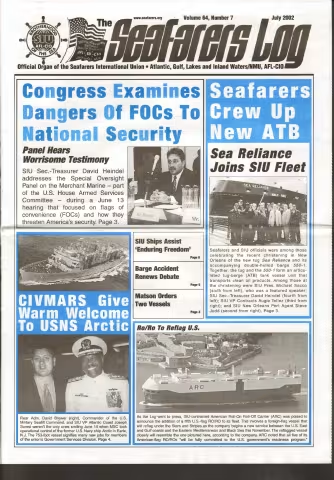
Congress Exa ·nes
Dangers f FOCs To
National Sec • r
Panel Hears
Worrisome Testimony
SIU Sec.-Treasurer David Heindel
addresses the Special Oversight
Panel on the Merchant Marine - part
of the U.S. House Armed Services
Committee - during a June 13
hearing that focused on flags of
convenience (FOCs) and how they
threaten America's security. Page 3.
Rear Adm. David Brewer (right) , Commander of the U.S.
Military Sealift Command, and SIU VP Atlantic Coast Joseph
Soresi weren't the only ones smiling June 14 when MSC took
operational control of the former U.S. Navy ship Arctic in Earle,
N.J. The 753-foot vessel signifies many new jobs for members
of the union's Government Services Division. Page 4.
SIU Ships Assisi
'Enduring Freedom'
Page&
Barge Accident
Renews Debate
Page&
Matson Orders
Two Vessels
Pagel
Ro/Ro To Reflag U.S.
Sea Reliance
Joins SIU Fleet
Seafarers and SIU officials were among those
celebrating the recent christening in New
Orleans of the new tug Sea Reliance and its
accompanying double-hulled barge 550-1.
Together, the tug and the 550-1 form an articu
lated tug-barge (ATB) tank vessel unit that
transports clean oil products. Among those at
the christening were SIU Pres. Michael Sacco
(sixth from left), who was a featured speaker;
SIU Sec.-Treasurer David Heindel (fourth from
left); SIU VP Contracts Augie Tellez (third from
right); and SIU New Orleans Port Agent Steve
Judd (second from right). Page 3.
As the Log went to press, SIU-contracted American Roll-On Roll-Off Carrier (ARC) was poised to
announce the addition of a fifth U.S.-flag RO/RO to its fleet. This involves a foreign-flag vessel that
will reflag under the Stars and Stripes as the company begins a new service between the U.S. East
and Gulf coasts and the Eastern Mediterranean and Black Sea this November. The reflagged vessel
closely will resemble the one pictured here, according to the company. ARC noted that all five of its
American-flag RO/ROs ''will be fully committed to the U.S. government's readiness program."
President's Report
A Break In the Clouds
Late in the year 2000, many of us stood in a downpour on Capitol
Hill warning of the problems raining on our country because of run
away-flag shipping.
Last month, the runoff from that protest finally
drained into a Congressional hearing room. Because
of these actions as well as many more involving the
SIU and other maritime unions - and the war on
terrorism - the light of publicity is finally shining
through the dark clouds that have veiled the ugly
truth behind flag-of-convenience shipping.
On June 13, the Merchant Marine Panel of the
Michael Sacco House Armed Services Committee held a hearing
about flags of convenience and the risks they pose
to United States national security.
The hearing has generated interest far beyond the Capitol. It has gained
attention in many parts of the U.S. and overseas, with news reports appear
ing almost daily from mid-June when the hearing took place.
U.S. Rep. Duncan Hunter (R-Calif.) did an outstanding job in
chairing the hearing. Anyone who supports a strong U.S.-flag fleet
for that matter, anyone who's concerned about national security -
should join me in thanking the congressman for his firm, fair and
intelligent handling of the proceedings, which took nearly a full day.
Credit also goes to U.S. Rep. Gene Taylor (D-Miss.) and the other
panel members in attendance for drawing out significant answers
from the people who submitted testimony.
U.S. Rep. Frank Wolf (D-Va.), the first to testify, immediately set
the tone with his convincing accounts of atrocities committed in
Liberia - a nation whose cruel dictator benefits from FOC shipping.
Later, SIU Secretary-Treasurer Dave Heindel, on behalf of our union
and the International Transport Workers' Federation, provided
insightful facts about runaway flags and strong recommendations on
how to reduce their threat to America's security. Others who testified
also delivered valuable information.
Overall, the hearing potentially served as a vital first step toward
consistently revealing true ownership throughout the shipping indus
try. In the meantime, the SIU and the ITF continue to urge Congress
to pass a bill permitting the U.S. Coast Guard to deny entry to any
foreign-flag ship that fails to accurately provide the identity of its
beneficial owner. Given the constant threats being made against the
U.S., it seems that's the very least that must be done.
Coast Guard Strength
Speaking of the Coast Guard, the agency already has taken a lot of
important actions to improve security aboard the vessels entering and
operating in the U.S. and in the ports themselves. As I've said before,
it's a gigantic job and it necessarily will take time to fully implement
the safeguards. The Coast Guard's efforts to date are commendable.
When faced with such a large task, you obviously need the right
tools. And the agency last month took a giant step in the right direc
tion with the announcement of a milestone contract worth more than
$11 billion for a fleet of new vessels and aircraft, along with
improved "command and control" systems. The ships and planes and
other high-tech equipment will help the Coast Guard fulfill its home
land security duties.
The contract's value reflects the magnitude of those responsibili
ties, and the SIU as always - in our role as part of the nation's fourth
arm of defense - will do our part to assist the Coast Guard in this
most critical mission.
SIU Job Opportunities
Just as our union is committed to helping the United States meet
its sealift and security requirements, we never stop working to obtain
good shipboard jobs for the membership. On that front, there is plen
ty of good news, as reported throughout this issue of the LOG.
After a tumultuous period that followed September 11, the Delta
Queen boats are under contract. Seafarers are sailing aboard Intrepid's
new Sea Reliance, and more of those ATBs are on the way. A new
TOTE ship is due in October, and construction has begun on a second
vessel. Matson has ordered two new vessels under construction at
Philadelphia's Kvaerner Shipyard. The Government Services Division
is crewing up a former Navy ship for the Military Sealift Command.
And American Roll-On Roll-Off Carrier late last month planned to
announce the addition of a fifth U.S.-flag RO/RO to its fleet.
Our future is bright. With the continued strong support of the mem
bership, we will never stop working to ensure that it stays that way.
Volume 64, Number 7 July 2002
The SIU on line: www.seafarers.org
The Seafarers LOG (ISSN 1086-4636) is published month
ly by the Seafarers International Union; Atlantic, Gulf,
Lakes and Inland Waters District/NMU, AFL-CIO; 5201
Auth Way; Camp Springs, MD 20746. Telephone (301)
899-0675. Periodicals postage paid at Southern
Maryland 20790-9998 and at additional offices. POST
MASTER: Send address changes to the Seafarers LOG,
5201 Auth Way Camp Springs, MD 20746.
Communications Director, Jordan Biscardo; Managing
Editor/Production, Deborah A. Hirtes; Associate Editor, Jim
Guthrie; Art, Bill Brower; Administrative Support, Jeanne
Textor.
Copyright © 2002 Seafarers International Union, AGLfWD
All Rights Reserved.
2 Seafarers LOS
House Passes Port Security Bill;
Conference Committee Appointed
The U.S. House of Representatives on June 4
approved legislation that would establish a compre
hensive national system to increase security at U.S.
ports and waterways.
Passed via voice vote, the Maritime
Transportation Antiterrorism Act of 2002 contains
provisions on automatic identification systems,
transportation security cards (smart cards), and
antiterrorism plans.
The legislation is similar to a bill approved last
December by the Senate. A House-Senate confer
ence committee has been appointed to work out the
differences.
U.S. Rep. Don Young CR-Alaska), chairman of
the House Transportation & Infrastructure
Committee, introduced the legislation on behalf of
the group's bipartisan leadership, including Reps.
James Oberstar (D-Minn.), ranking Democrat on the
Transportation Committee; Frank LoBiondo (R
N.J.), chairman, Coast Guard & Maritime
Transportation Subcommittee; and Corrine Brown
(D-Fla.), ranking Democrat, Coast Guard
Subcommittee.
"Port security is an essential piece of an effective
homeland security program," said Rep. Young.
"This bill establishes a comprehensive national anti
terrorism system to reduce the vulnerability of our
ports and waterways to a terrorist attack. This is one
of the most important pieces of legislation the
House considers this year."
"Passage of this bill by the House sends a clear
message to everyone that we are taking strong steps to
protect America's ports and waterways from terrorism
and that Congress is committed to this mission," said
Rep. LoBiondo. "I hope that we can see the provisions
of this bill become law very soon because of the
tremendous importance of the maritime transportation
system to our economy and our nation."
Under key sections of the legislation, the Coast
Guard will have statutory authority to require that
advance notices of vessels' arrival be electronically
submitted at least 96 hours prior to arrival. It will
have broad authority to deny entry of a vessel for
non-compliance with laws relating to marine safety,
security, or environmental protection.
Additionally, transportation security cards would
be required for individuals to enter an area of a ves
sel or facility designated as secure in an applicable
antiterrorism plan. The secretary of transportation
would be charged with issuing transportation secu
rity cards to individuals unless they pose a terrorism
security risk. For U.S. citizens, this largely means
denial of such a card if the person has been convict
ed of a felony that could be a terrorism security risk.
For non-U.S. citizens, this means persons who
would be denied admission to the United States
under the Immigration and Nationality Act or other
wise pose a terrorism security risk.
The secretary also would be charged with assess
ing the antiterrorism measures at major foreign
ports with respect to such things as screening of
containerized and other cargo, access restrictions,
vessel security, certification of compliance with
security measures, and security management. For
foreign ports found to not maintain effective antiter
rorism measures, the secretary would be authorized
to prescribe conditions for entry into the U.S. of ves
sels arriving from the port or carrying cargo origi
nating from or transshipped from that port.
In another port security development, the
International Maritime Organization 's (IMO)
Maritime Safety Committee is continuing its
preparatory work for the diplomatic conference on
maritime security that is to be conducted at IMO in
December.
Among the myriad items on the agenda designed
to address maritime security, the most far-reaching
is a proposed International Ship and Port Facility
Security (ISPS) Code which would be implemented
through SOLAS.
Former ATC 'Riding Gang'
Workers Upgrade to AB
goals of providing quality mar
itime jobs for Alaskans."
Created to satisfy the need for
ongoing maintenance at sea, a
riding gang provides routine
upkeep and repairs of vessels to
reduce time in dry dock.
Five mariners from An
chorage, Alaska who started their
shipboard careers as "riding
gang" workers aboard Alaska
Tanker Company (ATC) vessels
have earned their respective
endorsements as ABs.
Seafarers Jerry Maya, Allan
Oyao, Fernando Oyao, Deoca
dio Romney and Rafael Con
cepcion recently completed the
AB course at the Paul Hall Center
for Maritime Training and Educa
tion. They were congratulated
May 31 as the company hosted a
luncheon in Anchorage that also
was attended by U.S. Rep. Don
Young (R-Alaska) and represen
tatives of the Alaska Department
of Labor and the SIU.
Harold Holten, a Seafarers
representative based in An-
chorage, noted that Rep. Young
"has been very active with the
riding crews and with the unli
censed apprentice program based
at Piney Point. He also was
instrumental in getting an SIU
office opened in Anchorage."
Bill Cole, ATC's director of
labor relations, noted that the rid
ing gangs in part signify "a near
ly five-year-old effort to train
Alaskans for employment aboard
U.S. commercial vessels. We are
delighted to have Alaskans as
seagoing employees of ATC and
are proud to further Congressman
Young's vision of expanding
local hire opportunities for
Alaskans aboard U.S.-flag ves
sels. This is a true public/pri
vate/labor partnership that contin
ues to achieve and surpass its
Alaska Tanker Company (ATC) recognized five former riding-gang
members who upgraded to ABs. Pictured at the May 31 luncheon in
Anchorage, Alaska are (from left) ABs Jerry Maya and Fernando Oyao,
U.S. Rep. Don Young (R-Alaska), ABs Deocadio Romney and Allan
Oyao, SIU Rep Harold Holten and ATC Labor Relations Director Bill
Cole. (Not pictured is AB Rafael Concepcion.)
At the Paul Hall Center, the
aforementioned mariners passed
U.S. Coast Guard exams in
lifeboat and water survival safety,
marine fire fighting, first aid, oil
spill response and other key sub
jects.
Holten added, "We are particu
larly pleased with the cooperation
received from the Coast Guard
and the Alaska State Department
of Labor in assuring these folks
had the opportunity to pursue
their training and career goals."
Awards Presented
To ATC Vessel,
Other SIU Ships
Alaska Tanker Company's BT
Alaska was one of several SIU
crewed vessels honored last
month by the Chamber of
Shipping of America.
The chamber presented its
annual ship safety achievement
awards June 6 in New Orleans.
Awards are given for "outstand
ing feats of safety," such as res
cues and long-term operations
without any injuries.
The BT Alaska has gone
almost three years without a sin
gle lost-time injury.
Also honored were (among
others) the Consumer of CSX
Lines, the tug Liberty/Maritrans
3 00 of Mari trans Operating
Partners, the Performance of U.S.
Ship 'Management, and the
Chesapeake City of Keystone
Shipping Co.
July2002
Congress Weighs FOG Threat
The Special Oversight Panel
on the Merchant Marine - part of
the U.S. House Armed Services
Committee - conducted a hearing
June 13 that focused on flags of
convenience (FOCs) and how
they threaten America's security.
sels - or even whether the docu
ments they hold are valid - or
even whether they have the
required training."
The panel also received
detailed, disturbing evidence that
the Liberian ship registry, which
is based in Virginia, has funneled
money for the illegal purchase
and/or transportation of arms,
among other violations of United
Nations sanctions.
U.S. Rep. Duncan Hunter (R
Calif.) chaired the five-hour ses
sion, which drew a standing-room
crowd for much of the proceedings.
Testifying were (in order) U.S.
Rep. Frank Wolf (R-Va.); U.S.
Coast Guard Rear Adm. Paul Pluta;
U.S. Maritime Administrator Capt.
SIU Sec.-Treasurer David Heindel (left) tells the Merchant Marine Panel
of the House Armed Services Committee that America should "refuse
entry to U.S. ports to any foreign-flag vessel that does not provide trans
parency and/or full identity of the vessel's beneficial owner." The hear
ing took place June 13 in Washington, D.C.
U.S. Rep. Duncan Hunter (R
Calif.) said of certain FOC reg
istries, "It is apparent that we have
virtually no idea who owns or con
trols a number of these ships."
Although the inquiry mainly
examined FOCs and their impli
cations on U.S. national security,
Hunter and Rep. Gene Taylor (D
Miss.) spent nearly 90 minutes
conducting a question-and-answer
session with Rear Adm. Pluta and
Capt. Schubert. Some of the ques
tions pertained to FOCs, but many
others concerned present-day
efforts by the Coast Guard to
ensure - to the extent possible -
security in American ports. William Schubert; David Heindel, Vines, former member of the U.N.
SIU secretary-treasurer and second panel of experts on Liberia, repre
vice chairman of the International senting the New York-based
Transport Workers' Federation's Human Rights Watch; and the head
(ITF's) Seafarers' Section; Peter of the Liberian registry, Yoram
Morris, chairman, International Cohen.
stated, "From my view of certain
registries, it is apparent that we
have virtually no idea who owns,
or who controls a number of these
ships. It is also clear to me that we
likewise lack a clear understand
ing of who is manning these ves-
Earlier, Rep. Wolf(R-Va.) gave
a compelling presentation that
spotlighted Charles Taylor and the
atrocities committed in Liberia.
Poster-size photos of Liberian
children and adults with hacked
off limbs (part of that nation's
reign of terror) were posted before
the panel. Wolf urged the U.S. to
do whatever is necessary to cause
Taylor to lose his control of
Liberia. He noted that Taylor's
relationship with international
arms dealers and terrorist net
works threatens the U.S.
Commission on Shipping; Alex As the hearing began, Hunter
Seafarers Welcome
New Tug and Barge
SIU members are sailing
aboard the new tug Sea Reliance
and its accompanying double
hulled barge 5 5 0-1, operated by
Intrepid Ship Management.
Together, the Sea Reliance and
the 550-1 form an articulated tug
barge (ATB) tank vessel unit that
transports clean oil products. The
hinged connection system be
tween the units "allows mo e
ment in one axi or plane in the
critical area of fore and aft pitch,"
Intrepid noted.
SIU President Michael Sacco
was a featured speaker during the
ATB 's christening April 25 in
New Orleans. "The tug Sea
Reliance and the barge that goes
with it both represent exactly the
kind of progress we work for.
Today we celebrate an all
American ATB-built in an
American yard, crewed by
American mariners, and owned
by Americans," he stated.
"This is another important step
in strengthening all phases of the
merchant marine," Sacco contin
ued. "In order to best serve the
national and economic security
interests of the United States, our
country deserves nothing less
than a strong, viable U.S. fleet.
That goes for all segments of the
industry-from the deep sea and
coast-wise trades, to the inland
and Great Lakes fleets, to the pas
senger ships and of course our
shipyards. All of those compo
nents are vital, especially in these
uncertain times. That's why we
never should take a ceremony
like this one for granted."
The 9,280-horsepower tug is
127 feet long and 42 feet wide.
Built at Halter Marine's Moss
Point (Miss.) yard, the Sea
Reliance meets all Safety of Life
at Sea (SOLAS) and American
Bureau of Shipping criteria. It has
a foam-capable fire monitor; twin
fuel efficient, reduced emission
electronic diesel engines; a noise
reduction package and other
upgrades to increase crew com
fort. The communication and
navigation equipment is among
the most technologically ad
vanced in the industry.
Keel Laid for Second TOTE Ship
San Diego's NASSCO Shipyard on June 6 hosted a keel-laying
ceremony for the North Star, the second of two Orea-class roll
on/roll-off vessels being built for SIU-contracted Totem Ocean
Trailer Express (TOTE). The new ships will be 839 feet long, have
a beam of 118 feet and carry 600 cargo trailers along with 200
autos. They're being built for TOTE's Tacoma-to-Anchorage ser
vice. The first ship, the Midnight Sun, is scheduled for delivery this
fall. The North Star (depicted in the illustration above) is due in
spring 2003.
Please be advised that SIU headquarters and all
SIU hiring halls will be closed Monday, August 19,
k 2002 for the observance of Paul Hall's birthday
f.)~t j,;(iJ/1/ess an emergency arises). Normal business
, , ~hours will resume the following workday.
.. ·,.,\, ;\:
July2002
The barge, which has a capac
ity of 155,000 barrels, is 500 feet
long and 74 feet wide. It was con
structed at Halter's Bienville yard
in Pearlington, Miss. The 550-1
features an enhanced cargo sys
tem and a fully redundant ballast
system, among other safety attrib
utes.
Tony Naccarato, for Intrepid,
described the ATB as "completely
state-of-the-art. This is an excel
lent addition and we look forward
to many years of safe operations."
)
The last panel consisted of
Heindel, Morris, Vines and
Cohen. Heindel urged Congress
"on a unilateral basis to enact leg
islation authorizing the U.S.
Coast Guard to refuse entry to
U.S. ports to any foreign-flag ves
sel that does not provide trans
parency and/or full identity of the
vessel's beneficial owner."
SIU Pres. Michael Sacco (left
photo) describes the Sea
Reliance and the barge 550-1
(above) as "an all-American
ATS-built in an American yard,
crewed by American mariners,
and owned by Americans."
Morris covered many topics
including port state control,
mariner certification and ship
board living conditions. He urged
the U.S. to push for "complete
transparency, complete account-
Continued on page 9
One of the new 712-foot Matson containerships is shown in this artist's rendition. The first vessel is sched
uled for delivery to Matson in late 2003. The second is scheduled for 2004.
Matson Orders 2 Containerships from Kvaerner
Seafarers-contracted Matson Navigation
Company on May 29 signed a contract with
Kvaemer Philadelphia Shipyard Inc. for the pur
chase of two new containerships. The diesel-pow
ered vessels, with a capacity for 2,600 containers
(20-foot equivalent units) each, will cost approxi
mately $110 million per ship and will be deployed in
the company's Hawaii service when construction is
completed in late 2003 and in 2004, respectively.
"This is an important commitment for all con
cerned, and I'm confident the unions of the SIUNA
will continue living up to our end of the bargain by
providing top-quality manpower for these new ves
sels," stated SIU Vice President Contracts Augie
Tellez.
He added, "The construction of new vessels such
as those ordered by Matson is a boon to America's
national security, because it helps ensure the avail
ability of U.S. crews and it also helps maintain our
domestic shipbuilding capability."
Matson President and CEO C. Bradley
Mulholland said the new vessels "are similar in size
and speed to Matson 's flagship MV R. J. Pfeiffer, the
fastest and biggest containership currently operating
in the U.S. domestic offshore trades. They will be
equipped with a number of features specifically
designed to meet Hawaii's current and projected
market requirements, particularly bigger container
sizes for both refrigerated and dry containers."
In announcing the contract, Matson described the
project as "part of an overall plan by Aker Kvaerner
Yards, the Philadelphia Shipyard Development
Corporation, the Delaware River Port Authority, the
Commonwealth of Pennsylvania, and the City of
Philadelphia to rebuild the former Philadelphia
Naval Yard as a world class commercial shipyard."
The president of CEO of the Philadelphia yard,
Ron McAlear, stated, "We are pleased to be working
with Matson Navigation on its fleet renewal pro
gram and we are proud to have the historic name of
Matson on the side of the first ships built at
K vaerner Philadelphia Shipyard. This contract con
firms Matson's confidence in Kvaerner's ability to
build high quality ships.
"The Kvaerner Philadelphia Shipyard was built
to provide U.S. shipowners with robust ships at real
istic prices for the dedicated trades of the U.S. Jones
Act," he continued.
Matson is a wholly owned subsidiary of
Alexander & Baldwin, Inc. of Honolulu.
Seafarers LOG 3
Government Services Division Welcomes USNS Arctic
Mariners who work in the
union's Government Services
Division are in line for increased
employment opportunities, thanks
to the recent transfer of a fast
combat ship to the operational
control of the U.S. Military Sealift
Command (MSC).
The USS Arctic on June 14
went from a military-crewed
combatant ship to a civilian
crewed, noncombatant vessel
during a ceremony in Earle, N.J.
In addition to the transfer, the
vessel was renamed USNS Arctic
to designate her new status as part
of the MSC. She will join more
than 30 other civilian-crewed
MSC ships that provide at-sea
logistic support to the Navy fleet.
Arctic now will be crewed by
176 civilian mariners and be pilot
ed by a civilian master. Rounding
out the crew will be some 60
Navy sailors-about half of who
will perform communications
support and supply coordination
functions. The remaining sailors
will be aboard the vessel to sup
port helicopter operations.
''Today marks a change of oper
ators for USS Arctic, but not a
change of mission," said MSC
Commander Rear Adm. David L.
Brewer during remarks at the cere
mony. "Military Sealift Command
combat logistics ships continue to
allow the U.S. Navy to arrive on sta
tion and remain as long as needed."
In addition to Brewer, Rear
Adm. Lindell G Rutherford, com
mander, Carrier Group Four,
attended the ceremony. Both the
Members of the union's Government Services Division are crewing the
USNS Arctic for the U.S. Military Sealift Command.
Coast Guard Launches Multi-Billion Dollar Plan
For New Fleet of Ships, Aircraft and More
U. S. Deputy Secretary of Transportation
Michael P. Jackson, joined by U. S. Coast Guard
Commandant Thomas H. Collins, announced June
25 the award of a landmark contract valued at
$11.04 billion for a fleet of new ships and aircraft,
plus improved command and control systems, to
meet the service's homeland security and other mis
sion needs.
In addition, the contract includes $5.91 billion
for operating, maintenance, and sustainment costs
for a value of $16.95 billion.
The contract was awarded to Integrated Coast
Guard Systems (ICGS), a joint venture established
by Lockheed Martin and Northrop Grumman.
Known as the Deepwater Program, the ICGS
award is the largest ever for the U. S. Coast Guard.
It calls for the delivery of the first ships and planes
- and upgrades to some existing vessels - within the
next five years.
The contract may extend up to 30 years.
Deepwater will involve the acquisition of up to 91
ships, 35 fixed-wing aircraft, 34 helicopters, 76
unmanned surveillance aircraft, and upgrade of 49
existing cutters and 93 helicopters, in addition to
systems for communications, surveillance and com
mand and control.
ew Pact for Twin River
SIU boatmen employed by
Pittsburgh-area Twin Rivers
Towing have approved a new
five-year contract. The agreement
took effect April 1 and lasts
through May 2007.
The pact calls for increased
wages, improved medical bene
fits and some work-rule changes
which the members had sought.
The most significant change is
one that facilitates advancement
for the SIU boatmen.
Also, for the first time, Twin
Rivers has signed on with the
Paul Hall Center for Maritime
Training and Education, based in
Piney Point, Md.
The union represents approxi
mately 50 deckhands and cooks
who work aboard Twin Rivers
towboats and barges. The compa
ny, based in Elizabeth, Pa., hauls
coal along the Allegheny,
Monongahela and Ohio rivers.
Representing the union on the
negotiating committee were
Deckhands J erry Switch and
Brian Glover, Cook Marta Vance
and SIU VP Atlantic Coast Joseph
The SIU contingent for contract negotiations at Twin Rivers Towing con
sisted of (from left) VP Atlantic Coast Joseph Soresi, Cook Marta
Vance, Deckhand Jerry Switch and Deckhand Brian Glover.
Soresi. Bargaining took place in
March at the company's office in
Elizabeth; voting occurred at the
Twin Rivers pier in Elizabeth on
May 25. The final tally was 37-11
Notice
in favor of the contract.
Twin Rivers Labor Relations
Manager Tony Mayer and
General Manager Dean Orr nego
tiated for the company.
Unlicensed Apprentice Program
For individuals interested in attending the unlicensed apprentice program at the Paul Hall Center for
Maritime Training and Education, please note that there has been some misinformation, particularly via
messages on the world wide web about the school's apprentice program. To qualify for the program appli
cants must be at least 18 years of age (or 17 years of age with parental consent). This requirement is nec
essary to comply with Coast Guard regulations. There is no upper age limit for individuals wishing to par
ticipate in the program.
The program provides training for entry-level positions, and includes practical work on a vessel. The
program is physically rigorous. Teamwork is stressed and apprentices live in open-berthing dormitories
and take meals together. Applicants must be able to meet certain physical requirements, specified by
United States Coast Guard regulations and maritime industry standards.
If you are interested in attending the school, please call (301) 994-0010, ext. 5342, or visit
www. seafarers.erg.
4 Seafarers LOG
outgoing commanding officer of
Arctic, Navy Capt. Garry R. White,
and its incoming civilian master,
Capt. Ed Nanartowich, also partici
pated in the ceremony, which was
attended by numerous Seafarers
and officials from the union.
Artie is the second fast combat
support ship to transfer from USS
to USNS status. Supply was the
first to make the change, in July
2001. This class of ship provides
fuel, ammunition and food to ves
sels under way.
CIVMAR News
Habitability Agreement
For USNS Arctic
Similar to USNS Supply
Prior to the CIVMAR crew
ing of the USS Arctic (now
USNS Arctic), the union's
Government Services Division
negotiated a memorandum of
understanding (MOU) with the
Military Sealift Command
(MSC) addressing habitability
standards aboard the ship.
The MOU is similar in many
aspects to the agreement reached
last year for the USNS Supply.
All terms and conditions of the
current collective bargaining
agreement will remain in effect
and MSC agrees to make every
effort to address full habitability
improvements within a reason
able timeframe. Until full habit
ability modifications are made
aboard the USNS Arctic (which
comply with prevailing mar
itime practices), MSC will pay
habitability allowance at the rate
of $30 to those mariners housed
in the open berthing sections of
the ship.
The MOU provides that MSC
take additional interim measures
to ensure adequate living condi
tions aboard this vessel at all
times. In addition, successful
completion of a four-month tour
will give an eligible C MAR
the opportunity to request a pref
erential next-ship assignment.
The union will continue to
closely monitor the habitability
conditions aboard the AOE
class vessels. In accordance
with the agreement, we will ask
the agency to meet at the end of
every six-month period from the
date of the transfer of the ship to
MSC operation for the purpose
of discussing ongoing habitabil
ity concerns.
MSC, NOAA Members
To Get July 1 Increase
Federal mariners working for
the Military Sealift Command
(MSC) and the National Oceanic
& Atmospheric Administration
(NOAA) will receive the
FY2002 federal pay increase of
4.8 percent applicable to base
pay, overtime and penalty rates.
In some cases, for certain rat
ings or types of ships, the
increase will be capped at 4 per
cent. This is due to limitations
imposed by 5 USC 5348. That
section of the law provides that
"the pay of officers and crews of
vessels shall be fixed and adjust
ed from time to time as nearly as
is consistent with the public
interest in accordance with pre
vailing rates and practices in the
maritime industry." The agen
cies have notified the union that
it is expected that the increases
will be r e t i
payroll period, thereby avoiding
long retroactive situations which
have occurred in the past.
Delta Queen Fleet Under Contract
A contract is in place between the SIU and the new owners of the
Delta Queen fleet, Delaware North Companies Inc. The agreement
adds five years to the existing contract that was set to expire in
2003. It includes wage and benefit gains. The pact applies to the
river cruise boats Delta Queen, Mississippi Queen (shown in two
recent photos above) and American Queen. Delaware North pur
chased the well-known vessels May 4 at auction.
July2002
Ed Pulver, Veteran SIU Of I icial
And Humanitarian, Dies at 78
The SIU on May 26 lost one
of its icons, as Edward B. Pulver
passed away at Memorial Sloan
Kettering Cancer Center in New
York City, reportedly due to heart
failure. He was 78.
Pulver's association with the
union dates back more than 50
years. He was a vice president of
the Seafarers International Union
ofNorth America since 1990, and
he also headed the SIU's office in
Jersey City, N.J.
His activities were wide-rang
ing and repeatedly philanthropic.
Pulver was the president and a
founding member of the Hudson
County (N .J.) Central Labor
Council, and served on the state
AFL-CIO executive board. He
was extremely active in local
charities and served for 16 years
as president of the Hudson
County Society for the Pre
vention of Cruelty to Animals.
He was a delegate to several
Democratic national conventions,
and he championed the local
Filipino and Hispanic communi
ties (though he wasn't of Filipino
or Hispanic descent).
Pulver, a native of Jersey City
who lived in Bayonne, N.J. for
the past 35 years, began sailing in
the 1940s on railroad tugs in the
New York/New Jersey harbor. He
became active in the SIU when
the fleet he helped organize elect
ed to affiliate with the organiza
tion's Inland Boatman's Union.
"He was one of the greatest
leaders this organization ever
had," stated SIU President
Michael Sacco. "He had so much
compassion for people. He went
out of his way and devoted his
time to helping them achieve the
American dream."
"We've lost a great friend.
People loved him," said Willie
Zenga, retired vice president of
the AFL-CIO Maritime Trades
Department. "We go back better
than 50 years together. He was
one of the well-liked and very
exceptional people."
A New Jersey newspaper
described Pulver, who had been
hospitalized for about two weeks
prior to his death, as "a towering
figure in labor circles."
A number of Pulver 's friends
said that he never recovered from
the trauma of losing a close
acquaintance on September 11,
though he continued his work.
Pulver 's friend Ana Centeno
worked as an accountant at the
World Trade Center and died in
the terrorist attacks.
'Loved the SIU'
SIU Executive Vice President
John Fay said Pulver was "a
strong union guy, and he was
devoted to the SIU. He loved the
SIU. He tried to help everybody,
and I never heard anyone say
anything unkind about him."
Bosun Tom Soresi has been a
Seafarer for 41 years, and he
knew Pulver nearly that long.
"He was always a powerful influ
ence on the politics and labor
.,..........,.....,..---------------. organ i z at i o n s
In 1982, Pulver (right) is congratulated by
Charles Marciante, president of the New
Jersey state AFL-CIO, for receiving the
Jewish National Fund's top award.
throughout New Jer
sey," Soresi recalled.
"He was a pleasure to
work with and he
never refused helping
anyone."
Soresi added that
Pulver "helped get
NY Waterway off the
ground." The SIU
contracted company,
founded in 1986,
boasts the largest ferry
and excursion fleet in
New York Harbor.
SIU Vice President
Contracts Augie Tel
lez first worked with
Pulver on the Hudson
County Central Labor
Above: Pulver (left) attended a
recent ceremony in New York for
the christening of new passenger
ferries for the SI Li-contracted NY
Waterway fleet. With him are
(from left) SIU President Michael
Sacco; Joseph Soresi, vice presi
dent Atlantic Coast; and Don
Nolan, vice president Paul Hall
Center.
Right: At a rally in Jersey City in
late 1999, Pulver (second from
left) demonstrated with Seafarers ~
and other trade unionists.
SUPPORTS
LOC..Al
24S
~=.?--
SUPPORTS
July2002
This undated photo, believed to
be from the early 1960s, shows
Pulver during his days as an
official with the union's railroad
marine division.
Council and the New Jersey state
AFL-CIO, when Tellez was a
vice president of that organiza
tion. "I saw him in action, and I
saw the respect and credibility
that the labor movement got
because of him," Tellez observed.
SIU Vice President Atlantic
Coast Joseph Soresi worked with
Pulver on matters pertaining to
NY Waterway. "He was very
well-respected, politically and
within the labor movement,"
Soresi said. "I knew him more on
the political circuit and personal
ly than through the SIU. He was
the greatest guy in the world and
would do anything for you.
Anybody who's been knighted,
as Ed was, obviously has a lot
going for him."
SIU Headquarters Repre
sentative Carl Peth said Pulver's
"way with people is what stands
out. He cared about people and
was able to talk to anybody on
their level. As they used to say
about (the late SIU President)
Paul Hall, he could talk to the
senator or the seaman."
Pulver was a U.S. Army veter
an who served in Germany dur
ing World War II. He raised
money for Memorial Sloan
Kettering and for children fight
ing cancer, as well as for local
scholarship funds and other char
itable causes.
While he appropriately was
known for his compassion and
energy, Pulver also had an unusu
al trademark of sorts. "He would
never wear a tie," recalled Zenga.
"He'd come out wearing a tuxedo
but no tie."
One of the very rare excep
tions took place earlier this year
in New Jersey, when Pulver
introduced Sacco as an honoree
at an event benefiting a local
chapter of the Catholic Youth
Organization.
Pulver is survived by five
daughters, two brothers, 10
grandchildren and seven great
grandchildren.
Unions Approve Strategy
To Fund Political Action
The AFL-CIO 's general board
has approved a proposal to finance
future political efforts by increas
ing the amount of money paid to
th~ federation by its member
umons.
Under the plan, approved May
22 in New York during meetings
of the federation's executive coun
cil, costs incurred for union mem
ber education, voter registration
and mobilization around legisla
tive and political issues all would
be funded via an assessment paid
by each union, based on its mem
bership count, through 2005. The
additional amount due will be four
cents per month per member; it is
up to each union to determine how
it will cover the obligation.
The assessments, scheduled to
become effective this month,
would generate more than $6 mil
lion per year based on the federa
tion's membership of 13 million.
In excess of $25 million would be
generated over the life of the pro
posal.
"What this money does essen
tially is allow working families to
compete in a political process that
they would otherwise be com
pletely shut out of," explained
Steve Rosenthal, AFL-CIO politi
cal director. "There is no other
voice for workers in the legislative
and political process."
Over the last six years, the
unions of the AFL-CIO have built
an issues-based member mobiliza
tion program that is unparalleled
in our nation, federation sources
say. Members and their families
have been educated and mobilized
around the everyday issues that
matter the most to them. Millions
of union workers have been regis
tered, thousands of union mem
bers have been elected to political
office, and the overall vote of
union household members has
increased from 19 percent in 1992
to 26 percent in 2000-an upsurge
of nearly 5 million voters.
Federation sources point out
that the foregoing gains have been
achieved despite a growing cash
gap between corporate and worker
political contributions. In 1992,
for example, big business outspent
unions 9 to 1. By 2000, business
political spending outpaced
unions 15-1.
In essence, this means that in a
political arena where the playing
field increasingly is being tilted
toward big business and the very
rich, working families have to
work harder and smarter just to be
heard.
"The legislative process must
not be a one-sided affair, with cor
porate interests calling all the
shots," said AFL-CIO President
John Sweeney in the aftermath of
the general board's action. "This
commitment by today's unions
guarantees that working families
will have a voice in politics."
Houston Barge Co.
Pleads Guilty
To Pollution
The U.S. Environmental Pro
tection Agency (EPA) recently
reported that Western Towing Co.
of Houston pleaded guilty on May
16 to violating the Clean Water
Act.
According to the EPA, Western
Towing (a subsidiary of Kirby
Corporation) used river water to
pressure-wash the cargo compart
ments of barges used to transport
steel products, grain, gravel, sand,
fertilizer and gypsum. The com
pany had authorization to dis
charge treated wastewater into the
San Jacinto River-but it didn't
perform the treatments.
The EPA noted that "discharg
ing untreated barge-cleaning
wastewater into surface waters
can harm fish and aquatic life and
can make river waters unsuitable
for recreational and drinking
water usage."
Western Towing faces a fine of
up to $500,000.
Not Quite Sealed With A Kiss,
But 44-Day Hershey Strike Ends
Union members at two Hershey Foods Corp. plants in Pennsylvania
last month overwhelmingly approved a new four-year contract, ending
a 44-day work stoppage that largely centered on the costs of health
insurance and prescription drugs.
The 2,700 employees-all members of Chocolate Workers Local
464, part of the Bakery, Confectionery, Tobacco Workers and Grain
Millers Union (BCTGM)-voted by a 9-to-l ratio in favor of the con
tract. The pact calls for workers to receive a $525 bonus and yearly
pay raises of 46 cents an hour in the first year, 2.7 percent in the sec
ond year, 38 cents in year three, and 2.9 percent in year four.
In exchange for keeping their insurance co-payments at 6 per
cent-rather than doubling them, as the company had wanted-the
workers accepted lesser raises. Reportedly, they will receive (on aver
age) $1.88 per hour in raises through four years, compared to $2.07
they would have gotten by accepting the costlier insurance payments.
Currently, the average wage at the plant is approximately $18 an hour.
The union also won the inclusion of more workers in the company
financed retiree health plan, and kept employee co-payments for
generic drugs at zero.
BCTGM International Vice President Bob Oakley, the union's lead
negotiator, praised the members for their solidarity and also stated that
they reached their goals. "We believe we accomplished what the peo
ple's marching orders were," he said.
Union members started returning to work almost immediately after
the contract ratification. Plans called for all of the workers to be back
on the job by late last month.
The strike was the first at Hershey Foods since 1980 and was the
longest stoppage in the company's 108-year history.
The two plants in Hershey, Pa., a town named for business pioneer
and philanthropist Milton S. Hershey, account for slightly more than
one-fourth of the company's candy production. Hershey brands
include Hershey's Kisses chocolates, Almond Joy and Mounds candy
bars, Jolly Rancher candy, Reese's peanut butter cups, York pepper
mint patties and many others.
Seafarers LOS 5
Deadly Barge Crash
Renews Concerns
A marine accident in late May
involving a non-union barge and
a bridge-which left 14 people
dead in Webbers Falls, Okla.
has refueled the debate regarding
inland mariner fatigue and, to a
lesser extent, documentation and
the lack of it among mariners
employed aboard inland tugs and
tows.
The barge (actually two barges
joined together), being pushed by
towboat pilot William Joe
Dedmon, veered off course dur
ing the early morning hours of
May 27. It struck a pier support
ing the Interstate 40 Bridge on the
Arkansas River, causing a 500-
foot section of the structure to
collapse. Several vehicles
plunged into the water and took
14 people to their deaths.
Each year, more that 1,000 casu
alties occur in the inland tug and
barge industry, many of them
caused by human error. Dedmon
apparently blacked out during the
incident, according to news reports,
causing the barge to drift outside
the navigation channels and hit the
bridge. A National Transportation
Safety Board (NTSB) investigation
found that Dedmon had not slept
sufficiently in the two days prior to
the collision. Other medical tests
revealed that the pilot suffered from
heart problems.
Mariner fatigue is a key issue
confronting the inland industry.
Another is documentation. While
all American mariners employed
in the deep-sea trades are
required to be documented by the
Cost Guard, many of the 30,000
people employed aboard inland
tugs and barges are not.
About 10 years ago, the SIU
unveiled a study which showed
that 58 percent of all marine acci
dents in the tug and barge indus
try are caused by human fac
tors-inadequate crewing levels,
substandard skills, poor training
opportunities, fatigue and drug or
alcohol use. A similar picture was
painted later in the decade when
the International Maritime
Organization focused on the
entire international maritime
industry. The Coast Guard
increased the 58 percent figure to
the 85 percent mark in the wake
of the Oklahoma incident.
Contrasting conditions faced
by mariners in the tug and barge
industry with those encountered
by the deep-sea U.S. Merchant
Marine, the SIU found "civilian
mariners with Cost Guard docu
ments are less susceptible to injury
and death than men and women
working aboard tugs and tows
who don't meet such standards."
The issues raised by the
Oklahoma incident are significant
from many perspectives - marine
and personal safety, environmen
tal protection and national securi
ty. The U.S. has more than 25,000
miles of navigable waterways.
Latest Technology
Appears Promising
For Cargo Security
Groundbreaking technology to
better secure cargo containers
entering ports and border cross
ings throughout the United States
successfully has been tested,
according to the U.S. Department
of Transportation (DOT).
Conducted under the auspices
the DOT's Intelligent Transporta
tion Systems (ITS) program, the
experiment involved the use of
electronic seals CE-Seals), a radio
frequency device that transmits
shipment information as it passes
reader devices and indicates if a
container has been compromised.
The E-Seal project is designed
to track commercial inbound con
tainer shipments from their point
of inspection at seaports, along
trade corridors, to their point of
clearance at U.S. land border
crossings, a DOT new release
said. Electronic door seals will
enable regulatory agencies to
determine whether a container
has been tampered with at check
points and border crossings.
Further, the technology can
streamline border clearance
activities and commercial vehicle
enforcement and offer potential
benefits to freight carriers includ
ing greater accuracy in manifest
information, reduced paperwork,
improved port and Customs
clearances, and opportunities for
shipment tracking.
"This new technology will
help to enhance the security of
our nation's transportation sys
tem by enabling us to track cargo
6 Seafarers LOG
shipments into the United
States," DOT Secretary Norman
Mineta said June 4 in announcing
the successful results of the trials.
"E-Seals are just one part of our
department's security-focused
program that applies both tech
nology and human capital to safe
guard America's transportation
system."
The secretary said the test rep
resents his department's ongoing
commitment to make certain that
suitable security safeguards can
be implemented for the trans
portation of people and goods,
and especially for shipping con
tainers during domestic and inter
national movements.
The E-Seals trial involved
cargo containers loaded with
inbound shipments of auto parts
to a Canadian assembly plant.
The E-Seals were affixed by
Westwood Shipping to containers
in Nagano, Japan, shipped
through the port of Seattle, and
cleared by U.S. and Canadian
Customs at the international bor
der crossing in Blaine, Wash.
Among agencies and firms
participating in the E-Seal project
were the Customs Service, the
Washington State Department of
Transportation, the Washington
State Trucking Association, and
the ports of Seattle and Tacoma.
In addition to Westwood
Shipping, Seafarers-contracted
Maersk-Sealand and American
President Lines also participated
in the operational test.
AP Photo!The Daily Oklahoman, Nate Billings
A 500-foot section of collapsed roadway, from the Interstate 40 Bridge near Webbers Falls, Okla. rests on one
of the two barges that crashed into the structure May 27.
Union Mourns Passing of Robert Jordan
Longtime Mobile, Ala. port
official Robert Jordan passed
away May 23 while an inpatient
at Providence Hospital in Mobile.
He was 81 years old.
Brother Jordan joined the
Seafarers as a charter member in
1938 in his native Mobile. His
book number was JOOO 1.
he was a real fair person, strictly
SIU all the way. He'd go down to
the ships and take care of every
thing the members needed. As far
as I'm concerned, he was a great
man for the SIU and I' 11 miss him
a great deal."
A member of the engine
department, Brother Jordan sailed
in the deep sea division. While at
sea, he worked as a fireman, oiler
and watertender. Among the ves
sels on which he sailed early in
his SIU career were the S.S.
Lebore, Alcoa Cadet, Alcoa
Master, and the Hastings.
Brother Robert Jordan
April 18, 1921 - May 23, 2002
Tobe Dansley, another SIU
retiree who frequents the Mobile
hall, had similar memories of
Jordan. "I first met him around
1959 and as I recall, he already
was a patrolman. Robert was a
man who would go to bat for you,
especially if you had a beef. You
could always count on him to
come down to the ships and fight
for you, to get your overtime if
you had any coming, as well as
take care of any other problems
you had.
"I first met him in 1981 when
I started working here," said SIU
Mobile Port Agent Ed Kelly. "I
can honestly say that he was one
of the good guys here when I
came aboard. Robert and my
father sailed together back in the
old days and I understand that he
was quite a mariner.
retirees and the union as a whole
will miss him a great deal."
Pensioner Hubert Cain
"I never heard anything said
negative about him as a patrol
man," Kelly continued. "All of
the retirees that I have dealt with
here at the hall held him in the
highest esteem, I'm sure all the
recalled the efficient manner in
which Jordan went about his
everyday business as a Seafarer.
"He was an old-timer here," Cain,
a Mobile resident, shared. "He
worked with all the SIU's former
presidents and knew them quite
well. Robert was a real tough guy
in a lot of ways, but you had to be
that way back in the old days to
deal with the seamen. Not many
of them gave him any trouble."
"All of us around the all here
will miss him," ans ey cone ud
ed. "He was a fine, dedicated SIU
man who always looked out for
the members."
Brother Jordan was buried
May 25 at Mobile's Pine Crest
Cemetery. He is survived by his
wife, Mary of Mobile, Ala., and
seven children. Brother Jordan
had 26 grandchildren and five
great-grandchildren. Cain added, "On the flip side,
DOT Plans New Ballast Water Regulations
Vessels that operate in U.S. waters by the year
2004, in all probability, will face mandatory ballast
water management regulations.
A recent U.S Coast Guard report to Congress by
Secretary of Transportation Norman Mineta con
cluded that existing ballast water management
guidelines- which are voluntary-aren't as effec
tive as they should be. Because of this inadequacy,
the U.S. Department of Transportation, acting
through the Coast Guard, plans to implement
mandatory regulations by 2004, if not earlier.
Published reports say the transportation secretary
estimates that a proposed rulemaking for the transi
tion from the current laissez-faire system to a com
pulsory program will be issued in late 2003, with the
final completed package in place by the summer of
2004. The government's decision to implement a
nationwide mandatory program greatly was influ
enced by the alarmingly low level of compliance to
reporting requirements by vessel operators under
the existing system. By language contained in the
National Invasive Species Act of 1996, Mineta is
required to submit a report to Congress that evalu
ates compliance with the voluntary guidelines that
exist to prevent the introduction and spread of non
indigenous species in U.S. waters through ballast
water operations. The transportation secretary's
review of all pertinent data led him to conclude that
the consistently low rate of vessel reporting makes
it unfeasible to access compliance under voluntary
guidelines.
The move toward mandatory regulations enjoys
broad-based support from a number of maritime
agencies including the Transportation Institute,
which in late May filed comments with the House
Subcommittee on Coast Guard and Maritime
Transportation and Water Resources and the
Environment. In short, the remarks reiterated the
institute's position that the United States must
develop a mandatory national ballast water manage
ment program. Such a program, it was pointed out,
should integrate specific ballast water practices,
including exchange as well as alternative technolo
gies after they have been tested aboard ship and ulti
mately approved by the Coast Guard.
The institute also urged that the national ballast
water management program prohibit individual
state initiatives that could impose negative influ
ences on marine transportation and hinder the free
movement of waterborne commerce.
According to Mineta's report, the Coast Guard
initially will develop regulations requiring all ves
sels equipped with ballast tanks entering U.S.
waters from beyond the Exclusive Economic Zone
(EEZ), or vessels engaged in the U.S. domestic
trades, to perform appropriate record keeping and
reporting. The agency also will issue regulations
requiring vessels equipped with ballast tanks that
enter U.S. waters after operating beyond the EEZ to
conduct active ballast water management.
Among other steps, the Coast Guard also will
enforce sanctions established in the National
Invasive Species Act for failing to comply with the
program's requirements, and continue efforts to
establish a quantitative ballast water treatment per
formance standard; protocols for testing, verifying
and reporting on ballast water treatment technolo
gies; and a program to facilitate experimental ship
board installation and operation of promising ballast
water treatment technologies.
July2002
Alaska Student Chris Eubanks
Gets Paul Hall Center Grant
SEA Link, Inc. recently announced that Ketchikan (Alaska)
High School senior Chris Eubanks has been selected as the first
recipient of The William A. Lund Memorial Scholarship to the Paul
Hall Center for Maritime Training and Education in Piney Point,
Md.
"The $5,000 scholarship will cover travel costs and other per
sonal expenses related to Chris' admission. to this natio~ally rec?g
nized maritime training program that provides youth with the skills
needed to work aboard U.S.-flag merchant vessels and guarantees
each successful graduate a job in the private sector merchant
marine," the company noted.
Only individuals who qualify for Workforce Investment Act
grants currently receive financial aid toward training at the Paul
Hall Center. Though Eubanks is not eligible for state funds, The
William A. Lund Memorial Scholarship will enable him to attend.
"We work with a lot of kids, some of whom don't qualify for the
WIA funding, and it is hard to turn them away," stated Ralph
Mirsky, SEA Link executive director. "We are extremely grateful
and delighted to be able to offer this opportunity."
Eunice Severson of Ketchikan created the scholarship in memo
ry of her son, William Lund, a merchant mariner. The Wi~liam A.
Lund Memorial Scholarship will be awarded annually with SEA
Link, lnc.-affiliated youth as the beneficiaries. Scholarships will be
awarded only to students from the Ketchikan, Alaska area.
Chris Eubanks, son of Bob and Lori Eubanks of Ward Cove,
Ketchikan, maintained a 3.5 grade point average and played base
ball for Ketchikan High School. "I almost passed up this opportu
nity because I knew I could not pay for the school," Chris said. He
is expected to begin his studies this September. .
SEA Link, Inc., in partnership with the Seafarers International
Union, utilizes state grant funds to recruit qualified indivi~uals for
training at the Paul Hall Center. The state grant to SEA Link,. I~c.
helps cover the cost of transportation to the Maryland fac1hty,
clothing, and pre-entry medical screening. There is no tuition, and
additional program costs are funded by U.S.-flag shipping compa
nies.
Upon arrival at the training facility, Chris will undergo 12 weeks
of seamanship training, 90 days of hands-on training aboard a US.
flag merchant marine vessel, and five ad~ition~l w~e~s of cl~s~
room and hands-on learning. After completmg his trammg, Chris is
guaranteed assignment aboard a U.S.-flag vessel.
Innovator Rescues Family
Adrift on Disabled Boat
The SIU-crewed Innovator on May 20 came to
the aid of a recreational boater, his wife and daugh
ter and their pet on the high seas.
Life's Dream, a privately owned sailboat, depart
ed Honolulu May 3 for the West Coast. Initially, the
vessel was destined for San Diego. Several days into
the voyage, though, Harvey Owen (the boat's
owner) changed course and headed to San
Francisco.
On May 17, the boat met with misfortune and
consequently was left with a broken rudder and
fouled propeller. Life's Dream was seriously dis
tressed and adrift in a position 3 8 degrees north and
134 degrees west. The vessel remained in this con
dition for three days.
Meanwhile, Owen sent out a call for help and did
what he could to keep the other occupants in his
boat calm. Those inhabitants included his wife,
Krista Steele; their 11-year-old daughter, Fantaysia;
and a kitten.
Four hours after being informed of Life's
Dream's dilemma, the Innovator arrived and quick
ly conducted safe, efficient rescue operations.
Thanks to the superb efforts of the crew aboard the
USSM vessel, all souls were secured.
SIU members aboard the Innovator during the
rescue were: Bosun Steve Kastel, ABs Maintenance
Gheorghe Savencu and Ed Lusk, Watch ABs
James Morgan, Incencio Roxas and Joe Salcido
(who was at Innovators helm as she approached the
distressed vessel), Electrician Chris Earhart,
QMED Charles Kirksey, DEU Benny Cruz, SB
Pepe Bayani, Chief Cook Mostafa Loumrhari,
Stewart Utility Fernando Onativia and Unlicensed
Apprentice Michael Fernandez.
Bob Lamb of the MM&P captains the Innovator.
He had high praise for members of his crew and
congratulated them on a job well done during the
rescue. The captain's accolades were echoed by SIU
Vice President Contracts Augie Tellez who, in a let
ter to the Innovators ship chairman, wrote, "We
wish to commend the crew who participated in the
rescue of the persons aboard the sailboat Life s
Dream. Had it not been for the rescue efforts, the
incident would have been a nightmare."
Gulf Mariner Urges Senate
To Probe Anti-Worker Cases
In testimony before a U.S.
Senate committee looking into
the obstacles facing workers who
want to form labor unions, Capt.
Eric J. Vizier of Lafourche
Parish, La. on June 20 asked
Congress to investigate the collu-
sive anti-worker practices con
fronting maritime workers in the
Gulf of Mexico's offshore oil
sector.
"Come to South Louisiana.
ain and Crew Aid Injured Seal arer
f 'When a f ello~ r crevl inate is injured, the speed
with which care is rendered can often mean the dif
ference between life and a severe or fatal injury.
Talk to the parties involved.
Together, let's figure out a way
that mariners in South Louisiana
can win their rights-their rights
to freedom of association and
freedom of peech," Vizier told
members of the Senate Health,
Education, Labor and Pensions
Committee.
Guidry Brothers employees
began working with Offshore
Mariners United (OMU), a union
federation for maritime workers
in the Gulf of Mexico offshore oil
service industry. OMV- which is
a federation of the unions
American Maritime Officers
(AMO), International Organiza
tion of Masters, Mates & Pilots
(MM&P), Marine Engineers'
Beneficial Association (MEBA),
and Seafarers International Union
(SIU)-is devoted to improving
the working conditions of Gulf
mariners through collective
action in the workplace.
out of the approach and into safe water, alt the while
instructing officers and crew what they needed to do
to get Mr. Johnson off the vessel safely.
A recent incident aboard the Performance was a
case in point, and the following note from the ship's
crew members attest to the quick thinking and con
cern of those in charge.
"The crew wishes to thank everyone involved,
especially Captain Jackson, for his professionalism
and consideration for Mr. Johnson's welfare."
Vizier's call came after detail
ing his harrowing experience
with Guidry Brothers Towing Co.
of Galliano, La. Vizier and other
union supporters at the company
were threatened, harassed and
dismissed from their positions
because of their pro-union activi
ties, according to his testimony.
Further, anti-worker boat owners
throughout the Gulf of Mexico
have engaged in a coordinated
attack on the rights of mariners to
form a union, he said.
The note was signed by Bosun Jimmie L.
"Undocking in the port of Algeciras, Spain, one
of our union brothers, Greg T. Johnson, was
injured while casting a tug line off.
Scheck, AB Charles B. Collins and the rest of the
crew aboard the USSM vessel.
"The second mate, Steve Roberto, quickly
reported the accident to the bridge. Immediately,
Captain J. Jackson asked the second mate to have
someone guide Mr. Johnson to the bridge. When
Mr. Johnson arrived, the captain and chief mate,
Dana Ramsdell, performed a quick examination.
"There was no doubt Mr. Johnson needed shore
side medical attention. In the meantime, I witnessed
bridge team management and ship handling skills
by Captain Jackson, the likes that I've never seen in
my 3 1 years at sea.
"The vessel was outbound in Algeciras channel.
The captain was able to handle Algeciras traffic
control, pilots, agents and the vessel manager on the
radio and telephone while calmly guiding the vessel
Crew members aboard the Performance are proud
of the way Captain Jackson rallied around their
injured shipmate.
"Mariners in the Gulf of
Mexico need a union to improve
working conditions on the boats
and to allow for a better quality
of life at home," Vizier added.
Anti-worker attacks from
Guidry and others began in
earnest when Vizier and other
Reminder: STCW Basic Safety Training Is Renewable Via Sea Service
As previously reported, the U.S. Coast Guard late last year con
firmed a change in the way mariners may meet the requirements for
renewing STCW Basic Safety Training (BST), a key component of the
amended STCW convention.
According to National Maritime Center Policy Letter No. 12-01, "A
mariner who has met the requirements for initial competency in BST
and who is actively serving on seagoing ships will be considered as
having demonstrated continuing competence in BST provided he or
she completes at least one year of sea service within the past five
years. This five-year period is a running calendar in which credit for
competency in BST extends for five years beyond the critical date at
which the mariner has completed one year of sea service.
"To determine the critical date," the letter continues, "review the
mariner's sea service starting with the current date and go backward
in time until one year of sea service is counted. The period of validity
for continuing competence in BST is then five years from the date
where the mariner has completed one year of sea service. For exam
ple, if on 1 October 2001, you count backward and determine the
mariner completed one year of sea service on 1 June 2000, then the
mariner is considered to be competent in the four elements of BST
July2002
through 31 May 2005.
"Using similar dates, if on 1 October 2001 a mariner completed one
year of sea service on 1 June 1996, then the BST would have been
valid until 31 May 2001. Because 31 May 2001 has passed (today's
date in this example is 1 October 2001 ), the mariner has not retained
competency in BST."
The policy letter also notes that the "critical date" mentioned above
will advance as a mariner continues serving on a seagoing vessel.
Additionally, Coast Guard regional exam centers (RECs) may accept
discharges or sea-service letters "prepared in accordance with current
standards" as proof of sea service.
If a mariner cannot prove one year of sea service within the past
five years, then he or she must complete a U.S. Coast Guard approved
or accepted course "approved for revalidation of BST," such as the
STCW curriculum available at the Paul Hall Center for Maritime
Training and Education, located in Piney Point, Md.
Despite the fact that the policy letter is dated Oct. 31, 2001, its con
tents had been under legal review beyond that date. The agency in
early December confirmed the policy change.
Joining Vizier in Washington
last month were Capt. Mark
Cheramie, a former Guidry
mariner, and Capt. Mike
Cheramie (no relation), who
serves with Trico Marine
Services Inc. of Houma, La. The
three mariners met with govern
ment officials for detailed discus
sions of anti-worker practices in
the offshore service vessel indus
try.
"One of the things I told the
senators and staff was that Trico
Marine is another company that
is actively working against the
right of mariners to form a
union," Mike Cheramie said.
"For two years, Trico mariners
have been subjected to threats
and intimidation from the compa
ny. The company has even fired
two captains for supporting the
OMU. We have had enough and
we demand the right to make a
choice for ourselves whether we
want union representation. We
believe it is our right to make a
choice without having to put up
with threats from Trico man
agers."
All three mariners participated
in a number of events organized
as part of the AFL-CIO's
Voice@Work month. OMU and
its many supporters joined tens of
thousands of workers around the
country who are exposing
employer interference with the
freedom to choose a union and to
celebrate the efforts of workers
who organize despite the odds.
Seafarers LOG 7
- ------- - - - - - - -------- - - - -
Cornhusker State Returns to Virginia
After Supporting 'Enduring Freedom'
The U.S. Military Sealift
Command (MSC) recently
reported that the SIU-crewed
Cornhusker State arrived May 1
at Newport News, Va. following
six months deployed in support of
Operation Enduring Freedom.
The Cornhusker State, a crane
ship, was activated from the U.S.
Ready Reserve Force (RRF) to
support U.S. operations in
Afghanistan. MSC reported that
the vessel moved 595 20-foot
"container equivalents" and 650
square feet of equipment while
activated. The ship was on site to
augment the ammunition stores
already available in Diego Garcia
aboard another SIU-crewed ves
sel, the prepositioning ship Maj.
Bernard F Fisher. According to
MSC, the Fisher off-loaded 373
ammunition containers in late
October in Diego Garcia to sup
port U.S . Air Force planes
involved in Operation Enduring
Freedom.
Further, yet another Seafarers
crewed ship, the ammunition ves
sel AJC William H Pitsenbarger,
joined the aforementioned ships
in Diego Garcia on Feb. 15 with
655 ammunition containers and
roughly 300 additional containers
to replace the Fishers off-loaded
ammunition.
Finally, the Cornhusker State
in early March assisted the SIU
crewed containership Maersk
Alaska, whose cranes had been
removed for an exercise. The
Cornhusker State moved 139
ammunition containers to its
decks from the Maersk Alaska,
then loaded 78 containers of ret
rograde ammunition from shore
depots in Diego Garcia to the
Maersk Alaska.
The RRF is a fleet of76 mili
tarily useful ships maintained in
reduced operating status by the
U.S. Maritime Administration
near potential load ports around
the country. When activated,
these civilian-crewed ships come
under the operational control of
MSC. The Cornhusker State was
activated last November to trans
port and provide floating storage
for ammunition to sustain the war
effort.
MSC, the ocean transportation
provider for the U.S. Department
of Defense, operates about 110
ships daily around the world.
MSC ships preposition equip
ment and supplies near potential
hot spots around the globe; pro
vide at-sea logistics to support the
Navy fleet; serve as seagoing
platforms for special missions;
and provide surge sealift of mili
tary equipment and supplies in
wartime and peacetime.
Cape Horn Crew Cites
Commendable Work
In Dreadful Conditions
Editors note: This article and
an accompanying photo were
submitted by the crew of the
Cape Horn.
On March 30, 2002 at about
5:45 in the morning, the NMU
crew members of the MIV Cape
Horn were awakened by the
ship's general alarm. It was
reported that there was a fire in
the engine room.
Bosun Rafael "Ray" Aviles
and Chief Officer Tim Bohan
went down to assess the fire. The
deck, engine and steward depart
ments already were "on station"
to perform their duties.
The fire was put out with the
ship's C02 system. Two of our
crew members, Chief Mate
Bohan and I st Asst. Engineer
Phil Hellesto, went below to
inspect the engine room, and
they both succumbed to smoke
inhalation.
A distress call was broadcast.
The Seafarers-crewed Matson
ship SS Maui arrived within
hours with her flag at half-mast
to honor our fallen brothers. She
stood by until the USNS Shasta
(crewed by members of the
union's government services
division) came to our aid.
The Shasta brought on board
drinking water, fire fighting
equipment and towing tools that
the bosun had requested (since
the Cape Horn wasn't equipped
with such tools). The Shasta also
Above: The USNS Shasta, pictured from the Cape Horn, assist
ed by providing towing tools and more.
At right: Cape Hom crew members prepare
to rendezvous with the USNS Shasta.
B Seafarers LOG
The Cornhusker State (top) supported America's war against terrorism. The prepositioning vessels Maj.
Bernard F. Fisher (below left) and A 1 C William H. Pitsenbarger also have been utilized.
assisted with hooking up the tow.
We want to thank Chief
Steward Clark Williams for a
job well done and also the chief
engineer (Alan Currie) and his
entire engine-room staff for their
outstanding performance m
fighting the fire.
Thanks also to Bosun Aviles
and the deck crew, with the help
of USNS Shasta personnel, for
rigging a safe tow and transfer
ring the two fallen crew mem
bers to the Shasta.
Most of all, a great thanks to
our skipper for keeping every
thing under control from the very
beginning.
Unlicensed personnel aboard
the Cape Horn when these inci
dents occurred were Bosun
Aviles, ABs Robert Brown,
Dewayne Lawrence, Carlos
Cabezas, Randolph Blanchette
and Luvertis Alford; GVAs Mo
hamed Ali and Jose Macadaan;
Electrician Louis Santiago; Oilers
Bernard Fanuncial, Eddie
Harrison and Jesse Han
kins; Wiper Avery Askew;
Chief Steward Williams;
Chief Cook Bonnie Agno;
and Utilities Edison Inu
man and James Donkor.
Notice - NMU Plans
The following information was submitted to the LOG by Silt
Dennis, administrator of he MU Benefit Plans.
NMU PENSION AND WELFARE PLAN
During 2001 the Trustees approved several amendments to the Plan:
1. Qualified participants received a 2% increase in accrued pen
sion benefits as of December 31, 2001. Coupled with two previous
2% increases and the 10% adjustment in 1997, the long-term pen
sion benefits for the membership have improved signifi~n~y.
2. Future retrrees wiU benefif greatly by the amendment
approved by the Trustees that eliminates the limitation on the num
ber pension credits a seafarer may earn. Effective January 1, 2001,
pension credits are not limited at all. -
NMU WELFARE PLAN
There were six amendments to the NMU Welfare Plan in 2001.
The first two were significant changes. The other four were more for
administrative expediency:
1. Our disability program was redesigned to provide our disabled
seafarers with an orderly transition to Social Security benefits. Since
Social Security Disability Income is available after 6 months and
Medicare after 24 months, we reduced the disability period from 60
months to 29 months and put the seafarer in a position to receive
income and medical coverage for the full length of his or her disability.
2. Due to the ever-increasing costs of prescription medicines, it
was necessary to increase the co-payment amount. This increase
can be offset, somewhat, by accepting generic drugs.
3. The exclusion from coverage of the drug, Viagara, was con
tinued through July 31, 2002.
4. Language in the regulations regarding ambulance facilities
was ambiguous. This amendment simply clarifies the language.
5. At the suggestion of our auditors, the Trustees must now
authorize all claims obligated or incurred outside the United States,
its possessions, commonwealths or the Republic of Panama.
6. The Trustees have authorized the NMU Welfare Plan to pay all
ISOV claims.
NMU VACATlON PLAN
The sole amendment to the NMU Vacation Plan in 2001 resulted
from the merger with SIU. Trustees of both unions have approved a
reciprocity amendment that enables seafarers to combine their NMU
time with their SIU time to qualify for vacation benefits.
This notice contains important benefits information for mariners covered
under the NMU Pension, Welfare and Vacation Plans. If you encounter dif
ficulties in understanding this notice, it can be explained to you in Spanish.
This assistance can be provided in person at the Plans principal office,
located 360 West 31st Street, Third Floor, New York, New York 1001 or can
be obtained by contacting a Plans representative at any branch office. The
branch office hours are 9:00 a.m. to 4:30 p.m. Monday through Friday. You
may also write or call. Letters written in Spanish should be mailed to the
Plans office in New York. Telephone calls requesting assistance in Spanish
should be directed to the Plans office in New York whose telephone number
is 1-212-337-4900 or by calling the tolf free number 1-888-424-4949.
July2002
FDCThreat
Continued from page 3
ability" in ownership. He said it is
realistic to set and enforce tough
standards.
Vines went into detail about
Liberia's refusal to cooperate with
various United Nations sanctions
and inquiries. Speaking of FOCs,
Vines said, "They offer a high level
of corporate secrecy and are easy to
obtain. Some flags appear to be par
ticularly inviting for illicit arms
trade networks."
Following are some additional
highlights of the testimony, in order
of presentation. Full transcripts are
available on the internet at
http://www.house.gov/hasc/sch
edules/2002 .html.
'ft Should Be Shut Down'
Focusing on the atrocities com
mitted in Liberia and the funding
role of the Liberian International
Ship & Corporate Registry
(LISCR), Rep. Wolf stated, "It is
critical that we are able to guaran
tee that the Liberian flag registry
revenues are transparent and are
going toward the needs [of] the
people of Liberia, who have suf
fered so much. If we cannot guar
antee this, it should be shut down."
He submitted several reports for
the official record, and declared
that they "lead to one conclusion -
in the past the Liberian-flag reg
istry has been implicated in con
tributing to the continued reign of
Charles Taylor, the leader one of
the most brutal, murderous and
dangerous regimes in the world. In
short, there is blood on the flag."
Beyond the humanitarian con
cern, Rep. Wolf concluded, "the
links between al Qaeda and other
international terrorist activity and
Charles Taylor put this entire matter
U.S. Rep. Gene Taylor (D-Miss.)
in a new light. We need a guarantee
that Charles Taylor can no longer
exploit this resource. A financial
relationship no longer just supports
a brutal African dictator causing
misery for a far away people; it tac
itly supports a terrorist organization
dedicated to the destruction of the
United States."
'Significant Challenge'
The agency's assistant comman
dant for marine safety and environ
mental protection, Rear Adm. Pluta
noted that "with more than 7,500
foreign-flag ships originating from
92 different flag States making
approximately 51,000 port calls
annually, the United States faces a
significant challenge. There are two
areas of concern - vessel safety and
U.S. Rep. Frank Wolf (R-Va.)
maritime homeland security."
He added, "The massive flow of
people and goods across our mar
itime borders helps fuel our econo
my, but also serves as a potential
conduit for terrorists and weapons of
mass destruction. As an open soci
ety, our nation's harbor complexes
are accessible to thousands of mar
itime workers and ships from all cor
ners of the world. The challenge we
face today is balancing the security
and economic needs of our country.
"This can only be done by filter
ing out potential terrorist activities
from a massive steam of legitimate
commerce. A key in meeting this
challenge is better awareness of the
cargo entering the country and the
people who own, operate and ser
vice the thousands of vessels enter-
'You Work For A Murderer'
U.S. Rep. Duncan Hunter has a way of cutting straight to the heart of
the matter.
He repeatedly did so during last month's hearing on FOCs, but never
more memorably than near the end of the lengthy inquiry. Speaking direct
ly to Yoram Cohen, CEO of the Liberian ship registry, Hunter said, "You
work for a guy (Liberia President Charles Taylor) who's a murderer."
Hunter also said, in response to Cohen's assertions that the U.S. could
depend on Liberian-flagged ships in times of crisis, "I'd think it's a sad
day for the U.S. if we're depending on Liberia for our security."
Defining an FOC
human and trade union rights and
to the safety of life at sea and the
protection of the marine environ
ment; reductions in manning levels
to the point where it is impossible
to undertake essential maintenance,
and flexibility in the choice of the
nationality of the crew; and, under
cutting high standard traditional
registers.
David Cockroft, general secre
tary of the International Transport
Workers' Federation (ITF), submit
ted testimony for last months hear
ing on flags of convenience, also
known as runaway flags. He
opened with an incisive profile of
FOCs that is especially instructive
for those just familiarizing them
selves with this crucial issue. His
remarks also are an effective
refresher for those already
acquainted with runaway flags.
Portions of Cockrofts testimony
follow:
Under international law, every
ship must sail under a flag of a
state, and the ship carries the
nationality of the flag it flies. A
ship's flag provides the protection
of a government while on the high
seas. At the same time, flag states
are responsible for exercising
effective jurisdiction and control in
administrative, technical and social
matters over the ships flying their
flag. They are responsible for
ensuring safety, training and mar
itime pollution standards and mini
mum social conditions on board
their ships and can raise revenue by
imposing taxes on vessel owners.
Traditionally, most flag states
had strict nationality rules for both
the shipowner and crew. However,
since the Second World War, a
number of countries began the
practice of effectively renting out
their country's flag to shipowners
of any nationality, guaranteeing the
absolute minimum of rules, regula
tions and taxes. These are called
'flags of convenience' (FOCs), also
known as open registries.
Today, approximately 30 coun
tries effectively rent their country's
flag to shipowners of any national-
July2002
ity, guaranteeing secrecy and non
interference. These countries
regard having a register as solely a
method of earning revenue and
have no interest in maritime trans
port other than the revenue that
accrues from allowing foreign
shipowners to fly their flag. They
profit from their shipping register
because they accept fees but do not
effectively exercise control over
the ships in their fleet or the com
panies owning these vessels.
This is in stark contrast to the
practice in major maritime nations
and in other countries where the
right to fly the national flag is sub
ject to stringent conditions and
involves far reaching obligations.
In fact, the Organization for
Economic Cooperation and
Development (OECD) has estimat
ed that the cost advantages of using
a flag-of-convenience vessel rather
than a genuine national flag ship
was up to one million dollars a year
even if all international safety and
social standards were scrupulously
observed.
In addition to lax company
requirements and any meaningful
regulation of the shipping or com
pany operation, FOCs offer inex
pensive registration, low or non
existent taxation, and the freedom
to employ cheap labor from any
country. The FOC system enables
some shipowners to secure an
unfair competitive advantage over
their competitors by the avoidance
of taxation and social security
requirements; by allowing the
shipowner to determine the extent
to which the requirements set out in
applicable international instru
ments are complied with-includ
ing those related to fundamental
Essentially, the FOC system
provides a hiding place for
shipowners to avoid the restrictions
of international law, where states
sell their sovereignty to those wish
ing to avoid flag state interference
in safety, environmental or labor
standards and the transparency of
their corporate structure.
A culture of secrecy and evasion
and lack of transparency of owner
ship and control permeates the FOC
system. Under the system, the regis
tered owner of most ships is a 'shell
company' set up for the sole purpose
of owning that one ship. In turn, the
registered owner is often owned by
another company that may itself be
registered in another country with
very liberal company laws.
The use of bearer shares, nomi
nee directors and corporate direc
tors within international business
corporations creates a complex
web which may stretch across a
number of jurisdictions and makes
tracing who is actually behind the
operation almost impossible. This
corporate structure that works well
for shipowners, as well as for
criminals and terrorists, allows the
shipowner the ability to disappear
from any accountability that may
be attached to him through vessel
ownership. If anything goes
wrong, the company ceases to
exist and no information is forth
coming ....
Most FOCs do not require the
provision of audited accounts,
including some of the largest regis-
U.S. Maritime Administrator Capt. William Schubert (left),
U.S. Coast Guard Rear Adm. Paul J. Pluta
ing the U.S. every year. The solu
tion will require ready access to
detailed and accurate information,
and sharing that information more
effectively among our federal
agencies and with our domestic and
international partners in both the
private and public sectors. The
dynamics of a global economy and
the resultant demands on our trans
portation system will require a con
tinued coordinated national and
international effort."
'We Know Who Owns Our Ships'
The maritime administrator dis
cussed the threat posed by FOCs
and emphasized the need to
strengthen the U.S.-flag fleet.
"Our heightened need for home
land security requires that we
examine the potential impact of the
lack of transparency within open
registries, which could ultimately
lead to a serious threat to our
nation's safety and security .... A
shipowner who registers his or her
vessel in an open registry does not
need to have any connection or link
to the country sponsoring the reg
istry. As a result, the flag of conve
nience regimes can inadvertently
open the door for criminal and ter
rorist activity that would be impos
sible under the U.S.-flag registry or
David Cockroft
ITF General Secretary
ters-for example, Panama,
Liberia, Bahamas and Belize. A
number do not reveal the names of
shareholders or directors ....
It is both easy and very inexpen
sive for an owner to hide behind a
string of companies. Bearer shares
are permitted in half of the coun
tries concerned- for example, in
Panama, Liberia, Bahamas, Belize
and Honduras. This is certainly not
a culture that promotes the spread
of meaningful information con
cerning the shipping activities of
any company or owner under the
FOC system.
Further, in almost all of the FOC
registries, there exists a level of
secrecy regarding shareholders that
also makes it very difficult to trace
an owner. Confidentiality is a pro
vision in the law for many of these
countries ....
Fundamental to the FOC system
is a total lack of transparency. In
fact, this corporate structure under
pins the FOC system and affects
not only the viability of merchant
shipping but has considerable neg
ative implications for the wider
civil society and order as it facili
tates transnational criminal activi
ties and terrorism.
other reputable flag states with high
standards like the United States."
Capt. Schubert said that U.S.
crews employed on U.S.-flag ships
"provide the pool of seafarers need
ed for both commercial and govern
ment sealift fleets in times of nation
al emergency or crisis."
He continued, "The credible
presence of a U.S.-flag fleet of ves
sels in larger numbers in interna
tional trade provides the U.S. gov
ernment with the greatest influence
in international bodies that create
international standards of conduct
with respect to shipping safety, as
well as commerce .... Now more
than ever, our presence as a flag
state is critical to our national inter
ests. If we lost all our U.S.-flag ves
sels to open registries tomorrow,
our presence in the international
maritime arena would be dimin
ished to that of a port state only - at
a tremendous cost to U.S. national
security and economic interests.
Schubert acknowledged that
"encouraging shipowners to return
to the U.S. flag is a daunting task,
especially when compared to the
economic advantages of open reg
istries. However, the best way to
protect our homeland and national
security interests across the globe is
a strong U.S.-flag fleet manned by
U.S. citizen mariners. If we did not
have the Jones Act , cargo prefer
ence, and the MSP and VISA pro
grams, I can assure you it is unlikely
that ships would remain under US.
flag, and the U.S.-citizen mariner
pool needed by the Department of
Defense in times of national emer
gency or war would disappear.
"Many maritime scholars,
industry experts and some mem
bers of Congress have suggested a
complete reexamination of the tax
laws which govern merchant ship
ping in order to create more incen
tives for investment by shipowners
to return to the U.S. flag. These and
other options to increase the num
ber of vessels under U.S. registry
should be fully explored and given
the highest consideration.
"In today's environment, we
should not compromise our securi
ty. In the United States we know
who owns our ships, who operates
them and who crews them. There is
no better assurance to our nation's
national security interests than a
strong U.S.-flag Merchant Marine."
FOC = Hiding Place
Representing the SIU and the
ITF (an international federation of
594 transport trade unions in 136
countries representing approxi
mately 5 million transport work
ers), Heindel said the FOC system
"provides a hiding place for
shipowners to avoid the restrictions
of international law, where states
sell their sovereignty to those wish
ing to avoid flag state interference
in safety, environmental or labor
standards and the transparency of
their corporate structure.
"And herein lies one of the most
serious deficiencies with the FOC
system - the lack of transparency in
corporate structure - that both the
ITF and SIU view as a facilitator of
Continued on page 14
Seafarers LOS 9
Videos of Lost German Sub
Help Re-Write WWil History
When many Americans think of the role played
by the U.S. Merchant Marine in World War II, they
immediately conjure up an image of the D-Day
invasion at Normandy Beach or the convoy of
Allied ships, known as the Murmansk Run, which
delivered supplies to Russian troops. Fewer
remember the ships that were sunk by German U
boats off our own coast, many of them near the
mouth of the Mississippi River.
two pieces, is lying in the silt under 5,000 feet of
water. The video clearly shows the conning tower
and massive damage consistent with a direct hit by
a depth charge.
Re-Writing History
It is now believed that the Coast Guard plane
actually dropped its load on the U-171 , an identical
sub to the U-166. The U-171 eventually made its
way back to Europe and was eventually destroyed
later that year when it accidentally entered a mine
field in the Bay of Biscay.
"I think we can say with 98 percent certainty,
the patrol plane did not attack the U-166. Instead it
was the U-171 ," said Martin Morgan of the
National D-Day Museum in New Orleans.
AroundtJJe
Port of
New Bedford
On July 30, 1942, one such vessel- the 375-
foot passenger freighter Robert E. Lee- was trans
porting war refugees from Europe as well as sur
vivors from previous torpedo attacks. There were
406 persons aboard, including the crew, and 4 7
tons of cargo, when, only 45 miles to the mouth of
the Mississippi River, the ship was fired upon and
sunk by a 20-foot long torpedo from U-boat 166.
Fortunately-and miraculously--only 25 people
(10 crew members and 15 passengers) died aboard
the Robert E. Lee. The 381 survivors were able to
make it to rafts or lifeboats.
The final resting place of the Robert E. Lee was
previously known; the whereabouts of U-boat 166
after firing its torpedo, however, has remained a
mystery.
Video provided during the pipeline survey by
the remotely operated submarine proves that the
U-166 was attacked by a U.S. attack cruiser, the
Patrol Corvette 566, a 173-foot steel-hulled Navy
patrol craft that had been commissioned in June
1942 and was half a mile away from the sinking
Robert E. Lee. It tried to chase the German sub and
succeeded in rolling several 300-pound depth
charges off the stem. But there was no evidence or
indication-no debris or oil slick-that the PC-566
had been successful in hitting the U-boat, so it cir
cled back to pick up some of the survivors from
Following a payoff on the Energy Enterprise, SIU New Bedford
Port Agent Henri Francois (second from left) meets with crew
members. From the left are AB Alberto Lima, Francois, Cook
Wilfredo Perez and Chief Steward Francisco Delgado.
The U.S. government has claimed all along that
a small U.S. Coast Guard twin-engine airplane
sank the 252-foot sub in 120 feet of water two
days after the Robert E. Lee went down, resulting
in the loss of all 52 members of the submarine
crew. And, in fact, the National Museum of Naval
Aviation in Pensacola, Fla. has put that plane on
display. But no trace of the U-boat has ever been
found-until last spring. That's when, during
pipeline surveys in the Gulf of Mexico by BP and
Shell Oil Co., gray shapes appeared on the sonar
screen just about a mile northeast of the Robert E.
Lee. The two oil companies paid for additional
exploration by an 18-foot long sophisticated, un
manned submarine, which confirmed that the
cigar-shaped sonar image was, indeed, the wreck
age of the U-166. The German sub, broken into
the Robert E. Lee.
The crew of the PC-566 believed they were
right on top of the U-166 and wondered how they
could have missed sinking it. Now, however, fol
lowing the underwater surveys, it appears as if the
PC-566 did, in fact, hit its mark.
The U-166 was the only submarine sunk in the
Gulf of Mexico during the war. BP and Shell Oil
have decided to re-route their pipeline a mile to the
west, as a result of the findings. The German gov
ernment has declared the wreckage of the U-166 a
war grave, and it is likely that whatever remains of
its 52 crew members will not be disturbed.
Jahn W. Brawn
Cruises into the Past
voyages, including visits this
spring to sites of different WWII
Liberty ship shipyards- Savan
nah, Brunswick and Jacksonville.
It has steamed as far north as
Halifax, Nova Scotia and in 2000,
made a 31h-month voyage to the
Great Lakes. A special troopship
reenactment will take place on
Veterans Day in Baltimore.
GVA Richard Molina Blackman
takes the English proficiency
Bosun Jerry Che11e partici
pates in a meeting aboard the
Energy Enterprise when the
vessel paid off in Bray on
Point, Mass.
In the dark, early days of
World War II, Allied merchant
ships were being sunk far faster
than they could be built. Soon,
the vital sea lanes would be
closed and the fate of Europe
sealed.
America's answer to this great
challenge was the Liberty ship. In
18 emergency shipyards around
the country, a huge fleet of more
than 2, 700 identical freighters
were built in record time between
1941 and 194 5 to carry the cargo
and troops needed to win the war.
Of those 2, 700 vessels, two
still remain: the Jeremiah
0 'Brien is displayed in near mint
condition in San Francisco, and
the John W. Brown s home port is
Baltimore.
Project Liberty Ship is an all
volunteer, not-for-profit organi
zation dedicated to the preserva
tion of the John W. Brown as a
living memorial and museum
ship honoring the men and
women who built the great
American wartime merchant fleet
and the merchant mariners and
Naval Armed Guards who sailed
them.
The Brown was built in 1942
and had an active and distin
guished war record. It made one
voyage as a standard cargo-carry
ing Liberty ship and then became
the first of 220 Liberty ships to
see service as a limited capacity
troopship, carrying almost 10,000
military personnel of the Allied
powers as well as two shiploads
of Axis prisoners. It served at
10 Seafarers LOG
Anzio, was in Naples during
numerous German bombing raids
and made the D-Day invasion of
Southern France in 1944. Numer
ous ships in the same convoy
were sunk or damaged by U
boats or enemy aircraft, but the
John W Brown survived
unscathed. Today, it is the last
surviving operational troopship
of World War II.
After the war, the Liberty ship
carried cargo across the North
Atlantic to help rebuild the shat
tered European nations and, in
December 1946, was loaned by
the Maritime Commission to the
City of New York to serve as a
floating high school, where it was
lovingly cared for by thousands
of students and by the many ded
icated instructors who operated
the nation's only nautical high
school.
The Brown s career as a
schoolship ended in 1982 and,
after unsuccessful attempts to
berth the vessel in New York, it
went on display in Baltimore.
With the continued help of
Project Liberty Ship, the John W.
Brown is not only a museum ship
and a great educational tool- it
can still steam on its own power.
Restored to steaming condi
tion in 1991, the Brown made its
first Chesapeake Bay cruise that
September. Since that first Bay
trip, more than 30,000 people
have "cruised into history"
aboard the historic World War II
Liberty ship, which has made
more than 40 passenger-carrying
Anyone interested in signing
on with Project Liberty Ship or
joining in the experience of cruis
ing into history, may call (410)
661-1550 or visit their web site at
www.liberty-ship.com.
test at the union
hall in New
Bedford.
Right: Nidia
Pereira, the secre
tary at the New
Bedford union hall,
gives member
Tony Curran the
necessary paper
work for a visit to
the clinic.
Shark Attacks: Seafarer Urges SIU Members
To Use Caution When Entering Ocean Waters
There were 76 unprovoked shark attacks in the
United States last year, nearly half of them in
Florida, according to the International Shark Attack
File (ISAF) at the Florida Museum of Natural
History in Gainesville. But the Atlantic Coast of the
U.S. is not the only area in which sharks have been
injuring innocent bathers.
Just within the past few months, shark attacks
have been reported in Florida, Australia, the
Bahamas, Turks and Caicos Islands, and Hawaii.
SIU member Robert Cartmel of Honolulu sent
the Seafarers LOG several recent articles from the
Honolulu Star-Bulletin and the Honolulu Advertiser
about a number of shark attacks off the Hawaiian
islands, and he urged all Seafarers to watch for
sharks at sea and to be particularly careful when
entering the water.
While the ISAF notes that the relative risk of a
shark attack is very small, those risks can be further
reduced by heeding the following advice:
• Always stay in groups since sharks are more
likely to attack a solitary individual.
• Do not wander too far from shore-this iso
lates an individual and additionally places
one far away from assistance.
• Avoid being in the water during darkness or
twilight hours when sharks are most active.
• Do not enter the water if bleeding from an
open wound.
• Do not wear shiny jewelry because the
reflected light resembles the sheen of fish
scales.
• Avoid waters with known sewage and those
being used by sport or commercial fishermen,
especialy if there are signs of bait fishes or
feeding activity.
• Sightings of porpoises do not indicate the
absence of sharks-both often eat the same
food.
• Use extra caution when waters are murky
(although sharks will attack in crystal-clear
water as well).
• Refrain from excess splashing and do not
allow pets in the water because of their errat
ic movements.
• Exercise caution when occupying the area
between sandbars or near steep dropoffs
these are prime hangouts for sharks.
• Do not enter the water if sharks are known to
be present, and evacuate the water if sharks
are seen.
July2002
ON THE GREAT LAKES
Great Lakes Seafarers, including OS John Logan, OS Jesse
Hernandes and OS Dean Parks, show their support for
Operating Engineers Local 324 against Turn-Key, which, they
claim, is not paying wages and fringe benefits as established in
the Great Lakes region.
Bill Mulcahy is the bosun aboard the H. Lee White.
At Work With the SIU
ABOARD THE CHESAPEAKE IN DIEGO GARCIA IN THE NORFOLK HALL
July2002
Rafael Clarke
AB
Abdulrahman Al-Okaish
AB
Almarca Arriola
Steward Assistant
Steven J. Kendrick
AB
In the comfortable Norfolk hall, Walter "Hooks" Pallard (left) and
retired member Morris "Bo" Williams share their sailing experi
ences.
Passing the time with fellow retirees are Hayward Lee, Freddie
Williams, Mack Young , Melvin McCray and Edward Martin.
Below: Chatting
Herman "Chubby" Hall,
the maintenance manag
er in the Norfolk hall, are
retired member Plummer
Hendricks and Chief Cook
Edward Wallace.
Above: Chief
Cook Kelvin
·Fisher waits
for the next
job call.
Seafarers LOii 11
Clockwise from top: The USNS Chesapeake, A 1 C William H. Pitsenbarger, Cape Jacob and Sagamore
are just four of the many vessels in Diego Garcia that were serviced by SIU Tacoma Port Agent Bryan
Powell recently. Others, not pictured, are the USNS Dahl, USNS Charlton, USNS Watkins, USNS Gunnery
Sgt. Fred W. Stockham, James Anderson, Lt. Col. John U.D. Page, Bernard F. Fisher, SSG Edward A.
Carter, Jr., USNS Red Cloud, USNS Pomeroy, USNS Watson, William Baugh, Pvt. Franklin J. Phillips and
American Cormorant.
Below, Chief Steward Jim Battista serves dinner aboard
the USNS Watson.
12 Seafarers LOB
Wayne Wilson, chief steward on board the Cape
Jacob, prepares lunch in the shipboard galley.
When most SID-crewed ships pull into port for a
they are met by a boarding patrolman, who can updat
crew members on any important issues of the day an
answer any contractual questions they may have. But
the vessels are stationed in Guam (in the Pacific) and
Garcia (in the Indian Ocean), that personal contact is
difficult to achieve.
The situation has been alleviated in Guam, followi
2000 opening of a hall there under the direction of P
Agent Matthew Holley. Nevertheless, when Sill Vice
President West Coast Nick Marrone wanted to experi
firsthand the activites taking place on the island, he
warmly welcomed by the membership.
Marrone and Holley attended Maritime Day cere
at the Seaman's Club and talked to crew members ab
some of the ships about the importance of SPAD and
continuation of a strong U.S.-flag fleet.
Maritime Day celebrations took place on
Diego Garcia, complete with a specially dec
orated cake.
This is one of the many launches used by the U.S. Navy to pro
vide transportation between the shore in Diego Garcia and the
anchored ships.
July2002
ayoff,
~the
when
Diego
more
tig the
rt
:nee
as
onies
~ard
the
In the aftermath of the terrorist activites of September 11,
port security also was a prime topic.
Much of the same information was disseminated by SIU
Tacoma Port Agent Bryan Powell when he visited many of
the ships in the Diego Garcia area.
He noted that there is a
slow, steady buildup of equip
ment and supplies on the
island since the U.S. began
attacks in Afghanistan in the
war on terrorism, and the
expectations are that this iso
lated island will be one of the
most crucial operations in that
war with regard to air power,
supplies and logistics for U.S.
military activity in the Middle
East region.
The ships prepositioned in
Guam and in Diego Garcia are
on stand-by alert, ready to sail
at a moment's notice to pro
vide ammunition, stores, vehi-
cles and other material needed SIU Vice President West Coast Nick Marrone (center) is
flanked by Chief Steward William Kane and Bosun
by American military ground Robert M. Cando aboard the Sgt. William R. Button.
forces in times of rapid deploy-
ment.
Crew members aboard the Enterprise include (from left)
Bosun Robert Wilson, AB George Moxley and SA Nagi
Saeed. Cook/Baker Gregory Williams adds
some whipped cream to complete the
dessert offering on the Sgt. William R.
Button.
The crew aboard the Pacifica was very happy to see SIU Vice President West Coast Nick
Marrone (sixth from left) during his recent visit to the area.
Ju/y2002
SIU Vice President West Coast Nick Marrone talked with Seafarers
aboard some of the ships that are stationed in Guam. Above, he
meets with crew members on the Sgt. William R. Button, informing
them of current activites within the maritime industry, as well as dis
cussing the everyday life aboard a prepositioned vessel in Guam.
A hearty "Hafa Adai" (welcome) was given to SIU Vice President West
Coast Nick Marrone aboard the Lt. Col. Calvin P. Titus by (from left) deck
department members Andy Guiterrez, Richard Hannon, Dan Bratta,
Randy Travis, Tom Morgan and Kelly Doyle.
Frances C.T. Booker (left), secretary at
the SIU hall in Guam, boards the Lt.
Col. Calvin P. Titus to meet with Bosun
Michael Sinclair and drop off some
paperwork.
Left Oiler Robert
Stafford (left) and
DEU Jesse Toves
both drop by the SIU
hall in Guam to regis
ter after getting off
the SP5 Eric G
Gibson.
AB Ondongee Pegram checks in
for a job at the SIU hall in Guam
with his three-year-old daughter,
A'zhanea, in tow.
Seafal'el'S LOS 13
•
Runaway Flags
Continued from page 9
transnational criminal activities and
terrorism. FOC vessels have been
linked to the registration of hijacked
ships, phantom ships, fraudulent
mariner documentation, illegal
unreported and unregulated fishing,
illegal alien smuggling and, most
recently to international terrorism."
He said that the lack of trans
parency in the corporate structure of
FOCs "is a threat to national and
maritime security. One can also pos
ture that the nautical prerogative of
an American owner registering a ves
sel under a flag of convenience that
ignores all legitimate safety, security,
environmental and social concerns is
similarly a threat to U.S. maritime
and defense security."
Heindel (along with others who testi
fied) took issue with so-called effec
tive control, the risky notion that for
eign-flagged, U.S.-owned vessels
readily will be available - and useful
- to America in times of crisis.
In addition to asserting that most
of the vessels in that category
wouldn't be militarily useful even if
they were available, Heindel point
ed out the "potential changes in atti
tudes of the FOC host countries and
crews make availability and respon
siveness questionable. We must
remember that FOC vessels are
crewed by a plethora of nationals -
Philippine, Chinese, Indian,
Pakistani, Russian, Ukrainian and
South Korean - as well as those
from other foreign countries that
could pose a threat to U.S. securi
ty. . . . The SIU advances that we
must, as an international leader of
the free world, have the means
under our own flag, with our own
American crews and under our own
control to fulfill our commitments
and supply our military programs."
ial to Security
The chairman of the
International Commission on
Shipping (ICONS) and a senior
researcher for Human Rights Watch,
Morris said that transparency in
shipping is fundamental to security.
"It is difficult to [envision] the
establishment of any reliable system
of ensuring the true identity of ship
owners/controllers and mariners
based on the present regime of off
shore registers," he sated. "An
essential first step in establishing a
reliable and effective identification
system should be an examination of
each of the offshore registers to
determine who are the ship owners
and where are they domiciled ....
"There is little doubt that the fail
ure of the industry to move forward
to a more transparent style of opera
tion in common with other forms of
transport has been a factor in the
failure of governments to under
stand the needs of the industry. The
secrecy surrounding the tasks of
classification societies, inspection
reports for insurers, charterers, flag
state investigations, the incidence of
work related illnesses and non-fatal
injuries at sea all combine to cover
up the evils of substandard shipping.
Such information is readily avail
able in shore-based industries as
essential management tools."
Morris said that "cutthroat,
destructive competition in freight
rates is the underlying cause of sub
standard shipping, crew exploitation
and crew abuse. It has been facilitat
ed by the ease with which substan
dard operators can avoid ship safety
and crew competence requirements
by shopping around among flag
states, classification societies, insur
ers, manning agencies, ship opera
tors and port state control authorities
without being held to account."
He also noted that while gather
ing information for an intemation-
14 Seafarers LOS
ally acclaimed ICONS report, "We
were appalled by the nature of
some of the practices inflicted upon
seafarers and their families. In the
course of the commission's bear
ings, ICONS was told repeatedly of
cases of cheating of seafarers,
blacklisting of seafarers, abandon
ment of seafarers, manipulation of
the remittance of family allotments,
reduced contractual compensation
entitlements linked to 'quit claims'
and general releases, and place
ment fees for jobs. The worst fea
tures include delayed or non-pay
ment of wages, denial of adequate
food and accommodation, denial of
medical treatment and rest time,
physical and psychological abuses,
sexual abuse and abandonment ....
Many of the abuses have been
known to the shipping industry,
charterers and cargo owners for a
long time. They are facilitated by
the obsessive secrecy surrounding
the industry that does not apply in
other forms of transport."
Avoiding Scrutiny
In meticulous detail, Vines, also
a senior researcher for Human
Rights Watch, relayed the role of
FOCs in illegal activities.
"Many ships use such flags to
save costs, but also because arms
dealers and their networks involved
in this trade want to avoid scruti
ny," he said. "Some flags of conve
nience provide ideal cover for set
ting up front companies. The oper
ators also exploit weak controls on
transport. They often file false
manifests and submit fraudulent
documents while sailing improper
ly registered ships to ply their trade.
"The most dramatic recent
example of a flag-of-convenience
ship being used for gunrunning was
in January 2002 when the Tongan
flagged general cargo ship the
Karine A was seized in the Red Sea
carrying 50 tons of arms and explo
sives, which Tsrael said was bound
for Yasser Arafat's Palestinian
Authority. Two months later anoth
er Tongan-flagged vessel, the
Monica, was apprehended by the
French navy while trying to trans
port 1,000 asylum seekers to Italy."
Turning his attention to the
Liberian registry, Vines noted that
obtaining a Liberia flag "takes only
a couple of days and does not
require disclosure of share owner
ship or the names of the applicant
company's directors. There is no
requirement for any annual reports
or audits. Such a system is attrac
tive for gunrunning, where the real
owner of a particular ship is hard to
identify and therefore difficult to
hold accountable.
"The trade, of course, depends on
the ability of clients or their patrons
to pay, whether in cash or precious
gems or-as the Liberia panel found
was the trend in Liberia-through
direct bank transfers to arms traffick
ers from government accounts or
those of private business interests
allied to the government."
Vines went on to explain how
Liberia's weapons purchases from
1999 to 2001 were mainly financed
by off-budget spending by the
Liberian government, or payments
made from revenue that bypassed
the central bank and was therefore
not accounted for in the budget. "In
particular, income received from the
U.S.-based Liberian International
Shipping and Corporate Registry
(LISCR) was used to pay for illegal
arms shipments."
Among other insightful
accounts about Liberia, Vines noted
that when a U.N. panel attempted
to check the accounts of that
nation's Bureau of Maritime
Affairs in April 2002, "it was not
able to do so. The panel was
informed that a generator had bro
ken down and that it would be
repaired only after the panel had
left Liberia."
Transiting the
Panama Canal
Aboard the
ITB Phi1adelphia Jose Ramirez is the pumpman on the /TB
Philadelphia.
Bosun John Nichols (left) and AB
Chris Meier are dressed for the drill.
Before heading for a payoff in Texas, the ITB Philadelphia had
to sail through the Panama Canal-always an exciting trip for all
crew members. These photos were snapped aboard the Sheridan
Transportation Co. vessel during that voyage and while the crew
took part in a routine shipboard fire drill.
Taking part in a fire and safety
drill are (from left) Chief Mate
Paul Schwartz, 3ra Mate Brian
Belanger, 3rn Engineer Andrew
Davis, AB Isaac Amissah and
AB Naptali Lopez.
Assistant Cook Mohamed Mosa
organizes the salad bar ingredients.
From the left are AB Naptali Lopez, 3rn Mate Brian Belanger, GUDE Adrian Davis, Pumpman Jose Ramirez,
AB Isaac Amissah, DEU Roger Abramson, Bosun John Nichols, Chief Mate Paul Schwartz, T. Hopkins and
Assistant Cook Mohamed Mosa.
July2002
Dispatchers' Report for Deep Sea
*TOTAL REGISTERED
All Groups
Class A Class B Class C
Port
Algonac
Baltimore
Guam
6
1
Honolulu 13
Houston 23
Jacksonville 41
Mobile 12
New Orleans 25
New York 33
Norfolk 13
Philadelphia 3
Piney Point 2
Puerto Rico 6
San Francisco 30
St. Louis l
Tacoma 33
Wilmington 27
Totals 270
Port
Algonac · o
Baltimore 4
~uam o
Honolulu
Houston
Jacksonville
Mobile .
New Orleans
New York
5
18
25
9
7
11
Norfolk 5
Philadelphia 4
Piney Point 3
Puerto Rico 5
San Francisco 12
St. Louis 4
Tacoma 17
Wilmington 13
Totals 142
Port
Algonac
Baltimore
Guam
Honolulu 11
Houston 15
Jacksonville 25
Mobile 7
New Orleans 9
New York 15
Norfolk 12
Philadelphia 1
Piney Point 4
Pllerto Rico 2
.San Francisco 26
_ ~.!. Louis l
Tacoma 19
Wilmington 23
Totals 173
Port
3
4
10
11
27
12
11
14
19
0
5
8
3
5
25
14
172
0
3
0
4
9
14
3
13
12
10
2
3
5
11
11
7
108
0
0
2
3
6
1
5
6
12
1
5
0
5
0
0
6
53
0
3
3
1
15
14
5
15
19
15
1
0
2
6
5
10
16
130
2
2
2
2
5
0
3
6
5
3
4
1
6
3
3
2
50
0
0
2
4
3
6
0
3
3
8
0
1
0
0
0
32
MAY 16 - JUNE 15, 2002
TOTALSffiPPED
All Groups
Class A Class B Class C
DECK DEPARTMENT
Trip
Reliefs
0 1 0 0
6 3 3
2 2 0
10
16
26
11
10
19
4
5
2
6
16
24
16
6
15
15
5
12
7
8
2
2
2
9
4
19
9
1
5
7
3
4
4
9
1
0
I
2
2
1
6
3
12
21
6
9
13
5
2
2
10
11
0
16
12
174 121 48 125
ENGINE DEPARTMENT
0 0 0 0
5 4 1 2
0 0 0 0
4
12
14
2
6
6
2
0
0
7
8
10
7
1
5
12
2
3
11
6
3
3
6
1
6
5
0
0
2
0
0
5
5
2
1
0
0
5
2
2
9
7
0
7
6
0
1
2
3
8
5
84 69 24 54
STEWARD DEPARTMENT
0 0 0 0
2 0 0 1
0 2 0
10
13
18
4
7
11
4
3
3
0
15
0
19
2
2
4
1
l
7
9
0
2
0
3
0
3
0
3
1
5
0
0
l
0
0
3
11
6
2
3
9
I
0
0
I
6
0
14
17 2 0 10
126 35 18 67
ENTRY DEPARTMENT
l · 0 l 0
5 0 3 4
l 0 2 () 0
**REGISTERED ON BEACH
All Groups
Class A Class B Class C
11
0
21
49
68
17
36
54
27
10
4
17
46
5
55
50
471
0
5
0
0
3
3
18
17
50
16
20
20
33
3
7
9
14
4
30
25
272
l
3
0
10 10
33 13
40 27
14 7
16 20
. 24 .· 15
16
7
3
5
16
3
20
15
227
3
2
18
24
34
9
12
26
20
5
5
4
38
1
34
41
277
18
6
5
3
12
3
21
17
181
1
0
0
6
3
8
0
10
7
14
2
5
1
7
1
10
76
2
3
3
3
36
26
10
16
43
17
2
3
2
8
8
25
36
243
. 2
5
13
12
3
6
16
7
4
1
6
4
10
8
101
0
0
0
8
4
14
0
3
9
7
1
2
0
0
1
3
53
7
1
~~~~ -~--- ---
Philadelphia 0
Piney Point 2
Puerto Rico 3
San Francisco 5
St:Louis 0
Tacoma 5
Wilmington 3
Totals 51
Totals All
Departments 636
8
28
8
2
30
2
8
2
19
6
176
509
23
20
11
35
14
3
24
0
16
0
5
9
188
400
6
2
4
0
2
2
0
0
0
2
3
0
4
2
27
411
2
8
12
3
2
14
5
0
9
l
5
0
17
2
86
311
1
3
7
l
2
9
8
1
22
3
10
1
4
3
79
169
0
0
0
~~- 0
0
0
0
0
0
0
0
0
0
0
0
246
14
8
3
1
4
14
2
0
3
7
10
0
6
11
85
1,060
*"Total Registered" means the number of Seafarers who actually registered for shipping at the port.
**"Registered on Beach" means the total number of Seafarers registered at the port.
July2002
20
5
36
7
27
2
32
15
338
867
64
46
42
6
27
63
27
4
15
4
21
0
30
27
387
784
August & September 2002
Membership Meetings
Deep Sea, Lakes, Inland Waters
Piney Point ............. Monday: August 5
Tuesday: September 3*
*(change created by Labor Day holiday)
Algonac .................. Friday: August 9, September 6
Baltimore ................ Thursday: August 8, September 5
Boston ..................... Friday: August 9, September 6
Duluth ..................... Wednesday: August 14, September 11
Honolulu ................. Friday: August 16, September 13
Houston .................. Monday: August 12, September 9
Jacksonville ............ Thursday: August 8, September 5
Jersey City .............. Wednesday: August 21, September 18
Mobile .................... Wednesday: August 14, September 11
New Bedford .......... Tuesday: August 20, September 17
:New Orleans ........... Tuesday: August 13, September 10
. New York ................ Tue8day: Augusf6, September 3
Norfolk ...... ·:.; ... , .. :\.:Thursday: August 8. September 5
Philadelphia.~ ...... ::.,,Weqnesday: August 7, September 4
Port Ever~lades .... t-~Th~rsday: August 15, September 12
San Francisco ......... Thursday: August 15~. ~epte:rnt,Jer 12
San Juan .................. Thursday: August 8, September 5
St. Louis ................. Friday: August 16, September 13
Savannah ................ Friday: August 9, September 6
Tacoma ................... Friday: August 23, September 20
Wilmington ............... Tuesday: August 20*
Monday: September 16
*(change created by Paul Hall birthday holiday)
Each port's meeting starts at 10:30 a.m.
Personals
SERGIO CASTELLANOS
Please contact your brother at (773) 728-8331 or
write to him at 4830 North Hoyne Street, Chicago, IL
60640 .
JOHN WILLIAMS
Scott Heginbotham would like to get in touch with
John Williams, who was last known to be sailing MSC.
Please contact Scott at MIV MaerskArizona, c/o Maersk
Lines, Ltd., 120 Corporate Blvd., Suite 400, Norfolk, VA
23502-4952.
A 1TENTION SEAFARERS:
cr;l(T'lltl/£ ra r11E
SEAt=A~E~S
POL.tTICAL..
,ACTION
OONAT\ON
Seafarers LOG 15
.
'
Sealann lntemational Union
Directory
Michael Sacco, President
J-0bn Fay, &ecutive Vice President
David Heindel, Secretary-Treasurer
Augustin Tellez, Vice President Contracts
Tom Orzechowski,
Pice President Lakes and Inland Waters
Dean Corgey, Yice President Gulf Coast
Nicbolas J. Mar.rooe, Vice President West Coast
Joseph T. Soresi, Vice President Atlantic Coast
Kermett Mangram,
:Vice President Government Services
Rene Lioeanjie, Vice President al Large
Charles Stewart, Vice President at Large .. .
HEADQUARTERS
5201 Auth Way. Camp Springs, MD 20746
(301) 899-0675
ALGONAC
520 St. Clair River Dr., Algonac, MI 48001
(810) 794·4988
ALTON
325 Market St, Suite B, Alton, IL 62002
(618) 462-3456
ANCHORAGE
721 Sesame St, # 1 C, Anchorage, AK 99503
(907) 561-4988
BALTIMORE
2315 Essex St., Baltimore, MD 21224
(410) 327-4900
BOSTON
520 Dorchester Ave., Boston, MA 02127
(617) 269-7877
DULUTH
324 W. Superior St., Suite 705, Duluth, MN 55802
(218) 722-4110
GUAM
P.O. Boi23121, Bariigada, Guanr 96921
125 Sunny Plaza~ Sui~ .3QJ;E.
Tun Jesus Crisostomo St., Tamuning~ G-uanr 96911
(671) 647-1350
HONOLULU
6o6 Kalibi St.; Honolulu, HI 96819
(S-08) 845-5222
BOUSXON
122 I Pierce St., Houston, TX 77002
(713) 659-5152
... JACKSONVILLE
3315 Liberty St., Jacksonville, FL 32206
(9D4) 353-0987
JERSEY CITY
99 Montgomery St., Jersey City, NJ 07302
(201) 435-9424
MOBILE
1640 Dauphin Jsland Pkwy, Mobile, AL 36605
(251) 478-0916
NEW BEDFORD
48 Union St., New Bedford, MA 02740
(508) 997-5404
NEW ORLEANS
3911 Lapalco Blvd., Harvey, LA 70058
(504) 328-7545
NEW YORK
635 Fourth Ave., Brooklyn, NY 11232
(718) 499-6600
Government Services Division: (718) 832-8767
NORFOLK
115 Third St., Norfolk, VA 23510
(757) 622-1892
PHILADELPHIA
2604 S. 4 St., Philadelphia, PA 19148
{215) 336-3818
PINEY POINT
P.O. Box 75, Piney Point, MD 20674
(301) 994-0010
PORT EVERGLADES
1221 S. Andrews Ave., Ft. Lauderdale, FL 33316
(954) 522-7984
SAN FRANCISCO
350 Fremont St., San Francisco, CA 94105
(415) 543-5855
Government Services Division: (415) 861 -3400
SANTURCE
1057 Fernandez Juncos Ave., Stop 16
Saoturce, PR 00907
(787) 721-4033
ST.Wms
4581 Gravois Ave., St. Louis, MO 63116
(314) 752-6500
SAVANNAH
2220 Bull St., Savannah, GA 3140 l
(912) 238-4958
TACOMA
3411 South Union Ave., Tacoma, WA 98409
(253) 272-7774
W1LM1NGTON
510 N. Broad Ave., Wilmington, CA 90744
(310) 549-4000
16 Seafarers LOG
1V1'1U Monthly Shipping A Registration Report
Port
Boston
Houston
Harvey, LA
New York
Norfolk
San Pedro
Savannah
Tacoma
Totals
Port
Boston
Houston
Harvey, LA
New York
Norfolk
San Pedro
Savannah
Tacoma
Totals
Port
Boston'
Houston
Harvey, LA
New York
Norfolk
~~Pedro
Savannah
Tacoma
Totals
Port
Boston
Houston
Harvey, LA
New York
Norfolk
San Pedro
Savannah
Tacoma
Totals
TOTAL REGISTERED
AU Groups
Group I Group II Group Ill
5
9
3
17
7
12
3
2
58
4
5
1
3
l
6
5
3
28
2
4
2
6
5
0
21
2
2
3
0
2
0
1
11
1
0
1
0
0
2
0
5
2 I
0 '
0
0 •
0 f
Qo
1
2
5 •
2
2
0
3
0
0
5
1
13
2
3
1
0
1
0
0
8
5
1
0
0
0
0
6
0
3
2
3
0
0
0
2
10
Totals All
Departments 118 28 29
MAY2002
TOTAL smPPED
All Groups
Group I Group II Group Ill
DECK DEPARTMENT
3
2
2
7
3
4
0
3
24
0
0
0
0
0
0
0
1
0
1
0
0
0
0
0
2
ENGINE DEPARTMENT
2 0 0
6 0 0
0 0 0
0
0
1
0
10
0
0
0
0
0
0
STEWARD DEPARTMENT
4
4
0
0
12
·:o o
' '
0 0
0 0
0 0
0 0
0 0
---·-<·•~·.-.....- -
0 0
0 0
0 0
ENTRY DEPARTMENT
0
0
0
0
4
0
6
52
0 0
0
0
0
0
0
0
1
2
0
0
0
0
0
0
0
0
2
PIC-FROM-THE-PAST
These photos were sent to the
Seafarers LOG by Pensioner
Biagio A. Caruso of Merced,
Calif.
The one on the far right
was taken in June 1934
aboard the SS Orizaba, a
Ward Line vessel. Caruso is
standing at left. His best
friend, Jackie McCoy, is in
front. The other picture is of
Caruso, taken one year ago
on his 85th birthday.
Caruso joined the union in
San Francisco and sailed in
the steward department. His
first ship was the President
Wilson. He retired in 1980.
If anyone has a vintage
union-related photograph he or
she would like to share with the
LOG readership, it should be
sent to the Seafarers LOG, 5201
Auth Way, Camp Springs, MD
207 46. Photographs will be
returned, if so requested .
Trip
Reliefs
2
11
3
14
0
9
7
7
53
·~-~-~
7
0
3
0
5
3
3
22
0
4
2
0
6
2
16
1
6
0
7
5
5
34
125
REGISTERED ON BEACH
All Groups
Group I Group II Group ill
5
14
11
41
5
28
8
1
113
2
1
4
24
1
22
8
14
76
5
19
'.:J ,,:,i,. ,:,,,
16
2
0
50
2
12
5
23
0
43
1
3
89
328
5
2
0
7
0
4
0
0
18
0
3
11
0
0
0
2
35
1
5
15
1
23
10
41
0
22
4
46
159
227
2
7
2
6
0
2
0
18
0
10
0
0
18
0
A··.4 _,..,,,t"
1
3
0
- 1
0
0
9
0
39
6
39
0
8
4
13
109
154
July2002
Eleven Seafarers are
announcing their retire
ments this month.
Seven of the retirees sailed in
the deep sea division and four
navigated the inland waterways.
Two of the retirees worked in
the deck department, four
shipped in the engine department
and six sailed in the steward
department.
On this page, the Seafarers
LOG presents brief biographical
accounts of the retiring
Seafarers.
DEEP SEA
ABDUL
AZIZ, 65,
started his SIU
career in
1964, joining
in the port of
Baltimore. His
first ship was
the Trans
eastern, operated by Transeastern
Shipping. Born in Arabia, he
sailed in the steward department.
Brother Aziz last worked aboard
the Sea-Land Leader. Brooklyn,
N .Y. is his home.
JAMESR.
BOYLE, 65,
hails from
New York.
Brother Boyle
joined the
Seafarers in
1979 in San
Francisco. He
first went to sea aboard the Santa
Mariana, a Delta Steamship
Lines vessel. The steward depart
ment member upgraded his skills
at the Seafarers Harry Lundeberg
School of Seamanship in Piney
Point, Md. in 1995. He last
worked on the Cape Mohican.
Brother Boyle lives in San
Francisco.
JIMMIE C.
COOMBS,
62, started his
SIU career in
1967 in the
port of
Norfolk, Va.
Brother
Coombs' ini
tial voyage was aboard
Bloomfield Steamship's Neva
West. A native of West Virginia,
he shipped in the engine depart-
Editors Note: The following union brothers and sisters, all mem
bers of the NMU and participants in the NMU P ension Trust, went
on pension since January. Their names appear alphabetically and
according to the month in which their retirements became effective.
February
Charles Clark
Jam~s teems
Jay¥Jchell
George. Snay
March
Miguel Aponte
. Simmons Berlin
eyDavis
Manual Deafonseca
ADClr&w Holmes
Charles Jackson
Curtis Johnson
Bruce Keene
Juan Martinez
FrankPapez
Francesco Pipitone
Sheldon Privin
April
Donald J. Barenhorst
Carl W. Bennett Jr.
Sandra Dace
Willie V. Fowler
Donovan Hall
Eugene M. Jones
Lewis D. Smith
John Trachin
May
Joseph Bell
Wilson Holmes
Joe LHuiett
William D. Orr
Ramon Ortiz
'.,:John Pena ~,
"'' lffetsort '.P~llaman
·':;\Vtµie Porter
Ruben Thomp
Claude C. Turley
June
Jose Adames
Robert Brown
Frank Chavez
Ralph Coffey
Leon Hayes
Carl Jones
John Kish
Niels Ladefoged
Goerge Lewis
Jose Marroquin
Pedro Miranda
Merrion Severan
Surendar Singh
Gumercindo Suazo
Miguel Tirando
\--/
If anyone would like to share an article or photograph with the
LOG readership, please send it to the Seafarers LOG,
5201 Auth Way; Camp springs, MD 207 46.
July2002
Welcome Ashore
Each month, the Seafarers LOG pays tribute to the SIU members who have devoted their
working lives to sailing aboard US.-flag vessels on the deep seas, inland waterways or
Great Lakes. Listed below are brief biographical sketches of those members who recently
retired from the union. The brothers and sisters of the SIU thank those members for a job
well done and wish them happiness and good health in the days ahead.
ment. Brother Coombs upgraded
his skills in 197 6 and 1981 in
Piney Point, Md. and last worked
on the Overseas Juneau. He
resides in Ocala, Fla.
GURU
KHALSA, 64,
joined the
Seafarers in
1970 in the
port of New
York. Brother
Khalsa first
shipped
aboard Interocean Management
Corp.'s Ft. Hoskins. The engine
. department member worked in
the deep sea as well as inland
divisions and was a frequent
upgrader at the Seafarers training
school. Brother Khalsa last
worked aboard a Moran Towing
vessel. Born in Colombia, he
makes his home in Katy, Texas.
SHAN
KWEN
MOON, 71,
joined the
Seafarers in
1989 in the
port of
Honolulu.
Born in China,
he worked primarily aboard
American Hawaii Cruises vessels,
including the SS Independence.
The engine department member
enhanced his skills at the
Seafarers training school last
year. Brother Moon is a resident
of Honolulu.
YUN GAO PERNG, 69, started
his SIU career in 1989 in the port
of Honolulu. The steward depart
ment member worked primarily
on vessels operated by American
Hawaii Cruises, the last being the
SS Independence. Brother Perng
upgraded his
skills at the
Seafarers
Harry
Lunde berg
School of
Seamanship
last year. Born
in China, he
now calls Honolulu home.
OLGA CON
NIE VELAS
QUEZ, 69,
began her
career with
the Seafarers
in 1982 in San
"'·'- Francisco. Her
~'\ initial voyage
was aboard the Santa Maria, a
Delta Steamship Lines vessel.
Born in San Francisco, Sister
Velasquez worked in the steward
department. She upgraded her
skills at the Seafarers training
school in 1985. Her most recent
voyage was on Matson
Navigation's Matsonia. Sister
Velasquez is a resident of Zephyr
Cove, Nev.
INLAND
ANDREWM.
CIDSHOLM,
46, was born
in Miami.
Boatman
Chisholm
joined the SIU
in 1974 in the
port of Piney
Point, Md. He first shipped
aboard a Hvide Marine vessel.
Boatman Chisholm worked in
both the engine and deck depart
ments, last sailing on a vessel
operated by Seabulk Tanker, Inc.
He is a resident of Port Neches,
Texas.
JESSE B.
GARDNER,
70, started his
career with
the Seafarers
in 1978 in the
port of
Philadelphia.
-""'"--------'Boatman
Gardner shipped in the steward
department and worked primarily
aboard Express Marine, Inc. ves
sels. The U.S. Army veteran
upgraded his skills at the
Seafarers Harry Lundeberg
School of Seamanship last year.
He lives in his native New Bern,
N.C .
MICHAEL
H.O'KANE,
65, began his
SIU career in
1974 in the
port of
Philadelphia.
He first
worked for the
SIU aboard a Mariner Towing
vessel. Boatman 0 'Kane shipped
in the deck department. He last
sailed on a vessel operated by
Interstate Oil Transport Co.
Boatman 0 'Kane is a resident of
Abington, Pa.
BETTY
JEAN
REICHERT,
64, started her
career with
the SIU in
1987. The
Missouri
~----~ native shipped
in the steward department.
Boatman Reichert worked pri
marily on vessels operated by
Orgulf Transport Co. She makes
her home in Paducah, Ky.
Reprinted from past issues of tfle:'.Se«Jfar~rs ·toG Committee at its last meeting on June 2 t by a
subcommittee consisting of Theodore W.
Kheel, New York City labor-management arbi· 1940
The constitution adopted in 1939 provided trator; Lane Kirkland, executive assistant to
for the establishment of two separate districts: AFL-CIO President George Meany; and J.
the Atlantic District and the Gulf District, with Paul St. Sure, president of the Pacific Maritime
two separate head- rr.===============================::::;;i Association. Copies of
quarters, one in New the SIU statement
York and one in New were sent to the
Orie-ans, and two sep· THJS MONTH Department of
arate bookkeeping and Interior as well as to
financial systems. The JJ~t SJU HJSYiC)1 ay the members of the
membership of the r., I ' '.A appropriate House
two districts, in a 30- and Senate commit-
day referendum vote,
voted overwhelmingly
to amalgamate the two districts. The amalga
mation resolution which was adopted provides
that the headquarters of the Atlantic and Gulf
District will be in Washington, D.C. until the
next election, and that all of the financial and
bookkeeping work shall be done in that office.
1965
The SIU sharply challenged assertions by inter·
national oil company spokesmen that an oil
import quota for American-flag merchant ves
sels would be discriminatory and would invite
retaliation by foreign maritime nations. A pro
posal that 30 percent of all crude oil and
petroleum imported into this country be
reserved for American-flag ships was presented
to the President's Maritime Advisory
1990
President Bush's decision to move American
military forces into the Middle East propelJed
large numbers of seaUft vessels into the area of
conflict. Crewed by members of the Seafarers
International Union and other American
unions, privately operated ships under con
tract to the Military Sealift Command (MSC)
and vessels in the Ready Reserve Force (RRF)
were deployed to take part in Operation
Desert Shield, the Department of Defense
name for the Pentagon's response to the
Persian Gulf crisis.
The president's action was provoked by Iraq's
invasion of Kuwait and the threat of further
Iraqi aggression directed towards Saudi Arabia.
Seafarers LOG 17
..
final Depa~ures
DEEP SEA
RICARDO ALVAREZ
Brother Ricardo
Alvarez, 65,
passed away
April 18. He
joined the
Seafarers in
1992 and first
shipped aboard
the SS Inde
pendence, an
American Hawaii Cruises vessel.
Born in Honduras, Brother Alvarez
worked in all three departments and
last went to sea on the Global
Mariner. He lived in Bronx, N.Y.
ROBERT BELL
Pensioner
Robert Bell, 71,
died April 10.
Brother Bell
"' began his SIU
career in 194 7
in the port of
New York.A
member of the
deck depart
ment, he fust shipped on the Martin
M McCarver, a Waterman Steam
ship Corp. vessel. The Alabama-born
mariner last went to sea aboard the
Major Stephen J Pless, another
Waterman ship. Brother Bell began
collecting his pension in 1986 and
made his home in Cantonment, Fla.
WALTER BROWN
Pensioner
Walter Brown,
82, passed
away March 21.
Brother Brown
started his
career with the
Seafarers in
194 7 in the port
ofNewYork.
His initial voyage was aboard Alcoa
Steamship Co. 's Alcoa Runner. Born
in Alabama, he worked in the stew
ard department. Brother Brown last
went to sea on the Del Viento, a
Delta Steamship vessel. He started
collecting his retirement stipend in
1982 and was a resident of Mobile,
Ala.
CHRIS CAMPOS
Brother Chris
Campos, 30,
died May 1. He
joined the SIU
in 1993 in the
port of Piney
Point, Md. A
native of Texas,
he first went to
sea aboard the
USNS Bold, a U.S. Marine Manage
ment vessel. Brother Campos
worked in the deck department and
last sailed on the Industrial
Challenger. He lived in his native
state in the city of Wharton.
WILSON E. DIRLAM
Pensioner
Robert Wilson
Dirlam, 88,
passed away
May 9. He
joined the
Seafarers in
1951 in Detroit.
Brother
Dirlam's initial
voyage was aboard Sinclair Oil
Corp. 's Robin Gray. He sailed in
both the deep sea and Great Lakes
divisions. The Newark, N.J. native
worked in the engine department
and last sailed on the J T
Hutchinson, an American Steamship
vessel. Brother Dirlam began receiv
ing his pension in 1979 and was a
resident of Cherokee, Texas.
-
AMERICO FARIA
Pensioner Americo Faria, 78, died
May 4. He joined the Seafarers in
18 Seafarers LOG
[ ,
1959 in San
Francisco.
Brother Faria
was a veteran
of the U.S.
Army, serving
from 1944 to
1946. Born in
New Bedford,
Mass., Brother
t
Faria shipped in the engine depart
ment. His last voyage was aboard
he Sea-Land Trader. Brother Faria
started receiving compensation for
his retirement in 1993. He called
Sacramento, Calif. home.
AHMED HASSAN
--=:::;::~;;::--1 Brother Ahmed
Hassan, 65,
passed away
Feb. 13. He
started his SIU
career in 1980
in San Fran
cisco. Brother
Hassan first
sailed on the
Sea-Land Leader. Born in Yemen,
he worked in all three departments
and last shipped aboard the Maui, a
Matson Navigation Co. vessel.
Brother Hassan lived in Queens,
N.Y.
HELEN V. MARTIN
Pensioner Helen
V. Martin, 77,
died April 24.
Born in Rhode
Island, Sister
Martin started
her career with
the Marine
Cooks and
Stewards
(MC&S) in 1957 in San Francisco.
Her maiden voyage was aboard the
SS Monterey. The steward depart
ment member also had)llany voy
ages aboard the SS Mariposa. Sister
Martin spearheaded various events
for "petticoat sailors" and members
of other seniors' groups in her area
after retiring. She was honored as
the "Star of Lake County" (Calif.)
and "Senior of the Year for 2001" in
recognition of her dedicated service
to seniors. Sister Martin began
receiving compensation for her
retirement in 1980. She lived in
Clearlake Oaks, Calif.
ANTONIO QUINTANA
.-----=-:------, Pensioner
Antonio Quin
tana, 67, passed
away April 1.
Brother Quin
tana began his
career with the
Seafarers in
1977 in the port
1t12=""-"-~"""""-'"'-" of New York.
His first sea voyage was aboard the
Overseas Joyce. Born in Las Marias,
P.R., he worked in all three depart
ments. Brother Quintana last went to
sea on the Ambassador, a Crowley
American Transport, Inc. vessel. He
began receiving his pension in 2001
and resided in Kissimmee, Fla.
RICARDO RODRIGUEZ
Pensioner
Ricardo Rodri
guez, 72, died
May 4. He start
ed his SIU
career in 1951
in the port of
Houston.
Brother Rodri-
l--..::..::0..'---"'......__._....,______. guez first
shipped on Terminal Steamship's
Southern Counties. The Texas-born
mariner worked in the deck depart
ment. Brother Rodriguez last went to
sea aboard the Cape Washington, a
Mt. Washington Tankers Corp. ves
sel. He started collecting compensa
tion for his retirement in 1989 and
lived in Galveston, Texas.
ARTHUR SCOTT
Pensioner Arthur Scott, 86, passed
away March 14. Brother Scott start
ed his career with the MC&S in
1979 in San Francisco. Born in
Texas, he worked in the steward
department. Brother Scott started
receiving retirement compensation
in 1979 and made his home in
Sunnyvale, Calif.
HEINZ SEEL
.-----==---..., Pensioner
Heinz Seel, 89,
died March 16.
Born in
Germany,
Brother Seel
started his SIU
career in 1962
in San Fran
cisco. The deck
department member worked primari
ly aboard vessels operated by Delta
Steamship Lines, including the
Santa Magdalena. Brother Seel
started receiving retirement stipends
in 1981 and was a resident of
Petaluma, Calif.
JOHN SILVA
Pensioner John Silva, 77, passed
away Dec. 25. Brother Silva joined
the Seafarers in 1959 in the port of
New York. Born in Massachusetts,
he served in the U.S. Navy from
1942 to 1954. He first sailed for the
SIU aboard the Pacific Wave. The
steward department member last
worked on the Sea-Land Portland.
Brother Silva started receiving his
pension in 1991. He made his home
in Lake Stevens, Wash.
CHARLES SMITH
Pensioner Charles Smith, 92, died
March 11. Brother Smith started his
career with the MC&S in San Fran
cisco. The Mississippi native
shipped in the steward department.
He started collecting compensation
for his retirement in 1975. Brother
Smith was a resident of Los
Angeles.
CLAYTON THOMPSON
Pensioner
Clayton
Thompson, 84,
passed away
Jan. 13. Brother
Thompson
joined the Sea
farers in 1951 in
the port of New
Orleans. He was
a veteran of the U.S. Army and first
sailed for the SIU aboard the Alcoa
Patriot, an Alcoa Steamship Co. ves
sel. The Kentucky native shipped in
the deck department as a bosun and
last sailed on the Sea-Land
Producer. Brother Thompson started
receiving his pension in 1987 and
called Avondale, La. home.
INLAND
HENRY CIESIELSKI
Pensioner
Henry
Ciesielski, 77,
died May 7.
Born in
Maryland,
Boatman
Ciesielski
began his career
with the Sea
farers in 1954 in the port of
Baltimore. A military veteran, he
served in the U.S. Army from 1943
to 1946. He shipped in the deck
department and spent time at the
helms of vessels as a captain.
Boatman Ciesielski started receiving
his pension in 1985 and lived in
Baltimore.
LUTHER DAVIDSON
Pensioner
Luther David
son, 81, passed
away Feb. 17.
Boatman
Davidson began
his SIU career
in 1979 in the
port of Norfolk,
Va. The deck
department member was a veteran of
the U.S. Army. As a Seafarer, the
North Carolina native worked pri
marily aboard vessels operated by
Michigan Tankers. Boatman
Davidson began drawing retirement
stipends in 1987 and was a resident
of Chesapeake, Va.
WILLIAMFIORDLANO
Boatman William Fiordlano, 61,
died Jan. 5. He joined the Seafarers
in 1997 in the port of Philadelphia.
The Redbank, N.J. native worked in
the deck department and shipped as
a captain. He first worked at the
helm of a Turecamo Maritime ves
sel. Boatman Fiordlano last sailed on
a vessel operated by McAllister
Towing of Philadelphia. He made
his home in Allentown, N.J.
CHARLES HERBERT
Pensioner
Charles
Herbert, 73,
died Jan. 19.
The Maryland
native served in
the U.S. Army
from 1950 to
1953. Boatman
Herbert joined
the Seafarers in 1972 in the port of
Baltimore. He sailed with Maritrans
for 21 years, primarily as a senior
tugboat captain. He also sailed with
Harbor Towing and Vane Brothers,
both of Baltimore. Boatman Herbert
began receiving his pension in 1990.
He lived in Pasadena, Md.
ALVIN HUNLEY
Pensioner Alvin Hunley, 101, passed
away Jan 26. Boatman Hunley
began his career with the Seafarers
in 1961, joining in the port of
Norfolk, Va. The deck department
member was born in Virginia. He
was last employed on a Pennsyl
vania Railroad Co. vessel. Boatman
Hunley began drawing stipends for
his retirement in 1965 and resided in
Gloucester, Va.
JAKE F. KELLEY
Pensioner Jake
F. Kelley, 75,
passed away
Feb. 16. Boat
man Kelley
joined the
Seafarers in
1949 in the port
ofNewYork.
..._......._."'-""" ............ Born in Ala
bama, he sailed in the inland as well
as deep sea divisions. The engine
department member fust shipped
aboard the Monarch of the Sea, a
Waterman Steamship Corp. vessel.
Boatman Kelley last worked aboard
a G&H Towing vessel and started
receiving retirement stipends in
1992. He lived in Mobile, Ala.
BERYL PETERSON
Pensioner Beryl
Peterson, 86,
died Jan 21.
Boatman
Peterson started
his career with
the Seafarers in
1958 in the port
of Mobile, Ala.
He served in the U.S. Navy from
1934 to 1939. Born in Trinton, Fla.,
Boatman Peterson shipped in the
engine department. He was a resi
dent of Center Point, Texas and
began receiving his retirement com
pensation in 1980.
ARCADIO RIVERA
Boatman Arcadio Rivera, 54, passed
away Jan. 12. He joined the
Seafarers in 1992 in San Juan, P.R.
Born in Arecibo, P.R., Boatman
Rivera shipped in both the engine
and deck departments and worked
primarily aboard vessels operated by
Crowley Towing & Transportation.
He lived in his native common
wealth in the city of Bayamon.
ROBERT SUMMERS
Pensioner Robert Summers, 52, died
Jan. 3. Boatman Summers began his
SIU career in 1962. A member of the
deck department, he last shipped
aboard a Northern Towing Co. ves
sel. Boatman Summers began col
lecting compensation for his retire
ment in 2000. He was a resident of
Marble Hill, Mo.
ROBERT WATKINS
Pensioner Robert Watkins, 52,
passed away April 6. Boatman
Watkins started his career with the
Seafarers in 1971 in the port of
Norfolk, Va. The Wilmington, N.C.
born mariner worked primarily
aboard vessels operated by Cape
Fear Towing Co. A member of the
deck department, he shipped as a
captain. Boatman Watkins started
receiving his pension in 1993. He
called Leland, N.C. home.
ALFRED WILLIA •• S •, .Ju 4>
Brother Alfred
Williams, 63,
died Jan 27.
Boatman
Williams started
his SIU career
in 1970 in the
port of New
York. His first
sea voyage was
aboard the Inger, a Reynolds Metal
Co. vessel. The Texas native worked
in the steward department. He last
sailed on the Sealift Atlantic.
Boatman Williams was a resident of
Houston.
GREAT LAKES
LESTER GREENFELDT
Pensioner
Lester
Greenfeldt, 83,
passed away
May 6. Brother
Greenfeldt
joined the
Seafarers in
1960 in Detroit.
A military vet
eran, he served in the U.S. Coast
Guard from 1939 to 1945. Born in
Wisconsin, his initial voyage under
the SIU colors was on an American
Steamship Co. vessel. A deck depart
ment member, he shipped as a
bosun. Brother Greenfeldt last sailed
aboard the Adam E. Cornelius,
another American Steamship vessel.
He started receiving compensation
for his retirement in 1983 and was a
resident of Green Bay, Wis.
LEONARD JASKOLSKI
Pensioner Leonard Jaskolski, 80,
died May 7. He started his SIU
career in 1947 in Detroit. Brother
Jaskolski served in the U.S. Coast
Continued on page 20
July2002
Digest of Shipboard
Union Meetings
The Seafarers LOG attempts to print as many digests of union shipboard
minutes as possible. On occasion, because of space
limitations, some will he omitted.
Ships minutes first are reviewed by the union's contract department.
Those issues requiring attention or resolution are addressed by the union
upon receipt of the ships' minutes. The minutes are then forwarded
to the Seafarers LOG tor publication.
CHALLENGER (CSX Lines),
April 5-Chairman Thomas J.
Lynch, Secretary Brandon D.
Maeda, Educational Director Clive
A. Steward. Chairman announced
payoff April 9 in Houston, Texas.
He reminded crew members to
keep STCW training and TRBs up
to date and to upgrade at Piney
Point for self betterment and
increased income. Educational
director noted SMPPP statements
due out soon. He requested clarifi
cation on several rules, including
whether time off counts toward
rotary schedule. No beefs or disput
ed OT reported. Next ports: New
Orleans; Houston; San Juan, P.R.
ENDURANCE (Maersk Lines),
April 14--Chairman John D.
Kelley Jr., Secretary Tommy E.
Belvin, Educational Director
Nicholas A. Vieira, Deck Delegate
Carlos Bonilla, Engine Delegate
Chester G. Wheeler ID, Steward
Delegate Enrique Garrido. Chair
man stressed need for crew mem
bers to check that beneficiary cards
are up to date and to leave rooms
clean for next person. Educational
director talked about importance of
contributing to SPAD and of
upgrading at Paul Hall Center. No
beefs or disputed OT reported.
Crew requested vessel be equipped
with satellite TV or radio system.
Crew gave vote of thanks to stew-
de artm~nt~Of gr~_a.tjob . •
Steward department, in tum,
thanked rest of crew for their help.
--EXPLORER (USSM), April 28-
Chairman George B. Khan,
Secretary Douglas J. Swets,
Educational Director Jimmie M.
Robles, Deck Delegate Harry
Claar, Engine Delegate Fadez
Mohamad, Steward Delegate
Othello Dansley. Chairman and
secretary thanked crew members
for their hard work. Painting and
waxing done by deck gang on
inside of house looks great. Educa
tional director reminded everyone
of upgrading opportunities avail
able at Piney Point. Treasurer
announced $3,773 in ship's fund.
Two phones and phone cards
already purchased. Will get new
TV in Long Beach, Calif. No beefs
or disputed OT reported. Steward
department gave out "great ship
mate" awards to crew (e.g., great
est GSU, cleanest room). Next
port: Long Beach.
FIDELIO (American "V" Ships),
April 15-Chairman Albert
Austin, Secretary Leola Johnson,
Deck Delegate Philip D. Rey
nolds. Chairman talked about
requirements for benefits and vaca
tion. Secretary stated payoff to take
place in next port, Baltimore, and
reliefs to come aboard in Balti
more, Charleston and Brunswick.
Educational director advised crew
members to attend courses at Paul
Hall Center and check expiration
dates on shipping documents.
Captain is in charge of ship 's fund
and is very fair about buying
movies, stereo equipment, VCRs,
etc. as needed. New stereo pur
chased for gym, and recommenda
tions made for new weight bench
and magazine subscriptions. No
beefs or disputed OT reported.
Request made for copies of current
contract and benefit plans.
GUAYAMA (Puerto Rico Marine),
April 24--Chairman Raymond F.
July2002
Gorju, Secretary Gina G.
Lightfoot, Educational Director
Daniel P. Gibbons, Deck Delegate
James R. Blitch, Engine Delegate
Charles Dallas, Steward Delegate
Michael A. Harris. Chairman
announced new mattresses received
and noted more on order. Payoff
scheduled for April 26 in San Juan
at which time everyone will find
out more about sale of company.
He thanked crew members for
keeping messhall and lounge clean
and thanked steward department
for fine job. Secretary stated provi
sions aboard ship are plentiful.
Educational director reminded
crew of educational opportunities
available at Piney Point. No beefs
or disputed OT reported.
Suggestions made that OT be con
verted to pension credits and that
people working graveyard shift be
paid more. Steward department
given vote of thanks. Next ports:
San Juan; Jacksonville.
INNOVATOR (USSM), April 7-
Chairman Steve Kastel, Secretary
Jose M. Bayani, Educational
Director Chris Earhart, Deck
Delegate Richard L. Volkart,
Steward Delegate Mostafa
Loumrhari. Chairman announced
payoff April 10 upon arrival in
Long Beach, Calif. He reminded
crew members to use new washing
machine for better clothes and older
one dirty an__clgreasy ·terns.
Secretary thanked bosun and his
gang for painting job well done and
electrician for installing new wash
er and dryer. Educational director
stressed upgrading opportunities
available at Paul Hall Center. No
beefs or disputed OT reported. TV
and VCR are working well.
Steward department given vote of
thanks for good food.
LIBERTY GLORY (Liberty
Maritime Corp.), April 14-
Chairman Juan M. Rivas,
Secretary Kenneth Whitfield,
Deck Delegate Christopher C.
Chile.were, Engine Delegate
Robert L. Stevenson, Steward
Delegate Cirilo S. Centeno.
Chairman thanked everyone for
good trip to and from Africa. He
read president's report from
February LOG and reminded crew
members about separating plastic
items from regular trash. He
announced payoff April 20 in Lake
Charles, La. and requested every
one clean room for next person
before leaving ship. Secretary
thanked crew for helping keep ship
clean. He asked that members read
LOG and contract. He also advised
unlicensed apprentices to work hard
and learn as much as possible to
show others that the SIU has the
best seafarers. Educational director
urged everyone to upgrade skills at
Piney Point. No beefs or disputed
OT reported. Crew members were
informed about importance of con
tributing to SPAD for job security.
Suggestion made for company to
install water fountain on upper
deck. Thanks given to steward
department for job well done.
MAERSK TENNESSEE (Maersk
Lines), April 21-Chairman
Reginald A. Watkins, Secretary
Dwight E. Wuerth, Educational
Director Peter G. Murtaugh,
Deck Delegate John M. Walsh.
Chairman reminded crew members
to report all accidents immediately
to department head or available
officer in charge. Secretary asked,
as a courtesy to galley gang, that
those members going ashore in
port not return to vessel at last
minute looking for food. He
thanked crew members for help in
keeping inside of house clean and
reminded them to return all movies
to proper storage area when fin
ished. Educational director noted
that deadline has passed for STCW
training compliance. He stressed
importance of contributing to
SPAD for future of our union jobs.
Treasurer announced $600 in ship's
fund. Suggestion made to use some
of money to purchase 220 volt
VCR rewinder. No beefs or disput
ed OT reported. Next ports in
Panama, Columbia, Peru and
Chile.
MARINE COLUMBIA (ATC),
April 10---Chairman Gregory L.
Hamilton, Secretary John F.
Huyett, Educational Director
Ronald Gordon, Deck Delegate
Ramon T. Guimba, Engine
Delegate Detricke R. Kelly,
Steward Delegate Albert L. Sison.
Chairman announced payoff April
11 at Cherry Point, Wash. Will call,
when in phone range, to confirm
patrolman from Tacoma hall.
Treasurer stated $2,582.52 in unli
censed fund and $60 in TV fund.
No beefs or disputed OT reported.
OVERSEAS BOSTON (ATC),
April 10---Chairman Eric A.
Berry, Secretary Gregory G.
Keene, Deck Delegate Ivan In
grahm, Engine Delegate Li
Carter, Steward Delegate Randy
Proctor. Chairman stated ship
board meetings should be held
once a month. He said that anyone
needing more heat or air (or other
repairs) in their rooms should write
a note and put in on chief engi
neer's door. Secretary advised crew
members to upgrade skills at Piney
Point. Anyone with a drug or alco
hol problem should attend the
ARC. Confidentiali wil~
assured. Educational director noted
that crew members are responsible
for keeping track of their hours
worked as per watchstanding agree
ment. No beefs or disputed OT
reported. Crew members advised
that e-mail is public domain so any
messages may be seen by many
people. Question asked regarding
when ship will have direct internet
service. Deck department would
like locker next to crew laundry
converted to changing room.
Request also made for shelves in
slop locker for storage of gloves,
safety glasses, hard hats, etc. Crew
also suggested luggage locker and a
2 a.m. launch to and from shore for
the 8 to 12 watch. Steward was
asked to order more comforters for
cold weather. AB Dennis Goodwin
was thanked for starting collection
for 3n1 mate who had a death in the
family. Funds will help defray
transportation costs. Next port:
Long Beach, Calif.
OVERSEAS NEW ORLEANS
(OSG Ship Management), April
28-Chairman Thomas R.
Temple, Secretary Jonathan
White, Educational Director John
E. Trent, Deck Delegate Juan H.
Torres, Engine Delegate Peter E.
Joseph, Steward Delegate Wilfred
E. Lambey. Chairman announced
vessel may be going into shipyard
in June or July. He suggested crew
members attend courses at Paul
Hall Center and get STCW basic
training if they have not already
done so. No beefs or disputed OT
reported. Bosun reminded every
one to read LOG each month and
find out what union and industry
are doing. New washing machine
received for crew laundry. Every
one asked to be considerate in pas
sageways and when closing doors.
Others may be trying to sleep.
Steward department thanked for
good job. Next port: Corpus
Christi, Texas.
PACIFIC (CSX Lines), April 22-
Chainnan Benedict B. Born,
Secretary Robert P. Mosley,
Educational Director Keith L.
Jordan Sr, Deck Delegate Rene
Rafer, Engine Delegate Joseph I.
Laguana, Steward Delegate
Steven M. Sun. Bosun thanked
crew for good trip and gave a vote
of thanks to the steward depart
ment. He also reminded everyone
of importance of donating to SPAD
and how it benefits membership.
He asked that all crew members
getting off vessel leave rooms
clean with fresh linen for next per
son and check in with patrolman
Herman, Engine Delegate
Gregory Carroll, Steward
Delegate Al Maramba. Chairman
announced ABs on ATC ships to
get wage increase to <layman's pay.
ATC is trying to make these posi
tions more attractive. Bosun
reminded all seamen to work
together for a better ship and a
stronger union, and he thanked all
for great safety record. Any dis
putes should fust be taken up with
department delegates or ship's
chairman. Educational director
advised everyone to upgrade skills
at Paul Hall Center and watch safe
ty videos provided by ATC. No
Maersk Arizona Returns from Middle East
SIU Vice President West Coast Nick Marrone (far right) meets
with crew members on the Maersk Arizona following a shipboard
meeting in the port of San Francisco. The Maerk Lines vessel
recently returned from a voyage to Saudi Arabia.
after leaving customs and immigra
tion. Secretary advised everyone to
upgrade at Paul Hall Center and
take advantage of the many courses
they have to offer. He also suggest
ed crew members check that all
shipping documents are up to date.
Educational director stressed need
to read monthly LOGs to keep
abr ~ t of un · and industry news.
Treasurer announced $322 in cook
out fund and $346 in ship's fund.
No beef or disputed OT reported.
Members would like for company
not to give Social Security numbers
in each port to gangway security
for fear of identify theft. Informa
tion requested on money purchase
pension plan and address and phone
numbers to use by those members
who have not received their state
ments. Crew members gave vote of
thanks to steward department for
job well done. They, in tum, gave
vote of thanks to bosun and his
gang for their hard work. Next
ports: Tacoma, Wash.; Oakland,
Calif.; Hawaii; Guam.
PETERSBURG (IUM), April 3-
Chairman James T. Martin,
Secretary Wendy Fearing,
Educational Director Jessie U.
Ulibas. Chairman reminded crew
members of STCW compliance
deadline, which has passed.
Secretary asked that everyone
return dishes and silverware to
messhall and advised them of prop
er attire to be worn in messhall.
Educational director encouraged
crew to continue to upgrade at
Piney Point and keep all required
shipping documents current.
Treasurer announced $370 in ship's
fund. No beefs or disputed OT
reported. Suggestions made for
union to increase dental plan cov
erage and raise pension payments.
Bosun gave vote of thanks to stew
ard department. Clarification
requested on reimbursement by
company for work shoes, and ques
tion raised as to what will happen
to money in SPAD fund with pas
sage of new fundraising reform
laws, particularly those pertaining
to soft money. Next port: Guam.
PRINCE WILLIAM SOUND
(ATC), April 28-Chairman J.
Carlos Loureiro, Secretary Jeff
Smith, Educational Director Tom
Woerner, Deck Delegate Carl
beefs or disputed OT reported.
Suggestion made for upgrade of
ship's satellite system. Request
made for CD burner for radio room
computer. Thanks given to steward
department for job well done. Next
ports: Long Beach, Calif.; Valdez,
Alaska.
PRODUCER (CSX Lines), April
28-Chairman Joel A-Lechel,_
Secretary William J. Bunch,
Educational Director Shawn L.
Clark, Deck Delegate Lonnie R.
Evans, Steward Delegate Chris
Boronski. Chairman thanked
everyone for helping clean up after
shipyard. He stated that vessel will
go on new East Coast run. He
urged all vacationing crew mem
bers to register at hall within 48
hours in order to reclaim jobs. He
also stressed importance of con
tributing to SPAD. Educational
director reminded crew members
sailing aboard tankers of need for
tankerman assistant course on z
card and asked that headquarters
clarify this point to all ports. No
beefs or disputed OT reported.
Repairs needed to tiles on mess
deck. Clarification requested on
why all ports are not constitutional
ports. Next ports: Tacoma, Wash.;
Long Beach, Calif. ; San Juan, P.R.;
Jacksonville, Fla.
ROBERT E. LEE (Waterman
Steamship Corp.), April 7-Chair
man Eugene T. Grantham, Secre
tary Miguel Pabon, Educational
Director Reginald E. White, Deck
Delegate Donald M. Hood, Engine
Delegate Joseph Williams IV,
Steward Delegate Jessie J.
Burnett. Chairman reported one
AB was hurt and caught flight
home from Bombay, India. Secre
tary thanked crew members for
good trip with great cooperation
between all three departments.
Educational director noted many
opportunities available to Seafarers
to improve themselves in their cho
sen profession, including upgrading
courses at Paul Hall Center.
Treasurer stated $608 in ship's
fund. Everyone asked to clean
room before getting off ship.
Suggestion made for members to
be able to retire at any age with 20
years' sea time and maintain some
medical benefits if retiring at age
65 with 15 years' seatime.
Seafarers LOG 19
-
-
Letters to the Editor
(Editor s note: the Seafarers LOG
reserves the right to edit letters
for grammar as well as space
provisions without changing the
writers intent. The LOG wel
comes letters from members, pen
sioners, their families and ship
mates and will publish them on a
timely basis.)
Pensioner's Wife
Sends Note of Thanks
My husband, James "Capt.
Jim" Oliver (who joined the
union in November 1945 and is
now a pensioner), and I would
like to thank the union for all the
bonuses and the health care you
have given us.
You will never know how we
appreciate it, now that we are old
and need help the most.
Again, our thanks to President
Michael Sacco, the executive
board, and all who are taking care
of the pensioners. Also, a big
hello to Vice President Gulf
Coast Dean Corgey and Janice
Hunicke, who is always so help
ful in the Houston office.
I am proud to be the wife of a
good SIU Seafarer for 4 7 years.
Georgette Oliver
Timpson, Texas
~ .
Remembering the Good
Life of a Seafarer
This old man had a great life
sailing on SIU ships during World
War II and up to the year 1989. I
joined the union in June 1943 and
had the pleasure of dealing with a
German sub in the Atlantic, of
carrying troops into the Palau
Island invasion, and transporting
Army cargo into the invasion of
Okinawa-as well as being on
the first ship to go into Nagoya,
Japan in 1945. We had 10,000
tons of beer which the occupation
forces greatly appreciated.
I sailed with Delta Lines,
Isthmian, Robin and Waterman,
plus a few tramp ships. The last
few years, I worked aboard G&H
tugs in Galveston, Houston and
Corpus Christi.
It has all been a wonderful
adventure, and I wouldn't trade it
for anything. I am proud and
pleased that the SIU has done a
fine job of teaching and upgrad
ing its members.
Life has been good, and every
day is a wonderful day.
May you all go with a follow
ing sea, a tail wind and blue skies.
John Hanks
Austin, Texas
Editors note: The following
letter was printed in the May 23,
2002 edition of the Clarion News
Another Look
At WWII
I'm testing the free press of
the Clarion News with my annual
letter of Maritime Day, May 22,
which very few Americas are
aware of, which honors the U.S.
Merchant Marine of World War
II.
During World War II, our gov
ernment gagged the news media,
claiming national security was at
stake.
We were denied veteran status
Know Your Rights
FINANCIAL REPORTS. The
Constitution of the SIU Atlantic, Gulf,
Lakes and Inland Waters District!NMU
makes specific provision for safeguarding
the membership's money and union
finances . The constitution requires a
detailed audit by certified public accoun
tants every year, which is to be submitted
to the membership by the secretary-trea
surer. A yearly finance committee of
rank-and-file members, elected by the
membership, each year examines the
finances of the union and reports fully
their findings and recommendations.
Members of this committee may make
dissenting reports, specific recommenda
tions and separate findings.
TRUST FUNDS. All trust funds of the
SIU Atlantic, Gulf, Lakes and Inland
Waters District/NMU are administered in
accordance with the provisions of various
trust fund agreements. All these agree
ments specify that the trustees in charge of
these funds shall equally consist of union
and management representatives and their
alternates. All expenditures and disburse
ments of trust funds are made only upon
approval by a majority of the trustees. All
trust fund financial records are available at
the headquarters of the various trust funds.
SHIPPING RIGHTS. A member's
shipping rights and seniority are protected
exclusively by contracts between the
union and the employers. Members should
get to know their shipping rights. Copies
of these contracts are posted and available
in all union halls. If members believe there
have been violations of their shipping or
seniority rights as contained in the con
tracts between the union and the employ
ers, they should notify the Seafarers
Appeals Board by certified mail, return
receipt requested. The proper address for
this is:
Augustin Tellez, Chairman
Seafarers Appeals Board
5201 Auth Way, Camp Springs, MD 20746
Full copies of contracts as referred to are
available to members at all times, either
by writing directly to the union or to the
Seafarers Appeals Board.
CONTRACTS. Copies of all SIU con
tracts are available in aJI SIU halls. These
contracts specify the wages and conditions
under which an SIU member works and
20 Seafarers LOB
lives aboard a ship or boat. Members
should know their contract rights, as well
as their obligations, such as filing for
overtime (OT) on the proper sheets and in
the proper manner. If, at any time, a mem
ber believes that an SIU patrolman or
other union official fails to protect their
contractual rights properly, he or she
should contact the nearest SIU port agent.
EDITORIAL POLICY - THE SEA
FARERS LOG. The Seafarers LOG tradi
tionally has refrained from publishing any
article serving the political purposes of
any individual in the union, officer or
member. It also has refrained from pub
lishing articles deemed harmful to the
union or its collective membership. This
established policy has been reaffirmed by
membership action at the September 1960
meetings in all constitutional ports. The
responsibility for Seafarers LOG policy is
vested in an editorial board which consists
of the executive board of the union. The
executive board may delegate, from
among its ranks, one individual to carry
out this responsibility.
PAYMENT OF MONIES. o monies
are to be paid to anyone in any official
capacity in the SIU unless an official
union receipt is given for same. Under no
circumstances should any member pay
any money for any reason unless he is
given such receipt. In the event anyone
attempts to require any such payment be
made without supplying a receipt, or if a
member is required to make a payment
and is given an official receipt, but feels
that he or she should not have been
required to make such payment, this
should immediately be reported to union
headquarters.
CONSTITUTIONAL RIGHTS AND
OBLIGATIONS. Copies of the IU
Constitution are available in all union
halls. All members should obtain copies of
this constitution so as to familiarize them
selves with its contents. Any time a mem
ber feels any other member or officer is
attempting to deprive him or her of any
constitutional right or obligation by any
methods, such as dealing with charges, tri
als, etc., as well as all other details, the
member so affected should immediately
notify headquarters.
EQUAL RIGHTS. All members are
guaranteed equal rights in employment
and G.I. Bill benefits until 1988.
Our Congress waited until most
of us were dead. World War II
was a declared war. The merchant
marine was the only all-volunteer
service of the war.
Most of us accepted death
over surrender. Our record: 866
ships lost to enemy action. By
percentage, we lost more men
than any other branch of the ser
vice.
One out of every 25 was killed
in action. We lost 100 ships on
the Russian run. Also, 400 ships
were lost along the eastern
seaboard in 1942 while
Americans watched from our
shores.
During the 1942 massacre, we
slept with our clothes on and our
eyes open. If the U.S. Merchant
Marine had failed in the Battle of
the Atlantic, our Congress would
be speaking German right now.
Law firms have determined
we lost more than $80,000 each
in G.I. benefits. The state of
Pennsylvania paid a $500 bonus
to veterans of World War II, but
our merchant marine veterans are
still waiting. Me too.
Peter Salvo
Clarion, Pa.
Thanks for Years
Of Happiness
In going through some of my
husband's papers, I found this
picture taken at the Inland
Boatmen's Conference in June
1984.
My husband was so proud to
have upgraded from deckhand to
captain at the Seafarers Harry
Lundeberg School of Seaman
ship. A chance for him to go back
and as members of the SIU. These rights
are clearly set forth in the SIU
Constitution and in the contracts which
the union has negotiated with the employ
ers. Consequently, no member may be dis
criminated against because of race, creed,
color, sex, national or geographic origin.
If any member feels that he or she is
denied the equal rights to which be or she
is entitled, the member should notify
union headquarters.
MEMBER RIGHTS/LMRDA. The
Labor-Management Reporting and
Disclosure Act (LMRDA) guarantees cer
tain rights to union members and imposes
certain responsibilities on union officers.
The Office of Labor-Management
Standards (OLMS) enforces many
LMRDA provisions while other provi
sions, such as the bill of rights, may only
be enforced by union members through
private suit in Federal court.
Union Member Rights
Bill of Rights: Union members have
equal rights to participate in union activi
ties; freedom of speech and assembly; a
voice in setting rates of dues, fees and
assessments; protection of the right to sue;
and safeguards against improper disci
pline.
Copies of Collective Bargaining
Agreements: Union members and
nonunion employees have the right to
receive or inspect copies of collective bar
gaining agreements.
Reports: Unions are required to file an
initial information report (Fonn LM-1),
copies of constitutions and bylaws, and an
annual financial report (Form LM-2/3/4)
with OLMS. Unions must make the
reports available to members and permit
members to examine supporting records
for just cause. The reports are public infor
mation and copies are available from
OLMS.
Officer Elections: Union members
have the right to nominate candidates for
office; run for office; cast a secret ballot;
and protest the conduct of an election.
Officer Removal: Local union mem
bers have the right to an adequate proce
dure for the removal of an elected officer
guilty of serious misconduct.
Trusteeships: Unions may only be
and be a part of such a wonderful
conference was just overwhelm
ing for him.
He retired in 1992 following a
massive heart attack. Also in
1992, the Coast Guard pulled his
licence, and that was the end of a
wonderful career.
His respect and love for the
union were with him until the day
God took him home on Saturday,
April 6, 2002. The Thursday
before he passed away, he called
me to his bed and told me he had
to leave the dock at 2200. The
hospice nurse pronounced him
dead at 2200 on the 6th. Does that
tell his SIU brothers what his last
thoughts were of?
Thank you so much for his
years of happiness.
Mrs. Robert W. Watkins
Rocky Point, N.C.
Capt. Robert Watkins and his
wife, Kay, were active participants
at the June 1984 Inland Boat
men's conference, held in Piney
Point, Md.
_ ~nal Departur~ _
Continued from page 18
Guard from 1942 to 1947. Born in
Michigan, he worked in the deck
department. Brother Jaskolski last
sailed on the Adam E. Cornelius. He
began receiving his retirement
stipend in 1992 and made his home
in Alpena, Mich.
PIIlLLIP E.WILLIAMS
Pensioner
Phillip E.
Williams, 80,
passed away
April 11. He
joined the
Seafarers in
1962 in Detroit.
A veteran of the
U.S. Navy,
Brother Williams worked primarily
placep in trusteeship by a parent body for
the reasons specified in the LMRDA.
Prohibition Against Violence: No one
may use or threaten to use force or vio
lence to interfere with a union member in
the exercise of LMRDA rights.
Union Officer Responsibilities
Financial Safeguards: Union officers
have a duty to manage the funds and prop
erty of the union solely for the benefit of
the union and its members in accordance
with the union's constitution and bylaws.
Union officers or employees who embez
zle or steal union funds or other assets
commit a Federal crime punishable by a
fine and/or imprisonment.
Bonding: Union officers or employees
who handle union funds or property must
be bonded to provide protection against
losses if their union has property and
annual financial receipts which exceed
$5,000.
Labor Organization Reports: Union
officers must file an initial information
report (Form LM-1) and annual financial
reports (Fonns LM-2/3/4) with OLMS;
and retain the records necessary to verify
the reports for at least five years.
Officer Reports: Union officers and
employees must file reports concerning
any loans and benefits received from, or
certain financial interests in, employers
whose employees their union represent
and businesses that deal with their unions .
Officer Elections: Unions must hold
elections of officers of local unions by
secret ballot at least every three years;
conduct regular elections in accordance
with their constitution and bylaws and
preserve all records for one year; mail a
notice of election to every member at least
I 5 days prior to the election; comply with
a candidate's request to distribute cam
paign material; not use union funds or
resources to promote any candidate (nor
may employer funds or resources be
used); pennit candidates to have election
observers; and allow candidates to inspect
the union's membership list once within
30 days prior to the election.
Restrictions on Holding Office: A per
son convicted of certain crimes may not
serve as a union officer, employee or other
representative of a union for up to 13
years.
aboard vessels operated by Arnold
Transit Co. The Michigan-born
mariner worked in all three depart
ments and started collecting com
pensation for his retirement in 1987.
Brother Williams lived in Wells,
Mich.
AnANllC FISHERMAN
IVAN CONRAD
Pensioner Ivan Conrad, 96, died Jan.
19. Brother Conrad started his career
with the Atlantic Fishermen's Union
in Gloucester, Mass before it merged
with the AGLIWD. Born in
Massachusetts, he worked in the
deck department. Brother Conrad
lived in his native state and started
receiving compensation for his
retirement in 1969.
Loans: A union may not have outstand
ing loans to any one officer or employee
that in total exceed $2,000 at any time.
Fines: A union may not pay the fine of
any officer or employee convicted of any
willful violation of the LMRDA.
(Note: The above is only a summary of
the LMRDA. Full text of the Act, which
comprises Sections 401-531 of Title 29 of
the United States Code, may be found in
many public libraries, or by writing the
U.S. Department of Labor, Office of
Labor-Management Standards, 200
Constitution Ave., NW, Room N-5616,
Washington, DC 20210, or on the internet
at www.dol.gov.)
SEAFARERS POLITICAL ACTIVI
TY DONATION - SPAD. SPAD is a
separate segregated fund. Its proceeds are
used to further its objects and purposes
including, but not limited to, furthering
the political, social and economic interests
of maritime workers, the preservation and
furthering of the American merchant
marine with improved employment oppor
tunities for seamen and boatmen and the
advancement of trade union concepts. In
connection with such objects, SPAD sup
ports and contributes to political candi
dates for elective office. All contributions
are voluntary. o contribution may be
solicited or received because of force, job
discrimination, financial reprisal, or threat
of such conduct, or as a condition of mem
bership in the union or of employment. If
a contribution is made by reason of the
above improper conduct, the member
should notify the Seafarers International
Union or SPAD by certified mail within
30 days of the contribution for investiga
tion and appropriate action and refund, if
involuntary. A member should support
SPAD to protect and further his or her eco
nomic, political and social interests, and
American trade union concepts.
NOTIFYING THE UNION- If at any
time a member feels that any of the above
rights have been violated, or that he or she
has been denied the constitutional right of
access to union records or information, the
member should immediately notify SIU
President Michael Sacco at headquarters
by certified mail, return receipt requested.
The address is:
Michael Sacco, President
Seafarers International Union
5201 Auth Way, Camp Springs, MD 20746.
July2002
SEAFARERS PAUL HALL CENTER
Ul'GRADINS COURSE SCHEDULE
The following is the schedule of courses at the Paul Hall Center for Maritime
Training and Edu~tion in Piney Point, Md. from July through December 2002. All pro
grams are geared to improve the job skills of Seafarers and to promote the American
maritime industry.
Please note that this schedule may change to reflect the needs of the membership, the
maritime industry and-in times of conflict-the nation's security.
Students attending any of these classes should check in the Saturday before their
course's start date, The courses listed here will begin promptly on the morning of the
start dates. F()r classes ending on a Friday, departure reservations should be made for
Saturday.
Seafarers who have any questions regarding the upgrading courses offered at the Paul
Hall Center may call the admissions office at (301) 994-0010.
Deck Upgrading Courses
Arrival
Course
Able Seaman
Automatic Radar Plotting Aids*
("mast have. radar wrl.imited)
Bridge Resource Management
(BRM) - Inland
Bridge Resource Management
(BRM) - Unlimited*
(*prerequisite required)
GMDSS (Simulator)
Lifeboatman/Water Survival
Lifeboatman/Water Survival
(one week)
ecially Trained Ordinary Seaman
OS)
Date
September 30
October 28
July 15
August 19
September 23
October 14
July 1
September 30
October 21
November 11
December9
August26
July 8
October 7
November4
December 2
September 16
October 14
July 15
August 19
September 30
October28
August 5
July 1
September 16
November4
December9
Steward Upgrading Courses
Date of
Completion
October 25
November 22
July 19
August 23
September 27
October 18
July 5
October4
October25
November 15
December 13
August 30
July 19
October 18
November 15
December 13
September 27
October25
July 19
Augu t 23
October 4
November 1
August 14
July 12
September 27
November 15
December20
Galley Operations/Advanced Galley Operations modules start every week beginning
January 7. Certified Chief Cook/Chief Steward classes start every other week beginning
January 7.
Bosun
Steward
Course
Oiler
QMED - Junior Engineer
Welding
Engine Utility (EU)
Course
Advanced Firefighting
Government Vessels
Tanker Familiarization/
Assistant Cargo (DL)*
(*must have basic fire fighting)
Tankerman (PIC) Barge*
(*must have basic fire fighting)
Basic Fire Fighting/STCW
Recertification
October7
July8
Engine Upgrading Courses
Arrival
Date
September 16
November 11
September 30
July 1
August 19
September 23
October 21
November 18
October 20
November25
Safety Specialty Courses
Arrival
Date
October 7
December 2
September 23
July 15
December2
Augusts
September 23
October 28
July 1
July 8
July 15
August 5
August 19
August 26
September 23
September 30
October 14
October28
November 18
December9
December 16
STCW Medical Care Provider August 12
October 21
Academic Department Courses
November l
Angust2
Date of
Completion
October 25
December 20
December 20
July 19
September6
October 3
November8
December 6
November 15
December 20
Date of
Completion
October 18
December 13
October 11
July 26
December 13
August 9
September 27
November 1
July5
July 12
July 19
August 9
August 23
August30
September 27
October 4
October 18
November 1
November22
December 13
December20
August 16
October 25
General education and college courses are available as needed. In addition, basic vocation
al support program courses are offered throughout the year, one week prior to the AB,
QMED, FOWT, Third Mate, Tanker Assistant and Water Survival courses. An introduction
to computers course will be self-study.
-·-~-·-·-·-·-·-·-·-·-·-·-·-·-·-·-·-·-·-·-·-·-·-·-·-·-·-·-·-·-·-·-·-·-·-·-·-·-·-·-·-·-·-·-·-·-·-·-·-·-·-·-·-·-·-·-·-·-·-·-·-·-·-·-
UPGRADING APPLICATION
Name ___________________________ ~
Address ----------------------------
Telephone __________ _ Date of Birth ________ _
Deep Sea Member D Lakes Member D Inland Waters Member D
If the following information is not filled out completely, your application will not be
processed.
Social Security# _ _ _______ _
Seniority _____________ Department
U.S. Citizen: Yes D No D Home Port
Endorsement(s) or License(s) now held _______________ _
Are you a graduate of the SHLSS/PHC trainee program? DYes DNo
If yes, class# _________________________ _
Have you attended any SHLSS/PHC upgrading courses? DYes DNo
If yes, course(s) taken _____________________ _
Do you hold the U.S. Coast Guard Lifeboatman Endorsement?
D Yes D No Firefighting: D Yes D No CPR: D Yes DNo
Primary language spoken
July2002
With this application, COPIES of the following must be sent: One hundred and twenty
(120) days sea time for the previous year, one day in the last six months prior to the date
your class starts, US MMD (z-card) front and back, front page of your union book indi
cating your department and seniority, and qualifying seatime for the course if it is
Coast Guard tested. All FOWT. AB and OMED applicants must submit a U.S. Coast Guard
fee of $280 with their aoplication.. The payment should be made with a money order only.
payable to LMSS.
COURSE
BEGIN
DATE
END
DATE
LAST VESSEL: _______________ Rating: ___ _
Date On: Date Off: ------------
SIGNATURE ____________ DATE
NOTE: Transportation will be paid in accordance with the scheduling letter only if you
present original receipts and successfully complete the course. If you have any ques
tions, contact your port agent before departing for Piney Point.
RETURN COMPLETED APPLICATION TO: Paul Hall Center for Maritime Training and Education,
Admissions Office, P.O. Box 75, Piney Point, MD 20674-0075; or fax to (301) 994-2189.
The Seafarers Harry Lundeberg School of Seamanship at the Paul Hall Center for Maritime Training and
Education is a private, non-profit, equal opportunity institution and admits students, who are otherwise qual
ified, of any race, nationality or sex. The school complies with applicable laws with regard to admission,
access or treatment of students in its programs or activities. 7102
Seafarers LOG 21
-
-
-
..
•
Paul Hall Center Classes
Unlicensed Apprentice Water Survival Oass 627 - Unlicensed apprentices who
graduated from class 627 are (kneeling, from left) Jade Belt, William Farr Ill, (second row)
Jill McGeorge, Raul Duarosan, Gerron Foster, Keith Palmisano Jr, Ryan Johnston,
Christopher Bryant, Matthew Wade Jr .. (third row) Jeffery Hawkins, Eric Morales-Martinez,
Antonio Reed, Angelina Willoughby and Larry Howard.
Welding- With their
instructor Buzzy Andrews
(second from left) are
graduates of the welding
class, which ended May
24. From the left are
Armando Bermudez,
Samuel Grant and
James Tyson.
Able Seaman - Seafarers who successfully completed the AB course April 26 are (in
alphabetical order) Richard Blackman, David Cayetano, Rafael Concepcion, Michael
Gallagher, Michael Jalbert, Kenneth Lattin, Lionel Lee, James Logan, Jerry Maya,
William Mcintyre, Zaid Muthala, Rusty Norman, Allan Oyao Sr., Fernando Oyao,
Deocadio Romney, Uriel Ross Sr., Louis Scull II, Robert Steiner, Kreg Stiebben, Dale
Suiter II and Jermaine Williams. Their instructor, Bernabe Pelingon, stands at far left.
Computer Lab Classes
GMDSS - SIU members who completed the GMDSS training May 31 are (from
left) Edward Milstead, William Palmer, Brad Wheeler (instructor), Aaron Bass, Lee
Gulley, Thomas Mercer, Roy Vincent, Craig Pare, Philip Inman, Joseph Lewis and
Dale Wilson.
Tanker Familiarization/Assistant Cargo (DL)- Earning their graduation certifi
cates for completion of the tanker familiarization/assistant cargo (DL) course April 26 are
(in alphabetical order) Hassan Bouqfa, Brook Bowers, Davon Brown, Eldin Ebanks,
James Fekany, Robert Goodson, Frank Gray, Lee Gulley, Robert Hinkley Jr., David
Hollenback, Michael Jejenich, ldowu Jonathan, William Miller, John Murray, Eddie
Thomas, Andrzej and Phillip Varos. Their instructor, Jim Shaffer, is at far right.
Any student who
has registered for
a class and finds
-for whatever
reason-that he
or she cannot
attend, please
inform the admis
sions department
so that another
student may take
that place.
Upgraders Water Survival - Upgrading SIU mem
bers who successfully completed the water survival course
April 26 are (in alphabetical order) Rolando Guity, Timothy
Lewis, Jason Roate, Rogoberto Ruiz, Taher Saeed, Laurie
Victorino, Harry Wessel and Martha White. Their instructor,
Stan Beck, is third from right (in white cap).
Recent graduates of the computer lab at the Paul Hall Center
pose with their certificates. From the left (seated) are Robert
Pinkard II, Adam Noor, (back row) Jodie Flesner, Rich Prucha
(instructor), Carlos Valerio and Franklin Lind.
FOWf - Graduating from the FOWT course June 7 are (in alphabetical order) Sure Anitak, Justin
Armstrong, Rafael Costas, Juanita Christia, Lance Cutchember, Jeremy Duncan, Christopher Eason,
Fontanos Ellison, Trent Enoch, Vincente Escala, Cody Fleming, Sherrod Frazier, Armando Garayua,
Kenneth Green, Edward Grossman, Lisa Harewood, Gerard Hayes, John Herr, Richard Ho, Arthur Hurd,
Kenneth Jackson, Joseph Krajnik, Samuel Levecque, Mark Marler, Grady Mason Jr., Harry McKever, Ashley
Nelson, Christopher Offrey, David Provost, Kenneth Ross, Kenneth Smith, Richard Striverson, Daniel
Thompson, Lima Valoaga, Michael Vada, Bryan Wells and Dennis Wilson. (Note: Not all are pictured.)
22 Seafarers LOG July2002
Paul Hall Center Classes
Munassar Ahmed, Kasem Ali, Mario Bertrand, Richard
Blackman, Lawrence Brissette, Drew Brown, Valerie Bufton,
Edward Bush, Mark Carpenter, Roger Cash, Rey Chang,
Andrea David, Ferdinand Duenas, Kenneth Epps, Charles
Colucci, Michelle Fetterly, Edward Fuller, Walter Harris Jr.,
Harry Brown, Robert Hudas, Taha Ismail, Army Joe Leake I and
Army Joe Leake II.
Basic Safety
Training Classes
Sharon Baham, Brook Bowers, David Coggio, Donald Ford, Robert
Goodson, Eric Grant. ldowu Jonathan, Fabian Lanzy, Natividad
Martinez, Robert Matthews, James McCarthy, Donald Pelto, Lance
Riggs, Ali Saleh, William Smalley, Oswald Stoiber, Terry Tolley,
Dennis Uchic, George Urban Ill, Richard Hamilton Jr. and Luis
Filippetti.
Terry Allen, Rafael Concepcion, Clint Haxton, Peter lannetta, Michael Jalbert, Glenn
Johnson, Mahmoud Khalil, Timothy Koebel , Kenneth Lattin, Lionel Lee, James
Logan, Richard Lovaas, Jerry Maya Jr., William Miller, Helen Mitchell, Allan Oyao Sr.,
Fernando Oyao, Deocadio Romney, Uriel Ross Sr., Taher, Saeed, Louis Scull II,
Elba Alfaro, Nancy Archie, Glenn Bamman, Zackay Brown, James Callahan, Virgilio
Hoffmann, Ismael Martinez, Khalid Meftah, Gene Payne, Eddie Rembert, Exxl Ronquillo,
Mary Suniga, Timothy Thompson, Andrea Ursem, Richard West, Jack Mohamad, Richard
Doggett, Omaha Redda, Ralph Broadway and Thomas Gruber. (Note: Not all are pictured.)
bert Steiner, Kreg Stiebben, David Stravron, Dale Suiter II, Gary Walker, Michael
WilRerson, Dulip Sookiram and Robert Weeks.
Rolando Batiz, Kurt Benjamin, Blaine Bisegna, Dale Erickson,
Welington Furment, Ion lrimia, Karl Leiter, Calvin Mason, Julio Soriano,
Segundo Soriano, Horace Thompson and Fernin Elinton. (Note: Not all
are pictured.)
Right: Cecil Husted, Mark
Pruitt, Jose Quinones,
Ghassan Saeed,
Leodiane Torrenueva,
Peter Wojcikowski,
Joseph Gutierrez, William
Bates and Joseph
Baselice. (Note: Not all
are pictured.)
Carlos Boiser Jr., Daniel Crawford, Samuel Deason, Roger Griswold, Joseph Gutierrez, William
Hudgins Jr., Troy Mack, Larry Morisette, Annie Nodd, Amin Quraish, Gilberto Serrano, Ronnie
Woodruff and William Bates.
Douglas Burch, Glen James Sr., Neil Johnson, John Magennis, Michael Mefferd,
Kurt Sandberg, Jose Santos, William Scully, Randall VanHorn, Wilfredo Velez,
David Wakeman, James Woods and David Hudgins.
July 2002 Seafarers LOG 23
-
-
-
....
--
..
-
Maiitime
ST. LOUIS
Following her remarks at the
Maritime Day ceremonies in St.
Louis, Valerie Miller, represent
ing the SIU, presented a
"Battlin' Pete" plaque to Jack
Grothe, an official with the SS
Samuel Parker Chapter of the
American Merchant Marine
Veterans.
"Battlin' Pete" is the military
service patch of the United
States Merchant Marine, creat
ed by Walt Disney Studios in
July 1944, recognizing the
efforts of the merchant marine
in World War II.
NMUPLANS
Seepages
for an update
on the NMU Plans.
ntiom
NORFOLK
Town Point Park in Norfolk,
Va. was the site of the Maritime
Day observances, sponsored
by The Propeller Club of the
United States, Port of Norfolk.
Above left: Norfolk Port
Agent Georg G. Kenny (left)
and VP Kermett Mangram
(right) congratulate Lloyd
"Doug" Richardson for his 67
years of sailing.
Virginia Pilot Association
and McAllister tugs participate
in the day's activities (left), while
officials aboard the Va. Pilot
Boat Dominion (right} prepare
to lay a commemorative wreath .
PORT ARTHUR
GUAM
Florence Nelson used her well-earned vaca
tion time to prepare a dinner at the United
Seamen's Club in honor of Maritime Day.
Nelson currently is sailing on board the Sgt.
William R. Button as a cook/baker.
Heavy rain forced the Maritime Day activi
ties in Port Arthur, Texas to move indoors to
the E.J. Club (formerly the Foc'sle, which was
owned and operated for more than 35 years by
Jeff Riley, who sailed with the NMU and the
SIU).
Left: Mary Lee, widow of NMU Chief
Steward Leonard Lee, reads a scripture pas
sage at the service. Lee had sailed for more
than 35 years. Today, Mrs. Lee heads a group
of the Legion of Mary, a volunteer organization
at the International Seamen's Center. With her
are Marcus Hammond of the Department of
Agriculture and vice president of the Port
Arthur International Seamen's Center, and the
U.S. Coast Guard Color Guard.
Right: Ron Byrd of Kansas City Southern
Railway receives a plaque from SIU member
Fr. Sinclair Oubre in recognition of KCS's and
Port Arthur's founder, Arthur Stilwell. Through
the dream of Stilwell and the industry of KCS,
Port Arthur became a major maritime center.
Above, SIU member Lloyd
"Doug" Richardson poses
with his family during the
Maritime Day observances.
Richardson has been sail
ing for 67 years and, at 82, is
the oldest active Seafarer reg
istered for employment in the
port of Norfolk.
He began rm~~,,.~::.or
he was 15, working abo
tugs and barges hauling coal
a on he Ea ·
eep sea career commenced
when he was 22 years old, as
an ordinary se oard
the Alexander G Bell. He was
on that ship in 1943 in the port
of Naples, Italy, when it was
subjected to bombing by
enemy aircraft. He also served
aboard the James W
Nesmith, whtch was torpe
doed by German U-boats.
Richardson is still support
ing the government's efforts,
now sailing aboard Maritime
prepositioning vessels. His last
tour of duty was as an AB on
the SPC5 Eric Gibson, and he
intends to reclaim his position
when the vessel re-crews.
When asked what prompt
ed him to go to sea, Richard
son replied, "I love the water."
And when asked why he con
tinues to sail, he replied , "It's
all I know."
MDS03239
MDS03240
MDS03241
MDS03242
MDS03243
MDS03244
MDS03245
MDS03246
MDS03247
MDS03248
MDS03249
MDS03250
MDS03251
MDS03252
MDS03254
MDS03255
MDS03256
MDS03257
MDS03258
MDS03259
MDS03260
MDS03261
MDS03262
MDS03263
Congress Exa ·nes
Dangers f FOCs To
National Sec • r
Panel Hears
Worrisome Testimony
SIU Sec.-Treasurer David Heindel
addresses the Special Oversight
Panel on the Merchant Marine - part
of the U.S. House Armed Services
Committee - during a June 13
hearing that focused on flags of
convenience (FOCs) and how they
threaten America's security. Page 3.
Rear Adm. David Brewer (right) , Commander of the U.S.
Military Sealift Command, and SIU VP Atlantic Coast Joseph
Soresi weren't the only ones smiling June 14 when MSC took
operational control of the former U.S. Navy ship Arctic in Earle,
N.J. The 753-foot vessel signifies many new jobs for members
of the union's Government Services Division. Page 4.
SIU Ships Assisi
'Enduring Freedom'
Page&
Barge Accident
Renews Debate
Page&
Matson Orders
Two Vessels
Pagel
Ro/Ro To Reflag U.S.
Sea Reliance
Joins SIU Fleet
Seafarers and SIU officials were among those
celebrating the recent christening in New
Orleans of the new tug Sea Reliance and its
accompanying double-hulled barge 550-1.
Together, the tug and the 550-1 form an articu
lated tug-barge (ATB) tank vessel unit that
transports clean oil products. Among those at
the christening were SIU Pres. Michael Sacco
(sixth from left), who was a featured speaker;
SIU Sec.-Treasurer David Heindel (fourth from
left); SIU VP Contracts Augie Tellez (third from
right); and SIU New Orleans Port Agent Steve
Judd (second from right). Page 3.
As the Log went to press, SIU-contracted American Roll-On Roll-Off Carrier (ARC) was poised to
announce the addition of a fifth U.S.-flag RO/RO to its fleet. This involves a foreign-flag vessel that
will reflag under the Stars and Stripes as the company begins a new service between the U.S. East
and Gulf coasts and the Eastern Mediterranean and Black Sea this November. The reflagged vessel
closely will resemble the one pictured here, according to the company. ARC noted that all five of its
American-flag RO/ROs ''will be fully committed to the U.S. government's readiness program."
President's Report
A Break In the Clouds
Late in the year 2000, many of us stood in a downpour on Capitol
Hill warning of the problems raining on our country because of run
away-flag shipping.
Last month, the runoff from that protest finally
drained into a Congressional hearing room. Because
of these actions as well as many more involving the
SIU and other maritime unions - and the war on
terrorism - the light of publicity is finally shining
through the dark clouds that have veiled the ugly
truth behind flag-of-convenience shipping.
On June 13, the Merchant Marine Panel of the
Michael Sacco House Armed Services Committee held a hearing
about flags of convenience and the risks they pose
to United States national security.
The hearing has generated interest far beyond the Capitol. It has gained
attention in many parts of the U.S. and overseas, with news reports appear
ing almost daily from mid-June when the hearing took place.
U.S. Rep. Duncan Hunter (R-Calif.) did an outstanding job in
chairing the hearing. Anyone who supports a strong U.S.-flag fleet
for that matter, anyone who's concerned about national security -
should join me in thanking the congressman for his firm, fair and
intelligent handling of the proceedings, which took nearly a full day.
Credit also goes to U.S. Rep. Gene Taylor (D-Miss.) and the other
panel members in attendance for drawing out significant answers
from the people who submitted testimony.
U.S. Rep. Frank Wolf (D-Va.), the first to testify, immediately set
the tone with his convincing accounts of atrocities committed in
Liberia - a nation whose cruel dictator benefits from FOC shipping.
Later, SIU Secretary-Treasurer Dave Heindel, on behalf of our union
and the International Transport Workers' Federation, provided
insightful facts about runaway flags and strong recommendations on
how to reduce their threat to America's security. Others who testified
also delivered valuable information.
Overall, the hearing potentially served as a vital first step toward
consistently revealing true ownership throughout the shipping indus
try. In the meantime, the SIU and the ITF continue to urge Congress
to pass a bill permitting the U.S. Coast Guard to deny entry to any
foreign-flag ship that fails to accurately provide the identity of its
beneficial owner. Given the constant threats being made against the
U.S., it seems that's the very least that must be done.
Coast Guard Strength
Speaking of the Coast Guard, the agency already has taken a lot of
important actions to improve security aboard the vessels entering and
operating in the U.S. and in the ports themselves. As I've said before,
it's a gigantic job and it necessarily will take time to fully implement
the safeguards. The Coast Guard's efforts to date are commendable.
When faced with such a large task, you obviously need the right
tools. And the agency last month took a giant step in the right direc
tion with the announcement of a milestone contract worth more than
$11 billion for a fleet of new vessels and aircraft, along with
improved "command and control" systems. The ships and planes and
other high-tech equipment will help the Coast Guard fulfill its home
land security duties.
The contract's value reflects the magnitude of those responsibili
ties, and the SIU as always - in our role as part of the nation's fourth
arm of defense - will do our part to assist the Coast Guard in this
most critical mission.
SIU Job Opportunities
Just as our union is committed to helping the United States meet
its sealift and security requirements, we never stop working to obtain
good shipboard jobs for the membership. On that front, there is plen
ty of good news, as reported throughout this issue of the LOG.
After a tumultuous period that followed September 11, the Delta
Queen boats are under contract. Seafarers are sailing aboard Intrepid's
new Sea Reliance, and more of those ATBs are on the way. A new
TOTE ship is due in October, and construction has begun on a second
vessel. Matson has ordered two new vessels under construction at
Philadelphia's Kvaerner Shipyard. The Government Services Division
is crewing up a former Navy ship for the Military Sealift Command.
And American Roll-On Roll-Off Carrier late last month planned to
announce the addition of a fifth U.S.-flag RO/RO to its fleet.
Our future is bright. With the continued strong support of the mem
bership, we will never stop working to ensure that it stays that way.
Volume 64, Number 7 July 2002
The SIU on line: www.seafarers.org
The Seafarers LOG (ISSN 1086-4636) is published month
ly by the Seafarers International Union; Atlantic, Gulf,
Lakes and Inland Waters District/NMU, AFL-CIO; 5201
Auth Way; Camp Springs, MD 20746. Telephone (301)
899-0675. Periodicals postage paid at Southern
Maryland 20790-9998 and at additional offices. POST
MASTER: Send address changes to the Seafarers LOG,
5201 Auth Way Camp Springs, MD 20746.
Communications Director, Jordan Biscardo; Managing
Editor/Production, Deborah A. Hirtes; Associate Editor, Jim
Guthrie; Art, Bill Brower; Administrative Support, Jeanne
Textor.
Copyright © 2002 Seafarers International Union, AGLfWD
All Rights Reserved.
2 Seafarers LOS
House Passes Port Security Bill;
Conference Committee Appointed
The U.S. House of Representatives on June 4
approved legislation that would establish a compre
hensive national system to increase security at U.S.
ports and waterways.
Passed via voice vote, the Maritime
Transportation Antiterrorism Act of 2002 contains
provisions on automatic identification systems,
transportation security cards (smart cards), and
antiterrorism plans.
The legislation is similar to a bill approved last
December by the Senate. A House-Senate confer
ence committee has been appointed to work out the
differences.
U.S. Rep. Don Young CR-Alaska), chairman of
the House Transportation & Infrastructure
Committee, introduced the legislation on behalf of
the group's bipartisan leadership, including Reps.
James Oberstar (D-Minn.), ranking Democrat on the
Transportation Committee; Frank LoBiondo (R
N.J.), chairman, Coast Guard & Maritime
Transportation Subcommittee; and Corrine Brown
(D-Fla.), ranking Democrat, Coast Guard
Subcommittee.
"Port security is an essential piece of an effective
homeland security program," said Rep. Young.
"This bill establishes a comprehensive national anti
terrorism system to reduce the vulnerability of our
ports and waterways to a terrorist attack. This is one
of the most important pieces of legislation the
House considers this year."
"Passage of this bill by the House sends a clear
message to everyone that we are taking strong steps to
protect America's ports and waterways from terrorism
and that Congress is committed to this mission," said
Rep. LoBiondo. "I hope that we can see the provisions
of this bill become law very soon because of the
tremendous importance of the maritime transportation
system to our economy and our nation."
Under key sections of the legislation, the Coast
Guard will have statutory authority to require that
advance notices of vessels' arrival be electronically
submitted at least 96 hours prior to arrival. It will
have broad authority to deny entry of a vessel for
non-compliance with laws relating to marine safety,
security, or environmental protection.
Additionally, transportation security cards would
be required for individuals to enter an area of a ves
sel or facility designated as secure in an applicable
antiterrorism plan. The secretary of transportation
would be charged with issuing transportation secu
rity cards to individuals unless they pose a terrorism
security risk. For U.S. citizens, this largely means
denial of such a card if the person has been convict
ed of a felony that could be a terrorism security risk.
For non-U.S. citizens, this means persons who
would be denied admission to the United States
under the Immigration and Nationality Act or other
wise pose a terrorism security risk.
The secretary also would be charged with assess
ing the antiterrorism measures at major foreign
ports with respect to such things as screening of
containerized and other cargo, access restrictions,
vessel security, certification of compliance with
security measures, and security management. For
foreign ports found to not maintain effective antiter
rorism measures, the secretary would be authorized
to prescribe conditions for entry into the U.S. of ves
sels arriving from the port or carrying cargo origi
nating from or transshipped from that port.
In another port security development, the
International Maritime Organization 's (IMO)
Maritime Safety Committee is continuing its
preparatory work for the diplomatic conference on
maritime security that is to be conducted at IMO in
December.
Among the myriad items on the agenda designed
to address maritime security, the most far-reaching
is a proposed International Ship and Port Facility
Security (ISPS) Code which would be implemented
through SOLAS.
Former ATC 'Riding Gang'
Workers Upgrade to AB
goals of providing quality mar
itime jobs for Alaskans."
Created to satisfy the need for
ongoing maintenance at sea, a
riding gang provides routine
upkeep and repairs of vessels to
reduce time in dry dock.
Five mariners from An
chorage, Alaska who started their
shipboard careers as "riding
gang" workers aboard Alaska
Tanker Company (ATC) vessels
have earned their respective
endorsements as ABs.
Seafarers Jerry Maya, Allan
Oyao, Fernando Oyao, Deoca
dio Romney and Rafael Con
cepcion recently completed the
AB course at the Paul Hall Center
for Maritime Training and Educa
tion. They were congratulated
May 31 as the company hosted a
luncheon in Anchorage that also
was attended by U.S. Rep. Don
Young (R-Alaska) and represen
tatives of the Alaska Department
of Labor and the SIU.
Harold Holten, a Seafarers
representative based in An-
chorage, noted that Rep. Young
"has been very active with the
riding crews and with the unli
censed apprentice program based
at Piney Point. He also was
instrumental in getting an SIU
office opened in Anchorage."
Bill Cole, ATC's director of
labor relations, noted that the rid
ing gangs in part signify "a near
ly five-year-old effort to train
Alaskans for employment aboard
U.S. commercial vessels. We are
delighted to have Alaskans as
seagoing employees of ATC and
are proud to further Congressman
Young's vision of expanding
local hire opportunities for
Alaskans aboard U.S.-flag ves
sels. This is a true public/pri
vate/labor partnership that contin
ues to achieve and surpass its
Alaska Tanker Company (ATC) recognized five former riding-gang
members who upgraded to ABs. Pictured at the May 31 luncheon in
Anchorage, Alaska are (from left) ABs Jerry Maya and Fernando Oyao,
U.S. Rep. Don Young (R-Alaska), ABs Deocadio Romney and Allan
Oyao, SIU Rep Harold Holten and ATC Labor Relations Director Bill
Cole. (Not pictured is AB Rafael Concepcion.)
At the Paul Hall Center, the
aforementioned mariners passed
U.S. Coast Guard exams in
lifeboat and water survival safety,
marine fire fighting, first aid, oil
spill response and other key sub
jects.
Holten added, "We are particu
larly pleased with the cooperation
received from the Coast Guard
and the Alaska State Department
of Labor in assuring these folks
had the opportunity to pursue
their training and career goals."
Awards Presented
To ATC Vessel,
Other SIU Ships
Alaska Tanker Company's BT
Alaska was one of several SIU
crewed vessels honored last
month by the Chamber of
Shipping of America.
The chamber presented its
annual ship safety achievement
awards June 6 in New Orleans.
Awards are given for "outstand
ing feats of safety," such as res
cues and long-term operations
without any injuries.
The BT Alaska has gone
almost three years without a sin
gle lost-time injury.
Also honored were (among
others) the Consumer of CSX
Lines, the tug Liberty/Maritrans
3 00 of Mari trans Operating
Partners, the Performance of U.S.
Ship 'Management, and the
Chesapeake City of Keystone
Shipping Co.
July2002
Congress Weighs FOG Threat
The Special Oversight Panel
on the Merchant Marine - part of
the U.S. House Armed Services
Committee - conducted a hearing
June 13 that focused on flags of
convenience (FOCs) and how
they threaten America's security.
sels - or even whether the docu
ments they hold are valid - or
even whether they have the
required training."
The panel also received
detailed, disturbing evidence that
the Liberian ship registry, which
is based in Virginia, has funneled
money for the illegal purchase
and/or transportation of arms,
among other violations of United
Nations sanctions.
U.S. Rep. Duncan Hunter (R
Calif.) chaired the five-hour ses
sion, which drew a standing-room
crowd for much of the proceedings.
Testifying were (in order) U.S.
Rep. Frank Wolf (R-Va.); U.S.
Coast Guard Rear Adm. Paul Pluta;
U.S. Maritime Administrator Capt.
SIU Sec.-Treasurer David Heindel (left) tells the Merchant Marine Panel
of the House Armed Services Committee that America should "refuse
entry to U.S. ports to any foreign-flag vessel that does not provide trans
parency and/or full identity of the vessel's beneficial owner." The hear
ing took place June 13 in Washington, D.C.
U.S. Rep. Duncan Hunter (R
Calif.) said of certain FOC reg
istries, "It is apparent that we have
virtually no idea who owns or con
trols a number of these ships."
Although the inquiry mainly
examined FOCs and their impli
cations on U.S. national security,
Hunter and Rep. Gene Taylor (D
Miss.) spent nearly 90 minutes
conducting a question-and-answer
session with Rear Adm. Pluta and
Capt. Schubert. Some of the ques
tions pertained to FOCs, but many
others concerned present-day
efforts by the Coast Guard to
ensure - to the extent possible -
security in American ports. William Schubert; David Heindel, Vines, former member of the U.N.
SIU secretary-treasurer and second panel of experts on Liberia, repre
vice chairman of the International senting the New York-based
Transport Workers' Federation's Human Rights Watch; and the head
(ITF's) Seafarers' Section; Peter of the Liberian registry, Yoram
Morris, chairman, International Cohen.
stated, "From my view of certain
registries, it is apparent that we
have virtually no idea who owns,
or who controls a number of these
ships. It is also clear to me that we
likewise lack a clear understand
ing of who is manning these ves-
Earlier, Rep. Wolf(R-Va.) gave
a compelling presentation that
spotlighted Charles Taylor and the
atrocities committed in Liberia.
Poster-size photos of Liberian
children and adults with hacked
off limbs (part of that nation's
reign of terror) were posted before
the panel. Wolf urged the U.S. to
do whatever is necessary to cause
Taylor to lose his control of
Liberia. He noted that Taylor's
relationship with international
arms dealers and terrorist net
works threatens the U.S.
Commission on Shipping; Alex As the hearing began, Hunter
Seafarers Welcome
New Tug and Barge
SIU members are sailing
aboard the new tug Sea Reliance
and its accompanying double
hulled barge 5 5 0-1, operated by
Intrepid Ship Management.
Together, the Sea Reliance and
the 550-1 form an articulated tug
barge (ATB) tank vessel unit that
transports clean oil products. The
hinged connection system be
tween the units "allows mo e
ment in one axi or plane in the
critical area of fore and aft pitch,"
Intrepid noted.
SIU President Michael Sacco
was a featured speaker during the
ATB 's christening April 25 in
New Orleans. "The tug Sea
Reliance and the barge that goes
with it both represent exactly the
kind of progress we work for.
Today we celebrate an all
American ATB-built in an
American yard, crewed by
American mariners, and owned
by Americans," he stated.
"This is another important step
in strengthening all phases of the
merchant marine," Sacco contin
ued. "In order to best serve the
national and economic security
interests of the United States, our
country deserves nothing less
than a strong, viable U.S. fleet.
That goes for all segments of the
industry-from the deep sea and
coast-wise trades, to the inland
and Great Lakes fleets, to the pas
senger ships and of course our
shipyards. All of those compo
nents are vital, especially in these
uncertain times. That's why we
never should take a ceremony
like this one for granted."
The 9,280-horsepower tug is
127 feet long and 42 feet wide.
Built at Halter Marine's Moss
Point (Miss.) yard, the Sea
Reliance meets all Safety of Life
at Sea (SOLAS) and American
Bureau of Shipping criteria. It has
a foam-capable fire monitor; twin
fuel efficient, reduced emission
electronic diesel engines; a noise
reduction package and other
upgrades to increase crew com
fort. The communication and
navigation equipment is among
the most technologically ad
vanced in the industry.
Keel Laid for Second TOTE Ship
San Diego's NASSCO Shipyard on June 6 hosted a keel-laying
ceremony for the North Star, the second of two Orea-class roll
on/roll-off vessels being built for SIU-contracted Totem Ocean
Trailer Express (TOTE). The new ships will be 839 feet long, have
a beam of 118 feet and carry 600 cargo trailers along with 200
autos. They're being built for TOTE's Tacoma-to-Anchorage ser
vice. The first ship, the Midnight Sun, is scheduled for delivery this
fall. The North Star (depicted in the illustration above) is due in
spring 2003.
Please be advised that SIU headquarters and all
SIU hiring halls will be closed Monday, August 19,
k 2002 for the observance of Paul Hall's birthday
f.)~t j,;(iJ/1/ess an emergency arises). Normal business
, , ~hours will resume the following workday.
.. ·,.,\, ;\:
July2002
The barge, which has a capac
ity of 155,000 barrels, is 500 feet
long and 74 feet wide. It was con
structed at Halter's Bienville yard
in Pearlington, Miss. The 550-1
features an enhanced cargo sys
tem and a fully redundant ballast
system, among other safety attrib
utes.
Tony Naccarato, for Intrepid,
described the ATB as "completely
state-of-the-art. This is an excel
lent addition and we look forward
to many years of safe operations."
)
The last panel consisted of
Heindel, Morris, Vines and
Cohen. Heindel urged Congress
"on a unilateral basis to enact leg
islation authorizing the U.S.
Coast Guard to refuse entry to
U.S. ports to any foreign-flag ves
sel that does not provide trans
parency and/or full identity of the
vessel's beneficial owner."
SIU Pres. Michael Sacco (left
photo) describes the Sea
Reliance and the barge 550-1
(above) as "an all-American
ATS-built in an American yard,
crewed by American mariners,
and owned by Americans."
Morris covered many topics
including port state control,
mariner certification and ship
board living conditions. He urged
the U.S. to push for "complete
transparency, complete account-
Continued on page 9
One of the new 712-foot Matson containerships is shown in this artist's rendition. The first vessel is sched
uled for delivery to Matson in late 2003. The second is scheduled for 2004.
Matson Orders 2 Containerships from Kvaerner
Seafarers-contracted Matson Navigation
Company on May 29 signed a contract with
Kvaemer Philadelphia Shipyard Inc. for the pur
chase of two new containerships. The diesel-pow
ered vessels, with a capacity for 2,600 containers
(20-foot equivalent units) each, will cost approxi
mately $110 million per ship and will be deployed in
the company's Hawaii service when construction is
completed in late 2003 and in 2004, respectively.
"This is an important commitment for all con
cerned, and I'm confident the unions of the SIUNA
will continue living up to our end of the bargain by
providing top-quality manpower for these new ves
sels," stated SIU Vice President Contracts Augie
Tellez.
He added, "The construction of new vessels such
as those ordered by Matson is a boon to America's
national security, because it helps ensure the avail
ability of U.S. crews and it also helps maintain our
domestic shipbuilding capability."
Matson President and CEO C. Bradley
Mulholland said the new vessels "are similar in size
and speed to Matson 's flagship MV R. J. Pfeiffer, the
fastest and biggest containership currently operating
in the U.S. domestic offshore trades. They will be
equipped with a number of features specifically
designed to meet Hawaii's current and projected
market requirements, particularly bigger container
sizes for both refrigerated and dry containers."
In announcing the contract, Matson described the
project as "part of an overall plan by Aker Kvaerner
Yards, the Philadelphia Shipyard Development
Corporation, the Delaware River Port Authority, the
Commonwealth of Pennsylvania, and the City of
Philadelphia to rebuild the former Philadelphia
Naval Yard as a world class commercial shipyard."
The president of CEO of the Philadelphia yard,
Ron McAlear, stated, "We are pleased to be working
with Matson Navigation on its fleet renewal pro
gram and we are proud to have the historic name of
Matson on the side of the first ships built at
K vaerner Philadelphia Shipyard. This contract con
firms Matson's confidence in Kvaerner's ability to
build high quality ships.
"The Kvaerner Philadelphia Shipyard was built
to provide U.S. shipowners with robust ships at real
istic prices for the dedicated trades of the U.S. Jones
Act," he continued.
Matson is a wholly owned subsidiary of
Alexander & Baldwin, Inc. of Honolulu.
Seafarers LOG 3
Government Services Division Welcomes USNS Arctic
Mariners who work in the
union's Government Services
Division are in line for increased
employment opportunities, thanks
to the recent transfer of a fast
combat ship to the operational
control of the U.S. Military Sealift
Command (MSC).
The USS Arctic on June 14
went from a military-crewed
combatant ship to a civilian
crewed, noncombatant vessel
during a ceremony in Earle, N.J.
In addition to the transfer, the
vessel was renamed USNS Arctic
to designate her new status as part
of the MSC. She will join more
than 30 other civilian-crewed
MSC ships that provide at-sea
logistic support to the Navy fleet.
Arctic now will be crewed by
176 civilian mariners and be pilot
ed by a civilian master. Rounding
out the crew will be some 60
Navy sailors-about half of who
will perform communications
support and supply coordination
functions. The remaining sailors
will be aboard the vessel to sup
port helicopter operations.
''Today marks a change of oper
ators for USS Arctic, but not a
change of mission," said MSC
Commander Rear Adm. David L.
Brewer during remarks at the cere
mony. "Military Sealift Command
combat logistics ships continue to
allow the U.S. Navy to arrive on sta
tion and remain as long as needed."
In addition to Brewer, Rear
Adm. Lindell G Rutherford, com
mander, Carrier Group Four,
attended the ceremony. Both the
Members of the union's Government Services Division are crewing the
USNS Arctic for the U.S. Military Sealift Command.
Coast Guard Launches Multi-Billion Dollar Plan
For New Fleet of Ships, Aircraft and More
U. S. Deputy Secretary of Transportation
Michael P. Jackson, joined by U. S. Coast Guard
Commandant Thomas H. Collins, announced June
25 the award of a landmark contract valued at
$11.04 billion for a fleet of new ships and aircraft,
plus improved command and control systems, to
meet the service's homeland security and other mis
sion needs.
In addition, the contract includes $5.91 billion
for operating, maintenance, and sustainment costs
for a value of $16.95 billion.
The contract was awarded to Integrated Coast
Guard Systems (ICGS), a joint venture established
by Lockheed Martin and Northrop Grumman.
Known as the Deepwater Program, the ICGS
award is the largest ever for the U. S. Coast Guard.
It calls for the delivery of the first ships and planes
- and upgrades to some existing vessels - within the
next five years.
The contract may extend up to 30 years.
Deepwater will involve the acquisition of up to 91
ships, 35 fixed-wing aircraft, 34 helicopters, 76
unmanned surveillance aircraft, and upgrade of 49
existing cutters and 93 helicopters, in addition to
systems for communications, surveillance and com
mand and control.
ew Pact for Twin River
SIU boatmen employed by
Pittsburgh-area Twin Rivers
Towing have approved a new
five-year contract. The agreement
took effect April 1 and lasts
through May 2007.
The pact calls for increased
wages, improved medical bene
fits and some work-rule changes
which the members had sought.
The most significant change is
one that facilitates advancement
for the SIU boatmen.
Also, for the first time, Twin
Rivers has signed on with the
Paul Hall Center for Maritime
Training and Education, based in
Piney Point, Md.
The union represents approxi
mately 50 deckhands and cooks
who work aboard Twin Rivers
towboats and barges. The compa
ny, based in Elizabeth, Pa., hauls
coal along the Allegheny,
Monongahela and Ohio rivers.
Representing the union on the
negotiating committee were
Deckhands J erry Switch and
Brian Glover, Cook Marta Vance
and SIU VP Atlantic Coast Joseph
The SIU contingent for contract negotiations at Twin Rivers Towing con
sisted of (from left) VP Atlantic Coast Joseph Soresi, Cook Marta
Vance, Deckhand Jerry Switch and Deckhand Brian Glover.
Soresi. Bargaining took place in
March at the company's office in
Elizabeth; voting occurred at the
Twin Rivers pier in Elizabeth on
May 25. The final tally was 37-11
Notice
in favor of the contract.
Twin Rivers Labor Relations
Manager Tony Mayer and
General Manager Dean Orr nego
tiated for the company.
Unlicensed Apprentice Program
For individuals interested in attending the unlicensed apprentice program at the Paul Hall Center for
Maritime Training and Education, please note that there has been some misinformation, particularly via
messages on the world wide web about the school's apprentice program. To qualify for the program appli
cants must be at least 18 years of age (or 17 years of age with parental consent). This requirement is nec
essary to comply with Coast Guard regulations. There is no upper age limit for individuals wishing to par
ticipate in the program.
The program provides training for entry-level positions, and includes practical work on a vessel. The
program is physically rigorous. Teamwork is stressed and apprentices live in open-berthing dormitories
and take meals together. Applicants must be able to meet certain physical requirements, specified by
United States Coast Guard regulations and maritime industry standards.
If you are interested in attending the school, please call (301) 994-0010, ext. 5342, or visit
www. seafarers.erg.
4 Seafarers LOG
outgoing commanding officer of
Arctic, Navy Capt. Garry R. White,
and its incoming civilian master,
Capt. Ed Nanartowich, also partici
pated in the ceremony, which was
attended by numerous Seafarers
and officials from the union.
Artie is the second fast combat
support ship to transfer from USS
to USNS status. Supply was the
first to make the change, in July
2001. This class of ship provides
fuel, ammunition and food to ves
sels under way.
CIVMAR News
Habitability Agreement
For USNS Arctic
Similar to USNS Supply
Prior to the CIVMAR crew
ing of the USS Arctic (now
USNS Arctic), the union's
Government Services Division
negotiated a memorandum of
understanding (MOU) with the
Military Sealift Command
(MSC) addressing habitability
standards aboard the ship.
The MOU is similar in many
aspects to the agreement reached
last year for the USNS Supply.
All terms and conditions of the
current collective bargaining
agreement will remain in effect
and MSC agrees to make every
effort to address full habitability
improvements within a reason
able timeframe. Until full habit
ability modifications are made
aboard the USNS Arctic (which
comply with prevailing mar
itime practices), MSC will pay
habitability allowance at the rate
of $30 to those mariners housed
in the open berthing sections of
the ship.
The MOU provides that MSC
take additional interim measures
to ensure adequate living condi
tions aboard this vessel at all
times. In addition, successful
completion of a four-month tour
will give an eligible C MAR
the opportunity to request a pref
erential next-ship assignment.
The union will continue to
closely monitor the habitability
conditions aboard the AOE
class vessels. In accordance
with the agreement, we will ask
the agency to meet at the end of
every six-month period from the
date of the transfer of the ship to
MSC operation for the purpose
of discussing ongoing habitabil
ity concerns.
MSC, NOAA Members
To Get July 1 Increase
Federal mariners working for
the Military Sealift Command
(MSC) and the National Oceanic
& Atmospheric Administration
(NOAA) will receive the
FY2002 federal pay increase of
4.8 percent applicable to base
pay, overtime and penalty rates.
In some cases, for certain rat
ings or types of ships, the
increase will be capped at 4 per
cent. This is due to limitations
imposed by 5 USC 5348. That
section of the law provides that
"the pay of officers and crews of
vessels shall be fixed and adjust
ed from time to time as nearly as
is consistent with the public
interest in accordance with pre
vailing rates and practices in the
maritime industry." The agen
cies have notified the union that
it is expected that the increases
will be r e t i
payroll period, thereby avoiding
long retroactive situations which
have occurred in the past.
Delta Queen Fleet Under Contract
A contract is in place between the SIU and the new owners of the
Delta Queen fleet, Delaware North Companies Inc. The agreement
adds five years to the existing contract that was set to expire in
2003. It includes wage and benefit gains. The pact applies to the
river cruise boats Delta Queen, Mississippi Queen (shown in two
recent photos above) and American Queen. Delaware North pur
chased the well-known vessels May 4 at auction.
July2002
Ed Pulver, Veteran SIU Of I icial
And Humanitarian, Dies at 78
The SIU on May 26 lost one
of its icons, as Edward B. Pulver
passed away at Memorial Sloan
Kettering Cancer Center in New
York City, reportedly due to heart
failure. He was 78.
Pulver's association with the
union dates back more than 50
years. He was a vice president of
the Seafarers International Union
ofNorth America since 1990, and
he also headed the SIU's office in
Jersey City, N.J.
His activities were wide-rang
ing and repeatedly philanthropic.
Pulver was the president and a
founding member of the Hudson
County (N .J.) Central Labor
Council, and served on the state
AFL-CIO executive board. He
was extremely active in local
charities and served for 16 years
as president of the Hudson
County Society for the Pre
vention of Cruelty to Animals.
He was a delegate to several
Democratic national conventions,
and he championed the local
Filipino and Hispanic communi
ties (though he wasn't of Filipino
or Hispanic descent).
Pulver, a native of Jersey City
who lived in Bayonne, N.J. for
the past 35 years, began sailing in
the 1940s on railroad tugs in the
New York/New Jersey harbor. He
became active in the SIU when
the fleet he helped organize elect
ed to affiliate with the organiza
tion's Inland Boatman's Union.
"He was one of the greatest
leaders this organization ever
had," stated SIU President
Michael Sacco. "He had so much
compassion for people. He went
out of his way and devoted his
time to helping them achieve the
American dream."
"We've lost a great friend.
People loved him," said Willie
Zenga, retired vice president of
the AFL-CIO Maritime Trades
Department. "We go back better
than 50 years together. He was
one of the well-liked and very
exceptional people."
A New Jersey newspaper
described Pulver, who had been
hospitalized for about two weeks
prior to his death, as "a towering
figure in labor circles."
A number of Pulver 's friends
said that he never recovered from
the trauma of losing a close
acquaintance on September 11,
though he continued his work.
Pulver 's friend Ana Centeno
worked as an accountant at the
World Trade Center and died in
the terrorist attacks.
'Loved the SIU'
SIU Executive Vice President
John Fay said Pulver was "a
strong union guy, and he was
devoted to the SIU. He loved the
SIU. He tried to help everybody,
and I never heard anyone say
anything unkind about him."
Bosun Tom Soresi has been a
Seafarer for 41 years, and he
knew Pulver nearly that long.
"He was always a powerful influ
ence on the politics and labor
.,..........,.....,..---------------. organ i z at i o n s
In 1982, Pulver (right) is congratulated by
Charles Marciante, president of the New
Jersey state AFL-CIO, for receiving the
Jewish National Fund's top award.
throughout New Jer
sey," Soresi recalled.
"He was a pleasure to
work with and he
never refused helping
anyone."
Soresi added that
Pulver "helped get
NY Waterway off the
ground." The SIU
contracted company,
founded in 1986,
boasts the largest ferry
and excursion fleet in
New York Harbor.
SIU Vice President
Contracts Augie Tel
lez first worked with
Pulver on the Hudson
County Central Labor
Above: Pulver (left) attended a
recent ceremony in New York for
the christening of new passenger
ferries for the SI Li-contracted NY
Waterway fleet. With him are
(from left) SIU President Michael
Sacco; Joseph Soresi, vice presi
dent Atlantic Coast; and Don
Nolan, vice president Paul Hall
Center.
Right: At a rally in Jersey City in
late 1999, Pulver (second from
left) demonstrated with Seafarers ~
and other trade unionists.
SUPPORTS
LOC..Al
24S
~=.?--
SUPPORTS
July2002
This undated photo, believed to
be from the early 1960s, shows
Pulver during his days as an
official with the union's railroad
marine division.
Council and the New Jersey state
AFL-CIO, when Tellez was a
vice president of that organiza
tion. "I saw him in action, and I
saw the respect and credibility
that the labor movement got
because of him," Tellez observed.
SIU Vice President Atlantic
Coast Joseph Soresi worked with
Pulver on matters pertaining to
NY Waterway. "He was very
well-respected, politically and
within the labor movement,"
Soresi said. "I knew him more on
the political circuit and personal
ly than through the SIU. He was
the greatest guy in the world and
would do anything for you.
Anybody who's been knighted,
as Ed was, obviously has a lot
going for him."
SIU Headquarters Repre
sentative Carl Peth said Pulver's
"way with people is what stands
out. He cared about people and
was able to talk to anybody on
their level. As they used to say
about (the late SIU President)
Paul Hall, he could talk to the
senator or the seaman."
Pulver was a U.S. Army veter
an who served in Germany dur
ing World War II. He raised
money for Memorial Sloan
Kettering and for children fight
ing cancer, as well as for local
scholarship funds and other char
itable causes.
While he appropriately was
known for his compassion and
energy, Pulver also had an unusu
al trademark of sorts. "He would
never wear a tie," recalled Zenga.
"He'd come out wearing a tuxedo
but no tie."
One of the very rare excep
tions took place earlier this year
in New Jersey, when Pulver
introduced Sacco as an honoree
at an event benefiting a local
chapter of the Catholic Youth
Organization.
Pulver is survived by five
daughters, two brothers, 10
grandchildren and seven great
grandchildren.
Unions Approve Strategy
To Fund Political Action
The AFL-CIO 's general board
has approved a proposal to finance
future political efforts by increas
ing the amount of money paid to
th~ federation by its member
umons.
Under the plan, approved May
22 in New York during meetings
of the federation's executive coun
cil, costs incurred for union mem
ber education, voter registration
and mobilization around legisla
tive and political issues all would
be funded via an assessment paid
by each union, based on its mem
bership count, through 2005. The
additional amount due will be four
cents per month per member; it is
up to each union to determine how
it will cover the obligation.
The assessments, scheduled to
become effective this month,
would generate more than $6 mil
lion per year based on the federa
tion's membership of 13 million.
In excess of $25 million would be
generated over the life of the pro
posal.
"What this money does essen
tially is allow working families to
compete in a political process that
they would otherwise be com
pletely shut out of," explained
Steve Rosenthal, AFL-CIO politi
cal director. "There is no other
voice for workers in the legislative
and political process."
Over the last six years, the
unions of the AFL-CIO have built
an issues-based member mobiliza
tion program that is unparalleled
in our nation, federation sources
say. Members and their families
have been educated and mobilized
around the everyday issues that
matter the most to them. Millions
of union workers have been regis
tered, thousands of union mem
bers have been elected to political
office, and the overall vote of
union household members has
increased from 19 percent in 1992
to 26 percent in 2000-an upsurge
of nearly 5 million voters.
Federation sources point out
that the foregoing gains have been
achieved despite a growing cash
gap between corporate and worker
political contributions. In 1992,
for example, big business outspent
unions 9 to 1. By 2000, business
political spending outpaced
unions 15-1.
In essence, this means that in a
political arena where the playing
field increasingly is being tilted
toward big business and the very
rich, working families have to
work harder and smarter just to be
heard.
"The legislative process must
not be a one-sided affair, with cor
porate interests calling all the
shots," said AFL-CIO President
John Sweeney in the aftermath of
the general board's action. "This
commitment by today's unions
guarantees that working families
will have a voice in politics."
Houston Barge Co.
Pleads Guilty
To Pollution
The U.S. Environmental Pro
tection Agency (EPA) recently
reported that Western Towing Co.
of Houston pleaded guilty on May
16 to violating the Clean Water
Act.
According to the EPA, Western
Towing (a subsidiary of Kirby
Corporation) used river water to
pressure-wash the cargo compart
ments of barges used to transport
steel products, grain, gravel, sand,
fertilizer and gypsum. The com
pany had authorization to dis
charge treated wastewater into the
San Jacinto River-but it didn't
perform the treatments.
The EPA noted that "discharg
ing untreated barge-cleaning
wastewater into surface waters
can harm fish and aquatic life and
can make river waters unsuitable
for recreational and drinking
water usage."
Western Towing faces a fine of
up to $500,000.
Not Quite Sealed With A Kiss,
But 44-Day Hershey Strike Ends
Union members at two Hershey Foods Corp. plants in Pennsylvania
last month overwhelmingly approved a new four-year contract, ending
a 44-day work stoppage that largely centered on the costs of health
insurance and prescription drugs.
The 2,700 employees-all members of Chocolate Workers Local
464, part of the Bakery, Confectionery, Tobacco Workers and Grain
Millers Union (BCTGM)-voted by a 9-to-l ratio in favor of the con
tract. The pact calls for workers to receive a $525 bonus and yearly
pay raises of 46 cents an hour in the first year, 2.7 percent in the sec
ond year, 38 cents in year three, and 2.9 percent in year four.
In exchange for keeping their insurance co-payments at 6 per
cent-rather than doubling them, as the company had wanted-the
workers accepted lesser raises. Reportedly, they will receive (on aver
age) $1.88 per hour in raises through four years, compared to $2.07
they would have gotten by accepting the costlier insurance payments.
Currently, the average wage at the plant is approximately $18 an hour.
The union also won the inclusion of more workers in the company
financed retiree health plan, and kept employee co-payments for
generic drugs at zero.
BCTGM International Vice President Bob Oakley, the union's lead
negotiator, praised the members for their solidarity and also stated that
they reached their goals. "We believe we accomplished what the peo
ple's marching orders were," he said.
Union members started returning to work almost immediately after
the contract ratification. Plans called for all of the workers to be back
on the job by late last month.
The strike was the first at Hershey Foods since 1980 and was the
longest stoppage in the company's 108-year history.
The two plants in Hershey, Pa., a town named for business pioneer
and philanthropist Milton S. Hershey, account for slightly more than
one-fourth of the company's candy production. Hershey brands
include Hershey's Kisses chocolates, Almond Joy and Mounds candy
bars, Jolly Rancher candy, Reese's peanut butter cups, York pepper
mint patties and many others.
Seafarers LOS 5
Deadly Barge Crash
Renews Concerns
A marine accident in late May
involving a non-union barge and
a bridge-which left 14 people
dead in Webbers Falls, Okla.
has refueled the debate regarding
inland mariner fatigue and, to a
lesser extent, documentation and
the lack of it among mariners
employed aboard inland tugs and
tows.
The barge (actually two barges
joined together), being pushed by
towboat pilot William Joe
Dedmon, veered off course dur
ing the early morning hours of
May 27. It struck a pier support
ing the Interstate 40 Bridge on the
Arkansas River, causing a 500-
foot section of the structure to
collapse. Several vehicles
plunged into the water and took
14 people to their deaths.
Each year, more that 1,000 casu
alties occur in the inland tug and
barge industry, many of them
caused by human error. Dedmon
apparently blacked out during the
incident, according to news reports,
causing the barge to drift outside
the navigation channels and hit the
bridge. A National Transportation
Safety Board (NTSB) investigation
found that Dedmon had not slept
sufficiently in the two days prior to
the collision. Other medical tests
revealed that the pilot suffered from
heart problems.
Mariner fatigue is a key issue
confronting the inland industry.
Another is documentation. While
all American mariners employed
in the deep-sea trades are
required to be documented by the
Cost Guard, many of the 30,000
people employed aboard inland
tugs and barges are not.
About 10 years ago, the SIU
unveiled a study which showed
that 58 percent of all marine acci
dents in the tug and barge indus
try are caused by human fac
tors-inadequate crewing levels,
substandard skills, poor training
opportunities, fatigue and drug or
alcohol use. A similar picture was
painted later in the decade when
the International Maritime
Organization focused on the
entire international maritime
industry. The Coast Guard
increased the 58 percent figure to
the 85 percent mark in the wake
of the Oklahoma incident.
Contrasting conditions faced
by mariners in the tug and barge
industry with those encountered
by the deep-sea U.S. Merchant
Marine, the SIU found "civilian
mariners with Cost Guard docu
ments are less susceptible to injury
and death than men and women
working aboard tugs and tows
who don't meet such standards."
The issues raised by the
Oklahoma incident are significant
from many perspectives - marine
and personal safety, environmen
tal protection and national securi
ty. The U.S. has more than 25,000
miles of navigable waterways.
Latest Technology
Appears Promising
For Cargo Security
Groundbreaking technology to
better secure cargo containers
entering ports and border cross
ings throughout the United States
successfully has been tested,
according to the U.S. Department
of Transportation (DOT).
Conducted under the auspices
the DOT's Intelligent Transporta
tion Systems (ITS) program, the
experiment involved the use of
electronic seals CE-Seals), a radio
frequency device that transmits
shipment information as it passes
reader devices and indicates if a
container has been compromised.
The E-Seal project is designed
to track commercial inbound con
tainer shipments from their point
of inspection at seaports, along
trade corridors, to their point of
clearance at U.S. land border
crossings, a DOT new release
said. Electronic door seals will
enable regulatory agencies to
determine whether a container
has been tampered with at check
points and border crossings.
Further, the technology can
streamline border clearance
activities and commercial vehicle
enforcement and offer potential
benefits to freight carriers includ
ing greater accuracy in manifest
information, reduced paperwork,
improved port and Customs
clearances, and opportunities for
shipment tracking.
"This new technology will
help to enhance the security of
our nation's transportation sys
tem by enabling us to track cargo
6 Seafarers LOG
shipments into the United
States," DOT Secretary Norman
Mineta said June 4 in announcing
the successful results of the trials.
"E-Seals are just one part of our
department's security-focused
program that applies both tech
nology and human capital to safe
guard America's transportation
system."
The secretary said the test rep
resents his department's ongoing
commitment to make certain that
suitable security safeguards can
be implemented for the trans
portation of people and goods,
and especially for shipping con
tainers during domestic and inter
national movements.
The E-Seals trial involved
cargo containers loaded with
inbound shipments of auto parts
to a Canadian assembly plant.
The E-Seals were affixed by
Westwood Shipping to containers
in Nagano, Japan, shipped
through the port of Seattle, and
cleared by U.S. and Canadian
Customs at the international bor
der crossing in Blaine, Wash.
Among agencies and firms
participating in the E-Seal project
were the Customs Service, the
Washington State Department of
Transportation, the Washington
State Trucking Association, and
the ports of Seattle and Tacoma.
In addition to Westwood
Shipping, Seafarers-contracted
Maersk-Sealand and American
President Lines also participated
in the operational test.
AP Photo!The Daily Oklahoman, Nate Billings
A 500-foot section of collapsed roadway, from the Interstate 40 Bridge near Webbers Falls, Okla. rests on one
of the two barges that crashed into the structure May 27.
Union Mourns Passing of Robert Jordan
Longtime Mobile, Ala. port
official Robert Jordan passed
away May 23 while an inpatient
at Providence Hospital in Mobile.
He was 81 years old.
Brother Jordan joined the
Seafarers as a charter member in
1938 in his native Mobile. His
book number was JOOO 1.
he was a real fair person, strictly
SIU all the way. He'd go down to
the ships and take care of every
thing the members needed. As far
as I'm concerned, he was a great
man for the SIU and I' 11 miss him
a great deal."
A member of the engine
department, Brother Jordan sailed
in the deep sea division. While at
sea, he worked as a fireman, oiler
and watertender. Among the ves
sels on which he sailed early in
his SIU career were the S.S.
Lebore, Alcoa Cadet, Alcoa
Master, and the Hastings.
Brother Robert Jordan
April 18, 1921 - May 23, 2002
Tobe Dansley, another SIU
retiree who frequents the Mobile
hall, had similar memories of
Jordan. "I first met him around
1959 and as I recall, he already
was a patrolman. Robert was a
man who would go to bat for you,
especially if you had a beef. You
could always count on him to
come down to the ships and fight
for you, to get your overtime if
you had any coming, as well as
take care of any other problems
you had.
"I first met him in 1981 when
I started working here," said SIU
Mobile Port Agent Ed Kelly. "I
can honestly say that he was one
of the good guys here when I
came aboard. Robert and my
father sailed together back in the
old days and I understand that he
was quite a mariner.
retirees and the union as a whole
will miss him a great deal."
Pensioner Hubert Cain
"I never heard anything said
negative about him as a patrol
man," Kelly continued. "All of
the retirees that I have dealt with
here at the hall held him in the
highest esteem, I'm sure all the
recalled the efficient manner in
which Jordan went about his
everyday business as a Seafarer.
"He was an old-timer here," Cain,
a Mobile resident, shared. "He
worked with all the SIU's former
presidents and knew them quite
well. Robert was a real tough guy
in a lot of ways, but you had to be
that way back in the old days to
deal with the seamen. Not many
of them gave him any trouble."
"All of us around the all here
will miss him," ans ey cone ud
ed. "He was a fine, dedicated SIU
man who always looked out for
the members."
Brother Jordan was buried
May 25 at Mobile's Pine Crest
Cemetery. He is survived by his
wife, Mary of Mobile, Ala., and
seven children. Brother Jordan
had 26 grandchildren and five
great-grandchildren. Cain added, "On the flip side,
DOT Plans New Ballast Water Regulations
Vessels that operate in U.S. waters by the year
2004, in all probability, will face mandatory ballast
water management regulations.
A recent U.S Coast Guard report to Congress by
Secretary of Transportation Norman Mineta con
cluded that existing ballast water management
guidelines- which are voluntary-aren't as effec
tive as they should be. Because of this inadequacy,
the U.S. Department of Transportation, acting
through the Coast Guard, plans to implement
mandatory regulations by 2004, if not earlier.
Published reports say the transportation secretary
estimates that a proposed rulemaking for the transi
tion from the current laissez-faire system to a com
pulsory program will be issued in late 2003, with the
final completed package in place by the summer of
2004. The government's decision to implement a
nationwide mandatory program greatly was influ
enced by the alarmingly low level of compliance to
reporting requirements by vessel operators under
the existing system. By language contained in the
National Invasive Species Act of 1996, Mineta is
required to submit a report to Congress that evalu
ates compliance with the voluntary guidelines that
exist to prevent the introduction and spread of non
indigenous species in U.S. waters through ballast
water operations. The transportation secretary's
review of all pertinent data led him to conclude that
the consistently low rate of vessel reporting makes
it unfeasible to access compliance under voluntary
guidelines.
The move toward mandatory regulations enjoys
broad-based support from a number of maritime
agencies including the Transportation Institute,
which in late May filed comments with the House
Subcommittee on Coast Guard and Maritime
Transportation and Water Resources and the
Environment. In short, the remarks reiterated the
institute's position that the United States must
develop a mandatory national ballast water manage
ment program. Such a program, it was pointed out,
should integrate specific ballast water practices,
including exchange as well as alternative technolo
gies after they have been tested aboard ship and ulti
mately approved by the Coast Guard.
The institute also urged that the national ballast
water management program prohibit individual
state initiatives that could impose negative influ
ences on marine transportation and hinder the free
movement of waterborne commerce.
According to Mineta's report, the Coast Guard
initially will develop regulations requiring all ves
sels equipped with ballast tanks entering U.S.
waters from beyond the Exclusive Economic Zone
(EEZ), or vessels engaged in the U.S. domestic
trades, to perform appropriate record keeping and
reporting. The agency also will issue regulations
requiring vessels equipped with ballast tanks that
enter U.S. waters after operating beyond the EEZ to
conduct active ballast water management.
Among other steps, the Coast Guard also will
enforce sanctions established in the National
Invasive Species Act for failing to comply with the
program's requirements, and continue efforts to
establish a quantitative ballast water treatment per
formance standard; protocols for testing, verifying
and reporting on ballast water treatment technolo
gies; and a program to facilitate experimental ship
board installation and operation of promising ballast
water treatment technologies.
July2002
Alaska Student Chris Eubanks
Gets Paul Hall Center Grant
SEA Link, Inc. recently announced that Ketchikan (Alaska)
High School senior Chris Eubanks has been selected as the first
recipient of The William A. Lund Memorial Scholarship to the Paul
Hall Center for Maritime Training and Education in Piney Point,
Md.
"The $5,000 scholarship will cover travel costs and other per
sonal expenses related to Chris' admission. to this natio~ally rec?g
nized maritime training program that provides youth with the skills
needed to work aboard U.S.-flag merchant vessels and guarantees
each successful graduate a job in the private sector merchant
marine," the company noted.
Only individuals who qualify for Workforce Investment Act
grants currently receive financial aid toward training at the Paul
Hall Center. Though Eubanks is not eligible for state funds, The
William A. Lund Memorial Scholarship will enable him to attend.
"We work with a lot of kids, some of whom don't qualify for the
WIA funding, and it is hard to turn them away," stated Ralph
Mirsky, SEA Link executive director. "We are extremely grateful
and delighted to be able to offer this opportunity."
Eunice Severson of Ketchikan created the scholarship in memo
ry of her son, William Lund, a merchant mariner. The Wi~liam A.
Lund Memorial Scholarship will be awarded annually with SEA
Link, lnc.-affiliated youth as the beneficiaries. Scholarships will be
awarded only to students from the Ketchikan, Alaska area.
Chris Eubanks, son of Bob and Lori Eubanks of Ward Cove,
Ketchikan, maintained a 3.5 grade point average and played base
ball for Ketchikan High School. "I almost passed up this opportu
nity because I knew I could not pay for the school," Chris said. He
is expected to begin his studies this September. .
SEA Link, Inc., in partnership with the Seafarers International
Union, utilizes state grant funds to recruit qualified indivi~uals for
training at the Paul Hall Center. The state grant to SEA Link,. I~c.
helps cover the cost of transportation to the Maryland fac1hty,
clothing, and pre-entry medical screening. There is no tuition, and
additional program costs are funded by U.S.-flag shipping compa
nies.
Upon arrival at the training facility, Chris will undergo 12 weeks
of seamanship training, 90 days of hands-on training aboard a US.
flag merchant marine vessel, and five ad~ition~l w~e~s of cl~s~
room and hands-on learning. After completmg his trammg, Chris is
guaranteed assignment aboard a U.S.-flag vessel.
Innovator Rescues Family
Adrift on Disabled Boat
The SIU-crewed Innovator on May 20 came to
the aid of a recreational boater, his wife and daugh
ter and their pet on the high seas.
Life's Dream, a privately owned sailboat, depart
ed Honolulu May 3 for the West Coast. Initially, the
vessel was destined for San Diego. Several days into
the voyage, though, Harvey Owen (the boat's
owner) changed course and headed to San
Francisco.
On May 17, the boat met with misfortune and
consequently was left with a broken rudder and
fouled propeller. Life's Dream was seriously dis
tressed and adrift in a position 3 8 degrees north and
134 degrees west. The vessel remained in this con
dition for three days.
Meanwhile, Owen sent out a call for help and did
what he could to keep the other occupants in his
boat calm. Those inhabitants included his wife,
Krista Steele; their 11-year-old daughter, Fantaysia;
and a kitten.
Four hours after being informed of Life's
Dream's dilemma, the Innovator arrived and quick
ly conducted safe, efficient rescue operations.
Thanks to the superb efforts of the crew aboard the
USSM vessel, all souls were secured.
SIU members aboard the Innovator during the
rescue were: Bosun Steve Kastel, ABs Maintenance
Gheorghe Savencu and Ed Lusk, Watch ABs
James Morgan, Incencio Roxas and Joe Salcido
(who was at Innovators helm as she approached the
distressed vessel), Electrician Chris Earhart,
QMED Charles Kirksey, DEU Benny Cruz, SB
Pepe Bayani, Chief Cook Mostafa Loumrhari,
Stewart Utility Fernando Onativia and Unlicensed
Apprentice Michael Fernandez.
Bob Lamb of the MM&P captains the Innovator.
He had high praise for members of his crew and
congratulated them on a job well done during the
rescue. The captain's accolades were echoed by SIU
Vice President Contracts Augie Tellez who, in a let
ter to the Innovators ship chairman, wrote, "We
wish to commend the crew who participated in the
rescue of the persons aboard the sailboat Life s
Dream. Had it not been for the rescue efforts, the
incident would have been a nightmare."
Gulf Mariner Urges Senate
To Probe Anti-Worker Cases
In testimony before a U.S.
Senate committee looking into
the obstacles facing workers who
want to form labor unions, Capt.
Eric J. Vizier of Lafourche
Parish, La. on June 20 asked
Congress to investigate the collu-
sive anti-worker practices con
fronting maritime workers in the
Gulf of Mexico's offshore oil
sector.
"Come to South Louisiana.
ain and Crew Aid Injured Seal arer
f 'When a f ello~ r crevl inate is injured, the speed
with which care is rendered can often mean the dif
ference between life and a severe or fatal injury.
Talk to the parties involved.
Together, let's figure out a way
that mariners in South Louisiana
can win their rights-their rights
to freedom of association and
freedom of peech," Vizier told
members of the Senate Health,
Education, Labor and Pensions
Committee.
Guidry Brothers employees
began working with Offshore
Mariners United (OMU), a union
federation for maritime workers
in the Gulf of Mexico offshore oil
service industry. OMV- which is
a federation of the unions
American Maritime Officers
(AMO), International Organiza
tion of Masters, Mates & Pilots
(MM&P), Marine Engineers'
Beneficial Association (MEBA),
and Seafarers International Union
(SIU)-is devoted to improving
the working conditions of Gulf
mariners through collective
action in the workplace.
out of the approach and into safe water, alt the while
instructing officers and crew what they needed to do
to get Mr. Johnson off the vessel safely.
A recent incident aboard the Performance was a
case in point, and the following note from the ship's
crew members attest to the quick thinking and con
cern of those in charge.
"The crew wishes to thank everyone involved,
especially Captain Jackson, for his professionalism
and consideration for Mr. Johnson's welfare."
Vizier's call came after detail
ing his harrowing experience
with Guidry Brothers Towing Co.
of Galliano, La. Vizier and other
union supporters at the company
were threatened, harassed and
dismissed from their positions
because of their pro-union activi
ties, according to his testimony.
Further, anti-worker boat owners
throughout the Gulf of Mexico
have engaged in a coordinated
attack on the rights of mariners to
form a union, he said.
The note was signed by Bosun Jimmie L.
"Undocking in the port of Algeciras, Spain, one
of our union brothers, Greg T. Johnson, was
injured while casting a tug line off.
Scheck, AB Charles B. Collins and the rest of the
crew aboard the USSM vessel.
"The second mate, Steve Roberto, quickly
reported the accident to the bridge. Immediately,
Captain J. Jackson asked the second mate to have
someone guide Mr. Johnson to the bridge. When
Mr. Johnson arrived, the captain and chief mate,
Dana Ramsdell, performed a quick examination.
"There was no doubt Mr. Johnson needed shore
side medical attention. In the meantime, I witnessed
bridge team management and ship handling skills
by Captain Jackson, the likes that I've never seen in
my 3 1 years at sea.
"The vessel was outbound in Algeciras channel.
The captain was able to handle Algeciras traffic
control, pilots, agents and the vessel manager on the
radio and telephone while calmly guiding the vessel
Crew members aboard the Performance are proud
of the way Captain Jackson rallied around their
injured shipmate.
"Mariners in the Gulf of
Mexico need a union to improve
working conditions on the boats
and to allow for a better quality
of life at home," Vizier added.
Anti-worker attacks from
Guidry and others began in
earnest when Vizier and other
Reminder: STCW Basic Safety Training Is Renewable Via Sea Service
As previously reported, the U.S. Coast Guard late last year con
firmed a change in the way mariners may meet the requirements for
renewing STCW Basic Safety Training (BST), a key component of the
amended STCW convention.
According to National Maritime Center Policy Letter No. 12-01, "A
mariner who has met the requirements for initial competency in BST
and who is actively serving on seagoing ships will be considered as
having demonstrated continuing competence in BST provided he or
she completes at least one year of sea service within the past five
years. This five-year period is a running calendar in which credit for
competency in BST extends for five years beyond the critical date at
which the mariner has completed one year of sea service.
"To determine the critical date," the letter continues, "review the
mariner's sea service starting with the current date and go backward
in time until one year of sea service is counted. The period of validity
for continuing competence in BST is then five years from the date
where the mariner has completed one year of sea service. For exam
ple, if on 1 October 2001, you count backward and determine the
mariner completed one year of sea service on 1 June 2000, then the
mariner is considered to be competent in the four elements of BST
July2002
through 31 May 2005.
"Using similar dates, if on 1 October 2001 a mariner completed one
year of sea service on 1 June 1996, then the BST would have been
valid until 31 May 2001. Because 31 May 2001 has passed (today's
date in this example is 1 October 2001 ), the mariner has not retained
competency in BST."
The policy letter also notes that the "critical date" mentioned above
will advance as a mariner continues serving on a seagoing vessel.
Additionally, Coast Guard regional exam centers (RECs) may accept
discharges or sea-service letters "prepared in accordance with current
standards" as proof of sea service.
If a mariner cannot prove one year of sea service within the past
five years, then he or she must complete a U.S. Coast Guard approved
or accepted course "approved for revalidation of BST," such as the
STCW curriculum available at the Paul Hall Center for Maritime
Training and Education, located in Piney Point, Md.
Despite the fact that the policy letter is dated Oct. 31, 2001, its con
tents had been under legal review beyond that date. The agency in
early December confirmed the policy change.
Joining Vizier in Washington
last month were Capt. Mark
Cheramie, a former Guidry
mariner, and Capt. Mike
Cheramie (no relation), who
serves with Trico Marine
Services Inc. of Houma, La. The
three mariners met with govern
ment officials for detailed discus
sions of anti-worker practices in
the offshore service vessel indus
try.
"One of the things I told the
senators and staff was that Trico
Marine is another company that
is actively working against the
right of mariners to form a
union," Mike Cheramie said.
"For two years, Trico mariners
have been subjected to threats
and intimidation from the compa
ny. The company has even fired
two captains for supporting the
OMU. We have had enough and
we demand the right to make a
choice for ourselves whether we
want union representation. We
believe it is our right to make a
choice without having to put up
with threats from Trico man
agers."
All three mariners participated
in a number of events organized
as part of the AFL-CIO's
Voice@Work month. OMU and
its many supporters joined tens of
thousands of workers around the
country who are exposing
employer interference with the
freedom to choose a union and to
celebrate the efforts of workers
who organize despite the odds.
Seafarers LOG 7
- ------- - - - - - - -------- - - - -
Cornhusker State Returns to Virginia
After Supporting 'Enduring Freedom'
The U.S. Military Sealift
Command (MSC) recently
reported that the SIU-crewed
Cornhusker State arrived May 1
at Newport News, Va. following
six months deployed in support of
Operation Enduring Freedom.
The Cornhusker State, a crane
ship, was activated from the U.S.
Ready Reserve Force (RRF) to
support U.S. operations in
Afghanistan. MSC reported that
the vessel moved 595 20-foot
"container equivalents" and 650
square feet of equipment while
activated. The ship was on site to
augment the ammunition stores
already available in Diego Garcia
aboard another SIU-crewed ves
sel, the prepositioning ship Maj.
Bernard F Fisher. According to
MSC, the Fisher off-loaded 373
ammunition containers in late
October in Diego Garcia to sup
port U.S . Air Force planes
involved in Operation Enduring
Freedom.
Further, yet another Seafarers
crewed ship, the ammunition ves
sel AJC William H Pitsenbarger,
joined the aforementioned ships
in Diego Garcia on Feb. 15 with
655 ammunition containers and
roughly 300 additional containers
to replace the Fishers off-loaded
ammunition.
Finally, the Cornhusker State
in early March assisted the SIU
crewed containership Maersk
Alaska, whose cranes had been
removed for an exercise. The
Cornhusker State moved 139
ammunition containers to its
decks from the Maersk Alaska,
then loaded 78 containers of ret
rograde ammunition from shore
depots in Diego Garcia to the
Maersk Alaska.
The RRF is a fleet of76 mili
tarily useful ships maintained in
reduced operating status by the
U.S. Maritime Administration
near potential load ports around
the country. When activated,
these civilian-crewed ships come
under the operational control of
MSC. The Cornhusker State was
activated last November to trans
port and provide floating storage
for ammunition to sustain the war
effort.
MSC, the ocean transportation
provider for the U.S. Department
of Defense, operates about 110
ships daily around the world.
MSC ships preposition equip
ment and supplies near potential
hot spots around the globe; pro
vide at-sea logistics to support the
Navy fleet; serve as seagoing
platforms for special missions;
and provide surge sealift of mili
tary equipment and supplies in
wartime and peacetime.
Cape Horn Crew Cites
Commendable Work
In Dreadful Conditions
Editors note: This article and
an accompanying photo were
submitted by the crew of the
Cape Horn.
On March 30, 2002 at about
5:45 in the morning, the NMU
crew members of the MIV Cape
Horn were awakened by the
ship's general alarm. It was
reported that there was a fire in
the engine room.
Bosun Rafael "Ray" Aviles
and Chief Officer Tim Bohan
went down to assess the fire. The
deck, engine and steward depart
ments already were "on station"
to perform their duties.
The fire was put out with the
ship's C02 system. Two of our
crew members, Chief Mate
Bohan and I st Asst. Engineer
Phil Hellesto, went below to
inspect the engine room, and
they both succumbed to smoke
inhalation.
A distress call was broadcast.
The Seafarers-crewed Matson
ship SS Maui arrived within
hours with her flag at half-mast
to honor our fallen brothers. She
stood by until the USNS Shasta
(crewed by members of the
union's government services
division) came to our aid.
The Shasta brought on board
drinking water, fire fighting
equipment and towing tools that
the bosun had requested (since
the Cape Horn wasn't equipped
with such tools). The Shasta also
Above: The USNS Shasta, pictured from the Cape Horn, assist
ed by providing towing tools and more.
At right: Cape Hom crew members prepare
to rendezvous with the USNS Shasta.
B Seafarers LOG
The Cornhusker State (top) supported America's war against terrorism. The prepositioning vessels Maj.
Bernard F. Fisher (below left) and A 1 C William H. Pitsenbarger also have been utilized.
assisted with hooking up the tow.
We want to thank Chief
Steward Clark Williams for a
job well done and also the chief
engineer (Alan Currie) and his
entire engine-room staff for their
outstanding performance m
fighting the fire.
Thanks also to Bosun Aviles
and the deck crew, with the help
of USNS Shasta personnel, for
rigging a safe tow and transfer
ring the two fallen crew mem
bers to the Shasta.
Most of all, a great thanks to
our skipper for keeping every
thing under control from the very
beginning.
Unlicensed personnel aboard
the Cape Horn when these inci
dents occurred were Bosun
Aviles, ABs Robert Brown,
Dewayne Lawrence, Carlos
Cabezas, Randolph Blanchette
and Luvertis Alford; GVAs Mo
hamed Ali and Jose Macadaan;
Electrician Louis Santiago; Oilers
Bernard Fanuncial, Eddie
Harrison and Jesse Han
kins; Wiper Avery Askew;
Chief Steward Williams;
Chief Cook Bonnie Agno;
and Utilities Edison Inu
man and James Donkor.
Notice - NMU Plans
The following information was submitted to the LOG by Silt
Dennis, administrator of he MU Benefit Plans.
NMU PENSION AND WELFARE PLAN
During 2001 the Trustees approved several amendments to the Plan:
1. Qualified participants received a 2% increase in accrued pen
sion benefits as of December 31, 2001. Coupled with two previous
2% increases and the 10% adjustment in 1997, the long-term pen
sion benefits for the membership have improved signifi~n~y.
2. Future retrrees wiU benefif greatly by the amendment
approved by the Trustees that eliminates the limitation on the num
ber pension credits a seafarer may earn. Effective January 1, 2001,
pension credits are not limited at all. -
NMU WELFARE PLAN
There were six amendments to the NMU Welfare Plan in 2001.
The first two were significant changes. The other four were more for
administrative expediency:
1. Our disability program was redesigned to provide our disabled
seafarers with an orderly transition to Social Security benefits. Since
Social Security Disability Income is available after 6 months and
Medicare after 24 months, we reduced the disability period from 60
months to 29 months and put the seafarer in a position to receive
income and medical coverage for the full length of his or her disability.
2. Due to the ever-increasing costs of prescription medicines, it
was necessary to increase the co-payment amount. This increase
can be offset, somewhat, by accepting generic drugs.
3. The exclusion from coverage of the drug, Viagara, was con
tinued through July 31, 2002.
4. Language in the regulations regarding ambulance facilities
was ambiguous. This amendment simply clarifies the language.
5. At the suggestion of our auditors, the Trustees must now
authorize all claims obligated or incurred outside the United States,
its possessions, commonwealths or the Republic of Panama.
6. The Trustees have authorized the NMU Welfare Plan to pay all
ISOV claims.
NMU VACATlON PLAN
The sole amendment to the NMU Vacation Plan in 2001 resulted
from the merger with SIU. Trustees of both unions have approved a
reciprocity amendment that enables seafarers to combine their NMU
time with their SIU time to qualify for vacation benefits.
This notice contains important benefits information for mariners covered
under the NMU Pension, Welfare and Vacation Plans. If you encounter dif
ficulties in understanding this notice, it can be explained to you in Spanish.
This assistance can be provided in person at the Plans principal office,
located 360 West 31st Street, Third Floor, New York, New York 1001 or can
be obtained by contacting a Plans representative at any branch office. The
branch office hours are 9:00 a.m. to 4:30 p.m. Monday through Friday. You
may also write or call. Letters written in Spanish should be mailed to the
Plans office in New York. Telephone calls requesting assistance in Spanish
should be directed to the Plans office in New York whose telephone number
is 1-212-337-4900 or by calling the tolf free number 1-888-424-4949.
July2002
FDCThreat
Continued from page 3
ability" in ownership. He said it is
realistic to set and enforce tough
standards.
Vines went into detail about
Liberia's refusal to cooperate with
various United Nations sanctions
and inquiries. Speaking of FOCs,
Vines said, "They offer a high level
of corporate secrecy and are easy to
obtain. Some flags appear to be par
ticularly inviting for illicit arms
trade networks."
Following are some additional
highlights of the testimony, in order
of presentation. Full transcripts are
available on the internet at
http://www.house.gov/hasc/sch
edules/2002 .html.
'ft Should Be Shut Down'
Focusing on the atrocities com
mitted in Liberia and the funding
role of the Liberian International
Ship & Corporate Registry
(LISCR), Rep. Wolf stated, "It is
critical that we are able to guaran
tee that the Liberian flag registry
revenues are transparent and are
going toward the needs [of] the
people of Liberia, who have suf
fered so much. If we cannot guar
antee this, it should be shut down."
He submitted several reports for
the official record, and declared
that they "lead to one conclusion -
in the past the Liberian-flag reg
istry has been implicated in con
tributing to the continued reign of
Charles Taylor, the leader one of
the most brutal, murderous and
dangerous regimes in the world. In
short, there is blood on the flag."
Beyond the humanitarian con
cern, Rep. Wolf concluded, "the
links between al Qaeda and other
international terrorist activity and
Charles Taylor put this entire matter
U.S. Rep. Gene Taylor (D-Miss.)
in a new light. We need a guarantee
that Charles Taylor can no longer
exploit this resource. A financial
relationship no longer just supports
a brutal African dictator causing
misery for a far away people; it tac
itly supports a terrorist organization
dedicated to the destruction of the
United States."
'Significant Challenge'
The agency's assistant comman
dant for marine safety and environ
mental protection, Rear Adm. Pluta
noted that "with more than 7,500
foreign-flag ships originating from
92 different flag States making
approximately 51,000 port calls
annually, the United States faces a
significant challenge. There are two
areas of concern - vessel safety and
U.S. Rep. Frank Wolf (R-Va.)
maritime homeland security."
He added, "The massive flow of
people and goods across our mar
itime borders helps fuel our econo
my, but also serves as a potential
conduit for terrorists and weapons of
mass destruction. As an open soci
ety, our nation's harbor complexes
are accessible to thousands of mar
itime workers and ships from all cor
ners of the world. The challenge we
face today is balancing the security
and economic needs of our country.
"This can only be done by filter
ing out potential terrorist activities
from a massive steam of legitimate
commerce. A key in meeting this
challenge is better awareness of the
cargo entering the country and the
people who own, operate and ser
vice the thousands of vessels enter-
'You Work For A Murderer'
U.S. Rep. Duncan Hunter has a way of cutting straight to the heart of
the matter.
He repeatedly did so during last month's hearing on FOCs, but never
more memorably than near the end of the lengthy inquiry. Speaking direct
ly to Yoram Cohen, CEO of the Liberian ship registry, Hunter said, "You
work for a guy (Liberia President Charles Taylor) who's a murderer."
Hunter also said, in response to Cohen's assertions that the U.S. could
depend on Liberian-flagged ships in times of crisis, "I'd think it's a sad
day for the U.S. if we're depending on Liberia for our security."
Defining an FOC
human and trade union rights and
to the safety of life at sea and the
protection of the marine environ
ment; reductions in manning levels
to the point where it is impossible
to undertake essential maintenance,
and flexibility in the choice of the
nationality of the crew; and, under
cutting high standard traditional
registers.
David Cockroft, general secre
tary of the International Transport
Workers' Federation (ITF), submit
ted testimony for last months hear
ing on flags of convenience, also
known as runaway flags. He
opened with an incisive profile of
FOCs that is especially instructive
for those just familiarizing them
selves with this crucial issue. His
remarks also are an effective
refresher for those already
acquainted with runaway flags.
Portions of Cockrofts testimony
follow:
Under international law, every
ship must sail under a flag of a
state, and the ship carries the
nationality of the flag it flies. A
ship's flag provides the protection
of a government while on the high
seas. At the same time, flag states
are responsible for exercising
effective jurisdiction and control in
administrative, technical and social
matters over the ships flying their
flag. They are responsible for
ensuring safety, training and mar
itime pollution standards and mini
mum social conditions on board
their ships and can raise revenue by
imposing taxes on vessel owners.
Traditionally, most flag states
had strict nationality rules for both
the shipowner and crew. However,
since the Second World War, a
number of countries began the
practice of effectively renting out
their country's flag to shipowners
of any nationality, guaranteeing the
absolute minimum of rules, regula
tions and taxes. These are called
'flags of convenience' (FOCs), also
known as open registries.
Today, approximately 30 coun
tries effectively rent their country's
flag to shipowners of any national-
July2002
ity, guaranteeing secrecy and non
interference. These countries
regard having a register as solely a
method of earning revenue and
have no interest in maritime trans
port other than the revenue that
accrues from allowing foreign
shipowners to fly their flag. They
profit from their shipping register
because they accept fees but do not
effectively exercise control over
the ships in their fleet or the com
panies owning these vessels.
This is in stark contrast to the
practice in major maritime nations
and in other countries where the
right to fly the national flag is sub
ject to stringent conditions and
involves far reaching obligations.
In fact, the Organization for
Economic Cooperation and
Development (OECD) has estimat
ed that the cost advantages of using
a flag-of-convenience vessel rather
than a genuine national flag ship
was up to one million dollars a year
even if all international safety and
social standards were scrupulously
observed.
In addition to lax company
requirements and any meaningful
regulation of the shipping or com
pany operation, FOCs offer inex
pensive registration, low or non
existent taxation, and the freedom
to employ cheap labor from any
country. The FOC system enables
some shipowners to secure an
unfair competitive advantage over
their competitors by the avoidance
of taxation and social security
requirements; by allowing the
shipowner to determine the extent
to which the requirements set out in
applicable international instru
ments are complied with-includ
ing those related to fundamental
Essentially, the FOC system
provides a hiding place for
shipowners to avoid the restrictions
of international law, where states
sell their sovereignty to those wish
ing to avoid flag state interference
in safety, environmental or labor
standards and the transparency of
their corporate structure.
A culture of secrecy and evasion
and lack of transparency of owner
ship and control permeates the FOC
system. Under the system, the regis
tered owner of most ships is a 'shell
company' set up for the sole purpose
of owning that one ship. In turn, the
registered owner is often owned by
another company that may itself be
registered in another country with
very liberal company laws.
The use of bearer shares, nomi
nee directors and corporate direc
tors within international business
corporations creates a complex
web which may stretch across a
number of jurisdictions and makes
tracing who is actually behind the
operation almost impossible. This
corporate structure that works well
for shipowners, as well as for
criminals and terrorists, allows the
shipowner the ability to disappear
from any accountability that may
be attached to him through vessel
ownership. If anything goes
wrong, the company ceases to
exist and no information is forth
coming ....
Most FOCs do not require the
provision of audited accounts,
including some of the largest regis-
U.S. Maritime Administrator Capt. William Schubert (left),
U.S. Coast Guard Rear Adm. Paul J. Pluta
ing the U.S. every year. The solu
tion will require ready access to
detailed and accurate information,
and sharing that information more
effectively among our federal
agencies and with our domestic and
international partners in both the
private and public sectors. The
dynamics of a global economy and
the resultant demands on our trans
portation system will require a con
tinued coordinated national and
international effort."
'We Know Who Owns Our Ships'
The maritime administrator dis
cussed the threat posed by FOCs
and emphasized the need to
strengthen the U.S.-flag fleet.
"Our heightened need for home
land security requires that we
examine the potential impact of the
lack of transparency within open
registries, which could ultimately
lead to a serious threat to our
nation's safety and security .... A
shipowner who registers his or her
vessel in an open registry does not
need to have any connection or link
to the country sponsoring the reg
istry. As a result, the flag of conve
nience regimes can inadvertently
open the door for criminal and ter
rorist activity that would be impos
sible under the U.S.-flag registry or
David Cockroft
ITF General Secretary
ters-for example, Panama,
Liberia, Bahamas and Belize. A
number do not reveal the names of
shareholders or directors ....
It is both easy and very inexpen
sive for an owner to hide behind a
string of companies. Bearer shares
are permitted in half of the coun
tries concerned- for example, in
Panama, Liberia, Bahamas, Belize
and Honduras. This is certainly not
a culture that promotes the spread
of meaningful information con
cerning the shipping activities of
any company or owner under the
FOC system.
Further, in almost all of the FOC
registries, there exists a level of
secrecy regarding shareholders that
also makes it very difficult to trace
an owner. Confidentiality is a pro
vision in the law for many of these
countries ....
Fundamental to the FOC system
is a total lack of transparency. In
fact, this corporate structure under
pins the FOC system and affects
not only the viability of merchant
shipping but has considerable neg
ative implications for the wider
civil society and order as it facili
tates transnational criminal activi
ties and terrorism.
other reputable flag states with high
standards like the United States."
Capt. Schubert said that U.S.
crews employed on U.S.-flag ships
"provide the pool of seafarers need
ed for both commercial and govern
ment sealift fleets in times of nation
al emergency or crisis."
He continued, "The credible
presence of a U.S.-flag fleet of ves
sels in larger numbers in interna
tional trade provides the U.S. gov
ernment with the greatest influence
in international bodies that create
international standards of conduct
with respect to shipping safety, as
well as commerce .... Now more
than ever, our presence as a flag
state is critical to our national inter
ests. If we lost all our U.S.-flag ves
sels to open registries tomorrow,
our presence in the international
maritime arena would be dimin
ished to that of a port state only - at
a tremendous cost to U.S. national
security and economic interests.
Schubert acknowledged that
"encouraging shipowners to return
to the U.S. flag is a daunting task,
especially when compared to the
economic advantages of open reg
istries. However, the best way to
protect our homeland and national
security interests across the globe is
a strong U.S.-flag fleet manned by
U.S. citizen mariners. If we did not
have the Jones Act , cargo prefer
ence, and the MSP and VISA pro
grams, I can assure you it is unlikely
that ships would remain under US.
flag, and the U.S.-citizen mariner
pool needed by the Department of
Defense in times of national emer
gency or war would disappear.
"Many maritime scholars,
industry experts and some mem
bers of Congress have suggested a
complete reexamination of the tax
laws which govern merchant ship
ping in order to create more incen
tives for investment by shipowners
to return to the U.S. flag. These and
other options to increase the num
ber of vessels under U.S. registry
should be fully explored and given
the highest consideration.
"In today's environment, we
should not compromise our securi
ty. In the United States we know
who owns our ships, who operates
them and who crews them. There is
no better assurance to our nation's
national security interests than a
strong U.S.-flag Merchant Marine."
FOC = Hiding Place
Representing the SIU and the
ITF (an international federation of
594 transport trade unions in 136
countries representing approxi
mately 5 million transport work
ers), Heindel said the FOC system
"provides a hiding place for
shipowners to avoid the restrictions
of international law, where states
sell their sovereignty to those wish
ing to avoid flag state interference
in safety, environmental or labor
standards and the transparency of
their corporate structure.
"And herein lies one of the most
serious deficiencies with the FOC
system - the lack of transparency in
corporate structure - that both the
ITF and SIU view as a facilitator of
Continued on page 14
Seafarers LOS 9
Videos of Lost German Sub
Help Re-Write WWil History
When many Americans think of the role played
by the U.S. Merchant Marine in World War II, they
immediately conjure up an image of the D-Day
invasion at Normandy Beach or the convoy of
Allied ships, known as the Murmansk Run, which
delivered supplies to Russian troops. Fewer
remember the ships that were sunk by German U
boats off our own coast, many of them near the
mouth of the Mississippi River.
two pieces, is lying in the silt under 5,000 feet of
water. The video clearly shows the conning tower
and massive damage consistent with a direct hit by
a depth charge.
Re-Writing History
It is now believed that the Coast Guard plane
actually dropped its load on the U-171 , an identical
sub to the U-166. The U-171 eventually made its
way back to Europe and was eventually destroyed
later that year when it accidentally entered a mine
field in the Bay of Biscay.
"I think we can say with 98 percent certainty,
the patrol plane did not attack the U-166. Instead it
was the U-171 ," said Martin Morgan of the
National D-Day Museum in New Orleans.
AroundtJJe
Port of
New Bedford
On July 30, 1942, one such vessel- the 375-
foot passenger freighter Robert E. Lee- was trans
porting war refugees from Europe as well as sur
vivors from previous torpedo attacks. There were
406 persons aboard, including the crew, and 4 7
tons of cargo, when, only 45 miles to the mouth of
the Mississippi River, the ship was fired upon and
sunk by a 20-foot long torpedo from U-boat 166.
Fortunately-and miraculously--only 25 people
(10 crew members and 15 passengers) died aboard
the Robert E. Lee. The 381 survivors were able to
make it to rafts or lifeboats.
The final resting place of the Robert E. Lee was
previously known; the whereabouts of U-boat 166
after firing its torpedo, however, has remained a
mystery.
Video provided during the pipeline survey by
the remotely operated submarine proves that the
U-166 was attacked by a U.S. attack cruiser, the
Patrol Corvette 566, a 173-foot steel-hulled Navy
patrol craft that had been commissioned in June
1942 and was half a mile away from the sinking
Robert E. Lee. It tried to chase the German sub and
succeeded in rolling several 300-pound depth
charges off the stem. But there was no evidence or
indication-no debris or oil slick-that the PC-566
had been successful in hitting the U-boat, so it cir
cled back to pick up some of the survivors from
Following a payoff on the Energy Enterprise, SIU New Bedford
Port Agent Henri Francois (second from left) meets with crew
members. From the left are AB Alberto Lima, Francois, Cook
Wilfredo Perez and Chief Steward Francisco Delgado.
The U.S. government has claimed all along that
a small U.S. Coast Guard twin-engine airplane
sank the 252-foot sub in 120 feet of water two
days after the Robert E. Lee went down, resulting
in the loss of all 52 members of the submarine
crew. And, in fact, the National Museum of Naval
Aviation in Pensacola, Fla. has put that plane on
display. But no trace of the U-boat has ever been
found-until last spring. That's when, during
pipeline surveys in the Gulf of Mexico by BP and
Shell Oil Co., gray shapes appeared on the sonar
screen just about a mile northeast of the Robert E.
Lee. The two oil companies paid for additional
exploration by an 18-foot long sophisticated, un
manned submarine, which confirmed that the
cigar-shaped sonar image was, indeed, the wreck
age of the U-166. The German sub, broken into
the Robert E. Lee.
The crew of the PC-566 believed they were
right on top of the U-166 and wondered how they
could have missed sinking it. Now, however, fol
lowing the underwater surveys, it appears as if the
PC-566 did, in fact, hit its mark.
The U-166 was the only submarine sunk in the
Gulf of Mexico during the war. BP and Shell Oil
have decided to re-route their pipeline a mile to the
west, as a result of the findings. The German gov
ernment has declared the wreckage of the U-166 a
war grave, and it is likely that whatever remains of
its 52 crew members will not be disturbed.
Jahn W. Brawn
Cruises into the Past
voyages, including visits this
spring to sites of different WWII
Liberty ship shipyards- Savan
nah, Brunswick and Jacksonville.
It has steamed as far north as
Halifax, Nova Scotia and in 2000,
made a 31h-month voyage to the
Great Lakes. A special troopship
reenactment will take place on
Veterans Day in Baltimore.
GVA Richard Molina Blackman
takes the English proficiency
Bosun Jerry Che11e partici
pates in a meeting aboard the
Energy Enterprise when the
vessel paid off in Bray on
Point, Mass.
In the dark, early days of
World War II, Allied merchant
ships were being sunk far faster
than they could be built. Soon,
the vital sea lanes would be
closed and the fate of Europe
sealed.
America's answer to this great
challenge was the Liberty ship. In
18 emergency shipyards around
the country, a huge fleet of more
than 2, 700 identical freighters
were built in record time between
1941 and 194 5 to carry the cargo
and troops needed to win the war.
Of those 2, 700 vessels, two
still remain: the Jeremiah
0 'Brien is displayed in near mint
condition in San Francisco, and
the John W. Brown s home port is
Baltimore.
Project Liberty Ship is an all
volunteer, not-for-profit organi
zation dedicated to the preserva
tion of the John W. Brown as a
living memorial and museum
ship honoring the men and
women who built the great
American wartime merchant fleet
and the merchant mariners and
Naval Armed Guards who sailed
them.
The Brown was built in 1942
and had an active and distin
guished war record. It made one
voyage as a standard cargo-carry
ing Liberty ship and then became
the first of 220 Liberty ships to
see service as a limited capacity
troopship, carrying almost 10,000
military personnel of the Allied
powers as well as two shiploads
of Axis prisoners. It served at
10 Seafarers LOG
Anzio, was in Naples during
numerous German bombing raids
and made the D-Day invasion of
Southern France in 1944. Numer
ous ships in the same convoy
were sunk or damaged by U
boats or enemy aircraft, but the
John W Brown survived
unscathed. Today, it is the last
surviving operational troopship
of World War II.
After the war, the Liberty ship
carried cargo across the North
Atlantic to help rebuild the shat
tered European nations and, in
December 1946, was loaned by
the Maritime Commission to the
City of New York to serve as a
floating high school, where it was
lovingly cared for by thousands
of students and by the many ded
icated instructors who operated
the nation's only nautical high
school.
The Brown s career as a
schoolship ended in 1982 and,
after unsuccessful attempts to
berth the vessel in New York, it
went on display in Baltimore.
With the continued help of
Project Liberty Ship, the John W.
Brown is not only a museum ship
and a great educational tool- it
can still steam on its own power.
Restored to steaming condi
tion in 1991, the Brown made its
first Chesapeake Bay cruise that
September. Since that first Bay
trip, more than 30,000 people
have "cruised into history"
aboard the historic World War II
Liberty ship, which has made
more than 40 passenger-carrying
Anyone interested in signing
on with Project Liberty Ship or
joining in the experience of cruis
ing into history, may call (410)
661-1550 or visit their web site at
www.liberty-ship.com.
test at the union
hall in New
Bedford.
Right: Nidia
Pereira, the secre
tary at the New
Bedford union hall,
gives member
Tony Curran the
necessary paper
work for a visit to
the clinic.
Shark Attacks: Seafarer Urges SIU Members
To Use Caution When Entering Ocean Waters
There were 76 unprovoked shark attacks in the
United States last year, nearly half of them in
Florida, according to the International Shark Attack
File (ISAF) at the Florida Museum of Natural
History in Gainesville. But the Atlantic Coast of the
U.S. is not the only area in which sharks have been
injuring innocent bathers.
Just within the past few months, shark attacks
have been reported in Florida, Australia, the
Bahamas, Turks and Caicos Islands, and Hawaii.
SIU member Robert Cartmel of Honolulu sent
the Seafarers LOG several recent articles from the
Honolulu Star-Bulletin and the Honolulu Advertiser
about a number of shark attacks off the Hawaiian
islands, and he urged all Seafarers to watch for
sharks at sea and to be particularly careful when
entering the water.
While the ISAF notes that the relative risk of a
shark attack is very small, those risks can be further
reduced by heeding the following advice:
• Always stay in groups since sharks are more
likely to attack a solitary individual.
• Do not wander too far from shore-this iso
lates an individual and additionally places
one far away from assistance.
• Avoid being in the water during darkness or
twilight hours when sharks are most active.
• Do not enter the water if bleeding from an
open wound.
• Do not wear shiny jewelry because the
reflected light resembles the sheen of fish
scales.
• Avoid waters with known sewage and those
being used by sport or commercial fishermen,
especialy if there are signs of bait fishes or
feeding activity.
• Sightings of porpoises do not indicate the
absence of sharks-both often eat the same
food.
• Use extra caution when waters are murky
(although sharks will attack in crystal-clear
water as well).
• Refrain from excess splashing and do not
allow pets in the water because of their errat
ic movements.
• Exercise caution when occupying the area
between sandbars or near steep dropoffs
these are prime hangouts for sharks.
• Do not enter the water if sharks are known to
be present, and evacuate the water if sharks
are seen.
July2002
ON THE GREAT LAKES
Great Lakes Seafarers, including OS John Logan, OS Jesse
Hernandes and OS Dean Parks, show their support for
Operating Engineers Local 324 against Turn-Key, which, they
claim, is not paying wages and fringe benefits as established in
the Great Lakes region.
Bill Mulcahy is the bosun aboard the H. Lee White.
At Work With the SIU
ABOARD THE CHESAPEAKE IN DIEGO GARCIA IN THE NORFOLK HALL
July2002
Rafael Clarke
AB
Abdulrahman Al-Okaish
AB
Almarca Arriola
Steward Assistant
Steven J. Kendrick
AB
In the comfortable Norfolk hall, Walter "Hooks" Pallard (left) and
retired member Morris "Bo" Williams share their sailing experi
ences.
Passing the time with fellow retirees are Hayward Lee, Freddie
Williams, Mack Young , Melvin McCray and Edward Martin.
Below: Chatting
Herman "Chubby" Hall,
the maintenance manag
er in the Norfolk hall, are
retired member Plummer
Hendricks and Chief Cook
Edward Wallace.
Above: Chief
Cook Kelvin
·Fisher waits
for the next
job call.
Seafarers LOii 11
Clockwise from top: The USNS Chesapeake, A 1 C William H. Pitsenbarger, Cape Jacob and Sagamore
are just four of the many vessels in Diego Garcia that were serviced by SIU Tacoma Port Agent Bryan
Powell recently. Others, not pictured, are the USNS Dahl, USNS Charlton, USNS Watkins, USNS Gunnery
Sgt. Fred W. Stockham, James Anderson, Lt. Col. John U.D. Page, Bernard F. Fisher, SSG Edward A.
Carter, Jr., USNS Red Cloud, USNS Pomeroy, USNS Watson, William Baugh, Pvt. Franklin J. Phillips and
American Cormorant.
Below, Chief Steward Jim Battista serves dinner aboard
the USNS Watson.
12 Seafarers LOB
Wayne Wilson, chief steward on board the Cape
Jacob, prepares lunch in the shipboard galley.
When most SID-crewed ships pull into port for a
they are met by a boarding patrolman, who can updat
crew members on any important issues of the day an
answer any contractual questions they may have. But
the vessels are stationed in Guam (in the Pacific) and
Garcia (in the Indian Ocean), that personal contact is
difficult to achieve.
The situation has been alleviated in Guam, followi
2000 opening of a hall there under the direction of P
Agent Matthew Holley. Nevertheless, when Sill Vice
President West Coast Nick Marrone wanted to experi
firsthand the activites taking place on the island, he
warmly welcomed by the membership.
Marrone and Holley attended Maritime Day cere
at the Seaman's Club and talked to crew members ab
some of the ships about the importance of SPAD and
continuation of a strong U.S.-flag fleet.
Maritime Day celebrations took place on
Diego Garcia, complete with a specially dec
orated cake.
This is one of the many launches used by the U.S. Navy to pro
vide transportation between the shore in Diego Garcia and the
anchored ships.
July2002
ayoff,
~the
when
Diego
more
tig the
rt
:nee
as
onies
~ard
the
In the aftermath of the terrorist activites of September 11,
port security also was a prime topic.
Much of the same information was disseminated by SIU
Tacoma Port Agent Bryan Powell when he visited many of
the ships in the Diego Garcia area.
He noted that there is a
slow, steady buildup of equip
ment and supplies on the
island since the U.S. began
attacks in Afghanistan in the
war on terrorism, and the
expectations are that this iso
lated island will be one of the
most crucial operations in that
war with regard to air power,
supplies and logistics for U.S.
military activity in the Middle
East region.
The ships prepositioned in
Guam and in Diego Garcia are
on stand-by alert, ready to sail
at a moment's notice to pro
vide ammunition, stores, vehi-
cles and other material needed SIU Vice President West Coast Nick Marrone (center) is
flanked by Chief Steward William Kane and Bosun
by American military ground Robert M. Cando aboard the Sgt. William R. Button.
forces in times of rapid deploy-
ment.
Crew members aboard the Enterprise include (from left)
Bosun Robert Wilson, AB George Moxley and SA Nagi
Saeed. Cook/Baker Gregory Williams adds
some whipped cream to complete the
dessert offering on the Sgt. William R.
Button.
The crew aboard the Pacifica was very happy to see SIU Vice President West Coast Nick
Marrone (sixth from left) during his recent visit to the area.
Ju/y2002
SIU Vice President West Coast Nick Marrone talked with Seafarers
aboard some of the ships that are stationed in Guam. Above, he
meets with crew members on the Sgt. William R. Button, informing
them of current activites within the maritime industry, as well as dis
cussing the everyday life aboard a prepositioned vessel in Guam.
A hearty "Hafa Adai" (welcome) was given to SIU Vice President West
Coast Nick Marrone aboard the Lt. Col. Calvin P. Titus by (from left) deck
department members Andy Guiterrez, Richard Hannon, Dan Bratta,
Randy Travis, Tom Morgan and Kelly Doyle.
Frances C.T. Booker (left), secretary at
the SIU hall in Guam, boards the Lt.
Col. Calvin P. Titus to meet with Bosun
Michael Sinclair and drop off some
paperwork.
Left Oiler Robert
Stafford (left) and
DEU Jesse Toves
both drop by the SIU
hall in Guam to regis
ter after getting off
the SP5 Eric G
Gibson.
AB Ondongee Pegram checks in
for a job at the SIU hall in Guam
with his three-year-old daughter,
A'zhanea, in tow.
Seafal'el'S LOS 13
•
Runaway Flags
Continued from page 9
transnational criminal activities and
terrorism. FOC vessels have been
linked to the registration of hijacked
ships, phantom ships, fraudulent
mariner documentation, illegal
unreported and unregulated fishing,
illegal alien smuggling and, most
recently to international terrorism."
He said that the lack of trans
parency in the corporate structure of
FOCs "is a threat to national and
maritime security. One can also pos
ture that the nautical prerogative of
an American owner registering a ves
sel under a flag of convenience that
ignores all legitimate safety, security,
environmental and social concerns is
similarly a threat to U.S. maritime
and defense security."
Heindel (along with others who testi
fied) took issue with so-called effec
tive control, the risky notion that for
eign-flagged, U.S.-owned vessels
readily will be available - and useful
- to America in times of crisis.
In addition to asserting that most
of the vessels in that category
wouldn't be militarily useful even if
they were available, Heindel point
ed out the "potential changes in atti
tudes of the FOC host countries and
crews make availability and respon
siveness questionable. We must
remember that FOC vessels are
crewed by a plethora of nationals -
Philippine, Chinese, Indian,
Pakistani, Russian, Ukrainian and
South Korean - as well as those
from other foreign countries that
could pose a threat to U.S. securi
ty. . . . The SIU advances that we
must, as an international leader of
the free world, have the means
under our own flag, with our own
American crews and under our own
control to fulfill our commitments
and supply our military programs."
ial to Security
The chairman of the
International Commission on
Shipping (ICONS) and a senior
researcher for Human Rights Watch,
Morris said that transparency in
shipping is fundamental to security.
"It is difficult to [envision] the
establishment of any reliable system
of ensuring the true identity of ship
owners/controllers and mariners
based on the present regime of off
shore registers," he sated. "An
essential first step in establishing a
reliable and effective identification
system should be an examination of
each of the offshore registers to
determine who are the ship owners
and where are they domiciled ....
"There is little doubt that the fail
ure of the industry to move forward
to a more transparent style of opera
tion in common with other forms of
transport has been a factor in the
failure of governments to under
stand the needs of the industry. The
secrecy surrounding the tasks of
classification societies, inspection
reports for insurers, charterers, flag
state investigations, the incidence of
work related illnesses and non-fatal
injuries at sea all combine to cover
up the evils of substandard shipping.
Such information is readily avail
able in shore-based industries as
essential management tools."
Morris said that "cutthroat,
destructive competition in freight
rates is the underlying cause of sub
standard shipping, crew exploitation
and crew abuse. It has been facilitat
ed by the ease with which substan
dard operators can avoid ship safety
and crew competence requirements
by shopping around among flag
states, classification societies, insur
ers, manning agencies, ship opera
tors and port state control authorities
without being held to account."
He also noted that while gather
ing information for an intemation-
14 Seafarers LOS
ally acclaimed ICONS report, "We
were appalled by the nature of
some of the practices inflicted upon
seafarers and their families. In the
course of the commission's bear
ings, ICONS was told repeatedly of
cases of cheating of seafarers,
blacklisting of seafarers, abandon
ment of seafarers, manipulation of
the remittance of family allotments,
reduced contractual compensation
entitlements linked to 'quit claims'
and general releases, and place
ment fees for jobs. The worst fea
tures include delayed or non-pay
ment of wages, denial of adequate
food and accommodation, denial of
medical treatment and rest time,
physical and psychological abuses,
sexual abuse and abandonment ....
Many of the abuses have been
known to the shipping industry,
charterers and cargo owners for a
long time. They are facilitated by
the obsessive secrecy surrounding
the industry that does not apply in
other forms of transport."
Avoiding Scrutiny
In meticulous detail, Vines, also
a senior researcher for Human
Rights Watch, relayed the role of
FOCs in illegal activities.
"Many ships use such flags to
save costs, but also because arms
dealers and their networks involved
in this trade want to avoid scruti
ny," he said. "Some flags of conve
nience provide ideal cover for set
ting up front companies. The oper
ators also exploit weak controls on
transport. They often file false
manifests and submit fraudulent
documents while sailing improper
ly registered ships to ply their trade.
"The most dramatic recent
example of a flag-of-convenience
ship being used for gunrunning was
in January 2002 when the Tongan
flagged general cargo ship the
Karine A was seized in the Red Sea
carrying 50 tons of arms and explo
sives, which Tsrael said was bound
for Yasser Arafat's Palestinian
Authority. Two months later anoth
er Tongan-flagged vessel, the
Monica, was apprehended by the
French navy while trying to trans
port 1,000 asylum seekers to Italy."
Turning his attention to the
Liberian registry, Vines noted that
obtaining a Liberia flag "takes only
a couple of days and does not
require disclosure of share owner
ship or the names of the applicant
company's directors. There is no
requirement for any annual reports
or audits. Such a system is attrac
tive for gunrunning, where the real
owner of a particular ship is hard to
identify and therefore difficult to
hold accountable.
"The trade, of course, depends on
the ability of clients or their patrons
to pay, whether in cash or precious
gems or-as the Liberia panel found
was the trend in Liberia-through
direct bank transfers to arms traffick
ers from government accounts or
those of private business interests
allied to the government."
Vines went on to explain how
Liberia's weapons purchases from
1999 to 2001 were mainly financed
by off-budget spending by the
Liberian government, or payments
made from revenue that bypassed
the central bank and was therefore
not accounted for in the budget. "In
particular, income received from the
U.S.-based Liberian International
Shipping and Corporate Registry
(LISCR) was used to pay for illegal
arms shipments."
Among other insightful
accounts about Liberia, Vines noted
that when a U.N. panel attempted
to check the accounts of that
nation's Bureau of Maritime
Affairs in April 2002, "it was not
able to do so. The panel was
informed that a generator had bro
ken down and that it would be
repaired only after the panel had
left Liberia."
Transiting the
Panama Canal
Aboard the
ITB Phi1adelphia Jose Ramirez is the pumpman on the /TB
Philadelphia.
Bosun John Nichols (left) and AB
Chris Meier are dressed for the drill.
Before heading for a payoff in Texas, the ITB Philadelphia had
to sail through the Panama Canal-always an exciting trip for all
crew members. These photos were snapped aboard the Sheridan
Transportation Co. vessel during that voyage and while the crew
took part in a routine shipboard fire drill.
Taking part in a fire and safety
drill are (from left) Chief Mate
Paul Schwartz, 3ra Mate Brian
Belanger, 3rn Engineer Andrew
Davis, AB Isaac Amissah and
AB Naptali Lopez.
Assistant Cook Mohamed Mosa
organizes the salad bar ingredients.
From the left are AB Naptali Lopez, 3rn Mate Brian Belanger, GUDE Adrian Davis, Pumpman Jose Ramirez,
AB Isaac Amissah, DEU Roger Abramson, Bosun John Nichols, Chief Mate Paul Schwartz, T. Hopkins and
Assistant Cook Mohamed Mosa.
July2002
Dispatchers' Report for Deep Sea
*TOTAL REGISTERED
All Groups
Class A Class B Class C
Port
Algonac
Baltimore
Guam
6
1
Honolulu 13
Houston 23
Jacksonville 41
Mobile 12
New Orleans 25
New York 33
Norfolk 13
Philadelphia 3
Piney Point 2
Puerto Rico 6
San Francisco 30
St. Louis l
Tacoma 33
Wilmington 27
Totals 270
Port
Algonac · o
Baltimore 4
~uam o
Honolulu
Houston
Jacksonville
Mobile .
New Orleans
New York
5
18
25
9
7
11
Norfolk 5
Philadelphia 4
Piney Point 3
Puerto Rico 5
San Francisco 12
St. Louis 4
Tacoma 17
Wilmington 13
Totals 142
Port
Algonac
Baltimore
Guam
Honolulu 11
Houston 15
Jacksonville 25
Mobile 7
New Orleans 9
New York 15
Norfolk 12
Philadelphia 1
Piney Point 4
Pllerto Rico 2
.San Francisco 26
_ ~.!. Louis l
Tacoma 19
Wilmington 23
Totals 173
Port
3
4
10
11
27
12
11
14
19
0
5
8
3
5
25
14
172
0
3
0
4
9
14
3
13
12
10
2
3
5
11
11
7
108
0
0
2
3
6
1
5
6
12
1
5
0
5
0
0
6
53
0
3
3
1
15
14
5
15
19
15
1
0
2
6
5
10
16
130
2
2
2
2
5
0
3
6
5
3
4
1
6
3
3
2
50
0
0
2
4
3
6
0
3
3
8
0
1
0
0
0
32
MAY 16 - JUNE 15, 2002
TOTALSffiPPED
All Groups
Class A Class B Class C
DECK DEPARTMENT
Trip
Reliefs
0 1 0 0
6 3 3
2 2 0
10
16
26
11
10
19
4
5
2
6
16
24
16
6
15
15
5
12
7
8
2
2
2
9
4
19
9
1
5
7
3
4
4
9
1
0
I
2
2
1
6
3
12
21
6
9
13
5
2
2
10
11
0
16
12
174 121 48 125
ENGINE DEPARTMENT
0 0 0 0
5 4 1 2
0 0 0 0
4
12
14
2
6
6
2
0
0
7
8
10
7
1
5
12
2
3
11
6
3
3
6
1
6
5
0
0
2
0
0
5
5
2
1
0
0
5
2
2
9
7
0
7
6
0
1
2
3
8
5
84 69 24 54
STEWARD DEPARTMENT
0 0 0 0
2 0 0 1
0 2 0
10
13
18
4
7
11
4
3
3
0
15
0
19
2
2
4
1
l
7
9
0
2
0
3
0
3
0
3
1
5
0
0
l
0
0
3
11
6
2
3
9
I
0
0
I
6
0
14
17 2 0 10
126 35 18 67
ENTRY DEPARTMENT
l · 0 l 0
5 0 3 4
l 0 2 () 0
**REGISTERED ON BEACH
All Groups
Class A Class B Class C
11
0
21
49
68
17
36
54
27
10
4
17
46
5
55
50
471
0
5
0
0
3
3
18
17
50
16
20
20
33
3
7
9
14
4
30
25
272
l
3
0
10 10
33 13
40 27
14 7
16 20
. 24 .· 15
16
7
3
5
16
3
20
15
227
3
2
18
24
34
9
12
26
20
5
5
4
38
1
34
41
277
18
6
5
3
12
3
21
17
181
1
0
0
6
3
8
0
10
7
14
2
5
1
7
1
10
76
2
3
3
3
36
26
10
16
43
17
2
3
2
8
8
25
36
243
. 2
5
13
12
3
6
16
7
4
1
6
4
10
8
101
0
0
0
8
4
14
0
3
9
7
1
2
0
0
1
3
53
7
1
~~~~ -~--- ---
Philadelphia 0
Piney Point 2
Puerto Rico 3
San Francisco 5
St:Louis 0
Tacoma 5
Wilmington 3
Totals 51
Totals All
Departments 636
8
28
8
2
30
2
8
2
19
6
176
509
23
20
11
35
14
3
24
0
16
0
5
9
188
400
6
2
4
0
2
2
0
0
0
2
3
0
4
2
27
411
2
8
12
3
2
14
5
0
9
l
5
0
17
2
86
311
1
3
7
l
2
9
8
1
22
3
10
1
4
3
79
169
0
0
0
~~- 0
0
0
0
0
0
0
0
0
0
0
0
246
14
8
3
1
4
14
2
0
3
7
10
0
6
11
85
1,060
*"Total Registered" means the number of Seafarers who actually registered for shipping at the port.
**"Registered on Beach" means the total number of Seafarers registered at the port.
July2002
20
5
36
7
27
2
32
15
338
867
64
46
42
6
27
63
27
4
15
4
21
0
30
27
387
784
August & September 2002
Membership Meetings
Deep Sea, Lakes, Inland Waters
Piney Point ............. Monday: August 5
Tuesday: September 3*
*(change created by Labor Day holiday)
Algonac .................. Friday: August 9, September 6
Baltimore ................ Thursday: August 8, September 5
Boston ..................... Friday: August 9, September 6
Duluth ..................... Wednesday: August 14, September 11
Honolulu ................. Friday: August 16, September 13
Houston .................. Monday: August 12, September 9
Jacksonville ............ Thursday: August 8, September 5
Jersey City .............. Wednesday: August 21, September 18
Mobile .................... Wednesday: August 14, September 11
New Bedford .......... Tuesday: August 20, September 17
:New Orleans ........... Tuesday: August 13, September 10
. New York ................ Tue8day: Augusf6, September 3
Norfolk ...... ·:.; ... , .. :\.:Thursday: August 8. September 5
Philadelphia.~ ...... ::.,,Weqnesday: August 7, September 4
Port Ever~lades .... t-~Th~rsday: August 15, September 12
San Francisco ......... Thursday: August 15~. ~epte:rnt,Jer 12
San Juan .................. Thursday: August 8, September 5
St. Louis ................. Friday: August 16, September 13
Savannah ................ Friday: August 9, September 6
Tacoma ................... Friday: August 23, September 20
Wilmington ............... Tuesday: August 20*
Monday: September 16
*(change created by Paul Hall birthday holiday)
Each port's meeting starts at 10:30 a.m.
Personals
SERGIO CASTELLANOS
Please contact your brother at (773) 728-8331 or
write to him at 4830 North Hoyne Street, Chicago, IL
60640 .
JOHN WILLIAMS
Scott Heginbotham would like to get in touch with
John Williams, who was last known to be sailing MSC.
Please contact Scott at MIV MaerskArizona, c/o Maersk
Lines, Ltd., 120 Corporate Blvd., Suite 400, Norfolk, VA
23502-4952.
A 1TENTION SEAFARERS:
cr;l(T'lltl/£ ra r11E
SEAt=A~E~S
POL.tTICAL..
,ACTION
OONAT\ON
Seafarers LOG 15
.
'
Sealann lntemational Union
Directory
Michael Sacco, President
J-0bn Fay, &ecutive Vice President
David Heindel, Secretary-Treasurer
Augustin Tellez, Vice President Contracts
Tom Orzechowski,
Pice President Lakes and Inland Waters
Dean Corgey, Yice President Gulf Coast
Nicbolas J. Mar.rooe, Vice President West Coast
Joseph T. Soresi, Vice President Atlantic Coast
Kermett Mangram,
:Vice President Government Services
Rene Lioeanjie, Vice President al Large
Charles Stewart, Vice President at Large .. .
HEADQUARTERS
5201 Auth Way. Camp Springs, MD 20746
(301) 899-0675
ALGONAC
520 St. Clair River Dr., Algonac, MI 48001
(810) 794·4988
ALTON
325 Market St, Suite B, Alton, IL 62002
(618) 462-3456
ANCHORAGE
721 Sesame St, # 1 C, Anchorage, AK 99503
(907) 561-4988
BALTIMORE
2315 Essex St., Baltimore, MD 21224
(410) 327-4900
BOSTON
520 Dorchester Ave., Boston, MA 02127
(617) 269-7877
DULUTH
324 W. Superior St., Suite 705, Duluth, MN 55802
(218) 722-4110
GUAM
P.O. Boi23121, Bariigada, Guanr 96921
125 Sunny Plaza~ Sui~ .3QJ;E.
Tun Jesus Crisostomo St., Tamuning~ G-uanr 96911
(671) 647-1350
HONOLULU
6o6 Kalibi St.; Honolulu, HI 96819
(S-08) 845-5222
BOUSXON
122 I Pierce St., Houston, TX 77002
(713) 659-5152
... JACKSONVILLE
3315 Liberty St., Jacksonville, FL 32206
(9D4) 353-0987
JERSEY CITY
99 Montgomery St., Jersey City, NJ 07302
(201) 435-9424
MOBILE
1640 Dauphin Jsland Pkwy, Mobile, AL 36605
(251) 478-0916
NEW BEDFORD
48 Union St., New Bedford, MA 02740
(508) 997-5404
NEW ORLEANS
3911 Lapalco Blvd., Harvey, LA 70058
(504) 328-7545
NEW YORK
635 Fourth Ave., Brooklyn, NY 11232
(718) 499-6600
Government Services Division: (718) 832-8767
NORFOLK
115 Third St., Norfolk, VA 23510
(757) 622-1892
PHILADELPHIA
2604 S. 4 St., Philadelphia, PA 19148
{215) 336-3818
PINEY POINT
P.O. Box 75, Piney Point, MD 20674
(301) 994-0010
PORT EVERGLADES
1221 S. Andrews Ave., Ft. Lauderdale, FL 33316
(954) 522-7984
SAN FRANCISCO
350 Fremont St., San Francisco, CA 94105
(415) 543-5855
Government Services Division: (415) 861 -3400
SANTURCE
1057 Fernandez Juncos Ave., Stop 16
Saoturce, PR 00907
(787) 721-4033
ST.Wms
4581 Gravois Ave., St. Louis, MO 63116
(314) 752-6500
SAVANNAH
2220 Bull St., Savannah, GA 3140 l
(912) 238-4958
TACOMA
3411 South Union Ave., Tacoma, WA 98409
(253) 272-7774
W1LM1NGTON
510 N. Broad Ave., Wilmington, CA 90744
(310) 549-4000
16 Seafarers LOG
1V1'1U Monthly Shipping A Registration Report
Port
Boston
Houston
Harvey, LA
New York
Norfolk
San Pedro
Savannah
Tacoma
Totals
Port
Boston
Houston
Harvey, LA
New York
Norfolk
San Pedro
Savannah
Tacoma
Totals
Port
Boston'
Houston
Harvey, LA
New York
Norfolk
~~Pedro
Savannah
Tacoma
Totals
Port
Boston
Houston
Harvey, LA
New York
Norfolk
San Pedro
Savannah
Tacoma
Totals
TOTAL REGISTERED
AU Groups
Group I Group II Group Ill
5
9
3
17
7
12
3
2
58
4
5
1
3
l
6
5
3
28
2
4
2
6
5
0
21
2
2
3
0
2
0
1
11
1
0
1
0
0
2
0
5
2 I
0 '
0
0 •
0 f
Qo
1
2
5 •
2
2
0
3
0
0
5
1
13
2
3
1
0
1
0
0
8
5
1
0
0
0
0
6
0
3
2
3
0
0
0
2
10
Totals All
Departments 118 28 29
MAY2002
TOTAL smPPED
All Groups
Group I Group II Group Ill
DECK DEPARTMENT
3
2
2
7
3
4
0
3
24
0
0
0
0
0
0
0
1
0
1
0
0
0
0
0
2
ENGINE DEPARTMENT
2 0 0
6 0 0
0 0 0
0
0
1
0
10
0
0
0
0
0
0
STEWARD DEPARTMENT
4
4
0
0
12
·:o o
' '
0 0
0 0
0 0
0 0
0 0
---·-<·•~·.-.....- -
0 0
0 0
0 0
ENTRY DEPARTMENT
0
0
0
0
4
0
6
52
0 0
0
0
0
0
0
0
1
2
0
0
0
0
0
0
0
0
2
PIC-FROM-THE-PAST
These photos were sent to the
Seafarers LOG by Pensioner
Biagio A. Caruso of Merced,
Calif.
The one on the far right
was taken in June 1934
aboard the SS Orizaba, a
Ward Line vessel. Caruso is
standing at left. His best
friend, Jackie McCoy, is in
front. The other picture is of
Caruso, taken one year ago
on his 85th birthday.
Caruso joined the union in
San Francisco and sailed in
the steward department. His
first ship was the President
Wilson. He retired in 1980.
If anyone has a vintage
union-related photograph he or
she would like to share with the
LOG readership, it should be
sent to the Seafarers LOG, 5201
Auth Way, Camp Springs, MD
207 46. Photographs will be
returned, if so requested .
Trip
Reliefs
2
11
3
14
0
9
7
7
53
·~-~-~
7
0
3
0
5
3
3
22
0
4
2
0
6
2
16
1
6
0
7
5
5
34
125
REGISTERED ON BEACH
All Groups
Group I Group II Group ill
5
14
11
41
5
28
8
1
113
2
1
4
24
1
22
8
14
76
5
19
'.:J ,,:,i,. ,:,,,
16
2
0
50
2
12
5
23
0
43
1
3
89
328
5
2
0
7
0
4
0
0
18
0
3
11
0
0
0
2
35
1
5
15
1
23
10
41
0
22
4
46
159
227
2
7
2
6
0
2
0
18
0
10
0
0
18
0
A··.4 _,..,,,t"
1
3
0
- 1
0
0
9
0
39
6
39
0
8
4
13
109
154
July2002
Eleven Seafarers are
announcing their retire
ments this month.
Seven of the retirees sailed in
the deep sea division and four
navigated the inland waterways.
Two of the retirees worked in
the deck department, four
shipped in the engine department
and six sailed in the steward
department.
On this page, the Seafarers
LOG presents brief biographical
accounts of the retiring
Seafarers.
DEEP SEA
ABDUL
AZIZ, 65,
started his SIU
career in
1964, joining
in the port of
Baltimore. His
first ship was
the Trans
eastern, operated by Transeastern
Shipping. Born in Arabia, he
sailed in the steward department.
Brother Aziz last worked aboard
the Sea-Land Leader. Brooklyn,
N .Y. is his home.
JAMESR.
BOYLE, 65,
hails from
New York.
Brother Boyle
joined the
Seafarers in
1979 in San
Francisco. He
first went to sea aboard the Santa
Mariana, a Delta Steamship
Lines vessel. The steward depart
ment member upgraded his skills
at the Seafarers Harry Lundeberg
School of Seamanship in Piney
Point, Md. in 1995. He last
worked on the Cape Mohican.
Brother Boyle lives in San
Francisco.
JIMMIE C.
COOMBS,
62, started his
SIU career in
1967 in the
port of
Norfolk, Va.
Brother
Coombs' ini
tial voyage was aboard
Bloomfield Steamship's Neva
West. A native of West Virginia,
he shipped in the engine depart-
Editors Note: The following union brothers and sisters, all mem
bers of the NMU and participants in the NMU P ension Trust, went
on pension since January. Their names appear alphabetically and
according to the month in which their retirements became effective.
February
Charles Clark
Jam~s teems
Jay¥Jchell
George. Snay
March
Miguel Aponte
. Simmons Berlin
eyDavis
Manual Deafonseca
ADClr&w Holmes
Charles Jackson
Curtis Johnson
Bruce Keene
Juan Martinez
FrankPapez
Francesco Pipitone
Sheldon Privin
April
Donald J. Barenhorst
Carl W. Bennett Jr.
Sandra Dace
Willie V. Fowler
Donovan Hall
Eugene M. Jones
Lewis D. Smith
John Trachin
May
Joseph Bell
Wilson Holmes
Joe LHuiett
William D. Orr
Ramon Ortiz
'.,:John Pena ~,
"'' lffetsort '.P~llaman
·':;\Vtµie Porter
Ruben Thomp
Claude C. Turley
June
Jose Adames
Robert Brown
Frank Chavez
Ralph Coffey
Leon Hayes
Carl Jones
John Kish
Niels Ladefoged
Goerge Lewis
Jose Marroquin
Pedro Miranda
Merrion Severan
Surendar Singh
Gumercindo Suazo
Miguel Tirando
\--/
If anyone would like to share an article or photograph with the
LOG readership, please send it to the Seafarers LOG,
5201 Auth Way; Camp springs, MD 207 46.
July2002
Welcome Ashore
Each month, the Seafarers LOG pays tribute to the SIU members who have devoted their
working lives to sailing aboard US.-flag vessels on the deep seas, inland waterways or
Great Lakes. Listed below are brief biographical sketches of those members who recently
retired from the union. The brothers and sisters of the SIU thank those members for a job
well done and wish them happiness and good health in the days ahead.
ment. Brother Coombs upgraded
his skills in 197 6 and 1981 in
Piney Point, Md. and last worked
on the Overseas Juneau. He
resides in Ocala, Fla.
GURU
KHALSA, 64,
joined the
Seafarers in
1970 in the
port of New
York. Brother
Khalsa first
shipped
aboard Interocean Management
Corp.'s Ft. Hoskins. The engine
. department member worked in
the deep sea as well as inland
divisions and was a frequent
upgrader at the Seafarers training
school. Brother Khalsa last
worked aboard a Moran Towing
vessel. Born in Colombia, he
makes his home in Katy, Texas.
SHAN
KWEN
MOON, 71,
joined the
Seafarers in
1989 in the
port of
Honolulu.
Born in China,
he worked primarily aboard
American Hawaii Cruises vessels,
including the SS Independence.
The engine department member
enhanced his skills at the
Seafarers training school last
year. Brother Moon is a resident
of Honolulu.
YUN GAO PERNG, 69, started
his SIU career in 1989 in the port
of Honolulu. The steward depart
ment member worked primarily
on vessels operated by American
Hawaii Cruises, the last being the
SS Independence. Brother Perng
upgraded his
skills at the
Seafarers
Harry
Lunde berg
School of
Seamanship
last year. Born
in China, he
now calls Honolulu home.
OLGA CON
NIE VELAS
QUEZ, 69,
began her
career with
the Seafarers
in 1982 in San
"'·'- Francisco. Her
~'\ initial voyage
was aboard the Santa Maria, a
Delta Steamship Lines vessel.
Born in San Francisco, Sister
Velasquez worked in the steward
department. She upgraded her
skills at the Seafarers training
school in 1985. Her most recent
voyage was on Matson
Navigation's Matsonia. Sister
Velasquez is a resident of Zephyr
Cove, Nev.
INLAND
ANDREWM.
CIDSHOLM,
46, was born
in Miami.
Boatman
Chisholm
joined the SIU
in 1974 in the
port of Piney
Point, Md. He first shipped
aboard a Hvide Marine vessel.
Boatman Chisholm worked in
both the engine and deck depart
ments, last sailing on a vessel
operated by Seabulk Tanker, Inc.
He is a resident of Port Neches,
Texas.
JESSE B.
GARDNER,
70, started his
career with
the Seafarers
in 1978 in the
port of
Philadelphia.
-""'"--------'Boatman
Gardner shipped in the steward
department and worked primarily
aboard Express Marine, Inc. ves
sels. The U.S. Army veteran
upgraded his skills at the
Seafarers Harry Lundeberg
School of Seamanship last year.
He lives in his native New Bern,
N.C .
MICHAEL
H.O'KANE,
65, began his
SIU career in
1974 in the
port of
Philadelphia.
He first
worked for the
SIU aboard a Mariner Towing
vessel. Boatman 0 'Kane shipped
in the deck department. He last
sailed on a vessel operated by
Interstate Oil Transport Co.
Boatman 0 'Kane is a resident of
Abington, Pa.
BETTY
JEAN
REICHERT,
64, started her
career with
the SIU in
1987. The
Missouri
~----~ native shipped
in the steward department.
Boatman Reichert worked pri
marily on vessels operated by
Orgulf Transport Co. She makes
her home in Paducah, Ky.
Reprinted from past issues of tfle:'.Se«Jfar~rs ·toG Committee at its last meeting on June 2 t by a
subcommittee consisting of Theodore W.
Kheel, New York City labor-management arbi· 1940
The constitution adopted in 1939 provided trator; Lane Kirkland, executive assistant to
for the establishment of two separate districts: AFL-CIO President George Meany; and J.
the Atlantic District and the Gulf District, with Paul St. Sure, president of the Pacific Maritime
two separate head- rr.===============================::::;;i Association. Copies of
quarters, one in New the SIU statement
York and one in New were sent to the
Orie-ans, and two sep· THJS MONTH Department of
arate bookkeeping and Interior as well as to
financial systems. The JJ~t SJU HJSYiC)1 ay the members of the
membership of the r., I ' '.A appropriate House
two districts, in a 30- and Senate commit-
day referendum vote,
voted overwhelmingly
to amalgamate the two districts. The amalga
mation resolution which was adopted provides
that the headquarters of the Atlantic and Gulf
District will be in Washington, D.C. until the
next election, and that all of the financial and
bookkeeping work shall be done in that office.
1965
The SIU sharply challenged assertions by inter·
national oil company spokesmen that an oil
import quota for American-flag merchant ves
sels would be discriminatory and would invite
retaliation by foreign maritime nations. A pro
posal that 30 percent of all crude oil and
petroleum imported into this country be
reserved for American-flag ships was presented
to the President's Maritime Advisory
1990
President Bush's decision to move American
military forces into the Middle East propelJed
large numbers of seaUft vessels into the area of
conflict. Crewed by members of the Seafarers
International Union and other American
unions, privately operated ships under con
tract to the Military Sealift Command (MSC)
and vessels in the Ready Reserve Force (RRF)
were deployed to take part in Operation
Desert Shield, the Department of Defense
name for the Pentagon's response to the
Persian Gulf crisis.
The president's action was provoked by Iraq's
invasion of Kuwait and the threat of further
Iraqi aggression directed towards Saudi Arabia.
Seafarers LOG 17
..
final Depa~ures
DEEP SEA
RICARDO ALVAREZ
Brother Ricardo
Alvarez, 65,
passed away
April 18. He
joined the
Seafarers in
1992 and first
shipped aboard
the SS Inde
pendence, an
American Hawaii Cruises vessel.
Born in Honduras, Brother Alvarez
worked in all three departments and
last went to sea on the Global
Mariner. He lived in Bronx, N.Y.
ROBERT BELL
Pensioner
Robert Bell, 71,
died April 10.
Brother Bell
"' began his SIU
career in 194 7
in the port of
New York.A
member of the
deck depart
ment, he fust shipped on the Martin
M McCarver, a Waterman Steam
ship Corp. vessel. The Alabama-born
mariner last went to sea aboard the
Major Stephen J Pless, another
Waterman ship. Brother Bell began
collecting his pension in 1986 and
made his home in Cantonment, Fla.
WALTER BROWN
Pensioner
Walter Brown,
82, passed
away March 21.
Brother Brown
started his
career with the
Seafarers in
194 7 in the port
ofNewYork.
His initial voyage was aboard Alcoa
Steamship Co. 's Alcoa Runner. Born
in Alabama, he worked in the stew
ard department. Brother Brown last
went to sea on the Del Viento, a
Delta Steamship vessel. He started
collecting his retirement stipend in
1982 and was a resident of Mobile,
Ala.
CHRIS CAMPOS
Brother Chris
Campos, 30,
died May 1. He
joined the SIU
in 1993 in the
port of Piney
Point, Md. A
native of Texas,
he first went to
sea aboard the
USNS Bold, a U.S. Marine Manage
ment vessel. Brother Campos
worked in the deck department and
last sailed on the Industrial
Challenger. He lived in his native
state in the city of Wharton.
WILSON E. DIRLAM
Pensioner
Robert Wilson
Dirlam, 88,
passed away
May 9. He
joined the
Seafarers in
1951 in Detroit.
Brother
Dirlam's initial
voyage was aboard Sinclair Oil
Corp. 's Robin Gray. He sailed in
both the deep sea and Great Lakes
divisions. The Newark, N.J. native
worked in the engine department
and last sailed on the J T
Hutchinson, an American Steamship
vessel. Brother Dirlam began receiv
ing his pension in 1979 and was a
resident of Cherokee, Texas.
-
AMERICO FARIA
Pensioner Americo Faria, 78, died
May 4. He joined the Seafarers in
18 Seafarers LOG
[ ,
1959 in San
Francisco.
Brother Faria
was a veteran
of the U.S.
Army, serving
from 1944 to
1946. Born in
New Bedford,
Mass., Brother
t
Faria shipped in the engine depart
ment. His last voyage was aboard
he Sea-Land Trader. Brother Faria
started receiving compensation for
his retirement in 1993. He called
Sacramento, Calif. home.
AHMED HASSAN
--=:::;::~;;::--1 Brother Ahmed
Hassan, 65,
passed away
Feb. 13. He
started his SIU
career in 1980
in San Fran
cisco. Brother
Hassan first
sailed on the
Sea-Land Leader. Born in Yemen,
he worked in all three departments
and last shipped aboard the Maui, a
Matson Navigation Co. vessel.
Brother Hassan lived in Queens,
N.Y.
HELEN V. MARTIN
Pensioner Helen
V. Martin, 77,
died April 24.
Born in Rhode
Island, Sister
Martin started
her career with
the Marine
Cooks and
Stewards
(MC&S) in 1957 in San Francisco.
Her maiden voyage was aboard the
SS Monterey. The steward depart
ment member also had)llany voy
ages aboard the SS Mariposa. Sister
Martin spearheaded various events
for "petticoat sailors" and members
of other seniors' groups in her area
after retiring. She was honored as
the "Star of Lake County" (Calif.)
and "Senior of the Year for 2001" in
recognition of her dedicated service
to seniors. Sister Martin began
receiving compensation for her
retirement in 1980. She lived in
Clearlake Oaks, Calif.
ANTONIO QUINTANA
.-----=-:------, Pensioner
Antonio Quin
tana, 67, passed
away April 1.
Brother Quin
tana began his
career with the
Seafarers in
1977 in the port
1t12=""-"-~"""""-'"'-" of New York.
His first sea voyage was aboard the
Overseas Joyce. Born in Las Marias,
P.R., he worked in all three depart
ments. Brother Quintana last went to
sea on the Ambassador, a Crowley
American Transport, Inc. vessel. He
began receiving his pension in 2001
and resided in Kissimmee, Fla.
RICARDO RODRIGUEZ
Pensioner
Ricardo Rodri
guez, 72, died
May 4. He start
ed his SIU
career in 1951
in the port of
Houston.
Brother Rodri-
l--..::..::0..'---"'......__._....,______. guez first
shipped on Terminal Steamship's
Southern Counties. The Texas-born
mariner worked in the deck depart
ment. Brother Rodriguez last went to
sea aboard the Cape Washington, a
Mt. Washington Tankers Corp. ves
sel. He started collecting compensa
tion for his retirement in 1989 and
lived in Galveston, Texas.
ARTHUR SCOTT
Pensioner Arthur Scott, 86, passed
away March 14. Brother Scott start
ed his career with the MC&S in
1979 in San Francisco. Born in
Texas, he worked in the steward
department. Brother Scott started
receiving retirement compensation
in 1979 and made his home in
Sunnyvale, Calif.
HEINZ SEEL
.-----==---..., Pensioner
Heinz Seel, 89,
died March 16.
Born in
Germany,
Brother Seel
started his SIU
career in 1962
in San Fran
cisco. The deck
department member worked primari
ly aboard vessels operated by Delta
Steamship Lines, including the
Santa Magdalena. Brother Seel
started receiving retirement stipends
in 1981 and was a resident of
Petaluma, Calif.
JOHN SILVA
Pensioner John Silva, 77, passed
away Dec. 25. Brother Silva joined
the Seafarers in 1959 in the port of
New York. Born in Massachusetts,
he served in the U.S. Navy from
1942 to 1954. He first sailed for the
SIU aboard the Pacific Wave. The
steward department member last
worked on the Sea-Land Portland.
Brother Silva started receiving his
pension in 1991. He made his home
in Lake Stevens, Wash.
CHARLES SMITH
Pensioner Charles Smith, 92, died
March 11. Brother Smith started his
career with the MC&S in San Fran
cisco. The Mississippi native
shipped in the steward department.
He started collecting compensation
for his retirement in 1975. Brother
Smith was a resident of Los
Angeles.
CLAYTON THOMPSON
Pensioner
Clayton
Thompson, 84,
passed away
Jan. 13. Brother
Thompson
joined the Sea
farers in 1951 in
the port of New
Orleans. He was
a veteran of the U.S. Army and first
sailed for the SIU aboard the Alcoa
Patriot, an Alcoa Steamship Co. ves
sel. The Kentucky native shipped in
the deck department as a bosun and
last sailed on the Sea-Land
Producer. Brother Thompson started
receiving his pension in 1987 and
called Avondale, La. home.
INLAND
HENRY CIESIELSKI
Pensioner
Henry
Ciesielski, 77,
died May 7.
Born in
Maryland,
Boatman
Ciesielski
began his career
with the Sea
farers in 1954 in the port of
Baltimore. A military veteran, he
served in the U.S. Army from 1943
to 1946. He shipped in the deck
department and spent time at the
helms of vessels as a captain.
Boatman Ciesielski started receiving
his pension in 1985 and lived in
Baltimore.
LUTHER DAVIDSON
Pensioner
Luther David
son, 81, passed
away Feb. 17.
Boatman
Davidson began
his SIU career
in 1979 in the
port of Norfolk,
Va. The deck
department member was a veteran of
the U.S. Army. As a Seafarer, the
North Carolina native worked pri
marily aboard vessels operated by
Michigan Tankers. Boatman
Davidson began drawing retirement
stipends in 1987 and was a resident
of Chesapeake, Va.
WILLIAMFIORDLANO
Boatman William Fiordlano, 61,
died Jan. 5. He joined the Seafarers
in 1997 in the port of Philadelphia.
The Redbank, N.J. native worked in
the deck department and shipped as
a captain. He first worked at the
helm of a Turecamo Maritime ves
sel. Boatman Fiordlano last sailed on
a vessel operated by McAllister
Towing of Philadelphia. He made
his home in Allentown, N.J.
CHARLES HERBERT
Pensioner
Charles
Herbert, 73,
died Jan. 19.
The Maryland
native served in
the U.S. Army
from 1950 to
1953. Boatman
Herbert joined
the Seafarers in 1972 in the port of
Baltimore. He sailed with Maritrans
for 21 years, primarily as a senior
tugboat captain. He also sailed with
Harbor Towing and Vane Brothers,
both of Baltimore. Boatman Herbert
began receiving his pension in 1990.
He lived in Pasadena, Md.
ALVIN HUNLEY
Pensioner Alvin Hunley, 101, passed
away Jan 26. Boatman Hunley
began his career with the Seafarers
in 1961, joining in the port of
Norfolk, Va. The deck department
member was born in Virginia. He
was last employed on a Pennsyl
vania Railroad Co. vessel. Boatman
Hunley began drawing stipends for
his retirement in 1965 and resided in
Gloucester, Va.
JAKE F. KELLEY
Pensioner Jake
F. Kelley, 75,
passed away
Feb. 16. Boat
man Kelley
joined the
Seafarers in
1949 in the port
ofNewYork.
..._......._."'-""" ............ Born in Ala
bama, he sailed in the inland as well
as deep sea divisions. The engine
department member fust shipped
aboard the Monarch of the Sea, a
Waterman Steamship Corp. vessel.
Boatman Kelley last worked aboard
a G&H Towing vessel and started
receiving retirement stipends in
1992. He lived in Mobile, Ala.
BERYL PETERSON
Pensioner Beryl
Peterson, 86,
died Jan 21.
Boatman
Peterson started
his career with
the Seafarers in
1958 in the port
of Mobile, Ala.
He served in the U.S. Navy from
1934 to 1939. Born in Trinton, Fla.,
Boatman Peterson shipped in the
engine department. He was a resi
dent of Center Point, Texas and
began receiving his retirement com
pensation in 1980.
ARCADIO RIVERA
Boatman Arcadio Rivera, 54, passed
away Jan. 12. He joined the
Seafarers in 1992 in San Juan, P.R.
Born in Arecibo, P.R., Boatman
Rivera shipped in both the engine
and deck departments and worked
primarily aboard vessels operated by
Crowley Towing & Transportation.
He lived in his native common
wealth in the city of Bayamon.
ROBERT SUMMERS
Pensioner Robert Summers, 52, died
Jan. 3. Boatman Summers began his
SIU career in 1962. A member of the
deck department, he last shipped
aboard a Northern Towing Co. ves
sel. Boatman Summers began col
lecting compensation for his retire
ment in 2000. He was a resident of
Marble Hill, Mo.
ROBERT WATKINS
Pensioner Robert Watkins, 52,
passed away April 6. Boatman
Watkins started his career with the
Seafarers in 1971 in the port of
Norfolk, Va. The Wilmington, N.C.
born mariner worked primarily
aboard vessels operated by Cape
Fear Towing Co. A member of the
deck department, he shipped as a
captain. Boatman Watkins started
receiving his pension in 1993. He
called Leland, N.C. home.
ALFRED WILLIA •• S •, .Ju 4>
Brother Alfred
Williams, 63,
died Jan 27.
Boatman
Williams started
his SIU career
in 1970 in the
port of New
York. His first
sea voyage was
aboard the Inger, a Reynolds Metal
Co. vessel. The Texas native worked
in the steward department. He last
sailed on the Sealift Atlantic.
Boatman Williams was a resident of
Houston.
GREAT LAKES
LESTER GREENFELDT
Pensioner
Lester
Greenfeldt, 83,
passed away
May 6. Brother
Greenfeldt
joined the
Seafarers in
1960 in Detroit.
A military vet
eran, he served in the U.S. Coast
Guard from 1939 to 1945. Born in
Wisconsin, his initial voyage under
the SIU colors was on an American
Steamship Co. vessel. A deck depart
ment member, he shipped as a
bosun. Brother Greenfeldt last sailed
aboard the Adam E. Cornelius,
another American Steamship vessel.
He started receiving compensation
for his retirement in 1983 and was a
resident of Green Bay, Wis.
LEONARD JASKOLSKI
Pensioner Leonard Jaskolski, 80,
died May 7. He started his SIU
career in 1947 in Detroit. Brother
Jaskolski served in the U.S. Coast
Continued on page 20
July2002
Digest of Shipboard
Union Meetings
The Seafarers LOG attempts to print as many digests of union shipboard
minutes as possible. On occasion, because of space
limitations, some will he omitted.
Ships minutes first are reviewed by the union's contract department.
Those issues requiring attention or resolution are addressed by the union
upon receipt of the ships' minutes. The minutes are then forwarded
to the Seafarers LOG tor publication.
CHALLENGER (CSX Lines),
April 5-Chairman Thomas J.
Lynch, Secretary Brandon D.
Maeda, Educational Director Clive
A. Steward. Chairman announced
payoff April 9 in Houston, Texas.
He reminded crew members to
keep STCW training and TRBs up
to date and to upgrade at Piney
Point for self betterment and
increased income. Educational
director noted SMPPP statements
due out soon. He requested clarifi
cation on several rules, including
whether time off counts toward
rotary schedule. No beefs or disput
ed OT reported. Next ports: New
Orleans; Houston; San Juan, P.R.
ENDURANCE (Maersk Lines),
April 14--Chairman John D.
Kelley Jr., Secretary Tommy E.
Belvin, Educational Director
Nicholas A. Vieira, Deck Delegate
Carlos Bonilla, Engine Delegate
Chester G. Wheeler ID, Steward
Delegate Enrique Garrido. Chair
man stressed need for crew mem
bers to check that beneficiary cards
are up to date and to leave rooms
clean for next person. Educational
director talked about importance of
contributing to SPAD and of
upgrading at Paul Hall Center. No
beefs or disputed OT reported.
Crew requested vessel be equipped
with satellite TV or radio system.
Crew gave vote of thanks to stew-
de artm~nt~Of gr~_a.tjob . •
Steward department, in tum,
thanked rest of crew for their help.
--EXPLORER (USSM), April 28-
Chairman George B. Khan,
Secretary Douglas J. Swets,
Educational Director Jimmie M.
Robles, Deck Delegate Harry
Claar, Engine Delegate Fadez
Mohamad, Steward Delegate
Othello Dansley. Chairman and
secretary thanked crew members
for their hard work. Painting and
waxing done by deck gang on
inside of house looks great. Educa
tional director reminded everyone
of upgrading opportunities avail
able at Piney Point. Treasurer
announced $3,773 in ship's fund.
Two phones and phone cards
already purchased. Will get new
TV in Long Beach, Calif. No beefs
or disputed OT reported. Steward
department gave out "great ship
mate" awards to crew (e.g., great
est GSU, cleanest room). Next
port: Long Beach.
FIDELIO (American "V" Ships),
April 15-Chairman Albert
Austin, Secretary Leola Johnson,
Deck Delegate Philip D. Rey
nolds. Chairman talked about
requirements for benefits and vaca
tion. Secretary stated payoff to take
place in next port, Baltimore, and
reliefs to come aboard in Balti
more, Charleston and Brunswick.
Educational director advised crew
members to attend courses at Paul
Hall Center and check expiration
dates on shipping documents.
Captain is in charge of ship 's fund
and is very fair about buying
movies, stereo equipment, VCRs,
etc. as needed. New stereo pur
chased for gym, and recommenda
tions made for new weight bench
and magazine subscriptions. No
beefs or disputed OT reported.
Request made for copies of current
contract and benefit plans.
GUAYAMA (Puerto Rico Marine),
April 24--Chairman Raymond F.
July2002
Gorju, Secretary Gina G.
Lightfoot, Educational Director
Daniel P. Gibbons, Deck Delegate
James R. Blitch, Engine Delegate
Charles Dallas, Steward Delegate
Michael A. Harris. Chairman
announced new mattresses received
and noted more on order. Payoff
scheduled for April 26 in San Juan
at which time everyone will find
out more about sale of company.
He thanked crew members for
keeping messhall and lounge clean
and thanked steward department
for fine job. Secretary stated provi
sions aboard ship are plentiful.
Educational director reminded
crew of educational opportunities
available at Piney Point. No beefs
or disputed OT reported.
Suggestions made that OT be con
verted to pension credits and that
people working graveyard shift be
paid more. Steward department
given vote of thanks. Next ports:
San Juan; Jacksonville.
INNOVATOR (USSM), April 7-
Chairman Steve Kastel, Secretary
Jose M. Bayani, Educational
Director Chris Earhart, Deck
Delegate Richard L. Volkart,
Steward Delegate Mostafa
Loumrhari. Chairman announced
payoff April 10 upon arrival in
Long Beach, Calif. He reminded
crew members to use new washing
machine for better clothes and older
one dirty an__clgreasy ·terns.
Secretary thanked bosun and his
gang for painting job well done and
electrician for installing new wash
er and dryer. Educational director
stressed upgrading opportunities
available at Paul Hall Center. No
beefs or disputed OT reported. TV
and VCR are working well.
Steward department given vote of
thanks for good food.
LIBERTY GLORY (Liberty
Maritime Corp.), April 14-
Chairman Juan M. Rivas,
Secretary Kenneth Whitfield,
Deck Delegate Christopher C.
Chile.were, Engine Delegate
Robert L. Stevenson, Steward
Delegate Cirilo S. Centeno.
Chairman thanked everyone for
good trip to and from Africa. He
read president's report from
February LOG and reminded crew
members about separating plastic
items from regular trash. He
announced payoff April 20 in Lake
Charles, La. and requested every
one clean room for next person
before leaving ship. Secretary
thanked crew for helping keep ship
clean. He asked that members read
LOG and contract. He also advised
unlicensed apprentices to work hard
and learn as much as possible to
show others that the SIU has the
best seafarers. Educational director
urged everyone to upgrade skills at
Piney Point. No beefs or disputed
OT reported. Crew members were
informed about importance of con
tributing to SPAD for job security.
Suggestion made for company to
install water fountain on upper
deck. Thanks given to steward
department for job well done.
MAERSK TENNESSEE (Maersk
Lines), April 21-Chairman
Reginald A. Watkins, Secretary
Dwight E. Wuerth, Educational
Director Peter G. Murtaugh,
Deck Delegate John M. Walsh.
Chairman reminded crew members
to report all accidents immediately
to department head or available
officer in charge. Secretary asked,
as a courtesy to galley gang, that
those members going ashore in
port not return to vessel at last
minute looking for food. He
thanked crew members for help in
keeping inside of house clean and
reminded them to return all movies
to proper storage area when fin
ished. Educational director noted
that deadline has passed for STCW
training compliance. He stressed
importance of contributing to
SPAD for future of our union jobs.
Treasurer announced $600 in ship's
fund. Suggestion made to use some
of money to purchase 220 volt
VCR rewinder. No beefs or disput
ed OT reported. Next ports in
Panama, Columbia, Peru and
Chile.
MARINE COLUMBIA (ATC),
April 10---Chairman Gregory L.
Hamilton, Secretary John F.
Huyett, Educational Director
Ronald Gordon, Deck Delegate
Ramon T. Guimba, Engine
Delegate Detricke R. Kelly,
Steward Delegate Albert L. Sison.
Chairman announced payoff April
11 at Cherry Point, Wash. Will call,
when in phone range, to confirm
patrolman from Tacoma hall.
Treasurer stated $2,582.52 in unli
censed fund and $60 in TV fund.
No beefs or disputed OT reported.
OVERSEAS BOSTON (ATC),
April 10---Chairman Eric A.
Berry, Secretary Gregory G.
Keene, Deck Delegate Ivan In
grahm, Engine Delegate Li
Carter, Steward Delegate Randy
Proctor. Chairman stated ship
board meetings should be held
once a month. He said that anyone
needing more heat or air (or other
repairs) in their rooms should write
a note and put in on chief engi
neer's door. Secretary advised crew
members to upgrade skills at Piney
Point. Anyone with a drug or alco
hol problem should attend the
ARC. Confidentiali wil~
assured. Educational director noted
that crew members are responsible
for keeping track of their hours
worked as per watchstanding agree
ment. No beefs or disputed OT
reported. Crew members advised
that e-mail is public domain so any
messages may be seen by many
people. Question asked regarding
when ship will have direct internet
service. Deck department would
like locker next to crew laundry
converted to changing room.
Request also made for shelves in
slop locker for storage of gloves,
safety glasses, hard hats, etc. Crew
also suggested luggage locker and a
2 a.m. launch to and from shore for
the 8 to 12 watch. Steward was
asked to order more comforters for
cold weather. AB Dennis Goodwin
was thanked for starting collection
for 3n1 mate who had a death in the
family. Funds will help defray
transportation costs. Next port:
Long Beach, Calif.
OVERSEAS NEW ORLEANS
(OSG Ship Management), April
28-Chairman Thomas R.
Temple, Secretary Jonathan
White, Educational Director John
E. Trent, Deck Delegate Juan H.
Torres, Engine Delegate Peter E.
Joseph, Steward Delegate Wilfred
E. Lambey. Chairman announced
vessel may be going into shipyard
in June or July. He suggested crew
members attend courses at Paul
Hall Center and get STCW basic
training if they have not already
done so. No beefs or disputed OT
reported. Bosun reminded every
one to read LOG each month and
find out what union and industry
are doing. New washing machine
received for crew laundry. Every
one asked to be considerate in pas
sageways and when closing doors.
Others may be trying to sleep.
Steward department thanked for
good job. Next port: Corpus
Christi, Texas.
PACIFIC (CSX Lines), April 22-
Chainnan Benedict B. Born,
Secretary Robert P. Mosley,
Educational Director Keith L.
Jordan Sr, Deck Delegate Rene
Rafer, Engine Delegate Joseph I.
Laguana, Steward Delegate
Steven M. Sun. Bosun thanked
crew for good trip and gave a vote
of thanks to the steward depart
ment. He also reminded everyone
of importance of donating to SPAD
and how it benefits membership.
He asked that all crew members
getting off vessel leave rooms
clean with fresh linen for next per
son and check in with patrolman
Herman, Engine Delegate
Gregory Carroll, Steward
Delegate Al Maramba. Chairman
announced ABs on ATC ships to
get wage increase to <layman's pay.
ATC is trying to make these posi
tions more attractive. Bosun
reminded all seamen to work
together for a better ship and a
stronger union, and he thanked all
for great safety record. Any dis
putes should fust be taken up with
department delegates or ship's
chairman. Educational director
advised everyone to upgrade skills
at Paul Hall Center and watch safe
ty videos provided by ATC. No
Maersk Arizona Returns from Middle East
SIU Vice President West Coast Nick Marrone (far right) meets
with crew members on the Maersk Arizona following a shipboard
meeting in the port of San Francisco. The Maerk Lines vessel
recently returned from a voyage to Saudi Arabia.
after leaving customs and immigra
tion. Secretary advised everyone to
upgrade at Paul Hall Center and
take advantage of the many courses
they have to offer. He also suggest
ed crew members check that all
shipping documents are up to date.
Educational director stressed need
to read monthly LOGs to keep
abr ~ t of un · and industry news.
Treasurer announced $322 in cook
out fund and $346 in ship's fund.
No beef or disputed OT reported.
Members would like for company
not to give Social Security numbers
in each port to gangway security
for fear of identify theft. Informa
tion requested on money purchase
pension plan and address and phone
numbers to use by those members
who have not received their state
ments. Crew members gave vote of
thanks to steward department for
job well done. They, in tum, gave
vote of thanks to bosun and his
gang for their hard work. Next
ports: Tacoma, Wash.; Oakland,
Calif.; Hawaii; Guam.
PETERSBURG (IUM), April 3-
Chairman James T. Martin,
Secretary Wendy Fearing,
Educational Director Jessie U.
Ulibas. Chairman reminded crew
members of STCW compliance
deadline, which has passed.
Secretary asked that everyone
return dishes and silverware to
messhall and advised them of prop
er attire to be worn in messhall.
Educational director encouraged
crew to continue to upgrade at
Piney Point and keep all required
shipping documents current.
Treasurer announced $370 in ship's
fund. No beefs or disputed OT
reported. Suggestions made for
union to increase dental plan cov
erage and raise pension payments.
Bosun gave vote of thanks to stew
ard department. Clarification
requested on reimbursement by
company for work shoes, and ques
tion raised as to what will happen
to money in SPAD fund with pas
sage of new fundraising reform
laws, particularly those pertaining
to soft money. Next port: Guam.
PRINCE WILLIAM SOUND
(ATC), April 28-Chairman J.
Carlos Loureiro, Secretary Jeff
Smith, Educational Director Tom
Woerner, Deck Delegate Carl
beefs or disputed OT reported.
Suggestion made for upgrade of
ship's satellite system. Request
made for CD burner for radio room
computer. Thanks given to steward
department for job well done. Next
ports: Long Beach, Calif.; Valdez,
Alaska.
PRODUCER (CSX Lines), April
28-Chairman Joel A-Lechel,_
Secretary William J. Bunch,
Educational Director Shawn L.
Clark, Deck Delegate Lonnie R.
Evans, Steward Delegate Chris
Boronski. Chairman thanked
everyone for helping clean up after
shipyard. He stated that vessel will
go on new East Coast run. He
urged all vacationing crew mem
bers to register at hall within 48
hours in order to reclaim jobs. He
also stressed importance of con
tributing to SPAD. Educational
director reminded crew members
sailing aboard tankers of need for
tankerman assistant course on z
card and asked that headquarters
clarify this point to all ports. No
beefs or disputed OT reported.
Repairs needed to tiles on mess
deck. Clarification requested on
why all ports are not constitutional
ports. Next ports: Tacoma, Wash.;
Long Beach, Calif. ; San Juan, P.R.;
Jacksonville, Fla.
ROBERT E. LEE (Waterman
Steamship Corp.), April 7-Chair
man Eugene T. Grantham, Secre
tary Miguel Pabon, Educational
Director Reginald E. White, Deck
Delegate Donald M. Hood, Engine
Delegate Joseph Williams IV,
Steward Delegate Jessie J.
Burnett. Chairman reported one
AB was hurt and caught flight
home from Bombay, India. Secre
tary thanked crew members for
good trip with great cooperation
between all three departments.
Educational director noted many
opportunities available to Seafarers
to improve themselves in their cho
sen profession, including upgrading
courses at Paul Hall Center.
Treasurer stated $608 in ship's
fund. Everyone asked to clean
room before getting off ship.
Suggestion made for members to
be able to retire at any age with 20
years' sea time and maintain some
medical benefits if retiring at age
65 with 15 years' seatime.
Seafarers LOG 19
-
-
Letters to the Editor
(Editor s note: the Seafarers LOG
reserves the right to edit letters
for grammar as well as space
provisions without changing the
writers intent. The LOG wel
comes letters from members, pen
sioners, their families and ship
mates and will publish them on a
timely basis.)
Pensioner's Wife
Sends Note of Thanks
My husband, James "Capt.
Jim" Oliver (who joined the
union in November 1945 and is
now a pensioner), and I would
like to thank the union for all the
bonuses and the health care you
have given us.
You will never know how we
appreciate it, now that we are old
and need help the most.
Again, our thanks to President
Michael Sacco, the executive
board, and all who are taking care
of the pensioners. Also, a big
hello to Vice President Gulf
Coast Dean Corgey and Janice
Hunicke, who is always so help
ful in the Houston office.
I am proud to be the wife of a
good SIU Seafarer for 4 7 years.
Georgette Oliver
Timpson, Texas
~ .
Remembering the Good
Life of a Seafarer
This old man had a great life
sailing on SIU ships during World
War II and up to the year 1989. I
joined the union in June 1943 and
had the pleasure of dealing with a
German sub in the Atlantic, of
carrying troops into the Palau
Island invasion, and transporting
Army cargo into the invasion of
Okinawa-as well as being on
the first ship to go into Nagoya,
Japan in 1945. We had 10,000
tons of beer which the occupation
forces greatly appreciated.
I sailed with Delta Lines,
Isthmian, Robin and Waterman,
plus a few tramp ships. The last
few years, I worked aboard G&H
tugs in Galveston, Houston and
Corpus Christi.
It has all been a wonderful
adventure, and I wouldn't trade it
for anything. I am proud and
pleased that the SIU has done a
fine job of teaching and upgrad
ing its members.
Life has been good, and every
day is a wonderful day.
May you all go with a follow
ing sea, a tail wind and blue skies.
John Hanks
Austin, Texas
Editors note: The following
letter was printed in the May 23,
2002 edition of the Clarion News
Another Look
At WWII
I'm testing the free press of
the Clarion News with my annual
letter of Maritime Day, May 22,
which very few Americas are
aware of, which honors the U.S.
Merchant Marine of World War
II.
During World War II, our gov
ernment gagged the news media,
claiming national security was at
stake.
We were denied veteran status
Know Your Rights
FINANCIAL REPORTS. The
Constitution of the SIU Atlantic, Gulf,
Lakes and Inland Waters District!NMU
makes specific provision for safeguarding
the membership's money and union
finances . The constitution requires a
detailed audit by certified public accoun
tants every year, which is to be submitted
to the membership by the secretary-trea
surer. A yearly finance committee of
rank-and-file members, elected by the
membership, each year examines the
finances of the union and reports fully
their findings and recommendations.
Members of this committee may make
dissenting reports, specific recommenda
tions and separate findings.
TRUST FUNDS. All trust funds of the
SIU Atlantic, Gulf, Lakes and Inland
Waters District/NMU are administered in
accordance with the provisions of various
trust fund agreements. All these agree
ments specify that the trustees in charge of
these funds shall equally consist of union
and management representatives and their
alternates. All expenditures and disburse
ments of trust funds are made only upon
approval by a majority of the trustees. All
trust fund financial records are available at
the headquarters of the various trust funds.
SHIPPING RIGHTS. A member's
shipping rights and seniority are protected
exclusively by contracts between the
union and the employers. Members should
get to know their shipping rights. Copies
of these contracts are posted and available
in all union halls. If members believe there
have been violations of their shipping or
seniority rights as contained in the con
tracts between the union and the employ
ers, they should notify the Seafarers
Appeals Board by certified mail, return
receipt requested. The proper address for
this is:
Augustin Tellez, Chairman
Seafarers Appeals Board
5201 Auth Way, Camp Springs, MD 20746
Full copies of contracts as referred to are
available to members at all times, either
by writing directly to the union or to the
Seafarers Appeals Board.
CONTRACTS. Copies of all SIU con
tracts are available in aJI SIU halls. These
contracts specify the wages and conditions
under which an SIU member works and
20 Seafarers LOB
lives aboard a ship or boat. Members
should know their contract rights, as well
as their obligations, such as filing for
overtime (OT) on the proper sheets and in
the proper manner. If, at any time, a mem
ber believes that an SIU patrolman or
other union official fails to protect their
contractual rights properly, he or she
should contact the nearest SIU port agent.
EDITORIAL POLICY - THE SEA
FARERS LOG. The Seafarers LOG tradi
tionally has refrained from publishing any
article serving the political purposes of
any individual in the union, officer or
member. It also has refrained from pub
lishing articles deemed harmful to the
union or its collective membership. This
established policy has been reaffirmed by
membership action at the September 1960
meetings in all constitutional ports. The
responsibility for Seafarers LOG policy is
vested in an editorial board which consists
of the executive board of the union. The
executive board may delegate, from
among its ranks, one individual to carry
out this responsibility.
PAYMENT OF MONIES. o monies
are to be paid to anyone in any official
capacity in the SIU unless an official
union receipt is given for same. Under no
circumstances should any member pay
any money for any reason unless he is
given such receipt. In the event anyone
attempts to require any such payment be
made without supplying a receipt, or if a
member is required to make a payment
and is given an official receipt, but feels
that he or she should not have been
required to make such payment, this
should immediately be reported to union
headquarters.
CONSTITUTIONAL RIGHTS AND
OBLIGATIONS. Copies of the IU
Constitution are available in all union
halls. All members should obtain copies of
this constitution so as to familiarize them
selves with its contents. Any time a mem
ber feels any other member or officer is
attempting to deprive him or her of any
constitutional right or obligation by any
methods, such as dealing with charges, tri
als, etc., as well as all other details, the
member so affected should immediately
notify headquarters.
EQUAL RIGHTS. All members are
guaranteed equal rights in employment
and G.I. Bill benefits until 1988.
Our Congress waited until most
of us were dead. World War II
was a declared war. The merchant
marine was the only all-volunteer
service of the war.
Most of us accepted death
over surrender. Our record: 866
ships lost to enemy action. By
percentage, we lost more men
than any other branch of the ser
vice.
One out of every 25 was killed
in action. We lost 100 ships on
the Russian run. Also, 400 ships
were lost along the eastern
seaboard in 1942 while
Americans watched from our
shores.
During the 1942 massacre, we
slept with our clothes on and our
eyes open. If the U.S. Merchant
Marine had failed in the Battle of
the Atlantic, our Congress would
be speaking German right now.
Law firms have determined
we lost more than $80,000 each
in G.I. benefits. The state of
Pennsylvania paid a $500 bonus
to veterans of World War II, but
our merchant marine veterans are
still waiting. Me too.
Peter Salvo
Clarion, Pa.
Thanks for Years
Of Happiness
In going through some of my
husband's papers, I found this
picture taken at the Inland
Boatmen's Conference in June
1984.
My husband was so proud to
have upgraded from deckhand to
captain at the Seafarers Harry
Lundeberg School of Seaman
ship. A chance for him to go back
and as members of the SIU. These rights
are clearly set forth in the SIU
Constitution and in the contracts which
the union has negotiated with the employ
ers. Consequently, no member may be dis
criminated against because of race, creed,
color, sex, national or geographic origin.
If any member feels that he or she is
denied the equal rights to which be or she
is entitled, the member should notify
union headquarters.
MEMBER RIGHTS/LMRDA. The
Labor-Management Reporting and
Disclosure Act (LMRDA) guarantees cer
tain rights to union members and imposes
certain responsibilities on union officers.
The Office of Labor-Management
Standards (OLMS) enforces many
LMRDA provisions while other provi
sions, such as the bill of rights, may only
be enforced by union members through
private suit in Federal court.
Union Member Rights
Bill of Rights: Union members have
equal rights to participate in union activi
ties; freedom of speech and assembly; a
voice in setting rates of dues, fees and
assessments; protection of the right to sue;
and safeguards against improper disci
pline.
Copies of Collective Bargaining
Agreements: Union members and
nonunion employees have the right to
receive or inspect copies of collective bar
gaining agreements.
Reports: Unions are required to file an
initial information report (Fonn LM-1),
copies of constitutions and bylaws, and an
annual financial report (Form LM-2/3/4)
with OLMS. Unions must make the
reports available to members and permit
members to examine supporting records
for just cause. The reports are public infor
mation and copies are available from
OLMS.
Officer Elections: Union members
have the right to nominate candidates for
office; run for office; cast a secret ballot;
and protest the conduct of an election.
Officer Removal: Local union mem
bers have the right to an adequate proce
dure for the removal of an elected officer
guilty of serious misconduct.
Trusteeships: Unions may only be
and be a part of such a wonderful
conference was just overwhelm
ing for him.
He retired in 1992 following a
massive heart attack. Also in
1992, the Coast Guard pulled his
licence, and that was the end of a
wonderful career.
His respect and love for the
union were with him until the day
God took him home on Saturday,
April 6, 2002. The Thursday
before he passed away, he called
me to his bed and told me he had
to leave the dock at 2200. The
hospice nurse pronounced him
dead at 2200 on the 6th. Does that
tell his SIU brothers what his last
thoughts were of?
Thank you so much for his
years of happiness.
Mrs. Robert W. Watkins
Rocky Point, N.C.
Capt. Robert Watkins and his
wife, Kay, were active participants
at the June 1984 Inland Boat
men's conference, held in Piney
Point, Md.
_ ~nal Departur~ _
Continued from page 18
Guard from 1942 to 1947. Born in
Michigan, he worked in the deck
department. Brother Jaskolski last
sailed on the Adam E. Cornelius. He
began receiving his retirement
stipend in 1992 and made his home
in Alpena, Mich.
PIIlLLIP E.WILLIAMS
Pensioner
Phillip E.
Williams, 80,
passed away
April 11. He
joined the
Seafarers in
1962 in Detroit.
A veteran of the
U.S. Navy,
Brother Williams worked primarily
placep in trusteeship by a parent body for
the reasons specified in the LMRDA.
Prohibition Against Violence: No one
may use or threaten to use force or vio
lence to interfere with a union member in
the exercise of LMRDA rights.
Union Officer Responsibilities
Financial Safeguards: Union officers
have a duty to manage the funds and prop
erty of the union solely for the benefit of
the union and its members in accordance
with the union's constitution and bylaws.
Union officers or employees who embez
zle or steal union funds or other assets
commit a Federal crime punishable by a
fine and/or imprisonment.
Bonding: Union officers or employees
who handle union funds or property must
be bonded to provide protection against
losses if their union has property and
annual financial receipts which exceed
$5,000.
Labor Organization Reports: Union
officers must file an initial information
report (Form LM-1) and annual financial
reports (Fonns LM-2/3/4) with OLMS;
and retain the records necessary to verify
the reports for at least five years.
Officer Reports: Union officers and
employees must file reports concerning
any loans and benefits received from, or
certain financial interests in, employers
whose employees their union represent
and businesses that deal with their unions .
Officer Elections: Unions must hold
elections of officers of local unions by
secret ballot at least every three years;
conduct regular elections in accordance
with their constitution and bylaws and
preserve all records for one year; mail a
notice of election to every member at least
I 5 days prior to the election; comply with
a candidate's request to distribute cam
paign material; not use union funds or
resources to promote any candidate (nor
may employer funds or resources be
used); pennit candidates to have election
observers; and allow candidates to inspect
the union's membership list once within
30 days prior to the election.
Restrictions on Holding Office: A per
son convicted of certain crimes may not
serve as a union officer, employee or other
representative of a union for up to 13
years.
aboard vessels operated by Arnold
Transit Co. The Michigan-born
mariner worked in all three depart
ments and started collecting com
pensation for his retirement in 1987.
Brother Williams lived in Wells,
Mich.
AnANllC FISHERMAN
IVAN CONRAD
Pensioner Ivan Conrad, 96, died Jan.
19. Brother Conrad started his career
with the Atlantic Fishermen's Union
in Gloucester, Mass before it merged
with the AGLIWD. Born in
Massachusetts, he worked in the
deck department. Brother Conrad
lived in his native state and started
receiving compensation for his
retirement in 1969.
Loans: A union may not have outstand
ing loans to any one officer or employee
that in total exceed $2,000 at any time.
Fines: A union may not pay the fine of
any officer or employee convicted of any
willful violation of the LMRDA.
(Note: The above is only a summary of
the LMRDA. Full text of the Act, which
comprises Sections 401-531 of Title 29 of
the United States Code, may be found in
many public libraries, or by writing the
U.S. Department of Labor, Office of
Labor-Management Standards, 200
Constitution Ave., NW, Room N-5616,
Washington, DC 20210, or on the internet
at www.dol.gov.)
SEAFARERS POLITICAL ACTIVI
TY DONATION - SPAD. SPAD is a
separate segregated fund. Its proceeds are
used to further its objects and purposes
including, but not limited to, furthering
the political, social and economic interests
of maritime workers, the preservation and
furthering of the American merchant
marine with improved employment oppor
tunities for seamen and boatmen and the
advancement of trade union concepts. In
connection with such objects, SPAD sup
ports and contributes to political candi
dates for elective office. All contributions
are voluntary. o contribution may be
solicited or received because of force, job
discrimination, financial reprisal, or threat
of such conduct, or as a condition of mem
bership in the union or of employment. If
a contribution is made by reason of the
above improper conduct, the member
should notify the Seafarers International
Union or SPAD by certified mail within
30 days of the contribution for investiga
tion and appropriate action and refund, if
involuntary. A member should support
SPAD to protect and further his or her eco
nomic, political and social interests, and
American trade union concepts.
NOTIFYING THE UNION- If at any
time a member feels that any of the above
rights have been violated, or that he or she
has been denied the constitutional right of
access to union records or information, the
member should immediately notify SIU
President Michael Sacco at headquarters
by certified mail, return receipt requested.
The address is:
Michael Sacco, President
Seafarers International Union
5201 Auth Way, Camp Springs, MD 20746.
July2002
SEAFARERS PAUL HALL CENTER
Ul'GRADINS COURSE SCHEDULE
The following is the schedule of courses at the Paul Hall Center for Maritime
Training and Edu~tion in Piney Point, Md. from July through December 2002. All pro
grams are geared to improve the job skills of Seafarers and to promote the American
maritime industry.
Please note that this schedule may change to reflect the needs of the membership, the
maritime industry and-in times of conflict-the nation's security.
Students attending any of these classes should check in the Saturday before their
course's start date, The courses listed here will begin promptly on the morning of the
start dates. F()r classes ending on a Friday, departure reservations should be made for
Saturday.
Seafarers who have any questions regarding the upgrading courses offered at the Paul
Hall Center may call the admissions office at (301) 994-0010.
Deck Upgrading Courses
Arrival
Course
Able Seaman
Automatic Radar Plotting Aids*
("mast have. radar wrl.imited)
Bridge Resource Management
(BRM) - Inland
Bridge Resource Management
(BRM) - Unlimited*
(*prerequisite required)
GMDSS (Simulator)
Lifeboatman/Water Survival
Lifeboatman/Water Survival
(one week)
ecially Trained Ordinary Seaman
OS)
Date
September 30
October 28
July 15
August 19
September 23
October 14
July 1
September 30
October 21
November 11
December9
August26
July 8
October 7
November4
December 2
September 16
October 14
July 15
August 19
September 30
October28
August 5
July 1
September 16
November4
December9
Steward Upgrading Courses
Date of
Completion
October 25
November 22
July 19
August 23
September 27
October 18
July 5
October4
October25
November 15
December 13
August 30
July 19
October 18
November 15
December 13
September 27
October25
July 19
Augu t 23
October 4
November 1
August 14
July 12
September 27
November 15
December20
Galley Operations/Advanced Galley Operations modules start every week beginning
January 7. Certified Chief Cook/Chief Steward classes start every other week beginning
January 7.
Bosun
Steward
Course
Oiler
QMED - Junior Engineer
Welding
Engine Utility (EU)
Course
Advanced Firefighting
Government Vessels
Tanker Familiarization/
Assistant Cargo (DL)*
(*must have basic fire fighting)
Tankerman (PIC) Barge*
(*must have basic fire fighting)
Basic Fire Fighting/STCW
Recertification
October7
July8
Engine Upgrading Courses
Arrival
Date
September 16
November 11
September 30
July 1
August 19
September 23
October 21
November 18
October 20
November25
Safety Specialty Courses
Arrival
Date
October 7
December 2
September 23
July 15
December2
Augusts
September 23
October 28
July 1
July 8
July 15
August 5
August 19
August 26
September 23
September 30
October 14
October28
November 18
December9
December 16
STCW Medical Care Provider August 12
October 21
Academic Department Courses
November l
Angust2
Date of
Completion
October 25
December 20
December 20
July 19
September6
October 3
November8
December 6
November 15
December 20
Date of
Completion
October 18
December 13
October 11
July 26
December 13
August 9
September 27
November 1
July5
July 12
July 19
August 9
August 23
August30
September 27
October 4
October 18
November 1
November22
December 13
December20
August 16
October 25
General education and college courses are available as needed. In addition, basic vocation
al support program courses are offered throughout the year, one week prior to the AB,
QMED, FOWT, Third Mate, Tanker Assistant and Water Survival courses. An introduction
to computers course will be self-study.
-·-~-·-·-·-·-·-·-·-·-·-·-·-·-·-·-·-·-·-·-·-·-·-·-·-·-·-·-·-·-·-·-·-·-·-·-·-·-·-·-·-·-·-·-·-·-·-·-·-·-·-·-·-·-·-·-·-·-·-·-·-·-·-·-
UPGRADING APPLICATION
Name ___________________________ ~
Address ----------------------------
Telephone __________ _ Date of Birth ________ _
Deep Sea Member D Lakes Member D Inland Waters Member D
If the following information is not filled out completely, your application will not be
processed.
Social Security# _ _ _______ _
Seniority _____________ Department
U.S. Citizen: Yes D No D Home Port
Endorsement(s) or License(s) now held _______________ _
Are you a graduate of the SHLSS/PHC trainee program? DYes DNo
If yes, class# _________________________ _
Have you attended any SHLSS/PHC upgrading courses? DYes DNo
If yes, course(s) taken _____________________ _
Do you hold the U.S. Coast Guard Lifeboatman Endorsement?
D Yes D No Firefighting: D Yes D No CPR: D Yes DNo
Primary language spoken
July2002
With this application, COPIES of the following must be sent: One hundred and twenty
(120) days sea time for the previous year, one day in the last six months prior to the date
your class starts, US MMD (z-card) front and back, front page of your union book indi
cating your department and seniority, and qualifying seatime for the course if it is
Coast Guard tested. All FOWT. AB and OMED applicants must submit a U.S. Coast Guard
fee of $280 with their aoplication.. The payment should be made with a money order only.
payable to LMSS.
COURSE
BEGIN
DATE
END
DATE
LAST VESSEL: _______________ Rating: ___ _
Date On: Date Off: ------------
SIGNATURE ____________ DATE
NOTE: Transportation will be paid in accordance with the scheduling letter only if you
present original receipts and successfully complete the course. If you have any ques
tions, contact your port agent before departing for Piney Point.
RETURN COMPLETED APPLICATION TO: Paul Hall Center for Maritime Training and Education,
Admissions Office, P.O. Box 75, Piney Point, MD 20674-0075; or fax to (301) 994-2189.
The Seafarers Harry Lundeberg School of Seamanship at the Paul Hall Center for Maritime Training and
Education is a private, non-profit, equal opportunity institution and admits students, who are otherwise qual
ified, of any race, nationality or sex. The school complies with applicable laws with regard to admission,
access or treatment of students in its programs or activities. 7102
Seafarers LOG 21
-
-
-
..
•
Paul Hall Center Classes
Unlicensed Apprentice Water Survival Oass 627 - Unlicensed apprentices who
graduated from class 627 are (kneeling, from left) Jade Belt, William Farr Ill, (second row)
Jill McGeorge, Raul Duarosan, Gerron Foster, Keith Palmisano Jr, Ryan Johnston,
Christopher Bryant, Matthew Wade Jr .. (third row) Jeffery Hawkins, Eric Morales-Martinez,
Antonio Reed, Angelina Willoughby and Larry Howard.
Welding- With their
instructor Buzzy Andrews
(second from left) are
graduates of the welding
class, which ended May
24. From the left are
Armando Bermudez,
Samuel Grant and
James Tyson.
Able Seaman - Seafarers who successfully completed the AB course April 26 are (in
alphabetical order) Richard Blackman, David Cayetano, Rafael Concepcion, Michael
Gallagher, Michael Jalbert, Kenneth Lattin, Lionel Lee, James Logan, Jerry Maya,
William Mcintyre, Zaid Muthala, Rusty Norman, Allan Oyao Sr., Fernando Oyao,
Deocadio Romney, Uriel Ross Sr., Louis Scull II, Robert Steiner, Kreg Stiebben, Dale
Suiter II and Jermaine Williams. Their instructor, Bernabe Pelingon, stands at far left.
Computer Lab Classes
GMDSS - SIU members who completed the GMDSS training May 31 are (from
left) Edward Milstead, William Palmer, Brad Wheeler (instructor), Aaron Bass, Lee
Gulley, Thomas Mercer, Roy Vincent, Craig Pare, Philip Inman, Joseph Lewis and
Dale Wilson.
Tanker Familiarization/Assistant Cargo (DL)- Earning their graduation certifi
cates for completion of the tanker familiarization/assistant cargo (DL) course April 26 are
(in alphabetical order) Hassan Bouqfa, Brook Bowers, Davon Brown, Eldin Ebanks,
James Fekany, Robert Goodson, Frank Gray, Lee Gulley, Robert Hinkley Jr., David
Hollenback, Michael Jejenich, ldowu Jonathan, William Miller, John Murray, Eddie
Thomas, Andrzej and Phillip Varos. Their instructor, Jim Shaffer, is at far right.
Any student who
has registered for
a class and finds
-for whatever
reason-that he
or she cannot
attend, please
inform the admis
sions department
so that another
student may take
that place.
Upgraders Water Survival - Upgrading SIU mem
bers who successfully completed the water survival course
April 26 are (in alphabetical order) Rolando Guity, Timothy
Lewis, Jason Roate, Rogoberto Ruiz, Taher Saeed, Laurie
Victorino, Harry Wessel and Martha White. Their instructor,
Stan Beck, is third from right (in white cap).
Recent graduates of the computer lab at the Paul Hall Center
pose with their certificates. From the left (seated) are Robert
Pinkard II, Adam Noor, (back row) Jodie Flesner, Rich Prucha
(instructor), Carlos Valerio and Franklin Lind.
FOWf - Graduating from the FOWT course June 7 are (in alphabetical order) Sure Anitak, Justin
Armstrong, Rafael Costas, Juanita Christia, Lance Cutchember, Jeremy Duncan, Christopher Eason,
Fontanos Ellison, Trent Enoch, Vincente Escala, Cody Fleming, Sherrod Frazier, Armando Garayua,
Kenneth Green, Edward Grossman, Lisa Harewood, Gerard Hayes, John Herr, Richard Ho, Arthur Hurd,
Kenneth Jackson, Joseph Krajnik, Samuel Levecque, Mark Marler, Grady Mason Jr., Harry McKever, Ashley
Nelson, Christopher Offrey, David Provost, Kenneth Ross, Kenneth Smith, Richard Striverson, Daniel
Thompson, Lima Valoaga, Michael Vada, Bryan Wells and Dennis Wilson. (Note: Not all are pictured.)
22 Seafarers LOG July2002
Paul Hall Center Classes
Munassar Ahmed, Kasem Ali, Mario Bertrand, Richard
Blackman, Lawrence Brissette, Drew Brown, Valerie Bufton,
Edward Bush, Mark Carpenter, Roger Cash, Rey Chang,
Andrea David, Ferdinand Duenas, Kenneth Epps, Charles
Colucci, Michelle Fetterly, Edward Fuller, Walter Harris Jr.,
Harry Brown, Robert Hudas, Taha Ismail, Army Joe Leake I and
Army Joe Leake II.
Basic Safety
Training Classes
Sharon Baham, Brook Bowers, David Coggio, Donald Ford, Robert
Goodson, Eric Grant. ldowu Jonathan, Fabian Lanzy, Natividad
Martinez, Robert Matthews, James McCarthy, Donald Pelto, Lance
Riggs, Ali Saleh, William Smalley, Oswald Stoiber, Terry Tolley,
Dennis Uchic, George Urban Ill, Richard Hamilton Jr. and Luis
Filippetti.
Terry Allen, Rafael Concepcion, Clint Haxton, Peter lannetta, Michael Jalbert, Glenn
Johnson, Mahmoud Khalil, Timothy Koebel , Kenneth Lattin, Lionel Lee, James
Logan, Richard Lovaas, Jerry Maya Jr., William Miller, Helen Mitchell, Allan Oyao Sr.,
Fernando Oyao, Deocadio Romney, Uriel Ross Sr., Taher, Saeed, Louis Scull II,
Elba Alfaro, Nancy Archie, Glenn Bamman, Zackay Brown, James Callahan, Virgilio
Hoffmann, Ismael Martinez, Khalid Meftah, Gene Payne, Eddie Rembert, Exxl Ronquillo,
Mary Suniga, Timothy Thompson, Andrea Ursem, Richard West, Jack Mohamad, Richard
Doggett, Omaha Redda, Ralph Broadway and Thomas Gruber. (Note: Not all are pictured.)
bert Steiner, Kreg Stiebben, David Stravron, Dale Suiter II, Gary Walker, Michael
WilRerson, Dulip Sookiram and Robert Weeks.
Rolando Batiz, Kurt Benjamin, Blaine Bisegna, Dale Erickson,
Welington Furment, Ion lrimia, Karl Leiter, Calvin Mason, Julio Soriano,
Segundo Soriano, Horace Thompson and Fernin Elinton. (Note: Not all
are pictured.)
Right: Cecil Husted, Mark
Pruitt, Jose Quinones,
Ghassan Saeed,
Leodiane Torrenueva,
Peter Wojcikowski,
Joseph Gutierrez, William
Bates and Joseph
Baselice. (Note: Not all
are pictured.)
Carlos Boiser Jr., Daniel Crawford, Samuel Deason, Roger Griswold, Joseph Gutierrez, William
Hudgins Jr., Troy Mack, Larry Morisette, Annie Nodd, Amin Quraish, Gilberto Serrano, Ronnie
Woodruff and William Bates.
Douglas Burch, Glen James Sr., Neil Johnson, John Magennis, Michael Mefferd,
Kurt Sandberg, Jose Santos, William Scully, Randall VanHorn, Wilfredo Velez,
David Wakeman, James Woods and David Hudgins.
July 2002 Seafarers LOG 23
-
-
-
....
--
..
-
Maiitime
ST. LOUIS
Following her remarks at the
Maritime Day ceremonies in St.
Louis, Valerie Miller, represent
ing the SIU, presented a
"Battlin' Pete" plaque to Jack
Grothe, an official with the SS
Samuel Parker Chapter of the
American Merchant Marine
Veterans.
"Battlin' Pete" is the military
service patch of the United
States Merchant Marine, creat
ed by Walt Disney Studios in
July 1944, recognizing the
efforts of the merchant marine
in World War II.
NMUPLANS
Seepages
for an update
on the NMU Plans.
ntiom
NORFOLK
Town Point Park in Norfolk,
Va. was the site of the Maritime
Day observances, sponsored
by The Propeller Club of the
United States, Port of Norfolk.
Above left: Norfolk Port
Agent Georg G. Kenny (left)
and VP Kermett Mangram
(right) congratulate Lloyd
"Doug" Richardson for his 67
years of sailing.
Virginia Pilot Association
and McAllister tugs participate
in the day's activities (left), while
officials aboard the Va. Pilot
Boat Dominion (right} prepare
to lay a commemorative wreath .
PORT ARTHUR
GUAM
Florence Nelson used her well-earned vaca
tion time to prepare a dinner at the United
Seamen's Club in honor of Maritime Day.
Nelson currently is sailing on board the Sgt.
William R. Button as a cook/baker.
Heavy rain forced the Maritime Day activi
ties in Port Arthur, Texas to move indoors to
the E.J. Club (formerly the Foc'sle, which was
owned and operated for more than 35 years by
Jeff Riley, who sailed with the NMU and the
SIU).
Left: Mary Lee, widow of NMU Chief
Steward Leonard Lee, reads a scripture pas
sage at the service. Lee had sailed for more
than 35 years. Today, Mrs. Lee heads a group
of the Legion of Mary, a volunteer organization
at the International Seamen's Center. With her
are Marcus Hammond of the Department of
Agriculture and vice president of the Port
Arthur International Seamen's Center, and the
U.S. Coast Guard Color Guard.
Right: Ron Byrd of Kansas City Southern
Railway receives a plaque from SIU member
Fr. Sinclair Oubre in recognition of KCS's and
Port Arthur's founder, Arthur Stilwell. Through
the dream of Stilwell and the industry of KCS,
Port Arthur became a major maritime center.
Above, SIU member Lloyd
"Doug" Richardson poses
with his family during the
Maritime Day observances.
Richardson has been sail
ing for 67 years and, at 82, is
the oldest active Seafarer reg
istered for employment in the
port of Norfolk.
He began rm~~,,.~::.or
he was 15, working abo
tugs and barges hauling coal
a on he Ea ·
eep sea career commenced
when he was 22 years old, as
an ordinary se oard
the Alexander G Bell. He was
on that ship in 1943 in the port
of Naples, Italy, when it was
subjected to bombing by
enemy aircraft. He also served
aboard the James W
Nesmith, whtch was torpe
doed by German U-boats.
Richardson is still support
ing the government's efforts,
now sailing aboard Maritime
prepositioning vessels. His last
tour of duty was as an AB on
the SPC5 Eric Gibson, and he
intends to reclaim his position
when the vessel re-crews.
When asked what prompt
ed him to go to sea, Richard
son replied, "I love the water."
And when asked why he con
tinues to sail, he replied , "It's
all I know."
MDS03239
MDS03240
MDS03241
MDS03242
MDS03243
MDS03244
MDS03245
MDS03246
MDS03247
MDS03248
MDS03249
MDS03250
MDS03251
MDS03252
MDS03254
MDS03255
MDS03256
MDS03257
MDS03258
MDS03259
MDS03260
MDS03261
MDS03262
MDS03263