Media
Issue Date
2000-04-01
Volume
62
Issue Number
4
Plaintext
Hull Completed
For 1st Coastal
Cruise Vessel
New Delta Queen Ships
Slated to Sail Next Year
Seafarers Honor late
VP By Dedicating
Mobile Hall
More than 150 active and retired Seafarers and their families recently gathered at the SIU hall in
Mobile, Ala. to celebrate the memory of Leon Hall, the late Atlantic Coast VP. Hall began his
career in Mobile. As the building was dedicated in his memory, a photo of Hall and a plaque were
unveiled (top photo). Applauding at the ceremony are (from left) SIU President Michael Sacco,
Clyde Hall (nephew of Leon Hall) and Port Agent Ed Kelly. In bottom photo, members of Leon
Hall's family are welcomed to the building by SIU officials, led by Sacco (front, third from right).
Among those in attendance were Hall's sisters, Isabella Singleton and Alberta Hall (front, third
and fifth from left). Page 4.
Volume 62, Number 4
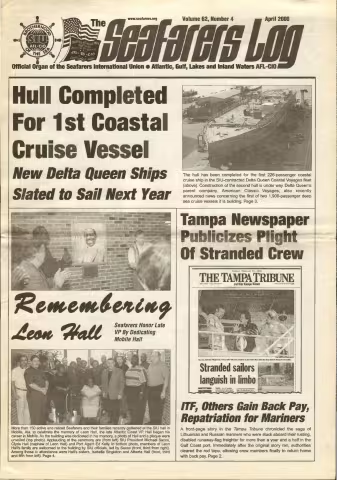
The hull has been completed for the first 226-passenger coastal
cruise ship in the SIU-contracted Delta Queen Coastal Voyages fleet
(above). Construction of the second hull is under way. Delta Queen's
parent company, American Classic Voyages, also recently
announced news concerning the first of two 1,900-passenger deep
sea cruise vessels it is building. Page 3.
Tampa Ne
Of Stranded Crew
SUNDAY. FllUWAU 27. '!000
Stranded sailors
languish in limbo
ITF, Others Gain Back Pay,
Repatriation for Mariners
A front-page story in the Tampa Tribune chronicled the saga of
Lithuanian and Russian mariners who were stuck aboard their rusting,
disabled runaway-flag freighter for more than a year and a half in the
Gulf Coast port. Immediately after the original story ran, authorities
cleared the red tape, allowing crew members finally to return home
with back pay. Page 2.
Presidnt'1 Report
Our Next Generation
When you are doing something right, the word spreads.
That has got to be the case concerning the Paul Hall Center's unli
.-------...,,.._ .... censed apprentice program. From Alaska to Hawaii
to Guam to Florida, special efforts are in place to
promote this nine-month curriculum to young men
and women looking for a career.
Last month, I took part in a ceremony in Fort
Lauderdale, Fla. where the local Propeller Club
offered a scholarship to a young lady, Dusti
Arrowood, who is headed to Piney Point. Executive
Vice President John Fay, Fort Lauderdale Port
Michael Sacco Agent Ambrose Cucinotta and I were proud to rep
resent the SIU at the event where we could meet one
of the people who will be carrying the banner oftbe union and the U.S.
merchant marine in this new century.
The unlicensed apprentice program has been turning out mariners
ready to meet the challenges of the sea since the curriculum was
changed in 1997. At that time, the center expanded its basic training
for those entering the industry. Previously, newcomers studied for
three months in classroom situations while receiving hands-on training
at the Piney Point campus. Now, they receive nine months of prepara
tion-with three months of actual sea duty in between the education
received at the school.
These young people are the future of the SIU. They are the ones
who will be aboard the U.S.-flag vessels that are on the drawing boards
today. Their future is bright because of the work all of you have done
to secure a strong U.S.-flag fleet.
I'm sure you have noticed 11ll the new vessels we have announced
in the Seafarers LOG the last several years. Some of them already are
sailing, others will he coming on line soon.
It does not do any of us any good to contract for these new ships,
then not recruit new people to join our ranks.
Like most of you, I look in the back of each issue to see who has
retired. But I also make the point of looking to see who's coming on
board. Those great young faces photographed in the unlicensed
apprentice water survival classes are the next generation of Seafarers.
Their efforts have caught the eyes of many.
Alaska Congressman Don Young devoted one of his half-hour tele
vision shows aired to his constituents to the unlicensed apprentice pro
gram. He interviewed two of the graduates who came from that state
during the telecast.
Government officials in Hawaii are working with the union to
recruit young people from the Aloha State.
After touring the center in December, the governor of Guam, Carl
T.C. Gutierrez, launched a recruitment program for the residents of his
territory.
And this is just the beginning.
Each of you can play a role in this effort. Promote what it means to
be a Seafarer to young people. Explain how they can gain a profession
and see the world at the same time. Let them know what is coming,
like the new cruise ships. Put them in touch with the admissions office
at the Paul Hall Center.
Remember, others watched out for you and taught you the ropes
when you joined. Now you can return that favor to a young man or
woman just starting his or her venture in life.
Our next generation of Seafarers have tremendous opportunities
ahead of them. Let's do all we can to help them meet those challenges.
SIU officials welcome a new recruit for the Paul Hall Center's unli
censed apprentice program during last month's meeting of the Port
Everglades, Fla. Propeller Club. From the left are Fort Lauderdale Port
Agent Ambrose Cucinotta, SIU President Michael Sacco, Dusti
Arrowood and SIU Executive VP John Fay.
Volume 62, Number 4 April 2000
~76
The SIU on line: www.seafarers.org
The Seafarers LOG (ISSN 1086-4636) is published monthly
by the Seafarers International Union; Atlantic, Gulf, Lakes
and Inland Waters District; AFL-CIO; 5201 Auth Way;
Camp Springs, MD 20746. Telephone (301) 899-0675.
Periodicals postage paid at Southern Maryland
20790-9998 and at additional offices. POSTMASTER: Send
address changes to the Seafarers LOG, 5201 Auth Way
Camp Springs, MD 20746.
Communications Director, Daniel Duncan; Managing
Editor, Jordan Biscardo; Associate Editor/Production,
Deborah A. Hirtes; Art, Bill Brower; Administrative
Support, Jeanne Textor.
Copyright © 2000 Seafarers International Union, AGLIWD
All Rights Reserved.
2 Seafarers LOB
Stranded Crew Finally Goes Home
ITF Aids Mariners on Runaway-Flag Ship;
Tampa Tribune Articles Bare FOC 'Prison'
The headline said it all:
"Stranded sailors languish rn
limbo."
It applies to any number of
mariners aboard runaway-flag
ships throughout the world. But
in this instance, the Tampa
Tribune front-page article
focused on the awful case of
Lithuanian and Russian crew
members stuck aboard the
Golden Star for more than a year.
In its edition of Sunday,
February 27, the newspaper pub
lished three articles related to the
case, beginning on page one and
occupying a full page inside.
Attracting such publicity is
part of the campaign against run
away-flag shipping that is waged
by the London-based Inter
national Transport Workers'
Federation (ITF), to which the
SIU is affiliated. Besides general·
ly increasing people's awareness
about the runaway-flag scam,
exposure can help pressure
unscrupulous shipowners to give
crew members their due-usually
back wages and repatriation, and
perhaps medical attention.
With the Golden Star, efforts
by the ITF and the Immigration
and Naturalization Service were
augmented by the Tribune s
aggressive coverage. Tribune
reporter Jim Sloan, one of two
who covered the Golden Star,
said the paper fielded numerous
phone calls and emails from local
citizens responding to the stories,
"saying the situation is really dis
gt'.isting and wanting to help."
After the stories ran, the
mariners received back wages
and were flown home.
The relief was long overdue.
The Panamanian-flagged Golden
Star, a 490-foot freighter, limped
into Tampa in September 1998
after sustaining damage from a
hurricane.
It's still there and still needs
repairs.
Many of the mariners who
recently departed the vessel had
spent more than 17 consecutive
months aboard the Golden Star,
Stranded sailors
languish in limbo
A front-page article in the February 27 Tampa Tribune exposes the
plight of Lithuanian and Russian crew members stuck aboard the
Golden Star, a Panamanian-flag freighter in need of repairs.
the last six without getting paid.
They survived with the help of a
local minister and the monthly
food stipend provided by the
shipowner, alternately listed as
Tamboril Properties Inc. or
Caribbean Ship Management.
After surveying the rusting
ship and meeting the crew,
reporter Elizabeth Bettendorf
wrote, "Their vessel has become
their prison. They share it with
cockroaches and sweltering heat."
In an overview of the runway
flag scam, Sloan described "a
worldwide fleet of derelict hulks
rusting in ports around the world,
manned by sailors left to rot
while shipowners squabble over
Coast Guard fines and port fees,
or simply battle bankruptcy. They
are most often flag-of-conve
nience ships, registered with
Third World countries that pro
vide little regulation. Some call
them 'runaway flags.' Others
bluntly label them ' Dogs of the
Sea."'
The scheme usually involves
multiple parties from runaway-
Continued on page 4
Carnival Taxed
By Proposal
The Miami Herald last
month reported that the run
away-flag Carnival Cruise
Lines opposes a cruise ship
ticket tax- $4 per person, per
day-that would generate
$320 million for construction
of a baseball stadium down
town.
Carnival Chairman Micky
Arison's basketball team, the
Miami Heat, plays in a new
arena "operated through a tax
on hotel visits," the newspaper
noted. However, a Carnival
spokesman told the Herald
that the proposed cruise ticket
tax is "absolutely preposter
ous."
The levy would partially
fund a ballpark for the Florida
Marlins, with the club paying
an estimated $80 million.
Rank-and-File Financial Committee
Approves Union's Records for 1999
Serving on the committee were (from left) OMU
Decarlo Harris, Chief Steward Donald Mann, FOWT
Melvin Grayson, Recertified Bosun Dan Marcus, SA
James Simms, QMED John Smith and AB Joseph
Riccio. Pictured with them is SIU Secretary
Treasurer David Heindel (far right).
A committee of rank-and-file members, elected
by their fellow Seafarers during last month's union
meeting in Piney Point, Md., has reviewed the
SIU's financial records for 1999 and found them in
good order.
Each department was represented on the com
mittee. Serving were Recertified Bosun Dan
Marcus, AB Joseph Riccio, QMED John H.
Smith, FOWT Melvin Grayson, OMU Decarlo
Harris, Chief Steward Donald Mann and SA
Jam es Simms.
"We find that the headquarters of the union is
taking all steps possible to safeguard union funds
and to see that the disbursements of the union are
in accordance with the authority delegated to them
and that, at the same time, there is a striving effort
to increase day-to-day efficiency of our operation,"
the committee noted in its report.
The use of an annual financial committee is
required by Article X, Section 15 of the SIU
Constitution. It reads: "The Annual Financial
Committee shall make an examination for each
annual period of the finances of the Union and shall
report fully on their findings and recommenda
tions."
Apri/2000
American Classic Announces 'Milestones'
In Revitalization of U.S. Passenger Fleet
1st Hull Complete for Coastal Cruise Ship;
Expansion Means New SIU Jobs On Horizon
SIU-contracted American
Classic Voyages last month
announced what it described as
"several milestones in (the com
pany's) plan to introduce six new
vessels over the next four years,"
augmenting its position as the
largest owner and operator of
U.S.-flag, U.S.-crewed passenger
vessels.
For Seafarers, the news bodes
well for job opportunities
beginning next month, with the
scheduled start of Columbia
Queen riverboat vacations in the
Pacific Northwest. The new 161-
passenger vessel, slated to sail on
May 26, is part of the fleet oper
ated by American Classic sub·
sidiary Delta Queen Steamboat,
also rui SIU-ccntracted company.
Meanwhile, the hull has been
completed in Jacksonville, Fla.
for the first 226-passenger ship in
Delta Queen's new "coastal voy-
ages" fleet, and construction of
the second hull is under way. The
line--ultimately to include five
vessels-will begin operations
next year.
American Classic also an
nounced that Independence Day
weekend ''will mark the start of
fabrication of the first of two
1,900-passenger vessels (the com
pany) is building under the his
toric Project America initiative to
help revitalize the U.S. shipbuild
ing industry, create more than
5,000 American jobs, increase
U.S. tax revenues and expand con
sumers' leisure travel options."
These two deep-sea vessels are
being built in union-contracted
Litton Ingalls Shipbuilding in
Pascaguola, Miss. The ships
(operating under the banner of
United States Lines) are scheduled
to sail around Hawaii beginning in
2003 and 2004, respectively.
As part of that same program,
the Patriot (formerly Holland
America's Nieuw Amsterdam and
acquired last year by U.S. Lines)
is expected to begin Hawaiian
Island cruises in December. The
ship can transport more than
1,200 passengers.
Finally, American Classic
reported that November 11 has
been scheduled as the fust depar
ture of the SIU-crewed SS
Independence from its new home
port of Kahului, Maui. Currently,
the Independence utilizes Hono
lulu as its home port.
"American Classic Voyages
remains committed to the U.S.
:flag fleet," noted SIU President
Michael Sacco. •This company is
another example that the mar
itime revitalization program initi
ated in the mid- l 990s is paying
dividends in new vessels and new
jobs for American mariners."
The first hull is complete for Delta Queen's new fleet of coastal pas
senger ships, which will sail along the Atlantic, Gulf and Pacific coasts.
First Orea-Class RO/RO Expected by Summer 2002
TOTE Provides More Information on New Jones Act Vessels
Please be advised
that SIU headquarters
and all SIU hiring halls
will be closed on
Seafarers may see the first of
two Orea-class roll-on/roll-off
vessels operated by Totem Ocean
Trailer Express (TOTE) as early
as the summer of 2002, according
to the company's president and
CEO, Robert P. Magee.
Speaking before the Wash
ington, D.C. Propeller Club on
February 29, Magee updated mar
itime industry and government
officials on the progress of the new
vessels, announced in the January
issue of the Seafarers LOG.
TOTE plans to build at
National Steel and Shipbuilding
Company in San Diego two
RO/ROs for the Jones Act fleet.
They will sail between the Pacific
Northwest and Anchorage, Alaska.
The ships will be the first non-mil
itary containerships or RO/ROs
built in an American yard since the
R. J Pfeiffer came out in 1992.
Magee told the audience the
company is fully involved in the
engineering phase of design. He
expects the first steel to be cut by
spring 2001.
"We look forward to these ves
sels serving the people of Alaska
soon," Magee stated.
He revealed more details about
the vessels during his address,
including several planned "redun
dancies." With this, maintenance
can be performed on one unit
while another is working. He
added TOTE is doing this because
the ships operate more like a
cruise vessel as they are never
shut down in order to keep the
seven-day round-trip schedule.
Each will be powered by diesel
electric plants, with four main
engines and two auxiliary units.
Each will have two electric
motors, dual rudders and twin
propellers. The power plants are
designed to be the cleanest burn
ing available in today's market.
The two RO/ROs will be 839
feet long and have beams of 118
feet. The three vessels already in
the TOTE fleet are 790 feet long
with 105-foot beams. One of the
necessary design features for the
new ships is they must fit the ter
minals already being used by
TOTE.
The ships will incorporate
other environmentally secure sys
tems, including a state-of-the-art
sewage treatment plant and dou
ble-hulled fuel tanks that are not
adjacent to the skin.
The Orea-class vessels will be
able to hold more than 600 trail-
TOTE Pres. and CEO Robert Magee (left) updates SIU Asst. VP
Contracts George Tricker on the progress of the two new Jones Act
RO/ROs planned for Alaskan service.
Apri/2000
ers/containers and 200 automo
biles as opposed to the nearly 400
and 110 respectively on TOTE 's
present ships. The new RO/R.Os
will feature 12 internal ramps com
pared with five on the three that are
sailing. The deck configuration
will allow the new ships to handle
trailers ranging from 30 to 70 feet.
their Jones Act fleets. He said this
points to an even stronger U.S.
flag merchant fleet for the new
century. · Monday, Mai 29i' 2000
for the observance of
MemofieFDay {unless.
an emergency arises). The bows will feature a "whale
back" design to protect containers
on the deck from high seas. The
hulls will be ice-belted to provide
additional protection in Cook
Inlet during winter.
(The Jones Act, part of the
1920 Merchant Marine Act, is the
nation's freight cabotage law. It
states that any cargo moved
between two domestic ports must
be carried aboard U.S.-crewed,
U.S.-built and U.S.-flagged ves
sels.) Normal business
hours will resume the
following workday. Magee pointed out TOTE is
the first of several shipping com
panies considering an update of
TOTE operates three SIU
crewed vessels-the Great Land,
the Northern Lights and the
Westward Venture. TOTE is a sub
sidiary of Saltchuk Resources,
Inc.
Administrative Task Force Finds
USCG Missions Vital for New Century
An interagency task force assigned to look into
the needs of the U.S. Coast Guard into the 21st cen
tury has found "that the nation has an enduring need
for a Coast Guard, specifically for a Coast Guard in
the deepwater environment, that there is a near term
requirement for re-capitalization and that the Coast
Guard's Deepwater Capabilities Replacement
Project should continue to be pursued."
Transportation Secretary Rodney Slater issued
the report in late February in conjunction with a
speech by Coast Guard Commandant James Loy to
the National Press Club in Washington, D.C. on
February 24.
Admiral Loy updated the media and others from
the maritime industry on the role of the Department
of Transportation agency and how it is being pre
pared for the future.
Deputy Secretary of Transportation Mort
Downey served as chair for the 16-member task
force composed of representatives from various fed
eral departments and agencies as well as the White
House. The group, appointed by President Clinton
in 1999, was charged with answering if the nation
requires a Coast Guard to operate in the deepwater
environment. It analyzed the agency's missions
through the year 2020. This was the first adminis
trative-level survey of the agency in almost 20
years.
In the summary of his task force's report,
Downey stated, "Our findings reinforced the value
of a multi-missioned Coast Guard with regulatory,
law enforcement, and humanitarian-focused emer
gency response authority, and military capability
that offer this and future administrations a highly
motivated, cost-effective service with the demon
strated competence to meet changing national prior
ities."
The task force agreed to a series of conclusions
that underscore the need for the Coast Guard and the
support the agency will require to meet the chal
lenges of 2020:
•the Coast Guard's roles and missions support
national policies and objectives that will endure into
the 21st century;
• the United States will continue to need a flexible,
adaptable, multi-mission, military Coast Guard to
meet national maritime interests and requirements
well into the next century;
•in order to hedge against tomorrow's uncertain
ties, the Coast Guard should be rebuilt so as to make
it more adaptable;
• the Coast Guard should continue to pursue new
methods and technologies to enhance its ability to
perform its vital missions;
•the re-capitalization of the Coast Guard's deep
water capability is a near-term national priority; and
• the deepwater acquisition project is a sound
approach to that end and the interagency task force
strongly endorses its process and timeline.
Seafarers LOG 3
1 -----
'He Earned the Respect of All'
Building Named in Leon Hall's Memory
Among the more than 150 people attending the ceremony are (from
left) OMU Percy Payton, Jacksonville, Fla. Port Agent Tony McQuay
and retired Steward Tobe Dansley.
Pictured at the counter are (from left) SIU employee Alicia Lorge,
Recertified Steward Albert Coale and retired Steward Herbert Scypes Sr.
SIU Boat Operator
Rescues Fisherman
Editors note: SIU member
Richard Williams, second assis
tant engineer on the NATCO
dredge Manhattan Is land, sub
mitted the following article.
On the morning of March 10,
the crew boat Columbia River
-operated by Seafarer Dennis
Johnston-was doing a routine
survey of the San Juan, P.R.
entrance channel.
The Columbia River is work
ing with the SIU-crewed hopper
dredge Manhattan Island, which
is contracted to deepen and widen
the entrance channel.
San Juan is well known for its
onshore swells and heavy surf.
Aboard the Columbia River,
Johnston and Don Smith, a field
engineer for NATCO, sighted a
sport fisherman caught in the
trough and waving frantically.
Initially the fisherman was mov
ing in and out of sight due to the
heavy swell. It appeared his
engine lost power and he was
rapidly heading toward the rocks.
Captain Johnston immediately
suspended the survey to investi
gate. Sea conditions made it
impossible to go full speed; by
4 Seafarers LOB
the time the Columbia River
arrived, the fisherman was only
about 25 to 50 feet from the
rocks.
Now the crew boat was in dan
ger of going aground; but Smith
threw a line to the boat-aptly
named Hijo Afortunado or For
tunate Son-and safely towed it
to a nearby marina.
Approximately one-half mile
away was a runaway-flag vessel
that had been aground for several
months. If the crew boat had
arrived a minute later, the all
fiberglass Hijo Afortunado would
have suffered the same fate.
The fisherman praised John
ston and Smith for their assis
tance and courage.
Captain Steve Taylor saw the
rescue from the Manhattan
Island.
"If he had gone up on the
rocks, there's no telling if anyone
would have found him," he said.
"His boat would have crunched
like potato chips.
"He's lucky, because we don't
survey there every day and
(Johnston and Smith) were the
only guys around for miles."
More than 150 active and
retired Seafarers and their fami
lies recently gathered at the SIU
hall in Mobile, Ala. to celebrate
the memory of Leon Hall, former
vice president of the union's
Atlantic Coast region.
In what is believed to have
been an unprecedented ceremony,
the building was named in mem
ory of Hall, a charter member of
the union, who passed away in
1992 at age 72. No other SIU hall
has been dedicated in someone's
memory.
The hall now features a large
photo of Leon Hall and a plaque
of remembrance.
"Leon was a mentor to the next
generation of union officials,"
said SIU President Michael Sacco
during the February 25 ceremony.
"He reminded all of us who
worked with him to always
respect the brothers and sisters
who make up this union. He
drilled into us the need to do our
homework and always be pre
pared when we boarded a ship,
because the members were count
ing on us."
At least 20 members of Hall's
family attended the assembly,
including his two sisters.
"The comments from every
one who attended were so posi
tive," noted Ed Kelly, the SIU
port agent in Mobile. "It couldn't
have gone any better."
Hall, always an extremely
popular union brother. worked
every shipboard job in the galley,
becoming a chief steward. In the
early 1960s he came ashore to
work with the union's Maritime
Advancement Program, the SIU 's
early upgrading and refresher
training operation.
From there, he served the
membership in various posts
including San Francisco port
agent, New York port agent and
headquarters representative. In
1979 he became Atlantic Coast
vice president, a position to
which he was re-elected in every
union balloting until his retire
ment in 1988.
Never short of conversation,
he affectionately was nicknamed
"Radio" by his union brothers
and sisters.
"Leon truly cared about his fel
low Seafarers," observed Sacco.
"He earned the respect of all."
AB Herbert Scypes Jr. pro
vided four photos accompanying
this article along with two on the
front page.
The memorial plaque reads as
follows; "Leon Hall was a true
believer in helping others. He
was an advocate, teacher, listener,
mentor, supporter-in other
words, a union brother in every
sense of the word. While he
fought to improve the working
I
Leon Hall served the membership
in many union posts, including
Atlantic Coast vice president.
conditions for all Seafarers, his
heart always remained in Mobile.
Brother Hall charted the course
that many others followed in the
SIU."
1SIU President Michael Sacco (second from left) is pictured with retirees
(front, from left) Sonny Rankin, Sacco, Y. C. McMillan, Herbert Scypes
Sr., Herbert Hollings, (back) Nick Juzang and Eddie Bowers.
NATCO Crews Ratify 3-Year Contract
By a vast majority, SIU mem
bers sailing aboard NATCO
dredges have approved a new
three-year contract featuring
numerous gains.
"We're all pretty excited about
it," said Captain Steve Taylor
aboard the Manhattan Is land.
"Everybody's happy with it,"
observed AB/Dragtender Ray
Maddock, who served on the
negotiating committee. "Pri
marily, what the guys were asking
for were more benefits for their
dependents, a higher pension and
pay raise. We achieved all of
those goals, along with others.
We got everything the members
asked for, plus a few other gains
they (initially) weren't even
aware of."
Also serving on the commit
tee, which negotiated the contract
in early March, were Mike Horn,
Dale McKelvie, Jeff Mccranie,
SIU Asst. VP Contracts George
Tricker and SIU Ft. Lauderdale,
Fla. Port Agent Ambrose Cuci
notta.
Captain Phil Kleinebreil said
everyone on the Northerly Island
approved the contract. "Every
body is very satisfied," he noted.
Among other gains, the pact
calls for a 3-percent wage
increase each year of the contract;
doubles the optical benefit for
members and their dependents;
doubles the death benefit; and
adds prescription coverage for
dependents.
It also stipulates additional
pension credits; increases vaca
tion benefits; and adds NATCO
crews to the Seafarers Money
Purchase Pension Plan.
"I think it's a good one. I was
happy with it," said Hom. "I've
been through this procedure a few
times now, and every time it's
been an education. We tried real
ly hard this time to educate the
crews about all the gains that
were made, because some of the
background information isn't
necessarily incorporated into the
printed version of the contract."
Both Hom and Maddock cred
ited Tricker and Cucinotta for
their efforts.
"This was my first time on the
bargaining committee, and it was
a worthwhile experience," stated
Maddock, whose wife is a shop
steward for the Office and
Professional Employees Inter
national Union. "Both George
and Ambrose were invaluable.
They're professionals and they're
good guys."
He added that both the SIU
crews and the company are work-
ing to ensure NATCO crews may
take advantage of the curriculums
available at the Paul Hall Center
for Maritime Training and
Education, including various
classes based at the Joseph Sacco
Fire Fighting and Safety School.
ITFAssists
Stranded
Mariners
Continued from page 2
flag nations. More than a half
century ago, U.S. maritime
unions called them runaways
because of their use as a device
for shipowners to pay a fairly
nominal fee to the government of
a non-maritime nation seeking to
raise revenue. The shipowners
then escape from a maritime
nation's safety regulations, pro
cedures and inspections, tax laws
and higher wages-mostly by
insulating themselves with often
unscrupulous managers and reg
istries.
The ITF comprises more than
500 unions from approximately
130 countries.
April20DO
Houston Seafarers Meet With Rep. Green
U.S. Rep. Gene Green (top photo, standing) earlier this year
attended a membership meeting at the SIU hall in Houston, where
he emphasized to Seafarers his strong support of the U.S. mer
chant marine. Green-pictured with (from left) SIU VP Gulf Coast
Dean Corgey, SIU Asst. VP Jim McGee and SIU Representative
Kenny Moore-reiterated his backing of the Jones Act and the
Maritime Security Program. He also encouraged members to reg
ister and vote in the November elections.
Amsea Offers Retroactive
Adjustments for RRF Crew Members
Amsea has joined the list of Ready Reserve Force (RRF)
vessel operators providing EPA wage adjustments to
Seafarers working aboard its contracted ships.
SIU Vice President Contracts Augie Tellez reported the
company will provide the adjustment retroactive, in some
cases, to July 1998.
Tellez noted the problems concerning the EPA pay scales
go back to complaints filed in July 1998 about the bidding pro
cedure used by the U.S. Maritime Administration (MarAd) in
awarding new three-year contracts for RRF ships. When
MarAd rescinded the awards announced the previous month,
it extended the contracts for those companies already manag
ing the vessels. Since that time, MarAd has been working to
correct the problems discovered within its bidding procedures.
New awards are expected to be announced later this year.
The SIU-contracted vessels covered under the Amsea
announcement include the Cape Jacob, Cape John, Cape
Johnson, Cape Juby, Cape Lambert, Cape Lobos, Cape
Nome, Cape Washington, Cape Wrath, USNS Curtiss and
USNS Wright.
The RRF fleet provides surge shipping for the U.S. armed
forces. The ships are owned by the government but operated
by private companies that employ U.S. merchant mariners.
The vessels, which are kept in various states of readiness,
include tankers, roll-on/roll-offs, breakbulk and auxiliary crane
ships.
Pres. Jackson Crew Discusses Merger
Earlier this year, Seafarers aboard the President Jackson in San
Francisco discussed the proposed merger of the NMU into the
SIU. Pictured in the galley are (from left) SIU San Francisco Port
Agent Nick Celona, Recertified Steward Terry Allen, Assistant
Cook/Utility Mary Lou Lopez and SIU VP West Coast Nick
Marrone. As reported in last month's issue of the Seafarers LOG,
members from both unions overwhelmingly voted in favor of full
merger talks.
April2000
Supreme Court Rules State Oversteps
Jurisdiction Regarding Tanker Regs
By a unanimous vote, the U.S. Supreme Court
declared the state of Washington had overstepped its
jurisdiction in imposing stricter tanker regulations
than those implemented by the federal government.
Justice Anthony M. Kennedy delivered the deci
sion in the case of United States v. Locke on March
6. In his statement, Justice Kennedy wrote,
"Washington's regulations regarding general navi
gation watch procedures, crew English skills and
training, and maritime casualty reporting are pre
empted by the comprehensive federal regulatory
scheme governing tankers."
Kennedy added, "The state has enacted legisla
tion in an area where the federal interest has been
manifest since the beginning of the republic and is
now well established.... Only the federal govern
ment may regulate the design, construction, alter
ation, repair, maintenance, operation, equipping,
personnel qualification and manning of tankers.
Congress has left no room for state regulations of
these matters."
The case was remanded to the lower courts to
consider whether other standards, such as lookouts
in times of restricted visibility, may be allowed
because of "peculiarities" within Washington state's
waterways.
It was brought to the U.S. District Court in 1996
by the International Association of Independent
Tanker Owners (INTERTANKO) after the Pacific
Northwest state passed laws requiring tankers enter
ing the state's waterways to meet its stricter regula
tions than those implemented by the federal Oil
Pollution Act of 1990. Those regulations dealt with
watch policy, English-speaking requirements, spill
reporting and additional training and drills. INTER
TANKO challenged the legislation as unconstitu
tional because it superceded federal law.
After the district court ruled in favor of the state,
INTERTANKO appealed. The United States inter
vened on the side of INTERTANKO, claiming the
district court failed to give sufficient weight to the
foreign affairs interests of the federal government.
Despite the involvement of the government, the
appeals court found in favor of the state.
The case moved to the Supreme Court and was
heard December 7, 1999.
AFL-CIO Continues Push for Global Economic Fairness
Following its peaceful march
through the streets of Seattle last
December to call attention to the
needs of workers in the global
economy, the AFL-CIO is push
ing forward with its campaign for
global fairness.
The national labor federation's
executive board endorsed a state
ment during its meeting in
February to educate both union
members and the general public
on how the global economy
affects everyone, to push for
stronger human rights and worker
rights language in trade agree
ments, to establish international
solidarity with workers in emerg
ing nations and to hold multina
tional corporations accountable
for their e:ff orts to speed the race
to the bottom.
One of the AFL-CIO's imme
diate objectives is to stop legisla
tion that would grant permanent
normal trade relations to China.
Congress is considering a mea
sure that would end the yearly
review for such trade status for
China. The measure has the sup
port of the White House.
In its effort to show why
China should not be granted per
manent normal trade relations,
the AFL-CIO referred to a U.S.
State Department report issued
February 25 that stated the Asian
nation's "poor human rights
record deteriorated markedly
throughout the year, as the gov
ernment intensified efforts to sup
press dissent."
The report detailed extensive
human rights abuses, including
AFL-CIO Pres. John Sweeney
updates the Maritime Trades
Dept. executive board on the labor
federation's campaign for fairness
in the global economy.
continued or further tightened
restrictions on freedom of reli
gion, association, movement,
speech and the press.
Among the facts listed by the
State Department to support its
contention were:
• extrajudicial killings, torture
and mistreatment of prisoners,
forced confessions and denial of
due process;
•by the end of 1999, almost all
key leaders of the opposition
China Democracy Party were in
prison or custody;
• thousands of members of the
Falun Gong spiritual movement
were detained after the move
ment was banned in July; and
• violence against women which
included forced abortions and
forced sterilization as well as traf
ficking of women and children.
After the State Department
report was released, AFL-CIO
President John Sweeney said,
"Year after year, report after
report shows that China has no
intention of abiding by the most
basic rules of the international
community. Our growing trade
relationship with China has not
encouraged China to clean up its
act, despite what supporters of
permanent free trade status
claim."
Polling conducted by the
AFL-CIO since the first of the
year revealed nearly 70 percent of
American voters reject the idea
that "the best way to improve
human rights is not to restrict
trade, but to engage China and
include it in important interna
tional bodies, such as the World
Trade Organization." The polls
also showed Americans dismiss
the idea that permanent trading
status for China would expand
exports and create good jobs in
the U.S.
Sweeney further noted,
"China-which has not yet rati
fied the two United Nations
covenants on human rights it
agreed to sign before President
Clinton's-·trip to China in 1998-
has broken every trade agreement
it has signed with the United
States over the past 10 years."
The affiliated unions of the
AFL-CIO, which includes the
SIU, represent more than 13 mil
lion workers.
Hvide Marine Founder Dies
Hans J. Hvide, founder of Hvide Marine
Incorporated, passed away March 16 after a 10-
month fight with heart disease. He was 83.
"maritime pioneer" who "helped mold Port
Everglades with his inventiveness, will and phil
anthropy."
Hvide Marine owns the five SIU-crewed
"Double Eagle" tankers-the HM! Ambrose
Channel, HMI Diamond Shoals, HM! Cape
Lookout Shoals, HM! Nantucket Shoals and the
HM! Brenton Reef
Hans Hvide had a long and distinguished
career in the maritime industry, retiring in 1994.
He is credited with initiating the first roll-on/roll
off operation in the United States, in the early
1950s. He founded several maritime companies,
including American Overseas and Chartering
Corp. (1945), and Port Everglades Towing Co.
(1958), the forerunner to Hvide Marine.
The Miami Herald described Hvide as a
His son, Erik, who served as president of
Hvide Marine for five years, told the newspaper,
"Whether it was a deckhand or a cook, a captain
or a manager, he always had time for people and
a sincere interest for them. He believed in people
and was very idealistic."
Hans Hvide was born in 1916 in Bergen,
Norway to a ship-owning family. He graduated
from Bergen Commercial College in 1935 and
immigrated to the United States five years later.
During World War II, Hvide was an executive
with the Norwegian Shipping and Trading
Mission in New York, which was charged with
the operation of the Norwegian merchant fleet.
Seafarers LOG 5
Wheelsman Joseph Boyer
Richard Reiss
After a fairly mild winter, Great Lakes
Seafarers are getting an early start on the 2000
navigation season.
The Southdown Conquest was the first laker
to fit out; the cement carrier departed February
7 from Chicago bound for Charlevoix. Mich.
Full crews also reported aboard the JA. W
Iglehart and Alpena in mid-March to inspect
their boats and get them in tip-top condition for
the heavy loads ahead.
The opening of the Soo Locks in Sault Ste.
Marie, Mich.-traditionally marking the begin
ning of a new sailing sea.son-took place at the
end of last month~ and most of the other SIU
crewed lakes vessels began their routes at that
time as well.
SIU representatives met with Seafarers
aboard many of the vessels at fit-out and pro
vided the photographs on this page.
They noted that whil.e no ice remains on the
The dredge Luedtke gets to work.
lakes, the water
levels are still
very low.
Right: AB Watchman Jeff
Laland
Richard Reiss
Bosun Herb Shiller
J.A. W Iglehart
Deckhand Lorry Wilcox
Luetdke Engineering Co.
6 Seafarers LOB
Right: QMED Tracy Ribble
J.A. W Iglehart
A Great Lakes tug in Toledo
helps break ice for the
American Republic.
QMED Eugene Hayes
J.A. W Iglehart
Porter Gary Lipczynski
American Mariner
AB Vladislav Pitsenko
J.A. W Iglehart
Wheelsman Kenneth Bluitt
American Mariner
Second Cook Raymond Maynord
American Mariner
April 2000
Recertified Stewards
Encourage Apprentices
The message may not be new,
but its tremendous importance to
SIU members also is intact.
In what has become an unoffi
cial tradition, 10 graduating
members of the recertified stew
ard class last month urged unli
censed apprentices at the Paul
Hall Center for Maritime
Training and Education to take
full advantage of the opportuni
ties available through the school
and the SIU.
then," said the 38-year-old
Seafarer. "Today, the unlicensed
apprentices have a wonderful
program here. I encourage you to
ask questions and be careful in
foreign ports. Good luck!"
Haggerty, 36, whose home
port is Tacoma, Wash., told the
apprentices that this shouldn't be
their only trip to the Paul Hall
Center.
"I can't urge you enough to
keep upgrading. Keep current and
you'll have no problem ship
ping," he stated.
The stewards-Robert Hag
gerty, Martin Buck, Abraham
Martinez, Anthony St. Clair,
William McGee, Charles Rol
dan, Randy Stephens, Richard
Riley, Jeanette Montgomery
and Kevin Marchand
addressed the apprentices and fel
low Seafarers during the March
membership meeting in Piney
Point, Md.
St. Clair, McGee and Stephens
each reminded the apprentices
that their safe, productive work
aboard ship will help determine
future continued employment
opportunities for Seafarers.
The SIU's newest recertified stewards are pictured with SIU VP Contracts Augie Tellez (top photo, fourth from
left) and (bottom photo) SIU Director of Legislative Affairs Terry Turner (right, standing). Completing the five
week curriculum were Richard Riley, Anthony St. Clair, Abraham Martinez, Robert Haggerty, Kevin
Marchand, Jeanette Montgomery, William McGee, Charles Roldan, Randy Stephens and Martin Buck.
Thi; recertified stc;w~ds also
complimented the school's in·
structors and staff, crediting them
with maintaining a comfortable
but professional atmosphere that
promotes learning.
Recertification, a five-week
curriculum, is considered the top
class offered to members of the
steward department.
Head Start
Marchand, who sails from
Port Everglades, Fla., let the
apprentices know "what a head
start your have." He recalled that
his first deep-sea voyage ( 1978)
occurred only because an · officer
literally shanghaied him to a non
union ship . .
"Things were very different
"It's important to do a good
job when you're out there,"
observed Stephens, 45, who sails
from the; port of Houston.
"When you get to sea, work
hard and do your job," said the
46-year-old McGee, whose home
port is Jacksonville, Fla. "Stick
with the course and come back to
Piney Point to upgrade as soon as
possible."
"It may seem obvious, but the
best thing you can do for yourself
and your union is to do a good
job/' explained St. Clair, 43, who
sails from the port of Houston.
"And come back ~o upgrade. The
staff here works hard for our ben
efit."
'Holding ~ Future'
Riley, 49, emphasized, the
impact the apprentices can have.
"You hold the future of our
union in your hands," declared
Riley, who sails from the port of
Honolulu. "Please don't drop the
ball. We have the best educators
here at the school; take advantage
of it. There are more and more
(industry) regulations to come, so
stay current by upgrading.
"And remember this; 'Safety
First' will protect you and your
family."
Others in the recertification
class mentioned various aspects
of the curriculum, with several
pointing to the Joseph Sacco Fire
Fighting and Safety School as an
invaluable addition to the Paul
Hall Center.
Montgomery, 35, praised the
Paul Hall Center's culinary staff,
whom she described as "out
standing." She said the recertifi
cation students enjoyed a natural
camaraderie and "good commu
nication" throughout the class.
Montgomery, whose home
port is Tacoma, Wash., also said
she enjoyed the upgraders' meet
ing with SIU Vice President
Contracts Augie Tellez and SIU
Assistant Vice President Con
tracts George Tricker at the
union's headquarters, located in
Camp Springs, Md.
Martinez, 43, credited the
union and the school for offering
a worthwhile class and a solid
career path.
Part of the class took place at the Joseph Sacco Fire Fighting and
Safety School, located near the Paul Hall Center's main campus.
Several stewards said they were impressed by the facility's very mod
ern and maritime-specific equipment. The fire fighting school opened
last summer.
"I'm proud to be an SIU mem
ber and I thank (SIU President)
Mike Sacco and his staff," noted
Martinez, who sails from the port
of Jacksonville.
Buck, 42, who also sails from
Jacksonville, commended "the
Apprentices Earn GEDs
Apri/2000
Because academic studies can
help Seafarers be more proficient
in their work at sea, the Paul Hall
Center for Maritime Training and
Education offers such instruction
in addition to vocational courses.
Two unlicensed apprentices
recently took advantage of the
center's GED program, and they
received diplomas during the
March membership meeting in
Piney Point, Md. GED graduates
Steve Pollard (second from left)
and Phillip Hartline (right) are
pictured with SIU Secretary
Treasurer David Heindel (left)
and SIU VP Contracts Augie
Tellez.
officials at headquarters and at
Piney Point. I can't thank you
enough. Keep up the good work."
Roldan, 30, whose home port
is New York, described the
course as "very rewarding. I thank
everyone involved."
Among other studies, the
course included various lessons
in the galley labs, training at the
new fire fighting and safety
school, a trip to AFL-CIO head
quarters in Washington, D.C. and
a visit to SIU headquarters.
Boeing Strike Ends
Workers Approve 3-Year Pacts
Union engineers and technical
workers at Boeing Corp. declared
"a huge victory" as they returned
to work last month in Puget
Sound, Wash., following what is
believed to be the largest white
collar strike in U.S. history.
The workers on March 19
approved separate three-year con
tracts covering 22,352 members
of the Society of Professional
Engineering Employees in
Aerospace (SPEEA). SPEEA is
an affiliate of the International
Federation of Professional and
Technical Engineers.
The contracts, each approved
by more than 70 percent of those
voting, call for annual wage
increases and health benefits for
dependents, among other gains.
The union also triumphed when
Boeing dropped its demand that
workers pay part of their health
insurance premiums.
"We plan to march back in just
as we left- as a group together,"
the union said in a statement.
"This is a huge victory for
SPEEA. We thank every person
who played a part in making our
strike work-the members on the
picket line, the volunteers, the
staff, other labor unions and the
community at large."
AFL-CI 0 Secretary-Treasurer
Richard Trumka, who led the cru
cial final days of bargaining
before the settlement, stated that
because of this outcome,
"Millions of white-collar and pro
fessional workers in our country
now know they can build a better
future for their families by joining
and forming unions."
An estimated 1 7 ,000 workers
walked off their jobs on February
8, following nine months of con
tract negotiations. In a resolution
supporting the workers, the AFL
CIO pointed out that Boeing
"refused to engage in meaningful
negotiations on economic items
despite the company's record
profits and aggressive acquisition
strategy. Boeing (also) threatened
to retaliate against employees
who engage in their right to
strike .... Boeing disciplined the
engineers' bargaining chairman
for expressing the employees'
point of view to the press."
The company's penultimate
contract offer included major con
cessions on employees' benefits
and was rejected by a nearly
unanimous vote. A subsequent
offer was rejected, largely be
cause of wages.
Days before the strike began,
federal mediators intervened and
brought the parties back to the
bargaining table. However, the
company flatly refused to
improve its offer and the mediator
halted negotiations.
Under terms of the settlement
agreement, union members will
return to the same jobs they held
prior to the strike. Boeing and
SPEEA "mutually pledge to
return all operations back to nor
mal at the earliest possible time,"
the union noted.
The new contract also includes
a "partnership agreement" aimed
at "rebuilding the relationship"
between Boeing and the workers.
Seafarers LOG 7
ITF: Stop Blacklisting Filipinos
SIU Backs Mariners at Manila Demonstration
More than 1,000 mariners
along with 118 International
Transport Workers' Federation
(ITF) inspectors marched through
Manila to protest the blacklisting
of Filipino seafarers who report
ill treatment, dangerous working
conditions and unpaid wages.
The late-February rally coin
cided with the biennial seminar
for ITF inspectors from around
the world. Don Thornton, the
Sill's ITF inspector on the Great
Lakes, represented the union at
the five-day session.
The protest against the prac
tice of blacklisting highlighted
the ITF assembly. Despite swel
tering temperatures, it lasted five
hours and covered three miles,
including a lengthy stop at the
Philippines Overseas Employ
ment Agency (POEA-often the
lone official source for seagoing
jobs).
Several Filipino mariners told
the crowd about the severe and
unjust treatment they have
endured because of blacklisting.
lTF officials pointed out that the
disreputable practice is wide
spread, but particularly acute in
the Philippines.
A global federation of more
than 500 transport-related unions
(including the SIU), the ITF
reported that the Philippines "is
the world's largest supplier of
labor to the global merchant fleet,
with some 200,000 individuals.
Every year, ITF inspectors assist
many thousands of Filipino
mariners in recovering millions of
dollars in unpaid wages, ensuring
that the vessels they sail on are
safe and that they are being fairly
treated.
"However, more often than not
those who contact the ITF for help
are labeled as 'troublemakers.'
Their names are added to black
lists held by manning agencies
and watch-lists held by the POEA.
As a consequence, many fright
ened mariners keep silent, leaving
the way clear for unscrupulous
shipowners to ignore even their
most basic rights."
As one ITF representative put
it, "When seafarers rightfully
complain about safety standards,
poor working conditions or
unpaid wages, they should not be
punished for life. Yet if a seafarer
appears on a blacklist, their mar
itime car~er, often the only job
open to them, is over.
"This immoral and illegal
practice must be stamped out."
The ITF further charges that
such blacklisting violates not only
the rules of the International
Labor Organization, of whlch the
Philippines is a member, but also
the Philippines Constitution itself.
Among the participants in the ITF meeting were (from left) Arthur
Petipas, Don Thornton, Rick Esopa and Jose Ybarra. Thornton is the
SIU's ITF inspector on the Great Lakes; the other three men are ITF
inspectors for the NMU.
According to press reports,
Philippines Labor Secretary Bien
venido Laguesma, who spoke at
the seminar, promised to investi
gate the ITF's complaints about
blacklisting. Crewing agents also
pledged their cooperation.
B Seafarers LOG
More than 1,000 mariners
marched through Manila to
protest the blacklisting of
Filipino mariners. The late
February event, conducted
by the ITF, elicited promises
from the local government
and manning agencies to
cooperate in solving the
problem.
Upon learning of a strike by workers at the Manila Hotel-originally
scheduled to host the five-day gathering-the ITF moved its seminar to
a different location in the city. Above, Abdulgani Serang, a member of the
National Union of Seafarers of India, blocks a truck from approaching the
Manila Hotel.
Some of the U.S.-based ITF inspectors who attended the seminar gath-
er for the rally. ·
Crew Member Confirms
Threat of Blacklisting
Lucio Degal knows all about
the fear of being blacklisted.
He was part of the Filipino
crew aboard the runaway-flag
Evangelos late last year when the
ship delivered foreign steel to
Cleveland.
The crew sought ITF assis
tance when the ship arrived in
Ohio in October. Inspectors
quickly discovered that the
mariners were owed more than
$100,000 in unpaid wages and
were suffering from a severe lack
of stores.
But the crew members,
reportedly afraid of being black
listed, rescinded their initial
complaints asking for the ship's
arrest. In fact, ITF inspectors
Lucio Degal (right) ,
received his back
wages, thanks to
help from ITF ·
inspectors Don
Thornton (left), Jim
Given and others.
But the rest of the
Evangelos crew
members, afraid of
being blacklisted,
withdrew their com
plaints.
Don Thornton and Jim Given
were told the captain of the
Panamanian-flagged, Greek
owned ship ordered the mariners
to sign papers indicating they
already had been paid "if they
wanted to continue sailing."
Only Degal refused to back
down. He received $5,000 in
back wages, plus repatriation.
At the ITF rally in Manila,
Degal recognized Thornton and
shared new details about the
Evangelos case. Degal, who
repeatedly thanked the ITF for
its assistance, insisted that the
others withdrew their grievances
because they were worried about
blacklisting.
Apri/2000
When representatives from the Paul
Hall Center were in Guam last January to
run a seminar aimed at establishing a sys
tem to boost enrollment by Chamorros (the
people of Guam) in the unlicensed appren
tice program at Piney Point, Md., they also
took time to visit SIU-contracted ships sta
tioned nearby-both on Guam and Saipan,
two U.S. territories in the Western Pacific.
Paul Hall Center VP Don Nolan and
Bart Rogers, the center's admissions coor
dinator, updated crew members on the lat
est union news, including the SIU-NMU
elections and brought them recent copies of
the Seafarers LOG.
The photos on this page show some of
the meetings held aboard the 2nd Lt. John
P. Bobo, SPC5 Eric G. Gibson, PFC
Dewayne T Williams and the 1st Lt. Jack
Lummus.
Paul Hall Center VP
Don Nolan poses with
(above left) SA
Richard Gegenheimer
and (above right)
Bosun John Davis on
the Wifliams in
Saipan.
GUDE AU Mohamed,
left, and QE Kenneth
Couture, right) Hsten to
SIU representatives
aboard the Williams.
Left: Two of the crew
members on board the
1st Lt. Jack Lummus in
Saipan are Chief Cook
Eric Loret and AB
Robert Butler.
Apri/2000
Right Preparing lunch for
Bobo crew members is
Cook/Baker Danelle Harvey.
Above: Seafarers "
discuss Uf~aboard
the Bobo in Saipan
with VP Don Nolan.
Right: Chief Steward
Robert Firth (right)
gets the latest union
news when
Ad miss tons
Coordinator Bart
Rogers visited the
2nd Lt. John P. Bobo.
Seafarers LOB 9
Global J,ink Finishes
Flurry of Five Repain
The SIU-crewed Global Link recently concluded a busy stretch of
five consecutive cable repairs lasting three weeks apiece.
Chief Steward Willie Crear reports that the vessel completed jobs
near Florida, New York, the Bahamas and the mid-Atlantic shelf,
"with more than 90 people on board for each trip. Whew! That was a
lot of work."
The ship returned to its home port of Baltimore in late January
- just in time for a spate of snow and ice that paralyzed the region.
Meanwhile, crew members in early March congratulated OS Mary
Bado on successfully concluding her first voyage. A graduate of the
unlicensed apprentice program at the Paul Hall Center for Maritime
Training and Education, Bado signed off the Global Link and headed
back to the school in Piney Point, Md. to upgrade to AB.
"We all love Mary and she has come a long way from apprentice to
OS," noted Crear. "She is furthering her career by continuing the union
tradition of improving oneself."
The steward department gave Bado a warm sendoff, preparing a
banana-chocolate ganache cake with kirschwasser and chocolate
dipped strawberries. The Global Link is operated by Transoceanic
Cableship Co.
The Global Link's steward
department had its hands full
but got the job done during a
recent stretch of five consecu
tive cable repairs. The ship car
ried more than 90 people for
those voyages. Pictured from
left to right (standing) are Chief
Steward Willie Crear, SA Ali
Akmar, SA Marcial Avila,
(kneeling) Cook/Baker Radames
Toro and SA Mauricio Mar
tinez.
Photo right: On behalf of the
entire crew, Chief Steward Willie Crear (left) presents OS Mary Bado
with a cake to commemorate her first voyage. "She has come a long
way from apprentice to OS," Crear observed.
ATTENTION: SEAFARERS
',, ,,, ,,,
'~
\
\
CQNfKllUTF 'ta TllE
SEAFA~E~S
POL.tTICA'
AOTroN
OONAT\ON
10 Seafarers LOB
'
VIEWS FROM ABOVE: The SIU-crewed Sea-Land Explorer and Sea
Land Voyager tie up in Long Beach, Calif. while Electricians Daran
Ragucci and Allen Pasik work on a head block and bar.
On tlieJob in Long Beach
Seafarers in Long Beach, Calif. recently met with
the SIU's Wilmington, Calif. port agent, John Cox,
to discuss the proposed SIU-NMU merger and other
union news. The camera-toting port agent provided
these photos.
Above: Electricians Van
Phan (left) and Jim
Dryden are pictured at
the end of a boom.
Being in California in January has its advantages-such as riding with
the top down. Shown here returning to the Sea-Land Express are AB
Dan Porter, SA Ali Mohamed, QMED Alfred Lane and DEU Aguilo
Llorente.
SA Ali Mohamed heads to the gal
ley on the Sea-Land Express.
Apri/2000
Stories Won't End Because Bosun Cain's Come Ashore
Mobile Member Calls It a Career After Nearly 50 Years With the SIU
Anyone who has spent any
time with recent pensioner
Hubert Cain knows he is a man
who likes to pass along stories.
Not your typical sea stories,
which he can do as well as any
one else, but real life stories
about his nearly 50-year career
as a Seafarer.
Perhaps the most well known
is the one immortalized by an
old "Ripley's Believe It or Not"
cartoon about an eel plugging a
leak in a cargo ship_
"That really happened
because I was on the ship when
it happened," recalled the retired
recertified bosun in an interview
4·8-MOBILE PRESS
BELIEVE IT OR NOT
-~· .
· TlfAT HAD I\ LEAIC
D UP BY AN EEL!
The S.S. ALCOA PIONEER,
'TAlaMG ON WATER IN ITS HOO>,
LWffD INlt>- ORYDOQ(
AT tl()BIL;, ALABAMA,
NBElrMU~
711AT A HOLE IN TUE
'801'7tM1 OF 11/E $11/P
NAO BEEN EFFECTIVELY
• rtl/G661> BY AN EEL·! ..... ._. ........... " .... ~
with the Seafarers LOG. "I still
have the cartoon." (A copy is
reprinted with this article.)
The vessel was the Alcoa
Pioneer. Cain and shipmates
were trying to bring the vessel to
Mobile, Ala. because it was tak
ing on water. When the cargo
ship came into drydock, the eel
was discovered in the hole where
water had been seeping.
"I never saw anytlllng like it
before or since."
Cain received his mariner's
document while he was in the
eighth grade_ He said that was a
normal thing to do in Mobile, the
southern Alabama community
: !.
By Ripl~y
..... ~-~
' " .... . . . . ..... ..,, .
DR~ THOMAS MAHTON '"20.-.n>"
DELIVIPEO $0 SflfMON$ OIJ :
where he and his brother John
(another SIU bosun) grew up.
They stayed in school but would
sail during the summers
Being one of the biggest kids
in the neighborhood, he played
center on his high school foot
ball team and earned all-city
honors. Also on that team was
his next door neighbor, Vince
Dooley, who eventually became
the head football coach at the
University of Georgia.
When graduation time came,
Cain recounted his teammates
saying what colleges they were
headed for_ "I'm going to the
union hall" was Cain's reply,
where he caught the Fort
Jackson.
"Sailing really is my life. I'm
retired, but I'm still SIU!"
He started in the deck depart
ment and worked his way up to
recertified bosun in 1975_ Over
the years, not only did his job
change, but so did the working
conditions for Seafarers_ When
asked what was the biggest
change he had witnessed. he
could not list one because he
believed there were several.
Cain said many of the
changes regarding the shipment
of cargo can be traced to
Malcolm McLean for introduc
ing containers. Prior to the
arrival of the boxes, cargo was
handled as best as possible. Cain
remembered being aboard a C-2
Waterman vessel with five hatch
es, 22 booms and one jumbo
boom in the days before contain
ers.
"It was fun to rig, but we
don't do that now," he noted .
When he started sailing,
fo 'c's'les could have as many as
five mariners occupying them
and no air conditioning.
THE .SUBJECT OF 'P.Slfl./rf I/SJ . ,
HIS PUBLISHED SERMONS ON PSAlM-'19
COMPRISE . A eooK OF UOQOOO ~
- NEARLY ·~Cf1 THE ~U"'f. ·: ·
"Conditions kept getting bet
ter. We went to two in a fo ' c's ' le
with a shower at the end of the
hall. Then, private rooms with
baths and phones_ . OF THE &NTfR& 8181;1 ··· ~• •··
" I call them floating condo
miniums" he added with a chuck
le.
This reprint from 1961 tells about the eel that plugged a hole on the
Alcoa Pioneer while Hubert Cain was aboard_
Reprinted from past issues of the Seafarers LOG
1963
The SIU-manned Floridian became the first
American merchant ship fired on by Cuban
MIG jet airplanes when she was attacked last
ing without a wait to allow them to build up
90 days' sea time.
Under the arrangement with the Coast Guard,
Seafarers who pass the examination at the end
of their lifeboat training will be automatically
given their lifeboat tickets after they have
Thursday, March 28,
by two Russian-built
aircraft about 50
miles north of Cuba.
The jets first circled
the ship for 20 min
utes before opening
up with their machine
guns.
sailed for the required
rr.:===============================:;i 90 days to gain certi
fication.
1 . JS C> ·
I . JU HJSTC>
1980
Members of the SIU
joined picket lines in
San Francisco recent·
The attack came in u==:::::::::::::=::=::==::::=::=::=::=::=::=::=::=:::!l ly, to show solidarity
the same waters between Cuba and Florida
where Cuban MIGs attacked the American
shrimp boat Ala with rockets and machine
guns on February 20. Seafarer Jack Nelson, an
AB, took pictures of the attack from the deck,
which he handed over to U.S. intelligence
sources when the ship docked in Miami.
1967
The United States Coast Guard recently grant
ed approval of the lifeboat certification train
ing at the Harry Lundeberg School of
Seamanship: In the future, examinations for
lifeboat certification will be given to seamen
who attend the school after their lifeboat train-
April2000
with unions striking
local TV station KRON. Local unions belong
ing to the American Federation of Television
and Radio Artists {AFTRA} and the
International Brotherhood of Electrical
Workers (IBEW) have been on strike for nearly
three months, seeking improved wages and
working conditions.
The management of the TV station had pub
licly claimed that the striking unions did not
have the support of organized labor in San
Francisco. The SIU's response was to publicly
demonstrate that the IBEW and AFTRA cer
tainly did have labor's support by joining the
picket line.
Marking Hubert Cain's retirement recently are (from left) his brother
John (an SIU bosun), SIU President Michael Sacco. Cain and Bosun
Tom Soresi.
But Cain quickly pointed out
these better conditions were
gained by the SIU through nego
tiations .
"Union leaders got these con
ditions. The companies didn't
offer them!"
The Mobile native also listed
automation of the wheel house
and engine room among the
alterations that influenced all
manners.
Even after 50 years of sailing,
the bosun is proud of the facts "I
never met a seaman I didn't like,
and I never brought a beef into
port We always settled it before
tying up."
Credit Chief Cook, Too
The steward department
aboard the President
Jackson went the extra mile
to provide special meals on
Thanksgiving and Christmas
days, as noted on page 10
of the March issue of the
Seafarers LOG. However, in
a recent note to the LOG,
Assistant Cook/Utility Mary
Lou Lopez said the depart
ment overlooked one thing:
a photo of Chief Cook John
Bennett (pictured here). "His
photo inadvertently got left
out, but he did a great job
on his holiday relief trip,"
wrote Lopez. "Everyone
enjoyed his great personality
and cooking skills_"
Cain provided some advice
for those entering the SIU: "The
union is not offering a job, it's
offering you the opportunity to
be somebody. You can go places
and be what you want to be."
He urged all members to keep
upgrading and learning because
the industry will continue to
change.
Cain plans to stay active in
union causes. He still attends
membership meetings in Mobile
and is involved politically for
candidates that support maritime
issues_ He said he may not be
making ships, but he has no
intention of slowing down.
Doubling Up at Paul Hall Center
Other students at the Paul Hall Center for Maritime Training and
Education may have thought they were seeing double when, in fact,
they saw identical twins Shannon (left) and Shaun Bonefont at the
school in Piney Point, Md. Shannon is upgrading to FOWT, while
Shaun is completing the third and final phase of the unlicensed
apprentice program. Numerous other members of the Bonefont
family also sail with the SIU.
Seafarers LOG 11
Vacati()n at the Vaul llall tenter
As a benefit
of member
ship in the
SIU, Joe
Vazquez, who
works on the
shoregang in
Philadelphia, took
advantage of the
summer vacation
opportunities for
himself and his fami
ly at the P11ul H11ll
Center. Enjoying th~
pool 11rea are members
of his family-Kathryn,
J ~nnif "r and Kothy
Vazquez-as well as
Anna, Jessica, David and
George Marusiak and Roy
Erdman.
While QMED Rand .
As many Seafarers, pensioners and their fami
lies have already discovered, the Paul Hall Center
in Piney Point, Md. offers just about everything
one could possibly want to help make a memo
rable summer vacation-and at a great value.
Just ask the people pictured on this page. They
were among the many vacationers who took
advantage of this SIU benefit last summer-and
had a great time!
For up to two weeks this summer, SIU members
and their families can enjoy a dream vacation of
their own, spending their hard-earned time off
doing exactly what they want.
The center offers affordable accommodations
and three meals a day plus a health spa, tennis
courts, Olympic-size swimming pool, a maritime
museum and beautifully landscaped grounds.
There also are plenty of opportunities for
fishing, boating, jogging and sunbathing at
nearby beaches.
The summer months in Southern Maryland
are filled with festivals, celebrations, fairs
and Cl'aft show5, and that doesn't even begin
to take in all the museums, historic sites,
haseha.11 games and other activities in
Washington, D.C., Alexandria and Arlington, Va.,
and Baltimore and Annapolis, Md.-all within an
easy hour-and-a-half drive from Piney Point.
Retired Bosun John Aversa and his wife, Shirley,
spent part of last summer's vacation at Piney Point.
John now has his own embroidery business-Ship's
Wheel Nautical Crafts. He made the caps that
both he and Shirley are wearing.
summer, his wife y McKenzie was attendin .
him at the schooi Deb, a~d daughter, Shawn~ upgrading courses last
and still be on vacation. , were able to stay with
If you missed out on the Paul Hall Center in
1999, then don't let your summer holiday be a
repeat of last year's. Start a new tradition ...
in Piney Point. Everyone in your family will
love it and want to keep coming back.
The first step is to decide when you want to
arrive. Then, fill out the reservation form at
right and mail it to the Paul Hall Center.
That's all there is to it. Happy vacation!
UNION MEMBER VACATION
RATES
A vacation stay at the Paul Hall Center is limited to
two weeks per family.
Member
Spouse
Child
$40.00/day
$10.00/day
$10.00/day
Note: There is no charge for children 11 years of
age or younger. The prices listed above include all
meals but do not include tax.
12 Seafarers LOG
PAUL HALL CENTER TRAINING & RECREATION CENTER
Vacation Reservation Information
Name:
Social Security number: ___________ _ Book number:
Address:
Telephone number:
Number in party I ages of children, if applicable: _______________ _
Date of arrival: 1st choice: 2nd choice: ___ _ 3rd choice: ___ _
(Stay is limited to a maximum of two weeks)
Date of departure: ___________ _
Send this completed application to the Seafarers Training & Recreation Center,
P.O. Box 75, Piney Point, MD 20674. 4100
Apri/2000
What You Need to
Know About
STCW Certificates
_____ u_n_i_te_d_S_t_a_te_s_o_f_Am_e_r_ic_a __
ENDORSEMENT ATI1!SI1NG THB ISSUB OF A CERTIFICATE UNDER 1HE PROVISIONS OF THE INTI!RNAnONAL
CONVENI10N ON STANDARDS OF TRA1NINO, CERTIFlCATlON AND
WATOIX1!l!PINO JIOll SJ!AJIAJU!RS, 1978
~~":~of the Uniled Stalel of America catiliel that Certificate No-,!=..::6:.=:!_.!.:.7.~::,:::6..:::.:6 !...oo~3:.__dul_y_qualificd_. _in
:-::::;·;.th~~~ ilM~Jion. illdiCaiedO of the a1xwe c..m:ntion, '°-in
Thia cndoracmcat ii DOI valid wilC8 ICCOlllpOilicd by a Yl1id US Merclwlt Marinen' lic:cmc or doc:umellt.
The lawful bok!Dr of this cndoracmcnt may ltrVC in the following capacity or capKitica apecified.
The information on this page is reprinted from pre
vious issues of the Seafarers LOG in order to clari
fy which unlicensed mariners need an STCW cer-
tificate, the differences between 1978 and 1995
certificates, and how to obtain them_
Who is required to carry an STCW certificate
right now?
Any mariner sailing in international waters who is
required to hold a lifeboatman 's endorsement Any
rating forming part of a navigational watch. All tanker
personnel who are assigned cargo duties (such as
ABs and pumpmen, for instance).
Whether they carry a 1978 certificate or a 1995 cer
tificate depends on when they entered the industry
and when they may have upgraded.
Who is required to cany an STCW certificate as
af February 1, 20027
Th@ mi!!in chi!lng@ i!IS of that dat«:! i$ that vvatch$tand·
ing members of the engine department are required
to carry a 1995 STCW .;;ertificate (as of February 1,
2002). So, the requirements apply to all watchstand
ing personnel (including engine department mem
bers), all tanker personnel who are assigned cargo
duties, and all lifeboatmen on passenger vessels
(that is. those crew members who are required to
hold a lif@boat !!!!ndor~'='m~nt).
Also, the 1978 certificate is obsolete as of February
1, 2002.
If I currently must carry an STCW certificate,
which one should I possess?
It depends on when you began sailing and when you
may have upgraded your rating.
Mariners who started their sea service or training
before August 1, 1998 must meet the requirements
of the 1978 convention. Those individuals may carry
the 1978 certificate, hi ex ires on February 1,
2002 (regardless of when it was issued).
Mariners who began their sea time or training after
August 1, 1998 must meet the requirements of the
1995 STCW amendments-and, therefore, must
carry a 1995 certificate.
One potentially confusing issue is that it is permissi
ble for mariners who began sailing or training before
August 1 , 1998 to carry a 1995 certificate, even
though it's not presently required. For those individu
als, the 1995 certificate supersedes the 1978 docu
ment. In other words, there is no reason to carry both.
However, the 1995 document is not considered
superior or more desirable for those mariners. Either
one satisfies current regulations for affected ratings.
Keep in mind that the 1978 certificate cannot be
used on or after February 1, 2002.
What if I upgraded after August 1, 1998?
If you began both the required sea time for the
upgrade and also the training itself after August 1,
1998, then you need a 1995 certificate. If any of the
required sea time or training took place prior to
August 1, 1998, then you only are required to have a
1978 certificate (though, again, you may apply for a
1995 document, provided you meet the Chapter VI
requirements).
What if I applied for my first z-card after August
1, 1998 and had no prior sea time or training?
You need a 1995 certificate, which would have been
issued when you acquired your z-card if you satis
fied the requirements of STCW Chapter VI: Basic
Safety Training.
How do I get an STCW certificate?
Through Coast Guard regional exam centers
(RECs). To get a 1995 certificate, Seafarers must
present evidence of meeting the requirements of
STCW Chapter VI: Basic Safety Training. These
requirements are for documentation of training and
assessment for personal survival techniques, fire
fighting and fire prevention, elementary first aid and
personal safety/social responsibility.
Mariners also may apply by mail to the REC that
issued their license or document.
The 1995 certificate expires on the same date as the
individual's z-card, regardless of when the certificate
is issued. With that in mind, mariners may want to
Apri/2000
consider timing their application for the 1995 certifi
cate so it coincides with renewal of their z-card. By
doing so, the 1995 certificate will be valid for five
years.
What if I am an AB sailing on a tanker in inter
national waters, but currently don't have an
STCW certificate?
No one fitting that description is supposed to sail. If
you were unaware ot the requirement (which dates
to 1996) and somehow "slipped through the cracks,"
then you should immediately make arrangements to
acquire your STCW certificate.
What's the difference between the two certifi
cates?
The main differences are that the 1995 certificate
has a space for a passport-size photo (the 1978 cer
tificate does not): and the 1995 certificate uses
d@scriptions thi!!t are germane to particular coun·
tries. instead of wider-ranging terminology from the
International Maritime Organization.
An example of the terminology differences '. Under
the "capacity" description, the 1995 certificate may
say, WAble seaman, any waters, lifeboatman," where
as the 1978 document says "Rating forming part of
a navigational watch" and "Proficient in the use of
surviv~I cr~ft."
It's also worth noting that the 1995 certificate fea
tures spaces marked "function," "level" and "limita
tions applying (if any)." However, these areas inten
tionally are left blank. They were added to the certifi
cate solely to aid port state control officials by pro
viding some uniformity between U.S. certificates and
those used in other signatory nations.
How did this all start? And why is it so confus
ing?
STCW stands for International Convention on
Standards of Training, Certification and Watch
keeping for mariners.
The original STCW convention, ratified in 1978, is a
multi-national agreement which sets minimum stan
dards for certification, training and skills needed by
deep-sea mariners worldwide.
The U.S. didn't sign onto the original convention until
1991. At that time, the U.S. was given five years to
reach total compliance.
Here's where things became more complicated: In
1995, more than 100 nations-including the U.S.
ratified amendments to the original convention. In
some cases, the dates for compliance with the orig
inal pact and the amendments overlapped.
CAPAoTr UMlJ'A'IlONS APPLYING 1" ANY)
Rating forming part
of tl navigationa1
watch
Proficient in the
use of aurvi val.
craft
"THIS CERTIFICATE EXPIRES 31 JANUARY 2002."
Date of isaue ofthW endonement 18 APR 1997
25 AUG 1945
L. M. HYMAN
(O.. ........ I0..1)
sample of a 1978 certificate
United States of America
ENDORSEMENT ATTESTING THE ISSUE OF A CERTIFICATE UNDER THE PROVISIONS OF THE
INTERNATIONAi. CONVENTION ON STANDARDS OF TRAJNING, ceRTIFICAnON AND
WATCHKEEPING FOR SEAFARERS, 1978, AS AMENDED IN 1995
The Gov.,.,,,ent ol the U"ted States of Amaica cettiftes Iha! Cer!ificata No.(s) _,,,,4 6"-'-7"-"92-""12"""23"---------
has "- Issued lo _____________ __,whoho> be<n ""'1d dtJy~ollod in
accaaancew1111111eprovismsolragu:atlor(s)_,_,VI'"-'/Z,,__ ________ o1111eaoovecooventim, to serve
In the casiaeil\I or capacities fisted below. subject lo '"'Y limitations indiealod '-"til _.l'-'J'-"'UN,,_,,E.....!!2""-'00;.:.3 _____ ~
This endors.,,,.,,t is not vajid unJess accompanied by a valid U.S. M#chant Mariner's license er docu'nanl
FUNCTION LEVEL LIMITATIONS APPL YING (IF ANY}
The lawful - of this onlarsamant may servo In the following capacity or capocitles """""ed.
CAPACITY
ABLE SE.AMAN, ANY WATERS
LIFEBOATHAN
LIMITATIONS APPLYING (IF ANY)
BASIC SAE"ETY TRAINING AND INSTRUCTION COMPLETED 11 DECEMBER 1998.
Essentially, that is how the U.S. ended up with two
different STCW certificates (not to mention other
requirements).
Endo<semontNo.: 467921223 iHued"' ll FEBRUARY 1999 ot~HO~US~TO:::.:,:N ____ _
I have more questions.
2 2 NOVEMBER 5 3
Oatootbffthollhoholdo'otlhoccrtlllGoto
S1gnot1nolcertitlcate
DEPT. OF TRANS .. CG 5611 (1Q.!16)
photo
Contact your nearest REC, your port agent or the
Paul Hall Center. You also may check the Coast
Guard's STCW web site, located at: sample of a 1995 certificate with space for photo
http://www.uscg.mil/stcw/
U.S. Coast Guard
Marine Safety Office
Regional Examination Center
Bldg. 14, Rm. 109, Coast Guard Isl.
Alameda, CA 94501-5100
Phone: (510) 437-3092
U.S. Coast Guard
Marine Safety Office
Regional Examination Center
510 L Street, Suite 100
Anchorage, AK 99501-1946
Phone: (907) 271-6736
U.S. Coast Guard
Regional Examination Center
U.S. Custom House
40 South Gay Street
Baltimore, MD 21202-4022
Phone: (410) 962-5132
U. S. Coast Guard
Marine Safety Office
Regional Examination Center
455 Commercial Street
Boston, MA 02109-1045
Phone: (617) 223-3040
U.S. Coast Guard
Marine Safety Office
Regional Examination Center
U.S. Coast Guard Regional Exam Centers
(Updated as of 9/30/99)
196 Tradd Street
Charleston, SC 29401-1899
Phone: (843) 724-7693
U. S. Coast Guard
Marine Safety Office
Regional Examination Center
433 Ala Moana Blvd.
Honolulu, HI 96813-4909
Phone: (808) 522-8264
U.S. Coast Guard
Regional Examination Center
8876 Gulf Freeway, Suite 200
Houston, TX 77017-6595
Phone: (713) 948-3350
U.S. Coast Guard
Regional Examination Center
2760 Sherwood Lane. Suite 2A
Juneau, AK 99801-8545
Phone: (907) 463-2458
U.S. Coast Guard Marine Safety Ofc
Regional Examination Center
165 N. Pico Avenue
Long Beach, CA 90802
Phone: (562) 980-4485
U.S. Coast Guard
Marine Safety Office Memphis
Regional Examination Center
200 Jefferson Ave. , Suite 1302
Memphis, TN 38103
Phone: (901) 544-3297
U.S. Coast Guard
Regional Examination Center
Claude Pepper Federal Building
51 SW. 1st Ave. 6th Floor
Miami, FL 33130-1608
Phone: (305) 536-6548/6874
U.S. Coast Guard
Marine Safety Office
Regional Examination Center
9820 Lake Forest Blvd, Suite P
New Orleans, LA 70127-3077
Phone: (504) 589-6183
U.S. Coast Guard
Activities New York
Regional Examination Center
Battery Park Building
New York, NY 10004-8545
Phone: (212) 668-7492
U.S. Coast Guard
Marine Safety Office
Regional Examination Center
6767 North Basin Avenue
Portland, OR 97217-3992
Phone: (503) 240-9346
U.S. Coast Guard
Marine Safety Office
Regional Examination Center
1519 Alaskan Way South
Seattle, WA 98134-1192
Phone: (206) 217-6115
U.S. Coast Guard
Marine Safety Office
Regional Examination Center
1222 Spruce Street, Suite 8.104E
St. Louis, MO 63103-2835
Phone: (314) 539-3091
U.S. Coast Guard
Regional Examination Center
Federal Building, Room 501
234 Summit Street
Toledo, OH 43604-1590
Phone: (419) 259-6395
Seafarers LOG 13
-
A VOYAGE TO INDIA-1940 by J. Melford Smith
Marine Corps.
Pensioner
James M. Smith
joined the SIU
in Baltimore as
a charter mem
ber, first sailing
in 1939 follow
ing a four-year
stint in the US.
After having spent a cold and
hungry winter in the port of
Savannah, Ga., he shipped as an
ordinary seaman on Isthmian
Line's SS Steel Age, an old Hog
Islander built during the First
World War.
During a voyage to India, the
21-year-old Smith kept a journal
of his observations and impres
sions. This is the first of several
installments of that journal.
W e sailed from the port
of New York about the
middle of February
1940 bound for Gibraltar. The
war in Europe had started in
September of the previous year
with the German iltta~k l'.'ln
Pt'.'>land1 but as we were a so
called uneutral" country
1
we
painted a big American flag on
the side of the ship and sailed
with all our lights on. Our captain
was from Denmark and was wor
ried about his family there. He
said he knew the Germans would
invade his country sooner or later.
As it turned out, his worst fears
had been realized before the voy
age was over.
At Sea
Monday, February 19-1 am
the ordinary seaman on the 12 to
4 watch along with two able sea
men. We share a room with three
bunks. It is spartan but comfort
able. During the day we each
stand an 80-minute wheel watch
while the other two do routine
ship maintenance under the
supervision of the bosun. On the
night watch, it is another 80-
minute wheel watch, the same on
lookout and the same on standby.
The lookout stands his watch on
the bow and is required to report
any lights he sees by ringing the
ship's bell: one ring for port, two
for starboard and three for dead
ahead. He also checks every 30
minutes to see if the running
lights are all working, then shouts
at the bridge through cupped
hands, "Lights are bright, sir."
At sea aboard a merchant ship,
the routine is eat, work and sleep.
On the mid-watch you go to bed at
0400 and get up at 1130, so your
breakfast is the same as lunch for
the rest of the crew. Soup, meat
and vegetables for breakfast take
some getting used to!
Tuesday, February 20--Sure
will be glad to go ashore when we
arrive in Alexandria, Egypt, our
first port. Maybe find me a
Cleopatra! Hope to take a trip to
Cairo if we have enough time in
port.
The weather was warm today
and the sea smooth. Passed a ship
on the morning watch- the first
since leaving New York. I am
enjoying this.
Wednesday, February 21-
Steaming steadily toward
Gibraltar at the magnificent speed
of 10 knots (quite a change from
last year on a 33-knot Navy cruis
er). The weather is fair and warm.
We passed an Allied ship about
noon that was making a zig-zag
14 Seafarers LOB
course to escape enemy sub
marines. At 1600 we raised land
off the starboard bow with the
mist shrouding the mountainous
coast of North Africa. At 1800 we
entered the Strait of Gibraltar
with the city of Tangier on our
starboard side. We were through
the strait at 2200 and received a
signal from a British warship to
heave to and prepare for a
boarding party.
As
stood by
f o r
the
inspection
party, the light
of a brilliant full rtlOt'.'>Il
revealed the majestic rt'.'>ck rising
abruptly from the water, entirely
devoid, to my great disappoint
ment, of the Prudential Life
Insurance advertisement I had
always seen emblazoned upon it.
Gibraltar: the ancients'
"Pillars of Hercules," the impreg
nable lord of the Mediterranean,
the universal symbol of
indomitability.
Gibraltar: the romantic place
where Tarik, the frrst Moorish
chieftain, launched his invasion
of Spain, and the place from
which the last of his race returned
to Africa 700 years later. The
scene of 14 long sieges dating
from Phoenician times to the
Napoleonic wars.
Gibraltar is a British colony
and the headquarters of the Ninth
Army Corps. There is an indiffer
ent harbor with the town of
Gibraltar plastered on the side of
the rock, perched expectantly
above the sea. The rock itself
soars 1,300 feet above the
Mediterranean and consists of
Jurassic limestone overgrown
with cactus and infested with
monkeys.
There are no lights to indicate
that here is the greatest and most
significant fortress in the world,
but any student with military
experience knows that, in keep
ing with its grim appearance, the
rock is studded with heavily cam
ouflaged guns such as the nine
inch fieldpiece on Rock Gun
Point, the northernmost peak.
This is the British "Mount
Olympus," this corner of two
continents (Africa and Europe)
and two oceans (the Atlantic and
Mediterranean).
At 2300 the armed boarding
party comes alongside in a
launch-two officers and six
men. They proceed to inspect the
ship's papers concerning cargo.
They were very courteous. I
asked a British sailor how he was
enjoying the war. "What war?"
was the answer. Until now there
has not been much action on
either side.
As the moonlight turns the
Strait of Gibraltar to silver, the
boarding party leaves the ship
and we begin creeping out into
the star-studded Mediterranean
night. Bright moonlight with the
lights of Algeciras, Spain twin-
kling off the port quarter and the
lights of Ceuta, Spanish Morocco
off the starboard quarter.
East to Suez
Sun and wind and beat of sea
Great lands stretching endlessly
Where be bonds to bind the free
All the world was made for me.
Author?
Thursday, February 22-
Windy and cool. Routine day at
sea. Passed several ships. Didn't
get up until noon. George
Washington's birthday.
Friday, February 23-1,450
miles to Alexandria. Our position
is just off the island of Sardinia. I
asked the 2nd mate if this was
where sardines come from. He
must have thought I was serious
and just about choked laughing.
This afternoon I stood watch,
washed clothes and went to bed.
Read "The First Hundred
Thousand" by Ian Hay-an inter
esting history of the Scottish
Highlanders during the war. Most
seafarers are voracious readers.
It's been said that we will read
anything with printing on it.
Fortunately, the Seamen's Church
Institute runs an exchange library
so we can exchange our reading
material in almost any port.
Saturday, February 24-The
blue Mediterranean, warm weath
er, smooth seas and a clear blue
sky. A really enjoyable life.
Haven't had a thing to do all day
except for watches, so a siesta is
indicated. Just lying about the
deck and reading. There is a full
moon these nights; it is so bril
liant it seems to flood the ocean
with a white ethereal light. Last
night on my 12-4 watch, the lost
love of my teenage years was
haunting me for the fust time in
many months. It must be the
romance of the Mediterranean.
Fire and boat drill today.
Sunday, February 25-0ff
the coast of Sicily today. In 1912
there was a disastrous earthquake
here in which many thousands
died. The weather is hot with a
wind blowing off the African
desert. It is called a "sirocco."
Norman Douglas, in his novel
"South Wind," describes the
effect it has on people. I see what
he meant because I have been in a
black mood all day. Four more
days to port.
Monday, February 26-
Weather warm, wind shifted to
northeast. Routine watches and
maintenance. On a freighter
(unlike on a passenger ship or
Navy cruiser), a man's life is his
own. The ship belongs to him: its
decks, its bridge, its holds. He
brooks no repression. He dresses
and lives as he pleases with no
gold braid around to dampen his
enthusiasm for his chosen profes
sion.
Tuesday, February 27-
Rigged cargo booms and stood
wheel watch. Got haircut from
my watch partner last night, my
first in two months. Wrote letters
this evening. Am drawing $10
from my $55 a month pay but
will endeavor to save
part of it. Last
year I was
mak-
$42 a
month as
a corporal,
USMC. Progress.
\Vednesday, February
28-Routine day at sea. More
wind. water and stars. Expect to
arrive in port in the morning.
Passed a British destroyer
squadron at about 0200. They
were really making knots, and l
wondered about their mission.
Thursday, February 29-
And so we sailed for eight days
on to the land of Egypt. Sunny
days and starry nights with a full
moon. What vagabond could ask
for more-the ship almost to
myself, good quarters, excellent
food and balmy weather. As the
white walls of Alexandria begin
to peep over the horizon, I realize
that Egypt is only 10 miles away.
Alexandria, Egypt
Arrived in port at I 000.
Customs and immigration offi
cials came aboard. We were
cleared for entry at about 1130.
Went ashore with my watch part
ners Bill Marks and Bud
O'Conner at 1700. Five piasters
for the boatman. Searched by
police three times before leaving
the dock-a blatant shakedown
for bribes. They seem to have one
price for the natives, one for
Europeans and one about 500
percent higher for Americans.
Left Bud and Bill and shoved
off alone through the narrow
streets of Alexandria past dark
alleys, evil-looking natives and a
horrible stench. Soon met two
Coldstream Guardsmen, Morton
Hinds and George Hesse, who
were out on the town. Had a good
time. Back to the ship at 0300.
Friday, March 1-Woke up
with a bad hangover (can't imag
ine having a good one). Worked
all day. Went ashore at 1800 in
the dress blues uniform of a U.S.
Marine corporal. Entertained at
dinner at the Coldstream Guards'
mess. Drank a considerable
amount of wine and got lost in the
narrow streets of a native quarter
on the way back to the ship.
Saturday, March 2-Got
underway for Port Said about
1400. Set sea watches. Arrived
early Sunday morning and tied up
to buoy at entrance to Suez Canal.
Numerous British merchant ships
mounting one five-inch and one
three-inch gun aft. Battery on
shore fired 21-gun salute for
someone. City looks interesting
but can't go ashore.
At 1800 we were underway to
transit the canal. Unlike the
Panama Canal, the Suez Canal is
just a ditch. There are no locks
throughout its 90-mile length
just sand dunes on both sides. We
passed nine ships during our tran
sit and had to tie up to the bank
each time. Turned in at 0400.
Monday, March 4--Got up at
1030. We are anchored at the
town of Suez at the southeastern
end of the canal. We are anchored
about three miles from shore, dis
charging some cargo on to a
barge. Can't go ashore--broke
anyway!
The scenery here is a remark
able blend of subtle colors: high
blue mountains of barren rock,
plains of dazzling white sand
reaching from the mountains to
the sea, and the light blue waters
of the harbor sparkling in the
blazing sunlight. It was very hot
today but is cold enough for an
overcoat tonight. Expect to get
underway by noon tomorrow.
Tuesday, March 5-Able
Seaman Jack Hollrock's 22nd
birthday today. We played the
victrola and drank Scotch in lieu
of a celebration. We are now
cruising slowly through the Red
Sea to Jidda, Arabia, about 600
miles down the coast. The sea is
like a mirror this evening and the
sunset very beautiful.
Wednesday, March 6---Calm
sea and very hot weather. Just
came off 12 to 4 watch. Have
been feeling rather ill today
chills and fever. Didn't do any
work but read "The Complete
Mariner" by Nason.
Thursday, March 7-Feeling
much better today. Weather is
beastly hot with absolutely no
breeze. Last night I had the fust
wheel (midnight to 0120). The
wheelhouse was hot and the
smoke from the stack was going
straight up. There is very little
current in the Red Sea and the
desultory clicking of the autopilot
along with the heat caused old
Morpheus to take over and I sud
denly found myself on the deck.
The third mate said, "What the
hell happened?" I said, "I don't
know, I guess I went to sleep."
The old saying "asleep on his
feet" is not true. When you go to
sleep, your knees buckle and you
fall down.
Jidda, Saudi Arabia
Friday, March 8-Arrived in
Jidda this morning. The harbor
here is very shallow with many
sand bars. Three hundred yards
from us is an old Turkish
freighter lying partly on her port
side, hard aground on a sand bar.
Her superstructure and decks
have been charred by fue and are
rusting away with age. She has
been lying here for 15 years,
according to the customs officer.
The view from our ship is very
good-low rugged mountains
and heat-burnished plains making
a fine setting for the gray walls
and minarets of Jidda. This port
city is the gateway to Mecca, the
"Forbidden City," which lies
about 40 miles inland and which
Christians are not allowed to
enter under penalty of death.
To be continued
in future issues of the
Seafarers LOG.
April 2000
Dispatchers' Report for Deep Sea
FEBRUARY 16 - MARCH 15, 2000
*TOTAL REGISTERED
All Groups
Class A Class B Class C
Port
New York 25
Philadelphia 8
Baltimore 6
Norfolk 8
Mobile 14
New Orleans 17
Jacksonvi1le 40
San Francisco 20
~ilm,~gt~~": 21
Seattle 24
Puerto Rico 7
Honolulu 14
Houston 23
.. S.t .. L9'1h· .. · 4
. Piney :P~int 2
Algonac 2
Totals 235
Port
·::::N¢:W·Y9rk · . · 14
· .. " P
0
hiladelphia · 5
Saltirpore . Z
Norfolk 6
Mobile
New Orleans
·:. ")a'bksb"vtlle ·
S~n Fr~ncisco
Wilmington
Seattle
Puerto Rico
Honolulu
Houston
. St. Louis
Piney Poi.pt
I o ac
Totals
Port
12
9
19
.... :L:::. · .. to ·
15
3
3
15
1
3
0
120
e 13
Philadelphia 4
Baltimore 0
Norfolk 12
Mobile 6
New Orleans 8
Jacksonville 16
San Francisco 20
Wilmington 15
Seattle 20
Puerto Rico 1
Honolulu 11
Ho-qston 11
St. Louis 0
Piney Point 3
Algonac 0
Totals 140
Port
New York
Philadelphia
Baltimore
Norfolk
6
0
0
0
Mobile 0
New Orleans 5
Jacksonville 0
San Francisco 4
Wilmington 5
Seattle 5
Puerto Rico 0
Honolulu 5
Houston 2
St. Louis 0
Piney Point 0
Algonac 0
Totals 32
Totals All
Departments 527
16
5
3
9
7
17
12
11
6
7
2
5
16
l
5
0
122
6
11
' 5 '·.·:.: ·"
3
10
7
10
15
3
8
9
5
4
13
3
2
0
94
2
.9
3
4
1
4
4
7 7
4
4 2
8 ' 2
2 .. ''• .. ?.:
4 ' 4
1 1
86 47
6
2
1
4
4
6
4
3
4
1
0
9
2
0
4
0
50
26
1
1
8
0
0
.. o
6
2
0
·o
2
4 -·--------
1
0
9
2
l
1
0
28
14
2
0
12
6 1
8 7
11 12
9 1
13 15
14 11
2 3
20 71
14 10
0 0
21 17
1 0
155 176
413 345
TOTAL SHIPPED
All Groups
Class A Class B Class C
20
2
4
10
14
13
28
16
27
23
6
8
24
l
1
198
DECK DEPARTMENT
8
3
7
3
IO
12
6
7
6
2
4
14
1
0
85
2
l
5
4
6
7
0
2
5
3
4
10
3
I
0
54
Trip
Reliefs
7
2
0
3
2
5
14
2
9
9
6
1
12
2
0
0
74
ENGINE DEPARTMENT
u 9 2 2
2 1 0 0
5
1
6
4
.4 "
11
14
7
2
19
:· 1
I
0
103
2
5
3
12
'6
6
5
8
3
4
4
.0
1
70
I
7
2
1
0
32
0
1
6
0
29
STEWARD DEPARTMENT
9 5 1 3
2 0 0
7
5
8
14
19
19
12
1
13
12
1
l
0
124
2
0
0
0
0
4
6
4
0
4
0
8
0
0
0
0
28
453
2
2
4
0
2
3
1
0
6
4
0
0
31
0
6
0
4
1
2
0
0
6
I
1
0
0
23
0
4
1
7
6
11
3
4
1
2
2
0
0
0
45
ENTRY DEPARTMENT
7 8
0 0
0 0
4 9
5
6
7
9
5
6
0
18
4
l
10
0
82
268
2
3
8
3
5
4
6
46
6
0
19
0
119
228
0
0
0
0
0
0
0
0
0
0
0
0
0
0
0
0
0
148
**REGISTERED ON BEACH
All Groups
Class A Class B Class C
51
10
8
22
19
30
61
43
36
37
13
15
45
8
I
2
401
14
5
6
10
20
15
15
6
12
26
?
4
187
28
8
2
14
8
10
24
45
33
29
2
19
17
0
4
0
243
9
0
l
0
0
6
3
15
7
12
4
8
3
0
0
0
68
899
22
8
5
17
10
17
18
18
11
7
5
12
23
0
7
0
180
11.
7
8
9
8
11
18 '
"8 '
9
9
3
9
7
., 5. '
7
0
129
7
3
1
8
5
6
9
5
6
1
7
3
0
6
0
68
50
2
2
15
11
15
21
20
20
30
4
36
24
0
16
2
268
645
10
1
4
11
6
10
24
6
13
8
3
3
IO
4
2
0
115
5
1
2
2
0
5
'7
.2
'' (;''
5
2
2
'6
4
7
57
0
0
2
2
1
I
3
2
0
11
2
1
2
0
29
37
2
I
15
2
16
18
7
21
19
6
101
13
3
19
0
280
481
*"Total Registered" means the number of Seafarers who actually registered for shipping at the port.
**"Registered on Beach" means the total number of Seafarers registered at the port.
Apri/2000
May & June 2000
Membership Meetings
Deep Sea, Lakes, Inland Waters
Piney Point ............. Monday: May 8, June 5
Algonac .................. Friday: May I 2, June 9
Baltimore ................ Thursday: May 1 I, June 8
Duluth ..................... Wednesday: May 17, June 14
Honolulu ................. Friday: May 19, June 16
Houston .................. Monday: May 15, June 12
Jacksonville ............ Thursday: May 11, June 8
Jersey City ...... ~ ....... Wt'dn,es~y: May 24, June 21
Mobile ........... ; ....... ~Wednesday; May 17, June 14
New Bedford .......... Tuesday: May 23t June 20
New Orleans ........... Tuesday: May 16, June 13
New York. ........... · .... Tuesday: May 91 June 6
San Francisco ......... Thursday: May 18, June 15
SanJuan~-.~ ............... Thursday; May 11, June 8
St. Louis · .':~· .. .'::· : ~: .::;·::.: :Friday: May 19, June 16 . ·
Tacoma ....... ~ .. :. ·.~ : ... :.Frid.~y: May 26, June 23
Wilmington ............... Monday: May 22, June 19
Personals
LEONARD PAUL
Please contact Edwin H. Hagedorn at 615 Braeside
Road, Baltimore, MD 21229-2113.
PETER CZECH
Please get in touch with Wayne Hardesty at Box
3692, Erie, PA 16508; or telephone (814) 454-7852.
AUTHOR SEEKS INTERVIEWS
WITH FORMER MARINERS
Did you work on the America or United States? I am
a writer looking for information on these great ships.
Please contact me:
Larry Driscoll
P.O. Box 676
Seneca Falls, NY 13148-0679
or e-mail elaurensl@yahoo.com.
LOG-A-RHYTHMS
Nikita's Journey at Sea
by Roslyn Nikita Brooks
With the sea in mind,
things are not as bad as they seem.
With the sea in mind,
I can fill my wildest dreams.
With the sea in mind, I can do anything, I know I can.
The stars above speak to me as though
they are aware of the most inner secrets of my heart.
I can look for the best in life.
I shall not be dismayed by the wickedness around me,
because the angels of the sea surround me.
With the sea in mind, I can find the shape of my soul.
I shall not flee, I shall continue ...
to be a sailor of the sea.
(This poem came in a dream to Chief Cook Roslyn Nikita Brooks
while sailing aboard the Sea-Land Hawaii. She hopes it will be an
inspiration to her fellow shipmates.)
Seafarers LOG 15
-
Sealal'IN'S lntemallonal Union
Oireototy
Michael Sacco
President
John Fay
:E-x~c:Utive Vice President
David Heindel
Secretary-Treasurer
Augustin Tellez
Vice President Contracts
Jack Caffey
Vice President Atlantic Coast
Byron Kelley
Vice President Lakes and Inland Waters
DeanCorgey
Vice President Gulf Coast
.. Nicholas J. Marrone
· .· Vice President. West Coast
Kermett Mangram
Vice Prei:iident Government Services .. ..
lIEADQUARTERS
S20 I Auth Way
Camp Springs, MD 20746
(301) 899-0675
Al..CO~AC
520 St. Clair Ri"er Dr.
Algonac, Ml 4800 I
(810) 794-4988
ANCHORAGE
721 Sesame St .. #lC
Anchorage. AK 99503
(907) 56 r -4988
BALTIMORE
1216 B. Baltimore St.
Ilaltirt'lorc, MD 21202
(41 O} 32H~UU
J:>ui.•t ra
' 70~ Medical Arts .Buil<11ng
DuJuth, MN 55802 ..
' (218) 722-4110
HONOLULU
606 Kalihi St.
Honolulu, HI 96819
(808) 845~5222 .• .
HOUSTON
J221 ·eierce· st ;:: · ··· ·
Houston, TX 77002
(713} 659-5152
JACKSONVILLE
331S.Liberty St.
· Jacksonville, FL 32206
{904) 353-0987
JERSEY CITY
~9 Montgomery St
Jersey Cify, NJ 07302
(201) 435-9424
MOBILE
164() Dauphin Island Pk;wy. .
Mobile, AL 36605 ..
(334) 478-0916
NEW BEDFORD
48 Union St.
New Bedford, MA 02740
(508) 997-5404
NEW ORLEANS
391 l Lapako Blvd.
Harvey, LA 70058
(504) 328-7545
NEW YORK
635 Fourth Ave.
Brooklyn, NY 11232
(718) 499-6600
NORFOLK
115 Third St
Nor.folk, VA 23510
(7$7) 622-1892
:PHILADELPIDA
2604 S.4 St.
Philadelphia, PA 19148
(215) 336-3818
PINEY POINT
P.O. Box 75
Piney Point, MD 20674
(301} 994-0010
PORT EVERGLADES
1221 S. Andrews Ave.
Ft. Lauderdale, FL 33316
(954) 522-7984
SAN FRANCISCO
350 Fremont St.
San Francisco, CA 94105
(415) 543-5855
Government Services Division
- (415) 861-3400
SANTURCE
1057 Fernandez Juncos Ave., Stop l 61h
Santurce, PR 00907
(787) 721-4033
ST. LOUIS
45&1 Gravois Ave.
St. Louis, MO 63116
(314) 752-6500
TACOMA
3411 South Union Ave.
Tacoma, WA 98409
(253) 272-7774
WILMINGTON
5l0 N. Broad Ave.
Wilmington, CA 90744
(310) 549-4-000
16 Seafarers LOS
Dispatchers' Report for Great Lakes
FEBRUARY 16 - MARCH 15, 2000
L-Lakes NP - Non Priority CL - Company/Lakes
*TOTAL REGISTERED TOTAL SIDPPED **REGISTERED ON BEACH
All Groups All Groups All Groups
Class CL Class L Class NP Class CL Class L Class NP Class CL Class L Class NP
Port
Algonac
Port
Algonac
Port
Algonac
Port
Algonac
0
0
0
0
19
7
4
19
7
1
3
DECK DEPARTMENT
0 0 4 0 19
ENGINE DEPARTMENT
0 1 0 0 6
STEWARD DEPARTMENT
0 l 0 0 3
ENTRY DEPARTMENT
·o L 0
Totals All Depts 0 49 24 0 3 4 0 46
*"Total Registered" means the number of Seafarers who actually registered for shipping at the port.
**"Registered on Beach" means the total number of Seafarers registered at the port.
3
0
3
3
9
Dispatchers' Report for Inland Waters
FEBRUARY 16 - MARCH 15, 2000
*TOTAL REGISTERED
A.II Group~
TOTAL SHIPPED
All Groups
**REGISTERED ON BEACH
All Groups
Class A Class B Class C Class A Class B Class C Class A Class B Class C
Region DECK DEPARTMENT
Atl~tl.ti~ :Go~$t~· . 0 o · .:: O•····. ·.<)
. Gulf.Coast ..... · .3 .2 4 2 . 2 "· ·.
Lake$, Inland Waters 0 0 0 0
West Coast 2 0 2 6 0
Totals 5 2 10 10 3 4
Region ENGINE DEPARTMENT
Atlantic Coast 0 0 0 0 0 0 o .,o .·
Gulf Coast 0 1 0 0 0 0 0' 1
Lakes, Inland Waters 0 0 0 0 .o 0 0 0
West Coast 0 0 0 1 0 0 0 0
Totals 0 1 0 0 0 0 0 1
Region STEWARD DEPARTMENT
Atlantic Cdast 0 0 0 :·,.o ()··· .. ,:
Gulf Coast 0 0 0 D 0
Lakes, Inland Waters 0 0 0 0 0
West Coast 0 0 2 0 0 1 0 0
Totals 0 0 0 0 0 1 1 0
Totals All Depts 5 3 10 10 3 5 9 3
*"Total Registered" means the number of Seafarers who actually registered for shipping at the port.
**"Registered on Beach" means the total number of Seafarers registered at the port.
PIG-FROM-THE-PAST
This copy of an old
photo was sent to the
Seafarers LOG by
Pensioner Hubert H.
"Red" House of Mobile,
Ala.
It was taken in the late
1950s aboard the SS
Alcoa Clipper, and from
the looks of it, fishing was
pretty good.
House, who was a
dayman on this voyage,
is pictured fourth from
left. Others he identified
in the photo are Dayman
Frank Cotchot (left) and
OS Berry Hill (second
from left).
Brother House, now
72, worked in the deck
department, both inland
and deepsea. He began
sailing with the SIU in
1945 and retired in 1987
(interrupted by a two
year stint in the U.S.
Army from 1952-54).
ff
2
1
29
April 2000
Three recertified bosuns are
among the 25 Seafarers
announcing their retire
ments this month. Representing 86
combined years of active union
membership, Recertified Bosuns
Luis E. Guadamud, Vagn T.
Nielsen and Ramon L. Quiles
graduated from the highest level
of training available to members
in the deck department at the Paul
Hall Center in Piney Point, Md.
Including the three recertified
graduates, 16 of those signing off
shipped in the deep sea division,
eight sailed the inland waterways
and one plied the Great Lakes.
On this page, the Seafarers LOG
presents brief biographical accounts
of this month's pensioners.
DEEP SEA
JOSEG.
BAGAT, 64 1
began sailing
with the Sea
farers in 1970.
His first ship
was the Steel
Rover, operat
ed by Isthmian
Lines. Born in the Philippines, he
worked in the engine department
and upgraded his skills at the Sea~
farers Harry Lundeberg School in
Piney Point, Md. Prior to retiring,
he sailed aboard the Sea-Land
Challenger. Brother Bagat makes
. e-in s-te '
HANSM.
BANG, 62,
joined the SIU
in 1965 in the
port of San
Francisco. The
Transhudson,
a Hudson
Waterways
vessel, was his first ship. Born in
Denmark, Brother Bang sailed in
the engine department and
upgraded his skills at the SIU's
training school in Piney Point,
Md. He last worked aboard the
Sea-Land Voyager. He has retired
to Monte Rio, Calif.
HUSSAIN A.
BUBAKR,
65, started his
career with the
Seafarers in
1964 in the
port of Detroit.
Brother Bu
bakr began
working in the Great Lakes divi
sion. He later transferred to deep
sea vessels and upgraded his
steward department skills at the
Seafarers Harry Lundeberg
School. Prior to retiring, he sailed
aboard the Great Land. Born in
Yemen, he became a U.S. citizen.
He makes his home in Seattle.
WILLIAM
H.BURKE,
68, joined the
SIU in 1970 in
the port of
Detroit. He
first sailed
aboard the
J.A. Kling, a
Great Lakes vessel, and later
transferred to the deep sea divi
sion. Brother Burke sailed in the
deck department and upgraded
his skills at the SIU's training
school in Piney Point, Md. He
April2000
last worked aboard the Sea-Land
Enterprise. A native of Canada,
he has retired to Montreal.
ABRAHAM
CARBAJAL,
63, first sailed
with the Sea
farers in 1969
aboard the
Overseas
Explorer. A
native of
Honduras, he became a U.S. citi
zen and worked in the engine
department. Prior to retiring, he
sailed aboard the Robert E. Lee,
operated by Waterman Steamship
Corp. Arabi, La. is home to
Brother Carbajal.
LONDON
CURRY, 65,
graduated
from the
Marine Cooks
& Stewards
(MC&S) train
ing school in
1972 and
joined the MC&S in the port of
Wilmington, Calif. Brother Curry
worked in the steward depart
ment, last sailing in 1997 as a
chief cook aboard the Sea-Land
Defender. From 1955 to 1957, the
Oklahoma native served in the
US. Army. He makes his home
in Los Angeles.
TADATO
FUfil,65,
first sailed
with the SIU
in 1966
aboard the
Overseas
Rose. A native
_....-::c..___. __ of Oregon, he
started working in the engine
department and later transferred
to the deck department. From
1955 to 1957, he served in the
U.S. Army. Brother Fujii last
sailed in 1980 aboard the Stuy
vesant, operated by Bay Tankers.
He has retired to Woodland, Calif.
LUISE.
GUADA
MUD, 65,
graduated
from the
Andrew Furu
seth Training
School in
1961 and
joined the Seafarers in the port of
New Orleans. His first ship was
the Del Mar. Born in Ecuador, he
sailed in the deck department and
upgraded his skills at the Sea
farers Harry Lundeberg School,
where he graduated from the
bosun recertification class in
1975. A resident ofMetairie, La.,
he last sailed in 1978 aboard the
Overseas Vivian.
WILLIAMD.
HATCHEL,
62, graduated
from the
Andrew Furu
seth Training
School in 1961
and joined the
SIU in the
port of New York, first sailing
aboard the Michael, a Mayflower
Steamship Corp. vessel. A native
of Louisiana, he sailed in the
engine department and upgraded
Welcome Ashore
Each month, the Seafarers LOG pays tribute to the SIU members who have devoted their
working lives to sailing aboard US.-flag vessels on the deep seas, inland waterways or
Great Lakes. Listed below are brief biographical sketches of those members who recently
retired from the union. The brothers and sisters of the SIU thank those members for a job
well done and wish them happiness and good health in the days ahead.
his skills at the Seafarers Harry
Lundeberg School. From 1955 to
1958, he served in the U.S. Navy.
Prior to retiring, Brother Hatchel
sailed aboard the Sea-Land
Tacoma. He has retired to Starks,
La.
MOHAMED
M.HUSSEIN,
59, began his
SIU career in
1971 in the
port of New
York. Born in
Yemen, he
sailed in the
steward department and upgraded
frequently at the SIU's training
school in Piney Point, Md.
Brother Hussein last worked
aboard the !TB Philadelphia,
operated by Sheridan Trans
portation Co. Dearborn, Mich. is
where he calls home.
GEORGEO.
KHULAGI,
65, joined the
Seafarers in
1969 in the
port of New
York. The
Ames Victory,
operated by
Victory Carriers, was his first
ship. Brother Khulagi worked in
the deck department, last sailing
in 1986 aboard the Sea-Land
Venture. Born in Yemen, he
became a U.S. citizen and makes
his home in Buffalo, N.Y.
VAGNT.
NIELSEN,
66, started his
career with the
SIU in 1962 in
the port of
New York.
His first ship
was the
Kathryn, operated by A.H. Bull
Steamship Co. A native of
Denmark, he sailed in the deck
department and upgraded at the
Seafarers Harry Lundeberg
School, where he graduated from
the bosun recertification program
in 1974. During his career, he
was active in union organizing
drives. He is a resident of
Brooklyn, N.Y., Brother Nielsen
last worked aboard the JTB
Philadelphia.
--~
JAMES A.
PEACOCK,
60, graduated
from the Sea
farers Harry
Lundeberg
School's entry
level training
program in 1968 and joined the
union in the port of New Orleans.
Born in Georgia, he first shipped
aboard the Pecos. Brother
Peacock worked in the deck
department and upgraded his
skills at the SIU's training school.
A resident of Jacksonville, Fla.,
he last sailed aboard the Nuevo
San Juan, operated by R, Inc.
From 1957 to 1960, he served in
the U.S. Army.
RAMON L. QUILES, 55, grad
uated from the Seafarers Harry
Lundeberg School's entry level
training program in 1967 and
joined the Seafarers in the port of
New York. The Steel Recorder
was his first
vessel. Born in
Puerto Rico,
he sailed in the
deck depart
ment and
upgraded at
the SIU's
training
school, where he graduated from
the bosun recertification program
in 1980. Prior to retiring, he
worked aboard an NPR vessel.
Brother Quiles has retired to
Cliffwood, N.J.
ANTONIO
M.RODRI
GUEZ, 62,
began his
career with the
SIU in 1964 in
the port of
New York.
His first ship
was the Elizabethport, a Sea
Land Service Vessel. Born in
Cuba, he sailed in the deck
department. Brother Rodriquez
makes his home in Santurce, P.R.
JEAN R. SAVOIE, 65, started
his career with the SIU in 1973 in
the port of Norfolk, Va., after a
20-year career with the U.S.
Coast Guard. The Massachusetts
native began working in the in
land division, sailing as a mem
ber of the deck department. He
later transferred to deep sea ves
sels and worked in the steward
department. During his career,
Brother Savoie upgraded his
skills at the Seafarers Harry
Lundeberg School. His last ship,
before retiring, was the Corn
husker State, operated by Inter
ocean Ugland Management.
Portsmouth, Va. is where he calls
home.
INLAND
ROBERTM.
CROFT,40,
first sailed
with the SIU
in 1976
aboard the
C.H. Master
son, operated
byG&HTow
ing Co. A native of Texas, he
worked in the engine department
and upgraded frequently at the
Paul Hall Center in Piney Point,
Md. Boatman Croft last sailed
aboard a Moran Towing Co. ves
sel. He makes his home in
Hitchcock, Texas.
VICTOR V.
DANIELS,
62, joined the
Seafarers in
1956 in the
port of Nor
folk, Va. Born
in North Caro
lina, he
worked in the deck department.
Boatman Daniels last sailed
aboard the tug Roanoke, operated
by Maritrans, Inc. He has retired
to Wanchese, N.C.
ISAIAH JENKINS, 62, began
his career with the SIU in 1975 in
the port of New Orleans. The
South Carolina native worked as
an engineer and sailed primarily
aboard vessels operated by
Whiteman Towing. Boatman
Jen.kins makes his home in
Harvey, La.
JAMESR.
LUPTON, 62,
first sailed
with the SIU
in 1970. Born
in North Caro
lina, he worked
as a captain,
most recently
aboard a Mariner Towing Co.
vessel. Oriental, N.C. is where
Boatman Lupton calls home.
JOHN H. OTTINGER, 62,
started his career with the Sea
farers in 1967 in the port of
Philadelphia. The New Jersey
native worked in the deck depart
ment, last sailing aboard an
Interstate Oil Co. vessel. From
1955 to 1959, he served in the
U.S. Air Force. Boatman Ottinger
has retired to King of Prussia, Pa.
STEPHEN
M.PLASH
III, 41, joined
the Seafarers
in 1976 in the
port of
Houston, sail
ing aboard the
tug Atlas. A
native of Texas, he worked as a
tugboat captain. Prior to retiring,
he sailed aboard the Francis E.
Haden, operated by G&H Towing
Co. Boatman Plash makes his
home in League City, Texas.
HERBERTP.
THOMP
SON, 63,
started his
career with the
SIU in 1975 in
the port of
Houston.
Boatman
Thompson worked as a captain
and attended an education confer
ence at the SIU's training school
in Piney Point, Md. A resident of
Houston, he last sailed aboard the
Scout, operated by Crowley
Towing & Transportation Co.
From 1956 to 1959, he served in
the U.S. Army.
HOLLISR.
WILSON, 59,
first sailed
with the
Seafarers in
1961. The
Alabama
native worked
as a captain,
last sailing aboard a Crowley
Marine Service vessel. Boatman
Wilson makes his home in
Perkinston, Miss.
GREAT LAKES
ALI A.
MUSLEH, 66,
began sailing
with the SIU
in 1966 from
the port of
Detroit. Born
in Yemen, he
became a U.S.
citizen. Brother Musleh worked in
the steward department, last sail
ing aboard the J.A. W. Iglehart,
operated by Inland Lakes Manage
ment. He makes his home in Dear
born, Mich.
Seafarers LOG 17
final DeN~ures
DEEP SEA
VALENTIN ACABEO
Pensioner
Valentin
Acabeo, 83,
passed away
December 12,
1999. A native
of Puerto Rico,
he joined the
Seafarers in
1940 in the port
of New York. During his career, he
sailed in the deck department and
was active in union organizing dri
ves. Prior to retiring in February
1978, he sailed aboard the Sea-Land
Anchorage. Brother Acabeo was a
resident of Bayamon, P.R.
WILLIE H. CHESTNUTT
Willie H.
Chestnutt, 61,
died February
20. Born in
Arkansas, he
started his
career with the
SIU in 1970 ifi
the pon of New
Orleans. His
fll1lt ship was me Kyska, a Waterman
Steamship Corp. vessel. Brother
Chestnutt sailed in the deck depan
ment and upgraded his skills at the
Seafarers Harry Lundeberg School
in Piney Point, Md. From 1955 to
1964, he served in the U.S. Navy.
A resident of Gretna, La., he last
worked aboard the Liberty Star.
ROBERT J. DAWSON
Pensioner
Robert J.
Dawson, 73,
passed away
January 7. He
first sailed with
the Seafarers in
1958. The
California
native worked
in the deck department and upgraded
his skills at the SIU's training school
in Piney Point, Md. During World
War II, he served in the U.S. Navy
from 1943 to 1946. Prior to retiring
in March 1994, he sailed aboard the
Sea-Land Kodiak. Brother Dawson
made his home in Seattle.
JEREMIAH W. DONOVAN
Pensioner Jeremiah W. Donovan, 72,
died October 22, 1999. Brother
Donovan joined the Marine Cooks
and Stewards (MC&S) in 1945. The
California native sailed as a member
of the steward department and began
receiving his pension in July 1974.
From 1951 to 1953, he served in the
U.S. Army. Brother Donovan made
his home in Mesa, Ariz.
BERNARD F. FIMOVICZ
Pensioner
Bernard F.
Fimovicz, 77,
passed away
February 22.
Born in Ohio,
he started his
career with the
Seafarers in
1943 in the port
of San Francisco, sailing in the deck
department. During his career, he
was active in union organizing dri
ves and attended an education con
ference at the SIU's training school
in Piney Point, Md. Prior to retiring
in April 1979, he worked aboard the
Ultramax, operated by Westchester
Marine. Wheeling, W.Va. was his
home.
NILS E. GRONBERG
Pensioner Nils E. Gronberg, 84, died
January 30. A native of Finland, he
first sailed with the SIU in 1942.
18 Seafarers LOS
Brother
Gronberg
worked in the
deck depart
ment and began
receiving his
pension in June
1972. He made
his home in Sea
'--.........::'---'~---' Level, N. C.
HALIM Y. HAMBOUZ
- Pensioner
HalimY.
Hambouz, 73,
passed away
February 10.
He began sail
ing with the
SIU in 1949.
Born in Egypt,
he worked in
the engine department and upgraded
his skills at the Seafarers Harry
Lundeberg School. During his
career, he was active in union orga
nizing drives. Prior to retiring in
March 1995, he sailed aboard the
Sea-Land Value. Brother Hambouz
was a resident of Brooklyn, N.Y.
ALLISON I. HEBERT
Pensioner
Allison I.
Hebert, 75, died
February 3.
Brother Hebert
joined the
- Seafarers in
194 7 in the port
of New York.
Born in Louisi
ana, he worked in the engine depart·
ment and upgraded his skiJls at the
SIU's training school in Piney Point,
Md. He last sailed aboard the OM!
Pla11e, a Titan Navigation vessel. A
resident of Abbeville, La., he started
receiving his pension in July 1985.
BERNARD R. HIREEN
Pensioner
Bernard R.
Hireen, 67,
passed away
December 16,
1999. Born in
Canada, he
began his SIU
career in 1964
................. .:s.. .......... __.,,___Llili>i!I from the port of
New York. His first vessel was the
Robin Locksley. He worked in the
engine department, last sailing
aboard the Walter Rice, operated by
Reynolds Metal Co. From 1960 to
1964, he served in the U.S. Navy.
Brother Hireen lived in Vancouver,
British Columbia, Canada and
retired in August 1997.
TONY E. INSON
Pensioner Tony E. Inson, 94, died
January 8. He joined the MC&S in
1944 in the port of San Francisco.
Born in the Philippines, he sailed as
a member of the steward department
and started receiving his pension in
July 1968. Brother Inson made his
home in San Francisco.
CHOCK S. JONG
Pensioner Chock S. Jong, 75, passed
away November 6, 1999. Brother
Jong began his career with the
MC&S in 194 7 from the port of San
Francisco. A native of California,
Brother Jong sailed in the steward
department and began receiving his
pension in November 1978. San
Francisco was his home.
SANFORD KEMP
Pensioner
Sanford Kemp,
73, died August
18, 1999. A
native of
Georgia, he
began sailing
with the
Seafarers in
1951. Brother Kemp worked in the
steward department, last sailing as a
chief cook. A resident of Register,
Ga., he retired in May 1980. From
1948 to 1951, he served in the U.S.
Navy.
JOHN A. KICSAK
John A. Kicsak,
37, passed
away December
20, 1999.
Brother Kicsak
graduated from
the Seafarers
Harry Lunde
berg School's
entry-level
training program in 1984 and joined
the union in Piney Point, Md. His
first vessel was the LNG Virgo, an
Energy Transportation Co. vessel.
Born in Pennsylvania, he sailed in
the deck department and upgraded at
the school. He was a resident of
Norfolk, Va.
JOSEPH LAN
Pensioner Joseph Lan, 88, died
December 27, 1999. Born in China,
he joined the MC&S in 1942 in the
port of San Francisco. He sailed in
the steward dep~ent and began
receiving his pension in September,
1974. Brother Lan made his home in
San Francisco.
EDWARD E. LINDBERG
Pensioner
Edward E.
Lindberg, 76,
passed away
December 5,
1999. He began
his career with
the Seafarers in
1941 in the port
...,..;..:.__~ of New Orleans.
A native of Iowa, he sailed as a mem
ber of tlie deck department. Brother
Lindberg was a resident of Long
Beach, Calif and started receiving
his pension in December 1986.
PAUL D. MARRA
Paul D. Marra,
42, died Jan 22.
A native of
California, he
graduated from
the Seafarers
Harry
Lunde berg
School's entry
level training
program in 1974 andjoined the
union in Piney Point, Md. The
Potomac, operated by Ogden
Marine, was his first vessel. Brother
Marra sailed in the deck department
and upgraded at the school.
Sacramento, Calif. was his home.
EDWARD G. MORALES
Pensioner
Edward G.
Morales, 87,
· passed away
February 15.
, Brother Morales
· first sailed with
the SIU in 1952
: aboard the
Wacosta, a
Waterman Steamship Corp. vessel.
Born in Hawaii, he worked in the
engine department. A veteran of
World War II, he served in the U.S.
Army from 1942 to 1945. He was a
resident of Winter Haven, Fla. and
started receiving his pension in
January 1977.
WILLIAM NUTTAL
Pensioner
William Nutttal,
94, died
January 19.
Born in the
Philippines, he
joined the
Seafarers in
1947 in the port
of New York. Brother Nuttal sailed
in the steward department and
retired in May 1974. During his
career, he was active in union orga
nizing drives. San Francisco was his
home.
EDDIE A. PARR
Pensioner
Eddie A. Parr,
89, passed
away February
3. A charter
member of the
Seafarers, he
joined the
union in 1939
in the port of
New Orleans. The Louisiana native
sailed as a bosun in the deck depart
ment. During his career, he was
active in union organizing drives.
Brother Parr was a resident of Wells,
Maine and started receiving his pen·
sion in January 1973.
ISAAC ROWEL
Isaac Rowel, 50 died December 2,
1999. A native of Louisiana, he
began his career with the SIU in
1969 in the port of New Orleans.
Brother Rowel worked in the engine
department, last sailing in 1994
aboard the Carolina, operated by
Puerto Rico Marine Management.
He was a resident of New Orleans.
ARTHUR W. RUMMEL
Pensioner
ArthurW.
Rummel, 86,
passed away •
December 11,
1999. He first
sailed with the , ·
Seafarers in
1946 in the port
of New~York.
Born in Germany, he worked in the
steward department. During his
1
career, he was active in union orga
nizing drives and attended an educa
tion conference at the SIU's training
school in Piney Point, Md. He was a
veteran of World War II, having
served in the U.S. Army from 1942
to 1946. Brother Rummel resided in
Sea Level, N.C. and began receiving
his pension in August 1976.
THOMAS S. SCRUGGS
Pensioner
Thomas S.
Scruggs, 86,
died January
13. Born in
Oklahoma, he
joined the
MC&S in 1954
1 in Portland,
~L.J.JLl-~~~:::J...11 Ore. Brother
Scruggs sailed as a member of the
steward department. A resident of
Seattle, he retired in July 1979.
RAYMONDE. SHARP
Raymond E. Sharp, 66, passed away
October 19, 1999. Brother Sharp
joined the Seafarers in 1952 in the
port of New Orleans. A native of
Indiana, he worked in the deck
department, last sailing in 1978
aboard the Cape Washington.
LEROY SIMMONS
Pensioner Leroy
Simmons, 75 ,
died December
3, 1999. He
joined the
MC&S in 1955
-~) in the port of
San Francisco.
Born in South
Carolina, he
sailed in the steward department.
Brother Simmons was a resident of
Daly City, Calif. and began receiv
ing his pension in July 1976.
JOHN A. SMITH
Pensioner John
A. Smith, 75,
passed away
January 27. A
native of West
Virginia, he
began his
career with the
Seafarers in
'-----"'""-------' 1949 from the
port of Tampa, Fla. Brother Smith
sailed in the engine department.
Prior to retiring in February 1988,
he worked aboard the Sea-Land
Oakland as a chief electrician. He
made his home in Elkton, Md.
INLAND
LOYD G. ARMANTROUT
Pensioner Loyd
G. Armantrout,
77, passed away
January 30.
Born in Florida,
he joined the
Seafarers in
1967 in the port
of Houston.
L..._~---"""""":..bL=-----1 Boatman
Armantrout worked as a chief engi-
neer, last sailing aboard a G&H
Towing Co. vessel. From 1944 to
1946, he served in the U.S. Marine
Corps. A resident of Galveston, he
started receiving his pension in
August 1987.
ANTONIO ATILES
---. Pensioner
Antonio Atiles,
72, died
Jariuaryr l9~ He
started his
career with the
SIU in 1976 in
his native
Puerto Rico.
Boatman Atiles
sailed in the deck department and
attended an education conference at
the Sill's training school in Piney
Point, Md. Prior to retiring in June
1991, he worked aboard a vessel
operated by Crowley Towing &
Transportation. Carolina, P.R. was
his home.
ARANTIC FISHERMEN
SANTO G. FARINA
Pensioner Santo
G. Farina, 87,
passed away
January 31.
Born in Italy,
- he joined the
Atlantic
Fishermen's
Union before it
merged with the
AGLIWD. A resident of Gloucester,
Mass., he started receiving his pen
sion in April 1979.
CORRECTION
The biographical sketch of inland
member Robert F. Hudgins that
appeared in the February Final
Departures was incomplete. It
should have read:
ROBERT F. HUDGINS
Robert F. Hud
gins, 54, died
December 3,
1999. Boatman
Hudgins started
his career with
the Seafarers in
1962 in the port ·
of Norfolk, Va.
'----'""'-'-~"""""""""---"-'-' For many years,
the Virginia native worked as a cap
tain, sailing from Norfolk to Texas
aboard vessels operated by Moran
Towing Co., Interstate Oil Transport,
Sonat and Maritrans. He also attend
ed an education conference at the
SIU's training school in Piney Point,
Md. A resident of Mathews, Va., he
last sailed in 1985 aboard a Moran
Towing Co. vessel.
April2000
Digest of Shipboard
Union Meetings
The Seafarers LOG attempts to print as many digests ()f union shipboard
minutes as possiblel On occasion, because of space
limitations, some wlll be omitted.
Ships minutes first are reviewed by the union's contract department.
Those Issues requiring attention or resolution are addressed by the union
upon receipt of the ships' minutes. The minutes are then forwarded
to the Seafarers LOG for publication.
CHALLENGER (CSX Lines),
December 19-Chainnan Roy L.
Williams, Secretary James E.
Harper, Educational Director
Lowell R. Lemm, Engine Dele
gate Teddie H. Carter. Chainnan
discussed president's report in
LOG reflecting on past decade. He
reminded everyone that upgrading
skills is vital to maritime industry.
Clarification requested on cleaning
cargo holds and tanks and on num
ber of hours needed for sanitation
by DEU; also on water blasting for
deck department, which is not in
current contract. Secretary urged
crew members to participate in
upcoming merger vote and advised
tMm t6 check expiration dates on
STCW and z-cards. Educaticinal
director dre~~~d need to stay cur
rent with all issues concerning
uruQn. Crew asked for text of Jones
Act. V6tt of thanks given to stew·
ard department for job well done.
Next ports: Long Beach and
Oakland, Calif.
EL YUNOUE (IUM), December
31-Chairman Paul J. Latorre,
Secretary Milton M. Yournett. '
Educational Dir~ctor Orlando
Cancel, Deck Delegate Ronald
Mena, Engine Delegate Jimmie R.
Graydon, Steward Charles B.
Collier Jr. Chairman announced
He reminded crew members to
vote for merger of SIU and NMU,
noting strength in unity and better
bargainin osition. He also
. stresse 1mpo nee o co · uting
to SPAD for preservation of Jones
Act and job security. Secretary
echoed sentiments and urged mem
bers to upgrade at Paul Hall Center
in Piney Point, Md. for better
future. Recommendations made to
ask contracts department to consid
er lowering seatime required for
retirement and pension and fully
fund medical and prescription
plans for dependent family mem
bers. No beefs or disputed OT
reported. Next port: Jacksonville.
EXPEDITION (CSX Lines),
December 5--Chairman Norberto
Prats, Secretary Edgardo M.
Vazquez, Educational Director
Oswald N. Bermeo, Engine Dele
gate Pablo Albino, Steward Dele
gate Michael A. Harris. Chairman
announced everything running
smoothly with no beefs or disputed
OT. Secretary advised crew mem
bers to upgrade skills and help
union by contributing to SPAD.
Educational director spoke about
benefits of upgrading at Piney
Point. Discussion held on upcom
ing SIU-NMU merger vote. Vote of
thanks given to SA Luis Rivera
for maintaining clean ship and to
steward department for delicious
Thanksgiving Day dinner.
HAWAII (CSX Lines), December
19-Chairman Billy G. Hill,
Secretary Edward P. Herrera,
Educational Director Tracy J. Hill,
Deck Delegate Evan J. Bradley,
Engine Delegate Mark E.
McNabb, Steward Delegate Jorge
R. Salazar. Chairman announced
payoff in Oakland, Calif. He
thanked all crew members for suc
cessful Russia-aid shuttle. He also
reminded everyone to fill out
paperwork for coll).pleting tour of
duty. Educational director asked
that crew members have mate sign
TRBs. Beef reported by engine
Apri/2000
delegate regarding no day's pay
for those flying to Far East. Sug
gestion made to lower age of
retirement. Job well done in all
departments. Bosun asked crew to
take care of videotaped movies.
AB watchstanders thanked Capt.
Barry for chair on bridge during
long periods of hand steering.
OHIO (ATC). December 13-
Chairrnan Gregory A. Agren,
Secretary Jeff Smith, Educational
Director Rudolph Lopez, Deck
Delegate Winston D. Thompson,
Engine Delegate Marvin
Lambeth. Chairman reminded
crew members to vote on SIU
NMU mtrger by January 3 L
Educational director suggested
everyone take advantage of educa
tional opportw1itits at Paul Hall
Center. No beefs or disputed OT
repcrt~d. Communication received
from VP Contracts Augie Tellez
regarding changes when daymen
become watchstanders. Sug
gestions made to lower eligibility
for vacation pay and increase bene
fits for dental care. Steward depart
ment given vote of thanks for job
well done.
OVERSEAS JUNEAU (OSG
Ship Mgmt.), December 5--Chair
man Benedict B. Born, Secretary
Thomas Wybo, Educational
Director Christopher J. Kirch
hofer, Deck Delegate Steve
Brown, Engine Dele ate ona
Lucas, Steward Delegate Vickie
Haggerty. Chairman led discus
sion of SIU-NMU merger. Many
questions brought up regarding
merger, for which clarification
requested. He also talked about
money purchase pension plan and
told everyone to keep abreast of
personal statements. He requested
crew members turn in keys and
leave rooms clean at end of voy
age. Secretary reminded members
to check shipping documents for
expiration dates. Educational direc
tor urged everyone to attend
upgrading courses at Piney Point.
No beefs or disputed OT reported.
Request made for contracts depart
ment to look into direct deposit of
allotments twice a month. Mail ser
vice needs to be checked and new
curtains and crew lounge/mess hall
furniture ordered. Chairman gave
vote of thanks to all for hard work
throughout voyage and keeping
house clean. Deck gang also
thanked for smooth operation of
tank cleaning, and steward depart
ment given A+ for food and sanita
tion. Steward, in turn, thanked
bosun and deck department for
help with barbecue, Steve Brown
for extra help and master for pro
viding specialty items for holiday
meals. Emergency relief supplies
given to crew aboard foreign-flag
ship (Panamanian flag, Greek
owned, Ukrainian-crewed), Delos
# 1, who have been without pay for
months. Next port: Portland, Ore.
OVERSEAS PHILADELPHIA
(OSG Ship Mgmt.), December
12-Chairman Lawrence L.
Kunc, Secretary Dorothy S.
Carter, Educational Director
Kenneth Spivey, Engine Delegate
Adrian Davis, Steward Delegate
Jasper Jackson. Chairman noted
ship out of yard and will load jet
fuel in Singapore for delivery to
West Coast. Secretary advised crew
that captain is checking on whether
crew members can call families
from ship during holidays. Educa
tional director stressed importance
of upgrading skills and keeping
STCW endorsements updated.
TRBs to be filled out by chief
mate. No beefs reported in deck or
engine departments. During safety
meeting, crew members reminded
to secure all work areas and rooms,
to stay off deck during bad weather
and heavy seas, and to always wear
hard hats and overalls. Anyone
needing goggles, earplugs or safety
belt should see mate or bosun.
Next ports: Honolulu and Los
Angeles.
2nd LT. JOHN P. BOBO
(AMSEA), December 6--Chair
man William L. Bratton, Secre
tary Kristin Krause, Educational
Director Charles J. Betz, Deck
Delegate Darryl S. Atwood.
Discussion held about SIU-NMU
merger. Chairman asked that any
one with problems see department
delegate. If problem remains unre
solved, take it to ship's committee,
which meets weekly. Secretary
noted cola machine not working;
will be repaired soon. Volunteers
needed to help with Christmas
decorations. Educational director
advised crew members to upgrade
at Piney Point He ncited that with
possible NMU merger, classes
may be mere crowded, so get in
early. Treasurer announced $1,955
in ship's fund. No beefs or disput
ed OT reported. Money purchase
pension plan discussed. Satellite
system is on the way. Contract for .
upcoming year to be published
soon. Steward department given
vote of thanks for enjoyable
Thanksgiving Day dinner. Next
ports: Barcelona. Spain; Haifa,
Israel.
SPIRIT (CSX Lines), December
26-Chairman Robert T. Grubbs,
Secretary Angel B. Correa,
Educational Director Mohamed N.
Alsinai, Deck Delegate Frederick
C. Me· er, Engine De egate J ·
Reyes, Steward Delegate Miguel
A. Robles. Chairman talked about
SIU-NMU merger vote and asked
everyone to participate. Secretary
spoke about benefits of upgrading
at Paul Hall Center and stressed
importance of contributing to
SPAD. Treasurer announced $60 in
movie fund. No beefs or disputed
OT reported. Suggestion made and
forwarded to contracts department
to lower seatime needed for vaca
tion and retirement. Thanks given
to steward department for job well
done. Next port: San Juan, P.R.
DEVELOPER (U.S. Ship Mgmt.),
January 9-Chairman James L.
Carter, Secretary Robert A.
Castillo, Educational Director
David B. Hamilton. Chairman
said trip went well with good crew.
He stressed importance of con
tributing to SPAD and announced
arrival in Long Beach, Calif.
January 14 with payoff following
day. Secretary thanked crew for
helping keep vessel clean. Educa
tional director reminded everyone
of necessity of obtaining TRBs in
order to register. Crew members
also need to have STCW endorse
ments by 2002. No beefs or disput
ed OT reported. Suggestion made
for next contract to have same
vacation time as MMP and MEBA.
Vote of well deserved thanks given
to steward department.
EXPLORER (U.S. Ship Mgmt),
January 30--Chairman Edward
M. Cain, Secretary William R.
Burdette, Educational Director
Ernest Gibson, Deck Delegate
Horst Baetjer, Engine Delegate
Larry D. Thompson, Steward
Delegate Michael R. Briscoe.
Chairman announced arrival in
Long Beach, Calif. February 2.
U.S. Coast Guard inspection drill
to take place there. Chief mate sent
out notice of time off for unli
censed crew. Suggestion made to
send letters to union and company
regarding Coast Guard inspections
and drills taking place on only full
day in port (day off). Request that
drills and inspections be held on
sailing day, when all crew mem
bers are aboard. Secretary noted
that any issues concerning food
quality or service should be
addressed to him. Educational
Gilliland in the Gulf
While the USNS Gilliland
was in the Persian Gulf
recently, SIU members
continued to perform their
jobs in a professional man
ner. At right aboard the
Bay Ship Management Co.
vessel are QMED
Octovianus Pariama (left)
and GUDE Ezell Jordan.
Below, Roberto Rodriguez
works on the diesel gener
ator from above.
director urged everyone to attend
upgrading courses at Piney Point.
Treasurer announced $1,500 in
ship's fund. Everyone enjoying
new video rewinder, thanks to
chief cook. No beefs or disputed
OT reported.
GOPHER STATE (IUM), January
27--Chairman Nathaniel Leary,
Secretary Winston E. Marchman,
Steward Delegate Wayne D.
Webb. Chairman announced pay
off on January 31 in Guam and
urged crew members to continue
attending upgrading courses at Paul
Hall Center when time permits.
Everything running well with no
beefs or disputed OT reported.
HM/ DIAMOND SHOALS
(IUM), January 29-Chairman
Ramon Castro, Secretary Leticia
Perales, Educational Director
Nestor V. Martinez, Deck
Delegate Randall R. Shearer,
Steward Delegate Isabel Miranda.
Chairman announced ship arriving
January 30 in El Segundo, Calif. to
anchor. Payoff scheduled next day.
He thanked deck department for
good, safe job. Secretary stated
linen always available. If anything
else needed, let steward department
know. Educational director spoke
of upgrading skills at Piney Point.
Treasurer announced movie fund
of $150/ month. No beefs or dis
puted OT reported. Two sugges
tions made and forwarded to con
tracts department. First, that crew
receive one hour weekly for sani
tary and delegates, chairman and
secretary get one hour weekly for
union business. Second, that crew
members be allowed to collect
vacation pay after 80 days employ
ment. Thanks given to all depart
ment for job well done.
MAERSK COLORADO
(Maersk), January 23-Chairman
Andrew B. Barrows, Secretary
Hugh E. Wildermuth,
Educational Director Floyd J.
Acord, Steward Delegate Allan D.
Bright. Chairman discussed
upcoming SIU-NMU merger vote
and misinformation being spread
via internet about merger. Educa
tional director reminded crew
members of upgrading at Paul Hall
Center whenever possible. No
beefs or disputed OT reported.
Clarification requested on shipping
rule violations and equalization of
overtime.
MAERSK TEXAS (Maersk),
January 10--Chairman Dirk W.
Adams, Secretary Theodore E.
Quammie. Chairman announced
everything running smoothly with
arrival in Charleston, S.C. January
11. Still awaiting arrival of lounge
furniture and new motor for wash
ing machine. Educational director
encouraged members to upgrade at
Piney Point. No beefs or .disputed
OT reported. Thanks given to stew
ard department for job well done .
PFC EUGENE A. OBREGON
(Waterman Steamship), January
13--Chairman Henry Bouganim,
Secretary Patrick D. Helton,
Educational Director Robert A.
Farmer, Deck Delegate Juan
Torres, Engine Delegate Maximo
D. Dising, Steward Delegate
Rudolph A. Xatruch. Educational
director stressed benefits of
upgrading at Paul Hall Center. No
beefs or disputed OT reported.
Everyone asked to make sure
STCW certificates are up to date.
Request made to look into avail
ability ofreliefs and also to be sure
hiring halls let Seafarers know of
pay scale on this vessel. Thanks
given to steward department for
great voyage, especially holiday
meals. Port of expected payoff:
Souda Bay, Crete.
ROBERT E. LEE (Watennan
Steamship), January 23-
Chairman Eugene T. Grantham,
Secretary Miguel A. Pabon, Deck
Delegate Quintin S. Herrera,
Steward Delegate Fernando R.
Guity. Chairman announced
watchstanding changes in deck
department. Educational director
noted those crew members who
took hazmat test this trip should
receive validation card from chief
mate. Treasurer reported $602 in
ship 's fund. No beefs or disputed
OT reported. Clarification request
ed on penalty rate OT. Job well
done given to Capt. William
Dunford, engine department and
ABs for safe operation after ship
hit bad weather while entering port
of Morehead City, N.C. Damage
was done to bridge and other
places in house. Port of expected
payoff: New Orleans.
Seafarers LOG 19
I lctlcn to the Editor
(Editors note: the Seafarers
LOG reserves the right to edit let
ters for grammar as well as space
provisions without changing the
writers intent. The LOG wel
comes letters from members, pen
sioners, their families and ship
mates and will publish them on a
timely basis.)
Remembering
The Good Times
lam
writing to
let you
know my
dear friend
of nearly
30 years,
Wally
Lau,
passed
awaym
February.
He was
78.
Steward/Baker Wally
Lau aboard the Gus
W oamelf in 1987.
We met on the Martposa in
San Francisco. He was a great
tMk/bilker and got along well
ith illl the ~hipmates .
Wally made very attractive
ornaments for the passenger
tables, which pleased the guests
very much.
He is survived by a daughter,
Elaine.
Jeanie L. Sartup
Rochester, Wash.
(Pensioner Jeanie Sartup first
sailed aboard the Monterey in
November 1969. She retired in
1983.)
Remembering
The Good Times II
Once an SIU member retires
after countless years with the best
union ever, and the excitement
dies down after fishing, vacation
ing and doing all the other things
you couldn't do when you were
sailing, you' 11 start thinking of all
the amazing sights you've seen
some good and some bad.
As an oiler aboard the Robin
Kirk on the South African run, I
remember seeing Tabletop
Mountain and Lion Head Moun
tain as we neared the port of
Capetown-both ef which I had
read of in geography and history
books in my grade school days.
Two wipers and I went to the
top of Tabletop by cable car and
could watch the city getting
smaller and smaller. Once on top,
it was a. beautiful sight, and I
haven 't forgotten it to this date.
Then there was the time on the
Steel Surveyor as we were head
ing toward Hawaii for a full load
of sugar after discharging mili
tary cargo in Saigon. As we
neared the Hawaiian coast, I saw
the most beautiful sunset ever
picture-perfect.
Another memory: as a second
electrician aboard the Cosmo
Trader, we were going to Saigon
with military cargo, but due to an
emergency, we had to pull into
Manila, in the Philippines, for
repairs.
A company gangway man told
us of an unusual sight at a ceme
tery there. The man was right.
After entering through a gate,
the chief electrician and I noticed
a stone wall encircling the place.
As we went in deeper, it was truly
a sight to behold.
Every deceased person was
interred in a marble monument
above ground, each one with a
huge painting of him- or herself
enclosed in glass. One of the
monuments was huge and must
have housed many generations.
The entire cemetery was spotless
and a sight to be seen.
I have tried to find the pictures
I took, but can't locate them.
I was an SIU member from
1951 until 1986, and I owe every
thing I have to the SIU. Members
will never realize what a great
union they are with until they
retire or go somewhere else.
Walter Karlak
Woodside, Queens, N.Y.
Remambarlng
The Good Timas Ill
Russians have told me that
everybody in Russia has read
Tom Sawyer and Huckleberry
Finn.
Around 1953, I spent a month
in Russia. I sailed aboard a cadet
training stiip in Talin, Estonia and
on a Russian ship out of Odessa1
then l l days aboard the
Alexander Pushkin from Rostov
on the Don to Kazan.
With this experience, I wrote a
short story, "Bernard Overall,
The Russian Tom Sawyer."
Rev. Charles H. McTague
Harrison, N.J.
(Charles McTague joined the
S!UonFebruary2, 1939andlater
studied for the priesthood at St.
Francis Xavier University in Nova
Scotia, Canada. He has been a
priest for the past 53 years.)
Procedure for SIU Absentee Ballots
Elections for the SIU Atlantic, Gulf, Lakes and
Inland Waters District are scheduled for later this
year. As in past SIU election years, a comprehen
sive guide will be published in the Seafarers LOG
prior to the balloting.
In the case of members eligible to vote who
believe they will be at sea during the November 1
through December 31, 2000 voting period, absen
tee ballots will be available.
The SIU constitution ensures that members who
are eligible to vote and who find themselves in this
situation may vote. Procedures are established in
the SIU constitution to safeguard the secret ballot
election, including the absentee ballot process.
Here is the procedure to follow when requesting
an absentee ballot:
1. Make the request in writing to the SIU office of
the secretary-treasurer, 5201 Auth Way, Camp
Springs, MD 207 46.
2. Include in the request the correct address where
the absentee ballot should be mailed.
3. Send the request for an absentee ballot by reg
istered or certified mail.
4. The registered or certified mail envelope must
be postmarked no later than midnight,
November 15, 2000 and must be received at
5201 Auth Way, Camp Springs, MD 20746 no
later than November 25, 2000.
5. The secretary-treasurer, after confirming eligibil
ity, will send by registered mail, return receipt
requested, to the address designated in the
request, a ballot, together with an envelope
marked "Ballot" and a mailing envelope no later
than November 30, 2000.
6. Upon receiving the ballot and envelope, vote by
marking the ballot. After voting the ballot, place
the ballot in the envelope marked "Ballot." Do not
write on the "Ballot" envelope.
7. Place the envelope marked "Ballot" in the mail
ing envelope which is imprinted with the mailing
address of the bank depository where all ballots
are sent.
8. Sign the mailing envelope on the first line of the
upper left-hand corner. Print name and book
number on the second line. The mailing enve
lope is self-addressed and stamped.
9. The mailing envelope must be postmarked no
later than midnight December 31, 2000 and
received by the bank depository no later than
January 5, 2001.
FREE AD~ISSION • F.AA&ILY FUN!
cu:Dl:18l~~~
Friday, May 5 -12 111• t• • 1-•.
lat. - 1u11. - Man .• May 1-1
11 •••• ,. , ,_._
20 Seafarers LOG
~D:i[]~
@D~~
[])!]10~~
D [].QJ@)G8~~l][]@)G8~
~©we3
~
D@B
[]m80IBDlS0
Know Your Rights
FINANCIAL REPORTS. The
constitution of the SIU Atlantic,
Gulf, Lakes and Inland Waters
District makes specific provision for
safeguarding the membership's
money and union finances. The con
stitution requires a detailed audit by
certified public accountants every
year, which is to be submitted to the
membership by the secretary-trea
surer. A yearly finance committee
of rank-and-file members, elected
by the membership, each year
examines the finances of the union
and reports fully their findings and
recommendations. Members of this
committee may make dissenting
reports, specific recommendations
and separate findings.
TRUST FUNDS. All trust funds
of the SIU Atlantic, Gulf, Lakes
and Inland Waters District are
administered in accordance with the
provisions of various trust fund
agreements. All these agreements
specify that the trustees in charge of
these funds shall equally consist of
union and management representa
tives and their alternates. All
expendihrres and disbursements of
trust funds are made only upon
approval by a majority of the
trustees. All trust fund financial
records are available at the head
quarters of the various trust funds.
SHIPPING RIGHTS. A mem
ber's shipping rights and seniority
are protected exclusively by con
tracts between the union and the
employers. Members should get to
know their shipping rights . Copies
of these contracts are posted and
available in all union halls. If mem
bers believe there have been viola
tions of their shipping or seniority
rights as contained in the contracts
between the union and the employ
ers, they should notify the Seafarers
Appeals Board by certified mail,
return receipt requested. The proper
address for this is:
Augustin Tellez, Chainnan
Seafarers Appeals Board
5201 Auth Way
Camp Springs, MD 20746
Full copies of contracts as
referred to are available to members
at all times, either by writing direct
ly to the union or to the Seafarers
Appeals Board.
CONTRACTS. Copies of all SIU
contracts are available in all SIU
halls. These contracts specify the
wages and conditions under which
an SIU member works and lives
aboard a ship or boat. Members
should know their contract rights, as
well as their obligations, such as fil
ing for overtime (OT) on the proper
sheets and in the proper manner. If,
at any time, a member believes that
an SIU patrolman or other union
official fails to protect their con
tractual rights properly, he or she
should contact the nearest SIU port
agent.
EDITORIAL POLICY - THE
SEAFARERS LOG. The Seafarers
LOG traditionally has refrained
from publishing any article serving
the political purposes of any indi
vidual in the union, officer or mem
ber. It also has refrained from pub
lishing articles deemed harmful to
the union or its collective member
ship. This established policy has
been reaffirmed by membership
action at the September 1960 meet
ings in all constitutional ports. The
responsibility for Seafarers LOG
policy is vested in an editorial
board which consists of the execu
tive board of the union. The execu
tive board may delegate, from
among its ranks, one individual to
carry out this responsibility.
PAYMENT OF MONIES. No
monies are to be paid to anyone in
any official capacity in the SIU
unless an official union receipt is
given for same. Under no circum
stances should any member pay any
money for any reason unless he is
given such receipt. In the event
anyone attempts to require any such
payment be made without supply
ing a receipt, or if a member is
required to make a payment and is
given an official receipt, but feels
that he or she should not have been
required to make such payment,
this should immediately be reported
to union headquarters.
CONSTITUTIONAL RIGHTS
AND OBLIGATIONS. Copies of
the SIU constitution are available in
all union halls. All members should
obtain copies of this constitution so
as to familiarize themselves with its
contents. Any time a member feels
any other member or officer is
attempting to deprive him or her of
any constitutional right or obliga
tion by any methods. such as deal
ing with charges, trials, etc., as well
as all other details, the member so
affected should immediately notify
headquarters.
EQUAL RIGHTS. All members
are guaranteed equal rights in
employment and as members of the
SIU. These rights are clearly set
forth in the SIU constitution and in
the contracts which the union has
negotiated with the employers.
Consequently, no member may be
discriminated against because of
race, creed, color, sex, national or
geographic origin.
If any member feels that he or she
is denied the equal rights to which
he or she is entitled, the member
should notify union headquarters.
SEAFARERS POLITICAL
ACTIVITY DONATION
SPAD. SPAD is a separate segre
gated fund. Its proceeds are used to
further its objects and purposes
including, but not limited to, fur
thering the political, social and eco
nomic interests of maritime work
ers, the preservation and furthering
of the American merchant marine
with improved employment oppor
tunities for seamen and boatmen
and the advancement of trade union
concepts. In connection with such
objects, SPAD supports and con
tributes to political candidates for
elective office. All contributions
are voluntary. No contribution may
be solicited or received because of
force, job discrimination, financial
reprisal, or threat of such conduct,
or as a condition of membership in
the union or of employment. If a
contribution is made by reason of
the above improper conduct, the
member should notify the Seafarers
International Union or SPAD by
certified mail within 30 days of the
contribution for investigation and
appropriate action and refund, if
involuntary. A member should sup
port SPAD to protect and further his
or her economic, political and
social interests, and American trade
union concepts.
NOTIFYING THE UNION-If
at any time a member feels that any
of the above rights have been vio
lated, or that he or she has .been
denied the constitutional right of
access to union records or informa
tion, the member should immedi
ately notify SIU President Michael
Sacco at headquarters by certified
mail, return receipt requested. The
address is:
Michael Sacco, President
Seafarers International Union
5201 Auth Way
Camp Springs, MD 20746.
April 2000
x-~r h: \~~ _ -: .;_ _ . ; ;·. .{. , S}A :·· .. ·\.-:,. -~:: .. ··--.;,,: . <.~-.;;:_._.}( , .'~ __ - ./~:
~hefQJt~~itJ,gi~. ~b~ .·~gli,~9ul~ fo('das~~~~~~niting between April through
June ZOQ()jlfthe ~,aulHa~fCenter fQr Marii1me training and Education in Piney ,'
Poirit, :Nld._AlLprdgrafus ate geared to improv~ thejob skills of Seafarers' an4 to .
promote the American maritime industry. ·
Please note that this schedule may change to reflect the needs of the mem
bership, the iµatjtime inuustry and-in times of conflict-the nation's security.
Students atte11ding any of these classes should check in the Saturday before
· theit course's start date. The courses listed here will begin promptly on the
morning Qf the start dates. For classes ending on a Friday, departure reserva
,· :"#oits·sh~uid be made for Saturday.
Seafarers who have .MY questions regarding the upgrading courses offered at
th~:.,r~ .... :· .... ~J.::m~~~!·:~y- cail the admissions office at (301) 994-0010.
oeok Upgrading Courses
Start Date
· /' ;!@~:,;n 3; io;' 11, ~· _
Mayl, 8, 15, 22, 29
June 5, 12, 19, 26
April 3; 17
May 1, 15, 29
June 12, 26
Date of Completion
April 28
Mayl6
.. April 28 (pre-AB)
-~;.:
Start Date Date of. Completiop
Tanker Familiarization/
~sistant <;;argo (DL)*
(*fnusthave basic fue fighting)
Basic Fire Fighting
Advanced Fire Fighting
Government Vessels
STCW Basic Safety (refresher)
\
Tankerman (PIC) Barge*
" . (~must l1gve b«Sic ./irf!.flghliflg) .: ··
April 3
Mayt ·
May29
April 24
May22
April 3
May29
May8
May22
April21
May19
June 16
April 28
May26
April 14
June 9
May26
June9
. April 7
April 7
::.May26 .. :.
General educati~rl .. iij·~J:::;~~lli!~'. .. :¢~ ..... r:§.~: ~~ j\f~ll~lite · ~i~~~fle~~ Iniddition,
·:.:<ba,;c .v~cational support progra.1rFcoqrses are otfererl throughout the year,
].1~ :·: .. W.~·ek prior to the AB, QMED, FOWT, Th.ird Mate, Tanker Assistant
:: :: ::"· ::~~: .. :: J.',.'. Su~~i,:Y.~l ~~µ_rs~; ·:.~P J'1.~9:~.~~p9.~ : :t~:. ~O.:ipll.~~ers .coµrse .will be
Check next, month's LOG for ·; additionf!I Paul Hall
Cent~r co4PseS Tor the second half of the year.
·,,...::.·-~·-·-·-·-·- . ....:~ ·.-...· . .:.:·:_.;:..., ___ , ___ ·-·-·-·-·-·- · -·-·-·-·-·-·-·-·-·-·-·-·-·-·-·-·-·-·-·-·-·-·-·- ~-·-·--· ·-·-·-·-·-·;._·-·-·-·-·-·-·-·-·-
UPGRADING APPLICATION
Telephone __________ _ Date of Birth ________ _
Deep Sea Member D Lakes Member D Inland Waters Member D
If the following information is not filled out completely, your application will not be
processed.
Social Security# __________ Book# __________ _
Seniority _____ --'-------- Department ________ _
U.S. Citizen: Yes D No D Home Port
Endorsement(s) or License(s) now held ----'---- --------------
Are you a graduate of the SHLSS/PHC trainee program? D Yes D No
If yes, class# - -----------------------
Have you attended any SHLSS/PHC upgrading courses? D Yes D No
If yes, course(s) taken _ _ ___________________ _
Do you hold the U.S. Coast Guard Lifeboatman Endorsement?
0 Yes 0 No Firefighting: 0 Yes 0 No CPR: 0 Yes 0 No
Primary language spoken ____________________ _
Apri/2000
With this application, COPIES of the following must be sent: One hundred and twenty
(120) days seatime'for the previous year, one day in the last six months prior to the date
your class starts, USMMD (z-card) front and back, front page of your union book indi
cating your department and seniority, and qualifying seatime .for the course if it is
Coast Guard tested. All FOWT. AB and QMED applicants must submit a U.S. Coast Guard
fee of $280 with their application. The payment should be made with a money order only.
payable to LMSS.
COURSE
BEGIN
DATE
END
DATE
LAST VESSEL: _______________ Rating: ___ _
Date On: ___________ _ Date Off:
SIGNATURE _____________ DATE
NOTE: Transportation will be paid in accordance with the scheduling letter only if you
present original receipts and successfally complete the course. If you have any ques
tions, contact your port agent before departing for Piney Point.
RETURN COMPLETED APPUCATION TO: Paul Hall Center for Maritime Training and Education,
Admissions Office, P 0 Box 7 5. Piney Point, MD 2067 4-007 5; or fax to (30 I) 994-2189.
The Seafarers Harry Lundeberg School of Seamanship at the Paul Hall Center for Maritime Training and
Education is a private, non-profit, equal opportunity institution and admits students, who are otherwise qual
ified, of any race, nationality or sex. The school complies with applicable laws with regard to admission,
access or treatment of students in its programs or activities. -
4100
Seafarers L06 21
-
- Paul Hall Center Graduating Classes
Unlicensed Apprentice Water Survival Class 599 - Unlicensed appren
tice class 599 graduating from the water survial course are (from left, kneeling) Peter
Pamepinto, Normar'I ArquillaM, Ryan Humphreys, Quinton Washington, Elijah Huff,
(st~nding) Brian Fifer, Jesus Martinez, Ray Hebert. James Brosher, Donna Sylvia and
Jam~I Somerville.
Marine Electronics Technician -
Graduating from the marine electronics techni
cian course on March 31 are (from left) Frank
Bakun, Mohamed Alsinai, George Collier,
Douglas Felton and (seated) Jay Linx. Their
instructor, not shown, was Russell Levin. At left
are the same students on a tour of high tech
exhibits at the Smithsonian Institution in
Washington, D.C. The museum displays helped
the upgraders understand the rapid changes
that have occurred in technology.
ARP A - Completing the course in automatic radar and plotting aids on February 4
are (from left) Jeff Lagana, Bill Hough, Edgard Martinez, Tim Johnston, Chris Edyvean,
Raymond Henderson, John Astad, Dennis Hurley and Mike Smith (instructor).
Welding - Members of the engine department earning their certificates of achieve
ment from the welding course on March 3 are (in no particular order) Conrado Martinez,
Peter Sternberg, Lino Remorin, David Kloss, Marino Callejas, Sotero Berame, Rhonda
Koski and Faustino Pereira. Thei~ instructor was Buzzy Andrews.
Recertified Stewards - Students completing the steward
recertification program on March 6 learn the art of ice carving as
part of their requirements for graduation. Members of the class
(not all in the photograph) are (in no particular order) Richard
Riley, Anthony St. Clair, Robert Haggerty, Kevin Marchand, Randy
Stephens, Abraham Martinez, Martin Buck, William McGee,
Jeanette Montgomery and William Bryley.
Able" Seaman - Upgrading Seafarers earning their AB endorsements on February 18 are (in alpha
betical order) Ronald Ammar, Arvell Brown, Michael Brown, David Burnham, Paul Cuevas, Randy Diaz,
John Durfee, Miguel Guity, Frank Hall, Douglas Hemphill, Mark Hummel, Walter Lichota, Patricia McNulty,
Nelson Montoya, Michael Moore, Chad Noda, Phillip Noto, James Stimage and Justin Vonsprecken.
22 Seafarers LOG Aprl/2000
Paul Hall Center Graduating Classes
Tanker Assistant Cargo (DL} - on
February 25. another group gradu~ted from thA
tanker assistant cargo (DL) cour~e with instruc
tor Jim Shaffer (far right). They are (in no sp@·
eifie order) Roy Jerue Jr., Brock Booker, Carlton
Hendley, Vincent Sanchez Ill, Fr@d McGauley
IV, Derrin Juul, M~rk P@sola, Hectcr Frederick.
Judith MJ::rwin, St@v@n Kniola , Miehael Kachele,
Jo$eph Saeger', Antheny Brown. William Lough,
Donovan Christie, Edgardo Ong, Johnie
Chavis, Maxw911 HassQll-EI, John WMg, David
Fricker, Kenji Hoffman, Ernie Gay, Jerome
Wong, Adel Shahter, Bernard Hutching and
David Heavey.
•\:. '
SEAFARERS
P!»t-HA.U~. !EKTER
LIFEBOAT CLASS
6Q.0_
' "" ·'·~ .. ~
.. :(t~}·
~-·,
Unlicensed Apprentice Class 600 - Completing the water survival course are members
of unlicensed apprentice class 600. They are (in alphabetical order) Travis Astbury, Joseph
Brasher, Shannon Berry, William Colson, Todd Curry, Paul Hagan, Blake Horton, Michael James
Jr., Andrew Linares, Michael-Shawn Logotaeao, Jessica Lorusso, Bradford Lowry, Harry Oglesby,
William Schuchardt and Leonard Shuman II.
Tanker Assistant Cargo (DL) - Among those
completing the tanker assistant cargo (DL) course on
January 28 with instructor Jim Shaffer are (in no partic
ular order) Shannon Bonefont, Alfred Mcintyre, Europa
Tuivati, Keolamauloahawaiiloa Mowat, David Green,
Blaine Harkins, Randy McKenzie, Adam Williams,
Brandon Scalzo, Robert Parker, Charles Larson,
Secundino Arzu, Romel Holand, Kenneth Jones,
Michael Mayo, Tyler Laffitte Jr., Erik Nappier, Reggie
Donaldson, Thomas Komenda, Lino Remorin, Barry
Verbois, John Astad, Enrique Crespo, Roy Williams,
Steven Cook, Abdulla Saeed, Jason Dew, Bobby Ellis
Jr. , Frank Iverson and John Palughi.
Galley Operations - Finishing one of the required two-week modules in
the galley operations curriculum are (from left, front row) Kameron Kamaunu, Lisa
Marie Kitashima, Daniel Dillabough, (second row) Chef Ed White (instructor),
Larry Jolla, Terry Allen, Richard P. Mata and Roy Fairfield (assistant instructor).
FOWT - Earning their FOWT endorsements on February 18 are (in no particular
order) Calvin Mcfield, John Miracle, Jason Mixson, Alex Oliva, Eldon Palmer, Eric
Rodgers, Mark Savage, Lawrence Sherinski, Hector Solis, Samuel Taylor, Mark Vidal,
Antuan Barnes, Shaun Bonefont, Cole Bridwell, Kevin Bullen, Elvin Fontanilla, Timothy
Flynn, Manuel Hernandez, Mohamed Jamsheedi, Anthony Jones, Carlos Majao, Nelson
Martin, Alexander Williams, Dawn Williams and Jeffrey Wise. Their instructor was Mark
Jones (far left).
Apri/2000 Seafarers LOG 23
Volume 62 Number 4
Vacation at Piney Point
Now is the time to start thinking_ about a
summer vacation. The Paul Hall Center
can provide you and ]OUT family with all
the ingredients for a memorable
summer holiday. For additional
information and_rates, see page 12.
NATCO Crews 'Always Picking Up'
Safety Stressed in Round-the-Clock Assignments
Captain Phil Kleinebreil describes dredging as "proba
bly the most dangerous part of the maritime industry.
There's a lot of moving equipment and the work is non
stop. There are a lot of overhead dangers."
SIU crews on NATCO dredges meet the challenge by
constantly emphasizing safety. From basic precautions
such as wearing hardhats and steel-toed shoes, to more
elaborate protective measures like meticulously rigging
equipment for dredging and beach-replenishment jobs, the
mariners work safely.
"I'd say that the union, the company and the crews are
well-equipped for doing safe work," says Kleinebreil, who
has spent 13 years on NATCO's SIU-crewed dredges.
Adds Captain Mike Horn, a 17-year veteran of the
industry, "It's fa ·r1y specialized work. In order to do it
properly and safely. you can't put just anybody out there."
SIU members crew the NATCO hopper dredges Dodge
Island, Sugar Island, Padre Island, Manhattan Island and
Northerly Island, plus another dredge (the Long Island)
operated by NATCO parent company Great Lakes Dredge
& Dock. And, as reported in the January issue of the
Seafarers LOG, Great Lakes Dredge & Dock is building a
new 315-foot dredge at a union yard in Sturgeon Bay,
Wis.-the Liberty Island, tentatively slated to sail in 2001.
"We work all over the place:· notes Hom. "We work
most of the major ports on the East Coast and some of the
lesser ones. I've also worked jobs in Oregon and
California."
Routine dredging, channel maintenance and beach
renourishment are the most common jobs for NATCO 's
fleet. Last month, the five Seafarers-crewed dredges han
dled assignments in Florida, South Carolina, Alabama and
Puerto Rico.
No matter the task, the vessels operate 24 hours day,
seven days a week. Despite that relentlessly demanding
schedule, Kleinebreil says the NATCO mariners have
found their niche.
"I like dredging. The work is hard, but the time goes by
fast when you're out here," he observed last month while
aboard the Northerly Island. "You get quality time at
home, and the money's not bad, either."
The crews also keep a sense of humor about their indus
try. They jokingly describe their work with slogans such
as, "Dredging is always picking up," or "Dig it."
"And there are a few others, too, but we don't want to
go there," Kleinebreil chuckles.
Chief Steward Sidney Guidry whips up a delicious lunch for
fellow crew members aboard the Northerly Island.
Ready to meet with Pat Vandergrift, SIU safety
director from the port of Norfolk, Va., are (from left)
Asst. Engineer William Quick, AB Brad Brunette and
Steward/Cook David Strickland on the Sugar Island.
A visiting photographer is the only thing that briefly
slows (from left) QMED Brett Sallee, QMED Rickey
Pettaway, AB Joe Conlin and Chief Engineer
Joseph Kadak aboard the Northerly Island.
MDS02547
MDS02548
MDS02549
MDS02550
MDS02551
MDS02552
MDS02553
MDS02554
MDS02555
MDS02556
MDS02557
MDS02558
MDS02559
MDS02560
MDS02561
MDS02562
MDS02563
MDS02564
MDS02565
MDS02566
MDS02567
MDS02568
MDS02569
MDS02570
For 1st Coastal
Cruise Vessel
New Delta Queen Ships
Slated to Sail Next Year
Seafarers Honor late
VP By Dedicating
Mobile Hall
More than 150 active and retired Seafarers and their families recently gathered at the SIU hall in
Mobile, Ala. to celebrate the memory of Leon Hall, the late Atlantic Coast VP. Hall began his
career in Mobile. As the building was dedicated in his memory, a photo of Hall and a plaque were
unveiled (top photo). Applauding at the ceremony are (from left) SIU President Michael Sacco,
Clyde Hall (nephew of Leon Hall) and Port Agent Ed Kelly. In bottom photo, members of Leon
Hall's family are welcomed to the building by SIU officials, led by Sacco (front, third from right).
Among those in attendance were Hall's sisters, Isabella Singleton and Alberta Hall (front, third
and fifth from left). Page 4.
Volume 62, Number 4
The hull has been completed for the first 226-passenger coastal
cruise ship in the SIU-contracted Delta Queen Coastal Voyages fleet
(above). Construction of the second hull is under way. Delta Queen's
parent company, American Classic Voyages, also recently
announced news concerning the first of two 1,900-passenger deep
sea cruise vessels it is building. Page 3.
Tampa Ne
Of Stranded Crew
SUNDAY. FllUWAU 27. '!000
Stranded sailors
languish in limbo
ITF, Others Gain Back Pay,
Repatriation for Mariners
A front-page story in the Tampa Tribune chronicled the saga of
Lithuanian and Russian mariners who were stuck aboard their rusting,
disabled runaway-flag freighter for more than a year and a half in the
Gulf Coast port. Immediately after the original story ran, authorities
cleared the red tape, allowing crew members finally to return home
with back pay. Page 2.
Presidnt'1 Report
Our Next Generation
When you are doing something right, the word spreads.
That has got to be the case concerning the Paul Hall Center's unli
.-------...,,.._ .... censed apprentice program. From Alaska to Hawaii
to Guam to Florida, special efforts are in place to
promote this nine-month curriculum to young men
and women looking for a career.
Last month, I took part in a ceremony in Fort
Lauderdale, Fla. where the local Propeller Club
offered a scholarship to a young lady, Dusti
Arrowood, who is headed to Piney Point. Executive
Vice President John Fay, Fort Lauderdale Port
Michael Sacco Agent Ambrose Cucinotta and I were proud to rep
resent the SIU at the event where we could meet one
of the people who will be carrying the banner oftbe union and the U.S.
merchant marine in this new century.
The unlicensed apprentice program has been turning out mariners
ready to meet the challenges of the sea since the curriculum was
changed in 1997. At that time, the center expanded its basic training
for those entering the industry. Previously, newcomers studied for
three months in classroom situations while receiving hands-on training
at the Piney Point campus. Now, they receive nine months of prepara
tion-with three months of actual sea duty in between the education
received at the school.
These young people are the future of the SIU. They are the ones
who will be aboard the U.S.-flag vessels that are on the drawing boards
today. Their future is bright because of the work all of you have done
to secure a strong U.S.-flag fleet.
I'm sure you have noticed 11ll the new vessels we have announced
in the Seafarers LOG the last several years. Some of them already are
sailing, others will he coming on line soon.
It does not do any of us any good to contract for these new ships,
then not recruit new people to join our ranks.
Like most of you, I look in the back of each issue to see who has
retired. But I also make the point of looking to see who's coming on
board. Those great young faces photographed in the unlicensed
apprentice water survival classes are the next generation of Seafarers.
Their efforts have caught the eyes of many.
Alaska Congressman Don Young devoted one of his half-hour tele
vision shows aired to his constituents to the unlicensed apprentice pro
gram. He interviewed two of the graduates who came from that state
during the telecast.
Government officials in Hawaii are working with the union to
recruit young people from the Aloha State.
After touring the center in December, the governor of Guam, Carl
T.C. Gutierrez, launched a recruitment program for the residents of his
territory.
And this is just the beginning.
Each of you can play a role in this effort. Promote what it means to
be a Seafarer to young people. Explain how they can gain a profession
and see the world at the same time. Let them know what is coming,
like the new cruise ships. Put them in touch with the admissions office
at the Paul Hall Center.
Remember, others watched out for you and taught you the ropes
when you joined. Now you can return that favor to a young man or
woman just starting his or her venture in life.
Our next generation of Seafarers have tremendous opportunities
ahead of them. Let's do all we can to help them meet those challenges.
SIU officials welcome a new recruit for the Paul Hall Center's unli
censed apprentice program during last month's meeting of the Port
Everglades, Fla. Propeller Club. From the left are Fort Lauderdale Port
Agent Ambrose Cucinotta, SIU President Michael Sacco, Dusti
Arrowood and SIU Executive VP John Fay.
Volume 62, Number 4 April 2000
~76
The SIU on line: www.seafarers.org
The Seafarers LOG (ISSN 1086-4636) is published monthly
by the Seafarers International Union; Atlantic, Gulf, Lakes
and Inland Waters District; AFL-CIO; 5201 Auth Way;
Camp Springs, MD 20746. Telephone (301) 899-0675.
Periodicals postage paid at Southern Maryland
20790-9998 and at additional offices. POSTMASTER: Send
address changes to the Seafarers LOG, 5201 Auth Way
Camp Springs, MD 20746.
Communications Director, Daniel Duncan; Managing
Editor, Jordan Biscardo; Associate Editor/Production,
Deborah A. Hirtes; Art, Bill Brower; Administrative
Support, Jeanne Textor.
Copyright © 2000 Seafarers International Union, AGLIWD
All Rights Reserved.
2 Seafarers LOB
Stranded Crew Finally Goes Home
ITF Aids Mariners on Runaway-Flag Ship;
Tampa Tribune Articles Bare FOC 'Prison'
The headline said it all:
"Stranded sailors languish rn
limbo."
It applies to any number of
mariners aboard runaway-flag
ships throughout the world. But
in this instance, the Tampa
Tribune front-page article
focused on the awful case of
Lithuanian and Russian crew
members stuck aboard the
Golden Star for more than a year.
In its edition of Sunday,
February 27, the newspaper pub
lished three articles related to the
case, beginning on page one and
occupying a full page inside.
Attracting such publicity is
part of the campaign against run
away-flag shipping that is waged
by the London-based Inter
national Transport Workers'
Federation (ITF), to which the
SIU is affiliated. Besides general·
ly increasing people's awareness
about the runaway-flag scam,
exposure can help pressure
unscrupulous shipowners to give
crew members their due-usually
back wages and repatriation, and
perhaps medical attention.
With the Golden Star, efforts
by the ITF and the Immigration
and Naturalization Service were
augmented by the Tribune s
aggressive coverage. Tribune
reporter Jim Sloan, one of two
who covered the Golden Star,
said the paper fielded numerous
phone calls and emails from local
citizens responding to the stories,
"saying the situation is really dis
gt'.isting and wanting to help."
After the stories ran, the
mariners received back wages
and were flown home.
The relief was long overdue.
The Panamanian-flagged Golden
Star, a 490-foot freighter, limped
into Tampa in September 1998
after sustaining damage from a
hurricane.
It's still there and still needs
repairs.
Many of the mariners who
recently departed the vessel had
spent more than 17 consecutive
months aboard the Golden Star,
Stranded sailors
languish in limbo
A front-page article in the February 27 Tampa Tribune exposes the
plight of Lithuanian and Russian crew members stuck aboard the
Golden Star, a Panamanian-flag freighter in need of repairs.
the last six without getting paid.
They survived with the help of a
local minister and the monthly
food stipend provided by the
shipowner, alternately listed as
Tamboril Properties Inc. or
Caribbean Ship Management.
After surveying the rusting
ship and meeting the crew,
reporter Elizabeth Bettendorf
wrote, "Their vessel has become
their prison. They share it with
cockroaches and sweltering heat."
In an overview of the runway
flag scam, Sloan described "a
worldwide fleet of derelict hulks
rusting in ports around the world,
manned by sailors left to rot
while shipowners squabble over
Coast Guard fines and port fees,
or simply battle bankruptcy. They
are most often flag-of-conve
nience ships, registered with
Third World countries that pro
vide little regulation. Some call
them 'runaway flags.' Others
bluntly label them ' Dogs of the
Sea."'
The scheme usually involves
multiple parties from runaway-
Continued on page 4
Carnival Taxed
By Proposal
The Miami Herald last
month reported that the run
away-flag Carnival Cruise
Lines opposes a cruise ship
ticket tax- $4 per person, per
day-that would generate
$320 million for construction
of a baseball stadium down
town.
Carnival Chairman Micky
Arison's basketball team, the
Miami Heat, plays in a new
arena "operated through a tax
on hotel visits," the newspaper
noted. However, a Carnival
spokesman told the Herald
that the proposed cruise ticket
tax is "absolutely preposter
ous."
The levy would partially
fund a ballpark for the Florida
Marlins, with the club paying
an estimated $80 million.
Rank-and-File Financial Committee
Approves Union's Records for 1999
Serving on the committee were (from left) OMU
Decarlo Harris, Chief Steward Donald Mann, FOWT
Melvin Grayson, Recertified Bosun Dan Marcus, SA
James Simms, QMED John Smith and AB Joseph
Riccio. Pictured with them is SIU Secretary
Treasurer David Heindel (far right).
A committee of rank-and-file members, elected
by their fellow Seafarers during last month's union
meeting in Piney Point, Md., has reviewed the
SIU's financial records for 1999 and found them in
good order.
Each department was represented on the com
mittee. Serving were Recertified Bosun Dan
Marcus, AB Joseph Riccio, QMED John H.
Smith, FOWT Melvin Grayson, OMU Decarlo
Harris, Chief Steward Donald Mann and SA
Jam es Simms.
"We find that the headquarters of the union is
taking all steps possible to safeguard union funds
and to see that the disbursements of the union are
in accordance with the authority delegated to them
and that, at the same time, there is a striving effort
to increase day-to-day efficiency of our operation,"
the committee noted in its report.
The use of an annual financial committee is
required by Article X, Section 15 of the SIU
Constitution. It reads: "The Annual Financial
Committee shall make an examination for each
annual period of the finances of the Union and shall
report fully on their findings and recommenda
tions."
Apri/2000
American Classic Announces 'Milestones'
In Revitalization of U.S. Passenger Fleet
1st Hull Complete for Coastal Cruise Ship;
Expansion Means New SIU Jobs On Horizon
SIU-contracted American
Classic Voyages last month
announced what it described as
"several milestones in (the com
pany's) plan to introduce six new
vessels over the next four years,"
augmenting its position as the
largest owner and operator of
U.S.-flag, U.S.-crewed passenger
vessels.
For Seafarers, the news bodes
well for job opportunities
beginning next month, with the
scheduled start of Columbia
Queen riverboat vacations in the
Pacific Northwest. The new 161-
passenger vessel, slated to sail on
May 26, is part of the fleet oper
ated by American Classic sub·
sidiary Delta Queen Steamboat,
also rui SIU-ccntracted company.
Meanwhile, the hull has been
completed in Jacksonville, Fla.
for the first 226-passenger ship in
Delta Queen's new "coastal voy-
ages" fleet, and construction of
the second hull is under way. The
line--ultimately to include five
vessels-will begin operations
next year.
American Classic also an
nounced that Independence Day
weekend ''will mark the start of
fabrication of the first of two
1,900-passenger vessels (the com
pany) is building under the his
toric Project America initiative to
help revitalize the U.S. shipbuild
ing industry, create more than
5,000 American jobs, increase
U.S. tax revenues and expand con
sumers' leisure travel options."
These two deep-sea vessels are
being built in union-contracted
Litton Ingalls Shipbuilding in
Pascaguola, Miss. The ships
(operating under the banner of
United States Lines) are scheduled
to sail around Hawaii beginning in
2003 and 2004, respectively.
As part of that same program,
the Patriot (formerly Holland
America's Nieuw Amsterdam and
acquired last year by U.S. Lines)
is expected to begin Hawaiian
Island cruises in December. The
ship can transport more than
1,200 passengers.
Finally, American Classic
reported that November 11 has
been scheduled as the fust depar
ture of the SIU-crewed SS
Independence from its new home
port of Kahului, Maui. Currently,
the Independence utilizes Hono
lulu as its home port.
"American Classic Voyages
remains committed to the U.S.
:flag fleet," noted SIU President
Michael Sacco. •This company is
another example that the mar
itime revitalization program initi
ated in the mid- l 990s is paying
dividends in new vessels and new
jobs for American mariners."
The first hull is complete for Delta Queen's new fleet of coastal pas
senger ships, which will sail along the Atlantic, Gulf and Pacific coasts.
First Orea-Class RO/RO Expected by Summer 2002
TOTE Provides More Information on New Jones Act Vessels
Please be advised
that SIU headquarters
and all SIU hiring halls
will be closed on
Seafarers may see the first of
two Orea-class roll-on/roll-off
vessels operated by Totem Ocean
Trailer Express (TOTE) as early
as the summer of 2002, according
to the company's president and
CEO, Robert P. Magee.
Speaking before the Wash
ington, D.C. Propeller Club on
February 29, Magee updated mar
itime industry and government
officials on the progress of the new
vessels, announced in the January
issue of the Seafarers LOG.
TOTE plans to build at
National Steel and Shipbuilding
Company in San Diego two
RO/ROs for the Jones Act fleet.
They will sail between the Pacific
Northwest and Anchorage, Alaska.
The ships will be the first non-mil
itary containerships or RO/ROs
built in an American yard since the
R. J Pfeiffer came out in 1992.
Magee told the audience the
company is fully involved in the
engineering phase of design. He
expects the first steel to be cut by
spring 2001.
"We look forward to these ves
sels serving the people of Alaska
soon," Magee stated.
He revealed more details about
the vessels during his address,
including several planned "redun
dancies." With this, maintenance
can be performed on one unit
while another is working. He
added TOTE is doing this because
the ships operate more like a
cruise vessel as they are never
shut down in order to keep the
seven-day round-trip schedule.
Each will be powered by diesel
electric plants, with four main
engines and two auxiliary units.
Each will have two electric
motors, dual rudders and twin
propellers. The power plants are
designed to be the cleanest burn
ing available in today's market.
The two RO/ROs will be 839
feet long and have beams of 118
feet. The three vessels already in
the TOTE fleet are 790 feet long
with 105-foot beams. One of the
necessary design features for the
new ships is they must fit the ter
minals already being used by
TOTE.
The ships will incorporate
other environmentally secure sys
tems, including a state-of-the-art
sewage treatment plant and dou
ble-hulled fuel tanks that are not
adjacent to the skin.
The Orea-class vessels will be
able to hold more than 600 trail-
TOTE Pres. and CEO Robert Magee (left) updates SIU Asst. VP
Contracts George Tricker on the progress of the two new Jones Act
RO/ROs planned for Alaskan service.
Apri/2000
ers/containers and 200 automo
biles as opposed to the nearly 400
and 110 respectively on TOTE 's
present ships. The new RO/R.Os
will feature 12 internal ramps com
pared with five on the three that are
sailing. The deck configuration
will allow the new ships to handle
trailers ranging from 30 to 70 feet.
their Jones Act fleets. He said this
points to an even stronger U.S.
flag merchant fleet for the new
century. · Monday, Mai 29i' 2000
for the observance of
MemofieFDay {unless.
an emergency arises). The bows will feature a "whale
back" design to protect containers
on the deck from high seas. The
hulls will be ice-belted to provide
additional protection in Cook
Inlet during winter.
(The Jones Act, part of the
1920 Merchant Marine Act, is the
nation's freight cabotage law. It
states that any cargo moved
between two domestic ports must
be carried aboard U.S.-crewed,
U.S.-built and U.S.-flagged ves
sels.) Normal business
hours will resume the
following workday. Magee pointed out TOTE is
the first of several shipping com
panies considering an update of
TOTE operates three SIU
crewed vessels-the Great Land,
the Northern Lights and the
Westward Venture. TOTE is a sub
sidiary of Saltchuk Resources,
Inc.
Administrative Task Force Finds
USCG Missions Vital for New Century
An interagency task force assigned to look into
the needs of the U.S. Coast Guard into the 21st cen
tury has found "that the nation has an enduring need
for a Coast Guard, specifically for a Coast Guard in
the deepwater environment, that there is a near term
requirement for re-capitalization and that the Coast
Guard's Deepwater Capabilities Replacement
Project should continue to be pursued."
Transportation Secretary Rodney Slater issued
the report in late February in conjunction with a
speech by Coast Guard Commandant James Loy to
the National Press Club in Washington, D.C. on
February 24.
Admiral Loy updated the media and others from
the maritime industry on the role of the Department
of Transportation agency and how it is being pre
pared for the future.
Deputy Secretary of Transportation Mort
Downey served as chair for the 16-member task
force composed of representatives from various fed
eral departments and agencies as well as the White
House. The group, appointed by President Clinton
in 1999, was charged with answering if the nation
requires a Coast Guard to operate in the deepwater
environment. It analyzed the agency's missions
through the year 2020. This was the first adminis
trative-level survey of the agency in almost 20
years.
In the summary of his task force's report,
Downey stated, "Our findings reinforced the value
of a multi-missioned Coast Guard with regulatory,
law enforcement, and humanitarian-focused emer
gency response authority, and military capability
that offer this and future administrations a highly
motivated, cost-effective service with the demon
strated competence to meet changing national prior
ities."
The task force agreed to a series of conclusions
that underscore the need for the Coast Guard and the
support the agency will require to meet the chal
lenges of 2020:
•the Coast Guard's roles and missions support
national policies and objectives that will endure into
the 21st century;
• the United States will continue to need a flexible,
adaptable, multi-mission, military Coast Guard to
meet national maritime interests and requirements
well into the next century;
•in order to hedge against tomorrow's uncertain
ties, the Coast Guard should be rebuilt so as to make
it more adaptable;
• the Coast Guard should continue to pursue new
methods and technologies to enhance its ability to
perform its vital missions;
•the re-capitalization of the Coast Guard's deep
water capability is a near-term national priority; and
• the deepwater acquisition project is a sound
approach to that end and the interagency task force
strongly endorses its process and timeline.
Seafarers LOG 3
1 -----
'He Earned the Respect of All'
Building Named in Leon Hall's Memory
Among the more than 150 people attending the ceremony are (from
left) OMU Percy Payton, Jacksonville, Fla. Port Agent Tony McQuay
and retired Steward Tobe Dansley.
Pictured at the counter are (from left) SIU employee Alicia Lorge,
Recertified Steward Albert Coale and retired Steward Herbert Scypes Sr.
SIU Boat Operator
Rescues Fisherman
Editors note: SIU member
Richard Williams, second assis
tant engineer on the NATCO
dredge Manhattan Is land, sub
mitted the following article.
On the morning of March 10,
the crew boat Columbia River
-operated by Seafarer Dennis
Johnston-was doing a routine
survey of the San Juan, P.R.
entrance channel.
The Columbia River is work
ing with the SIU-crewed hopper
dredge Manhattan Island, which
is contracted to deepen and widen
the entrance channel.
San Juan is well known for its
onshore swells and heavy surf.
Aboard the Columbia River,
Johnston and Don Smith, a field
engineer for NATCO, sighted a
sport fisherman caught in the
trough and waving frantically.
Initially the fisherman was mov
ing in and out of sight due to the
heavy swell. It appeared his
engine lost power and he was
rapidly heading toward the rocks.
Captain Johnston immediately
suspended the survey to investi
gate. Sea conditions made it
impossible to go full speed; by
4 Seafarers LOB
the time the Columbia River
arrived, the fisherman was only
about 25 to 50 feet from the
rocks.
Now the crew boat was in dan
ger of going aground; but Smith
threw a line to the boat-aptly
named Hijo Afortunado or For
tunate Son-and safely towed it
to a nearby marina.
Approximately one-half mile
away was a runaway-flag vessel
that had been aground for several
months. If the crew boat had
arrived a minute later, the all
fiberglass Hijo Afortunado would
have suffered the same fate.
The fisherman praised John
ston and Smith for their assis
tance and courage.
Captain Steve Taylor saw the
rescue from the Manhattan
Island.
"If he had gone up on the
rocks, there's no telling if anyone
would have found him," he said.
"His boat would have crunched
like potato chips.
"He's lucky, because we don't
survey there every day and
(Johnston and Smith) were the
only guys around for miles."
More than 150 active and
retired Seafarers and their fami
lies recently gathered at the SIU
hall in Mobile, Ala. to celebrate
the memory of Leon Hall, former
vice president of the union's
Atlantic Coast region.
In what is believed to have
been an unprecedented ceremony,
the building was named in mem
ory of Hall, a charter member of
the union, who passed away in
1992 at age 72. No other SIU hall
has been dedicated in someone's
memory.
The hall now features a large
photo of Leon Hall and a plaque
of remembrance.
"Leon was a mentor to the next
generation of union officials,"
said SIU President Michael Sacco
during the February 25 ceremony.
"He reminded all of us who
worked with him to always
respect the brothers and sisters
who make up this union. He
drilled into us the need to do our
homework and always be pre
pared when we boarded a ship,
because the members were count
ing on us."
At least 20 members of Hall's
family attended the assembly,
including his two sisters.
"The comments from every
one who attended were so posi
tive," noted Ed Kelly, the SIU
port agent in Mobile. "It couldn't
have gone any better."
Hall, always an extremely
popular union brother. worked
every shipboard job in the galley,
becoming a chief steward. In the
early 1960s he came ashore to
work with the union's Maritime
Advancement Program, the SIU 's
early upgrading and refresher
training operation.
From there, he served the
membership in various posts
including San Francisco port
agent, New York port agent and
headquarters representative. In
1979 he became Atlantic Coast
vice president, a position to
which he was re-elected in every
union balloting until his retire
ment in 1988.
Never short of conversation,
he affectionately was nicknamed
"Radio" by his union brothers
and sisters.
"Leon truly cared about his fel
low Seafarers," observed Sacco.
"He earned the respect of all."
AB Herbert Scypes Jr. pro
vided four photos accompanying
this article along with two on the
front page.
The memorial plaque reads as
follows; "Leon Hall was a true
believer in helping others. He
was an advocate, teacher, listener,
mentor, supporter-in other
words, a union brother in every
sense of the word. While he
fought to improve the working
I
Leon Hall served the membership
in many union posts, including
Atlantic Coast vice president.
conditions for all Seafarers, his
heart always remained in Mobile.
Brother Hall charted the course
that many others followed in the
SIU."
1SIU President Michael Sacco (second from left) is pictured with retirees
(front, from left) Sonny Rankin, Sacco, Y. C. McMillan, Herbert Scypes
Sr., Herbert Hollings, (back) Nick Juzang and Eddie Bowers.
NATCO Crews Ratify 3-Year Contract
By a vast majority, SIU mem
bers sailing aboard NATCO
dredges have approved a new
three-year contract featuring
numerous gains.
"We're all pretty excited about
it," said Captain Steve Taylor
aboard the Manhattan Is land.
"Everybody's happy with it,"
observed AB/Dragtender Ray
Maddock, who served on the
negotiating committee. "Pri
marily, what the guys were asking
for were more benefits for their
dependents, a higher pension and
pay raise. We achieved all of
those goals, along with others.
We got everything the members
asked for, plus a few other gains
they (initially) weren't even
aware of."
Also serving on the commit
tee, which negotiated the contract
in early March, were Mike Horn,
Dale McKelvie, Jeff Mccranie,
SIU Asst. VP Contracts George
Tricker and SIU Ft. Lauderdale,
Fla. Port Agent Ambrose Cuci
notta.
Captain Phil Kleinebreil said
everyone on the Northerly Island
approved the contract. "Every
body is very satisfied," he noted.
Among other gains, the pact
calls for a 3-percent wage
increase each year of the contract;
doubles the optical benefit for
members and their dependents;
doubles the death benefit; and
adds prescription coverage for
dependents.
It also stipulates additional
pension credits; increases vaca
tion benefits; and adds NATCO
crews to the Seafarers Money
Purchase Pension Plan.
"I think it's a good one. I was
happy with it," said Hom. "I've
been through this procedure a few
times now, and every time it's
been an education. We tried real
ly hard this time to educate the
crews about all the gains that
were made, because some of the
background information isn't
necessarily incorporated into the
printed version of the contract."
Both Hom and Maddock cred
ited Tricker and Cucinotta for
their efforts.
"This was my first time on the
bargaining committee, and it was
a worthwhile experience," stated
Maddock, whose wife is a shop
steward for the Office and
Professional Employees Inter
national Union. "Both George
and Ambrose were invaluable.
They're professionals and they're
good guys."
He added that both the SIU
crews and the company are work-
ing to ensure NATCO crews may
take advantage of the curriculums
available at the Paul Hall Center
for Maritime Training and
Education, including various
classes based at the Joseph Sacco
Fire Fighting and Safety School.
ITFAssists
Stranded
Mariners
Continued from page 2
flag nations. More than a half
century ago, U.S. maritime
unions called them runaways
because of their use as a device
for shipowners to pay a fairly
nominal fee to the government of
a non-maritime nation seeking to
raise revenue. The shipowners
then escape from a maritime
nation's safety regulations, pro
cedures and inspections, tax laws
and higher wages-mostly by
insulating themselves with often
unscrupulous managers and reg
istries.
The ITF comprises more than
500 unions from approximately
130 countries.
April20DO
Houston Seafarers Meet With Rep. Green
U.S. Rep. Gene Green (top photo, standing) earlier this year
attended a membership meeting at the SIU hall in Houston, where
he emphasized to Seafarers his strong support of the U.S. mer
chant marine. Green-pictured with (from left) SIU VP Gulf Coast
Dean Corgey, SIU Asst. VP Jim McGee and SIU Representative
Kenny Moore-reiterated his backing of the Jones Act and the
Maritime Security Program. He also encouraged members to reg
ister and vote in the November elections.
Amsea Offers Retroactive
Adjustments for RRF Crew Members
Amsea has joined the list of Ready Reserve Force (RRF)
vessel operators providing EPA wage adjustments to
Seafarers working aboard its contracted ships.
SIU Vice President Contracts Augie Tellez reported the
company will provide the adjustment retroactive, in some
cases, to July 1998.
Tellez noted the problems concerning the EPA pay scales
go back to complaints filed in July 1998 about the bidding pro
cedure used by the U.S. Maritime Administration (MarAd) in
awarding new three-year contracts for RRF ships. When
MarAd rescinded the awards announced the previous month,
it extended the contracts for those companies already manag
ing the vessels. Since that time, MarAd has been working to
correct the problems discovered within its bidding procedures.
New awards are expected to be announced later this year.
The SIU-contracted vessels covered under the Amsea
announcement include the Cape Jacob, Cape John, Cape
Johnson, Cape Juby, Cape Lambert, Cape Lobos, Cape
Nome, Cape Washington, Cape Wrath, USNS Curtiss and
USNS Wright.
The RRF fleet provides surge shipping for the U.S. armed
forces. The ships are owned by the government but operated
by private companies that employ U.S. merchant mariners.
The vessels, which are kept in various states of readiness,
include tankers, roll-on/roll-offs, breakbulk and auxiliary crane
ships.
Pres. Jackson Crew Discusses Merger
Earlier this year, Seafarers aboard the President Jackson in San
Francisco discussed the proposed merger of the NMU into the
SIU. Pictured in the galley are (from left) SIU San Francisco Port
Agent Nick Celona, Recertified Steward Terry Allen, Assistant
Cook/Utility Mary Lou Lopez and SIU VP West Coast Nick
Marrone. As reported in last month's issue of the Seafarers LOG,
members from both unions overwhelmingly voted in favor of full
merger talks.
April2000
Supreme Court Rules State Oversteps
Jurisdiction Regarding Tanker Regs
By a unanimous vote, the U.S. Supreme Court
declared the state of Washington had overstepped its
jurisdiction in imposing stricter tanker regulations
than those implemented by the federal government.
Justice Anthony M. Kennedy delivered the deci
sion in the case of United States v. Locke on March
6. In his statement, Justice Kennedy wrote,
"Washington's regulations regarding general navi
gation watch procedures, crew English skills and
training, and maritime casualty reporting are pre
empted by the comprehensive federal regulatory
scheme governing tankers."
Kennedy added, "The state has enacted legisla
tion in an area where the federal interest has been
manifest since the beginning of the republic and is
now well established.... Only the federal govern
ment may regulate the design, construction, alter
ation, repair, maintenance, operation, equipping,
personnel qualification and manning of tankers.
Congress has left no room for state regulations of
these matters."
The case was remanded to the lower courts to
consider whether other standards, such as lookouts
in times of restricted visibility, may be allowed
because of "peculiarities" within Washington state's
waterways.
It was brought to the U.S. District Court in 1996
by the International Association of Independent
Tanker Owners (INTERTANKO) after the Pacific
Northwest state passed laws requiring tankers enter
ing the state's waterways to meet its stricter regula
tions than those implemented by the federal Oil
Pollution Act of 1990. Those regulations dealt with
watch policy, English-speaking requirements, spill
reporting and additional training and drills. INTER
TANKO challenged the legislation as unconstitu
tional because it superceded federal law.
After the district court ruled in favor of the state,
INTERTANKO appealed. The United States inter
vened on the side of INTERTANKO, claiming the
district court failed to give sufficient weight to the
foreign affairs interests of the federal government.
Despite the involvement of the government, the
appeals court found in favor of the state.
The case moved to the Supreme Court and was
heard December 7, 1999.
AFL-CIO Continues Push for Global Economic Fairness
Following its peaceful march
through the streets of Seattle last
December to call attention to the
needs of workers in the global
economy, the AFL-CIO is push
ing forward with its campaign for
global fairness.
The national labor federation's
executive board endorsed a state
ment during its meeting in
February to educate both union
members and the general public
on how the global economy
affects everyone, to push for
stronger human rights and worker
rights language in trade agree
ments, to establish international
solidarity with workers in emerg
ing nations and to hold multina
tional corporations accountable
for their e:ff orts to speed the race
to the bottom.
One of the AFL-CIO's imme
diate objectives is to stop legisla
tion that would grant permanent
normal trade relations to China.
Congress is considering a mea
sure that would end the yearly
review for such trade status for
China. The measure has the sup
port of the White House.
In its effort to show why
China should not be granted per
manent normal trade relations,
the AFL-CIO referred to a U.S.
State Department report issued
February 25 that stated the Asian
nation's "poor human rights
record deteriorated markedly
throughout the year, as the gov
ernment intensified efforts to sup
press dissent."
The report detailed extensive
human rights abuses, including
AFL-CIO Pres. John Sweeney
updates the Maritime Trades
Dept. executive board on the labor
federation's campaign for fairness
in the global economy.
continued or further tightened
restrictions on freedom of reli
gion, association, movement,
speech and the press.
Among the facts listed by the
State Department to support its
contention were:
• extrajudicial killings, torture
and mistreatment of prisoners,
forced confessions and denial of
due process;
•by the end of 1999, almost all
key leaders of the opposition
China Democracy Party were in
prison or custody;
• thousands of members of the
Falun Gong spiritual movement
were detained after the move
ment was banned in July; and
• violence against women which
included forced abortions and
forced sterilization as well as traf
ficking of women and children.
After the State Department
report was released, AFL-CIO
President John Sweeney said,
"Year after year, report after
report shows that China has no
intention of abiding by the most
basic rules of the international
community. Our growing trade
relationship with China has not
encouraged China to clean up its
act, despite what supporters of
permanent free trade status
claim."
Polling conducted by the
AFL-CIO since the first of the
year revealed nearly 70 percent of
American voters reject the idea
that "the best way to improve
human rights is not to restrict
trade, but to engage China and
include it in important interna
tional bodies, such as the World
Trade Organization." The polls
also showed Americans dismiss
the idea that permanent trading
status for China would expand
exports and create good jobs in
the U.S.
Sweeney further noted,
"China-which has not yet rati
fied the two United Nations
covenants on human rights it
agreed to sign before President
Clinton's-·trip to China in 1998-
has broken every trade agreement
it has signed with the United
States over the past 10 years."
The affiliated unions of the
AFL-CIO, which includes the
SIU, represent more than 13 mil
lion workers.
Hvide Marine Founder Dies
Hans J. Hvide, founder of Hvide Marine
Incorporated, passed away March 16 after a 10-
month fight with heart disease. He was 83.
"maritime pioneer" who "helped mold Port
Everglades with his inventiveness, will and phil
anthropy."
Hvide Marine owns the five SIU-crewed
"Double Eagle" tankers-the HM! Ambrose
Channel, HMI Diamond Shoals, HM! Cape
Lookout Shoals, HM! Nantucket Shoals and the
HM! Brenton Reef
Hans Hvide had a long and distinguished
career in the maritime industry, retiring in 1994.
He is credited with initiating the first roll-on/roll
off operation in the United States, in the early
1950s. He founded several maritime companies,
including American Overseas and Chartering
Corp. (1945), and Port Everglades Towing Co.
(1958), the forerunner to Hvide Marine.
The Miami Herald described Hvide as a
His son, Erik, who served as president of
Hvide Marine for five years, told the newspaper,
"Whether it was a deckhand or a cook, a captain
or a manager, he always had time for people and
a sincere interest for them. He believed in people
and was very idealistic."
Hans Hvide was born in 1916 in Bergen,
Norway to a ship-owning family. He graduated
from Bergen Commercial College in 1935 and
immigrated to the United States five years later.
During World War II, Hvide was an executive
with the Norwegian Shipping and Trading
Mission in New York, which was charged with
the operation of the Norwegian merchant fleet.
Seafarers LOG 5
Wheelsman Joseph Boyer
Richard Reiss
After a fairly mild winter, Great Lakes
Seafarers are getting an early start on the 2000
navigation season.
The Southdown Conquest was the first laker
to fit out; the cement carrier departed February
7 from Chicago bound for Charlevoix. Mich.
Full crews also reported aboard the JA. W
Iglehart and Alpena in mid-March to inspect
their boats and get them in tip-top condition for
the heavy loads ahead.
The opening of the Soo Locks in Sault Ste.
Marie, Mich.-traditionally marking the begin
ning of a new sailing sea.son-took place at the
end of last month~ and most of the other SIU
crewed lakes vessels began their routes at that
time as well.
SIU representatives met with Seafarers
aboard many of the vessels at fit-out and pro
vided the photographs on this page.
They noted that whil.e no ice remains on the
The dredge Luedtke gets to work.
lakes, the water
levels are still
very low.
Right: AB Watchman Jeff
Laland
Richard Reiss
Bosun Herb Shiller
J.A. W Iglehart
Deckhand Lorry Wilcox
Luetdke Engineering Co.
6 Seafarers LOB
Right: QMED Tracy Ribble
J.A. W Iglehart
A Great Lakes tug in Toledo
helps break ice for the
American Republic.
QMED Eugene Hayes
J.A. W Iglehart
Porter Gary Lipczynski
American Mariner
AB Vladislav Pitsenko
J.A. W Iglehart
Wheelsman Kenneth Bluitt
American Mariner
Second Cook Raymond Maynord
American Mariner
April 2000
Recertified Stewards
Encourage Apprentices
The message may not be new,
but its tremendous importance to
SIU members also is intact.
In what has become an unoffi
cial tradition, 10 graduating
members of the recertified stew
ard class last month urged unli
censed apprentices at the Paul
Hall Center for Maritime
Training and Education to take
full advantage of the opportuni
ties available through the school
and the SIU.
then," said the 38-year-old
Seafarer. "Today, the unlicensed
apprentices have a wonderful
program here. I encourage you to
ask questions and be careful in
foreign ports. Good luck!"
Haggerty, 36, whose home
port is Tacoma, Wash., told the
apprentices that this shouldn't be
their only trip to the Paul Hall
Center.
"I can't urge you enough to
keep upgrading. Keep current and
you'll have no problem ship
ping," he stated.
The stewards-Robert Hag
gerty, Martin Buck, Abraham
Martinez, Anthony St. Clair,
William McGee, Charles Rol
dan, Randy Stephens, Richard
Riley, Jeanette Montgomery
and Kevin Marchand
addressed the apprentices and fel
low Seafarers during the March
membership meeting in Piney
Point, Md.
St. Clair, McGee and Stephens
each reminded the apprentices
that their safe, productive work
aboard ship will help determine
future continued employment
opportunities for Seafarers.
The SIU's newest recertified stewards are pictured with SIU VP Contracts Augie Tellez (top photo, fourth from
left) and (bottom photo) SIU Director of Legislative Affairs Terry Turner (right, standing). Completing the five
week curriculum were Richard Riley, Anthony St. Clair, Abraham Martinez, Robert Haggerty, Kevin
Marchand, Jeanette Montgomery, William McGee, Charles Roldan, Randy Stephens and Martin Buck.
Thi; recertified stc;w~ds also
complimented the school's in·
structors and staff, crediting them
with maintaining a comfortable
but professional atmosphere that
promotes learning.
Recertification, a five-week
curriculum, is considered the top
class offered to members of the
steward department.
Head Start
Marchand, who sails from
Port Everglades, Fla., let the
apprentices know "what a head
start your have." He recalled that
his first deep-sea voyage ( 1978)
occurred only because an · officer
literally shanghaied him to a non
union ship . .
"Things were very different
"It's important to do a good
job when you're out there,"
observed Stephens, 45, who sails
from the; port of Houston.
"When you get to sea, work
hard and do your job," said the
46-year-old McGee, whose home
port is Jacksonville, Fla. "Stick
with the course and come back to
Piney Point to upgrade as soon as
possible."
"It may seem obvious, but the
best thing you can do for yourself
and your union is to do a good
job/' explained St. Clair, 43, who
sails from the port of Houston.
"And come back ~o upgrade. The
staff here works hard for our ben
efit."
'Holding ~ Future'
Riley, 49, emphasized, the
impact the apprentices can have.
"You hold the future of our
union in your hands," declared
Riley, who sails from the port of
Honolulu. "Please don't drop the
ball. We have the best educators
here at the school; take advantage
of it. There are more and more
(industry) regulations to come, so
stay current by upgrading.
"And remember this; 'Safety
First' will protect you and your
family."
Others in the recertification
class mentioned various aspects
of the curriculum, with several
pointing to the Joseph Sacco Fire
Fighting and Safety School as an
invaluable addition to the Paul
Hall Center.
Montgomery, 35, praised the
Paul Hall Center's culinary staff,
whom she described as "out
standing." She said the recertifi
cation students enjoyed a natural
camaraderie and "good commu
nication" throughout the class.
Montgomery, whose home
port is Tacoma, Wash., also said
she enjoyed the upgraders' meet
ing with SIU Vice President
Contracts Augie Tellez and SIU
Assistant Vice President Con
tracts George Tricker at the
union's headquarters, located in
Camp Springs, Md.
Martinez, 43, credited the
union and the school for offering
a worthwhile class and a solid
career path.
Part of the class took place at the Joseph Sacco Fire Fighting and
Safety School, located near the Paul Hall Center's main campus.
Several stewards said they were impressed by the facility's very mod
ern and maritime-specific equipment. The fire fighting school opened
last summer.
"I'm proud to be an SIU mem
ber and I thank (SIU President)
Mike Sacco and his staff," noted
Martinez, who sails from the port
of Jacksonville.
Buck, 42, who also sails from
Jacksonville, commended "the
Apprentices Earn GEDs
Apri/2000
Because academic studies can
help Seafarers be more proficient
in their work at sea, the Paul Hall
Center for Maritime Training and
Education offers such instruction
in addition to vocational courses.
Two unlicensed apprentices
recently took advantage of the
center's GED program, and they
received diplomas during the
March membership meeting in
Piney Point, Md. GED graduates
Steve Pollard (second from left)
and Phillip Hartline (right) are
pictured with SIU Secretary
Treasurer David Heindel (left)
and SIU VP Contracts Augie
Tellez.
officials at headquarters and at
Piney Point. I can't thank you
enough. Keep up the good work."
Roldan, 30, whose home port
is New York, described the
course as "very rewarding. I thank
everyone involved."
Among other studies, the
course included various lessons
in the galley labs, training at the
new fire fighting and safety
school, a trip to AFL-CIO head
quarters in Washington, D.C. and
a visit to SIU headquarters.
Boeing Strike Ends
Workers Approve 3-Year Pacts
Union engineers and technical
workers at Boeing Corp. declared
"a huge victory" as they returned
to work last month in Puget
Sound, Wash., following what is
believed to be the largest white
collar strike in U.S. history.
The workers on March 19
approved separate three-year con
tracts covering 22,352 members
of the Society of Professional
Engineering Employees in
Aerospace (SPEEA). SPEEA is
an affiliate of the International
Federation of Professional and
Technical Engineers.
The contracts, each approved
by more than 70 percent of those
voting, call for annual wage
increases and health benefits for
dependents, among other gains.
The union also triumphed when
Boeing dropped its demand that
workers pay part of their health
insurance premiums.
"We plan to march back in just
as we left- as a group together,"
the union said in a statement.
"This is a huge victory for
SPEEA. We thank every person
who played a part in making our
strike work-the members on the
picket line, the volunteers, the
staff, other labor unions and the
community at large."
AFL-CI 0 Secretary-Treasurer
Richard Trumka, who led the cru
cial final days of bargaining
before the settlement, stated that
because of this outcome,
"Millions of white-collar and pro
fessional workers in our country
now know they can build a better
future for their families by joining
and forming unions."
An estimated 1 7 ,000 workers
walked off their jobs on February
8, following nine months of con
tract negotiations. In a resolution
supporting the workers, the AFL
CIO pointed out that Boeing
"refused to engage in meaningful
negotiations on economic items
despite the company's record
profits and aggressive acquisition
strategy. Boeing (also) threatened
to retaliate against employees
who engage in their right to
strike .... Boeing disciplined the
engineers' bargaining chairman
for expressing the employees'
point of view to the press."
The company's penultimate
contract offer included major con
cessions on employees' benefits
and was rejected by a nearly
unanimous vote. A subsequent
offer was rejected, largely be
cause of wages.
Days before the strike began,
federal mediators intervened and
brought the parties back to the
bargaining table. However, the
company flatly refused to
improve its offer and the mediator
halted negotiations.
Under terms of the settlement
agreement, union members will
return to the same jobs they held
prior to the strike. Boeing and
SPEEA "mutually pledge to
return all operations back to nor
mal at the earliest possible time,"
the union noted.
The new contract also includes
a "partnership agreement" aimed
at "rebuilding the relationship"
between Boeing and the workers.
Seafarers LOG 7
ITF: Stop Blacklisting Filipinos
SIU Backs Mariners at Manila Demonstration
More than 1,000 mariners
along with 118 International
Transport Workers' Federation
(ITF) inspectors marched through
Manila to protest the blacklisting
of Filipino seafarers who report
ill treatment, dangerous working
conditions and unpaid wages.
The late-February rally coin
cided with the biennial seminar
for ITF inspectors from around
the world. Don Thornton, the
Sill's ITF inspector on the Great
Lakes, represented the union at
the five-day session.
The protest against the prac
tice of blacklisting highlighted
the ITF assembly. Despite swel
tering temperatures, it lasted five
hours and covered three miles,
including a lengthy stop at the
Philippines Overseas Employ
ment Agency (POEA-often the
lone official source for seagoing
jobs).
Several Filipino mariners told
the crowd about the severe and
unjust treatment they have
endured because of blacklisting.
lTF officials pointed out that the
disreputable practice is wide
spread, but particularly acute in
the Philippines.
A global federation of more
than 500 transport-related unions
(including the SIU), the ITF
reported that the Philippines "is
the world's largest supplier of
labor to the global merchant fleet,
with some 200,000 individuals.
Every year, ITF inspectors assist
many thousands of Filipino
mariners in recovering millions of
dollars in unpaid wages, ensuring
that the vessels they sail on are
safe and that they are being fairly
treated.
"However, more often than not
those who contact the ITF for help
are labeled as 'troublemakers.'
Their names are added to black
lists held by manning agencies
and watch-lists held by the POEA.
As a consequence, many fright
ened mariners keep silent, leaving
the way clear for unscrupulous
shipowners to ignore even their
most basic rights."
As one ITF representative put
it, "When seafarers rightfully
complain about safety standards,
poor working conditions or
unpaid wages, they should not be
punished for life. Yet if a seafarer
appears on a blacklist, their mar
itime car~er, often the only job
open to them, is over.
"This immoral and illegal
practice must be stamped out."
The ITF further charges that
such blacklisting violates not only
the rules of the International
Labor Organization, of whlch the
Philippines is a member, but also
the Philippines Constitution itself.
Among the participants in the ITF meeting were (from left) Arthur
Petipas, Don Thornton, Rick Esopa and Jose Ybarra. Thornton is the
SIU's ITF inspector on the Great Lakes; the other three men are ITF
inspectors for the NMU.
According to press reports,
Philippines Labor Secretary Bien
venido Laguesma, who spoke at
the seminar, promised to investi
gate the ITF's complaints about
blacklisting. Crewing agents also
pledged their cooperation.
B Seafarers LOG
More than 1,000 mariners
marched through Manila to
protest the blacklisting of
Filipino mariners. The late
February event, conducted
by the ITF, elicited promises
from the local government
and manning agencies to
cooperate in solving the
problem.
Upon learning of a strike by workers at the Manila Hotel-originally
scheduled to host the five-day gathering-the ITF moved its seminar to
a different location in the city. Above, Abdulgani Serang, a member of the
National Union of Seafarers of India, blocks a truck from approaching the
Manila Hotel.
Some of the U.S.-based ITF inspectors who attended the seminar gath-
er for the rally. ·
Crew Member Confirms
Threat of Blacklisting
Lucio Degal knows all about
the fear of being blacklisted.
He was part of the Filipino
crew aboard the runaway-flag
Evangelos late last year when the
ship delivered foreign steel to
Cleveland.
The crew sought ITF assis
tance when the ship arrived in
Ohio in October. Inspectors
quickly discovered that the
mariners were owed more than
$100,000 in unpaid wages and
were suffering from a severe lack
of stores.
But the crew members,
reportedly afraid of being black
listed, rescinded their initial
complaints asking for the ship's
arrest. In fact, ITF inspectors
Lucio Degal (right) ,
received his back
wages, thanks to
help from ITF ·
inspectors Don
Thornton (left), Jim
Given and others.
But the rest of the
Evangelos crew
members, afraid of
being blacklisted,
withdrew their com
plaints.
Don Thornton and Jim Given
were told the captain of the
Panamanian-flagged, Greek
owned ship ordered the mariners
to sign papers indicating they
already had been paid "if they
wanted to continue sailing."
Only Degal refused to back
down. He received $5,000 in
back wages, plus repatriation.
At the ITF rally in Manila,
Degal recognized Thornton and
shared new details about the
Evangelos case. Degal, who
repeatedly thanked the ITF for
its assistance, insisted that the
others withdrew their grievances
because they were worried about
blacklisting.
Apri/2000
When representatives from the Paul
Hall Center were in Guam last January to
run a seminar aimed at establishing a sys
tem to boost enrollment by Chamorros (the
people of Guam) in the unlicensed appren
tice program at Piney Point, Md., they also
took time to visit SIU-contracted ships sta
tioned nearby-both on Guam and Saipan,
two U.S. territories in the Western Pacific.
Paul Hall Center VP Don Nolan and
Bart Rogers, the center's admissions coor
dinator, updated crew members on the lat
est union news, including the SIU-NMU
elections and brought them recent copies of
the Seafarers LOG.
The photos on this page show some of
the meetings held aboard the 2nd Lt. John
P. Bobo, SPC5 Eric G. Gibson, PFC
Dewayne T Williams and the 1st Lt. Jack
Lummus.
Paul Hall Center VP
Don Nolan poses with
(above left) SA
Richard Gegenheimer
and (above right)
Bosun John Davis on
the Wifliams in
Saipan.
GUDE AU Mohamed,
left, and QE Kenneth
Couture, right) Hsten to
SIU representatives
aboard the Williams.
Left: Two of the crew
members on board the
1st Lt. Jack Lummus in
Saipan are Chief Cook
Eric Loret and AB
Robert Butler.
Apri/2000
Right Preparing lunch for
Bobo crew members is
Cook/Baker Danelle Harvey.
Above: Seafarers "
discuss Uf~aboard
the Bobo in Saipan
with VP Don Nolan.
Right: Chief Steward
Robert Firth (right)
gets the latest union
news when
Ad miss tons
Coordinator Bart
Rogers visited the
2nd Lt. John P. Bobo.
Seafarers LOB 9
Global J,ink Finishes
Flurry of Five Repain
The SIU-crewed Global Link recently concluded a busy stretch of
five consecutive cable repairs lasting three weeks apiece.
Chief Steward Willie Crear reports that the vessel completed jobs
near Florida, New York, the Bahamas and the mid-Atlantic shelf,
"with more than 90 people on board for each trip. Whew! That was a
lot of work."
The ship returned to its home port of Baltimore in late January
- just in time for a spate of snow and ice that paralyzed the region.
Meanwhile, crew members in early March congratulated OS Mary
Bado on successfully concluding her first voyage. A graduate of the
unlicensed apprentice program at the Paul Hall Center for Maritime
Training and Education, Bado signed off the Global Link and headed
back to the school in Piney Point, Md. to upgrade to AB.
"We all love Mary and she has come a long way from apprentice to
OS," noted Crear. "She is furthering her career by continuing the union
tradition of improving oneself."
The steward department gave Bado a warm sendoff, preparing a
banana-chocolate ganache cake with kirschwasser and chocolate
dipped strawberries. The Global Link is operated by Transoceanic
Cableship Co.
The Global Link's steward
department had its hands full
but got the job done during a
recent stretch of five consecu
tive cable repairs. The ship car
ried more than 90 people for
those voyages. Pictured from
left to right (standing) are Chief
Steward Willie Crear, SA Ali
Akmar, SA Marcial Avila,
(kneeling) Cook/Baker Radames
Toro and SA Mauricio Mar
tinez.
Photo right: On behalf of the
entire crew, Chief Steward Willie Crear (left) presents OS Mary Bado
with a cake to commemorate her first voyage. "She has come a long
way from apprentice to OS," Crear observed.
ATTENTION: SEAFARERS
',, ,,, ,,,
'~
\
\
CQNfKllUTF 'ta TllE
SEAFA~E~S
POL.tTICA'
AOTroN
OONAT\ON
10 Seafarers LOB
'
VIEWS FROM ABOVE: The SIU-crewed Sea-Land Explorer and Sea
Land Voyager tie up in Long Beach, Calif. while Electricians Daran
Ragucci and Allen Pasik work on a head block and bar.
On tlieJob in Long Beach
Seafarers in Long Beach, Calif. recently met with
the SIU's Wilmington, Calif. port agent, John Cox,
to discuss the proposed SIU-NMU merger and other
union news. The camera-toting port agent provided
these photos.
Above: Electricians Van
Phan (left) and Jim
Dryden are pictured at
the end of a boom.
Being in California in January has its advantages-such as riding with
the top down. Shown here returning to the Sea-Land Express are AB
Dan Porter, SA Ali Mohamed, QMED Alfred Lane and DEU Aguilo
Llorente.
SA Ali Mohamed heads to the gal
ley on the Sea-Land Express.
Apri/2000
Stories Won't End Because Bosun Cain's Come Ashore
Mobile Member Calls It a Career After Nearly 50 Years With the SIU
Anyone who has spent any
time with recent pensioner
Hubert Cain knows he is a man
who likes to pass along stories.
Not your typical sea stories,
which he can do as well as any
one else, but real life stories
about his nearly 50-year career
as a Seafarer.
Perhaps the most well known
is the one immortalized by an
old "Ripley's Believe It or Not"
cartoon about an eel plugging a
leak in a cargo ship_
"That really happened
because I was on the ship when
it happened," recalled the retired
recertified bosun in an interview
4·8-MOBILE PRESS
BELIEVE IT OR NOT
-~· .
· TlfAT HAD I\ LEAIC
D UP BY AN EEL!
The S.S. ALCOA PIONEER,
'TAlaMG ON WATER IN ITS HOO>,
LWffD INlt>- ORYDOQ(
AT tl()BIL;, ALABAMA,
NBElrMU~
711AT A HOLE IN TUE
'801'7tM1 OF 11/E $11/P
NAO BEEN EFFECTIVELY
• rtl/G661> BY AN EEL·! ..... ._. ........... " .... ~
with the Seafarers LOG. "I still
have the cartoon." (A copy is
reprinted with this article.)
The vessel was the Alcoa
Pioneer. Cain and shipmates
were trying to bring the vessel to
Mobile, Ala. because it was tak
ing on water. When the cargo
ship came into drydock, the eel
was discovered in the hole where
water had been seeping.
"I never saw anytlllng like it
before or since."
Cain received his mariner's
document while he was in the
eighth grade_ He said that was a
normal thing to do in Mobile, the
southern Alabama community
: !.
By Ripl~y
..... ~-~
' " .... . . . . ..... ..,, .
DR~ THOMAS MAHTON '"20.-.n>"
DELIVIPEO $0 SflfMON$ OIJ :
where he and his brother John
(another SIU bosun) grew up.
They stayed in school but would
sail during the summers
Being one of the biggest kids
in the neighborhood, he played
center on his high school foot
ball team and earned all-city
honors. Also on that team was
his next door neighbor, Vince
Dooley, who eventually became
the head football coach at the
University of Georgia.
When graduation time came,
Cain recounted his teammates
saying what colleges they were
headed for_ "I'm going to the
union hall" was Cain's reply,
where he caught the Fort
Jackson.
"Sailing really is my life. I'm
retired, but I'm still SIU!"
He started in the deck depart
ment and worked his way up to
recertified bosun in 1975_ Over
the years, not only did his job
change, but so did the working
conditions for Seafarers_ When
asked what was the biggest
change he had witnessed. he
could not list one because he
believed there were several.
Cain said many of the
changes regarding the shipment
of cargo can be traced to
Malcolm McLean for introduc
ing containers. Prior to the
arrival of the boxes, cargo was
handled as best as possible. Cain
remembered being aboard a C-2
Waterman vessel with five hatch
es, 22 booms and one jumbo
boom in the days before contain
ers.
"It was fun to rig, but we
don't do that now," he noted .
When he started sailing,
fo 'c's'les could have as many as
five mariners occupying them
and no air conditioning.
THE .SUBJECT OF 'P.Slfl./rf I/SJ . ,
HIS PUBLISHED SERMONS ON PSAlM-'19
COMPRISE . A eooK OF UOQOOO ~
- NEARLY ·~Cf1 THE ~U"'f. ·: ·
"Conditions kept getting bet
ter. We went to two in a fo ' c's ' le
with a shower at the end of the
hall. Then, private rooms with
baths and phones_ . OF THE &NTfR& 8181;1 ··· ~• •··
" I call them floating condo
miniums" he added with a chuck
le.
This reprint from 1961 tells about the eel that plugged a hole on the
Alcoa Pioneer while Hubert Cain was aboard_
Reprinted from past issues of the Seafarers LOG
1963
The SIU-manned Floridian became the first
American merchant ship fired on by Cuban
MIG jet airplanes when she was attacked last
ing without a wait to allow them to build up
90 days' sea time.
Under the arrangement with the Coast Guard,
Seafarers who pass the examination at the end
of their lifeboat training will be automatically
given their lifeboat tickets after they have
Thursday, March 28,
by two Russian-built
aircraft about 50
miles north of Cuba.
The jets first circled
the ship for 20 min
utes before opening
up with their machine
guns.
sailed for the required
rr.:===============================:;i 90 days to gain certi
fication.
1 . JS C> ·
I . JU HJSTC>
1980
Members of the SIU
joined picket lines in
San Francisco recent·
The attack came in u==:::::::::::::=::=::==::::=::=::=::=::=::=::=::=:::!l ly, to show solidarity
the same waters between Cuba and Florida
where Cuban MIGs attacked the American
shrimp boat Ala with rockets and machine
guns on February 20. Seafarer Jack Nelson, an
AB, took pictures of the attack from the deck,
which he handed over to U.S. intelligence
sources when the ship docked in Miami.
1967
The United States Coast Guard recently grant
ed approval of the lifeboat certification train
ing at the Harry Lundeberg School of
Seamanship: In the future, examinations for
lifeboat certification will be given to seamen
who attend the school after their lifeboat train-
April2000
with unions striking
local TV station KRON. Local unions belong
ing to the American Federation of Television
and Radio Artists {AFTRA} and the
International Brotherhood of Electrical
Workers (IBEW) have been on strike for nearly
three months, seeking improved wages and
working conditions.
The management of the TV station had pub
licly claimed that the striking unions did not
have the support of organized labor in San
Francisco. The SIU's response was to publicly
demonstrate that the IBEW and AFTRA cer
tainly did have labor's support by joining the
picket line.
Marking Hubert Cain's retirement recently are (from left) his brother
John (an SIU bosun), SIU President Michael Sacco. Cain and Bosun
Tom Soresi.
But Cain quickly pointed out
these better conditions were
gained by the SIU through nego
tiations .
"Union leaders got these con
ditions. The companies didn't
offer them!"
The Mobile native also listed
automation of the wheel house
and engine room among the
alterations that influenced all
manners.
Even after 50 years of sailing,
the bosun is proud of the facts "I
never met a seaman I didn't like,
and I never brought a beef into
port We always settled it before
tying up."
Credit Chief Cook, Too
The steward department
aboard the President
Jackson went the extra mile
to provide special meals on
Thanksgiving and Christmas
days, as noted on page 10
of the March issue of the
Seafarers LOG. However, in
a recent note to the LOG,
Assistant Cook/Utility Mary
Lou Lopez said the depart
ment overlooked one thing:
a photo of Chief Cook John
Bennett (pictured here). "His
photo inadvertently got left
out, but he did a great job
on his holiday relief trip,"
wrote Lopez. "Everyone
enjoyed his great personality
and cooking skills_"
Cain provided some advice
for those entering the SIU: "The
union is not offering a job, it's
offering you the opportunity to
be somebody. You can go places
and be what you want to be."
He urged all members to keep
upgrading and learning because
the industry will continue to
change.
Cain plans to stay active in
union causes. He still attends
membership meetings in Mobile
and is involved politically for
candidates that support maritime
issues_ He said he may not be
making ships, but he has no
intention of slowing down.
Doubling Up at Paul Hall Center
Other students at the Paul Hall Center for Maritime Training and
Education may have thought they were seeing double when, in fact,
they saw identical twins Shannon (left) and Shaun Bonefont at the
school in Piney Point, Md. Shannon is upgrading to FOWT, while
Shaun is completing the third and final phase of the unlicensed
apprentice program. Numerous other members of the Bonefont
family also sail with the SIU.
Seafarers LOG 11
Vacati()n at the Vaul llall tenter
As a benefit
of member
ship in the
SIU, Joe
Vazquez, who
works on the
shoregang in
Philadelphia, took
advantage of the
summer vacation
opportunities for
himself and his fami
ly at the P11ul H11ll
Center. Enjoying th~
pool 11rea are members
of his family-Kathryn,
J ~nnif "r and Kothy
Vazquez-as well as
Anna, Jessica, David and
George Marusiak and Roy
Erdman.
While QMED Rand .
As many Seafarers, pensioners and their fami
lies have already discovered, the Paul Hall Center
in Piney Point, Md. offers just about everything
one could possibly want to help make a memo
rable summer vacation-and at a great value.
Just ask the people pictured on this page. They
were among the many vacationers who took
advantage of this SIU benefit last summer-and
had a great time!
For up to two weeks this summer, SIU members
and their families can enjoy a dream vacation of
their own, spending their hard-earned time off
doing exactly what they want.
The center offers affordable accommodations
and three meals a day plus a health spa, tennis
courts, Olympic-size swimming pool, a maritime
museum and beautifully landscaped grounds.
There also are plenty of opportunities for
fishing, boating, jogging and sunbathing at
nearby beaches.
The summer months in Southern Maryland
are filled with festivals, celebrations, fairs
and Cl'aft show5, and that doesn't even begin
to take in all the museums, historic sites,
haseha.11 games and other activities in
Washington, D.C., Alexandria and Arlington, Va.,
and Baltimore and Annapolis, Md.-all within an
easy hour-and-a-half drive from Piney Point.
Retired Bosun John Aversa and his wife, Shirley,
spent part of last summer's vacation at Piney Point.
John now has his own embroidery business-Ship's
Wheel Nautical Crafts. He made the caps that
both he and Shirley are wearing.
summer, his wife y McKenzie was attendin .
him at the schooi Deb, a~d daughter, Shawn~ upgrading courses last
and still be on vacation. , were able to stay with
If you missed out on the Paul Hall Center in
1999, then don't let your summer holiday be a
repeat of last year's. Start a new tradition ...
in Piney Point. Everyone in your family will
love it and want to keep coming back.
The first step is to decide when you want to
arrive. Then, fill out the reservation form at
right and mail it to the Paul Hall Center.
That's all there is to it. Happy vacation!
UNION MEMBER VACATION
RATES
A vacation stay at the Paul Hall Center is limited to
two weeks per family.
Member
Spouse
Child
$40.00/day
$10.00/day
$10.00/day
Note: There is no charge for children 11 years of
age or younger. The prices listed above include all
meals but do not include tax.
12 Seafarers LOG
PAUL HALL CENTER TRAINING & RECREATION CENTER
Vacation Reservation Information
Name:
Social Security number: ___________ _ Book number:
Address:
Telephone number:
Number in party I ages of children, if applicable: _______________ _
Date of arrival: 1st choice: 2nd choice: ___ _ 3rd choice: ___ _
(Stay is limited to a maximum of two weeks)
Date of departure: ___________ _
Send this completed application to the Seafarers Training & Recreation Center,
P.O. Box 75, Piney Point, MD 20674. 4100
Apri/2000
What You Need to
Know About
STCW Certificates
_____ u_n_i_te_d_S_t_a_te_s_o_f_Am_e_r_ic_a __
ENDORSEMENT ATI1!SI1NG THB ISSUB OF A CERTIFICATE UNDER 1HE PROVISIONS OF THE INTI!RNAnONAL
CONVENI10N ON STANDARDS OF TRA1NINO, CERTIFlCATlON AND
WATOIX1!l!PINO JIOll SJ!AJIAJU!RS, 1978
~~":~of the Uniled Stalel of America catiliel that Certificate No-,!=..::6:.=:!_.!.:.7.~::,:::6..:::.:6 !...oo~3:.__dul_y_qualificd_. _in
:-::::;·;.th~~~ ilM~Jion. illdiCaiedO of the a1xwe c..m:ntion, '°-in
Thia cndoracmcat ii DOI valid wilC8 ICCOlllpOilicd by a Yl1id US Merclwlt Marinen' lic:cmc or doc:umellt.
The lawful bok!Dr of this cndoracmcnt may ltrVC in the following capacity or capKitica apecified.
The information on this page is reprinted from pre
vious issues of the Seafarers LOG in order to clari
fy which unlicensed mariners need an STCW cer-
tificate, the differences between 1978 and 1995
certificates, and how to obtain them_
Who is required to carry an STCW certificate
right now?
Any mariner sailing in international waters who is
required to hold a lifeboatman 's endorsement Any
rating forming part of a navigational watch. All tanker
personnel who are assigned cargo duties (such as
ABs and pumpmen, for instance).
Whether they carry a 1978 certificate or a 1995 cer
tificate depends on when they entered the industry
and when they may have upgraded.
Who is required to cany an STCW certificate as
af February 1, 20027
Th@ mi!!in chi!lng@ i!IS of that dat«:! i$ that vvatch$tand·
ing members of the engine department are required
to carry a 1995 STCW .;;ertificate (as of February 1,
2002). So, the requirements apply to all watchstand
ing personnel (including engine department mem
bers), all tanker personnel who are assigned cargo
duties, and all lifeboatmen on passenger vessels
(that is. those crew members who are required to
hold a lif@boat !!!!ndor~'='m~nt).
Also, the 1978 certificate is obsolete as of February
1, 2002.
If I currently must carry an STCW certificate,
which one should I possess?
It depends on when you began sailing and when you
may have upgraded your rating.
Mariners who started their sea service or training
before August 1, 1998 must meet the requirements
of the 1978 convention. Those individuals may carry
the 1978 certificate, hi ex ires on February 1,
2002 (regardless of when it was issued).
Mariners who began their sea time or training after
August 1, 1998 must meet the requirements of the
1995 STCW amendments-and, therefore, must
carry a 1995 certificate.
One potentially confusing issue is that it is permissi
ble for mariners who began sailing or training before
August 1 , 1998 to carry a 1995 certificate, even
though it's not presently required. For those individu
als, the 1995 certificate supersedes the 1978 docu
ment. In other words, there is no reason to carry both.
However, the 1995 document is not considered
superior or more desirable for those mariners. Either
one satisfies current regulations for affected ratings.
Keep in mind that the 1978 certificate cannot be
used on or after February 1, 2002.
What if I upgraded after August 1, 1998?
If you began both the required sea time for the
upgrade and also the training itself after August 1,
1998, then you need a 1995 certificate. If any of the
required sea time or training took place prior to
August 1, 1998, then you only are required to have a
1978 certificate (though, again, you may apply for a
1995 document, provided you meet the Chapter VI
requirements).
What if I applied for my first z-card after August
1, 1998 and had no prior sea time or training?
You need a 1995 certificate, which would have been
issued when you acquired your z-card if you satis
fied the requirements of STCW Chapter VI: Basic
Safety Training.
How do I get an STCW certificate?
Through Coast Guard regional exam centers
(RECs). To get a 1995 certificate, Seafarers must
present evidence of meeting the requirements of
STCW Chapter VI: Basic Safety Training. These
requirements are for documentation of training and
assessment for personal survival techniques, fire
fighting and fire prevention, elementary first aid and
personal safety/social responsibility.
Mariners also may apply by mail to the REC that
issued their license or document.
The 1995 certificate expires on the same date as the
individual's z-card, regardless of when the certificate
is issued. With that in mind, mariners may want to
Apri/2000
consider timing their application for the 1995 certifi
cate so it coincides with renewal of their z-card. By
doing so, the 1995 certificate will be valid for five
years.
What if I am an AB sailing on a tanker in inter
national waters, but currently don't have an
STCW certificate?
No one fitting that description is supposed to sail. If
you were unaware ot the requirement (which dates
to 1996) and somehow "slipped through the cracks,"
then you should immediately make arrangements to
acquire your STCW certificate.
What's the difference between the two certifi
cates?
The main differences are that the 1995 certificate
has a space for a passport-size photo (the 1978 cer
tificate does not): and the 1995 certificate uses
d@scriptions thi!!t are germane to particular coun·
tries. instead of wider-ranging terminology from the
International Maritime Organization.
An example of the terminology differences '. Under
the "capacity" description, the 1995 certificate may
say, WAble seaman, any waters, lifeboatman," where
as the 1978 document says "Rating forming part of
a navigational watch" and "Proficient in the use of
surviv~I cr~ft."
It's also worth noting that the 1995 certificate fea
tures spaces marked "function," "level" and "limita
tions applying (if any)." However, these areas inten
tionally are left blank. They were added to the certifi
cate solely to aid port state control officials by pro
viding some uniformity between U.S. certificates and
those used in other signatory nations.
How did this all start? And why is it so confus
ing?
STCW stands for International Convention on
Standards of Training, Certification and Watch
keeping for mariners.
The original STCW convention, ratified in 1978, is a
multi-national agreement which sets minimum stan
dards for certification, training and skills needed by
deep-sea mariners worldwide.
The U.S. didn't sign onto the original convention until
1991. At that time, the U.S. was given five years to
reach total compliance.
Here's where things became more complicated: In
1995, more than 100 nations-including the U.S.
ratified amendments to the original convention. In
some cases, the dates for compliance with the orig
inal pact and the amendments overlapped.
CAPAoTr UMlJ'A'IlONS APPLYING 1" ANY)
Rating forming part
of tl navigationa1
watch
Proficient in the
use of aurvi val.
craft
"THIS CERTIFICATE EXPIRES 31 JANUARY 2002."
Date of isaue ofthW endonement 18 APR 1997
25 AUG 1945
L. M. HYMAN
(O.. ........ I0..1)
sample of a 1978 certificate
United States of America
ENDORSEMENT ATTESTING THE ISSUE OF A CERTIFICATE UNDER THE PROVISIONS OF THE
INTERNATIONAi. CONVENTION ON STANDARDS OF TRAJNING, ceRTIFICAnON AND
WATCHKEEPING FOR SEAFARERS, 1978, AS AMENDED IN 1995
The Gov.,.,,,ent ol the U"ted States of Amaica cettiftes Iha! Cer!ificata No.(s) _,,,,4 6"-'-7"-"92-""12"""23"---------
has "- Issued lo _____________ __,whoho> be<n ""'1d dtJy~ollod in
accaaancew1111111eprovismsolragu:atlor(s)_,_,VI'"-'/Z,,__ ________ o1111eaoovecooventim, to serve
In the casiaeil\I or capacities fisted below. subject lo '"'Y limitations indiealod '-"til _.l'-'J'-"'UN,,_,,E.....!!2""-'00;.:.3 _____ ~
This endors.,,,.,,t is not vajid unJess accompanied by a valid U.S. M#chant Mariner's license er docu'nanl
FUNCTION LEVEL LIMITATIONS APPL YING (IF ANY}
The lawful - of this onlarsamant may servo In the following capacity or capocitles """""ed.
CAPACITY
ABLE SE.AMAN, ANY WATERS
LIFEBOATHAN
LIMITATIONS APPLYING (IF ANY)
BASIC SAE"ETY TRAINING AND INSTRUCTION COMPLETED 11 DECEMBER 1998.
Essentially, that is how the U.S. ended up with two
different STCW certificates (not to mention other
requirements).
Endo<semontNo.: 467921223 iHued"' ll FEBRUARY 1999 ot~HO~US~TO:::.:,:N ____ _
I have more questions.
2 2 NOVEMBER 5 3
Oatootbffthollhoholdo'otlhoccrtlllGoto
S1gnot1nolcertitlcate
DEPT. OF TRANS .. CG 5611 (1Q.!16)
photo
Contact your nearest REC, your port agent or the
Paul Hall Center. You also may check the Coast
Guard's STCW web site, located at: sample of a 1995 certificate with space for photo
http://www.uscg.mil/stcw/
U.S. Coast Guard
Marine Safety Office
Regional Examination Center
Bldg. 14, Rm. 109, Coast Guard Isl.
Alameda, CA 94501-5100
Phone: (510) 437-3092
U.S. Coast Guard
Marine Safety Office
Regional Examination Center
510 L Street, Suite 100
Anchorage, AK 99501-1946
Phone: (907) 271-6736
U.S. Coast Guard
Regional Examination Center
U.S. Custom House
40 South Gay Street
Baltimore, MD 21202-4022
Phone: (410) 962-5132
U. S. Coast Guard
Marine Safety Office
Regional Examination Center
455 Commercial Street
Boston, MA 02109-1045
Phone: (617) 223-3040
U.S. Coast Guard
Marine Safety Office
Regional Examination Center
U.S. Coast Guard Regional Exam Centers
(Updated as of 9/30/99)
196 Tradd Street
Charleston, SC 29401-1899
Phone: (843) 724-7693
U. S. Coast Guard
Marine Safety Office
Regional Examination Center
433 Ala Moana Blvd.
Honolulu, HI 96813-4909
Phone: (808) 522-8264
U.S. Coast Guard
Regional Examination Center
8876 Gulf Freeway, Suite 200
Houston, TX 77017-6595
Phone: (713) 948-3350
U.S. Coast Guard
Regional Examination Center
2760 Sherwood Lane. Suite 2A
Juneau, AK 99801-8545
Phone: (907) 463-2458
U.S. Coast Guard Marine Safety Ofc
Regional Examination Center
165 N. Pico Avenue
Long Beach, CA 90802
Phone: (562) 980-4485
U.S. Coast Guard
Marine Safety Office Memphis
Regional Examination Center
200 Jefferson Ave. , Suite 1302
Memphis, TN 38103
Phone: (901) 544-3297
U.S. Coast Guard
Regional Examination Center
Claude Pepper Federal Building
51 SW. 1st Ave. 6th Floor
Miami, FL 33130-1608
Phone: (305) 536-6548/6874
U.S. Coast Guard
Marine Safety Office
Regional Examination Center
9820 Lake Forest Blvd, Suite P
New Orleans, LA 70127-3077
Phone: (504) 589-6183
U.S. Coast Guard
Activities New York
Regional Examination Center
Battery Park Building
New York, NY 10004-8545
Phone: (212) 668-7492
U.S. Coast Guard
Marine Safety Office
Regional Examination Center
6767 North Basin Avenue
Portland, OR 97217-3992
Phone: (503) 240-9346
U.S. Coast Guard
Marine Safety Office
Regional Examination Center
1519 Alaskan Way South
Seattle, WA 98134-1192
Phone: (206) 217-6115
U.S. Coast Guard
Marine Safety Office
Regional Examination Center
1222 Spruce Street, Suite 8.104E
St. Louis, MO 63103-2835
Phone: (314) 539-3091
U.S. Coast Guard
Regional Examination Center
Federal Building, Room 501
234 Summit Street
Toledo, OH 43604-1590
Phone: (419) 259-6395
Seafarers LOG 13
-
A VOYAGE TO INDIA-1940 by J. Melford Smith
Marine Corps.
Pensioner
James M. Smith
joined the SIU
in Baltimore as
a charter mem
ber, first sailing
in 1939 follow
ing a four-year
stint in the US.
After having spent a cold and
hungry winter in the port of
Savannah, Ga., he shipped as an
ordinary seaman on Isthmian
Line's SS Steel Age, an old Hog
Islander built during the First
World War.
During a voyage to India, the
21-year-old Smith kept a journal
of his observations and impres
sions. This is the first of several
installments of that journal.
W e sailed from the port
of New York about the
middle of February
1940 bound for Gibraltar. The
war in Europe had started in
September of the previous year
with the German iltta~k l'.'ln
Pt'.'>land1 but as we were a so
called uneutral" country
1
we
painted a big American flag on
the side of the ship and sailed
with all our lights on. Our captain
was from Denmark and was wor
ried about his family there. He
said he knew the Germans would
invade his country sooner or later.
As it turned out, his worst fears
had been realized before the voy
age was over.
At Sea
Monday, February 19-1 am
the ordinary seaman on the 12 to
4 watch along with two able sea
men. We share a room with three
bunks. It is spartan but comfort
able. During the day we each
stand an 80-minute wheel watch
while the other two do routine
ship maintenance under the
supervision of the bosun. On the
night watch, it is another 80-
minute wheel watch, the same on
lookout and the same on standby.
The lookout stands his watch on
the bow and is required to report
any lights he sees by ringing the
ship's bell: one ring for port, two
for starboard and three for dead
ahead. He also checks every 30
minutes to see if the running
lights are all working, then shouts
at the bridge through cupped
hands, "Lights are bright, sir."
At sea aboard a merchant ship,
the routine is eat, work and sleep.
On the mid-watch you go to bed at
0400 and get up at 1130, so your
breakfast is the same as lunch for
the rest of the crew. Soup, meat
and vegetables for breakfast take
some getting used to!
Tuesday, February 20--Sure
will be glad to go ashore when we
arrive in Alexandria, Egypt, our
first port. Maybe find me a
Cleopatra! Hope to take a trip to
Cairo if we have enough time in
port.
The weather was warm today
and the sea smooth. Passed a ship
on the morning watch- the first
since leaving New York. I am
enjoying this.
Wednesday, February 21-
Steaming steadily toward
Gibraltar at the magnificent speed
of 10 knots (quite a change from
last year on a 33-knot Navy cruis
er). The weather is fair and warm.
We passed an Allied ship about
noon that was making a zig-zag
14 Seafarers LOB
course to escape enemy sub
marines. At 1600 we raised land
off the starboard bow with the
mist shrouding the mountainous
coast of North Africa. At 1800 we
entered the Strait of Gibraltar
with the city of Tangier on our
starboard side. We were through
the strait at 2200 and received a
signal from a British warship to
heave to and prepare for a
boarding party.
As
stood by
f o r
the
inspection
party, the light
of a brilliant full rtlOt'.'>Il
revealed the majestic rt'.'>ck rising
abruptly from the water, entirely
devoid, to my great disappoint
ment, of the Prudential Life
Insurance advertisement I had
always seen emblazoned upon it.
Gibraltar: the ancients'
"Pillars of Hercules," the impreg
nable lord of the Mediterranean,
the universal symbol of
indomitability.
Gibraltar: the romantic place
where Tarik, the frrst Moorish
chieftain, launched his invasion
of Spain, and the place from
which the last of his race returned
to Africa 700 years later. The
scene of 14 long sieges dating
from Phoenician times to the
Napoleonic wars.
Gibraltar is a British colony
and the headquarters of the Ninth
Army Corps. There is an indiffer
ent harbor with the town of
Gibraltar plastered on the side of
the rock, perched expectantly
above the sea. The rock itself
soars 1,300 feet above the
Mediterranean and consists of
Jurassic limestone overgrown
with cactus and infested with
monkeys.
There are no lights to indicate
that here is the greatest and most
significant fortress in the world,
but any student with military
experience knows that, in keep
ing with its grim appearance, the
rock is studded with heavily cam
ouflaged guns such as the nine
inch fieldpiece on Rock Gun
Point, the northernmost peak.
This is the British "Mount
Olympus," this corner of two
continents (Africa and Europe)
and two oceans (the Atlantic and
Mediterranean).
At 2300 the armed boarding
party comes alongside in a
launch-two officers and six
men. They proceed to inspect the
ship's papers concerning cargo.
They were very courteous. I
asked a British sailor how he was
enjoying the war. "What war?"
was the answer. Until now there
has not been much action on
either side.
As the moonlight turns the
Strait of Gibraltar to silver, the
boarding party leaves the ship
and we begin creeping out into
the star-studded Mediterranean
night. Bright moonlight with the
lights of Algeciras, Spain twin-
kling off the port quarter and the
lights of Ceuta, Spanish Morocco
off the starboard quarter.
East to Suez
Sun and wind and beat of sea
Great lands stretching endlessly
Where be bonds to bind the free
All the world was made for me.
Author?
Thursday, February 22-
Windy and cool. Routine day at
sea. Passed several ships. Didn't
get up until noon. George
Washington's birthday.
Friday, February 23-1,450
miles to Alexandria. Our position
is just off the island of Sardinia. I
asked the 2nd mate if this was
where sardines come from. He
must have thought I was serious
and just about choked laughing.
This afternoon I stood watch,
washed clothes and went to bed.
Read "The First Hundred
Thousand" by Ian Hay-an inter
esting history of the Scottish
Highlanders during the war. Most
seafarers are voracious readers.
It's been said that we will read
anything with printing on it.
Fortunately, the Seamen's Church
Institute runs an exchange library
so we can exchange our reading
material in almost any port.
Saturday, February 24-The
blue Mediterranean, warm weath
er, smooth seas and a clear blue
sky. A really enjoyable life.
Haven't had a thing to do all day
except for watches, so a siesta is
indicated. Just lying about the
deck and reading. There is a full
moon these nights; it is so bril
liant it seems to flood the ocean
with a white ethereal light. Last
night on my 12-4 watch, the lost
love of my teenage years was
haunting me for the fust time in
many months. It must be the
romance of the Mediterranean.
Fire and boat drill today.
Sunday, February 25-0ff
the coast of Sicily today. In 1912
there was a disastrous earthquake
here in which many thousands
died. The weather is hot with a
wind blowing off the African
desert. It is called a "sirocco."
Norman Douglas, in his novel
"South Wind," describes the
effect it has on people. I see what
he meant because I have been in a
black mood all day. Four more
days to port.
Monday, February 26-
Weather warm, wind shifted to
northeast. Routine watches and
maintenance. On a freighter
(unlike on a passenger ship or
Navy cruiser), a man's life is his
own. The ship belongs to him: its
decks, its bridge, its holds. He
brooks no repression. He dresses
and lives as he pleases with no
gold braid around to dampen his
enthusiasm for his chosen profes
sion.
Tuesday, February 27-
Rigged cargo booms and stood
wheel watch. Got haircut from
my watch partner last night, my
first in two months. Wrote letters
this evening. Am drawing $10
from my $55 a month pay but
will endeavor to save
part of it. Last
year I was
mak-
$42 a
month as
a corporal,
USMC. Progress.
\Vednesday, February
28-Routine day at sea. More
wind. water and stars. Expect to
arrive in port in the morning.
Passed a British destroyer
squadron at about 0200. They
were really making knots, and l
wondered about their mission.
Thursday, February 29-
And so we sailed for eight days
on to the land of Egypt. Sunny
days and starry nights with a full
moon. What vagabond could ask
for more-the ship almost to
myself, good quarters, excellent
food and balmy weather. As the
white walls of Alexandria begin
to peep over the horizon, I realize
that Egypt is only 10 miles away.
Alexandria, Egypt
Arrived in port at I 000.
Customs and immigration offi
cials came aboard. We were
cleared for entry at about 1130.
Went ashore with my watch part
ners Bill Marks and Bud
O'Conner at 1700. Five piasters
for the boatman. Searched by
police three times before leaving
the dock-a blatant shakedown
for bribes. They seem to have one
price for the natives, one for
Europeans and one about 500
percent higher for Americans.
Left Bud and Bill and shoved
off alone through the narrow
streets of Alexandria past dark
alleys, evil-looking natives and a
horrible stench. Soon met two
Coldstream Guardsmen, Morton
Hinds and George Hesse, who
were out on the town. Had a good
time. Back to the ship at 0300.
Friday, March 1-Woke up
with a bad hangover (can't imag
ine having a good one). Worked
all day. Went ashore at 1800 in
the dress blues uniform of a U.S.
Marine corporal. Entertained at
dinner at the Coldstream Guards'
mess. Drank a considerable
amount of wine and got lost in the
narrow streets of a native quarter
on the way back to the ship.
Saturday, March 2-Got
underway for Port Said about
1400. Set sea watches. Arrived
early Sunday morning and tied up
to buoy at entrance to Suez Canal.
Numerous British merchant ships
mounting one five-inch and one
three-inch gun aft. Battery on
shore fired 21-gun salute for
someone. City looks interesting
but can't go ashore.
At 1800 we were underway to
transit the canal. Unlike the
Panama Canal, the Suez Canal is
just a ditch. There are no locks
throughout its 90-mile length
just sand dunes on both sides. We
passed nine ships during our tran
sit and had to tie up to the bank
each time. Turned in at 0400.
Monday, March 4--Got up at
1030. We are anchored at the
town of Suez at the southeastern
end of the canal. We are anchored
about three miles from shore, dis
charging some cargo on to a
barge. Can't go ashore--broke
anyway!
The scenery here is a remark
able blend of subtle colors: high
blue mountains of barren rock,
plains of dazzling white sand
reaching from the mountains to
the sea, and the light blue waters
of the harbor sparkling in the
blazing sunlight. It was very hot
today but is cold enough for an
overcoat tonight. Expect to get
underway by noon tomorrow.
Tuesday, March 5-Able
Seaman Jack Hollrock's 22nd
birthday today. We played the
victrola and drank Scotch in lieu
of a celebration. We are now
cruising slowly through the Red
Sea to Jidda, Arabia, about 600
miles down the coast. The sea is
like a mirror this evening and the
sunset very beautiful.
Wednesday, March 6---Calm
sea and very hot weather. Just
came off 12 to 4 watch. Have
been feeling rather ill today
chills and fever. Didn't do any
work but read "The Complete
Mariner" by Nason.
Thursday, March 7-Feeling
much better today. Weather is
beastly hot with absolutely no
breeze. Last night I had the fust
wheel (midnight to 0120). The
wheelhouse was hot and the
smoke from the stack was going
straight up. There is very little
current in the Red Sea and the
desultory clicking of the autopilot
along with the heat caused old
Morpheus to take over and I sud
denly found myself on the deck.
The third mate said, "What the
hell happened?" I said, "I don't
know, I guess I went to sleep."
The old saying "asleep on his
feet" is not true. When you go to
sleep, your knees buckle and you
fall down.
Jidda, Saudi Arabia
Friday, March 8-Arrived in
Jidda this morning. The harbor
here is very shallow with many
sand bars. Three hundred yards
from us is an old Turkish
freighter lying partly on her port
side, hard aground on a sand bar.
Her superstructure and decks
have been charred by fue and are
rusting away with age. She has
been lying here for 15 years,
according to the customs officer.
The view from our ship is very
good-low rugged mountains
and heat-burnished plains making
a fine setting for the gray walls
and minarets of Jidda. This port
city is the gateway to Mecca, the
"Forbidden City," which lies
about 40 miles inland and which
Christians are not allowed to
enter under penalty of death.
To be continued
in future issues of the
Seafarers LOG.
April 2000
Dispatchers' Report for Deep Sea
FEBRUARY 16 - MARCH 15, 2000
*TOTAL REGISTERED
All Groups
Class A Class B Class C
Port
New York 25
Philadelphia 8
Baltimore 6
Norfolk 8
Mobile 14
New Orleans 17
Jacksonvi1le 40
San Francisco 20
~ilm,~gt~~": 21
Seattle 24
Puerto Rico 7
Honolulu 14
Houston 23
.. S.t .. L9'1h· .. · 4
. Piney :P~int 2
Algonac 2
Totals 235
Port
·::::N¢:W·Y9rk · . · 14
· .. " P
0
hiladelphia · 5
Saltirpore . Z
Norfolk 6
Mobile
New Orleans
·:. ")a'bksb"vtlle ·
S~n Fr~ncisco
Wilmington
Seattle
Puerto Rico
Honolulu
Houston
. St. Louis
Piney Poi.pt
I o ac
Totals
Port
12
9
19
.... :L:::. · .. to ·
15
3
3
15
1
3
0
120
e 13
Philadelphia 4
Baltimore 0
Norfolk 12
Mobile 6
New Orleans 8
Jacksonville 16
San Francisco 20
Wilmington 15
Seattle 20
Puerto Rico 1
Honolulu 11
Ho-qston 11
St. Louis 0
Piney Point 3
Algonac 0
Totals 140
Port
New York
Philadelphia
Baltimore
Norfolk
6
0
0
0
Mobile 0
New Orleans 5
Jacksonville 0
San Francisco 4
Wilmington 5
Seattle 5
Puerto Rico 0
Honolulu 5
Houston 2
St. Louis 0
Piney Point 0
Algonac 0
Totals 32
Totals All
Departments 527
16
5
3
9
7
17
12
11
6
7
2
5
16
l
5
0
122
6
11
' 5 '·.·:.: ·"
3
10
7
10
15
3
8
9
5
4
13
3
2
0
94
2
.9
3
4
1
4
4
7 7
4
4 2
8 ' 2
2 .. ''• .. ?.:
4 ' 4
1 1
86 47
6
2
1
4
4
6
4
3
4
1
0
9
2
0
4
0
50
26
1
1
8
0
0
.. o
6
2
0
·o
2
4 -·--------
1
0
9
2
l
1
0
28
14
2
0
12
6 1
8 7
11 12
9 1
13 15
14 11
2 3
20 71
14 10
0 0
21 17
1 0
155 176
413 345
TOTAL SHIPPED
All Groups
Class A Class B Class C
20
2
4
10
14
13
28
16
27
23
6
8
24
l
1
198
DECK DEPARTMENT
8
3
7
3
IO
12
6
7
6
2
4
14
1
0
85
2
l
5
4
6
7
0
2
5
3
4
10
3
I
0
54
Trip
Reliefs
7
2
0
3
2
5
14
2
9
9
6
1
12
2
0
0
74
ENGINE DEPARTMENT
u 9 2 2
2 1 0 0
5
1
6
4
.4 "
11
14
7
2
19
:· 1
I
0
103
2
5
3
12
'6
6
5
8
3
4
4
.0
1
70
I
7
2
1
0
32
0
1
6
0
29
STEWARD DEPARTMENT
9 5 1 3
2 0 0
7
5
8
14
19
19
12
1
13
12
1
l
0
124
2
0
0
0
0
4
6
4
0
4
0
8
0
0
0
0
28
453
2
2
4
0
2
3
1
0
6
4
0
0
31
0
6
0
4
1
2
0
0
6
I
1
0
0
23
0
4
1
7
6
11
3
4
1
2
2
0
0
0
45
ENTRY DEPARTMENT
7 8
0 0
0 0
4 9
5
6
7
9
5
6
0
18
4
l
10
0
82
268
2
3
8
3
5
4
6
46
6
0
19
0
119
228
0
0
0
0
0
0
0
0
0
0
0
0
0
0
0
0
0
148
**REGISTERED ON BEACH
All Groups
Class A Class B Class C
51
10
8
22
19
30
61
43
36
37
13
15
45
8
I
2
401
14
5
6
10
20
15
15
6
12
26
?
4
187
28
8
2
14
8
10
24
45
33
29
2
19
17
0
4
0
243
9
0
l
0
0
6
3
15
7
12
4
8
3
0
0
0
68
899
22
8
5
17
10
17
18
18
11
7
5
12
23
0
7
0
180
11.
7
8
9
8
11
18 '
"8 '
9
9
3
9
7
., 5. '
7
0
129
7
3
1
8
5
6
9
5
6
1
7
3
0
6
0
68
50
2
2
15
11
15
21
20
20
30
4
36
24
0
16
2
268
645
10
1
4
11
6
10
24
6
13
8
3
3
IO
4
2
0
115
5
1
2
2
0
5
'7
.2
'' (;''
5
2
2
'6
4
7
57
0
0
2
2
1
I
3
2
0
11
2
1
2
0
29
37
2
I
15
2
16
18
7
21
19
6
101
13
3
19
0
280
481
*"Total Registered" means the number of Seafarers who actually registered for shipping at the port.
**"Registered on Beach" means the total number of Seafarers registered at the port.
Apri/2000
May & June 2000
Membership Meetings
Deep Sea, Lakes, Inland Waters
Piney Point ............. Monday: May 8, June 5
Algonac .................. Friday: May I 2, June 9
Baltimore ................ Thursday: May 1 I, June 8
Duluth ..................... Wednesday: May 17, June 14
Honolulu ................. Friday: May 19, June 16
Houston .................. Monday: May 15, June 12
Jacksonville ............ Thursday: May 11, June 8
Jersey City ...... ~ ....... Wt'dn,es~y: May 24, June 21
Mobile ........... ; ....... ~Wednesday; May 17, June 14
New Bedford .......... Tuesday: May 23t June 20
New Orleans ........... Tuesday: May 16, June 13
New York. ........... · .... Tuesday: May 91 June 6
San Francisco ......... Thursday: May 18, June 15
SanJuan~-.~ ............... Thursday; May 11, June 8
St. Louis · .':~· .. .'::· : ~: .::;·::.: :Friday: May 19, June 16 . ·
Tacoma ....... ~ .. :. ·.~ : ... :.Frid.~y: May 26, June 23
Wilmington ............... Monday: May 22, June 19
Personals
LEONARD PAUL
Please contact Edwin H. Hagedorn at 615 Braeside
Road, Baltimore, MD 21229-2113.
PETER CZECH
Please get in touch with Wayne Hardesty at Box
3692, Erie, PA 16508; or telephone (814) 454-7852.
AUTHOR SEEKS INTERVIEWS
WITH FORMER MARINERS
Did you work on the America or United States? I am
a writer looking for information on these great ships.
Please contact me:
Larry Driscoll
P.O. Box 676
Seneca Falls, NY 13148-0679
or e-mail elaurensl@yahoo.com.
LOG-A-RHYTHMS
Nikita's Journey at Sea
by Roslyn Nikita Brooks
With the sea in mind,
things are not as bad as they seem.
With the sea in mind,
I can fill my wildest dreams.
With the sea in mind, I can do anything, I know I can.
The stars above speak to me as though
they are aware of the most inner secrets of my heart.
I can look for the best in life.
I shall not be dismayed by the wickedness around me,
because the angels of the sea surround me.
With the sea in mind, I can find the shape of my soul.
I shall not flee, I shall continue ...
to be a sailor of the sea.
(This poem came in a dream to Chief Cook Roslyn Nikita Brooks
while sailing aboard the Sea-Land Hawaii. She hopes it will be an
inspiration to her fellow shipmates.)
Seafarers LOG 15
-
Sealal'IN'S lntemallonal Union
Oireototy
Michael Sacco
President
John Fay
:E-x~c:Utive Vice President
David Heindel
Secretary-Treasurer
Augustin Tellez
Vice President Contracts
Jack Caffey
Vice President Atlantic Coast
Byron Kelley
Vice President Lakes and Inland Waters
DeanCorgey
Vice President Gulf Coast
.. Nicholas J. Marrone
· .· Vice President. West Coast
Kermett Mangram
Vice Prei:iident Government Services .. ..
lIEADQUARTERS
S20 I Auth Way
Camp Springs, MD 20746
(301) 899-0675
Al..CO~AC
520 St. Clair Ri"er Dr.
Algonac, Ml 4800 I
(810) 794-4988
ANCHORAGE
721 Sesame St .. #lC
Anchorage. AK 99503
(907) 56 r -4988
BALTIMORE
1216 B. Baltimore St.
Ilaltirt'lorc, MD 21202
(41 O} 32H~UU
J:>ui.•t ra
' 70~ Medical Arts .Buil<11ng
DuJuth, MN 55802 ..
' (218) 722-4110
HONOLULU
606 Kalihi St.
Honolulu, HI 96819
(808) 845~5222 .• .
HOUSTON
J221 ·eierce· st ;:: · ··· ·
Houston, TX 77002
(713} 659-5152
JACKSONVILLE
331S.Liberty St.
· Jacksonville, FL 32206
{904) 353-0987
JERSEY CITY
~9 Montgomery St
Jersey Cify, NJ 07302
(201) 435-9424
MOBILE
164() Dauphin Island Pk;wy. .
Mobile, AL 36605 ..
(334) 478-0916
NEW BEDFORD
48 Union St.
New Bedford, MA 02740
(508) 997-5404
NEW ORLEANS
391 l Lapako Blvd.
Harvey, LA 70058
(504) 328-7545
NEW YORK
635 Fourth Ave.
Brooklyn, NY 11232
(718) 499-6600
NORFOLK
115 Third St
Nor.folk, VA 23510
(7$7) 622-1892
:PHILADELPIDA
2604 S.4 St.
Philadelphia, PA 19148
(215) 336-3818
PINEY POINT
P.O. Box 75
Piney Point, MD 20674
(301} 994-0010
PORT EVERGLADES
1221 S. Andrews Ave.
Ft. Lauderdale, FL 33316
(954) 522-7984
SAN FRANCISCO
350 Fremont St.
San Francisco, CA 94105
(415) 543-5855
Government Services Division
- (415) 861-3400
SANTURCE
1057 Fernandez Juncos Ave., Stop l 61h
Santurce, PR 00907
(787) 721-4033
ST. LOUIS
45&1 Gravois Ave.
St. Louis, MO 63116
(314) 752-6500
TACOMA
3411 South Union Ave.
Tacoma, WA 98409
(253) 272-7774
WILMINGTON
5l0 N. Broad Ave.
Wilmington, CA 90744
(310) 549-4-000
16 Seafarers LOS
Dispatchers' Report for Great Lakes
FEBRUARY 16 - MARCH 15, 2000
L-Lakes NP - Non Priority CL - Company/Lakes
*TOTAL REGISTERED TOTAL SIDPPED **REGISTERED ON BEACH
All Groups All Groups All Groups
Class CL Class L Class NP Class CL Class L Class NP Class CL Class L Class NP
Port
Algonac
Port
Algonac
Port
Algonac
Port
Algonac
0
0
0
0
19
7
4
19
7
1
3
DECK DEPARTMENT
0 0 4 0 19
ENGINE DEPARTMENT
0 1 0 0 6
STEWARD DEPARTMENT
0 l 0 0 3
ENTRY DEPARTMENT
·o L 0
Totals All Depts 0 49 24 0 3 4 0 46
*"Total Registered" means the number of Seafarers who actually registered for shipping at the port.
**"Registered on Beach" means the total number of Seafarers registered at the port.
3
0
3
3
9
Dispatchers' Report for Inland Waters
FEBRUARY 16 - MARCH 15, 2000
*TOTAL REGISTERED
A.II Group~
TOTAL SHIPPED
All Groups
**REGISTERED ON BEACH
All Groups
Class A Class B Class C Class A Class B Class C Class A Class B Class C
Region DECK DEPARTMENT
Atl~tl.ti~ :Go~$t~· . 0 o · .:: O•····. ·.<)
. Gulf.Coast ..... · .3 .2 4 2 . 2 "· ·.
Lake$, Inland Waters 0 0 0 0
West Coast 2 0 2 6 0
Totals 5 2 10 10 3 4
Region ENGINE DEPARTMENT
Atlantic Coast 0 0 0 0 0 0 o .,o .·
Gulf Coast 0 1 0 0 0 0 0' 1
Lakes, Inland Waters 0 0 0 0 .o 0 0 0
West Coast 0 0 0 1 0 0 0 0
Totals 0 1 0 0 0 0 0 1
Region STEWARD DEPARTMENT
Atlantic Cdast 0 0 0 :·,.o ()··· .. ,:
Gulf Coast 0 0 0 D 0
Lakes, Inland Waters 0 0 0 0 0
West Coast 0 0 2 0 0 1 0 0
Totals 0 0 0 0 0 1 1 0
Totals All Depts 5 3 10 10 3 5 9 3
*"Total Registered" means the number of Seafarers who actually registered for shipping at the port.
**"Registered on Beach" means the total number of Seafarers registered at the port.
PIG-FROM-THE-PAST
This copy of an old
photo was sent to the
Seafarers LOG by
Pensioner Hubert H.
"Red" House of Mobile,
Ala.
It was taken in the late
1950s aboard the SS
Alcoa Clipper, and from
the looks of it, fishing was
pretty good.
House, who was a
dayman on this voyage,
is pictured fourth from
left. Others he identified
in the photo are Dayman
Frank Cotchot (left) and
OS Berry Hill (second
from left).
Brother House, now
72, worked in the deck
department, both inland
and deepsea. He began
sailing with the SIU in
1945 and retired in 1987
(interrupted by a two
year stint in the U.S.
Army from 1952-54).
ff
2
1
29
April 2000
Three recertified bosuns are
among the 25 Seafarers
announcing their retire
ments this month. Representing 86
combined years of active union
membership, Recertified Bosuns
Luis E. Guadamud, Vagn T.
Nielsen and Ramon L. Quiles
graduated from the highest level
of training available to members
in the deck department at the Paul
Hall Center in Piney Point, Md.
Including the three recertified
graduates, 16 of those signing off
shipped in the deep sea division,
eight sailed the inland waterways
and one plied the Great Lakes.
On this page, the Seafarers LOG
presents brief biographical accounts
of this month's pensioners.
DEEP SEA
JOSEG.
BAGAT, 64 1
began sailing
with the Sea
farers in 1970.
His first ship
was the Steel
Rover, operat
ed by Isthmian
Lines. Born in the Philippines, he
worked in the engine department
and upgraded his skills at the Sea~
farers Harry Lundeberg School in
Piney Point, Md. Prior to retiring,
he sailed aboard the Sea-Land
Challenger. Brother Bagat makes
. e-in s-te '
HANSM.
BANG, 62,
joined the SIU
in 1965 in the
port of San
Francisco. The
Transhudson,
a Hudson
Waterways
vessel, was his first ship. Born in
Denmark, Brother Bang sailed in
the engine department and
upgraded his skills at the SIU's
training school in Piney Point,
Md. He last worked aboard the
Sea-Land Voyager. He has retired
to Monte Rio, Calif.
HUSSAIN A.
BUBAKR,
65, started his
career with the
Seafarers in
1964 in the
port of Detroit.
Brother Bu
bakr began
working in the Great Lakes divi
sion. He later transferred to deep
sea vessels and upgraded his
steward department skills at the
Seafarers Harry Lundeberg
School. Prior to retiring, he sailed
aboard the Great Land. Born in
Yemen, he became a U.S. citizen.
He makes his home in Seattle.
WILLIAM
H.BURKE,
68, joined the
SIU in 1970 in
the port of
Detroit. He
first sailed
aboard the
J.A. Kling, a
Great Lakes vessel, and later
transferred to the deep sea divi
sion. Brother Burke sailed in the
deck department and upgraded
his skills at the SIU's training
school in Piney Point, Md. He
April2000
last worked aboard the Sea-Land
Enterprise. A native of Canada,
he has retired to Montreal.
ABRAHAM
CARBAJAL,
63, first sailed
with the Sea
farers in 1969
aboard the
Overseas
Explorer. A
native of
Honduras, he became a U.S. citi
zen and worked in the engine
department. Prior to retiring, he
sailed aboard the Robert E. Lee,
operated by Waterman Steamship
Corp. Arabi, La. is home to
Brother Carbajal.
LONDON
CURRY, 65,
graduated
from the
Marine Cooks
& Stewards
(MC&S) train
ing school in
1972 and
joined the MC&S in the port of
Wilmington, Calif. Brother Curry
worked in the steward depart
ment, last sailing in 1997 as a
chief cook aboard the Sea-Land
Defender. From 1955 to 1957, the
Oklahoma native served in the
US. Army. He makes his home
in Los Angeles.
TADATO
FUfil,65,
first sailed
with the SIU
in 1966
aboard the
Overseas
Rose. A native
_....-::c..___. __ of Oregon, he
started working in the engine
department and later transferred
to the deck department. From
1955 to 1957, he served in the
U.S. Army. Brother Fujii last
sailed in 1980 aboard the Stuy
vesant, operated by Bay Tankers.
He has retired to Woodland, Calif.
LUISE.
GUADA
MUD, 65,
graduated
from the
Andrew Furu
seth Training
School in
1961 and
joined the Seafarers in the port of
New Orleans. His first ship was
the Del Mar. Born in Ecuador, he
sailed in the deck department and
upgraded his skills at the Sea
farers Harry Lundeberg School,
where he graduated from the
bosun recertification class in
1975. A resident ofMetairie, La.,
he last sailed in 1978 aboard the
Overseas Vivian.
WILLIAMD.
HATCHEL,
62, graduated
from the
Andrew Furu
seth Training
School in 1961
and joined the
SIU in the
port of New York, first sailing
aboard the Michael, a Mayflower
Steamship Corp. vessel. A native
of Louisiana, he sailed in the
engine department and upgraded
Welcome Ashore
Each month, the Seafarers LOG pays tribute to the SIU members who have devoted their
working lives to sailing aboard US.-flag vessels on the deep seas, inland waterways or
Great Lakes. Listed below are brief biographical sketches of those members who recently
retired from the union. The brothers and sisters of the SIU thank those members for a job
well done and wish them happiness and good health in the days ahead.
his skills at the Seafarers Harry
Lundeberg School. From 1955 to
1958, he served in the U.S. Navy.
Prior to retiring, Brother Hatchel
sailed aboard the Sea-Land
Tacoma. He has retired to Starks,
La.
MOHAMED
M.HUSSEIN,
59, began his
SIU career in
1971 in the
port of New
York. Born in
Yemen, he
sailed in the
steward department and upgraded
frequently at the SIU's training
school in Piney Point, Md.
Brother Hussein last worked
aboard the !TB Philadelphia,
operated by Sheridan Trans
portation Co. Dearborn, Mich. is
where he calls home.
GEORGEO.
KHULAGI,
65, joined the
Seafarers in
1969 in the
port of New
York. The
Ames Victory,
operated by
Victory Carriers, was his first
ship. Brother Khulagi worked in
the deck department, last sailing
in 1986 aboard the Sea-Land
Venture. Born in Yemen, he
became a U.S. citizen and makes
his home in Buffalo, N.Y.
VAGNT.
NIELSEN,
66, started his
career with the
SIU in 1962 in
the port of
New York.
His first ship
was the
Kathryn, operated by A.H. Bull
Steamship Co. A native of
Denmark, he sailed in the deck
department and upgraded at the
Seafarers Harry Lundeberg
School, where he graduated from
the bosun recertification program
in 1974. During his career, he
was active in union organizing
drives. He is a resident of
Brooklyn, N.Y., Brother Nielsen
last worked aboard the JTB
Philadelphia.
--~
JAMES A.
PEACOCK,
60, graduated
from the Sea
farers Harry
Lundeberg
School's entry
level training
program in 1968 and joined the
union in the port of New Orleans.
Born in Georgia, he first shipped
aboard the Pecos. Brother
Peacock worked in the deck
department and upgraded his
skills at the SIU's training school.
A resident of Jacksonville, Fla.,
he last sailed aboard the Nuevo
San Juan, operated by R, Inc.
From 1957 to 1960, he served in
the U.S. Army.
RAMON L. QUILES, 55, grad
uated from the Seafarers Harry
Lundeberg School's entry level
training program in 1967 and
joined the Seafarers in the port of
New York. The Steel Recorder
was his first
vessel. Born in
Puerto Rico,
he sailed in the
deck depart
ment and
upgraded at
the SIU's
training
school, where he graduated from
the bosun recertification program
in 1980. Prior to retiring, he
worked aboard an NPR vessel.
Brother Quiles has retired to
Cliffwood, N.J.
ANTONIO
M.RODRI
GUEZ, 62,
began his
career with the
SIU in 1964 in
the port of
New York.
His first ship
was the Elizabethport, a Sea
Land Service Vessel. Born in
Cuba, he sailed in the deck
department. Brother Rodriquez
makes his home in Santurce, P.R.
JEAN R. SAVOIE, 65, started
his career with the SIU in 1973 in
the port of Norfolk, Va., after a
20-year career with the U.S.
Coast Guard. The Massachusetts
native began working in the in
land division, sailing as a mem
ber of the deck department. He
later transferred to deep sea ves
sels and worked in the steward
department. During his career,
Brother Savoie upgraded his
skills at the Seafarers Harry
Lundeberg School. His last ship,
before retiring, was the Corn
husker State, operated by Inter
ocean Ugland Management.
Portsmouth, Va. is where he calls
home.
INLAND
ROBERTM.
CROFT,40,
first sailed
with the SIU
in 1976
aboard the
C.H. Master
son, operated
byG&HTow
ing Co. A native of Texas, he
worked in the engine department
and upgraded frequently at the
Paul Hall Center in Piney Point,
Md. Boatman Croft last sailed
aboard a Moran Towing Co. ves
sel. He makes his home in
Hitchcock, Texas.
VICTOR V.
DANIELS,
62, joined the
Seafarers in
1956 in the
port of Nor
folk, Va. Born
in North Caro
lina, he
worked in the deck department.
Boatman Daniels last sailed
aboard the tug Roanoke, operated
by Maritrans, Inc. He has retired
to Wanchese, N.C.
ISAIAH JENKINS, 62, began
his career with the SIU in 1975 in
the port of New Orleans. The
South Carolina native worked as
an engineer and sailed primarily
aboard vessels operated by
Whiteman Towing. Boatman
Jen.kins makes his home in
Harvey, La.
JAMESR.
LUPTON, 62,
first sailed
with the SIU
in 1970. Born
in North Caro
lina, he worked
as a captain,
most recently
aboard a Mariner Towing Co.
vessel. Oriental, N.C. is where
Boatman Lupton calls home.
JOHN H. OTTINGER, 62,
started his career with the Sea
farers in 1967 in the port of
Philadelphia. The New Jersey
native worked in the deck depart
ment, last sailing aboard an
Interstate Oil Co. vessel. From
1955 to 1959, he served in the
U.S. Air Force. Boatman Ottinger
has retired to King of Prussia, Pa.
STEPHEN
M.PLASH
III, 41, joined
the Seafarers
in 1976 in the
port of
Houston, sail
ing aboard the
tug Atlas. A
native of Texas, he worked as a
tugboat captain. Prior to retiring,
he sailed aboard the Francis E.
Haden, operated by G&H Towing
Co. Boatman Plash makes his
home in League City, Texas.
HERBERTP.
THOMP
SON, 63,
started his
career with the
SIU in 1975 in
the port of
Houston.
Boatman
Thompson worked as a captain
and attended an education confer
ence at the SIU's training school
in Piney Point, Md. A resident of
Houston, he last sailed aboard the
Scout, operated by Crowley
Towing & Transportation Co.
From 1956 to 1959, he served in
the U.S. Army.
HOLLISR.
WILSON, 59,
first sailed
with the
Seafarers in
1961. The
Alabama
native worked
as a captain,
last sailing aboard a Crowley
Marine Service vessel. Boatman
Wilson makes his home in
Perkinston, Miss.
GREAT LAKES
ALI A.
MUSLEH, 66,
began sailing
with the SIU
in 1966 from
the port of
Detroit. Born
in Yemen, he
became a U.S.
citizen. Brother Musleh worked in
the steward department, last sail
ing aboard the J.A. W. Iglehart,
operated by Inland Lakes Manage
ment. He makes his home in Dear
born, Mich.
Seafarers LOG 17
final DeN~ures
DEEP SEA
VALENTIN ACABEO
Pensioner
Valentin
Acabeo, 83,
passed away
December 12,
1999. A native
of Puerto Rico,
he joined the
Seafarers in
1940 in the port
of New York. During his career, he
sailed in the deck department and
was active in union organizing dri
ves. Prior to retiring in February
1978, he sailed aboard the Sea-Land
Anchorage. Brother Acabeo was a
resident of Bayamon, P.R.
WILLIE H. CHESTNUTT
Willie H.
Chestnutt, 61,
died February
20. Born in
Arkansas, he
started his
career with the
SIU in 1970 ifi
the pon of New
Orleans. His
fll1lt ship was me Kyska, a Waterman
Steamship Corp. vessel. Brother
Chestnutt sailed in the deck depan
ment and upgraded his skills at the
Seafarers Harry Lundeberg School
in Piney Point, Md. From 1955 to
1964, he served in the U.S. Navy.
A resident of Gretna, La., he last
worked aboard the Liberty Star.
ROBERT J. DAWSON
Pensioner
Robert J.
Dawson, 73,
passed away
January 7. He
first sailed with
the Seafarers in
1958. The
California
native worked
in the deck department and upgraded
his skills at the SIU's training school
in Piney Point, Md. During World
War II, he served in the U.S. Navy
from 1943 to 1946. Prior to retiring
in March 1994, he sailed aboard the
Sea-Land Kodiak. Brother Dawson
made his home in Seattle.
JEREMIAH W. DONOVAN
Pensioner Jeremiah W. Donovan, 72,
died October 22, 1999. Brother
Donovan joined the Marine Cooks
and Stewards (MC&S) in 1945. The
California native sailed as a member
of the steward department and began
receiving his pension in July 1974.
From 1951 to 1953, he served in the
U.S. Army. Brother Donovan made
his home in Mesa, Ariz.
BERNARD F. FIMOVICZ
Pensioner
Bernard F.
Fimovicz, 77,
passed away
February 22.
Born in Ohio,
he started his
career with the
Seafarers in
1943 in the port
of San Francisco, sailing in the deck
department. During his career, he
was active in union organizing dri
ves and attended an education con
ference at the SIU's training school
in Piney Point, Md. Prior to retiring
in April 1979, he worked aboard the
Ultramax, operated by Westchester
Marine. Wheeling, W.Va. was his
home.
NILS E. GRONBERG
Pensioner Nils E. Gronberg, 84, died
January 30. A native of Finland, he
first sailed with the SIU in 1942.
18 Seafarers LOS
Brother
Gronberg
worked in the
deck depart
ment and began
receiving his
pension in June
1972. He made
his home in Sea
'--.........::'---'~---' Level, N. C.
HALIM Y. HAMBOUZ
- Pensioner
HalimY.
Hambouz, 73,
passed away
February 10.
He began sail
ing with the
SIU in 1949.
Born in Egypt,
he worked in
the engine department and upgraded
his skills at the Seafarers Harry
Lundeberg School. During his
career, he was active in union orga
nizing drives. Prior to retiring in
March 1995, he sailed aboard the
Sea-Land Value. Brother Hambouz
was a resident of Brooklyn, N.Y.
ALLISON I. HEBERT
Pensioner
Allison I.
Hebert, 75, died
February 3.
Brother Hebert
joined the
- Seafarers in
194 7 in the port
of New York.
Born in Louisi
ana, he worked in the engine depart·
ment and upgraded his skiJls at the
SIU's training school in Piney Point,
Md. He last sailed aboard the OM!
Pla11e, a Titan Navigation vessel. A
resident of Abbeville, La., he started
receiving his pension in July 1985.
BERNARD R. HIREEN
Pensioner
Bernard R.
Hireen, 67,
passed away
December 16,
1999. Born in
Canada, he
began his SIU
career in 1964
................. .:s.. .......... __.,,___Llili>i!I from the port of
New York. His first vessel was the
Robin Locksley. He worked in the
engine department, last sailing
aboard the Walter Rice, operated by
Reynolds Metal Co. From 1960 to
1964, he served in the U.S. Navy.
Brother Hireen lived in Vancouver,
British Columbia, Canada and
retired in August 1997.
TONY E. INSON
Pensioner Tony E. Inson, 94, died
January 8. He joined the MC&S in
1944 in the port of San Francisco.
Born in the Philippines, he sailed as
a member of the steward department
and started receiving his pension in
July 1968. Brother Inson made his
home in San Francisco.
CHOCK S. JONG
Pensioner Chock S. Jong, 75, passed
away November 6, 1999. Brother
Jong began his career with the
MC&S in 194 7 from the port of San
Francisco. A native of California,
Brother Jong sailed in the steward
department and began receiving his
pension in November 1978. San
Francisco was his home.
SANFORD KEMP
Pensioner
Sanford Kemp,
73, died August
18, 1999. A
native of
Georgia, he
began sailing
with the
Seafarers in
1951. Brother Kemp worked in the
steward department, last sailing as a
chief cook. A resident of Register,
Ga., he retired in May 1980. From
1948 to 1951, he served in the U.S.
Navy.
JOHN A. KICSAK
John A. Kicsak,
37, passed
away December
20, 1999.
Brother Kicsak
graduated from
the Seafarers
Harry Lunde
berg School's
entry-level
training program in 1984 and joined
the union in Piney Point, Md. His
first vessel was the LNG Virgo, an
Energy Transportation Co. vessel.
Born in Pennsylvania, he sailed in
the deck department and upgraded at
the school. He was a resident of
Norfolk, Va.
JOSEPH LAN
Pensioner Joseph Lan, 88, died
December 27, 1999. Born in China,
he joined the MC&S in 1942 in the
port of San Francisco. He sailed in
the steward dep~ent and began
receiving his pension in September,
1974. Brother Lan made his home in
San Francisco.
EDWARD E. LINDBERG
Pensioner
Edward E.
Lindberg, 76,
passed away
December 5,
1999. He began
his career with
the Seafarers in
1941 in the port
...,..;..:.__~ of New Orleans.
A native of Iowa, he sailed as a mem
ber of tlie deck department. Brother
Lindberg was a resident of Long
Beach, Calif and started receiving
his pension in December 1986.
PAUL D. MARRA
Paul D. Marra,
42, died Jan 22.
A native of
California, he
graduated from
the Seafarers
Harry
Lunde berg
School's entry
level training
program in 1974 andjoined the
union in Piney Point, Md. The
Potomac, operated by Ogden
Marine, was his first vessel. Brother
Marra sailed in the deck department
and upgraded at the school.
Sacramento, Calif. was his home.
EDWARD G. MORALES
Pensioner
Edward G.
Morales, 87,
· passed away
February 15.
, Brother Morales
· first sailed with
the SIU in 1952
: aboard the
Wacosta, a
Waterman Steamship Corp. vessel.
Born in Hawaii, he worked in the
engine department. A veteran of
World War II, he served in the U.S.
Army from 1942 to 1945. He was a
resident of Winter Haven, Fla. and
started receiving his pension in
January 1977.
WILLIAM NUTTAL
Pensioner
William Nutttal,
94, died
January 19.
Born in the
Philippines, he
joined the
Seafarers in
1947 in the port
of New York. Brother Nuttal sailed
in the steward department and
retired in May 1974. During his
career, he was active in union orga
nizing drives. San Francisco was his
home.
EDDIE A. PARR
Pensioner
Eddie A. Parr,
89, passed
away February
3. A charter
member of the
Seafarers, he
joined the
union in 1939
in the port of
New Orleans. The Louisiana native
sailed as a bosun in the deck depart
ment. During his career, he was
active in union organizing drives.
Brother Parr was a resident of Wells,
Maine and started receiving his pen·
sion in January 1973.
ISAAC ROWEL
Isaac Rowel, 50 died December 2,
1999. A native of Louisiana, he
began his career with the SIU in
1969 in the port of New Orleans.
Brother Rowel worked in the engine
department, last sailing in 1994
aboard the Carolina, operated by
Puerto Rico Marine Management.
He was a resident of New Orleans.
ARTHUR W. RUMMEL
Pensioner
ArthurW.
Rummel, 86,
passed away •
December 11,
1999. He first
sailed with the , ·
Seafarers in
1946 in the port
of New~York.
Born in Germany, he worked in the
steward department. During his
1
career, he was active in union orga
nizing drives and attended an educa
tion conference at the SIU's training
school in Piney Point, Md. He was a
veteran of World War II, having
served in the U.S. Army from 1942
to 1946. Brother Rummel resided in
Sea Level, N.C. and began receiving
his pension in August 1976.
THOMAS S. SCRUGGS
Pensioner
Thomas S.
Scruggs, 86,
died January
13. Born in
Oklahoma, he
joined the
MC&S in 1954
1 in Portland,
~L.J.JLl-~~~:::J...11 Ore. Brother
Scruggs sailed as a member of the
steward department. A resident of
Seattle, he retired in July 1979.
RAYMONDE. SHARP
Raymond E. Sharp, 66, passed away
October 19, 1999. Brother Sharp
joined the Seafarers in 1952 in the
port of New Orleans. A native of
Indiana, he worked in the deck
department, last sailing in 1978
aboard the Cape Washington.
LEROY SIMMONS
Pensioner Leroy
Simmons, 75 ,
died December
3, 1999. He
joined the
MC&S in 1955
-~) in the port of
San Francisco.
Born in South
Carolina, he
sailed in the steward department.
Brother Simmons was a resident of
Daly City, Calif. and began receiv
ing his pension in July 1976.
JOHN A. SMITH
Pensioner John
A. Smith, 75,
passed away
January 27. A
native of West
Virginia, he
began his
career with the
Seafarers in
'-----"'""-------' 1949 from the
port of Tampa, Fla. Brother Smith
sailed in the engine department.
Prior to retiring in February 1988,
he worked aboard the Sea-Land
Oakland as a chief electrician. He
made his home in Elkton, Md.
INLAND
LOYD G. ARMANTROUT
Pensioner Loyd
G. Armantrout,
77, passed away
January 30.
Born in Florida,
he joined the
Seafarers in
1967 in the port
of Houston.
L..._~---"""""":..bL=-----1 Boatman
Armantrout worked as a chief engi-
neer, last sailing aboard a G&H
Towing Co. vessel. From 1944 to
1946, he served in the U.S. Marine
Corps. A resident of Galveston, he
started receiving his pension in
August 1987.
ANTONIO ATILES
---. Pensioner
Antonio Atiles,
72, died
Jariuaryr l9~ He
started his
career with the
SIU in 1976 in
his native
Puerto Rico.
Boatman Atiles
sailed in the deck department and
attended an education conference at
the Sill's training school in Piney
Point, Md. Prior to retiring in June
1991, he worked aboard a vessel
operated by Crowley Towing &
Transportation. Carolina, P.R. was
his home.
ARANTIC FISHERMEN
SANTO G. FARINA
Pensioner Santo
G. Farina, 87,
passed away
January 31.
Born in Italy,
- he joined the
Atlantic
Fishermen's
Union before it
merged with the
AGLIWD. A resident of Gloucester,
Mass., he started receiving his pen
sion in April 1979.
CORRECTION
The biographical sketch of inland
member Robert F. Hudgins that
appeared in the February Final
Departures was incomplete. It
should have read:
ROBERT F. HUDGINS
Robert F. Hud
gins, 54, died
December 3,
1999. Boatman
Hudgins started
his career with
the Seafarers in
1962 in the port ·
of Norfolk, Va.
'----'""'-'-~"""""""""---"-'-' For many years,
the Virginia native worked as a cap
tain, sailing from Norfolk to Texas
aboard vessels operated by Moran
Towing Co., Interstate Oil Transport,
Sonat and Maritrans. He also attend
ed an education conference at the
SIU's training school in Piney Point,
Md. A resident of Mathews, Va., he
last sailed in 1985 aboard a Moran
Towing Co. vessel.
April2000
Digest of Shipboard
Union Meetings
The Seafarers LOG attempts to print as many digests ()f union shipboard
minutes as possiblel On occasion, because of space
limitations, some wlll be omitted.
Ships minutes first are reviewed by the union's contract department.
Those Issues requiring attention or resolution are addressed by the union
upon receipt of the ships' minutes. The minutes are then forwarded
to the Seafarers LOG for publication.
CHALLENGER (CSX Lines),
December 19-Chainnan Roy L.
Williams, Secretary James E.
Harper, Educational Director
Lowell R. Lemm, Engine Dele
gate Teddie H. Carter. Chainnan
discussed president's report in
LOG reflecting on past decade. He
reminded everyone that upgrading
skills is vital to maritime industry.
Clarification requested on cleaning
cargo holds and tanks and on num
ber of hours needed for sanitation
by DEU; also on water blasting for
deck department, which is not in
current contract. Secretary urged
crew members to participate in
upcoming merger vote and advised
tMm t6 check expiration dates on
STCW and z-cards. Educaticinal
director dre~~~d need to stay cur
rent with all issues concerning
uruQn. Crew asked for text of Jones
Act. V6tt of thanks given to stew·
ard department for job well done.
Next ports: Long Beach and
Oakland, Calif.
EL YUNOUE (IUM), December
31-Chairman Paul J. Latorre,
Secretary Milton M. Yournett. '
Educational Dir~ctor Orlando
Cancel, Deck Delegate Ronald
Mena, Engine Delegate Jimmie R.
Graydon, Steward Charles B.
Collier Jr. Chairman announced
He reminded crew members to
vote for merger of SIU and NMU,
noting strength in unity and better
bargainin osition. He also
. stresse 1mpo nee o co · uting
to SPAD for preservation of Jones
Act and job security. Secretary
echoed sentiments and urged mem
bers to upgrade at Paul Hall Center
in Piney Point, Md. for better
future. Recommendations made to
ask contracts department to consid
er lowering seatime required for
retirement and pension and fully
fund medical and prescription
plans for dependent family mem
bers. No beefs or disputed OT
reported. Next port: Jacksonville.
EXPEDITION (CSX Lines),
December 5--Chairman Norberto
Prats, Secretary Edgardo M.
Vazquez, Educational Director
Oswald N. Bermeo, Engine Dele
gate Pablo Albino, Steward Dele
gate Michael A. Harris. Chairman
announced everything running
smoothly with no beefs or disputed
OT. Secretary advised crew mem
bers to upgrade skills and help
union by contributing to SPAD.
Educational director spoke about
benefits of upgrading at Piney
Point. Discussion held on upcom
ing SIU-NMU merger vote. Vote of
thanks given to SA Luis Rivera
for maintaining clean ship and to
steward department for delicious
Thanksgiving Day dinner.
HAWAII (CSX Lines), December
19-Chairman Billy G. Hill,
Secretary Edward P. Herrera,
Educational Director Tracy J. Hill,
Deck Delegate Evan J. Bradley,
Engine Delegate Mark E.
McNabb, Steward Delegate Jorge
R. Salazar. Chairman announced
payoff in Oakland, Calif. He
thanked all crew members for suc
cessful Russia-aid shuttle. He also
reminded everyone to fill out
paperwork for coll).pleting tour of
duty. Educational director asked
that crew members have mate sign
TRBs. Beef reported by engine
Apri/2000
delegate regarding no day's pay
for those flying to Far East. Sug
gestion made to lower age of
retirement. Job well done in all
departments. Bosun asked crew to
take care of videotaped movies.
AB watchstanders thanked Capt.
Barry for chair on bridge during
long periods of hand steering.
OHIO (ATC). December 13-
Chairrnan Gregory A. Agren,
Secretary Jeff Smith, Educational
Director Rudolph Lopez, Deck
Delegate Winston D. Thompson,
Engine Delegate Marvin
Lambeth. Chairman reminded
crew members to vote on SIU
NMU mtrger by January 3 L
Educational director suggested
everyone take advantage of educa
tional opportw1itits at Paul Hall
Center. No beefs or disputed OT
repcrt~d. Communication received
from VP Contracts Augie Tellez
regarding changes when daymen
become watchstanders. Sug
gestions made to lower eligibility
for vacation pay and increase bene
fits for dental care. Steward depart
ment given vote of thanks for job
well done.
OVERSEAS JUNEAU (OSG
Ship Mgmt.), December 5--Chair
man Benedict B. Born, Secretary
Thomas Wybo, Educational
Director Christopher J. Kirch
hofer, Deck Delegate Steve
Brown, Engine Dele ate ona
Lucas, Steward Delegate Vickie
Haggerty. Chairman led discus
sion of SIU-NMU merger. Many
questions brought up regarding
merger, for which clarification
requested. He also talked about
money purchase pension plan and
told everyone to keep abreast of
personal statements. He requested
crew members turn in keys and
leave rooms clean at end of voy
age. Secretary reminded members
to check shipping documents for
expiration dates. Educational direc
tor urged everyone to attend
upgrading courses at Piney Point.
No beefs or disputed OT reported.
Request made for contracts depart
ment to look into direct deposit of
allotments twice a month. Mail ser
vice needs to be checked and new
curtains and crew lounge/mess hall
furniture ordered. Chairman gave
vote of thanks to all for hard work
throughout voyage and keeping
house clean. Deck gang also
thanked for smooth operation of
tank cleaning, and steward depart
ment given A+ for food and sanita
tion. Steward, in turn, thanked
bosun and deck department for
help with barbecue, Steve Brown
for extra help and master for pro
viding specialty items for holiday
meals. Emergency relief supplies
given to crew aboard foreign-flag
ship (Panamanian flag, Greek
owned, Ukrainian-crewed), Delos
# 1, who have been without pay for
months. Next port: Portland, Ore.
OVERSEAS PHILADELPHIA
(OSG Ship Mgmt.), December
12-Chairman Lawrence L.
Kunc, Secretary Dorothy S.
Carter, Educational Director
Kenneth Spivey, Engine Delegate
Adrian Davis, Steward Delegate
Jasper Jackson. Chairman noted
ship out of yard and will load jet
fuel in Singapore for delivery to
West Coast. Secretary advised crew
that captain is checking on whether
crew members can call families
from ship during holidays. Educa
tional director stressed importance
of upgrading skills and keeping
STCW endorsements updated.
TRBs to be filled out by chief
mate. No beefs reported in deck or
engine departments. During safety
meeting, crew members reminded
to secure all work areas and rooms,
to stay off deck during bad weather
and heavy seas, and to always wear
hard hats and overalls. Anyone
needing goggles, earplugs or safety
belt should see mate or bosun.
Next ports: Honolulu and Los
Angeles.
2nd LT. JOHN P. BOBO
(AMSEA), December 6--Chair
man William L. Bratton, Secre
tary Kristin Krause, Educational
Director Charles J. Betz, Deck
Delegate Darryl S. Atwood.
Discussion held about SIU-NMU
merger. Chairman asked that any
one with problems see department
delegate. If problem remains unre
solved, take it to ship's committee,
which meets weekly. Secretary
noted cola machine not working;
will be repaired soon. Volunteers
needed to help with Christmas
decorations. Educational director
advised crew members to upgrade
at Piney Point He ncited that with
possible NMU merger, classes
may be mere crowded, so get in
early. Treasurer announced $1,955
in ship's fund. No beefs or disput
ed OT reported. Money purchase
pension plan discussed. Satellite
system is on the way. Contract for .
upcoming year to be published
soon. Steward department given
vote of thanks for enjoyable
Thanksgiving Day dinner. Next
ports: Barcelona. Spain; Haifa,
Israel.
SPIRIT (CSX Lines), December
26-Chairman Robert T. Grubbs,
Secretary Angel B. Correa,
Educational Director Mohamed N.
Alsinai, Deck Delegate Frederick
C. Me· er, Engine De egate J ·
Reyes, Steward Delegate Miguel
A. Robles. Chairman talked about
SIU-NMU merger vote and asked
everyone to participate. Secretary
spoke about benefits of upgrading
at Paul Hall Center and stressed
importance of contributing to
SPAD. Treasurer announced $60 in
movie fund. No beefs or disputed
OT reported. Suggestion made and
forwarded to contracts department
to lower seatime needed for vaca
tion and retirement. Thanks given
to steward department for job well
done. Next port: San Juan, P.R.
DEVELOPER (U.S. Ship Mgmt.),
January 9-Chairman James L.
Carter, Secretary Robert A.
Castillo, Educational Director
David B. Hamilton. Chairman
said trip went well with good crew.
He stressed importance of con
tributing to SPAD and announced
arrival in Long Beach, Calif.
January 14 with payoff following
day. Secretary thanked crew for
helping keep vessel clean. Educa
tional director reminded everyone
of necessity of obtaining TRBs in
order to register. Crew members
also need to have STCW endorse
ments by 2002. No beefs or disput
ed OT reported. Suggestion made
for next contract to have same
vacation time as MMP and MEBA.
Vote of well deserved thanks given
to steward department.
EXPLORER (U.S. Ship Mgmt),
January 30--Chairman Edward
M. Cain, Secretary William R.
Burdette, Educational Director
Ernest Gibson, Deck Delegate
Horst Baetjer, Engine Delegate
Larry D. Thompson, Steward
Delegate Michael R. Briscoe.
Chairman announced arrival in
Long Beach, Calif. February 2.
U.S. Coast Guard inspection drill
to take place there. Chief mate sent
out notice of time off for unli
censed crew. Suggestion made to
send letters to union and company
regarding Coast Guard inspections
and drills taking place on only full
day in port (day off). Request that
drills and inspections be held on
sailing day, when all crew mem
bers are aboard. Secretary noted
that any issues concerning food
quality or service should be
addressed to him. Educational
Gilliland in the Gulf
While the USNS Gilliland
was in the Persian Gulf
recently, SIU members
continued to perform their
jobs in a professional man
ner. At right aboard the
Bay Ship Management Co.
vessel are QMED
Octovianus Pariama (left)
and GUDE Ezell Jordan.
Below, Roberto Rodriguez
works on the diesel gener
ator from above.
director urged everyone to attend
upgrading courses at Piney Point.
Treasurer announced $1,500 in
ship's fund. Everyone enjoying
new video rewinder, thanks to
chief cook. No beefs or disputed
OT reported.
GOPHER STATE (IUM), January
27--Chairman Nathaniel Leary,
Secretary Winston E. Marchman,
Steward Delegate Wayne D.
Webb. Chairman announced pay
off on January 31 in Guam and
urged crew members to continue
attending upgrading courses at Paul
Hall Center when time permits.
Everything running well with no
beefs or disputed OT reported.
HM/ DIAMOND SHOALS
(IUM), January 29-Chairman
Ramon Castro, Secretary Leticia
Perales, Educational Director
Nestor V. Martinez, Deck
Delegate Randall R. Shearer,
Steward Delegate Isabel Miranda.
Chairman announced ship arriving
January 30 in El Segundo, Calif. to
anchor. Payoff scheduled next day.
He thanked deck department for
good, safe job. Secretary stated
linen always available. If anything
else needed, let steward department
know. Educational director spoke
of upgrading skills at Piney Point.
Treasurer announced movie fund
of $150/ month. No beefs or dis
puted OT reported. Two sugges
tions made and forwarded to con
tracts department. First, that crew
receive one hour weekly for sani
tary and delegates, chairman and
secretary get one hour weekly for
union business. Second, that crew
members be allowed to collect
vacation pay after 80 days employ
ment. Thanks given to all depart
ment for job well done.
MAERSK COLORADO
(Maersk), January 23-Chairman
Andrew B. Barrows, Secretary
Hugh E. Wildermuth,
Educational Director Floyd J.
Acord, Steward Delegate Allan D.
Bright. Chairman discussed
upcoming SIU-NMU merger vote
and misinformation being spread
via internet about merger. Educa
tional director reminded crew
members of upgrading at Paul Hall
Center whenever possible. No
beefs or disputed OT reported.
Clarification requested on shipping
rule violations and equalization of
overtime.
MAERSK TEXAS (Maersk),
January 10--Chairman Dirk W.
Adams, Secretary Theodore E.
Quammie. Chairman announced
everything running smoothly with
arrival in Charleston, S.C. January
11. Still awaiting arrival of lounge
furniture and new motor for wash
ing machine. Educational director
encouraged members to upgrade at
Piney Point. No beefs or .disputed
OT reported. Thanks given to stew
ard department for job well done .
PFC EUGENE A. OBREGON
(Waterman Steamship), January
13--Chairman Henry Bouganim,
Secretary Patrick D. Helton,
Educational Director Robert A.
Farmer, Deck Delegate Juan
Torres, Engine Delegate Maximo
D. Dising, Steward Delegate
Rudolph A. Xatruch. Educational
director stressed benefits of
upgrading at Paul Hall Center. No
beefs or disputed OT reported.
Everyone asked to make sure
STCW certificates are up to date.
Request made to look into avail
ability ofreliefs and also to be sure
hiring halls let Seafarers know of
pay scale on this vessel. Thanks
given to steward department for
great voyage, especially holiday
meals. Port of expected payoff:
Souda Bay, Crete.
ROBERT E. LEE (Watennan
Steamship), January 23-
Chairman Eugene T. Grantham,
Secretary Miguel A. Pabon, Deck
Delegate Quintin S. Herrera,
Steward Delegate Fernando R.
Guity. Chairman announced
watchstanding changes in deck
department. Educational director
noted those crew members who
took hazmat test this trip should
receive validation card from chief
mate. Treasurer reported $602 in
ship 's fund. No beefs or disputed
OT reported. Clarification request
ed on penalty rate OT. Job well
done given to Capt. William
Dunford, engine department and
ABs for safe operation after ship
hit bad weather while entering port
of Morehead City, N.C. Damage
was done to bridge and other
places in house. Port of expected
payoff: New Orleans.
Seafarers LOG 19
I lctlcn to the Editor
(Editors note: the Seafarers
LOG reserves the right to edit let
ters for grammar as well as space
provisions without changing the
writers intent. The LOG wel
comes letters from members, pen
sioners, their families and ship
mates and will publish them on a
timely basis.)
Remembering
The Good Times
lam
writing to
let you
know my
dear friend
of nearly
30 years,
Wally
Lau,
passed
awaym
February.
He was
78.
Steward/Baker Wally
Lau aboard the Gus
W oamelf in 1987.
We met on the Martposa in
San Francisco. He was a great
tMk/bilker and got along well
ith illl the ~hipmates .
Wally made very attractive
ornaments for the passenger
tables, which pleased the guests
very much.
He is survived by a daughter,
Elaine.
Jeanie L. Sartup
Rochester, Wash.
(Pensioner Jeanie Sartup first
sailed aboard the Monterey in
November 1969. She retired in
1983.)
Remembering
The Good Times II
Once an SIU member retires
after countless years with the best
union ever, and the excitement
dies down after fishing, vacation
ing and doing all the other things
you couldn't do when you were
sailing, you' 11 start thinking of all
the amazing sights you've seen
some good and some bad.
As an oiler aboard the Robin
Kirk on the South African run, I
remember seeing Tabletop
Mountain and Lion Head Moun
tain as we neared the port of
Capetown-both ef which I had
read of in geography and history
books in my grade school days.
Two wipers and I went to the
top of Tabletop by cable car and
could watch the city getting
smaller and smaller. Once on top,
it was a. beautiful sight, and I
haven 't forgotten it to this date.
Then there was the time on the
Steel Surveyor as we were head
ing toward Hawaii for a full load
of sugar after discharging mili
tary cargo in Saigon. As we
neared the Hawaiian coast, I saw
the most beautiful sunset ever
picture-perfect.
Another memory: as a second
electrician aboard the Cosmo
Trader, we were going to Saigon
with military cargo, but due to an
emergency, we had to pull into
Manila, in the Philippines, for
repairs.
A company gangway man told
us of an unusual sight at a ceme
tery there. The man was right.
After entering through a gate,
the chief electrician and I noticed
a stone wall encircling the place.
As we went in deeper, it was truly
a sight to behold.
Every deceased person was
interred in a marble monument
above ground, each one with a
huge painting of him- or herself
enclosed in glass. One of the
monuments was huge and must
have housed many generations.
The entire cemetery was spotless
and a sight to be seen.
I have tried to find the pictures
I took, but can't locate them.
I was an SIU member from
1951 until 1986, and I owe every
thing I have to the SIU. Members
will never realize what a great
union they are with until they
retire or go somewhere else.
Walter Karlak
Woodside, Queens, N.Y.
Remambarlng
The Good Timas Ill
Russians have told me that
everybody in Russia has read
Tom Sawyer and Huckleberry
Finn.
Around 1953, I spent a month
in Russia. I sailed aboard a cadet
training stiip in Talin, Estonia and
on a Russian ship out of Odessa1
then l l days aboard the
Alexander Pushkin from Rostov
on the Don to Kazan.
With this experience, I wrote a
short story, "Bernard Overall,
The Russian Tom Sawyer."
Rev. Charles H. McTague
Harrison, N.J.
(Charles McTague joined the
S!UonFebruary2, 1939andlater
studied for the priesthood at St.
Francis Xavier University in Nova
Scotia, Canada. He has been a
priest for the past 53 years.)
Procedure for SIU Absentee Ballots
Elections for the SIU Atlantic, Gulf, Lakes and
Inland Waters District are scheduled for later this
year. As in past SIU election years, a comprehen
sive guide will be published in the Seafarers LOG
prior to the balloting.
In the case of members eligible to vote who
believe they will be at sea during the November 1
through December 31, 2000 voting period, absen
tee ballots will be available.
The SIU constitution ensures that members who
are eligible to vote and who find themselves in this
situation may vote. Procedures are established in
the SIU constitution to safeguard the secret ballot
election, including the absentee ballot process.
Here is the procedure to follow when requesting
an absentee ballot:
1. Make the request in writing to the SIU office of
the secretary-treasurer, 5201 Auth Way, Camp
Springs, MD 207 46.
2. Include in the request the correct address where
the absentee ballot should be mailed.
3. Send the request for an absentee ballot by reg
istered or certified mail.
4. The registered or certified mail envelope must
be postmarked no later than midnight,
November 15, 2000 and must be received at
5201 Auth Way, Camp Springs, MD 20746 no
later than November 25, 2000.
5. The secretary-treasurer, after confirming eligibil
ity, will send by registered mail, return receipt
requested, to the address designated in the
request, a ballot, together with an envelope
marked "Ballot" and a mailing envelope no later
than November 30, 2000.
6. Upon receiving the ballot and envelope, vote by
marking the ballot. After voting the ballot, place
the ballot in the envelope marked "Ballot." Do not
write on the "Ballot" envelope.
7. Place the envelope marked "Ballot" in the mail
ing envelope which is imprinted with the mailing
address of the bank depository where all ballots
are sent.
8. Sign the mailing envelope on the first line of the
upper left-hand corner. Print name and book
number on the second line. The mailing enve
lope is self-addressed and stamped.
9. The mailing envelope must be postmarked no
later than midnight December 31, 2000 and
received by the bank depository no later than
January 5, 2001.
FREE AD~ISSION • F.AA&ILY FUN!
cu:Dl:18l~~~
Friday, May 5 -12 111• t• • 1-•.
lat. - 1u11. - Man .• May 1-1
11 •••• ,. , ,_._
20 Seafarers LOG
~D:i[]~
@D~~
[])!]10~~
D [].QJ@)G8~~l][]@)G8~
~©we3
~
D@B
[]m80IBDlS0
Know Your Rights
FINANCIAL REPORTS. The
constitution of the SIU Atlantic,
Gulf, Lakes and Inland Waters
District makes specific provision for
safeguarding the membership's
money and union finances. The con
stitution requires a detailed audit by
certified public accountants every
year, which is to be submitted to the
membership by the secretary-trea
surer. A yearly finance committee
of rank-and-file members, elected
by the membership, each year
examines the finances of the union
and reports fully their findings and
recommendations. Members of this
committee may make dissenting
reports, specific recommendations
and separate findings.
TRUST FUNDS. All trust funds
of the SIU Atlantic, Gulf, Lakes
and Inland Waters District are
administered in accordance with the
provisions of various trust fund
agreements. All these agreements
specify that the trustees in charge of
these funds shall equally consist of
union and management representa
tives and their alternates. All
expendihrres and disbursements of
trust funds are made only upon
approval by a majority of the
trustees. All trust fund financial
records are available at the head
quarters of the various trust funds.
SHIPPING RIGHTS. A mem
ber's shipping rights and seniority
are protected exclusively by con
tracts between the union and the
employers. Members should get to
know their shipping rights . Copies
of these contracts are posted and
available in all union halls. If mem
bers believe there have been viola
tions of their shipping or seniority
rights as contained in the contracts
between the union and the employ
ers, they should notify the Seafarers
Appeals Board by certified mail,
return receipt requested. The proper
address for this is:
Augustin Tellez, Chainnan
Seafarers Appeals Board
5201 Auth Way
Camp Springs, MD 20746
Full copies of contracts as
referred to are available to members
at all times, either by writing direct
ly to the union or to the Seafarers
Appeals Board.
CONTRACTS. Copies of all SIU
contracts are available in all SIU
halls. These contracts specify the
wages and conditions under which
an SIU member works and lives
aboard a ship or boat. Members
should know their contract rights, as
well as their obligations, such as fil
ing for overtime (OT) on the proper
sheets and in the proper manner. If,
at any time, a member believes that
an SIU patrolman or other union
official fails to protect their con
tractual rights properly, he or she
should contact the nearest SIU port
agent.
EDITORIAL POLICY - THE
SEAFARERS LOG. The Seafarers
LOG traditionally has refrained
from publishing any article serving
the political purposes of any indi
vidual in the union, officer or mem
ber. It also has refrained from pub
lishing articles deemed harmful to
the union or its collective member
ship. This established policy has
been reaffirmed by membership
action at the September 1960 meet
ings in all constitutional ports. The
responsibility for Seafarers LOG
policy is vested in an editorial
board which consists of the execu
tive board of the union. The execu
tive board may delegate, from
among its ranks, one individual to
carry out this responsibility.
PAYMENT OF MONIES. No
monies are to be paid to anyone in
any official capacity in the SIU
unless an official union receipt is
given for same. Under no circum
stances should any member pay any
money for any reason unless he is
given such receipt. In the event
anyone attempts to require any such
payment be made without supply
ing a receipt, or if a member is
required to make a payment and is
given an official receipt, but feels
that he or she should not have been
required to make such payment,
this should immediately be reported
to union headquarters.
CONSTITUTIONAL RIGHTS
AND OBLIGATIONS. Copies of
the SIU constitution are available in
all union halls. All members should
obtain copies of this constitution so
as to familiarize themselves with its
contents. Any time a member feels
any other member or officer is
attempting to deprive him or her of
any constitutional right or obliga
tion by any methods. such as deal
ing with charges, trials, etc., as well
as all other details, the member so
affected should immediately notify
headquarters.
EQUAL RIGHTS. All members
are guaranteed equal rights in
employment and as members of the
SIU. These rights are clearly set
forth in the SIU constitution and in
the contracts which the union has
negotiated with the employers.
Consequently, no member may be
discriminated against because of
race, creed, color, sex, national or
geographic origin.
If any member feels that he or she
is denied the equal rights to which
he or she is entitled, the member
should notify union headquarters.
SEAFARERS POLITICAL
ACTIVITY DONATION
SPAD. SPAD is a separate segre
gated fund. Its proceeds are used to
further its objects and purposes
including, but not limited to, fur
thering the political, social and eco
nomic interests of maritime work
ers, the preservation and furthering
of the American merchant marine
with improved employment oppor
tunities for seamen and boatmen
and the advancement of trade union
concepts. In connection with such
objects, SPAD supports and con
tributes to political candidates for
elective office. All contributions
are voluntary. No contribution may
be solicited or received because of
force, job discrimination, financial
reprisal, or threat of such conduct,
or as a condition of membership in
the union or of employment. If a
contribution is made by reason of
the above improper conduct, the
member should notify the Seafarers
International Union or SPAD by
certified mail within 30 days of the
contribution for investigation and
appropriate action and refund, if
involuntary. A member should sup
port SPAD to protect and further his
or her economic, political and
social interests, and American trade
union concepts.
NOTIFYING THE UNION-If
at any time a member feels that any
of the above rights have been vio
lated, or that he or she has .been
denied the constitutional right of
access to union records or informa
tion, the member should immedi
ately notify SIU President Michael
Sacco at headquarters by certified
mail, return receipt requested. The
address is:
Michael Sacco, President
Seafarers International Union
5201 Auth Way
Camp Springs, MD 20746.
April 2000
x-~r h: \~~ _ -: .;_ _ . ; ;·. .{. , S}A :·· .. ·\.-:,. -~:: .. ··--.;,,: . <.~-.;;:_._.}( , .'~ __ - ./~:
~hefQJt~~itJ,gi~. ~b~ .·~gli,~9ul~ fo('das~~~~~~niting between April through
June ZOQ()jlfthe ~,aulHa~fCenter fQr Marii1me training and Education in Piney ,'
Poirit, :Nld._AlLprdgrafus ate geared to improv~ thejob skills of Seafarers' an4 to .
promote the American maritime industry. ·
Please note that this schedule may change to reflect the needs of the mem
bership, the iµatjtime inuustry and-in times of conflict-the nation's security.
Students atte11ding any of these classes should check in the Saturday before
· theit course's start date. The courses listed here will begin promptly on the
morning Qf the start dates. For classes ending on a Friday, departure reserva
,· :"#oits·sh~uid be made for Saturday.
Seafarers who have .MY questions regarding the upgrading courses offered at
th~:.,r~ .... :· .... ~J.::m~~~!·:~y- cail the admissions office at (301) 994-0010.
oeok Upgrading Courses
Start Date
· /' ;!@~:,;n 3; io;' 11, ~· _
Mayl, 8, 15, 22, 29
June 5, 12, 19, 26
April 3; 17
May 1, 15, 29
June 12, 26
Date of Completion
April 28
Mayl6
.. April 28 (pre-AB)
-~;.:
Start Date Date of. Completiop
Tanker Familiarization/
~sistant <;;argo (DL)*
(*fnusthave basic fue fighting)
Basic Fire Fighting
Advanced Fire Fighting
Government Vessels
STCW Basic Safety (refresher)
\
Tankerman (PIC) Barge*
" . (~must l1gve b«Sic ./irf!.flghliflg) .: ··
April 3
Mayt ·
May29
April 24
May22
April 3
May29
May8
May22
April21
May19
June 16
April 28
May26
April 14
June 9
May26
June9
. April 7
April 7
::.May26 .. :.
General educati~rl .. iij·~J:::;~~lli!~'. .. :¢~ ..... r:§.~: ~~ j\f~ll~lite · ~i~~~fle~~ Iniddition,
·:.:<ba,;c .v~cational support progra.1rFcoqrses are otfererl throughout the year,
].1~ :·: .. W.~·ek prior to the AB, QMED, FOWT, Th.ird Mate, Tanker Assistant
:: :: ::"· ::~~: .. :: J.',.'. Su~~i,:Y.~l ~~µ_rs~; ·:.~P J'1.~9:~.~~p9.~ : :t~:. ~O.:ipll.~~ers .coµrse .will be
Check next, month's LOG for ·; additionf!I Paul Hall
Cent~r co4PseS Tor the second half of the year.
·,,...::.·-~·-·-·-·-·- . ....:~ ·.-...· . .:.:·:_.;:..., ___ , ___ ·-·-·-·-·-·- · -·-·-·-·-·-·-·-·-·-·-·-·-·-·-·-·-·-·-·-·-·-·-·- ~-·-·--· ·-·-·-·-·-·;._·-·-·-·-·-·-·-·-·-
UPGRADING APPLICATION
Telephone __________ _ Date of Birth ________ _
Deep Sea Member D Lakes Member D Inland Waters Member D
If the following information is not filled out completely, your application will not be
processed.
Social Security# __________ Book# __________ _
Seniority _____ --'-------- Department ________ _
U.S. Citizen: Yes D No D Home Port
Endorsement(s) or License(s) now held ----'---- --------------
Are you a graduate of the SHLSS/PHC trainee program? D Yes D No
If yes, class# - -----------------------
Have you attended any SHLSS/PHC upgrading courses? D Yes D No
If yes, course(s) taken _ _ ___________________ _
Do you hold the U.S. Coast Guard Lifeboatman Endorsement?
0 Yes 0 No Firefighting: 0 Yes 0 No CPR: 0 Yes 0 No
Primary language spoken ____________________ _
Apri/2000
With this application, COPIES of the following must be sent: One hundred and twenty
(120) days seatime'for the previous year, one day in the last six months prior to the date
your class starts, USMMD (z-card) front and back, front page of your union book indi
cating your department and seniority, and qualifying seatime .for the course if it is
Coast Guard tested. All FOWT. AB and QMED applicants must submit a U.S. Coast Guard
fee of $280 with their application. The payment should be made with a money order only.
payable to LMSS.
COURSE
BEGIN
DATE
END
DATE
LAST VESSEL: _______________ Rating: ___ _
Date On: ___________ _ Date Off:
SIGNATURE _____________ DATE
NOTE: Transportation will be paid in accordance with the scheduling letter only if you
present original receipts and successfally complete the course. If you have any ques
tions, contact your port agent before departing for Piney Point.
RETURN COMPLETED APPUCATION TO: Paul Hall Center for Maritime Training and Education,
Admissions Office, P 0 Box 7 5. Piney Point, MD 2067 4-007 5; or fax to (30 I) 994-2189.
The Seafarers Harry Lundeberg School of Seamanship at the Paul Hall Center for Maritime Training and
Education is a private, non-profit, equal opportunity institution and admits students, who are otherwise qual
ified, of any race, nationality or sex. The school complies with applicable laws with regard to admission,
access or treatment of students in its programs or activities. -
4100
Seafarers L06 21
-
- Paul Hall Center Graduating Classes
Unlicensed Apprentice Water Survival Class 599 - Unlicensed appren
tice class 599 graduating from the water survial course are (from left, kneeling) Peter
Pamepinto, Normar'I ArquillaM, Ryan Humphreys, Quinton Washington, Elijah Huff,
(st~nding) Brian Fifer, Jesus Martinez, Ray Hebert. James Brosher, Donna Sylvia and
Jam~I Somerville.
Marine Electronics Technician -
Graduating from the marine electronics techni
cian course on March 31 are (from left) Frank
Bakun, Mohamed Alsinai, George Collier,
Douglas Felton and (seated) Jay Linx. Their
instructor, not shown, was Russell Levin. At left
are the same students on a tour of high tech
exhibits at the Smithsonian Institution in
Washington, D.C. The museum displays helped
the upgraders understand the rapid changes
that have occurred in technology.
ARP A - Completing the course in automatic radar and plotting aids on February 4
are (from left) Jeff Lagana, Bill Hough, Edgard Martinez, Tim Johnston, Chris Edyvean,
Raymond Henderson, John Astad, Dennis Hurley and Mike Smith (instructor).
Welding - Members of the engine department earning their certificates of achieve
ment from the welding course on March 3 are (in no particular order) Conrado Martinez,
Peter Sternberg, Lino Remorin, David Kloss, Marino Callejas, Sotero Berame, Rhonda
Koski and Faustino Pereira. Thei~ instructor was Buzzy Andrews.
Recertified Stewards - Students completing the steward
recertification program on March 6 learn the art of ice carving as
part of their requirements for graduation. Members of the class
(not all in the photograph) are (in no particular order) Richard
Riley, Anthony St. Clair, Robert Haggerty, Kevin Marchand, Randy
Stephens, Abraham Martinez, Martin Buck, William McGee,
Jeanette Montgomery and William Bryley.
Able" Seaman - Upgrading Seafarers earning their AB endorsements on February 18 are (in alpha
betical order) Ronald Ammar, Arvell Brown, Michael Brown, David Burnham, Paul Cuevas, Randy Diaz,
John Durfee, Miguel Guity, Frank Hall, Douglas Hemphill, Mark Hummel, Walter Lichota, Patricia McNulty,
Nelson Montoya, Michael Moore, Chad Noda, Phillip Noto, James Stimage and Justin Vonsprecken.
22 Seafarers LOG Aprl/2000
Paul Hall Center Graduating Classes
Tanker Assistant Cargo (DL} - on
February 25. another group gradu~ted from thA
tanker assistant cargo (DL) cour~e with instruc
tor Jim Shaffer (far right). They are (in no sp@·
eifie order) Roy Jerue Jr., Brock Booker, Carlton
Hendley, Vincent Sanchez Ill, Fr@d McGauley
IV, Derrin Juul, M~rk P@sola, Hectcr Frederick.
Judith MJ::rwin, St@v@n Kniola , Miehael Kachele,
Jo$eph Saeger', Antheny Brown. William Lough,
Donovan Christie, Edgardo Ong, Johnie
Chavis, Maxw911 HassQll-EI, John WMg, David
Fricker, Kenji Hoffman, Ernie Gay, Jerome
Wong, Adel Shahter, Bernard Hutching and
David Heavey.
•\:. '
SEAFARERS
P!»t-HA.U~. !EKTER
LIFEBOAT CLASS
6Q.0_
' "" ·'·~ .. ~
.. :(t~}·
~-·,
Unlicensed Apprentice Class 600 - Completing the water survival course are members
of unlicensed apprentice class 600. They are (in alphabetical order) Travis Astbury, Joseph
Brasher, Shannon Berry, William Colson, Todd Curry, Paul Hagan, Blake Horton, Michael James
Jr., Andrew Linares, Michael-Shawn Logotaeao, Jessica Lorusso, Bradford Lowry, Harry Oglesby,
William Schuchardt and Leonard Shuman II.
Tanker Assistant Cargo (DL) - Among those
completing the tanker assistant cargo (DL) course on
January 28 with instructor Jim Shaffer are (in no partic
ular order) Shannon Bonefont, Alfred Mcintyre, Europa
Tuivati, Keolamauloahawaiiloa Mowat, David Green,
Blaine Harkins, Randy McKenzie, Adam Williams,
Brandon Scalzo, Robert Parker, Charles Larson,
Secundino Arzu, Romel Holand, Kenneth Jones,
Michael Mayo, Tyler Laffitte Jr., Erik Nappier, Reggie
Donaldson, Thomas Komenda, Lino Remorin, Barry
Verbois, John Astad, Enrique Crespo, Roy Williams,
Steven Cook, Abdulla Saeed, Jason Dew, Bobby Ellis
Jr. , Frank Iverson and John Palughi.
Galley Operations - Finishing one of the required two-week modules in
the galley operations curriculum are (from left, front row) Kameron Kamaunu, Lisa
Marie Kitashima, Daniel Dillabough, (second row) Chef Ed White (instructor),
Larry Jolla, Terry Allen, Richard P. Mata and Roy Fairfield (assistant instructor).
FOWT - Earning their FOWT endorsements on February 18 are (in no particular
order) Calvin Mcfield, John Miracle, Jason Mixson, Alex Oliva, Eldon Palmer, Eric
Rodgers, Mark Savage, Lawrence Sherinski, Hector Solis, Samuel Taylor, Mark Vidal,
Antuan Barnes, Shaun Bonefont, Cole Bridwell, Kevin Bullen, Elvin Fontanilla, Timothy
Flynn, Manuel Hernandez, Mohamed Jamsheedi, Anthony Jones, Carlos Majao, Nelson
Martin, Alexander Williams, Dawn Williams and Jeffrey Wise. Their instructor was Mark
Jones (far left).
Apri/2000 Seafarers LOG 23
Volume 62 Number 4
Vacation at Piney Point
Now is the time to start thinking_ about a
summer vacation. The Paul Hall Center
can provide you and ]OUT family with all
the ingredients for a memorable
summer holiday. For additional
information and_rates, see page 12.
NATCO Crews 'Always Picking Up'
Safety Stressed in Round-the-Clock Assignments
Captain Phil Kleinebreil describes dredging as "proba
bly the most dangerous part of the maritime industry.
There's a lot of moving equipment and the work is non
stop. There are a lot of overhead dangers."
SIU crews on NATCO dredges meet the challenge by
constantly emphasizing safety. From basic precautions
such as wearing hardhats and steel-toed shoes, to more
elaborate protective measures like meticulously rigging
equipment for dredging and beach-replenishment jobs, the
mariners work safely.
"I'd say that the union, the company and the crews are
well-equipped for doing safe work," says Kleinebreil, who
has spent 13 years on NATCO's SIU-crewed dredges.
Adds Captain Mike Horn, a 17-year veteran of the
industry, "It's fa ·r1y specialized work. In order to do it
properly and safely. you can't put just anybody out there."
SIU members crew the NATCO hopper dredges Dodge
Island, Sugar Island, Padre Island, Manhattan Island and
Northerly Island, plus another dredge (the Long Island)
operated by NATCO parent company Great Lakes Dredge
& Dock. And, as reported in the January issue of the
Seafarers LOG, Great Lakes Dredge & Dock is building a
new 315-foot dredge at a union yard in Sturgeon Bay,
Wis.-the Liberty Island, tentatively slated to sail in 2001.
"We work all over the place:· notes Hom. "We work
most of the major ports on the East Coast and some of the
lesser ones. I've also worked jobs in Oregon and
California."
Routine dredging, channel maintenance and beach
renourishment are the most common jobs for NATCO 's
fleet. Last month, the five Seafarers-crewed dredges han
dled assignments in Florida, South Carolina, Alabama and
Puerto Rico.
No matter the task, the vessels operate 24 hours day,
seven days a week. Despite that relentlessly demanding
schedule, Kleinebreil says the NATCO mariners have
found their niche.
"I like dredging. The work is hard, but the time goes by
fast when you're out here," he observed last month while
aboard the Northerly Island. "You get quality time at
home, and the money's not bad, either."
The crews also keep a sense of humor about their indus
try. They jokingly describe their work with slogans such
as, "Dredging is always picking up," or "Dig it."
"And there are a few others, too, but we don't want to
go there," Kleinebreil chuckles.
Chief Steward Sidney Guidry whips up a delicious lunch for
fellow crew members aboard the Northerly Island.
Ready to meet with Pat Vandergrift, SIU safety
director from the port of Norfolk, Va., are (from left)
Asst. Engineer William Quick, AB Brad Brunette and
Steward/Cook David Strickland on the Sugar Island.
A visiting photographer is the only thing that briefly
slows (from left) QMED Brett Sallee, QMED Rickey
Pettaway, AB Joe Conlin and Chief Engineer
Joseph Kadak aboard the Northerly Island.
MDS02547
MDS02548
MDS02549
MDS02550
MDS02551
MDS02552
MDS02553
MDS02554
MDS02555
MDS02556
MDS02557
MDS02558
MDS02559
MDS02560
MDS02561
MDS02562
MDS02563
MDS02564
MDS02565
MDS02566
MDS02567
MDS02568
MDS02569
MDS02570