Media
Issue Date
1994-11-01
Volume
56
Issue Number
11
Plaintext
Clinton Commits to U.S. Ship Program In '95
Pages
OFFtClAL ORGAN OF THE SEAFARERS INTERNATiONAL UNIOK • ATUNTIC GULF, iAKES AND INUND WATERS DiSTRia • AFKIO
Volume 56, Number 11 November 1994
' *
-
'k k. • •
3 oat/j^-r*
OOT>0.0
I-I HC3
c/) oi,-. r—
a-<
2:.Tii/)>-<?o
-lOCJ
C/1C32</)
ui -H;30 t/>
>>J monis:
om>'0
-
L.ik't^.. 1. t.,j
ii'•:.
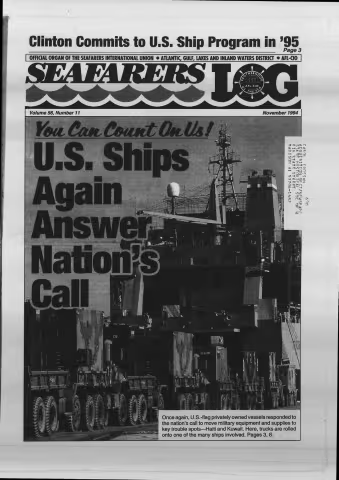
Once again, U.S.-flag privately owned vessels responded to
the nation's call to move military equipment and supplies to
key trouble spots—Haiti and Kuwait, Here, trucks are rolled
onto one of the many ships Involved. Pages 3,8.
. •••••-'•-.•.-•-.ir
2 SEAFARERS LOG NOlfEMRER 1994
President's Report
Missed by a Hair;
It's Not Over Yet
Last month the Senate ended its session without passing the
maritime bill the House had enacted back in August. The bill,
which would have earmarked $1 billion for 56 ships over 10
years, got caught in the line of fire as
senators maneuvered for positions they
thought would appeal to voters. In this
process, certain Republicans tried to prevent
any bill that would have been a credit to the
White House from passing. They used tac
tics that ate up the clock, keeping several
bills, including the legislation on a new
maritime program, from being submitted to
a full Senate debate and vote.
The irony of the situation is that the
maritime bill enjoyed wide support among both Democratic
and Republican senators. It had enough support to become
Michael Sacco
law—in Congress and ultimately with President Clinton's sig
nature.
But the senators who were trying to move the bill ran out of
time, and just by a hair, the legislation missed becoming the
law of the land.
That is why we have every reason to go forward. There is
great support from members of Congress. The president has
committed his administration to the goal of passing a program
to revitalize U.S. shipping. And the iiidustry is battle-seasoned.
We know the extent to which U.S.-flag shipping's enemies will
go. (Remember that in late September, some farm-state
senators relied on a rarely-used rule to block a committee from
acting on the maritime bill.)
Most importantly. Seafarers, their families, retired SIU mem
bers and friends of the industry everywhere proved that U.S.
shipping is an industry that concerns American voters. The
thousands of communications to senators from these in
dividuals drove home the point that Americans want a strong
U.S.-flag shipping capability in times of war and national emer
gency, as well as a fleet capable of ensuring a U.S. presence in
the carriage of American imports and exports. The letters and
phone calls that were received by senators indicated that a
strong maritime industry provides employment and economic
security to hundreds of thousands of Americans.
The letter writing and phone calling of Seafarers and other
Americans who support a U.S.-flag fleet was a wonderful exer
cise in smart trade unionism. It demonstrated that SIU members
and retirees understand the relationship between politics and
the health of our industry. I am proud that so many of you took
the time to be involved in the process. You proved ready for the
task of urging support for the American merchant marine in
1994, and I know the union can count on you to continue to
deliver the message to your elected officials in 1995.
Volume 56. Number 11 November 1994
The Seafarers LOG (ISSN 0160-2047) is published
monthly by the Seafarers Intemational Union; Atlantic,
Gulf, Lakes and Inland Waters District; AFL-CIO; 5201
Auth Way ; Camp Springs, MD 20746. Telephone (301)
899-0675. Second-class postage paid at MSG Prince Geor
ges, MD 20790-9998 and at additional mailing offices.
POSTMASTER: Send address changes to the Seafarers
LOG, 5201 Auth Way, Camp Springs, MD 20746.
Managing Editor, Daniel Duncan; Associate Editors, Jor
dan Biscardo and Corrina Christensen Gutierrez; As
sociate Editor/Production, Deborah A. Hirtes; Art, Bill
Brower; Administrative Support, Jeanne Textor.
Gloucester Honors WWII Seamen
The city of Gloucester, Mass. recently dedicated a memorial to
local merchant mariners who sailed during World War II. The
memorial (pictured above) consists of a marble marker in front of
an anchor from an unknown WWII merchant ship with the inscrip
tion: "With thanks from the people of Gloucester to our sons who
served as merchant mariners, 1941-1945."
JUtA ami Keystone Si^ Pact
In Strike Preceding Deal, SIU Aided Picketing
After a six-week strike, the American Radio
Association (ARA) announced on October 31 that
a settlement had been reached with Keystone Ship
ping Co. of Philadelphia.
Leading up to the signing of the 6-year collective
bargaining agreement between the ARA and Keys
tone was a series of job actions by the radio
operators. The ARA members were often joined by
other maritime trade unionists in these events in a
show of waterfront solidarity.
SIU members in the Seattle area helped ARA
members walk picket lines, and another Seafarer
used his privately owned recreational craft as a
picket boat at a grain dock in Tacoma, Wash. Ad
ditionally, SlU-crewed tugs in Wilmington, Calif,
refused to move a Keystone ship.
In Tacoma, Seafarer Jim Fox, an AB, joined
others manning picket boats which established
positions between the Keystone-operated Chestnut
Hill and the pier. "I was,more than happy to volun
teer my boat," said Fox, 29. "Like the saying goes:
'An injury to one is an injury to all.'
"Police and fire boats showed up and threatened
to tow our boats. We had a lot of picketers on the
beach, too, and I think we got our point across."
"The SIU and many other maritime unions have
been very supportive and we sincerely thank them,"
said ARA Secretary-Treasurer Bemie Stoller.
Knowing we have so much backing from the labor
community helped us continue this fight for good-
faith negotiations and a fair contract."
The pact between the ARA and Keystone en
sures a wage increase, guaranteed overtime and job
security.
QMED Chris Snow (center) and Chief Steward
Manny Basas (right) join ARA member Rick Levan-
dowski in a picket against Keystone Shipping in
Seattle.
Seafarers Back Israeli Brothers
Members of the Seafarers In
temational Union set up an infor
mational picket line at die dock in
Baltimore last month in support
of the Israeli Sea Officers Union
ISOU), which held a 12-hour
work action on the Zim-Miami to
make the company aware of the
ISOU's struggle to keep Israeli
seamen on Zim ships and to
secure a fair contract. Some of
the ISOU members have been
working without a contract for
wo years—since December
1992—and believe the company
wants to eliminate the union al-
ogether.
All officers on board the con-
ainer ship, owned by Zim Israel
Navigation Co., refrained from
assisting in loading or unloading
he vessel from noon to midnight,
including working the hatches
and other equipment necessary
br cargo operations.
"We have told our officers not
;o do anything that has to do with
cargo work," said Capt. Efraim
Marcovitz, who represents
masters and chief engineers in the
sraeli Sea Officers Union, in a
statement to the press during the
ob action.
While conducting the infor
mational picket at the entrance to
he terminal where the Zint-
Mlami was docked. Seafarers
passed out leaflets explaining
some of the problems the officers
are experiencing. "We can under
stand their cause for concern,"
said Bill Scott, a 25-year-old Sltf
member who first shipped out on
an SIU vessel during the Persian
Crulf War. "They don't want their
ships to go foreign flag, and we
are here to support them in their
ight for fairness."
QMED Frank Coburn, an SIU
member since 1986, said
Solidarity, unity, that's what this
is all about."
'Zim Lines is completely
neglecting their duty to come to
terms with us," said Capt. Mar
covitz. "We see ourselves in a
itter dispute that gets deeper and
deeper by the day." Marcovitz
claims the company has offered
the officers pay increases far
below inflation^ a ploy aimed at
forcing officers to quit, thereby
opening the doors to the recruit
ment of cheaper, foreign labor.
Zim Israel Navigation Co. is
one of the largest shipping com
panies in the world, with the Is
raeli govenment and Israel
Corporation (owned by a multi
millionaire) as its major
shareholders. Zim's financial
report shows a large profit from
last year and the Israeli govern
ment is planning to sell some of
its holdings in die company, in
dicating that Zini shares may well
wind up on the New York Stock
Exchange.
The ISOU seamen have
pledged to continue their fight for
a fair contract. The Israeli ship
officers also are working to keep
Israeli seamen and the Israeli flag
on Zim's fleet of ships.
The chalk-written note on the Zlm-
Mlaml's sailing board says It all—
V/L ON STRIKE.
AB Sean Flaherty, who formerly
sailed with the SIU of Canada
before joining the SIU to sail deep
sea, lends his support to the picket.
lYalklng an informational picket line in support of the Israeli Sea
Officers Union are (from left) AB Ralph Broadway, SIU official Sal
Aqula, AB Paul LaTorre and AB Gregory Peters.
t
:
&
i'S.'iaWJsiTR arras
M0yEMBER1994 SEAFARERS LOG 3
Maritime Bill Stymied in Senate
Clinton to Back U.S. Ship Biii in '95
A ft^r f-VlA CiSrkOl-A r^^t- ...U^ A1 1 _ _a 1 /» .« After the Senate failed to act
on a lO-year, $1 biljion dollar
shipping bill last month before
Congress adjourned, President
Bill Clinton announced that the
administration would work to
ensure passage of maritime
legislation in the upcoming
year.
Congress "must act to ensure
that a fleet of U.S.-flag merchant
ships, crewed by skilled
American seafarers, stands ready
to serve our country's economic
and military sealift needs," the
president said in a statement
released October 19. "The ad
ministration looks forward to
working with the next Congress
to enact legislation that achieves
these important goals," con
cluded the statement.
It appears the maritime pro
gram bill was a victim of stalling
tactics by Republican senators
who in the last weeks of the ses
sion of the 103rd Congress sought
to prevent the president from
achi V i.ig any kind of legislative
victoiy.
Caught in the Crossfire
From the outset. Republicans
began a campaign to obstruct
legislation from being passed.
One tactic, the filibuster, was
often used by the Republicans. In
the last three weeks of the Senate
session. Senator Charles E.
Grassley (R-Iowa) filibustered a
bill designed to reform the way in
which elections for public federal
office are financed, a program
that had been part of Clinton's
reform agenda. (A filibuster
prevents a bill from being con
sidered by allowing senators to
make long speeches on any sub
ject. To break a filibuster, 60
senators must vote in favor of the
move.)
The Republicans also worked
to prevent votes on bills backed
by the administration that would
have reformed the way toxic
waste dumps are cleaned and es-
tablished new mechanisms for
administering public lands in the
West.
With the Senate embroiled in
non-productive fights over these
matters and with many senators
anxious to return home to begin
campaigning in earnest for the
November 8 elections, the Senate
adjourned on October 8.
The House had adjourned the
day before and thus the 103rd
Congress was effectively out of
business. The new Congress, the
104th, will take office in January.
Facing that group of legislators
will be a re-introduced maritime
program bill.
(There will be a brief session
Statement by President Clinton
The American maritime industry plays an important role in our nation's
economy and security. Under Secretary Pena's leadership, we have
made significant progress implementing a program that enhances the
competitiveness of Ainerican shipyards in the international commercial
market. But our work is not comp ete.
Congress still must act to ensure a maritime presence in the United
States' vast intemational trade. It must act to ensure that a fleet of
U.S.-flag merchant ships, crewed by skilled American seafarers stands
ready to serve our country's economic and military sealift needs. The
administration looks forward to working with the next Congress to enact
legislation that achieves these important goals,
The White House October 19,1994
Seafarers Hailed for Haiti Role
Seamen Report Smooth Operations,
Close Cooperation with U.S. Military
i .
SIU members last month were
praised by the Maritime Ad
ministration (MarAd) and by the
chairman of the Joint Chiefs of
Staff for their roles in delivering
Ready Reserve Force (RRF) ves
sels ahead of schedule during the
September break-out of the ships
to support United States military
operations in Haiti.
Seafarers crewed eight of the
14 RRF ships which were ac
tivated, and all were delivered
ahead of their prescribed activa
tion times.
Seafarers also played a role
in recent operations in the
Persian Gulf See page 8.
At press time, 11 of the vessels
had returned from Haiti to the
U.S. and had gone back to
reduced operating status. Three
others, including the Seafarers-
crewed auxiliary crane ship
Comhusker State, remained ac
tive in the impoverished island
nation, where thousands of U.S.
troops still are stationed.
'Outstanding Performance'
In a letter to SIU President
Michael Sacco, Maritime Ad
ministrator Albert J. Herberger
commended Seafarers for their
"extraordinary and dedicated effort
in crewing the RRF ships that were
activated for Operations Maintain
Democracy/Uphold Democracy in
Haiti. . . . These ships could not
have achieved this outstanding
level of performance without the
expeditious and professional
response that came from our volun
teer U.S. civilian mariners."
Herberger also noted that all of
the ships were made fully opera
tional far ahead of schedule.
Besides the Comhusker State,
SIU members also crewed the
barge carrier Cape Mohican and
the roll-on/roll-off ships Cape
Lobos, Cape Taylor, Cape Texas,
Cape Island, Cape Intrepid and
Cape Inscription after the Depart
ment of Defense activated them.
The RRF is a fleet of ap
proximately 1(X) tankers, dry cargo
for the 103rd Congress after elec
tion day, but it will be limited to
a vote on the trade treaty known
as the General Agreement on
Tariffs and Trade, or GATT.)
Rule Ruse Added to Delay
The maritime bill which was
left unattended to by the Senate
called for a $1 billion maritime
program that would provide sup
port for a U.S.-flag liner fleet and
aid American shipyards over a ten
year period. Funding for the pro
gram would have been raised
through the imposition of a ton
nage duty levied on all vessels
calling on U.S. ports.
In the closing days of the
Senate, momentum was increas
ing to pass the maritime bill,
which had been enacted by the
House on August 2 by a vote of
294 to 122. In an effort to prevent
the Senate from debating or
voting on the legislation, three
farm state senators used a par
liamentary giimnick to delay the
bill's progress.
The technicality invoked by
Senators Larry Pressler (R-S.D.),
Grassley and Hank Brown (R-
Colo.) prevented the bill from
being reported out of the Senate
Commerce, Science and
Transportation Committee,
when that panel met on Septem
ber 23.
The rarely used Senate Rule
26 raised by Pressler, Grassley
and Brown states that committee
meetings can only be held within
a specific number of hours after
the legislative body has been in
recess unless all the senators on a
committee agree that the panel
can meet. Since the Senate was
still in session on the day the com
mittee was meeting, due to the
filibuster by Grassley on cam
paign financing, Pressler insisted
Continued on page 6
Pro-Maritime Caniiiiiates
Assisted by SiU Members
The SlU-crewed Cape Intrepid leaves Beaumont, Texas for Haiti,
pushed by a Seafarer-crewed tugboat operated by Sabine Towing.
Deck department crewmembers aboard the Cape Texas in Mobile get
that roll-on/roll-off vessel ready to sail to Haiti. They are, from left, ABs
James Hardy, Howard Blanks and Jose Maisonet.
ships and specialty vessels kept in
layup by MarAd and operated by
U.S.-flag shipping companies.
The RRF activation began on
September 8, as the U.S. prepared
to launch an invasion against the
Haitian military forces which in
1991 violently overthrew
democratically elected president
Jean-Bertrand Aristide.
But after some eleventh-hour
negotiating between Haitian
Continued on page 8
Seafarers are walking
precincts, posting signs, handing
out leaflets and manning phone
banks for candidates who support
a strong U.S. shipping capability
in anticipation of the November 8
general election.
Up for election are all 435
House seats and 35 of 100 Senate
positions and a slew of state and
local offices.
Congressmen and senators
who have worked hard for pas
sage of a maritime program are up
for re-election. Also, a number of
candidates are seeking office for
the first time who have pledged to
back U.S. shipping.
Seafarers have been cam
paigning actively for these cham
pions of both the U.S. merchant
marine and the workers who earn
their livelihoods on U.S. ships.
. Volunteer Activity
In addition to volunteering for
various campaign tasks.
Seafarers and their families are
making plans to vote. Those who
will be aboard ship on election
day have made arrangements to
vote by absentee ballot.
Seafarers also have been
voluntarily contributing to the
Seafarers Political Activity
Donation (SPAD) fund. SPAD
funds are presented by the
Seafarers to candidates who favor
programs to ensure a vigorous
U.S.-flag fleet of ocean-going.
Great L^es and domestic water
way vessels.
Among the efforts of Seafarers
are rallies for pro-maritime can
didates. The SIU and the
Michigan Maritime Trades Port
Posting a sign outside the New
Bedford, Mass. union hall is SIU
Patrolman Eugenic de Sousa.
Council held a campaign rally at
the Algonac union hall in which
over200 pledged their support for
gubernatorial candidate Howard
Wolpe.
Also, in Norfolk, Va.
Seafarers showed support by
handing out leaflets for Senate
candidate Chuck Robb in front of
the Berkley Avenue entrance to
Norshipco shipyard.
Seafarers together with the
Maritime Port Council of South
Florida rallied in support of Hugh
Rodham, Democratic candidate
for U.S. senator and brother of
First Lady Hillary Rodham Clin
ton.
In New Bedford, Mass., union
Continued on page 6
.t • . • ; •••A' '
•vi'
-1:
4 SEAFARERS LOG MOVEMRER1994 ' '••• ••••'»• •.' •'..
Senate Fails to Vetie
On inland Safety Bill
Host of Maritime Measures Left Unpassed;
Issues Will Be Raised in Next Congress
The Senate failed to act on
comprehensive piece of maritime
legislation which included steps
to increase safety in the inland
shipping sector.
Enacted by the House of Rep
resentatives, the bill also ap
proved a budget for the U.S
Coast Guard, streamlined Coast
Guard regulations affecting U.S.
flag shipping operations, created
incentives for an American-flag
cruise ship fleet and extender
veterans benefits to World War I
seamen who had previously been
ruled ineligible, among other
items.
To Be Re-Introduced
As a result of the bill not being
passed by the Senate, all elements
of the package of shipping-re
lated measures will have to be
re-introduced in the next session
of Congress, the 104th, which
will begin in late January 1995.
In the last days before the
House adjourned on October 7
and the Senate adjourned on Oc
tober 8, the House attempted to
spur the Senate into action on the
maritime measures by passing a
bill similar to the first com
prehensive maritime package it
had enacted on September 22 in
the form of the Coast Guard
Authorization Act of 1994 (H.R.
4422). That bill had languished in
the Senate.
Documents Not Included
The new last-minute bill of the
House, entitled Oceans Act of
1994 (H.R. 4852), was brought by
the House Committee on Mer
chant Marine and Fisheries to the
floor of the House on the last day
of its session, October 7.
It was presented under a pro
cedure which allows for a pack
age of legislation to receive
unanimous consent in the House
and then be forwarded to the
Senate where it could be taken up
by the full Senate without first
being submitted to lengthy com
mittee hearings and other proce
dures.
Before this legislation was
adopted by unanimous consent by
the House, objections were raised
by two congressmen concerning
two specific provisions. Con
gressman W.J. "Billy" Tauzin (D-
La.) opposed the requirement Aat
inland boatmen hold merchant
mariner documents, and another
member of the House questioned
the definition of offshore supply
vessels in part of the bill.
Advances Safety
The requirement that inland
boatmen hold Coast Guard-is
sued documents, a measure
strongly backed by the SIU which
believes that such a provision en
hances the safety of dl crewmem-
bers as well as promoting safe
navigation, was opposed by an
association representing certain
tugboat companies. The
American Waterways Curators
had opposed the requirement,
claiming it was a clandestine ef
fort to increase union member
ship among boatmen.
In reality, to obtain a Coast
Guard-issued merchant mariner
document, an individual must
prove that they are drug-free and
either a citizen or a foreigner who
has lawful residence in the United
States. The individual also must
undergo a criminal record check
with the FBI and a check of the
National Driver Register for
relevant information on alcohol
abuse. Should a seaman be found
to be a danger to himself or his
shipmates or a threat to safe
navigation, the Coast Guard can
revoke the document.
Threat of Senate Inaction
Rep. Tauzin argued that issu
ing documents to inland boatmen
would lead to increased "paper
work and bureaucracy" being im
posed on the industry. He said at
least five senators opposed the
provision and thus if the House
passed the bill with the document
requirement, it would not be
raised in the Senate.
In order for the legislative
package to achieve the unani
mous support of the House, Con-
gressmaii Gerry E. Studds
(D-Mass.), chairman of the Mer
chant Marine and Fisheries Com
mittee, reluctantly agreed to
having the mariner documenta
tion provision removed from the
bill. The other issue concerning
offshore supply vessels also was
dropped.
The bill then passed the House
unanimously and was forwarded
to the Senate the evening of the
7th.
On the Senate side, the bill was
never considered. In the final
hours of the Senate session, the
only legislation being consideret
were bills that could be brought to
the floor without an objection by
any senator.
Last Minute Hold
Sources on Capitol Hill indi
cate that a senator hostile to
American shipping objected to
the comprehensive maritime bill
being considered on the Senate
floor. Such an action would have
held up the bill and prevented it
from being debated and voted on
by the full Senate.
Additionally, many bills that if
passed would have been a credit
to the Clinton administration
were being held up by Republican
senators. This too may have con
tributed to the lack of action by
the Senate on the package of
maritime measures.
After it was apparent that the
Senate would not take up the bill,
SIU Executive Vice President
Joseph Sacco stated that inland
safety and other promotional
programs for the American-flag
fleet would be high on the union's
legislative agenda for the upcom
ing year. "We intend to work
closely with all pro-maritime,
pro-safety elected officials to see
that an inland safety bill is
passed."
NMU, SIU Presidents Receive AOTOS Awards
Louis Parlse (left), president of District 4-NMU/MEBA, and SIU
president Michael Sacco were jointly honored by the United
Seamen's Service at the Admiral of the Ocean Seas Award
ceremony last month. After accepting the award presented by
Congresswoman Helen Delich Bentley (R-Md.), Parise noted that
the two unions enjoy "open lines of communication" that has
benefitted members of both organizations. Sacco called on all
maritime unionists to work for passage of a U.S. shipping promo
tional bill in the next session of Congress.
I • •
GAO Raports on Sealitt Tankers;
Ikiion isPr^ikigA Response
The General Accounting Of
fice issued a report last month to
the chairman of the Senate Sub
committee on Oversight of
Government Management charg
ing that lax administration by the
Military Sealift Command (MSG)
of its operating contract for nine
sealift tankers resulted in poorly
maintained and unsafe ships.
After receiving the GAO
report. Senator Carl Levin (D-
Mich.), chairman of that subcom
mittee, held an October 12
hearing on the agency's findings.
The sealift tankers have been
operated by International Marine
Carriers (IMC) since May 1990
under a five-year MSG contract.
Preliminary examination of
the report issued by the GAO, an
investigative adjunct of the U.S.
Congress, indicates a number of
unsubstantiated statements con
cerning crewmembers on the
sealift tankers.
The SIU is in the process of
interviewing Seafarers who cur
rently sail or have sailed on sealift
tankers in preparation of a state
ment refuting the GAO's allega
tions about the seamen who work
aboard these ships.
The SIU's report will be sub
mitted to the Government Over
sight Subcommittee. Full details
on the SIU's response to the GAO
report will be forthcoming in the
December issue of the Seafarers
LOG.
RRF Drops to 89 Ships
Impact on Shipboard Jobs Is Minimal
Beginning December 6, the
J.S. Maritime Administration
[MarAd) will eliminate 16 ves
sels from the Ready Reserve
brce (RRF) and reduce 29 others
to 30-day readiness status.
The changes were announced
after the Senate Commerce Com
mittee approved only $150 mil-
ion of a $250 million budget
request from the administration
For maintaining the RRF. MarAd
ast year received $298 million
or the reserve fleet.
RRF vessels are used in times
of surge shipping, such as the Per-
sian Gulf War or the recent
developments in Haiti. The ships
in the reserve fleet are owned by
the government and operated by
jrivate shipping companies.
For several reasons, the reor
ganization is expected to have a
minimal effect on the number of
shipboard jobs held by U.S. mer
chant mariners. The 29 ships that
will lose their maintenance con
tracts and shift to 30-day readi
ness status had been maintained
ay reduced operating status
ROS) crews. Additionally, under
le RRF restructuring, 30 roll-
on/roll-off vessels (each with a
crew of at least 10) will be main
tained in the highest state of
readiness.
However, the cuts reportedly
will eliminate hundreds of
shipyard jobs, and they also will
reduce the number of RRF ships
available within five days of a
mobilization notice to 32 from the
current 57—calling into question
America's papacity to quickly
respond to a crisis. Overall, the
RI^ will shrink from 105 ships to
89.
Additionally, none of the 32
vessels to be maintained at maxi
mum readiness is a breakbulk
ship.
Added to NDRF
Ten breakbulk vessels and six
tankers will be placed in the Na
tional Defense Reserve Fleet
(NDRF), an unmaintained, inac
tive fleet whose 300-plus vessels
are anchored at ports in Texas,
Virginia and on the West Coast.
Of the 29 ships being reduced
to 30-day readiness, 27 are break-
bulk vessels.
Moreover, 12 vessels will be
kept at 10-day readiness and 16
will be maintained at 20-day
status.
The budget shortfall leaves
unmet the recommendations of a
Department of Defense study on
U.S. sealift capability—called for
by Congress in 1991—which
concluded that the RRF should be
expanded. That study was or
dered after most of the RRF ships
did not meet their activation
deadlines during the Persian Gulf
War.
SiU-Crewed RRF Ships
Vessel
AMERICAN OSPREY
CAPE WASHINGTON
CAPE WRATH
GOPHER STATE
POTOMAC
DIAMOND STATE
CAPE INSCRIPTION
CAPE INTREPID
CAPE ISABEL
CAPE ISLAND
CAPE LAMBERT
CAPELOBOS
CAPE RACE
CAPE RAY
CAPE RISE
CAPE TAYLOR
CAPE TRINITY
CAPE TEXAS
COMET
METEOR
CAPE FAREWELL
CAPE FLATTERY
CAPE JACOB
CAPEJOHNSON
CAPE MAY
CAPE MOHICAN
CORNHUSKER STA TE
FUCKERTAIL STATE
GEM STATE
GRAND CANYON STATE
CAPEBOVER
CAPE BRETON
CAPE FEAR
CAPE FLORIDA
CAPE GIBSON
CAPE GIRARDEAU
CAPEJOHN
CAPEJUBY
CAPE MENDOCINO
CHESAPEAKE
DIAMOND STATE
EQUALITY STATE
GREEN MOUNTAIN STATE
KEYSTONESTATE
MT. WASHINGTON
PETERSBURG
Type
Tanker/OPDS
RO/RO
RO/RO
T-ACS
Tanker/OPDS
RO/RO
RO/RO
RO/RO
RO/RO
RO/RO
RO/RO
RO/RO
RO/RO
RO/RO
RO/RO
RO/RO
RO/RO
RO/RO
RO/RO
RO/RO
LASH
LASH
Breakbulk
Breakbulk
Seabee
Seabee
T-ACS
T-ACS
T-ACS
T-ACS
Breakbulk
Breakbulk
LASH
LASH
Breakbulk
Breakbulk
Breakbulk
Breakbulk
Seabee
Tanker/OPDS
T-ACS
T-ACS
T-ACS
T-ACS
Tanker/OPDS
Tanker/OPDS
Readiness
Prepo
Prepo
Prepo
Prepo
Prepo
ROS-4
ROS-4
ROS-4
ROS-4
ROS-4
ROS-4
ROS-4
ROS-4
ROS-4
ROS-4
ROS-4
ROS-4
ROS-4
ROS-4
ROS-4
10-day
10-day
10-day
10-day
10-day
10-day
10-day
10-day
10-day
10-day
20-day
20-day
20-day
20-day
20-day
20-day
20-day
20-day
20-day
20-day
20-day
20-day
20-day
20-day
20-day
20-day
Operator
Bay Ship
AMSEA
AMSEA
lOM
Bay Ship
lOM
APL
APL
APL
APL
AMSEA
AMSEA'
IMC
IMC
IMC
Apex
Apex
Apex
APL
APL
IMC
IMC
AMSEA
AMSEA
OMI
OMI
lOM
lOM
lOM
IMC
APL
APL
IMC
IMC
APL
APL
AMSEA
AMSEA
OMI
Bay Ship
lOM
lOM
IMC
IMC
Bay Ship
Bay Ship
RO/RO = Roll-on/Roll-off ship T-ACS = Auxiliary crane ship
LASH = Barge-carrying ship Seabee = Barge-carrying ship
Prepo = Prepositionea under military control
ROS-4 = Reduced Operating Status with a four-day activation schedule.
if
HOymBER 1994 SEAFARERS LOG 5
Houston Flood Hits Seafarers
Electrician Jimmy Rogers has experienced four floods in five years, but this one was the worst, he said
The photo above shows the water level almost reaching the apartment he set up above his garage
(foreground) and the top of the main house off to the right.
The flooding and pipeline ex
plosions which hammered areas
around Houston last month in
volved SIU members on several
fronts:
• The homes of at least a dozen
Seafarers sustained varying
degrees of damage from the
flooding.
• Seafarers aboard the oil-spill
cleanup vessels Texas Responder
and Gulf Coast Responder spent
three days assisting in the spill
recovery efforts following major
pipeline ruptures on the San
Jacinto River (see separate story
on this page).
• Although SlU-contracted
towing companies reported no in
juries or vessel damage, publish
ed reports estimate that the
closure of the Houston Ship
Channel cost vessel owners mil
lions of dollars. SlU-contracted
Higman Towing lost nearly
$1W,(X)0 while the channel was
closed, a company spokesman said.
Heavy rains began in
southeast Texas on October 14
and lasted for four days. Accord
ing to newspaper reports, at least
19 people, including a two-
month-old baby, died in flood-re
lated incidents.
More than 12,000 people were
driven from their homes in an ap-
proximately 50-mile radius
around Houston. Dozens of Red
Cross shelters were opened in the
region, and five Federal Emer
gency Management Agency
(FEMA) disaster assistance
centers were opened to handle
claims from flood victims. Na
tional Guard personnel also were
called in to deliver clean water
and to prevent looting of
evacuated homes and stores.
In all, the flooding causec
damage in 48 counties covering
more than 250miles.
Rogers' Fourth Flood
At press time, Houston Port
Agent Jim McGee and SIU Rep
resentative Don Anderson
reported that they still were in the
process of contacting active and
retired members in the area, in
order to surmise whose residen
ces are damaged and if anyone
needs assistance. "We checked
on the pensioners first," said
Anderson. "Some of them live in
elevated areas that weren't
damaged by the flood, but they
were basically stuck there. I took
a bass boat around and checked
on about 15 people. But it's an
ongoing process." (The SIU hall
in Houston was not damaged.)
He said that the respective
homes of QMED Floyd Acord
and Recertified Steward Royce
Bozeman sustained major
damage. The first floor of Cook
Pat Caldwell's house was
flooded, and Caldwell also lost a
car and a truck to the surging
waters.
OMU Greg Brandani's
townhouse sustained some first-
floor damage, as did the home of
retired Bosun Richard
Wardlaw.
For Electrician Jimmy
Rogers, this flood was nothing
new—^but it was worse than those
Standing In the entrance of his Houston home, Jimmy Rogers, with
his camera pointed across the hall, finds himself in waist-deep water. |
of 1989, '90 and '92. "This one
came up real fast and went down
real fast, but it was the worst" sait
Rogers, a 36-year SIU member
who lives near Cold Spring
Texas, approximately 75 miles
from Houston.
"I had 6 feet, 8 inches of water
in my house This is the fourth
time in five years, and a lot of
people aren't coming back.
They're fed up."
Rogers had signed off a Sea-
Land ship in the port of Long
Beach, Cdif. and had driven most
of the way home when he saw
roads being closed. "I stopped at
a motel and watched TV and real
ized there was no way for me to
get home. I finally went about 200
miles out of my way, but even
tually I got home. I couldn't go
inside the house for a few days,
but I had set up an apartment
above my garage, and I just stay
there when it flooids."
Costly Delay
Between the flooding and the
pipeline explosion, the 50-mile
Houston Ship Channel—one of
the world's busiest waterways
was closed for six days. Twenty-
one ships were stuck in the port of
Houston; many more were out
side the channel, waiting to get in.
"We had several units nearby
when the [explosion] happened:
six barges and three boats," said
Mark Flynn of the operations
department of Higman Towing.
We had four days that those tows
were unable to do anything, at a
cost of roughly $90,000. But
there was no personal injury or
vessel damage."
A spokesman for G&H
Towing of Galveston said none of
the company's 28 tugs were
operating in the Houston area
during the rains or when the ex
plosion took place, "but we were
more affected by the flooding
when the channel reopened. We
were real busy then."
Other modes of travel also
were affected by the flooding. An
estimated 76 roads in 26 counties
were closed, and a railroad bridge
normally used by Amtrak's Sun
set Limited was knocked out by a
drifting houseboat.
By early November, the flood
waters were gone from the vast
majority of the affected areas.
But it's going to be a while
jefore things get back to normal
in this area," concluded Rogers.
AP Photo by Pat Sullivan
The effectiveness of oil booms is evident in this photo, taken in the
San Jacinto River, upstream from the Houston Ship Channel in
Houston. SlU-crewed oil response vessels and scores of other boats
worked to keep the oil slick, which was broken by rushing floodwaters,
from reaching Galveston Bay.
AP Photo by DavidJ. Phillip
The oil spills on the river were due to at least five pipelines that
ruptured. The pipelines were churned up by raging flood waters, then
struck by debris.
Responder Boats Assist
in San Jacinto Oii Spiii
The flood waters in southeast
Texas finally had begun receding
last month when another disaster
struck the area.
On October 20, an estimated
200,000 gallons of gasoline,
diesel fuel and crude oil were
spilled into the San Jacinto River,
17 miles east of downtown Hous
ton, when three pipelines rup
tured in a fiery explosion.
The SlU-crewed Texas
Responder and Gulf Coast
Responder, vessels specifically
designed and equipped to react to
hazardous materids spills, were
part of a virtual flotilla of cleanup
craft which quickly contained
much of the spillage after it had
created a 20-mile slick.
Roughly 80,000 gallons were
recovered, while an even greater
amount burned itself off the water
or evaporated.
More than 100 people suffered
minor injuries in the blast, but
there were no reported deaths.
Several waterfront homes were
engulfed by fire, but all of the
residents already had left due to
the flooding.
Seafarer Mike Conway, the
mate aboard the Texas
Responder, which is based in
nearby Galveston, Texas, said
that the reaction to the spill and
ire was both fast and efficient.
'From the minute this thing
[jroke, equipment and people ap
peared from every direction," he
said. "A lot of what we tried to
)ick up was burned gasoline or
)umed oil, and that's not easy.
Some of it was mixed with grass,
tires, trees, pieces of houses ....
iVhen you get that junk hitting
your booms, it's quite interesting.
"But with our boat crews,
everything went smooth and all
the equipment worked fine."
According to newspaper
reports, fire officials described
the blaze as a flash fire—a quick-
striking and extremely hot fire
enerated by the large volume of
gasoline floating on the water.
Towering flames rose above
the river, and in some places the
fire burned for four days.
The pipelines, which ranged in
diameter from 36 to 40 inches,
apparently were excavated by
racing flood waters, then were
punctured when those waters
slammed debris into them.
Swift Cleanup
Both SlU-crewed responder
vessels assisted with cleanup ef
forts in a closed section of the
Houston Ship Channel, where
they worked in tandem.
More than 1,000 people were
involved in the overall cleanup.
"The beach cleanup is still
going on and will be for a while,
but Ae major parts on the water
were done witWn the first couple
of days," said Conway. "There
were so many (cleanup) entities
out there at once, altogether we
deployed over 30,000 feet of
booms."
The Texas Responder and the
Gulf Coast Responder (which is
based in Lake Charles, La.) each
is equipped two deck cranes, two
stem-launched, 32-foot support
boats (which were used to help
tow booms during last month's
cleanup), a stem-mounted skim
mer and other gear including
booms, transfer pumps and protec
tive clothing. Each can hold 4,000
barrels of recovered oil.
"We worked (cleanup) for
basically three days," added Con
way. "Now we just have to clean
the hulls and the skimmer equip
ment."
The Texas Responder and Gulf
Coast Responder are part of a 16-
ship fleet operated by Dyn
Marine in behalf of the Marine
Spill Response Corporation, a
not-for-profit group created by
major oil companies following
the passage of the Oil Pollution
Act of 1990 (CPA '90).
Crewmembers working
aboard the vessels voted in Sep
tember 1993 to join the SIU.
• : •• • W -r • •
•• •/rry- " *
6 SEAFARERS LOG NOVEMBER 1994
Seafarers AM M Races of Pro-MariOme Candidates
Continued from page 3
officials have distributed and
posted signs throughout the city
for Senator Edward Kennedy (D)
who is up for re-election.
In the port of Mobile, Ala.,
Seafarers recently participated in
a phone bank which involved
calling the homes of union mem
bers residing in Southwest
Alabama, asking them to support
a number of candidates for local
and state offices.
The SIU's legislative depart
ment tracks the voting records of
elected officials on matters of
special interest to Seafarers and
the shipping industry. The
union's support of candidates is
based on their commitment to
promoting cargo for U.S.-flag
vessels and developing an
American-flag revitalization pro
gram.
Showing support for pro-maritime Virginia candidates are (from ieft) AB Dan Hughes, QMED Robert
Katterheindrich, AB Kenny Smith, QMED Kevin Quinlan and retired Recertified Bosun Bill Dawson.
UNION
SUPPOBtS
-yr- r\ij jj. n
Campaigning for Democratic candidate Hugh Rodham for U.S.
senator in South Florida are, from left, AB Regina Ewing, AMO
member Keith Craig and AB Douglas Heller.
SA Corinthius Thomas calls prospective voters from a Mobile, Ala.
campaign office in behalf of local and state candidates.
In behalf of Senator Edward Ken
nedy of Massachusetts, who
faces a tough re-election.
Seafarers from the New Bedford
SlU hall are placing signs in their
yards and public sites around the
area. Above, SlU Port Agent
Henri Francois displays one of the
campaign signs.
Clinton to Support '95 Ship Bill
Continued from page 3
the committee could not meet.
When the bill could not be
reported out of committee as a
result of the farm-state senators'
ploy, that left pro-maritime
senators looking for other ways in
which to bring the legislation to
the floor. But with only two
weeks in the session left and with
the Senate bogged down by the
Republicans' efi^orts to block all
legislation of interest to the presi
dent, backers of the maritime bill
were unable to get the bill to the
floor of the Senate.
Planning for 1995
Immediately after Congress
adjourned, backers of a strong
U.S. shipping capability vowed
to press for enactment of legisla
tion in the early days of the next
congressional session.
fii a letter to President Clinton
sent in mid-October, SlU Presi
dent Michael Sacco and the heads
of the other unions with sea
going members, said, "We are to
tally committed to the enactment
of maritime revitalization legisla
tion early in the 104th Congress."
"We cannot and must not
allow those who oppose
American shipping to succeed in
their goal to eliminate the United
States flag from the high seas. If
the U.S.-flag fleet is eliminated,
the carriage of America's foreign
trade will be placed totally at the
mercy of foreign shipping inter
ests—often linked directly to
foreign companies that compete
head-to-head-with our own ex
ports—and thousands of highly-
skilled American maritime jobs
will be sent overseas as well," the
union presidents noted.
Signed by District No. 1-
Marine Engineers Beneficial As
sociation President Joel Bem,
International Organization of
Masters Mates & Pilots President
Timothy A. Brown, American
Maritime Officers President
Michael McKay, District No. 4-
NMU/MEBA President Louis
Parise and Sacco, the letter
thanked the president for his past
support of U.S. shipping and
noted the "tireless efforts of
Transportation secretary
Federico Pena, Maritime Ad
ministrator Admiral A. Her-
berger and their staffs" that
hel^ make significant progress
in developing a new national
maritime program.
Former Head of Moran Towing Dies at 69
Thomas Moran, former
president, chief executive of
ficer and chairman of Moran
Towing Corp., died in his
sleep at his home in Darien,
Conn, on September 26. He
was 69.
The fourth family member
to head the company, Moran's
32-year reign transformed the
once small harbor towing and vessel docking busi
ness, founded by his grandfather in 1860, into a
Thomas Moran
diversified marine transportation company.
Bom in Brooklyn, N.Y. in 1925, Moran sailed
as a merchant mariner from 1943 to 1945. After
signing off his last ship, Moran began working
with Marine Transport Lines in New York, where
he eventually became vice president of operations.
Moran began his career with Moran Towing in
1962.
The company has a fleet of 53 tugboats and 12
barges which operate in Philadelphia; Hampton
Roads, Va.; Jacksonville and Miami, Fla.; Port
Arthur, Texas; and Portsmouth, N.H.
After a get-out-the-vote rally at the SlU Algonac hall, attended by more
than 200 union memt>ers, VP Great Lakes Byron Kelley (left) takes a
photo with Margaret Watson, mayor of River Rouge, Mich, (center) and
Howard Wolpe, Democratic candidate for govemor.
Maritime Briefs
President Signs New Law
On Stowaway Controversy
A new immigration law that relieves carriers of the responsibility
of detaining stowaways was signed by President Clinton last month.
The new Immigration and Naturalization Service (INS) law frees
carriers of the responsibility of detaining stowaways for long periods
while their asylum cases are decided.
According to The Journal of Commerce, the INS has taken cus
tody of all asylum-seeking stowaways since August 1 as a result of
a ruling on the issue by the U.S. Circuit Court of Appeals.
The old INS policy required carriers to provide detention for
stowaways and fined them for any escapes that occurred.
J,
Investigators Reveal Faulty
Door in Ferry Sinking
Investigation into the sinking of the ferry Estonia on September
28 has revealed that the locks on the huge front cargo door failed
during a violent storm, letting in a flood of water from the Baltic Sea.
It was this rush of water into the vehicle deck that apparently led to
the capsizing and sinking of the ferry off the coast of Finland,
resulting in the deaths of 900 persons.
This conclusion was reached by a team of investigators, based on
more than 15 hours of videotape taken underwater of the wrecked
vessel by remote controlled cameras.
According to an article in The Washington Post, investigators •
issued a statement revealing the videotape showed the huge hinged
door used for loading vehicles onto the ferry "fully separated Irom
the rest of the vessel." The videotape helped confirm reports that the
door had leaked or broken off the ship. The door, which operated in
much the same way as a garage door, was detached from the ferry
when the locks failed.
The bow door is supposed to be watertight, but investigators
revealed it had been partly dislodged, leaving a gap of about three
feet along the top edge that allowed water to rush into the car deck.
The Washington Post quoted one investigator as stating that the
evidence "points to the fact that there was something wrong with the
doors before the ship left harbor."
Great Lakes Seafarers
Overcome Icy Delay
According to the Great Lakes Carrier Association, an organization
which monitors the action of U.S.-flag shipping on the Great Lakes,
a record-breaking August and a large increase in September loadings
have enabled Great Lakes vessels to finally offset the significant ice
delays encountered in March and April and pull ahead of last year's
cargo carriage pace.
As of September 30, shipments of various dry and liquid bulk
cargoes aboard U.S.-flag bottoms totaled 74.8 million tons, an increase
of roughly 1(W,000 tons compared to the same time last year.
The association notes that while the increase may seem small, at
the end of April, U.S.-flag carriage was more than 2.5 million tons
behind schedule. The heavy ice formations that covered the Lakes in
March and well into April cost U.S.-flag ships the equivalent of 133
steaming days. To offset the lost sailing days, U.S.-flag carriers have
utilized virtually every serviceable ship on the Lakes this season.
I V* ^ , ' » '• '•«-«' •>*<•- ' • I
myEHBBR 1994 SEAFAREBS lOG 7
Paul Hall Center Introduces Tanker Safety Glass
The Paul Hall Center for
Maritime Training and Education
last month conducted an exten
sively detailed, hands-on Tanker
Operation/Safety pilot course
which soon will become a regular
part of the Lundeberg School's
curriculum.
Six Seafarers and four mem
bers of the American Maritime
Officers (AMD) early this month
completed the two-week pilot
course, which included plenty of
feedback, suggestions and a writ
ten critique from the students.
Their input will be used to help
refine and possibly expand the
course before it is added to the
regular upgrading schedule.
The SIU developed the course
in response to the Oil Pollution
Act of 1990 (OPA '90). That
legislation is intended to keep the
nation's waters free of marine oil
spills.
In its commitment to comply
with all U.S. Coast Guard proce
dures and practices, the SIU
responded to the OPA mandate
by including the issue of training
in its three-year standard
freightship and tanker contract
(covering the period of June 16,
1993 to June 15, 1996) and by
establishing the Tanker Opera
tion/Safety course.
'Essential Course'
"This is an important course,
an essential course, and I'll be
sure to pass the information I've
learned on to my fellow menibers
aboard ship," said Bosun Milton
Caballero, 36, one of six SIU
members who took the pilot class
along with four members of the
American Maritime Officers
(AMD).
"The course really helped
me," stated Bosun Hugo Der-
mody, 45. "I learned a lot about
safety inside tanks, what chemi
cals to be cautious of, and how
Instructor Byran Cummings
answers a student's question
about a protective mask.
and why they are hazardous."
Added Pumpman Tom
Koubek, an 18-year SIU mem
ber: "I've learned a lot of new
things about handling certain haz-
ardous cargoes, how to use
respirators and other emergency
equipment. These are all very im
portant."
Koubek and his classmates
agreed that a large volume of
material was covered by instruc
tors Byran Cummings and Jake
Karaczynski.
Students were introduced to
the chemical and physical proper
ties of petroleum products, flam-
mability characteristics,
toxicity/asphyxiation charac
teristics and health hazards as
sociated with exposure to
petroleum products.
They reviewed how to correct
ly monitor tanks for oxygen
deficiency and take other meter
readings with atmospheric
monitoring equipment.
Other topics and exercises in
cluded:
• Creating site-specific ship
board safety plans.
• Reviewing final rules on ben
zene products.
• Troubleshooting and basic
maintenance of monitoring gear.
• Extensive confined-space
safety training and rescue opera
tions aboard the Empress II, the
Lundeberg School's modern
training barge.
• Fit-tests using respirators and
other breathing apparatus and
emergency equipment.
• An introduction to fire
chemistry and other aspects of
firefighting, including fire hazard
awareness and identification; fire
prevention via vapor control; fire
prevention via ignition source
control; fire extinguishing equip
ment; fire fighting techniques and
fire/emergency duties.
• Tanker construction and
safety
Other areas of study included
different types of oils, medical
surveillance, vessel oil pollution
prevention, national pollution
contingency plans, water pollu
tion, water program requirements
and removal of oil and other haz
ardous substances.
Students also covered regional
oil removal contingency plans;
rules for protecting the marine en
vironment; vessel pollution
prevention equipment design and
approval requirements; site
safety, organization and coor
dination and more.
Seafarers who completed the
course were Koubek, Dermody,
Caballero, Ferdinand Gongora,
James Ellis and Marian Kabat.
Completing the pilot course for Tanker Operation/Safety are (from left, kneeling) AMO mernbers Luis
Charlin and Casey Boga and Seafarers Hugo Dormody and Milton Caballero, (back row) SIU members
James Ellis and Marian Kabat, AMO member Ernie Richardson, Seafarers Ferdinand Gpngora and Tom
Koubek, AMO member Ray Dwyer and instructor Byran Cummings.
As part of the hands-on Tanker Operation/Safety course. Instructor Byran Cummings (right) reviews some
of the health hazards associated with petroleum products.
Seafarers and AMO members review the proper fit and functions of breathing apparatus
Sahi's Scrumptious Feast Thi«e Courses That Lead
To a USCG Radar Endorsement
Available to Houston Area Seafarers
A four-hour radar course, sponsored by the Lun
deberg School in Piney Point, Md., will be held for all
Seafarers who do not currently have their radar endor
sement. Three dates have been scheduled so far.
The first class will be held Tuesday, November 29 at
the SIU hall in Houston. It will last from 8 a.m. until
noon. ion.
The second will take place on Wednesday, November
30 at the Ramada Inn in Port Arthur. Class hours are the
same—^from 8 a.m. until noon.
Additionally, on Thursday, December 1, the thM
radar mini-course will be held, also at the SIU hall in
Houston, and also from 8 a.m. until noon.
For additional information, contact the Houston hail
^(713)659-5152.
•arf.-. ; -
y •'
8 SEAFARERS LOG ROVEMBER1994
life
Seafarers Aid Gulf Buildup
Iraqi Troops Back Off as U.S. Reenters Gulf
Seafarers transported U.S.
military personnel and materiel
to the Persian Gulf last month as
America responded to a buildup
of elite Iraqi troops near Kuwait.
The U.S. Military Sealift
Command (MSG) in early Oc
tober directed 19 Afloat
Prepositioning Force ships, includ
ing eight from the Ready Reserve
Force (RRF)^ to sail in support of
Operation Southern Watch. SIU
members crewed 11 of those ves
sels, some of which off-loaded in
A1 Jabal, Saudi Arabia.
But the threat of a confronta
tion with Iraq quickly receded,
and by mid-October the U.S. had
capped its military buildup in the
region and canceled plans for fur
ther mobilizations as the Iraqi
troops withdrew from the border.
Approximately 13,000 U.S.
ground troops and 2,000 Marines
on board a group of Navy ships will
remain in the Gulf for several more
weeks, during which time they will
conduct military exercises. At
press time, the Seafarers-crewed
prepositioning ship Cpl. Louis J.
Hauge Jr. also was involved in
drills in the Gulf. The other
prepositioning vessels had dis
pell to Diego Garcia and near
Saipan in the Western Pacific.
More than 150,000 U.S.
ground troops had been on alert,
but the alert was canceled on Oc
tober 20.
SIU members said that Opera
tion Southern Watch naturally
evoked memories of Operations
Desert Shield/Desert Storm,
which began in late 1990 anc
ended in early '91 as the U.S.
armed forces liberated Kuwait
from Iraqi President Saddam
Hussein's invasive military for
ces.
But they added that last
month's operations were com
paratively safer and on a much
smaller scale than the Persian
Gulf War, during which more
than 200 U.S.-flag ships directed
by MSG carried 15 million tons of
cargo and fuel to and from the
Middle East.
Prepare for the Worst
"Back in '91, no one knew
where we were going or how far,"
Bosun Michael Hurley said from
the bridge of the PVT Franklin J.
Phillips. "This time, we weren't
too concerned about getting hit.
"But we reviewed how to use
all the protective clothing and gas
masks and everything, just in
case. We were prepared for any
thing."
Like many of the other
prepositioning ships, which
remain fully operational and
loaded with cargo throughout the
year, the Phillips did not off-load
its equipment.
"We were prepared for a major
download, but when we got to the
Persian Gulf, the threat had become
minimal," noted Mike Michaelson,
captain of the Phillips.
Hurley added that the entire
crew "did a really good job. All of
the ABs were terrific, and the
steward and engine departments
also were great We had to put
in a lot of extra hours loading
stores, carrying them and things
like that. We also topped off our
fuel.... I have six men in the deck
department, and they haven't
missed an hour of [work] since we
were called."
Ghief Mate John Denton, an
SIU hawsepiper, offered similar
praise for the crew and noted the
cooperative nature of both the
civilian crew and the military pas
sengers. "It was a big effort to do
the job, but we got it done—any
thing that the Marines needed,"
he said. "The deck gang is well
above average, and with 75 extra
people on board, the steward
department was tasked pretty
hard."
High Morale
Aboard the PFC James Ander
son, Bosun James Keith Jr. said
that "morale was high" during
last month's operations. "We
were on full alert, and at first we
thought the situation might turn
into another Desert Storm," he
said. "But we were ready —
everyone stuck together and did a
goodjob.
"We got the cargo holds ready
for download and also got the
deck gear ready. We greased the
cranes and did all-around main
tenance," he added. "My impres
sion is that everyone performed
with character."
SlU-crewed ships which were
involved in Operation Southern
Watch included the roll-on/roll-
off vessels Cape Washington,
American Kestrel, JEB Stuart and
Cape Wrath-, the crane ship
Gopher State-, the Maritime
Prepositioning Squadron vessels
Anderson, Phillips, Hauge, 1st LT
AlexBonnyman and PFC William
Baughr, and the heavy lift/sub
mersible Amencon Cormorant.
Action Backfires
Some news analysts in the
U.S. have suggested that Hussein
ordered his troops to move
toward Kuwait's northern border
in the hope that the United Na
tions would lift trade sanctions
currently enforced against Iraq,
including one that prevents ex
porting of Iraqi oil.
Officikls in Baghdad may
have believed that the troop
movements would draw attention
to the country's economic
hardships. They also may have
schemed to withdraw the troops
and then formally recognize
Kuwait's integrity and borders,
again hoping that the U.N. in
turn would lift or ease the sanc
tions.
Instead the move backfired, as
the international community con
demned Iraq's actions and sup
ported the American mihtaiy's
response.
SIU Crews 8 ilfff Sft/jis BoumI Ibr HalU fljparathms
Continued from page 3
military rulers and a group of
American diplomats, the invasion
was changed to a peacekeeping
mission as the military officials
agreed to reinstate Aristide. That
transfer of power took place last
month.
The RRF ships still carried the
same cargo as was planned for the
invasion, however, including
trucks, ammunition, medical
equipment, communications
gear, barges, portable pier sys
tems and more. They also
transported military personnel.
Seafarers who took part in
Operations Restore/Maintain
Democracy reported smooth
operations and excellent coopera
tion between the civilian crews
and the military. SIU members
also expressed strong support for
America's mission in Haiti.
Aboard the Cape Mohican,
which sailed from Norfolk, Va.,
Seafarers in the steward depart
ment prepared more than 4,000
extra meals for members of the
Army and Navy. "We carried an
emergency portable pier system,
and we had about 200 milit^
personnel on board," said Ghief
Steward Bud Marchman. "I was
informed that the mihtary was
going to use their MREs (Meals
Ready to Eat), but the captain and
all of us felt very bad about that.
MREs will sustain life, but they
get old very quickly!
"With the captain's permis
sion, Ghief Gook IVforjorie
Mack and I prepared extra food
at each meal for the military, who
provided mess cooks. They were
overwhelmed with the kindness
and really enjoyed the food. We
felt good about it, too, because
these are our troops. \^en you
get a chance to do something for
your country, you do it."
Andrew Mack, the bosun
aboard the Mohican, compli
mented the galley gang for a "fan
tastic job" and stated the entire
Ready to do their part in the break-out of ships bound for Haiti are
OMU Van Cowart (left) and DEU Carl Turner on board the Cape Texas
as it crewed up in Mobile.
The Cape Island was one of eight RRF ships crewed by Seafarers to support military operations in Haiti.
crew performed in a thoroughly
efficient and professional man
ner. "It was a successful trip, and
anything we could do for our
military, we were glad to do."
AB Howard Blanks sailed
aboard the Cape Texas, which
crewed up in Mobile, Ala. and
then loaded cargo in Norfolk and
in Wilmington, N.G. before
making the four-day voyage to
Haiti. He said that off-loading in
Port-au-Prince took slightly less
than two days.
"Everything went well and
everyone on this ship did their
job," stated Blanks. "Nobody was
worried, and we discussed the
U.S. presence in Haiti and agreed
that it was definitely the right
thing to do."
Blanks added that during his
brief time ashore, "The Haitian
people were happy to s6e us and
they treated us with a lot of
respect. I was cautious, but they
were glad we were over there."
AB Charles Simmons used
an 80-ton elevator aboard the
Cape Taylor to move cargo from
deck to deck, and he declared that
the upgrading courses he has
taken at the Paul Hall Center
proved particularly useful during
these operations. "We went to
Bayoime, N.J., for cargo and the
loading took 24 hours," he
recalled. "Once we got to Haiti,
we unloaded in 17 hours, and we
headed back to Mobile immedi
ately after the discharge."
Simmons said the Taylor's
crew saw thousands of Haitians
lining the shores. "Those people
are hungry and they had no form
of government. They need our
help badly, and I think the United
States (military) certainly should
be there.
"I'm jt^t sorry it was such a
short cruise—18 days, start to
finish—^because we want to help."
'Sterling Support'
General John Shalikashvili,
chairman of the Joint Chiefs of
Staff, described the U.S. mer
chant marine's role in Haiti as
"sterling support to our great na
tion" and noted the "flawless,
timely response" of everyone in
volved in the RRF activation.
More than 2,000 U.S. troops
landed without resistance on
Haiti on September 19.
Thousands more troops followed
as the U.S. facilitated Haiti's
return to democratic rule.
AB Kennard Campbell (left) and
Bosun Millard Napier took part in
Operations Restore/Maintain
Democracy as crewmembers
aboard the Cape Texas.
/ • ../;fe'-
'• ". '-'p. " •• '• •' -••-'•**•'''
NOIfEMBER 1994 SEAFMERSLOG 9
^ KaK Cento-Adds Haw Vessel
To Seheel's Hands-^m TTaHi^ Fleet
The Paul Hall Center for
Maritime Training and Education
recently added a second 80-foot
former U.S. Navy boat to its fleei
of training vessels at Piney Point,
Md.
The vessel will provide
upgraders with an expanded op
portunity for hands-on training in
radar, navigation and shiphand-
ling, as well as other seamanship
skills.
The new training boat is equipped
with radar that will be utilized by
upgaders at the Paul Hall Center.
"Since she was operational
until just a few weeks ago, it will
be easy to convert her for our
training needs," noted instructor
Bill Hellwege, who was joined by
fellow instructors Jim Brown and
Tommy Swann and Lundeberg
School Waterways Advisor Bill
Saul in transporting the boat from
the U.S. Coast Guard training base
in Cape May, NJ. to Piney Point.
The yet-to-be-named craft is
of wooden construction with an
aluminum deck house and has a
displacement of 70 tons. The
main engines are two twin-pack
GM 671 diesels with twin shafts
producing 660 hp, for a top speed
of 13.5 knots.
Among the boat's equipment
is radar, a fathometer, gyro com
pass, UHF and VHP radio and
more.
This class of vessel formerly
was used for instruction in
seamanship, navigation and en
gineering at the U.S. Naval
Academy in Annapolis, Md. and
at the Naval Officer Candidate
School in Newport, R.I. The ves
sels also were assigned as harbor
defense craft, and would have
provided, in time of war, a mine
countermeasure force in and
around U.S. harbors. Additional
ly, they were used for shipping
channel surveys and mine detec
tion duties.
The Lundeberg School pre
viously acquired a similar boat in
the spring of 1992 from the Naval
Air Warfare Center in Patuxent
River, Md. After its arrival at
Piney Point, Lundeberg School
personnel removed all the excess
and obsolete Navy gear, worked
on the engines and updated the
navigation equipment. The craft
also was painted white (over her
original gray) and named
Securer.
In addition to its regular func
tions as a training boat, the
5ea/arer assisted, earlier this
year, in the towing of another
piece of marine equipment to be
used for training, the Empress II,
a state-of-the-art barge formerly
used by the U.S. government for
electromagnetic testing.
The Seafarer, the Empress II
and the newer boat were acquired
via the U.S. Defense Regional
Material Office based in Virginia,
under terms of the Merchant
Marine Act of 1936, as amended
in 1980. That law reads in part
that "excess or surplus vessels,
shipboard equipment and other
marine equipment, owned by the
United States, may be made avail
able by gift, loan, sale, lease or
The yet-to-be-named wooden vessel will provide upgraders with an
expanded opportunity for hands-on training.
Because the craft was being operated almost until the Lundeberg
School acquired it, instructor Bill Hellwege believes it will not take too
much effort to convert her for the school's training needs.
charter to the Federal and state
maritime academies and to any
nonprofit training institution
which has been jointly approved
by the (Maritime) Administration
and the U.S. Coast Guard...."
Two Additional Sill Hails to Host Refrigeration Classes
November 14 Is Deadline for Obtaining EPA Certification
The refrigeration technician
certification course conducted by
the Lundeberg School of the Paul
Hall Center for Maritime Train
ing and Education is available to
Seafarers this month at the SIU
halls in San Juan, P.R. and in Al-
gonac, Mich. The two-day class
dso is scheduled this month for
the Paul Hall Center.
Additional classes are slated
for early 1995 at the SIU halls in
Jacksonville, Fla., Wilmington,
Calif, and Brooklyn, N. Y.
The Lundeberg School has
been offering the class—^which is
approved by the Environmental
detection Agent^ (EPA)—at SIU
halls across die coimtry since July.
It also is available as part of engine
department upgrading courses at
the Lundeberg School and is being
offered occasionally as a separate
course at Piney Point
A four-part, lOO-question
EPA exam is administer^ imme
diately after the class. Passing this
test will result in Seafarers earn
ing EPA certification that is re
quired for anyone involved in
repair and servicing of refrigera
tion equipment and air condition
ing systems.
November 14 is the deadline
for obtaining certification, ac
cording to llie EPA regulation
which mandates it. That regula
tion stems from the Clean Air Act
Amendments of 1990.
The first day of the course
begins at 8 a.m. and lasts until 4
p.m. Topics covered include
refrigerants and compressor
lubricating oils, refrigerant han
dling safety procedures, how
refiigerants affect the environment
and dieories of refrigeration.
Day two also starts at 8 a.m.
and lasts until 2 p.m., followed by
the exam. Some of the subjects
covered are refrigeration servic
ing, handling small appliances
and working with high- and low-
pressure equipment.
The instractor conducts test
ing following the second day of
class, from 2 p.m. until 4 p.m.
The exam is divided into four
parts, and there are corresponding
certification types. Most Seafarers
who handle refrigerants will need
at least what are known as Type I
and Type II certifications, since
galley equipment is covered
under Type I, and ships' stores sys
tems are covCTed under Type n.
The SIU encourages all
QMEDs to test for what is called
Universal certification. In par
ticular, Seafarers who work
aboard cruise ships should seek
Universal certification.
Anyone may take the exam an
unlimited number of times, so dif-
ferent certifications may be
earned separately.
Results will be mailed to
Seafarers no more than a month
after they take the exam. Those
who pass one or more sections of
the test will receive a certification
card (which has no expiration)
and a certificate.
According to a recent action
by the Seafarers Appeals Board
(SAB), after November 14,1994,
Seafarers who have passed the
certified refrigeration technician
exam will be given priority within
their respective seniority classes
for all QMED, electrician,
refrigeration and junior engineer
jobs.
SIU members who are on a
ship during the November 14
deadline are asked by the union to
obtain certification as soon as
possible after they sign off the
vessel.
Seafanrs Stress Class Preparation
REFRIGERATION TECHNICIAN COURSE SCHEDULE
1994
DAY DATE LOCATION
Wed.-Thu. Nov. 16-17 San Juan, P.R.
Fri.-Sat. Nov. 18-19 San Juan, P.R.
Tue.-Wed. Nov. 29-30 Algonac, Mich.
Mon.-Tue. Nov. 21-22 Piney Point, Md.
199S
DAY DATE LOCATION
*Mon.-Frl. Jan. 9-13 Jacksonville, Fla.
•Mon.-Frl. Feb. 13-17 Wilmington, Calif.
•Mon.-Fri. Mar. 13-17 Brooklyn, N.Y.
•Five-day blocKs o? time nave ueen sei aarew loi uiooo wuiwo iw ac
commodate all who apply and those who want to retest. Each course,
however, will take place over the regular two-day period.
Seafarers who took the Paul
Hall Center's two-day refrigera
tion technician certification
course at SIU halls in San Fran
cisco, Seattle, Honolulu and
Wilmington, Calif, last month
found Aat thorough prepara
tion combined with Ae classwork
made passage of the exam more
likely.
Like many other SIU members
who took the course earlier this
year, those who took it on the
West Coast and in Hawaii ad
vised fellow members that study
ing the course textbook in
advance is a major boon when it
comes time to t^e the lOO-ques-
tion Environmental Protection
Agency exam inunediately fol
lowing the course.
"There's so much information
to cover in a relatively short time,
you better show up ready to
learn," said Electrician Gilbert
Millsap, 61, who passed all four
sections of the exam at the Seattle
hall. "I had the book 'Refrigerants
and the Environment' a week
before the class, and it served me
well."
The 40-year SIU member
added that he appreciated the Paul
Hall Center bringing the course to
SIU halls throughout the country.
"We owe a vote of thanks to the
union for putting this on."
QMED/Electrician Sonny
Acosta took the class in San Fran-
Seafarers at the SIU hall in Seattle take notes on theories of refrigera
tion during the two-day refrigeration technician certification course.
Cisco and also passed all four
parts of the test. "It's a good
course and the instructor is first-
rate," he said. "I got the book in
advance and it re^y helped. The
diagrams are excellent, the in
structions are very specific and
I'll be able to refer to it in the
future."
OMU Mark Lawrence, who
took the class in Honolulu, and
QMED Steve Byerly (Wil
mington) separately gave identi
cal summaries of the necessity for
studious preparation: "Getting
the 'oook in advance is a must!"
they each stated.
Seafarers who want to buy the
book should indicate this to the
port agent whom they contact
when signing up for the class.
They should &en send a check for
$25, made payable to the "Paul
Hall Center," to: EPA Refrigera
tion Tech. Course, Paul Hall Cen
ter for Maritime Training and
Education, P.O. Box 75, Piney
Point, Md. 20674, Attn: J.C.
Weigman. The book will be sent
by first class mail. (Be sure to
indicate an address where the
book should be sent.)
The Lundeberg School also is
trying to make the book available
for purchase directly from the
ports where the courses are
scheduled. Check with the in
dividual port agents to find out if
the book is available in advance
at a particular hall.
••;-: i •••••• ••.
10 SEAFARERS LOG M0VEMRER19S4
AB John Sokolik works hard to
keep the W/Zkes'decks white.
•'f,
• ."-"v - •' '•
"H-v.
OS Glenn King reports to the deck,
ready to begin long hours of chip
ping and painting.
Operating the air compressor which
feeds seismic research equipment
is QMED Greg Jones.
r'' ' A • • '•'
"Keeping up the appearance of a white ship is no easy task," notes
Frederick K. Smallwood, the first mate of the USNS Wilkes. But that
doesn't stop the deck crew of the oceanographic survey ship from
"making a difficult job look easy," Smallwood adds in his September
14 communication to the Seafarers LOG.
Smallwood (who also provided the photos for this article) reported
to the Seafarers LOG that there is always a lot of work to be done
aboard the USNS Wilkes. "The work is very interesting, and the
scientists on board always have a few minutes to explain what they
are doing with various experiments," he noted in his letter. "While
the ship's mission is centered around oceanographic operations, there
is always day-to-day work that must go on," the chief mate added.
Keeping with the regulations of an oceanographic research vessel,
the USNS Wilkes must be painted radiant white at all times. This
makes deck maintenance for the crew, led by Bosun Bill Richardson,
a constant challenge. Chipping and painting must be worked out with
over-the-side operations, and the crew often works long hours.
In September, the USNS Wilkes was reunited with an
oceanographic seafloor survey system sled which it previously had
brought up from 17,000 feet of water off of the south coast of Hawaii
in May 1993. The sled had been refurbished and is now being
operated by the USNS Wilkes in the Sea of Japan through the end of
October.
W^ile at sea, the vessel encountered two typhoons—^Ellie and
Fred. According to Smallwood, Ellie passed close enough to the
ship's operating area that evasive action was required. The USNS
Wilkes rode out the storm at a buoy in the harbor at Sasebo, Japan.
The 287-foot USNS Wilkes has been operated by Bay Ship
Management for the Military Sealift Command (MSC). Earlier this
year, however, the MSC awarded a five-year operating contract for
the vessel and others of its class to Dyn Marine Inc. That company's
operation of the f/SZVS Wi/kej began October 29.
Dyn Marine is operating the USNS Wilkes and the other vessels
under MSC's contract with non-union vessels in organizational
status.
OS Darrayl Marshall applies white paint to the stem bulwark.
Purser Vicky Holloway (left) and
Cook/Baker Carmelita Henry
meet outside the purser's office to
go over the day's menu.
Preparing to take a bot
tom sample Is Bosun
Bill Richardson. Bosun Bill Richardson (right) and OS George
Galanis mix palnL
- J-!
NOVEMBER 1994 SEAfARBISLOQ 11
/4^ter cuitA. (Ac S'TZC ttuyie
CA^xa. 40 cfe<vt^, ^xul 0(^<Ua4. Sr.
retcxecC CoAt S>ece*HAcr. 't^e euui AIA
cvi^ 44 cfe<vi4., (^taxiefA (i*t frA^Uo-
<x6Ave} ttuiAe tAcOi AMIC i*t /trrMfo.,
'Pccerto^ IRcca. 1R<t«6 Ac tHiAAe^
<xtl tAe eicttiUtceA eit
"T^r. (Utet "TKIA. 1^6cA<XKi 'i^(%ltc<^ u^e tKorried
2L t9'?4 or PrcHce 'prederccA. TKcC.
^CcA^rd 64. X cAie^ engineer untA (^Kyudetf. 6(t
S<t*t Pu<x*t, P.^.; ^euyuHtf 64- e<4t^U4efed. tvcCA
(Ate Se<t^<xrer4 Pt<ut 6M, P6Metf P<y6*it,
'?H-ci.
Another peek into the
Seafarers LOG family album
shows us some happy moments
in the lives of SlU members, in
cluding two weddings, a fishing
trip and families getting together.
As always, the LOG welcomes
photographs from Seafarers and
their families and will publish
them on a periodic basis.
/4( Atune 6*t '7H'<yA6le, /4l<x., S(ec<Mird/T4464-
(emt ^A<xrie4, (P-tdicer fr. A(dd4 ACA cf<yu*u^
4(X*t, (P-A<vite4 III. 'JAe elder (P<Mcer reeetttlcf-
4a6led M (Ae (P-adte A<yA<y4., (<xA6Hf (Ae ^Acfr
IrtMc (Ae '7H'<yA6le 4At/uf4ird (tx 7V6l*K6*o^t<M-,
2!7KSS> p6*K "OddiAUui PiUffie recettdcf Mctzrried
(Ae ^4r*Her, (patHero^, uxAfX Atx6l4 ^rtuft PltxM-
durxA. '/^fuxcwt A64, ^ieer4 ^r A64, ieleedaxM
(x^ <xut-<x^-(Ae-<xrd6M.<xrtf. a<xc<t(69M 4-6te4. Paxf^te
reduxr(ed (A<x( Ae "(Atxut^t <^<xiMt^ docnu (Ae '7t6le and
/^Mut^'XM r6(Aer4 C<A<X4 xduettture, Au( (Ae re<zl adxxett-
(ure c<x(X4 at- <^Md <xld-^<x4A6<x*ied 'PAoxtdureiM uxed-
dtMx^. ^( (Ai4(ed ^<xr (Aree d<ttf41" Paxfne added (Aat
Ae 64 &(x*t46derc(i<^ (aAtxo^ d^rt 6M a 100-Mtile
d<xt^-4led r6de 6M /fta4Aa 4(x*He(6*Me 4<X<XM. 'SU( 0 ve
dlewed doxuM a C6((le iince A/ (^xxd Mto-rrced.
^ecetUlc^ re(6red ^TOMC (Ae SOTl, 'S<X4UM
'ntoMuel SUiAO. u646t4 P6Metf Ptxitit uxiiA
A64 UM.^, daxcra. OMAC daut^(er, /fMO-
^ar(xt6Ma. lAe S6l(Aa4 MtaAe (Ae6r AMU.
6M P<xr(u<^al aad un^e aMCf S'TTl ^rieMdd
(4X 4t<xfi- Atf and dacp AelU udieM docAed
'8(X4UM S<X6 Pat^M '4 {aMt.6t(f (AC46(4 A6Mt <XM (Ae 0iter4ea4 OAttx
utAde 6(UAa4 dtxcAed 6M d<xM<} "SeacA. lAecf are. {IMC ie{(.
dtxH. I^MOH; dau^A(er. /44A(ecf; Pa^aM; 4<XH, dfiex aad UA6{e. dee.
^Ar64 Sierra eau^A( (A64
4(eelAead 6M ^r/XM( a/ (Ae /4l-
(^/XMae S^TTl Aall. ^Arc4 4acl4
a4 a 27HSS^-
;V.' =• - • ^^ , .
'• •• ';?v •
V:--,
•-.'i^V
.'.iV -"
ifiPij--
•• ..iV-
,:7^" • ••V • ••
.7,' ".:rK": • •
'7
• -.•,; .,_ ',,' •
f , •. ." ' ".7
7'
«•
•• v'>V'-«.-r-'»i''*-:i"-i':J.<^.':';
12 SEAFARERS LOG MOVEMRER1994 NOVEMRER1994 SEAFARERS LOG 13
of ex-
and
South
refugees
l rewmembers aboard
[the MV Advantage
surmounted rough
seas to rescue
hundreds
hausted
I ravenous
Yemeni
aboard two gunboats
in deplorable condition which
were in danger of sinking.
On July 9, the Advantage and
its crewmembers came to the aid
of the two foundering gunboats
containing 353 men, women and
children who were fleeing the
civil war between the north and
south in their native Yemen.
The Advantage, a breakbulk
ship operated by Red River Ship
ping for the Military Sealift Com
mand (MSG), had just finished
unloading U.S. military armored
vehicles in Kuwait when it was
contacted by the MSG, which ad
vised the captain of the position
of the two distressed gunboats in
the Gulf of Aden. The South
Yemeni gunboats (identified only
as boats 121 and 123) were direct
ly on the course of the Advantage
from Kuwait to the Red Sea, so
the MSG requested that the vessel
and crew investigate the situation
and render assistance if possible.
According to news reports, six
boats had attempted to leave
Aden harbor under the guns of
North Yemeni forces. Four of
those had been blown up and
sunk. The two boats rescued by
the Advantage v/cre literally all
that was left of South Yemen's
army and navy. Included in those
rescued were the head of the
army, the advisor minister of
defense and various military
colonels. Also aboard was South
Yemen's deputy prime minister.
Preparing for the Rescue
Preparations for the rescue
began by all departments the
night before the mission took
place. However, crewmembers
did not know how many people
they would be bringing on board
or the condition of the refugees
until the Advantage reached the
two gunboats.
"The night before, we got the
house ready. We cleared out
several rooms and began prepar
ing food and drinks for when the
refugees came on board, because
what we did know is that they had
been without food and water for a
little while," Steward/Bakqr
John Venables told a reporter for
the Seafarers LOG.
A shipboard hospital and
emergency room was set up for
the sick and injured by Second
Mate Steven Souza and QMED
Richard Sanford, who helped
the South Yemeni refugees in
need of medical attention with his
extensive paramedic background.
Preparations by the deck crew,
led by Bosun Shaw Matthews,
included making fenders by at
taching lines to large tires and
lowering them from the Ad
vantage in order to keep the
vessels' hulls from smashing
against one another.
A 'Tense Time'
The South Yemenis had been
adrift for four days, nine miles
offshore. When the Advantage
reached them, they had only
reserve fuel, a little food and vir
tually no water left.
"TTie refugees had practically
run out of food and water several
days before we found them. They
were really tired. There was also
a school of sharks swimming in
the area," said Spence. He noted
that although the sharks were
"only four-footers, they can cause
problems,"
The Advantage reached the first
gunboat at 6 a.m. and found
hundreds of heavily armed South
Yemeni soldiers aboard that vessel.
"We had no idea that they
were so heavily armed," noted
Matthews. "The element of
surprise was so great when we
first saw how many weapons they
had. It was a very scary and tense
time while the refugees and our
crewmembers sized one another
up," Matthews explained.
"I don't think I feared for my
life, but I was afraid of what
might happen when we brought
them on board. They were in a
very desperate situation, and they
more than outnumbered us," said
the bosun. "What we realized
later was that the refugees were
scared too," he added.
Venables recalled that at first
it was not apparent that women
and children were aboard the ves
sels. "When we first came upon
the boats, we could not see the
women or children. The Yemenis
had them all hidden inside. Once
they realized that we were there
to help them, everyone appeared
on deck," he said.
Ghief Gook Matt Spence
noted that although communica
tion was difficult at first, it was soon
evident that the refugees were
ready to comply with any condi
tions set by the Advantage crew.
"Before we^ould bring them
on board, we had to get the
Yemeni soldiers to throw away
their weapons," recalled Spence.
"The captain called down from
the bridge to ask the refugees to
disarm." "Once it became ap
parent that we were there to help,
the Yemenis began throwing their
weapons into the sea," he said.
Rescue Begins
The Advantage maneuvered
itself into position to receive lines
from the first gunboat. Rough
seas caused heavy rolling of the
ship and initially hampered the
crew's efforts.
"Due to high swells, we
couldn't lower the gangway, so
we sent down the pilot ladder,"
explained Matthews.
The lines offered by the gun
boats were too small to hold the
vessels to the Advantage, so Mat
thews, AB Lawrence Jackson
and Sanford descended the pilot
ladder and boarded both gunboats
to help the refugees.
"Due to lack of experience, the
refugees were having trouble
handling the lines, so we basically
helped &em organize in order for
our rescue efforts to be conducted
safely," explained Matthews.
"We showed them how to hold
the ladder so they would not hurt
themselves and strapped those
who needed to go in the gumey
safely in place," he added.
"We got down onto the first
boat and the first thing we noticed
was the incredible stench and the
horrible condition of the vessel. It
was like nothing I have ever
seen," Matthews stated.
"Conditions on both of the
boats were absolutely
deplorable," said Bosun Shaw.
"Not only were they filthy from
the hundreds of Yemenis strug
gling to survive while at sea, but
the boats seemed to be poorly
maintained. They looked as if
they had been tied up for a great
amount of time," he added.
Matthews said that although
the refugees had thrown the
weapons they were holding into
the ocean, there were hundreds of
other arms resting in various
places aboard the boats.
"There were literally guns
everywhere you looked. In the
piping and wiring conduits,
shoved in comers and almost
everywhere our eyes could see,
there were guns. It was an amaz
ing sight," added the bosun.
Making the Transfer
Once lines were secure and all
visible weapons had been thrown
into the sea, tlie transfer operation
began and did not stop until the
last refugee was hoisted firom the
second Iwat later that afternoon.
During the boarding process,
many of the South Yemenis had
trouble using the pilot ladder.
"Hungry, thirsty, exhausted
and traumatized, a 30-foot climb
up a rope ladder is tough for a man
in good shape, but for the old and
sick it is Mount Everest," wrote
AB William Kallins in an article
describing the rescue which was
published in the Bradenton
Herald of Bradenton, Fla. He
added that the crewmembers also
lowered lifelines and a metal gur-
ney to help pull up the weak and
sick and keep them from being
crushed between the parallel hulls.
Three pregpant women and two
soldiers with gunshot wounds woe
hoisted safely aboard the Ad
vantage mHaSi gumey.
QMED Sanford carried the 15
South Yemeni children from the
gunboats one at a time, on his
back, up the 30-foot pilot ladder
to safety aboard the Advantage.
"We worked about 10-and-a-
half hours straight, in 105 degree
heat, getting people on board,"
Spence stated. "T^e entire crew
really worked together to get the
job done. It was very important to
us to save the refugees."
Taking Care of the Refugees
Once on board, crewmembers
searched the refugees one by one
for additional weapons that had
not been thrown into the sea. Only
a few were discovered and those
were given up voluntarily.
"You could see the hunger in
[the refugees'] eyes," Matthews
recalled. "Not only for food and
water but for friendly human con
tact. They had literally been
through hell," he observed.
When the refugees from the
first vessel were aboard the Ad
vantage, crewmembers began to
communicate with them.
"Because most of the refugees
on the gunboats were Yemeni of
ficials, they were very well-edu
cated. There were many who
spoke English and explained to us
that they were fleeing the country
because people were being
butchered in the streets of
Yemen," noted Spence, who also
provided the photos accompany
ing this article.
Venables recalled that the
refugees had been fighting for
days without end before their
departure from the war-tom na
tion. "They described to us the
horrors of the civil war in their
country. They had literally been
fighting street to street, home to
home, for more than three months
before their escape. In fact, they
had to fight their way out of the
hairbor on the day of foeir escape,
just barely making it out alive,"
recalled Venables.
"When I reflect back on the
situation, it never ceases to amaze
me. Here you have these people
who had been fighting for their
lives for months without end, and
then we came along and told them
that if they threw away their
weapons, we would help them and
their families. And they did. They
threw away their weqwns and put
their trust in us. It was an incredible
feeling," Venables noted.
"It was amazing to see the
looks on their faces when they
came aboard. They would hug us
and express how happy they
were," recalled Spence.
As some of the Advantage
crewmembers were exchanging
information with the South
Yemenis who spoke English, other
Seafarers were aiding the sick and
the injured while the steward
department put the final touches on
a meal for more than 350.
Attending to those in need of
medical attention was Sanford,
who Venables said did a "remark
able job."
The pregnant women, soldiers
and the elderly were treated for
simple ailments and released
from the ship's hospital "happy to
be alive," Venables said.
Of all 353 refugees brought
aboard, only one person suffered a
slightly serious injury which later
required the amputation of a toe.
Special Galley Efforts
Meanwhile the steward
department, consisting of Spence,
Venables and S A William Wick-
land, served the refugees
hundreds of pounds of rice and
cases of vegetables mixed with a
soup base. "Because they had not
had any type of nourishment in
several days, the food we served
had to be an important and quick
source of protein and vitamins.
We did not prepare any meat be
cause that could make them sick,"
noted Venables.
Spence recalled, "We set up
two food stations and fed
everyone. We brought out big
pots of food and kept feeding
until they were full."
Feeding, housing and provid
ing medical attention for the 353
refugees went on through the
night. "The entire crew per
formed heroically to get the
refugees comfortably settled,"
noted Spence.
Once the refugees had rested, |
slept and eaten, many were able to
find temporary comfort aboard the
Advantage, something that they
had not experienced in a long time.
"Being in the desperate situa
tion that they had been in, they
were just overwhelmed to be
among friendly people," said
Venables.
"What was most wonderful
were the children. The 15 of them
averaged in age between 2 and 5
years old. Once on board, with
their tummies full and made to
feel secure, they became kids
again—running and playing and
laughing. It really made afi the
hard work worthwhile,"
Venables added.
The steward/baker noted that
Spence took over a lot of the
responsibility of caring for the
children. He helped them get
cleaned up and fed while teaching
them new American songs.
"The playfulness of the
children provided some relief
from the seriousness of the situa
tion. They were the best. They
\ Crewmembers worked!
for more than 10 hours j
bringing the 353 Yemeni
refugees from both!
boats aboard the Ad-\
vantage.
isisl#
Once the refugees realized thatl
the Advantage was there to res-|
cue them, the children and!
women came out from their hiding'
places.
7' , . ' - ,• ~ i
Michael Koppenhaver, Bosun
, Shaw Matthews, AB Lawrence Jackson and
OS Bill Kallins make fenders for the Advantage
Rollingatireondeck, which S2 ' inpreparaSon for the rescue operation.
will be used to keep hulls ?
from smashing against one | " .
another, is OS Bill Kallins. - . . * ^«
.iC'- - -7 '"""I
Once lines were secured, crew- |
members prepare to bring the ' -r,
refugees on board while the
second boat remains drifting in the
distance.
Silil
Chief Cook Matt Spence made I
many fast friends among the!
Yemeni children, who werel
relieved to laugh and play again |
aboard the Advantage.
• 'i
'c<^\
77-7''
fVr "' f .-..v...." . '7:'"
7~"- -Simf """"
-1 -
• i-. ':J .7 77
r 9
Although lines were attached, the
rough seas made it difficult to
bring the gunboats alongside the
Advantage.
--7''-K. '
7.
When everyone was safely
abodrd the Advantage, the
refugees relaxed and enjoyed cold
drinks and sandwiches on deck.
still had a lot of life in them and
they were playing as soon as we
got them on board and away from
all dangers," recalled Spence.
Several hours after the
refugees were situated aboard the
Advantage, Matthews noted a
change in the atmosphere. "The
mood of the Yemenis changed
dramatically from relief and hap
piness over being rescued, to a
great sense of sadness and
despair," he recalled.
"In the long trip to Oman, they
had time to think of their foture
and their ultimate destiny," the
bosun reflected. 'They had just
been forced out of the only
country they had ever known, and
they really had no place to go. It
was very sad."
The End of the Voyage
The Advantage was instructed
to deliver the South Yemenis to
safety in a refugee camp set up for
them by the United Nations in
Oman, 12 hours from where the
rescue took place and 14 hours off
course for the Advantage.
All 353 South Yemeni
refugees were transported safely
to the camp in Oman by the Ad
vantage crew. According to
Spence, it took approximately
two hours for all the refugees to
leave the ship.
"I can honestly say that I shook
everyone of the 353 refugees'
hands and received many hugs
from the grateful Yemenis. It was
kind of sad for the crew to say
goodbye. We wished them all the
best," said Matthews.
Crew Is Praised
In a telex sent to the ship,
crewmembers aboard the Ad
vantage were commended by
Vice Admiral Douglas J. Katz,
Gommander Naval Surface For
ces U.S. Atlantic Fleet. He stated,
"I would like to extend a hearty
congratulations to you on your suc-
cessfrjl rescue of die 353 Yemeni
personnel adrift in international
waters. Without exception, I am
sure that those rescued will forever
hold the U.S. merchant marine in
the highest esteem. Your actions
serve as an example of the time
honored tradition of service and
compassion associated with
mariners the world over."
Mark Parris, acting assistant
secretary for Near Eastern affairs
for the Department of State, wrote
in a letter to Red River Shipping
Gompany, "I wish to take this op
portunity to thank you and your
employees for their successful
rescue at sea of nearly 300 men,
women and children fleeing the
unfortunate conflict in Yemen. The
Department of State commends
Ship Master Hairy F. Ball and the
crew of the MV Advantage for ac
ting in the finest tradition of the
U.S. merchant marine."
"We can think of no more out
standing example of the dedica
tion and ability of the U.S.
merchant marine than this," Par
ris added.
Rodney Gregory, vice presi
dent of operations for Red River
Shipping Gorp., praised the Ad
vantage crew in a letter to the
Seafarers LOG. "Food, water and
showers were provided to the 353
refugees, who were delivered to
Oman the following day. This un
selfish effort by the master and
crew of the MV Advantage is an
outstanding example of the dedica
tion and ability of the U.S. mer
chant marine," Gregory wrote.
The Advantage is used to aug
ment the MSG'S prepositioning
program which is designed to
meet the U.S. military's rapid
response needs in times of war or
international conflict.
7"77W--7
"i-
•• •
71
'•7 i
I
-
\\ /, I
7'
I '' ' j ^ ^
'-h •
Before the Yemenis were allowed to come on
board, crewmembers communicate to them
that they have to throw all weapons into the
sea.
" • . • _• s,;., .••
|ii|iip7:7
The Yemenis wait patiently to board the Ad
vantage while watching the first of their fellow
countrymen climb the pilot ladder to safety.
•f-
A Yemeni soldier explains the horrible condi
tions of the civil war to QMED Bob Ready while
newly boarding refugees are searched for ad
ditional weapons.
•t'-; '
. - •, v", ^ ,• _ • :
• •• A
-••W' •'•• •
:--*.i6.--. .• vt- -• .' .•••.•••
SJ :-.:-4--^ •• • • 14 SEAFARERS LOG
N0¥EMRER1994
••y.;:.-. ;.'T.
V
Harvest Grains Keep
Orgulf Tugs Busy
. . n «« . 1 *71 .*_*•_
As the cooler winds of autumn begin
sweeping down from the north, SIU crew-
members aboard Orgulf tugboats along
the Mississippi River continue to work
without interruption.
"It has been a busy summer for us,
which can be attributed to the flooding of
the Mississippi last year. Looking to this
fall—harvest time—it seems like we will
continue to have plenty of work," Dorlis
Taylor, who sails as a cook aboard the
Enterprise Star, told a reporter for the
Seafarers LOG.
Friendship Eases Hard WorlT
Taylor added that teamwork and
friendship aboard the tug makes hard work
a little easier. "Because we work in so
many different conditions—day and night.
as well as sometimes unfavorable weather—
it helps to like what you do and the people
you woik with. We are aU like a big family,"
she noted.
Besides its usual loads of mulch, coal,
scrap and other dry cargo, Orgulf tugs
have been moving much of the summer
crops along the waterways and will con
tinue as the fall harvest begins.
"There is always so much work to be
done that it is really great to be working
with others who not only share similar
interests but also who make going to work
fun," noted Eddie Oliver Jr. who sails as
a deckhand aboard the 7.5. McDermptt.
SlU-crewed Orgulf tugs travel a
diverse spaii of waters along the Missis
sippi, and personal safety is always a con
cern, as is the safety of others navigating
the area
Safety Is Stressed
Crewmembers aboard vessels like the
Peter Fanchi reinforce the importance of
safety on the waterways. Deckhand
Andreas Knighter stated that he always
practices safety while on board and en
courages his fellow crewmembers to do so
as well. "It is our concern for one another
that makes sailing on Orgulf tugs so great.
When we are sailing... all we have is each
other," the deckhand noted.
Depending on the area and current con
ditions in their designated watenvay,
some boats are able to operate with as
manv as 35 barges. A busy season means non-stop work for Utilityman Chris
Orgulf, which is based in Cincinnati, Hormuth (left) and Mate Barry Clarke (right) of the J.B.
operates tugs and barges along the Missis- Klelnpeter.
sippi River. While the upper
part of the river closes in
winter because of ice and
bad weather, the company
operates vessels year-round
from Moore's Landing, Mo.
south to New Orleans.
Preparing fresh clam chowder for
crewmembers on the U.S. Mc-
Dermoffls Cook Peggy Robinett. ;
Overseeing deck operations On a quick break, Lead Deckhand Checking the lines on board the "'"fV'?''
aboard the Pefer Jo//of is Lead Mozell Turner catches up on union J.S. McDermott \s Deckhand for egg salad aboard the Knighter, gets t^^
Deckhand Dennis Joliot. news aboard the Enfe/pnse Star. Eddie Oliver Jr. Enterprise Star. tie up tne vessel.
Slow,
For Great Lakes' Iglehart
Aboard the J.A.W. Iglefiart, which was delayed from ^ginning its
sailing season by icy waters, are Watchman Jeffrey Davis (right) and
SIU Algonac Patrolman Ken Homer.
Despite a glacial start to the Great
Lakes sailing season, the J.A.W.
Iglehart has been working great
M Wjif S""®' operator. Inland Lakes
kola n Management, expects the vessel will
be sailing late into the year.
The slow beginning of the sail
ing season was due to thick ice for
mations that covered Lake Superior
and the connecting channels. As a
result, many Great Lakes ships did
not begin operations until late spring.
The J.A. W. Iglehart, a self-un-
loading cement carrier, became
stuck in more than 36 inches of ice
when entering Thunder Bay near
Alpena, Mich, to pick up cargo.
Industry sources predict that
Great Lakes ships like the Iglehart
will work late into the year. There is
no shortage of cargoes on the
lakes this year, so shipping should
continue as long as the weather
permits.
Second Cook Paul Paton (left) and Algonac Patrolman Tim Kelley Porter Ahmed Kaid tidies up the Getting ready for the next meal aboard the Inland Lakes Manage-
expect the Iglehart to have steady work until the lakes freeze over, galley aboard the J.A. W. Iglehart. ment vessel is Second Cook Lee Sleeper.
; r'
•\
^ ,, , -ty ,
NOVEMBER 1994 SEAFMtERSLOG 15
Dispatchers' Report for Deep Sea
SEPTEMBER 16 — OCTOBER 15,1994
•TOTAL REGISTERED
All Groups
Class A Class B Class C
TOTAL SHIPPED
All Groups
Class A Class B Class C
Trip
Reliefs
••REGISTERED ON BEACH
All Groups
Class A Class B Class C
Port DECK DEPARTMENT
New York 25 36 5 24 28 2 14 53 57 8
Philadelphia 0 5 2 •1 6 1 1 2 10 6
Baltimore 5 7 2 1 5 3 0 9 13 4
Norfolk 10 13 12 5 13 9 1 20 19 20
Mobile 9 12 1 6 9 1 0 14 33 3
New Orleans 12 26 7 14 15 3 5 26 44 8
Jacksonville 19 17 - • • 12 17 11 8 5 - 39 36 21
San Francisco 16 23 ''•Us.- ", 12 10 0 7 •M-'m :• 42 12
Wilmington 11 16 1?" 4: 10 ^-•:v.-13'.'v. 11 ••• '•^\''y-2iv: 29 16
Seattle 28 29 2 20 7 • 1 7 49 43 6
Puerto Rico 7 3 4 7 4 1 3 12 7 7
Honolulu 4 18 6 1 9 11 0 7 25 5
Houston 20 25 4 16 19 1 7 38 53 22
St. Louis 0 1 0 0 2 0 0 :Civ: 0 • 2 1
Piney Point / 1 8 0 1 1 • .• 0 2 13 0
Algonac 0 0 0 0 • 0 0 0 0 6 0
Totals 167 239 66 135 152 42 61 338 426 139
Port ENGINE DEPARTMENT
Port
New York -12 20 0 14 3
Philadelphia 1 . 2 1
Baltimore 4 3 0 ':f4' • 'i-yi
Norfolk 8 9 . 4 6 5
Mobile 5 7 3 1 1
New Orletuis 5 5 2 4 11
Jacksonville 5V;; 4 3 • "5:^
San Francisco 33 13 5 22 3
Wilmington 11 6 2 14
3
Seattle 14 12. 2 16 4
Puerto Rico
Honolulu
Houston
St. Louis
Kney Point
Algonac
Totals
Port
New Yoi^
Philadelphia
Baltimore
Norfolk
Mobile
New Orleans
Jacksonville
San Francisco
Wilmington
Seattle
Puerto Rico
Honolulu
Houston
St. Louis
Piney Point
Algonac
Totals
4
7
9
0
3
0
121
0 1
9 3
, %} 4
0 0
6 0
0 0
102 30
STEWARD DEPARTMENT
0
2
3
1 •
1
1
2
2
0
1 i'
. 1' , ^
1
1
0
0
6
0
0
0 0 0
98 40 16
ENTRY DEPARTMENT
8
0
y-r.
2
0
6
3
8
8
4
3
1
0
0
0
0
45
40
1 2
St- 4--: V 3
6 13
11 14
9 11
M-44 f 11
25
14 15
36 16
4 0
11 17
18 12
0 0
8
0 0
228 187
Totals All
H-i'
New York 19 22 ' :s:t 11 . 4 6 . 2 35 52 4
Philadelphia • .it-s 1 0 0 0 1 0 4 ::../t:5 1
Baltimore • • 6::t.; it:.'8. t::.^ i-:: :it 3 ' 5 iti- 1 .ttitt,6' 12 3
Norfolk 5 6 9 4 5 5 5 8 15 8
Mobile 7 4 0 5 5 6 2 12 9 2
New Orleans 6 13 2 11 8 3 13. 23 3
Jacksonville 8 10 5 • 5 tt 8 •^y-:-2% 3'• 20 24 t.'-: 11
San Francisco 15 18 0 S6i: 4 O'tt 1 28 , 32 ir.:3
Wilmington 7 12 :t:::4. • MyiMi 16 ... 5 17. • •' 18 1
Seattle 16 10 3 18 8 1 21 22 5
Puerto Rico 7 3 0 4 5 . 3 4 7 4 0
Honolulu 2 8 5 5 8 6 3 6 12 7
Houston 20 13 :t 2\--^'t. 9 5 S 6 25 20 7
St. Louis 0 0 0 0 t: 1 t'tit 6' . 2 0
Piney Point 4 17 0 1 3 " 0 0 ••:t|i::'6t' 26 0
Algonac 0 0 0 0 0 0 0 0 0 0
Totals 123 145 35 86 85 28 40 208 276 61
i-2..
W2-
0
6
4
3
4
10
'm
2
4
8
4
0
1
0
55
40 13 4 18 0 0 •• 14 89 - 35
2 1 2 0 0 2 0 .-t-'t' 2': 2 1
0 6 :.3 1 3 0 i 0 ^ 10
6 13 17 1 9 12 0 7 28 24
1 16 2 0 8 1 0 2 31 4
4 10 14 5 11 8 0 7 29 21
1 21 15 0 6 • . g..' •s? ,0- rr' 7 28 22
8 22 15 2 7 . T-V ,0 :tr 16 43 33
5 15 11 3 10 3 it:tiO:':.t: 9 28 21
7 20 5 9 13 1 0 9 41 16
2 2 7 4 3 3 0 5 4 19
3 28 53 0 13 10 0 10 47 112
5 15 3 2 4 1 0 35 10
0 0 0 0 1 0 0 0 1 0
0 32 1 1 11 0 0 0 36 3
0 0 0 0 0 0 0 0 1 0
49 241 161 32 117 50 0 95 450 331
160 727 292 351 394 136 146 869 1.339 586
•• " Registered on the Beach" means the total number of men registered at the port at the end of last month.
A total of 1,027 jobs were shipped an SlU-contracted deep sea vessels. Of the 1,027 jobs shipped, 351 jobs
or about 34 percent were taken by "A" seniority members. The rest were filied by "B" and "C seniority
people. From September 16 to October 15,1994, a total of 146 trip relief jobs were shipped. Since the trip
relief program began on April 1,1982, a total of 21,776 jobs have been shipped.
December 1994 & January 1995
Membership Meetings
Deep Sea, Lakes, inland Waters
Piney Point
Monday: December 5; Tuesday, January 3*
'changed by New Year's Day
New York
Tuesday: December 6, Januaiy 3
Philadelphia
Wednesday: December 7, January 4
Baltimore
Thursday: December 8, January 5
Norfolk
Thursday: December 8, Januaiy 5
Jacksonville
Thursday: December 8, January 5
Algonac
s Friday: December 9, January 6
Houston
Monday: December 12, January 9
New Orleans
Tuesday: December 13, January 10
Mobile
Wednesday: December 14, January 11
San Francisco
Thursday: December 15, January 12
Wilmington
Monday: December 19, January 16
Seattle
Friday: December 23; Monday, Januaiy 23*
'changed by Martin Luther King's birthday
San Juan
Thursday:December 8, Januaiy 5
St. Louis
Friday: December 16, January 13
Honolulu
Friday: December 16, January 13
Duluth
Wednesday: December 14, January 11
Jersey City
Wednesday: December 21, January 18
New Bedford
Tuesday: December 20, January 17
EatA port's meeUiystaite at 10:30ajn.
Personals
VICTOR DALE MATTISON
Anyone knowing Victor Dale Mattison or his where
abouts, please contact Loiraine Mattison at 432 Helen
Street, Alpena, MI 49707; orphone (517) 354-8836.
NORBERTO "ALBERT" PINEDA
Please contact Laura Hand Comilsen at 406 Gait
Avenue, Rock Falls, BL 61071; or phone (815) 626-
4693. Your sister is ill.
CEFERINO REYES
Please contact yoiu" son, Mario Reyes, at 376 Oak
TrailsRoad,DesPlaines,IL 60016.
JOHN FRANCIS ROBERTS
Please contact your son, John Roberts, at 18 Bernard
Drive North, MillersviUe, MD 21108.
RADAMESTORO
Please contact your wife, Laura Isabel Mejia, at 332
Starr Street, BrooUyn, NY; or phone (718) 628-9646.
Corrections
• SIU Pensioner William Drew recently informed the
Seafarers LOG that reports of his death have been greatly
exaggerated. An article about the Manitou on page 12 in
last month's LOG mistakenly identified Brother Drew as
deceased. "The doctors have given up on me a couple of
times, but I'm okay," Drew said recently from his home in
Morehead City, N.C. "Actually, this is nothing new. I was
listed as Missing In Action twice during World War II."
Brother Drew joined the SIU in 1950 in New York and
sailed as a QMED and electrician. He retired 14 years ago.
• In the caption at the bottom of page 5 in last month's
Seafarers LOG, Jim McGee was misidentifled. He is the
Houston port agent.
• The caption identifying two photographs of New Or
leans-based crewmembers on page 12 of last month's
Seafarers LOG was incorrect. The photo of boatmen Wil
liam Judd Sr., Steve Judd (who now serves as an SIU
patrolman) and William Judd Jr. should have idenbfied
their vessel as the Margaret S. Cooper, a shipdocking tug
operated by Crescent Towing. The photograph of boatmen
Mike Maggett, Eddie Moore, Steve Judd, David Queipo,
A. Stevenson and David Kuhlman should have noted their
vessel as Red Circle's Teresa F. It was the Teresa F. that
recently carried phosphorus.
4:^
.••5' •
f:
•'•1/
M- •
16 SEAFARERS LOG
NO¥EMOER 1994
'-'L:
Seafarers International
Union Directory
Michael Sacco
President
John Fay
Secretary-Treasurer
Joseph Sacco
Executive Vice President
Augustin Tellez
Vice President Collective Bargaining
George McCartney
Vice President West Coast
Roy A. "Buck" Mercer
Vice President Government Services
Jack CafTey
Vice President Atlantic Coast
Byron Kelley
Vice President Lakes and Inland Waters
DeanCorgey
Vice President Gulf Coast
'1
HEADQUARTERS
5201 Auth Way
Camp Springs, MD 20746
(301)899-0675
ALGONAC
520 St. Clair River Dr.
Algonac, Ml 48(K)1
(810)794-4988
BALTIMORE
1216 E. Baltimore St.
Baltimore, MD 21202
(410)327-4900
DULUTH
705 Medical Arts Building
Duluth,MN 55802
(218)722-4110
HONOLULU
606KalihiSt.
Honolulu, HI 96819
(808)845-5222
HOUSTON
1221 Pierce St.
Houston, TX 77002
(713)659-5152
JACKSONVH^LE
3315 Liberty St.
JacksonvUle, FL 32206
(904)353-0987
JERSEY CITY
99 Montgomery St.
Jersey Qty, NJ 07302
(201)435-9424
MOBILE
1640 Dauphin Island Pkwy.
Mobile, AL 36605
(205)478-0916
NEWBEDFORD
48 Union SL
New Bedford, MA 02740
(508)997-5404
NEW ORLEANS
630 Jackson Ave. .
New Orleans, LA 70130
(504)529-7546
^•NEWYORK.
635 Fourth Ave.
Brooklyn, NY 11232
(718)499-6600
NORFOLK •
115 Third St
Norfolk, VA 23510
(804)622-1892
PHILADELPHIA
2604S.4St
Philadelphia, PA 19148
(215^)336-3818
PINEYPOINT
P.O. Box 75
Kney Point MD 20674
(301)994-0010
PORT EVERGLADES
2 West Dixie Highway
Dania, FL 33004
(305)921-5661
SAN FRANCISCO
350 Fremont St.
San Francisco, CA 94105
(415)543-5855
Government Services Division
(415)861-3400
SANTURCE
1057 Fernandez Juncos Ave., Stop 16Vi
Santurce, PR 00907
(809)721-4033
SEATTLE
2505 First Ave.
Seattle, WA 98121
(206)441-1960
ST. LOUIS
4581 Gravois Ave.
St Louis, MO 63116
(314)752-6500
WILMINGTON
5ION. Broad Ave.
Wilmington, CA 90744
(310)549-4000
Dispatchers' Report for Great Lakes
SEPTEMBER 16 — OCTOBER 15,1994
NP—Non Priority
..EEO™ONBE.C„
C.»,CL*Src..»NP C,»NP C.»,a.*tarC.,.NP
Port
Algonac
Port
Algonac
Port
Algonac 0
Port
Algonac 0
20
11
6
14
1
2
16
DECK DEPARTMENT
0 18 6
ENGINE DEPARTMENT
0 16 . 3
STEWARD DEPARTMENT
0 5 2
ENTRY DEPARTMENT
0 0 0
0
0
0
0
42
24
30
10
3 , i
44
Totals Ail Departments 0 51 20 0 39 11 0 103
* 'Tot^ Registered" means the number of men who actually registered for shipping at the port last month.
** "Registered on the Beach" memis the total number of men registered at the, port at the end of last month.
74
Dispatchers' Report for Inland Waters
SEPTEMBER 16 — OCTOBER 15,1994
•TOTAL REGISTERED
All Groups
Class A Class B Class C
Region
Atlantic Coast
Gulf Coast
Lakes & Inland Waters
West Coast
Totals
Region
Atlantic Coast
Gulf-Coast
Lakes & Inland Waters
West Coast
Totals
Region
Atlantic Coast
Gulf Coast
Lakes & Inland Waters
West Coast
Totals
TOTAL SHIPPED
All Groups
Class A Class B Class C
DECK DEPARTMENT
••REGISTERED ON BEACH
All Groups
Class A Class B Class C
"i-K'i.
2 0 0 I 0 0 24 2 0 • •. •
• v.V;-
2 9 17 2 2 3 3 7 19
44 0 0 27 0 0 51 0 0
2. 1 15 47 6 27 4 5 46
50 10 32 77 8 30 82 14 65
ENGINE DEPARTMENT
0 0 0 0 3 :• 0
2 0 1 0 0 1 2 0 2
22 0 ' 0 16 0 0 29 • ••.0:-::S ill
0 0 0 0 0 0 0 0 0
25 0 1 16 0 1 34 1 2
STEWARD DEPARTMENT
1 0 0 1 0 0 • V, 2
1 • 2 • 0 0 ""'Vl' 4
2 0 0 4 -0
0 0 5 0 2 3
5 1 7 5 2 4
Totals All Departments 80 11 40 98 10 35 134 17
* 'Total Registered" means the number of men who actually registered for shipping at the port last month.
*• "Registered on the Beach" means the total number of men registered at the port at the end of last month.
84
Are You Missing Important Maii?
In order to ensure that each active
SIU member and pensioner receives
a copy of the Seafarers LOG each
month—as well as other important
mail such as W-2 forms, pension and
welfare checks and bulletins or
notices—a correct home address
must be on file with the union.
If you have moved recently or feel
that you are not getting your union
mail, please use the form on this page
to update your home address.
Your home address is your per
manent address, and this is where all
official union documents will be
mailed (unless otherwise specified).
copy of the LOG delivered to you, if
you have changed your address, or if
your name or address is misprinted or
incomplete, please complete the
form and send it to:
HOME ADDRESS FORM
If you are getting more than one
(PLEASE PRINT)
Seafarers International Union
Address Correction Department
5201 Auth Way
Camp Springs, MD 20746
11/94
T
I
I
I Name
Phone No. L
Address
Social Security No.
• Active SIU
• Other
/. Book No.
• Pensioner
This will be my permanent address for all official union mailings.
This address should remain in the union file unless otherwise changed by me personally.
I
I
L.
(Signed).
- J
J
' ' i
r • v .•V-'v..v •^',-f%^...:. •' '' • .
_•" • ,; •_,','I.-:.
ikJjr ..'(tfji"--'-• .^•«'- '..-
NO¥EMBER 1994 SEAFARERSLOC 17
Joining the growing number
of SIU pensioners this
month are 19 Seafarers who have
retired to the beach after many
years of sailing the world's water
ways.
Twelve of those signing off"
sailed in the deep sea division;
five navigated the inland water
ways; one sailed on the Great
Lakes; and one was a member of
the Railroad Marine Division.
Ten of the retiring Seafarers
served in the U.S. military—five
in the Navy, two in the Anny,
two in the Air Force and one in
the Coast Guard.
Among those joining the
ranks of the retirees, James S.
Rogers completed the bosun
recertification course at the Lun-
deberg School in Piney Point,
Md. Deep Sea member Robert
E. Wagner has been with the
union for the longest period,
beginning his seafaring career in
1946. The oldest retiring mem
bers are Clarence E. Lancaster
at 72, and Levi Hershberger and
Wilbur J. Crooks, both at 71.
On this page, the Seafarers
LOG presents brief biographical
accounts of this month's pen
sioners.
DEEP SEA
JAMES F.
BRACK, 65,
joined the
Seafarers in
1966 in the
port of New
York. He
sailed in the
engine
department. Bom in Georgia,
Brother Brack has retired to
Texas.
ROBERT
G. ECK-
LEY, 63,
joined the
SIU in 1960
in the port of
Detroit.
Bom in Pen
nsylvania,
Brother Eckley started sailing in
the Great Lakes division and
then transferred to the deep sea
division. He sailed in the deck
department. Brother Eckley
served in the U.S. Air Force in
1951. He resides in Pennsyl
vania.
LORENZO
A. FOR-
GERON, 67,
joined the
union in
1958 in the
port of Seat
tle. He
sailed in the
deck department. Bom in Nova
Scotia, Brother Forgeron has
retired to Washington.
WILLIAM
A. GIL
LETTE, 65,
joined the
Seafarers in
1974 in the
port of
Duluth,
Minn. Bom
in Michigan, he started his sail
ing career in the Great Lakes
division, later transferring to the
deep sea division as a member of
the steward department. Brother
Gillette upgraded at the Lun-
deberg School. He served in the
U.S. Air Force from 1950 to
1953. Brother Gillette retired to
Michigan.
To Our New Pensioners
... Thanks for a Job Well Done
Each month in the Seafarers LOG, the names of SIU members who recently have become
pensioners appear with a brief biographical sketch. These men and women have served
the maritime industry well, and the SIU and all their union brothers and sisters wish them
happiness and health in the days ahead.
LEVI
HERSH
BERGER,
71, joined
the SIU in
1969 in the
port of
Detroit. He
began sailing
in the Great Lakes division, later
transferring to the deep sea
division. Brother Hershberger
sailed in the engine department.
He served in the U.S. Army in
1943. A native of Michigan,
Brother Hershberger currently
resides in Texas.
ALEX A.
JARADIE,
55, joined
the union in
1967 in the
port of San
Francisco.
He sailed in
the steward
department. Bom in Yemen,
Arabia, Brother Jaradie became a
naturalized U.S. citizen in 1%8.
He lives in New York.
ROBERT
K. LAM
BERT, 64,
joined the
Seafarers in
1960 in the
port of
Mobile, Ala.
as a member
of the deck department. Brother
Lambert served in the U.S. Navy
from 1947 to 1950. Bom in
Florida, Brother Lambert resides
in Alabama.
MANUEL
F.LOPEZ,
64, joined
the SIU in
1961 in the
port of Hous
ton. He
sailed in the
engine
department. Brother Lopez
upgraded to QMED at the Lun-
deberg School. He served in the
U.S. Army fiom 1947 to 1955.
A native of New Jersey, Brother
Lopez has retired to Califomia.
JOAQUIN
R.
MILLER,
64, joined
the union in
1959 in the
port of Bal
timore. He
sailed in the
engine department. Brother
Miller upgraded frequently at
Piney Point and received his
QMED endorsement there. He
served in the U.S. Coast Guard
from 1947 to 1958. Bom in Mas
sachusetts, Brother Miller resides
in Washington.
LINWOOD
E. PRICE,
59, joined
the Seafarers
in 1955 in
the port of
Norfolk, Va.
He sailed in
the steward department. Brother
Price still calls his native North
Carolina home.
JAMES S.
ROGERS,
55, a
graduate of
the Andrew
Fumseth
School of
Training,
joined the
SIU in 1959 in the port of Bal
timore. He sailed in both the
steward and deck departments.
Brother Rogers upgraded at the
Lundeberg School and com
pleted the bosun recertification
program there in 1982. A native
of Virginia, he has retired to
Maryland.
ROBERT E.
WAGNER,
65, began
sailing with
the union in
1946 in the
port of Bal
timore. He
sailed in the
deck department. Bom in Pen
nsylvania, Brother Wagner has
retired to Califomia.
INLAND
FRANK H. AUERSWALD, 57,
joined the Seafarers in 1957 in
the port of Philadelphia. He
sailed as a mate and upgraded at
the Lundeberg School a number
of times, most recently to first-
class pilot. Boatman Auerswald
served in the U.S. Navy. A na
tive of Pennsylvania, Boatman
Auerswald now resides in New
Jersey.
THOMAS M. DOHERTY, 59,
joined the SIU in 1965 in the
port of Philadelphia. He started
sailing in the deep sea division
and later transferred to the inland
division. Boatman Doherty
sailed in the deck department.;
He upgraded frequently at the
Lundeberg School. Boatman
Doherty served in the U.S. Navy
fiom 1952 to 1956. He presently
resides in New Jersey.
CLARENCE
E. LAN
CASTER,
72, joined
the union in
1960 in the
port of Nor
folk, Va. He
sailed as
chief engineer. Bom in North
Carolina, Boatman Lancaster still
calls North Carolina home.
VERNON
E. VAN-
SANT, 62,
signed on
with the
Seafarers in
1962 in the
port of Nor
folk, Va,
Joatman Vansant sailed as chief
mate. He served in the U.S.
f^Iavy from 1952 to 1953. A na
tive of Delaware, Boatman Van
sant now resides in Florida."
WILLIAM E. WILCOX, 62, a
native of Michigan, joined the
union in 1961 in Detroit. He
began his sailing career on the
Great Lakes and later transferred
to the inland division. Boatman
Wilcox sailed in the deck depart
ment. He still calls Michigan
home.
GREAT LAKES
NORMAN E. MOENICH, 62,
an Ohio native, joined the
Seafarers in 1961 in the port of
Cleveland. He sailed as a tug
deckhand. Boatman Moenich
still calls Ohio home.
RAILROAD MARINE
WILBUR J. CROOKS, 71,
joined the SIU in 1960 in the
port of New York. Brother
Crooks sailed as deckhand. He
served in the U.S. Navy from
1943 to 1946. A native of New
Jersey, Brother Crooks still calls
New Jersey home.
Corrections
In the April and August edi
tions of the Seafarers LOG, in
correct information was given
about new pensioner Arnold
Ferry. Brother Perry, 65,
joined the SIU in 1944 in the
port of Boston, Mass. A New
Bedford, Mass. native, he
sailed in the deck department.
Brother Perry still calls New
Bedford home.
In the October LOG,
Joseph Self was described as
sailing in the deck department.
Boatman Self sailed in the in
land division as a captain.
LOG-A-RHYTHMS
A Sleeping Warrior
by Charles R. Westover
A ship in port is like a sleeping warrior
Waiting for its next battle with the sea.
But when it's out on the ocean it becomes alive.
Smoking, creaking and fighting the huge waves.
It's a home, it's a fortress, it's a haven for few,
A place to work, to eat, to sleep.
To read one's memoirs of the past.
To meditate, to plan, to hope.
Huge and strong, if it could speak
It would tell many tales of distant shores.
Of the men who sailed her
And took care of her.
Quiet now, in port with its booms raised up high.
Mostmen left, to forget for awhile
The companionship of others.
The loneliness of the days at sea.
Just happy to be on land again.
But anxious to go back.
Quiet now, just a breeze, a seagull,
A passing plane to remind us of the present.
Looking at the giant warrior, carrier of cargo.
Carrying supplies now like it was a hundred years ago.
(Charles R. Westover, a resident of Dunedin, Fla., sailed with the SIU
firom 1946 to 1954. In 1946, he helped organize Cities Service tankers.
This poem was written in 1974 while sitting on the dock in Port Tampa.)
The Sea and the Woman
by Alban Castro
The sea is like a woman.
Some secrets left untold.
The sea is like a woman.
Its beauty we must unfold.
The sea is like a woman.
Its horizons so far to sea.
The sea is like a woman.
We know not what will be.
The sea is like a woman.
It can be cold, dark and gray.
The sea is like a woman.
But I find it hard to stay away.
(Alban Castro sails an an OS with the SIU. He recently was aboard
the Sealift Arabian Sea.)
yr-
f;-
i --•••- V «"K-:'K .
L,"}:. V .
18 SEAFARERS LOG
NOVEMRER1994
For RRF Operation^ Statu
Seafarers have boarded the
Cape Race to begin sea trials—
the final phase of die ship's trans
formation from a Saudi
Arabian-flag vessel to a vessel in
the U.S. Ready Reserve Force
(RRF) fleet.
Following its recent purchase
by the Maritime Administration
(MarAd) and subsequent conver
sion in a Baltimore shipyard
where all equipment and
shipboard technology were
brought up to U.S. Coast Guard
standards—the SlU-crewed
Cape Race went out on sea trials
to verify that all equipment was in
proper working order. The diesel
engine was checked, fuel ef
ficiency was monitored, and any
thing that possibly could go
wrong was evaluated and, if
necessary, corrected.
Bosun John McCIaren was
pleased with the teamwork"
aboard the ship during this critical
stage in the process of the ship
becoming an operational RRF
vessel. He credited Chief Steward
Andre Gee, Chief Cook Harry
Jones and the rest of the galley
gang with providing some wonder
ful meals to the hard-working crew.
SIU Representative Sal Aquia,
who took ^e photos accompany
ing this article, met the vessel in
Baltimore prior to its voyage to
Norfolk, Va., where it is based,
and noted that "the crew really
loved the work." He added that
the "food was out of this world"
and that everything seemed very
orderly aboard ship.
Operated by International
Marine Cairiers (IMC), the Cape
Race wUl remain under govenment
ownership for use in surge shipping
d^n^times of conflict^or w^ ^ All equipment and operations aboard the SlU-crewed Cape Hace were thoroughly tested during sea trials
Chief Cook Harry Jones serves lunch to RudiLiuzzi, captain on board AB Pasquale Girgilli completes Heading back to work after lunch are (frorn left) Chief Engineer Paul
the Cape Race. The ship is in Sea trials, preparing for the RRF. some paperwork aboard ship. Mussotto, AB Joe Cirafissi and AB Bob Trigett.
Sea trials are busy times for Chief Steward AB Glenn Bake enjoys one of the hearty OMU Jeffrey Bull (left) relaxes while Chief Taking a break after lunch are SA Henry
Andrd Gee (left) and Bosun John McCIaren. meals prepared by the galley gang. Cook Harry Jones gets to eat his dessert. Nelson (left) and Chief Steward Andr6 Gee.
From the LNG Gemini
The LNG Gemini, one of seven LNG tankers in the
Energy Transportation Corporation fleet, sails roundtrip
between Arun or Bontang, Indonesia, where it loads its
cargo, and Himeji, Osaka, Tobafa or Nagoya, Japan, where
it discharges the liquid natural gas.
The four photographs appearing below and at right were
submitted to the Seafarers LOG by die Gemini's chief steward,
Kris A. Hopkins, and show how some of the crewmembers
pass their fr^ time on the 28-day roundtrip voyage.
OMFn<; Kfivin Conklin and Paul Wolf break for a CUD of Bosun Ramli Mohamed enjoys Helping prepare a shipboard bar- Steward Matt Scudder completes a
rofffelboaJdthe^ the Independence Day cookout. becue is Chef Cook Judi Chester, workout in the ship's exercii room.
iui
fm
w
-; -••'Xk- :' ;••
Sf-.
If
/4 ••
liOVEMBER 1994 SEAFARERS LOG 19
The Seafarers LOG attempts to print as many digests of union ship-
tward minuk» as possibie. On occasion, b^use of space
iimitations, some wili be omitted.
Ships minutes ttrst are reviewed by the union's contract department
Those issues requiring attention or resoiution are addrest^ by (te
union upon receipt of the ships minutes. The minutes are then
forwarded to the Seafaren LOG for pubiication.
SEAUFT ANTARCTIC (IMC),
June 15—Chairman Brian
Sandlin, Educational Director
Marty Marcellus. Chairman ad
vised crewmembers to take care
when handling mooring lines. He
also noted ice machine needs
repair. Secretary stressed impor
tance of upgrading skills at Piney
Point. No beefs or disputed OT
reported by deck, engine or
steward departments. Question
raised regarding pay increase due
June 1. Next port: Long Beach,
Calif.
SEAUFT CHINA SEA (IMC),
June 16—Chairman Ron Owens,
Secretary Toyokazu Gonzales,
Educational Director Joe Algere,
Steward Delegate Brenda C.
Grays. Discussion held about
travel pay. Chairman noted need
for copies of contract and job
descriptions. Will await patrolman
in Femdale, Wash. No beefs or dis
puted OT reported by three depart
ments. Crewmembers gave vote of
thanks to galley gang for variety of
food and overall professionalism,
with special mention to Chief
Cook Grays for good and tasty
food and GSU M.K. AbduUa for
keeping ship clean. Next port:
Femdale.
SEA-LAND EXPRESS (Sea-
Land Service), July 24—Chairman
Ernest Duhon, Secretary G.
Bryant Jr., Educational Director
Archie Bell, Deck Delegate Larry
L. Long, Engine Delegate
Richard H. Surrick, Steward
Delegate Frank Sison. Chairman
reported receipt of work rales for
steward department. He reminded
crewmembers to sign crew list and
repair form. Secretary discussed
van services. Educational director
requested all crewmembers leaving
ship to strip bunks and clean rooms
for next person. Movie fund con
tains $600. Some disputed OT
reported in steward department. No
b^fs or disputed OT reported by
deck or engine department
delegates. Request made to have
payoff on arrival in port regardless
of time. Vote of thanks extended to
steward department for Job well
done. Next port: Tacoma, Wash.
LNG ARIES (Energy Transporta
tion Corp.), August 28—Chairman
M. Pereira, Secretary R. Brown,
Educational Director T. Neuwiller,
Deck Delegate Louis Sorito,
Steward Delegate A1 Fretta. Chair
man reminded crewmembers to
close hatch in forepeak. He men
tioned previous motion to sub
scribe to Stars and Stripes
magazine will be brought up with
captain. Secretary noted new linen
system working well. Educational
director urged crewmembers to
take advantage of educational op-
portunites at Lundeberg School.
No beefs or disputed OT reported
in all three departments. Copies of
new contract handed out to each
member and final details of agree
ment posted. Clarification ne^ed
on questions of unemployment and
health benefit coverage for depend
ents. Vote of thanks given to
steward department for tremendous
job. Next port: Nagoya, Japan.
CHARLES L. BffOWW (Tran
soceanic Cable), August 30—
Chairman Paul J. Lewis, Secretary
Brenda Kamiya, Deck Delegate
Roger J. Reinke, Engine Delegate
Patrick D. McPherson, Steward
Delegate Roherto Escobar. Chair
man noted payoff scheduled for
August 31. Treasurer announced
$400 in ship's fund. Steward holds
another $25 for upcoming bar
becue expenses. Suggestion to
raise maintenance and cute to $50
will be forwarded to contracts
department for consideration.
LONG LINES (Transoceanic
Cable), August 23—Chairman
Helary Domhrowski, Secretary D.
Coliison, Educational Director
Juanito Dansalan, Deck Delegate
Eddie Morre, Engine Delegate
Mike Las Dulce, Steward
Delegate William Smith. Educa
tional director reminded crewmem
bers to upgrade their skills at Paul
Hall Center. Treasurer announced
$600 in ship's fiind. No beefs or
disputed OT reported by all three
department delegates. New
eyewash station now aboard ship
and first aid kits placed in different
locations. New crew lounge furni
ture also aboard. Crewmembers re
quested new washers and dryers
when old ones fail. Next port:
Honolulu.
RICHARD G. MATTHIESEN
(Ocean Shipholding), August 21—
Chairman James T. Martin,
Secretary Lovell McElroy, Educa
tional Director Ron Day, Deck
Delegate Harry R. Johns, Engine
Delegate Dean Dobbins, Steward
Delegate Mohamed M. Quraish.
Secretary reported receipt of new
pay rate for unlicensed crew.
Educational director urged mem
bers to upgrade at Piney Point as
often as possible. Treasurer an
nounced $645.50 in ship's fund
after purchasing 50 new videotapes
in last four months. No beefs or dis
puted OT reported in deck, engine
or steward departments. Crewmem
bers requested additional washing
machine on crew living level. Ship
heading to Bahrain.
SACRAMENTO(Vulctin Car
riers), August 6—Chairman Ben-
nie Hobbs, Secretary M. Scott,
Educational Director B. Caldwell,
Deck Delegate Spencer Lyle.
Chairman praised crew for fine
job. He said any questions concern
ing sanitary and OT would be
answered at payoff. Secretary
stressed importance of continuing
SPAD donations. Educational
director urged all members to at
tend Lundeberg School. He noted
that a well-educated merchant
marine is a strong merchant
marine. Treasurer announced $540
in ship's fund. Disputed OT
reported in deck department. No
beefs or disputed OT reported in
engine or steward departments.
Special thanks given to steward
department. Next port: Haifa, Is
rael.
SEA-LAND CONSUMER (Sea-
Land Service), August 28—Chair
man Amado Abaniel, Secretary
Ray A. Garcia, Educational Direc
tor Daniel J. Famenia, Deck
Delegate Scott Wilson, Engine
Delegate Michael Veigel, Steward
Delegate Louella M. Sproul.
Chairman thanked crewmembers
for smooth voyage and electrician
for performing necessary repairs.
He advised departments to be
safety conscious at all times and to
check Seafarers LOG for schedule
of upgrading courses. No beefs or
disputed OT reported in all depart
ments. Vote of thanks given to
steward department for job well
done. Next,port: Honolulu.
SEA-LAND LIBERATOR (Sea^
Land Service), August 28—Chair
man Joel G. Miller, Secretary G.F.
Thomas, Educational Director
Austin Horn. Secretary noted
problem with some food from sup
plier. Believes it can be taken care
of without too much trouble.
Educational director recommends
to crewmembers to take time to go
to Lundeberg School. No beefs or
disputed OT reported in deck, en
gine or steward departments. Sug
gestion made to repair or replace
remote control to crew TV and to
use movie fund to purchase several
exercise bicycles for crew. Next
port: Oakland, Calif.
Quality, Competence and Pride Aboard Bent
The SlU steward department aboard the USNS Silas Bent \s the first in Military Sealift Command, Atlantic
history to receive a score of 100 percent in all areas of a rigorous quality assurance inspection last July.
"We aboard the Silas Benthave done our very best to represent the SlU and what it stands for in the merchant
marine industry—quality, competence and pride," said Ben Henderson, chief steward aboard the vessel,
operated by Bay Tankers until last month, when it was turned over to another company for operation.
Members of the award-winning steward department are (from left, seated) Henderson, Third Cook Gary
Mooney, Chief Cook John Gehring, Cook/Baker Douglas Swets, (from left, standing) SAs Thomas Cyrus,
Jack Mohamad, Melvin Rivera and Mohamed Ghaleb.
SEA-LAND NA VIGATOR (Sea-
Land Service), August 14—Chair
man Werner Becher, Secretary
James H. Cbaney, l^ucationd
Director Walter Stevens, Deck
Delegate Marc Cella, Engine
Delegate Robert D. Zurflub,
Steward Delegate Thomas M.
Kelly. Chairman reported that ar
rival in Tacoma, Wash, is later than
scheduled due to typhoon en route.
He thanked crew for helping keep
lounge area clean and reminded
crewmembers that vacation and
benefit forms are available aboard
ship. Educational director advised
crewmembers to take advantage of
upgrading opportunities at Paul
H^l Center. No beefs or disputed
OT reported by all three depart
ment delegates. Request made by
crew for new toaster.
NEWARK BAY (Sea -Land Ser
vice), August 21—Chairman
Pedro Sanchez, Secretary Felipe
P.A. Orianda, Educational Direc
tor Mark Rubl, Deck Delegate
Steve Yursha, Engine Delegate
William Parker. Chairman noted
radio in crew lounge and
microwave oven in crew mess still
unrepairable. Educational director
urged crewmembers to attend
Piney Point for upgrading and spe
cial courses, including refrigeration
technician class. No beefs or dis
puted OT reported in all depart
ments. Russ Barrack elected new
deck delegate. Recommendations
regarding pension requirements for
warded to contracts department.
Ship heading out to Boston, Mass.,
Elizabeth, N.J., Norfolk, Va. and
Rotterdam, Netherlands.
SEA-LAND SPIRIT (Sea-Land
Service), August 23—Chairman
Howard Gibbs, Secretary Robert
A. Martinez, Educational Director
Sonny R. Acosta, Deck Delegate
Theodore Doi, Steward Delegate
Arthur Medeiros. Chairman
reported payoff in Long Beach,
Calif, on August 26. Secretary
stressed importance of donating to
SPAD to supfiort maritime in
dustry. Educational director em
phasized training and upgrading at
Lundeberg School. No beefs or dis
puted OT reported in all three
departments. Vote of thanks given
to steward department for fine job.
B#?00#fS/74/VGE(10M), Sep
tember 10—Chairman Bob Pagan,
Secretary John Hanrahan, Educa
tional Director Thomas Woemer,
Deck Delegate L. Jacobs, Engine
Delegate A. Nasser, Steward
Delegate Jimmy L. Williams.
Chairman prais^ quality work per
formed by all crewmembers in
recent butterworthing and tank
cleaning operations. He informed
crew of in^vidual responsibilities
in trash separation. Educational
director reviewed emergency
duties with all hands. He also
stressed training at Lundeberg
School and necessity to obtain new
refrigeration endorsements by
November 14. Additionally, he
said all potential safety hazards are
to be reported to educational direc
tor. Treasurer announced depletion
of ship's fund due to purchase of
videotapes. Recent contributions
raised $1,500 for Cancer Society.
Vo beefs or disputed OT report^
>y department delegates. Discus
sion held on current smoking
xjlicy. Clarification may be neces
sary. Crewmembers put in request
"or new washing machine. Vote of
1 hanks given to steward department
or clean ship and well-fed crew.
PATRIOT (Vulcan Carriers), Sep
tember 11-Chairman Ralph W.
jibbs. Secret^ Howard G. Wil-
iams. Educational Director
'"rederick C. Harris, Deck
Delegate Daniel Gaylor, Engine
Delegate Joel L. Spell Jr.
Chairman announced Patriot, a
tanker, currently under contract to
carry grain. Everthing running
smoothly. Treasurer announced
800 in ship's fund. No disputed
OT reported by department
delegates. Recommendation to
Catching Up
Chief Steward Edgardo Vaz
quez (left) and AB Jose Osorio
catch up on the latest maritime
news in the Seafarers LOG
during a union meeting aboard
the Sea-Land Expedition.
have full dental and optical
benefits referred to contracts
department at headquarters. Labor
Day barbecue was big success,
thanks to Steward Williams, Chief
Cook Daniel Payne and GSU
Julian Mendoza. A.B. Roger E.
Pland added to festitivies by play
ing bagpipes. Next port: Santo
Domingo, Nicaragua.
SEA-LAND DISCOVERY (Sea-
Land Service), September 10—
Chairman Nels»n Sala, Secretary
Jos£ R. Colls, Educational Direc
tor Thomas I^sco, Deck Delegate
Ramon Castro, Engine Delegate
Ramon Collazo, Steward Delegate
Jorge Salazar. Chairman an
nounced payoff as soon as patrol
man comes on board. Secretary
stated 31 Cuban refugees picked
up so far off Cuban coast and
returned to Coast Guard at sea.
Beef reported in deck department
and some disputed OT in engine
department. Ship sailing to
Elizabeth, N.J., San Juan, P.R. and
Rio Haina, Dominican Republic.
SEA-LAND EXPRESS (Sea-
Land Service), September 5-
Chairman John B. Lundborg,
Secretary G. Bryant Jr., Educa
tional Director Archie Bell, Deck
Delegate Dennis Brown, Engine
Delegate Richard H. Surrick,
Steward Delegate Frank Sison.
Chairman reported pretty good trip
with everyone worlang well
together. Two-week shipyard
period expected some time in
January. Educational director
urged crewmembers to upgrade at
Paul Hall Center and donate to
SPAD. Beef brought up in deck
department and some disputed OT
reported in steward department to
be taken up with boarding patrol
man at payoff. Vote of thanks
given to steward department for
good food and job well done.
Those getting off ship reminded to
clean room for next person joining
vessel and return room keys.
Smokers also asked to empty
ashtrays. Next port: Tacoma, Wash.
SEA-LAND INDEPENDENCE
Sea-Land Service), September
12—Chairman Stephen Rasmus-
sen, Secretary Nancy Heyden,
Vocational Director Kashmir
Singh, Deck Delegate George
ries. Steward Delegate Daniel
^axie Sr. Chairman thanked deck
and steward departments for fine
obs. His shipboard time is up and
le will be getting off in Oakland,
Calif. Educational director urged
crewmembers to upgrade at Piney
^oint and contribute to SPAD.
reasurer announced money in
ship's fund spent on movies in
Caohsiung, Taiwan. No beefs or
disputed OT reported by depart
ment delegates. Clarification re-
uested on renewal of z-cards and
telephone number in Long Beach,
Calif, for sailing board. Crewmem-
)ers thanked company for new
VCR. Ship sailing to Long Beach;
Oakland; Dutch Harbor, Alaska,
and Tokyo, Japan.
I - .
• • • 3!:
ZO SEAFAREBSLOG H0KMBER1994
,'.
}•: •'.;.vVa.;.,.r',c ,:.-;t.
:"K
AHemate SiduAar^Bp Whmer
Auttouttcedby W^fare Plan
Each May, the Seafarers Wel
fare Plan awards seven scholar
ships to three Seafarers and four
dependents of Seafarers.
One of the students selected
this year for a four-year, $15,000
scholarship was unable to take
advantage of the award; there
fore, it was given to one of the
previously selected alternates—
Voltaire A. Villanueva.
Voltaire, 17, is a full-time, first-
year student enrolled in the
Bachelor of Arts program in radio-
television broadcasting at San
Francisco State University. He also
plans to enter the history degree
course of study in order to become
a high school history teacher.
After helping tutor his
younger sister in various subjects
at school, Voltaire discovered the
power of teaching. "I felt that I
needed to educate other people.
Voltaire A. Villanueva
like my sister, about what I have
learned . . Teaching someone
what I knew [that] they didn'tknow
gave me a great feeling," he said in
his scholarship application.
Voltaire Villanueva graduated
from Philip and Sala Burton
Academic High School (San
Francisco) in 1994. President o
the student body, he also was ex
tensively involved in other schoo
activities, including photog
rapher for the school yearboo
and photographer and editor for
the school newspaper. He also
helped coach the junior varsity
baseball team and was a French
foreign-exchange student. He is
considered by many of his
teachers as a bom leader, with an
eagerness to leam and improve
himself and his community.
Voltaire is the son of Nellie
and Ernesto Villanueva. Vil
lanueva has been an SIU member
since 1969, sailing deep sea, most
recently aboard the President
Washington, operated by
American President Lines.
Scholarship Applicants Have
Five Months Left to Prepare
Five months may seem like a
long time from now, but five
months is really not all that much
time when it comes to completing
a scholarship application for one
of seven awards to be given to
three Seafarers and four depend
ents of SIU members for the 1995
school year. The deadline for sub
mitting applications is April 15,
1995.
Of the seven scholarships of
fered by the Seafarers Welfare
Plan to qualified SIU members
and their dependents, three are
reserved for SIU members (one in
the amount of $15,000 for a four-
year scholarship to a college or
university, and two $6,000 two-
year scholarships for study at a
vocational school or community
college). The other four scholar
ships will be awarded to spouses
and dependent children of
Seafarers. Each of these four is a
$15,000 stipend for study at a
four-year college or university.
The application form is not
difficult to complete; however, it
will take some time to gather all
the other necessary paperwork
that must be included with the
application package. This in
cludes:
• an autobiographical state
ment,
• photograph,
• certified copy of birth cer
tificate,
• high school transcript and
certification of graduation or offi
cial copy of high school
equivalency scores.
• college transcripts,
• letters of reference and
• SAT or ACT results.
Schools often are very slow in
handling transcript requests, so
applicants must be sure to submit
their requests to those institutions
as soon as possible. Applicants
also should sign up for the ACT
or SAT exam and start thinking
about whom to ask to write letters
of recommendation for them.
Once all the paperwork has
been completed and the applica
tion form is filled out, the entire
package should be sent to the
Seafarers Welfare Plan on or
before ̂ rU 15,1995.
Eligibility requirements for
Seafarers and their spouses and
unmarried dependents are spelled
out in a booklet which contains an
application form. To receive
booklet, fill out the coupon below
and mail it to the Seafarers Wel
fare Plan.
With the cost of a college
education rising each year, the
SIU scholarship is one SIU
benefit that can help members
and their families realize then-
educational goals.
Please send me the 1995 SIU Scholarship Program booklet which contains eligibility 1
information, procedures for applying and the application form.
Name
I Book Number
I
I Address
j City, State, Zip Code.
I Telephone Number _
• This application Is for: • Self D Dependent
If for dependent, state relationship to SIU member
L
Mail this completed form to Scholarship Program, Seafarers Welfare Plan,
5201 Auth Way, Camp Springs, MD 20746. 11/94 'J
Know Your Rights
FINANCIAL REPORTS.
The constitution of the SIU At
lantic, Gulf, Lakes and Inland
Waters District makes specific
provision for safeguarding the
membership's money and union
finances. The constitution re
quires a detailed audit by certified
public accountants every year,
which is to be submitted to the
membership by the secretary-
treasurer. A yearly finance commit
tee of rank-and-file members,
elected by the membership, each
year examines the finances of the
union and reports folly their find
ings and recommendations. Mem
bers of this committee may make
dissenting reports, specific recom
mendations and separate findings.
TRUST FUNDS. All trust
funds of the SIU Atlantic, Gulf,
Lakes and Inland Waters District
are administered in accordance
with the provisions of various
trust fond agreements. All these
agreements specify that the trus
tees in charge of these funds shall
equally consist of union and
management representatives and
their alternates. All expenditures
and disbursement^ of trust funds
are made only upon approval by
a majority of die trustees. All trust
fond financial records are avail
able at the headquarters of the
various trust funds.
SHIPPING RIGHTS. A
member's shipping rights and
seniority are protected exclusive-
y by contracts between the union
and the employers. Members
should get to know their shipping
rights. Copies of these contracts
are posted and available in all
union halls. If members believe
there have been violations of their
shipping or seniority rights as con
tain^ in the contracts between the
union and the employers, they
should notify the Seafarers Ap
leals Board by certified mail,
return receipt requested. The
iroper address for this is:
Augustin TeUez, Chairman
Seafarers Appeals Board
5201 Auth Way
Camp Springs, MD 20746
Full copies of contracts as
refened to are available to members
at all times, either by writing diiecdy
to the union or to the Seafarers Ap
peals BoaixL
CONTRACTS. Copies of all
SIU contracts are available in all
SIU halls. These contracts specify
the wages and conditions under
which an SIU member works and
ives aboard a ship or boat Mem
bers should know their contract
rights, as well as their obligations,
such as filing for overtime (OT) on
the proper sheets and in the proper
manner. If, at any time, a member
believes that an SIU patrolman or
other union official fails to protect
their contractual rights properly, he
or she should contact the nearest
SIU port agent.
EDITORIAL POLICY —
THE SEAFARERS LOG. The
Seafarers LOG traditionally has
refraned from publishing any ar
ticle serving the political purposes
of any individual in the union, of
ficer or member. It also has refrained
Tom publishing articles deemed
harmful to the union or its collective
membership. This established
x)licy has beenreaffirmed by mem-
)ership action at the September
960 meetings in all constitutional
jorts. The responsibility for
Seafarers LOG policy is vested in
an ^itorial board which consists of
the executive board of the union.
' Tie executive board may delegate,
rom among its ranks, one in
dividual to cany out this respon
sibility.
PAYMENT OF MONIES.
No monies are to be paid to anyone
in any official capacity in the SIU
unless an official uniion receipt is
given for same. Under no cir
cumstances should any member
lay any money for any reason un-
ess he is given such receipt. In the
event anyone attempts to r^uire
any such payment be made without
supplying a receipt, or if a member
is requir^ to make a payment and
is given an official receipt, but feels
that he or she should not have been
required to make such payment,
this should immediately be
reported to union headquarters.
CONSTITUTIONAL
RIGHTS AND OBLIGA
TIONS. Copies of the SIU con
stitution are available in all union
halls. All members should obtain
copies of this constitution so as to
familiarize themselves with its
contents. Any time a member feels
any other member or officer is at
tempting to deprive him or her of
any constitutional right or obliga
tion by any methods, such as deal
ing with charges, trials, etc., as well
as all other details, the member so
affected should immediately notify
headquarters.
EQUAL RIGHTS. All mem
bers are guaranteed equal rights
in employment and as members
of the SIU. These rights are clear
ly set forth in the SIU constitution
and in the contracts which the
union has negotiated with the
employers. Consequently, no
member may be discriminated
against because of race, creed,
color, sex, national or geographic
origin. If any member feels that
he or she is denied the equal rights
to which he or she is entitled, the
member should notify union
headquarters.
SEAFARERS POLITICAL
ACTIVITY DONATION —
SPAD. SPAD is a separate
segregated fond. Its proce^ are
us^ to further its objects and pur
poses including, but not limited to,
furthering the political, social and
economic interests of maritime
workers, the preservation and fiirr
thering of the American merchant
marine with improved employ
ment opportunities for seamen and
boatmen and the advancement of
trade union concepts. In connection
with such objects, SPAD supports
arid contributes to political can
didates for elective office. All con
tributions are vo untary. No
contribution may be solicited or
received because of force, job dis
crimination, financial reprisal, or
threat of such conduct, or as a con
dition of membership in the union
or of employment. If a contribution
is made by reason of the above
improper conduct, the member
should notify the Seafarers Interna
tional Union or SPAD by certified
mail within 30 days of the contribu
tion for investigation and aj^
propriate action and refund, if
involuntary. A member should
support SPAD to protect and fur
ther his or her economic, political
and social interests, and American
trade union concepts.
If at any time a member feels
that any of the above rights have
been violated, or that he or she has
been denied the constitutional
right of access to union records of
information, the member should
immediately notify SIU President
Michael Sacco at headquarters
jy certified mail, return receipt
requested. The address is:
Michael Sacco, President
Seafarers International Union
5201 Auth Way
Camp Springs, MD 20746.
V -V--'
NOVEMBER 1994 SEJ^MERSLOG 21
Final Departures
>i
•v'y.*'^>>'* .
—TT-T:——';—r—=
DEEP SEA
FRANK ALAMEIDA
Pensioner Frank Alameida, 79,
passed away July 5. A native of
Hawaii, he joined the Marine
Cooks and Stewards in 1946,
before that union merged with the
SIU's Atlantic, Gulf, Lakes and In
land Waters District (AGLIWD) in
1981. Brother Alameida resided in
San Mateo, Calif, and began receiv
ing his pension in April 1975.
JULIAN A. BULLAND
Pensioner Julian A. Bulland, 89,
died August 2. Bom in the Philip
pine Islands, he began sailing with
the Marine Cooks and Stewards in
1944, before that union merged
with the AGLIWD. Brother Bul
land retired in March 1977.
JOSEPH L. CIUPAK
Joseph L.
Ciupak, 38,
passed away
Au^st20. A
native of
Michigan, he
joined the
SIU in 1987
in the port of
Honolulu.
Brother Ciupak sailed aboard
American Hawaii Cruise vessels as
a member of the steward depart
ment.
LLEWELLYN CUDWORTH
DANIELS
Llewellyn Cudworth Daniels, 61,
died August 20. Bom in North
Carolina, he joined the Seafarers in
1953 in the port of New York.
Brother Daniels sailed in the en
gine department.
LAWRENCE EILAND
Pensioner
Lawrence
Eiland, 84,
died June 8.
He began his
seafaring
career with
the SIU in
1947 in the
port of
Mobile, Ala. Brother Eiland
shipped out of the New Orleans
hall and sailed in the engine depart
ment. Bom in Clanton, Ala., he
began receiving his pension in Sep
tember 1970.
MOHAMMED ELALIKHIDR
Mohammed Elalikhidr, 47, passed
away August 7. A native of
Maryland, he sailed with the SIU
from 1966 through 1991 as a mem
ber of the steward department.
Brother Elalikhidr last sailed
aboard Interocean Management
and OMI vessels.
JOHN ELWICK
Pensioner John Elwick, 78, died
May 5. He joined the Marine
Cooks and Stewards, before that
union merged with the AGLIWD.
Brother Elwick retired in Septem
ber 1974.
GEORGE THOMAS GRIER
Pensioner
George
Thomas
Grier, 71,
died July 14.
During 20
years of ship
ping on
Military
Sealift Com
mand (MSC), Pacific Fleet vessels,
he was instmmental in organizing
the Military Sea Transport Union
(MSTU), the foremnner of the
SIU's Govemment Services
Division. In 1964, Brother Grier
came ashore to work as a business
agent, handling beefs and provid
ing union services to seamen
employed on MSC vessels. He
served in the U.S. Navy from 1942
to 1946, Brother Grier retired in
Febmary 1989.
IRVING L. GORDON
Pensioner Irving L. Gordon, 94,
passed away May 9. Bom in Il
linois, he joined the Marine Cooks
and Stewards in 1945, before that
union merged with the AGLIWD.
He served in the U.S. military from
1942 to 1945. Brother Gordon
retired in June 1967.
RAFAEL T. IBALAUD
Pensioner
Rafael T.
Ibalaud, 73,
passed away
August 10.
Bom in Puer
to Rico, he
joined the
Marine Cooks
and Stewards
before that union merged with
the AGLIWD. Brother Ibalaud
worked in the steward depart
ment as a food preparer on
American President Lines ves
sels. Brother Ibalaud retired in
July 1974.
WILLIAM JONES
William Jones, 53, died June 20.
Brother Jones joined the Seafarers in
1966 in the port of New Orleans. He
sailed in the engine dqiartment.
BIN H. LEW
Pensioner Bin H. Lew, 82, passed
away July 4. A native of China, he
joined the Marine Cooks and
Stewards in 1957, before that
union merged with the AGLIWD.
Brother Lew retired in November
1975.
GRANT MARZETT
Pensioner
Grant Mar-
zett, 64, died
September
14. Born in
Alabama, he
joined the
union m
1951.
Brother Mar-
zett sailed in the steward depart
ment and upgraded to chief
steward. He also completed the
steward recertification program in
1984 at the Lundeberg School.
Brother Marzett retired in Novem
ber 1991.
ANDREW LEVI
MITCHELL JR.
Pensioner Andrew Levi Mitchell
Jr., 88, died May 15. A native of
Texas, he joined the Marine Cooks
and Stewards in 1943 in the port of
San Francisco, before that union
merged with the AGLIWD. He
retired in March 1970.
EIEINRICHM.
MOOSLEITNER
Pensioner
Heinrich M.
Moosleitner,
59, passed
away Septem
ber 11.
Brother Moos
leitner joined
the Marine
Cooks and
Stewards in 1962 the port of San
rancisco, before that union
merged with the AGLIWD. He
Irst sailed aboard the SS
Monterey. Bom in West Germany,
became a naturalized U.S.—"
citizen. Brother Moosleitner wa?
sailing as chief steward when he
retired in July 1993.
WILFORD H. MOTLEY
Pensioner Wilford H. Motley, 80,
died August 21. Bom in Ok
lahoma, he joined the Marine
Cooks and Stewards, before that
union mferged with the AGLIWD.
Brother Motley retired in Decem
ber 1972.
DAVID A. NORRIS
Pensioner
David A. Nor-
ris, 74, passed
away August
22. Bom in
Alabama, he
began sailing
with the SIU
in 1947 in the
port of
Mobile, Ala. Brother Norris sailed
in the engine department and
upgraded to QMED at the LUn-
deberg School. He served in the
U.S. Army from 1943 to 1946.
Brother Norris retired in April
1988.
PAULREISSNER
Pensioner
Paul Reissner,
84, died
August 2. A
native of Ger
many, he
joined the
Marine Cooks
and Stewards
in 1956,
before that union merged with the
AGLIWD. Brother Reissner
retired in June 1969.
WILLIAM T. RODEGEB
William T. Rodegeb, 23, passed
away June 19. Bom in San Fran
cisco, he joined the Seafarers in
1991. Brother Rodegeb sailed as a
general utility aboard American
Hawaii Cmise vessels.
GEORGE G. SCHELLMANN
Pensioner George G. Schellmann,
94, died November 28, 1993. Bom
in Germany, he joined the Marine
Cooks and Stewards, before that
union merged with the AGLIWD.
Brother Schellmann retired in July
1969.
WALTER L. SEDEJ
Pensioner
Walter L.
Sedej, 84,
passed away
July 30 in his
native city of
Trieste, Italy.
Brother Sedej
began sailing
with the
union in 1961 in the port of San
Francisco and became a natural
ized U.S. citizen. He sailed in the
engine department. In a letter from
a friend, informing the union of his
lassing, it was noted that Brother
Sedej was very proud of two
things—the U.S. citizenship he
gained while sailing, and the fact
that he was a member of the SIU.
He retired in May 1976.
JOHNC.STEEBER
John C.
Steeber, 66,
passed away
July 8. Bom
in New Jer
sey, he joined
the Seafarers
in 1945 in the
port of
Mobile, Ala.
He sailed in the deck department.
Brother Steeber upgraded at the
undeberg School. He served in
the U.S. Navy from 1950 to 1954.
PEDROP.TAGACA
Pensioner Pedro P. Tagaca, 81,
died June 23. A native of the
Philippine Islands, he joined the
Marine Cooks and Stewards,
before that union merged with the
AGLIWD. Brother Tagaca retired
in January 1974.
CHADWICK TARKENTON
Pensioner Chadwick Tarkenton,
79, passed away September 18. A
native of North Carolina, he joined
the SIU in 1964 in the port of Nor
folk, Va. Brother Taikenton sailed
in the deck department He served in
the U.S. Navy in the 1940s. Brother
Tarkenton retiied in July 1980.
JERRY JEROME
THOMPSON
Jerry Jerome Thompson, 44, died
July 21. Bom in North Carolina,
he signed on with the Seafarers in
1971 in the port of New York after
completing the Lundeberg
School's training course for entry
level seamen. Brother Thompson
sailed in the engine department.
MELVIN WARE
Pensioner Melvin Ware, 70, died
August 17. A native of Texas, he
joined the Marine Cooks and
Stewards, before that union merged
with the AGLIWD. Brother Ware
retired in August 1973.
INLAND
RADFORD W.EQUILS
Pensioner
Radford W.
Equils, 80,
died Septem
ber 1. A na
tive of North
Carolina, he
joined the
union in 1961
in the port of
Norfolk, Va. He last sailed as a
tug engineer. Boatman Equils
retired in May 1974.
GEORGE CLIFTON
ORFIELD
Pensioner George Clifton Orfield,
83, passed away September 17.
Bom in Richmond, Va., he joined
the Seafarers in 1973 in the port of
Norfolk, Va., sailing as a cook on
the tug Remus (Allied Towing).
Boatman Orfield worked for Allied
Towing from 1974 to 1977. He
retired in July 1983.
LON O. OUSLEY
Lon O. Ousley, 59, died September
8. Bom in Oklahoma, he began
sailing with the Seafarers in 1973
in the port of St. Louis. He sailed
in both the engine and deck depart
ments. Boatman Ousley upgraded
at the Lundeberg School.
ALBERT P. PETERSEN
Pensioner Al
bert P. Peter
sen, 72,
passed away
September 1.
A native of
Brooklyn,
N.Y., he
joined the SIU
in 1973 in the
Boatman )ort of Norfolk, Va.
'etersen sailed in the engine depart
ment. He served in the U.S. Navy
fixjm 1941 to 1947. Boatman Peter
sen retired in April 1987.
HOWARD F. SNYDER SR.
Pensioner
Howard F.
Snyder Sr.,
90, died Sep
tember 26.
Bom in
Maryland, he
joined the
union in 1956
in the port of
Baltimore. He sailed as a barge
man. Boatman Snyder retired in
January 1969.
GREATLAKES
MAGNUS B. FROLAND
Magnus B.
Froland, 89,
passed away
Augusts. He
joined the
Seafarers in
the port of
Detroit and
last sailed as a
captain. A na
tive of Bergen, Norway, Brother
Froland retired to Sturgeon Bay,
Wis. in January 1971.
FRIDTJOF "FRITZEL"
MARTINUSSEN
Pensioner
Fridtjof "Frit-
zel" Martinus-
sen, 77,
passed away
July 19. He
joined the
Seafarers in
1946 in the
port of
Chicago. Among his shipboard as
signments, Brother Martinussen
sailed as an AB on Bob-Lo Co. ves
sels and American Steamship Co.
vessels. He also sailed on the MV
Clark-Milwaukee from \96\io
1962. Brother Martinussen was
bom in Frovaag, Norway and be
came a naturalized U.S. citizen. He
retired in November 1983.
ATLANTIC FISHERMEN
JOHNPISCITELLO
Pensioner
John Piscitel-
lot82,died
July 4. He
joined the At
lantic
Fishermen's
Union, an af
filiate of the
SIU, in the
1940s in Gloucester, Mass., before
it merged with the AGLIWD in
1981. He last sailed as a captain
and retired in August 1974.
DOMENICO SPINOLA
Pensioner
Domenico
Spinola, 84,
passed away
Aupist20. A
native of
Milazzo, Sici
ly, he joined
the Atlantic
Fishermen's
Union in Gloucester, Mass., before
it merged with the AGLIWD.
Before retiring in March 1973,
Brother Spinola sailed as a captain
aboard the vessel St. Mary.
MCS Official Hamilton
Dies at 74 in Seattle
Horace
"Hamp"
Hamilton,
74, passed
away Octo
ber 17 in
Seattle.
Bom in Dal
las, Texas,
Brother
Hamilton began sailing in 1945
as a deck steward. He later
served as port agent in Seattle for
the Marine Cooks and Stewards,
which merged with the SIU in
1978. He worked there until his
retirement in 1985. Brother
Hamilton leaves his wife, Ida B.
"Ann"; a daughter; stepson; four
grandchildren; and one great
grandchild.
. \
V —^
•ir.
22 SEAFARERS LOG NOVEMRER1994
Lundeberg School Graduating Classes
.. .<I...'
Trainee Lifeboat Class 529—Graduating from trainee lifeboat class 529 are
(from left, kneeling) Ben Cusic (instructor), Ctiarles Lowe Jr., Kevin Hindes, James
Taylor Jr., Dwayne Marrero, (standing) Tony Perez, John Kannuck, Fermin Morin, John
Gustafson, Decario Harris, Richard Allen and Olando Donadelle Jr.
Pumproom Maintenance—Upgrading graduates of the September 26
pumproom maintenance class are (from left, kneeling) Sheldon Greenberg, Sara Moore,
BradleyTwiford, Robert Lee McDonald, (standing) Jeff Stuart, Jeff Morris, Thomas Diviny
Jr., Ronald Lukacs, Mark Francois, Rick Metcalf, Ralph Gosnell Jr., Raymond Machaj and
Dan Holden (instructor).
Fireman, Oiler, Watertender—^Working their way up the engine department ratings are (from left.
kneeling) Yahya Shamman, William Prince, Roy Robinson Jr., Eric Campbell, Earl Gillespie Jr., Jamie Brown
Jr., Gregory Brandani, Daniel Gibtrons, (second row) Jose R. Diaz, Vincent Flores Jr., Kurt Jacobsen, Rotrert
Parker, Gregory Howard, Mike Chartren, Kenny Flanagan, Randy Pearson, Douglas Hau, (third row) Steve
Biles, John Burress, Theron Bowen, Michael Cobb, Adrian Davis, Anthony Crummell, Michael Dean, Steven
Fisher and Jerry Stricklen.
Upgraders Lifeboat—Certificates of training were received
by ihe September 21 class of upgraders. They are (from left, kneeling)
In/in Jones, Fred V. Bautista, Richard Fraser, Ben Cusic (instructor),
(standing) Anthony Williams, Darrien Lewis, Erik Washington, Kevin
Johnson and James Brown.
Maryland Beaches' Sand Restored
By the Work of the Long Island
Seafarers aboard the dredge Long Island recently helped pump more than one
million yards of fill along eight miles of Ocean City, Md. beachfront,.replacing
sand lost over the years through erosion and hurricane winds.
The Long Island, operated by Great Lakes Dredge & Dock Co., was assigned
to the project for 75 days, completing the task in early October. Pumping 15,000
cubic yards of sand a day from the ocean floor to the shore, the dredge's
assignments are primarily beach replenishment projects.
Seafarers aboard the 1971-built, non-self-propelled, sea-going hopper dredge
operate all of the dredging machinery, including drag-arms which are lowered to
the bottom. Machinery that mixes the sand to a sand-water slurry and pumping
equipment also are operated by Seafarers. Among the eight Seafarers aboard are
members of the steward department, who keep the crewmembers replenished.
The next project for the 510-foot long, 75-foot beam dredge is restoring ihe
sand of the Cape May, N.J. beach.
Photos accompanying this article were taken by SIU Nofolk Port Agent Mike
Paladino.
Pumping 15,000 cubic yards of sand on a daily basis, it took the dredge Long Island
crew two-and-a-half months to restore sand to Maryland beaches.
Working long, hard hours, the crewmembers on the Long Island break for lunch. Port Engineer Ray Bamett (left) and Mate Chief Steward Leo Kinnev oreoares a
Pictured from left are AB Joe Baricco, AB Thomas Moore, SA Dennis Kennington, Phil Kleinebreil have a few minutes of quiet nutritious mfial fnr tho rro«i nf tho
Captain David Ling, AB Bennie Spencer and AB Doug Carson. in the galley before pumping resumes dredge Long te/and.
: ••
'• '• 'i;-
NOVEMBER 1994 SEAFARERS LOG 23
LUHDEBERG SCHOa.
1994• 1995 mSUUmG OtURSE SCHEDULE
The following is the course schedule for classes beginning between late
November 1994 and March 1995 at the Seafarers Harry Lundeberg School
of Seamanship located at the Paul Hall Center for Maritime Training and
Education in Piney Point, Md. All programs are geared to improve job skills
of Seafarers and to promote the American maritime industry.
The course schedule may change to reflect the needs of the membership,
the maritime industry and—in times of conflict—^the nation's security.
Date of Date of
Course Enrollment Completion
Tanker Operations January 2
January 30
February 27
January 27
February 24
March 17
Bridge Management January 30 February 10
Limited License, Part 1 ,. . January 23 February 3
Limited License Part n February 6 February 17
Limited License, Part ill i February 20 March 3
Able Seaman January 23 April 7
Radar
•• Wif •••
January 23
February 27
February 3
March 10
Celestial Navigation February 13 March 24
Sealift Operations &Myiiidsnance January 23 February 17
All students must take the Oil Spill Prevention and Containment class.
Safety Specialty Ceunee
Course
Date of
Enrollment
Date of
Comidetion
Basic/Advanced Fire Fighting November 25 December 9
RecertHHuaiottPtcgrams
Course
Date of
Enrollment
Date of
Completion
Bosun Recertification February 20 March 31
Steward Recertification January 23 March 6
Stee/anll^
Course
igiading Courses
Date of
Enrollment
Date of
Completion
Assistant Cook, Cook and Baker
Chief Cook, Chief Steward
November 21
November 21
February 10
February 10
UPGRADING AmHMmN
Name
Address
(Last) (Hist) (Middle)
(Street)
(City)
Telephone ( _L
(Slate)
Date of Birth.
(Zip Code)
(Area Code)
Deep Sea Member D Lakes Member n
(Month/Day/Year)
Inland Waters Member D
If the following information is not filled out completely, your application will
not be processed.
Social Security #_ Book #
Seniority ^ Department
U.S. Citizens D Yes D No Home Port.
Endorsement(s) or License(s) now held
Are you a graduate of the SHLSS trainee program?
If yes, class# ^
• Ves DNO
Have you attended any SHLSS upgrading courses?
If yes, course(s) taken
• Ves DNO
Do you hold the U.S. Coast Guard Lifeboatman Endorsement?
CD Yes [DNO Firefighting: CH Yes CUNO CFR:IZlYes CD No
Engine UpgnuUng Courses
Course
Date of
Enrollment
Date of
Completion
Power Plant Maintenance
QMED - Any Rating
Refrigeration Systems
Maintenance ̂ Operations
January 9
January 9
February 30
February 17
March 31
March 10
Diesel Engine Technology
Hydraulics
Marine Electrical Maintenance I
Marine Electrical Maintenance H
Basic Electronics
Marine Electronics Technician I
Marine Electronics Technician H
Welding
March 13
February 20
January 9
March 13
January 9
February 6
March 6
February 20
April 7
March 24
February 17
April 21
Februarys
March 3
March 31
March 17 •"0
All students must take the Oil Spill Prevention and Containment class. f
Course
Date of
Enrollment
Date of
Completion
Engine Familiarizataion
Di&sel
DDE/Limited License Prep
January 30
February 27
March 27
February 10
March 10
April 7
1995ReMgemOon Technician Ccumk
Locadon
Date of
Enrollment
Date of
Completion
Jacksonville, Fla. January 9
Wilmington, Calif. February 13
Brooklyn, N.Y. March 13
For 1994 courses, see page 9 in this edition of the LOG.
January 13
February 17
March 17
ilifirir£ifif»alfiMf ScheAule
The following courses are available through the Seafarers Harry Lundeberg
School. Please contact the admissions office for enrollment information.
Course
Date of
Enrollment
Date of
Completion
GED Preparation
Adult Basic Education (ABE)
English as a Second Language (ESL)
12 weeks - open-ended admission
6 weeks - open ended admission
6 weeks - open ended admission
Session 1 January 30 March 24
Primary language spoken
With this application, COPIES of your discharges must be submitted showing suffi
cient time to qualify yourself for the course(s) requested. You also must submit a COPY
of each of the following: the first page of your union book indicating your department
and seniority, your clinic card and the front and back of your z-card as well as your
Lundeberg School identification card listing the course(s) you have taken and com
pleted The Admissions Office WILL NOT schedule you until all of the above are
received.
BEGIN END
DATE DATE
li
• -r'y'Sw.
COURSE
LAST VESSEL; Rating;
Date On: Date Off:.
SIGNATURE. DATE
Transportation will be paid in accordance with the scheduling letter only if you
present original receipts and successfully complete the course. If you have any
questions, contact your port agent before departing for Piney Point.
RETURN COMPLETED APPUCATION TO: Lundeberg Upgrading Center,
P.O. Box 75, Piney Point, MD 20674.
11/94
'""iirf
-*v
SEAijuaxes
Volume 56, Number 11 November 1994
1995 Scholarships
There are only five months left
to complete and mall in
scholarship applications.
The submission deadline is April 15,
1995. See page 20 for additional
information or an application form.
Third Generation Seafarer Carries on Legacy
SIU Family Proudly Looks on as Mathews Graduates from Training Program
More than four decades after
he joined the Seafarers, Carson
Williams Mathews recently
was on hand to see his grandson
William Mathews Jr.,
graduate from the trainee pro
gram at the Paul Hall Center for
Maritime Training and Educa
tion in Piney Point, Md.
Also in attendance with Car
son this past September was his
son, Tankerman William
Mathews Sr., rounding out
three generations of SIU mem
bers in the Mathews family.
"I'm proud of them both,
really proud," said 78-year-old
Carson Mathews, who sailed in
the deck and engine depart
ments in the inland division and
who retired in 1981. "I'm glad
they followed in my footsteps,
but they did it on their own."
Familiar Trail
Both Carson and William
Sr.—a 27-year member of the
SIU—elected to sail in the inland
division, and William Jr. said he
also is interested in inland work.
"I'm very excited, ready to get out
there," he said. "I've always been
interested in this line of work, and
I love the water."
William Sr., 49, currently is
employed by Penn Maritime
and usually works in the Nor
folk, Va. area. He has a simple
explanation for why three
generations of Mathews, in
cluding his brother. Jack, have
opted for maritime careers and
membership in the Seafarers.
"The union's been very good
to us, and I believe we've been
good to the SIU as well," he
said. "It's a great feeling to have
three generations in the SIU."
For William Sr., the road to
Piney Point is a familiar one. He
completed his seafaring training
in 1967 at the Lundeberg
Tankerman William Mathews Sr. (left) and SIU Retiree Carson Math
ews (right) join William Jr. after his recent graduation from the trainee
program at Piney Point.
School. As that was the year the
Piney Point complex was first
used by the school. Seafarers
attending classes there also as
sisted in building the center's
various facilities.
"I went to [the SIU hall in]
Brooklyn, N.Y. for five days'
raining, then spent four-and-a-
^alf weeks at Piney Point," he
recalled. "There were a lot of
good people here. I did some
raining and some hard work,
eventually, I drove a carload of
gUys to Norfolk, and we all
shipped out a day or two later."
He returned to Piney Point
or upgrading courses in '91 and
'92 and was stunned by the
jrogress of both the curriculum
and the facilities. "The whole
system here is beautiful, there's
no end to how far anyone can
go," he observed. "The instruc-
:ors are first-rate. It's something
for the members to be proud of."
Pride also was on William
Sr.'s mind when his son com
pleted the trainee program. But,
like Carson, William Sr. em
phasized that he never exerted
pressure on William Jr. to enter
the maritime field. "It makes me
feel great that he chose this, but
whatever the kids do, my wife
and I support them. We have a
daughter who's a schoolteacher,
and we're happy for her, too."
Getting Started
with a background like this, It's no wonder William Jr. Is ready to work
on tugs, in this photo, he Is 8 and having fun on his first boat, on
Currituck Sound In North Carolina.
When Carson first went to
work on a tug, he simply was
searching for a better means to
support his family. He had been
working seasonally in agriculture
and as a hunting guide; in
maritime, he found steady
employment with much better
pay.
Similarly, William Sr. got a
sampling of other employment
opportunities before he settled
on the waterways. He worked in
a textile mill for four years
before approaching some finends
who were SIU members about
the possibility of shipping.
He started in the deep sea
division, with two voyages to
Vietnam during the war. "Both
ships had good crews, but Viet
nam was bad," he recdled.
After earning a tankerman's
ticket, William Sr. found the
duties and scheduUng of the in
land division more to his liking,
and he's been there ever since,
with "absolutely no regrets. I've
been a tankerman since '69 and
I've pumped a lot of products,
from Bangor, Maine to
Beaumont, Texas. Acids, oil,
molasses—you name it, I've
pumped it."
For William Jr., the decision
to take up inland division work
was easy. "I always wanted to
follow in my father's and
grandfather's footsteps, even
though they always told me I
could do whatever I wanted,"
the 19-year-old stated. "
remember growing up, I would
go to the barge and meet my
father, and I was really inter
ested in the work even then. I
also was fortunate enough to go
on one trip with him.
"I'm just attracted to it. The
pay is good, I like working with
my hands and I like working on
anything that floats."
Whether or not future
generations of the family con
tinue the Mathews-SIU legacy,
Carson^—who is in good health
and spends a lot of time fishing
and gardening-—concluded that
he is thrilled to have set the
career precedent for his son and
grandson. "I think anyone
would feel the same way, and
I'm truly proud to see another
member of the family sign on
with the Seafarers."
William Sr., shown here at work
on a barge In 1975, says he has
enjoyed working In the Inland
division.
This 1981 photo shows William Sr. providing a sampling of maritime
life to William Jr., who was 6 years old when he visited the vessel.
Help Locate This Missing Person
The National Center for
Missing and Exploited
Children has asked the
Seafarers International
Union to assist them in locat
ing Mary Opitz.
She was last seen on
January 16, 1981 leaving the
Edison Mall in Fort Myers,
Fla., heading out to the parking
lot. A package she was carry-
Mary OpItz as she Is believed
to look at age 30.
ing at the time was found near
her car, but Mary Opitz has
not been seen since. The
photo below has been age-en
hanced to show how the 30-
year-old woman might
appear today.
At the time of her disap
pearance when she was 17
years old, the brown-haired,
hazel-eyed Mary Opitz was 5
ft 5 in. tall and weighed 105
pounds. She had braces on her
teeth and was wearing two
gold bracelets and a gold neck
lace with a charm.
Anyone having informa
tion on the whereabouts of
Mary Opitz should contact
the National Center for Miss
ing and Exploited Children at
(800) 843-5678 or the Miss
ing Persons Unit of the Lee
County (Fla.) Sheriff s office
at (813) 335-9229.
Pages
OFFtClAL ORGAN OF THE SEAFARERS INTERNATiONAL UNIOK • ATUNTIC GULF, iAKES AND INUND WATERS DiSTRia • AFKIO
Volume 56, Number 11 November 1994
' *
-
'k k. • •
3 oat/j^-r*
OOT>0.0
I-I HC3
c/) oi,-. r—
a-<
2:.Tii/)>-<?o
-lOCJ
C/1C32</)
ui -H;30 t/>
>>J monis:
om>'0
-
L.ik't^.. 1. t.,j
ii'•:.
Once again, U.S.-flag privately owned vessels responded to
the nation's call to move military equipment and supplies to
key trouble spots—Haiti and Kuwait, Here, trucks are rolled
onto one of the many ships Involved. Pages 3,8.
. •••••-'•-.•.-•-.ir
2 SEAFARERS LOG NOlfEMRER 1994
President's Report
Missed by a Hair;
It's Not Over Yet
Last month the Senate ended its session without passing the
maritime bill the House had enacted back in August. The bill,
which would have earmarked $1 billion for 56 ships over 10
years, got caught in the line of fire as
senators maneuvered for positions they
thought would appeal to voters. In this
process, certain Republicans tried to prevent
any bill that would have been a credit to the
White House from passing. They used tac
tics that ate up the clock, keeping several
bills, including the legislation on a new
maritime program, from being submitted to
a full Senate debate and vote.
The irony of the situation is that the
maritime bill enjoyed wide support among both Democratic
and Republican senators. It had enough support to become
Michael Sacco
law—in Congress and ultimately with President Clinton's sig
nature.
But the senators who were trying to move the bill ran out of
time, and just by a hair, the legislation missed becoming the
law of the land.
That is why we have every reason to go forward. There is
great support from members of Congress. The president has
committed his administration to the goal of passing a program
to revitalize U.S. shipping. And the iiidustry is battle-seasoned.
We know the extent to which U.S.-flag shipping's enemies will
go. (Remember that in late September, some farm-state
senators relied on a rarely-used rule to block a committee from
acting on the maritime bill.)
Most importantly. Seafarers, their families, retired SIU mem
bers and friends of the industry everywhere proved that U.S.
shipping is an industry that concerns American voters. The
thousands of communications to senators from these in
dividuals drove home the point that Americans want a strong
U.S.-flag shipping capability in times of war and national emer
gency, as well as a fleet capable of ensuring a U.S. presence in
the carriage of American imports and exports. The letters and
phone calls that were received by senators indicated that a
strong maritime industry provides employment and economic
security to hundreds of thousands of Americans.
The letter writing and phone calling of Seafarers and other
Americans who support a U.S.-flag fleet was a wonderful exer
cise in smart trade unionism. It demonstrated that SIU members
and retirees understand the relationship between politics and
the health of our industry. I am proud that so many of you took
the time to be involved in the process. You proved ready for the
task of urging support for the American merchant marine in
1994, and I know the union can count on you to continue to
deliver the message to your elected officials in 1995.
Volume 56. Number 11 November 1994
The Seafarers LOG (ISSN 0160-2047) is published
monthly by the Seafarers Intemational Union; Atlantic,
Gulf, Lakes and Inland Waters District; AFL-CIO; 5201
Auth Way ; Camp Springs, MD 20746. Telephone (301)
899-0675. Second-class postage paid at MSG Prince Geor
ges, MD 20790-9998 and at additional mailing offices.
POSTMASTER: Send address changes to the Seafarers
LOG, 5201 Auth Way, Camp Springs, MD 20746.
Managing Editor, Daniel Duncan; Associate Editors, Jor
dan Biscardo and Corrina Christensen Gutierrez; As
sociate Editor/Production, Deborah A. Hirtes; Art, Bill
Brower; Administrative Support, Jeanne Textor.
Gloucester Honors WWII Seamen
The city of Gloucester, Mass. recently dedicated a memorial to
local merchant mariners who sailed during World War II. The
memorial (pictured above) consists of a marble marker in front of
an anchor from an unknown WWII merchant ship with the inscrip
tion: "With thanks from the people of Gloucester to our sons who
served as merchant mariners, 1941-1945."
JUtA ami Keystone Si^ Pact
In Strike Preceding Deal, SIU Aided Picketing
After a six-week strike, the American Radio
Association (ARA) announced on October 31 that
a settlement had been reached with Keystone Ship
ping Co. of Philadelphia.
Leading up to the signing of the 6-year collective
bargaining agreement between the ARA and Keys
tone was a series of job actions by the radio
operators. The ARA members were often joined by
other maritime trade unionists in these events in a
show of waterfront solidarity.
SIU members in the Seattle area helped ARA
members walk picket lines, and another Seafarer
used his privately owned recreational craft as a
picket boat at a grain dock in Tacoma, Wash. Ad
ditionally, SlU-crewed tugs in Wilmington, Calif,
refused to move a Keystone ship.
In Tacoma, Seafarer Jim Fox, an AB, joined
others manning picket boats which established
positions between the Keystone-operated Chestnut
Hill and the pier. "I was,more than happy to volun
teer my boat," said Fox, 29. "Like the saying goes:
'An injury to one is an injury to all.'
"Police and fire boats showed up and threatened
to tow our boats. We had a lot of picketers on the
beach, too, and I think we got our point across."
"The SIU and many other maritime unions have
been very supportive and we sincerely thank them,"
said ARA Secretary-Treasurer Bemie Stoller.
Knowing we have so much backing from the labor
community helped us continue this fight for good-
faith negotiations and a fair contract."
The pact between the ARA and Keystone en
sures a wage increase, guaranteed overtime and job
security.
QMED Chris Snow (center) and Chief Steward
Manny Basas (right) join ARA member Rick Levan-
dowski in a picket against Keystone Shipping in
Seattle.
Seafarers Back Israeli Brothers
Members of the Seafarers In
temational Union set up an infor
mational picket line at die dock in
Baltimore last month in support
of the Israeli Sea Officers Union
ISOU), which held a 12-hour
work action on the Zim-Miami to
make the company aware of the
ISOU's struggle to keep Israeli
seamen on Zim ships and to
secure a fair contract. Some of
the ISOU members have been
working without a contract for
wo years—since December
1992—and believe the company
wants to eliminate the union al-
ogether.
All officers on board the con-
ainer ship, owned by Zim Israel
Navigation Co., refrained from
assisting in loading or unloading
he vessel from noon to midnight,
including working the hatches
and other equipment necessary
br cargo operations.
"We have told our officers not
;o do anything that has to do with
cargo work," said Capt. Efraim
Marcovitz, who represents
masters and chief engineers in the
sraeli Sea Officers Union, in a
statement to the press during the
ob action.
While conducting the infor
mational picket at the entrance to
he terminal where the Zint-
Mlami was docked. Seafarers
passed out leaflets explaining
some of the problems the officers
are experiencing. "We can under
stand their cause for concern,"
said Bill Scott, a 25-year-old Sltf
member who first shipped out on
an SIU vessel during the Persian
Crulf War. "They don't want their
ships to go foreign flag, and we
are here to support them in their
ight for fairness."
QMED Frank Coburn, an SIU
member since 1986, said
Solidarity, unity, that's what this
is all about."
'Zim Lines is completely
neglecting their duty to come to
terms with us," said Capt. Mar
covitz. "We see ourselves in a
itter dispute that gets deeper and
deeper by the day." Marcovitz
claims the company has offered
the officers pay increases far
below inflation^ a ploy aimed at
forcing officers to quit, thereby
opening the doors to the recruit
ment of cheaper, foreign labor.
Zim Israel Navigation Co. is
one of the largest shipping com
panies in the world, with the Is
raeli govenment and Israel
Corporation (owned by a multi
millionaire) as its major
shareholders. Zim's financial
report shows a large profit from
last year and the Israeli govern
ment is planning to sell some of
its holdings in die company, in
dicating that Zini shares may well
wind up on the New York Stock
Exchange.
The ISOU seamen have
pledged to continue their fight for
a fair contract. The Israeli ship
officers also are working to keep
Israeli seamen and the Israeli flag
on Zim's fleet of ships.
The chalk-written note on the Zlm-
Mlaml's sailing board says It all—
V/L ON STRIKE.
AB Sean Flaherty, who formerly
sailed with the SIU of Canada
before joining the SIU to sail deep
sea, lends his support to the picket.
lYalklng an informational picket line in support of the Israeli Sea
Officers Union are (from left) AB Ralph Broadway, SIU official Sal
Aqula, AB Paul LaTorre and AB Gregory Peters.
t
:
&
i'S.'iaWJsiTR arras
M0yEMBER1994 SEAFARERS LOG 3
Maritime Bill Stymied in Senate
Clinton to Back U.S. Ship Biii in '95
A ft^r f-VlA CiSrkOl-A r^^t- ...U^ A1 1 _ _a 1 /» .« After the Senate failed to act
on a lO-year, $1 biljion dollar
shipping bill last month before
Congress adjourned, President
Bill Clinton announced that the
administration would work to
ensure passage of maritime
legislation in the upcoming
year.
Congress "must act to ensure
that a fleet of U.S.-flag merchant
ships, crewed by skilled
American seafarers, stands ready
to serve our country's economic
and military sealift needs," the
president said in a statement
released October 19. "The ad
ministration looks forward to
working with the next Congress
to enact legislation that achieves
these important goals," con
cluded the statement.
It appears the maritime pro
gram bill was a victim of stalling
tactics by Republican senators
who in the last weeks of the ses
sion of the 103rd Congress sought
to prevent the president from
achi V i.ig any kind of legislative
victoiy.
Caught in the Crossfire
From the outset. Republicans
began a campaign to obstruct
legislation from being passed.
One tactic, the filibuster, was
often used by the Republicans. In
the last three weeks of the Senate
session. Senator Charles E.
Grassley (R-Iowa) filibustered a
bill designed to reform the way in
which elections for public federal
office are financed, a program
that had been part of Clinton's
reform agenda. (A filibuster
prevents a bill from being con
sidered by allowing senators to
make long speeches on any sub
ject. To break a filibuster, 60
senators must vote in favor of the
move.)
The Republicans also worked
to prevent votes on bills backed
by the administration that would
have reformed the way toxic
waste dumps are cleaned and es-
tablished new mechanisms for
administering public lands in the
West.
With the Senate embroiled in
non-productive fights over these
matters and with many senators
anxious to return home to begin
campaigning in earnest for the
November 8 elections, the Senate
adjourned on October 8.
The House had adjourned the
day before and thus the 103rd
Congress was effectively out of
business. The new Congress, the
104th, will take office in January.
Facing that group of legislators
will be a re-introduced maritime
program bill.
(There will be a brief session
Statement by President Clinton
The American maritime industry plays an important role in our nation's
economy and security. Under Secretary Pena's leadership, we have
made significant progress implementing a program that enhances the
competitiveness of Ainerican shipyards in the international commercial
market. But our work is not comp ete.
Congress still must act to ensure a maritime presence in the United
States' vast intemational trade. It must act to ensure that a fleet of
U.S.-flag merchant ships, crewed by skilled American seafarers stands
ready to serve our country's economic and military sealift needs. The
administration looks forward to working with the next Congress to enact
legislation that achieves these important goals,
The White House October 19,1994
Seafarers Hailed for Haiti Role
Seamen Report Smooth Operations,
Close Cooperation with U.S. Military
i .
SIU members last month were
praised by the Maritime Ad
ministration (MarAd) and by the
chairman of the Joint Chiefs of
Staff for their roles in delivering
Ready Reserve Force (RRF) ves
sels ahead of schedule during the
September break-out of the ships
to support United States military
operations in Haiti.
Seafarers crewed eight of the
14 RRF ships which were ac
tivated, and all were delivered
ahead of their prescribed activa
tion times.
Seafarers also played a role
in recent operations in the
Persian Gulf See page 8.
At press time, 11 of the vessels
had returned from Haiti to the
U.S. and had gone back to
reduced operating status. Three
others, including the Seafarers-
crewed auxiliary crane ship
Comhusker State, remained ac
tive in the impoverished island
nation, where thousands of U.S.
troops still are stationed.
'Outstanding Performance'
In a letter to SIU President
Michael Sacco, Maritime Ad
ministrator Albert J. Herberger
commended Seafarers for their
"extraordinary and dedicated effort
in crewing the RRF ships that were
activated for Operations Maintain
Democracy/Uphold Democracy in
Haiti. . . . These ships could not
have achieved this outstanding
level of performance without the
expeditious and professional
response that came from our volun
teer U.S. civilian mariners."
Herberger also noted that all of
the ships were made fully opera
tional far ahead of schedule.
Besides the Comhusker State,
SIU members also crewed the
barge carrier Cape Mohican and
the roll-on/roll-off ships Cape
Lobos, Cape Taylor, Cape Texas,
Cape Island, Cape Intrepid and
Cape Inscription after the Depart
ment of Defense activated them.
The RRF is a fleet of ap
proximately 1(X) tankers, dry cargo
for the 103rd Congress after elec
tion day, but it will be limited to
a vote on the trade treaty known
as the General Agreement on
Tariffs and Trade, or GATT.)
Rule Ruse Added to Delay
The maritime bill which was
left unattended to by the Senate
called for a $1 billion maritime
program that would provide sup
port for a U.S.-flag liner fleet and
aid American shipyards over a ten
year period. Funding for the pro
gram would have been raised
through the imposition of a ton
nage duty levied on all vessels
calling on U.S. ports.
In the closing days of the
Senate, momentum was increas
ing to pass the maritime bill,
which had been enacted by the
House on August 2 by a vote of
294 to 122. In an effort to prevent
the Senate from debating or
voting on the legislation, three
farm state senators used a par
liamentary giimnick to delay the
bill's progress.
The technicality invoked by
Senators Larry Pressler (R-S.D.),
Grassley and Hank Brown (R-
Colo.) prevented the bill from
being reported out of the Senate
Commerce, Science and
Transportation Committee,
when that panel met on Septem
ber 23.
The rarely used Senate Rule
26 raised by Pressler, Grassley
and Brown states that committee
meetings can only be held within
a specific number of hours after
the legislative body has been in
recess unless all the senators on a
committee agree that the panel
can meet. Since the Senate was
still in session on the day the com
mittee was meeting, due to the
filibuster by Grassley on cam
paign financing, Pressler insisted
Continued on page 6
Pro-Maritime Caniiiiiates
Assisted by SiU Members
The SlU-crewed Cape Intrepid leaves Beaumont, Texas for Haiti,
pushed by a Seafarer-crewed tugboat operated by Sabine Towing.
Deck department crewmembers aboard the Cape Texas in Mobile get
that roll-on/roll-off vessel ready to sail to Haiti. They are, from left, ABs
James Hardy, Howard Blanks and Jose Maisonet.
ships and specialty vessels kept in
layup by MarAd and operated by
U.S.-flag shipping companies.
The RRF activation began on
September 8, as the U.S. prepared
to launch an invasion against the
Haitian military forces which in
1991 violently overthrew
democratically elected president
Jean-Bertrand Aristide.
But after some eleventh-hour
negotiating between Haitian
Continued on page 8
Seafarers are walking
precincts, posting signs, handing
out leaflets and manning phone
banks for candidates who support
a strong U.S. shipping capability
in anticipation of the November 8
general election.
Up for election are all 435
House seats and 35 of 100 Senate
positions and a slew of state and
local offices.
Congressmen and senators
who have worked hard for pas
sage of a maritime program are up
for re-election. Also, a number of
candidates are seeking office for
the first time who have pledged to
back U.S. shipping.
Seafarers have been cam
paigning actively for these cham
pions of both the U.S. merchant
marine and the workers who earn
their livelihoods on U.S. ships.
. Volunteer Activity
In addition to volunteering for
various campaign tasks.
Seafarers and their families are
making plans to vote. Those who
will be aboard ship on election
day have made arrangements to
vote by absentee ballot.
Seafarers also have been
voluntarily contributing to the
Seafarers Political Activity
Donation (SPAD) fund. SPAD
funds are presented by the
Seafarers to candidates who favor
programs to ensure a vigorous
U.S.-flag fleet of ocean-going.
Great L^es and domestic water
way vessels.
Among the efforts of Seafarers
are rallies for pro-maritime can
didates. The SIU and the
Michigan Maritime Trades Port
Posting a sign outside the New
Bedford, Mass. union hall is SIU
Patrolman Eugenic de Sousa.
Council held a campaign rally at
the Algonac union hall in which
over200 pledged their support for
gubernatorial candidate Howard
Wolpe.
Also, in Norfolk, Va.
Seafarers showed support by
handing out leaflets for Senate
candidate Chuck Robb in front of
the Berkley Avenue entrance to
Norshipco shipyard.
Seafarers together with the
Maritime Port Council of South
Florida rallied in support of Hugh
Rodham, Democratic candidate
for U.S. senator and brother of
First Lady Hillary Rodham Clin
ton.
In New Bedford, Mass., union
Continued on page 6
.t • . • ; •••A' '
•vi'
-1:
4 SEAFARERS LOG MOVEMRER1994 ' '••• ••••'»• •.' •'..
Senate Fails to Vetie
On inland Safety Bill
Host of Maritime Measures Left Unpassed;
Issues Will Be Raised in Next Congress
The Senate failed to act on
comprehensive piece of maritime
legislation which included steps
to increase safety in the inland
shipping sector.
Enacted by the House of Rep
resentatives, the bill also ap
proved a budget for the U.S
Coast Guard, streamlined Coast
Guard regulations affecting U.S.
flag shipping operations, created
incentives for an American-flag
cruise ship fleet and extender
veterans benefits to World War I
seamen who had previously been
ruled ineligible, among other
items.
To Be Re-Introduced
As a result of the bill not being
passed by the Senate, all elements
of the package of shipping-re
lated measures will have to be
re-introduced in the next session
of Congress, the 104th, which
will begin in late January 1995.
In the last days before the
House adjourned on October 7
and the Senate adjourned on Oc
tober 8, the House attempted to
spur the Senate into action on the
maritime measures by passing a
bill similar to the first com
prehensive maritime package it
had enacted on September 22 in
the form of the Coast Guard
Authorization Act of 1994 (H.R.
4422). That bill had languished in
the Senate.
Documents Not Included
The new last-minute bill of the
House, entitled Oceans Act of
1994 (H.R. 4852), was brought by
the House Committee on Mer
chant Marine and Fisheries to the
floor of the House on the last day
of its session, October 7.
It was presented under a pro
cedure which allows for a pack
age of legislation to receive
unanimous consent in the House
and then be forwarded to the
Senate where it could be taken up
by the full Senate without first
being submitted to lengthy com
mittee hearings and other proce
dures.
Before this legislation was
adopted by unanimous consent by
the House, objections were raised
by two congressmen concerning
two specific provisions. Con
gressman W.J. "Billy" Tauzin (D-
La.) opposed the requirement Aat
inland boatmen hold merchant
mariner documents, and another
member of the House questioned
the definition of offshore supply
vessels in part of the bill.
Advances Safety
The requirement that inland
boatmen hold Coast Guard-is
sued documents, a measure
strongly backed by the SIU which
believes that such a provision en
hances the safety of dl crewmem-
bers as well as promoting safe
navigation, was opposed by an
association representing certain
tugboat companies. The
American Waterways Curators
had opposed the requirement,
claiming it was a clandestine ef
fort to increase union member
ship among boatmen.
In reality, to obtain a Coast
Guard-issued merchant mariner
document, an individual must
prove that they are drug-free and
either a citizen or a foreigner who
has lawful residence in the United
States. The individual also must
undergo a criminal record check
with the FBI and a check of the
National Driver Register for
relevant information on alcohol
abuse. Should a seaman be found
to be a danger to himself or his
shipmates or a threat to safe
navigation, the Coast Guard can
revoke the document.
Threat of Senate Inaction
Rep. Tauzin argued that issu
ing documents to inland boatmen
would lead to increased "paper
work and bureaucracy" being im
posed on the industry. He said at
least five senators opposed the
provision and thus if the House
passed the bill with the document
requirement, it would not be
raised in the Senate.
In order for the legislative
package to achieve the unani
mous support of the House, Con-
gressmaii Gerry E. Studds
(D-Mass.), chairman of the Mer
chant Marine and Fisheries Com
mittee, reluctantly agreed to
having the mariner documenta
tion provision removed from the
bill. The other issue concerning
offshore supply vessels also was
dropped.
The bill then passed the House
unanimously and was forwarded
to the Senate the evening of the
7th.
On the Senate side, the bill was
never considered. In the final
hours of the Senate session, the
only legislation being consideret
were bills that could be brought to
the floor without an objection by
any senator.
Last Minute Hold
Sources on Capitol Hill indi
cate that a senator hostile to
American shipping objected to
the comprehensive maritime bill
being considered on the Senate
floor. Such an action would have
held up the bill and prevented it
from being debated and voted on
by the full Senate.
Additionally, many bills that if
passed would have been a credit
to the Clinton administration
were being held up by Republican
senators. This too may have con
tributed to the lack of action by
the Senate on the package of
maritime measures.
After it was apparent that the
Senate would not take up the bill,
SIU Executive Vice President
Joseph Sacco stated that inland
safety and other promotional
programs for the American-flag
fleet would be high on the union's
legislative agenda for the upcom
ing year. "We intend to work
closely with all pro-maritime,
pro-safety elected officials to see
that an inland safety bill is
passed."
NMU, SIU Presidents Receive AOTOS Awards
Louis Parlse (left), president of District 4-NMU/MEBA, and SIU
president Michael Sacco were jointly honored by the United
Seamen's Service at the Admiral of the Ocean Seas Award
ceremony last month. After accepting the award presented by
Congresswoman Helen Delich Bentley (R-Md.), Parise noted that
the two unions enjoy "open lines of communication" that has
benefitted members of both organizations. Sacco called on all
maritime unionists to work for passage of a U.S. shipping promo
tional bill in the next session of Congress.
I • •
GAO Raports on Sealitt Tankers;
Ikiion isPr^ikigA Response
The General Accounting Of
fice issued a report last month to
the chairman of the Senate Sub
committee on Oversight of
Government Management charg
ing that lax administration by the
Military Sealift Command (MSG)
of its operating contract for nine
sealift tankers resulted in poorly
maintained and unsafe ships.
After receiving the GAO
report. Senator Carl Levin (D-
Mich.), chairman of that subcom
mittee, held an October 12
hearing on the agency's findings.
The sealift tankers have been
operated by International Marine
Carriers (IMC) since May 1990
under a five-year MSG contract.
Preliminary examination of
the report issued by the GAO, an
investigative adjunct of the U.S.
Congress, indicates a number of
unsubstantiated statements con
cerning crewmembers on the
sealift tankers.
The SIU is in the process of
interviewing Seafarers who cur
rently sail or have sailed on sealift
tankers in preparation of a state
ment refuting the GAO's allega
tions about the seamen who work
aboard these ships.
The SIU's report will be sub
mitted to the Government Over
sight Subcommittee. Full details
on the SIU's response to the GAO
report will be forthcoming in the
December issue of the Seafarers
LOG.
RRF Drops to 89 Ships
Impact on Shipboard Jobs Is Minimal
Beginning December 6, the
J.S. Maritime Administration
[MarAd) will eliminate 16 ves
sels from the Ready Reserve
brce (RRF) and reduce 29 others
to 30-day readiness status.
The changes were announced
after the Senate Commerce Com
mittee approved only $150 mil-
ion of a $250 million budget
request from the administration
For maintaining the RRF. MarAd
ast year received $298 million
or the reserve fleet.
RRF vessels are used in times
of surge shipping, such as the Per-
sian Gulf War or the recent
developments in Haiti. The ships
in the reserve fleet are owned by
the government and operated by
jrivate shipping companies.
For several reasons, the reor
ganization is expected to have a
minimal effect on the number of
shipboard jobs held by U.S. mer
chant mariners. The 29 ships that
will lose their maintenance con
tracts and shift to 30-day readi
ness status had been maintained
ay reduced operating status
ROS) crews. Additionally, under
le RRF restructuring, 30 roll-
on/roll-off vessels (each with a
crew of at least 10) will be main
tained in the highest state of
readiness.
However, the cuts reportedly
will eliminate hundreds of
shipyard jobs, and they also will
reduce the number of RRF ships
available within five days of a
mobilization notice to 32 from the
current 57—calling into question
America's papacity to quickly
respond to a crisis. Overall, the
RI^ will shrink from 105 ships to
89.
Additionally, none of the 32
vessels to be maintained at maxi
mum readiness is a breakbulk
ship.
Added to NDRF
Ten breakbulk vessels and six
tankers will be placed in the Na
tional Defense Reserve Fleet
(NDRF), an unmaintained, inac
tive fleet whose 300-plus vessels
are anchored at ports in Texas,
Virginia and on the West Coast.
Of the 29 ships being reduced
to 30-day readiness, 27 are break-
bulk vessels.
Moreover, 12 vessels will be
kept at 10-day readiness and 16
will be maintained at 20-day
status.
The budget shortfall leaves
unmet the recommendations of a
Department of Defense study on
U.S. sealift capability—called for
by Congress in 1991—which
concluded that the RRF should be
expanded. That study was or
dered after most of the RRF ships
did not meet their activation
deadlines during the Persian Gulf
War.
SiU-Crewed RRF Ships
Vessel
AMERICAN OSPREY
CAPE WASHINGTON
CAPE WRATH
GOPHER STATE
POTOMAC
DIAMOND STATE
CAPE INSCRIPTION
CAPE INTREPID
CAPE ISABEL
CAPE ISLAND
CAPE LAMBERT
CAPELOBOS
CAPE RACE
CAPE RAY
CAPE RISE
CAPE TAYLOR
CAPE TRINITY
CAPE TEXAS
COMET
METEOR
CAPE FAREWELL
CAPE FLATTERY
CAPE JACOB
CAPEJOHNSON
CAPE MAY
CAPE MOHICAN
CORNHUSKER STA TE
FUCKERTAIL STATE
GEM STATE
GRAND CANYON STATE
CAPEBOVER
CAPE BRETON
CAPE FEAR
CAPE FLORIDA
CAPE GIBSON
CAPE GIRARDEAU
CAPEJOHN
CAPEJUBY
CAPE MENDOCINO
CHESAPEAKE
DIAMOND STATE
EQUALITY STATE
GREEN MOUNTAIN STATE
KEYSTONESTATE
MT. WASHINGTON
PETERSBURG
Type
Tanker/OPDS
RO/RO
RO/RO
T-ACS
Tanker/OPDS
RO/RO
RO/RO
RO/RO
RO/RO
RO/RO
RO/RO
RO/RO
RO/RO
RO/RO
RO/RO
RO/RO
RO/RO
RO/RO
RO/RO
RO/RO
LASH
LASH
Breakbulk
Breakbulk
Seabee
Seabee
T-ACS
T-ACS
T-ACS
T-ACS
Breakbulk
Breakbulk
LASH
LASH
Breakbulk
Breakbulk
Breakbulk
Breakbulk
Seabee
Tanker/OPDS
T-ACS
T-ACS
T-ACS
T-ACS
Tanker/OPDS
Tanker/OPDS
Readiness
Prepo
Prepo
Prepo
Prepo
Prepo
ROS-4
ROS-4
ROS-4
ROS-4
ROS-4
ROS-4
ROS-4
ROS-4
ROS-4
ROS-4
ROS-4
ROS-4
ROS-4
ROS-4
ROS-4
10-day
10-day
10-day
10-day
10-day
10-day
10-day
10-day
10-day
10-day
20-day
20-day
20-day
20-day
20-day
20-day
20-day
20-day
20-day
20-day
20-day
20-day
20-day
20-day
20-day
20-day
Operator
Bay Ship
AMSEA
AMSEA
lOM
Bay Ship
lOM
APL
APL
APL
APL
AMSEA
AMSEA'
IMC
IMC
IMC
Apex
Apex
Apex
APL
APL
IMC
IMC
AMSEA
AMSEA
OMI
OMI
lOM
lOM
lOM
IMC
APL
APL
IMC
IMC
APL
APL
AMSEA
AMSEA
OMI
Bay Ship
lOM
lOM
IMC
IMC
Bay Ship
Bay Ship
RO/RO = Roll-on/Roll-off ship T-ACS = Auxiliary crane ship
LASH = Barge-carrying ship Seabee = Barge-carrying ship
Prepo = Prepositionea under military control
ROS-4 = Reduced Operating Status with a four-day activation schedule.
if
HOymBER 1994 SEAFARERS LOG 5
Houston Flood Hits Seafarers
Electrician Jimmy Rogers has experienced four floods in five years, but this one was the worst, he said
The photo above shows the water level almost reaching the apartment he set up above his garage
(foreground) and the top of the main house off to the right.
The flooding and pipeline ex
plosions which hammered areas
around Houston last month in
volved SIU members on several
fronts:
• The homes of at least a dozen
Seafarers sustained varying
degrees of damage from the
flooding.
• Seafarers aboard the oil-spill
cleanup vessels Texas Responder
and Gulf Coast Responder spent
three days assisting in the spill
recovery efforts following major
pipeline ruptures on the San
Jacinto River (see separate story
on this page).
• Although SlU-contracted
towing companies reported no in
juries or vessel damage, publish
ed reports estimate that the
closure of the Houston Ship
Channel cost vessel owners mil
lions of dollars. SlU-contracted
Higman Towing lost nearly
$1W,(X)0 while the channel was
closed, a company spokesman said.
Heavy rains began in
southeast Texas on October 14
and lasted for four days. Accord
ing to newspaper reports, at least
19 people, including a two-
month-old baby, died in flood-re
lated incidents.
More than 12,000 people were
driven from their homes in an ap-
proximately 50-mile radius
around Houston. Dozens of Red
Cross shelters were opened in the
region, and five Federal Emer
gency Management Agency
(FEMA) disaster assistance
centers were opened to handle
claims from flood victims. Na
tional Guard personnel also were
called in to deliver clean water
and to prevent looting of
evacuated homes and stores.
In all, the flooding causec
damage in 48 counties covering
more than 250miles.
Rogers' Fourth Flood
At press time, Houston Port
Agent Jim McGee and SIU Rep
resentative Don Anderson
reported that they still were in the
process of contacting active and
retired members in the area, in
order to surmise whose residen
ces are damaged and if anyone
needs assistance. "We checked
on the pensioners first," said
Anderson. "Some of them live in
elevated areas that weren't
damaged by the flood, but they
were basically stuck there. I took
a bass boat around and checked
on about 15 people. But it's an
ongoing process." (The SIU hall
in Houston was not damaged.)
He said that the respective
homes of QMED Floyd Acord
and Recertified Steward Royce
Bozeman sustained major
damage. The first floor of Cook
Pat Caldwell's house was
flooded, and Caldwell also lost a
car and a truck to the surging
waters.
OMU Greg Brandani's
townhouse sustained some first-
floor damage, as did the home of
retired Bosun Richard
Wardlaw.
For Electrician Jimmy
Rogers, this flood was nothing
new—^but it was worse than those
Standing In the entrance of his Houston home, Jimmy Rogers, with
his camera pointed across the hall, finds himself in waist-deep water. |
of 1989, '90 and '92. "This one
came up real fast and went down
real fast, but it was the worst" sait
Rogers, a 36-year SIU member
who lives near Cold Spring
Texas, approximately 75 miles
from Houston.
"I had 6 feet, 8 inches of water
in my house This is the fourth
time in five years, and a lot of
people aren't coming back.
They're fed up."
Rogers had signed off a Sea-
Land ship in the port of Long
Beach, Cdif. and had driven most
of the way home when he saw
roads being closed. "I stopped at
a motel and watched TV and real
ized there was no way for me to
get home. I finally went about 200
miles out of my way, but even
tually I got home. I couldn't go
inside the house for a few days,
but I had set up an apartment
above my garage, and I just stay
there when it flooids."
Costly Delay
Between the flooding and the
pipeline explosion, the 50-mile
Houston Ship Channel—one of
the world's busiest waterways
was closed for six days. Twenty-
one ships were stuck in the port of
Houston; many more were out
side the channel, waiting to get in.
"We had several units nearby
when the [explosion] happened:
six barges and three boats," said
Mark Flynn of the operations
department of Higman Towing.
We had four days that those tows
were unable to do anything, at a
cost of roughly $90,000. But
there was no personal injury or
vessel damage."
A spokesman for G&H
Towing of Galveston said none of
the company's 28 tugs were
operating in the Houston area
during the rains or when the ex
plosion took place, "but we were
more affected by the flooding
when the channel reopened. We
were real busy then."
Other modes of travel also
were affected by the flooding. An
estimated 76 roads in 26 counties
were closed, and a railroad bridge
normally used by Amtrak's Sun
set Limited was knocked out by a
drifting houseboat.
By early November, the flood
waters were gone from the vast
majority of the affected areas.
But it's going to be a while
jefore things get back to normal
in this area," concluded Rogers.
AP Photo by Pat Sullivan
The effectiveness of oil booms is evident in this photo, taken in the
San Jacinto River, upstream from the Houston Ship Channel in
Houston. SlU-crewed oil response vessels and scores of other boats
worked to keep the oil slick, which was broken by rushing floodwaters,
from reaching Galveston Bay.
AP Photo by DavidJ. Phillip
The oil spills on the river were due to at least five pipelines that
ruptured. The pipelines were churned up by raging flood waters, then
struck by debris.
Responder Boats Assist
in San Jacinto Oii Spiii
The flood waters in southeast
Texas finally had begun receding
last month when another disaster
struck the area.
On October 20, an estimated
200,000 gallons of gasoline,
diesel fuel and crude oil were
spilled into the San Jacinto River,
17 miles east of downtown Hous
ton, when three pipelines rup
tured in a fiery explosion.
The SlU-crewed Texas
Responder and Gulf Coast
Responder, vessels specifically
designed and equipped to react to
hazardous materids spills, were
part of a virtual flotilla of cleanup
craft which quickly contained
much of the spillage after it had
created a 20-mile slick.
Roughly 80,000 gallons were
recovered, while an even greater
amount burned itself off the water
or evaporated.
More than 100 people suffered
minor injuries in the blast, but
there were no reported deaths.
Several waterfront homes were
engulfed by fire, but all of the
residents already had left due to
the flooding.
Seafarer Mike Conway, the
mate aboard the Texas
Responder, which is based in
nearby Galveston, Texas, said
that the reaction to the spill and
ire was both fast and efficient.
'From the minute this thing
[jroke, equipment and people ap
peared from every direction," he
said. "A lot of what we tried to
)ick up was burned gasoline or
)umed oil, and that's not easy.
Some of it was mixed with grass,
tires, trees, pieces of houses ....
iVhen you get that junk hitting
your booms, it's quite interesting.
"But with our boat crews,
everything went smooth and all
the equipment worked fine."
According to newspaper
reports, fire officials described
the blaze as a flash fire—a quick-
striking and extremely hot fire
enerated by the large volume of
gasoline floating on the water.
Towering flames rose above
the river, and in some places the
fire burned for four days.
The pipelines, which ranged in
diameter from 36 to 40 inches,
apparently were excavated by
racing flood waters, then were
punctured when those waters
slammed debris into them.
Swift Cleanup
Both SlU-crewed responder
vessels assisted with cleanup ef
forts in a closed section of the
Houston Ship Channel, where
they worked in tandem.
More than 1,000 people were
involved in the overall cleanup.
"The beach cleanup is still
going on and will be for a while,
but Ae major parts on the water
were done witWn the first couple
of days," said Conway. "There
were so many (cleanup) entities
out there at once, altogether we
deployed over 30,000 feet of
booms."
The Texas Responder and the
Gulf Coast Responder (which is
based in Lake Charles, La.) each
is equipped two deck cranes, two
stem-launched, 32-foot support
boats (which were used to help
tow booms during last month's
cleanup), a stem-mounted skim
mer and other gear including
booms, transfer pumps and protec
tive clothing. Each can hold 4,000
barrels of recovered oil.
"We worked (cleanup) for
basically three days," added Con
way. "Now we just have to clean
the hulls and the skimmer equip
ment."
The Texas Responder and Gulf
Coast Responder are part of a 16-
ship fleet operated by Dyn
Marine in behalf of the Marine
Spill Response Corporation, a
not-for-profit group created by
major oil companies following
the passage of the Oil Pollution
Act of 1990 (CPA '90).
Crewmembers working
aboard the vessels voted in Sep
tember 1993 to join the SIU.
• : •• • W -r • •
•• •/rry- " *
6 SEAFARERS LOG NOVEMBER 1994
Seafarers AM M Races of Pro-MariOme Candidates
Continued from page 3
officials have distributed and
posted signs throughout the city
for Senator Edward Kennedy (D)
who is up for re-election.
In the port of Mobile, Ala.,
Seafarers recently participated in
a phone bank which involved
calling the homes of union mem
bers residing in Southwest
Alabama, asking them to support
a number of candidates for local
and state offices.
The SIU's legislative depart
ment tracks the voting records of
elected officials on matters of
special interest to Seafarers and
the shipping industry. The
union's support of candidates is
based on their commitment to
promoting cargo for U.S.-flag
vessels and developing an
American-flag revitalization pro
gram.
Showing support for pro-maritime Virginia candidates are (from ieft) AB Dan Hughes, QMED Robert
Katterheindrich, AB Kenny Smith, QMED Kevin Quinlan and retired Recertified Bosun Bill Dawson.
UNION
SUPPOBtS
-yr- r\ij jj. n
Campaigning for Democratic candidate Hugh Rodham for U.S.
senator in South Florida are, from left, AB Regina Ewing, AMO
member Keith Craig and AB Douglas Heller.
SA Corinthius Thomas calls prospective voters from a Mobile, Ala.
campaign office in behalf of local and state candidates.
In behalf of Senator Edward Ken
nedy of Massachusetts, who
faces a tough re-election.
Seafarers from the New Bedford
SlU hall are placing signs in their
yards and public sites around the
area. Above, SlU Port Agent
Henri Francois displays one of the
campaign signs.
Clinton to Support '95 Ship Bill
Continued from page 3
the committee could not meet.
When the bill could not be
reported out of committee as a
result of the farm-state senators'
ploy, that left pro-maritime
senators looking for other ways in
which to bring the legislation to
the floor. But with only two
weeks in the session left and with
the Senate bogged down by the
Republicans' efi^orts to block all
legislation of interest to the presi
dent, backers of the maritime bill
were unable to get the bill to the
floor of the Senate.
Planning for 1995
Immediately after Congress
adjourned, backers of a strong
U.S. shipping capability vowed
to press for enactment of legisla
tion in the early days of the next
congressional session.
fii a letter to President Clinton
sent in mid-October, SlU Presi
dent Michael Sacco and the heads
of the other unions with sea
going members, said, "We are to
tally committed to the enactment
of maritime revitalization legisla
tion early in the 104th Congress."
"We cannot and must not
allow those who oppose
American shipping to succeed in
their goal to eliminate the United
States flag from the high seas. If
the U.S.-flag fleet is eliminated,
the carriage of America's foreign
trade will be placed totally at the
mercy of foreign shipping inter
ests—often linked directly to
foreign companies that compete
head-to-head-with our own ex
ports—and thousands of highly-
skilled American maritime jobs
will be sent overseas as well," the
union presidents noted.
Signed by District No. 1-
Marine Engineers Beneficial As
sociation President Joel Bem,
International Organization of
Masters Mates & Pilots President
Timothy A. Brown, American
Maritime Officers President
Michael McKay, District No. 4-
NMU/MEBA President Louis
Parise and Sacco, the letter
thanked the president for his past
support of U.S. shipping and
noted the "tireless efforts of
Transportation secretary
Federico Pena, Maritime Ad
ministrator Admiral A. Her-
berger and their staffs" that
hel^ make significant progress
in developing a new national
maritime program.
Former Head of Moran Towing Dies at 69
Thomas Moran, former
president, chief executive of
ficer and chairman of Moran
Towing Corp., died in his
sleep at his home in Darien,
Conn, on September 26. He
was 69.
The fourth family member
to head the company, Moran's
32-year reign transformed the
once small harbor towing and vessel docking busi
ness, founded by his grandfather in 1860, into a
Thomas Moran
diversified marine transportation company.
Bom in Brooklyn, N.Y. in 1925, Moran sailed
as a merchant mariner from 1943 to 1945. After
signing off his last ship, Moran began working
with Marine Transport Lines in New York, where
he eventually became vice president of operations.
Moran began his career with Moran Towing in
1962.
The company has a fleet of 53 tugboats and 12
barges which operate in Philadelphia; Hampton
Roads, Va.; Jacksonville and Miami, Fla.; Port
Arthur, Texas; and Portsmouth, N.H.
After a get-out-the-vote rally at the SlU Algonac hall, attended by more
than 200 union memt>ers, VP Great Lakes Byron Kelley (left) takes a
photo with Margaret Watson, mayor of River Rouge, Mich, (center) and
Howard Wolpe, Democratic candidate for govemor.
Maritime Briefs
President Signs New Law
On Stowaway Controversy
A new immigration law that relieves carriers of the responsibility
of detaining stowaways was signed by President Clinton last month.
The new Immigration and Naturalization Service (INS) law frees
carriers of the responsibility of detaining stowaways for long periods
while their asylum cases are decided.
According to The Journal of Commerce, the INS has taken cus
tody of all asylum-seeking stowaways since August 1 as a result of
a ruling on the issue by the U.S. Circuit Court of Appeals.
The old INS policy required carriers to provide detention for
stowaways and fined them for any escapes that occurred.
J,
Investigators Reveal Faulty
Door in Ferry Sinking
Investigation into the sinking of the ferry Estonia on September
28 has revealed that the locks on the huge front cargo door failed
during a violent storm, letting in a flood of water from the Baltic Sea.
It was this rush of water into the vehicle deck that apparently led to
the capsizing and sinking of the ferry off the coast of Finland,
resulting in the deaths of 900 persons.
This conclusion was reached by a team of investigators, based on
more than 15 hours of videotape taken underwater of the wrecked
vessel by remote controlled cameras.
According to an article in The Washington Post, investigators •
issued a statement revealing the videotape showed the huge hinged
door used for loading vehicles onto the ferry "fully separated Irom
the rest of the vessel." The videotape helped confirm reports that the
door had leaked or broken off the ship. The door, which operated in
much the same way as a garage door, was detached from the ferry
when the locks failed.
The bow door is supposed to be watertight, but investigators
revealed it had been partly dislodged, leaving a gap of about three
feet along the top edge that allowed water to rush into the car deck.
The Washington Post quoted one investigator as stating that the
evidence "points to the fact that there was something wrong with the
doors before the ship left harbor."
Great Lakes Seafarers
Overcome Icy Delay
According to the Great Lakes Carrier Association, an organization
which monitors the action of U.S.-flag shipping on the Great Lakes,
a record-breaking August and a large increase in September loadings
have enabled Great Lakes vessels to finally offset the significant ice
delays encountered in March and April and pull ahead of last year's
cargo carriage pace.
As of September 30, shipments of various dry and liquid bulk
cargoes aboard U.S.-flag bottoms totaled 74.8 million tons, an increase
of roughly 1(W,000 tons compared to the same time last year.
The association notes that while the increase may seem small, at
the end of April, U.S.-flag carriage was more than 2.5 million tons
behind schedule. The heavy ice formations that covered the Lakes in
March and well into April cost U.S.-flag ships the equivalent of 133
steaming days. To offset the lost sailing days, U.S.-flag carriers have
utilized virtually every serviceable ship on the Lakes this season.
I V* ^ , ' » '• '•«-«' •>*<•- ' • I
myEHBBR 1994 SEAFAREBS lOG 7
Paul Hall Center Introduces Tanker Safety Glass
The Paul Hall Center for
Maritime Training and Education
last month conducted an exten
sively detailed, hands-on Tanker
Operation/Safety pilot course
which soon will become a regular
part of the Lundeberg School's
curriculum.
Six Seafarers and four mem
bers of the American Maritime
Officers (AMD) early this month
completed the two-week pilot
course, which included plenty of
feedback, suggestions and a writ
ten critique from the students.
Their input will be used to help
refine and possibly expand the
course before it is added to the
regular upgrading schedule.
The SIU developed the course
in response to the Oil Pollution
Act of 1990 (OPA '90). That
legislation is intended to keep the
nation's waters free of marine oil
spills.
In its commitment to comply
with all U.S. Coast Guard proce
dures and practices, the SIU
responded to the OPA mandate
by including the issue of training
in its three-year standard
freightship and tanker contract
(covering the period of June 16,
1993 to June 15, 1996) and by
establishing the Tanker Opera
tion/Safety course.
'Essential Course'
"This is an important course,
an essential course, and I'll be
sure to pass the information I've
learned on to my fellow menibers
aboard ship," said Bosun Milton
Caballero, 36, one of six SIU
members who took the pilot class
along with four members of the
American Maritime Officers
(AMD).
"The course really helped
me," stated Bosun Hugo Der-
mody, 45. "I learned a lot about
safety inside tanks, what chemi
cals to be cautious of, and how
Instructor Byran Cummings
answers a student's question
about a protective mask.
and why they are hazardous."
Added Pumpman Tom
Koubek, an 18-year SIU mem
ber: "I've learned a lot of new
things about handling certain haz-
ardous cargoes, how to use
respirators and other emergency
equipment. These are all very im
portant."
Koubek and his classmates
agreed that a large volume of
material was covered by instruc
tors Byran Cummings and Jake
Karaczynski.
Students were introduced to
the chemical and physical proper
ties of petroleum products, flam-
mability characteristics,
toxicity/asphyxiation charac
teristics and health hazards as
sociated with exposure to
petroleum products.
They reviewed how to correct
ly monitor tanks for oxygen
deficiency and take other meter
readings with atmospheric
monitoring equipment.
Other topics and exercises in
cluded:
• Creating site-specific ship
board safety plans.
• Reviewing final rules on ben
zene products.
• Troubleshooting and basic
maintenance of monitoring gear.
• Extensive confined-space
safety training and rescue opera
tions aboard the Empress II, the
Lundeberg School's modern
training barge.
• Fit-tests using respirators and
other breathing apparatus and
emergency equipment.
• An introduction to fire
chemistry and other aspects of
firefighting, including fire hazard
awareness and identification; fire
prevention via vapor control; fire
prevention via ignition source
control; fire extinguishing equip
ment; fire fighting techniques and
fire/emergency duties.
• Tanker construction and
safety
Other areas of study included
different types of oils, medical
surveillance, vessel oil pollution
prevention, national pollution
contingency plans, water pollu
tion, water program requirements
and removal of oil and other haz
ardous substances.
Students also covered regional
oil removal contingency plans;
rules for protecting the marine en
vironment; vessel pollution
prevention equipment design and
approval requirements; site
safety, organization and coor
dination and more.
Seafarers who completed the
course were Koubek, Dermody,
Caballero, Ferdinand Gongora,
James Ellis and Marian Kabat.
Completing the pilot course for Tanker Operation/Safety are (from left, kneeling) AMO mernbers Luis
Charlin and Casey Boga and Seafarers Hugo Dormody and Milton Caballero, (back row) SIU members
James Ellis and Marian Kabat, AMO member Ernie Richardson, Seafarers Ferdinand Gpngora and Tom
Koubek, AMO member Ray Dwyer and instructor Byran Cummings.
As part of the hands-on Tanker Operation/Safety course. Instructor Byran Cummings (right) reviews some
of the health hazards associated with petroleum products.
Seafarers and AMO members review the proper fit and functions of breathing apparatus
Sahi's Scrumptious Feast Thi«e Courses That Lead
To a USCG Radar Endorsement
Available to Houston Area Seafarers
A four-hour radar course, sponsored by the Lun
deberg School in Piney Point, Md., will be held for all
Seafarers who do not currently have their radar endor
sement. Three dates have been scheduled so far.
The first class will be held Tuesday, November 29 at
the SIU hall in Houston. It will last from 8 a.m. until
noon. ion.
The second will take place on Wednesday, November
30 at the Ramada Inn in Port Arthur. Class hours are the
same—^from 8 a.m. until noon.
Additionally, on Thursday, December 1, the thM
radar mini-course will be held, also at the SIU hall in
Houston, and also from 8 a.m. until noon.
For additional information, contact the Houston hail
^(713)659-5152.
•arf.-. ; -
y •'
8 SEAFARERS LOG ROVEMBER1994
life
Seafarers Aid Gulf Buildup
Iraqi Troops Back Off as U.S. Reenters Gulf
Seafarers transported U.S.
military personnel and materiel
to the Persian Gulf last month as
America responded to a buildup
of elite Iraqi troops near Kuwait.
The U.S. Military Sealift
Command (MSG) in early Oc
tober directed 19 Afloat
Prepositioning Force ships, includ
ing eight from the Ready Reserve
Force (RRF)^ to sail in support of
Operation Southern Watch. SIU
members crewed 11 of those ves
sels, some of which off-loaded in
A1 Jabal, Saudi Arabia.
But the threat of a confronta
tion with Iraq quickly receded,
and by mid-October the U.S. had
capped its military buildup in the
region and canceled plans for fur
ther mobilizations as the Iraqi
troops withdrew from the border.
Approximately 13,000 U.S.
ground troops and 2,000 Marines
on board a group of Navy ships will
remain in the Gulf for several more
weeks, during which time they will
conduct military exercises. At
press time, the Seafarers-crewed
prepositioning ship Cpl. Louis J.
Hauge Jr. also was involved in
drills in the Gulf. The other
prepositioning vessels had dis
pell to Diego Garcia and near
Saipan in the Western Pacific.
More than 150,000 U.S.
ground troops had been on alert,
but the alert was canceled on Oc
tober 20.
SIU members said that Opera
tion Southern Watch naturally
evoked memories of Operations
Desert Shield/Desert Storm,
which began in late 1990 anc
ended in early '91 as the U.S.
armed forces liberated Kuwait
from Iraqi President Saddam
Hussein's invasive military for
ces.
But they added that last
month's operations were com
paratively safer and on a much
smaller scale than the Persian
Gulf War, during which more
than 200 U.S.-flag ships directed
by MSG carried 15 million tons of
cargo and fuel to and from the
Middle East.
Prepare for the Worst
"Back in '91, no one knew
where we were going or how far,"
Bosun Michael Hurley said from
the bridge of the PVT Franklin J.
Phillips. "This time, we weren't
too concerned about getting hit.
"But we reviewed how to use
all the protective clothing and gas
masks and everything, just in
case. We were prepared for any
thing."
Like many of the other
prepositioning ships, which
remain fully operational and
loaded with cargo throughout the
year, the Phillips did not off-load
its equipment.
"We were prepared for a major
download, but when we got to the
Persian Gulf, the threat had become
minimal," noted Mike Michaelson,
captain of the Phillips.
Hurley added that the entire
crew "did a really good job. All of
the ABs were terrific, and the
steward and engine departments
also were great We had to put
in a lot of extra hours loading
stores, carrying them and things
like that. We also topped off our
fuel.... I have six men in the deck
department, and they haven't
missed an hour of [work] since we
were called."
Ghief Mate John Denton, an
SIU hawsepiper, offered similar
praise for the crew and noted the
cooperative nature of both the
civilian crew and the military pas
sengers. "It was a big effort to do
the job, but we got it done—any
thing that the Marines needed,"
he said. "The deck gang is well
above average, and with 75 extra
people on board, the steward
department was tasked pretty
hard."
High Morale
Aboard the PFC James Ander
son, Bosun James Keith Jr. said
that "morale was high" during
last month's operations. "We
were on full alert, and at first we
thought the situation might turn
into another Desert Storm," he
said. "But we were ready —
everyone stuck together and did a
goodjob.
"We got the cargo holds ready
for download and also got the
deck gear ready. We greased the
cranes and did all-around main
tenance," he added. "My impres
sion is that everyone performed
with character."
SlU-crewed ships which were
involved in Operation Southern
Watch included the roll-on/roll-
off vessels Cape Washington,
American Kestrel, JEB Stuart and
Cape Wrath-, the crane ship
Gopher State-, the Maritime
Prepositioning Squadron vessels
Anderson, Phillips, Hauge, 1st LT
AlexBonnyman and PFC William
Baughr, and the heavy lift/sub
mersible Amencon Cormorant.
Action Backfires
Some news analysts in the
U.S. have suggested that Hussein
ordered his troops to move
toward Kuwait's northern border
in the hope that the United Na
tions would lift trade sanctions
currently enforced against Iraq,
including one that prevents ex
porting of Iraqi oil.
Officikls in Baghdad may
have believed that the troop
movements would draw attention
to the country's economic
hardships. They also may have
schemed to withdraw the troops
and then formally recognize
Kuwait's integrity and borders,
again hoping that the U.N. in
turn would lift or ease the sanc
tions.
Instead the move backfired, as
the international community con
demned Iraq's actions and sup
ported the American mihtaiy's
response.
SIU Crews 8 ilfff Sft/jis BoumI Ibr HalU fljparathms
Continued from page 3
military rulers and a group of
American diplomats, the invasion
was changed to a peacekeeping
mission as the military officials
agreed to reinstate Aristide. That
transfer of power took place last
month.
The RRF ships still carried the
same cargo as was planned for the
invasion, however, including
trucks, ammunition, medical
equipment, communications
gear, barges, portable pier sys
tems and more. They also
transported military personnel.
Seafarers who took part in
Operations Restore/Maintain
Democracy reported smooth
operations and excellent coopera
tion between the civilian crews
and the military. SIU members
also expressed strong support for
America's mission in Haiti.
Aboard the Cape Mohican,
which sailed from Norfolk, Va.,
Seafarers in the steward depart
ment prepared more than 4,000
extra meals for members of the
Army and Navy. "We carried an
emergency portable pier system,
and we had about 200 milit^
personnel on board," said Ghief
Steward Bud Marchman. "I was
informed that the mihtary was
going to use their MREs (Meals
Ready to Eat), but the captain and
all of us felt very bad about that.
MREs will sustain life, but they
get old very quickly!
"With the captain's permis
sion, Ghief Gook IVforjorie
Mack and I prepared extra food
at each meal for the military, who
provided mess cooks. They were
overwhelmed with the kindness
and really enjoyed the food. We
felt good about it, too, because
these are our troops. \^en you
get a chance to do something for
your country, you do it."
Andrew Mack, the bosun
aboard the Mohican, compli
mented the galley gang for a "fan
tastic job" and stated the entire
Ready to do their part in the break-out of ships bound for Haiti are
OMU Van Cowart (left) and DEU Carl Turner on board the Cape Texas
as it crewed up in Mobile.
The Cape Island was one of eight RRF ships crewed by Seafarers to support military operations in Haiti.
crew performed in a thoroughly
efficient and professional man
ner. "It was a successful trip, and
anything we could do for our
military, we were glad to do."
AB Howard Blanks sailed
aboard the Cape Texas, which
crewed up in Mobile, Ala. and
then loaded cargo in Norfolk and
in Wilmington, N.G. before
making the four-day voyage to
Haiti. He said that off-loading in
Port-au-Prince took slightly less
than two days.
"Everything went well and
everyone on this ship did their
job," stated Blanks. "Nobody was
worried, and we discussed the
U.S. presence in Haiti and agreed
that it was definitely the right
thing to do."
Blanks added that during his
brief time ashore, "The Haitian
people were happy to s6e us and
they treated us with a lot of
respect. I was cautious, but they
were glad we were over there."
AB Charles Simmons used
an 80-ton elevator aboard the
Cape Taylor to move cargo from
deck to deck, and he declared that
the upgrading courses he has
taken at the Paul Hall Center
proved particularly useful during
these operations. "We went to
Bayoime, N.J., for cargo and the
loading took 24 hours," he
recalled. "Once we got to Haiti,
we unloaded in 17 hours, and we
headed back to Mobile immedi
ately after the discharge."
Simmons said the Taylor's
crew saw thousands of Haitians
lining the shores. "Those people
are hungry and they had no form
of government. They need our
help badly, and I think the United
States (military) certainly should
be there.
"I'm jt^t sorry it was such a
short cruise—18 days, start to
finish—^because we want to help."
'Sterling Support'
General John Shalikashvili,
chairman of the Joint Chiefs of
Staff, described the U.S. mer
chant marine's role in Haiti as
"sterling support to our great na
tion" and noted the "flawless,
timely response" of everyone in
volved in the RRF activation.
More than 2,000 U.S. troops
landed without resistance on
Haiti on September 19.
Thousands more troops followed
as the U.S. facilitated Haiti's
return to democratic rule.
AB Kennard Campbell (left) and
Bosun Millard Napier took part in
Operations Restore/Maintain
Democracy as crewmembers
aboard the Cape Texas.
/ • ../;fe'-
'• ". '-'p. " •• '• •' -••-'•**•'''
NOIfEMBER 1994 SEAFMERSLOG 9
^ KaK Cento-Adds Haw Vessel
To Seheel's Hands-^m TTaHi^ Fleet
The Paul Hall Center for
Maritime Training and Education
recently added a second 80-foot
former U.S. Navy boat to its fleei
of training vessels at Piney Point,
Md.
The vessel will provide
upgraders with an expanded op
portunity for hands-on training in
radar, navigation and shiphand-
ling, as well as other seamanship
skills.
The new training boat is equipped
with radar that will be utilized by
upgaders at the Paul Hall Center.
"Since she was operational
until just a few weeks ago, it will
be easy to convert her for our
training needs," noted instructor
Bill Hellwege, who was joined by
fellow instructors Jim Brown and
Tommy Swann and Lundeberg
School Waterways Advisor Bill
Saul in transporting the boat from
the U.S. Coast Guard training base
in Cape May, NJ. to Piney Point.
The yet-to-be-named craft is
of wooden construction with an
aluminum deck house and has a
displacement of 70 tons. The
main engines are two twin-pack
GM 671 diesels with twin shafts
producing 660 hp, for a top speed
of 13.5 knots.
Among the boat's equipment
is radar, a fathometer, gyro com
pass, UHF and VHP radio and
more.
This class of vessel formerly
was used for instruction in
seamanship, navigation and en
gineering at the U.S. Naval
Academy in Annapolis, Md. and
at the Naval Officer Candidate
School in Newport, R.I. The ves
sels also were assigned as harbor
defense craft, and would have
provided, in time of war, a mine
countermeasure force in and
around U.S. harbors. Additional
ly, they were used for shipping
channel surveys and mine detec
tion duties.
The Lundeberg School pre
viously acquired a similar boat in
the spring of 1992 from the Naval
Air Warfare Center in Patuxent
River, Md. After its arrival at
Piney Point, Lundeberg School
personnel removed all the excess
and obsolete Navy gear, worked
on the engines and updated the
navigation equipment. The craft
also was painted white (over her
original gray) and named
Securer.
In addition to its regular func
tions as a training boat, the
5ea/arer assisted, earlier this
year, in the towing of another
piece of marine equipment to be
used for training, the Empress II,
a state-of-the-art barge formerly
used by the U.S. government for
electromagnetic testing.
The Seafarer, the Empress II
and the newer boat were acquired
via the U.S. Defense Regional
Material Office based in Virginia,
under terms of the Merchant
Marine Act of 1936, as amended
in 1980. That law reads in part
that "excess or surplus vessels,
shipboard equipment and other
marine equipment, owned by the
United States, may be made avail
able by gift, loan, sale, lease or
The yet-to-be-named wooden vessel will provide upgraders with an
expanded opportunity for hands-on training.
Because the craft was being operated almost until the Lundeberg
School acquired it, instructor Bill Hellwege believes it will not take too
much effort to convert her for the school's training needs.
charter to the Federal and state
maritime academies and to any
nonprofit training institution
which has been jointly approved
by the (Maritime) Administration
and the U.S. Coast Guard...."
Two Additional Sill Hails to Host Refrigeration Classes
November 14 Is Deadline for Obtaining EPA Certification
The refrigeration technician
certification course conducted by
the Lundeberg School of the Paul
Hall Center for Maritime Train
ing and Education is available to
Seafarers this month at the SIU
halls in San Juan, P.R. and in Al-
gonac, Mich. The two-day class
dso is scheduled this month for
the Paul Hall Center.
Additional classes are slated
for early 1995 at the SIU halls in
Jacksonville, Fla., Wilmington,
Calif, and Brooklyn, N. Y.
The Lundeberg School has
been offering the class—^which is
approved by the Environmental
detection Agent^ (EPA)—at SIU
halls across die coimtry since July.
It also is available as part of engine
department upgrading courses at
the Lundeberg School and is being
offered occasionally as a separate
course at Piney Point
A four-part, lOO-question
EPA exam is administer^ imme
diately after the class. Passing this
test will result in Seafarers earn
ing EPA certification that is re
quired for anyone involved in
repair and servicing of refrigera
tion equipment and air condition
ing systems.
November 14 is the deadline
for obtaining certification, ac
cording to llie EPA regulation
which mandates it. That regula
tion stems from the Clean Air Act
Amendments of 1990.
The first day of the course
begins at 8 a.m. and lasts until 4
p.m. Topics covered include
refrigerants and compressor
lubricating oils, refrigerant han
dling safety procedures, how
refiigerants affect the environment
and dieories of refrigeration.
Day two also starts at 8 a.m.
and lasts until 2 p.m., followed by
the exam. Some of the subjects
covered are refrigeration servic
ing, handling small appliances
and working with high- and low-
pressure equipment.
The instractor conducts test
ing following the second day of
class, from 2 p.m. until 4 p.m.
The exam is divided into four
parts, and there are corresponding
certification types. Most Seafarers
who handle refrigerants will need
at least what are known as Type I
and Type II certifications, since
galley equipment is covered
under Type I, and ships' stores sys
tems are covCTed under Type n.
The SIU encourages all
QMEDs to test for what is called
Universal certification. In par
ticular, Seafarers who work
aboard cruise ships should seek
Universal certification.
Anyone may take the exam an
unlimited number of times, so dif-
ferent certifications may be
earned separately.
Results will be mailed to
Seafarers no more than a month
after they take the exam. Those
who pass one or more sections of
the test will receive a certification
card (which has no expiration)
and a certificate.
According to a recent action
by the Seafarers Appeals Board
(SAB), after November 14,1994,
Seafarers who have passed the
certified refrigeration technician
exam will be given priority within
their respective seniority classes
for all QMED, electrician,
refrigeration and junior engineer
jobs.
SIU members who are on a
ship during the November 14
deadline are asked by the union to
obtain certification as soon as
possible after they sign off the
vessel.
Seafanrs Stress Class Preparation
REFRIGERATION TECHNICIAN COURSE SCHEDULE
1994
DAY DATE LOCATION
Wed.-Thu. Nov. 16-17 San Juan, P.R.
Fri.-Sat. Nov. 18-19 San Juan, P.R.
Tue.-Wed. Nov. 29-30 Algonac, Mich.
Mon.-Tue. Nov. 21-22 Piney Point, Md.
199S
DAY DATE LOCATION
*Mon.-Frl. Jan. 9-13 Jacksonville, Fla.
•Mon.-Frl. Feb. 13-17 Wilmington, Calif.
•Mon.-Fri. Mar. 13-17 Brooklyn, N.Y.
•Five-day blocKs o? time nave ueen sei aarew loi uiooo wuiwo iw ac
commodate all who apply and those who want to retest. Each course,
however, will take place over the regular two-day period.
Seafarers who took the Paul
Hall Center's two-day refrigera
tion technician certification
course at SIU halls in San Fran
cisco, Seattle, Honolulu and
Wilmington, Calif, last month
found Aat thorough prepara
tion combined with Ae classwork
made passage of the exam more
likely.
Like many other SIU members
who took the course earlier this
year, those who took it on the
West Coast and in Hawaii ad
vised fellow members that study
ing the course textbook in
advance is a major boon when it
comes time to t^e the lOO-ques-
tion Environmental Protection
Agency exam inunediately fol
lowing the course.
"There's so much information
to cover in a relatively short time,
you better show up ready to
learn," said Electrician Gilbert
Millsap, 61, who passed all four
sections of the exam at the Seattle
hall. "I had the book 'Refrigerants
and the Environment' a week
before the class, and it served me
well."
The 40-year SIU member
added that he appreciated the Paul
Hall Center bringing the course to
SIU halls throughout the country.
"We owe a vote of thanks to the
union for putting this on."
QMED/Electrician Sonny
Acosta took the class in San Fran-
Seafarers at the SIU hall in Seattle take notes on theories of refrigera
tion during the two-day refrigeration technician certification course.
Cisco and also passed all four
parts of the test. "It's a good
course and the instructor is first-
rate," he said. "I got the book in
advance and it re^y helped. The
diagrams are excellent, the in
structions are very specific and
I'll be able to refer to it in the
future."
OMU Mark Lawrence, who
took the class in Honolulu, and
QMED Steve Byerly (Wil
mington) separately gave identi
cal summaries of the necessity for
studious preparation: "Getting
the 'oook in advance is a must!"
they each stated.
Seafarers who want to buy the
book should indicate this to the
port agent whom they contact
when signing up for the class.
They should &en send a check for
$25, made payable to the "Paul
Hall Center," to: EPA Refrigera
tion Tech. Course, Paul Hall Cen
ter for Maritime Training and
Education, P.O. Box 75, Piney
Point, Md. 20674, Attn: J.C.
Weigman. The book will be sent
by first class mail. (Be sure to
indicate an address where the
book should be sent.)
The Lundeberg School also is
trying to make the book available
for purchase directly from the
ports where the courses are
scheduled. Check with the in
dividual port agents to find out if
the book is available in advance
at a particular hall.
••;-: i •••••• ••.
10 SEAFARERS LOG M0VEMRER19S4
AB John Sokolik works hard to
keep the W/Zkes'decks white.
•'f,
• ."-"v - •' '•
"H-v.
OS Glenn King reports to the deck,
ready to begin long hours of chip
ping and painting.
Operating the air compressor which
feeds seismic research equipment
is QMED Greg Jones.
r'' ' A • • '•'
"Keeping up the appearance of a white ship is no easy task," notes
Frederick K. Smallwood, the first mate of the USNS Wilkes. But that
doesn't stop the deck crew of the oceanographic survey ship from
"making a difficult job look easy," Smallwood adds in his September
14 communication to the Seafarers LOG.
Smallwood (who also provided the photos for this article) reported
to the Seafarers LOG that there is always a lot of work to be done
aboard the USNS Wilkes. "The work is very interesting, and the
scientists on board always have a few minutes to explain what they
are doing with various experiments," he noted in his letter. "While
the ship's mission is centered around oceanographic operations, there
is always day-to-day work that must go on," the chief mate added.
Keeping with the regulations of an oceanographic research vessel,
the USNS Wilkes must be painted radiant white at all times. This
makes deck maintenance for the crew, led by Bosun Bill Richardson,
a constant challenge. Chipping and painting must be worked out with
over-the-side operations, and the crew often works long hours.
In September, the USNS Wilkes was reunited with an
oceanographic seafloor survey system sled which it previously had
brought up from 17,000 feet of water off of the south coast of Hawaii
in May 1993. The sled had been refurbished and is now being
operated by the USNS Wilkes in the Sea of Japan through the end of
October.
W^ile at sea, the vessel encountered two typhoons—^Ellie and
Fred. According to Smallwood, Ellie passed close enough to the
ship's operating area that evasive action was required. The USNS
Wilkes rode out the storm at a buoy in the harbor at Sasebo, Japan.
The 287-foot USNS Wilkes has been operated by Bay Ship
Management for the Military Sealift Command (MSC). Earlier this
year, however, the MSC awarded a five-year operating contract for
the vessel and others of its class to Dyn Marine Inc. That company's
operation of the f/SZVS Wi/kej began October 29.
Dyn Marine is operating the USNS Wilkes and the other vessels
under MSC's contract with non-union vessels in organizational
status.
OS Darrayl Marshall applies white paint to the stem bulwark.
Purser Vicky Holloway (left) and
Cook/Baker Carmelita Henry
meet outside the purser's office to
go over the day's menu.
Preparing to take a bot
tom sample Is Bosun
Bill Richardson. Bosun Bill Richardson (right) and OS George
Galanis mix palnL
- J-!
NOVEMBER 1994 SEAfARBISLOQ 11
/4^ter cuitA. (Ac S'TZC ttuyie
CA^xa. 40 cfe<vt^, ^xul 0(^<Ua4. Sr.
retcxecC CoAt S>ece*HAcr. 't^e euui AIA
cvi^ 44 cfe<vi4., (^taxiefA (i*t frA^Uo-
<x6Ave} ttuiAe tAcOi AMIC i*t /trrMfo.,
'Pccerto^ IRcca. 1R<t«6 Ac tHiAAe^
<xtl tAe eicttiUtceA eit
"T^r. (Utet "TKIA. 1^6cA<XKi 'i^(%ltc<^ u^e tKorried
2L t9'?4 or PrcHce 'prederccA. TKcC.
^CcA^rd 64. X cAie^ engineer untA (^Kyudetf. 6(t
S<t*t Pu<x*t, P.^.; ^euyuHtf 64- e<4t^U4efed. tvcCA
(Ate Se<t^<xrer4 Pt<ut 6M, P6Metf P<y6*it,
'?H-ci.
Another peek into the
Seafarers LOG family album
shows us some happy moments
in the lives of SlU members, in
cluding two weddings, a fishing
trip and families getting together.
As always, the LOG welcomes
photographs from Seafarers and
their families and will publish
them on a periodic basis.
/4( Atune 6*t '7H'<yA6le, /4l<x., S(ec<Mird/T4464-
(emt ^A<xrie4, (P-tdicer fr. A(dd4 ACA cf<yu*u^
4(X*t, (P-A<vite4 III. 'JAe elder (P<Mcer reeetttlcf-
4a6led M (Ae (P-adte A<yA<y4., (<xA6Hf (Ae ^Acfr
IrtMc (Ae '7H'<yA6le 4At/uf4ird (tx 7V6l*K6*o^t<M-,
2!7KSS> p6*K "OddiAUui PiUffie recettdcf Mctzrried
(Ae ^4r*Her, (patHero^, uxAfX Atx6l4 ^rtuft PltxM-
durxA. '/^fuxcwt A64, ^ieer4 ^r A64, ieleedaxM
(x^ <xut-<x^-(Ae-<xrd6M.<xrtf. a<xc<t(69M 4-6te4. Paxf^te
reduxr(ed (A<x( Ae "(Atxut^t <^<xiMt^ docnu (Ae '7t6le and
/^Mut^'XM r6(Aer4 C<A<X4 xduettture, Au( (Ae re<zl adxxett-
(ure c<x(X4 at- <^Md <xld-^<x4A6<x*ied 'PAoxtdureiM uxed-
dtMx^. ^( (Ai4(ed ^<xr (Aree d<ttf41" Paxfne added (Aat
Ae 64 &(x*t46derc(i<^ (aAtxo^ d^rt 6M a 100-Mtile
d<xt^-4led r6de 6M /fta4Aa 4(x*He(6*Me 4<X<XM. 'SU( 0 ve
dlewed doxuM a C6((le iince A/ (^xxd Mto-rrced.
^ecetUlc^ re(6red ^TOMC (Ae SOTl, 'S<X4UM
'ntoMuel SUiAO. u646t4 P6Metf Ptxitit uxiiA
A64 UM.^, daxcra. OMAC daut^(er, /fMO-
^ar(xt6Ma. lAe S6l(Aa4 MtaAe (Ae6r AMU.
6M P<xr(u<^al aad un^e aMCf S'TTl ^rieMdd
(4X 4t<xfi- Atf and dacp AelU udieM docAed
'8(X4UM S<X6 Pat^M '4 {aMt.6t(f (AC46(4 A6Mt <XM (Ae 0iter4ea4 OAttx
utAde 6(UAa4 dtxcAed 6M d<xM<} "SeacA. lAecf are. {IMC ie{(.
dtxH. I^MOH; dau^A(er. /44A(ecf; Pa^aM; 4<XH, dfiex aad UA6{e. dee.
^Ar64 Sierra eau^A( (A64
4(eelAead 6M ^r/XM( a/ (Ae /4l-
(^/XMae S^TTl Aall. ^Arc4 4acl4
a4 a 27HSS^-
;V.' =• - • ^^ , .
'• •• ';?v •
V:--,
•-.'i^V
.'.iV -"
ifiPij--
•• ..iV-
,:7^" • ••V • ••
.7,' ".:rK": • •
'7
• -.•,; .,_ ',,' •
f , •. ." ' ".7
7'
«•
•• v'>V'-«.-r-'»i''*-:i"-i':J.<^.':';
12 SEAFARERS LOG MOVEMRER1994 NOVEMRER1994 SEAFARERS LOG 13
of ex-
and
South
refugees
l rewmembers aboard
[the MV Advantage
surmounted rough
seas to rescue
hundreds
hausted
I ravenous
Yemeni
aboard two gunboats
in deplorable condition which
were in danger of sinking.
On July 9, the Advantage and
its crewmembers came to the aid
of the two foundering gunboats
containing 353 men, women and
children who were fleeing the
civil war between the north and
south in their native Yemen.
The Advantage, a breakbulk
ship operated by Red River Ship
ping for the Military Sealift Com
mand (MSG), had just finished
unloading U.S. military armored
vehicles in Kuwait when it was
contacted by the MSG, which ad
vised the captain of the position
of the two distressed gunboats in
the Gulf of Aden. The South
Yemeni gunboats (identified only
as boats 121 and 123) were direct
ly on the course of the Advantage
from Kuwait to the Red Sea, so
the MSG requested that the vessel
and crew investigate the situation
and render assistance if possible.
According to news reports, six
boats had attempted to leave
Aden harbor under the guns of
North Yemeni forces. Four of
those had been blown up and
sunk. The two boats rescued by
the Advantage v/cre literally all
that was left of South Yemen's
army and navy. Included in those
rescued were the head of the
army, the advisor minister of
defense and various military
colonels. Also aboard was South
Yemen's deputy prime minister.
Preparing for the Rescue
Preparations for the rescue
began by all departments the
night before the mission took
place. However, crewmembers
did not know how many people
they would be bringing on board
or the condition of the refugees
until the Advantage reached the
two gunboats.
"The night before, we got the
house ready. We cleared out
several rooms and began prepar
ing food and drinks for when the
refugees came on board, because
what we did know is that they had
been without food and water for a
little while," Steward/Bakqr
John Venables told a reporter for
the Seafarers LOG.
A shipboard hospital and
emergency room was set up for
the sick and injured by Second
Mate Steven Souza and QMED
Richard Sanford, who helped
the South Yemeni refugees in
need of medical attention with his
extensive paramedic background.
Preparations by the deck crew,
led by Bosun Shaw Matthews,
included making fenders by at
taching lines to large tires and
lowering them from the Ad
vantage in order to keep the
vessels' hulls from smashing
against one another.
A 'Tense Time'
The South Yemenis had been
adrift for four days, nine miles
offshore. When the Advantage
reached them, they had only
reserve fuel, a little food and vir
tually no water left.
"TTie refugees had practically
run out of food and water several
days before we found them. They
were really tired. There was also
a school of sharks swimming in
the area," said Spence. He noted
that although the sharks were
"only four-footers, they can cause
problems,"
The Advantage reached the first
gunboat at 6 a.m. and found
hundreds of heavily armed South
Yemeni soldiers aboard that vessel.
"We had no idea that they
were so heavily armed," noted
Matthews. "The element of
surprise was so great when we
first saw how many weapons they
had. It was a very scary and tense
time while the refugees and our
crewmembers sized one another
up," Matthews explained.
"I don't think I feared for my
life, but I was afraid of what
might happen when we brought
them on board. They were in a
very desperate situation, and they
more than outnumbered us," said
the bosun. "What we realized
later was that the refugees were
scared too," he added.
Venables recalled that at first
it was not apparent that women
and children were aboard the ves
sels. "When we first came upon
the boats, we could not see the
women or children. The Yemenis
had them all hidden inside. Once
they realized that we were there
to help them, everyone appeared
on deck," he said.
Ghief Gook Matt Spence
noted that although communica
tion was difficult at first, it was soon
evident that the refugees were
ready to comply with any condi
tions set by the Advantage crew.
"Before we^ould bring them
on board, we had to get the
Yemeni soldiers to throw away
their weapons," recalled Spence.
"The captain called down from
the bridge to ask the refugees to
disarm." "Once it became ap
parent that we were there to help,
the Yemenis began throwing their
weapons into the sea," he said.
Rescue Begins
The Advantage maneuvered
itself into position to receive lines
from the first gunboat. Rough
seas caused heavy rolling of the
ship and initially hampered the
crew's efforts.
"Due to high swells, we
couldn't lower the gangway, so
we sent down the pilot ladder,"
explained Matthews.
The lines offered by the gun
boats were too small to hold the
vessels to the Advantage, so Mat
thews, AB Lawrence Jackson
and Sanford descended the pilot
ladder and boarded both gunboats
to help the refugees.
"Due to lack of experience, the
refugees were having trouble
handling the lines, so we basically
helped &em organize in order for
our rescue efforts to be conducted
safely," explained Matthews.
"We showed them how to hold
the ladder so they would not hurt
themselves and strapped those
who needed to go in the gumey
safely in place," he added.
"We got down onto the first
boat and the first thing we noticed
was the incredible stench and the
horrible condition of the vessel. It
was like nothing I have ever
seen," Matthews stated.
"Conditions on both of the
boats were absolutely
deplorable," said Bosun Shaw.
"Not only were they filthy from
the hundreds of Yemenis strug
gling to survive while at sea, but
the boats seemed to be poorly
maintained. They looked as if
they had been tied up for a great
amount of time," he added.
Matthews said that although
the refugees had thrown the
weapons they were holding into
the ocean, there were hundreds of
other arms resting in various
places aboard the boats.
"There were literally guns
everywhere you looked. In the
piping and wiring conduits,
shoved in comers and almost
everywhere our eyes could see,
there were guns. It was an amaz
ing sight," added the bosun.
Making the Transfer
Once lines were secure and all
visible weapons had been thrown
into the sea, tlie transfer operation
began and did not stop until the
last refugee was hoisted firom the
second Iwat later that afternoon.
During the boarding process,
many of the South Yemenis had
trouble using the pilot ladder.
"Hungry, thirsty, exhausted
and traumatized, a 30-foot climb
up a rope ladder is tough for a man
in good shape, but for the old and
sick it is Mount Everest," wrote
AB William Kallins in an article
describing the rescue which was
published in the Bradenton
Herald of Bradenton, Fla. He
added that the crewmembers also
lowered lifelines and a metal gur-
ney to help pull up the weak and
sick and keep them from being
crushed between the parallel hulls.
Three pregpant women and two
soldiers with gunshot wounds woe
hoisted safely aboard the Ad
vantage mHaSi gumey.
QMED Sanford carried the 15
South Yemeni children from the
gunboats one at a time, on his
back, up the 30-foot pilot ladder
to safety aboard the Advantage.
"We worked about 10-and-a-
half hours straight, in 105 degree
heat, getting people on board,"
Spence stated. "T^e entire crew
really worked together to get the
job done. It was very important to
us to save the refugees."
Taking Care of the Refugees
Once on board, crewmembers
searched the refugees one by one
for additional weapons that had
not been thrown into the sea. Only
a few were discovered and those
were given up voluntarily.
"You could see the hunger in
[the refugees'] eyes," Matthews
recalled. "Not only for food and
water but for friendly human con
tact. They had literally been
through hell," he observed.
When the refugees from the
first vessel were aboard the Ad
vantage, crewmembers began to
communicate with them.
"Because most of the refugees
on the gunboats were Yemeni of
ficials, they were very well-edu
cated. There were many who
spoke English and explained to us
that they were fleeing the country
because people were being
butchered in the streets of
Yemen," noted Spence, who also
provided the photos accompany
ing this article.
Venables recalled that the
refugees had been fighting for
days without end before their
departure from the war-tom na
tion. "They described to us the
horrors of the civil war in their
country. They had literally been
fighting street to street, home to
home, for more than three months
before their escape. In fact, they
had to fight their way out of the
hairbor on the day of foeir escape,
just barely making it out alive,"
recalled Venables.
"When I reflect back on the
situation, it never ceases to amaze
me. Here you have these people
who had been fighting for their
lives for months without end, and
then we came along and told them
that if they threw away their
weapons, we would help them and
their families. And they did. They
threw away their weqwns and put
their trust in us. It was an incredible
feeling," Venables noted.
"It was amazing to see the
looks on their faces when they
came aboard. They would hug us
and express how happy they
were," recalled Spence.
As some of the Advantage
crewmembers were exchanging
information with the South
Yemenis who spoke English, other
Seafarers were aiding the sick and
the injured while the steward
department put the final touches on
a meal for more than 350.
Attending to those in need of
medical attention was Sanford,
who Venables said did a "remark
able job."
The pregnant women, soldiers
and the elderly were treated for
simple ailments and released
from the ship's hospital "happy to
be alive," Venables said.
Of all 353 refugees brought
aboard, only one person suffered a
slightly serious injury which later
required the amputation of a toe.
Special Galley Efforts
Meanwhile the steward
department, consisting of Spence,
Venables and S A William Wick-
land, served the refugees
hundreds of pounds of rice and
cases of vegetables mixed with a
soup base. "Because they had not
had any type of nourishment in
several days, the food we served
had to be an important and quick
source of protein and vitamins.
We did not prepare any meat be
cause that could make them sick,"
noted Venables.
Spence recalled, "We set up
two food stations and fed
everyone. We brought out big
pots of food and kept feeding
until they were full."
Feeding, housing and provid
ing medical attention for the 353
refugees went on through the
night. "The entire crew per
formed heroically to get the
refugees comfortably settled,"
noted Spence.
Once the refugees had rested, |
slept and eaten, many were able to
find temporary comfort aboard the
Advantage, something that they
had not experienced in a long time.
"Being in the desperate situa
tion that they had been in, they
were just overwhelmed to be
among friendly people," said
Venables.
"What was most wonderful
were the children. The 15 of them
averaged in age between 2 and 5
years old. Once on board, with
their tummies full and made to
feel secure, they became kids
again—running and playing and
laughing. It really made afi the
hard work worthwhile,"
Venables added.
The steward/baker noted that
Spence took over a lot of the
responsibility of caring for the
children. He helped them get
cleaned up and fed while teaching
them new American songs.
"The playfulness of the
children provided some relief
from the seriousness of the situa
tion. They were the best. They
\ Crewmembers worked!
for more than 10 hours j
bringing the 353 Yemeni
refugees from both!
boats aboard the Ad-\
vantage.
isisl#
Once the refugees realized thatl
the Advantage was there to res-|
cue them, the children and!
women came out from their hiding'
places.
7' , . ' - ,• ~ i
Michael Koppenhaver, Bosun
, Shaw Matthews, AB Lawrence Jackson and
OS Bill Kallins make fenders for the Advantage
Rollingatireondeck, which S2 ' inpreparaSon for the rescue operation.
will be used to keep hulls ?
from smashing against one | " .
another, is OS Bill Kallins. - . . * ^«
.iC'- - -7 '"""I
Once lines were secured, crew- |
members prepare to bring the ' -r,
refugees on board while the
second boat remains drifting in the
distance.
Silil
Chief Cook Matt Spence made I
many fast friends among the!
Yemeni children, who werel
relieved to laugh and play again |
aboard the Advantage.
• 'i
'c<^\
77-7''
fVr "' f .-..v...." . '7:'"
7~"- -Simf """"
-1 -
• i-. ':J .7 77
r 9
Although lines were attached, the
rough seas made it difficult to
bring the gunboats alongside the
Advantage.
--7''-K. '
7.
When everyone was safely
abodrd the Advantage, the
refugees relaxed and enjoyed cold
drinks and sandwiches on deck.
still had a lot of life in them and
they were playing as soon as we
got them on board and away from
all dangers," recalled Spence.
Several hours after the
refugees were situated aboard the
Advantage, Matthews noted a
change in the atmosphere. "The
mood of the Yemenis changed
dramatically from relief and hap
piness over being rescued, to a
great sense of sadness and
despair," he recalled.
"In the long trip to Oman, they
had time to think of their foture
and their ultimate destiny," the
bosun reflected. 'They had just
been forced out of the only
country they had ever known, and
they really had no place to go. It
was very sad."
The End of the Voyage
The Advantage was instructed
to deliver the South Yemenis to
safety in a refugee camp set up for
them by the United Nations in
Oman, 12 hours from where the
rescue took place and 14 hours off
course for the Advantage.
All 353 South Yemeni
refugees were transported safely
to the camp in Oman by the Ad
vantage crew. According to
Spence, it took approximately
two hours for all the refugees to
leave the ship.
"I can honestly say that I shook
everyone of the 353 refugees'
hands and received many hugs
from the grateful Yemenis. It was
kind of sad for the crew to say
goodbye. We wished them all the
best," said Matthews.
Crew Is Praised
In a telex sent to the ship,
crewmembers aboard the Ad
vantage were commended by
Vice Admiral Douglas J. Katz,
Gommander Naval Surface For
ces U.S. Atlantic Fleet. He stated,
"I would like to extend a hearty
congratulations to you on your suc-
cessfrjl rescue of die 353 Yemeni
personnel adrift in international
waters. Without exception, I am
sure that those rescued will forever
hold the U.S. merchant marine in
the highest esteem. Your actions
serve as an example of the time
honored tradition of service and
compassion associated with
mariners the world over."
Mark Parris, acting assistant
secretary for Near Eastern affairs
for the Department of State, wrote
in a letter to Red River Shipping
Gompany, "I wish to take this op
portunity to thank you and your
employees for their successful
rescue at sea of nearly 300 men,
women and children fleeing the
unfortunate conflict in Yemen. The
Department of State commends
Ship Master Hairy F. Ball and the
crew of the MV Advantage for ac
ting in the finest tradition of the
U.S. merchant marine."
"We can think of no more out
standing example of the dedica
tion and ability of the U.S.
merchant marine than this," Par
ris added.
Rodney Gregory, vice presi
dent of operations for Red River
Shipping Gorp., praised the Ad
vantage crew in a letter to the
Seafarers LOG. "Food, water and
showers were provided to the 353
refugees, who were delivered to
Oman the following day. This un
selfish effort by the master and
crew of the MV Advantage is an
outstanding example of the dedica
tion and ability of the U.S. mer
chant marine," Gregory wrote.
The Advantage is used to aug
ment the MSG'S prepositioning
program which is designed to
meet the U.S. military's rapid
response needs in times of war or
international conflict.
7"77W--7
"i-
•• •
71
'•7 i
I
-
\\ /, I
7'
I '' ' j ^ ^
'-h •
Before the Yemenis were allowed to come on
board, crewmembers communicate to them
that they have to throw all weapons into the
sea.
" • . • _• s,;., .••
|ii|iip7:7
The Yemenis wait patiently to board the Ad
vantage while watching the first of their fellow
countrymen climb the pilot ladder to safety.
•f-
A Yemeni soldier explains the horrible condi
tions of the civil war to QMED Bob Ready while
newly boarding refugees are searched for ad
ditional weapons.
•t'-; '
. - •, v", ^ ,• _ • :
• •• A
-••W' •'•• •
:--*.i6.--. .• vt- -• .' .•••.•••
SJ :-.:-4--^ •• • • 14 SEAFARERS LOG
N0¥EMRER1994
••y.;:.-. ;.'T.
V
Harvest Grains Keep
Orgulf Tugs Busy
. . n «« . 1 *71 .*_*•_
As the cooler winds of autumn begin
sweeping down from the north, SIU crew-
members aboard Orgulf tugboats along
the Mississippi River continue to work
without interruption.
"It has been a busy summer for us,
which can be attributed to the flooding of
the Mississippi last year. Looking to this
fall—harvest time—it seems like we will
continue to have plenty of work," Dorlis
Taylor, who sails as a cook aboard the
Enterprise Star, told a reporter for the
Seafarers LOG.
Friendship Eases Hard WorlT
Taylor added that teamwork and
friendship aboard the tug makes hard work
a little easier. "Because we work in so
many different conditions—day and night.
as well as sometimes unfavorable weather—
it helps to like what you do and the people
you woik with. We are aU like a big family,"
she noted.
Besides its usual loads of mulch, coal,
scrap and other dry cargo, Orgulf tugs
have been moving much of the summer
crops along the waterways and will con
tinue as the fall harvest begins.
"There is always so much work to be
done that it is really great to be working
with others who not only share similar
interests but also who make going to work
fun," noted Eddie Oliver Jr. who sails as
a deckhand aboard the 7.5. McDermptt.
SlU-crewed Orgulf tugs travel a
diverse spaii of waters along the Missis
sippi, and personal safety is always a con
cern, as is the safety of others navigating
the area
Safety Is Stressed
Crewmembers aboard vessels like the
Peter Fanchi reinforce the importance of
safety on the waterways. Deckhand
Andreas Knighter stated that he always
practices safety while on board and en
courages his fellow crewmembers to do so
as well. "It is our concern for one another
that makes sailing on Orgulf tugs so great.
When we are sailing... all we have is each
other," the deckhand noted.
Depending on the area and current con
ditions in their designated watenvay,
some boats are able to operate with as
manv as 35 barges. A busy season means non-stop work for Utilityman Chris
Orgulf, which is based in Cincinnati, Hormuth (left) and Mate Barry Clarke (right) of the J.B.
operates tugs and barges along the Missis- Klelnpeter.
sippi River. While the upper
part of the river closes in
winter because of ice and
bad weather, the company
operates vessels year-round
from Moore's Landing, Mo.
south to New Orleans.
Preparing fresh clam chowder for
crewmembers on the U.S. Mc-
Dermoffls Cook Peggy Robinett. ;
Overseeing deck operations On a quick break, Lead Deckhand Checking the lines on board the "'"fV'?''
aboard the Pefer Jo//of is Lead Mozell Turner catches up on union J.S. McDermott \s Deckhand for egg salad aboard the Knighter, gets t^^
Deckhand Dennis Joliot. news aboard the Enfe/pnse Star. Eddie Oliver Jr. Enterprise Star. tie up tne vessel.
Slow,
For Great Lakes' Iglehart
Aboard the J.A.W. Iglefiart, which was delayed from ^ginning its
sailing season by icy waters, are Watchman Jeffrey Davis (right) and
SIU Algonac Patrolman Ken Homer.
Despite a glacial start to the Great
Lakes sailing season, the J.A.W.
Iglehart has been working great
M Wjif S""®' operator. Inland Lakes
kola n Management, expects the vessel will
be sailing late into the year.
The slow beginning of the sail
ing season was due to thick ice for
mations that covered Lake Superior
and the connecting channels. As a
result, many Great Lakes ships did
not begin operations until late spring.
The J.A. W. Iglehart, a self-un-
loading cement carrier, became
stuck in more than 36 inches of ice
when entering Thunder Bay near
Alpena, Mich, to pick up cargo.
Industry sources predict that
Great Lakes ships like the Iglehart
will work late into the year. There is
no shortage of cargoes on the
lakes this year, so shipping should
continue as long as the weather
permits.
Second Cook Paul Paton (left) and Algonac Patrolman Tim Kelley Porter Ahmed Kaid tidies up the Getting ready for the next meal aboard the Inland Lakes Manage-
expect the Iglehart to have steady work until the lakes freeze over, galley aboard the J.A. W. Iglehart. ment vessel is Second Cook Lee Sleeper.
; r'
•\
^ ,, , -ty ,
NOVEMBER 1994 SEAFMtERSLOG 15
Dispatchers' Report for Deep Sea
SEPTEMBER 16 — OCTOBER 15,1994
•TOTAL REGISTERED
All Groups
Class A Class B Class C
TOTAL SHIPPED
All Groups
Class A Class B Class C
Trip
Reliefs
••REGISTERED ON BEACH
All Groups
Class A Class B Class C
Port DECK DEPARTMENT
New York 25 36 5 24 28 2 14 53 57 8
Philadelphia 0 5 2 •1 6 1 1 2 10 6
Baltimore 5 7 2 1 5 3 0 9 13 4
Norfolk 10 13 12 5 13 9 1 20 19 20
Mobile 9 12 1 6 9 1 0 14 33 3
New Orleans 12 26 7 14 15 3 5 26 44 8
Jacksonville 19 17 - • • 12 17 11 8 5 - 39 36 21
San Francisco 16 23 ''•Us.- ", 12 10 0 7 •M-'m :• 42 12
Wilmington 11 16 1?" 4: 10 ^-•:v.-13'.'v. 11 ••• '•^\''y-2iv: 29 16
Seattle 28 29 2 20 7 • 1 7 49 43 6
Puerto Rico 7 3 4 7 4 1 3 12 7 7
Honolulu 4 18 6 1 9 11 0 7 25 5
Houston 20 25 4 16 19 1 7 38 53 22
St. Louis 0 1 0 0 2 0 0 :Civ: 0 • 2 1
Piney Point / 1 8 0 1 1 • .• 0 2 13 0
Algonac 0 0 0 0 • 0 0 0 0 6 0
Totals 167 239 66 135 152 42 61 338 426 139
Port ENGINE DEPARTMENT
Port
New York -12 20 0 14 3
Philadelphia 1 . 2 1
Baltimore 4 3 0 ':f4' • 'i-yi
Norfolk 8 9 . 4 6 5
Mobile 5 7 3 1 1
New Orletuis 5 5 2 4 11
Jacksonville 5V;; 4 3 • "5:^
San Francisco 33 13 5 22 3
Wilmington 11 6 2 14
3
Seattle 14 12. 2 16 4
Puerto Rico
Honolulu
Houston
St. Louis
Kney Point
Algonac
Totals
Port
New Yoi^
Philadelphia
Baltimore
Norfolk
Mobile
New Orleans
Jacksonville
San Francisco
Wilmington
Seattle
Puerto Rico
Honolulu
Houston
St. Louis
Piney Point
Algonac
Totals
4
7
9
0
3
0
121
0 1
9 3
, %} 4
0 0
6 0
0 0
102 30
STEWARD DEPARTMENT
0
2
3
1 •
1
1
2
2
0
1 i'
. 1' , ^
1
1
0
0
6
0
0
0 0 0
98 40 16
ENTRY DEPARTMENT
8
0
y-r.
2
0
6
3
8
8
4
3
1
0
0
0
0
45
40
1 2
St- 4--: V 3
6 13
11 14
9 11
M-44 f 11
25
14 15
36 16
4 0
11 17
18 12
0 0
8
0 0
228 187
Totals All
H-i'
New York 19 22 ' :s:t 11 . 4 6 . 2 35 52 4
Philadelphia • .it-s 1 0 0 0 1 0 4 ::../t:5 1
Baltimore • • 6::t.; it:.'8. t::.^ i-:: :it 3 ' 5 iti- 1 .ttitt,6' 12 3
Norfolk 5 6 9 4 5 5 5 8 15 8
Mobile 7 4 0 5 5 6 2 12 9 2
New Orleans 6 13 2 11 8 3 13. 23 3
Jacksonville 8 10 5 • 5 tt 8 •^y-:-2% 3'• 20 24 t.'-: 11
San Francisco 15 18 0 S6i: 4 O'tt 1 28 , 32 ir.:3
Wilmington 7 12 :t:::4. • MyiMi 16 ... 5 17. • •' 18 1
Seattle 16 10 3 18 8 1 21 22 5
Puerto Rico 7 3 0 4 5 . 3 4 7 4 0
Honolulu 2 8 5 5 8 6 3 6 12 7
Houston 20 13 :t 2\--^'t. 9 5 S 6 25 20 7
St. Louis 0 0 0 0 t: 1 t'tit 6' . 2 0
Piney Point 4 17 0 1 3 " 0 0 ••:t|i::'6t' 26 0
Algonac 0 0 0 0 0 0 0 0 0 0
Totals 123 145 35 86 85 28 40 208 276 61
i-2..
W2-
0
6
4
3
4
10
'm
2
4
8
4
0
1
0
55
40 13 4 18 0 0 •• 14 89 - 35
2 1 2 0 0 2 0 .-t-'t' 2': 2 1
0 6 :.3 1 3 0 i 0 ^ 10
6 13 17 1 9 12 0 7 28 24
1 16 2 0 8 1 0 2 31 4
4 10 14 5 11 8 0 7 29 21
1 21 15 0 6 • . g..' •s? ,0- rr' 7 28 22
8 22 15 2 7 . T-V ,0 :tr 16 43 33
5 15 11 3 10 3 it:tiO:':.t: 9 28 21
7 20 5 9 13 1 0 9 41 16
2 2 7 4 3 3 0 5 4 19
3 28 53 0 13 10 0 10 47 112
5 15 3 2 4 1 0 35 10
0 0 0 0 1 0 0 0 1 0
0 32 1 1 11 0 0 0 36 3
0 0 0 0 0 0 0 0 1 0
49 241 161 32 117 50 0 95 450 331
160 727 292 351 394 136 146 869 1.339 586
•• " Registered on the Beach" means the total number of men registered at the port at the end of last month.
A total of 1,027 jobs were shipped an SlU-contracted deep sea vessels. Of the 1,027 jobs shipped, 351 jobs
or about 34 percent were taken by "A" seniority members. The rest were filied by "B" and "C seniority
people. From September 16 to October 15,1994, a total of 146 trip relief jobs were shipped. Since the trip
relief program began on April 1,1982, a total of 21,776 jobs have been shipped.
December 1994 & January 1995
Membership Meetings
Deep Sea, Lakes, inland Waters
Piney Point
Monday: December 5; Tuesday, January 3*
'changed by New Year's Day
New York
Tuesday: December 6, Januaiy 3
Philadelphia
Wednesday: December 7, January 4
Baltimore
Thursday: December 8, January 5
Norfolk
Thursday: December 8, Januaiy 5
Jacksonville
Thursday: December 8, January 5
Algonac
s Friday: December 9, January 6
Houston
Monday: December 12, January 9
New Orleans
Tuesday: December 13, January 10
Mobile
Wednesday: December 14, January 11
San Francisco
Thursday: December 15, January 12
Wilmington
Monday: December 19, January 16
Seattle
Friday: December 23; Monday, Januaiy 23*
'changed by Martin Luther King's birthday
San Juan
Thursday:December 8, Januaiy 5
St. Louis
Friday: December 16, January 13
Honolulu
Friday: December 16, January 13
Duluth
Wednesday: December 14, January 11
Jersey City
Wednesday: December 21, January 18
New Bedford
Tuesday: December 20, January 17
EatA port's meeUiystaite at 10:30ajn.
Personals
VICTOR DALE MATTISON
Anyone knowing Victor Dale Mattison or his where
abouts, please contact Loiraine Mattison at 432 Helen
Street, Alpena, MI 49707; orphone (517) 354-8836.
NORBERTO "ALBERT" PINEDA
Please contact Laura Hand Comilsen at 406 Gait
Avenue, Rock Falls, BL 61071; or phone (815) 626-
4693. Your sister is ill.
CEFERINO REYES
Please contact yoiu" son, Mario Reyes, at 376 Oak
TrailsRoad,DesPlaines,IL 60016.
JOHN FRANCIS ROBERTS
Please contact your son, John Roberts, at 18 Bernard
Drive North, MillersviUe, MD 21108.
RADAMESTORO
Please contact your wife, Laura Isabel Mejia, at 332
Starr Street, BrooUyn, NY; or phone (718) 628-9646.
Corrections
• SIU Pensioner William Drew recently informed the
Seafarers LOG that reports of his death have been greatly
exaggerated. An article about the Manitou on page 12 in
last month's LOG mistakenly identified Brother Drew as
deceased. "The doctors have given up on me a couple of
times, but I'm okay," Drew said recently from his home in
Morehead City, N.C. "Actually, this is nothing new. I was
listed as Missing In Action twice during World War II."
Brother Drew joined the SIU in 1950 in New York and
sailed as a QMED and electrician. He retired 14 years ago.
• In the caption at the bottom of page 5 in last month's
Seafarers LOG, Jim McGee was misidentifled. He is the
Houston port agent.
• The caption identifying two photographs of New Or
leans-based crewmembers on page 12 of last month's
Seafarers LOG was incorrect. The photo of boatmen Wil
liam Judd Sr., Steve Judd (who now serves as an SIU
patrolman) and William Judd Jr. should have idenbfied
their vessel as the Margaret S. Cooper, a shipdocking tug
operated by Crescent Towing. The photograph of boatmen
Mike Maggett, Eddie Moore, Steve Judd, David Queipo,
A. Stevenson and David Kuhlman should have noted their
vessel as Red Circle's Teresa F. It was the Teresa F. that
recently carried phosphorus.
4:^
.••5' •
f:
•'•1/
M- •
16 SEAFARERS LOG
NO¥EMOER 1994
'-'L:
Seafarers International
Union Directory
Michael Sacco
President
John Fay
Secretary-Treasurer
Joseph Sacco
Executive Vice President
Augustin Tellez
Vice President Collective Bargaining
George McCartney
Vice President West Coast
Roy A. "Buck" Mercer
Vice President Government Services
Jack CafTey
Vice President Atlantic Coast
Byron Kelley
Vice President Lakes and Inland Waters
DeanCorgey
Vice President Gulf Coast
'1
HEADQUARTERS
5201 Auth Way
Camp Springs, MD 20746
(301)899-0675
ALGONAC
520 St. Clair River Dr.
Algonac, Ml 48(K)1
(810)794-4988
BALTIMORE
1216 E. Baltimore St.
Baltimore, MD 21202
(410)327-4900
DULUTH
705 Medical Arts Building
Duluth,MN 55802
(218)722-4110
HONOLULU
606KalihiSt.
Honolulu, HI 96819
(808)845-5222
HOUSTON
1221 Pierce St.
Houston, TX 77002
(713)659-5152
JACKSONVH^LE
3315 Liberty St.
JacksonvUle, FL 32206
(904)353-0987
JERSEY CITY
99 Montgomery St.
Jersey Qty, NJ 07302
(201)435-9424
MOBILE
1640 Dauphin Island Pkwy.
Mobile, AL 36605
(205)478-0916
NEWBEDFORD
48 Union SL
New Bedford, MA 02740
(508)997-5404
NEW ORLEANS
630 Jackson Ave. .
New Orleans, LA 70130
(504)529-7546
^•NEWYORK.
635 Fourth Ave.
Brooklyn, NY 11232
(718)499-6600
NORFOLK •
115 Third St
Norfolk, VA 23510
(804)622-1892
PHILADELPHIA
2604S.4St
Philadelphia, PA 19148
(215^)336-3818
PINEYPOINT
P.O. Box 75
Kney Point MD 20674
(301)994-0010
PORT EVERGLADES
2 West Dixie Highway
Dania, FL 33004
(305)921-5661
SAN FRANCISCO
350 Fremont St.
San Francisco, CA 94105
(415)543-5855
Government Services Division
(415)861-3400
SANTURCE
1057 Fernandez Juncos Ave., Stop 16Vi
Santurce, PR 00907
(809)721-4033
SEATTLE
2505 First Ave.
Seattle, WA 98121
(206)441-1960
ST. LOUIS
4581 Gravois Ave.
St Louis, MO 63116
(314)752-6500
WILMINGTON
5ION. Broad Ave.
Wilmington, CA 90744
(310)549-4000
Dispatchers' Report for Great Lakes
SEPTEMBER 16 — OCTOBER 15,1994
NP—Non Priority
..EEO™ONBE.C„
C.»,CL*Src..»NP C,»NP C.»,a.*tarC.,.NP
Port
Algonac
Port
Algonac
Port
Algonac 0
Port
Algonac 0
20
11
6
14
1
2
16
DECK DEPARTMENT
0 18 6
ENGINE DEPARTMENT
0 16 . 3
STEWARD DEPARTMENT
0 5 2
ENTRY DEPARTMENT
0 0 0
0
0
0
0
42
24
30
10
3 , i
44
Totals Ail Departments 0 51 20 0 39 11 0 103
* 'Tot^ Registered" means the number of men who actually registered for shipping at the port last month.
** "Registered on the Beach" memis the total number of men registered at the, port at the end of last month.
74
Dispatchers' Report for Inland Waters
SEPTEMBER 16 — OCTOBER 15,1994
•TOTAL REGISTERED
All Groups
Class A Class B Class C
Region
Atlantic Coast
Gulf Coast
Lakes & Inland Waters
West Coast
Totals
Region
Atlantic Coast
Gulf-Coast
Lakes & Inland Waters
West Coast
Totals
Region
Atlantic Coast
Gulf Coast
Lakes & Inland Waters
West Coast
Totals
TOTAL SHIPPED
All Groups
Class A Class B Class C
DECK DEPARTMENT
••REGISTERED ON BEACH
All Groups
Class A Class B Class C
"i-K'i.
2 0 0 I 0 0 24 2 0 • •. •
• v.V;-
2 9 17 2 2 3 3 7 19
44 0 0 27 0 0 51 0 0
2. 1 15 47 6 27 4 5 46
50 10 32 77 8 30 82 14 65
ENGINE DEPARTMENT
0 0 0 0 3 :• 0
2 0 1 0 0 1 2 0 2
22 0 ' 0 16 0 0 29 • ••.0:-::S ill
0 0 0 0 0 0 0 0 0
25 0 1 16 0 1 34 1 2
STEWARD DEPARTMENT
1 0 0 1 0 0 • V, 2
1 • 2 • 0 0 ""'Vl' 4
2 0 0 4 -0
0 0 5 0 2 3
5 1 7 5 2 4
Totals All Departments 80 11 40 98 10 35 134 17
* 'Total Registered" means the number of men who actually registered for shipping at the port last month.
*• "Registered on the Beach" means the total number of men registered at the port at the end of last month.
84
Are You Missing Important Maii?
In order to ensure that each active
SIU member and pensioner receives
a copy of the Seafarers LOG each
month—as well as other important
mail such as W-2 forms, pension and
welfare checks and bulletins or
notices—a correct home address
must be on file with the union.
If you have moved recently or feel
that you are not getting your union
mail, please use the form on this page
to update your home address.
Your home address is your per
manent address, and this is where all
official union documents will be
mailed (unless otherwise specified).
copy of the LOG delivered to you, if
you have changed your address, or if
your name or address is misprinted or
incomplete, please complete the
form and send it to:
HOME ADDRESS FORM
If you are getting more than one
(PLEASE PRINT)
Seafarers International Union
Address Correction Department
5201 Auth Way
Camp Springs, MD 20746
11/94
T
I
I
I Name
Phone No. L
Address
Social Security No.
• Active SIU
• Other
/. Book No.
• Pensioner
This will be my permanent address for all official union mailings.
This address should remain in the union file unless otherwise changed by me personally.
I
I
L.
(Signed).
- J
J
' ' i
r • v .•V-'v..v •^',-f%^...:. •' '' • .
_•" • ,; •_,','I.-:.
ikJjr ..'(tfji"--'-• .^•«'- '..-
NO¥EMBER 1994 SEAFARERSLOC 17
Joining the growing number
of SIU pensioners this
month are 19 Seafarers who have
retired to the beach after many
years of sailing the world's water
ways.
Twelve of those signing off"
sailed in the deep sea division;
five navigated the inland water
ways; one sailed on the Great
Lakes; and one was a member of
the Railroad Marine Division.
Ten of the retiring Seafarers
served in the U.S. military—five
in the Navy, two in the Anny,
two in the Air Force and one in
the Coast Guard.
Among those joining the
ranks of the retirees, James S.
Rogers completed the bosun
recertification course at the Lun-
deberg School in Piney Point,
Md. Deep Sea member Robert
E. Wagner has been with the
union for the longest period,
beginning his seafaring career in
1946. The oldest retiring mem
bers are Clarence E. Lancaster
at 72, and Levi Hershberger and
Wilbur J. Crooks, both at 71.
On this page, the Seafarers
LOG presents brief biographical
accounts of this month's pen
sioners.
DEEP SEA
JAMES F.
BRACK, 65,
joined the
Seafarers in
1966 in the
port of New
York. He
sailed in the
engine
department. Bom in Georgia,
Brother Brack has retired to
Texas.
ROBERT
G. ECK-
LEY, 63,
joined the
SIU in 1960
in the port of
Detroit.
Bom in Pen
nsylvania,
Brother Eckley started sailing in
the Great Lakes division and
then transferred to the deep sea
division. He sailed in the deck
department. Brother Eckley
served in the U.S. Air Force in
1951. He resides in Pennsyl
vania.
LORENZO
A. FOR-
GERON, 67,
joined the
union in
1958 in the
port of Seat
tle. He
sailed in the
deck department. Bom in Nova
Scotia, Brother Forgeron has
retired to Washington.
WILLIAM
A. GIL
LETTE, 65,
joined the
Seafarers in
1974 in the
port of
Duluth,
Minn. Bom
in Michigan, he started his sail
ing career in the Great Lakes
division, later transferring to the
deep sea division as a member of
the steward department. Brother
Gillette upgraded at the Lun-
deberg School. He served in the
U.S. Air Force from 1950 to
1953. Brother Gillette retired to
Michigan.
To Our New Pensioners
... Thanks for a Job Well Done
Each month in the Seafarers LOG, the names of SIU members who recently have become
pensioners appear with a brief biographical sketch. These men and women have served
the maritime industry well, and the SIU and all their union brothers and sisters wish them
happiness and health in the days ahead.
LEVI
HERSH
BERGER,
71, joined
the SIU in
1969 in the
port of
Detroit. He
began sailing
in the Great Lakes division, later
transferring to the deep sea
division. Brother Hershberger
sailed in the engine department.
He served in the U.S. Army in
1943. A native of Michigan,
Brother Hershberger currently
resides in Texas.
ALEX A.
JARADIE,
55, joined
the union in
1967 in the
port of San
Francisco.
He sailed in
the steward
department. Bom in Yemen,
Arabia, Brother Jaradie became a
naturalized U.S. citizen in 1%8.
He lives in New York.
ROBERT
K. LAM
BERT, 64,
joined the
Seafarers in
1960 in the
port of
Mobile, Ala.
as a member
of the deck department. Brother
Lambert served in the U.S. Navy
from 1947 to 1950. Bom in
Florida, Brother Lambert resides
in Alabama.
MANUEL
F.LOPEZ,
64, joined
the SIU in
1961 in the
port of Hous
ton. He
sailed in the
engine
department. Brother Lopez
upgraded to QMED at the Lun-
deberg School. He served in the
U.S. Army fiom 1947 to 1955.
A native of New Jersey, Brother
Lopez has retired to Califomia.
JOAQUIN
R.
MILLER,
64, joined
the union in
1959 in the
port of Bal
timore. He
sailed in the
engine department. Brother
Miller upgraded frequently at
Piney Point and received his
QMED endorsement there. He
served in the U.S. Coast Guard
from 1947 to 1958. Bom in Mas
sachusetts, Brother Miller resides
in Washington.
LINWOOD
E. PRICE,
59, joined
the Seafarers
in 1955 in
the port of
Norfolk, Va.
He sailed in
the steward department. Brother
Price still calls his native North
Carolina home.
JAMES S.
ROGERS,
55, a
graduate of
the Andrew
Fumseth
School of
Training,
joined the
SIU in 1959 in the port of Bal
timore. He sailed in both the
steward and deck departments.
Brother Rogers upgraded at the
Lundeberg School and com
pleted the bosun recertification
program there in 1982. A native
of Virginia, he has retired to
Maryland.
ROBERT E.
WAGNER,
65, began
sailing with
the union in
1946 in the
port of Bal
timore. He
sailed in the
deck department. Bom in Pen
nsylvania, Brother Wagner has
retired to Califomia.
INLAND
FRANK H. AUERSWALD, 57,
joined the Seafarers in 1957 in
the port of Philadelphia. He
sailed as a mate and upgraded at
the Lundeberg School a number
of times, most recently to first-
class pilot. Boatman Auerswald
served in the U.S. Navy. A na
tive of Pennsylvania, Boatman
Auerswald now resides in New
Jersey.
THOMAS M. DOHERTY, 59,
joined the SIU in 1965 in the
port of Philadelphia. He started
sailing in the deep sea division
and later transferred to the inland
division. Boatman Doherty
sailed in the deck department.;
He upgraded frequently at the
Lundeberg School. Boatman
Doherty served in the U.S. Navy
fiom 1952 to 1956. He presently
resides in New Jersey.
CLARENCE
E. LAN
CASTER,
72, joined
the union in
1960 in the
port of Nor
folk, Va. He
sailed as
chief engineer. Bom in North
Carolina, Boatman Lancaster still
calls North Carolina home.
VERNON
E. VAN-
SANT, 62,
signed on
with the
Seafarers in
1962 in the
port of Nor
folk, Va,
Joatman Vansant sailed as chief
mate. He served in the U.S.
f^Iavy from 1952 to 1953. A na
tive of Delaware, Boatman Van
sant now resides in Florida."
WILLIAM E. WILCOX, 62, a
native of Michigan, joined the
union in 1961 in Detroit. He
began his sailing career on the
Great Lakes and later transferred
to the inland division. Boatman
Wilcox sailed in the deck depart
ment. He still calls Michigan
home.
GREAT LAKES
NORMAN E. MOENICH, 62,
an Ohio native, joined the
Seafarers in 1961 in the port of
Cleveland. He sailed as a tug
deckhand. Boatman Moenich
still calls Ohio home.
RAILROAD MARINE
WILBUR J. CROOKS, 71,
joined the SIU in 1960 in the
port of New York. Brother
Crooks sailed as deckhand. He
served in the U.S. Navy from
1943 to 1946. A native of New
Jersey, Brother Crooks still calls
New Jersey home.
Corrections
In the April and August edi
tions of the Seafarers LOG, in
correct information was given
about new pensioner Arnold
Ferry. Brother Perry, 65,
joined the SIU in 1944 in the
port of Boston, Mass. A New
Bedford, Mass. native, he
sailed in the deck department.
Brother Perry still calls New
Bedford home.
In the October LOG,
Joseph Self was described as
sailing in the deck department.
Boatman Self sailed in the in
land division as a captain.
LOG-A-RHYTHMS
A Sleeping Warrior
by Charles R. Westover
A ship in port is like a sleeping warrior
Waiting for its next battle with the sea.
But when it's out on the ocean it becomes alive.
Smoking, creaking and fighting the huge waves.
It's a home, it's a fortress, it's a haven for few,
A place to work, to eat, to sleep.
To read one's memoirs of the past.
To meditate, to plan, to hope.
Huge and strong, if it could speak
It would tell many tales of distant shores.
Of the men who sailed her
And took care of her.
Quiet now, in port with its booms raised up high.
Mostmen left, to forget for awhile
The companionship of others.
The loneliness of the days at sea.
Just happy to be on land again.
But anxious to go back.
Quiet now, just a breeze, a seagull,
A passing plane to remind us of the present.
Looking at the giant warrior, carrier of cargo.
Carrying supplies now like it was a hundred years ago.
(Charles R. Westover, a resident of Dunedin, Fla., sailed with the SIU
firom 1946 to 1954. In 1946, he helped organize Cities Service tankers.
This poem was written in 1974 while sitting on the dock in Port Tampa.)
The Sea and the Woman
by Alban Castro
The sea is like a woman.
Some secrets left untold.
The sea is like a woman.
Its beauty we must unfold.
The sea is like a woman.
Its horizons so far to sea.
The sea is like a woman.
We know not what will be.
The sea is like a woman.
It can be cold, dark and gray.
The sea is like a woman.
But I find it hard to stay away.
(Alban Castro sails an an OS with the SIU. He recently was aboard
the Sealift Arabian Sea.)
yr-
f;-
i --•••- V «"K-:'K .
L,"}:. V .
18 SEAFARERS LOG
NOVEMRER1994
For RRF Operation^ Statu
Seafarers have boarded the
Cape Race to begin sea trials—
the final phase of die ship's trans
formation from a Saudi
Arabian-flag vessel to a vessel in
the U.S. Ready Reserve Force
(RRF) fleet.
Following its recent purchase
by the Maritime Administration
(MarAd) and subsequent conver
sion in a Baltimore shipyard
where all equipment and
shipboard technology were
brought up to U.S. Coast Guard
standards—the SlU-crewed
Cape Race went out on sea trials
to verify that all equipment was in
proper working order. The diesel
engine was checked, fuel ef
ficiency was monitored, and any
thing that possibly could go
wrong was evaluated and, if
necessary, corrected.
Bosun John McCIaren was
pleased with the teamwork"
aboard the ship during this critical
stage in the process of the ship
becoming an operational RRF
vessel. He credited Chief Steward
Andre Gee, Chief Cook Harry
Jones and the rest of the galley
gang with providing some wonder
ful meals to the hard-working crew.
SIU Representative Sal Aquia,
who took ^e photos accompany
ing this article, met the vessel in
Baltimore prior to its voyage to
Norfolk, Va., where it is based,
and noted that "the crew really
loved the work." He added that
the "food was out of this world"
and that everything seemed very
orderly aboard ship.
Operated by International
Marine Cairiers (IMC), the Cape
Race wUl remain under govenment
ownership for use in surge shipping
d^n^times of conflict^or w^ ^ All equipment and operations aboard the SlU-crewed Cape Hace were thoroughly tested during sea trials
Chief Cook Harry Jones serves lunch to RudiLiuzzi, captain on board AB Pasquale Girgilli completes Heading back to work after lunch are (frorn left) Chief Engineer Paul
the Cape Race. The ship is in Sea trials, preparing for the RRF. some paperwork aboard ship. Mussotto, AB Joe Cirafissi and AB Bob Trigett.
Sea trials are busy times for Chief Steward AB Glenn Bake enjoys one of the hearty OMU Jeffrey Bull (left) relaxes while Chief Taking a break after lunch are SA Henry
Andrd Gee (left) and Bosun John McCIaren. meals prepared by the galley gang. Cook Harry Jones gets to eat his dessert. Nelson (left) and Chief Steward Andr6 Gee.
From the LNG Gemini
The LNG Gemini, one of seven LNG tankers in the
Energy Transportation Corporation fleet, sails roundtrip
between Arun or Bontang, Indonesia, where it loads its
cargo, and Himeji, Osaka, Tobafa or Nagoya, Japan, where
it discharges the liquid natural gas.
The four photographs appearing below and at right were
submitted to the Seafarers LOG by die Gemini's chief steward,
Kris A. Hopkins, and show how some of the crewmembers
pass their fr^ time on the 28-day roundtrip voyage.
OMFn<; Kfivin Conklin and Paul Wolf break for a CUD of Bosun Ramli Mohamed enjoys Helping prepare a shipboard bar- Steward Matt Scudder completes a
rofffelboaJdthe^ the Independence Day cookout. becue is Chef Cook Judi Chester, workout in the ship's exercii room.
iui
fm
w
-; -••'Xk- :' ;••
Sf-.
If
/4 ••
liOVEMBER 1994 SEAFARERS LOG 19
The Seafarers LOG attempts to print as many digests of union ship-
tward minuk» as possibie. On occasion, b^use of space
iimitations, some wili be omitted.
Ships minutes ttrst are reviewed by the union's contract department
Those issues requiring attention or resoiution are addrest^ by (te
union upon receipt of the ships minutes. The minutes are then
forwarded to the Seafaren LOG for pubiication.
SEAUFT ANTARCTIC (IMC),
June 15—Chairman Brian
Sandlin, Educational Director
Marty Marcellus. Chairman ad
vised crewmembers to take care
when handling mooring lines. He
also noted ice machine needs
repair. Secretary stressed impor
tance of upgrading skills at Piney
Point. No beefs or disputed OT
reported by deck, engine or
steward departments. Question
raised regarding pay increase due
June 1. Next port: Long Beach,
Calif.
SEAUFT CHINA SEA (IMC),
June 16—Chairman Ron Owens,
Secretary Toyokazu Gonzales,
Educational Director Joe Algere,
Steward Delegate Brenda C.
Grays. Discussion held about
travel pay. Chairman noted need
for copies of contract and job
descriptions. Will await patrolman
in Femdale, Wash. No beefs or dis
puted OT reported by three depart
ments. Crewmembers gave vote of
thanks to galley gang for variety of
food and overall professionalism,
with special mention to Chief
Cook Grays for good and tasty
food and GSU M.K. AbduUa for
keeping ship clean. Next port:
Femdale.
SEA-LAND EXPRESS (Sea-
Land Service), July 24—Chairman
Ernest Duhon, Secretary G.
Bryant Jr., Educational Director
Archie Bell, Deck Delegate Larry
L. Long, Engine Delegate
Richard H. Surrick, Steward
Delegate Frank Sison. Chairman
reported receipt of work rales for
steward department. He reminded
crewmembers to sign crew list and
repair form. Secretary discussed
van services. Educational director
requested all crewmembers leaving
ship to strip bunks and clean rooms
for next person. Movie fund con
tains $600. Some disputed OT
reported in steward department. No
b^fs or disputed OT reported by
deck or engine department
delegates. Request made to have
payoff on arrival in port regardless
of time. Vote of thanks extended to
steward department for Job well
done. Next port: Tacoma, Wash.
LNG ARIES (Energy Transporta
tion Corp.), August 28—Chairman
M. Pereira, Secretary R. Brown,
Educational Director T. Neuwiller,
Deck Delegate Louis Sorito,
Steward Delegate A1 Fretta. Chair
man reminded crewmembers to
close hatch in forepeak. He men
tioned previous motion to sub
scribe to Stars and Stripes
magazine will be brought up with
captain. Secretary noted new linen
system working well. Educational
director urged crewmembers to
take advantage of educational op-
portunites at Lundeberg School.
No beefs or disputed OT reported
in all three departments. Copies of
new contract handed out to each
member and final details of agree
ment posted. Clarification ne^ed
on questions of unemployment and
health benefit coverage for depend
ents. Vote of thanks given to
steward department for tremendous
job. Next port: Nagoya, Japan.
CHARLES L. BffOWW (Tran
soceanic Cable), August 30—
Chairman Paul J. Lewis, Secretary
Brenda Kamiya, Deck Delegate
Roger J. Reinke, Engine Delegate
Patrick D. McPherson, Steward
Delegate Roherto Escobar. Chair
man noted payoff scheduled for
August 31. Treasurer announced
$400 in ship's fund. Steward holds
another $25 for upcoming bar
becue expenses. Suggestion to
raise maintenance and cute to $50
will be forwarded to contracts
department for consideration.
LONG LINES (Transoceanic
Cable), August 23—Chairman
Helary Domhrowski, Secretary D.
Coliison, Educational Director
Juanito Dansalan, Deck Delegate
Eddie Morre, Engine Delegate
Mike Las Dulce, Steward
Delegate William Smith. Educa
tional director reminded crewmem
bers to upgrade their skills at Paul
Hall Center. Treasurer announced
$600 in ship's fiind. No beefs or
disputed OT reported by all three
department delegates. New
eyewash station now aboard ship
and first aid kits placed in different
locations. New crew lounge furni
ture also aboard. Crewmembers re
quested new washers and dryers
when old ones fail. Next port:
Honolulu.
RICHARD G. MATTHIESEN
(Ocean Shipholding), August 21—
Chairman James T. Martin,
Secretary Lovell McElroy, Educa
tional Director Ron Day, Deck
Delegate Harry R. Johns, Engine
Delegate Dean Dobbins, Steward
Delegate Mohamed M. Quraish.
Secretary reported receipt of new
pay rate for unlicensed crew.
Educational director urged mem
bers to upgrade at Piney Point as
often as possible. Treasurer an
nounced $645.50 in ship's fund
after purchasing 50 new videotapes
in last four months. No beefs or dis
puted OT reported in deck, engine
or steward departments. Crewmem
bers requested additional washing
machine on crew living level. Ship
heading to Bahrain.
SACRAMENTO(Vulctin Car
riers), August 6—Chairman Ben-
nie Hobbs, Secretary M. Scott,
Educational Director B. Caldwell,
Deck Delegate Spencer Lyle.
Chairman praised crew for fine
job. He said any questions concern
ing sanitary and OT would be
answered at payoff. Secretary
stressed importance of continuing
SPAD donations. Educational
director urged all members to at
tend Lundeberg School. He noted
that a well-educated merchant
marine is a strong merchant
marine. Treasurer announced $540
in ship's fund. Disputed OT
reported in deck department. No
beefs or disputed OT reported in
engine or steward departments.
Special thanks given to steward
department. Next port: Haifa, Is
rael.
SEA-LAND CONSUMER (Sea-
Land Service), August 28—Chair
man Amado Abaniel, Secretary
Ray A. Garcia, Educational Direc
tor Daniel J. Famenia, Deck
Delegate Scott Wilson, Engine
Delegate Michael Veigel, Steward
Delegate Louella M. Sproul.
Chairman thanked crewmembers
for smooth voyage and electrician
for performing necessary repairs.
He advised departments to be
safety conscious at all times and to
check Seafarers LOG for schedule
of upgrading courses. No beefs or
disputed OT reported in all depart
ments. Vote of thanks given to
steward department for job well
done. Next,port: Honolulu.
SEA-LAND LIBERATOR (Sea^
Land Service), August 28—Chair
man Joel G. Miller, Secretary G.F.
Thomas, Educational Director
Austin Horn. Secretary noted
problem with some food from sup
plier. Believes it can be taken care
of without too much trouble.
Educational director recommends
to crewmembers to take time to go
to Lundeberg School. No beefs or
disputed OT reported in deck, en
gine or steward departments. Sug
gestion made to repair or replace
remote control to crew TV and to
use movie fund to purchase several
exercise bicycles for crew. Next
port: Oakland, Calif.
Quality, Competence and Pride Aboard Bent
The SlU steward department aboard the USNS Silas Bent \s the first in Military Sealift Command, Atlantic
history to receive a score of 100 percent in all areas of a rigorous quality assurance inspection last July.
"We aboard the Silas Benthave done our very best to represent the SlU and what it stands for in the merchant
marine industry—quality, competence and pride," said Ben Henderson, chief steward aboard the vessel,
operated by Bay Tankers until last month, when it was turned over to another company for operation.
Members of the award-winning steward department are (from left, seated) Henderson, Third Cook Gary
Mooney, Chief Cook John Gehring, Cook/Baker Douglas Swets, (from left, standing) SAs Thomas Cyrus,
Jack Mohamad, Melvin Rivera and Mohamed Ghaleb.
SEA-LAND NA VIGATOR (Sea-
Land Service), August 14—Chair
man Werner Becher, Secretary
James H. Cbaney, l^ucationd
Director Walter Stevens, Deck
Delegate Marc Cella, Engine
Delegate Robert D. Zurflub,
Steward Delegate Thomas M.
Kelly. Chairman reported that ar
rival in Tacoma, Wash, is later than
scheduled due to typhoon en route.
He thanked crew for helping keep
lounge area clean and reminded
crewmembers that vacation and
benefit forms are available aboard
ship. Educational director advised
crewmembers to take advantage of
upgrading opportunities at Paul
H^l Center. No beefs or disputed
OT reported by all three depart
ment delegates. Request made by
crew for new toaster.
NEWARK BAY (Sea -Land Ser
vice), August 21—Chairman
Pedro Sanchez, Secretary Felipe
P.A. Orianda, Educational Direc
tor Mark Rubl, Deck Delegate
Steve Yursha, Engine Delegate
William Parker. Chairman noted
radio in crew lounge and
microwave oven in crew mess still
unrepairable. Educational director
urged crewmembers to attend
Piney Point for upgrading and spe
cial courses, including refrigeration
technician class. No beefs or dis
puted OT reported in all depart
ments. Russ Barrack elected new
deck delegate. Recommendations
regarding pension requirements for
warded to contracts department.
Ship heading out to Boston, Mass.,
Elizabeth, N.J., Norfolk, Va. and
Rotterdam, Netherlands.
SEA-LAND SPIRIT (Sea-Land
Service), August 23—Chairman
Howard Gibbs, Secretary Robert
A. Martinez, Educational Director
Sonny R. Acosta, Deck Delegate
Theodore Doi, Steward Delegate
Arthur Medeiros. Chairman
reported payoff in Long Beach,
Calif, on August 26. Secretary
stressed importance of donating to
SPAD to supfiort maritime in
dustry. Educational director em
phasized training and upgrading at
Lundeberg School. No beefs or dis
puted OT reported in all three
departments. Vote of thanks given
to steward department for fine job.
B#?00#fS/74/VGE(10M), Sep
tember 10—Chairman Bob Pagan,
Secretary John Hanrahan, Educa
tional Director Thomas Woemer,
Deck Delegate L. Jacobs, Engine
Delegate A. Nasser, Steward
Delegate Jimmy L. Williams.
Chairman prais^ quality work per
formed by all crewmembers in
recent butterworthing and tank
cleaning operations. He informed
crew of in^vidual responsibilities
in trash separation. Educational
director reviewed emergency
duties with all hands. He also
stressed training at Lundeberg
School and necessity to obtain new
refrigeration endorsements by
November 14. Additionally, he
said all potential safety hazards are
to be reported to educational direc
tor. Treasurer announced depletion
of ship's fund due to purchase of
videotapes. Recent contributions
raised $1,500 for Cancer Society.
Vo beefs or disputed OT report^
>y department delegates. Discus
sion held on current smoking
xjlicy. Clarification may be neces
sary. Crewmembers put in request
"or new washing machine. Vote of
1 hanks given to steward department
or clean ship and well-fed crew.
PATRIOT (Vulcan Carriers), Sep
tember 11-Chairman Ralph W.
jibbs. Secret^ Howard G. Wil-
iams. Educational Director
'"rederick C. Harris, Deck
Delegate Daniel Gaylor, Engine
Delegate Joel L. Spell Jr.
Chairman announced Patriot, a
tanker, currently under contract to
carry grain. Everthing running
smoothly. Treasurer announced
800 in ship's fund. No disputed
OT reported by department
delegates. Recommendation to
Catching Up
Chief Steward Edgardo Vaz
quez (left) and AB Jose Osorio
catch up on the latest maritime
news in the Seafarers LOG
during a union meeting aboard
the Sea-Land Expedition.
have full dental and optical
benefits referred to contracts
department at headquarters. Labor
Day barbecue was big success,
thanks to Steward Williams, Chief
Cook Daniel Payne and GSU
Julian Mendoza. A.B. Roger E.
Pland added to festitivies by play
ing bagpipes. Next port: Santo
Domingo, Nicaragua.
SEA-LAND DISCOVERY (Sea-
Land Service), September 10—
Chairman Nels»n Sala, Secretary
Jos£ R. Colls, Educational Direc
tor Thomas I^sco, Deck Delegate
Ramon Castro, Engine Delegate
Ramon Collazo, Steward Delegate
Jorge Salazar. Chairman an
nounced payoff as soon as patrol
man comes on board. Secretary
stated 31 Cuban refugees picked
up so far off Cuban coast and
returned to Coast Guard at sea.
Beef reported in deck department
and some disputed OT in engine
department. Ship sailing to
Elizabeth, N.J., San Juan, P.R. and
Rio Haina, Dominican Republic.
SEA-LAND EXPRESS (Sea-
Land Service), September 5-
Chairman John B. Lundborg,
Secretary G. Bryant Jr., Educa
tional Director Archie Bell, Deck
Delegate Dennis Brown, Engine
Delegate Richard H. Surrick,
Steward Delegate Frank Sison.
Chairman reported pretty good trip
with everyone worlang well
together. Two-week shipyard
period expected some time in
January. Educational director
urged crewmembers to upgrade at
Paul Hall Center and donate to
SPAD. Beef brought up in deck
department and some disputed OT
reported in steward department to
be taken up with boarding patrol
man at payoff. Vote of thanks
given to steward department for
good food and job well done.
Those getting off ship reminded to
clean room for next person joining
vessel and return room keys.
Smokers also asked to empty
ashtrays. Next port: Tacoma, Wash.
SEA-LAND INDEPENDENCE
Sea-Land Service), September
12—Chairman Stephen Rasmus-
sen, Secretary Nancy Heyden,
Vocational Director Kashmir
Singh, Deck Delegate George
ries. Steward Delegate Daniel
^axie Sr. Chairman thanked deck
and steward departments for fine
obs. His shipboard time is up and
le will be getting off in Oakland,
Calif. Educational director urged
crewmembers to upgrade at Piney
^oint and contribute to SPAD.
reasurer announced money in
ship's fund spent on movies in
Caohsiung, Taiwan. No beefs or
disputed OT reported by depart
ment delegates. Clarification re-
uested on renewal of z-cards and
telephone number in Long Beach,
Calif, for sailing board. Crewmem-
)ers thanked company for new
VCR. Ship sailing to Long Beach;
Oakland; Dutch Harbor, Alaska,
and Tokyo, Japan.
I - .
• • • 3!:
ZO SEAFAREBSLOG H0KMBER1994
,'.
}•: •'.;.vVa.;.,.r',c ,:.-;t.
:"K
AHemate SiduAar^Bp Whmer
Auttouttcedby W^fare Plan
Each May, the Seafarers Wel
fare Plan awards seven scholar
ships to three Seafarers and four
dependents of Seafarers.
One of the students selected
this year for a four-year, $15,000
scholarship was unable to take
advantage of the award; there
fore, it was given to one of the
previously selected alternates—
Voltaire A. Villanueva.
Voltaire, 17, is a full-time, first-
year student enrolled in the
Bachelor of Arts program in radio-
television broadcasting at San
Francisco State University. He also
plans to enter the history degree
course of study in order to become
a high school history teacher.
After helping tutor his
younger sister in various subjects
at school, Voltaire discovered the
power of teaching. "I felt that I
needed to educate other people.
Voltaire A. Villanueva
like my sister, about what I have
learned . . Teaching someone
what I knew [that] they didn'tknow
gave me a great feeling," he said in
his scholarship application.
Voltaire Villanueva graduated
from Philip and Sala Burton
Academic High School (San
Francisco) in 1994. President o
the student body, he also was ex
tensively involved in other schoo
activities, including photog
rapher for the school yearboo
and photographer and editor for
the school newspaper. He also
helped coach the junior varsity
baseball team and was a French
foreign-exchange student. He is
considered by many of his
teachers as a bom leader, with an
eagerness to leam and improve
himself and his community.
Voltaire is the son of Nellie
and Ernesto Villanueva. Vil
lanueva has been an SIU member
since 1969, sailing deep sea, most
recently aboard the President
Washington, operated by
American President Lines.
Scholarship Applicants Have
Five Months Left to Prepare
Five months may seem like a
long time from now, but five
months is really not all that much
time when it comes to completing
a scholarship application for one
of seven awards to be given to
three Seafarers and four depend
ents of SIU members for the 1995
school year. The deadline for sub
mitting applications is April 15,
1995.
Of the seven scholarships of
fered by the Seafarers Welfare
Plan to qualified SIU members
and their dependents, three are
reserved for SIU members (one in
the amount of $15,000 for a four-
year scholarship to a college or
university, and two $6,000 two-
year scholarships for study at a
vocational school or community
college). The other four scholar
ships will be awarded to spouses
and dependent children of
Seafarers. Each of these four is a
$15,000 stipend for study at a
four-year college or university.
The application form is not
difficult to complete; however, it
will take some time to gather all
the other necessary paperwork
that must be included with the
application package. This in
cludes:
• an autobiographical state
ment,
• photograph,
• certified copy of birth cer
tificate,
• high school transcript and
certification of graduation or offi
cial copy of high school
equivalency scores.
• college transcripts,
• letters of reference and
• SAT or ACT results.
Schools often are very slow in
handling transcript requests, so
applicants must be sure to submit
their requests to those institutions
as soon as possible. Applicants
also should sign up for the ACT
or SAT exam and start thinking
about whom to ask to write letters
of recommendation for them.
Once all the paperwork has
been completed and the applica
tion form is filled out, the entire
package should be sent to the
Seafarers Welfare Plan on or
before ̂ rU 15,1995.
Eligibility requirements for
Seafarers and their spouses and
unmarried dependents are spelled
out in a booklet which contains an
application form. To receive
booklet, fill out the coupon below
and mail it to the Seafarers Wel
fare Plan.
With the cost of a college
education rising each year, the
SIU scholarship is one SIU
benefit that can help members
and their families realize then-
educational goals.
Please send me the 1995 SIU Scholarship Program booklet which contains eligibility 1
information, procedures for applying and the application form.
Name
I Book Number
I
I Address
j City, State, Zip Code.
I Telephone Number _
• This application Is for: • Self D Dependent
If for dependent, state relationship to SIU member
L
Mail this completed form to Scholarship Program, Seafarers Welfare Plan,
5201 Auth Way, Camp Springs, MD 20746. 11/94 'J
Know Your Rights
FINANCIAL REPORTS.
The constitution of the SIU At
lantic, Gulf, Lakes and Inland
Waters District makes specific
provision for safeguarding the
membership's money and union
finances. The constitution re
quires a detailed audit by certified
public accountants every year,
which is to be submitted to the
membership by the secretary-
treasurer. A yearly finance commit
tee of rank-and-file members,
elected by the membership, each
year examines the finances of the
union and reports folly their find
ings and recommendations. Mem
bers of this committee may make
dissenting reports, specific recom
mendations and separate findings.
TRUST FUNDS. All trust
funds of the SIU Atlantic, Gulf,
Lakes and Inland Waters District
are administered in accordance
with the provisions of various
trust fond agreements. All these
agreements specify that the trus
tees in charge of these funds shall
equally consist of union and
management representatives and
their alternates. All expenditures
and disbursement^ of trust funds
are made only upon approval by
a majority of die trustees. All trust
fond financial records are avail
able at the headquarters of the
various trust funds.
SHIPPING RIGHTS. A
member's shipping rights and
seniority are protected exclusive-
y by contracts between the union
and the employers. Members
should get to know their shipping
rights. Copies of these contracts
are posted and available in all
union halls. If members believe
there have been violations of their
shipping or seniority rights as con
tain^ in the contracts between the
union and the employers, they
should notify the Seafarers Ap
leals Board by certified mail,
return receipt requested. The
iroper address for this is:
Augustin TeUez, Chairman
Seafarers Appeals Board
5201 Auth Way
Camp Springs, MD 20746
Full copies of contracts as
refened to are available to members
at all times, either by writing diiecdy
to the union or to the Seafarers Ap
peals BoaixL
CONTRACTS. Copies of all
SIU contracts are available in all
SIU halls. These contracts specify
the wages and conditions under
which an SIU member works and
ives aboard a ship or boat Mem
bers should know their contract
rights, as well as their obligations,
such as filing for overtime (OT) on
the proper sheets and in the proper
manner. If, at any time, a member
believes that an SIU patrolman or
other union official fails to protect
their contractual rights properly, he
or she should contact the nearest
SIU port agent.
EDITORIAL POLICY —
THE SEAFARERS LOG. The
Seafarers LOG traditionally has
refraned from publishing any ar
ticle serving the political purposes
of any individual in the union, of
ficer or member. It also has refrained
Tom publishing articles deemed
harmful to the union or its collective
membership. This established
x)licy has beenreaffirmed by mem-
)ership action at the September
960 meetings in all constitutional
jorts. The responsibility for
Seafarers LOG policy is vested in
an ^itorial board which consists of
the executive board of the union.
' Tie executive board may delegate,
rom among its ranks, one in
dividual to cany out this respon
sibility.
PAYMENT OF MONIES.
No monies are to be paid to anyone
in any official capacity in the SIU
unless an official uniion receipt is
given for same. Under no cir
cumstances should any member
lay any money for any reason un-
ess he is given such receipt. In the
event anyone attempts to r^uire
any such payment be made without
supplying a receipt, or if a member
is requir^ to make a payment and
is given an official receipt, but feels
that he or she should not have been
required to make such payment,
this should immediately be
reported to union headquarters.
CONSTITUTIONAL
RIGHTS AND OBLIGA
TIONS. Copies of the SIU con
stitution are available in all union
halls. All members should obtain
copies of this constitution so as to
familiarize themselves with its
contents. Any time a member feels
any other member or officer is at
tempting to deprive him or her of
any constitutional right or obliga
tion by any methods, such as deal
ing with charges, trials, etc., as well
as all other details, the member so
affected should immediately notify
headquarters.
EQUAL RIGHTS. All mem
bers are guaranteed equal rights
in employment and as members
of the SIU. These rights are clear
ly set forth in the SIU constitution
and in the contracts which the
union has negotiated with the
employers. Consequently, no
member may be discriminated
against because of race, creed,
color, sex, national or geographic
origin. If any member feels that
he or she is denied the equal rights
to which he or she is entitled, the
member should notify union
headquarters.
SEAFARERS POLITICAL
ACTIVITY DONATION —
SPAD. SPAD is a separate
segregated fond. Its proce^ are
us^ to further its objects and pur
poses including, but not limited to,
furthering the political, social and
economic interests of maritime
workers, the preservation and fiirr
thering of the American merchant
marine with improved employ
ment opportunities for seamen and
boatmen and the advancement of
trade union concepts. In connection
with such objects, SPAD supports
arid contributes to political can
didates for elective office. All con
tributions are vo untary. No
contribution may be solicited or
received because of force, job dis
crimination, financial reprisal, or
threat of such conduct, or as a con
dition of membership in the union
or of employment. If a contribution
is made by reason of the above
improper conduct, the member
should notify the Seafarers Interna
tional Union or SPAD by certified
mail within 30 days of the contribu
tion for investigation and aj^
propriate action and refund, if
involuntary. A member should
support SPAD to protect and fur
ther his or her economic, political
and social interests, and American
trade union concepts.
If at any time a member feels
that any of the above rights have
been violated, or that he or she has
been denied the constitutional
right of access to union records of
information, the member should
immediately notify SIU President
Michael Sacco at headquarters
jy certified mail, return receipt
requested. The address is:
Michael Sacco, President
Seafarers International Union
5201 Auth Way
Camp Springs, MD 20746.
V -V--'
NOVEMBER 1994 SEJ^MERSLOG 21
Final Departures
>i
•v'y.*'^>>'* .
—TT-T:——';—r—=
DEEP SEA
FRANK ALAMEIDA
Pensioner Frank Alameida, 79,
passed away July 5. A native of
Hawaii, he joined the Marine
Cooks and Stewards in 1946,
before that union merged with the
SIU's Atlantic, Gulf, Lakes and In
land Waters District (AGLIWD) in
1981. Brother Alameida resided in
San Mateo, Calif, and began receiv
ing his pension in April 1975.
JULIAN A. BULLAND
Pensioner Julian A. Bulland, 89,
died August 2. Bom in the Philip
pine Islands, he began sailing with
the Marine Cooks and Stewards in
1944, before that union merged
with the AGLIWD. Brother Bul
land retired in March 1977.
JOSEPH L. CIUPAK
Joseph L.
Ciupak, 38,
passed away
Au^st20. A
native of
Michigan, he
joined the
SIU in 1987
in the port of
Honolulu.
Brother Ciupak sailed aboard
American Hawaii Cruise vessels as
a member of the steward depart
ment.
LLEWELLYN CUDWORTH
DANIELS
Llewellyn Cudworth Daniels, 61,
died August 20. Bom in North
Carolina, he joined the Seafarers in
1953 in the port of New York.
Brother Daniels sailed in the en
gine department.
LAWRENCE EILAND
Pensioner
Lawrence
Eiland, 84,
died June 8.
He began his
seafaring
career with
the SIU in
1947 in the
port of
Mobile, Ala. Brother Eiland
shipped out of the New Orleans
hall and sailed in the engine depart
ment. Bom in Clanton, Ala., he
began receiving his pension in Sep
tember 1970.
MOHAMMED ELALIKHIDR
Mohammed Elalikhidr, 47, passed
away August 7. A native of
Maryland, he sailed with the SIU
from 1966 through 1991 as a mem
ber of the steward department.
Brother Elalikhidr last sailed
aboard Interocean Management
and OMI vessels.
JOHN ELWICK
Pensioner John Elwick, 78, died
May 5. He joined the Marine
Cooks and Stewards, before that
union merged with the AGLIWD.
Brother Elwick retired in Septem
ber 1974.
GEORGE THOMAS GRIER
Pensioner
George
Thomas
Grier, 71,
died July 14.
During 20
years of ship
ping on
Military
Sealift Com
mand (MSC), Pacific Fleet vessels,
he was instmmental in organizing
the Military Sea Transport Union
(MSTU), the foremnner of the
SIU's Govemment Services
Division. In 1964, Brother Grier
came ashore to work as a business
agent, handling beefs and provid
ing union services to seamen
employed on MSC vessels. He
served in the U.S. Navy from 1942
to 1946, Brother Grier retired in
Febmary 1989.
IRVING L. GORDON
Pensioner Irving L. Gordon, 94,
passed away May 9. Bom in Il
linois, he joined the Marine Cooks
and Stewards in 1945, before that
union merged with the AGLIWD.
He served in the U.S. military from
1942 to 1945. Brother Gordon
retired in June 1967.
RAFAEL T. IBALAUD
Pensioner
Rafael T.
Ibalaud, 73,
passed away
August 10.
Bom in Puer
to Rico, he
joined the
Marine Cooks
and Stewards
before that union merged with
the AGLIWD. Brother Ibalaud
worked in the steward depart
ment as a food preparer on
American President Lines ves
sels. Brother Ibalaud retired in
July 1974.
WILLIAM JONES
William Jones, 53, died June 20.
Brother Jones joined the Seafarers in
1966 in the port of New Orleans. He
sailed in the engine dqiartment.
BIN H. LEW
Pensioner Bin H. Lew, 82, passed
away July 4. A native of China, he
joined the Marine Cooks and
Stewards in 1957, before that
union merged with the AGLIWD.
Brother Lew retired in November
1975.
GRANT MARZETT
Pensioner
Grant Mar-
zett, 64, died
September
14. Born in
Alabama, he
joined the
union m
1951.
Brother Mar-
zett sailed in the steward depart
ment and upgraded to chief
steward. He also completed the
steward recertification program in
1984 at the Lundeberg School.
Brother Marzett retired in Novem
ber 1991.
ANDREW LEVI
MITCHELL JR.
Pensioner Andrew Levi Mitchell
Jr., 88, died May 15. A native of
Texas, he joined the Marine Cooks
and Stewards in 1943 in the port of
San Francisco, before that union
merged with the AGLIWD. He
retired in March 1970.
EIEINRICHM.
MOOSLEITNER
Pensioner
Heinrich M.
Moosleitner,
59, passed
away Septem
ber 11.
Brother Moos
leitner joined
the Marine
Cooks and
Stewards in 1962 the port of San
rancisco, before that union
merged with the AGLIWD. He
Irst sailed aboard the SS
Monterey. Bom in West Germany,
became a naturalized U.S.—"
citizen. Brother Moosleitner wa?
sailing as chief steward when he
retired in July 1993.
WILFORD H. MOTLEY
Pensioner Wilford H. Motley, 80,
died August 21. Bom in Ok
lahoma, he joined the Marine
Cooks and Stewards, before that
union mferged with the AGLIWD.
Brother Motley retired in Decem
ber 1972.
DAVID A. NORRIS
Pensioner
David A. Nor-
ris, 74, passed
away August
22. Bom in
Alabama, he
began sailing
with the SIU
in 1947 in the
port of
Mobile, Ala. Brother Norris sailed
in the engine department and
upgraded to QMED at the LUn-
deberg School. He served in the
U.S. Army from 1943 to 1946.
Brother Norris retired in April
1988.
PAULREISSNER
Pensioner
Paul Reissner,
84, died
August 2. A
native of Ger
many, he
joined the
Marine Cooks
and Stewards
in 1956,
before that union merged with the
AGLIWD. Brother Reissner
retired in June 1969.
WILLIAM T. RODEGEB
William T. Rodegeb, 23, passed
away June 19. Bom in San Fran
cisco, he joined the Seafarers in
1991. Brother Rodegeb sailed as a
general utility aboard American
Hawaii Cmise vessels.
GEORGE G. SCHELLMANN
Pensioner George G. Schellmann,
94, died November 28, 1993. Bom
in Germany, he joined the Marine
Cooks and Stewards, before that
union merged with the AGLIWD.
Brother Schellmann retired in July
1969.
WALTER L. SEDEJ
Pensioner
Walter L.
Sedej, 84,
passed away
July 30 in his
native city of
Trieste, Italy.
Brother Sedej
began sailing
with the
union in 1961 in the port of San
Francisco and became a natural
ized U.S. citizen. He sailed in the
engine department. In a letter from
a friend, informing the union of his
lassing, it was noted that Brother
Sedej was very proud of two
things—the U.S. citizenship he
gained while sailing, and the fact
that he was a member of the SIU.
He retired in May 1976.
JOHNC.STEEBER
John C.
Steeber, 66,
passed away
July 8. Bom
in New Jer
sey, he joined
the Seafarers
in 1945 in the
port of
Mobile, Ala.
He sailed in the deck department.
Brother Steeber upgraded at the
undeberg School. He served in
the U.S. Navy from 1950 to 1954.
PEDROP.TAGACA
Pensioner Pedro P. Tagaca, 81,
died June 23. A native of the
Philippine Islands, he joined the
Marine Cooks and Stewards,
before that union merged with the
AGLIWD. Brother Tagaca retired
in January 1974.
CHADWICK TARKENTON
Pensioner Chadwick Tarkenton,
79, passed away September 18. A
native of North Carolina, he joined
the SIU in 1964 in the port of Nor
folk, Va. Brother Taikenton sailed
in the deck department He served in
the U.S. Navy in the 1940s. Brother
Tarkenton retiied in July 1980.
JERRY JEROME
THOMPSON
Jerry Jerome Thompson, 44, died
July 21. Bom in North Carolina,
he signed on with the Seafarers in
1971 in the port of New York after
completing the Lundeberg
School's training course for entry
level seamen. Brother Thompson
sailed in the engine department.
MELVIN WARE
Pensioner Melvin Ware, 70, died
August 17. A native of Texas, he
joined the Marine Cooks and
Stewards, before that union merged
with the AGLIWD. Brother Ware
retired in August 1973.
INLAND
RADFORD W.EQUILS
Pensioner
Radford W.
Equils, 80,
died Septem
ber 1. A na
tive of North
Carolina, he
joined the
union in 1961
in the port of
Norfolk, Va. He last sailed as a
tug engineer. Boatman Equils
retired in May 1974.
GEORGE CLIFTON
ORFIELD
Pensioner George Clifton Orfield,
83, passed away September 17.
Bom in Richmond, Va., he joined
the Seafarers in 1973 in the port of
Norfolk, Va., sailing as a cook on
the tug Remus (Allied Towing).
Boatman Orfield worked for Allied
Towing from 1974 to 1977. He
retired in July 1983.
LON O. OUSLEY
Lon O. Ousley, 59, died September
8. Bom in Oklahoma, he began
sailing with the Seafarers in 1973
in the port of St. Louis. He sailed
in both the engine and deck depart
ments. Boatman Ousley upgraded
at the Lundeberg School.
ALBERT P. PETERSEN
Pensioner Al
bert P. Peter
sen, 72,
passed away
September 1.
A native of
Brooklyn,
N.Y., he
joined the SIU
in 1973 in the
Boatman )ort of Norfolk, Va.
'etersen sailed in the engine depart
ment. He served in the U.S. Navy
fixjm 1941 to 1947. Boatman Peter
sen retired in April 1987.
HOWARD F. SNYDER SR.
Pensioner
Howard F.
Snyder Sr.,
90, died Sep
tember 26.
Bom in
Maryland, he
joined the
union in 1956
in the port of
Baltimore. He sailed as a barge
man. Boatman Snyder retired in
January 1969.
GREATLAKES
MAGNUS B. FROLAND
Magnus B.
Froland, 89,
passed away
Augusts. He
joined the
Seafarers in
the port of
Detroit and
last sailed as a
captain. A na
tive of Bergen, Norway, Brother
Froland retired to Sturgeon Bay,
Wis. in January 1971.
FRIDTJOF "FRITZEL"
MARTINUSSEN
Pensioner
Fridtjof "Frit-
zel" Martinus-
sen, 77,
passed away
July 19. He
joined the
Seafarers in
1946 in the
port of
Chicago. Among his shipboard as
signments, Brother Martinussen
sailed as an AB on Bob-Lo Co. ves
sels and American Steamship Co.
vessels. He also sailed on the MV
Clark-Milwaukee from \96\io
1962. Brother Martinussen was
bom in Frovaag, Norway and be
came a naturalized U.S. citizen. He
retired in November 1983.
ATLANTIC FISHERMEN
JOHNPISCITELLO
Pensioner
John Piscitel-
lot82,died
July 4. He
joined the At
lantic
Fishermen's
Union, an af
filiate of the
SIU, in the
1940s in Gloucester, Mass., before
it merged with the AGLIWD in
1981. He last sailed as a captain
and retired in August 1974.
DOMENICO SPINOLA
Pensioner
Domenico
Spinola, 84,
passed away
Aupist20. A
native of
Milazzo, Sici
ly, he joined
the Atlantic
Fishermen's
Union in Gloucester, Mass., before
it merged with the AGLIWD.
Before retiring in March 1973,
Brother Spinola sailed as a captain
aboard the vessel St. Mary.
MCS Official Hamilton
Dies at 74 in Seattle
Horace
"Hamp"
Hamilton,
74, passed
away Octo
ber 17 in
Seattle.
Bom in Dal
las, Texas,
Brother
Hamilton began sailing in 1945
as a deck steward. He later
served as port agent in Seattle for
the Marine Cooks and Stewards,
which merged with the SIU in
1978. He worked there until his
retirement in 1985. Brother
Hamilton leaves his wife, Ida B.
"Ann"; a daughter; stepson; four
grandchildren; and one great
grandchild.
. \
V —^
•ir.
22 SEAFARERS LOG NOVEMRER1994
Lundeberg School Graduating Classes
.. .<I...'
Trainee Lifeboat Class 529—Graduating from trainee lifeboat class 529 are
(from left, kneeling) Ben Cusic (instructor), Ctiarles Lowe Jr., Kevin Hindes, James
Taylor Jr., Dwayne Marrero, (standing) Tony Perez, John Kannuck, Fermin Morin, John
Gustafson, Decario Harris, Richard Allen and Olando Donadelle Jr.
Pumproom Maintenance—Upgrading graduates of the September 26
pumproom maintenance class are (from left, kneeling) Sheldon Greenberg, Sara Moore,
BradleyTwiford, Robert Lee McDonald, (standing) Jeff Stuart, Jeff Morris, Thomas Diviny
Jr., Ronald Lukacs, Mark Francois, Rick Metcalf, Ralph Gosnell Jr., Raymond Machaj and
Dan Holden (instructor).
Fireman, Oiler, Watertender—^Working their way up the engine department ratings are (from left.
kneeling) Yahya Shamman, William Prince, Roy Robinson Jr., Eric Campbell, Earl Gillespie Jr., Jamie Brown
Jr., Gregory Brandani, Daniel Gibtrons, (second row) Jose R. Diaz, Vincent Flores Jr., Kurt Jacobsen, Rotrert
Parker, Gregory Howard, Mike Chartren, Kenny Flanagan, Randy Pearson, Douglas Hau, (third row) Steve
Biles, John Burress, Theron Bowen, Michael Cobb, Adrian Davis, Anthony Crummell, Michael Dean, Steven
Fisher and Jerry Stricklen.
Upgraders Lifeboat—Certificates of training were received
by ihe September 21 class of upgraders. They are (from left, kneeling)
In/in Jones, Fred V. Bautista, Richard Fraser, Ben Cusic (instructor),
(standing) Anthony Williams, Darrien Lewis, Erik Washington, Kevin
Johnson and James Brown.
Maryland Beaches' Sand Restored
By the Work of the Long Island
Seafarers aboard the dredge Long Island recently helped pump more than one
million yards of fill along eight miles of Ocean City, Md. beachfront,.replacing
sand lost over the years through erosion and hurricane winds.
The Long Island, operated by Great Lakes Dredge & Dock Co., was assigned
to the project for 75 days, completing the task in early October. Pumping 15,000
cubic yards of sand a day from the ocean floor to the shore, the dredge's
assignments are primarily beach replenishment projects.
Seafarers aboard the 1971-built, non-self-propelled, sea-going hopper dredge
operate all of the dredging machinery, including drag-arms which are lowered to
the bottom. Machinery that mixes the sand to a sand-water slurry and pumping
equipment also are operated by Seafarers. Among the eight Seafarers aboard are
members of the steward department, who keep the crewmembers replenished.
The next project for the 510-foot long, 75-foot beam dredge is restoring ihe
sand of the Cape May, N.J. beach.
Photos accompanying this article were taken by SIU Nofolk Port Agent Mike
Paladino.
Pumping 15,000 cubic yards of sand on a daily basis, it took the dredge Long Island
crew two-and-a-half months to restore sand to Maryland beaches.
Working long, hard hours, the crewmembers on the Long Island break for lunch. Port Engineer Ray Bamett (left) and Mate Chief Steward Leo Kinnev oreoares a
Pictured from left are AB Joe Baricco, AB Thomas Moore, SA Dennis Kennington, Phil Kleinebreil have a few minutes of quiet nutritious mfial fnr tho rro«i nf tho
Captain David Ling, AB Bennie Spencer and AB Doug Carson. in the galley before pumping resumes dredge Long te/and.
: ••
'• '• 'i;-
NOVEMBER 1994 SEAFARERS LOG 23
LUHDEBERG SCHOa.
1994• 1995 mSUUmG OtURSE SCHEDULE
The following is the course schedule for classes beginning between late
November 1994 and March 1995 at the Seafarers Harry Lundeberg School
of Seamanship located at the Paul Hall Center for Maritime Training and
Education in Piney Point, Md. All programs are geared to improve job skills
of Seafarers and to promote the American maritime industry.
The course schedule may change to reflect the needs of the membership,
the maritime industry and—in times of conflict—^the nation's security.
Date of Date of
Course Enrollment Completion
Tanker Operations January 2
January 30
February 27
January 27
February 24
March 17
Bridge Management January 30 February 10
Limited License, Part 1 ,. . January 23 February 3
Limited License Part n February 6 February 17
Limited License, Part ill i February 20 March 3
Able Seaman January 23 April 7
Radar
•• Wif •••
January 23
February 27
February 3
March 10
Celestial Navigation February 13 March 24
Sealift Operations &Myiiidsnance January 23 February 17
All students must take the Oil Spill Prevention and Containment class.
Safety Specialty Ceunee
Course
Date of
Enrollment
Date of
Comidetion
Basic/Advanced Fire Fighting November 25 December 9
RecertHHuaiottPtcgrams
Course
Date of
Enrollment
Date of
Completion
Bosun Recertification February 20 March 31
Steward Recertification January 23 March 6
Stee/anll^
Course
igiading Courses
Date of
Enrollment
Date of
Completion
Assistant Cook, Cook and Baker
Chief Cook, Chief Steward
November 21
November 21
February 10
February 10
UPGRADING AmHMmN
Name
Address
(Last) (Hist) (Middle)
(Street)
(City)
Telephone ( _L
(Slate)
Date of Birth.
(Zip Code)
(Area Code)
Deep Sea Member D Lakes Member n
(Month/Day/Year)
Inland Waters Member D
If the following information is not filled out completely, your application will
not be processed.
Social Security #_ Book #
Seniority ^ Department
U.S. Citizens D Yes D No Home Port.
Endorsement(s) or License(s) now held
Are you a graduate of the SHLSS trainee program?
If yes, class# ^
• Ves DNO
Have you attended any SHLSS upgrading courses?
If yes, course(s) taken
• Ves DNO
Do you hold the U.S. Coast Guard Lifeboatman Endorsement?
CD Yes [DNO Firefighting: CH Yes CUNO CFR:IZlYes CD No
Engine UpgnuUng Courses
Course
Date of
Enrollment
Date of
Completion
Power Plant Maintenance
QMED - Any Rating
Refrigeration Systems
Maintenance ̂ Operations
January 9
January 9
February 30
February 17
March 31
March 10
Diesel Engine Technology
Hydraulics
Marine Electrical Maintenance I
Marine Electrical Maintenance H
Basic Electronics
Marine Electronics Technician I
Marine Electronics Technician H
Welding
March 13
February 20
January 9
March 13
January 9
February 6
March 6
February 20
April 7
March 24
February 17
April 21
Februarys
March 3
March 31
March 17 •"0
All students must take the Oil Spill Prevention and Containment class. f
Course
Date of
Enrollment
Date of
Completion
Engine Familiarizataion
Di&sel
DDE/Limited License Prep
January 30
February 27
March 27
February 10
March 10
April 7
1995ReMgemOon Technician Ccumk
Locadon
Date of
Enrollment
Date of
Completion
Jacksonville, Fla. January 9
Wilmington, Calif. February 13
Brooklyn, N.Y. March 13
For 1994 courses, see page 9 in this edition of the LOG.
January 13
February 17
March 17
ilifirir£ifif»alfiMf ScheAule
The following courses are available through the Seafarers Harry Lundeberg
School. Please contact the admissions office for enrollment information.
Course
Date of
Enrollment
Date of
Completion
GED Preparation
Adult Basic Education (ABE)
English as a Second Language (ESL)
12 weeks - open-ended admission
6 weeks - open ended admission
6 weeks - open ended admission
Session 1 January 30 March 24
Primary language spoken
With this application, COPIES of your discharges must be submitted showing suffi
cient time to qualify yourself for the course(s) requested. You also must submit a COPY
of each of the following: the first page of your union book indicating your department
and seniority, your clinic card and the front and back of your z-card as well as your
Lundeberg School identification card listing the course(s) you have taken and com
pleted The Admissions Office WILL NOT schedule you until all of the above are
received.
BEGIN END
DATE DATE
li
• -r'y'Sw.
COURSE
LAST VESSEL; Rating;
Date On: Date Off:.
SIGNATURE. DATE
Transportation will be paid in accordance with the scheduling letter only if you
present original receipts and successfully complete the course. If you have any
questions, contact your port agent before departing for Piney Point.
RETURN COMPLETED APPUCATION TO: Lundeberg Upgrading Center,
P.O. Box 75, Piney Point, MD 20674.
11/94
'""iirf
-*v
SEAijuaxes
Volume 56, Number 11 November 1994
1995 Scholarships
There are only five months left
to complete and mall in
scholarship applications.
The submission deadline is April 15,
1995. See page 20 for additional
information or an application form.
Third Generation Seafarer Carries on Legacy
SIU Family Proudly Looks on as Mathews Graduates from Training Program
More than four decades after
he joined the Seafarers, Carson
Williams Mathews recently
was on hand to see his grandson
William Mathews Jr.,
graduate from the trainee pro
gram at the Paul Hall Center for
Maritime Training and Educa
tion in Piney Point, Md.
Also in attendance with Car
son this past September was his
son, Tankerman William
Mathews Sr., rounding out
three generations of SIU mem
bers in the Mathews family.
"I'm proud of them both,
really proud," said 78-year-old
Carson Mathews, who sailed in
the deck and engine depart
ments in the inland division and
who retired in 1981. "I'm glad
they followed in my footsteps,
but they did it on their own."
Familiar Trail
Both Carson and William
Sr.—a 27-year member of the
SIU—elected to sail in the inland
division, and William Jr. said he
also is interested in inland work.
"I'm very excited, ready to get out
there," he said. "I've always been
interested in this line of work, and
I love the water."
William Sr., 49, currently is
employed by Penn Maritime
and usually works in the Nor
folk, Va. area. He has a simple
explanation for why three
generations of Mathews, in
cluding his brother. Jack, have
opted for maritime careers and
membership in the Seafarers.
"The union's been very good
to us, and I believe we've been
good to the SIU as well," he
said. "It's a great feeling to have
three generations in the SIU."
For William Sr., the road to
Piney Point is a familiar one. He
completed his seafaring training
in 1967 at the Lundeberg
Tankerman William Mathews Sr. (left) and SIU Retiree Carson Math
ews (right) join William Jr. after his recent graduation from the trainee
program at Piney Point.
School. As that was the year the
Piney Point complex was first
used by the school. Seafarers
attending classes there also as
sisted in building the center's
various facilities.
"I went to [the SIU hall in]
Brooklyn, N.Y. for five days'
raining, then spent four-and-a-
^alf weeks at Piney Point," he
recalled. "There were a lot of
good people here. I did some
raining and some hard work,
eventually, I drove a carload of
gUys to Norfolk, and we all
shipped out a day or two later."
He returned to Piney Point
or upgrading courses in '91 and
'92 and was stunned by the
jrogress of both the curriculum
and the facilities. "The whole
system here is beautiful, there's
no end to how far anyone can
go," he observed. "The instruc-
:ors are first-rate. It's something
for the members to be proud of."
Pride also was on William
Sr.'s mind when his son com
pleted the trainee program. But,
like Carson, William Sr. em
phasized that he never exerted
pressure on William Jr. to enter
the maritime field. "It makes me
feel great that he chose this, but
whatever the kids do, my wife
and I support them. We have a
daughter who's a schoolteacher,
and we're happy for her, too."
Getting Started
with a background like this, It's no wonder William Jr. Is ready to work
on tugs, in this photo, he Is 8 and having fun on his first boat, on
Currituck Sound In North Carolina.
When Carson first went to
work on a tug, he simply was
searching for a better means to
support his family. He had been
working seasonally in agriculture
and as a hunting guide; in
maritime, he found steady
employment with much better
pay.
Similarly, William Sr. got a
sampling of other employment
opportunities before he settled
on the waterways. He worked in
a textile mill for four years
before approaching some finends
who were SIU members about
the possibility of shipping.
He started in the deep sea
division, with two voyages to
Vietnam during the war. "Both
ships had good crews, but Viet
nam was bad," he recdled.
After earning a tankerman's
ticket, William Sr. found the
duties and scheduUng of the in
land division more to his liking,
and he's been there ever since,
with "absolutely no regrets. I've
been a tankerman since '69 and
I've pumped a lot of products,
from Bangor, Maine to
Beaumont, Texas. Acids, oil,
molasses—you name it, I've
pumped it."
For William Jr., the decision
to take up inland division work
was easy. "I always wanted to
follow in my father's and
grandfather's footsteps, even
though they always told me I
could do whatever I wanted,"
the 19-year-old stated. "
remember growing up, I would
go to the barge and meet my
father, and I was really inter
ested in the work even then. I
also was fortunate enough to go
on one trip with him.
"I'm just attracted to it. The
pay is good, I like working with
my hands and I like working on
anything that floats."
Whether or not future
generations of the family con
tinue the Mathews-SIU legacy,
Carson^—who is in good health
and spends a lot of time fishing
and gardening-—concluded that
he is thrilled to have set the
career precedent for his son and
grandson. "I think anyone
would feel the same way, and
I'm truly proud to see another
member of the family sign on
with the Seafarers."
William Sr., shown here at work
on a barge In 1975, says he has
enjoyed working In the Inland
division.
This 1981 photo shows William Sr. providing a sampling of maritime
life to William Jr., who was 6 years old when he visited the vessel.
Help Locate This Missing Person
The National Center for
Missing and Exploited
Children has asked the
Seafarers International
Union to assist them in locat
ing Mary Opitz.
She was last seen on
January 16, 1981 leaving the
Edison Mall in Fort Myers,
Fla., heading out to the parking
lot. A package she was carry-
Mary OpItz as she Is believed
to look at age 30.
ing at the time was found near
her car, but Mary Opitz has
not been seen since. The
photo below has been age-en
hanced to show how the 30-
year-old woman might
appear today.
At the time of her disap
pearance when she was 17
years old, the brown-haired,
hazel-eyed Mary Opitz was 5
ft 5 in. tall and weighed 105
pounds. She had braces on her
teeth and was wearing two
gold bracelets and a gold neck
lace with a charm.
Anyone having informa
tion on the whereabouts of
Mary Opitz should contact
the National Center for Miss
ing and Exploited Children at
(800) 843-5678 or the Miss
ing Persons Unit of the Lee
County (Fla.) Sheriff s office
at (813) 335-9229.