Media
Issue Date
1993-08-01
Volume
55
Issue Number
8
Plaintext
'Ir#
OFUCIAL ORGAN OF THE SiAFARIRS INTERNATIONAL UNION • ATIAWTIC GUIF, LAKK AND INUND WATERS DISTRIG • AFKIO
.i^W:
Volume 55, Number 8 August 1993
^ NAFTA Myth
•V
m':
••• :''5/s'iT' .vyi
A Norwegian second registry vessel's loss of a highly
dangerous cargo has touched off a bizarre sequence
of events revealing the Mexican government's failure
to protect the environment and labor standards.
O0P>^>,O;tJ
^ HCQ
</i
:;£;n (/>«"• iXJ
-» HOO
iy*--)2Z<y*
'vJlH^
</)"[>
-omn-n.Z
OH'—-H
'•'&•'• ' ,r\ '•
. .^r-I :•'• -yv... •'
• i - r'
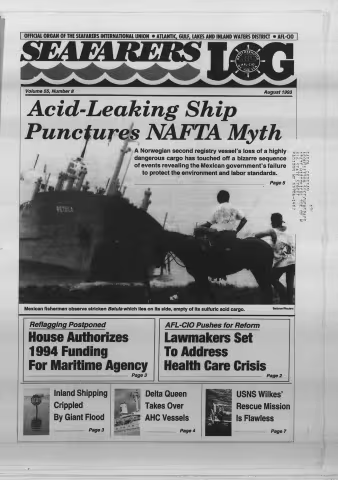
Mexican fishermen observe stricicen Betula which iies on its side, empty of its suifuric acid cargo. BeumaivReuters
Reflagging Postponed
House Authorizes
1994 Funding
For Maritime Agency
Pages
AFL-CIO Pushes for Reform
Lawmakers Set
Te Address
Health Care Crisis
Pages
^ - Inland Shipping
By Giant Flood
W" /ji. Delta Queen
Takes Over
AHG Vessels
PaS»4
1^^ USNS Wilkes'
Rescue Mission
Is Flawless
i-.,
SEAFARERS LOG AUGUST1993
Michael Sacco
President's Report
Behind the Fancy Words
There has been a big push on now and for the past couple of
years to bring about a North American Free Trade Agreement. The
American lab^or movement is very concerned about this trade deal,
as Seafarers will recall from reading the
Seafarers LOG and discussions at union meet
ings. The AFL-CIO and its affiliated unions
believe the goverament-feanctioned opening of
Mexico to U.S. businesses will bring about an
exodus of American companies from the U.S.,
exporting hundreds of thousands of American
jobs to Mexico. The trade deal will formalize
an arrangement that allows U.S. companies
to move to a source of cheap labor and to a
nation with very few costly environmental
regulations.
Because it stands to gain immeasurably
from a transfer of American jobs and manufacturing capability to
Mexico, the Mexican government is pulling out the stops in a cam
paign to convince the American Congress to sign off on NAFTA.
The Mexican government has had all sorts of glossy brochures
printed up which boast of Mexico's commitment to the environ
ment. The slick material, printed on green and sky-blue recycled
paper, is aimed at putting aside the fears of elected officials and
American voters that a trade deal with Mexico is a bad deal for the
environment. These fears are founded on the fact that the few
Mexican environmental regulations are much more lax than those
we have in the U.S. It stands to reason that a trade deal which en
courages factories to move to Mexico, with its lack of regulations,
can result in increased industrial pollution, endangering human life
and natural resources on both sides of the border.
The U.S. trade unions also have raised questions about how sin
cere is the Mexican government's devotion to decent labor standr
ards. It has been argued that U.S. businesses may be attracted to
Mexico not only for its low wages but also because Mexican
workers do not have the same rights as American employees do to
organize to make their workplaces more humane and fair. Do
Mexican workers have the right to organize and form unions, the
right to speak out freely and the right to join together in collective
action?
The truth about the Mexican government's commitment to the
environment and to decent labor standards is probably not going to
be found in the very expensive materials prepared by American
public relations firms. The actions of the Mexican government in
the case of the Betula, a sulfuric acid-carrying tanker beached off
Mexico's shores, may be closer to the truth. A more detailed ac
count of this incident appears elsewhere in the LOG. But in brief,
if the press accounts are correct, Mexican fishermen, believing
that their livelihoods were threatened by a spill of acid from a
grounded chemical tanker, put on a demonstration. The Mexican
government arrested them. It also was reported in the press that the
Mexican government insisted nothing had been spilled from the
Norwegian second registry ship, while the salvage company said
there was nothing left in the vessel's tanks. Something does not
square here.
The apparent cover-up of environmental concerns and the hush-
up of workers' concerns by Mexican authorities is troubling. The
Betula incident demonstrates that the American labor movement
has real cause for worry when it comes to a trade deal between the
governments of Mexico and the United States. It also shows that
all the fancy materials and studies put out by those who stand to
gain substantially from NAFTA do not necessarily represent a
good faith account of the American people's—or Mexican
people's—interests.
Educational Opportunities
Each year scholarships are awarded by the Seafarers to three
SIU members and four sons, daughters or spouses of SIU mem
bers. I urge any Seafarer or fomily member of a Seafarer who
plans to attend an institution of higher leaming to apply for a
scholarship.
Applications for the scholarships must be received by April 15,
1994, and the names of those who win the awards will ^ an
nounced in May of that year. There are many forms and test scores
that must accompany each application, so it is not too early to start
compiling a submission. Yes, it can take some time to put all the
material together. But a $15,000 four-year scholarship or a $6,000
two-year scholarship can be well worth the effort!
Volume 55. Number 8 August 1993
The Seafarers LOG (ISSN 0160-2047) is published
monthly by the Seafarers International Union; Atlantic,
Gulf, Lakes and Inland Waters District; AFL-CIO; 5201
Auth Way; Camp Springs, Md. 20746. Telephone (301)
899-0675. Second-class postage paid at MSC Prince
Georges, Md. 20790-9998 and at additional mailing
offices. POSTMASTER: Send address changes to the
Seafarers LOG, 5201 Auth Way, Camp Springs, Md.
20746.
Communications Department Director aiid Editor, Jes
sica Smith; Managing Editor, Daniel Duncan; Associate
Editors, Jordan Biscardo and Corrina Christensen; As
sociate Editor/Production, Deborah A Hirtes; Art, Bill
Brower.
AFL-CIO Presses for Reform
MealBlr Care Crisie to Top
Lawmakas'Agomla thk Fall
The nation's policy-makers
will turn their attention to the
nation's health care crisis next
month when President Bill Clin
ton presents to Congress his plan
for reforming the m^cal services
system of the United States.
The attention of lawmakers to
this issue is critical to the millions
of working Americans who cur
rently bear the brunt of a health
care system riddled with out-of-
control costs, to the 36 million
Americans who have no medica
insurance—whether or not they
are working, and to the millions
of senior citizens who retired with
promises of life-long health
benefits only to find those
programs suddenly terminated by
company executives who say
they can no longer afford the ex
pense.
The administration plan has
been fashioned by a task force
leaded by First Lady Hillary
Rodham Clinton which me
throughout the first half of the
year. While the task force was at
Work fashioning its own recom
mendations, a variety of bills ad
vocating different approaches to
the problem were introduced in
Congress.
Complicated Debate
With many health care reform
proposals in the hopper, and with
many constituencies affected by
he outcome of the debate—
receivers of benefits, doctors,
hospitals, insurance companies,
among others^the deliberations
in Congress on the future of
lealth care in the United States
are expected to be long and com
plicated.
The AFL-CIO, the federation
of national unions in the U.S.,
intends to represent the concerns
of working people and their
amilies in this debate. For
decades a proponent of a univer
sal and fair national system of
health care, the AFL-CIO has
called on lawmakers to enact a
"bold legislative solution."
While not taking a stand on
one specific proposd put forward
by any representative of the ad
ministration or Congress, the
AFL-CIO is working to ensure
that any program adopted by law
makers does the following:
• Establish a nationd com
mission composed of consumers,
abor, management, govemment
and providers to administer a
single national cost containment
>rogram. This group would be
charged with limiting the rate of
rowth of health care expendi
tures.
• Outline a core benefit
package to which all Americans
are entitled, no matter their health
status, state of residence or
employment history. For those
not in the workforce, a single
ederal program should be set up
to cover the unemployed.
• Develop ways in which
waste, red tape and unnecessary
aperwork can be reduced by
emanding standardized claim
orms, a uniform health care in-
brmation system, practice
guidelines for physicians and a
national strategy to reform the
way in which malpractice dis
putes are handled.
• Help solve the retiree
lealth care benefit crisis by
owering the age of eligibility for
Medicare to 60.
In presenting its proposals to
policy-makers, the AJT.-CIO has
noted that the U.S. system of
health care in grossly unfair. "It
punishes employers who provide
health insurance to their workers
by forcing them to, in effect, sub
sidize the health care of those
who are employed by firms that
seek a competitive advantage by
refusing to provide such coverage,"
stated AFL-CIO Department of
Employee Benefits Director Karen
Ignagni in comments to a congres-
siond panel.
Inefficient U.S. System
The current system "is replete
with inefficiencies that have
forced costs to rise sharply, and
millions of Americans who are
fortunate enough to be covered by
health insurance have, as a result,
suffered the financial burden of
increased cost-shifting and reduc
tions in benefits," Ignagni added.
Studies show the burden of
skyrocketing health care costs has
been shifted to America's
workers. Employer after
employer has instituted systems
requiring co-payments from the
company's workers for continu
ing health coverage or maintain
ing benefit levels. Deductibles
lave been instituted and in
creased. The net result is that
lealth care costs now eat up close
to 10 percent of gross earnings of
an American household.
The health care crisis has
taken its toll on relations between
unions and companies. In 1990,
an unprecedented 55 percent of
strikes were provoked by
management demands for severe
reductions in medical benefit
levels or elimination of health
coverage.
To cope with the runaway
costs of medical care, unions and
the health care providers they
work with are implementing a
number of measures designed to
keep expenses in check while
maintaining benefit levels.
Among the programs used are
preferred provider organizations
(PPOs) in which a single hospital
or clinic is designated as the
primary care giver, a utilization
review process in which permis
sion must be obtained for a medi
cal treatment, lifetime limits on
the amount oif services received,
and health maintenance organiza
tions (HMOs) which provide all
of a patient's care for a set annual
fee and cover little outside its set
parameters.
In upcoming issues of the
LOG, the health care crisis and
the various plans to institute a na
tional system will be discussed.
Next month, the LOG will report
on the health care reform
proposals which are being con
sidered by lawmakers.
High Health Care Costs
Spell Trouble for Nation
Studies of the nation's health care system show ominous
trends. What foilows is some of the information put forward in the
debate on America's heaith care direction.
In 1991, more than 35.4 million Americans—or 14.1 percent
of the population—had no medical insurance. The number
today is close to 36 million.
• Of those who lost health care coverage in the past year, half
were employed and the remaining ones lost their jobs.
• In 1990, total dollars spent on health care reached $655 billion,
12.2 percent of the nation's GNP, more than any other country
in the developed world.
• On a per capita basis, the United States spends more on
health care than any of its primary trading partners—40 per
cent more than Canada, 90 percent more than Germany and
125 percent more than Japan.
• Since 1970, total health care expenditures in the U.S. have
gone up 60 percent faster than inflation. If the trend continues,
by the year 2000 total health-related spending in the U.S. will
reach $1.6 trillion per year.
• In the 1980s, health costs for households increased from 6
rcent to 9 percent of gross earnings. For people over 65,
alth care on average accounts for 11 percent of annual
household expenses.
• In 1990,55 percent of all strikes by workers were related to
health care issues.
• For companies with less than 1,000 employees, the cost of
health care rose an average 17.3 percent in 1991.
Soui^: Physldans for a National Health Program. Public Citizen, Department of Health and Human
Services, Hewitt Associatee.AFL-CaO.BurMu of Labw Statistics.
Contract Talks Continue
For Freightships/Tankers
Negotiations still are under
way as the Seafarers LOG goes to
>ress between the SIU and its
contracted operators that are sig-
nators for new standard
Teightship and tanker agree
ments to replace those that were
to expire June 15.
The union and the companies
agreed last month to extend the
old pacts, ratified in June 1990,
until August 15 in order that talks
would not be rushed.
The negotiations began
several months ago between the
SIU and the American Maritime
Association, a group of
shipowners who contract with the
union to provide unlicensed
mariners for their vessels.
SIU Vice Presidoit Contracts
Augie Tellez noted the sessions are
proceeding well and promised to
keep the membership informed.
v-'-i 'W'- i'' -
rfe^Siisi^'asasSejisis?^^ -
•••-,.g0''f>:
AUGUST 1993 SEAFARERS LOG 3
'VSSf-'
Charies T. Mayden, Piasa Photographic Sen., Inc.
The Alton Belle and Alton Belle Landing have become an island unto themselves, with water reachin
40 feet, an all-time high level.
Rood Maud S^iplttg
Regular river operations may
not return to the Mississippi River
and its tributaries until fall as rain
continued to fall in the upper mid-
western United States.
Record crests were expected
to hit Alton, 111., St. Louis and
other river towns in early August.
The Coast Guard and Army
Corps of Engineers continue to
prohibit any commercial boating
activities on the upper Mississip
pi as well as the Missouri and
Illinois rivers.
While some of the locks which
handle barge traffic on the upper
Mississippi have reopened in
Minnesota and northern Iowa,
tugs and barges still are not. able
to transport grain, coal and other
materials downriver. At the same
time, the navigable portion of the
Missouri River has been shut
down between St. Louis and
Sioux City, Iowa. That river may
not reopen to traffic until late
September, according to the
Army Corps of Engineers.
President Bill Clinton has
asked Congress to grant up to $4
billion in flood relief to the people
and businesses affected by what
is being known as the "Great
Flood of 1993." The House of
Representatives had passed a
$2.7 billion relief package in late
July, which the Senate was ex
pected to address in early August.
Despite the lack of barge traf
fic on the Mississippi since flood
ing began in May, Great Lakes
shipping companies have not
seen any increased activities.
"There does not appear to be
any increase in shipments of grain
or coal since the flooding began,
noted Gordon Hall, vice presi
dent/treasurer for the Lakes Car
riers Association in Cleveland.
The association monitors the traf
fic and loads carried by vessels on
the Great Lakes.
"We have not been able to
detect any changes. And with all
of the flooding and bridges being
washed out, it is hard to believe
the railroads can handle it either.
Hall added.
Seafarers in Alton
Tackle High Waters.
Page 28
Meanwhile, the victims along
the banks of the rivers include
Seafarers who have lost their
homes. More than a dozen SIU
members have homes under
water.
St. Louis Port Agent Joe Sigler
reported receiving several calls
about Seafarers who work aboard
Orgulf tugs losing their homes.
"So far, we have confirmed one,
but many people cannot be
reached because ttiey have moved
and phone lines are down," he
noted.
Orgulf Boats Tie Up
A total of six Orgulf boats are
still running the lower Mississip
pi while 15 are tied up until the
locks reopen.
The six vessels that are still in
operation are the Dick Conerly,
Jim Ludwig, Midland, Omega,
J.N. Phillips and the Eastern Star.
Sigler said Orgulf operations
may not get back to normal before
late September.
"This is even a tentative guess
If the rain doesn't quit, the locks
will never open up before the end
of summer for normal operations
to resume," the port agent stated
Paddlewheelers Keep Rolling
The SlU-contracted Delta
Queen Steamboat Company
plans to keep all operations flow
ing despite the record high water
marks being set on the upper Mis
sissippi.
The company re-routed two
cruises on the big paddlewheeler
Mississippi Queen, replacing the
St. Louis to St. Paul, Minn, and
the St. Paul to St. Louis itineraries
with Chattanooga, Tenn. to St.
Louis voyages. The other SIU-
crewed vessel. Delta Queen, has
been unaffected by the river
closure. Its cruises were
scheduled for the Ohio and Cum
berland Rivers during July.
Below Cairo, the Mississippi
widens out allowing faster disper
sion of the water through natural
means such as evaporation. The
Army Corps of Engineers also
controls the lower river and, if
necessary, can channel as much
as 30 percent of the water through
Continued on page 8
Amendment to Delay Re-Flaesing Adopted
House Approves '94 MarAd Bill
The House of Representatives
approved a $621 million
authorization bill to run the
Maritime Administration
(MarAd) during Fiscal Year
1994.
Added to the bill during debate
on the House floor was an SIU-
backed amendment that prohibits
the federal agency from granting
any re-flagging requests through
the end of 1994. The amendment
passed by a vote of 388 to 41.
The MarAd bill includes funds
to operate the agency, which is
charged with promoting,
developing and maintaining the
U,S. merchant fleet. The legisla
tion, which now goes to the
Senate for consideration, also
provides funds to keep the Ready
Reserve Force vessels in a state of
readiness, for shipbuilding loan
guarantees and for the operating
differential subsidies for some
U.S.-flag ships.
The amendment, offered by
House Merchant Marine and
Fisheries Chairman Gerry Studds
(D-Mass.), stated, "The Secretary
of Transportation may not ap
prove the transfer of a Unit^
States-documented oceangoing
merchant vessel that is of 3,(X)0
gross tons or more (or that type of
a vessel the last documentation of
which was under the laws of the
United States) to a foreign
registry under section 9(c) of the
Shipping Act of 1916, as
amended, through December 31,
1994."
'Buys Time'
In presenting the amendment,
Studds told his fellow repre
sentatives he was offering the
legislation "to buy all of us time
— the president, the secretary of
transportation. Congress" to
complete a maritime revitaliza-
tion program. The House of Rep
resentatives already is consider
ing a four-bill package that
includes a lO-ye^, $1.9 billion
subsidy program for vessels in
volved in a maritime security
fleet program as well as loan
guarantees and incentives for
U.S. shipyards.
The chairman added that Con
gress is "working as hard as we
can to come up with a com
prehensive proposal. By the end
of next year, we will know
whether we will have U.S.-flag
vessels on the high seas and a U.S.
shipyard capability to build those
vessels."
Joining him in support of the
amendment was Representative
William Lipinski (D-Ill.), the
chairman of the Merchant Marine
Subcommittee. "It is vital that at
a time when we are trying to
preserve our maritime industry
Contuiuedon page 8
Hearings Reveal
Uncertainty Over
Maritime Peiicy
A congressjpnal hearing
called to consider maritime legis
lation underscored the deep
frustration held by meml)ers of
Congress and two of the
subcommittee's witnesses over
the apparent inactivity regarding
a program for U.S.-flag shipping.
Members of the House Mer
chant Marine Subcommittee ex
pressed dissatisfaction over the
failure of witnesses from the
departments of Transportation
and Defense to offer specifics
when ques-
William Lipinski
t i o n e d
T ho s e
providing
testimony on
behalf of the
administra
tion said they
have been
thwarted in
efforts to
present a
program because the Maritime
Administrator has not been con
firmed by the Senate.
Subcommittee Chairman Wil
liam Lipinski (D-Ill.) called the
July 20 hearing on one aspect of
the maritime revitalization pro
gram offered by House Merchant
Marine and Fisheries Committee
Chairman Gerry Studds and Rep
resentatives Jack Fields (R-
Texas) and Herbert Bateman
(R-Va.) as well as Lipinski. The
program, which was presented
May 19 and consists of four
pieces of legislation, is designed
to offer and fund a 10-year, $1.9
billion subsidy program for U.S.-
flag ship operators and provide
tax reform measures regarding
these vessels.
The package was introduced
after the Clinton administration
announced May 12 it would not
propose any maritime revitaliza
tion legislation before a Defense
Department study on the need of
the U.S. merchant marine for
sealift is released in August. On
June 28, Sea-Land and American
President Lines (APL) an
nounced they would seek permis-
sion from the Maritime
Administration (MarAd) to re-
flag 20 of their U.S.-flagged ves
sels. The companies had been
threatening since early 1992 to
take such action if no maritime
policy was enacted.
Called to testify on the
Maritime Security and Competi
tiveness Act (H.R. 2151) were
Acting Maritime Administrator
Continued on paged
Sen. Mikulski Seeks
MariUme Commitment
U.S. Senator Barbara
Mikulski (D-Md.) has asked the
White House to verify informa
tion she has received that the
Department of Defense advised
Sea-Land and American Presi
dent Lines (APL) to replace their
U.S. flags with a flag of con
venience from the Marshrdl Is
lands.
In a July 1 letter addressed to
President Bill Clinton, the long
time supporter of the U.S.-flag
merchant fleet stated she was "not
re-elected... tO see the U.S. mer
chant marine scuttled." She asked
the president to support a
maritime revitalization program,
calling it a "vital national security
issue."
Sea-Land and APL announced
in June that
they were
going to
apply to the
Maritime
Administra
tion to re-flag
20 of their
vessels. The
Sen. Mikulski
companies
had been
threatening
to do so since last year unless a
maritime revitalization program
became law. In May, members of
the House Merchant Marine and
Fisheries Committee introduced a
revitalization package through a
series of four bills.
The box below contains the
text of Mikulski's letter:
Dear Mr. President:
I am writing to express my outrage and deep dismay at reports
that the two largest American-flag shipping companies have
decided to remove a number of their vesselsfrom the United States
flag-
I was not re-elected to the United States Senate last November
to see the U.S. merchant marine scuttled by wonks and green
eyeshade types in the White House and the Pentagon. I believe our
national security depends upon our moving a maritime revitaliza
tion bill in this session of the Congress to keep our U.S.-flag fleet
sailing. We need leadership from the White House on this vital
national security issue.
lam informed that the Pentagon has given advice to two major
shipping companies to re-flag their ships with the Marshall Is-
lands. The crews on these ships will come from all over the world.
I appreciate our treaty agreements with our friends in foreign
countries, but I lack confidence that foreign nationals will have
the same commitment to place their lives on the line, if necessary,
that our U.S. merchant marine have.
You have moved slowly and deliberately on your review of
maritime policy—I hope the administration will not move quickly
now in the dismantling of the U.S.-flag fleet.
I look forward to your response.
Sincerely,
[s] Barbara A. Mikulski
;..7
• •¥-'
. >
- '-yl.
1
•• •'.•.-I •
im-
•a
!/•
I' •
• \
••
. -a.
-r
't
" r 'v , , - - r •r'V'Vf-Vv-%
Piliit
4 SEAFARERS LOG
AUGUST 1993
Delta Queen Takes Over Operations
nendence and Constitution
The jobs of SIU crewmembers
sailing aboard the U.S.-flag pas
senger ships Independence and
Constitution are secure following
a federal bankruptcy court's ap
proval of the takeover of finan
cially troubled American Hawaii
Cruises by the Delta Queen
Steamboat Company of New Or-
leans.
The SlU-crewed Constitution {abOMe) and Independence (below) now The Honolulu-based court an-
are being operated by the Delta Queen Steamboat Company follow- nounced its decision on July 28.
Ing a decision last month In federal bankruptcy court.
Delta Queen, an SlU-contracted
company which operates two
paddlewheel steamboats on the
Mississippi River and its
tributaries, presented the only bid
on the cruise ships and the busi
ness associated with them.
"We were successful in main
taining these jobs for our mem
bership," noted Augie Tellez,
SIU vice president for contracts.
"This insures that the Con
stitution and Independence will
continue running for years to
come," added Tom Fay, SIU port
agent in Honolulu.
Seafarers who sail aboard the
cruise ships held meetings on the
Constitution and Independence
on July 29 and at the Honolulu
hall on July 30 to vote on a new
seven-year pact with the Delta
Queen subsidiary.
Last month. Judge Lloyd King
granted interim management of
the two cruise ships to Delta
Queen pending his decision. The
judge had set a July 21 deadline
for competing bids or any objec
tions to Delta Queen, but none
was received.
The new company will be
called Great Hawaiian Cruise
Line, Inc. Delta Queen has an
nounced its intentions to renovate
both ships and upscale the pas
senger cabins.
"This transaction provides
both Delta Queen and American
Hawaii with significant oppor
tunities for growth," stated S.
Cody Engle, chairman of Delta
Queen. "For Delta Queen, it rep
resents ah opportunity® to almost
more than triple the company's
passenger capacity while remain
ing focused on the business we
know best. For American Hawaii,
it represents a means of sustain
ing and improving a unique
product and franchise in the
world's premier vacation destina
tion."
In June, Delta Queen had a
steel-cutting ceremony as it
began construction for its third
riverboat, the American Queen,
which is expected to start sailing
by April 1995. She will join a
fleet already served by the SIU-
crewed Delta Queen and Missis
sippi Queen.
Inland Waterways Fuel Tax Withdrawn
A proposed 50-cent-a-gallon
inland waterways fuel tax has
been withdrawn from considera
tion by House and Senate con
ferees who are negotiating the
Clinton administration's
economic policy.
Early reports from the con
ference stated the tax was
removed in favor of increasing
the national sales tax oh gasoline.
The SIU, along with other
maritime interests and energy
users, lobbied heavily against the
idea, stating the tax was an unfair
burden on the inland waterways
industry.
The inland waterways tax was
passed by the House of Repre
sentatives as one means of lower
ing the nation's deficit. Original
estimates for the tax noted nearly
$500 million could be collected
over a five-year period.
In its original deficit-reduction
package, the House also ap
proved a tax based on the energy
content of fuel, known as British
thermal units (Btu). The Btu tax
was part of the Clinton
administration's request to
reduce the deficit by $500 billion.
As with the inland tax, the SIU
and others were successful in lob
bying the Senate to have the Btu
tax removed from consideration.
Instead, the Senate approved a
4.3-cent-a-gallon tax on gasoline.
Because of the differences in
the House and Senate versions of
the legislation, a conference com
mittee consisting of members
from both bodies has been meet
ing since mid-July to iron out the
differences.
As the Seafarers LOG was
going to press, reports from
Capitol Hill stated the conferees
were trying to settle on a tax of
between 6 and 7 cents per gallon.
The committee is expected to an
nounce its proposal in early
August.
Despite the indications that
both the inland waterways and
Btu taxes are dead, the SIU plans
to monitor the negotiations for
other ideas that may affect mem
bership and maritime. Under the
rules of a conference committee,
the representatives and senators
may pass all of what the House
approved (which amounted to
$72 billion in tax increases), all of
what the Senate approved (es
timated at a $23 billion increase),
parts of either or nothing from
them and create its own funding
formula.
None of the ideas is officially
excluded fi-om consideration until
the House and Senate have ap
proved the final package, then the
president signs it.
Also under consideration by
the conference committee mem
bers are increases in income taxes
for those individuals who make
more than $115,000 a year and
couples earning $140,000 an
nually, a hike in the top corporate
tax rates, taxes on social security
benefits and much more.
Houston Port Agent Jim McGee (right) recently spoke with Treasury
Secretary Lloyd Bentsen about the needs of maritime In the Clinton
administration's deficit reduction program.
Federal Court Announces User Fee Lawsuit Schedule
A federal court in Washington
has released the pretrial schedule
for action concerning a lawsuit
filed by the SIU, four other
maritime labor unions and five
individual mariners against the
U.S. Coast Guard and the
secretary of transportation to stop
collecting fees on merchant
marine documents (z-cards).
The suit, filed April 15, claims
the "work tax," as it has been
called because mariners are un
able to work without one, is un
constitutional and was calculated
incorrectly by the federal agency.
Besides the Seafarers, the
other unions joining in the lawsuit
which has been filed in the U.S.
District Court for the District of
Columbia are the Unlicensed
Division of District No. 1 Marine
Beneficial Association/National
Maritime Union, District No. 1-
Pacific Coast District Marine
Engineers' Beneficial Associa
tion, the American Maritime Of
ficers District 2 MEBA and the
International Organization of
Masters, Mates and Pilots. Also
joining in the fight are the Sailors'
Union of the Pacific and the
Marine Firemen's Union, both of
which are affiliated with the
Seafarers.
The five individual mariners
who are plaintiffs against the
Coast Guard and Transportation
Secretary Federico Pena include
Anthony Primeaux, William H.
Mulcahy, John Paul Hoskins,
James C. Oliver and Perry O.
Lawrence.
Exchange Information
Lawyers on both the maritime
and government sides will have
until September 23 to exchange
information relating to the suit.
This process, known as dis
covery, allows both parties to
know what will be involved in the
case.
Attorneys representing the
unions and mariners already have
asked the federal agencies in
volved for any records, com
ments received and other
information that were used to for
mulate the user fee on merchant
marine ddcuments.
Both parties in the suit then
will have until October 22 to file
for a summary judgment. This
procedure is used when all the
f^acts can be gathered on paper
and witnesses are not needed to
testify in a trial in order for the
judge to make a decision.
Legal briefs are prepared by
attorneys for both sides explain
ing the facts and the legal theories
behind their reasoning of how the
case should be decided. In most
cases, lawyers for one of the two
sides will ask for the case to be
decided by summary judgment, but
judges can notify the attorneys that
such a request is expected.
If a case is decided by sum
mary judgment, a decision usual
ly comes from the judge within
six months. However, there is no
time limit as to when a judge must
announce the decision. Some
cases have waited more than a
year before the judge's ruling was
declared.
Should a summary judgment
not be used in the work tax case,
the court then would set a date for
atrial.
Argue Against Tax
By seeking to declare the user
fee unconstitutional, the unions
and mariners argued that only
Congress can pass a tax and the
legislative body caimot transfer
that authority to another branch of
the government. The user fee
originated in the 1990 Omnibus
Budget Reconciliation Act. In
cluded in that legislation was the,
elimination of an 1886 statute that
prevented the Coast Guard from
collecting fees for licenses and
certain shipboard positions.
The suit contends the reason for
removing the ban to collect fees on
merchant documents was to raise
money to reduce the deficit. The
plaintiffs also claim the Coast
Guard used inaccurate information
in establishing fee levels.
Although the Department of
Transportation agency an
nounced its fee schedule on
March 19, it did not begin collect
ing the work tax until April 19.
The fees ranged from $35 for a
duplicate z-card, license or cer
tificate of registry to $272 for an
upper level license.
An ordinary seaman upgrad
ing to able bodied seaman, for
example, would have to pay $135
for a new document—$60 for an
evaluation fee, $40 for an ex
amination fee and $35 for an up
dated z-card.
, ; • I- : IP.
.-v. ..^->irr:j» • ,
Is I
AUGUST1993 SEAFARERS lOG 5
'•:'<• • ••' -'"•V" '
- r-WI'.
•v-s,fmj
ti- "'•"! •
• -i' -:-•••*
Crewmembers of the Eli Marie display "V" for victory and thumbs up
after hearing the shipping company would pay their back wages and
settle other grievances following a three-day strike in Baltimore.
After Months of No Pay,
NIS Ship's Crew Strikes
After three months of no pay
and meals consisting only of rice
and eggs, a Filipino-Indonesian
crew aboard a Norwegian second
registry (NIS) vessel conducted a
three-day strike for better condi
tions after the bulker docked in
Baltimore.
SIU Representative Edd Mor
ris, who also serves as an Interna
tional Transport Workers
Federation (ITF) inspector,
helped negotiate a settlement for
the 17 Filipino and three In
donesian crewmembers aboard
the Eli Marie, a bulk carrier
operated by Norway-based Gaard
Shipping.
(By using the NIS, the Nor
wegian International Shipping
registry, a company is allowed to
fly the flag of this traditional
maritime nation. However, the
company operates under runaway
conditions such as using crew
members from anywhere around
the world, avoiding taxes and
bypassing maritime regulations.)
Inhumane Treatment
Not only was food scarce on
the ship, but crewmembers
reported inhumane treatment.
The third engineer, for example,
discovered his mother was near
death and asked the captain for
permission to fly to the Philip
pines to be> with her. He was
turned down. A few days later,
the third engineer found out his
mother had died.
Offloading Delayed
When the vessel arrived in
Baltimore on June 18, the Eli
Marie did not dock until July 7 at
Domino Sugar. During this time
in the Chesapeake Bay, no shore
leave was granted. Crewmembers
asked to be paid or at least receive
a draw, which the Norwegian
captain denied. After the ship first
dropped anchor, the third en
gineer took his $500 emergency
cash and asked the radio officer to
have it wired through the man
ning agency to his family to help
pay for his mother's burial.
After the crew contacted Mor
ris on July 9, he immediately ap
proached the captain about the
situation. The captain said he did
not want to discuss the problem.
After Morris asked about the food
on board, the captain blew up
stating, "What are you people in
the United States concerned
about their food, they have rice
and eggs!"
No Funds Recdved
Meanwhile, the third engineer
had the chance to contact his
family in the Philippines, only to
discover that none of the money
he sent home had been received.
The radio office displayed proof
that the funds had been wired. Mor
ris contacted the manning agency
offices in both Manila and its home
office in Singapore about the third
engineer's request
Although representatives in
both offices originally stated they
had not received the telex, they
later said the wire was received
but they would not pass the
money to the family because they
had not received any funds from
the company.
The crew stopped work on
July 10 to protest working condi
tions aboard the vessel. By the
following day, they were on strike
with picket signs displayed on the
dock and gangway. Morris con
tinued to make calls to the man
ning agency, the Norwegian
consul, the Philippine consul and
others to resolveffiie situation.
Crew Wins Strike
By July 12, Morris had con
firmed with the shipping com
pany that all claims would be paid
through the manning agency in
Manila. An agreement between
the crew and the captain was
drafted and signed. Among the
items agreed to in the document
were salaries and allotments
would be paid on time, a welfare
fund should be utilized, enough
provisions should be kept on
board the ship, and the captain
and chief engineer would not
harass the crew.
The document was signed by
all the crew and officers and wit
nessed by Morris and a Baltimore
shipping agent representing the
vessel owners.
Offloading of the sugar
resumed July 13. A few days later,
the vessel sailed to Boston to pick
up a load of scrap steel for China.
NIS'Registered Betula Grounded
Mexico's iiew-Foumi Green image
Centradided by its Response
To Suifuric Acid-Leaicing Ship
Bizarre responses from the
Mexican government to claims o;
sulfuric acid leakage from a
grounded Norwegian seconc
registry vessel have raised anew
questions about Mexico's com
mitment to high environmenta
and labor standards proposed as
part of a package involving a
North American Free Trade
Agreement (NAFTA).
The trade deal between the
governments of Mexico, the
United States and Canada was
negotiated by the Bush ad
ministration and now claims the
support of President Clinton. Bui
several congressmen have voicec
doubts about the trade pact, citing
the potential mass loss o
American jobs as U.S. factories
flee south of the border to a land
of cheaper, more exploitable
labor and less stringent environ
mental and safety and health
regulations.
To go into effect, NAFTA
must be accepted by Congress. To
make the trade scheme more
palatable to legislators, the ad
ministration and the Mexican
government are negotiating side
agreements on labor standards
and environmental concerns.
At the same time, the Mexican
government is spending millions
of dollars on public relations ex
perts and sleek materials to
present an image of a nation dedi
cated to the highest environmen
tal and labor standards.
Actions Belie Image
The June 29 grounding of the
Betula, a 1970 built, 10,033 dwt
chemical tanker, off the shore of
its Michoacan state last month,
provided the Mexican govern
ment an opportunity to live up to
its newly found green image.
Instead, the Mexican
government's response has been
shrouded in mysteiy. It insists the
sulfuric acid did not spill in the
face of empty tanks. Its embassy
in Washington, D.C. refers all
press inquiries to the Mexican
Tourism Hotline, which turns out
to be a public relations agency in
Chicago. And its newly created
office of the attorney general for
the environment has had nothing
to do with the incident, among
other peculiar actions.
According to accounts in the
Washington Post and the New
York Times, the Mexican govern
ment denied that the Betula,
managed by Rotterdam-based
Alendal Tankers BV, had spilled
any of the more than 4,000 tons of
sulfuric acid which remained in
its stainless steel tanks when the
ship was first towed to sea.
The decision of the Lazaro
Cardenas port authorities to take
the vessel to sea was made after
the chemical had leaked into one
of the pumprooms during off-
floading operations on June 25.
The vessel was towed by a harbor
tug, a line broke, the Betula
drifted and later came aground on
a sandbar 20 kilometers north of
Lazaro Cardenas.
Tanks Mysteriously Empty
But workers, from the
American salvage company who
were inspecting the tanks told the
newspaper reporters that the
Betula" s tanks were empty. Sal
vage workers found the deck
hatches of the 15 acid-carrying
tanks were open.
"In my opinion there ain't
nothing there," Roy Dodgen of
Titan Maritime Industries told the
New York Times as he looked at
the ship. Lloyd's List T&pori&d that
Beth Christ at Titan's Rorida of
fice said, "All the sulfuric acid is
out of the vessel."
Salvage workers and repre
sentatives of the insurance com
pany involved at the site of the
shipwreck speculated that the
ship, which had been beached on
June 29 and then struck by Hur
ricane Calvin on July 6 and 7,
becoming partially sunk, had lost
its acid cargo during the storm
and had dissipated in the sea.
Fewer than 30 tons of sulfuric
acid were left in the hold, salvage
workers reported to Lloyd's List.
These July 13 statements of
salvage company and insurance
officials contradicted a statement
issued on July 11 by the Mexican
Interior Ministry, a government
department usually charged with
internal police and security mat
ters. That agency said there had
been no leakage of sulfuric acid.
Fishermen Arrested
Despite the Mexican
government's assertions that
diere was no spillage of sulfuric
acid, a local fishermen's coopera
tive insists on the contraiy. They
point to dead turtles, a dead
pelican and dead fish as proof.
They also point to chemical bums
suffered by their members who
had ventured into waters near the
beached Beru/a.
The government, on the other
hand, says tests around the Betula
of sea water reveal normal
acidity. But Mexican authorities
only ^gan testing 10 days after
the ship ran aground off the
country's Pacific coast.
Despite its statements that no
sulfuric acid had been spilled, the
Mexican government closed the
area to fishing.
Protesting the loss of a fishing
ground and their related incomes,
the fishermen's cooperative
demonstrated on July 8, attempt
ing to blockade the port and
demanding compensation. The
Mexican Navy (which has Coast-
Guard-like functions) arrested 28
of the fishermen and issued or
ders for the arrest of 525 others
according to information appear
ing in Lloyd's List supplied by the
environmental group Green
peace. At the end of July, three
remain in jail, said a spokesman
for the Mexican Tourism Hotline.
In response to inquiries as to
whether any government funds
existed in Mexico to compensate
victims of environment^ acci
dents, the spokesman for the
Mexican Tourism Hotline said he
was not sure.
Lack of Information
The Mexican Tourism Hotline
spokesman was contacted as a
result of a press inquiry made to
the Embassy of Mexico in
Washington, D.C. The embassy
referred the press call to the
Mexican Tourism Hotline. Press
calls placed directly to the press
attache of the Mexican embassy
made by a Seafarers LOG
reporter were not returned.
The Mexican Tourism Hotline
spokesman said the Betula situa
tion had been contained by the
Mexican government and that
beaches frequented by tourists
had not been in any way affected
by the shipwreck. He said he had
no statement from the Mexican
government on the situation
which he could issue to the press
and that he was not allowed to
release the one piece of informa
tion he had been sent from the
Mexican Maritime Secretaiy.
The spokesman said he was
not sure whether there was a
Mexican govemment investiga
tion under way of the accident
However, a spokesman for the
Betula's operating company said
the Norwegian Maritime Direc
torate has completed an inves
tigation of the incident.
• ;v5-'; ••-vv,',"'.;.if''.',,;,;'V
AP by Joe Cavaretta
\^exlcan fishermen and salvage workers believe 4,000 tons of sulfuric
acid from the Betula leaked Into the sea. The Mexican government
says none of the ship's cargo was spilled.
tM..
''
fir:
l:
•S-
iiif
- rf.
•
L' V' 'r !i
• r-.-''
''iSfe:
V,";,rlr-
„s*»
6 SEAFARERS LOG AUGUST 1993
House Hearing Reveals MarMme Pelicy UnUer Review
Continued from page 3
Joan Yim and William J. Lynn,
director of program analysis for
the Defense Department. Also
speaking before the panel was Dr.
Paul Chapman, the author of
Trouble on Board about
runaway-flag shipping and the
former director of the Center for
Seafarers' Rights (See article on
page 3).
Joan Yim
H.R. 2151
would amend
the Merchant
Marine Act of
1936 by creat
ing a
Maritime
Security Reet
Program. The
bill, if passed,
would permit
up to 90 U.S.-flag vessels operat
ing in international commercia
trade to receive a subsidy for IC
years. The payments would begin
in Fiscal Year 1996. The
Maritime Trust Fund Act (H.R.
2380) provides the components
for funding H.R. 2151 through a
5 percent passenger ticket tax on
certain cruises originating in the
U.S. and a $15 vessel container
tax on import and export cargo.
Receiving Presidential Attention
In her prepared testimony,
Yim announced, "Maritime
reform has received vigorous at
tention within the administration
and is still under active considera
tion."
Yim praised the role that has
been played by the U.S.-flag mer
chant marine in times of national
emergencies. "The active com
mercial fleet also provides a base
of seagoing employment for
American seafarers, who in turn
are available to the Department of
Defense and the Maritime Ad
ministration
to crew
sealift ships,
including the
Ready
Reserve
Force, during
crises," she
said.
"The use
of civilian
merchant mariners on govern-
man our RRF. This is a grave
concern to us. It is an issue we are
looking at in terms of re-flag-
ging.
When the subcommittee chair
man asked Lynn if the Defense
Department had any contingency
plans for the RRF if American
crews were not available, he said
none had been drawn up.
"The current plan is to rely on
the (U.S.) merchant marine,"
Lynn added.
Neither government witness
was aware of a July 1 letter from
Senator Barbara Mikulski (D-
Md.) to Clinton stating "the Pen
tagon has given advice to two
major shipping companies (Sea-
Land and APL) to re-flag their
ships with the Marshall Islands.
The crews on these ships will
come from all over the world.
She further noted in the letter that
she lacked confidence in foreign
crews performing up to the same
commitment as American
mariners.
During his testimony before
the House subcommittee, Dr
Chapman pointed out that one o
the first things a company will do
when it switches flags is to
change the nationality of the
crew. "This is the pattern around
the world," he said. "This is one
of the reasons for flagging out.
He noted
when Nor
way adopted
a second
registry, all
Norwegian
crewmem-
bers except
the captain
and chief en
gineer were
Helen Bentley
replaced by lower-paid foreign
nationals. "But then, in many of
the Norwegian ships that have
lagged-out, now all of the crew
from top to bottom are foreign."
Representative Thomas
Andrews (D-Maine) commented.
We could find ourselves with
crews that might be very unsym-
jathetic to the cause that the
Jnited States armed forces may
be engaged in—the very crews
William J. Lynn
ment ships in times of emergency
is one of the most cost-effective
and efficient%xamples of 'public-
private partnerships,' a new con
cept to many, but a well-tested
one for our national defense.
Lynn added in his remarks that
the Defense Department "needs
sealift. The United States is a nation
with global interests, and it depends
on the deployment of forces fixjm
U.S. bases to defend those interests
when trouble strikes."
He pointed out the long-stand
ing policy "to rely on the [U.S.]
maritime industry to meet
[Defense] requirements, to the
extent that the industry can do so,
and we intend to continue that
policy."
Questions RRF Crowing
During the questioning that
followed, Lipinski asked Yim if
the Maritime Administration
could count on U.S. mariners to
crew Ready Reserve Force (RRF)
vessels should U.S.-flag maritime
companies re-flag their ships and
hire foreign crews.
"That is a difficult question we
are facing," Yim replied. "We
need to have seafarers who have
jobs in peacetime in order to be
available during times of war to
we may be depending upon to
deliver vital equipment to our
armed forces."
Representative Helen Delich
Bentley (R-Md.) suggested that
the Defense Department recall
what happened in Vietnam when
foreign crews refused to carry
war supplies aboard fully loaded
ships to the southeastem Asia na
tion, forcing the vessels to be of
floaded and materiel placed on
other ships. She pointed out there
were several instances when the
same thing occurred during the
recent Persian Gulf conflict.
Senators Block Nominee
In response to a question from
Representative Gene Taylor (D-
Miss.) seek-
Gene Taylor
ing specific
goals for
Mar Ad, Yim
replied the
agency has
not been able
to implement
any because
the person
appointed by
Clinton to serve as Maritime Ad
ministrator, Vice Admiral Albert
Herberger (Ret.), has not been
confirmed by the Senate.
"It is somewhat frustrating in
ternally in, that our team is rtot yet
in place," Yim told Taylor.
Although Herberger had his
confirmation hearing June 23,
farm-state senators led by Conrad
Bums (R-Mont.), Hank Brown
(R-Colo.) and Charles Grassley
(R-Iowa) are holding up the
admiral's confirmation in the
Senate Commerce, Science and
Transportation Committee. The
senators are using this tactic to get
back at Herberger because of the
strong support he indicated for
cargo preference during his con
firmation hearing. Burns, Brown
and Grassley are frequent critics
of cargo preference legislation.
(Cargo preference laws desig
nate a certain
percentage of
govemment-
impelled
cargo be car
ried aboard
U.S.-flag
vessels. Such
laws have
been in effect
since 1954.
Herb Bateman
The policy began after World
War II.) .
U n d e
Senate rules,
one senator
with an ob
jection can
place a hold
on a
presidential
nomination.
Thomas Andrews Herberger is
one of many
such Clinton appointees whose
final confirmation is being or was
delayed by such a move.
Other Bills Progressing
While the House subcommit
tee is expected to mark up—the
process of preparing a bill for its
next assignment—H.R. 2151 late
in July, action on other aspects of
the maritime revitalization pro
gram has begun.
The National Shipbuilding
and Conversion Act of 1993
(H.R. 2547) has been reported out
of the House Merchant Marine
and Fisheries Committee. It is
before the House Armed Services
Committee.
The bill, introduced last month
by Studds and Armed Services
Committee Chairman Ron Del-
lums (D-Calif.), is designed to in
itiate a technology development
program to provide a base for ad
vanced shipbuilding, create a
market for U.S.-built double-hull
tankers and expand federal loan
guarantees for U.S. shipyards.
Parts of H.R. 2547 are expected
to be included in the Fiscal Year
1994 Defense Department ap
propriations bill.
The Merchant Marine Invest
ment Act (H.R. 2152) is awaiting
action by the House Ways and
Means Committee after being
reported out by the Merchant
Marine and Fisheries Commit
tee.
The final bill in the package,
H.R. 2380, is before the Merchant
Marine and Fisheries Committee
as well as the Ways and Means
Committee.
Arkansas Merchant Marine Vets
Reminisce at Day-Long Reunion
SIU pensioner Fred Umholtz
noticed an advertisement in the
personals section of his local
Springdale, Ark. newspaper for
World War II seamen to meet
once a month for coffee and to
swap old sea stories.
"I thought I was the only
World War II merchant seaman
around this area, but much to my
surprise, discovered thk there
were more than 60 just in the
northwest part of Arkansas and
over 400 living in the entire
state," Umholtz told a reporter for
the Seafarers LOG.
"A number of the veterans are
SUP sailors who really enjoy
reading my issues of the
Seafarers LOG which I brought
to the meetings, and they'd pass
"rom one to another," he said.
According to Umholtz, the
monthly meetings grew, and the
seamen began planning for a
arger scale reunion for the
Arkansas veterans and their
amilies. The seamen decided to
lold the event at Hickory Creek
Park on Beaver Lake, just outside
Springdale.
Umholtz recently provided the
LOG with photographs from the
second annual reunion of World
War 11 merchant mariners living
in Arkansas. The day-long picnic
on Beaver Lake was well at
tended, he noted.
"Many of the World War U
mariners are still struggling for
veteran status, and it help^ to
meet and share our thoughts and
feelings on the matter," the retiree
said.
"We invited eight local U.S.
Navy armed guard veterans to
join us because they stood guard
on our ships," he added.
The veterans barbecued,
played bingo and horse shoes, but
the most important event was
swapping stories. Brother Um
holtz made prizes in his workshop
to give out to the winners of the
games.
"Now that I'm not sailing,
have a lot of time on my hands. I
enjoy woodworking and have
shop set up. I make things like
little toys, windmills and special
mini-merry-go-rounds. I sell
them to people I know and give a
lot of them to my friends and
family," he said.
A native of Elm Springs, Ark.,
Brother Umholtz joined the
Seafarers on the last day of 1945
in Sheepshead Bay, N.Y.
Umholtz's first ship was the
Williams Victory, a Smith and
Johnson vessel. He sailed in the
deck department. The vessel
served as a troop ship returning
soldiers from Europe back to the
^'ensioner Fred Umholtz (right) joins other Arkansas merchant marine
veterans at the second annual reunion in Hickory Creek Park, Ark.
Since retiring in 1987, Brother
Umholtz spends time in his shop
creating unique wooden crafts.
States.
"After the war, we carried
German prisoners back to Europe
from prison camps," he said.
In 1951 he was drafted into the
U.S. Army to serve in the Korean
conflict. In 1952, immediately
following his release from the
Army, he revived his SIU career
and began sailing out of the port
of New Orleans.
He sailed with Delta Lines for
most of his maritime career but
also sailed around the world with
Isthmian Steamship.
"I must have sailed on about
80 ships in all my SIU seatime.
There are so many that I lost
count," Umholtz observed.
The deck department member
spent many years sailing to West
Africa and South America. "One
of my favorite places was Brazil.
When I was with Delta I sailed on
a passenger ship and we took 47-
day trips to Brazil and back to
Houston. We really got to know
the Brazilian people, and it be
came a second home for many of
us," the pensioner recalled.
Brother Umholtz spent the last
few years of his SIU career sailing
aboard Sea-Land vessels: He
retired to his hometown of Elm
Spings in 1987.
' / 7 / • /• /• / • 7
Sf-
V
r. ::m
AUGUST 1993 SEAFARERS LOG 7
:'M
Wilkes Crew Completes Record-Breaklng Recovery
MSG Vessel Rrings Up
Sunken Survey Sled
SIU crewmembers aboarc
the USNS Wilkes participated in
a record-breaking salvage
recovery on June 20 when the
crew brought up an
oceanographic seafloor survey
system sled from 5,450 meters
of water off the south coast o
Hawaii.
The Wilkes, owned by the
Military Sealift Command
(MSG) and operated by Bay
Ship Management, is a Nava
Oceanographic Office vesse
which operates throughout the
Pacific Ocean.
Wilkes Chief Mate Free
Smallwood supplied the
Seafarers LOG with
photographs and information
about the crew's efforts in
recovering the survey system.
According to Smallwood, the
seafloor survey sled had been
lost by oceanographers when an
attachment link parted. The
Naval Oceanographic Office
sought assistance from the su
pervisor of Diving and Salvage
who contracted Oceaneering
Technologies, Inc. to operate
the deep salvage remotely
piloted vehicle Magellan 724
jfrom the Wilkes.
"The operation was a tricky
one at such extreme depths and
required the Magellan recovery
vehicle to attach a 20,000 foot
long recovery pendant of half-
inch kevlar line to the downed
sled.
"While the sled was being
located, hooked up and
recovered, it was necessary for
the Wilkes' ship control team to
keep the ship within a few
meters of a position directly
over the sled. The ship has no
automated station-keeping sys
tem and the team used various
combinations of engine, rudder
and bow thruster to keep the
ship in precise position in the
open sea for more than 30 hours
during the hook-up and
recovery," Smallwood wrote in
his letter detailing the event.
Once the crew secured the
connection of the sled, the
Magellan vehicle was brought
aboard and the ship's crew
began the long process of bring
ing the system aboard. The
Wilkes' deep sea trawl and
coring winch was used because
of its ample pulling power and
sufficient drum capacity for the
20,000 feet of recovery pendant.
Smallwood noted that
several splices in the line were
difficult to pass through the
various blocks and fairleads,but
the wet and slippery kevlar was
squeezed carefully through
without mishap. The final 800
feet of the recovery pendant was
a very large diameter and had to
be worked separately.
"The sled cleared the water
and was snaked on board after
dark of the second day—to the
OS JaeThrowbridgeand ABTom After hours of hard work by crewmembers, the spooling device Is
Skublnna lay back on a section of hoisted clear of the water. Extending downward Into the water Is the
nylon pendant being used to hoist recovery pendant leading to the deep ocean survey sled still oh the
the recovery pendant on board, ocean bed.
delight of a tired but dedicated
crew," he recalled.
"The record-breaking suc
cess of this salvage operation is
a tribute to the skill and efficien
cy of the crew of this small
ship," Smallwood added.
The Wilkes sailed into
Honolulu with the sled on deck
and wit^ a "broom at the yar-
darm" indicating a successful
mission. Bosun "Skip" Yager
said of the operation, "Hey, we
just got the job done."
Crewmembers aboard the
Wilkes received a commenda
tion from the commanding of
ficer of the Naval
Oceanographic Office at the
Stennis Space Center in Missis
sippi for the sled's recovery.
Among those listed by
Smallwood as instrumental in
the recovery effort were Bosun
Yager, ABs ̂ 'Mac" Davis, Tom
Skubinna, "Jake" Jacobs,
Steve Herring and Andy
Gutierrez; OSs Jae
Tbrowbridge, Adam Taiucci
and Matt Sandy. In addition to
Smallwood, the ship's officers
included Captain Steve Smith,
Second Mate David Ayer and'
Third Mate Wendi Impelliz-
zeri.
liiilfc:
Bosun "Skip" Yager signals crew to hold the line as the spooling device is hoisted to the deck's edge.
During the final moments of the 36-hour recovery, Bosun Yager carefully guides the deep ocean sled
onto the ship's after deck.
The mkes retums to Honolulu with the sled on deck. "Broom at the
yardarm," signifying a successful mission, is hidden among signal flags. The sled, more than 17 feet long, is ready for its return to Honoluju aboard the USNS Wilkes.
m
.fii.-
•?:'> t S SEAFARERS LOG AUGusrms
•II.
^iSSS •1^1 .
ff'sif 'K. ''" ''': '
4S"'-"
'4-"- '
:l-:-3r '••
,?l.. • -v
\Expert Witness Tells Panel
Runaway Flags Mean Loss of American Jobs
Many main streets in the Midwest
are covered by floodwaters.
Flood Slops
Tugs/Barges
Continued from page 3
the Atchafalaya River and thus
. Dr. Paul Chapman, the former
director of the Center for
Seafarers' Rights, told members
of the House Merchant Marine
Subcommittee they should ex
pect foreign crews to replace
American crews when U.S.-fla:
ships replace the Stars-anc
Stripes with a flag of con
venience.
Chapman addressed the House
panel on the problems that occur
when merchant vessels re-flag
He appeared as a witness durin^
a July 20 hearing called to take
testimony conceming a U.S.-fla
maritime revitalization package
offered by members of Congress
in May.
The author of Trouble on
Board, a book about the problems
involving merchant seamen on
vessels registered to runaway
flags, spoke to the subcommittee
less than a month after Sea-Lanc
prevent flood conditions in the
Mississippi Delta.
Alton Port Representative Tim I and American President Lines an-
Kelley reported the Alton hall is nounced their plans to follow
working together with the through on threats to replace the
Madison County Federation of American flag on 20 of their ves-
Labor toward providing relief for sels.
community members who have (Runaway vessels, also known
lost their homes and businesses as flag-of-convenience ships, are
because of the Mississippi's those owned in one country,
rising floodwaters, He noted the registered in another and crewed
hall has taken several phone calls by mariners from still other
from Alton Belle crewmembers countries. These vessels are
about fellow Seafarers who are dubbed "runaway" because they
victims of the high waters where are attempting to flee respon-
the Mississippi and Missouri | sibility for taxes and regulations
from the owner's nation.)
Abandon Nation's Mariners
Chapman cited as an example
what happened to Norwegian
crews when Norway decided to
create a flag-of-convenience
nVers meet.
"We have begun the process of
notifying these union members
that we will do whatever we can
to help them," Kelley said.
A source from the U.S. Army
Corps of Engineers reported that registry,
heavy rain in the Missouri River "Initially Norwegians were
is backing up into the flooded hired as masters and chief en-
Mississippi toward Alton, gineers and the rest of the crew
Weather reports indicate that the were from foreign lands. But now
Mississippi around the Alton area on ntany of the Norwegian
is expected to reach a crest of 40 second registry ships, all of the
feet, an all-time high. Emergency officers and crew are foreign."
crews are standing by, ready for Chapman, who now serves as
the Mississippi to surge top" instructor at the Bangor
another record high at Melvin n^®®^°8'^^' Seminar in Maine,
Price Lock and Dam, south of the ^tat^ that when shipping com-
Illinoistown. panies from developed nations
- , J .1. switch to a flag of convenience.
Forecasters said they were businesses tend to stop deal-
beginning to detect a new pattern ing with manning agents. They
in the rainy weather that has hung will contract with a ship manage-
over the Midwest for the better ment company which, in turn,
part of six weeks. | subcontracts with a manning
agency. I Burma, the Philippines and other
All direct connection be- developing countries, but oncb
tween the owner/operator and the that seafarer signs onto
crew is lost in the process, and the Panamanian-flag ship, he is con-
only criterion for the operation is trolled by the Panamanian
profit," Chapman told the panel, maritime labor code. The fact is
In this highly competitive in- that many of the 30 or more flag
dustiy, a downward spiral results, of convenience registries which
and an operator is constantly today register almost 50 percent
tempted in the pressure of com- of the world's ships have little or
petition to go a notch lower in no interest in enforcing their
standards. maritime labor code and no ad-
A Filipino AB can be ministrative capability of doing
employed for $300 to $400 a so.
month. A Chinese AB can be "The effect of this is that once
hiredforlessthan$100amonth. a merchant ship leaves port, it
Having lost all connection with moves beyond the control of any
the recruiting process and dealing legal regime. In effect, it moves
only with a hierarchy of ship into a legal black hole. Contracts
management companies with can be ignored, and since crews
various kinds of chartering proce- are often recruited where un-
dures, the owner/operator may employment is high and wages
not even be aware of conditions are low, crewmembers are often
on board, or salary levels, or of reluctant to even voice their com-
thestandardsthatarebeingmain-1 plaint except perhaps to a
tained.
End of Tradition
He noted if American com
panies take their vessels to off
shore registries, the effect could
)e disastrous for the United
States.
In this country, this would
result in a loss of maritime
capability, the end of a career, of
an expertise, which has helped for
00 years to shape this countiy.
"There is no crash course for
maritime officers. You go to
school and you spend 10 years at
sea working your way up to
master. To lose part of our nation
al competence would be tragic.
Chapman added that U.S.
shipping companies would face
le additional challenge of find
ing Americans knowledgeable in
naaritime to help run their firms,
t has been suggested that in the
ong run, not only will the ships
ag out, but the companies them
selves may move aboard.
While pointing out that he has
not discovered a direct correla-
;ion between ships' flagging out
and standards on those vessels
deteriorating, the author said,
'That has been the pattem." He
Tered the representatives an ex-
I chaplain."
He told the House members he
started the New York-based Cen-1 jobs.'
ter for Seafarers' Rights to advise
port chaplains and mariners from
around Ae world on what to do
when they faced serious problems
aboard vessels. Among the
troubles that have been faced by
port chaplains visiting runaway-
flag vessels are lack of payment
for work performed, inadequate
food, refusal to access medical
care and forced employment after
a contract has expired.
"Without any legal protection
or meaningful union contracts,
the owner/operator is free to ar
bitrarily ded with crew without
restraint," Chapman said. "Good
management includes a high
regard for the dignity and work
ing conditions of workers, but we
found that on as many as 20 per
cent of the ships, the crews were
being abused and exploited. And
the number may be higher be
cause crewmembers are reluctant
to speak up, lest they lose their
Dr. Paul Chapman (right) discusses the effects of runaway-flag ves
sels on merchant mariners with U.S. Rep. Gene Taylor (D-Miss.).
Reflagging Postponed
MsarAd AuOwrtalkm BUI Passed
o
Continued from page 3
that we retain our maritime fleet,
Lipinski told his colleagues.
'I think we have to take this
dramatic action in order to obtain
UIW I.V|/XV/OVIltXiU V WO oil wyv | j ... ,, • m n
mple of how lower working and i
iving standards take place. sentative Jack Fields (R-Texas)
<1 nio..ir u«i«' concerning the amendment.
Legal Black Hole Fields is the ranking minority
A ship owned in Hong Kong member of the Merchant Marine
have a mixed crew from | and Fisheries Committee. may
Rivers' Flow Irrevocably Changed
AP (Earl Observation Satellite t^mp)
These two Landsat Thematic Mapper images show the St. Louis area on July 4,1988 (left) and July
18,1993 (right), demonstrating the dramatic contrast in the size of the Missouri and Mississippi rivers.
Scientists say the flood will cause the rivers to take up new routes.
Other congressmen offered
their support. "We must do some
thing to rebuild (the U.S.-flag
merchant fleet) for the benefit of
this country because in a time of
crisis it is absolutely necessary
that they be prepared to support
our efforts on the waters of the
world, wherever we need to
deliver the goods to supply our
troops," noted Representative
James Quillen (R-Tenn.).
'Comprehensive maritime
reform will enable (Sea-Land and
American President Lines) to stay
under the U.S. flag," added U.S.
Representative David Bonior (D-
Mich.), the House majority whip
and a long-time supporter of the
U.S.-flag merchant fleet. "We
need time to do that."
Sea-Land and APL had
threatened to go foreign flag since
last year unless a maritime
revitalization program became
law. Congress introduced its
legislation in May after the Clin
ton administration announced it
would delay its recommendation
until it receives a Defpnse Depart-
David Bonior
ment report on the need of mer
chant sMpping for sealift. That
report is expected to be released
this month.
The two shipping companies
followed through in June on their
threats to go foreign flag. Sea-
Land filed a request to lower the
American flag on 13 of its ves
sels, while APL did the same for
seven ships in its fleet. APL also
stated it would seek permission to
fly a foreign flag on six vessels
that will be built in German and
South Korean yards.
MarAd representatives noted
the request by the companies to
re-flag 20 ships was an unusually
high number with which to deal
at one time. Normally, the agen
cy handles re-flagging applica
tions for one or two vessels at a
time.
..y'
AUGUST 1993 SEAFAGERSLOG 9
Gov't Services Member Named MSCPAC Mariner for 1992
An SIU Government Services
Division member has been named
the Military Sealift Command-
Pacific (MSCPAC) 1992 Marine
Employee of the Year for his
work over and above the call of
duty aboard the USNS Andrew
Higgins.
Electronics Technician Her
min Castillo collected not only
the top award presented annually
by the fleet, but he also received
the unlicensed engine
department's 1992 Mariner
Award of Excellence.
He was joined by AB/Main-
tenance Allen R. Glassford and
Steward/Cook Perfecto Basilic
as the outstanding mariners in
each of their respective un
licensed departments aboard
MSCPAC ships. The annual
awards recognize outstanding
work efforts and achievements by
individuals sailing in the un-
licensed deck, engine and
steward departments as well as
deck, engine and medical officers
in the fleet.
Always Available
Castillo was nominated for
both MSCPAC s highest award
as well as the engine department
recognition by Chief Engineer
Thomas Walsh, who sailed with
the electronics technician last
year.
Walsh stated Castillo worked
long hours under unfavorable
conditions and was always on call
to allow the Higgins, a fleet oiler.
to maintain its high degree of
readiness.
"Mr. Castillo's knowledge of
the Tano propulsion and other on
board electronics systems is im
pressive," Walsh wrote in
nominating Castillo. "Due to his
knowledge, we've been able to
upgrade our propulsion system to
include the latest modifications
by Tano and determine the extent
of previous machinery history.
He alone has processed, recorded
and implemented many Tano en
gineering change notices.
Walsh continued his praise for
Castillo by saying he "doesn't
limit his knowledge and expertise
to only his gear but repairs any
electrical or electronic problem
presented to him. His contribu
tion to the USNS Higgins far ex
ceeded the scope of his job
description."
Castillo received a plaque
from Captain L.M. Pivonka, the
commander of MSCPAC, in
recognition of his achievements.
Concerns for Safety
Unlicensed deck winner
Glassford also sailed aboard the
USNS Higgins in 1992. The
AB/maintenance was praised as a
self-starter, a conscientious
worker and a person concerned
with the safety of his fellow crew-
members.
In nominating the deck depart
ment member for the award. First
Officer Steve Rose wrote,
Glassford exhibits profes
sionalism and dedication to duty
in all assignments, especially in
the area of damage control. His
efforts with damage control
aboard the Higgins contributed to
the fleet oiler's recent evaluation
of "excellent" for damage control
and firefighting."
While sailing aboard the Hig
gins, Glassford served as fire
marshal. In that role, he taught
new crewmembers about the
ship's damage control systems
and the type of firefighting equip
ment found aboard the oiler.
Excellent Feeder
In gaining recognition for his
work aboard the fleet tug USNS
Catawba, Steward/Cook Basilio
was noted for his work in making
the Catawba a top-notch feeder.
"Mr. Basilio is both highly
dedicated and professional in
overseeing all areas of the
steward department," wrote Cap
tain Pat Huetter, master of the tug.
"From baking zucchini bread to
birthday cakes, he goes out of his
way to respond to the crew's
every request and need. He's al
ways done a superior job for
Catawba and MSCPAC."
During his tour on the tug, the
steward/cook received two
straight "excellent" ratings
during command inspections.
Pact Insures Atlanta's Olympic Stadium
Will Be Built by Union Workers
The North Georgia Building Trades Council has announced an agreement with the Atlanta Stadium
Contractors for a fair-wage agreement covering the construction workers who will build an 85,000-seat
stadium as well as support facilities for the 1996 Olympic Games which will be held in the Georgia city.
The agreement includes wage scales, employer-paid health care benefits and pensions, as well as
mandatory training for all contractor and subcontractor workers.
The council credited efforts by the Atlanta AFL-CIO and local public employee, industrial, service
and building trades unions for acquiring the pact in the right-to-work state.
The stadium project is expected to cost approximately $210 million.
Colorado Beef Processors Succeed
After 10-Year Struggle to Gain Union
Employees at the Monfort beef processing plant in Greeley, Colo, have voted for union representation
after 10 years of anti-union coercion, intimidation and discrimination by the company.
Workers voted for the United Food and Commercial Workers to represent them. The Greeley plant
had been a union shop until it closed in 1980. When the facility reopened in 1982, Monfort refused to
hire more than 250 former union members and kept the plant non-union until the recent vote.
USNS Mercury Joins RRF;
Leaves MSCPAC Fleet
SIU Government Services
Division members bade farewell
to the USNS Mercury, a roll-
on/roll-off vessel that has been
part of the Military Sealift Com
mand-Pacific fleet (MSCPAC)
since it was built in 1976.
The ship was turned over to the
Maritime Administration
(MarAd) to become part of the
Ready Reserve Force (RRF). The
Mercury sailed into a New Or
leans sMpyard where it will be
prepared to join the RRF fleet. It
will join 11 other newly acquired
RO/RO vessels in the MarAd
fleet.
The Mercury had a distin
guished career with MSCPAC.
Capable of carrying around 1,000
vehicles, the vessel was one of the
first roll-on/roll-offi-ships to
deliver supplies and materiel to
American combat forces during
Operation Desert Shield in 1990.
The vessel was the only MSC
RO/RO to operate with a
civilian crew. The unlicensed
crewmembers were represented
by the Government Services
Division.
No announcement has been
made stating when the Mercury
will be leaving the shipyard or
where it will be stationed in the
RRF fleet.
Discussing Maritime in Norfoik
Mine Workers' Strike Continues
Against Coal Operators Association
More than 16,000 members of the United Mine Workers in seven states have left their mines as a
strike against the Bituminous Coal Operators Association (BCOA) enters its third month.
The selective strike against members of the association began on May 10. The Mine Workers are
protesting the mine owners' refusal to bargain in good faith and other unfair labor practices.
Job security is the key issue for the union members. The Mine Workers claim the companies are
opening non-union mines while those where the union members work are'being exhausted.
In the meantime, the union signed an agreement with four companies that broke away from the BCOA
to form the Independent Bituminous Coal Bargaining Alliance. The pact covers 7,500 miners in
Alabama, Pennsylvania, Virginia and West Virginia. The union also signed agreements with two
previously unorganized mines that employ 700 people. The a^eements were reached with Marrowbone
Development in Mingo County, W.Va. and Wolf Creek Collieries in Martin County, Ky.
New Contract Obtained In New England
Following a 24-Week Lockout
Following a 24-week lockout, the workers at Bay State Gas in Massachusetts and New Hampshire
ratified a new six-year contract on July 2. The Steelworkers Locals 12026 and 14930 as well as Electrical
Workers Local 486 represent the workers.
The lockout began January 16 when members of Local 12026 rejected the company's contract offer.
Members survived on unemployment compensation after the Massachusetts legislature passed extended
benefits for locked out workers.
Labor Board Orders Tyson
To Honor Union Contracts
Members of the Teamsters and the United Food and Commercial Workers (UFCW) gained a victory
against Tyson Foods when the chicken processing company was ordered by the National Labor Relations
Board (NLRB)to bargain with the unions.
Regarding the Teamsters, the board found that Tyson—^as the successor of Holly Farms—^had
interfered with a union representation election involving approximately 200 long-haul truck drivers in
Virginia, North Carolina and Texas. After taking over Holly Farms in 1989, Tyson unilaterally offered
the drivers wages and benefits at the lower Tyson rates, thus bypassing the union. .
The company threatened workers with plant closures and sale of their trucks if they voted union. The
NLRB ordered the company to rehire 47 workers who were discharged because of union activities.
In a case involving an Arkansas local, the NLRB ruled Tyson had illegally directed and controlled a
decertification petition in a chicken processing plant in 1991. The board ordered Tyson to recognize the
UFCW local and bargain in good faith.
U.S. Senator Charles Robb (D-Va.) Is updated on the concerns
of the U.S.-flag maritime Industry by Hampton Roads Port Council
President Bernard Hopkins (left) and SIU Norfolk Port Agent Mike
Paladino (right).
Seafarers Rally In Protest of NAFTA
SIU members join with other trade unlonsts to protest the possible loss of jobs to Mexico should
Congress approve the NAFTA treaty. Negotiations among the United States, Canada and Mexico
are continuing.
"! J J ' . r J
•:Vv
' •![ •
" V".. ••
m-
y-¥
/-•"M
iS
'"'Mr .. •
1
W:-:
VQi'"
If:,
I#.-
to SEAFARERS LOG AUGUST 1093
(i- .
AS schools begin another year across the country, it is not too early to start
i planning to apply for a 1994 Seafarers Scholarship.
In 1994, as in years past, the union will be offering seven scholarships.
Four of these financial awards are set aside for the children and spouses of
Seafarers. Each of the four scholarships is for $15,000 to be used at a
four-year college or university. The other three are for Seafarers themselves.
One of the awards also is for $15,000 for use at a four-year institution of
higher learning. The remaining two scholarships amount to $6,000 each and
can be used for study at a community college or vocational school.
Since 1952, the SIU has awarded 228 scholarships to its members, their
spouses and children to help them reach their educational goals. From these
ranks have come doctors, lawyers, teachers and many other careers. Some
members have used the program to improve their own job skills as Seafarers.
However, all of them took the same first step to win a scholarship. TTiat
step was to apply for the Seafarers Scholarship Program booklet which
contains the vital information necessary to apply. To receive a copy of this
guide, send in the coupon at the bottom of this page. What follows are some
highlights from the scholarship booklet.
ELIGIBILITY
For a Seafarer to be eligible to be awarded a scholarship, he or she must:
• Be a high school graduate or its equivalent;
• Have a total of 730 days of employment with an employer who is
obligated to make contributions to the Seafarers Welf^e Plan on the
Seafarer's behalf prior to the date of application;
• have one day of employment on a vessel in the six-month period
immediately prior to the date of application;
• Have 120 days of employment on a vessel in the previous calendar
year.
(Pensioners are not eligible for scholarships.)
For a spouse to be eligible for a scholarship award, he or she must:
• Be married to an eligible Seafarer or SIU pensioner;
• Be a high school graduate or its equivalent.
For a dependent child to be eligible to be awarded a scholarship, he or she
must:
• Be an unmarried child of an eligible Seafarer or SIU pensioner for
whom the member or pensioner has been the sole source of support
the previous calendar year;
• Be a high school graduate or its equivalent, although applications may
be made during the senior year of high school;
• Be under the age of 19 OR
• Be under the age of 25 and be a full-time student erurolled in a program
leading to a baccalaureate or higher degree at an accredited institution
authorized by law to grant such degrees;
• Be the child of a Seafarer who has credit for a total of 1,095 days of
covered employment with an employer who is obligated to make
contributions to the Seafarers Welfare Plan on the Seafarer's behalf
prior to the date of application;
• Be the child of a seafaring parent who has one day of employment in
the six-month period preceding the date of application and 120 days
of employment in the previous calendar year (unless the eligible parent
is deceased).
Remember, it will take time to gather all this information. Plan ahead to
make sure everything will be collected in time. Some schools can be slow
in handling transcript requests, so applicants should ask for them as soon as
possible. The SAT and ACT examinations are offered approximately six
times each year on specified dates. Applicants should take the appropriate
test required by the college or trade school he or she plans to attend.
DEADLINES
All completed applications with all necessary information included MUST
be mailed and postmarked ON or BEFORE APRIL 15,1994.
The SAT or ACT test must be taken by February 1994 to insure the test
results will be available for inclusion in the scholarship application package.
For information on upcoming SAT tests, contact the College Entrance
Examination Board at either Box 592, Princeton, NJ 08540 or Box 1025
Berkeley, CA 94701, whichever is closest. For information regarding ACT
tests, contact ACT Registration Union, P.O.Box 414, Iowa City, lA 52243.
Scholarship recipients MUST enroll in a college or trade school and notify
the Seafarers Welfare Plan of their admission by AUGUST 1,1994.
Recipients who are the spouse or child of a Seafarer are expected to
complete their course of study during the four years covered by the grant.
Seafarers who receive the $15,000 award must complete the program
within six years. Seafarers who receive the $6,(X)0 award must complete their
programs in four years.
FOR MORE INFORMATION
Ask for a 1994 Seafarers Scholarship Program booklet at any SIU hall, or
fill out the coupon below and return it to the Seafarers Welfare Plan.
t
It should be noted that dependent children who win SIU scholarships
and marry while receiving the award will not have to forfeit the grant
by reason of such marriage.
CHECKLIST
Deadline for applying is April 15,1994. Items that need to be postmarked
by that date for review by the Scholarship Committee include:
• Scholarship application
• Autobiographical statement
• Photograph j
• Certified copy of birth certificate /
• High school transcript and certification of graduation or official copy
of high school equivalency scores
• College transcript
• Letters of reference '
/ •• SAT or ACT results '
Please send me the 1994 SIU Scholarship Program booklet which
contains eligibility information, procedures for applying and the
application form.
Name
Book Number
Address
City, State, Zip Code
Telephone Number
This application is for:
(Self)
(Dependent)
I 7, . • ft, I .
I
j Mail this completed form to Scholarship Program. Seafarers Welfare \
1^ Plan, 5201 AuthWay, Carrip Springs, MD 20746.
SEAFARERS LOG 11
Seafarers Pull Together
For New Boblo Season
SIU crewmembers aboard the
Boblo Island boats are geared up
for another busy season of taking
passengers from Gibraltar, Mich,
to Boblo Island amusement park,
located at the mouth of Lake Erie
near Amherstburg, Ontario.
Annual Boblo operations
began Memorial Day weekend
and will continue until Labor Day
weekend when the boats will be
laid up for the winter season.
Four boats make up the Boblo
fleet, and they are crewed by
members of the Seafarers Interna
tional Union, which has repre
sented the Boblo crew since the
1940s. Crewmembers work the en
gines, keep the passengers com
fortable, tie up lines when docking,
release lines when pulling out and
properly maintain each vessel's in
terior and exterior. The entire
Boblo fleet's deck crew works
together to get the job done each
day of the season.
The L.R. Beattie is the largest
of the four boats with a capacity
of300passengers. Crewmembers
prepare and sell hot dogs and
refreshments to passengers on the
45-minute cruise across Lake
Erie to the park.
Crewmembers also sell snacks
and refreshments aboard the MV
Friendship, which holds 120 pas
sengers.
The remaining two vessels
hold 150 passengers each and are
unique in that they are styled after
the old Mississippi River boats.
They are the MV Gibraltar and
the MV Tecumseh.
The Boblo boats operate every
hour, seven days a week from 10
a.m. to 7 p.m., picking up and
dropping off passengers in both
locations.
Vf' - - •
"• • ••• • -.L;
A • •:>! -"L-
Boblo crewmembers pose for a photo before beginning a day of transporting passengers across Lake
Erie. They are (from left, first row) Deckhands Husein Hasser, Rochelle Carrington, Janice Stamper and
Cheryl Stamper, Captain David Young, (second row) Deckhand Doug Shearer, Captain John Mickey,
Deckhand ̂ sanOnufrak,Captajn Paul Lepage,_ (third row) Captain William Kampfert, Deckhands Craig Deckhand Cheryl Stamper flies the Boblo flag overhead while the
r. u. X i-_ . r, . passengers await arrival at the island.
S'y-
Ciarrocchi, Phillip Prentiss, Joseph Murray and James Basham.
Li.
Preparing hot dogs and refresh
ments for the passengers is the
responsibility of food service
worker Shannon Hall.
Crewmembers aboard the LR. Beattie gather on deck for a group photo.
Marlin Sails into Guifport
Deckhands James Basham (left) and Dana Smith escape the rainy
weather as their vessel leaves port for Boblo Island.
Deckhands Rochelle Carrington
(left) and Doug Shearer keep the
decks aboard the MV Friendship keeping busy as both a Boblo captain and a union shop steward Is
in shipshape condition. Juan Sanche2.
Chief Engineer Donice l.xiwson (left) and Chief Mate Kevin
Delattre take a break on the deck of the tug Marlin recently when,
the Penn Maritime tug was doing hartxrr wbrk in Guifport, Miss.
-"Li
'.'-V
'"•/if
:..i—..
12 SEAFARERS LOG AUGUST 1993
Mariiw Eleetnnlcs Comses
Avallab^ at LwaMmy School
Flashlights Md rags once were
common tools of the trade for
Seafarers who sziil in the engine
department. But nowadays,
thanks to automation and high
tech training, working in the en
gine department means operating
test equipment such as digital
multi-meters, oscilloscopes and
logic probes.
In light of this ongoing push
toward newer and newer technol
ogy, Seafarers are encouraged to
sign up now for an important
phase of their training: the marine
electronics courses offered at the
Seafarers Harry Lundeberg
School of Seamanship.
The three courses—Basic
Electronics, Marine Electronics
Technician (MET) I and MET
II—are particularly important to
QMEDs, as the courses will help
them move up in classification.
Basic Electronics begins on
August 30 and lasts until Septem
ber 24. MET I takes place from
September 27 to November 5,
while the schedule for MET n is
November 8 to December 17
(For a complete list of the Lun
deberg School's current course
schedule, see page 27 of this edi
tion of the LOG.)
These courses have been
available at the Lundeberg
School since 1989. As advances
in technology continue bringing
automation to the maritime in
dustry, Lundeberg School in
structors update the courses to
ensure that Seafarers remain the
best trained seamen able to hand
le this sophisticated equipment.
The curriculum includes study
of AC and DC theory, basic and
advanced electronic circuits,
digital logic, automation and
troubleshooting. Plenty of hands-
on training also is featured.
The Basic Electronics course
was designed for those who have
little or no formal training in
electronics. As suggested by the
title, the course teaches the con
cepts and theories needed to form
solid foundation for more ad
vanced electronics studies.
There is no prerequisite for
Basic Electronics. The Lun
deberg School recommends that
students complete an introduc
tory algebra course before taking
Basic Electronics, but this is not
required.
Basic Electronics includes a lot
of reading and problem-solving
Afternoons are spent working witfi
basic circuits and learning how to
troubleshoot them.
MET I and MET U are high-
volume courses which extensive
ly cover electronic circuitry and
troubleshooting.
Both MET I and MET II start
with the study and use of transis
tors and end with a full
knowledge of digital and analog
circuits. The courses include an
optional section which teaches
students how to use program
mable controllers.
Students who graduate fiom
these courses will be able to analyze
low a circuit works and be able to
troubleshoot the circuit faults.
Boatmen from 3 Inland Companlos
Complete Lundeberg Scheol AB Training
Boatmen from three SlU-con-
tracted companies received their
able bodied seaman's endorse
ment after completing training at
the Harry Lundeberg School of
Seamanship.
Seafarers from Upper Lakes
Towing, Crowley and Maritrans
attended the special 3-week
course from June I to June 18,
The course was designed specifi
cally for inland members to ad
dress their needs on America's
waterways.
There were 24 union members
in attendance who participated in
the upgrading session. Taught by
Lundeberg School Instructor
Casey Taylor, they received ex
tensive, hands-on training as well
as written materials covering
firefighting and firsft aid, rules of
the road, water survival
(lifeboat), buoyage and boat and
cargo handling.
Six of those who upgraded to
AB are employed by Upper Lakes
Towing, which is based in the
town of Escanaba, in the Upper
Peninsula of Michigan. Upper
Lakes Towing is a .barge and tug
boat company which transports
salt, iron ore, stone and coal be
tween Lakes Michigan, Huron
and Erie as well as from Lake
Superior to Lake Michigan in In
diana Harbor. The six SIU mem
bers from Upper Lakes Towing
who successfully completed the
June session are Francis Berube,
Mark Carlson, Terrance De-
Menter, Joseph Racicot and
brothers Thomas and Jerry
Stropich. The group drove in a
van from Escanaba to Piney
Point.
Clyde Van Enkevort, an owner
of Upper Lakes Towing, told a
reporter from the Seafarers LOG,
"I think the course was really
good for the guys, and they came
back with nothing but great things
to say. It became a necessity for
their jobs to learn more and
receive additional training. We
had a need and it became ap
parent, so we sent the group down
to Piney Point."
The company plans to send ad
ditional SIU members to upgrade
Seafarers who take marine electronics courses at the Lundeberg
School will work on high-tech equipment.
Once a student passes these
courses, he or she should be able
to sit for the Federal Communica
tions Commission's exam for
General Radiotelephone
Operators License with Radar
indorsement. No knowledge of
Morse Code is required.
For more information, contact
the Lundeberg School admissions
office or your port agent.
AUied Boatmen Graduate
Special UtiUtyman Course
Seventeen boatmen who completed the special AB course for inland
members will be working on tugboats like these for Maritrans.
this winter when the Great Lakes
freeze, thus bringing an end to the
season.
The 17 upgraders from
Maritrans was die third group to
go through a Lundeberg School
training session this year from the
Philadelphia-based company.
"The people at Maritrans are
glad to have a facility like Piney
Point available for upgrading," said
Nick Grassia, inland port captain
for the company. "Our boatmen got
a lot out of this session. For those
who had never been to Piney PoinL
they were impressed with the
facility and have expressed an in
terest in returning."
Maritrans tugboats transport
petroleum products up and down
the East Coast. The Seafarers who
sail for Maritrans include
Richard Belote, William Belote,
Christopher Boyd, Paul Brown,
Dannie Card, John Coover,
Gregory Gibson, Richard
Feague, Mark Leadheater, An
thony Myklich, Mark O'Neal,
Edmund Putro, Ralph Ramsey,
Mitchell Roberts, Emmanuel
Roldan, Jimmie Stevens and
Troy Zimmerman.
Boatman Leonard Tyson
also took part in the course. He
sails for Crowley Towing. His
home port is Philadelphia.
Crowley tugs pull roll-on/roll-off
barges between Philadelphia,
Jacluonville, Fla., Lake Charles,
La. and Puerto Rico.
Seafarers employed by Allied
Towing Corp. recently completed
special course covering en-
gineroom skills at the Paul Hall
Tenter for Maritime Training and
Education.
The two-week Utilityman
course was designed by Lun
deberg School engine department
instructors specifically to meet
the needs of inland division mem
bers who sail for Allied Towing.
The course first was given in
November, with students receiv
ing both classroom and shop in
struction.
Seven students completed the
more recent course, which ended
in February. Classroom studies
focused on diesel engine theory
and operation, with emphasis on
four different types of diesels.
Shop work included welding,
hydraulic systems, pumps,
electrical safety and use of
electrical test equipment.
A utilityman works as an un
licensed assistant or chief en
gineer on uninspected towing
vessels.
The Allied boatmen "all said
they found the course helpful and
informative," said Allied Towing
Port Captain Jeff Parker. "I've been
dealing with the school for 15
years, and they're always helpful."
Parker pointed out that inland
seafarers often have very limited
time off their boats, so their train
ing needs are unique. That is why
the school and the company
worked together to create a
course which offers maximum in
struction in a relatively short
period. The course also will be
available for other members.
Seafarers who completed the
class are: Wayne Woodland,
Leonard Paul, Wayne Potter,
Frank Ingellis Sr., Norman
Peters, John H. Reber III and
Louie Payne. Lundeberg School
Instructor Bill Foley taught the
course.
Reviewing Steward Recertification Appiications
Recertified Stewards (frotn left) Gregory Melvin of Jacksonville, Fla., Peter Schmitt of San Francisco
Rosich of San Francisco review applications from fellow galley gang members for
the 1994 steward recertification program at the Seafarers Harry Lundeberg School of Seamanship.
ol'" graduates from the program makes its recommendations to the contracts
departrnerft for the next year's classes. Galley gang members who are selected will be notified by
the contracts department pnor to the start of the classes
y %
mm:
^aMfte ^e<itlcKX (ro^/tt) <^<^Je<l <tt ^en. t O-UAce^-altC 6<td(f„ ^eil<t ^edctxut,
^(<.i<^e<l, ^Id 4eT iH.<x(Aex, "DedUfAOi. "^wmite <i<x6Cl ei<y ct cAce^
MOA, (4ta4t leccHtitf (1^0^141 cAe I<it^t. (I<tc/i ̂ coH^ftccd. 1^ ̂iA(xt4y cu<t<i- <i€*tt to^
Se<x^4txe4vi ^ Stee<4ei,txi /4d^iC<xt4i*tt ^euHie 'H><tt<UM..
Another peek into the Seafarers
LOG family album shows us f: .1
a '• ' •'% '.:
•Sf
/./'rSV*
'M: ••I
• :• --rV'. •
vt'i:7/'''''
• ••.. ud-;
'I? .:® •
• • . i-
f^ac^44X*c(Aclie 'P<\4it /f<^*tC "TH^c^u^uf •i^ou^
l<ttui ^ud iV4^ "TH-o^tCc^^ '<i ) reccHt <ieCdcic<x*t
tAe dc<si^drU(u^ t<A4X4itcC, 'VCttcent ^^4X*H^ "TKC-
tZuouf-, 6^04i*t "^eSruct^cf 25, t ̂ 93.
% i-•
Sxc^aHi^ct«^ c</iedeU*t<^ wxcad OH /4/trci 3 ette
"TKCcAael Si<tiftoH ciHcC '7^e'ied<!i.
'?C.o'di.4yi /4(f€A. "THccA^tel ducld <id <t 27KS^
<t64X4i%ti S<^. 'TK'ate^ "TCocdtJi. coH^Ue
tedided in "POCOHO "T^otcntacHd., PCHH.
•M .fim
27KS^ S<!t^ "TH^cMfonf. 6^XCH<^ ^Cd dacu^tei,
^elccca '7H'<tUo'tcf., ewt^ td tAe "TfCo^icle ^<tlt—
td CHpuf tuHcA and CHCCA OH cAe txtedt UHCOH
F'!'''; • V'
'y.'/'',- 'Av.
jf_ «"
i' ,•••
;l • • • ••
Patxcccdi (^ooA ^ud <^cu(e <t ^and^ul coitA B-e^eax-oCd
ttc^tdl "proHi tAe le^, CAetf, (tie PexHcil S. (^ooA ̂ x.,
^eic^Heii '^. (^ooA cindNovell^ooA, 'TH'OHt <i<x<fd tAc
(xcfrletd Htcdd tAecx cUddcf , PcxneU S- SooA Sr., Wo
^xedentlif d<xctd <xd cAce^ cooA OH tAe Ste^Aen
TV. Ptcdd.
Std^jluHt^ 6cf. tAe pacAdOH(4itte axe
STTd HientAex ^citcf foe (^ox; Aid UAt^e
T^cHiAexte^: tAecx ion fcHtHtcf and / f-
HtoHtA-old dauc^Atex TtcAAi.
•m
• tgfe'
• .:' y' •'/••'• ' ':m
.t. •
.i--
• -"^ f'-'
•S> encex and ^audAa SncitA/code uutA tAecx AaAcf ,
Texxa .jdcfHH SntctA, cvAo cc^ad AOXH "THaxcA
P^ctHdAa ceded to <iact ad a eAce^ cooA; S^encex, coAo
dacid occt o^ tAe "r^occdtoH Aati, id cccxxenttcf aAoaxd
tAe TCS^ Pacific. •' ••-'•• V ' •^'.. .•
••-ij!ja^iUrvlv..", "p;— .
r;.. ''./c -'•W
/, :/•> :A . '• ,C'i,
• . .. ,, r"->-|—
vrfe-«~^aw-.)»w
:i;'"" i-'''"T••;-;•,.-• •- - '^ *••• -
• -.:i:^'.:.-i^.-.,_ A*.-
^ <^;- W •.-
14 XAFMERSLOG AUemT1993
^ Vr ^ '.
steel Ships and Iron Men: Part IV BY SINCLAIR OUBRE
Sinclair Oubre
Father Sinclair
Oubre is Port
Chaplain in Beau
mont, Texas and an
SIU member. He
sails during his
time off.
Father Oubre
has kept a journal
during his seafar
ing voyages. Last
year, the Seafarers LOG published
several excerpts from the diary. What
follows are some additional glimpses
into Father Oubre's life aboard ship.
Aboard the USNS Sealift Pacific
I arrived at the USNS Sealift Pacific
to spend the next three weeks or so sail
ing as the ordinary seaman for the 8-12
watch. The childish excitement and en
thusiasm of the past two summers has
gone. In its place is a confidence that has
emerged from those experiences,
mingled with the knowledge obtained
through my studies. I feel comfortable
now with the pace of life aboard ship.
In the few days that I was on another
ship, Sealift Atlantic, I was assigned
to start on the bridge and sougee the
inside of the house. Questions raced
through my mind as to how much
progress was expected of me each day.
One deck a day, two passageways, what
was it? What had the previous steward
assistant done? He had quit the day
before. Was he putting out more than I
was, or was I winning this "race?"
If it was a "race," then who was I
racing? I couldn't be racing anyone in
the department. There wasn't anyone
else in the department. Was I "racing"
for the steward's approval. Yes, that's
what I was doing. I was knocking myself
out to get the approval of someone who
was already happy that I had not quit the
first day. I was seeking the approval of a
person who was just happy if I kept
moving and did an adequate job.
I remember almost apologizing to
him that I did not get done as much as I
had hoped. He seemed a bit bewildered,
and reassured me I was doing fine.
Last November, while on the SS Cape
Chalmers, one of the fellows in the deck
department was a real competitor. Most
of the time he was a loud-mouth, but
when it came to hauling in lines, no one
was fast enough for him. He would race
to pull the hawser through the chock
faster than anyone else. He would nearly
bust his gut, but he looked real good. On
one occasion, I was the man at the chock.
I was going as fast as I could, reaching
down and pulling the line with all I had.
I was subconsciously competing with
him, and because he would try to take
my position if I was not fast enough, I
hauled with all I had. I wasn't fast
enough! As I pulled back, he stepped in
front, and hand over hand, not moving a
step, he took my position.
The result of all this was that I
stopped hauling on the line. Oh, I looked
like I was. I led the line forward to the
winch, but he was doing all the work.
I pass on these reflections because I
have grown a little over the last two
years. Thomas Merton writes in his book
No Man Is an Island: "We insist on
doing what is not asked of us, because
we want the success that belongs to
somebody else."
On the Sealift Atlantic, I had been a
success with the steward because what
he wanted was someone to stay and work
along with him. I was blind to that and
nearly knocked myself out striving to be
the world's greatest at sougeeing. On the
Cape Chalmers, the AB strove for the
success that belonged to the whole team,
and in the end brought about poor team
work and coordination.
So now gone is the childish en
thusiasm and anxiety that were there in
my other voyages. In their place, I hope.
is the confidence of doing what I am
supposed to do. Then and only then will
1 be all the seafarer that I am asked to be.
At the same time, my brothers and sisters
can be all the seafarers they are called to
be.
To quote from Merton again: "The
value of our activity depends almost en
tirely on the humility to accept ourselves
as we are. The reason why we do things
so badly is that we are not content to do
what we can."
In this context, I am the 8-12 ordinary
seaman. The first thing I will be doing
each morning is the sanitary for the deck
department. So far it has gone well. I
have cleaned a head, a laundry room,
swept and mopped the 01 and 02 level
passageways and sougeed the main deck
and port passageway. I keep telling
myself that the important thing is to keep
moving (so that I am not mistaken for a
pipe), and to do quality work. Those
demons, though, are still trying to get me
to compete, but with whom?
What Time Is It Anyway?
We sat at supper this evening, the
bosun, the 8-12 AB, the 12-4 OS and
myselfi and tried to discern what day it
was. "Is the day Wednesday or
Thursday? Was the date the 19th or the
20th?" Half of us agreed that it was
Wednesday, and the other half thought it
was Thursday. The alliances shifted,
though, when we tried to figure out if
that meant is was the 19th or the 20th.
With the help of a calendar and the
agreemeiit by all that we did leave
Orange, Texas on Monday, we came to
the consensus that it was Wednesday the
I9th.
Things had been happening so quick
ly and for such long periods. What had
seemed like two days had actually been
only one. Through a number of delays,
we finally left Houston Ship Repair in
Orange at 10:00 a.m. After the break, I
was stationed on the bow as watch.
There was very little traffic and no com
munication to the bridge. I passed the
time watching very familiar waters pass
by, but from a tot^y different perspec
tive.
After I was relieved and had lunch,
we began to ready the gear that would be
necessary for butterworthing and tank
cleaning. This was thought originally to
be a simple task. The tanks had all b^n
cleaned in preparation for the shipyard.
It was thought that all that was necessary
was a little extra cleaning and the tmiks
would be ready for cargo. Wrong!
After butterworthing for about an
hour-and-a-half, the bosun descended
into the tanks to check out the situation.
What he found did not make him a happy
camper.
In preparing to leave, it became
necessary to take ballast from the river.
With the water came silt and mud. This
settled on the bottom of the tanks and
had to be cleaned out by hand. Starting
about 1500 hours until 2100 hours, we
washed, pumped, scooped, sponged and
mopped the bottom of each tank.
At this point, the bosun sent me aft to
get cleaned up. The lights of Galveston
Island were on the horizon, and it was
time to go back on bow watch.
Bow watch in the Houston Ship
Channel is really an exciting event. In
many channels there are traffic lanes or
some form of voluntary traffic control
that keeps large ships from passing in
tight quarters. Not in Houston! To sail
this channel is to relive a bad western
movie. Two gun fighters swagger
toward each other on a muddy Houston
street. The only thing keeping their ex
pensive boots dry and clean is the plank
that is suspended over the mud. They
walk closer and closer to each other,
staring deeply into the other's eyes. At
the last moment they sashay around each
other.
Such is the Houston Ship Channel.
There is nothing quite like being alone
on the bow, watching perfectly aligned
mast lights of an oncoming vessel bear
ing down on me. Just when I feel it is
time to run to the stem, both of us veer a
bit to starboard and then come back to
port on course for each other's stem.
On the five occasions that his hap
pened while on watch, there was always
that moment of doubt just before the
mast lights began to shift, indicating the
movement to starboard. Thoughts race
through my head. When was the last
time their steering gear was checked?
For that matter, when was ours? Does
the helmsman speak English? How long
has that pilot been working this channel?
In the end, all went well. We transited
without any difficulties. It did leave me
reflecting on the future plans that I hear
some govemment leaders have for diis
overgrown bayou. There has been talk of
dredging the channel deeper so that big
ger ships can swagger down the same
narrow plank.
At 0100 hours we reached the Hess
Refinery. All hands were called for
docking and tank preparations. Those of
us on the stem were not working yet as
a team. There was some confusion but
we got everything eventually squared
away. Afterwards, we put out the
gangway and prepared to t^e on cargo.
In 18 hours we had completed load
ing. The sailinjg board said 2400 hours
was the departure time. Exactly on time
we began to take in the gangway and the
lines. The tugs eased us away from the
dock and pointed us south, back to the
sea.
In a 48-hour period, we had left
Orange, taken on a full cargo of jet fuel
and were off the Louisiana coast heading
for Beaufort, N.C. It seemed as though
days had passed, but in fact it was only
48 hours. A real mariner's tmth is that
one would not know the present day,
date or hour if the steward did not write
these important facts on the menu each
day. If he or she reused a menu from
Febmary, our table conversation would
be about the unusually warm winter we
were having.
Grieving at Sea
Working as a port chaplain, I have
seen and heard many stories of seamen
far away from their homes confronted
with some tragedy and not being able to
be present to either share in the suffering
or give support to those he or she loves.
In all these cases, I have sympathized
with the suffering sailors, but it takes a
joumey into one's own tragedy at sea to
tum that sympathy into an empathy that
quietly bonds all seafarers.
This bond is the dark side of the typi
cal seafaring fratemity. The love of the
ocean, the insatiable desire for adventure
and the psychological need to make the
whole world one's home are just some
of the expressions of the mariner's per
sona. Behind this facade is the grieving
sailor who missed the birth of a child, the
death of a parent or the wedding of a
sibling or friend.
When we left Hess Petroleum docks,
it was a beautiful night. The weather was
clear and everything pointed to a com
fortable and smooth voyage to Beaufort.
I had called a friend in Beaumont on the
day of our departure to make sure that all
was well on the homefront. She assured
me that all was OK, and I promised to
get back in touch when we arrived.
On arrival in Beaufort, I called home
to receive the devastating news that my
bishop, Bernard Ganter, had undergone
brain surgeiy for a malignant tumor the
day before. The day we had sailed, he
had announced to the diocesan staff that
he was ill and would be undergoing the
operation on Friday.
This news shook me to the core of my
being. He is a man I respect, honor and
love. I doubt that he has ever realized
how much he has meant to me.
In 1978, when he became the bishop
of Beaumont, I saw him for the first time
at a basketball game at my old high
school. I was already studying for the
diocese but feeling rather adrift as far as
my commitment to the church in
Beaumont. There was not a priest to
whom I felt especially close or who
seemed to be a mentor. When I saw him,
though, I had a strong desire to walk up
to him and kiss his Episcopal ring. I
restrained those feelings and thank
goodness for that because such an action
would have embarrassed him no end and
probably started our relationship off on
a peculiar leg.
Through the years, he has always
been my promoter and supporter, no
matter how untraditional my activities
may have been. Whether it was taking
fencing lessons or working as a summer
intern for my congressman, he never
raised objections or questions regarding
the appropriateness of such activities for
a seminarian or future priest.
It was Bishop Ganter who en
couraged me to accept the challenge of
going to Catholic University of
America. By his support, I not only
received a top quality education, but I
also was able to enter the world of
politics and labor unions that still play
such an important role in my life.
When it became time to look for a
graduate school, it was Bishpp Ganter
who offered to send me abroad. In fact,
he encouraged me to investigate schools
in Ottawa, Rome, Innsbruck and
Leuven, Belgium. When I decided to go
to Belgium, he was there to give me his
blessing. As I look back on those four
years, they were probably the most im
portant in my life.
My early years as a priest were not
fair sailing. In my first three assign
ments, I struck out. In baseball I would
have been sent back to the minors, but
Bishop Ganter continued to support me.
He never threatened me or took sides.
Rather, he would just say that things
weren't working out and he would find
another place for me to work.
Now he has fallen ill. I am sure that
among those who criticized him most,
there is anxiousness and apprehension.
They fear that the one who comes next
may not be as willing to endure their
moaning, groaning, overblown egos and
incompetencies. Like a ship's captain
who is always the "Old Man" when
things are going well and the "SOB"
when they are rough. Bishop Ganter has
been accused of being out of touch with
his priests, and of being insensitive to
their particular needs. He is also accused
of micromanaging the diocese and not
insisting that Aings be done a specific
way. \^en parishes and the diocese
would be tossed around by one tempest
or another, he would always be looked
to as the one who could steer the safe
course for all concerned.
In the end. Bishop Ganter is simply a
man who carries the weight of many
Catholic souls on his shoulders. He
stands between the grassroots needs of
each individual Catholic and the man
dates and prescriptions that emanate
from Rome. He does this with all the
idiosyncrasies and weaknesses that any
man possesses. He does it, though, with
a faith that is based on the certain
knowledge that in the end all is in God's
hands.
I have sailed to foreign lands and
have taken in adventure. T^is, I thought,
was the bond of seafarers, but this is only
half. I have now been initiated into the
silent half. I take my place with my other
mates as we grieve. We grieve for that
parent who died while we were away,
that child who was bom, and that friend,
that mentor who has fallen ill, all the
while we were at sea.
I- ^• •• • /
AUGUST1993 5filFilir£il51IM; 15
Seafarers in Houston Volunteer to Help Children
When Crowley Captain anc
SIU member Bert Thompson is
not sailing, he is busy volunteer
ing some of his time towarc
several charitable activities in the
Houston area.
Brother Thompson is one o:
many volunteers for ICID CARE,
a non-profit organization tha
feeds children who are going
hungry on the streets of the city
due to many varying circumstan
ces.
"They make and deliver food
and sandwiches to children from
18 years old down to infants.
Some are homeless, some come
from single-parent families who
can't earn enough money to sup
port their children and some are
complete families with strong
family values but low incomes.
They are all victims of our
economy who are suffering be
cause they don't have any of the
advantages life has to offer,"
Thompson told a reporter from
the Seafarers LOG.
Thompson first learned about
KID CARE through his local
Braebum Presbyterian Church,
when the group decided that they
wanted to get involved in some
type of community project. They
learned that there are ap
proximately 300,000 children
under 18 years of age going
hungry and living below the
poverty level.
"We realized that we are miss
ing the mark as a society. TTie
social agencies are not getting to
the root cause," Thompson
reflected.
Prepare Food for Delivery
Volunteers from the Houston
community gather twice each day
to make sandwiches and various
hot foods to deliver to the
children. Vans crewed with addi
tional volunteers take the meals
individually to each child.
"In general, it is a meals-on-
wheels operation for kids. We
also deliver snacks after the
SIU members Bert Thompson and Virgil Bolton study a map of Houston to pinpoint where the next food
deiiveries wiil be taken by volunteers to children who have no other means of getting a meal.
children return from school. They
are hungry because they haven't
eaten all day or their parents work
late and they are alone. It's hard
for a child to acquire an education
or pay attention in school with an
empty stomach," he noted.
According to Thompson, KID
CARE was created approximate
ly eight years ago by a registered
nurse and her husband, Carol and
Hurt Porter. In the medical field
she was continually confronted
with "sugar babies," starving in
fants that she would nurse back to
lealth with sugar and water until
food could be given. One of these
rabies died in Porter's arms while
she was trying to nurse the child
jack to life.
"Carol came to the realization
that thousands of kids in Houston
were starving. She went out into
he neighborhoods and found
these starving kids and began
cooking in her own kitchen. She
opened her doors to everyone and
ed children and families out of
ler own pockets. She is truly a
remarkable woman," Thompson
explained.
The organization is branching
out and growing throughout
Houston. 'To deliver food is a
rare experience. To see the kids
responding to the open expres
sion of love is the most remark
able thing," he added.
Seafarers Volunteer Help
A building has been acquired
to use as a full time food distribu
tion center. Renovations and
remodeling iare under way and the
demand for volunteers has never
been higher. Equipment and
household items have been
donated to the center, and while
they are not always in good
repair, they are needed desperate
ly.
The new building has a very
large kitchen and areas for child
care and in-house classrooms.
According to Thompson, KID
CARE hopes to use tWs area for
after-school tutoring for children
who need addition^ educational
assistance.
SIU members QMED Virgil
Bolton and Wiper Jim Bowles
have volunteered time and efforts
toward fixing some of the used
equipment that has been donated.
"We went over to the new
center to do a little work on some
of the refrigerators and other ap
pliances that were given to them.
It was a one-day job but it felt
really good to help out," stated
Bolton. Both Bolton and Bowles
are graduates of the Lundeberg
School refrigeration course for
engine department members.
SIU Assistant Vice President
Don Anderson commented on the
efforts of the union members:
"Brothers Bolton and Bowles are
always willing to help out with
programs such as this. It is a ex
cellent procedure that feeds
hundreds of Houston's hungry
children. It's great that we in the
SIU can get involved."
"This is a wonderful oppor
tunity that we have to be able to
help a generation of children who
could be lost if help doesn't reach
them. There is a tremendous
sense of fulfillment that words
cannot even describe. It is a great
way to put commitment in our
lives," Thompson said.
He added, "I have my church,
the SIU and my community. This
is another reference point from
which I can draw strength."
Bom in Austin, Texas on July
17, 1936, Brother Thompson
joined the Seafarers in 1975 in the
port of Houston and began sailing
with G&H Towing. He served in
the U.S. Army from 1956to 1959.
He upgraded to Master Oceans in
1979 and began sailing with
Crowley in 1980.
ReGnd SUP Insbvctor
Tommy Zee Dies at 68
Thomas "Tommy" Zee, a
leading figure in the Sailors'
Union of the Pacific (SUP),
passed away May 30 at his
Pacifica, Calif, home after a
stroke. He was 68.
Brother Zee was a longtime
instmctor in seamanship at the
Andrew Furuseth School of
Seamanship, mn by the Sailors'
Union of the Pacific in San
Francisco.
Born in Philadelphia, he
served in the U.S. Army from
1945 to 1947. He was a member
of SUP for 35 years and an in
stmctor for 15 years. Brother
Zee was also a member of Na
tional Association of Maritime
Educators.
In 1991, Zee contributed the
call board of the former pas
senger ship. President
Roosevelt of American Presi
dent Lines (APL), to the Paul
Hall Library and Maritime
Museum. Zee made the call
board himself while he was
deck yeoman aboard the ves
sel.
Bold Strokes
AB Vicari Brightens Sea-Land Producer with Mural
Like his career with the SIU,
AB Ray Vicari's unnamed mural
which adoms a bulkhead aboard
the Sea-Land Producer began on
a whim but blossomed into some
thing special.
"I had no idea what I was get-
ing into," Vicari said with a
augh while recounting his recent
jainting project. "The bosun
Jack Edwards) asked me if I
could do some art work for the
ship. I painted a monkey in a tree,
and then I just kept adding to it."
Vicari, 40, spent six weeks of
ree time adding to the mural,
which he estimates covers a 50-
bot area on the second deck. The
scenes include beaches, trees,
other ships, golfers, islanders, a
jar bearing Vicari's name, and
more—"different things you
might see in Hawaii," he said.
"It was a slow process, mostly
jecause I had to have the right
weather) conditions," Vicari
added. "But the crew really got
into it. They gave me ideas and
constantly checked it out.
"I think it adds something to
the ship."
New Interest
A graduate of the Seafarers
Jarry Lundeberg School of
Seamanship in 1978, Vicari said
le is surprised at how well the
mural turned out. "Honestly, I
don't have much of a background
in art, and I'd never done a mural
before," he said. "I dabbed in
painting in high school, and I
used to draw a lot, but that's
about it."
Nevertheless, the shipboard
mural sparked Vicari's interest in
art, and he plans to purchase ad
ditional painting supplies for his
time on the beach. "As I get older,
I can see myself getting into it
more. The only problem with
^ing to make a living as an artist
is, you don't make any money
until you're dead!
A resident of Rancho Santa
Margarita, C^if., Vicari said he
joined the Seafarers partially on a
whim and partly due to the sug
gestions from his uncle, the late
Seafarer Peter Vicari. "I really
had no idea this is what I would
do as a career," said the AB, who
formerly operated a landscaping
business in California. "But I love
it. It's a good way to make a
living."
^i^ile Vicari, who upgraded at
the Lundeberg School in 1981,
plans to stick with shipping, he
does not envision painting
another mural anytime soon.
"I don't have any more
projects in the works," he said.
"I've been working steady for al
most two solid years. The
Producer is a good ship with good
people, but I'm ready for some
time off."
Brother Vicari's first mural, which started as a monkey in a tree, adorns a second-deck bulkhead aboard the Sea-Land Producer.
I "
'-.y' • %•
16 SEAFARERS LOG AUGUST ms
Play Ball! m. MLm^ j
Seafarers Field New Team in Diego Garcia •"• ' " - ""' •n_' _i -r /-..i . 4.i_ _ A. I y* They made plenty of errors,
missed the cutoff man more than
once and generally endured the
struggles one would expect of
first-year ballplayers. But for the
Mariners Softball team, organized
earlier this year in Diego Garcia
by SIU Recertified Bosun Rob
Saylors, records were not all that
important.
"We usually were competi
tive, but the main point was to
provide another activity for our
members," said Saylors, who
most recently sailed aboard the
JEB Stuart. "We had a ball. It was
good exercise and everyone
seemed to enjoy it. Plus we got to
meet lots of other people, not only
from the other teams but also
some of the locals,"
A graduate of the Lundeberg
School in 1973, Saylors got the
idea to create a merchant
mariners' Softball team while he
was watching local media
coverage of the eight-team, slow-
pitch league in Diego Garcia.
With help from Seaman's
Club manager Charlie Wong
(who supplied the team's Jerseys
and caps), Saylors contacted the
league about having a team com
prised of American seafarers
(both unlicensed and licensed).
The league welcomed the
Mariners and allowed the team
not to have a set roster, because of
sailing schedules for the vessels.
All Games Played
Saylors reported that although
few practices were conducted
(they would have interfered with
the work schedule), and despite
the ships' participating in sea tri
als, the Mariners did not forfeit
any of their 14 regular season
games. They also played in a few
tournaments. "Of course, there
were times when \ye had no idea
who was ashore until five minutes
before game time!" Saylors
noted.
The co-ed league also has
teams representing the British
Police force, U.S. Marine Corps,
U.S. Navy and others.
Seafarer Carlos Domingue,
who sails as a wiper aboard the
Bosun Rob
article, tours
Saylors, who provided the photos accompanying this
a military ship in Diego Garcia.
Because of work schedules, the Mariners did not have a set roster. But this group showed up for the team
photo! Team members (both licensed and unlicensed seafarers) pictiired from left are (front row) Bosun
John Higdon, Wiper Carlos Domingue, Bosun Rob Saylors, Mariner Brian Simpson and Charlie Wong,
manager of the local seaman's club, (back row) Jo Jo Santos, Vonda Bront, Chief Engineer Roger Marks,
Second Engineer Jim Sullivan, AB Tony Cheesebrow, Mike Dayo and AB Brian Redoute.
Franklin Phillips, was the
Mariners' pitcher during the
team's inaugural season. (Oc
casionally, in trying to make a
point to an umpire or batter,
Domingue would roll the ball
across home plate.)
During one game, the home-
plate ump barked, "Illegal!"
rather than "Ball," every time
either pitcher failed to throw a
strike. Domingue thereafter was
known to his teammates as "Il
legal," and he even had the nick
name emblazoned on his jersey.
Saylors said there are other ac
tivities available for Seafarers
working in Diego Garcia, such as
bicycling, sailing catamarans,
fishing, bowling and tours of
other military vessels. "1 love it
over there," the bosun said.
"There's plenty of work, but there
are also a lot of fun things to do
during off hours."
Wiper Carlos Domingue, shown here aboard the Franklin Phillips,
pitched for the Mariners softball team.
Know Your Rights
FINANCIAL REPORTS. The
constitution of the SIU Atlantic, Gulf,
Lakes and Inland Waters District
makes specific provision for
safeguarding the membership's
money and union finances. The con
stitution requires a detailed audit by
certified public accountants every
year, which is to be submitted to the
membership by the secretary-treasurer.
A yearly finance committee of rank-
and-file members, elected by the mem
bership, each year examines the
fmances of the union and reports fiilly
their findings and recommendations.
Members of this committee may make
dissenting reports, specific recommen
dations and separate findings.
. TRUST FUNDS. All trust funds
of the SIU Atlantic, Gulf, Lakes and
Inland Waters District are ad
ministered in accordance with the
provisions of various trust fund
agreements. All these agreements
specify that the trustees in charge of
these funds shall equally consist of
union and management repre
sentatives and their alternates. All ex
penditures and disbursements of trust
funds are made only upon approval
by a majority of the trustees. All trust
fund financial records are available at
the headquarters of the various trust
funds.
SHIPPING RIGHTS. A
' member's shipping rights and
seniority are protected exclusively by
contracts between the union and the
employers. Members should get to
know their shipping rights. Copies of
these contracts are posted and avail
able in all union halls. If members
believe there have been violations of
their shipping or seniority rights as
contained in the contracts between
the union and the employers, they
should notify the Seafarers Appeals
Board by certified mail, return receipt
requested. The proper address for this
is:
Augustin Tellez, Chairman
Seafarers Appeals Board
5201 Auth Way
Camp Springs, MD 20746
Full copies of contracts as referred
to are available to members at all times,
either by writing directly to the union or
to the Seafarers Appeals Board.
CONTRACTS. Copies of all SIU
contracts are available in all SIU halls.
These contracts specify the wages and
conditions under which an SIU mem
ber works and lives aboard a ship or
boat Members should know their con
tract rights, as well as their obligations,
such as filing for overtime (OT) on the
proper sheets and in the proper manner.
If, at any time, a member believes that
an SIU patrolman or other union offi
cial fails to protect their contractual
rights properly, he or she should contact
the nearest SIU port agent
EDITORIAL POLICY — THE
SEAFARERS LOG. The Seafarers
LOG traditionally has refrained from
publishing any article serving the
political purposes of any individual in
the union, officer or member. It also
has refrained from publishing articles
deemed harmful to the union or its
collective membership. This estab
lished policy has been reaffirmed by
membership action at the September
I960 meetings in all constitutional
ports. The responsibility for
Seafarers LOG policy is vested in
an editorial board which consists of
the executive board of the union.
The executive board may delegate,
from among its ranks, one in
dividual to carry out this respon
sibility.
PAYMENT OF MONIES. No
monies are to be paid to anyone in any
official capacity in the SIU unless an
official union receipt is given for same.
Under no circumstances should any
member pay any money for any reason
unless he is given such receipt. In the
event anyone attempts to require any
such payment be made without supply
ing a receipt, or if a member is requir^
to make a payment and is given an
official receipt, but feels that he or she
should not have been required to make
such payment, this should inunediately
be reported to union headquarters.
CONSTITUTIONAL RIGHTS
AND OBLIGATIONS. Copies of
the SIU constitution are available in all
union halls. AU members should obtain
copies of this constitution, so as to
familiarize themselves , with its con
tents. Any time a member feels any
other member or officer is attempting
to deprive him or her of any constitu
tional right or obligation by any
methods, such as dealing with char
ges, trials, etc., as well as all other
details, the member so affected
should immediately notify head
quarters.
EQUAL RIGHTS. All members
are guaranteed equal rights in
employment and as members of the
SIU. These rights are clearly set forth
in the SIU constitution and in the
contracts which the union has
negotiated with the employers. Con
sequently, no member may be dis
criminated against because of race,
creed, color, sex, national or
geographic origin. If any member
feels that he or she is denied the equal
rights to which he or she is entitled,
the member should notify union
headquarters.
SEAFARERS POLITICAL
ACTIVITY DONATION —
SPAD. SPAD is a separate
segregated fund. Its proceeds are used
to further its objects and purposes
including, but not limited to, further
ing the political, social and economic
interests of maritime workers, the
preservation and furthering of the
American merchant marine with im
proved employment opportunities for
seamen and boatmen and the advan
cement of trade union concepts. In
connection with such objects, SPAD
supports and contributes to political
candidates for elective office. All
contributions are voluntary. No con
tribution may be solicited or received
because of force, job discrimination,
financial reprisal, or threat of such
conduct, or as a condition of member
ship in Ae union or of employment.
If a contribution is made by reason of
the above improper conduct, the
member should notify the Seafarers
International Union or SPAD by cer
tified mail within 30 days of the con
tribution for investigation and
appropriate action and refund, if in
voluntary. A member should sup
port SPAD to protect and further his
or her economic, political and so
cial interests, and American trade
union concepts.
If at any time a member feels that
any of the above rights have been
violated, or that he or she has been
denied the constitutional right of ac
cess to union records or information,
the member should immediately
notify SIU President Michael Sacco
at headquarters by certified mail,
return receipt requested. The address
is:
Michael Sacco, President
Seafarers International Union
5201 Auth Way
Camp Springs, MD 20746.
.
- -r-' ' , •'
"• -Kv-'
i ^ i r.'. .. '
•m
.f>v5%Tu Ll-'ra :.r-,
Aueusrma SEAFMERSLOG 17
Dispatchers' Report for Deep Sea
JUNE 16 ~ JULY 15,1993
•TOTAL REGISTERED
All Groups
Class A Class B Class C
TOTAL SHIPPED
All Groups
Class A Class B Cla^C
Trip
Reliefs
••H^GISTERED ON BEACH
All Groups
Oass A Class B Class C
Port
New York
Philadelphia
Baltimore
Norfolk
Mobile
New Orleans
Jacksonville
San Francisco
Wilmington
Seattle
Puerto Rico
Honolulu
Houston
St. Louis
Piney Point
Algonac
Totals
Port
New York
Philadelphia
Baltimore
Norfolk
Mobile
New Orleans
Jacksonville
San Francisco
Wilmington
Seattle
Puerto Rico
Honolulu
Houston
St. Louis
Piney Point
Algonac
Totals
Port
New York
Philadelphia
Baltimore
Norfolk
Mobile
New Orleans
Jacksonville
San Francisco
Wilmington
Seattle
Puerto Rico
Honolulu
Houston
St. Louis
Piney Point
Algonac
Totals
Port
New York
Philadelphia
Baltimore
Norfolk
Mobile
New Orleans
Jacksonville
San Francisco
Wilmington
Seattle
Puerto Rico
Honolulu
Houston
St. Louis
Piney Point
Algonac
Totals
DECK DEPARTMENT
32 27 3 27 21 4 10 52 47 12
1 8 1 2 5 3 3 2 13
8 13 1 6 12 0 6 7 16 2
18 20 5 13 11 8 2 " 23 23 7
15 20 1 9 7 1 1 16 24 5
25 31 7 17 26 •, 7 36 42 5
25 28 4 25 21 1 V T'% 5 50 46 9
f 21 23 7 18 12 1 5 49 .• 45 14
18 16 ^•y-yS' 12-% 15 1 5 rntm.. 25 9
29 25 6 18 20 0 14 46 56 12
12 3 0 5 4 1 2 20 4 4
7 14 8 5 11 10 9 8 24 10
30 31 7 21 24 4 ^ 6 S%-%41 •••• 40 16
1 2 1 0 • 0 1 0 =?.:• 2 : 4 0
2 1 •••r. -1:. . 2 1 0 2 V 1
0 1 1 0 1 1 0 0 0
244 267 58 179 192 44 73 386 421 109
ENGINE DEPARTMENT
27 21 4 ••?S>:%-i-;18' 21 2 .5..:;%%:^^" 39 30 6
4 6 1 • :••••• 4 : O;-' • ,%B::,,, •;()•:%: •• 5 7 . 1
9 9 y >::t 7 %--"^0--..% •. 8 14 ••• : 2
10 16 2 1 8 6 2 11 16 5
10 15 0 7 5 0 2 17 18 1
14 16 2 13 7 0 1 28 29 9
13 22 - 6 9 10 1 ~ 3 • 23 40 19
15 18 4 ^ 11- 10 1 5 29 33 6
11 10 8 4 . 1 18 21 4
19 18 0 6 11^ V 0 5 34 24 7
8 0 0 4 1 0 0 12 1 i
4 13 10 6 7 4 5 19 6
18 '8'. •• 24 32 •: 4
2 •• I r-B%';0-' •• .. 0 • 0 • • 1 2 0
1 5 0 1 0 1 3 13 0
0 1 0 0 •• 0 0 0 0 2 0
162 190 35 100 104 22 41 257 301 71
STEWARD DEPARTMENT •' • •
lld^e 14 0 16 -.-mr-' O'v'%B%aT0-.^;' 28 >%B17..; -.3
1 1 2 : 3 2 4 7 ;%^ 1-
. Syi 0 1 :•• • 0 l\. 0
3 7 1 1 7 2 6 10 8 3
9 6 0 3 2 0 0 14 11 1
13 9 2 ... 6 8 0 2 17 11 2
15 6 • 0
, , V < '< ^
0 2 1 4 29 11 • ^ 2
28 9 3 19 0 5 82 29 ^•B.r%4..-
11 6 0 10 - :2:M 0 4 18 :8:V :'%T-
19 4 2 12 2 0 7 37 10 3
8 0 1 4 0 0 1 7 0 2
11 23 11 9 8 13 24 15 33 19
6 5 0 .7 17 7 -':%2'.
, -Ty- 0 0 0 0 1 2 0
0 r; 2 0 •; 2 0, &il.6. -
0 0 0 0 0 0 0 0 0 0
153 101 21 100 58 19 75 283 171 44
ENTRY DEPARTMENT
8 35 12 7 27 3' • o.:-;0 :••• M9. 36
0 •• B '.-M • 2 3 : Brr-U 0 0 2 8
0 8 0 •%w%'^' 0 2 0 0 3 12 1
2 22 7 1 22 2 0 7 24 14
0 7 0 1 7 1 0 0 21 1
7 14 5 4 9 0 0 11 34 20
4 18 6 9 1 •-r? 0 • 'M-7' 40 14
14 12 9 7 5 0 0 39 48 27
5 14 3 5 5 3 0 9 20 12
10 18 4 4 11 0 0 16 28 13
0 8 4 2 0 0 0 6 15 12
5 49 99 3 34 82 0 10 71 146
2 20 ' 3 2 9 • 1 • 0 4 29 9
0 0 0 0 0 0 0 0 3 0
0 30 0 I 22 0 0 0 20 1
0 3 0 0 0 0 0 0 4 0
57 260 158 39 164 96 0 131 443 314
Totals All
Departments 616 818 272 418 672 231 189 1.057 1336 538
* 'Total Registered" means the number of men who actually registered for shipping at the port last month,
** "Registered on the Beach" means the total number of men registered at the port at the end of last month.
A total of 1306 jobs were shipped on SlU-contracted deep sea vessels. Of the 1^06 jobs shipped, 418 jobs
or about 32 percent were taken by "A" seniority members. The rest were filled by "B" and «C" seniority
people. From June 16 to July 15,1993, a total of 196 trip relief jobs were shipped. Since the trip relief pro
gram began on April 1,1982, a total of 19,115 jobs have been shipped.
September & October 1993
Membership tJMetings
Deep Sea, Lakes, Inland Waters
Piney Point
Tuesday: September 7*, Monday; October 4
'changed by Labor Day holiday
New York
Tuesday: September 7, October 5
Philadelphia
Wednesday: September 8, October 6
Baltimore
Thursday: September 9, October 7
Norfolk
Thursday: September 9, October 7
Jacksonville
Thursday: September 9, October 7
Algonac
Friday: September 10, October 8
Houston
Monday: September 13, October 11
New Orleans
Tuesday: September 14, October 12 f
Mobile
Wednesday, September 15, October 13
San Francisco
Thursday: September 16, October 14 ?
Wilmington
Monday: September 20, October 18
Seattle
Friday, September 24, October 22
San Juan
Thursday: September 9, October 7
St Louis
Friday: September 17, October 15
Honolulu
Friday: September 17, October 15
Duluth
Wednesday, September 15, October 13
Jersey City
Wednesday: September 22, October 20
New Bedford
Tuesday: September 21, October 19
Each port's meeting starts at 10:30 a.mi
. .
•M -::
.3
Personals
SHIPMATES OF JOSEPH RIPLEY
Joseph Ripley would like to hear from his former
shipmates aboard the OMI Sacramento which sailed
to Riga, Latvia in February 1992. Ripley's address
is 3221 Grey Dolphin, Las Vegas, NY 89117.
FRIENDS OF JAMES E. HILL
James E. Hill would like to hear from any mem
bers who sailed with him. He may be reached at
2212 East Henry Avenue, A&B Building, Tampa,
FL 33610.
WATCH PARTNER
WITH WILLIAM ROGERS
Will the AB who was a watch partner with Wil
liam Rogers aboard the William Hooper (Waterman
Steamship) from October 7, 1981 to June 3, 1982
write him at 322 Lakeside Boulevard East, Water-
bury, CT 06708. He lost your address.
Notice
ATTENTION:
Membership - Port of Seattle
Virginia Mason Clinic will offer flu shots and
blood draws for benzene tests on Wednesday,
November 10, between the hours of9:00 -11:30 a.m.
and 1:00 - 3:30 p.m. at the Seattle hall, located at
2505 1st Avenue.
Any member interested in using this benefit
should call the hall between 9:00 a.m. and 4:00 p.m.
on November 8 or November 9; (206) 441-1960.
/ In order to utilize this benefit, a member must
qualify under the rules of the plan (includingproof
of 120 days seatime in 1992 and 1 day of employ
ment in the last six months).
•'Mnm
.y • •:
w
- sr J i; I -
•'K
•i v.
18 SEAFARERS LOG
•••<^ - , 'V
AUGUST 1993
Hi'i' B..J
, •/ •• /•vv
- •
Seafarers International
Union Directory
Michael Sacco
President
John Fay
Secretary-Treasurer
Joseph Sacco
Executive Vice President
Augustin Tellez
Vice President Collective Bargaining
George McCartney
Vice President West Co oast
Roy A. "Buck" Mercer
Vice President Government Services
Jack Caffey
Vice President Atlantic Coast
Byron Kelley.
Vice President Lakes and Inland Waters
Dean Co
Vice President ulf Coast
Camp Sgr
-\v/
l
HEADQUARTERS
5201 Auth Way
arings, MD 20746
(301) 899-0675
ALGONAC
520 St. Clair River Dr.
Algonac, MI 48001
(313)794-4988
BALTIMORE
1216 E. Baltimore St.
Baltimore, MD 21202
(410)327-4900
DULUTH
705 Medical Arts Building
Duluth.MN 55802
(218)722-4110
HONOLULU
606 Kalihi St.
Honolulu, HI 96819
(808)845-5222
HOUSTON
1221 Pierce St.
Houston, TX 77002
(713)659-5152
JACKSONVILLE
3315 Liberty St.
Jacksonville, FL 32206
(904) 353-0987
JERSEY CITY
99 Montgomery St.
Jersey City, NJ 07302
(201)435-9424
MOBILE
1640 Dauphin Island Pkwy.
Mobile, AL 36605
(205)478-0916
NEW BEDFORD
48 Union St.
New Bedford, MA 02740
(508) 997-5404
NEW ORLEANS
630 Jackson Ave.
New Orleans, LA 70130
(504) 529-7546
NEW YORK
675 Fourth Ave.
Brooklyn, NY 11232
(718)499-6600
NORFOLK
115 Third St.
Norfolk, VA 23510
(804)622-1892
PHILADELPHIA
OMUl ^ 4 Stt
Philadelphia," PA 19148
(215)336-3818
PINEY POINT
P.O. Box 75
Piney Point, MD 20674
(301) 994-0010
PORT EVERGLADES
2 West Dixie Highway
Dania,FL 33004
(305)921-5661
SAN FRANCISCO
350 Fremont St.
San Francisco, CA 94105
(415)543-5855
Government Services Division
(415) 861-3400
SANTURCE
1057 Fernandez Juncos Ave.
Stop l6Vi
Santurce, PR 00907
(809) 721-4033
SEATTLE
2505 First Ave.
Seattle, WA 98121
(206)441-1960
ST. LOUIS
4581 Gravois Ave.
St Louis, MO 63116
^ (314)752-6500
WILMINGTON
510N. Broad Ave.
Wilmington, CA 90744
(310)549-4000
Dispatchers' Report for Great Lakes
JUNE 16 — JULY 15,1993
CL—Company/Lakes L—Lakes NP—^Non Priority
•TOTAL REGISTERED TOTAL SHIPPED ••REGISTEl^D ON BEACH
AH Groups All Groups
Class CL Class L Class NP Class CL Class L Class NP Class CL Class L Class NP
Port
Algonac
Port
Algonac
Port
Algonac
Port
Algonac • ' 0
0
0
0
21
9
10
DECK DEPARTMENT
2 0 49 3 0 18
ENGINE DEPARTMENT
6 0 34 6 0
STEWARD DEPARTMENT
0 0 10 0 ••Om
ENTRY DEPARTMENT
9 0 0 0 0
• —
41^
Totals All Departments 0 45 17 0 93 9 0 39 33
* "Total Registered" means the number of men who actually registered for shipping at the port last month.
Dispatchers' Report for Inland Waters
Region
Atlantic Coast
Gulf Coast
Lakes & Inland Waters ; '
West Coast
Totals
Region
Atlantic Coast
Gulf Coast
Lakes & Inl^i|3!^|^
West Coast
Totals
Region
Atlantic Coast
Gulf Coast
Lakes & Inland Waters
West Coast
Totals
JUNE 16
•TOTAL REGISTERED
All Groups
Class A Class B Class C
JULY 15,1993
TOTAL SHIPPED
All Groups
Class A Class B Class C
DECK DEPARTMENT
••REGISTERED ON BEACH
All Groups
Class A Class B Class C
5
7
y-iy" 22
0
34
0
2
0
0
2
0
15
19
34
2
2
7
50
61
0
2
0
2
0
4
iM:
25
29
45
9
2
3
41 0 0
4
99
1
6
2
W:'
0
25
3
0
3
0
2
0
2
ENGINE DEPARTMENT
0
l-
0
5
0
0
0
0
0
0
0
0
4 / 2 5
0 0 0
35 3 5
STEWARD DEPARTMENT
2
0
0
1
A - n 4 U
0
6
1
2
0
2
0
2
4
1
0
3:
2
6
0
0
0
0
0
Q
2
0
1
3
3 . 0
0
o '
1
13
2
Im
1
3
0
7
0
6
13
Totals All Departments 65 40 72 32 147 12 84
* "Total Registered" means the number of men who actually registered for shipping at the port last month.
* * "Registered on the Beach" means the total number of men registered at the port at the end of last month.
Corrections Mistaken Identity
Northern Lights Sailed as Puerto Rico
Before Heading to M^esf Coasf
On page 28 of the July 1993 issue, the
Seafarers LOG published a story on the
Northern Lights, a roll-on/roll-off vessel
operated by Interocean Management for
Totem Ocean Trailer Express (TOTE).
The Northern Lights was beginning
operations on a West Coast-run between
Tacoma, Wash, and Anchorage, Alaska.
In writing the histoiy of the Northern
Lights, the LOG mistakenly used infor
mation on the Northern Light, a Ready
Reserve Force (RRF) dry cargo
freighter operated by American Presi
dent Lines.
The Northern Lights, the vessel fea
tured in the story, is the former Puerto
Rico. It was delivered in January 1975 to
Transamerican Trailer Transport. When
Puerto Rico Marine Management, Inc.
(PRMMl) was formed later that year, it
acquired the vessel in December 1975.
As a PRMMl ship, it was crewed by
Seafarers. The RO/RO sailed in the Puer
to Rico trade and made an occasional
charter voyage to the Middle East. At the
end of 1988, the vessel was laid up when
PRMMl replaced its RO/ROs with con-
tainerships.
In July 1991, TOTE purchased the
leasing company that owned the Puerto
Rico. The ship was overhauled,
lengthened to 744 feet and renamed the
Northern Lights before it sailed to the
West Coast.
The other vessel, the Northern Light,
is a C-3 freighter that was built in 1961.
As part of the RRF fleet, it sailed during
the Persian Gulf conflict.
The Seafarers LOG thanks James R.
Shinners, vice president for vessel opera
tions at PRMMl, for providing the his
tory of the Puerto Rico. We apologize for
any confusion the story may have
created.
The Northern Lights sails between
Tacoma, Wash, and Anchorage, Alaska.
Thd RO/RO vessel Is the former Puerto
Rico.
A photograph on page 10 of the July
1993 Seafarers LOG incorrectly iden
tified two members aboard the LNG
Aries as Chief Cook Udjang Nurdjaja
and Wiper Victor Serrano, who are the
menabers in the photo above. The cor
rect identity of the Seafarers (in photo
below) whose picture ran in the LOG
last month is AB Bert Gillis and QMED
Steven Hoskins. We apologize for the
error.
v •- 'h •
• y r. /• /
jumsri993
To Our New Pensioners
... Thanks for a Job Well Done
Each month in the Seafarers LOG, the names and brief
biographies ofSIU members who recently have become pen
sioners appear. These men and women have served the
maritime industry well, and the SIU and all their union
brothers and sisters wish them happiness
and health in the days ahead.
The Seafarers Pension Plan
this month announces the
retirements of 18 members.
Twelve of those signing off
sailed in the deep sea division,
while three sailed in the inland
division, two in the Great
Lakes division and one in the
railroad marine division.
Three of the retirees were
bom in Pennsylvania, while
two each were bom in Alabama
and New Jersey. Texas,
Michigan, Massachussetts,
Louisana, Maryland, Georgia,
Spain, Arabia, the Philippines,
Costa Rica and Honduras ac
count for one retiree apiece.
Ten of the eighteen signing
off served in the U.S. armed
forces: six served in the Nav^,
three in the Army and one in
the Marine Corps.
Nick Alexander had been an
active Seafarer longer than any
of the other new pensioners. He
joined the union in 1947 in the
port of Galveston, Texas.
Brief biographical sketches
of Brother Alexander and the
other new pensioners follow.
DEEP SEA
NICK ALEXANDER, 65,
joined the Seafarers in 1947 in
the port of Galveston, Texas. A
Texas native, he sailed in the
deck department. Brother
Alexander served in the U.S.
Army from 1946 to 1947. He
retired to Texas City.
CARLOS
COELLO,
65, joined
the union in
1969 in the
port of New
York. Bom
in Hon
duras, he
sailed as a QMED. Brother
Coello upgraded at the Ltm-
deberg School in 1986. He
resides in Metairie, La.
WARREN
UESEGANG,
65, joined
the Sea
farers in
1967 in the
port of Jack
sonville,
Fla. Bom in
New Jersey, he sailed as a
QMED. Brother Liesegang
upgraded frequently at Piney
Point. He served in the U.S.
Navy from 1950 to 1955.
Broker Liesegang retired to Ft.
Pierce, Fla.
OLMAN
MORALES,
78, joined
the union in
1955 in the
port of Bal
timore. A na
tive of Costa
Rica, he
sailed in the engine department.
Brother Morales upgraded at
the Lundeberg School in 1975.
He lives in San Francisco.
COY HENDRICKS, 70,
joined the SIU in 1950 in the
port of Jacksonville, Fla. A
Georgia native, he sailed as a
chief cook. Brother Hendricks
served in the U.S. Navy from
1942 to 1945. He resides in
Pinehurst, Texas.
JOHN
QUINTER,
57, joined
the SIU in
1969 in the
port of Bal
timore. A na
tive of
Reading,
V
y •. . J*J n
4
Pa., he sailed as a QMED.
Brother Quinter retired to Jack
son, Fla.
GLEN
TENLEY,
65,joined
the Sea
farers in
1953 in the
port of New
York. A
Pennsyl
vania native, he sailed in the
deck department. He upgraded
at Piney Point in 1982. Brother
Tenley served in the U.S. Navy
from 1948 to 195?. He resides
in Perkasie, Pa.
HENRY
GROMEK,
66, joined
the union in
1950 in the
port of New
York. Bom
in Bal
timore, he
sailed in the steward depart
ment. Brother Gromek still
calls Baltimore home.
JAMES
SIVLEY,
64, joined
the SIU in
1968 in the
port of Seat
tle. A
Decatur,
Ala. native.
SEAFARERS LOG 19
• •
•f'
'P':
he sailed as a chief cook.
Brother Sivley served in the
U.S. Army from 1943 to 1968.
He retired to Demings, N.M.
ALFRED
ROY, 65,
joined the
union in
1967 in the
port of
Houston.
Bom in St.
Martinville,
La., he sailed as a QMED. He
upgraded at Piney Point in
1974. Brother Roy served in
the U.S. Army from 1953 to
1955. He still calls St. Martin
ville home.
GUILLERMO DOMIN-
GUEZ, 68, joined the Seafarers
in 1973 in the port of
Yokohama, Japan. A native of
Cavite, Philippines, he sailed as
a chief cook. Brother Domin-
guez served in the U.S. Navy
from 1945 to 1965. He still
calls Cavite home.
LIONEL
SHAW, 59,
joined the
SIU in 1970.
in the port
of San Fran
cisco. A
Mas
sachusetts
native, he sailed in the deck
department. Brother Shaw
upgraded at the Lundeberg
School in 1978. He served in
the U.S. Army from 1951 to
1957. Brother Shaw resides in
Shirley, Mass.
INLAND
GEORGE HERBISON, 65,
joined the Seafarers in 1965 in
the port of New York. A New
Jersey native, he sailed in the
deck department. Boatman Her-
bison lives in Guttenberg, N.J.
ORRIE
ODOM,62,
joined the
union in
1956 in the
port of
Mobile, Ala.
An Alabama
native, he
sailed as a captain. Boatman
Odom served in the U.S. Army
from 1950 to 1952. He retired
to Atmore, Ala.
GEORGE LeMAIRE, 55,
joined the SIU in 1956 in the
port of Baltimore. Bom in
Pennsylvania, he sailed in the
deck department. Boatman Le-
Maire served in the U.S.
Marine Corps in 1954. He
retired to Edgewood, Md.
GREAT LAKES
MANEH
AHMED,
64, joined
the union in
1960 in the
port of
Detroit.
Bom in
Arabia, he
sailed as a porter in the steward
department. Brother Ahmed
resides in Dearbom, Mich.
RAYMOND
KLINE, 65,
joined the
Seafarers in
1959 in the
port of Al-
jena, Mich.
A native of
Roger City,
Vfich., he sailed as a watchman.
Jrother Kline calls Alpena
liome.
RAILROAD MARINE
JOSE CAR-
BALLO,
62, joined
the SIU in
1960 in the
port of New
York. A na
tive of
Spain, he
sailed in the deck department.
Brother Carballo retired to
Woodside, N.Y.
Holttiap ̂ eakon M
Slukt !3rounti tfir Comer
One feature in the Seafarers LOG that has been extreme
ly well received over the past two years is the inclusion of
holiday greetings in the December issue. Active and retired
Seafarers—as well as their family members—are invited to
send their greetings to friends, shipmates and loved ones
through the pages of the LOG.
The procedure is simple. In 25 words or less (and in your
neatest PRINTING possible), write the message in the
space provided below. All
(legible) greetings that are
written in the holiday spirit
will be included in the
December 1993 issue of the
Seafarers LOG, if they are
received in time.
The deadline for receipt of
the holiday messages is
Friday, November 12, 1993.
Send them by mail to the
Seafarers LOG, 5201 Auth
Way, Camp Springs, MD
20746.
After November 1, fac
simile copies will be ac
cepted. The fax number is
(301) 702-4407.
Forms also may be filled
out in any union hall and
turned in to the official at the
counter—or may be given to
the boarding patrolman at a
vessel's payoff.
At! * !
» *,
Holttia;* iltesikase
(PLEASE PRINT OR TYPE)
To:
From:.
Message:.
Check the block which describes your status with the SIU:
• Active Seafarer • Family Member of Active Seafarer
• Retired Seafarer • Family Member of Retired Seafarer
Send your greeting to the Seafarers LOG, 5201 Auth Way,
Camp Springs, MD 20746. The greeting should be received at
the LOG office by Friday, November 12,1993.
8/93
. • . "A;.
''0. p.
M
• • ppyypyp P-
M-
•• •• • •
20 XAFAWISLOG •'^A AUGUST1993
-•»
Chile Is Next Stop in Seafarer's Quest for Knowledge
James Gaveiek, pictured here at the Lundeberg School in 198^^111
teach in Chile later this year as a Peace Corps volunteer.
Seeing the world is not unique
for Seafarers. It comes with the
job for members of the deep sea
division. However, one deck
department member has used his
pursuit of knowledge as a ticket
to see and learn more about the
people, conditions and geography
of Planet Earth.
James Gaveiek, a 1975
graduate of the Seafarers Haip^
Lundeberg School of Seamanship
trainee class 187, is preparing to
spend the next two years in Chile
as a member of the Peace Coips.
After attending an intensive
three-month program to learn the
language and culture of the South
American nation, Gaveiek ex
pects to be placed at the Univer
sity of Bio's school of
administration in Concepcidn to
design a graduate-level public ad
ministration program which will
train urban planners and city
managers.
"The Peace Corps has told us
not to go to Chile just to lecture
and teach others," Gaveiek told a
reporter for the Seafarers LOG.
"Tliey told us to be ready to leam.
I am looking forward to it."
The 39-year-old will be
among 28 other Americans com-
jiising the first Peace Corps team
in Chile in more than 10 years.
The group is composed of en
vironmentalists, small business
operators and urban p»lanners. All
of them will be living with
amilies so they can "leam better
and quicker" about the culture
they are experiencing
Gaveiek was able to explore
his quest for information about
urban planning after winning a
two-year Seafarers scholarship in
1982. The funds allowed him to
gain a bachelor's degree in urban
studies from Cleveland State
University in 1984. (He had
received one of the first associate
of arts degrees in nautical science
from Charles County Conununity
College in Maryland in 1981.)
Studied Pollution
The Cleveland native con
tinued sailing as he worked on a
master's degree in urban studies.
In 1989 he received a scholarship
from the North Atlantic Treaty
Organization (NATO) to study
the effects of petroleum pollution
on the oceans. As part of his rer-
search into the topic, Gaveiek was
one of the first Seafarers to
graduate from the Lundeberg
School's oil spill prevention and
containment course.
The following year, Gaveiek
presented his pollution paper in
Brest, France and received his
master's degree from Cleveland
State. After sailing for a couple of
months, he headed to Sri Lanka to
start work on his doctorate. He
was not able to complete it be
cause of the civil war that was
taking place in the island nation
southeast of India.
From Sri Lanka, Gaveiek
worked and studied in Hong
^ong, Singapore and Malaysia.
While in Singapore, he held a job
to provision ships in the harbor.
"I noticed the foreign ships
had three different galleys when
we'd take stores aboard,"
Gaveiek recalled. 'The officers
had the nicest; they would eat
lobster. Then there's the one for
the unlicensed; they would eat
shrimp. Finally there would be
the one for the non-white crew-
members; they would eat a low
grade of fish.
"Singapore has approximately
500 ship movements a day, so I
got to see everything from U.S.
and European supertankers to old
and deplorable tramp freighters.
The jobs mariners do are the same;
it's Ae conditions that differ."
Gaveiek also taught 13-year-
olds during his 10 months in Sin
gapore. "I was teaching general
science to gifted students," he
said. "I couldn't get them enough
materials."
Upon returning to the United
States earlier this year, Gaveiek ap
plied to the Peace Corps, as one of
many applications he filed to con
tinue learning more about people
and conditions in the world among
his "more than 1,(XX) requests for
scholarships and jobs overseas and
in this country." Within six weeks,
his application was accepted and he
was making his plans to leave.
"The last time I took any Spanish
was 25 years ago when I was in
secondary school. I know I'll have
to work on it."
New Book Traces Life of ̂ Emancipator of American Seamen*
When Arnold Berwick was 14
years old, his father was in a Sari
Francisco hospital. Despite the
fact that he was recovering from
an accident, he told his son to take
a look at the patient across the hall
because he is "a good Norwegian
... name is Andrew Furuseth."
Thus began the fascination
Berwick has maintained for the
man who was the founder of the
Sailors' Union of the Pacific and
who almost singlehandedly
pressed for passage of the Mer
chant Marine Act of 1915 which
provided basic civil rights for
American mariners. This interest
reached its culmination when
Berwick's biography of Furuseth
(The Abraham Lincoln of the Sea)
was published earlier this year.
The fast-reading book
describes the San Francisco
waterfront when Furuseth began
his efforts to help his fellow
mariners in the late 1800s, his
work on behalf of merchant
mariners through legislation and
organized labor and his
friendship with Senator Robert
LaFollette that finally secured
passage of the Merchant Marine
Act of 1915.
LIfelohg Fascination
"In San Francisco at the Nor
wegian Club, there hangs a pic
ture of Andrew Furuseth, but no
one really c6uld tell me anything
other than he was a sailor and had
something to do with unions,"
said Berwick, who recently
visited the Paul Hall Center for
Maritime Training and Education
in Piney Point, Md. to do research
on a book about Furuseth's suc
cessor at the SUP, Harry Lun
deberg. "I decided if my father
said I should see Furuseth, and the
Brothers Reunited aboard Sea-Land Atlantic
Seafarer and Chief Cook Edward Rustandi (left) hosted a special
guest in the galley of the Sea-Land Atlantic, his brother Hanafi
Rustandi—the secretary of the Indonesian Seafarers Union.
Hanafi Rustandi was visiting South Florida when he discovered his
brother's vessel would be docking at Port Everglades during his
stay. The surprise meeting was the first time in two years that the
brothers had seen each other.
Author Arnold Berwick pores
through copies of the Seafarers
LOG from the 1950s for informa
tion about Harry Lundeberg.
club thought enough about him to
hang his picture, then someone
ought to publish his life history."
What started out as a magazine
article grew into a book, Berwick
noted. "The more I could find out
about him, the more I wanted to
know. Unfortunately, Andrew
Furuseth had no family and was a
very private man."
After beginning his research in
the libraries and old newspapers
of the San Francisco area, Ber
wick made contact with several
retired mariners who remem
bered seeing and working with
Furuseth before he died in 1938.
Berwick also was able to take ad
vantage of materials collected by
Karl Kortum of the San Francisco
Maritime National Historical
Park. He spent approximately
three years working on the book.
Although Berwick never
sailed (he was a lawyer and con
tractor before retiring), his Nor
wegian heritage came into play as
he researched Furuseth. One of
the true discoveries came when
the daughter of a fellow Nor
wegian who had lived at the San
Francisco Norwegian Club
presented him with a photograph
of the young maritime labor
leader.
Rare Photo Found
No one knew the photo even
existed because Furuseth was
famous for not wanting to sit for
a portrait until a merchant
mariner's bill had passed Con
gress and was signed by the presi-
denL Berwick said. It is believed
the photo was taken in the 1890s
when he first traveled to
Washington, D.C. to lobby for
manners.
"I came to admire Furuseth so
much that I wanted others to
know him," the author noted. "He
devoted his whole life to helping
others. Men like this should not
be forgotten."
For those who would like to
assist Berwick in the research of
his book on Lundeberg or those
who have information about
Furuseth, the author may be con
tacted through his publisher at
Odin Press, 511 Summit Drive,
Santa Cruz, CA 95060. Also,
copies of the Furuseth book are
available through Odin Press for
$19.95 (plus $2.50 for postage
and handling).
Published in 1993, this biography traces the life of Andrew Furuseth
who devoted his life to securing freedom and justice for all seamen.
; .'/ • „•/ -i: <•- M .."ll I : i p- '•/•f
•J,
"V!v''-. J*V;"-.4.'n'f/>v/.";->'*V> iv',:vr;;..y-'^.'
i
'4
AUGUST 1993 SEAFARERS LOG 21
The Seafarers LOG attempts to print as many digests of the minutes
of union shipboard meetings as possibie. On occasion, i)ecause of
space limitations, some win be omitted.
Ships minutes first are reviewed by the union's contiiKt department.
Those issues requiring attention or resolution are addressed by the
union upon receipt of the ships minutes. The minutes are then for
warded to the Seafarers LOG.
1STLT. JACK LUMMUS
(Amsea), January 24—Chairman S.
Melendez, Secretary L. Oram,
Educational Director S. Anderson,
Deck Delegate P. Grady, Engine
Delegate P. Happel, Steward
Delegate E. Loret. Chairman dis
cussed benefits available at Piney
Point and encouraged members to
stick together and take advantage of
opportunities. Treasurer reported
$100 in ship's fund. Chairman
reported new Lundeberg School
course guide posted. Crew asked con
tracts department to telex ship with in
formation regarding restriction and
danger pay for crew while in
Somalia. Crew thanked Seafarers
LOG for added efforts in getting
papers to Somalia and reminded
everyone that Lummus was first SIU
ship in Somalia.
SGT. WILLIAM R. BUTTON
(Amsea), January 14—Chairman S.
Berschger, Secretary K, White,
Educational Director M. Cruz, En
gine Delegate T. Christensen,
Steward Delegate L. Teague. Educa
tional director discussed necessity for
upgrading and job security. Treasurer
reported $250 in ship's fund. Crew
asked contracts department to look
into registration and discharge regula
tions for crewmembers on vessels.
Next port: Saipan.
AMERICAN KESTREL (Osprey
Shipping), February 15—Chairman
Carl Richer, Secretary Clarence
Clanton, Steward Delegate Brenda
Cheatham. Secretary read previous
minutes. Steward delegate requested
new agreement include job descrip
tions. Crew reminded special ship
board meal will be prepared on
March 19.
GLOBAL AM/7/AJE/7(Transoceanic
Cable), February 22—Chairman
Nikolaus Keydei, Secretary B.
Gross, Educational Director B. Stear-
man. Deck Delegate Paul Latorre,
Engine Delegate Richard
Tankersiey. Chairman announced
payoff and reported union repre
sentative will be present. Educational
director reminded members to
upgrade at Piney Point. Steward
delegate reported beef. No beefs or
disputed OT reported by deck or en
gine delegates. Crew reported
Seafarers LOGs received in Hawaii.
Chairman reminded crew to keep
hatches closed during night hours,
otherwise men on bridge watch can't
see. Next port: Baltimore.
LNG C>lP#?/CO/?A/(ETC),
Februaiy 21—Chairman Aubrey
Waters, Secretary J.L. Gibbons,
Educational Director D. Bushy, Deck
Delegate D. Adams, Engine Delegate
Thomas Harris, Steward Delegate
G. Taylor. Chairman complimented
crew on being first class without com
plaints or angry words. He told crew-
members it is gratifying to see lounge
clean and orderly and food prepared
by hands of experience. He stated his
pleasure in seeing people enjoy
friendship and food. Treasurer
reported $445 in ship's fund and
crew voted to buy microwave. No
beefs or disputed OT reported. Crew
asked contracts department to look
into increasing monthly retirement al
lotment. Crew discussed using
United Airlines instead of JAL and
stated most members do not know
there is choice besides JAL. Crew
thanked steward department for job
well done. Next port: Sakai, Japan.
AMy4G(/£Z(Puerto Rico Marine),
February 17—Chairman Al Caulder,
Secretary R.K. Ward, Educational
Director E. A. RIchman, Deck
Delegate Joseph Allum, Engine
Delegate Charles DiGristine,
Steward Delegate Stanley Krys-
tosiak. Chairman read letter from
Puerto Rico Marine about serving
extra meals in port and reported crew
needs new washing machine!
Secretary announced payoff and
reminded crew not to mix plastics
with garbage. Educational director
reminded members to upgrade skills
at Lundeberg School. No beefs or dis
puted OT reported. Crew reported
new Seafarers LOGs received and all
crewmembers enjoy reading thein.
Crew asked contracts department to
look into extended hospitalization or
emergency ship leave. Crew re
quested new TV and VCR for crew
lounge and reported tiles in crew
living quarters, mess hall and lounge
need repair. Crew gave vote of thanks
to galley gang for job well done.
SAM HOUSTON (Waterman Steam
ship Co.), February 28—Chairman
Carlos Canales, Secretary Ernie
Hoitt, Deck Delegate Bennie Spen
cer, Engine Delegate William
Smith, Steward Delegate Nelson
Corey Jones. Secretary reported all
union forms including vacation forms
have been received. He reminded
members to donate to SPAD. Educa
tional director encouraged members
to go to Piney Point to upgrade skills
and earning power! No beefs or dis
puted OT. Crewmembers reported
Seafarers LOG questionnaire
received and will be sent from Suez
Canal. Crew asked contracts depart
ment to look into changing current
retirement plan to retirement at any
age with 20 years sea time instead of
55 years old with 20 years sea time.
Crew noted plan should be fitted to
amount of sea time. Crew reported
box springs ordered but not yet
received. Crew thanked steward
department for job well done. Next
port: Alexandria, Egypt.
AMERICAN CORMORANT
(Pacific Gulf Marine), March 22—
Chairman C. Simmons, Secretary
Darryl Goggins, Educational Direc
tor Lamar Parker, Deck Delegate
Charles Kllm, Steward Delegate
Robert Wright. Educational director
urged members to seek training at
Lundeberg School and reported on
new books in ship's library. Crew
asked contracts department to contact
company regarding crew wages.
Crew gave vote of thanks to galley
gang for fine job by Steward/Baker
Goggins, Chief Cook Wright and SA
Bertrand Macary. Next port: South
hampton, England.
ITB MOBILE (Sheridan Transporta
tion), March 28—Chairman Fred
Jensen, Secretary Pedro Sellan,
Educational Director J. Quinten,
Deck Delegate John Rawley, Engine
Delegate Jeffrey Roddy, Steward
Delegate Theodore Quammie.
Chairman asked contracts department
to give careful review to new ITB
contract concerning food budget.
Secretary reported smooth sailing.
Educational director stated "Educa
tion Pays!" and encouraged members
to keep upgrading at Lundeberg
School. No beefs or disputed OT
reported. Crew gave special vote of
thanks to galley gang for well per
formed job. Next port: Stapleton,
^.Y.
LNG AQUARIUS (ETC), ] vlarch 5—
Chairman Thomas "Sam" Brooks,
Secretary Thomas Wyho, Engine
Delegate Bruce Zenon, Steward
JDelegate Rafael Cardenas. Chair-
Irian acknowledged letter from con
tracts department regarding
negotiations. He reported veSSel in
good order upon boarding. Secretary
thanked deck and engine department
for taking care of needs of steward
department. Educational director
urged members to attend Paul Hall
Center to upgrade skills and
reminded crew school is open year
round. Treasurer reported $156 in
ship's fund. Disputed OT reported by
steward delegate. No beefs or dis
puted OT reported by deck or engine
delegates. Crew reported Seafarers
LOGs distributed and put in crew
lounge. Chairman and crew gave spe
cial vote of thanks for job well done
on Seafarers LOGs and to keep up
great work because crew is depend
ing on it Crew gave unanimous vote
of thanks to steward department for
variety of good stores and cleanli
ness. Llhairman reminded crew to
keep noise down in passageways.
Next port: Nagoya, Japan.
LONG L//VES (Transoceanic
Cable), March 17—Chairman Perfec-
to Amper, Secretary M. Bonsignore,
Educational Director M. Las Duce,
Deck Delegate Franklin Gonsalves,
Steward Delegates P. Paris!.
Treasurer reported $5(X) in ship's
fiind. Chairman reported daily bus
shuttle to and from downtown Seat
tle. Crew requested steak knives,
soup spoons, variety of breakfast
juices, ice cream and fresh fmiL
MAYAGUEZ(Puerto Rico Marine),
March 31—Chairman Al Caulder,
Secretary R.K. Ward, Educational
Director E.A. Richman, Deck
Delegate J. Allum, Engine Delegate
C. Digristin, Steward Delegate S.
Krystosiak. Chairman reported crew
needs new dishwasher. Secretary
reported Seafarers LOGs received.
Educational director urged all union
brothers and sisters to upgrade at Lun
deberg School and be ready for chal
lenges of maritime industry. Steward
delegate reported disputed OT. No
beefs or disputed OT reported by
deck or engine delegates. Crew re
quested new dryer, VCR and toaster
as well as floor tiles be repaired. Next
port: Jacksonville, Fla.
OMI CHAMPION (OMl Corp.),
March 14—Chairman J.R. Colanelo,
Secretary C.C. Hollings HI, Educa
tional Director J. Bonelli, Deck
Delegate Errick Nohles, Engine
Delegate Junius Williams Jr.,
Steward Delegate Daniel Crawford.
Educational director announced Lun
deberg School upgrading applications
available. No beefs or disputed OT
reported. Crew requested new wash
ing machine, ice machine, TV and
remote control. Crew thanked
steward department for job well
done. Next port: Pascagoula, Miss.
OMI DYNACHEM(OMl Corp.),
March 22—Chairman Larry Kunc,
Secretary Steven Wagner, Education
al Director Randy Snay, Deck
Delegate Billy Hill, Engine Delegate
Richard Rodgers, Steward Delegate
P.R. Mena. Chairman announced
ship scheduled for Jacksonville, Fla.,
Houston, then Mobile, Ala. He
reported captain has not received
word from office if and when crew
will be laid off. Educational director
encouraged members to upgrade at
Piney Point. No beefs or disputed OT
reported. Crew asked contracts
department to look into giving
steward department one hour weekly
for cleaning rooms and provide extra
OT for department when extra
workers are carried on ship. Next
port: Jacksonville.
OMI STAR (OMI Corp.), March 7—
Chairman R. Allen, Secretary G.
ienny. Educational Director M,
Smith, Deck Delegate Larry Mc-
Cants, Engine Delegate Walter Sar-
: ;ent. Steward Delegate Bertrand
Wright. Chairman announced ship
out of shipyard with Mobile, Ala.
crewup. He announced payoff and
reported speaking to captain about
replacing washer. Secretary thanked
crew for cooperation in helping main
tain mess hall and lounge, ^ucation-
al director advised crew to keep
safety in mind and reminded all to
wear masks while working tanks and
wear respirators while on deck for ex
tended time. Deck delegate reported
disputed OT to be discussed with
patrolman at payoff. Steward
delegate report^ disputed OT and
discussed questions regarding portion
control of food products. No bwfs or
disputed OT reported by engine
delegate. Crew discuss^ Seafarers
LOG questionnaire on how to im
prove delivery of papers to crewmem
bers. Crew asked contracts
department to look into improving
reimbursement for transportation.
Crew reported dryers and TV need
repair. Crew requested sofa for
lounge and gave big vote of thanks to
steward department for job well done.
OVERSEAS JOYCE (Maritime
Overseas), March 21—Chairman R.
Bradford, Secretary P. Alvarez.
Chairman announced payoff.
Secretary reminded members to
donate to SPAD. Educational director
advised members to upgrade at Piney
Point. No beefs or disputed OT.
Seafarers LOGs distributed to crew
members. Crew asked contracts
Pontiflet, Steward Delegate Francis
co Rosich. Chairman reported week
ly meetings to continue at sea. He
stressed upgrading at Piney Point and
importance of SPAD. Chairman
provided members with list of all SIU
ships and voiced hope for new ad
ministration to keep Sea-Land and
APL from going foreign flag. He
stressed importance of writing con
gressmen about saving maritime in
dustry, No beefs or disputed OT
reported. Crew discussed importance
of reading president's report in
Seafarers LOG. Crew also asked con
tracts department to look into im
proved medical and dental programs
for members and dependents. Crew
requested new VCR.
SEA-LAND CRUSADER(Sea-
Land Service), March 30—Chairman
Angel Hernandez, Secretary N.
Andrews, Educational Director Os
wald Bermeo, Deck Delegate Ben
Berherena, Engine Delegate Edgar
Young, Steward Delegate Rudolf
Xatruck. Engine delegate reported
beef. No beefs or disputed OT
reported by deck or steward
delegates. Crew asked contracts
department to look into providing AB
A Job Well Done
The steward department aboard the RFC Eugene A. Obregon has
been recognized by the ship's crew as "one of the best" and deserving
of special recognition. From the left are SAs Jason Pechette and Bryan
Ellis, ACU James Collins, Chief Cook Mariano Martinez and
Steward/Baker Patrick Helton. Pechette and Ellis are fresh out of
Piney Point and "are doing great work," according to QMED Bud
Tuttle, who sent this photo to the LOG.
department to look into shipboard
promotions for unlicensed crewmemr
bers. Crew gave special thanks to gal
ley gang for very clean ship and good
food served during long trip. Next
port: Jacksonville, Fla.
SAMUEL L. COBB (Ocean
Shipholding), March 14—Chairman
H.G. Bentz, Secretary Anthony
Rivera, Educational Director Rusty
Kindred, Deck Delegate Paul
Marra, Engine Delegate Rodney
Pontiflit, Steward Delegate Francis
co Rosich. Chairman reported week
ly union meetings to be held
according to union contract. He
stressed importance of upgrading at
Paul Hall Center to better self. Chair
man stated members of Samuel Cobb
welcome Chief Steward Rivera and
Chief Cook Rosich. Chairman
stressed unity and encouraged mem
bers to read Seafarers LOG especial
ly president's report. He urged
members to donate to SPAD and to
get involved in political process for
maritime industry. He encouraged
members always to be available to do
SIU picket duty with pride. Secretary
also stressed upgrading opportunities
available at Lundeberg School. No
)eefs or disputed OT reported. Crew
asked contracts department to look
nto putting radios in mess hall. Crew
requested bracket holding ice scooper
jy ice machine to keep dirty hands
1 rom contaminating clean ice. Crew
reported VCR needs cleaning or re
placement.
SAMUEL L. COBB (Ocean
Shipholding), March 21—Chairman
H.G. Bentz, Secretary Anthony
Jvera, Educational Director Rusty
Undr^ Deck Delegate Paul
Marra, Engine Delegate Rodney
on bridge watch with chair. Entire
crew and captain gave vote of thanks
to galley gang for job well done.
Next port: San Juan.
SEA-LAND SPIRIT(Sea-Land Ser
vice), March 14—Chairman Chris
topher Lopiccio, Secretary H.
Curry. Chairman gave special thanks
to galley gang members Chief Cook
Nagi Muthala, GSU Amin
Mohamed, and Chief Steward Ciirry.
Educational director urged all mem
bers to go to Paul Hall Center to ad
vance in industry. Treasurer reported
$20 in ship's fund. Engine delegate
reported beef. No beefs or disputed
OT reported by deck or steward
delegate. Crew asked contracts
department to look into improved
dental and optical plan. Chairman an
nounced movies paid with ship's
fund should be available to watch
before trip is over. Crew gave vote of
thanks to steward department for job
well done.
SEA-LAND VOYAGER (Sea-Land
Service), March 21—Chairman
Ernest Guhon, Secretary Scott Op-
sahi, Educational Director William
Hatchel, Deck Delegate Mike Soren-
sen. Engine Delegate Richard Sur-
rick. Steward Delegate Jose
Maglalang. Chairman reported
smooth sailing. Secretary reminded
crew to upgrade at Piney Point and
read Seafarers LOG completely.
Chairman reported reminder received
from Seattle hall to monitor tempera
tures and noise while in drydock.
Chairman reported crew mess hall,
pantry and lounge will be locked and
only crew will have keys while vessel
is in port. Next port: Tacoma, Wash.
Continued on page 22
m.
.. ; ! '•••. • -
f'.-
i-
22 SEAFARERS LOG
Ships Digest
Continued from page 21
SENA TOR (Crowley American
Transport), March 28—Chairman D.
Wagner Secretary R. Seim, Educa-
tiona'JhectorW. C. Cameron.
Secri ,u.y gave special thanks to Lun-
deberg School staff for outstanding
development of new culinary addi
tion which allows unlimited pos
sibilities to all steward department
upgraders. Educational director en
couraged members to continue sup
port of SPAD and reminded
members to take full advantage of
upgrading courses offered at Piney
Point. No beefs or disputed OT
reported. Chairman discussed deck
operations regarding cargo and bal
last. Next port: Port Everglades, Fla.
STONEWALL JACKSON (Water
man Steamship), March 28—Chair-
ship's fund. Beefs reported by deck,
engine and steward delegates. No dis
puted OT reported. Crew reported^
Seafarers LOGs received in Israel.
Crew noted poor quality of stores
made available to vessel.
• man Eugene Granthan, Secretaiy A.
Robinson, Educational Director F.C.
Quebedeaux, Deck Delegate Robert
Christensen. Chairman thanked deck
department for job well done unload
ing cargo. Secretary reported good
trip and requested better quality
stores aboard vessel. Educational
director reminded members to
upgrade skills at Lundeberg School
as soon as possible. Treasurer
reported $675 in movie fund. Dis
puted OT reported by engine depart
ment. No beefs or disputed OT
reported by deck or steward
delegates. Crew asked contracts
department to look into amending
shipping rules regarding time at sea.
Crew gave vote of thanks to chief
^teward and galley gang for captain's
50 years at sea dinner party and job
very well done. Next port: Newport
News, Va.
USNS CAPELLA (Bay Ship
Management), March 28—Chairman
Mike Shappo, Secretary Sergio Cas-
tellanos. Chairman reported movie
library 30 tapes short and announced
captain performing sanitary inspec
tion on rooms before docking in
USA. Secretary urged members to
upgrade at Paul Hall Center. No
beeifs or disputed OT reported.
Steward delegate reminded crew to
return plates, glasses, etc., to galley.
Crew asked contracts department for
clarincation on eligibility of vacation
time and medical benefits. Crew
reported VCR in lounge needs repair.
ULTRAMAXiSealift, Inc.), March
21—Chairman Hannibal Plata,
Secretary L. Perales, Educational
Director Ron Herian, Deck Delegate
A. Martinez, Engine Delegate
ClaudioMazzara, Steward Delegate
Fred Lindsey. Chairman reported
complete satisfaction with all crew-
raeihbers. He stated it was pleasure
working with such competent men
who endured hard work and condi
tions to finish more work than
seemed possible. Secretaiy compli
mented great crew. Educational direc
tor suggested crewmembers upgrade
skills at Lundeberg School, stating
there is always room for improve
ment. Treasurer reported in
Working on Peck
Hard at work aboard the
Franklin Phillips is AB John Rus
sell.
AMERICAN FALCON (Crowley
American Transport), April 4—Chair
man MikeMcCardie, Secretary
Paul Zilkow, Educational Director
James Clement, Deck Delegate
Cecil Gentry, Steward Delegate Mc-
Kinley Jones Jr.. Chairman reported
new fUmiture for crew lounge and new
curtains for all quarters and lounge
needed. Secretary reminded crewmem
bers to upgrade at Piney Point. Crew
reported small dryer, microwave and
juice machine broken. Crew requeisted
large barbecue and permanent antemia
from company. Crew thanked steward
department for excellent job, engine
department for great job keeping ship
running in bad weather and deck
department for excellent job keeping
ship tidy. Next port: Morehead City,
N.C.
AMERICAN KESTREL (Ospiey
Shipping), April 27—Chairman John
Higdon, Secretary C, Clanton, En
gine Delegate Allen Lejeune, Steward
Delegate Brenda Cheatham. Deck
delegate reported beef. No beefs or dis
puted OT reported by engine or
steward delegates. Chairman an-
noimced Maritime Day party on May
22 at Seamans Club. Next port: Diego
Garcia.
COURIER (Vulcan Carriers), April
4—Chairman S, Yaras, Secretary
Francis DiCarlo Jr.. Chairman
reported no spare parts for deck
department. No beefs or disputed OT
reported. Crew asked contracts
deparOnent to look into improved
medical coverage for spouses and
children. Crew requested microwave.
Next port: Odessa, Ukraine.
GOLDEN MONARCH (Apex
Marine), April 11—Chairman Paul
Luckey, Secretary R. Spencer.
Chiairman reported problems with
company draws. D^k delegate
reported disputed OT. No beefs or
disputed OT reported by engine or
steward delegates. Crew discussed
overtime provisions in contract. Crew
asked contracts department to look
into increase in manning. Crew
reported cat was picked up off dock in
Egypt. Crew gave vote of thanks to
steward department for job well done.
LIBERTY St/A/(Liberty Maritime),
April 11—Chairman H. Berggren,
Secretary C. Hazzard, Educational
Director Darren Walker, Deck
Delegate Carey Heinz, Steward
Delegate Gary Truvia. Chairman an
nounced payoff upon arrival in port
and reminded crew to clean rooms.
He encouraged members to upgrade
at Piney Point. Deck delegate
reported disputed OT. No beefs of
disputed OT reported by engine or
steward delegates. Crew reported
Seafarers LOGs received. Next port:
*lew Orleans.
LNG AQUARIUS (ETC), April 3-
Chairman Tom Brooks, Secretary
Thomas Wybo, Deck E)elegate
Woodrow Shelton, Engine Delegate
Iruce Zenon, Steward Delegate
Rafael Cardenas. Chairman thanked
crew for keeping noise down and an
nounced he is available 24 hours a
day. He advised crew to discuss
problems with department head. He
announced new Seafarers LOGs ar
rived in Japan. Secretary reminded
crew to separate plastics. Educational
director urged members to upgrade at
Paul Hall Center and reminded crew
to fill out application in LOG.
Treasurer reported $250 in ship's
fund and crew voted to use some
money for charcoal. No beefs or dis
puted OT reported. Chairman an
nounced president's report in LOG
posted for all to review. Crew asked
contracts department to find out if
members can apply for vacation
while on last voyage so check would
Ire ready upon return. Steward
delegate requested ordering name
1 rrand items for ship. Crew requested
all warnings, precautioiis and first aid
directions on stores be translated and
posted in English. Crew welcomed
Wiper George Gill aboard from
Piney Point. Chairman discussed
safety conditions and crew requested
larger-sized gloves and rain gear for
slop chest. Crew asked contracts
department to send vacation, medical
and crew list forms.
LNG LEO (ETC), April 1-Chair
man John Davis, Secretary M. Rug-
giero. Educational Director John
Smith, Deck Delegate Francis
Smith, Engine Delegate Timothy
Van Pelt, Steward Delegate Amy
Rippel. Chairman discussed impor
tance of SlU American-flag ships and
keeping local politicians aware of
maritime problems. He also dis
cussed upcoming contract negotia
tions. Educational director reminded
members to check dates of upgrading
classes at Piney Point in Seafarers
LOG. Treasurer reported $1,556.40
in ship's fund and $30 in SlU fund.
No beefs or disputed OT reported.
Crew reported Seafarers LOGs
received. Crew asked contracts
department to look into having patrol
man meet ship to collect dues quarter
ly. Next port: Nagoya, Japan.
/V£lY4/?/fS4y (Sea-Land Ser
vice), April 25—Chairman J.D.
Foster, Secretaiy J. Jordan, Educa
tional Director Richard Johnsen,
Deck Delegate Joe Caruso, Engine
Delegate Philip Pardovich, Steward
Delegate Willie Grant. Chairman an
nounced payoff in Elizabeth, N.J. and
thanked "gang" for job well done and
good trip. Secretary thanked crew for
cooperation in keeping ship clean and
gave special thanks to steward depart
ment for good job. Educational direc
tor reminded members of importance
of upgrading at Lundeberg School.
No beefs or disputed OT reported.
Crew asked contracts department to
look into improved dental benefits
plan for members and dependents.
Crew requested new furniture and
carpet in crew lounge. Crew gave
vote of thanks to steward department
for job well done. Next port : Boston.
OOCL INSPIRATION (Sea-Land
Service), April 18—Chairman Mark
Trepp, Secretary Ekow DufToh,
Educational Director Eric Bain,
Deck Delegate Donovan Christie,
Engine Delegate Harry Kinsman.
Educational director urged members
to upgrade at Lundeberg School. No
beefs or disputed OT reported. Crew
requested new chairs for crew
lounge: Crew gave vote of thanks to
steward and deck departments for job
well done, especially for posting sug
gestion board to list ideas for new
menus. Next port: Charleston, S.C.
SAM HOUSTON (Waterman Steam
ship), April 20—Chairman Carlos
Canales, Secretary Ernie Hoitt,
Educational Director E.E. Neathery,
Deck Delegate Bennie Spencer, En
gine Delegate William Smith,
Steward Delegate Nelson Corey
Jones. Chmrman read minutes from
last union meeting and posted letter
hrom Assistant Vice President Tony
Sacco regarding retirement plan.
Secretary announced all union forms
available and reminded crewmem
bers who need new mattresses report
in before Suez Canal so order forms
can be sent. He reminded members to
donate to SPAD to save jobs through
legislative efforts. Educational direc
tor encouraged members to visit
Piney Point either on vacation or to
upgrade skills for increased earning
power. Treasurer reported $400 in
ship's movie fund. No beefs or dis
puted OT reported. Crew discussed
vacation requirements. Crew reported
door on main deck needs repair.
Crew requested all-beef hot dogs,
oysters and fried chicken. Next port:
Newport News, Va.
SEA-LAND CRUSADER (Sea-
Land Service), April 26—Chairman
Angel Hernandez, Secretary Nick
Andrews, Deck Delegate Ben Ber-
herena. Engine Delegate Edgar
Young, Steward Delegate VIrgillo
Rivera. No b^fs or disputed OT
reported. Crew asked contracts
department to include chairs for
watch standers in new contract. Crew
discussed how lounge is for SlU
meinbers only and gave steward
department and captain vote of
thanks for job well done. Next port:
San Juan.
SEA-LAND ENDURANCE (Sea-
Land Service), April 25—Chairman
M. Johnson, Secretary A. Delaney,
Educational Director Joseph Hol-
zinger. Engine Delegate Sam
Rashid, Steward Delegate C.
Gomez. Chairman reported Seafarers
LOGs received in Yokohama, Japan
and urged upgrading at Piney Point.
No beefs or disputed OT reported.
Crew asked contracts department to
look into discontinuing policy of
steady jobs and go back to rotary
shipping. Crew requested contracts
department look into relief trip after
60 days. Crew asked company for
two clothes dryers. Crew also noted
need for fire watch policy.
SEAUFT ARABIAN SEA (IMC),
April 3—Chairman H. Nelson
Bailey, Secretary Ivan Salis, Deck
Delegate Billy Watson. Chairman
asked contracts department to look
into getting better supply of stores,
paint and brushes. He reminded crew-
members to return plates to galley
and keep food out of rooms. He
asked members to clean rooms when
leaving and remove tape from walls,
do not slam or kick doors or talk loud
ly in passageway. He discussed bills
passed by Congress that may open
new jobs aboard cruise ships and
reported some U.S.-flag ships may
soon go foreign. Secretary report^
no prior records were found in file
cabinet. Educational director
reminded members to upgrade skills
at Piney Point to stay competitive in
job market. Deck delegate reported
some disputed OT and beefs.
Steward delegate reported beef. No
beefs or disputed OT reported by en
gine delegate. Crew asked contracts
department to define meaning of
haridling" in regard to butterworth-
ing. Crew requested typewriter to
type ship's minutes. Crew reported
many rooms need shower repairs but
engineer is awaiting new parts to per
form repairs. Crew reported spotting
wreckage of fishing vessel Carol Ann
on April 4. No one r^-as found aboard.
Coast Guard said vessel had been lost
at sea. Next port: Jacksonville, Fla.
USNS KANE (Bay Ship Manage
ment), April 11^-Chairman Chris
Brady, Secretary J. Smith, Educa
tional Director J. Jenkins. Chairman
reported response from headquarters
regarding tour of duty question.
Educational director reminded crew-
members to upgrade skills at Piney
Point. Treasurer reported $318 in
ship's fund. No beefs or disputed OT
reported. Crew reported crew reliefs
not being provided by company in
timely manner upon completion of
tour. Chairman reminded members to
report to union hall within prescribed
time. Crew reported new mattresses
and pillows needed. Next port:
Pireaus, Greece.
WESTWARD VENTURE (lOM),
April 1—Chairman Michael Kadder-
y. Secretary R.B. Sander-son, Educa
tional Director Chris Cunningham,
Crew reported Seafarers LOGs
received. No beefs or disputed OT
reported. Crewmembers asked con
tracts department to look into pay in
creases. Chairman reminded crew to
be careful throwing litter or garbage
on deck. He spoke with
ongshoreman about throwing plastic
safety vests on deck as they leave.
Crew reported new door jambs on
order. Next port: Tacoma, Wash.
AMBASSADOR (Crowley
American Transport), May 16-
Chairman Leon Jekot, Secretary M.
Youmett, Engine Delegate Thomas
i larry. Steward Delegate Robert
Kotecki. Chairman announced
payoff and reported extra washing
inachine needed for greasy clothes.
Secretary reminded crewmembers to
report beefs to patrolman. Education
al director reminded members to
upgrade skills at Piney Point for fu
ture. No beefs or disputed OT
reported. Crew gave special goodbye
AUGUST 1993
to Steward Assistant Robert Kotecki
who is signing off after 33 years of
sailing.
AMERICAN CONDOR (Crowley
American Transport), May 28—
Ready for Work
GUDE Scott Pendleton is ready
for work aboard the Franklin
Phillips in Diego Garcia.
HUMACAO(Puerto Rico Marine),
May 30—Chairman L. Rodriques,
Secretary Jonny Cruz, Educational
Director R. Bolin, Deck Delegate
Angel Camacho, Steward Delegate
Anihal Pena. Chairman reminded
crewmembers to continue upgrading
and support SPAD for future of
maritime industry. Secretary told
crew the way to help union and self
is to keep informed through reading
Seafarers LOG. He encouraged mem
bers to keep in touch with union rep
resentatives for changes in contracts
and volunteer help in any way. Educa
tional director urged members always
to think about safety and report any
unsafe'conditions. Deck delegate
reported disputed OT. No beefs or
disputed OT reported by engine or
steward delegate. Crew asked con
tracts department to contact company
regarding longshoremen in crew
mess hall and lounge in San Juan.
Crew gave vote of thanks to galley
gang for making ship good feeder.
Next port: Charleston, S.C.
INGER(SealiB, Inc.), May 16-
Chairman TJ. Bush HI, Secretary J.
BIrke, Deck Delegate Willie
Chestnutt, Engine Delegate Steven
Boleware, Steward Delegate Henry
Edwards. Chairman announced in
spection by captain upon arrival in
port and reported captain thanked en
tire crew for good trip. No beefs or
disputed OT reported. Crew thanked
galley gang for job well done. Next
port: Houston.
ITB JACKSONVILLE (Sheridan
Transportation), May 30—Chairman
Jessie Thomas, Secretary R.
Hairston, Educational Director S.
Perdikis, Engine Delegate Jose Mar
tinez, Steward Delegate B. Santos.
Chairman announced payoff in New
York. No beefs or disputed OT
reported. Crew requested summer
coveralls and thanked deck depart
ment for job well done and steward
department for good meals.
ITB MOBILE (Sheridan Transporta
tion), May 30—Chairman F. Jensen,
Secretary Marvin SL George, Educa
tional Director R. Natoli, Steward
Delegate T. Quammie. Deck and en
gine delegates reported disputed OT.
No beefs or disputed OT reported by
Continued on page 23
Chairman William Dowzicky,
Secretary James Allen, Educational
Director Timothy Cullen, Deck
Delegate Darrell Thomas, Steward
Delegate ClifTord Elliott. Education
al director urged members to upgrade
skills at Lundeberg School. Treasurer
reported $80 in ship's fimd; No beefs
or disputed OT reported.
' " "I
r* - .* *,
v: •• l ' • / » ; • • • : ll • • • -
^ fV«--
h
¥'
•• rh
AUGUST 1993 SEAFARERS LOG 23
• ••/'••, , . ..• •
LNG Aquarius Galley Crew
Earns Shipmates' High Praise
Steward/Baker Franklin Robertson made
sure Seafarers sailing aboard the LNG Aquarius
were taken care of by the galley gang. In fact, he
and his crew did the job so well that Captain John
J. Donahue praised the steward department in a
recent letter to SIU headquarters.
"Please be informed of the absolutely OUT
STANDING work of Steward/Baker Franklin
Robertson, Chief Cook Martin E. Buck and
Steward Assistant Mark A. Kotojarvi during the
past tour of duty on the LNG Aquarius," Donahue
wrote. "Our holiday meals have been just stupen
dous and service excellent. The entire department
(has) pitched in and (has done) a fine job."
Bosun Jimmie Garner noted the efforts of
the galley gang were duplicated by the deck and
engine department members. "We've got a great
group on board," Gamer told SIU Representative
Sal Aquia who serviced the vessel recently at the
port of Himeji, Japan. "Everyone works hard to
get the job done." .
Like the other Energy Transportation Corp.
vessels under contract with the SIU, the LNG
Aquarius carries liquified natural gas from refineries
in Indonesia to various ports in Japan. The 72,622
deadweight-ton vessel was built in 1977. Showing the SIU colors aboard the LNG Aquarius are QMEO Eric
Morrison (left) and SA Mark Kotojanri.
Steward/Baker Franklin Robertson keeps an eye on a cake
in the oven.
As Ordinary Seaman Christopher Curtis (left) prepares to go on duty, fellow OS
Charles Allred is ready for some shore time.
Bosun Jimmie Gamer prepares to
call a shipboard meeting to order.
Ships Digest
Continued from page 22
steward delegate. Crew gave vote of
thanks to steward department for job
well done.
LIBERTY BELLE (Liberty
Maritime), May 23—Chaidnan
Daniel Laitinen Jr., Secretary W.
Emarchman, Educational Director
Mark Ruhl, Deck Delegate Nelson
Poe, Engine Delegate Anthony
Ripoll, Steward Delegate John
Foster. Deck delegate reported beef.
No beefs or disputed OT reported by
engine or steward delegates. Captain
gave vote of thanks to crewmembers
for job well done and crew thanked
steward department for good meals.
LNG AQUARIUS (ETC), May 23—
Chairman Tom Brooks, Secretary
JeflTYarmoia, Educational Director
John Orr, Deck Delegate Woodrow
Shelton, Engine Delegate Bruce
Zenon, Steward Delegate Rafael
Cardenas. Chairman announced
patrolman requested at next port.
Crewmembers reported smooth sail
ing with no beefs or disputed OT
reported. Treasurer reported $500 in
movie fund and $125 in ship's fund.
Chairman reminded crewmembers
everyone has right to call meeting
Watchful Eye
Taking advantage of his more
than 30 years as a Seafarer,
QMED Irmo E. Salomons
makes sure everything is run
ning smoothly in the LNG
Virgo's engineroom.
with eight hours prior notice and
reported he will explain as necessary
anything discussed at delegates infor
mational meeting. Engine department
thanked deck department for coopera
tion while working on deck. Crew
members observed moment of silence
in memory of departed union
brothers. Next port; Tobata, Japan.
LNG CAPRICORN (ETC), May
30—Chairman Charles Kahl,
Secretary Norman Duhe, Education
al Director P. Wolf, Engine Delegate
Robert Rice, Steward Delegate
Perry McCall. Chairman reported
smooth sailing and reminded mem
bers to keep lounge and living areas
clean and neat. He reminded crew to
smoke only in authorized areas not
on weather decks. He reported crew
has new microwave. Educational
director encouraged members to
check Seafarers LOG for upgrading
schedule. No beefs or disputed OT
reported. Crew asked contracts
department to look into union
coverage of immunization shots for
newborn babies of union members.
Crew thanked galley gang for fine
job. Next port: Arun, Indonesia.
LNG VIRGO (ETC), May 10—
Chairman Jack Rhodes, Secretary Z.
Achmad, Deck Delegate Auhrey
Davis, Engine Delegate Charles
Dahlhaus, Steward Delegate Henry
Daniels Jr. Educational director urged
members to upgrade skills at Lun-
deberg School. Treasurer reported
$1,375.20 in ship's fund and reported
captain is buying rice cooker for gal
ley. No beefs or disputed OT reported.
Next port: Tobata, Japan.
1ST.LT. JACKLUMMUS
(Amsea), May 9—Chairman Ken
Johnson, Secretary L. Oram, Educa
tional Director P. Kwasi^juk, Engine
Delegate J. Beard, Steward Delegate
E. Loret. Chairman announced he
will sign off this trip so new chair
man must be elected. Educational
director urged members to upgrade at
Piney Point. Treasurer reported $244
in ship's fund. No beefs or disputed OT
reported. Crew thanked chairman and
secretary fordoing good job, and chair
man reminded members to contact
dqrartment heads if room repairs are
needed. Next port: Jacksonville, Fla
NEDLLOYD HOLLAND (Sea Land
Services), May 9—Chairman F.
Goethe, Secretary V. Harper, Educa
tional Director V. Bolton, Deck
Delegate Al Fabre, Engine Delegate
G.A. Yore, Steward Delegate
Michael Harris. Chairman reminded
members to take advantage of cour
ses at Paul Hall Center and upgrade..
Treasurer reported $75 in ship's fund.
Deck delegate reported disputed OT.
No beefs or disputed OT reported by
engine or steward delegates. Crew
reported Seafarers LOGs received.
Crew asked contracts department to
look into having patrolman meet all
Sea-Land ships that pay off in Char
leston, S.C.
NORTHERN LIGHTS (lOM), May
23—Chairman Ray Waiters,
Secretary Kenneth Whitfield, Educa
tional Director Keith Jordan, Deck
Delegate Tommie Vines, Engine
Delegate Charles Kennedy, Steward
Delegate Christopher Green. Chair
man complimented crew on good
work and encouraged them to con
tinue. Secretary reported captain
thanked crew for hard work and told
crew new parts for living quarters
have arrived. Educational Erector
reminded all members to attend Lun-
deberg School. Deck delegate
reported disputed OT. No beefs or
disputed OT reported from engine or
steward department. Crew requested
fans and TV antennas in all rooms.
OMI HUDSON (OMl), May 31—
Chairman T.P. Banks, Secretary F.
King, Educational Director L. Phil-
pot. Chairman and educational director
reminded crewmembers of importance
of Piney Point Treasurer reported
$i20 in ship's movie fund. No beefs or
disputed OT reported. Crew reported
Seafarers LOGs received by patrolman
at payoff. Crew gave vote of thanks to
galley gang.
OMI STAR (OMl), May 25—Chair
man L. McCants, Secretary G.
Kenny, Educational Director J.
Anderson, Deck Delegate S. Argry,
Engine Delegate W. Sargent,
Steward Delegate B. Wright. Chair
man announced payoff, repairs com
pleted by company. Crew reported
Seafarers LOGs received. Crew asked
contracts department to review shipping
rules regarding sea time requirements.
Crew requested additional washer and
dryer, microwave and sofa and easy
chairs fw crew lounge. Next port:
Bayonne, NJ.
OVERSEAS ALASKA (Maritime
Overseas), May 2—Chairman John
Zepeda, Secretary Donna DeCesare,
Educational Director Cary Pratts,
Deck Delegate M. Smith, Engine
Delegate J. Brown, Steward
Delegate E. Killian. Chairman an
nounced payoff. Educational director
urged members to upgrade at Lun-
deberg School. Treasurer reported
$50 in ship's fund and suggested
crew use part of fund to buy head
cleaner for VCR. Steward delegate
reported disputed OT. No beefs or
disputed OT reported by deck or en
gine delegates. Crew asked contracts
department to look into changing
shipping rules regarding length at
time at sea per voyage. Crew gave
vote of thaiiks to galley gang and
stated, "We will hate to go home"
and gave a special thank you for
Easter eggs which were class act
Next port: San Francisco.
OVERSEAS CHICAGO (Maritime
Overseas), May 23—Chairman J.
Mixon, Secretary Brian Burchett,
Educational Director M. Sawin, En
gine Delegate Edward Whisenhant.
Treasurer reported $80 left in ship's
fiind. Crew asked contracts depart
ment to look into speeding up vaca
tion pay and increasing dental and
medictd coverage.
OVERSEAS PHILADELPHIA
(Maritime Overseas), May 6—Chair
man Tom Blnitt, Secretary M.
Flores, Educational Director Patrick
Coppola Secretary announced
payoff in Corpus Christi, Texas and
urged members to think of themsel
ves and future by upgrading skills at
Lundeberg School. No beefs or dis
puted OT reported. Crew asked con
tracts department to look into cost of
living adjustments for retirees and to
investigate changes in pension require
ments. Crew requested new TV and
repairs to ice machine. Crew reported
trip to Venezuela was very smooth
with all members being very coopera
tive. Crew reported stores low but gal
ley gang did good job.
RALEIGH BA Y (Sea-Land Service),
May 9—Chairman Howard Knox,
Secretary J. Speller, Educational
Director D J. Dukehart. Chairman
thanked crew for fine work and keep
ing clean ship He reminded them to
donate to SPAD. Educational director
inrged members to upgrade at Piney
Point. No beefs or disputed OT
reported. Crew thank^ steward
department for job well done.
SEALIFTPACIFIC (mC), May
16—Chairman Ferdinand Gongora,
Secretary S. Bird, Educational Direc
tor Jason Etnoyer, Deck Delegate
Ricardo Ramos, Engine Delegate
Charlie Sandino, Steward Delegate
Antonio Carrasquillo. Chairman
reminded crew to return missing
movies and announced ETA in Rota,
Spain. Secretary reported looking for
ward to pleasant visit in Rota. Educa
tional director stressed importance of
upgrading at Lundeberg School to im
prove self and union. No beefs or dis
puted OT reported. Steward delegate
thanked crew for all positive input
and stated it makes job more reward
ing. Chairman announced new
movies will be purchased and
thanked galley gang on behalf of en
tire crew for excellent job. He
reported mess halls are cleaner and
food is excellent. He aimounced en
tire crew morale has improved and
the old saying, "a well fed crew is a
happy one" applies to this crew.
SEALIFT PACIFIC (mC), May
30—Chairman Ferdinand Gongora,
Secretary S. Bird, Educational Direc
tor Jason Etnoyer, Deck Delegate
Ricardo Ramos, Engine Delegate
Charlie Sandino, Steward Delegate
Antonio Carrasquillo. Chairman en
couraged crewmembers to keep up
good work. Secretary thanked ail
crewmembers for taking part in stow
ing trash in proper receptacles. Educa
tional director stressed need to
upgrade skills at Paul Hall Center. He
reminded members Lundeberg
School is there to use. No beefs or
disputed OT reported. Steward
delegate thank^ crew for helping
keep ship clean. Crew announced
movie selection list will be posted.
Chairman gave special vote of thanks
to galley gang for excellent job. He
announced food is best he has had in
a long time. He also praised crew for
keeping vessel so clean.
iL / i:-'"
'•.•'A', i' '• •»,. 't '• 'i - , '•' ' . ^ ^
" j.:;
• • j? "• • t
: s, •
\
;
•.;rrst#l
24 SEAFARERS LOG AUi^ST 1993
'•hi..
In a Year of Safety Training
Seafarers Upgrade Skills Aboard 'Great White Ships'
h. '
-V*'
For guests, the atmosphere aboard the
SlU-crewed passenger ships Inde
pendence and Constitution is one of gooc
times and cheer.
But for Seafarers, the emphasis is al
ways on safety. As part of this devotion to
safety, crewmembers continually are
upgrading their skills. One aspect of this is
shipboard training in lifeboat operation
and other emergency procedures.
Throughout the year, the Seafarers
Harry Lundeberg School of Seamanship,
located in Piney Pont, Md., sends an in
structor to the two cruise ships to conduct
the onboard training. Instructor Stephen
Barry provided the Seafarers LOG with a
yearly report on his lifeboat, CPR and first
aid training of Seafarers aboard the two
Hawaiian passenger trade ships.
"I always tell our members, it doesn't
matter if you're a hotel worker or a galley
worker, you've got to be a Seafarer first.
You've got to know the emergency
duties," said Barry.
Baity, who graduated from the Lun
deberg School in 1986, stated in his annual
report that approximately 200 Seafarers
earned their U.S. Coast Guard-certified
lifeboat tickets during his classes on board
the two cruise ships, also known by crew-
members as "The Great White Ships."
About 60 members, many of whom took
the lifeboat training, also were certified in
CPR and first aid.
"I would hope for a nice gale wind the
first couple of days of each class," Barry,
28, said half-jokingly. "Training in those
conditions helps emphasize the impor
tance of leaming the commands and learn
ing how to work together."
Each lifeboat class lasted four hours per
day for two weeks, not including addition
al, individual studying. "We ran two
Separate classes per day," Barry explainer
"This was in addition to our members
regular work schedules, so they were very
busy."
The course material included shipbo^d
safety, abandon-ship techniques, deep
water survival, raft drills, signal training
lifeboat and davit drills, written exams anc
more.
Advantage of Experience
"One advantage I had as an instructor
was that I sailed as a carpenter-joiner on
the Independence in 1988," Barry noted
So I know the workings of the ships, and
that helps.
"Also, I'm roughly the same age as a lot
of the members aboard those ships, anc
that helped make them comfortable work
ing with me."
The instructor also pointed out the
benefits of having members train with the
actual equipment they would use in case o
an emergency, as opposed to using other
gear.
"We had exemplary cooperation from
he Coast Guard in Honolulu, and the fact
is the classes wouldn't go off smoothly
without the cooperation of the whole
crew," Barry added. "I've since me
jeople who were in some of the early
classes, and they have expressed their ap-
>reciation for the training. I think the
familiarization with the workings of a ship,
and its equipment and terminology,
helps make people feel more sure of
themselves and definitely makes them
more efficient."
Shipboard photographer Chris Danby
provided Barry with the photographs that
appear on this page.
r-'i
Posing on deck are (from left, first row) a Coast Guard Rep., Maximo Lugtu, Leonaka
Mercurio, Atrice Croke, Yokie Sudjono, (second row) Commander Moll (USCG),
Clarence Barroga, Gregory Hardison, R. Davis. Linda O'Brien, Erik A. Hoag, LeeAnn
Meurer and Stephen Barry (instructor).
Taking part in the lifeboat classes are (from left, front row) a Coast Guard Rep., Rosa
Clark, J. Dennis Paulin, Jenifer Tuomi, Mark Lammiman, (second row) Commander
Moll (USCG), Christopher Mann, Andrew Van Bourg, Brett Zeches, Luis Guzman, Edgar
Pace and Stephen Barry (instructor).
Stephen Barry (far right) instructs the following students in lifeboat procedures: (from
ieft, front row) Sky Williams, Sarah Clark, Lisa Jones, Allison Phillips, Debra Gardiner,
(second row) Irving Houghton, John Wilson, Philip Brockman and Bryant Cornelius.
Completing the safety course are (from left, front row) Tina Smith, Wendy Sue Nichols,
Annika Hagland, Romy Binachi, Kristine Swanson, (second row) George Joy (USCG),
<en Freddrick, Patrick Lage, Victor Leonard, Mohamed Saleh, Pedro Romas-Castillo,
Stephen Barry (instructor) and Brad Younghin (USCG).
banning their lifeboat station are (from left, front row) George Joy (USCG), Bradly
Wickman, Jeffrey Brumble, Michael Briscoe, Abdul Ahmed, Omer Muzyad, (second
row) Jeff Purtell, Donald Dobras, Brian Schmeer, Mohamed Saleh, Paul Telegdy, John
Palughi, Stephen Barry (instructor) and Brad Younghin (USCG).
/•/
P' •''• -'"vv' .
AUGUST 1993 SEAFARERS LOG 25
Final Departures
DEEP SEA
JAYALSOBROOK
Pensioner Jay
Alsobrook,
65, passed
away June 5.
Bom in
Eastland,
Texas, he
joined the
Seafarers in
1945 in the
port of New York. Brother Al
sobrook sailed in the deck depart
ment. He retired in March 1971.
FRANK BONA
Pensioner
Frank Bona,
65, died June
14. He joined
the SIU in
1945 in his na
tive Bal
timore.
Brother Bona
completed the
bosun recertification course at the
Lundeberg School in November
1979. He began receiving his pen
sion in November 1986.
RUFUSBREEDEN
Pensioner
Rufus
Breeden, 71,
passed away
May 31. A
Louisiana na
tive, he joined
the union in
1946 in the
port of New
York. Brother Breeden sailed as a
pumpman. He retired in October
1984.
RAYMOND BUNCE JR.
Pensioner Raymond Bunce Jr., 71,
died June 24. He joined the
Seafarers in 1957 in his native
New York. Brother Bunce sailed in
the deck department. He began
receiving his pension in December
1984.
ROBERTO CADALZO
Pensioner
Roberto
Cadalzo, 88,
passed away
May 12. Bom
in Narvacan,
Docus Sur,
PhiUppines, he
join^ the SIU
in 1962 in the
port of Seattle. Brother Cadalzo
sailed in the steward department.
He retired in March 1977.
JOHN DOYLE
Pensioner
John Doyle,
64, died June
3. He joined
the union in
1947 in his na
tive New
York. Brother
Doyle sailed
as a chief
cook. He began receiving his pen
sion in August 1984.
HERNELL EDWARDS
Pensioner
Hemell Ed
wards, 70,
passed away
June 16. Bom
in Pittsburgh,
he joined the
Seafarers in
1952 in the
port of New York. Brother Ed
wards completed the bosun recer
tification course at Piney Point in
1973. He retired in March 1987.
DAVID FAIR
Pensioner
David Fair,
76, died June
12. Bom in
Virginia, he
was a charter
member of
the union,
having joined
in 1939 in the
port of Baltimore. Brother Fair
sailed in the deck department. He
began receiving his pension in
May 1983.
EUGENE FLOWERS
Pensioner
Eugene
Flowers, 70,
passed away
May 28. A
Pennsylvania
native, he
joined the
SIU in 1942
in the port of
New York. Brother Flowers com
pleted the bosun recertification
program at the Lundeberg School
in 1966. He retired in March
1988.
ROMAN HARPER
Pensioner
Roman Har
per, 71, died
June 4. Bom
in Pennsyl
vania, he
joined the
Seafarers in
1943 in the
port of New
York. Brother Harper sailed as a
QMED. He upgraded at Piney
Point frequently. Brother Harper
served in the U.S. Navy from 1944
to 1946. He began receiving his
pension in August 1985.
WALTER HILDABRANT
Walter Hildabrant, 53, passed
away July 1. A Texas native, he
joined the union in 1967 in the port
of Port Arthur, Texas. Brother Hil
dabrant sailed in the deck depart
ment. He served in the U.S. Army
from 1959 to 1962.
THOMAS JONES
Pensioner
Thomas
Jones, 67,
died May 22.
He joined the
SIU in 1951
in the port of
Norfolk, Va.
He served in
the Navy
from 1943 to 1946. Brother Jones
upgraded his deck department
fating in 1976 at the Lundeberg
School. He was shipping as an able
bodied seaman aboard the NATCO
dredge Manhattan Island prior to
retiring in July 1990.
THOMAS KEGNEY
Thomas Kegney, 44, passed away
June 14. He joined the SIU in 1968
in his native New York. Brother
Kegney sailed in the engine depart
ment. He upgraded at Piney Point
several times.
JOHN KROSKI
Pensioner
John Kroski,
81, died May
21. A
Weaver, Pa.
native, he
joined the
Seafarers in
1960 in the
port of
IV-'
•'''f
Detroit. Brother Kroski sailed as a
fireman, watertender. He retired in
Febraary 1976.
WILLIAM LANIER
Pensioner William Lanier, 85,
passed away June 25. Bom in Ok
lahoma, he joined the SIU in 1941
in the port of Galveston, Texas.
Brother Lanier sailed in the deck
department. He retired in January
1973.
GETTIS LIGHTFOOT
Pensioner Gettis Lightfoot, 75, died
June 1. An Alabama native, he
joined the Seafarers in 1943 in the
port of New Yoik. Brother Lightfoot
sailed in the steward dqrartment. He
retired in OctobCT 1971.
PORFIRIO MALDONADO
Pensioner Por-
firio Mal-
donado, 65,
passed away
June 11. Bom
in Texas, he
joined the
union in 1953
in the port of
New Orleans.
Brother Maldonado sailed in the en
gine department. He began receiv
ing his pension in July 1990.
WILLIAM McNEELY
Pensioner
William Mc-
Neely, 84,
died Jiine 3.
A North
Carolina na
tive, he joined
the SIU in
1955 in the
port of Bal
timore. Brother McNeely sailed in
the steward department He retired
in Febmary 1975.
ROBERTO MENDEZ
Pensioner Roberto Mendez, 76,
passed away May 18. An EI Sal
vador native, he joined the union in
1965 in the port of San Francisco.
He sailed in the engine department.
Brother Mendez upgraded at .the
Lundeberg School frequently. He
began receiving his pension in
Febraary 1982.
VERGE NORWOOD
Pensioner Verge Norwood, 85, died
May 19. Bom in Alabama, he joined
the Marine Cooks and Stewards in
1945 in the port of San Francisco,
before that union merged with the
Atlantic, Gulf, Lakes and Inland
Waters District (AGLIWD) of the
SIU. Brother Norwood retired in
September 1974.
MAURICE O'KEEFE
Maurice O'Keefe, 59, passed away
May 27. A Wisconsin native, he
joined the Seafarers in 1964 in the
port of Jacksonville, Fla. Brother
O'Keefe sailed in the engine
department. He served in the U.S.
Navy from 1952 to 1961.
RAGNAROLSEN
Pensioner Rag-
nar Olsen, 82,
died July 4.
Bom in Bron-
noysund, Nor
way, he
joined the
SIU in 1944
in the port of
New York.
Brother Olsen sailed in the deck
de partment. He retired in June
1976.
VICTOR PALOMBO
Pensioner Victor Palombo, 72,
passed away July 6. A native of
Italy, he joined die union in 1961
in the port of Mobile, Ala. Brother
Palombo sailed in the engine
department. He began receiving his
pension in March 1986.
MAGDALENO PERALTA
Pensioner Magdaleno Peralta, 88,
died May 27. Bom in the Philip
pine Islands, he joined the
Seafarers in 1947 in the port of
New York. Brother Peralta sailed
as a cook/baker. He retired in
December 1972.
JACKIE PRUITT
Jackie Pmitt,
52, passed
away May 23.
A Virginia na
tive, he joined
the SIU in
1971 in the
port of Bal
timore.
Brother Pmitt
sailed in the deck department. He
upgraded at the Lundeberg School
frequently.
CORNELIUS RASONABE
Pensioner
Comelius
Rasonabe, 81,
died May 5.
Bom in the
Philippine Is
lands, he
joined the
Marine Cooks
and Stewards
in 1946 in the port of San Francis
co, before that union merged with
the AGLIWD. Brother Rasonabe
served in the U.S. armed forces
from 1940 to 1945. He retired in
July 1978.
PAUL REED
Pensioner
Paul Reed,
81, passed
away June 13.
A Quincy,
Mass. native,
he joined the
Seafarers in
1947 in the
port of New
Orleans. Brother Reed sailed as a
chief steward. He began receiving
his pension in July 1977.
RUSSELL REFFITT
Russell Ref-
fitt, 61, died
June 13. Bom
in Ohio, he
joined the
SIU in 1989
in the port of
New Orleans.
Brother Ref-
fitt sailed as a
steward/baker. He upgraded at
Piney Point in 1990. Brother Ref-
fitt served in the U.S. Army from
1948 to 1950.
MIGUEL REYES
Pensioner Miguel Reyes, 64,
passed away June 13. A Puerto
Rico native, he joined the union in
1946 in the port of New York.
Brother Reyes sailed in the steward
department. He served in the U.S.
Army from 1951 to 1953. Brother
Reyes retired in July 1987.
LINWOOD RICH
Pensioner Lin-
wood Rich,
68, died June
27. Bom in
Maine, he
joined the
Seafarers in
1976 in the
port of New
York. Brother
Rich completed the bosun recer
tification program at the Lun
deberg School in 1981. He served
in the U.S. Navy from 1942 to
.V
1966. Brother Rich began receiv
ing his pension in April 1991.
ANTONIO SAKELLIS
Pensioner Antonio Sakellis, 72,
passed away June 21. A native of
Ismilias, Egypt, he joined the SIU
in 1957 in the port of Norfolk, Va.
Brother Sakellis sailed in the deck
department. He retired in Decem
ber 1974.
RALPH SECKINGER
Pensioner
Ralph Seck-
inger, 78,
died May 29.
Bom in
Ocala, Fla.,
he joined the
union in 1973
in the port of
Tampa, Fla.
Brother Seckinger sailed in the
deck department. He retired in
Febmary 1977.
MICHAEL TREMPER
Pensioner Michael Tiemper, 49,
passed away June 1. A Maryland na
tive, he joined the SIU in 1961 in the
port of Baltimore. Brother Tremper
sailed in the engine department He
upgraded frequently at Piney Point
Brother Trempo- began receiving his
pension in July 1992.
BERNARD TURK
Pensioner Ber
nard Turk, 68,
died June 15.
Bom in Illinois,
he joined the
Seafarers in
1945 in the
port of Mobile,
Ala. Brother
Turk sailed as
a QMED. He upgraded at the Lun
deberg School in 1976. Brother
Turk retired in Febmary 1986.
JOSEPH WOOLFORD
I^nsionerJosqii
Woolford, 82,
passed away
June 2. A na
tive rf Ports
mouth, Va.,
he joined the
union in 1956
in the port of
Norfolk, Va.
Brother Woolford sailed in the
deck department. He began receiv
ing his pension in July 1976.
INLAND
JAMES JACKSON
Pensioner
James Jack
son, 74,
passed away
May 7. Bom
in Durmid,
Va., he joined
the union in
1961 in the
port of
Philadelphia. Boatman Jackson
sailed with Curtis Bay Towing
from 1961 until his retirement in
August 1981. He was a veteran of
the U.S. Army.
MARKNAUMANN
Mark
Naumann, 40,
passed away
June 2. Bom
in Rhode Is
land, he
graduated
from the Lun
deberg
School in
1975. Boatman Naumann held a
chief mate's license as a tug and
towboat operator. Boatman
Naumann upgraded at the Lun
deberg School frequently. •/
. • ••
26 SEAFARERS LOO Mwusrisos
•Js
Lundeberg School Graduating Classes
Crane Maintenance—Completing the six-week course of in-V X • in. I I bnl^Wr^i W L_ O O ..; -r -v:. ^.'ACaa.KW V/V/l I l^lwill 1^ il 19 0l/\ VW9i\ wWUlOW W1 III
Trainee Lifeboat Class 512—Graduatingfromtraineelifeboatclass512are(fromleft,kneeling) SSvSntcS^S
Oscar Ranos, Westcott Reiss, Jennifer Berry. Darryl Bence, Joseph Meehan, Juan Salgado, Allen QfiShifHt' rS
Newgen, Ben Cusic (instructor), (second row) Chris Campos, Jerome Gill, Michael Lau, Fred Fein, Francis ^ ^
Pappas III, Ron Thompson, Aristides Rojas, Joshua Brown, Christopher Sykes, Anna Maria Rosario, ® ^
(third row) William Jinney, Terry Smith and Melvin Leguillow.
Able Bodied Seaman—Graduating on June 9 from a special AB course for Maritrans are (from
left, kneeling) Leonard Tyson, William Belote, Richard Belote, Christopher Boyd, Mitchell Roberts, Casey ®
Taylor (instructor), (second row) Jim Stevens, Ralph Ramsey, Richard Keith, Paul Brown, Dannie Card, Upper Lakes Towing AB Class—Completing this special
Edmund Putro, Mark O'Neal, Emmanuel Roldan, (third row) Anthony Myklich, John Coover. Mark Aff class on June 9 are (from left) Mark Carlson. Thomas Stroooich.
Leadbeater, Gregory Gibson and Troy Zimmerman. Terrance DeMenter, Francis Berube, Jeny Stropich and Joseph Racicot
(se^nd row) Jioia de Leon, ^verly Harris, Alfr^ Williams, Vincent Merenda, (third row) jhomas Tinsley, Wayne Woodland, Maxwell Caravan, (third row) David Stanford, Johri
Rodney Camera, William Smalley, John Jacobs, Vrctor Jimenez, Mary Brayman and Bruce Maxeynlll, Bill Hadley Jr., Henry Corbelt, Paul Carlton, (fourth row) Lawrence Roth, Freddie
Cantreil, Jacques Mouttet (fifth row) Royce Caravan and Augustus Blake.
Tankerman—Completing one of the safety specialty courses on May 27 are (from i ^
left, kneeling) Dan Van Sciver, William Belote, Timothy Rayfield, Manuel Conchinha,
Mitchell Roberts, (second row) Jim Shaffer (instructor), John Schuster, Vinpent Scott, Able Bodied Seaman—Certificates were received by the July 2 class of
Emmanuel Roldan, James Brown, Chad Vickers, (third row) Charles Bradshaw, James upgraders. They are (from left, kneeling) Paul Gatewood, Rodney Jimenez Michael
Lombard, Martin Timney, Michael Gavin, Ralph Ramsey, (fourth row) John Coover, Kieliszeski, (second row) Jake Karaczynski (instructor), Allen Shaw Misty Shaw Shannon
Richardo Bowman, Lonnie Merrell, Jerry Mercer, Ray Scott and John Juker Jr. Teem, Peter Luhn, Jon Smith, William Powell, Bobby Kelly and Glenn Baker Jr'
—•• •—
, i'y »
<
^1
KiiSl^
• v " •
- 1
^ J> \ •' ' ^ ^ V -v'
•;•• •
'i •'• '• •'
UieUST1993 SEAFARERS LOG 27
LUHDBBER6 SCHOOL
1993IHVRADING CWRSESCHEOULE
The following is the current course schedule for classes beginning between
$eptember and , December 1993 at the Seafarers Harry Lundeberg School of
Seamanship located at the Paul Hall Center for Maritime Training and Education
in Piney Point, Md. All programs are geared to improve job skills of Seafarers and
to promote the American maritime industry.
The course schedule may change to reflect the needs of the membership, the
naaritime industry and—^in times of conflict—the nation's security.
Course
Check-In
Date
Completion
Date
Able Seaman September 13 October 22
November 8 December 17
AUstudents must tak£ tfie^U Spill Prev and Containment class.
SluphandUng September 27 October 8
November 8 November 19
Itiad^ Observer - Unlimited September 20 September 24
November 1 Noveniber 5
'•••'V ;
Cfjesdal Navigation November 22 December 17
: ̂ Safety Specialty Courses
.... ...... . , .
.f 5 . , . .
Course
, <2 Cbeck-In
• Date
Completion
Date
pi! SpiU Prevention and November 8 November 12
Containment
Lifeboatman September 13
October 11
Novembers
December 6
September 24
October 22
November 19
December 17
; BbsicAAdvanc^ Fire Fighting
S«ealift Operations & Maintenance
September 7
November 2
September 17
November 12
October 25 November 19
Name
UPGI^IHGAmKaTmN
. Date of Birth _
Address.
(Last) (Fint) (Middle) Monlh/Day/Year
(Sueet)
(Qty) (State) (Zip Code)
_ Telephone _i _L
(Area Code)
Deep Sea Member • Lakes Member • Inland Waters Member • Pacific •
If the following information is not filled out completely, your application will pot
be processed.
Social Security # Book # — —___
Seniority • Department
U.S. Citizen: • Yes • No Home Port.
Endorsement(s) or License(s) now held
Are you a graduate of the SHLSS trainee program?
If yes, which program: from — to.
dlYes ONO
Last grade of school completed
Have you attended any SHLSS upgrading courses?
If yes, course(s) taken
• Yes GNO
Have you taken any SHLSS Sealift Operations courses? DYCS GNO
If yes, how many weeks have you completed?.
Do you hold the U.S. Coast Guard Lifeboatman Endorsement?
• Yes GNO FiiefightingiGYes GNO CPR:GYes GNO
Date available for training ——
Primary language spoken — — —
RecertlflcatlonPngrams
-r :
Course
Cbeck-In
Date
Completion
Date
Bosun Recertification October 4 Novembers
Steward Upgrading Courses
Course '
Cbeck-In
Date
Completion
Date
Assistant Cook, Cook and Baker All open-ended (contact admissions
office for starting dates)
Chief Cook, Chief Steward Ail open-ended (contact admissions
office for starting dates)
Engine Upgrading Courses
Cbeck-In
Course Date
Completion
Date
FiremanAVatertender and Oiler September 27 Novembers
All students must take the Oil Spill Prevention and Containment class.
Pumproom Maint & Operations Novembers December 17
Marine Electrical Maintenance n September 13 October 22
Refrigeration Maint. & Operations September 13 October 22
Marine Electronics Technician I September 27 Novembers
Marine Electronics Technician n Novembers December 17 ?
Hydraulics September 13 Octobers
Diesel Engine Technology November 22 December 17
Welding October 25 November 19
Crane Maintenance Novembers December 17
1992'93 Adult Education Schedule
The following courses are available through the Seafarers Harry Lundeberg
School. Please contact the admissions office for enrollment information.
Course
Cbeck-In
Date
Completion
Date
High School Equivalency (GED) All open-ended
Aduit Basic Education (ABE) (contact admissions office for startii^
English as a Second Language (ESL) dates)
With this application COPIES of your discharges must be submitted showing sufficient
time to qualify yourself for the course(s) requested You also must submit a COPY of
each of the following: the first page of your union book indicating your department
and seniority, your clinic card and the front and back of your Lundeberg School
identification card listing the course(s)you have taken and completed The Admissions
Office WILL NOT schedule you until all of the above are received
RATING DATE DATEOF
VESSEL HELD SHIPPED DISCHARGE
SIGNATURE. DATE
I am interested in the following
course(s) checked below or indicated
here if not listed
DECK
• AB/Sealift
n 1st Class Pilot
D Third Mate
G Radar Observer Unlimited
• Master Inspected Towing
Vessel
Towboat Operator Inland
Celestial Navigation
•
•
• Simulator Course
G Marine Electrical
Maintenance
G Pumproom Maintenance &
Operation
G Refiigeration Systems
Maintenance & Operation
G Diesel Engine Technology
G Assistant Engineer/tThief
Engineer Motor Vessel
G Original 3rd Engineer Steam
or Motor
G Refngerated Containers
Advanced Maintenance
G Electro-Hydraulic Systems
G Automation
G Hydraulics
G Marine Electronics
Technician
G
G
G
G
ALL DEPARTMENTS
Welding
Lifeboatman (must be taken
with another course)
Oil Spill Prevention &
Containment
Basic/Advanced
Fue Fighting
ENGINE
G FOWT
Q QMED—Any Rating
Variable Speed DC Drive
Systems (Marine Electronics)
G
STEWARD
G Assistant Cook Utility
G Cook and Baker
G ChiefCook
G Chief Steward
G Towboat Inland Cook
ADULT EDUCATION
DEPARTMENT
Q Adult Basic Education (ABE)
G High School Equivalency
Program (GED)
Developmental Studies (DVS)
English as a Second
Language (ESL)
ABE/ESL Lifeboat
Preparation
G
G
•
CX)LLEGE PROGRAM
G Associate in Arts Degree
Transportation will be paid in accoidaiicc witb the adwdaUng letter only if yon present original rccdpls and succc
plete the coatse. If you have any qucstioas, contact your port agcsl before dcpartiiig for Plney PMBL
bnyco
RETURN GOMPLETEDAPPUCATION TO: Lundeberg Upfradtaf Center, P.O. Boa 75, PlneyPOlnl,MD 20i74.
S/93
• -/!•
•- •..<
•/. • ••'
SEAEUCERS
Volume 55, Number 8 August 1993
1994 Scholarships Announced
Seven scholarships will be awarded
in 1994 to help members and their
dependents further their college or
university studies. Those interested
in applying should send away for the
scholarship program bookiet. For ad
ditional information, see page 10.
Come High Waters, Seafarers Survive Flood of 93
More than shipping has been
affected by the flo^waters of the
Mississippi River and its
tributaries. Seafarers living along
the rivers have lost their homes to
the high water rampaging through
the midwestem U.S.
Alton (111.) Port Repre
sentative Patti Rogers reported to
the Seafarers LOG several instan
ces where SIU members were ex
periencing distress due to the
flooding. But, she added, "it is
difficult to determine just how
many of our members have been
affected by the flood because
most lines of communication are
out. There aren't telephone lines
to many of the homes, and
transportation for most people is
impossible."
Hall Becomes Info Center
The Seafarers hall in Alton is
serving as an information center
for members. The staff has
provided SIU members and their
families with the latest news on
recovery efforts.
At the July 14 union meeting,
Stan Gordon, a labor liaison for
the Red Cross, spoke to members
about flood relief. According to
Gordon, the Red Cross cannot
fully initiate action until the
floodwaters have receded. Once
the Mississippi is back within its
banks, the R^ Cross will move
in. The agency will help those
affected by the flood with
remodeling and even rebuilding,
if necessary. They also will pro
vide residents with vouchers for
clothes, food, furniture and
replace just about any possession
which was lost due to the flooding
waters.
"This only includes those
without flood insurance. Those
with flood insurance must turn in
a claim first. The problem is that
so many are currently without
flood insurance because they
never thought that they'd need it.
Take, as ̂ example, the residents
of Eldred (111.). . . if that levee
breaks, they will have 15 minutes
to gather what they need and gei
out. Most of their worldly posses
sions will be destroyed and they
never had flood insurance,
Rogers explained.
Belle Bartender Mary Shaw is
one of the residents of the nearby
town hoping that the levee holds.
Her house is an eighth of a mile
from the levee, which is feeling
the continuing pressure from the
rain and high waters. In the event
the levee does break, she and her
neighbors will be notiBed by the
wailing of a siren. When it
sounds, the residents will have
only 15 minutes to evacuate.
Houses Flooded
For other Alton Belle crew-
members, floodwaters already
have washed out the man-made
barriers and entered their houses.
Deckhand Ed Lyons lives in
Grafton, 111., approximately 30
miles west of Alton. He occupies
the second floor of his home be
cause the first floor is completely
underwater. His boat is his only
source of transportation to and
from his home. According to
news reports, 85 percent of
Grafton's 950 residents have
been evacuated. More probably
will have to leave as the Missis
sippi River continues to rise.
When Alton Belle Assistant
Engineer Bob Thornton's home
began to fill with water in the
earliest phases of the flood, he
moved all his belongings into the
upstairs of his bam. Since then,
the waters have risen higher, and
recently a team of Seafarers went
out to his farm and helped him
move his things by boat from the
bam into a storage facility.
Despite being chased from his
own house by floodwaters. Deck
hand C J. Springer will not leave
his community ̂ ause he wants
to take care of his neighbors.
Floodwaters completely surround the SlU-crewed Alton Landingand the Belle. Since this photo was taken
In mid-June, the Mississippi River has risen even higher.
Springer and his wife refuse to
leave the immediate area of their
home. They have moved into a
camper on higher ground near
their house because ttiey are con-
cemed about some of their neigh
bors who are unable to relocate.
"Many of those C.J. refuses to
leave behind are elderly with
heart conditions. One of his
neighbors, for example, is a
stroke victim. He is very dedi
cated and concemed about these
)eople who are afi^aid to leave, so
le is sticking it out with them,
Rogers said.
According to Rogers, Springer
delivers water, food and supplies
jy boat to those residents who are
either unable to leave their
flooded homes or are just too
afraid.
The SIU deckhand also helped
move most of his neighbors' fur
niture into a safe and dry place
)efore the water rose to its current
record level.
Belle Operations Continue
Despite the weather and water
conditions in Alton, the Belle
continues operations at dockside.
AP by Michael Wlnokur
Alton residents and Illinois National Guard members add more sandbags to a wall created to keep
floodwaters out of the city's business distiicL This scene is two blocks from the SlU-crewed Alton Belle.
A ramp that is nearly 220 feet
long was built over the flood
waters to the riverboat casino so
passengers as well as employees
could safely come aboard.
Rogers reported the ramp was
being modified for the third time
to raise it above the current flood
level. It is being raised yet another
three feet above the flowing
waters.
The Alton Belle has been seen
in many recent national news
stories. Maintenance department
worker Jim Patterson took a
television camera crew out on his
boat around the Alton and West
Alton, Mo. area so they could
film the damage and effects of the
flood.
Living on the second floor of his
house because of floodwaters is
Deckhand Ed Lyons.
Deckhand C.J. Springer ferries
supplies to neighbors unable to
leave flooded areas.
Fellow Seafarers rescued Asst.
Eng. Bob Thornton's possessions
when the water got too high.
Help Locate Birrs MIssHig Child
The National Center for
Missing and Exploited
Children has asked the
Seafarers International Union
to assist them in locating Eric
Karl Gude.
Eric Karl Gude
The child was abducted by
his non-custodial mother,
Marilyn T. Leguy (alias
Marilyn T. Watts), on June 15,
1992 from Millville, Del. An
FBI warrant has been issued
for her arrest.
Eric Gude was four years
old at the time of his disap
pearance. The blond-haired,
brown-eyed boy was 3 feet 9
inches tall and weighed 46
pounds.
Anyone having information
on the whereabouts of Eric
Gude should contact the Na
tional Center for Missing and
Exploited Children at (800) 843-
5678 or the Missing Persons
Unit of the Delaware State
Police at (302) 856-5860.
/•