Media
Issue Date
1993-12-01
Volume
55
Issue Number
12
Plaintext
'jA •', •' '"' • *: ' ' • "'T "*• ' '•' ' ' :'•• •' -, /' ' '• y
;u •-;:. ;•.:
^ |rm
J*
• .T . 'vr--*
.-
OFFICm ORGAN OF THE SiAFABiRS INTERNATIONAL UNION • ATUNTIC GULF, lAKES AND INLAND WAHRS DISTWa
Voiume 55, Number 12 December,1993
Gerry Studds
Jack Fields
Leaders of
Legislative Battle
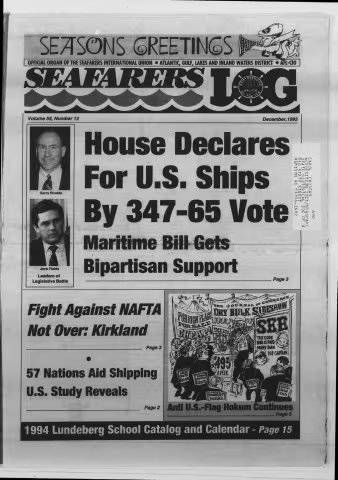
House Declares
For U.S. Ships
By 347-65 Vole
I .SI
O0^>073
-HCQ
c/)Cornt-ii—
kTi-H CO
2:;T100'-«73
»-i -40 0
C0OOv/>
\n-4 73 CO
OJ?3 s-lCOJ*
-wmo.nif:
om3>o
I
t— C02;
^ Cjri .
CO os: o
INJ CO sO
o-^ o
-n>
i
aiiTi •Mm
Bipartisan Support
^ ^ - Page 3 .
•+•
:S/-
,...i ••••:
RgM Against NAFTA
Not Oven Kirtdanil
Pages
57 Natfons Aid Shipping
U.S. study Reveais
Pages
:/. -J M- M
.mm
•-''•••• '-a
M
'§:1
994 Lundeberg Schooi Cataiog and Caiendar - Page 15
M-..' '
2 SEAFMERSlOa
5s,-
DECEMBER1993
Michael Sacco
President's Report
Sorting Out NAFTA
In all the talk about the North American Free Trade Agreement,
known as NAFTA, that came before the November 18 vote in the
House (200 against - 234 for) and the Senate vote (38 against - 61 for)
days later, it was easy to tell who was for the deal and who was
against. On one side were all the guys who won't suffer from the trade
scheme—doctors, newspaper editorial writers,
lawyers, accountants, T.V. anchors, investment
bankers, stock brokers and university professors.
These NAFTA supporters, from the vantage point of
their comfortable and secure incomes, flo^^ the
papers and airwaves with their opinions that the pact
would be beneficial to them.
On the other side of the issue were working
people. Working people recognized that the pact
meant job losses. The deal allowed companies,
with government approval and encouragement, to
relocate production and manufacturing operations
: from the United States to Mexico.
The fact that American jobs will be lost is one point everyone in
the debate—pro and con—agrees on. What can't be agreed to is the
number of jobs that will be lost or how long it will take, if ever, for
the pact to create new jobs in the United States. Those who favored
the agreement argue that the job loss in the U.S. will have only a short-
term effect. But what is short term even by their own definition could
be five years or more. The big question this raises is what happens to
the people who become victims of the pact—the hundreds of thousands
of workers who will be displaced, many of them permanently.
It is significant that environmentalists, Ross Perot and his organiza
tion, family farm groups, Ralph Nader and consumer protection inter
ests oppos^ NAFTA. But the brunt of the fight against the trade deal
was borne by organizations representing American workers and led by
the AFL-CIO, the national federation of unions in the United States.
If the trade union movement had not gone to the mat on NAFTA,
the deal most likely would have sailed through Congress. But because
of the fight the unions waged, up until the closing days of the cam
paign, it appeared that the point of view of working people would
prevail and the House of Representatives would defeat the plan. But,
as it was reported in the press, the administration kept winning over in
dividual members of Congress with various promises and in the end
patched together enough votes to pass NAFTA.
This by no means diminishes the valiant effort and leadership role
of the AFL-CIO and its member unions in behalf of American
workers. Nor does it diminish the courage and convictions of the
members of the House and Senate who opposed NAFTA.
One man who did himself proud was Representative David Bonior
(D-Mich.). He is the House Whip, the third-ranking position in the
chamber, and serVed as the leader of the anti-NAFTA forces. Rep.
Bonior worked night and day to protect the interests of all working
people and he deserves our gratitude and admiration. Another elected
official has earned our respect is Representative Richard Gephardt,
the House Majority Leader, who acted as the conscience of the
Democratic Party in opposing the treaty.
The AIT.-CIO also did itself proud in its battle. AFL-CIO Presi
dent Lane Kirkland and Secretary-Treasurer Tom Donahue and their
team of staff people waged a vigorous battle. They took on the richest,
the most powerful and the most influential of our society and never let up.
The AFL-CIO and the unions proved that in the final analysis the
American worker has only one re iable, dependable, around-the-clock
defender and that is the American trade union movement. The lesson
to be learned from this is that if it were not for American trade unions,
there would be no one to put up a tough battle in behalf of American
working men and women and their families. It is an object lesson to
tho^ who question what role unions perform.
The effort of the unions brought the issue of trade to every work
ing person's attention. We think that in this process, the way in which
trade is handled has changed forever. Trade deals are no longer a
secret pastime of foreign lobbyists or a game of manners for govern
ment bureaucrats. Today, more and more Americans understand that
trade is the property of every citizen, for every citizen can be either a
winner or loser under each trade agreement. Today it is clear the na
tion has a responsibility to balance any trade arrangements with job
opportunities for its citizens.
Certainly the AFL-CIO and its unions will keep this situation in focus
and inform working Americans and union memb^ as to what develops
from NAFTA and from other trade deals under considoation. This is a
matter that is far too important to tuck away on a shelf. The later move
ment is going make sure this debate stays tont and center.
1994 Best Wishes
In this last month of the old year, I want to take the opportunity to
extend a holiday greeting in behalf of the union to each Seafarer, ac
tive or retired, and his or her family. We wish you a happy and a
prosperous New Year. May 1994 bring each of you many good times.
Mar Ad Survey of Nations Rovoais
Wide-Ranging Maridmo Support
Volume 55. Number 12 December 1993
The Seafarers LOG (ISSN 0160-2047) is published
monthly by the Seafarers International Union; Atlantic,
Gulf, Lakes and Inland Waters District; AFL-CIO; 5201
Auth Way; Camp Springs, Md. 20746. Telephone (301)
899-0675. Second-class postage paid at MSC Prince
Georges, Md. 20790-9998 and at additional mailing
offices. POSTMASTER: Send address changes to the
Seafarers LOG, 5201 Auth Way, Camp Springs, Md.
20746.
Communications Department Director, Jessica Smith;
Managing Editor, Daniel Duncan; Associate Editors, Jor
dan Biscardo and Corrina Christensen; Associate
Editor/Production, Deborah A Hirtes; Art, Bill Brower.
Fifty-seven of the world's top
maritime nations all provide ex
tensive forms of support to their
national-flag shipping sector anc
shipbuilding industry, the
Maritime Administration
(MarAd) found in a study
released in late October,
The most prevalent forrii o
support among the nations is
cabotage laws. A total of 44
countries provide laws similar to
the U.S. Jones Act that limit ac
cess to a nation's domestic ship
ments to its own national-flag
vessels. Among the countries
responding to the survey that
have cabotage laws are Australia,
Finland, Germany, Japan
Sweden and South Korea.
The study found 23 countries
offer their national carriers
jreference to ship certain cargoes
>oth commercial and govern
ment. Listed among this group are
Taiwan, South Korea, Italy,
France and Australia. (Cargo
preference laws in the United
States include the transport of a
portion of U.S. government cargo
military supplies and agricultural
commodities.)
Governments of 40 nations as
sist their fleets obtain cargo
through bilateral cargo sharing or
restricted access treaties.
Thirty-eight nations extend
aid in the form of tax benefits to
their merchant fleets. Financing
is extended in 22 nations.
In announcing the release of
the report. Transportation
Secretaiy Federico Pena said the
study places into perspective the
efforts being made by his depart
ment to strengthen America's
maritime industries. The head of
MarAd, Vice Admiral Albert J.
Herbeiger (Ret), added the survey
shows Ae "highly competitive" na
ture of the worldwide maritime in
dustry faced by the U.S.-flag
merchant fleet
MarAd chose to contact nations
whose coastal shores connect to an
international waterway and whose
shipping industries maintain at
least 50 national-flag vessels with a
lift capacity of 1,000 deadweight
tons or more. Information was
gathered by directly contacting the
various nations' maritime repre
sentatives as well as through the
U.S. State Department's Maritime
and Land Transport Office and the
Economic and Commercial Of
ficers at U.S. Embassies and otho"
Foreign Service posts.
Japan's Extensive Loans
MarAd's report of Japanese
government support to its ship
ping and shipbuilding sector
revealed a dizzying array of
programs designed to aid and
build up those industries. Among
the programs are cargo
preference laws and a govern
ment-run company to provide
loans for shipbuilding.
Under Japanese law, foreign-
flag vessels are excluded from the
domestic trade. Crews are re
quired to be 100 percent
Japanese. Vessels plying in the
domestic trade must be owned by
Japanese citizens.
Japan is home to the largest
shipbuilding industry in die world.
The nation provides various means
to assi^ the industry.
The government of Japan runs a
company called the Maritime
Credit Corporation (MCQ that en
courages theJ>uilding of ships for
the coastal ^^."THe MCC estab
lishes a co-ownership policy for
vessels it funds. The company
generally shares 60 to 80 percen
of the construction costs while the
shipowner provides the
remainder.
The MCC will collect a fee from
the shipping company during the
years of co-ownership, roughly be
tween seven to 15 years. At the enc
of the cb-ownership, the vessel is
turned over completely to the ship
ping company
The Japan Development Bank
(JDB) makes loans to Japanese
shipowners for the construction of
oceangoing vessels. For highly
sophisticate vessels, the bank loan
covers 60 percent of the cost.
Another 20 comes from a private
bank with the shipowner providing
the rest of the funds. Interest rates
start at 5.1 percent with repayment
policies lasting up to 15 years.
The JDB also finances other
types of vessels, covering 50 per
cent of the vessel cost through a
loan. A private bank provides
another loan for 25 percent and
the remainder comes from the
shipowner. JDB financing
generally runs 10 years.
Japan's Ministry of Transpor
tation runs the Ship Research In
stitute which had an operating
budget of $6 million in 1991. The
country also budgeted another
$10.7 i^lion in 19W for research
on vessels planned for production
during the start of the 21st Century.
Germany Funds Research
Half a world away, the nation
of Germany, like the vast
majority of European nations,
emphasizes its shipbuilding sec
tor and reserves coastal trade to
vessels of their national-flag fleet.
Fellow European nations, like
'inland and Italy, also restrict
coastal trade to vessels flying the
n^onal flag.)
The nation subsidizes
shipyards that construct German-
lag vessels that will sail in the
domestic trades. Germany h^
agreed to the European Com
munity (EC) directive to limit
shipyard subsidies to nine percent
direct and indirect aid for con
tracts entered into during 1992
and 1993. However, the nation
received permission from the EC
to grant up to a 36 percent subsidy
For contracts signed before the
end of 1993 for ships to be built
in yards on the grounds of the
Former East Germany.
Germany's Ministry of
Transportation and Ministry of
Research and Technology con
tributed a combined $30.9 mil
lion toward research projects for
shipbuilding in 1992.
The country can restrict the
conclusion of freight contracts
and charters between residents of
Germany and carriers which are
residents of countries that ex
clude German-flag vessels from
free competition.
South Korean Assistance
Japan is not the only Asian
nation with a strong economy that
provides assistance to its ship
ping and shipbuilding industries.
South Korea and Taiwan also
have programs in place designed
specifically for those sectors.
Foreign-flag vessels are
prohibited from participating in
the domestic coastal trades of
both South Korea and Taiwan.
From the government of South
Korea, shipowners may receive
loans through the Korean Develop
ment Bank to cover up to 92 per
cent of the cost of constructing a
new vessel. Repayment of these
funds is made over an eight-year
grace period. In 1989, ap
proximately $270 million was re
quested by the shipbuilding
industry for government-guaran
teed loans. Another $712 miUion
was requested fiom the govern
ment for shipyard restructuring and
investment loans.
The country has a law in place
allowing all research and develop
ment investments for facilities and
equipment to be eligible for an ac
celerated-depreciation allowance
or tax credit
Taiwan Protects Industry
Regarding cargo preference,
Taiwan generally grants the car
riage of certain bulk goods to na-
ional-flag companies that
maintain liner services. Major
import shipments are planned
under the supervision of the
Central Trust' of China with first
priority given to vessels con
structed under a measure for joint
development of trade, shipping
and shipbuilding.
Second priority for cargo goes
to vessels registered in Taiwan
and the third priority then is given
to vessels not falling into the first
two categories.
When new vessel construction
is plaimed by Taiwanese com
panies, they must first contact
domestic shipyards to see if they
are capable of handling the
project.
Holding Up the Verrazano Bridge
Bosun Horse Moss may be the first man to single-handedly hold
up New York's Verrazano Bridge. This photo of the Texas native
was taken by C.J. Sandyaboard the Sea-Land Perfdimance.
!> /. / /•
•X^:
DECEMBER 1993 V".'> SEAFARil^LOe 3
'• 'Sift
House Stands Up
For U.S. Shipping
Bill to Revitalize Maritime Passes by 347-65 Vote
Flanked by presidents from affiliated unioris, AFL-CIO President Lane
Kirkland denounces NAFTA's passage at a press conference in
Washington.
h! ytake at HJ^A,
HgM for Fair Hade
Hot Oven Kirklattd
The labor movement, con
gressmen and others who oppose
the North American Free Trade
Agreement (NAFTA) expressed
disappointment and reiterated
their warnings that NAFTA will
cost hundreds of thousands of
American jobs and will severely
damage the environment, follow
ing the November 17 vote in
which the U.S. House of Repre
sentatives approved the trade
deal, 234 votes to 200.
In a press conference follow
ing the House vote, AFL-CIO
President Lane Kirkland pointed
out that NAFTA "has little to do
with national interests, with free
trade, with democratic values or
the openings up of consumer
markets in Mexico."
Rather, he said, its goal is to
"protect the property patents and
profits of U.S. corporations that
will locate facilities in Mexico"
where they intend to escape the
conditions of life and labor in the
U.S.
"The fight to keep and im
prove these standards," Kirkland
said, "will not be slowed by this
defeat... The AFL-CIO will con
trive to be in the forefront of the
struggle to ensure that trade be
tween nations benefits
Continued on page 11
The House of Representatives
showed its strong support for the
U.S.-flag merchant fleet when it
voted 347-65 in favor of legisla
tion to revitalize the industry.
The vote, held November 4,
immediately followed the
chamber's overpowering rejec
tion by a 309-109 margin of an
amendment designed to limit the
amount U.S.-flag shipping com
panies can charge to transport
government-impelled cargo. (See.
story on page 11.) The Maritime
Security and Competitiveness
Act of 1993 (H.R. 2151) now
goes before the Senate.
H.R. 2151 outlines a $1.2 bil
lion, 10-year program to provide
operating sub
sidies for a
proposed
Maritime
Security Fleet.
The bill does not
provide a
specific number
of ships that
would be in- ~
eluded in the "eP-Studds
fleet, but published reports es
timate the figure to be between 50
and 70 vessels. It is the first major
piece of legislation dealing with
the U.S.-flag maritime industry to
be considered and passed by the
House since the Merchant Marine
Act of 1970.
Excerpts of Remarks
On the Maritime Bill
By House Members
Appear on Page 10.
H.R. 2151 also creates a new
Series Transportation Program to
help U.S. shipyards build vessels
that are price-competitive on the
world market.
"This is a'tremendous show of
support for the U.S.-flag mer
chant marine by the House," said
SIU President Michael Sacco.
"Much of the credit for this vic
tory has to go to Seafarers and
their families who contacted their
individual representatives to seek
their votes."
Also pointing out the sig
nificance of the vote was the
United States Maritime Coali
tion, an advocacy group made up
of citizens' organizations,
patriotic groups, U.S.-flag ship
ping companies, maritime unions
and shipyards.
"Members of the coalition
worked hard to ensure passage of
this measure," said James Henry,
president of the coalition, which
formed in September. "This was
the first major vote concerning
maritime since the coalition
formed. We were able to speak
with one strong, united voice, and
it helped."
'Right Bill, Right Time'
In presenting the bill for debate
on the House floor, Representative
Gerry Studds (D-Mass.), the chair
man of the House
Merchant Marine
and Fisheries
Committee, said,
"This is the right
bill, this is the
right time and
this is the right
place to do the
right thing for not
only the U.S.
maritime industries, but for our
nation's economic and national
security."
Studds was joined by Repre
sentative Jack Fields (R-Texas),
the ranking minority member of
the Merchant Marine and
Fisheries Committee, who
pointed out how the merchant
marine had played a valuable role
Continued on page 11
-I"
Rep. Fields
Anti U.S. Ship Group New-Low
Peddles Tickets to Cargo Conference Under False Pretenses
In an attempt to sell tickets to what
was billed as a bulk shipping conference
scheduled in New York on November 15
and 16, the Journal of Commerce and an
agency promoting the use of foreign
registries advertized their production as an
anti U.S. seamen, anti U.S. flag seminar.
The so-called Dry Bulk Transpo '93
Conference was sponsored by the nation
al shipping and transportation
newspaper. The Journal of Commerce.
Although no mention of another or
ganization was made in the conference
advertisements, it was later revealed that
the newspaper had contracted the ser
vices of International Marketing
Strategies (IMS), an organization that
promotes foreign registries.
IMS describes itself as "a specialized
publishing, public relations and market
ing corporation committed to the
globalization of capital and policy in the
promotion of free trade...." In touting
its newsletter on runaway-flag registries;
IMS tells the shipowner, "If you're not
using open registries[,] your competitors
probably are. You should explore your
options and choose carefully from
among the different flags."
Appealing to Prejudice
In a move designed to up attendance
and appeal to groups opposed to U.S.
shipping, IMS prepared advertisements
and The Journal of Commerce ran the
propaganda. The ads, which play on
baseless prejudice, dish out the tired old
arguments about wages of American
seamen and cargo preference.
One ad proclaims in bold headline
type: "If the rationale for subsidizing U.S.
flag ships is because they serve a defense
ne^ then why should a cook on a private
vessel make more dian a Navy captainT'
The ad attributes the quote to Sen. Charles
Grassley (R-Iowa) then says, "If this kind
of thinking affects you, you should be in
New York on November 15th and 16th
for The Journal of Commerce 's Dry Bulk
Conference."'
The other advertisement states,
'These preference ships would not exist
without a subsidy program. And, if they
did not, who would miss them? Certain
ly not the military and not the commer
cial markets." The statement is assigned
to Rob Quartel, an employee of a
runaway-flag shipping operation.
The price of admission to the two-day
conference was $495.00.
SIU President Michael Sacco took the
matter to Journal of Commerce Presi
dent and Publisher Don Becker, saying
the ads were "entirely misleading" and
based on "misrepresentations and
propagandistic statements made by two
avowed enemies of the American-flag
shipping industry."
Sacco noted that in no way did he ob
ject to "the right of anyone to express at
titudes different from those I represent."
Rather, he said, "it is the deceitful way
in which the conference has been
promoted to which I object."
Becker informed Sacco the ads were
"prepared by an outside consultant"
(meaning IMS) and that he "was not
aware in advance" of the content.
Two speakers scheduled for the con
ference canceled their participation in
the event in protest of the ads.
Ernest J. Corrado, president of the
American Institute of Merchant Ship
ping, a ̂ oup representing U.S. shipping
companies, advised EMS that he was
withdrawing. He said some of AIMS
member groups found the ad statements
attacking the "government-impelled
cargo preference program" to be "er
roneous, misleading and totally inap
propriate."
From The Journal of Commerce
"IF THE RATIONALE FOR
SUBSIDIZING U.S. FLAG
SHIPS IS BECAUSE THEY
SERVE A DEFENSE NEED,
THEN WHY SHOULD A
COOK ON A PRIVATE
VESSEL MAKE MORE THAN
ANAVYCAPTAlNr
CLIUtC* 21
H this Kind ot thinking affects you.,
you shodd be m New Yorti on Nowerrber 15th and 1 em
for The Joumai of Comrnerca s Dry Buk Conference.
Fax 203^-t929 tor full registrafion detaiis.
"THESE PREFERENCE SHIPS
WOULD NOT EXIST WITHOUT.
A SUBSIDY PROGRAM.
AND, IF THEY DID NOT
WHO WOULD MISS THEM?
CERTAINLY NOT THE
MILITARY AND NOT THE
COMMERCIAL MARKETS.'^
'or TheJourrai o( "ovemtw, 150. and 161I1
•'' V-A
The propagandistic way the Journal of Commerce advertised its dry bulk conference
appears above. The large quarter page ads, run November 5 (left) and November 8,
were prepared by a firm that promotes foreign registries. That company was hired by
the newspaper to stage the event.
Corrado added, "... to appear in the
Dry Bulk Transpo '93 symposium in the
circumstances of the ads would, to my
mind, be an act of disloyalty" to the U.S.-
flag shipping industry.
After seeing the first ad, Talmage E.
Simpkins, executive vice president and
treasurer of the Labor Management Com
mittee, a group representing shipowners
with labor contracts with the National
Maritime Union, informed IMS that
under no circumstances would he par
ticipate in a conference promoted in
such an irresponsible manner.
The advertisements provoked a
demonstration from SIU rank-and-file
members. Fifteen Seafarers passed out
leaflets protesting the ads "misrepresen-
tational headlines" to conference par
ticipants on the first morning of the
event.
The advertisements leave the ques
tion as to why the conference was con
voked in the first place. What was
established by the ads, in the view of
many people in the maritime in
dustry, is that the integrity of The
Journal of Commerce was com
promised and consequently the quality
of the newspaper.
iH,-
••'A:. ; •-"A ••
I
I-
• t-
•T •
• i'
X.
:U
i
r
• J.:-' - .v'
> , '' K,
4 SEAFARERS LOG
r
Coast Guard Outlines Plans
For Mariner Card Renewal
Merchant mariner's docu
ments must be renewed eveiy five
years and certain testing standards
and fees will be assigned to the
renewal process, according to the
U.S. Coast Guard.
In a preliminary proposal
outlined in the Federal Register
of September 16, the Coast
Guard seeks to begin a program
of renewing z-cards and mariner
licenses every five years begin
ning in 1994. The Department of
Transportation agency also
wants to charge mariners for
documents when they are
renewed or upgraded.
Responding to the proposed
rulemaking, the SIU restated to
the Coast Guard its strong op
position to any fees being
charged for z-cards or licenses
in its comments to the Coast
Guard. The Seafarers, along
with four other maritime unions
and five individual mariners,
filed in U.S. District Court in
April a suit to stop the Coast
Guard from collecting money
when the agency issues or
upgrades z-cards and licenses.
Create Schedule
The Coast Guard is seeking
to create a five-year schedule for
renewal of documents and licen
ses beginning next year. All
documents and licenses would
have to be renewed by 1998 if a
mariner plans to sail.
To determine the date for
renewing z-cards and licenses,
the Coast Guard will use the date
the document was issued for
those processed before 1991.
The date of issuance is located
on the back of a z-card, to the
right of the thumb print.
Any documents issued in
years ending in 4 or 9 must be
renewed during 1994 to remain
active. Documents issued in
years ending in 5 or 0 must renew
during 1995. For those issued in
years 1 or 6, renewal must take
place in 1996. For years ending in
2 or 7, renewal has to be done in
1997. For documents issued in
years ending in 3 or 8, renewal
must take place in 1998.
For example, a member
whose z-card was issued on July
10, 1969 would have to renew
his or her document by July 10,
1994 if the proposed rule goes
into effect. Members who have
received new or upgraded docu
ments since 1991 already have a
renewal date stamped on both the
front and back of their z-cards.
The Coast Guard also out
lined its plans for charging
mariners to renew their docu
ments. The costs range from $35
to renew a z-card with no endorse
ments (such as an ordinary seaman
or wiper) to as high as $120.
In breaking down the costs,
the federal agency plans to
charge an issuance fee of $35 for
all renewals. It also is proposing
Proposed Dates
For Z-Card Renewals .
Under the Coast Guard's proposal for merchant mariner's docu
ment renewals, all z-cards will have to be updated by 1998. The
federal agency has outlined a plan based on the issuance date of
documents obtained before 1991. The date of issuance is located
on the back of the z-card to the right of the thumb print. Since
1991, z-cards have been issued with expiration dates posted on
both the front and back of the documents.)
The following chart shows the year that merchant mariner's
documents, in order to remain active, must be renewed based on
issuance dates. The exact date of expiration matches the month
and day of issuance.
Renewal Year 1994 1995 1996 1997 1998
Issuance Year 1989 1990 1991 1992 1993
1984 1985 1986 1987 1988
1979 1980 1981 1982 1983
1974 1975 1976 1977 1978
1969 1970 1971 1972 1973
a'. 1964 1965 1966 1967 1968
1959 1960 1961 1962 1963
1954 1955 1956 1957 1958
1949- 1950 1951 1952 1953
1944 1945 1946 1947 1948
1939 1940 1941 1942
1937
1943
1938
Source: Federal Register, September 16,1993
a fee of $45 to evaluate applica
tions of renewal for mariners
with endorsements.
If this comes to pass, an AB
or QMED who has been sailing
regularly and wants to renew his
or her document would be charged
$80 under the proposed plan.
When a mariner renews a z-
card with more than one endorse
ment, the Coast Guard proposes
to charge only one evaluation fee
of $45. The same single-time fee
will apply to mariners who submit
a license, z-card or certificate of
registiy (used by medical person
nel and pursers) for renewal at the
same time.
However, if a mariner holds
more than one Coast Guard-is
sued document and applies to
renew them at separate times,
the Coast Guard will charge
separate evaluation fees of $45
when the renewal applications
are received.
The Coast Guard also plans
to apply an examination fee of
$40 to mariners holding z-cards
with endorsements if recent ser
vice requirements are not met.
The agency defines recent ser
vice requirements as providing
proof of one year sailing time
within the previous five years.
Should a person wish to
return to sailing after coming
ashore for more than five
years—^as happened during the
Persian Gulf war—a mariner
would have to pay the $35
renewal issuance fee, the $45 ap
plication evaluation fee and an ad
ditional $40 examination fee
covering the qualified rating
sought. This would amount to
$120.
'Flawed Data'
The SIU charged the Coast
Guard followed "the same fa
cially flawed data and methodol
ogy it employed to calculate fees
for origind [z-cards] and original
and renewed licenses."
The union added, "This un
fair work tax unfairly burdens
American merchant seamen and
boatmen who already face dif
ficult economic times as a result
of earning their livelihoods in a
merchant marine that badly
needs revitalizing."
Before announcing im
plementation of the program, the
Coast Guard will study the com
ments it has received to determine
if a public hearing or a need for
revision of the plan is needed.
DECEMRER1993
Chief Cook Michael Hammock presents a freshly baked,farewell cake
to the seven Cuban refugees and members of the ITB Grotoncrew
before the ship's arrival in St. Croix.
m GroUm Rescues
7 Cuban Refugees
Seafarers aboard the ITB
Graron rescued seven refugees 30
miles north of Cubia adrift on a
raft during twilight October 19.
According to reports from
crewmembers, the vessel was
sailing to the Hess Oil terminal in
St. Croix, V.I. after offloading
cargo in "Tampa, Fla. Around 7
p.m. AB Patrick Rawley, who
was standing watch, spotted an
object in the distance.
Using binoculars. Captain
Nicholas Colavito and crewmem
bers determined that what they
saw was actually a group of in
dividuals adrift on a raft, wildly
waving their arms.
It took the Groton ap
proximately 15 minutes to turn
around and reach the raft, which
consisted of eight inner-tubes tied
together with pieces of steel.
Once the vessel reached the raft,
crewmembers lowered a Jacob's
ladder and brought all seven
Cubans safely aboard the in
tegrated tug-barge. The entire
rescue operation took the crew a
little over an hour.
"The group had been at sea for
seven days and had not eaten food
or drunk water for five days," said
Recertified Steward Marvin
Deloatch, who sails from the port
of New York. "When setting out
from Cuba that first night, they
only packed two air pumps, water,
salt, lemons and raw fish."
TTie chief steward noted DEU
Angel Bruno acted as an inter
preter between the crew and the
refugees, who spoke only
Spanish. '"They told us that it had
taken them eight months of plan
ning and building to escape from
Cuba. They built their raft and
made plans in the woods at night
in secret so that no one would
discover their intention to flee
Sagua La Grande Villa, Cuba,"
Deloatch told a reporter from the
Seafarers LOG.
"They had even sewn the
names, address and phone num
bers of their relatives in Florida
into the collars of their shirts."
Crewmembers provided the
Cubans with clean clothes and hot
meals prepared by the galley
gang. '"They thought the food was
excellent. They told us that they
had never had such amounts or
quality. In Cuba they were given
a few pounds of rice per month
and a very minimal amount of
meat," said the 36-year member
of the SIU, who also provided the
LOG with the photo accompany
ing this article.
"The entire crew worked very*
well together to bring the
refugees aboard. It was a wonder
ful feeling to help these people
who clearly just wanted a better
life for themselves in America,"
Deloatch recalled.
The Cubans stayed on board
with the crew for four days until
the vessel sailed into St. Croix,
vvhere the seven refugees were
turned over to federal authorities.
"They told us that they would
write the ship once settled in with
their families in Miami, but we
probably won't ever hear from
them. It is just another successful
rescue by a SIU ship," noted the
recertified steward.
The 692-foot-long integrated
tug-barge, operated by Sheridan
Transportation out of New York,
transports petroleum products be
tween the Hess Oil terminal in St.
Croix and various ports along the
East Coast.
OMI Charger's Captain Commencis Crew fer Ceurageous Conduct
The captain of the OMI
Charger xectniXy commended the
vessel's crewmembers for their
courageous actions immediately
following a fatal explosion
aboard the tanker on October 9
near the Houston Ship Channel.
"As a result of the explosion,
there were many displays of
courage, humanity and duties
well done," Master Wayne Nason
wrote. "I would like to officially
commend the crewmembers,
whose deeds I have direct
knowledge of. . . . They did not
panic and all obeyed orders. If I
am proud of anything, I am proud
of the fact that hb one was lost of
hurt after the explosion occurred."
Nason then provides brief ac
counts of the actions of several
officers and Seafarers. He specifi-
cally mentions AB Jimmie
Scheck, OMU Daniel Campbell
ant! OMU Andrew Lopez.
Details Action
Scheck "went to his fire sta
tion and assisted Third Mate
Ziegler with the hose and at
tempting to fight the fire. Jimmie
then assisted Chief Mate Wren in
pulling the pumpman off the main
deck and got him to the stem for
evacuation. Jimmie was ordered
to evacuate. He was, as he always
was onboard, an outstanding and
fearless seaman."
The captain pointed put that
Campbell "went to his fire station
in the engine room and had the
presence of mind to close down
the fire pump recirculating valve
to give the deck more pressure on
the fire main. He assisted... until
he was ordered to abandon ship."
Of Lopez, Nason wrote, "He
tied down the hot work fire hose
to continue a stream on the
flames. He, too, only left the deck
when ordered to abandon ship."
The captain added, "I am sure
there were others who performed
well and I do not mean to slight
anyone."
The circumstances leading to
the accident aboard the Charger
still are being investigated by the
U.S. Coast Guard and the Nation
al Transportation Safety Board.
Through interviews with
Charter crewmembers, federal
officials have confirmed that the
blast was sparked by a welding
torch used in an empty cargo tank
by a member of an International
Marine Services, Inc. riding
crew. The agencies still are trying
to determine when and how the
potentially explosive atmosphere
was produced.
Seafarer Perishes
The blast claimed the lives of
three men: Seafarer Milton "Wil
lie" Williams, who was sailing as
a pumpman; and Keith Kelly and
Roger Boutwell of the riding
crew. Amazingly, only one other
person, the third member of the
riding crew, suffered serious in
juries. Mike Buzbee sustained
bums to his face and hands.
A Coast Guard spokesperson
recently told the Seafarers LOG
that it may take several months to
wrap up the investigation.
Meanwhile, the Charger—a
660-foot tanker which burned for
more than five hours after the
severe explosion—has been sold
for scrap.
Correction
Due to a typographical
error, an article in the Novem
ber issue of the Seafarers LOG
incorrectly listed the age of late
SIU member Milton "Willie"
Williams, the QMED/pump-
man who died in an explosion
aboard the OMI Charger on
October 9.
Brother Williams was 46
years old.
I.:
-
DECEMBER 1993 SEAFARERS LOG 5
Tuberculosis Program Begins January 1 in Sill Ciinics
The Seafarers International
Union—Atlantic, Gulf, Lakes
and Inland Waters District—and
the Seafarers Welfare Plan will
begin implementing a tuber
culosis (TB) research and control
program in all SIU clinics as of
January 1,1994 to rapidly address
the national re-emergence of the
disease and protect union mem
bership.
The program, to be put into
place by the Seafarers Welfare
Plan medical department, is
designed to accumulate data in
order to research effects on
Seafarers of the disease. The new
program will require a painless
skin test at the time of a member's
annual 1994 physical to identify
if the Seafarer has been exposed
to TB . The main objective of such
a prdgram is to protect SIU mem
bers from the disease by testing
for possible exposure to TB
germs.
"The SIU tuberculosis pro
gram will test Seafarers at the
time of their annual physical to
see if they have been exposed to
someone with active TB at any
time in the past," Dr. Kenneth
Miller, director of the Seafarers
Welfare Plan medical depart
ment, told a reporter from the
Seafarers LOG. "If they have
been exposed, treatment may be
necessary, but that will be up to
the member and his or her per
sonal physician to determine. We
are basically concerned about the
current rise of TB and want to
protect our members by taking
every precautionary measure pos
sible."
The TB Rise
Tuberculosis, inactive for
many years in the United States,
is once again on the rise. The Na
tional Institute of Allergy and In
fectious Diseases (NIAID), a
federal health agency involved in
the research and development of
guidelines for treatment of infec
tious diseases, cites various
reasons for the resurgence of TB.
Reasons stated by the agency
for the tuberculosis revival in
clude the emergence of drug-
resistant strains of the organism
causing the disease, increased im
migration to the U.S. of people
frorn countries with a high in
cidence of the disease and trans-
mission among persons in
crowded living environments.
The Airborne Disease
TB is a disease spread by
germs called tubercle bacilli thai
can float in the air. The germs are
spread if a person infected with
active tuberculosis Of the lungs
coughs or sneezes into the air.
The TB bacteria are so tiny thai
they dry out and float on air cur
rents for long periods in an
enclosed space. TB germs are not
likely to be transmitted through
personal items associated with in
fected individuals, such as cloth-
ing, bedding, toilet seats,
showers, drinking glasses, eating
materials or any other items a per
son with the clinical disease may
have touched.
"It is very important to note
that this is not a disease that is
easily transmitted or rapidly in
fectious. The skin test might
reveal that a person may have
been exposed to someone with
TB 10 or 15 years ago, but they
may never develop the active dis
ease," said Miller.
ra germs are not transmitted
through casual contact. A person
must be in close contact for a long
period of time with an infected
individual to become affected by
the germ. Miller stressed that
even in this case, only 10 percent
will go on to develop active tuber
culosis.
Most people who breathe in
the bacteria do not become in
fected when exposed to TB. Of
those who do, most do not
develop the active disease, but the
germs can lie dormant in the cells
lining the lungs where the body
may store them. The body's im
mune system traps the bacteria
with special germ fighters. From
this point on, a lifelong balance
between the infection and the
human body's defense against the
infection continues. An in
dividual who has dormant TB
bacteria in his or her lungs is not
contagious. Only those with ac
tive TB who remain untreated are
capable of infecting others.
A nurse measures the size of the skin reaction to a TB test ad
ministered on the forearm, like the ones Seafarers will begin taking
with their annual physicals in January.
.-r- v. i. ' , .
The skin test is positive if a bump the size of a pencil eraser or bigger
appears on the arm where the tuberculin was placed, as shown above.
Because Seafarers live in close
quarters and deal with the same
people every day for an extended
period of time. Miller noted that
the SIU feels it should examine
the possible effect of tuberculosis
on those who sail the world's
waterways.
TB Testing Important
The 1994 TB screening pro
gram will take place in every SIU
clinic throughout the United
States. It will require members to
fill out a simple questionnaire
(which will include such ques
tions as age, place of birth and
places of travel, as well as family
and personal history of tuber
culosis) and submit to a skin test.
The skin test on the arm is the
only way to tell if a person has
been exposed to the germs as
sociated with tuberculosis. When
a Seafarer goes into an SIU clinic
for his or her annual examination,
a clinic physician will use a small
needle to put testing material,
called tuberculin, under the skin
of the forearm. In 48-72 hours, the
member will return to the SIU
clinic, and the test on the forearm
is examined to determine if there
is a reaction. Seiafarers may pick
up their renewed clinic card at the
time the skin test is read.
The test is positive if a bump
the size of a pencil eraser or big
ger appears on the arm where the
tuberculin was placed. This
means that the person may have
been exposed to the TB germ and
may require preventive treatment
to avoid getting ̂ e full disease at
a later time. (Seafarers receive
chest X-rays as part of their an
nual physicals which also are
used to determine the extent of
TB exposure.)
"Seafarers should not wait
until the last minute before get
ting their clinic card renewed be
cause this TB skin test is going to
take a few days. Individuds need
to plan in advance and give them-
selves enough time," noted
Miller."
A Positive Test
Seafarers will receive only the
TB skin test and initial chest X-
ray in the SIU clinic. If a Seafarer
tests positive, he or she should
seek advice and treatment from a
personal physician who knows
his or her past medical histoiy and
can determine what is best for that
particular individual. If a Seafarer
American Lung Association
This photograph shows a normal chest X-ray. Had there been any
sign of tuberculosis, a spot would have appeared on one of the lungs.
is found to have active TB, then
he or she will not be permitted to
ship out until the infection is
treated. However, a positive skin
test does not necessarily mean
that the Seafarer has active TB.
"The program will determine
if an individual has been exposed
to TB in the past. Based upon this
determination, the individual and
Ws or her own doctor will decide
whether or not any further treat
ment is required," Miller stated.
Decision for Treatment
The Centers for Disease Con
trol and Prevention (CDC) has es
tablished a specific set of
guidelines used to determine
whether or not a person needs to
begin preventive therapy.
Among the items checked by
doctors are the size of the reaction
to the skin test, age and medical
history of the patient and if the
individual is part of a high risk
group.
Based on this criteria, a doctor
will make the decision whether
treatment is necessary.
If deemed necess^, an in
dividual will be prescribed an an
tibiotic known as INK to take
once per day for six months. This
preventive treatment takes at least
six months to a year to kill all the
tuberculosis germs. A person may
continue to have TB bacteria in
his or her body unless eliminated
with the proper medication.
"A person with a latent infection
will be eligible to ship out with
the understanding that he or she is
responsible for taking the
prescribed medications as
directed by the doctor," noted
Miller.
Protection for Seafarers
The SIU medical department is
moving quickly to deal with any
potential threat to the membership
through , precautionary measures
such as early detection and collec
tion of data to better analyze any
trends or circumstances relating to
Seafarers and the disease.
The TB screening program
will remain in effect throughout
1994. In 1995, the medical
department will examine the data
collected to determine if tuber
culosis is of significant concern
for Seafarers.
Fighting the Fiu Bug in Seattie
Seafarers in the port of Seattle, including Chief Cook Veronica Cardenas (left) and Recertified Steward
Gerald Shirley, take advantage of flu shots offered by the Virginia Mason Clinic, which serces as the
preferred provider organization (PPO) of the Seafarers Welfare Plan in the Northwest U.S. Staff
members from the Seattle PPO came to the union hall to administer the inoculations.
•/•ri.
• •• • V.v" ' ''
•-VAI:.- -•
- -
i'
1
6 SUFMERSLOa DfiCiEMVfff fM3
Member^ip MeeUna Dates Set hir 1994
Maritime reform and the future of U.S.-
flag shipping... updates on the new standard
contract... the battle oyer inland documen
tation ... the SIU's fight to prohibit charg
ing merchant seamen and boatmen for
their z-cards....
These are just some of the topics
covered this past year during monthly
membership meetings conducted at SIU
halls throughout the country. Seafarers can
Twice a year at the membership meeting in
Piney Point, the union recognizes its
newest recertified bosuns, like Monte
Pereira, above.
continue staying up-to-date in 1994 by
attending the monthly meetings at their
respective ports. Article" XXIII of the SIU
ConstitutioTwice a year at the member
ship meeting in Piney Point, the union
recognizes its newest recertified bvosuns
Pictured an deals exclusively with union
meetings. The article sets out where and
when meetings are conducted and who
should run them. The Preamble also notes
the importance when ashore of attending
meetings to serve the union for those who
are at sea and therefore cannot attend.
". . . Bearing in mind that we are
migratory, that our work takes us away in
different directions from any place where
the majority might otherwise meet to act,
that meetings can be attended by only a
fraction of the membership, that the absent
members who cannot be present must have
their interests guarded from what might be
the results of excitement and passions
aroused by persons or conditions, and that
those who are present may act for and in
the interest of all."
Members are asked to clip the schedule
below and post it on their ships or keep it
for personal reference throughout the year.
Members listen to reports on shipping, their benefits plan and upcoming elections.
AB Carson Jordan asks a question pertaining to seatime changes in the new contract
during a recent meeting in the Philadelphia hall.
1994 Membership Meetings
Port
Traditional
Date January February March
*
April May June July August September October November December
Piney Point Monday after first Sunday 7 7 4-.: '""p2. .1 • 6 8 5
New York Tuesday after first Suriday 4 8 8 5 3 7 5 9 6 4 8 6
Philadelphia Wednesday after first Sunday 9 r- 8 6 7 9 • ^
Baltimore Thursday after first Sunday 6 10 10 7 5 9 7 11 8 6 10 8
Norfolk Thursday after first Sunday 10 V"-?:, • •• 9 i.:' 11 8 6 10 8
Jacksonville Thursday after first Sunday 6 10 10 7 5 9 7 11 8 6 10 8
SanJuan Thursday after first Sunday • • 10 •; -9. : 11 6 10 8
Algonac Friday after first Sunday 7 11 11 8 6 10 8 12 9 7 14* 9
khHiston Monday after second Sunday 10 ^..•:.\14: • 14, 13 •; 11 15 12 . 10 •:-12-'''
New Orleans Tuesday after second Sunday 11 15 15 12 10 14 12 16 13 11 15 13
Mobile Wednesday after second Sunday 16 16 13 11 :,:%15:V-- 13 14 12 16 14
Duluth Wednesday after second Sunday 12 16 16 13 11 15 13 17 14 12 16 14
San Francisco Thursday after s^pr^JSi^^ n 17 14 12 14 ;•' 18: 15 13 15
St. Louis Friday after second Sunday 14 18 18 15 13 17 15 19 16 14 18
•
16
Friday after second Sunday 14 :v, 18 15 13 17 15 19 16 14 18 16
Wilmington Monday after third Sunday 18* 22* 21 18 16 20 18 23* 19 17 21 19
New Bedford Tuesctey after third Sunday 19 17 21 19 23 20 18 22 20
1 Jersey City Wednesday after third Sunday 19 23 23 20 18 22 20 24 21 19 23 21
Seattle Friday after third Sunday 21 25 25 20 24 22 26 23 21 25 23
r Piney Point changes created by New Year's Day, Independence Day and Labor Day holidays; Algonac change created by Veterans Day holiday Wilminqton changes
created by Martin Luther King's Birthday, Presidents' Day and Paul Hall Birthday holidays.
•iVvT'
DECEMBER1993 SEAFARERS LOG 7
Foreign-Flag Ships Collide Near New Orleans
The U.S. Coast Guard and the
National Transportation Safety
Board (NTSB) are investigating a
collision which took place near
New Orleans on November 6 be
tween a cruise ship and a flag-of-
convenience freighter which was
carrying American grain to Russia.
The hearing began in mid-
November, following a ruling by
federal Judge Martin Feldman
denying a request by two officers
from the Netherlands-Antilles-
flag passenger vessel Noordam
who wanted to block the Coast
Guard from conducting the in
quiry.
Neither the Noordam nor the
Greek-owned, Malta-flagged Mt.
Yrhitos had a pilot onboard when
the ships crashed into each other
at a 90-degree angle around 8:30
p.m. at the mouth of the Missis
sippi River's Southwest Pass.
Visibility was clear at that time.
Coast Guard Commander Tim
Keegan told the New Orleans
Times-Picayune.
Miraculously, there were no
serious injuries aboard either
ship, although both vessels sus
tained major damage. The Noor
dam, which was carrying 1,188
passengers and 542 crewmem-
bers, received a 70-foot-wide
dent in its right side. Within the
dent is a 30-foot gash roughly 10
feet above the water line and a
smaller hole about two feet above
the water line.
The larger gash cut into
several crewmembers' cabins,
which were unoccupied at the
time of the accident.
The 654-foot ship, owned by
Holland America, also sustained
damage on its right propeller
shaft. A water main used for fire
protection and a sewage pipe
were broken.
Part of the Mt. Ymitos' bow
was knocked about 20 feet in
ward, while a hole was opened 15
feet below the main deck. The
684-foot vessel, owned by Kassos
Maritime Enterprises of Athens,
had loaded soybean meal in Con
vent, La. and was bound for
Kaliningrad in Russia.
According to press reports,
during the first days of the inves
tigation the captain of the Mt.
Ymitos, Giorgios Fragoulis,
stated that he had taken a number
of steps to avoid the collision but
was surprised when the cruise
U.S. Coast Guard photos by D.Schaefer
The passenger vessel A/oordam suffered extensive damage when it collided with a flag-of-convenience
ship last month at the mouth of the Mississippi River's Southwest Pass.
ship changed course whilei the
vessels were only a half-mile
apart. Fragoulis also reportedly
said that someone from the Noor
dam contacted him by radio
shortly after the accident and ac
knowledged that the Noordam
was at fault. >
Amoldus Broekhoven, chief
officer of the Noordam, denied
that he or anyone else from the
cruise ship had taken the blame.
However, he and another officer
from the Noordam reportedly
said they did not see the Mt.
Ymitos until about two minutes
prior to the collision.
Both vessels still were seawor
thy after the accident but were
taken to shipyards for damage as
sessment.
At press time, a spokesperson
for the Coast Guard said the in
vestigation was continuing.
The Greek-owned, Malta-flagged Mt. Ymitos was carrying American
grain to Russia at the time of the accident.
Cruise-Ship Crew 'Ran Like Deer'
Crewmembers aboard a foreign-flag cruise
ship reportedly left their passengers in the dark
after the vessel collided with a flag-of-con
venience freighter last month near New Orleans.
According to reports in the New Orleans
Times-Picayune, the crew of the Netherlands-
Antilles-flagged Noordam let at least 30 minutes
elapse following the collision on November 6
before anyone informed the passengers of what
had happened. Although there were no serious
injuries on either ship, the contact jolted everyone
aboard both vessels. Yet the 1,188 cruise-ship
passengers were left to guess about the severity
of the accident.
One articl#in the newspapef said that many
passengers were "furious" regarding the initid
response of the captain and crew. Passengers
described the scene as "hysterical."
One person was quoted as saying she has
"nothing but contempt" for the captain because
of the way he handled the situation.
Another passenger said he was in the dining
room when he saw deckhands and galley person
nel— all wearing lifejackets — "running like
deer" to lifeboat Stations, without communicating
with any passengers.
However, the crew found time to quickly
drape tarps over the area of the ship which sus
tained the most damage, the newspaper reported.
Eventually the passengers disembarked from
the Noordam a day later than originally
scheduled.
A spokesperson for Holland America, owner
of the ship, told the Times-Picayune, "It's for
tunate the accident occurred on the last day of
their cruise. By that time, [the passengers] were
pretty comfortable with the ship and cruising and
everything."
SlU Presses for Inland Safety Regs
The SIU continues to push for
legislation to improve safety con
ditions for boatmen working
along America's inland water
ways
Two bills are under considera
tion by the House Coast Guard
and Navigation Subcommittee.
The Inland Documentation Bill
(H.R. 1915) calls for all boatmen
sailing on inland waterways ves
sels of more than five gross tons
to hold Coast Guard-issued mer
chant mariner's documents (z-
cards).
This piece of legislation
which was introduced earlier this
year by Representative Gerry
Studds (D-Mass.), chairman of
the House Merchant Marine and
Fisheries Committee — has
received additional attention
since the early morning Septem
ber 22 accident near Mobile, Ala.
when an Amtrak passenger train
ran off a bridge that had been
struck moments before by a barge
pushed by the MV Mauvilla.
Forty-seven people lost their lives
in the accident. Reports of the
investigation state the tug/barge
got lost in a heavy fog, sailed into
an unnavigable bayou and struck
the unlit bridge. Two of the four
crewmembers aboard the
Mauvilla did not carry z'^cards.
Union Noted Dangers
In testimony before the sub
committee on October 12, the
SIU pointed out only the tug's [proficiency and knowledge of the
captain and pilot are required to
hold documents even though all
four crewmembers have naviga
tion responsibilities.
Detailing the union's efforts
since 1992 to pass legislation
calling on boatmen to hold docu
ments, Terry Turner, SIU director
for legislative affairs, told the
subcommittee, "For the last two
years, the SIU has insisted that a
potential catastrophe exists on the
nation's inland waterways. No
longer is this prophetic; the
[Amtrak] Sunset Limited has
made it all too real."
Deep sea and Great Lakes
mariners possess z-cards. To ac
quire a merchant mariner's docu
ment, the Coast Guard requires
evidence of a drug-free
urinalysis, check of the National
Driver Register for drunk-driving
or controlled substance viola
tions, an FBI criminal record
background investigation, proof
of U.S. citizenship or evidence of
lawful entry and permanent
residency from the Immigration
and Naturalization Service and
proof of employment in the in
dustry or evidence of military ser
vice.
Z-cards are renewed every
five years. In order to receive an
advanced rating, such as able
bodied seaman or tankermen, a
boatman must pass a Coast Guard
examination that indicates
rating.
The other bill before the sub
committee stems from the acci
dent itself. The Towing Vessel
Navigational Safety Act of 1993
(H.R. 3282) requires all inland
waterway vessels to be equipped
with marine charts, navigational
publications, compass, radar and
fathometer.
Not Fully Equipped
During the October 12, hear
ing representatives heard tes
timony that the Mauvilla was not
equipped with marine charts,
navigational tools or a compass.
The Coast Guard pointed out such
equipment is not required by law
or agency regulations.
Subcommittee Chairman
Billy Tauzin (D-La.) offered H.R.
3282 the day after the hearing to
provide for the additional naviga
tional equipment.
A union study of Coast Guard
data from the late 1970s to mid-
1991 revealed the leading cause
for a majority (58 percent) of the
accidents on inland waterways
was human factors. Meanwhile,
aboard U.S.-flag vessels, 36 per
cent of the accidents on the Great
Lakes were attributable to human
factors with only 31 percent on
the deep seas. There are 25,777
miles of navigable inland water
ways.
Action on both bills is ex
pected to resume when Congress
returns to Washington in January.
Unseasonably mild weather In the Great Lakes region means the
opportunity for more work for vessels like the Walter J. McCarthy,
pictured here steaming by the SIU hall In Algonac, Mich.
Gnat Lakes Ships CoaOnue
Saillttg in Friendiy Weather
No date for the closing of the
Soo Locks has been announced
because of unseasonably mild
weather in the Great Lakes
region.
Traditionally the locks close in
mid-December because of ice ac
cumulation on Lakes Michigan,
Superior and Huron. If mild
weather conditions continue, sail
ing could extend well into
January.
Seafarers who sail on the
Great Lakes have had "an excep
tionally good year," said Byron
Kelley, vice president of the
SIU's Great Lakes region.
Kelley recalled that the last
two winters have been mild,
which allowed Great Lakes ves
sels to continue shipping opera
tions on the lakes into December
and occasionally into the new
year.
"Last year a substantial num
ber of Great Lakes vessels, such
as the large carriers, sailed into
the first week of January. This is
a rare occurrence but we hope for
more of the same this year," the
SIU official stated.
Rivers and harbors along the
Lakes generally start icing in the
early autumn when the colder
weather moves south from the
Arctic. This year has been mild so
far, and all projections for the
Great Lakes region point to the
weather pattern continuing.
Factors that contribute to the
closing include car^o dem^d
and the weather conditions.
"As the temperature drops so
does the demand for the cargo
carried along the lakes, such as
iron ore," said Kelley.
V . ('•
•' .i---
• Tc. .
'f
• -- ••• •• .
r.
8 S8AFMERSL0G DECEMBER 1993
SlU-Creweil Williams Returns to States for Hull Inspection
Bringing in the docking lines are ABs Rich Barnes, Ken Chinn, Mat
Donovan and Rich Hilbert.
Reviewing the new standard agreement in the Seafarers LOG are (left
to right) QMED Art Wadsworth, QMED Michael Stearman, Deck
Engine Utility Paul Charly Jr., QMED/Electrician Tony Muellersman
and QMED/Pumpraan Fred Caltabiano.
Aircratt Carrier Proves
No Match for Navajo
For the SIU's Government
Services Division crewmem-
befs aboard the USNS Navajo, it
was just another day on the job.
However, for any of the on
lookers from San Diego to Long
Beach, Calif., it was a seagoing
chapter of the children's story,
"The Little Engine That Could."
The Navajo, a Military
Sealift Command-Pacific Fleet
(MSCFAC) tugboat, was called
upon to tow the USS Ranger, an
aircraft carrier, up the California
coast. The fleet tug displaces
only 2,260 tons of water while
the Ranger displaces 64,000
tons. Such a move had never
been attempted by an MSCFAC
fleet tug.
The job appeared to be a mis-
Crewmembers aboard the
USNS Navajo secure a line to
tow the USS Ranger from San
Diego to Long Beach, Calif.
match, but the Navajo was up to
the task, bringing the Ranger to
the location where it will under
go hull preservation before
being mothballed at the Bremer
ton Naval Shipyard in
Washington.
Operations aboard the
Navajo began before dawn. By
5:30 a.m., the tugboat was in the
middle of San Diego harbor
awaiting the Ranger. The
aircraft carrier was decommis
sioned earlier in the summer
after 36 years of service. The
Ranger had served in nine com
bat missions from Vietnam to
Somalia.
Navajo crewmembers
worked as a team to secure the
chain from the flight deck of the
Ranger with 23/4-inch wire.
Once done, the tow was under
way. There were the iisual
creaks and groans, but no wires
snapped during the voyage.
'This was business as usual,
except that this was really big
business," noted Captain Mark
Wilson, master of the Navajo.
"It's amazing to watch how
easy these guys make a very dif
ficult and demanding job look,"
added Captain Bill Baldwin,
MSCFAC marine,^ superinten
dent who will take over as
mastef of the tug next year. "It's
easy to take what appears to be
a routine job for granted, but
that's never the case with Aese
vessels. The crews of these
ships deserve a lot of credit for
the work they perform every
day."
Seafarers aboard the Pfc
Dwayne T. Williams worked hard
preparing the vessel for the
shipyard as the militar
prepositioning ship (MFS) sailec
into the United States for the first
time in two years.
The U.S. Navy-owned and
Amsea-operated vessel is sta
tioned in the Facific islands
Guam and Saipan. The SIU
crewed Williams sailed into Fort
Everglades, Fla. where SIU Rep
resentative Ambrose Cucinotta
serviced the vessel and found the
crew working diligently to clean
the ship for its biennid hull in
spection and layup in Norfolk,
Va. Later this month, the Wil
liams will re-load cargo in Jack
sonville, Fla. and begin the
voyage back to Guath through the
Fanama Canal.
Bosun Fred Meier sailec
aboard the Williams from Guam
to Florida and played a vital part
in preparing the vessel for the
shipyard.
"In getting the ship ready for
the shipyard, we transported the
gear down below the hatches and
checked the hatches and cranes to
make sure they were operating
correctly. We worked hard, but
the Williams is an incredible ship
and is one of the cleanest and
prettiest that I have ever been on.
Our crews keep it very well main
tained with waxed decks and the
whole nine yards," the bosun told
a reporter from the Seafarers
LOG.
"The crew was unbelievable
with eveiyone from the captain on
down really working in complete
harmony. The food also was out
standing, and the special meals that
the galley gang prepared were al
ways talked about," he added.
Meier joined the Seafarers in
1990 in the port of Jacksonville.
Frior to joining the union, he
worked for the U.S. Coast Guard
for 26 years. He noted that once
he retired, he missed sailing and
decided to return to life at sea.
Bosun Meier sailed aboard the
Cape Canaveral, also an Amsea
vessel, during Fersian Gulf war.
The prepositioning ship is
designed to fully ^uip Marine
expeditionary brigades with
enough ammunition and supplies
for 30 days. The Williams was
one of the ships which helped the
United States in its early rapid
deployment of materiel to the
Fersian Gulf.
The ship is part of the MFS
program developed Under the
Carter administration after the
failed Iranian hostage rescue at
tempt. Frepositioning vessels are
designed to provide rapid military
deployment, complete with sup
plies, to any hot spot in the world.
The Williams is a roll-on/roll-off
ship built in 1984 and carries
various military hardware such as
earthmovers, tanks, bulldozers,
ammunition, food and water as
well as fuel and other items needed
to supply amphibious forces.
Special sealift classes are of
fered at the Lundeberg School for
Seafarers aboard vessels like the
Williams. Upon completion of the
training, SIU members are able to
handle any special operation re-
quired—from underway
replenishment and cargo and fuel
transfers at sea to helicopter
operations. Deck department
members also are instructed in
shipboard damage control, search
and rescue operations and
familiarization with cranes and
forklift trucks.
The Pfc. Dewayne T. Williams
is named for a U.S. Marine who
gave up his life in order to save
the lives of his fellow soldiers.
Williams smothered a grenade
with his body during action in
South Vietnam in 1968.
SA Sharon Lee Herner organizes
he salad bar in the officers' mess
tell before dinner is served.
Operating the docking winch aboard the Williams is Bosun Fred Meier.
The galley gang prepares a special lunch before the vessel goes into the shipyard. They are (left to right)
Cook/Baker Deborah Koen, Chief Steward Stephen Avallone, SA Danny Mergillano, SA Robert Russell
and Chief Cook Sal Tomeo.
d£ ' ~ . >-If/
The Pfc. Dewayne T. Williams, docked in Port Everglades. Fla.. retums to the U.S. after two years.
• J.;'?
-.--r-T . - . V-
I pi|l?^-.'-
r '
'l'
i-;':-3.'>'
VV^^'' '•
'WM
DECEMBER 1993 SEAFARERSLOG 9
r-f'-.v;- •-,'
Elevai Bosuas Advance to Top of De(dc Department
Eleven Seafarers recently ad
vanced to the top of the un
licensed deck department when
they completed the challenging
bosun recertification course at the
Paul Hall Center for Maritime
Training and Education.
The recertified bosuns, who
graduated from the highest cur
riculum available to SIU members
sailing in the deck department,
were recognized during the month
ly membership meeting in Piney
Point on November 8.
The bosuns received rigorous
training and testing in areas such
as safety, navigation and com
munications.
Students and Instructors
During the five-week course,
the 11 Seafarers finished ad
vanced classes in firefighting,
safety and first aid as well as deck
skill courses in wire-splicing,
knot-tying and navigation. They
practiced ship handling proce
dures in the Lundeberg School's
simulator, which reproduces sail
ing conditions at sea and in ports
worldwide. Additionally, the
bosuns worked with trainees at
the school, passing along some of
the knowledge and experiences
they have gained over the years.
The bosuns also receiv^ spe
cialized training in operations
unique to military ships assigned
to a sealift role. This includes the
Recertified bosun Giovanni Var
gas joined the union in 1953.
handling of the Hagglund crane;
helicopter operations, which are
critical to a vertical replenish
ment maneuver; damage control;
underway replenishment and the
use of forklifts of all sizes.
"I loved the entire class as a
whole but if I had to pick one
thing it would be the sealift
course. The training is something
that I will always use and that I
never really had," said 42-year-
old Jim Rader, who returned to
Piney Point to up^ade for the
third time by attending the bosun
recertification program. Rader
noted the dramatic improvements
Following graduation ceremonies, nhembers of the bosun recertification course pose for a photo with SIU
officials. They are (from left, kneeling) Russell Barrack Jr., Felix Santiago, Jessie Mixon, (second row)
Terry Dennis Cowans Sr., SIU Vice President Augie Tellez, Mark Lamar, SIU President Michael Sacco,
Bert Gillis, Jim Rader, Frank Lyie, Giovanni Vargas, Francisco Munoz, Executive Vice President Joseph
Sacco and Walter Petty.
in both the school's facilities and
its curriculum. He had not been to
Piney Point since he upgraded to
quartermaster in the late 1970s.
I'll be back for more. I don't
think I can ever get enough of this
place," said the 18-year member
of the SIU, who currently sails out
of San Francisco.
Also included in the sealift
course is what is known as search
and rescue. The bosuns are
trained in the operation of small
boats in the event that a rescue or
search for survivors of a dis
tressed vessel at sea is necessary.
Bill Hellwege, a Lundeberg
School instructor for the sealift
course, said, "The search and res
cue aspect of the class actually
showed the bosuns what to do
step by step in the event of such
an occurrence. I tried to instill
into the men that they are the
kingpins—the ones to make it
work should such a rescue be
come necessary. Even though all
crewmembers become involved,
the bosuns must lead the way, and
this training ensures that they are
prepared with the proper skills.
"This was a super good bunch
of guys. They were excellent in
all aspects, llie thing that made
them stand out from the rest was
that they worked with the trainees
and made them really feel com
fortable. They reminded the
trainees that they were once in the
same position," he added.
Russell Barrack Jr., a 1975
Piney Point graduate, com
mended the instructors and cur
riculum of the Lundeberg School.
Practicing their wire-splicing skills are Recertified Bosuns Bert Gillis
(left) and Mark Lamar.
"Overall, the entire recertifica
tion program was excellent anc
great fun. Our instructor. Bill
Hellwege, really knew how to re
late to seamen, and his teaching
was top-of-the-line," said the 37-
year-old Seafarer who ships from
the port of Norfolk, Va. He also
encouraged others to "utilize the
school because it will do every
thing in the world for you."
"We all worked well together
and forged friendships that
helped our progress through the
program," rioted Walter Petty,
43, from the port of Jacksonville,
Ha.
Another key segment of the
bosuns' course of study focused
on the workings of the SIU and its
various plans. The bosuns met
with representatives of every
department of the SIU for ques
tion and answer sessions.
For example, they conferred
with officials from the union
collective bargaining department,
from its governmental affairs
department, from the welfare,
vacation, training and pension
funds and from the Seafarers
LOG.
In addition, the bosuns studied
and practiced communication
techniques and leadership skills
in workshop sessions with Lun
deberg School instructors.
Capitol Hill Experience
Terry Dennis Cowans Sr.,
another 1975 Piney Point
graduate, rated the trip to the
union's headquarters in Camp
Springs, Md. and to Capitol Hill
as the high points of the recer
tification course. "I learned a lot
about how the union and Con
gress work. I think that it is really
important for Seafarers to know
and understand what is going on
politically," said Cowans, who
has upgraded several times at the
school._"Most of the bosuns in
this program I have upgraded or
sailed with before. TTiis course
has prepared me to be the best
ship's chairman I can be," the 39-
year-old Mobile, Ala. native
added.
Similarly, Frank Lyie who
sails from Houston, noted that he
enjoyed visiting the Maritime
Trades Department to see what is
going on politically within the
maritime industry." The 37-year-
old bosun has been active widi the
union, representing Houston on
the SIU's Tallying Committee in
Janua^ to count the ballots cast
by union members in voting for
the national officers of the SIU.
Speaking during the gradua
tion ceremony, Bert Gillis,
1978 graduate of Piney Point,
stressed the importance of be
coming politically involved with
the union. Gillis, 39, encouraged
the trainees to "pay attention to
the political aspects of the union
because it is very important. You
are important. You are our fu
ture."
Course Helps Efficiency
Francisco Munoz, 51, from
the port of New York said he
"loved the course. I was surprised
to find there were many things
that I did not know. My favorite
part of the program was having
access to the computer room and
the library. There are all types of
literature and always something
more to learn."
Giovanni Vargas and Felix
Santiago were friends long
before they began sailing with the
SIU. Both bosuns joined the
union in their native Puerto Rico
and, after years of sailing,
renewed their friendship while at
sea. Vargas, 58, joined in 1953
while Santiago, 49, joined in
1969.
"Firefighting, CPR and first
aid were all new and advanced to
me," Vargas told a reporter from
the Seafarers LOG. "This is my
first time at the school and my
class was beautifiil. I have really
benefited a lot, and I can say for
certain that I would not mind sail
ing with any one of the bosuns in
this class."
Santiago, like Vargas, sails
from the port of New York. He
said, "It is a great program and I
really enjoyed it. I enjoyed learn
ing the CPR techniques and all
the different aspects of the sealift
course. The information that I
learned through the program is
very valuable and I will not
hesitate to teach others on the ves
sels I sail on."
Thirty-seven-year-old Jessie
Mixon was taken aback by the
progress of the school. He had not
been to Piney Point since he
graduated from the trainee pro
gram in 1974. "I am very im
pressed with the progress that the
school and the entire facilities
have made since my last visit 19
years ago," said Mixon, who sails
out of the port of New Orleans.
Like Vargas and Santiago,
Mixon noted that his favorite part
of the course was the firefighting,
CPR and first aid. "We learned
skills that we all may use some
where besides a ship. They are
skills everyone should be very
familiar with," he noted.
During his five-week stay,
Mixon's wife came to visit, and
the couple toured the
Washington, D.C. area. They at
tended celebration ceremonies on
the U.S. Capitol grounds as the
statue "Freedom" was raised back
to the top of the Capitol dome
after months of restoration.
Mixon recalled that it was "a very
historical day that I will never
forget."
Mark Lamar also had not
been back to the school since his
1975 graduation as a Piney Point
trainee. "The course as a whole
was very rewarding, and I com
mend the professionalism of the
instructors. I also think that we
should always remember Paul
Hall and thank him for the
vision of making such a school
possible," said the 41-year-old
bosun who sails from the port of
Seattle.
Francisco Munoz especially en
joyed the school's computer room
and library facilities.
Lundeberg School instructor Bill Hellwege (left) and Bosuns Frank
Lyie (right) and Terry Dennis Cowans practice the correct procedures
for operating an oxygen breathing apparatus.
••
if
-
'X.
t •
kr
• -;-V
-.J / f '•
; .-r ,;
••
• .-.MS
V ' Ji . t,' - :• '* •'
• •>,••• . L'"•"r-vr. 1 • .. ,• "i" •
. A*--
•<;> -••
Cv.;'
¥ 5
.1- •'/
III SCAI^iieiS 1017 DECEMBER 1993
House Backs U.S. Ships
In voting 347-65 in favor of H.R. 2151, representatives
from both political parties and from all across the country
expressed their support for the U.S.-flag merchant marine
and the men and women who crew the vessels (see story
on page 3). Listed below are excerpts of some of the
speeches delivered during the debate November 3 and 4.
Joseph Moakley (D-Mass.)
We need a strong
U.S.-flagged mer
chant marine for
military support in
times of war and for
support of U,S. trade
in times of peace.
This legislation is an
important first step toward restor-
ing America's maritime
presence.
James Quillen (R-Tenn.
This measure will
provide employment
for American mer
chant mariners-
civilians who have
proven their dedica
tion and patriotism
by their actions in
every war which has threatenec
the well-being of the Unitec
States.
recongized. History has taught
me to place my trust and foith into
the hands of God and the
American flag—not in the hands o:
foreign governments or foreign
seamen whose lack and total ab
sence of loyalty to the UniteC
States is already well documentec
in every war in which they have
been employed. The Unitec
States continues to need a private
fleet of merchant ships to support
our armed forces.
Gerry Studds (D-Mass.)
Gerald Solomon
Our maritime in
dustry has been
devastated in recent
years by unfair
foreign competition
and unwise govern^
ment policy. Need
less to say, tens of
thousands of jobs have been
destroyed as a result of this, and
tens of thousands more are at
stake if we don't act now.
Peter Goss(R-Fla.
The elimination of
the American mer
chant marine would
be damaging to our
economy, to our na
tional security and to
the safety of our
ports. The great rush
to re-register cargo ships under
flags of convenience has con
tributed to the economic stagna
tion of our coastal regions, led to
the decline of safety standards of
ships trading in U.S. ports and
made the United States dependent
on foreign vessels in times of war.
mMum.
1, tor one, would
prefer to keep ship
board and shipyard
workers actively
employed, rather
than incur the
revenue losses and
welfare costs of
giving them a pink slip. Yes, by
all means, let us support maritime
reform for its role in national
defense.
John Duncan (R-Tenn.
the U.S. flag.
We have the oppor
tunity today by pass
ing this legislation to
promote U.S. Jobs,
U.S. shipbuilding
and encouraging
U.S.-flag vessel
owners to stay under
Helen Bentley (R-Md.
r^c Too often, par
ticularly in
peacetime, the
private commercial
U.S. merchant
marine is the forgot
ten arm of our
military, and its con
tributions in bringing price
stability and competitiveness to
our international trades is rarely
American goods
must have the option
of being carried to
foreign markets on
American ships.
Without that option,
those goods may
never leave our
shores. A foreign
competitor, with an interest or in
fluence in shipping, could easily
eliminate competition by simply
being unavailable or too expen
sive to ship U.S. products.
Jack Fields (R-Texas)
We must have a
U.S.-flag fleet
operated by skillful
mariners. The men
and women who
operate our U.S.-
flag ships are hard
working, dedicated.
patriotic, taxpaying American
citizens. They are well-trained in-
dividuals, among the best
seafarers in the world.
William Lipinski (D-lll.)
As. the world's
largest trading na
tion, the United
States must have a
strong commercial
fleet. Allowing our
maritime industry to
die would be a
It is a mystery to
many Americans,
and especially to this
American, why we
have allowed the
United States to lose
its maritime primacy
and supremacy — a
position it has maintained for
most of this century.
tragedy. Losing otir merchant
marine would threaten our
economic viability and national
security. We must act now.
Don Young (R-Alaska
I can tell my col
leagues as the only
person in this room,
1 believe, who is ac
tually licensed to be
a captain, that it is
crucially important
that we have
Amejrican-crewed ships, captains
and mates and ships built here—
American ship bottoms—so we
can take and move our troops and
move our supplies.
Owen Pickett (D-Va.
This nation has
neglected its mer
chant marine for too
long. The fact that
privately owned
U.S.-flag commer
cial ships now carry
less than 5 percent of
this country's overseas trade
should, in itself, be cause for
alarm.
Maria Cantwell (D-Wash.
What is at stake is
nothing less than the
survival of the U.S.
merchant marine
and shipbuilding in
dustries and
America's national
security. '
Arthur Ravenel (R-S.C.)
The House has the
unique opportunity
to save an important
* ' industry, one that
has seen many sun
sets in its day anc
one that has
provided our nation
an invaluable service for rnany
years
Alcee Hastings (D-Fla.
This legislation wil
ultimately benefit
American labor an(
the economic anc
military interests of
our country. We can
not allow any further
depletion of our
U.S.-flag merchant fleet.
Peter Torkildsen (R-Mass.
The U.S. merchant
marine fleet has
served our country
well from World
War II to Desert
Storm. In our own
interest, we must
support an industry
that is vital to our national
security.
Lynn Schenk (D-Calif.
Randy Cunningham (R-Cal.
I could count on one
hand the number of
bills that have set
aside political agen
da for the good of
Americans. This is
one of those bills.
Gene Green mmm
m
k'i
As we embark on an
era of more global
trade, we must real
ize that our iharitime
fleet will provide the
means by which
much of our future
trade will be con
ducted.
Gene Taylor (D-Miss.)
On the day that I was
borri, we were the
world's greatest
maritime power.
Last year, this great
nation did not build
one merchant ship.
The Groatians, in the
middle of a war, built
0. The nation of Malta built four;
the nation of Vietnam built one.
The Japanese built over a third of
all of the ships built in the world,
but this nation did not build one.
George Hochbineckner (D-t^.Y.)
We have a proud
maritime heritage in
these United States.
If the United States
is going to continue
as a leader in the
global economy, it
will need a strong
maritime industry.
Nancy Pelosi (D-Calif.)
[The U.S.-flag mer
chant marine] is an
important aspect of
our economic inde
pendence because
the United States
wiir avoid potential
dependence on
foreign-flag carriers.
And it is an important aspect of
national security because the
U.S.-flag fleet will continue to be
able to meet our nation's sealift
requirements.
Patsy Mink (D-Hawaii)
We cannot look to be
a leader among na
tions without first
looking to lead our
own people, to
defend our own in
dustries, to embrace
our own causes and
to solve our own problems.
Vic Fazio (D-Calif.
If we intend to ex
pand our interna
tional exports in a
global economy, we
must see to it that our
maritime fleet is in
ternationally com
petitive with those
competing countries.
Few people in this
body blink when
buy-American
amendments are of
fered to spending
bills on this floor,
believe strongly that
the cargo preference
aws are no different.
cargo. We learned these lessons
during the gulf war, when foreign
carriers refused to enter the Per
sian Gulf. Our U.S. merchant fleet,
however, accepted its orders and
moved vital militaiy hardware into
harm's way.
Tillie Fowler (R-Fla.
It is crucial that we
pass this legislation
to preserve jobs in
the maritime in
dustry. Thousands of
American jobs
would be lost if these
companies re-
flagged, and we would also lose
our position as the world's largest
maritime trading force.
Tom Barlow (D-K
H.R. 2151 is bipar
tisan, it is com
prehensive and it is
constructive. It will
help rebuild our
merchant marine
and make it more
competitive. It is
vital to the future of America's
maritime capability.
James Walsh (R-N.Y.
Charles Rose (D-N.C.
r- I want to see
American farmers
growing com on the
high ' plains of
America, but I want
to see American bot-
toms carrying
American grain in
American-bottom ships on the
ligh seas of the world. Why is
that too much to ask for?
Martin Lancaster (D-N.C.
During the Persian
Gulf war, we relied
primarily on
American sealift to get
our unit equipment,
ammunition and sup
plies to the war theater.
Our merchant vessels
the call. So did our answered
civilian merchant mariners.
Robert Borski (D-Pa.
H.R. 2151 will create
and preserve jobs,
while preserving tlie
vital defense
capability of this na
tion. It will allow
workers in the U.S.
maritime and ship-
milding industries to compete on
a level playing field with their
breign counterparts.
Christopher Smith (R-N.J.
In times of crisis,
American-flagged
ships, crewed by
American citizens,
are the most reliable
and capable means of
transporting military
All the ships in the
world don't mean
anything if you do
not have trained and,
most important,
loyal U.S. merchant
mariners to man
them.
It is important for us
to maintain our
maritime industry.
We cannot afford to
lose more maritime
ships.
Elizabeth Furse (D-Ore.
We must design and
piit in place a sen
sible maritime
policy, and we must
do it soon or there
won't be a maritime
industry left to sal
vage.
Richard Gephardt (D-Mo.
The American mer
chant marine in
dustry is critical to
our nation's national
security. We need a
ready merchant
marine to serve in
times of national
emergency. This bill assures us of
a reliable, well-trained and
prepared merchant marine.
Herbert Bateman (R-Va.)
I really believe
that we have
developed a proposal
which both maritime
labor, the operators
and, yes, the
shipyards can, in
fact, endorse.
Solomon Ortiz (D-Texas
This maritime
reform and revitaliza-
tion program is vital
to the future of our
U.S.-flag merchant
fleet and shipbuilding
industry.
T
•On
%'li >
Vr.v.;
r?'?.r
'•'/'UJ' '
, f
•' /I?
V: '•
DECEMBER 1993 SEAFARERS LOB 11
House Repels Attack
On Cargo Preference
The House of Representatives,
in a bipartisan show of support,
overwhelmed an attack by farm-
state legislators on the nation's
cargo preference laws by a vote of
309-109.
The decision on an amend
ment offered by Representatives
Tim Penny (D-Minn.) and Fred
Grandy (R-Iowa) directly
jreceded the chamber's Novem-
)er 4 vote in favor of legislation
designed to revitalize the U.S.-
flag merchant fleet.
The Penny-Grandy amend
ment came in the w^e of the
$700 million grain deal reached
between President Clinton and
Russian President Boris Yeltsin
in April. Since then, cargo
preference foes have made
several attempts in the House and
Senate to restrict or cancel the
amount of grain that would be
carried on American-flag bot
toms.
(Cargo preference laws allo
cate a certain percentage of
government-impelled cargo be
carried aboard U.S.-flag vessels.)
"There is nothing diat gives
me more distress than members
who will come to the floor be
cause of a regional interest or a
local economic concern, but fail
to rise to what is, in my judgment,
an obvious and overriding nation
al need," stated Representative
Robert Torricelli (D-N.J.).
House Majority Whip David
Bonior (D-Mich.) said the pur-
)ose of the amendment was not to
ower cargo preference costs, but
"to drive the American merchant
marine out of business."
No Lowering Standards
Responding to charges that
U.S.-flag maritime operators
should be forced to reduce costs
because some agricultural sub
sidies like honey and mohair have
been eliminated. Representative
Jack Fields (R-Texas) asked
which protections for American
workers should be abolished.
Fields, the ranking member of
the House Merchant Marine and
Fisheries Committee, noted U.S.-
flag vessels have to meet federal
and state income tax laws, the
National Labor Relations Act, the
Fair Labor Standards Act, U.S.
Coast Guard regulations, in
surance specifications and much
more.
"A foreign crew, as an ex
ample, of 36 from a Third World
countiy can be hired for $650 per
day, including benefits," the
Texas Republican told his col
leagues.
"The authors of this amend
ment want to compare U.S. ship
ping rates to these competitors. I
cannot accept that nor should this
Congress nor should the
American people.
Representative Tom Lantos
(D-Calif.) added, "People who
work our merchant ships have to
pay the same prices for every
thing that the rest of us do. They
do not live in Third World
countries. They live in the United
States.
"If you want to compare the
cost [of U.S.-flag vessels and
crews] with Malta shipping,
Liberian shipping, Panamanian
shipping, where the average
crewmember makes $18 a day,
then we cannot compare our regu
lated ships with their ships and
say we need to reduce our costs,'
stated Wayne Gilchrist (R-Md.).
Multinational Interests
After supporters of the amend
ment stated they were standing up
for the taxpayers of their districts,
several representatives chal
lenged the remarks.
"I want to point out that the
anti-cargo preference advocates
do not represent the U.S. tax
payers nor do they represent the
family farmer," announced Rep
resentative Helen Bentley (R-
Md.).
"They represent the agricul
tural conglomerates and the inter
national grain brokerage houses
owned by foreigners. They are the
same companies which stand to
benerit from the demise of what
is left of the U.S merchant marine
because they and their sub
sidiaries do own fleets of foreign-
flag ships that already carry over
96 percent of all. agricultural ex-
)orts from this country as well as
other commodities."
Representative Charles Rose
(D-N.C.) read a list of companies
associated with the North
American Export Grain Associa
tion (NAEGA), a Washington
based trade group that long has
fought against cargo preference
legislation. When he completec
the list. Rose noted the members
"support the Penny-Grandy
amendment [and] have large in
terests in foreign flag vessels.'
Fields pointed out specific
foreign-flag shipping interests
among several NAEGA me
hers. "Cargill owned or charterec
an ocean-going fleet of 2^:
foreign-registered vessels in
1985. Continental Grain operates
foreign ships through a network
of subsidiaries and joint ventures
The Louis Dreyfus Corp. is hal
owner of Gearbulk, a liner opera
tion based in Norway. Archer
Daniels Midland announced that
it is seeking a deal with the Soviei
Union, trading American grain
for Russian-flag ships."
Third World Concerns
"This amendment will only
serve the interests of foreign ship
owners arid multinational grain
houses with flag-of-convenience
vessels who comply with mini
mal and loosely administered tax,
safety, labor, health and environ
mental standards," said Repre
sentative William Lipinski
(D-Tll.), chairman of the House
Merchant Marine Subcommittee.
Bentley picked up on the
remarks about lax environmental
and safety standards. She referrec
to a report entitled "Ships of
Shame" published by the
Australian House of Repre
sentatives Standing Committee
on Transportation Communica
tion and Infrastructure.
She stated among the charges
made about foreign-flag vessels
in the Australian trade before the
Australian legislative body were
those of unseaworthy ships, poor
ly trained crews, careless com
mercial practices by marine
insurers, inadequate and poorly
maintained safety and rescue
equipment, crewmembers unable
to communicate among themsel
ves, lack of food, beatings by of
ficers of crewmembers, denial of
pay and much more.
Ship Bill Passed by Strong House Vote
Continuedfrom page 3
through the years in support of
America's armed forces.
"For the past 200 years, our
nation's merchant marine has
delivered troops and vital war
supplies to every world conflict
from Guadalcanal to the Persian
Gulf," ,,Fields
told his col
leagues. "Our
success in win
ning these con
flicts is owed in
no small part to
the invaluable
contributions of
these mariners.
Rep. Batemari Unless H.R.
2151 is ap
proved, 1 have graVe doubts that
this fourth arm of defense will be
available in the future."
Passage of H.R. 2151 was
boosted when President Clinton
released a statement shortly
before the debate began stating
the administration would support
the bill and "work with Congress
to fund the Maritime Security
Fleet authorized by the bill." The
White House also announced it
was against any changes in U.S.
cargo preference laws.
Studds and Fields—along
with Representatives William
Lipinski (D-111.), the chairman of
the Merchant Marine and
Fisheries Subcommittee, and
Herbert Batemari (R-Va.), the
ranking minority member of sub
committee—introduced H.R.
2151 in May as part of a legisla
tive package to revitalize the
U.S.-flag maritime industries.
The package included four
separate bills; one other has been
approved by the House. Legisla
tion designed to provide a base
for advanced shipbuilding, create
a market for U.S.-built double-
hull tankers and expand federal
loan guarantees
for U.S.
shipyards was in
corporated in the
Fiscal Year 1994
defense funding
bill which also
cleared the Senate
and has been
Rep. Lipinski signed into law by
the president.
The remaining two pieces
comprising the revitalization
package are still before House
subcommittees. The Merchant
Marine Investment Act of 1993
(H.R. 2152) would establish new
financial and tax policies to cre
ate investment in new U.S.-flag
vessels. The Maritime Trust
Funds Act would provide the
funding for H.R. 2151.
Continued from page 3
everyone." NAFTA later passec
in the Senate by 61-38. Originally
negotiated by the Bush ad
ministration, the pact will be
signed by President Clinton and
will take effect January 1, 1994,
provided new Canadian Prime
Minister Jean Chretien also signs
off on the deal. Approval by
Mexico, which pumped tens of
millions of dollars into a pro-
NAFTA public relations cam
paign in the United States, is a
foregone conclusion.
NAFTA will eliminate tariffs
and other trade regulations be
tween the United States, Mexico
and Canada. The AFL-ClG's
review of the deal concludes that
it will lead to massive relocation
of U.S. jobs to Mexico, where
businesses can take advantage of
cheap labor and lax environrrien-
tal standards. They also charge
hat NAFTA will lower the
American standard of living and
will not improve the plight of
Mexican workers—many of
whom earn as little as $4 a day—
because the pact does not contain
enforceable provisions for safe
working conditions, for the right of
workers to freely associate or for
the right to bargain collectively.
Workers Igriored in Pact
House Majority Whip David
Jonior (D-Mich.), one of
Congress' most active and
vociferous opponents of NAFTA,
said on the House floor prior to
voting against the deal, "The
working people who stand
against this treaty don't have
degrees from Harvard. They don't
study economic models. . . . But
they know when the deck is stack
ed against them.
"When jobs are lost, these are
the people who have to sell their
tiomes, pull their kids out of
school arid look for new work."
Referring to NAFTA's flawed
side agreements on labor and the
environment, which outline cum-
tbersome and virtually useless ap
peals procedures, the congress
man added, "This vote is about
more than money and mark&ts.
't's about more than tariffs and
free trade. It's about basic values.
.. It's about the dignity of work,
t's about respect for human
rights....
"This NAFTA is not the best
we can do."
House Majority Leader
Richard Gephardt (D-Mo.),
another leading figure in the push
to reject NAFTA and develop a
truly fair trade deal, said during
the vote, "My unhappy con
clusion is that this agreement is
deficient and flawed.
"It does not leave us with con
fidence that Mexican worker
wages will go up with produc
tivity. ... We Cannot and must not
expose our workers and our cor
porations to unfair competition....
We must not approve a treaty that
does not put all of the labor law
into the enforcement process."
Polls Show Opposition
Several polls taken during the
week leading up the House vote
reflected the widespread opposi
tion to NAFTA among U.S.
citizens. For example, a CNN-
USA Today Gallup poll, a
Washington Post-ABC News poll
and a Harris poll all showed that
a strong majority of respondents
either opposed Ae deal or were
undecided.
One-hundred thirty-two of
175 House Republicans voted for
NAFTA, while 157 of 259 House
democrats voted against it. One
pollster was quoted hy The
Washington Post as saying the
Republicans "went where their
business supporters and con
tributors want^ them to go, but
they didn't look where their voters
are.
Contradicts Existing Policy
Meanwhile, at a press con
ference the day after the House
vote, Kirkland emphasized that
America's unions do not oppose
free-trade policies as long as they
ensure fair trading practices. He
noted that the labor movement
supported legislation which
formerly established America's
basic trade policy—-"a policy,
incidentally, that was con
tradicted and undermined by
[NAFTA]."
Quoting directly from the
Trade Act of 1974, Kirkland said,
"The president shall not designate
any countiy a beneficiary under
this section if such a country has
not taken or is not taking steps to
afford internationally recognized
workers rights to workers in that
country.
He said that NAFTA's con
tradictions to existing U.S. trade
aw is "a fundamental reason why
we opposed NAFTA. . . . This
Ight has not been in vain and it is
not over."
Seafarers show their view on NAFTA at a rally near Washington last
month, one day before the House voted on the flawed trade deal.
Labor Denounces NAFTA,
Will Push Uw Fair Trade
".<V ' .!• :
• h -
• 'i •'•J
• Vi .- l i
7^
DECEMBER 1993
,1
s'--- • ;^:risvvs;>,,'»c:.:
SA Michael Rogers (left) talks with Bosun John Japper before the Ready for a union meeting to begin aboard the LNG vessel are (left to right) OS Jacob Mayo, OS Jack Caffey
bosun signs off. and SA Ed Grey.
No Down Time
When Gemini Crew
Chcmges in Jap€m
When a vessel like the LNG Gemini
docks in Sanbuka, Japan, the situation al
lows for more than offloading of liquified
natural gas. The port serves as an ideal
location for a crew change.
TTie time at the dock dlowed oncoming
Steward/Baker Kris Hopkins the oppor
tunity to meet with outgoing Robert
Frazier to know what was happening in
the galley. The same held true in the deck
department when. Bosun Ramli
Mohammed caught up with John Japper.
From all three departments, crewmembers
talked with their replacements, making
sure there would be continuity aboard ship
when it sailed in a few hours.
Like the other seven LNG tankers in the
Energy Transportation Corporation fleet,
the U^G Gemini sails roundtrip between
Japan and Indonesia where the cargo is
loaded. The average voyage is ap
proximately 28 days.
SIU Representative Sal Aquia recently
met with the crewmembers both coming on
board and signing off, to update them on
happenings within the union and answer
any questions they might have concerning
the medical benefits or the contract. He
also provided the Seafarers LOG with the
photographs for this story.
Taking care of last-minute dinner preparations for the Gemini crew is Chief Cook John Bukowsky. AB Robert Smith checks out the gal-'
ley during a coffee break.
'^*';'.,C^-i •».; -Si-..- .---'--.'•>•
•/ ^ ^
</:v.-
•.'r^^y^:\
• V I'K'.'
DECEMBER 1993 SEAFARERS LOG 13
Faust Brings High-Speed Train to U.S. for Testing
Seafarers aboard the MVFaust
had a hand in starting Amtrak's
new high-speed rail service in the
northeastern United States, which
began in early October.
The Faust, a car carrier,
transported two state-of-the-art
Intercity Express (ICE) passenger
trains last summer for testing in die
U.S. The trains were loaded in
Bremerhaven, Germany and
Antwerp, Belgium and then were
taken to the {wrt of Baltimore.
"Everything was very, very
exact," Bosun Robert "R.J."
LeRoy recently told a reporter for
the Seafarers LOG. "All the me
tals were protected so that they
weren't scarred in any way.
Everyone did their job well and
everything went smoothly."
ICE trains already operate on
a daily schedule in Germany, and
Amtrak plans to phase in the use
of the trains for its Metroliner Ser
vice in the Washington-New
York-Boston corridor. The trains,
which feature spacious seating
areas and a number of amenities
such as attendant service, full-ser
vice dining, video information
displays and fax service, have
been tested at speeds exceeding
250 m.p.h. In Germany, they
operate at 175 m.p.h.
Amtrak has asked the Federal
Railroad Administration to grant
a waiver that would allow the ICE
train to operate at speeds of up to
"C.-Vv
_ . ...6
Amtrak's new high-speed passenger train is ready to be loaded onto the MV Faust for testing in the in the northeastern United States.
140 m.p.h. in
vice—an increase
Metroliner Ser-
of 15 m.p.h.
over the current Metroliners' top
average speed.
LeRoy noted that only the
trains' bases were secured for the
overseas transport. "There were
no straps or anything over the top,
because no one wanted to damage
the paint." Instead, chains with
hook-points were used.
The bosun added that because
of the trains' size and weight, the
Faust's stem ramp "pretty wel
Couple in the Union:
Varneys Enjoy Seafaring Life Together
Sam Varney and Vicki Var-
ney are like most other married
couples. They each work during
the day, then look forward to
spending a few hours together in
the evening, when they can share
dinner, recap the day's events and
maybe watch some TV.
They do not have to travel very
far once the work day ends, how
ever, because they both sail
aboard the MV Faust, a car carrier
operated by International Marine
Carriers. Sam is an able bodied
seaman, while Vicki is a steward
assistant.
They have been fortunate
enough to catch several ships
together. "We're never apart, but
that hasn't been a detriment to our
marriage," Sam says with a laugh.
"Actually, Vicki and I don't
publicize the fact that we are mar
ried. We just do our jobs. During
the day, we hardly ever see each
other anyway, since I'm on the
deck and she's in the galley."
But they enjoy the evenings, as
well as time on the beach. They
live in northern Texas, just a few
miles from the Oklahoma border.
Sam began his maritime career
10 years ago, working as an ordi
nary seaman on utility boats in the
Guif of Mexico. He joined the
union four years ago, and notes a
dramatic improvement in wages
and general treatment.
He met Vicki at a Texas res
taurant shortly before he joined
the union—"a fluke encounter.
Sam calls it. They were married
soon thereafter.
A year later, in 1990, Vicki
made a voyage on the Faust as a
passenger, and that is when she
got the idea to make a living at
sea. "I enjoyed that trip, and
figured if I was going to be in
volved with a sailor, I might as
well work with him!" she says
"This has worked out really well.
We've been lucky enough to
catch the same ship a couple of
times. We've gotten to travel
together and see places we other
wise wouldn't have seen."
Vicki adds that she believes it
is altogether appropriate for
women to work as merchant
mariners. "As long as pu do your
job, you're okay. I think it's like
AB Sam Vamey and SA Vicki Vamey sail together on the MV Faust.
any other job. Just because you're
a woman doesn't mean you
should have to do any more or any
less than a man does.
The Faust typically calls on
ports in Southampton, England;
Bremerhaven, Germany; and
Antwerp, Belgium. The U.S.
ports it visits include Baltimore,
Jacksonville, Fla., Charleston,
S.C. and Portsmouth, Va.
Vicki and Sam, both in their
thirties, agree that the crewmem-
bers get along quite well. "We
have a mix of southerners and
northerners, so everybody gets
their jabs in. But really it's all in
fiin," says Vicki.
By contrast, the Varneys'
mood was deadly serious on one
of their most recent trips. As the
vessel neared Antwerp, Sam was
stricken with acute appendicitis.
"It was pretty close," he recalls in
a low tone. "At first I thought
maybe I just had indigestion, but
it got a lot worse.
Antwerp was our last port
before the States, and the captain
arranged for a doctor. There was
an ambulance waiting at the
docks, and two hours later I was
on the operating table."
The operation was a success,
and Sam and Vicki quickly got
back to their normal routine.
For Sam, that meant finding
his way back to a golf course
which he plays virtually eveiy
day when he is on the beach. "I
play at least 18 holes a day, some
times 27," says Sam, who is a 6
handicap.
But they soon will ship out
again—^hopefully together. "I'm
really fmtunate my wife is able to
WOTk at sea and that she enjoys it,"
says Sam. "We're really happy
together and we both feel lucky witib
the way things have woiked out."
had to be buttressed out to its ful
lest extent.... It was like a con
versation piece when we first
took it on board. I think we were
a little excited about it because
it's so different."
"We're pretty proud of the fact
that we hauled it," said QMED
James Gibson. "It got a lot of
publicity, that's for sure."
Operated by International
Marine Carriers, the usual
ly transports automobiles be
tween the U.S. and Europe. "I'd
say 90 percent of the cargo is
new cars that have been pur
chased by military people,"
LeRoy said. "We also carry
some household goods, small
boats, tanks and Army trucks. A
few months ago we hauled a
catamaran that had a mast that
was at least 90 feet."
Built in 1985, the Faust has
almost 600,000 square feet of
parking area and can carry about
6,000 cars.
Producer Crew Pigs Out
Seafarers aboard the Sea-I^nd Producer recently took advantage
of outstanding weather while sailing from Long Beach, Calif, to
Honolulu by having a pig roast. Pictured above, left to right. Captain
Donald Cocozza, Chief Steward Donna demons. First Engineer
Mike Carr and Chief Engineer Ed Robinson start cooking. Below
(from left), AB E. O'Brien, AB Mike Tracy, Robinson and Bosun
Jack Edwards sit down to enjoy the feast. Bosun Edwards provided
these photos.
. '• S
•[ -•
•• • -Ir
V.*-
•' A'
A,
•7:4;
14 SEAFMERSLOG DECEMBER 1993
.J+.V, •'
"lU''
Tfpf j/' .
Riveriioat Galley Gang Member Is First to Upgrade
When Sheila Pennell returns
to the Alton Belle II Riverboat
Casino in Alton, III. later this
month, she will take with her the
knowledge gained from seven
weeks of upgrading in the
steward department at the
Seafarers Harry Lundeberg
School of Seamanship.
Sheila Pennell prepares a special
macaroni salad to be sen/ed for
lunch in the galley at SlU head
quarters in Camp Springs, Md.
Pennell is the first galley gang
member from the SlU-crewed
riverboat to study at the facility
located at the Paul Hall Center for
Maritime Training and Education
in Piney Point, Md. '1 really did not
know what to expect," she told a
reporter from the Seafarers LOG.
"Piney Point is absolutely
wonderful!" exclaimed Pennell,
upon her arrival to the school early
this fall. "Everyone is so nice and
there is so much to learn."
The courses that Pennell com
pleted included both classroom
and on-the-job trmning. Topics
covered preparation of meats,
poultiy, seafo^, soups, sauces and
gravies. Pennell also learned to
identify meat cuts. Emphasis was
placed on the basics of food
preparation including sanitation,
dietary values, work organiza
tion and the use of recipes.
"Everyone needs to come to
Piney Point. It is such an
awesome place with so much to
do even if you aren't enrolled in
classes. People can even bring
their families! It is a place all
Seafarers need to experience for
themselves," noted the Alton
resident.
"JackofAIITrades"
The Alton Belle II docks at the
SlU-crewed Alton Landing
barge, which is a three-deck barge
featuring a restaurant as well as a
buffet and bar for passengers to
use before and after cruises. It
also includes banquet rooms for
special functions as well as
several kiosks serving everything
from pizza and popcorn to spiced
shrimp.
"I do everything in the galley
for the Belle," Pennell said.
"There is never one specific as
signed task as with other steward
department ratings on deep sea
vessels. When I first got to the
school, they did not know how
to classify me because of the
broad range of things I prepare
or plan for the riverboat," she
added.
The Alton Belle galley gang is
responsible for all food prepared
for the ri verboat and the Landing.
Pennell and other members of the
galley gang serve as line cooks
for the restaurant and servers for
banquets and the buffet. Three
times a day, they prepare meats,
cheeses and various breads and
vegetables for the deli on the boat,
as well as food for the employees'
cafeteria. There also are various hot
hofs d'oeuvres served in the cock
tail lounge on the second floor of
the Landing that are prepared by
Pennell and her colleagues.
When Pennell returns to the
Alton Belle, she will begin work
ing in a much larger, state-of-the-
art galley recently completed on
the third deck of the Landing.
It will be so great to have
more room. Right now everyone
is doing everything and running
into one another constantly. We
are so busy that it will be wonder
ful to finally have all the space to
do the hundreds of things that we
do for the Belle waA Landing,"
Pennell noted.
Pennell has been a union
member since the employees
voted in 1991 to be represented
by the SIU for purposes of collec
tive bargaining. Before coming
on board the Alton Belle, she
worked in a greenhouse but soon
realized that cooking for people
was her true talent. "I used to
cook for the American Legion
Golf League and I really enjoyed
it. When I found out that there
was a cook's position available
on the Belle, I went for it. I really
enjoy my job," she said.
In addition to upgrading at the
Lundeberg School, Pennell had a
chance to visit her mother in
Belair, Md. for the first time in 10
years. "She did not know I was in
the area, and I surprised her the
first time I visited her. I Will also
get to spend Thanksgiving Day
with her before packing up for iny
return to Alton," she said.
Pennell noted that her entire
trip to Maryland has been benefi
cial. "I recommend that all
Seafarers come to Piney Point be
cause there is something for
everyone and it is truly a home
away from home with SIU
brothers and sisters."
Rre EiQiress miai^ Boatmen
Joui ̂ leiBal ijmiMieiy Comse
Virgin Islands Thanks SIU
The many young people of the U.S. Virgin Islands who have
careers as seamen are a tribute to the SlU's Lundeberg School
program, said the territory's lieutenant governor, Derick Hodge
(right), in a ceremony honoring organizations that have assisted
young Virgin Islanders to find meaningful employment. At^pting
the certificate of appreciation is Amos Peters, vice presideht of the
SlU's industrial division.
Seven Seafarers and five
members of the American
Maritime Officers (AMD)
employed by Express Marine,
Inc. last month completed special
upgrading courses at the Paul
HaU Center for Maritime Train
ing and Education.
Courses covering deck, engine
and steward department skills
were available to die Seafarers
and AMO members. Most of tbe
curriculum,, including hands-on
work, was department-specific,
but some training was given
simultaneously to members firom
all three departments.
Tugboat Captain Henry Rice,
54, praised the Seafarers Harry
Lundeberg School of
Seamanship's shiphandling
simulator, which was used as part
of the deck department course. "I
got a lot out of that. It's very
realistic," said Rice, who has
been an SIU member since 1965.
TTie captain of the tug Russell
B. Muma , which transports coal
from Trenton, N.J. to Norfolk,
Va. added that he was "pleasantly
surprised" by his first trip to Piney
Point "I got a lot out of iL espe
cially the firefighting and radar
training," he said.
Another newcomer to the Paul
Hall Center, tugboat Captain
Mark Gray, said he "liked every
thing" about the school and the
special course. "The reviews of
the fire drill procedures and medi
cal emergency procedures were
excellent," said Gray, 60, who
joined the Seafarers 31 years ago.
"Ileamed a lot."
Completing the recent upgrad
ing courses were Seafarers Gray,
Rice, Robert Batson, Wilford
Holton, Russell Hudson,
Robert Yates and Walton Mc-
Horney, along with AMO mem
bers Ernest Ross, Walton Keech,
Donald Hernandez, Roy Gritz
and Donald Fulcher.
Express Marine is based in
Pennsauken, N.J. The company
operates , five tugs and barges
which move coal up and down the
East Coast.
Cargoes Vary Aboard Matsonia:
Everything from Boxes to Horses
Sailing regularly between
Oakland, Calif, and Honolulu,
the SlU-crewed Matsonia is one
of several Matson vessels that
serves as a lifeline between the
U.S. mainland and island state.
The Matsonia, like other ves
sels in the fleet, is not simply a
containership. "We carry a little
bit of everything," noted Chief
Steward Don Spangler. Among
the items listed on a bill of lading
are cattle, horses and
automobiles, as well as con
tainers loaded with produce and
other commodities not found on
the islands.
The Matsonia, built in 1973
and refurbished in 1987, sails
every 14 days on the Oaldand-
Honolulu run. The vessel
averages three days at the docks
in Oakland and two in Honolulu
because of the unusual nature of
some of its cargo.
"It's a good ship with a good
crew," added Assistant Cook
Gilbert Rodriguez. "We do our
best to take care of them."
Under the contract with Mat-
son, Seafarers crew the steward
department The other unlicensed
crewmembers on the vessels
come from Seaifarers Interna
tional Union of North America-
affiliated unions—Sailors' Union
of the Pacific for the deck depart
ment and Marine Firemen's
Union in the engineroom.
Asst. Cook Gilbert Rodriguez
began sailing with the union 35
years ago.
SA Juariito Fiel retums from the
crew mess with dirty dishes.
Udling out vegetables for lunch The Matsonia stands ready to take Doctoring a hot dog to order is
is Chief Steward Don Spangler. on new cargo in the port of Oakland. SA Hussein Saleh.
U-
• .-T- ' T
,;•-> • ' -• t'
DECEMBER 1993
SEAEMlE^Wfl^
SEAFABEKS LOG IS
Lundeberg
School
Supplement
This handy version of the
Lundeberg School's catalog
is printed in the
Seafarers LOG as a con
venience to SIU members.
Please keep for reference.
From School
riS® i:
To Ship...
The Lundeberg School, located at the Paul Hall Center for Maritime Training and Education in Piney Point, Md., offers
courses for Seafarers to upgrade their skills and, thus, increase their earning power.
1994 Lundeberg School Courses Guide
Upgrading at the Seafarers Harry Lundeberg School
of Seamanship located at the Paul Hall Cehter for
Maritime Training and Education in Piney Point,
Md., pays big dividends for members when they return
to their ships.
Courses at the school provide Seafarers with the
knowledge, skills and background they need to perform
their jobs even better. In planning for 1994, members can
use this special supplement of the'Seafarers LOG to
review courses offered by the Lundeberg School. On
page 18, the Lundeberg School's 1994 schedule is pub
lished. It should be noted that on occasion, because of
the manpower needs of SlU-contracted operators, course
dates may change. Seafareris should continue to consult
each monthly edition of the Seafarers LOG for the most
up-to-date schedules.
Courses at the Lundeberg School continually are im
proved to keep abreast of the latest
technological changes in the
maritime field. The upgrading cur
riculum includes courses for all un
licensed shipboard ratings—deck,
engine and steward—as well as some
classes leading to licensed shipboard
positions. Most courses lead to U.S. Coast Guard endorse
ments.
' What follows is a brief summary of each of the courses
scheduled for the coming year. Eligibility requirements Vary
from course to course, so any member interested in upgrading
should first check with the Lundeberg School's admissions
office. For further information, contact the Seafarers Harry
Lundeberg School of Seamanship, P.O. Box 75, Piney Point,
MD 20674-0075; telephone (301) 994-0010.
DECK DEPARTMENT COURSES
Able Beidied Seamfm
This special Six-week
course leads to endorsement
as an able bodied seaman
(AB). It consists of classroom
work and practical training in
deck seamanship, rules of the
road, marlinspike seamanship,
helmsmanship, cargo han
dling, safety, firefighting, emer
gency procedures, first aid,
underway and vertical
replenishment, and crane and
forklift truck operations.
lifeboat/
Water SurWval
The course of instruction
leading to a lifeboatman cer
tification consists of classroom
work and practical training in
emergency drills, lifeboat con
struction, lifeboat launching
and recovery, basic compass
navigation, life raft construc
tion, life raft launching and
maintenance, and use of all
lifeboat and life raft equipment.
Students also learn different
survival methods and use of
emergency radio and distress
signals.
At least three hours each
day are spent outdoors in the
lifeboats conducting practical
exercises such as rowing/
coxswain training and davit
operations. Students must
pass a Coast Guard examina
tion in this course.
shiphandling simulator course
provides realistic bridge
watchstanding training for
deck personnel aboard both
deep sea and inland vessels.
Successful completion of this
two-week course is accepted
as credit for 60 days of seatime
on vessels of Unlimited ton
nage.
Radar Observer
Bridge Management
The Coast Guard-approved
Special areas of skills
development include general
shiphandling and helmsman-
ship, river and channel transits,
entering and departing various
ports, coastal navigation.
Navy-related operations such
as convoy and underway
replenishment, hawser towing,
pushboat towing and emer
gency shiphandling.
The radar observer course
of instruction leads to a radar
observer endorsement. The
U.S. Coast Guard-approved
course consists of both class
room lectures and practical ap-
plication, including radar
theory, observation, operation
and use, interpretation and
plotting, advanced radar plot
ting, collision avoidance and
navigational exercise.
Practical training includes
operation of audio-visual and
state-of-the art radar simula
tion equipment to include stu
dent control and maneuver- ing
of a vessel, plotting courses
and safely maneuvering a ship
without jeopardizing the safety
of other vessels.
radar navigation and basic
piloting. A final exam will be
given and must be passed in
order to proceed to Part II.
Lii^iited license
Partn
This course will be an ad
vanced navigation course for
those students preparing to
take any limited tonnage
license. Students must first
pass "Limited License Part 1" in
order to be eligible for this
course. The following subjects
will be covered: advanced
piloting, rules of the road and
weather observation. A final
exam will be given and must be
passed in order to proceed to
Part III.
Third Mate
Limited License
Partm
This 13-week course con
sists of classroom instruction in
all areas of terrestrial naviga
tion, deck seamanship, rules of
the road, shipbuilding, ship
stability, cargo handling,
federal regulations, first aid,
CPR and firefighting. This
material includes ail subject
areas found on the Coast
Guard license exam for third
mates.
This course will be an ad
vanced navigation course for
those students preparing to
take any limited tonnage
license. Students must first
pass "Limited License Part 11"
in order to be eligible for this
course. The following subjects
will be covered: seamanship,
stability, oil spill, towing, use of
CFR (Code of Federal Regula
tions) 33 and 46, and practice
USCG exams.
Parti
This course will be the basic
navigation course for those
students preparing to take any
limited tonnage license. The
following subjects will be
covered in this course: chart
production, bridge ^uipment,
navigation publications, time-
speed-distance, tides and cur
rents, distance off by bearings.
Ccicstial Narigatioii
This six-week course of in
struction covers the areas of
sunrise-sunset-twilight,
latitude observations by sun
and polaris, celestial running
fixes by sun-stars-planets,
compass error by amplitude
and azimuth, star identifica
tion, as well as care and use of
the sextant. Electronic naviga
tion also is covered.
fContinued on next page
• .''i-
' •. - )• 1' • •
• --S^;
.'f.
i
16 SEOFARBKS LOG KCEMBBR1993
' ' •• • >" i' ''0^--
^ /'v V
ENGINE DEPARTMENT COURSES
iifl
•:'i. •. ',./•
QMED-Any Rating
The curriculum for certifica
tion and endorsement as a"
Qualified Member of the En
gine Department (QMED)-Any
Rating consists of a 12-week
course leading to the following
ratings: pumpman, refrigera
tion engineer, electrician,
machinist, deck engineer,
junior engineer and deck en
gine mechanic.
The course of instruction
leading to an endorsement in
each of these ratings consists
of classroom work as well as
practical trainjng.
Fireman/
Watertender
and Oiler
The six-week course of in
struction leading to endorse
ment as fireman/watertender,
oiler (FOWT) consists of
classroom instruction and
practical training. Topics
covered include the parts of a
boiler, engineroom equipment,
firefighting, safety procedures,
engineroom procedures,
operating auxiliary equipment,
watchstanding and starting and
securing main engines. This
course prepares the student for
Coast Guard General Safety,
Oiler and Fireman/Watertender
tests.
Pumproom
Maintenance
and Operations
The six-week course leads
to certification in pumproom
maintenance and operations.
The curriculum consists of
cargo properties and emer
gency procedures, tanker
development and construc
tion, operation and main
tenance of valves and pumps,
loading procedures, cargo
pump operation, cargo meas
urement, discharging proce
dures, ballasting procedures,
tank cleaning, inert gas sys
tems, fire fighting and safety,
pollution control and cargo
control systems. Upon com
pletion of the course, a Lun-
deberg School certificate of
graduation will be issued.
Matine Electrical
Maintenance
The eight-week course of
instruction leading to certifica
tion in Marine Electrical Main
tenance consists of both
classroom instruction and
practical shop training aimed
at providing the basic skills re-
quired of the shipboard
electrician. The range of topics
includes basic electrical
theory, DC and AC circuits,
electrical safety, electrical test
equipment and troubleshoot
ing, electrical protective and
switching devises, electrical
wiring diagrams and
schematics, control and power
circuits, batteries, AC genera
tion and distribution equip
ment, transformers, lighting
systems and fixtures, galley
and miscellaneous heating
equipment, single speed AC
motors and across the line
starters, and wiring techni
ques.
Refrigeration Systems,
Maintenance and
Operations
This six-week course of in
struction leading to certifica
tion in refrigeration systems
maintenance and operations
consists of both classroom in
struction and practical shop
training. Topics of instruction
include the theory of mechani
cal refrigeration, major system
components, accessories,
cycle controls, refrigerants
and oils, and applied
electricity.
Standard service techni
ques are emphasized such as
the operation, trouble-shoot
ing and maintenance of ships'
stores plants, air conditioning
plants, cargo ventilation and
dehumidifying equipment, as
well as pantry refrigeratdrs,
water coolers and ice
machines. •
Practical shop training in
cludes the complete fabrica
tion of a working refrigeration
system from basic system
components. An introduction
to refrigerated container units
also is presented.
Refrigerated Containers
Maintenance
This four-week course
leads to certification in
refrigerated containers and
consists of both classroom
and practical shop training.
The training experience will
enable the student to assume
the duties of a maintenance
electrician on board container
ships carrying refrigerated
containers.
The student will receive
training in all phases of
refrigerated container unit
operation, maintenance, repair
and trouble-shooting. This will
include the various types of en
gines, refrigeration systems and
electrical systems.
The course is designed to
help the student develop a
systematic approach to
trouble-shooting as well as to
acquaint the student with
specific maintenance proce
dures. I
Diesel Eni^e
Technology
This four-week course,
leading to certification in diesel
engine technology, consists of
both classroom instruction
and practical hands-on train
ing. Topics of instruction in
clude diesel engine theory,
two- and four-stroke cycle
operating principles; and the
construction, operation, main
tenance, repair and trouble
shooting of low, medium and
high speed diesel engines. As
sociated auxiliaries including
intake and exhaust systems,
lubrication and cooling sys
tems, fuel injection and start
ing systems will t>e covered as
well.
The student will receive
practical training in the opera
tion and repair of diesel erv
gines on board school training
vessels.
Welding
The course of instruction in
basic welding consists of
classroom and on-the-job
training. This four-week
course includes practical train
ing in electric arc welding and
cutting and oxy-acetylene
brazing, welding and cutting.
Upon completion of the
course, a Lundeberg School
certificate of graduation will be
issued.
Basic Electronics
Basic electronics is a four-
week course which helps
Seafarers develop an under
standing of what goes on in
side the electronic boxes
found aboard ship.
The topics covered include
principles of analog
electronics, active devices
and basic digital electronics.
The student will learn all
aspects of circuit diagrams,
and the instructor will work
with each course participant
individually to ensure a work
ing knowledge of all shipboard
electronic devices.
This course is an excellent
way to prepare for the Marine
Electronics Technician
course, and is strongly recom
mended for those who wish to
take that course but have no
electrical or electronics back
ground.
Marine Electronics
Technician
i&n
These 6-week courses
consists of the principles of
analog and digital electronics
with emphasis on shipboard
circuitry and communications.
Students have the oppor
tunity to review AC and DC
theory, power supplies, oscil
lators, amplifiers, receivers,
transmitters, antennas,
operating practices and
regulations, digital devices
and controls, digital transmis
sion, computer based auto
mation, and trouble-shooting
of analog and digital equip
ment. A daily lab follows each
lecture period.
Hydraulics
The course of instruction in
hydraulics consists of class
room and practical training.
Topics covered in this four-
week course are fluids, ac
tuators, control devices,
pumps, reservoirs, symbols
and hydraulic systems in
marine equipment. Upon com
pletion of the course, a Lun
deberg School certificate of
graduation will be issued.
Consisting of the principles
of electrical control of
hydraulic systems, this course
covers cargo winches, deck
cranes, anchor windlasses,
ships' steering systems,
ramps, stern ramps, fire doors
and a wide variety of ship
board systems.
Electro-Hydraulic
Systems
The six-week course
reviews the hydraulic com
ponents and their functions as
well as basic hydraulic sys
tems. Application of electrical
control and some typical ship
board electro-hydraulic equip
ment is also covered.
The first weeks are devoted
to the electro-hydraulic deck
crane, electrical relay se
quenced hydraulic operation
together with trouble-shooting
and maintenance. The
remainder of the course is
devoted to other electro-
hydraulic shipboard systems.
Tankennan
The four-week course of in
struction leading to endorse
ment as a Tankerman consists
of all aspects of loading, trans
ferring and unloading various
cargoes carried by tank bar
ges. The course stresses
diesel engine operation and
repair with particular em
phasis on all safety aspects
occurring in conjunction with
the handling of fuels, asphalt
and dangerous cargoes.
Deep Sea/Inland
Enc^eering Ucense
Exam
Changes within the
maritime industry and
projected trends have led to
modifications in the federal
regulations pertaining to the
licensing of merchant marine
engineering offices. This has
resulted in an expansion of
career paths from the tradi
tional two (inspected and
uninspected) to three (un
limited, limited, and desig
nated duty) based on
qualifying experience in terms
of vessel gross tonnage.
Beginning in 1991, the Lun
deberg School has offered an
integrated program of study
open to all qualified licensed
engineer candidates (un
limited, limited and designated
duty).
The program of study will
continue to provide instruction
in all subject areas pertaining
to the license sought. Addi
tionally, Coast Guard-certified
instruction will be provided in
first aid, CPR and basic and
advanced firefighting in order
to meeting licensing require
ments. The course lasts 10
weeks. A guided self-study
course for the purpose of en
gineering license examination
preparation also is available
by special arrangement.
Crane Mrintenance
The six-week course of in
struction leading to certification
in Crane Maintenance consists
of classroom instruction, prac
tical shop training and training
on actual functional cranes.
The training is aimed at provid
ing the essential skills required
of the shipboard or shoreside
crane maintenance electrician.
Topics covered are deck
cranes of both single and twin
pedestal types, gantry type
cranes of both shipboard and
port terminal type, electro
mechanical cranes, electro-
hydraulic cranes, electro-
h;^raulics and servomecfianisms,
synchronous transmissions,
variable speed DC drives,
motor generator sets, solid
state rectifiers, voltage
regulators, solid state controls,
brakes and limit switches, AC
and DC motors, motor control
lers, cab controls, crane opera
tions, electrical schematics,
wiring diagrams and print read- ,
ing, electrical and mechanical
troubleshooting and general
crane maintenance and repair.
K-V*:i----~'.M»-V'.
"•: --r-w-' y -'• •• •K:-.
"0^i:
OECBMBER1993
•STEWARD DEPARTMENT COURSESI
Assistant Cook
Utility
Leading to certification as
assistant cook, this seven-
week course includes both
classroom and on-the-job
training. Topics covered are
the preparation, cooking and
serving of vegetables, cooked
salads, sandwiches, breakfast
foods and night lunches. Em
phasis is placed on the basics
of food preparation including
sanitation, dietary values, work
organization and the use of
recipes.
soups, sauces and gravies.
The student also will con
centrate on identifying meat
cuts by the use of charts. Work
organization, sanitation and
the use of recipes are included
in the course. ,
Chief Steward
Cook and Baker
The nine-week course lead
ing to certification as cook and
baker includes both classroom
instruction and on-the-job
training in the bake shop and
galley. Topics covered are the
baking of breads, rolls, pies,
cakes, cookies and breakfast
pastries. The student also will
concentrate on dessert and
breakfast preparations, sanita
tion and work organization.
Careful attention to recipe re
quirements also is highlighted.
The nine-week course in
cludes classroom instruction
supplemented by on-the-job
training. Topics covered are
menu planning, work super
vision, organization, typing, in
ventory control and
requisitioning procedures.
Sanitation, nutrition and safety
are highlighted as well. The
student will be actively in
volved in all phases of the
school^s food service super
vision.
Towboat
Inland Cook
Chief Cook
The course of instruction
leading to certification as a
chief cook incudes both class
room and on-the-job training.
Topics covered in the nine-
week course are the prepara
tion of meats, poultry, seafood.
Applicants in this seven-
week course receive class
room and on-the-job
instruction in food preparation
on board towboats and tugs.
Emphasis is on the basic
methods of preparing all meals
for a crew of six to 12 men.
Work scheduling and or
ganization, menu planning,
purchasing, storage of sup
plies and sanitation controls
are emphasized. Candidates
are trained to single-handedly
man a galley.
CdMi
SEAFJUIEISIM 17
ALL DEPARTMENTS-UPGRADING AND SPECIALTY COURSES
Each Student attending
upgrading programs at the
Seafarers Harry Lundeberg
School of Seamanship will par
ticipate in certain courses as
part of their regularly
scheduled program. Sealift
Operations and Maintenance,
Physical Fitness, First Aid &
CPR, Union Education and
Firefighting either are required
or may be taken as elective
courses by upgraders in all
departments.
First Aid & Cardiopul
monary Resuscitation
Industrial Relations
Students in this class learn
the principles and techniques
of safety and basic first aid as
well as cardiopulmonary
resuscitation according to the
accepted standards of the
American Red Cross. After
successful completion of each
phase of this course, students
are awarded a certificate from
the American Red Cross.
Sealift Operations and
Maintenance
Basic
Firefighting
Because of the unique re
quirements of military con
tracts, this course is
mandatory for all upgraders.
For deck department
upgraders, it is a four-week
course; for engine and steward
department students, it lasts
two weeks.
The course of instruction
leading to the Sealift Operations
and Maintenance endorsement
consists of both classroom lec
tures qnd practical application
that includes underway
replenishment, helicopter
operation temiliarization, crane
operation, forklift maneuvers,
damage control familiarization,
and search and rescue boat
operations. Upon completion of
the course, a Lundeberg School
certificate of graduation will be
issued.
The basic firefighting
course provides the student
with general knowledge of the
chemistry of fire, firefighting
equipment and materials, and
techniques for using them
safely. Upgraders receive 16
hours of classroom training
and eight hours of practical
firefighting. Upon successful
completion of this course, the
student is awarded a certificate
of completion from the Lun
deberg School which is recog
nized by the Coast Guard.
While attending upgrading
courses at the Lundeberg
School, all SlU members at
tend industrial relations cour
ses for one week.
Seafarers leam how a union
contract with the employer
protects wages and working
conditions. The rights of the
union's membership as outlined
in the SlU's constitution also are
reviewed. Students gain an un
derstanding Of the various laws
and legislative programs which
promote a U.S.-flag merchant
marine.
Courses also are held to
provide Seafarers with full in
formation on the many benefit
plans available to qualifying
members through the union's
collective bargaining agree
ments.
Oil S^U Prevention
and Containment
Advance
General Physical Rtness
Workout programs are in
dividually designed to meet the
needs of the student. Students
may participate in free weight,
nautilus or universal weight
training which can be used to
gain, lose or maintain weight.
Aerobic and swimming
programs also are available.
FIreBghting
After receiving a refresher
in basic firefighting to start the
two-week course, students
leam how to blueprint a vessel
and organize emergency
squads for firefighting. The
course covers how to give con
cise orders using the different
types of communications with
crewmembers and land-based
fire units.
Students also study how to
inspect and service various
shipboard fire extinguishing
equipment before going
through shipboard simulations
and actual firefighting training.
This one-week course con
sists of classroom, laboratory
and on-the-job training exer
cises. Topics of instruction in
clude types of oil and
petroleum products and their
behavior on water, pollution
prevention regulations, spill
prevention and small boat
operations. Students will
receive instruction in spill con
tainment booms and boom
towing configurations and
anchoring operations.
Also covered in the course
is selection of absorbents, suc
tion equipment and skimmers
and their proper use. Upon
completion of the course, a
Lundeberg School certificate
of graduation and the 24-hour
hazardous waste operations
response card, known as a
"hazwoper" card will be issued-
ADULT EDUCATION PROGRAM
In addition to the upgrading courses listed in this
special supplement, the Adult Education program at the
Lundeberg School offers a variety of courses to assist
Seafarers with study skills and basic leaming proce
dures.
The courses offered include:
Adult Basic Education (ABE)—Basic skills in this
six-week course include individualized instruction to
increase vocabulary, reading comprehension, writing
ability and math skills. Enrollment for this course is
open-ended.
English as a Second Language (ESL)—If English
is not a student's primary language, this six-week course
can help him or her to master the fundamentals of the
language. Enrollment is open-ended.
GEDPreparaf/on—This 12-week program will help
students prepare for and take the GEO exam. Areas of
study include math, writing, social studies, science,
literature and the arts. Enrollment is open-ended.
Developmental Studies — This one-week course
will help students preview the vocabulary, math and
study skills necessary for success in a vocational
course. The course is designed to reduce anxiety about
mastering vocational material for specific courses. This
course should be taken during the week prior to the
vocational upgrading course. It is offered during specific
weeks in 1994.
COLLEGE COURSES
The Lundeberg School offers two Associates of Ap
plied Science degrees: Marine Engineering Technology
for engine department members and Nautical Science
for deck department personnel. If you are in the deck or
engine (jlepartment, you have already eamed credit
toward a degree. Stop by or call the Academic Depart
ment to get more information. In addition to vocational
courses, students must complete a number of general
education courses to earn one of these degrees.
There are three eight-week sessions of college cour
ses scheduled for 1994. These sessions correspond to
the dates of many vocational courses so that students
may enroll in an evening college course during the same
timeframe.
General education course offerings are in the follow
ing fields: engineering, English, mathematics, physical
science and social science.
;• - . ;'v
. "tVfl
'ytwwmyyy-r. - .• ••. •
•• - r
•%
•• I li
-ii. . . . V i
<c
. -• ....' ;K^-
:;"•->•> .'"Jv-
® ^ ' •
r-"- 'i.,.
18 SEAFARERSLOG DECEMRER1993
Lundeberg Upgrading Course Schedule
The following is a course schedule for the entire new year—January through
December 1994 at the Seafarers Harry Lundeberg School of Seamanship,
located at the Paul Hall Center for Maritime Training and Education.
The course schedule may change to reflect the needs of the membership, the
industry or the national interest. Seafarers should continue to consult each monthly
edition of the Seafarers LOG for the most up-to-date course schedule.
For additional information, contact the Seafarers Harry Lundeberg School of
Seamanship, P.O. Box 75, Piney Point, Md. 20674-0075; telephone (301) 994-0010.
Celestial ISfavigation
Third Mate
January 4
March 25
July 1
September 9
April 19
Februaiy 11
May 6
August 12
October 21
August 12
Safety Specialty Courses
Engine Department Upgrading Courses Course Check-In Date Completion Date
Course Check-In Date Completion Date
QMED - Any Rating January 4 March 25
August 1 October 21
FiremanAV atertender January 4 February 11
& Oiler May 9 June 17
September 12 October 21
Pumproom Maintenance May 2 . June 10 ,
& Operations September 5 October 14
Marine Electrical February 28 April 22
Maintenance July 5 August 26
Refrigeration Systems January 4 February 11 • •
Maintenance & Operations March 21 April 29
August 1 September 9
Refrigerated Containers May 2 June 10
Advanced Maintenance
May 2
Basic Electronics January 4 January 28
Marine Electronics January 31 February 25
Technician I
February 25
Marine Electronics February 28 • March 25
Technician II
February 28
Hydraulics June 20 July 15
October 3 November 28
Diesel Engine Technology February 21 March 18
June 27 July 22
Welding - January 4 January 28
March 28 April 22
October 24 , November 18
Crane Maintenance September 12 October 21
Deck Department Upgrading Courses
Course * Check-In Date Completion Date
Able Bodied Seaman January 28 March 11
May 20 , Julyl
July 15 August 26 ,• •• • September 9 October 21
Bridge Management . January 14 January 28
(Ship Handling) March 11 March 25
May 6 May 20
July 29 August 12
October 21n November 4
Radar Certification January 7 January 14
February 11 February 18
* March 4 March 11
April 29 May 6
- May 20 May 27
June 17 June 24
July 22 July 29
August 19 August 26
September 16 September 23 »
October 14 October 21
Limited License, Part 1 Januaiy 18 January 28
April 11 April 22
June 20 July 1
September 26 October 7
Limited License, Part 2 January 31 February 11
April 25 May 6
July 5 f July 15
October 10 October 21
Limited License, Part 3 February 14 February 25
May 9 May 20
July 18 July 29
October 24 November 4
Oil Spill Emergency
Containment & Clean-up
Lifeboatman
. --S • •
.v;' .... . •
February 11
March 11
June 17
Julyl
August 26
October 21
February 18
March 18
June 24
July 8
September 2;
October 28
JmiuaryS
January 14
January 28
February 25
March 25
April 22
May 6
May 20
June 17
July 15
August 12
August 26
September 9
October 7
January 21
March 11
May 6
July 8
September 16
'November 25
January 14
January 28
February 11
March 11
April 8 f
May 6
May 20
June 3
Julyl
July 29
August 26
September 9
September 23
October 21
I
' I
^ ^ •
7'^
- . I
' •
' ' ' r-'-. . -« I
I
i ̂ "'•I
f iA
February 4
March 25
May 20
July 22
September 30
December 9
Inland Basic/Advanced
Firefighting
Tankerman
January 17 January 22 ' • ,..A .
Sealift Operations &
Maintenance
-
April 26
January 4
February 21
March 21
May 9
July 11
September 5
May 21
January 28
March 18
April 15
June 3
August 5
September 30
f I
I . i
Stewaid Department Upgrading Courses
Course Check-In Date Completion Date
Assistant Cook, Cook and
Baker, Chief Cook,
Chief Steward
All open-ended. Contact admissions
office for starting dates.
J
' ''.-i
Recertlflcatlon Programs ' : - J
Program Check-In Date
Steward Recertification Januaiy 31 March 7 . .
July5 August 8
Bosun Recertification March 28 May 2
October 3 November 7
SHLSS College Program
Course
General Education College
(evenings only)
Developmental Studies
Check-In Date
January 10
Completion Date
March 4
'..••'Av'"
Januaiy 10
January 17
March 7
March 14
March 21
Adult Basic Education
English as a Second Language
GED Preparation
January 14
January 21
March 11
March 18
March 25
6 weeks - open ended
6 weeks - open ended
12 weeks - open ended
V/J
•• 'i-Mm
. *:-••. .fi- - d i- TJL'?>:4 • z-y- -. - ̂
DECEMBER 1993
Wm
I
I' SETTSONS SREETINSS
FROM FELLOW SEAFARERS* PENSIONERS greetings appearing on tM* page and the folUnv
Olphabrtical order hp the name
of the individual sending the message. The Seafarers LOG
fains with those appearing below in extending season's greet
ings to all Seafarers and their families. Happy Holidays!
FRIENDS AND FAMILY MEMBERS
I $
a
ToLuzviininda
I'll always remember when we
first made those vows to each other.
Every quiet moment we've shared.
Every challenge we've faced together.
And I know that the promises we made
that day will continue to mean more to
us through all the years ahead.. .Happy
12th anniversary. Maligayang Pasko
at Manigong Bagong Taon!!!
Lito (Acosia)
"Men at Sea"
For Seamen, lights seem dim;
Days seem long, and times
are grim;
But Christmas lights are bright;
So do what you want. It's all right.
Robert Bakeman
To Ricky Borden
Happy holidays to you and all
Santa's little cable elves. Hope
Christmas finds you where you wish to
be, or at least ahead of schedule.
Lisa Allard
To all ex-crewmembers on the USNS
Ponchatoula
Hello to Freddie, I.x)sckley, Joe,
etc. I am doing fine, working for SIU
in Puerto Rico.
Hector Barnes
To our friends at Maritrans
Have a very happy holiday! We
want to let you know you are not for
gotten.
Martha, Timmy and Chad Allen
To Cheryl Ann Campbell, Shelia and
Ken Jr.
Wish you all a Merry Christmas
and a Happy New Year. Miss and love
you all "O" so much. "Sweetpea"
Kenneth Lee Biddle Sr.
To all SIU brothers and sisters
May the holiday season bring great
joy to you and yours, and a wish of
prosperity in '94 to everyone. Fair
winds and following seas. Peace.
Nathaniel Ayers Allin
To SeallftPaclflcana family
Christmas at sea. In the galley,
that's where I'll be. Preparing a feast
for my brothers and me. Seasons greet
ings to them and their families. Merry
Christmas guys.
Stephen A. Bird
To my wife Elisa
Happy holidays and best wishes
for a prosperous new year for us
together in 1994. With dl my love,
always,
Vem Andrews
To everyone at headquarters
Happy Thanksgiving, Merry
Christmas and a Happy New Year in
1994!
Vem Andrews
To Bosun Mike Shappo and AB Joe
Conlin on USNS Capelta
Merry Christmas and H?ippy New
Year to all.
Malo Anzulovich
To Pegasus and Mo Oliver
To the two individuals who gave
so much unselfishly to help me walk
the walk. God bless you and yours.
Your friend now and always,
Tiny(Boudreaux)
To Chief Mate Billy Bums on
SS Ultrasea
Merry Christmas and Happy New
Year to all.
Mato Anzulovich
To all old and new friends
So many who have helped and
believed that change is good—may the
holidays find you and yours safe,
happy and healthy. All my love and
prayers,
Carroll Paul BoudreauxJr.
To Class 385, members, officials, staff
and all the ships at sea, young Joe
and family, Nini and baby-to-be, also
the Virginians
Aloha, Mele Kalikimaka.
John Joseph Arnold
«roT»
To Tugboat Tim
You own a piece of my heart and 1
love you deeply. Merry Xmas, Happy
New Year, Happy Anniversary. Al
ways and forever, hopefully together.
Steamboat Ann (Anna Brenno)
To all my Seafarer brothers and sisters
1 wish each and every one a very
Merry Christmas and a very
prosperous New Year to come. Fair
weather and happy sailing!
Jacki, Bobbi and Ronald Aubuchon
To Chuck and Josie Menard
Merry Xmas and Happy New
Year. Thank you for always being
there. God bless, 1 love you. Stay
warm in Ogdensburg, New York!
Anna Brenno
To the LNG fleet and management
A very happy holiday season to all
and a very prosperous New Year.
Ron Aubuchon and
the LNG Taurus crew
Editor's Note: The holiday greet
ings appearing on pages 19-22
were received by the Seafarers
LOG at its office in Camp Springs,
Md. and are printed here for the
benefit of Seafarers and their
families. The greetings that are
printed are ones written in the
holiday spirit. The LOG is not
responsible for, nor vouches for,
the accuracy or content of these
greetings.
nm
To Christiana Kilgore
Greetings, Tiena! 1 have the
leather skirt and some other things 1
said I'd get for you. 1 misplaced your
address. You were the Ijest secretary 1
have ever had! Went to dinner in Ger
many and shopping in Saudi Arabia. 1
live in Beverly Hills. My address is as
follows: Col. James T. Brodie, 421 N.
Rodeo Drive, Suite 15-128, Beverly
Hills, CA 90210.
Col. James Brodie (aka Abdullah)
To Stephen Brown, Randy Evans, Rod
Pence, Gina Lightfoot and all our
friends
Wishing all of you a yery special
holiday season. Huiiry home, Stephen.
We all miss you. Have a wonderful trip
Rad-Man and Rod and Gina. See ya'll.
Gwen Brown
To all Seafarers shipped from the
Chicago hall and to all port agents
and HQ staff
My heartiest best wishes to all for
a holiday filled with happy hours and
family fun. Rememl)ering you always
and Scottie Aubusson, G(^ bless his
soul.
Gerry Borozan
SN
%
To 514
Merry Christmas and all that jazz.
Love,
Julio Buchanan
To the crew on the American Hawaii
Cruise lines
The best year ever in 1994.
J. Eric Bull
To Firefighting Class 3 (May '91)
May the spirit of Christmas be
with all of you this holiday season
whether on the l)each or out at sea.
Have a Merry Christmas and a safe
Happy New Year.
Wade and Terri Cocek
To Stephen Brown, Randy Evans and
Rod Pence
Merry Christmas to my dad, Steve
Brown, my good friends "Rad" Randy
Evans and "Rod" Rodney Pence. I'll
save you some turkey (maybe).
Jill Burson
To Stephen Brown, Randy Evans and
Rod Pence
Merry Christmas pawpaw Stephen
and Rad-Randy and Rodney.
Your bag babies,
Stephanie and A.J. Burson
To all members, past and present
1 shall pass through this world but
once, therefore any good that 1 can do,
let me do it now, for 1 shall not pass
this way again. With that message, 1
wish all the SIU members—past arid
present—a very happy holiday season.
1 sure wish 1 could make one more trip
to anywhere. Just to sail once more.
Sincerely,
George E. Bush, AB retired
To Rose Costango and Kane
Merry Christmas and Happy New
Year. Love you all.
Sergio C.
To Peter Lois (alias Pete the Fox)
Hopefully you are enjoying a nice,
cold, white Xmas and you are not
sweating it out on the Ivory Coast. The
best the season has to offer to you and
yours. God bless you, Pete.
Susanne Cake
To my son, Eric Lee Cake
Christmas is a time of love, joy and
giving. While you're home . . . call
your mother! ('cause without her you
couldn't make a living). You are my
pride and joy. Love,
Mom (Susanne Cake)
To George Hand
Love and kisses, hugs and good
wishes. You are always in my thoughts
and prayers. Have a good one!
SusanneCake
To Ida Wesseln Percy and Oolite Ken
nedy, Christian Christiansen and
daughter
Happy holidays!
Cruz Tony Canedo
To all brothers and sisters of the sea,
our officials and their families and all
the office workers
God's love and blessings to each
one of you, with our warmest Mele
Kalikimaka and Haouhle Makahiki
Ho!
The Canons—Feliciano, Betty,
Shawn P. and Linda
To all the officials and workers of our
SIU
We couldn't survive without all
your help. God bless you all. Grateful
ly yours,
Betty S. Canon
To Debbie, Eric and Cory
Even though I'm not there in per
son, I'm always there in spirit. Merry
Christmas and Happy New Year.
Jack W. Chopin
To Tanya Anne Chupka
The last nine Christip^s since
you were lx>m have treen the best!
Merry Xmas. Love,
Daddy (Joseph Chupka Jr.)
uOTi
nm
S.
1
To the Seafarers of Wilmington
Hope all you guys are doing well
and that the ship is too. Since they
ended the tax on oil there, shipping
should be better soon. Wish you all a
very Merry Xmas and a Happy New
Year. P.S. Hope everything is good
with you, Jesse.
Fred Collins
To Anthony Bonin
Merry Christmas to you and your
family. God bless.
Michael Shane Conway
To Jamie Watson
Mele Kalikimaka - T&D.
Dawn Coutermash
To Yvonne Desliva and Layia
1 love and miss you. P.S. Drum set
is in the mail!!!
Dawn Coutermash
To my family and friends
Just wanted to wish you a Merry
Christmas and a Happy New Year.
Missing you, with love,
Bernardo Cruz
To Seafarers
1 want to tell everyone at home and
on a ship: Merry Christmas and Happy
New Year. 1 will see everyone in July
1994.
Thomas M. Curley
To Michelle Curtis
Your husband wishes you the best
Christmas any wife could have
without their husband, and a Happy
New Year. I'll be home soon, baby.
Happy holidays. Love you,
Chris (Curtis)
To all my union brothers and sisters
Happy holidays in the spirit of
solidarity and fraternity.
Bill Daniels
Todos mis hermanos y hermanas en
el SIU
Feliz navidad y prospero ano
nuevo en solidaridad y confratemidad.
Bill Daniels
To Wiggle Reyes
Mele Kalikimaka Haouhle
Makahiki Ho! Stay happy and healthy
during this holiday season. Miss you!
Donrui DeCesare
To Karen Fensel
Mele Kalikimaka Haouhle
Makahiki Ho! Hope you are happy and
still smiling. Miss You!
Donna DeCesare
To Rhonda Rigsby and Hazel
Hi Girlfriends!!! Great to hear
from ypu. Hope all is well with you
during this holiday season. Mele
Kalikimaka Haouhle Makahiki Ho!
Donna DeCesare
To Judi Chester
Mele Kalikimaka Haouhle
Makahiki Ho! 1 would send you a per
sonal card but 1 don't have your cur
rent address. Please send it to me and
keep in touch!
Doma PeCesare
•.' i •. •
'•-V- • •' v
i ••••
•••
20 SEAFARERS LOG DECEMRER1993
A m
«roT»
nm
To Tommy Kline
Mele Kalikimaka Haouhle
Makahiki Ho! Hope a|l is well. Miss
you!
Donna DeCesare
To Susan and Sonny Moe and Rut!
and Rick DeMont
To my Magnolia Sisters and their
spouses; Mele Kalikimaka Haouhle
Makahiki Ho! Hope everyone is happy
and healthy during this holiday
season! Miss you.
Donna DeCesare
To former shipmates and friends
Seasons greetings to you. Retired
in '89 with almost 47 years with SIU,
now enjying life in Mobile, Ala. but
miss the San Francisco waterfront
crowd.
Lee and Sheila deParlier
To Marites S. Dizon and IMariz
Merry Christmas and
Happy New Year.
Romy Dizon
a very
To all SIU members, active and retired
Good job on disasters around the
world, saving lives. Keep pressure on
runaway-flag ships. Happy holidays to
all.
John W; Doyle
To Casey Edwards
This is the time of year when
families get together. God bless you
always and watch over you always,
love you today, yesterday, forever.
Being my son, you make me proud,
and I hope all your days are filled with
smooth sailings on your horizon. I love
you bigger than countries and oceans.
You're my "favorite port of call."
Henry B. Edwards
To Robert Sutherland
Merry Christmas and a very
Happy New Year and 365 days.
You're my best friend, and I wish you
smooth sailing. Also to your family.
Thanks for giving me inspiration, at
times, when I doubted myself. You're
a friend for life. And I'd like you to
know that I respect and love you very
much indeed.
Henry Edwards
To Stephen Brown, Randy Evans and
Rod Pence
Merry Christmas, Uncle Stephen
and Rad-Randy and Rodney.
Your bag baby, Jenny Erb
To Thomas C.FInnerty
Once again, while seeking
regeneration at sea during the
holidays, I wish you a Merry
Christmas and prosperous New Year.
Keith W. Finnerty
To Simeon F. Ureta
Happy holiday season and the best
of health. God bless.
The Flaspoller Family
To everyone in the SIU
We wish all the retired and active
Seafarers and staff a Merry Christmas
and a Happy New Year. We love ya.
Arthur emd Elizabeth Fontaine
To Brian Fountain
Merry Christmas, daddy. All we
want for Christmas is you. Lxrts of
love. All your little ones
Rachel, Justin, Cody
and Emily (Foimtain)
To crew of the ITB Groton
Happy holidays and safe sailing to
the crew of the Groton. Take extra
special care of your mascot.
The Fountain family
To Liz Relsman
For being my confidante
throughout the year... I wish you joy
and plenty of cheer!! Thank you, Liz,
for always being there for me!
Jack E. Freeman
To JT, Ears Thomas
Hope to see you soon on the West
Coast. Hope your holidays get off with
a bang. Your friend Bobby Jo Freeman
from Cape Farewell can't forget you.
Bobby Jo Freeman
To the Funk family crew
Merry Xmas and Happy New Year
from Peter riding the big sled, LNG
Virgo, in the Far East. I love and miss
you all.
Peter Funk
To Charles Banky
It's Christmastime, then New
Year's alone. I find myself here. So
here's a kiss to help you through. Just
to Say, Hove you!
Judy(Gagne)
To Jess Soils
Merry Christmas and Happy New
Year "Marine." You show the way.
All the way.
Ray A. Garcia and family
To Dave and Micheie McGath and
family
Merry Christmas and Happy New
Year. May all the new years to come
be as special as the last. God bless.
Ray A- Garcia
To Cara Stinson and Misty Shaw
Merry Christmas and Happy New
Year, girls. Love and kisses,
Jimmy G. (Garner)
To ail SiU members
Merry Xmas to all my friends from
Dixie Carriers. God bless the SIU
retirement plan. Merry Xmas to all.
Keep up the good work, Michael
Sacco. Call us at (601) 863-4230 in
Gulfport, Miss,
Kenneth and Audrey Gamer
To family and buddies
May the season find you with good
health and cheer at this time and also
all through the New Year. May God
bless us all.
Robert Gettridge III
To all my Seafarer friends
Merry Xmas and Happy New Year
to Mr. and Mrs. Jeck Dusich, Ben Gut-
tierez, James and Mike Spranza,
Patrick Lynch, DEO Gonzales, Mar
cos, Roger Linasan, Cardel Dunn,
Freddie De Ramos and Romeo Quin-
qua.
Eddie Gomez
To Mariano Gonzalez
Merry Christmas and Happy New
Year to you and your family.
William Gonzalez
To Monserate Saliva
Happy holidays to you and your
wife, Luz Maria.
William Gonzalez
To all Seafarers and their families
May God's peace guard your
hearts and minds.
Domingo Gordian
To my dearest wife, Teresa
Thank you for the lOhest holiday
seasons a man could ask for. Looking
forward to many more. I love you.
Mark A. Grendahl
To all my former tugboat shipmates
I wish you all the best for the com
ing year.
Charles W. Grogan
ToTomGrosskurth
Hey brother: I hope you have a
Merry Christmas and a Happy New
Year. I'll be home having a few pints
of cheer. Don't work too hard.
John Grosskurth
To May, Melody and Patricia Hardy
Merry Christmas and Happy New
Year to my beautiful wife. May, and
my wonderful daughters. Melody and
Patricia. I love you and miss you al
ways.
Ross Allen Hardy
To my wonderful wife, Mrs. Harrison
r m sending you this holiday greet
ing from my second home, the MV
Advantage. I wish you a Merry Xmas
and a Happy New Year.
Kevin Harrison
nOV
m
igrt
To Sixto Rodriguez
Happy holidays to you and your
wife and children.
William Gonzalez
I $
To Pamela Halkett
My bride to be. My only wish is to
see you for Christmas. I love you.
Stephen Hicks
To mom, dad, Kelly, Tod, Kasey and
C.P.Bergeron
Hope all have a Merry Xmas and
an even happier New Year. See you in
January.
Kris (Hopkins)
To ail my shipmates on the t/SAiS
Kane
As this is my last trip, I'll say good
bye to all my shipmates, And to a great
chief engineer, thanks a lot.
Willard C. Hiiggins
To the crew on the DSNS Kane
I want to thank the crew on the
USNS Kane for the retirement party
and gift, especially Joe Jenkins and
Frank Waters. I'll always remember it.
Willard Huggins
To Johnnie William
We both miss you. Merry Xmas
and Happy New Year to all seamen..
Rose and Neil Hunt
To the SIU membership
Greetings, especially to the old
timers from WWII. Mele Kalikimaka
Haouhle Makahiki Ho for my West
Coast friends still hanging in.
Harry R. Huston
To you both
I hope you' re both well. I miss you
both and look forward to seeing you
soon. Have a wonderful holiday. Love
to all.
Brian Isenstadt
To my mother and sister and brother
andfei Terneil James
Just like to wish my mother and
sister and brother and Temell James,
my right hand man, a very Merry
Christmas and a Happy New Year.
Love,
Marvin Earl James
To my wife, Sandra, and kids
Just like to wish you all a very
Merry Christmas and a Happy New
Year. Wish I was there. Love,
Marvin E. James
To Nancy, Jeremy and Nick
Merry Xmas and a very Happy
New Year. See ya soon "Isle of View."
Kenny (Raymond K. Jee Jr.)
To my wife, Lisa, kids Kevin and
Melynn, friends Frank and Mo Martin
May the Christmas season bring
you all happiness ^nd the New Year
good fortunes. Miss ypu all—from the
LNG Aquarius.
Victor I. Jimenez
To Joseph Kalata
Merry Christmas. You were put on
earth to accomplish a certain number
of things. Right now, you are so far
behind, you will never die. Warmest
thoughts,
Albert Kalata
To Dennis and Sharon Tinkelenberg
Best wishes for the holidays, and
much happiness and good health in the
New Year.
Mark J. Kalmus
To the Kalmus family
Wishing you all a Merry
Christmas and lots of snow. Happy
New Year and happy holidays.
Mark J. Kalmus
ToAmirKasim
Hon, though you are not here with
me this holiday, you are in my heart
and in my mind! Wishing you Merry
Christmas and Happy New Year. Love
always,
Irma(Kasim)
To Seafarers
Merry Christmas to those who
served with Calmar Company's
Flomar and also aboard the tanker
Petrochem with my deceased brother,
William A. House, who died in 1974.
Mildred House
SI
ig^
•A:
To Hector Guilbes
Season's greetings. El que nada no
seauga. . .
John Katsos
To Alfonso Rivera
Season's greetings.
John Katsos
To Juan Reinosa
Season's greetings.
John Katsos
To Mark Kotajagvi
Merry Christmas. Good luck in the
New Year. Wish you would reconsider
Europe.
Stephen M. Kay
To Alice and Vem Bettencourt
Hope you're having a great
holiday. Miss you. Love,
Steve (Stephen M. Kay)
To Gloria and Jimmy Keith, Pat and
Bubba Smith, Mike Keith
I wish ail my family a happy
holiday, and I send love to you all and
may we all have a happy New Year.
James C. Keith Jr.
To Connie and my three daughters
May this Christmas be one of our
best. Hopefully I'll be there to
celebrate the holidays with you. All
my love,
Phil (Kleinebreil)
ToKasandra
I want to wish you a very Merry
Christmas and a Happy New Year.
We're gonna have a great life together!
All my love,
Joel(Lechel)
To PRMMI Shoregang
Season's greetings to all members
at Elizabeth shoregang, and best of the
year to come. Good luck. Happy
holidays.
Anthony Leo/
Dick Evans-Edison
To Captain James Shinners and Mr.
Richard Evans at PRMMI
Greetings to you and your family.
Have a happy holiday season from all
of us at Elizabeth shoregang.
T. Leo and crew
To Donalds. Ling
Two more grandsons to keep track
of. They can't wait to see you. Hope
your holidays will be safe and enjoy
able. . .
David J. Ling
ToEIHussinyEINaggar
Friends like you are hard to come
by. Thanks for everything. I hope to
see you in New York City. Happy
holidays.
Nick Mdgeed
igg
Si.
igg
To crewmembers on the Dredge Long
island
With hopes that all have a Merry
Christmas and Happy New Year. That
we all prosper through more work
under our new contract.
Phil Kleinebreil
To the family of David Ling
May you have a joyous Christmas
and a Happy New Year. And good
health to all through the year. Your
friend and shipmate,
Phil (Kleinebreil)
To all my old friends
Holidays bring back memories of
good times and sad times we shared.
Wishing my old friends health and
happiness. I love you all.
JeanLaCorte
To Marty TIghe
I didn't want to forget to include
you in on the holiday cheer wherever
you may be, but I'm just glad that Joel
has such a fantastic SIU brother as
you! Merry Christmas - Mrs.
Tittleleewinx'd. P.S. GO RED
WINGS!
Casey Lechel
ToJoelLechel
I'm so PROUD to finally call you
iny husband! This Christmas is going
to be the greatest ever because you'll
be home with me where you belong! I
love you, Joel! Your wife,
Kasandra Lechel
ss
I
To Ray Gayton
May the angels give you full
guidance for every step you take in
life. Happy holidays.
Nick Mageed
To Mimo M'egeed
May Allah reward you and your
family. Happy holiday.
Nick Mageed
ToVlkkVanburen
May this holiday bring you joy and
happiness to the New Year. Please
remember my spirit is always with
you.
Nick Mageed
To all seamen—sailing or retired
A Happy New Year and Merry
Christmas. Wishing the union remains
strong—^as it's always there for its
To Brother Anthony Leo
Season's greetings to you. Wish
ing all of you the best for the years to
come.
A. Minors
To Ms. Sina Edwards.
Greetings to you and your family.
Wishing you the best for the holiday
season and the coming year. Good
luck and God bless you.
A. Minors
To Steven James Eikins Jr.
Happy holidays for the fourth year
in a row to my wonderful fiance. This
time next year we will be spending our
first Christmas as husband and wife.
Love you bunches, Steve.
Andrea Mitchell
members.
Geraldine R. Maldonado
ToJoAnne
Merry Christmas and hopefully a
better and Happy New Year. Love
you,
Stan (James S. Mannetto Jr.)
To all my seafaring brothers, sisters,
SlU faculty and family members
I wish yoii all a Merry Xmas and
Happy New Vear.
Erik R. Marlowe
To Zoralda - in Queens
I love all the family the same, but
there is something special about you.
You are always there when I need you,
and I wish you the best in this coming
year.
Tony (Martinez)
To Robert Selzer and Maryann
Wishing you both the best in this
coming year. You two deserve it.
Tony Martinez
To Gloria and Cariitos and friends
Merry Xmas and Happy New Year
to you, daughter, son and friends,
granddaughter, grandson. May the
Lord l)e with you all.
Carlos Mojica
To Donna M.DeCesare
Wishing you all the joy and happir
ness that you deserve during this
holiday season. I will always love you
and cherish our time spent together.
Don Montoya
rf.
To my sister, Alice, and family in Rich
mond K""
%
IT
1 Hill, Queens
Wishing you the best on this New
Year. You are the best.
Tony Martinez
To Teresa, Star, Tig and Mo'
Happy Holidays! •
Charlie Mascali
To Mitch, Vernon, Billy, Adrian and
the rest of the SiU world
HO - HO - HO. That's all we need.
Plenty of HO's. Merrjt and Happy.
NickMcKnett
To Rufus Williams
Merry Xmas and Happy New
Year.
Edward Merchant
To my friends and fellow seamen
Happy Holidays. Please write or
call; Route #1, Box 157-B, Long
Beach, WA 98631; (206) 642-3465.
Carmen Minniti
To Sedonia W. Sparks and Mom
Greetings to you, Donny. Call me.
Best for all of the holiday season and
a Happy New Year '94, Miss you.
Your love,
A. Minors
To Mr. Gladstone Fond and Mrs.
Jasper Anderson family
Season's greetings to you and your
families from all of us at PRMMI
shoregang. Good luck in '94. God is
good.
A. Minors
ToM.Wescott
Season's greetings to you. Merle,
and the best for '94. Good luck. God
bless you alK Pearl + Debbie + family.
A. Minors
To members, personnel and retirees
A Merry Xmas and a happy and
prosperous New Year to all, especially
Curtis Bay and Baker Whiteley
employees in Baltimore—both former
and present.
Charley Morris
To my SiU brothers and sisters
I wish all my ex-shipmates and
Piney Point management the best of
everything and much more. Merry
Xmas and prosperous New Year 1994.
Jose Lopez Morales
A
To Jose and Alma Dehor
Have a Merry Christmas and
Happy New Year in San Francisco.
Francisco Munoz
To my
and Angle
Have a Merry Christmas. Love,
your loving husband and father,
Francisco Munoz
To Bernard Myers and Shirley Myers
I'd like to thank my mom and dad
for being there for me when I needed
them both. May Allah bless them both
and may they have a Merry Christmas
and Happy New Year.
Amos B. Myers
To my wife, Ernestine Myers
I'd like to first give praise to All^,
the sovereign, the holy one. And to
thank Him for you, my wife and both
of our health. And wishing you a
Merry Christmas and Happy New
Year. Your husband,
Amos B. Myers
To Cynthia
You are the greatest person in the
world. Thanks for being patient and
understanding. But mostly, thank you
for all you added to my life. Love,
Michael (Natoli)
Season's greetings from the SIU members of ROS-5 status on board the SS Curtiss
in Port Hueneme, Calif. They are, from left to right, Steward/Cook William Finhandler,
Electrician Kenneth Savoie, Qli/IED Jerome W. Greenlee and GUD/E Ker) Herzstein.
Not present in photo is D/E Maint. Charles L. Bowen.
To my wife, Isabelie, and mom and dad
I may be far away from home, but
I send you all of my best. All my love
to my wife and family everywhere.
Brett Newsome
To PRMMI vessel personnel
Happy holidays to you and your
families.
Peter F. Patrick
To Seafarers and retired SiU members
and their families
In those we love and see each day;
Others, far away;
Good friends who mean so much,
And those with whom we're out of
touch-
Happy holidays!
Mose and Minnie Peacock Jr.
To Jerry Lee Pike
We love you and miss you alot!
Have a safe trip and come home to us.
Love you,
Sheree, Andrea and Jerry I! (Pike)
To SiU brothers and their families
Merry Christmas and Happy New
Year!
Sonny Pinkham
To Jack C., Jack S., Kermett M.,
Bobby S., Jonesy, Mary Ann A., Marie
and Michelle
May you and yours have a very
joyous holiday season. May God bless
your families.
Sonny Pinkham
To Dawn Pinkham
Hello my sweet wife. I wish I
could be there with you. I love you and
miss you very much. Merry Christmas,
honey. All my love forever,
Mark (W. Mark Pinkham)
To the Powers family
I hope this holiday is a happy one.
Sorry I can't be there. I miss you all.
Rick (David R. Powers)
To Gladys
Merry Christmas, babe. I love and
miss you. You're with me always in
my heart. I'll be home soon.
David (Powers)
To William G. Rackiey
Your family wishes you a Happy
Xmas and the best of New Years. Al
ways in our hearts. God bless you and
your fellow Seafarers.
Mom (Mrs. Charlotte E. Rackiey).
Beverly, Mary Lee, Bruce and Bobby
To Mom, Mary Lee, Bruce, Beverly,
Bobby and Aunt Florence
Hello from the Philippines and
may I wish my family a Merry
Christmas and may 1994be a great one
for all. God bless.
William (Red) Rackiey
To all Seafarers
Happy holidays to all Seafarers
who survived the sinking of the Alcoa
Partner in 1942 and the rest of the
Seafarers who sailed with me—and
everybody in Piney Point.
AlPadu
ToTonyLeo
Happy, healthy holidays to you
and your fomily. Also to all the men in
the shoregang.
Peter F. Patrick and Lee Patrick
To Mike and Joseph Sacco and their
famlles
Happy, healthy holidays.
Peter F. Patrick and Lee Patrick
To union officials and their families In
all ports
Merry Christmas and Happy New
Year.
Peter F. Patrick and Lee Patrick
To the membership
We would like to wish all mem
bers near and far a Merry Christmas
and a Happy New Year. We trust you
will have nice weather. May God keep
all of you safe and return you home to
your loved ones.
The Petersen family
(C.H.,J..C.LandC.A.)
21
To Nelson (Chico) Rodriguez
Season's greetings my old friend
from the Philippines. May you have a
Merry Christmas and a Happy New
Year in 1994. Good sailing,
William (Red) Rackiey
To Tom Fay, J.J., Kevin and Larayne
I would like to wish a special group
of people back in my old home of
Hawaii a Merry Christmas and a
Happy New Year.
William (All Ports) Rackiey
To Bobby Gene McMichael
Christmases have come and
Christmases have gone, but I never
remember you celebrating one at
home. Come this year! Merry
Christmas, big brother.
June M. Renfrow
To everyone—especially those who
lost family members on the OMf
Tappy holidays and my sincere
sympathy. Have a Happy New Year.
Joseph Ripley
To Mrs. Mignonette L. Roby and kids
My life has new meaning because
of you guys. Through God's spirit and
guidance, I pray that this holiday
season be one of the most memorable
ones. God bless Mignonette, Jessica
and Kerry. And to Mr. and Mrs. Oliver
Thomas, I love you both. Season's
greetings from
Kerry T. Roby Sr.
To Susan and Girls (Fiiipina and
Alexandria)
Wishing you all a Merry Xmas and
a prosperous New Year. Lots of love,
Bartolome Romero Jr.
To the Sorrono family
Our family misses your family. It's
another tropical Christmas for.us. May
yours be happy and chilly.
The Ruiz family
ToLupeGracia
Happy holidays from your son
Steve, little Steven, Natalie and
Dominga all the way from San Juan,
Puerto Rico. God blfess.
The Ruiz family gat
To the Port of New Orleans
To Joe Perez, we're sending you
some monfungo from San Juan for
Christmas. We're still waiting for the
crawfish! Happy New Year, too.
Steve and Dominga Ruiz
To the Port of Honolulu
Merry Christmas Larayne from
San Juan, Puerto Rico. You should see
the kids now!
Steve and Dominga Ruiz
To everyone I've known on the West
Coast
Long time no sea. I've been living
in Florida since 1988. Both my father
and l are fine. Hope you all have a very
happy holiday season. I should be in
Long Beach by late 1994. I miss
California very much. I'm going back
out again. If you wish to write or call,
I'm at 2604 14 St. W., #10, Bradenton,
FL 34205; (813) 746-2841.
Robert A. Rush
To Moma Teresa, Charles and Johnny
Wiley, Martie Ketchum, the class of
494, the Philips (Baby Curtis) and all
Seafarers
Happy holidays and Merry
Christmas.
Rich and Serina Sadberry
To shipmates, friends, family, loved
ones
May the holidays fill your year
with joy and cheer! Safety and happi
ness at sea and ashore. May we never
be lonely at sea this time of year.
Henry D. Salles
To all Seafarers - active and retired
Wishing all of you a very Merry
Christmas and smooth sailing into the
new year. All the best to my retired
buddies.
K.B. (Sam) Samat
To aH my retired frienlds
May this holiday season bring you
a world of peace and love and a new
year filled with hope and joy. Warmest
wishes,
Arnold Santos
• • •"iir
'• ••, . ^ I
.-r. ^
22 SEAFARERS LOG DECEMRER1993
To Gary Smith and family and to all
my dear SlU friends
May you have one of the happiest
and most blessed Christmases ever.
Whether at sea or on land, though we
are miles apart, you will be in my
heairt. Happy New Year to all.
Betty Smith
To Spencer Smith
We love you. Daddy. Merry
Christmas.
Tausha and Terra Smith
To Chris and Brien Collins
Hope you have a Merry Christmas
and a Happy New Year. Looking for
ward to sailing with you guys again in
the future. God bless yoii. Smooth sail
ing.
Doug Smith
To Spencer and Tausha and Terra
Smith
Have a Merry Christmas and a
Happy New Year. Thanks for being
there for me. God bless you. Li'l
brother,
Doug Smith
To Jackie, Lenora and Jonathan
Merry Christmas and Happy New
Year. May God bless you. I'll always
love and miss you. Thanks for every
thing. Your son and brother,
Doug Smith
To all Erie-Lackawanna tugboatmen
Wishing all of you a healthy and
happy holiday season!
"O.D." Smith and family
To Lee
Wishing you the best Christmas
and happiest New Year ever. I'm so
glad we'll be spending it together.
Love you,
Shari (Smithson)
To my family
It's going to be so nice to spend the
holidays with the people I care about
most. Wishing you all the best in '94.
Love you,
Shari (Smithson)
To Linda Boyer and my children
Very special Christmas greetings
to my lady, Linda Boyer, and to my
children—Donald, Christina and
Jamie Lynn. I love you ALL!
Everett W. Snow
To Bob and Robin Williams
Thanks for being there for me all
these years. I couldn't have made bet
ter friends. Season's greetings and
looking forward to Florida.
Jay Speer
To Joseph W. Spell II
Merry Christmas. May God con
tinue to bless us and watch over you
while you are away. I love you more.
Love,
Christina, Spot
and Barney (Spell)
To all of our friends, family and as
sociates at sea
God bless all of you and yours at
Christmas and always. Keep Christ in
yourChiistmas.
The Spell Family (Joel, Janis, Joe II,
Christina, Joel Jr. and Taryn)
To the Spells
Merry Christmas and Happy New
Year. Hope all wishes come true for
the holiday season.
Lenora, Jackie & Jon Spiers
To Donna Joyce
Merry Christmas and Happy New
Year to Terra Lynn's other grandma.
Are you enjoying the sunshine?
Lenora, Jackie & Jon Spiers
m
am
To Clyde D. Smith
Merry Christmas and Happy New
year, darlin!!! Love and miss you.
Looking forward to seeing you on
December 27. Yes, Santa is coming to
see you.
Mom. Jackie and Jon (Spiers)
To Spencer and Tausha Smith
Merry Christmas and Happy New
Year. Love ya'll!!!
Mom, Jackie and Jon (Spiers)
ToTerrlaLynn Smith
Merry Christmas to grandma's lit
tle angel. Love you so much!!!
Grandma and Grandpa Spiers
and JOn
To Jim Stafford on the Sugar Island
Our thoughts and our hearts are
with you always. We couldn't ask for
a better husband and father. Merry
Christmas. We love you.
Your wife Lisa and
daughter Catie (Stafford)
To Seafarers around the world
Holiday greetings. Good health
and smooth sailing. Love to all.
Fritz A. Stephen
To the Taber and Parley families
Merry Christmas and a Happy
New Year to Kayla, Christopher and
Paige Taber. Also to the rest of the
Taber and Darley families.
Tommy and Debbie Taber
To Misty Lee Haladyna
The best girl a guy could eyer
dream of. Merry Christmas. I love you
infinitely. I can't wait 'til 4-31-94 so I
can call you my wife!
Lee J. Toczylowski
To Reeves, Cooper, family
I wish you all happiness and love,
especially my godchild. I will return
like Santa with gifts for him, I promise.
I love ya! To everybody else that
knows me, peace and love forever!
God bless. Merry Christmas and
Happy New Year.
James Tolan Jr.
To Simeon F. Ureta
Love and best wishes for a happy
and healthy holiday season. With
many more.
The Ureta Family
To all my shipmates
Many blessings and Aloha.
Suzanne Van Schoor
w
To Norm, Gus, Cara, Garret, GIno,
Grant, Kenny, Bobby and Joe
Although we may not be sailing
together right now, our thoughts are
with all of you. Merry Christmas and
Happy New Year.
Jim and Mary Watson
5-^
'4
W? Merry Christmas and Happy New Year from the galley gang aboard the Sea-Land
Trader. Joining in the holiday wishes are, from left to right. Chief Cook Richard
Manalo, Steward/Baker Joe Johnson and Steward Assistant Lloyd Lawrence.
To Carl
Happy Hanukah, dpar friend. Be
well and happy. Hope to see you in
1994.
Jim and Mary Watson
To Steward department personnel
Merry Christmas and Happy New
Year to all my students and friends.
Ed White
To Geraldine M. Travers
Thinking of you and counting the
days. I love you, honey. Have a beauti
ful Christmas and happy holidays.
Love,
Glenn (Williams)
To everyone
Happy holidays and best wishes to
all. We hope 1994 is a prosperous year
for all of you.
James Woods and Family
ToKerrI
I'm sorry I can't be with you this
holiday season. I want you to know I
love you and miss you very much.
Kevin (Wray)
To the officers, staff and all Seafarers
and their families
May the holiday spirit of love, joy,
peace be ever in your hearts at
Christmas and always. God loves you,
and so do I.
Leon Yearwood
Misc
To Brother Peter Patrick and family
Season's greetings. Wishing you
the best in your retired years. From all
of us at the Elizabeth Shoregang, God
bless you.
Elizabeth, NJ Shoregang
To SlU officials at NY and Camp
Springs
Greetings to all. God bless you and
good luck for 1994.
PRMMI Shoregang
ToDeeAnn Brown
Meiry Christmas Dee! We love
you. We'll miss you.
Pegasus
To Steve and Domlnga Ruiz and family
1 wish 1 could be there to deliver
this message in person, but 1 can't. So
many times during the past year, both
of you have been there for me so much
and so many times. Times when 1
thought 1 couldn't make it through
another day. With your love and sup
port I'm getting there. For the holidays
1 wish you both and the kids nothing
but love and all the good things God
has to offer. Love always.
Your sister Christine and family
ToMlchael
Merry Christmas honey. Happy
New Year too! The holidays won't be
the same without you. Come home to
me soon. 1 love you always.
Linda
To Uncle Steve, Aunt Domlnga,
Steven and Natalie
We love and miss all of you very
much. Have a very happy holiday. We
hope Santa brings you everything you
want. Uncle Steve and Aunt Domin-
ga—thanks for everything.
Christopher, Tute and Bear
To Brotlier David Clarke
We wish you a Merry Christmas
full of joy and a great NeW Year. We
thank you for your understanding and
friendship. Sincerely,
Veronika and Frank
To Willie J. Cromwell
We wish you a Happy Christmas
and New Year in the company of your
family. Take care of yourself.
Veronika and Frank
To Johnny Zep^a
Christmastime comes once a year
Time to remember those far and
near
Wishing you all the best
Because you are definitely
Different from the rest.
Love always,
Your Princess
To Laurie
1 hope everything >s working oUt
for you. 1 often wonder how you're
doing. Love you and miss you. Merry
Christmas, Happy New Year.
Ray
igr«
#
O -9
m
SL
nm
ToKelster
Hey Dude, Merry Christmas!"
The Pegster
To Tommy Dowdell
Keep comin' back. L'
Merry Christmas.
V you.
I'egasus
To Jenny Marquis
Merry Christmas. Love you.
Peg-a-Leg
ToDorraySaberon
Hey Saberon. Merry Christmas.
Pegasus
To all our brothers and sisters of the
sea
Wishing all of our fellow union
members a safe, happy and joyous
holiday season. Good luck in the New
Year. Happy sailing.
The crew of the
Cable Ship Global Link
To Donna Joyce
We love and miss you. Merry
Christmas.
Your baby girls
To Steamboat Annie
Best wishes and happy holidays to
a first-class lady who's always so
loving and understanding. We know
the best years are still ahead! Love ya,
Tim
ToTonyCurran
Miss you. Have a wonderful
holiday. SOS. Are you still working
for food in N.H.?
Lauren
To Suzanne Van Schoor
Happy holidays. Hope you are
well and working for a good steward.
Drop us a line sometime.
M/VLummus
To big, bad Merchant Marines
Pleasant sailing. Merry Christmas
and Happy New Year. Fret not! You'll
soon be home with your families.
Barbi
To Big Brother Larry and Sister KImmi
Happy, Happy, Joy, Joy and Merry
Christmas. I've got you babes!
Barbi
The Clucas family
Although far away, 1 may be, a
very Merry Christmas from me. Love
always,
Barbi
To mommy and daddy
Merry Christmas. 1 love you.
Barbi
TOJ.J.P.
"Keep feedin' that pesky white
dog!!" Can't hardly - (but will) wait
'til Mardi Gras '94!! Miss you much,
Chris
To fellow upgraders
Thank you for being so nice to me.
Merry Christmas.
Dakota
To Marilyn, Corey, Allie and Ruthy Joe
Thanks for hanging in there while
I've been away so long. Love you.
Dad
To mom and dad (Gerri and Bemie)
Merry Christmas and God bless.
Your daughter,
Dorray
To Dakota, mom and family
Happy holidays. God bless you al
ways. Love,
Cheryl
To Phillip Yaros
Merry Christmas! We love and
miss you! Have fun over the holidays.
We'll see ya soon for Christmas #2.
Keep in touch!
Terry and Ed
To Phillip Yaros
Happy Thanksgiving. Merry
Christmas. We all love and miss you.
We'll keep up the tree! You're in our
hearts. Be careful. God bless. Love
you,
Pat and kids
To Stanley M. Williams
Merry Christmas! We love you!
We miss you! See you soon!
Donna, Morgan, Destiny
To Rodney J. Pence
Wishing for a Christmas with you!
We love you! We miss you! We will
have the best Christmas ever when you
get home! Love you,
Scotty, Kerstyn,
Keeley and Kelly
^ -
I
'li-
Mobile 1^
Orleans 9 J
ijfbonvilk 27
•^P-^nciscofg
f^WRfco
I Honolulu o
/ Houston
r^'-Louis '
I^ Poim I «
Mgonac ^
2Sg
Toia/s
Port
^ewYorlc
PWfedetol.in 'J 26; , 3
^ 6 n f^timore ? .6 „
^obiie 11 I
I 0 l^acksonvi/Je re ^0 ^
// 20
l^Rico 2
, WonoiuJu ^
Houston J
1A —'"oiun
atouis ,
f^yPoint 2
^^gonac " Q
^ • • • • ••AO o
0 ./ 9 ^ ^
1 ''^^2 3
• o 9
0 "
0
^ f 2 • .28
0 f r;"'27 •
"totals
Port
°^ttunore -
^orfojjt J
AlobiJe
.^rOrieuns 3^
y^faonvilfe J2
^anRan^;„_
2
11 A* .
a _ 2" f
"• - -. 1 ; .V ,"- 93 .
2 ^ i J7 ,f 4
0 93 •'' 9 > :
6 ^ 0 2'»
isj 1
35
4
-**T\ \ 3
9 0
1 « . p
«/ l .'"^^^SCQ 35
^WoRipo 3
Honolulu ,1
Huston In
f• to,,;., '0
^'sonac n
'o<als "
(Port '-M
HowVorlt ,
^odelphia I
°o""iiore 0
NorfbJJc f
Mobile ^
Orleans 9
^aclcsonviZie 9
^2n"^oisco ,3
^otoRico '
Honolulu
Houston
SI. Louis „
?
g,"
otabAii"—^
—«^ivi«e 12
ivyu^.^ooisco 35 ' J
6 '
4
8
6
0
2 0 ^
16 2 n
9
0 n 4
2 Q 0
no ^ /) 0
3°
9 "®PA«TME\T
1 . 0 V
i
6 ? 0 ^
6 fi ' r
0 '
, .... 4 .
4
C.f:pp.^r
. t 3 " IS ••' 24 ,, 16
n 4^ U «•%
o 2 n
2J
0 . 0
239 J
76
' 239 3^ 1-
' I "9 n.,,
0 ' n 7 25 on 0 " ^ 20 ,|, ^
6 n 1 ' ^ 3 0 ^7 "3
3 " 2 ^ 6 i
6 1 ^ ^ 0 •
5 , 0 i 12
24 n > f 13 0 a» 4 "
10 4 0 * 23
6 J ' 0 ' 76
* f 1 22
Lakes
V7"''0'3.Febn,ao-9
•".UBday. ""^
^••'^""oo-O.Pebnru,^,^
^ February 11
Monday Ta„^on
t, ^^'^^15
^^fPtinLkoier Ir- ' ^^Sday pp,t
f Friday-^ftfe
'^y-January 21 p-^ I
' . ^ ^'^cDruajv Off
San Juaa ^ ̂
' ? 2-
• i
I
^ J
^"'"^y-yanu^^ul.
» ' Febniary i«
ftidav-r.„.*^'WHu
. I
'•0 ^ «
I 2 t: -^1 • K
^2^141 0 n 0 " I
^2£rinenfe5^ *nc ^ 40 ^ n r / "^embe - "**''I^OPA r—'"^-ICS
y-3anua,,„_p
' ̂ bruary 22
1, ' ^' .
i
/
^^^l.,s.a,3,33„i3u"uyi°^^«oy
'^''^'agton,TM
Notices
'Z m
266-3045. 079^ ,^''Concord
IVn.r„_. •'^"P'-one ,9031
•• , r.
s^Mensioc
;;?V'
Mi^aelSacco
President
_ John Fay
Secretary-Treasurer
Joseph Sacco
E''«...veVi„Sdem
~~~~ -iz ^^CEMBC/i 1993
lakes
^^--Company/Lakes L—Lakre If"
l^^-ZVlsTZs,
Hvrnn
Vice President Sf Coast
Port
Algonac
Port
Algonac
0
^Company/Lakes
. *^OTAL REGISTERED IM'—
Class CL^rP^l'P® WALSHIPPED
Class L Class NP Class rt
ass CL Class L C/assNP
17
5 -" ]
^2 10
3 DEPARTMENT
2 ENGINE DEPARTMENT
ST®»WRDDmRTl4NT
ENTRY DEPARTMENT
0 0 0
^1*—^Non Priority
ON BEACH
C'-CL^Src,»,Hp
oyy-u675
«0fc?»D.
Alconac. MI dsnnr At"'- ^""rKtverDr
MI 48001
(313) 794-4988
JOM^TIMORE
Total Registered" m ® JUS 'TT—
Owpatchei^^e^-;^^
!on Class A^j£™r ^
ClassB cikssC CJassA ^0""^ ^^'STERED ON BEACH
c _ DErIf Class C
^ •' ^6 - (5 "
^ ,2 r?
• -'t ;j
0 17 ,,
Rajf • Baltimore St
Baltmore, MD 21202
(410)327-4900
DlltJmr
™5Med?c'Sl„„,.
^^luOi,MN 55802 '"®
(218)722-4^
fMOWJLU
Kahhi St.
.S?&
059-5152
Bckliih^sp'i'-. JacWvil£^gy|'—
(904)353^0987^
ag^^y CITY
Montfompnr CA 3 99MO„|OS|,
NWBEMORO
eJ^y'vpRK
, BroQ^^NY II232
(71^499-6600
NORFOLK
- , „(804)M2:ii^'°;; g
PWLADELPHIA
POINT
P p. Box 75
Region
Atlantic Coast
Gulf Coast
^es& Inland Watere
West Coast
Totals
Region
Atlantic Coast
Gulf Coast
Inland Wat^
WestCoast
Totals
Region
Atlantic Coast
Gulf Coast
Totals
s
5 0 0
2 0 0 1 V 71 ^ 15 ^ ;; u
21 O n 0 7
n - .... 0 II 7
® 0 2< " 0 0 - 5 ^ ,
76 « " - . 36 04 1/
C.a»A^&rc,^^-
36
11
2 , . n • ,v.
0
i-, "<r, •• <
3 0
2
26 7^
« ^ 89
' ' 0 o ®'^P''*'®®EPARTIVffiNT ** - «TO
9 ' ^ - > 1 n
0 5 ^ 0 0 2 - i
0 0 , 0 ] - . J 0 ^
0 5 5 ®
STEWARD DEPARn^NT " 4
' > > Q - 0 /%
, 0 0 "•T'® "®''^«TMENT • ^ ' 4
0 7 ' ^ V - 0 0
« « « 0 •" 3 -0.i
: i 2 "o ° « 0 7
« S J > 1'
3 18
'^^^partmenic —- ^ 15 3
Imonrton*
Welfare Plan Seafarers
patient dependent caL
plan rL"nS Sm
(heir families to at/ i, ^nd
fonn a copy of the m ^
g|E 4 member's most
n30%&4
^•ecent discharge a, .. 4.
seatime. ^ Proof of
vessels, the^sSf^grs^^S'
reminds them to
""Charges andleave them^wto"x'ta
1501)994-0010 "
®1H,EllWCISCO
San Fremont St. Saafe
Government Service/n;,- •
(disisei-Soo^'"""™
im7i7®'^NTURCE
Seattle, WA 9Sioi
(206jHl.ll%^^ P
g^P^Sre
WiS^^e
available aSL?hT are
i"g the SeaZemWe r ^^t-
520lAuthWav a-, hfere Plan at
20746. Springs, MD
n''''".-4 ,47 •;
.i'
f < 9. J.Ji-'"'' r
' - ', 4'if 4^'/'' '4 '
4.. ; .• ' •»''-;;Vvr^• .4^ • • • r ;• ,, .
,r •' <, 'f_, 4^ y - ^:44 '4
ft
•v. •
DECEMBER 1993 SEAFARERS LOG 25
To Our New Pensioners
... Thanks for a Job Well Done
Each month in the Seafarers LOG, the names ofSIU members who recently have become
pensioners appear with a brief biographical sketch. These men and women have served
the maritime industry Well, and the SIU and all their union brothers and sisters wish them
happine'^s and health in the days ahead.
Joining the growing number
of SIU pensioners this
month are 14 Seafarers who
have retired to the beach after
many years of sailing the
world's seaways.
Brother Charles Jordan has
been a Seafarer longer than any
of the others, having joined the
union in>1945 in the port of
Mobile, Ala.
Brother Ernest Bryan com
pleted the bosun recertification
program at the Harry iTun-
deberg School of Seamanship
in 1974 while Brother Carroll
Kenny completed the steward
recertification in 1986.
Nine of the 14 retiring their
books attended upgrading cour
ses in Piney Point, Md, at least
once during their seafaring
careers.
Brief biological sketches of
Brothers Bryan and Kenny as
well as the others follow.
DEEP SEA
ERNEST
BRYAN,
65, signed
on with the
Seafarers in
1955 in the
port of New
York. A na
tive of
Freeport, Texas, he successful
ly completed the bosun recer
tification course at the
Lundeberg School in 1974.
Brother Bryan retired to Se
quin, Texas.
JOSE
CARA-
BALLO,
48, joined
the union in
1969 in the
port of New
York. Bom
in Pajardo,
P.R., he sailed as a DEU.
Brother Caraballo upgraded at
the Lundeberg School in 1982.
lie resides in Brooklyn.
WILLIAM
DOUGLAS,
65,joined
the SIU in
1961 in the
port of New
York. Bom
inPetrolia,
Ontario, he
sailed in the deck department.
Brother Douglas upgraded at
Piney Point in 1979. He served
in the U.S. Army from 1950 to
1953. Brother Douglas resides,
in Las Vegas.
CHARLES
JORDAN,
65, began his
filing career
with the Sea
farers in 1945
in the port of
Mobile, Ala
An Alabama
native, he sailed as a DEU.
Brother Jordan upgraded at the
Lundeberg School in 1975. He
retired to Mobile.
CARROLL
KENNY,
66, joined
the union in
1948 in the
port of New
York. Bom
in Burtmm,
Minn., he
successfully completed the
steward recertification program
at Piney Point in 1986. Brother
Kenny served in the U.S. Army
from 1951 to 1977. He lives in
Hephzibah, Ga.
JOSEPH
KOR-
CHAK,65,
signed on
with the SIU
in 1969 in
the port of
New York.
A native of
Star Junction, Pa., he sailed in
the deck department. Brother
Korchak upgraded frequently at
the Lundeberg School. He
served in the U.S. Navy from
1946 to 1947. He resides in
Ridgefield, N.J.
THOMAS
MARKHAM,
62, joined
the
Seafarers in
1957 in the
port of Seat
tle. A North
Carolina na
tive, he sailed in the deck
department. Brother Markham
served in the U.S. Army from
1948 to 1951. He calls Seattle
home.
OSCAR
MAR
TINEZ, 66,
began his
sailing
career with
the union in
1975 in the
port of
Yokohama, Japan. Bom in the
Philippines, he sailed in the
deck department. Brother Mar
tinez retired to San Francisco.
RICHARD
McCAUS-
LAND,66,
joined the
SIU in 1967
in the port
of Seattle. A
native of
Pennsyl
vania, he sailed as a chief cook.
Brother McCausland upgraded
frequently at Piney Point. He
served in the U.S. Army and
the U.S. Coast Guard between
1944 and 1952. He lives in Bar-
nett Banks, Fla.
BOBBIE
McMICHAEL,
65, became
an SIU mena-
ber in 1958
in the port
of New Or
leans. A na
tive of
Hattiesburg, Miss., he sailed as
an FOWT. Brother McMichael
served in the U.S. Navy from
1946 to 1952. He calls Reno,
Nev. hoine.
EUELLE
SCROG-
GINS,66,
joined the
union in
1947 in the
port of New
York. Bom
in Alabama,
he sailed in the deck depart
ment. Brother Scroggins retired
to Houston.
FRIDTJOF
STEEL-
REATH,
65,began
his sailng
career with
the SIU in
1971 in the
port of
Mobile, Ala. A Charlottesville,
Va. native, he sailed in the deck
department. Brother Steelreath
upgraded at the Lundeberg
School in 1981. He served in
the U.S. Navy from 1947 to
1950 and in the U.S. Air Force
from 1952 to 1969. He resides
in Theodore, Ala.
INLAND
JAMES
McClvARENCE
JR., 67,
joined the
Seafarers in
1950 in the
port of New.
Orleans. A
native of
New York City, he sailed in the
deck department. Brother Mc-
Clarence served in the U.S.
Marine Corps in 1946. He calls
New Orleans home.
WILLIAM
QUINN,62„
joined the
union in
1977 in the
port of Nor
folk, Va.
Bom in
Upper
Chester, Pa., he sailed in the
steward department. Brother
Quinn served in the U.S. Navy
from 1951 to 1955. He retired
to Virginia Beach, Va.
Correction
In last
month's
edition of
the
Seafarers
LOG,
new pen
sioner
Angelo
Romero was incorrectly
identifed as a recertified
bosun. Brother Romero suc
cessfully completed the
steward recertification
course at the Seafarers
Harry Lundeberg School of
Seamanship in 1983.
Brother Romero retired to
Brooklyn, NY.
SUMMARY ANNUAL REPORT
FOR SEAFARERS PENSION TRUST
This is a summary of the annual report of the Seafarers Pension Trust EIN
13-6100329 for the year eiuied December 31, iS>92. The annual report has been
filed with the Internal Revenue Service, as required under the Employee Retire
ment Income Security Act of 1974 (ERISA).
BASIC FINANCIAL STATEMENT
Benefits under the plan are provided by the Trust.
Plan expenses were $29,054,441. These expenses included $3,315,236 in
administrative expenses, and $25,739,205 in benefits paid to participants and
beneficiaries. A total of 24,108 persons were participants in or beneficiaries of the
plan at the end of the plan year, although not all of these p^sons h^ yet earned
the right to receive benefits. The value of plan assets, after subtracting liabilities
of the plan, was $493,711,389 as of December31,1992compared to $478,001,893
asof January 1,1992.
During the plan year, the plan experienced an increase in its net assets of
$15,709,496. liiis increase included unrealized appreciation in the value of plan
assets; that is, the difference between the current value of assets at the beginning
of the year plus the cost of any assets acquired during the year less the current
value of assets at the end of the year. The plan had total income of $44,763,937,
including employer contribufions of $12,283,861, gain of $3,659,232 from the sale
of assets, earnings from investments of $28,817,178 and other income of $3,666.
MINIMUM FUNDING STANDARDS
An actuary's statement shows that enough money was contributed to the plan
to keep it funded in accordance with the minimum funding standards of ERISA.
2.
3.
4.
5.
YOUR RIGHTS TO ADDITIONAL INFORMATION
You have the right to receive a copy of the full annual report, or any pah
thereof, on request. The items listed below are included in that report:
1. An accountants'report.
Assets held for investment.
Actuarial information regarding the funding of the plan.
Service provider and trustee informafion.
Reportable transactions.
To obtain a copy of the full annual report, or any part thereof, write or call the
office of Mr. Nicholas J. Marrone who is the plan administrator, 5201 Auth Way,
Camp Springs, MD 20746, (301) 899-0675. The charge to cover copying costs
will be $3.20 for the full annual report, or $. 10 per page for any part thereof. You
also have the right to receive from the plan administrator, on request and at no
charge, a statement of the assets and liabilities of the plan and accompanying notes,
or a statement of income and expenses of the plan and accompanying notes or
both. If you request a copy of the full annual report from the plan administrator,
these two statements and aixompanying notes will be included as part of that
report. The charge to cover copying costs given above does not include a charge
for the copying of these portions of the report because these portions are furnished
without charge. You also have the legally protected right to examine the annual
report at the main office of the plan at 5201 Auth Way, Camp Springs, MD 20746
and at the U.S. Department of Labor in Washington, DC, or to obtain a copy from
the U.S. Department of Labor upon payment of copying costs. Requests to the
Department should be addressed to: Public Disclosure Room N4677, Pension and
Welfare Benefit Programs, U.S. Department of Labor, 200 Constitution Avenue,
N.W.. Washington, DC 20216.
SUPPLEMENTAL INFORMATION
In accordance with Department of Labor Regulations the net realized gain of
$3,659,232, as shown above, is computed on the "market-to-market basis"—the
difference between the sales price and the market value of an asset as of January
1,1992; or if the asset was both acquired and disposed of within the plan year, it
is the difference between the purchase and sales price.
The net appreciation in fair value of investments of $5,803,137 as shown on
the financial statements includes a net realized gain of $13,507,985, the difference
between the sales price and the original cost of the asset.
New Tear's Resclution:
Apply for Sciioiarshlp
What better way to celebrate
the new year—-1994—than by
making a resolution to continue
your education.
To get the ball rolling, start
the application process now. By
completing the entry form and
other necessary paperwork, a
Seafarer, bis or her spouse and
unmarried dependent children
may be eligible to receive a
Seafarers scholarship.
Seven scholarships will be
awarded in 1994. Three are
reserved for SIU members; the
other four will be awarded to
spouses and dependent children
of Seafarers.
Eligibility requirements are
spelled out in a booklet which
contains an application form. It is
available by filling out the
coupon below and returning it to
the Seafarers Welfare Pl^.
Once all the paperwork
(which includes an auto
biographical statement,
photograph, certified copy of
birth certificate, high school
transcript, letters of reference and
SAT or ACTT results) has been
completed and the application
form is fiUed out, the entire pack
age should be sent to the
Seafarers Welfare Plan on or
before April 15,1994.
Please send me the 1994 SIU Scholarship Program book- '
: let which contains eligibility information, procedures
for applying and the application form.
I Name
I
Book Number.
Address
1 City, State, Zip Code
I -
Telephone Number.
This application is for: Self Dependent
I Mail this completed form to Scholarship Program, Seafasrers Welfare Plan, §
• 5201 Auth Way, Camp Springs, MD 20746. •
L
• -A-
. J-.'.:'" -
•i.:.
26 SEAFARERS LOG DECEMRER1993
-••i-.: -i'-]
• i
i;
1;-, \r;:%-'.:fi:.i :
•"-J
"Jf-
gave vote of thanks to galley gang for
fine job. Next port: Sri Lanka.
The S&riarere LOG attempts to print as many digests of union ship-
board iriinutes as possible. On occasion, because pfsfmce
iimitattons, some sriii be omitted.
SA/ps minutes first are rewewed by the union's contract department
Those issues requiring attention or resolution are addressed by the
Union upon receipt of the ships minutes. The minutes are then for-
warded to the ̂ aterem LOG.
CHARLES L. Bf?OlV/V (Tran
soceanic Cable), August 27—Chair
man Jeremiah Harrington,
Educational Director W. Carroll.
Chairman announced payoff in
Honolulu and reported vessel will
remain on cable repair standby status.
He also noted repairs scheduled for
October may be postponed. Educa
tional director reminded crewmem-
bers not to overload washers and
dryers and to avoid using too much
detergent that could overflow onto
deck. Treasurer reported $500 in
ship's fund. No bwfs or disphted OT
reported. Crew requested new movies
and another pay phone on dock for
members' use.
CHARLESTON (Apex Marine),
September 19—Chairman Anthony
IVIaben, Secretary G. Melvin, Educa
tional Director G. Montgomery,
Deck Delegate Gregorio Ortiz, En
gine Delegate Thomas McArdle,
Steward Delegate Angel Correa.
Chairman reported Seafarers LOGs
received. Educational director urged
members to upgrade at Piney Point.
No beefs or disputed OT reported.
Crew stated ice machine in crew
mess needs repair. Next port: Wil
mington, Calif.
DUCHESS (Ocean Shipholding),
September 19—Chairman Ronald
Dailey, Secretary James Tucker,
Educational Director Olifidio
Esquivel, Engine Delegate Willie
Frank, Steward Delegate Miguel
Aguilar. No beefs or disputed OT
reported. Crewmembers requested new
washing machine for laundty room.
GAL VESTON BA F(Sea Land Ser
vice), September 12—Chairman
Carlton Hall, Secretary R.D. Bright.
Chairman asked crew to help keep
ship clean. Crew asked contracts
department to send information con
cerning SIU retirement plan. No
beefs or disputed OT reported.
HUMACAO (Puerto Rico Marine),
September 7—Chairman L.
Ri^rigues, Secretary G. Rios. Chair
man reported union representative
came aboard ship to read new con
tract. Crew asked contracts depart
ment to find out why sailipg board is
continually changed when docked in
port of San Juan. '
US GROTON(Sheridan Transporta
tion), September 29—Chairman Neil
Matthey, Secretary Marvin
Deloatch, Educational Director A.
Alexalds, Engine Delegate Angel
Bruno, Steward Delegate Michael
Hammock. Chairman announced
payoff and loading schedule for Fort
In the Engine Room
striking a pose in the engine
room of the J.E.B. Sfuarf while in
Diego Garcia are (from left)
Wiper Steve Fisher and QMEDs
Michael Nelson and Thomas
Martinez.
Lauderdale and Tampa, Fla.
Secretary congratulated union offi
cials on new contract and thanked
them for considering suggestions
from members. Educational director
advised eligible brothers and sisters
to upgrade at Lundeberg School. No
beefs or disputed OT reported. Crew
extended vote of thanks to steward
department for great cookout. Galley
gang thanked crew for help in setting
up and breaking down cookout area.
Next port: Norfolk, Va.
LIBERTY SEA (Liberty Maritime),
September 26—Chairman Daniel
Laitinen Jr., Secretary James
Thacker, Educational Director Wal
ter Chancy, Deck Delegate Mark
Wooley. Chairman thanked steward
department for job well done.
Treasurer reported $96 in ship's fund.
No beefs or disputed OT reported.
Crew requested new diyer and slop
chest for crew laundry.
NEDLLOYD HOLLAND (Sea-Land
Service), September 26—Chairman
Norberto Prats, Secretary Diego
Hatch, Educational Director Donalo
Bush, Steward Delegate Salahi
Yusef. Educatipnal director urged
members to upgrade skills at Paul
Hall Center. Deck delegate reported
disputed OT. No beefs or disputed
OT reported by engine or steward
delegates. Crew gave vote of thanks
to galley gang for job well done.
NEWARK BA Y (Sea-Land Service),
September 12—Chairman Pedro
Sanchez, Secretary N. Battle, Educa
tional Director Angel Mercado,
Deck Delegate Benjamin Bess.
Chaiiman asked contracts department
for more updated information con
cerning new contract.
OOCL INNOVATION (Sea-Land
Service), September 19—Chairman
Ahdulla Moshin, Secretary Edward
Collins, Educational Director
Donald Christian, Deck Delegate
Douglas Hodges, Engine Delegate
Felix Camacho, Steward Delegate
Peter Hausmann. Chairman an
nounced payoff in Charleston, S.C.
He remind^ crewmembers to keep
crew lounge clean and to upgrade at
Piney Point. Secretary thanked crew
for keeping pantry clean and orderly.
Educational director reminded crew
members not to take videotapes or
VCR outside crew lounge. He also
reminded members to upgrade at Lun
deberg School. Treasurer aimounced
$26 in ship's fund. Deck delegate
reported cUsputed OT. No beefs or
disputed OT reported by engine or
steward delegates. Crew asked con
tracts department for latest news
regarding contract negotiations. Crew
requested new chairs for crew lounge
and discussed use of walkie-talkies
on vessel. Vote of thanks given to
steward department for job well
done.
OVERSEAS CHICAGO (Maritime
Overseas), September 26—Chairman
Daniel Telchman, Secretary J.E.
Lewis, Deck E>elegate Michael
Eaton, Engine Delegate Edward
Mlilseiihant, Steward Delegate Karen
Denny. Chairman discussecj new con
tract with crewmembers. Treasurer
reported $200 in movie fund. No
beefs or disputed OT reported. Crew
members voted on contract.
OVERSEAS HARRIETTE
(Maritime Overseas), September 26—•
Chairman Peter Victor, Secretary
H.G. WUIIams, Educational Director
C. Jefferton, Steward Delegate
Ht»th Byran. Chairman reported
sniooth discharge of cargo in Chile.
No beefs or disputed OT reported,
but steam table needs repair. Crew
noted Seafarers LOGs received and
OVERSEAS OHIO (Maritime Over
seas), September 18—Chairman
James Crane, Secretary E. Gray
Sr., Educational Director D.
Shoulders, Engine Delegate Paul
Barbadillo, Steward Delegate Jorge
Barahona. Secretary announced
Bosun Fred Domingo resigned from
chairman position to devote more,
time to bosun duties and study new
contract. He also informed crew an
nual inspection was huge success and
extended congratulations to crew
members from master for excellent
job done keeping vessel in excellent
condition. Educational director en
couraged crewmembers to take
tankerman course at Paul Hall Center
as soon as possible arid reminded
QMEDs and all crewmembers to
upgrade at Piney Point annually. No
beefs or disputed OT reported. Crew
requested patrolman to board vessel
and discuss new contract at next port.
Crew gave vote of thanks to steward
department. They also voted to ratify
new contract and discussed repair
list. Next port: Long Beach, Calif.
OVERSEAS VALDEZ (Maritime
Overseas), September 26—Chairman
Robert Zepeda, Secretary Tyler Laf-
fitte. Deck Delegate Ernest Zepeda.
Chairman reported crew waiting for
union representative to come aboard
vessel for members to vote on con
tract. Educational director reminded
members to upgrade skills at Lun
deberg School. Crew reported
Seafarers LOGs received. Crew
reported all members happy with new
contract and gave vote of thanks to
steward department for job well done.
OVERSEAS VIVIAN (Maritime
Overseas), September 29—Chairman
J. Zepeda, Secretary E. Habor, En
gine Delegate J. Fonvllle, Steward
Delegate E. Mathews. Chairman
reported payoff and encouraged crew
members to discuss with him any
problems they may be experiencing.
Educational director urged members
to upgrade at Piney Point. No beefs
or disputed OT, reported. Chairman
reminded crewmembers to take ad
vantage of all courses at Lundeberg
School.
ROBERT E. LEE (Waterman
Steamship), September 12—Chair
man William Penny, Secretary An
thony Rivera Jr., Educational
Director William Thomas, Deck
Delegate James Tims, Engine
Delegate John Lewis, Steward
Delegate N. Butler. Chairman an
nounced crew had not received
Seafarers LOGs last trip. Secretary
discussed state-of-the-art training
programs at Paul Hall Center. He also
discussed importance of donating to
SPAD to preserve union and
American seamen's job secinity.
Educational director reported new
washer and dryer for crew ordered by
company. He announced new movies
ordered after last ones stolen in port.
No beefs or disputed OT reported.
Crewmembers noted they were await
ing latest information regarding new
contract. Steward department
reported ship needs to be supplied
with more fresh fhtit, milk and paper
bags in New Orleans for next trip.
Crew thanked contracts department
for gains in medical benefits for de
pendents and asked contracts depart
ment to keep pushing for added
dental coverage in next contract.
Crew gave special note of thanks to
Chief Steward Rivera and galley
gang for excellent job. Secretary and
crew gave vote of thanks to San Fran
cisco Port Agent Nick Celona for job
well done.
SEA-LAND CRUSADER (Sea-
Land Service), September 20—Chair
man HJ. Berggren, Secretary N.
Andrews, Educational Director O.N.
Bermeo, Steward Delegate Ben
jamin Corpus. No beefs or disputed
OT reported. Deck delegate requested
chairs for watchstanders on bridge.
Next port: San Juan.
SEA-LAND DEVELOPER (Sea-
Land Service), September 23—Chair
man D. Cella, Secretary D. Polzfai,
Educational Director J. Ross, Deck
Delegate Rick Burgess, Engiije
Delegate John Day, Steward
Delegate Cesar Lago. Chairman
reported crew waiting for news con
cerning new contract and asked con
tracts department to notify ship by
fax or radio message when informa
tion becomes available. Secretary
reminded crewmembers to donate to
SPAD. Educational director urged
members to upgrade at Piney Point.
No beefs or disputed OT reported.
Steward department reminded crew
to keep ship clean and have respect
for fellow shipmates. Next port:
Tacoma, Wash.
SEA-LAND INTEGRITY (Sea-
Land Service), September 26—Chair
man J. Ard, Secretary P. Lahoy,
Educational Director Dennis Baker,
Steward Delegate Charles RatclifT.
Crew reported Seafarers LOGs
received. No beefs or disputed OT
reported. Crew thanked galley gang
for great food. Chairman thanked
crew for great job all around. Next
port: Boston.
Chairman announced slop chests to
be closed on all Sea-Land vessels. He
reported copies of new contract
should be received soon. No beefs or
disputed OT reported. Chairman told
crewmembers to expect changes in
watch system and work rules. He
reminded members no smoking in
lounge or mess halls and not to use
too much soap in washing machine.
Next.port: Tacoma, Wash.
SUGAR ISLANDER (Pacific Gulf
Marine), September 30—Chairman
William Dean, Secretary M.
Thornton, Educational Director
Eddie Johnson, Deck Delegate G.
Corelll, Engine Delegate G. Den-
nesse. Steward Delegate L. Perales.
Chairman reported no launch service
last voyage when anchored off Ft.
Lauderdale, Fla. He asked contracts
department to keep crewmembers in
formed on new contract. Educational
director urged members to upgrade at
Lundeberg School and utilize every
thing union has built for membership.
En Route to Oakland
Sailing together aboard the Sea-Land Independence are (from left) AB
Erik Jensen, Chief Mate Paul Willers and AB Chris Christensen.
SEA-LAND PATRIOnSeaLand
Service), September 26—Chairman
S. Evans, Secretary R. Castillo,
Educational Director R. Blackwell.
Chairman reported fresh stores
needed. He reminded crew to
separate trash and place properly in
trash room. He aslred contracts depart
ment for information concerning new
contract. Chairman thanked crew for
keeping ship clean. Educational direc
tor reminded crewmembers to watch
safety films and to report safety
hazards on ship to department head.
He announced Lundeberg School
upgrading schedules posted. No beefs
or disputed OT reported. Crew
thanked steward department for job
well done. Next port: Oakland, Calif.
SEA-LAND RELIANCE (Sea-Land
Service), September 27—Chairman
R.E. McGonagle, Secretary Jullq
Roman, Educational Director E.
Frederickson, Steward Delegate
LIto Acosta. Chairman reported crew
needs new VCR and antenna. Crew
members discussed new contract and
gave vote of thanks to Recertified
Steward Roman for good salad bar
and Chief Cook Acosta for great
cooking with extra attention to
details. Secretary thanked crew for,
cooperation in keeping mess hall and
crew lounge clean and encouraged
those with enough sea time to
upgrade at Paul Hall Center.
Treasurer reported new movies pur
chased in port. He announced request
list posted and ready for new ideas.
No beefs or disputed OT reported.
Next port: Tacoma, Wash..
SEA-LAND SPIRIT(Sea-Land Ser
vice), September 26—Chairman
Howard GIbbs, Secretary Leonard
Lelonek, Educational Director Brian
Connell, Steward Delegate Clarence
Page. Educational director advised
members to upgrade at Piney Point.
No beefs or disputed OT reported.
Chairman reported new contract
posted and room inspection will be at
tended by unlicensed member. Next
port: Oakland, Calif.
SEA-LAND TACOMA (Sea-Land
Service), September 30—Chairman
Joseph Artis, Secretary Ralph
Alexander, Educational Director C.
Piper, Engine Delegate Brian Shilts,
Steward Delegate Frank Martin.
No beefs or disputed OT reported.
Crewmembers asked for copy of new
agreement to be sent to ship. Next
port: New Orleans.
USNS WYMAN(Bay Ship Manage
ment), September 7—Chairman
Robert Seratt, Secreta^ Cecil
Husted, Deck Delegate Warren
Miller, Engine Delegate Thomas
Stead, Steward Delegate Charles
Brooks. Chairman reminded crew
members to keep ship clean. Educa
tional director encouraged members
to upgrade at Paul Hall Center. No
beefs or disputed OT reported. The
ipurser said new company will con
tinue safety bonuses with minor chan
ges. Chairman announced ship will
be restocked in shipyard and asked
that all requests be posted.
GLOBAL SENTINEL (Tran
soceanic Cable), October 8—Chair
man Joe Olson, Secretary K. Rosiek,
Educational Director Cliff McCoy,
Steward Delegate D. Nason. Chair
man announced aluminum cans no
longer to be saved because of excess
bulk created during months at sea.
Crew noted Seafarers LOGs not
being received. Chairman reported
vessel will load for four or more days
and relocation jmint has not yet been
determined. Treasurer stated $94 in
crew's fund. No beefs or disputed OT
reported. Crew discussed member
ship for crewmembers at seamen's
library. They also held safety meeting
and discussed need for more safety
harnesses and respirators. Chairman
talked about creating a standard set of
crane operation signals. Crew gave
vote of thanks to steward department
for excellent job. Next port:
Newington, N.H.
ITB NEWYORK(SheTidan
Transportation), October 3—Chair
man Mario Romero, Secretary R.
Hicks, Educational Director Richard
Natoll. Chairman reported everything
running smoothly and payoff in New
York. He thanked deck department
for job well done on tank cleaning.
Educational director encouraged
members to upgrade skills at Piney
Point. No beefs or disputed OT
reported. Chairman thanked entire
Continued on page 29 " " • '
• ii. I J; ' n-ii •• I : • lU ... . ''••-.f • I •/ ; •(/ -7. '-f : y f'- /:-
. v-'
."'• 4^; y-A. •
••;•' .v ••,
'!A ' • /. •*' -•••'" •• ' • '• "• • '•
•'i il". •• •" .1
DECEMBER 1993 SEAFARERS LOG 27
DEEP SEA
CHARLESBALLARD
Pensioner
Charles Bal
lard, 83,
passed away
AprillS.
Bom in
Texas, he
joined the
Marine Cooks
and Stewards
(MCS) in 1940 in the port of San
Francisco, before that union
merged with the Atlantic, Guif,
Lakes and Inland Waters District
(AGLIWD). His first ship was the
SS Lurline, a Matson vessel.
Brother Ballard was an instructor
at the MCS training school in
Santa Rosa, Calif, from I960 until
his retirement in 1976.
SAM BLACK
Pensioner
Sam Black,
71, died Oc
tober 14. A
native of
Oregon, he
joined the
Seafarers in
1967 in the
port of Seat
tle. Brother Black sailed as a
QMED. He upgraded frequently at
the Lundeberg School. Brother
Black served in the U.S. Navy
from 1941 to 1945. He began
receiving his pension in January
1983.
MARGARITO BORJA
Pensioner
Margarito
Borja, 81,
passed away
September
27. Bom in
Cuba, he
joined the
SIU in 1951
in the port of
San Francisco. Brother Boija sailed
in the engine department. He
retired in September 1977.
JAMES BRADY
James Brady,
35, died Sep
tember 25. A
Philadelphia
native, he
joined the
Seafarers
after graduat
ing from the
trainee pro
gram at the Lundeberg School in
1975. Brother Brady sailed in the
deck department. He retumed to
Piney Point in 1985 to upgrade to
AB. The last ship on which he
sailed was the Wiltiam B. Baugh, a
Maersk vessel.
RICARDO CRUZ
Ricardo Craz,
19, passed
away October
2. Bora in
New York, he
joined the
SIU in 1992
in Piney
Point, Md.
after success
fully completing the trainee pro
-am. Brother Cmz sailed as a
deck, engine, utility. His last ship
was the Lawrence H. Gianella, an
Ocean Ships Inc. vessel.
JOHNCASSroV
John Cassidy, 65, died July 31. A
native of Scotland, he joined the
union in 1980 in the port of Nor
folk, Va. Brother Cassidy sailed as
a QMED. He upgraded frequently
at the Paul Hall Center. He last
sailed aboard a Waterman Steam
ship vessel.
HARRY DEAN
Pensioner
Harry Dean,
84, passed
away Septem
ber 16, A
Texas native,
he joined the
Seafarers in
1944 in the
port of New
York. He sailed as a chief cook.
Brother Dean retired in Febmary
1973.
PATRICK DORRIAN SR.
Pensioner Patrick Dorrian Sr., 65,
died October 16. He joined the
Seafarers in 1950 in his native
Philadelphia. Brother Dorrian
sailed as a QMED until 1972 when
he began sailing inland. He worked
in the deck department aboard In
terstate Oil and Transport vessels
until his retirement in 1989.
Brother Dorrian upgraded frequently
at the Lundeberg School. He served
in the U.S. Army from 1946 to 1947.
Brother Dorrian began receiving his
pension in December 1989.
EVIEDOUGET
Pensioner
Evie Douget,
65, passed
away October
15. A native
of Louisiana,
he joined the
SIU in 1959
in the port of
Lake Charles,
La. He sailed in the deck depart
ment. Brother Douget served in the
U.S. Navy from 1947 to 1948. He
retired in December 1976.
FREDERICK DUKES
Frederick
Dukes, 46,
died October
19 of brain
cancer. A
Minnesota na
tive, he joined
the Seafarers
in 1967 in the
port of New
York. Brother Dukes sailed as a
QMED. His last ship was the
American Heritage, an Apex
Marine vessel. Services were held
on October 22 in Jacksonville, Fla.
at Holmes-Glover-Solomon
Funeral Home with interment at
Edgewood Cemetary. Seafarers
served as honorary pallbearers.
EDDIE EDWARDS
Eddie Ed
wards, 53,
passed away
September
19. Bom in
North
Carolina, he
joined the
union in 1986
in the port of
Norfolk, Va. Brother Edwards
sailed as a chief steward. He last
sailed aboard the MV Sea Fox.
Brother Edwards served in the U.S.
Army from 1962 to 1982.
RALPH GOWAN
Pensioner
Ralph
Gowan, 75,
died October
18. A South
Carolina na
tive, he joined
the SIU in
1958 in the
port of Bal
timore. Brother Gowan sailed in
the engine department. He retired
• September 1984. in
GARY GROSS
Gary Gross, 52, passed away Sep
tember 25. Bom in Califomia, he
joined the Seafarers in 1972 in the
port of San Francisco. Brother
Gross sailed as an assistant cook.
He upgraded at the Lundeberg
School in 1976.
JOHN HUNT
Baltimore. Brother Hunt sailed in
the steward department. He served
in the U.S. Army from 1944 to
1945. Brother Hunt began receiv
ing his pension in October 1981.
THOMAS JEFFERSON
Thomas Jef
ferson, 47,
passed away
October 6.
Bom in
Florida, he
joined fte
SIU in 1973
in the port of
Jacksonville,
Fla. Brother Jefferson sailed in the
deck department. He upgraded fre
quently at Piney Point. Brother •
Jefferson's last ship was ihc Am
bassador.
ANTON KULA
Pensioner
Anton Kula,
78, died Sep
tember 24. A
native of Es
tonia, he
joined the
Seafarers in
1943 in the
port of New
York. Brother Kula sailed in the
deck department. He retired in
April 1971.
EDWARD LIGON
Pensioner Ed
ward Ligon,
78, passed
away Septem
ber 29. Bom
in Union
Springs, Ala.;
he joined the
union in the
port of
Mobile, Ala. in 1954. Brother
Ligon sailed as a chief cook. He
began receiving his pension in
March 1983.
NANCY MANNI
Nancy Manni,
33, passed
away August
30. A native
of Detroit, she
joined the
Seafarers in
1987 in the
port of
Honolulu.
Sister Manni last sailed as a chief
cook aboard the Mayaguez, a Puer
to Rico Marine vessel. She
upgraded frequently at the Lun
deberg School.
JERRELLNEEL
Pensioner Jer-
rell Neel, 67,
died Septem
ber 21. A na
tive of •
Abilene,
Texas, he
joined the
SIU in 1944
in the port of
Pensioner
John Hunt,
74, died Oc
tober 11. A
native of
Greenville,
S.C.,he
joined the .
union in 1955
in the port of
Baltimore. He sailed as a QMED.
Brother Neel upgraded at the Lun
deberg School in 1974. He retired
in April 1981.
NILS RICHARDSON
Pensioner
Nils
Richardson,
93, died Oc
tober 11. A
native of
Fredrikstad,
Norway, he
joined the
union as a
charter member in 1938. He sailed
as an AB and bosun. Brother
Richardson also was a member of
the ISU in 1928 and the National
Sailors and Firemans Union of
Great Britain and Ireland from
1917 to 1920. Brother Richardson
wrote poetry and contributed some
of his writings to the LOG over the
years. He retired in September 1975.
ROLAND RICHARDSON
Pensioner
Roland
Richardson,
67, passed
away October
19. Bom in
Charleston,
W.Va., he
joined the
SIU in 1960
in the port of Baltimore. He sailed
in the deck department. Brother
Richardson served in the U.S.
Navy from 1943 to 1947. He began
receiving his pension in August
1992.
MALCOLM STEVENS
Pensioner
Malcolm
Stevens, 71,
died October
16. He joined
the Seafarers
in 1951 in his
'native Galves
ton, Texas.
Brother
Stevens sailed in the deck depart
ment. He served in the U.S. Coast
Guard from 1943 to 1945. Brother
Stevens retired in May 1976.
WALCY THOMAS
Pensioner
Walcy
Thomas, 74,
passed away
October 3.
Bom in Vir
ginia, he
joined the
union in 1956
in the port of
Baltimore. Brother Thomas sailed
in the steward department. He
began receiving his pension in
May 1977.
MARSHALL TOWNSEND
Pensioner
Marshall
Townsend,
79, died Oc
tober 8. He
joined the
SIU in 1944
in his native
New York.
Brother
Townsend sailed as a bosun. He
retired in January 1976.
JIMMIEWEED
Jimmie
Weed, 56,
passed away
October 22
aboard the
Sea-Land
Tacoma of a
heart attack.
Bom in
Pueblo, Colo.,
he joined the Seafarers in 1969 in
the port of San Francisco. Brother
We^ completed the steward reber-
tification program at the Paul Hall
Center in 1992. His body was
cremated and his ashes spread at sea.
INLAND
FRANK CHAMBLESS
Frank Chamb-
less, 36, died
October 8. A
Texas native,'
he joined the
union in 1975
in Houston.
Boatman
Chambless
sailed in the
deck department.
HARRY ISENHART
Pensioner Harry Isenhart, 68,
passed away October 11. A native
of Gassaway, W.Va., he joined the
Seafarers in 1947 in the port of
Philadelphia. Boatman Isenhart
sailed in the steward department.
He began receiving his pension in
November 1983.
GROVER SMITH
Pensioner Grover Smith, 68, died
October 21. Bom in Mississippi,
he joined the SIU in 1967 in the
port of St. Louis. Boatman Smith
sailed as a lead deckhand. He
retired in January 1987.
JAMES TITUS SR.
Pensioner
James Titus
Sr., 70,
passed away
September
16. A native
of Texas, he
joined the
union in 1963
in the port of
Port Arthur, Texas. Boatman Titus
sailed as both a tankerman and
deckhand. He served in the U.S.
Army from 1943 to 1946. Boatman
Titus began receiving his pension
in August 1982.
ROBERT TRAHAN
Pensioner Robert Trahan, 50, died
October 16. Bom in Nederland,
Texas, he joined the Seafarers in
1975 in the port of Port Arthur,
Texas. Boatman Trahan sailed in
the deck department. He retired in
May 1993.
DELL WHITEHEAD
Pensioner
Dell
Whitehead,
85, passed
away Septem
ber 27. A na
tive of
Panama City,
Fla., he joined
the SIU in
1952 in the port of Houston. Boat^
man Whitehead sailed as an AB.
He last sailed aboard G&H Towing
vessels. Boatman Whitehead began
receiving his pension in April 1973.
GREAT LAKES
PETER RUDESKI
Pensioner
Peter Rudes-
ki, 79, died
September 9.
Bom in
Plymouth,
Pa., he joined
the union in
1960 in the
port of
Detroit. Brother Rudeski sailed in
the engine department. He retired
in August 1980.
ii&, ... . .
/: /• .
...»{*
Mi •^.;-
s •••••
>:. f-
ilMi:
•••/'.
miM.
.v.:3^
ff-i
fcjf'-
'•'M-.y'- .
);••-- '::i ••'CM.'''"'.
28 SEAFAA8E8S LOG
;:,:'• I . . •• .
SUMMARY ANNUAL REPORT FOR
MCS SUPPLEMENTARY PENSION PLAN
This is a summary of the annual report of the MCS Supplementary Pension Plan BIN 51-6097856 for the year ended
December 31, 1992. The annual report has been filed with the Internal Revenue Service, as required under the Employee
Retirement Income Security Act of 1974, (ERISA).
BASIC FINANCIAL STATEMENT
Benefits under the plan are provided by the Trust.
Plan expenses were $1,516,019. These expenses included $247^991 in administrative expenses, and $1,268,028 in benefits
paid to participants and beneficiaries. A total of 1,897 persons were participants in or beneficiaries of the plan at the end of
the plan year, although not all of these persons had yet earned the right to receive benefits. The value of plan assets after
subtracting liabilities of the plan, was $11,903,392 as of December 31,1992, compared to $12,415,692 as of January 1,1992.
During the plan year, the plan experienced a decrease in its net assets of $512,300. This decrease includes unrealized
appreciation in the value of the plan assets; that is, the difference between the current value of assets at the beginning of the
year plus the cost of any assets acquired during the year less the current value of assets at the end of the year. The plan had
total income of $1,003,719 including employer contributions of $251,413, gain of $32,578 from the sale of assets, earnings
from investments of $719,344 and other income of $384.
MINIMUM FUNDING STANDARDS
An actuary's statement shows that enough money was contributed to the plan to keep it funded in accordance with the
minimum funding standards of ERISA. ,
YOUR RIGHTS TO ADDITIONAL INFORMATION
Your have the right to receive a copy of the full annual report, or any part thereof, on request. The iteins listed below are
included in that report;
1. An accountant's report.
Assets held for investment.
Actuarial information regarding the funding of the plan,
Service provider and trustee information.
Reportable transactions.
To obtain a copy of the full annual report, or any part thereof, write or call the office of Mr. Nicholas J. Marrone who is
the plan administrator, 5201 Auth Way, Camp Springs, MD 20746, (301) 899-0675. The charge to cover copying costs wiU
be $3.40 for the full aimual report, or $.10 per page for any part thereof.
You also have the right to receive from the plan administrator, on request and at lio charge, a statement of the assets and
liabilities of the plan and accompanying notes, or a statement of income and expenses of the plan and accompanying notes, or
both. If you request a copy of the full annual report from the plan administrator, these two statements and accompanying notes
2.
3.
4.
5.
will be included as part of that report. Tire charge to cover copying costs given above does not include a charge for the ctmying
of these portions of the report because these portions are furnished without charge. You also have the legally protected right
to examine the annual report at the main office of the plan at 5201 Auth Way, Camp Springs, MD 20746 and at the U.S.
Department of Labor in Washington, DC, or to obtain a copy from the U.S. Department of Labor upon payment of copying
costs. Requests to the Department should be addressed to: Public Disclosure Room, N4677, Pension and Welfare Benefit
Programs, Department of Labor, 200 Constitution Avenue, N.W., Washington, DC 20216.
SUPPLEMENTAL INFORMATION
In accordance with the Department of Labor Regulations, the net realized gain of $32,578, as shown above, is compute
on the "market-to-niarket basis"— the difference between the sales price and the maricet value of an asset as of Januaiy 1,1992;
or if the asset was both acquired and disposed of within the plan year, it is the difference between the purchase and sales price.
Included in the net appreciation (depreciation) in fair market value of investments of $(48,932) as shown on the itoancial
statements is $5^4,202 of net realized gain which is the difference between the sales price and the original cost of the assets.
Inquiring Seafarer
Question: What was your first
ship, and what do you rememher
about it?
(Asked of SIU members in the
Philadelphia hall.)
Jim Anderson,
AB—My first
SIU boat came
just last May.
The
Delawhale—a
River Bus Inc.
ferry that car
ries passengers
from Penns
Landing, here
in Philadelphia, over to Camden, New
Jersey. I retired after 20 years in the
Navy only to find myself missing the
sea, so I joined the Seafarers atjd 1 am
meeting all types of people. I missed
sailing. There is a certain calling that
the sea has.
BobDurfor,
OS—I
graduated from
Piney Point in
October 1992
and my first
ship was the
Constitution on
American
Hawaii
Cruises. My
Joe Sweeney,
Retired Deck
hand—My
first ship was
the Bienville, a
C-4 Waterman
Steamship ves
sel. We were
transporting
U.S. troops
from the 28th
Army Division to France. We left
from New York and went to Halifax,
Nova Scotia and delivered the troops
from there. We were the flagship in an
all military convoy of 125 ships. In
front of the Bienville was the bat
tleship Texas. Midway over in the
north Atlantic the ship's alarm
sounded and we were all called to the
guns and lifeboats. A torpedo went in
between the Texas and the Bienville,
completely missing both. Looking
astern, the corvettes fell back and the
destroyer escorts formed a circle and
returning from Africa. As a sign of
gratitude, the captain and crew aboard
the tug gave us a variety of unique
souvenirs that they had picked up
while in Africa. I was amazed to find
how poor Haiti was. The children fol
lowed us everywhere hoping that
we'd give them money or a bite to eat.
Stanley
first job aboard the Constitution was
as watchstander where I learned a lot.
I really enjoyed my time aboard the
ship and I got to travel around Hawaii
during my time off.
Benjamin
Stanley,
Fireman,
Watertender—
My first ship
was the Gulf
Trader m 1990.
It was a steam
turbine ship
which was very
old and needed
lots of repair. This was during the
Gulf war anS we went from Jackson
ville to Houston to New Jersey and
then over to Saudi Arabia carrying
supplies to the troops. I have to say
that I was scared because I really
didn't know what to expect... 1 didn't
know the cargo or our true destina
tion. On top of all of tliis I got horrib
ly sea sick. I truly thought I would
never sail again after that first time
but I adjusted just fine and sailing is
mostly fun for me now.
dropped depth charges which brought
the submarine to the surface. We sank
it immediately. My brother-in-law
saw the action from a tanker and said
he was amazed. "Axis Sally" (Nazi
radio propagandist) claimed all 125
vessels in our convoy sank when in
fact not even one sank. We got the an
nouncement when we were still
aboard and laughed like crazy.
Thomas Mar
tinez, QMED—
My first ship ,
was the SS Del-
mar in 1945
from Philadel
phia to
Romania. That
wa^a good
crew. We went
from New
York to Gibraltar to Turkey and final
ly to Romania. It was on our way over
we heard the news that the Germans
had surrendered. Back then I was sail
ing as a steward utility and I sailed
from 1945 to 1968 when I retired. I
came back in 1984 because I missed
the sea and couldn't stay away.
Nicholas Con
way, AB—My
first ship was
the tug Sentry,
a Crowley tug,
and I sailed
from Lake
Charles, La. to
Puerto Rico
and Haiti. On
the way back
we assisted another tug which was
Andruionis,
AB—My first
ship was
aboard the SL
Venture in
1980. We
sailed all over
Europe as well
as to Spain and
the U.S. Gulf.
I was a new Piney Point graduate and
leamed a lot, putting my knowledge
to practice with hands-on experience.
We encountered some pretty rough
storms and that is when all fhe safety
techniques that I leamed at the Lun-
deberg School paid off. All in all it
was a fun first voyage.
MikeMc-
Nally,
QMED—I
graduated from
Piney Point in
1975 and my
first ship was
the Tran-
seastem of
Hudson Water
ways. I began
that first voyage in the steward depart
ment until the wiper on board broke
his leg and went home. I transferred
over and became the wiper, and this
was my first official introduction to
the engine department. Since then I
have worked my way up by upgrading
at Piney Point. It really is Ae way to
go, and I recommend upgrading to all
SIU members. Don't waste any time.
Michael
Endres, 2nd
Cook/Baker—
My first ship
was the Robin
Hood. We
were coming
back from
South Africa
and hit a really
bad storm and
had'to slow the vessel. The equipment
in the engineroom was flying around
because die seas were so rough. I sure
didn't think too much of sailing, and I
swore that I would never ever make
another trip. That was in 1951.
DECEMBER 1993
Know Your Rights
FINANCIAL REPORTS. The
constitution of the SIU Atlantic
Gulf, Lakes and Inland Waters Dis
trict makes specific provision for
safeguarding the membership'
money and union finances. The
constitution requires a detailec
audit by certified public account
ants every year, which is to be sub
mitted to the membership by the
secretary-treasurer. A yearly finance
committee of rank-and-file mem
bers, elects by the membership,
each year examines the finances ol
the union and reports fully their find
ings and recommendations. Mem
bers of this committee may make
dissenting reports, specific recom
mendations and separate fmdings.
TRUST FUNDS. All trust
funds of the SIU Atlantic, Gulf,
Lakes and Inland Waters District
are administered in accordance
with the provisions of various trust
fund agreements. All these agree
ments specify that the trustees in
charge of these funds shall equally
consist of union and management
representatives and their alternates.
All expenditures and disburse
ments of trust funds are made only
upon approval by a majority of the
trustees. All trust fund financial
records are available at the head
quarters of the various trust funds.
SHIPPING RIGHTS. A
member's shipping rights and
seniority are protected exclusively
by contracts between the union and
the employers. Members should get
to know their shipping rights.
Copies of these contracts are posted
and available in all union haUs. If
members believe there have been
violations of their shipping or
seniority rights as contained in the
contracts between the union and the
employers, they should notify the
Seafarers Appeals Board by cer
tified mail, return receipt requested.
The proper address for this is: •
Augustin Tellez, Chairman
Seafarers Appeals Board
5201 Auth Way
Camp Springs, MD. 20746
Full copies of contracts as refened
to are available to members at all
times, either by writing directly to the
union or to the Seafarers Appeals
Board.
CONTRACTS. Copies of all
SIU contracts are available in all SIU
halls. These contracts specify the
wages and conditions under which an
SIU member woilcs and lives aboard
a ship or boat. Members should know
their contract rights, as well as their
obligations, such as filing for over
time (OT) on the proper sheets and in
the proper manner, tf, at any time, a
member believes that an SIU patrol
man or other union official fails to
protect their contractual rights
properly, he or she should contact the
nearest SIU port agent.
EDITORIAL POLICY —
THE SEAFARERS LOG. The
Seafarers LOG traditionally has
refrained from publishing any ar
ticle serving the political purposes
of any individual in the union, of-
icer or member. It also has
refrained from publishing articles
deemed harmful to the union or its
collective membership. This estab-
ished policy has been reaffirmed
jy membership action at the Sep
tember 1960 meetings in all con
stitutional ports. The
responsibility for Seafarers LOG
jolicy is vested in an editorial
joard which consists of the ex
ecutive board of the union. The
executive board may delegate,
rom among its ranks, one in
dividual to carry out this respon
sibility.
PA YMENT OF MONIES. No
monies are to be paid to anyone in any
official capacity in the SIU unless an
official union receipt is given for
same. Under no circumstances
should any member pay any money
for any reason unless he is given such
receipt. In the event anyone attempts
to require any such payment be made
without supplying a receipt, or if a
member is required to m^e a pay
ment and is given an official receipt,
but feels that, he or she ,should not
have been required to make such pay
ment, this should immediately be
reported to union headquarters.
CONSTITUTIONAL
RIGHTS AND OBLIGATIONS.
Copies of the SIU constitution are
available in all union haUs. AH mem
bers should obtain copies of this con
stitution so as to familiarize
themselves with its contents. Any
time a member feels any other mem-
Iser or officer is attempting to deprive
him or her of any constitutional right
or obligation by any methods, such as
dealing with charges, trials, etc., as
well as all other details, the member
so affected should immediately
notify headquarters.
EQUAL RIGHTS. All mem
bers are guaranteed equal rights in
employment and as members of the
SIU. These rights are clearly set
forth in the SIU constitution and in
the contracts which the union has
negotiated with the employers.
Consequently, no member may be
discriminated against because of
race, creed, color, sex, national or
geographic origin. If any member
feels that he or she is denied the
equal rights to which he or she is
entitled, the member should notify
union headquarters.
SEAFARERS POLITICAL
ACTIVITY DONATION —
SPAD. SPAD is a separate
segregated fund. Its proceeds aire
used to further its objects and pur
poses including, but not limited to,
furthering the poUtical, social and
economic interests of maritime
workers,, the preservation and fur
thering of the American merchant
marine with improved employment
opportunities fot seamen and boat
men and the advancement of trade
union concepts. In connection with
such objects, SPAD supports and
contributes to political candidates
for elective office. All contribu
tions are voluntary. No contribu
tion may be solicited or received
)ecause of force, job discrimina
tion, financial reprisal, or threat of
such conduct, or as a condition of
membership in the union or of
employment. If a contribution is
made by reason of the above im-
noper conduct, the member should
notify the Seafarers International
Jnion or SPAD by certified mail
within 30 days of the contribution
or investigation and appropriate
action and refund, if involuntary.
A member should support SPAD
to protect and further his or her
economic, political and social in
terests, and American trade union
concepts.
If at any time a member feels
that any of the above rights have
)een violated, or that he or she has
aeen denied the constitutional right
of access to union records or infor
mation, the member should imme
diately notify SIU President
Michael Sacco at headquarters by
certified mail, return receipt re-
uested. The address is:
Michael Sacco, President
Seafarers International Union
5201 Auth Way
Camp Springs, MD 20746.
i"- '-,yj
•.'V- . '-V-
M •
DECEMBER 1993 SEAFARERS LOG 29
Ships Digest
Continued from page 26
crew for efforts in rescuing six
Cubans at sea. (Reported in Novem
ber issue of 5ea/arerj LOG.)
L/BEffrVSrflnCLiberty
Maritime), October 3—Chairman
John Neff, Secretary Dave
Alexander, Educational Director J.
Hipolito, Deck Delegate Christie
Johnson, Engine Delegate V. Casli-
do. Steward Delegate Juan Gon
zales. Chairman announced payoff in
New Orleans. Secretary thanked
crewmembers for keeping ship clean
and orderly and reminded crew to
deposit linen in laundry sacks when
signing off. Educational director
reminded crew about safety gear for
next voyage to Russia. Treasurer
reported $650 in ship's fund and the
purchase of new movies and head
cleaner for VCR in next port. No
beefs or disputed OT reported. Crew
reported latest Seafarers LOG not
received and asked contracts depart
ment for information concerning new
contract. Crewmembers discussed
ship's smoking policy and sent
holiday wishes to all SIU members
and their families. They also gave
special vote of thanks to Chief Cook
Gonzales, Chief Steward Alexander
and GSU Julian Mendoza.
OMI LEADER (OMl Corp.) Oc
tober 3—Chairman Patrick Rankin,
Secretary Jose Rivera, Educational
Director Alvin Markowitz, Deck
Delegate Charles Foley, Engine
Delegate Rudolph Lopez, Steward
Delegate Stanley Krystosiak. Chair
man announced payoff in Boston and
reported smooth sailing. Secretary
reminded crewmembers to report all
safety problems. Educational director
urged members to upgrade and better
their skills at Piney Point. Disputed
OT reported by deck and engine
delegates. No beefs or disputed OT
reported by steward delegate. Crew
stated new dryer needed for crew
laundry and gave vote of thanks to
jgalley gang. Next port: New Haven,
Conn.
OMI SACRAMENTOiOMl Corp.),
October 3—Chairman Ray Gorju,
Secretary Rudy Deboissiere, Educa
tional Director John Trent, Deck
Delegate Kenneth Gilson, Engine
Delegate Alan Nelson, Steward
Delegate Norman Taylor. Crew dis
cussed new contract. Chairman
reminded crewmembers to clean
rooms and to leave keys on desk and
laundry bags with dirty linen in pas
sageways. He thanked everyone for a
good trip. Treasurer reported $298 in
ship's fund. Steward delegate
reported disputed OT. No beefs or
disputed OT reported by deck or en
gine delegates. Crew gave special
vote of thanks to Bosun Gorju and
deck and engine departments for jobs
well done. They also thanked Chief
Steward Deboissiere and Chief Cook
Taylor for excellent feeding and cap
tain for smooth sailing and great trip.
Next port: Port Arthur, Texas.
OMI WILLAMETTE (OMI Corp.),
October 10—Chairman Louis
Hachey, Secretary R. Scotf Sr.,
Educational Director F. Vogler, En
gine Delegate Olie Webber, Steward
Delegate Michael Kozak. Chairman
informed members of update on con
tract negotiations. He thanked entire
crew for great job and keeping ship
clean. He gave special thanks to
steward department for great chow
and clean mess rooms. He announced
payoff in Houston. Educational direc
tor urged members to upgrade at Lun-
deberg School whenever possible. No
beefs Or disputed OT reported. Crew
thanked Seafarers LOG for fine job.
OVERSEAS AL/CE (Maritime
Overseas), October 3—Chairman
Jerry Bass, Secretary Paul Stuh-
blefield. Educational Director
Samuel Stark, Engine Delegate
James Beatly. Chairman announced
ship loading for Boston. Secretary
reminded crewmembers to supply"
clean linen for reliefs when signing
off. He reported too much milk being
opened in refrigerator and reminded
crewmembers to cover up night lunch
when finished. Educational director
urged members to upgrade skills at
Paul Hall Center. Treasurer stated
$110 in ship's fund. No beefs or dis
puted OT reported. Crew reported
Seafarers LOGs received. Chairman
announced captain ordered new cur
tains and mattresses for crewmem
bers. He also reminded crewmembers
to report repairs needed. Crew
reported nice trip to West Coast but
noted good to be back on East Coast.
Chairman said new filters ordered for
crew dryers. Captain gave special
vote of thanks to steward department.
Next port: Boston.
SEA-LAND NAVIGATOR (Sea-
Land Service), October 3—Chairman
Steven Copeland, Secretary Ceasar
Blanco, Educational Director Joseph
Callaghan, Deck Delegate Eugenio
Oya, Engine Delegate Cliff Akers,
Steward Delegate Virgilio Hoff
mann. Chairman reminded crew
members to always lock rooms in
port. No beefs or disputed OT
reported. Crew said sailing was
smooth and quiet. Next port:
Tacoma, Wash.
SEA-LAND ACHIEVER (Sea-Land
Service), October 5—Chairman Paul
Lewis, Secretary A. Robinson,
Educational Director A. Quinn.
Secretary reminded members to go to
Piney Point and upgrade. He reported
crew very happy with medical chan
ges for dependents in new contract.
Educational director thanked con
tracts department and SIU President
Michael Sacco for increase in
benefits for pensioners. No beefs or
disputed OT reported. Chairman gave
vote of thanks to all SIU crewmem
bers for job well done and wished
AB Robert Frankel a happy retire
ment. Next port: Elizabeth, N.J.
SEA-LAND EXPRESS (Sea-Land
Service), October 2—Chairman D.
Seagle, Secretary M. Meany, Educa--
tional Director A. Bell, Deck
Delegate J.R. Mc Daniel, Engine
Delegate G. Oghaghehrial, Steward
Delegate Fadel Abdulla. Education
al director urged members to upgrade
at Piney Point. No beefs or disputed
OT reported.
SEA-LAND PERFORMANCE
(Sea-Land Service), October 17—
Chairman Sonny Pinkham,
Secretary Jonny Cruz, Educational
Director Dan Johnson, Deck
Delegate Emmanuel Halkias, En
gine Delegate Juan Toro, Steward
Delegate James O'Reilly. Chairman
discussed new contract with crew-
The Smell of Sizzling Steaks
Enjoying a cookout on the LNG Gemini are
Kris Hopkins, Chief Cook John Bukowsky and GSU Mike Rogers.
members and reminded them to get
as much training at Lurideberg
School as possible. Secretary urged
members to get out to vote for people
who can help maritime industry and
reminded them to donate to SPAD.
He urged everyone to keep pressure
on to keep U.S. ships flying the U.S.
flag. Educational director reminded
crew a safe ship is a happy ship and
first consideration always should be
safety. No beefs or disputed OT
reported. Crewmembers stated
Seafarers LOGs received and read.
Crew gave steward department vote
of thanks for keeping ship well fed
and clean. They gave Chief Cook
Robert Outlaw a special retirement
cake and wished him well. Crew
reported Brother Outlaw is on his last
ship after 40 years of sailing and en
tire crew will miss him. Next port:
Boston.
SEA-LAND PRODUCER (Sea-
Land Service), October 3—Chairman
Jack Edwards, Secretary Donna
Jean demons. Educational Director
Jim Smitko, Deck Delegate Larry
Thompson, Engine Delegate Steve
Cunningham, Steward Delegate
Rowell Sim. Bosun reported es
timated time of arrival in Long
Beach,Calif. with payoff in port.
Treasurer reported $350 in ship's
fund. No beefs or disputed OT
reported. Crewmembers stated
Seafarers LOGs received. Chairman
outlined smoking areas on ship and
asked members not to smoke during
meals. Crewmembers also discussed
new contract. Crew gave vote of
thanks to galley gang for barbecue on
deck. Next port: Oakland, Calif.
DSNS SEAUFT ANTARCTIC
(IMC), October 12—Chairman Ray
Shinpoch, Secretary Ernest
Dumont, Educational Director Steve
Hansford, Deck Delegate Ron Riz-
zuto. Steward Delegate Don Dwyer.
Chairman announced next ports San
Diego, Calif., Femdale, Wash, and
Anchorage, Alaska. Educational
director urged members to upgrade at
Paul Hall Center. No beefs or dis
puted OT reported. Crew requested
chairs in crew lounge be re-
upholstered and new VCR be pur
chased. Crew also reported repairs
needed for refrigerator and re
quested foul weather gear for deck
department. Next port: Ft. Molate,
Calif.
WESTWARD VE/Vrt/BE (Inter-
ocean Management), October &—
Chairman M.W. Kadderiy,
Secretary R.B. Sanderson, Educa
tional Director C.W. Cunningham,
Deck Delegate Thomas Vain Sr., En-
USNS SILAS BENT (Bay Ship
Management), October 18—Chair
man Robert Vazquez, Secretary B:
Henderson, Educational Director R.
Larsen, Deck Delegate Andre Ber
nard, Engine delegate Richard Lar
sen, Steward Delegate Keith Nixon.
Chairman discussed new contract and
war zone bonus with crewmembers.
Crew also discussed Sea-Land and
APL's efforts to go foreign.
Secretary reported store rooms and
refrigerators clean and orderly.
Educational director reminded crew
members to upgrade at Piney Point.
No beefs or disputed OT reported.
Chairman announced ship passed last
quality assurance inspection and
reported next inspection in Singapore
in December. Crewmembers dis
cussed possible Halloween party at
Seamen's Club in Dubai and
Christmas party in Singapore. They
also talked about having volunteer
crewmember responsible for check
ing out movies in video library.
Chairman reminded crewmembers
to keep exercise room clean and
equipment wiped down. Next port:
Dubai.
Ready for a Cookout
Getting ready for the barbecue
aboard the LNG Gemini are
(from left) Chief Cook John
Bukowsky and GSUs Bull
Rogers and Prince Guzman.
gine Delegate Alberto Aguiar,
Steward Delegate Hussain Bubaker.
Chairman announced contract ratified
but crew awaiting copies of final con
tract agreement. Educational director
encouraged members to upgrade at
Lundeberg School. No beefs or dis
puted OT reported. Crew reported
everyone happy. Secretary reminded
crewmembers to keep crew lounge
clean. Chairman and crew gave vote
of thanks to galley gang for job well
done. Next port: Tacoma, Wash.
• •
, '
Overseas Arctic Galley Gang
Serves Top-Notch Meals
Everyday is a holiday aboard
the Overseas Arctic when meal
time rolls around. The galley
gang, led by Recertified
Steward Herbert M. Davis,
makes sure the crew on the
tanker is well fed.
"I enjoy my job and working
with my fellow crewrhembers,"
Davis, whose nickname aboard
ship is "Big Daddy Cane,"
wrote to the Seafarers LOG. "I
want to make sure meals are a
)leasant time that everyone
ooks forward to when they take
a break from working."
In the letter, Davis praised
his fellow steward department
members—Chief Cook James
Willey and Steward Assistant Amulfo Lacayo (left) shows off his birthday cake with help from fellow
Arnuifo Lacayo—for all their galley gang member, (;hief Cook James Willey.
hard work. "None of this could =
happen without them," noted
the steward/baker.
Davis included a sample
menu with the photographs that
accompany this story. Among
the entrees being served were
baked lasagna, fried chicken
and boiled fresh shrimp. Side
plates included steamei^
asparagus spears, buttered com
and stewed red beans. The gal
ley gang loaded the salad bar
Reaching for dessert is AB Eddie
Ayyazian from the port of Norfolk.
with all kinds of fresh vegetables
as well as deviled eggs, cole slaw
and potato salad.
\^at meal would be com
plete without desert and bread?
The menu contained eclairs,
pecan pie and homemade
chocolate cake. Besides dinner
rolls, crewmembers also could
choose from cheese biscuits and
com bread.
The Overseas Arctic, which is
operated by Maritime Overseas
Corporation, sails coastwise. Die
63,(300 deadweight ton vessel
was builtin 1971.
ABs Thurman "Scotty** Bonds (left) and Dave Somer discover the
Overseas Arctic's galley full of good food for dinner.
' v't-;.' •
-r.» •>.. .--
i..m
30 SEAFARERS LOG DECEMBER 1993
Lundebera School Graduating Classes
Upgraders Lifeboat—Upgrading graduates of the September
1 elifeboat class are (from left, kneeling) Ben Cusic (instructor), Francisco
Aral, Victor E. Serrano, Oscar Angeles, Thomas Milovich, (second row)
Trainee Lifeboat Glass 516—Graduating from trainee lifeboat class 516 are (from left, kneeling) Eddie Len, Hardine C^ricey Jr., Robin Williams, Charles Windesheim,
Kelvin Burrell, Newman Larce, Carl Edwards, Ryan Zanca, Robert Parker, Michael Daniel, Ben Cusic Joail Riley and Paula Kaleikini.
(instructor), (second row) Dennis Joseph Walker Jr., Richard Lares, Isom Ingram, Eric Easter, Joseph
Moricone, John Joe Quinter^William Boulier, Michael Mautner II, Steve Cervantes Jr., (third row) Vernon
Morris, Michael Relaford, Gary Croft, David Wayne Ellis, Matthew Johnson, Eric Gogue and Anthony Laza.
Abie Bodied Seaman—Certificates of completion were received by the October 20 class of ^ ^ ^
upgraders. They are (from left, kneeling) Tom Gilland (instructor), Stacey Twiford, George Vitello, Robert Marine Electrical Maintenance II—The October 7
Hurysz, (second row) Michael Hall, Michael Plante, Scott Sweeney, Sandra Deeter-McBride, Christopher graduates of the marine electrical maintenance II course are (kneel-
Quall, Tim Kacer, (third row) Carl Parker, Arthur Purdy Jr., Ramend Prasad, Omar Muhammad, Denis ing, from left) Mark Dumas, William Mogg, (second row) Eric Malzkuhn
Picciuolo and Robert Williams. (instructor), Lani Halderman and Miguel Rivera.
QMED- -Upgrading members of the engine department completing the QMED course Radar—Renewing their radar endorsements on September 24 are (front row, from
are (kneeling, from left) Sean Nolan, Edmond Bridges, Brian Bates, Jimmie Robles, Scott left) Walter Popperwill, Robert Wood, Michael Spranza, Robert Adams, Miles Ireland,
Sevret, (second row) Benjamin O'Donnell, Stanley Golden, William Pinkham, Albert Mc- James Dixon, Jim Kruger, (second row) Sidney Skinner, Melbourne Smith, Jim Brown
Kinney, Robert Closson, Robert Whitaker, Thomas Diviny Jr. and Jiirgen Gottschlich. Not (instructor), Allen Shaw, Paula Woodside, Paul Van Hollebeke and Olgierd Becker,
pictured is Joseph Dizengoff.
Refrigeration Maintenance—Graduating members of the refrigeration
course are (seated, from left) Eric Sutton, Victor Mull, James DeMouy II, Michael Shiphandling—^Working their way up the deck department ratings are (first roWi
Martykan, Joseph Arnold, Dennis Riley, (second row) Larry Rose, David St. Onge, from left) Michael Spranza, Mark Gray, Henry Rice, Robert Wood, Casey Taylor
Lawrence Craig, Paul Lightfoot, Larry Pittman, Robert Rice Jr., Gary Frazler, John (instructor), Robert Adams, (second row) Alan Less, Sidney Skinner, Russ Hudson,
Wiegman (instmctor), Harry Kinsman and Robert McDonald. Melbourne Smith, Jack Green and Robert Batson.
, /RV,'
. -p
DECmBER 1993
*J :"'t-?rvS^" SEAFAKERS LOG 31
LUHDEBBtG samm.
1994WCmUHNG OMRSE SPHCDULE
''""u® for classes beginning between January and
PS tSf ̂ ̂ f " Hatty Liindeberg School of Seamanship located at the
Paul Hall Center for Maritime Training and Education in Piney Point, Md All
progtams are geared to tmprove job skiUs of Seafaiers and to promote the Amerie™
m^time industiy.
r"®y to reflect the needs of the membership, the
mantime industry and—m times of conflict-^the nation's security.
Course
Deck Upgrading Courses
Check-In Date
Able Seaman Januai728
. May 20 JUIY x
All students must take the Oil Spill Prevention and Containment class.
Completion bate
March II
Julyl
teriidge Management
(Shiphandling) •'••'A- ' ' ' ' • ,
'' • "• ' ' r ;
Radar Certification ^ .
Celestial Navigation [
HiirdMate
14iiiited License, Parti
Limited License, Part 2
Lindt^ Uicense, Part i
-
January 14
March 11
MayO
January 07
February 11
March 4
April 29
May 20
January 4
March 25
Aprill9
January 18
April II
January 31
April 25
February 14
May 9
January 28
March 25
May 20
January 14
February 18
March 11
May 6
May 27
February II
May 6 :
August 12
January 28
April 22
February 11
May 6
February 25
May 20
Course
Sii^SpeekHy Courses
Check-In Date Completion Date
Oil Spill Prevention and
Cdhtainment
Lifeboatman
'
Basic/Advanced Fire Ftehting
Inland Basic/Advanced Fire Figteting^
Sealift Operations & Maintenance
ri-.c V
February 11
March 11
January 3
January 14
Jten
February 25
March 25
April 22
Jarii«iry21
March 11
May 6
January 17
January 4
February 21
March 21
May 9
Februaiy 18
March 18
January 14
January 28
February 11
March 11
Aprils
MtoyO
Fel^aiy4
March25
May20
January 22
January 28
March 18
April 15
June 3
V-
Name
pivjMPiJirciimiCAiiiiiv
Date of Birth
Address
(Last) (First) (Middle) Monlh/Day/Year
(Street)
.Telephone _j_ _L
(Qty) (State) (Z^Code) (Area Code)
Deep Sea Member • Lakes Member • Inland Waters Member • Pacific •
If the following information is not filled out completely, your application will not
be processed.
Social Security #.
Seniority '
. Book #.
U.S. Citizen: CHYes D No Home Port.
Endorsement(s) or License(s) now held
. Department
Are you a graduate of the SHLSS trainee program?
If yes, which program: from to.
Last grade of school completed •
• Yes GNO
Recertiflcation Programs
Course : > Check-InDate Comnletion Date
Bosun Recertification
Steward Recertlfiation
March 28 May 2
January 31 AforchT
Steward Upgrading Courses
'^u*'se Check-InDate Comnietinn
Assistant Cook, Cook and Baker
Chief Cook, Chief Steward
All open-ended (contact admissions
office for starting dates)
All open-ended (contact admissions
office for starting dates)
Course
railiiiglSoffrses
Check-In Date Completion Date
i
All students must take the Oil Spill Prevention and Containment class.
QMED-Any Rating
Fireman/Watertender and Oiler
Diesel Engine Technology
Refrigeration MainL & Operations
Welding
Pumproom Main! & Operations
Marine Electrical Maintenance
Refrig. Containers-Advanced
Basic Electrouics
Marine Electroiii^ Technician I
Mteiite Electem^
1993-94MimmwatkmSchediOe
The following courses are available through the Seafarers Harry Luiideberg
School. Please contact the admissions offlce for enrollment information.
Course
January 4 Marcb25
January 4 February 11
May 9 June 17 • "'.'•'.•V
February 21 March 18
January 4 February 11
March 21 April 29 • ' • '3®!
January 4 January 28
March 28 April 22 1
.r
May 2 June 10
» >i, j
February 28 April 22
1
May 2 June 10
January 4 January 28 . 1
January 31 Febriiary25
February 28 March 25 ••V'VT
GED Preparation
Adult Basic Education (ABfii)
Englirii as a Second Lanig^mge (ESL)
Developmental Stadtes
Check-In Date Completion DMe
12 weeks - open-ended admisslfm
6 Weeks - opai-ended admission
6 weeks - open-ended admission
January 10
January 17
March7
March 14
Mnrch21
January 14
January 21
Marikll
Aterchik
Mai^25
wmm
tor 1994
Check-InDate Comidetionbate
General Education Course
(Evening Clases Only)
January 10 March4
With this application COPIES of your discharges must be submitted showing sufficient
time to qualify yourself for the course(s) requested. You also nrnst submit a COPY of
each of the following: the first page of your union book indicating your department
seniority, your clinic card and the front and back of your Lundeberg School
identification card listing the course(s)you have taken and completed. The Admissions
Office WILL NOT schedule you until all of the above are received.
RATING DATE DATE OF
VESSEL HELD SHIPPED DISCHARGE
SIGNATURE _DATE
Have you attended any SHLSS upgrading courses?
If yes, course(s) taken.
• Yes GNO
Have you taken any SHLSS Sealift Operations courses? GYes GNO
If yes, how many weeks have you completed?.
DO you hold the U.S. Coast Guard Lifeboatman Endorsement?
• Yes GNO Firefighting: G Yes GNO CPR:QYe^
Date available for training / .• : L
Primary language spoken • /
GNO
I am interested in the following
courts) checked below or indicated
here if not listed
DECK
• AB/Sealift
D 1st Class Pilot
D Third Mate
D Radar Observer Unlimited
O Master Inspected Towing
Vessel
D Towboat Operator Inland
D Celestial Navigation
D Simulator Course
ENGINE
• FOWT
• QMED—^Any Rating
D Variable Speed DC Drive
Systems (Marine Electronics)
G Marine Electrical
Maintenance
G Pumproom Maintenance &
Operation
G Refrigeration Systems
Maintenance & Operation
G Diesel Engine Technology
G Assistant Engineer/Chief
Engineer Motor Vessel
G Original 3rd Engineer Steam
or Motor
G Refrigerated Containers
Advanced Maintenance
G Electro-Hydraulic Systems
G Automation
G Hydraulics
Q Marine Electronics
Technician
STEWARD
G Assistant Cbok Utility
G Cook and Baker
G Chief Cook
G Chief Steward
G Towboat Inland Chok
ALL DEPARTMENTS
G Welding
G Lifeboatman (must be taken
with another course)
Q Oil Spill Prevention &
Contairunent
G Basic/Advanced
' Fire Fighting
G Sealift
ADULT EDUCATION
DEPARTMENT
G Adult Basic Education (ABE)
G High School Equivalency
Program (GED)
G Developmental Studies (DVS)
G English as a Second
Lavage (ESL)
G ABE/ESL Lifeboat
Preparation
COLLEGE PROGRAM
G Associate in Arts Degree
plete the caniafclfyou have any qaestloBS, contact your port agent bdbredepMtlntlbrllneyPBtot.
RETURN COMPLETED APPUCATION TO: Lnadebcn Upgradfaig Ccaicr, P.O. Box 7S, Flaey Pbtat. MD 2W74.
mpx '
' .'' i'
1^:
SI •••f •
If^s; pmai::
•". I •
!k
M-:
[A •: . .•
if' • • y
'' :^-
i-'
M.
lil-
N
§:^y::yy
SEAmKEMCS
Volume 55, Number 12 December 1993
SUMMARY ANNUAL
REPORTS
Seafarers Pension Trust
-Page 25
MCS Supplementary
Pension Plan
-Page 28
Seafarers hearn Spill Prevention, Containment
in
More than two dozen SIU
members recently completer
Oil Spill Prevention and Con
tainment classes at the Fan
Hall Center for Maritime
Training and Education
Piney Point, Md.
The 35-hour course is m
eluded in all able seamen anc
engine department upgradin,
curricula (and also is available
as a safety specialty course)
The Seafarers who finished the
class last month took it either
as part of the curriculum for
upgrading to Fireman, Oiler
and Watertender (FOWT) or
as part of the Pumpman
upgrading course.
"This (oil spill) course
definitely helped my con
fidence," remarked Marsha
Dawson, who is taking the
pumpman class scheduled to
be completed December 17.
"Now if something happens,
I'll be much better prepared.
I'm more aware of how the
chemicals can react with your
body, the trouble you can get
into.
"My last ship was a tanker,
so I deal with oil and other
chemicals a lot."
Oil Spill Prevention and
Containment features a mix of
practical work (including lab
time) and classroom studies.
Topics include legal over
views of OSHA standards and
Coast Guard regulations; basic
chemistry of oil and some
other hazardous materials such
During a chemical drill, Marsha
Dawson marks off an area by
using bright yellow "hazmaf tape.
jn^e: as benzene; use and care o:
different safety and breathin
equipment; sampling techni
ques; emergency response
plans; decontamination; selec
tion of sorbents, suction equip
ment and skimmers and their
proper use, and other subjects
The FOWTs and pumpmen
last month jointly took part in
several drills which are
designed to enhance students
understanding of spill contain
ment.
One of the chemical drills
involved the use of protective
masks and suits which literally
covered the students from
head to toe. After donning the
protective clothing, students
proceeded onto a training
)arge, where they used high-
ech equipment to test for
umes, toxicity levels and
more. (In an actual potentially
dangerous situation, they
would do some testing first to
determine how much and what
ype of protective equipment
to wear.)
The containment drill in
volved the use of flotation
equipment which would con-
Ine oil to a limited area. Stu
dents first received a mock
operations order listing five
separate hazmat activities at
ive different locations (most
aboard training vessels)
around the Lundeberg School,
'or example, the list given to
the FOWTs and pumpmen in
cluded the MV Susan Collins
^art of the 35-hour oil spill prevention course is this drill, which involves the use of containment booms.
Above, students close on the mock spill site and prepare to surround it.
ohn Osburn assists a classmate
properly donning protective
othing, including a mask.
hypothetically scheduled to
oad 500 barrels of diesel fuel;
he MV Bull Shepard
scheduled to take on an imagi
nary 2,000 barrels of bunker
uel; and three other opera
tions.
Taking Fast Action
When the students arrived
or the drill, they did not know
he location of die "spill" until
was time for action. Immedi
ately after the spill site was
announced, some of the class
members unloaded contain
ment booms, manned small
motorboats and towed the gear
onto the water. They then sur
rounded as much of the spill as
possible with the flota-
ion/containment devices, then
anchored the equipment.
Throughout this process, the
students aboard the boats
maintained radio contact with
others who were on shore
and/or were aboard the train
ing vessels.
Additionally, other class
members used reflective tape
o designate shoresid^azmat
areas, thereby keeping by
standers and others who may
lave been working in the area
Students from FOWT arid pumpman courses complete placement of booms around the Bull Shepard.
at a safe distance.
"Those drills were out
standing," said John Osburn,
also a member of the
pumpman class. "I helped tape
the guys in the (protective)
suits....
"The course helped me be
come a lot more aware of how
to properly use the equipment
and how to protect yourself."
"Being able to actudly do
all those things instead of just
seeing it on film is quite an
experience," added Dawson, a
three-year member of the SIU.
"The drills were very
thorough, and they helped me
a lot."
Using state-of-the-art equipment,,
siuu'ent checks danger level of
chemical leak aboard a barge.
Help Locate nis Missing ChiU
The National Center for
Missing and Exploited
Children has asked the
Seafarers International Union
to assist them in locating
Shafaa Lucinda Al-Salem.
Missing from El Paso,
Texas since September 1988,
when she was six years old.
Shafaa Lucinda Al-Salem
Shafaa Lucinda Al-Salem was
abducted by her non-custodial
father, Deafallah Mohammad
Al-Salem (alias Mohammad
Al-Salem Deafoliah, A1 Salem
or Danny Abraham). He may
walk wiA a limp. He also has
a gap between his teeth. An
FBI warrant has been issued in
his name.
At the time of her abduc
tion, the brown-haired, brown-
eyed girl was 3 feet 8 inches
tall and weighed 44 pounds. ^
Now 10 years old, Shafaa
Al-Salem has a scar on her
nose. She also may be known
by the name Shafaa Salem.
Anyone having information
on the whereabouts of Shafaa
Lucinda Al-Salem should con
tact the National Center for
Missing and Exploited Children
at (800) 843-5678 or the Miss
ing Persons Unit of the FBI
(Texas) at (915) 533-7451.
• -4?- •
.-1 „
1,
;u •-;:. ;•.:
^ |rm
J*
• .T . 'vr--*
.-
OFFICm ORGAN OF THE SiAFABiRS INTERNATIONAL UNION • ATUNTIC GULF, lAKES AND INLAND WAHRS DISTWa
Voiume 55, Number 12 December,1993
Gerry Studds
Jack Fields
Leaders of
Legislative Battle
House Declares
For U.S. Ships
By 347-65 Vole
I .SI
O0^>073
-HCQ
c/)Cornt-ii—
kTi-H CO
2:;T100'-«73
»-i -40 0
C0OOv/>
\n-4 73 CO
OJ?3 s-lCOJ*
-wmo.nif:
om3>o
I
t— C02;
^ Cjri .
CO os: o
INJ CO sO
o-^ o
-n>
i
aiiTi •Mm
Bipartisan Support
^ ^ - Page 3 .
•+•
:S/-
,...i ••••:
RgM Against NAFTA
Not Oven Kirtdanil
Pages
57 Natfons Aid Shipping
U.S. study Reveais
Pages
:/. -J M- M
.mm
•-''•••• '-a
M
'§:1
994 Lundeberg Schooi Cataiog and Caiendar - Page 15
M-..' '
2 SEAFMERSlOa
5s,-
DECEMBER1993
Michael Sacco
President's Report
Sorting Out NAFTA
In all the talk about the North American Free Trade Agreement,
known as NAFTA, that came before the November 18 vote in the
House (200 against - 234 for) and the Senate vote (38 against - 61 for)
days later, it was easy to tell who was for the deal and who was
against. On one side were all the guys who won't suffer from the trade
scheme—doctors, newspaper editorial writers,
lawyers, accountants, T.V. anchors, investment
bankers, stock brokers and university professors.
These NAFTA supporters, from the vantage point of
their comfortable and secure incomes, flo^^ the
papers and airwaves with their opinions that the pact
would be beneficial to them.
On the other side of the issue were working
people. Working people recognized that the pact
meant job losses. The deal allowed companies,
with government approval and encouragement, to
relocate production and manufacturing operations
: from the United States to Mexico.
The fact that American jobs will be lost is one point everyone in
the debate—pro and con—agrees on. What can't be agreed to is the
number of jobs that will be lost or how long it will take, if ever, for
the pact to create new jobs in the United States. Those who favored
the agreement argue that the job loss in the U.S. will have only a short-
term effect. But what is short term even by their own definition could
be five years or more. The big question this raises is what happens to
the people who become victims of the pact—the hundreds of thousands
of workers who will be displaced, many of them permanently.
It is significant that environmentalists, Ross Perot and his organiza
tion, family farm groups, Ralph Nader and consumer protection inter
ests oppos^ NAFTA. But the brunt of the fight against the trade deal
was borne by organizations representing American workers and led by
the AFL-CIO, the national federation of unions in the United States.
If the trade union movement had not gone to the mat on NAFTA,
the deal most likely would have sailed through Congress. But because
of the fight the unions waged, up until the closing days of the cam
paign, it appeared that the point of view of working people would
prevail and the House of Representatives would defeat the plan. But,
as it was reported in the press, the administration kept winning over in
dividual members of Congress with various promises and in the end
patched together enough votes to pass NAFTA.
This by no means diminishes the valiant effort and leadership role
of the AFL-CIO and its member unions in behalf of American
workers. Nor does it diminish the courage and convictions of the
members of the House and Senate who opposed NAFTA.
One man who did himself proud was Representative David Bonior
(D-Mich.). He is the House Whip, the third-ranking position in the
chamber, and serVed as the leader of the anti-NAFTA forces. Rep.
Bonior worked night and day to protect the interests of all working
people and he deserves our gratitude and admiration. Another elected
official has earned our respect is Representative Richard Gephardt,
the House Majority Leader, who acted as the conscience of the
Democratic Party in opposing the treaty.
The AIT.-CIO also did itself proud in its battle. AFL-CIO Presi
dent Lane Kirkland and Secretary-Treasurer Tom Donahue and their
team of staff people waged a vigorous battle. They took on the richest,
the most powerful and the most influential of our society and never let up.
The AFL-CIO and the unions proved that in the final analysis the
American worker has only one re iable, dependable, around-the-clock
defender and that is the American trade union movement. The lesson
to be learned from this is that if it were not for American trade unions,
there would be no one to put up a tough battle in behalf of American
working men and women and their families. It is an object lesson to
tho^ who question what role unions perform.
The effort of the unions brought the issue of trade to every work
ing person's attention. We think that in this process, the way in which
trade is handled has changed forever. Trade deals are no longer a
secret pastime of foreign lobbyists or a game of manners for govern
ment bureaucrats. Today, more and more Americans understand that
trade is the property of every citizen, for every citizen can be either a
winner or loser under each trade agreement. Today it is clear the na
tion has a responsibility to balance any trade arrangements with job
opportunities for its citizens.
Certainly the AFL-CIO and its unions will keep this situation in focus
and inform working Americans and union memb^ as to what develops
from NAFTA and from other trade deals under considoation. This is a
matter that is far too important to tuck away on a shelf. The later move
ment is going make sure this debate stays tont and center.
1994 Best Wishes
In this last month of the old year, I want to take the opportunity to
extend a holiday greeting in behalf of the union to each Seafarer, ac
tive or retired, and his or her family. We wish you a happy and a
prosperous New Year. May 1994 bring each of you many good times.
Mar Ad Survey of Nations Rovoais
Wide-Ranging Maridmo Support
Volume 55. Number 12 December 1993
The Seafarers LOG (ISSN 0160-2047) is published
monthly by the Seafarers International Union; Atlantic,
Gulf, Lakes and Inland Waters District; AFL-CIO; 5201
Auth Way; Camp Springs, Md. 20746. Telephone (301)
899-0675. Second-class postage paid at MSC Prince
Georges, Md. 20790-9998 and at additional mailing
offices. POSTMASTER: Send address changes to the
Seafarers LOG, 5201 Auth Way, Camp Springs, Md.
20746.
Communications Department Director, Jessica Smith;
Managing Editor, Daniel Duncan; Associate Editors, Jor
dan Biscardo and Corrina Christensen; Associate
Editor/Production, Deborah A Hirtes; Art, Bill Brower.
Fifty-seven of the world's top
maritime nations all provide ex
tensive forms of support to their
national-flag shipping sector anc
shipbuilding industry, the
Maritime Administration
(MarAd) found in a study
released in late October,
The most prevalent forrii o
support among the nations is
cabotage laws. A total of 44
countries provide laws similar to
the U.S. Jones Act that limit ac
cess to a nation's domestic ship
ments to its own national-flag
vessels. Among the countries
responding to the survey that
have cabotage laws are Australia,
Finland, Germany, Japan
Sweden and South Korea.
The study found 23 countries
offer their national carriers
jreference to ship certain cargoes
>oth commercial and govern
ment. Listed among this group are
Taiwan, South Korea, Italy,
France and Australia. (Cargo
preference laws in the United
States include the transport of a
portion of U.S. government cargo
military supplies and agricultural
commodities.)
Governments of 40 nations as
sist their fleets obtain cargo
through bilateral cargo sharing or
restricted access treaties.
Thirty-eight nations extend
aid in the form of tax benefits to
their merchant fleets. Financing
is extended in 22 nations.
In announcing the release of
the report. Transportation
Secretaiy Federico Pena said the
study places into perspective the
efforts being made by his depart
ment to strengthen America's
maritime industries. The head of
MarAd, Vice Admiral Albert J.
Herbeiger (Ret), added the survey
shows Ae "highly competitive" na
ture of the worldwide maritime in
dustry faced by the U.S.-flag
merchant fleet
MarAd chose to contact nations
whose coastal shores connect to an
international waterway and whose
shipping industries maintain at
least 50 national-flag vessels with a
lift capacity of 1,000 deadweight
tons or more. Information was
gathered by directly contacting the
various nations' maritime repre
sentatives as well as through the
U.S. State Department's Maritime
and Land Transport Office and the
Economic and Commercial Of
ficers at U.S. Embassies and otho"
Foreign Service posts.
Japan's Extensive Loans
MarAd's report of Japanese
government support to its ship
ping and shipbuilding sector
revealed a dizzying array of
programs designed to aid and
build up those industries. Among
the programs are cargo
preference laws and a govern
ment-run company to provide
loans for shipbuilding.
Under Japanese law, foreign-
flag vessels are excluded from the
domestic trade. Crews are re
quired to be 100 percent
Japanese. Vessels plying in the
domestic trade must be owned by
Japanese citizens.
Japan is home to the largest
shipbuilding industry in die world.
The nation provides various means
to assi^ the industry.
The government of Japan runs a
company called the Maritime
Credit Corporation (MCQ that en
courages theJ>uilding of ships for
the coastal ^^."THe MCC estab
lishes a co-ownership policy for
vessels it funds. The company
generally shares 60 to 80 percen
of the construction costs while the
shipowner provides the
remainder.
The MCC will collect a fee from
the shipping company during the
years of co-ownership, roughly be
tween seven to 15 years. At the enc
of the cb-ownership, the vessel is
turned over completely to the ship
ping company
The Japan Development Bank
(JDB) makes loans to Japanese
shipowners for the construction of
oceangoing vessels. For highly
sophisticate vessels, the bank loan
covers 60 percent of the cost.
Another 20 comes from a private
bank with the shipowner providing
the rest of the funds. Interest rates
start at 5.1 percent with repayment
policies lasting up to 15 years.
The JDB also finances other
types of vessels, covering 50 per
cent of the vessel cost through a
loan. A private bank provides
another loan for 25 percent and
the remainder comes from the
shipowner. JDB financing
generally runs 10 years.
Japan's Ministry of Transpor
tation runs the Ship Research In
stitute which had an operating
budget of $6 million in 1991. The
country also budgeted another
$10.7 i^lion in 19W for research
on vessels planned for production
during the start of the 21st Century.
Germany Funds Research
Half a world away, the nation
of Germany, like the vast
majority of European nations,
emphasizes its shipbuilding sec
tor and reserves coastal trade to
vessels of their national-flag fleet.
Fellow European nations, like
'inland and Italy, also restrict
coastal trade to vessels flying the
n^onal flag.)
The nation subsidizes
shipyards that construct German-
lag vessels that will sail in the
domestic trades. Germany h^
agreed to the European Com
munity (EC) directive to limit
shipyard subsidies to nine percent
direct and indirect aid for con
tracts entered into during 1992
and 1993. However, the nation
received permission from the EC
to grant up to a 36 percent subsidy
For contracts signed before the
end of 1993 for ships to be built
in yards on the grounds of the
Former East Germany.
Germany's Ministry of
Transportation and Ministry of
Research and Technology con
tributed a combined $30.9 mil
lion toward research projects for
shipbuilding in 1992.
The country can restrict the
conclusion of freight contracts
and charters between residents of
Germany and carriers which are
residents of countries that ex
clude German-flag vessels from
free competition.
South Korean Assistance
Japan is not the only Asian
nation with a strong economy that
provides assistance to its ship
ping and shipbuilding industries.
South Korea and Taiwan also
have programs in place designed
specifically for those sectors.
Foreign-flag vessels are
prohibited from participating in
the domestic coastal trades of
both South Korea and Taiwan.
From the government of South
Korea, shipowners may receive
loans through the Korean Develop
ment Bank to cover up to 92 per
cent of the cost of constructing a
new vessel. Repayment of these
funds is made over an eight-year
grace period. In 1989, ap
proximately $270 million was re
quested by the shipbuilding
industry for government-guaran
teed loans. Another $712 miUion
was requested fiom the govern
ment for shipyard restructuring and
investment loans.
The country has a law in place
allowing all research and develop
ment investments for facilities and
equipment to be eligible for an ac
celerated-depreciation allowance
or tax credit
Taiwan Protects Industry
Regarding cargo preference,
Taiwan generally grants the car
riage of certain bulk goods to na-
ional-flag companies that
maintain liner services. Major
import shipments are planned
under the supervision of the
Central Trust' of China with first
priority given to vessels con
structed under a measure for joint
development of trade, shipping
and shipbuilding.
Second priority for cargo goes
to vessels registered in Taiwan
and the third priority then is given
to vessels not falling into the first
two categories.
When new vessel construction
is plaimed by Taiwanese com
panies, they must first contact
domestic shipyards to see if they
are capable of handling the
project.
Holding Up the Verrazano Bridge
Bosun Horse Moss may be the first man to single-handedly hold
up New York's Verrazano Bridge. This photo of the Texas native
was taken by C.J. Sandyaboard the Sea-Land Perfdimance.
!> /. / /•
•X^:
DECEMBER 1993 V".'> SEAFARil^LOe 3
'• 'Sift
House Stands Up
For U.S. Shipping
Bill to Revitalize Maritime Passes by 347-65 Vote
Flanked by presidents from affiliated unioris, AFL-CIO President Lane
Kirkland denounces NAFTA's passage at a press conference in
Washington.
h! ytake at HJ^A,
HgM for Fair Hade
Hot Oven Kirklattd
The labor movement, con
gressmen and others who oppose
the North American Free Trade
Agreement (NAFTA) expressed
disappointment and reiterated
their warnings that NAFTA will
cost hundreds of thousands of
American jobs and will severely
damage the environment, follow
ing the November 17 vote in
which the U.S. House of Repre
sentatives approved the trade
deal, 234 votes to 200.
In a press conference follow
ing the House vote, AFL-CIO
President Lane Kirkland pointed
out that NAFTA "has little to do
with national interests, with free
trade, with democratic values or
the openings up of consumer
markets in Mexico."
Rather, he said, its goal is to
"protect the property patents and
profits of U.S. corporations that
will locate facilities in Mexico"
where they intend to escape the
conditions of life and labor in the
U.S.
"The fight to keep and im
prove these standards," Kirkland
said, "will not be slowed by this
defeat... The AFL-CIO will con
trive to be in the forefront of the
struggle to ensure that trade be
tween nations benefits
Continued on page 11
The House of Representatives
showed its strong support for the
U.S.-flag merchant fleet when it
voted 347-65 in favor of legisla
tion to revitalize the industry.
The vote, held November 4,
immediately followed the
chamber's overpowering rejec
tion by a 309-109 margin of an
amendment designed to limit the
amount U.S.-flag shipping com
panies can charge to transport
government-impelled cargo. (See.
story on page 11.) The Maritime
Security and Competitiveness
Act of 1993 (H.R. 2151) now
goes before the Senate.
H.R. 2151 outlines a $1.2 bil
lion, 10-year program to provide
operating sub
sidies for a
proposed
Maritime
Security Fleet.
The bill does not
provide a
specific number
of ships that
would be in- ~
eluded in the "eP-Studds
fleet, but published reports es
timate the figure to be between 50
and 70 vessels. It is the first major
piece of legislation dealing with
the U.S.-flag maritime industry to
be considered and passed by the
House since the Merchant Marine
Act of 1970.
Excerpts of Remarks
On the Maritime Bill
By House Members
Appear on Page 10.
H.R. 2151 also creates a new
Series Transportation Program to
help U.S. shipyards build vessels
that are price-competitive on the
world market.
"This is a'tremendous show of
support for the U.S.-flag mer
chant marine by the House," said
SIU President Michael Sacco.
"Much of the credit for this vic
tory has to go to Seafarers and
their families who contacted their
individual representatives to seek
their votes."
Also pointing out the sig
nificance of the vote was the
United States Maritime Coali
tion, an advocacy group made up
of citizens' organizations,
patriotic groups, U.S.-flag ship
ping companies, maritime unions
and shipyards.
"Members of the coalition
worked hard to ensure passage of
this measure," said James Henry,
president of the coalition, which
formed in September. "This was
the first major vote concerning
maritime since the coalition
formed. We were able to speak
with one strong, united voice, and
it helped."
'Right Bill, Right Time'
In presenting the bill for debate
on the House floor, Representative
Gerry Studds (D-Mass.), the chair
man of the House
Merchant Marine
and Fisheries
Committee, said,
"This is the right
bill, this is the
right time and
this is the right
place to do the
right thing for not
only the U.S.
maritime industries, but for our
nation's economic and national
security."
Studds was joined by Repre
sentative Jack Fields (R-Texas),
the ranking minority member of
the Merchant Marine and
Fisheries Committee, who
pointed out how the merchant
marine had played a valuable role
Continued on page 11
-I"
Rep. Fields
Anti U.S. Ship Group New-Low
Peddles Tickets to Cargo Conference Under False Pretenses
In an attempt to sell tickets to what
was billed as a bulk shipping conference
scheduled in New York on November 15
and 16, the Journal of Commerce and an
agency promoting the use of foreign
registries advertized their production as an
anti U.S. seamen, anti U.S. flag seminar.
The so-called Dry Bulk Transpo '93
Conference was sponsored by the nation
al shipping and transportation
newspaper. The Journal of Commerce.
Although no mention of another or
ganization was made in the conference
advertisements, it was later revealed that
the newspaper had contracted the ser
vices of International Marketing
Strategies (IMS), an organization that
promotes foreign registries.
IMS describes itself as "a specialized
publishing, public relations and market
ing corporation committed to the
globalization of capital and policy in the
promotion of free trade...." In touting
its newsletter on runaway-flag registries;
IMS tells the shipowner, "If you're not
using open registries[,] your competitors
probably are. You should explore your
options and choose carefully from
among the different flags."
Appealing to Prejudice
In a move designed to up attendance
and appeal to groups opposed to U.S.
shipping, IMS prepared advertisements
and The Journal of Commerce ran the
propaganda. The ads, which play on
baseless prejudice, dish out the tired old
arguments about wages of American
seamen and cargo preference.
One ad proclaims in bold headline
type: "If the rationale for subsidizing U.S.
flag ships is because they serve a defense
ne^ then why should a cook on a private
vessel make more dian a Navy captainT'
The ad attributes the quote to Sen. Charles
Grassley (R-Iowa) then says, "If this kind
of thinking affects you, you should be in
New York on November 15th and 16th
for The Journal of Commerce 's Dry Bulk
Conference."'
The other advertisement states,
'These preference ships would not exist
without a subsidy program. And, if they
did not, who would miss them? Certain
ly not the military and not the commer
cial markets." The statement is assigned
to Rob Quartel, an employee of a
runaway-flag shipping operation.
The price of admission to the two-day
conference was $495.00.
SIU President Michael Sacco took the
matter to Journal of Commerce Presi
dent and Publisher Don Becker, saying
the ads were "entirely misleading" and
based on "misrepresentations and
propagandistic statements made by two
avowed enemies of the American-flag
shipping industry."
Sacco noted that in no way did he ob
ject to "the right of anyone to express at
titudes different from those I represent."
Rather, he said, "it is the deceitful way
in which the conference has been
promoted to which I object."
Becker informed Sacco the ads were
"prepared by an outside consultant"
(meaning IMS) and that he "was not
aware in advance" of the content.
Two speakers scheduled for the con
ference canceled their participation in
the event in protest of the ads.
Ernest J. Corrado, president of the
American Institute of Merchant Ship
ping, a ̂ oup representing U.S. shipping
companies, advised EMS that he was
withdrawing. He said some of AIMS
member groups found the ad statements
attacking the "government-impelled
cargo preference program" to be "er
roneous, misleading and totally inap
propriate."
From The Journal of Commerce
"IF THE RATIONALE FOR
SUBSIDIZING U.S. FLAG
SHIPS IS BECAUSE THEY
SERVE A DEFENSE NEED,
THEN WHY SHOULD A
COOK ON A PRIVATE
VESSEL MAKE MORE THAN
ANAVYCAPTAlNr
CLIUtC* 21
H this Kind ot thinking affects you.,
you shodd be m New Yorti on Nowerrber 15th and 1 em
for The Joumai of Comrnerca s Dry Buk Conference.
Fax 203^-t929 tor full registrafion detaiis.
"THESE PREFERENCE SHIPS
WOULD NOT EXIST WITHOUT.
A SUBSIDY PROGRAM.
AND, IF THEY DID NOT
WHO WOULD MISS THEM?
CERTAINLY NOT THE
MILITARY AND NOT THE
COMMERCIAL MARKETS.'^
'or TheJourrai o( "ovemtw, 150. and 161I1
•'' V-A
The propagandistic way the Journal of Commerce advertised its dry bulk conference
appears above. The large quarter page ads, run November 5 (left) and November 8,
were prepared by a firm that promotes foreign registries. That company was hired by
the newspaper to stage the event.
Corrado added, "... to appear in the
Dry Bulk Transpo '93 symposium in the
circumstances of the ads would, to my
mind, be an act of disloyalty" to the U.S.-
flag shipping industry.
After seeing the first ad, Talmage E.
Simpkins, executive vice president and
treasurer of the Labor Management Com
mittee, a group representing shipowners
with labor contracts with the National
Maritime Union, informed IMS that
under no circumstances would he par
ticipate in a conference promoted in
such an irresponsible manner.
The advertisements provoked a
demonstration from SIU rank-and-file
members. Fifteen Seafarers passed out
leaflets protesting the ads "misrepresen-
tational headlines" to conference par
ticipants on the first morning of the
event.
The advertisements leave the ques
tion as to why the conference was con
voked in the first place. What was
established by the ads, in the view of
many people in the maritime in
dustry, is that the integrity of The
Journal of Commerce was com
promised and consequently the quality
of the newspaper.
iH,-
••'A:. ; •-"A ••
I
I-
• t-
•T •
• i'
X.
:U
i
r
• J.:-' - .v'
> , '' K,
4 SEAFARERS LOG
r
Coast Guard Outlines Plans
For Mariner Card Renewal
Merchant mariner's docu
ments must be renewed eveiy five
years and certain testing standards
and fees will be assigned to the
renewal process, according to the
U.S. Coast Guard.
In a preliminary proposal
outlined in the Federal Register
of September 16, the Coast
Guard seeks to begin a program
of renewing z-cards and mariner
licenses every five years begin
ning in 1994. The Department of
Transportation agency also
wants to charge mariners for
documents when they are
renewed or upgraded.
Responding to the proposed
rulemaking, the SIU restated to
the Coast Guard its strong op
position to any fees being
charged for z-cards or licenses
in its comments to the Coast
Guard. The Seafarers, along
with four other maritime unions
and five individual mariners,
filed in U.S. District Court in
April a suit to stop the Coast
Guard from collecting money
when the agency issues or
upgrades z-cards and licenses.
Create Schedule
The Coast Guard is seeking
to create a five-year schedule for
renewal of documents and licen
ses beginning next year. All
documents and licenses would
have to be renewed by 1998 if a
mariner plans to sail.
To determine the date for
renewing z-cards and licenses,
the Coast Guard will use the date
the document was issued for
those processed before 1991.
The date of issuance is located
on the back of a z-card, to the
right of the thumb print.
Any documents issued in
years ending in 4 or 9 must be
renewed during 1994 to remain
active. Documents issued in
years ending in 5 or 0 must renew
during 1995. For those issued in
years 1 or 6, renewal must take
place in 1996. For years ending in
2 or 7, renewal has to be done in
1997. For documents issued in
years ending in 3 or 8, renewal
must take place in 1998.
For example, a member
whose z-card was issued on July
10, 1969 would have to renew
his or her document by July 10,
1994 if the proposed rule goes
into effect. Members who have
received new or upgraded docu
ments since 1991 already have a
renewal date stamped on both the
front and back of their z-cards.
The Coast Guard also out
lined its plans for charging
mariners to renew their docu
ments. The costs range from $35
to renew a z-card with no endorse
ments (such as an ordinary seaman
or wiper) to as high as $120.
In breaking down the costs,
the federal agency plans to
charge an issuance fee of $35 for
all renewals. It also is proposing
Proposed Dates
For Z-Card Renewals .
Under the Coast Guard's proposal for merchant mariner's docu
ment renewals, all z-cards will have to be updated by 1998. The
federal agency has outlined a plan based on the issuance date of
documents obtained before 1991. The date of issuance is located
on the back of the z-card to the right of the thumb print. Since
1991, z-cards have been issued with expiration dates posted on
both the front and back of the documents.)
The following chart shows the year that merchant mariner's
documents, in order to remain active, must be renewed based on
issuance dates. The exact date of expiration matches the month
and day of issuance.
Renewal Year 1994 1995 1996 1997 1998
Issuance Year 1989 1990 1991 1992 1993
1984 1985 1986 1987 1988
1979 1980 1981 1982 1983
1974 1975 1976 1977 1978
1969 1970 1971 1972 1973
a'. 1964 1965 1966 1967 1968
1959 1960 1961 1962 1963
1954 1955 1956 1957 1958
1949- 1950 1951 1952 1953
1944 1945 1946 1947 1948
1939 1940 1941 1942
1937
1943
1938
Source: Federal Register, September 16,1993
a fee of $45 to evaluate applica
tions of renewal for mariners
with endorsements.
If this comes to pass, an AB
or QMED who has been sailing
regularly and wants to renew his
or her document would be charged
$80 under the proposed plan.
When a mariner renews a z-
card with more than one endorse
ment, the Coast Guard proposes
to charge only one evaluation fee
of $45. The same single-time fee
will apply to mariners who submit
a license, z-card or certificate of
registiy (used by medical person
nel and pursers) for renewal at the
same time.
However, if a mariner holds
more than one Coast Guard-is
sued document and applies to
renew them at separate times,
the Coast Guard will charge
separate evaluation fees of $45
when the renewal applications
are received.
The Coast Guard also plans
to apply an examination fee of
$40 to mariners holding z-cards
with endorsements if recent ser
vice requirements are not met.
The agency defines recent ser
vice requirements as providing
proof of one year sailing time
within the previous five years.
Should a person wish to
return to sailing after coming
ashore for more than five
years—^as happened during the
Persian Gulf war—a mariner
would have to pay the $35
renewal issuance fee, the $45 ap
plication evaluation fee and an ad
ditional $40 examination fee
covering the qualified rating
sought. This would amount to
$120.
'Flawed Data'
The SIU charged the Coast
Guard followed "the same fa
cially flawed data and methodol
ogy it employed to calculate fees
for origind [z-cards] and original
and renewed licenses."
The union added, "This un
fair work tax unfairly burdens
American merchant seamen and
boatmen who already face dif
ficult economic times as a result
of earning their livelihoods in a
merchant marine that badly
needs revitalizing."
Before announcing im
plementation of the program, the
Coast Guard will study the com
ments it has received to determine
if a public hearing or a need for
revision of the plan is needed.
DECEMRER1993
Chief Cook Michael Hammock presents a freshly baked,farewell cake
to the seven Cuban refugees and members of the ITB Grotoncrew
before the ship's arrival in St. Croix.
m GroUm Rescues
7 Cuban Refugees
Seafarers aboard the ITB
Graron rescued seven refugees 30
miles north of Cubia adrift on a
raft during twilight October 19.
According to reports from
crewmembers, the vessel was
sailing to the Hess Oil terminal in
St. Croix, V.I. after offloading
cargo in "Tampa, Fla. Around 7
p.m. AB Patrick Rawley, who
was standing watch, spotted an
object in the distance.
Using binoculars. Captain
Nicholas Colavito and crewmem
bers determined that what they
saw was actually a group of in
dividuals adrift on a raft, wildly
waving their arms.
It took the Groton ap
proximately 15 minutes to turn
around and reach the raft, which
consisted of eight inner-tubes tied
together with pieces of steel.
Once the vessel reached the raft,
crewmembers lowered a Jacob's
ladder and brought all seven
Cubans safely aboard the in
tegrated tug-barge. The entire
rescue operation took the crew a
little over an hour.
"The group had been at sea for
seven days and had not eaten food
or drunk water for five days," said
Recertified Steward Marvin
Deloatch, who sails from the port
of New York. "When setting out
from Cuba that first night, they
only packed two air pumps, water,
salt, lemons and raw fish."
TTie chief steward noted DEU
Angel Bruno acted as an inter
preter between the crew and the
refugees, who spoke only
Spanish. '"They told us that it had
taken them eight months of plan
ning and building to escape from
Cuba. They built their raft and
made plans in the woods at night
in secret so that no one would
discover their intention to flee
Sagua La Grande Villa, Cuba,"
Deloatch told a reporter from the
Seafarers LOG.
"They had even sewn the
names, address and phone num
bers of their relatives in Florida
into the collars of their shirts."
Crewmembers provided the
Cubans with clean clothes and hot
meals prepared by the galley
gang. '"They thought the food was
excellent. They told us that they
had never had such amounts or
quality. In Cuba they were given
a few pounds of rice per month
and a very minimal amount of
meat," said the 36-year member
of the SIU, who also provided the
LOG with the photo accompany
ing this article.
"The entire crew worked very*
well together to bring the
refugees aboard. It was a wonder
ful feeling to help these people
who clearly just wanted a better
life for themselves in America,"
Deloatch recalled.
The Cubans stayed on board
with the crew for four days until
the vessel sailed into St. Croix,
vvhere the seven refugees were
turned over to federal authorities.
"They told us that they would
write the ship once settled in with
their families in Miami, but we
probably won't ever hear from
them. It is just another successful
rescue by a SIU ship," noted the
recertified steward.
The 692-foot-long integrated
tug-barge, operated by Sheridan
Transportation out of New York,
transports petroleum products be
tween the Hess Oil terminal in St.
Croix and various ports along the
East Coast.
OMI Charger's Captain Commencis Crew fer Ceurageous Conduct
The captain of the OMI
Charger xectniXy commended the
vessel's crewmembers for their
courageous actions immediately
following a fatal explosion
aboard the tanker on October 9
near the Houston Ship Channel.
"As a result of the explosion,
there were many displays of
courage, humanity and duties
well done," Master Wayne Nason
wrote. "I would like to officially
commend the crewmembers,
whose deeds I have direct
knowledge of. . . . They did not
panic and all obeyed orders. If I
am proud of anything, I am proud
of the fact that hb one was lost of
hurt after the explosion occurred."
Nason then provides brief ac
counts of the actions of several
officers and Seafarers. He specifi-
cally mentions AB Jimmie
Scheck, OMU Daniel Campbell
ant! OMU Andrew Lopez.
Details Action
Scheck "went to his fire sta
tion and assisted Third Mate
Ziegler with the hose and at
tempting to fight the fire. Jimmie
then assisted Chief Mate Wren in
pulling the pumpman off the main
deck and got him to the stem for
evacuation. Jimmie was ordered
to evacuate. He was, as he always
was onboard, an outstanding and
fearless seaman."
The captain pointed put that
Campbell "went to his fire station
in the engine room and had the
presence of mind to close down
the fire pump recirculating valve
to give the deck more pressure on
the fire main. He assisted... until
he was ordered to abandon ship."
Of Lopez, Nason wrote, "He
tied down the hot work fire hose
to continue a stream on the
flames. He, too, only left the deck
when ordered to abandon ship."
The captain added, "I am sure
there were others who performed
well and I do not mean to slight
anyone."
The circumstances leading to
the accident aboard the Charger
still are being investigated by the
U.S. Coast Guard and the Nation
al Transportation Safety Board.
Through interviews with
Charter crewmembers, federal
officials have confirmed that the
blast was sparked by a welding
torch used in an empty cargo tank
by a member of an International
Marine Services, Inc. riding
crew. The agencies still are trying
to determine when and how the
potentially explosive atmosphere
was produced.
Seafarer Perishes
The blast claimed the lives of
three men: Seafarer Milton "Wil
lie" Williams, who was sailing as
a pumpman; and Keith Kelly and
Roger Boutwell of the riding
crew. Amazingly, only one other
person, the third member of the
riding crew, suffered serious in
juries. Mike Buzbee sustained
bums to his face and hands.
A Coast Guard spokesperson
recently told the Seafarers LOG
that it may take several months to
wrap up the investigation.
Meanwhile, the Charger—a
660-foot tanker which burned for
more than five hours after the
severe explosion—has been sold
for scrap.
Correction
Due to a typographical
error, an article in the Novem
ber issue of the Seafarers LOG
incorrectly listed the age of late
SIU member Milton "Willie"
Williams, the QMED/pump-
man who died in an explosion
aboard the OMI Charger on
October 9.
Brother Williams was 46
years old.
I.:
-
DECEMBER 1993 SEAFARERS LOG 5
Tuberculosis Program Begins January 1 in Sill Ciinics
The Seafarers International
Union—Atlantic, Gulf, Lakes
and Inland Waters District—and
the Seafarers Welfare Plan will
begin implementing a tuber
culosis (TB) research and control
program in all SIU clinics as of
January 1,1994 to rapidly address
the national re-emergence of the
disease and protect union mem
bership.
The program, to be put into
place by the Seafarers Welfare
Plan medical department, is
designed to accumulate data in
order to research effects on
Seafarers of the disease. The new
program will require a painless
skin test at the time of a member's
annual 1994 physical to identify
if the Seafarer has been exposed
to TB . The main objective of such
a prdgram is to protect SIU mem
bers from the disease by testing
for possible exposure to TB
germs.
"The SIU tuberculosis pro
gram will test Seafarers at the
time of their annual physical to
see if they have been exposed to
someone with active TB at any
time in the past," Dr. Kenneth
Miller, director of the Seafarers
Welfare Plan medical depart
ment, told a reporter from the
Seafarers LOG. "If they have
been exposed, treatment may be
necessary, but that will be up to
the member and his or her per
sonal physician to determine. We
are basically concerned about the
current rise of TB and want to
protect our members by taking
every precautionary measure pos
sible."
The TB Rise
Tuberculosis, inactive for
many years in the United States,
is once again on the rise. The Na
tional Institute of Allergy and In
fectious Diseases (NIAID), a
federal health agency involved in
the research and development of
guidelines for treatment of infec
tious diseases, cites various
reasons for the resurgence of TB.
Reasons stated by the agency
for the tuberculosis revival in
clude the emergence of drug-
resistant strains of the organism
causing the disease, increased im
migration to the U.S. of people
frorn countries with a high in
cidence of the disease and trans-
mission among persons in
crowded living environments.
The Airborne Disease
TB is a disease spread by
germs called tubercle bacilli thai
can float in the air. The germs are
spread if a person infected with
active tuberculosis Of the lungs
coughs or sneezes into the air.
The TB bacteria are so tiny thai
they dry out and float on air cur
rents for long periods in an
enclosed space. TB germs are not
likely to be transmitted through
personal items associated with in
fected individuals, such as cloth-
ing, bedding, toilet seats,
showers, drinking glasses, eating
materials or any other items a per
son with the clinical disease may
have touched.
"It is very important to note
that this is not a disease that is
easily transmitted or rapidly in
fectious. The skin test might
reveal that a person may have
been exposed to someone with
TB 10 or 15 years ago, but they
may never develop the active dis
ease," said Miller.
ra germs are not transmitted
through casual contact. A person
must be in close contact for a long
period of time with an infected
individual to become affected by
the germ. Miller stressed that
even in this case, only 10 percent
will go on to develop active tuber
culosis.
Most people who breathe in
the bacteria do not become in
fected when exposed to TB. Of
those who do, most do not
develop the active disease, but the
germs can lie dormant in the cells
lining the lungs where the body
may store them. The body's im
mune system traps the bacteria
with special germ fighters. From
this point on, a lifelong balance
between the infection and the
human body's defense against the
infection continues. An in
dividual who has dormant TB
bacteria in his or her lungs is not
contagious. Only those with ac
tive TB who remain untreated are
capable of infecting others.
A nurse measures the size of the skin reaction to a TB test ad
ministered on the forearm, like the ones Seafarers will begin taking
with their annual physicals in January.
.-r- v. i. ' , .
The skin test is positive if a bump the size of a pencil eraser or bigger
appears on the arm where the tuberculin was placed, as shown above.
Because Seafarers live in close
quarters and deal with the same
people every day for an extended
period of time. Miller noted that
the SIU feels it should examine
the possible effect of tuberculosis
on those who sail the world's
waterways.
TB Testing Important
The 1994 TB screening pro
gram will take place in every SIU
clinic throughout the United
States. It will require members to
fill out a simple questionnaire
(which will include such ques
tions as age, place of birth and
places of travel, as well as family
and personal history of tuber
culosis) and submit to a skin test.
The skin test on the arm is the
only way to tell if a person has
been exposed to the germs as
sociated with tuberculosis. When
a Seafarer goes into an SIU clinic
for his or her annual examination,
a clinic physician will use a small
needle to put testing material,
called tuberculin, under the skin
of the forearm. In 48-72 hours, the
member will return to the SIU
clinic, and the test on the forearm
is examined to determine if there
is a reaction. Seiafarers may pick
up their renewed clinic card at the
time the skin test is read.
The test is positive if a bump
the size of a pencil eraser or big
ger appears on the arm where the
tuberculin was placed. This
means that the person may have
been exposed to the TB germ and
may require preventive treatment
to avoid getting ̂ e full disease at
a later time. (Seafarers receive
chest X-rays as part of their an
nual physicals which also are
used to determine the extent of
TB exposure.)
"Seafarers should not wait
until the last minute before get
ting their clinic card renewed be
cause this TB skin test is going to
take a few days. Individuds need
to plan in advance and give them-
selves enough time," noted
Miller."
A Positive Test
Seafarers will receive only the
TB skin test and initial chest X-
ray in the SIU clinic. If a Seafarer
tests positive, he or she should
seek advice and treatment from a
personal physician who knows
his or her past medical histoiy and
can determine what is best for that
particular individual. If a Seafarer
American Lung Association
This photograph shows a normal chest X-ray. Had there been any
sign of tuberculosis, a spot would have appeared on one of the lungs.
is found to have active TB, then
he or she will not be permitted to
ship out until the infection is
treated. However, a positive skin
test does not necessarily mean
that the Seafarer has active TB.
"The program will determine
if an individual has been exposed
to TB in the past. Based upon this
determination, the individual and
Ws or her own doctor will decide
whether or not any further treat
ment is required," Miller stated.
Decision for Treatment
The Centers for Disease Con
trol and Prevention (CDC) has es
tablished a specific set of
guidelines used to determine
whether or not a person needs to
begin preventive therapy.
Among the items checked by
doctors are the size of the reaction
to the skin test, age and medical
history of the patient and if the
individual is part of a high risk
group.
Based on this criteria, a doctor
will make the decision whether
treatment is necessary.
If deemed necess^, an in
dividual will be prescribed an an
tibiotic known as INK to take
once per day for six months. This
preventive treatment takes at least
six months to a year to kill all the
tuberculosis germs. A person may
continue to have TB bacteria in
his or her body unless eliminated
with the proper medication.
"A person with a latent infection
will be eligible to ship out with
the understanding that he or she is
responsible for taking the
prescribed medications as
directed by the doctor," noted
Miller.
Protection for Seafarers
The SIU medical department is
moving quickly to deal with any
potential threat to the membership
through , precautionary measures
such as early detection and collec
tion of data to better analyze any
trends or circumstances relating to
Seafarers and the disease.
The TB screening program
will remain in effect throughout
1994. In 1995, the medical
department will examine the data
collected to determine if tuber
culosis is of significant concern
for Seafarers.
Fighting the Fiu Bug in Seattie
Seafarers in the port of Seattle, including Chief Cook Veronica Cardenas (left) and Recertified Steward
Gerald Shirley, take advantage of flu shots offered by the Virginia Mason Clinic, which serces as the
preferred provider organization (PPO) of the Seafarers Welfare Plan in the Northwest U.S. Staff
members from the Seattle PPO came to the union hall to administer the inoculations.
•/•ri.
• •• • V.v" ' ''
•-VAI:.- -•
- -
i'
1
6 SUFMERSLOa DfiCiEMVfff fM3
Member^ip MeeUna Dates Set hir 1994
Maritime reform and the future of U.S.-
flag shipping... updates on the new standard
contract... the battle oyer inland documen
tation ... the SIU's fight to prohibit charg
ing merchant seamen and boatmen for
their z-cards....
These are just some of the topics
covered this past year during monthly
membership meetings conducted at SIU
halls throughout the country. Seafarers can
Twice a year at the membership meeting in
Piney Point, the union recognizes its
newest recertified bosuns, like Monte
Pereira, above.
continue staying up-to-date in 1994 by
attending the monthly meetings at their
respective ports. Article" XXIII of the SIU
ConstitutioTwice a year at the member
ship meeting in Piney Point, the union
recognizes its newest recertified bvosuns
Pictured an deals exclusively with union
meetings. The article sets out where and
when meetings are conducted and who
should run them. The Preamble also notes
the importance when ashore of attending
meetings to serve the union for those who
are at sea and therefore cannot attend.
". . . Bearing in mind that we are
migratory, that our work takes us away in
different directions from any place where
the majority might otherwise meet to act,
that meetings can be attended by only a
fraction of the membership, that the absent
members who cannot be present must have
their interests guarded from what might be
the results of excitement and passions
aroused by persons or conditions, and that
those who are present may act for and in
the interest of all."
Members are asked to clip the schedule
below and post it on their ships or keep it
for personal reference throughout the year.
Members listen to reports on shipping, their benefits plan and upcoming elections.
AB Carson Jordan asks a question pertaining to seatime changes in the new contract
during a recent meeting in the Philadelphia hall.
1994 Membership Meetings
Port
Traditional
Date January February March
*
April May June July August September October November December
Piney Point Monday after first Sunday 7 7 4-.: '""p2. .1 • 6 8 5
New York Tuesday after first Suriday 4 8 8 5 3 7 5 9 6 4 8 6
Philadelphia Wednesday after first Sunday 9 r- 8 6 7 9 • ^
Baltimore Thursday after first Sunday 6 10 10 7 5 9 7 11 8 6 10 8
Norfolk Thursday after first Sunday 10 V"-?:, • •• 9 i.:' 11 8 6 10 8
Jacksonville Thursday after first Sunday 6 10 10 7 5 9 7 11 8 6 10 8
SanJuan Thursday after first Sunday • • 10 •; -9. : 11 6 10 8
Algonac Friday after first Sunday 7 11 11 8 6 10 8 12 9 7 14* 9
khHiston Monday after second Sunday 10 ^..•:.\14: • 14, 13 •; 11 15 12 . 10 •:-12-'''
New Orleans Tuesday after second Sunday 11 15 15 12 10 14 12 16 13 11 15 13
Mobile Wednesday after second Sunday 16 16 13 11 :,:%15:V-- 13 14 12 16 14
Duluth Wednesday after second Sunday 12 16 16 13 11 15 13 17 14 12 16 14
San Francisco Thursday after s^pr^JSi^^ n 17 14 12 14 ;•' 18: 15 13 15
St. Louis Friday after second Sunday 14 18 18 15 13 17 15 19 16 14 18
•
16
Friday after second Sunday 14 :v, 18 15 13 17 15 19 16 14 18 16
Wilmington Monday after third Sunday 18* 22* 21 18 16 20 18 23* 19 17 21 19
New Bedford Tuesctey after third Sunday 19 17 21 19 23 20 18 22 20
1 Jersey City Wednesday after third Sunday 19 23 23 20 18 22 20 24 21 19 23 21
Seattle Friday after third Sunday 21 25 25 20 24 22 26 23 21 25 23
r Piney Point changes created by New Year's Day, Independence Day and Labor Day holidays; Algonac change created by Veterans Day holiday Wilminqton changes
created by Martin Luther King's Birthday, Presidents' Day and Paul Hall Birthday holidays.
•iVvT'
DECEMBER1993 SEAFARERS LOG 7
Foreign-Flag Ships Collide Near New Orleans
The U.S. Coast Guard and the
National Transportation Safety
Board (NTSB) are investigating a
collision which took place near
New Orleans on November 6 be
tween a cruise ship and a flag-of-
convenience freighter which was
carrying American grain to Russia.
The hearing began in mid-
November, following a ruling by
federal Judge Martin Feldman
denying a request by two officers
from the Netherlands-Antilles-
flag passenger vessel Noordam
who wanted to block the Coast
Guard from conducting the in
quiry.
Neither the Noordam nor the
Greek-owned, Malta-flagged Mt.
Yrhitos had a pilot onboard when
the ships crashed into each other
at a 90-degree angle around 8:30
p.m. at the mouth of the Missis
sippi River's Southwest Pass.
Visibility was clear at that time.
Coast Guard Commander Tim
Keegan told the New Orleans
Times-Picayune.
Miraculously, there were no
serious injuries aboard either
ship, although both vessels sus
tained major damage. The Noor
dam, which was carrying 1,188
passengers and 542 crewmem-
bers, received a 70-foot-wide
dent in its right side. Within the
dent is a 30-foot gash roughly 10
feet above the water line and a
smaller hole about two feet above
the water line.
The larger gash cut into
several crewmembers' cabins,
which were unoccupied at the
time of the accident.
The 654-foot ship, owned by
Holland America, also sustained
damage on its right propeller
shaft. A water main used for fire
protection and a sewage pipe
were broken.
Part of the Mt. Ymitos' bow
was knocked about 20 feet in
ward, while a hole was opened 15
feet below the main deck. The
684-foot vessel, owned by Kassos
Maritime Enterprises of Athens,
had loaded soybean meal in Con
vent, La. and was bound for
Kaliningrad in Russia.
According to press reports,
during the first days of the inves
tigation the captain of the Mt.
Ymitos, Giorgios Fragoulis,
stated that he had taken a number
of steps to avoid the collision but
was surprised when the cruise
U.S. Coast Guard photos by D.Schaefer
The passenger vessel A/oordam suffered extensive damage when it collided with a flag-of-convenience
ship last month at the mouth of the Mississippi River's Southwest Pass.
ship changed course whilei the
vessels were only a half-mile
apart. Fragoulis also reportedly
said that someone from the Noor
dam contacted him by radio
shortly after the accident and ac
knowledged that the Noordam
was at fault. >
Amoldus Broekhoven, chief
officer of the Noordam, denied
that he or anyone else from the
cruise ship had taken the blame.
However, he and another officer
from the Noordam reportedly
said they did not see the Mt.
Ymitos until about two minutes
prior to the collision.
Both vessels still were seawor
thy after the accident but were
taken to shipyards for damage as
sessment.
At press time, a spokesperson
for the Coast Guard said the in
vestigation was continuing.
The Greek-owned, Malta-flagged Mt. Ymitos was carrying American
grain to Russia at the time of the accident.
Cruise-Ship Crew 'Ran Like Deer'
Crewmembers aboard a foreign-flag cruise
ship reportedly left their passengers in the dark
after the vessel collided with a flag-of-con
venience freighter last month near New Orleans.
According to reports in the New Orleans
Times-Picayune, the crew of the Netherlands-
Antilles-flagged Noordam let at least 30 minutes
elapse following the collision on November 6
before anyone informed the passengers of what
had happened. Although there were no serious
injuries on either ship, the contact jolted everyone
aboard both vessels. Yet the 1,188 cruise-ship
passengers were left to guess about the severity
of the accident.
One articl#in the newspapef said that many
passengers were "furious" regarding the initid
response of the captain and crew. Passengers
described the scene as "hysterical."
One person was quoted as saying she has
"nothing but contempt" for the captain because
of the way he handled the situation.
Another passenger said he was in the dining
room when he saw deckhands and galley person
nel— all wearing lifejackets — "running like
deer" to lifeboat Stations, without communicating
with any passengers.
However, the crew found time to quickly
drape tarps over the area of the ship which sus
tained the most damage, the newspaper reported.
Eventually the passengers disembarked from
the Noordam a day later than originally
scheduled.
A spokesperson for Holland America, owner
of the ship, told the Times-Picayune, "It's for
tunate the accident occurred on the last day of
their cruise. By that time, [the passengers] were
pretty comfortable with the ship and cruising and
everything."
SlU Presses for Inland Safety Regs
The SIU continues to push for
legislation to improve safety con
ditions for boatmen working
along America's inland water
ways
Two bills are under considera
tion by the House Coast Guard
and Navigation Subcommittee.
The Inland Documentation Bill
(H.R. 1915) calls for all boatmen
sailing on inland waterways ves
sels of more than five gross tons
to hold Coast Guard-issued mer
chant mariner's documents (z-
cards).
This piece of legislation
which was introduced earlier this
year by Representative Gerry
Studds (D-Mass.), chairman of
the House Merchant Marine and
Fisheries Committee — has
received additional attention
since the early morning Septem
ber 22 accident near Mobile, Ala.
when an Amtrak passenger train
ran off a bridge that had been
struck moments before by a barge
pushed by the MV Mauvilla.
Forty-seven people lost their lives
in the accident. Reports of the
investigation state the tug/barge
got lost in a heavy fog, sailed into
an unnavigable bayou and struck
the unlit bridge. Two of the four
crewmembers aboard the
Mauvilla did not carry z'^cards.
Union Noted Dangers
In testimony before the sub
committee on October 12, the
SIU pointed out only the tug's [proficiency and knowledge of the
captain and pilot are required to
hold documents even though all
four crewmembers have naviga
tion responsibilities.
Detailing the union's efforts
since 1992 to pass legislation
calling on boatmen to hold docu
ments, Terry Turner, SIU director
for legislative affairs, told the
subcommittee, "For the last two
years, the SIU has insisted that a
potential catastrophe exists on the
nation's inland waterways. No
longer is this prophetic; the
[Amtrak] Sunset Limited has
made it all too real."
Deep sea and Great Lakes
mariners possess z-cards. To ac
quire a merchant mariner's docu
ment, the Coast Guard requires
evidence of a drug-free
urinalysis, check of the National
Driver Register for drunk-driving
or controlled substance viola
tions, an FBI criminal record
background investigation, proof
of U.S. citizenship or evidence of
lawful entry and permanent
residency from the Immigration
and Naturalization Service and
proof of employment in the in
dustry or evidence of military ser
vice.
Z-cards are renewed every
five years. In order to receive an
advanced rating, such as able
bodied seaman or tankermen, a
boatman must pass a Coast Guard
examination that indicates
rating.
The other bill before the sub
committee stems from the acci
dent itself. The Towing Vessel
Navigational Safety Act of 1993
(H.R. 3282) requires all inland
waterway vessels to be equipped
with marine charts, navigational
publications, compass, radar and
fathometer.
Not Fully Equipped
During the October 12, hear
ing representatives heard tes
timony that the Mauvilla was not
equipped with marine charts,
navigational tools or a compass.
The Coast Guard pointed out such
equipment is not required by law
or agency regulations.
Subcommittee Chairman
Billy Tauzin (D-La.) offered H.R.
3282 the day after the hearing to
provide for the additional naviga
tional equipment.
A union study of Coast Guard
data from the late 1970s to mid-
1991 revealed the leading cause
for a majority (58 percent) of the
accidents on inland waterways
was human factors. Meanwhile,
aboard U.S.-flag vessels, 36 per
cent of the accidents on the Great
Lakes were attributable to human
factors with only 31 percent on
the deep seas. There are 25,777
miles of navigable inland water
ways.
Action on both bills is ex
pected to resume when Congress
returns to Washington in January.
Unseasonably mild weather In the Great Lakes region means the
opportunity for more work for vessels like the Walter J. McCarthy,
pictured here steaming by the SIU hall In Algonac, Mich.
Gnat Lakes Ships CoaOnue
Saillttg in Friendiy Weather
No date for the closing of the
Soo Locks has been announced
because of unseasonably mild
weather in the Great Lakes
region.
Traditionally the locks close in
mid-December because of ice ac
cumulation on Lakes Michigan,
Superior and Huron. If mild
weather conditions continue, sail
ing could extend well into
January.
Seafarers who sail on the
Great Lakes have had "an excep
tionally good year," said Byron
Kelley, vice president of the
SIU's Great Lakes region.
Kelley recalled that the last
two winters have been mild,
which allowed Great Lakes ves
sels to continue shipping opera
tions on the lakes into December
and occasionally into the new
year.
"Last year a substantial num
ber of Great Lakes vessels, such
as the large carriers, sailed into
the first week of January. This is
a rare occurrence but we hope for
more of the same this year," the
SIU official stated.
Rivers and harbors along the
Lakes generally start icing in the
early autumn when the colder
weather moves south from the
Arctic. This year has been mild so
far, and all projections for the
Great Lakes region point to the
weather pattern continuing.
Factors that contribute to the
closing include car^o dem^d
and the weather conditions.
"As the temperature drops so
does the demand for the cargo
carried along the lakes, such as
iron ore," said Kelley.
V . ('•
•' .i---
• Tc. .
'f
• -- ••• •• .
r.
8 S8AFMERSL0G DECEMBER 1993
SlU-Creweil Williams Returns to States for Hull Inspection
Bringing in the docking lines are ABs Rich Barnes, Ken Chinn, Mat
Donovan and Rich Hilbert.
Reviewing the new standard agreement in the Seafarers LOG are (left
to right) QMED Art Wadsworth, QMED Michael Stearman, Deck
Engine Utility Paul Charly Jr., QMED/Electrician Tony Muellersman
and QMED/Pumpraan Fred Caltabiano.
Aircratt Carrier Proves
No Match for Navajo
For the SIU's Government
Services Division crewmem-
befs aboard the USNS Navajo, it
was just another day on the job.
However, for any of the on
lookers from San Diego to Long
Beach, Calif., it was a seagoing
chapter of the children's story,
"The Little Engine That Could."
The Navajo, a Military
Sealift Command-Pacific Fleet
(MSCFAC) tugboat, was called
upon to tow the USS Ranger, an
aircraft carrier, up the California
coast. The fleet tug displaces
only 2,260 tons of water while
the Ranger displaces 64,000
tons. Such a move had never
been attempted by an MSCFAC
fleet tug.
The job appeared to be a mis-
Crewmembers aboard the
USNS Navajo secure a line to
tow the USS Ranger from San
Diego to Long Beach, Calif.
match, but the Navajo was up to
the task, bringing the Ranger to
the location where it will under
go hull preservation before
being mothballed at the Bremer
ton Naval Shipyard in
Washington.
Operations aboard the
Navajo began before dawn. By
5:30 a.m., the tugboat was in the
middle of San Diego harbor
awaiting the Ranger. The
aircraft carrier was decommis
sioned earlier in the summer
after 36 years of service. The
Ranger had served in nine com
bat missions from Vietnam to
Somalia.
Navajo crewmembers
worked as a team to secure the
chain from the flight deck of the
Ranger with 23/4-inch wire.
Once done, the tow was under
way. There were the iisual
creaks and groans, but no wires
snapped during the voyage.
'This was business as usual,
except that this was really big
business," noted Captain Mark
Wilson, master of the Navajo.
"It's amazing to watch how
easy these guys make a very dif
ficult and demanding job look,"
added Captain Bill Baldwin,
MSCFAC marine,^ superinten
dent who will take over as
mastef of the tug next year. "It's
easy to take what appears to be
a routine job for granted, but
that's never the case with Aese
vessels. The crews of these
ships deserve a lot of credit for
the work they perform every
day."
Seafarers aboard the Pfc
Dwayne T. Williams worked hard
preparing the vessel for the
shipyard as the militar
prepositioning ship (MFS) sailec
into the United States for the first
time in two years.
The U.S. Navy-owned and
Amsea-operated vessel is sta
tioned in the Facific islands
Guam and Saipan. The SIU
crewed Williams sailed into Fort
Everglades, Fla. where SIU Rep
resentative Ambrose Cucinotta
serviced the vessel and found the
crew working diligently to clean
the ship for its biennid hull in
spection and layup in Norfolk,
Va. Later this month, the Wil
liams will re-load cargo in Jack
sonville, Fla. and begin the
voyage back to Guath through the
Fanama Canal.
Bosun Fred Meier sailec
aboard the Williams from Guam
to Florida and played a vital part
in preparing the vessel for the
shipyard.
"In getting the ship ready for
the shipyard, we transported the
gear down below the hatches and
checked the hatches and cranes to
make sure they were operating
correctly. We worked hard, but
the Williams is an incredible ship
and is one of the cleanest and
prettiest that I have ever been on.
Our crews keep it very well main
tained with waxed decks and the
whole nine yards," the bosun told
a reporter from the Seafarers
LOG.
"The crew was unbelievable
with eveiyone from the captain on
down really working in complete
harmony. The food also was out
standing, and the special meals that
the galley gang prepared were al
ways talked about," he added.
Meier joined the Seafarers in
1990 in the port of Jacksonville.
Frior to joining the union, he
worked for the U.S. Coast Guard
for 26 years. He noted that once
he retired, he missed sailing and
decided to return to life at sea.
Bosun Meier sailed aboard the
Cape Canaveral, also an Amsea
vessel, during Fersian Gulf war.
The prepositioning ship is
designed to fully ^uip Marine
expeditionary brigades with
enough ammunition and supplies
for 30 days. The Williams was
one of the ships which helped the
United States in its early rapid
deployment of materiel to the
Fersian Gulf.
The ship is part of the MFS
program developed Under the
Carter administration after the
failed Iranian hostage rescue at
tempt. Frepositioning vessels are
designed to provide rapid military
deployment, complete with sup
plies, to any hot spot in the world.
The Williams is a roll-on/roll-off
ship built in 1984 and carries
various military hardware such as
earthmovers, tanks, bulldozers,
ammunition, food and water as
well as fuel and other items needed
to supply amphibious forces.
Special sealift classes are of
fered at the Lundeberg School for
Seafarers aboard vessels like the
Williams. Upon completion of the
training, SIU members are able to
handle any special operation re-
quired—from underway
replenishment and cargo and fuel
transfers at sea to helicopter
operations. Deck department
members also are instructed in
shipboard damage control, search
and rescue operations and
familiarization with cranes and
forklift trucks.
The Pfc. Dewayne T. Williams
is named for a U.S. Marine who
gave up his life in order to save
the lives of his fellow soldiers.
Williams smothered a grenade
with his body during action in
South Vietnam in 1968.
SA Sharon Lee Herner organizes
he salad bar in the officers' mess
tell before dinner is served.
Operating the docking winch aboard the Williams is Bosun Fred Meier.
The galley gang prepares a special lunch before the vessel goes into the shipyard. They are (left to right)
Cook/Baker Deborah Koen, Chief Steward Stephen Avallone, SA Danny Mergillano, SA Robert Russell
and Chief Cook Sal Tomeo.
d£ ' ~ . >-If/
The Pfc. Dewayne T. Williams, docked in Port Everglades. Fla.. retums to the U.S. after two years.
• J.;'?
-.--r-T . - . V-
I pi|l?^-.'-
r '
'l'
i-;':-3.'>'
VV^^'' '•
'WM
DECEMBER 1993 SEAFARERSLOG 9
r-f'-.v;- •-,'
Elevai Bosuas Advance to Top of De(dc Department
Eleven Seafarers recently ad
vanced to the top of the un
licensed deck department when
they completed the challenging
bosun recertification course at the
Paul Hall Center for Maritime
Training and Education.
The recertified bosuns, who
graduated from the highest cur
riculum available to SIU members
sailing in the deck department,
were recognized during the month
ly membership meeting in Piney
Point on November 8.
The bosuns received rigorous
training and testing in areas such
as safety, navigation and com
munications.
Students and Instructors
During the five-week course,
the 11 Seafarers finished ad
vanced classes in firefighting,
safety and first aid as well as deck
skill courses in wire-splicing,
knot-tying and navigation. They
practiced ship handling proce
dures in the Lundeberg School's
simulator, which reproduces sail
ing conditions at sea and in ports
worldwide. Additionally, the
bosuns worked with trainees at
the school, passing along some of
the knowledge and experiences
they have gained over the years.
The bosuns also receiv^ spe
cialized training in operations
unique to military ships assigned
to a sealift role. This includes the
Recertified bosun Giovanni Var
gas joined the union in 1953.
handling of the Hagglund crane;
helicopter operations, which are
critical to a vertical replenish
ment maneuver; damage control;
underway replenishment and the
use of forklifts of all sizes.
"I loved the entire class as a
whole but if I had to pick one
thing it would be the sealift
course. The training is something
that I will always use and that I
never really had," said 42-year-
old Jim Rader, who returned to
Piney Point to up^ade for the
third time by attending the bosun
recertification program. Rader
noted the dramatic improvements
Following graduation ceremonies, nhembers of the bosun recertification course pose for a photo with SIU
officials. They are (from left, kneeling) Russell Barrack Jr., Felix Santiago, Jessie Mixon, (second row)
Terry Dennis Cowans Sr., SIU Vice President Augie Tellez, Mark Lamar, SIU President Michael Sacco,
Bert Gillis, Jim Rader, Frank Lyie, Giovanni Vargas, Francisco Munoz, Executive Vice President Joseph
Sacco and Walter Petty.
in both the school's facilities and
its curriculum. He had not been to
Piney Point since he upgraded to
quartermaster in the late 1970s.
I'll be back for more. I don't
think I can ever get enough of this
place," said the 18-year member
of the SIU, who currently sails out
of San Francisco.
Also included in the sealift
course is what is known as search
and rescue. The bosuns are
trained in the operation of small
boats in the event that a rescue or
search for survivors of a dis
tressed vessel at sea is necessary.
Bill Hellwege, a Lundeberg
School instructor for the sealift
course, said, "The search and res
cue aspect of the class actually
showed the bosuns what to do
step by step in the event of such
an occurrence. I tried to instill
into the men that they are the
kingpins—the ones to make it
work should such a rescue be
come necessary. Even though all
crewmembers become involved,
the bosuns must lead the way, and
this training ensures that they are
prepared with the proper skills.
"This was a super good bunch
of guys. They were excellent in
all aspects, llie thing that made
them stand out from the rest was
that they worked with the trainees
and made them really feel com
fortable. They reminded the
trainees that they were once in the
same position," he added.
Russell Barrack Jr., a 1975
Piney Point graduate, com
mended the instructors and cur
riculum of the Lundeberg School.
Practicing their wire-splicing skills are Recertified Bosuns Bert Gillis
(left) and Mark Lamar.
"Overall, the entire recertifica
tion program was excellent anc
great fun. Our instructor. Bill
Hellwege, really knew how to re
late to seamen, and his teaching
was top-of-the-line," said the 37-
year-old Seafarer who ships from
the port of Norfolk, Va. He also
encouraged others to "utilize the
school because it will do every
thing in the world for you."
"We all worked well together
and forged friendships that
helped our progress through the
program," rioted Walter Petty,
43, from the port of Jacksonville,
Ha.
Another key segment of the
bosuns' course of study focused
on the workings of the SIU and its
various plans. The bosuns met
with representatives of every
department of the SIU for ques
tion and answer sessions.
For example, they conferred
with officials from the union
collective bargaining department,
from its governmental affairs
department, from the welfare,
vacation, training and pension
funds and from the Seafarers
LOG.
In addition, the bosuns studied
and practiced communication
techniques and leadership skills
in workshop sessions with Lun
deberg School instructors.
Capitol Hill Experience
Terry Dennis Cowans Sr.,
another 1975 Piney Point
graduate, rated the trip to the
union's headquarters in Camp
Springs, Md. and to Capitol Hill
as the high points of the recer
tification course. "I learned a lot
about how the union and Con
gress work. I think that it is really
important for Seafarers to know
and understand what is going on
politically," said Cowans, who
has upgraded several times at the
school._"Most of the bosuns in
this program I have upgraded or
sailed with before. TTiis course
has prepared me to be the best
ship's chairman I can be," the 39-
year-old Mobile, Ala. native
added.
Similarly, Frank Lyie who
sails from Houston, noted that he
enjoyed visiting the Maritime
Trades Department to see what is
going on politically within the
maritime industry." The 37-year-
old bosun has been active widi the
union, representing Houston on
the SIU's Tallying Committee in
Janua^ to count the ballots cast
by union members in voting for
the national officers of the SIU.
Speaking during the gradua
tion ceremony, Bert Gillis,
1978 graduate of Piney Point,
stressed the importance of be
coming politically involved with
the union. Gillis, 39, encouraged
the trainees to "pay attention to
the political aspects of the union
because it is very important. You
are important. You are our fu
ture."
Course Helps Efficiency
Francisco Munoz, 51, from
the port of New York said he
"loved the course. I was surprised
to find there were many things
that I did not know. My favorite
part of the program was having
access to the computer room and
the library. There are all types of
literature and always something
more to learn."
Giovanni Vargas and Felix
Santiago were friends long
before they began sailing with the
SIU. Both bosuns joined the
union in their native Puerto Rico
and, after years of sailing,
renewed their friendship while at
sea. Vargas, 58, joined in 1953
while Santiago, 49, joined in
1969.
"Firefighting, CPR and first
aid were all new and advanced to
me," Vargas told a reporter from
the Seafarers LOG. "This is my
first time at the school and my
class was beautifiil. I have really
benefited a lot, and I can say for
certain that I would not mind sail
ing with any one of the bosuns in
this class."
Santiago, like Vargas, sails
from the port of New York. He
said, "It is a great program and I
really enjoyed it. I enjoyed learn
ing the CPR techniques and all
the different aspects of the sealift
course. The information that I
learned through the program is
very valuable and I will not
hesitate to teach others on the ves
sels I sail on."
Thirty-seven-year-old Jessie
Mixon was taken aback by the
progress of the school. He had not
been to Piney Point since he
graduated from the trainee pro
gram in 1974. "I am very im
pressed with the progress that the
school and the entire facilities
have made since my last visit 19
years ago," said Mixon, who sails
out of the port of New Orleans.
Like Vargas and Santiago,
Mixon noted that his favorite part
of the course was the firefighting,
CPR and first aid. "We learned
skills that we all may use some
where besides a ship. They are
skills everyone should be very
familiar with," he noted.
During his five-week stay,
Mixon's wife came to visit, and
the couple toured the
Washington, D.C. area. They at
tended celebration ceremonies on
the U.S. Capitol grounds as the
statue "Freedom" was raised back
to the top of the Capitol dome
after months of restoration.
Mixon recalled that it was "a very
historical day that I will never
forget."
Mark Lamar also had not
been back to the school since his
1975 graduation as a Piney Point
trainee. "The course as a whole
was very rewarding, and I com
mend the professionalism of the
instructors. I also think that we
should always remember Paul
Hall and thank him for the
vision of making such a school
possible," said the 41-year-old
bosun who sails from the port of
Seattle.
Francisco Munoz especially en
joyed the school's computer room
and library facilities.
Lundeberg School instructor Bill Hellwege (left) and Bosuns Frank
Lyie (right) and Terry Dennis Cowans practice the correct procedures
for operating an oxygen breathing apparatus.
••
if
-
'X.
t •
kr
• -;-V
-.J / f '•
; .-r ,;
••
• .-.MS
V ' Ji . t,' - :• '* •'
• •>,••• . L'"•"r-vr. 1 • .. ,• "i" •
. A*--
•<;> -••
Cv.;'
¥ 5
.1- •'/
III SCAI^iieiS 1017 DECEMBER 1993
House Backs U.S. Ships
In voting 347-65 in favor of H.R. 2151, representatives
from both political parties and from all across the country
expressed their support for the U.S.-flag merchant marine
and the men and women who crew the vessels (see story
on page 3). Listed below are excerpts of some of the
speeches delivered during the debate November 3 and 4.
Joseph Moakley (D-Mass.)
We need a strong
U.S.-flagged mer
chant marine for
military support in
times of war and for
support of U,S. trade
in times of peace.
This legislation is an
important first step toward restor-
ing America's maritime
presence.
James Quillen (R-Tenn.
This measure will
provide employment
for American mer
chant mariners-
civilians who have
proven their dedica
tion and patriotism
by their actions in
every war which has threatenec
the well-being of the Unitec
States.
recongized. History has taught
me to place my trust and foith into
the hands of God and the
American flag—not in the hands o:
foreign governments or foreign
seamen whose lack and total ab
sence of loyalty to the UniteC
States is already well documentec
in every war in which they have
been employed. The Unitec
States continues to need a private
fleet of merchant ships to support
our armed forces.
Gerry Studds (D-Mass.)
Gerald Solomon
Our maritime in
dustry has been
devastated in recent
years by unfair
foreign competition
and unwise govern^
ment policy. Need
less to say, tens of
thousands of jobs have been
destroyed as a result of this, and
tens of thousands more are at
stake if we don't act now.
Peter Goss(R-Fla.
The elimination of
the American mer
chant marine would
be damaging to our
economy, to our na
tional security and to
the safety of our
ports. The great rush
to re-register cargo ships under
flags of convenience has con
tributed to the economic stagna
tion of our coastal regions, led to
the decline of safety standards of
ships trading in U.S. ports and
made the United States dependent
on foreign vessels in times of war.
mMum.
1, tor one, would
prefer to keep ship
board and shipyard
workers actively
employed, rather
than incur the
revenue losses and
welfare costs of
giving them a pink slip. Yes, by
all means, let us support maritime
reform for its role in national
defense.
John Duncan (R-Tenn.
the U.S. flag.
We have the oppor
tunity today by pass
ing this legislation to
promote U.S. Jobs,
U.S. shipbuilding
and encouraging
U.S.-flag vessel
owners to stay under
Helen Bentley (R-Md.
r^c Too often, par
ticularly in
peacetime, the
private commercial
U.S. merchant
marine is the forgot
ten arm of our
military, and its con
tributions in bringing price
stability and competitiveness to
our international trades is rarely
American goods
must have the option
of being carried to
foreign markets on
American ships.
Without that option,
those goods may
never leave our
shores. A foreign
competitor, with an interest or in
fluence in shipping, could easily
eliminate competition by simply
being unavailable or too expen
sive to ship U.S. products.
Jack Fields (R-Texas)
We must have a
U.S.-flag fleet
operated by skillful
mariners. The men
and women who
operate our U.S.-
flag ships are hard
working, dedicated.
patriotic, taxpaying American
citizens. They are well-trained in-
dividuals, among the best
seafarers in the world.
William Lipinski (D-lll.)
As. the world's
largest trading na
tion, the United
States must have a
strong commercial
fleet. Allowing our
maritime industry to
die would be a
It is a mystery to
many Americans,
and especially to this
American, why we
have allowed the
United States to lose
its maritime primacy
and supremacy — a
position it has maintained for
most of this century.
tragedy. Losing otir merchant
marine would threaten our
economic viability and national
security. We must act now.
Don Young (R-Alaska
I can tell my col
leagues as the only
person in this room,
1 believe, who is ac
tually licensed to be
a captain, that it is
crucially important
that we have
Amejrican-crewed ships, captains
and mates and ships built here—
American ship bottoms—so we
can take and move our troops and
move our supplies.
Owen Pickett (D-Va.
This nation has
neglected its mer
chant marine for too
long. The fact that
privately owned
U.S.-flag commer
cial ships now carry
less than 5 percent of
this country's overseas trade
should, in itself, be cause for
alarm.
Maria Cantwell (D-Wash.
What is at stake is
nothing less than the
survival of the U.S.
merchant marine
and shipbuilding in
dustries and
America's national
security. '
Arthur Ravenel (R-S.C.)
The House has the
unique opportunity
to save an important
* ' industry, one that
has seen many sun
sets in its day anc
one that has
provided our nation
an invaluable service for rnany
years
Alcee Hastings (D-Fla.
This legislation wil
ultimately benefit
American labor an(
the economic anc
military interests of
our country. We can
not allow any further
depletion of our
U.S.-flag merchant fleet.
Peter Torkildsen (R-Mass.
The U.S. merchant
marine fleet has
served our country
well from World
War II to Desert
Storm. In our own
interest, we must
support an industry
that is vital to our national
security.
Lynn Schenk (D-Calif.
Randy Cunningham (R-Cal.
I could count on one
hand the number of
bills that have set
aside political agen
da for the good of
Americans. This is
one of those bills.
Gene Green mmm
m
k'i
As we embark on an
era of more global
trade, we must real
ize that our iharitime
fleet will provide the
means by which
much of our future
trade will be con
ducted.
Gene Taylor (D-Miss.)
On the day that I was
borri, we were the
world's greatest
maritime power.
Last year, this great
nation did not build
one merchant ship.
The Groatians, in the
middle of a war, built
0. The nation of Malta built four;
the nation of Vietnam built one.
The Japanese built over a third of
all of the ships built in the world,
but this nation did not build one.
George Hochbineckner (D-t^.Y.)
We have a proud
maritime heritage in
these United States.
If the United States
is going to continue
as a leader in the
global economy, it
will need a strong
maritime industry.
Nancy Pelosi (D-Calif.)
[The U.S.-flag mer
chant marine] is an
important aspect of
our economic inde
pendence because
the United States
wiir avoid potential
dependence on
foreign-flag carriers.
And it is an important aspect of
national security because the
U.S.-flag fleet will continue to be
able to meet our nation's sealift
requirements.
Patsy Mink (D-Hawaii)
We cannot look to be
a leader among na
tions without first
looking to lead our
own people, to
defend our own in
dustries, to embrace
our own causes and
to solve our own problems.
Vic Fazio (D-Calif.
If we intend to ex
pand our interna
tional exports in a
global economy, we
must see to it that our
maritime fleet is in
ternationally com
petitive with those
competing countries.
Few people in this
body blink when
buy-American
amendments are of
fered to spending
bills on this floor,
believe strongly that
the cargo preference
aws are no different.
cargo. We learned these lessons
during the gulf war, when foreign
carriers refused to enter the Per
sian Gulf. Our U.S. merchant fleet,
however, accepted its orders and
moved vital militaiy hardware into
harm's way.
Tillie Fowler (R-Fla.
It is crucial that we
pass this legislation
to preserve jobs in
the maritime in
dustry. Thousands of
American jobs
would be lost if these
companies re-
flagged, and we would also lose
our position as the world's largest
maritime trading force.
Tom Barlow (D-K
H.R. 2151 is bipar
tisan, it is com
prehensive and it is
constructive. It will
help rebuild our
merchant marine
and make it more
competitive. It is
vital to the future of America's
maritime capability.
James Walsh (R-N.Y.
Charles Rose (D-N.C.
r- I want to see
American farmers
growing com on the
high ' plains of
America, but I want
to see American bot-
toms carrying
American grain in
American-bottom ships on the
ligh seas of the world. Why is
that too much to ask for?
Martin Lancaster (D-N.C.
During the Persian
Gulf war, we relied
primarily on
American sealift to get
our unit equipment,
ammunition and sup
plies to the war theater.
Our merchant vessels
the call. So did our answered
civilian merchant mariners.
Robert Borski (D-Pa.
H.R. 2151 will create
and preserve jobs,
while preserving tlie
vital defense
capability of this na
tion. It will allow
workers in the U.S.
maritime and ship-
milding industries to compete on
a level playing field with their
breign counterparts.
Christopher Smith (R-N.J.
In times of crisis,
American-flagged
ships, crewed by
American citizens,
are the most reliable
and capable means of
transporting military
All the ships in the
world don't mean
anything if you do
not have trained and,
most important,
loyal U.S. merchant
mariners to man
them.
It is important for us
to maintain our
maritime industry.
We cannot afford to
lose more maritime
ships.
Elizabeth Furse (D-Ore.
We must design and
piit in place a sen
sible maritime
policy, and we must
do it soon or there
won't be a maritime
industry left to sal
vage.
Richard Gephardt (D-Mo.
The American mer
chant marine in
dustry is critical to
our nation's national
security. We need a
ready merchant
marine to serve in
times of national
emergency. This bill assures us of
a reliable, well-trained and
prepared merchant marine.
Herbert Bateman (R-Va.)
I really believe
that we have
developed a proposal
which both maritime
labor, the operators
and, yes, the
shipyards can, in
fact, endorse.
Solomon Ortiz (D-Texas
This maritime
reform and revitaliza-
tion program is vital
to the future of our
U.S.-flag merchant
fleet and shipbuilding
industry.
T
•On
%'li >
Vr.v.;
r?'?.r
'•'/'UJ' '
, f
•' /I?
V: '•
DECEMBER 1993 SEAFARERS LOB 11
House Repels Attack
On Cargo Preference
The House of Representatives,
in a bipartisan show of support,
overwhelmed an attack by farm-
state legislators on the nation's
cargo preference laws by a vote of
309-109.
The decision on an amend
ment offered by Representatives
Tim Penny (D-Minn.) and Fred
Grandy (R-Iowa) directly
jreceded the chamber's Novem-
)er 4 vote in favor of legislation
designed to revitalize the U.S.-
flag merchant fleet.
The Penny-Grandy amend
ment came in the w^e of the
$700 million grain deal reached
between President Clinton and
Russian President Boris Yeltsin
in April. Since then, cargo
preference foes have made
several attempts in the House and
Senate to restrict or cancel the
amount of grain that would be
carried on American-flag bot
toms.
(Cargo preference laws allo
cate a certain percentage of
government-impelled cargo be
carried aboard U.S.-flag vessels.)
"There is nothing diat gives
me more distress than members
who will come to the floor be
cause of a regional interest or a
local economic concern, but fail
to rise to what is, in my judgment,
an obvious and overriding nation
al need," stated Representative
Robert Torricelli (D-N.J.).
House Majority Whip David
Bonior (D-Mich.) said the pur-
)ose of the amendment was not to
ower cargo preference costs, but
"to drive the American merchant
marine out of business."
No Lowering Standards
Responding to charges that
U.S.-flag maritime operators
should be forced to reduce costs
because some agricultural sub
sidies like honey and mohair have
been eliminated. Representative
Jack Fields (R-Texas) asked
which protections for American
workers should be abolished.
Fields, the ranking member of
the House Merchant Marine and
Fisheries Committee, noted U.S.-
flag vessels have to meet federal
and state income tax laws, the
National Labor Relations Act, the
Fair Labor Standards Act, U.S.
Coast Guard regulations, in
surance specifications and much
more.
"A foreign crew, as an ex
ample, of 36 from a Third World
countiy can be hired for $650 per
day, including benefits," the
Texas Republican told his col
leagues.
"The authors of this amend
ment want to compare U.S. ship
ping rates to these competitors. I
cannot accept that nor should this
Congress nor should the
American people.
Representative Tom Lantos
(D-Calif.) added, "People who
work our merchant ships have to
pay the same prices for every
thing that the rest of us do. They
do not live in Third World
countries. They live in the United
States.
"If you want to compare the
cost [of U.S.-flag vessels and
crews] with Malta shipping,
Liberian shipping, Panamanian
shipping, where the average
crewmember makes $18 a day,
then we cannot compare our regu
lated ships with their ships and
say we need to reduce our costs,'
stated Wayne Gilchrist (R-Md.).
Multinational Interests
After supporters of the amend
ment stated they were standing up
for the taxpayers of their districts,
several representatives chal
lenged the remarks.
"I want to point out that the
anti-cargo preference advocates
do not represent the U.S. tax
payers nor do they represent the
family farmer," announced Rep
resentative Helen Bentley (R-
Md.).
"They represent the agricul
tural conglomerates and the inter
national grain brokerage houses
owned by foreigners. They are the
same companies which stand to
benerit from the demise of what
is left of the U.S merchant marine
because they and their sub
sidiaries do own fleets of foreign-
flag ships that already carry over
96 percent of all. agricultural ex-
)orts from this country as well as
other commodities."
Representative Charles Rose
(D-N.C.) read a list of companies
associated with the North
American Export Grain Associa
tion (NAEGA), a Washington
based trade group that long has
fought against cargo preference
legislation. When he completec
the list. Rose noted the members
"support the Penny-Grandy
amendment [and] have large in
terests in foreign flag vessels.'
Fields pointed out specific
foreign-flag shipping interests
among several NAEGA me
hers. "Cargill owned or charterec
an ocean-going fleet of 2^:
foreign-registered vessels in
1985. Continental Grain operates
foreign ships through a network
of subsidiaries and joint ventures
The Louis Dreyfus Corp. is hal
owner of Gearbulk, a liner opera
tion based in Norway. Archer
Daniels Midland announced that
it is seeking a deal with the Soviei
Union, trading American grain
for Russian-flag ships."
Third World Concerns
"This amendment will only
serve the interests of foreign ship
owners arid multinational grain
houses with flag-of-convenience
vessels who comply with mini
mal and loosely administered tax,
safety, labor, health and environ
mental standards," said Repre
sentative William Lipinski
(D-Tll.), chairman of the House
Merchant Marine Subcommittee.
Bentley picked up on the
remarks about lax environmental
and safety standards. She referrec
to a report entitled "Ships of
Shame" published by the
Australian House of Repre
sentatives Standing Committee
on Transportation Communica
tion and Infrastructure.
She stated among the charges
made about foreign-flag vessels
in the Australian trade before the
Australian legislative body were
those of unseaworthy ships, poor
ly trained crews, careless com
mercial practices by marine
insurers, inadequate and poorly
maintained safety and rescue
equipment, crewmembers unable
to communicate among themsel
ves, lack of food, beatings by of
ficers of crewmembers, denial of
pay and much more.
Ship Bill Passed by Strong House Vote
Continuedfrom page 3
through the years in support of
America's armed forces.
"For the past 200 years, our
nation's merchant marine has
delivered troops and vital war
supplies to every world conflict
from Guadalcanal to the Persian
Gulf," ,,Fields
told his col
leagues. "Our
success in win
ning these con
flicts is owed in
no small part to
the invaluable
contributions of
these mariners.
Rep. Batemari Unless H.R.
2151 is ap
proved, 1 have graVe doubts that
this fourth arm of defense will be
available in the future."
Passage of H.R. 2151 was
boosted when President Clinton
released a statement shortly
before the debate began stating
the administration would support
the bill and "work with Congress
to fund the Maritime Security
Fleet authorized by the bill." The
White House also announced it
was against any changes in U.S.
cargo preference laws.
Studds and Fields—along
with Representatives William
Lipinski (D-111.), the chairman of
the Merchant Marine and
Fisheries Subcommittee, and
Herbert Batemari (R-Va.), the
ranking minority member of sub
committee—introduced H.R.
2151 in May as part of a legisla
tive package to revitalize the
U.S.-flag maritime industries.
The package included four
separate bills; one other has been
approved by the House. Legisla
tion designed to provide a base
for advanced shipbuilding, create
a market for U.S.-built double-
hull tankers and expand federal
loan guarantees
for U.S.
shipyards was in
corporated in the
Fiscal Year 1994
defense funding
bill which also
cleared the Senate
and has been
Rep. Lipinski signed into law by
the president.
The remaining two pieces
comprising the revitalization
package are still before House
subcommittees. The Merchant
Marine Investment Act of 1993
(H.R. 2152) would establish new
financial and tax policies to cre
ate investment in new U.S.-flag
vessels. The Maritime Trust
Funds Act would provide the
funding for H.R. 2151.
Continued from page 3
everyone." NAFTA later passec
in the Senate by 61-38. Originally
negotiated by the Bush ad
ministration, the pact will be
signed by President Clinton and
will take effect January 1, 1994,
provided new Canadian Prime
Minister Jean Chretien also signs
off on the deal. Approval by
Mexico, which pumped tens of
millions of dollars into a pro-
NAFTA public relations cam
paign in the United States, is a
foregone conclusion.
NAFTA will eliminate tariffs
and other trade regulations be
tween the United States, Mexico
and Canada. The AFL-ClG's
review of the deal concludes that
it will lead to massive relocation
of U.S. jobs to Mexico, where
businesses can take advantage of
cheap labor and lax environrrien-
tal standards. They also charge
hat NAFTA will lower the
American standard of living and
will not improve the plight of
Mexican workers—many of
whom earn as little as $4 a day—
because the pact does not contain
enforceable provisions for safe
working conditions, for the right of
workers to freely associate or for
the right to bargain collectively.
Workers Igriored in Pact
House Majority Whip David
Jonior (D-Mich.), one of
Congress' most active and
vociferous opponents of NAFTA,
said on the House floor prior to
voting against the deal, "The
working people who stand
against this treaty don't have
degrees from Harvard. They don't
study economic models. . . . But
they know when the deck is stack
ed against them.
"When jobs are lost, these are
the people who have to sell their
tiomes, pull their kids out of
school arid look for new work."
Referring to NAFTA's flawed
side agreements on labor and the
environment, which outline cum-
tbersome and virtually useless ap
peals procedures, the congress
man added, "This vote is about
more than money and mark&ts.
't's about more than tariffs and
free trade. It's about basic values.
.. It's about the dignity of work,
t's about respect for human
rights....
"This NAFTA is not the best
we can do."
House Majority Leader
Richard Gephardt (D-Mo.),
another leading figure in the push
to reject NAFTA and develop a
truly fair trade deal, said during
the vote, "My unhappy con
clusion is that this agreement is
deficient and flawed.
"It does not leave us with con
fidence that Mexican worker
wages will go up with produc
tivity. ... We Cannot and must not
expose our workers and our cor
porations to unfair competition....
We must not approve a treaty that
does not put all of the labor law
into the enforcement process."
Polls Show Opposition
Several polls taken during the
week leading up the House vote
reflected the widespread opposi
tion to NAFTA among U.S.
citizens. For example, a CNN-
USA Today Gallup poll, a
Washington Post-ABC News poll
and a Harris poll all showed that
a strong majority of respondents
either opposed Ae deal or were
undecided.
One-hundred thirty-two of
175 House Republicans voted for
NAFTA, while 157 of 259 House
democrats voted against it. One
pollster was quoted hy The
Washington Post as saying the
Republicans "went where their
business supporters and con
tributors want^ them to go, but
they didn't look where their voters
are.
Contradicts Existing Policy
Meanwhile, at a press con
ference the day after the House
vote, Kirkland emphasized that
America's unions do not oppose
free-trade policies as long as they
ensure fair trading practices. He
noted that the labor movement
supported legislation which
formerly established America's
basic trade policy—-"a policy,
incidentally, that was con
tradicted and undermined by
[NAFTA]."
Quoting directly from the
Trade Act of 1974, Kirkland said,
"The president shall not designate
any countiy a beneficiary under
this section if such a country has
not taken or is not taking steps to
afford internationally recognized
workers rights to workers in that
country.
He said that NAFTA's con
tradictions to existing U.S. trade
aw is "a fundamental reason why
we opposed NAFTA. . . . This
Ight has not been in vain and it is
not over."
Seafarers show their view on NAFTA at a rally near Washington last
month, one day before the House voted on the flawed trade deal.
Labor Denounces NAFTA,
Will Push Uw Fair Trade
".<V ' .!• :
• h -
• 'i •'•J
• Vi .- l i
7^
DECEMBER 1993
,1
s'--- • ;^:risvvs;>,,'»c:.:
SA Michael Rogers (left) talks with Bosun John Japper before the Ready for a union meeting to begin aboard the LNG vessel are (left to right) OS Jacob Mayo, OS Jack Caffey
bosun signs off. and SA Ed Grey.
No Down Time
When Gemini Crew
Chcmges in Jap€m
When a vessel like the LNG Gemini
docks in Sanbuka, Japan, the situation al
lows for more than offloading of liquified
natural gas. The port serves as an ideal
location for a crew change.
TTie time at the dock dlowed oncoming
Steward/Baker Kris Hopkins the oppor
tunity to meet with outgoing Robert
Frazier to know what was happening in
the galley. The same held true in the deck
department when. Bosun Ramli
Mohammed caught up with John Japper.
From all three departments, crewmembers
talked with their replacements, making
sure there would be continuity aboard ship
when it sailed in a few hours.
Like the other seven LNG tankers in the
Energy Transportation Corporation fleet,
the U^G Gemini sails roundtrip between
Japan and Indonesia where the cargo is
loaded. The average voyage is ap
proximately 28 days.
SIU Representative Sal Aquia recently
met with the crewmembers both coming on
board and signing off, to update them on
happenings within the union and answer
any questions they might have concerning
the medical benefits or the contract. He
also provided the Seafarers LOG with the
photographs for this story.
Taking care of last-minute dinner preparations for the Gemini crew is Chief Cook John Bukowsky. AB Robert Smith checks out the gal-'
ley during a coffee break.
'^*';'.,C^-i •».; -Si-..- .---'--.'•>•
•/ ^ ^
</:v.-
•.'r^^y^:\
• V I'K'.'
DECEMBER 1993 SEAFARERS LOG 13
Faust Brings High-Speed Train to U.S. for Testing
Seafarers aboard the MVFaust
had a hand in starting Amtrak's
new high-speed rail service in the
northeastern United States, which
began in early October.
The Faust, a car carrier,
transported two state-of-the-art
Intercity Express (ICE) passenger
trains last summer for testing in die
U.S. The trains were loaded in
Bremerhaven, Germany and
Antwerp, Belgium and then were
taken to the {wrt of Baltimore.
"Everything was very, very
exact," Bosun Robert "R.J."
LeRoy recently told a reporter for
the Seafarers LOG. "All the me
tals were protected so that they
weren't scarred in any way.
Everyone did their job well and
everything went smoothly."
ICE trains already operate on
a daily schedule in Germany, and
Amtrak plans to phase in the use
of the trains for its Metroliner Ser
vice in the Washington-New
York-Boston corridor. The trains,
which feature spacious seating
areas and a number of amenities
such as attendant service, full-ser
vice dining, video information
displays and fax service, have
been tested at speeds exceeding
250 m.p.h. In Germany, they
operate at 175 m.p.h.
Amtrak has asked the Federal
Railroad Administration to grant
a waiver that would allow the ICE
train to operate at speeds of up to
"C.-Vv
_ . ...6
Amtrak's new high-speed passenger train is ready to be loaded onto the MV Faust for testing in the in the northeastern United States.
140 m.p.h. in
vice—an increase
Metroliner Ser-
of 15 m.p.h.
over the current Metroliners' top
average speed.
LeRoy noted that only the
trains' bases were secured for the
overseas transport. "There were
no straps or anything over the top,
because no one wanted to damage
the paint." Instead, chains with
hook-points were used.
The bosun added that because
of the trains' size and weight, the
Faust's stem ramp "pretty wel
Couple in the Union:
Varneys Enjoy Seafaring Life Together
Sam Varney and Vicki Var-
ney are like most other married
couples. They each work during
the day, then look forward to
spending a few hours together in
the evening, when they can share
dinner, recap the day's events and
maybe watch some TV.
They do not have to travel very
far once the work day ends, how
ever, because they both sail
aboard the MV Faust, a car carrier
operated by International Marine
Carriers. Sam is an able bodied
seaman, while Vicki is a steward
assistant.
They have been fortunate
enough to catch several ships
together. "We're never apart, but
that hasn't been a detriment to our
marriage," Sam says with a laugh.
"Actually, Vicki and I don't
publicize the fact that we are mar
ried. We just do our jobs. During
the day, we hardly ever see each
other anyway, since I'm on the
deck and she's in the galley."
But they enjoy the evenings, as
well as time on the beach. They
live in northern Texas, just a few
miles from the Oklahoma border.
Sam began his maritime career
10 years ago, working as an ordi
nary seaman on utility boats in the
Guif of Mexico. He joined the
union four years ago, and notes a
dramatic improvement in wages
and general treatment.
He met Vicki at a Texas res
taurant shortly before he joined
the union—"a fluke encounter.
Sam calls it. They were married
soon thereafter.
A year later, in 1990, Vicki
made a voyage on the Faust as a
passenger, and that is when she
got the idea to make a living at
sea. "I enjoyed that trip, and
figured if I was going to be in
volved with a sailor, I might as
well work with him!" she says
"This has worked out really well.
We've been lucky enough to
catch the same ship a couple of
times. We've gotten to travel
together and see places we other
wise wouldn't have seen."
Vicki adds that she believes it
is altogether appropriate for
women to work as merchant
mariners. "As long as pu do your
job, you're okay. I think it's like
AB Sam Vamey and SA Vicki Vamey sail together on the MV Faust.
any other job. Just because you're
a woman doesn't mean you
should have to do any more or any
less than a man does.
The Faust typically calls on
ports in Southampton, England;
Bremerhaven, Germany; and
Antwerp, Belgium. The U.S.
ports it visits include Baltimore,
Jacksonville, Fla., Charleston,
S.C. and Portsmouth, Va.
Vicki and Sam, both in their
thirties, agree that the crewmem-
bers get along quite well. "We
have a mix of southerners and
northerners, so everybody gets
their jabs in. But really it's all in
fiin," says Vicki.
By contrast, the Varneys'
mood was deadly serious on one
of their most recent trips. As the
vessel neared Antwerp, Sam was
stricken with acute appendicitis.
"It was pretty close," he recalls in
a low tone. "At first I thought
maybe I just had indigestion, but
it got a lot worse.
Antwerp was our last port
before the States, and the captain
arranged for a doctor. There was
an ambulance waiting at the
docks, and two hours later I was
on the operating table."
The operation was a success,
and Sam and Vicki quickly got
back to their normal routine.
For Sam, that meant finding
his way back to a golf course
which he plays virtually eveiy
day when he is on the beach. "I
play at least 18 holes a day, some
times 27," says Sam, who is a 6
handicap.
But they soon will ship out
again—^hopefully together. "I'm
really fmtunate my wife is able to
WOTk at sea and that she enjoys it,"
says Sam. "We're really happy
together and we both feel lucky witib
the way things have woiked out."
had to be buttressed out to its ful
lest extent.... It was like a con
versation piece when we first
took it on board. I think we were
a little excited about it because
it's so different."
"We're pretty proud of the fact
that we hauled it," said QMED
James Gibson. "It got a lot of
publicity, that's for sure."
Operated by International
Marine Carriers, the usual
ly transports automobiles be
tween the U.S. and Europe. "I'd
say 90 percent of the cargo is
new cars that have been pur
chased by military people,"
LeRoy said. "We also carry
some household goods, small
boats, tanks and Army trucks. A
few months ago we hauled a
catamaran that had a mast that
was at least 90 feet."
Built in 1985, the Faust has
almost 600,000 square feet of
parking area and can carry about
6,000 cars.
Producer Crew Pigs Out
Seafarers aboard the Sea-I^nd Producer recently took advantage
of outstanding weather while sailing from Long Beach, Calif, to
Honolulu by having a pig roast. Pictured above, left to right. Captain
Donald Cocozza, Chief Steward Donna demons. First Engineer
Mike Carr and Chief Engineer Ed Robinson start cooking. Below
(from left), AB E. O'Brien, AB Mike Tracy, Robinson and Bosun
Jack Edwards sit down to enjoy the feast. Bosun Edwards provided
these photos.
. '• S
•[ -•
•• • -Ir
V.*-
•' A'
A,
•7:4;
14 SEAFMERSLOG DECEMBER 1993
.J+.V, •'
"lU''
Tfpf j/' .
Riveriioat Galley Gang Member Is First to Upgrade
When Sheila Pennell returns
to the Alton Belle II Riverboat
Casino in Alton, III. later this
month, she will take with her the
knowledge gained from seven
weeks of upgrading in the
steward department at the
Seafarers Harry Lundeberg
School of Seamanship.
Sheila Pennell prepares a special
macaroni salad to be sen/ed for
lunch in the galley at SlU head
quarters in Camp Springs, Md.
Pennell is the first galley gang
member from the SlU-crewed
riverboat to study at the facility
located at the Paul Hall Center for
Maritime Training and Education
in Piney Point, Md. '1 really did not
know what to expect," she told a
reporter from the Seafarers LOG.
"Piney Point is absolutely
wonderful!" exclaimed Pennell,
upon her arrival to the school early
this fall. "Everyone is so nice and
there is so much to learn."
The courses that Pennell com
pleted included both classroom
and on-the-job trmning. Topics
covered preparation of meats,
poultiy, seafo^, soups, sauces and
gravies. Pennell also learned to
identify meat cuts. Emphasis was
placed on the basics of food
preparation including sanitation,
dietary values, work organiza
tion and the use of recipes.
"Everyone needs to come to
Piney Point. It is such an
awesome place with so much to
do even if you aren't enrolled in
classes. People can even bring
their families! It is a place all
Seafarers need to experience for
themselves," noted the Alton
resident.
"JackofAIITrades"
The Alton Belle II docks at the
SlU-crewed Alton Landing
barge, which is a three-deck barge
featuring a restaurant as well as a
buffet and bar for passengers to
use before and after cruises. It
also includes banquet rooms for
special functions as well as
several kiosks serving everything
from pizza and popcorn to spiced
shrimp.
"I do everything in the galley
for the Belle," Pennell said.
"There is never one specific as
signed task as with other steward
department ratings on deep sea
vessels. When I first got to the
school, they did not know how
to classify me because of the
broad range of things I prepare
or plan for the riverboat," she
added.
The Alton Belle galley gang is
responsible for all food prepared
for the ri verboat and the Landing.
Pennell and other members of the
galley gang serve as line cooks
for the restaurant and servers for
banquets and the buffet. Three
times a day, they prepare meats,
cheeses and various breads and
vegetables for the deli on the boat,
as well as food for the employees'
cafeteria. There also are various hot
hofs d'oeuvres served in the cock
tail lounge on the second floor of
the Landing that are prepared by
Pennell and her colleagues.
When Pennell returns to the
Alton Belle, she will begin work
ing in a much larger, state-of-the-
art galley recently completed on
the third deck of the Landing.
It will be so great to have
more room. Right now everyone
is doing everything and running
into one another constantly. We
are so busy that it will be wonder
ful to finally have all the space to
do the hundreds of things that we
do for the Belle waA Landing,"
Pennell noted.
Pennell has been a union
member since the employees
voted in 1991 to be represented
by the SIU for purposes of collec
tive bargaining. Before coming
on board the Alton Belle, she
worked in a greenhouse but soon
realized that cooking for people
was her true talent. "I used to
cook for the American Legion
Golf League and I really enjoyed
it. When I found out that there
was a cook's position available
on the Belle, I went for it. I really
enjoy my job," she said.
In addition to upgrading at the
Lundeberg School, Pennell had a
chance to visit her mother in
Belair, Md. for the first time in 10
years. "She did not know I was in
the area, and I surprised her the
first time I visited her. I Will also
get to spend Thanksgiving Day
with her before packing up for iny
return to Alton," she said.
Pennell noted that her entire
trip to Maryland has been benefi
cial. "I recommend that all
Seafarers come to Piney Point be
cause there is something for
everyone and it is truly a home
away from home with SIU
brothers and sisters."
Rre EiQiress miai^ Boatmen
Joui ̂ leiBal ijmiMieiy Comse
Virgin Islands Thanks SIU
The many young people of the U.S. Virgin Islands who have
careers as seamen are a tribute to the SlU's Lundeberg School
program, said the territory's lieutenant governor, Derick Hodge
(right), in a ceremony honoring organizations that have assisted
young Virgin Islanders to find meaningful employment. At^pting
the certificate of appreciation is Amos Peters, vice presideht of the
SlU's industrial division.
Seven Seafarers and five
members of the American
Maritime Officers (AMD)
employed by Express Marine,
Inc. last month completed special
upgrading courses at the Paul
HaU Center for Maritime Train
ing and Education.
Courses covering deck, engine
and steward department skills
were available to die Seafarers
and AMO members. Most of tbe
curriculum,, including hands-on
work, was department-specific,
but some training was given
simultaneously to members firom
all three departments.
Tugboat Captain Henry Rice,
54, praised the Seafarers Harry
Lundeberg School of
Seamanship's shiphandling
simulator, which was used as part
of the deck department course. "I
got a lot out of that. It's very
realistic," said Rice, who has
been an SIU member since 1965.
TTie captain of the tug Russell
B. Muma , which transports coal
from Trenton, N.J. to Norfolk,
Va. added that he was "pleasantly
surprised" by his first trip to Piney
Point "I got a lot out of iL espe
cially the firefighting and radar
training," he said.
Another newcomer to the Paul
Hall Center, tugboat Captain
Mark Gray, said he "liked every
thing" about the school and the
special course. "The reviews of
the fire drill procedures and medi
cal emergency procedures were
excellent," said Gray, 60, who
joined the Seafarers 31 years ago.
"Ileamed a lot."
Completing the recent upgrad
ing courses were Seafarers Gray,
Rice, Robert Batson, Wilford
Holton, Russell Hudson,
Robert Yates and Walton Mc-
Horney, along with AMO mem
bers Ernest Ross, Walton Keech,
Donald Hernandez, Roy Gritz
and Donald Fulcher.
Express Marine is based in
Pennsauken, N.J. The company
operates , five tugs and barges
which move coal up and down the
East Coast.
Cargoes Vary Aboard Matsonia:
Everything from Boxes to Horses
Sailing regularly between
Oakland, Calif, and Honolulu,
the SlU-crewed Matsonia is one
of several Matson vessels that
serves as a lifeline between the
U.S. mainland and island state.
The Matsonia, like other ves
sels in the fleet, is not simply a
containership. "We carry a little
bit of everything," noted Chief
Steward Don Spangler. Among
the items listed on a bill of lading
are cattle, horses and
automobiles, as well as con
tainers loaded with produce and
other commodities not found on
the islands.
The Matsonia, built in 1973
and refurbished in 1987, sails
every 14 days on the Oaldand-
Honolulu run. The vessel
averages three days at the docks
in Oakland and two in Honolulu
because of the unusual nature of
some of its cargo.
"It's a good ship with a good
crew," added Assistant Cook
Gilbert Rodriguez. "We do our
best to take care of them."
Under the contract with Mat-
son, Seafarers crew the steward
department The other unlicensed
crewmembers on the vessels
come from Seaifarers Interna
tional Union of North America-
affiliated unions—Sailors' Union
of the Pacific for the deck depart
ment and Marine Firemen's
Union in the engineroom.
Asst. Cook Gilbert Rodriguez
began sailing with the union 35
years ago.
SA Juariito Fiel retums from the
crew mess with dirty dishes.
Udling out vegetables for lunch The Matsonia stands ready to take Doctoring a hot dog to order is
is Chief Steward Don Spangler. on new cargo in the port of Oakland. SA Hussein Saleh.
U-
• .-T- ' T
,;•-> • ' -• t'
DECEMBER 1993
SEAEMlE^Wfl^
SEAFABEKS LOG IS
Lundeberg
School
Supplement
This handy version of the
Lundeberg School's catalog
is printed in the
Seafarers LOG as a con
venience to SIU members.
Please keep for reference.
From School
riS® i:
To Ship...
The Lundeberg School, located at the Paul Hall Center for Maritime Training and Education in Piney Point, Md., offers
courses for Seafarers to upgrade their skills and, thus, increase their earning power.
1994 Lundeberg School Courses Guide
Upgrading at the Seafarers Harry Lundeberg School
of Seamanship located at the Paul Hall Cehter for
Maritime Training and Education in Piney Point,
Md., pays big dividends for members when they return
to their ships.
Courses at the school provide Seafarers with the
knowledge, skills and background they need to perform
their jobs even better. In planning for 1994, members can
use this special supplement of the'Seafarers LOG to
review courses offered by the Lundeberg School. On
page 18, the Lundeberg School's 1994 schedule is pub
lished. It should be noted that on occasion, because of
the manpower needs of SlU-contracted operators, course
dates may change. Seafareris should continue to consult
each monthly edition of the Seafarers LOG for the most
up-to-date schedules.
Courses at the Lundeberg School continually are im
proved to keep abreast of the latest
technological changes in the
maritime field. The upgrading cur
riculum includes courses for all un
licensed shipboard ratings—deck,
engine and steward—as well as some
classes leading to licensed shipboard
positions. Most courses lead to U.S. Coast Guard endorse
ments.
' What follows is a brief summary of each of the courses
scheduled for the coming year. Eligibility requirements Vary
from course to course, so any member interested in upgrading
should first check with the Lundeberg School's admissions
office. For further information, contact the Seafarers Harry
Lundeberg School of Seamanship, P.O. Box 75, Piney Point,
MD 20674-0075; telephone (301) 994-0010.
DECK DEPARTMENT COURSES
Able Beidied Seamfm
This special Six-week
course leads to endorsement
as an able bodied seaman
(AB). It consists of classroom
work and practical training in
deck seamanship, rules of the
road, marlinspike seamanship,
helmsmanship, cargo han
dling, safety, firefighting, emer
gency procedures, first aid,
underway and vertical
replenishment, and crane and
forklift truck operations.
lifeboat/
Water SurWval
The course of instruction
leading to a lifeboatman cer
tification consists of classroom
work and practical training in
emergency drills, lifeboat con
struction, lifeboat launching
and recovery, basic compass
navigation, life raft construc
tion, life raft launching and
maintenance, and use of all
lifeboat and life raft equipment.
Students also learn different
survival methods and use of
emergency radio and distress
signals.
At least three hours each
day are spent outdoors in the
lifeboats conducting practical
exercises such as rowing/
coxswain training and davit
operations. Students must
pass a Coast Guard examina
tion in this course.
shiphandling simulator course
provides realistic bridge
watchstanding training for
deck personnel aboard both
deep sea and inland vessels.
Successful completion of this
two-week course is accepted
as credit for 60 days of seatime
on vessels of Unlimited ton
nage.
Radar Observer
Bridge Management
The Coast Guard-approved
Special areas of skills
development include general
shiphandling and helmsman-
ship, river and channel transits,
entering and departing various
ports, coastal navigation.
Navy-related operations such
as convoy and underway
replenishment, hawser towing,
pushboat towing and emer
gency shiphandling.
The radar observer course
of instruction leads to a radar
observer endorsement. The
U.S. Coast Guard-approved
course consists of both class
room lectures and practical ap-
plication, including radar
theory, observation, operation
and use, interpretation and
plotting, advanced radar plot
ting, collision avoidance and
navigational exercise.
Practical training includes
operation of audio-visual and
state-of-the art radar simula
tion equipment to include stu
dent control and maneuver- ing
of a vessel, plotting courses
and safely maneuvering a ship
without jeopardizing the safety
of other vessels.
radar navigation and basic
piloting. A final exam will be
given and must be passed in
order to proceed to Part II.
Lii^iited license
Partn
This course will be an ad
vanced navigation course for
those students preparing to
take any limited tonnage
license. Students must first
pass "Limited License Part 1" in
order to be eligible for this
course. The following subjects
will be covered: advanced
piloting, rules of the road and
weather observation. A final
exam will be given and must be
passed in order to proceed to
Part III.
Third Mate
Limited License
Partm
This 13-week course con
sists of classroom instruction in
all areas of terrestrial naviga
tion, deck seamanship, rules of
the road, shipbuilding, ship
stability, cargo handling,
federal regulations, first aid,
CPR and firefighting. This
material includes ail subject
areas found on the Coast
Guard license exam for third
mates.
This course will be an ad
vanced navigation course for
those students preparing to
take any limited tonnage
license. Students must first
pass "Limited License Part 11"
in order to be eligible for this
course. The following subjects
will be covered: seamanship,
stability, oil spill, towing, use of
CFR (Code of Federal Regula
tions) 33 and 46, and practice
USCG exams.
Parti
This course will be the basic
navigation course for those
students preparing to take any
limited tonnage license. The
following subjects will be
covered in this course: chart
production, bridge ^uipment,
navigation publications, time-
speed-distance, tides and cur
rents, distance off by bearings.
Ccicstial Narigatioii
This six-week course of in
struction covers the areas of
sunrise-sunset-twilight,
latitude observations by sun
and polaris, celestial running
fixes by sun-stars-planets,
compass error by amplitude
and azimuth, star identifica
tion, as well as care and use of
the sextant. Electronic naviga
tion also is covered.
fContinued on next page
• .''i-
' •. - )• 1' • •
• --S^;
.'f.
i
16 SEOFARBKS LOG KCEMBBR1993
' ' •• • >" i' ''0^--
^ /'v V
ENGINE DEPARTMENT COURSES
iifl
•:'i. •. ',./•
QMED-Any Rating
The curriculum for certifica
tion and endorsement as a"
Qualified Member of the En
gine Department (QMED)-Any
Rating consists of a 12-week
course leading to the following
ratings: pumpman, refrigera
tion engineer, electrician,
machinist, deck engineer,
junior engineer and deck en
gine mechanic.
The course of instruction
leading to an endorsement in
each of these ratings consists
of classroom work as well as
practical trainjng.
Fireman/
Watertender
and Oiler
The six-week course of in
struction leading to endorse
ment as fireman/watertender,
oiler (FOWT) consists of
classroom instruction and
practical training. Topics
covered include the parts of a
boiler, engineroom equipment,
firefighting, safety procedures,
engineroom procedures,
operating auxiliary equipment,
watchstanding and starting and
securing main engines. This
course prepares the student for
Coast Guard General Safety,
Oiler and Fireman/Watertender
tests.
Pumproom
Maintenance
and Operations
The six-week course leads
to certification in pumproom
maintenance and operations.
The curriculum consists of
cargo properties and emer
gency procedures, tanker
development and construc
tion, operation and main
tenance of valves and pumps,
loading procedures, cargo
pump operation, cargo meas
urement, discharging proce
dures, ballasting procedures,
tank cleaning, inert gas sys
tems, fire fighting and safety,
pollution control and cargo
control systems. Upon com
pletion of the course, a Lun-
deberg School certificate of
graduation will be issued.
Matine Electrical
Maintenance
The eight-week course of
instruction leading to certifica
tion in Marine Electrical Main
tenance consists of both
classroom instruction and
practical shop training aimed
at providing the basic skills re-
quired of the shipboard
electrician. The range of topics
includes basic electrical
theory, DC and AC circuits,
electrical safety, electrical test
equipment and troubleshoot
ing, electrical protective and
switching devises, electrical
wiring diagrams and
schematics, control and power
circuits, batteries, AC genera
tion and distribution equip
ment, transformers, lighting
systems and fixtures, galley
and miscellaneous heating
equipment, single speed AC
motors and across the line
starters, and wiring techni
ques.
Refrigeration Systems,
Maintenance and
Operations
This six-week course of in
struction leading to certifica
tion in refrigeration systems
maintenance and operations
consists of both classroom in
struction and practical shop
training. Topics of instruction
include the theory of mechani
cal refrigeration, major system
components, accessories,
cycle controls, refrigerants
and oils, and applied
electricity.
Standard service techni
ques are emphasized such as
the operation, trouble-shoot
ing and maintenance of ships'
stores plants, air conditioning
plants, cargo ventilation and
dehumidifying equipment, as
well as pantry refrigeratdrs,
water coolers and ice
machines. •
Practical shop training in
cludes the complete fabrica
tion of a working refrigeration
system from basic system
components. An introduction
to refrigerated container units
also is presented.
Refrigerated Containers
Maintenance
This four-week course
leads to certification in
refrigerated containers and
consists of both classroom
and practical shop training.
The training experience will
enable the student to assume
the duties of a maintenance
electrician on board container
ships carrying refrigerated
containers.
The student will receive
training in all phases of
refrigerated container unit
operation, maintenance, repair
and trouble-shooting. This will
include the various types of en
gines, refrigeration systems and
electrical systems.
The course is designed to
help the student develop a
systematic approach to
trouble-shooting as well as to
acquaint the student with
specific maintenance proce
dures. I
Diesel Eni^e
Technology
This four-week course,
leading to certification in diesel
engine technology, consists of
both classroom instruction
and practical hands-on train
ing. Topics of instruction in
clude diesel engine theory,
two- and four-stroke cycle
operating principles; and the
construction, operation, main
tenance, repair and trouble
shooting of low, medium and
high speed diesel engines. As
sociated auxiliaries including
intake and exhaust systems,
lubrication and cooling sys
tems, fuel injection and start
ing systems will t>e covered as
well.
The student will receive
practical training in the opera
tion and repair of diesel erv
gines on board school training
vessels.
Welding
The course of instruction in
basic welding consists of
classroom and on-the-job
training. This four-week
course includes practical train
ing in electric arc welding and
cutting and oxy-acetylene
brazing, welding and cutting.
Upon completion of the
course, a Lundeberg School
certificate of graduation will be
issued.
Basic Electronics
Basic electronics is a four-
week course which helps
Seafarers develop an under
standing of what goes on in
side the electronic boxes
found aboard ship.
The topics covered include
principles of analog
electronics, active devices
and basic digital electronics.
The student will learn all
aspects of circuit diagrams,
and the instructor will work
with each course participant
individually to ensure a work
ing knowledge of all shipboard
electronic devices.
This course is an excellent
way to prepare for the Marine
Electronics Technician
course, and is strongly recom
mended for those who wish to
take that course but have no
electrical or electronics back
ground.
Marine Electronics
Technician
i&n
These 6-week courses
consists of the principles of
analog and digital electronics
with emphasis on shipboard
circuitry and communications.
Students have the oppor
tunity to review AC and DC
theory, power supplies, oscil
lators, amplifiers, receivers,
transmitters, antennas,
operating practices and
regulations, digital devices
and controls, digital transmis
sion, computer based auto
mation, and trouble-shooting
of analog and digital equip
ment. A daily lab follows each
lecture period.
Hydraulics
The course of instruction in
hydraulics consists of class
room and practical training.
Topics covered in this four-
week course are fluids, ac
tuators, control devices,
pumps, reservoirs, symbols
and hydraulic systems in
marine equipment. Upon com
pletion of the course, a Lun
deberg School certificate of
graduation will be issued.
Consisting of the principles
of electrical control of
hydraulic systems, this course
covers cargo winches, deck
cranes, anchor windlasses,
ships' steering systems,
ramps, stern ramps, fire doors
and a wide variety of ship
board systems.
Electro-Hydraulic
Systems
The six-week course
reviews the hydraulic com
ponents and their functions as
well as basic hydraulic sys
tems. Application of electrical
control and some typical ship
board electro-hydraulic equip
ment is also covered.
The first weeks are devoted
to the electro-hydraulic deck
crane, electrical relay se
quenced hydraulic operation
together with trouble-shooting
and maintenance. The
remainder of the course is
devoted to other electro-
hydraulic shipboard systems.
Tankennan
The four-week course of in
struction leading to endorse
ment as a Tankerman consists
of all aspects of loading, trans
ferring and unloading various
cargoes carried by tank bar
ges. The course stresses
diesel engine operation and
repair with particular em
phasis on all safety aspects
occurring in conjunction with
the handling of fuels, asphalt
and dangerous cargoes.
Deep Sea/Inland
Enc^eering Ucense
Exam
Changes within the
maritime industry and
projected trends have led to
modifications in the federal
regulations pertaining to the
licensing of merchant marine
engineering offices. This has
resulted in an expansion of
career paths from the tradi
tional two (inspected and
uninspected) to three (un
limited, limited, and desig
nated duty) based on
qualifying experience in terms
of vessel gross tonnage.
Beginning in 1991, the Lun
deberg School has offered an
integrated program of study
open to all qualified licensed
engineer candidates (un
limited, limited and designated
duty).
The program of study will
continue to provide instruction
in all subject areas pertaining
to the license sought. Addi
tionally, Coast Guard-certified
instruction will be provided in
first aid, CPR and basic and
advanced firefighting in order
to meeting licensing require
ments. The course lasts 10
weeks. A guided self-study
course for the purpose of en
gineering license examination
preparation also is available
by special arrangement.
Crane Mrintenance
The six-week course of in
struction leading to certification
in Crane Maintenance consists
of classroom instruction, prac
tical shop training and training
on actual functional cranes.
The training is aimed at provid
ing the essential skills required
of the shipboard or shoreside
crane maintenance electrician.
Topics covered are deck
cranes of both single and twin
pedestal types, gantry type
cranes of both shipboard and
port terminal type, electro
mechanical cranes, electro-
hydraulic cranes, electro-
h;^raulics and servomecfianisms,
synchronous transmissions,
variable speed DC drives,
motor generator sets, solid
state rectifiers, voltage
regulators, solid state controls,
brakes and limit switches, AC
and DC motors, motor control
lers, cab controls, crane opera
tions, electrical schematics,
wiring diagrams and print read- ,
ing, electrical and mechanical
troubleshooting and general
crane maintenance and repair.
K-V*:i----~'.M»-V'.
"•: --r-w-' y -'• •• •K:-.
"0^i:
OECBMBER1993
•STEWARD DEPARTMENT COURSESI
Assistant Cook
Utility
Leading to certification as
assistant cook, this seven-
week course includes both
classroom and on-the-job
training. Topics covered are
the preparation, cooking and
serving of vegetables, cooked
salads, sandwiches, breakfast
foods and night lunches. Em
phasis is placed on the basics
of food preparation including
sanitation, dietary values, work
organization and the use of
recipes.
soups, sauces and gravies.
The student also will con
centrate on identifying meat
cuts by the use of charts. Work
organization, sanitation and
the use of recipes are included
in the course. ,
Chief Steward
Cook and Baker
The nine-week course lead
ing to certification as cook and
baker includes both classroom
instruction and on-the-job
training in the bake shop and
galley. Topics covered are the
baking of breads, rolls, pies,
cakes, cookies and breakfast
pastries. The student also will
concentrate on dessert and
breakfast preparations, sanita
tion and work organization.
Careful attention to recipe re
quirements also is highlighted.
The nine-week course in
cludes classroom instruction
supplemented by on-the-job
training. Topics covered are
menu planning, work super
vision, organization, typing, in
ventory control and
requisitioning procedures.
Sanitation, nutrition and safety
are highlighted as well. The
student will be actively in
volved in all phases of the
school^s food service super
vision.
Towboat
Inland Cook
Chief Cook
The course of instruction
leading to certification as a
chief cook incudes both class
room and on-the-job training.
Topics covered in the nine-
week course are the prepara
tion of meats, poultry, seafood.
Applicants in this seven-
week course receive class
room and on-the-job
instruction in food preparation
on board towboats and tugs.
Emphasis is on the basic
methods of preparing all meals
for a crew of six to 12 men.
Work scheduling and or
ganization, menu planning,
purchasing, storage of sup
plies and sanitation controls
are emphasized. Candidates
are trained to single-handedly
man a galley.
CdMi
SEAFJUIEISIM 17
ALL DEPARTMENTS-UPGRADING AND SPECIALTY COURSES
Each Student attending
upgrading programs at the
Seafarers Harry Lundeberg
School of Seamanship will par
ticipate in certain courses as
part of their regularly
scheduled program. Sealift
Operations and Maintenance,
Physical Fitness, First Aid &
CPR, Union Education and
Firefighting either are required
or may be taken as elective
courses by upgraders in all
departments.
First Aid & Cardiopul
monary Resuscitation
Industrial Relations
Students in this class learn
the principles and techniques
of safety and basic first aid as
well as cardiopulmonary
resuscitation according to the
accepted standards of the
American Red Cross. After
successful completion of each
phase of this course, students
are awarded a certificate from
the American Red Cross.
Sealift Operations and
Maintenance
Basic
Firefighting
Because of the unique re
quirements of military con
tracts, this course is
mandatory for all upgraders.
For deck department
upgraders, it is a four-week
course; for engine and steward
department students, it lasts
two weeks.
The course of instruction
leading to the Sealift Operations
and Maintenance endorsement
consists of both classroom lec
tures qnd practical application
that includes underway
replenishment, helicopter
operation temiliarization, crane
operation, forklift maneuvers,
damage control familiarization,
and search and rescue boat
operations. Upon completion of
the course, a Lundeberg School
certificate of graduation will be
issued.
The basic firefighting
course provides the student
with general knowledge of the
chemistry of fire, firefighting
equipment and materials, and
techniques for using them
safely. Upgraders receive 16
hours of classroom training
and eight hours of practical
firefighting. Upon successful
completion of this course, the
student is awarded a certificate
of completion from the Lun
deberg School which is recog
nized by the Coast Guard.
While attending upgrading
courses at the Lundeberg
School, all SlU members at
tend industrial relations cour
ses for one week.
Seafarers leam how a union
contract with the employer
protects wages and working
conditions. The rights of the
union's membership as outlined
in the SlU's constitution also are
reviewed. Students gain an un
derstanding Of the various laws
and legislative programs which
promote a U.S.-flag merchant
marine.
Courses also are held to
provide Seafarers with full in
formation on the many benefit
plans available to qualifying
members through the union's
collective bargaining agree
ments.
Oil S^U Prevention
and Containment
Advance
General Physical Rtness
Workout programs are in
dividually designed to meet the
needs of the student. Students
may participate in free weight,
nautilus or universal weight
training which can be used to
gain, lose or maintain weight.
Aerobic and swimming
programs also are available.
FIreBghting
After receiving a refresher
in basic firefighting to start the
two-week course, students
leam how to blueprint a vessel
and organize emergency
squads for firefighting. The
course covers how to give con
cise orders using the different
types of communications with
crewmembers and land-based
fire units.
Students also study how to
inspect and service various
shipboard fire extinguishing
equipment before going
through shipboard simulations
and actual firefighting training.
This one-week course con
sists of classroom, laboratory
and on-the-job training exer
cises. Topics of instruction in
clude types of oil and
petroleum products and their
behavior on water, pollution
prevention regulations, spill
prevention and small boat
operations. Students will
receive instruction in spill con
tainment booms and boom
towing configurations and
anchoring operations.
Also covered in the course
is selection of absorbents, suc
tion equipment and skimmers
and their proper use. Upon
completion of the course, a
Lundeberg School certificate
of graduation and the 24-hour
hazardous waste operations
response card, known as a
"hazwoper" card will be issued-
ADULT EDUCATION PROGRAM
In addition to the upgrading courses listed in this
special supplement, the Adult Education program at the
Lundeberg School offers a variety of courses to assist
Seafarers with study skills and basic leaming proce
dures.
The courses offered include:
Adult Basic Education (ABE)—Basic skills in this
six-week course include individualized instruction to
increase vocabulary, reading comprehension, writing
ability and math skills. Enrollment for this course is
open-ended.
English as a Second Language (ESL)—If English
is not a student's primary language, this six-week course
can help him or her to master the fundamentals of the
language. Enrollment is open-ended.
GEDPreparaf/on—This 12-week program will help
students prepare for and take the GEO exam. Areas of
study include math, writing, social studies, science,
literature and the arts. Enrollment is open-ended.
Developmental Studies — This one-week course
will help students preview the vocabulary, math and
study skills necessary for success in a vocational
course. The course is designed to reduce anxiety about
mastering vocational material for specific courses. This
course should be taken during the week prior to the
vocational upgrading course. It is offered during specific
weeks in 1994.
COLLEGE COURSES
The Lundeberg School offers two Associates of Ap
plied Science degrees: Marine Engineering Technology
for engine department members and Nautical Science
for deck department personnel. If you are in the deck or
engine (jlepartment, you have already eamed credit
toward a degree. Stop by or call the Academic Depart
ment to get more information. In addition to vocational
courses, students must complete a number of general
education courses to earn one of these degrees.
There are three eight-week sessions of college cour
ses scheduled for 1994. These sessions correspond to
the dates of many vocational courses so that students
may enroll in an evening college course during the same
timeframe.
General education course offerings are in the follow
ing fields: engineering, English, mathematics, physical
science and social science.
;• - . ;'v
. "tVfl
'ytwwmyyy-r. - .• ••. •
•• - r
•%
•• I li
-ii. . . . V i
<c
. -• ....' ;K^-
:;"•->•> .'"Jv-
® ^ ' •
r-"- 'i.,.
18 SEAFARERSLOG DECEMRER1993
Lundeberg Upgrading Course Schedule
The following is a course schedule for the entire new year—January through
December 1994 at the Seafarers Harry Lundeberg School of Seamanship,
located at the Paul Hall Center for Maritime Training and Education.
The course schedule may change to reflect the needs of the membership, the
industry or the national interest. Seafarers should continue to consult each monthly
edition of the Seafarers LOG for the most up-to-date course schedule.
For additional information, contact the Seafarers Harry Lundeberg School of
Seamanship, P.O. Box 75, Piney Point, Md. 20674-0075; telephone (301) 994-0010.
Celestial ISfavigation
Third Mate
January 4
March 25
July 1
September 9
April 19
Februaiy 11
May 6
August 12
October 21
August 12
Safety Specialty Courses
Engine Department Upgrading Courses Course Check-In Date Completion Date
Course Check-In Date Completion Date
QMED - Any Rating January 4 March 25
August 1 October 21
FiremanAV atertender January 4 February 11
& Oiler May 9 June 17
September 12 October 21
Pumproom Maintenance May 2 . June 10 ,
& Operations September 5 October 14
Marine Electrical February 28 April 22
Maintenance July 5 August 26
Refrigeration Systems January 4 February 11 • •
Maintenance & Operations March 21 April 29
August 1 September 9
Refrigerated Containers May 2 June 10
Advanced Maintenance
May 2
Basic Electronics January 4 January 28
Marine Electronics January 31 February 25
Technician I
February 25
Marine Electronics February 28 • March 25
Technician II
February 28
Hydraulics June 20 July 15
October 3 November 28
Diesel Engine Technology February 21 March 18
June 27 July 22
Welding - January 4 January 28
March 28 April 22
October 24 , November 18
Crane Maintenance September 12 October 21
Deck Department Upgrading Courses
Course * Check-In Date Completion Date
Able Bodied Seaman January 28 March 11
May 20 , Julyl
July 15 August 26 ,• •• • September 9 October 21
Bridge Management . January 14 January 28
(Ship Handling) March 11 March 25
May 6 May 20
July 29 August 12
October 21n November 4
Radar Certification January 7 January 14
February 11 February 18
* March 4 March 11
April 29 May 6
- May 20 May 27
June 17 June 24
July 22 July 29
August 19 August 26
September 16 September 23 »
October 14 October 21
Limited License, Part 1 Januaiy 18 January 28
April 11 April 22
June 20 July 1
September 26 October 7
Limited License, Part 2 January 31 February 11
April 25 May 6
July 5 f July 15
October 10 October 21
Limited License, Part 3 February 14 February 25
May 9 May 20
July 18 July 29
October 24 November 4
Oil Spill Emergency
Containment & Clean-up
Lifeboatman
. --S • •
.v;' .... . •
February 11
March 11
June 17
Julyl
August 26
October 21
February 18
March 18
June 24
July 8
September 2;
October 28
JmiuaryS
January 14
January 28
February 25
March 25
April 22
May 6
May 20
June 17
July 15
August 12
August 26
September 9
October 7
January 21
March 11
May 6
July 8
September 16
'November 25
January 14
January 28
February 11
March 11
April 8 f
May 6
May 20
June 3
Julyl
July 29
August 26
September 9
September 23
October 21
I
' I
^ ^ •
7'^
- . I
' •
' ' ' r-'-. . -« I
I
i ̂ "'•I
f iA
February 4
March 25
May 20
July 22
September 30
December 9
Inland Basic/Advanced
Firefighting
Tankerman
January 17 January 22 ' • ,..A .
Sealift Operations &
Maintenance
-
April 26
January 4
February 21
March 21
May 9
July 11
September 5
May 21
January 28
March 18
April 15
June 3
August 5
September 30
f I
I . i
Stewaid Department Upgrading Courses
Course Check-In Date Completion Date
Assistant Cook, Cook and
Baker, Chief Cook,
Chief Steward
All open-ended. Contact admissions
office for starting dates.
J
' ''.-i
Recertlflcatlon Programs ' : - J
Program Check-In Date
Steward Recertification Januaiy 31 March 7 . .
July5 August 8
Bosun Recertification March 28 May 2
October 3 November 7
SHLSS College Program
Course
General Education College
(evenings only)
Developmental Studies
Check-In Date
January 10
Completion Date
March 4
'..••'Av'"
Januaiy 10
January 17
March 7
March 14
March 21
Adult Basic Education
English as a Second Language
GED Preparation
January 14
January 21
March 11
March 18
March 25
6 weeks - open ended
6 weeks - open ended
12 weeks - open ended
V/J
•• 'i-Mm
. *:-••. .fi- - d i- TJL'?>:4 • z-y- -. - ̂
DECEMBER 1993
Wm
I
I' SETTSONS SREETINSS
FROM FELLOW SEAFARERS* PENSIONERS greetings appearing on tM* page and the folUnv
Olphabrtical order hp the name
of the individual sending the message. The Seafarers LOG
fains with those appearing below in extending season's greet
ings to all Seafarers and their families. Happy Holidays!
FRIENDS AND FAMILY MEMBERS
I $
a
ToLuzviininda
I'll always remember when we
first made those vows to each other.
Every quiet moment we've shared.
Every challenge we've faced together.
And I know that the promises we made
that day will continue to mean more to
us through all the years ahead.. .Happy
12th anniversary. Maligayang Pasko
at Manigong Bagong Taon!!!
Lito (Acosia)
"Men at Sea"
For Seamen, lights seem dim;
Days seem long, and times
are grim;
But Christmas lights are bright;
So do what you want. It's all right.
Robert Bakeman
To Ricky Borden
Happy holidays to you and all
Santa's little cable elves. Hope
Christmas finds you where you wish to
be, or at least ahead of schedule.
Lisa Allard
To all ex-crewmembers on the USNS
Ponchatoula
Hello to Freddie, I.x)sckley, Joe,
etc. I am doing fine, working for SIU
in Puerto Rico.
Hector Barnes
To our friends at Maritrans
Have a very happy holiday! We
want to let you know you are not for
gotten.
Martha, Timmy and Chad Allen
To Cheryl Ann Campbell, Shelia and
Ken Jr.
Wish you all a Merry Christmas
and a Happy New Year. Miss and love
you all "O" so much. "Sweetpea"
Kenneth Lee Biddle Sr.
To all SIU brothers and sisters
May the holiday season bring great
joy to you and yours, and a wish of
prosperity in '94 to everyone. Fair
winds and following seas. Peace.
Nathaniel Ayers Allin
To SeallftPaclflcana family
Christmas at sea. In the galley,
that's where I'll be. Preparing a feast
for my brothers and me. Seasons greet
ings to them and their families. Merry
Christmas guys.
Stephen A. Bird
To my wife Elisa
Happy holidays and best wishes
for a prosperous new year for us
together in 1994. With dl my love,
always,
Vem Andrews
To everyone at headquarters
Happy Thanksgiving, Merry
Christmas and a Happy New Year in
1994!
Vem Andrews
To Bosun Mike Shappo and AB Joe
Conlin on USNS Capelta
Merry Christmas and H?ippy New
Year to all.
Malo Anzulovich
To Pegasus and Mo Oliver
To the two individuals who gave
so much unselfishly to help me walk
the walk. God bless you and yours.
Your friend now and always,
Tiny(Boudreaux)
To Chief Mate Billy Bums on
SS Ultrasea
Merry Christmas and Happy New
Year to all.
Mato Anzulovich
To all old and new friends
So many who have helped and
believed that change is good—may the
holidays find you and yours safe,
happy and healthy. All my love and
prayers,
Carroll Paul BoudreauxJr.
To Class 385, members, officials, staff
and all the ships at sea, young Joe
and family, Nini and baby-to-be, also
the Virginians
Aloha, Mele Kalikimaka.
John Joseph Arnold
«roT»
To Tugboat Tim
You own a piece of my heart and 1
love you deeply. Merry Xmas, Happy
New Year, Happy Anniversary. Al
ways and forever, hopefully together.
Steamboat Ann (Anna Brenno)
To all my Seafarer brothers and sisters
1 wish each and every one a very
Merry Christmas and a very
prosperous New Year to come. Fair
weather and happy sailing!
Jacki, Bobbi and Ronald Aubuchon
To Chuck and Josie Menard
Merry Xmas and Happy New
Year. Thank you for always being
there. God bless, 1 love you. Stay
warm in Ogdensburg, New York!
Anna Brenno
To the LNG fleet and management
A very happy holiday season to all
and a very prosperous New Year.
Ron Aubuchon and
the LNG Taurus crew
Editor's Note: The holiday greet
ings appearing on pages 19-22
were received by the Seafarers
LOG at its office in Camp Springs,
Md. and are printed here for the
benefit of Seafarers and their
families. The greetings that are
printed are ones written in the
holiday spirit. The LOG is not
responsible for, nor vouches for,
the accuracy or content of these
greetings.
nm
To Christiana Kilgore
Greetings, Tiena! 1 have the
leather skirt and some other things 1
said I'd get for you. 1 misplaced your
address. You were the Ijest secretary 1
have ever had! Went to dinner in Ger
many and shopping in Saudi Arabia. 1
live in Beverly Hills. My address is as
follows: Col. James T. Brodie, 421 N.
Rodeo Drive, Suite 15-128, Beverly
Hills, CA 90210.
Col. James Brodie (aka Abdullah)
To Stephen Brown, Randy Evans, Rod
Pence, Gina Lightfoot and all our
friends
Wishing all of you a yery special
holiday season. Huiiry home, Stephen.
We all miss you. Have a wonderful trip
Rad-Man and Rod and Gina. See ya'll.
Gwen Brown
To all Seafarers shipped from the
Chicago hall and to all port agents
and HQ staff
My heartiest best wishes to all for
a holiday filled with happy hours and
family fun. Rememl)ering you always
and Scottie Aubusson, G(^ bless his
soul.
Gerry Borozan
SN
%
To 514
Merry Christmas and all that jazz.
Love,
Julio Buchanan
To the crew on the American Hawaii
Cruise lines
The best year ever in 1994.
J. Eric Bull
To Firefighting Class 3 (May '91)
May the spirit of Christmas be
with all of you this holiday season
whether on the l)each or out at sea.
Have a Merry Christmas and a safe
Happy New Year.
Wade and Terri Cocek
To Stephen Brown, Randy Evans and
Rod Pence
Merry Christmas to my dad, Steve
Brown, my good friends "Rad" Randy
Evans and "Rod" Rodney Pence. I'll
save you some turkey (maybe).
Jill Burson
To Stephen Brown, Randy Evans and
Rod Pence
Merry Christmas pawpaw Stephen
and Rad-Randy and Rodney.
Your bag babies,
Stephanie and A.J. Burson
To all members, past and present
1 shall pass through this world but
once, therefore any good that 1 can do,
let me do it now, for 1 shall not pass
this way again. With that message, 1
wish all the SIU members—past arid
present—a very happy holiday season.
1 sure wish 1 could make one more trip
to anywhere. Just to sail once more.
Sincerely,
George E. Bush, AB retired
To Rose Costango and Kane
Merry Christmas and Happy New
Year. Love you all.
Sergio C.
To Peter Lois (alias Pete the Fox)
Hopefully you are enjoying a nice,
cold, white Xmas and you are not
sweating it out on the Ivory Coast. The
best the season has to offer to you and
yours. God bless you, Pete.
Susanne Cake
To my son, Eric Lee Cake
Christmas is a time of love, joy and
giving. While you're home . . . call
your mother! ('cause without her you
couldn't make a living). You are my
pride and joy. Love,
Mom (Susanne Cake)
To George Hand
Love and kisses, hugs and good
wishes. You are always in my thoughts
and prayers. Have a good one!
SusanneCake
To Ida Wesseln Percy and Oolite Ken
nedy, Christian Christiansen and
daughter
Happy holidays!
Cruz Tony Canedo
To all brothers and sisters of the sea,
our officials and their families and all
the office workers
God's love and blessings to each
one of you, with our warmest Mele
Kalikimaka and Haouhle Makahiki
Ho!
The Canons—Feliciano, Betty,
Shawn P. and Linda
To all the officials and workers of our
SIU
We couldn't survive without all
your help. God bless you all. Grateful
ly yours,
Betty S. Canon
To Debbie, Eric and Cory
Even though I'm not there in per
son, I'm always there in spirit. Merry
Christmas and Happy New Year.
Jack W. Chopin
To Tanya Anne Chupka
The last nine Christip^s since
you were lx>m have treen the best!
Merry Xmas. Love,
Daddy (Joseph Chupka Jr.)
uOTi
nm
S.
1
To the Seafarers of Wilmington
Hope all you guys are doing well
and that the ship is too. Since they
ended the tax on oil there, shipping
should be better soon. Wish you all a
very Merry Xmas and a Happy New
Year. P.S. Hope everything is good
with you, Jesse.
Fred Collins
To Anthony Bonin
Merry Christmas to you and your
family. God bless.
Michael Shane Conway
To Jamie Watson
Mele Kalikimaka - T&D.
Dawn Coutermash
To Yvonne Desliva and Layia
1 love and miss you. P.S. Drum set
is in the mail!!!
Dawn Coutermash
To my family and friends
Just wanted to wish you a Merry
Christmas and a Happy New Year.
Missing you, with love,
Bernardo Cruz
To Seafarers
1 want to tell everyone at home and
on a ship: Merry Christmas and Happy
New Year. 1 will see everyone in July
1994.
Thomas M. Curley
To Michelle Curtis
Your husband wishes you the best
Christmas any wife could have
without their husband, and a Happy
New Year. I'll be home soon, baby.
Happy holidays. Love you,
Chris (Curtis)
To all my union brothers and sisters
Happy holidays in the spirit of
solidarity and fraternity.
Bill Daniels
Todos mis hermanos y hermanas en
el SIU
Feliz navidad y prospero ano
nuevo en solidaridad y confratemidad.
Bill Daniels
To Wiggle Reyes
Mele Kalikimaka Haouhle
Makahiki Ho! Stay happy and healthy
during this holiday season. Miss you!
Donrui DeCesare
To Karen Fensel
Mele Kalikimaka Haouhle
Makahiki Ho! Hope you are happy and
still smiling. Miss You!
Donna DeCesare
To Rhonda Rigsby and Hazel
Hi Girlfriends!!! Great to hear
from ypu. Hope all is well with you
during this holiday season. Mele
Kalikimaka Haouhle Makahiki Ho!
Donna DeCesare
To Judi Chester
Mele Kalikimaka Haouhle
Makahiki Ho! 1 would send you a per
sonal card but 1 don't have your cur
rent address. Please send it to me and
keep in touch!
Doma PeCesare
•.' i •. •
'•-V- • •' v
i ••••
•••
20 SEAFARERS LOG DECEMRER1993
A m
«roT»
nm
To Tommy Kline
Mele Kalikimaka Haouhle
Makahiki Ho! Hope a|l is well. Miss
you!
Donna DeCesare
To Susan and Sonny Moe and Rut!
and Rick DeMont
To my Magnolia Sisters and their
spouses; Mele Kalikimaka Haouhle
Makahiki Ho! Hope everyone is happy
and healthy during this holiday
season! Miss you.
Donna DeCesare
To former shipmates and friends
Seasons greetings to you. Retired
in '89 with almost 47 years with SIU,
now enjying life in Mobile, Ala. but
miss the San Francisco waterfront
crowd.
Lee and Sheila deParlier
To Marites S. Dizon and IMariz
Merry Christmas and
Happy New Year.
Romy Dizon
a very
To all SIU members, active and retired
Good job on disasters around the
world, saving lives. Keep pressure on
runaway-flag ships. Happy holidays to
all.
John W; Doyle
To Casey Edwards
This is the time of year when
families get together. God bless you
always and watch over you always,
love you today, yesterday, forever.
Being my son, you make me proud,
and I hope all your days are filled with
smooth sailings on your horizon. I love
you bigger than countries and oceans.
You're my "favorite port of call."
Henry B. Edwards
To Robert Sutherland
Merry Christmas and a very
Happy New Year and 365 days.
You're my best friend, and I wish you
smooth sailing. Also to your family.
Thanks for giving me inspiration, at
times, when I doubted myself. You're
a friend for life. And I'd like you to
know that I respect and love you very
much indeed.
Henry Edwards
To Stephen Brown, Randy Evans and
Rod Pence
Merry Christmas, Uncle Stephen
and Rad-Randy and Rodney.
Your bag baby, Jenny Erb
To Thomas C.FInnerty
Once again, while seeking
regeneration at sea during the
holidays, I wish you a Merry
Christmas and prosperous New Year.
Keith W. Finnerty
To Simeon F. Ureta
Happy holiday season and the best
of health. God bless.
The Flaspoller Family
To everyone in the SIU
We wish all the retired and active
Seafarers and staff a Merry Christmas
and a Happy New Year. We love ya.
Arthur emd Elizabeth Fontaine
To Brian Fountain
Merry Christmas, daddy. All we
want for Christmas is you. Lxrts of
love. All your little ones
Rachel, Justin, Cody
and Emily (Foimtain)
To crew of the ITB Groton
Happy holidays and safe sailing to
the crew of the Groton. Take extra
special care of your mascot.
The Fountain family
To Liz Relsman
For being my confidante
throughout the year... I wish you joy
and plenty of cheer!! Thank you, Liz,
for always being there for me!
Jack E. Freeman
To JT, Ears Thomas
Hope to see you soon on the West
Coast. Hope your holidays get off with
a bang. Your friend Bobby Jo Freeman
from Cape Farewell can't forget you.
Bobby Jo Freeman
To the Funk family crew
Merry Xmas and Happy New Year
from Peter riding the big sled, LNG
Virgo, in the Far East. I love and miss
you all.
Peter Funk
To Charles Banky
It's Christmastime, then New
Year's alone. I find myself here. So
here's a kiss to help you through. Just
to Say, Hove you!
Judy(Gagne)
To Jess Soils
Merry Christmas and Happy New
Year "Marine." You show the way.
All the way.
Ray A. Garcia and family
To Dave and Micheie McGath and
family
Merry Christmas and Happy New
Year. May all the new years to come
be as special as the last. God bless.
Ray A- Garcia
To Cara Stinson and Misty Shaw
Merry Christmas and Happy New
Year, girls. Love and kisses,
Jimmy G. (Garner)
To ail SiU members
Merry Xmas to all my friends from
Dixie Carriers. God bless the SIU
retirement plan. Merry Xmas to all.
Keep up the good work, Michael
Sacco. Call us at (601) 863-4230 in
Gulfport, Miss,
Kenneth and Audrey Gamer
To family and buddies
May the season find you with good
health and cheer at this time and also
all through the New Year. May God
bless us all.
Robert Gettridge III
To all my Seafarer friends
Merry Xmas and Happy New Year
to Mr. and Mrs. Jeck Dusich, Ben Gut-
tierez, James and Mike Spranza,
Patrick Lynch, DEO Gonzales, Mar
cos, Roger Linasan, Cardel Dunn,
Freddie De Ramos and Romeo Quin-
qua.
Eddie Gomez
To Mariano Gonzalez
Merry Christmas and Happy New
Year to you and your family.
William Gonzalez
To Monserate Saliva
Happy holidays to you and your
wife, Luz Maria.
William Gonzalez
To all Seafarers and their families
May God's peace guard your
hearts and minds.
Domingo Gordian
To my dearest wife, Teresa
Thank you for the lOhest holiday
seasons a man could ask for. Looking
forward to many more. I love you.
Mark A. Grendahl
To all my former tugboat shipmates
I wish you all the best for the com
ing year.
Charles W. Grogan
ToTomGrosskurth
Hey brother: I hope you have a
Merry Christmas and a Happy New
Year. I'll be home having a few pints
of cheer. Don't work too hard.
John Grosskurth
To May, Melody and Patricia Hardy
Merry Christmas and Happy New
Year to my beautiful wife. May, and
my wonderful daughters. Melody and
Patricia. I love you and miss you al
ways.
Ross Allen Hardy
To my wonderful wife, Mrs. Harrison
r m sending you this holiday greet
ing from my second home, the MV
Advantage. I wish you a Merry Xmas
and a Happy New Year.
Kevin Harrison
nOV
m
igrt
To Sixto Rodriguez
Happy holidays to you and your
wife and children.
William Gonzalez
I $
To Pamela Halkett
My bride to be. My only wish is to
see you for Christmas. I love you.
Stephen Hicks
To mom, dad, Kelly, Tod, Kasey and
C.P.Bergeron
Hope all have a Merry Xmas and
an even happier New Year. See you in
January.
Kris (Hopkins)
To ail my shipmates on the t/SAiS
Kane
As this is my last trip, I'll say good
bye to all my shipmates, And to a great
chief engineer, thanks a lot.
Willard C. Hiiggins
To the crew on the DSNS Kane
I want to thank the crew on the
USNS Kane for the retirement party
and gift, especially Joe Jenkins and
Frank Waters. I'll always remember it.
Willard Huggins
To Johnnie William
We both miss you. Merry Xmas
and Happy New Year to all seamen..
Rose and Neil Hunt
To the SIU membership
Greetings, especially to the old
timers from WWII. Mele Kalikimaka
Haouhle Makahiki Ho for my West
Coast friends still hanging in.
Harry R. Huston
To you both
I hope you' re both well. I miss you
both and look forward to seeing you
soon. Have a wonderful holiday. Love
to all.
Brian Isenstadt
To my mother and sister and brother
andfei Terneil James
Just like to wish my mother and
sister and brother and Temell James,
my right hand man, a very Merry
Christmas and a Happy New Year.
Love,
Marvin Earl James
To my wife, Sandra, and kids
Just like to wish you all a very
Merry Christmas and a Happy New
Year. Wish I was there. Love,
Marvin E. James
To Nancy, Jeremy and Nick
Merry Xmas and a very Happy
New Year. See ya soon "Isle of View."
Kenny (Raymond K. Jee Jr.)
To my wife, Lisa, kids Kevin and
Melynn, friends Frank and Mo Martin
May the Christmas season bring
you all happiness ^nd the New Year
good fortunes. Miss ypu all—from the
LNG Aquarius.
Victor I. Jimenez
To Joseph Kalata
Merry Christmas. You were put on
earth to accomplish a certain number
of things. Right now, you are so far
behind, you will never die. Warmest
thoughts,
Albert Kalata
To Dennis and Sharon Tinkelenberg
Best wishes for the holidays, and
much happiness and good health in the
New Year.
Mark J. Kalmus
To the Kalmus family
Wishing you all a Merry
Christmas and lots of snow. Happy
New Year and happy holidays.
Mark J. Kalmus
ToAmirKasim
Hon, though you are not here with
me this holiday, you are in my heart
and in my mind! Wishing you Merry
Christmas and Happy New Year. Love
always,
Irma(Kasim)
To Seafarers
Merry Christmas to those who
served with Calmar Company's
Flomar and also aboard the tanker
Petrochem with my deceased brother,
William A. House, who died in 1974.
Mildred House
SI
ig^
•A:
To Hector Guilbes
Season's greetings. El que nada no
seauga. . .
John Katsos
To Alfonso Rivera
Season's greetings.
John Katsos
To Juan Reinosa
Season's greetings.
John Katsos
To Mark Kotajagvi
Merry Christmas. Good luck in the
New Year. Wish you would reconsider
Europe.
Stephen M. Kay
To Alice and Vem Bettencourt
Hope you're having a great
holiday. Miss you. Love,
Steve (Stephen M. Kay)
To Gloria and Jimmy Keith, Pat and
Bubba Smith, Mike Keith
I wish ail my family a happy
holiday, and I send love to you all and
may we all have a happy New Year.
James C. Keith Jr.
To Connie and my three daughters
May this Christmas be one of our
best. Hopefully I'll be there to
celebrate the holidays with you. All
my love,
Phil (Kleinebreil)
ToKasandra
I want to wish you a very Merry
Christmas and a Happy New Year.
We're gonna have a great life together!
All my love,
Joel(Lechel)
To PRMMI Shoregang
Season's greetings to all members
at Elizabeth shoregang, and best of the
year to come. Good luck. Happy
holidays.
Anthony Leo/
Dick Evans-Edison
To Captain James Shinners and Mr.
Richard Evans at PRMMI
Greetings to you and your family.
Have a happy holiday season from all
of us at Elizabeth shoregang.
T. Leo and crew
To Donalds. Ling
Two more grandsons to keep track
of. They can't wait to see you. Hope
your holidays will be safe and enjoy
able. . .
David J. Ling
ToEIHussinyEINaggar
Friends like you are hard to come
by. Thanks for everything. I hope to
see you in New York City. Happy
holidays.
Nick Mdgeed
igg
Si.
igg
To crewmembers on the Dredge Long
island
With hopes that all have a Merry
Christmas and Happy New Year. That
we all prosper through more work
under our new contract.
Phil Kleinebreil
To the family of David Ling
May you have a joyous Christmas
and a Happy New Year. And good
health to all through the year. Your
friend and shipmate,
Phil (Kleinebreil)
To all my old friends
Holidays bring back memories of
good times and sad times we shared.
Wishing my old friends health and
happiness. I love you all.
JeanLaCorte
To Marty TIghe
I didn't want to forget to include
you in on the holiday cheer wherever
you may be, but I'm just glad that Joel
has such a fantastic SIU brother as
you! Merry Christmas - Mrs.
Tittleleewinx'd. P.S. GO RED
WINGS!
Casey Lechel
ToJoelLechel
I'm so PROUD to finally call you
iny husband! This Christmas is going
to be the greatest ever because you'll
be home with me where you belong! I
love you, Joel! Your wife,
Kasandra Lechel
ss
I
To Ray Gayton
May the angels give you full
guidance for every step you take in
life. Happy holidays.
Nick Mageed
To Mimo M'egeed
May Allah reward you and your
family. Happy holiday.
Nick Mageed
ToVlkkVanburen
May this holiday bring you joy and
happiness to the New Year. Please
remember my spirit is always with
you.
Nick Mageed
To all seamen—sailing or retired
A Happy New Year and Merry
Christmas. Wishing the union remains
strong—^as it's always there for its
To Brother Anthony Leo
Season's greetings to you. Wish
ing all of you the best for the years to
come.
A. Minors
To Ms. Sina Edwards.
Greetings to you and your family.
Wishing you the best for the holiday
season and the coming year. Good
luck and God bless you.
A. Minors
To Steven James Eikins Jr.
Happy holidays for the fourth year
in a row to my wonderful fiance. This
time next year we will be spending our
first Christmas as husband and wife.
Love you bunches, Steve.
Andrea Mitchell
members.
Geraldine R. Maldonado
ToJoAnne
Merry Christmas and hopefully a
better and Happy New Year. Love
you,
Stan (James S. Mannetto Jr.)
To all my seafaring brothers, sisters,
SlU faculty and family members
I wish yoii all a Merry Xmas and
Happy New Vear.
Erik R. Marlowe
To Zoralda - in Queens
I love all the family the same, but
there is something special about you.
You are always there when I need you,
and I wish you the best in this coming
year.
Tony (Martinez)
To Robert Selzer and Maryann
Wishing you both the best in this
coming year. You two deserve it.
Tony Martinez
To Gloria and Cariitos and friends
Merry Xmas and Happy New Year
to you, daughter, son and friends,
granddaughter, grandson. May the
Lord l)e with you all.
Carlos Mojica
To Donna M.DeCesare
Wishing you all the joy and happir
ness that you deserve during this
holiday season. I will always love you
and cherish our time spent together.
Don Montoya
rf.
To my sister, Alice, and family in Rich
mond K""
%
IT
1 Hill, Queens
Wishing you the best on this New
Year. You are the best.
Tony Martinez
To Teresa, Star, Tig and Mo'
Happy Holidays! •
Charlie Mascali
To Mitch, Vernon, Billy, Adrian and
the rest of the SiU world
HO - HO - HO. That's all we need.
Plenty of HO's. Merrjt and Happy.
NickMcKnett
To Rufus Williams
Merry Xmas and Happy New
Year.
Edward Merchant
To my friends and fellow seamen
Happy Holidays. Please write or
call; Route #1, Box 157-B, Long
Beach, WA 98631; (206) 642-3465.
Carmen Minniti
To Sedonia W. Sparks and Mom
Greetings to you, Donny. Call me.
Best for all of the holiday season and
a Happy New Year '94, Miss you.
Your love,
A. Minors
To Mr. Gladstone Fond and Mrs.
Jasper Anderson family
Season's greetings to you and your
families from all of us at PRMMI
shoregang. Good luck in '94. God is
good.
A. Minors
ToM.Wescott
Season's greetings to you. Merle,
and the best for '94. Good luck. God
bless you alK Pearl + Debbie + family.
A. Minors
To members, personnel and retirees
A Merry Xmas and a happy and
prosperous New Year to all, especially
Curtis Bay and Baker Whiteley
employees in Baltimore—both former
and present.
Charley Morris
To my SiU brothers and sisters
I wish all my ex-shipmates and
Piney Point management the best of
everything and much more. Merry
Xmas and prosperous New Year 1994.
Jose Lopez Morales
A
To Jose and Alma Dehor
Have a Merry Christmas and
Happy New Year in San Francisco.
Francisco Munoz
To my
and Angle
Have a Merry Christmas. Love,
your loving husband and father,
Francisco Munoz
To Bernard Myers and Shirley Myers
I'd like to thank my mom and dad
for being there for me when I needed
them both. May Allah bless them both
and may they have a Merry Christmas
and Happy New Year.
Amos B. Myers
To my wife, Ernestine Myers
I'd like to first give praise to All^,
the sovereign, the holy one. And to
thank Him for you, my wife and both
of our health. And wishing you a
Merry Christmas and Happy New
Year. Your husband,
Amos B. Myers
To Cynthia
You are the greatest person in the
world. Thanks for being patient and
understanding. But mostly, thank you
for all you added to my life. Love,
Michael (Natoli)
Season's greetings from the SIU members of ROS-5 status on board the SS Curtiss
in Port Hueneme, Calif. They are, from left to right, Steward/Cook William Finhandler,
Electrician Kenneth Savoie, Qli/IED Jerome W. Greenlee and GUD/E Ker) Herzstein.
Not present in photo is D/E Maint. Charles L. Bowen.
To my wife, Isabelie, and mom and dad
I may be far away from home, but
I send you all of my best. All my love
to my wife and family everywhere.
Brett Newsome
To PRMMI vessel personnel
Happy holidays to you and your
families.
Peter F. Patrick
To Seafarers and retired SiU members
and their families
In those we love and see each day;
Others, far away;
Good friends who mean so much,
And those with whom we're out of
touch-
Happy holidays!
Mose and Minnie Peacock Jr.
To Jerry Lee Pike
We love you and miss you alot!
Have a safe trip and come home to us.
Love you,
Sheree, Andrea and Jerry I! (Pike)
To SiU brothers and their families
Merry Christmas and Happy New
Year!
Sonny Pinkham
To Jack C., Jack S., Kermett M.,
Bobby S., Jonesy, Mary Ann A., Marie
and Michelle
May you and yours have a very
joyous holiday season. May God bless
your families.
Sonny Pinkham
To Dawn Pinkham
Hello my sweet wife. I wish I
could be there with you. I love you and
miss you very much. Merry Christmas,
honey. All my love forever,
Mark (W. Mark Pinkham)
To the Powers family
I hope this holiday is a happy one.
Sorry I can't be there. I miss you all.
Rick (David R. Powers)
To Gladys
Merry Christmas, babe. I love and
miss you. You're with me always in
my heart. I'll be home soon.
David (Powers)
To William G. Rackiey
Your family wishes you a Happy
Xmas and the best of New Years. Al
ways in our hearts. God bless you and
your fellow Seafarers.
Mom (Mrs. Charlotte E. Rackiey).
Beverly, Mary Lee, Bruce and Bobby
To Mom, Mary Lee, Bruce, Beverly,
Bobby and Aunt Florence
Hello from the Philippines and
may I wish my family a Merry
Christmas and may 1994be a great one
for all. God bless.
William (Red) Rackiey
To all Seafarers
Happy holidays to all Seafarers
who survived the sinking of the Alcoa
Partner in 1942 and the rest of the
Seafarers who sailed with me—and
everybody in Piney Point.
AlPadu
ToTonyLeo
Happy, healthy holidays to you
and your fomily. Also to all the men in
the shoregang.
Peter F. Patrick and Lee Patrick
To Mike and Joseph Sacco and their
famlles
Happy, healthy holidays.
Peter F. Patrick and Lee Patrick
To union officials and their families In
all ports
Merry Christmas and Happy New
Year.
Peter F. Patrick and Lee Patrick
To the membership
We would like to wish all mem
bers near and far a Merry Christmas
and a Happy New Year. We trust you
will have nice weather. May God keep
all of you safe and return you home to
your loved ones.
The Petersen family
(C.H.,J..C.LandC.A.)
21
To Nelson (Chico) Rodriguez
Season's greetings my old friend
from the Philippines. May you have a
Merry Christmas and a Happy New
Year in 1994. Good sailing,
William (Red) Rackiey
To Tom Fay, J.J., Kevin and Larayne
I would like to wish a special group
of people back in my old home of
Hawaii a Merry Christmas and a
Happy New Year.
William (All Ports) Rackiey
To Bobby Gene McMichael
Christmases have come and
Christmases have gone, but I never
remember you celebrating one at
home. Come this year! Merry
Christmas, big brother.
June M. Renfrow
To everyone—especially those who
lost family members on the OMf
Tappy holidays and my sincere
sympathy. Have a Happy New Year.
Joseph Ripley
To Mrs. Mignonette L. Roby and kids
My life has new meaning because
of you guys. Through God's spirit and
guidance, I pray that this holiday
season be one of the most memorable
ones. God bless Mignonette, Jessica
and Kerry. And to Mr. and Mrs. Oliver
Thomas, I love you both. Season's
greetings from
Kerry T. Roby Sr.
To Susan and Girls (Fiiipina and
Alexandria)
Wishing you all a Merry Xmas and
a prosperous New Year. Lots of love,
Bartolome Romero Jr.
To the Sorrono family
Our family misses your family. It's
another tropical Christmas for.us. May
yours be happy and chilly.
The Ruiz family
ToLupeGracia
Happy holidays from your son
Steve, little Steven, Natalie and
Dominga all the way from San Juan,
Puerto Rico. God blfess.
The Ruiz family gat
To the Port of New Orleans
To Joe Perez, we're sending you
some monfungo from San Juan for
Christmas. We're still waiting for the
crawfish! Happy New Year, too.
Steve and Dominga Ruiz
To the Port of Honolulu
Merry Christmas Larayne from
San Juan, Puerto Rico. You should see
the kids now!
Steve and Dominga Ruiz
To everyone I've known on the West
Coast
Long time no sea. I've been living
in Florida since 1988. Both my father
and l are fine. Hope you all have a very
happy holiday season. I should be in
Long Beach by late 1994. I miss
California very much. I'm going back
out again. If you wish to write or call,
I'm at 2604 14 St. W., #10, Bradenton,
FL 34205; (813) 746-2841.
Robert A. Rush
To Moma Teresa, Charles and Johnny
Wiley, Martie Ketchum, the class of
494, the Philips (Baby Curtis) and all
Seafarers
Happy holidays and Merry
Christmas.
Rich and Serina Sadberry
To shipmates, friends, family, loved
ones
May the holidays fill your year
with joy and cheer! Safety and happi
ness at sea and ashore. May we never
be lonely at sea this time of year.
Henry D. Salles
To all Seafarers - active and retired
Wishing all of you a very Merry
Christmas and smooth sailing into the
new year. All the best to my retired
buddies.
K.B. (Sam) Samat
To aH my retired frienlds
May this holiday season bring you
a world of peace and love and a new
year filled with hope and joy. Warmest
wishes,
Arnold Santos
• • •"iir
'• ••, . ^ I
.-r. ^
22 SEAFARERS LOG DECEMRER1993
To Gary Smith and family and to all
my dear SlU friends
May you have one of the happiest
and most blessed Christmases ever.
Whether at sea or on land, though we
are miles apart, you will be in my
heairt. Happy New Year to all.
Betty Smith
To Spencer Smith
We love you. Daddy. Merry
Christmas.
Tausha and Terra Smith
To Chris and Brien Collins
Hope you have a Merry Christmas
and a Happy New Year. Looking for
ward to sailing with you guys again in
the future. God bless yoii. Smooth sail
ing.
Doug Smith
To Spencer and Tausha and Terra
Smith
Have a Merry Christmas and a
Happy New Year. Thanks for being
there for me. God bless you. Li'l
brother,
Doug Smith
To Jackie, Lenora and Jonathan
Merry Christmas and Happy New
Year. May God bless you. I'll always
love and miss you. Thanks for every
thing. Your son and brother,
Doug Smith
To all Erie-Lackawanna tugboatmen
Wishing all of you a healthy and
happy holiday season!
"O.D." Smith and family
To Lee
Wishing you the best Christmas
and happiest New Year ever. I'm so
glad we'll be spending it together.
Love you,
Shari (Smithson)
To my family
It's going to be so nice to spend the
holidays with the people I care about
most. Wishing you all the best in '94.
Love you,
Shari (Smithson)
To Linda Boyer and my children
Very special Christmas greetings
to my lady, Linda Boyer, and to my
children—Donald, Christina and
Jamie Lynn. I love you ALL!
Everett W. Snow
To Bob and Robin Williams
Thanks for being there for me all
these years. I couldn't have made bet
ter friends. Season's greetings and
looking forward to Florida.
Jay Speer
To Joseph W. Spell II
Merry Christmas. May God con
tinue to bless us and watch over you
while you are away. I love you more.
Love,
Christina, Spot
and Barney (Spell)
To all of our friends, family and as
sociates at sea
God bless all of you and yours at
Christmas and always. Keep Christ in
yourChiistmas.
The Spell Family (Joel, Janis, Joe II,
Christina, Joel Jr. and Taryn)
To the Spells
Merry Christmas and Happy New
Year. Hope all wishes come true for
the holiday season.
Lenora, Jackie & Jon Spiers
To Donna Joyce
Merry Christmas and Happy New
Year to Terra Lynn's other grandma.
Are you enjoying the sunshine?
Lenora, Jackie & Jon Spiers
m
am
To Clyde D. Smith
Merry Christmas and Happy New
year, darlin!!! Love and miss you.
Looking forward to seeing you on
December 27. Yes, Santa is coming to
see you.
Mom. Jackie and Jon (Spiers)
To Spencer and Tausha Smith
Merry Christmas and Happy New
Year. Love ya'll!!!
Mom, Jackie and Jon (Spiers)
ToTerrlaLynn Smith
Merry Christmas to grandma's lit
tle angel. Love you so much!!!
Grandma and Grandpa Spiers
and JOn
To Jim Stafford on the Sugar Island
Our thoughts and our hearts are
with you always. We couldn't ask for
a better husband and father. Merry
Christmas. We love you.
Your wife Lisa and
daughter Catie (Stafford)
To Seafarers around the world
Holiday greetings. Good health
and smooth sailing. Love to all.
Fritz A. Stephen
To the Taber and Parley families
Merry Christmas and a Happy
New Year to Kayla, Christopher and
Paige Taber. Also to the rest of the
Taber and Darley families.
Tommy and Debbie Taber
To Misty Lee Haladyna
The best girl a guy could eyer
dream of. Merry Christmas. I love you
infinitely. I can't wait 'til 4-31-94 so I
can call you my wife!
Lee J. Toczylowski
To Reeves, Cooper, family
I wish you all happiness and love,
especially my godchild. I will return
like Santa with gifts for him, I promise.
I love ya! To everybody else that
knows me, peace and love forever!
God bless. Merry Christmas and
Happy New Year.
James Tolan Jr.
To Simeon F. Ureta
Love and best wishes for a happy
and healthy holiday season. With
many more.
The Ureta Family
To all my shipmates
Many blessings and Aloha.
Suzanne Van Schoor
w
To Norm, Gus, Cara, Garret, GIno,
Grant, Kenny, Bobby and Joe
Although we may not be sailing
together right now, our thoughts are
with all of you. Merry Christmas and
Happy New Year.
Jim and Mary Watson
5-^
'4
W? Merry Christmas and Happy New Year from the galley gang aboard the Sea-Land
Trader. Joining in the holiday wishes are, from left to right. Chief Cook Richard
Manalo, Steward/Baker Joe Johnson and Steward Assistant Lloyd Lawrence.
To Carl
Happy Hanukah, dpar friend. Be
well and happy. Hope to see you in
1994.
Jim and Mary Watson
To Steward department personnel
Merry Christmas and Happy New
Year to all my students and friends.
Ed White
To Geraldine M. Travers
Thinking of you and counting the
days. I love you, honey. Have a beauti
ful Christmas and happy holidays.
Love,
Glenn (Williams)
To everyone
Happy holidays and best wishes to
all. We hope 1994 is a prosperous year
for all of you.
James Woods and Family
ToKerrI
I'm sorry I can't be with you this
holiday season. I want you to know I
love you and miss you very much.
Kevin (Wray)
To the officers, staff and all Seafarers
and their families
May the holiday spirit of love, joy,
peace be ever in your hearts at
Christmas and always. God loves you,
and so do I.
Leon Yearwood
Misc
To Brother Peter Patrick and family
Season's greetings. Wishing you
the best in your retired years. From all
of us at the Elizabeth Shoregang, God
bless you.
Elizabeth, NJ Shoregang
To SlU officials at NY and Camp
Springs
Greetings to all. God bless you and
good luck for 1994.
PRMMI Shoregang
ToDeeAnn Brown
Meiry Christmas Dee! We love
you. We'll miss you.
Pegasus
To Steve and Domlnga Ruiz and family
1 wish 1 could be there to deliver
this message in person, but 1 can't. So
many times during the past year, both
of you have been there for me so much
and so many times. Times when 1
thought 1 couldn't make it through
another day. With your love and sup
port I'm getting there. For the holidays
1 wish you both and the kids nothing
but love and all the good things God
has to offer. Love always.
Your sister Christine and family
ToMlchael
Merry Christmas honey. Happy
New Year too! The holidays won't be
the same without you. Come home to
me soon. 1 love you always.
Linda
To Uncle Steve, Aunt Domlnga,
Steven and Natalie
We love and miss all of you very
much. Have a very happy holiday. We
hope Santa brings you everything you
want. Uncle Steve and Aunt Domin-
ga—thanks for everything.
Christopher, Tute and Bear
To Brotlier David Clarke
We wish you a Merry Christmas
full of joy and a great NeW Year. We
thank you for your understanding and
friendship. Sincerely,
Veronika and Frank
To Willie J. Cromwell
We wish you a Happy Christmas
and New Year in the company of your
family. Take care of yourself.
Veronika and Frank
To Johnny Zep^a
Christmastime comes once a year
Time to remember those far and
near
Wishing you all the best
Because you are definitely
Different from the rest.
Love always,
Your Princess
To Laurie
1 hope everything >s working oUt
for you. 1 often wonder how you're
doing. Love you and miss you. Merry
Christmas, Happy New Year.
Ray
igr«
#
O -9
m
SL
nm
ToKelster
Hey Dude, Merry Christmas!"
The Pegster
To Tommy Dowdell
Keep comin' back. L'
Merry Christmas.
V you.
I'egasus
To Jenny Marquis
Merry Christmas. Love you.
Peg-a-Leg
ToDorraySaberon
Hey Saberon. Merry Christmas.
Pegasus
To all our brothers and sisters of the
sea
Wishing all of our fellow union
members a safe, happy and joyous
holiday season. Good luck in the New
Year. Happy sailing.
The crew of the
Cable Ship Global Link
To Donna Joyce
We love and miss you. Merry
Christmas.
Your baby girls
To Steamboat Annie
Best wishes and happy holidays to
a first-class lady who's always so
loving and understanding. We know
the best years are still ahead! Love ya,
Tim
ToTonyCurran
Miss you. Have a wonderful
holiday. SOS. Are you still working
for food in N.H.?
Lauren
To Suzanne Van Schoor
Happy holidays. Hope you are
well and working for a good steward.
Drop us a line sometime.
M/VLummus
To big, bad Merchant Marines
Pleasant sailing. Merry Christmas
and Happy New Year. Fret not! You'll
soon be home with your families.
Barbi
To Big Brother Larry and Sister KImmi
Happy, Happy, Joy, Joy and Merry
Christmas. I've got you babes!
Barbi
The Clucas family
Although far away, 1 may be, a
very Merry Christmas from me. Love
always,
Barbi
To mommy and daddy
Merry Christmas. 1 love you.
Barbi
TOJ.J.P.
"Keep feedin' that pesky white
dog!!" Can't hardly - (but will) wait
'til Mardi Gras '94!! Miss you much,
Chris
To fellow upgraders
Thank you for being so nice to me.
Merry Christmas.
Dakota
To Marilyn, Corey, Allie and Ruthy Joe
Thanks for hanging in there while
I've been away so long. Love you.
Dad
To mom and dad (Gerri and Bemie)
Merry Christmas and God bless.
Your daughter,
Dorray
To Dakota, mom and family
Happy holidays. God bless you al
ways. Love,
Cheryl
To Phillip Yaros
Merry Christmas! We love and
miss you! Have fun over the holidays.
We'll see ya soon for Christmas #2.
Keep in touch!
Terry and Ed
To Phillip Yaros
Happy Thanksgiving. Merry
Christmas. We all love and miss you.
We'll keep up the tree! You're in our
hearts. Be careful. God bless. Love
you,
Pat and kids
To Stanley M. Williams
Merry Christmas! We love you!
We miss you! See you soon!
Donna, Morgan, Destiny
To Rodney J. Pence
Wishing for a Christmas with you!
We love you! We miss you! We will
have the best Christmas ever when you
get home! Love you,
Scotty, Kerstyn,
Keeley and Kelly
^ -
I
'li-
Mobile 1^
Orleans 9 J
ijfbonvilk 27
•^P-^nciscofg
f^WRfco
I Honolulu o
/ Houston
r^'-Louis '
I^ Poim I «
Mgonac ^
2Sg
Toia/s
Port
^ewYorlc
PWfedetol.in 'J 26; , 3
^ 6 n f^timore ? .6 „
^obiie 11 I
I 0 l^acksonvi/Je re ^0 ^
// 20
l^Rico 2
, WonoiuJu ^
Houston J
1A —'"oiun
atouis ,
f^yPoint 2
^^gonac " Q
^ • • • • ••AO o
0 ./ 9 ^ ^
1 ''^^2 3
• o 9
0 "
0
^ f 2 • .28
0 f r;"'27 •
"totals
Port
°^ttunore -
^orfojjt J
AlobiJe
.^rOrieuns 3^
y^faonvilfe J2
^anRan^;„_
2
11 A* .
a _ 2" f
"• - -. 1 ; .V ,"- 93 .
2 ^ i J7 ,f 4
0 93 •'' 9 > :
6 ^ 0 2'»
isj 1
35
4
-**T\ \ 3
9 0
1 « . p
«/ l .'"^^^SCQ 35
^WoRipo 3
Honolulu ,1
Huston In
f• to,,;., '0
^'sonac n
'o<als "
(Port '-M
HowVorlt ,
^odelphia I
°o""iiore 0
NorfbJJc f
Mobile ^
Orleans 9
^aclcsonviZie 9
^2n"^oisco ,3
^otoRico '
Honolulu
Houston
SI. Louis „
?
g,"
otabAii"—^
—«^ivi«e 12
ivyu^.^ooisco 35 ' J
6 '
4
8
6
0
2 0 ^
16 2 n
9
0 n 4
2 Q 0
no ^ /) 0
3°
9 "®PA«TME\T
1 . 0 V
i
6 ? 0 ^
6 fi ' r
0 '
, .... 4 .
4
C.f:pp.^r
. t 3 " IS ••' 24 ,, 16
n 4^ U «•%
o 2 n
2J
0 . 0
239 J
76
' 239 3^ 1-
' I "9 n.,,
0 ' n 7 25 on 0 " ^ 20 ,|, ^
6 n 1 ' ^ 3 0 ^7 "3
3 " 2 ^ 6 i
6 1 ^ ^ 0 •
5 , 0 i 12
24 n > f 13 0 a» 4 "
10 4 0 * 23
6 J ' 0 ' 76
* f 1 22
Lakes
V7"''0'3.Febn,ao-9
•".UBday. ""^
^••'^""oo-O.Pebnru,^,^
^ February 11
Monday Ta„^on
t, ^^'^^15
^^fPtinLkoier Ir- ' ^^Sday pp,t
f Friday-^ftfe
'^y-January 21 p-^ I
' . ^ ^'^cDruajv Off
San Juaa ^ ̂
' ? 2-
• i
I
^ J
^"'"^y-yanu^^ul.
» ' Febniary i«
ftidav-r.„.*^'WHu
. I
'•0 ^ «
I 2 t: -^1 • K
^2^141 0 n 0 " I
^2£rinenfe5^ *nc ^ 40 ^ n r / "^embe - "**''I^OPA r—'"^-ICS
y-3anua,,„_p
' ̂ bruary 22
1, ' ^' .
i
/
^^^l.,s.a,3,33„i3u"uyi°^^«oy
'^''^'agton,TM
Notices
'Z m
266-3045. 079^ ,^''Concord
IVn.r„_. •'^"P'-one ,9031
•• , r.
s^Mensioc
;;?V'
Mi^aelSacco
President
_ John Fay
Secretary-Treasurer
Joseph Sacco
E''«...veVi„Sdem
~~~~ -iz ^^CEMBC/i 1993
lakes
^^--Company/Lakes L—Lakre If"
l^^-ZVlsTZs,
Hvrnn
Vice President Sf Coast
Port
Algonac
Port
Algonac
0
^Company/Lakes
. *^OTAL REGISTERED IM'—
Class CL^rP^l'P® WALSHIPPED
Class L Class NP Class rt
ass CL Class L C/assNP
17
5 -" ]
^2 10
3 DEPARTMENT
2 ENGINE DEPARTMENT
ST®»WRDDmRTl4NT
ENTRY DEPARTMENT
0 0 0
^1*—^Non Priority
ON BEACH
C'-CL^Src,»,Hp
oyy-u675
«0fc?»D.
Alconac. MI dsnnr At"'- ^""rKtverDr
MI 48001
(313) 794-4988
JOM^TIMORE
Total Registered" m ® JUS 'TT—
Owpatchei^^e^-;^^
!on Class A^j£™r ^
ClassB cikssC CJassA ^0""^ ^^'STERED ON BEACH
c _ DErIf Class C
^ •' ^6 - (5 "
^ ,2 r?
• -'t ;j
0 17 ,,
Rajf • Baltimore St
Baltmore, MD 21202
(410)327-4900
DlltJmr
™5Med?c'Sl„„,.
^^luOi,MN 55802 '"®
(218)722-4^
fMOWJLU
Kahhi St.
.S?&
059-5152
Bckliih^sp'i'-. JacWvil£^gy|'—
(904)353^0987^
ag^^y CITY
Montfompnr CA 3 99MO„|OS|,
NWBEMORO
eJ^y'vpRK
, BroQ^^NY II232
(71^499-6600
NORFOLK
- , „(804)M2:ii^'°;; g
PWLADELPHIA
POINT
P p. Box 75
Region
Atlantic Coast
Gulf Coast
^es& Inland Watere
West Coast
Totals
Region
Atlantic Coast
Gulf Coast
Inland Wat^
WestCoast
Totals
Region
Atlantic Coast
Gulf Coast
Totals
s
5 0 0
2 0 0 1 V 71 ^ 15 ^ ;; u
21 O n 0 7
n - .... 0 II 7
® 0 2< " 0 0 - 5 ^ ,
76 « " - . 36 04 1/
C.a»A^&rc,^^-
36
11
2 , . n • ,v.
0
i-, "<r, •• <
3 0
2
26 7^
« ^ 89
' ' 0 o ®'^P''*'®®EPARTIVffiNT ** - «TO
9 ' ^ - > 1 n
0 5 ^ 0 0 2 - i
0 0 , 0 ] - . J 0 ^
0 5 5 ®
STEWARD DEPARn^NT " 4
' > > Q - 0 /%
, 0 0 "•T'® "®''^«TMENT • ^ ' 4
0 7 ' ^ V - 0 0
« « « 0 •" 3 -0.i
: i 2 "o ° « 0 7
« S J > 1'
3 18
'^^^partmenic —- ^ 15 3
Imonrton*
Welfare Plan Seafarers
patient dependent caL
plan rL"nS Sm
(heir families to at/ i, ^nd
fonn a copy of the m ^
g|E 4 member's most
n30%&4
^•ecent discharge a, .. 4.
seatime. ^ Proof of
vessels, the^sSf^grs^^S'
reminds them to
""Charges andleave them^wto"x'ta
1501)994-0010 "
®1H,EllWCISCO
San Fremont St. Saafe
Government Service/n;,- •
(disisei-Soo^'"""™
im7i7®'^NTURCE
Seattle, WA 9Sioi
(206jHl.ll%^^ P
g^P^Sre
WiS^^e
available aSL?hT are
i"g the SeaZemWe r ^^t-
520lAuthWav a-, hfere Plan at
20746. Springs, MD
n''''".-4 ,47 •;
.i'
f < 9. J.Ji-'"'' r
' - ', 4'if 4^'/'' '4 '
4.. ; .• ' •»''-;;Vvr^• .4^ • • • r ;• ,, .
,r •' <, 'f_, 4^ y - ^:44 '4
ft
•v. •
DECEMBER 1993 SEAFARERS LOG 25
To Our New Pensioners
... Thanks for a Job Well Done
Each month in the Seafarers LOG, the names ofSIU members who recently have become
pensioners appear with a brief biographical sketch. These men and women have served
the maritime industry Well, and the SIU and all their union brothers and sisters wish them
happine'^s and health in the days ahead.
Joining the growing number
of SIU pensioners this
month are 14 Seafarers who
have retired to the beach after
many years of sailing the
world's seaways.
Brother Charles Jordan has
been a Seafarer longer than any
of the others, having joined the
union in>1945 in the port of
Mobile, Ala.
Brother Ernest Bryan com
pleted the bosun recertification
program at the Harry iTun-
deberg School of Seamanship
in 1974 while Brother Carroll
Kenny completed the steward
recertification in 1986.
Nine of the 14 retiring their
books attended upgrading cour
ses in Piney Point, Md, at least
once during their seafaring
careers.
Brief biological sketches of
Brothers Bryan and Kenny as
well as the others follow.
DEEP SEA
ERNEST
BRYAN,
65, signed
on with the
Seafarers in
1955 in the
port of New
York. A na
tive of
Freeport, Texas, he successful
ly completed the bosun recer
tification course at the
Lundeberg School in 1974.
Brother Bryan retired to Se
quin, Texas.
JOSE
CARA-
BALLO,
48, joined
the union in
1969 in the
port of New
York. Bom
in Pajardo,
P.R., he sailed as a DEU.
Brother Caraballo upgraded at
the Lundeberg School in 1982.
lie resides in Brooklyn.
WILLIAM
DOUGLAS,
65,joined
the SIU in
1961 in the
port of New
York. Bom
inPetrolia,
Ontario, he
sailed in the deck department.
Brother Douglas upgraded at
Piney Point in 1979. He served
in the U.S. Army from 1950 to
1953. Brother Douglas resides,
in Las Vegas.
CHARLES
JORDAN,
65, began his
filing career
with the Sea
farers in 1945
in the port of
Mobile, Ala
An Alabama
native, he sailed as a DEU.
Brother Jordan upgraded at the
Lundeberg School in 1975. He
retired to Mobile.
CARROLL
KENNY,
66, joined
the union in
1948 in the
port of New
York. Bom
in Burtmm,
Minn., he
successfully completed the
steward recertification program
at Piney Point in 1986. Brother
Kenny served in the U.S. Army
from 1951 to 1977. He lives in
Hephzibah, Ga.
JOSEPH
KOR-
CHAK,65,
signed on
with the SIU
in 1969 in
the port of
New York.
A native of
Star Junction, Pa., he sailed in
the deck department. Brother
Korchak upgraded frequently at
the Lundeberg School. He
served in the U.S. Navy from
1946 to 1947. He resides in
Ridgefield, N.J.
THOMAS
MARKHAM,
62, joined
the
Seafarers in
1957 in the
port of Seat
tle. A North
Carolina na
tive, he sailed in the deck
department. Brother Markham
served in the U.S. Army from
1948 to 1951. He calls Seattle
home.
OSCAR
MAR
TINEZ, 66,
began his
sailing
career with
the union in
1975 in the
port of
Yokohama, Japan. Bom in the
Philippines, he sailed in the
deck department. Brother Mar
tinez retired to San Francisco.
RICHARD
McCAUS-
LAND,66,
joined the
SIU in 1967
in the port
of Seattle. A
native of
Pennsyl
vania, he sailed as a chief cook.
Brother McCausland upgraded
frequently at Piney Point. He
served in the U.S. Army and
the U.S. Coast Guard between
1944 and 1952. He lives in Bar-
nett Banks, Fla.
BOBBIE
McMICHAEL,
65, became
an SIU mena-
ber in 1958
in the port
of New Or
leans. A na
tive of
Hattiesburg, Miss., he sailed as
an FOWT. Brother McMichael
served in the U.S. Navy from
1946 to 1952. He calls Reno,
Nev. hoine.
EUELLE
SCROG-
GINS,66,
joined the
union in
1947 in the
port of New
York. Bom
in Alabama,
he sailed in the deck depart
ment. Brother Scroggins retired
to Houston.
FRIDTJOF
STEEL-
REATH,
65,began
his sailng
career with
the SIU in
1971 in the
port of
Mobile, Ala. A Charlottesville,
Va. native, he sailed in the deck
department. Brother Steelreath
upgraded at the Lundeberg
School in 1981. He served in
the U.S. Navy from 1947 to
1950 and in the U.S. Air Force
from 1952 to 1969. He resides
in Theodore, Ala.
INLAND
JAMES
McClvARENCE
JR., 67,
joined the
Seafarers in
1950 in the
port of New.
Orleans. A
native of
New York City, he sailed in the
deck department. Brother Mc-
Clarence served in the U.S.
Marine Corps in 1946. He calls
New Orleans home.
WILLIAM
QUINN,62„
joined the
union in
1977 in the
port of Nor
folk, Va.
Bom in
Upper
Chester, Pa., he sailed in the
steward department. Brother
Quinn served in the U.S. Navy
from 1951 to 1955. He retired
to Virginia Beach, Va.
Correction
In last
month's
edition of
the
Seafarers
LOG,
new pen
sioner
Angelo
Romero was incorrectly
identifed as a recertified
bosun. Brother Romero suc
cessfully completed the
steward recertification
course at the Seafarers
Harry Lundeberg School of
Seamanship in 1983.
Brother Romero retired to
Brooklyn, NY.
SUMMARY ANNUAL REPORT
FOR SEAFARERS PENSION TRUST
This is a summary of the annual report of the Seafarers Pension Trust EIN
13-6100329 for the year eiuied December 31, iS>92. The annual report has been
filed with the Internal Revenue Service, as required under the Employee Retire
ment Income Security Act of 1974 (ERISA).
BASIC FINANCIAL STATEMENT
Benefits under the plan are provided by the Trust.
Plan expenses were $29,054,441. These expenses included $3,315,236 in
administrative expenses, and $25,739,205 in benefits paid to participants and
beneficiaries. A total of 24,108 persons were participants in or beneficiaries of the
plan at the end of the plan year, although not all of these p^sons h^ yet earned
the right to receive benefits. The value of plan assets, after subtracting liabilities
of the plan, was $493,711,389 as of December31,1992compared to $478,001,893
asof January 1,1992.
During the plan year, the plan experienced an increase in its net assets of
$15,709,496. liiis increase included unrealized appreciation in the value of plan
assets; that is, the difference between the current value of assets at the beginning
of the year plus the cost of any assets acquired during the year less the current
value of assets at the end of the year. The plan had total income of $44,763,937,
including employer contribufions of $12,283,861, gain of $3,659,232 from the sale
of assets, earnings from investments of $28,817,178 and other income of $3,666.
MINIMUM FUNDING STANDARDS
An actuary's statement shows that enough money was contributed to the plan
to keep it funded in accordance with the minimum funding standards of ERISA.
2.
3.
4.
5.
YOUR RIGHTS TO ADDITIONAL INFORMATION
You have the right to receive a copy of the full annual report, or any pah
thereof, on request. The items listed below are included in that report:
1. An accountants'report.
Assets held for investment.
Actuarial information regarding the funding of the plan.
Service provider and trustee informafion.
Reportable transactions.
To obtain a copy of the full annual report, or any part thereof, write or call the
office of Mr. Nicholas J. Marrone who is the plan administrator, 5201 Auth Way,
Camp Springs, MD 20746, (301) 899-0675. The charge to cover copying costs
will be $3.20 for the full annual report, or $. 10 per page for any part thereof. You
also have the right to receive from the plan administrator, on request and at no
charge, a statement of the assets and liabilities of the plan and accompanying notes,
or a statement of income and expenses of the plan and accompanying notes or
both. If you request a copy of the full annual report from the plan administrator,
these two statements and aixompanying notes will be included as part of that
report. The charge to cover copying costs given above does not include a charge
for the copying of these portions of the report because these portions are furnished
without charge. You also have the legally protected right to examine the annual
report at the main office of the plan at 5201 Auth Way, Camp Springs, MD 20746
and at the U.S. Department of Labor in Washington, DC, or to obtain a copy from
the U.S. Department of Labor upon payment of copying costs. Requests to the
Department should be addressed to: Public Disclosure Room N4677, Pension and
Welfare Benefit Programs, U.S. Department of Labor, 200 Constitution Avenue,
N.W.. Washington, DC 20216.
SUPPLEMENTAL INFORMATION
In accordance with Department of Labor Regulations the net realized gain of
$3,659,232, as shown above, is computed on the "market-to-market basis"—the
difference between the sales price and the market value of an asset as of January
1,1992; or if the asset was both acquired and disposed of within the plan year, it
is the difference between the purchase and sales price.
The net appreciation in fair value of investments of $5,803,137 as shown on
the financial statements includes a net realized gain of $13,507,985, the difference
between the sales price and the original cost of the asset.
New Tear's Resclution:
Apply for Sciioiarshlp
What better way to celebrate
the new year—-1994—than by
making a resolution to continue
your education.
To get the ball rolling, start
the application process now. By
completing the entry form and
other necessary paperwork, a
Seafarer, bis or her spouse and
unmarried dependent children
may be eligible to receive a
Seafarers scholarship.
Seven scholarships will be
awarded in 1994. Three are
reserved for SIU members; the
other four will be awarded to
spouses and dependent children
of Seafarers.
Eligibility requirements are
spelled out in a booklet which
contains an application form. It is
available by filling out the
coupon below and returning it to
the Seafarers Welfare Pl^.
Once all the paperwork
(which includes an auto
biographical statement,
photograph, certified copy of
birth certificate, high school
transcript, letters of reference and
SAT or ACTT results) has been
completed and the application
form is fiUed out, the entire pack
age should be sent to the
Seafarers Welfare Plan on or
before April 15,1994.
Please send me the 1994 SIU Scholarship Program book- '
: let which contains eligibility information, procedures
for applying and the application form.
I Name
I
Book Number.
Address
1 City, State, Zip Code
I -
Telephone Number.
This application is for: Self Dependent
I Mail this completed form to Scholarship Program, Seafasrers Welfare Plan, §
• 5201 Auth Way, Camp Springs, MD 20746. •
L
• -A-
. J-.'.:'" -
•i.:.
26 SEAFARERS LOG DECEMRER1993
-••i-.: -i'-]
• i
i;
1;-, \r;:%-'.:fi:.i :
•"-J
"Jf-
gave vote of thanks to galley gang for
fine job. Next port: Sri Lanka.
The S&riarere LOG attempts to print as many digests of union ship-
board iriinutes as possible. On occasion, because pfsfmce
iimitattons, some sriii be omitted.
SA/ps minutes first are rewewed by the union's contract department
Those issues requiring attention or resolution are addressed by the
Union upon receipt of the ships minutes. The minutes are then for-
warded to the ̂ aterem LOG.
CHARLES L. Bf?OlV/V (Tran
soceanic Cable), August 27—Chair
man Jeremiah Harrington,
Educational Director W. Carroll.
Chairman announced payoff in
Honolulu and reported vessel will
remain on cable repair standby status.
He also noted repairs scheduled for
October may be postponed. Educa
tional director reminded crewmem-
bers not to overload washers and
dryers and to avoid using too much
detergent that could overflow onto
deck. Treasurer reported $500 in
ship's fund. No bwfs or disphted OT
reported. Crew requested new movies
and another pay phone on dock for
members' use.
CHARLESTON (Apex Marine),
September 19—Chairman Anthony
IVIaben, Secretary G. Melvin, Educa
tional Director G. Montgomery,
Deck Delegate Gregorio Ortiz, En
gine Delegate Thomas McArdle,
Steward Delegate Angel Correa.
Chairman reported Seafarers LOGs
received. Educational director urged
members to upgrade at Piney Point.
No beefs or disputed OT reported.
Crew stated ice machine in crew
mess needs repair. Next port: Wil
mington, Calif.
DUCHESS (Ocean Shipholding),
September 19—Chairman Ronald
Dailey, Secretary James Tucker,
Educational Director Olifidio
Esquivel, Engine Delegate Willie
Frank, Steward Delegate Miguel
Aguilar. No beefs or disputed OT
reported. Crewmembers requested new
washing machine for laundty room.
GAL VESTON BA F(Sea Land Ser
vice), September 12—Chairman
Carlton Hall, Secretary R.D. Bright.
Chairman asked crew to help keep
ship clean. Crew asked contracts
department to send information con
cerning SIU retirement plan. No
beefs or disputed OT reported.
HUMACAO (Puerto Rico Marine),
September 7—Chairman L.
Ri^rigues, Secretary G. Rios. Chair
man reported union representative
came aboard ship to read new con
tract. Crew asked contracts depart
ment to find out why sailipg board is
continually changed when docked in
port of San Juan. '
US GROTON(Sheridan Transporta
tion), September 29—Chairman Neil
Matthey, Secretary Marvin
Deloatch, Educational Director A.
Alexalds, Engine Delegate Angel
Bruno, Steward Delegate Michael
Hammock. Chairman announced
payoff and loading schedule for Fort
In the Engine Room
striking a pose in the engine
room of the J.E.B. Sfuarf while in
Diego Garcia are (from left)
Wiper Steve Fisher and QMEDs
Michael Nelson and Thomas
Martinez.
Lauderdale and Tampa, Fla.
Secretary congratulated union offi
cials on new contract and thanked
them for considering suggestions
from members. Educational director
advised eligible brothers and sisters
to upgrade at Lundeberg School. No
beefs or disputed OT reported. Crew
extended vote of thanks to steward
department for great cookout. Galley
gang thanked crew for help in setting
up and breaking down cookout area.
Next port: Norfolk, Va.
LIBERTY SEA (Liberty Maritime),
September 26—Chairman Daniel
Laitinen Jr., Secretary James
Thacker, Educational Director Wal
ter Chancy, Deck Delegate Mark
Wooley. Chairman thanked steward
department for job well done.
Treasurer reported $96 in ship's fund.
No beefs or disputed OT reported.
Crew requested new diyer and slop
chest for crew laundry.
NEDLLOYD HOLLAND (Sea-Land
Service), September 26—Chairman
Norberto Prats, Secretary Diego
Hatch, Educational Director Donalo
Bush, Steward Delegate Salahi
Yusef. Educatipnal director urged
members to upgrade skills at Paul
Hall Center. Deck delegate reported
disputed OT. No beefs or disputed
OT reported by engine or steward
delegates. Crew gave vote of thanks
to galley gang for job well done.
NEWARK BA Y (Sea-Land Service),
September 12—Chairman Pedro
Sanchez, Secretary N. Battle, Educa
tional Director Angel Mercado,
Deck Delegate Benjamin Bess.
Chaiiman asked contracts department
for more updated information con
cerning new contract.
OOCL INNOVATION (Sea-Land
Service), September 19—Chairman
Ahdulla Moshin, Secretary Edward
Collins, Educational Director
Donald Christian, Deck Delegate
Douglas Hodges, Engine Delegate
Felix Camacho, Steward Delegate
Peter Hausmann. Chairman an
nounced payoff in Charleston, S.C.
He remind^ crewmembers to keep
crew lounge clean and to upgrade at
Piney Point. Secretary thanked crew
for keeping pantry clean and orderly.
Educational director reminded crew
members not to take videotapes or
VCR outside crew lounge. He also
reminded members to upgrade at Lun
deberg School. Treasurer aimounced
$26 in ship's fund. Deck delegate
reported cUsputed OT. No beefs or
disputed OT reported by engine or
steward delegates. Crew asked con
tracts department for latest news
regarding contract negotiations. Crew
requested new chairs for crew lounge
and discussed use of walkie-talkies
on vessel. Vote of thanks given to
steward department for job well
done.
OVERSEAS CHICAGO (Maritime
Overseas), September 26—Chairman
Daniel Telchman, Secretary J.E.
Lewis, Deck E>elegate Michael
Eaton, Engine Delegate Edward
Mlilseiihant, Steward Delegate Karen
Denny. Chairman discussecj new con
tract with crewmembers. Treasurer
reported $200 in movie fund. No
beefs or disputed OT reported. Crew
members voted on contract.
OVERSEAS HARRIETTE
(Maritime Overseas), September 26—•
Chairman Peter Victor, Secretary
H.G. WUIIams, Educational Director
C. Jefferton, Steward Delegate
Ht»th Byran. Chairman reported
sniooth discharge of cargo in Chile.
No beefs or disputed OT reported,
but steam table needs repair. Crew
noted Seafarers LOGs received and
OVERSEAS OHIO (Maritime Over
seas), September 18—Chairman
James Crane, Secretary E. Gray
Sr., Educational Director D.
Shoulders, Engine Delegate Paul
Barbadillo, Steward Delegate Jorge
Barahona. Secretary announced
Bosun Fred Domingo resigned from
chairman position to devote more,
time to bosun duties and study new
contract. He also informed crew an
nual inspection was huge success and
extended congratulations to crew
members from master for excellent
job done keeping vessel in excellent
condition. Educational director en
couraged crewmembers to take
tankerman course at Paul Hall Center
as soon as possible arid reminded
QMEDs and all crewmembers to
upgrade at Piney Point annually. No
beefs or disputed OT reported. Crew
requested patrolman to board vessel
and discuss new contract at next port.
Crew gave vote of thanks to steward
department. They also voted to ratify
new contract and discussed repair
list. Next port: Long Beach, Calif.
OVERSEAS VALDEZ (Maritime
Overseas), September 26—Chairman
Robert Zepeda, Secretary Tyler Laf-
fitte. Deck Delegate Ernest Zepeda.
Chairman reported crew waiting for
union representative to come aboard
vessel for members to vote on con
tract. Educational director reminded
members to upgrade skills at Lun
deberg School. Crew reported
Seafarers LOGs received. Crew
reported all members happy with new
contract and gave vote of thanks to
steward department for job well done.
OVERSEAS VIVIAN (Maritime
Overseas), September 29—Chairman
J. Zepeda, Secretary E. Habor, En
gine Delegate J. Fonvllle, Steward
Delegate E. Mathews. Chairman
reported payoff and encouraged crew
members to discuss with him any
problems they may be experiencing.
Educational director urged members
to upgrade at Piney Point. No beefs
or disputed OT, reported. Chairman
reminded crewmembers to take ad
vantage of all courses at Lundeberg
School.
ROBERT E. LEE (Waterman
Steamship), September 12—Chair
man William Penny, Secretary An
thony Rivera Jr., Educational
Director William Thomas, Deck
Delegate James Tims, Engine
Delegate John Lewis, Steward
Delegate N. Butler. Chairman an
nounced crew had not received
Seafarers LOGs last trip. Secretary
discussed state-of-the-art training
programs at Paul Hall Center. He also
discussed importance of donating to
SPAD to preserve union and
American seamen's job secinity.
Educational director reported new
washer and dryer for crew ordered by
company. He announced new movies
ordered after last ones stolen in port.
No beefs or disputed OT reported.
Crewmembers noted they were await
ing latest information regarding new
contract. Steward department
reported ship needs to be supplied
with more fresh fhtit, milk and paper
bags in New Orleans for next trip.
Crew thanked contracts department
for gains in medical benefits for de
pendents and asked contracts depart
ment to keep pushing for added
dental coverage in next contract.
Crew gave special note of thanks to
Chief Steward Rivera and galley
gang for excellent job. Secretary and
crew gave vote of thanks to San Fran
cisco Port Agent Nick Celona for job
well done.
SEA-LAND CRUSADER (Sea-
Land Service), September 20—Chair
man HJ. Berggren, Secretary N.
Andrews, Educational Director O.N.
Bermeo, Steward Delegate Ben
jamin Corpus. No beefs or disputed
OT reported. Deck delegate requested
chairs for watchstanders on bridge.
Next port: San Juan.
SEA-LAND DEVELOPER (Sea-
Land Service), September 23—Chair
man D. Cella, Secretary D. Polzfai,
Educational Director J. Ross, Deck
Delegate Rick Burgess, Engiije
Delegate John Day, Steward
Delegate Cesar Lago. Chairman
reported crew waiting for news con
cerning new contract and asked con
tracts department to notify ship by
fax or radio message when informa
tion becomes available. Secretary
reminded crewmembers to donate to
SPAD. Educational director urged
members to upgrade at Piney Point.
No beefs or disputed OT reported.
Steward department reminded crew
to keep ship clean and have respect
for fellow shipmates. Next port:
Tacoma, Wash.
SEA-LAND INTEGRITY (Sea-
Land Service), September 26—Chair
man J. Ard, Secretary P. Lahoy,
Educational Director Dennis Baker,
Steward Delegate Charles RatclifT.
Crew reported Seafarers LOGs
received. No beefs or disputed OT
reported. Crew thanked galley gang
for great food. Chairman thanked
crew for great job all around. Next
port: Boston.
Chairman announced slop chests to
be closed on all Sea-Land vessels. He
reported copies of new contract
should be received soon. No beefs or
disputed OT reported. Chairman told
crewmembers to expect changes in
watch system and work rules. He
reminded members no smoking in
lounge or mess halls and not to use
too much soap in washing machine.
Next.port: Tacoma, Wash.
SUGAR ISLANDER (Pacific Gulf
Marine), September 30—Chairman
William Dean, Secretary M.
Thornton, Educational Director
Eddie Johnson, Deck Delegate G.
Corelll, Engine Delegate G. Den-
nesse. Steward Delegate L. Perales.
Chairman reported no launch service
last voyage when anchored off Ft.
Lauderdale, Fla. He asked contracts
department to keep crewmembers in
formed on new contract. Educational
director urged members to upgrade at
Lundeberg School and utilize every
thing union has built for membership.
En Route to Oakland
Sailing together aboard the Sea-Land Independence are (from left) AB
Erik Jensen, Chief Mate Paul Willers and AB Chris Christensen.
SEA-LAND PATRIOnSeaLand
Service), September 26—Chairman
S. Evans, Secretary R. Castillo,
Educational Director R. Blackwell.
Chairman reported fresh stores
needed. He reminded crew to
separate trash and place properly in
trash room. He aslred contracts depart
ment for information concerning new
contract. Chairman thanked crew for
keeping ship clean. Educational direc
tor reminded crewmembers to watch
safety films and to report safety
hazards on ship to department head.
He announced Lundeberg School
upgrading schedules posted. No beefs
or disputed OT reported. Crew
thanked steward department for job
well done. Next port: Oakland, Calif.
SEA-LAND RELIANCE (Sea-Land
Service), September 27—Chairman
R.E. McGonagle, Secretary Jullq
Roman, Educational Director E.
Frederickson, Steward Delegate
LIto Acosta. Chairman reported crew
needs new VCR and antenna. Crew
members discussed new contract and
gave vote of thanks to Recertified
Steward Roman for good salad bar
and Chief Cook Acosta for great
cooking with extra attention to
details. Secretary thanked crew for,
cooperation in keeping mess hall and
crew lounge clean and encouraged
those with enough sea time to
upgrade at Paul Hall Center.
Treasurer reported new movies pur
chased in port. He announced request
list posted and ready for new ideas.
No beefs or disputed OT reported.
Next port: Tacoma, Wash..
SEA-LAND SPIRIT(Sea-Land Ser
vice), September 26—Chairman
Howard GIbbs, Secretary Leonard
Lelonek, Educational Director Brian
Connell, Steward Delegate Clarence
Page. Educational director advised
members to upgrade at Piney Point.
No beefs or disputed OT reported.
Chairman reported new contract
posted and room inspection will be at
tended by unlicensed member. Next
port: Oakland, Calif.
SEA-LAND TACOMA (Sea-Land
Service), September 30—Chairman
Joseph Artis, Secretary Ralph
Alexander, Educational Director C.
Piper, Engine Delegate Brian Shilts,
Steward Delegate Frank Martin.
No beefs or disputed OT reported.
Crewmembers asked for copy of new
agreement to be sent to ship. Next
port: New Orleans.
USNS WYMAN(Bay Ship Manage
ment), September 7—Chairman
Robert Seratt, Secreta^ Cecil
Husted, Deck Delegate Warren
Miller, Engine Delegate Thomas
Stead, Steward Delegate Charles
Brooks. Chairman reminded crew
members to keep ship clean. Educa
tional director encouraged members
to upgrade at Paul Hall Center. No
beefs or disputed OT reported. The
ipurser said new company will con
tinue safety bonuses with minor chan
ges. Chairman announced ship will
be restocked in shipyard and asked
that all requests be posted.
GLOBAL SENTINEL (Tran
soceanic Cable), October 8—Chair
man Joe Olson, Secretary K. Rosiek,
Educational Director Cliff McCoy,
Steward Delegate D. Nason. Chair
man announced aluminum cans no
longer to be saved because of excess
bulk created during months at sea.
Crew noted Seafarers LOGs not
being received. Chairman reported
vessel will load for four or more days
and relocation jmint has not yet been
determined. Treasurer stated $94 in
crew's fund. No beefs or disputed OT
reported. Crew discussed member
ship for crewmembers at seamen's
library. They also held safety meeting
and discussed need for more safety
harnesses and respirators. Chairman
talked about creating a standard set of
crane operation signals. Crew gave
vote of thanks to steward department
for excellent job. Next port:
Newington, N.H.
ITB NEWYORK(SheTidan
Transportation), October 3—Chair
man Mario Romero, Secretary R.
Hicks, Educational Director Richard
Natoll. Chairman reported everything
running smoothly and payoff in New
York. He thanked deck department
for job well done on tank cleaning.
Educational director encouraged
members to upgrade skills at Piney
Point. No beefs or disputed OT
reported. Chairman thanked entire
Continued on page 29 " " • '
• ii. I J; ' n-ii •• I : • lU ... . ''••-.f • I •/ ; •(/ -7. '-f : y f'- /:-
. v-'
."'• 4^; y-A. •
••;•' .v ••,
'!A ' • /. •*' -•••'" •• ' • '• "• • '•
•'i il". •• •" .1
DECEMBER 1993 SEAFARERS LOG 27
DEEP SEA
CHARLESBALLARD
Pensioner
Charles Bal
lard, 83,
passed away
AprillS.
Bom in
Texas, he
joined the
Marine Cooks
and Stewards
(MCS) in 1940 in the port of San
Francisco, before that union
merged with the Atlantic, Guif,
Lakes and Inland Waters District
(AGLIWD). His first ship was the
SS Lurline, a Matson vessel.
Brother Ballard was an instructor
at the MCS training school in
Santa Rosa, Calif, from I960 until
his retirement in 1976.
SAM BLACK
Pensioner
Sam Black,
71, died Oc
tober 14. A
native of
Oregon, he
joined the
Seafarers in
1967 in the
port of Seat
tle. Brother Black sailed as a
QMED. He upgraded frequently at
the Lundeberg School. Brother
Black served in the U.S. Navy
from 1941 to 1945. He began
receiving his pension in January
1983.
MARGARITO BORJA
Pensioner
Margarito
Borja, 81,
passed away
September
27. Bom in
Cuba, he
joined the
SIU in 1951
in the port of
San Francisco. Brother Boija sailed
in the engine department. He
retired in September 1977.
JAMES BRADY
James Brady,
35, died Sep
tember 25. A
Philadelphia
native, he
joined the
Seafarers
after graduat
ing from the
trainee pro
gram at the Lundeberg School in
1975. Brother Brady sailed in the
deck department. He retumed to
Piney Point in 1985 to upgrade to
AB. The last ship on which he
sailed was the Wiltiam B. Baugh, a
Maersk vessel.
RICARDO CRUZ
Ricardo Craz,
19, passed
away October
2. Bora in
New York, he
joined the
SIU in 1992
in Piney
Point, Md.
after success
fully completing the trainee pro
-am. Brother Cmz sailed as a
deck, engine, utility. His last ship
was the Lawrence H. Gianella, an
Ocean Ships Inc. vessel.
JOHNCASSroV
John Cassidy, 65, died July 31. A
native of Scotland, he joined the
union in 1980 in the port of Nor
folk, Va. Brother Cassidy sailed as
a QMED. He upgraded frequently
at the Paul Hall Center. He last
sailed aboard a Waterman Steam
ship vessel.
HARRY DEAN
Pensioner
Harry Dean,
84, passed
away Septem
ber 16, A
Texas native,
he joined the
Seafarers in
1944 in the
port of New
York. He sailed as a chief cook.
Brother Dean retired in Febmary
1973.
PATRICK DORRIAN SR.
Pensioner Patrick Dorrian Sr., 65,
died October 16. He joined the
Seafarers in 1950 in his native
Philadelphia. Brother Dorrian
sailed as a QMED until 1972 when
he began sailing inland. He worked
in the deck department aboard In
terstate Oil and Transport vessels
until his retirement in 1989.
Brother Dorrian upgraded frequently
at the Lundeberg School. He served
in the U.S. Army from 1946 to 1947.
Brother Dorrian began receiving his
pension in December 1989.
EVIEDOUGET
Pensioner
Evie Douget,
65, passed
away October
15. A native
of Louisiana,
he joined the
SIU in 1959
in the port of
Lake Charles,
La. He sailed in the deck depart
ment. Brother Douget served in the
U.S. Navy from 1947 to 1948. He
retired in December 1976.
FREDERICK DUKES
Frederick
Dukes, 46,
died October
19 of brain
cancer. A
Minnesota na
tive, he joined
the Seafarers
in 1967 in the
port of New
York. Brother Dukes sailed as a
QMED. His last ship was the
American Heritage, an Apex
Marine vessel. Services were held
on October 22 in Jacksonville, Fla.
at Holmes-Glover-Solomon
Funeral Home with interment at
Edgewood Cemetary. Seafarers
served as honorary pallbearers.
EDDIE EDWARDS
Eddie Ed
wards, 53,
passed away
September
19. Bom in
North
Carolina, he
joined the
union in 1986
in the port of
Norfolk, Va. Brother Edwards
sailed as a chief steward. He last
sailed aboard the MV Sea Fox.
Brother Edwards served in the U.S.
Army from 1962 to 1982.
RALPH GOWAN
Pensioner
Ralph
Gowan, 75,
died October
18. A South
Carolina na
tive, he joined
the SIU in
1958 in the
port of Bal
timore. Brother Gowan sailed in
the engine department. He retired
• September 1984. in
GARY GROSS
Gary Gross, 52, passed away Sep
tember 25. Bom in Califomia, he
joined the Seafarers in 1972 in the
port of San Francisco. Brother
Gross sailed as an assistant cook.
He upgraded at the Lundeberg
School in 1976.
JOHN HUNT
Baltimore. Brother Hunt sailed in
the steward department. He served
in the U.S. Army from 1944 to
1945. Brother Hunt began receiv
ing his pension in October 1981.
THOMAS JEFFERSON
Thomas Jef
ferson, 47,
passed away
October 6.
Bom in
Florida, he
joined fte
SIU in 1973
in the port of
Jacksonville,
Fla. Brother Jefferson sailed in the
deck department. He upgraded fre
quently at Piney Point. Brother •
Jefferson's last ship was ihc Am
bassador.
ANTON KULA
Pensioner
Anton Kula,
78, died Sep
tember 24. A
native of Es
tonia, he
joined the
Seafarers in
1943 in the
port of New
York. Brother Kula sailed in the
deck department. He retired in
April 1971.
EDWARD LIGON
Pensioner Ed
ward Ligon,
78, passed
away Septem
ber 29. Bom
in Union
Springs, Ala.;
he joined the
union in the
port of
Mobile, Ala. in 1954. Brother
Ligon sailed as a chief cook. He
began receiving his pension in
March 1983.
NANCY MANNI
Nancy Manni,
33, passed
away August
30. A native
of Detroit, she
joined the
Seafarers in
1987 in the
port of
Honolulu.
Sister Manni last sailed as a chief
cook aboard the Mayaguez, a Puer
to Rico Marine vessel. She
upgraded frequently at the Lun
deberg School.
JERRELLNEEL
Pensioner Jer-
rell Neel, 67,
died Septem
ber 21. A na
tive of •
Abilene,
Texas, he
joined the
SIU in 1944
in the port of
Pensioner
John Hunt,
74, died Oc
tober 11. A
native of
Greenville,
S.C.,he
joined the .
union in 1955
in the port of
Baltimore. He sailed as a QMED.
Brother Neel upgraded at the Lun
deberg School in 1974. He retired
in April 1981.
NILS RICHARDSON
Pensioner
Nils
Richardson,
93, died Oc
tober 11. A
native of
Fredrikstad,
Norway, he
joined the
union as a
charter member in 1938. He sailed
as an AB and bosun. Brother
Richardson also was a member of
the ISU in 1928 and the National
Sailors and Firemans Union of
Great Britain and Ireland from
1917 to 1920. Brother Richardson
wrote poetry and contributed some
of his writings to the LOG over the
years. He retired in September 1975.
ROLAND RICHARDSON
Pensioner
Roland
Richardson,
67, passed
away October
19. Bom in
Charleston,
W.Va., he
joined the
SIU in 1960
in the port of Baltimore. He sailed
in the deck department. Brother
Richardson served in the U.S.
Navy from 1943 to 1947. He began
receiving his pension in August
1992.
MALCOLM STEVENS
Pensioner
Malcolm
Stevens, 71,
died October
16. He joined
the Seafarers
in 1951 in his
'native Galves
ton, Texas.
Brother
Stevens sailed in the deck depart
ment. He served in the U.S. Coast
Guard from 1943 to 1945. Brother
Stevens retired in May 1976.
WALCY THOMAS
Pensioner
Walcy
Thomas, 74,
passed away
October 3.
Bom in Vir
ginia, he
joined the
union in 1956
in the port of
Baltimore. Brother Thomas sailed
in the steward department. He
began receiving his pension in
May 1977.
MARSHALL TOWNSEND
Pensioner
Marshall
Townsend,
79, died Oc
tober 8. He
joined the
SIU in 1944
in his native
New York.
Brother
Townsend sailed as a bosun. He
retired in January 1976.
JIMMIEWEED
Jimmie
Weed, 56,
passed away
October 22
aboard the
Sea-Land
Tacoma of a
heart attack.
Bom in
Pueblo, Colo.,
he joined the Seafarers in 1969 in
the port of San Francisco. Brother
We^ completed the steward reber-
tification program at the Paul Hall
Center in 1992. His body was
cremated and his ashes spread at sea.
INLAND
FRANK CHAMBLESS
Frank Chamb-
less, 36, died
October 8. A
Texas native,'
he joined the
union in 1975
in Houston.
Boatman
Chambless
sailed in the
deck department.
HARRY ISENHART
Pensioner Harry Isenhart, 68,
passed away October 11. A native
of Gassaway, W.Va., he joined the
Seafarers in 1947 in the port of
Philadelphia. Boatman Isenhart
sailed in the steward department.
He began receiving his pension in
November 1983.
GROVER SMITH
Pensioner Grover Smith, 68, died
October 21. Bom in Mississippi,
he joined the SIU in 1967 in the
port of St. Louis. Boatman Smith
sailed as a lead deckhand. He
retired in January 1987.
JAMES TITUS SR.
Pensioner
James Titus
Sr., 70,
passed away
September
16. A native
of Texas, he
joined the
union in 1963
in the port of
Port Arthur, Texas. Boatman Titus
sailed as both a tankerman and
deckhand. He served in the U.S.
Army from 1943 to 1946. Boatman
Titus began receiving his pension
in August 1982.
ROBERT TRAHAN
Pensioner Robert Trahan, 50, died
October 16. Bom in Nederland,
Texas, he joined the Seafarers in
1975 in the port of Port Arthur,
Texas. Boatman Trahan sailed in
the deck department. He retired in
May 1993.
DELL WHITEHEAD
Pensioner
Dell
Whitehead,
85, passed
away Septem
ber 27. A na
tive of
Panama City,
Fla., he joined
the SIU in
1952 in the port of Houston. Boat^
man Whitehead sailed as an AB.
He last sailed aboard G&H Towing
vessels. Boatman Whitehead began
receiving his pension in April 1973.
GREAT LAKES
PETER RUDESKI
Pensioner
Peter Rudes-
ki, 79, died
September 9.
Bom in
Plymouth,
Pa., he joined
the union in
1960 in the
port of
Detroit. Brother Rudeski sailed in
the engine department. He retired
in August 1980.
ii&, ... . .
/: /• .
...»{*
Mi •^.;-
s •••••
>:. f-
ilMi:
•••/'.
miM.
.v.:3^
ff-i
fcjf'-
'•'M-.y'- .
);••-- '::i ••'CM.'''"'.
28 SEAFAA8E8S LOG
;:,:'• I . . •• .
SUMMARY ANNUAL REPORT FOR
MCS SUPPLEMENTARY PENSION PLAN
This is a summary of the annual report of the MCS Supplementary Pension Plan BIN 51-6097856 for the year ended
December 31, 1992. The annual report has been filed with the Internal Revenue Service, as required under the Employee
Retirement Income Security Act of 1974, (ERISA).
BASIC FINANCIAL STATEMENT
Benefits under the plan are provided by the Trust.
Plan expenses were $1,516,019. These expenses included $247^991 in administrative expenses, and $1,268,028 in benefits
paid to participants and beneficiaries. A total of 1,897 persons were participants in or beneficiaries of the plan at the end of
the plan year, although not all of these persons had yet earned the right to receive benefits. The value of plan assets after
subtracting liabilities of the plan, was $11,903,392 as of December 31,1992, compared to $12,415,692 as of January 1,1992.
During the plan year, the plan experienced a decrease in its net assets of $512,300. This decrease includes unrealized
appreciation in the value of the plan assets; that is, the difference between the current value of assets at the beginning of the
year plus the cost of any assets acquired during the year less the current value of assets at the end of the year. The plan had
total income of $1,003,719 including employer contributions of $251,413, gain of $32,578 from the sale of assets, earnings
from investments of $719,344 and other income of $384.
MINIMUM FUNDING STANDARDS
An actuary's statement shows that enough money was contributed to the plan to keep it funded in accordance with the
minimum funding standards of ERISA. ,
YOUR RIGHTS TO ADDITIONAL INFORMATION
Your have the right to receive a copy of the full annual report, or any part thereof, on request. The iteins listed below are
included in that report;
1. An accountant's report.
Assets held for investment.
Actuarial information regarding the funding of the plan,
Service provider and trustee information.
Reportable transactions.
To obtain a copy of the full annual report, or any part thereof, write or call the office of Mr. Nicholas J. Marrone who is
the plan administrator, 5201 Auth Way, Camp Springs, MD 20746, (301) 899-0675. The charge to cover copying costs wiU
be $3.40 for the full aimual report, or $.10 per page for any part thereof.
You also have the right to receive from the plan administrator, on request and at lio charge, a statement of the assets and
liabilities of the plan and accompanying notes, or a statement of income and expenses of the plan and accompanying notes, or
both. If you request a copy of the full annual report from the plan administrator, these two statements and accompanying notes
2.
3.
4.
5.
will be included as part of that report. Tire charge to cover copying costs given above does not include a charge for the ctmying
of these portions of the report because these portions are furnished without charge. You also have the legally protected right
to examine the annual report at the main office of the plan at 5201 Auth Way, Camp Springs, MD 20746 and at the U.S.
Department of Labor in Washington, DC, or to obtain a copy from the U.S. Department of Labor upon payment of copying
costs. Requests to the Department should be addressed to: Public Disclosure Room, N4677, Pension and Welfare Benefit
Programs, Department of Labor, 200 Constitution Avenue, N.W., Washington, DC 20216.
SUPPLEMENTAL INFORMATION
In accordance with the Department of Labor Regulations, the net realized gain of $32,578, as shown above, is compute
on the "market-to-niarket basis"— the difference between the sales price and the maricet value of an asset as of Januaiy 1,1992;
or if the asset was both acquired and disposed of within the plan year, it is the difference between the purchase and sales price.
Included in the net appreciation (depreciation) in fair market value of investments of $(48,932) as shown on the itoancial
statements is $5^4,202 of net realized gain which is the difference between the sales price and the original cost of the assets.
Inquiring Seafarer
Question: What was your first
ship, and what do you rememher
about it?
(Asked of SIU members in the
Philadelphia hall.)
Jim Anderson,
AB—My first
SIU boat came
just last May.
The
Delawhale—a
River Bus Inc.
ferry that car
ries passengers
from Penns
Landing, here
in Philadelphia, over to Camden, New
Jersey. I retired after 20 years in the
Navy only to find myself missing the
sea, so I joined the Seafarers atjd 1 am
meeting all types of people. I missed
sailing. There is a certain calling that
the sea has.
BobDurfor,
OS—I
graduated from
Piney Point in
October 1992
and my first
ship was the
Constitution on
American
Hawaii
Cruises. My
Joe Sweeney,
Retired Deck
hand—My
first ship was
the Bienville, a
C-4 Waterman
Steamship ves
sel. We were
transporting
U.S. troops
from the 28th
Army Division to France. We left
from New York and went to Halifax,
Nova Scotia and delivered the troops
from there. We were the flagship in an
all military convoy of 125 ships. In
front of the Bienville was the bat
tleship Texas. Midway over in the
north Atlantic the ship's alarm
sounded and we were all called to the
guns and lifeboats. A torpedo went in
between the Texas and the Bienville,
completely missing both. Looking
astern, the corvettes fell back and the
destroyer escorts formed a circle and
returning from Africa. As a sign of
gratitude, the captain and crew aboard
the tug gave us a variety of unique
souvenirs that they had picked up
while in Africa. I was amazed to find
how poor Haiti was. The children fol
lowed us everywhere hoping that
we'd give them money or a bite to eat.
Stanley
first job aboard the Constitution was
as watchstander where I learned a lot.
I really enjoyed my time aboard the
ship and I got to travel around Hawaii
during my time off.
Benjamin
Stanley,
Fireman,
Watertender—
My first ship
was the Gulf
Trader m 1990.
It was a steam
turbine ship
which was very
old and needed
lots of repair. This was during the
Gulf war anS we went from Jackson
ville to Houston to New Jersey and
then over to Saudi Arabia carrying
supplies to the troops. I have to say
that I was scared because I really
didn't know what to expect... 1 didn't
know the cargo or our true destina
tion. On top of all of tliis I got horrib
ly sea sick. I truly thought I would
never sail again after that first time
but I adjusted just fine and sailing is
mostly fun for me now.
dropped depth charges which brought
the submarine to the surface. We sank
it immediately. My brother-in-law
saw the action from a tanker and said
he was amazed. "Axis Sally" (Nazi
radio propagandist) claimed all 125
vessels in our convoy sank when in
fact not even one sank. We got the an
nouncement when we were still
aboard and laughed like crazy.
Thomas Mar
tinez, QMED—
My first ship ,
was the SS Del-
mar in 1945
from Philadel
phia to
Romania. That
wa^a good
crew. We went
from New
York to Gibraltar to Turkey and final
ly to Romania. It was on our way over
we heard the news that the Germans
had surrendered. Back then I was sail
ing as a steward utility and I sailed
from 1945 to 1968 when I retired. I
came back in 1984 because I missed
the sea and couldn't stay away.
Nicholas Con
way, AB—My
first ship was
the tug Sentry,
a Crowley tug,
and I sailed
from Lake
Charles, La. to
Puerto Rico
and Haiti. On
the way back
we assisted another tug which was
Andruionis,
AB—My first
ship was
aboard the SL
Venture in
1980. We
sailed all over
Europe as well
as to Spain and
the U.S. Gulf.
I was a new Piney Point graduate and
leamed a lot, putting my knowledge
to practice with hands-on experience.
We encountered some pretty rough
storms and that is when all fhe safety
techniques that I leamed at the Lun-
deberg School paid off. All in all it
was a fun first voyage.
MikeMc-
Nally,
QMED—I
graduated from
Piney Point in
1975 and my
first ship was
the Tran-
seastem of
Hudson Water
ways. I began
that first voyage in the steward depart
ment until the wiper on board broke
his leg and went home. I transferred
over and became the wiper, and this
was my first official introduction to
the engine department. Since then I
have worked my way up by upgrading
at Piney Point. It really is Ae way to
go, and I recommend upgrading to all
SIU members. Don't waste any time.
Michael
Endres, 2nd
Cook/Baker—
My first ship
was the Robin
Hood. We
were coming
back from
South Africa
and hit a really
bad storm and
had'to slow the vessel. The equipment
in the engineroom was flying around
because die seas were so rough. I sure
didn't think too much of sailing, and I
swore that I would never ever make
another trip. That was in 1951.
DECEMBER 1993
Know Your Rights
FINANCIAL REPORTS. The
constitution of the SIU Atlantic
Gulf, Lakes and Inland Waters Dis
trict makes specific provision for
safeguarding the membership'
money and union finances. The
constitution requires a detailec
audit by certified public account
ants every year, which is to be sub
mitted to the membership by the
secretary-treasurer. A yearly finance
committee of rank-and-file mem
bers, elects by the membership,
each year examines the finances ol
the union and reports fully their find
ings and recommendations. Mem
bers of this committee may make
dissenting reports, specific recom
mendations and separate fmdings.
TRUST FUNDS. All trust
funds of the SIU Atlantic, Gulf,
Lakes and Inland Waters District
are administered in accordance
with the provisions of various trust
fund agreements. All these agree
ments specify that the trustees in
charge of these funds shall equally
consist of union and management
representatives and their alternates.
All expenditures and disburse
ments of trust funds are made only
upon approval by a majority of the
trustees. All trust fund financial
records are available at the head
quarters of the various trust funds.
SHIPPING RIGHTS. A
member's shipping rights and
seniority are protected exclusively
by contracts between the union and
the employers. Members should get
to know their shipping rights.
Copies of these contracts are posted
and available in all union haUs. If
members believe there have been
violations of their shipping or
seniority rights as contained in the
contracts between the union and the
employers, they should notify the
Seafarers Appeals Board by cer
tified mail, return receipt requested.
The proper address for this is: •
Augustin Tellez, Chairman
Seafarers Appeals Board
5201 Auth Way
Camp Springs, MD. 20746
Full copies of contracts as refened
to are available to members at all
times, either by writing directly to the
union or to the Seafarers Appeals
Board.
CONTRACTS. Copies of all
SIU contracts are available in all SIU
halls. These contracts specify the
wages and conditions under which an
SIU member woilcs and lives aboard
a ship or boat. Members should know
their contract rights, as well as their
obligations, such as filing for over
time (OT) on the proper sheets and in
the proper manner, tf, at any time, a
member believes that an SIU patrol
man or other union official fails to
protect their contractual rights
properly, he or she should contact the
nearest SIU port agent.
EDITORIAL POLICY —
THE SEAFARERS LOG. The
Seafarers LOG traditionally has
refrained from publishing any ar
ticle serving the political purposes
of any individual in the union, of-
icer or member. It also has
refrained from publishing articles
deemed harmful to the union or its
collective membership. This estab-
ished policy has been reaffirmed
jy membership action at the Sep
tember 1960 meetings in all con
stitutional ports. The
responsibility for Seafarers LOG
jolicy is vested in an editorial
joard which consists of the ex
ecutive board of the union. The
executive board may delegate,
rom among its ranks, one in
dividual to carry out this respon
sibility.
PA YMENT OF MONIES. No
monies are to be paid to anyone in any
official capacity in the SIU unless an
official union receipt is given for
same. Under no circumstances
should any member pay any money
for any reason unless he is given such
receipt. In the event anyone attempts
to require any such payment be made
without supplying a receipt, or if a
member is required to m^e a pay
ment and is given an official receipt,
but feels that, he or she ,should not
have been required to make such pay
ment, this should immediately be
reported to union headquarters.
CONSTITUTIONAL
RIGHTS AND OBLIGATIONS.
Copies of the SIU constitution are
available in all union haUs. AH mem
bers should obtain copies of this con
stitution so as to familiarize
themselves with its contents. Any
time a member feels any other mem-
Iser or officer is attempting to deprive
him or her of any constitutional right
or obligation by any methods, such as
dealing with charges, trials, etc., as
well as all other details, the member
so affected should immediately
notify headquarters.
EQUAL RIGHTS. All mem
bers are guaranteed equal rights in
employment and as members of the
SIU. These rights are clearly set
forth in the SIU constitution and in
the contracts which the union has
negotiated with the employers.
Consequently, no member may be
discriminated against because of
race, creed, color, sex, national or
geographic origin. If any member
feels that he or she is denied the
equal rights to which he or she is
entitled, the member should notify
union headquarters.
SEAFARERS POLITICAL
ACTIVITY DONATION —
SPAD. SPAD is a separate
segregated fund. Its proceeds aire
used to further its objects and pur
poses including, but not limited to,
furthering the poUtical, social and
economic interests of maritime
workers,, the preservation and fur
thering of the American merchant
marine with improved employment
opportunities fot seamen and boat
men and the advancement of trade
union concepts. In connection with
such objects, SPAD supports and
contributes to political candidates
for elective office. All contribu
tions are voluntary. No contribu
tion may be solicited or received
)ecause of force, job discrimina
tion, financial reprisal, or threat of
such conduct, or as a condition of
membership in the union or of
employment. If a contribution is
made by reason of the above im-
noper conduct, the member should
notify the Seafarers International
Jnion or SPAD by certified mail
within 30 days of the contribution
or investigation and appropriate
action and refund, if involuntary.
A member should support SPAD
to protect and further his or her
economic, political and social in
terests, and American trade union
concepts.
If at any time a member feels
that any of the above rights have
)een violated, or that he or she has
aeen denied the constitutional right
of access to union records or infor
mation, the member should imme
diately notify SIU President
Michael Sacco at headquarters by
certified mail, return receipt re-
uested. The address is:
Michael Sacco, President
Seafarers International Union
5201 Auth Way
Camp Springs, MD 20746.
i"- '-,yj
•.'V- . '-V-
M •
DECEMBER 1993 SEAFARERS LOG 29
Ships Digest
Continued from page 26
crew for efforts in rescuing six
Cubans at sea. (Reported in Novem
ber issue of 5ea/arerj LOG.)
L/BEffrVSrflnCLiberty
Maritime), October 3—Chairman
John Neff, Secretary Dave
Alexander, Educational Director J.
Hipolito, Deck Delegate Christie
Johnson, Engine Delegate V. Casli-
do. Steward Delegate Juan Gon
zales. Chairman announced payoff in
New Orleans. Secretary thanked
crewmembers for keeping ship clean
and orderly and reminded crew to
deposit linen in laundry sacks when
signing off. Educational director
reminded crew about safety gear for
next voyage to Russia. Treasurer
reported $650 in ship's fund and the
purchase of new movies and head
cleaner for VCR in next port. No
beefs or disputed OT reported. Crew
reported latest Seafarers LOG not
received and asked contracts depart
ment for information concerning new
contract. Crewmembers discussed
ship's smoking policy and sent
holiday wishes to all SIU members
and their families. They also gave
special vote of thanks to Chief Cook
Gonzales, Chief Steward Alexander
and GSU Julian Mendoza.
OMI LEADER (OMl Corp.) Oc
tober 3—Chairman Patrick Rankin,
Secretary Jose Rivera, Educational
Director Alvin Markowitz, Deck
Delegate Charles Foley, Engine
Delegate Rudolph Lopez, Steward
Delegate Stanley Krystosiak. Chair
man announced payoff in Boston and
reported smooth sailing. Secretary
reminded crewmembers to report all
safety problems. Educational director
urged members to upgrade and better
their skills at Piney Point. Disputed
OT reported by deck and engine
delegates. No beefs or disputed OT
reported by steward delegate. Crew
stated new dryer needed for crew
laundry and gave vote of thanks to
jgalley gang. Next port: New Haven,
Conn.
OMI SACRAMENTOiOMl Corp.),
October 3—Chairman Ray Gorju,
Secretary Rudy Deboissiere, Educa
tional Director John Trent, Deck
Delegate Kenneth Gilson, Engine
Delegate Alan Nelson, Steward
Delegate Norman Taylor. Crew dis
cussed new contract. Chairman
reminded crewmembers to clean
rooms and to leave keys on desk and
laundry bags with dirty linen in pas
sageways. He thanked everyone for a
good trip. Treasurer reported $298 in
ship's fund. Steward delegate
reported disputed OT. No beefs or
disputed OT reported by deck or en
gine delegates. Crew gave special
vote of thanks to Bosun Gorju and
deck and engine departments for jobs
well done. They also thanked Chief
Steward Deboissiere and Chief Cook
Taylor for excellent feeding and cap
tain for smooth sailing and great trip.
Next port: Port Arthur, Texas.
OMI WILLAMETTE (OMI Corp.),
October 10—Chairman Louis
Hachey, Secretary R. Scotf Sr.,
Educational Director F. Vogler, En
gine Delegate Olie Webber, Steward
Delegate Michael Kozak. Chairman
informed members of update on con
tract negotiations. He thanked entire
crew for great job and keeping ship
clean. He gave special thanks to
steward department for great chow
and clean mess rooms. He announced
payoff in Houston. Educational direc
tor urged members to upgrade at Lun-
deberg School whenever possible. No
beefs Or disputed OT reported. Crew
thanked Seafarers LOG for fine job.
OVERSEAS AL/CE (Maritime
Overseas), October 3—Chairman
Jerry Bass, Secretary Paul Stuh-
blefield. Educational Director
Samuel Stark, Engine Delegate
James Beatly. Chairman announced
ship loading for Boston. Secretary
reminded crewmembers to supply"
clean linen for reliefs when signing
off. He reported too much milk being
opened in refrigerator and reminded
crewmembers to cover up night lunch
when finished. Educational director
urged members to upgrade skills at
Paul Hall Center. Treasurer stated
$110 in ship's fund. No beefs or dis
puted OT reported. Crew reported
Seafarers LOGs received. Chairman
announced captain ordered new cur
tains and mattresses for crewmem
bers. He also reminded crewmembers
to report repairs needed. Crew
reported nice trip to West Coast but
noted good to be back on East Coast.
Chairman said new filters ordered for
crew dryers. Captain gave special
vote of thanks to steward department.
Next port: Boston.
SEA-LAND NAVIGATOR (Sea-
Land Service), October 3—Chairman
Steven Copeland, Secretary Ceasar
Blanco, Educational Director Joseph
Callaghan, Deck Delegate Eugenio
Oya, Engine Delegate Cliff Akers,
Steward Delegate Virgilio Hoff
mann. Chairman reminded crew
members to always lock rooms in
port. No beefs or disputed OT
reported. Crew said sailing was
smooth and quiet. Next port:
Tacoma, Wash.
SEA-LAND ACHIEVER (Sea-Land
Service), October 5—Chairman Paul
Lewis, Secretary A. Robinson,
Educational Director A. Quinn.
Secretary reminded members to go to
Piney Point and upgrade. He reported
crew very happy with medical chan
ges for dependents in new contract.
Educational director thanked con
tracts department and SIU President
Michael Sacco for increase in
benefits for pensioners. No beefs or
disputed OT reported. Chairman gave
vote of thanks to all SIU crewmem
bers for job well done and wished
AB Robert Frankel a happy retire
ment. Next port: Elizabeth, N.J.
SEA-LAND EXPRESS (Sea-Land
Service), October 2—Chairman D.
Seagle, Secretary M. Meany, Educa--
tional Director A. Bell, Deck
Delegate J.R. Mc Daniel, Engine
Delegate G. Oghaghehrial, Steward
Delegate Fadel Abdulla. Education
al director urged members to upgrade
at Piney Point. No beefs or disputed
OT reported.
SEA-LAND PERFORMANCE
(Sea-Land Service), October 17—
Chairman Sonny Pinkham,
Secretary Jonny Cruz, Educational
Director Dan Johnson, Deck
Delegate Emmanuel Halkias, En
gine Delegate Juan Toro, Steward
Delegate James O'Reilly. Chairman
discussed new contract with crew-
The Smell of Sizzling Steaks
Enjoying a cookout on the LNG Gemini are
Kris Hopkins, Chief Cook John Bukowsky and GSU Mike Rogers.
members and reminded them to get
as much training at Lurideberg
School as possible. Secretary urged
members to get out to vote for people
who can help maritime industry and
reminded them to donate to SPAD.
He urged everyone to keep pressure
on to keep U.S. ships flying the U.S.
flag. Educational director reminded
crew a safe ship is a happy ship and
first consideration always should be
safety. No beefs or disputed OT
reported. Crewmembers stated
Seafarers LOGs received and read.
Crew gave steward department vote
of thanks for keeping ship well fed
and clean. They gave Chief Cook
Robert Outlaw a special retirement
cake and wished him well. Crew
reported Brother Outlaw is on his last
ship after 40 years of sailing and en
tire crew will miss him. Next port:
Boston.
SEA-LAND PRODUCER (Sea-
Land Service), October 3—Chairman
Jack Edwards, Secretary Donna
Jean demons. Educational Director
Jim Smitko, Deck Delegate Larry
Thompson, Engine Delegate Steve
Cunningham, Steward Delegate
Rowell Sim. Bosun reported es
timated time of arrival in Long
Beach,Calif. with payoff in port.
Treasurer reported $350 in ship's
fund. No beefs or disputed OT
reported. Crewmembers stated
Seafarers LOGs received. Chairman
outlined smoking areas on ship and
asked members not to smoke during
meals. Crewmembers also discussed
new contract. Crew gave vote of
thanks to galley gang for barbecue on
deck. Next port: Oakland, Calif.
DSNS SEAUFT ANTARCTIC
(IMC), October 12—Chairman Ray
Shinpoch, Secretary Ernest
Dumont, Educational Director Steve
Hansford, Deck Delegate Ron Riz-
zuto. Steward Delegate Don Dwyer.
Chairman announced next ports San
Diego, Calif., Femdale, Wash, and
Anchorage, Alaska. Educational
director urged members to upgrade at
Paul Hall Center. No beefs or dis
puted OT reported. Crew requested
chairs in crew lounge be re-
upholstered and new VCR be pur
chased. Crew also reported repairs
needed for refrigerator and re
quested foul weather gear for deck
department. Next port: Ft. Molate,
Calif.
WESTWARD VE/Vrt/BE (Inter-
ocean Management), October &—
Chairman M.W. Kadderiy,
Secretary R.B. Sanderson, Educa
tional Director C.W. Cunningham,
Deck Delegate Thomas Vain Sr., En-
USNS SILAS BENT (Bay Ship
Management), October 18—Chair
man Robert Vazquez, Secretary B:
Henderson, Educational Director R.
Larsen, Deck Delegate Andre Ber
nard, Engine delegate Richard Lar
sen, Steward Delegate Keith Nixon.
Chairman discussed new contract and
war zone bonus with crewmembers.
Crew also discussed Sea-Land and
APL's efforts to go foreign.
Secretary reported store rooms and
refrigerators clean and orderly.
Educational director reminded crew
members to upgrade at Piney Point.
No beefs or disputed OT reported.
Chairman announced ship passed last
quality assurance inspection and
reported next inspection in Singapore
in December. Crewmembers dis
cussed possible Halloween party at
Seamen's Club in Dubai and
Christmas party in Singapore. They
also talked about having volunteer
crewmember responsible for check
ing out movies in video library.
Chairman reminded crewmembers
to keep exercise room clean and
equipment wiped down. Next port:
Dubai.
Ready for a Cookout
Getting ready for the barbecue
aboard the LNG Gemini are
(from left) Chief Cook John
Bukowsky and GSUs Bull
Rogers and Prince Guzman.
gine Delegate Alberto Aguiar,
Steward Delegate Hussain Bubaker.
Chairman announced contract ratified
but crew awaiting copies of final con
tract agreement. Educational director
encouraged members to upgrade at
Lundeberg School. No beefs or dis
puted OT reported. Crew reported
everyone happy. Secretary reminded
crewmembers to keep crew lounge
clean. Chairman and crew gave vote
of thanks to galley gang for job well
done. Next port: Tacoma, Wash.
• •
, '
Overseas Arctic Galley Gang
Serves Top-Notch Meals
Everyday is a holiday aboard
the Overseas Arctic when meal
time rolls around. The galley
gang, led by Recertified
Steward Herbert M. Davis,
makes sure the crew on the
tanker is well fed.
"I enjoy my job and working
with my fellow crewrhembers,"
Davis, whose nickname aboard
ship is "Big Daddy Cane,"
wrote to the Seafarers LOG. "I
want to make sure meals are a
)leasant time that everyone
ooks forward to when they take
a break from working."
In the letter, Davis praised
his fellow steward department
members—Chief Cook James
Willey and Steward Assistant Amulfo Lacayo (left) shows off his birthday cake with help from fellow
Arnuifo Lacayo—for all their galley gang member, (;hief Cook James Willey.
hard work. "None of this could =
happen without them," noted
the steward/baker.
Davis included a sample
menu with the photographs that
accompany this story. Among
the entrees being served were
baked lasagna, fried chicken
and boiled fresh shrimp. Side
plates included steamei^
asparagus spears, buttered com
and stewed red beans. The gal
ley gang loaded the salad bar
Reaching for dessert is AB Eddie
Ayyazian from the port of Norfolk.
with all kinds of fresh vegetables
as well as deviled eggs, cole slaw
and potato salad.
\^at meal would be com
plete without desert and bread?
The menu contained eclairs,
pecan pie and homemade
chocolate cake. Besides dinner
rolls, crewmembers also could
choose from cheese biscuits and
com bread.
The Overseas Arctic, which is
operated by Maritime Overseas
Corporation, sails coastwise. Die
63,(300 deadweight ton vessel
was builtin 1971.
ABs Thurman "Scotty** Bonds (left) and Dave Somer discover the
Overseas Arctic's galley full of good food for dinner.
' v't-;.' •
-r.» •>.. .--
i..m
30 SEAFARERS LOG DECEMBER 1993
Lundebera School Graduating Classes
Upgraders Lifeboat—Upgrading graduates of the September
1 elifeboat class are (from left, kneeling) Ben Cusic (instructor), Francisco
Aral, Victor E. Serrano, Oscar Angeles, Thomas Milovich, (second row)
Trainee Lifeboat Glass 516—Graduating from trainee lifeboat class 516 are (from left, kneeling) Eddie Len, Hardine C^ricey Jr., Robin Williams, Charles Windesheim,
Kelvin Burrell, Newman Larce, Carl Edwards, Ryan Zanca, Robert Parker, Michael Daniel, Ben Cusic Joail Riley and Paula Kaleikini.
(instructor), (second row) Dennis Joseph Walker Jr., Richard Lares, Isom Ingram, Eric Easter, Joseph
Moricone, John Joe Quinter^William Boulier, Michael Mautner II, Steve Cervantes Jr., (third row) Vernon
Morris, Michael Relaford, Gary Croft, David Wayne Ellis, Matthew Johnson, Eric Gogue and Anthony Laza.
Abie Bodied Seaman—Certificates of completion were received by the October 20 class of ^ ^ ^
upgraders. They are (from left, kneeling) Tom Gilland (instructor), Stacey Twiford, George Vitello, Robert Marine Electrical Maintenance II—The October 7
Hurysz, (second row) Michael Hall, Michael Plante, Scott Sweeney, Sandra Deeter-McBride, Christopher graduates of the marine electrical maintenance II course are (kneel-
Quall, Tim Kacer, (third row) Carl Parker, Arthur Purdy Jr., Ramend Prasad, Omar Muhammad, Denis ing, from left) Mark Dumas, William Mogg, (second row) Eric Malzkuhn
Picciuolo and Robert Williams. (instructor), Lani Halderman and Miguel Rivera.
QMED- -Upgrading members of the engine department completing the QMED course Radar—Renewing their radar endorsements on September 24 are (front row, from
are (kneeling, from left) Sean Nolan, Edmond Bridges, Brian Bates, Jimmie Robles, Scott left) Walter Popperwill, Robert Wood, Michael Spranza, Robert Adams, Miles Ireland,
Sevret, (second row) Benjamin O'Donnell, Stanley Golden, William Pinkham, Albert Mc- James Dixon, Jim Kruger, (second row) Sidney Skinner, Melbourne Smith, Jim Brown
Kinney, Robert Closson, Robert Whitaker, Thomas Diviny Jr. and Jiirgen Gottschlich. Not (instructor), Allen Shaw, Paula Woodside, Paul Van Hollebeke and Olgierd Becker,
pictured is Joseph Dizengoff.
Refrigeration Maintenance—Graduating members of the refrigeration
course are (seated, from left) Eric Sutton, Victor Mull, James DeMouy II, Michael Shiphandling—^Working their way up the deck department ratings are (first roWi
Martykan, Joseph Arnold, Dennis Riley, (second row) Larry Rose, David St. Onge, from left) Michael Spranza, Mark Gray, Henry Rice, Robert Wood, Casey Taylor
Lawrence Craig, Paul Lightfoot, Larry Pittman, Robert Rice Jr., Gary Frazler, John (instructor), Robert Adams, (second row) Alan Less, Sidney Skinner, Russ Hudson,
Wiegman (instmctor), Harry Kinsman and Robert McDonald. Melbourne Smith, Jack Green and Robert Batson.
, /RV,'
. -p
DECmBER 1993
*J :"'t-?rvS^" SEAFAKERS LOG 31
LUHDEBBtG samm.
1994WCmUHNG OMRSE SPHCDULE
''""u® for classes beginning between January and
PS tSf ̂ ̂ f " Hatty Liindeberg School of Seamanship located at the
Paul Hall Center for Maritime Training and Education in Piney Point, Md All
progtams are geared to tmprove job skiUs of Seafaiers and to promote the Amerie™
m^time industiy.
r"®y to reflect the needs of the membership, the
mantime industry and—m times of conflict-^the nation's security.
Course
Deck Upgrading Courses
Check-In Date
Able Seaman Januai728
. May 20 JUIY x
All students must take the Oil Spill Prevention and Containment class.
Completion bate
March II
Julyl
teriidge Management
(Shiphandling) •'••'A- ' ' ' ' • ,
'' • "• ' ' r ;
Radar Certification ^ .
Celestial Navigation [
HiirdMate
14iiiited License, Parti
Limited License, Part 2
Lindt^ Uicense, Part i
-
January 14
March 11
MayO
January 07
February 11
March 4
April 29
May 20
January 4
March 25
Aprill9
January 18
April II
January 31
April 25
February 14
May 9
January 28
March 25
May 20
January 14
February 18
March 11
May 6
May 27
February II
May 6 :
August 12
January 28
April 22
February 11
May 6
February 25
May 20
Course
Sii^SpeekHy Courses
Check-In Date Completion Date
Oil Spill Prevention and
Cdhtainment
Lifeboatman
'
Basic/Advanced Fire Ftehting
Inland Basic/Advanced Fire Figteting^
Sealift Operations & Maintenance
ri-.c V
February 11
March 11
January 3
January 14
Jten
February 25
March 25
April 22
Jarii«iry21
March 11
May 6
January 17
January 4
February 21
March 21
May 9
Februaiy 18
March 18
January 14
January 28
February 11
March 11
Aprils
MtoyO
Fel^aiy4
March25
May20
January 22
January 28
March 18
April 15
June 3
V-
Name
pivjMPiJirciimiCAiiiiiv
Date of Birth
Address
(Last) (First) (Middle) Monlh/Day/Year
(Street)
.Telephone _j_ _L
(Qty) (State) (Z^Code) (Area Code)
Deep Sea Member • Lakes Member • Inland Waters Member • Pacific •
If the following information is not filled out completely, your application will not
be processed.
Social Security #.
Seniority '
. Book #.
U.S. Citizen: CHYes D No Home Port.
Endorsement(s) or License(s) now held
. Department
Are you a graduate of the SHLSS trainee program?
If yes, which program: from to.
Last grade of school completed •
• Yes GNO
Recertiflcation Programs
Course : > Check-InDate Comnletion Date
Bosun Recertification
Steward Recertlfiation
March 28 May 2
January 31 AforchT
Steward Upgrading Courses
'^u*'se Check-InDate Comnietinn
Assistant Cook, Cook and Baker
Chief Cook, Chief Steward
All open-ended (contact admissions
office for starting dates)
All open-ended (contact admissions
office for starting dates)
Course
railiiiglSoffrses
Check-In Date Completion Date
i
All students must take the Oil Spill Prevention and Containment class.
QMED-Any Rating
Fireman/Watertender and Oiler
Diesel Engine Technology
Refrigeration MainL & Operations
Welding
Pumproom Main! & Operations
Marine Electrical Maintenance
Refrig. Containers-Advanced
Basic Electrouics
Marine Electroiii^ Technician I
Mteiite Electem^
1993-94MimmwatkmSchediOe
The following courses are available through the Seafarers Harry Luiideberg
School. Please contact the admissions offlce for enrollment information.
Course
January 4 Marcb25
January 4 February 11
May 9 June 17 • "'.'•'.•V
February 21 March 18
January 4 February 11
March 21 April 29 • ' • '3®!
January 4 January 28
March 28 April 22 1
.r
May 2 June 10
» >i, j
February 28 April 22
1
May 2 June 10
January 4 January 28 . 1
January 31 Febriiary25
February 28 March 25 ••V'VT
GED Preparation
Adult Basic Education (ABfii)
Englirii as a Second Lanig^mge (ESL)
Developmental Stadtes
Check-In Date Completion DMe
12 weeks - open-ended admisslfm
6 Weeks - opai-ended admission
6 weeks - open-ended admission
January 10
January 17
March7
March 14
Mnrch21
January 14
January 21
Marikll
Aterchik
Mai^25
wmm
tor 1994
Check-InDate Comidetionbate
General Education Course
(Evening Clases Only)
January 10 March4
With this application COPIES of your discharges must be submitted showing sufficient
time to qualify yourself for the course(s) requested. You also nrnst submit a COPY of
each of the following: the first page of your union book indicating your department
seniority, your clinic card and the front and back of your Lundeberg School
identification card listing the course(s)you have taken and completed. The Admissions
Office WILL NOT schedule you until all of the above are received.
RATING DATE DATE OF
VESSEL HELD SHIPPED DISCHARGE
SIGNATURE _DATE
Have you attended any SHLSS upgrading courses?
If yes, course(s) taken.
• Yes GNO
Have you taken any SHLSS Sealift Operations courses? GYes GNO
If yes, how many weeks have you completed?.
DO you hold the U.S. Coast Guard Lifeboatman Endorsement?
• Yes GNO Firefighting: G Yes GNO CPR:QYe^
Date available for training / .• : L
Primary language spoken • /
GNO
I am interested in the following
courts) checked below or indicated
here if not listed
DECK
• AB/Sealift
D 1st Class Pilot
D Third Mate
D Radar Observer Unlimited
O Master Inspected Towing
Vessel
D Towboat Operator Inland
D Celestial Navigation
D Simulator Course
ENGINE
• FOWT
• QMED—^Any Rating
D Variable Speed DC Drive
Systems (Marine Electronics)
G Marine Electrical
Maintenance
G Pumproom Maintenance &
Operation
G Refrigeration Systems
Maintenance & Operation
G Diesel Engine Technology
G Assistant Engineer/Chief
Engineer Motor Vessel
G Original 3rd Engineer Steam
or Motor
G Refrigerated Containers
Advanced Maintenance
G Electro-Hydraulic Systems
G Automation
G Hydraulics
Q Marine Electronics
Technician
STEWARD
G Assistant Cbok Utility
G Cook and Baker
G Chief Cook
G Chief Steward
G Towboat Inland Chok
ALL DEPARTMENTS
G Welding
G Lifeboatman (must be taken
with another course)
Q Oil Spill Prevention &
Contairunent
G Basic/Advanced
' Fire Fighting
G Sealift
ADULT EDUCATION
DEPARTMENT
G Adult Basic Education (ABE)
G High School Equivalency
Program (GED)
G Developmental Studies (DVS)
G English as a Second
Lavage (ESL)
G ABE/ESL Lifeboat
Preparation
COLLEGE PROGRAM
G Associate in Arts Degree
plete the caniafclfyou have any qaestloBS, contact your port agent bdbredepMtlntlbrllneyPBtot.
RETURN COMPLETED APPUCATION TO: Lnadebcn Upgradfaig Ccaicr, P.O. Box 7S, Flaey Pbtat. MD 2W74.
mpx '
' .'' i'
1^:
SI •••f •
If^s; pmai::
•". I •
!k
M-:
[A •: . .•
if' • • y
'' :^-
i-'
M.
lil-
N
§:^y::yy
SEAmKEMCS
Volume 55, Number 12 December 1993
SUMMARY ANNUAL
REPORTS
Seafarers Pension Trust
-Page 25
MCS Supplementary
Pension Plan
-Page 28
Seafarers hearn Spill Prevention, Containment
in
More than two dozen SIU
members recently completer
Oil Spill Prevention and Con
tainment classes at the Fan
Hall Center for Maritime
Training and Education
Piney Point, Md.
The 35-hour course is m
eluded in all able seamen anc
engine department upgradin,
curricula (and also is available
as a safety specialty course)
The Seafarers who finished the
class last month took it either
as part of the curriculum for
upgrading to Fireman, Oiler
and Watertender (FOWT) or
as part of the Pumpman
upgrading course.
"This (oil spill) course
definitely helped my con
fidence," remarked Marsha
Dawson, who is taking the
pumpman class scheduled to
be completed December 17.
"Now if something happens,
I'll be much better prepared.
I'm more aware of how the
chemicals can react with your
body, the trouble you can get
into.
"My last ship was a tanker,
so I deal with oil and other
chemicals a lot."
Oil Spill Prevention and
Containment features a mix of
practical work (including lab
time) and classroom studies.
Topics include legal over
views of OSHA standards and
Coast Guard regulations; basic
chemistry of oil and some
other hazardous materials such
During a chemical drill, Marsha
Dawson marks off an area by
using bright yellow "hazmaf tape.
jn^e: as benzene; use and care o:
different safety and breathin
equipment; sampling techni
ques; emergency response
plans; decontamination; selec
tion of sorbents, suction equip
ment and skimmers and their
proper use, and other subjects
The FOWTs and pumpmen
last month jointly took part in
several drills which are
designed to enhance students
understanding of spill contain
ment.
One of the chemical drills
involved the use of protective
masks and suits which literally
covered the students from
head to toe. After donning the
protective clothing, students
proceeded onto a training
)arge, where they used high-
ech equipment to test for
umes, toxicity levels and
more. (In an actual potentially
dangerous situation, they
would do some testing first to
determine how much and what
ype of protective equipment
to wear.)
The containment drill in
volved the use of flotation
equipment which would con-
Ine oil to a limited area. Stu
dents first received a mock
operations order listing five
separate hazmat activities at
ive different locations (most
aboard training vessels)
around the Lundeberg School,
'or example, the list given to
the FOWTs and pumpmen in
cluded the MV Susan Collins
^art of the 35-hour oil spill prevention course is this drill, which involves the use of containment booms.
Above, students close on the mock spill site and prepare to surround it.
ohn Osburn assists a classmate
properly donning protective
othing, including a mask.
hypothetically scheduled to
oad 500 barrels of diesel fuel;
he MV Bull Shepard
scheduled to take on an imagi
nary 2,000 barrels of bunker
uel; and three other opera
tions.
Taking Fast Action
When the students arrived
or the drill, they did not know
he location of die "spill" until
was time for action. Immedi
ately after the spill site was
announced, some of the class
members unloaded contain
ment booms, manned small
motorboats and towed the gear
onto the water. They then sur
rounded as much of the spill as
possible with the flota-
ion/containment devices, then
anchored the equipment.
Throughout this process, the
students aboard the boats
maintained radio contact with
others who were on shore
and/or were aboard the train
ing vessels.
Additionally, other class
members used reflective tape
o designate shoresid^azmat
areas, thereby keeping by
standers and others who may
lave been working in the area
Students from FOWT arid pumpman courses complete placement of booms around the Bull Shepard.
at a safe distance.
"Those drills were out
standing," said John Osburn,
also a member of the
pumpman class. "I helped tape
the guys in the (protective)
suits....
"The course helped me be
come a lot more aware of how
to properly use the equipment
and how to protect yourself."
"Being able to actudly do
all those things instead of just
seeing it on film is quite an
experience," added Dawson, a
three-year member of the SIU.
"The drills were very
thorough, and they helped me
a lot."
Using state-of-the-art equipment,,
siuu'ent checks danger level of
chemical leak aboard a barge.
Help Locate nis Missing ChiU
The National Center for
Missing and Exploited
Children has asked the
Seafarers International Union
to assist them in locating
Shafaa Lucinda Al-Salem.
Missing from El Paso,
Texas since September 1988,
when she was six years old.
Shafaa Lucinda Al-Salem
Shafaa Lucinda Al-Salem was
abducted by her non-custodial
father, Deafallah Mohammad
Al-Salem (alias Mohammad
Al-Salem Deafoliah, A1 Salem
or Danny Abraham). He may
walk wiA a limp. He also has
a gap between his teeth. An
FBI warrant has been issued in
his name.
At the time of her abduc
tion, the brown-haired, brown-
eyed girl was 3 feet 8 inches
tall and weighed 44 pounds. ^
Now 10 years old, Shafaa
Al-Salem has a scar on her
nose. She also may be known
by the name Shafaa Salem.
Anyone having information
on the whereabouts of Shafaa
Lucinda Al-Salem should con
tact the National Center for
Missing and Exploited Children
at (800) 843-5678 or the Miss
ing Persons Unit of the FBI
(Texas) at (915) 533-7451.
• -4?- •
.-1 „
1,