Media
Issue Date
1993-01-01
Volume
55
Issue Number
1
Plaintext
ff#
:^?Sv-;&•••)' •
P -:••'•.
fe'
'#'-.VV
•mu--
SN' ....
i,fc- •. !#.•>
...^ -4;
f ^ fe'A-- .'.r-
fefe.'
pf 1
It--? " 'i •
if:
f [
niil
i f •
.. -.Ti .
?;• •4=--
0.
•p.'-.:
:'1' :• •
i • '.-• '•.
I,
l- A \
i - .-j •
fe'V;:
..
Fifth AT&T Ship Joins Cahie Fleet
Pages
OFHCIAl ORGAN OF THE SEMABEKS INTtRNATIONAL UNION • ATlAWnC GUIF. UKtS AND MUND WATERS DISTRiq • AFKIO
.'}• -A--
Volume 55, Number 1 January 1993
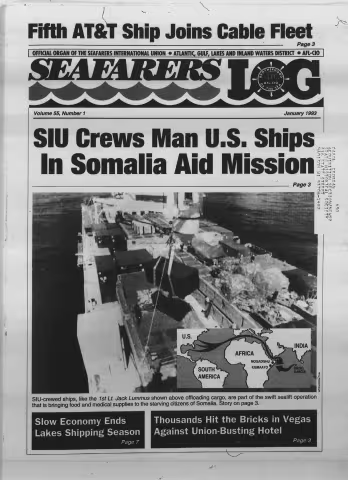
sill Crews Man II.S. Ships
In Somalia Aid Mission
:o.oy>.o:o
<-* -HCO
coiy>rut-ir~
3H 00
2:i>x«-H
Pages
:2;;vic/>t-»:o
»-« -Haa
ooQXOO
ji H X) to
UJ73i-«00J>
-vi,nro:T»2
om >0
oHr--!
SlU-crewed ships, like the 1st LI Jack Lummus shown above offloading cargo, are part of the swift sealift operation
that is """ O
Slow Economy Ends
Lakes Shipping Season
Thousands Hit the Bricks in Vegas
Against Union-Busting Hotel
Page 7 Page 3
^ SEAFARERS LOG JANUARY 1993
Michael Sacco
)yjm '
President's Report
That or Time Religion'
For trade unionists, there is nothing like that ol' time
religion—solidarity. Sticking together in a fight is at the heart
of trade unionism and this time-honored prin
ciple was evident last month when thousands
of union members joined striking Las Vegas
hotel workers in a demonstration of support.
In a town known for its gaiety, fun and
frolic, one hotel has provoked a bitter fight
by refusing to negotiate in good faith with
the unions which represent its more than 500
employees. The owners of the Frontier Hotel
and Gambling Hall, who purchased the
property in 1988, refused to consider a con
tract with its employees similar to the one in place since 1989
with the more than 30 other establishments along the famous
Las Vegas Strip. Prior to the 1989 negotiations, the hotel, its
employees and their unions had a 40-year history of smooth
labor relations. The new Frontier owners, aided by a notorious
union-busting attorney, reduced wages by more than $4.00
hour, slashed health care benefits, cut off payments to the
employees' pension plan and wiped out seniority rights. Added
to the company's illegal bargaining activities was a program of
harassment—including eavesdropping, surveillance and in
timidation—directed at unionized hotel workers.
Frontier employees, who have been on strike since Septem
ber 21,1991, have maintained a 24-hour-a-day, seven-day-a-
week picket line. Not one of the union employees has crossed
the line to join the scabs hired by Frontier management. The
demonstration of solidarity organized by the federation of
American unions—the A^-CIO—last month, was but one ac
tion of many extending the support of trade unionists from
around the country to the striking Frontier workers.
I am proud to have among our membership so many people
who volunteered their time to join in that march and rdly.
Despite long bus rides^ dozens of Seafarers made the trip to Las
Vegas last month to show our support for our brother and sister
trade unionists.
Fortunately, we in the Seafarers have not had this kind of
knock-down-drag-out fight with an employer in quite a whiles
But in joining the Frontier employees, on strike for 15 month!,
we are reminded that workers never get too far away from
potential conflict with their employers. And when fights are
necessary or provoked, we are reminded by the Frontier strike,
the support of fellow workers provides strength and sustenance.
This is what trade unionism is all about. It is a security
blanket for a member and his or her family. It means that when
a worker has to deal with an employer like Frontier, or any
other employer of this type, he or she does not have to do it on
their own. In sum, a union is a worker's only shot at a fair play
ing field.
Sea/<9i«rs EtecUon ResuHst
WIU Be Amoimced Uiis HlonBi
Voting for union officers took place in all SlU halls from November 1 through December 31,1992. Above,
Assistant Vice President Kermett Mangram issues ballots to QMED Stephen Kues (center) and
S^^ard/Baker Manuel Faria in the port of New York.
Voting has ended and results of
the election of officers for the
Seafarers International Union; At
lantic, Gulf, Lakes and Inland
Waters District will be announced
later this month at SIU halls
throughout the country and in the
next issue of the Seafarers LOG.
Special membership meetings
were held last month in union
halls listed in the SIU Constitu
tion to. elect delegates for a rank-
and-file tallying committee. That
committee will tabulate results of
the election, which began in all
SIU halls on November 1 and
concluded on December 31.
On the ballot were candidates
seeking the posts of president, ex
ecutive vice president, secretary-
treasurer, six vice' presidents, six
assistant vice presidents, two
headquarters representatives and
Continued on page 10
Studds, Breaux Head Maritime Panels
Bid Committees' Make-Up Changes
.S. Representative Gerry
Studds (D-Mass.) is expected to
)e elected chairman of the House
Vlerchant Marine and Fisheries
Conimittee by the full House fol-
owing his nomination to the post
ast month by the Democratic
Steering and Policy Committee.
Meanwhile, the composition
of the committee will not be
mown until later this month as
tlouse members still are receiv
ing their assignments in the wake
of the 110 new members elected
in November.
Following his nomination,
Studds thanked his fellow
Democrats and outlined plans for
the upcoming session of Congress,
which convenes this month.
"As chairman, it is-my-ehal-
lenge and opportunity to identify
and enact Aose changes neces
sary to improve our coastal en
vironments, to bring jobs back to
American shipyards and put c^-
goes on U.S.-flag ships, and
preserve what is left of the diver
sity . that Mother Nature
provided," Studds said. "I have
already begun working with the
Clinton administration to estab
lish priorities for Ocean, coastd
and maritime initiatives."
The 11-term legislator specifi
cally listed "the renaissance of
America as a seafaring nation" as
a priority.
"We need an investment pack
age to retool U.S. shipyards,
revive the American merchant
fleet, create seagoing jobs and
make U.S. ports more competi
tive," Studds added. "Targeted
investment tax credits and
broadened loan guarantee
programs promise to invigorate
domestic shipbuilding, expand
Continued on page 10
DOT Seciietary-DesSgnate Pena Yows
MariOnw Reform Will Be a 'Priority'
Maritime reform will be a
priority of the U.S. Department of
Transportation, according to the
secretary-designate picked by
President-elect Bill Clinton to
head the government department
that oversees the U.S.-flag fleet.
Federico Pena, the former
mayor of Denver, told the Wall
Street Journal last month he was
concerned about the decline in the
U.S.-flag merchant fleet and will
use his new job to assist in
rebuilding it.
Pena headed Clinton's
transportation transition team
which studied what heeded to be
done in the department and the
American transportation in
dustries. When asked if he would
recommend possible regulatory
relief for the merchant marine, he
answered he would have "to look
at that very carefully."
The secretary-designate—
who like all other Cabinet-level
officials appointed by Clinton
must be approved by the
Senate—stated the new ad
ministration is concerned about
statements made by American
President Lines and Sea-Land
that reform be instituted this year
or the companies would look into
reflagging their fleets.
Pena's words reiterate those of
U.S. Senator John Breaux (D-La.)
and U.S. Representative Gerry
Studds (D-Mass.) who head the
merchant marine committees in
their respective branches of Con
gress. Both elected officials have
listed maritime reform as one of
the first items their committees
will address after Congress con
venes this month.
Aspin for DOD Post
^Clinton fulfilled a promise to
name all of the members of his
Cabinet by Christmas. Pena was
among the final appointees. How
ever, as of press time, the presi
dent-elect had not named anyone
to head the Maritime Administra
tion.
Clinton reiached into Congress
to,5acquire his secretary of
defense: U.S. Representative Les
Aspin (D-Wis.). Just elected to
his 11 th term, Aspin has been the
chairman of the House Armed
Services Committee since 1984.
He has expressed his general sup
port for the commercial aspects of
military sealift to SIU repre
sentatives while he served in the
House.
Brown to Head Commerce
The president-^|ect gaWtwo
political friends the nod for posi
tions dealing with trade. Ron
Brown, the man who ran the
Democratic National Committee
for the last several years, was
named as secretary of commerce.
Brown is known around
Washington as a compromiser
willing to work out deals.
Micky Kantor, chairman of the
Clinton presidential campaign,
was selected to be the U.S. Trade
Representative. Kantor will have
to complete negotiations on the
world trade talks (known as
Continued on page 10
New Bedford Port Agent Henri Francois (right) congratulates U.S.
Representative Gerry Studds on being named chairman of the Mer
chant Marine and Fisheries Committee.
Volume 55, Number 1 January 1993
The Seafarers LOG (ISSN 0160-2047) is published
monthly by the Seafarers International Union; At
lantic, Gulf, Lakes and Inland Waters District;
AFL-CIO; 5201 Auth Way; Camp Springs, Md.
20746. Telephone (301) 899-0675. Second-class
postage paid at MSC Prince Georges, Md. 20790-
9998 and at additional mailing offices.
POSTMASTER: Send address changes to the
Seafarers LOG, 5201 Auth Way, Camp Springs,
Md. 20746.
Communications Dep't. Director and Editor, Jes
sica Smith; Assistant Editor, Daniel Duncan; As
sociate Editor, Jordan Biscardol^ As.sociate
Editor/Production, Deborah Hirtes; Art, fii7/ Brewer.
JANUMY1993 SEOFMBISLOe 3
U^. Seain Races to Abica with AU ftxr Smnalia
Seafarers are answering their
nation's call to duty again as they
crew vessels headed to the East
African nation of Somalia.
At the request of the United
Nations, U.S. military forces are
leading an international effort to
bring food and peace to the war-
ravaged nation. Two years of civil
war as well as many more years
of famine and drought have
caused an estimated 600,000
people to die. As of December 24,
a total of 17 SlU-crewed vessels
were involved in the relief effort.
"I think it's excellent that our
country is taking a stand and help
ing people who are hungry," AB
Carl Wentworth told a reporter
for the Scfl/arerj LOG on Decem
ber 22 shortly before his ship,
USNS Algol, set sail from Hous
ton for Somalia. "I was a poor
child so I know what it's like to
be hungry all the time."
Wentworth's view was echoed
by the other crewmembers the
LOG was able to reach. "We've
got to help," noted OMU Lloyd
Estes, who joined the SlU in
1969. "Those people literally are
starving to death. [The crew] is
for it. We all like to help."
USNS Algol Bosun Abe Mur
ray said the crew "has a very
good attitude" about the voyage,
while AB Nolan Manen added
the United States "should have
gotten involved sooner."
The Algol was the last of the
eight fast sealift vessels called to
active duty to depart a U.S. port
with military supplies for troops
in Operation Restore Hope, the
military code name for Somalian
relief efforts. The others—USNS
Antares, USNS Capella, USNS
Denebola, USNS Altair, USNS
Belletrix, USNS Pollux and USNS
Regulus, all operated by Bay
Tankers—began steaming to east
Africa during the middle of
December.
Hard toMIss Holidays
Wentworth pointed out the
hardest part of the journey would
be missing his family again over
the holidays. He sailed aboard the
Cornhusker State and Maersk
Constellation during the Persian
Gulf war. "What we're doing here
is extremely important. I'm proud
to be part of it," the 43-year-old
AB said before the 1,000-foot
ship left.
When U.S. forces got the call
to head for Somalia, among the
vessels waiting offshore to assist
were the military prepositioning
vessels from Diego Garcia. The
Ist Lt. Jack Lummus arrived with
the initial squad of Marines. For a
time, the American Overseas
Marine-operated ship served as
the press center for American cor
respondents.
As "soon as other Army and
M^ne units began arriving via air
lift, other SlU-crewed preposition
ing vessels were waiting to offload
trucks, tractors, ready-to-eat meals,
medical supplies and other
materiel. Those ships included the
Cpl. Louis J. Hague, 1st Lt. Alex
Bonnyman, FFC William Baugh
and Pvt. Franklin Phillips as well
as the replenishment ship,
Lawrence Gianella.
Also called into duty by the
Military Sealift Command to as
sist the offloading of goods are
the roll on/roll off vessels
American Cormorant, American
Condor and American Eagle.
According to published
reports, more civilian-crewed
vessels are expected to be called
up to assist the Somalian relief
effort as it expands.
On December 19, President
Bush authorized the U.S. Maritime
Administration to provide war-risk
insuranqc coverage for comrnercial
vessels, containers and barges
chartered or leased to the govern
ment that sail as part of Operation
Restore Hope.
Sdmallan Independence
The independent nation of
Somalia was created in 1960 by a
merger of British Somaliland and
Italian Somaliland. Although
Continued on page 9
Chronology of U.S. Involvement in Somalia
NOV 24—State Department announces Bush administration has agreed
to airlift 3,000 more U.N. troops to Somalia to protect relief operations.
This follows claims by American relief organizations which said they may
be unable to continue working in Somalia due to insufficient security.
Gunmen shell a U.N. ship carrying wheat as it tries to enter the port of
Mogadishu. The ship turns back.
DEC. 1—U.N. Secretary General Boutros Boutros-Ghaii calls for guaran
teeing deliveries of food and medicine through "a country-wide show of
•force." In response, the U.S. circulates proposals for creating a U.S.-com-
manded force operating under a U.N. mandate.
DEC 2—The U.S., Britain, France and Russia agree on a draft resolution
that would put an American general in command of the new multinational
force the Security Council plans to send to Somalia. (China abstains.)
DEC 3—Security Council votes unanimously to send U.S.-led military force
A n 1!-.^ ^ At— ^ Si— i. I'I tL I ' ^ ^ to Somalia. This is the first U.N. intervention in a country's internal affairs
with a mandate to use offensive force, if necessary.
DEC 4—After more than two months of peaceful service in Somalia, U.N.
forces return fire, killing a Somali gunman.
DEC 6—For the first time in nine days, food reaches the central city of
Bardera, where workers were down to their last 25 sacks of grain.
DEC 9—Marine combat troops stage a predawn landing in Mogadishu.
No shots are fired as the initial landing parties take command of the airport,
seaport and surrounding areas. White Mogadishu quickiy comes under
control, heavy fighting between rival clans continues elsewhere in the
country.
DEC 10—U.S. envoy Robert Oakley, a former ambassador to Somalia,
arranges a meeting between the country's most powerful warlords.
DEC 11—Somalia's two most powerful warlords sign a peace agreement
aimed af ending two years of anarchy and bloodshed.
DEC 12—Marine helicopters destroy three armed Somali vehicles and kill
at least one gunman. Other marines escort their first food convoy to a relief
agency feeding starving civilians. In all, 20 tons of food are delivered.to a
relief center that had received none since July.
DEC 16—Marines and French Foreign Legion soldiers deliver their first,
symbolic convoy of food to Baidoa.
DEC 20—Troops move into Kismaayo ahead of schedule. U.N. forces also
plan to seize four other population hubs on an accelerated schedule,
because they are fearful of massacres and intensified looting like that
which took place recently in Kismaayo.
DEC 21—Troops are poised to seize control of the nation's "famine belf
from warlords and freelance looters.
Seafarers Bring Newest AT&T Cable Ship te States
SlU crewmembers are in Sin
gapore preparing to bring the
third new Transoceanic Cable
Ship Co. vessel to' the UniWd
States.
Members boarded the Global
Mariner last month to set it up for
its inaugural run. Like its sister
ships—Global Link and Global
Sentinel—the Singapore-built
Global Mariner will fly the
American flag.
The 479-foot vessel is
designed to lay and repair fiber
optic cables along the ocean floor.
As with the other two, it features
bow thrusters to help the vessel
keep its course during cable-
laying and repair operations.
Storage facilities on the ship pro
vide space for up to 4,100 nautical
miles of cable.
oceanic is ready to provide com
munications for the 21st cen
tury," said Augie Tellez, SlU vice
president for contracts. "The SlU
is proud that our members help
make that possible."
Seafarers have crewed Trans
oceanic vessels since the early
1960s. With, the addition of the
Global Mariner, the company
operates a total of five cable
ships: the Link, Sentinel, Charles
L. Brown and Long Lines. Trans
oceanic is a wholly owned sub
sidiary of AT&T.
The ship can maintain a cruis
ing speed of 15 knots. However,
the speed drops to between 6 to 8
knots when laying cable. The ves
sel sails at 4 Imots when towing a
sea-plow and laying cable.
TTie Global Mariruer features a
library, hospital/operating room,
gymnasium and recreational areas
as well as lounges for the crew.
Safety features on the vessel
include water-tight transverse
bulkheads at various locations, a
back-up diesel-driven generator
for emergency electrical power,
fire-resistant furnishings and four
encapsulated lifeboats. The cable
ship also is equipped with the
latest in surface navigational
radar and collision avoidance sys
tems.
"With this vessel. Trans- The GtobafSentfne/, which is identical to the new Gtoba/Manner, began cable-laying operations last spring.
SW Joins Batlte Agahst Uilon-Basting Vegas Hotel
SlU Executive Vice President Joseph Sacco leads approximately 60
Seafarers past a casino during the AFL-CIO Desert Solidarity March.
Seafarers from across the
country joined with fellow trade
unionists last month to march
down the Las Vegas caSino strip
in support of striking Frontier
Hotel workers.
More than 20,0()0 union mem
bers and their families—includ
ing SlU members from the port of
\Yilmington, Calif, and the East
Coast—volunteered for what has
been reported by the media ̂ the
largest labor deiponstr^tion in the
westem\Jnited States.
SlU Executive Vice President
Joseph Sacco led the SlU delega
tion and spoke to all the marchers
in a rally following the two-mile
procession on December 5. "The
turnout was fantastic," Sacco
said. "There were people cheer
ing us on everywhere you looked,
even on such a cold evening."
Dedicated Marchers
With the march starting after
sundown so it would coincide
with early evening shows on the
strip, the temperature hovered
around 40 degrees. However, that
did not stop members like OS
Michael Charbin of New Jersey
from being there.
"1 lost my voice and got sifck
for two days, but 1 would do it
again," he told the Seafarers
LOG.
Charbin was staying at his
mother's house in Las Vegas
when he heard about the march.
He rode his bicycle to the event to
meet with other Seafarers for his
first-ever union march and rally.
"1 was surprised and over
whelmed with the response.
People were cheering, cars were
honking their homs and stopping
traffic. It was great," said the
April 1992 graduate of Lun-
deberg School trainee class 494.
Many Seafarers reported
seeing patrons at other casinos
come outside and cheer in support
of the marchers.
About 550 trade unionists
working at Frontier struck on
September 21, 1991 in response
to unfair labor practices com
mitted by the owners of the=
casino: Margaret Elardi and her
sons, Tom and John. The hotel
had operated with a union con
tract for more than 40 years
before the Elardis purchased it in
1988. The contract expired Jun^
1, 1989^, but negotiations con
tinued until the strike was called.
The Elardis then hired scabs to
keep the casino in business.
The striking employees are
represented by locals affiliated
with the Hotel and Restaurant
Employees Union, Operating En-
gineers. Carpenters and
Teamsters.
In trying to bust the unions at
the hotel, the Elardis have
eliminated the workers' pension
plan, reduced wages, cut back on
the health plan (leaving some
employees unprotected) and
dropped job security and
seniority rights.
To date, not a single trade
unionist has crossed the picket
line and returned to work.
A ruling by the National Labor
Relations Board last year
declared Frontier's negotiations
with the uiyons a "sham." Other
casinos have supplied food and
other support for the strikers.
" f •
• • ' .''V!- '
-'v
'•m:
: •• S:
J --
-• • " '4 • ,
i
i K
;
• --VA'S''
• • !.->
J---
'•t'
iv;S ,
1:
M •
AS
• •-
^ WW. '-
' w;®:. - a
••I-
; I • ••
4 SBAFARk JANUARY1993
V? ' ''
-• •-. •••>; .'i'"
"eafarets Play AcUve Role in Subic Bay Base Departure
The last American forces left
Subic Bay Naval Base on
November 24, ending a 94-year
history of U.S. military forces on
the archipelago.
The base used to serve as home
port for several vessels of the
Military Sealift Command-
Pacific Fleet (MSCPAC), whose
unlicensed departments are
crewed by members of the SIU's
Government Services Division.
All MSCPAC operations were
completed at the naval base by the
end of September. MSCPAC and
MSC-chartered commercial ves
sels took part in the withdrawal
from Subic Bay. More than
258,000 tons of cargo were carried
aboard the ships in 36 different
voyages beginning in January.
Vice Admiral Michael P. Kal-
leres, head of the Military Sealift
Command, congratulated MSC
PAC mariners for their efforts in
the departure in a message
delivered November 24: "I'm
taking this opportunity to express
The Sea-LandEnterprisewas in Guam recently, transporting military
hardware from the closed bases in the Philippines.
a personal 'Well Done' to those
whose long hours'of hard work
made this effort a complete suc
cess. You can take great pride in
proving that sealift is, ready am
willing to respond to any chal
lenge in war and in peace."
Operations handled by the
former largest Navy base Outside
the United States have been dis
persed across the Pacific theater.
The base was known for its one-
stop shopping. Nearly 70 percent
of the supplies used by the Navy
during the Persian Gulf war came
from Subic Bay.
Now, military and MSC ves
sels wiir receive ready supply
stores at bases in Bahrain, Diego
Garcia and Singapore. Ships will
take on consumable stores at
Guam, while the base at
Yokosuka, Japan wiH have repair
parts.
Ammunition once stored at the
Philippine base has been dis
tributed to naval stations in Japan,
Guam, Hawaii and the continen
tal United States. Ship main
tenance will take place at
Yokosuka, Guam, Singapore, In
donesia and Malaysia.
About 500 Marines departed
the base after ceremonies turned
over the 15,000-acre facility to
the Filipino government. Except
for three years during World War
11, American forces had main
tained a presence on the Philip
pine Islands since defeating Spain
in the Spanish-American War in
1898. Tlie base played an active
role in the Korean, Vietnam and
Persian Gulf wars.
Teddy' Gleason, ILA OMcialf Dies at 92
•Thomas "Teddy" Gleason,
retired president of the Interna
tional Longshoremen's Associa
tion (ILA) and a former member
of the executive board of the
Maritime Trades Department
(MTD), passed away on
Christmas Eve in his native New
York. He was 92.
A lifelong trade unionist,
Gleason served as president of the
ILA from 1963 to 1987. He was a
strong supporter of the U.S.-flag
merchant fleet. He served as a
vice president of the MTD and
executive board member until he
retired. Gleason continued to be
welcome and did; in fact, attend
MTD meeting."? well after his
1987 retirement, including the
most recent one in February 1992.
"With Teddy's passing, a
colorful era on the waterfront
comes to an end," said SlU Presi
dent Michael Sacco. "Teddy was
a participant in many struggles in
behalf of longshoremen and in
behalf of the industry. He also
made many contributions to help
American seamen better their
lives.
"We enjoyed his cooperation
and appreciated his commitment
to an American-flag shipping
capability."
Gleason began the first of his
many jobs on the docks in 1915,
working as a checker a:longside
his father in New York for 35
cents an hour. The oldest of 13
children, he joined the fledgling
ILA in 1919. He subsequently
worked as a checker, billing
clerk, longshoreman, winch
driver, truck loader and
timekeeper.
Teddy Gleason meets with SlU President Michael Sacco at the MTD
meeting in Detroit in 1991. Gleason was welcomed at MTD functions
long after his 1987 retirerrient as ILA president.
He became a dock superinten
dent in 1932, but that year he also
was blacklisted by stevedoring
companies and steamship lines
due to his union activities. He
then worked at odd jobs until the
election of Franklin Roosevelt as
U.S. president, the subsequent
coming of his New Deal
economic policies and the
legalization of union activity on
the docks.
Shortly thereafter, he became
president and business agent of
Checkers Local 1346 of the ILA.
The local later merged with three
others to form Local 1, and
Gleason served as its president.
^In 1953 Gleason was elected
general organizer. In 1961 he as
sumed the post of ILA executive
vice-president and became the
union's chief contract negotiator
with waterfront employers. Two
years later, he was elected inter
national president.
He later ser^d as a vice presi
dent on th^N^^-ClO executive
council. During the Johnson ad
ministration, he served on the
President's Maritime Advisory
Committee. He made several
trips to Saigon during the Viet-^
nam War to initiate a program to
relieve port congestion.
Gleason took great pride in
securing a guaranteed annual in
come for ILA members after
automation (mainly in the form of
containerized shipping) led to
reduced work opportunities for
longshoremen.
Gleason' s wife, Emma, passed
away 30 years ago. He is..survived
by three sons, 15 grandchildren
and six great-grandchildren.
Crewmembers aboard the Sea-Land Enterprise pose on the ship's
deck. They are, from left, AS Fred Varona, Steward/Baker Sharon
Ortiz, Steward Assistant Paul Grier, DEU Guy Leary and AB Glenn
Chtistianson.
The eruption of Mount
Pinatubo in 1991 caused the U.S.
to reassess its position in the
Philippines. Clark Air ForCe Base
was damaged so heavily that the
U.S. decided to abandon it. The
U.S. then sought an extension on
its lease for Subic Bay. Despite
efforts by President Corazon
Aquino to support the exten
sion, the Philippine senate
rejected the deal. The U.S. an
nounced it would pull out by the
end of 1992.
Guam Becomes New
SE Asia Staging Area
Guam has become the new
focus for Military Sealift Com
mand-Pacific Fleet (MSCPAC)
operations since the decommis
sioning of the Subic Bay Naval
Base last month.
(The SIU's Government Ser
vices Division represents the un
licensed crewmembers aboa:rd
MSCPAC ships.)
MSCPAC vessels—including
SlU-crewed MSC-chartered
ships—had Been calling on the
naval base at Guam even brfore
the U.S. Navy decided to close
the base on the Philippine Islands.
However, the American territory
approximately 2,000 miles east of
the Philippines will be handling
more cargo than ever before.
Guam will provide con
sumable provisions (food and
Other supplies) to U.S. Navy and
MSC vessels that once were taken
on in Subic Bay. The storing of
naval ammunition, all of which
was doiie at Subic, now will be
handled at several Pacific loca
tions including Guam.
At one time, Subic Bay held
the largest ship maintenance
facility outside die United States.
The drydocks and other equip
ment were transported to Sin
gapore, which now will become
the main facility in the Asian
theater. Guam, however, has been
set up to handle part of the
workload.
Of the 1,800 military and
civilian jobs once located at Subic
Bay, Guam secured a majority of
the transferred positions. Ap
proximately 1,200 jobs—both
military and civilian—^moved to
Guam.
The isl and also will be used for
some of the training and aviation.
maintenance once located at the
Philippine base.
USNS Kilauea Welcomed Home
Captain L.M. Pivonka, head of the Military Sealift Command-
Pacific Fleet (MSCPAC), reads a statement of welcome to the
crew of the ammunition ship USNS Kilauea during ceremonies
on November 19. The vessel last docked at its home port of
Oakland, Calif, in October 1982. The 10 years that the Kilauea—
whose unlicensed crewmembers are represented by the SIU's
Government Services Division—had been on active duty repre
sented the longest deployment among all active MSQyessels. During
those years, it had sailed with |he U.S. Seventh Fleet, the vessel
will undergo an overhaul before returning to active duty in May.
F
>
:• .„ ... >• .-J. , : ,.
MHUARY1993 SEAFAKBIS LOG 5
Russians Award Medais to Murmansk Run Seamen
U.S. merchant mariners—in
cluding SIU members—had to
suppress their natural fears to em
bark on the Murmansk run during
World War II to take supplies to
Russia. Whether facing the Nazis
or harsh arctic storms, these men
ranging in age from their teens to
their sixties and older volunteerec
to crew ships that may hot return
to deliver the goods. The older
mariners knew what faced them
the younger ones now are retell
ing tales of their harrowing trips,
thanks to the Russian govenment.
Fifty years later, the former
merchant seamen (including
numerous SIU members) who
survived those trips to the then-
Soviet cities of Murmansk anc
Archangel have been thanked anc
recognized by the Russian
people. Most recently, at
ceremony December 8 at the Em
bassy of the Russian Federation
in Washington, D.C., hundreds of
ex-merchant seamen and Navy
armed guards received com-
merriorative bronze medals is
sued by the Russian government.
Including family members, al
most 1,000 people—twice the
number anticipated—from
dozens of states turned out for the
ceremony in Washington. The
overflow crowd created logistical
problems and delays; but, just as
they forged through the frozen
White River to Archangel during
the 1940s, the honorees took the
problems in stride and focused on
the positive.
Most seemed pleasantly
surprised finally to be recognized
for taking part in the vital journeys
around Nazi-cxxupied Norway to
Murmansk and Archangel, where
they delivered ammunition, sup
plies and equipment. More than
100 ships were lost on the Mur
mansk run, which started in 1942
and lasted until the war in Europe
ended in 1945.
"I was impressed with the
ceremony, andtesides, I know a lot
of guys who had no chance to go,'
said former SIU member Fred
Litsch, referring to his fellow mer
chant mariners who perished
Joseph Burgess drove to
Washington, D.C. from North
Carolina to receive his medal.
during the war or have since
passed away. "This is something
we were long overdue in getting."
Vessels on the Murmansk run
carried almost 15,000 aircraft,
7,500 tanks, 345,735 tons of ex
plosives, $1.3 billion of food
shipments and 2.6 million tons of
petroleum products to Russia.
'No One has Forgotten'
Before the medals were
presented in the embassy
auditorium, several dignitaries
recounted both the general impor
tance of American merchant
mariners in World War 11 and the
specific contributions they made
during the Murmansk run.
"The glory of war soon was
replaced by the reality of death
and destruction," stated Ian Mil
lar, a maritime historian. "Mur
mansk was only 30 kilometers
from the front. But merchant
mariners and Navy gunners
worked together like well-oiled
machines.... You have too long
been overlooked, but no one has
forgotten, and nothing has been
forgotten."
Maritime Administrator War
ren Leback noted that the death
toll among American merchant
mariners during the war was
larger, by percentage, than that of
any of the armed services except
the Marine Corps. "American and
allied seamen showed exceptional
courage," he said. "And the war's
most dangerous run was that to
northem Russia."
A crowd of almost 1,000 persons showed up for the ceremony December 8 at the Russian embassy.
Burgess also remembers the
vicious storms. "On one hand, the
rougher the sea, the better 1 liked
it," he explained, "because sub
marines can't operate in that
Everett Caril, pictured with his wife, Jessie, remembers the rough seas
which sometimes made ships "seem like a cork floating around."
Russian Ambassador Andrey
Kolosovskiy summed up the
proceedings when he said, "We
are sorry this ceremony didn't
take place years ago. But you
have always been recognized in
the hearts of the Russian people.
They know the merchant marines
and Navy gunmen sailed through
the Arctic, through attacks which
often lasted for days at a time.
Often, the price was ultimate:
human life. We're very grateful
and proud of you."
Danger Above and Below
Joe Burgess, who sailed as an
OS with the SIU during the war,
remembers running into trouble
jefore he even got to Murmansk.
We were tied up near an am
munition dock in west London in
1943," he told a reporter for the
Seafarers LOG. "A siren went
off, and then this little plane flew
jy. 1 saw the swastika, and 1 was
shaking so much 1 couldn't shoot
straight.
"He had dropped flares, and
that place was lit up like daylight.
ighty bombers followed him.
All 1 can say is, God was looking
out for me."
Burgess eventually reached
Vlurmansk on the Liberty Ship SS
lenry Lomb. "The Germans
)ombed us every night," said the
69-year-old, who drove from
North Carolina with his son to the
ceremony., "You get so damn
scared, you kind of develop a
buffer. You start thinking, 'Well,
they haven't got me yet.'"
weather. Pretty weather could be
deadly.
"But sometimes our ships
would roll 45 degrees, and 1 mean
they would just hang there.'
SIU pensioner John Reed, a
veteran of four wars, first sailed
aboard the Liberty Ship William
Matson to Russia during WWII.
He^rovefipmJ)es Moines, Iowa
to attend the ceremony. "1 had a
feeling tfiere might be a big
crowd," said Reed, 73. "1 left in a
snowstorm, but it was worth it. 1
was satisfied.
A former chief cook. Reed
recently made a vastly different
type of trip to Murmansk. He and
two friends flew there and, in con-
junction with a local medical
facility, helped start a chapter of
Alcoholics Anonymous. Reed
last month celebrated 25 years
with the program.
"That's the first time I've been
to Russia in 49 years," he said.
"This time, it was beautiful."
Committed to Victory
Former AB Litsch, 65, is the
sheriff of Anderson County, Kan
sas. He sailed during both WWTl
and the Korean conflict, and
remembers his reasons for first
shipping out in 1944—^at age 16.
being belittled a lot during World
War 11," he said. "But the fact is,
1 did more for my country as a
seaman than as a soldier. The
merchant seamen were all volun
teers, and we were ready for any
thing."
While driving the many
hundreds of miles from Kansas to
Washington, Litsch thought
about the time he signed on the
Cecil N. Bean headed for Russia
in 1944. The Bean was part of a
36-ship convoy which needed ice
breakers to get to Murmansk.
"It was exciting but, yeah,
was scared, especially the first
time the depth charges knocked
out the lights. With those depth
charges, it was like being inside a
drum while someone l)eat on it.
"But you would hear stories
from the older guys who had sur
vived attacks, been sunk, dive-
bombed, hit mines ... yet they
still stuck with [sailing]. It was
inspirational."
Former oiler Joe DeCarlo, 71,
travelled from New York with his
wife to the embassy. DeCarlo
sailed during the war with the
SIU's Sailors' Union of the
Pacific.
"Tbe Murmansk run was
colder than hell," DeCarlo said.
"The snowstorms at least
prevented bombing from the
planes, but they didn't stop the
subs."
DeCarlo marvelled at being in
the embassy. "I'll tell you a sign
of the times (fi-om the war)," he
recalled. "1 brought a record
album of the Russian national an
them back with me, and the Coast
Guard waptpd to seize it. They
wanted to check for any secret
messages. There was just no trust.
and 1 never would have believed
we and the Russians could get
along like this."
Close Calls
John Chatfield, 73, recounts
the harrowing moments as if they
happened only last week. "1 was
on the Beauregard to Murmansk
in 1942. We were carrying 500
tons of TNT, plus nitroglycerin
and other explosives," recalled
the former OS and AB. "At the
docks in Murmansk, we were
John Chatfield
mansk In 1942.
sailed to Mur-
bombed 72 times by the German
fleet. We spent all winter there.
"Once, they dropped a bomb
between the dock and the ship.
Another time, they dropped a fire
bomb right on the TNT, but the
bomb was defective. Near Nor
way, the Germans once hit a ship
Continued on page 16
Being young, we were gung-ho
patriotic. Everyone wanted to do
whatever we could to win the war."
Litsch was drafted during
Korea, and his experience in the
armed forces gave him renewed
appreciation for his earlier role as a
merchant seaman. "1 remember
Former Seafarer Fred Litsch (left), pictured witli^lU Assistant Vice
President Tony Sacco, proudly displays hisrMurmansk medal;
"M:
-m-
M.-
M
'Mr-;
'lU
n:,"-
1'
1.?-
' •
(•, •' <9
1 v w/'
X:'-'
6 SEAFARERS LOG JANUARY 1993
FTF Aids Cnatians iR Securiug $450,000in Back Pay
The International Transport
Workers Federation (ITF), with
help from the SIU and two
foreign seamen's unions, last
month secured almost $450,OOC
in back wages owed to 52
Croatian merchant mariners.
The financially struggling
Croatia-based D.P. Shipping Co
Ltd. owed approximately a year's
worth of back wages to the mer
chant seamen who crewed two o
its freighters, the MVPluton / and
MV Ana. In mid-December, the
company paid $129,000 in back
wages; the ITF, of which the SIT.
is an affiliate, also securec
$308,000 in bank guarantees for
the Croatian seamen and
$10,000 advance for a new crew
which signed on the Pluton in
New York.
It took a work stoppage in late
November by the reluctant but
fed-up crew of the Pluton to spur
action from D.P. Shipping. The
23 officers and crewmdmbers
said that for patriotic reasons,
they didn't want to strike. The
Pluton is the first seagoing vessel
to fly the Croatian flag since the
former Yugoslav republic
declared independence in 1991.
But, from the time they sailed
from war-ravaged Croatia in '91
and then proceeded to wherever
business could be found, the
crewmembers were paid infre
quently and in smaller amounts
than what was in their contract.
Additionally, the part of the mer
chant mariners' salaries that was to
be paid to their respective families
in Croatia never was sent.
"They were quite remarkable
in the amount of patience they
showed," said Edd Morris, an ITF
inspector and representative for
the Seafarers, who worked with
SIU Port Representative Bobby
ITF Inspector Spiro Varras (wearing tie) aids Croatian merchant mariners in securing back wages. From
left are AS M. Dabelic, 2nd Cook F. Bagavac;, Mechanic T. Valentic, Bosun I. Gavran, AB N. Milohnic,
Varras, Deck Maintenance M. Basic, Mechanic B. Runjic and three unidentified crewmembers.
Clinton III and the SIU's ITF In
spector Spiro Varras in helpin
the seamen claim their back
wages. (
The strike began December II
when the Pluton docked in
Chesapeake, Va., near the port o
Norfolk, Va. The crew not onl)
was tired of hearing repetitive but
empty promises about upcoming
payments from the company, bu
also was concerned about the
ship's next two stops. After load
ing scrap metal in New York, the
Pluton was supposed to proceed
;o Karachi, Pakistan, one of the
world's biggest scrap-meta
)orts. However, the crew had 5
eeling their own ship would be
scrapped in Pakistan if the com
pany were to go bankrupt.
By November 30, the Pluton
was bound for New York, and the
crewmembers had received a par
tial payment. Through an agree
lAM's Ostro Retires;
Longtime SIU Friend
Justin Ostro, vice president of
the International Association of
Machinists and Aerospace
Workers (lAM) and a longtime
friend of the Seafarers, retired on
December 1.
Ostro, 65, also served as a vice
president of the AFL-CIO
Maritime Trades Department.
A lifelong trade unionist, he
sailed during World War II as a
"merchant mariner. He was vice
president of the California AFL-
CIO and served three terms as a
member of the Democratic Na
tional Committee.
At a retirement dinner Novem
ber 7 in Las Vegas, SIU President
Michael Sacco recalled the ties
between the Seafarers and Ostro.
"[Former SlU President] Paul
Hall was a keen student of human
character and, incidentally, some
what partial to-guys who had gone
to sea,'' Sacco said. "When a
union beef brought them
together, Paul Hall was im
pressed with Justin's savvy style
and his on-the-level manner. . . .
The two of them struck up a great
friendship and they worked
together in a number of beefs of
mutual benefit to our two or
ganizations and often in behalf of
other unions as well."
Sacco also commended Ostro
for his work at the MTD,, and
Machinists' VP Justin Ostro pictured
as he addressed 1991 MTD con
vention on WWII veteran status.
added, "As happy as we are for
him and his family, , we are sad
dened over the obvious loss to
ourselves and the rest of the trade
union movement he has served so
well."
A native of New York, Ostro
recently said he believes or
ganized labor "is probably in the
process of a mid-course change,
moving towlB^ well- thought out
organization in new industries
that maybe didn't get attention in
the past. The movement also may
be developing a new outlook on
what it takes to represent people."
ment with D P. Shipping, the
ship's charterer, Hugo Neu &
Sons, Inc. from New York,
agreed to make another payment
to the crew upon completion of
loading in New York. They also
arranged transportation to Croatia
for the 23 crewmembers.
Meanwhile, the vessel's owner
lined up a replacement crew to
meet the vessel in New York.
The financial arrangements
were a result of direct interven
tion by Varras, who coordinated
the action despite the difficulties
caused by one of the worst storms
on the East Coast this century. He
handled a large volume of com
munications from the unions,
families, governments, com
panies and banks. "Spiro's work
was the critical factor in obtaining
a reasonable solution during a
very emotional situation,"
remarked Morris.
At the same time, the ITF, the
Seafarers' and Dockers' Union of
Croatia and a German seafarers
union arran^d for payment of
back wages that were due to a prior
crew of the Pluton and to other
seamen from the Ana. TTie overall
breakdown of payments was:
$129,000 to the Pluton crew which
struck in Virginia; a $10,450 ad
vance to the replacement crew in
New York; a $173,200 bank
guarantee for the Pluton's pre
vious crew; and a $135,800
guarantee to the Ana's crew.
The German union became in
volved at the request of a German
company which had a joint operat
ing agreement with D.P. Shipping.
Clinton, based in Norfolk,
served as a liaison between Mor-
ris, Varras, the Croatian
Seafarers' Union and the crew
members aboard the Pluton. He
visited th%erewmembers daily. "I
tried to keep [the crew's] spirits
up and steer them in the right
direction," he said. "We just
wanted to make sure they got a
fair shake: good, safe working
conditions and fair pay.
"This is just one more example
of the true meaning of 'Brother
hood of the Sea,"' Clinton said.
"All merchant mariners have a
common interest, a common
bond and a responsibility to look
out for one another."
Varras said the back-pay issue
"is resolved as far as the seafarers
are concerned." A Greek com
pany now is managing the Pluton
due to D.P. Shipping's financial
troubles, he added.
The MV Pluton I, a Croatian-flag ship, lies at anchor in New York.
Sl^t^ngRtrie GumgaAffet^
CreivHtSr of CaAfe SM/is
The Seafarers Appeals Board
has approved a change in the
shipping rules concerning the
crewing of cable ships.
The action, number 366, is
designed to have crewmembers
get to the ships as quickly as
possible when the company is
notified of a cable bre^. The
port nearest to the cable ship
being activated will have one job
call, rather than three, to fill the
jobs before they are returned to
Manpower to be made available
for all ports. The change affects
Rule 4 D of the shipping rules
and takes effect January 1.
"A cable ship is supposed to
be underway within 24 hours of
the company (Transoceanic
Cable Ship's parent firm AT&T)
being notified of a break," said
Augie Tellez, SIU vice president
for contracts. "The vessel would
be in port with a standby crew
and would need to fully crewed
fast."
The Seafarers Appeals Board
is made up of representatives
from both the union and its con
tracted companies.
The complete text of SAB
Action No. 366 follows:
ACTION NO. 366
The Seafarers Appeals Board
acting under andpiirsuant to the
Collective Bargaining Agree
ments between the Union and
the various Contracted
Employers, hereby takes the fol
lowing action.
WHEREAS, Transoceanic
Cable Ships, Incorporated cur
rently operates 5 cable ships,
which lay and repair undersea
cable for worldwide com
munication service, important to
governmental and commercial
users and,
WHEREAS, frequent cable
breaks result in the disruption of
such service requiring the ac
quisition of personnel, skilled in
cable repair procedures, to be
dispatched to the appropriate
area as soon as possible.
Therefore, to expedite the
dispatch of necessary personnel
due to time constraints. Rule 4 of
the Shipping Rules shall be
amended in the following man-»
ner.
Rule 4 D shall be designated
Rule 4 D I. Rule 4 D 2 shall be
added to Rule 4 D and shall read
as follows:
In the event personnel are re
quired by a cable ship to assist
in the repair of a cable break, all
jobs requested by the Employer
shall be referred by Manpower
to the port nearest to where the
cable ship involved is located,
for one job call only. All jobs not
filled on the initial referral shall
then be made available by Man
power to all ports simultaneous
ly and offered to those seamen
first responding, subject, to
standard shipping procedures
involving qualifications,
seniority, date of registration,
etc. Transportation in such
cases shall be provided by the
Employer.
The remainder of Rule 4 shall
continue in full force and effect.
Effective date: January 1,
1993.
5 •
S: \ - -:
v J .
• • •. •-••vStev-•-.-M
JANUARY 1993 SEAFARERS LOG 7
•
•'.•.. > •:"-i-^?;.'V.
A,
N
Slow Economy Forces End to Great Lakes Sailing Seasmi
The economy and not the
weather forced most of the SIU-
crewed Great Lakes fleet to dock
for the winter before the first of
the year.
"Cargo demand has been slug
gish," noted Glenn Nakvasil of
the Great Lakes Carrier Associa
tion, which monitors the action of
U.S.-flag shipping on the Lakes.
"The weather is cooperating, but
there is nothing to transport."
Keeping an eye on the gangway
is AB/Watchman Nick Verbanac.
Despite a couple of
snowstorms, cold weather has not
been a factor on any of the Lakes.
Byron Kelley, SIU vice president
for the Great Lakes, stated all of
the waters still were navigable in
late December.
"Ice floes have started show
ing up on Lake Superior, where
(air) temperatures have been in
the teens," Kelley said. "But the
tops of Lake Huron and Lake
Michigan still are clean and there
has been nothing floating past the
(Algonac, Mich.) hall."
Nakvasil pointed out that in
1988, the last year both the winter
weather and the economy al
lowed ah extended sailing season
after January 1; more than 30 ves
sels took advantage. "We just
don't see it happening this year,"
he said.
According to Kelley, sevej^al
SlU-contracted cement carriers
and tugboats still will be operat
ing into the new year. "Our Han
nah tugs operate all winter on the
lower lakes. One serves as an
icebreaker for another that is
pushing cargo."
One vessel that will not be
seeing action this winter is the
J.A.W. Iglehart, Despite the ce
ment carrier having a "good
season," the Inland Lakes
Management ship tied up in
November to undergo its regular
five-year Coast Guard inspection.
The last of the engine and
steward department crewmem-
bers signed off early last month
when the self-unloader entered a
drydock in Superior, Wis. The
vessel usually sails well into
December; however, the extra
layup time was needed for not
only the inspection but also inter
nal repairs, according to Captain
Don Ghiata of Inland Lakes.
V'We had a good season,"
Ghiata, who works in the person-
neToffice, noted. "In fact, all four
of our vessels {Iglehart, Alpena,
Paul Townsend and S.T. Crapo)
did well." .
Ghiata explained that while
coal and ore carriers are reporting
lower than average loads, "we
delivered plenty of cement this
year."
Although original plans listed
all American Steamship Com
pany vessels as being laid up by
December 31, the company was
looking at options that would
keep several of the bulk carriers
sailing into the new year. A
decision was expected to have
been announced by 4ate Decem
ber.
Weather permitting, he stated
the company has plans to fit out
and sail the Alpena, Townsend
and Crapo in March. Upon com
pletion of its needed repairs, the
Iglehart is expected to return to
the Lakes by May.
The last of the deep sea
foreign-flag vessels left the Lakes
in mid-December when the St.
Lawrence Seaway began shutting
Opening a hatch to check on bunkers is Wiper Ron Cummings, who
sails on the IglehartWAh other crewmembers pictured on this page.
down for the winter.
With the vessels just laying up,
no word has been relayed on
when fitout will begin. Tradition
ally, crewm^bers begin report
ing to their yessels in March and
April depending on the weather,
ocation and cargo. vessel's
Head Conveyorman Mark Fee lis- Oiler Nelson Hawley catches
tens to the latest union news. snack before reporting for work.
Quick Response by Tugboatmen Helps
Save Line-Worker from Freezing Wafer
Quick action by two SIU boat
men saved the life of a line-hand
ler during an undocking operation
on Lake Calumet near Chicago on
December 5.
Deck Engineer Kenny De-
Graff and Deckhand Don Carrol
rescued the man, whose name
was not known, within minutes
after he fell into the 40-degree
water, according to Captain Don
Thayer.
The captain, who began his
career with the SIU, told the
Seafarers LOG that the Great
Lakes Towing tug Florida was
standing by with another tugboat
to assist a foreign-flag salt-water
vessel leaving the Gateway Grain
Elevator dock on Lake Calumet,
located in South Chicago. About
6:15 a.m., the pilot on the ocean
going vessel told Thayer to check
out a commotion on his stern.
"A line-handler had fallen in
the drink," Thayer recalled. "I
turned the tug around, back to the
dock. Kenny and Don jumped off
and ran down the dock."
The Filipino crew on the "sal-
tie," as deep-sea vessels are called
on the Lakes, were yelling and
had thrown a life ring to the line-
handler. Thayer turned the
Florida's search light on the
water to locate the man, while
Deck Engineer Kenny DeGraff (left) and Deckhand Don Carrol (right)
pose with Captain Don Thayer following the rescue on December 5.
DeGraff and Carrol tossed a line
into the water to help pull him out.
The tugboat captain noted the
crew had very little time in which
to save the line-handler because
of the low water temperature as
well as a wind chill of minus 10
degrees on land. He radioed Great
Lakes dispatcher Bob Kirby who
called an ambulance to the scene.
T
Replacing a stenciled warning in the engineroom are Third Assistant
Engineer John Cummings (left) and Oiler Gene Hayes.
Within three to four minutes,
DeGraff and Carrol pulled the
line-handler from the water. "He
was a big guy," Thayer noted. "It
took them longer than normal be
cause he was big, heavily clothed
due to the weather, and in a state
of shock."
The boatmen placed their
jackets over the man and wrapped
a blanket thrown from the saltie
around him. They took him to a
car on the dock for warmth. By
then, the ambulance had arrived.
DeGraff and Carrol rejoined the
tug.
Thayer said the crew wit
nessed the line-handler sit up in
the ambulance before they
resumed assisting the deep sea
vessel out of the lake and into
Lake Michigan. "We assume he's
okay," Thayer added. "None df us
have heard from him since the
incident."
Making coffee for fellow crew- Assistant Conveyorman Mike
members aboard the Iglehart is Kruse stands by on the deck as
AB/Watchman Bob Twite. bunkers are loaded.
. V
•V, •
'•.f:
- -J •.
• '7 •
; •Hi-'
• it:;
til
I-
W-
•Qn-
•V
.--'in::
• "V;;^
'.1
: :i7
8
• P
ri;'
i:?
:7,
•:W' ; Wpi-
••--i-"^>-vUx^<?-^--;.-«it;'-VT.W.-'
9 SEAFARERS LOG MMUARYi
A
ExploitaRonamlRlackbARihg
Marked Rttier Non'Union Years,
RecaHs Retiring Lakes Seafarer
When Donald Bensman
decided to retire he came to the
union's headquarters building
last month
Donald Bensman
and visited
the Seafarers
LOG office
"He feflectet
on the condi
tions for
seamen during
the almost five
decades in
which he ha(
both sailec
and come ashore for a period to
work as a union official.
Brother Bensman, an en-
gineroom seaman, recalled the
union's early organizing efforts
on the Great Lakes and he men
tioned the names of Paul Hall (the
union's chief officer from the
time after WWII to his death in
1980), the Tanner brothers (Cal
and Al, both of whom served as
officials of the SIU) and other
Seafarers who were active in
thosestruggles.
Ugly Non-Union Days
Bensman, who began sailing
in 1945, remembered the vicious-
-and ness of the pre-union days
tpretty.lt
era of firings on the spot for little
that story was not pretty. It was an
or no reason; it was a time when
no seaman had a right to
grievance procedure or fair hear
ing. It was a period of almost
legalized blackballing. "A lot of
people forget how rotten the com
panies were back then. A lot of
new members don't understand
that and don't know what we
fought for," he said.
The blacklisting of union sym-
pathizers by ahti-unioii
employers was made easy
through what seamen termed the
"fink book." It also was known as
the "Copeland book" (the last
name of the congressman whose
bill created the system) or the
"continuous discharge book.
(See article on this page.)
With this fink book system,^
when a seaman was discharged,
the captain made an entry into his
Copeland book rather than issue a
single paper discharge slip as is
done today. "The captains had
their own codes in the books,"
said Bensman. "One color ink
meant you were the company's
idea of a 'good worker' while
another meant you weren't. That
could keep you from sailing and
you
That
to stop."
The SIU and the West Coast
seamen's unions waged a
/ou would have no idea why.
t's one of the things we fought
vigorous fight against the
book. The Copeland book. The 1939
Seafarers LOG warned the union
would not allow anyone with a
fink book to ship from its halls.
On-the-Spot Firings
Bensman also remembered the
on-the-spot firings as he had been
a victim of such arbitrary
employer behavior. One of the
more interesting excuses he was
given for being fired in the pre-
' id union days had to do with walk-
ing on what the captain
considered the wrong side of the
deck. When Bensman went to the
office for the payoff, he was told
he was fired because he had
walked on the so-called captain's
side of the deck, which also hap
pened to be the dry side.
"I had just picked up my pay
and was told I was dismissed.
When I asked why, I couldn't
Det
Tol
believe it."
On another occasion, in
August 1957, Bensman was sum
moned to the captain's office ant
told he was discharged. "The
companies had a practice o
laying people off iii the summer
to hire students." The young
people, working temporarily
could be paid lower wages than
professional seamen. After the
summer, the companies would
call back the regular seamen
"That's what happened to me.
was off for a month and rehirec
for the samb job in September.
In the case of this unfair firing,
there was one bright spot:
Bensman was home for his son's
birth.
The retiring Lakes Seafarer
also reminisced with the LOG
staff about the period of time he
worked as a union organizer and
SIU official. After a two-year
stint as an organizer, Bensman
was elected port agent for Duluth
in 1962 and held various posts for
the union until 1976 when he
returned to sailing.
Among the companies he
helped organize were American
Steamship Company, Reiss (now
known as Pringle Transit) and
Kinsman Marine Transit.
Forming a Port Council
Bensman also helped establish
the AFL-CIO Maritime Trades
fiartment port councils in the
edo, Ohio, Cleveland and
Detroit metropolitan areas. The
jringing together of all unions
with members engaged in
maritime-oriented trades was
viewed as important by maritime
trade unions as the issues facing
American shipping were, to a
arge extent, the same ones con-
ronting all U.S. workers, said
3ensman.
The Great Lakes Seafarer said
at the time the MTD port councils
were set up in the early '60s, the
St> Lawrence Seaway opened,
permitting deep sea ships to dock
at ports along the Great Lakes.
This opened the Great Lakes to
rireign-flag shipping and in
creased the opportunities for
runaway shipowners to seek U.S.
cargo while abandoning
American bottoms.
Runaway Jobs
Bensman recalled the reaction
of the maritime unions, "We told
all of labor if this could happen to
American ships, it could happen
to any American jobs." However,
most of the other union repre
sentatives "thought.we were
nuts," as their industries seemed
lermanently anchored in the
Jnited States, said Bensman.
Now look at them today: cars
made in Mexico and steel made in
Corea. Now the economy is stmg-
gljng and Americans are fighting to
ceep whatever jobs they can.
American businesses have forgot
ten that >\merican consumers are
the ones who support them. How
many Mexicans can afford to buy
a Ford [car]?" he added.
The LOG ask^ Bensman
what advice he would give a
young person entering the
Seafarers and the U.S. maritime
industry. Brother Bensman
answered, "Stay in school and get
an education. The greatest legacy
'aul Hall and others left this
union is [the Seafarers Tlar^
undeberg School of Seamanship
in] Piney Point. That isf the only
reason we are alive as a union
because we have stayed up-to-
date in technology advances and
we train people to stay that way."
Bensman continued, "I've
read the horror stories of foreign
ships blown up because an un
trained crew didn't know what it
was doing. That's from a lack of
education."
The former SIU official, who
signed-off the Paul Thayer in
November 1992, while retiring
from sailing, has "no plans to
slow down. He intends to stay
active in the Toledo Port
Maritime Council and to work for
pro-union and pro-maritime can
didates in his area. Additionally,
Tink Books' Dogged U.S. Seamra
Before Period of Strong Unii ^
The so-called Copeland book
which Donald Bensman had to
-^arry during the period of time he
sailed before seamen had banded
together in strong unions, was one
of many kinds of "fink books''
which American seamen were re
quired to carry at one time or
another.
The first fink books in U.S.
listory were employer-issued.
Known as "continuous discharge
jooks," shipowners in the late
nineteenth century and in the
early 1900s required seamen to
lold certificates in which the
company recorded voyages.
Seamen surrendered the books to
he vessel's mastesr when they
}Oarded a ship.
This system allowed
shipowners to make written nota
tions concerning a seaman's posi
tion on unions on a document
which would be presented to
other employers. It allowed
shipowners to make covert mark
ings signaling a seaman's union
attitude through the use of certain
ink colors and other tactics.
In the period after World War
to the depression of 1921 and
through that anti-union decade up
to the depression of the early' 30s,
Ink books were issued through
fink halls," as the employment
agencies of shipowner associa
tions were labeled by seamen, or
)y individual companies or their
agents. A condition for shipping
through these fink agencies was
resignation from any union mem-
lership.
Tool for Blacklisting
The continuous discharge
books issued by these shipowner
associations required a ship's
master to descnbe a seaman's
rating and his "personal charac
ter." Under the guise of personal
character, shipowners could ef
fectively blacklist a seaman for
)ersonal or political reasons.
Working ability, in many cases,
was of secondary consideration.
Between 1922 and 1926,
44,0()0 of these fink books were
issued on the West Coast and in
two years—^1922 to 1924—
5,()()() were distributed on the
last Coast.
The maritime unions operat
ing during this time prohibited the
use of the employer-issued con
tinuous discharge books and en
couraged the use of individual
trip discharge certificates.
Seamen angry with their working
conditions and standard of living.
and pro-union seamen bitterly
resented the use of fink books.
The document itself became a tar
get of the seamen's frustration.
Fink books were burned. More
than 50,000 Seamen signed
Ige cards reii
nkbook.
jledge cards refusing to use the
Strike Action Succeeds
The strong maritime unionism
of the early '30s, and a successful
strike in 1934 forced shipowners
to curtail the.use of fink books. In
fact, prohibition of the fink book
was a key demand of the '34
strike.
In the late '30s, shipowners,
who hoped to make up the ground
they had lost to the unions by
going through the back door of
government, began calling for
government-issued continuous
discharge books which would
contain sections to note a
seaman's so-called character, as
well as his seatime and shipboard
position.
This issue was raised while
Congress debated whether the
U.S.-flag merchant marine
should be the recipient of direct
government subsidies. In a com
panion piece of legislation to the
1936 Merchant Marine Act, the
Seaman's Act, continuous dis
charge books issued by the
government were put in place.
The shipowners did not suc
ceed in having a personal charac
ter category added to this
document. The book was to con
tain the seaman's name, descrip
tion, age, address, nationality,
photo and signature. The name
and type of vessel, the voyage and
the job to be filled were not6d in
the book.
Just Another Fink Book
The government-issued con-
tinuousdischarge book was known
as the Copeland book, named after
the congressman who introduced
the legislation calling for its crea-
tion^Und imposition.
Seamen's unions saw the
Copeland book as just another fink
book sinca it could be used by
shipownersvto identily and black
ball union supporters through gaps
in sailing during strikes and secret
coding through use of different
colors of ink. The Sailors' Union of
the Pacific, the SIU after it was
formed-in 1938 and other unions
refused to recognize these fink
books.
In 1937, after much agitatioh
and organizing by maritime
government-issued' continuous
discharge book or else; hold a
government-issued Tdentification
card and receive individual dis
charge certificates after each
voyage.
The February 17,1939 edition
of the Seafarers LOG, in an ar
ticle entitled "What About Fink
Books?" outlined the position of
the SIU: "The Seafarers Interna
tional Union is opposed to the
Copeland Continuous Discharge
Book, aptly termed the Fink Book
by Union men "
Shipowners'Tool
The LOG articKcharged the
Copeland book was "a con
venient method for shipowners
and their stooges to id^ify and
trace men who are 'not d^irable'
from the employers' y«ra^oirit.''
Speaking to seamen,\Ae LOG
drafted how shipowneraCcbuld
ccKie the continuous
book: "If you have been on si
the blank spaces will show you
have not been a 'loyal' eontp^y
stooge. There have been cases of
extremely stirong union action oc-
cufting on a certain ship at a cer
tain time; the book will show you
were a member of that crew, and
obviously undesirable to an
employer seeking docile labor.
"There is nothing to prevent
the skipper from making entire
entries with ink to indicate one
grade, making other entries partly
m ink and partly with rubber
stamp toshowai different mean
ing... .'1^
The LOG noted that the alter
native certificate of identification
was acceptable and that "No per
son with a Fink Book may
register for shipment at halls con
trolled by the Seafarers Interna
tional Union or its affiliates, or
allies."
A Win for Seamen
The certificate of identifica
tion has evolved into what is
known today as the merchant
mariners' document (z-card). As
a result of the insistence of the
unions on the issuance of in
dividual identification docu
ments and discharge slips for
each trip, it is these documents
which are in wide use today
within the U.S. maritime in
dustry, rather than continuous
discharge books.
The government-Issued Copeland cbntinuods discharge book, In-
stituted by Congress In 1936, allowed shipowners to ldentlfy«unlon
Bensman has a t-sbirt shop to sympathizers through the use of colored Ink. Maritime unions sought
run. Bensman and his wife. Patsy, and won the use of Individual Identification cards^nd single discharge
will continue to reside in Toledo, slips per voyage. ^
labor. Congress enacted
which allowed a seaman to have
his choice of identification. The
bill created a system by which a
seaman could carry either a
>
\
/:
• . v/
Miimiiri993 SEAOU^UK 9
/
Labor Violations Faco4ion-linidn
Trade unionists around the
country have taken note of the
anti-union policies espoused by
the Food Lion grocery ^ore chain
as a result of exposes in
newspapers and on television
recently.
Additionally, one Seafarer
discoverd the policy when his
wife went to work for the com
pany and brought home its per
sonnel handbook. He is urging
fellow SIU members to steer clear
of the chain (see the accompany
ing stoiy on this page).
The new year could bring the
nation's fastest-growing grocery
store chain more charges that it
has been violating child labor and
wage-and-hour laws on a massive
scale.
News reports have stated that
the U.S. Department of Labor
could bring as many as 1,400
separate charjges against Food
Lion, a North Carolina-based
food store. The department began
investigating the chain after a Fair
Labor Standards Act complaint
was filed by the United Food and
Commercial Workers (UFCW) in
September.
A UFCW spokesman told the
Seafarers LOG that Food Lion
has a history of "working people
off the clock. In 1989, it paid
$300,000 for wage-and-hour
violations that occurred
throughout the chain. The
origin^ fine was for $ 1.2 million,
but they were able to negotiate
with the Reagan-Bush-Quayle
people and without the
employees it affected to bring the
fine down to $300,(XK)."
The company has a practice
known as "effective scheduling"
where . efficiency experts have
listed how long each project
should take. However, as the
UFCW has pointed out, the prac
tice does not take into considera
tion customers asking a clerk or
meat cutter for assistance. Thus,
employees are left with the option
of not completing their taafe or
working off the clock.
Food Lion has mor^than 900
stores in 14 states, most of which
have right-to-work laws allowing
employees to not join a union
even if the business has a collec
tive bargaining agreement. The
UFCW has been trying for years
to organize Food Lion's 50,000
employees.
In November, the television
show Prime Time Live inter
viewed past and present store
fy Store Chain
food
US. Discuss
AHegations ^
firm Faces Overtime,
Child-Labor Actions
'fixpai ?"toScah Bach
1993
Food Lioo *• » dtdfc °^L"«der
JJOM
the®
Che
l«or» <
^Jin, J
JiS.
Food Lion's continuing problems are making newspaper headlines.
employees to find out why Food
Lion has a higher average profit
than most chain grocery stores.
On camera, employees described
SIU Pensioner's Wife Cannot Stomach
, I'-
Anti-Union Grocery Store Regulations
Elizabeth Davis, wife of SIU
pensioner Jim Davis, thumbed
through the Food Lion Personnel
Handbook last May after her first
day working as a cashier for the
North Carolina-based grocery
store chain.
She got no further than page 6.
There, under the boldfaced hea;d-
line, "Non-Union Statement," the
handbook contains the following:
"We arg absolutely opposed to a
union at any of our stores or
facilities, among any of our
employees We are convinced
that unions have the tendency to
create an antagonistic relation
ship between employees and
management No employee is
ever going to need a union to keep
their job or to receive fair treat
ment with good wages and good
benefits at FOOD LION. We are
convinced our employees do not
need a union "
Mrs. Davis returned the next
day to the Food Lion store in Fer-
nandina Beach, Fla. (near Jack
sonville) and informed a manager
that she was pro-union and hailed
From a pro-union family. In sup
port of the labor movement, she
then quit before they could fire
her.
"I didn't like what was going
on there," Mrs. Davis recently
told a reporter for the Seafarers
LOG. "When I showed that hand
book to Jim, he said, 'You're not
going back.' I told.him I agreed.
Elizabeth and Jim Davis were outraged by the anti-union policies
written in the Food Lion personnel handbook.
We're; union thrOugh-and-
through."
When she was hired by Food
Lion, Mrs. Davis did not know
that the company was anti-union,
nor did she realize that Food Lion
faces numerous charges stem
ming from alleged violations of
child labor and wage-and-hour
laws. But in her short stint there,
she realized something was
wrong. "They work you. to
death," she said. "There were a
few fair-haired employees who
got all the breaks, if you kno\v
what I mean."
Brother Davis, who sailed
with the SIU for almost 40 years
before retiring in 1978, concisely
conveyed his feelings in a recent
letter to Seafarers President
Michael Sacco: "Please urge our
union brothers and sisters not to
buy from [Food Lion]. They are
real finks."
The former AB said that one
look at the Food Lion handbook
"was more than enough" for him
and his wife. "I couldn't stand it."
Mrs. Davis added that she ac
tually felt insulted" by various
other parts of the handbook,
which she reviewed after ter
minating her employment at Food
Lion. She noted one segment
from page 16 which states, "Al
though we have purposely
avoided establishing rigid rules
and regulations concerning your
off-the-job behavior, you should
at all times conduct yourself in a
manner that will bring credit to
^u and to Food Lion."
\"Canwou believe the nerve of
thoWpeople?" Mrs. Davis asked.
"It's not enough for them to rule
in the workplace. They think they
somehow have the right to tell
people what to do on their own
time."
She also shook her head after
reading a comment from a Food
Lion employee published on page
12 of the handbook: "Many
people consider their breaks as a
company obligation or lal)or law,
but our break time is a benefit—"
Mrs. Davis responded, "It's not a
benefit. It is a law that workers get
a break every four hours.
"And there's another part in
that.same section that says, a paid
break twice a day is equivalent to
a two-week vacation. Who would
fall for something like that?"
Mrs. Davis added that during
her eight-hour shift at Food Lion,
she and several other workers
were not permitted to take any
breaks.
unsanitary grocery practices in
the meat, deli, produce and dairy
sections. Some of the actions in
cluded store onicials climbing
into dumpster^^o retrieve old
produce to clean it and put it back
on the shelves, removing the "sell
by" dates with finger-nail polish
to keep the product on the shelf
longer and using bleach ancL^
lemon juice to remove the smell
from spoiled fish and meat
products so they could be sold
after the expiration dates.
Using an undercover camera,
the show's reporters taped a
ground beef mixer not being
cleaned overnight then fresh beef
run through the machine the next
day with the old food still in it,
chicken parts with expired dates
being covered with barbecu^e
sauce and sold as fresh gourmet
chicken and spoiled macaroni
salad being mixed with fresh
materials so all of it could be sold.
The footage included
employees stating they would not
buy anything from their own
stores because they knew how it
was prepared. ^
Since the report. Food Liori
stock and customer sales have fal
len. One stockholder filed suit
stating the company had mis
represented itself thus causing its
stock values to be inflated.
Meanwhile, another lawsuit
against the grocery chain may be
heard this year. The UFCW fil^
the suit two years ago, claiming
Food Lion has violated pension
and health insurance laws by dis
missing employees before they
became vested in the company's
profit-sharing and pension plans
as well as not informing dis
missed employees how they
could continue teing covered by
the company's insurance policy.
Seafarers Assist U.S. MHHary in UaNa Relief Efidrl to Semaiia
Continued from page 3
nearly all the people in the nation
are Somalis and speak the com
mon language of Somali, the
country is divided among the six
major clans that oversee ter
ritories within its borders.
In 1969, Mohammed Siad
Barre was named president of
Somalia and he ruled the nation
with an iron fist that included a
50,000-strong Somali National
Army. An effort to depose
Barre's forces in northernr
Somalia occurred in 1989, but
was beaten back. However, the
national army began to disin
tegrate along clan lines.
By 1991, the nation was in
civil war. Clan fighting around
the capital of Mogadishu forced
Barre to flee and go into exile in
western Africa in January 1991.
Fighting in and around the capital
city continued as clan leaders
tried to make themselves the
leader of the nation, while other
clans fought for control of cities
in and around their territories.
U.N. Monitors Situation
The United Nations, through
various aid and relief organiza
tions, continued to monitor the
deteriorating situation. The U.N.
sent a small contingent of
peacekeeping forces, but the con
ditions already ®were out of hand.
Drought and famine had swept
across the country. Armgd men
were capturing food and medical
shipments intended for relief
camps. The U.N. forces were un
able to stop them. Starvation and
warfare caused (jiousands of
Somalis to die.
Late in November, Bush ad
ministration officials started
holding high level meetings on
what could be done to help the
people of Somalia. Just before
Thanksgiving, (President Bush
announced the U^. would offer a
division of ground troops if the
• \
The SlU-crewed 1st Lt. Jack Lummus was one of the first vessete to
arrive with supplies off the shore of Mogadishu, Somalia's capital.
U.N. requested such, assistance.
Days later, U.N. Secretary
General Boutros Boutros-Ghali
made such a request but it took
several more days—into Decem
ber—^before a written agreement
among the nations of the Security
Council could be reached.
RepmtsmJin Somalia indicated
thatjup to two million people
could die shortly if aid did not
arrive. In the meantime, U.S. for
ces set sail for Mogadishu and
awaited orders.
The intervention approved by
the U.N. marked the first time the
47-year-old organization ever
had stepped into a country's inter
nal affairs without being asked by
that nation. As there was no estab
lished goverhn^ent, the delegates
of the U.N.^ stated they could npl
wait for such approval. • ,
•if®'
, " 'tv
Y'K-
•ym-::.
• /v
'Us' m
MY
•.r'-'-Vl-'-"
'YM.
• I.;,-. •
or ''S'O"'. ' •
Ct. li
•-•;K
- ".V/i;"''
•V-'-
.'•* 'i'?.- •
i.- •< 'S-i^i'..,
A -
!-:'}'\ y. I. r
' '• .i
10 SBUWIBISLOG
••.i'::v'".-,.. •"•:•• ' JAMUARY1993
SlU Tallying (kunmtttee
To Meet this Month
Continued frontpage 2
10 port agents. Individuals
elected in this round of balloting
will serve a 1993-1996 term.
The candidates on the ballot
were determined to be qualified
to run for union office by a
credentials committee made up of
six rank-and-file Seafarers who
reviewed all nominating peti
tions. The credentials committee
report, which was prepared in
August shortly after the constitu
tionally designated nominations
period closed, was submitted to
the membership at the September
meetings.
Seafarers who were eligible to
vote in the election are full book
members in good standing, ac
cording to the union's constitu
tion. Besides being able to vote at
one of the 20 union halls arounc
the country, members were able
to cast absentee ballots by mail.
Capitol Hill Prepares
To Address Maritime
Continued from page 2
jobs in the maritime sector and
level the playing field for U.S.-
flag ship operators and U.S.
shipyards. As just one example,
without immediate action, what
remains of our U.S. liner fleet
may go foreign, and thousands of
American jobs will be lost."
Studds, who had been serving
as the acting chairman of the
committee since the death of
Walter Jones (D-N.C.) in Sep
tember, was a supporter of the
maritime reform package intro
duced last year by Bush
Transportation Secretary Andrew
Card. During the fall campaign,
the representative stated he would
work hard to pass maritime
reform into law.
Full Committee Unknown
However, the make-up of the
committee still was in doubt as
the 103rd Congress convened
January 3. The only thing certain
was that 28 Democrats and 18
Republicans would be named as
members when work begins in
the middle of this month. ,
Many longtime members
such as Democrats Carroll Hub
bard (Ky.), Dennis Hertel (Mich.)
and Charles Bennett (Fla.) as well
as Republicans Robert Davis
(Mich.) and Norman Lent (N.Y.)
— no longer serve in the House.
Others like Thomas Foglietta
(D-Pa.), Nita Lowry (D-N.Y.),
Wally Herger (R-Calif.) and
Sonny Callahan (R-Ala.) have ac
cepted positions on other com
mittees.
News reports have listed
various new Den|ocratic and
Republican legislators as being
assigned to the committee. How-
Senator John Breaux (D-La.) talks
about maritime issues with <6iU
members during a campaign rally
in Baton Rouge last fall.
ever, no official listing will be
available until early January.
Senate See Changes
On the Senate side of Capitol
Hill, at least one change is ex
pected to take place in the five-
member Merchant Marine
Subcommittee.
Subcommittee member Lloyd
Bentsen (D-Texas) has been
selected by President-elect Bill
Clinton to serve as the secretary
of the treasury. His replacement
has not been named.
John Breaux (D-La.) won re
election to his Senate seat and
will head the committee again.
Along with the ranking minority
member, Trent Lott (R-Miss.), he
sponsored maritime reform legis
lation in the last Congress and has
announced his intention to work
to pass a reform bill in the new
session.
The only other member up for
election in November was Daniel
Inouye (D-Hawaii), who retained
his seat. Ted Stevens (R-Alaska)
also is a member of the commit
tee.
Clinton Names Cahlnet
Continued from page 2
GAIT) as well as work with Con
gress to pass a North American
Free Trade Agreement, which has
been opposed by the American
federation of trade onions, the
AFL-CIO.
Selected to head the State
Department is Warren Chris
topher. He has served as the head
of both the Clinton transition
team and the vice presidential
selection committee. Christopher
served as deputy secretary of state
during the Carter administration.
U.S. Representative Mike
Espy (D-Miss.) is the nominee for
secretary of agriculture. He has
served his rural west Mississippi
district since 1987. Espy, the son
of an agriculture extension agerit,
was the first African-American
elected from Mississippi since
Reconstruction.
Lecturer for Labor
Tabbed to head the Depart
ment of Labor was Robert Rejch.
An economist and professor at
Harvard's John F. Kennedy
School of Government, he at
tended Oxford University with
fellow Rhodes scholar Clinton.
These, as well as the others
nominated by the president-elect,
are expected to be confirmed by
the Senate by the end of the month
barring any unforseen complica
tions.
SlU Helps Save Queen Mary;
Complex to Reopen in March n • • T
Thanks in part to efforts by the SlU's industrial division, the famed Queen Mary will remain in Long
Beach Calif, and the hotel, three restaurants and banquet facilities on the vessel will reopen by the end
of March, according to contract terms released late last month between the city of Long Beach and the
vessel's new operator, Joe Frevratil. . j r- i T D »
Prevratil, formerly the president of Wrather Corp., signed a five-year lease with the Long Beach City
Council He had managed the Queen Mao'—which employs more than 1,000 members of the SlU-af-
filiated United Industrial Workers—during part of the 1980s. Prevratil also will operate the adjacent llliaiCU UllllCU lliuuauiai v.- --- - .
(and currently vacant) Spruce Goose dome and shopping village. The dome once covered Howard
Hughes' flying boat, which has been moved to a museum in Oregon. Many of the stores m the village
have been closed for months. . . , . ^ ^ • i i
Through petitions, rallies and other efforts, the UIW helped the Queen Mary survive a rocky 1992.
Last year the ship. Long Beach's only major tourist attraction, almost was sold to a foreign investor who
would have moved it overseas. Erroneous inspection reports also suggested the vessel immediately
needed major repairs. Finally, the Walt Disney Co. announced it would stop leasing and operating the
famous liner after this year. , • ,
Disney lost money running the Queen Mary, but Prevratil said he averaged $6 million m annual
profits when he managed it. His immediate plans include eliminating the current $8 adult admission fee,
installing low-cost children's rides and staging special events such as concerts in the dome.
A <1*
Delta Queen Steamboat Co. Names
Builder of 3rd Paddlewheeier >
The SlU-contracted Delta Queen Steamboat Co. recently selected McDermott Shipyard in Morgan
City, La. to build a third paddlewheeier for the Delta Queen fleet of passenger vessels.
Construction on the 420-passenger ship is scheduled to begin in February. Tentatively named the
Belle of America, the six-deck vessel is expected to begin operations in the summer of 1994.
Like its sister ships, the SlU-contracted Delta Queen and the Mississippi Queen, the Belle of America
will cruise the Mississippi and Ohio rivers, as well as several of their tributaries. Additionally, the Belle
will be the first new steam-powered riverboat built in the U.S. in almost 20 years.
The builder's contract is estimated to be about $60 million. McDermott, traditionally a builder of
barges, offshore supply vessels and Navy boats, this spring is scheduled to deliver the last of four
1,300-ton ocean surveillance ships to the Navy, 7%c JoM/Tm/o/Commerce reported.
d. d/
RRF Will Buy 12 RO/RO Ships,
Brings Fleet Total to 109
Maritime Administrator Warren Leback last month announced that the Department of Transportation
will purchase 12 used roll-on/roll-off cargo ships for the U.S. Ready Reserve Force (RRF), at a total
cost of $266 million.
Leback said these acquisitions will lead to more than $60 million worth of repair work for U.S.
shipyards. Once the repair work is done, the vessels will be turned over to the RRF, bringing the number
of reserve fleet ships to 109.
Lykes Bros. Steamship Co., First Chicago Leasing Corp. and Eagle Shipholding Cprp. each own one
of the U.S.-flag vessels to be purchased by the U.S. Maritime Administration, which maintains the RRF,
The Journal of Commerce reported. The other nine fly the flags of Panama, the Bahamas, Saudi Arabia
and Italy.
These purchases are in response to a January 1991 study of U.S. mobility reqiffl^ents by the
Department of Defense.
d/ d/ dr
Task Force Alms to Thwart Piracy /
After Reports of More than 400 Attacks
The International Maritime Organization (IMG) soon will set up a special task force to address piracy
Southeast Asia. IMG Secretary-General William G'Neil announced the plan and said "drastic
measures" are needed to deal with this problem.
The IMG has received reports of more than 400 cases of piracy during the past few years. Most of
those attacks took place in Southeast Asia, off the west coast of Africa and the northeast coast of South
America.
m
d/ d/ d/
Atlantic Coast Seafarers Escape
The Wrath of the Nor'easter of '92 ^,
Seafarers, their families and their vessels came through a vicious four-day storm last month along
the Atlantic coast nearly unscathed. Rain, sleet, snow and hurricane-force winds pounded the coast from
Maine to Virginia between December 10 and 13. Nearly 20 people lost their lives in storm-related
accidents.
In New York, Assistant Vice President Kermett Mangram reported the storm delayed a couple of
SlU-crewed Sea-Land vessels in the region but caused no other problems. A spokesman for Sea-Land
said the Newark Bay remained docked in Boston an extra 24 hours during the storm's peak. The Sea-Land
Crusader was delayed for a few hours while sailing to San Juan. Both ships were back omschedule
within a week. Sea-Land's Elizabeth, N.J. port facility had some flooding and cargo damage, but nothing
major, the spokesman added.
New Bedford Port Agent Henri Francois noted all the fishing boats in the New Bedford fleet took
leed of the storm warnings and tied up before the port's storm gates closed. "There was water damage
to the homes, but no damage to the fleet," Francois said. "The captains paid attention to the advance
warnings." ,
In Norfolk, an SlU-crewed McAlister Brothers tugboat was among the vessels called out by the Coast
Guard to capture a runaway Ready Reserve Force ship whose lines gave way during the storm. Despite
iress reports stating the vessel was loaded with oil, the Cape Hudson actually was empty, according to
'atrolman Bobby Clinton 111. The chase took several hours but the vessel was snagged and returned to
its port before any damage could occur.
A,
Vorld Trade Talks Are Expected _
To Continue Into New Year
Despite attempts by the Bush administration to complete the latest round of world trade talks before
Bill Clinton becomes president, no final draft of the General Agreement on Tariffs and Trade (GATT),
the world trade treaty suppported by more than 1(X) nations, appears ijnminent.
Negotiators from around the world are waiting for Clinton to be sworn in before they present their
final offers and compromises, according to published reports.
Bush officials had hoped that the compromise reached between the U.S. and the European Com
munity on agricultural subsidies would allow a final draft to be reached by Christmas. However,
representatives from other U.S. industries were determined to oppose any concessions the Bush
administration might have made.
•'"3 • ' ' •T
m. ('•••J'; ; ••ik
fl-
7
- I ! •; •''
JMIUimi993 SBUWtBtSlOG 11
CandMates Thaak MU Members
Texas Governor Ann Richards is pictured with SiU Vice President Gulf
C6a?t Dean Corgey duhng a Houston campaign event
Presidential, congressional
antMocal elections kept Seafarers
busy xhis fall! The hard work
volunteered by SIU members and
their families helped to elect
many candidates from the
Democratic presidential ticket of
Governor Bill Clinton and
Senator Albert Gore Jr. to mem
bers of Congress as well as state
and local officials.
Members discovered that their
efforts of knocking on doors,
passing out literature, waving
signs and attending rallies
brought additional respect and ac
cess from the candidates during
the fall campaigning.
From the Atlantic to the Gulf
and west to the Pacific, can
didates took time out to listen to
Seafarers who played active roles
in their campaigns.
Pictured are some of the
politicians from around the
country who thanked Seafarers
for thejir past and present support.
Newly elected U.S. Representative Robert Menendez (D-N.J.) (left)
meets with Operating Engineers Local 25 Representative Allen Fran
cis (center) and SIU Representative Ed Pulver.
i " * ^
. f' y
,
s '
... ..
'' ' ^ ^ >
>, ''i ' ••
Jacksonville Port Agent Tony McQuay (left) gives a tour of the SIU
hall to U.S. Represeritative-elect Corrine Brown (D-Fla.) and State
Representative Tony Hill, who is also a longshoreman.
Former U.S. Senator Russell Long, a staunch supporter of the U.S.-flag fleet when he served in Congress,
is flanked by SIU Pensioner Duke Duet (left) and AB Albert Wheeler during a Louisiana campaign rally.
The Olsons Are Too Busy to Slow Down
Pensioners Lois and Fred Olson remain active by volunteering time
for politics. Here they meet with U.S. Rep. James Bilbray (D-Nev.).
When Fred and Lois Olson
retired from the Seafarers in
1986, they dove head-first into
the arenas of politics and civic
affairs.
During the recent election
cycle, they were busy campaign
ing for the Clinton/Gore ticket as
well as lobbying the Nevada
legislature for health care and
manufactured home reform.
"We didn't retire to stagnate,"
Mrs. Olson recently told the
Seafarers LOG. "We just
changed the things we do."
Since signing off the SS Con
stitution for the last time, the pair
has become active in Democratic
politics in their home of Las
Vegas, the state manufactured
homeowners association, senior
citizens clubs and more. They
regularly lobby their state and
congressional representatives on
issues pertaining to maritime,
seniors and manufactured homes.
In fact, Mr. Olson serves on the
state Democratic platform com
mittee.
"Please don't get the idea 1
don't do anything other than
politics," Sister Olson noted. "I
manage to garden, sew, knit, and
I love to cook."
Began Sailing in 1944
Brother Olson began his
seafaring career in 1944 with the
Sailors' Union of the Pacific be
cause he "wanted to see the world
and be involved in the World War
II effort." Following the war, he
joined the SIU and switched from
the steward to deck department.
"I didn't care what I sailed
on," he said. "A ship was a ship.
I enjoyed it because I had the best
of two worlds: being a first-class
seaman'and a union member."
The Washington native had
very little interest in politics until
1973 when he was a member of
the fifth bosun recertification
class held at the Seafarers Harry
Lundeberg School of Seaman
ship. During that class, the bosuns
were introduced to the idea of
communications.
"Paul Hall (former SIU presi
dent) told us the days of picket
lines and head-smashing were
over," he recalled. "All the action
is in Congress and we need to be
able to tell (representatives) what
we need."
That lecture was reinforced
when Brother Olson flew home
from Piney Point to Seattle. As he
boarded the plane, which was to
la^ first in Minnesota, he saw
Hubert Humphrey (U.S. senator
from Minnesota) take a seat.
After takeoff, Olson intro
duced himself as a member of the
SIU to Humphrey. The senator
told the bosun he had been with
Hall the day before and started
telling stories about the Seafarers.
"For a little union, we sure get
a lot of respect from the
politicians," Mr. Olson said. "We
have got to be active to be effec
tive. By being active, we can go
to a governor, representative
city commissioner when we have
a problem and get it solved. It
makes it nice to get through."
'Get involved'
Sister Olson added she and her
husband are able to see U.S.
Senators Harry Reid (D-Nev.) and
Richard Bryan (D-Nev.) as well as
U.S. Representative James Bilbray
(D-Nev.) because "we don't sit
around and let the other guy do it.
We've been so successful because
we back each other."
The Olsons are no strangers to their elected representatives as they
talk with U.S. Senator Richard Bryan (D-Nev.).
The Olsons keep in touch with
other SIU members and retirees
with whom they have sailed.
When a national issue needs at
tention, "We make phone calls to
friends in other states," Mrs.
Olson stated. "When more
retirees get involved, you'd be
surprised what can get done.
"Our SIU retirees are unique
in that we are spread across the
country. We have seen a lot of the
world. We know how lucky we
are to live in the United States,"
she said.
"Every SIU retiree is an am
bassador for our maritime inter
ests. Each of us can make a
difference."
Merger Formed Merger
The Olsons met when the
Marine Cooks and Stewards
merged into the SIU in 1978. She
joined the MCS in 1958 after
being a waitress in Seattle. 'T
wanted to make more money and
see the world," she remembered.
Sister Olson sailed on passenger
ships throughout her career. "I en
joyed my woik and years at sea. It
was not an easy job. The hours woe
long and the work was both physi
cal and mental. But it was reward
ing and brought me a sense of
accomplishn^nt."
The two met aboard the Santa
Mercedes where they were work
ing together. He was the ship's
chairman and she was the steward
delegate. "Ed Mooney (retired
SIU official) and others have
called us the most successful
merger between the SIU and
MCS," Mrs. Olson added.
• O
,'T. T'c,.. •
Senator-elect Barbara Boxer (D-Calif.) expresses her appreciatldFkfor
help provided by the members of the SlU's industrial division, the United^
Industrial Workers, during her campaign. With Boxer are UIW Repre
sentative Tony Amristrong (left) and UIW National Director Steve Edney.
•V; • .•••
//•
•
•^' :^'l' \ l.t I'
ti •
U SEAFARBIS Ul^
;
JANUARY 1993
7 Feel Like I'm Makins a Difference'
Foley Relishes Role as School Ini^rueto^
As a member of the engine
department. Seafarer Bill Foley
quickly learned the importance
and benefits of upgrading at the
Lundeberg School. After
graduating from the school in
1976, he eagerly alternated be
tween sailing and taking courses
such as FOWT and QMED.
A native of Brooklyn, N.Y.,
Foley still appreciates the value
of upgrading, although his
perspective has changed. Since
1979, he has worked as an in
structor at the Paul Hall Center in
Piney Point, Md.
Being an instructor "is the
most rewarding job I've had,"
Foley says. "I feel like I'm
making a difference, in people's
lives. I've had some of the same
guys in trainee classes and
upgrading classes, and it's fantas
tic to see how much they've
learned. They, in turn, give me
information about equipment
they see on ships.
"A number of people whom
I've taught no longer sail," Foley
adds, "but some have contacted
me to say they're working full-
time as welders or have done well
Lundeberg School instructor Bill
Foley graduated from the trainee
program in 1976.
by using skills they learned here."
After graduating from high
school, Foley was unsure about
which vocation he would pursue.
He looked into becoming a car
penter or an electrician, but says.
Things just didn't work out."
School Gives Direction
He then spoke with a few
friends who had graduated from
the Lundeberg School trainee
program and had sailed to various
jorts around the world. Enticed
>y the travel opportunities and the
chance to earn a good living.
Foley applied to the school and
was accepted.
He graduated in class 193 in
March 1976, then shipped out as
a wiper aboard the T.T. Wil
liamsburg. "I was the only wiper
on board, and there was plenty of
work," Foley recalls. "My first
trip was 116 days without getting
off the ship. The second trip was
102 days. TTien we did 28 days of
tank cleaning."
Following those busy initial
vbyages, Foley returned to Piney
Point for the fireman-oiler class.
He continued that pattern during
the next few years, always using
time on the beach to bolster his
skills and his earning power.
In 1979, Foley learned that the
school had an opening for a
tankerman instructor. He got the
job and subsequently taught clas
ses on basic engine, FOWT,
welding and hydraulics. He also
developed a conveyorman course
for American Steamship Co.
Meeting Industry's Needs
Having seen time and again
the way the Lundeberg School
helps merchant mariners stay one
step ahead of their industry's
rapid changes, Foley remains
enthusiastic about his v;ork. He
says he is proud to help train
men and women so they can
meet the needs of the maritime
industry.
"One of the most exciting
times here was during the Persian
Gulf war," he notes. "We had
double the normal student
population, and instructors were
running classes after hours and on
weekends. There wasn't one
complaint about the additional
work. Everybody just pulled
together."
Foley acknowledges that "the
people here [at the school] some
times feel pressure because . . .
there have been so many new re
quirements for training, and we
have to follow guidelines from
four federal agencies. But these
people are dedicated. They do
what they have to in order to get
the job done.
"I don't know what I'd be
doing today if I hadn't come
through the school. I'd probably
have a city job in New York and
have a pretty dim view of my
future."
Lundeberg School College Program Has Summssful Year
A total of 153 students en
rolled in college courses at the
Lundeberg School in" 1992, and
two students completed the de
gree programs to earn their As
sociate in Arts degrees.
The school's academic depart
ment offered both evening and
daytime college-level courses
during six sessions, each lasting
eight weeks. These college-level
courses make up the general
education component of the two
Associate in- Arts degree
programs offered at the school.
Although students may attend the
courses as full-time college stu
dents by taking two general
education courses, the evening
classes make it possible for
Seafarers to take a general educa
tion course while also attending
daytime vocational upgrading
classes. Therefore, the dates for
the eight-week college sessions
coincide with the schedules for
many of the vocational classes.
The evening courses are
needed to fulfill the general
education requirements for the
degree programs. Each session
offers developmental math and
English courses as well as the first
college-level courses in math and
English, MTH 101 andENG 101.
In addition, a social science is
offered—^psychology, sociology
or industrial psychology. Starting
in 1993, a new course in analyti
cal reading and reasoning (RDG
099) wilfbe held in the evening.
Daytime college courses focus
on 102 level courses in math and
English, science courses such as
physics, additional social scien
ces and engineering.
Four sessions have been
scheduled for 1993, and all inter
ested Seafarers are encouraged to
.take advantage of at least one ses
sion. The sch^edule of sessions is
published monthly in Seafarers
LOG along with an application
form (see page 27 in this month's
LOG).
Any member interested in
taking an evening college course
or enrolling at Piney Point as a
full time college student should
contact Mary Hartshorn, the col
lege registrar, in writing or by
phone at (301) 994-0010, ext. 276.
Lundeberg School Vice President Ken Conklin (left) presents SID
member Gary Johnson with a certificate for completing his Associate
in Arts degree. Instructors Kate Riphardson and Don Mundell watch.
Honorary Member
FraMi CapeHa Oes
SlU President Michaei Sacco be
stows an honorary membership
on Frank Capella at the union
meeting last August.
Frank Capella, longtime
Piney Point retiree and UIW
member, died November 23 fol
lowing a long battle with cancer.
He was 73.
Bom in Chester, Pa., Capella
joined the U.S. Navy and was as
signed as a ship's cook to San
Diego, Calif, with the U.S. Fleet
Hospital aboard the USS Nebras
ka which was stationed at
Guadalcanal during World War
II. He received the AmeriPan
Theater Ribbon, the Asiatic
Pacific Ribbon and the World
War II Victory Ribbon. After the
war, Capella joined the United
Industrial Workers, the industrial
arm of the Seafarers International
Union. He began working as a
butcher at the Lundeberg School
when it first opened 25 years ago.
A mass of Christian burial was
celebrated at St. George Catholic
Church in Valley Lee, Md.; inter
ment followed at the Seafarer's
Haven Cemetery.
Capella is survived by his
wife, Eleanor; five children; eight
brothers and sisters; 12
grandchildren; and one great-
grandson.
In August, the membership
voted to give Capella an
honorary union book, which
SIU President Michael Sacco
presented to him.
Keeper of the Gate
A familiar sight to everyone who enters the gates of the Paul Hall
Center for Maritime Training and Education is Grady Dobson.
Evening College Cdntlnues at Paul Hall Center
Seanptr'^ending the voca
tional training courses at the Lun
deberg School may elect to take
classes in the evening which are
designed to enhance their
proficiency in areas related to the
maritime industry.
The evening classes are avail
able to Seafarers during their free
time while upgrading at the
school. They provide a unique op-
portunity to recfeive college-
course credits while improving
their seafaring skills.
The evening courses available
to Lundeberg School students
cover Developmental English
(ENG 099), Composition and
Rhetoric (ENG 101), Develop
mental Mathematics I (MTH
098), Developmental Mathe
matics II (MTH 099), College
Mathematics II (MTC 102),
American Government (POL
101) and Analytical Reading and
Reasoning (RDG 099).
Classes are offered on a Mon
day-Wednesday or Tuesday-
Thursday basis.
The first session of evening
college classes for 1993 will
begin on January 4 and will ran
through February 26. *
Lunileberg School Continues Aid
FU" Wctbns id Hmtlcane Ambew
Employees, upgraders and
trainees at the Seafarers Harry
Lundeberg School recently raised
$1,700 to help fellow Seafarers
and their families who were vic
tims of Hurricane Andrew, the
deadly storm which in August
battered parts of Florida and
Louisiana.
Before the school conducted
its fund raiser in November, SIU
members from the ports of New
York and Jacksonville, Fla.
donated water, clothing and
froxes of food to the union's hur
ricane relief fund. From the Lun
deberg School, upgraders,
trainees and staff members
donated a trackload of items such
as paints, hardware, baby food
and diapers. The Baltimore Port
Council also m^e a $2,000 con
tribution.
Some of the funds collected
for relief already have been used
to provide temporary lodging for
SIU members and Aeir families
in southern Florida.
Several Seafarers reported they
were seriously afifected by
Andrew. Pensioner Pedrq Mena
and Wiper Ernesto Mardones are
two of those hardest hit. Mena's
l)ome, near Miami, was destroyed.
Similarly, Mardones'/ housq, in
Homestead, Fla, sustained an es
timated $63,000 in damage and
was declared unlivable.
Overall, Andrew destroyed or
damaged 117,000 homes in
Florida and 14,()00 in Louisiana.
More than 250,()0()^ people were
left homeless.
The hurricane caused 52
deaths and an estimated $21.5 bil
lion in damage.
Packing 160 mlle-per-hour
winds, Hurricane Andrew caused
about $21.5 billion in damage.
•M
/
• V-v •••-V' •• '.,V ' • •. ,• •
... .v'v^. ..'Sil^'- =--1^ ,
(.n^, ... .
SBAFARBRSimt 13
.i^..:,., ...
c -•'•;/ /o-;;:"' V'- - •.• / V.:. -N '-•-: ;^" •
••^•.v. • -i-' ••• - '-v 1^. • •.
t
- \ "
- .;• " •'. ; r.rv .
•.""•• •-•!•:- .•••V; -
(^at^aj Sota, cv^o iece«tCc( cowfiCe(cd t^c reccitc^ccd 6oiu^ fxacnt^c^ at t^c ^aadcCcKr^
Sc4aat, tJ jacited at t^e (graduation.
ccreutonef 6cf AiJ dau^^terJ 1(Aonne.
^uettc and fcauuette. The very nature of seafaring
means many months away from
home. The family, however,
remains an important part in a
Seafarer's life. With this page,
the Seafarers LOG begins a new
feature highlighting our members
and their families. We welcome
your photographs and will
publish them on a periodic basis.
•i#
•tjll- •:> i:
•"•M- •• -
lii:
- .•
^ -.J -! •
£" * . •
Sm
i . - •>"
T^euJiauer (^(arcuce (^ud) (^ou.i6ui
deified ^iJ coi^e, (^^artottc, carve a
^auda 6ear (nanted/fwanda) outo^an
ot^crcvijc duCC tree truuic at t^ccr tzontc
in "SutCcr, T^a.
'J
,' 'i»:
' 1
V v- • 'ms.
'•A'
•-Til
T^ou and Saudi S^torutou /!OJC wit4 t^eir jou, Sitaue,
outJidc t^cir ^oujc iu "T^ic^iaau. auetior u^aJ recovered
^rout a .iuud:eu J^ifi.
^tiie^ (^oodi ^^ere^C "V. f/ ^oCu(^6ia.
"THd. ^roudCcf auuouuce.1 t^ie Cirt^ o^ ^er JOU,
T)ad:ota Ti/Miaut He^^, 6oru Hoveut^er 3
r '/^2. ̂ ^erifC ujioutd (iiTie to t^auiTi t^e creutj
o^ trie (^.S. ,^ou<^ ,diuej aud t^ie t^(o6at Aiuic
cvrto rieCd a 6a6cf j^ou^er ^or ^er aud (^ave rier
joute CoveCcf ^i^tJ.
";' #•••
:ii-
•i::
. •-Of-
•'•f
•* :fj
.§• %•
-m ,
"PameCa aud "SauieCCe (^,ard, cvi^e
aud daucj^ter o^ Recertified SoJuu
SiCt ^.ard, tiJteu to ^iJ remark J at
t^e ^raduatiou cereutoue/ iu Pcuecf
Poiut.
"WaCter Ojcvatd (deft) (graduated
front t^e ,£.uudeCcr^ Sc^ooC (^Cc. j
iu pauuarcf I ^*/2. "Witrc runt
are tiiJ tfouucjer Crotdier, "THicraeC,
00^(0 firejeutdtf iJ aettiucj ^iJ ^a^er-
wor/d toc^etrer to atteud ttie jc^ood.
aud AiJ uiotticr. ,<4uu, udto iJ a retired
federad cmpdocfce audpaJt vice /treji-
deut of dLocad f660 (/d'^t^S)-
vgi
•'i.v, . • •»
-
V.'4-
' r 7.
i'f,
-'te"00'
•K
"Wcddiuc^ (jeddj raur^ ou .•ducjuJt f, f ^^2 for S'TT^t Kueutdier Scoecf
• 'Vadeucia aud ^ij Cride. dfuua "7^auda(^ie. /4 rejideut of t^ardcu
throve, (^adif.. "Vadeucia jaidj aj au 'pOTd/J.
: '0r-wm,
.'.. *•' ''3d\. • - •:•'•• •• .•••^
L
•-:ji r. -J *•••-..
'4»
11..''
Ifv;•>,.;" If--''
'
•:.3,i:r
•.;.v- •,
. - S.'-:"*" :'v
-li;.!:-
^ 'vw... .-'t ..I..:!.-
/4 ^^MFftSlOG
I
•.;:r-*--' •'
'.- •. ; .V- '• •.'^
t
Mm
MmARri993 , •. Mmar1993 " • Isiii®& 5£iFilJ7£lf5£lli; 15
v*« Seafarers Sail Through a Year
Of Military Operations, Legislation, New Vessels and Elections
•' ;• .
THI
'
®5v:|iilpii
.. ..' ' , 'I ., I S9IBiii|i|i-S|^ ' '_i6«itiaiaas
INVOLVEMENT by Seafarers in
U.S. military engagements
flanked a year in which congres
sional maritime legislation, the
breakout of new vessels and the
election of a new president
dominated news concerning SIU
members and their families.
The year 1992 began with
SlU-crewed vessels bringing
back materiel from Saudi Arabia
and Kuwait in the aftermath of the
Persian Gulf war. Although fight
ing had been over for almost a
year, Ready Reserve Force,
Military Sealift Command-
chartered and privately owned
commercial vessels brought back
weapons, supplies and troops to
their bases in the United States,
Europe and the Pacific theater;
In the two-year operation to
stock, fight, then withdraw from
the Persian Gulf, U.S.-flag ships
carried more than 15 million tons
of equipment to and from the
region. Almost 900 sealifts were
required during the period, which
came to an end in mid-April.
The year saw Congress pass
and the president sign a bill to
allow regulated gambling on
board U.S.-flag passenger ships.
The law repeals two outdated acts
that barred American bottoms
from offering gaming on pas
senger vessels. With the bill's
passage, maritime interests ex
pect a resurgence of the U.S.-flag
passenger fleet (presently only
the SlU-crewed Constitution and
Independence fly the Stars and
Stripes) with the creation of
thousands of seafaring jobs.
i
Reform Package Offered
In the wake of the merchant
'marine's strong showing in the
Middle East, two SlU-contracted
companies announced they were
coordinating efforts to seek U.S.-
flag maritime reform or go
foreign flag. The statement by
Sea-Land and American Presi
dent Lines spurred action in the
Bush administration and on
Capitol Hill.
During the summer. Secretary
of Transportation Andrew Card
(who had attended the U.S. Mer
chant Marine Academy in Kings
Point, N.Y. as a young man)
presented to Coijgress a com
prehensive reform plan. The
presidents of eight maritime
unions, including SIU President
Michael Sacco, welcomed the
first major seafaring initiative in
decades which would have
helped U.S.-flag companies ac
quire new vessels and provide
payments for up to 74 militarily
useful commercial ships.
Despite being presented late in
the session, both the House and
the Senate merchant marine com
mittees drafted bills and held
hearings. However, Congress ad
journed before final action could
be taken. The chairmen of both
committees ha;ve stated maritime
reform will be a priority in the
new Congress which convenes
this month.
Two other maritime-related
bills—inland documentation and
cruise-to-nowhere restrictions—
got through the House of Repre
sentatives, but ran out of time in
the Senate. Both are expected to
be offered early in the 103rd Con
gress.
The inland idocumentation bill
was designed to eliminate a
loophole that allows men and
women aboard tugs and barges to
sail on America's inland water
ways without Coast Guard
documentation. The cruise-to-
nowhere legislation would have
prohibited foreign-flag vessels
from operating such trips from
U.S. ports. It also would have
codified U.S. Cijstoms Service
and court rulings mat passenger
vessels engaged in the coastwise
trade be American built and
owned.
After the Coast Guard an
nounced its intention to seek fees
for z-cards, more than 400 union
and non-union boatmen in Texas
and Louisiana signed a petition
against the proposal that was
presented to Congress by SIU Ex
ecutive Vice President Joseph
Sacco in February. The fees are
not in effect since the Coast
Guard has not announced a final
rule. On top of seeking congres
sional action, the union filed a
lawsuit seeking to stop its im
plementation.
New Ships Create New Jobs
Two new AT&T cable ships
came out of the shipyards in 1992.
The Global Sentinel sailed into
Honolulu in February on its
maiden voyage to the United
States. It began regular service in
the spring. As the year ended.
Seafarers flew to Singapore to
bring the Global Mariner to the
The following is a monthly review of1992 activities as reported in the Seafarers LOCJ:
U.S., bringing the total Trans
oceanic Cable Ship fleet to five.
The first large commercial
ship built in the U.S. since 1987
broke out in August. SIU mem
bers crewed the galley while
members of the Sailors' Union of
the Pacific handled the deck and
Marine Firemen's Union mem
bers manned the engine depart
ment of the RJ.^eiffer. The
714-foot container ship sails be
tween California and Hawaii.
In July, the Military Sealift
Command awarded SlU-con
tracted companies charters to
operate three reflagged vessels:
the Jeb Stuart, American Merlin
• and Buffalo Soldier. Another
SlU-contracted company was
chosen to operate the Fred G.,
which Seafarers crewed late in
the summer.
Seafarers Active In Politics
Early in the year, the SIU
began efforts to get its members
and their families registered to
vote. With many legislators an
nouncing their retirements or
being defeated in primaries,
many changes were t^ng place
on Capitol Hill.
Also, 1992 was a presidential
election year. While the
Republicans renominated the
team of George Bush and Dan
Quayle, the Democrats selected
Gov. Bill Clinton and Sen. Albert
Gore Jr. to lead their ticket.
Seafarers across the country
volunteered their time in the
political process by making
phone calls, knocking on doors,
attending rallies, tacking up
posters and distributing literature
for union-endorsed candidates
from Clinton/Gore to state and
local races.
Maritime interests viewed the
election of Clinton and Gore, as
well as 110 new members of the
House of Representatives, as a
chance to revive' interest in the
U.S.-flag merchant fleet.
That interest returned to the
forefront in December when
nearly 20 SlU-crewed vessels
sailed to Somalia, on Africa's east
coast, to aid a U.S.-led, United
Nations effort to bring food and
peace to the war-torn nation. As
in the Persian Gulf war, many
Seafarers gave up holiday time
with their families to make sure
fully crewed sealift vessels sailed
on time.
a'-aVV,a
.a •
"itfii' 'a ';-.,
•wr#-a, •
•I#
JANUARY — American
President Lines and Sear
Land urge maritime refonn
legislation ... SIU works to
stop the Coast Guard from
implementing fees for mer
chant mariner documents...
Coast Guard rules concern
ing benzene exposure *r.ke
effect ... MEBA members
dissolve ir.eiger with NMU
to becoir e District 1-Pacific
Coast District MEBA.
FEBRUARY — Fight against
fees on z-cards goes to
Capitol Hill and the federal
courts... The Global Sentinel
arrives in Hawaii on its
maiden voyage . . . Augie
Tellez is named SIU vice
president for collective bar
gaining ... MTD urges Bush
administration to dump Rob
Quartel from the Federal
Maritime Commission...
Andrew Card is named
secretaiy of transportation...
SlU-crewed Pride of Texas
becomes first U.S-flag mer
chant ship to sail into
Lithuania since 1939 . . .
Matson's R.J. Pfeiffet chris
tened.
MARCH Gulf of Mexico
rally against boatmen
proposed z-card user fees...
SIU Executive Vice Presi
dent Joseph Sacco testifies
before Congress to close the
loophole allowing boatmen
to sail America's inland
waterways without Coast
Guard documents ... Presi
dent Bush signs into law the
U.S.-cruise ship gambling
bill. . . Rob Quartel resigns
from the Federal Maritime
Commission . . . White
House announces a maritime
policy panel . . . Leon Hall,
retired SIU Atlantic Coast
vice president, dies.
APRIL—Philadelphia-Cam
den ferry service across the
Delaware River begins with
SIU crew ... Lundeberg
School adds hazardous
materials protection proce
dures to schedule . . .
Seafarers participate in
Workers Memorial Day
ceremony on Capitdl Hill,
march with striking Kroger
workers in Detroit and rdly
with Caterpillar workers in
Illinois... Senate turns back
attack on cargo preference ,
law . . . New PPO opens in
Houston.
MAY — House subcommit
tee clears legislation to
repeal proposed user fees...
Persian Gulf war sealift ends
... SIU scholarship winners
announced.
Wism
JUNE — SlUNA holds its
22nd convention, re-electing
Michael Sacco as president.
.. Card introduces maritime
reform package to Congress
... House subcommittee sup
ports inland documentation
bill... Safety team members
meet in Piney Point... Dr.
Joseph San Filippo retires as
Seafarers medical depart
ment director; replaced by
Dr. Kenneth Miller... Cam-
paign to save the Hotel
Queen Mary in Long Beach,
Calif begins.
fi f. • • i >
JULY — SIU fishermen rally
against governmental regula
tions on Capitol Hill . .
Military Sealift Command
awards three reflagged ves
sels {Jeb Stuart, American
Merlin and Buffalo Soldier)
to SlU-contracted com
panies . . . Maritime reform
legislation, offered by Con
gress, is supported by SIU
i^esident Michael Sacco and
seven other maritime union
presidents . . . Union
celebrates 40 years of train
ing and education programs.
AUGUST — The Military
Sealift Command-Pacific
Fleet leaves Subic Bay
(Philippines) Naval Base...
SIU members send aid to
brothers and sisters affected
by Hurricane Andrew... SIU
crews R.J. Pfeiffer . . . SIU
San Francisco Patrolman
Gentry Moore dies.
SEPTEMBER — House of
Representatives passes in
land docuinentation and
cruise-to-nowhere bills ...
SIU and AFL-CIO endorse
Clinton/Gore ticket... SlU-
contracted companies Delta
Queen Steamboat Co. and
Alton Belle Riverboat
Casino announce plans for
new riverboats . . . SlU-
crewed Delta Queen com
pletes historic first journey
down the Tennessee-Tom-
bigbee Waterway... City of
Long Beach votes to keep the
Hotel Queen Mary . . . SIU
Headquarters Repre
sentative Frank Paladino
dies.
OCTOBER — Russians
honor World War 11 Mur
mansk merchant mariners in
Baltimore ceremony... SIU
Secretary-Treasurer John
Fay elected vice chairman of
ITF's maritime division . . .
California bunker tax is
repealed. ^
NOVEMBER — SIU election
begins . . . Benzene testing
for SIU members starts . . .
Clinton/Gore win the White
House . . . Inland Advisory
Board meets at the Paul Hall
Center for Maritime Train
ing and Education.
DECEMBER — Somalia
sealift, involving'nearly 20
SlU-crewed vessels, begins.
. . Seafarers man Global
Mariner, fifth vessel in the
AT&T cable ship fleet . . .
SIU members joined 20,000
trade unionists in Las Vegas
march against union-busting
! Frontier Casino . . . Russia
presents medals to. more
Murmansk-run merchant
mariners.
i4
kii'il'i! • I
, J I
f J
Benzene testing started.
H-,;."
-77^
Matson's R.J. Pfeiffer broke out in August, becoming America's first new large container ship built since 1987.
Jobs were plentiful throughout the year.
SIU President Michael Sacco welcomed U.S. Rep. Richard
Gephardt (D-Mo.) to the union's convention. Gov. Bill Clinton met with SIU members duting the fall election campaign.
k I ^
'^11
'MM
'• ' 3'
" i
: . .g, s J jasssssa
low .. !/
sy J,
u •
>RtSl
ft' •
'rvorfoKia
m;
SIU fishermen rallied on the Capitol grounds against additional regulations. U.S. milifary activities in the Persian Gulf and Somalia kept Seafarers busy.
• V. ,
•'
Vk-
Upgrading at Piney Point remained vital. Seafarers marched with fellow trade unionists to urge Congress to pass new worker protection laws.
' * . ' . • •• 'I ' ' • ' , •
••'/y • :ll\'
M
•••; y.y
•,V5>, "C'-
•M M' A- • • •• , 1 . • . -i \ ..
A ..
. '..v-
:4.-
i "
.;;• •••V . It.
-j-'^;;v^v. !• •:'
16 SEAFARERS LOG i
/•••
MNIMRYim
Mumansk Veterans Awarded Medlals by Russian Federation
Continued from page 5
in our convoy. The torpedo went
across our bow.
"You began to grow up on
those ships.. You had to survive."
Chatfield, who joined the SIU
in 1942 and sailed with the union
until taking a shoreside job after
the war ended,never wore a life
jacket. "I always figpred that if
you went in that water, you'd be
dead in 15 minutes anyway," he
explained.
A business insurance sales
man, Chatfield took a train from
Woodbridge, Conn, to the
ceremony. He sailed with Water
man, Alcoa and Grace Lines and,
like his peers who last month
received their medals, he never
considered missing the
ceremony.
"What I remember about Mur
mansk itself is that most of the
city had been levelled," he said.
"One hall there was operational
but had no heat, and remember
this was in the Arctic in winter.
Plus I remember the tension with
the Russian military people.
That's why I never thought I'd see
the day when a ceremony like this
took place."
During part of the war, Sal
Branciforte sailed with the
Thanksgiving Day Ceiebrated in the Haiis
Above, Thanksgiving Day in the Honolulu hall takes on a festive
Hawaiian flavor. Below, Recertified Chief Steward Bill Mines
(left), Sea-Land Shoregang Steward John Basquez (center) and
Recertified Chief Steward Burt Richardson help serve 300 SIU
members, their families and guests at the third annual SIU San
Francisco Thanksgiving Day luncheon in the San Francisco hall.
v!arine Firemen's Union, an SIU
dinliate. At 5 ft. 4 in. and i03
pounds, he was rejected by the
U.S. Army. Eager to contribute to
the war effort, he went to Sheep-
shead Bay in Brooklyn, N.Y. and
joined the merchant marine.
"I went to Archangel with a load
of oleo margarine in December
1944," said the 68-year-old former
wiper. "Man, there were times
when we couldn't eat for days be
cause the weather was so bad.
"But to tell you the truth, I
enjoyed it. Those were flag-
waving days."
Branciforte, who lives in
Staten Island, N. Y., said he often
wondered "how much more of the
war I would have seen if I had
worked on deck. In the engine
room, all you heard were The
depth charges.
"But one time I did see a tor
pedo go right under our ship, and
it scared the out of me!
Ready for Action
In 1943, Everett Carll
worked as a shipyard crane
operator in Portsmouth, N.H. One
evening, he went to see a
Humphrey Bogart movie titled
Action in the North Atlantic. In
spired by the film, he joined the
merchant marine a week later.
Carll sailed as an OS and an
AB on SIU ships. In October
1944, he signed on the Liberty
Ship Henry Villard bound for
Murmansk from Boston.
"The seas were unbelievably
high, I remember that," said Carll,
77. "Sometimes that ship seemed
like a cork floating around. But
we passed the test. Most
everybody was saying silent
prayers. ... You just have to do
your duty, do the best you can."
Carll and his wife first read
about the Murmansk medals two
years ago jn the Seafarers LOG.
They gladly took the SVi hour
train ride from New Hampshire to
Washington.
"ft was terrific, and I was
amazed at the crowd," he said.
"The setting was really some
thing."
Watching the World Series by Joseph Magyar
Joseph Magyar retired from asked around and nothing was
the SIU in January 1986. He coming in. I told him I was going,
sailed as a QMED. ^ile watch- just in case a job did come in.
ing the World Series recently, he While at the hall, the dispatcher
was reminded of an incident said, "If you all put your shipping
years ago: cards in this box, I will draw four
out for today's game and four
In 1957 Andy Pickur iand I more for tomorrow's game."
were on the beach in Brooklyn.
Times were bad and payoffs were
slow in the port of New York.
Scrounging for money was hard.
Andy, a deckhand, and I had been
on a couple of Liberty Ships
together, and the two of us shared
a love for baseball. We were able
to watch several games on TV in
the taverns near the union hall,
but our money finally ran out. We
had about fifty cents between us
when the World Series c^e up
between the Yankees and Mil
waukee Braves. How \yere we
going to watch the Worltf Series
with no beer money?
There was a fellow at our hall
who had excellent connections
with people in New York, and he
The first name he c^led out was
Joe something. At first I thought he
said Joe Magyar, but he didn't. The
next name was Joe something—
and it was mine. I didn't wait but
there and back and nothing else.
Nothing for hot-dogs or beer. I
believe subway fare then was a
dime.
Pitching for the Milwaukee
Braves was Spahn, Sain and Bur-
dette. The saying in Milwaukee
was "Spahn and Sain and pray for
rain." But Burdette was the MVP
in the Series won by Milwaukee four
games to three. Hank Aaron was
elected most valuable player of the
year, and they had Eddie Mathews
and Joe Adcock while the Yankees
had Mantle, Maris and Berra.
While at Yankee Stadium (es
timated crowd 65,000), I took my
ticket out to see the seating sec
tion I was in. Putting it mildly, I
don't like to be in the middle of a
crowd. Four people jumped me,
said they wanted 16 see the ticket.
One said, "I'll give you 201)ucks
for it." Boy, what a lot of money
$20 was then. So I gave it to him
and subwayed back to Brooklyn
to get Andy. When I walked in the
room, he was the same way, arms
could get tickets for boxing at St. took the ticket and went back to the folded under his head, staring at
Nicks, baseball tickets, etc. I
asked Andy, who was in our room
up the street from the hall, if he
was going to make the Saturday
morning job call. He said he had
room. Andy was laying there, his
arms under his head.
I showed him the ticket. "At
least I can see the game," I told
him. I had enough for sitbway fare
the ceiling. He a§ked what about
the game, and I showed him the
20 bucks. "Come on, let's get to
the tavern. The game's going to
start."
Joe DeCarlo and his wife, Helen, travelled from New York to attend
the awards ceremony at the Embassy of the Russian Federation in
Washington, D.C.
(^rrrtmgs - ^Oart
Due to an error in the make-up of the December issue of the
Seafarers LOG, a number of holiday greetings weres^nadvertently
omitted. We include all those greetings here, as well as any that were
received after the November 13 deadline—and hope that the senti
ments expressed will last well into the new year.
To Mark Reczek
This Is our first Christmas in our home,
Cheyenne's first Christmas morning, and
our first Christmas as a family. We love
you. And if you aren't home with us, you
will be here in spirit. Lots of love,
Diane, Amber, Mark Jr. and
Cheyenne Reczek
To Carlton Dennis Richardson
Dear Santa, Can you please be home
for Christmas this year? If not, we all still
will be waiting... always! Luv-U-Madly.
"Babs and the girls
(Tina E. Richardson)
To Marilyn
(I love you) on board the Sea-Land
Atlantic. We wish you a Merry Christmas,
we wish you a Merry Christmas, we wish
you a Merry Christmas and a Happy New
Year:
Miguel Rivera
To my daughters
I would like to wish my loving
daughters Idrellis, Tamkio, Tiffany and
family a Merry Xmas and a Happy New
Year. Love and miss you very much. Keep
up the good work in school.
Franklin Robertson
To Panama Bob
Merry Christmas and Happy New
Year! Hope you make it back to the
twilight zone in time for the holidays. Lots
of love,
Nancy Robertson
ID Mike and Joe Sacco, Red Campbell
and all my shipmates—retired and ac
tive—and their families
Wishing you and your families my
best wishes for the coming holidays.
Ovidio R. Rodriguez
To Donna, the love of my life, my family,
shipmates and friends worldwide
Happy holidays and fair winds. May
God bless you all.
James Rollman
To SIU members and officials
• Season's greetings to all SIU mem
bers, officials and their families.
Mr. and Mrs. Joseph P. Saide Jr.
To shipmates and land lovers
God bless you all! Thanks for the time
to sail with each and every one of you all.
Also the hard working HLSS staff.
J.D. Sanchez
To Mary Sanchez and family—also
brdthers and sisters
Praise the L,ord for having special
women who are alWays there for their
seamen to come home to. May the wind
keep your sails full.
Juan (Mo Time) Sanchez
To Michael Bonsignore
1 wish you and your family a happy
holiday season. Mike, please write me
your address or call me at (305) 342-1918.
Willy K. Schmale
To Mark John Mullen
Dear Mark—Everyone sends their
love £md Xmas greetings. Will keep tree
up ^d presents 'til you come home. Love
you?
Nana Schwenderman
To Stevo Ruiz and family
May your holidays be filled with hap
piness and good health. We miss and love
you very much. 1 will let Santa know you
are in Puerto Rico so he-doesn't forget to
fill your stocking. Merry Christmas, little
brother.
Your sister, Christine (Ruiz) Serrano
and family
To Tom Jones
May you and your family haye a happy
holiday season. We miss you, Tom!
The crew andcaptain of the
Sfdnhattan Island
to Norman Piva
May you and the girls have a happy
holiday season. We miss you, Pappy!
The crew and captain of the
Manhattan Island
To all members onboard and ashore
Be safe during the holiday season and
throughout the new year. Mele kaliki
maka, hauoli maka hiki hou.
Tom, Larayne, J. J., Kevin and Dino
ToShmookie
May your Christmas be filled with the
same joy and happiness that you bring to
me throughout the year. Your adoring
wife.
Rookie
To Charles Tezett
Even though you're across miles of
ocean, we all wish you a Merry Xmas and
Happy New Year.
Carol, Elijah, Janet, Joyce and Gail
To the Gregmeister, the Duradave and
Ben (my friend)
Hello my friends! 1 have a special deal
for you! All the best. Peace.
- The Stevador
To Laird L. Mills
We wish you a very special homecom
ing. Merry Christmas always.
The Trader and Chanel Norel
To all SIU members
Best of all holidays and many more to
come. Happy jNlew Year 1993!
Larry Schroeder
To Michael
We first met as fellow Seafarers on a
ship in the Pacific Ocean and since then
we became friends and then lovers. My
life has changed so much since 1 met you.
On our first Christmas together, 1 wish you
all the best this season has to offer' and
hope that there will be many more special
days. Love, ' , .
Allisort
To all formercrewmemberr
1 wish to extend Xmas greetings to all.
Walter Grosvenor
To all the oldtlmers, their families, the ac
tive workers
May everyone stay healthy and proud
of our union. 1 would say the SIU is greater
today than ever before. God bless our
union's officers for continuing to make the
SIU stronger. God bless all the members
and especially all officers, active and
retired.
Anthony Rodriguez
• I/''• '>•' :';v V-': v -v 5-
' 'A;
JANUARY 1993 SEAFAREi
Dispatchers' Report for Deep Sea
NOVEMBER 16 — DECEMBER J[5,1992
•TOTAL REGISTERED
All Groups
Class A Class B Class C
TOTAL SHIPPED
All Groups
Class A Class B Class C
Trip
Reliefs
••REGISTERED ON BEACH
All Groups
Class A Class B Class C .
Port DECK DEPARTMENT
New York 29 18 15 16 13 8 12 61 35 27
Philadelphia 0 ,A : '.5 3 iAtAAA—1 ' 6 0 3 3 16 6
Baltimore n 12 1 5' ;A.AA 8 0 J m- 1 12 12 • .A - 3
AA':':* "AS.'-'A'/
Norfolk 18 15 A'' T' '8 • 11 2 •••"• A-"A2' 24 32 10 A:
Mobile 10 21 0 - 7 11 3 2 20 60 4 -
New Orleans 25 25 7 15 14 1 0 . 41 39 23 V >
Jacksonville 25 28 10 24 AAAA13.-,AA- 1 47 51 33 •A''AA;V..:4;
.; Ax-A'A'-.r
San Francisco 27 27 'J-^A5-AA 16 •AAAA20ASA:A AA;A3.^.A'A A'AA,-IIAA; 49 48 12
• -A; • •
Wilmington 12 20 7 17 19 Pr.5 •AA. 6AA 17 27 14
Seattle 19 19
„ , ^
29 22 4 8 38 28 15
Puerto Rico 16 6 1 14 4 0 6 14 8 3 AAA>A"A;^A
Honolulu 5 10 . 8 4 15 7 6 8 21 12
Houston 35 35 11 AA' 24 30 9 5 .•.•.AAAAVA44AA. 46 17 : • I - Tu{
St. Louis •,2m 4 0 A-'A,-:;-.. 'IAAA 1 0 A''AAA AAAAA;0 ••• ..AAA-'AAIAAAA 7 : 0
Piney Point 1 5 A •:^A .AA:.'-:I-^- 4 2 'AAAA 3 AA'-2;A.A- 8 •, AFAi
' a. 'il
Algonac 0 0 1 • 0 0 0 0 0 0 1
Totals 235 250 81 182 191 45 74 381 408 181
Port
New York
Philadelphia
Baltimore
Norfolk
Mobile
New Orleans
Jacksonville
San Francisco
Wilmington
Seattle
Puerto Rico
Honolulu
Houston
St. Louis
Piney Point
Algonac
Totals
Port
New York
Philadelphia
Baltimore ^
Norfolk
Mobile
New Orleans
Jacksonville
ENGINE DEPARTMENT
San Francisco 31
Wilmington
Seattle
Puerto Rico
Honolulu
Houston
St Louis
Piney Point
Algonac
Totals
Port
New York
Philadelphia
Baltimore
Norfolk
Mobile
New Orleans
Jacksonville
San Francisco
Wilmington
Seattle
Puerto Rico
Honolulu
Houston
St. Louis
Piney Point .
Algonac
Totals
FebruarYJBiMarci} 19i _
Memlxrship Meetings
Deep Sea, Lakes, Inland Wata
Piney Point
Monday: Februaiy 8, Maic\
New York
Tuesday: Frebruary 9, March'
Philadelphia
Wednesday: February 10, March 10
Baltimore
Thursday: February 11, March 11
Norfolk
fThursday: February ll, Nrarch 11
Jacksonville
nrhursday: February 11, March 11
Algonac
Friday: February 12, March 12
Houston
••V ,
'''changed by Washington's Birthday
New Orleans
Tuesday: February 16, March 16
Mobile
•An Wednesday, February 17, March 17
San Francisco
Thursday: Februaiy 18,Marchl8
Wilmington
Monday: February 22, March 22
Seattle
Friday: February 26, March 26
San Juan
Thursday: February 11, March 11
SLLouis
f Friday: February 19, March 19
Honolulu
Friday: February 19, March 19
Duluth
Wednesday, February 17, March 17
"ff#!
mm
It®-Jersey City
Wednesday: February 24, March 24
Tuesday: Februaiy 23, March 23
Each port's meeting starte at 10:30 a.m.
Personals
BARRY R. BARR
Please contact Sharon Sharabi at 4335, Resport
Loop, Holiday, Fla. 34691-5298.
i
Ill 63 21
ENTRY DEPARTMENT
14
1
0
2
1
10
5
20
4
5
9
7
5
0
0
0
83
P37:
4
11
^••13
15
20
24
32
11
22
10
44
16
1
41
0
301
/ h
30
6
1
2
18
6
13
8
7
3
136
7
1
2
0
246
. 14
1
3
6
12
1
6
3
6
2
0
0
0
44
trl
7
12
8
16
12
9
17
2
49
1.4
0
,,30
197
^:5;i
1
0
4
0
3
Ti
3
0
2
116
7
0
0
0
143
0
0
0
0
0
0
26
2
1
5
2
17
0 4
:-7yt:'TW. '•
0
0
0
0
0
0
0
0
0
0
48
6
13
16
11
7
0
0
\0
158
91
8
13
33
24
49
36
61
15
30
18.
62
31
4
30
0
505
78
12
0 •• :
13
13
29
"'17':":.|
52
13
19
5
183
8
2
3
• 11:
448
Totals All
Departments 613 848 434 426 574 237 211 1,048 1,428 806
* 'Total Registered" means the number of men who actually registered for shipping at the port last month.
** "Registered on the Beach" means the total number of men registered at the port at the end of last month.
A total of 1,448 jobs were shipped on SlU-contracted deep sea vessels. Of the 1,448 Jobs shipped, 426 jobs
or about 29 percent were taken by "A" seniority members. The rest were filled by "B" and "C seniority
people. From November 16 to December 15,1992, a total of 211 trip relief jobs were shipped. Since the trip
relief program began on April 1,1982, a tota}^^ of 17,864 jobs been shipped.
Notices
IS YOUR CORRECT
ADDRESS OMFILE?
With W-2 forms due out soon, it iSsnecessary for every
SIU member to have his or her correct address on file with
the Seafarers Vacation Plan.
If you recently have moved or changed yobcnaine and
have not notified the union, fill out a change of adofess form
at your nearest union hall or send your new address\along
with your name, book number and social security number)
to: Address Control, Seafarers International Union,
Auth Way, Camp Springs, MD 20746.
5201
UNCLAIMED WAGES\
Interocean Management Corporation is holding
unclaimed wage payments for crewmen they have
unable to locate.
JohnDelbus -
Winston Walters
Bobby Fletcher
AdelAlwashi
If your name is listed above, please contact Jean M.
McDermott at Interocean Managaement, Three Parkway,
Suite 1300, Philadelphia, Pa. 19102-1378, or caU (215)
569-4550. •
THE ORDEAL OF CONVOY NY 119
The Ordeal of Convoy NY 119 by Charles Dana Gibscni,
first published in 1973, is a narrative history of a convoy of
seagoing tugs, harbor trjgs, yard tankers and barges which
were owned by the U.S. Army and which left New York in
the fall of 1944.
This classic work, long out of print, is available once
again. Address orders to Ensign Press, P.O. Box 638,
Camden, Maine 04843. The cost is $28.00 plus $3.00
shipping/handling (in the U.S.).
As ^A;:-A:;;
y,-
."M' • .'%> .•
-'m.
'A... •
'SA-s
Al'A
. ..
•'
.A-.
%
•'A.
• • .*?.'
/
,• ,V'
-rV-----
A'::;/
16 SEAFARERF^G RY1993
Murmansk Veterans Awan
= - ' :
Cominued from /7,
' in our convoy.,The lorj^c
acros>;:oiir bi)\v,.
"You began lo grow up on
ihosc ships. You had toi survive,"
Chaltield. vvho joined the SlU
in 1942 and sailed with the union
until taking a smireside job after
tiiewar ended, never wore a life
jacket,, "1^ always figured that if
you went ;ih that water; you'd be
dead iit 15 ininutes any way." he
explained.'
A business insurance sales-
iiian. Clialfield' took a train frdni
.Woodbridge. Conn,- to the
cereinonv. He sailed with Water-
• inaii, Alpoaand Grace lilies aiul.
^li'ke his peerscyxho laSt inonth
received their tnedals. he never
;o n s i ll e re it m i s s i n g the
ceremony.
"What 1 remember about Mur
mansk itself is that most of ihe
city had been levelled," he said.
- "One hall there was operational
: but had no heat, and renieniber
this was in the Arctic, in winter.
Plus I remember the tension with
t he R us s i a n ini I it ary ped pIe.
That's why 1 never thought I'd see
the day w hen a ceremony like this.
• took place."
During part of the war. Sa!
Branciforte sailed with the
Thanksgiving Day Celebrated in the Halls
Above, Thanksgiving'Day in the Honolulu hall takes on a festive
Hawaiian flavor. Below, Recertified Chief .Steward Bill Mines
• fleft),-8ea-Land'Shoregan-g Steward John Basquez.(center) and
Recertified Chief Steward Burt Richardson help serve' 300 SID
mernbers; their families and.guests at the third annual SlU San •
..Francisco Thanksgiving Day luncf'ieon in the San Francisco hall.
Marine Firc\ien',s Union, ah-.SlU
affiliate. AtV lV>^,_mwind 10:
pounds, hpjtvas. rejecTetl by 'the
U.S. ArmC Hagef to contribute to
: the'war euort, h? went to Sheep-
: shead B;iy in Brooklyn, N.'Y. and
joined the nverch;li\^t iiiarfsg^^' ; y
"1 vventto Arcdiangel vvitliaTbad I • ;
: ()f tileo margarine in December
: 1944." saiij the-.68-year-old fonner
• wiper, "Man, there were times |
I when we coddu't eat for days be-
; cau.se the weather was so bad.
I' "But to 4^11 you- the-4rutlv 1
I enjoyed it. Those were flag-
i waving days," .
f Branciforte, who lives in
Slaten Island. N.Y., said he often
wondered "how much inore of the
vvar 1 would have seeir jf 1 had |
: vvorked on deck. In the engine I
room, all ^you heard vvere the
: I 1-I . jjoe^eCarlo and his wife, Helen, travelled from New York to attend
tint one time 1 uiu see a.tor--1 ceremony at the Embassy of the Russian Federation in
•pedo gorightunder our ship. and^U.^P^ ' ^
; it scared tlie ,outdfme! , J '
Ready for Action
I', In : 194.4.. ivy ere t.t CariUj
: worked, a.v a, shipyard crane •
operatorin Portsmouth, N.H. One , . , , , rx i • r .i
evenin" Im went to see a' 'ii''l^e-up ol the December issue of the
Humph,;'; Bligun mnvie',i,led :a ,>u"gg >>r holiday
a,;,,,;,.v;,-,/, ii,-;
suiied hv. the rilin, l« joined the ttller the N.tveiithei- 1.1 dead],ne-and hope that the .aenti-
iuereham niarine a week late,-. : •••e,da e->pieased Mil last well ,,,,,> Ihe new year,
Carll sttiled as a,., O.S ,il,d attOaMWRBceek To Steve fluirandiamily ^ .
• . -J ciir I • I I ' I ill', istmr lirst ( lirisima.s 111 "iirlioMio. I 'Meiy vtmr inilKl,ivs he lilled wilh liap-
AB on ,SIU ships., Jlli (.Jcdobei , ftH-yeiiiic'.s.f'irM (.'hrisunas mtiniing. and I piness'anil gtuHl iivailh. VVc nii.ss and iiive
•1944; he signed on the. Liberty your ilrsi (.'ifri.slma.s as aMainiiyi VVr liiyi- I yon very nuicli, .1 Will Id .Sanla kno'w yon
.Shi p Henrx U/V/nvv/ •bound for And ityon arfn'l.hoinc-vvlih US. yoii arc in.Pu'erto Rico so he ilocsn'l I'urgd lo
\/r, , , , ,1. Vr '.D , , t will be here in spihl. l.ols.ol'love. till v.our slockine. Merry Chrislmas, lillle.
Muimansk from Boston, , y - •
"Ihe seas were ur^lievably' i , Chi-yomH'Kerzek
high. l.rememberthaf.'Wa.idCarll,;
77. "Sometimes that ship seemed :
like a cork floating around. But
we passed the test. Most
ISoltlii!'(©rePtMiflSr
Your sister. Chri.Xtine (Ruiz} Serntiio'
audjiunity
everybody was saying silent
prayers. . . . You just have to do'
your duty, do thg best you can."
Carll and .hi.s - vvif'e first read
about the.-. Murinansk medals twiV
' To Carlton Dennis Richardson . , i - . ;
• .Dear San'la.Wan yon please he luiine i To.Tom Jones
I'ttr (.'hrislmas Ihis ,vear'.' M .nol..we iill still ' \tay vi.m and your raniiiy have a happy
will be waiting-.. . always'i.nv.-ll-Nladly,,:'luilitlay season. .We miss ymi.-Toml '
"lliihs and the yiri.s " i ' ' Thc ercwaiiduiptaiiiiil ihe
{ Tma E. Ritdtardso.tr) \ ' ' Miiiihatta'it Islaiiii
To Marilyn . | To Norman Piva j .
•.• (I love you) .on hoard the Sea I mid \ ,May you and llie girls havea happy
Aiiaiiiir. We wish yon-'a Meijy ('hrislinas, ,| hojuiay. season. We miss yon.'Rappy !•
we, wish'you'a-MeiTv Christmas, we w-isii I - The eiew and eaiiiain af ihe
years ago in the Seafarers IXKl, \ TICITV Christinas and a Happy New j ' Mauhattan Island
They gladly took- tile 81/2 hour ; , To all members onboard and ashore
ti ain ride fiom Nevv'Hampshire to.: _ j . A !• Rk Ndc dnnng the hi)liday .seasiin and
.1 • ^ . : To my daughters , i ; IhroughcnU the new year. Meie kahki
asmngion. n j wish my | nuikaJiaiioiiTiiaka hiki iuni.
• [1 was iGrrilic, and I vva.s Jauj^hters ItJroIlis. Taiiikit), T iliafiy anil*; I'Dni. InhiKHi', J.J.. Kt'vin anil Oina
ania/.ed at the crowd;' he said. : lanaly a Merry Xipas and a llappy New ' -i-QChmookip A
-Tlte settittg tvtts tetilly so,.,e-; VjjUu,™a,,u^
thing; : . • • ,• . . Eranklfn RoheH.snn ! .I'-V happiness.that yUu bring to:.
* , •, . , ine lirnHi«2lH)i!L iho year. Your adonng^'
Watching the Worid Series by Joseph Magyar
I // w r» » 1 .h V f. r /1 I •. r »• •» V L" / i • J r-/M 1 IS > I •! r'l / 1 fv / \ t 1 Vi I1 IT \ J >'» L' f I V rJi • 1 fV i f 'i-v • 1 ,3 » 4 ]-» . tT <T Zi 1 V . .losejih. ,V/u,g.vu7- retired from
the'/SHf-niti ' Jamiarw, ] 9H6Y He.
saiied as a (J SI EI), While watch-
ill f the World Series recently, he
was reminded t>f .an incident
years ayd
In 1957 .Andy Pickiif and 1
were on the 'oeach in _ Brookly n.:
Tithes were bail antPpayoffs w.ere
slow -.in the :port. of' New Yt'rk,.
Scrounging for inoticy was hard..
Andy, a deckhand, and I tiad been
on a couple of Liberty Ships
togethec and lite two ofus shared
a love for ba'sebali.' .We were able
to watch several g'ames on TV in
.the taverns netir the tini,on hall,
but oilrnioney finally fa'h.cnit. We
had about filly cents between us
when the. World Series came up
.^n belvveen' the. Ygnkegs':and^ "MUg./
yva.ukee Brave's. How'were .we'
g'oing to.w:ia5,.^h Ihe, World Series '
vv.ilh no beer iHoney?
• There way a. fellovv aj^-jj.ir ha.I I
vvhb 'h'ud excellen't corfneCtipns •
vv'i.th petw. Yt rrk; and, h'e
could get tio^BB[fc^).xing,at'.St,.
Nicks, ba,seb;in fivoets. etc. I •
asked Andy, wti 1 > vvas in i)Ur n)om
up.the street from ihe,hall, if he .
was going' to. make the Salurtlay
morning job call, fie said he had
f '.-v' • • • V'
asked jiroutui and nothing was
coming in: I ttJdhiin 1 was goit.ig,
•just in case .a job did come in.
While at the hall, the dis[-)i«tch.er
said, "If you all put your shipping
cards in this box,-1 will draw four
tiut for today's g^me and lour
more for ttimorrow's game
iToPanamaBob .; Cwile,
iMerry Chrislnuis 'iiiHl , I hippy New-: •
.'Ye.ai;' Hnpe ymi iT;ike. it- hiiek to the !
: ,t\v ilight /one iiifime lilrihe h'oluhiys. Lots [
: ot l,)te. ; • • • • • •' ;
- " „ • Nntiey Ruhrrtsan ' lite f e a n.d ba'c k' an d- no thing 11 se.' j
N(.)lhing for hof-dpg.s, uc.beer;- 1: T|0'Mik^,and, Joe Sac.Go, Red Campbell .
lieiieve subway fare then Was a and aifrriy shlpmafes—retired and ac-
lj . y--t1v^and their families
,• ' •'Wishiim voiKOJiiU.votn families mv
Tltchmg lor the Milwaukee j best wishes hir the coming holidays.
Braves was Spalin, Sain and Bur-, . o.vidioR. Rhdriytuez
dette. Hie saying in Milwaukee { JQ Donna, the love of my life, my family,
w as "Spahn and Sain tuid pnW for , shipmates and friends worldwide
rain." But Burdette was ihe fUVP : Happy holidays ;ind fair w inds. May ;
in the Series won by Milwaukee four • , • „
games to:thice^ Hank Aiuon was! 'j . .WvMWc
elected most vaiuahle player of the j . i
year, and thev had Eddie Mathewsj" 'jii Tic mem- j
' , . • A , • » 1 •. 1 A; 1 ibeis.olliclalsandtlieirlamdi.es. I
and .loe AdcocR .while the Yankees I , M,:and Miy Joseph R. Saute Jr. '
hadManfJe, Maris and Berray- IT .. . ,, ,, . '
While at Yankee Stadt^ fes-^ ° cS" y"u ah' iSl lorthe t.me '
il IlKlted crowd 65,(XK)), I look niy ! tt» saiLv^ ilh rauh ami fvcry DHU.of vtni. all. ;
ticket out to see the seating sec-, AKj^the hard woiking l'll..s,S si;iii. '
tiiin j was ill. P'li'itiiig if"mildly, 1 ^ .J.l> .i^nehez ,
don't like to be in Ihetiiiddle of a : To Mary Sanchez and family—also j
crowd. E'oilr people jumped me, i ^''°''''®''®®"^ ®isters [
saidlhev wanted to see the Ucket.,, '""a'
flni A..;;i^-I-ir 20 hlf6k.; WyiWkys ihdre lorjlhe#,
"trsi naiiie he called oirt was
efhing. Al first 1 thought he
said Joe .Magytir, hut he didn't: The
next name. w:is Joe soniething-—
and it'wits tiiineyl didn't witit but
look tlfgticket and went back.tollie
rnoiiv A)id:v.,wms fiytng iJiere, his
arms untl'er hjsn^'
I shViwed hiiritne ticket. ."'At
least-^fwan see the game," 1 told
him, I had tn^Ryii fors-ubway fare
One said, "1"
for it." Boy. w
..S20 vvas then.
I seamen to come ho'nie to. iVlay Ilie wind i
ley.: keep yoiir sails hill.
Iiiin luaii (Mo Innej .S'l/m /)(•.:'•!
and subwayed hwk .tir Brok^ri^ n To Michael Bcnsi^hore ••
to get Anil}': WhaH-TvcrilkedJlVthe ; i v.'sli yon and yonr famijy a'happy ;
rikiin. he was the same vvay: arms ''"''"'"9 pf-rsc write fne j
,• I 1 I r 1- r 1 hr • ' , y.oin addressurea ineat t.tO.S) t42-l9|S
l olded utKrerh.shead^.raJdgjai- ' • : Wdty K. Setunate ,
the ceiling.'He asked what about' i ' '
the game.aihd 1 showed h.m ,he • , . , : V I ..r. • . • r Oear M.nk tweryime .Sends'there
20 bucks, yonie on, let S get- to , love and Xnfas greet'lims. Will kWp tnC
the -.layern:. 'I'lw-game''S .going to | up and.presenti, 'Id you come li^ie. I.ove i
stait;' ' IE, I you. ,1
, • Rpotsie
To Charles Tezett
'. liven though you're across nnles of.
ireean, vie all vvish y.oti a Alury Xmas and
Hii'ppy New .Year,J.
Carol. Elijah. Janet. Joxee and Gait"
To the GregmeisterTlie Duradave and
Ben (my .friend). N ^ y
Hello my I'l ieiKK^,/Ti;ivo a special ileiif
for yon!. Ail the hesj. Peace.
The Stevador
To Laird L, Mills . "
We wish yon a very special honiecom-
.ing..Meiry Cjins'lmas :ilways.
The Trader and Chanel Norel
To all SlU members .
Best III all lioliilays ;indAnany more to
.come. Happy NevwA'ear .199.4
, "f IxinySthroeder
To Michael ' ^
We hrst met as fellow Sealarers on a
ship III the Ihicitie Oee^aiul since then
we heearpe Iwend'Tairtr ihen lovers. My
Idejias yhuuged so mneh since fmel you:
(in our Inst Oliristmas (oge.the.r,.! wish you
all the hevt this se;ison lias to oiler and
hope that there will ITC many inore special
days. Love.
' H i • ' • Al'lison
To all former'crewmembers
I wish loe.vtend ,Xm,is greetings to all
'^ti\idler Gros\enor
T.O all t.he oldtime'rs, their families, the ac
tive workers "' . W
May.everyone st;l\iTieaTmv and jnond
ofonr union, I would sny Ihe Sll I is gieater
liHlay than everdTetonT'(lod 'ITICSS mir
nnion's.offieeisYor'L-oIiiwning to liiake tlie
,Sn I stronger. ( jTulJjIevs all ifie nieniheis
and espeeially all officers, active aiid
retired: . ,
.• • o, ] AidluntvRadrif;.i<ez
• :...c
• i
I • ••
JANUARY 1993 SEAFARERS LOa 17
.'v/- •
.. •
Dispatchers' Report for Deep Sea
NOVEMBER.16 DECEMBER 15, 1992
February & March 1993
Membership Meetings
Deep Sea, Lakes, iniand Waters
*i()r.\i, RF;(;i.STt>RKi) KVFAI SmiM'KI) **RK(;isTi<;Ri;i)()N BEACH
February & March 1993
Membership Meetings
Deep Sea, Lakes, iniand Waters
AIMinuips All (.'roiins * Trip All (irouDs Piney Point I
C iiLs.s A Classit ( la.ss C Clitss A Class- It ('la.ss C Reliefs Class A Cla.ss li 1 t'l'»ss C . Monday: February 8. March 8 j
, I'ort DIXK DKPARTMRNT .,c • • • New York J-
New York 29 18 15 • 46 13 . 8 12 y 61 35' 27 y. Tuesday: Frebruary 9, March 9 i
: ; Philadelphih 0 . • '5 •••3' • 1 6 0 3 . 3 16 6; Philadelphia
Baltimore ; 11. . 12 1 5 8 0 y . 1 ' 42 12; •y 3 • Wednesday: February 10, March 10 •
•.•Noiiolk IS' • 15 :4. • . X 11: •• '.T ' •2- y 24 • ,32 ..• 10 y Baltimore
Mtibile • fO . 21 0 .. 7-. 11 , ' ' 2 • • .. 20 30 '.4 • • • . Thursday: February 11, March 11
New (Orleans 2.5, 25 7. . 15 14 • i'"'- 0 . '41 39 23. . y • • Norfolk •
Jacksonville 25 28 10 24 13 '••'••- 1 '7 9 47 51 33 ;. Thursday: February 11, March 11
San Francisco 27 27 5 • 16 20 ' -.ys II , ' 49 48 y 12 •yy,-' Jacksonville ,
;: Wilmington 12 20 7 17 19 . • 5 : •• 6 , •.17 . 27 • 14 • y Thursday; February 11, March 11
Seattle , . 1"^ 19 6 29 22 " 4'y- 8 • 38 28 • y 15 Algonac
Puerto Rico 16 6 1 14 4 0 6 14 8 •3 .• Friday: February 12, March 12
Honolulu • 5 10 8 4. 15 , . 7 6 . 8 .21 12 • Houston ,
Houston ' .35; 35 II 24 " . 30 9 5' .• 44 46 17 Tuesday: February 16*; Monday, March 15
St. Louis 1-. [ . 4 0 1 . I 0 0 1 ^ 7 . 0 'changed by. Washington's BirOuiay
Piney Point \ . 5 2 1 4 2-, ; 3 /2- y 8. 1 \ New Orleans
Algonac 0 0 i 0 0 . .0 0 0 .0 1 V Tuesday: February 16, March 16
Tptajs 235 250 81 182 191 .. -45' •74 381 408 181 Mobile
Port ENGINE DEPARTMENT Wednesday, February 17, March 17
• New York 13 14 6 9 9 3 1.2 . : 36 40 7 y San Francisco
: Philadelphia 4 6 •4 2' ; .1...' • 0 . 0 '•: 5.' 9 7 Thursday:.February 18, March 18
Baltimore 6 11 ;3.; ' 3 • 4 .' "..O:- •y "2. 9 13 Wilmington
Norfolk 4 10 S'.'" 0 12 . "... 1 -.1 -y • . 8 20 • 8 Monday: February 22, March 22
Miibile 13 19 .2 ..•. 7 10 . 1 17 ••20 ' 4 Seattle
New Orleans 16 13- 7." . 47 .. 9 . 4 . • .31 .18 12 Friday: February 26, March 26
Jacksonville II 22 8 , 12 10 4 • '7.4 26 36 13 San Juan
Thursday: February 11, March n San Francisco 19 18 3 ••• n 0 yT-'B'. 36 39 11
San Juan
Thursday: February 11, March n
Wilmington 8 15 6 ,6 12 :.y-1'y y... •'•'3 13 21 y 13
St. Louis
Friday: February 19, March 19 Seattle 15 14 5 13 13 • 'v 3.y-
.. ' 0
9 22 31. .. 12 yy St. Louis
Friday: February 19, March 19
Puerto Rico 7 ^ • ... . '3- . • •. .0 •'••• 3' •^5 y
'v 3.y-
.. ' 0 '• 4 1. ••• 10 3 0
Honolulu
Friday: February 19, March 19 . Honolulu , 2 ' 10 10 4, • 11 • 7 • ' \ 7 :• 4. 14 12, .
Honolulu
Friday: February 19, March 19
Houston. 16 15 . 4-5 • 15 10. • 3 6 23 23 9
Honolulu
Friday: February 19, March 19
St. Louis
Piney Point
Algonac
Total.s
0
•1
0
136
0.
6
. • 4
180
0
1
1
66
1
1
0,
89
0
10
0-
123
0
0
,. 1
28
0
..•.'.•3 • "
' 1
56
0.
Vo
246
. 3-
18
4
312
0-
• • 3 -y
0 •
y.i.i5'-..yyy"-^
Duluth
Wednesday, February 17, March 17
Jersey City
Wednesday: February 24, March 24
Port STEWARD DEPARTMENT New Bedford
New York 13 '8 y. '3. . 9 7 . 0 . 9 : • 28 21 y'5^"y'" 3- Tuesday; Februar>'23, March 23
Philadelphia 2 3 y 2 : "y'...i'' 1 0 0 •.•yy 3 4 •4. -yy'^-y-:.
Each port's meeting starts at 10:30 a.m. Baltimore 4 :. • 2.- . 0 4 0 , 0 1 yy. • •• 3 • ' •• .2 0 Each port's meeting starts at 10:30 a.m.
•Norfolk. ' ,• • 7 ,2;. 6 6 -I t '•• '••. 7 . 7 ; ' ^5 •• •• •Norfolk. ' ,• • 7 ,2;. 6 6 .A 7 . 7 ; ' ^5 •• ••
Mobile - , 8 - 6 2 •. 3. 4 1 4 ' 1,0 ,11 1
Personals New Orleans 12 12 ..•••' 2 6 9 yi, .. 0 • 18 19 2 Personals
Jacksonville 14 . 7; 1 6 3 0. 5 -• 25 20 4 :
San Francisco 31' 16 2 20 4 0 6 . . . 77 35 6 BARRY R. BARR
Wilmington 16 5 0 16 3 0 6 14 6 • 2 Please contact Sharon Sharabi at 4335 Resport
-Seattle 26 4 1 17 5 1 • 7.y. 331. 12 , . 2 . Loop, Holiday, Fla. 34691-5298.
Puerto Rico 6" 1 2 2 0 : 0 ' 2 '. • 8 3 y . 3 • • • ••
Honolulu 13 21. 18; 12 ^ 13 15 33 . ^ 22 • y.-27 1.9
Houston
St. Louis
7 •
, 0
5
1
•.•' •2-
0-
8
0
6
1
0
0
6
0
y 16
0
6
1
3
0 Notices
Piney Point • •' •: 19 4 •4."y 1 0 2 1
'n ^ / 0
IS YOUR CORRECT
Algonac 0 0 . 0- 0 0 0 0 . 0 0 / 0 ADDRESS ON FILE?
Totals 1 159 117 41 111 63 21 81 263 203 / 62
With W-2 tonus due out soon, it is necessary for every
SItJ ineniber to have his or her correct address on file with Port
159
ENTRY DEPARTMENT /-
With W-2 tonus due out soon, it is necessary for every
SItJ ineniber to have his or her correct address on file with
New York 14 37 30 . . 2 14 5 0 • 26 9/ 78 the Seafarers Vacation Plan.
Phiiadelpfiia 1 ' 4 6 • 1 0 1 0 • . " • 2 78 12 • If you recently have moved or changed your name and .;
Baltimore 0 11
.1
0 ; 0 . 7 0 0 ' 1 . . 0 have not notified the union, till out a change of.address fomi
at your nearest union hall or send your new addr ess i along
Norfolk- '2 ••. 13 • .^ • . • 7 . 1 .7 .4 . • 0 • A / 33 . 13 with your name, book number and social secidriiy numbert
Mobile yi • 15 , y' 42,4"- •I" y 12 ••••0' ; . 0. 2 ' / 24 '13 to: Address Conirol. Seafarers International Union. 5201
New Orleans 10 2() ' • •y':4 8 ,y..^ 3: . " .8. •• .y A.y; ,y..; 0 y .47 ; / 49 29 •AuthWay. Camp Springs. MD 20746
Jacksonville 5 .24 . •••6 y 6 16 . A • 0 4 / 36 17 UNCLAIMED WAGES
San .Hrancisco 20 .•' 32 •• • '•"•l3 - 12 • 12
•
0 ,. 48/ 61 : 52 Inleroeean Management Corporation is holding some '
Wilmington 4- .11 y4-yy 9 ..3 • 0 7 15 13 unclaimed wage paymenis for crewmen they ha\e been
Seattle .'5 T> •y. .Tyy.;-. • ' • .6.; -'y- 17 r'oT 0 30 19 unable to locate.
Puerto Rico . 9 10 -•2 . ' y'2'• y .' • () f 6" 18 •. 5 . • . John Delbus j
• \Vinsiori Walters ' . •
•fh)i1oliilu . 7 ' 44 i36"v •yy; 49 y ;• '146. y • 0 ill 62 . 183. Bobby I'leteher .•
Ho U.St on • . 5 16 . C;-7 .,y., •'' '• n • M4y 3 "7 : ;-y -. • 0 ... '•7 31 . . '8 • , .Adel Ahvaslii \
• • • '.r
St. Louis 0 • 1 ' y- 0.: • 0 y . 'OT- " - 0. . .
0
0 "• 4 ^ 2 It; your name is lisied:'abtne. please eoulaci Jcan.M. ..i
McDermoil at hiterocean Manaeaemynt, Ttnee Park was..
Piney Point . JK .41 . • 2 .y^.. : - 0 30 .0
0. . .
0 0 30 . . 3 . ,; Suite l.>(X). niiladelphia. P;L. ^102-1.^8. or tstll 1215) 3
Algonac •, 0 . <1 () ' ' • y, 0. • • 0 '• "o . y • (V () 0 :• 1 569-4550. . ' .'.",•.
rolals . ^ S3 301 246 'y ."'44 197 143 0- 158 ' 505 • 448 THEORDEAE OF C ()NVO\ NA 119
Totals All • 5 -
574.
:
211 1,048 1,428 806
The Onlfdl of C'iUivcY '\y I Charles nana Ciibson.
: l)t'|)artiiienls613 S4S • 434 426 574. 237 211 1,048 1,428 806 fir st published in 197.V is a narralis e history; of a eon\ oy of
; •* "Total Registereif" nieans the number i)f mefl \vho actually registeietl for shipping at the p.ort last fnojlth. seagoing lugs, har bor trigs, yard t.rnkers and barges which
,.|.o= "Rc-gistcreil on the Beach" means;the-total nufuberof men registererl at the poil .at the end ol last nionth. were owned by the U .S.: .-Vrmy and which left New York m '
the tall of 1944.
This'elassie work, long oiii ol print, is available once ;
again. .Adiiress ortlers to Hn'sigii Press, P.O. Box 638;
VA total of L448 jobs were shipped oii SlLreOntr'aeted deep sea vessels. Of the 1,448 Jobs shipped, 42,6 Jobs
were owned by the U .S.: .-Vrmy and which left New York m '
the tall of 1944.
This'elassie work, long oiii ol print, is available once ;
again. .Adiiress ortlers to Hn'sigii Press, P.O. Box 638; or about 29 percent were taken by ".A" * seniority member.s. The rest were niled by "B" and "G" .seniority
were owned by the U .S.: .-Vrmy and which left New York m '
the tall of 1944.
This'elassie work, long oiii ol print, is available once ;
again. .Adiiress ortlers to Hn'sigii Press, P.O. Box 638;
neoole. From November 16 to December 15, 1992, a totaf of 21.1 t rip, relief Jolts were shipped. Since the trip Camden, Maine 0484.3. The,cost is $28.00 plus-S3.tX) \
relief pf-ogram began on April 1, 1982, a total of 17^864.J(d)s ba.ve;been shipped. shipping/liandlmg tin the U.S.). - • ,1
'V . • •• • ' -
6 • ' • "
V^
•' /-i './.-r'-. •"">•',
••• ••,' -„r'- ^ .'•" 'Z% Ifv'"' <•
•• .ri-
•'\
v
i:":
;" • : •' • . . • • • .. .".. .' \
\
18 SEAFARERS LOC
I- • JANUARY1993
I
V
Seafarers International
Union Directory
Michael Sacco
; , President ' ;
John Fay
Secretary-Treasurer
Joseph Sacco
Executive Vice President
Augustin Tellez
Vice President Collective Bargaining
George McCartney
" SStCO£ Vice President West Coast
Roy A. "Buck" Mercer
Vice President Government, Services
Jack Caffey
Vice President Atlantic Coast
Byron Kelley
Vice President Lakes and Inland Waters
Dean Corgey
tcfur Vice President Gulf Coast
HEADQUARTERS
520.1 Auth Way
Camp Springs, MD 20746
(301)899-0675
ALGONAC
520 St. Clair River Dr.
Algonac, MI 48001
313)794-4988
BALTIMORE
1216 E. Baltimore St.
Baltimore, MD 21202
(410)327-4900
DULUTH
705 Medical Arts Building
Duhith,MN 55802 -
(218)722-4110
HONOLULU
606KalihiSt.
Honolulu, HI 96819
(808) 845-5222
HOUSTON
1221 Pierce St.
Houston, TX 77002
(713)659-5152
JACKSONVILLE
3315 Liberty St.
Jacksonville, PL 32206
(904) 353-0987
JERSEY CITY
99 Montgomery St.
Jersey City, NJ 07302
(201) 435-§424
1640 Dauphin Island Pkwy.
MOBILE
jphi
Mobile, AL 36605
(205) 478-0916
NEW BEDFORD
48 Union St.
New Bedford, MA 02740
(508) 997-5404
N^ ORLEANS
630 Jackson Ave.
NewOrlfi^, LA 70130
(504)529-7546
NEW YORK
675 Fourth Ave.
Brooklyn, NY 11232
(718)499-6600
NORFOLK
115 Third St.
Norfolk, VA 23510
. (804)622-1892
PHILADELPHIA
9604 S 4 St
Philadelphia," PA 19148
(215)336-3818
PINEY POINT
P.O. Box 75
Piney Point, MD 20674
(301)994-0010
PORT EVERGLADES
2 West Dixie Highway
Dania, PL 32204
(305)921-5661
SAN FRANCISCO
350 Fremont St.
San Francisco, CA 94105
(415) 543-5855
Government Services Division
(415) 861-3400
SANTURCE
1057 Fernandez Juncos Ave.
Stop 16Vi
Santurce, PR 00907
(809)721-4033
SEATTLE
2505 First Ave.
Seattle, WA 98121
1-19^ (206)441-
ST. LOUIS
4581 Gravois Ave.
St. Louis, MO 63116
(314)752-6500
WILMINGTON
510 N. Broad Ave.
Wilmington, CA 90744
(310) 549-4()(X)
''/t'
Dispatchers' Report for Great Lakes
NOVEMBER 16 — DECEMBER 15,1992
GL—Company/Lakes L—Lakes NP—Non Priority /
•TOTAL REGISTERED TOTAL SHIPPED ••REGISTERED ON BEACH
All Groups AH Groups All Groups
Class CL Class L Class NP QassCL Class L Class NP Class CL Class L Class NP
Port
Algonac
Port
Algonac
Port
Algonac
Port
Algonac
0
b
0
0
17
9
•V.-5
, * .
22
3
6
0
5
DECK DEPARTMENT
0 18 .1
ENGINE DEPARTMENT
0 8 0
STEWARD DEPARTMENT
0 3 0 0 6 3 -
ENTRY DEPARTMENT
• 0 0 ' • 0 • ' ^
-0. 37 . 9 •
0 '11 15 ,f|
Totals All Deparlnfents 0 53 14 0 29 1 0 85
* "Total RegistereiT^eiRis the number of men who actually registered for shipping at the port last month.
49
Dispatchers' Report for Inland Waters
NOVEMBER 16 — DECEMBER 15,1992
•TOTAL REGISTERED
All Groups
Class A Class B Class C
Region
TOTAL SHIPPED
All Groups
Class A Class B Class C
DECK DEPARTMENT
••REGISTERED ON BEACH
All Groups
Class A Class B Class C
Atlantic Coast ' >4 •^5 0 0 : ' ' 1 • 0 0 , '' 70
Gulf Coast 4 7 12 1 1 b 9 10 23
Lakes & Inland Waters' 41 , 18 1
•••it-.... .
0 9 •• •; 2 38 1
V
0
West Coast 20 0 3 41 0 0 tl 0 11
Totals i 47 8 15 52 • ; -3 . 0 439 13 34
Region ENGINE DEPARTMENT
Atlantic Coast ' \r» 2 r 0 0 , : 0 10 ,0
Gulf Coast 0 . 0 3 0 0 0 1 b . 6
Lakes & Inland Waters , b. V' „ iSMM • r ''Of- 31 , 4 . 0
West Coast 0 0
i"
0 0 • 0 0 0 0 0
Totals 13 0 3 6 1 0 42 .5 6
Region
Atlantis Coast ^ « - 1
Gulf Coast
L^es & Inland Waters
West Coast
Totals
2
7
0
10
.> •
0 •
0
b
1 ••
I
STEWARD DEPARTMENT
1- 0 0
0 0 1
^2 0 .0
0 0
0 1
0
3
15
0
14
""""r
30
•V-''
1
0
2
3
0
1
Totals All Departments 70 9 19 61 4 1 211 21
* "Total Registered" means the number of men who actually registered for shipping at the port last month.
** "Registered on the Beach" me^ns the total number of men registered at the port at the end of last month.
41
French Novelist Seeks Information on Marine Worker
The French novelist, Francis Pomon,
and his sister, an English teacher, came to
the United States this summer to do some
research for the writer's next historical
novel. They are seeking thTe assistance of
any individual in the United States who
may have had contact with a man named
Francois Boujard, who lived in New York
for almost 10 years.
Born in 1903, Fran9ois Boujard
(known a.s Frank) arrived in NYC,
probably in 1924, and worked in the
port as a militant unionist among
marine workers. He was an activist in
the Red Labor Union International
since the French Marine Union was af-
filij^d with the R.L.U.I.
For this activity, he was deported
back to France. He came back to the
States illegally to participate in the or
ganization of maritime unions in the
early 1930s.
He had a girlfriend, a Jewish-bom
trade unionist who was called Dora (un
fortunately, her family name is not
known).
The photo at right was taken in a
workers' rest camp in the New York
area, probably Camp Unity. Dora is pic-'
tared with her hand on Frank's hair.
This French seaman took an active
part in,the Resistance and has been con
sidered as a hero by Haute-Savoie in
habitants (in the east of France) ever
since he was killed by Nazis on March
9, 1944. ,
A French writer seeks information on Frangois Boujard, pictured in this 1930-era
photo. Boujard. a French seaman, is at bottom right reading the paper.
The author thanks in advance any.
person who could provide him with any
information about the photo.
All replies should be sent to the
editor of the Seafarers LOG, who will
forward the material to the author.
J
.11
• L.;
-f
.V V •
JANUARY 1993 WARBSUK 19
Crowley Seafarerk Stay Busy
Through the Holiday Season
AB Ken Barron secures the water
line on the pier in San Juan.
Aboard the tug Defender, (from left) AB Nick Worrel, Mate Michael Deckhand Felix Prieto puts afresh
Lydick, Captain Bill Gosset and Cook Guillermo Cruz show wh'ere coat of yellow paint on one of the
their allegiance lies. Crowley tugs.
Mk . f WtkktnA '-C.
Pascasio "Paco" Rivera received
Lifeboat, LNG, Sealift, Oil Spill
Containment, Firefighting and
"self-study" Tankerman endorse- ———
ments recently at the Lundeberg Mechanic Felix Passapera (left) and John C. Nelson take care of
School in Piney Point, Md. business on deck.
For many people, the
Christmas season—once gift
shopping is finished—is a time
for relaxation.
But lor Seafarers ba^ed in
Puerto Rico and working for
Crowley Maritime, business
during the holidays seemingly did
not slow at all. "To say it's busy
around here would be an under
statement," SlU Port Agent Steve
Ruiz said. "There is always work
in Puerto Rico."
Some of the Crowley tugs are
"local boats," but others sail to
Santurce and San Juan, P.R. from
the ports of Philadelphia, Jack
sonville, Fla. and Lake Charles,
La. Ruiz reports that he servici
each of the SlU-crewed Crowh
tugs in the area at least once pi
month. "We take care of things
like medical questions and any
beefs," he explained."
The tugs often transport fuel
barges along the coast of Puerto
Rico and to the U.S. Virgin Is
lands and Central America. They
also serve as what Ruiz described
as a lifeline to Puerto Rico,
moving vessels which carry com
mercial goods.
Last year, Crowley celebrated
its 100th anniversaiy. It also reor
ganized all of its subsidiaries into
two companies: Crowley
American Transport for liner ser
vices and Crowley Maritime Ser
vices for contract services.
The SIU has a long history of
collective bargaining with
Crowley, which originally
operated as a ferry service in San
Francisco.
Aboard the tug Patriarch, Mate
Robert Artioli secures water line.
mmUHH • l^Hli Crowley Mechanics Jose Caceres
Jose Alvarez keeps things run- (left) and Rene Pedraza remain en- Crowley tugs in San Juan
ning smoothly in the engineroom. thusiastic about their jobs. Jacksonville, Fla.
Engine Utility Rafael Campos (left)
1, P.R. approach aTMT barge arriving from and Mechanic Juan Retiolio are
• hardatworkat^rdaCrgwIeytug.
-J
> • ' • A .
n:: • •
• Sif: •. ^ , . ; ••• • ••
• J- ii •; .• r
'ui:
• • -.v
'-•A'
'J
i
>:
i
. •7-- / • '/.:
-^/
20 \ SEAFMEHSLOe
\ *
V/ .5.
JANUARY 1993
/
L
Know Your Rights
FiNsANCIAL REP
constitution of the SIU ^tlan-
:, Gulf, Lakes ahdlnianctj^W
District makes specific provi^on
for safeguarding the membership's
money and union finances. "The
constitution requires a detailed
audiUiycortifipd^^ublic account
ants eveiyye^ wmd^.is to be sub
mitted to the mei^^ership by the
secretary-treasurer. A yearly finance
committee of rank-and-file mem-
tfbers, Elected by the membership,
each year examines the finances of
the union and reports fully their find
ings and recommendations. Mem
bers of this committee may make
dissenting rqrorts, specific recom
mendations and separate findings.
TRUST FUNDS. All trust
funds of the SIU Atlantic, Gulf,
Lakes and Inland Waters District
are administered in accordance
with the provisions of various trust
fiind agreements. All these agree
ments specify that the trustees in
charge of these funds shall equally
consist of union and management
representatives and their alter
nates. All expenditures and disbur
sements of trust funds are made
itfupon approval by a majority
of the trustees. All trust fund finan
cial records are available at the?
headquarters of the various trust
funds.
SHIPPING RIGHTS. A
member's shipping rights and
seniority are protected exclusively
by contracts between the union and
the employers. Members should
iget to know their shipping rights
Copies of these contracts are
'posted and available in all union
halls. If piembers believe there
have been violations of their ship
ping, or seniority rights as con
tained in the contracts between the
union and the employers, they
should notify the Seafarers Ap
peals Board by certified mail,
return receipt requested. The
proper address for this is;^
Augustin Tellez, Chairnihti.-
Seafarers Appeals Boafd
520l1?uth Way
Camp Springs, MD 20746
Full copies of contracts as
referred to are available to members
at all times, either by writing directly
to the union or to the Seafarers Ap
peals Board.
CONTRACTS. Copies of all
SIU contracts are available in all SI^
halls. These contracts specify
wages and conditions under which
an SIU member woiks and lives
aboard a ship or boat. Members
should know their contract rights, as
well as their obligations, such as
filing for overtime (OT) on the
proper sheets and in the proper man
ner. If, at any time, a- member
believed that an SIU patrolman or
other union official fails to protect
their contractual rights properly, te
or she should contact the nearest SIU
port agent.
EDITORIAL POLICY —
THE SEAFARERS LOG. The
Seafarers LOG traditionally has
refrained from publishing any ar
ticle serving the political purposes
Letters to the Editor
License Plates
For Veteran Seamen
Today I met with Mississippi
State Senator Terry^ordan. He
promised to badk^ bill in the
Mississippi State Senate so that
retired veteran seaman would be
able to buy United States mer
chant marine retired automobile
license tags, such as can be done
in Louisiana.
Mississippi veteran seamen
interested in passage of this J5ill
should express their interest by
writing to:
Senator Billy Harvey
P.O. Box 551
Prentiss, MS 39474
George A. O'Berry
Philadelphia, MS 39350
d/
SUP Delegates Say
'She's A feeder!'
The deck department aboard
the MV President Eisenhower
would like to thank Chief
Ste^X^4^nald Ganung, Chief
Cook Steven Sun and Assistant
Cook/GSU Clifford Scott for a
superb Job! For all yoii'do, this
handshake's for you! Thanks
again.
SUP Delegates
MV President Eisenhower
1
d» d* J/
^ Stop Sending
V OufJobsrOverseai
In order to weaken our labor
unions wUh-their substantial trust
funds ftfqst n^ds that provide
health care and pehsitmsjor mil
lions ommerichns), our gwern-
ment has allowed vast amounts
of capital to move overseas
where slave labor produced high
priced goods for U.S. markets.
Foreign slave labor does not
contribute our Social Security
trust fiind, so that will go down
the drain with the labor unions if
laws are liot enacted to stop this
migration.
We hear President Bush and
others say it's the small mom and
pop businesses that will put
people back to work. What they
do not say is that those shops
usually pay minimum wages and
very seldom provide health care
for employees.
We don't need any more of
the fast food type jobs! We have
enough Of them making up what
our govenmertj calls the work
force.
Frank R^
Tampa, Fla.
d/ d» d/
Retiree Mitchell
Answers His Mall
I've been in Baptist Hospital
in Winston Salem and haven't
been able to answer my mail. So
I am going to write this to the
Seafarers LOG and hope the
people who wrote me since I
retired wdl see this.
My kianey gave out on die,
but they do wonderful things
here. You never know how much
t means that when you need
fmedical care, the SIU is there. Be
'^roud that you are a memb^x^
the best union in the i^rld.
Willie MitcheU
P.O. Box 65
Ilaw River, N.Cl 27258
' \ ciw »
ofanV individual in the union, 9f-"lT5rtuliariz6'themselyes with its
^ _ - -* ' 1
ficer or member. It alsci
refrained from publisming articles
deemed bSn|iful to th^union or its
"bellective membership)nu^stab-
lished policy has been rammed
by membersrim action^)fthe ^p-
tember 1960 nteetingrin all in
stitutional ports. "The
responsibility for Seafarers
policy is vested in an edito|"»"
board which consists of th(
cutive bopd of fhe unio:
executive H?MrdJbay d^
from^ amongtts rai
dividuql to carr^
sibility.
PA YMENflf OF MONIES
ranks.
monies are to be paid to anyone in
any official capacity in the SIU un
less an official union receipt is given
for same. Under no circumstances
should any member pay any money
for any reason unless he is given such
receipt. In the event anyone attempts
to require any such payment be made
without supplying a receipt, or if a
member is tequir^ to make a pay
ment and is given ^n official receipt,
but feels that he or she should not
have been required to make such
payment, this should immediately be
reported to union headquartos.
CONSTITUTIONAL
RIGHTS AND OBLIGA
TIONS. Copies of the SIU con
stitution are available in all union
rails. All members should obtain
copies of this constitution so as
contents. Any time a member feels
any other member or officer is at
tempting to deprive hi^i or her of
any constitutional right or obliga
tion by any methods, such as deal
ing with charges, trials, etc., as
well as all other d^ls, the mem
ber so afPfected sbei^ immediately
headquarters.
EQ'UAL RIGHTS.^11 mem-
bere
negotn
discrU
race.
1.^11
^anteed equaj rights in
uf and as. mepibers of
rigb^^e clearly set
the SIU coh&^tio^j^d in
cts" which the union has
with the employers,
gently, no member may be
mated against because of
color, sex, national or
geograpKic origin. If any member
feels that he or she is denied the
equal rights to which he or she is
entitled, the member should notify
union headquarters.
SEAFARERS POLITICAL
ACTIVITY DONATION —
SPAD. SPAD is a separate
segregated fund. Its proceeds are
used to fi^er its objects and pur
poses including, but not limited to,
furthering the political, social and
economic interests of maritime'
workers, the preservation and fur
thering of the American merchant
marine with improved employ
ment opportunities for seamen and
/boatoen and the advancement of
e union concepts. In connec
tion with isuch objects, SPAD sup
ports and contributes to political
candidates for elective office. All
contributions are volunta^. No
contribution may be solicited or
received because of force, job dis
crimination, financirf reprisal, or
threat of such conduat, or as a con
dition of membership in the union
or of employmgntyli a contribution
is made by rea^n^of the above
improper cojiauct, the member
should notify the Seafarers Inter
national Union or SPAD by cer
tified mail within 30 days of the
contribution for investigation and
appropriate action and refund, if
involuntary. A member should
support SPAD to protect and fur
ther his or her economic, p^itical
and ^social interests, Hand
American trade union concepts^
K at any time a member feels
that any of the above rights have
been violated, or that he or she
has been denied the constitution
al right of access to union
records or information, the
member should immediately
notify SIU President Michael
Sacco at headquarters by cer
tified mail, return receipt re*
quested. The address is:
Michael Sacco, President
Seafarers International Union
5201 Auth Way
Camp Springs, MD 20746.
<S>pp0rtunit^
for Seafarers and Dependents
Some 36 years ago, the Seafarers Inter
national Union's Atlantic and Gulf Dis
trict became the first maritime union in
America to establish a scholarship pro
gram to help qualified members and their
dependents finance college and voca
tional education.
Every year, three of the scholarships
are reserved for SIU members, and four
are awarded to spouses and dependent
children of Seafarers.
April 15, 1993 is the deadline—just
three months away. Now three months
may sound like a lot of time jiist to fill out an application form. But there's more to it
than that. The applicant must not only fill out the application form, but must also
include other items in the entire package. These include an autobiographical state
ment, photograph, certified copy of birth certificate, high school transcript, letters
"^f reference and SAT or ACT results. All these items take time to collect.
Eligibility requirements are spelled out in a booklet which contains an application
form. It is available at all SIU halls or by filling out the coupon below arid returning
it to the Seafarers Welfare Plan.
This is the start of a new year. Don't put off your dreams of a better education for
yourself or your children any longer. Remember, to be considered for ont of the
• seven scholarships, all material must be sent to the Seafarers Welfare Plan on or before
April 15, 1995.
j "please send me the 1993 SIU Scholarship Program booklet whicl! contains eligibility '
, information, procedures for applying and the application form. '
' Name
Book Number
4 A/ddress '/ U'ih-li !•: ' III
, City, ̂ tate. Zip Code
[ Telephone Number
This application is for:
- 1 y 1 1 ^ (
1
1 • V. ; 1
Self Dependent
Mail this completedfoni^ Scholarship Program, Seafafers Welfare Plan, ' {
• 5201 AutkWay, Carpp^Springs, MD 20746. • . i
L____ \ • 1/93
i
///• v.-
V
•>V'
• r-. • ^'• •• .• ' ^ L
'•''I •.:••.
JANUJUIYI^S* SEAFARERS LOG 21
the Seafarers LOG attempts to print as many digests of union ship-
ttoard minutes as possible. On occasion, d^ai/se of space
limitations, some will be omitted. ^
Ships fhinutes first are reviewed by the union's contract department
Those issues requiring attention or resolution are addressed by the
union upon receipt of the ships minutes. The minutes are then for
warded to the Seafarers LOG.
LNG AQUARIUS (ETC), August
16 — Chairman J. Garner, Secretary
F. Robertson, Deck Delegate
Raphael Vargas, Steward Delegate
Rafael Cardenas. Chairman reported
smooth sailing. He reminded crew-
members who are signing off to clean
their rooms and leave keys with
department heads. No beefs or dis
puted OT reported. Chief Cook Car
denas asked contracts department to
modify rules for reclaiming jobs.
Crew was reminded about no smok
ing in mess hall during meal hours or
coffee breaks. Crew was reminded to
separate plastics. Next port:
Nagasaki, Japan.
BALDOMERO LOPEZ (Amsea),
August 27 — Chairman Robert
Johnson, Secretary Bruce Barbeau,
Educational Director William Ar-.
nost. Deck Delegate JelTMoritz, En
gine Delegate William Andrews,
Steward Delegare Isaac Mercado.
Chairman said company and union
still are discussing COLA. He an
nounced payoff. He said captain is
looking into question about transpor
tation forcrew.change. Educational
director stressed importance of
upgrading at Paul Hall Center for
Maritime Training and Education. No
beefs or disputed OT reported. Crew
asked contracts department for
clarification on payment of medical
benefits. Crew asked contracts depart
ment to consider having the SlU ftmd
one-time attempts by members to
quit smoking — for example, supply
ing nicotine "patches." Crew asked
contracts department for clarification .
on crew-change date. Next port: Ford
Island, Hawaii.
CAPE MOHICAN{OMl Corp.),
September 20 — Chairman J.
Roundtree, Secretary R. De Bois
siere, Educational Director Samuel
Monroe, Deck Delegate J.
Humason, Steward Delegate Ronnie
Hall. Educational director urged
members to upgrade at Lundeberg
School. No beefs or disputed OT
reported. Crew asked contracts
department to consider return to six-
month shipping for A-books, four
months for B' s and 60-day relief
jobs. Crew gave special vote of
thanks to Chief Steward De Bois
siere, Steward/Baker Hall and Third
Cook Robert Bright. Crew also
thanked deck and engine gangs for fine
work. Crew reported Cape Mohican,
Clewed in Norfolk, Va., rated 100 per
cent by military for exercises with
Army and Navy. Crew observed one
minute of silence in memory of
departed brothers. Next port: Norfolk.
Colorful Dl$play
steward. Assistant Wiggle
Reyes looks over his food dis
play at a cookout on the Sgt.
William R. Button.
STONEWALL JAC/fSO/V (Water
man Steamship), September 20 —
Chairman C. Lineberry, Secretary J.
Reid, Educational Director J.
Rogers, Deck Delegate M.
Singletary, Engine Delegate Charles
Kennedy, Steward Delegate Robert
Mosley. Chairman thanked crew for
good trip. He advised crew about
budget cuts affecting OT. He stressed
need for all members to keep safety
foremost in mind. Secretary ex
plained new feeding plan being used
by Waterman. He thanked Chief
Cook Mosley for fine meals and
reported that some of the food sup
plied by Pelican Grocery
(Waterman's supplier) is of poor
quality. No beefs or disputed OT
reported. Crew asked contracts
department to look into reducing time
limits for A-books to 180 days and
for B-books to 120. Crew observed
one minute of silence in memory of
departed brothers, especially the late
Gentry Moore, former San Francisco
patrolman. Next port: Newport News,
Va.
LNG GEMINI (ETC), September 25
— Chairman Sam Brooks, Secretary
Kris Hopkins, Educational Director
Ralph Gosnell, Deck Delegate
Johnny Rodriguez, Engine Delegate
Marcus Hill, Steward Delegate Ron
Aubuchon. Chairman reported
smooth sailing. Secretary reminded
all members signing off to clean
rooms for reliefs. Vocational direc
tor urged members to upgrade at Lun
deberg School. No beefs or disputed
OT reported. Crew was reminded to
read Seafarers LOG, especially the
president's report. Chairman and
steward talked with crew about poor
condition of crew lounge. They inged
members to pitch in and keep it
properly maintained. Crew thanked
galley gang for job well done.
AMBASSADOR (Crowley
American Transport), September 20
— Chairman Leon Jekot, Secretary
Milton Yournett, Deck Delegate
Charles Whitehead, Steward
Delegate Angel Correa. No beefs or
disputed OT reported.
MV SENA TOR (Crowley American
Transport), September 27 — Chair
man Donald Wagner, Secretary
Gwendolyn Shinholster, Education
al Director James Williams, Deck
Delegate Ronald Mena, Engine
Delegate Curtis Lang, Steward
Delegate Andre Keller. Chairman an
nounced payoff. He said crew still
has questions about travel expenses.
Educational director advised mem
bers to donate to SPAD and upgrade
at Lundeberg School. No beefs or dis
puted OT reported. Crew thanked
steward department.
OMI BUYER (OMI Corp.), Septem
ber 20 — Chairman James
Blancbard, Secretary Louis Nicoud,
Educational Director Robert Mar
tinez, Deck Delegate Craig
Holdredge, Engine Delegate Joseph
Billotto, Steward Delegate Curtis
Spencer. Chairman announced
payoff. Engine delegate reported dis
rated OT. No beefs or disputed OT
reported by deck or steward
delegates. Captain gave vote of
thanks to all departments. Crew has
not received mail in more than six
weeks. Crew asked contracts depart
ment for clarification on vacation
benefits. Next port: Concord, Calif.
OMI CHARGE/? (OMI Corp.), Sep
tember 28 — Chairman E. Beverly,
Secretary N. Johnson. Chairman an
nounced payoff. Educational director
advised members to upgrade at Lun-
deberg School. Engine delegate
reported beef. No beefs or disputed
OT reported by deck or steward
delegate. Crew asked contracts
department to include emergency
leave in next contract. Crew asked
contracts department to seek change
in retirement age from 65 to 62. Crew
reported receiving isafety award.
Crew observed one minute of silence
in memory of departed brothers.
SEA-LAND ENTERPRISE (Sea-
Land Service), September 27 —
Chairman Elex Cury, Secretray E.
Douroudous, Educational Director
R. Risbeck. Chairman announced
Coast Guard inspection and drills
have been canceled due to delayed ar
rival in Oakland, Calif. Educational
director advised members to upgrade
at Piney Point. Engine and steward
delegates reported disputed OT. No
beefs or disputed OT reported bW—.
deck delegate. \
SEA-LAND INNOVATOR (Sea-
Land Service), September 28 —
Chairman Claude Dockrey,
Secretary Jose Bayani, Educational
Director L. Holbert, IJeck Delegate
Charles Howell, Engine Delegate
Ahmed Hassan, Steward Delegate
Cesar Lago. Chairman asked con
tracts department for clarification on
electrician's duties. Secretary thanked
members for teamwork with steward
department. Deck delegate asked con
tracts department for written confir
mation on OT at Ehitch Harbor. No
beefs or disputed OT reported. Next
port: Long Beach, Calif.
SEA-LAND PACIFIC {Sea-Land
Service), September 13 — Chairman
R. Lothar, Secretary G. Bronson,
Educational Director S. Bigelow,
Deck Delegate G. Johnson, Engine
Delegate David Bland, Steward
Delegate John Bennett. Chairman
encouraged members to vote for Bill
Clinton for president. No beefs or dis
puted OT reported by department
delegates, but crew sent registered let
ter reporting beef to company. Crew
gave vote of thanks to galley gang.
Crew observed one minute of silence
in memory of former San Francisco
Patrolman Gentry Moore. Next port:
Tacoma, Wash.
SEA-LAND TRADER {Sea-Land
Service), September 20 — Chairman
L. Watson, Secretary J. Johnson,
Educational Director M. Sahin. No
beefs or disputed OT reported. Crew
thanked steward department for job
well done.
USNS ULTRAMAX{Seamt, Inc.),
September 13 — Chairman J. Glenn,
Secretary T. Hanson, Educational
Director Ron Gehhi, Deck Delegate
Michael Johnson, Engine Delegate
Harry Roch, Steward Delegate Fred
Lindsey. Educational director urged
members to help their job security by
upgrading at Paul Hall Center. He
asked contracts department for
clarification on pumpman's job re
quirements. Deck delegate reported
disputed OT. No beefs or disputed
OT reported by engine or steward
delegates. Crew thanked galley gang.
AMERICAN FALCON (Crowley
American Transport), October 12 —
Chairman William Dowzicky,
Secretary Paul Zilkow, Educational
Director James Clement, Deck
Delegate W. Van Horn, Engine
Del^ate David Colageo. Education
al director encouraged members to
upgrade at Lundeberg School. Deck
delegate reported disputed OT. No
beefs or disputed OT reported by en
gine or steward delegates. Crew
Uianked steward department for excel
lent meals.
SGT. WILLIAM BUTTON
(Amsea), October 19 — Chairman
Stephen Berschger, Secretary Bill
Collins. Educational director en
couraged all members to upgrade at
Lundeberg School. No beefs or dis
rated OT reported. Crew congratu-
ated Chief Steward Collins, who will
be attending the Culinary Institute of
America in January 1993 and who
received a two-year scholarship from
the SIU. Slop chest hours will be
1130-1200 until further notice.
LNG AQUARIUS (ETC), October
25 Chairman Jim Garner,
Secret^ Franklin Robertson, '
Educational Director E. Ahidin,
Deck Delegate Paul Jagger, Engine
Delegate Walter Fey. Chairman "
reminded crew to keep noise levels
ow. Deck delegate reported beef. No
leefs or disputed OT reported by en
gine or steward delegates. Crew
asked cdntracts department to seek
change in pay scale for entry workers.
RICHARD G. MATTHIESEN
Ocean Shipholding), October 29 —
Chairman Jim Martin, Secretary C.
Crane, Educational Director Don
Lei^t, Deck Delegate Dana Naze,
Engine Delegate G. Tedder, Stewaid
Delegate B. Gray. Chairman
reminded members to donate to
SPAD and MDL. Educational direc
tor urged members to upgrade at Lun
deberg School. No beefs or disputed
OT reported. Crew thanked galley
gang for job well done. Crew ob
served one minute of silence in
memory of departed brothers. Next
port: San Diego.
MV COURIER {Wulcan Carriers),
Octobgri5 — Chairman James
JWeyTSecretary R, Brumage, Educa
tional Director J. Stokes, Deck
Delegate Gavino Octaviano, Engine
Delegate Bepjamin Conway. No
beefs or disputed OT reported. Crew
requests new TV for lounge and new
books for ship's library. Crew
thanked steward department for good
work.
MV RANGER {yalcan Carriers), Oc
tober 25 — Chairman Robert
Saylors, Secretary H. Johnson,
Educational Director R. Plummer,
reported. Crew discussed importance
of abiding by all work rules.
OVERSEAS NEW ORLEANS
(Maritime Overseas), October 4 r—
Chairman M. Zepeda, Secretary G.
Todd, Educational Director O.
Esquivel, Deck Delegate Sean
Essex, Engine Delegate W. Carter,
Steward Delegate Mark Flores.
Chairman reminded members to fill
out their own OT sheets. He
reminded members of proper proce
dures for resolving beefs. Educational
director urged members to upgrade at
Lundeberg School. No beefs or dis
puted OT/eported. Crew asked con
tracts department to seek increase in
dental and optical benefits. Crew
thanked steward department for job
well done.
OVERSEAS OH/O (Maritime Over-,
seas), October 17 — Chairman G.
Hernandez, Secretary Earl Gray,
Educational Director Kevin DeSue,
D^k Delegate T. Solomon, Engine
Delegate J. Miranda, Steward
Delegate Julio Arzu. Secretary
Talking Over the Old Times
Dennis Prescott, chief , steward (left), James Logan, chief engineer
(center) and George McCartney, SIU vice president, pose in front of
the cable ship Charles L. Brown in Honolulu. Logan and McCartney
were oilers together on the Cities Service tankers Logans Fort,
Bradford Island and Cities Sen/ice Baltimore, and a Bull Line C-2.
Both also were organizers in the Cities Service drive.
Deck Delegate Casey Downing, En
gine Delegate Michael Johnson,
Steward Delegate Elston Tensley.
Chairman reported morale is high.
Secretary said stores will be taken in
Korea. No beefs or disputed OT
reported.
PFC EUGENE OSHEGOH (Water
man Steamship), October 25 —
Chairman Henry Bouganim,
Secretary Patrick Helton, Education
al Director Charles Clackley, Deck
Delegate Reeves Hornby, Engine
Delegate John McCahe, Steward
Delegate Mariano Martinez. Chair
man reminded members to vote. He
stressed importance of upgrading at
Lundeberg School. No beefs or dis
puted OT reported. Crew thanked gal
ley gang for great job. Next port:
Panama City, Ha.
OMI BUIER (OMI Corp.), October
25 — Chairman George Bradley,
Educational Director Frank Hall.
Chairman reported crew would
receive subsistence pay due to lack of
hot water. Educational director ad
vised members to upgrade at Lun
deberg School. No beefs or disputed
OT reported. Crew discussed impor
tance of communication within and
between departments.
OMI CHAMPION {OMI Corp.), Oc
tober 11 — Chairman Paul Domes,
Secretary Alexander Reyer, Educa
tional Director Steve Bower, Deck
Delegate Joseph Ellias, Engine
Delegate Rick Metcalf, Steward
Delegate Francisco Aral. Chairman
announced payoff date. Secretary
reminded members to work safely.
Educational director urged members
to upgrade at Lundeberg School. En
gine delegate reported b^f and dis
rated OT. No beefs or disputed OT
reported by deck or steward delegates.
OVERSEAS HARRIETTS
Maritime Overseas), October 18 —
Chairman Mark Davis, Secretary S.
raftin. Educational Director J.
Topeland, Deck Delegate John Gil-
iam. Engine Delegate John
Copeland, Steward Delegate Phillip
McKenzie. Chairman announced
payoff. Educational (iirector urged
members to upgrade at Lundeberg
School. No beefs or disputed OT
thanked crew for helping keep ship
clean. Educational director reminded
members to upgrade at Lundeberg
School to further advance their
careers and their earnings. No beefs
or disputed OT reported by depart
ment delegates. Crew requested that
engineroom stop using carbon
cleaner in galley and around crew's
quarters. Crew reported beef about
sewer gas. Crew requested new mat
tresses and reported lack of heat in
quarters. Crew thanked galley gang.
Next port: Richmond, Calif.
PONCE (Puerto Rico Marine), Oc
tober 18 — Chairman R. Dailey,
Secretary Ernie Hoitt, Educational
Director R. Velez, Deck Delegate R.
Livermore, Engine Delegate J.
Cmnan, Steward Delegate G. Gor
don. Secretary urged members to
vote. Educational director reminded
members to donate to SPAD and read
their contracts. Engind delegate
reported disputed OT. No beefs or
disputed OT rieported by deck or
steward delegates. Crew thanked
steward department for great improve
ment in meals. Crew reported slop
chest has not been open every week
and new captain sells only cigarettes.
Next port: San Juan.
RALEIGH SA Y(Sea-Land Service),
October 11 — Chairman H. Knox,
Secretary J. Speller, Educational
Director D. Dukehart, Deck
Delegate J. Fnige. Chairman advised
members to donate to SPAD. He
thanked galley gang for job well done.
Educational director urged members to
upgrade at Lundeberg School. No
b^fs or disputed OT reported.
SEA-LAND CHALLENGER (Sea-
Land Service), October 18 ^Chair-
man Roy Williams, Secretaiy H.
Scypes, Educational Director D.
Manthei, Deck Delegate P. Torres,
Engine Delegate F. Rodrigues,
Steward Delegate R. Arana. Oi
man announced payoff and (
couraged members to dona
SPAD. No beefs or dispi^ OT
reported. Crew observe^ one minute
of silence in memory of departed
brothers. Next porti^zabeth, NJ.
Continued on page 22
/»'!>//'•0 : J/
'.I.
'"k--n
• M:
22 SEAFARERS LOG
Ships Digest
Continuedfrom page 21
SEA-LAND DEVELOPER (Sea-
Land Service), October 18 — Chair
man R. Pinkham, Secretary L. Pinn,
Educational Director J. Ross,
Steward Delegate Richard Gegen-
heimer. Chairman announced payoff.
No beefs or disputed OT reported.
Crew thanked steward department.
Next port: Tacoma, Wash.
SEA-LAND EXPEDITION (Sea-
Land Service), October 25 — Chair
man Paul Florcs, Secretary E.
Vazquez, Educational Director I.
Roussean. Chairman reported crew
dryer exhaust vent has been broken
for almost three months. No other
beefs or disputed OT reported. Crew
thanked galley gang for good meals.
SEA-LAND HA IV/i/f (Sea-Land
Service), October 25 — Chairman
Daniel Teichman, Secretary R. Paul
son. Educational Director D. Gor-
dious. Deck Delegate Nelson
Rodriguez, Engine Delegate L,
Viles, Steward Delegate M. Omer.
Chairman reminded members to vote
in national and union elections.
Educational director encouraged
members to take advantage of upgrad
ing opportunities at Piney Point.
Deck delegate reported beef. Steward
department asked contracts depart
ment for clarifications on sanitary
and late meal hour. No beefs or dis
puted OT reported by engine
delegate. Chairman reported birth of
baby girl, Janiel-Pepsie Lanzar Teich
man, who was bom on August 12.
Crew requested section be added to
LOG for questions and answers
regarding contracts. Next port: Oak
land, Calif.
SEA-LAND INTEGRITY {Sea-
Land Service), October 19 — Chair
man N. Prats, Educational Director
J. Walsh, Engine Delegate Donald
Cox, Steward Delegate William
Muniz. No beefs or disputed OT
reported. Crew requested TV hook
up tp every room. Crew reported no
patrolman came aboard in Charles
ton, S.C., but crew was not notified.
Crew thanked steward department.
SEA-LAND KODIAK (Sea-Land
Service), October 21 — Chairman D.
Cella, Secretary M. Morgan, Educa
tional Director Sam Hacker,
Steward Delegate James Willey. No
beefs or disputed OT reported. Crew
asked contracts department to change
relief from 120 days to 90.
SEA-LAND PACIFIC (Sea-Land
Service), October 18 — Chairman
Lothar Reck, Secretary John Han-
rahan. Deck Delegate Greg
Johnson, Engine Delegate David
Bland, Steward Delegate John Ben
nett. Chairman urged members to
vote. He encouraged crew to support
SPAD. Educational director
reminded members about LOG's
Christmas greeting deadline. Engine
delegate reported beef. He noted
crew has written OT for work per
formed by foreign labor. No beefs or
disputed OT reported by deck or
steward delegates.
SEA-LAND PATRIOT (Sea-Land
Service), October 25 — Chairman
Carrol Heick, Secretary J. Russell,
Fora Job Well Done
After a full day of lightering
operations, OMU Kim Higgens
enjoys a shipboard barbecue
on the Overseas Arctic.
Educational Director Kelly Davis.
Engine delegate reported4isputed
OT. No beefs or disputed OT
reported by deck or steward delegates
SEA-LAND SPIRIT (Sea-Land Ser
vice), October 11 — Chairman L.
Vasquez, Secretary A. Delaney,
Educational Director M. Powell,
Deck Delegate Edward O'Brien, En
gine Delegate D. Locsin, Steward
Delegate Fagalilo Maliga. Secretary
repohed beef. Deck delegate reported
disputed OT. He asked cojitracts
department for clarification on split
wages. No beefs or disputed OT
reported by engine or steward
delegates. Crew asked contracts
department to abolish permanent
jobs. Crew thanked steward depart
ment for job well done. Next port:
Oakland, Calif.
SEA-LAND TRADER (Sea-Land
Service), October 25 — Chairman L.
Watson, Secretary J. Johnson,
Educational Director M. Phillips,
Deck Delegate M. Anderson, Engine
Delegate T. Hawkins, Steward
Delegate C. Atkins. Engine delegate
reported beefs. No beefs or disputed
OT reported by deck or steward
delegates. Crew thanked galley gang.
SEAUFTINDIAN OCEAN (IMC),
October 28 — Chairman William
Lowry, Secretary B. Habib, Deck
Delegate Ricardo Ramos. Chairman
requested patrolman for arrival in
Charleston, S.C. Educational director
urged members to upgrade at Lun-
deberg School. Deck delegate
pported disputed OT. Engine and
Reward delegates asked contracts
department for clari^c^ions about
OT. Crew reported ne^chairs
needed for mess hafl.
SEAUFT CHINA SEA (IMC), Oc
tober 11 — Chairman Carlos Spina,
Secretary Rudy Catahan, Education
al Director G. Bixby. Chairman
reported dryer has been installed.
Secretary advised members to turn in
linens and blankets to GSU for count.
No beefs or disputed OT reported.
Crew discussed continuous follow-up
on cleanliness. Crew recommended
spraying of ship by commercial com- ^
pany to kill roaches.
DSNS HARKNESS(Mai Ship
Operators), October 11 —Chairman
Herschel Turner, Secretary Ben
Henderson, Educational Director
Harold Tolchin, Deck Delegate
Stephen Thompson, Engine
Delegate Barbara Guarine, Steward
Delegate Robert Tovay. Secretary
reported fresh milk and other
provisions should be plentiful
through October. He said the supply
ship Niagara will re-supply Harkness
at next port. Deck delegate requested
two-day advance ship's billet while ,
in port. Steward delegate reported
some crewmembers are taking food
from reefers and galley without per
mission. No beefs or disputed OT
reported by engine delegate. Crew
thanked galley gang for good meals.
SA Troy Mitchell's wife recently
gave birth to a baby girl.
AMERICAN HERITAGE (Apex
Marine), October 1 — Chairman
Clyde Smith Jr., Secretary M.
Roberson, Engine Delegate A.
Hunter, Steward Delegate B.
Johnson. No beefs or disputed OT
reported. Crew reported good trip, to
Africa, with good cooperation ampng
all crewmembers. They thanked
steward department for top-of-the-
line work.
GUS DARNELL (Ocean Shiphold-
ing), October 4 — Chairman P. Har
mon, Secretary G. Smith,
Educational Director Alvin
Markowitz. Chairman discussed im
portance of cooperation. Secretary re
quested crew list from contracts
department. Educational director
urged members to upgrade at Paul
Hall Center. Engine delegate reported
disputed OT. No beefs or disputed ^
OT reported by deck or steward
delegates. Crew thanked galle^ gang.
VCR in crew lounge needs to be
replaced.
NEDLLOYD HUDSON (Sea Land
Service), November 8 — Chailrman
John Bertolino, Secretary Edward
Collins, Educational Director Jerry
Dellinger, Deck Delegate Joseph
Caruso. Chairman announced
payoff. Secretary advispd members tq
upgrade at Lundeberg School. Educa
tional director encouraged, members
to donate to SPAD. No beefs or dis
puted OT reported. Crew asked con
tracts department for clarification on
back pay for OT. Crew thanked
steward department for job well
done. Next port: Boston.
• \ -ii.-
ITS PHILADELPHIA (Sheridan
Transportatiop), November 1 —
Chairman V, Nielsen, Secretary J.
Emidy, Educational Director M.
Beck. No beefs or di.sputed OT
reported. Steward department
thanked crew for keeping mess clean
during off hours. Crew gave vote of
thanks to galley gang. Ship still has
no TV reception.
LIBERTY SPIRIT (Liberty
Maritime), November 14 — Chair
man Jerry Borucki, Secretary Steve
Venus, Educational Director J.
Hipolito, Deck Delegate Jim
Pinkston, Engine Delegate Gary
Toomer, Steward Delegate Isaac
Gordon. No beefs or disputed OT
reported. Crew reported ship needs to
be fumigated. They di.scussed impor
tance of upgrading at Lundeberg
School and donating to SPAD. Crew
thanked steward department for fine
chow. Crew observed one minute of
silence in memory of departed
brothers.
LNG GEMINI (ETC), November 17
— Chairman Sam Brooks, Secretary
Kris Hopkins, Educational Director
Ralph Gosnell, Deck Delegate
James Kash, Engine Delegate Mar
cos Hill, Steward Delegate Ronald
Aubuchon. Chainnan explained this
is a special meeting due to bosun
signing off on arrival. Bosun ex
plained the difficulty concerning
reliefs and their respective time re
quired had been resolved. Crew ap
preciated his actions. Educational
director urged members to helfT them
selves by upgrading at Lundeberg
School. No beefs or disputed OT
reported. Members were reminded
not to smoke during meal hours.
Crew thanked steward department for
outstanding food preparation. Crew
observed one minute of silence in
memory of departed brothers.
LNG LIBRA (ETC), November 15
— Chairman Bill Darley, Secretary
R. Frazier, Educational Director O.
Sessions, Deck Delegate George
Keblis, Engine Delegate Dave,
Terry, Steward Delegate Henry
Daniels. Chairman reminded
everyone going ashore in Indonesisf
to respect local customs. Educational
director reminded members to
upgrade at Lundeberg School. No
beefs or disputed OT reported. Crew
discussed various subjects, including
possibly relocating coffee service.
Crew observed one minute of silence
in memory of departed brothers.
OMI SACRAMENTO (Vulcan Car
riers), November 15 — Chairman W.
Baker, Secretary John Darrow,
Deck Delegate W. Dickey, Engine
Delegate Henry Hall, Steward
Delegate Earl Mathews. Educational
director reminded members to
upgrade at Lundeberg School. Deck
delegate reported disputed OT.
Steward delegate asked contracts
department for clarification on work
ing rules. No beefs or disputed OT
reported by engine delegate. Crew
asked contracts department to seek in
crease in optical and dental benefits.
Crew recommended all pensioners
receive cost-of-living increases. Next
port: Houston.
OVERSEAS MARILYN(Mantime
Overseas), November 15 — Chair
man M. Galliano, Secretary Ray
Fletcher, Educational Director E.
Smith, Deck Delegate J. Englehart,
Steward Delegate Alan Bartley.
Chairman reported good trip with ex
cellent crew. He asked everyone to
donate to SPAD. He reminded mem
bers to upgrade at Lundeberg School.
Secretary thanked crew for keeping
ship clean. No beefs or disputed OT
reported. Crew reported no cold
water available ^or showers^ Crew
gave vote of thanks to galley gang for
excellent food and clean mess. Next
port: Houston.
OVERSEAS PHILADELPHIA
(Maritime Overseas), November 15
— Chairman Raul Iglesias,
Secretary J. White, Educational
Director Coppola, Deck
Delegate SK Cooper, Engine
Delegate Daniel Vazquez, Steward
Delegate Moflehi Mohamed. Chair
man thanked deck gang for good job.
He said Piney Point is the place for
menibers to go to advance their
/
JANUARY 1993
careers. Secretary asked contracts
department for clarification on pay
ment of transportation expenses.
Educational director urged members
to donate to SPAD. No beefs or dis
puted OT reported. Crew discussed
proper procedures for resolving
problems. Next port: Pasadena,
Texas.
SEA-LAND ANCHORAGE (Sea-
Land Service), November 4 — Chair
man S. Castle, Secretary L.
Lightfoot, Educational Director K.
Bertel, Engine Delegate R. Surrick,
Steward Delegate William Bryley. .
Chairman announced payoff.
Secretary noted all upgrading and
welfare plan forms are available.
Educational director reminded mem
bers to vote in SIU elections. No
beefs or disputed OT reported. Radio
and TV antenna in crew lounge need
repair. Crew thanked steward depart
ment. En route to home port, Sea-
Land Anchorage picked up an
unusual passenger—an owl—which
was cleaned and fed gourmet meal by
chief mate. Next port: Tacoma, Wash.
SEA-LAND DEFENDER (Sea-
Land Service), November 7 — Chair
man John Stout, Secretary John
Alamar, Educational Director Dan
Dean, Engine Delegate Horst Beat-
jer. Steward Delegate Cynthia
Caster. Chairman reported good trip.
No beefs or disputed OT reported.
Crew asked contracts department to
modify rules governing members'
transportation from airport to ship.
Crew asked contracts department to
seek change in steward's schedule so
that he of she has day off in pott
upon completion of voyage. Next
port: Oakland, Calif.
SEA-LAND DISCOVERY (Sea-
Land Service), November 1 — Chair
man Nelson Sala, Secretary J.
Salazar. No beefs or disputed OT
reported. Crew asked contracts
department to reinstate 180-day
rotary shipping rule for all members.
Next port: Elizabeth, N.J.
SEA-LAND ENTERPRISE (Sea-
Land Service), November 1 — Chair
man Elex Cury Jr., Secretary E.
Douroudous, Educational Director
R. Risbeck, Deck Delegate Clyde
Luse, Engine Delegate Joseph
Graves, Steward Delegate C. Sis-
neros. No beefs or disputed OT
reported.
SEA-LAND EXPLORER (Sea-
Land Service), November 13 —
Chairman Jack Kingsley, Secretary
W. Burdette, Educational Director
Guy Pollard, Deck Delegate D.
Rothman, Engine Delegate B.
Tapia, Steward Delegate J. James.
Chairman announced that floor tile in
rec room will be removed before ship
arrives in Long Beach, Calif. Educa
tional director advised members to
upgrade at Lundeberg School.
Steward delegate reported minor
food-service beef. No beefs or dis
puted OT reported by deck or engine
delegates. Crew reported change of
vendors in Taiwan was very effective.
SEA-LAND HA WAII (Sea-Land
Service), November 22 — Chairman
James L. Carter, Secretary J. Jones,
Educational Director David Gor-
dius. Steward Delegate Emmanuel
Laureta. Educational director con
veyed vote of thanks to radio
operator for keeping ship tuned in to
election coverage. No beefs or dis
puted OT reported. Crew discussed
values of upgrading at Lundeberg
School. Crewmembers reminded
each other to pitch in and keep
lounge clean. Crew gave vote of
thanks to galley gang for good food.
Next port: Oakland, Calif.
SEA-LAND INNOVA TOR (Sea-
Land Service), November 15 —
Chairman Claude Dockrey, '
Secretary Jose Bayani, Educational
Director L. Holbert, Deck Delegate
M. Ortiz, Engine Delegate Ahmed
Hassan, Stewarc) Delegate Randy
Witowich. Chaifmail thanked
steward department for good meals.
Secretary thanked deck and engine
gangs for keeping crew lounge and
mess clean. Engine and steward
delegates reported disputed OT. No
beefs or disputed OT reported by.
deck delegate. Crew received new
dryer. Next port: Long Beach, Calif.
SEA-LAND LIBERATOR (Sea-
Land Service), November 23 —
Chairman Robert Awards,
Secretary G. Lynch, Educational
Director E. Ford, Deck Delegate
Francisco Munpz, Engine Delegate
B. Beckwith, Steward Delegate L.
Raza. Chairman noted safety meet
ing was conducted before union meet
ing. He discussed result of U.S.
presidential election and how it may
Graduate on Bridge
OS Walter W. Oswald stands
on the bridge of the SS Gulf
Trader. Oswald graduated
from trainee class #48§ at
Piney Point in January 1992.
have positive impact on maritime in
dustry. Secretary reported that com
pany is initiating its quality program
throughout the fleet. Educational
director reminded members to ^
upgrade at Paul Hall Center. Nd
beefs or disputed OT reported. Crew
thanked steward department for good
food. Galley gang thanked other
crewmembers for keeping rec room
clean.
SEA-LAND PERFORMANCE
(Sea-Land Service), November 15 —
Chairman W. Baker, Secretary John
Darrow, Deck Delegate W. Dickey,
Engine Delegate Henry Hall,
Steward Delegate Earl Mathews. No
beefs or disputed OT reported. Crew
asked union to seek cost-of-living in
creases for pensioners. Crew asked
contracts department to seek in
creases in dental and optical benefits.
Next port: Houston.
SEA-LAND PRODUCER (Sea-
Land Service), November 1—Chair
man L. Cope, Secretary L.
HofTman, Educational Director J.
Smitko, Deck Delegate Raymond
Vicari, Engine Delegate James
Spranza, Steward Delegate Y. IsrII.
Chairman reminded crew to work
safely. Educational director advised
members to take advantage of excel
lent opportunities available at Lun
deberg School. Deck delegate
advised members to be familiar with
their contract. No beefs or disputed
OT reported. Next port: Oakland,
Calif.
SEA-LAND VALUE (Sea-Land Ser
vice), November 8 — Chairman G.
Burke, Secretary A. Hassan, Educa
tional Director M. Kovach. No beefs
or disputed OT reported. Next port:
Elizabeth, N.J.
SEA-LAND VOYAGER (Sea-Land
Service), November 1 — Chairman
J. Colson, Secretary S. Goodman,
Educational Director R. Chapman.
No beefs or disputed OT reported.
Crew discussed importance of donat
ing to SPAD. Next port: Tacoma,
Wash.
DLTHASEA (American Maritime
Transport), November 1 — Chair
man Mickey Noble, Secreiaty yV.
Lau. No beefs pr disputed OT
reported. Crewlwas reminded to k^p
noise levels low. ! , i i
USNS INVINCIBLE (Sealift,inch,
November 13 — Chairman Lo|iale\
Andrews, Secretary R. McDortald,W
Educational Director M. Everhart, *
Deck Delegate M. Chevalier, ^
Steward Delegate E. Furman. Crew
elected department delegates. Crew is
satisfied with amount of OT. Crew
thanked galley gang for outstanding '
food.
J
'"4
11 '/•
vv •/ •
'ii'.f
.'i''.
/• •/ -j..
'f
•:^ / :• •' iv;' • - ' '• '• • ••• .''/
JANUARY 1993
"> .•
SEAFARERS LOG 23 U'--'
The Seafarers Pension Plan
this month announces the
retirements of 24 members.
Seventeen of those signing off
sailed in the deep sea division,
while six sailed in the inland
division and one sailed in the
Great Lakes division.
The new pensioners'
birthplaces cover 14 states plus
Puerto Rico. Four of the retirees
were bom in New York, while
three each were bora in Virginia
and Louisiana. Two each were
bora in North Carolina and
California, with the rest account
ing for one state apiece.
Florida, North Carolina and
California proved to be the most
popular retirement spots for this
group, as three new pensioners
reside in each state.
Raymond O'Dowd had been
an active Seafarer longer than
any of the other new pensioners.
He joined the union in 1946 in
the port of New Orleans.
Brief biographical sketches of
O'Dowd and the other new pen
sioners follow.
DEEP SEA
TERRAL ANDERSON, 65,
joined the SIU in 1966 in the
port of Wilmington, Calif. Bora
in Utah, he served in the U.S.
Army from 1947 to 1950. Brother
Anderson in 1988 completed the
bosun recertification course at the
Lundeberg School. He has retired
to Marysvale, Utah.
PERTWEE
ANDRE-
FONT, 65,
joined the
Seafarers in
1969 in the
port of Hous
ton. He was
bora in
Eunice, La. and sailed in the en
gine department. Brother
Andrepont upgraded frequently
at the Lundeberg School. He
served in the U.S. Navy from
1945 to 1946. Brother Andrepont
resides in Lake Charles, La.
JOSEPH
BAILEY,
62, joined
the SIU in ~
1959 in the
port of Bal
timore. A na
tive of
Stonewall,
Ga., he sailed in the engine
department. Brother Bailey
upgraded to QMED at the Lun
deberg School in 1975. He
served in the U.S. Navy from
1945 to 1949. Brother Bailey
lives in Metter, Ga.
JOHN BEL
LAMY, 65,
joined the
union in
1969 in the
pdrt of Jack
sonville, Fla.
Bora in
Panama City, Fla., he sailed in
the steward and engine depart
ments. Brother Bellamy
upgraded at the Lundeberg
School in 1974. He served in the
U.S. Araiy from 1946 to 1949.
Brodier Bellamy has retired to
Jacksonville.
JOSEPH
CRAGE, 65,
joined the
SIU in 1955
in the port of
Baltimore.
The native of
Buffalo,
N.Y. sailed
• •
To Our New Pensioners
.Thanks for a Job Well Done
Each month in the Seafarers LOG, the names of SIU members who recently have become
pensioners appear with a brief biographical sketch. These men and women have served
the maritime industry well, and the SIU and all their union brothers qnd sisters wish them
happiness and health in the days ahead.
in the deck department. Brother
Crage served in the U.S. Army
from 1946 to 1947 and from
1949 to 1952. He resides in Seat
tle.
CARLOS
GARCIA,
65,joined
the Seafarers
in 1966 in
his native
New York.
He sailed in
the deck
department and in 1973 upgraded
at the Lundeberg School. Brother
Garcia served in the U.S. Army
from 1950 to 1952. He lives in
Carolina, P.R.
CLYDE
GIBSON,
62, joined
the union in
1956 in the
port of Hous
ton. He was
bora in Can
ton, N.C. and
sailed in the steward department.
Brother Gibson completed the
steward recertification course at
the Lundeberg School in 1981.
He served in the U.S. Air Force
from 1946 to 1949. Brother Gib
son has retired to Lake Junalus-
ka, N.C.
SIYLAS
GREEN, 62,
joined the
SIU in 1969
in the port of
San Francis
co. Bora in
Louisiana, he
sailed in the
engine department. Brother
Green served in the Navy from
1948 to 1950. He resides in Oak
land, Calif.
WILLIAM
LE ecu,
65,joined
the Seafarers i
in 1960 in
the port of
Wilmington,
I Talif. The
^s Angeles
native sailed in the engine depart
ment. Brother Le Cou served in
the U.S. Navy from 1944 to
1947. He has retired to Lytle
Creek, Calif.
ROBERT LEYVA, 61, joined
the union in 1974 in the port of
San Francisco. A native of Rich
mond, Calif., he sailed in the en
gine department. Brother Ley va
served in the U.S. Army from
952 to 1954. He lives in San
rancisco.
EDWARD
MITCHELL,
65, joined
the SIU in
1967 in the
port of Wil
mington,
Calif. Bom
in Boston, he
sailed in the engine department.
Brother Mitchell served in the
J.S. Navy from 1944 to 1946.
He has retired to Portland, Ore.
RAYMOND
O'DOWD,
65, joined
the SIU in
1946 in the
port of New
Orleans. He
was bora in
Utica, N.Y.
and sailed in the deck depart
ment. Brother O'Dowd still lives
in Utica.
GERALD
PAYNE, 69,
joined the
Seafarers in
1970 in the
port of New
York. The na
tive of
Niagara
Falls, N.Y. sailed in the engine
department. Brother Payne
upgraded at the Lundeberg
School in 1976. He has retired to
Palm Bay, Fla.
EDWARD RYAN, 65, joined
the union in 1965 in the port of
Seattle. Bora in Toledo, Ore., he
sailed in the engine department.
Brother Ryan resides in Seattle.
JOSEPH
SPELL, 65,
joined the
SIU in 1971
in the port of
New Or-
leians. A na
tive of
Covington,
La., he sailed in the deck depart
ment. Brother Spell upgraded at
the Lundeberg School in 1979.
He served in the U.S. Navy from
1945 to 1946. Brother Spell lives
in Folsom, La.
LEWIS
STANTON,
65, joined
the Seafarers
in 1965 in
his native
Houston. He
sailed in the
engine
department. Brother Stanton
served in the U.S. Navy from
1944 to 1945. He has retired to
Splendora, Texas.
RUFINO TORRES, 67, joined
the SIU in 1974 in his native
Puerto Rico. He sailed in the
deck and steward departments.
Brother Torres resides in
Carolina, P.R.
INLAND
GEORGE
BAGGOTT,
62, joined
the union in
1976 in the
port of Hous
ton. A native
of Charles
ton, S.C., he
sailed most recently as a tugboat
captain. Boatman Baggott served
in the U.S. Marine Corps, front
950 to 1953. He lives in Folly
Beach, S.C.
WILLIAM BLOODSWORTH,
64, joined the union in 1961 in
the port of Philadelphia. Bora in
Maryland, he sailed in the deck
department. Boatman
Bloodsworth has retired to Salis
bury, Md.
LESLIE
COLLIER,
62,joined
the union in
1969 in the
port of
Philadelphia.
He was bora
in
ment. Boatman Goff served in
the U.S. Army from 1947 to
1951. He still calls Norfolk home.
NASA JEN-
NETTEJR.,
72, joined
the union in
1971 in the
port of Nor
folk, Va. The
native of
Buxton, N.C.
sailed in the deck department.
Boatman Jennette served in the
U.S. Army from, 1948 to 1954.
He still lives in Buxton.
Portsmouth, Va. and sailed in the
deck department. Boatman Col
lier upgraded at the Lundeberg
School in 1974. In 1979 his son
won one of the SIU scholarship
grants awarded to dependents of
Seafarers. Boatman Collier lives
in Coinjock, N.C.
GEORGE
GOFF JR.,
62, joined
the union in
1962 in his
native Nor
folk, Va. He
sailed in the
deck depart-
ROLAND.
RICHARD
SON, 66,
joined the
union in
1951 in the
port of Bal
timore. He
was bora in
Charleston, W.Va. and sailed in.
the deck department. Boatman
Richardson served in the U.S.
Navy from 1943 to 1947. He
lives in Dover, Fla.
GREAT LAKES
CHARLES HEMP, 66, joined
the Seafarers in 1966 in the port
of Duluth, Minn. Bora in Mc-
Kenney, Va., he sailed in the
deck and engine departments.
Brother Hemp upgraded at the
Lundeberg School in 1981. He
served in the U.S. Navy from
1948 until 1962. Brother Hemp
has retired to Arlington, Va.
Suipmary Annual Report
Seafarers Pension Plan
This is a summary of the annual report of the Seafarers Pension Plan EIN
13-6100329 for the year ended December 31,1991. The annual report has been
filed with the Internal Revenue Service, as required under the Employee
Retirement Income Security Act of 1974 (ERISA).
Basic Financial Statement
Benefits under the plan are provided by the Trust.
Plan expenses were $29,037,206. These expenses included $3,489,633 m
administrative expenses, and $25,547,573 in benefits paid to participants and
beneficiaries. A total of 24,547 persons were participants in or beneficiaries
of the plan at the end of the plan year, although not all of these persons had
yet earned the right to receive benefits^ The value of plan assets, after
subtracting liabiliUes of the plan, was $478,001,893 as of December 31,1991
compared to $427,183,807 as of January 1,1991.
During th^lari year, the plan experienced an increase in its assets of
$50,818,086. This increase included unrealiz^ appreciation in the value of
Elan assets; that is, the difference between the current value of assets at the
eginning of the year plus the cost of any assets acquired during the year less
the current value of assets at the end of the year. The plan had total income of
$79,855,292, including employer contributions of $10,889,208, gain of
$ 14,895,632 from the sale of assets, earnings from investments of $51,862,235
and other income of $2,208,217.
Minimum Funding Standards
An actuary's statement shows that enough money was contributed to the
plan to keep it fimded in accordance with the minimum funding standards of
ERISA.
Your Rights to Additional information
You have the right to receive a copy of the full annual report, or any part
thereof, on request. The items listed below are included in that report:
1. An accountant's report
2. Assets held for investment
the funding of the plan
ormation
3. Actuarial information regardin
4. Service provider and trustee inl
To obtain a copy of the full annual report, or any part thereof, write or call
the office of Mr. Nick Marrone who is the plan administrator, 5201 Auth Way,
l^mp Springs, MD 20746, (301) 899-0675. The charge to cover copying costs
will be $3.00 for the full annual report, or $. 10 per page for any part thereof.
You also have the right to receive from the plan administrator, on request
and at no charge, a statement of the assets and liabilities of the plan and
accompanying notes, or a statement of income and expenses of the plan and
accompanying notes, or both. If you request a copy of the full annual report
form the plan administrator, these two statements and accompanying notes
will be included as part of that report The charge to cover copying costs given
above does not include a charge for the copying of these portions of the report
because these portions are furnished without charge. You also have the legally
protected right to examine the annual report at the main office of the plan at
5201 Auth Way, Camp^^rings, MD 20746 and at the U.S. Department of
Labor in Washington, DC, or to obtain a copy from the U.S. Department of
Labor upon payment of copying costs. Requests to the Department should be
address^ to: f^blic Disclosure Room, N4677, Pension and Welfare Benefit
Programs, Dejpartment of Labor, 200 Constitution Avenue, N.W.,
Washington, DC 20216.
Supplementary infmmation
In accordance with £>epartment of Labor regulations, the net realized gain
of $14,895,632, as shown above, is computed on the "market-to-market
basis"—the difference between the sales price and the market vqlue of an asset
as of January 1,1991; or if the asset was both acquired and disposed of within
the plan year, it is the difference between the purchase and sales price. ^ P'
Ifhe net appreciation in fair value of investments of $39,908,223 as shown
on the financial statements includes a net realized gain of $1(1,983,863, the
difference between the sales price and the original cost of the asset
'.rm
/•
, 'f t t.
• . V-'f
> -si • • -•-..-"i^i-.'s' 'rip"'''-''''- y^''-
"i;
24 S2AFARERSL0G JANUARY 1993
ii.
Making Sure Passengers Are Well Fed Is
The Goal of the Independence Galley Crew
'• • • •'I'l
/
•'..V'-..' ---r'..
Sfe; li •• '
r f
One of the pleasures of travel
ing by sea is the quality (and
quantity) of meals served, like
those aboard the SlU-crewed 55
Independence.
Passengers can take advantage
of meals and snacks beginning
before sunrise and lasting until
after midnight. Galley operations
are non-stop. While one meal is
being served, the next is being
prepared with steward depart
ment members working together
to offer the food many tourists
remember long after returning
home.
Chief Steward Jim Otani has
been working with American
Hawaii Cruises for 10 years. He
can be seen all over the cruise ship
when food is being served. Be
hind the scenes. Executive Chef
Olab Pedersen choreographs the
action in the galley, making sure
the menu plan is being followed
so that dinner is perfect for guests
at either the early or late seating.
Whether passengers have
breakfast in the Barefoot Bar, Second Cook Roland Cabasag
lunch by the pool, dinner in the slices vegetables for salad.
Palms Dining Room or a snack
anytime, the galley is always open.
•" 'J i'
L... T ,
Part of the reason baked goods taste so good on the Independence
are (left to right) General Utility Galley Sibio Santino, Baker Vincent
Displaying sonirol the Wepende^ galley s^eciies are SoiTs «onzo, Third Bkker Walter Mdore ̂ Chief Baker Fred Klotsch.
With some of the homebaked
breads is Chief Larder Helen Batan.
Chef Elmeanani Hamid (left) and Executive Chef Olab Pedersen.
Cook Trainee Dexter Ferrer waits Assistant Cook Periclis Pericleous Getting a roast ready for lunch is Another member of the galley
for a passenger's request. watches over the steam table. Second Cook Ronald Main. gang is Saucier Cerlito Fabia.
Checking the roasted lamb |s
Second Cook Eddie Collado.
Chief Steward Jim Otaiii-'offers . . . . « . ,x
gravy during a buffet lunch. "Hanging loose" in the galley are Second Cook Jim Evans (left) and Assistant Cook Cherie Wolfe
Assistant Cook Jim McKenna. watches the poolside lunch grill.
Assistant Saucier Patrick Traynor
prepares vegetables for dinner.
Third Steward DinoOrnellasovpr- When the crew is ready to eat, Assistant Cooks Dennis Bolden (left)
sees galley operations. and Dean Ward provide the food. Carving roast beef for a passenger Is Assistant Cook Kalei Galario.
''-"W-'-mT.
••• • i i
•v.\ M
•• • '1
JANUARY 1993 SeHFARERSLOG 25 ' •••
Final Departures
DEEP SEA
FRANK BARONE
Pensioner
Frank
Barbne, 68,
passed away
November 14
due to cancer.
A native of
Philadelphia,
he joined the
SIU in 1960 in the port of New
York. Brother Barone sailed in the
deck department. He served in the
U.S. Army from 1942 to 1945.
Brother Barone began receiving his
pension in August 1989.
JAMES REAL
Pensioner James Beal, 69, died
September 20. He was bom in For
ney, Texas and in 1962 joined the
Marine Cooks and Stewards in the
port of Seattle, before that union
merged with the AGLIWD.
Brother Beal served in the U.S.
Army from 1941 until 1945. He
retired in July 1986.
ROBERT GRANT
Pensioner Robert Grant, 77, passed
away November 14. The native of
Illinois joined the Seafarers in
1947 in the port of New York.
Brother Grant sailed in the steward
department. He served in the U.S.
Army from 1942 to 1945. Brother
Grant retired in May 1980.
HENRY HALEAKALA
Henry
Haleakala,
20, died Oc
tober 31.
Bom in
Maui,
Hawaii, he
graduated
from the Lun-
deberg School in 1991. Brother
Haleakala sailed in the steward
department.
JOHN HOLT
Pensioner
John Holt, 71,
passed away
November 8.
He joined the
SIU in 1951
in his native
New York.
Brother Holt
sailed in the deck department. He
served in the U.S. Navy from 1942
to 1946. Brother Holt began receiv
ing his pension in June 1982.
HENRY HUBER
Pensioner Henry Huber, 88, died
July 9. Bom in Wisconsin, he
joined the Marine Cooks and
Stewards in 1945 in the port of San
Francisco, before that union
merged with the AGLIWD. Be
sides his maritime career. Brother
Muber spend nearly 40 y^ars as a
travel photographer. He retired
from the sea in April 1969.
LESLIE JOHNSTON
Pensioner Leslie Johnston, 99,
passed away October 15. He was
bom in Idaho and in 1955 joined
the Seafarers in the port of Seattle.
Brother Johnston sailed in the deck
department. He began receiving his
pension in June 1975.
WILLIAM KALER
Pensioner
William
Kaler,67,
died Septem
ber 21. A na
tive of
Wapato,
Wash., he
joined the
Marine Cooks and Stewards in
1975 in the port of San Francisco,
before that union merged with the
AGLIWD. Brother Kaler often
sailed aboard Delta Lines vessels.
He upgraded at the Lundeberg
School in 1984. Brother Kaler
retired in December 1988.
OLAVIKIVIKOSKI
Pensioner
Olavi Kivikos^
ki, 78, passed
away Septem
ber 11. The
native of Fin
land joined
the SIU in .
1947 in the^
port of Ndw York. Brother Kivik^-
ki sailed in the deck department.
He retired in September 1979.
JOAQUIN LAPASTORA
A
Pensioner Joa
quin Lapas-
tora, 83^ died
June 11 due
to congestive
heart disease.
Bom in the
Philippines,
he joined the
Seafarers in 1942 in the port of,Los
Angeles. Known to his shipmates
as George, he saifed in the steward
department. Brother Lapastora
began receiving his pension in .
April 1971. He is survived by his
wife, Nieves; three daughters,
Vivian, Georgeanne and Christine;
two sons, Joaquin Jr. and Mario;
his sister, Adoracion; and five
grandchildren.
JUAN NIEVES
Pensioner
Juan Nieves,
76, passed
away Novem
ber 13. He
was bom in
Puerto Rico
and in 1955
joined the
Marine Cooks and Stewards in the
port of New York, before that
union merged with the AGLlWD.
Brother Nieves served in the U.S.
Army from 1942 to 1945. He
retired in May 1981.
TOMMY PELL
Tommy Pell,
35, died
November 18.
A native of
Opelousas,
La., he
graduated
from the Lun
deberg
School in 1973. Brother Pell sailed
in the deck department. In 1978 he
retumed to Piney Point for upgrad
ing courses.
ALFRED PELTON
\
Pensioner
Alfred Pelton,
68, passed
aw^y June 18.
He joined the
SIU in 1958
in his native •/
New York.
BrotherPel-
^—
ton sailed in the deck department.
He served in the U.S. Navy from
1942^0 1945. He also served in the
U.S. Army from 1947 to 1950.
Brother Pelton began receiving his
SIU pension in July 1989.
HENRY PISZATOWSKI
Pensioner
Henry Pis-
zatowski,73,
died Novem
ber 6. Bom in
Massa
chusetts, he
joined the
Seafarers in
1950 in the port of Boston. Brother
Piszatowski sailed in the steward
department. He served in the U.S.
Army from 1941 to 1945. Brother
Piszatowski retired in Febmary
mi.
JOHANNES RODS
Pensioner
Johannes
Roos, 82,
passed away
October 10. A
native of Hol
land, he
joined the
SIU in 1948
in the port of New York. Brother
Roos sailed in the engine depart
ment. He began receiving his pen
sion in July 1974.
JAMES STALEY
Pensioner
Jmnes Staley,
72, died
November 20.
He was bom
in South
Carolina and
in 1966
joined the
Marine Cooks and Stewards in the
port of Portland, Ore., before that
union merged with the AGLIWD.
Brother Staley began receiving his
pension in May 1986.
THOMAS STUBBS JR.
Pensioner Thomas Stubbs Jr., 72, •
passed away October 1. Bom in
Plymouth, N.C., he joined the SIU
in 1955 in the port of Norfolk, Va.
Brother Stubbs sailed in the engine
department. He served in the U.S.
Navy from 1942 to 1948. Brother
Stubbs retired in Febmary 1992.
BORGEVIDKJAER
Pensioner Borge Vidkjaer, 77, died
last September due to bone cancer.
The native of Denmark joined the
Marine Cooks and Stewards in
1957 in the port of Baltimore,
before that union merged with the
AGLIWD. Brother Vidkjaer retired
in 1978.
GEORGE VISTAKIS
George Vistakis, 62, passed away
November 19. He was bom in Salt
Lake City and in 1948 joined the
Seafarers in the port of San Francis
co. Brother Vistakis sailed in the
engine department.
LOYAD WHITE
Pensioner
Loyad White,
75, died Oc
tober 10. He
joined the
union in 1960
in his native
Norfolk, Va.
Brother White
sailed in the deck department. He
served in the U.S. Army from 1934
to 193l. Brother White began
receiving his pension in August
1977.
WILLIAM WOODS JR.
William
Woods Jr.,
73, passed
away October
27. The
Florida native
joined the
Seafarers in
1971 in the
port of Jacksonville, Ha. Brother
Woods sailed in die steward depart
ment, He served in the U.S. Army
from 1941 to 1945.
INLAND
CLYDEBRANTON
Pensioner
Clyde Bran-
ton, 73,
passed away
recently. Bom
in Mississip
pi, he joined
the union in
1972 in the '
port of St. Louis. Boatman Branton
sailed in the engine department. He
served in the U.S. Army from 1941
to 1946. Boatman Branton began
receiving his pension in March
1984. .
JOHNBEISSEL
Pensioner John Beissel, 80, died
November 15. He joined the union
in 1961 inhisnative Philadelphia.
Boatman Beissel sailed in the en
gine department. He worked for
Curtis Bay Towing Co. for more
than 40 years. Boatman Beissel
retired in Febmary 1978.
DAMON DEAN
Pensioner
Damon Dean,
87, died
November 20.
The native of
Texas joined
the union in
1965 in the
port of New
Orleans. Boatman Dean sailed in
the deck department. He retired in
August 1970.
GREAT LAKES
RONALD SHOULTER
Ronald
Shoulter, 54,
passed away
October 29.
He was bom
in New York
and in 1985
joined the
Seafarers in
the port of Algonac, Mich. Brother
Shoulter sailed in the deck depart
ment He served in the U.S. Navy
in 1955.
Summiy^nnual Report
Welfare Fund
Uiis is a summary of the annual report of the Seafarers Welfare Fund
EIN 13-5557534 for the year ended December 31, 1991. The annual
rq)ort has been filed with the Intemal Revenue Service, as required under
the Employee Retirement Income Security Act of 1974 (ERISA).
" The Tmst has committed itself to pay claims incurred under the ferms
of the plan.
Basle Financial Statement
The value of plan assets, after subtracting liabilities of the plan, was
a (deficit) of ^25,771,455) as of December 31, 1991, compared to
$(25,530,370) as of January 1, 1991. During the plan year, the plan
experienced a decrease in its net assets of $241,085. This decrease
included unrealized appreciation and depreciation in the value of plan
assets; that is, the current value of assets at the beginning of the year plus
the cost of any assets acquired during the year less the current value of
assets at the end of the year. During the plan year, the plan had total
income of $43,795,804, including employer contributions of
$43,226,898, miscellaneous income of $31,174, and eamings from in
vestments of $537,732. Plan expenses were $44,036,889. These expenses
included $4,496,845 in administrative expenses and $39,540,044 in
benefits paid to participants and beneficiaries.
Your Rights to Additional Information
You have the right to receive a copy of the full annual report, or any
part thereof, on request. The items listed below are included in that report:
1. An accountant's report.
2. Assets held for investment.
3. Service provider and tmstee information.
To obtain a copy of the full annual report, or any part thereof, write
or call the office of Mr. Nick Marrone who is the plan administrator, 5201
Auth Way, Camp Springs, MD 20746; (301) 899-0675.
The charge to cover copying costs will be $1.50 for the full annual
report, or $.10 per page for any part thereof. You also have the right to
receive from the plan administrator, on request and at no charge, a
statement of the assets and liabilities of the plan and accompanying notes,
or both. If you request a copy of the full annual report from the plan
administrator, these two statements and accompanying notes will be
included as part of that report. Tlie charge to cover copying costs, given
above, does not include a charge for the copying of these portions of the
report because portions are furnished without charge You also have the
legally protected right to examine the annual report at the main office of
the plan at 5201 Auth Way, Camp Springs, MD 20746 and at the U.S.
department of Labor in Washington, DC,/ojr to obtain a copy from the
U.S.Department of Labor upon payment of copying costs. Requests to
the Department should be addressed to: Public Disclosure Room, N4677,
Pension and Welfare Benefit Programs, U.S. Department of Labor, 200
Constitution Aven\je, N.W., Washington, DC; 20216.
Suf^ttementary information
The plan has a deficit of $(!25,771,455) as of December 31, 1991,
which includes an estimated liability for retired participants and their
dependents in the amount of $34,302,000. This amount represents the
estimated liability for payment of all future hospital, medical, dental,
prescription drug and medicare premiums for the life of the pensioner
and for the period provided in the plan's rules for the dependents of such
pensioner.
• .:-3
•: .• /
..... „ ...
i ••..
-HI.
•n •' I
' • H ifr^.
'•\i.
-Mt 25 SEJ^ARERSLOG
;:) • • " • • 4 ;
I, •
JANUARY 1993
Lundeberg School Graduating Classes
• - -:nt; . • •/••• •
• 1,- k^'^-
Trainee Lifeboat Class 505-—Graduating from trainee lifeboat class 505 are
(from left, kneeling) Michael Rogers, Jason J. Golis, Peter Rice, William Prince, Vincent
Webre Jr., Dana Thomas, Marcella Williams, Ben Cusic (instructor), (second row)
William Bruin, Enka Harris, Thomas Tice, Matthew Sandy, Patrick Neary, Francis Mish,
Troy Browne, Jae Trowbridge, Robert Taylor and Latauska Roberson.
QMED- -Graduating from the November 30 QMED class are (from left, kneeling)
George Demetropoulos, Jesus Pilare, Welton Weaver, Frederick Gibson, Dominick Vidal,
Donald Mesiah, Joseph Holzinger, Brantley Twiford, David Jonassen, William J. Carlin,
(second row) Paul Lightfoot, Marsha Dawson, Van Jones, Trinity Naeole, Gary Frazier,
Nick Reyes Jr., Stephen Merel, (third row) Andr6 Smith, Frederick Petterson, John Brooks,
Michael Parker, Eddie Almodovar, William Heaton, Catharine Small, Walter Filleman,
(fourth row) Paul Lewis, Tim Bumett, Ralph Hendershot, Larry Rose and Albert Collins.
Lv'•?-r
Marine Electrical Maintenance—Completing the MEM course oh October
7 are (from left, first row) Eric Sutton, M. Daniel Malo (MFOW), (second row) Eric
Malzkuhn (instructor), Frank Bakun, Joey E. Acedillo, Kenneth Justice (MFOW) and
Howard Bland (MFOW).
Marine Electrical Maintenance—Members of the December 7 MEM
graduating class are (from left, kneeling) Ernest Lacunza Jr., Linda Halderman, John
K. Halim, Herrnan Manzer, (second row) John Meidinger, David G. St. Onge, Kevin
Conklin, Riley Donahue III, Paul A. Barbadillo Jr. (third row) Eric Malzkuhn (insturctor,
Raymond Culpepper, Robert Gaglioti, Vincent Larimer and Christopher Gilman.
Fireman, Ojler, Watertender—^Working their way up the engine department
ratings are (from left, kneeling) Gregory Shepard, Sean Foumier, Charles Mascali, Albert
Hadley, Gabrial Williams, Robert Laidler, Davis Benjamin, Peter Largmann, (second row)
Joseph E. Bemieri, John Crate, Moses J. Rosario, William V. Lardieri, Claudio Mazzara, Shiphandlinjg Simulator—Successfully completing the shiphandling simulator
Juro, Jim Shaffer (instmctor), course on November 13 are (from left, kneeling) Salvatore Gilardi, Stephen Moll, Frank James Weismore, Keeper Brown, Derrick D. Gates, Mark Maduro, Jim Shaffer (instmctor),
(third row) Mark Jeffers, Donald Burroughs, William Gordon, Justin Golub, Daniel Cancel, Messick Jr., Kendall Strong, (second row) Ken Scott Chinn, Don DeSchutter, Kenneth
Leonard Telegdy II and Melvin Grayson Sr. Battan, Joseph Saeger, Wallace Rosser Jr., David Soperand Jake Karaczynski (instmctor).
.-V •
Upgraders Lifeboat—Members of the Novemtrer
5 graduating class receiving their lifeboat endorsements are
(from left, front row) David S. jElston, Kamin Raji, Enrique
Crespo, (second row) Timothy Johnston, Russell Williams,
James Keevan, Jon Schmittmayer and Wayne A. Powers.
Not shown are Benjamin Shupp, Karmell Crawford, Richard
Pumphrey, Samuel Ganrettand Andy Campollo.
Upgraders Lifeboat—Receiving their lifeboat en
dorsements on November 17 are (from left, front row)
Sam Gordon III, Exxl Ronquillo, (second row) Ben Cusic
(iristructor), John Henry Willis, Robert Russell, Dawn D.
Ruiz and Douglas Leichter.
Refrigerated Maintenance—Completing their
studies leading to certification in refrigerated main
tenance are (from left, front row) Dennis Baker, Thomas
E. Harris, Edward Rynberg, Angelito Francisco, John
Weigman (instructor), (second row) Robert Scott, Arthur
Wadsworth, Tom Priscu and Mark Lawrence.
iSSr
•hi
•jV: •• •;
MMIUmi993 XAFMBtSLOe 27
•-J:
LUHDEBERG SCmm
1993 UPGRAOme fWRSE SCREDULE
The following is the current cour.>c schedule fot classes beginning between
February and June 1993 at the Seafarers Harry Lundeberg School of Seamanship —.W V/A kJVCUtiail^lAip
located at the Paul Hall Center for Maritime Training and Education in Piney Point,
3VtlO Md. All programs are geared to improA^job skills of Seafarers and to promote the
American maritime industry.
The course schedule may change to reflect the needs of the membership, ^the^
maritime industry and—in times of conflict—the nation's security.
Deck Upgrading Courses
Check-In
Course Date
Completion
Date
Able Seaman February 1 March 12
March 29 May 7
May 24 July 2
All students must take the Oil Spill Prevention and Containment class.
Ship Handling February 16 February 26
April 26 May 7
June 21 July2
Radar Observer - Unlimited March 1 March 5
April 19 April 23
May 17 May 21
Celestial Navigation March 15 April 9
May 24 June 18
Third Mate May 3 August 13
Safety Specfafty Corneas
Coume
Check-In
Date
Completion
Date
Oil Spill Prevention and
Containment
•m- .. . . ' ' " Lifeboatman
- >1'. . .'i •
February 16
March 15
May 24
February 1;
March 1
March 29
April 26
May 24
June 21
Taiikeminti
Basic/AdvaiMzed
Sealift Operations & Maintenance
April 26
March 16
May 11
March 22
May 10
February 19
March 19
May 29
"IFebruary 12
March 12
April 9
May 7
June4
July 2
May 21
March 26
Mby21
April 16
IW&IAIUHGAPnHMmH
Name Date of Birth
Address
(Last) (Fiist) (Middle) Month/Day/Year
(Street)
(City)
Deep Sea Member O
Telephone _L JL
(State) (Zip Code) (Area Code)
Lakes Member CH Inland Waters Member CH Pacific IZK
If the following information is not filled out completely, your application will not
be processed.
Social Seciuity #.
Seniority .
Book#
Department
U.S. Citizen: DVes D No Home Port.
Endorsement(s) or License(s) now held
Are you a graduate of the SHLSS trainee program? .
If yes, which program: from to.
D Yes • No
Last grade of school completed
Have you attended any SHLSS upgrading courses?
If yes, course(s) taken
• Yes GNO
Have you taken any SHLSS Sealift Operations courses? • Yes • No
If yes, how many weeks have you completed?
Do you hold the U.S. Coast Guard Lifeboatman Endorsement?
• Yes GNO Firefighting: G Yes GNO CPR:GYes
Date available for training 1
Primaiy language spoken • ' ; •
GNO
Course
Recertification Programs
Check-In
Date
Completion
Date
Bosun Recertification March 29 May 3
Steward Recertification February 1 March 8 i ,
June 28 August 2
ttOmrd Upgrajting Courses
\ , /check-In
V / Date
Completion
Date
Assistant Cook, Cook and Baker
Chief Cook, Chief Steward
All open-ended (contact admissions
oHice for starting dates)
All open-ended (contact admissions
office for starting dates)
Engine Upgrading Courses
Course
Check-In
Date
Completion
Date
QMED-Any Rating
FiremanAVatertender and Oiler
July 2
May 21
June 7 July 16
All students must take the Oil Spill Prevention and Containment class.
April 12
AprU 12
Pumproom Maint. & Operations
Refrigeration Maint. & Operations
Marine Electronics—^Technician I
Marine Electronics—^Technican II
Hydraulics
Welding
June 21
March 29
February 1
March 15
June 7
February 16
March 29
Diesel Engine Technology
Refrigerated Contoiners
Advanced Maintenance
March 1
May 10
July 30
May 7
March 12
April 23
July 2
March 12
April 23
March 26
June 18
-
1992•93 Aduii Education Schedule
The following courses are available through the Seafarers Harry Lundeberg
School. Please coi^ict die admissions office for enrpUment information. . ^
Couri«
Check-In
Date
Completion
Dale
High Schocd Equivalei^
Adult Basic Education (ABE)
English as a Second Language (ESL)
Ah (^n-radcd (cmitact
admissions office for stariin^
dates)
T- :
S -
FULL 8-week sessions April 17 June 4
• '•Wa W-ii « « • •
With this application COPIES of your discharges must be submitted showing sufficient
time to qiMify yourself for the course(s) requested. You also must submit a COPY of
each of the following: the first page of your union book indicating your department
and seniority, your clinic card the front and back of your Umdeberg School
identification card listing the course(s)you have taken and completed. The Admissions
Office WILL NOT schedule you until all of the above are received.
RATING DATE DATE OF
VESSEL HELD SHIPPED DISCHARGE
: •
SIGNATURE DATE
I am interested in the following
course(s) checked below or indicated
here if not listed
DECK
• AB/Sealift
• 1st Class Pilot
CI Third Mate
n Radar Observer Unlimited
D Master Inspected Towing
Vessel
• Towboat Operator Inland
D Celestial Navigation
D Simulator Course
CI Marine Electrical
Maintenance
E] Pumproom Maintenance &
Operation
D Refrigeration Systems
Maintenance & Operation
CI Diesel Engine Technology
O Assistai^ngineer/Chief
EnginewMotor Vessel
CI Original 3rd Engineer Steam
or Motor
n Refrigerated Containers
Advanced Maintenance
• ElMtro-Hyt^ulic Systems
n Automatioii
• Hydraulics
D Marine Electronics
Technician
ALL DEPARTMENTS
CI Welding
D Lifeboatman (must be taken
with another course)
D Oil Spill Prevention &
Contaiiiment
D Basic/Advanced
' Fire Fighting
ENGINE
• FOWT
D QMED—Any Rating
D Variable Speed DC Drive
Systems (Marine Electronics).
•
•
STEWARD
Assistant Cook Utility
Cook and Baker
• ChiefCook
D Chief Steward
. • Towboat Inland Cqok
ADULT EDUCATION
DEPARTMENT
CI Adult Basic Education (ABE)
D : High School Equivalency
Program (GED| ;
• Developmental Studies (DVS)
O English as a Second
Language (ESL)
• ABE/ESL Lifeboat
Preparation
' :<:(i '- f,
COLLEGE PROGRAM
CI Associate in Arts Degree
TraiuporUlion will be paM in accordance with the scheduling ielter only If you present original receipts and succcssftiUy com
plete the course. If you have any questions, contact your port agent before departing for PIney Point
RETURN COMPLETED APPLICATION TO: Lundeberg Upgrading Center, P.O. Box 75, Piney POiid, MD 20674.
1/93
-! -i.-hrlh:::
1
'V-
. ' " < >• 'i' \
.. -1
a'
• r
. rV. •\.:f^'^
f-i . •>. -.
\
y.-i 'A--
I
SEAEUCERS
•:.\ " .iP:
'• ' r
Volume 55, Number 1 January 1993
REVIEW OF 19M
Seafarers sail through a
year of military operations,
legislation, new vessels
and elections.
Pages 14-15
AB Forgeran Steers Steady Course on Alaskan Run
From the time AB Larry
Forgeron sailed aboard the Sea-
Land Anchorage deliyering the
first container of goods to Alaska
in 1964 to late last year when he
was on board the Sea-Land
Tacoma as it delivered the one-
millionth box to the state, the one
constant in the deck department
member's sailing career has been
change.
"Change?! Oh my, have I seen
change," Forgeron told a reporter
for the Seafarers LOG about dif
ferences during the last 30 years
in bridge, deck and living condi
tions since he made the original
run which assisted earthquake
victims.
"On the bridge, everything is
computerized. It's like having
power steering in a car," the 66-
year-old AB noted. "We can hit (a
small) iceberg, go right through it
and the ship stays right on course.
"With the old vessels with
their wooden wheels, you'd hit a
small iceberg and veer off course
after hitting it. Sometimes you
could be way off course, then
have to steer back. There is no
comparison between the old and
the new."
When the Sea-Land
Anchorage sailed to Cook Inlet
with earthquake relief, deck
department crewmembers "had
to chain lash and wire lash every
thing when it was loaded onto the
ship," Forgeron recalled. "We
were out there for hours securing
cargo." Time in port was
measured in days.
"Today we can unload and
load in hours. Our port time in
Anchorage is between 12 and 14
hours, then we're sailing again."
Loading and offloading on the
Sea-Land Tacoma is done by
automation. "You push a button
to load the hatch. The containers
are loaded on top of each other.
Then, when (the hatch) is filled,
(the computer) locks everything
in place and closes the hatch."
Concerning living conditions
at sea, the Tacoma is "like living
in a hotel" compared to when he
started sailing in 1943. "We have
one man to a room. That's a far
cry from the Liberty Ships when
we had three to a fo'c'sle.
Privacy on Boaixl
However, that was not the
worst Forgeron had seen. On one
World War I-era tanker, all the
crew slept in bunks in a forward
area of the ship. "Those bunks
were one on top of the other.
There was no privacy on that
ship," he recalled.
Forgeron began his formal life
at sea in 1943 when he dropped
out of school to sail in the mer
chant marine during World War
II. He came from a seafaring
family where there was no doubt
what he would do for a living. "I
remember when I was 12 years
old sailing to Portugal with my
father. I come from a long line of
'blue noses' (the Nova Scotian
name for sailors): father, uncles
and cousins. I knew that's what I
was going to do.
Although he was bom in Nova
Scotia, he came to the United
Falcon Crew Rescues Beaters
Stranded Off West Palm Beach
Capt. Robert O'Neal maneuvered the tug Falcon and barge Sugar
Express around a stranded pleasure boat until a Coast Guard cutter
arrived to complete the rescue.
Seafarers aboard the tug Fal
con recently aided six people
stranded aboard a 22-foot
pleasure craft about two miles
from shore near West Palm
Beach, Fla.
Captain Robert O'Neal
spotted the disabled boat
which had lost all power and had
no radio T— at dusk. The size of
the Falcon, a tug pushing an
empty 380-foot barge, prevented
an immediate, rescue. But the
pleasure boaters were unharmed
and in no danger, so O'Neal and
the other Seafarers contacted the
Coast Guard, illuminated the
pleasure boat and talked with its
occupants until a Coast Guard
cutter from Lake Worth, Fla. ar
rived.
"I had just come on watch and
it was nearly dark," O'Neal, a 22-
year member of the SIU, told a
reported for the Seafarers LOG.
'Then I saw a flare, so I grabbed
a pair of binoculars and spotted
the boat. Because of the winds
(15-18 knots) and waves, there
was a lot of j:lutter on the radar.
We could not spot them on that.
"We used a [loudspeaker] to
talk with the people and we kept
a light on them so we wouldn't
lose them, because by then it was
dark. We were just glad that they
were safe."
The cutter arrived within two
hours and took the six aboard.
The other §IU members
aboard the Falcon during these
events were Mate David Flader,
Engineer John Reber, ABs James
Busby, Glenn Holden and John
Mullen and Cook John Franklin.
O'Neal, who has sailed with
Allied Towing Co. throughout his
SIU career, added that the Falcon
probably could have picked up
the pleasure boaters, but since
there was no emergency, he did
not want to risk damaging the
smaller boat. "I was riding high
because I was etnpty. I was afrajd
of running over their boat."
AB Larry Forgeron receives a plaque commemorating his role in
transporting Sea-Land's first and one millionth container to Alaska.
Flanking him are Captain Richard Brooks (left) and Tom Cowan, a
Sea-Land vice president.
States to sail during World War
II. Following the war, he worked
ashore but the sea called him back
for good when the Korean con
flict erupted.
SIU Since 1952
Forgeron joined the SIU in
1952. His first SIU ship was the
SS Sea Star. Since then, he said he
has sailed nearly every other type
of deep sea ship ere wed by
Seafarers.
For the last 30 years, though,
he has tried to stay aboard Sea-
Land^ vessels on the Alaska run.
It's close to home (Seattle) so I
can be there every 11 to 12 days
and check on my property. It's
very convenient."
The Alaskan run taken by Sea-
Land container ships consists of
stops at Anchorage, Kodiak and
Dutch Harbor in the Aleutian Is
land chain before the vessels retum
to Tacoma, Wash. Ships run all
year despite the cold and icy
weather.
The deck department member
will mark his 50th year at sea in
July. During a recent ceremony to
commemorate the fact he was on
board the Sea-Land vessel
delivering the first container, then
on the one that offloaded the one
millionth box, he was asked when
he planned to retire.
"I'm enjoying my work too
much to give it up," he answered.
"I'll retire when I can no longer
handle the job, but I still pass the
physicals and I still handle the
work."
The one millionth container
carried by Sea-Land to Alaska
was filled with groceries for the
Safeway food store chain. The
container itself was painted with
a special "1,000,000th Load"
logo for the occasibn. The box
was one of Sea-Land's newest M-
19 refrigerated containers with
the technologically advanced
humidity control system.
rfrifirt
Summary Annual Reports in this Issue:
Seafarers Pension Plan - (age 23
Seafarers Welfare Fund - page 25
Help Find This Missing Child
The National Center for
Missing and Exploited Children
has asked the Seafarers Interna
tional Union to assist them in
locating Donna Jean Mezo, a
17-year-old from Belleville, Il
linois.
Missing since February 18,
1992, the child was last seen at
approximately 1:30 a.m. as she
was walking to a restaurant on-
East Monroe Street in Bel
leville. The child is considered
at risk as lost, injured or other
wise missing.
At the time of her disap
pearance, the brown-haired,
blue-eyed girl was 5 ft. 7 in. tall
and weighed 125 pounds. She has
a scar on her nose, a birthmark on
her right ear and tattoos on her
right ankle and right wrist. Donna
Jean Mezo has asthma. She was
last s^n wearing a blue jean
jacket and skirt.
Anyone having information
about this case should contact
the Center at (8G0) 843-5678 or
the Belleville (111.) Police
Department's Missing Persons
Unit at (618) 234-1212.
ponna Jean Mezo
:^?Sv-;&•••)' •
P -:••'•.
fe'
'#'-.VV
•mu--
SN' ....
i,fc- •. !#.•>
...^ -4;
f ^ fe'A-- .'.r-
fefe.'
pf 1
It--? " 'i •
if:
f [
niil
i f •
.. -.Ti .
?;• •4=--
0.
•p.'-.:
:'1' :• •
i • '.-• '•.
I,
l- A \
i - .-j •
fe'V;:
..
Fifth AT&T Ship Joins Cahie Fleet
Pages
OFHCIAl ORGAN OF THE SEMABEKS INTtRNATIONAL UNION • ATlAWnC GUIF. UKtS AND MUND WATERS DISTRiq • AFKIO
.'}• -A--
Volume 55, Number 1 January 1993
sill Crews Man II.S. Ships
In Somalia Aid Mission
:o.oy>.o:o
<-* -HCO
coiy>rut-ir~
3H 00
2:i>x«-H
Pages
:2;;vic/>t-»:o
»-« -Haa
ooQXOO
ji H X) to
UJ73i-«00J>
-vi,nro:T»2
om >0
oHr--!
SlU-crewed ships, like the 1st LI Jack Lummus shown above offloading cargo, are part of the swift sealift operation
that is """ O
Slow Economy Ends
Lakes Shipping Season
Thousands Hit the Bricks in Vegas
Against Union-Busting Hotel
Page 7 Page 3
^ SEAFARERS LOG JANUARY 1993
Michael Sacco
)yjm '
President's Report
That or Time Religion'
For trade unionists, there is nothing like that ol' time
religion—solidarity. Sticking together in a fight is at the heart
of trade unionism and this time-honored prin
ciple was evident last month when thousands
of union members joined striking Las Vegas
hotel workers in a demonstration of support.
In a town known for its gaiety, fun and
frolic, one hotel has provoked a bitter fight
by refusing to negotiate in good faith with
the unions which represent its more than 500
employees. The owners of the Frontier Hotel
and Gambling Hall, who purchased the
property in 1988, refused to consider a con
tract with its employees similar to the one in place since 1989
with the more than 30 other establishments along the famous
Las Vegas Strip. Prior to the 1989 negotiations, the hotel, its
employees and their unions had a 40-year history of smooth
labor relations. The new Frontier owners, aided by a notorious
union-busting attorney, reduced wages by more than $4.00
hour, slashed health care benefits, cut off payments to the
employees' pension plan and wiped out seniority rights. Added
to the company's illegal bargaining activities was a program of
harassment—including eavesdropping, surveillance and in
timidation—directed at unionized hotel workers.
Frontier employees, who have been on strike since Septem
ber 21,1991, have maintained a 24-hour-a-day, seven-day-a-
week picket line. Not one of the union employees has crossed
the line to join the scabs hired by Frontier management. The
demonstration of solidarity organized by the federation of
American unions—the A^-CIO—last month, was but one ac
tion of many extending the support of trade unionists from
around the country to the striking Frontier workers.
I am proud to have among our membership so many people
who volunteered their time to join in that march and rdly.
Despite long bus rides^ dozens of Seafarers made the trip to Las
Vegas last month to show our support for our brother and sister
trade unionists.
Fortunately, we in the Seafarers have not had this kind of
knock-down-drag-out fight with an employer in quite a whiles
But in joining the Frontier employees, on strike for 15 month!,
we are reminded that workers never get too far away from
potential conflict with their employers. And when fights are
necessary or provoked, we are reminded by the Frontier strike,
the support of fellow workers provides strength and sustenance.
This is what trade unionism is all about. It is a security
blanket for a member and his or her family. It means that when
a worker has to deal with an employer like Frontier, or any
other employer of this type, he or she does not have to do it on
their own. In sum, a union is a worker's only shot at a fair play
ing field.
Sea/<9i«rs EtecUon ResuHst
WIU Be Amoimced Uiis HlonBi
Voting for union officers took place in all SlU halls from November 1 through December 31,1992. Above,
Assistant Vice President Kermett Mangram issues ballots to QMED Stephen Kues (center) and
S^^ard/Baker Manuel Faria in the port of New York.
Voting has ended and results of
the election of officers for the
Seafarers International Union; At
lantic, Gulf, Lakes and Inland
Waters District will be announced
later this month at SIU halls
throughout the country and in the
next issue of the Seafarers LOG.
Special membership meetings
were held last month in union
halls listed in the SIU Constitu
tion to. elect delegates for a rank-
and-file tallying committee. That
committee will tabulate results of
the election, which began in all
SIU halls on November 1 and
concluded on December 31.
On the ballot were candidates
seeking the posts of president, ex
ecutive vice president, secretary-
treasurer, six vice' presidents, six
assistant vice presidents, two
headquarters representatives and
Continued on page 10
Studds, Breaux Head Maritime Panels
Bid Committees' Make-Up Changes
.S. Representative Gerry
Studds (D-Mass.) is expected to
)e elected chairman of the House
Vlerchant Marine and Fisheries
Conimittee by the full House fol-
owing his nomination to the post
ast month by the Democratic
Steering and Policy Committee.
Meanwhile, the composition
of the committee will not be
mown until later this month as
tlouse members still are receiv
ing their assignments in the wake
of the 110 new members elected
in November.
Following his nomination,
Studds thanked his fellow
Democrats and outlined plans for
the upcoming session of Congress,
which convenes this month.
"As chairman, it is-my-ehal-
lenge and opportunity to identify
and enact Aose changes neces
sary to improve our coastal en
vironments, to bring jobs back to
American shipyards and put c^-
goes on U.S.-flag ships, and
preserve what is left of the diver
sity . that Mother Nature
provided," Studds said. "I have
already begun working with the
Clinton administration to estab
lish priorities for Ocean, coastd
and maritime initiatives."
The 11-term legislator specifi
cally listed "the renaissance of
America as a seafaring nation" as
a priority.
"We need an investment pack
age to retool U.S. shipyards,
revive the American merchant
fleet, create seagoing jobs and
make U.S. ports more competi
tive," Studds added. "Targeted
investment tax credits and
broadened loan guarantee
programs promise to invigorate
domestic shipbuilding, expand
Continued on page 10
DOT Seciietary-DesSgnate Pena Yows
MariOnw Reform Will Be a 'Priority'
Maritime reform will be a
priority of the U.S. Department of
Transportation, according to the
secretary-designate picked by
President-elect Bill Clinton to
head the government department
that oversees the U.S.-flag fleet.
Federico Pena, the former
mayor of Denver, told the Wall
Street Journal last month he was
concerned about the decline in the
U.S.-flag merchant fleet and will
use his new job to assist in
rebuilding it.
Pena headed Clinton's
transportation transition team
which studied what heeded to be
done in the department and the
American transportation in
dustries. When asked if he would
recommend possible regulatory
relief for the merchant marine, he
answered he would have "to look
at that very carefully."
The secretary-designate—
who like all other Cabinet-level
officials appointed by Clinton
must be approved by the
Senate—stated the new ad
ministration is concerned about
statements made by American
President Lines and Sea-Land
that reform be instituted this year
or the companies would look into
reflagging their fleets.
Pena's words reiterate those of
U.S. Senator John Breaux (D-La.)
and U.S. Representative Gerry
Studds (D-Mass.) who head the
merchant marine committees in
their respective branches of Con
gress. Both elected officials have
listed maritime reform as one of
the first items their committees
will address after Congress con
venes this month.
Aspin for DOD Post
^Clinton fulfilled a promise to
name all of the members of his
Cabinet by Christmas. Pena was
among the final appointees. How
ever, as of press time, the presi
dent-elect had not named anyone
to head the Maritime Administra
tion.
Clinton reiached into Congress
to,5acquire his secretary of
defense: U.S. Representative Les
Aspin (D-Wis.). Just elected to
his 11 th term, Aspin has been the
chairman of the House Armed
Services Committee since 1984.
He has expressed his general sup
port for the commercial aspects of
military sealift to SIU repre
sentatives while he served in the
House.
Brown to Head Commerce
The president-^|ect gaWtwo
political friends the nod for posi
tions dealing with trade. Ron
Brown, the man who ran the
Democratic National Committee
for the last several years, was
named as secretary of commerce.
Brown is known around
Washington as a compromiser
willing to work out deals.
Micky Kantor, chairman of the
Clinton presidential campaign,
was selected to be the U.S. Trade
Representative. Kantor will have
to complete negotiations on the
world trade talks (known as
Continued on page 10
New Bedford Port Agent Henri Francois (right) congratulates U.S.
Representative Gerry Studds on being named chairman of the Mer
chant Marine and Fisheries Committee.
Volume 55, Number 1 January 1993
The Seafarers LOG (ISSN 0160-2047) is published
monthly by the Seafarers International Union; At
lantic, Gulf, Lakes and Inland Waters District;
AFL-CIO; 5201 Auth Way; Camp Springs, Md.
20746. Telephone (301) 899-0675. Second-class
postage paid at MSC Prince Georges, Md. 20790-
9998 and at additional mailing offices.
POSTMASTER: Send address changes to the
Seafarers LOG, 5201 Auth Way, Camp Springs,
Md. 20746.
Communications Dep't. Director and Editor, Jes
sica Smith; Assistant Editor, Daniel Duncan; As
sociate Editor, Jordan Biscardol^ As.sociate
Editor/Production, Deborah Hirtes; Art, fii7/ Brewer.
JANUMY1993 SEOFMBISLOe 3
U^. Seain Races to Abica with AU ftxr Smnalia
Seafarers are answering their
nation's call to duty again as they
crew vessels headed to the East
African nation of Somalia.
At the request of the United
Nations, U.S. military forces are
leading an international effort to
bring food and peace to the war-
ravaged nation. Two years of civil
war as well as many more years
of famine and drought have
caused an estimated 600,000
people to die. As of December 24,
a total of 17 SlU-crewed vessels
were involved in the relief effort.
"I think it's excellent that our
country is taking a stand and help
ing people who are hungry," AB
Carl Wentworth told a reporter
for the Scfl/arerj LOG on Decem
ber 22 shortly before his ship,
USNS Algol, set sail from Hous
ton for Somalia. "I was a poor
child so I know what it's like to
be hungry all the time."
Wentworth's view was echoed
by the other crewmembers the
LOG was able to reach. "We've
got to help," noted OMU Lloyd
Estes, who joined the SlU in
1969. "Those people literally are
starving to death. [The crew] is
for it. We all like to help."
USNS Algol Bosun Abe Mur
ray said the crew "has a very
good attitude" about the voyage,
while AB Nolan Manen added
the United States "should have
gotten involved sooner."
The Algol was the last of the
eight fast sealift vessels called to
active duty to depart a U.S. port
with military supplies for troops
in Operation Restore Hope, the
military code name for Somalian
relief efforts. The others—USNS
Antares, USNS Capella, USNS
Denebola, USNS Altair, USNS
Belletrix, USNS Pollux and USNS
Regulus, all operated by Bay
Tankers—began steaming to east
Africa during the middle of
December.
Hard toMIss Holidays
Wentworth pointed out the
hardest part of the journey would
be missing his family again over
the holidays. He sailed aboard the
Cornhusker State and Maersk
Constellation during the Persian
Gulf war. "What we're doing here
is extremely important. I'm proud
to be part of it," the 43-year-old
AB said before the 1,000-foot
ship left.
When U.S. forces got the call
to head for Somalia, among the
vessels waiting offshore to assist
were the military prepositioning
vessels from Diego Garcia. The
Ist Lt. Jack Lummus arrived with
the initial squad of Marines. For a
time, the American Overseas
Marine-operated ship served as
the press center for American cor
respondents.
As "soon as other Army and
M^ne units began arriving via air
lift, other SlU-crewed preposition
ing vessels were waiting to offload
trucks, tractors, ready-to-eat meals,
medical supplies and other
materiel. Those ships included the
Cpl. Louis J. Hague, 1st Lt. Alex
Bonnyman, FFC William Baugh
and Pvt. Franklin Phillips as well
as the replenishment ship,
Lawrence Gianella.
Also called into duty by the
Military Sealift Command to as
sist the offloading of goods are
the roll on/roll off vessels
American Cormorant, American
Condor and American Eagle.
According to published
reports, more civilian-crewed
vessels are expected to be called
up to assist the Somalian relief
effort as it expands.
On December 19, President
Bush authorized the U.S. Maritime
Administration to provide war-risk
insuranqc coverage for comrnercial
vessels, containers and barges
chartered or leased to the govern
ment that sail as part of Operation
Restore Hope.
Sdmallan Independence
The independent nation of
Somalia was created in 1960 by a
merger of British Somaliland and
Italian Somaliland. Although
Continued on page 9
Chronology of U.S. Involvement in Somalia
NOV 24—State Department announces Bush administration has agreed
to airlift 3,000 more U.N. troops to Somalia to protect relief operations.
This follows claims by American relief organizations which said they may
be unable to continue working in Somalia due to insufficient security.
Gunmen shell a U.N. ship carrying wheat as it tries to enter the port of
Mogadishu. The ship turns back.
DEC. 1—U.N. Secretary General Boutros Boutros-Ghaii calls for guaran
teeing deliveries of food and medicine through "a country-wide show of
•force." In response, the U.S. circulates proposals for creating a U.S.-com-
manded force operating under a U.N. mandate.
DEC 2—The U.S., Britain, France and Russia agree on a draft resolution
that would put an American general in command of the new multinational
force the Security Council plans to send to Somalia. (China abstains.)
DEC 3—Security Council votes unanimously to send U.S.-led military force
A n 1!-.^ ^ At— ^ Si— i. I'I tL I ' ^ ^ to Somalia. This is the first U.N. intervention in a country's internal affairs
with a mandate to use offensive force, if necessary.
DEC 4—After more than two months of peaceful service in Somalia, U.N.
forces return fire, killing a Somali gunman.
DEC 6—For the first time in nine days, food reaches the central city of
Bardera, where workers were down to their last 25 sacks of grain.
DEC 9—Marine combat troops stage a predawn landing in Mogadishu.
No shots are fired as the initial landing parties take command of the airport,
seaport and surrounding areas. White Mogadishu quickiy comes under
control, heavy fighting between rival clans continues elsewhere in the
country.
DEC 10—U.S. envoy Robert Oakley, a former ambassador to Somalia,
arranges a meeting between the country's most powerful warlords.
DEC 11—Somalia's two most powerful warlords sign a peace agreement
aimed af ending two years of anarchy and bloodshed.
DEC 12—Marine helicopters destroy three armed Somali vehicles and kill
at least one gunman. Other marines escort their first food convoy to a relief
agency feeding starving civilians. In all, 20 tons of food are delivered.to a
relief center that had received none since July.
DEC 16—Marines and French Foreign Legion soldiers deliver their first,
symbolic convoy of food to Baidoa.
DEC 20—Troops move into Kismaayo ahead of schedule. U.N. forces also
plan to seize four other population hubs on an accelerated schedule,
because they are fearful of massacres and intensified looting like that
which took place recently in Kismaayo.
DEC 21—Troops are poised to seize control of the nation's "famine belf
from warlords and freelance looters.
Seafarers Bring Newest AT&T Cable Ship te States
SlU crewmembers are in Sin
gapore preparing to bring the
third new Transoceanic Cable
Ship Co. vessel to' the UniWd
States.
Members boarded the Global
Mariner last month to set it up for
its inaugural run. Like its sister
ships—Global Link and Global
Sentinel—the Singapore-built
Global Mariner will fly the
American flag.
The 479-foot vessel is
designed to lay and repair fiber
optic cables along the ocean floor.
As with the other two, it features
bow thrusters to help the vessel
keep its course during cable-
laying and repair operations.
Storage facilities on the ship pro
vide space for up to 4,100 nautical
miles of cable.
oceanic is ready to provide com
munications for the 21st cen
tury," said Augie Tellez, SlU vice
president for contracts. "The SlU
is proud that our members help
make that possible."
Seafarers have crewed Trans
oceanic vessels since the early
1960s. With, the addition of the
Global Mariner, the company
operates a total of five cable
ships: the Link, Sentinel, Charles
L. Brown and Long Lines. Trans
oceanic is a wholly owned sub
sidiary of AT&T.
The ship can maintain a cruis
ing speed of 15 knots. However,
the speed drops to between 6 to 8
knots when laying cable. The ves
sel sails at 4 Imots when towing a
sea-plow and laying cable.
TTie Global Mariruer features a
library, hospital/operating room,
gymnasium and recreational areas
as well as lounges for the crew.
Safety features on the vessel
include water-tight transverse
bulkheads at various locations, a
back-up diesel-driven generator
for emergency electrical power,
fire-resistant furnishings and four
encapsulated lifeboats. The cable
ship also is equipped with the
latest in surface navigational
radar and collision avoidance sys
tems.
"With this vessel. Trans- The GtobafSentfne/, which is identical to the new Gtoba/Manner, began cable-laying operations last spring.
SW Joins Batlte Agahst Uilon-Basting Vegas Hotel
SlU Executive Vice President Joseph Sacco leads approximately 60
Seafarers past a casino during the AFL-CIO Desert Solidarity March.
Seafarers from across the
country joined with fellow trade
unionists last month to march
down the Las Vegas caSino strip
in support of striking Frontier
Hotel workers.
More than 20,0()0 union mem
bers and their families—includ
ing SlU members from the port of
\Yilmington, Calif, and the East
Coast—volunteered for what has
been reported by the media ̂ the
largest labor deiponstr^tion in the
westem\Jnited States.
SlU Executive Vice President
Joseph Sacco led the SlU delega
tion and spoke to all the marchers
in a rally following the two-mile
procession on December 5. "The
turnout was fantastic," Sacco
said. "There were people cheer
ing us on everywhere you looked,
even on such a cold evening."
Dedicated Marchers
With the march starting after
sundown so it would coincide
with early evening shows on the
strip, the temperature hovered
around 40 degrees. However, that
did not stop members like OS
Michael Charbin of New Jersey
from being there.
"1 lost my voice and got sifck
for two days, but 1 would do it
again," he told the Seafarers
LOG.
Charbin was staying at his
mother's house in Las Vegas
when he heard about the march.
He rode his bicycle to the event to
meet with other Seafarers for his
first-ever union march and rally.
"1 was surprised and over
whelmed with the response.
People were cheering, cars were
honking their homs and stopping
traffic. It was great," said the
April 1992 graduate of Lun-
deberg School trainee class 494.
Many Seafarers reported
seeing patrons at other casinos
come outside and cheer in support
of the marchers.
About 550 trade unionists
working at Frontier struck on
September 21, 1991 in response
to unfair labor practices com
mitted by the owners of the=
casino: Margaret Elardi and her
sons, Tom and John. The hotel
had operated with a union con
tract for more than 40 years
before the Elardis purchased it in
1988. The contract expired Jun^
1, 1989^, but negotiations con
tinued until the strike was called.
The Elardis then hired scabs to
keep the casino in business.
The striking employees are
represented by locals affiliated
with the Hotel and Restaurant
Employees Union, Operating En-
gineers. Carpenters and
Teamsters.
In trying to bust the unions at
the hotel, the Elardis have
eliminated the workers' pension
plan, reduced wages, cut back on
the health plan (leaving some
employees unprotected) and
dropped job security and
seniority rights.
To date, not a single trade
unionist has crossed the picket
line and returned to work.
A ruling by the National Labor
Relations Board last year
declared Frontier's negotiations
with the uiyons a "sham." Other
casinos have supplied food and
other support for the strikers.
" f •
• • ' .''V!- '
-'v
'•m:
: •• S:
J --
-• • " '4 • ,
i
i K
;
• --VA'S''
• • !.->
J---
'•t'
iv;S ,
1:
M •
AS
• •-
^ WW. '-
' w;®:. - a
••I-
; I • ••
4 SBAFARk JANUARY1993
V? ' ''
-• •-. •••>; .'i'"
"eafarets Play AcUve Role in Subic Bay Base Departure
The last American forces left
Subic Bay Naval Base on
November 24, ending a 94-year
history of U.S. military forces on
the archipelago.
The base used to serve as home
port for several vessels of the
Military Sealift Command-
Pacific Fleet (MSCPAC), whose
unlicensed departments are
crewed by members of the SIU's
Government Services Division.
All MSCPAC operations were
completed at the naval base by the
end of September. MSCPAC and
MSC-chartered commercial ves
sels took part in the withdrawal
from Subic Bay. More than
258,000 tons of cargo were carried
aboard the ships in 36 different
voyages beginning in January.
Vice Admiral Michael P. Kal-
leres, head of the Military Sealift
Command, congratulated MSC
PAC mariners for their efforts in
the departure in a message
delivered November 24: "I'm
taking this opportunity to express
The Sea-LandEnterprisewas in Guam recently, transporting military
hardware from the closed bases in the Philippines.
a personal 'Well Done' to those
whose long hours'of hard work
made this effort a complete suc
cess. You can take great pride in
proving that sealift is, ready am
willing to respond to any chal
lenge in war and in peace."
Operations handled by the
former largest Navy base Outside
the United States have been dis
persed across the Pacific theater.
The base was known for its one-
stop shopping. Nearly 70 percent
of the supplies used by the Navy
during the Persian Gulf war came
from Subic Bay.
Now, military and MSC ves
sels wiir receive ready supply
stores at bases in Bahrain, Diego
Garcia and Singapore. Ships will
take on consumable stores at
Guam, while the base at
Yokosuka, Japan wiH have repair
parts.
Ammunition once stored at the
Philippine base has been dis
tributed to naval stations in Japan,
Guam, Hawaii and the continen
tal United States. Ship main
tenance will take place at
Yokosuka, Guam, Singapore, In
donesia and Malaysia.
About 500 Marines departed
the base after ceremonies turned
over the 15,000-acre facility to
the Filipino government. Except
for three years during World War
11, American forces had main
tained a presence on the Philip
pine Islands since defeating Spain
in the Spanish-American War in
1898. Tlie base played an active
role in the Korean, Vietnam and
Persian Gulf wars.
Teddy' Gleason, ILA OMcialf Dies at 92
•Thomas "Teddy" Gleason,
retired president of the Interna
tional Longshoremen's Associa
tion (ILA) and a former member
of the executive board of the
Maritime Trades Department
(MTD), passed away on
Christmas Eve in his native New
York. He was 92.
A lifelong trade unionist,
Gleason served as president of the
ILA from 1963 to 1987. He was a
strong supporter of the U.S.-flag
merchant fleet. He served as a
vice president of the MTD and
executive board member until he
retired. Gleason continued to be
welcome and did; in fact, attend
MTD meeting."? well after his
1987 retirement, including the
most recent one in February 1992.
"With Teddy's passing, a
colorful era on the waterfront
comes to an end," said SlU Presi
dent Michael Sacco. "Teddy was
a participant in many struggles in
behalf of longshoremen and in
behalf of the industry. He also
made many contributions to help
American seamen better their
lives.
"We enjoyed his cooperation
and appreciated his commitment
to an American-flag shipping
capability."
Gleason began the first of his
many jobs on the docks in 1915,
working as a checker a:longside
his father in New York for 35
cents an hour. The oldest of 13
children, he joined the fledgling
ILA in 1919. He subsequently
worked as a checker, billing
clerk, longshoreman, winch
driver, truck loader and
timekeeper.
Teddy Gleason meets with SlU President Michael Sacco at the MTD
meeting in Detroit in 1991. Gleason was welcomed at MTD functions
long after his 1987 retirerrient as ILA president.
He became a dock superinten
dent in 1932, but that year he also
was blacklisted by stevedoring
companies and steamship lines
due to his union activities. He
then worked at odd jobs until the
election of Franklin Roosevelt as
U.S. president, the subsequent
coming of his New Deal
economic policies and the
legalization of union activity on
the docks.
Shortly thereafter, he became
president and business agent of
Checkers Local 1346 of the ILA.
The local later merged with three
others to form Local 1, and
Gleason served as its president.
^In 1953 Gleason was elected
general organizer. In 1961 he as
sumed the post of ILA executive
vice-president and became the
union's chief contract negotiator
with waterfront employers. Two
years later, he was elected inter
national president.
He later ser^d as a vice presi
dent on th^N^^-ClO executive
council. During the Johnson ad
ministration, he served on the
President's Maritime Advisory
Committee. He made several
trips to Saigon during the Viet-^
nam War to initiate a program to
relieve port congestion.
Gleason took great pride in
securing a guaranteed annual in
come for ILA members after
automation (mainly in the form of
containerized shipping) led to
reduced work opportunities for
longshoremen.
Gleason' s wife, Emma, passed
away 30 years ago. He is..survived
by three sons, 15 grandchildren
and six great-grandchildren.
Crewmembers aboard the Sea-Land Enterprise pose on the ship's
deck. They are, from left, AS Fred Varona, Steward/Baker Sharon
Ortiz, Steward Assistant Paul Grier, DEU Guy Leary and AB Glenn
Chtistianson.
The eruption of Mount
Pinatubo in 1991 caused the U.S.
to reassess its position in the
Philippines. Clark Air ForCe Base
was damaged so heavily that the
U.S. decided to abandon it. The
U.S. then sought an extension on
its lease for Subic Bay. Despite
efforts by President Corazon
Aquino to support the exten
sion, the Philippine senate
rejected the deal. The U.S. an
nounced it would pull out by the
end of 1992.
Guam Becomes New
SE Asia Staging Area
Guam has become the new
focus for Military Sealift Com
mand-Pacific Fleet (MSCPAC)
operations since the decommis
sioning of the Subic Bay Naval
Base last month.
(The SIU's Government Ser
vices Division represents the un
licensed crewmembers aboa:rd
MSCPAC ships.)
MSCPAC vessels—including
SlU-crewed MSC-chartered
ships—had Been calling on the
naval base at Guam even brfore
the U.S. Navy decided to close
the base on the Philippine Islands.
However, the American territory
approximately 2,000 miles east of
the Philippines will be handling
more cargo than ever before.
Guam will provide con
sumable provisions (food and
Other supplies) to U.S. Navy and
MSC vessels that once were taken
on in Subic Bay. The storing of
naval ammunition, all of which
was doiie at Subic, now will be
handled at several Pacific loca
tions including Guam.
At one time, Subic Bay held
the largest ship maintenance
facility outside die United States.
The drydocks and other equip
ment were transported to Sin
gapore, which now will become
the main facility in the Asian
theater. Guam, however, has been
set up to handle part of the
workload.
Of the 1,800 military and
civilian jobs once located at Subic
Bay, Guam secured a majority of
the transferred positions. Ap
proximately 1,200 jobs—both
military and civilian—^moved to
Guam.
The isl and also will be used for
some of the training and aviation.
maintenance once located at the
Philippine base.
USNS Kilauea Welcomed Home
Captain L.M. Pivonka, head of the Military Sealift Command-
Pacific Fleet (MSCPAC), reads a statement of welcome to the
crew of the ammunition ship USNS Kilauea during ceremonies
on November 19. The vessel last docked at its home port of
Oakland, Calif, in October 1982. The 10 years that the Kilauea—
whose unlicensed crewmembers are represented by the SIU's
Government Services Division—had been on active duty repre
sented the longest deployment among all active MSQyessels. During
those years, it had sailed with |he U.S. Seventh Fleet, the vessel
will undergo an overhaul before returning to active duty in May.
F
>
:• .„ ... >• .-J. , : ,.
MHUARY1993 SEAFAKBIS LOG 5
Russians Award Medais to Murmansk Run Seamen
U.S. merchant mariners—in
cluding SIU members—had to
suppress their natural fears to em
bark on the Murmansk run during
World War II to take supplies to
Russia. Whether facing the Nazis
or harsh arctic storms, these men
ranging in age from their teens to
their sixties and older volunteerec
to crew ships that may hot return
to deliver the goods. The older
mariners knew what faced them
the younger ones now are retell
ing tales of their harrowing trips,
thanks to the Russian govenment.
Fifty years later, the former
merchant seamen (including
numerous SIU members) who
survived those trips to the then-
Soviet cities of Murmansk anc
Archangel have been thanked anc
recognized by the Russian
people. Most recently, at
ceremony December 8 at the Em
bassy of the Russian Federation
in Washington, D.C., hundreds of
ex-merchant seamen and Navy
armed guards received com-
merriorative bronze medals is
sued by the Russian government.
Including family members, al
most 1,000 people—twice the
number anticipated—from
dozens of states turned out for the
ceremony in Washington. The
overflow crowd created logistical
problems and delays; but, just as
they forged through the frozen
White River to Archangel during
the 1940s, the honorees took the
problems in stride and focused on
the positive.
Most seemed pleasantly
surprised finally to be recognized
for taking part in the vital journeys
around Nazi-cxxupied Norway to
Murmansk and Archangel, where
they delivered ammunition, sup
plies and equipment. More than
100 ships were lost on the Mur
mansk run, which started in 1942
and lasted until the war in Europe
ended in 1945.
"I was impressed with the
ceremony, andtesides, I know a lot
of guys who had no chance to go,'
said former SIU member Fred
Litsch, referring to his fellow mer
chant mariners who perished
Joseph Burgess drove to
Washington, D.C. from North
Carolina to receive his medal.
during the war or have since
passed away. "This is something
we were long overdue in getting."
Vessels on the Murmansk run
carried almost 15,000 aircraft,
7,500 tanks, 345,735 tons of ex
plosives, $1.3 billion of food
shipments and 2.6 million tons of
petroleum products to Russia.
'No One has Forgotten'
Before the medals were
presented in the embassy
auditorium, several dignitaries
recounted both the general impor
tance of American merchant
mariners in World War 11 and the
specific contributions they made
during the Murmansk run.
"The glory of war soon was
replaced by the reality of death
and destruction," stated Ian Mil
lar, a maritime historian. "Mur
mansk was only 30 kilometers
from the front. But merchant
mariners and Navy gunners
worked together like well-oiled
machines.... You have too long
been overlooked, but no one has
forgotten, and nothing has been
forgotten."
Maritime Administrator War
ren Leback noted that the death
toll among American merchant
mariners during the war was
larger, by percentage, than that of
any of the armed services except
the Marine Corps. "American and
allied seamen showed exceptional
courage," he said. "And the war's
most dangerous run was that to
northem Russia."
A crowd of almost 1,000 persons showed up for the ceremony December 8 at the Russian embassy.
Burgess also remembers the
vicious storms. "On one hand, the
rougher the sea, the better 1 liked
it," he explained, "because sub
marines can't operate in that
Everett Caril, pictured with his wife, Jessie, remembers the rough seas
which sometimes made ships "seem like a cork floating around."
Russian Ambassador Andrey
Kolosovskiy summed up the
proceedings when he said, "We
are sorry this ceremony didn't
take place years ago. But you
have always been recognized in
the hearts of the Russian people.
They know the merchant marines
and Navy gunmen sailed through
the Arctic, through attacks which
often lasted for days at a time.
Often, the price was ultimate:
human life. We're very grateful
and proud of you."
Danger Above and Below
Joe Burgess, who sailed as an
OS with the SIU during the war,
remembers running into trouble
jefore he even got to Murmansk.
We were tied up near an am
munition dock in west London in
1943," he told a reporter for the
Seafarers LOG. "A siren went
off, and then this little plane flew
jy. 1 saw the swastika, and 1 was
shaking so much 1 couldn't shoot
straight.
"He had dropped flares, and
that place was lit up like daylight.
ighty bombers followed him.
All 1 can say is, God was looking
out for me."
Burgess eventually reached
Vlurmansk on the Liberty Ship SS
lenry Lomb. "The Germans
)ombed us every night," said the
69-year-old, who drove from
North Carolina with his son to the
ceremony., "You get so damn
scared, you kind of develop a
buffer. You start thinking, 'Well,
they haven't got me yet.'"
weather. Pretty weather could be
deadly.
"But sometimes our ships
would roll 45 degrees, and 1 mean
they would just hang there.'
SIU pensioner John Reed, a
veteran of four wars, first sailed
aboard the Liberty Ship William
Matson to Russia during WWII.
He^rovefipmJ)es Moines, Iowa
to attend the ceremony. "1 had a
feeling tfiere might be a big
crowd," said Reed, 73. "1 left in a
snowstorm, but it was worth it. 1
was satisfied.
A former chief cook. Reed
recently made a vastly different
type of trip to Murmansk. He and
two friends flew there and, in con-
junction with a local medical
facility, helped start a chapter of
Alcoholics Anonymous. Reed
last month celebrated 25 years
with the program.
"That's the first time I've been
to Russia in 49 years," he said.
"This time, it was beautiful."
Committed to Victory
Former AB Litsch, 65, is the
sheriff of Anderson County, Kan
sas. He sailed during both WWTl
and the Korean conflict, and
remembers his reasons for first
shipping out in 1944—^at age 16.
being belittled a lot during World
War 11," he said. "But the fact is,
1 did more for my country as a
seaman than as a soldier. The
merchant seamen were all volun
teers, and we were ready for any
thing."
While driving the many
hundreds of miles from Kansas to
Washington, Litsch thought
about the time he signed on the
Cecil N. Bean headed for Russia
in 1944. The Bean was part of a
36-ship convoy which needed ice
breakers to get to Murmansk.
"It was exciting but, yeah,
was scared, especially the first
time the depth charges knocked
out the lights. With those depth
charges, it was like being inside a
drum while someone l)eat on it.
"But you would hear stories
from the older guys who had sur
vived attacks, been sunk, dive-
bombed, hit mines ... yet they
still stuck with [sailing]. It was
inspirational."
Former oiler Joe DeCarlo, 71,
travelled from New York with his
wife to the embassy. DeCarlo
sailed during the war with the
SIU's Sailors' Union of the
Pacific.
"Tbe Murmansk run was
colder than hell," DeCarlo said.
"The snowstorms at least
prevented bombing from the
planes, but they didn't stop the
subs."
DeCarlo marvelled at being in
the embassy. "I'll tell you a sign
of the times (fi-om the war)," he
recalled. "1 brought a record
album of the Russian national an
them back with me, and the Coast
Guard waptpd to seize it. They
wanted to check for any secret
messages. There was just no trust.
and 1 never would have believed
we and the Russians could get
along like this."
Close Calls
John Chatfield, 73, recounts
the harrowing moments as if they
happened only last week. "1 was
on the Beauregard to Murmansk
in 1942. We were carrying 500
tons of TNT, plus nitroglycerin
and other explosives," recalled
the former OS and AB. "At the
docks in Murmansk, we were
John Chatfield
mansk In 1942.
sailed to Mur-
bombed 72 times by the German
fleet. We spent all winter there.
"Once, they dropped a bomb
between the dock and the ship.
Another time, they dropped a fire
bomb right on the TNT, but the
bomb was defective. Near Nor
way, the Germans once hit a ship
Continued on page 16
Being young, we were gung-ho
patriotic. Everyone wanted to do
whatever we could to win the war."
Litsch was drafted during
Korea, and his experience in the
armed forces gave him renewed
appreciation for his earlier role as a
merchant seaman. "1 remember
Former Seafarer Fred Litsch (left), pictured witli^lU Assistant Vice
President Tony Sacco, proudly displays hisrMurmansk medal;
"M:
-m-
M.-
M
'Mr-;
'lU
n:,"-
1'
1.?-
' •
(•, •' <9
1 v w/'
X:'-'
6 SEAFARERS LOG JANUARY 1993
FTF Aids Cnatians iR Securiug $450,000in Back Pay
The International Transport
Workers Federation (ITF), with
help from the SIU and two
foreign seamen's unions, last
month secured almost $450,OOC
in back wages owed to 52
Croatian merchant mariners.
The financially struggling
Croatia-based D.P. Shipping Co
Ltd. owed approximately a year's
worth of back wages to the mer
chant seamen who crewed two o
its freighters, the MVPluton / and
MV Ana. In mid-December, the
company paid $129,000 in back
wages; the ITF, of which the SIT.
is an affiliate, also securec
$308,000 in bank guarantees for
the Croatian seamen and
$10,000 advance for a new crew
which signed on the Pluton in
New York.
It took a work stoppage in late
November by the reluctant but
fed-up crew of the Pluton to spur
action from D.P. Shipping. The
23 officers and crewmdmbers
said that for patriotic reasons,
they didn't want to strike. The
Pluton is the first seagoing vessel
to fly the Croatian flag since the
former Yugoslav republic
declared independence in 1991.
But, from the time they sailed
from war-ravaged Croatia in '91
and then proceeded to wherever
business could be found, the
crewmembers were paid infre
quently and in smaller amounts
than what was in their contract.
Additionally, the part of the mer
chant mariners' salaries that was to
be paid to their respective families
in Croatia never was sent.
"They were quite remarkable
in the amount of patience they
showed," said Edd Morris, an ITF
inspector and representative for
the Seafarers, who worked with
SIU Port Representative Bobby
ITF Inspector Spiro Varras (wearing tie) aids Croatian merchant mariners in securing back wages. From
left are AS M. Dabelic, 2nd Cook F. Bagavac;, Mechanic T. Valentic, Bosun I. Gavran, AB N. Milohnic,
Varras, Deck Maintenance M. Basic, Mechanic B. Runjic and three unidentified crewmembers.
Clinton III and the SIU's ITF In
spector Spiro Varras in helpin
the seamen claim their back
wages. (
The strike began December II
when the Pluton docked in
Chesapeake, Va., near the port o
Norfolk, Va. The crew not onl)
was tired of hearing repetitive but
empty promises about upcoming
payments from the company, bu
also was concerned about the
ship's next two stops. After load
ing scrap metal in New York, the
Pluton was supposed to proceed
;o Karachi, Pakistan, one of the
world's biggest scrap-meta
)orts. However, the crew had 5
eeling their own ship would be
scrapped in Pakistan if the com
pany were to go bankrupt.
By November 30, the Pluton
was bound for New York, and the
crewmembers had received a par
tial payment. Through an agree
lAM's Ostro Retires;
Longtime SIU Friend
Justin Ostro, vice president of
the International Association of
Machinists and Aerospace
Workers (lAM) and a longtime
friend of the Seafarers, retired on
December 1.
Ostro, 65, also served as a vice
president of the AFL-CIO
Maritime Trades Department.
A lifelong trade unionist, he
sailed during World War II as a
"merchant mariner. He was vice
president of the California AFL-
CIO and served three terms as a
member of the Democratic Na
tional Committee.
At a retirement dinner Novem
ber 7 in Las Vegas, SIU President
Michael Sacco recalled the ties
between the Seafarers and Ostro.
"[Former SlU President] Paul
Hall was a keen student of human
character and, incidentally, some
what partial to-guys who had gone
to sea,'' Sacco said. "When a
union beef brought them
together, Paul Hall was im
pressed with Justin's savvy style
and his on-the-level manner. . . .
The two of them struck up a great
friendship and they worked
together in a number of beefs of
mutual benefit to our two or
ganizations and often in behalf of
other unions as well."
Sacco also commended Ostro
for his work at the MTD,, and
Machinists' VP Justin Ostro pictured
as he addressed 1991 MTD con
vention on WWII veteran status.
added, "As happy as we are for
him and his family, , we are sad
dened over the obvious loss to
ourselves and the rest of the trade
union movement he has served so
well."
A native of New York, Ostro
recently said he believes or
ganized labor "is probably in the
process of a mid-course change,
moving towlB^ well- thought out
organization in new industries
that maybe didn't get attention in
the past. The movement also may
be developing a new outlook on
what it takes to represent people."
ment with D P. Shipping, the
ship's charterer, Hugo Neu &
Sons, Inc. from New York,
agreed to make another payment
to the crew upon completion of
loading in New York. They also
arranged transportation to Croatia
for the 23 crewmembers.
Meanwhile, the vessel's owner
lined up a replacement crew to
meet the vessel in New York.
The financial arrangements
were a result of direct interven
tion by Varras, who coordinated
the action despite the difficulties
caused by one of the worst storms
on the East Coast this century. He
handled a large volume of com
munications from the unions,
families, governments, com
panies and banks. "Spiro's work
was the critical factor in obtaining
a reasonable solution during a
very emotional situation,"
remarked Morris.
At the same time, the ITF, the
Seafarers' and Dockers' Union of
Croatia and a German seafarers
union arran^d for payment of
back wages that were due to a prior
crew of the Pluton and to other
seamen from the Ana. TTie overall
breakdown of payments was:
$129,000 to the Pluton crew which
struck in Virginia; a $10,450 ad
vance to the replacement crew in
New York; a $173,200 bank
guarantee for the Pluton's pre
vious crew; and a $135,800
guarantee to the Ana's crew.
The German union became in
volved at the request of a German
company which had a joint operat
ing agreement with D.P. Shipping.
Clinton, based in Norfolk,
served as a liaison between Mor-
ris, Varras, the Croatian
Seafarers' Union and the crew
members aboard the Pluton. He
visited th%erewmembers daily. "I
tried to keep [the crew's] spirits
up and steer them in the right
direction," he said. "We just
wanted to make sure they got a
fair shake: good, safe working
conditions and fair pay.
"This is just one more example
of the true meaning of 'Brother
hood of the Sea,"' Clinton said.
"All merchant mariners have a
common interest, a common
bond and a responsibility to look
out for one another."
Varras said the back-pay issue
"is resolved as far as the seafarers
are concerned." A Greek com
pany now is managing the Pluton
due to D.P. Shipping's financial
troubles, he added.
The MV Pluton I, a Croatian-flag ship, lies at anchor in New York.
Sl^t^ngRtrie GumgaAffet^
CreivHtSr of CaAfe SM/is
The Seafarers Appeals Board
has approved a change in the
shipping rules concerning the
crewing of cable ships.
The action, number 366, is
designed to have crewmembers
get to the ships as quickly as
possible when the company is
notified of a cable bre^. The
port nearest to the cable ship
being activated will have one job
call, rather than three, to fill the
jobs before they are returned to
Manpower to be made available
for all ports. The change affects
Rule 4 D of the shipping rules
and takes effect January 1.
"A cable ship is supposed to
be underway within 24 hours of
the company (Transoceanic
Cable Ship's parent firm AT&T)
being notified of a break," said
Augie Tellez, SIU vice president
for contracts. "The vessel would
be in port with a standby crew
and would need to fully crewed
fast."
The Seafarers Appeals Board
is made up of representatives
from both the union and its con
tracted companies.
The complete text of SAB
Action No. 366 follows:
ACTION NO. 366
The Seafarers Appeals Board
acting under andpiirsuant to the
Collective Bargaining Agree
ments between the Union and
the various Contracted
Employers, hereby takes the fol
lowing action.
WHEREAS, Transoceanic
Cable Ships, Incorporated cur
rently operates 5 cable ships,
which lay and repair undersea
cable for worldwide com
munication service, important to
governmental and commercial
users and,
WHEREAS, frequent cable
breaks result in the disruption of
such service requiring the ac
quisition of personnel, skilled in
cable repair procedures, to be
dispatched to the appropriate
area as soon as possible.
Therefore, to expedite the
dispatch of necessary personnel
due to time constraints. Rule 4 of
the Shipping Rules shall be
amended in the following man-»
ner.
Rule 4 D shall be designated
Rule 4 D I. Rule 4 D 2 shall be
added to Rule 4 D and shall read
as follows:
In the event personnel are re
quired by a cable ship to assist
in the repair of a cable break, all
jobs requested by the Employer
shall be referred by Manpower
to the port nearest to where the
cable ship involved is located,
for one job call only. All jobs not
filled on the initial referral shall
then be made available by Man
power to all ports simultaneous
ly and offered to those seamen
first responding, subject, to
standard shipping procedures
involving qualifications,
seniority, date of registration,
etc. Transportation in such
cases shall be provided by the
Employer.
The remainder of Rule 4 shall
continue in full force and effect.
Effective date: January 1,
1993.
5 •
S: \ - -:
v J .
• • •. •-••vStev-•-.-M
JANUARY 1993 SEAFARERS LOG 7
•
•'.•.. > •:"-i-^?;.'V.
A,
N
Slow Economy Forces End to Great Lakes Sailing Seasmi
The economy and not the
weather forced most of the SIU-
crewed Great Lakes fleet to dock
for the winter before the first of
the year.
"Cargo demand has been slug
gish," noted Glenn Nakvasil of
the Great Lakes Carrier Associa
tion, which monitors the action of
U.S.-flag shipping on the Lakes.
"The weather is cooperating, but
there is nothing to transport."
Keeping an eye on the gangway
is AB/Watchman Nick Verbanac.
Despite a couple of
snowstorms, cold weather has not
been a factor on any of the Lakes.
Byron Kelley, SIU vice president
for the Great Lakes, stated all of
the waters still were navigable in
late December.
"Ice floes have started show
ing up on Lake Superior, where
(air) temperatures have been in
the teens," Kelley said. "But the
tops of Lake Huron and Lake
Michigan still are clean and there
has been nothing floating past the
(Algonac, Mich.) hall."
Nakvasil pointed out that in
1988, the last year both the winter
weather and the economy al
lowed ah extended sailing season
after January 1; more than 30 ves
sels took advantage. "We just
don't see it happening this year,"
he said.
According to Kelley, sevej^al
SlU-contracted cement carriers
and tugboats still will be operat
ing into the new year. "Our Han
nah tugs operate all winter on the
lower lakes. One serves as an
icebreaker for another that is
pushing cargo."
One vessel that will not be
seeing action this winter is the
J.A.W. Iglehart, Despite the ce
ment carrier having a "good
season," the Inland Lakes
Management ship tied up in
November to undergo its regular
five-year Coast Guard inspection.
The last of the engine and
steward department crewmem-
bers signed off early last month
when the self-unloader entered a
drydock in Superior, Wis. The
vessel usually sails well into
December; however, the extra
layup time was needed for not
only the inspection but also inter
nal repairs, according to Captain
Don Ghiata of Inland Lakes.
V'We had a good season,"
Ghiata, who works in the person-
neToffice, noted. "In fact, all four
of our vessels {Iglehart, Alpena,
Paul Townsend and S.T. Crapo)
did well." .
Ghiata explained that while
coal and ore carriers are reporting
lower than average loads, "we
delivered plenty of cement this
year."
Although original plans listed
all American Steamship Com
pany vessels as being laid up by
December 31, the company was
looking at options that would
keep several of the bulk carriers
sailing into the new year. A
decision was expected to have
been announced by 4ate Decem
ber.
Weather permitting, he stated
the company has plans to fit out
and sail the Alpena, Townsend
and Crapo in March. Upon com
pletion of its needed repairs, the
Iglehart is expected to return to
the Lakes by May.
The last of the deep sea
foreign-flag vessels left the Lakes
in mid-December when the St.
Lawrence Seaway began shutting
Opening a hatch to check on bunkers is Wiper Ron Cummings, who
sails on the IglehartWAh other crewmembers pictured on this page.
down for the winter.
With the vessels just laying up,
no word has been relayed on
when fitout will begin. Tradition
ally, crewm^bers begin report
ing to their yessels in March and
April depending on the weather,
ocation and cargo. vessel's
Head Conveyorman Mark Fee lis- Oiler Nelson Hawley catches
tens to the latest union news. snack before reporting for work.
Quick Response by Tugboatmen Helps
Save Line-Worker from Freezing Wafer
Quick action by two SIU boat
men saved the life of a line-hand
ler during an undocking operation
on Lake Calumet near Chicago on
December 5.
Deck Engineer Kenny De-
Graff and Deckhand Don Carrol
rescued the man, whose name
was not known, within minutes
after he fell into the 40-degree
water, according to Captain Don
Thayer.
The captain, who began his
career with the SIU, told the
Seafarers LOG that the Great
Lakes Towing tug Florida was
standing by with another tugboat
to assist a foreign-flag salt-water
vessel leaving the Gateway Grain
Elevator dock on Lake Calumet,
located in South Chicago. About
6:15 a.m., the pilot on the ocean
going vessel told Thayer to check
out a commotion on his stern.
"A line-handler had fallen in
the drink," Thayer recalled. "I
turned the tug around, back to the
dock. Kenny and Don jumped off
and ran down the dock."
The Filipino crew on the "sal-
tie," as deep-sea vessels are called
on the Lakes, were yelling and
had thrown a life ring to the line-
handler. Thayer turned the
Florida's search light on the
water to locate the man, while
Deck Engineer Kenny DeGraff (left) and Deckhand Don Carrol (right)
pose with Captain Don Thayer following the rescue on December 5.
DeGraff and Carrol tossed a line
into the water to help pull him out.
The tugboat captain noted the
crew had very little time in which
to save the line-handler because
of the low water temperature as
well as a wind chill of minus 10
degrees on land. He radioed Great
Lakes dispatcher Bob Kirby who
called an ambulance to the scene.
T
Replacing a stenciled warning in the engineroom are Third Assistant
Engineer John Cummings (left) and Oiler Gene Hayes.
Within three to four minutes,
DeGraff and Carrol pulled the
line-handler from the water. "He
was a big guy," Thayer noted. "It
took them longer than normal be
cause he was big, heavily clothed
due to the weather, and in a state
of shock."
The boatmen placed their
jackets over the man and wrapped
a blanket thrown from the saltie
around him. They took him to a
car on the dock for warmth. By
then, the ambulance had arrived.
DeGraff and Carrol rejoined the
tug.
Thayer said the crew wit
nessed the line-handler sit up in
the ambulance before they
resumed assisting the deep sea
vessel out of the lake and into
Lake Michigan. "We assume he's
okay," Thayer added. "None df us
have heard from him since the
incident."
Making coffee for fellow crew- Assistant Conveyorman Mike
members aboard the Iglehart is Kruse stands by on the deck as
AB/Watchman Bob Twite. bunkers are loaded.
. V
•V, •
'•.f:
- -J •.
• '7 •
; •Hi-'
• it:;
til
I-
W-
•Qn-
•V
.--'in::
• "V;;^
'.1
: :i7
8
• P
ri;'
i:?
:7,
•:W' ; Wpi-
••--i-"^>-vUx^<?-^--;.-«it;'-VT.W.-'
9 SEAFARERS LOG MMUARYi
A
ExploitaRonamlRlackbARihg
Marked Rttier Non'Union Years,
RecaHs Retiring Lakes Seafarer
When Donald Bensman
decided to retire he came to the
union's headquarters building
last month
Donald Bensman
and visited
the Seafarers
LOG office
"He feflectet
on the condi
tions for
seamen during
the almost five
decades in
which he ha(
both sailec
and come ashore for a period to
work as a union official.
Brother Bensman, an en-
gineroom seaman, recalled the
union's early organizing efforts
on the Great Lakes and he men
tioned the names of Paul Hall (the
union's chief officer from the
time after WWII to his death in
1980), the Tanner brothers (Cal
and Al, both of whom served as
officials of the SIU) and other
Seafarers who were active in
thosestruggles.
Ugly Non-Union Days
Bensman, who began sailing
in 1945, remembered the vicious-
-and ness of the pre-union days
tpretty.lt
era of firings on the spot for little
that story was not pretty. It was an
or no reason; it was a time when
no seaman had a right to
grievance procedure or fair hear
ing. It was a period of almost
legalized blackballing. "A lot of
people forget how rotten the com
panies were back then. A lot of
new members don't understand
that and don't know what we
fought for," he said.
The blacklisting of union sym-
pathizers by ahti-unioii
employers was made easy
through what seamen termed the
"fink book." It also was known as
the "Copeland book" (the last
name of the congressman whose
bill created the system) or the
"continuous discharge book.
(See article on this page.)
With this fink book system,^
when a seaman was discharged,
the captain made an entry into his
Copeland book rather than issue a
single paper discharge slip as is
done today. "The captains had
their own codes in the books,"
said Bensman. "One color ink
meant you were the company's
idea of a 'good worker' while
another meant you weren't. That
could keep you from sailing and
you
That
to stop."
The SIU and the West Coast
seamen's unions waged a
/ou would have no idea why.
t's one of the things we fought
vigorous fight against the
book. The Copeland book. The 1939
Seafarers LOG warned the union
would not allow anyone with a
fink book to ship from its halls.
On-the-Spot Firings
Bensman also remembered the
on-the-spot firings as he had been
a victim of such arbitrary
employer behavior. One of the
more interesting excuses he was
given for being fired in the pre-
' id union days had to do with walk-
ing on what the captain
considered the wrong side of the
deck. When Bensman went to the
office for the payoff, he was told
he was fired because he had
walked on the so-called captain's
side of the deck, which also hap
pened to be the dry side.
"I had just picked up my pay
and was told I was dismissed.
When I asked why, I couldn't
Det
Tol
believe it."
On another occasion, in
August 1957, Bensman was sum
moned to the captain's office ant
told he was discharged. "The
companies had a practice o
laying people off iii the summer
to hire students." The young
people, working temporarily
could be paid lower wages than
professional seamen. After the
summer, the companies would
call back the regular seamen
"That's what happened to me.
was off for a month and rehirec
for the samb job in September.
In the case of this unfair firing,
there was one bright spot:
Bensman was home for his son's
birth.
The retiring Lakes Seafarer
also reminisced with the LOG
staff about the period of time he
worked as a union organizer and
SIU official. After a two-year
stint as an organizer, Bensman
was elected port agent for Duluth
in 1962 and held various posts for
the union until 1976 when he
returned to sailing.
Among the companies he
helped organize were American
Steamship Company, Reiss (now
known as Pringle Transit) and
Kinsman Marine Transit.
Forming a Port Council
Bensman also helped establish
the AFL-CIO Maritime Trades
fiartment port councils in the
edo, Ohio, Cleveland and
Detroit metropolitan areas. The
jringing together of all unions
with members engaged in
maritime-oriented trades was
viewed as important by maritime
trade unions as the issues facing
American shipping were, to a
arge extent, the same ones con-
ronting all U.S. workers, said
3ensman.
The Great Lakes Seafarer said
at the time the MTD port councils
were set up in the early '60s, the
St> Lawrence Seaway opened,
permitting deep sea ships to dock
at ports along the Great Lakes.
This opened the Great Lakes to
rireign-flag shipping and in
creased the opportunities for
runaway shipowners to seek U.S.
cargo while abandoning
American bottoms.
Runaway Jobs
Bensman recalled the reaction
of the maritime unions, "We told
all of labor if this could happen to
American ships, it could happen
to any American jobs." However,
most of the other union repre
sentatives "thought.we were
nuts," as their industries seemed
lermanently anchored in the
Jnited States, said Bensman.
Now look at them today: cars
made in Mexico and steel made in
Corea. Now the economy is stmg-
gljng and Americans are fighting to
ceep whatever jobs they can.
American businesses have forgot
ten that >\merican consumers are
the ones who support them. How
many Mexicans can afford to buy
a Ford [car]?" he added.
The LOG ask^ Bensman
what advice he would give a
young person entering the
Seafarers and the U.S. maritime
industry. Brother Bensman
answered, "Stay in school and get
an education. The greatest legacy
'aul Hall and others left this
union is [the Seafarers Tlar^
undeberg School of Seamanship
in] Piney Point. That isf the only
reason we are alive as a union
because we have stayed up-to-
date in technology advances and
we train people to stay that way."
Bensman continued, "I've
read the horror stories of foreign
ships blown up because an un
trained crew didn't know what it
was doing. That's from a lack of
education."
The former SIU official, who
signed-off the Paul Thayer in
November 1992, while retiring
from sailing, has "no plans to
slow down. He intends to stay
active in the Toledo Port
Maritime Council and to work for
pro-union and pro-maritime can
didates in his area. Additionally,
Tink Books' Dogged U.S. Seamra
Before Period of Strong Unii ^
The so-called Copeland book
which Donald Bensman had to
-^arry during the period of time he
sailed before seamen had banded
together in strong unions, was one
of many kinds of "fink books''
which American seamen were re
quired to carry at one time or
another.
The first fink books in U.S.
listory were employer-issued.
Known as "continuous discharge
jooks," shipowners in the late
nineteenth century and in the
early 1900s required seamen to
lold certificates in which the
company recorded voyages.
Seamen surrendered the books to
he vessel's mastesr when they
}Oarded a ship.
This system allowed
shipowners to make written nota
tions concerning a seaman's posi
tion on unions on a document
which would be presented to
other employers. It allowed
shipowners to make covert mark
ings signaling a seaman's union
attitude through the use of certain
ink colors and other tactics.
In the period after World War
to the depression of 1921 and
through that anti-union decade up
to the depression of the early' 30s,
Ink books were issued through
fink halls," as the employment
agencies of shipowner associa
tions were labeled by seamen, or
)y individual companies or their
agents. A condition for shipping
through these fink agencies was
resignation from any union mem-
lership.
Tool for Blacklisting
The continuous discharge
books issued by these shipowner
associations required a ship's
master to descnbe a seaman's
rating and his "personal charac
ter." Under the guise of personal
character, shipowners could ef
fectively blacklist a seaman for
)ersonal or political reasons.
Working ability, in many cases,
was of secondary consideration.
Between 1922 and 1926,
44,0()0 of these fink books were
issued on the West Coast and in
two years—^1922 to 1924—
5,()()() were distributed on the
last Coast.
The maritime unions operat
ing during this time prohibited the
use of the employer-issued con
tinuous discharge books and en
couraged the use of individual
trip discharge certificates.
Seamen angry with their working
conditions and standard of living.
and pro-union seamen bitterly
resented the use of fink books.
The document itself became a tar
get of the seamen's frustration.
Fink books were burned. More
than 50,000 Seamen signed
Ige cards reii
nkbook.
jledge cards refusing to use the
Strike Action Succeeds
The strong maritime unionism
of the early '30s, and a successful
strike in 1934 forced shipowners
to curtail the.use of fink books. In
fact, prohibition of the fink book
was a key demand of the '34
strike.
In the late '30s, shipowners,
who hoped to make up the ground
they had lost to the unions by
going through the back door of
government, began calling for
government-issued continuous
discharge books which would
contain sections to note a
seaman's so-called character, as
well as his seatime and shipboard
position.
This issue was raised while
Congress debated whether the
U.S.-flag merchant marine
should be the recipient of direct
government subsidies. In a com
panion piece of legislation to the
1936 Merchant Marine Act, the
Seaman's Act, continuous dis
charge books issued by the
government were put in place.
The shipowners did not suc
ceed in having a personal charac
ter category added to this
document. The book was to con
tain the seaman's name, descrip
tion, age, address, nationality,
photo and signature. The name
and type of vessel, the voyage and
the job to be filled were not6d in
the book.
Just Another Fink Book
The government-issued con-
tinuousdischarge book was known
as the Copeland book, named after
the congressman who introduced
the legislation calling for its crea-
tion^Und imposition.
Seamen's unions saw the
Copeland book as just another fink
book sinca it could be used by
shipownersvto identily and black
ball union supporters through gaps
in sailing during strikes and secret
coding through use of different
colors of ink. The Sailors' Union of
the Pacific, the SIU after it was
formed-in 1938 and other unions
refused to recognize these fink
books.
In 1937, after much agitatioh
and organizing by maritime
government-issued' continuous
discharge book or else; hold a
government-issued Tdentification
card and receive individual dis
charge certificates after each
voyage.
The February 17,1939 edition
of the Seafarers LOG, in an ar
ticle entitled "What About Fink
Books?" outlined the position of
the SIU: "The Seafarers Interna
tional Union is opposed to the
Copeland Continuous Discharge
Book, aptly termed the Fink Book
by Union men "
Shipowners'Tool
The LOG articKcharged the
Copeland book was "a con
venient method for shipowners
and their stooges to id^ify and
trace men who are 'not d^irable'
from the employers' y«ra^oirit.''
Speaking to seamen,\Ae LOG
drafted how shipowneraCcbuld
ccKie the continuous
book: "If you have been on si
the blank spaces will show you
have not been a 'loyal' eontp^y
stooge. There have been cases of
extremely stirong union action oc-
cufting on a certain ship at a cer
tain time; the book will show you
were a member of that crew, and
obviously undesirable to an
employer seeking docile labor.
"There is nothing to prevent
the skipper from making entire
entries with ink to indicate one
grade, making other entries partly
m ink and partly with rubber
stamp toshowai different mean
ing... .'1^
The LOG noted that the alter
native certificate of identification
was acceptable and that "No per
son with a Fink Book may
register for shipment at halls con
trolled by the Seafarers Interna
tional Union or its affiliates, or
allies."
A Win for Seamen
The certificate of identifica
tion has evolved into what is
known today as the merchant
mariners' document (z-card). As
a result of the insistence of the
unions on the issuance of in
dividual identification docu
ments and discharge slips for
each trip, it is these documents
which are in wide use today
within the U.S. maritime in
dustry, rather than continuous
discharge books.
The government-Issued Copeland cbntinuods discharge book, In-
stituted by Congress In 1936, allowed shipowners to ldentlfy«unlon
Bensman has a t-sbirt shop to sympathizers through the use of colored Ink. Maritime unions sought
run. Bensman and his wife. Patsy, and won the use of Individual Identification cards^nd single discharge
will continue to reside in Toledo, slips per voyage. ^
labor. Congress enacted
which allowed a seaman to have
his choice of identification. The
bill created a system by which a
seaman could carry either a
>
\
/:
• . v/
Miimiiri993 SEAOU^UK 9
/
Labor Violations Faco4ion-linidn
Trade unionists around the
country have taken note of the
anti-union policies espoused by
the Food Lion grocery ^ore chain
as a result of exposes in
newspapers and on television
recently.
Additionally, one Seafarer
discoverd the policy when his
wife went to work for the com
pany and brought home its per
sonnel handbook. He is urging
fellow SIU members to steer clear
of the chain (see the accompany
ing stoiy on this page).
The new year could bring the
nation's fastest-growing grocery
store chain more charges that it
has been violating child labor and
wage-and-hour laws on a massive
scale.
News reports have stated that
the U.S. Department of Labor
could bring as many as 1,400
separate charjges against Food
Lion, a North Carolina-based
food store. The department began
investigating the chain after a Fair
Labor Standards Act complaint
was filed by the United Food and
Commercial Workers (UFCW) in
September.
A UFCW spokesman told the
Seafarers LOG that Food Lion
has a history of "working people
off the clock. In 1989, it paid
$300,000 for wage-and-hour
violations that occurred
throughout the chain. The
origin^ fine was for $ 1.2 million,
but they were able to negotiate
with the Reagan-Bush-Quayle
people and without the
employees it affected to bring the
fine down to $300,(XK)."
The company has a practice
known as "effective scheduling"
where . efficiency experts have
listed how long each project
should take. However, as the
UFCW has pointed out, the prac
tice does not take into considera
tion customers asking a clerk or
meat cutter for assistance. Thus,
employees are left with the option
of not completing their taafe or
working off the clock.
Food Lion has mor^than 900
stores in 14 states, most of which
have right-to-work laws allowing
employees to not join a union
even if the business has a collec
tive bargaining agreement. The
UFCW has been trying for years
to organize Food Lion's 50,000
employees.
In November, the television
show Prime Time Live inter
viewed past and present store
fy Store Chain
food
US. Discuss
AHegations ^
firm Faces Overtime,
Child-Labor Actions
'fixpai ?"toScah Bach
1993
Food Lioo *• » dtdfc °^L"«der
JJOM
the®
Che
l«or» <
^Jin, J
JiS.
Food Lion's continuing problems are making newspaper headlines.
employees to find out why Food
Lion has a higher average profit
than most chain grocery stores.
On camera, employees described
SIU Pensioner's Wife Cannot Stomach
, I'-
Anti-Union Grocery Store Regulations
Elizabeth Davis, wife of SIU
pensioner Jim Davis, thumbed
through the Food Lion Personnel
Handbook last May after her first
day working as a cashier for the
North Carolina-based grocery
store chain.
She got no further than page 6.
There, under the boldfaced hea;d-
line, "Non-Union Statement," the
handbook contains the following:
"We arg absolutely opposed to a
union at any of our stores or
facilities, among any of our
employees We are convinced
that unions have the tendency to
create an antagonistic relation
ship between employees and
management No employee is
ever going to need a union to keep
their job or to receive fair treat
ment with good wages and good
benefits at FOOD LION. We are
convinced our employees do not
need a union "
Mrs. Davis returned the next
day to the Food Lion store in Fer-
nandina Beach, Fla. (near Jack
sonville) and informed a manager
that she was pro-union and hailed
From a pro-union family. In sup
port of the labor movement, she
then quit before they could fire
her.
"I didn't like what was going
on there," Mrs. Davis recently
told a reporter for the Seafarers
LOG. "When I showed that hand
book to Jim, he said, 'You're not
going back.' I told.him I agreed.
Elizabeth and Jim Davis were outraged by the anti-union policies
written in the Food Lion personnel handbook.
We're; union thrOugh-and-
through."
When she was hired by Food
Lion, Mrs. Davis did not know
that the company was anti-union,
nor did she realize that Food Lion
faces numerous charges stem
ming from alleged violations of
child labor and wage-and-hour
laws. But in her short stint there,
she realized something was
wrong. "They work you. to
death," she said. "There were a
few fair-haired employees who
got all the breaks, if you kno\v
what I mean."
Brother Davis, who sailed
with the SIU for almost 40 years
before retiring in 1978, concisely
conveyed his feelings in a recent
letter to Seafarers President
Michael Sacco: "Please urge our
union brothers and sisters not to
buy from [Food Lion]. They are
real finks."
The former AB said that one
look at the Food Lion handbook
"was more than enough" for him
and his wife. "I couldn't stand it."
Mrs. Davis added that she ac
tually felt insulted" by various
other parts of the handbook,
which she reviewed after ter
minating her employment at Food
Lion. She noted one segment
from page 16 which states, "Al
though we have purposely
avoided establishing rigid rules
and regulations concerning your
off-the-job behavior, you should
at all times conduct yourself in a
manner that will bring credit to
^u and to Food Lion."
\"Canwou believe the nerve of
thoWpeople?" Mrs. Davis asked.
"It's not enough for them to rule
in the workplace. They think they
somehow have the right to tell
people what to do on their own
time."
She also shook her head after
reading a comment from a Food
Lion employee published on page
12 of the handbook: "Many
people consider their breaks as a
company obligation or lal)or law,
but our break time is a benefit—"
Mrs. Davis responded, "It's not a
benefit. It is a law that workers get
a break every four hours.
"And there's another part in
that.same section that says, a paid
break twice a day is equivalent to
a two-week vacation. Who would
fall for something like that?"
Mrs. Davis added that during
her eight-hour shift at Food Lion,
she and several other workers
were not permitted to take any
breaks.
unsanitary grocery practices in
the meat, deli, produce and dairy
sections. Some of the actions in
cluded store onicials climbing
into dumpster^^o retrieve old
produce to clean it and put it back
on the shelves, removing the "sell
by" dates with finger-nail polish
to keep the product on the shelf
longer and using bleach ancL^
lemon juice to remove the smell
from spoiled fish and meat
products so they could be sold
after the expiration dates.
Using an undercover camera,
the show's reporters taped a
ground beef mixer not being
cleaned overnight then fresh beef
run through the machine the next
day with the old food still in it,
chicken parts with expired dates
being covered with barbecu^e
sauce and sold as fresh gourmet
chicken and spoiled macaroni
salad being mixed with fresh
materials so all of it could be sold.
The footage included
employees stating they would not
buy anything from their own
stores because they knew how it
was prepared. ^
Since the report. Food Liori
stock and customer sales have fal
len. One stockholder filed suit
stating the company had mis
represented itself thus causing its
stock values to be inflated.
Meanwhile, another lawsuit
against the grocery chain may be
heard this year. The UFCW fil^
the suit two years ago, claiming
Food Lion has violated pension
and health insurance laws by dis
missing employees before they
became vested in the company's
profit-sharing and pension plans
as well as not informing dis
missed employees how they
could continue teing covered by
the company's insurance policy.
Seafarers Assist U.S. MHHary in UaNa Relief Efidrl to Semaiia
Continued from page 3
nearly all the people in the nation
are Somalis and speak the com
mon language of Somali, the
country is divided among the six
major clans that oversee ter
ritories within its borders.
In 1969, Mohammed Siad
Barre was named president of
Somalia and he ruled the nation
with an iron fist that included a
50,000-strong Somali National
Army. An effort to depose
Barre's forces in northernr
Somalia occurred in 1989, but
was beaten back. However, the
national army began to disin
tegrate along clan lines.
By 1991, the nation was in
civil war. Clan fighting around
the capital of Mogadishu forced
Barre to flee and go into exile in
western Africa in January 1991.
Fighting in and around the capital
city continued as clan leaders
tried to make themselves the
leader of the nation, while other
clans fought for control of cities
in and around their territories.
U.N. Monitors Situation
The United Nations, through
various aid and relief organiza
tions, continued to monitor the
deteriorating situation. The U.N.
sent a small contingent of
peacekeeping forces, but the con
ditions already ®were out of hand.
Drought and famine had swept
across the country. Armgd men
were capturing food and medical
shipments intended for relief
camps. The U.N. forces were un
able to stop them. Starvation and
warfare caused (jiousands of
Somalis to die.
Late in November, Bush ad
ministration officials started
holding high level meetings on
what could be done to help the
people of Somalia. Just before
Thanksgiving, (President Bush
announced the U^. would offer a
division of ground troops if the
• \
The SlU-crewed 1st Lt. Jack Lummus was one of the first vessete to
arrive with supplies off the shore of Mogadishu, Somalia's capital.
U.N. requested such, assistance.
Days later, U.N. Secretary
General Boutros Boutros-Ghali
made such a request but it took
several more days—into Decem
ber—^before a written agreement
among the nations of the Security
Council could be reached.
RepmtsmJin Somalia indicated
thatjup to two million people
could die shortly if aid did not
arrive. In the meantime, U.S. for
ces set sail for Mogadishu and
awaited orders.
The intervention approved by
the U.N. marked the first time the
47-year-old organization ever
had stepped into a country's inter
nal affairs without being asked by
that nation. As there was no estab
lished goverhn^ent, the delegates
of the U.N.^ stated they could npl
wait for such approval. • ,
•if®'
, " 'tv
Y'K-
•ym-::.
• /v
'Us' m
MY
•.r'-'-Vl-'-"
'YM.
• I.;,-. •
or ''S'O"'. ' •
Ct. li
•-•;K
- ".V/i;"''
•V-'-
.'•* 'i'?.- •
i.- •< 'S-i^i'..,
A -
!-:'}'\ y. I. r
' '• .i
10 SBUWIBISLOG
••.i'::v'".-,.. •"•:•• ' JAMUARY1993
SlU Tallying (kunmtttee
To Meet this Month
Continued frontpage 2
10 port agents. Individuals
elected in this round of balloting
will serve a 1993-1996 term.
The candidates on the ballot
were determined to be qualified
to run for union office by a
credentials committee made up of
six rank-and-file Seafarers who
reviewed all nominating peti
tions. The credentials committee
report, which was prepared in
August shortly after the constitu
tionally designated nominations
period closed, was submitted to
the membership at the September
meetings.
Seafarers who were eligible to
vote in the election are full book
members in good standing, ac
cording to the union's constitu
tion. Besides being able to vote at
one of the 20 union halls arounc
the country, members were able
to cast absentee ballots by mail.
Capitol Hill Prepares
To Address Maritime
Continued from page 2
jobs in the maritime sector and
level the playing field for U.S.-
flag ship operators and U.S.
shipyards. As just one example,
without immediate action, what
remains of our U.S. liner fleet
may go foreign, and thousands of
American jobs will be lost."
Studds, who had been serving
as the acting chairman of the
committee since the death of
Walter Jones (D-N.C.) in Sep
tember, was a supporter of the
maritime reform package intro
duced last year by Bush
Transportation Secretary Andrew
Card. During the fall campaign,
the representative stated he would
work hard to pass maritime
reform into law.
Full Committee Unknown
However, the make-up of the
committee still was in doubt as
the 103rd Congress convened
January 3. The only thing certain
was that 28 Democrats and 18
Republicans would be named as
members when work begins in
the middle of this month. ,
Many longtime members
such as Democrats Carroll Hub
bard (Ky.), Dennis Hertel (Mich.)
and Charles Bennett (Fla.) as well
as Republicans Robert Davis
(Mich.) and Norman Lent (N.Y.)
— no longer serve in the House.
Others like Thomas Foglietta
(D-Pa.), Nita Lowry (D-N.Y.),
Wally Herger (R-Calif.) and
Sonny Callahan (R-Ala.) have ac
cepted positions on other com
mittees.
News reports have listed
various new Den|ocratic and
Republican legislators as being
assigned to the committee. How-
Senator John Breaux (D-La.) talks
about maritime issues with <6iU
members during a campaign rally
in Baton Rouge last fall.
ever, no official listing will be
available until early January.
Senate See Changes
On the Senate side of Capitol
Hill, at least one change is ex
pected to take place in the five-
member Merchant Marine
Subcommittee.
Subcommittee member Lloyd
Bentsen (D-Texas) has been
selected by President-elect Bill
Clinton to serve as the secretary
of the treasury. His replacement
has not been named.
John Breaux (D-La.) won re
election to his Senate seat and
will head the committee again.
Along with the ranking minority
member, Trent Lott (R-Miss.), he
sponsored maritime reform legis
lation in the last Congress and has
announced his intention to work
to pass a reform bill in the new
session.
The only other member up for
election in November was Daniel
Inouye (D-Hawaii), who retained
his seat. Ted Stevens (R-Alaska)
also is a member of the commit
tee.
Clinton Names Cahlnet
Continued from page 2
GAIT) as well as work with Con
gress to pass a North American
Free Trade Agreement, which has
been opposed by the American
federation of trade onions, the
AFL-CIO.
Selected to head the State
Department is Warren Chris
topher. He has served as the head
of both the Clinton transition
team and the vice presidential
selection committee. Christopher
served as deputy secretary of state
during the Carter administration.
U.S. Representative Mike
Espy (D-Miss.) is the nominee for
secretary of agriculture. He has
served his rural west Mississippi
district since 1987. Espy, the son
of an agriculture extension agerit,
was the first African-American
elected from Mississippi since
Reconstruction.
Lecturer for Labor
Tabbed to head the Depart
ment of Labor was Robert Rejch.
An economist and professor at
Harvard's John F. Kennedy
School of Government, he at
tended Oxford University with
fellow Rhodes scholar Clinton.
These, as well as the others
nominated by the president-elect,
are expected to be confirmed by
the Senate by the end of the month
barring any unforseen complica
tions.
SlU Helps Save Queen Mary;
Complex to Reopen in March n • • T
Thanks in part to efforts by the SlU's industrial division, the famed Queen Mary will remain in Long
Beach Calif, and the hotel, three restaurants and banquet facilities on the vessel will reopen by the end
of March, according to contract terms released late last month between the city of Long Beach and the
vessel's new operator, Joe Frevratil. . j r- i T D »
Prevratil, formerly the president of Wrather Corp., signed a five-year lease with the Long Beach City
Council He had managed the Queen Mao'—which employs more than 1,000 members of the SlU-af-
filiated United Industrial Workers—during part of the 1980s. Prevratil also will operate the adjacent llliaiCU UllllCU lliuuauiai v.- --- - .
(and currently vacant) Spruce Goose dome and shopping village. The dome once covered Howard
Hughes' flying boat, which has been moved to a museum in Oregon. Many of the stores m the village
have been closed for months. . . , . ^ ^ • i i
Through petitions, rallies and other efforts, the UIW helped the Queen Mary survive a rocky 1992.
Last year the ship. Long Beach's only major tourist attraction, almost was sold to a foreign investor who
would have moved it overseas. Erroneous inspection reports also suggested the vessel immediately
needed major repairs. Finally, the Walt Disney Co. announced it would stop leasing and operating the
famous liner after this year. , • ,
Disney lost money running the Queen Mary, but Prevratil said he averaged $6 million m annual
profits when he managed it. His immediate plans include eliminating the current $8 adult admission fee,
installing low-cost children's rides and staging special events such as concerts in the dome.
A <1*
Delta Queen Steamboat Co. Names
Builder of 3rd Paddlewheeier >
The SlU-contracted Delta Queen Steamboat Co. recently selected McDermott Shipyard in Morgan
City, La. to build a third paddlewheeier for the Delta Queen fleet of passenger vessels.
Construction on the 420-passenger ship is scheduled to begin in February. Tentatively named the
Belle of America, the six-deck vessel is expected to begin operations in the summer of 1994.
Like its sister ships, the SlU-contracted Delta Queen and the Mississippi Queen, the Belle of America
will cruise the Mississippi and Ohio rivers, as well as several of their tributaries. Additionally, the Belle
will be the first new steam-powered riverboat built in the U.S. in almost 20 years.
The builder's contract is estimated to be about $60 million. McDermott, traditionally a builder of
barges, offshore supply vessels and Navy boats, this spring is scheduled to deliver the last of four
1,300-ton ocean surveillance ships to the Navy, 7%c JoM/Tm/o/Commerce reported.
d. d/
RRF Will Buy 12 RO/RO Ships,
Brings Fleet Total to 109
Maritime Administrator Warren Leback last month announced that the Department of Transportation
will purchase 12 used roll-on/roll-off cargo ships for the U.S. Ready Reserve Force (RRF), at a total
cost of $266 million.
Leback said these acquisitions will lead to more than $60 million worth of repair work for U.S.
shipyards. Once the repair work is done, the vessels will be turned over to the RRF, bringing the number
of reserve fleet ships to 109.
Lykes Bros. Steamship Co., First Chicago Leasing Corp. and Eagle Shipholding Cprp. each own one
of the U.S.-flag vessels to be purchased by the U.S. Maritime Administration, which maintains the RRF,
The Journal of Commerce reported. The other nine fly the flags of Panama, the Bahamas, Saudi Arabia
and Italy.
These purchases are in response to a January 1991 study of U.S. mobility reqiffl^ents by the
Department of Defense.
d/ d/ dr
Task Force Alms to Thwart Piracy /
After Reports of More than 400 Attacks
The International Maritime Organization (IMG) soon will set up a special task force to address piracy
Southeast Asia. IMG Secretary-General William G'Neil announced the plan and said "drastic
measures" are needed to deal with this problem.
The IMG has received reports of more than 400 cases of piracy during the past few years. Most of
those attacks took place in Southeast Asia, off the west coast of Africa and the northeast coast of South
America.
m
d/ d/ d/
Atlantic Coast Seafarers Escape
The Wrath of the Nor'easter of '92 ^,
Seafarers, their families and their vessels came through a vicious four-day storm last month along
the Atlantic coast nearly unscathed. Rain, sleet, snow and hurricane-force winds pounded the coast from
Maine to Virginia between December 10 and 13. Nearly 20 people lost their lives in storm-related
accidents.
In New York, Assistant Vice President Kermett Mangram reported the storm delayed a couple of
SlU-crewed Sea-Land vessels in the region but caused no other problems. A spokesman for Sea-Land
said the Newark Bay remained docked in Boston an extra 24 hours during the storm's peak. The Sea-Land
Crusader was delayed for a few hours while sailing to San Juan. Both ships were back omschedule
within a week. Sea-Land's Elizabeth, N.J. port facility had some flooding and cargo damage, but nothing
major, the spokesman added.
New Bedford Port Agent Henri Francois noted all the fishing boats in the New Bedford fleet took
leed of the storm warnings and tied up before the port's storm gates closed. "There was water damage
to the homes, but no damage to the fleet," Francois said. "The captains paid attention to the advance
warnings." ,
In Norfolk, an SlU-crewed McAlister Brothers tugboat was among the vessels called out by the Coast
Guard to capture a runaway Ready Reserve Force ship whose lines gave way during the storm. Despite
iress reports stating the vessel was loaded with oil, the Cape Hudson actually was empty, according to
'atrolman Bobby Clinton 111. The chase took several hours but the vessel was snagged and returned to
its port before any damage could occur.
A,
Vorld Trade Talks Are Expected _
To Continue Into New Year
Despite attempts by the Bush administration to complete the latest round of world trade talks before
Bill Clinton becomes president, no final draft of the General Agreement on Tariffs and Trade (GATT),
the world trade treaty suppported by more than 1(X) nations, appears ijnminent.
Negotiators from around the world are waiting for Clinton to be sworn in before they present their
final offers and compromises, according to published reports.
Bush officials had hoped that the compromise reached between the U.S. and the European Com
munity on agricultural subsidies would allow a final draft to be reached by Christmas. However,
representatives from other U.S. industries were determined to oppose any concessions the Bush
administration might have made.
•'"3 • ' ' •T
m. ('•••J'; ; ••ik
fl-
7
- I ! •; •''
JMIUimi993 SBUWtBtSlOG 11
CandMates Thaak MU Members
Texas Governor Ann Richards is pictured with SiU Vice President Gulf
C6a?t Dean Corgey duhng a Houston campaign event
Presidential, congressional
antMocal elections kept Seafarers
busy xhis fall! The hard work
volunteered by SIU members and
their families helped to elect
many candidates from the
Democratic presidential ticket of
Governor Bill Clinton and
Senator Albert Gore Jr. to mem
bers of Congress as well as state
and local officials.
Members discovered that their
efforts of knocking on doors,
passing out literature, waving
signs and attending rallies
brought additional respect and ac
cess from the candidates during
the fall campaigning.
From the Atlantic to the Gulf
and west to the Pacific, can
didates took time out to listen to
Seafarers who played active roles
in their campaigns.
Pictured are some of the
politicians from around the
country who thanked Seafarers
for thejir past and present support.
Newly elected U.S. Representative Robert Menendez (D-N.J.) (left)
meets with Operating Engineers Local 25 Representative Allen Fran
cis (center) and SIU Representative Ed Pulver.
i " * ^
. f' y
,
s '
... ..
'' ' ^ ^ >
>, ''i ' ••
Jacksonville Port Agent Tony McQuay (left) gives a tour of the SIU
hall to U.S. Represeritative-elect Corrine Brown (D-Fla.) and State
Representative Tony Hill, who is also a longshoreman.
Former U.S. Senator Russell Long, a staunch supporter of the U.S.-flag fleet when he served in Congress,
is flanked by SIU Pensioner Duke Duet (left) and AB Albert Wheeler during a Louisiana campaign rally.
The Olsons Are Too Busy to Slow Down
Pensioners Lois and Fred Olson remain active by volunteering time
for politics. Here they meet with U.S. Rep. James Bilbray (D-Nev.).
When Fred and Lois Olson
retired from the Seafarers in
1986, they dove head-first into
the arenas of politics and civic
affairs.
During the recent election
cycle, they were busy campaign
ing for the Clinton/Gore ticket as
well as lobbying the Nevada
legislature for health care and
manufactured home reform.
"We didn't retire to stagnate,"
Mrs. Olson recently told the
Seafarers LOG. "We just
changed the things we do."
Since signing off the SS Con
stitution for the last time, the pair
has become active in Democratic
politics in their home of Las
Vegas, the state manufactured
homeowners association, senior
citizens clubs and more. They
regularly lobby their state and
congressional representatives on
issues pertaining to maritime,
seniors and manufactured homes.
In fact, Mr. Olson serves on the
state Democratic platform com
mittee.
"Please don't get the idea 1
don't do anything other than
politics," Sister Olson noted. "I
manage to garden, sew, knit, and
I love to cook."
Began Sailing in 1944
Brother Olson began his
seafaring career in 1944 with the
Sailors' Union of the Pacific be
cause he "wanted to see the world
and be involved in the World War
II effort." Following the war, he
joined the SIU and switched from
the steward to deck department.
"I didn't care what I sailed
on," he said. "A ship was a ship.
I enjoyed it because I had the best
of two worlds: being a first-class
seaman'and a union member."
The Washington native had
very little interest in politics until
1973 when he was a member of
the fifth bosun recertification
class held at the Seafarers Harry
Lundeberg School of Seaman
ship. During that class, the bosuns
were introduced to the idea of
communications.
"Paul Hall (former SIU presi
dent) told us the days of picket
lines and head-smashing were
over," he recalled. "All the action
is in Congress and we need to be
able to tell (representatives) what
we need."
That lecture was reinforced
when Brother Olson flew home
from Piney Point to Seattle. As he
boarded the plane, which was to
la^ first in Minnesota, he saw
Hubert Humphrey (U.S. senator
from Minnesota) take a seat.
After takeoff, Olson intro
duced himself as a member of the
SIU to Humphrey. The senator
told the bosun he had been with
Hall the day before and started
telling stories about the Seafarers.
"For a little union, we sure get
a lot of respect from the
politicians," Mr. Olson said. "We
have got to be active to be effec
tive. By being active, we can go
to a governor, representative
city commissioner when we have
a problem and get it solved. It
makes it nice to get through."
'Get involved'
Sister Olson added she and her
husband are able to see U.S.
Senators Harry Reid (D-Nev.) and
Richard Bryan (D-Nev.) as well as
U.S. Representative James Bilbray
(D-Nev.) because "we don't sit
around and let the other guy do it.
We've been so successful because
we back each other."
The Olsons are no strangers to their elected representatives as they
talk with U.S. Senator Richard Bryan (D-Nev.).
The Olsons keep in touch with
other SIU members and retirees
with whom they have sailed.
When a national issue needs at
tention, "We make phone calls to
friends in other states," Mrs.
Olson stated. "When more
retirees get involved, you'd be
surprised what can get done.
"Our SIU retirees are unique
in that we are spread across the
country. We have seen a lot of the
world. We know how lucky we
are to live in the United States,"
she said.
"Every SIU retiree is an am
bassador for our maritime inter
ests. Each of us can make a
difference."
Merger Formed Merger
The Olsons met when the
Marine Cooks and Stewards
merged into the SIU in 1978. She
joined the MCS in 1958 after
being a waitress in Seattle. 'T
wanted to make more money and
see the world," she remembered.
Sister Olson sailed on passenger
ships throughout her career. "I en
joyed my woik and years at sea. It
was not an easy job. The hours woe
long and the work was both physi
cal and mental. But it was reward
ing and brought me a sense of
accomplishn^nt."
The two met aboard the Santa
Mercedes where they were work
ing together. He was the ship's
chairman and she was the steward
delegate. "Ed Mooney (retired
SIU official) and others have
called us the most successful
merger between the SIU and
MCS," Mrs. Olson added.
• O
,'T. T'c,.. •
Senator-elect Barbara Boxer (D-Calif.) expresses her appreciatldFkfor
help provided by the members of the SlU's industrial division, the United^
Industrial Workers, during her campaign. With Boxer are UIW Repre
sentative Tony Amristrong (left) and UIW National Director Steve Edney.
•V; • .•••
//•
•
•^' :^'l' \ l.t I'
ti •
U SEAFARBIS Ul^
;
JANUARY 1993
7 Feel Like I'm Makins a Difference'
Foley Relishes Role as School Ini^rueto^
As a member of the engine
department. Seafarer Bill Foley
quickly learned the importance
and benefits of upgrading at the
Lundeberg School. After
graduating from the school in
1976, he eagerly alternated be
tween sailing and taking courses
such as FOWT and QMED.
A native of Brooklyn, N.Y.,
Foley still appreciates the value
of upgrading, although his
perspective has changed. Since
1979, he has worked as an in
structor at the Paul Hall Center in
Piney Point, Md.
Being an instructor "is the
most rewarding job I've had,"
Foley says. "I feel like I'm
making a difference, in people's
lives. I've had some of the same
guys in trainee classes and
upgrading classes, and it's fantas
tic to see how much they've
learned. They, in turn, give me
information about equipment
they see on ships.
"A number of people whom
I've taught no longer sail," Foley
adds, "but some have contacted
me to say they're working full-
time as welders or have done well
Lundeberg School instructor Bill
Foley graduated from the trainee
program in 1976.
by using skills they learned here."
After graduating from high
school, Foley was unsure about
which vocation he would pursue.
He looked into becoming a car
penter or an electrician, but says.
Things just didn't work out."
School Gives Direction
He then spoke with a few
friends who had graduated from
the Lundeberg School trainee
program and had sailed to various
jorts around the world. Enticed
>y the travel opportunities and the
chance to earn a good living.
Foley applied to the school and
was accepted.
He graduated in class 193 in
March 1976, then shipped out as
a wiper aboard the T.T. Wil
liamsburg. "I was the only wiper
on board, and there was plenty of
work," Foley recalls. "My first
trip was 116 days without getting
off the ship. The second trip was
102 days. TTien we did 28 days of
tank cleaning."
Following those busy initial
vbyages, Foley returned to Piney
Point for the fireman-oiler class.
He continued that pattern during
the next few years, always using
time on the beach to bolster his
skills and his earning power.
In 1979, Foley learned that the
school had an opening for a
tankerman instructor. He got the
job and subsequently taught clas
ses on basic engine, FOWT,
welding and hydraulics. He also
developed a conveyorman course
for American Steamship Co.
Meeting Industry's Needs
Having seen time and again
the way the Lundeberg School
helps merchant mariners stay one
step ahead of their industry's
rapid changes, Foley remains
enthusiastic about his v;ork. He
says he is proud to help train
men and women so they can
meet the needs of the maritime
industry.
"One of the most exciting
times here was during the Persian
Gulf war," he notes. "We had
double the normal student
population, and instructors were
running classes after hours and on
weekends. There wasn't one
complaint about the additional
work. Everybody just pulled
together."
Foley acknowledges that "the
people here [at the school] some
times feel pressure because . . .
there have been so many new re
quirements for training, and we
have to follow guidelines from
four federal agencies. But these
people are dedicated. They do
what they have to in order to get
the job done.
"I don't know what I'd be
doing today if I hadn't come
through the school. I'd probably
have a city job in New York and
have a pretty dim view of my
future."
Lundeberg School College Program Has Summssful Year
A total of 153 students en
rolled in college courses at the
Lundeberg School in" 1992, and
two students completed the de
gree programs to earn their As
sociate in Arts degrees.
The school's academic depart
ment offered both evening and
daytime college-level courses
during six sessions, each lasting
eight weeks. These college-level
courses make up the general
education component of the two
Associate in- Arts degree
programs offered at the school.
Although students may attend the
courses as full-time college stu
dents by taking two general
education courses, the evening
classes make it possible for
Seafarers to take a general educa
tion course while also attending
daytime vocational upgrading
classes. Therefore, the dates for
the eight-week college sessions
coincide with the schedules for
many of the vocational classes.
The evening courses are
needed to fulfill the general
education requirements for the
degree programs. Each session
offers developmental math and
English courses as well as the first
college-level courses in math and
English, MTH 101 andENG 101.
In addition, a social science is
offered—^psychology, sociology
or industrial psychology. Starting
in 1993, a new course in analyti
cal reading and reasoning (RDG
099) wilfbe held in the evening.
Daytime college courses focus
on 102 level courses in math and
English, science courses such as
physics, additional social scien
ces and engineering.
Four sessions have been
scheduled for 1993, and all inter
ested Seafarers are encouraged to
.take advantage of at least one ses
sion. The sch^edule of sessions is
published monthly in Seafarers
LOG along with an application
form (see page 27 in this month's
LOG).
Any member interested in
taking an evening college course
or enrolling at Piney Point as a
full time college student should
contact Mary Hartshorn, the col
lege registrar, in writing or by
phone at (301) 994-0010, ext. 276.
Lundeberg School Vice President Ken Conklin (left) presents SID
member Gary Johnson with a certificate for completing his Associate
in Arts degree. Instructors Kate Riphardson and Don Mundell watch.
Honorary Member
FraMi CapeHa Oes
SlU President Michaei Sacco be
stows an honorary membership
on Frank Capella at the union
meeting last August.
Frank Capella, longtime
Piney Point retiree and UIW
member, died November 23 fol
lowing a long battle with cancer.
He was 73.
Bom in Chester, Pa., Capella
joined the U.S. Navy and was as
signed as a ship's cook to San
Diego, Calif, with the U.S. Fleet
Hospital aboard the USS Nebras
ka which was stationed at
Guadalcanal during World War
II. He received the AmeriPan
Theater Ribbon, the Asiatic
Pacific Ribbon and the World
War II Victory Ribbon. After the
war, Capella joined the United
Industrial Workers, the industrial
arm of the Seafarers International
Union. He began working as a
butcher at the Lundeberg School
when it first opened 25 years ago.
A mass of Christian burial was
celebrated at St. George Catholic
Church in Valley Lee, Md.; inter
ment followed at the Seafarer's
Haven Cemetery.
Capella is survived by his
wife, Eleanor; five children; eight
brothers and sisters; 12
grandchildren; and one great-
grandson.
In August, the membership
voted to give Capella an
honorary union book, which
SIU President Michael Sacco
presented to him.
Keeper of the Gate
A familiar sight to everyone who enters the gates of the Paul Hall
Center for Maritime Training and Education is Grady Dobson.
Evening College Cdntlnues at Paul Hall Center
Seanptr'^ending the voca
tional training courses at the Lun
deberg School may elect to take
classes in the evening which are
designed to enhance their
proficiency in areas related to the
maritime industry.
The evening classes are avail
able to Seafarers during their free
time while upgrading at the
school. They provide a unique op-
portunity to recfeive college-
course credits while improving
their seafaring skills.
The evening courses available
to Lundeberg School students
cover Developmental English
(ENG 099), Composition and
Rhetoric (ENG 101), Develop
mental Mathematics I (MTH
098), Developmental Mathe
matics II (MTH 099), College
Mathematics II (MTC 102),
American Government (POL
101) and Analytical Reading and
Reasoning (RDG 099).
Classes are offered on a Mon
day-Wednesday or Tuesday-
Thursday basis.
The first session of evening
college classes for 1993 will
begin on January 4 and will ran
through February 26. *
Lunileberg School Continues Aid
FU" Wctbns id Hmtlcane Ambew
Employees, upgraders and
trainees at the Seafarers Harry
Lundeberg School recently raised
$1,700 to help fellow Seafarers
and their families who were vic
tims of Hurricane Andrew, the
deadly storm which in August
battered parts of Florida and
Louisiana.
Before the school conducted
its fund raiser in November, SIU
members from the ports of New
York and Jacksonville, Fla.
donated water, clothing and
froxes of food to the union's hur
ricane relief fund. From the Lun
deberg School, upgraders,
trainees and staff members
donated a trackload of items such
as paints, hardware, baby food
and diapers. The Baltimore Port
Council also m^e a $2,000 con
tribution.
Some of the funds collected
for relief already have been used
to provide temporary lodging for
SIU members and Aeir families
in southern Florida.
Several Seafarers reported they
were seriously afifected by
Andrew. Pensioner Pedrq Mena
and Wiper Ernesto Mardones are
two of those hardest hit. Mena's
l)ome, near Miami, was destroyed.
Similarly, Mardones'/ housq, in
Homestead, Fla, sustained an es
timated $63,000 in damage and
was declared unlivable.
Overall, Andrew destroyed or
damaged 117,000 homes in
Florida and 14,()00 in Louisiana.
More than 250,()0()^ people were
left homeless.
The hurricane caused 52
deaths and an estimated $21.5 bil
lion in damage.
Packing 160 mlle-per-hour
winds, Hurricane Andrew caused
about $21.5 billion in damage.
•M
/
• V-v •••-V' •• '.,V ' • •. ,• •
... .v'v^. ..'Sil^'- =--1^ ,
(.n^, ... .
SBAFARBRSimt 13
.i^..:,., ...
c -•'•;/ /o-;;:"' V'- - •.• / V.:. -N '-•-: ;^" •
••^•.v. • -i-' ••• - '-v 1^. • •.
t
- \ "
- .;• " •'. ; r.rv .
•.""•• •-•!•:- .•••V; -
(^at^aj Sota, cv^o iece«tCc( cowfiCe(cd t^c reccitc^ccd 6oiu^ fxacnt^c^ at t^c ^aadcCcKr^
Sc4aat, tJ jacited at t^e (graduation.
ccreutonef 6cf AiJ dau^^terJ 1(Aonne.
^uettc and fcauuette. The very nature of seafaring
means many months away from
home. The family, however,
remains an important part in a
Seafarer's life. With this page,
the Seafarers LOG begins a new
feature highlighting our members
and their families. We welcome
your photographs and will
publish them on a periodic basis.
•i#
•tjll- •:> i:
•"•M- •• -
lii:
- .•
^ -.J -! •
£" * . •
Sm
i . - •>"
T^euJiauer (^(arcuce (^ud) (^ou.i6ui
deified ^iJ coi^e, (^^artottc, carve a
^auda 6ear (nanted/fwanda) outo^an
ot^crcvijc duCC tree truuic at t^ccr tzontc
in "SutCcr, T^a.
'J
,' 'i»:
' 1
V v- • 'ms.
'•A'
•-Til
T^ou and Saudi S^torutou /!OJC wit4 t^eir jou, Sitaue,
outJidc t^cir ^oujc iu "T^ic^iaau. auetior u^aJ recovered
^rout a .iuud:eu J^ifi.
^tiie^ (^oodi ^^ere^C "V. f/ ^oCu(^6ia.
"THd. ^roudCcf auuouuce.1 t^ie Cirt^ o^ ^er JOU,
T)ad:ota Ti/Miaut He^^, 6oru Hoveut^er 3
r '/^2. ̂ ^erifC ujioutd (iiTie to t^auiTi t^e creutj
o^ trie (^.S. ,^ou<^ ,diuej aud t^ie t^(o6at Aiuic
cvrto rieCd a 6a6cf j^ou^er ^or ^er aud (^ave rier
joute CoveCcf ^i^tJ.
";' #•••
:ii-
•i::
. •-Of-
•'•f
•* :fj
.§• %•
-m ,
"PameCa aud "SauieCCe (^,ard, cvi^e
aud daucj^ter o^ Recertified SoJuu
SiCt ^.ard, tiJteu to ^iJ remark J at
t^e ^raduatiou cereutoue/ iu Pcuecf
Poiut.
"WaCter Ojcvatd (deft) (graduated
front t^e ,£.uudeCcr^ Sc^ooC (^Cc. j
iu pauuarcf I ^*/2. "Witrc runt
are tiiJ tfouucjer Crotdier, "THicraeC,
00^(0 firejeutdtf iJ aettiucj ^iJ ^a^er-
wor/d toc^etrer to atteud ttie jc^ood.
aud AiJ uiotticr. ,<4uu, udto iJ a retired
federad cmpdocfce audpaJt vice /treji-
deut of dLocad f660 (/d'^t^S)-
vgi
•'i.v, . • •»
-
V.'4-
' r 7.
i'f,
-'te"00'
•K
"Wcddiuc^ (jeddj raur^ ou .•ducjuJt f, f ^^2 for S'TT^t Kueutdier Scoecf
• 'Vadeucia aud ^ij Cride. dfuua "7^auda(^ie. /4 rejideut of t^ardcu
throve, (^adif.. "Vadeucia jaidj aj au 'pOTd/J.
: '0r-wm,
.'.. *•' ''3d\. • - •:•'•• •• .•••^
L
•-:ji r. -J *•••-..
'4»
11..''
Ifv;•>,.;" If--''
'
•:.3,i:r
•.;.v- •,
. - S.'-:"*" :'v
-li;.!:-
^ 'vw... .-'t ..I..:!.-
/4 ^^MFftSlOG
I
•.;:r-*--' •'
'.- •. ; .V- '• •.'^
t
Mm
MmARri993 , •. Mmar1993 " • Isiii®& 5£iFilJ7£lf5£lli; 15
v*« Seafarers Sail Through a Year
Of Military Operations, Legislation, New Vessels and Elections
•' ;• .
THI
'
®5v:|iilpii
.. ..' ' , 'I ., I S9IBiii|i|i-S|^ ' '_i6«itiaiaas
INVOLVEMENT by Seafarers in
U.S. military engagements
flanked a year in which congres
sional maritime legislation, the
breakout of new vessels and the
election of a new president
dominated news concerning SIU
members and their families.
The year 1992 began with
SlU-crewed vessels bringing
back materiel from Saudi Arabia
and Kuwait in the aftermath of the
Persian Gulf war. Although fight
ing had been over for almost a
year, Ready Reserve Force,
Military Sealift Command-
chartered and privately owned
commercial vessels brought back
weapons, supplies and troops to
their bases in the United States,
Europe and the Pacific theater;
In the two-year operation to
stock, fight, then withdraw from
the Persian Gulf, U.S.-flag ships
carried more than 15 million tons
of equipment to and from the
region. Almost 900 sealifts were
required during the period, which
came to an end in mid-April.
The year saw Congress pass
and the president sign a bill to
allow regulated gambling on
board U.S.-flag passenger ships.
The law repeals two outdated acts
that barred American bottoms
from offering gaming on pas
senger vessels. With the bill's
passage, maritime interests ex
pect a resurgence of the U.S.-flag
passenger fleet (presently only
the SlU-crewed Constitution and
Independence fly the Stars and
Stripes) with the creation of
thousands of seafaring jobs.
i
Reform Package Offered
In the wake of the merchant
'marine's strong showing in the
Middle East, two SlU-contracted
companies announced they were
coordinating efforts to seek U.S.-
flag maritime reform or go
foreign flag. The statement by
Sea-Land and American Presi
dent Lines spurred action in the
Bush administration and on
Capitol Hill.
During the summer. Secretary
of Transportation Andrew Card
(who had attended the U.S. Mer
chant Marine Academy in Kings
Point, N.Y. as a young man)
presented to Coijgress a com
prehensive reform plan. The
presidents of eight maritime
unions, including SIU President
Michael Sacco, welcomed the
first major seafaring initiative in
decades which would have
helped U.S.-flag companies ac
quire new vessels and provide
payments for up to 74 militarily
useful commercial ships.
Despite being presented late in
the session, both the House and
the Senate merchant marine com
mittees drafted bills and held
hearings. However, Congress ad
journed before final action could
be taken. The chairmen of both
committees ha;ve stated maritime
reform will be a priority in the
new Congress which convenes
this month.
Two other maritime-related
bills—inland documentation and
cruise-to-nowhere restrictions—
got through the House of Repre
sentatives, but ran out of time in
the Senate. Both are expected to
be offered early in the 103rd Con
gress.
The inland idocumentation bill
was designed to eliminate a
loophole that allows men and
women aboard tugs and barges to
sail on America's inland water
ways without Coast Guard
documentation. The cruise-to-
nowhere legislation would have
prohibited foreign-flag vessels
from operating such trips from
U.S. ports. It also would have
codified U.S. Cijstoms Service
and court rulings mat passenger
vessels engaged in the coastwise
trade be American built and
owned.
After the Coast Guard an
nounced its intention to seek fees
for z-cards, more than 400 union
and non-union boatmen in Texas
and Louisiana signed a petition
against the proposal that was
presented to Congress by SIU Ex
ecutive Vice President Joseph
Sacco in February. The fees are
not in effect since the Coast
Guard has not announced a final
rule. On top of seeking congres
sional action, the union filed a
lawsuit seeking to stop its im
plementation.
New Ships Create New Jobs
Two new AT&T cable ships
came out of the shipyards in 1992.
The Global Sentinel sailed into
Honolulu in February on its
maiden voyage to the United
States. It began regular service in
the spring. As the year ended.
Seafarers flew to Singapore to
bring the Global Mariner to the
The following is a monthly review of1992 activities as reported in the Seafarers LOCJ:
U.S., bringing the total Trans
oceanic Cable Ship fleet to five.
The first large commercial
ship built in the U.S. since 1987
broke out in August. SIU mem
bers crewed the galley while
members of the Sailors' Union of
the Pacific handled the deck and
Marine Firemen's Union mem
bers manned the engine depart
ment of the RJ.^eiffer. The
714-foot container ship sails be
tween California and Hawaii.
In July, the Military Sealift
Command awarded SlU-con
tracted companies charters to
operate three reflagged vessels:
the Jeb Stuart, American Merlin
• and Buffalo Soldier. Another
SlU-contracted company was
chosen to operate the Fred G.,
which Seafarers crewed late in
the summer.
Seafarers Active In Politics
Early in the year, the SIU
began efforts to get its members
and their families registered to
vote. With many legislators an
nouncing their retirements or
being defeated in primaries,
many changes were t^ng place
on Capitol Hill.
Also, 1992 was a presidential
election year. While the
Republicans renominated the
team of George Bush and Dan
Quayle, the Democrats selected
Gov. Bill Clinton and Sen. Albert
Gore Jr. to lead their ticket.
Seafarers across the country
volunteered their time in the
political process by making
phone calls, knocking on doors,
attending rallies, tacking up
posters and distributing literature
for union-endorsed candidates
from Clinton/Gore to state and
local races.
Maritime interests viewed the
election of Clinton and Gore, as
well as 110 new members of the
House of Representatives, as a
chance to revive' interest in the
U.S.-flag merchant fleet.
That interest returned to the
forefront in December when
nearly 20 SlU-crewed vessels
sailed to Somalia, on Africa's east
coast, to aid a U.S.-led, United
Nations effort to bring food and
peace to the war-torn nation. As
in the Persian Gulf war, many
Seafarers gave up holiday time
with their families to make sure
fully crewed sealift vessels sailed
on time.
a'-aVV,a
.a •
"itfii' 'a ';-.,
•wr#-a, •
•I#
JANUARY — American
President Lines and Sear
Land urge maritime refonn
legislation ... SIU works to
stop the Coast Guard from
implementing fees for mer
chant mariner documents...
Coast Guard rules concern
ing benzene exposure *r.ke
effect ... MEBA members
dissolve ir.eiger with NMU
to becoir e District 1-Pacific
Coast District MEBA.
FEBRUARY — Fight against
fees on z-cards goes to
Capitol Hill and the federal
courts... The Global Sentinel
arrives in Hawaii on its
maiden voyage . . . Augie
Tellez is named SIU vice
president for collective bar
gaining ... MTD urges Bush
administration to dump Rob
Quartel from the Federal
Maritime Commission...
Andrew Card is named
secretaiy of transportation...
SlU-crewed Pride of Texas
becomes first U.S-flag mer
chant ship to sail into
Lithuania since 1939 . . .
Matson's R.J. Pfeiffet chris
tened.
MARCH Gulf of Mexico
rally against boatmen
proposed z-card user fees...
SIU Executive Vice Presi
dent Joseph Sacco testifies
before Congress to close the
loophole allowing boatmen
to sail America's inland
waterways without Coast
Guard documents ... Presi
dent Bush signs into law the
U.S.-cruise ship gambling
bill. . . Rob Quartel resigns
from the Federal Maritime
Commission . . . White
House announces a maritime
policy panel . . . Leon Hall,
retired SIU Atlantic Coast
vice president, dies.
APRIL—Philadelphia-Cam
den ferry service across the
Delaware River begins with
SIU crew ... Lundeberg
School adds hazardous
materials protection proce
dures to schedule . . .
Seafarers participate in
Workers Memorial Day
ceremony on Capitdl Hill,
march with striking Kroger
workers in Detroit and rdly
with Caterpillar workers in
Illinois... Senate turns back
attack on cargo preference ,
law . . . New PPO opens in
Houston.
MAY — House subcommit
tee clears legislation to
repeal proposed user fees...
Persian Gulf war sealift ends
... SIU scholarship winners
announced.
Wism
JUNE — SlUNA holds its
22nd convention, re-electing
Michael Sacco as president.
.. Card introduces maritime
reform package to Congress
... House subcommittee sup
ports inland documentation
bill... Safety team members
meet in Piney Point... Dr.
Joseph San Filippo retires as
Seafarers medical depart
ment director; replaced by
Dr. Kenneth Miller... Cam-
paign to save the Hotel
Queen Mary in Long Beach,
Calif begins.
fi f. • • i >
JULY — SIU fishermen rally
against governmental regula
tions on Capitol Hill . .
Military Sealift Command
awards three reflagged ves
sels {Jeb Stuart, American
Merlin and Buffalo Soldier)
to SlU-contracted com
panies . . . Maritime reform
legislation, offered by Con
gress, is supported by SIU
i^esident Michael Sacco and
seven other maritime union
presidents . . . Union
celebrates 40 years of train
ing and education programs.
AUGUST — The Military
Sealift Command-Pacific
Fleet leaves Subic Bay
(Philippines) Naval Base...
SIU members send aid to
brothers and sisters affected
by Hurricane Andrew... SIU
crews R.J. Pfeiffer . . . SIU
San Francisco Patrolman
Gentry Moore dies.
SEPTEMBER — House of
Representatives passes in
land docuinentation and
cruise-to-nowhere bills ...
SIU and AFL-CIO endorse
Clinton/Gore ticket... SlU-
contracted companies Delta
Queen Steamboat Co. and
Alton Belle Riverboat
Casino announce plans for
new riverboats . . . SlU-
crewed Delta Queen com
pletes historic first journey
down the Tennessee-Tom-
bigbee Waterway... City of
Long Beach votes to keep the
Hotel Queen Mary . . . SIU
Headquarters Repre
sentative Frank Paladino
dies.
OCTOBER — Russians
honor World War 11 Mur
mansk merchant mariners in
Baltimore ceremony... SIU
Secretary-Treasurer John
Fay elected vice chairman of
ITF's maritime division . . .
California bunker tax is
repealed. ^
NOVEMBER — SIU election
begins . . . Benzene testing
for SIU members starts . . .
Clinton/Gore win the White
House . . . Inland Advisory
Board meets at the Paul Hall
Center for Maritime Train
ing and Education.
DECEMBER — Somalia
sealift, involving'nearly 20
SlU-crewed vessels, begins.
. . Seafarers man Global
Mariner, fifth vessel in the
AT&T cable ship fleet . . .
SIU members joined 20,000
trade unionists in Las Vegas
march against union-busting
! Frontier Casino . . . Russia
presents medals to. more
Murmansk-run merchant
mariners.
i4
kii'il'i! • I
, J I
f J
Benzene testing started.
H-,;."
-77^
Matson's R.J. Pfeiffer broke out in August, becoming America's first new large container ship built since 1987.
Jobs were plentiful throughout the year.
SIU President Michael Sacco welcomed U.S. Rep. Richard
Gephardt (D-Mo.) to the union's convention. Gov. Bill Clinton met with SIU members duting the fall election campaign.
k I ^
'^11
'MM
'• ' 3'
" i
: . .g, s J jasssssa
low .. !/
sy J,
u •
>RtSl
ft' •
'rvorfoKia
m;
SIU fishermen rallied on the Capitol grounds against additional regulations. U.S. milifary activities in the Persian Gulf and Somalia kept Seafarers busy.
• V. ,
•'
Vk-
Upgrading at Piney Point remained vital. Seafarers marched with fellow trade unionists to urge Congress to pass new worker protection laws.
' * . ' . • •• 'I ' ' • ' , •
••'/y • :ll\'
M
•••; y.y
•,V5>, "C'-
•M M' A- • • •• , 1 . • . -i \ ..
A ..
. '..v-
:4.-
i "
.;;• •••V . It.
-j-'^;;v^v. !• •:'
16 SEAFARERS LOG i
/•••
MNIMRYim
Mumansk Veterans Awarded Medlals by Russian Federation
Continued from page 5
in our convoy. The torpedo went
across our bow.
"You began to grow up on
those ships.. You had to survive."
Chatfield, who joined the SIU
in 1942 and sailed with the union
until taking a shoreside job after
the war ended,never wore a life
jacket. "I always figpred that if
you went in that water, you'd be
dead in 15 minutes anyway," he
explained.
A business insurance sales
man, Chatfield took a train from
Woodbridge, Conn, to the
ceremony. He sailed with Water
man, Alcoa and Grace Lines and,
like his peers who last month
received their medals, he never
considered missing the
ceremony.
"What I remember about Mur
mansk itself is that most of the
city had been levelled," he said.
"One hall there was operational
but had no heat, and remember
this was in the Arctic in winter.
Plus I remember the tension with
the Russian military people.
That's why I never thought I'd see
the day when a ceremony like this
took place."
During part of the war, Sal
Branciforte sailed with the
Thanksgiving Day Ceiebrated in the Haiis
Above, Thanksgiving Day in the Honolulu hall takes on a festive
Hawaiian flavor. Below, Recertified Chief Steward Bill Mines
(left), Sea-Land Shoregang Steward John Basquez (center) and
Recertified Chief Steward Burt Richardson help serve 300 SIU
members, their families and guests at the third annual SIU San
Francisco Thanksgiving Day luncheon in the San Francisco hall.
v!arine Firemen's Union, an SIU
dinliate. At 5 ft. 4 in. and i03
pounds, he was rejected by the
U.S. Army. Eager to contribute to
the war effort, he went to Sheep-
shead Bay in Brooklyn, N.Y. and
joined the merchant marine.
"I went to Archangel with a load
of oleo margarine in December
1944," said the 68-year-old former
wiper. "Man, there were times
when we couldn't eat for days be
cause the weather was so bad.
"But to tell you the truth, I
enjoyed it. Those were flag-
waving days."
Branciforte, who lives in
Staten Island, N. Y., said he often
wondered "how much more of the
war I would have seen if I had
worked on deck. In the engine
room, all you heard were The
depth charges.
"But one time I did see a tor
pedo go right under our ship, and
it scared the out of me!
Ready for Action
In 1943, Everett Carll
worked as a shipyard crane
operator in Portsmouth, N.H. One
evening, he went to see a
Humphrey Bogart movie titled
Action in the North Atlantic. In
spired by the film, he joined the
merchant marine a week later.
Carll sailed as an OS and an
AB on SIU ships. In October
1944, he signed on the Liberty
Ship Henry Villard bound for
Murmansk from Boston.
"The seas were unbelievably
high, I remember that," said Carll,
77. "Sometimes that ship seemed
like a cork floating around. But
we passed the test. Most
everybody was saying silent
prayers. ... You just have to do
your duty, do the best you can."
Carll and his wife first read
about the Murmansk medals two
years ago jn the Seafarers LOG.
They gladly took the SVi hour
train ride from New Hampshire to
Washington.
"ft was terrific, and I was
amazed at the crowd," he said.
"The setting was really some
thing."
Watching the World Series by Joseph Magyar
Joseph Magyar retired from asked around and nothing was
the SIU in January 1986. He coming in. I told him I was going,
sailed as a QMED. ^ile watch- just in case a job did come in.
ing the World Series recently, he While at the hall, the dispatcher
was reminded of an incident said, "If you all put your shipping
years ago: cards in this box, I will draw four
out for today's game and four
In 1957 Andy Pickur iand I more for tomorrow's game."
were on the beach in Brooklyn.
Times were bad and payoffs were
slow in the port of New York.
Scrounging for money was hard.
Andy, a deckhand, and I had been
on a couple of Liberty Ships
together, and the two of us shared
a love for baseball. We were able
to watch several games on TV in
the taverns near the union hall,
but our money finally ran out. We
had about fifty cents between us
when the World Series c^e up
between the Yankees and Mil
waukee Braves. How \yere we
going to watch the Worltf Series
with no beer money?
There was a fellow at our hall
who had excellent connections
with people in New York, and he
The first name he c^led out was
Joe something. At first I thought he
said Joe Magyar, but he didn't. The
next name was Joe something—
and it was mine. I didn't wait but
there and back and nothing else.
Nothing for hot-dogs or beer. I
believe subway fare then was a
dime.
Pitching for the Milwaukee
Braves was Spahn, Sain and Bur-
dette. The saying in Milwaukee
was "Spahn and Sain and pray for
rain." But Burdette was the MVP
in the Series won by Milwaukee four
games to three. Hank Aaron was
elected most valuable player of the
year, and they had Eddie Mathews
and Joe Adcock while the Yankees
had Mantle, Maris and Berra.
While at Yankee Stadium (es
timated crowd 65,000), I took my
ticket out to see the seating sec
tion I was in. Putting it mildly, I
don't like to be in the middle of a
crowd. Four people jumped me,
said they wanted 16 see the ticket.
One said, "I'll give you 201)ucks
for it." Boy, what a lot of money
$20 was then. So I gave it to him
and subwayed back to Brooklyn
to get Andy. When I walked in the
room, he was the same way, arms
could get tickets for boxing at St. took the ticket and went back to the folded under his head, staring at
Nicks, baseball tickets, etc. I
asked Andy, who was in our room
up the street from the hall, if he
was going to make the Saturday
morning job call. He said he had
room. Andy was laying there, his
arms under his head.
I showed him the ticket. "At
least I can see the game," I told
him. I had enough for sitbway fare
the ceiling. He a§ked what about
the game, and I showed him the
20 bucks. "Come on, let's get to
the tavern. The game's going to
start."
Joe DeCarlo and his wife, Helen, travelled from New York to attend
the awards ceremony at the Embassy of the Russian Federation in
Washington, D.C.
(^rrrtmgs - ^Oart
Due to an error in the make-up of the December issue of the
Seafarers LOG, a number of holiday greetings weres^nadvertently
omitted. We include all those greetings here, as well as any that were
received after the November 13 deadline—and hope that the senti
ments expressed will last well into the new year.
To Mark Reczek
This Is our first Christmas in our home,
Cheyenne's first Christmas morning, and
our first Christmas as a family. We love
you. And if you aren't home with us, you
will be here in spirit. Lots of love,
Diane, Amber, Mark Jr. and
Cheyenne Reczek
To Carlton Dennis Richardson
Dear Santa, Can you please be home
for Christmas this year? If not, we all still
will be waiting... always! Luv-U-Madly.
"Babs and the girls
(Tina E. Richardson)
To Marilyn
(I love you) on board the Sea-Land
Atlantic. We wish you a Merry Christmas,
we wish you a Merry Christmas, we wish
you a Merry Christmas and a Happy New
Year:
Miguel Rivera
To my daughters
I would like to wish my loving
daughters Idrellis, Tamkio, Tiffany and
family a Merry Xmas and a Happy New
Year. Love and miss you very much. Keep
up the good work in school.
Franklin Robertson
To Panama Bob
Merry Christmas and Happy New
Year! Hope you make it back to the
twilight zone in time for the holidays. Lots
of love,
Nancy Robertson
ID Mike and Joe Sacco, Red Campbell
and all my shipmates—retired and ac
tive—and their families
Wishing you and your families my
best wishes for the coming holidays.
Ovidio R. Rodriguez
To Donna, the love of my life, my family,
shipmates and friends worldwide
Happy holidays and fair winds. May
God bless you all.
James Rollman
To SIU members and officials
• Season's greetings to all SIU mem
bers, officials and their families.
Mr. and Mrs. Joseph P. Saide Jr.
To shipmates and land lovers
God bless you all! Thanks for the time
to sail with each and every one of you all.
Also the hard working HLSS staff.
J.D. Sanchez
To Mary Sanchez and family—also
brdthers and sisters
Praise the L,ord for having special
women who are alWays there for their
seamen to come home to. May the wind
keep your sails full.
Juan (Mo Time) Sanchez
To Michael Bonsignore
1 wish you and your family a happy
holiday season. Mike, please write me
your address or call me at (305) 342-1918.
Willy K. Schmale
To Mark John Mullen
Dear Mark—Everyone sends their
love £md Xmas greetings. Will keep tree
up ^d presents 'til you come home. Love
you?
Nana Schwenderman
To Stevo Ruiz and family
May your holidays be filled with hap
piness and good health. We miss and love
you very much. 1 will let Santa know you
are in Puerto Rico so he-doesn't forget to
fill your stocking. Merry Christmas, little
brother.
Your sister, Christine (Ruiz) Serrano
and family
To Tom Jones
May you and your family haye a happy
holiday season. We miss you, Tom!
The crew andcaptain of the
Sfdnhattan Island
to Norman Piva
May you and the girls have a happy
holiday season. We miss you, Pappy!
The crew and captain of the
Manhattan Island
To all members onboard and ashore
Be safe during the holiday season and
throughout the new year. Mele kaliki
maka, hauoli maka hiki hou.
Tom, Larayne, J. J., Kevin and Dino
ToShmookie
May your Christmas be filled with the
same joy and happiness that you bring to
me throughout the year. Your adoring
wife.
Rookie
To Charles Tezett
Even though you're across miles of
ocean, we all wish you a Merry Xmas and
Happy New Year.
Carol, Elijah, Janet, Joyce and Gail
To the Gregmeister, the Duradave and
Ben (my friend)
Hello my friends! 1 have a special deal
for you! All the best. Peace.
- The Stevador
To Laird L. Mills
We wish you a very special homecom
ing. Merry Christmas always.
The Trader and Chanel Norel
To all SIU members
Best of all holidays and many more to
come. Happy jNlew Year 1993!
Larry Schroeder
To Michael
We first met as fellow Seafarers on a
ship in the Pacific Ocean and since then
we became friends and then lovers. My
life has changed so much since 1 met you.
On our first Christmas together, 1 wish you
all the best this season has to offer' and
hope that there will be many more special
days. Love, ' , .
Allisort
To all formercrewmemberr
1 wish to extend Xmas greetings to all.
Walter Grosvenor
To all the oldtlmers, their families, the ac
tive workers
May everyone stay healthy and proud
of our union. 1 would say the SIU is greater
today than ever before. God bless our
union's officers for continuing to make the
SIU stronger. God bless all the members
and especially all officers, active and
retired.
Anthony Rodriguez
• I/''• '>•' :';v V-': v -v 5-
' 'A;
JANUARY 1993 SEAFAREi
Dispatchers' Report for Deep Sea
NOVEMBER 16 — DECEMBER J[5,1992
•TOTAL REGISTERED
All Groups
Class A Class B Class C
TOTAL SHIPPED
All Groups
Class A Class B Class C
Trip
Reliefs
••REGISTERED ON BEACH
All Groups
Class A Class B Class C .
Port DECK DEPARTMENT
New York 29 18 15 16 13 8 12 61 35 27
Philadelphia 0 ,A : '.5 3 iAtAAA—1 ' 6 0 3 3 16 6
Baltimore n 12 1 5' ;A.AA 8 0 J m- 1 12 12 • .A - 3
AA':':* "AS.'-'A'/
Norfolk 18 15 A'' T' '8 • 11 2 •••"• A-"A2' 24 32 10 A:
Mobile 10 21 0 - 7 11 3 2 20 60 4 -
New Orleans 25 25 7 15 14 1 0 . 41 39 23 V >
Jacksonville 25 28 10 24 AAAA13.-,AA- 1 47 51 33 •A''AA;V..:4;
.; Ax-A'A'-.r
San Francisco 27 27 'J-^A5-AA 16 •AAAA20ASA:A AA;A3.^.A'A A'AA,-IIAA; 49 48 12
• -A; • •
Wilmington 12 20 7 17 19 Pr.5 •AA. 6AA 17 27 14
Seattle 19 19
„ , ^
29 22 4 8 38 28 15
Puerto Rico 16 6 1 14 4 0 6 14 8 3 AAA>A"A;^A
Honolulu 5 10 . 8 4 15 7 6 8 21 12
Houston 35 35 11 AA' 24 30 9 5 .•.•.AAAAVA44AA. 46 17 : • I - Tu{
St. Louis •,2m 4 0 A-'A,-:;-.. 'IAAA 1 0 A''AAA AAAAA;0 ••• ..AAA-'AAIAAAA 7 : 0
Piney Point 1 5 A •:^A .AA:.'-:I-^- 4 2 'AAAA 3 AA'-2;A.A- 8 •, AFAi
' a. 'il
Algonac 0 0 1 • 0 0 0 0 0 0 1
Totals 235 250 81 182 191 45 74 381 408 181
Port
New York
Philadelphia
Baltimore
Norfolk
Mobile
New Orleans
Jacksonville
San Francisco
Wilmington
Seattle
Puerto Rico
Honolulu
Houston
St. Louis
Piney Point
Algonac
Totals
Port
New York
Philadelphia
Baltimore ^
Norfolk
Mobile
New Orleans
Jacksonville
ENGINE DEPARTMENT
San Francisco 31
Wilmington
Seattle
Puerto Rico
Honolulu
Houston
St Louis
Piney Point
Algonac
Totals
Port
New York
Philadelphia
Baltimore
Norfolk
Mobile
New Orleans
Jacksonville
San Francisco
Wilmington
Seattle
Puerto Rico
Honolulu
Houston
St. Louis
Piney Point .
Algonac
Totals
FebruarYJBiMarci} 19i _
Memlxrship Meetings
Deep Sea, Lakes, Inland Wata
Piney Point
Monday: Februaiy 8, Maic\
New York
Tuesday: Frebruary 9, March'
Philadelphia
Wednesday: February 10, March 10
Baltimore
Thursday: February 11, March 11
Norfolk
fThursday: February ll, Nrarch 11
Jacksonville
nrhursday: February 11, March 11
Algonac
Friday: February 12, March 12
Houston
••V ,
'''changed by Washington's Birthday
New Orleans
Tuesday: February 16, March 16
Mobile
•An Wednesday, February 17, March 17
San Francisco
Thursday: Februaiy 18,Marchl8
Wilmington
Monday: February 22, March 22
Seattle
Friday: February 26, March 26
San Juan
Thursday: February 11, March 11
SLLouis
f Friday: February 19, March 19
Honolulu
Friday: February 19, March 19
Duluth
Wednesday, February 17, March 17
"ff#!
mm
It®-Jersey City
Wednesday: February 24, March 24
Tuesday: Februaiy 23, March 23
Each port's meeting starte at 10:30 a.m.
Personals
BARRY R. BARR
Please contact Sharon Sharabi at 4335, Resport
Loop, Holiday, Fla. 34691-5298.
i
Ill 63 21
ENTRY DEPARTMENT
14
1
0
2
1
10
5
20
4
5
9
7
5
0
0
0
83
P37:
4
11
^••13
15
20
24
32
11
22
10
44
16
1
41
0
301
/ h
30
6
1
2
18
6
13
8
7
3
136
7
1
2
0
246
. 14
1
3
6
12
1
6
3
6
2
0
0
0
44
trl
7
12
8
16
12
9
17
2
49
1.4
0
,,30
197
^:5;i
1
0
4
0
3
Ti
3
0
2
116
7
0
0
0
143
0
0
0
0
0
0
26
2
1
5
2
17
0 4
:-7yt:'TW. '•
0
0
0
0
0
0
0
0
0
0
48
6
13
16
11
7
0
0
\0
158
91
8
13
33
24
49
36
61
15
30
18.
62
31
4
30
0
505
78
12
0 •• :
13
13
29
"'17':":.|
52
13
19
5
183
8
2
3
• 11:
448
Totals All
Departments 613 848 434 426 574 237 211 1,048 1,428 806
* 'Total Registered" means the number of men who actually registered for shipping at the port last month.
** "Registered on the Beach" means the total number of men registered at the port at the end of last month.
A total of 1,448 jobs were shipped on SlU-contracted deep sea vessels. Of the 1,448 Jobs shipped, 426 jobs
or about 29 percent were taken by "A" seniority members. The rest were filled by "B" and "C seniority
people. From November 16 to December 15,1992, a total of 211 trip relief jobs were shipped. Since the trip
relief program began on April 1,1982, a tota}^^ of 17,864 jobs been shipped.
Notices
IS YOUR CORRECT
ADDRESS OMFILE?
With W-2 forms due out soon, it iSsnecessary for every
SIU member to have his or her correct address on file with
the Seafarers Vacation Plan.
If you recently have moved or changed yobcnaine and
have not notified the union, fill out a change of adofess form
at your nearest union hall or send your new address\along
with your name, book number and social security number)
to: Address Control, Seafarers International Union,
Auth Way, Camp Springs, MD 20746.
5201
UNCLAIMED WAGES\
Interocean Management Corporation is holding
unclaimed wage payments for crewmen they have
unable to locate.
JohnDelbus -
Winston Walters
Bobby Fletcher
AdelAlwashi
If your name is listed above, please contact Jean M.
McDermott at Interocean Managaement, Three Parkway,
Suite 1300, Philadelphia, Pa. 19102-1378, or caU (215)
569-4550. •
THE ORDEAL OF CONVOY NY 119
The Ordeal of Convoy NY 119 by Charles Dana Gibscni,
first published in 1973, is a narrative history of a convoy of
seagoing tugs, harbor trjgs, yard tankers and barges which
were owned by the U.S. Army and which left New York in
the fall of 1944.
This classic work, long out of print, is available once
again. Address orders to Ensign Press, P.O. Box 638,
Camden, Maine 04843. The cost is $28.00 plus $3.00
shipping/handling (in the U.S.).
As ^A;:-A:;;
y,-
."M' • .'%> .•
-'m.
'A... •
'SA-s
Al'A
. ..
•'
.A-.
%
•'A.
• • .*?.'
/
,• ,V'
-rV-----
A'::;/
16 SEAFARERF^G RY1993
Murmansk Veterans Awan
= - ' :
Cominued from /7,
' in our convoy.,The lorj^c
acros>;:oiir bi)\v,.
"You began lo grow up on
ihosc ships. You had toi survive,"
Chaltield. vvho joined the SlU
in 1942 and sailed with the union
until taking a smireside job after
tiiewar ended, never wore a life
jacket,, "1^ always figured that if
you went ;ih that water; you'd be
dead iit 15 ininutes any way." he
explained.'
A business insurance sales-
iiian. Clialfield' took a train frdni
.Woodbridge. Conn,- to the
cereinonv. He sailed with Water-
• inaii, Alpoaand Grace lilies aiul.
^li'ke his peerscyxho laSt inonth
received their tnedals. he never
;o n s i ll e re it m i s s i n g the
ceremony.
"What 1 remember about Mur
mansk itself is that most of ihe
city had been levelled," he said.
- "One hall there was operational
: but had no heat, and renieniber
this was in the Arctic, in winter.
Plus I remember the tension with
t he R us s i a n ini I it ary ped pIe.
That's why 1 never thought I'd see
the day w hen a ceremony like this.
• took place."
During part of the war. Sa!
Branciforte sailed with the
Thanksgiving Day Celebrated in the Halls
Above, Thanksgiving'Day in the Honolulu hall takes on a festive
Hawaiian flavor. Below, Recertified Chief .Steward Bill Mines
• fleft),-8ea-Land'Shoregan-g Steward John Basquez.(center) and
Recertified Chief Steward Burt Richardson help serve' 300 SID
mernbers; their families and.guests at the third annual SlU San •
..Francisco Thanksgiving Day luncf'ieon in the San Francisco hall.
Marine Firc\ien',s Union, ah-.SlU
affiliate. AtV lV>^,_mwind 10:
pounds, hpjtvas. rejecTetl by 'the
U.S. ArmC Hagef to contribute to
: the'war euort, h? went to Sheep-
: shead B;iy in Brooklyn, N.'Y. and
joined the nverch;li\^t iiiarfsg^^' ; y
"1 vventto Arcdiangel vvitliaTbad I • ;
: ()f tileo margarine in December
: 1944." saiij the-.68-year-old fonner
• wiper, "Man, there were times |
I when we coddu't eat for days be-
; cau.se the weather was so bad.
I' "But to 4^11 you- the-4rutlv 1
I enjoyed it. Those were flag-
i waving days," .
f Branciforte, who lives in
Slaten Island. N.Y., said he often
wondered "how much inore of the
vvar 1 would have seeir jf 1 had |
: vvorked on deck. In the engine I
room, all ^you heard vvere the
: I 1-I . jjoe^eCarlo and his wife, Helen, travelled from New York to attend
tint one time 1 uiu see a.tor--1 ceremony at the Embassy of the Russian Federation in
•pedo gorightunder our ship. and^U.^P^ ' ^
; it scared tlie ,outdfme! , J '
Ready for Action
I', In : 194.4.. ivy ere t.t CariUj
: worked, a.v a, shipyard crane •
operatorin Portsmouth, N.H. One , . , , , rx i • r .i
evenin" Im went to see a' 'ii''l^e-up ol the December issue of the
Humph,;'; Bligun mnvie',i,led :a ,>u"gg >>r holiday
a,;,,,;,.v;,-,/, ii,-;
suiied hv. the rilin, l« joined the ttller the N.tveiithei- 1.1 dead],ne-and hope that the .aenti-
iuereham niarine a week late,-. : •••e,da e->pieased Mil last well ,,,,,> Ihe new year,
Carll sttiled as a,., O.S ,il,d attOaMWRBceek To Steve fluirandiamily ^ .
• . -J ciir I • I I ' I ill', istmr lirst ( lirisima.s 111 "iirlioMio. I 'Meiy vtmr inilKl,ivs he lilled wilh liap-
AB on ,SIU ships., Jlli (.Jcdobei , ftH-yeiiiic'.s.f'irM (.'hrisunas mtiniing. and I piness'anil gtuHl iivailh. VVc nii.ss and iiive
•1944; he signed on the. Liberty your ilrsi (.'ifri.slma.s as aMainiiyi VVr liiyi- I yon very nuicli, .1 Will Id .Sanla kno'w yon
.Shi p Henrx U/V/nvv/ •bound for And ityon arfn'l.hoinc-vvlih US. yoii arc in.Pu'erto Rico so he ilocsn'l I'urgd lo
\/r, , , , ,1. Vr '.D , , t will be here in spihl. l.ols.ol'love. till v.our slockine. Merry Chrislmas, lillle.
Muimansk from Boston, , y - •
"Ihe seas were ur^lievably' i , Chi-yomH'Kerzek
high. l.rememberthaf.'Wa.idCarll,;
77. "Sometimes that ship seemed :
like a cork floating around. But
we passed the test. Most
ISoltlii!'(©rePtMiflSr
Your sister. Chri.Xtine (Ruiz} Serntiio'
audjiunity
everybody was saying silent
prayers. . . . You just have to do'
your duty, do thg best you can."
Carll and .hi.s - vvif'e first read
about the.-. Murinansk medals twiV
' To Carlton Dennis Richardson . , i - . ;
• .Dear San'la.Wan yon please he luiine i To.Tom Jones
I'ttr (.'hrislmas Ihis ,vear'.' M .nol..we iill still ' \tay vi.m and your raniiiy have a happy
will be waiting-.. . always'i.nv.-ll-Nladly,,:'luilitlay season. .We miss ymi.-Toml '
"lliihs and the yiri.s " i ' ' Thc ercwaiiduiptaiiiiil ihe
{ Tma E. Ritdtardso.tr) \ ' ' Miiiihatta'it Islaiiii
To Marilyn . | To Norman Piva j .
•.• (I love you) .on hoard the Sea I mid \ ,May you and llie girls havea happy
Aiiaiiiir. We wish yon-'a Meijy ('hrislinas, ,| hojuiay. season. We miss yon.'Rappy !•
we, wish'you'a-MeiTv Christmas, we w-isii I - The eiew and eaiiiain af ihe
years ago in the Seafarers IXKl, \ TICITV Christinas and a Happy New j ' Mauhattan Island
They gladly took- tile 81/2 hour ; , To all members onboard and ashore
ti ain ride fiom Nevv'Hampshire to.: _ j . A !• Rk Ndc dnnng the hi)liday .seasiin and
.1 • ^ . : To my daughters , i ; IhroughcnU the new year. Meie kahki
asmngion. n j wish my | nuikaJiaiioiiTiiaka hiki iuni.
• [1 was iGrrilic, and I vva.s Jauj^hters ItJroIlis. Taiiikit), T iliafiy anil*; I'Dni. InhiKHi', J.J.. Kt'vin anil Oina
ania/.ed at the crowd;' he said. : lanaly a Merry Xipas and a llappy New ' -i-QChmookip A
-Tlte settittg tvtts tetilly so,.,e-; VjjUu,™a,,u^
thing; : . • • ,• . . Eranklfn RoheH.snn ! .I'-V happiness.that yUu bring to:.
* , •, . , ine lirnHi«2lH)i!L iho year. Your adonng^'
Watching the Worid Series by Joseph Magyar
I // w r» » 1 .h V f. r /1 I •. r »• •» V L" / i • J r-/M 1 IS > I •! r'l / 1 fv / \ t 1 Vi I1 IT \ J >'» L' f I V rJi • 1 fV i f 'i-v • 1 ,3 » 4 ]-» . tT <T Zi 1 V . .losejih. ,V/u,g.vu7- retired from
the'/SHf-niti ' Jamiarw, ] 9H6Y He.
saiied as a (J SI EI), While watch-
ill f the World Series recently, he
was reminded t>f .an incident
years ayd
In 1957 .Andy Pickiif and 1
were on the 'oeach in _ Brookly n.:
Tithes were bail antPpayoffs w.ere
slow -.in the :port. of' New Yt'rk,.
Scrounging for inoticy was hard..
Andy, a deckhand, and I tiad been
on a couple of Liberty Ships
togethec and lite two ofus shared
a love for ba'sebali.' .We were able
to watch several g'ames on TV in
.the taverns netir the tini,on hall,
but oilrnioney finally fa'h.cnit. We
had about filly cents between us
when the. World Series came up
.^n belvveen' the. Ygnkegs':and^ "MUg./
yva.ukee Brave's. How'were .we'
g'oing to.w:ia5,.^h Ihe, World Series '
vv.ilh no beer iHoney?
• There way a. fellovv aj^-jj.ir ha.I I
vvhb 'h'ud excellen't corfneCtipns •
vv'i.th petw. Yt rrk; and, h'e
could get tio^BB[fc^).xing,at'.St,.
Nicks, ba,seb;in fivoets. etc. I •
asked Andy, wti 1 > vvas in i)Ur n)om
up.the street from ihe,hall, if he .
was going' to. make the Salurtlay
morning job call, fie said he had
f '.-v' • • • V'
asked jiroutui and nothing was
coming in: I ttJdhiin 1 was goit.ig,
•just in case .a job did come in.
While at the hall, the dis[-)i«tch.er
said, "If you all put your shipping
cards in this box,-1 will draw four
tiut for today's g^me and lour
more for ttimorrow's game
iToPanamaBob .; Cwile,
iMerry Chrislnuis 'iiiHl , I hippy New-: •
.'Ye.ai;' Hnpe ymi iT;ike. it- hiiek to the !
: ,t\v ilight /one iiifime lilrihe h'oluhiys. Lots [
: ot l,)te. ; • • • • • •' ;
- " „ • Nntiey Ruhrrtsan ' lite f e a n.d ba'c k' an d- no thing 11 se.' j
N(.)lhing for hof-dpg.s, uc.beer;- 1: T|0'Mik^,and, Joe Sac.Go, Red Campbell .
lieiieve subway fare then Was a and aifrriy shlpmafes—retired and ac-
lj . y--t1v^and their families
,• ' •'Wishiim voiKOJiiU.votn families mv
Tltchmg lor the Milwaukee j best wishes hir the coming holidays.
Braves was Spalin, Sain and Bur-, . o.vidioR. Rhdriytuez
dette. Hie saying in Milwaukee { JQ Donna, the love of my life, my family,
w as "Spahn and Sain tuid pnW for , shipmates and friends worldwide
rain." But Burdette was ihe fUVP : Happy holidays ;ind fair w inds. May ;
in the Series won by Milwaukee four • , • „
games to:thice^ Hank Aiuon was! 'j . .WvMWc
elected most vaiuahle player of the j . i
year, and thev had Eddie Mathewsj" 'jii Tic mem- j
' , . • A , • » 1 •. 1 A; 1 ibeis.olliclalsandtlieirlamdi.es. I
and .loe AdcocR .while the Yankees I , M,:and Miy Joseph R. Saute Jr. '
hadManfJe, Maris and Berray- IT .. . ,, ,, . '
While at Yankee Stadt^ fes-^ ° cS" y"u ah' iSl lorthe t.me '
il IlKlted crowd 65,(XK)), I look niy ! tt» saiLv^ ilh rauh ami fvcry DHU.of vtni. all. ;
ticket out to see the seating sec-, AKj^the hard woiking l'll..s,S si;iii. '
tiiin j was ill. P'li'itiiig if"mildly, 1 ^ .J.l> .i^nehez ,
don't like to be in Ihetiiiddle of a : To Mary Sanchez and family—also j
crowd. E'oilr people jumped me, i ^''°''''®''®®"^ ®isters [
saidlhev wanted to see the Ucket.,, '""a'
flni A..;;i^-I-ir 20 hlf6k.; WyiWkys ihdre lorjlhe#,
"trsi naiiie he called oirt was
efhing. Al first 1 thought he
said Joe .Magytir, hut he didn't: The
next name. w:is Joe soniething-—
and it'wits tiiineyl didn't witit but
look tlfgticket and went back.tollie
rnoiiv A)id:v.,wms fiytng iJiere, his
arms untl'er hjsn^'
I shViwed hiiritne ticket. ."'At
least-^fwan see the game," 1 told
him, I had tn^Ryii fors-ubway fare
One said, "1"
for it." Boy. w
..S20 vvas then.
I seamen to come ho'nie to. iVlay Ilie wind i
ley.: keep yoiir sails hill.
Iiiin luaii (Mo Innej .S'l/m /)(•.:'•!
and subwayed hwk .tir Brok^ri^ n To Michael Bcnsi^hore ••
to get Anil}': WhaH-TvcrilkedJlVthe ; i v.'sli yon and yonr famijy a'happy ;
rikiin. he was the same vvay: arms ''"''"'"9 pf-rsc write fne j
,• I 1 I r 1- r 1 hr • ' , y.oin addressurea ineat t.tO.S) t42-l9|S
l olded utKrerh.shead^.raJdgjai- ' • : Wdty K. Setunate ,
the ceiling.'He asked what about' i ' '
the game.aihd 1 showed h.m ,he • , . , : V I ..r. • . • r Oear M.nk tweryime .Sends'there
20 bucks, yonie on, let S get- to , love and Xnfas greet'lims. Will kWp tnC
the -.layern:. 'I'lw-game''S .going to | up and.presenti, 'Id you come li^ie. I.ove i
stait;' ' IE, I you. ,1
, • Rpotsie
To Charles Tezett
'. liven though you're across nnles of.
ireean, vie all vvish y.oti a Alury Xmas and
Hii'ppy New .Year,J.
Carol. Elijah. Janet. Joxee and Gait"
To the GregmeisterTlie Duradave and
Ben (my .friend). N ^ y
Hello my I'l ieiKK^,/Ti;ivo a special ileiif
for yon!. Ail the hesj. Peace.
The Stevador
To Laird L, Mills . "
We wish yon a very special honiecom-
.ing..Meiry Cjins'lmas :ilways.
The Trader and Chanel Norel
To all SlU members .
Best III all lioliilays ;indAnany more to
.come. Happy NevwA'ear .199.4
, "f IxinySthroeder
To Michael ' ^
We hrst met as fellow Sealarers on a
ship III the Ihicitie Oee^aiul since then
we heearpe Iwend'Tairtr ihen lovers. My
Idejias yhuuged so mneh since fmel you:
(in our Inst Oliristmas (oge.the.r,.! wish you
all the hevt this se;ison lias to oiler and
hope that there will ITC many inore special
days. Love.
' H i • ' • Al'lison
To all former'crewmembers
I wish loe.vtend ,Xm,is greetings to all
'^ti\idler Gros\enor
T.O all t.he oldtime'rs, their families, the ac
tive workers "' . W
May.everyone st;l\iTieaTmv and jnond
ofonr union, I would sny Ihe Sll I is gieater
liHlay than everdTetonT'(lod 'ITICSS mir
nnion's.offieeisYor'L-oIiiwning to liiake tlie
,Sn I stronger. ( jTulJjIevs all ifie nieniheis
and espeeially all officers, active aiid
retired: . ,
.• • o, ] AidluntvRadrif;.i<ez
• :...c
• i
I • ••
JANUARY 1993 SEAFARERS LOa 17
.'v/- •
.. •
Dispatchers' Report for Deep Sea
NOVEMBER.16 DECEMBER 15, 1992
February & March 1993
Membership Meetings
Deep Sea, Lakes, iniand Waters
*i()r.\i, RF;(;i.STt>RKi) KVFAI SmiM'KI) **RK(;isTi<;Ri;i)()N BEACH
February & March 1993
Membership Meetings
Deep Sea, Lakes, iniand Waters
AIMinuips All (.'roiins * Trip All (irouDs Piney Point I
C iiLs.s A Classit ( la.ss C Clitss A Class- It ('la.ss C Reliefs Class A Cla.ss li 1 t'l'»ss C . Monday: February 8. March 8 j
, I'ort DIXK DKPARTMRNT .,c • • • New York J-
New York 29 18 15 • 46 13 . 8 12 y 61 35' 27 y. Tuesday: Frebruary 9, March 9 i
: ; Philadelphih 0 . • '5 •••3' • 1 6 0 3 . 3 16 6; Philadelphia
Baltimore ; 11. . 12 1 5 8 0 y . 1 ' 42 12; •y 3 • Wednesday: February 10, March 10 •
•.•Noiiolk IS' • 15 :4. • . X 11: •• '.T ' •2- y 24 • ,32 ..• 10 y Baltimore
Mtibile • fO . 21 0 .. 7-. 11 , ' ' 2 • • .. 20 30 '.4 • • • . Thursday: February 11, March 11
New (Orleans 2.5, 25 7. . 15 14 • i'"'- 0 . '41 39 23. . y • • Norfolk •
Jacksonville 25 28 10 24 13 '••'••- 1 '7 9 47 51 33 ;. Thursday: February 11, March 11
San Francisco 27 27 5 • 16 20 ' -.ys II , ' 49 48 y 12 •yy,-' Jacksonville ,
;: Wilmington 12 20 7 17 19 . • 5 : •• 6 , •.17 . 27 • 14 • y Thursday; February 11, March 11
Seattle , . 1"^ 19 6 29 22 " 4'y- 8 • 38 28 • y 15 Algonac
Puerto Rico 16 6 1 14 4 0 6 14 8 •3 .• Friday: February 12, March 12
Honolulu • 5 10 8 4. 15 , . 7 6 . 8 .21 12 • Houston ,
Houston ' .35; 35 II 24 " . 30 9 5' .• 44 46 17 Tuesday: February 16*; Monday, March 15
St. Louis 1-. [ . 4 0 1 . I 0 0 1 ^ 7 . 0 'changed by. Washington's BirOuiay
Piney Point \ . 5 2 1 4 2-, ; 3 /2- y 8. 1 \ New Orleans
Algonac 0 0 i 0 0 . .0 0 0 .0 1 V Tuesday: February 16, March 16
Tptajs 235 250 81 182 191 .. -45' •74 381 408 181 Mobile
Port ENGINE DEPARTMENT Wednesday, February 17, March 17
• New York 13 14 6 9 9 3 1.2 . : 36 40 7 y San Francisco
: Philadelphia 4 6 •4 2' ; .1...' • 0 . 0 '•: 5.' 9 7 Thursday:.February 18, March 18
Baltimore 6 11 ;3.; ' 3 • 4 .' "..O:- •y "2. 9 13 Wilmington
Norfolk 4 10 S'.'" 0 12 . "... 1 -.1 -y • . 8 20 • 8 Monday: February 22, March 22
Miibile 13 19 .2 ..•. 7 10 . 1 17 ••20 ' 4 Seattle
New Orleans 16 13- 7." . 47 .. 9 . 4 . • .31 .18 12 Friday: February 26, March 26
Jacksonville II 22 8 , 12 10 4 • '7.4 26 36 13 San Juan
Thursday: February 11, March n San Francisco 19 18 3 ••• n 0 yT-'B'. 36 39 11
San Juan
Thursday: February 11, March n
Wilmington 8 15 6 ,6 12 :.y-1'y y... •'•'3 13 21 y 13
St. Louis
Friday: February 19, March 19 Seattle 15 14 5 13 13 • 'v 3.y-
.. ' 0
9 22 31. .. 12 yy St. Louis
Friday: February 19, March 19
Puerto Rico 7 ^ • ... . '3- . • •. .0 •'••• 3' •^5 y
'v 3.y-
.. ' 0 '• 4 1. ••• 10 3 0
Honolulu
Friday: February 19, March 19 . Honolulu , 2 ' 10 10 4, • 11 • 7 • ' \ 7 :• 4. 14 12, .
Honolulu
Friday: February 19, March 19
Houston. 16 15 . 4-5 • 15 10. • 3 6 23 23 9
Honolulu
Friday: February 19, March 19
St. Louis
Piney Point
Algonac
Total.s
0
•1
0
136
0.
6
. • 4
180
0
1
1
66
1
1
0,
89
0
10
0-
123
0
0
,. 1
28
0
..•.'.•3 • "
' 1
56
0.
Vo
246
. 3-
18
4
312
0-
• • 3 -y
0 •
y.i.i5'-..yyy"-^
Duluth
Wednesday, February 17, March 17
Jersey City
Wednesday: February 24, March 24
Port STEWARD DEPARTMENT New Bedford
New York 13 '8 y. '3. . 9 7 . 0 . 9 : • 28 21 y'5^"y'" 3- Tuesday; Februar>'23, March 23
Philadelphia 2 3 y 2 : "y'...i'' 1 0 0 •.•yy 3 4 •4. -yy'^-y-:.
Each port's meeting starts at 10:30 a.m. Baltimore 4 :. • 2.- . 0 4 0 , 0 1 yy. • •• 3 • ' •• .2 0 Each port's meeting starts at 10:30 a.m.
•Norfolk. ' ,• • 7 ,2;. 6 6 -I t '•• '••. 7 . 7 ; ' ^5 •• •• •Norfolk. ' ,• • 7 ,2;. 6 6 .A 7 . 7 ; ' ^5 •• ••
Mobile - , 8 - 6 2 •. 3. 4 1 4 ' 1,0 ,11 1
Personals New Orleans 12 12 ..•••' 2 6 9 yi, .. 0 • 18 19 2 Personals
Jacksonville 14 . 7; 1 6 3 0. 5 -• 25 20 4 :
San Francisco 31' 16 2 20 4 0 6 . . . 77 35 6 BARRY R. BARR
Wilmington 16 5 0 16 3 0 6 14 6 • 2 Please contact Sharon Sharabi at 4335 Resport
-Seattle 26 4 1 17 5 1 • 7.y. 331. 12 , . 2 . Loop, Holiday, Fla. 34691-5298.
Puerto Rico 6" 1 2 2 0 : 0 ' 2 '. • 8 3 y . 3 • • • ••
Honolulu 13 21. 18; 12 ^ 13 15 33 . ^ 22 • y.-27 1.9
Houston
St. Louis
7 •
, 0
5
1
•.•' •2-
0-
8
0
6
1
0
0
6
0
y 16
0
6
1
3
0 Notices
Piney Point • •' •: 19 4 •4."y 1 0 2 1
'n ^ / 0
IS YOUR CORRECT
Algonac 0 0 . 0- 0 0 0 0 . 0 0 / 0 ADDRESS ON FILE?
Totals 1 159 117 41 111 63 21 81 263 203 / 62
With W-2 tonus due out soon, it is necessary for every
SItJ ineniber to have his or her correct address on file with Port
159
ENTRY DEPARTMENT /-
With W-2 tonus due out soon, it is necessary for every
SItJ ineniber to have his or her correct address on file with
New York 14 37 30 . . 2 14 5 0 • 26 9/ 78 the Seafarers Vacation Plan.
Phiiadelpfiia 1 ' 4 6 • 1 0 1 0 • . " • 2 78 12 • If you recently have moved or changed your name and .;
Baltimore 0 11
.1
0 ; 0 . 7 0 0 ' 1 . . 0 have not notified the union, till out a change of.address fomi
at your nearest union hall or send your new addr ess i along
Norfolk- '2 ••. 13 • .^ • . • 7 . 1 .7 .4 . • 0 • A / 33 . 13 with your name, book number and social secidriiy numbert
Mobile yi • 15 , y' 42,4"- •I" y 12 ••••0' ; . 0. 2 ' / 24 '13 to: Address Conirol. Seafarers International Union. 5201
New Orleans 10 2() ' • •y':4 8 ,y..^ 3: . " .8. •• .y A.y; ,y..; 0 y .47 ; / 49 29 •AuthWay. Camp Springs. MD 20746
Jacksonville 5 .24 . •••6 y 6 16 . A • 0 4 / 36 17 UNCLAIMED WAGES
San .Hrancisco 20 .•' 32 •• • '•"•l3 - 12 • 12
•
0 ,. 48/ 61 : 52 Inleroeean Management Corporation is holding some '
Wilmington 4- .11 y4-yy 9 ..3 • 0 7 15 13 unclaimed wage paymenis for crewmen they ha\e been
Seattle .'5 T> •y. .Tyy.;-. • ' • .6.; -'y- 17 r'oT 0 30 19 unable to locate.
Puerto Rico . 9 10 -•2 . ' y'2'• y .' • () f 6" 18 •. 5 . • . John Delbus j
• \Vinsiori Walters ' . •
•fh)i1oliilu . 7 ' 44 i36"v •yy; 49 y ;• '146. y • 0 ill 62 . 183. Bobby I'leteher .•
Ho U.St on • . 5 16 . C;-7 .,y., •'' '• n • M4y 3 "7 : ;-y -. • 0 ... '•7 31 . . '8 • , .Adel Ahvaslii \
• • • '.r
St. Louis 0 • 1 ' y- 0.: • 0 y . 'OT- " - 0. . .
0
0 "• 4 ^ 2 It; your name is lisied:'abtne. please eoulaci Jcan.M. ..i
McDermoil at hiterocean Manaeaemynt, Ttnee Park was..
Piney Point . JK .41 . • 2 .y^.. : - 0 30 .0
0. . .
0 0 30 . . 3 . ,; Suite l.>(X). niiladelphia. P;L. ^102-1.^8. or tstll 1215) 3
Algonac •, 0 . <1 () ' ' • y, 0. • • 0 '• "o . y • (V () 0 :• 1 569-4550. . ' .'.",•.
rolals . ^ S3 301 246 'y ."'44 197 143 0- 158 ' 505 • 448 THEORDEAE OF C ()NVO\ NA 119
Totals All • 5 -
574.
:
211 1,048 1,428 806
The Onlfdl of C'iUivcY '\y I Charles nana Ciibson.
: l)t'|)artiiienls613 S4S • 434 426 574. 237 211 1,048 1,428 806 fir st published in 197.V is a narralis e history; of a eon\ oy of
; •* "Total Registereif" nieans the number i)f mefl \vho actually registeietl for shipping at the p.ort last fnojlth. seagoing lugs, har bor trigs, yard t.rnkers and barges which
,.|.o= "Rc-gistcreil on the Beach" means;the-total nufuberof men registererl at the poil .at the end ol last nionth. were owned by the U .S.: .-Vrmy and which left New York m '
the tall of 1944.
This'elassie work, long oiii ol print, is available once ;
again. .Adiiress ortlers to Hn'sigii Press, P.O. Box 638;
VA total of L448 jobs were shipped oii SlLreOntr'aeted deep sea vessels. Of the 1,448 Jobs shipped, 42,6 Jobs
were owned by the U .S.: .-Vrmy and which left New York m '
the tall of 1944.
This'elassie work, long oiii ol print, is available once ;
again. .Adiiress ortlers to Hn'sigii Press, P.O. Box 638; or about 29 percent were taken by ".A" * seniority member.s. The rest were niled by "B" and "G" .seniority
were owned by the U .S.: .-Vrmy and which left New York m '
the tall of 1944.
This'elassie work, long oiii ol print, is available once ;
again. .Adiiress ortlers to Hn'sigii Press, P.O. Box 638;
neoole. From November 16 to December 15, 1992, a totaf of 21.1 t rip, relief Jolts were shipped. Since the trip Camden, Maine 0484.3. The,cost is $28.00 plus-S3.tX) \
relief pf-ogram began on April 1, 1982, a total of 17^864.J(d)s ba.ve;been shipped. shipping/liandlmg tin the U.S.). - • ,1
'V . • •• • ' -
6 • ' • "
V^
•' /-i './.-r'-. •"">•',
••• ••,' -„r'- ^ .'•" 'Z% Ifv'"' <•
•• .ri-
•'\
v
i:":
;" • : •' • . . • • • .. .".. .' \
\
18 SEAFARERS LOC
I- • JANUARY1993
I
V
Seafarers International
Union Directory
Michael Sacco
; , President ' ;
John Fay
Secretary-Treasurer
Joseph Sacco
Executive Vice President
Augustin Tellez
Vice President Collective Bargaining
George McCartney
" SStCO£ Vice President West Coast
Roy A. "Buck" Mercer
Vice President Government, Services
Jack Caffey
Vice President Atlantic Coast
Byron Kelley
Vice President Lakes and Inland Waters
Dean Corgey
tcfur Vice President Gulf Coast
HEADQUARTERS
520.1 Auth Way
Camp Springs, MD 20746
(301)899-0675
ALGONAC
520 St. Clair River Dr.
Algonac, MI 48001
313)794-4988
BALTIMORE
1216 E. Baltimore St.
Baltimore, MD 21202
(410)327-4900
DULUTH
705 Medical Arts Building
Duhith,MN 55802 -
(218)722-4110
HONOLULU
606KalihiSt.
Honolulu, HI 96819
(808) 845-5222
HOUSTON
1221 Pierce St.
Houston, TX 77002
(713)659-5152
JACKSONVILLE
3315 Liberty St.
Jacksonville, PL 32206
(904) 353-0987
JERSEY CITY
99 Montgomery St.
Jersey City, NJ 07302
(201) 435-§424
1640 Dauphin Island Pkwy.
MOBILE
jphi
Mobile, AL 36605
(205) 478-0916
NEW BEDFORD
48 Union St.
New Bedford, MA 02740
(508) 997-5404
N^ ORLEANS
630 Jackson Ave.
NewOrlfi^, LA 70130
(504)529-7546
NEW YORK
675 Fourth Ave.
Brooklyn, NY 11232
(718)499-6600
NORFOLK
115 Third St.
Norfolk, VA 23510
. (804)622-1892
PHILADELPHIA
9604 S 4 St
Philadelphia," PA 19148
(215)336-3818
PINEY POINT
P.O. Box 75
Piney Point, MD 20674
(301)994-0010
PORT EVERGLADES
2 West Dixie Highway
Dania, PL 32204
(305)921-5661
SAN FRANCISCO
350 Fremont St.
San Francisco, CA 94105
(415) 543-5855
Government Services Division
(415) 861-3400
SANTURCE
1057 Fernandez Juncos Ave.
Stop 16Vi
Santurce, PR 00907
(809)721-4033
SEATTLE
2505 First Ave.
Seattle, WA 98121
1-19^ (206)441-
ST. LOUIS
4581 Gravois Ave.
St. Louis, MO 63116
(314)752-6500
WILMINGTON
510 N. Broad Ave.
Wilmington, CA 90744
(310) 549-4()(X)
''/t'
Dispatchers' Report for Great Lakes
NOVEMBER 16 — DECEMBER 15,1992
GL—Company/Lakes L—Lakes NP—Non Priority /
•TOTAL REGISTERED TOTAL SHIPPED ••REGISTERED ON BEACH
All Groups AH Groups All Groups
Class CL Class L Class NP QassCL Class L Class NP Class CL Class L Class NP
Port
Algonac
Port
Algonac
Port
Algonac
Port
Algonac
0
b
0
0
17
9
•V.-5
, * .
22
3
6
0
5
DECK DEPARTMENT
0 18 .1
ENGINE DEPARTMENT
0 8 0
STEWARD DEPARTMENT
0 3 0 0 6 3 -
ENTRY DEPARTMENT
• 0 0 ' • 0 • ' ^
-0. 37 . 9 •
0 '11 15 ,f|
Totals All Deparlnfents 0 53 14 0 29 1 0 85
* "Total RegistereiT^eiRis the number of men who actually registered for shipping at the port last month.
49
Dispatchers' Report for Inland Waters
NOVEMBER 16 — DECEMBER 15,1992
•TOTAL REGISTERED
All Groups
Class A Class B Class C
Region
TOTAL SHIPPED
All Groups
Class A Class B Class C
DECK DEPARTMENT
••REGISTERED ON BEACH
All Groups
Class A Class B Class C
Atlantic Coast ' >4 •^5 0 0 : ' ' 1 • 0 0 , '' 70
Gulf Coast 4 7 12 1 1 b 9 10 23
Lakes & Inland Waters' 41 , 18 1
•••it-.... .
0 9 •• •; 2 38 1
V
0
West Coast 20 0 3 41 0 0 tl 0 11
Totals i 47 8 15 52 • ; -3 . 0 439 13 34
Region ENGINE DEPARTMENT
Atlantic Coast ' \r» 2 r 0 0 , : 0 10 ,0
Gulf Coast 0 . 0 3 0 0 0 1 b . 6
Lakes & Inland Waters , b. V' „ iSMM • r ''Of- 31 , 4 . 0
West Coast 0 0
i"
0 0 • 0 0 0 0 0
Totals 13 0 3 6 1 0 42 .5 6
Region
Atlantis Coast ^ « - 1
Gulf Coast
L^es & Inland Waters
West Coast
Totals
2
7
0
10
.> •
0 •
0
b
1 ••
I
STEWARD DEPARTMENT
1- 0 0
0 0 1
^2 0 .0
0 0
0 1
0
3
15
0
14
""""r
30
•V-''
1
0
2
3
0
1
Totals All Departments 70 9 19 61 4 1 211 21
* "Total Registered" means the number of men who actually registered for shipping at the port last month.
** "Registered on the Beach" me^ns the total number of men registered at the port at the end of last month.
41
French Novelist Seeks Information on Marine Worker
The French novelist, Francis Pomon,
and his sister, an English teacher, came to
the United States this summer to do some
research for the writer's next historical
novel. They are seeking thTe assistance of
any individual in the United States who
may have had contact with a man named
Francois Boujard, who lived in New York
for almost 10 years.
Born in 1903, Fran9ois Boujard
(known a.s Frank) arrived in NYC,
probably in 1924, and worked in the
port as a militant unionist among
marine workers. He was an activist in
the Red Labor Union International
since the French Marine Union was af-
filij^d with the R.L.U.I.
For this activity, he was deported
back to France. He came back to the
States illegally to participate in the or
ganization of maritime unions in the
early 1930s.
He had a girlfriend, a Jewish-bom
trade unionist who was called Dora (un
fortunately, her family name is not
known).
The photo at right was taken in a
workers' rest camp in the New York
area, probably Camp Unity. Dora is pic-'
tared with her hand on Frank's hair.
This French seaman took an active
part in,the Resistance and has been con
sidered as a hero by Haute-Savoie in
habitants (in the east of France) ever
since he was killed by Nazis on March
9, 1944. ,
A French writer seeks information on Frangois Boujard, pictured in this 1930-era
photo. Boujard. a French seaman, is at bottom right reading the paper.
The author thanks in advance any.
person who could provide him with any
information about the photo.
All replies should be sent to the
editor of the Seafarers LOG, who will
forward the material to the author.
J
.11
• L.;
-f
.V V •
JANUARY 1993 WARBSUK 19
Crowley Seafarerk Stay Busy
Through the Holiday Season
AB Ken Barron secures the water
line on the pier in San Juan.
Aboard the tug Defender, (from left) AB Nick Worrel, Mate Michael Deckhand Felix Prieto puts afresh
Lydick, Captain Bill Gosset and Cook Guillermo Cruz show wh'ere coat of yellow paint on one of the
their allegiance lies. Crowley tugs.
Mk . f WtkktnA '-C.
Pascasio "Paco" Rivera received
Lifeboat, LNG, Sealift, Oil Spill
Containment, Firefighting and
"self-study" Tankerman endorse- ———
ments recently at the Lundeberg Mechanic Felix Passapera (left) and John C. Nelson take care of
School in Piney Point, Md. business on deck.
For many people, the
Christmas season—once gift
shopping is finished—is a time
for relaxation.
But lor Seafarers ba^ed in
Puerto Rico and working for
Crowley Maritime, business
during the holidays seemingly did
not slow at all. "To say it's busy
around here would be an under
statement," SlU Port Agent Steve
Ruiz said. "There is always work
in Puerto Rico."
Some of the Crowley tugs are
"local boats," but others sail to
Santurce and San Juan, P.R. from
the ports of Philadelphia, Jack
sonville, Fla. and Lake Charles,
La. Ruiz reports that he servici
each of the SlU-crewed Crowh
tugs in the area at least once pi
month. "We take care of things
like medical questions and any
beefs," he explained."
The tugs often transport fuel
barges along the coast of Puerto
Rico and to the U.S. Virgin Is
lands and Central America. They
also serve as what Ruiz described
as a lifeline to Puerto Rico,
moving vessels which carry com
mercial goods.
Last year, Crowley celebrated
its 100th anniversaiy. It also reor
ganized all of its subsidiaries into
two companies: Crowley
American Transport for liner ser
vices and Crowley Maritime Ser
vices for contract services.
The SIU has a long history of
collective bargaining with
Crowley, which originally
operated as a ferry service in San
Francisco.
Aboard the tug Patriarch, Mate
Robert Artioli secures water line.
mmUHH • l^Hli Crowley Mechanics Jose Caceres
Jose Alvarez keeps things run- (left) and Rene Pedraza remain en- Crowley tugs in San Juan
ning smoothly in the engineroom. thusiastic about their jobs. Jacksonville, Fla.
Engine Utility Rafael Campos (left)
1, P.R. approach aTMT barge arriving from and Mechanic Juan Retiolio are
• hardatworkat^rdaCrgwIeytug.
-J
> • ' • A .
n:: • •
• Sif: •. ^ , . ; ••• • ••
• J- ii •; .• r
'ui:
• • -.v
'-•A'
'J
i
>:
i
. •7-- / • '/.:
-^/
20 \ SEAFMEHSLOe
\ *
V/ .5.
JANUARY 1993
/
L
Know Your Rights
FiNsANCIAL REP
constitution of the SIU ^tlan-
:, Gulf, Lakes ahdlnianctj^W
District makes specific provi^on
for safeguarding the membership's
money and union finances. "The
constitution requires a detailed
audiUiycortifipd^^ublic account
ants eveiyye^ wmd^.is to be sub
mitted to the mei^^ership by the
secretary-treasurer. A yearly finance
committee of rank-and-file mem-
tfbers, Elected by the membership,
each year examines the finances of
the union and reports fully their find
ings and recommendations. Mem
bers of this committee may make
dissenting rqrorts, specific recom
mendations and separate findings.
TRUST FUNDS. All trust
funds of the SIU Atlantic, Gulf,
Lakes and Inland Waters District
are administered in accordance
with the provisions of various trust
fiind agreements. All these agree
ments specify that the trustees in
charge of these funds shall equally
consist of union and management
representatives and their alter
nates. All expenditures and disbur
sements of trust funds are made
itfupon approval by a majority
of the trustees. All trust fund finan
cial records are available at the?
headquarters of the various trust
funds.
SHIPPING RIGHTS. A
member's shipping rights and
seniority are protected exclusively
by contracts between the union and
the employers. Members should
iget to know their shipping rights
Copies of these contracts are
'posted and available in all union
halls. If piembers believe there
have been violations of their ship
ping, or seniority rights as con
tained in the contracts between the
union and the employers, they
should notify the Seafarers Ap
peals Board by certified mail,
return receipt requested. The
proper address for this is;^
Augustin Tellez, Chairnihti.-
Seafarers Appeals Boafd
520l1?uth Way
Camp Springs, MD 20746
Full copies of contracts as
referred to are available to members
at all times, either by writing directly
to the union or to the Seafarers Ap
peals Board.
CONTRACTS. Copies of all
SIU contracts are available in all SI^
halls. These contracts specify
wages and conditions under which
an SIU member woiks and lives
aboard a ship or boat. Members
should know their contract rights, as
well as their obligations, such as
filing for overtime (OT) on the
proper sheets and in the proper man
ner. If, at any time, a- member
believed that an SIU patrolman or
other union official fails to protect
their contractual rights properly, te
or she should contact the nearest SIU
port agent.
EDITORIAL POLICY —
THE SEAFARERS LOG. The
Seafarers LOG traditionally has
refrained from publishing any ar
ticle serving the political purposes
Letters to the Editor
License Plates
For Veteran Seamen
Today I met with Mississippi
State Senator Terry^ordan. He
promised to badk^ bill in the
Mississippi State Senate so that
retired veteran seaman would be
able to buy United States mer
chant marine retired automobile
license tags, such as can be done
in Louisiana.
Mississippi veteran seamen
interested in passage of this J5ill
should express their interest by
writing to:
Senator Billy Harvey
P.O. Box 551
Prentiss, MS 39474
George A. O'Berry
Philadelphia, MS 39350
d/
SUP Delegates Say
'She's A feeder!'
The deck department aboard
the MV President Eisenhower
would like to thank Chief
Ste^X^4^nald Ganung, Chief
Cook Steven Sun and Assistant
Cook/GSU Clifford Scott for a
superb Job! For all yoii'do, this
handshake's for you! Thanks
again.
SUP Delegates
MV President Eisenhower
1
d» d* J/
^ Stop Sending
V OufJobsrOverseai
In order to weaken our labor
unions wUh-their substantial trust
funds ftfqst n^ds that provide
health care and pehsitmsjor mil
lions ommerichns), our gwern-
ment has allowed vast amounts
of capital to move overseas
where slave labor produced high
priced goods for U.S. markets.
Foreign slave labor does not
contribute our Social Security
trust fiind, so that will go down
the drain with the labor unions if
laws are liot enacted to stop this
migration.
We hear President Bush and
others say it's the small mom and
pop businesses that will put
people back to work. What they
do not say is that those shops
usually pay minimum wages and
very seldom provide health care
for employees.
We don't need any more of
the fast food type jobs! We have
enough Of them making up what
our govenmertj calls the work
force.
Frank R^
Tampa, Fla.
d/ d» d/
Retiree Mitchell
Answers His Mall
I've been in Baptist Hospital
in Winston Salem and haven't
been able to answer my mail. So
I am going to write this to the
Seafarers LOG and hope the
people who wrote me since I
retired wdl see this.
My kianey gave out on die,
but they do wonderful things
here. You never know how much
t means that when you need
fmedical care, the SIU is there. Be
'^roud that you are a memb^x^
the best union in the i^rld.
Willie MitcheU
P.O. Box 65
Ilaw River, N.Cl 27258
' \ ciw »
ofanV individual in the union, 9f-"lT5rtuliariz6'themselyes with its
^ _ - -* ' 1
ficer or member. It alsci
refrained from publisming articles
deemed bSn|iful to th^union or its
"bellective membership)nu^stab-
lished policy has been rammed
by membersrim action^)fthe ^p-
tember 1960 nteetingrin all in
stitutional ports. "The
responsibility for Seafarers
policy is vested in an edito|"»"
board which consists of th(
cutive bopd of fhe unio:
executive H?MrdJbay d^
from^ amongtts rai
dividuql to carr^
sibility.
PA YMENflf OF MONIES
ranks.
monies are to be paid to anyone in
any official capacity in the SIU un
less an official union receipt is given
for same. Under no circumstances
should any member pay any money
for any reason unless he is given such
receipt. In the event anyone attempts
to require any such payment be made
without supplying a receipt, or if a
member is tequir^ to make a pay
ment and is given ^n official receipt,
but feels that he or she should not
have been required to make such
payment, this should immediately be
reported to union headquartos.
CONSTITUTIONAL
RIGHTS AND OBLIGA
TIONS. Copies of the SIU con
stitution are available in all union
rails. All members should obtain
copies of this constitution so as
contents. Any time a member feels
any other member or officer is at
tempting to deprive hi^i or her of
any constitutional right or obliga
tion by any methods, such as deal
ing with charges, trials, etc., as
well as all other d^ls, the mem
ber so afPfected sbei^ immediately
headquarters.
EQ'UAL RIGHTS.^11 mem-
bere
negotn
discrU
race.
1.^11
^anteed equaj rights in
uf and as. mepibers of
rigb^^e clearly set
the SIU coh&^tio^j^d in
cts" which the union has
with the employers,
gently, no member may be
mated against because of
color, sex, national or
geograpKic origin. If any member
feels that he or she is denied the
equal rights to which he or she is
entitled, the member should notify
union headquarters.
SEAFARERS POLITICAL
ACTIVITY DONATION —
SPAD. SPAD is a separate
segregated fund. Its proceeds are
used to fi^er its objects and pur
poses including, but not limited to,
furthering the political, social and
economic interests of maritime'
workers, the preservation and fur
thering of the American merchant
marine with improved employ
ment opportunities for seamen and
/boatoen and the advancement of
e union concepts. In connec
tion with isuch objects, SPAD sup
ports and contributes to political
candidates for elective office. All
contributions are volunta^. No
contribution may be solicited or
received because of force, job dis
crimination, financirf reprisal, or
threat of such conduat, or as a con
dition of membership in the union
or of employmgntyli a contribution
is made by rea^n^of the above
improper cojiauct, the member
should notify the Seafarers Inter
national Union or SPAD by cer
tified mail within 30 days of the
contribution for investigation and
appropriate action and refund, if
involuntary. A member should
support SPAD to protect and fur
ther his or her economic, p^itical
and ^social interests, Hand
American trade union concepts^
K at any time a member feels
that any of the above rights have
been violated, or that he or she
has been denied the constitution
al right of access to union
records or information, the
member should immediately
notify SIU President Michael
Sacco at headquarters by cer
tified mail, return receipt re*
quested. The address is:
Michael Sacco, President
Seafarers International Union
5201 Auth Way
Camp Springs, MD 20746.
<S>pp0rtunit^
for Seafarers and Dependents
Some 36 years ago, the Seafarers Inter
national Union's Atlantic and Gulf Dis
trict became the first maritime union in
America to establish a scholarship pro
gram to help qualified members and their
dependents finance college and voca
tional education.
Every year, three of the scholarships
are reserved for SIU members, and four
are awarded to spouses and dependent
children of Seafarers.
April 15, 1993 is the deadline—just
three months away. Now three months
may sound like a lot of time jiist to fill out an application form. But there's more to it
than that. The applicant must not only fill out the application form, but must also
include other items in the entire package. These include an autobiographical state
ment, photograph, certified copy of birth certificate, high school transcript, letters
"^f reference and SAT or ACT results. All these items take time to collect.
Eligibility requirements are spelled out in a booklet which contains an application
form. It is available at all SIU halls or by filling out the coupon below arid returning
it to the Seafarers Welfare Plan.
This is the start of a new year. Don't put off your dreams of a better education for
yourself or your children any longer. Remember, to be considered for ont of the
• seven scholarships, all material must be sent to the Seafarers Welfare Plan on or before
April 15, 1995.
j "please send me the 1993 SIU Scholarship Program booklet whicl! contains eligibility '
, information, procedures for applying and the application form. '
' Name
Book Number
4 A/ddress '/ U'ih-li !•: ' III
, City, ̂ tate. Zip Code
[ Telephone Number
This application is for:
- 1 y 1 1 ^ (
1
1 • V. ; 1
Self Dependent
Mail this completedfoni^ Scholarship Program, Seafafers Welfare Plan, ' {
• 5201 AutkWay, Carpp^Springs, MD 20746. • . i
L____ \ • 1/93
i
///• v.-
V
•>V'
• r-. • ^'• •• .• ' ^ L
'•''I •.:••.
JANUJUIYI^S* SEAFARERS LOG 21
the Seafarers LOG attempts to print as many digests of union ship-
ttoard minutes as possible. On occasion, d^ai/se of space
limitations, some will be omitted. ^
Ships fhinutes first are reviewed by the union's contract department
Those issues requiring attention or resolution are addressed by the
union upon receipt of the ships minutes. The minutes are then for
warded to the Seafarers LOG.
LNG AQUARIUS (ETC), August
16 — Chairman J. Garner, Secretary
F. Robertson, Deck Delegate
Raphael Vargas, Steward Delegate
Rafael Cardenas. Chairman reported
smooth sailing. He reminded crew-
members who are signing off to clean
their rooms and leave keys with
department heads. No beefs or dis
puted OT reported. Chief Cook Car
denas asked contracts department to
modify rules for reclaiming jobs.
Crew was reminded about no smok
ing in mess hall during meal hours or
coffee breaks. Crew was reminded to
separate plastics. Next port:
Nagasaki, Japan.
BALDOMERO LOPEZ (Amsea),
August 27 — Chairman Robert
Johnson, Secretary Bruce Barbeau,
Educational Director William Ar-.
nost. Deck Delegate JelTMoritz, En
gine Delegate William Andrews,
Steward Delegare Isaac Mercado.
Chairman said company and union
still are discussing COLA. He an
nounced payoff. He said captain is
looking into question about transpor
tation forcrew.change. Educational
director stressed importance of
upgrading at Paul Hall Center for
Maritime Training and Education. No
beefs or disputed OT reported. Crew
asked contracts department for
clarification on payment of medical
benefits. Crew asked contracts depart
ment to consider having the SlU ftmd
one-time attempts by members to
quit smoking — for example, supply
ing nicotine "patches." Crew asked
contracts department for clarification .
on crew-change date. Next port: Ford
Island, Hawaii.
CAPE MOHICAN{OMl Corp.),
September 20 — Chairman J.
Roundtree, Secretary R. De Bois
siere, Educational Director Samuel
Monroe, Deck Delegate J.
Humason, Steward Delegate Ronnie
Hall. Educational director urged
members to upgrade at Lundeberg
School. No beefs or disputed OT
reported. Crew asked contracts
department to consider return to six-
month shipping for A-books, four
months for B' s and 60-day relief
jobs. Crew gave special vote of
thanks to Chief Steward De Bois
siere, Steward/Baker Hall and Third
Cook Robert Bright. Crew also
thanked deck and engine gangs for fine
work. Crew reported Cape Mohican,
Clewed in Norfolk, Va., rated 100 per
cent by military for exercises with
Army and Navy. Crew observed one
minute of silence in memory of
departed brothers. Next port: Norfolk.
Colorful Dl$play
steward. Assistant Wiggle
Reyes looks over his food dis
play at a cookout on the Sgt.
William R. Button.
STONEWALL JAC/fSO/V (Water
man Steamship), September 20 —
Chairman C. Lineberry, Secretary J.
Reid, Educational Director J.
Rogers, Deck Delegate M.
Singletary, Engine Delegate Charles
Kennedy, Steward Delegate Robert
Mosley. Chairman thanked crew for
good trip. He advised crew about
budget cuts affecting OT. He stressed
need for all members to keep safety
foremost in mind. Secretary ex
plained new feeding plan being used
by Waterman. He thanked Chief
Cook Mosley for fine meals and
reported that some of the food sup
plied by Pelican Grocery
(Waterman's supplier) is of poor
quality. No beefs or disputed OT
reported. Crew asked contracts
department to look into reducing time
limits for A-books to 180 days and
for B-books to 120. Crew observed
one minute of silence in memory of
departed brothers, especially the late
Gentry Moore, former San Francisco
patrolman. Next port: Newport News,
Va.
LNG GEMINI (ETC), September 25
— Chairman Sam Brooks, Secretary
Kris Hopkins, Educational Director
Ralph Gosnell, Deck Delegate
Johnny Rodriguez, Engine Delegate
Marcus Hill, Steward Delegate Ron
Aubuchon. Chairman reported
smooth sailing. Secretary reminded
all members signing off to clean
rooms for reliefs. Vocational direc
tor urged members to upgrade at Lun
deberg School. No beefs or disputed
OT reported. Crew was reminded to
read Seafarers LOG, especially the
president's report. Chairman and
steward talked with crew about poor
condition of crew lounge. They inged
members to pitch in and keep it
properly maintained. Crew thanked
galley gang for job well done.
AMBASSADOR (Crowley
American Transport), September 20
— Chairman Leon Jekot, Secretary
Milton Yournett, Deck Delegate
Charles Whitehead, Steward
Delegate Angel Correa. No beefs or
disputed OT reported.
MV SENA TOR (Crowley American
Transport), September 27 — Chair
man Donald Wagner, Secretary
Gwendolyn Shinholster, Education
al Director James Williams, Deck
Delegate Ronald Mena, Engine
Delegate Curtis Lang, Steward
Delegate Andre Keller. Chairman an
nounced payoff. He said crew still
has questions about travel expenses.
Educational director advised mem
bers to donate to SPAD and upgrade
at Lundeberg School. No beefs or dis
puted OT reported. Crew thanked
steward department.
OMI BUYER (OMI Corp.), Septem
ber 20 — Chairman James
Blancbard, Secretary Louis Nicoud,
Educational Director Robert Mar
tinez, Deck Delegate Craig
Holdredge, Engine Delegate Joseph
Billotto, Steward Delegate Curtis
Spencer. Chairman announced
payoff. Engine delegate reported dis
rated OT. No beefs or disputed OT
reported by deck or steward
delegates. Captain gave vote of
thanks to all departments. Crew has
not received mail in more than six
weeks. Crew asked contracts depart
ment for clarification on vacation
benefits. Next port: Concord, Calif.
OMI CHARGE/? (OMI Corp.), Sep
tember 28 — Chairman E. Beverly,
Secretary N. Johnson. Chairman an
nounced payoff. Educational director
advised members to upgrade at Lun-
deberg School. Engine delegate
reported beef. No beefs or disputed
OT reported by deck or steward
delegate. Crew asked contracts
department to include emergency
leave in next contract. Crew asked
contracts department to seek change
in retirement age from 65 to 62. Crew
reported receiving isafety award.
Crew observed one minute of silence
in memory of departed brothers.
SEA-LAND ENTERPRISE (Sea-
Land Service), September 27 —
Chairman Elex Cury, Secretray E.
Douroudous, Educational Director
R. Risbeck. Chairman announced
Coast Guard inspection and drills
have been canceled due to delayed ar
rival in Oakland, Calif. Educational
director advised members to upgrade
at Piney Point. Engine and steward
delegates reported disputed OT. No
beefs or disputed OT reported bW—.
deck delegate. \
SEA-LAND INNOVATOR (Sea-
Land Service), September 28 —
Chairman Claude Dockrey,
Secretary Jose Bayani, Educational
Director L. Holbert, IJeck Delegate
Charles Howell, Engine Delegate
Ahmed Hassan, Steward Delegate
Cesar Lago. Chairman asked con
tracts department for clarification on
electrician's duties. Secretary thanked
members for teamwork with steward
department. Deck delegate asked con
tracts department for written confir
mation on OT at Ehitch Harbor. No
beefs or disputed OT reported. Next
port: Long Beach, Calif.
SEA-LAND PACIFIC {Sea-Land
Service), September 13 — Chairman
R. Lothar, Secretary G. Bronson,
Educational Director S. Bigelow,
Deck Delegate G. Johnson, Engine
Delegate David Bland, Steward
Delegate John Bennett. Chairman
encouraged members to vote for Bill
Clinton for president. No beefs or dis
puted OT reported by department
delegates, but crew sent registered let
ter reporting beef to company. Crew
gave vote of thanks to galley gang.
Crew observed one minute of silence
in memory of former San Francisco
Patrolman Gentry Moore. Next port:
Tacoma, Wash.
SEA-LAND TRADER {Sea-Land
Service), September 20 — Chairman
L. Watson, Secretary J. Johnson,
Educational Director M. Sahin. No
beefs or disputed OT reported. Crew
thanked steward department for job
well done.
USNS ULTRAMAX{Seamt, Inc.),
September 13 — Chairman J. Glenn,
Secretary T. Hanson, Educational
Director Ron Gehhi, Deck Delegate
Michael Johnson, Engine Delegate
Harry Roch, Steward Delegate Fred
Lindsey. Educational director urged
members to help their job security by
upgrading at Paul Hall Center. He
asked contracts department for
clarification on pumpman's job re
quirements. Deck delegate reported
disputed OT. No beefs or disputed
OT reported by engine or steward
delegates. Crew thanked galley gang.
AMERICAN FALCON (Crowley
American Transport), October 12 —
Chairman William Dowzicky,
Secretary Paul Zilkow, Educational
Director James Clement, Deck
Delegate W. Van Horn, Engine
Del^ate David Colageo. Education
al director encouraged members to
upgrade at Lundeberg School. Deck
delegate reported disputed OT. No
beefs or disputed OT reported by en
gine or steward delegates. Crew
Uianked steward department for excel
lent meals.
SGT. WILLIAM BUTTON
(Amsea), October 19 — Chairman
Stephen Berschger, Secretary Bill
Collins. Educational director en
couraged all members to upgrade at
Lundeberg School. No beefs or dis
rated OT reported. Crew congratu-
ated Chief Steward Collins, who will
be attending the Culinary Institute of
America in January 1993 and who
received a two-year scholarship from
the SIU. Slop chest hours will be
1130-1200 until further notice.
LNG AQUARIUS (ETC), October
25 Chairman Jim Garner,
Secret^ Franklin Robertson, '
Educational Director E. Ahidin,
Deck Delegate Paul Jagger, Engine
Delegate Walter Fey. Chairman "
reminded crew to keep noise levels
ow. Deck delegate reported beef. No
leefs or disputed OT reported by en
gine or steward delegates. Crew
asked cdntracts department to seek
change in pay scale for entry workers.
RICHARD G. MATTHIESEN
Ocean Shipholding), October 29 —
Chairman Jim Martin, Secretary C.
Crane, Educational Director Don
Lei^t, Deck Delegate Dana Naze,
Engine Delegate G. Tedder, Stewaid
Delegate B. Gray. Chairman
reminded members to donate to
SPAD and MDL. Educational direc
tor urged members to upgrade at Lun
deberg School. No beefs or disputed
OT reported. Crew thanked galley
gang for job well done. Crew ob
served one minute of silence in
memory of departed brothers. Next
port: San Diego.
MV COURIER {Wulcan Carriers),
Octobgri5 — Chairman James
JWeyTSecretary R, Brumage, Educa
tional Director J. Stokes, Deck
Delegate Gavino Octaviano, Engine
Delegate Bepjamin Conway. No
beefs or disputed OT reported. Crew
requests new TV for lounge and new
books for ship's library. Crew
thanked steward department for good
work.
MV RANGER {yalcan Carriers), Oc
tober 25 — Chairman Robert
Saylors, Secretary H. Johnson,
Educational Director R. Plummer,
reported. Crew discussed importance
of abiding by all work rules.
OVERSEAS NEW ORLEANS
(Maritime Overseas), October 4 r—
Chairman M. Zepeda, Secretary G.
Todd, Educational Director O.
Esquivel, Deck Delegate Sean
Essex, Engine Delegate W. Carter,
Steward Delegate Mark Flores.
Chairman reminded members to fill
out their own OT sheets. He
reminded members of proper proce
dures for resolving beefs. Educational
director urged members to upgrade at
Lundeberg School. No beefs or dis
puted OT/eported. Crew asked con
tracts department to seek increase in
dental and optical benefits. Crew
thanked steward department for job
well done.
OVERSEAS OH/O (Maritime Over-,
seas), October 17 — Chairman G.
Hernandez, Secretary Earl Gray,
Educational Director Kevin DeSue,
D^k Delegate T. Solomon, Engine
Delegate J. Miranda, Steward
Delegate Julio Arzu. Secretary
Talking Over the Old Times
Dennis Prescott, chief , steward (left), James Logan, chief engineer
(center) and George McCartney, SIU vice president, pose in front of
the cable ship Charles L. Brown in Honolulu. Logan and McCartney
were oilers together on the Cities Service tankers Logans Fort,
Bradford Island and Cities Sen/ice Baltimore, and a Bull Line C-2.
Both also were organizers in the Cities Service drive.
Deck Delegate Casey Downing, En
gine Delegate Michael Johnson,
Steward Delegate Elston Tensley.
Chairman reported morale is high.
Secretary said stores will be taken in
Korea. No beefs or disputed OT
reported.
PFC EUGENE OSHEGOH (Water
man Steamship), October 25 —
Chairman Henry Bouganim,
Secretary Patrick Helton, Education
al Director Charles Clackley, Deck
Delegate Reeves Hornby, Engine
Delegate John McCahe, Steward
Delegate Mariano Martinez. Chair
man reminded members to vote. He
stressed importance of upgrading at
Lundeberg School. No beefs or dis
puted OT reported. Crew thanked gal
ley gang for great job. Next port:
Panama City, Ha.
OMI BUIER (OMI Corp.), October
25 — Chairman George Bradley,
Educational Director Frank Hall.
Chairman reported crew would
receive subsistence pay due to lack of
hot water. Educational director ad
vised members to upgrade at Lun
deberg School. No beefs or disputed
OT reported. Crew discussed impor
tance of communication within and
between departments.
OMI CHAMPION {OMI Corp.), Oc
tober 11 — Chairman Paul Domes,
Secretary Alexander Reyer, Educa
tional Director Steve Bower, Deck
Delegate Joseph Ellias, Engine
Delegate Rick Metcalf, Steward
Delegate Francisco Aral. Chairman
announced payoff date. Secretary
reminded members to work safely.
Educational director urged members
to upgrade at Lundeberg School. En
gine delegate reported b^f and dis
rated OT. No beefs or disputed OT
reported by deck or steward delegates.
OVERSEAS HARRIETTS
Maritime Overseas), October 18 —
Chairman Mark Davis, Secretary S.
raftin. Educational Director J.
Topeland, Deck Delegate John Gil-
iam. Engine Delegate John
Copeland, Steward Delegate Phillip
McKenzie. Chairman announced
payoff. Educational (iirector urged
members to upgrade at Lundeberg
School. No beefs or disputed OT
thanked crew for helping keep ship
clean. Educational director reminded
members to upgrade at Lundeberg
School to further advance their
careers and their earnings. No beefs
or disputed OT reported by depart
ment delegates. Crew requested that
engineroom stop using carbon
cleaner in galley and around crew's
quarters. Crew reported beef about
sewer gas. Crew requested new mat
tresses and reported lack of heat in
quarters. Crew thanked galley gang.
Next port: Richmond, Calif.
PONCE (Puerto Rico Marine), Oc
tober 18 — Chairman R. Dailey,
Secretary Ernie Hoitt, Educational
Director R. Velez, Deck Delegate R.
Livermore, Engine Delegate J.
Cmnan, Steward Delegate G. Gor
don. Secretary urged members to
vote. Educational director reminded
members to donate to SPAD and read
their contracts. Engind delegate
reported disputed OT. No beefs or
disputed OT rieported by deck or
steward delegates. Crew thanked
steward department for great improve
ment in meals. Crew reported slop
chest has not been open every week
and new captain sells only cigarettes.
Next port: San Juan.
RALEIGH SA Y(Sea-Land Service),
October 11 — Chairman H. Knox,
Secretary J. Speller, Educational
Director D. Dukehart, Deck
Delegate J. Fnige. Chairman advised
members to donate to SPAD. He
thanked galley gang for job well done.
Educational director urged members to
upgrade at Lundeberg School. No
b^fs or disputed OT reported.
SEA-LAND CHALLENGER (Sea-
Land Service), October 18 ^Chair-
man Roy Williams, Secretaiy H.
Scypes, Educational Director D.
Manthei, Deck Delegate P. Torres,
Engine Delegate F. Rodrigues,
Steward Delegate R. Arana. Oi
man announced payoff and (
couraged members to dona
SPAD. No beefs or dispi^ OT
reported. Crew observe^ one minute
of silence in memory of departed
brothers. Next porti^zabeth, NJ.
Continued on page 22
/»'!>//'•0 : J/
'.I.
'"k--n
• M:
22 SEAFARERS LOG
Ships Digest
Continuedfrom page 21
SEA-LAND DEVELOPER (Sea-
Land Service), October 18 — Chair
man R. Pinkham, Secretary L. Pinn,
Educational Director J. Ross,
Steward Delegate Richard Gegen-
heimer. Chairman announced payoff.
No beefs or disputed OT reported.
Crew thanked steward department.
Next port: Tacoma, Wash.
SEA-LAND EXPEDITION (Sea-
Land Service), October 25 — Chair
man Paul Florcs, Secretary E.
Vazquez, Educational Director I.
Roussean. Chairman reported crew
dryer exhaust vent has been broken
for almost three months. No other
beefs or disputed OT reported. Crew
thanked galley gang for good meals.
SEA-LAND HA IV/i/f (Sea-Land
Service), October 25 — Chairman
Daniel Teichman, Secretary R. Paul
son. Educational Director D. Gor-
dious. Deck Delegate Nelson
Rodriguez, Engine Delegate L,
Viles, Steward Delegate M. Omer.
Chairman reminded members to vote
in national and union elections.
Educational director encouraged
members to take advantage of upgrad
ing opportunities at Piney Point.
Deck delegate reported beef. Steward
department asked contracts depart
ment for clarifications on sanitary
and late meal hour. No beefs or dis
puted OT reported by engine
delegate. Chairman reported birth of
baby girl, Janiel-Pepsie Lanzar Teich
man, who was bom on August 12.
Crew requested section be added to
LOG for questions and answers
regarding contracts. Next port: Oak
land, Calif.
SEA-LAND INTEGRITY {Sea-
Land Service), October 19 — Chair
man N. Prats, Educational Director
J. Walsh, Engine Delegate Donald
Cox, Steward Delegate William
Muniz. No beefs or disputed OT
reported. Crew requested TV hook
up tp every room. Crew reported no
patrolman came aboard in Charles
ton, S.C., but crew was not notified.
Crew thanked steward department.
SEA-LAND KODIAK (Sea-Land
Service), October 21 — Chairman D.
Cella, Secretary M. Morgan, Educa
tional Director Sam Hacker,
Steward Delegate James Willey. No
beefs or disputed OT reported. Crew
asked contracts department to change
relief from 120 days to 90.
SEA-LAND PACIFIC (Sea-Land
Service), October 18 — Chairman
Lothar Reck, Secretary John Han-
rahan. Deck Delegate Greg
Johnson, Engine Delegate David
Bland, Steward Delegate John Ben
nett. Chairman urged members to
vote. He encouraged crew to support
SPAD. Educational director
reminded members about LOG's
Christmas greeting deadline. Engine
delegate reported beef. He noted
crew has written OT for work per
formed by foreign labor. No beefs or
disputed OT reported by deck or
steward delegates.
SEA-LAND PATRIOT (Sea-Land
Service), October 25 — Chairman
Carrol Heick, Secretary J. Russell,
Fora Job Well Done
After a full day of lightering
operations, OMU Kim Higgens
enjoys a shipboard barbecue
on the Overseas Arctic.
Educational Director Kelly Davis.
Engine delegate reported4isputed
OT. No beefs or disputed OT
reported by deck or steward delegates
SEA-LAND SPIRIT (Sea-Land Ser
vice), October 11 — Chairman L.
Vasquez, Secretary A. Delaney,
Educational Director M. Powell,
Deck Delegate Edward O'Brien, En
gine Delegate D. Locsin, Steward
Delegate Fagalilo Maliga. Secretary
repohed beef. Deck delegate reported
disputed OT. He asked cojitracts
department for clarification on split
wages. No beefs or disputed OT
reported by engine or steward
delegates. Crew asked contracts
department to abolish permanent
jobs. Crew thanked steward depart
ment for job well done. Next port:
Oakland, Calif.
SEA-LAND TRADER (Sea-Land
Service), October 25 — Chairman L.
Watson, Secretary J. Johnson,
Educational Director M. Phillips,
Deck Delegate M. Anderson, Engine
Delegate T. Hawkins, Steward
Delegate C. Atkins. Engine delegate
reported beefs. No beefs or disputed
OT reported by deck or steward
delegates. Crew thanked galley gang.
SEAUFTINDIAN OCEAN (IMC),
October 28 — Chairman William
Lowry, Secretary B. Habib, Deck
Delegate Ricardo Ramos. Chairman
requested patrolman for arrival in
Charleston, S.C. Educational director
urged members to upgrade at Lun-
deberg School. Deck delegate
pported disputed OT. Engine and
Reward delegates asked contracts
department for clari^c^ions about
OT. Crew reported ne^chairs
needed for mess hafl.
SEAUFT CHINA SEA (IMC), Oc
tober 11 — Chairman Carlos Spina,
Secretary Rudy Catahan, Education
al Director G. Bixby. Chairman
reported dryer has been installed.
Secretary advised members to turn in
linens and blankets to GSU for count.
No beefs or disputed OT reported.
Crew discussed continuous follow-up
on cleanliness. Crew recommended
spraying of ship by commercial com- ^
pany to kill roaches.
DSNS HARKNESS(Mai Ship
Operators), October 11 —Chairman
Herschel Turner, Secretary Ben
Henderson, Educational Director
Harold Tolchin, Deck Delegate
Stephen Thompson, Engine
Delegate Barbara Guarine, Steward
Delegate Robert Tovay. Secretary
reported fresh milk and other
provisions should be plentiful
through October. He said the supply
ship Niagara will re-supply Harkness
at next port. Deck delegate requested
two-day advance ship's billet while ,
in port. Steward delegate reported
some crewmembers are taking food
from reefers and galley without per
mission. No beefs or disputed OT
reported by engine delegate. Crew
thanked galley gang for good meals.
SA Troy Mitchell's wife recently
gave birth to a baby girl.
AMERICAN HERITAGE (Apex
Marine), October 1 — Chairman
Clyde Smith Jr., Secretary M.
Roberson, Engine Delegate A.
Hunter, Steward Delegate B.
Johnson. No beefs or disputed OT
reported. Crew reported good trip, to
Africa, with good cooperation ampng
all crewmembers. They thanked
steward department for top-of-the-
line work.
GUS DARNELL (Ocean Shiphold-
ing), October 4 — Chairman P. Har
mon, Secretary G. Smith,
Educational Director Alvin
Markowitz. Chairman discussed im
portance of cooperation. Secretary re
quested crew list from contracts
department. Educational director
urged members to upgrade at Paul
Hall Center. Engine delegate reported
disputed OT. No beefs or disputed ^
OT reported by deck or steward
delegates. Crew thanked galle^ gang.
VCR in crew lounge needs to be
replaced.
NEDLLOYD HUDSON (Sea Land
Service), November 8 — Chailrman
John Bertolino, Secretary Edward
Collins, Educational Director Jerry
Dellinger, Deck Delegate Joseph
Caruso. Chairman announced
payoff. Secretary advispd members tq
upgrade at Lundeberg School. Educa
tional director encouraged, members
to donate to SPAD. No beefs or dis
puted OT reported. Crew asked con
tracts department for clarification on
back pay for OT. Crew thanked
steward department for job well
done. Next port: Boston.
• \ -ii.-
ITS PHILADELPHIA (Sheridan
Transportatiop), November 1 —
Chairman V, Nielsen, Secretary J.
Emidy, Educational Director M.
Beck. No beefs or di.sputed OT
reported. Steward department
thanked crew for keeping mess clean
during off hours. Crew gave vote of
thanks to galley gang. Ship still has
no TV reception.
LIBERTY SPIRIT (Liberty
Maritime), November 14 — Chair
man Jerry Borucki, Secretary Steve
Venus, Educational Director J.
Hipolito, Deck Delegate Jim
Pinkston, Engine Delegate Gary
Toomer, Steward Delegate Isaac
Gordon. No beefs or disputed OT
reported. Crew reported ship needs to
be fumigated. They di.scussed impor
tance of upgrading at Lundeberg
School and donating to SPAD. Crew
thanked steward department for fine
chow. Crew observed one minute of
silence in memory of departed
brothers.
LNG GEMINI (ETC), November 17
— Chairman Sam Brooks, Secretary
Kris Hopkins, Educational Director
Ralph Gosnell, Deck Delegate
James Kash, Engine Delegate Mar
cos Hill, Steward Delegate Ronald
Aubuchon. Chainnan explained this
is a special meeting due to bosun
signing off on arrival. Bosun ex
plained the difficulty concerning
reliefs and their respective time re
quired had been resolved. Crew ap
preciated his actions. Educational
director urged members to helfT them
selves by upgrading at Lundeberg
School. No beefs or disputed OT
reported. Members were reminded
not to smoke during meal hours.
Crew thanked steward department for
outstanding food preparation. Crew
observed one minute of silence in
memory of departed brothers.
LNG LIBRA (ETC), November 15
— Chairman Bill Darley, Secretary
R. Frazier, Educational Director O.
Sessions, Deck Delegate George
Keblis, Engine Delegate Dave,
Terry, Steward Delegate Henry
Daniels. Chairman reminded
everyone going ashore in Indonesisf
to respect local customs. Educational
director reminded members to
upgrade at Lundeberg School. No
beefs or disputed OT reported. Crew
discussed various subjects, including
possibly relocating coffee service.
Crew observed one minute of silence
in memory of departed brothers.
OMI SACRAMENTO (Vulcan Car
riers), November 15 — Chairman W.
Baker, Secretary John Darrow,
Deck Delegate W. Dickey, Engine
Delegate Henry Hall, Steward
Delegate Earl Mathews. Educational
director reminded members to
upgrade at Lundeberg School. Deck
delegate reported disputed OT.
Steward delegate asked contracts
department for clarification on work
ing rules. No beefs or disputed OT
reported by engine delegate. Crew
asked contracts department to seek in
crease in optical and dental benefits.
Crew recommended all pensioners
receive cost-of-living increases. Next
port: Houston.
OVERSEAS MARILYN(Mantime
Overseas), November 15 — Chair
man M. Galliano, Secretary Ray
Fletcher, Educational Director E.
Smith, Deck Delegate J. Englehart,
Steward Delegate Alan Bartley.
Chairman reported good trip with ex
cellent crew. He asked everyone to
donate to SPAD. He reminded mem
bers to upgrade at Lundeberg School.
Secretary thanked crew for keeping
ship clean. No beefs or disputed OT
reported. Crew reported no cold
water available ^or showers^ Crew
gave vote of thanks to galley gang for
excellent food and clean mess. Next
port: Houston.
OVERSEAS PHILADELPHIA
(Maritime Overseas), November 15
— Chairman Raul Iglesias,
Secretary J. White, Educational
Director Coppola, Deck
Delegate SK Cooper, Engine
Delegate Daniel Vazquez, Steward
Delegate Moflehi Mohamed. Chair
man thanked deck gang for good job.
He said Piney Point is the place for
menibers to go to advance their
/
JANUARY 1993
careers. Secretary asked contracts
department for clarification on pay
ment of transportation expenses.
Educational director urged members
to donate to SPAD. No beefs or dis
puted OT reported. Crew discussed
proper procedures for resolving
problems. Next port: Pasadena,
Texas.
SEA-LAND ANCHORAGE (Sea-
Land Service), November 4 — Chair
man S. Castle, Secretary L.
Lightfoot, Educational Director K.
Bertel, Engine Delegate R. Surrick,
Steward Delegate William Bryley. .
Chairman announced payoff.
Secretary noted all upgrading and
welfare plan forms are available.
Educational director reminded mem
bers to vote in SIU elections. No
beefs or disputed OT reported. Radio
and TV antenna in crew lounge need
repair. Crew thanked steward depart
ment. En route to home port, Sea-
Land Anchorage picked up an
unusual passenger—an owl—which
was cleaned and fed gourmet meal by
chief mate. Next port: Tacoma, Wash.
SEA-LAND DEFENDER (Sea-
Land Service), November 7 — Chair
man John Stout, Secretary John
Alamar, Educational Director Dan
Dean, Engine Delegate Horst Beat-
jer. Steward Delegate Cynthia
Caster. Chairman reported good trip.
No beefs or disputed OT reported.
Crew asked contracts department to
modify rules governing members'
transportation from airport to ship.
Crew asked contracts department to
seek change in steward's schedule so
that he of she has day off in pott
upon completion of voyage. Next
port: Oakland, Calif.
SEA-LAND DISCOVERY (Sea-
Land Service), November 1 — Chair
man Nelson Sala, Secretary J.
Salazar. No beefs or disputed OT
reported. Crew asked contracts
department to reinstate 180-day
rotary shipping rule for all members.
Next port: Elizabeth, N.J.
SEA-LAND ENTERPRISE (Sea-
Land Service), November 1 — Chair
man Elex Cury Jr., Secretary E.
Douroudous, Educational Director
R. Risbeck, Deck Delegate Clyde
Luse, Engine Delegate Joseph
Graves, Steward Delegate C. Sis-
neros. No beefs or disputed OT
reported.
SEA-LAND EXPLORER (Sea-
Land Service), November 13 —
Chairman Jack Kingsley, Secretary
W. Burdette, Educational Director
Guy Pollard, Deck Delegate D.
Rothman, Engine Delegate B.
Tapia, Steward Delegate J. James.
Chairman announced that floor tile in
rec room will be removed before ship
arrives in Long Beach, Calif. Educa
tional director advised members to
upgrade at Lundeberg School.
Steward delegate reported minor
food-service beef. No beefs or dis
puted OT reported by deck or engine
delegates. Crew reported change of
vendors in Taiwan was very effective.
SEA-LAND HA WAII (Sea-Land
Service), November 22 — Chairman
James L. Carter, Secretary J. Jones,
Educational Director David Gor-
dius. Steward Delegate Emmanuel
Laureta. Educational director con
veyed vote of thanks to radio
operator for keeping ship tuned in to
election coverage. No beefs or dis
puted OT reported. Crew discussed
values of upgrading at Lundeberg
School. Crewmembers reminded
each other to pitch in and keep
lounge clean. Crew gave vote of
thanks to galley gang for good food.
Next port: Oakland, Calif.
SEA-LAND INNOVA TOR (Sea-
Land Service), November 15 —
Chairman Claude Dockrey, '
Secretary Jose Bayani, Educational
Director L. Holbert, Deck Delegate
M. Ortiz, Engine Delegate Ahmed
Hassan, Stewarc) Delegate Randy
Witowich. Chaifmail thanked
steward department for good meals.
Secretary thanked deck and engine
gangs for keeping crew lounge and
mess clean. Engine and steward
delegates reported disputed OT. No
beefs or disputed OT reported by.
deck delegate. Crew received new
dryer. Next port: Long Beach, Calif.
SEA-LAND LIBERATOR (Sea-
Land Service), November 23 —
Chairman Robert Awards,
Secretary G. Lynch, Educational
Director E. Ford, Deck Delegate
Francisco Munpz, Engine Delegate
B. Beckwith, Steward Delegate L.
Raza. Chairman noted safety meet
ing was conducted before union meet
ing. He discussed result of U.S.
presidential election and how it may
Graduate on Bridge
OS Walter W. Oswald stands
on the bridge of the SS Gulf
Trader. Oswald graduated
from trainee class #48§ at
Piney Point in January 1992.
have positive impact on maritime in
dustry. Secretary reported that com
pany is initiating its quality program
throughout the fleet. Educational
director reminded members to ^
upgrade at Paul Hall Center. Nd
beefs or disputed OT reported. Crew
thanked steward department for good
food. Galley gang thanked other
crewmembers for keeping rec room
clean.
SEA-LAND PERFORMANCE
(Sea-Land Service), November 15 —
Chairman W. Baker, Secretary John
Darrow, Deck Delegate W. Dickey,
Engine Delegate Henry Hall,
Steward Delegate Earl Mathews. No
beefs or disputed OT reported. Crew
asked union to seek cost-of-living in
creases for pensioners. Crew asked
contracts department to seek in
creases in dental and optical benefits.
Next port: Houston.
SEA-LAND PRODUCER (Sea-
Land Service), November 1—Chair
man L. Cope, Secretary L.
HofTman, Educational Director J.
Smitko, Deck Delegate Raymond
Vicari, Engine Delegate James
Spranza, Steward Delegate Y. IsrII.
Chairman reminded crew to work
safely. Educational director advised
members to take advantage of excel
lent opportunities available at Lun
deberg School. Deck delegate
advised members to be familiar with
their contract. No beefs or disputed
OT reported. Next port: Oakland,
Calif.
SEA-LAND VALUE (Sea-Land Ser
vice), November 8 — Chairman G.
Burke, Secretary A. Hassan, Educa
tional Director M. Kovach. No beefs
or disputed OT reported. Next port:
Elizabeth, N.J.
SEA-LAND VOYAGER (Sea-Land
Service), November 1 — Chairman
J. Colson, Secretary S. Goodman,
Educational Director R. Chapman.
No beefs or disputed OT reported.
Crew discussed importance of donat
ing to SPAD. Next port: Tacoma,
Wash.
DLTHASEA (American Maritime
Transport), November 1 — Chair
man Mickey Noble, Secreiaty yV.
Lau. No beefs pr disputed OT
reported. Crewlwas reminded to k^p
noise levels low. ! , i i
USNS INVINCIBLE (Sealift,inch,
November 13 — Chairman Lo|iale\
Andrews, Secretary R. McDortald,W
Educational Director M. Everhart, *
Deck Delegate M. Chevalier, ^
Steward Delegate E. Furman. Crew
elected department delegates. Crew is
satisfied with amount of OT. Crew
thanked galley gang for outstanding '
food.
J
'"4
11 '/•
vv •/ •
'ii'.f
.'i''.
/• •/ -j..
'f
•:^ / :• •' iv;' • - ' '• '• • ••• .''/
JANUARY 1993
"> .•
SEAFARERS LOG 23 U'--'
The Seafarers Pension Plan
this month announces the
retirements of 24 members.
Seventeen of those signing off
sailed in the deep sea division,
while six sailed in the inland
division and one sailed in the
Great Lakes division.
The new pensioners'
birthplaces cover 14 states plus
Puerto Rico. Four of the retirees
were bom in New York, while
three each were bora in Virginia
and Louisiana. Two each were
bora in North Carolina and
California, with the rest account
ing for one state apiece.
Florida, North Carolina and
California proved to be the most
popular retirement spots for this
group, as three new pensioners
reside in each state.
Raymond O'Dowd had been
an active Seafarer longer than
any of the other new pensioners.
He joined the union in 1946 in
the port of New Orleans.
Brief biographical sketches of
O'Dowd and the other new pen
sioners follow.
DEEP SEA
TERRAL ANDERSON, 65,
joined the SIU in 1966 in the
port of Wilmington, Calif. Bora
in Utah, he served in the U.S.
Army from 1947 to 1950. Brother
Anderson in 1988 completed the
bosun recertification course at the
Lundeberg School. He has retired
to Marysvale, Utah.
PERTWEE
ANDRE-
FONT, 65,
joined the
Seafarers in
1969 in the
port of Hous
ton. He was
bora in
Eunice, La. and sailed in the en
gine department. Brother
Andrepont upgraded frequently
at the Lundeberg School. He
served in the U.S. Navy from
1945 to 1946. Brother Andrepont
resides in Lake Charles, La.
JOSEPH
BAILEY,
62, joined
the SIU in ~
1959 in the
port of Bal
timore. A na
tive of
Stonewall,
Ga., he sailed in the engine
department. Brother Bailey
upgraded to QMED at the Lun
deberg School in 1975. He
served in the U.S. Navy from
1945 to 1949. Brother Bailey
lives in Metter, Ga.
JOHN BEL
LAMY, 65,
joined the
union in
1969 in the
pdrt of Jack
sonville, Fla.
Bora in
Panama City, Fla., he sailed in
the steward and engine depart
ments. Brother Bellamy
upgraded at the Lundeberg
School in 1974. He served in the
U.S. Araiy from 1946 to 1949.
Brodier Bellamy has retired to
Jacksonville.
JOSEPH
CRAGE, 65,
joined the
SIU in 1955
in the port of
Baltimore.
The native of
Buffalo,
N.Y. sailed
• •
To Our New Pensioners
.Thanks for a Job Well Done
Each month in the Seafarers LOG, the names of SIU members who recently have become
pensioners appear with a brief biographical sketch. These men and women have served
the maritime industry well, and the SIU and all their union brothers qnd sisters wish them
happiness and health in the days ahead.
in the deck department. Brother
Crage served in the U.S. Army
from 1946 to 1947 and from
1949 to 1952. He resides in Seat
tle.
CARLOS
GARCIA,
65,joined
the Seafarers
in 1966 in
his native
New York.
He sailed in
the deck
department and in 1973 upgraded
at the Lundeberg School. Brother
Garcia served in the U.S. Army
from 1950 to 1952. He lives in
Carolina, P.R.
CLYDE
GIBSON,
62, joined
the union in
1956 in the
port of Hous
ton. He was
bora in Can
ton, N.C. and
sailed in the steward department.
Brother Gibson completed the
steward recertification course at
the Lundeberg School in 1981.
He served in the U.S. Air Force
from 1946 to 1949. Brother Gib
son has retired to Lake Junalus-
ka, N.C.
SIYLAS
GREEN, 62,
joined the
SIU in 1969
in the port of
San Francis
co. Bora in
Louisiana, he
sailed in the
engine department. Brother
Green served in the Navy from
1948 to 1950. He resides in Oak
land, Calif.
WILLIAM
LE ecu,
65,joined
the Seafarers i
in 1960 in
the port of
Wilmington,
I Talif. The
^s Angeles
native sailed in the engine depart
ment. Brother Le Cou served in
the U.S. Navy from 1944 to
1947. He has retired to Lytle
Creek, Calif.
ROBERT LEYVA, 61, joined
the union in 1974 in the port of
San Francisco. A native of Rich
mond, Calif., he sailed in the en
gine department. Brother Ley va
served in the U.S. Army from
952 to 1954. He lives in San
rancisco.
EDWARD
MITCHELL,
65, joined
the SIU in
1967 in the
port of Wil
mington,
Calif. Bom
in Boston, he
sailed in the engine department.
Brother Mitchell served in the
J.S. Navy from 1944 to 1946.
He has retired to Portland, Ore.
RAYMOND
O'DOWD,
65, joined
the SIU in
1946 in the
port of New
Orleans. He
was bora in
Utica, N.Y.
and sailed in the deck depart
ment. Brother O'Dowd still lives
in Utica.
GERALD
PAYNE, 69,
joined the
Seafarers in
1970 in the
port of New
York. The na
tive of
Niagara
Falls, N.Y. sailed in the engine
department. Brother Payne
upgraded at the Lundeberg
School in 1976. He has retired to
Palm Bay, Fla.
EDWARD RYAN, 65, joined
the union in 1965 in the port of
Seattle. Bora in Toledo, Ore., he
sailed in the engine department.
Brother Ryan resides in Seattle.
JOSEPH
SPELL, 65,
joined the
SIU in 1971
in the port of
New Or-
leians. A na
tive of
Covington,
La., he sailed in the deck depart
ment. Brother Spell upgraded at
the Lundeberg School in 1979.
He served in the U.S. Navy from
1945 to 1946. Brother Spell lives
in Folsom, La.
LEWIS
STANTON,
65, joined
the Seafarers
in 1965 in
his native
Houston. He
sailed in the
engine
department. Brother Stanton
served in the U.S. Navy from
1944 to 1945. He has retired to
Splendora, Texas.
RUFINO TORRES, 67, joined
the SIU in 1974 in his native
Puerto Rico. He sailed in the
deck and steward departments.
Brother Torres resides in
Carolina, P.R.
INLAND
GEORGE
BAGGOTT,
62, joined
the union in
1976 in the
port of Hous
ton. A native
of Charles
ton, S.C., he
sailed most recently as a tugboat
captain. Boatman Baggott served
in the U.S. Marine Corps, front
950 to 1953. He lives in Folly
Beach, S.C.
WILLIAM BLOODSWORTH,
64, joined the union in 1961 in
the port of Philadelphia. Bora in
Maryland, he sailed in the deck
department. Boatman
Bloodsworth has retired to Salis
bury, Md.
LESLIE
COLLIER,
62,joined
the union in
1969 in the
port of
Philadelphia.
He was bora
in
ment. Boatman Goff served in
the U.S. Army from 1947 to
1951. He still calls Norfolk home.
NASA JEN-
NETTEJR.,
72, joined
the union in
1971 in the
port of Nor
folk, Va. The
native of
Buxton, N.C.
sailed in the deck department.
Boatman Jennette served in the
U.S. Army from, 1948 to 1954.
He still lives in Buxton.
Portsmouth, Va. and sailed in the
deck department. Boatman Col
lier upgraded at the Lundeberg
School in 1974. In 1979 his son
won one of the SIU scholarship
grants awarded to dependents of
Seafarers. Boatman Collier lives
in Coinjock, N.C.
GEORGE
GOFF JR.,
62, joined
the union in
1962 in his
native Nor
folk, Va. He
sailed in the
deck depart-
ROLAND.
RICHARD
SON, 66,
joined the
union in
1951 in the
port of Bal
timore. He
was bora in
Charleston, W.Va. and sailed in.
the deck department. Boatman
Richardson served in the U.S.
Navy from 1943 to 1947. He
lives in Dover, Fla.
GREAT LAKES
CHARLES HEMP, 66, joined
the Seafarers in 1966 in the port
of Duluth, Minn. Bora in Mc-
Kenney, Va., he sailed in the
deck and engine departments.
Brother Hemp upgraded at the
Lundeberg School in 1981. He
served in the U.S. Navy from
1948 until 1962. Brother Hemp
has retired to Arlington, Va.
Suipmary Annual Report
Seafarers Pension Plan
This is a summary of the annual report of the Seafarers Pension Plan EIN
13-6100329 for the year ended December 31,1991. The annual report has been
filed with the Internal Revenue Service, as required under the Employee
Retirement Income Security Act of 1974 (ERISA).
Basic Financial Statement
Benefits under the plan are provided by the Trust.
Plan expenses were $29,037,206. These expenses included $3,489,633 m
administrative expenses, and $25,547,573 in benefits paid to participants and
beneficiaries. A total of 24,547 persons were participants in or beneficiaries
of the plan at the end of the plan year, although not all of these persons had
yet earned the right to receive benefits^ The value of plan assets, after
subtracting liabiliUes of the plan, was $478,001,893 as of December 31,1991
compared to $427,183,807 as of January 1,1991.
During th^lari year, the plan experienced an increase in its assets of
$50,818,086. This increase included unrealiz^ appreciation in the value of
Elan assets; that is, the difference between the current value of assets at the
eginning of the year plus the cost of any assets acquired during the year less
the current value of assets at the end of the year. The plan had total income of
$79,855,292, including employer contributions of $10,889,208, gain of
$ 14,895,632 from the sale of assets, earnings from investments of $51,862,235
and other income of $2,208,217.
Minimum Funding Standards
An actuary's statement shows that enough money was contributed to the
plan to keep it fimded in accordance with the minimum funding standards of
ERISA.
Your Rights to Additional information
You have the right to receive a copy of the full annual report, or any part
thereof, on request. The items listed below are included in that report:
1. An accountant's report
2. Assets held for investment
the funding of the plan
ormation
3. Actuarial information regardin
4. Service provider and trustee inl
To obtain a copy of the full annual report, or any part thereof, write or call
the office of Mr. Nick Marrone who is the plan administrator, 5201 Auth Way,
l^mp Springs, MD 20746, (301) 899-0675. The charge to cover copying costs
will be $3.00 for the full annual report, or $. 10 per page for any part thereof.
You also have the right to receive from the plan administrator, on request
and at no charge, a statement of the assets and liabilities of the plan and
accompanying notes, or a statement of income and expenses of the plan and
accompanying notes, or both. If you request a copy of the full annual report
form the plan administrator, these two statements and accompanying notes
will be included as part of that report The charge to cover copying costs given
above does not include a charge for the copying of these portions of the report
because these portions are furnished without charge. You also have the legally
protected right to examine the annual report at the main office of the plan at
5201 Auth Way, Camp^^rings, MD 20746 and at the U.S. Department of
Labor in Washington, DC, or to obtain a copy from the U.S. Department of
Labor upon payment of copying costs. Requests to the Department should be
address^ to: f^blic Disclosure Room, N4677, Pension and Welfare Benefit
Programs, Dejpartment of Labor, 200 Constitution Avenue, N.W.,
Washington, DC 20216.
Supplementary infmmation
In accordance with £>epartment of Labor regulations, the net realized gain
of $14,895,632, as shown above, is computed on the "market-to-market
basis"—the difference between the sales price and the market vqlue of an asset
as of January 1,1991; or if the asset was both acquired and disposed of within
the plan year, it is the difference between the purchase and sales price. ^ P'
Ifhe net appreciation in fair value of investments of $39,908,223 as shown
on the financial statements includes a net realized gain of $1(1,983,863, the
difference between the sales price and the original cost of the asset
'.rm
/•
, 'f t t.
• . V-'f
> -si • • -•-..-"i^i-.'s' 'rip"'''-''''- y^''-
"i;
24 S2AFARERSL0G JANUARY 1993
ii.
Making Sure Passengers Are Well Fed Is
The Goal of the Independence Galley Crew
'• • • •'I'l
/
•'..V'-..' ---r'..
Sfe; li •• '
r f
One of the pleasures of travel
ing by sea is the quality (and
quantity) of meals served, like
those aboard the SlU-crewed 55
Independence.
Passengers can take advantage
of meals and snacks beginning
before sunrise and lasting until
after midnight. Galley operations
are non-stop. While one meal is
being served, the next is being
prepared with steward depart
ment members working together
to offer the food many tourists
remember long after returning
home.
Chief Steward Jim Otani has
been working with American
Hawaii Cruises for 10 years. He
can be seen all over the cruise ship
when food is being served. Be
hind the scenes. Executive Chef
Olab Pedersen choreographs the
action in the galley, making sure
the menu plan is being followed
so that dinner is perfect for guests
at either the early or late seating.
Whether passengers have
breakfast in the Barefoot Bar, Second Cook Roland Cabasag
lunch by the pool, dinner in the slices vegetables for salad.
Palms Dining Room or a snack
anytime, the galley is always open.
•" 'J i'
L... T ,
Part of the reason baked goods taste so good on the Independence
are (left to right) General Utility Galley Sibio Santino, Baker Vincent
Displaying sonirol the Wepende^ galley s^eciies are SoiTs «onzo, Third Bkker Walter Mdore ̂ Chief Baker Fred Klotsch.
With some of the homebaked
breads is Chief Larder Helen Batan.
Chef Elmeanani Hamid (left) and Executive Chef Olab Pedersen.
Cook Trainee Dexter Ferrer waits Assistant Cook Periclis Pericleous Getting a roast ready for lunch is Another member of the galley
for a passenger's request. watches over the steam table. Second Cook Ronald Main. gang is Saucier Cerlito Fabia.
Checking the roasted lamb |s
Second Cook Eddie Collado.
Chief Steward Jim Otaiii-'offers . . . . « . ,x
gravy during a buffet lunch. "Hanging loose" in the galley are Second Cook Jim Evans (left) and Assistant Cook Cherie Wolfe
Assistant Cook Jim McKenna. watches the poolside lunch grill.
Assistant Saucier Patrick Traynor
prepares vegetables for dinner.
Third Steward DinoOrnellasovpr- When the crew is ready to eat, Assistant Cooks Dennis Bolden (left)
sees galley operations. and Dean Ward provide the food. Carving roast beef for a passenger Is Assistant Cook Kalei Galario.
''-"W-'-mT.
••• • i i
•v.\ M
•• • '1
JANUARY 1993 SeHFARERSLOG 25 ' •••
Final Departures
DEEP SEA
FRANK BARONE
Pensioner
Frank
Barbne, 68,
passed away
November 14
due to cancer.
A native of
Philadelphia,
he joined the
SIU in 1960 in the port of New
York. Brother Barone sailed in the
deck department. He served in the
U.S. Army from 1942 to 1945.
Brother Barone began receiving his
pension in August 1989.
JAMES REAL
Pensioner James Beal, 69, died
September 20. He was bom in For
ney, Texas and in 1962 joined the
Marine Cooks and Stewards in the
port of Seattle, before that union
merged with the AGLIWD.
Brother Beal served in the U.S.
Army from 1941 until 1945. He
retired in July 1986.
ROBERT GRANT
Pensioner Robert Grant, 77, passed
away November 14. The native of
Illinois joined the Seafarers in
1947 in the port of New York.
Brother Grant sailed in the steward
department. He served in the U.S.
Army from 1942 to 1945. Brother
Grant retired in May 1980.
HENRY HALEAKALA
Henry
Haleakala,
20, died Oc
tober 31.
Bom in
Maui,
Hawaii, he
graduated
from the Lun-
deberg School in 1991. Brother
Haleakala sailed in the steward
department.
JOHN HOLT
Pensioner
John Holt, 71,
passed away
November 8.
He joined the
SIU in 1951
in his native
New York.
Brother Holt
sailed in the deck department. He
served in the U.S. Navy from 1942
to 1946. Brother Holt began receiv
ing his pension in June 1982.
HENRY HUBER
Pensioner Henry Huber, 88, died
July 9. Bom in Wisconsin, he
joined the Marine Cooks and
Stewards in 1945 in the port of San
Francisco, before that union
merged with the AGLIWD. Be
sides his maritime career. Brother
Muber spend nearly 40 y^ars as a
travel photographer. He retired
from the sea in April 1969.
LESLIE JOHNSTON
Pensioner Leslie Johnston, 99,
passed away October 15. He was
bom in Idaho and in 1955 joined
the Seafarers in the port of Seattle.
Brother Johnston sailed in the deck
department. He began receiving his
pension in June 1975.
WILLIAM KALER
Pensioner
William
Kaler,67,
died Septem
ber 21. A na
tive of
Wapato,
Wash., he
joined the
Marine Cooks and Stewards in
1975 in the port of San Francisco,
before that union merged with the
AGLIWD. Brother Kaler often
sailed aboard Delta Lines vessels.
He upgraded at the Lundeberg
School in 1984. Brother Kaler
retired in December 1988.
OLAVIKIVIKOSKI
Pensioner
Olavi Kivikos^
ki, 78, passed
away Septem
ber 11. The
native of Fin
land joined
the SIU in .
1947 in the^
port of Ndw York. Brother Kivik^-
ki sailed in the deck department.
He retired in September 1979.
JOAQUIN LAPASTORA
A
Pensioner Joa
quin Lapas-
tora, 83^ died
June 11 due
to congestive
heart disease.
Bom in the
Philippines,
he joined the
Seafarers in 1942 in the port of,Los
Angeles. Known to his shipmates
as George, he saifed in the steward
department. Brother Lapastora
began receiving his pension in .
April 1971. He is survived by his
wife, Nieves; three daughters,
Vivian, Georgeanne and Christine;
two sons, Joaquin Jr. and Mario;
his sister, Adoracion; and five
grandchildren.
JUAN NIEVES
Pensioner
Juan Nieves,
76, passed
away Novem
ber 13. He
was bom in
Puerto Rico
and in 1955
joined the
Marine Cooks and Stewards in the
port of New York, before that
union merged with the AGLlWD.
Brother Nieves served in the U.S.
Army from 1942 to 1945. He
retired in May 1981.
TOMMY PELL
Tommy Pell,
35, died
November 18.
A native of
Opelousas,
La., he
graduated
from the Lun
deberg
School in 1973. Brother Pell sailed
in the deck department. In 1978 he
retumed to Piney Point for upgrad
ing courses.
ALFRED PELTON
\
Pensioner
Alfred Pelton,
68, passed
aw^y June 18.
He joined the
SIU in 1958
in his native •/
New York.
BrotherPel-
^—
ton sailed in the deck department.
He served in the U.S. Navy from
1942^0 1945. He also served in the
U.S. Army from 1947 to 1950.
Brother Pelton began receiving his
SIU pension in July 1989.
HENRY PISZATOWSKI
Pensioner
Henry Pis-
zatowski,73,
died Novem
ber 6. Bom in
Massa
chusetts, he
joined the
Seafarers in
1950 in the port of Boston. Brother
Piszatowski sailed in the steward
department. He served in the U.S.
Army from 1941 to 1945. Brother
Piszatowski retired in Febmary
mi.
JOHANNES RODS
Pensioner
Johannes
Roos, 82,
passed away
October 10. A
native of Hol
land, he
joined the
SIU in 1948
in the port of New York. Brother
Roos sailed in the engine depart
ment. He began receiving his pen
sion in July 1974.
JAMES STALEY
Pensioner
Jmnes Staley,
72, died
November 20.
He was bom
in South
Carolina and
in 1966
joined the
Marine Cooks and Stewards in the
port of Portland, Ore., before that
union merged with the AGLIWD.
Brother Staley began receiving his
pension in May 1986.
THOMAS STUBBS JR.
Pensioner Thomas Stubbs Jr., 72, •
passed away October 1. Bom in
Plymouth, N.C., he joined the SIU
in 1955 in the port of Norfolk, Va.
Brother Stubbs sailed in the engine
department. He served in the U.S.
Navy from 1942 to 1948. Brother
Stubbs retired in Febmary 1992.
BORGEVIDKJAER
Pensioner Borge Vidkjaer, 77, died
last September due to bone cancer.
The native of Denmark joined the
Marine Cooks and Stewards in
1957 in the port of Baltimore,
before that union merged with the
AGLIWD. Brother Vidkjaer retired
in 1978.
GEORGE VISTAKIS
George Vistakis, 62, passed away
November 19. He was bom in Salt
Lake City and in 1948 joined the
Seafarers in the port of San Francis
co. Brother Vistakis sailed in the
engine department.
LOYAD WHITE
Pensioner
Loyad White,
75, died Oc
tober 10. He
joined the
union in 1960
in his native
Norfolk, Va.
Brother White
sailed in the deck department. He
served in the U.S. Army from 1934
to 193l. Brother White began
receiving his pension in August
1977.
WILLIAM WOODS JR.
William
Woods Jr.,
73, passed
away October
27. The
Florida native
joined the
Seafarers in
1971 in the
port of Jacksonville, Ha. Brother
Woods sailed in die steward depart
ment, He served in the U.S. Army
from 1941 to 1945.
INLAND
CLYDEBRANTON
Pensioner
Clyde Bran-
ton, 73,
passed away
recently. Bom
in Mississip
pi, he joined
the union in
1972 in the '
port of St. Louis. Boatman Branton
sailed in the engine department. He
served in the U.S. Army from 1941
to 1946. Boatman Branton began
receiving his pension in March
1984. .
JOHNBEISSEL
Pensioner John Beissel, 80, died
November 15. He joined the union
in 1961 inhisnative Philadelphia.
Boatman Beissel sailed in the en
gine department. He worked for
Curtis Bay Towing Co. for more
than 40 years. Boatman Beissel
retired in Febmary 1978.
DAMON DEAN
Pensioner
Damon Dean,
87, died
November 20.
The native of
Texas joined
the union in
1965 in the
port of New
Orleans. Boatman Dean sailed in
the deck department. He retired in
August 1970.
GREAT LAKES
RONALD SHOULTER
Ronald
Shoulter, 54,
passed away
October 29.
He was bom
in New York
and in 1985
joined the
Seafarers in
the port of Algonac, Mich. Brother
Shoulter sailed in the deck depart
ment He served in the U.S. Navy
in 1955.
Summiy^nnual Report
Welfare Fund
Uiis is a summary of the annual report of the Seafarers Welfare Fund
EIN 13-5557534 for the year ended December 31, 1991. The annual
rq)ort has been filed with the Intemal Revenue Service, as required under
the Employee Retirement Income Security Act of 1974 (ERISA).
" The Tmst has committed itself to pay claims incurred under the ferms
of the plan.
Basle Financial Statement
The value of plan assets, after subtracting liabilities of the plan, was
a (deficit) of ^25,771,455) as of December 31, 1991, compared to
$(25,530,370) as of January 1, 1991. During the plan year, the plan
experienced a decrease in its net assets of $241,085. This decrease
included unrealized appreciation and depreciation in the value of plan
assets; that is, the current value of assets at the beginning of the year plus
the cost of any assets acquired during the year less the current value of
assets at the end of the year. During the plan year, the plan had total
income of $43,795,804, including employer contributions of
$43,226,898, miscellaneous income of $31,174, and eamings from in
vestments of $537,732. Plan expenses were $44,036,889. These expenses
included $4,496,845 in administrative expenses and $39,540,044 in
benefits paid to participants and beneficiaries.
Your Rights to Additional Information
You have the right to receive a copy of the full annual report, or any
part thereof, on request. The items listed below are included in that report:
1. An accountant's report.
2. Assets held for investment.
3. Service provider and tmstee information.
To obtain a copy of the full annual report, or any part thereof, write
or call the office of Mr. Nick Marrone who is the plan administrator, 5201
Auth Way, Camp Springs, MD 20746; (301) 899-0675.
The charge to cover copying costs will be $1.50 for the full annual
report, or $.10 per page for any part thereof. You also have the right to
receive from the plan administrator, on request and at no charge, a
statement of the assets and liabilities of the plan and accompanying notes,
or both. If you request a copy of the full annual report from the plan
administrator, these two statements and accompanying notes will be
included as part of that report. Tlie charge to cover copying costs, given
above, does not include a charge for the copying of these portions of the
report because portions are furnished without charge You also have the
legally protected right to examine the annual report at the main office of
the plan at 5201 Auth Way, Camp Springs, MD 20746 and at the U.S.
department of Labor in Washington, DC,/ojr to obtain a copy from the
U.S.Department of Labor upon payment of copying costs. Requests to
the Department should be addressed to: Public Disclosure Room, N4677,
Pension and Welfare Benefit Programs, U.S. Department of Labor, 200
Constitution Aven\je, N.W., Washington, DC; 20216.
Suf^ttementary information
The plan has a deficit of $(!25,771,455) as of December 31, 1991,
which includes an estimated liability for retired participants and their
dependents in the amount of $34,302,000. This amount represents the
estimated liability for payment of all future hospital, medical, dental,
prescription drug and medicare premiums for the life of the pensioner
and for the period provided in the plan's rules for the dependents of such
pensioner.
• .:-3
•: .• /
..... „ ...
i ••..
-HI.
•n •' I
' • H ifr^.
'•\i.
-Mt 25 SEJ^ARERSLOG
;:) • • " • • 4 ;
I, •
JANUARY 1993
Lundeberg School Graduating Classes
• - -:nt; . • •/••• •
• 1,- k^'^-
Trainee Lifeboat Class 505-—Graduating from trainee lifeboat class 505 are
(from left, kneeling) Michael Rogers, Jason J. Golis, Peter Rice, William Prince, Vincent
Webre Jr., Dana Thomas, Marcella Williams, Ben Cusic (instructor), (second row)
William Bruin, Enka Harris, Thomas Tice, Matthew Sandy, Patrick Neary, Francis Mish,
Troy Browne, Jae Trowbridge, Robert Taylor and Latauska Roberson.
QMED- -Graduating from the November 30 QMED class are (from left, kneeling)
George Demetropoulos, Jesus Pilare, Welton Weaver, Frederick Gibson, Dominick Vidal,
Donald Mesiah, Joseph Holzinger, Brantley Twiford, David Jonassen, William J. Carlin,
(second row) Paul Lightfoot, Marsha Dawson, Van Jones, Trinity Naeole, Gary Frazier,
Nick Reyes Jr., Stephen Merel, (third row) Andr6 Smith, Frederick Petterson, John Brooks,
Michael Parker, Eddie Almodovar, William Heaton, Catharine Small, Walter Filleman,
(fourth row) Paul Lewis, Tim Bumett, Ralph Hendershot, Larry Rose and Albert Collins.
Lv'•?-r
Marine Electrical Maintenance—Completing the MEM course oh October
7 are (from left, first row) Eric Sutton, M. Daniel Malo (MFOW), (second row) Eric
Malzkuhn (instructor), Frank Bakun, Joey E. Acedillo, Kenneth Justice (MFOW) and
Howard Bland (MFOW).
Marine Electrical Maintenance—Members of the December 7 MEM
graduating class are (from left, kneeling) Ernest Lacunza Jr., Linda Halderman, John
K. Halim, Herrnan Manzer, (second row) John Meidinger, David G. St. Onge, Kevin
Conklin, Riley Donahue III, Paul A. Barbadillo Jr. (third row) Eric Malzkuhn (insturctor,
Raymond Culpepper, Robert Gaglioti, Vincent Larimer and Christopher Gilman.
Fireman, Ojler, Watertender—^Working their way up the engine department
ratings are (from left, kneeling) Gregory Shepard, Sean Foumier, Charles Mascali, Albert
Hadley, Gabrial Williams, Robert Laidler, Davis Benjamin, Peter Largmann, (second row)
Joseph E. Bemieri, John Crate, Moses J. Rosario, William V. Lardieri, Claudio Mazzara, Shiphandlinjg Simulator—Successfully completing the shiphandling simulator
Juro, Jim Shaffer (instmctor), course on November 13 are (from left, kneeling) Salvatore Gilardi, Stephen Moll, Frank James Weismore, Keeper Brown, Derrick D. Gates, Mark Maduro, Jim Shaffer (instmctor),
(third row) Mark Jeffers, Donald Burroughs, William Gordon, Justin Golub, Daniel Cancel, Messick Jr., Kendall Strong, (second row) Ken Scott Chinn, Don DeSchutter, Kenneth
Leonard Telegdy II and Melvin Grayson Sr. Battan, Joseph Saeger, Wallace Rosser Jr., David Soperand Jake Karaczynski (instmctor).
.-V •
Upgraders Lifeboat—Members of the Novemtrer
5 graduating class receiving their lifeboat endorsements are
(from left, front row) David S. jElston, Kamin Raji, Enrique
Crespo, (second row) Timothy Johnston, Russell Williams,
James Keevan, Jon Schmittmayer and Wayne A. Powers.
Not shown are Benjamin Shupp, Karmell Crawford, Richard
Pumphrey, Samuel Ganrettand Andy Campollo.
Upgraders Lifeboat—Receiving their lifeboat en
dorsements on November 17 are (from left, front row)
Sam Gordon III, Exxl Ronquillo, (second row) Ben Cusic
(iristructor), John Henry Willis, Robert Russell, Dawn D.
Ruiz and Douglas Leichter.
Refrigerated Maintenance—Completing their
studies leading to certification in refrigerated main
tenance are (from left, front row) Dennis Baker, Thomas
E. Harris, Edward Rynberg, Angelito Francisco, John
Weigman (instructor), (second row) Robert Scott, Arthur
Wadsworth, Tom Priscu and Mark Lawrence.
iSSr
•hi
•jV: •• •;
MMIUmi993 XAFMBtSLOe 27
•-J:
LUHDEBERG SCmm
1993 UPGRAOme fWRSE SCREDULE
The following is the current cour.>c schedule fot classes beginning between
February and June 1993 at the Seafarers Harry Lundeberg School of Seamanship —.W V/A kJVCUtiail^lAip
located at the Paul Hall Center for Maritime Training and Education in Piney Point,
3VtlO Md. All programs are geared to improA^job skills of Seafarers and to promote the
American maritime industry.
The course schedule may change to reflect the needs of the membership, ^the^
maritime industry and—in times of conflict—the nation's security.
Deck Upgrading Courses
Check-In
Course Date
Completion
Date
Able Seaman February 1 March 12
March 29 May 7
May 24 July 2
All students must take the Oil Spill Prevention and Containment class.
Ship Handling February 16 February 26
April 26 May 7
June 21 July2
Radar Observer - Unlimited March 1 March 5
April 19 April 23
May 17 May 21
Celestial Navigation March 15 April 9
May 24 June 18
Third Mate May 3 August 13
Safety Specfafty Corneas
Coume
Check-In
Date
Completion
Date
Oil Spill Prevention and
Containment
•m- .. . . ' ' " Lifeboatman
- >1'. . .'i •
February 16
March 15
May 24
February 1;
March 1
March 29
April 26
May 24
June 21
Taiikeminti
Basic/AdvaiMzed
Sealift Operations & Maintenance
April 26
March 16
May 11
March 22
May 10
February 19
March 19
May 29
"IFebruary 12
March 12
April 9
May 7
June4
July 2
May 21
March 26
Mby21
April 16
IW&IAIUHGAPnHMmH
Name Date of Birth
Address
(Last) (Fiist) (Middle) Month/Day/Year
(Street)
(City)
Deep Sea Member O
Telephone _L JL
(State) (Zip Code) (Area Code)
Lakes Member CH Inland Waters Member CH Pacific IZK
If the following information is not filled out completely, your application will not
be processed.
Social Seciuity #.
Seniority .
Book#
Department
U.S. Citizen: DVes D No Home Port.
Endorsement(s) or License(s) now held
Are you a graduate of the SHLSS trainee program? .
If yes, which program: from to.
D Yes • No
Last grade of school completed
Have you attended any SHLSS upgrading courses?
If yes, course(s) taken
• Yes GNO
Have you taken any SHLSS Sealift Operations courses? • Yes • No
If yes, how many weeks have you completed?
Do you hold the U.S. Coast Guard Lifeboatman Endorsement?
• Yes GNO Firefighting: G Yes GNO CPR:GYes
Date available for training 1
Primaiy language spoken • ' ; •
GNO
Course
Recertification Programs
Check-In
Date
Completion
Date
Bosun Recertification March 29 May 3
Steward Recertification February 1 March 8 i ,
June 28 August 2
ttOmrd Upgrajting Courses
\ , /check-In
V / Date
Completion
Date
Assistant Cook, Cook and Baker
Chief Cook, Chief Steward
All open-ended (contact admissions
oHice for starting dates)
All open-ended (contact admissions
office for starting dates)
Engine Upgrading Courses
Course
Check-In
Date
Completion
Date
QMED-Any Rating
FiremanAVatertender and Oiler
July 2
May 21
June 7 July 16
All students must take the Oil Spill Prevention and Containment class.
April 12
AprU 12
Pumproom Maint. & Operations
Refrigeration Maint. & Operations
Marine Electronics—^Technician I
Marine Electronics—^Technican II
Hydraulics
Welding
June 21
March 29
February 1
March 15
June 7
February 16
March 29
Diesel Engine Technology
Refrigerated Contoiners
Advanced Maintenance
March 1
May 10
July 30
May 7
March 12
April 23
July 2
March 12
April 23
March 26
June 18
-
1992•93 Aduii Education Schedule
The following courses are available through the Seafarers Harry Lundeberg
School. Please coi^ict die admissions office for enrpUment information. . ^
Couri«
Check-In
Date
Completion
Dale
High Schocd Equivalei^
Adult Basic Education (ABE)
English as a Second Language (ESL)
Ah (^n-radcd (cmitact
admissions office for stariin^
dates)
T- :
S -
FULL 8-week sessions April 17 June 4
• '•Wa W-ii « « • •
With this application COPIES of your discharges must be submitted showing sufficient
time to qiMify yourself for the course(s) requested. You also must submit a COPY of
each of the following: the first page of your union book indicating your department
and seniority, your clinic card the front and back of your Umdeberg School
identification card listing the course(s)you have taken and completed. The Admissions
Office WILL NOT schedule you until all of the above are received.
RATING DATE DATE OF
VESSEL HELD SHIPPED DISCHARGE
: •
SIGNATURE DATE
I am interested in the following
course(s) checked below or indicated
here if not listed
DECK
• AB/Sealift
• 1st Class Pilot
CI Third Mate
n Radar Observer Unlimited
D Master Inspected Towing
Vessel
• Towboat Operator Inland
D Celestial Navigation
D Simulator Course
CI Marine Electrical
Maintenance
E] Pumproom Maintenance &
Operation
D Refrigeration Systems
Maintenance & Operation
CI Diesel Engine Technology
O Assistai^ngineer/Chief
EnginewMotor Vessel
CI Original 3rd Engineer Steam
or Motor
n Refrigerated Containers
Advanced Maintenance
• ElMtro-Hyt^ulic Systems
n Automatioii
• Hydraulics
D Marine Electronics
Technician
ALL DEPARTMENTS
CI Welding
D Lifeboatman (must be taken
with another course)
D Oil Spill Prevention &
Contaiiiment
D Basic/Advanced
' Fire Fighting
ENGINE
• FOWT
D QMED—Any Rating
D Variable Speed DC Drive
Systems (Marine Electronics).
•
•
STEWARD
Assistant Cook Utility
Cook and Baker
• ChiefCook
D Chief Steward
. • Towboat Inland Cqok
ADULT EDUCATION
DEPARTMENT
CI Adult Basic Education (ABE)
D : High School Equivalency
Program (GED| ;
• Developmental Studies (DVS)
O English as a Second
Language (ESL)
• ABE/ESL Lifeboat
Preparation
' :<:(i '- f,
COLLEGE PROGRAM
CI Associate in Arts Degree
TraiuporUlion will be paM in accordance with the scheduling ielter only If you present original receipts and succcssftiUy com
plete the course. If you have any questions, contact your port agent before departing for PIney Point
RETURN COMPLETED APPLICATION TO: Lundeberg Upgrading Center, P.O. Box 75, Piney POiid, MD 20674.
1/93
-! -i.-hrlh:::
1
'V-
. ' " < >• 'i' \
.. -1
a'
• r
. rV. •\.:f^'^
f-i . •>. -.
\
y.-i 'A--
I
SEAEUCERS
•:.\ " .iP:
'• ' r
Volume 55, Number 1 January 1993
REVIEW OF 19M
Seafarers sail through a
year of military operations,
legislation, new vessels
and elections.
Pages 14-15
AB Forgeran Steers Steady Course on Alaskan Run
From the time AB Larry
Forgeron sailed aboard the Sea-
Land Anchorage deliyering the
first container of goods to Alaska
in 1964 to late last year when he
was on board the Sea-Land
Tacoma as it delivered the one-
millionth box to the state, the one
constant in the deck department
member's sailing career has been
change.
"Change?! Oh my, have I seen
change," Forgeron told a reporter
for the Seafarers LOG about dif
ferences during the last 30 years
in bridge, deck and living condi
tions since he made the original
run which assisted earthquake
victims.
"On the bridge, everything is
computerized. It's like having
power steering in a car," the 66-
year-old AB noted. "We can hit (a
small) iceberg, go right through it
and the ship stays right on course.
"With the old vessels with
their wooden wheels, you'd hit a
small iceberg and veer off course
after hitting it. Sometimes you
could be way off course, then
have to steer back. There is no
comparison between the old and
the new."
When the Sea-Land
Anchorage sailed to Cook Inlet
with earthquake relief, deck
department crewmembers "had
to chain lash and wire lash every
thing when it was loaded onto the
ship," Forgeron recalled. "We
were out there for hours securing
cargo." Time in port was
measured in days.
"Today we can unload and
load in hours. Our port time in
Anchorage is between 12 and 14
hours, then we're sailing again."
Loading and offloading on the
Sea-Land Tacoma is done by
automation. "You push a button
to load the hatch. The containers
are loaded on top of each other.
Then, when (the hatch) is filled,
(the computer) locks everything
in place and closes the hatch."
Concerning living conditions
at sea, the Tacoma is "like living
in a hotel" compared to when he
started sailing in 1943. "We have
one man to a room. That's a far
cry from the Liberty Ships when
we had three to a fo'c'sle.
Privacy on Boaixl
However, that was not the
worst Forgeron had seen. On one
World War I-era tanker, all the
crew slept in bunks in a forward
area of the ship. "Those bunks
were one on top of the other.
There was no privacy on that
ship," he recalled.
Forgeron began his formal life
at sea in 1943 when he dropped
out of school to sail in the mer
chant marine during World War
II. He came from a seafaring
family where there was no doubt
what he would do for a living. "I
remember when I was 12 years
old sailing to Portugal with my
father. I come from a long line of
'blue noses' (the Nova Scotian
name for sailors): father, uncles
and cousins. I knew that's what I
was going to do.
Although he was bom in Nova
Scotia, he came to the United
Falcon Crew Rescues Beaters
Stranded Off West Palm Beach
Capt. Robert O'Neal maneuvered the tug Falcon and barge Sugar
Express around a stranded pleasure boat until a Coast Guard cutter
arrived to complete the rescue.
Seafarers aboard the tug Fal
con recently aided six people
stranded aboard a 22-foot
pleasure craft about two miles
from shore near West Palm
Beach, Fla.
Captain Robert O'Neal
spotted the disabled boat
which had lost all power and had
no radio T— at dusk. The size of
the Falcon, a tug pushing an
empty 380-foot barge, prevented
an immediate, rescue. But the
pleasure boaters were unharmed
and in no danger, so O'Neal and
the other Seafarers contacted the
Coast Guard, illuminated the
pleasure boat and talked with its
occupants until a Coast Guard
cutter from Lake Worth, Fla. ar
rived.
"I had just come on watch and
it was nearly dark," O'Neal, a 22-
year member of the SIU, told a
reported for the Seafarers LOG.
'Then I saw a flare, so I grabbed
a pair of binoculars and spotted
the boat. Because of the winds
(15-18 knots) and waves, there
was a lot of j:lutter on the radar.
We could not spot them on that.
"We used a [loudspeaker] to
talk with the people and we kept
a light on them so we wouldn't
lose them, because by then it was
dark. We were just glad that they
were safe."
The cutter arrived within two
hours and took the six aboard.
The other §IU members
aboard the Falcon during these
events were Mate David Flader,
Engineer John Reber, ABs James
Busby, Glenn Holden and John
Mullen and Cook John Franklin.
O'Neal, who has sailed with
Allied Towing Co. throughout his
SIU career, added that the Falcon
probably could have picked up
the pleasure boaters, but since
there was no emergency, he did
not want to risk damaging the
smaller boat. "I was riding high
because I was etnpty. I was afrajd
of running over their boat."
AB Larry Forgeron receives a plaque commemorating his role in
transporting Sea-Land's first and one millionth container to Alaska.
Flanking him are Captain Richard Brooks (left) and Tom Cowan, a
Sea-Land vice president.
States to sail during World War
II. Following the war, he worked
ashore but the sea called him back
for good when the Korean con
flict erupted.
SIU Since 1952
Forgeron joined the SIU in
1952. His first SIU ship was the
SS Sea Star. Since then, he said he
has sailed nearly every other type
of deep sea ship ere wed by
Seafarers.
For the last 30 years, though,
he has tried to stay aboard Sea-
Land^ vessels on the Alaska run.
It's close to home (Seattle) so I
can be there every 11 to 12 days
and check on my property. It's
very convenient."
The Alaskan run taken by Sea-
Land container ships consists of
stops at Anchorage, Kodiak and
Dutch Harbor in the Aleutian Is
land chain before the vessels retum
to Tacoma, Wash. Ships run all
year despite the cold and icy
weather.
The deck department member
will mark his 50th year at sea in
July. During a recent ceremony to
commemorate the fact he was on
board the Sea-Land vessel
delivering the first container, then
on the one that offloaded the one
millionth box, he was asked when
he planned to retire.
"I'm enjoying my work too
much to give it up," he answered.
"I'll retire when I can no longer
handle the job, but I still pass the
physicals and I still handle the
work."
The one millionth container
carried by Sea-Land to Alaska
was filled with groceries for the
Safeway food store chain. The
container itself was painted with
a special "1,000,000th Load"
logo for the occasibn. The box
was one of Sea-Land's newest M-
19 refrigerated containers with
the technologically advanced
humidity control system.
rfrifirt
Summary Annual Reports in this Issue:
Seafarers Pension Plan - (age 23
Seafarers Welfare Fund - page 25
Help Find This Missing Child
The National Center for
Missing and Exploited Children
has asked the Seafarers Interna
tional Union to assist them in
locating Donna Jean Mezo, a
17-year-old from Belleville, Il
linois.
Missing since February 18,
1992, the child was last seen at
approximately 1:30 a.m. as she
was walking to a restaurant on-
East Monroe Street in Bel
leville. The child is considered
at risk as lost, injured or other
wise missing.
At the time of her disap
pearance, the brown-haired,
blue-eyed girl was 5 ft. 7 in. tall
and weighed 125 pounds. She has
a scar on her nose, a birthmark on
her right ear and tattoos on her
right ankle and right wrist. Donna
Jean Mezo has asthma. She was
last s^n wearing a blue jean
jacket and skirt.
Anyone having information
about this case should contact
the Center at (8G0) 843-5678 or
the Belleville (111.) Police
Department's Missing Persons
Unit at (618) 234-1212.
ponna Jean Mezo