Media
Issue Date
1993-03-01
Volume
55
Issue Number
3
Plaintext
••• "•, •• r-S.f •• fi'. .
OFFICIAL 0R6AN OF THE SIAFARtRS INTERNATIONAL UNION • ATIANTIC GULF, LAKES AND INLAND WATERS DISTRIG • AFL-CIO
N •
hi • ;
•;
1*
••V- . ••
Volume 55, Number 3 March 1993
Ship Revival Tops issues
At MID Board Sessions
Studtfo, Moynihan, Gephardt Stress Need
For Speed in SetUng MariUme Policy
Page 3
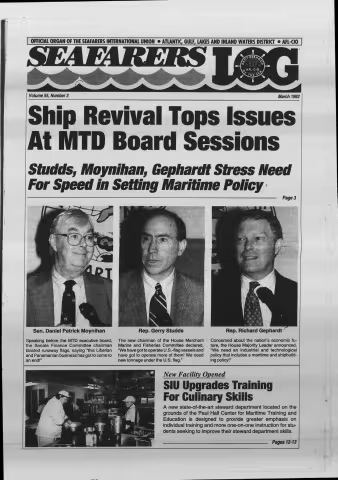
Sen. Daniel Patrick Moynihan Rep. Gerry Studds Rep. Richard Gephardt
Speaking before the MTD executive board,
the Senate Finance Committee chairman
blasted runaway flags, saying "this Liberian
and Panamanian business has got to come to
an end!"
The new chairman of the House Merchant
Marine and Fisheries Committee declared,
"We have got to operate U.S.-flag vessels and
have got to operate more of them! We need
new tonnage under the U.S. flag."
Concemed about the nation's economic fu
ture, the House Majority Leader announced,
"We need an industrial and technological
policy that includes a maritime and shipbuild
ing policy!"
New Facility Opened
SlU Upgrades Training
For Cuiinary Skiiis
A new state-of-the-art steward department located on the
grounds of the Paul Hall Center for Maritime Training and
Education is designed to provide greater emphasis on
individual training and more one-on-one instruction for stu
dents seeking to improve their steward department skills.
Pages 12-13
•my-
i ' '
v .r-""
• '•'•t'" '-'v.-
2 SEAFMBRSLOG
/ MARCH 1993
Michael Sacco
President's Report
The Maritime Trades Department
This issue of the LOG reports on the speakers and actions of the
AFL-CIO Maritime Trades Department's recent executive board
meeting. It might be a good idea to remind Seafarers of the kind
df organization the MTD is and what it does.
The MTD operates for the mutual benefit of
all of its 42 affiliated unions and their mem
bers and families. From the SIU standpoint,
this means that when legislation or other mat
ters come up that affect the welfare of
Seafarers^ we are able to call upon the other af
filiates of the MTD to join our cause. It also
means that Seafarers reciprocate by assisting
the other affiliated unions in their times of
need.
At last month's board meeting in which the
affiliated unions had a chance to catch up on each other's objec
tives for the coming year and to exchange views, one of the
speakers summed up how important this mutually benfeficial
relationship is for the workers represented by unions in the MTD.
Lenore Miller, president of the Retail, Wholesale and Department
Store Union, talked about how the support of the MTD made a big
difference. There were times, she said, when her union "would
not have been successful were it not for the maritime trades
unions." Citing examples. Sister Miller talked about how the un
derpaid juice processing workers represented by her union at one
company won a good contract because that firm was owned by a
shipping company, and the maritime unions with contracts in its
ship operation section went to bat for the juice workers.
It should be noted that this kind of grassroots support activity is
really at the heart and soul of what the MTD is all about. And,
while the MTD's executive board meeting is important as it
provides a framework in which the organization can map out
strategies and priorities for the year, these meetings are but the sur
face level of the work the department carries out. The real guts of
the organization is its activities on the grassroots level, through its
port councils in vm-ious cities throughout the United States and
Canada.
Often, Seafarers participate in these grassroots activities.
Whether it means joining fellow trade unionists in a picket line,
providing hot coffee and sandwiches to striking workers, or calling
on legislators on an important issue to all working people.
Seafarers have been a part of the MTD's grassroots action.
For Seafarers, the MTD is an opportunity to work with the rest
of the labor movement, to lend a hand when we can, and, when it's
needed, to call on fellow trade unionists to weigh in on our fights.
Training for the Galley Crew
Once again, we take pride in our record of constantly seeking to
improve the quality of our training programs. Evidence of this is in
the new facility at the Lundeberg School at the Paul Hall Center
for our steward department crewmembers. This facility allows for
an expanded and more detailed course of instruction for galley
Seafarers. But it does not only benefit steward department mem
bers. Because mealtime is so important to all seamen, the benefits
of the new facility ultimately benefit every Seafarer aboard ship.
I urge all to take advantage of these improvements and develop
ments in the course of instruction at the school. These changes are
made available with the welfare of all Seafarers in mind. Conse
quently, it makes sense for every Seafarer who wishes to become a
better seaman to take advantage of the opportunities that these
programs offer.
Any Seafarer interested in upgrading should talk to their port
agents or boarding patrolmen about enrolling in the school's courses.
Applying for a Scholarship
April 15 marks the deadline for Seafarers and members of
Seafarers' families to apply for the seven SIU scholarships. Four
of those are earmarked for children and spouses of Seafarers and
three go to SIU members.
I urge any Seafarer or Seafarer family member who seeks to ex
pand his or her education to take advantage of this opportunity and
apply. Do it quickly as there is only a month or so to take care of
all the paperwork.
Volume 55. Number 3 March 1993
The Seafarers LOG (ISSN 0160-2047) is published
monthfiy by the Seafarers International Union; Atlantic,
Gulf, Lakes and Inland Waters District; AFL-CIO; 5201
Auth Way; Camp Springs, Md. 20746. Telephone (301)
899-0675. Second-class postage paid at MSC Prince
Georges, Md. 20790-9998 and at additional mailing
offices. POSTMASTER; Send address changes to the
Seafarers LOG, 5201 Auth Way, Camp Springs, Md.
20746.
Communications Department Director and Editor, Jes
sica Smith; Managing Editor, Daniel Duncan; Associate
Editors, Jordan Biscardo and Corrina Christensen; As
sociate Editor/Production, Deborah A. Hirtes; Art, Bill
Brower.
DOT'S Pens Meets with Maritime
To Understand indushy Probiems
In an evident attempt to get a
sense of the problems within
maritime. Secretary of Transpor
tation Federico Pena met on
March 2 with representatives of
the vessel operating industry,
shipbuilding companies and
maritime labor. Michael Sacco
represented the SIU at the two-
hour meeting.
The session was called at the
request of Secretary Pena in order
to develop an understanding
about the views of the individual
industry components as well as
explain where the Clinton ad
ministration Stands on the subject.
Reports from the meeting said
Pena proposes to unveil between
mid-April and early May the
administration's legislative pack
age to revive the U.S.-flag mer
chant fleet. He told the group that
the administration plans to place
the same energy into helping
maritime that it is using to fight
foreign subsidies within the air
line industry.
The secretary announced he
would create an industiy-govern
ment committee on U.S.-flag
maritime revival. The committee
would be made up of three offi
cials from the Department of
Transportation and two repre
sentatives each from maritime
labor, shipbuilding, liner
operators and bulk operators. The
group will be asked to have a
legislative proposal ready for
Pena's review by the April/May
deadline he announced.
During the meeting, several
executives representing U.S.-flag
shipping companies renewed
their threats to go foreign flag if a
program is not passed by 1995.
(The Bush administration, led by
former Transportation Secretary
Andrew Card, proposed a
maritime revivaljg^kage last
summer after execuljyes from
Sea-Land and American Presi
dent Lines threatened to go
foreign flag.)
Those who attended the meet
ing stated Pena was well versed
about maritime and asked many
questions. They said they were
impressed by how quickly Pena
plans to act on the problem.
A spokesperson at the depart
ment said there was "a consensus
among all parties that the goal is
a sound and revitalized U.S.
maritime industry."
AFL-CIO Announces its Support
Of Clinton Economic Package
The executive council of the
AFL-CIO has endorsed President
Clinton's economic package "in
most of its details."
In a prepared statement issued
ebruary 18, the day after Clinton
addressed a joint session of Con
gress, the national trade labor
ederation stated, "The president
las provided the leadership the
nation desperately needs."
Clinton outlined four major
components within tlie economic
package he is presenting to Con
gress: a short-term spending
stimulus to be used on infrastruc
ture and job creation; long-term
deficit reduction; long-term in
vestment strategy; and health care
cost containment.
"The Clinton plan has the
great virtues of stimulating a
depressed economy, of putting
people back to work and of in
vesting in the nation's future," the
AFL-CIO statement read.
It also noted that America's
working people are willing to
contribute their fair share to make
the plan -work. However, the
AFL-CIO asked the president to
reconsider his proposal of placing
a wage freeze as well as other
burdens on federal workers.
The labor federation pledged
to "help see [the package] through
the legislative process, while
making certain that workers' con
cerns are properly addressed."
Range Reports on Somaiia Mission
For SIU crewmembers aboard
the Cpl. Louis Hauge Jr., their job
in Somalia is far from over. TTie
jrepositioning vessel is one of 3
SlU-crewed vessels still involved
in the combined U.S./United Na
tions effort to feed Somali
citizens that began in December.
The Hauge is one of several
vessels responsible for the ship
ment of food and materiel to
American forces stationed in the
East African nation.
In a letter to the Seafarers
LOG, Chief Steward William
usti wrote that galley gang
members are following a normal
schedule. Despite the turmoil
around them, the steward depart-
Peeling fresh garlic for a stir-fry
dinner is Chief Cook Victorino
Vince Cruz.
ment continues to prepare excel
lent meals for the crew aboard the
Maersk-operated vessel.
Justi (who provided the photos
accompanying this article)
reported that the food prepared by
Chief Cook Victorino Vince
Cruz and Assistant Cook Larry
Griffin has helped keep morale
up for the crewmembers and
troops stationed on the Hauge.
The ship is based out of Diego
Garcia and is assisting ap
proximately 17,000 U.S. troops as
well as almost 15,000 soldiers from
20 U.N.-member nations. U.S. ves
sels have been docking at the In
dian Ocean ports of Mogadishu and
Kismaayo since forces started
going ashore Decembo- 9.
An upsurge of violence in
Somalia iii late February has
prompted U.S. military planners
to consider slowing the
withdrawal of U.S. troops and
leaving a larger number of com
bat troops in Somalia than
originally planned. The increased
activity by warlords who rule
various parts of Somalia has been
associated with a March 15 con
ference to determine the political
future of the nation.
Until this recent outbreak of
fighting and rioting, the Pentagon
had expected to begin a full-scale
withdrawal in a matter of weeks,
leaving behind as many as 5,000
U.S. troops, mainly in support of
a larger U.N.-Ied force.
Chief Steward William Justi (second from right) informed the
Seafarers LOG that the galley gang on the Cpl. Louis J. Hauge Jr. is
doing a great job. From the left are Chief Cook Victorino Vince Cruz,
SA Clive Steward, SA Esther Wilks, Assistant Cook Larry Griffin, Chief
Steward Justi and SA Thabet Alsaedi.
i 'M-
\
..-vl.^..r ^.. •.;>.^.v.v:.- .;
MARCH 1993 SEAFARERS LOG 3
Ikmgns^onal Leadav Tell MTD BoanI
Of Suppoff for U.S.-Flag Ship Prognun
Three key members of Con
gress, addressing the AFL-CIC
Maritime Trades Departmen
(MTD) executive board meeting
last month, urged adoption of a
U.S.-flag shipping program.
Senate Finance Committee
Chairman Daniel Patrick
Moynihan (D-N.Y.), House Mer
chant Marine and Fisheries Com
mittee Chairman Gerry Studds
(D-Mass.) and House Majority
Leader Richard Gephardt CD-
Mo.) all noted the need to pass a
U.S.-flag maritime revival pack
age during this session of Con
gress.
Rebuilding the U.S. merchant
fleet became the theme of the
two-day meeting of the MTD,
which is made up of 42
autonomous unions containing
8.5 million members. The board
passed a number of resolutions of
concern to the maritime industry
on the,Jones Act, workplace
safety and cargo preference.
Another of those resolutions
called on President Bill Clinton to
issue "an executive order that un
derlines the nation's historical
needs for and its legal mandate to
maintain an adequate American-
flag merchant fleet and a domestic
shipyard mobilization base." Ibe
boaM also called on all sections
within the industry—organized
labor, business and govern
ment—to meet to develop a con
sensus approach to new
legislation to aid maritime.
AFL-CIO President Lane
Kirkland added the support of the
national organized trade labor
movement to the cause.
"The Persian Gulf served as a
stark reminder of what our mer
chant fleet means," Kirkland told
the body. "We pledge our support
as you try to enact a sensible
maritime policy under Bill Clin
ton."
New Technology
Speaking to the group on
February 11, Moynihan noted a
recent visit he had made aboard
the Aegis-class niissile cruiser
Valley Forge. He described how
the engineroom looked more like
an operating room and talked
about the changes associated
with it. "At 25 toots, [the ves
sel] can stop in three ship's
lengths and reverse," the chair
man of the Senate Finance Com
mittee said.
"We need to put that kind of
technology into merchant ship
building. If we can do it on
cruisers, then we can do it on con-
tainerships."
Moynihan also pointed out
that while the United States "has
Representative Gerry Studds (D-Mass.), chairman of the House Merchant Marine and Fisheries Com
mittee, tells the executive board of the Maritime Trades Department that he will work to enact a maritime
revival program during this session of Congress. ^
the largest Navy in the world, we
have one of the smallest merchant
marines. It is time we tended to
this issue. Revision of the
American merchant marine must
be part of the national economic
policy."
The chairman of the Senate
Finance Committee called on the
Clinton administration to include
rollback on foreign countries
subsidizing new shipping which
puts the U.S. fleet at a disad
vantage when the U.S. Trade
Representative asks European
Community representatives to
reduce its subsidized airline pro
gram, Airbus.
"What's fair is fair,"
Moynihan added. "We cannot
compete against shipping that has
been subsidized by their govern
ments. Shipbuilding subsidies
will be part of the negotiations."
When he addressed the MTD
on February 12, Studds recounted
meeting with President Clinton to
discuss the priorities for his con-
New Administration's 'Mood for Miange'
Soon as Bringing Hope for tl.S. Workers
Officials representing the 42
autonomous unions of the
Maritime Trades Department
(MTD) agreed the time is now to
begin enactment of economic
changes needed in this country to
help the working people of
America.
The representatives to the
meeting passed several resolu
tions c^ling on the Clinton ad
ministration and Congress to
enact health care reform, a nation
al industrial policy, workplace
safety legislation and an intema-
tionsd trade policy. Labor offi
cials addressed the group's
concern about changing the direc
tion of the federal government.
In opening the two-day meet
ing of the MTD executive board
last month, MTD President
Michael Sacco stated, "We meet
at a time of change. We talked
change last year during the elec
tions. Now it is time to bring
about change."
'Time of Change'
He pointed out that the unions
belonging to the MTD must work
^ "to turn
r I this mood
for change
Michael Sacco
into some-
thing
beneficial
for our
members
and for
America's
working
people."
Sacco,
who also
continued, "A true, meaningful
and long-term recovery of the
U.S. economy only is possible if
working
Lane Kirkland
people and
t h e i
unions are
part of the
solution.
The people
who know
what this
country
needs are
the people
who have
serves as president of the SIU,
suffered the most."
Lane Kirkland, president of
the AFL-CIO, noted the change in
the make-up of the government
when he told the MTD executive
board, "We look ahead to a new
era in the White House. Bill Clin
ton and A1 Gore were elected into
office with the support of a
unified trade union movement.
"I know you will continue to
do what you do best, building
solidarity and support for your
programs across a wide spectrum
of interest within the labor move
ment itself," he continued.
Kirkland listed maritime
revival, national health care
reform, striker replacement and
international trade agreements
among issues needing attention
from the administration. "There is
no issue under the sun in which
we do not have an interest and
seek a voice," Kirkland added.
Automobile Workers (UAW),
told the board how has been in
cluded in meetings between the
new president and the heads of
the ttoee American automobile
companies.
He called the meetings historic
as Clinton would not meet with
the chairmen of General Motors,
Ford and Chrysler without labor
being at the
Owen Bleber
table
" T h i
meant
great deal
to me and
the trade
unionists,
B i e b e r
said
Under the
Reagan
and Bush
adminis
trations, labor was excluded from
the gatherings.
The UAW president also
pointed out that Clinton had told
him he will meet with the repre
sentatives of imi)ort automobile
companies when their economic
and political leaders meet with
the representatives from Detroit.
Labor Included In Talks
Highlighting one of the chan
ges ^eady t^ng place, Owen
Bieber, president of the United
Work for Solution
Making sure that labor's voice
will be heard. Jack Otero, the in
ternational vice president of the
Transportation • Communica
tions Union, described how he is
working with the Clinton ad
ministration to recommend, in
dividuals for government service
who understand the issues facing
working Americans.
"Our objective is far loftier
Jack Otero
than just
getting
job," said
Otero, who
is working
as a volun
teer with the
Office of
Personnel
Manage
ment "Our
country
needed a
m a j o
change in direction. Enough
trickle down economics is
enough."
Otero stated the president had
started to fill some of the 7,400
positions available for his ap
pointment. He added that
Clinton's staff is sorting through
more than 115,000 resumes for
those jobs.
There is hope within or
ganized labor that some of the
positions will be filled by people
affiliated with the trade union
movement. Otero noted the AFL-
CIO is' following appointments
within all federal departments.
: More MTD meeting
coverage on legisla
tive issues and trade
union solidarity is on
page 4. Additional
coverage about
runaway-flag vessels
and health care
reform is on page 24,
gressional committee for this ses
sion.
"I told him two things: clean
water and the American merchant
marine," the 11-term repre
sentative said. "We need to re-es
tablish the merchant marine for
national security, trade and to
produce jobs. He told me, 'I
didn't come [to Washington] to
veto bills. I want to make things
happen.'"
Studds noted it was too soon to
discuss details about any
maritime revival package. How
ever, any plan must include build
ing vessels within the United
States, he stated.
"Our skilled shipbuilders can
build vessels for the same cost as in
Europe," he told the audience. "We
don't have the management or en
gineering experience. There is
nothing wrong with our labor, but
we have to import our engineers.
There is no excuse for that"
(The district Studds represents
includes Quincy, Mass., which
had been a major shipbuilding
area until the facility closed six
years ago.)
Maritime Policy Needed
While outlining the four com
ponents of Clinton's proposed
economic plan, representative
Gephardt noted the need for a
nationwide industry and technol
ogy policy.
"As long as other nations are
playing the game a certain way in
electronics and maritime, we bet
ter do the same," the long-time
maritime proponent said. "We
need a shipbuilding and maritime
policy."
As an example of how such a
policy should be crafted,
Gephardt described how the U.S.
was almost out of the semicon
ductor business eight years ago.
Semiconductors are used in com
puters and wer^ invented in this
coupjfy. When the Pentagon dis
covered it had to go overseas for
semiconductors for its weapons,
the military began a joint research
effort with Congress to revitalize
the industry. '
'We're making progress," the
St. Louis congressman noted.
Foreign countries are buying
more [semiconductors] and
dumping less. Today, we have 53
percent of the market in semicon
ductors."
n-
i ••
•vli.
-i'
- . V
1;. ,
W.-- .•'• •'>•• •
>- / •.'• .
4 SEAFARERS LOG
. .,-r , V. . ,,
SlU-Crewal ̂ nies Pnssed Into Service
SlU-crewed ferries were
called into service to transport
thousands of people from Man
hattan across the Hudson River
on the afternoon of February 26
following the explosion which
rocked the World Trade Center.
The ferries, which traditionally
operate between Manhattan and
New Jersey, quickly increased
the number of runs and pick-up
locations.
The blast, which resulted in at
least five deaths and thousands of
injuries, also severely disrupted
local subway, train and bus ser
vice. But 10 SlU-manned pas
senger ferries, operated by
ARCORP of New Jersey, quickly
started an emergency schedule
that afternoon and relieved the
overcrowding for the city's
stranded commuters.
"We had our usual riders, plus
a lot of people who normally take
the subway or the train," ferry
Captain Rick Thornton told a
reporter for the Seafarers LOG.
"Every boat was packed, al
though none were close to being
overloaded. With everybody
working together, things went
fairly smooth."
TTie SIU represents the men
and women who crew the ferries,
most of which have capacities of
up to 400 passengers . Some of the
boats operate within a mile of the
World Trade Center.
One secretary who works in
the World Trade Center was
trapped in an elevator for an hour
on the 91st floor. Eventually she
got to the stairs, but, "All the way
down, I kept wondering how I'd
get home. Then somebody said
not to worry, the ferry would be
here," she told the Newark (N.J.)
Star-Ledger.
The ferries stayed on an ex
tended schedule throughout the
weekend and the early part of the
next week. But by March 2,
Thornton reported, "Things had
pretty much gotten back to nor
mal, which is kind of amazing."
The explosion took place
shortly after noon, in a parking
garage beneath the two buildings.
It created an underground crater
almost the length of a football
field, tore a hole down three
levels of the garage, caved in the
ceiling of the commuter railroad
station and started fires in one of
the building's lower levels. The
blast also destroyed the port
authority's underground com
mand center, rendering the
complex's evacuation plan use
less.
The ferry workers first heard
about the incident around 12:30
p.m., Thornton said, although
none heard the explosion. "It was
overcast and hazy that day, so we
really couldn't see any smoke,"
he added. "The first reports were
sketchy.... I remember a deck
hand from another boat came
out and told us about it, and one
of our deckhands thought he
was kidding. It just seemed im
possible."
But they soon saw rescue
helicopters heading for the twin
towers, and within a half-hour
after the explosion, other captains
and crews arrived to start an early
rush-hour schedule.
'More Bread' Is Goal
For Labor in Congress
Robert McGiotten
Although the occupant of the
White House has changed, labor
will continue its fight to enact
legislation that will help the
working people of America, the
AFL-CIO's legislative director
told the Maritime Trades Depart
ment (MTD) executive board last
month.
Robert McGiotten, director of
the national labor federation's
legislative
department,
advised the
board that
the unions
will have
to "make
sure that
[President
Bill Clin
ton] does
the job so
that we can
bring some,
bread to the table of our members
and ensure that they are going to
have the kinds of programs that
we so desperately need.
"For the first time in 12 years,
we are able to take our issues to
the White House," he added. "But
we have a lot of enemies who are
upset that we have access."
Health Care Struggle
McGiotten pointed out that na
tional health care reform—a plan
proposed for years by the AFL-
CIO—faces strong opposition in
Washington, despite the fact that
the labor-supported family leave
bill was passed and signed into
law during the first month of the
new administration.
He mentioned some proposals
circulating around the Capitol in
clude taxing health care benefits.
"Our members have the best
health care programs in the
country built through collective
bargaining. Taxation of benefits
will destroy collective bargaining
as we know it today. It woUld be
very desthictive."
Union members already are
paying extra into the nation's
health care systems because "we
are the only ones with health
care," McGiotten said. "The sys
tem is broke. We didn't break it,
but we are willing to help fix it.
We should not have to pay for
what has been done to die sys
tem."
McGiotten stated trade unions
will be able to work with the new
secretary of labor, Robert Reich,
because "he understands the
economy and what it means to
have a good-paying job. We
haven't had a secreta^ [recently]
who knew what a job was, let
alone a good-paying job.^Besides
[Reich] is very, very close to the
president."
The legislative director
predicted the North American
Free Trade Agreement (NAFTA)
among the U.S., Canada and
Mexico "will go down like a dud"
if it comes to the floor of the
House of Representatives in its
present form. Labor has opposed
the legislation because—among
other filings—the pact makes no
provisions for raising the work
ing, safety, environmental and
living standards within Mexico to
levels equal to those in the U.S.
and Canada in order to prevent a
mass exodus of jobs to south of
the border.
President Would Sign
Striker replacement legisla
tion already has 113 sponsors in
the House of Representatives.
The bill, which would prevent
scabs from being hired per
manently when workers go on
strike, may be debated in Con
gress in the spring, he said.
"If striker replacement gets to
his desk, the president has indi
cated he will sign it," McGiotten
noted. Similar legislation passed
the House of Representatives in
the last session of Congress but
failed to gamer enough votes in
the Senate. President Bush had
stated he would have vetoed the
bill had it made its way through
Congress.
SlU-manned ARCORP ferries like the one pictured above transported thousands of commuters from New
York across the Hudson River after an explosion disrupted local train service.
MTD Remimleil of Solidarity's Strength
Members of the Maritime
Trades Department (MTD) ex
ecutive board received a reminder
from one
of their
own about
what union
solidarity
has meant
and still
means
when they
met last
month.
Lenore
Miller,
president of the Retail, Wholesale
and Department Store Union
(RWDSU), informed the group
that her organization would not
exist if it had not been for the
efforts made on its behalf by other
trade unions.
'There were initiatives in (my)
union which would not have been
successful were it not for the
maritime trades unions," she said.
"I think we forget to take pride in
that. I think we forget how much
Lenore Miller
Ai^lo Fosco, L^oras nvsUea^ Dies
Angelo Fosco, president of the
Laborers International Union,
passed away February 11 after a
brief illness. He was 71 years old.
Brother Fosco was a senior
member of the AFL-CIO Execu
tive Council, having been elected
to it in 1976.
A native of Chicago, Fosco
began his labor career there as a
member of the union's Sewer and
Tunnel Miners Local Union 2. He
became an international repre
sentative for the Laborers in the
early 1950s.
Angelo Fosco.
Laborers in 1975.
Fosco
held
various
positions
within the
union, in
cluding in
ternational
vice presi
dent, be
fore he as
sumed the
presidency
of the
we cooperated with each other
and we have to continue to
cooperate with each other."
Miller began her presentation
with a thank you to all of the
unions who have stood with her
members during beefs. She
recalled how the late Teddy
Gleason, former president of the
Longshore- men's Union,
threatened to close the port of
Charleston, S.C. if unionized
hospital wooers were not recog
nized. She noted how juice
processing workers were able to get
a contract because the firm was
owned by a shipping company
and maritime unions applied
pressure.
The union president also
recounted the role Seafarers have
played to assist the RWDSU.
"We would not have been suc
cessful in organizing Macy's if
Paul Hall had not provided the
manpower and the pickets. Our
efforts at Macy's would not have
been successful.
"Of all the unions that don't
have maritime or seafarers in its
name, it is that kind of relation
ship that makes us join, belong
and be proud to be part of this
department," Miller said.
"We need to continue to do
that kind of work, because it is
only that kind of solidarity that
makes us successful."
MTD Sec'y Jean ingrao
Announces Retirement
The executive secretary-
treasurer of the Maritime Trades
Department (MTD) announced
she would be retiring from the
position effective May 31.
Jean Ingrao made her inten
tions known at the opening of
the MTD's executive board
meeting last month. She has
served with the organization
since being appoint^ by Paul
Hall in 1979 when he was presi
dent of the MTD.
. Immediately after her an
nouncement, the executive
board elected Frank Pecquex as
acting executive secretary-
treasurer until the full MTD
convention meets this fall. Pec
quex had been serving as ad
ministrator.
Tributes for Ingrao and her
43-year
career
with the
AFL-CIO
began im
mediate
ly. MTD
Resident
Michael
S a c c o
said,
"Your
years of
loyalty
and kindness are treasured by all
of us who have had a chance to
work with you."
AFL-CIO President Lane
Kirkland noted that IngraO was
"part of my original AFL fami
ly. You have worked tirelessly
for solidarity."
Jean Ingrao
-r
'• •.
• '-.-X-'-Ar^-
MMCa 1993 SEAFARERS LOG 5
Ignored by Forei2n'Fla^ Ship
Ranger Saves Five from Sinking Schooner
Five people aboard a founder
ing schooner were grateful a
U.S.-flag tanker responded to
their distress call after watching a
foreign-flag tanker steam past
them without even acknow
ledging their request for help.
The SlU-contracted Ranger
picked up a distress call from the
twin-masted Topaz around 5 a.m.
on January 11. The OMI-
operated tanker was off the coast
of Venezuela sailing from San
Nicholas, Aruba when it changed
course to answer the call.
The Topaz, one day out of Las
Piedras, Venezuela, was taking
on water. The engine of the New
Zealand-registered vessel would
not run, and the three bilge pumps
on board were broken. The sail
boat had been in Venezuela for
more than four months for a hull
overhaul.
After consulting with the cap
tain, Second Mate Ben Tidwell,
an SIU hawsepiper, called all
hands at 5:20 a.m. to assist in the
rescue, according to AB Casey
Downing, who wrote the
Members of the Ranger's deck gang pose with the crew of the Topaz. From the left are (kneeling) ABs
Jonathan Weaver, Norm Haddad and Joe Mieluchowski, (standing) Topaz crewmembers Neil Rooney,
Anastasia Ledwon, Jim Baldwin, Steve Sheeling and Mike Kelly and Bosun Michael Moore.
Seafarers LOG about the opera
tion.
As crewmembers arrived at
their stations, they noticed the
foreign-flag tanker within three
miles of the Topaz. Following the
CapeHa &VW Rescues Boaters
hi Rott^ Seas, Hi^ Wiads
Seafarers aboard the USNS
Capella recently helped save the
lives of three people manning a
37-foot catamaran who were
rendered helpless by severe
weather approximately 300 miles
north of Bermuda.
The rescue took place around
9 a.m. the day after Christmas,
despite 20-foot seas and winds of
30-40 knots. No one was injured,
although the sailboat capsized
and broke apart after its crew
members were safely aboard the
Capella.
The Capella, operated by Bay
Tankers, was en route to Somalia
as part of the U.N. relief effort
when the vessel received a
Mayday from the catamaran. The
Cat Hull, approximately 18 miles
northeast of the Capella and
headed to Bermuda from New
port, R.I., had endured four days
of rough weather. Its captain and
crew, all citizens of France, were
drifting with a sea anchor out, in
hopes of outlasting the foul
weather. But it appeared the small
craft was in imminent danger of
capsizing or coming apart. (The
boaters were scheduled to make a
yacht delivery from Bermuda to
the Caribbean.)
With the Capella heading
toward the unnavigable boat.
Radio Officer Ashley Vail con
tacted a weather center in Nor
folk, Va. and learned that the
storms were expected to worsen
during the next 48 hours.
All hands reported topside to
search for the boat, which would
have been easy to miss because of
the waves. Also, the only flares
aboard the sailboat were nearly
impossible to reach, as they were
in an enclosed life raft.
Bosun Michael Shappo and
other members of the deck
department readied two rope lad
ders on the Capella's port side.
Since it would have been difficult
or impossible to properly recover
one of the Capella's lifeboats in
the dangerous weather. Captain
David Kelly planned to maneuver
the vessel close to the sailboat and
have; the stranded crewmembers
climb the ladders.
One of the lookouts spotted
the drifting craft from about four
miles. "Waves were crashing
over the boat and the three crew-
The USNS Capella was en route to Somalia as part of the I^I.N. relief
effort when It received a distress call from a 37-foot catamaran.
members were huddling inside
the cockpit," Kelly said in a letter
recounting the rescue.
Utiliziiig the strong wind
members of the engine depart
ment stopped the Capella's en
gines while the captain let the fast
sealift vessel drift toward the sail
boat. The catamaran also tried to
maneuver into rescue position.
After one failed attempt, the
three boaters reached the ladders
and safely climbed aboard the
Capella, where members of the
steward department provided
blankets and hot coffee. The
ship's medical officer examined
the boaters and found them ex
hausted but otherwise unharmed.
The unmanned catamaran sub
sequently capsized.
"The crew was elated," wrote
Kelly, who commended the crew
members for their "heroism" and
"skillful performance."
The thankful boaters were dis
charged in Gibraltar on January 1
and returned to France via arran
gements made through their
employer.
The SIU members who took
part in this rescue are: Bosun
Shappo, ABs Gino Whitehead,
Joseph Bryan, Kaare O'Hara,
William Sieggreen, Joseph
Conlin and Gregory Gorenflo;
OSs Glenn Baker, Denis Pic-
cinolo and Mark Weaver; DEU
Jeffrey Hailstone; Electrician
Lawrence French; UJEs Phillip
Burke, Terry Harmon, Glenn
Kenyon and Richard Presson.
Also assisting in the operation
are: FOWTs Ronnie Micklos, C.
Davis and Paul Pagano; Wiper
Randell Porter; Chief Steward
Sergio Castellanos; Chief Cook
Jimmie Reddick; Assistant
Cook James Jordan; and GSUs
Dayna Roger, Gerald Williams
and Leon Gonzales.
rescue, the crew of the schooner
said they tried to raise the vessel
but were not successful. The
Ranger spotted the Topaz on radar
around 5:30 a.m. and began
maneuvering operations. Weather
conditions were posted as 17- to
21-knot winds, moderate waves of
about seven feet and white caps
with some spray. After reporting
the schooner was filling with water,
the captain of the Topaz ordered tiie
crew to abandon ship. Joining the
human crew was an eight-week-
old dog. However, the Topaz crew
realized it had more problems
when the members found the .life
raft would not hold air. It had
been serviced last in 1981.
At daybreak, the Ranger was
beside the life raft. The rescue
operation proceeded normally
until, according to Downing,
"one of [the Topaz'] crew fired a
flare across our deck giving us all
a good scare."
Downing continued with a
description of the rescue, "Bosun
Mike Moore got a line on the raft
and positioned it below our pilot
ladder. ABs Jonathan Weaver,
Joe Mieluchowski, Norm Had
dad, Tom Lasater and I started
helping the crew and their dog
aboard and pulling up their gear.
That was the last we saw of the
Topaz."
The rescue was completed by
7:40 a.m. No injuries were reported
by members of either crew. The
Ranger resumed its voyage to Port
Everglades, Fla. Once ashore, the
Topaz crew again thanked the
mariners aboard the Ranger. As he
was talking with Third Mate Sam
McBean, also an SIU hawsepiper,
and AB Downing, the captain of
the Topaz told them, "TTtank God
for American merchant ships and
union crews."
Among the Ranger deck gang members who participated In the
rescue were (left to right) ABs Casey Downing, Jonathan Weaver and
Tom Lasater and Bosun Michael Moore, who provided the Seafarers
LOG with the photographs for this story.
A Valuable Asset to the Harkness
"Brother Jose Martinez has been aboard the USNS Harkness tor
over one year and has consistently performed above expecta
tions In both the steward department and deck department."
These were words In praise of Steward Assistant Jose Martinez,
written by Chief Steward Ben\l|enderson and echoed In other
letters of commendation from the master, chief mate and crew
members aboard the Mar Ship vessel. "Brother Martinez sets one
of the best examples of a merchant seaman and SIU member-
one In which we can all be proud." In photo above, Martinez poses
on the deck of the USNS Harlmess in Dubai, UAE.
/
iL .
> --V •' •
-..4.'
4. -• •
'J Cio • • • •-
-1: V- -'-v. '•
7 - •, •
6 SEAFARERS LOG MARCH 1993
I •
Benzene Regs Top
Concerns at Safety
Team Meeting
Seeking to promote safety
practices in benzene-associated
environments, the Seafarers
Harry Lundeberg School of
Seamanship safety team met last
month to review the Coast Guard-
issued regulations related to the
petroleum-based chemical
Several wrinkles have come
up in the way regulations cover
ing benzene are being imple-
Dr. Kenneth Miller, medical direc
tor of the Seafarers Welfare Plan,
reviews the benzene regulations.
mented, specifically concerning
facial hair.
The safety team is composed
of representatives who work out
of SnJ halls around the country.
They meet with crewmembers
aboard SlU-contracted vessels to
keep them updated on safety-re
lated items and information.
team members stated many of
the tanker crewmembers with
whom they have talked still have
questions regarding the restric
tions on faci^ hair stipulated by
the benzene regulations.
Dr. Kenneth Miller, director of
the Seafarers Welfare Plan's
medical department, reviewed
the Coast Guard directive which
states facial hairs cannot impede
the snug fit of any breathing ap
paratus required on a crewmem-
ber when working around the
petroleum-based chemical.
"A snug fit between the
respirator and face is vital to the
safety of our members working
with or around beiftene," Miller
stated. "Facial hair has become an
Listening to an answer regarding benzene regulations during the safety team meeting are Bobby CInton III of
Norfolk, J. J. Arnold of Honolulu, Ken Conklin of the Lundeberg School, Tony McQuay of Jacksonville and
Steve Judd of New Orleans.
issue ip this process. The SIU's
concern is to make sure our mem
bers are as safe as they possibly
can be.
"Today's respirators will only
work if they are not impeded by
facial hair. We are looking for
new technology concerning
respirators. But for now, the
safety of our members is the most
important thing," he added.
Miller reminded safety team
members to verify that tankers,
barges and tank vessels, as desig-
Seafarers Crew Sea-LantFs Shining Star
SIU members are manning the
Sea-Land Shining Star, a 637-
foot containership which Sea-
Land Service chartered
beginning last month.
Seafarers crewed the Shining
Star in the port of Wilmington,
Calif., although the vessel will
operate from Ae East Coast. The
Shining Star ts "filling in" for four
other Sea-Land ships (the Chal
lenger, Crusader, Discovery and
Expedition) as they "cycle
through shipyard periods," said a
company spokesperson. The
Shining Star will go on a run
known as the America's Service,
which includes stops in the Gulf
of Mexico, Puerto Rico and the
Caribbean.
"The members are excited
about it," said SIU Patrolman Rob
Scrivens, who sent the accom
panying photos to the Seafarers
LOG. "The ship had been laid up
for a while, and it looks like there
will be a lot of OT available while
the guys get it back in shape."
Crewmembers will have in
dividual quarters aboard the ves
sel, which will transport a variety
of dry cargo.
During the last five years, the
vessel was on charter to Lykes
Bros, and sailed by the name Al-
meria Lykes. Before that, it was
an American President Lines ship
known as the President Mc-
Kinley.
The Shining Star has a breadth
of 82 feet and a depth of 30.8 feet.
Posing at the console in the engineroom of the Shining Starare, from
left, OMU Jesse Manard, Engine Utility William Gordon, OMU Victor
Bermudez and OMU Gary Mitchell.
The passenger area of the Shin- The Shining Star takes on cargo
ing Star Is aft of the house. at Nasco shipyard In San Diego.
Chief Steward Curtus Phillips and
Chief Cook Allan Sim are at work
In the ship's galley.
nated by the Coast Guard in the
benzene regulations, carry both
positive and negative pressure
respirators on board as well as
other safety gear required for
working around the chemical.
Former Seafarers Port Agent
'Scottie' Aubusson Dies at 72
Bosun Bobby Garcia (lower right) and Mike Charben (seated left) draw
cards with other deck department crewmembers for watches.
Former SIU official Ernes
Frank "Scottie" Aubusson died of
natural causes Feb. 10 in Miami.
Brother Aubusson, who passed
away in his sleep, was 72.
"The former bosun and SIU
port agent was in Florida to attend
the Maritime Trades Department
executive board meeting—an ex
ample of how Brother Aubusson
stayed in touch with his union and
the industry even though he offi
cially retired in January 1977.
Brother Aubusson was bom in
Middlesex County, England, just
outside London.
He sailed as a merchant
mariner aboard British ships from
1940 to 1942, then Joined the SIU
under unusual circumstances. As
Brother Aubusson once said, "I
came into the SIU on a torpedo!
The British ship on which he
sailed during World War II was
torpedoed by Germans at Mur
mansk, Russia, and Aubusson
(then 22) was wounded. He was
picked up by a hospital ship
which berthed in Loch Ewe, Scot
land. But when he heard that a
convoy of U.S. ships was forming
nearby, he snuck away from the
hospital and signed on an SIU
ship, the Gateway City. He was so
anxious to get to America, he did
not care that the Gateway City
was going to Murmansk. And it
was aboard that vessel where
Aubusson was dubbed Scottie
(because he had signed on in
Scotland).
For the next 10 years. Brother
Aubusson sailed as AB or bosun.
In 1949, he became a U.S. citizen.
Aubusson came ashore in
1952 and began working his way
up through the union. In 1955 he
became a patrolman in the port of
New York. Four years later he
became port agent of the port of
Chicago.
Brother Aubusson spent more
than a dozen years working in
Chicago, then finished his SIU
career as port agent in St. Louis
from 1973 to late 1976.
Throughout his years with the
Seafarers, Brother Aubusson
gained a reputation as someone
who had a great sense of humor.
Scottie was much loved by the
membership," noted SIU Presi
dent Michael Sacco. "He always
had a grin on his face and a stoiy
to tell."
Aubusson participated in
many of the epic beefs involving
the SIU beginning with die Wall
"Scottie" Aubusson
Street beef of 1946 and the
Isthmian strike of '47. He also
participated in organizing drives
for the SlU-affiliated United In
dustrial Workers and facilitated
the building of a large and active
Maritime Trades Department
Port Council in Chicago.
After he retired. Brother
Aubusson did extensive work
with charities and with hand
icapped children in the Chicago
area. A close friend of retired SIU
official Ed Mooney, he also
stayed abreast of SIU matters, and
attended the SIUNA convention
last summer.
"He was a great guy to work
with," said Ed Pulver, an SIU
vice president who had stood
with Aubusson in many beefs
over the years. "And he definite
ly was one of the funniest people
I ever met. The day he died, he
was passing around cartoons he
had drawn."
George McCartney, SIU vice
iresident West Coast who also
lad known and worked with
Aubusson for many years,
described Brother Aubusson as
very popular. He had many
yams to spin, but he also did a lot
for the union.
Brother Aubusson oiften;
referred to himself as A-8, which/
was his SlU book number.
When he retired, he told the
Seafarers LOG that his greatest
accomplishment was obtaining
his high school diploma at the
Lundeberg School in 1974. He is
believed to be the first SIU offi
cial to complete the GED pro
gram at the school.
"Sure, I was afraid of failing,"
Brother Aubusson told the LOG
in January 1977. "But I was deter
mined to show the trainees that if
a guy who dropped out of school
40 years ago at age 14 could make
it, anybody could."
I
.trr
f:
.j;
W
MARCH 1993 SEAFARERS LOG 7
Gnat Lakes Boatmen damplete Special Courses
Seafarers employed by Great
Lakes Towing Company recently
completed special courses cover
ing AB and engineroom skills ai
the Paul Hall Center for Maritime
Training and Education.
Early last month, 10 SITJ
members who sail for Grea
Lakes Towing finished the train
ing programs which were
developed for the company due to
Seafarers who completed the special courses are (from left, kneeling) Lonnee Aakeberg, Greg
Stamatelakys, Ray Smith, Tony Willoughby, (second row) Timothy McKenna, Cliff Stockman, A.K.
Horner, Mike McCormick, Mike Lock and Mike Kornmeier. Instructor Joe Kurley is at far right.
Opening a water valve prior to en
gine start is Tony Willoughby.
new tonnage regulations affect
ing tugboats. The Lundeberg
School modified its AB course
and created the engine training in
order to accommodate both the
company's and the members'
needs and schedules.
The Seafarers, most of whom
previously sailed as deckhand/en
gineers, got plenty of hands-on
training in areas such as valve
maintenance, back and hearing
safety, pumps, repair techniques
for broken bolts and studs, start
ing a boat's main engines, cutting
and threading pipes, lifeboat
operation and many other skills.
(Four of the men already were
ABs and took only the engine
course. The others took both
courses.) They also took written
tests and kept training manuals
which were produced specifically
for them by Lundeberg School
instructors.
Lonnee Aakeberg, who sails
from the port of Duluth, Minn.,
said he found the classes "very
informative. When you learn on
the job, you usually don't have
time to End out why things are
done certain ways. But in these
courses, everything seems to
come together for you."
Aakeberg added that instruc
tors Joe Kurley (engine depart
ment) and Jim Brown (deck) "are
lighly skilled in relating to our
questions and giving answers we
understand."
Similarly, Mike McCormick,
sailed exclusively in the deck
department until recently, when
he also started working in the en
gineroom. "As you can imagine,
I learned a lot from this engine
course," Homer said.
One of the Seafarers who took
both courses is Tony Willough
by. He summed up the experience
when he stated, "^ey were good
courses and I got a lot out of
them."
Greg Stamatelakys, another
first-time visitor to the Paul Hall
Center, said, "It was great to see
another part of the union, and I
think the school is a very progres
sive idea."
Mark Rohn, director-fleet
operations for Great Lakes
Towing, said in a letter to the
Lundeberg School, "... from the
enthusiasm and response shown
by our employees, [the courses]
should prove to be a success and
beneficial to both the individuals
and the company by insuring that
the equipment is being operated
and maintained properly." Rohn
also expressed appreciation about
the school's willingness to pro
vide the special training.
While all of the formal teach
ing was handled by instmctors,
Kurley noted the "wide variety of
background and experience"
among the students, who also
taught each other. "The exchange
of information among them was
fabulous," Kurley said. "The in
teraction helped everyoiie, in
cluding me. I learned from them,
and I tlunk that proves once again
the caliber of people in the SIU."
A.K. Horner wipes up oil on the Bull Shepard'sstaiboard main engine.
Before starting the engine, Cliff
Stockman gives it a pre-lube.
jobs." Kommaier also said the
scheduling allowed the Seafarers
to make the most of their time at
the school.
A.K. Horner has been a mem
ber of the SIU since 1971. He
Timothy McKenna reviews the
pre-engine start-up checklist.
Checking the schematic to ensure proper lubrication for the Bull
Shepard's main engine are Mike McCormick (left) and Ray Smith.
who sails from the ports of
Toledo, Ohio and Detroit, said he
gained a lot from the courses. "In
fact, I'm considering coming
back to the school so 1 can learn
more."
While discussing the frequent
ly changing needs of the industry,
Tim McKenna said he recog
nized the importance of the train
ing available at the Lundeberg
School. "We have to be sure we
have qualified employees."
For Cliff Stockman, who has
been a Seafarer since 1978, this
was his first trip to the SIU educa
tion facility in Piney Point, Md.
'I'm impressed with the staff and
the facilities," he said. "It's much
larger than 1 realized."
Like several of his fellow
classmates, Ray Smith, who
works in Cleveland, said he ap
preciated the instructors' willing
ness "to go out of their way to
help us. '^at really helped, and 1
feel like everyone benefitted from
the courses."
A Great Lakes employee for
more than 23 years, Mike
Kornmaier described the cour
ses as "well-handled. The
facilities were better than we ex
pected, and we picked up some
important things that apply to our Tho Alaska and the Missouri are two of Great Lakes Towing's tugs.
'--.AT?: -- •
• USi'v'Vv;*-
•«
8 SEAFARERS LOG MARCH1993
.L/- •
Charter Member Eloris Tart Finds Relaxation on Links
Retired Steward Still
Keeps Up with SIU
After a long, distinguished
career with the SIU that included
serving in World War IT and later
taking part in a dramatic rescue at
sea, SIU pensioner Eloris Tart
has settled into a comfortable
routine which includes plenty of
his favorite sport: golf.
Many people find the game
maddening, but Tart, a charter
member of the Seafarers, says,
"I've always liked it. I used to be a
caddie when I was young, and I
never lost my interest in the sport."
He plays at least nine holes on
most days, weather permitting.
Assessing his skills, he says, "I
still need to brush up!"
Last month. Tart celebrated
his 80th birthday. The former
recertified steward retired from
the SIU in 1975, settling in
Mobile, Ala.
It requires some cajoling to get
Tart to reminisce, but his memories
of the union are plentiful.
Started in 1933
Brother Tart was born in
Baldwin County, Ala. in 1913,
near Mobile. He first went to sea
at age 20, mostly because "80 per
cent of the people from my com
munity did it. You have to realize,
those were different times."
He started with the old Inter
national Seamen's Union, but be
came a Seafarer in 1939 in the
port of Mobile. In fact, his SIU
membership began on his
birthday, February 14.
"There wouldn't have been an
SIU if we hadn't resisted the (at
tempted) takeovers by the
NMU," Tart declares. "A lot of
good men helped keep the SIU
going, naturally including Paul
Hall (who headed the SIU from
1947 until his death in 1980),
whom I knew for a long time. I
also sailed with his brother. Bill."
Brother Tart participated in
many of the union's beefs. He
also sailed extensively during
World War n, including trips on
the bauxite run. "Those were very
dangerous, hard voyages," he
recalls. "But we had to get the
bauxite for aluminum for airplanes
and other war materials."
Tart remembers one trip when
his ship ran out of stores. He also
recalls sailing with all of the
ship's lights out so the merchant
vessels would not be easily
spotted by enemy submarines.
An occasional contributor to
the Seafarers LOG, Brother Tart
also served in the Coast Guard
during WWII.
But he returned to the SIU
before the war's end, and in 1964
he graduated from the chief
steward recertification course in
New York. Brother Tart was a mem
ber of the ninth recertification class.
Rescue at Sea
One of the most dramatic
events of Tart's career took place
in May 1972, 30 miles off the
coast of Florida. He was sailing,
aboard the Sea-Land Warrior
when he and his fellow crewmem-
bers rescued all 104 passengers who
had been forced from their fuo-
ravaged vessel, the Liberian-
registered Oriental Warrior.
The Sea-Land Warrior's crew
later received a prestigious safety
award from the National Safety
Council and the American In
stitute of Merchant Shipping
(AIMS). At the awards
ceremony, the president of AIMS
singled out Brother Tart, describ
ing him as "a credit to his vessel
and to the U.S. merchant marine"
for the fine care he and the
steward department extended to
the rescued passengers and crew-
members of the Oriental Warrior.
At the time. Tart said the burn
ing ship reminded him of the
many vessels he saw go down in
flames during WWII. "There was
no chance for rescue in those
days," he said in 1972.
But, according to an article in
June 1972 Seafarers LOG,
Brother Tart also said he had no
qualms about taking risks to help
save lives. Under similar cir
cumstances, he said, "1 would do
the exact same thing —just like
any other Seafarer."
Helpful Suggestions
Just before he retired. Tart
played a big part in having some
of the steward department ratings
restructured. Based partly on his
recommendations, the steward/
cook position was re-rated to
steward/baker, while chief cooks
retained their old ratings. This
resulted in fair pay and distinctive
job descriptions for those who
sailed with those ratings.
Since then. Tart, who has two
sons, has enjoyed his time on the
links. But he also has stayed
abreast of the union"^s activities.
He still regularly reads the LOG
and occasionally drops in at the
Mobile union hall.
In fact, Brbther Tart says he is
hopeful that this year the cutoff
date for WWII veterans' status
for merchant mariners will be ex
tended to include those who
sailed during the first year of the
war. "1 know a lot of people have
written their congressmen about
this issue," he says. "From ex
perience, 1 can tell you there were
a lot of deadly mines and other
hazards out there."
(Brother Tart recently sent his
original membership records to
the LOG. He included dues
receipts and discharges, copies of
which, appear on this page.)
'xr V DECK
3EAFABEBS INTERNATK^
otNorfii Am«{3,
2 oil 7
> L lb« cmfbonx* 1
Recerfificoffon. Graduation tlma in the Maritime Advancement Program, finds Class
No. 9 of the Stewards Training and Recertification Program lined up
after receiving their new certificates. In the photo are (front,1-r) Walter Newberg,, Orville Payne,
Eloris Tart, Juan Oquendo, Jr. and Terrill York. At rear are instructor Tony Goncalves, Angel .Seda,
SIU President Paul Hall, who presented the certificates, Juan Reinosa, Rex O'Connor, Frank J.
Meggie, and instructor Eric Kingwall. Brother WiRlam McNelly was not present when the photo
was taken. (See Page S.)
-ate*.) • «
r
Y
Sis
ijsr
mi.
93.
"St. IS.
*>«
S94S.
!io.
-So..
• 1 ;
''HiA
i
Ghra rsealpt to tho i
» ond 1 p Qici azn%£}
sloctpod hU bcok
y
- .1^ 1/
•. F-
MARCH1993
Efforts Begin io Pass WWII Mariner Veterans Extension
Grassroots efforts already are
being organized to seek congres
sional support for legislation that
would extend the cutoff date for
World War Il-era merchant
manners.
The Merchant Mariners Fair
ness Act of 1993 has been sub
mitted for the third straight
session of ^Congress by Repre
sentative Jack Fields (R-Texas).
It seeks to extend World War II
veterans status to U.S. merchant
mariners who sailed between
August 15, 1945 and December
31,1946, the date President Harry
Truman declared an end to the
hostilities.
In just one month, the bill (also
known as HR 44) has acquired
more than 130 sponsors. This is as
many as the bill acquired in the
first year of the previous session
of Congress. Before the session
adjourned last fall, 227 members
of Congress (more than half) had
signed on as sponsors.
However, the bill still faces
Opposition from the chairman of
the House Veterans' Affairs
Committee, G.V. "Sonny"
Montgomery (D-Miss.).
Writing Campaign Starts
"We have started letter-writ
ing campaigns by members of our
organization who live in a district
where the representative is not a
sponsor or serves on the commit
tee where the bill is hung up,"
noted Joseph Katusa, vice chair
man of the Merchant Mariners
Fairness Committee of the
American Merchant Marine
Veterans.
Katusa and George Searle,
chairman of the committee, have
organized a data base of the
American Merchant Marine
Veterans to know which veterans
live in which districts. "We want
our members to contact the dis
trict offices or the Washington of
fices to let the Congress loiow of
our support," Katusa noted.
Already letters are being
received in Montgomery's office
as well as in the office of Jim
Slattery (D-Kansas), who is
chairman of the House Veterans
Affairs' Compensation, Pension
and Insurance Subcommittee. To
date, no hearing on HR 44 has
been scheduled.
Bill supporters received a
boost last month when the Sun
day newspaper magazine Parade
ran story about HR 44. "It was
tremendous to see that article ap
pear at the beginning of Con
gress," Searle stated. "That
brought more national attention
to our cause."
Changes 1988 Ruling
Both Searle and Katusa
received their veterans status in
1988 when the secretary of the
Air Force (the branch of the
Department of Defense that over
sees veterans affairs) declared
merchant mar i -. s who sailed be
tween Dece.-.'uer 7, 1941 and
August 15,1945 as World War II
vets. However, all other branches
of the service use December 31,
1946 as the cutoff date for World
W^ n veterans status.
"The members of the mer
chant marine who were in train
ing as of August 15 had no idea
that the atomic bomb existed or
would end the war," Katusa ex
plained. "They were in training to
prepare for the invasion of
Japan."
Like many other merchant
mariners from the war, Katusa
and Searle sought to join the
Navy to fight for their country,
but ended up in the merchant
fleet.
Write to Congress to Express Support for HR 44
Seafarers and their families are urged to voice their support
for the Merchant Mariners Fairness Bill of 1993 (HR 44) by
writing to their member of Congress or to the House Conmnittee
on Veterans' Affairs. The names of the committee members
appear below. Letters for all members of the House of Repre
sentatives should be addressed to: The Honorable •
U.S. House of Representatives, Washington, DC 20515.
Luis V. Guiterrez, 111.
Scotty Baesler, Ky.
Sanford Bishop, Ga.
James E. Clybum, S.C.
Mike Kreidler, Wash.
Democrats
G.V. "Sonny" Montgomery,
Miss.
Don Edwards, Calif.
Douglas Applegate, Ohio
Lane Evans, 111.
Timothy J. Penny, Minn.
J. Roy Rowland, Ga.
Jim Slattery, Kan.
Joseph P. Kennedy II, Mass.
George E. Sangmeister, HI.
Jill Long, Ind.
Chet Edwards, Texas
Maxine Waters, Calif.
Bob Clement, Term.
Bob Filner, Calif.
Frank Tejeda, Texas
Conine Brown, Fla.
Republicans
Bob Stump, Ariz.
Christopher H. Smith, N.J.
Dan Burton, Ind.
Michael Bilirakis, Fla.
Tom Ridge, Pa.
Floyd Spence, S.C.
Tim Hutchinson, Adc,
Terry Everett, Ala;
Steve Buyer, Ind. :
Jack Quinn, N. Y.
"I went to enlist in the Navy
with a friend," Katusa recalled.
"We were shoved into the
maritime service. The trappings
were military and we wanted to
serve oin country."
Searle became a merchant
mariner when "the Navy turned
me down because of my eyes. It
was on my 17th birthday and I had
dropped out of 10th grade. They
told me if I wanted to join a ser
vice, go into the maritime service.
I wouldn't have left high school if
I thought I was going to be a
civilian."
Outside Support
Besides congressional sup
port, the bill has been endorsed by
the Veterans of Foreign Wars,
Disabled American Veterans and
American Legion posts around
the country as well as by nation
ally syndicated columnist James
J. Kilpatrick.
If passed, the bill would allow
the merchant mariners it covers to
receive a military burial, medical
care at Veterans Administration
(VA) hospitals and VA home-
loan guarantees. Harry Bur
roughs, the minority staff Erector
for the House Merchant Marine
and Fisheries Committee, pointed
out that most of those ^ected
already have their own doctors
and homes so the cost to the
government would be minimal.
SlU Pensioner Wadlington Helps Henor All Veterans of War
World War 11 veteran seaman
and SIU pensioner Maxwell
Wadlington wants to make sure
his fellow merchant mariners are
not forgotten.
Brother Wadlington noticed
an advertisement in his local Eus-
tis, Fla. newspaper requesting
community contributions toward
SIU pensioner Maxwell Wad
lington placed a wreath at the new
war memorial in Florida.
th J building of a veterans
memorial. He quickly researched
the "Troject and discovered the
memorial was being built to
honor all veterans of war—not
just a particular branch of the
military. Wadlington provided a
donation. "I contributed be
cause I have a deep love and
affection for the mere^hant
seaman," he told a reporter for
the Seafarers LOG.
His donation, along with other
community contributions, helped
pay for a monument honoring the
veterans of Lake County. The
memorial was built in the city's
Ferran Park on Lake Eustis.
Brother Wadlington received a
letter thanking him for his con
tribution and inviting him to at
tend the dedication ceremony on
November 11 where he could
place his own special wreath of
remembrance on the memorial.
Wearing his Seafarers jacket.
Brother Wadlington attended the
ceremony and proudly placed a
wreath on the monument. Its in
scription read, "The U.S. Mer
chant Marine - WWII."
"I was anxious for people to
know about the seamen of World
War II. I wanted to remind them
that soldiers and aviators weren't
out there fighting alone. There
were seamen too," Wadlington
said.
"I am proud to have sailed as a
merchant mariner. The problem
is that hardly anyone knows about
the merchant marine and what
they did in World War II. That is
the purpose of my wreath, to
make people remember that we
were there too." His is still the
only wreath to date on display at
the site, but he said he expects
there will be more once other area
veterans visit the memorial.
A native of Hopkinsville, Ky.
Brother Wadlington joined the
merchant marine in 1943 in
Sheepshead Bay, N.Y. He sailed
the Mediterranean throughout
World War II.
In 1943, Wadlington sailed on
his first ship, the Sebastian Viz-
camo, a Liberty ship. The
vessel's mission was to transport
six locomotives to Londpn. But
the locomotives were too heavy
of a load, and the vessel began to
crack. The ship had to detour into
Newfoundland for repairs before
delivering its cargo safely.
Once in London, the Sebastian
Vizcamo tied up at the Royal Al
bert docks. Wadlington recalled
there were Nazi bombers over
head every night. The target was
the Woolwich Arsenal across the
Thames River.
"Bomb sites were not so ac-
Brother Wadlington had this wreath specially made to honor fellow
merchant seamen who served in World War II.
The memorial In Ferran Park stands as a tribute to all veterans of war.
curate in those times. Some came
close to us, very close. Search
lights, bombs exploding, tracers
and star shells made the most
spectacular sight this kid had ever
witnessed," Wadlington ob
served.
During World War 11 he was
aboard the Robert Dale Owen, a
Liberty ship which participated in
the invasion of Southern France.
The vessel then took 400 German
prisoners to Oran, Algeria in
North Africa. Brother Wad
lington also sailed in Korea.
He joined the SIU in 1950 and
finished his career as an AB in
1980. Brother Wadlington still
loves to be on the water and cur
rently owns and sails boats on the
lakes of Lake County.
Russian Medals Presented in San Francisco
A group of 26 WWII merchant
mariners who sailed the Mur
mansk Run, among them retired
SIU member James Fuller,
received medals of heroism from
the Russian government at a
commemoration ceremony held
aboard the Liberty Ship SS
Jeremiah O'Brien on January 30
in San Francisco.. During the war.
Fuller (who sailed with the SIU
from 1946 to 1990) was in the
Armed Guard crew aboard the
American Mail Une SS Gilbert
Stuart which went from
Manchester, England to Mur
mansk and then down to
Molotovsk t>eyond Archangel on
the White Sea and then back to
Murmansk. Pensioner Fuller
lives in Setjastopol, Calif. <
" J-' ;®:
SEAFABERSLOG 9
•• • "-i-f'
T
10 SEAFAIKRSUMt MARCH 1993
55 Years of SIU Membership Come to an End
When Boatman J.F. "Jake'
Kelley announced his retirement
as an active member of the
Seafarers earlier this year, it
marked the first time since 1931
when the SIU was founded that
neither he nor any of his four
brothers were sailing for the
union.
J.F. "Jake" Kelley
Last month, Kelley ended a
29-year career as an engineer
with G&H Towing of Houston.
He began sailing as a deep sea
member in 1947, then switched to
inland in 1964.
"It was after the war [World
War II] and I couldn't find any
thing else to do," he told a
reporter for the Seafarers LOG.
"My oldest brother was sailing so
I thought I'd make one trip to see
what it was like.
"That turned out to be the
X.
longest one trip anyone has made
because I kept going and didn'
quit until now," added the 66-
year-old.
Oldest Brother Was First
According to all of his surviv
ing brothers, the eldest. Jack
Keily, was the reason they went
to sea and joined the SIU. Jack
was a charter member of the
union. His career went back even
further as he had been a member
of the old International Seamen's
Union. He had sailed in the Gulf
pf Mexico with Alabama-native
and former SIU president Paul
Hall. Brother Kelly held Gulf
book number 10 when he joined
the SIU.
After the war, the other Kelly
brothers began their careers with
the Seafarers. Ed Kelly Sr.
signed on in 1947 shortly after
Jake went to sea and just before
Fred Kelly
Barney Kelly
brother Barney Kelly came
aboard. Finally, Fred Kelly
joined his brothers at sea in 1953.
Jake started in the steward
department but chahged to engine
after a few trips. As his family
began to grow, he decided he
wanted to spend more time at
home. He began sailing inland the
same year that Jack lost his life
when the tugboat on which he
was working sank during a freak
accident in the Houston Shipping
Channel.
Work His Way Up
While Fred also went from
deep sea to inland, Ed stayed on
the ocean-going vessels and
worked his way up to recertified
steward before retiring in 1986.
"There has been a big change
m the merchant marine since I
started," Ed noted. "Working
conditions, pay scales, fringe
benefits, less hours, overtime—^it
is almost unbelievable. When I
started, we got $1 an hour for
overtime. But that was good
money back then.
"Today, the union is the land
of opportunity. You have to work
hard, but it is a good life," he
Jack Kelly
added.
His brother Fred, who retired
as a utilityman in 1973, agreed.
I'd tell someone getting started
to go ahead and join. Make a life
out of it and stay until you retire.
The union will be good to you and
br you," he said.
Carried Grain to USSR
During his 40 years with the
SIU, Ed stated that he had gone
from sailing on C-1 and T-2 ves
sels that hauled bauxite to the
large military prepositioning
ships now stationed in Diego Gar
cia. Among his many voyages
was one on board an Ogden
tanker that carried some of the
first American grain to the Soviet
Union in 1973.
"When we arrived, the people
were so grateful," he recalled.
"We had a party on the ship and
entertained about 50 people in the
saloon."
Fred was the first in the family
to retire. He started receiving his
pension in 1973. Barney signed
off the next year. Barney, Fred
and Jake all live in Texas while
Ed resides in North Carolina.
Of the Kelly generation that
followed, only Ed's son— Ed
Jr.—still is with the union. He
serves as a port representative in
Mobile, Ala.
Ed Kelly Sr.
SnowsUnm Does Not Delay
EartyFHout for American Republic
The weather may not have
looked like spring, but the SIU
crew of the American Republic
AB/Watchman Glen Tate realizes
extra effort will be needed to
release frozen hatch covers.
got a month's jump on the rest of
the Great Lakes fleet when the
self-unloader departed the port of
Toledo, Ohio on February 18.
"This is the earliest I've gone
back to work," Deckhand Dean
Browning told Algonac (Mich.)
Fort Representative Don
Thornton who met with the crew
before the ship set sail. The vessel
had laid up for the winter in late
December. The crew did not ex
pect to go back to work until mid-
March.
"Yeah, but I sure am glad to be
back to work," added his watch
partner, AB/Watchman Ron
Vandercook.
A snowstorm hit the western
Lake Erie region two days before
the American Republic set sail.
Weather conditions had been
mild—for the Lakes region-
prior to the fitout. When he
started working on the deck,
AB/Watchman Don White
joked, "Ice skates should be is
sued as work gear."
Hoses used in fire drills for
Coast Guard inspectors began to
freeze almost immediately after
the tests, forcing the deck crew to
clean them out before putting
them back in their stations. In the
conveyor area, engine depart
ment members had to clean up
what the winter's cold and ice had
messed up, while the steward
department got the galley back in
order.
Although crewmembers had
to deal with the cold above and
below deck, none of them com
plained because of the unex
pected extra month of work.
The 635-footer was called to
duty to carry ore from Ashtabula,
Ohio to the McLeod Steel plant in
Trenton, Mich. The ship was able
to answer the call because there is
relatively little ice on the Lakes
this winter.
While the Republic already is
making its runs, most of the other
vessels crewed by SIU members
are expected to return to the
Lakes in late March or early
April. Crewmembers should stay
in touch with the union halls in
Algonac, Mich, or Duluth, Minn,
for the latest information.
, • '
While ice has formed around vessels docked In the harbor, the ship
channels have remained almost Ice-free this winter. .
Trying to empty fire hoses of water before they freeze are Deckhand
Dean Brownjng (left) and AB/Watchman Ronald Vandercook.
A hard snow welcomes the crew of the American Republic as they
report to work.
V
MARCH 1993 SEAFARERS LOG 11
Mjp
Dredge Dodge Island Heads lor Wanner
Waters After Summer on Great Lakes
Taking part in a shipboard union meeting are (left to right) Wiper
Joseph Ritter, AB David Lijewski, SA Michael Isnas and Assistant
Engineer Jay Stiles.
SIU members aboard the
dredge Dodge Island reported all
was going well when union rep
resentatives recently serviced the
crew near Chestertown, Md.
The North American Trailing
Company vessel was working in
Chesapeake Bay after spending
the summer on the Great Lakes
around Michigan doing main
tenance work and cleaning out the
shipping channels.
The crewmembers had plenty
of questions concerning upcom
ing contract negotiations, upgrad
ing at the Paul Hall Center for
Maritime Training and Education
and health and medical matters,
reported SIU Assistant Vice
President Tony Sacco and Bal
timore Patrolman Charlie
Clausen. The crew also praised
the fine food served by Chief
Cook Curtis Brodnax. ,
After completing its work in Crewmembers of the dredge Dodge/s/andgather in the galley to meet
the bay last month, the Dodge with union representatives. From the left are (seated) Chief Engineer '
/s/flnd sailed south for Norfolki Michael Hinchcliffe, Wiper Joseph Ritter, (standing) AB Jim Anderson ^
Va. to take on another job. and SIU Assistant Vice President Tony Sacco. Drag Tender Bill Padgett over- Chief Cook Curtis Brodnax dices
^ sees operations from the bridge, an onion while preparing dinner.
Viewing work from the bridge are, from left, SIU Assistant Vice President
Tony Sacco, Mate Pat Dollard and Captain Howard Hawrey.
Cold Work on the Philly-Camden Ferry
Aboard the Delawhaleare, from left. Captain Bob Papale, Philadel
phia Patrolman Sean Ryan and Capt. Dom Rizzo.
SIU Captains Bob Papale and Dom Rizzo, as well as other
Seafarers who crew the Philadelphia-Camden, N.J. ferry, recently
endured bone-chilling weather to get the Job done. During a
three-day span in late January and early February, the Philadelphia
area had its coldest weather in three years—sub-zero temperatures
and high winds which made it seem even colder. But that did not
stop the SIU members aboard the Delawhale from transporting
passengers across the Delaware River.
Captain Dom Rizzo secures The ferry crosses the Delaware
gangway on the Delawhale. River in all kinds of weather.
Global Link Galley looks Forward to 1993
The past year has been an
eventful one for the galley gang
of the SlU-crewed Global Link,
according to Chief Steward D.
(Brandon) Maeda.
The vessel, the first of Tran
soceanic Cable Ship's new cable-
laying vessels for its parent
company, AT&T, made two trips
during 1992 across the Atlantic.
Maeda noted the steward
department stayed busy as it took
care of the full working crew
when the ship departed its berth
in Baltimore to load cable in New
Hampshire in February. The
Global Link then laid cable across
the ocean to a point north of Scot
land before heading to a shipyard
in Southampton, England for
minor repairs. The vessel sailed
home in May.
In late October, the crew was
notified of a cable break in the
Atlantic and set sail for one
month. When they got back, the
galley gang discovered an addi
tional "member" was waiting
^hore for them.
Chief Cook Cheryl Neff had
signed off before the second
voyage because she was due to
give birth. Her son, Dakota Wil
liam Neff, was bom November 3.
Upon die Global Link's return,
Mae^ and the rest of the crew
gave Dakota his first tour of the
cable ship.
"The crew has done an out
standing job all year," Maeda
wrote in a note included with the
photographs that appear with
this story. "We are looking for-:
ward to another productive year
in 1993."
Chief Cook Cheryl Neff brings her Taking desserts to hungry crew- Giving Dakota Neff his first tour of
newborn son, Dakota, aboard the members is Steward Assistant the cable ship is Chief Steward D.
cable ship. Joseph Sneed. (Brandon) Maeda.
The galley gang of the Global Link gathers around the ship's Christmas tree. From left to right are
Cook/Baker George Sasaki, Steward Assistants Nolan Hurtt, Keith Barfield, Barbara Boyer, Scotty,
Greenlee and Cromwell Henderson, and Chief Cook Jose Luaces.
•, J-"- ^
. f ••
-I;'; v.;
• '?-•
'••'4m
• ^ I'
- ••
i ' i;';V _;.-.f', •'
•i '•' • ..' -t- • • . ; -
•0^^. 'v •.-r,;..; ; ^ ^
4
•A
• - A-
12 SBAFAKERS LOG miWH 1993 II/UUICH1993 SEAFARERS UK
SIU Hatches
New Idea
To Improve
Galley Training
Stewards Lab Oaais at Paul Had Salter
Marked by state-of-the-art
equipment, spacious design and
opportunities for more individual
instruction, the new steward
department lab at the Paul Hall
Center for Maritime Training and
Education opened last month.
The lab, which represents the
continuing effort to fine-tune the
SIU's shipboard feeding
programs, covers 5,300 square
feet and features a dining room,
an amphitheater-like demonstra
tion room, a classroom and an
eight-station lab. All of the cook
ing and refrigeration equipment is
brand new, and up to 16 people
simultaneously may use the
facility.
"It's well-planned, it's
designed well and there's no limit
to what we can do here," said
Recertified Steward William
Winters, whose class was the
first to use the lab. "This opens
the door for higher-level culinary
arts training." Winters added that
the lab's layout will give
upgraders a chance for more
hands-on training and more one-
on-one instruction.
Top photo; The lab Is
housed In buildings
which formerly were
used as bungalows.
Three photos above:
Recertified Steward
Anthony Curran (top),
a Lundeberg School
graduate, says the lab
will benefit all galley
gang upgraders.
Julio Roman (left) ap
preciates the spacious
ness at the facility.
Instructor Ed White
prepares a sample in
the demo room.
I 'r®?
•X'.'A
Am
i
6
r"'-. ' ;
Above: From left, Andrew Austin, William
Winters and Julio Roman arrange cake exhibit,
while (directly above) Joe Ortega works on desserts.
Facil^ Features Kloderu Equipment, Itoaiduess
Above: Recertified
Steward Carl Poggioll
gives cooking
demonstration for fel
low upgraders at the
new lab.
The lab is housed in what used
to be two one-story bungalows.
(Winters stayed there in 1976 as
a member of class 218.) The
buildings were refurbished, while
an addition was constructed
which adjoins the two structures.
Most of the installation has
been finished, but a few items —
such as mirrors, desks for the
classroom and seats for the
demonstration room — are
scheduled to be in place shortly.
"The facility is comfortable
and very modem," said Recer
tified Steward Mark Flores.
"This is what it's like on modem
ships, so it's great that we have all
this equipment right here. As for
quality of the equipment, this is
the best I've ever seen, and I've
been a cook in many different
hotels and elsewhere."
School steward conunittee (com
prised of representatives from the
school, the SIU and the union's
contracted companies) is
scheduled to meet March 8 "to
address priorities and planning—
decide specifically how often the
lab will be used by people in
various courses," said Don
Nolan, Lundeberg School culi
nary services director.
Nolan and other SIU reps
visited numerous culinary school
labs around the country, then
modeled the Lundeberg School
lab after the best ones — for ex-
were done by a local contractor
whose employees are members of
the SIUNA-affiliated United In
dustrial Workers (UI^. Addi
tionally, the refrigeration
equipment that was purchased for
the lab was constmcted at Vic
tory, a UTW plant near Philadel
phia.
Much of the equipment is port
able, so it may be moved to the
demo room, where guest chefs
periodically are expected to ap
pear.
her of the recertified class which
christened the lab, noted the
inodern equipment which "al
lows you to do a whole batch of
shrimp at once." He also men
tioned one of the new ovens
which cooks meat at low
temperatures and does not shrink
the meat. In fact, in a recent
demonstration, Lundeberg
School instructor Ed White
showed the stewards a piece of
comed beef which was left in an,
oven for 24 hours—but came out
'44
All steward department
upgrading courses will include
time in the lab, which was
designed to allow improved
monitoring of each member's
capabilities. The Lundeberg
ample, the Culinary Institute of
America, Cornell University, the
California Culinary Academy
and Johnson and Wales Univer
sity. "Naturally, those places
have a lot more space than we
do," Nolan explained, "so what
we did was take the same design
ideas and condense them.
"This is just another example
of how the union works with SIU-
contracted companies to con
tinually upgrade our members."
Construction and refurbishing
Recertified Steward Car!
Poggioli said the new lab, located
near the computer lab and other
academic buildings, "is a lot like
the labs at Cornell. It definitely is
beneficial for the school, espe
cially with the (potential employ
ment opportunities on) gambling
ships and cruise ships, because
you do more refined cooking on
those ships I think this allows
more hands-on experience and
more individual attention for each
upgrader."
Julio Roman, another mem-
full-sized and juicy. "It's amaz
ing," said Roman.
Each of the stewards ex
pressed appreciation for the
roominess in the lab. Joe Ortega
summed up his experience there
when he said, "So far, everything
is running nicely. I think [the new
facility] will give us more time to
learn, and that's why we're here."
John Reid likened his time at
the lab to "breaking out a ship. It's
just like that.... We're still get
ting stuff running, but people
down the line will benefit from
what we're doing now."
"egg:" From top left
Construction and refur
bishing began last year
and was comleted early
In *93. The Seafarers
who will graduate as re
certified stewards on
March 8 were the first to
use the facilities.
SMS Wi
•! I
.TF1 t I I
Photos 1-7 show various stages in the building
process. The lab Includes a classroom, a demon
stration room (pictured at left) and other modern
features. Much of the design Is patterned after
prestigious culinary labs throughout the United
States, including those at the Culinary Institute of
America.
From top left: Mike
Thornton chops steak at
lab station. Carl Poggioli
continues with demo.
Patrick Briggs emerges
from freezer and
prepares another dish.
Below: Carl Poggioli and Monica Kohs work at one of
the lab stations.
.-N,
/
±uiL
X V". I
'••••:" f-
• «•
—t
14 SEAFARERS LOG MARCH 1993
: i
Muimansk—'42: THE DIARY OF WYMOND D. HENDERSON
. ' • . f .
f ' •
Last month, the Seafarers LOG
published part of a diary written
by Wymond D. Henderson, a
,Seafarer who was part of the vital
supply run to Russia known as the
Murmansk Run. [Last month's ar
ticle incorrectlyddentified him as
William. Although he was known
as "Bill," his full name was
Wymond Donlan Henderson. His
widow, Wilhemina, resides in
Oregon.]
Henderson was killed in an
automobile accident in 1959, but
the family sailing tradition lives
on. Two of his sons—Ben, 33, and
George, 35—are members of the
SIU.
Part I of Brother Henderson's
diary left off with Henderson
going ashore in Murmansk and
asking the Maritime Commission
to provide gas masks to the Yaka's
crew. What follows is Part II of his
narrative. The remaining portion
of the diary will appear in future
issues of the LOG.
Part II
I obtained masks at a Russian
store several miles out on the edge
of town, and gave the address to
Mr. McGinnis who is part of the
staff of U.S. representatives.
The next day when I called on
Mr. Pearsons to be reimbursed, I
found the Naval attach^, Mr.
Frankle, waiting to talk to me.
Among other things, he asked
why we were ashore without
leave. I told him we had come
ashore to walk around and break
the monotony of ship life and to
see Capt. Pearsons about shore
leave and gas masks. Frankle said
that he could understand that but
wanted to ask us to return to our
ship. This was Friday. I told him I
couldn't say for sure, but I thought
the fellows intended to return after
the weekend.
As to the gas masks, Pearsons
spoke up to deny that he had
agreed to pay for any I might buy,
affirming that he had only asked
me to let him know where they
could be bought.
Frankle then said that he didn't
think gas would be used here. That
if it were used, it would be mustard
gas sprayed on the docks, which
would not be repelled by gas
masks anyhow. He didn't think it
fair for a few people or even a few
ships to be supplied while others
were not. Furthermore, he said
that he could not allow his office
to be used for these unimportant
things when more important
things were to be done. He said
that if anybody was able to buy
masks himself, as a souvenir, it
was all right, but that his office
would have nothing to do with it.
He said that he was glad that 1
had not brought up the matter of
"seamen's rights" as such, be
cause this was war. He was a
Naval man and wouldn't stand for
it. We were working for our lives
and not for money^ That his duty
was first to cargoes, second to
ships and last to men.
Before the weekend was over,
however, I had obtained sleeping
accommodations at the over
crowded Arctica Hotel and had
met several people whom I wished
•to see more of. I had gotten into
the swing of how to enjoy oneself
even in a constantly raided, war-
torn city, and decided that as the
ship was simply lying in the
stream waiting for a chance to go
to drydock, as the seamen were
occupied doing small, unimpor
tant things such as chipping the
deck and red-leading, etc., I would
just stay ashore awhile and enjoy
myself.
Yaka In Drydock
When the Yaka went into
drydock, June 2, I went aboard,
changed clothes and loaded up
with five cartons of cigarettes
(worth 300 rubles or the
equivalent of $60.00 U.S. dollars
per carton in the consumer goods-
starved town).
Several crewmembers stayed
ashore for various lengths of time,
including—besides unlicensed
men—the chief engineer, second
assistant engineer, third mate,
second mate, etc., so I was not
alone, you see.
Though conventional enter
tainment and diversion are not to
be had in this war-torn, once
evacuated frontier city, the people
are brave and friendly. Many of
the girls are very beaiitiful. I was
more fortunate than most in ob
taining liquor. (I bought West In
dian rum and vermouth on a
British ship.) One or, at the most,
two glasses of wine or vodka at the
Arctica Hotel per day was all, ab
solutely all, you could get fi-oiti
Russian sources! I made the ac
quaintance of several intelligent
and charming people. Unlike most
of my shipmates, I hope to visit
Murmansk again some day.
There were many spectacular
air raids for the first week of my
stay ashore, for the weather was
excellent—clear and warm. But
for the last five or six days, it was
overcast, cold, often sriowing or
raining, so the planes did not come
over.
. I thought the convoy was ready
to leave when I went back aboard.
Back Aboard Ship
June 10,11,12—air raids.
June 13. Air raids at 6:50,8:50
and 11:30 a.m. and 2:20 p.m.
Heavy shrapnel barrage over
town, bombs apparently fell above
town. Air raid at 3:30 p.m. No
warning 'til seven heavy bombers
(probably four-motored) were
overhead, quite high, and the guns
opened up a barrage ahead and
below them. They held their al
titude and dropped their bombs
without swooping—the first time
I'd seen that. As near as we could
tell, they fell on the town some
where between the docks and the
town proper. However, a tremen
dous black smoke was thrown up
which we later were told was a
plane, loaded with incendiary
bonibs that crashed and burned.
Air raid at 5:30 p.m. Enemy
dived on Yaka about 5:45 p.m.
About seven or eight two-motored
bombers dived on us. Bombs fell
aft and on port side, striking shal
low water, thus going off near the
surface and throwing large
amounts of bomb fragments
which rained down onto the water
and swept the decks. Several small
holes were put in the port side of
the ship from mid.ships forward.
One large fragment went through^
the {xnt side of the fo'c's'l head"
occupied by the survivors. No one
was in there at the time. Another
tore a hole in the comer of the
captain's cabin. One mast shroud,
port side forward, was nearly cut
in two. Other minor damage.
Small pieces of bomb fragments
were picked up all over the decks.
This makes about seven times
we've been individually attacked.
Everyone hopes the captain will
move the ship a mile or so in order
to throw the Nazi maps off, as they
undoubtedly will keep at us here
'til they get us.
I think I'll get my things in
order again in case we have to
abandon ship in a hurry. Air raids
at 7:00 and 9:20 p.m.
June 14. Shifted ship at 6:30
a.m. several miles downstream
around the bend from town. Tried
to drop anchor close in under some
cliffs, but as there were over 40
fathoms of water, we shifted into
a little bay where we still have
some of the protection of the cliff.
It is a surprise that this long, nar
row inlet should be so deep and
that, even though of glacerial
origin, that the run-off of the
stream at its head should not have
filled it with sediment.
We all feel much better now
that we've shifted. Undoubtedly,
we were again marked at the other
anchorage.
I hear the House of Culture was
stmck by bombs yesterday, when
we saw all the smoke up town, and
that all the windows and window
frames in the Arctica were blown
in. I wonder how Zoe and Esther
made out.
Sailors called out at 10:30 to
)ut #4 lifeboat over the side and
ead it along the port side forward
while the size of ^e shrapnel holes
along the waterline were
measured, preparatory to mending
them.
Air raid at 11:05 a.m. Shrapnel
bursts between ship and airfield
beyond near hills. Did not sight
enemy planes, but Russian Hur
ricanes, "stubbies," bi-planes,
some other small fighter and a
number of Russian two-engine
planes were in the air. About 11:40
a.m. heavy barrage was thrown up
over city which, from our present
position, lies across high hills.
Bombs were dropped and dense
clouds of smoke appeared and
hung heavily over the hills.
Air raid at 12:40 p.m. The
warning flags on the corvettes and
destroyers had never been hauled
down. Eight, four-motored bom
bers crossed over the town rather
low and dropped bombs. Dogfight
ensued over city.
Air raid at 2:05 p.m. Gunfire,
then we saw one huge bomber
coming out of the sun very high,
leaving a trail, without dropping
bombs. Apparently a reconnais
sance and photographic flight. I
suppose they'll be back in earnest
in a couple of hours.
Air raid alarms at 4:50 and 5:48
p.m. Dogfight over town. Air raids
at 6:50 and 7:45 p.m. Large bomb
er flew quite high. Small barrage
put up. Apparently observer and
photographer.
Land of the Midnight Sun
12:00 midnight, June 14-15. It is
comfortable and warm tonight as
I sit in a deck chair with the sun
streaming out of the north, over
the top of the world, into my face.
The wispy, cirrus clouds are tinted-
gold. The evergreens and grass-
covered hills are fresh and ex
uberant between rocks and snow
patches, like the banks of the
Snake River in April. The tinted
waters of the inlet, icily smooth,
lay placid and still. Smoke from a
freighter anchored down the way
rises in a thin, straight column.
The fresh, clean call of birds is
in the air like the evening noises
back home. Mostly one hears a
large, pure white, swallow-like
bird, and his call—a short, slightly
trilled whistle—resembles the call
of parakeets in Central America.
A little earlier, a half-dozen black
ducks sped in their head-long
flight across the water. This surely
is the end of their long northern
flight, so I don't see why they
should still be in such a hurry.
There is the friendly drone of a
Russian "stubby" fighter as he
goes through spectacular stunt
flying over die field south of us. I
rather expect the big raids tomor
row. There have been a number of
reconnaissance flights today. Oh
well, perhaps this is a lucky
anchorage. I'm sure it's a more
beautiful one!
June 15. Air raid alarm at 12:45
p.m. Esther Samwell of the Infleet
office came out to the ship in the
smoke came up over the hills
toward town and continued all
afternoon. Air raid at 4:00 p.m.
continued 'til 5:30 p.m. About
4:15, 11 bombers came over the
town. A tremendous barrage was
put up, part of which was hidden
by the great column of smoke
from the morning raid that still
rose over the town. The detonation
of these guns and the concussion
of bombs continued to be heard
several minutes.
From our present anchorage,
the raids over the city seem a long
way off. It is the first time in two
months that we have not been
under all action.
They seem to be "blitzing" the
town in earnest now. Perhaps that
would indicate an attempt to take
it this summer. If so, they might
change from fire and dynamite to
gas. I'm going to carry my gas
mask with me in case.
Air raid at 7:00 p.m. Shooting
commenced about three minutes
after the alarm wa§ given on ship.
Heavy motors could be heard
crossing above clouds and haze
near us. Then anti-aircraft fire and.
exploding bombs commenced a
rolling cacophony like thunder
that continued for several minutes.
This continuous sound was dis
tinct from the separate pop, pop of
close fire and is new to me. I don't
know whether they are using more
guns now or if qur distance from
town causes the piling up of
sound.
June 19. Air raid alarms at
11:00 a.m. and 1:30 p.m. Shooting
over the city. Warning continued
and at 2:25 p.m. a barrage again
was thrown up over the city. Sky
is full of huge cumulus clouds.
Among these, Russians and Ger-
evening to ascertain bomb
damage to the ship for her office.
She stayed aboard 'til 1:00 a.m.
She spoke of bomb damage to
the Arctica and to her own hotel
where three people were killed.
June 16. Airraids at 7:30,8:45,
10:30 a.m. and 3:30 and 8:10 p.m.
We believe, and hope, the convoy
will be leaving soon.
June 17. Air raids at 8:00,9:15
and 10:15 a.m. Clear weather with
scattered cumulus clouds. At
10:25,18 bombers dived on ships
Wing about a mile across the inlet
from us. We could see no hits from
here. The attack was not far below
the location where we were
bombed on the 15th of May.
These planes dove in unexpec
tedly, and there was no fire 'til
they released their bombs. A great,
many Russian fighters were in the
air and chased the bombers back
over the hills. One parachute
drifted down from the west and
landed in the water quite a dis
tance above us. We didn't see his
plane shot down.
Air Raids Continue
Air raids at ,12:05 and 12:45
p.m.
, June 18. Air raids at 7:15 and
10:45 a.m. Continued 'til 12:40
p.m. Small barrage was put up
over city. We saw no planes, but
shortly after a great deal of black
mans engaged in brief dogfights as
the Nazis fled. Air raid at 8:30
p.m.
June 20. Air raids at 3:00 and
4:50 p.m. Shooting over town.
Large number of Russians took to
the air. Sky crowded with cumulus
clouds. No Nazis seen.
June 22. Air raid at 2:50 p.m.
Shooting over town. Again at 5:45
and 11:05 p.m. Shooting over city
again. The sky has cleared. It is a
beautiful sun-drenched midnight.
The fresh green of the hillsides,
the cool moist air tempered by the
hot touch of the low sun, makes
midnight here resemble an early
June morning high in the moun
tains of Montana or Idaho.
The old gray-headed gentleman
of the Infleet office came out to the
ship in the afternoon with two assis
tants and took up our Russian pas
ses. Mine was already sewn up in a
canvas bag with the rest of my
papers and waterproofed. I would
have declared them lost rather than
cut the bag open except that I feared
one might be refused shore leave in
Russia at some possible future time.
Heavy artillery could be heard
firing to the north of us all eve
ning.
June 23. Shooting and dogfight
over town at 9:20 a.m. A naval
boat came alongside with papers
for the captain. We, all hope it
means we are about to sail.
ilMffCMf993
SEAFAREK106 IS
1. ' :7" '• ';
I"
Dispatchers' Report for Deep Sea
JANUARY 16 — FEBRUARY 15,1993
•TOTAL REGISTERED
All Groups
Class A Class B Class C
Port
New York
{Philadelphia
Baltimore
Norfolk
Mobile
New Orleans
Jacksonville
San Francisco
Wilmington
Seattle
Puerto Rico
Honolulu
Houston
St. Louis
Piney Point
Algonac
Totals
Port
New York
Philadelphia
Baltimore
Norfolk
Mobile
New Orleans
Jacksonville
San Francisco
Wilmington
Seattle
Puerto Rico
Honolulu
Houston
St. Louis
PineyPoint
Algonac
Totals
Port
New York
Philadelphia
Baltimore
Norfolk
Mobile
32 18 15
0 8 2
3 11 •.•:••; 5
6 13 5
12 13 3
21 18 3
23 19 • ^ 11
27 22 4
10 16 2
23 18 6
4 4 4
6 16 ' 7
22 29 3
0 3 ••. 0
•f'i© 16
•©•X,'--..' • <
1
1 2 1
191 226 72
23 19 fnm-
•. 2 ' •••••• •• 2-:©
6
7 7 5
9
12
11
13
11
6
7
3
G
2
0
117
9
14
17
10
11
1
10
iM--
16
0
168
1
3
8
3
2
5
0
5
••5:
0
'•M:
0
43
TOTAL SHIPPED
All Groups
Class A Class B Class C
DECK DEPARTMENT
23
:-Vl
1
6
11
19
©•22
16
9
20
8
4
16
•;•;: 1
©•••'1
1
159
ENGINE DEPARTMENT
8
O'-
1
9
9
?-•••; ;6
©'|{dO
ISV9-
9
2
3
4
0
1
0
77
Trip
Reliefs
••REGISTERED ON BEACH
All Groups
Class A Class B Class C
20 1 4 53
5 1 1 1
2 2 0 .8
10 2 0 23
8 1 1 16
19 1 4 36
T6:;^I y-% 41
•••.IS-:-©; 10 y-m
17 .-Oyy . 2 y':M
20 2 8 46
0 1 1 17.
13 6 16 8
12 1 45
1 0 0 ©l,';-0
4 0 0 , 1
0 1 0 1
162 24 53 372
40
9
13
29
25
33
40
47
29
27
10
22
60
4
15
3
406
35
5
4
16
6
11
21
11
n
13
6
8
17
0
2
0
166
'' ,
1
•/©'Si
9
1
3
3
7
10
10
10
8
17
3
16
{•"•.s:
y-S
1
109
0
2
0
3
1
3
5
0
1
0
8
m
0
0
0
26
12
•• 1
2
3
3
New Orleans 7
Jacksonville 15
San Francisco 30
Wilmington 9 J:
Seattle 17
Puerto Rico 3
Honolulu 12
Houston 8
St. Louis 0
Piney Point 2
Algonac 0
Totals 124
Port
New York 8
Philadelphia 1
Baltimore 2
Norfolk , 4
Mobile 1
New Orleans 10
Jacksonville 2
San Francisco 17
Wilmington 6
Seattle 9
Puerto Rico 6
Honolulu 5
Houston 3
St. Louis 0
Piney Point 0
Algonac 0
13
"{3:
5
5
4
•41
2
d
4
2
3
3
• 1 •• ••
19
4
1
0
15
0
91
34
1
10
18
11
23
• Til
20
9
15
8
57
14
2
21
0
254
STEWARD DEPARTMENT
... .© , .^©.-.•^,.. j©-,©©!.
d
0
4
2
3
0
0
2
0
19
0
0
©d
0
32
ENTRY DEPART
<•© ©:©"
5
1
6
3
6
6
15
'-9::
6
0
138
2
0
3
0
220
. 3
0
0
0.
1
3
2
^l3-^
2
2
1
5
•{ST.:
0
1
0
24
48
l'8{--
15
15
23
25
29
17
23
13
4
28
0
2
0
254
36
8
12
14
22
27
33
46
19
16
1
11
27
3
29
1
305
9
4
3
5
1
10
16
15
7
9
0
7
9
0
i'-
0
96
April & May 1993
Membership Meetings
Deep S^, Lakes, inland Waters
Piney Point
Monday: April 5, May 3
New York
Tuesday: April 6, May 4
Philadelphia
Wednesday: April 7,May 5
Baltimore
Thursday: April 8, May 6
. Norfolk •
l:©&l;;l- : Thursday: April 8, May 6 ; ..•{{(©
Jacksonville
Thursday: April 8, May 6
Algonac
Friday: April 9, May 7
Houston
Monday: April 12, May 10
New Orleans
Tuesday: April 13, May 11
Mobile
Wednesday, April 14, May 12
San Francisco
Thursday: April 15, May 13
Wilmington
Monday: April 19, May 17
Seattle
Friday: April 23, May 21
San Juan
Thursday: April 8, May 6
St. Louis
Friday: April 16, May 14
Honolulu
Friday: April 16, May 14
1 Duluth
^ K© Wednesday, April 14, May 12
Jersey City
Wednesday: April 21, May 19
. , , New Bedford
|li , Tuesday: April May 18
.iifi©--
{':•{•
•:''r •
I
© • ,
.«©•
©. Jit.
yy • :
• •; ;tT
0
37
12
J :>:2©^'v
2
4
6 4
11 5
9 ©•• .5
19 5
11 a. M.
iyy.i:..
•^•"'l3 ' • 2
2 0
7 18
8 3
0 0
0 • • •• 1^.-|
0 0
105 60
ENTRY DEPA
16
: 1 V..-' 3
0 {|©.©:..6...::
2 9
2 8
5 12
"{•'-1 6
10 3.'.
13
15
3 5
7 57
1 13
0 0
©..,...^.:..,' 0 25
0 0
49 191
30 21 . 9
•. .1
L^©
isiyt
0 -3 yy/s/yy
0 4 5 •r-lo'.-^:{|-
2 7 8 5
1 10 10 1
7 10 9 1
3 20 17
11 > 81 29 4 .
3 1 20
5 27
• 8:-«l':
8
3
3
2 9 3 2
27 19 26 18
yy0f 4 13 PF-6:"{ yyy-
0 : 0 0 ::\'- 0 ••••
1 ' 4 23 •-.A " • ' 0 0 0 0
72 257 176 59
Each ports meeting stalls at 10:30ajn.
31
?|2' .
IIO:-; '••
3
1
3
0
4
0
133
0
1
0
149
0
0
0
0
0
0
0
0
0
0
0
0
0
0
0
0
0
. © .
pm
: T
6
2
14
6
42
10
15
12
10
8
0
0
0
153
76
6
13
28
24
34
32
58
16
22
17
54
34
6
21
2
443
60
8
0
16
6
25
19
42
18
10
6
142
11
0
6
0
369
Personals
WILLIAM IVAN THEODORE
Pleae contact Audrey (Theodore) Drawdy at
8731 Berry Ave., Jacksonville, FL 32211.
WILLIAM KELLY WESS
a.k.a. "KELLY"
Please contact Marian D. (Wess) Jones at 9104
Crosshill Rd., Baltimore, MD 21234.
PAUL EHLERS
Please contact David Foster at (813) 933-0072
or (800) 786-9330.
WILLIAM LEE WEY
a.k.a. WILLIAM HAYES
Anyone with any information about this retired
merchant mariner is asked to contact Jacl^
Miselis at 23 Noah Chapin Drive, Somers, CI
06071.
©St!
. •. ©.©:&ass " . • ••
. ©M
JOHN WAYNE NEWTON
Please contact your sister, Linda Welch, at
(205)343-4114.
CLYDE KREISS
Please contact your former shipmate, Jack
Meyer at 222 Groveland Circle, Savannah, GA
31405; or call (912) 354-4253.
;©;:©©©-^^•©
Totals All
Departments 506 739 . actuallv registered for shipping at the port last month.
. -real Registered" means the at the port at the end of last month.
•• "Registeied on the ^ t„„,racted deep sea vessels. Of the 1.292 jobs shipped, 390 jobs
A total of 1,292 jobs were shipped on SlU-contracien p
or abont^SO percent rf 149 ttdp relief Jobs were sblppel. Since the trip
390 522 231 149 1,036 1,330
Correction
Mike Paladino was elected to a four-year teim
as port agent at the Norfolk, Va. hall. On 3
of the February 1993 issue of the Seafarers LOG,
he was listed incorrectly as port agent for Philadel
phia. We regret any confusion this error may have
caused.
."III"
' ^t > • ' • V
•. 'hy.
" ' ''V
r • , • •
16 SEAFARERS LOG
Seafarers International
Union Directory
Michael Sacco
President
John Fay
Secretary-Treasurer
Joseph Sacco
Executive Vice President
Augustin Tellez
Vice President Collective Bargaining
George McCartn^
Vice President West Co Ibast
Roy A. "Buck" Mercer
Vice President Government Services
Jack Caffey
Vice President Atlantic Coast
Byron Kelley
Vice President Lakes and Inland Waters
Dean Coreey
Vice President Gulf Coast
HEADQUARTERS
5201 At ^uth Way
Camp Springs, MD 20746 igs, MU ZK
m-0675
ALGONAC
520 St. Clair River Dr.
Algonac, MI 48001
(313) 794-4988
BALTIMORE
1216 E. Baltimore St.
Baltimore, MD 21202
(410) 327-4900
DULUTH
705 Medical Arts Building
Duluth, MN 55802
(218)722-4110
HONOLULU
606 Kalihi St.
Honolulu, HI 96819
(808) 845-5222
HOUSTON
1221 Pierce St.
Houston, TX 77002
(713)659-5152
JACKSONVILLE
3315 Liberty St.
Jacksonville, FL 32206
(904) 353-0987
JERSEY CITY
99 Montgomery St
Jersey City, NJ 07302
(201) 435-9424
MOBILE
1640 Dauphin Island Pkwy.
Mobile, AL 36605
(205) 478-0916
NEW BEDFORD
48 Union St.
New Bedford, MA 02740
(508)997-5404
NEW ORLEANS
630 Jackson Ave.
New Orleans.'LA 70130
(504) 529-7546
NEW YORK
675 Fourth Ave.
Brooklyn, NY 11232
(718)499-6600
NORFOLK
115 Third St.
Norfolk, VA 23510
(804)622-1892 " -
PHILADELPHIA
2604S.4St.
Philadelphia, PA 19148
(215)336-3818
PINEY POINT
P.O. Box 75
Piney Point, MD 20674
(301) 994-0010
PORT EVERGLADES
2 West Dixie Highway
Dania, FL 33004
(305) 921-5661
SAN FRANCISCO
350 Fremont St.
San FrancLsco, CA 94105
(415)543-5855
Government Services Division
(415) 861-3400
SANTURCE
1057 Fernandez Juncos Ave.
Stop I6V2
Santurce, PR 00907
(809) 721-4033
SEATTLE
\ 2505 First Ave.
battle, WA 98121
^\1[206) 441-1960
ST. LOUIS
\ 4581 Gravois Ave.
St. Louis, MO 63116
\ (314)752-6500
WILMINGTON
510 N. Broad Ave.
Wilinington, CA 90744
(310)549-4000
MARCH 1993
Dispatchers' Report for Great Lakes
JANUARY 16 — FEBRUARY 15,1993
NP—^Non Priority
CI^omparo;^ake^_^^ ••"KG.ST.RKD ON BEACH
All GrouDS All Groups
Class CL Class L Class NP Class CL Class L Class NP
All Groups
Class CL Class L Class NP
Port
Algonac
Port
Algonac
Port
Algonac
Port
Algonac
2
1
6
DECK DEPARTMENT
0 0 ' 0
ENGINE DEPARTMENT
0 3 0
STEWARD DEPARTMENT
0 0 0
ENTRY DEPARTMENT
0 0 0
0
0
45
22 4
d '
0 39
0 0 190 Totals All Departments 0 73 10 0 3
* 'Total Registered" means the number of men who actually registered for shipping at the port last month.
19
Dispatchers' Report for Inland Waters
JANUARY 16
•TOTAL REGISTERED
All Groups
Class A Class B Class C
Region
Atlantic Coast
Gulf Coast
Lakes & Inland Waters
West Coast
Totals
Region
Atlantic Coast
Gulf Coast
Lakes & Inland Waters
West Coast
Totals
Region
Atlantic Coast
Gulf Coast
Lakes & Inland Waters
West Coast
Totals
FEBRUARY 15,1993
TOTALSHIPPED
All Groups
Class A Class B Class C
DECK DEPARTMENT
••REGISTERED ON BEACH
All Groups
Class A Class B Class C
2
4
22
0
28
0
3
0
0
3
0
13
0
1
14
2
0
101
103
P
1
P
0
1
0
3
0
4
7
55
11
51
23
140
2
9
0
0
11
0
19
0
9
28
V,,
'2
0
16
0
18
0
1
0
0
1
0
3
0
0
3
ENGINE DEPARTMENT
1 0 0 ^ 12 1
0 0 0 0 0
0 0 0 > 37 0
0 0 0
1 0 0
STEWARD DEPARTMENT
0
49
0
1
1
0
4
0
5
Q
0
0
0
0
A-,'
0
3'
0
0
3
P
0
0
0
0
0
1
p
0
1
0
1
Q
0
1
0
16
1
28
0
0
0 0
1 9
Totals All Departments 51 4 20 104 2 8 217 13
* "Total Registered" means the number of men who actually registered for shipping at the port last month.
** "Registered on the Beach" means the total number of men registered at the port at the end of last month.
43
SUNUBIinNtD
BOAT MODEL FESTIVAL
AT SOUTH STREET
SEAPORT MUSEUM
. More, than 100 model boat builders
will descend on Pier 16 for the South
Street Seaport Museum's 3rd Annual
New York Model Ship and Boat Festival
on Saturday and Sunday, August 7-8. To
display a model you've constructed
yourself, call or write for a registration
form (Model Festival, South Street
Seaport Museum, 207 Front Street, New
York, NY 10038) or call (212) 669-
9400.
9 LOOKING FOR PICTURES
OF OLD SHIPS
A veteran merchant seaman, Otis L.
Bouchie Jr., is looking for pictures of old
ships—specifically Liberty T-2
transports. Anyone with photos they
would like to donate may send them to
Otis L. Bouchie Jr., 518 A Shade Crest
St., Oneonta,AL 35121.
ATTENTION:
GREAT LAKES MEMBERS
Several vessels are having an early
fitout this year because of the mild
winter in the Great Lakes region. Please
stay in touch with the Algonac, Mich.
(313-794-4988) or Duluth, Minn. (218-
722-4110) hiring halls to get the latest
information on when vessels will return
to the Lakes.
ATTENTION:
PORT ARTHUR, TEXAS
INLAND MEMBERS
A meeting for all inland members in
the Port Arthur area will be held on
Wednesday, April 7, 1993 at 2:(X) p.m.
It will take place at the Ramada Inn on
Highway 87 |n Port Arthur.
REPLACEMENT CARDS
AVAILABLE FOR
UPGiymERS
• Seafarers who have upgraded at the
Seafarers Harry Lundeberg School of ^
Seamanship but have lost their school
identification/upgrading card may ac
quire a replacement. For more informa
tion on how to obtain one, see your port
agent or contact the Director of Admis
sions, Lundeberg School Upgrading
Center, P.O. Box 75, Piney Point, MD
20674.
^ PUBLIC HEALTH
RECORDS AVAILABLE
Members who were treated at United
States Public Health Service Hospitals
may obtain their medical records by
writing to PHS Health Data Center,
GWL Hansen's Disease Center, Car-
ville, LA 70721. To make sure your
request is answered i^ickly, be sure to
include your name, date of birth, social
security number, in which facility you
were treated and the approximate dates
of'treatment. '
'..'J
.( . .;
MARCH 1993 SEAFARERS LOG 17
&
Digest of Ships Meetings
The Seafarers LOG attempts to print as many digests of union ship-
tnmrd minutes as possibie. On occasion, because of space
iimitations, some wiii be omitted.
Ships minutes first are reviewed by the union's contract department.
Those issues requiring attention or resoiution are addressed by the
union upon receipt of the ships minutes. The minutes are then for
warded to the Seafarers LOG.
OAr/LE>tDE/7(OMI Corp. Inc.),
November 29—Chairman A.
Trikoglou, Secretary C. Davalie,
Educational Director C. Coello,
Deck Delegate B. Hanback, En
gine Delegate Terry Mouton,
Steward Delegate Francis DIcarlo.
Chairman and crew gave thanks to
steward department for wonderful
Thanksgiving at sea. Crewmem-.
hers also thanked the Seamens
Church Institute for Christmas
gifts. Educational director en
couraged members to upgrade at
Lundeberg School. No beefs or dis
puted OT reported. Crew reported
repairs needed for TV, radio anten
na and dryer.
USNS WILKES (Mar Ship
Operators), November 15-^hair-
man R. Seratt, Secretary K.
Dougherty, Educational Director
C J. Brown, Deck Delegate Stan
ley Whitaker. Chairman reported
acknowledgement from contracts
department regarding previous writ
ten resolution. He announced pur
chase of universal remote for VCR
and blank tape to begin video
library. No beefs or disputed OT
reported. Crew asked contracts
department for clarification of last
•wage adjustment.. Crew requested
TV antenna be repaired for better
reception. Crew asked if those on
watch could be served first at
meals. Crew voted to use ship's
fund to fix bicycle. Crewmembers
stated they are now capable of
making movie copies and begin
ning a video library. Next port:
Oakland, Calif.
L/eE/?7Y W4VE (Liberty
Maritime), December 27—Chair
man John Leonard, Secretary E.
Hagger, Educational Director
David Dunklin. Chairman
reported a good trip. Educational
director encouraged crew to
upgrade at Lundeberg School.
Deck delegate reported disputed
OT. Engine delegate reported beef.
No beefs or disputed OT reported
by steward delegate. Crew asked
contracts department to look into
putting additional men in all depart
ments. Crew thanked steward
department for good food and job
well done.
MOKU PAHU (Pacific Gulf
Marine), December 27—Chairman
D.M. Ticer Jr., Secretary J. Pratt
Chairman reported crew must wait
to find out if ship will make next
trip. Educational director urged
members to upgrade at Piney Point
No beefs or disputed OT reported.
Crew asked contracts department
to look into adding additional men
to steward department. Ship to lay
up upon arrival.
OVERSEAS BOSTON
(Maritime Overseas), December
21—Chairman Eddie Cain,
Secretary Harry Lively, Education
al Director Brian Burkis.
Treasurer reports $400 in ship's
fund. Crew reports VCR needs
tune-up. No b^fs or disputed OT
report^.
SEA-LAND FREEDOM (Sea-Land
Service), December 20—Chairman
Robert Woods, Secret^ Danny
Brown, Educational Director Kelly
Davis, Deck Delegate Tom Keely,
Engine Delegate Leonardo Pap-
pas, Steward Delegate Wayne Bal
lard. Chairman announced
year-end payoff. Secretary
reminded crew to read Seafarers
LOG and wished a Happy New
Year to all. Educational director en
couraged members to upgrade at
Lundeberg School. No beefs or dis
puted OT reported. Crew thanked
galley gang for job well done.
Crew requested contracts depart
ment clarify to company that
travelers' checks are to be made
available as cash in foreign ports.
Crew also would like standard
policy of checks or cash at payoffs.
One minute of silence observed in
memory of departed brothers. Next
port: Rotterdam.
SEA-LAND PACIFIC (Sea-Land
Service), December 27—Chairman
William Lough, Secretary G.M.
Bronson, Educational Director
Steve Bigelow, Deck Delegate J.T.
Johnson, Engine Delegate
Michael Veigel, Steward Delegate
Don Spangler. Chairman asked
members to document all beefs to
make them easier to understand.
Educational director reminded
members that Lundeberg School is
state-of-the-art facility with supe
rior training opportunities. He
added this was the most congenial
crew with whom he has sailed.
Treasurer reported 17 movies and
new rice cooker purchased. Engine
delegate reported disputed OT.
Steward delegate reported beefs.
No beefs or disputed OT reported
by deck delegate. Crew thanked
stewiard department for job well
done. Next port: Tacoma, Wash.
SEA-LAND PERFORMANCE
(Sea-Land Service), December
17—Chairman R. Moss, Secretary
R. Griswold. Chairman and crew
thanked steward department for
delicious Thanksgiving dinner. In
return, galley gang thanked crew
for cleaning up after themselves.
No beefs or disputed OT reported.
Crew made request for refrigerator
in lounge and reported washer in
need of repair. Next port: Elizabeth
City, N.J.
SEA-LAND PRODUCER (Sea-
Land Service), December 27—
Chairman J. Edwards, Secretary
L. Hoffman, Deck Delegate Larry
Thompson. Chairman announced
year-end payoff. He said transporta
tion to main gate in Honolulu was
being discussed. Treasurer reported
$55 in crew fiind. Crew requested
dockside phone to communicate
with main gate regarding transpor
tation to and from ship. No beefs or
disputed OT reported. Chairman
asked crew to dress properly for
meals. Crew expressed thanks to
steward department for holiday
decorations and food.
SEA-LAND SPIRIT (Sea-Land
Service), December 6—Chairman
Rafael Clemente, Secretary S.
Apodaca, Educational Director
Charles Henley, Deck Delegate
E.F. O'Brien, Engine Delegate
Phil Parent, Stewed Delegate F.
^aliga. Chairman remind^ crew
to let mate know they have signed
on. No beefs or disputed OT
reported. Crew asked contracts
department to look into retirement
or members who have been with
the union 20 years. Crew ialso
asked contracts department to look
into additional eye and dental care.
"4ext port: Honolulu.
SEA-LAND VALUE (Sea-Land
Service), December 13—Chairman
George Burke, Secretary A. Has
san, Educational Director
G.Rogers, Deck Delegate Abdul
lah Oun, Engine Delegate W.B.
McCan, Steward Delegate Miguel
Pabon. Chairman reported smooth
sailing. No beefs or ^sputed OT
reported. Crew suggested new
telephone system allowing mem
bers to pay aboard for long-dis
tance calls made at sea. Crew
thanked steward department for
well-prepared Thanksgiving din
ner, Next port: Elizabeth City, N.J.
SE4-iyOLF(American Transport
Line), December 27—Chairman
Haman Rivers, Secretary Phillip
Paquette. Chairman reported ice
machines not working. Pressure
washer and TV need repairs. Educa
tional director stressed safety stand
ards aboard ship. Deck delegate
reported new captain and change in
crew. No beefs or disputed OT
reported. A hand of appreciation
was raised to steward department
for excellent holiday dinner.
STONEWALL JACKSON
(Waterman Steamship), December
20—Chairman Carl Linberry,
Secretary Reid Christensen, En
gine Delegate William Jones,
Steward Delegate Robert Mosley.
Chairman reported good trip and
thanked crew for keeping tidy ship.
He reminded crew to work s^ely
and look out for one another.
Treasurer reported movie fund of
$647. Deck delegate reported dis
puted OT. No beefs or disputed OT
reported by engine or steward
delegates. Crew requested new radio
for lounge and new mattresses. Crew
asked that fresh milk be used before
bringing frozen milk into galley
refrigerator. Special thanks given to
entire crew for excellent job of keep
ing laundry room clean. Next port:
Newport News, Va.
USNS HARKNESS (Mar Ship
Operators), December 20—Chair
man Hershel Turner, Secretary
Ben Henderson, Educational
Director Joyce Tovay, Deck
Delegate Stephen Thompson, En
gine Delegate Jorge Vicente,
Steward Delegate Robert Tovay.
Chairman read memo from purser.
Secretary reported crew coopera
tion helped complete 35-day opera
tion. Treasurer reported ship's fund
of $581. New treasurer was
elected. Deck delegate gave thanks
to engine and steward departments
for job well done. No beefs or dis
puted OT reported. Crew reported
ship's fund to be used for SlU
Christmas party at the Seameii's
club. SA James "Doc" Whalen
won first prize in talent show.
Christopher Maye elected new
chairman by majority vote. Crew
reported steward departmenf
received 98.5 percent on weekly
sanitation inspection score. Next
)ort: Dubai, U.A.E.
USNS WYMAN (Mar Ship
Operators), December 19—Chair
man Charles Brooks, Secretary
Dorothy TakahashI, Deck
delegate W. Hamrick, Steward
Delegate T. Milovich. Secretary
reported new secretary will be Lor-
rin Rodrigues. Engine delegate
reported new engine delegate will
be Brian Gelaude. No beefs or dis
rated OT reported. Crew asked
contracts department for written re
quirements for full book on a
military vessel. Crew also sent
wishes for a Merry Christmas and a
iappy New Year.
WESTWARD VENTURE (lOM).
December 31—Chairman D.
Koebel, Secretary R.B. Sander
son, Educational Director R.E.
Clock, Deck Delegate John
labib,. Engine Delegate S. Sopfi,
Steward Delegate D.E. Hines.
Chairman announced layup of ship
or 14 days. Educational director
told crew of new informational
rack in lounge with material on
AIDS and substance abuse. No
beefs or disputed OT reported.
Christmas card received from head
quarters. Chairman and crew
thanked galley gang for good
Christmas meal.
ITB BALTIMORE (Sheridan
Transport Co.), January 3—Chair
man D. Plummer, Secretary Fran
cis DiCarlo, Deck Delegate
William Lumber, Engine
Delegate Mohamed Hadwan,
Steward Delegate Johny Bolton.
Chairman reported successful trip.
Crew received new couch. Educa
tional director urged members to
upgrade skills at Paul Hall Center.
No beefs or disputed OT reported.
Thanks given to SlU for Christmas
card. Crew asked contracts depart
ment to look into full medical
coverage for spouses and children.
members of importance of upgrad
ing. He also urged crew to donate
to SPAD and MDL. Crew requests
new chair, TV and carpet for
lounge. No beefs or disputed OT
reported. Crew asked contracts
department to look into allotment
increase. Crew thanked galley gang
for job well done. Next port; Char
leston, S.C.
RANGER (Vulcan Carriers),
January 13—Chairman Michael
Moore, Secretary Joseph
Mieluchowski, Deck Delegate
Casey Downing, Engine Delegate
Gerald Daley, Steward Delegate
Karriem Allah. Educational direc
tor encouraged crew to upgrade at
Lundeberg School. He informed
members that donating to SPAD in
creases job security. No beefs or
disputed OT reported. Crew asked
contracts department to look into
increase in crew size. Crew
Hot Off the Press
Payoff aboard tfie ITB Mobile and a chance to look at the latest LOG
took place recently at Stapleton Anchorage in New York. From the
left are Bosun Fred Jensen, Chief Ckrak Theodore Quammic,
QMED/Pumpman John Quintec and Steward Pedro Selian.
LNG ARIES (ETC), January 17—
Chairman Robert Schwarz,
Secretary Doyle Cornelius, Educa
tional Director Steven Hoskins,
Deck Delegate Raphael Vargas,
Engine Delegate Kevin Conklin,
Steward Delegate Alebert Fretta.
Chairman reminded crew to check
posted taxi/bus schedule and be on
time. He also pointed out gas ter
minal policy of taking taxis to and
from vessel. Educational director
encouraged crew to attend upgrad
ing classes at Piney Point.
Treasurer reported $439 in fund.
No beefs or disputed OT reported.
Crew thanked steward department
for job well done. Crew said they
would all miss Brother Fretta's
cooking. Next port: Nagoya, Japan.
LNG TAURUS (ETC), January
3—Chairman Carlos ̂ neda.
Secretary D.A. Pappas, Deck
Delegate Tom Harding, Engine
Delegate David Veldcamp,
Steward Delegate Mark Kahnus.
Chairman thanked crew for job
well done and gave his best wishes
for pleasant vacation in Japan. He
reported tour was great and en
couraged all to return to the Taurus
after their vacation. Educational
director informed crew to submit
scholarship applications as soon as
possible. Treasiu-er reported $800
donated by company for recreation
al use. Entire crew thanked steward
department for very enjoyable
holiday feast. Members of galley
gang include: Chief Steward Pap
pas, Chief Cook Kalmus; SAs
Ronald Adriani, Vicky Echeverio
and Ralph McKee. Next port:
Arun, Indonesia.
NEWARK BAY (Sea-Land Ser
vice), January 9—Chairman Pedro
Sanchez, Secretary Edward
Porter, Vocational Director R.
Johnsen, Engine Delegate Phillip
Pardovich. Payoff in Charleston
announced. Chairman reminded
reported ship to be sprayed for
bugs in port. Crew expressed
thanks to steward department for
wonderful holiday m^. Captain and
crew to spUt cost of mpvies for ship.
Crew helped rescue five people and a
dog in a sinking sailboat. Next
port: Port Everglades, Fla.
SEA-LAND DEVELOPER (Sea-
Land Service), January 10—Chair
man Patrick Gallager, Secretary
Frank Sison, Deck Delegate
Tillman Churchman, Engine
Delegate G. Bemloehr, Steward
Delegate James Boss. Chairman
reported request to replace VCR.
He said ship will pay off upoii ar
rival in port. Educational director
urged members to go to Piney
Point and donate to SPAD. No
beefs or disputed OT reported.
Crew asked contracts department
to keep them informed on union
contract negotiations. Crew re
quested new mattresses, pillows,
washer, dryer, microwave oven And
toaster. Crew thanked steward
department for job well done^ Next
port: Tacoma, Wash.
SEA-LAND ENDURANCE (Sea-
Land Service), January 17—Chair
man F. Sierra, Secretary M. Kohs,
Steward Delegate C. Gomez.
Seafarers LOG was distributed.
Crew thanked galley gang for put
ting out better-than-gourmet food
for Christmas and New Year's
Day. Next port: Long Beach, Calif.
SEA-LAND TRADER (Sea-Land
Service), January 13—Chairman
W. Willis, Secretary J.L. Johnson,
Educational Director M. Shin.
Secretary reported $100 in ship's
fund. Educational director urged
members to upgrade at Paul Hall
Center. Engine delegate reported
disputed OT. No beefs or disputed
OT reported by deck or steward
delegates.
'•'y',
•. I ••/••• ••
18 SEAFARERS LOG
• .. •" --V.'
MARCH 1993
: ' •/'!/,•
Know Your Rights
FINANCIAL REPORTS.
The constitution of the SIU Atlan
tic, Gulf, Lakes and Inland Waters
District makes specific provision
for safeguarding the membership's
money and union finances. The
constitution requires a detailed
audit by certified public account
ants every year, which is to be sub
mitted to the membership by the
secretary-treasurer. A yearly finance
committee of rank-and-file mem
bers, elected by the membership,
each year examines the finances of
the union and reports fully their find
ings and recommendations. Mem
bers of this committee may make
dissenting reports, specific recom
mendations and separate findings.
TRUST FUNDS. All trust
funds of the SIU Atlantic, Gulf,
Lakes and Inland Waters District
are administered in accordance
with the provisions of various trust
fund agreements. All these agree
ments specify that the trustees in
charge of these funds shall equally
consist of union and management
representatives and their alter
nates. All expenditures and disbur
sements of trust funds are made
only upon approval by a majority
of the trustees. All trust fund finan
cial records are available at the
headquarters of the various trust
funds.
SHIPPING RIGHTS. A
member's shipping rights and
seniority are protected exclusively
by contracts between the union and
the employers. Members should
get to Imow their shipping rights.
Copies of these contracts are
posted and available in all union
halls. If members believe there
have been violations of their ship
ping or seniority rights as con
tained in the contracts between the
union and the employers, they
should notify the Seafarers Ap
peals Board by certified mail,
return receipt requested. The
proper address for this is:
. Augustin Tellez, Chairman
Seafarers Appeals Board
5201 Auth Way
Camp Springs, MD 20746
Full copies of contracts as
referred to are available to members
at all times, either by writing diiectiy
to the union or to the Seafarers Ap
peals Board.
CONTRACTS. Copies of all
SIU contracts are available in all SIU
halls. These contracts specify the
wages and conditions under which
an SIU member works and lives
aboard a ship or boat. Members
should know their contract rights, as
well as their obligations, such as
filing for overtime (OT) on the
proper sheets and in the proper man
ner. If, at any time, a member
believes that an SIU patrolman or
other union official fails to protect
their contractual rights properly, he
or she should contact the nearest SIU
port agent. .
EDITORIAL POLICY —
THE SEAFARERS LOG. The
Seafarers LOG traditionally has
refrained from publishing any ar
ticle serving the political purposes
of any individual in the union, of
ficer or member. It also has
refrained from publishing articles
deemed harmful to the union or its
collective membership. This estab
lished policy has been reaffirmed
by membership action at the Sep
tember 1960 meetings in all con
stitutional ports. The
responsibility for Seafarers LOG
policy is vested in an editorial
board which consists of the ex
ecutive board of the union. The
executive board may delegate,
from among its ranks, one in
dividual to carry out this respon
sibility.
PAYMENT OF MONIES. No
monies are to be paid to anyone in
any official capacity in the SIU im-
less an official union receipt is given
for same. Under no circumstances
.should any member pay any money
for any reason unless he is given such
receipt. In the event anyone attempts
to require any such payment be m^e
without supplying a receipt, or if a
member is required to make a pay
ment and is given an official receipt,
but feels that he or she should not
have been required to make such
payment, this should immediately be
reported to union headquarters.
CONSTITUTIONAL
RIGHTS AND OBLIGA
TIONS. Copies of the SIU con
stitution are available in all union
halls. All members should obtain
copies of this constitution so as to
familiarize themselves with its
contents. Any time a member feels
any other member or officer is at
tempting to deprive him or her of
any constitutional right or obliga
tion by any methods, such as deal
ing with charges, trials, etc., as
well as all other details, the mem
ber so affected should immediately
notify headquarters.
EQUAL RIGHTS. All mem
bers are guaranteed equal rights in
employment and as members of
the SIU. These rights are clearly set
forth in the SIU constitution and in
the contracts which the union has
negotiated with the employers.
Consequently, no member may be
discrinlinated against because of
race, creed, color, sex, national or
geographic origin. If any member
feels that he or she is denied the
equal rights to which he or she is
entitled, the member should notify
union headquarters.
SEAFARERS POLITICAL
ACTIVITY DONATION —
SPAD. SPAD is a separate
segregated fund. Its proceeds are
used to further its objects and pur
poses including, but not limited to,
furthering the political, social and
economic interests of maritime
workers, the preservation and fur
thering of the American merchant
marine with improved employ
ment opportunities for seamen and
boatmen and the advancement of
trade union concepts. In connec
tion with such objects, SPAD sup
ports and contributes to political
candidates for elective office. All
contributions are voluntaty. No
contribution may be solicited or
received because of force, job dis
crimination, financial reprisal, or
threat of such conduct, or as a con
dition of membership in the union
or of employment. If a contribution
is made by reason of the above
improper conduct, the member
should notify the Seafarers Inter
national Union or SPAD by cer
tified mail within 30 days of the
contribution for investigation and
appropriate action and refund, if
involuntary. A member should
support SPAD to protect and fur
ther his or her economic, political
and social interests, and
American trade union concepts.
If at any time a member feels
that any of the above rights have
been violated, or that he or she
has been denied the constitution
al right of access to union
records or information, the
member should immediately
notify SIU President Michael
Sacco at headquarters by cer
tified mail, return receipt re
quested. The address is:
Michael Sacco, President
Seafarers International Union
5201 Auth Way
Camp Springs, MD 20746.
Apfylications Available for Union's
1993 Scholarship Program
Some 37 years ago, the
Seafarers International Union's
Atlantic and Gulf District be
came the first maritime union in
America to establish a scholar
ship program to help qualified
members and their dependents
finance a college or vocational
education.
Every year, four scholar
ships are given to children of
SIU members. These are worth
$15,000 each over a four-year
period at the college of the
winner's choice.
In addition, three scholar
ships are reserved annually for
SIU members, themselves. One
is a $15,000 four-year scholar
ship. Each of the other two is a
$6,000 two-year stipend for
study at a vocational school or
comunity college.
The scholarship materials
are available at any SIU union
hall. Prospective applicants
also may request a copy by fill
ing in the request form below.
Time is running out. All
applications must be
received at the Seafarers
Welfare Plan by
r
April 15,1993.
Please send me the 1993 SIU Scholarship Program booklet which contains eligibility •
information, procedures for applying and the application form.
' Name
Book Number
Address
I City, State, Zip Code.
I
j Telephone Num|5er_
'• This application,is for: Self Dependent
I Mail this completed form to Scholarship Program, Seafarers Welfare Plan, \
I 5201 AUth Way, Camp Springs, MD 20746. i
Letters to the Editor
SIU Helped Make
Police Work Possible
I would like to give specia
thanks to the SIU for helping me
to prepare myself to do police
reserve work. Due to a health
problem, I cannot go to sea at this
time, and most people know how
merchant seamen will put them
selves on the line to help others,
whether it is on land or at sea.
I had to go to school for the
Police Reserve and take a state
test, but nothing could have
prepared me for this any better
than the SIU did.
Going to sea and dealing with
life-threatening situations aboard
ships is the best way to learn how
to deal with people. I have also
learned from Michael Sacco how
to sit down with people and deal
with almost any type of situation.
A kind word and a little under
standing can go a long way.
Everyone is aware of the
rising crime rate; it affects us all.
I volunteer so many hours out of
the month with a small police
department outside Fort Worth,
Texas. We deal with every situa
tion imaginable, family violence
included. Unfortunately,
children often get caught in situa
tions they don't understand. But
we try our best to make this world
a little safer for them. It is a warm
feeling to know that you can try
to help a community to be a little
safer and to talk to children to
assure them that everything will
be OK.
The police department I
volunteer with commented on
[low well I deal with people. My
answer to them was that I have
leen with the merchant marine
For many years. I would like to
say that it does get scary at times
dealing with the criminal ele
ment. None of that would he pos
sible for me without experience I
gained in the SIU.
Of course, I miss going to sea,
but at least I am tiying to do some
good for others.
QMED Perry Ellis
Forth Worth, Texas
The SIU helped prepare QMED Perry
Ellis for work in the Police Reserve.
NL *1/
Robinson Family
Expresses Thanks
We the family of the late Wil-
liam Robinson [who died
February 21,1992] would like to
take these means to express our
thanks to the Mississippi Queen
family for all assistance to us
during William's employment
with the Mississippi Queen, his
illness, death and to this point.'
For us, the memory will never be
forgotten. To the Mississippi
Queen's band leader, Brian O'-
Neil, thanks for the poem
"Skywatch." We will ever keep
the Mississippi Queen family in
our thoughts and prayers.
Mrs, Gwendolyn Robinson,
daughters and grandchildren
Fulton, Ky.
/•
1,
MARCH 1993 SEAFARERS LOG 19
nr^he Seafarers Pension Plan
i this month announces the
retirements of 18 members. Ten
of those signing off sailed in the
deep sea division, while three
sailed ip the inland division and
five sailed in the Great Lakes
division.
Two of the retirees were bom
in Arabia while three each were
bom in New York and Alabama.
Two were bom in North Carolina
as well as two in Michigan.
Cuba, Greece, Ireland, Maine,
Florida and Wisconsin account
for one retiree apiece.
Florida, Alabama and
Michigan proved to be the most
popular retirement spots for this
group, as four retired in
Michigan and three each in
Alabama and Florida.
Carl Francum had been an ac
tive Seafarer longer than any of
the other new pensioners. He
joined the union in 1945 in the
port of Boston.
Brief biographical sketches of
Brother Francum and the other
new pensioners follow.
DEEP SEA
JOSEPH
BENNETT
JR., 64,
joined the
SlUin 1967
in the port of
Mobile, Ala.
Bom in Coy,
Ala., he com
pleted the steward recertification
program at the Lundeberg School
in August 1982. Brother Bennett
served in the U.S. Navy from
1945 to 1950. Brother Bennett
has retired to Houston.
FRANCIS
DICARLO,
65, joined
the Seafarers
in 1948 in
his native
New York.,
He com
pleted the
steward recertification program
at the Lundeberg School in 1980.
Brother DiCarlo served in the U.S.
Army from 1952 to 1954. He lives
in Green Cove Springs, Fla.
KENNETH
DUDLEY,
65,joined
the union in
1968 in the
port of San
Francisco.
Bom in
Maine, he
sailed in the steward department.
Brother Dudley served in the
U.S. Navy from 1945, to 1966.
He resides in Porterville, Calif.
CARL
FRANCUM,
65, joined
the SIU in
1945 in the
port of Bos
ton. A native
of North
Carolina, he
sailed in the deck department.
Brother Francum completed the
bosun recertification program at
the Lundeberg School in April
1976. He served in the U.S. Air
Force from 1946 to 1947. He has
retired to Lenoir, N.C.
ORLANDO
GON
ZALEZ, 65;
joined the .
Seafarers in
1960 in the
port of New
Orleans.
To Our New Pensioners
... Thanks for a Job Well Done
Each month in the Seafarers LOG, the names of SIU members who recentiy have become
pensioners appear with a brief biographical sketch. These men and women have served
the maritime industry well, and the SIU and all their union brothers and sisters wish them
happiness and health in the days ahead.
Bom in Cuba, he sailed in the
steward department. Brother
Gonzalez upgraded frequently at
the Lundeberg School. He has
retired to Metairie, La.
BILLY JAR-
VIS, 62,
joined the
union in
1951 in the
port of New
York. A na
tive of
Alabama, he
sailed in the engine department.
Brother Jarvis upgraded at the
Lundeberg School in 1974. He
served in the U.S. Army from
1952 to 1954. He lives in
Mobile.
GEORGE KONTOS, 65, joined
the SIU in 1966 in the port of
Baltimore. Bom in Greece, he
sailed in the engine department.
Brother Kontos upgraded at the
Lundeberg School in 1982. He
retired to Mardela Springs, Md.
MARTIN
MCHALE;
62,joined
the Seafarers
in 1957 in
the port of
Philadelphia.
A native of
Ireland, he
sailed in the engine department.
Brother McHale served in the
U.S. Army from 1954 to 1956.
He has retired to Seattle.
HARRIS
PATTER
SON, 65,
joined the
union in
1946 in the
jort of Nor
folk, Va.
Bom in
Opelika, Ala., he sailed in the en
gine department. Brother Patter
son upgraded at the Lundeberg
School in 1975. He served in the
U.S. Army from 1951 to 1952.
He lives in Robertsdale, Ala. ;
ROBERT
VANCE, 65,
joined the
Seafarers in
1960 in the
port of New
York. The na
tive of
Alabama
sailed in the engine department,
brother Vance still calls
Alabama home.
GREAT LAKES
SALIH
SAID
ABDULLAH,
!, joined
the Seafarers
1972 in
the port of
'rankfort,
vlich. A na
tive of Arabia, he sailed in the
deck department. Brother Abdul-
ah has retired to Detroit.
MOHAMED
OBAID, 52,
joined the
union in
1971 in the
port of
Detroit. Born
in Arabia, he
sailed in the
engine department. Brother
Obaid resides in Detroit.
GLENN
SOMER-
VILLE,71,
joined the
SIU in 1968
in the port of
New York. A
native of Bab-
cock, Wis., he
sailed in the deck department.
Brother Somerville served in the
U.S. Army from 1941 to 1954.
He resides in Seattle.
LEONARD JASKOLSKI,71,
joined the SIU in 1947 in the
port of Detroit. A native of Al
pena, Mich., he sailed in the deck
department. Brother Jaskolski
served in the U.S. Coast Guard
from 1942 to 1947. He still calls
Alpena home.
SAMUEL
TORINA,
62, joined
the SIU in
1947 in the
port of New
York. Bom
in Detroit,
Brother
Torina sailed in the engine
department. He lives in Warren,
Mich.
INLAND
WILLIE
GRAY, 62,
joined the
Seafarers in
1961 in the
port of Nor
folk, Va A
North Carolina
native, he sailed
as a tankerman. Boatman Gray
resides in Elizabeth City, N.C.
ROBERT E.
PETRLAK,
68, joined
the union in
1983 in the
port of Jack
sonville, Fla.
Bom in New
York, he
sailed in the steward department.
He served in the U.S. Navy from
1942 to 1945. He has retired to
Jacksonville, Fla.
DEWEY
ROUTH,66,
joined the
SIU in 1978
in the port of
Jacksonville,
Ha. Boatman
Routh sailed
in the deck
i
.'rv
V X
department. He calls Jacksonville
home.
SoimMi^ Hew Every Day Aboan! Resean^ Vessel
SIU crewmembers aboard the
oceanographic research vessel
USNS Wilkes stay busy con
tinuously, according to one of the
ship's officers. Whether it is deck
maintenance, engineroom work
or meal preparation, there is al
ways something to do on the Mar
Ship Operators vessel.
Chief Mate Frederick
Smallwood (who provided the
photos for this story) reported to
ihe Seafarers LOG that sailing on
the oceanographic fleet ship
keeps niembers busy. "For crew-
members of the Wilkes, there is
something new every day, and the
next assignment is always more
interesting than the last," he noted
in his letter.
Keeping with the regulations
of an oceanographic research
vessel, the Wilkes must be painted
a brilliant white at all times. This
makes deck maintenance for the
crew, led by Bosun Tom
Trehern, a constant challenge.
Chipping and painting must be
worked out with oceanographic
over-the-side operations, and the
crew often works long hours.
Operating primarily in Pacific
waters, the Wilkes sails as far west
as the Strait of Malacca or closer to
home in waters off San Francisco.
There is always work to be done aboard ship for OS George Galanis
(left) and AB Tom Skubinna.
AS Donald Shuler helps keep the Wilkes In ship-shape condition.
Ship's Nurse Tom "Doc" Jensen takes advantage of down time.
Reworking the ship's lifetroat
oars is AB John Bobbins. jhe USNS Wilkes ties up alongside docks in Oakland, Calif.
-'Mr
VT-S'r V- - "'''i""""" '
.M'
20 SEAFAOERSLOG
MARCH 1993
t^: ' •
Independence a \ Great White Ship'
Part of the reason the
American Hawaii Cruises vessels
that sail around the Hawaiian Is
lands are known as the "Great
White Ships" is the pristine clean
ing job done by the SIU members
who sail as porters and general
utilities (GUs).
These crewmembers work be
hind the scenes in the steward
department^—either in the galley
or the passenger cabin areas—to
keep everything spotless and
looking good. Most of the time
they are out of sight for the
hundreds of passengers who
travel aboard the SS Inde
pendence.
In the galley, the GUs serve as
assistants to the cooks and chefs
who prepare meals almost around
the clock. In order to meet all the
requests from the passengers for
breakfast, lunch, dinner or
snacks, the galley gang depends
on the GUs to do the initial
preparation of foods—such as
cleaning, peeling and slicing.
General Utility Mohammed Adam
heads for his next assignment.
On deck, the porters, who are
dressed in aqua-colored shirts,
help monitor buffet conditions,
supplying trays and utensils.
They also assist the waiters by
running items between the deck
and the galley. General Utility Galley Augusto Pineda (left) helps Assistant Cook Porter Linda Keyes provides a
And when the eating is Edgar Cezar with meal preparation. cheerful smile while doing her job.
finished, the job of dishwashing
and pot scrubbing falls on the
GUs, who make sure everything
is ready when preparations for the
next meal begin.
As with all SIU members sail
ing on the Independence, work
never ceases for porters and GUs.
Everything is done with the
passengers' satisfaction and con-
I venience in mind.
Always ready to assist passenger Standing by to load dirty dishes after a meal are GUs Saleh Mohsau
or crew is Porter William Kellum. (left) and Wilfredo Zuniga.
Peering from behind a dishwasher is General Utility Rudy Morere.
Porter Daniel Hernandez keeps the lunch buffet spotless.
TO
SIU Crew Aboard Seaiift Pacific
Travels Through Panama Canal
For SIU crewmembers
aboard the Sca/i/ifFacij^c, it was
business as usual as they
traveled through the Panama
Canal en route to Houston from
the port of Los Angeles. AB
Robert Seaman told a reporter
from the Seafarers LOG that the /
trip was a success. Seaman, 56, ^7 ,
joined the SIU last year in the
port of Jacksonville, Fla.
Operated by International
Marine Carriers, Inc. the
military tanker usually sails
coastwise delivering jet and
diesel fuel. On February 28 the
Seaiift Pacific left Houston to
deliver a shipment of jet fuel to
Turkey.
The accompanying photos
were taken by Brother Seaman
as the Seedift Pacific sailed AS Robert Seaman stands watch
through the P^ama Canal. on the bridge.
The ship prepares to go
through one of the locks in the
Panama Canal.
The Seaiift Pacific travels through the Panama Canal.
QMED Ray Prall does some
repair work on one of the
ship's doors.
J
MMCH1993 SEAFARERSLOG 21
Final Departures
DEEP SEA
HUSSEIN AHMED
Hussein Ahmed, 46, died Septem
ber 13, 1992. A native of Arabia,
he joined the Seafarers in 1972 in
the port of New York. Brother
Ahmed sailed in the engine depart
ment. He upgraded at the Lun-
deberg School in 1978. ,
JACOB ARSHON
Pensioner
Jacob Ar-
shon, 70,
passed away
January 3. He
joined the
SIU in 1958
in his native
Seattle.
Brother Arshon sailed in the
steward department. He began
receiving his pension in 1984.
MERLE BOND
Pensioner Merle Bond, 84, passed
away November 8, 1992. He
joined the Marine Cooks and
Stewards in 1942 in the port of
Portland, before that union merged
with the AGLIWD. Brother Bond
retired in August 1969. •
WILLIAM BRACK
Pensioner
William
Brack, 68,
died January
20. A native
of Boston, he
joined the
Seafarers in
1958 in the
port of New York. Brother Brack
sailed in the engine department. He
upgraded at the Lundeberg School
in 1968. Brother Brack began
receiving his pension in Febru^
1988.
DAVID BURGESS
David Bur
gess, 38,
passed away
July 11,
1992. Bom in
Norfolk, Va.,
he joined the
SIU in 1970
in the port of
New York. Brother Burgess sailed
in the steward department.
JOHNCABELLO
Pensioner John Cabello, 79, died
December 12, 1992. A native of
Puerto Rico, he joined the Marine
Cooks and Stewards in 1945 in the
port of New York, before that
union merged with the AGLIWD.
Brother Cabello retired in January
1975.
JOSEPH CALCAGNQ
Pensioner Joseph Calcagno, 84,
passed away December 8, 1992.
Bom in Italy, he joined the Marine
Cooks and Stewards in 1956 in the
port of San Francisco, before that
union merged with the AGLIWD.
Brother Calcagno began receiving
his pension in October 1970.
WILLIAM DOUGHMAN
William
Doughman,
37, died
December 29,
1992. A na
tive of Osh-
kosh. Wis., he
joined the
union in 1990
in the port of San Francisco.
Brother Doughman sailed in the
deck department. He served in the
U.S. Navy from 1975 to 1980.
ALLEN DAWSON
Pensioner Allen Dawson, 67,
passed away October 9, 1992.
Born in Los Angeles, he joined the
Seafarers in 1959.in the port of
Portland, Ore. Brother Dawson
sailed in the steward department.
He served in the U.S. Army from
1943 to 1946. Brother Dawson
retired in May 1985.
JAMES FITZGERALD
Pensioner James Fitzgerald, 88,
died January 19. A native of Gal-
way, N.Y., he joined the SIU in
1951 in the port of Tampa, Fla.
Brother Fitzgerald sailed in the
deck department. He served in the
U.S. Navy from 1921 to 1947.
Brother Fitzgerald retired in Oc
tober 1969.
EDWARD FOULGER
Pensioner Edward Foulger, 80,
passed away October 20,1992. A
Ohio native, he joined the Marine
Cooks and Stewards in 1948 in the
port of San Francisco, before that
union merged with the AGLIWD.
Brother Foulger began receiving
lus pension in July 1970.
STEPHEN FRANKEWICZ
Pensioner
Stephen
Frankewicz,
72, passed
away Decem
ber 31, 1992.
Bom in
Mobile, Ala.,
he joined the
union as a charter member in 1938
in the port of New York. Brother
Frankewicz sailed in the deck
department. He served in the U.S.
Army from 1942 to 1945. Brother
Frankewicz began receiving his
pension in November 1977.
HARRY FRIERSON
Pensioner
Harry Frier-
son, 57, died
December 5,
1992. A na
tive of Missis
sippi, he
joined the
Seafarers in
1967 in the port of Houston. Brother
Frierson sailed in the deck depart
ment He served in the U.S. Coast
Guard fiom 1955 to 1956. Brother
Frierson retired in July 1988.
JOHNFUNCHESS
Pensioner John Funchess, 79,
rassed away November 30, 1992.
Bom in Louisiana, he joined the
Marine Cooks and Stewards in
1964 in the port of San Francisco,
refore that union merged with the
AGLIWD. Brother Funchess
retired Febraary 1978.
[i'RANK HOWE
'ensioner Frank Howe, 65, passed
away December 6,1992. The China
native joined the Marine Cooks and
Stewards in 1960 in the port of Wil
mington, Calif., before that union
meiged with the AGLIWD. Brotiier
Howe began receiving his pension in
December 1976.
GINGYIPJEE
'ensioner Ging Yip Jee, 77, died
November 6,1992. Bom in China,
le joined the Marine Cooks and
Stewards in 1952 in the port of San
^4
i'r
Francisco, before that union
merged with the AGLIWD.
Brother Jee retired in April 1978.
GABRIEL LECLAIR
Pensioner
Gabriel Le-
Clair, 67,
passed away
November 14,
1992. Bom in
Canada, he
joined the
SIU in 1960
in the port of Buffalo, N. Y. Brother
LeClair sailed in the steward
department. He began receiving bis
pension in November 1990.
EDWARD MISAKIAN
Pensioner Edward Misakian, 66,
passed away DecembCT 1,1992. The
New York native joined the SIU in
1962 in the port of San Francisco.
Brother Misakian sailed in the deck
department He letued July 1978.
ERNEST OHLSSON
Pensioner
Emest
Ohlsson, 96,
passed away
January 14.
Bom in
Sweden, he
joined the
Seafarers as a
charter member in 1939 in the port
of Baltimore. Brother Ohlsson
sailed in the engine department. He
retired in October 1971.
MIKADE OLENCHIK
Pensioner
Mikade
Olenchik, 87,
died January
8. He joined
the SIU in
1950 in his na
tive New
York. Brother
Olenchik sailed in the deck depart
ment. He retired in December 1974.
MIGUEL RODRIGUEZ
Miguel
Rodriguez,
57, died
November 2,
1992. He
joined the
SIU in 1978
in his native
Puerto Rico.
Brother Rodriguez sailed in the
deck department. He upgraded at
the Lundeberg School in 1982.
Brother Rodriguez served in the
U.S. Army from 1954 to 1956.
CALVIN SEWELL
Calvin
Sewell, 35,
passed away
December 10,
1992. A native
of Jamaica,
West Indies,
he joined the
Seafarers in
1989 in the port of Honolulu.
Brother Sewell sailed in the
steward department. He upgraded
at the Lundeberg School in 1989.
Brother Sewell served in the U.S.
Marine Corps from 1976 to 1983.
FRANK RAMSEY
Pensioner Frank Ramsey, 46,
passed away December 5,1992.
He was bom in Texas and joined
the Marine Cooks and Stewards in
946 in the port of San Francisco,
before that union merged with the
AGLIWD. Brother Ramsey began
receiving his pension in September
1973.
ADOLF STRAWINSKI
Adolf
Strawinski,
63, died
December 12,
1992. Bom in
Poland, he
joined the
SIU in 1965
in the port of
New York. Brother Strawinski
sailed in the engine department. He
served in the U.S. Army from 1951
to 1954.
DIRKYISSER
Pensioner
Dirk Visser,
83, passed
away January
20. A native
of Holland,
he joined the
SIU in 1946
in the port of
Boston. Brother Visser sailed in
the deck department. He retired in
November 1973.
JOHNWRIGGINS
John Wrig-
gins, 56, died
January 1. A
Mississippi
native, he
joined the
Marine Cooks
and Stewards
in 1971 in the
port of San Francisco, before that
union merged with the AGLIWD.
INLAND
GEORGE BARNES
Pensioner George Bames, 85,
passed away January 9. He joined
the union in 1961 in his native
Philadelphia. Boatman Bames
sailed in the deck department. He
retired September 1973.
HOWARD ETZEL SR.
Pensioner
Howard Etzel
Sr., 82, died
December 23,
1992. Bom in
Smithville,
Texas, he
joined the
union in 1957
in the port of Houston., Boatman
Etzel sailed in the engine depart
ment. He served in the U.S. Army
in 1945. Boatman Etzel began
receiving his pension in Febmary
1980.
CHARLES KORDOWSKI
Pensioner Charles Kordowski, 88,
passed away January 11.
A native of Warsaw, Poland, he
joined the union in 1957 in the port
of Philadelphia. Boatman Kor- |
dowski sailed in the engine depart
ment. He retired in March 1974.
ROBERT WAKEFIELD
Pensioner
Robert
Wakefield,
71, died
January 26.
Bom in An-
galton, Texas,
he joined the
union in 1957
in the port of Houston. Boatman
Wakefield sailed in ihe engine
department. He served in the U.S.
Army from 1942 to 1945. Boatman
Wakefield began receiving his pen
sion October 1984.
EDWIN WELCH
Pensioner
Edwin Welch,
61, passed
away January
17. He joined
the union in
1961 in his na
tive Port Ar
thur, Texas.
Boatman Welch sailed in the en
gine department. He served in the
U.S. Army from 1953 to 1955.
Boatman Welch retired in Decem
ber 1988.
GREAT LAKES
FRANK ROYSECK
Frank
Royseck, 76,
passed away
January 16. A
native of Mil
waukee, Wis.,
he joined the
Seafarers in
1976 in the
port of Detroit. Brother Royseck
sailed in the deck department. He
also sailed as a merchant mariner
during World War II.
RAILROAD MARINE
ROBERT BLUMLEIN
Pensioner Robert Blumlein, 74,
died November 22,1992. Bom in
Yonkers, N.Y., he joined the SIU
n 1960 in the port of New York.
He sailed in the deck department.
Brother Blumlein served in the
U.S. Army from 1937 to 1945. He
retired in April 1981.
EOIEI
•-"a'-;:
••a
•r
-..ft- •'
•.flt ••
22 SEAFARERS LOG MARCH 1993
Lundeberg School Graduating Classes
" a - . -,v
Trainee Lifeboat Class 507—Graduating from trainee lifeboat class 507 are (from left, kneeling) Curtis
Torres, Jason Pechette, Glen Liddle, Dennis Danforth Jr., Pedro Melendez, Josue Iglesia Jr., Ttiomas Stead,
(second row) Instructor Ben Cusic, George Gill III, Willis Cahoon, Justin Stewart, Antfiony Niekrasz, Scott Gautreaux,
Steven Reed, Darrin Eastridge, Jeremy Nores and Andrew Clausen.
Upgraders Lifeboat—Howard H. Hendra Jr.
(right) poses with Instructor Ben Cusic following his com
pletion of the January 12 lifeboat course. Since he was
the only student in the class, Hendra went through his
lifeboat training with trainee class 507.
Upgraders Lifeboat—Members of the January 26,1993 graduating class receiv
ing t^ir lifeboat endorsements ate (from left, kneelingy James Ward, Mark Bleau, Daniel
Fireman, Oiler, Watertender—^Working their way up the engine department
ratings are (from left, kneeling) Charles Brockhaus, James Perez, Sjamsidar Madjidji,
Adam Noor, Kenneth Jischke, Scot Jauma, Jose Rodriguez, (second row) Mohamed
Eljahmi, Joel Smith, Billy Joe Cox, Troy Williams, Gary Smith, Glenn Snow, Howard
Bryant III, (third row) Conrado Martinez, David Powers, Instructor J.C. Wiegman, Robert
Maurer, David Matto, Ricky Couillard, Claud Yockey, Nash Henrietta and Alvin Pence.
Bryant, Dale Kaiser, Darryl Smith, (second row) Clay Swidas, Ahmed Naga, Sean Flaherty,
Phillip Jackson, Kenneth Cuffee, Instructor Casey Taylor, Jerome Hawkins and Robert
Stanbach.
Advanced Firefighting—Completing the advanced firefighting course on
January 28,1993 are (from left, front row^ Instructor Byran Cummings, Kenneth Steiner, John
Toomey, Lee Toczylowski, Henry Muller, (second row) Robert Adams, Jim Tracey, Calvin
Miles, George Murphy, Skip Sims, (third row) Ftoyd Turner, Russell Nelson, David Murphy,
James Martin, Fredrick Swain Sr., (fourth row) Phil Wilson, Albert Schroeder, Robert Layko,
William Thomas, Robert Habina Jr., (fifth row) Jim Wood and Tyler Womack. Not pictured
Radar—Successfully completing the January 14,1993 radar course are (from left, first are Tommy Dowdell, Giro Igneri, Charles Jones, Charles Pieterson and Wendell Sprague.
row) Randy Van Hom, Carl Kriensky, David Albert, Charles Pieterson, Instructor Jake
Karaczynski, (second row) Charles Jones, Stephen Tannish, Chris Regan and William
Robitzsch.
Pumproom Maintenance & Operations-Graduating from this engine
department course on February 2, 1993 arelfrom left, kneeling) Joshua ( seofgiades, Paul
*Ar t J- . .... ^ . m-r- .1. Peterson, Larry Prttman, (second row) Instructor Jim Shaffer, Ralph Kurpeski, Sergio
Welding—Members of the January 14,1^3 da^ in welding are (from left) Timothy Pasilong. Gifidio Esquivel Jr., Gilbert Tedder Jr., Troy Robin, David PlumbrChristopher
Johnston, Jerome KIrstern, Brian Haley arKl Instructor Bill Foley. Benzenlsierg and Jim Gibbion.
• ••• •'''d
m:
•'ifi
'mtm
•ysmM
. f
' t
-.i
• .',i
J'"""
MiUieH 1993
'l;.' : . / • • •
SEAFMERSLOe 23
UMKBERGSamL
1993 UPBRADIHG COURSE SCHEDULE
'it-i
The following is the current course schedule for classes beginning between April
and August 1993 at the Seafarers Harry Lundeberg School of Seamanship located
at the Paul Hall Center for Maritime Training and Education in Piney Pointy Md.
All programs are geared to improve job skills of Seafarers and to promote the
American maritime industry.
The course schedule may change to reflect the needs of the membership, the
maritime industry and—in times of conflict—the nation's security.
DeckUpgt
Course
ading Courses
Check-In
Date
Completion
Date
Able Seaman May 24 July 2
July 19 August 27
All students must take the Oil Spill Prevention and Containment class.
Shiphandling April 26
June 21
August 23
May 7
July 2
September 3
Radar Observer - Unlimited April 19
May 17
July 12
August 16
April 23
May 21
July 16
August 20
Celestial Navigation May 24
July 19
June 18
August 13
Third Mate May 3
August 30
August 13
December 10
Safety Specialty Courses
Course '
Check-In
Date
Completion
Date
Oil Spill Prevention and
Containment
May24
August 2
May 29
August 6
Lifeboatman . I AprU26
May 24
June 21
July 19
Augustl6
May 7
June4
July 2
July 30 J:
August27
Tankerman April 26 May 21
Basic/Advanced Fire Fighting May 11
Julyp
May 21
July 23
May 10
July 5
.August 30
June 4
July 30
September 24
UPGRADIHO APPLICATION
Name Date of Birth
(Last)
Address-
(First) (Middle) Month/Day/Year
(Street)
.Telephone (
(Qty) (State) (Z^Code) (Area Code)
Deep Sea Member D Lakes Member D Inland Waters Member D Pacific •
If the following information is not filled out completely, your application will not
be processed.
Social Security #.
Seniority -
Book#
Department
U.S. Citizen: D Yes D No Home Port.
Endorsement(s) or License(s) now held
Are you a graduate of the SHLSS trainee program?
If yes, which program: from , to.
• Ves DNO
Last grade of school completed
Have you attended any SHLSS upgrading courses?
If yes, course(s) taken
• Ves DNO
Have you taken any SHLSS Sealift Operations courses? C] Yes CH No
If yes, how many weeks have you completed?
Do you hold the U.S. Coast Guard Lifeboatman Endorsement?
n Yes IZl No Firefighting: CH Yes [U No CPR: IZl Yes [H No
Date available for training - ^ •
Primary language spoken ' • ;• • •
Course
ftecerancatkmPngnuns
Check-In
Date
Completion
Date
Bosun Recertification
Steward Recerttfication
October 4
June 28
Novembers
August 2 'f'
SiewanI Upgiaillng Courses
Course
Check-In
Date
Completion
Date
Assistant Cook, Cook and Baker
Chief Cook, Chief Ste ward
All open-ended (contact admissions
office for starting dates)
All open-ended (contact admissions
office for starting dates)
Engine Upgrading Courses
Check-In Completion
Couree Date Date
QMED-Any Rating April 12 July2
July 19 October 8
Fireman/Watertender and Oiler April 12 May 21
June 7 July 16
All students must take the Oil Spill Prevention and Containment class.
Pumproom Maint & Operations June 21 July 30
Refrigeration Maint. & Operations July 6 August 13
Hydraulics June 7 July 2
August 2 August 27
Diesel Engine Technology August 9 September 3
RefrigeratedContainers May 10 June 18
Advanced Maintenance
1992'93 Adult BducaUon Schedule
The following courses are available through the Seafarers Harry Lundeberg
School. Please contact the acknissions office for enrollment information.
Course
Check-In
Date
Completion
Date
High School Equivalency (GED)
Adult Basic Education (ABE)
English as a Second Language (ESL)
All open-ended (contact
admissions office for starting
dates)
College Program Schedule for 1993
FULL 8-week sesskms AprillT June 4
With this application COPIES of your discharges must be submitted showing sufficient
time to qualify yourself for the course(s) requested. You also must submit a COPY of
each of the following: the first page of your union book indicating your department
and seniority, your clinic card and the front and back of your Lundeberg School
identification card listing the course(s)you have taken and completed The Admissions
Office WILL NOT schedule you until all of the above are received
RATING DATE DATE OF
VESSEL HELD SHIPPED DISCHARGE
SIGNATURE _DATE
I am interested in the following
coufse(s) checked below or indicated
here if not listed
•
•
•
•
DECK
AB/Sealift
1st Qass Pilot
Third Mate
Radar Ohserver Unlimited
• Master Inspected Towing
Vessel
C] Towboat Operator Inlwd
Q Celestial Navigation
Q Simulator Course
Q Marine Electrical
Maintenarice
C] Pumproom Maintenance &
Operation
Q Refrigeration Systems
Maintenance & Operation
• Diesel Engine Technology
O Assistant Engineer/Chief
Engineer Motor Vessel
Q Original 3rd Engineer Steam
or Motor
n RefrigeratedContainers
Advanced Maintenance
• D Electro-Hydrsulic Systems
n Autorrration
• Hydraulics
EH Marine Electronics
Technician
•
•
ALL DEPARTMENTS
Welding
Lifeboatman (must be taken
with another course)
n Oil Spill Prevention &
Containment
D Basic/Advanced
' Fire Fighting
ENGINE
• FOWT
n QMED—Any Rating
• Variable Speed DC Drive
Systems (Marine El^tronics)
•
•
STEWARD
Assistant Cook Utility
Cook and Baker
• Chief Cook
D Chief Steward
• Towboat Inland Cook
ADULT EDUCATION
DEPARTMENT
D Adult Basic Education (ABE)
EH High School Equivalency
Program (GED)
• Developmental Studies (DVS)
• English as a Second
Language (ESL)
• ABE/ESL Lifeboat
Preparation
COLLEGE PROGRAM
EH Associate in Arts Degree
Transportation will be paid in acrordancc with the scheduling letter only if yon present original receipts and successfully com
plete the course. If you have any questions, contact your port agent before departing for Piney PoinL
RETURN COMPLETED APPLICATION TO: Lundeberg Upgrading Center, P.O. Box 75, Piney Point, MD 20674.
V93
'-O.
' I <1/,
•II
SBAEUtERS
Volume 55, Number 3 March 1993
SlU Scholarships
The deadline for submission of
schoiarship appiications is
APRIL 15.
SeepageiSfordetaiis
and an application form.
Hew ITF Mrief CHes Hunawa]^ as Major Target
Declaring the "war" agains
shipowners who fly flags of con
venience above their vessels stil
is going strong, David Cockroft
acting secretary general of the In
ternational Transport Workers
Federation (ITF), asked the ex
ecutive board of the Maritime
Trades Department (MTD) for its
continued help.
Cockroft recently was elected
by the ITF board to head the
worldwide organization of trade
unions affiliated with maritime
interests. The ITF operates with
400 trade unions representing ap
proximately 10 million people in
more than 100 countries.
Speaking about the ITF's cam
paign to raise the standards and
pay of seafarers on runaway,
Cockroft noted, "The ITF is not
just a federation of trade unions,
it is a trade union," Cockroft told
the audience. "In maritime, we
play an unusual role that we never
wanted to have. We act as the
only bargaining representatives
for trade union members on board
ships which have chosen to take
runaway flags and fly the flags of
convenience of Liberia, Panama,
Vanuatu and others."
Started 40 Years Ago
He noted the ITF began a cam
paign almost 40 years ago to put an
end to flags of convenience, which
are ships owned by people or com
panies in one nation but registered
in another country which has estab
lished a ship registry with the pur
pose of attracting outside revenue.
Runaway registries promote
themsseelves with shipowners by
offering low standards and low
costs—no taxes, lax safety regula
tions and superficial inspections.
However, several nations
known for their strong maritime
traditions have adopted second
registers "which offer flag of con
venience conditions without the
stigma of flying the flag of
countries like Liberia or
Panama," Cockroft stated. He
listed Norway, Denmark and
Germany among those countries.
"It has been a veiy tough time in
David Cockroft, acting ITF
secretary general, calls for an end
to mnaway flag vessels.
maritime over the last 10 years,
he noted. "The flags of con
venience have gotten bigger anc
bigger. More and more countries
lave become cheap, open flags.
To complicate the problem,
the opening of the Communist-
bloc nations in Europe has in
creased the already glutted
market of mariners on the world
market. "Seafarers in Russia
today would be more than happy
o work for $100 a month. In fact,
they consider [that figure] to be a
ring's ransom," Cocl^oft added.
Fair Trade for Mariners
The ITF head noted the debate
within this country concerning
iree trade and fair trade also deals
with merchant mariners around
le world.
"There cannot be an industry
n which fair trade is less
prevalent than the shipping in
dustry worldwide," Cockroft
stated. "It is the only^dustry in
which employers have complete
reedom to choose what workers
they want to employ, what condi
tions they want to employ them
under and what laws they will
obey when they employ them.
Vhen the laws are too unpleasant,
ley are free at a flick of a pen to
change flag and jurisdiction."
To combat the exploitation of
mariners, the ITF has a
Help Find This Hlissing CMId
The National Center for
Missing and Exploited Children
has asked the Seafarers Interna
tional Union to assist them in
locating Christina Ann Wood, a
17-year-old from Live Oak, Fla.
Missing since December 2,
1991, the young woman may be
with an adult male companion.
She is considered an en
dangered runaway.
At the time of her disap
pearance, the brown-haired,
brown-eyed Christina Wood
was 5 ft. 4 in. tall and weighed
145 pounds. She has a tattoo of
a heart on her left ankle and a
3-inch scar on her upper leg.
Anyone having information
on the disappearance of Chris
tina Ann Wood should contact
the National Center for Missing
and Exploited Children at (800)
843-5678 or the Missing Per
sons Unit of the Suwannee
County (Fla.) Sheriff s Office at
(904) 362-2222.
Christina Ann Wood
worldwide team of inspectors
who are responsible for going
aboard flag of convenience vessels
to check on safety, working and
living conditions and to erfoice
collective bargaining agreements.
"We impose some kind of dis
cipline to the conditions and wages
of seafarers," Cockroft said.
Initiating Programs
One of those vessels that ITF
inspectors had visited and noted
poor working and pay conditions
was the runaway-flag tanker
Braer, which recently lost power
and crashed onto the southern
coast of the Shetland Islands. The
vessel, which Cockroft described
as "a badly run ship," spilled 26
million gdlons of oil dong the
coast and into the North Sea.
The ITF also is initiating
programs designed to force na
tions to take their maritime safety
responsibilities more seriously.
"We seek to strengthen port-state
control systems by which coast
guard and maritime authorities go
on board ships of countries which
don't take their own respon
sibilities. We want to force condi-
tions to be brought up to
acceptable standards."
He added that the ITF is an
organization that "worries" the
owners of flag of convenience
ships. Because of the ITF, "they
don't have total freedom to ex
ploit seafarers. They don't have
total choice over the use of labor
and over conditions."
Cockroft said a positive
development toward improving
the life of mariners worldwide
was the recent presidential elec
tion held in the United States.
"The election of Bill Clinton will
make a big difference not just to
the working people of the United
States, I dare say, but also to the
working people of the world."
He noted that the previous ad
ministrations in the White House
had opposed "every progressive
piece, of legislation, eveiy progres
sive rule or regulation that workers'
organizations put forward. The
idea of having administration rep
resentatives listen to what we say
rather than automatically to oppose
everything \ve put forward, that's a
very, very positive development."
AFL-CIO to Tackle Health Care Crisis
The director of the AFL-CIO
imployee Benefits Department
suggested one way to find the dol-
ars needed to fund a maritime
reinvestment progi^ is to get
America's health care costs under
control.
Karen Ignagni—who oversees
the national trade union
federation's activities concerning
health care, pensions, social
security and child care—told the
executive board of the Maritime
Trades Department (MTD) that
the time to tackle the problem is
now while the new president and
nation's attention are focused on
the matter.
Ignagni noted polling exits
isted health care right behind the
economy in order of importance.
'The president has shown he is
serious about getting the health
care problem resolved by keeping
the issue in the White House and
appointing his wife to head the
commission," she stated.
(Shortly after becoming presi
dent in January, Bill Qinton
named a commission to review
lealth care in America. His wife,
Hillary, was appointed to head the
roup that includes cabinet mem
bers, political officials, scholars
and health care representatives.)
Prevents Projects
The amount of money being
spent on health care in this
country is preventing many
needed projects from being un
dertaken, Ignagni said. The high
cost of health care "is lining Ae
pocketbooks of insurance com-
lanies, doctors and hospitals. It is
crowding out everything else—
infrastructure, shipbuilding,
education."
Although union members
lave the best health care coverage
of any other group in the nation,
gnagni pointed out it has not
come without a cost.
"The facts are there are 37 mil-
ion people who have no access to
health care," she said. "This af
fects each and every person here
when you go to the bargaining
table. You are paying for these
people.
Noting that 37 million Americans have no health care, Karen Ignagni told
the MTD executive board that the cost for these people Is put on the backs
of companies that provide employees with coverage.
"And to make matters worse,
our labor costs look higher be
cause of that subsidization. We
pay a surcharge on our health care
protection to cover the cost of
those employers who fail to do
their fair share. Then our
employers look uncompetitive in
the marketplace."
Increases Auto Costs
To emphasize her point, she
referred to statements made ear
lier to the MTD board by United
Auto Workers President Owen
Bieber who stated health care in
creases the cost of each American
car by more than $100 over the
cost of imports from countries
with national health care
programs.
While health care costs ac
count for 8.5 to 10 percent of the
gross national product of most of
our nation's trading competitors,
the latest figure in the United
States is 14 percent, according to
Ignagni. "We don't need to tell
anyone what our members have
given up in wage increases if it
hadn't been for the amount of
money paid into health care over
the last 10 years."
Ignagni asked the board to
have their members contact "con-
gresspeople, senators, families,
friends and relatives" to fight for
national health care reform.
"Many already are lined up
against reform, but it means dol
lars and cents to us. It won't be
easy, but let's get a good package
and pass it."
Following her presentation,
the MTD board approved several
resolutions calling on the ad
ministration and Congress to cre
ate a health care program that is
equitable to all without taxing
those who have health benefits.
More MTD
Coverage Irtside
Pages
Three key legislators
address maritime revival.
New administration offars
hope for change.
Page4
Labor legislative Initiatives
still face tough fight In
Congress.
OFFICIAL 0R6AN OF THE SIAFARtRS INTERNATIONAL UNION • ATIANTIC GULF, LAKES AND INLAND WATERS DISTRIG • AFL-CIO
N •
hi • ;
•;
1*
••V- . ••
Volume 55, Number 3 March 1993
Ship Revival Tops issues
At MID Board Sessions
Studtfo, Moynihan, Gephardt Stress Need
For Speed in SetUng MariUme Policy
Page 3
Sen. Daniel Patrick Moynihan Rep. Gerry Studds Rep. Richard Gephardt
Speaking before the MTD executive board,
the Senate Finance Committee chairman
blasted runaway flags, saying "this Liberian
and Panamanian business has got to come to
an end!"
The new chairman of the House Merchant
Marine and Fisheries Committee declared,
"We have got to operate U.S.-flag vessels and
have got to operate more of them! We need
new tonnage under the U.S. flag."
Concemed about the nation's economic fu
ture, the House Majority Leader announced,
"We need an industrial and technological
policy that includes a maritime and shipbuild
ing policy!"
New Facility Opened
SlU Upgrades Training
For Cuiinary Skiiis
A new state-of-the-art steward department located on the
grounds of the Paul Hall Center for Maritime Training and
Education is designed to provide greater emphasis on
individual training and more one-on-one instruction for stu
dents seeking to improve their steward department skills.
Pages 12-13
•my-
i ' '
v .r-""
• '•'•t'" '-'v.-
2 SEAFMBRSLOG
/ MARCH 1993
Michael Sacco
President's Report
The Maritime Trades Department
This issue of the LOG reports on the speakers and actions of the
AFL-CIO Maritime Trades Department's recent executive board
meeting. It might be a good idea to remind Seafarers of the kind
df organization the MTD is and what it does.
The MTD operates for the mutual benefit of
all of its 42 affiliated unions and their mem
bers and families. From the SIU standpoint,
this means that when legislation or other mat
ters come up that affect the welfare of
Seafarers^ we are able to call upon the other af
filiates of the MTD to join our cause. It also
means that Seafarers reciprocate by assisting
the other affiliated unions in their times of
need.
At last month's board meeting in which the
affiliated unions had a chance to catch up on each other's objec
tives for the coming year and to exchange views, one of the
speakers summed up how important this mutually benfeficial
relationship is for the workers represented by unions in the MTD.
Lenore Miller, president of the Retail, Wholesale and Department
Store Union, talked about how the support of the MTD made a big
difference. There were times, she said, when her union "would
not have been successful were it not for the maritime trades
unions." Citing examples. Sister Miller talked about how the un
derpaid juice processing workers represented by her union at one
company won a good contract because that firm was owned by a
shipping company, and the maritime unions with contracts in its
ship operation section went to bat for the juice workers.
It should be noted that this kind of grassroots support activity is
really at the heart and soul of what the MTD is all about. And,
while the MTD's executive board meeting is important as it
provides a framework in which the organization can map out
strategies and priorities for the year, these meetings are but the sur
face level of the work the department carries out. The real guts of
the organization is its activities on the grassroots level, through its
port councils in vm-ious cities throughout the United States and
Canada.
Often, Seafarers participate in these grassroots activities.
Whether it means joining fellow trade unionists in a picket line,
providing hot coffee and sandwiches to striking workers, or calling
on legislators on an important issue to all working people.
Seafarers have been a part of the MTD's grassroots action.
For Seafarers, the MTD is an opportunity to work with the rest
of the labor movement, to lend a hand when we can, and, when it's
needed, to call on fellow trade unionists to weigh in on our fights.
Training for the Galley Crew
Once again, we take pride in our record of constantly seeking to
improve the quality of our training programs. Evidence of this is in
the new facility at the Lundeberg School at the Paul Hall Center
for our steward department crewmembers. This facility allows for
an expanded and more detailed course of instruction for galley
Seafarers. But it does not only benefit steward department mem
bers. Because mealtime is so important to all seamen, the benefits
of the new facility ultimately benefit every Seafarer aboard ship.
I urge all to take advantage of these improvements and develop
ments in the course of instruction at the school. These changes are
made available with the welfare of all Seafarers in mind. Conse
quently, it makes sense for every Seafarer who wishes to become a
better seaman to take advantage of the opportunities that these
programs offer.
Any Seafarer interested in upgrading should talk to their port
agents or boarding patrolmen about enrolling in the school's courses.
Applying for a Scholarship
April 15 marks the deadline for Seafarers and members of
Seafarers' families to apply for the seven SIU scholarships. Four
of those are earmarked for children and spouses of Seafarers and
three go to SIU members.
I urge any Seafarer or Seafarer family member who seeks to ex
pand his or her education to take advantage of this opportunity and
apply. Do it quickly as there is only a month or so to take care of
all the paperwork.
Volume 55. Number 3 March 1993
The Seafarers LOG (ISSN 0160-2047) is published
monthfiy by the Seafarers International Union; Atlantic,
Gulf, Lakes and Inland Waters District; AFL-CIO; 5201
Auth Way; Camp Springs, Md. 20746. Telephone (301)
899-0675. Second-class postage paid at MSC Prince
Georges, Md. 20790-9998 and at additional mailing
offices. POSTMASTER; Send address changes to the
Seafarers LOG, 5201 Auth Way, Camp Springs, Md.
20746.
Communications Department Director and Editor, Jes
sica Smith; Managing Editor, Daniel Duncan; Associate
Editors, Jordan Biscardo and Corrina Christensen; As
sociate Editor/Production, Deborah A. Hirtes; Art, Bill
Brower.
DOT'S Pens Meets with Maritime
To Understand indushy Probiems
In an evident attempt to get a
sense of the problems within
maritime. Secretary of Transpor
tation Federico Pena met on
March 2 with representatives of
the vessel operating industry,
shipbuilding companies and
maritime labor. Michael Sacco
represented the SIU at the two-
hour meeting.
The session was called at the
request of Secretary Pena in order
to develop an understanding
about the views of the individual
industry components as well as
explain where the Clinton ad
ministration Stands on the subject.
Reports from the meeting said
Pena proposes to unveil between
mid-April and early May the
administration's legislative pack
age to revive the U.S.-flag mer
chant fleet. He told the group that
the administration plans to place
the same energy into helping
maritime that it is using to fight
foreign subsidies within the air
line industry.
The secretary announced he
would create an industiy-govern
ment committee on U.S.-flag
maritime revival. The committee
would be made up of three offi
cials from the Department of
Transportation and two repre
sentatives each from maritime
labor, shipbuilding, liner
operators and bulk operators. The
group will be asked to have a
legislative proposal ready for
Pena's review by the April/May
deadline he announced.
During the meeting, several
executives representing U.S.-flag
shipping companies renewed
their threats to go foreign flag if a
program is not passed by 1995.
(The Bush administration, led by
former Transportation Secretary
Andrew Card, proposed a
maritime revivaljg^kage last
summer after execuljyes from
Sea-Land and American Presi
dent Lines threatened to go
foreign flag.)
Those who attended the meet
ing stated Pena was well versed
about maritime and asked many
questions. They said they were
impressed by how quickly Pena
plans to act on the problem.
A spokesperson at the depart
ment said there was "a consensus
among all parties that the goal is
a sound and revitalized U.S.
maritime industry."
AFL-CIO Announces its Support
Of Clinton Economic Package
The executive council of the
AFL-CIO has endorsed President
Clinton's economic package "in
most of its details."
In a prepared statement issued
ebruary 18, the day after Clinton
addressed a joint session of Con
gress, the national trade labor
ederation stated, "The president
las provided the leadership the
nation desperately needs."
Clinton outlined four major
components within tlie economic
package he is presenting to Con
gress: a short-term spending
stimulus to be used on infrastruc
ture and job creation; long-term
deficit reduction; long-term in
vestment strategy; and health care
cost containment.
"The Clinton plan has the
great virtues of stimulating a
depressed economy, of putting
people back to work and of in
vesting in the nation's future," the
AFL-CIO statement read.
It also noted that America's
working people are willing to
contribute their fair share to make
the plan -work. However, the
AFL-CIO asked the president to
reconsider his proposal of placing
a wage freeze as well as other
burdens on federal workers.
The labor federation pledged
to "help see [the package] through
the legislative process, while
making certain that workers' con
cerns are properly addressed."
Range Reports on Somaiia Mission
For SIU crewmembers aboard
the Cpl. Louis Hauge Jr., their job
in Somalia is far from over. TTie
jrepositioning vessel is one of 3
SlU-crewed vessels still involved
in the combined U.S./United Na
tions effort to feed Somali
citizens that began in December.
The Hauge is one of several
vessels responsible for the ship
ment of food and materiel to
American forces stationed in the
East African nation.
In a letter to the Seafarers
LOG, Chief Steward William
usti wrote that galley gang
members are following a normal
schedule. Despite the turmoil
around them, the steward depart-
Peeling fresh garlic for a stir-fry
dinner is Chief Cook Victorino
Vince Cruz.
ment continues to prepare excel
lent meals for the crew aboard the
Maersk-operated vessel.
Justi (who provided the photos
accompanying this article)
reported that the food prepared by
Chief Cook Victorino Vince
Cruz and Assistant Cook Larry
Griffin has helped keep morale
up for the crewmembers and
troops stationed on the Hauge.
The ship is based out of Diego
Garcia and is assisting ap
proximately 17,000 U.S. troops as
well as almost 15,000 soldiers from
20 U.N.-member nations. U.S. ves
sels have been docking at the In
dian Ocean ports of Mogadishu and
Kismaayo since forces started
going ashore Decembo- 9.
An upsurge of violence in
Somalia iii late February has
prompted U.S. military planners
to consider slowing the
withdrawal of U.S. troops and
leaving a larger number of com
bat troops in Somalia than
originally planned. The increased
activity by warlords who rule
various parts of Somalia has been
associated with a March 15 con
ference to determine the political
future of the nation.
Until this recent outbreak of
fighting and rioting, the Pentagon
had expected to begin a full-scale
withdrawal in a matter of weeks,
leaving behind as many as 5,000
U.S. troops, mainly in support of
a larger U.N.-Ied force.
Chief Steward William Justi (second from right) informed the
Seafarers LOG that the galley gang on the Cpl. Louis J. Hauge Jr. is
doing a great job. From the left are Chief Cook Victorino Vince Cruz,
SA Clive Steward, SA Esther Wilks, Assistant Cook Larry Griffin, Chief
Steward Justi and SA Thabet Alsaedi.
i 'M-
\
..-vl.^..r ^.. •.;>.^.v.v:.- .;
MARCH 1993 SEAFARERS LOG 3
Ikmgns^onal Leadav Tell MTD BoanI
Of Suppoff for U.S.-Flag Ship Prognun
Three key members of Con
gress, addressing the AFL-CIC
Maritime Trades Departmen
(MTD) executive board meeting
last month, urged adoption of a
U.S.-flag shipping program.
Senate Finance Committee
Chairman Daniel Patrick
Moynihan (D-N.Y.), House Mer
chant Marine and Fisheries Com
mittee Chairman Gerry Studds
(D-Mass.) and House Majority
Leader Richard Gephardt CD-
Mo.) all noted the need to pass a
U.S.-flag maritime revival pack
age during this session of Con
gress.
Rebuilding the U.S. merchant
fleet became the theme of the
two-day meeting of the MTD,
which is made up of 42
autonomous unions containing
8.5 million members. The board
passed a number of resolutions of
concern to the maritime industry
on the,Jones Act, workplace
safety and cargo preference.
Another of those resolutions
called on President Bill Clinton to
issue "an executive order that un
derlines the nation's historical
needs for and its legal mandate to
maintain an adequate American-
flag merchant fleet and a domestic
shipyard mobilization base." Ibe
boaM also called on all sections
within the industry—organized
labor, business and govern
ment—to meet to develop a con
sensus approach to new
legislation to aid maritime.
AFL-CIO President Lane
Kirkland added the support of the
national organized trade labor
movement to the cause.
"The Persian Gulf served as a
stark reminder of what our mer
chant fleet means," Kirkland told
the body. "We pledge our support
as you try to enact a sensible
maritime policy under Bill Clin
ton."
New Technology
Speaking to the group on
February 11, Moynihan noted a
recent visit he had made aboard
the Aegis-class niissile cruiser
Valley Forge. He described how
the engineroom looked more like
an operating room and talked
about the changes associated
with it. "At 25 toots, [the ves
sel] can stop in three ship's
lengths and reverse," the chair
man of the Senate Finance Com
mittee said.
"We need to put that kind of
technology into merchant ship
building. If we can do it on
cruisers, then we can do it on con-
tainerships."
Moynihan also pointed out
that while the United States "has
Representative Gerry Studds (D-Mass.), chairman of the House Merchant Marine and Fisheries Com
mittee, tells the executive board of the Maritime Trades Department that he will work to enact a maritime
revival program during this session of Congress. ^
the largest Navy in the world, we
have one of the smallest merchant
marines. It is time we tended to
this issue. Revision of the
American merchant marine must
be part of the national economic
policy."
The chairman of the Senate
Finance Committee called on the
Clinton administration to include
rollback on foreign countries
subsidizing new shipping which
puts the U.S. fleet at a disad
vantage when the U.S. Trade
Representative asks European
Community representatives to
reduce its subsidized airline pro
gram, Airbus.
"What's fair is fair,"
Moynihan added. "We cannot
compete against shipping that has
been subsidized by their govern
ments. Shipbuilding subsidies
will be part of the negotiations."
When he addressed the MTD
on February 12, Studds recounted
meeting with President Clinton to
discuss the priorities for his con-
New Administration's 'Mood for Miange'
Soon as Bringing Hope for tl.S. Workers
Officials representing the 42
autonomous unions of the
Maritime Trades Department
(MTD) agreed the time is now to
begin enactment of economic
changes needed in this country to
help the working people of
America.
The representatives to the
meeting passed several resolu
tions c^ling on the Clinton ad
ministration and Congress to
enact health care reform, a nation
al industrial policy, workplace
safety legislation and an intema-
tionsd trade policy. Labor offi
cials addressed the group's
concern about changing the direc
tion of the federal government.
In opening the two-day meet
ing of the MTD executive board
last month, MTD President
Michael Sacco stated, "We meet
at a time of change. We talked
change last year during the elec
tions. Now it is time to bring
about change."
'Time of Change'
He pointed out that the unions
belonging to the MTD must work
^ "to turn
r I this mood
for change
Michael Sacco
into some-
thing
beneficial
for our
members
and for
America's
working
people."
Sacco,
who also
continued, "A true, meaningful
and long-term recovery of the
U.S. economy only is possible if
working
Lane Kirkland
people and
t h e i
unions are
part of the
solution.
The people
who know
what this
country
needs are
the people
who have
serves as president of the SIU,
suffered the most."
Lane Kirkland, president of
the AFL-CIO, noted the change in
the make-up of the government
when he told the MTD executive
board, "We look ahead to a new
era in the White House. Bill Clin
ton and A1 Gore were elected into
office with the support of a
unified trade union movement.
"I know you will continue to
do what you do best, building
solidarity and support for your
programs across a wide spectrum
of interest within the labor move
ment itself," he continued.
Kirkland listed maritime
revival, national health care
reform, striker replacement and
international trade agreements
among issues needing attention
from the administration. "There is
no issue under the sun in which
we do not have an interest and
seek a voice," Kirkland added.
Automobile Workers (UAW),
told the board how has been in
cluded in meetings between the
new president and the heads of
the ttoee American automobile
companies.
He called the meetings historic
as Clinton would not meet with
the chairmen of General Motors,
Ford and Chrysler without labor
being at the
Owen Bleber
table
" T h i
meant
great deal
to me and
the trade
unionists,
B i e b e r
said
Under the
Reagan
and Bush
adminis
trations, labor was excluded from
the gatherings.
The UAW president also
pointed out that Clinton had told
him he will meet with the repre
sentatives of imi)ort automobile
companies when their economic
and political leaders meet with
the representatives from Detroit.
Labor Included In Talks
Highlighting one of the chan
ges ^eady t^ng place, Owen
Bieber, president of the United
Work for Solution
Making sure that labor's voice
will be heard. Jack Otero, the in
ternational vice president of the
Transportation • Communica
tions Union, described how he is
working with the Clinton ad
ministration to recommend, in
dividuals for government service
who understand the issues facing
working Americans.
"Our objective is far loftier
Jack Otero
than just
getting
job," said
Otero, who
is working
as a volun
teer with the
Office of
Personnel
Manage
ment "Our
country
needed a
m a j o
change in direction. Enough
trickle down economics is
enough."
Otero stated the president had
started to fill some of the 7,400
positions available for his ap
pointment. He added that
Clinton's staff is sorting through
more than 115,000 resumes for
those jobs.
There is hope within or
ganized labor that some of the
positions will be filled by people
affiliated with the trade union
movement. Otero noted the AFL-
CIO is' following appointments
within all federal departments.
: More MTD meeting
coverage on legisla
tive issues and trade
union solidarity is on
page 4. Additional
coverage about
runaway-flag vessels
and health care
reform is on page 24,
gressional committee for this ses
sion.
"I told him two things: clean
water and the American merchant
marine," the 11-term repre
sentative said. "We need to re-es
tablish the merchant marine for
national security, trade and to
produce jobs. He told me, 'I
didn't come [to Washington] to
veto bills. I want to make things
happen.'"
Studds noted it was too soon to
discuss details about any
maritime revival package. How
ever, any plan must include build
ing vessels within the United
States, he stated.
"Our skilled shipbuilders can
build vessels for the same cost as in
Europe," he told the audience. "We
don't have the management or en
gineering experience. There is
nothing wrong with our labor, but
we have to import our engineers.
There is no excuse for that"
(The district Studds represents
includes Quincy, Mass., which
had been a major shipbuilding
area until the facility closed six
years ago.)
Maritime Policy Needed
While outlining the four com
ponents of Clinton's proposed
economic plan, representative
Gephardt noted the need for a
nationwide industry and technol
ogy policy.
"As long as other nations are
playing the game a certain way in
electronics and maritime, we bet
ter do the same," the long-time
maritime proponent said. "We
need a shipbuilding and maritime
policy."
As an example of how such a
policy should be crafted,
Gephardt described how the U.S.
was almost out of the semicon
ductor business eight years ago.
Semiconductors are used in com
puters and wer^ invented in this
coupjfy. When the Pentagon dis
covered it had to go overseas for
semiconductors for its weapons,
the military began a joint research
effort with Congress to revitalize
the industry. '
'We're making progress," the
St. Louis congressman noted.
Foreign countries are buying
more [semiconductors] and
dumping less. Today, we have 53
percent of the market in semicon
ductors."
n-
i ••
•vli.
-i'
- . V
1;. ,
W.-- .•'• •'>•• •
>- / •.'• .
4 SEAFARERS LOG
. .,-r , V. . ,,
SlU-Crewal ̂ nies Pnssed Into Service
SlU-crewed ferries were
called into service to transport
thousands of people from Man
hattan across the Hudson River
on the afternoon of February 26
following the explosion which
rocked the World Trade Center.
The ferries, which traditionally
operate between Manhattan and
New Jersey, quickly increased
the number of runs and pick-up
locations.
The blast, which resulted in at
least five deaths and thousands of
injuries, also severely disrupted
local subway, train and bus ser
vice. But 10 SlU-manned pas
senger ferries, operated by
ARCORP of New Jersey, quickly
started an emergency schedule
that afternoon and relieved the
overcrowding for the city's
stranded commuters.
"We had our usual riders, plus
a lot of people who normally take
the subway or the train," ferry
Captain Rick Thornton told a
reporter for the Seafarers LOG.
"Every boat was packed, al
though none were close to being
overloaded. With everybody
working together, things went
fairly smooth."
TTie SIU represents the men
and women who crew the ferries,
most of which have capacities of
up to 400 passengers . Some of the
boats operate within a mile of the
World Trade Center.
One secretary who works in
the World Trade Center was
trapped in an elevator for an hour
on the 91st floor. Eventually she
got to the stairs, but, "All the way
down, I kept wondering how I'd
get home. Then somebody said
not to worry, the ferry would be
here," she told the Newark (N.J.)
Star-Ledger.
The ferries stayed on an ex
tended schedule throughout the
weekend and the early part of the
next week. But by March 2,
Thornton reported, "Things had
pretty much gotten back to nor
mal, which is kind of amazing."
The explosion took place
shortly after noon, in a parking
garage beneath the two buildings.
It created an underground crater
almost the length of a football
field, tore a hole down three
levels of the garage, caved in the
ceiling of the commuter railroad
station and started fires in one of
the building's lower levels. The
blast also destroyed the port
authority's underground com
mand center, rendering the
complex's evacuation plan use
less.
The ferry workers first heard
about the incident around 12:30
p.m., Thornton said, although
none heard the explosion. "It was
overcast and hazy that day, so we
really couldn't see any smoke,"
he added. "The first reports were
sketchy.... I remember a deck
hand from another boat came
out and told us about it, and one
of our deckhands thought he
was kidding. It just seemed im
possible."
But they soon saw rescue
helicopters heading for the twin
towers, and within a half-hour
after the explosion, other captains
and crews arrived to start an early
rush-hour schedule.
'More Bread' Is Goal
For Labor in Congress
Robert McGiotten
Although the occupant of the
White House has changed, labor
will continue its fight to enact
legislation that will help the
working people of America, the
AFL-CIO's legislative director
told the Maritime Trades Depart
ment (MTD) executive board last
month.
Robert McGiotten, director of
the national labor federation's
legislative
department,
advised the
board that
the unions
will have
to "make
sure that
[President
Bill Clin
ton] does
the job so
that we can
bring some,
bread to the table of our members
and ensure that they are going to
have the kinds of programs that
we so desperately need.
"For the first time in 12 years,
we are able to take our issues to
the White House," he added. "But
we have a lot of enemies who are
upset that we have access."
Health Care Struggle
McGiotten pointed out that na
tional health care reform—a plan
proposed for years by the AFL-
CIO—faces strong opposition in
Washington, despite the fact that
the labor-supported family leave
bill was passed and signed into
law during the first month of the
new administration.
He mentioned some proposals
circulating around the Capitol in
clude taxing health care benefits.
"Our members have the best
health care programs in the
country built through collective
bargaining. Taxation of benefits
will destroy collective bargaining
as we know it today. It woUld be
very desthictive."
Union members already are
paying extra into the nation's
health care systems because "we
are the only ones with health
care," McGiotten said. "The sys
tem is broke. We didn't break it,
but we are willing to help fix it.
We should not have to pay for
what has been done to die sys
tem."
McGiotten stated trade unions
will be able to work with the new
secretary of labor, Robert Reich,
because "he understands the
economy and what it means to
have a good-paying job. We
haven't had a secreta^ [recently]
who knew what a job was, let
alone a good-paying job.^Besides
[Reich] is very, very close to the
president."
The legislative director
predicted the North American
Free Trade Agreement (NAFTA)
among the U.S., Canada and
Mexico "will go down like a dud"
if it comes to the floor of the
House of Representatives in its
present form. Labor has opposed
the legislation because—among
other filings—the pact makes no
provisions for raising the work
ing, safety, environmental and
living standards within Mexico to
levels equal to those in the U.S.
and Canada in order to prevent a
mass exodus of jobs to south of
the border.
President Would Sign
Striker replacement legisla
tion already has 113 sponsors in
the House of Representatives.
The bill, which would prevent
scabs from being hired per
manently when workers go on
strike, may be debated in Con
gress in the spring, he said.
"If striker replacement gets to
his desk, the president has indi
cated he will sign it," McGiotten
noted. Similar legislation passed
the House of Representatives in
the last session of Congress but
failed to gamer enough votes in
the Senate. President Bush had
stated he would have vetoed the
bill had it made its way through
Congress.
SlU-manned ARCORP ferries like the one pictured above transported thousands of commuters from New
York across the Hudson River after an explosion disrupted local train service.
MTD Remimleil of Solidarity's Strength
Members of the Maritime
Trades Department (MTD) ex
ecutive board received a reminder
from one
of their
own about
what union
solidarity
has meant
and still
means
when they
met last
month.
Lenore
Miller,
president of the Retail, Wholesale
and Department Store Union
(RWDSU), informed the group
that her organization would not
exist if it had not been for the
efforts made on its behalf by other
trade unions.
'There were initiatives in (my)
union which would not have been
successful were it not for the
maritime trades unions," she said.
"I think we forget to take pride in
that. I think we forget how much
Lenore Miller
Ai^lo Fosco, L^oras nvsUea^ Dies
Angelo Fosco, president of the
Laborers International Union,
passed away February 11 after a
brief illness. He was 71 years old.
Brother Fosco was a senior
member of the AFL-CIO Execu
tive Council, having been elected
to it in 1976.
A native of Chicago, Fosco
began his labor career there as a
member of the union's Sewer and
Tunnel Miners Local Union 2. He
became an international repre
sentative for the Laborers in the
early 1950s.
Angelo Fosco.
Laborers in 1975.
Fosco
held
various
positions
within the
union, in
cluding in
ternational
vice presi
dent, be
fore he as
sumed the
presidency
of the
we cooperated with each other
and we have to continue to
cooperate with each other."
Miller began her presentation
with a thank you to all of the
unions who have stood with her
members during beefs. She
recalled how the late Teddy
Gleason, former president of the
Longshore- men's Union,
threatened to close the port of
Charleston, S.C. if unionized
hospital wooers were not recog
nized. She noted how juice
processing workers were able to get
a contract because the firm was
owned by a shipping company
and maritime unions applied
pressure.
The union president also
recounted the role Seafarers have
played to assist the RWDSU.
"We would not have been suc
cessful in organizing Macy's if
Paul Hall had not provided the
manpower and the pickets. Our
efforts at Macy's would not have
been successful.
"Of all the unions that don't
have maritime or seafarers in its
name, it is that kind of relation
ship that makes us join, belong
and be proud to be part of this
department," Miller said.
"We need to continue to do
that kind of work, because it is
only that kind of solidarity that
makes us successful."
MTD Sec'y Jean ingrao
Announces Retirement
The executive secretary-
treasurer of the Maritime Trades
Department (MTD) announced
she would be retiring from the
position effective May 31.
Jean Ingrao made her inten
tions known at the opening of
the MTD's executive board
meeting last month. She has
served with the organization
since being appoint^ by Paul
Hall in 1979 when he was presi
dent of the MTD.
. Immediately after her an
nouncement, the executive
board elected Frank Pecquex as
acting executive secretary-
treasurer until the full MTD
convention meets this fall. Pec
quex had been serving as ad
ministrator.
Tributes for Ingrao and her
43-year
career
with the
AFL-CIO
began im
mediate
ly. MTD
Resident
Michael
S a c c o
said,
"Your
years of
loyalty
and kindness are treasured by all
of us who have had a chance to
work with you."
AFL-CIO President Lane
Kirkland noted that IngraO was
"part of my original AFL fami
ly. You have worked tirelessly
for solidarity."
Jean Ingrao
-r
'• •.
• '-.-X-'-Ar^-
MMCa 1993 SEAFARERS LOG 5
Ignored by Forei2n'Fla^ Ship
Ranger Saves Five from Sinking Schooner
Five people aboard a founder
ing schooner were grateful a
U.S.-flag tanker responded to
their distress call after watching a
foreign-flag tanker steam past
them without even acknow
ledging their request for help.
The SlU-contracted Ranger
picked up a distress call from the
twin-masted Topaz around 5 a.m.
on January 11. The OMI-
operated tanker was off the coast
of Venezuela sailing from San
Nicholas, Aruba when it changed
course to answer the call.
The Topaz, one day out of Las
Piedras, Venezuela, was taking
on water. The engine of the New
Zealand-registered vessel would
not run, and the three bilge pumps
on board were broken. The sail
boat had been in Venezuela for
more than four months for a hull
overhaul.
After consulting with the cap
tain, Second Mate Ben Tidwell,
an SIU hawsepiper, called all
hands at 5:20 a.m. to assist in the
rescue, according to AB Casey
Downing, who wrote the
Members of the Ranger's deck gang pose with the crew of the Topaz. From the left are (kneeling) ABs
Jonathan Weaver, Norm Haddad and Joe Mieluchowski, (standing) Topaz crewmembers Neil Rooney,
Anastasia Ledwon, Jim Baldwin, Steve Sheeling and Mike Kelly and Bosun Michael Moore.
Seafarers LOG about the opera
tion.
As crewmembers arrived at
their stations, they noticed the
foreign-flag tanker within three
miles of the Topaz. Following the
CapeHa &VW Rescues Boaters
hi Rott^ Seas, Hi^ Wiads
Seafarers aboard the USNS
Capella recently helped save the
lives of three people manning a
37-foot catamaran who were
rendered helpless by severe
weather approximately 300 miles
north of Bermuda.
The rescue took place around
9 a.m. the day after Christmas,
despite 20-foot seas and winds of
30-40 knots. No one was injured,
although the sailboat capsized
and broke apart after its crew
members were safely aboard the
Capella.
The Capella, operated by Bay
Tankers, was en route to Somalia
as part of the U.N. relief effort
when the vessel received a
Mayday from the catamaran. The
Cat Hull, approximately 18 miles
northeast of the Capella and
headed to Bermuda from New
port, R.I., had endured four days
of rough weather. Its captain and
crew, all citizens of France, were
drifting with a sea anchor out, in
hopes of outlasting the foul
weather. But it appeared the small
craft was in imminent danger of
capsizing or coming apart. (The
boaters were scheduled to make a
yacht delivery from Bermuda to
the Caribbean.)
With the Capella heading
toward the unnavigable boat.
Radio Officer Ashley Vail con
tacted a weather center in Nor
folk, Va. and learned that the
storms were expected to worsen
during the next 48 hours.
All hands reported topside to
search for the boat, which would
have been easy to miss because of
the waves. Also, the only flares
aboard the sailboat were nearly
impossible to reach, as they were
in an enclosed life raft.
Bosun Michael Shappo and
other members of the deck
department readied two rope lad
ders on the Capella's port side.
Since it would have been difficult
or impossible to properly recover
one of the Capella's lifeboats in
the dangerous weather. Captain
David Kelly planned to maneuver
the vessel close to the sailboat and
have; the stranded crewmembers
climb the ladders.
One of the lookouts spotted
the drifting craft from about four
miles. "Waves were crashing
over the boat and the three crew-
The USNS Capella was en route to Somalia as part of the I^I.N. relief
effort when It received a distress call from a 37-foot catamaran.
members were huddling inside
the cockpit," Kelly said in a letter
recounting the rescue.
Utiliziiig the strong wind
members of the engine depart
ment stopped the Capella's en
gines while the captain let the fast
sealift vessel drift toward the sail
boat. The catamaran also tried to
maneuver into rescue position.
After one failed attempt, the
three boaters reached the ladders
and safely climbed aboard the
Capella, where members of the
steward department provided
blankets and hot coffee. The
ship's medical officer examined
the boaters and found them ex
hausted but otherwise unharmed.
The unmanned catamaran sub
sequently capsized.
"The crew was elated," wrote
Kelly, who commended the crew
members for their "heroism" and
"skillful performance."
The thankful boaters were dis
charged in Gibraltar on January 1
and returned to France via arran
gements made through their
employer.
The SIU members who took
part in this rescue are: Bosun
Shappo, ABs Gino Whitehead,
Joseph Bryan, Kaare O'Hara,
William Sieggreen, Joseph
Conlin and Gregory Gorenflo;
OSs Glenn Baker, Denis Pic-
cinolo and Mark Weaver; DEU
Jeffrey Hailstone; Electrician
Lawrence French; UJEs Phillip
Burke, Terry Harmon, Glenn
Kenyon and Richard Presson.
Also assisting in the operation
are: FOWTs Ronnie Micklos, C.
Davis and Paul Pagano; Wiper
Randell Porter; Chief Steward
Sergio Castellanos; Chief Cook
Jimmie Reddick; Assistant
Cook James Jordan; and GSUs
Dayna Roger, Gerald Williams
and Leon Gonzales.
rescue, the crew of the schooner
said they tried to raise the vessel
but were not successful. The
Ranger spotted the Topaz on radar
around 5:30 a.m. and began
maneuvering operations. Weather
conditions were posted as 17- to
21-knot winds, moderate waves of
about seven feet and white caps
with some spray. After reporting
the schooner was filling with water,
the captain of the Topaz ordered tiie
crew to abandon ship. Joining the
human crew was an eight-week-
old dog. However, the Topaz crew
realized it had more problems
when the members found the .life
raft would not hold air. It had
been serviced last in 1981.
At daybreak, the Ranger was
beside the life raft. The rescue
operation proceeded normally
until, according to Downing,
"one of [the Topaz'] crew fired a
flare across our deck giving us all
a good scare."
Downing continued with a
description of the rescue, "Bosun
Mike Moore got a line on the raft
and positioned it below our pilot
ladder. ABs Jonathan Weaver,
Joe Mieluchowski, Norm Had
dad, Tom Lasater and I started
helping the crew and their dog
aboard and pulling up their gear.
That was the last we saw of the
Topaz."
The rescue was completed by
7:40 a.m. No injuries were reported
by members of either crew. The
Ranger resumed its voyage to Port
Everglades, Fla. Once ashore, the
Topaz crew again thanked the
mariners aboard the Ranger. As he
was talking with Third Mate Sam
McBean, also an SIU hawsepiper,
and AB Downing, the captain of
the Topaz told them, "TTtank God
for American merchant ships and
union crews."
Among the Ranger deck gang members who participated In the
rescue were (left to right) ABs Casey Downing, Jonathan Weaver and
Tom Lasater and Bosun Michael Moore, who provided the Seafarers
LOG with the photographs for this story.
A Valuable Asset to the Harkness
"Brother Jose Martinez has been aboard the USNS Harkness tor
over one year and has consistently performed above expecta
tions In both the steward department and deck department."
These were words In praise of Steward Assistant Jose Martinez,
written by Chief Steward Ben\l|enderson and echoed In other
letters of commendation from the master, chief mate and crew
members aboard the Mar Ship vessel. "Brother Martinez sets one
of the best examples of a merchant seaman and SIU member-
one In which we can all be proud." In photo above, Martinez poses
on the deck of the USNS Harlmess in Dubai, UAE.
/
iL .
> --V •' •
-..4.'
4. -• •
'J Cio • • • •-
-1: V- -'-v. '•
7 - •, •
6 SEAFARERS LOG MARCH 1993
I •
Benzene Regs Top
Concerns at Safety
Team Meeting
Seeking to promote safety
practices in benzene-associated
environments, the Seafarers
Harry Lundeberg School of
Seamanship safety team met last
month to review the Coast Guard-
issued regulations related to the
petroleum-based chemical
Several wrinkles have come
up in the way regulations cover
ing benzene are being imple-
Dr. Kenneth Miller, medical direc
tor of the Seafarers Welfare Plan,
reviews the benzene regulations.
mented, specifically concerning
facial hair.
The safety team is composed
of representatives who work out
of SnJ halls around the country.
They meet with crewmembers
aboard SlU-contracted vessels to
keep them updated on safety-re
lated items and information.
team members stated many of
the tanker crewmembers with
whom they have talked still have
questions regarding the restric
tions on faci^ hair stipulated by
the benzene regulations.
Dr. Kenneth Miller, director of
the Seafarers Welfare Plan's
medical department, reviewed
the Coast Guard directive which
states facial hairs cannot impede
the snug fit of any breathing ap
paratus required on a crewmem-
ber when working around the
petroleum-based chemical.
"A snug fit between the
respirator and face is vital to the
safety of our members working
with or around beiftene," Miller
stated. "Facial hair has become an
Listening to an answer regarding benzene regulations during the safety team meeting are Bobby CInton III of
Norfolk, J. J. Arnold of Honolulu, Ken Conklin of the Lundeberg School, Tony McQuay of Jacksonville and
Steve Judd of New Orleans.
issue ip this process. The SIU's
concern is to make sure our mem
bers are as safe as they possibly
can be.
"Today's respirators will only
work if they are not impeded by
facial hair. We are looking for
new technology concerning
respirators. But for now, the
safety of our members is the most
important thing," he added.
Miller reminded safety team
members to verify that tankers,
barges and tank vessels, as desig-
Seafarers Crew Sea-LantFs Shining Star
SIU members are manning the
Sea-Land Shining Star, a 637-
foot containership which Sea-
Land Service chartered
beginning last month.
Seafarers crewed the Shining
Star in the port of Wilmington,
Calif., although the vessel will
operate from Ae East Coast. The
Shining Star ts "filling in" for four
other Sea-Land ships (the Chal
lenger, Crusader, Discovery and
Expedition) as they "cycle
through shipyard periods," said a
company spokesperson. The
Shining Star will go on a run
known as the America's Service,
which includes stops in the Gulf
of Mexico, Puerto Rico and the
Caribbean.
"The members are excited
about it," said SIU Patrolman Rob
Scrivens, who sent the accom
panying photos to the Seafarers
LOG. "The ship had been laid up
for a while, and it looks like there
will be a lot of OT available while
the guys get it back in shape."
Crewmembers will have in
dividual quarters aboard the ves
sel, which will transport a variety
of dry cargo.
During the last five years, the
vessel was on charter to Lykes
Bros, and sailed by the name Al-
meria Lykes. Before that, it was
an American President Lines ship
known as the President Mc-
Kinley.
The Shining Star has a breadth
of 82 feet and a depth of 30.8 feet.
Posing at the console in the engineroom of the Shining Starare, from
left, OMU Jesse Manard, Engine Utility William Gordon, OMU Victor
Bermudez and OMU Gary Mitchell.
The passenger area of the Shin- The Shining Star takes on cargo
ing Star Is aft of the house. at Nasco shipyard In San Diego.
Chief Steward Curtus Phillips and
Chief Cook Allan Sim are at work
In the ship's galley.
nated by the Coast Guard in the
benzene regulations, carry both
positive and negative pressure
respirators on board as well as
other safety gear required for
working around the chemical.
Former Seafarers Port Agent
'Scottie' Aubusson Dies at 72
Bosun Bobby Garcia (lower right) and Mike Charben (seated left) draw
cards with other deck department crewmembers for watches.
Former SIU official Ernes
Frank "Scottie" Aubusson died of
natural causes Feb. 10 in Miami.
Brother Aubusson, who passed
away in his sleep, was 72.
"The former bosun and SIU
port agent was in Florida to attend
the Maritime Trades Department
executive board meeting—an ex
ample of how Brother Aubusson
stayed in touch with his union and
the industry even though he offi
cially retired in January 1977.
Brother Aubusson was bom in
Middlesex County, England, just
outside London.
He sailed as a merchant
mariner aboard British ships from
1940 to 1942, then Joined the SIU
under unusual circumstances. As
Brother Aubusson once said, "I
came into the SIU on a torpedo!
The British ship on which he
sailed during World War II was
torpedoed by Germans at Mur
mansk, Russia, and Aubusson
(then 22) was wounded. He was
picked up by a hospital ship
which berthed in Loch Ewe, Scot
land. But when he heard that a
convoy of U.S. ships was forming
nearby, he snuck away from the
hospital and signed on an SIU
ship, the Gateway City. He was so
anxious to get to America, he did
not care that the Gateway City
was going to Murmansk. And it
was aboard that vessel where
Aubusson was dubbed Scottie
(because he had signed on in
Scotland).
For the next 10 years. Brother
Aubusson sailed as AB or bosun.
In 1949, he became a U.S. citizen.
Aubusson came ashore in
1952 and began working his way
up through the union. In 1955 he
became a patrolman in the port of
New York. Four years later he
became port agent of the port of
Chicago.
Brother Aubusson spent more
than a dozen years working in
Chicago, then finished his SIU
career as port agent in St. Louis
from 1973 to late 1976.
Throughout his years with the
Seafarers, Brother Aubusson
gained a reputation as someone
who had a great sense of humor.
Scottie was much loved by the
membership," noted SIU Presi
dent Michael Sacco. "He always
had a grin on his face and a stoiy
to tell."
Aubusson participated in
many of the epic beefs involving
the SIU beginning with die Wall
"Scottie" Aubusson
Street beef of 1946 and the
Isthmian strike of '47. He also
participated in organizing drives
for the SlU-affiliated United In
dustrial Workers and facilitated
the building of a large and active
Maritime Trades Department
Port Council in Chicago.
After he retired. Brother
Aubusson did extensive work
with charities and with hand
icapped children in the Chicago
area. A close friend of retired SIU
official Ed Mooney, he also
stayed abreast of SIU matters, and
attended the SIUNA convention
last summer.
"He was a great guy to work
with," said Ed Pulver, an SIU
vice president who had stood
with Aubusson in many beefs
over the years. "And he definite
ly was one of the funniest people
I ever met. The day he died, he
was passing around cartoons he
had drawn."
George McCartney, SIU vice
iresident West Coast who also
lad known and worked with
Aubusson for many years,
described Brother Aubusson as
very popular. He had many
yams to spin, but he also did a lot
for the union.
Brother Aubusson oiften;
referred to himself as A-8, which/
was his SlU book number.
When he retired, he told the
Seafarers LOG that his greatest
accomplishment was obtaining
his high school diploma at the
Lundeberg School in 1974. He is
believed to be the first SIU offi
cial to complete the GED pro
gram at the school.
"Sure, I was afraid of failing,"
Brother Aubusson told the LOG
in January 1977. "But I was deter
mined to show the trainees that if
a guy who dropped out of school
40 years ago at age 14 could make
it, anybody could."
I
.trr
f:
.j;
W
MARCH 1993 SEAFARERS LOG 7
Gnat Lakes Boatmen damplete Special Courses
Seafarers employed by Great
Lakes Towing Company recently
completed special courses cover
ing AB and engineroom skills ai
the Paul Hall Center for Maritime
Training and Education.
Early last month, 10 SITJ
members who sail for Grea
Lakes Towing finished the train
ing programs which were
developed for the company due to
Seafarers who completed the special courses are (from left, kneeling) Lonnee Aakeberg, Greg
Stamatelakys, Ray Smith, Tony Willoughby, (second row) Timothy McKenna, Cliff Stockman, A.K.
Horner, Mike McCormick, Mike Lock and Mike Kornmeier. Instructor Joe Kurley is at far right.
Opening a water valve prior to en
gine start is Tony Willoughby.
new tonnage regulations affect
ing tugboats. The Lundeberg
School modified its AB course
and created the engine training in
order to accommodate both the
company's and the members'
needs and schedules.
The Seafarers, most of whom
previously sailed as deckhand/en
gineers, got plenty of hands-on
training in areas such as valve
maintenance, back and hearing
safety, pumps, repair techniques
for broken bolts and studs, start
ing a boat's main engines, cutting
and threading pipes, lifeboat
operation and many other skills.
(Four of the men already were
ABs and took only the engine
course. The others took both
courses.) They also took written
tests and kept training manuals
which were produced specifically
for them by Lundeberg School
instructors.
Lonnee Aakeberg, who sails
from the port of Duluth, Minn.,
said he found the classes "very
informative. When you learn on
the job, you usually don't have
time to End out why things are
done certain ways. But in these
courses, everything seems to
come together for you."
Aakeberg added that instruc
tors Joe Kurley (engine depart
ment) and Jim Brown (deck) "are
lighly skilled in relating to our
questions and giving answers we
understand."
Similarly, Mike McCormick,
sailed exclusively in the deck
department until recently, when
he also started working in the en
gineroom. "As you can imagine,
I learned a lot from this engine
course," Homer said.
One of the Seafarers who took
both courses is Tony Willough
by. He summed up the experience
when he stated, "^ey were good
courses and I got a lot out of
them."
Greg Stamatelakys, another
first-time visitor to the Paul Hall
Center, said, "It was great to see
another part of the union, and I
think the school is a very progres
sive idea."
Mark Rohn, director-fleet
operations for Great Lakes
Towing, said in a letter to the
Lundeberg School, "... from the
enthusiasm and response shown
by our employees, [the courses]
should prove to be a success and
beneficial to both the individuals
and the company by insuring that
the equipment is being operated
and maintained properly." Rohn
also expressed appreciation about
the school's willingness to pro
vide the special training.
While all of the formal teach
ing was handled by instmctors,
Kurley noted the "wide variety of
background and experience"
among the students, who also
taught each other. "The exchange
of information among them was
fabulous," Kurley said. "The in
teraction helped everyoiie, in
cluding me. I learned from them,
and I tlunk that proves once again
the caliber of people in the SIU."
A.K. Horner wipes up oil on the Bull Shepard'sstaiboard main engine.
Before starting the engine, Cliff
Stockman gives it a pre-lube.
jobs." Kommaier also said the
scheduling allowed the Seafarers
to make the most of their time at
the school.
A.K. Horner has been a mem
ber of the SIU since 1971. He
Timothy McKenna reviews the
pre-engine start-up checklist.
Checking the schematic to ensure proper lubrication for the Bull
Shepard's main engine are Mike McCormick (left) and Ray Smith.
who sails from the ports of
Toledo, Ohio and Detroit, said he
gained a lot from the courses. "In
fact, I'm considering coming
back to the school so 1 can learn
more."
While discussing the frequent
ly changing needs of the industry,
Tim McKenna said he recog
nized the importance of the train
ing available at the Lundeberg
School. "We have to be sure we
have qualified employees."
For Cliff Stockman, who has
been a Seafarer since 1978, this
was his first trip to the SIU educa
tion facility in Piney Point, Md.
'I'm impressed with the staff and
the facilities," he said. "It's much
larger than 1 realized."
Like several of his fellow
classmates, Ray Smith, who
works in Cleveland, said he ap
preciated the instructors' willing
ness "to go out of their way to
help us. '^at really helped, and 1
feel like everyone benefitted from
the courses."
A Great Lakes employee for
more than 23 years, Mike
Kornmaier described the cour
ses as "well-handled. The
facilities were better than we ex
pected, and we picked up some
important things that apply to our Tho Alaska and the Missouri are two of Great Lakes Towing's tugs.
'--.AT?: -- •
• USi'v'Vv;*-
•«
8 SEAFARERS LOG MARCH1993
.L/- •
Charter Member Eloris Tart Finds Relaxation on Links
Retired Steward Still
Keeps Up with SIU
After a long, distinguished
career with the SIU that included
serving in World War IT and later
taking part in a dramatic rescue at
sea, SIU pensioner Eloris Tart
has settled into a comfortable
routine which includes plenty of
his favorite sport: golf.
Many people find the game
maddening, but Tart, a charter
member of the Seafarers, says,
"I've always liked it. I used to be a
caddie when I was young, and I
never lost my interest in the sport."
He plays at least nine holes on
most days, weather permitting.
Assessing his skills, he says, "I
still need to brush up!"
Last month. Tart celebrated
his 80th birthday. The former
recertified steward retired from
the SIU in 1975, settling in
Mobile, Ala.
It requires some cajoling to get
Tart to reminisce, but his memories
of the union are plentiful.
Started in 1933
Brother Tart was born in
Baldwin County, Ala. in 1913,
near Mobile. He first went to sea
at age 20, mostly because "80 per
cent of the people from my com
munity did it. You have to realize,
those were different times."
He started with the old Inter
national Seamen's Union, but be
came a Seafarer in 1939 in the
port of Mobile. In fact, his SIU
membership began on his
birthday, February 14.
"There wouldn't have been an
SIU if we hadn't resisted the (at
tempted) takeovers by the
NMU," Tart declares. "A lot of
good men helped keep the SIU
going, naturally including Paul
Hall (who headed the SIU from
1947 until his death in 1980),
whom I knew for a long time. I
also sailed with his brother. Bill."
Brother Tart participated in
many of the union's beefs. He
also sailed extensively during
World War n, including trips on
the bauxite run. "Those were very
dangerous, hard voyages," he
recalls. "But we had to get the
bauxite for aluminum for airplanes
and other war materials."
Tart remembers one trip when
his ship ran out of stores. He also
recalls sailing with all of the
ship's lights out so the merchant
vessels would not be easily
spotted by enemy submarines.
An occasional contributor to
the Seafarers LOG, Brother Tart
also served in the Coast Guard
during WWII.
But he returned to the SIU
before the war's end, and in 1964
he graduated from the chief
steward recertification course in
New York. Brother Tart was a mem
ber of the ninth recertification class.
Rescue at Sea
One of the most dramatic
events of Tart's career took place
in May 1972, 30 miles off the
coast of Florida. He was sailing,
aboard the Sea-Land Warrior
when he and his fellow crewmem-
bers rescued all 104 passengers who
had been forced from their fuo-
ravaged vessel, the Liberian-
registered Oriental Warrior.
The Sea-Land Warrior's crew
later received a prestigious safety
award from the National Safety
Council and the American In
stitute of Merchant Shipping
(AIMS). At the awards
ceremony, the president of AIMS
singled out Brother Tart, describ
ing him as "a credit to his vessel
and to the U.S. merchant marine"
for the fine care he and the
steward department extended to
the rescued passengers and crew-
members of the Oriental Warrior.
At the time. Tart said the burn
ing ship reminded him of the
many vessels he saw go down in
flames during WWII. "There was
no chance for rescue in those
days," he said in 1972.
But, according to an article in
June 1972 Seafarers LOG,
Brother Tart also said he had no
qualms about taking risks to help
save lives. Under similar cir
cumstances, he said, "1 would do
the exact same thing —just like
any other Seafarer."
Helpful Suggestions
Just before he retired. Tart
played a big part in having some
of the steward department ratings
restructured. Based partly on his
recommendations, the steward/
cook position was re-rated to
steward/baker, while chief cooks
retained their old ratings. This
resulted in fair pay and distinctive
job descriptions for those who
sailed with those ratings.
Since then. Tart, who has two
sons, has enjoyed his time on the
links. But he also has stayed
abreast of the union"^s activities.
He still regularly reads the LOG
and occasionally drops in at the
Mobile union hall.
In fact, Brbther Tart says he is
hopeful that this year the cutoff
date for WWII veterans' status
for merchant mariners will be ex
tended to include those who
sailed during the first year of the
war. "1 know a lot of people have
written their congressmen about
this issue," he says. "From ex
perience, 1 can tell you there were
a lot of deadly mines and other
hazards out there."
(Brother Tart recently sent his
original membership records to
the LOG. He included dues
receipts and discharges, copies of
which, appear on this page.)
'xr V DECK
3EAFABEBS INTERNATK^
otNorfii Am«{3,
2 oil 7
> L lb« cmfbonx* 1
Recerfificoffon. Graduation tlma in the Maritime Advancement Program, finds Class
No. 9 of the Stewards Training and Recertification Program lined up
after receiving their new certificates. In the photo are (front,1-r) Walter Newberg,, Orville Payne,
Eloris Tart, Juan Oquendo, Jr. and Terrill York. At rear are instructor Tony Goncalves, Angel .Seda,
SIU President Paul Hall, who presented the certificates, Juan Reinosa, Rex O'Connor, Frank J.
Meggie, and instructor Eric Kingwall. Brother WiRlam McNelly was not present when the photo
was taken. (See Page S.)
-ate*.) • «
r
Y
Sis
ijsr
mi.
93.
"St. IS.
*>«
S94S.
!io.
-So..
• 1 ;
''HiA
i
Ghra rsealpt to tho i
» ond 1 p Qici azn%£}
sloctpod hU bcok
y
- .1^ 1/
•. F-
MARCH1993
Efforts Begin io Pass WWII Mariner Veterans Extension
Grassroots efforts already are
being organized to seek congres
sional support for legislation that
would extend the cutoff date for
World War Il-era merchant
manners.
The Merchant Mariners Fair
ness Act of 1993 has been sub
mitted for the third straight
session of ^Congress by Repre
sentative Jack Fields (R-Texas).
It seeks to extend World War II
veterans status to U.S. merchant
mariners who sailed between
August 15, 1945 and December
31,1946, the date President Harry
Truman declared an end to the
hostilities.
In just one month, the bill (also
known as HR 44) has acquired
more than 130 sponsors. This is as
many as the bill acquired in the
first year of the previous session
of Congress. Before the session
adjourned last fall, 227 members
of Congress (more than half) had
signed on as sponsors.
However, the bill still faces
Opposition from the chairman of
the House Veterans' Affairs
Committee, G.V. "Sonny"
Montgomery (D-Miss.).
Writing Campaign Starts
"We have started letter-writ
ing campaigns by members of our
organization who live in a district
where the representative is not a
sponsor or serves on the commit
tee where the bill is hung up,"
noted Joseph Katusa, vice chair
man of the Merchant Mariners
Fairness Committee of the
American Merchant Marine
Veterans.
Katusa and George Searle,
chairman of the committee, have
organized a data base of the
American Merchant Marine
Veterans to know which veterans
live in which districts. "We want
our members to contact the dis
trict offices or the Washington of
fices to let the Congress loiow of
our support," Katusa noted.
Already letters are being
received in Montgomery's office
as well as in the office of Jim
Slattery (D-Kansas), who is
chairman of the House Veterans
Affairs' Compensation, Pension
and Insurance Subcommittee. To
date, no hearing on HR 44 has
been scheduled.
Bill supporters received a
boost last month when the Sun
day newspaper magazine Parade
ran story about HR 44. "It was
tremendous to see that article ap
pear at the beginning of Con
gress," Searle stated. "That
brought more national attention
to our cause."
Changes 1988 Ruling
Both Searle and Katusa
received their veterans status in
1988 when the secretary of the
Air Force (the branch of the
Department of Defense that over
sees veterans affairs) declared
merchant mar i -. s who sailed be
tween Dece.-.'uer 7, 1941 and
August 15,1945 as World War II
vets. However, all other branches
of the service use December 31,
1946 as the cutoff date for World
W^ n veterans status.
"The members of the mer
chant marine who were in train
ing as of August 15 had no idea
that the atomic bomb existed or
would end the war," Katusa ex
plained. "They were in training to
prepare for the invasion of
Japan."
Like many other merchant
mariners from the war, Katusa
and Searle sought to join the
Navy to fight for their country,
but ended up in the merchant
fleet.
Write to Congress to Express Support for HR 44
Seafarers and their families are urged to voice their support
for the Merchant Mariners Fairness Bill of 1993 (HR 44) by
writing to their member of Congress or to the House Conmnittee
on Veterans' Affairs. The names of the committee members
appear below. Letters for all members of the House of Repre
sentatives should be addressed to: The Honorable •
U.S. House of Representatives, Washington, DC 20515.
Luis V. Guiterrez, 111.
Scotty Baesler, Ky.
Sanford Bishop, Ga.
James E. Clybum, S.C.
Mike Kreidler, Wash.
Democrats
G.V. "Sonny" Montgomery,
Miss.
Don Edwards, Calif.
Douglas Applegate, Ohio
Lane Evans, 111.
Timothy J. Penny, Minn.
J. Roy Rowland, Ga.
Jim Slattery, Kan.
Joseph P. Kennedy II, Mass.
George E. Sangmeister, HI.
Jill Long, Ind.
Chet Edwards, Texas
Maxine Waters, Calif.
Bob Clement, Term.
Bob Filner, Calif.
Frank Tejeda, Texas
Conine Brown, Fla.
Republicans
Bob Stump, Ariz.
Christopher H. Smith, N.J.
Dan Burton, Ind.
Michael Bilirakis, Fla.
Tom Ridge, Pa.
Floyd Spence, S.C.
Tim Hutchinson, Adc,
Terry Everett, Ala;
Steve Buyer, Ind. :
Jack Quinn, N. Y.
"I went to enlist in the Navy
with a friend," Katusa recalled.
"We were shoved into the
maritime service. The trappings
were military and we wanted to
serve oin country."
Searle became a merchant
mariner when "the Navy turned
me down because of my eyes. It
was on my 17th birthday and I had
dropped out of 10th grade. They
told me if I wanted to join a ser
vice, go into the maritime service.
I wouldn't have left high school if
I thought I was going to be a
civilian."
Outside Support
Besides congressional sup
port, the bill has been endorsed by
the Veterans of Foreign Wars,
Disabled American Veterans and
American Legion posts around
the country as well as by nation
ally syndicated columnist James
J. Kilpatrick.
If passed, the bill would allow
the merchant mariners it covers to
receive a military burial, medical
care at Veterans Administration
(VA) hospitals and VA home-
loan guarantees. Harry Bur
roughs, the minority staff Erector
for the House Merchant Marine
and Fisheries Committee, pointed
out that most of those ^ected
already have their own doctors
and homes so the cost to the
government would be minimal.
SlU Pensioner Wadlington Helps Henor All Veterans of War
World War 11 veteran seaman
and SIU pensioner Maxwell
Wadlington wants to make sure
his fellow merchant mariners are
not forgotten.
Brother Wadlington noticed
an advertisement in his local Eus-
tis, Fla. newspaper requesting
community contributions toward
SIU pensioner Maxwell Wad
lington placed a wreath at the new
war memorial in Florida.
th J building of a veterans
memorial. He quickly researched
the "Troject and discovered the
memorial was being built to
honor all veterans of war—not
just a particular branch of the
military. Wadlington provided a
donation. "I contributed be
cause I have a deep love and
affection for the mere^hant
seaman," he told a reporter for
the Seafarers LOG.
His donation, along with other
community contributions, helped
pay for a monument honoring the
veterans of Lake County. The
memorial was built in the city's
Ferran Park on Lake Eustis.
Brother Wadlington received a
letter thanking him for his con
tribution and inviting him to at
tend the dedication ceremony on
November 11 where he could
place his own special wreath of
remembrance on the memorial.
Wearing his Seafarers jacket.
Brother Wadlington attended the
ceremony and proudly placed a
wreath on the monument. Its in
scription read, "The U.S. Mer
chant Marine - WWII."
"I was anxious for people to
know about the seamen of World
War II. I wanted to remind them
that soldiers and aviators weren't
out there fighting alone. There
were seamen too," Wadlington
said.
"I am proud to have sailed as a
merchant mariner. The problem
is that hardly anyone knows about
the merchant marine and what
they did in World War II. That is
the purpose of my wreath, to
make people remember that we
were there too." His is still the
only wreath to date on display at
the site, but he said he expects
there will be more once other area
veterans visit the memorial.
A native of Hopkinsville, Ky.
Brother Wadlington joined the
merchant marine in 1943 in
Sheepshead Bay, N.Y. He sailed
the Mediterranean throughout
World War II.
In 1943, Wadlington sailed on
his first ship, the Sebastian Viz-
camo, a Liberty ship. The
vessel's mission was to transport
six locomotives to Londpn. But
the locomotives were too heavy
of a load, and the vessel began to
crack. The ship had to detour into
Newfoundland for repairs before
delivering its cargo safely.
Once in London, the Sebastian
Vizcamo tied up at the Royal Al
bert docks. Wadlington recalled
there were Nazi bombers over
head every night. The target was
the Woolwich Arsenal across the
Thames River.
"Bomb sites were not so ac-
Brother Wadlington had this wreath specially made to honor fellow
merchant seamen who served in World War II.
The memorial In Ferran Park stands as a tribute to all veterans of war.
curate in those times. Some came
close to us, very close. Search
lights, bombs exploding, tracers
and star shells made the most
spectacular sight this kid had ever
witnessed," Wadlington ob
served.
During World War 11 he was
aboard the Robert Dale Owen, a
Liberty ship which participated in
the invasion of Southern France.
The vessel then took 400 German
prisoners to Oran, Algeria in
North Africa. Brother Wad
lington also sailed in Korea.
He joined the SIU in 1950 and
finished his career as an AB in
1980. Brother Wadlington still
loves to be on the water and cur
rently owns and sails boats on the
lakes of Lake County.
Russian Medals Presented in San Francisco
A group of 26 WWII merchant
mariners who sailed the Mur
mansk Run, among them retired
SIU member James Fuller,
received medals of heroism from
the Russian government at a
commemoration ceremony held
aboard the Liberty Ship SS
Jeremiah O'Brien on January 30
in San Francisco.. During the war.
Fuller (who sailed with the SIU
from 1946 to 1990) was in the
Armed Guard crew aboard the
American Mail Une SS Gilbert
Stuart which went from
Manchester, England to Mur
mansk and then down to
Molotovsk t>eyond Archangel on
the White Sea and then back to
Murmansk. Pensioner Fuller
lives in Setjastopol, Calif. <
" J-' ;®:
SEAFABERSLOG 9
•• • "-i-f'
T
10 SEAFAIKRSUMt MARCH 1993
55 Years of SIU Membership Come to an End
When Boatman J.F. "Jake'
Kelley announced his retirement
as an active member of the
Seafarers earlier this year, it
marked the first time since 1931
when the SIU was founded that
neither he nor any of his four
brothers were sailing for the
union.
J.F. "Jake" Kelley
Last month, Kelley ended a
29-year career as an engineer
with G&H Towing of Houston.
He began sailing as a deep sea
member in 1947, then switched to
inland in 1964.
"It was after the war [World
War II] and I couldn't find any
thing else to do," he told a
reporter for the Seafarers LOG.
"My oldest brother was sailing so
I thought I'd make one trip to see
what it was like.
"That turned out to be the
X.
longest one trip anyone has made
because I kept going and didn'
quit until now," added the 66-
year-old.
Oldest Brother Was First
According to all of his surviv
ing brothers, the eldest. Jack
Keily, was the reason they went
to sea and joined the SIU. Jack
was a charter member of the
union. His career went back even
further as he had been a member
of the old International Seamen's
Union. He had sailed in the Gulf
pf Mexico with Alabama-native
and former SIU president Paul
Hall. Brother Kelly held Gulf
book number 10 when he joined
the SIU.
After the war, the other Kelly
brothers began their careers with
the Seafarers. Ed Kelly Sr.
signed on in 1947 shortly after
Jake went to sea and just before
Fred Kelly
Barney Kelly
brother Barney Kelly came
aboard. Finally, Fred Kelly
joined his brothers at sea in 1953.
Jake started in the steward
department but chahged to engine
after a few trips. As his family
began to grow, he decided he
wanted to spend more time at
home. He began sailing inland the
same year that Jack lost his life
when the tugboat on which he
was working sank during a freak
accident in the Houston Shipping
Channel.
Work His Way Up
While Fred also went from
deep sea to inland, Ed stayed on
the ocean-going vessels and
worked his way up to recertified
steward before retiring in 1986.
"There has been a big change
m the merchant marine since I
started," Ed noted. "Working
conditions, pay scales, fringe
benefits, less hours, overtime—^it
is almost unbelievable. When I
started, we got $1 an hour for
overtime. But that was good
money back then.
"Today, the union is the land
of opportunity. You have to work
hard, but it is a good life," he
Jack Kelly
added.
His brother Fred, who retired
as a utilityman in 1973, agreed.
I'd tell someone getting started
to go ahead and join. Make a life
out of it and stay until you retire.
The union will be good to you and
br you," he said.
Carried Grain to USSR
During his 40 years with the
SIU, Ed stated that he had gone
from sailing on C-1 and T-2 ves
sels that hauled bauxite to the
large military prepositioning
ships now stationed in Diego Gar
cia. Among his many voyages
was one on board an Ogden
tanker that carried some of the
first American grain to the Soviet
Union in 1973.
"When we arrived, the people
were so grateful," he recalled.
"We had a party on the ship and
entertained about 50 people in the
saloon."
Fred was the first in the family
to retire. He started receiving his
pension in 1973. Barney signed
off the next year. Barney, Fred
and Jake all live in Texas while
Ed resides in North Carolina.
Of the Kelly generation that
followed, only Ed's son— Ed
Jr.—still is with the union. He
serves as a port representative in
Mobile, Ala.
Ed Kelly Sr.
SnowsUnm Does Not Delay
EartyFHout for American Republic
The weather may not have
looked like spring, but the SIU
crew of the American Republic
AB/Watchman Glen Tate realizes
extra effort will be needed to
release frozen hatch covers.
got a month's jump on the rest of
the Great Lakes fleet when the
self-unloader departed the port of
Toledo, Ohio on February 18.
"This is the earliest I've gone
back to work," Deckhand Dean
Browning told Algonac (Mich.)
Fort Representative Don
Thornton who met with the crew
before the ship set sail. The vessel
had laid up for the winter in late
December. The crew did not ex
pect to go back to work until mid-
March.
"Yeah, but I sure am glad to be
back to work," added his watch
partner, AB/Watchman Ron
Vandercook.
A snowstorm hit the western
Lake Erie region two days before
the American Republic set sail.
Weather conditions had been
mild—for the Lakes region-
prior to the fitout. When he
started working on the deck,
AB/Watchman Don White
joked, "Ice skates should be is
sued as work gear."
Hoses used in fire drills for
Coast Guard inspectors began to
freeze almost immediately after
the tests, forcing the deck crew to
clean them out before putting
them back in their stations. In the
conveyor area, engine depart
ment members had to clean up
what the winter's cold and ice had
messed up, while the steward
department got the galley back in
order.
Although crewmembers had
to deal with the cold above and
below deck, none of them com
plained because of the unex
pected extra month of work.
The 635-footer was called to
duty to carry ore from Ashtabula,
Ohio to the McLeod Steel plant in
Trenton, Mich. The ship was able
to answer the call because there is
relatively little ice on the Lakes
this winter.
While the Republic already is
making its runs, most of the other
vessels crewed by SIU members
are expected to return to the
Lakes in late March or early
April. Crewmembers should stay
in touch with the union halls in
Algonac, Mich, or Duluth, Minn,
for the latest information.
, • '
While ice has formed around vessels docked In the harbor, the ship
channels have remained almost Ice-free this winter. .
Trying to empty fire hoses of water before they freeze are Deckhand
Dean Brownjng (left) and AB/Watchman Ronald Vandercook.
A hard snow welcomes the crew of the American Republic as they
report to work.
V
MARCH 1993 SEAFARERS LOG 11
Mjp
Dredge Dodge Island Heads lor Wanner
Waters After Summer on Great Lakes
Taking part in a shipboard union meeting are (left to right) Wiper
Joseph Ritter, AB David Lijewski, SA Michael Isnas and Assistant
Engineer Jay Stiles.
SIU members aboard the
dredge Dodge Island reported all
was going well when union rep
resentatives recently serviced the
crew near Chestertown, Md.
The North American Trailing
Company vessel was working in
Chesapeake Bay after spending
the summer on the Great Lakes
around Michigan doing main
tenance work and cleaning out the
shipping channels.
The crewmembers had plenty
of questions concerning upcom
ing contract negotiations, upgrad
ing at the Paul Hall Center for
Maritime Training and Education
and health and medical matters,
reported SIU Assistant Vice
President Tony Sacco and Bal
timore Patrolman Charlie
Clausen. The crew also praised
the fine food served by Chief
Cook Curtis Brodnax. ,
After completing its work in Crewmembers of the dredge Dodge/s/andgather in the galley to meet
the bay last month, the Dodge with union representatives. From the left are (seated) Chief Engineer '
/s/flnd sailed south for Norfolki Michael Hinchcliffe, Wiper Joseph Ritter, (standing) AB Jim Anderson ^
Va. to take on another job. and SIU Assistant Vice President Tony Sacco. Drag Tender Bill Padgett over- Chief Cook Curtis Brodnax dices
^ sees operations from the bridge, an onion while preparing dinner.
Viewing work from the bridge are, from left, SIU Assistant Vice President
Tony Sacco, Mate Pat Dollard and Captain Howard Hawrey.
Cold Work on the Philly-Camden Ferry
Aboard the Delawhaleare, from left. Captain Bob Papale, Philadel
phia Patrolman Sean Ryan and Capt. Dom Rizzo.
SIU Captains Bob Papale and Dom Rizzo, as well as other
Seafarers who crew the Philadelphia-Camden, N.J. ferry, recently
endured bone-chilling weather to get the Job done. During a
three-day span in late January and early February, the Philadelphia
area had its coldest weather in three years—sub-zero temperatures
and high winds which made it seem even colder. But that did not
stop the SIU members aboard the Delawhale from transporting
passengers across the Delaware River.
Captain Dom Rizzo secures The ferry crosses the Delaware
gangway on the Delawhale. River in all kinds of weather.
Global Link Galley looks Forward to 1993
The past year has been an
eventful one for the galley gang
of the SlU-crewed Global Link,
according to Chief Steward D.
(Brandon) Maeda.
The vessel, the first of Tran
soceanic Cable Ship's new cable-
laying vessels for its parent
company, AT&T, made two trips
during 1992 across the Atlantic.
Maeda noted the steward
department stayed busy as it took
care of the full working crew
when the ship departed its berth
in Baltimore to load cable in New
Hampshire in February. The
Global Link then laid cable across
the ocean to a point north of Scot
land before heading to a shipyard
in Southampton, England for
minor repairs. The vessel sailed
home in May.
In late October, the crew was
notified of a cable break in the
Atlantic and set sail for one
month. When they got back, the
galley gang discovered an addi
tional "member" was waiting
^hore for them.
Chief Cook Cheryl Neff had
signed off before the second
voyage because she was due to
give birth. Her son, Dakota Wil
liam Neff, was bom November 3.
Upon die Global Link's return,
Mae^ and the rest of the crew
gave Dakota his first tour of the
cable ship.
"The crew has done an out
standing job all year," Maeda
wrote in a note included with the
photographs that appear with
this story. "We are looking for-:
ward to another productive year
in 1993."
Chief Cook Cheryl Neff brings her Taking desserts to hungry crew- Giving Dakota Neff his first tour of
newborn son, Dakota, aboard the members is Steward Assistant the cable ship is Chief Steward D.
cable ship. Joseph Sneed. (Brandon) Maeda.
The galley gang of the Global Link gathers around the ship's Christmas tree. From left to right are
Cook/Baker George Sasaki, Steward Assistants Nolan Hurtt, Keith Barfield, Barbara Boyer, Scotty,
Greenlee and Cromwell Henderson, and Chief Cook Jose Luaces.
•, J-"- ^
. f ••
-I;'; v.;
• '?-•
'••'4m
• ^ I'
- ••
i ' i;';V _;.-.f', •'
•i '•' • ..' -t- • • . ; -
•0^^. 'v •.-r,;..; ; ^ ^
4
•A
• - A-
12 SBAFAKERS LOG miWH 1993 II/UUICH1993 SEAFARERS UK
SIU Hatches
New Idea
To Improve
Galley Training
Stewards Lab Oaais at Paul Had Salter
Marked by state-of-the-art
equipment, spacious design and
opportunities for more individual
instruction, the new steward
department lab at the Paul Hall
Center for Maritime Training and
Education opened last month.
The lab, which represents the
continuing effort to fine-tune the
SIU's shipboard feeding
programs, covers 5,300 square
feet and features a dining room,
an amphitheater-like demonstra
tion room, a classroom and an
eight-station lab. All of the cook
ing and refrigeration equipment is
brand new, and up to 16 people
simultaneously may use the
facility.
"It's well-planned, it's
designed well and there's no limit
to what we can do here," said
Recertified Steward William
Winters, whose class was the
first to use the lab. "This opens
the door for higher-level culinary
arts training." Winters added that
the lab's layout will give
upgraders a chance for more
hands-on training and more one-
on-one instruction.
Top photo; The lab Is
housed In buildings
which formerly were
used as bungalows.
Three photos above:
Recertified Steward
Anthony Curran (top),
a Lundeberg School
graduate, says the lab
will benefit all galley
gang upgraders.
Julio Roman (left) ap
preciates the spacious
ness at the facility.
Instructor Ed White
prepares a sample in
the demo room.
I 'r®?
•X'.'A
Am
i
6
r"'-. ' ;
Above: From left, Andrew Austin, William
Winters and Julio Roman arrange cake exhibit,
while (directly above) Joe Ortega works on desserts.
Facil^ Features Kloderu Equipment, Itoaiduess
Above: Recertified
Steward Carl Poggioll
gives cooking
demonstration for fel
low upgraders at the
new lab.
The lab is housed in what used
to be two one-story bungalows.
(Winters stayed there in 1976 as
a member of class 218.) The
buildings were refurbished, while
an addition was constructed
which adjoins the two structures.
Most of the installation has
been finished, but a few items —
such as mirrors, desks for the
classroom and seats for the
demonstration room — are
scheduled to be in place shortly.
"The facility is comfortable
and very modem," said Recer
tified Steward Mark Flores.
"This is what it's like on modem
ships, so it's great that we have all
this equipment right here. As for
quality of the equipment, this is
the best I've ever seen, and I've
been a cook in many different
hotels and elsewhere."
School steward conunittee (com
prised of representatives from the
school, the SIU and the union's
contracted companies) is
scheduled to meet March 8 "to
address priorities and planning—
decide specifically how often the
lab will be used by people in
various courses," said Don
Nolan, Lundeberg School culi
nary services director.
Nolan and other SIU reps
visited numerous culinary school
labs around the country, then
modeled the Lundeberg School
lab after the best ones — for ex-
were done by a local contractor
whose employees are members of
the SIUNA-affiliated United In
dustrial Workers (UI^. Addi
tionally, the refrigeration
equipment that was purchased for
the lab was constmcted at Vic
tory, a UTW plant near Philadel
phia.
Much of the equipment is port
able, so it may be moved to the
demo room, where guest chefs
periodically are expected to ap
pear.
her of the recertified class which
christened the lab, noted the
inodern equipment which "al
lows you to do a whole batch of
shrimp at once." He also men
tioned one of the new ovens
which cooks meat at low
temperatures and does not shrink
the meat. In fact, in a recent
demonstration, Lundeberg
School instructor Ed White
showed the stewards a piece of
comed beef which was left in an,
oven for 24 hours—but came out
'44
All steward department
upgrading courses will include
time in the lab, which was
designed to allow improved
monitoring of each member's
capabilities. The Lundeberg
ample, the Culinary Institute of
America, Cornell University, the
California Culinary Academy
and Johnson and Wales Univer
sity. "Naturally, those places
have a lot more space than we
do," Nolan explained, "so what
we did was take the same design
ideas and condense them.
"This is just another example
of how the union works with SIU-
contracted companies to con
tinually upgrade our members."
Construction and refurbishing
Recertified Steward Car!
Poggioli said the new lab, located
near the computer lab and other
academic buildings, "is a lot like
the labs at Cornell. It definitely is
beneficial for the school, espe
cially with the (potential employ
ment opportunities on) gambling
ships and cruise ships, because
you do more refined cooking on
those ships I think this allows
more hands-on experience and
more individual attention for each
upgrader."
Julio Roman, another mem-
full-sized and juicy. "It's amaz
ing," said Roman.
Each of the stewards ex
pressed appreciation for the
roominess in the lab. Joe Ortega
summed up his experience there
when he said, "So far, everything
is running nicely. I think [the new
facility] will give us more time to
learn, and that's why we're here."
John Reid likened his time at
the lab to "breaking out a ship. It's
just like that.... We're still get
ting stuff running, but people
down the line will benefit from
what we're doing now."
"egg:" From top left
Construction and refur
bishing began last year
and was comleted early
In *93. The Seafarers
who will graduate as re
certified stewards on
March 8 were the first to
use the facilities.
SMS Wi
•! I
.TF1 t I I
Photos 1-7 show various stages in the building
process. The lab Includes a classroom, a demon
stration room (pictured at left) and other modern
features. Much of the design Is patterned after
prestigious culinary labs throughout the United
States, including those at the Culinary Institute of
America.
From top left: Mike
Thornton chops steak at
lab station. Carl Poggioli
continues with demo.
Patrick Briggs emerges
from freezer and
prepares another dish.
Below: Carl Poggioli and Monica Kohs work at one of
the lab stations.
.-N,
/
±uiL
X V". I
'••••:" f-
• «•
—t
14 SEAFARERS LOG MARCH 1993
: i
Muimansk—'42: THE DIARY OF WYMOND D. HENDERSON
. ' • . f .
f ' •
Last month, the Seafarers LOG
published part of a diary written
by Wymond D. Henderson, a
,Seafarer who was part of the vital
supply run to Russia known as the
Murmansk Run. [Last month's ar
ticle incorrectlyddentified him as
William. Although he was known
as "Bill," his full name was
Wymond Donlan Henderson. His
widow, Wilhemina, resides in
Oregon.]
Henderson was killed in an
automobile accident in 1959, but
the family sailing tradition lives
on. Two of his sons—Ben, 33, and
George, 35—are members of the
SIU.
Part I of Brother Henderson's
diary left off with Henderson
going ashore in Murmansk and
asking the Maritime Commission
to provide gas masks to the Yaka's
crew. What follows is Part II of his
narrative. The remaining portion
of the diary will appear in future
issues of the LOG.
Part II
I obtained masks at a Russian
store several miles out on the edge
of town, and gave the address to
Mr. McGinnis who is part of the
staff of U.S. representatives.
The next day when I called on
Mr. Pearsons to be reimbursed, I
found the Naval attach^, Mr.
Frankle, waiting to talk to me.
Among other things, he asked
why we were ashore without
leave. I told him we had come
ashore to walk around and break
the monotony of ship life and to
see Capt. Pearsons about shore
leave and gas masks. Frankle said
that he could understand that but
wanted to ask us to return to our
ship. This was Friday. I told him I
couldn't say for sure, but I thought
the fellows intended to return after
the weekend.
As to the gas masks, Pearsons
spoke up to deny that he had
agreed to pay for any I might buy,
affirming that he had only asked
me to let him know where they
could be bought.
Frankle then said that he didn't
think gas would be used here. That
if it were used, it would be mustard
gas sprayed on the docks, which
would not be repelled by gas
masks anyhow. He didn't think it
fair for a few people or even a few
ships to be supplied while others
were not. Furthermore, he said
that he could not allow his office
to be used for these unimportant
things when more important
things were to be done. He said
that if anybody was able to buy
masks himself, as a souvenir, it
was all right, but that his office
would have nothing to do with it.
He said that he was glad that 1
had not brought up the matter of
"seamen's rights" as such, be
cause this was war. He was a
Naval man and wouldn't stand for
it. We were working for our lives
and not for money^ That his duty
was first to cargoes, second to
ships and last to men.
Before the weekend was over,
however, I had obtained sleeping
accommodations at the over
crowded Arctica Hotel and had
met several people whom I wished
•to see more of. I had gotten into
the swing of how to enjoy oneself
even in a constantly raided, war-
torn city, and decided that as the
ship was simply lying in the
stream waiting for a chance to go
to drydock, as the seamen were
occupied doing small, unimpor
tant things such as chipping the
deck and red-leading, etc., I would
just stay ashore awhile and enjoy
myself.
Yaka In Drydock
When the Yaka went into
drydock, June 2, I went aboard,
changed clothes and loaded up
with five cartons of cigarettes
(worth 300 rubles or the
equivalent of $60.00 U.S. dollars
per carton in the consumer goods-
starved town).
Several crewmembers stayed
ashore for various lengths of time,
including—besides unlicensed
men—the chief engineer, second
assistant engineer, third mate,
second mate, etc., so I was not
alone, you see.
Though conventional enter
tainment and diversion are not to
be had in this war-torn, once
evacuated frontier city, the people
are brave and friendly. Many of
the girls are very beaiitiful. I was
more fortunate than most in ob
taining liquor. (I bought West In
dian rum and vermouth on a
British ship.) One or, at the most,
two glasses of wine or vodka at the
Arctica Hotel per day was all, ab
solutely all, you could get fi-oiti
Russian sources! I made the ac
quaintance of several intelligent
and charming people. Unlike most
of my shipmates, I hope to visit
Murmansk again some day.
There were many spectacular
air raids for the first week of my
stay ashore, for the weather was
excellent—clear and warm. But
for the last five or six days, it was
overcast, cold, often sriowing or
raining, so the planes did not come
over.
. I thought the convoy was ready
to leave when I went back aboard.
Back Aboard Ship
June 10,11,12—air raids.
June 13. Air raids at 6:50,8:50
and 11:30 a.m. and 2:20 p.m.
Heavy shrapnel barrage over
town, bombs apparently fell above
town. Air raid at 3:30 p.m. No
warning 'til seven heavy bombers
(probably four-motored) were
overhead, quite high, and the guns
opened up a barrage ahead and
below them. They held their al
titude and dropped their bombs
without swooping—the first time
I'd seen that. As near as we could
tell, they fell on the town some
where between the docks and the
town proper. However, a tremen
dous black smoke was thrown up
which we later were told was a
plane, loaded with incendiary
bonibs that crashed and burned.
Air raid at 5:30 p.m. Enemy
dived on Yaka about 5:45 p.m.
About seven or eight two-motored
bombers dived on us. Bombs fell
aft and on port side, striking shal
low water, thus going off near the
surface and throwing large
amounts of bomb fragments
which rained down onto the water
and swept the decks. Several small
holes were put in the port side of
the ship from mid.ships forward.
One large fragment went through^
the {xnt side of the fo'c's'l head"
occupied by the survivors. No one
was in there at the time. Another
tore a hole in the comer of the
captain's cabin. One mast shroud,
port side forward, was nearly cut
in two. Other minor damage.
Small pieces of bomb fragments
were picked up all over the decks.
This makes about seven times
we've been individually attacked.
Everyone hopes the captain will
move the ship a mile or so in order
to throw the Nazi maps off, as they
undoubtedly will keep at us here
'til they get us.
I think I'll get my things in
order again in case we have to
abandon ship in a hurry. Air raids
at 7:00 and 9:20 p.m.
June 14. Shifted ship at 6:30
a.m. several miles downstream
around the bend from town. Tried
to drop anchor close in under some
cliffs, but as there were over 40
fathoms of water, we shifted into
a little bay where we still have
some of the protection of the cliff.
It is a surprise that this long, nar
row inlet should be so deep and
that, even though of glacerial
origin, that the run-off of the
stream at its head should not have
filled it with sediment.
We all feel much better now
that we've shifted. Undoubtedly,
we were again marked at the other
anchorage.
I hear the House of Culture was
stmck by bombs yesterday, when
we saw all the smoke up town, and
that all the windows and window
frames in the Arctica were blown
in. I wonder how Zoe and Esther
made out.
Sailors called out at 10:30 to
)ut #4 lifeboat over the side and
ead it along the port side forward
while the size of ^e shrapnel holes
along the waterline were
measured, preparatory to mending
them.
Air raid at 11:05 a.m. Shrapnel
bursts between ship and airfield
beyond near hills. Did not sight
enemy planes, but Russian Hur
ricanes, "stubbies," bi-planes,
some other small fighter and a
number of Russian two-engine
planes were in the air. About 11:40
a.m. heavy barrage was thrown up
over city which, from our present
position, lies across high hills.
Bombs were dropped and dense
clouds of smoke appeared and
hung heavily over the hills.
Air raid at 12:40 p.m. The
warning flags on the corvettes and
destroyers had never been hauled
down. Eight, four-motored bom
bers crossed over the town rather
low and dropped bombs. Dogfight
ensued over city.
Air raid at 2:05 p.m. Gunfire,
then we saw one huge bomber
coming out of the sun very high,
leaving a trail, without dropping
bombs. Apparently a reconnais
sance and photographic flight. I
suppose they'll be back in earnest
in a couple of hours.
Air raid alarms at 4:50 and 5:48
p.m. Dogfight over town. Air raids
at 6:50 and 7:45 p.m. Large bomb
er flew quite high. Small barrage
put up. Apparently observer and
photographer.
Land of the Midnight Sun
12:00 midnight, June 14-15. It is
comfortable and warm tonight as
I sit in a deck chair with the sun
streaming out of the north, over
the top of the world, into my face.
The wispy, cirrus clouds are tinted-
gold. The evergreens and grass-
covered hills are fresh and ex
uberant between rocks and snow
patches, like the banks of the
Snake River in April. The tinted
waters of the inlet, icily smooth,
lay placid and still. Smoke from a
freighter anchored down the way
rises in a thin, straight column.
The fresh, clean call of birds is
in the air like the evening noises
back home. Mostly one hears a
large, pure white, swallow-like
bird, and his call—a short, slightly
trilled whistle—resembles the call
of parakeets in Central America.
A little earlier, a half-dozen black
ducks sped in their head-long
flight across the water. This surely
is the end of their long northern
flight, so I don't see why they
should still be in such a hurry.
There is the friendly drone of a
Russian "stubby" fighter as he
goes through spectacular stunt
flying over die field south of us. I
rather expect the big raids tomor
row. There have been a number of
reconnaissance flights today. Oh
well, perhaps this is a lucky
anchorage. I'm sure it's a more
beautiful one!
June 15. Air raid alarm at 12:45
p.m. Esther Samwell of the Infleet
office came out to the ship in the
smoke came up over the hills
toward town and continued all
afternoon. Air raid at 4:00 p.m.
continued 'til 5:30 p.m. About
4:15, 11 bombers came over the
town. A tremendous barrage was
put up, part of which was hidden
by the great column of smoke
from the morning raid that still
rose over the town. The detonation
of these guns and the concussion
of bombs continued to be heard
several minutes.
From our present anchorage,
the raids over the city seem a long
way off. It is the first time in two
months that we have not been
under all action.
They seem to be "blitzing" the
town in earnest now. Perhaps that
would indicate an attempt to take
it this summer. If so, they might
change from fire and dynamite to
gas. I'm going to carry my gas
mask with me in case.
Air raid at 7:00 p.m. Shooting
commenced about three minutes
after the alarm wa§ given on ship.
Heavy motors could be heard
crossing above clouds and haze
near us. Then anti-aircraft fire and.
exploding bombs commenced a
rolling cacophony like thunder
that continued for several minutes.
This continuous sound was dis
tinct from the separate pop, pop of
close fire and is new to me. I don't
know whether they are using more
guns now or if qur distance from
town causes the piling up of
sound.
June 19. Air raid alarms at
11:00 a.m. and 1:30 p.m. Shooting
over the city. Warning continued
and at 2:25 p.m. a barrage again
was thrown up over the city. Sky
is full of huge cumulus clouds.
Among these, Russians and Ger-
evening to ascertain bomb
damage to the ship for her office.
She stayed aboard 'til 1:00 a.m.
She spoke of bomb damage to
the Arctica and to her own hotel
where three people were killed.
June 16. Airraids at 7:30,8:45,
10:30 a.m. and 3:30 and 8:10 p.m.
We believe, and hope, the convoy
will be leaving soon.
June 17. Air raids at 8:00,9:15
and 10:15 a.m. Clear weather with
scattered cumulus clouds. At
10:25,18 bombers dived on ships
Wing about a mile across the inlet
from us. We could see no hits from
here. The attack was not far below
the location where we were
bombed on the 15th of May.
These planes dove in unexpec
tedly, and there was no fire 'til
they released their bombs. A great,
many Russian fighters were in the
air and chased the bombers back
over the hills. One parachute
drifted down from the west and
landed in the water quite a dis
tance above us. We didn't see his
plane shot down.
Air Raids Continue
Air raids at ,12:05 and 12:45
p.m.
, June 18. Air raids at 7:15 and
10:45 a.m. Continued 'til 12:40
p.m. Small barrage was put up
over city. We saw no planes, but
shortly after a great deal of black
mans engaged in brief dogfights as
the Nazis fled. Air raid at 8:30
p.m.
June 20. Air raids at 3:00 and
4:50 p.m. Shooting over town.
Large number of Russians took to
the air. Sky crowded with cumulus
clouds. No Nazis seen.
June 22. Air raid at 2:50 p.m.
Shooting over town. Again at 5:45
and 11:05 p.m. Shooting over city
again. The sky has cleared. It is a
beautiful sun-drenched midnight.
The fresh green of the hillsides,
the cool moist air tempered by the
hot touch of the low sun, makes
midnight here resemble an early
June morning high in the moun
tains of Montana or Idaho.
The old gray-headed gentleman
of the Infleet office came out to the
ship in the afternoon with two assis
tants and took up our Russian pas
ses. Mine was already sewn up in a
canvas bag with the rest of my
papers and waterproofed. I would
have declared them lost rather than
cut the bag open except that I feared
one might be refused shore leave in
Russia at some possible future time.
Heavy artillery could be heard
firing to the north of us all eve
ning.
June 23. Shooting and dogfight
over town at 9:20 a.m. A naval
boat came alongside with papers
for the captain. We, all hope it
means we are about to sail.
ilMffCMf993
SEAFAREK106 IS
1. ' :7" '• ';
I"
Dispatchers' Report for Deep Sea
JANUARY 16 — FEBRUARY 15,1993
•TOTAL REGISTERED
All Groups
Class A Class B Class C
Port
New York
{Philadelphia
Baltimore
Norfolk
Mobile
New Orleans
Jacksonville
San Francisco
Wilmington
Seattle
Puerto Rico
Honolulu
Houston
St. Louis
Piney Point
Algonac
Totals
Port
New York
Philadelphia
Baltimore
Norfolk
Mobile
New Orleans
Jacksonville
San Francisco
Wilmington
Seattle
Puerto Rico
Honolulu
Houston
St. Louis
PineyPoint
Algonac
Totals
Port
New York
Philadelphia
Baltimore
Norfolk
Mobile
32 18 15
0 8 2
3 11 •.•:••; 5
6 13 5
12 13 3
21 18 3
23 19 • ^ 11
27 22 4
10 16 2
23 18 6
4 4 4
6 16 ' 7
22 29 3
0 3 ••. 0
•f'i© 16
•©•X,'--..' • <
1
1 2 1
191 226 72
23 19 fnm-
•. 2 ' •••••• •• 2-:©
6
7 7 5
9
12
11
13
11
6
7
3
G
2
0
117
9
14
17
10
11
1
10
iM--
16
0
168
1
3
8
3
2
5
0
5
••5:
0
'•M:
0
43
TOTAL SHIPPED
All Groups
Class A Class B Class C
DECK DEPARTMENT
23
:-Vl
1
6
11
19
©•22
16
9
20
8
4
16
•;•;: 1
©•••'1
1
159
ENGINE DEPARTMENT
8
O'-
1
9
9
?-•••; ;6
©'|{dO
ISV9-
9
2
3
4
0
1
0
77
Trip
Reliefs
••REGISTERED ON BEACH
All Groups
Class A Class B Class C
20 1 4 53
5 1 1 1
2 2 0 .8
10 2 0 23
8 1 1 16
19 1 4 36
T6:;^I y-% 41
•••.IS-:-©; 10 y-m
17 .-Oyy . 2 y':M
20 2 8 46
0 1 1 17.
13 6 16 8
12 1 45
1 0 0 ©l,';-0
4 0 0 , 1
0 1 0 1
162 24 53 372
40
9
13
29
25
33
40
47
29
27
10
22
60
4
15
3
406
35
5
4
16
6
11
21
11
n
13
6
8
17
0
2
0
166
'' ,
1
•/©'Si
9
1
3
3
7
10
10
10
8
17
3
16
{•"•.s:
y-S
1
109
0
2
0
3
1
3
5
0
1
0
8
m
0
0
0
26
12
•• 1
2
3
3
New Orleans 7
Jacksonville 15
San Francisco 30
Wilmington 9 J:
Seattle 17
Puerto Rico 3
Honolulu 12
Houston 8
St. Louis 0
Piney Point 2
Algonac 0
Totals 124
Port
New York 8
Philadelphia 1
Baltimore 2
Norfolk , 4
Mobile 1
New Orleans 10
Jacksonville 2
San Francisco 17
Wilmington 6
Seattle 9
Puerto Rico 6
Honolulu 5
Houston 3
St. Louis 0
Piney Point 0
Algonac 0
13
"{3:
5
5
4
•41
2
d
4
2
3
3
• 1 •• ••
19
4
1
0
15
0
91
34
1
10
18
11
23
• Til
20
9
15
8
57
14
2
21
0
254
STEWARD DEPARTMENT
... .© , .^©.-.•^,.. j©-,©©!.
d
0
4
2
3
0
0
2
0
19
0
0
©d
0
32
ENTRY DEPART
<•© ©:©"
5
1
6
3
6
6
15
'-9::
6
0
138
2
0
3
0
220
. 3
0
0
0.
1
3
2
^l3-^
2
2
1
5
•{ST.:
0
1
0
24
48
l'8{--
15
15
23
25
29
17
23
13
4
28
0
2
0
254
36
8
12
14
22
27
33
46
19
16
1
11
27
3
29
1
305
9
4
3
5
1
10
16
15
7
9
0
7
9
0
i'-
0
96
April & May 1993
Membership Meetings
Deep S^, Lakes, inland Waters
Piney Point
Monday: April 5, May 3
New York
Tuesday: April 6, May 4
Philadelphia
Wednesday: April 7,May 5
Baltimore
Thursday: April 8, May 6
. Norfolk •
l:©&l;;l- : Thursday: April 8, May 6 ; ..•{{(©
Jacksonville
Thursday: April 8, May 6
Algonac
Friday: April 9, May 7
Houston
Monday: April 12, May 10
New Orleans
Tuesday: April 13, May 11
Mobile
Wednesday, April 14, May 12
San Francisco
Thursday: April 15, May 13
Wilmington
Monday: April 19, May 17
Seattle
Friday: April 23, May 21
San Juan
Thursday: April 8, May 6
St. Louis
Friday: April 16, May 14
Honolulu
Friday: April 16, May 14
1 Duluth
^ K© Wednesday, April 14, May 12
Jersey City
Wednesday: April 21, May 19
. , , New Bedford
|li , Tuesday: April May 18
.iifi©--
{':•{•
•:''r •
I
© • ,
.«©•
©. Jit.
yy • :
• •; ;tT
0
37
12
J :>:2©^'v
2
4
6 4
11 5
9 ©•• .5
19 5
11 a. M.
iyy.i:..
•^•"'l3 ' • 2
2 0
7 18
8 3
0 0
0 • • •• 1^.-|
0 0
105 60
ENTRY DEPA
16
: 1 V..-' 3
0 {|©.©:..6...::
2 9
2 8
5 12
"{•'-1 6
10 3.'.
13
15
3 5
7 57
1 13
0 0
©..,...^.:..,' 0 25
0 0
49 191
30 21 . 9
•. .1
L^©
isiyt
0 -3 yy/s/yy
0 4 5 •r-lo'.-^:{|-
2 7 8 5
1 10 10 1
7 10 9 1
3 20 17
11 > 81 29 4 .
3 1 20
5 27
• 8:-«l':
8
3
3
2 9 3 2
27 19 26 18
yy0f 4 13 PF-6:"{ yyy-
0 : 0 0 ::\'- 0 ••••
1 ' 4 23 •-.A " • ' 0 0 0 0
72 257 176 59
Each ports meeting stalls at 10:30ajn.
31
?|2' .
IIO:-; '••
3
1
3
0
4
0
133
0
1
0
149
0
0
0
0
0
0
0
0
0
0
0
0
0
0
0
0
0
. © .
pm
: T
6
2
14
6
42
10
15
12
10
8
0
0
0
153
76
6
13
28
24
34
32
58
16
22
17
54
34
6
21
2
443
60
8
0
16
6
25
19
42
18
10
6
142
11
0
6
0
369
Personals
WILLIAM IVAN THEODORE
Pleae contact Audrey (Theodore) Drawdy at
8731 Berry Ave., Jacksonville, FL 32211.
WILLIAM KELLY WESS
a.k.a. "KELLY"
Please contact Marian D. (Wess) Jones at 9104
Crosshill Rd., Baltimore, MD 21234.
PAUL EHLERS
Please contact David Foster at (813) 933-0072
or (800) 786-9330.
WILLIAM LEE WEY
a.k.a. WILLIAM HAYES
Anyone with any information about this retired
merchant mariner is asked to contact Jacl^
Miselis at 23 Noah Chapin Drive, Somers, CI
06071.
©St!
. •. ©.©:&ass " . • ••
. ©M
JOHN WAYNE NEWTON
Please contact your sister, Linda Welch, at
(205)343-4114.
CLYDE KREISS
Please contact your former shipmate, Jack
Meyer at 222 Groveland Circle, Savannah, GA
31405; or call (912) 354-4253.
;©;:©©©-^^•©
Totals All
Departments 506 739 . actuallv registered for shipping at the port last month.
. -real Registered" means the at the port at the end of last month.
•• "Registeied on the ^ t„„,racted deep sea vessels. Of the 1.292 jobs shipped, 390 jobs
A total of 1,292 jobs were shipped on SlU-contracien p
or abont^SO percent rf 149 ttdp relief Jobs were sblppel. Since the trip
390 522 231 149 1,036 1,330
Correction
Mike Paladino was elected to a four-year teim
as port agent at the Norfolk, Va. hall. On 3
of the February 1993 issue of the Seafarers LOG,
he was listed incorrectly as port agent for Philadel
phia. We regret any confusion this error may have
caused.
."III"
' ^t > • ' • V
•. 'hy.
" ' ''V
r • , • •
16 SEAFARERS LOG
Seafarers International
Union Directory
Michael Sacco
President
John Fay
Secretary-Treasurer
Joseph Sacco
Executive Vice President
Augustin Tellez
Vice President Collective Bargaining
George McCartn^
Vice President West Co Ibast
Roy A. "Buck" Mercer
Vice President Government Services
Jack Caffey
Vice President Atlantic Coast
Byron Kelley
Vice President Lakes and Inland Waters
Dean Coreey
Vice President Gulf Coast
HEADQUARTERS
5201 At ^uth Way
Camp Springs, MD 20746 igs, MU ZK
m-0675
ALGONAC
520 St. Clair River Dr.
Algonac, MI 48001
(313) 794-4988
BALTIMORE
1216 E. Baltimore St.
Baltimore, MD 21202
(410) 327-4900
DULUTH
705 Medical Arts Building
Duluth, MN 55802
(218)722-4110
HONOLULU
606 Kalihi St.
Honolulu, HI 96819
(808) 845-5222
HOUSTON
1221 Pierce St.
Houston, TX 77002
(713)659-5152
JACKSONVILLE
3315 Liberty St.
Jacksonville, FL 32206
(904) 353-0987
JERSEY CITY
99 Montgomery St
Jersey City, NJ 07302
(201) 435-9424
MOBILE
1640 Dauphin Island Pkwy.
Mobile, AL 36605
(205) 478-0916
NEW BEDFORD
48 Union St.
New Bedford, MA 02740
(508)997-5404
NEW ORLEANS
630 Jackson Ave.
New Orleans.'LA 70130
(504) 529-7546
NEW YORK
675 Fourth Ave.
Brooklyn, NY 11232
(718)499-6600
NORFOLK
115 Third St.
Norfolk, VA 23510
(804)622-1892 " -
PHILADELPHIA
2604S.4St.
Philadelphia, PA 19148
(215)336-3818
PINEY POINT
P.O. Box 75
Piney Point, MD 20674
(301) 994-0010
PORT EVERGLADES
2 West Dixie Highway
Dania, FL 33004
(305) 921-5661
SAN FRANCISCO
350 Fremont St.
San FrancLsco, CA 94105
(415)543-5855
Government Services Division
(415) 861-3400
SANTURCE
1057 Fernandez Juncos Ave.
Stop I6V2
Santurce, PR 00907
(809) 721-4033
SEATTLE
\ 2505 First Ave.
battle, WA 98121
^\1[206) 441-1960
ST. LOUIS
\ 4581 Gravois Ave.
St. Louis, MO 63116
\ (314)752-6500
WILMINGTON
510 N. Broad Ave.
Wilinington, CA 90744
(310)549-4000
MARCH 1993
Dispatchers' Report for Great Lakes
JANUARY 16 — FEBRUARY 15,1993
NP—^Non Priority
CI^omparo;^ake^_^^ ••"KG.ST.RKD ON BEACH
All GrouDS All Groups
Class CL Class L Class NP Class CL Class L Class NP
All Groups
Class CL Class L Class NP
Port
Algonac
Port
Algonac
Port
Algonac
Port
Algonac
2
1
6
DECK DEPARTMENT
0 0 ' 0
ENGINE DEPARTMENT
0 3 0
STEWARD DEPARTMENT
0 0 0
ENTRY DEPARTMENT
0 0 0
0
0
45
22 4
d '
0 39
0 0 190 Totals All Departments 0 73 10 0 3
* 'Total Registered" means the number of men who actually registered for shipping at the port last month.
19
Dispatchers' Report for Inland Waters
JANUARY 16
•TOTAL REGISTERED
All Groups
Class A Class B Class C
Region
Atlantic Coast
Gulf Coast
Lakes & Inland Waters
West Coast
Totals
Region
Atlantic Coast
Gulf Coast
Lakes & Inland Waters
West Coast
Totals
Region
Atlantic Coast
Gulf Coast
Lakes & Inland Waters
West Coast
Totals
FEBRUARY 15,1993
TOTALSHIPPED
All Groups
Class A Class B Class C
DECK DEPARTMENT
••REGISTERED ON BEACH
All Groups
Class A Class B Class C
2
4
22
0
28
0
3
0
0
3
0
13
0
1
14
2
0
101
103
P
1
P
0
1
0
3
0
4
7
55
11
51
23
140
2
9
0
0
11
0
19
0
9
28
V,,
'2
0
16
0
18
0
1
0
0
1
0
3
0
0
3
ENGINE DEPARTMENT
1 0 0 ^ 12 1
0 0 0 0 0
0 0 0 > 37 0
0 0 0
1 0 0
STEWARD DEPARTMENT
0
49
0
1
1
0
4
0
5
Q
0
0
0
0
A-,'
0
3'
0
0
3
P
0
0
0
0
0
1
p
0
1
0
1
Q
0
1
0
16
1
28
0
0
0 0
1 9
Totals All Departments 51 4 20 104 2 8 217 13
* "Total Registered" means the number of men who actually registered for shipping at the port last month.
** "Registered on the Beach" means the total number of men registered at the port at the end of last month.
43
SUNUBIinNtD
BOAT MODEL FESTIVAL
AT SOUTH STREET
SEAPORT MUSEUM
. More, than 100 model boat builders
will descend on Pier 16 for the South
Street Seaport Museum's 3rd Annual
New York Model Ship and Boat Festival
on Saturday and Sunday, August 7-8. To
display a model you've constructed
yourself, call or write for a registration
form (Model Festival, South Street
Seaport Museum, 207 Front Street, New
York, NY 10038) or call (212) 669-
9400.
9 LOOKING FOR PICTURES
OF OLD SHIPS
A veteran merchant seaman, Otis L.
Bouchie Jr., is looking for pictures of old
ships—specifically Liberty T-2
transports. Anyone with photos they
would like to donate may send them to
Otis L. Bouchie Jr., 518 A Shade Crest
St., Oneonta,AL 35121.
ATTENTION:
GREAT LAKES MEMBERS
Several vessels are having an early
fitout this year because of the mild
winter in the Great Lakes region. Please
stay in touch with the Algonac, Mich.
(313-794-4988) or Duluth, Minn. (218-
722-4110) hiring halls to get the latest
information on when vessels will return
to the Lakes.
ATTENTION:
PORT ARTHUR, TEXAS
INLAND MEMBERS
A meeting for all inland members in
the Port Arthur area will be held on
Wednesday, April 7, 1993 at 2:(X) p.m.
It will take place at the Ramada Inn on
Highway 87 |n Port Arthur.
REPLACEMENT CARDS
AVAILABLE FOR
UPGiymERS
• Seafarers who have upgraded at the
Seafarers Harry Lundeberg School of ^
Seamanship but have lost their school
identification/upgrading card may ac
quire a replacement. For more informa
tion on how to obtain one, see your port
agent or contact the Director of Admis
sions, Lundeberg School Upgrading
Center, P.O. Box 75, Piney Point, MD
20674.
^ PUBLIC HEALTH
RECORDS AVAILABLE
Members who were treated at United
States Public Health Service Hospitals
may obtain their medical records by
writing to PHS Health Data Center,
GWL Hansen's Disease Center, Car-
ville, LA 70721. To make sure your
request is answered i^ickly, be sure to
include your name, date of birth, social
security number, in which facility you
were treated and the approximate dates
of'treatment. '
'..'J
.( . .;
MARCH 1993 SEAFARERS LOG 17
&
Digest of Ships Meetings
The Seafarers LOG attempts to print as many digests of union ship-
tnmrd minutes as possibie. On occasion, because of space
iimitations, some wiii be omitted.
Ships minutes first are reviewed by the union's contract department.
Those issues requiring attention or resoiution are addressed by the
union upon receipt of the ships minutes. The minutes are then for
warded to the Seafarers LOG.
OAr/LE>tDE/7(OMI Corp. Inc.),
November 29—Chairman A.
Trikoglou, Secretary C. Davalie,
Educational Director C. Coello,
Deck Delegate B. Hanback, En
gine Delegate Terry Mouton,
Steward Delegate Francis DIcarlo.
Chairman and crew gave thanks to
steward department for wonderful
Thanksgiving at sea. Crewmem-.
hers also thanked the Seamens
Church Institute for Christmas
gifts. Educational director en
couraged members to upgrade at
Lundeberg School. No beefs or dis
puted OT reported. Crew reported
repairs needed for TV, radio anten
na and dryer.
USNS WILKES (Mar Ship
Operators), November 15-^hair-
man R. Seratt, Secretary K.
Dougherty, Educational Director
C J. Brown, Deck Delegate Stan
ley Whitaker. Chairman reported
acknowledgement from contracts
department regarding previous writ
ten resolution. He announced pur
chase of universal remote for VCR
and blank tape to begin video
library. No beefs or disputed OT
reported. Crew asked contracts
department for clarification of last
•wage adjustment.. Crew requested
TV antenna be repaired for better
reception. Crew asked if those on
watch could be served first at
meals. Crew voted to use ship's
fund to fix bicycle. Crewmembers
stated they are now capable of
making movie copies and begin
ning a video library. Next port:
Oakland, Calif.
L/eE/?7Y W4VE (Liberty
Maritime), December 27—Chair
man John Leonard, Secretary E.
Hagger, Educational Director
David Dunklin. Chairman
reported a good trip. Educational
director encouraged crew to
upgrade at Lundeberg School.
Deck delegate reported disputed
OT. Engine delegate reported beef.
No beefs or disputed OT reported
by steward delegate. Crew asked
contracts department to look into
putting additional men in all depart
ments. Crew thanked steward
department for good food and job
well done.
MOKU PAHU (Pacific Gulf
Marine), December 27—Chairman
D.M. Ticer Jr., Secretary J. Pratt
Chairman reported crew must wait
to find out if ship will make next
trip. Educational director urged
members to upgrade at Piney Point
No beefs or disputed OT reported.
Crew asked contracts department
to look into adding additional men
to steward department. Ship to lay
up upon arrival.
OVERSEAS BOSTON
(Maritime Overseas), December
21—Chairman Eddie Cain,
Secretary Harry Lively, Education
al Director Brian Burkis.
Treasurer reports $400 in ship's
fund. Crew reports VCR needs
tune-up. No b^fs or disputed OT
report^.
SEA-LAND FREEDOM (Sea-Land
Service), December 20—Chairman
Robert Woods, Secret^ Danny
Brown, Educational Director Kelly
Davis, Deck Delegate Tom Keely,
Engine Delegate Leonardo Pap-
pas, Steward Delegate Wayne Bal
lard. Chairman announced
year-end payoff. Secretary
reminded crew to read Seafarers
LOG and wished a Happy New
Year to all. Educational director en
couraged members to upgrade at
Lundeberg School. No beefs or dis
puted OT reported. Crew thanked
galley gang for job well done.
Crew requested contracts depart
ment clarify to company that
travelers' checks are to be made
available as cash in foreign ports.
Crew also would like standard
policy of checks or cash at payoffs.
One minute of silence observed in
memory of departed brothers. Next
port: Rotterdam.
SEA-LAND PACIFIC (Sea-Land
Service), December 27—Chairman
William Lough, Secretary G.M.
Bronson, Educational Director
Steve Bigelow, Deck Delegate J.T.
Johnson, Engine Delegate
Michael Veigel, Steward Delegate
Don Spangler. Chairman asked
members to document all beefs to
make them easier to understand.
Educational director reminded
members that Lundeberg School is
state-of-the-art facility with supe
rior training opportunities. He
added this was the most congenial
crew with whom he has sailed.
Treasurer reported 17 movies and
new rice cooker purchased. Engine
delegate reported disputed OT.
Steward delegate reported beefs.
No beefs or disputed OT reported
by deck delegate. Crew thanked
stewiard department for job well
done. Next port: Tacoma, Wash.
SEA-LAND PERFORMANCE
(Sea-Land Service), December
17—Chairman R. Moss, Secretary
R. Griswold. Chairman and crew
thanked steward department for
delicious Thanksgiving dinner. In
return, galley gang thanked crew
for cleaning up after themselves.
No beefs or disputed OT reported.
Crew made request for refrigerator
in lounge and reported washer in
need of repair. Next port: Elizabeth
City, N.J.
SEA-LAND PRODUCER (Sea-
Land Service), December 27—
Chairman J. Edwards, Secretary
L. Hoffman, Deck Delegate Larry
Thompson. Chairman announced
year-end payoff. He said transporta
tion to main gate in Honolulu was
being discussed. Treasurer reported
$55 in crew fiind. Crew requested
dockside phone to communicate
with main gate regarding transpor
tation to and from ship. No beefs or
disputed OT reported. Chairman
asked crew to dress properly for
meals. Crew expressed thanks to
steward department for holiday
decorations and food.
SEA-LAND SPIRIT (Sea-Land
Service), December 6—Chairman
Rafael Clemente, Secretary S.
Apodaca, Educational Director
Charles Henley, Deck Delegate
E.F. O'Brien, Engine Delegate
Phil Parent, Stewed Delegate F.
^aliga. Chairman remind^ crew
to let mate know they have signed
on. No beefs or disputed OT
reported. Crew asked contracts
department to look into retirement
or members who have been with
the union 20 years. Crew ialso
asked contracts department to look
into additional eye and dental care.
"4ext port: Honolulu.
SEA-LAND VALUE (Sea-Land
Service), December 13—Chairman
George Burke, Secretary A. Has
san, Educational Director
G.Rogers, Deck Delegate Abdul
lah Oun, Engine Delegate W.B.
McCan, Steward Delegate Miguel
Pabon. Chairman reported smooth
sailing. No beefs or ^sputed OT
reported. Crew suggested new
telephone system allowing mem
bers to pay aboard for long-dis
tance calls made at sea. Crew
thanked steward department for
well-prepared Thanksgiving din
ner, Next port: Elizabeth City, N.J.
SE4-iyOLF(American Transport
Line), December 27—Chairman
Haman Rivers, Secretary Phillip
Paquette. Chairman reported ice
machines not working. Pressure
washer and TV need repairs. Educa
tional director stressed safety stand
ards aboard ship. Deck delegate
reported new captain and change in
crew. No beefs or disputed OT
reported. A hand of appreciation
was raised to steward department
for excellent holiday dinner.
STONEWALL JACKSON
(Waterman Steamship), December
20—Chairman Carl Linberry,
Secretary Reid Christensen, En
gine Delegate William Jones,
Steward Delegate Robert Mosley.
Chairman reported good trip and
thanked crew for keeping tidy ship.
He reminded crew to work s^ely
and look out for one another.
Treasurer reported movie fund of
$647. Deck delegate reported dis
puted OT. No beefs or disputed OT
reported by engine or steward
delegates. Crew requested new radio
for lounge and new mattresses. Crew
asked that fresh milk be used before
bringing frozen milk into galley
refrigerator. Special thanks given to
entire crew for excellent job of keep
ing laundry room clean. Next port:
Newport News, Va.
USNS HARKNESS (Mar Ship
Operators), December 20—Chair
man Hershel Turner, Secretary
Ben Henderson, Educational
Director Joyce Tovay, Deck
Delegate Stephen Thompson, En
gine Delegate Jorge Vicente,
Steward Delegate Robert Tovay.
Chairman read memo from purser.
Secretary reported crew coopera
tion helped complete 35-day opera
tion. Treasurer reported ship's fund
of $581. New treasurer was
elected. Deck delegate gave thanks
to engine and steward departments
for job well done. No beefs or dis
puted OT reported. Crew reported
ship's fund to be used for SlU
Christmas party at the Seameii's
club. SA James "Doc" Whalen
won first prize in talent show.
Christopher Maye elected new
chairman by majority vote. Crew
reported steward departmenf
received 98.5 percent on weekly
sanitation inspection score. Next
)ort: Dubai, U.A.E.
USNS WYMAN (Mar Ship
Operators), December 19—Chair
man Charles Brooks, Secretary
Dorothy TakahashI, Deck
delegate W. Hamrick, Steward
Delegate T. Milovich. Secretary
reported new secretary will be Lor-
rin Rodrigues. Engine delegate
reported new engine delegate will
be Brian Gelaude. No beefs or dis
rated OT reported. Crew asked
contracts department for written re
quirements for full book on a
military vessel. Crew also sent
wishes for a Merry Christmas and a
iappy New Year.
WESTWARD VENTURE (lOM).
December 31—Chairman D.
Koebel, Secretary R.B. Sander
son, Educational Director R.E.
Clock, Deck Delegate John
labib,. Engine Delegate S. Sopfi,
Steward Delegate D.E. Hines.
Chairman announced layup of ship
or 14 days. Educational director
told crew of new informational
rack in lounge with material on
AIDS and substance abuse. No
beefs or disputed OT reported.
Christmas card received from head
quarters. Chairman and crew
thanked galley gang for good
Christmas meal.
ITB BALTIMORE (Sheridan
Transport Co.), January 3—Chair
man D. Plummer, Secretary Fran
cis DiCarlo, Deck Delegate
William Lumber, Engine
Delegate Mohamed Hadwan,
Steward Delegate Johny Bolton.
Chairman reported successful trip.
Crew received new couch. Educa
tional director urged members to
upgrade skills at Paul Hall Center.
No beefs or disputed OT reported.
Thanks given to SlU for Christmas
card. Crew asked contracts depart
ment to look into full medical
coverage for spouses and children.
members of importance of upgrad
ing. He also urged crew to donate
to SPAD and MDL. Crew requests
new chair, TV and carpet for
lounge. No beefs or disputed OT
reported. Crew asked contracts
department to look into allotment
increase. Crew thanked galley gang
for job well done. Next port; Char
leston, S.C.
RANGER (Vulcan Carriers),
January 13—Chairman Michael
Moore, Secretary Joseph
Mieluchowski, Deck Delegate
Casey Downing, Engine Delegate
Gerald Daley, Steward Delegate
Karriem Allah. Educational direc
tor encouraged crew to upgrade at
Lundeberg School. He informed
members that donating to SPAD in
creases job security. No beefs or
disputed OT reported. Crew asked
contracts department to look into
increase in crew size. Crew
Hot Off the Press
Payoff aboard tfie ITB Mobile and a chance to look at the latest LOG
took place recently at Stapleton Anchorage in New York. From the
left are Bosun Fred Jensen, Chief Ckrak Theodore Quammic,
QMED/Pumpman John Quintec and Steward Pedro Selian.
LNG ARIES (ETC), January 17—
Chairman Robert Schwarz,
Secretary Doyle Cornelius, Educa
tional Director Steven Hoskins,
Deck Delegate Raphael Vargas,
Engine Delegate Kevin Conklin,
Steward Delegate Alebert Fretta.
Chairman reminded crew to check
posted taxi/bus schedule and be on
time. He also pointed out gas ter
minal policy of taking taxis to and
from vessel. Educational director
encouraged crew to attend upgrad
ing classes at Piney Point.
Treasurer reported $439 in fund.
No beefs or disputed OT reported.
Crew thanked steward department
for job well done. Crew said they
would all miss Brother Fretta's
cooking. Next port: Nagoya, Japan.
LNG TAURUS (ETC), January
3—Chairman Carlos ̂ neda.
Secretary D.A. Pappas, Deck
Delegate Tom Harding, Engine
Delegate David Veldcamp,
Steward Delegate Mark Kahnus.
Chairman thanked crew for job
well done and gave his best wishes
for pleasant vacation in Japan. He
reported tour was great and en
couraged all to return to the Taurus
after their vacation. Educational
director informed crew to submit
scholarship applications as soon as
possible. Treasiu-er reported $800
donated by company for recreation
al use. Entire crew thanked steward
department for very enjoyable
holiday feast. Members of galley
gang include: Chief Steward Pap
pas, Chief Cook Kalmus; SAs
Ronald Adriani, Vicky Echeverio
and Ralph McKee. Next port:
Arun, Indonesia.
NEWARK BAY (Sea-Land Ser
vice), January 9—Chairman Pedro
Sanchez, Secretary Edward
Porter, Vocational Director R.
Johnsen, Engine Delegate Phillip
Pardovich. Payoff in Charleston
announced. Chairman reminded
reported ship to be sprayed for
bugs in port. Crew expressed
thanks to steward department for
wonderful holiday m^. Captain and
crew to spUt cost of mpvies for ship.
Crew helped rescue five people and a
dog in a sinking sailboat. Next
port: Port Everglades, Fla.
SEA-LAND DEVELOPER (Sea-
Land Service), January 10—Chair
man Patrick Gallager, Secretary
Frank Sison, Deck Delegate
Tillman Churchman, Engine
Delegate G. Bemloehr, Steward
Delegate James Boss. Chairman
reported request to replace VCR.
He said ship will pay off upoii ar
rival in port. Educational director
urged members to go to Piney
Point and donate to SPAD. No
beefs or disputed OT reported.
Crew asked contracts department
to keep them informed on union
contract negotiations. Crew re
quested new mattresses, pillows,
washer, dryer, microwave oven And
toaster. Crew thanked steward
department for job well done^ Next
port: Tacoma, Wash.
SEA-LAND ENDURANCE (Sea-
Land Service), January 17—Chair
man F. Sierra, Secretary M. Kohs,
Steward Delegate C. Gomez.
Seafarers LOG was distributed.
Crew thanked galley gang for put
ting out better-than-gourmet food
for Christmas and New Year's
Day. Next port: Long Beach, Calif.
SEA-LAND TRADER (Sea-Land
Service), January 13—Chairman
W. Willis, Secretary J.L. Johnson,
Educational Director M. Shin.
Secretary reported $100 in ship's
fund. Educational director urged
members to upgrade at Paul Hall
Center. Engine delegate reported
disputed OT. No beefs or disputed
OT reported by deck or steward
delegates.
'•'y',
•. I ••/••• ••
18 SEAFARERS LOG
• .. •" --V.'
MARCH 1993
: ' •/'!/,•
Know Your Rights
FINANCIAL REPORTS.
The constitution of the SIU Atlan
tic, Gulf, Lakes and Inland Waters
District makes specific provision
for safeguarding the membership's
money and union finances. The
constitution requires a detailed
audit by certified public account
ants every year, which is to be sub
mitted to the membership by the
secretary-treasurer. A yearly finance
committee of rank-and-file mem
bers, elected by the membership,
each year examines the finances of
the union and reports fully their find
ings and recommendations. Mem
bers of this committee may make
dissenting reports, specific recom
mendations and separate findings.
TRUST FUNDS. All trust
funds of the SIU Atlantic, Gulf,
Lakes and Inland Waters District
are administered in accordance
with the provisions of various trust
fund agreements. All these agree
ments specify that the trustees in
charge of these funds shall equally
consist of union and management
representatives and their alter
nates. All expenditures and disbur
sements of trust funds are made
only upon approval by a majority
of the trustees. All trust fund finan
cial records are available at the
headquarters of the various trust
funds.
SHIPPING RIGHTS. A
member's shipping rights and
seniority are protected exclusively
by contracts between the union and
the employers. Members should
get to Imow their shipping rights.
Copies of these contracts are
posted and available in all union
halls. If members believe there
have been violations of their ship
ping or seniority rights as con
tained in the contracts between the
union and the employers, they
should notify the Seafarers Ap
peals Board by certified mail,
return receipt requested. The
proper address for this is:
. Augustin Tellez, Chairman
Seafarers Appeals Board
5201 Auth Way
Camp Springs, MD 20746
Full copies of contracts as
referred to are available to members
at all times, either by writing diiectiy
to the union or to the Seafarers Ap
peals Board.
CONTRACTS. Copies of all
SIU contracts are available in all SIU
halls. These contracts specify the
wages and conditions under which
an SIU member works and lives
aboard a ship or boat. Members
should know their contract rights, as
well as their obligations, such as
filing for overtime (OT) on the
proper sheets and in the proper man
ner. If, at any time, a member
believes that an SIU patrolman or
other union official fails to protect
their contractual rights properly, he
or she should contact the nearest SIU
port agent. .
EDITORIAL POLICY —
THE SEAFARERS LOG. The
Seafarers LOG traditionally has
refrained from publishing any ar
ticle serving the political purposes
of any individual in the union, of
ficer or member. It also has
refrained from publishing articles
deemed harmful to the union or its
collective membership. This estab
lished policy has been reaffirmed
by membership action at the Sep
tember 1960 meetings in all con
stitutional ports. The
responsibility for Seafarers LOG
policy is vested in an editorial
board which consists of the ex
ecutive board of the union. The
executive board may delegate,
from among its ranks, one in
dividual to carry out this respon
sibility.
PAYMENT OF MONIES. No
monies are to be paid to anyone in
any official capacity in the SIU im-
less an official union receipt is given
for same. Under no circumstances
.should any member pay any money
for any reason unless he is given such
receipt. In the event anyone attempts
to require any such payment be m^e
without supplying a receipt, or if a
member is required to make a pay
ment and is given an official receipt,
but feels that he or she should not
have been required to make such
payment, this should immediately be
reported to union headquarters.
CONSTITUTIONAL
RIGHTS AND OBLIGA
TIONS. Copies of the SIU con
stitution are available in all union
halls. All members should obtain
copies of this constitution so as to
familiarize themselves with its
contents. Any time a member feels
any other member or officer is at
tempting to deprive him or her of
any constitutional right or obliga
tion by any methods, such as deal
ing with charges, trials, etc., as
well as all other details, the mem
ber so affected should immediately
notify headquarters.
EQUAL RIGHTS. All mem
bers are guaranteed equal rights in
employment and as members of
the SIU. These rights are clearly set
forth in the SIU constitution and in
the contracts which the union has
negotiated with the employers.
Consequently, no member may be
discrinlinated against because of
race, creed, color, sex, national or
geographic origin. If any member
feels that he or she is denied the
equal rights to which he or she is
entitled, the member should notify
union headquarters.
SEAFARERS POLITICAL
ACTIVITY DONATION —
SPAD. SPAD is a separate
segregated fund. Its proceeds are
used to further its objects and pur
poses including, but not limited to,
furthering the political, social and
economic interests of maritime
workers, the preservation and fur
thering of the American merchant
marine with improved employ
ment opportunities for seamen and
boatmen and the advancement of
trade union concepts. In connec
tion with such objects, SPAD sup
ports and contributes to political
candidates for elective office. All
contributions are voluntaty. No
contribution may be solicited or
received because of force, job dis
crimination, financial reprisal, or
threat of such conduct, or as a con
dition of membership in the union
or of employment. If a contribution
is made by reason of the above
improper conduct, the member
should notify the Seafarers Inter
national Union or SPAD by cer
tified mail within 30 days of the
contribution for investigation and
appropriate action and refund, if
involuntary. A member should
support SPAD to protect and fur
ther his or her economic, political
and social interests, and
American trade union concepts.
If at any time a member feels
that any of the above rights have
been violated, or that he or she
has been denied the constitution
al right of access to union
records or information, the
member should immediately
notify SIU President Michael
Sacco at headquarters by cer
tified mail, return receipt re
quested. The address is:
Michael Sacco, President
Seafarers International Union
5201 Auth Way
Camp Springs, MD 20746.
Apfylications Available for Union's
1993 Scholarship Program
Some 37 years ago, the
Seafarers International Union's
Atlantic and Gulf District be
came the first maritime union in
America to establish a scholar
ship program to help qualified
members and their dependents
finance a college or vocational
education.
Every year, four scholar
ships are given to children of
SIU members. These are worth
$15,000 each over a four-year
period at the college of the
winner's choice.
In addition, three scholar
ships are reserved annually for
SIU members, themselves. One
is a $15,000 four-year scholar
ship. Each of the other two is a
$6,000 two-year stipend for
study at a vocational school or
comunity college.
The scholarship materials
are available at any SIU union
hall. Prospective applicants
also may request a copy by fill
ing in the request form below.
Time is running out. All
applications must be
received at the Seafarers
Welfare Plan by
r
April 15,1993.
Please send me the 1993 SIU Scholarship Program booklet which contains eligibility •
information, procedures for applying and the application form.
' Name
Book Number
Address
I City, State, Zip Code.
I
j Telephone Num|5er_
'• This application,is for: Self Dependent
I Mail this completed form to Scholarship Program, Seafarers Welfare Plan, \
I 5201 AUth Way, Camp Springs, MD 20746. i
Letters to the Editor
SIU Helped Make
Police Work Possible
I would like to give specia
thanks to the SIU for helping me
to prepare myself to do police
reserve work. Due to a health
problem, I cannot go to sea at this
time, and most people know how
merchant seamen will put them
selves on the line to help others,
whether it is on land or at sea.
I had to go to school for the
Police Reserve and take a state
test, but nothing could have
prepared me for this any better
than the SIU did.
Going to sea and dealing with
life-threatening situations aboard
ships is the best way to learn how
to deal with people. I have also
learned from Michael Sacco how
to sit down with people and deal
with almost any type of situation.
A kind word and a little under
standing can go a long way.
Everyone is aware of the
rising crime rate; it affects us all.
I volunteer so many hours out of
the month with a small police
department outside Fort Worth,
Texas. We deal with every situa
tion imaginable, family violence
included. Unfortunately,
children often get caught in situa
tions they don't understand. But
we try our best to make this world
a little safer for them. It is a warm
feeling to know that you can try
to help a community to be a little
safer and to talk to children to
assure them that everything will
be OK.
The police department I
volunteer with commented on
[low well I deal with people. My
answer to them was that I have
leen with the merchant marine
For many years. I would like to
say that it does get scary at times
dealing with the criminal ele
ment. None of that would he pos
sible for me without experience I
gained in the SIU.
Of course, I miss going to sea,
but at least I am tiying to do some
good for others.
QMED Perry Ellis
Forth Worth, Texas
The SIU helped prepare QMED Perry
Ellis for work in the Police Reserve.
NL *1/
Robinson Family
Expresses Thanks
We the family of the late Wil-
liam Robinson [who died
February 21,1992] would like to
take these means to express our
thanks to the Mississippi Queen
family for all assistance to us
during William's employment
with the Mississippi Queen, his
illness, death and to this point.'
For us, the memory will never be
forgotten. To the Mississippi
Queen's band leader, Brian O'-
Neil, thanks for the poem
"Skywatch." We will ever keep
the Mississippi Queen family in
our thoughts and prayers.
Mrs, Gwendolyn Robinson,
daughters and grandchildren
Fulton, Ky.
/•
1,
MARCH 1993 SEAFARERS LOG 19
nr^he Seafarers Pension Plan
i this month announces the
retirements of 18 members. Ten
of those signing off sailed in the
deep sea division, while three
sailed ip the inland division and
five sailed in the Great Lakes
division.
Two of the retirees were bom
in Arabia while three each were
bom in New York and Alabama.
Two were bom in North Carolina
as well as two in Michigan.
Cuba, Greece, Ireland, Maine,
Florida and Wisconsin account
for one retiree apiece.
Florida, Alabama and
Michigan proved to be the most
popular retirement spots for this
group, as four retired in
Michigan and three each in
Alabama and Florida.
Carl Francum had been an ac
tive Seafarer longer than any of
the other new pensioners. He
joined the union in 1945 in the
port of Boston.
Brief biographical sketches of
Brother Francum and the other
new pensioners follow.
DEEP SEA
JOSEPH
BENNETT
JR., 64,
joined the
SlUin 1967
in the port of
Mobile, Ala.
Bom in Coy,
Ala., he com
pleted the steward recertification
program at the Lundeberg School
in August 1982. Brother Bennett
served in the U.S. Navy from
1945 to 1950. Brother Bennett
has retired to Houston.
FRANCIS
DICARLO,
65, joined
the Seafarers
in 1948 in
his native
New York.,
He com
pleted the
steward recertification program
at the Lundeberg School in 1980.
Brother DiCarlo served in the U.S.
Army from 1952 to 1954. He lives
in Green Cove Springs, Fla.
KENNETH
DUDLEY,
65,joined
the union in
1968 in the
port of San
Francisco.
Bom in
Maine, he
sailed in the steward department.
Brother Dudley served in the
U.S. Navy from 1945, to 1966.
He resides in Porterville, Calif.
CARL
FRANCUM,
65, joined
the SIU in
1945 in the
port of Bos
ton. A native
of North
Carolina, he
sailed in the deck department.
Brother Francum completed the
bosun recertification program at
the Lundeberg School in April
1976. He served in the U.S. Air
Force from 1946 to 1947. He has
retired to Lenoir, N.C.
ORLANDO
GON
ZALEZ, 65;
joined the .
Seafarers in
1960 in the
port of New
Orleans.
To Our New Pensioners
... Thanks for a Job Well Done
Each month in the Seafarers LOG, the names of SIU members who recentiy have become
pensioners appear with a brief biographical sketch. These men and women have served
the maritime industry well, and the SIU and all their union brothers and sisters wish them
happiness and health in the days ahead.
Bom in Cuba, he sailed in the
steward department. Brother
Gonzalez upgraded frequently at
the Lundeberg School. He has
retired to Metairie, La.
BILLY JAR-
VIS, 62,
joined the
union in
1951 in the
port of New
York. A na
tive of
Alabama, he
sailed in the engine department.
Brother Jarvis upgraded at the
Lundeberg School in 1974. He
served in the U.S. Army from
1952 to 1954. He lives in
Mobile.
GEORGE KONTOS, 65, joined
the SIU in 1966 in the port of
Baltimore. Bom in Greece, he
sailed in the engine department.
Brother Kontos upgraded at the
Lundeberg School in 1982. He
retired to Mardela Springs, Md.
MARTIN
MCHALE;
62,joined
the Seafarers
in 1957 in
the port of
Philadelphia.
A native of
Ireland, he
sailed in the engine department.
Brother McHale served in the
U.S. Army from 1954 to 1956.
He has retired to Seattle.
HARRIS
PATTER
SON, 65,
joined the
union in
1946 in the
jort of Nor
folk, Va.
Bom in
Opelika, Ala., he sailed in the en
gine department. Brother Patter
son upgraded at the Lundeberg
School in 1975. He served in the
U.S. Army from 1951 to 1952.
He lives in Robertsdale, Ala. ;
ROBERT
VANCE, 65,
joined the
Seafarers in
1960 in the
port of New
York. The na
tive of
Alabama
sailed in the engine department,
brother Vance still calls
Alabama home.
GREAT LAKES
SALIH
SAID
ABDULLAH,
!, joined
the Seafarers
1972 in
the port of
'rankfort,
vlich. A na
tive of Arabia, he sailed in the
deck department. Brother Abdul-
ah has retired to Detroit.
MOHAMED
OBAID, 52,
joined the
union in
1971 in the
port of
Detroit. Born
in Arabia, he
sailed in the
engine department. Brother
Obaid resides in Detroit.
GLENN
SOMER-
VILLE,71,
joined the
SIU in 1968
in the port of
New York. A
native of Bab-
cock, Wis., he
sailed in the deck department.
Brother Somerville served in the
U.S. Army from 1941 to 1954.
He resides in Seattle.
LEONARD JASKOLSKI,71,
joined the SIU in 1947 in the
port of Detroit. A native of Al
pena, Mich., he sailed in the deck
department. Brother Jaskolski
served in the U.S. Coast Guard
from 1942 to 1947. He still calls
Alpena home.
SAMUEL
TORINA,
62, joined
the SIU in
1947 in the
port of New
York. Bom
in Detroit,
Brother
Torina sailed in the engine
department. He lives in Warren,
Mich.
INLAND
WILLIE
GRAY, 62,
joined the
Seafarers in
1961 in the
port of Nor
folk, Va A
North Carolina
native, he sailed
as a tankerman. Boatman Gray
resides in Elizabeth City, N.C.
ROBERT E.
PETRLAK,
68, joined
the union in
1983 in the
port of Jack
sonville, Fla.
Bom in New
York, he
sailed in the steward department.
He served in the U.S. Navy from
1942 to 1945. He has retired to
Jacksonville, Fla.
DEWEY
ROUTH,66,
joined the
SIU in 1978
in the port of
Jacksonville,
Ha. Boatman
Routh sailed
in the deck
i
.'rv
V X
department. He calls Jacksonville
home.
SoimMi^ Hew Every Day Aboan! Resean^ Vessel
SIU crewmembers aboard the
oceanographic research vessel
USNS Wilkes stay busy con
tinuously, according to one of the
ship's officers. Whether it is deck
maintenance, engineroom work
or meal preparation, there is al
ways something to do on the Mar
Ship Operators vessel.
Chief Mate Frederick
Smallwood (who provided the
photos for this story) reported to
ihe Seafarers LOG that sailing on
the oceanographic fleet ship
keeps niembers busy. "For crew-
members of the Wilkes, there is
something new every day, and the
next assignment is always more
interesting than the last," he noted
in his letter.
Keeping with the regulations
of an oceanographic research
vessel, the Wilkes must be painted
a brilliant white at all times. This
makes deck maintenance for the
crew, led by Bosun Tom
Trehern, a constant challenge.
Chipping and painting must be
worked out with oceanographic
over-the-side operations, and the
crew often works long hours.
Operating primarily in Pacific
waters, the Wilkes sails as far west
as the Strait of Malacca or closer to
home in waters off San Francisco.
There is always work to be done aboard ship for OS George Galanis
(left) and AB Tom Skubinna.
AS Donald Shuler helps keep the Wilkes In ship-shape condition.
Ship's Nurse Tom "Doc" Jensen takes advantage of down time.
Reworking the ship's lifetroat
oars is AB John Bobbins. jhe USNS Wilkes ties up alongside docks in Oakland, Calif.
-'Mr
VT-S'r V- - "'''i""""" '
.M'
20 SEAFAOERSLOG
MARCH 1993
t^: ' •
Independence a \ Great White Ship'
Part of the reason the
American Hawaii Cruises vessels
that sail around the Hawaiian Is
lands are known as the "Great
White Ships" is the pristine clean
ing job done by the SIU members
who sail as porters and general
utilities (GUs).
These crewmembers work be
hind the scenes in the steward
department^—either in the galley
or the passenger cabin areas—to
keep everything spotless and
looking good. Most of the time
they are out of sight for the
hundreds of passengers who
travel aboard the SS Inde
pendence.
In the galley, the GUs serve as
assistants to the cooks and chefs
who prepare meals almost around
the clock. In order to meet all the
requests from the passengers for
breakfast, lunch, dinner or
snacks, the galley gang depends
on the GUs to do the initial
preparation of foods—such as
cleaning, peeling and slicing.
General Utility Mohammed Adam
heads for his next assignment.
On deck, the porters, who are
dressed in aqua-colored shirts,
help monitor buffet conditions,
supplying trays and utensils.
They also assist the waiters by
running items between the deck
and the galley. General Utility Galley Augusto Pineda (left) helps Assistant Cook Porter Linda Keyes provides a
And when the eating is Edgar Cezar with meal preparation. cheerful smile while doing her job.
finished, the job of dishwashing
and pot scrubbing falls on the
GUs, who make sure everything
is ready when preparations for the
next meal begin.
As with all SIU members sail
ing on the Independence, work
never ceases for porters and GUs.
Everything is done with the
passengers' satisfaction and con-
I venience in mind.
Always ready to assist passenger Standing by to load dirty dishes after a meal are GUs Saleh Mohsau
or crew is Porter William Kellum. (left) and Wilfredo Zuniga.
Peering from behind a dishwasher is General Utility Rudy Morere.
Porter Daniel Hernandez keeps the lunch buffet spotless.
TO
SIU Crew Aboard Seaiift Pacific
Travels Through Panama Canal
For SIU crewmembers
aboard the Sca/i/ifFacij^c, it was
business as usual as they
traveled through the Panama
Canal en route to Houston from
the port of Los Angeles. AB
Robert Seaman told a reporter
from the Seafarers LOG that the /
trip was a success. Seaman, 56, ^7 ,
joined the SIU last year in the
port of Jacksonville, Fla.
Operated by International
Marine Carriers, Inc. the
military tanker usually sails
coastwise delivering jet and
diesel fuel. On February 28 the
Seaiift Pacific left Houston to
deliver a shipment of jet fuel to
Turkey.
The accompanying photos
were taken by Brother Seaman
as the Seedift Pacific sailed AS Robert Seaman stands watch
through the P^ama Canal. on the bridge.
The ship prepares to go
through one of the locks in the
Panama Canal.
The Seaiift Pacific travels through the Panama Canal.
QMED Ray Prall does some
repair work on one of the
ship's doors.
J
MMCH1993 SEAFARERSLOG 21
Final Departures
DEEP SEA
HUSSEIN AHMED
Hussein Ahmed, 46, died Septem
ber 13, 1992. A native of Arabia,
he joined the Seafarers in 1972 in
the port of New York. Brother
Ahmed sailed in the engine depart
ment. He upgraded at the Lun-
deberg School in 1978. ,
JACOB ARSHON
Pensioner
Jacob Ar-
shon, 70,
passed away
January 3. He
joined the
SIU in 1958
in his native
Seattle.
Brother Arshon sailed in the
steward department. He began
receiving his pension in 1984.
MERLE BOND
Pensioner Merle Bond, 84, passed
away November 8, 1992. He
joined the Marine Cooks and
Stewards in 1942 in the port of
Portland, before that union merged
with the AGLIWD. Brother Bond
retired in August 1969. •
WILLIAM BRACK
Pensioner
William
Brack, 68,
died January
20. A native
of Boston, he
joined the
Seafarers in
1958 in the
port of New York. Brother Brack
sailed in the engine department. He
upgraded at the Lundeberg School
in 1968. Brother Brack began
receiving his pension in Febru^
1988.
DAVID BURGESS
David Bur
gess, 38,
passed away
July 11,
1992. Bom in
Norfolk, Va.,
he joined the
SIU in 1970
in the port of
New York. Brother Burgess sailed
in the steward department.
JOHNCABELLO
Pensioner John Cabello, 79, died
December 12, 1992. A native of
Puerto Rico, he joined the Marine
Cooks and Stewards in 1945 in the
port of New York, before that
union merged with the AGLIWD.
Brother Cabello retired in January
1975.
JOSEPH CALCAGNQ
Pensioner Joseph Calcagno, 84,
passed away December 8, 1992.
Bom in Italy, he joined the Marine
Cooks and Stewards in 1956 in the
port of San Francisco, before that
union merged with the AGLIWD.
Brother Calcagno began receiving
his pension in October 1970.
WILLIAM DOUGHMAN
William
Doughman,
37, died
December 29,
1992. A na
tive of Osh-
kosh. Wis., he
joined the
union in 1990
in the port of San Francisco.
Brother Doughman sailed in the
deck department. He served in the
U.S. Navy from 1975 to 1980.
ALLEN DAWSON
Pensioner Allen Dawson, 67,
passed away October 9, 1992.
Born in Los Angeles, he joined the
Seafarers in 1959.in the port of
Portland, Ore. Brother Dawson
sailed in the steward department.
He served in the U.S. Army from
1943 to 1946. Brother Dawson
retired in May 1985.
JAMES FITZGERALD
Pensioner James Fitzgerald, 88,
died January 19. A native of Gal-
way, N.Y., he joined the SIU in
1951 in the port of Tampa, Fla.
Brother Fitzgerald sailed in the
deck department. He served in the
U.S. Navy from 1921 to 1947.
Brother Fitzgerald retired in Oc
tober 1969.
EDWARD FOULGER
Pensioner Edward Foulger, 80,
passed away October 20,1992. A
Ohio native, he joined the Marine
Cooks and Stewards in 1948 in the
port of San Francisco, before that
union merged with the AGLIWD.
Brother Foulger began receiving
lus pension in July 1970.
STEPHEN FRANKEWICZ
Pensioner
Stephen
Frankewicz,
72, passed
away Decem
ber 31, 1992.
Bom in
Mobile, Ala.,
he joined the
union as a charter member in 1938
in the port of New York. Brother
Frankewicz sailed in the deck
department. He served in the U.S.
Army from 1942 to 1945. Brother
Frankewicz began receiving his
pension in November 1977.
HARRY FRIERSON
Pensioner
Harry Frier-
son, 57, died
December 5,
1992. A na
tive of Missis
sippi, he
joined the
Seafarers in
1967 in the port of Houston. Brother
Frierson sailed in the deck depart
ment He served in the U.S. Coast
Guard fiom 1955 to 1956. Brother
Frierson retired in July 1988.
JOHNFUNCHESS
Pensioner John Funchess, 79,
rassed away November 30, 1992.
Bom in Louisiana, he joined the
Marine Cooks and Stewards in
1964 in the port of San Francisco,
refore that union merged with the
AGLIWD. Brother Funchess
retired Febraary 1978.
[i'RANK HOWE
'ensioner Frank Howe, 65, passed
away December 6,1992. The China
native joined the Marine Cooks and
Stewards in 1960 in the port of Wil
mington, Calif., before that union
meiged with the AGLIWD. Brotiier
Howe began receiving his pension in
December 1976.
GINGYIPJEE
'ensioner Ging Yip Jee, 77, died
November 6,1992. Bom in China,
le joined the Marine Cooks and
Stewards in 1952 in the port of San
^4
i'r
Francisco, before that union
merged with the AGLIWD.
Brother Jee retired in April 1978.
GABRIEL LECLAIR
Pensioner
Gabriel Le-
Clair, 67,
passed away
November 14,
1992. Bom in
Canada, he
joined the
SIU in 1960
in the port of Buffalo, N. Y. Brother
LeClair sailed in the steward
department. He began receiving bis
pension in November 1990.
EDWARD MISAKIAN
Pensioner Edward Misakian, 66,
passed away DecembCT 1,1992. The
New York native joined the SIU in
1962 in the port of San Francisco.
Brother Misakian sailed in the deck
department He letued July 1978.
ERNEST OHLSSON
Pensioner
Emest
Ohlsson, 96,
passed away
January 14.
Bom in
Sweden, he
joined the
Seafarers as a
charter member in 1939 in the port
of Baltimore. Brother Ohlsson
sailed in the engine department. He
retired in October 1971.
MIKADE OLENCHIK
Pensioner
Mikade
Olenchik, 87,
died January
8. He joined
the SIU in
1950 in his na
tive New
York. Brother
Olenchik sailed in the deck depart
ment. He retired in December 1974.
MIGUEL RODRIGUEZ
Miguel
Rodriguez,
57, died
November 2,
1992. He
joined the
SIU in 1978
in his native
Puerto Rico.
Brother Rodriguez sailed in the
deck department. He upgraded at
the Lundeberg School in 1982.
Brother Rodriguez served in the
U.S. Army from 1954 to 1956.
CALVIN SEWELL
Calvin
Sewell, 35,
passed away
December 10,
1992. A native
of Jamaica,
West Indies,
he joined the
Seafarers in
1989 in the port of Honolulu.
Brother Sewell sailed in the
steward department. He upgraded
at the Lundeberg School in 1989.
Brother Sewell served in the U.S.
Marine Corps from 1976 to 1983.
FRANK RAMSEY
Pensioner Frank Ramsey, 46,
passed away December 5,1992.
He was bom in Texas and joined
the Marine Cooks and Stewards in
946 in the port of San Francisco,
before that union merged with the
AGLIWD. Brother Ramsey began
receiving his pension in September
1973.
ADOLF STRAWINSKI
Adolf
Strawinski,
63, died
December 12,
1992. Bom in
Poland, he
joined the
SIU in 1965
in the port of
New York. Brother Strawinski
sailed in the engine department. He
served in the U.S. Army from 1951
to 1954.
DIRKYISSER
Pensioner
Dirk Visser,
83, passed
away January
20. A native
of Holland,
he joined the
SIU in 1946
in the port of
Boston. Brother Visser sailed in
the deck department. He retired in
November 1973.
JOHNWRIGGINS
John Wrig-
gins, 56, died
January 1. A
Mississippi
native, he
joined the
Marine Cooks
and Stewards
in 1971 in the
port of San Francisco, before that
union merged with the AGLIWD.
INLAND
GEORGE BARNES
Pensioner George Bames, 85,
passed away January 9. He joined
the union in 1961 in his native
Philadelphia. Boatman Bames
sailed in the deck department. He
retired September 1973.
HOWARD ETZEL SR.
Pensioner
Howard Etzel
Sr., 82, died
December 23,
1992. Bom in
Smithville,
Texas, he
joined the
union in 1957
in the port of Houston., Boatman
Etzel sailed in the engine depart
ment. He served in the U.S. Army
in 1945. Boatman Etzel began
receiving his pension in Febmary
1980.
CHARLES KORDOWSKI
Pensioner Charles Kordowski, 88,
passed away January 11.
A native of Warsaw, Poland, he
joined the union in 1957 in the port
of Philadelphia. Boatman Kor- |
dowski sailed in the engine depart
ment. He retired in March 1974.
ROBERT WAKEFIELD
Pensioner
Robert
Wakefield,
71, died
January 26.
Bom in An-
galton, Texas,
he joined the
union in 1957
in the port of Houston. Boatman
Wakefield sailed in ihe engine
department. He served in the U.S.
Army from 1942 to 1945. Boatman
Wakefield began receiving his pen
sion October 1984.
EDWIN WELCH
Pensioner
Edwin Welch,
61, passed
away January
17. He joined
the union in
1961 in his na
tive Port Ar
thur, Texas.
Boatman Welch sailed in the en
gine department. He served in the
U.S. Army from 1953 to 1955.
Boatman Welch retired in Decem
ber 1988.
GREAT LAKES
FRANK ROYSECK
Frank
Royseck, 76,
passed away
January 16. A
native of Mil
waukee, Wis.,
he joined the
Seafarers in
1976 in the
port of Detroit. Brother Royseck
sailed in the deck department. He
also sailed as a merchant mariner
during World War II.
RAILROAD MARINE
ROBERT BLUMLEIN
Pensioner Robert Blumlein, 74,
died November 22,1992. Bom in
Yonkers, N.Y., he joined the SIU
n 1960 in the port of New York.
He sailed in the deck department.
Brother Blumlein served in the
U.S. Army from 1937 to 1945. He
retired in April 1981.
EOIEI
•-"a'-;:
••a
•r
-..ft- •'
•.flt ••
22 SEAFARERS LOG MARCH 1993
Lundeberg School Graduating Classes
" a - . -,v
Trainee Lifeboat Class 507—Graduating from trainee lifeboat class 507 are (from left, kneeling) Curtis
Torres, Jason Pechette, Glen Liddle, Dennis Danforth Jr., Pedro Melendez, Josue Iglesia Jr., Ttiomas Stead,
(second row) Instructor Ben Cusic, George Gill III, Willis Cahoon, Justin Stewart, Antfiony Niekrasz, Scott Gautreaux,
Steven Reed, Darrin Eastridge, Jeremy Nores and Andrew Clausen.
Upgraders Lifeboat—Howard H. Hendra Jr.
(right) poses with Instructor Ben Cusic following his com
pletion of the January 12 lifeboat course. Since he was
the only student in the class, Hendra went through his
lifeboat training with trainee class 507.
Upgraders Lifeboat—Members of the January 26,1993 graduating class receiv
ing t^ir lifeboat endorsements ate (from left, kneelingy James Ward, Mark Bleau, Daniel
Fireman, Oiler, Watertender—^Working their way up the engine department
ratings are (from left, kneeling) Charles Brockhaus, James Perez, Sjamsidar Madjidji,
Adam Noor, Kenneth Jischke, Scot Jauma, Jose Rodriguez, (second row) Mohamed
Eljahmi, Joel Smith, Billy Joe Cox, Troy Williams, Gary Smith, Glenn Snow, Howard
Bryant III, (third row) Conrado Martinez, David Powers, Instructor J.C. Wiegman, Robert
Maurer, David Matto, Ricky Couillard, Claud Yockey, Nash Henrietta and Alvin Pence.
Bryant, Dale Kaiser, Darryl Smith, (second row) Clay Swidas, Ahmed Naga, Sean Flaherty,
Phillip Jackson, Kenneth Cuffee, Instructor Casey Taylor, Jerome Hawkins and Robert
Stanbach.
Advanced Firefighting—Completing the advanced firefighting course on
January 28,1993 are (from left, front row^ Instructor Byran Cummings, Kenneth Steiner, John
Toomey, Lee Toczylowski, Henry Muller, (second row) Robert Adams, Jim Tracey, Calvin
Miles, George Murphy, Skip Sims, (third row) Ftoyd Turner, Russell Nelson, David Murphy,
James Martin, Fredrick Swain Sr., (fourth row) Phil Wilson, Albert Schroeder, Robert Layko,
William Thomas, Robert Habina Jr., (fifth row) Jim Wood and Tyler Womack. Not pictured
Radar—Successfully completing the January 14,1993 radar course are (from left, first are Tommy Dowdell, Giro Igneri, Charles Jones, Charles Pieterson and Wendell Sprague.
row) Randy Van Hom, Carl Kriensky, David Albert, Charles Pieterson, Instructor Jake
Karaczynski, (second row) Charles Jones, Stephen Tannish, Chris Regan and William
Robitzsch.
Pumproom Maintenance & Operations-Graduating from this engine
department course on February 2, 1993 arelfrom left, kneeling) Joshua ( seofgiades, Paul
*Ar t J- . .... ^ . m-r- .1. Peterson, Larry Prttman, (second row) Instructor Jim Shaffer, Ralph Kurpeski, Sergio
Welding—Members of the January 14,1^3 da^ in welding are (from left) Timothy Pasilong. Gifidio Esquivel Jr., Gilbert Tedder Jr., Troy Robin, David PlumbrChristopher
Johnston, Jerome KIrstern, Brian Haley arKl Instructor Bill Foley. Benzenlsierg and Jim Gibbion.
• ••• •'''d
m:
•'ifi
'mtm
•ysmM
. f
' t
-.i
• .',i
J'"""
MiUieH 1993
'l;.' : . / • • •
SEAFMERSLOe 23
UMKBERGSamL
1993 UPBRADIHG COURSE SCHEDULE
'it-i
The following is the current course schedule for classes beginning between April
and August 1993 at the Seafarers Harry Lundeberg School of Seamanship located
at the Paul Hall Center for Maritime Training and Education in Piney Pointy Md.
All programs are geared to improve job skills of Seafarers and to promote the
American maritime industry.
The course schedule may change to reflect the needs of the membership, the
maritime industry and—in times of conflict—the nation's security.
DeckUpgt
Course
ading Courses
Check-In
Date
Completion
Date
Able Seaman May 24 July 2
July 19 August 27
All students must take the Oil Spill Prevention and Containment class.
Shiphandling April 26
June 21
August 23
May 7
July 2
September 3
Radar Observer - Unlimited April 19
May 17
July 12
August 16
April 23
May 21
July 16
August 20
Celestial Navigation May 24
July 19
June 18
August 13
Third Mate May 3
August 30
August 13
December 10
Safety Specialty Courses
Course '
Check-In
Date
Completion
Date
Oil Spill Prevention and
Containment
May24
August 2
May 29
August 6
Lifeboatman . I AprU26
May 24
June 21
July 19
Augustl6
May 7
June4
July 2
July 30 J:
August27
Tankerman April 26 May 21
Basic/Advanced Fire Fighting May 11
Julyp
May 21
July 23
May 10
July 5
.August 30
June 4
July 30
September 24
UPGRADIHO APPLICATION
Name Date of Birth
(Last)
Address-
(First) (Middle) Month/Day/Year
(Street)
.Telephone (
(Qty) (State) (Z^Code) (Area Code)
Deep Sea Member D Lakes Member D Inland Waters Member D Pacific •
If the following information is not filled out completely, your application will not
be processed.
Social Security #.
Seniority -
Book#
Department
U.S. Citizen: D Yes D No Home Port.
Endorsement(s) or License(s) now held
Are you a graduate of the SHLSS trainee program?
If yes, which program: from , to.
• Ves DNO
Last grade of school completed
Have you attended any SHLSS upgrading courses?
If yes, course(s) taken
• Ves DNO
Have you taken any SHLSS Sealift Operations courses? C] Yes CH No
If yes, how many weeks have you completed?
Do you hold the U.S. Coast Guard Lifeboatman Endorsement?
n Yes IZl No Firefighting: CH Yes [U No CPR: IZl Yes [H No
Date available for training - ^ •
Primary language spoken ' • ;• • •
Course
ftecerancatkmPngnuns
Check-In
Date
Completion
Date
Bosun Recertification
Steward Recerttfication
October 4
June 28
Novembers
August 2 'f'
SiewanI Upgiaillng Courses
Course
Check-In
Date
Completion
Date
Assistant Cook, Cook and Baker
Chief Cook, Chief Ste ward
All open-ended (contact admissions
office for starting dates)
All open-ended (contact admissions
office for starting dates)
Engine Upgrading Courses
Check-In Completion
Couree Date Date
QMED-Any Rating April 12 July2
July 19 October 8
Fireman/Watertender and Oiler April 12 May 21
June 7 July 16
All students must take the Oil Spill Prevention and Containment class.
Pumproom Maint & Operations June 21 July 30
Refrigeration Maint. & Operations July 6 August 13
Hydraulics June 7 July 2
August 2 August 27
Diesel Engine Technology August 9 September 3
RefrigeratedContainers May 10 June 18
Advanced Maintenance
1992'93 Adult BducaUon Schedule
The following courses are available through the Seafarers Harry Lundeberg
School. Please contact the acknissions office for enrollment information.
Course
Check-In
Date
Completion
Date
High School Equivalency (GED)
Adult Basic Education (ABE)
English as a Second Language (ESL)
All open-ended (contact
admissions office for starting
dates)
College Program Schedule for 1993
FULL 8-week sesskms AprillT June 4
With this application COPIES of your discharges must be submitted showing sufficient
time to qualify yourself for the course(s) requested. You also must submit a COPY of
each of the following: the first page of your union book indicating your department
and seniority, your clinic card and the front and back of your Lundeberg School
identification card listing the course(s)you have taken and completed The Admissions
Office WILL NOT schedule you until all of the above are received
RATING DATE DATE OF
VESSEL HELD SHIPPED DISCHARGE
SIGNATURE _DATE
I am interested in the following
coufse(s) checked below or indicated
here if not listed
•
•
•
•
DECK
AB/Sealift
1st Qass Pilot
Third Mate
Radar Ohserver Unlimited
• Master Inspected Towing
Vessel
C] Towboat Operator Inlwd
Q Celestial Navigation
Q Simulator Course
Q Marine Electrical
Maintenarice
C] Pumproom Maintenance &
Operation
Q Refrigeration Systems
Maintenance & Operation
• Diesel Engine Technology
O Assistant Engineer/Chief
Engineer Motor Vessel
Q Original 3rd Engineer Steam
or Motor
n RefrigeratedContainers
Advanced Maintenance
• D Electro-Hydrsulic Systems
n Autorrration
• Hydraulics
EH Marine Electronics
Technician
•
•
ALL DEPARTMENTS
Welding
Lifeboatman (must be taken
with another course)
n Oil Spill Prevention &
Containment
D Basic/Advanced
' Fire Fighting
ENGINE
• FOWT
n QMED—Any Rating
• Variable Speed DC Drive
Systems (Marine El^tronics)
•
•
STEWARD
Assistant Cook Utility
Cook and Baker
• Chief Cook
D Chief Steward
• Towboat Inland Cook
ADULT EDUCATION
DEPARTMENT
D Adult Basic Education (ABE)
EH High School Equivalency
Program (GED)
• Developmental Studies (DVS)
• English as a Second
Language (ESL)
• ABE/ESL Lifeboat
Preparation
COLLEGE PROGRAM
EH Associate in Arts Degree
Transportation will be paid in acrordancc with the scheduling letter only if yon present original receipts and successfully com
plete the course. If you have any questions, contact your port agent before departing for Piney PoinL
RETURN COMPLETED APPLICATION TO: Lundeberg Upgrading Center, P.O. Box 75, Piney Point, MD 20674.
V93
'-O.
' I <1/,
•II
SBAEUtERS
Volume 55, Number 3 March 1993
SlU Scholarships
The deadline for submission of
schoiarship appiications is
APRIL 15.
SeepageiSfordetaiis
and an application form.
Hew ITF Mrief CHes Hunawa]^ as Major Target
Declaring the "war" agains
shipowners who fly flags of con
venience above their vessels stil
is going strong, David Cockroft
acting secretary general of the In
ternational Transport Workers
Federation (ITF), asked the ex
ecutive board of the Maritime
Trades Department (MTD) for its
continued help.
Cockroft recently was elected
by the ITF board to head the
worldwide organization of trade
unions affiliated with maritime
interests. The ITF operates with
400 trade unions representing ap
proximately 10 million people in
more than 100 countries.
Speaking about the ITF's cam
paign to raise the standards and
pay of seafarers on runaway,
Cockroft noted, "The ITF is not
just a federation of trade unions,
it is a trade union," Cockroft told
the audience. "In maritime, we
play an unusual role that we never
wanted to have. We act as the
only bargaining representatives
for trade union members on board
ships which have chosen to take
runaway flags and fly the flags of
convenience of Liberia, Panama,
Vanuatu and others."
Started 40 Years Ago
He noted the ITF began a cam
paign almost 40 years ago to put an
end to flags of convenience, which
are ships owned by people or com
panies in one nation but registered
in another country which has estab
lished a ship registry with the pur
pose of attracting outside revenue.
Runaway registries promote
themsseelves with shipowners by
offering low standards and low
costs—no taxes, lax safety regula
tions and superficial inspections.
However, several nations
known for their strong maritime
traditions have adopted second
registers "which offer flag of con
venience conditions without the
stigma of flying the flag of
countries like Liberia or
Panama," Cockroft stated. He
listed Norway, Denmark and
Germany among those countries.
"It has been a veiy tough time in
David Cockroft, acting ITF
secretary general, calls for an end
to mnaway flag vessels.
maritime over the last 10 years,
he noted. "The flags of con
venience have gotten bigger anc
bigger. More and more countries
lave become cheap, open flags.
To complicate the problem,
the opening of the Communist-
bloc nations in Europe has in
creased the already glutted
market of mariners on the world
market. "Seafarers in Russia
today would be more than happy
o work for $100 a month. In fact,
they consider [that figure] to be a
ring's ransom," Cocl^oft added.
Fair Trade for Mariners
The ITF head noted the debate
within this country concerning
iree trade and fair trade also deals
with merchant mariners around
le world.
"There cannot be an industry
n which fair trade is less
prevalent than the shipping in
dustry worldwide," Cockroft
stated. "It is the only^dustry in
which employers have complete
reedom to choose what workers
they want to employ, what condi
tions they want to employ them
under and what laws they will
obey when they employ them.
Vhen the laws are too unpleasant,
ley are free at a flick of a pen to
change flag and jurisdiction."
To combat the exploitation of
mariners, the ITF has a
Help Find This Hlissing CMId
The National Center for
Missing and Exploited Children
has asked the Seafarers Interna
tional Union to assist them in
locating Christina Ann Wood, a
17-year-old from Live Oak, Fla.
Missing since December 2,
1991, the young woman may be
with an adult male companion.
She is considered an en
dangered runaway.
At the time of her disap
pearance, the brown-haired,
brown-eyed Christina Wood
was 5 ft. 4 in. tall and weighed
145 pounds. She has a tattoo of
a heart on her left ankle and a
3-inch scar on her upper leg.
Anyone having information
on the disappearance of Chris
tina Ann Wood should contact
the National Center for Missing
and Exploited Children at (800)
843-5678 or the Missing Per
sons Unit of the Suwannee
County (Fla.) Sheriff s Office at
(904) 362-2222.
Christina Ann Wood
worldwide team of inspectors
who are responsible for going
aboard flag of convenience vessels
to check on safety, working and
living conditions and to erfoice
collective bargaining agreements.
"We impose some kind of dis
cipline to the conditions and wages
of seafarers," Cockroft said.
Initiating Programs
One of those vessels that ITF
inspectors had visited and noted
poor working and pay conditions
was the runaway-flag tanker
Braer, which recently lost power
and crashed onto the southern
coast of the Shetland Islands. The
vessel, which Cockroft described
as "a badly run ship," spilled 26
million gdlons of oil dong the
coast and into the North Sea.
The ITF also is initiating
programs designed to force na
tions to take their maritime safety
responsibilities more seriously.
"We seek to strengthen port-state
control systems by which coast
guard and maritime authorities go
on board ships of countries which
don't take their own respon
sibilities. We want to force condi-
tions to be brought up to
acceptable standards."
He added that the ITF is an
organization that "worries" the
owners of flag of convenience
ships. Because of the ITF, "they
don't have total freedom to ex
ploit seafarers. They don't have
total choice over the use of labor
and over conditions."
Cockroft said a positive
development toward improving
the life of mariners worldwide
was the recent presidential elec
tion held in the United States.
"The election of Bill Clinton will
make a big difference not just to
the working people of the United
States, I dare say, but also to the
working people of the world."
He noted that the previous ad
ministrations in the White House
had opposed "every progressive
piece, of legislation, eveiy progres
sive rule or regulation that workers'
organizations put forward. The
idea of having administration rep
resentatives listen to what we say
rather than automatically to oppose
everything \ve put forward, that's a
very, very positive development."
AFL-CIO to Tackle Health Care Crisis
The director of the AFL-CIO
imployee Benefits Department
suggested one way to find the dol-
ars needed to fund a maritime
reinvestment progi^ is to get
America's health care costs under
control.
Karen Ignagni—who oversees
the national trade union
federation's activities concerning
health care, pensions, social
security and child care—told the
executive board of the Maritime
Trades Department (MTD) that
the time to tackle the problem is
now while the new president and
nation's attention are focused on
the matter.
Ignagni noted polling exits
isted health care right behind the
economy in order of importance.
'The president has shown he is
serious about getting the health
care problem resolved by keeping
the issue in the White House and
appointing his wife to head the
commission," she stated.
(Shortly after becoming presi
dent in January, Bill Qinton
named a commission to review
lealth care in America. His wife,
Hillary, was appointed to head the
roup that includes cabinet mem
bers, political officials, scholars
and health care representatives.)
Prevents Projects
The amount of money being
spent on health care in this
country is preventing many
needed projects from being un
dertaken, Ignagni said. The high
cost of health care "is lining Ae
pocketbooks of insurance com-
lanies, doctors and hospitals. It is
crowding out everything else—
infrastructure, shipbuilding,
education."
Although union members
lave the best health care coverage
of any other group in the nation,
gnagni pointed out it has not
come without a cost.
"The facts are there are 37 mil-
ion people who have no access to
health care," she said. "This af
fects each and every person here
when you go to the bargaining
table. You are paying for these
people.
Noting that 37 million Americans have no health care, Karen Ignagni told
the MTD executive board that the cost for these people Is put on the backs
of companies that provide employees with coverage.
"And to make matters worse,
our labor costs look higher be
cause of that subsidization. We
pay a surcharge on our health care
protection to cover the cost of
those employers who fail to do
their fair share. Then our
employers look uncompetitive in
the marketplace."
Increases Auto Costs
To emphasize her point, she
referred to statements made ear
lier to the MTD board by United
Auto Workers President Owen
Bieber who stated health care in
creases the cost of each American
car by more than $100 over the
cost of imports from countries
with national health care
programs.
While health care costs ac
count for 8.5 to 10 percent of the
gross national product of most of
our nation's trading competitors,
the latest figure in the United
States is 14 percent, according to
Ignagni. "We don't need to tell
anyone what our members have
given up in wage increases if it
hadn't been for the amount of
money paid into health care over
the last 10 years."
Ignagni asked the board to
have their members contact "con-
gresspeople, senators, families,
friends and relatives" to fight for
national health care reform.
"Many already are lined up
against reform, but it means dol
lars and cents to us. It won't be
easy, but let's get a good package
and pass it."
Following her presentation,
the MTD board approved several
resolutions calling on the ad
ministration and Congress to cre
ate a health care program that is
equitable to all without taxing
those who have health benefits.
More MTD
Coverage Irtside
Pages
Three key legislators
address maritime revival.
New administration offars
hope for change.
Page4
Labor legislative Initiatives
still face tough fight In
Congress.